视频库 / NO.116ASK THE BEST MINDS THE BIG QUESTIONS
视频库 / NO.116
字幕 字幕位置
--:--
点击播放,这里会跟随视频显示当前句的中英字幕。

Justice: What's The Right Thing To Do? Episode 02: "PUTTING A PRICE TAG ON LIFE"

节目发布 2009-09-08 · Harvard University
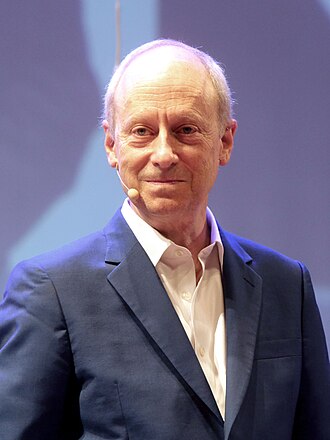
迈克尔·桑德尔 哈佛学生
本期追问 · 点击跳到视频对应位置
给一条人命标价 20 万美元,错在数字太低还是错在标价本身?若足够多的罗马观众为之狂喜,喂狮子的基督徒的痛苦就能被抵消吗?多数人更爱看《辛普森一家》却称莎士比亚更高级,密尔的偏好检验还成立吗?密尔说正义「神圣」,是否已经悄悄跳出了功利主义?
归入 Ⅲ·10 公平可以被计算吗? →
EDITED TRANSCRIPT · 依据现场录音编译整理,可划线生成便签
编者按:本文编译自哈佛大学迈克尔·桑德尔教授「公正:该如何做是好?」公开课第二讲「给生命标价」的现场录音。桑德尔在这一讲中从边沁的功利主义出发,以菲利普·莫里斯的吸烟成本收益报告、福特平托案等实例,与课堂上的本科生就「人命能否定价」「少数人的权利」「高级快乐与低级快乐」展开交锋,并引出密尔对功利主义的修正。参与讨论的学生包括朱莉、沃伊切克、劳尔、安娜、永达、约翰、内特、安妮莎与乔。文稿依据录音整理,仅删去口语枝节与重复之处,论证与细节悉数保留。

边沁的功利主义原则

桑德尔: 上次我们争论了女王诉达德利与斯蒂芬斯案,也就是救生艇上的海上食人案。请大家记住围绕这条救生艇的正反两方论证,记住支持和反对达德利与斯蒂芬斯所作所为的理由,我们回过头来谈哲学,谈杰里米·边沁(Jeremy Bentham)的功利主义哲学。边沁一七四八年生于英国,十二岁进牛津大学,十五岁读法学院,十九岁取得律师资格,却终生没有执业,而是把一生献给了法理学与道德哲学。

上次我们开始考察边沁版本的功利主义。它的核心思想说来很简单:道德的最高原则,无论是个人道德还是政治道德,就是让总体福利最大化,让集体幸福最大化,让快乐减去痛苦的总余额最大化,一句话,让效用(utility)最大化。边沁是循着这样一条思路得出这个原则的:我们全都受制于痛苦与快乐,它们是我们至高无上的主宰,因此任何道德体系都必须把它们纳入考量。怎样纳入才最好?答案是使之最大化。由此便得出「最大多数人的最大幸福」这条原则。

那么究竟该把什么最大化?边沁告诉我们,是幸福,说得更准确些,是效用。效用最大化不只是个人的原则,也是共同体和立法者的原则。边沁问,共同体究竟是什么?它无非是构成它的个人之总和。所以在决定最佳政策、决定法律应当如何、决定何为公正的时候,公民和立法者应当这样问自己:把这项政策的全部收益加起来,减去全部成本,正确的选择就是让幸福超出苦难的余额达到最大的那一个。这就是效用最大化的含义。

菲利普·莫里斯的吸烟账

桑德尔: 今天我想看看你们是否赞同它。这套功利主义逻辑在现实中常常以另一个名字出现,叫成本收益分析(cost-benefit analysis),公司和政府天天都在用。它的做法是给各种方案的成本和收益标上一个价值,通常是一个美元数字,用它来代表效用。

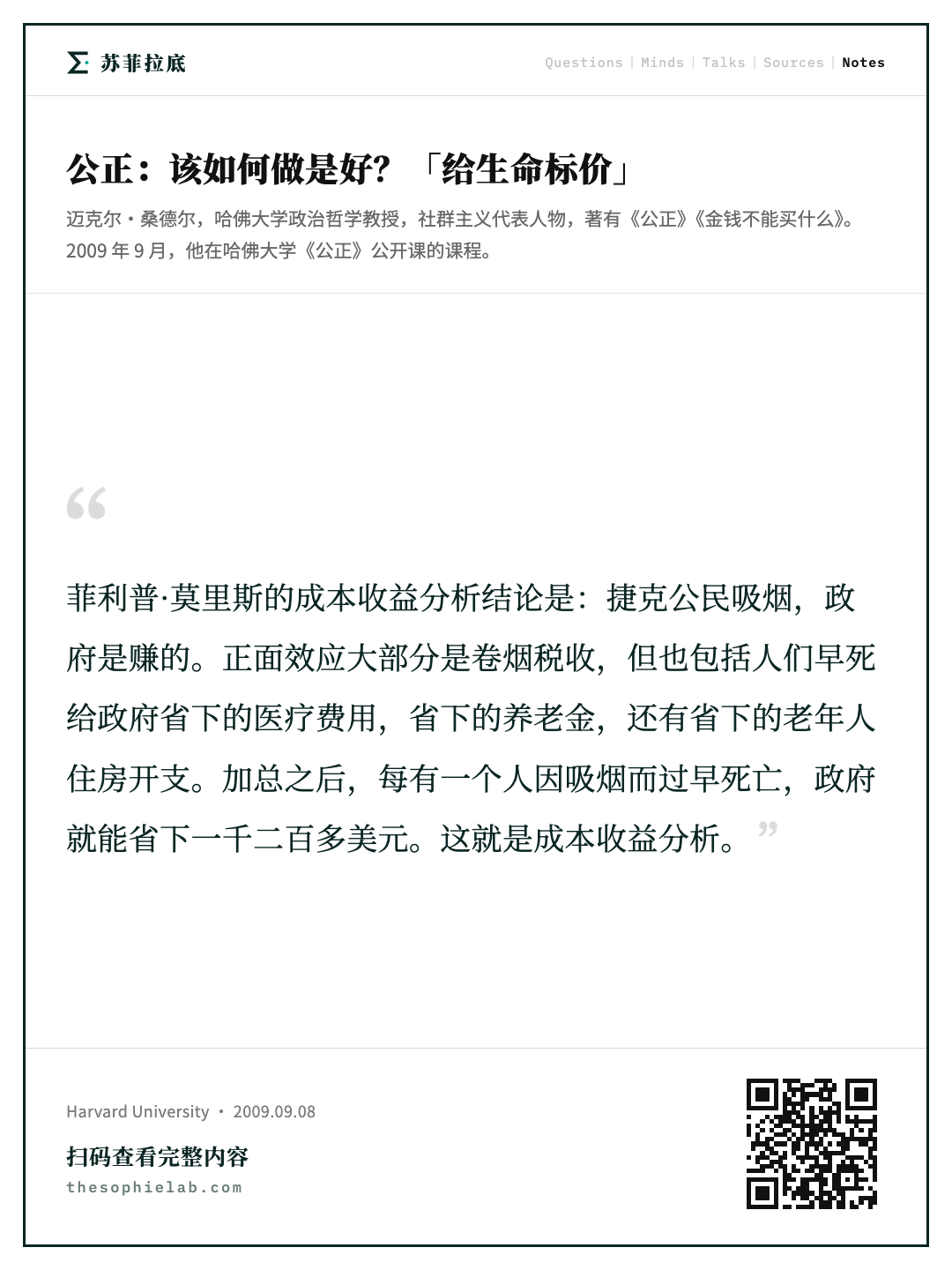
不久前捷克共和国有一项提案,要提高烟草消费税。烟草公司菲利普·莫里斯(Philip Morris)在捷克生意很大,于是委托人做了一份关于捷克吸烟问题的成本收益分析。分析的结论是:捷克公民吸烟,政府是赚的。

怎么个赚法?吸烟确实给捷克政府的公共财政带来负面影响,因为患上吸烟相关疾病的人会增加医疗开支。可另一方面也有正面效应,被记在账本的另一栏。正面效应大部分是政府从卷烟销售中取得的各项税收,但也包括人们早死给政府省下的医疗费用,省下的养老金(人死得早,养老金就不用发那么多年),还有省下的老年人住房开支。把所有成本和收益加总之后,菲利普·莫里斯的研究发现,捷克公共财政净赚一亿四千七百万美元。考虑到住房、医疗和养老金上的节省,每有一个人因吸烟而过早死亡,政府就能省下一千二百多美元。

这就是成本收益分析。你们当中为功利主义辩护的人也许会觉得这个例子不公平。菲利普·莫里斯为此在媒体上遭到痛斥,还为这笔冷酷无情的算计公开道歉。你们可能会说,这里漏掉的东西功利主义者完全可以补上,也就是那些死于肺癌的人自身以及他们家庭所承受的损失。那么,生命的价值该怎么算?

福特平托案与人命定价

桑德尔: 有些成本收益分析确实纳入了对生命价值的衡量,其中最有名的一桩就是福特平托(Ford Pinto)案。有人读到过吗?这是上世纪七十年代的事,福特平托是一款车,你们还记得吗?没人知道?那是一款小型车,紧凑型轿车,非常畅销,但有一个毛病:油箱装在车尾,遭遇追尾时油箱会爆炸。有人因此丧生,有人重伤。伤者把福特告上法庭。庭审中发现,福特早就知道油箱脆弱,还专门做过一份成本收益分析,来判断值不值得加装一块特制护板保护油箱、防止爆炸。

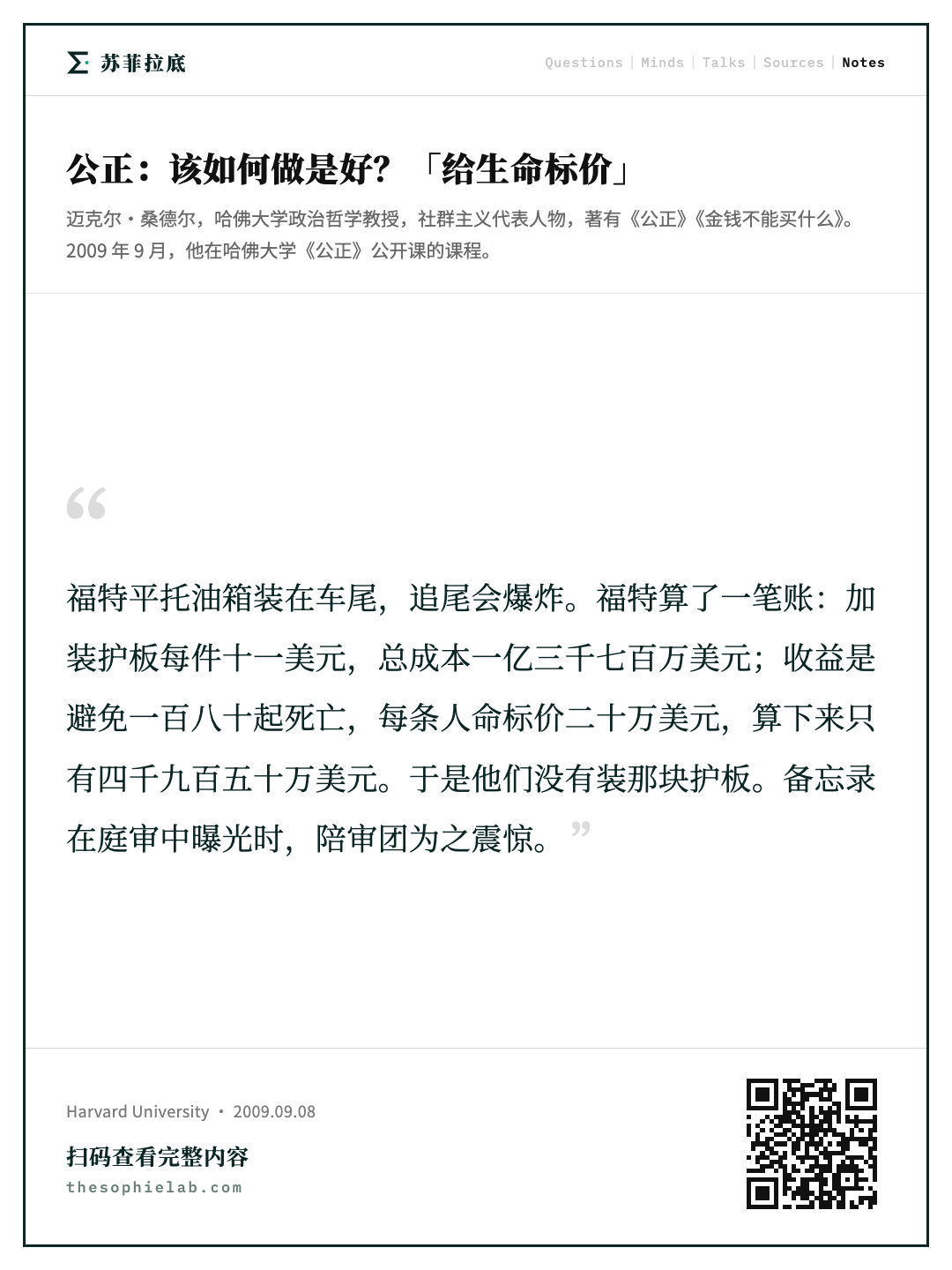
他们是这样算的:提高平托安全性的成本,每个零件十一美元。庭审中披露的账目是这样:每件十一美元,乘以一千二百五十万辆轿车和卡车,改善安全性的总成本为一亿三千七百万美元。然后他们计算了花这笔钱造一辆更安全的车能带来什么收益:他们估计可以避免一百八十起死亡,每条人命标价二十万美元;一百八十起伤残,每起六万七千美元;再加上没有安全装置将会烧毁的两千辆车,每辆七百美元的更换成本。这样算下来,收益只有四千九百五十万美元。于是他们没有装那块护板。

不用说,福特汽车公司这份成本收益分析备忘录在庭审中曝光时,陪审团为之震惊,判给了巨额赔偿。这算不算是对功利主义算计的一个反例?要知道福特已经把生命的价值算进去了。

课堂交锋:人命该值多少钱

桑德尔: 在座有谁愿意站出来,替成本收益分析抵挡这个表面上的反例?有谁愿意辩护?还是说,你们认为它彻底摧毁了整套功利主义计算?

朱莉: 我认为他们犯了和前一个案例同样的错误:给人的生命标了一个美元数字,而且同样没有把家属的痛苦和情感损失算进去。这些家庭失去的不只是收入,他们失去了所爱的人,那可比二十万美元值钱得多。

桑德尔: 好。等一下,你叫什么名字?

朱莉: 朱莉·罗托。

桑德尔: 朱莉,如果二十万这个数字太低,因为它没有计入失去亲人的痛苦和失去的那些岁月,那么你认为多少才是更准确的数字?

朱莉: 我觉得我给不出一个数字。我认为这类分析根本不应该用在人命问题上,不能用钱来衡量。

桑德尔: 所以朱莉的意思是,他们错的不是数字定得太低,而是压根就不该定任何数字。好,我们听听别的看法。

沃伊切克: 得考虑通货膨胀。

桑德尔: 好,有道理。那么按今天的物价该是多少?这是三十五年前的事了。

沃伊切克: 两百万美元。

桑德尔: 你叫什么名字?

沃伊切克: 沃伊切克。

桑德尔: 沃伊切克说要考虑通胀,应该更慷慨一些。那么你会认为这就是思考这个问题的正确方式吗?

沃伊切克: 遗憾的是,我想是的,因为总得在某个地方定下一个数字。我不确定该是多少,但我确实认为可以给人的生命定一个价。

桑德尔: 沃伊切克在这里与朱莉意见相左。朱莉说,我们不能为了做成本收益分析而给人命定价;沃伊切克说,我们必须定,因为总得设法作出决定。其他人怎么看?有没有人准备为成本收益分析辩护,认为它是准确的,是可取的?

劳尔: 我认为,如果福特和其他汽车公司不用成本收益分析,它们最终会倒闭,因为无法盈利。那样一来,数百万人就没法开车上班,没法挣钱养家、给孩子买吃的。所以我认为在这个案子里,如果不采用成本收益分析,牺牲的反而是更大的善。

桑德尔: 好,你叫什么名字?

劳尔: 劳尔。

桑德尔: 劳尔,最近有一项关于驾车时使用手机的研究。人们正在争论是否该禁止开车打电话。数据显示,每年约有两千人死于使用手机引发的交通事故。可是哈佛风险分析中心做的成本收益分析发现,如果把手机使用的收益也考虑进来,并给生命定一个价,两边算下来大致相当,因为让人们能在开车时充分利用时间、不浪费时间、谈生意、跟朋友聊天,带来的经济收益实在太大了。这是否说明,试图给人命问题标上金钱数字本身就是错的?

劳尔: 我认为,如果绝大多数人都想从手机这样的服务和它带来的便利中获取最大效用,那么为了满足这种需求,这种牺牲是必要的。

桑德尔: 你是个彻头彻尾的功利主义者。

劳尔: 是的。

桑德尔: 那好,最后一个问题,我也问过沃伊切克:为了决定该不该禁止开车打手机,人命该标多少钱?

劳尔: 我不想随口算出一个数字。我想,我得考虑考虑再说。

桑德尔: 那么,大致会是多少?有两千三百人死亡,你得给人命定个价,才知道要不要通过禁止开车用手机来避免这些死亡。你的直觉是多少?

劳尔: 一百万?两百万?

桑德尔: 两百万是沃伊切克的数字。差不多就是这个数?

劳尔: 也许一百万吧。

桑德尔: 一百万?!好,很好,谢谢。这些就是今天成本收益分析引发的一些争议,尤其是那种给一切都标上美元数字再加总的做法。

第一反驳:少数派与个人权利

桑德尔: 现在我想听听你们的反对意见,不一定是针对成本收益分析,因为那只是功利主义逻辑在当今实践中的一个版本;我要听的是针对整个理论的反驳,针对「正确的行为、政策与法律的正当基础就是效用最大化」这个观念本身。有多少人不同意功利主义对待法律和公共利益的方式?有多少人赞同?赞同的比反对的多。那我们先听批评者的意见。

安娜: 我最主要的不满是,我觉得不能因为一个人属于少数,就说他的需求和愿望不如多数人的值钱。所以我不太能接受「最大多数人的最大幸福」这个说法没问题,因为那些属于少数的人怎么办?这对他们不公平,他们又没有选择自己要站在哪一边。

桑德尔: 这是个有意思的反驳,你担心的是对少数人的影响。顺便问一句,你叫什么?

安娜: 安娜。

桑德尔: 谁来回应安娜对少数人处境的担忧?你对安娜怎么说?

永达: 她说少数人的价值被看低了,我不这么认为。就个体而言,少数群体中每个人的价值和多数群体中的每个人完全一样,只不过人数上多数压过了少数。到了某个时候你总得作出决定。我为少数人感到抱歉,但有时候这是为了整体,为了更大的善。

桑德尔: 为了更大的善。安娜,你怎么回应?你叫什么名字?

永达: 永达。

桑德尔: 永达说,只要把每个人的偏好加起来就行,少数人的偏好也是被称量过的。你说你担心功利主义会侵害少数人应得的关怀和尊重,能举个例子吗?

安娜: 就拿我们讨论过的案例来说,比如那个海难。我认为被吃掉的那个男孩和其他人一样有活下去的权利。仅仅因为他在那种情况下处于少数,也许是最没希望活下去的一个,并不意味着其他人就自动获得了吃掉他的权利,哪怕这样做能让更多人有机会活命。

桑德尔: 也就是说,少数人、每个个体可能拥有某些权利,是不能为了效用而被拿去交换的?

安娜: 是的。

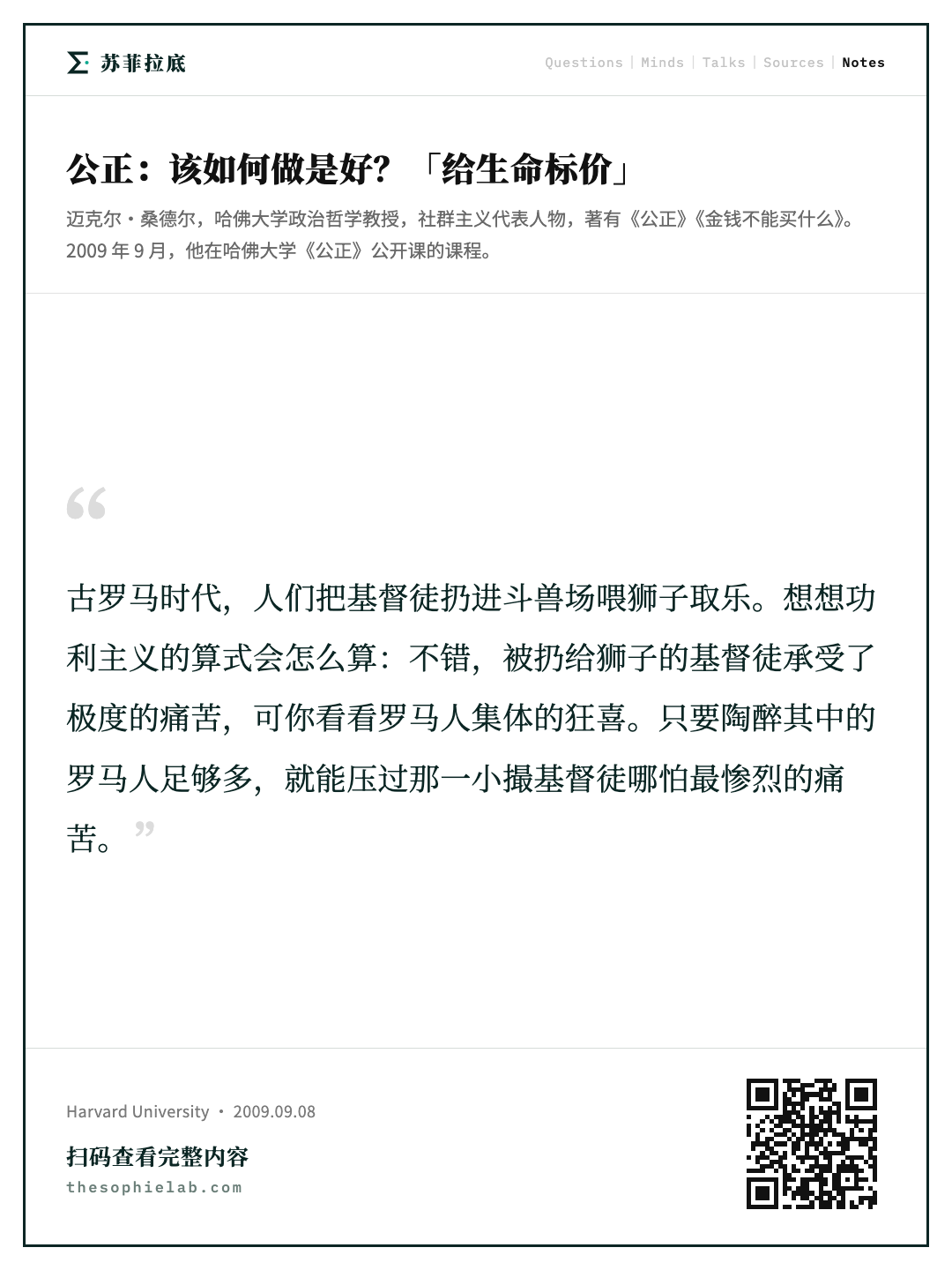
桑德尔: 永达,这里有一道考题给你。古罗马时代,人们把基督徒扔进斗兽场喂狮子取乐。想想功利主义的算式会怎么算:不错,被扔给狮子的基督徒承受了极度的痛苦,可你看看罗马人集体的狂喜。

永达: 在那个时代……我认为在今天,不会有任何政策制定者说,一个人的痛苦、一个人的苦难,跟观众得到的快乐比起来微不足道。

桑德尔: 可你得承认,只要陶醉其中的罗马人足够多,就能压过那一小撮被扔给狮子的基督徒哪怕最惨烈的痛苦。

桑代克实验:价值能否通约

桑德尔: 所以这里实际上有两种不同的针对功利主义的反驳。一种关乎功利主义是否充分尊重了个人权利或少数人的权利;另一种关乎把效用、偏好或价值加总这个想法本身:有没有可能把一切价值加总,全部换算成美元?

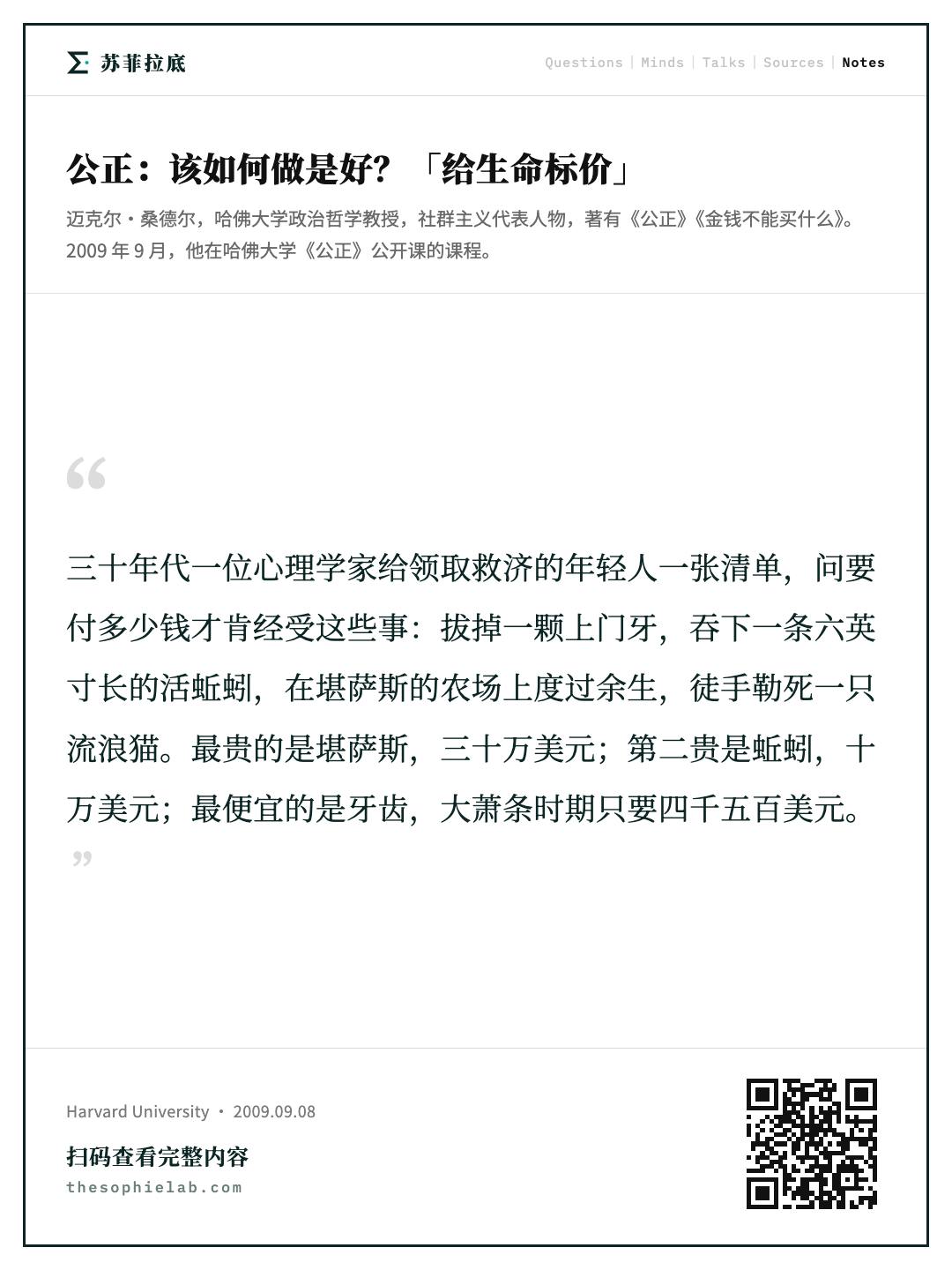
上世纪三十年代有一位心理学家试图回答第二个问题。他想证明功利主义所预设的那个前提:一切善、一切价值、一切人类关切都可以换算成同一种统一的尺度。他的办法是对领取救济的年轻人做问卷,那是三十年代。他给他们一张列着各种不愉快经历的清单,问他们要付多少钱才肯经受这些事。他逐项记录,比如:给你多少钱,你愿意拔掉一颗上门牙?给你多少钱,你愿意切掉一根小脚趾?或者吞下一条六英寸长的活蚯蚓?或者在堪萨斯的一座农场上度过余生?或者徒手勒死一只流浪猫?

你们猜,清单上最贵的一项是什么?

学生: 堪萨斯?

桑德尔: 对,就是堪萨斯。人们说,得付他们三十万美元才肯去堪萨斯。那你们猜第二贵的是什么?不是猫,不是牙,不是脚趾,是蚯蚓!人们说要十万美元才肯吃那条虫子。最便宜的呢?不是猫,是牙齿。大萧条时期,人们只要四千五百美元就愿意拔掉一颗牙。

桑代克(Thorndike)从这项研究中得出的结论是:任何存在的欲求或满足,都以某种数量存在,因此都是可以度量的。狗、猫或鸡的一生由食欲、渴求、欲望及其满足构成,人的一生也是如此,只不过人的欲望更复杂一些。

那么桑代克的研究究竟说明了什么?它是否支持边沁的观点,即一切善、一切价值都能用同一把价值尺子来衡量?还是说,清单上那些荒诞不经的项目恰恰暗示了相反的结论:无论谈的是生命、堪萨斯还是蚯蚓,我们珍视和爱惜的那些东西,也许根本无法用单一的价值尺度来度量?如果不能,这对功利主义的道德理论意味着什么?这个问题我们下次接着讨论。

酷刑难题与牛津女子学院轶事

桑德尔: 上一讲我们开始考察针对边沁功利主义的几种反驳,讨论中大家提出了两种。第一种反驳认为,功利主义只关心最大多数人的最大幸福,没有充分尊重个人权利。今天关于酷刑与恐怖主义的争论就是这个问题。假设九月十日那天抓到了一名恐怖嫌疑人,你有理由相信他掌握着一场即将发生、会夺去三千多人性命的恐怖袭击的关键情报,而你无法从他嘴里问出来。为了获取情报而对他施以酷刑,是正当的吗?还是说你会说不行,尊重个人权利是一项绝对的道德义务?从某种意义上说,我们又回到了开头讨论电车和器官移植时的那些问题。这是第一个问题。

你们还记得我们考察过几个成本收益分析的例子,很多人对给人命标上美元价格感到不安。这引出了第二种反驳:它质疑是否有可能把所有价值换算成一种统一的价值尺度,换句话说,它追问一切价值是否可通约(commensurable)。

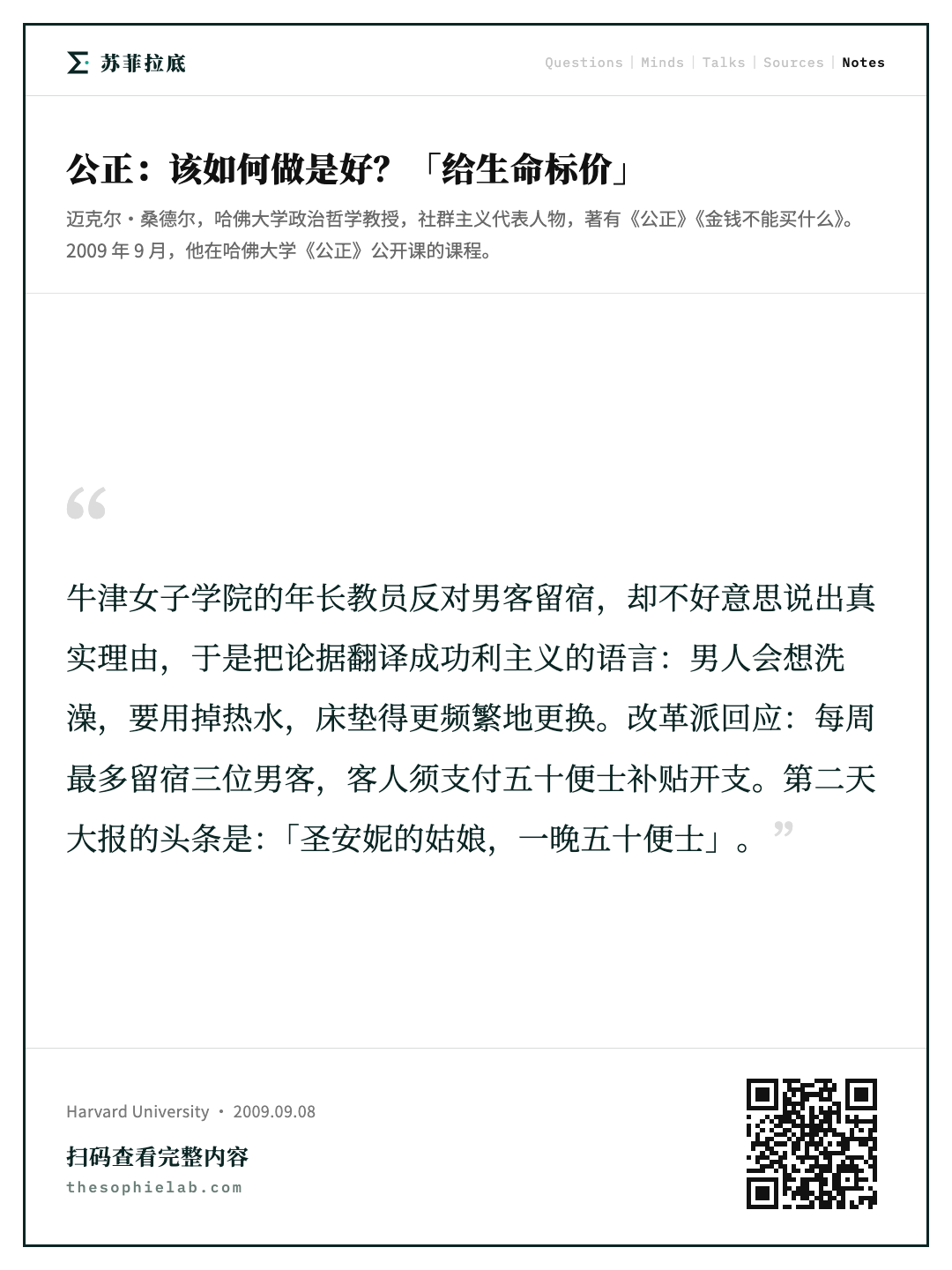
让我再讲一个例子,这是一段真实经历,来自我的亲身体验,它至少提出了一个问题:所有价值能否毫无损耗地翻译成功利主义的语言?多年前我在英国牛津读研究生,那时的学院还分男女,没有混合。女子学院有规定,禁止男客留宿过夜。到七十年代,这些规定已经很少执行,很容易违反,至少人家是这么告诉我的。到了七十年代末我在那里的时候,放宽这些规定的压力越来越大,圣安妮学院(St. Anne's College)的教员们为此展开辩论,那是一所女子学院。教员中年长的女性是传统派,她们出于传统道德的理由反对改变。可时代变了,她们不好意思说出反对的真实理由,于是把论据翻译成了功利主义的语言。她们说,如果男人留宿,学院的开支会增加。

你们也许要问,怎么会?她们说,男人会想洗澡,那就要用掉热水。而且,她们还说,床垫得更频繁地更换。改革派用下面这个折中方案回应了这些论据:每位女生每周最多可以留宿三位男客,至于是不是同一个人还是三个不同的人,她们没说;条件是,这就是折中之处,条件是客人须支付五十便士,用以补贴学院的开支。第二天全国性大报的头条标题是:「圣安妮的姑娘,一晚五十便士」。

这又是一个例证,说明把一切价值,这里是某种关于德性的观念,翻译成功利主义语言有多困难。这些都是为了说明对功利主义的第二种反驳,至少是其中质疑价值统一性、价值可通约性、能否把一切道德考量换算成美元或金钱的那一部分。

图钉与诗歌:该不该评判偏好

桑德尔: 但关于加总价值和偏好的这种担忧还有第二个面向:为什么我们要称量人们的所有偏好,却不评估这些偏好是好是坏?难道不该区分高级快乐与低级快乐吗?

不对人们偏好的价值作任何质的区分,这种做法的吸引力,有一部分在于它不作评判、人人平等。边沁式的功利主义者说,每个人的偏好都算数,不管人们想要什么,不管让不同的人感到幸福的是什么,都一样算数。你们记得,对边沁来说,唯一重要的是快乐或痛苦的强度和持续时间。所谓高级快乐或更高尚的德性,在边沁看来,无非就是那些能产生更强烈、更持久的快乐的东西。他有一句名言来表达这个想法:快乐的量相等,图钉游戏(pushpin)就和诗歌一样好。

图钉游戏是什么?是某种儿童游戏,类似弹片游戏。边沁说,图钉游戏和诗歌一样好。我想,这背后的主张和直觉是:去评判谁的快乐本质上更高级、更有价值、更好,是一种僭越。这种拒绝评判的态度确实有吸引人的地方。毕竟,有人喜欢莫扎特,有人喜欢麦当娜;有人喜欢芭蕾,有人喜欢保龄球。边沁派会说,谁有资格说这些快乐当中哪一种、谁的快乐比别人的更高级、更有价值、更高尚?

可这种拒绝作质的区分的态度对吗?我们真的能完全抛开这样一个想法,即我们从中获得快乐的某些事物比另一些更好、更有价值?回想斗兽场里的罗马人。那种做法让人不安,一个原因是它似乎侵犯了基督徒的权利。但还有另一种反对方式:罗马人从这场血腥场面中获得的快乐,是一种低劣、腐化、堕落的快乐,这种快乐难道也该被珍视、被称量,用来决定什么是公共福祉吗?

密尔登场:高级与低级快乐

桑德尔: 这就是针对边沁功利主义的几种反驳。现在我们转向一位试图回应这些反驳的人,后来的功利主义者约翰·斯图亚特·密尔(John Stuart Mill)。我们接下来要考察的是,密尔对这些反驳是否给出了令人信服的回答。

密尔生于一八零六年。他的父亲詹姆斯·密尔是边沁的信徒,着手给儿子安排一套示范性的教育。约翰·斯图亚特·密尔是个神童,三岁通希腊文(不是拉丁文,我说错了),八岁通拉丁文,十岁写了一部罗马法史。二十岁那年他精神崩溃,随之而来的抑郁持续了五年。到二十五岁,帮他走出抑郁的是他遇见了哈丽特·泰勒(Harriet Taylor)。她后来嫁给了他,两人从此过着幸福的生活。正是在她的影响下,密尔试图让功利主义变得更有人情味。密尔想做的,是看看功利主义的算式能否得到扩充和修正,以容纳人道关切,比如尊重个人权利的关切,同时处理高级快乐与低级快乐的区分。

一八五九年,密尔写下了那部著名的《论自由》,主旨是申明捍卫个人权利和少数人权利的重要性。一八六一年,在他晚年,他写了我们这门课要读的那本书,《功利主义》。这本书说得很清楚,在他看来效用是道德的唯一标准。所以他并没有挑战边沁的前提,而是肯定了它。他说得非常明确:能够证明某物值得欲求的唯一证据,就是人们实际上欲求它。也就是说,他坚持认为我们实际的、经验上的欲望是道德判断的唯一基础。

可是接下来,同样在第二章,他论证功利主义者有可能区分高级快乐与低级快乐。读过密尔的同学,照他的说法,这个区分是怎么划出来的?功利主义者怎样才能在质上区分高级快乐与低级的、卑下的、不值得的快乐?

约翰: 如果你两种都试过,你自然总会更喜欢高级的那种。

桑德尔: 很好,正是如此。你叫什么名字?

约翰: 约翰。

桑德尔: 正如约翰指出的,密尔说,检验标准是这样的:既然我们无法跳出实际的欲望和偏好之外(那样就违反了功利主义的前提),那么判断一种快乐是高级还是低级的唯一检验,就是看两种都体验过的人是否更偏爱它。在第二章里,我们可以看到密尔阐述约翰刚才所说观点的那段话:两种快乐之中,如果有一种是所有或几乎所有体验过两者的人都断然偏爱的,而且这种偏爱不出于任何道德义务感,换句话说,没有任何外在的、独立的标准,那么它就是更值得欲求的快乐。

大家怎么看这个论证?它成功了吗?有多少人认为它成功地在功利主义的框架内论证了高级快乐与低级快乐的区分?有多少人认为不成功?我想听听你们的理由。不过在说理由之前,我们先对密尔的主张做一个实验。

课堂实验:哈姆雷特对辛普森

桑德尔: 为了做这个实验,我们要看三段流行娱乐的短片。第一段是《哈姆雷特》的一段独白,之后是另外两段体验,看看你们觉得如何。

(播放三段视频:第一段是《哈姆雷特》中「人是何等的杰作」那段独白;第二段是真人秀《恐惧因素》的宣传片,六名参赛者角逐三项极限挑战,只有一人胜出;第三段是动画片《辛普森一家》的片段,弗兰德斯说他不在乎速度,但对头盔、防滚架、警示旗这些安全装备百看不厌,另一个角色说自己喜欢新鲜空气,还喜欢看内场里的穷人。)

桑德尔: 我都不用问你们最喜欢哪一个了。《辛普森一家》?有多少人最喜欢《辛普森一家》?有多少人最喜欢莎士比亚?《恐惧因素》呢,有多少人更喜欢《恐惧因素》?真的?绝大多数人喜欢《辛普森一家》胜过莎士比亚。

好,现在来投票的另一部分:哪一个是最高级的体验或快乐?多少人说莎士比亚?多少人说《恐惧因素》?不会吧,你是认真的?真的?好,说吧,你可以说出来。

内特: 我觉得那一段最有意思。

桑德尔: 我知道,可你认为哪一个是最有价值、最高尚的体验?

内特: 我知道你觉得它最……可是,如果一样东西之所以好,就是因为它令人愉快,那么按别人的标准来看它是否算好,这种抽象的想法又有什么意义?

桑德尔: 好,你站到了纯粹边沁派的一边:谁有资格评判?除了记录并加总人们实际的偏好,我们为什么还要去评判?好,有道理。你叫什么名字?

内特: 内特。

桑德尔: 好,有道理。那么有多少人认为,撇开喜好不谈,《辛普森一家》实际上是更高级的体验,比莎士比亚更高级?我们再看看莎士比亚这边的票,多少人认为莎士比亚更高级?那么,为什么?我最想听的是这样的人:认为莎士比亚最高级,却更喜欢看《辛普森一家》。

安妮莎: 我想,坐着看《辛普森一家》之所以有意思,是因为它讲笑话,让我们发笑。可是莎士比亚是伟大作家这件事,得有人来告诉我们。我们得被教着怎么读他,怎么理解他。就像我们得被教着怎么欣赏伦勃朗,怎么分析一幅画。

桑德尔: 你叫什么名字?

安妮莎: 安妮莎。

桑德尔: 安妮莎,当你说是别人告诉你莎士比亚更好的时候,你是盲目接受这种说法吗?你投票认为莎士比亚更高级,只是因为文化这么告诉你、老师这么告诉你,还是你自己真的同意?

安妮莎: 就莎士比亚来说,不是。不过,你刚才举了伦勃朗的例子。我觉得我读漫画书会比分析伦勃朗更享受,分析伦勃朗只是因为有人告诉我它伟大。

桑德尔: 好,你的意思是,这里面有一种文化的惯例和压力。是别人告诉我们哪些书、哪些艺术作品是伟大的。还有谁?

乔: 虽然在「公正」课的这一刻我看《辛普森一家》更开心,可如果让我用余生来琢磨刚才那三段视频,我不会愿意把剩下的日子花在后两段上。我想,能在自己的头脑里向外开拓,去思考更深刻的快乐、更深刻的思想,我会从中得到更多的快乐。

桑德尔: 告诉我你的名字。

乔: 乔。

桑德尔: 乔,那么如果你必须在堪萨斯的一座农场上度过余生,只能带上莎士比亚全集或者《辛普森一家》全集,你会选莎士比亚。由此你对密尔的检验得出什么结论?密尔说,高级快乐的检验标准是体验过两者的人更偏爱它。

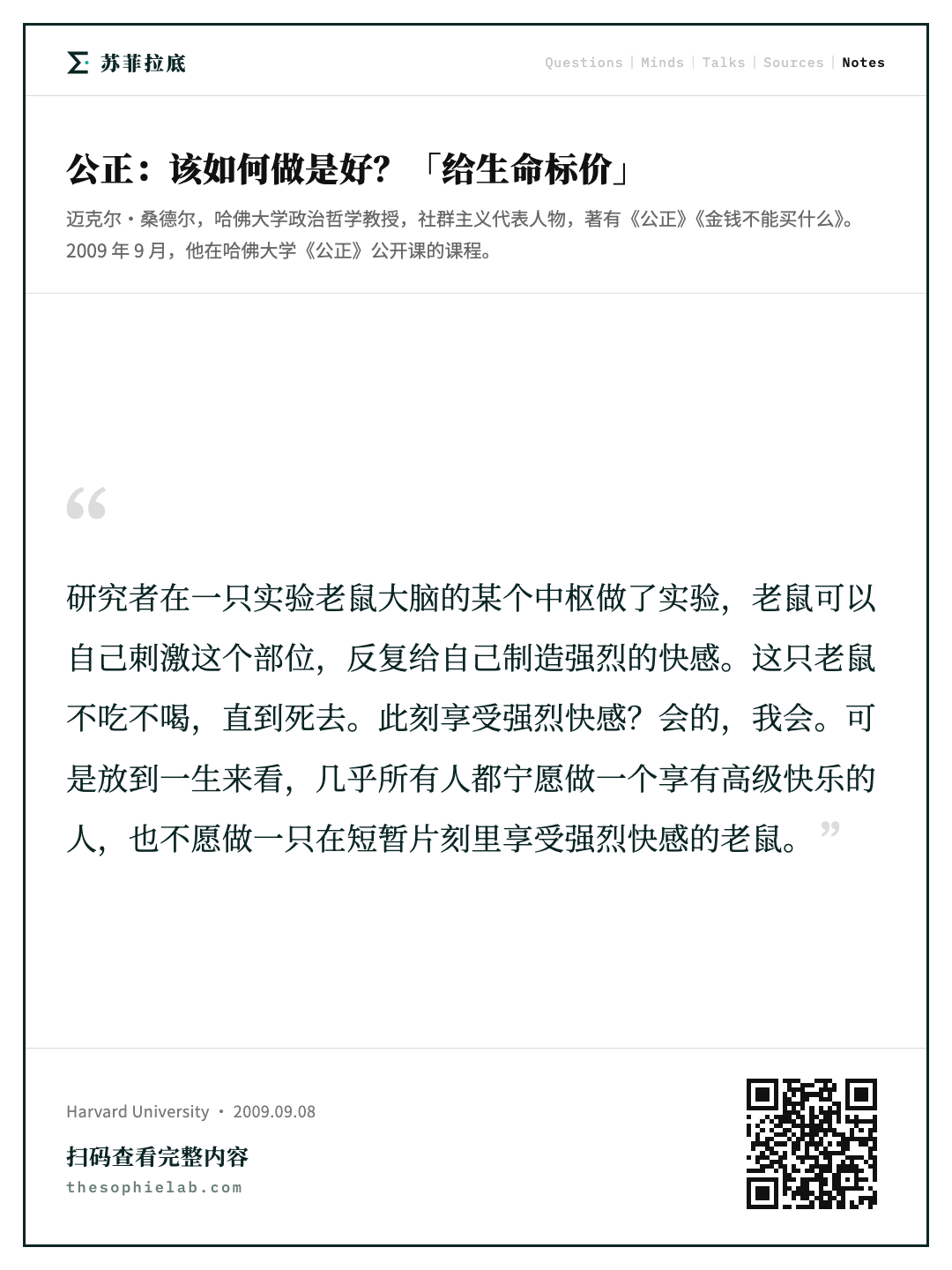
乔: 我能简单再举一个例子吗?去年在神经生物学课上,我们听说过一只实验老鼠。研究者在它大脑的某个特定中枢做了实验,老鼠可以自己刺激这个部位,反复给自己制造强烈的快感。这只老鼠不吃不喝,直到死去。它显然体验到了强烈的快感。现在如果你问我,是想此刻体验强烈的快感,还是想拥有一辈子的高级快乐,我会把那种强烈快感看作低级快乐。此刻享受强烈快感?会的,我会。可是放到一生来看,我想在座几乎所有人都会同意,他们宁愿做一个享有高级快乐的人,也不愿做一只在短暂片刻里享受强烈快感的老鼠。所以回到你的问题,我认为这证明了,或者不说证明,我认为结论是:密尔的理论是对的,当你问大多数人更愿意做什么,他们会回答宁愿从事高级的快乐。

桑德尔: 所以你认为这支持了密尔,密尔在这里确实抓住了什么。

乔: 是的。

桑德尔: 好,有没有人不同意乔,认为我们的实验恰恰推翻了密尔的检验,表明这不是一种恰当的办法,在功利主义框架内没法区分高级快乐?

学生: 如果所谓的好真的只是人们所偏好的东西,那它就完全是相对的,没有客观的定义。那么总会有某个社会,那里的人更喜欢《辛普森一家》。谁都能欣赏《辛普森一家》,可我认为欣赏莎士比亚是需要教育的。

桑德尔: 好,你说的是,欣赏更高级的东西需要教育。密尔的观点正是:高级快乐确实需要培养、需要鉴赏力、需要教育,这一点他并不否认。但他认为,一旦经过培养和教育,人们不仅会看出高级快乐与低级快乐的差别,还会实际上偏爱高级的那一种。

苏格拉底与猪:密尔的权利论

桑德尔: 你们会在密尔那里读到这段名言:做一个不满足的人,胜过做一头满足的猪;做不满足的苏格拉底,胜过做一个满足的傻瓜。如果傻瓜或猪有不同意见,那是因为他们只知道问题的自己那一面。

这就是区分高级快乐与低级快乐的一种尝试。去美术馆,还是窝在家里的沙发上灌啤酒看电视?密尔承认,有时候我们会禁不住诱惑,选择后者,当个沙发土豆。可即便我们出于懒惰和怠情这样做了,我们也知道,在美术馆里凝视伦勃朗所得到的快乐实际上更高级,因为两者我们都体验过。凝视伦勃朗之所以是更高级的快乐,是因为它调动了我们更高级的人类官能。

那么,密尔对个人权利那条反驳的回应又如何?在某种意义上,他用的是同一类论证,这体现在第五章。他说,任何把想象出来的、不以效用为基础的正义标准立起来的理论,其自命不凡我都不予承认;但他仍然把以效用为基础的正义视为(用他的话说)全部道德中最主要的部分,是无可比拟地最神圣、最有约束力的部分。

所以正义更高,个人权利享有特权,但理由并没有偏离功利主义的前提。他说,正义是某些道德要求的名称,这些要求作为一个整体,在社会效用的等级上处于更高的位置,因此比其他任何要求都具有更高的强制性义务。所以正义是神圣的,是优先的,是享有特权的,不是可以轻易拿去换取次要事物的东西。但密尔主张,其理由归根到底仍是功利主义的理由:只要考虑到人类作为不断进步的存在者的长远利益,考虑到我们所有人的长远利益,如果我们践行正义、尊重权利,社会整体从长远看会过得更好。

这令人信服吗?还是说,密尔在论证质上更高级的快乐、论证神圣或特别重要的个人权利时,实际上已经不动声色地跨出了功利主义的考量之外?这个问题我们还没有完全回答。因为要在权利与正义的问题上回答它,就需要探究另外一些非功利主义的方式来说明权利的基础,然后再问它们是否成功。

尾声:边沁的遗体标本

桑德尔: 至于杰里米·边沁,这位把功利主义作为一种道德哲学与法哲学学说发扬起来的人,他于一八三二年去世,享年八十五岁。可如果你去伦敦,今天仍然可以拜访他,我说的是字面意思。他在遗嘱里规定,遗体要经防腐处理后保存下来,陈列在伦敦大学。至今他仍坐镇在一个玻璃柜里,顶着一颗蜡制头颅,穿着他自己的衣服。

你们看,边沁生前给自己出了一道与他的哲学相一致的题目:一个死人对活人能有什么用处?他说,用处之一是把自己的遗体提供给解剖学研究。不过对于伟大的哲学家来说,更好的办法是把自己的肉身保存下来,以激励未来一代代的思想者。

想看看边沁做成标本是什么样子吗?就是这样。你们仔细看,会发现他真正的头颅防腐并不成功,所以换上了一颗蜡制头颅。为了逼真起见,在底部你们可以看到他真正的头颅摆在一只盘子里。看见了吗?就在那儿。

那么,这个故事的寓意是什么?顺便说一句,伦敦大学学院开董事会的时候会把他抬出来,会议记录写着他「出席,但不投票」。这是一位无论生前身后都恪守自己哲学原则的哲学家。下次我们继续讨论权利。
排版 + 横图 + 来源,粘贴即成稿
章节 · 点击跳转视频
0:03 边沁功利主义的基本原则 ▶ 正在看
3:20 菲利普·莫里斯的吸烟成本收益账 ▶ 正在看
5:52 福特平托案与人命定价 ▶ 正在看
9:23 课堂交锋:人命该值多少钱 ▶ 正在看
15:06 第一反驳:少数派与个人权利 ▶ 正在看
19:28 桑代克实验:价值能否通约 ▶ 正在看
24:13 酷刑难题与牛津女子学院轶事 ▶ 正在看
29:29 图钉与诗歌:该不该评判偏好 ▶ 正在看
33:33 密尔登场:高级与低级快乐 ▶ 正在看
37:57 课堂实验:哈姆雷特对辛普森 ▶ 正在看
47:55 苏格拉底与猪:密尔的权利论 ▶ 正在看
50:47 尾声:边沁的遗体标本 ▶ 正在看
本期小问 · 档案清单
—— 给一条人命标价 20 万美元,错在数字太低还是错在标价本身? ▶ 正在看
—— 若足够多的罗马观众为之狂喜,喂狮子的基督徒的痛苦就能被抵消吗? ▶ 正在看
—— 多数人更爱看《辛普森一家》却称莎士比亚更高级,密尔的偏好检验还成立吗? ▶ 正在看
—— 密尔说正义「神圣」,是否已经悄悄跳出了功利主义? ▶ 正在看
本期讲者
迈克尔·桑德尔哈佛大学政治哲学教授,社群主义代表人物,著有《公正》《金钱不能买什么》。其「公正」公开课是哈佛史上选课人数最多的课程之一,2009 年由 WGBH 电视化播出。
哈佛学生课堂上参与讨论的本科生,分别为成本收益分析辩护或提出反驳,构成本讲的对话主体。
01边沁功利主义的基本原则
0:03
Funding for this program provided by Additional funding provided by
本节目的资金由以下机构提供,额外资金由以下机构提供
便签笔记
0:32
last time we argued about the case of the Queen verses Dudley and Stephens the lifeboat case, the case of cannibalism at sea and with the arguments about the lifeboat in mind the arguments for and against what Dudley and Stephens did in mind, let's turn back to the philosophy the utilitarian philosophy of Jeremy Bentham Bentham was born in England in 1748, at the age of twelve he went to Oxford, at fifteen he went to law school he was admitted to the bar at age nineteen but he never practiced law, instead he devoted his life to jurisprudence and moral philosophy.
上次我们讨论了女王诉达德利与斯蒂芬斯案,也就是那起救生艇案,海上食人案带着关于救生艇的那些论证,带着支持和反对达德利与斯蒂芬斯所作所为的论证让我们回到哲学,回到杰里米·边沁的功利主义哲学。边沁1748年生于英国,十二岁时他就进了牛津,十五岁进了法学院,十九岁取得律师资格,但他从未执业相反,他把一生献给了法理学和道德哲学。
便签笔记
1:22
last time we began to consider Bentham's version of utilitarianism the main idea is simply stated and it's this, the highest principle of morality whether personal or political morality is to maximize the general welfare or the collective happiness or the overall balance of pleasure over pain in a phrase maximize utility Bentham arrives at this principle by the following line of reasoning we're all governed by pain and pleasure they are our sovereign masters and so any moral system has to take account of them.
上次我们开始考察边沁版本的功利主义,其主要观点很简单,就是这样道德的最高原则,无论是个人道德还是政治道德,就是使普遍福利或集体幸福最大化或者说使快乐相对于痛苦的总体差额最大化,一句话,就是使效用最大化。边沁是通过下面这条推理路线得出这个原则的我们都受痛苦和快乐支配,它们是我们至高无上的主人,所以任何道德体系都必须考虑到它们。
便签笔记
2:09
How best to take account? By maximizing and this leads to the principle of the greatest good for the greatest number what exactly should we maximize? Bentham tells us happiness or more precisely utility. Maximizing utility is a principal not only for individuals but also for communities and for legislators what after all is a community Bentham asks, it's the sum of the individuals who comprise it and that's why in deciding the best policy, in deciding what the law should be, in deciding what's just, citizens and legislators should ask themselves the question if we add up, all of the benefits of this policy and subtract all of the costs, the right thing to do is the one that maximizes the balance of happiness over suffering.
如何才是最好的考虑方式?通过最大化,这就引出了“最大多数人的最大幸福”这一原则。那我们究竟应该最大化什么呢?边沁告诉我们,是幸福,或者更准确地说,是效用。效用最大化不仅是个人的原则,也是共同体和立法者的原则。共同体究竟是什么呢边沁问道,它就是组成它的所有个人的总和。这就是为什么在决定最佳政策时,在决定法律应该是什么时,在决定什么是正义时公民和立法者应该问自己这样一个问题:如果我们把这项政策的所有收益加起来,再减去所有的成本那么正确的做法就是使幸福相对于痛苦的差额最大化的那一个。
便签笔记
02菲利普·莫里斯的吸烟成本收益账
3:20
that's what it means to maximize utility now, today I want to see whether you agree or disagree with it, and it often goes, this utilitarian logic, under the name of cost-benefit analysis which is used by companies and by governments all the time and what it involves is placing a value usually a dollar value to stand for utility on the costs and the benefits of various proposals. recently in the Czech Republic there was a proposal to increases the excise tax on smoking Philip Morris, the tobacco company, does huge business in the Czech Republic. They commissioned a study of cost-benefit analysis of smoking in the Czech Republic and what their cost benefit analysis found was the government gains by having Czech citizens smoke.
这就是效用最大化的含义。今天,我想看看你们是同意还是不同意这套功利主义逻辑常常以“成本效益分析”的名义出现,而成本效益分析被公司和政府一直在使用。它所涉及的,就是给各种方案的成本和收益赋予一个价值,通常是一个用来代表效用的美元价值。最近在捷克共和国,有人提议提高吸烟的消费税。菲利普·莫里斯这家烟草公司在捷克有着庞大的业务。他们委托做了一项关于捷克吸烟问题的成本效益分析研究,而他们的成本效益分析发现,让捷克公民吸烟,政府是得利的。
便签笔记
4:30
Now, how do they gain? It's true that there are negative effects to the public finance of the Czech government because there are increased health care costs for people who develop smoking-related diseases on the other hand there were positive effects and those were added up on the other side of the ledger the positive effects included, for the most part, various tax revenues that the government derives from the sale of cigarette products but it also included health care savings to the government when people die early pensions savings, you don't have to pay pensions for as long, and also savings in housing costs for the elderly and when all of the costs and benefits were added up the Philip Morris study found that there is a net public finance gain in the Czech Republic of a hundred and forty seven million dollars and given the savings in housing and health care and pension costs the government enjoys the saving of savings of over twelve hundred dollars for each person who dies prematurely due to smoking.
那么,他们是怎么得利的呢?确实,对捷克政府的公共财政有负面影响,因为那些患上吸烟相关疾病的人会带来医疗费用的增加。但另一方面也有正面影响,这些被加到账本的另一边。这些正面影响主要包括政府从香烟产品销售中获得的各种税收,但也包括当人们早死时政府节省的医疗开支养老金的节省,你不必支付那么长时间的养老金还有老年人住房成本上的节省。把所有成本和收益加总之后,菲利普·莫里斯的这项研究发现,捷克共和国的公共财政净收益为一亿四千七百万美元。而且考虑到在住房、医疗和养老金支出上的节省,政府每有一人因吸烟而过早死亡,就能省下一千二百多美元。每一个因吸烟而过早死亡的人。
便签笔记
03福特平托案与人命定价
5:52
cost-benefit analysis now, those among you who are defenders utilitarianism may think that this is a unfair test Philip Morris was pilloried in the press and they issued an apology for this heartless calculation you may say that what's missing here is something that the utilitarian can be easily incorporate mainly the value to the person and to the families of those who die from lung cancer. what about the value of life? Some cost-benefit analyses incorporate a measure for the value of life. One of the most famous of these involved the Ford Pinto case did any of you read about that? this was back in the 1970's, you remember that the Ford Pinto was, a kind of car?
这就是成本收益分析。你们当中支持功利主义的人也许会觉得,这个例子对功利主义不太公平。菲利普·莫里斯被媒体口诛笔伐,还为这份冷血的计算公开道歉。你可能会说,这里遗漏的东西其实功利主义者很容易纳入进来,主要是那些死于肺癌的人本身以及他们的家庭所失去的价值。那么生命的价值呢?有些成本收益分析确实纳入了对生命价值的衡量。其中最著名的一个案例就是福特平托车(Ford Pinto)案,你们有人读过吗?那是上世纪七十年代的事,你们还记得吗?福特平托是一种什么样的车?
便签笔记
6:48
anybody? it was a small car, subcompact car, very popular but it had one problem which is the fuel tank was at the back of the car and in rear collisions the fuel tank exploded and some people were killed and some severely injured. victims of these injuries took Ford to court to sue and in the court case it turned out that Ford had long since known about the vulnerable fuel tank and had done a cost-benefit analysis to determine whether it would be worth it to put in a special shield that would protect the fuel tank and prevent it from exploding.
有人知道吗?那是一款小型车,微型轿车,非常畅销,但它有一个问题:油箱装在车的后部。发生追尾碰撞时油箱会爆炸,导致一些人死亡,一些人重伤。这些伤者把福特告上了法庭。在庭审中人们发现,福特其实早就知道油箱存在安全隐患,而且做过一次成本收益分析,来判断是否值得加装一个特制的护板来保护油箱、防止它爆炸。
便签笔记
7:40
They did a cost benefit analysis the cost per part to increase the safety of the Pinto, they calculated at eleven dollars per part and here's, this was the cost benefit analysis that emerged in the trial, eleven dollars per part at 12.5 million cars and trucks came to a total cost of 137 million dollars to improve the safety but then they calculated the benefits of spending all this money on a safer car and they counted 180 deaths and they assigned a dollar value 200 thousand dollars per death 180 injuries 67 thousand and then the cost to repair the replacement cost for two thousand vehicles that would be destroyed without the safety device 700 dollars per vehicle, so the benefits turned out to be only 49.5 million, and so they didn't install the device needless to say when this memo of the Ford Motor Company's cost-benefit analysis came out in the trial it appalled the jurors who awarded a huge settlement is this a counter example to the utilitarian idea of calculating because Ford included a
他们做了成本收益分析:提高平托车安全性所需的每个零件的成本,他们算下来是每件十一美元。这就是在庭审中曝光的那份成本收益分析:每件十一美元,乘以一千二百五十万辆汽车和卡车,提高安全性的总成本是一亿三千七百万美元。然后他们又计算了花这笔钱造更安全的车所带来的收益:他们估算会有一百八十人死亡,并给每条人命标了价,每例死亡二十万美元;一百八十例受伤,每例六万七千美元;再加上如果不装安全装置就会损毁的两千辆车的重置成本,每辆七百美元。于是收益总共只有四千九百五十万美元。所以他们没有安装这个装置。不用说,当福特汽车公司这份成本收益分析的备忘录在庭审中曝光时,陪审员们大为震惊,判了一笔巨额赔偿。这是否构成对功利主义计算方式的一个反例呢?毕竟福特确实把生命价值也计入了。
便签笔记
04课堂交锋:人命该值多少钱
9:23
measure of the value life. Now who here wants to defend cost-benefit analysis from this apparent counter example who has a defense? or do you think it's completely destroys the whole utilitarian calculus? I think that once again they've made the same mistake the previous case did that they've assigned a dollar value to human life and once again they failed to take into account things like suffering and emotional losses of families, I mean families lost earnings but they also lost a loved one and that is more value than 200 thousand dollars.
那么,在座有谁愿意为成本收益分析辩护,回应这个看似成立的反例?谁有辩护理由?还是说你们认为它彻底摧毁了整套功利主义算计?我认为他们又犯了和前一个案例同样的错误,也就是给人的生命标上了一个价格。而且他们再次没有考虑到痛苦、家庭的情感损失这些东西。我的意思是,家庭失去的不只是收入,他们还失去了一个所爱的人,那个价值远远超过二十万美元。
便签笔记
10:06
Good, and wait wait wait, what's you're name? Julie Roto. so if two hundred thousand, Julie, is too too low a figure because it doesn't include the loss of a loved one, and the loss of those years of life, what would be, what do you think would be a more accurate number? I don't believe I could give a number I think that this sort of analysis shouldn't be applied to issues of human life. I think it can't be used monetarily so they didn't just put to low a number, Julie says, they were wrong to try to put any number at all.
很好。等一下等一下,你叫什么名字?朱莉·罗托。那么朱莉,如果二十万这个数字太低,因为它没有算上失去亲人的损失,也没有算上那些失去的生命年数,那你觉得多少才是一个更准确的数字?我觉得我给不出一个数字。我认为这类分析根本就不该用在人的生命问题上。我认为不能用金钱来衡量。所以他们不只是数字给低了,朱莉说,他们试图给出任何数字这件事本身就是错的。
便签笔记
10:44
all right let's hear someone who you have to adjust for inflation
好,我们再听听别人的看法。你说必须考虑通货膨胀。
便签笔记
10:57
all right fair enough so what would the number of being now? this is was thirty five years ago two million dollars you would put two million and what's your name Voicheck Voicheck says we have to allow for inflation we should be more generous then would you be satisfied that this is the right way of thinking about the question? I guess unfortunately it is for there's needs to be of number put somewhere I'm not sure what number would be but I do agree that there could possibly be a number put on a human life.
好,有道理。那按现在算应该是多少?这是三十五年前的事了——两百万美元,你会给两百万。你叫什么名字?沃伊切克。沃伊切克说我们得考虑通胀,应该更大方一些。那你是否认可这就是思考这个问题的正确方式?我想很遗憾,确实得在某个地方放上一个数字。我不确定这个数字该是多少,但我确实同意,人的生命有可能是可以标上一个数字的。
便签笔记
11:41
all right so Voicheck says and here he disagrees with Julie Julie says we can't put a number of human life for the purpose of a cost-benefit analysis, Voicheck says we have to because we have to make decisions somehow what do other people think about this? Is there anyone prepared to defend cost-benefit analysis here as accurate, as desirable? I think that if ford and other car companies didn't use cost-benefit analysis they'd eventually go out of business because they wouldn't be able to be profitable and millions of people wouldn't be able to use their cars to get to jobs, to put food on the table to feed their children so I think that if cost-benefit analysis isn't employed the greater good is sacrificed in this case. Alright let me ask, what's your name?
好,沃伊切克是这么说的,在这一点上他和朱莉意见相左。朱莉说,为了做成本收益分析而给人命标价是不行的;沃伊切克说我们必须这么做,因为我们总得以某种方式做决定。其他人怎么看?有没有人愿意为成本收益分析辩护,认为它既准确又可取?我认为如果福特和其他汽车公司不做成本收益分析,它们最终会倒闭,因为无法盈利,那样就会有数百万人开不上车去上班、挣钱养家、养活孩子。所以我认为,如果不采用成本收益分析,在这种情况下反而牺牲了更大的善。好,我问一下,你叫什么名字?
便签笔记
12:34
Raul. Raul. there was recently a study done about cell phone use by drivers, when people are driving a car, and there's a debate about whether that should be banned and the figure was that some two thousand people die as a result of accidents each year using cell phones and yet the cost benefit analysis which was done by the center for risk analysis at Harvard found that if you look at the benefits of the cell phone use and you put some value on the life, it comes out about the same because of the enormous economic benefit of enabling people to take advantage of their time, not waste time, be able to make deals and talk to friends and so on while they're driving doesn't that suggest that it's a mistake to try to put monetary figures on questions of human life?
劳尔。劳尔。最近有一项关于驾驶员使用手机的研究,就是人们开车的时候,社会上一直在争论是否该禁止这种行为。数据是每年大约有两千人死于开车打手机造成的事故。然而哈佛风险分析中心做的成本收益分析发现,如果你把使用手机的收益也算进去,再给生命标上某个价值,两边大致相当,因为让人们能够充分利用时间、不浪费时间、能谈生意、能跟朋友聊天等等,这带来了巨大的经济收益,而且是在开车的同时。这难道不说明,试图给人命问题标上金钱数字是个错误吗?
便签笔记
13:37
well I think that if the great majority of people tried to derive maximum utility out of a service like using cell phones and the convenience that cell phones provide that sacrifice is necessary for satisfaction to occur. You're an outright utilitarian. In, yes okay. all right then, one last question Raul and I put this to Voicheck, what dollar figure should be put on human life to decide whether to ban the use of cell phones well I don't want to arbitrarily calculate a figure, I mean right now I think that you want to take it under advisement.
我认为,如果绝大多数人都想从手机这类服务以及它带来的便利中获得最大的效用,那么这种牺牲对于满足的实现来说是必要的。你是个彻头彻尾的功利主义者。嗯,是的,好吧。那么好,最后一个问题,劳尔,这个问题我也问过沃伊切克:为了决定要不要禁止开车用手机,应该给人的生命标多少钱?嗯,我不想随意算出一个数字。我是说,现在我觉得——你想再考虑考虑。
便签笔记
14:23
yeah I'll take it under advisement. but what roughly speaking would it be? you've got 23 hundred deaths you've got to assign a dollar value to know whether you want to prevent those deaths by banning the use of cell phones in cars so what would you're hunch be? how much? million two million two million was Voitech's figure is that about right? maybe a million. a million.?! Alright that's good, thank you So these are some of the controversies that arise these days from cost-benefit analysis especially those that involve placing a dollar value on everything to be added up.
对,我想再考虑考虑。但大致会是多少呢?你面对的是两千三百条人命,你得给它标一个价,才能知道是否要通过禁止开车用手机来避免这些死亡。那么你的直觉是多少?多少?一百万?两百万?两百万是沃伊切克给的数字,差不多合适吗?也许一百万吧。一百万?!好的,很好,谢谢。这些就是如今成本收益分析引发的一些争议,特别是那些要把一切都折算成美元再加总的做法。
便签笔记
05第一反驳:少数派与个人权利
15:06
well now I want to turn to your objections, to your objections not necessarily to cost benefit analysis specifically, because that's just one version of the utilitarian logic in practice today, but to the theory as a whole, to the idea that the right thing to do, the just basis for policy and law, is to maximize utility. How many disagree with the utilitarian approach to law and to the common good? How many bring with it? so more agree than disagree. so let's hear from the critics my main issue with it is that I feel like you can't say that just because someone's in the minority what they want and need is less valuable than someone who's in the majority so I guess I have an issue with the idea that the greatest good for the greatest number is okay because there is still what about people who are in the lesser number, like it's not fair to them they didn't have a say in where they wanted to be.
现在我想转向你们的反对意见——你们的反对意见不一定是专门针对成本收益分析的,因为那只是今天功利主义逻辑在实践中的一个版本,而是针对整个理论,针对这样一种观念:正确的行为、公共政策和法律的正当基础,就是最大化效用。有多少人不同意这种用功利主义看待法律和公共善的思路?有多少人同意?看来同意的比不同意的多。那我们先听听批评的声音。我最主要的问题是,我觉得你不能说,仅仅因为某个人属于少数派,他所想要和需要的东西就比多数派的人更不值钱。所以我对这个观念有意见:“为最大多数人谋最大幸福”就是可以的——因为问题在于,那些属于少数一方的人怎么办?这对他们不公平,他们并没有选择自己站在哪一边的余地。
便签笔记
16:25
alright now that's an interesting objection, you're worried about the effect on minority. yes. what's your name by the way. Anna. alright who has an answer to Anna's worry about the effect on the minority What do you say to Anna? she said that the minorities value less, I don't think that's the case because individually the minorities value is just the same as the individual in the majority it's just that the numbers outweigh the minority and I mean at a certain point you have to make a decision and I'm sorry for the minority but sometimes it's for the general for the greater good. For the greater good, Anna what do you say? what's your name? Youngda.
好,这是个很有意思的反对意见,你担心的是对少数群体的影响。是的。顺便问一下你叫什么名字?安娜。好,谁能回应安娜关于少数群体所受影响的担忧?你想对安娜说什么?她说少数派的价值更低。我不认为是这样,因为就个体而言,少数派中每个人的价值和多数派中每个人的价值是完全一样的,只是人数上压倒了少数派。而且我是说,到了某个时候你必须做出决定,我为少数派感到遗憾,但有时候这是为了整体、为了更大的善。为了更大的善。安娜,你怎么看?你叫什么名字?杨达。
便签笔记
17:08
What do you say to Youngda? Youngda says you just have to add up people's preferences and those in the minority do have their preferences weighed. can you give an example of the kind of thing you're worried about when you say you're worried about utilitarianism violating the concern or respect due the minority? can you give an example. so well with any of the cases that we've talked about, like with the shipwreck one, I think that the boy who was eaten still had just as much of a right to live as the other people and just because he was the minority in that case the one who maybe had less of a chance to keep living that doesn't mean that the others automatically have a right to eat him just because it would give a greater amount of people the chance to live.
你想对杨达说什么?杨达说,你只需要把人们的偏好加总起来,少数派的偏好也确实被计入权衡了。你能举个例子吗?当你说你担心功利主义侵犯了对少数群体应有的关切或尊重时,你担心的具体是什么情况?能举个例子吗?就用我们讨论过的任何一个案例吧,比如那个海难的例子。我认为那个被吃掉的男孩和其他人一样,同样拥有活下去的权利。仅仅因为他在那种情况下属于少数、也许是活下去机会较小的那个,并不意味着其他人就自动有权吃掉他,只因为那样能让更多人有机会活下来。
便签笔记
18:03
so there may be a certain rights that the minority members have that the individual has that shouldn't be traded off for the sake of utility? yes Anna? Now this would be a test for you, back in ancient Rome they threw Christians to the lions in the coliseum for sport if you think how the utilitarian calculus would go yes, the Christian thrown to the lion suffers enormous excruciating pain, but look at the collective ecstasy of the Romans. Youngda. Well in that time I don't think in the modern-day of time to value the, um, to given a number to the happiness given to the people watching I don't think any policy maker would say the pain of one person, the suffering of one person is much much, in comparison to the happiness gained no but you have to admit that if there were enough Romans delirious with happiness, it would outweigh even the most excruciating pain of a handful of Christians thrown to the lion.
所以,少数群体的成员、个体可能拥有某些权利,这些权利是不该被拿去交换效用的?是的。安娜?那这就是对你的一个考验了:在古罗马,人们把基督徒扔进斗兽场里喂狮子取乐。如果你想想功利主义的计算会怎么算——没错,被扔给狮子的基督徒承受着极其剧烈的痛苦,但你看看罗马人集体的狂喜。杨达。嗯,在那个时代,我不认为——按现代的标准来给观众获得的快乐赋予一个数值——我不认为今天任何政策制定者会说,一个人的痛苦、一个人的苦难,跟所获得的快乐相比是可以被压倒的。不,但你得承认,如果有足够多的罗马人欣喜若狂,那种快乐总量确实会压过少数几个被扔给狮子的基督徒所受的最剧烈痛苦。
便签笔记
06桑代克实验:价值能否通约
19:28
so we really have here two different objections to utilitarianism one has to do with whether utilitarianism adequately respects individual rights or minority rights and the other has to do with the whole idea of aggregating utility for preferences or values is it possible to aggregate all values to translate them into dollar terms? there was in the 1930's a psychologist who tried to address the second question. He tried to prove what utilitarianism assumes, that it is possible to translate all goods, all values, all human concerns into a single uniform measure and he did this by conducting a survey of the young recipients of relief, this was in the 1930's and he asked them, he gave them a list of unpleasant experiences and he asked them how much would you have to be paid to undergo the following experiences and he kept track for example how much would you have to be paid to have one upper front tooth pulled out or how much would you have to be paid to have one little one tow cut off?
所以我们这里其实有两种不同的对功利主义的反对意见:一种关乎功利主义是否充分尊重个人权利或少数人的权利;另一种则关乎把偏好或价值加总成效用这整个想法——所有价值真的可以被加总、被折算成美元吗?上世纪三十年代有一位心理学家试图回答第二个问题。他试图证明功利主义所假定的那一点:所有的好、所有的价值、所有人类关切都可以被转换成一个单一、统一的尺度。他的做法是对领取救济金的年轻人做了一项调查,这是三十年代的事。他给他们一张不愉快经历的清单,问他们:要付你多少钱,你才愿意经历以下这些事?他记录了结果,比如说,要付你多少钱,你才愿意被拔掉一颗上门牙?或者要付你多少钱,你才愿意被切掉一根小脚趾?
便签笔记
21:05
or eat a live earth worm, six inches long or to live the rest of your life on a farm in Kansas or to choke a stray cat to death with your bare hands now what do you suppose what do you suppose was the most expensive item on that list Kansas? You're right it was Kansas for a Kansas people said they'd have to pay them they have to be paid three hundred thousand dollars
或者吃下一条六英寸长的活蚯蚓,或者下半辈子住在堪萨斯州的一个农场里,或者用赤手把一只流浪猫掐死。那么你们猜,这份清单上要价最高的是哪一项?堪萨斯?你说对了,就是堪萨斯。为了堪萨斯,人们说得付他们三十万美元。
便签笔记
21:57
what do you think what do you think was the next most expensive? not the cat not the tooth not the toe the worm! people said you'd have to pay them a hundred thousand dollars to eat the worm what do you think was the least expensive item? not the cat the tooth during the depression people were willing to have their tooth pulled for only forty five hundred dollars now here's what Thorndike concluded from his study any want or satisfaction which exists, exists in some amount and is therefore measurable the life of a dog or a cat or a chicken consists of appetites cravings desires and their gratifications so does the life of human beings though the appetites and desires are more complicated but what about Thorndike's study?
那你们觉得,要价第二高的是哪一项?不是猫,不是牙,也不是脚趾——是蚯蚓!有人说要给他们十万美元才肯吃那条虫子,那你们觉得清单上最便宜的一项是什么?不是吃猫,是拔牙——大萧条时期,人们只要四千五百美元就愿意让人拔掉自己一颗牙接下来是桑代克从他的研究中得出的结论:任何存在的欲望或满足,都以某种数量存在,因此是可以度量的狗、猫或鸡的生活,无非是食欲、渴望、欲求以及它们的满足,人的生活也是如此,只不过人的食欲和欲望更为复杂。那么桑代克的研究说明了什么呢?
便签笔记
23:15
does it support Bentham's idea that all goods all values can be captured according to a single uniform measure of value or does the preposterous character of those different items on the list suggest the opposite conclusion that may be whether we're talking about life or Kansas or the worm maybe the things we value and cherish can't be captured according to a single uniform measure of value and if they can't what are the consequences for the utilitarian theory of morality that's a question we'll continue with next time
它是否支持了边沁的观点,即一切善、一切价值都可以用一个统一的价值尺度来衡量?还是说,清单上那些荒唐可笑的项目恰恰暗示了相反的结论——也许,无论我们谈的是生命还是堪萨斯州,还是那条虫子,也许我们所珍视、所看重的东西,根本无法用一个统一的价值尺度来衡量如果不能,那么这对功利主义的道德理论意味着什么?这个问题我们下次继续讨论
便签笔记
07酷刑难题与牛津女子学院轶事
24:13
alright now let's take the other part of the poll which is the the highest experience or pleasure? how many say Shakespeare how many say fear Factor no you can't be serious really? last time last time we began to consider some objections to Jeremy Bentham's version of utilitarianism people raised two objections in the discussion we had the first was the objection, the claim that utilitarianism, by concerning itself with the greatest good for the greatest number fails adequately to respect individual rights.
好,现在我们来投另一部分的票:哪一个是最高级的体验或快乐?有多少人选莎士比亚?有多少人选《恐惧因素》?不会吧,你们是认真的吗?上一次,上一次我们开始考察对杰里米·边沁版本的功利主义的一些反驳,讨论中人们提出了两点异议第一点异议是这样的主张:功利主义由于一味追求最大多数人的最大幸福,未能充分尊重个人权利。
便签笔记
25:25
today we have debates about torture and terrorism suppose a suspected terrorists was apprehended on September tenth and you had reason to believe that the suspect had crucial information about an impending terrorist attack that would kill over three thousand people and you couldn't extract the information would it be just to torture the suspect to get the information or do you say no there is a categorical moral duty of respect for individual rights in a way we're back to the questions we started with t about trolley cars and organ transplants so that's the first issue and you remember we considered some examples of cost-benefit analysis but a lot of people were unhappy with cost-benefit analysis when it came to placing a dollar value on human life and so that led us to the second objection, it questioned whether it's possible to translate all values into a single uniform measure of value it asks in other words whether all values are commensurable let me give you one other example of an experience, this actually is a true story, it comes from personal experience
今天我们有关于酷刑和恐怖主义的争论。假设在9月10日抓获了一名恐怖主义嫌疑人而你有理由相信,这名嫌疑人掌握着一场即将发生的、会导致三千多人丧生的恐怖袭击的关键情报可你没法把情报套出来。为了拿到情报而对嫌疑人施以酷刑,这样做正当吗?还是说你会说不行,尊重个人权利是一项绝对的道德义务?某种意义上我们又回到了一开始的那些问题关于电车和器官移植的问题。这是第一个议题。你们记得我们考察过一些成本收益分析的例子但一旦涉及给人的生命标上一个美元价格,很多人就对成本收益分析感到不满这就引出了第二点异议:它质疑是否有可能把一切价值都换算成一个统一的价值尺度换句话说,它追问一切价值是否可通约。我再给你们讲一个例子,这其实是真事,是我的亲身经历
便签笔记
27:07
that raises a question at least about whether all values can be translated without loss into utilitarian terms some years ago when I was a graduate student I was at Oxford in England and they had men’s and women's colleges they weren't yet mixed and the women's colleges had rules against overnight male guests by the nineteen seventies these rules were rarely enforced and easily violated, or so I was told, by the late nineteen seventies when I was there, pressure grew to relax these rules and it became the subject of debate among the faculty at St. Anne's College which was one of these all women colleges the older women on the faculty we're traditionalists they were opposed to change on conventional moral grounds but times had changed and they were embarrassed to give the true grounds of their objection and so the translated their arguments into utilitarian terms if men stay overnight, they argued, the costs to the college will increase.
它至少引出了一个问题:一切价值是否都能毫无损失地转译成功利主义的语言。若干年前我读研究生时在英国牛津,那时还有男子学院和女子学院之分,尚未男女合校女子学院有规定,禁止男性客人过夜。到了七十年代,这些规定已经很少被执行,也很容易被违反至少别人是这么跟我说的。到了七十年代末我在那儿的时候,要求放宽这些规定的压力越来越大,这就成了圣安妮学院教师中间的辩论议题——那是当时的一所女子学院。教师中年长的女性是传统派,她们出于传统道德立场反对改变。但时代变了,她们不好意思说出反对的真实理由,于是就把自己的论证翻译成了功利主义的说法:如果男人过夜她们说,学院的成本就会增加。
便签笔记
28:31
how you might wonder well they'll want to take baths, and that will use up hot water they said furthermore they argued we'll have to replace the mattresses more often the reformers met these arguments by adopting the following compromise each woman could have a maximum of three overnight male guest each week they didn't say whether it had to be the same one, or three different provided and this is the compromise provided the guest paid fifty pence to defray the cost to the college the next day the national headline in the national newspaper read St. Anne's girls, fifty pence a night
你可能会想,怎么会呢?她们说,男人会想洗澡,这会耗掉热水;而且她们还说我们得更频繁地更换床垫。改革派用下面这个折衷方案回应了这些论证:每位女生每周最多可以有三位男性客人过夜。她们没说这必须是同一个人,还是可以是三个不同的人前提是——这就是折衷之处——前提是客人要付五十便士,用来补偿学院的开支。第二天全国性报纸的头条写着:圣安妮学院的姑娘们,五十便士一晚
便签笔记
08图钉与诗歌:该不该评判偏好
29:29
another illustration of the difficulty of translating all values in this case a certain idea of virtue into utilitarian terms so that's all to illustrate the second objection to utilitarianism, at least the part of that objection that questions rather the utilitarianism is right to assume that we can assume the uniformity of value, the commensurability of values and translate all moral considerations into dollars or money. But there is a second aspect to this worry about aggregating values and preferences why should we weigh all preferences that people have without assessing whether they're good preferences or bad preferences shouldn't we distinguish between higher pleasures and lower pleasures.
这又一次说明了,把一切价值——这里是某种关于德性的观念——转译成功利主义语言有多困难以上都是为了说明对功利主义的第二点异议,至少是这一异议中质疑功利主义能否有理由假定价值的同质性、价值的可通约性,并把一切道德考量都折算成美元或金钱的那一部分。但关于加总各种价值和偏好,这里还有第二个层面的担忧:我们凭什么要把人们所有的偏好都同等计入,而不去评判这些偏好是好是坏?我们难道不该区分高级快乐与低级快乐吗?
便签笔记
30:41
Now, part of the appeal of not making any qualitative distinctions about the worth of people's preferences, part of the appeal is that it is non-judgmental and egalitarian the Benthamite utilitarian says everybody's preferences count and they count regardless of what people want regardless of what makes it different people happy. For Bentham, all that matters you'll remember are the intensity and the duration of a pleasure or pain the so-called higher pleasures or nobler virtues are simply those, according to Bentham that produce stronger, longer, pleasure yet a famous phrase to express this idea the quantity of pleasure being equal pushpin is as good as poetry.
如今,不对人们偏好的价值高下作任何质的区分,这种做法之所以有吸引力,部分原因在于它不作评判、人人平等。边沁式的功利主义者说,每个人的偏好都算数而且不论人们想要什么、不论什么让不同的人感到幸福,都一样算数。在边沁看来你们记得,重要的只有快乐或痛苦的强度和持续时间。按照边沁的说法,所谓更高级的快乐或更高尚的德性,无非就是那些能带来更强烈、更持久的快乐的东西。有一句名言表达了这个意思:在快乐的量相等时图钉游戏和诗歌一样好。
便签笔记
31:39
What was pushpin? It was some kind of a child's game like to tidily winks pushpin is as good as poetry Bentham said and lying behind this idea I think is the claim the intuition that it's a presumption to judge whose pleasures are intrinsically higher or worthier or better and there is something attractive in this refusal to judge, after all some people like Mozart, others Madonna some people like ballet others bowling, who's to say a Benthamite might argue, who's to say which of these pleasures whose pleasures are higher worthier nobler than others?
图钉游戏是什么?那是一种儿童游戏,类似于叠片游戏。边沁说图钉游戏和诗歌一样好。我想,这个说法背后是这样一种主张、一种直觉:去评判谁的快乐在本质上更高级、更有价值、更好,是一种僭越这种拒绝评判的态度确实有其吸引人之处。毕竟,有人喜欢莫扎特,有人喜欢麦当娜;有人喜欢芭蕾有人喜欢打保龄球。一个边沁主义者会说,谁有资格断定这些快乐中哪一种、谁的快乐更高级更有价值、更高尚呢?
便签笔记
32:31
But, is that right? this refusal to make qualitative distinctions can we altogether dispense with the idea that certain things we take pleasure in are better or worthier than others think back to the case of the Romans in the coliseum, one thing that troubled people about that practice is that it seemed to violate the rights of the Christian another way of objecting to what's going on there is that the pleasure that the Romans take in this bloody spectacle should that pleasure which is a base, kind of corrupt degrading pleasure, should that even be valorized or weighed in deciding what the the general welfare is?
但是,这样对吗?这种拒绝作质的区分的做法——我们真的能完全抛开这样一种想法吗:我们从中获得快乐的某些东西比另一些更好、更有价值?回想一下古罗马斗兽场的例子。人们对那种做法感到不安的一点是它似乎侵犯了基督徒的权利。而反驳那里所发生之事的另一种方式是:罗马人从这场血腥表演中获得的快乐——那种低下的、堕落而下作的快乐——在判定什么是普遍福祉时,难道也该被肯定、被计入吗?
便签笔记
09密尔登场:高级与低级快乐
33:33
so here are the objections to Bentham's utilitarianism and now we turn to someone who tried to respond to those objections, a later day utilitarian John Stuart Mill so what we need to examine now is whether John Stuart Mill had a convincing reply to these objections to utilitarianism. John Stuart Mill was born in 1806 his father James Mill was a disciple of Bentham’s and James Mills set about giving his son John Stuart Mill a model education he was a child prodigy John Stuart Mill the knew Latin, sorry, Greek at the age of three, Latin at eight and at age ten he wrote a history of Roman law.
以上就是对边沁功利主义的种种异议。现在我们来看一位试图回应这些异议的人后来的功利主义者约翰·斯图亚特·密尔。我们现在要考察的是,约翰·斯图亚特·密尔是否对这些针对功利主义的异议给出了令人信服的回应。约翰·斯图亚特·密尔生于1806年,他父亲詹姆斯·密尔是边沁的门徒。詹姆斯·密尔着手给自己的儿子约翰·斯图亚特·密尔提供一种典范式的教育。他是个神童,三岁就懂拉丁文——不对,是希腊文,八岁学拉丁文十岁时他写了一部罗马法史。
便签笔记
34:33
At age twenty he had a nervous breakdown this left him in a depression for five years but at age twenty five what helped lift him out of this depression is that he met Harriet Taylor she in no doubt married him, they lived happily ever after and it was under her influence the John Stuart Mill try to humanize utilitarianism what Mill tried to do was to see whether the utilitarian calculus could be enlarged and modified to accommodate humanitarian concerns like the concern to respect individual rights and also to address the distinction between higher and lower pleasures.
二十岁时他精神崩溃,此后陷入抑郁长达五年。但在二十五岁那年,帮他走出这场抑郁的是他遇见了哈丽特·泰勒。她后来嫁给了他,两人从此幸福地生活在一起。正是在她的影响下约翰·斯图亚特·密尔试图让功利主义更具人性。密尔想做的,是看看功利主义的计算能否被扩展和修正,以容纳人道主义的关切,比如尊重个人权利的关切,同时也处理高级快乐与低级快乐的区分问题。
便签笔记
35:26
In 1859 Mill wrote a famous book on liberty the main point of which was the importance of defending individual rights and minority rights and in 1861 toward the end of his life he wrote the book we read is part of this course Utilitarianism. It makes it clear that utility is the only standard of morality in his view so he's not challenging Bentham's premise, he's affirming it. he says very explicitly the sole evidence, it is possible to produce that anything is desirable is that people actually do desire it.
1859年,密尔写了名著《论自由》,其要点在于捍卫个人权利和少数人权利的重要性而在1861年,接近生命晚期时,他写了我们这门课要读的那本书——《功利主义》。书中明确指出,在他看来,功利是道德的唯一标准。所以他并没有挑战边沁的前提而是在肯定这个前提。他说得非常明确:要证明某物值得欲求,唯一可能提供的证据,就是人们实际上确实在欲求它。
便签笔记
36:05
so he stays with the idea that our de facto actual empirical desires are the only basis for moral judgment. but then page eight also in chapter two, he argues that it is possible for a utilitarian to distinguish higher from lower pleasures. now, those of you who've read Mill already how according to him is it possible to draw that distinction? How can a utilitarian distinguish qualitatively higher pleasures from lesser ones, base ones, unworthy ones? If you tried both of them and you'll prefer the higher one naturally always that's great, that's right. What's your name? John.
所以他坚持这样的观念:我们事实上的、经验中的实际欲望,是道德判断的唯一基础。但接着,在第二章第八页,他论证说,功利主义者是有可能区分高级快乐和低级快乐的。那么,已经读过密尔的同学,按照他的说法,怎样才可能作出这种区分?一个功利主义者怎么能把质上更高级的快乐,和那些较低下、卑劣、不值一提的快乐区分开?如果两种你都试过,你自然总会偏爱那个更高级的。很好,说得对。你叫什么名字?约翰。
便签笔记
36:59
so as John points out Mill says here's the test, since we can't step outside actual desires, actual preferences that would violate utilitarian premises, the only test of whether a pleasure is higher or lower is whether someone who has experienced both would prefer it. And here, in chapter two we see the passage where Mill makes the point that John just described of two pleasures, if there be one to which all are almost all who have experience of both give a decided preference, irrespective of any feeling of moral obligation to prefer it, in other words no outside, no independent standard, then that is the more desirable pleasure.
正如约翰指出的,密尔说,这就是检验标准:既然我们无法跳出实际的欲望、实际的偏好之外那样会违背功利主义的前提,那么判断一种快乐是高是低的唯一标准,就是看两者都体验过的人会不会偏爱它。在第二章里,我们看到了密尔表达约翰刚才那层意思的段落:两种快乐之中,如果凡是对两者都有体验的人或几乎所有人,都明确偏爱其中一种,而且这种偏爱并非出于任何道德义务感——换句话说,不诉诸外在的、独立的标准——那么这种快乐就是更值得欲求的。
便签笔记
10课堂实验:哈姆雷特对辛普森
37:57
what do people think about that argument. does that does it succeeded? how many think that it does succeed? of arguing within utilitarian terms for a distinction between higher and lower pleasures. how many think it doesn't succeed? I want to hear your reasons. but before we give the reasons let's do an experiment of Mills' claim. In order to do this experiment we're going to look that three short excerpts of popular entertainment the first one is a Hamlet soliloquy it'll be followed by two other experiences see what you think.
大家怎么看这个论证?这个论证成立吗?有多少人认为它成立?也就是说,它成功地在功利主义框架内论证了高级快乐与低级快乐的区分。有多少人认为它不成立?我想听听你们的理由。不过在说理由之前,我们先来做个实验,检验一下密尔的说法。为了做这个实验,我们要看三段大众娱乐的短片。第一段是《哈姆雷特》中的一段独白接下来还有另外两种体验,看看你们怎么想。
便签笔记
38:58
'what a piece of work is a man how noble in reason how infinite in faculties in form and moving, how express and admirable in action how like an angel. In apprehension, how like a god the beauty of the world the paragon of animals and yet, to me what is this quintessence of dust? man delights not me.
“人是何等的杰作!理性何等高贵,能力何等无穷;形体与举止何等明确而令人赞叹行动何等像天使,悟性何等像天神;是宇宙之美,万物之灵!可对我来说这一抔尘土的精华又算得了什么?人并不能使我欢欣。”
便签笔记
39:43
Imagine a world where your greatest fears become reality each show, six contestants from around the country battle each other in three extreme stunts. these stunts are designed to challenge these contestants both physically and mentally six contestants, three stunts, one winner. Fear factor.
想象一个你最深的恐惧变成现实的世界。每一期节目,来自全国各地的六位选手在三项极限挑战中彼此较量。这些挑战旨在从身体和心理两方面考验选手。六位选手,三项挑战,一位赢家。《恐惧因素》。
便签笔记
40:16
The Simpsons. Well hi diddly-o peddle to the metal o-philes! Flanders- since when do you like anything cool. well, I don't care for the speed, but I can't get enough of that safety gear helmets, roll bars, caution flags. I like the fresh air and looking at the poor people in the infield. Dang Cletus, why you got to park by my parents. Now hunny, it's my parents too.
《辛普森一家》。嗨呀你们好啊,各位油门踩到底的赛车迷们!——弗兰德斯,你什么时候也喜欢这种酷东西了?嗯,我不太在乎速度,可我就是特别迷那些安全装备——头盔、防滚架、警示旗。我喜欢这里的新鲜空气还喜欢看内场那些穷苦人。该死的克莱特斯,你干嘛非要停在我爸妈旁边。亲爱的,那也是我爸妈啊。
便签笔记
40:55
I don't even have to ask which one you like most the Simpsons? How many like the Simpson's most? How many Shakespeare? What about fear factor? how many preferred fear factor? really? people overwhelmingly like the Simpsons better than Shakespeare. alright, now let's take the other part of the poll which is the highest experience or pleasure? how many say Shakespeare? how many say fear factor? no you can't be serious really? alright go ahead you can say it. I found that one the most entertaining I know but which do you think was the worthiest, the noblest experience, I know you find it the most anything if something is good just because it is pleasurable what is the matter if you have some kind of abstract idea of whether it is good by someone else's sense or not.
我都不用问你们最喜欢哪一个了——《辛普森一家》?有多少人最喜欢《辛普森一家》?有多少人选莎士比亚?那《恐惧因素》呢?有多少人更喜欢《恐惧因素》?真的吗?大家压倒性地觉得《辛普森一家》比莎士比亚更好看。好,现在我们来投另一部分的票也就是:哪一个是最高级的体验或快乐?有多少人说是莎士比亚?有多少人说是《恐惧因素》?不会吧,你们是认真的吗?好,说吧,你可以直说。我发现那个是最有意思的,我知道,但你觉得哪一个才是最有价值、最高尚的体验呢?我知道你会觉得随便什么都行——如果一样东西因为让人快乐就是好的,那么按照别人的标准去判断它好不好,这种抽象的观念又有什么意义呢?如果它本身就是好的,别人那套抽象的好坏标准又有什么关系呢。
便签笔记
42:21
Alright so you come down on the straight Benthamite's side whose to judge and why should we judge apart from just registering and aggregating de facto preferences, alright fair enough. what's your name? Nate? okay fair enough Alright so how many think that the Simpson's is actually apart from liking is actually the higher experience higher than Shakespeare. Alright let's see the vote for Shakespeare again how many think Shakespeare is higher? alright so why is it ideally I'd like to hear from someone is there someone think Shakespeare is highest but who preferred watching the Simpsons Like I guess just sitting and watching the Simpsons, it's entertaining because the make jokes, they make us laugh but someone has to tell us that Shakespeare was this great writer we had to be taught how to read him, how to understand him, we had to be taught how to take in Rembrandt, how to analyze a painting.
好,那你是站在纯粹边沁主义的那一边:谁有资格评判?我们为什么要评判,而不是仅仅记录并汇总人们实际的偏好?好,说得也有道理。你叫什么名字?Nate?好,可以。那么,有多少人认为《辛普森一家》——撇开喜不喜欢——实际上是更高级的体验,比莎士比亚更高级?好,我们再看看投给莎士比亚的:有多少人认为莎士比亚更高级?好,那是为什么呢?我想听听——有没有人认为莎士比亚最高级,但自己更愿意看《辛普森一家》?我想,就是坐下来看《辛普森一家》,很有意思,因为他们讲笑话,逗我们笑,但是得有人来告诉我们莎士比亚是位伟大的作家,我们得被教着怎么读他,怎么理解他,我们得被教着怎么欣赏伦勃朗,怎么分析一幅画。
便签笔记
43:23
well how do, what's your name? Aneesha. Aneesha, when you say someone told you that Shakespeare's better are you accepting it on blind faith you voted that Shakespeare's higher only because the culture tells you that our teachers tell you that or do you actually agree with that yourself well in the sense that Shakespeare, no, but earlier you made an example of Rembrandt I feel like I would enjoy a reading a comic book more than I would enjoy a kind of analyzing Rembrandt because someone told me it was great, you know. Right so of some this seems to be, you're suggesting a kind of cultural convention and pressure. We're told what books, what works of art are great. who else?
那么怎么说呢,你叫什么名字?Aneesha。Aneesha,你说有人告诉你莎士比亚更好——你是盲目相信这一点吗?你投莎士比亚更高级,只是因为文化这么告诉你,我们的老师这么告诉你,还是说你自己其实也认同?就莎士比亚而言,不是,不过你刚才举了伦勃朗的例子,我觉得我读一本漫画书会比去分析伦勃朗更享受,因为分析伦勃朗只是因为有人告诉我它很伟大,你懂的。对,所以在某种程度上,你是在暗示这是一种文化上的约定俗成和压力。我们被告知哪些书、哪些艺术作品是伟大的。还有谁?
便签笔记
44:15
although I enjoyed watching the Simpsons more in this particular moment in Justice, if I were to spend the rest of my life considering the three different video clips shown I would not want to spend that remainder of my life considering the latter two clips. I think I would derive more pleasure from being able to branch out in my own mind sort of considering more deep pleasures, more deep thoughts. and tell me your name Joe. Joe, so if you had to spend the rest of your life on on a farm in Kansas with only with only Shakespeare or the collected episodes of the Simpsons you would prefer Shakespeare what do you conclude from that about John Stuart Mill's test but the test of a higher pleasure is whether people who have experienced both prefer it.
虽然在《公正》这门课的这个特定时刻,我看《辛普森一家》看得更开心,但如果让我用余生去琢磨放的这三段不同的视频片段,我不会想花用余生来考虑后两个片段。我觉得,如果能让自己的思维得到拓展,去思考更深层的快乐、更深刻的想法,我会从中获得更多的乐趣。告诉我你的名字,Joe。Joe,那么如果你必须在堪萨斯的一个农场上度过余生,身边只有莎士比亚,或者只有《辛普森一家》的全集,你会选择莎士比亚。那么关于约翰·斯图尔特·密尔的检验标准,你从中得出什么结论?高级快乐的检验标准,就是看那些两者都体验过的人是否更偏爱它。
便签笔记
45:21
can I cite another example briefly? in biology in neuro biology last year we were told of a rat who was tested a particular center in the brain where the rat was able to stimulate its brain and cause itself intense pleasure repeatedly the rat did not eat or drink until it died so the rat was clearly experiencing intense pleasure now if you asked me right now if I'd rather experience intense pleasure or have a full lifetime of higher pleasure, I would consider intense pleasure to be lower pleasure, right now enjoy intense pleasure yes I would but over a lifetime I think I would think almost a complete majority here would agree that they would rather be a human with higher pleasure that rat with intense pleasure for a momentary period of time so now in answer to your question, right, I think this proves that, or I won't say proves I think the conclusion is that Mill's theory that when a majority people are asked what they would rather do, they will answer that they would rather engage in a higher pleasure. So you think that this supports Mills, that Mills was on to something here
我可以再简短地举一个例子吗?去年在生物学、神经生物学课上,我们听说过一只老鼠,实验测试了它大脑中的某个特定区域,这只老鼠可以刺激自己的大脑,反复让自己产生强烈的快感,结果这只老鼠不吃不喝,直到死去。所以这只老鼠显然在体验强烈的快感。那么如果你现在问我,我是宁愿体验强烈的快感,还是拥有一生的高级快乐——我会把强烈的快感看作低级快乐。此时此刻享受强烈的快感,我愿意吗?会的。但如果放到一生来看,我想在座几乎所有人都会同意,他们宁愿做一个拥有高级快乐的人,而不是那只老鼠,只在短暂的一瞬间拥有强烈的快感。所以回答你的问题,我认为这证明了——或者我不说“证明”——我认为结论是,密尔的理论是对的:当你去问大多数人他们更愿意做什么时,他们会回答说他们宁愿去追求高级快乐。所以你认为这支持了密尔,密尔在这一点上是有道理的?
便签笔记
46:39
I do. all right is there anyone who disagrees with Joe who thinks that our experiment disproves Mills' test shows that that's not an adequate way that you can't distinguish higher pleasures within the utilitarian framework. If whatever is good is truly just whatever people prefer it's truly relative and there's no objective definition then there will be some society where people prefer Simpsons more anyone can appreciate the Simpsons, but I think it does take education to appreciate Shakespeare Alright, you're saying it takes education to appreciate higher true thing Mill's point is that the higher pleasures do require cultivation and appreciation and education he doesn't dispute that but once having been cultivated and educated people will see not only see the difference between higher lower pleasures but will it actually prefer the higher to the lower.
我是这么认为的。好,有没有人不同意 Joe?有谁认为我们的实验反驳了密尔的检验标准,说明这不是一个恰当的方式,说明在功利主义的框架内你无法区分高级快乐?如果所谓的“好”真的就只是人们所偏爱的东西,那它就是完全相对的,没有客观的定义,那么就会存在某个社会,那里的人更喜欢《辛普森一家》。谁都能欣赏《辛普森一家》,但我认为要欣赏莎士比亚是需要教育的。好,你是说欣赏更高级、更真实的东西需要教育。密尔的观点正是:高级快乐确实需要培养、鉴赏力和教育,这一点他并不否认。但一旦经过了培养和教育……人们不仅会看到高级快乐与低级快乐之间的区别,而且实际上会更偏爱高级的而非低级的。
便签笔记
11苏格拉底与猪:密尔的权利论
47:55
you find this famous passage from John Stuart Mill- it is better to be a human being dissatisfied then a pig satisfied. Better to the Socrates dissatisfied than a fool satisfied and if the fool or the pig are of a different opinion it is because they only know their side of the question. so here you have an attempt to distinguish higher from lower pleasures so going to an art museum or being a couch potato, swilling beer watching television at home sometimes Mill agrees we might succumb to the temptation to do the latter, to be couch potatoes, but even when we do that out of indolence and sloth, we know that the pleasure we get gazing at Rembrandts in the museum is actually higher, because we've experienced both.
你会看到约翰·斯图亚特·密尔那段著名的话——做一个不满足的人,胜过做一头满足的猪。做一个不满足的苏格拉底,胜过做一个满足的傻瓜;如果那个傻瓜或那头猪有不同意见,那是因为他们只知道问题的自己那一面。所以这里你看到的是一种区分高级快乐与低级快乐的尝试——比如去艺术博物馆,还是当个沙发土豆,灌着啤酒看电视待在家里。密尔承认,有时候我们可能会屈服于后者的诱惑,去当沙发土豆;但即便我们出于懒散和怠惰这么做,我们也知道,在博物馆里凝视伦勃朗的画作所获得的快乐其实是更高级的,因为这两种我们都体验过。
便签笔记
49:03
And is a higher pressure gazing at Rembrandts because of engages our higher human faculties what about Mill's attempt to reply to the objection about individual rights? In a way he uses the same kind of argument and this comes out in chapter five he says while I dispute the pretensions of any theory which sets up an imaginary standard of justice not grounded on utility, but still he considers justice grounded on utility to be what he calls the chief part and incomparably the most sacred and binding part of all morality.
凝视伦勃朗之所以是更高级的快乐,是因为它调动了我们更高级的人类官能。那么密尔试图回应关于个人权利的反驳,又是怎样的呢?某种程度上他用的是同一类论证,这在第五章里体现出来。他说,虽然我不承认任何理论的主张——那些树立起一个不以功利为基础的想象中的正义标准的理论;但他仍然认为,以功利为基础的正义是他所谓的道德中最主要的部分,也是全部道德中无可比拟地最神圣、最有约束力的部分。
便签笔记
49:54
so justice is higher individual rights are privileged but not for reasons that depart from utilitarian assumptions. Justice is a name for certain moral requirements which, regarded collectively stand higher in the scale of social utility and are therefore of more paramount obligation than any others so justice is sacred, it's prior, it's privileged, it isn't something that can easily be traded off against lesser things but the reason is ultimately Mills Claims a utilitarian reason once you consider the long run interests of humankind, of all of us, as progressive beings.
所以正义更高,个人权利被赋予优先地位,但理由并不脱离功利主义的前提。正义是某些道德要求的名称,这些要求从整体上看,在社会功利的尺度上处于更高的位置,因而比其他任何要求都具有更高的强制性。所以正义是神圣的,是优先的,是有特权的,不是那种可以轻易拿来和次要之物做交换的东西;但归根结底,密尔主张这个理由是一个功利主义的理由——只要你考虑到长远的利益,人类的利益,我们所有人作为不断进步的存在者的利益。
便签笔记
12尾声:边沁的遗体标本
50:47
If we do justice and if we respect rights society as a whole will be better off in the long run. Well is that convincing? Or is Mill actually, without admitting it, stepping outside utilitarian considerations in arguing for qualitatively higher pleasures and for sacred or specially important individual rights? we haven't fully answered that question because to answer that question in the case of rights and justice will require that we explore other ways, non utilitarian ways of accounting for the basis or rights and then asking whether they succeed as for Jeremy Bentham, who launched utilitarianism as a doctrine in moral and legal philosophy Bentham died in 1832 at the age of eighty five but if you go to London you can visit him today literally.
如果我们伸张正义、尊重权利,整个社会从长远来看会变得更好。那么,这有说服力吗?还是说,密尔其实在没有承认的情况下,跳出了功利主义的考量,来论证存在质量更高的快乐,以及神圣的或特别重要的个人权利?我们还没有完全回答这个问题,因为要在权利和正义的问题上回答它,就需要我们去探讨其他的方式,也就是非功利主义的方式,来解释权利的基础,然后再追问它们是否成功。至于杰里米·边沁,这位把功利主义确立为道德和法律哲学学说的人,边沁于1832年去世,享年八十五岁,但如果你去伦敦,今天你还真的可以去拜访他。
便签笔记
51:58
he provided in his will that his body be preserved, embalmed and displayed in the university of London where he still presides in a glass case with a wax head dressed in his actual clothing. you see before he died, Bentham addressed himself to a question consistent with his philosophy, of what use could a dead man be to the living one use, he said, would be to make one's corpse available for the study of anatomy in the case of great philosophers, however, better yet to preserve one's physical presence in order to inspire future generations of thinkers.
他在遗嘱中规定,要把自己的遗体保存下来、做防腐处理,并陈列在伦敦大学,他至今仍端坐在那里的一个玻璃柜中,顶着一颗蜡制的头颅,穿着他生前真实的衣服。要知道,边沁在去世前,就按照自己的哲学思路思考过一个问题:一个死人对活人能有什么用处呢?他说,一种用处是把自己的遗体提供给解剖学研究,不过对伟大的哲学家而言,更好的做法是保存自己的形体存在,以激励未来一代代的思想者。
便签笔记
52:44
You want to see what Bentham looks like stuffed? Here's what he looks like There he is now, if you look closely you'll notice that the embalming up his actual had was not a success so they substituted a waxed head and at the bottom for verisimilitude you can actually see his actual had on a plate you see it? right there so, what's the moral of the story? the moral of the story by the way they bring him out during meetings of the board at university college London and the minutes record him as present but not voting.
你们想看看被制成标本的边沁长什么样吗?他就长这样。他就在那儿。如果你仔细看,会发现对他真实头颅的防腐处理并不成功,所以他们换上了一颗蜡制的头,而为了逼真,在底部你其实能看到他真正的头颅摆在一个盘子上,看到了吗?就在那儿。那么,这个故事的寓意是什么呢?顺便说一句,这个故事的寓意是——伦敦大学学院开董事会时会把他推出来,会议记录上写着他“出席但不投票”。
便签笔记
53:40
here is a philosopher in life and in death who adhered to the principles of his philosophy. we'll continue with rights next time. Don't miss the chance to interact online with other viewers of Justice join the conversation, take a pop quiz, watch lectures you've missed, and a lot more. Visit Justiceharvard.org It's the right thing to do.
这位哲学家,无论生前还是死后,都恪守着自己哲学的原则。下次我们继续讲权利。别错过与《公正》其他观众在线互动的机会:加入讨论,做个小测验,补看你错过的课程,还有更多内容。访问 Justiceharvard.org,这才是正确的选择。
便签笔记
54:49
funding for this program is provided by additional funding provided by
本节目的资金由以下机构提供,另外还得到以下方面的资助
便签笔记
视频总结 · 一句话概括与核心要点

一句话概括

桑德尔通过菲利普·莫里斯、福特Pinto、手机驾驶等成本效益分析案例,揭示边沁功利主义在"给生命定价"和"忽视少数人权利"上的两大困境,并考察密尔以"高级/低级快乐"与"正义高于一般效用"作出的回应是否真能留在功利主义框架之内。

核心要点

  • 边沁功利主义的核心是"效用最大化":人受苦乐支配,道德的最高原则是使幸福减去痛苦的总余额最大;社群只是个体之和,故立法者应把政策的所有收益减去所有成本,选净值最大者——这在实践中就是企业和政府常用的成本效益分析。
  • 菲利普·莫里斯捷克研究把早死算成"收益":为反对烟草加税,该公司委托研究发现吸烟给捷克政府带来1.47亿美元净财政收益:虽有医疗支出上升,但烟草税收、早死带来的医疗、养老金和老年住房节省相加更多,每位因吸烟早逝者为政府"节省"超1200美元。舆论哗然后公司道歉。
  • 福特Pinto案显示纳入"生命价值"仍然刺眼:油箱后置易爆,福特测算加装防护件每件11美元×1250万辆=1.37亿美元;而收益侧按180人死亡×20万美元、180人受伤×6.7万美元、2000辆车×700美元计算,仅4950万美元,于是放弃改装。备忘录在庭审中曝光,陪审团震怒判巨额赔偿。
  • 学生分歧集中在"能否定价"而非"定价多少":Julie认为20万美元漏算了失去亲人的痛苦,进而主张根本不该给生命定价;Voicheck则说必须做决策,只是要按通胀调整到约200万美元;Raul主张若不做成本效益分析,车企破产反而损害更大福祉,但被追问驾驶用手机每年致约2000人死亡时,也只能勉强说"大约100万美元"。
  • 对功利主义的第一个反驳:不尊重个人/少数人权利:Anna以救生艇案指出,被吃的少年拥有同等生存权,不因处于少数就可被牺牲;桑德尔以古罗马斗兽场为例——只要观众的狂喜足够多,功利计算就会压倒基督徒的极端痛苦,Youngda难以否认这一推论。
  • 第二个反驳:价值是否可通约:1930年代心理学家桑代克问救济领取者"要多少钱才肯做某事":住堪萨斯农场余生要30万美元,吃活蚯蚓10万美元,拔掉门牙仅4500美元。桑代克据此断言一切欲望皆可量化,桑德尔则反问这份荒诞清单是否恰恰证明价值无法用单一尺度衡量。
  • 圣安妮学院"50便士一晚"的轶事:牛津女子学院老一辈教员反对男性留宿,却羞于说出真实的道德理由,改用功利论据(热水费、床垫更换),最终妥协为每周最多三名男客、每人付50便士,次日全国报纸标题即"圣安妮女生,一晚50便士"——说明把德性的考量翻译成效用会有损失。
  • 边沁"推针游戏与诗歌一样好"的不评判立场引出高低快乐问题:边沁只看快乐的强度与持续时间,拒绝评判谁的快乐更高贵;但罗马人观赏血腥的低劣快乐是否应被计入公共福祉,本身就是一个问题。
  • 密尔的回应:以"经验过两者者的偏好"区分高低快乐:密尔坚持效用是唯一道德标准、欲望是唯一证据,但主张凡体验过两种快乐者几乎都明确偏好的那种就是更高级的快乐。课堂实验中学生看《哈姆雷特》独白、《恐惧因素》、《辛普森一家》后,多数人"最喜欢"辛普森,却多数认为莎士比亚"更高级"——Joe以"余生只能选一样"和自我刺激至死的实验鼠为例支持密尔,Aneesha则质疑这只是文化灌输。
  • 密尔对权利的回应同样诉诸长远效用:他称正义是"社会效用尺度上最高、最神圣、最具约束力"的道德要求,尊重权利从人类作为进步存在的长远利益看对社会整体更好;桑德尔追问:密尔是否在不承认的情况下已经跳出了功利主义?

结论与值得注意的细节

  • 课堂形成两条清晰的反驳线:一是功利主义可能牺牲个人与少数人的权利;二是它假定所有价值可通约为单一货币尺度,而这一假定既在理论上可疑,也在实践中(烟草、Pinto、手机)令人反感。
  • 密尔试图在功利主义内部容纳高级快乐与神圣权利,但他的"苏格拉底不满足胜于傻瓜满足"和"正义优先"论证,是否真能不依赖任何非效用标准,课程留待后续用非功利主义的权利理论来检验。
  • 细节:密尔三岁学希腊文、八岁学拉丁文、十岁写罗马法史,二十岁精神崩溃,二十五岁遇到哈丽特·泰勒后才走出抑郁并着手"人性化"功利主义;边沁1832年去世后按遗嘱被制成标本陈列于伦敦大学学院,因头部防腐失败换成蜡像,真头放在脚下盘中,校董会开会时仍把他抬出,会议记录写"出席但不投票"——一位生前死后都践行自己哲学的人。

核心句型 · 10
1. X arrives at this principle by the following line of reasoning: …
“Bentham arrives at this principle by the following line of reasoning we're all governed by pain and pleasure”
引出某人论证路径的学术句式,「arrive at」表示经推理得出;后接冒号或逗号展开步骤,适合写论文综述。
2. It's true that …, on the other hand …
“It's true that there are negative effects to the public finance … on the other hand there were positive effects”
先让步再转折,是平衡陈述利弊的标准结构。可仿写:It's true that the plan costs more; on the other hand, it saves time.
3. Needless to say, when … came out, it appalled …
“Needless to say when this memo … came out in the trial it appalled the jurors”
「needless to say」引出不言自明的后果,appall 表强烈反感。讲述丑闻曝光后果时常用。
4. Is this a counter example to …? Or do you think it completely destroys …?
“Is this a counter example to the utilitarian idea … or do you think it's completely destroys the whole utilitarian calculus?”
两级递进提问:弱版本(反例)与强版本(彻底推翻)并列,迫使对方选边。讨论、辩论主持时极好用。
5. Who's to say which … is higher / worthier than others?
“Who's to say which of these pleasures whose pleasures are higher worthier nobler than others?”
「Who's to say…」是修辞疑问,表达「没人有资格断定」。形容词递进排列(higher, worthier, nobler)增强气势。
6. So he's not challenging X, he's affirming it.
“So he's not challenging Bentham's premise, he's affirming it.”
「not A, (but) B」纠偏式对比,用于澄清易被误解的立场。口语中省略 but 更有力。
7. Better to be A dissatisfied than B satisfied.
“It is better to be a human being dissatisfied then a pig satisfied”
密尔名句结构:形容词后置作补语形成对仗。仿写:Better to be honest and poor than rich and false.
8. once having been …, people will not only … but will actually …
“Once having been cultivated and educated people will … not only see the difference … but will it actually prefer the higher”
「once + 分词」表前提条件,「not only … but actually」递进强调。适合描述教育、训练带来的转变。
9. in a way we're back to the questions we started with
“In a way we're back to the questions we started with t about trolley cars and organ transplants”
讲座、写作中回扣开头的过渡句,「in a way」软化语气。「we started with」介词后置是地道口语。
10. is X actually, without admitting it, doing Y?
“Is Mill actually, without admitting it, stepping outside utilitarian considerations”
用插入语「without admitting it」指出对方立场中未言明的滑动,是哲学批评的常见句式。
词汇精讲 · 109 · 按出现顺序
cannibalism /ˈkænɪbəlɪzəm/ n. 0:32
食人行为
admitted to the bar phr. 0:32
取得律师资格
jurisprudence /ˌdʒʊrɪsˈpruːdns/ n. 0:32
法理学;法学
sovereign /ˈsɑːvrən/ adj. 1:22
至高无上的;主权的
utility /juːˈtɪləti/ n. 1:22
效用(功利主义核心术语)
comprise /kəmˈpraɪz/ v. 2:09
组成,构成
cost-benefit analysis n. 3:20
成本效益分析
excise tax n. 3:20
消费税(对特定商品征收)
commissioned /kəˈmɪʃənd/ v. 3:20
委托(进行研究、制作)
ledger /ˈledʒər/ n. 4:30
账本;on the other side of the ledger 账目的另一边
derives /dɪˈraɪvz/ v. 4:30
获得,取得(derive from)
prematurely /ˌpriːməˈtʃʊrli/ adv. 4:30
过早地
pilloried /ˈpɪləriːd/ v. 5:52
公开抨击,口诛笔伐
incorporate /ɪnˈkɔːrpəreɪt/ v. 5:52
纳入,包含
subcompact /ˌsʌbˈkɑːmpækt/ n. 6:48
微型轿车
rear collisions n. 6:48
追尾碰撞
vulnerable /ˈvʌlnərəbl/ adj. 6:48
易受损的,有隐患的
appalled /əˈpɔːld/ v. 7:40
使震惊,使惊骇
jurors /ˈdʒʊrərz/ n. 7:40
陪审员
settlement /ˈsetlmənt/ n. 7:40
(法律)赔偿金;和解
calculus /ˈkælkjələs/ n. 9:23
计算体系;(此处)功利算计
allow for phr. 10:57
把……考虑在内
employed /ɪmˈplɔɪd/ v. 11:41
采用,运用(方法)
apprehended /ˌæprɪˈhendɪd/ v. 12:34
逮捕
outright /ˈaʊtraɪt/ adj. 13:37
彻头彻尾的,完全的
take it under advisement phr. 13:37
再考虑考虑(正式用语,暂不答复)
hunch /hʌntʃ/ n. 14:23
直觉,预感
have a say phr. 15:06
有发言权,有决定权
outweigh /ˌaʊtˈweɪ/ v. 16:25
(在重要性或数量上)超过
weighed /weɪd/ v. 17:08
权衡,被计入考量
traded off phr. 18:03
拿去交换,权衡取舍
excruciating /ɪkˈskruːʃieɪtɪŋ/ adj. 18:03
极其痛苦的
ecstasy /ˈekstəsi/ n. 18:03
狂喜
delirious /dɪˈlɪriəs/ adj. 18:03
极度兴奋的;神志狂乱的
aggregating /ˈæɡrɪɡeɪtɪŋ/ v. 19:28
汇总,加总
recipients of relief n. 19:28
救济金领取者
undergo /ˌʌndərˈɡoʊ/ v. 19:28
经历,承受
stray cat n. 21:05
流浪猫
appetites /ˈæpɪtaɪts/ n. 21:57
食欲;欲望
cravings /ˈkreɪvɪŋz/ n. 21:57
渴望,强烈欲望
gratifications /ˌɡrætɪfɪˈkeɪʃənz/ n. 21:57
满足
preposterous /prɪˈpɑːstərəs/ adj. 23:15
荒谬的,反常的
cherish /ˈtʃerɪʃ/ v. 23:15
珍视
impending /ɪmˈpendɪŋ/ adj. 25:25
即将发生的
extract /ɪkˈstrækt/ v. 25:25
套取,提取(信息)
categorical /ˌkætəˈɡɔːrɪkl/ adj. 25:25
绝对的,无条件的
commensurable /kəˈmenʃərəbl/ adj. 25:25
可通约的,可用同一尺度衡量的
traditionalists /trəˈdɪʃənəlɪsts/ n. 27:07
传统派
on conventional moral grounds phr. 27:07
出于传统道德理由
defray /dɪˈfreɪ/ v. 28:31
支付,补偿(费用)
virtue /ˈvɜːrtʃuː/ n. 29:29
德性,美德
uniformity /ˌjuːnɪˈfɔːrməti/ n. 29:29
同质性,一致性
qualitative /ˈkwɑːlɪteɪtɪv/ adj. 30:41
质的,性质上的
non-judgmental /ˌnɑːn dʒʌdʒˈmentl/ adj. 30:41
不作评判的
egalitarian /iˌɡælɪˈteriən/ adj. 30:41
平等主义的
nobler /ˈnoʊblər/ adj. 30:41
更高尚的
presumption /prɪˈzʌmpʃn/ n. 31:39
僭越,放肆
intrinsically /ɪnˈtrɪnzɪkli/ adv. 31:39
本质上,内在地
dispense with phr. 32:31
摒弃,省去
spectacle /ˈspektəkl/ n. 32:31
奇观,场面
degrading /dɪˈɡreɪdɪŋ/ adj. 32:31
有辱人格的,堕落的
valorized /ˈvælərаɪzd/ v. 32:31
赋予价值,肯定
disciple /dɪˈsaɪpl/ n. 33:33
门徒
child prodigy n. 33:33
神童
nervous breakdown n. 34:33
精神崩溃
humanize /ˈhjuːmənaɪz/ v. 34:33
使人性化
accommodate /əˈkɑːmədeɪt/ v. 34:33
容纳,顾及
premise /ˈpremɪs/ n. 35:26
前提
de facto /ˌdeɪ ˈfæktoʊ/ adj. 36:05
事实上的
empirical /ɪmˈpɪrɪkl/ adj. 36:05
经验的,实证的
decided preference n. 36:59
明确的偏爱
irrespective of phr. 36:59
不论,不考虑
soliloquy /səˈlɪləkwi/ n. 37:57
独白
excerpts /ˈeksɜːrpts/ n. 37:57
节选,片段
faculties /ˈfækltiz/ n. 38:58
官能,才能
apprehension /ˌæprɪˈhenʃn/ n. 38:58
悟性,理解力(古义)
paragon /ˈpærəɡɑːn/ n. 38:58
典范,完人
quintessence /kwɪnˈtesns/ n. 38:58
精华,典型
stunts /stʌnts/ n. 39:43
特技,冒险动作
roll bars n. 40:16
(赛车)防滚架
infield /ˈɪnfiːld/ n. 40:16
(赛道)内场
overwhelmingly /ˌoʊvərˈwelmɪŋli/ adv. 40:55
压倒性地
come down on the side phr. 42:21
站在……一边,表态支持
registering /ˈredʒɪstərɪŋ/ v. 42:21
记录,登记
blind faith n. 43:23
盲信
cultural convention n. 43:23
文化上的约定俗成
branch out phr. 44:15
拓展,扩展到新领域
derive pleasure from phr. 44:15
从……中获得快乐
stimulate /ˈstɪmjuleɪt/ v. 45:21
刺激
momentary /ˈmoʊmənteri/ adj. 45:21
短暂的
disproves /dɪsˈpruːvz/ v. 46:39
反驳,证明……不成立
cultivation /ˌkʌltɪˈveɪʃn/ n. 46:39
培养,修养
couch potato n. 47:55
沙发土豆,整天看电视的人
swilling /ˈswɪlɪŋ/ v. 47:55
大口灌(酒)
succumb to phr. 47:55
屈服于
indolence /ˈɪndələns/ n. 47:55
懒散
sloth /slɔːθ/ n. 47:55
怠惰
pretensions /prɪˈtenʃnz/ n. 49:03
(无根据的)主张,自命
binding /ˈbaɪndɪŋ/ adj. 49:03
有约束力的
paramount /ˈpærəmaʊnt/ adj. 49:54
至高的,首要的
privileged /ˈprɪvəlɪdʒd/ adj. 49:54
享有优先地位的
better off phr. 50:47
境况更好
doctrine /ˈdɑːktrɪn/ n. 50:47
学说,教义
embalmed /ɪmˈbɑːmd/ v. 51:58
做防腐处理
presides /prɪˈzaɪdz/ v. 51:58
主持;端坐(居于主位)
anatomy /əˈnætəmi/ n. 51:58
解剖学
verisimilitude /ˌverɪsɪˈmɪlɪtuːd/ n. 52:44
逼真,真实感
minutes /ˈmɪnɪts/ n. 52:44
会议记录
adhered to phr. 53:40
恪守,坚持
理解自测 · 11 题
1. 菲利普·莫里斯的捷克研究是如何得出「政府因吸烟受益」这一结论的?

该研究把吸烟对公共财政的收益与成本相加减:成本是吸烟相关疾病的医疗支出;收益包括香烟消费税收入,以及吸烟者早死带来的医疗、养老金和老年住房支出的节省。加总后净收益为 1.47 亿美元,每例早死约为政府省下 1200 多美元。桑德尔在第一部分(成本效益分析一节)用它说明功利主义逻辑在实践中会把「人早死」算作正收益。

2. 福特平托案中,福特的成本收益备忘录具体算了哪些数字?

福特估算加装油箱护板每件 11 美元,乘以 1250 万辆车,总成本 1.37 亿美元;收益方面预计可避免 180 例死亡(每例 20 万美元)、180 例烧伤(每例 6.7 万美元)和 2000 辆烧毁车辆(每辆 700 美元),合计 4950 万美元。因收益小于成本,福特未加装装置。庭审中备忘录曝光后陪审团震惊,判以巨额赔偿。这是本讲第二个案例,用来引入「生命价值能否定价」的问题。

3. 桑代克 1930 年代的调查问了什么,结果如何?

桑代克向领取救济的年轻人列出一组不愉快经历,问他们要多少钱才愿意承受:拔一颗上门牙、切一根小脚趾、吃一条六英寸长的活蚯蚓、用手掐死流浪猫、余生住在堪萨斯农场等。结果要价最高的是住堪萨斯(30 万美元),其次是吃蚯蚓(10 万美元),最低的是拔牙(4500 美元)。桑代克据此断言一切欲求都可度量。桑德尔在第二反驳部分引用它,留下「支持通约还是恰恰证明荒诞」的开放问题。

4. 密尔用什么标准区分高级快乐与低级快乐?

密尔主张不能诉诸偏好之外的独立标准,否则违背功利主义前提。他的检验是:两种快乐若都体验过的人(或几乎所有这类人)明确偏爱其一,且并非出于道德义务感,则那种快乐更高级。这出自《功利主义》第二章,课堂上由学生 John 概括,桑德尔随后朗读原文。这一标准的关键在于它试图仅凭「有资格的裁判」的实际偏好完成质的区分。

5. 桑德尔为什么先让学生给人命定价数字,再追问「这是正确的思考方式吗」?

这是苏格拉底式逼问,目的是让两种立场各自显形。Julie 说 20 万太低,桑德尔追问更准的数字,她拒绝给出,从而转向「根本不该定价」的质的反驳;Voicheck 和 Raul 则在压力下给出 100 万至 200 万美元,承认「总得有个数字」。通过这一对照,桑德尔展示了课堂争论的真正分歧:不是数字大小,而是生命价值是否可通约。这一段落为后文归纳的两大反驳做了铺垫。

6. 罗马斗兽场思想实验同时揭示了对功利主义的哪两种反驳?

第一种是权利反驳:无论观众多快乐,把基督徒喂狮子侵犯了他作为个体的权利,这种权利不应被拿来换取总效用。第二种是快乐质量反驳:罗马人从血腥场面中获得的快乐是低劣、堕落的,是否应当在计算普遍福祉时被计入本身就成问题。桑德尔先在与 Anna、Youngda 的对话中用它引出前者,后在第 32 段重新解读引出后者,由此过渡到密尔的高级低级快乐之分。

7. 牛津圣安妮学院「五十便士一晚」的故事,说明了功利主义翻译的什么问题?

故事中传统派女教师真正反对男性过夜的理由是传统道德观,但她们羞于直说,改用热水、床垫等成本语言;改革派于是提出让客人付 50 便士补偿成本,结果报纸头条读出「圣安妮姑娘五十便士一晚」。桑德尔用它说明:某些价值(此处是德性观念)一旦被翻译成效用或金钱语言,其意义就会失真甚至反转。这是第二反驳「一切价值是否可无损通约」的一个生活化例证。

8. 课堂投票中「最喜欢《辛普森一家》」与「莎士比亚最高级」的分裂,对密尔的检验构成什么挑战?

密尔的检验要求:体验过两者的人若偏爱其一,那就是高级快乐。但课堂上多数人两者都看过,明确更爱《辛普森一家》,却又判定莎士比亚更高级。这意味着实际偏好与价值判断不重合。若严格按密尔标准,《辛普森一家》应算高级快乐;若坚持莎士比亚更高级,就必须引入偏好之外的标准,这正是密尔想避免的。Aneesha 进一步指出,「莎士比亚更高」可能只是文化和教师灌输,而非亲身偏好。

9. 学生 Joe 如何为密尔辩护?他的辩护补充了什么?

Joe 承认此刻看《辛普森一家》更快乐,但若以余生计,他会选莎士比亚,因为它能拓展思维、带来更深的快乐。他又举出老鼠自我刺激大脑至死的实验:强烈快感与一生的高级快乐不同,人在反思后会选后者。他的辩护实际上为密尔补充了「长期、反思性偏好」的维度,把检验从即时快感转向整体人生的偏好。桑德尔随后替密尔澄清:高级快乐确需教育培养,但受过培养的人会真正偏爱它。

10. 桑德尔为什么怀疑密尔「在不承认的情况下」跳出了功利主义?

密尔在两处都可能借用了外部标准。论高级快乐时,他说凝视伦勃朗更高级是因为「调动了更高级的人类官能」,这已不是偏好本身而是某种人性观念;论正义时,他称权利是道德中「最神圣、最有约束力」的部分,并诉诸人类「作为进步的存在者」的长远利益。「神圣」「进步」这些词似乎预设了独立于效用的价值。桑德尔在结尾指出,要判定密尔是否成功,需考察非功利主义的权利基础,这留给下一讲。

11. 如果有人反驳说「统计生命价值」在现代交通、环保法规中普遍使用且效果良好,桑德尔会如何回应?

桑德尔不会否认定价在政策中的实用性,他在课堂上也承认 Raul 的观点有力:不做成本收益分析同样有代价。但他会区分两个问题:一是决策中是否需要某种权衡,二是这种权衡能否用单一货币尺度无损完成。他的案例(菲利普·莫里斯、平托、圣安妮学院)都表明,把生命或德性折算成美元会系统性遗漏或扭曲某些价值,公众的强烈反感正是这种遗漏的信号。他更可能追问:即使我们不得不定价,也应承认这是妥协而非真理,并保留权利作为不可交易的底线。

精读便签
下载便签 手机:长按图片也可保存
← 上一期 · NO.115Robot morality and moral machines. Colin Allen 下一期 · NO.117 →Margaret Boden - Creativity and AGI - AGI12 - Oxford Winter Intelligence
订阅苏菲周报 每周一封:本周入库的精读、一个值得带走的问题、一条苏菲按。免费,随时退订。
免费 · 每周一封 · 一键退订
苏菲拉底 THE SOPHIE LAB · ASK THE BEST MINDS THE BIG QUESTIONS 内容仅供学习 · thesophielab.com