视频库 / NO.095ASK THE BEST MINDS THE BIG QUESTIONS
视频库 / NO.095
字幕 字幕位置
--:--
点击播放,这里会跟随视频显示当前句的中英字幕。

Infinity, Paradoxes, Gödel Incompleteness & the Mathematical Multiverse | Lex Fridman Podcast #488

节目发布 2025-12-31 · Lex Fridman
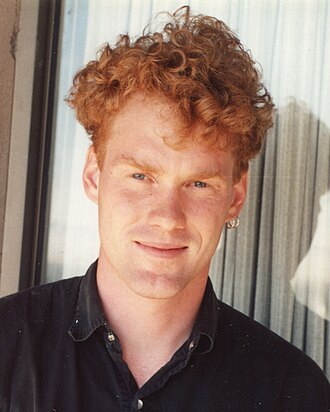
乔尔·大卫·哈姆金斯 LLex Fridman
本期追问 · 点击跳到视频对应位置
连续统假设在 ZFC 中不可判定,是提错了问题,还是问对了?集合论若有无数个真值不同的宇宙,还有唯一的数学真理吗?数字 5 的存在,真的比桌上苹果的存在更容易说清吗?大模型写出的「像证明的文本」,为什么不能当作证明?
归入 Ⅱ·13 凡是真的,都能被证明吗? →
EDITED TRANSCRIPT · 依据现场录音编译整理,可划线生成便签
编者按:本文是集合论学者、哲学家乔尔·大卫·哈姆金斯(Joel David Hamkins)在《Lex Fridman Podcast》第 488 期的谈话实录。哈姆金斯现任教于圣母大学,兼治数学与哲学,是 MathOverflow 历史积分第一的用户,著有《证明与数学的艺术》《数学哲学讲义》等书。谈话从康托尔的多重无穷讲起,纵贯罗素悖论、哥德尔不完备定理、停机问题、连续统假设、集合论多宇宙、超实数与无穷象棋,最后落到他心目中数学与哲学里最美的思想。本文依据现场录音编译整理,以讲者第一人称成文,仅删去寒暄、口头语与重复枝节,论证与例子悉数保留。

无穷的故事从哪里讲起

谈无穷,我想把故事讲得比康托尔早得多。你可以一直回溯到古希腊:亚里士多德强调无穷的潜在性质,在他看来,实际达成的无穷是不可能的。阿基米德的穷竭法,是把一块区域切成越来越多的三角形,把面积一点点耗尽,再用各块面积之和去理解总面积。此后几百年、上千年,数学都在这种潜无穷的理解上运转,几乎所有数学家都只是潜无穷论者,认为谈论实无穷根本是不通的。

伽利略是一个极为突出的例外。他在《关于两门新科学的对话》里反对这种潜无穷的正统,写得非常漂亮。从很多方面看,伽利略已经预见了康托尔的发展,只是没能推到底,最后只好在困惑中摊手。所谓伽利略悖论是这样的:想想自然数,我从零开始数,他大概从一开始,一、二、三、四,一直下去;再想想其中哪些是完全平方数:零的平方是零,一的平方是一,二的平方是四,然后是九、十六、二十五。伽利略注意到,完全平方数可以与全体自然数一一对应,我们刚才就做到了,把每个数与它的平方配对。照这种一一对应看,完全平方数应该和自然数一样多;可完全平方数之间明明有那么多空隙,这又提示平方数应该更少,因为自然数包含了全部平方数,外加中间那么多。伽利略为此深感困扰,他认为这让无穷量的比较陷入了不融贯。

另一个例子:取两条长短不同的线段,想象画一把扇形的线束把它们连起来,端点对端点,中点对中点,如此铺开。短线段上每一点都以一对一的方式对应长线段上唯一的一点,于是两条线段的点似乎一样多,尽管一条更长。两个同心圆也一样,从圆心引射线,小圆上每一点都对应大圆上一点,一一对应,这又表明小圆的点和大圆一样多。

今天的看法是,这两个无穷确实一样大,伽利略关于等势的观察是对的。我们现在用我所谓的康托尔-休谟原理(有人只叫休谟原理)来说这件事:两个集合,不论有限还是无穷,当且仅当它们之间存在一一对应,我们才说它们同样大小,即等势。伽利略观察到的正是:不同长度的线段等势,完全平方数与全体自然数等势,任意两个圆等势。与康托尔-休谟原理相冲突的,可以叫作欧几里得原理:整体永远大于部分。欧几里得在《几何原本》里计算面积时反复诉诸它,这是个基本观念,一个东西若只是另一个东西的一部分,整体就大于部分。伽利略困扰的就是这两条原理之间的张力。

我认为这件事直到康托尔才真正解决。是他把无穷的不同大小讲得那么清楚、那么令人信服。他拿出两个不同的无穷集合,证明它们不等势,不可能一一对应。传统的讲法是实数的不可数性,康托尔的大结果就是全体实数构成一个不可数集。不过要讲可数集,我建议先讲希尔伯特旅馆,它把这个想法说得再明白不过。

希尔伯特旅馆

希尔伯特旅馆有无穷多个房间,每个房间是整整一层的套房。零号房、一号房、二号房、三号房,一直下去,就像自然数。我总是从零开始,因为对我来说自然数从零开始,这一点也许有些数学家不同意,那是他们错了。所以旅馆有一个房间对应每个自然数,而且住满了:对每个 N,N 号房里都住着一个人。这时来了一位新客人,走到前台说想要个房间。经理说:稍等一下。原来其他客人入住时都签过一份协议,住宿期间房间可能有调整。于是经理给全体住客发了条消息:麻烦各位往上挪一间。五号房的人搬到六号房,六号房的人搬到七号房,以此类推,大家同时搬。我们当然不能把两位客人塞进同一间房,每个人都要有自己的单间。可是所有人往上挪一间之后,最底下的零号房就空出来了,新客人正好住进去。

所以即便有无穷多个东西,新客人也能被安顿下来。这正是希尔伯特旅馆住客这个特定无穷违反欧几里得原理的写照:给一个集合添一个元素,它没有变大,因为按房间号,新的全体住客与旧的全体住客之间仍有一一对应。旅馆是满的,却还能再挤进一个人,这打破了传统的数学直觉,人们一想无穷就要头疼,大概就是为此。这是无穷的一个性质:有时你往集合里加一个元素,它并不会变大。

故事还可以往下讲。第二天来了二十个人,同样的把戏再来一遍,大家往上挪二十间,底下空出二十间,二十位新客人住进去。到了周末,开来一辆大巴,希尔伯特大巴,当然有无穷多个座位:零号座、一号座、二号座,一直下去。车上所有人都想入住,可旅馆已经满了,经理该怎么办?我在课堂上讲希尔伯特旅馆时,总要求学生自己给出办法。一个很简单的办法是把旅馆分成奇数房和偶数房:让所有现住客把房间号翻倍,N 号房的人搬到 2N 号房,每个人都得到自己的新单间,而且号码总是偶数,因为 2N 永远是偶数。这样所有奇数房都空了出来,大巴上的乘客住进奇数房。

这一手,等于把一个无穷塞进了另一个无穷。它真正表明的是:我们可以定义,一个集合是可数的,当且仅当它与自然数集等势;用希尔伯特旅馆来理解,就是一个集合能装进希尔伯特旅馆,因为旅馆的房间号本质上就是自然数集。我们刚才证明的是:两个可数无穷集的并集仍然是可数无穷。把两者合起来组成一个新集合,包含二者所有元素,这个并集仍然只是可数无穷,没有变大。对无穷这个概念来说,这是一个了不起的性质。不过,假如你以为无穷只有一种,那就一点也不奇怪:两个无穷集合并起来当然还是无穷。所以,假如无穷只有一种,可数集的并仍可数就不足为奇。

还可以把这件事推得更狠:希尔伯特列车来了。列车有无穷多节车厢,每节车厢有无穷多个座位。这是无穷个无穷的乘客,加上旅馆现有的住客,而车上所有人都要入住。经理当然可以再发一遍消息,让每个人房间号翻倍,占满偶数房,空出奇数房。现在要把列车乘客放进奇数房。每位乘客坐在某节车厢的某个座位上,比方说 C 号车厢 S 号座。我们需要把车厢号和座位号这两个坐标以一对一的方式变成一个奇数。这其实不难,一个简单的办法是用 3 的 C 次方乘以 5 的 S 次方:把 3 自乘车厢号那么多次,把 5 自乘座位号那么多次,再把两个数相乘。这个数永远是奇数,因为它的素因子分解里只有 3 和 5,没有 2;而且互不相同,因为素因子分解唯一。每个数都能唯一地分解成素数的乘积,所以拿到一个这种形式的数,分解一下,就知道 3 的指数和 5 的指数,也就知道这个人来自哪节车厢、哪个座位。

于是我们证明了:可数个可数集的并集仍然可数。每节车厢都是可数的,旅馆现有住客也可以看作另一节车厢,把可数个可数集合成一个大并集,它仍然可数。我觉得这非常了不起。许多年前我第一次学到这一点时完全被震住了,着迷不已:可数无穷这个概念竟然在「无穷多个无穷相加」这种操作下封闭,加起来仍是同一个无穷。这又是对欧几里得原理的一次强烈违反:我们建出的新集合在「多出了额外元素」的意义上比旧集合多得多,可在大小上却没有多,因为它仍只是可数无穷,仍装得进希尔伯特旅馆。

要说直觉,有很多别的方式来看这件事。比如考虑整数格点,取自然数对,也就是整数格的右上象限。零行、一行、二行,零列、一列、二列,每行每列都有可数无穷个点。把每一列看作一节车厢,就和列车一模一样。而在这个网格图景里,我可以想象一条沿对角线来回蜿蜒的路径:从角上那个点出发,向下走,再向左上走,再向右下走,再向左上,如此往复,让这条路径经过每一个格点。这就给出了一种给格点分配房间号的办法:每个格点都是这条路径上的第 N 个点。前面用 3 的 C 次方乘 5 的 S 次方,是一种过于算术化的思路;而这幅图直接告诉你,可数个可数集为什么仍然可数:你只管把它们往一张清单上排,只要让每个无穷集合都有机会往清单上添一个人,最后就能把所有集合里的所有人都排进一张清单。

有理数也是可数的

在讲不可数之前,我想插一步:有理数。刚才我们做的是自然数对,也就是列车车厢。但看一看分数,也就是有理数,是有启发的,因为很多人会预期这是个更大的无穷,毕竟有理数是稠密有序的:任意两个分数之间还能找到另一个分数,两个分数的平均数还是分数。这看上去和整数的离散顺序完全不同,整数从任何一个出发都有下一个和上一个,有理数没有。然而有理数仍然只是可数无穷。理由与希尔伯特列车完全一样:每个分数由两个整数组成,分子和分母。告诉我两个自然数,你就知道我说的是哪个分数(加上正负号的问题,但只看正分数就行)。形如 P 除以 Q 的数,Q 不为零,照样可以用 3 的 P 次方乘 5 的 Q 次方,同样的办法在有理数上仍然管用,它还是可数集。

你也许会想,既然无穷只有一种,那所有集合都可数吧。假如你抱这种观点,那它是错的。康托尔的深刻成就,正是证明了实数集不是可数无穷,它是严格更大的无穷,因此无穷的概念不止一个,无穷的大小不止一种。

实数与超越数

实数包括数轴上所有的数。整数和有理数都在实数系里;此外还有代数数,比如根号二、五的立方根,也就是满足某个整系数代数方程的数。很长时间里有一个悬而未决的问题:这就是全部实数了吗?还是存在不是代数数的实数?不是代数数的实数叫超越数(transcendental numbers)。是刘维尔首先证明了超越数存在,他给出了一个具体的数,现在叫刘维尔常数。康托尔则以另一种方式著名地证明了超越数非常多:从他关于实数不可数的论证可以推出,超越数有不可数多个,所以大多数实数都是超越数。著名的超越数包括圆周率 π,3.14159265 那个,还有欧拉常数 e,指数函数里的那个 e。可以说数学里最迷人的一些数都是超越数。不过根号二也相当漂亮,美可以在各种集合里找到;而假如你偏爱简洁,零和一看上去也很不错。

顺便说一个证明:每个数都是有趣的。零有趣,因为它是加法单位元;一有趣,因为它是乘法单位元,任何数乘以一还是那个数;二是第一个素数,超级有趣。当然可以这样一个一个地给理由,但我想作为一般原理证明每个自然数都有趣。证明如下:假设存在无趣的数,那么就存在一个最小的无趣的数。可这是矛盾,因为「最小的无趣的数」是一个极其有趣的性质。因此不存在无趣的数。这个证明里「有趣」一词藏了不少东西,但它只涉及自然数,对实数和超越数什么也没说。至于我最喜欢的数是哪个,我的答案基本上是:我爱所有的数。

康托尔的对角线论证

康托尔要证明实数的无穷与自然数的无穷不同,而且严格更大。自然数从零开始逐次加一;实数则来自数轴,包括所有整数、有理数、代数数和超越数。既然自然数包含在实数里,实数至少和自然数一样大,我们要证的是严格更大。

假设不是严格更大,那它们就一样大,而一样大按定义意味着存在一一对应。于是对每个自然数 N,我们有一个实数,记作 R_N,即清单上第 N 个实数。这个假设让我们可以把全体实数想成排在一张清单上:R1、R2,如此下去。现在我来定义一个数 Z。它的整数部分是零,然后小数点,然后我开始指定它的各位小数 D1、D2、D3。我要保证的是:Z 小数点后第 N 位与清单上第 N 个数的第 N 位不同。也就是说,要定 Z 的第 N 位,我就去看清单上第 N 个数 R_N,看它小数点后第 N 位是什么,然后确保我的这一位与它不同。我还要多做一点:我永远不使用零和九,只用其他数字。如果把清单上的数写成一列,那么每个数的第 N 位构成一条向右下延伸的对角线,这个论证因此叫作对角线论证。我们构造的 Z,第 N 位与第 N 个数的第 N 位不同。

现在可以看出 Z 不在清单上:Z 与 R1 不同,因为 Z 小数点后第一位与 R1 的第一位不同,我们正是这样构造的;Z 的第二位与 R2 的第二位不同,依此类推,对每个 N,Z 的第 N 位都与 R_N 的第 N 位不同,所以 Z 不等于任何一个 R_N。这就是矛盾,因为我们假设清单上有全部实数,可这里却有一个不在清单上的实数 Z。

这是一种构造性的证明。说来有意思,围绕康托尔的构造究竟算不算构造性的,恰恰有一场哲学争论。可以这样看:给定一张数的清单,康托尔给出了一种具体的办法,构造出一个不在清单上的实数。另外有一个小问题:有些实数不止一种十进制表示。比如数 1,可以写成 1.000……,也可以写成 0.999……,这是同一个数的两种不同表示,会给论证造成一点麻烦。而我们把零和九都排除了,这种现象只在数最终全是零或最终全是九时发生,Z 里没有零和九,所以它不是那种数。对这些数,我们其实不需要做任何特别的对角化,Z 有唯一表示这一事实本身就意味着它不等于它们。

也许在一百多年前康托尔的时代这件事有争议,但今天它通常被视为集合论最初的主要结果之一,深刻、惊人、富于洞见,而且是后来无数论证的起点。对角化这个想法被证明是极其丰产的证明方法,数理逻辑里几乎每一个重大结果都在某种抽象意义上使用对角化。罗素悖论、停机问题、递归定理,以及许多别的原理,核心都是对角化。

集合论作为数学的基础

这场无穷的危机导致了数学的重建:集合论成了数学的基础,悖论迫使数学家发展出 ZFC 等公理系统,数理逻辑作为一门学科诞生了。

集合论实际上扮演着两种角色。一方面,它是一门独立的数学分支,有自己的问题、答案和证明方法。从这个角度看,集合论研究的是超限递归构造,也就是良基的定义与构造,这些想法极其丰产,集合论学者从中发展出了无数东西。另一方面,集合论碰巧还承担着基础的角色。人们对集合论的许多议论,其实没有注意到这两种角色的区别:它既是自己的一门学科,又是数学的基础。

在基础的角色上,集合论提供了一种方式,把一堆东西看作一个东西。这是集合论的中心思想。集合是一堆东西的汇集,但你把集合本身看作一个抽象的对象。当你构成实数集时,它就是一个集合,一个东西,里面有元素,有点像一袋物品。我们有许多不同的公理,来刻画「把一堆东西当作一个东西」这个观念的性质。公理就是我们假定为真的事实,在此之上建起数学的观念。关于集合的一批公理放在一起,如果足够有力,就能在上面建起许多有意思的数学。

选择公理

现在的集合论公理,即策梅洛-弗兰克尔公理,出自二十世纪初策梅洛的想法。这段历史很有意思。1904 年,策梅洛给出一个证明:所谓选择公理蕴涵良序原理。他描述了自己的证明,当时极具争议。那时没有任何理论,也没有任何公理。康托尔不在公理框架里工作,他没有我们今天那样的集合论公理清单,策梅洛也没有。他关于良序定理的想法受到了那么多质疑,以至于他被逼着拿出一套理论,让他的论证可以在其中形式化,这就是策梅洛集合论的起源。

选择公理说的是,给定任意一族非空集合,可以从每个集合里各取出一个元素,即便没有明确的规则指定怎么取。一方面,这条原理显然是我们希望成立、也确实成立的,很多人把它当作一条逻辑规律。有一堆集合,就有办法从每个集合里挑一个元素:存在一个函数,把它作用到任何一个集合上,就给出该集合的一个元素。这是一个完全自然的原理。它叫「选择」公理,多少是把数学观念拟人化了,不是说函数在做选择,而是说假如你做了这样的选择,就会存在一个由你所做的选择构成的函数。困难在于,当你无法说明做选择的规则或程序时,就很难说清你断言存在的那个函数是什么。你的看法是:确实存在一种选法,我没法轻易说出这个函数是什么,但它肯定存在。这就是理解选择公理的方式。

ZFC 三个字母:Z 是策梅洛,F 是弗兰克尔,C 就来自选择公理。ZFC 听上去极其技术化,但它就是现代数学赖以立足的那套公理。也应该知道,数学里有很大一部分工作专门关注选择公理是否被使用,他们不想用它,于是研究不用选择公理或只用策梅洛-弗兰克尔集合论的弱化形式能得到什么结果,这方面的研究相当活跃。

罗素对选择公理有一个很好的描述。一位富人有一个无穷大的衣柜,里面有无穷多双鞋。他吩咐管家:请从每双鞋里给我拿一只来。管家很容易办到,对任何一双鞋,他总可以拿左脚那只。这是一种可以描述的选法:总拿左边的,或总拿右边的,或者红鞋拿左边、棕鞋拿右边。我们可以发明各种规则,得出这类选择函数,也就是说可以描述出明确的选择函数。在这些情形下,你不需要选择公理就知道选择函数存在。当你能描述一种具体的选法时,就无须诉诸公理。麻烦的情形出现在衣柜里那无穷多双袜子上。假如每双袜子里的两只无法区分,彼此一样,那管家就没有任何规则来决定每双拿哪一只,他能否从每双里取出一只就不那么清楚了。这就是问题所在:你能否给出一条规则来定义选择函数,还是说其中有一种任意选取的成分。后一种情况下,你就需要选择公理来断定这样的函数存在。

当然,从数学本体论的角度,我们也许会觉得下面这个想法很有吸引力:并非每一种挑袜子的方式都必须由规则定义。为什么数学实在中存在的每样东西都得遵循某种规则或程序呢?如果我认为我的数学本体论中对象丰富,那么各种各样的函数和选法都是我要谈论的数学实在的一部分,我断言选择公理毫无问题:确实存在一种选法,我未必能告诉你它是什么,但在数学论证里我可以固定住一个选择函数,因为我知道它存在。有选择公理和没有选择公理,哲学上的差别在于论证的构造性。如果你的论证诉诸了选择公理,那你也许是在承认,证明中产生的对象不会是构造性的,你不一定能对它们说出具体的东西;但如果你只是在做存在性断言,那完全没问题。反之,如果你对数学的本性持构造主义态度,认为只有在能给出明确程序产生所涉对象时,数学断言才有根据,那你大概会想否认选择公理,也许还会否认更多。

ZFC 的公理

ZFC 的主要公理包括:外延公理、空集公理、配对公理、并集公理、幂集公理、无穷公理、分离公理、替换公理、正则公理和选择公理。这段历史很有意思。策梅洛引入了其中大多数公理,作为现在所谓策梅洛集合论的一部分,用来形式化他从选择公理到良序原理的证明,那是一个极具争议的结果。1904 年他给出了没有理论的证明,然后被要求提供理论,于是 1908 年他拿出了策梅洛集合论,并证明在这套理论里每个集合都有良序。

清单上的这些公理表达了他想谈论的关于集合的最基本的理解。比如外延公理说:两个集合若有相同的成员,就相等。这是一种观念:集合就是由它的成员构成,除此之外集合里什么也没有发生,成员相同就是同一个集合。在某种意义上它是最原始的公理。再比如:存在一个没有元素的集合,即空集;对任意两个集合,存在一个集合恰以这两个集合为元素;对任意集合,存在一个集合恰好包含该集合各元素的元素,即并集;对任意集合,存在一个集合,其元素恰是原集合的所有子集,即幂集;无穷公理说存在一个无穷集合,通常是一个包含空集并在「再加一个元素」的操作下封闭的集合,这又回到了旅馆的例子。设身处地想想当年那些试图把集合论形式化的人,人类能做这件事本身就很奇妙。

我读过一些历史学家关于那个时期的记述,专门讲策梅洛的公理和他对良序定理的证明。历史学家说,数学史上从来没有哪个定理像策梅洛这个定理那样,被如此公开、如此激烈地争论过。有意思的是,选择公理起初被广泛视为一条基本原理,但人们对良序定理非常怀疑,因为没有人能想象出实数的一个良序。于是策梅洛似乎是从看起来相当合理的原理出发,证明了一个显然不真的东西,数学家们纷纷反对。但后来策梅洛和其他人去查那些激烈反对者自己的论文,发现在很多情况下,他们在自己的论证里暗中使用了选择公理,尽管公开反对它。因为它太自然了,太像一条显而易见的原理,如果你不够审慎,很容易不知不觉就用了它。直到今天也是如此,人们仍然留意数学论证里有没有用到选择公理。它过去更重要:二十世纪初,人们不知道这套理论是否一致,二律背反不断出现,人们担心公理的一致性。后来有了哥德尔和科恩的结果,关于选择公理本身的一致性问题就消解了。我们知道选择公理本身永远不会成为集合论不一致的根源:如果加上选择公理不一致,那不加它也已经不一致了。从一致性的角度看,留意它是否被使用就不那么重要了,但出于前面说的构造主义理由,人们仍有理由关注它。

所谓一致,指的是无法从理论的公理推出矛盾。一个一致的理论,就是你不能从它证明出矛盾的理论。

幂集定理与委员会

我们讲了康托尔关于实数不可数的证明,但康托尔其实证明了一个一般得多的事实:对任何集合,它的幂集都是严格更大的集合。幂集是由原集合所有子集组成的集合。子集总是至少和元素一样多,因为对任何元素,你都可以做出只含这个元素的单点子集,问题是子集是否严格更多。

康托尔的推理非常简单,它把抽象的对角化思想提炼了出来,不受实数复杂性的拖累。设有集合 X,考虑它的所有子集,即 X 的幂集。反设 X 与它的幂集一样大,那么每个 X 的个体都对应一个子集。现在我定义一个新集合 D:D 是 X 中所有「不在自己对应的那个集合里」的个体组成的子集。也许没有这样的个体,也许全都是,也许有些是有些不是,这对论证无关紧要。D 是一个完全合格的子集,所以按照等势,它必定对应某个个体,就叫她 Diana。现在问:Diana 在 D 里吗?如果她在 D 里,那她就在自己对应的集合里,可 D 是由不在自己集合里的个体组成的,所以她不该在里面;如果她不在 D 里,那她就不在自己对应的集合里,那她就该在 D 里。矛盾。所以对任何集合,子集的数目总是大于元素的数目。

拟人化的讲法是这样的:对任何一群人,能组成的委员会比人数多,哪怕人有无穷多。什么是委员会?就是一份名单,谁在委员会里。有所有两人委员会、所有一人委员会,还有那个人人都在其中的、最糟糕的全体委员会;最好的委员会是空委员会,没有成员,从不开会。或者空委员会其实一直在开会?我不确定。断言是委员会比人多。反设不是,那就可以在人和委员会之间建立对应,每个委员会都以一个人的名字命名,一一对应。我没说这个人在以他命名的委员会里或不在,有时在有时不在,无所谓。现在组一个委员会 D,由所有「不在以自己命名的委员会里」的人组成。也许是所有人,也许没有人,也许一半,无所谓,它是一群人,是一个委员会,所以要以某个人命名,就叫她 Daniella。问:Daniella 在以她命名的委员会里吗?如果在,她就不该在,因为那是由不在自己委员会里的人组成的;如果不在,她就该在。又是矛盾。

我在牛津教书时,一个学生想出了另一种拟人化:水果沙拉。有一些水果,苹果、橙子、葡萄之类,一份水果沙拉就是这些水果的某个组合,有香蕉梨葡萄沙拉等等,每一组水果都能做一份沙拉。我们要证明,对任何一批水果,哪怕有无穷多种,可能的沙拉都比水果多。如果不是,就能在水果和沙拉之间建立一一对应,给每份沙拉以一种水果命名,那种水果未必在那份沙拉里,只是命名。然后组成对角沙拉:由所有不在以自己命名的沙拉里的水果组成。这是一份完全合格的沙拉,可能是空的减肥沙拉,可能是包含全部水果的全沙拉,也可能只有一部分。这份对角沙拉必须以某种水果命名,假设是榴莲。问:榴莲在以它命名的沙拉里吗?在,就不该在;不在,就该在。同样的矛盾。

所有这些论证,都与康托尔关于幂集大于原集合的证明如出一辙。而这正是罗素悖论里的逻辑。

罗素悖论与弗雷格

罗素论证的是,所有集合的类不可能是一个集合。因为如果它是集合,我们就能构成「所有不以自身为元素的集合」组成的集合。罗素证明的实际上是:集合的汇集比元素多。我们可以构成对角类,即所有不以自身为元素的集合组成的类;如果它是一个集合,那它属于自身当且仅当它不属于自身。四个论证的逻辑完全一样。所以不可能有所有集合的类,因为如果有,就会有所有不属于自身的集合组成的类,而这个集合属于自身当且仅当它不属于自身,矛盾。这就是罗素悖论的精髓。我教这个的时候不叫它罗素悖论,我叫它罗素定理:不存在全集。它已经不再令人困惑了。在当时它非常令人困惑,但今天我们已经把集合论的这种性质吸收进了对集合的基本理解。

不过这段历史很动人。在那之前,弗雷格正在进行他不朽的工作,实施逻辑主义的哲学,即把全部数学还原为逻辑的尝试。弗雷格想用逻辑概念来说明全部数学,他写下了这部巨著,并提出了他的基本原理。这些原理碰巧蕴涵:对任何性质,都可以构成具有该性质的对象的集合,这叫作一般概括原理。他在整部著作里都诉诸支持这条公理的原理,这不是附带的东西,他确实在用它。罗素看到这项进行中的工作,写信给他说这里有问题:如果接受对任何性质都能构成具有该性质的对象的集合,那就能构成所有不属于自身的集合的集合,这只是一般概括原理的一个实例。而这个集合不可能是集合,因为它属于自身当且仅当它不属于自身。

罗素的信寄到时,弗雷格正好要完成他的工作,书稿已经在出版社,基本上在付印了。这是毁灭性的。弗雷格的处境该有多可怕:他完成了这部巨著,为它奉献了多年生命,而罗素找到了一个基本上只有一行的证明,从他的基本原理中推出矛盾,彻底摧毁了整个体系。弗雷格在书的附录里回应了罗素的信,写得非常有风度,大意是:对一个科学写作者来说,没有什么比在著作完成之后发现其大厦的一处根基被动摇更不受欢迎的了,而罗素先生的一封信恰在本卷付印将近之时把他置于这个境地。接着他解释了问题所在,涉及他的基本法则五。你把一生献给这项工作,然后它被证明是矛盾的,这一定让人心碎。

当然,逻辑主义的计划并没有随弗雷格而死,它被继续下去了,直到今天还有新逻辑主义之类的整个运动。但我的看法是,逻辑主义的主要目标,随着集合论基础主义的兴起,基本上已经完全实现了。把 ZFC 看作数学的基础,而在我看来,ZFC 的原理在性质上是根本逻辑性的,包括我前面说的、作为逻辑原理的选择公理。这是一个争议很大的观点,很多人认为连无穷公理都是内在数学性的而非逻辑性的。但如果你认为 ZFC 的原理关乎抽象的集合构成原理,而这在性质上是根本逻辑性的,那么这就是逻辑主义的完全成功。集合论能够充当基础,意味着数学可以建立在逻辑之上。

希尔伯特纲领

哥德尔不完备定理是数理逻辑最深刻的发展之一。在我看来,不完备定理是数理逻辑第一次变得成熟,是这门学科的诞生。但要理解这些定理,得从稍早的希尔伯特纲领讲起。当时有罗素悖论、布拉利-福尔蒂悖论等等,集合论各处冒出各种矛盾。希尔伯特是集合论的著名支持者,他有一句话:没有人能把我们从康托尔为我们创造的乐园里赶出去。我理解他的意思是,他被用集合论作数学基础的想法深深吸引,这种基础极其有力、便利,而且起着极为重要的统一作用,他不想放弃它,哪怕这些悖论、这些矛盾像雷区一样危险。

于是希尔伯特说:我们得解决这个问题。我们想用集合论作基础,但要以可信赖、可依靠的方式来做,不能允许数学的基础受到质疑。这是希尔伯特纲领背后的态度。他提出:一方面,我们要有一个强理论,也就是我们希望在其中证明定理的集合论,它要尽可能强,最好能回答所有问题。希尔伯特退休演说里还有一句名言:我们必须知道,我们终将知道。他对数学回答所有已提出问题的能力非常乐观:我们有这么多想解决的问题,我们会把它们全部解决。所以要提出这个强理论,人们感觉他心里想的是集合论,在其中所有问题都会得到回答。另一方面,我们要在一个非常弱的、纯粹有穷主义的算术理论里,证明强理论的推理过程是安全的。

要让这种观点说得通,你基本上得发明形式主义哲学:审视什么是证明,数学推理的本性是什么。在希尔伯特的想法里,证明本身是一种有穷的对象。想想证明是什么:它是一串断言,可以看作一串符号序列,符合某些逻辑推理规则。这是形式主义对证明的理解,把证明看作句法的、形式的东西。即便这些语句的内容可能指涉无穷的、不可数的对象,语句本身却不是无穷的、不可数的对象,它们只是有限的符号序列。

形式主义的要点在于:你把做数学的过程与数学断言的意义分离开来。你在无穷理论里做出的断言,其意义可能涉及巨大的不可数无穷,那是一个很不确定的领域,在一些人心里正是悖论的来源。但推理过程本身,只是在纸上写下符号序列,按照有穷的规则进行论证。把符号的意义与操作符号的过程分开,就是把数学看作一种形式游戏,意义可以完全缺席。我不认为形式主义观点必然主张背后没有意义,它强调的是我们可以把语句的意义与操作语句的过程分开。然后希尔伯特要在纯有穷理论里证明:只要遵守这个游戏的规则,就永远不会得出矛盾。这就是希尔伯特纲领的两个目标:建立强的无穷理论,大概是集合论,它将回答所有问题;然后在有穷理论里证明强理论是安全的,也就是一致的。

「有穷」究竟指什么,在哲学上有争议,有几百篇论文专门讨论这个问题。我倾向于非正式地理解:我们谈的是有限的符号序列,一个有穷理论的主题就是这类东西,可以对这些有限符号串的性质进行论证。证明就是一个有限的语句序列,每条语句要么是公理,要么按某种指定方式(比如肯定前件式或别的逻辑规律)从前面的语句推出,最后一行是要证的定理。举个具体例子,我总觉得最自然的有穷理论就是皮亚诺算术,一个关于算术性质的一阶理论。有人说皮亚诺算术有很强的一阶归纳公理,还有弱得多的算术,比如 IΣ0 或 IΣ1,比皮亚诺算术更有穷。不同的哲学立场对「要多有穷才算真正有穷」有不同的看法。我把皮亚诺算术视为有穷的,但这是有争议的观点。皮亚诺算术是关于自然数和初等数论的极为成功的理论,本质上全部经典数论,不管你想证明关于素数、因子分解的什么定理,或任何关于有限组合对象的有穷推理,都能在皮亚诺算术里形式化。当然,鉴于哥德尔不完备定理,这些说法需要限定,但大体上,关于有限数的经典数论分析几乎全部可以在皮亚诺算术里展开。

假如希尔伯特是对的

回到希尔伯特纲领:两个目标,产生一个回答所有问题的强理论,然后用纯有穷手段证明它永远不会导向矛盾。不完备定理应被视为对希尔伯特纲领的决定性反驳,它彻底击败了这两个目标。但在解释之前,不妨想想:假如希尔伯特是对的,他要我们寻找的那个世界里,数学会是什么样子?

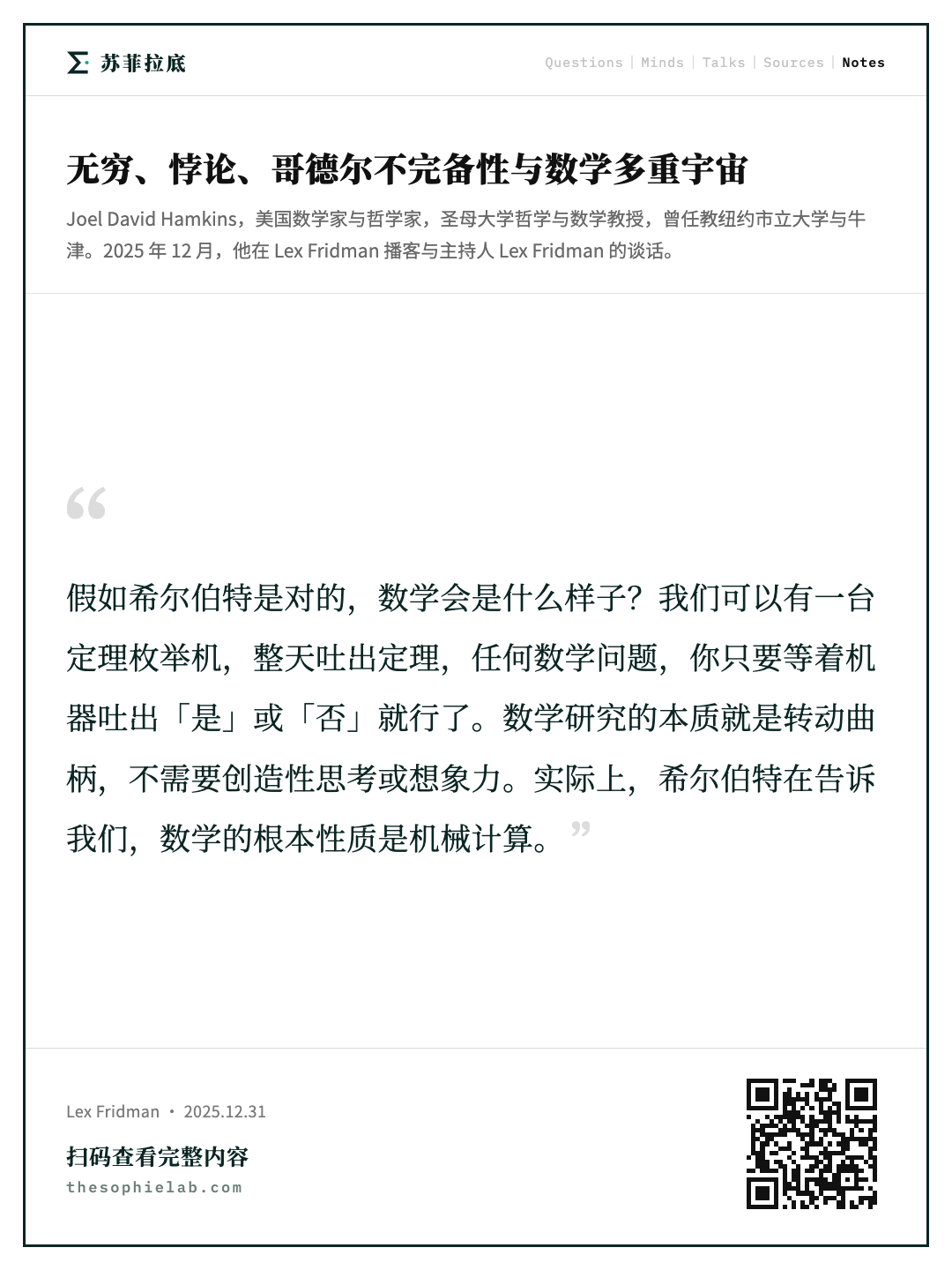
我们会有一个有穷理论,它证明强理论没有矛盾。于是我们可以开始枚举强理论的证明。今天我们就能写一个程序,系统地生成给定理论的所有可能证明。于是可以有一台定理枚举机,整天吐出定理,每一条定理最终都会被这台机器产生。任何数学问题,你只要等着机器吐出「是」或「否」的答案就行了。在希尔伯特的世界里,数学研究的本质就是转动定理枚举机的曲柄,不需要创造性思考或想象力,只是照本宣科地从中获取答案。实际上,希尔伯特通过他的纲领在告诉我们,数学的根本性质是机械计算。

在担心二律背反、担心不一致的历史背景下,希尔伯特纲领看起来极有吸引力。首先,有一个回答所有问题的强理论似乎很自然,因为我们今天所知的逻辑独立性及其普遍性,当时完全无人知晓,他们从未见过那种事,自然觉得不会发生;其次,他们以为能防住不一致。所以在那个历史语境里,纲领的目标相当自然。但只要多想一想它的本质,就看到那种机械程序。也许你会说,这在今天看起来并不那么离谱,随着计算机能力增强,机器替我们算的越来越多,这正在变成日常经验,甚至令人警觉。

那么反过来,如果希尔伯特错了,数学实在的本性是什么?第一个目标失败,意味着我们永远写不出一个回答所有问题的理论:我们最好的理论,哪怕是无穷理论,也总会有它无法回答的问题,独立性会出现。第二个目标失败,意味着我们还得不断担心理论是否一致,而且没有任何真正令人信服的手段说它们没有矛盾。哥德尔不完备定理表明,这恰恰就是数学实在的本性。第一不完备定理说:你写不出一个可计算公理化的、回答所有问题的理论,只要它包含一定量的算术,每个这样的理论都是不完备的。第二不完备定理说:任何这样的理论都不能证明自身的一致性。不只是有穷理论证不了强的无穷理论的一致性,连无穷理论自己都证不了自己的一致性。在这个意义上,它是对希尔伯特纲领的决定性击倒。一个定理就把整个谜题回答了,真是了不起。

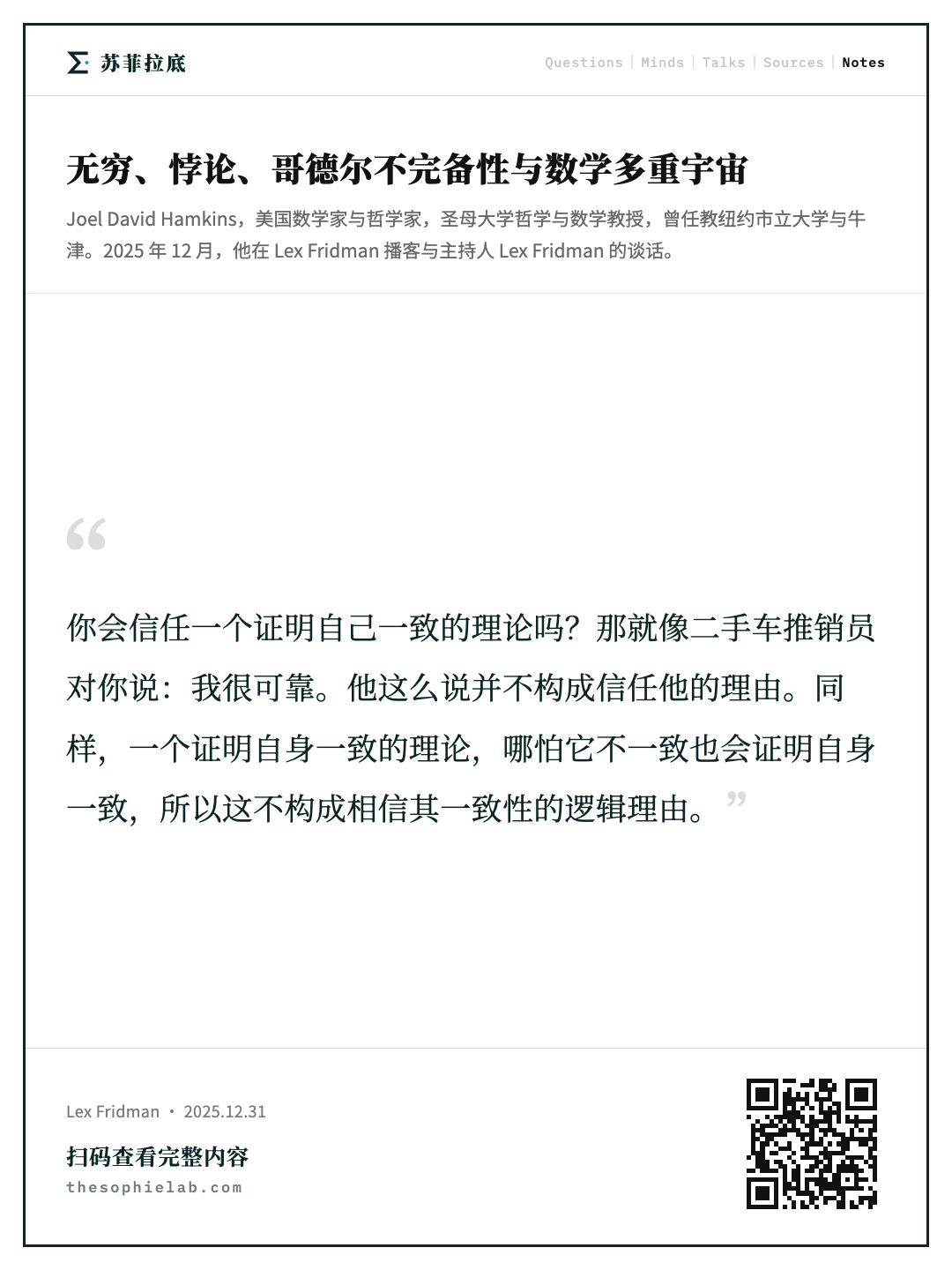
还有一个容易想到的角度。你会信任一个证明自己一致的理论吗?那就像二手车推销员对你说:我很可靠。他这么说并不构成信任他的理由。同样,一个证明自身一致的理论,哪怕它不一致也会证明自身一致,所以这不构成相信其一致性的逻辑理由。

顺便说明一下「理论」这个词。在数理逻辑里它是术语,指形式语言中任意一组语句,与公理系统基本同义。人们有时不清楚它指的是公理本身还是公理的推论,两者关系紧密,但特征并不完全相同。如果你有一份可计算的公理清单,你可以开始枚举公理的推论,但你无法可计算地判定一个给定语句是否为推论。你能枚举推论,也就是半判定,却无法给出是或否的判定。这就是可计算判定与可计算枚举的区别,由图灵等人的工作弄清楚。你也许能可计算地判定一个东西是不是公理,但这不意味着能可计算地判定一个东西是不是定理。通常你只能判定肯定的实例:如果某个东西是定理,你终究会认出来;如果不是,也许你永远没有哪一刻能说「不,那不是定理」。这当然与停机问题相连,所有这些矛盾和悖论都漂亮地互相勾连。

真与证明

真与证明的区别是一个核心的区分。回头读哥德尔和塔斯基之前二十世纪初的那些人,会发现他们在这个区分上完全是马虎的,直到哥德尔才弄清楚。甚至晚到布尔巴基,在他们的基础著作里还有这种混淆:那部法国研究生标准教材在讲逻辑时把真和证明混为一谈,对他们来说,真就意味着可证。早年也许人们不够清楚真这个概念需要数学的研究和分析,也许他们以为它已经完全清楚了。因为不完备定理,我们意识到这里发生着相当微妙的事情。对我来说,真与证明的区分是今天我们理解数理逻辑的绝对核心。

真属于句法与语义二分中语义的一侧。真关乎实在的本性,我说的不是物理实在,而是数学实在。我们有一个概念:一个语句在某个数学结构中为真。比如你有实数域,想知道它是否满足某个语句;或者你有一个群,或者一个图,一种有顶点和边的数学结构,你想知道这个图是否满足某个语句。塔斯基给出了关于真的一个极为出色的说明,即现在所谓去引号真理论。塔斯基说:「雪是白的」这个语句为真,当且仅当雪是白的。他的意思是,真是断言的性质,可以把断言看作句法对象;语句为真,就是语句的内容是实际情形。语句「雪是白的」加引号为真,就是说雪是白的。之所以叫去引号,是因为我们把断言上的引号去掉了。你可以用这个想法给形式语言中的语句在数学结构中的真给出形式定义。假如我有一种形式语言,可以对结构里的对象和关系做原子断言,再用「与」「或」「蕴涵」「非」等逻辑联结词以及量词把它们组合起来,那么,比如说,结构满足「φ 与 ψ」这个单一语句,就是说它满足 φ 并且满足 ψ。注意刚才发生了什么:起先「与」是语句内部的一部分,然后我用「与」来指两个条件的合取,这就是去引号。这个想法可以对所有逻辑联结词和量词进行,运用塔斯基的去引号思想,就能归纳地定义形式语言中任何断言在任何数学结构中的真。所以说一个语句为真,除非你告诉我是在哪个结构里为真,否则是有歧义的。也许我们心里想的是算术的标准模型,自然数及其算术结构,我想知道某个语句在其中是否为真,那么按塔斯基的递归定义,我们对这句话有形式的定义。这是真。

证明则是希尔伯特式的想法,可以发展出证明论。对数理逻辑学家来说,证明是形式语言中语句的某种序列或排列,符合某个证明系统的逻辑规则。有某些被允许的推理模式:如果你知道 A,也知道 A 蕴涵 B,那么在后面的步骤里你可以写下 B 作为推论,这是肯定前件式,有人叫它蕴涵消去。还有许多别的规则,证明论学者研究着许多不同的形式证明系统。它们都有一个性质,叫可靠:如果论证的前提在一个结构里全部为真,而你有一个证明得出结论,那结论在该结构里也为真。证明保真。证明系统一般还是完备的:只要一个语句是另一些语句的逻辑推论(即只要假设为真,推论在该结构里就也为真),那就存在它的证明。逻辑学家总是说「可靠而完备」,但其实还有隐藏的第三个形容词,他们本该总是一并谈到:你应该能够识别某个东西是不是证明。证明系统有可计算的一面,判定一个语句序列是不是证明应当是可计算可判定的。我们不想要一种证明系统,有人声称有证明,我们却无法检验。数学史上有人说自己有证明,只是页边太窄写不下,那不算证明。所以一般来说,所有经典证明系统都是可靠的、完备的,并且可计算可判定的。

不完备定理的问题是:我们能否为算术,比如为带有加法、乘法、零、一和小于的自然数标准模型,写下一个理论。在这种形式语言里,我们能表达的不只是关于算术性质的大量语句,通过各种编码方法,本质上能表达全部有限数学。问题是:我们能否写下一份可计算的公理清单,通过证明回答所有这些问题?换句话说,我们想要一个完备的算术理论,证明所有且仅有的真语句。希尔伯特会喜欢这个。而哥德尔证明了这是不可能的:你写不出一份可计算的、在这个意义上完备的公理清单。只要理论一致,总有你既不能证明也不能反驳的语句,它们独立于该理论。

这令人创伤吗?我的看法是,一点也不。它反倒完全打开了我们对数学实在本性的理解。我们懂得了关于数学真理处境的这个深刻事实:不完备定理告诉我们,我们无法写下一份既一致又回答所有问题的公理清单,这不可能。我不把它看作创伤,我只是想:这就是数学实在的本性,知道它是好事,现在我们要从这里往前走,在这个事实的光照下做能做的事。

一般来说,给你一个语句,你无法知道你的公理系统能不能证明它。可证性问题可以表述为判定问题:给定一个理论和一个语句,该语句是否为该理论的推论?这是最著名的判定问题之一,实际上是第一个,因为它等价于希尔伯特-阿克曼的判定问题(Entscheidungsproblem),这个词也出现在图灵 1936 年那篇对可计算性理论至关重要的论文标题里。给定理论是否以给定语句为逻辑推论?由于哥德尔的完备性定理(不是不完备定理,而是他更早的完备性定理,证明了他们研究的证明系统确实具有前面说的完备性),可证性等同于逻辑推论。而这是一个不可判定的判定问题,图灵证明了这一点,我们现在知道它等价于停机问题。

停机问题

停机问题表达了计算过程的一个根本性质。给定一个程序(或程序连同输入,我就简称程序),我们可以运行它,但我想把它提成一个判定问题:这个程序会完成任务吗?会停机吗?对任何单个实例,答案是「会」或「不会」,我们谈的不是这个,而是有没有一个可计算的程序能回答这个问题的所有实例。判定问题是作为一个实例的模式给出的,涵盖所有可能被问到的程序,我想知道有没有一个可计算的程序能回答这些问题。答案是没有。停机问题是可计算不可判定的:不存在可计算的程序,能正确回答给定程序是否停机的所有实例。

当然,我们能得到一半的答案。你给我一个程序问它会不会停,我可以拿来运行,一直运行,也许一周后它停了,那时我可以说:是的,它停了。所以肯定的答案我能全部正确给出。问题在于,如果它还没停,比如我等了一千年它还没停,我似乎没有资格说「不,它不会停」,因为也许一千零一年它就停了。似乎没有哪一刻我能说「不」。要说「不,它永远不会停」,我似乎必须真正理解这个程序如何运作、在做什么。给出「会停」的答案是平凡的,不需要理解,只要运行,那是机械劳动;而给出「不会停」的答案,你需要对程序的本性有某种深刻的洞察,能看出这个程序永远不会停。说「不会停」比说「它停了,因为我运行了它就停了」困难得多。结果表明,不可能有一个可计算的程序给出那些「不」的答案。

论证不难。这些证明都是反证法,而这个论证是对角线论证,与罗素、康托尔和哥德尔的论证风格相同。反设我们有一个程序,能判定给定程序在给定输入上是否停机。我要把它当作子程序,构造下面这个过程,叫作 Q。Q 以一个程序 P 作为输入,它做的第一件事是问那个子程序:如果把 P 作用在 P 自己上,P 会停机吗?这就是对角的部分,我们把 P 作用于 P。如果子程序回答「会停」,那 Q 立刻进入无限循环,不停机;如果回答「P 在 P 上永远不停」,那 Q 立刻停机。就这样,我描述完了 Q 的行为。Q 的特点是,Q 在 P 上的行为与 P 在 P 上的行为相反,我们正是这样专门设计的。现在做罗素和康托尔做过的事:问 Q 在 Q 上会怎样?由于这种相反的行为,Q 在 Q 上停机当且仅当 Q 在 Q 上不停机。这是矛盾,因为 Q 必须与 Q 在 Q 上的行为相反,而这自相矛盾。

这个证明极其漂亮,它遵循罗素和康托尔的逻辑,追根溯源就是康托尔,罗素给弗雷格的信里也引用了康托尔。结论是停机问题不可计算判定。而由此可以立刻证明哥德尔定理。我认为这是哥德尔定理最简单的证明:不需要哥德尔语句,用停机问题就够了。假设我们能写下初等数学(算术以及图灵机计算之类的有限组合事实)全部真相的可计算公理化。事实上,所有这些有限组合过程都能通过标准的算术化编码在算术内部形式化,但让我说得非正式一点:假设我们能写下一个初等有限数学的完备理论。那么,就像前面讲希尔伯特纲领时描述的那样,我们可以从这些公理产生所有可能的定理,造出一台定理枚举机,产生该理论的所有定理且只产生定理。现在我桌上有了这台定理枚举机,我宣布开门营业,解决停机问题。你给我一个程序和输入,我等着机器吐出「P 在该输入上停机」或「P 在该输入上不停机」这两条语句中的一条。其中一条必然会出现,因为这是一个枚举初等数学全部真语句的完备理论。所以如果我有这样的系统,我就能解决停机问题;但我们已经证明停机问题无法解决,因此不可能有这样一个完备的算术理论。哥德尔定理证毕。

证明的艺术

教年轻数学家学习如何成为数学家、学习证明,是我觉得非常美好的事。我写《证明与数学的艺术》那本书时,正在纽约教这样一门证明写作课。很多大学都有这种课,通常由已经学过一些数学的学生来上,他们大多修完了微积分序列,正要过渡到高等数学,而高等数学涉及多得多的证明,对他们来说是一个有挑战的台阶。我对现有的大多数教材不满意,原因是它们往往太乏味,专注于写证明这件事里完全无趣的部分,那些机械的操作程序:要证明一个蕴涵式,就假设前件、论证后件,诸如此类。这些都对,都值得知道,可如果关于证明的本性你只说这些,我不认为你学到了多少。我觉得可以有一本好得多的书,更有意思,里面有有趣的定理,但仍然只需要初等的证明。于是我写了这本书,尽量填满有吸引力的数学命题,配上非常初等的证明,展示各种各样的证明风格。学生们很喜欢。这本书献给我的学生:愿他们的定理都为真,愿证明它们的论证优雅,从假设到结论一气呵成,并在其间显露奇妙的数学之美。

我们来做书里的一个证明,离散数学那一章的 5.1 节,「被指多于指人」。设你和一些朋友围成一圈,可以随意指别人,也可以指自己,可以同时指不止一个人,用手指或脚都行。也许你指了三个朋友,他们各指两三个人,有人指了十个人,有人谁也不指,各人也被不同数量的人指着。问题是:能否安排一种指法,使得每个人被指的次数都多于他指人的次数?比如有七个人指我,而我只指五个人;有二十个人指你,而你只指十五个人。推特上有一个类似的问题:一群人在推特上,能否安排得每个人的粉丝都比关注多?数学上是同一个问题。严格说不完全同,因为我允许指自己,而你不能关注自己。

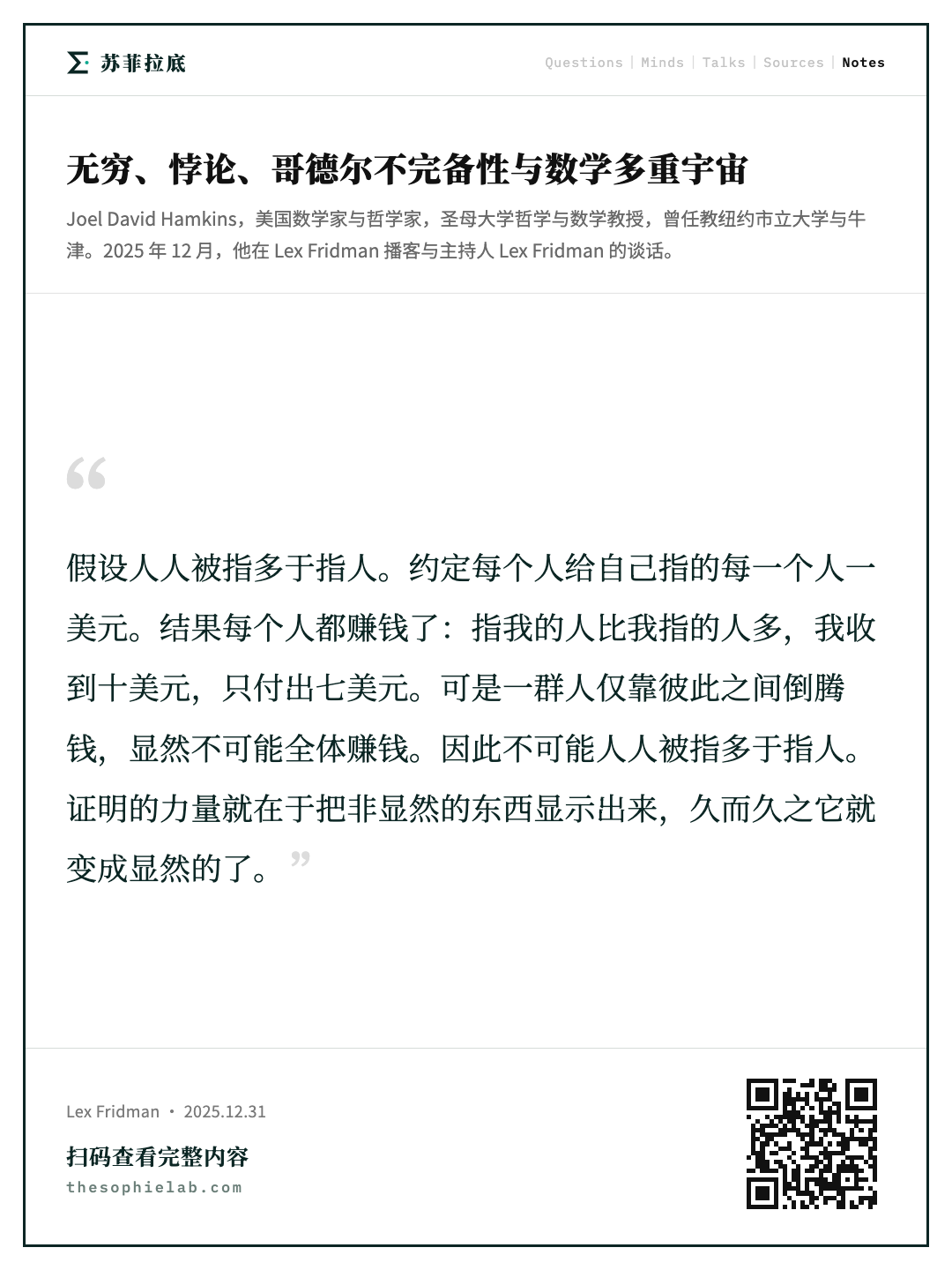
书里我给了几种不同的证明,有归纳证明,我记得一共三种。这里说我最喜欢的那个。假设可以安排得人人被指多于指人。现在我们约定,每个人给自己指的每一个人一美元。结果如何?每个人都赚钱了:指我的人比我指的人多,我收到十美元,只付出七美元;你收到二十美元,只付出十五美元。所以如果人人被指多于指人,那人人都赚钱。可是一群人仅靠彼此之间倒腾钱,显然不可能全体赚钱。因此不可能人人被指多于指人。

这个证明体现了我在书里建议的一个习惯:把数学观念拟人化。想象你问题中的数学对象是人,或者动物,或者某种有意志、有目标的活物。这往往让问题更容易理解,因为我们都熟悉赚钱有多难,而这个证明之所以完全令人信服,靠的是我们知道,没有新钱进来,一群人靠互相转钱不可能人人赚钱。但这本身其实是一个不容易的数学断言。如果有人必须证明「一群人仅靠内部转钱不可能人人赚钱」,你也许觉得显然,谈钱时确实显然;可如果问题是关于某类数学函数的,就未必像谈钱时那么清楚了,因为我们可以借助人类获取钱财或别的资源有多难的经验。不一定是钱,可以是糖果,我们就是知道,光靠群体内部交换不可能轻易让大家都得到更多。证明的力量就在于把非显然的东西显示出来,久而久之它就变成显然的了。我们刚刚证明了钱的一个性质。

有意思的是,假如你的群体里有无穷多人,定理就不成立了。事实上可以安排得人人被指严格多于指人。而且,哪怕每人只有一张一美元钞票,也可以安排得事后每人都有无穷多张钞票。从基数上看这是一样的,两种情形都是可数无穷。假如你有可数多个朋友,每人一张钞票,你可以安排一种传递方式,使得事后人人有无穷多张。做法是把每个人对应到列车的某节车厢上:把每个人既看作从希尔伯特列车上来的,又看作住进了希尔伯特旅馆。让第 N 节车厢上的每个人把钱都给最终住进第 N 号房的那个人,每人给他一美元。事后那个人有了无穷多美元,而每个人只付出了一美元。

无穷是否存在

无穷是否应被看作真实的东西?数学哲学的很大一部分就在讨论这类问题:数学对象,包括无穷,其存在的本性是什么。但我认为专门问无穷,与问数字五没有太大不同。数字五存在是什么意思?数究竟是什么?这也许是数学本体论的根本问题之一。关于数学对象或一般抽象对象的存在,有许多立场可取。而讨论时常常出现一种谈话,大致是这样:有些人觉得谈论数这类抽象对象的存在有问题,似乎希望能对数或别的抽象对象的存在给出一种说明,更像桌子、椅子、石头那样的存在。也就是说,有一种把数学存在还原为我们在现实世界里能够物理经验到的东西的渴望。

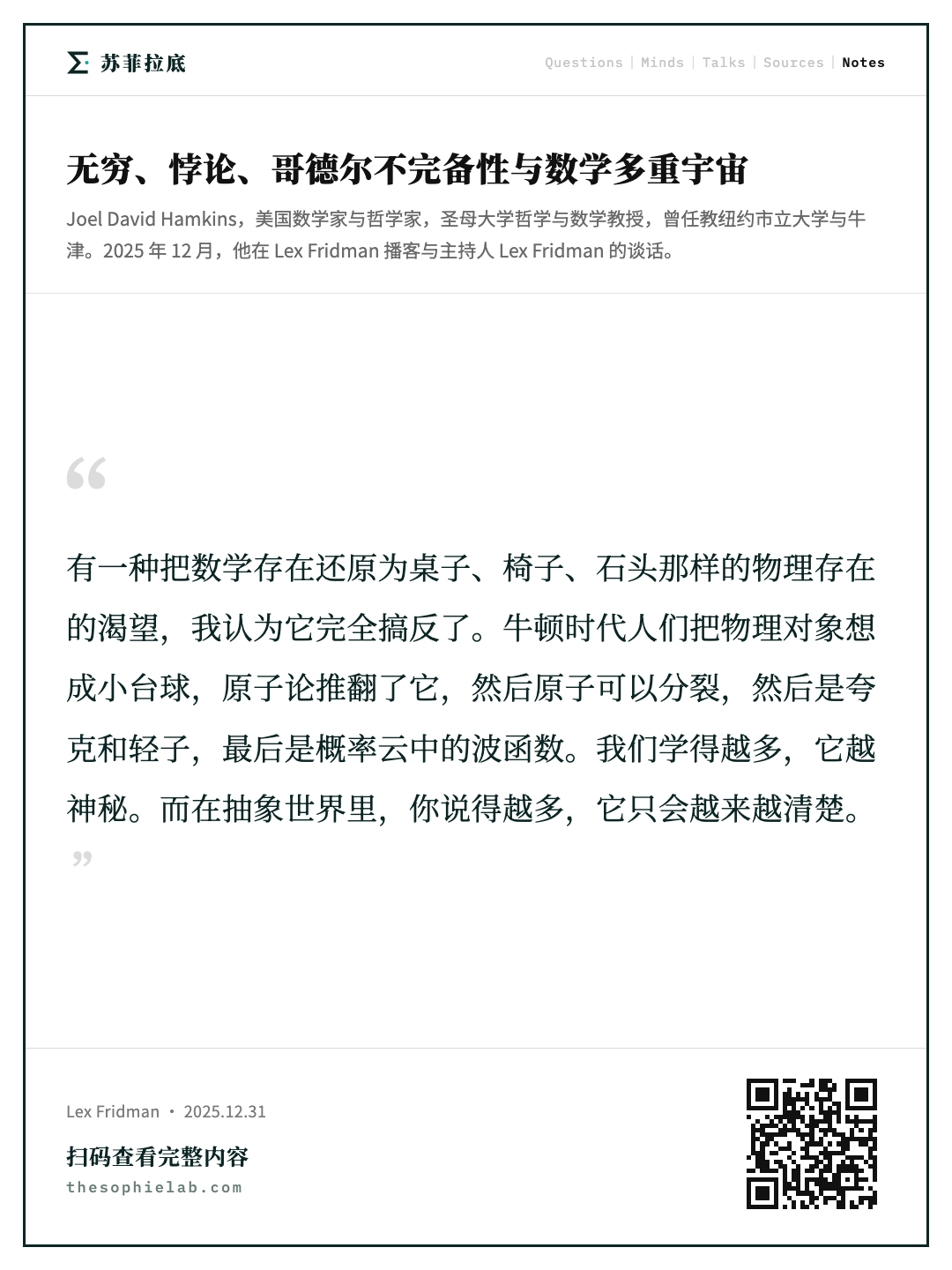
我对这种尝试的态度是:它完全搞反了。因为我认为我们对物理对象的本性并没有那么清楚的理解。我们都有在物理世界里存在的经验,这是必然的,因为我们确实存在于物理世界;但我不知道有任何令人满意的说明,能讲清物理地存在是什么意思。假如我请你想象某种蒸汽机车,我描述它的工程设计、重量、齿轮联动的构造,给你看整套设计的示意图,我们把这台机车的每一个细节都谈透了。谈完之后我说:现在请你告诉我,它物理地存在,而不只是一台想象中的机车,那会是什么意思?你能说什么呢?除了说「我是指它存在于物理世界」。可那是什么意思?这正是问题所在,它不是问题的回答,它就是问题本身。所以我不认为关于物理存在的本性我们能说出任何理智的东西,这是一个深刻的谜。而且我们知道的物理越多,它越神秘。牛顿物理学时代,人们把物理对象想成小台球之类的东西,或者无限可分的东西;原子论推翻了这幅图景;然后我们发现原子可以分裂,由电子、质子、中子组成,图景又被推翻;然后发现这些东西又由夸克和轻子组成,天知道还有什么在后头。而且所有这些东西,其存在的本性其实是概率云中的波函数。我们学得越多,它越神秘,毫无澄清。要说清「我桌上有一个苹果」归根到底是怎样一种物理存在,我认为我们完全给不出说明。

相反,我们对抽象存在的本性似乎有一种令人满意得多的说明。我可以谈空集的本性,它是那个永远不为真的谓词之类的东西,我可以谈它的逻辑性质,谈空集的单点集等等。当然走得很远之后也很困难,但要点在于它不会越来越神秘,你说得越多,它只会越来越清楚。所以在我看来,我们并不真正理解物理世界是什么,倒是在抽象世界里,存在要清楚得多。我们其实对汽水瓶或蒸汽机车一无所知,只是因为能碰它们;我们把它们拟人化,这有时还会让我们上当,因为摸它的时候我感觉不到量子力学。于是很容易觉得这些是真实的,而数学对象不是。我的论证正好相反。

数存在吗?我碰巧认为存在。我站在数学实在论一边,我认为这些抽象对象有一种真实的存在,可以用我刚才试图描述的方式来说明。至于四是不是「有四个元素的集合的大小」,理解四的本性有不同方式,这就进入了结构主义的问题。

结构主义

结构主义是数学哲学中的一种立场,强调数学对象重要的不是它由什么构成、其实体或本质是什么,而是它在数学结构中如何起作用。我所谓的结构主义态度是:我们只应在同构意义下关心数学结构。如果我有某种数学结构,用不同的个体作元素做出它的一个精确复本,那么这个同构复本在数学上同样好,用它代替原结构不会产生任何重要的数学差别。换句话说,数学结构中个体的实体,对该结构的任何数学性质都无关紧要。所以问「数字四究竟是什么」是一个反结构主义的问题:如果你有自然数结构,0、1、2、3、4 都在里面,我可以把四换成别的东西,比如这瓶水就可以在该结构里扮演四的角色,结构仍是同构的,对任何数学目的来说,用这个替代系统都毫无影响。这就是说,我们不关心四究竟是什么,那是无关的。唯一要紧的是四在给定数学系统中有哪些性质,并且认识到该系统还有其他同构复本,那些系统里的四与这个系统里的四,就任何关于四的重要问题而言,性质完全相同。但那些问题不会是关于本质的。在这个意义上,结构主义是数学里的反本质主义。可以把数看作指向某种深层结构的指针,因为结构主义的一部分要点是,孤立地考虑数学对象没有意义,数学对象有趣、重要的地方在于它们如何彼此互动、在一个系统里如何行为,所以要考虑对象在更大结构里扮演的结构角色。

弗雷格在研究数的本性时问过一个著名的问题。在他的逻辑主义纲领里,他要把全部数学还原为逻辑,其间他援引了康托尔-休谟原理:两个集合等势当且仅当它们元素个数相同。他把数的理论建立在这条原理上,却认识到有一点让他不满意:康托尔-休谟原理似乎没有给出「哪些东西是数」的判据,它只给出两个数何时相等的同一性判据。两个数相等,当且仅当相应大小的集合等势,这是数的同一性判据,却不是「什么是数」的判据。这个问题后来被称为凯撒问题,因为弗雷格说,从休谟原理我们似乎没有办法判断尤利乌斯·凯撒是不是一个数。他问的是数的本质。人们感觉他大概是有意挑一个荒谬的例子,因为你会觉得凯撒显然不是数,许多哲学著作似乎也持这条线。但结构主义者不同意。结构主义的态度是:你给我一个数系,如果凯撒不是数,那我把 17 从系统里拿出来,把凯撒放进那个位置,现在我有了一个新的数系,凯撒恰好就是 17。这完全没问题。结构主义的要点在于,凯撒是不是数这个问题与数学无关,因为它不关乎结构,只关乎数学对象的本质。这就是结构主义对弗雷格的批评。

我住在柏拉图领域

哪个更真实,我们眼睛看到的实在,还是数学定理表达的实在?我不太确定。我完全住在柏拉图领域里,对物理宇宙一点也不理解,所以没有强烈的看法。柏拉图领域是真实的吗?完全是。这就是数学实在论的立场:抽象对象有真实的存在,意思是存在某种意义上的存在,这些对象在其中可以被视为真实的。抽象对象是否存在于某个地点、某个时间?这很有争议。它们存在于所有时间。

我不会说数学的柏拉图领域更真实,我说的是,我们对它的真实性的理解深刻得多、可信得多。我不认为我们对物理实在的本性理解得有多好,而且我认为大多数人甚至没有触及我想问的那个问题的表面。当然,我们「理解」物理实在:我敲敲桌子,我们知道开生日派对、喝一杯马提尼是什么样。我们对在物理世界里存在有深刻的了解。但「理解」也许不是对的词,我们有的是在这个世界里生活、骑自行车之类的经验,我不认为我们真的有理解,对物理存在的本性理解得极少极少,那是一个深刻的谜。而对数学存在和抽象存在的本性,我们的理解要好那么一点。也许我可以希望有人给出令人信服的说明,但在我看来它是深刻的谜,我甚至想象不出对物理存在给出说明会是什么样子。一千年后物理学进步了,这场谈话会是什么样,那会很有意思。

数学与哲学的进步

我一脚在数学,一脚在哲学,比较这两门学科的差异很有意思。文化差异很多,其中一个大的差异是对学科进步的看法。数学有巨大的进步。我们对数学观念的理解好得多得多,不断改进,知识在增长。我们今天对无穷的理解比一百年前肯定更好,而一百年前又比之前几千年更好。数学几乎每个部分对核心问题的理解都在提高,以至于手头的问题变得完全不同,领域转向更困难、更有趣的问题。而在哲学里,说有进步也有一点对,但同时也有那些几千年来一直伴随我们的永恒问题,以至于你能找到许多哲学家主张,哲学的重要贡献在于提出问题而非回答问题,因为回答是无望的,这些深刻的哲学问题的本性太难了。我想说的是,进步感更弱。

我看不出有什么理由认为数学的进步、数学理解与知识的增长不会继续下去。一千年后,他们做的数学大概我完全认不出来,不经历中间的发展,我也许根本无法开始理解他们在说什么。把古代的人带到今天,他们也许听不懂我们在讨论的一些问题。但我觉得,假如阿基米德来了,我们能够交流,我能告诉他数学现在在发生的一些事情,那个时代的任何人都可以。所以即便学科随着进步而离开了早先的关切,这种进步仍然是可能的。

MathOverflow

MathOverflow 真是我人生的一大乐事。我从中学到了太多。我 2009 年就上去了,那时它刚开始不久,虽然不是一开始。网站会统计你打了多少字符,我不知道是几百万,反正花了大量时间思考那些问题,这对我来说一直是奇妙的经历。任何我觉得有趣的问题都吸引我,当然不是所有问题,有些类型的问题就是不太吸引我。

我刚加入 MathOverflow 时,基本上是少数几个回答问题的逻辑学家之一。有别的人懂一些逻辑,特别是范畴论及其他不那么传统的逻辑相关领域的人,他们也回答一些逻辑问题。所以在最早的日子里,我通过参与逻辑相关的问题做出了贡献。不过提问的逻辑学家也不多。我发现的是,人们对逻辑邻近的话题有巨大的兴趣:问题出现在群论里,却带有逻辑的一面,或者在分析里,总有一个逻辑的角度。我发现只要学够那个领域的东西,我往往能想出答案。这是最让我有收获的地方,因为我必须学。我的主要专长是逻辑,可有人在另一门学科里问关于选择公理或连续统假设的问题,我就得学够那门学科和问题的背景才能回答,而我常常做得到,也很乐意。这样我学到了很多,因为必须了解那些别的问题领域,它让我作为数学家极大地成长。

我回答过的问题包括:有哪些听起来合理却独立于 ZFC 的命题?教学中最有误导性的替代定义有哪些?大学里教的分析其实是可定义数的分析吗?连续统假设的解答?选择公理最反直觉的应用?证明平凡而结论不平凡的定理?归谬法还是逆否命题?棋子在数学上是什么?哲学是否曾澄清过数学?两个定理若一个蕴涵另一个,为何还算两个?

连续统假设

连续统假设是这样一个问题:一旦你证明了无穷不止一种大小,它就自然而然地冒出来。康托尔证明了实数的无穷严格大于自然数的无穷,可你一证明这一点,马上就想知道:中间有没有别的?还有什么问题比这更自然?康托尔问了,并用一生思考它。��续统假设断言:在自然数和实数之间不存在别的无穷。康托尔知道许多实数集。凡是落在那个区间里的东西,都会与某个实数集等势,而我们知道大量实数集:各种闭集、康托尔集、维塔利集,各种各样。你也许会想,如果连续统假设为假,我们大概已经见过那个集合了,只需证明它严格在中间。但结果是,对任何人能定义、能挑出、能观察到的所有实数集,它们要么是可数的(与自然数等势)或有限的,要么与整条实数线完全等势,从来不严格在中间。你面前有成百上千个候选集合,但每一个都能证明落在这一边或那一边,从不在中间。在每一个你能弄清的情形里,都从不严格在中间。

康托尔有一个证明它的纲领,在某种程度上已经得到了印证。连续统假设对开集成立,这很容易看出:一个开区间与整条实数线完全等势,任何区间都与整条线等势,你只需要一个函数,比如反正切函数,把整条实数线一一映入一个区间。所以非平凡的开集都与整条线等势,从不严格在中间。但了不起的是,康托尔对闭集也证明了这一点,用的是所谓康托尔-本迪克松定理。这个结果绝不显然,而且序数正是从这个定理里诞生的:康托尔为了让康托尔-本迪克松过程说得通,不得不发明序数。

一个实数集是开的,如果它包含的每个点周围都有一个小区间整个落在其中;而那个小区间本身就与整条线等势,所以开集的情形容易。闭集是开集的补集,而有大量非常复杂、大小各异的闭集。任何闭区间当然是闭集,但不止如此,还有康托尔集,通过去掉中间三分之一得到,也许有人见过这个构造。或者想象在线上到处随机撒下许多小开区间,合起来是一个开集,它的补集就是闭集。这些集合可能相当复杂,可以有孤立点,比如两个开区间恰好相接,中间只剩一个点;也可以有收敛到某点的序列,那也是闭集,或者收敛序列的收敛序列,等等。问题是能否产生一个具有中间基数的集合。康托尔对闭集证明了不可能:每个闭集要么可数,要么与整条实数线等势。

康托尔解决连续统假设的纲领是逐级向上:先开集,再闭集,然后往上走,进入所谓博雷尔集,即开集与闭集的各种组合,博雷尔复杂性有一个庞大的层级。结果表明,连续统假设对这个层级里的博雷尔集也得到了证明。然后还要往更复杂的集合走。实数集有一个复杂性层级,康托尔的想法是沿着层级往上爬,基于对先前情形的理解,对越来越复杂的集合证明连续统假设越来越成立。这已经被推进到了惊人的程度。不过要进入更高的领域,甚至只是在射影层级(用对实数本身的量词定义的集合,构成博雷尔层级之上的层级)这一层,就开始需要大基数假设了。结果是,如果有足够多的大基数,射影集也总是要么可数,要么与整条实数线等势。还可以试着往上走。我把过去五十年里的这些结果,都看作实现了康托尔一百二十年前的想法:通过对越来越复杂的集合建立越来越多的实例来证明连续统假设。但即便以我们现在所知,它也没有完全成功,也不可能成功,因为复杂性层级并不包括所有实数集,有些集合完全超出了这个层级。所以这个纲领永远不可能完全成功,尤其是考虑到独立性结果。

希尔伯特的第一问题

ZFC 公理是策梅洛 1908 年为他用选择公理证明良序定理而首先提出的。那还不是完整的 ZFC,只是策梅洛理论,缺一条替换公理,正则公理也是后来加的,加上之后才是策梅洛-弗兰克尔公理化,成为标准。还有一点:策梅洛原来的理论允许本元(ur-elements),即原子,那些不是集合、但我们用来构筑集合论宇宙的数学对象;而今天的集合论学者一般完全不用本元。我认为,正是结构主义哲学让他们省去了本元:如果你采用带本元的 ZFC,叫 ZFCU 或 ZFA,那么在这个带原子的集合论宇宙里存在的任何数学结构,都同构于一个完全不用原子的结构。作为结构主义者你不需要原子,因为你本来就只在同构意义下关心结构,而没有原子的理论更优雅、更清晰,原子就是不需要。所以今天谈集合论,一般谈的是无原子版本,ZFC 没有本元。我们表述 ZFC 公理,它表达了我们关于集合的本性和集合存在的主要原理。康托尔在十九世纪末提出连续统假设,此后它一直悬而未决,直到 1938 年。

这是希尔伯特世纪之初的二十三个问题里的第一问。希尔伯特在世纪之交那场著名的演讲里提出了这份清单,他认为这些问题可以指引未来一个世纪的数学,或者说值得考虑。今天人们是这么说的,但我完全不确定希尔伯特当时会以我们现在看待这份清单的方式来构想它。看着这个世纪展开,我们知道这二十三个问题确实引导了整个研究纲领,极其重要、极有影响。但在当时,希尔伯特没有理由认为会这样,他只是在做一场讲座,列出他认为非常重要的问题。所以我觉得更合理的想法是,他只是在列一批他认为极其有趣、重要、根本的问题,而没有背负指引二十世纪研究的沉重使命,虽然结果恰恰如此。

我们已经讲过希尔伯特对集合论的看法,那句「没有人能把我们从康托尔的乐园里赶出去」。我认为希尔伯特被康托尔说服了:连续统假设对数学基础至关重要,而数学基础是数学统一的关键发展。在集合论作为基础出现之前,数学有各门不同的学科,代数、实分析、拓扑、几何,各有各的公理。有时会发生这样的事:比如证明代数基本定理,即复数是代数闭域,任何多项式方程在其中都有解,可证明方法却来自数学的其他部分,比如拓扑证明。这怎么行呢?公理系统完全不同,却在一门学科里使用另一门的结果,除非有一门统一的底层学科,否则这是不融贯的。数学的统一由集合论这样的数学基础提供,在当时就是集合论。有一个单一的理论,把全部数学看作在其中进行,对于解决那种确实在发生的转移与借用现象至关重要。这一定是希尔伯特认为统一基础如此重要的部分原因,而集合论当时正扮演这个角色。当然今天我们有来自范畴论、类型论的其他可能的基础,还有单价基础,各种基础在竞争,不必只用一种集合论基础。不过在我看来,集合论作为基础的元数学分析极其成功,比其他任何基础成功得多,只是它不太适合计算机证明之类的事情,这是人们寻找替代基础的部分动机。所以关于希尔伯特,我认为他的动机是数学需要一个统一的基础,集合论正在扮演这个角色,而连续统假设是如此核心、根本的问题,他把它放进清单是很自然的。

清单上还有别的与逻辑相关的问题,比如希尔伯特第十问题,关于丢番图方程:他要求给出一个算法,判定给定丢番图方程是否有整数解。丢番图方程是一种听上去高深、其实容易理解的东西:多项式方程,只不过不是一个变量而是多个变量,整系数多变量多项式,你想知道它能否求解。希尔伯特的表述是要求提供一个算法,他预设了算法存在,只想知道它是什么。而问题的解决方式是证明不存在这样的算法。它像停机问题一样是不可判定的问题:不存在可计算的程序,能正确判定给定多项式方程是否有整数解。这是一个相当了不起的进展。

独立性与力迫法

这段历史真的很有戏剧性。康托尔在十九世纪末提出问题,然后完全悬而未决。希尔伯特在二十世纪之交问起它,没有人有头绪,直到 1938 年才有答案,那是四十年之后。库尔特·哥德尔证明了一半:如果集合论公理一致,那么存在一个集合论世界,其中选择公理和连续统假设都为真。他所做的,是构造出所谓可构造宇宙,哥德尔的 L。这与他回答选择公理安全性问题是同一个结果,对连续统假设也一样,它们在他得到的同一个集合论宇宙里为真。结果就是:如果不含选择公理的 ZF 一致,那么 ZFC 加连续统假设也一致。1938 年。这是一个美得惊人的论证,因为他在建造一个替代的数学实在。证明的结构是这样的:如果有任何数学实在、任何集合论世界,我们就在其中建造另一个,一个分开的、可能不同的世界。也可能与原来那个相同,如果我们一开始就在他建造的那个世界里,它就是相同的,但没有理由假设它相同。他有一种模型构造方法,建出这个替代的集合论实在,即可构造宇宙,然后证明选择公理在那里为真,连续统假设也在那里为真。真是漂亮的论证。

这只是独立性的一半。哥德尔基本上表明连续统假设不可反驳,但这不等于证明它为真。他表明的是:如果不带连续统假设的集合论一致,那么带上它也一致,这与证明它为真不是一回事。另一半直到 1963 年才到来,保罗·科恩发明了力迫法(forcing),证明如果存在集合论的模型,那么存在一个连续统假设为假的集合论模型。科恩也给了我们一件极其有力的工具来建造替代的数学实在,我是这样看的。他向我们解释了如何取任何一个集合论世界,建出另一个不同的、其中连续统假设为假的世界,即力迫扩张。可以说力迫法是一种从一个数学宇宙逃到另一个、或者扩展它、改变它的办法,你在数学宇宙之间旅行。我正是这样想的。

科恩和哥德尔的结果,这些产生替代集合论宇宙的方法,教训是什么?我们看到连续统假设和选择公理独立于其他公理,但不只是这两个。我们有成千上万个独立性结果。实际上,无穷组合学里几乎每一个非平凡的命题都独立于 ZFC。这是事实。不是普遍成立,有一些极其困难、极为突出的结果是在 ZFC 里证明出来的,但大体上,你问一个关于无穷基数的非平凡问题,它很可能独立于 ZFC,而我们有成千上万个力迫论证来确立这一点。该怎么看待这件事?一方面,如果你有一个理论,它回答不了任何你感兴趣的问题,那意味着什么?如果你持我所谓的宇宙观或一元论观点,你自然会说:ZFC 是个弱理论,真正的集合论实在就在那里,我们需要一个更好的理论,因为现在这个回答不了问题,什么都独立。如果你认为每个集合论问题都有确定的答案,存在唯一的集合论真理或唯一的事实,这就是宇宙观,这样想相当合理。

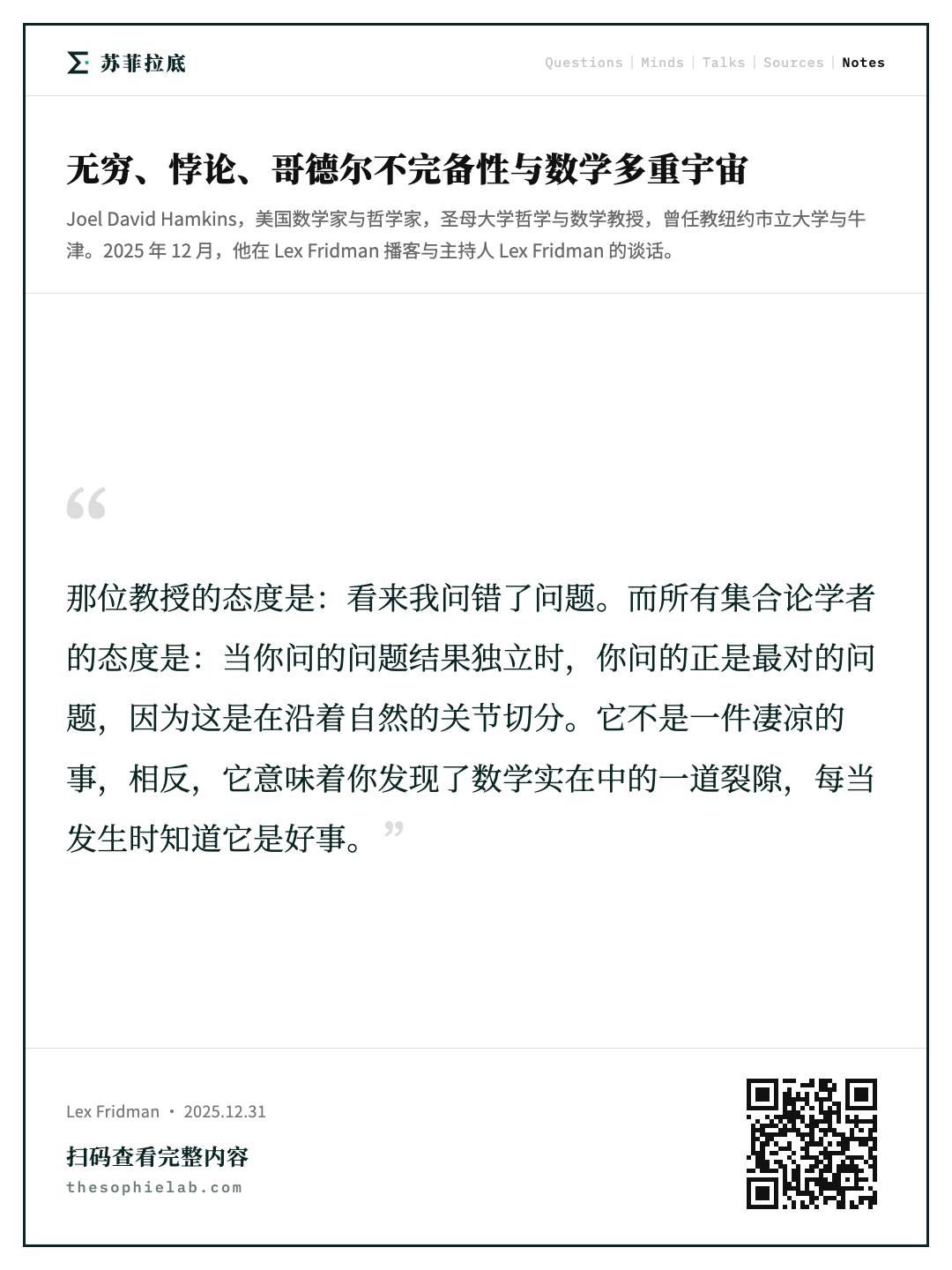
独立,就是既不能证明也不能反驳。有人觉得最有意思的东西大多被证明独立于 ZFC 是一件令人悲伤或创伤的事。这让我想起我在伯克利读研究生时,另一位研究生跟一位非逻辑方向的教授做 C* 代数之类的东西,属于分析或泛函分析。他们研究一个问题,结果发现它独立于 ZFC。那位教授的态度是:看来我问错了问题。而我和所有集合论学者的态度是:当你问的问题结果独立时,你问的正是最对的问题,因为这是在沿着自然的关节切分。你通过找到两个领域来裁定集合论实在的本性,你发现了一个二分:有它为真的世界和它为假的世界。问出这样的问题值得庆祝,它意味着你问了最对、最有趣、最迷人的问题。它不是一件凄凉的事,「既不能证明又不能反驳,真是灾难」,相反,它意味着你发现了数学实在中的一道裂隙,每当发生时知道它是好事。

对于独立于 ZFC 的东西能做什么?首先,由于不完备定理,我们知道对任何写得下来的理论,都有它证不了的真命题,那些东西会独立。所以我们已经意识到,对我们写下的任何理论,总会有独立现象。而且其中有些理论,我们甚至证不了它们一致,比如自身理论的一致性。这叫一致性强度层级。哥德尔第二不完备定理的直接推论是:对我们能写下的任何理论,其上都耸立着一座极高的一致性强度之塔,更强的理论不只是多加一条公理,而是加上一条连其一致性都无法在层级的先前各层中证明的公理。我们何其幸运,找到了大基数公理,它恰恰体现了这种一致性强度递增的特征,一个无休止、极高的公理一致性强度层级,正好实现了哥德尔定理对这类事情的预言。只不过大基数层级中的公理不是哥德尔分析里有时出现的那种元逻辑自指命题,而是宣告大无穷存在的公理。这是一个非常受欢迎的发展。可我们也知道,连续统假设独立于所有已知的大基数公理。没有一条大基数公理能解决连续统假设。所以对连续统假设和前面说的基数组合学而言,独立现象仍然存在。我们在建造一座越来越强的公理系统的层级,比 ZFC 更强,再更强,再更强,永远继续,永远完不了。而直到今天,连续统假设仍未被任何大基数公理解决。

集合论多宇宙

这是我的多宇宙观的一部分。宇宙观认为,所有这些问题都有事实的答案:如果你持宇宙观(我不持),你会认为连续统假设问题有正确答案,大基数问题也有正确答案,我们应当致力于找出那唯一真正的集合论。相反,我把过去半个多世纪集合论的发展看作证据,表明并不存在这样一个唯一的集合论实在。几十年来我们做的,是产生越来越多替代的集合论宇宙,基本真理在它们之间各不相同。而这就是对连续统假设问题的回答:给定任何集合论模型,都有一个力迫扩张使连续统假设为真,另一个使它为假。你可以像开关电灯一样把它打开、关上。这就是连续统假设的根本性质:在一个非常相近的集合论世界里,你可以要它,也可以要它的否定。不管你碰巧住在哪里,都有一个相近的世界 CH 为真,一个相近的世界 CH 为假。这本身就是一种回答。它不是一元论的、宇宙观的回答,而是多元论的回答。这把我引向了集合论的多宇宙观和多元真理观:集合论真理的根本性质具有多元的品格,基本术语没有单一的意义,而是有一系列真理各异的替代集合论宇宙可供选择。

首先应该说,集合论哲学里的这些立场,多宇宙观也好,宇宙观也好,我们在数学上从不分歧,大家对定理是什么意见一致。分歧在于对底层意义或语境的哲学看法,或者说,数学哲学究竟是干什么用的。回顾历史,比如牛顿和莱布尼茨的微积分时代,他们用无穷小的概念发展了微积分,而那些基础被贝克莱主教等人狠狠嘲笑:这些转瞬即逝的增量是什么?我们不该叫它们「逝去量的鬼魂」吗?我认为那套基础在当时确实完全可疑,无穷小微积分的基础直到二十世纪五十年代左右,随着罗宾逊的非标准分析才变得严格。我想说的是:要在数学上取得持久的洞见,是否需要一个稳固、严格的数学基础?答案,遗憾地,似乎是不需要。在微积分里,牛顿和莱布尼茨用那套糟糕、吱呀作响、连理解都算不上的无穷小基础,证明了微积分的所有基本定理,在早期就获得了所有主要洞见。这告诉你,基础观点对数学的发展、进步和洞见有多大的相关性。因为我把微积分早期的那些发展看作真正的数学,极其重要、极富洞见,尽管以今天的标准,那些基础一点也不好。

所以在集合论哲学里,宇宙观与多元论之争,我的看法是,哲学视角的选择与数学发展本身并不直接相关。它告诉我们的是:集合论该往哪儿走?我们应该研究什么样的集合论?应该问什么样的问题?如果你有宇宙观的心态,你会被推着去寻找并阐明那唯一真正的集合论宇宙的本性。我认为这一点在休·伍丁(Hugh Woodin)的工作中得到了很好的印证,他是持宇宙观的最杰出的数学家和哲学家之一,有他的终极 L 理论等等。他也是我的博士导师,在这个根本问题上我们有分歧,这也是一段个人故事。他有一个非常强大、成功的研究纲领,力图给「寻找唯一真正的集合论宇宙的本性」这件事站稳脚跟,这驱动着他提出的问题和追求的数学纲领。而如果你像我一样持多元论,你会被引向关于不同集合论宇宙之间互动的问题,或者想理解集合论模型与其力迫扩张之间的关系。

集合论地质学

这引出了我所谓的集合论潜在主义:以潜在主义的方式看待一个集合论宇宙。不是直接在潜无穷的意义上,因为这些宇宙里已经有无穷集合了,而是在「可以有更多集合」的意义上:通过力迫或向上扩展,宇宙可以更宽、更高。我们想理解这个集合论宇宙领域的本性,这是相当激动人心的工作。我和贝内迪克特·勒韦证明了一些关于力迫的模态逻辑以及末端扩张下集合论潜在主义的定理,我在这个题目上做了不少工作。我还与贡特尔·富克斯以及我自己的博士生约纳斯·赖茨一起,开创了集合论地质学这个题目。它取的是力迫的隐喻:在力迫里,你有基础模型和力迫扩张。我刚开始和约纳斯合作时,他说:我想撤销力迫,我想往回走。我起初说:约纳斯,不是这么玩的,你从基础模型出发,往外走,走到更大的那个,力迫就是这样运作的。他说:不,不,我就想往回走。他相当执着。最后我说:好吧,我们认真做。于是我们坐下来,更精确、更仔细、更深入地思考:取一个集合论宇宙,看看它是从哪里经由力迫而来的。这在当时是看待力迫的新方式,有点像对力迫做逆向工程。力迫是产生新宇宙的方式,你可以从某处出发走到新宇宙,也可以看看自己所在之处,说:我是过去做了那件事才到这里的。我们定义了基岩模型和地基等概念,也就是撤销力迫,成果相当丰硕。我把它看作多元论视角的一部分,不同之处在于,集合论地质学也适用于宇宙观。虽然这项工作受多宇宙哲学观启发,地质学的核心思想现在却被持宇宙观研究纲领的人接了过去,因为集合论地质学正在帮助他们,或者说帮助我们,发现唯一真宇宙如何与它的地幔相关联。我曾引入集合论地幔这个概念,以一种极有意思的方式。历史上这挺好笑的:一个完全从多元论观点里生长出来的研究纲领,最终被宇宙观的研究纲领以相当重要的方式接了过去。

你能在通过力迫到达的世界里证明某件事,然后带回基础模型吗?完全可以,而且这是非常有力的论证方法,人们常常想这么做。假设你处在某个集合论语境里,可以想成住在一个集合论宇宙中,你只想在这个宇宙里证明某件事。一种办法是先构造力迫扩张,利用力迫扩张的特征,认识到某些事情在基础模型里就必定已经为真,然后把力迫扩张扔掉。举一个更初等的例子:想想早年人们在真正理解复数之前用它们推理的情形。他们有想解的代数方程,有解方程的工具和方法,但过程中要对多项式做各种操作,改变因子,产生别的多项式并求解。有时在构造中途,他们会遇到负五的平方根之类的东西,他们不知道这是什么意思,只是符号性地做下去。最终,由于他们的方法,这些东西会合并、抵消,所有复数部分都抵消掉,得到一个实际的答案,比如三加根号十七,可以检验,它确实是原方程的解。这对他们一定很困惑:从一个纯粹关于实数的代数问题出发,沿着方法前进,穿过负数平方根的荒谬之地,最后得出一个可以验证正确的实数答案。我看刚才描述的力迫论证也是如此:你从集合论出发,进入力迫扩张这个荒谬之地、想象的世界,在那里论证,然后回来,在基础模型里得出结论。这是极美的论证方式。

超实数

超实数系(surreal numbers)是约翰·康威引入的一个美得惊人的数学系统。康威是这个世上最伟大的数学家之一,愿他安息。我非常欣赏他做数学的思考风格,超实数系就是一个好例子。我把超实数系看作一个统一所有其他数系的数系。它扩展实数,不只是实数,还有自然数、整数、有理数,以及序数和无穷小。它们全都坐在超实数里面,这是一个庞大的数系,它甚至不是一个集合,而是一个真类,因为它包含所有序数。但它由一条规则从无中生成。规则是:我们分阶段生成数,一个超限的阶段序列。在每个阶段,取目前已有的数,以所有可能的方式把它们分成两个集合,左集和右集,使左集里的每个数都小于右集里的每个数;那一刻,我们创造一个新数,填进 L 和 R 之间的空隙。就这样。

例如,一开始我们没有任何数,什么也没创造。我们可以取「无」,把它分成两个集合:空的左集和空的右集。空集里的每个数都小于空集里的每个数,因为这是空洞的真命题,所以条件满足,我们应用数的生成规则,创造一个新数。这就是我所谓的数的大爆炸,超实数的创世,数字零诞生了。零是第一个出生的数,它大于空集里的一切,小于空集里的一切。现在有了零,可以定义新的空隙:把零放进左集,右集为空,就该创造一个大于零、小于空集里一切的新数,叫作一。同一阶段,也可以把零放进右集,得到第一个小于零的数,叫作负一。现在有三个数:负一、零、一,它们有四个空隙:负一以下,负一与零之间,零与一之间,一以上,于是创造这四个新数。一以上的第一个数叫二,零与一之间的第一个数叫二分之一,负的一侧则有负二分之一和负二。现在有七个数,八个空隙,下一个「生日」(人们这么叫每个阶段)就诞生这些空隙里的所有数,然后再下去。随着日子推进,数越来越多,但这些只是有限的生日,因为这是超限过程。到第 ω 天,即第一个无穷天,会创造大量新的超实数:每个实数都在这一阶段诞生,因为每个实数都填补了此前诞生的有理数之间的一个空隙。其实有限阶段诞生的并非全部有理数,只是分母为二的幂的有理数,即二进有理数。所以实数都在第 ω 天诞生,但那天还诞生别的数:序数 ω 本身,是第一个大于所有有限数的数;负 ω 是第一个小于所有有限数的数;还有数 ε,第一个严格大于零、严格小于所有正有理数的数,它是那个空隙里的无穷小。第 ω 加一天又有新数,然后 ω 加二,数就这样永远涌现。

然后可以用一种与这个递归定义相配的自然方式定义加法和乘法,得到超实数上加与乘的递归定义。可以证明它们使超实数成为一个有序域:满足域公理,加法和乘法满足分配律和交换律,每个非零数有倒数,可以加减乘除。而且可以开平方,而且每个奇次多项式都有根,这在实数里成立:想一个三次或五次多项式,它必然穿过横轴,因为奇次多项式在两端无穷处行为相反,正的一侧趋向正无穷,负的一侧趋向负无穷,所以必然穿过。实数里每个奇次多项式有根,超实数里也如此。这使它成为所谓实闭域,一个非常好的数学理论。我们能在超实数里找到所有那些数系的复本,这真的很有意思。

不过超实数有一个根本的不连续性。它们构成实数域的一个非标准模型,提供了一种无穷小的概念,可以在罗宾逊非标准理论的基础上发展微积分。但它们对子类不满足最小上界性质:没有任何非平凡的超实数集有最小上界,超实数里也没有收敛序列。所以基于极限和收敛的普通微积分方法在超实数里完全不管用。这就是我说超实数根本不连续的意思。但你仍然可以用它们做微积分,因为你有无穷小,只要用非标准的、基于无穷小的方法,有人就这么做。

我曾在纽约组织过一次会议,康威是演讲者。问答环节有人问他,我觉得这有点失礼,在那么公开的场合我绝不会这样问:你一生最大的失望是什么?康威非常有风度,他回答说:超实数。不是超实数本身,而是它受到的接纳。他曾抱有雄心,让超实数成为整个数学和科学中使用的基本数系,因为它能做非标准分析,能做微积分,统一了序数等等。它是如此统一、如此惊人的美妙结构,周围满是优雅的证明和精巧的想法。他失望的是它从未真正达到他所期望的那种统一地位。高德纳曾努力推崇它,也没能扎根。不过我不想让人以为超实数不被广泛研究,研究它的人有成千上万。超实数的世界级专家之一菲利普·埃利希曾对我说,在这件事上康威是他自己最大的敌人,因为在康威的风格里一切都是游戏,他把超实数当作一种玩物、玩具,也许这让人们不把它当真。而我认为它极其严肃、有用、深刻,我一直在为我的 Substack「Infinitely More」写一整个系列关于超实数的文章。我觉得整个题目太迷人、太美了。当然,我没有把它用在工程上,那也许是康威雄心的一部分。

生命游戏与随机程序

康威把一切变成游戏,这一点很有意思。生命游戏是对元胞自动机的探索,元胞自动机是一扇通向我们尚未探索的世界的门。生命游戏是可计算不可判定问题的游乐场。事实上可以证明,给定一个格局,问某个特定的细胞是否会在演化中活过来,这个问题是可计算不可判定的,它等价于停机问题。它是半可判定的:如果它会活过来,你在某个有限阶段就会知道,只要运行生命游戏的算法,它活了你就能说它活了。但如果你跑了一千年它还没活,你似乎没有任何依据说「不,它永远不会活」,如果行为非常复杂的话。也许你对演化行为有完全的理解时能说不,但可以证明你不会总有这种理解,正因为这个问题等价于停机问题。

我认为可计算性理论的主要教训是:你永远不可能通过看程序来彻底理解程序的行为,在最一般的情形下,你从程序中学到的内容总是只能靠运行它、观察它的行为得到。证明这一点的是赖斯定理,它让这个想法完全站得住。

不过我想绕个弯,谈另一个问题:随机程序的行为是什么?你有某种形式的计算语言,考虑某个大小的所有程序,也许只有有限多个。能否对随机选取的一个说点什么,比如它以某种概率具有某种行为?答案非常有意思。多年前阿列克谢·米亚斯尼科夫问过我一个问题。他有一个概念,叫带黑洞的判定问题:一个判定问题在最坏情形下可能很难,但难度集中在一个极小的区域,叫黑洞,黑洞之外非常容易。这种问题拿来做加密方案是很糟糕的,你不想用带黑洞的问题,因为如果有人百分之九十五的时候都能抢银行,那不是你想要的,哪怕任何不可忽略的比例都太危险。所以不要用几乎每个实例都容易解的问题作加密的基础。阿列克谢问我的是:停机问题有黑洞吗?

取标准的图灵机模型,单向无穷纸带,带上写零和一,读写头来回移动,进入停机状态时停止。我们证明了确实有黑洞。意思是:存在一个计算机程序,能正确判定停机问题的几乎每一个实例。尽管停机问题不可判定,我们能判定几乎每一个实例。更精确地说,存在一个图灵机程序的集合,我们能轻易判定一个程序是否在这个集合里,对集合里的程序,我们能轻易判定停机问题;而且几乎每个程序都在这个集合里,意思是随着状态数变大,集合中程序的比例趋于百分之百,渐近密度为一。

证明相当有意思。这是那种定理听起来令人吃惊、对可计算性专家也是如此的情形,能解决停机问题的几乎所有实例,听起来很诱人。可一听证明就完全泄气了,听完证明没人喜欢这个定理。证明太简单了。图灵机有一条无穷纸带,机器在上面写零和一,读写头按刻板的指令来回移动。指令都是这种形式:如果机器处于某某状态、读到带上某某符号,就在带上写这个符号,转到指定的新状态,并按指定向左或向右移动。程序就是一组这样的指令。其中一个状态是停机状态,进入它程序就停。你可以计算有多少程序没有任何指令转到停机状态,这个比例很容易算,极限是 e 的平方分之一,百分之十三点五。这些程序显然永远不停,因为它们停不了,没有任何指令说停。所以百分之十三的程序,你看一眼就能说它们不停。这是不停机的一个愚蠢理由。我最初的观察就是这个,我想,这就是证明策略:这是程序不停机的一个愚蠢理由,我只要把能想到的愚蠢理由堆起来,堆到超过百分之五十,就可以说「大多数」。

我们又想了想,中了头彩:找到了一个巨大的愚蠢理由,极限收敛到百分之百。理由是这样的。想想机器的行为:读写头一开始停在纸带最左端的格子上,处于起始状态,执行一条指令。指令说:当你处于起始状态、读到带上某个符号时,写点什么,转到新状态,向左或向右移动。可其中一半是向左移。如果向左移而你已经在最左端,读写头就掉下去了,计算停止,因为头掉出了纸带。这是个相当愚蠢的理由,但光这样就已经是一半了。然后有些向右移了,转到了新状态。其中又有一半从那里向左,一半向右,而且大多会转到新状态:状态很多时,转到的下一个状态很可能是新的。于是得到一种随机游走的行为,每一步一半向左一半向右。波利亚有一个定理,叫波利亚常返定理:一维随机游走非常可能回到出发点。而对我们来说,一旦回到出发点,其中一半下一步就掉下去了。用这种分析可以证明,随机图灵机以概率一的行为是:读写头在重复任何状态之前就掉出了纸带。这就是解决停机问题的那个愚蠢证明。因为一旦发生这种情况,我们就能回答停机问题:不,计算停止是因为机器崩溃了,不是因为停机,按某些说法这不算停机;或者你想把崩溃定义为停机也行。不管你怎么设定形式体系,对头掉出纸带的机器行为,你都能回答问题。

所以在统计意义上,在极限下,我们解决了停机问题,可计算地解决了。但停机问题本身不可能在所有情形下被完全正确地解决。这是概率意义上的:我们可计算地解决了几乎所有实例。从复杂性理论的角度,有更有意思、也实际有用的版本。有整个 P 与 NP 问题,有一类 NP 完全问题,它们不可行,用普通办法需要指数时间,而且不知道是否多项式时间可解,是否存在可行算法是开放问题。对大多数 NP 完全问题,可以证明存在多项式时间的近似算法,在可行的时间内解决几乎所有实例。比如背包问题、装箱问题、可满足性问题等等,取决于你如何设定形式体系,可以证明这一点。我证明过许多这样的实例,我也认为这对几乎所有 NP 完全问题都普遍成立。这些困难问题在工业应用中很重要,是我们真正想解决的问题,而我们可以有可行的算法解决它们的几乎每一个实例。

P 与 NP

有时有人问 P 与 NP 会不会是独立的,对逻辑学家来说这是个有意思的问题。当然,如果你考虑独立性,得说明相对于哪个理论,因为相对于一个极弱的理论,每个命题都是独立的。孤零零地说「它独立」没有意义,独立只能是相对于某个理论。

我对 P 与 NP 的看法是:它当然是关于这些问题渐近行为的理论问题。一个问题属于 P,意思是存在一个可计算的判定程序,运行时间以某个多项式为界。但那个多项式的系数可能极大,次数可能极高。所以对小的输入,相对于我们一生、乃至人类文明存续期间会给它的输入范围,谈论多项式时间的可行性没有意义。因为它是渐近性质,只有当输入大小趋于无穷时,P 或 NP 才有意义。也许应该记住这一点,因为有时会看到一些夸大的说法:如果 P 等于 NP,那对人类文明将极其重要,意味着我们将有可行的算法解决 NP 中那些极重要的问题,给人类社会带来巨大财富,成为新技术和新产业的基础。人们说这种话,但你得用这样一个认识来节制它:由于问题本身的渐近性质,P 等于 NP 或 P 不等于 NP 根本不关乎这些实际的事。这是一方面。另一方面,我们已经有那个算法了,本来就可以用,只是它糟糕透顶,涉及难以置信的编码量。再一方面,我们已经有近似算法,从实用角度解决了人类文明的实际工程问题。比如 SAT 求解器在大量情形下表现惊人,尽管我们可以证明,如果 P 不等于 NP,就不会有多项式时间的 SAT 求解器,可实际的近似 SAT 求解器真的相当惊人。

最伟大的数学家

谁是史上最伟大的数学家?这是一个极难回答的问题。我个人其实不这样想,不按伟大程度给数学家排名。如果非要我选一个,大概是阿基米德,因为他在那么早的时代取得了那么惊人的成就,完全超越了同时代的其他人。但我也持这样的看法:我想从任何能提供数学洞见的人那里学习,无论在哪里找到,而这并不总是来自伟人。有时伟人做的事只是第一个做,别人本来也很容易第一个做到。回头看那些成就,有一种运气的成分。而且由于我们前面谈过的数学进步的问题,我们今天确实比过去理解得好得多,回顾那些成就时也许可以想象,别人也可能有那个洞见,也许真会有。不同的数学家在差不多同一时间证明本质上相似的结果,这已经是一个众所周知的现象,只不过先做的人得到荣誉。这相当常见。我认为某些想法在空气中,被人思考着但没有被完全阐明,这就是知识增长的本性。想法从哪里来,我并不真的知道。

我的工作方式

我作为数学家的风格是,我其实不喜欢困难的数学。我爱的是简单、清晰、容易理解、却证明出惊人结果的论证,那是我最喜欢的情形。至于结果是不是新的,对我来说反倒没那么重要。这和伟人、谁先做的问题有关。比如你用一个糟糕或复杂的论证证明了一个新结果,那很好,你证明了新东西。但我仍然想看到美而简单的那个,因为那是我能理解的。而且我对任何复杂的论证天然怀疑,因为它可能是错的。如果我不能完全理解它,不能把每一步同时装在脑子里,我就担心它也许错了。所以有的数学家卷入庞大的研究项目,涉及大量运转的部件和汇集在一起的各种技术,我说的是数学技术。现在越来越多地还有 Lean 这样的程序语言,让一些部分自动化。那是另一个问题,经过 Lean 验证的东西也许不那么容易受怀疑。我想的是那些论证极其复杂的情形,我会担心对不对,而我喜欢简单的东西。所以从这个角度,我往往做一些稍微偏离别人研究热点的东西。我的好奇心把我引向简单。我想做我能理解的东西,幸运的是,我发现我以这种风格做出的贡献别人似乎也喜欢,从这一点看我相当幸运。

我的过程始终是一种游戏式的好奇心,我也一直这样建议我的学生。每当有一个想法或题目,我就拿它玩,改动一些小地方,或者理解一个基本情形再把它复杂化,往这边压一压,或者把想法用到相关的、我最喜欢的例子上,看看会发生什么。你就是拿想法玩,这常常带来洞见,洞见又带来方法,很快你就在问题上取得进展了。这基本上就是我的方法:摆弄想法,直到看见一条通向有趣东西的路,然后证明它。这对我一直非常有效,我对这个方法相当满意。

拟人化的思想实验是我的基本工具,我一直在用。你把一个集合论模型、一个 ZFC 的模型想象成你住的地方,你可以通过力迫旅行到远方,这是对正在发生的事情的一种隐喻。当然实际论证根本不是那样,没有土地,你也没在旅行,但你允许自己的头脑那样去看。它帮助你理解,尤其当论证的各部分彼此紧张时,你可以想象有人在打架;或者用博弈的方式想,两个玩家争胜。这种隐喻式的理解常常极有帮助,让你意识到:啊,敌人会把这个东西选成那样,因为那样更连续之类的,那我们就该做另一件事。它让你从拟人化中冒出的想法里认识到找到答案、证明定理的数学策略。

安德鲁·怀尔斯用七年磨一个数学史上最难的问题,陶哲轩则说撞了墙就换一个问题,之后再回来。怀尔斯证明了惊人的定理,费马大定理的结果不可思议。但那种孤立工作的风格与我的实践完全不同。对我来说数学常常是一种社交活动。我数过,我的合作者、各种论文的合著者正逼近一百人。任何人有想法想和我谈,只要我感兴趣,我就想和他合作,也许我们解决了问题,就有一篇合著论文。我取得数学进展的方式往往大量涉及与他人合作,而不只是自己干,我非常享受这一点。所以我个人永远做不到怀尔斯做的事。也许我错过了什么,也许我把自己锁在卧室里只做一个问题,就能解决它。但我倾向于认为不会。在 MathOverflow 上待了这么久,我得到了那么多想法,那么多论文从 MathOverflow 的来回讨论中生长出来。有人发一个问题,我回答其中一部分,别人又有想法,变成完整的解答,然后我们三个人合写一篇论文,这种事发生过许多次。对我来说,我享受这种社交的一面。而且不只是社交,在我看来这就是数学探究的本性:把数学想法呈现给别人,他们的回应帮助我学习,也帮助他们学习,我认为这是做数学的一种非常多产的方式。独自做数学,尤其是死磕一个曾击垮许多杰出头脑的问题,从外面看去可怕地孤独;但每个人都不同,有人是隐士,在独自的磨砺中找到慰藉。

至于格里戈里·佩雷尔曼拒绝菲尔兹奖和千禧年大奖,我想的是,数学里充满各种各样的人。我的态度是:无所谓,也许他们有好的数学想法,那我就想和他们交谈、互动。佩雷尔曼的情形,他是如此杰出的头脑,解决了这个极其著名、极其困难的问题,那是巨大的成就。但他对奖项有那些看法,我不完全理解他为什么拒绝。最伟大的那些数学家和科学家做这些事,接下这些问题,是出于热爱而非奖项或金钱,这一点我完全同意,我也持这种看法。这就是我成为数学家的原因:我觉得这些问题如此引人入胜,我用一生思考它们。不过要是我得了奖,那也很好。

当然,如果我们想真正客观地评判谁是最伟大的数学家,就需要一个客观的判据来评估各位数学家的相对实力和声望,所以当然应该用 MathOverflow 的积分。我还主张过,终身教职和晋升的决定应该以 MathOverflow 为依据。我女儿把她男朋友介绍给我时,我首先想知道他的国际象棋等级分,其次想知道他的 MathOverflow 积分。

无穷象棋

无穷象棋太棒了。普通象棋在一块小得可怜的八乘八棋盘上下,而无穷象棋在整数棋盘上下,四个方向都无穷,但仍是棋盘格纹,棋盘上可以有棋子,我们允许无穷多个棋子。与有限的普通象棋的一个区别是,无穷象棋不从标准初始局面开始。有意思的情形是,你给出一个棋子已经复杂地布满棋盘的局面,然后问:从这个局面或那个局面开始会怎样?我们想做出具有有趣特征的局面,指数学上有趣的特征。

大概很多人熟悉「两步杀」这类棋题:白方走两步,第二步将死;或者三步杀、五步杀,对任何 N 都可以有 N 步杀的局面。而在无穷象棋里,你可以造出一个局面,它对任何 N 都不是 N 步杀,但白方有必胜策略,会在有限多步内赢。再说一遍:无穷象棋里有些局面白方一定能赢,白方一定会在有限步内将死对方,但不存在任何具体的 N 使白方能保证在 N 步内赢。白方会赢,但黑方控制需要多久。黑方注定要输,但可以说:我知道你会赢,可这次你至少得走一千步。换一种下法,黑方可以说:我知道你会赢,可这次你得走一百万步。对任何数,黑方都能这样说。这是非常有意思的局面。

无穷象棋的规则就是普通的棋子在这块无穷棋盘上移动,棋盘就是普通棋盘向所有方向无限延伸,没有边缘,没有边界。棋子的走法和你预期的一样:马照常跳,车沿着横线和竖线走,象沿同色斜线走,只是没有棋子挡路时想走多远都行。白兵永远向上走,黑兵永远向下走,吃子时斜吃。有几处与普通象棋不同需要注意。比如普通象棋有三次重复和棋规则,无穷象棋里我们直接去掉它,因为三次重复只是无限对局的代理。真正的规则是:无限对局为和棋,而不是三次重复为和棋,后者只是我所认为的真正规则的一种便利近似。所以唯一的获胜方式是在对局的有限阶段在棋盘上将死对方;如果你无限地下下去而没有做到,那就是和棋。而且没有升变,因为没有边缘。

我们刚才谈的那个局面的博弈值是 ω,意思是由于它有序数值,白方会赢,但黑方可以像从 ω 往下数那样下棋。从 ω 往下数是什么样的?如果你是黑方,要从 ω 往下数,你必须说出一个有限数,此后最多只能再数那么多次。所以从 ω 往下数的本性是,第一次数就迈出巨大的一步,之后每次减一。你不能从 ω 减一,因为那不是序数。所以从 ω 往下数,必须先到某个有限数,然后每次减一,那就是你还能走多少步。黑方能想拖多久就拖多久,就是这个意思,因为他可以随意选初始数。

我对无穷象棋的兴趣诞生于 MathOverflow,因为有人问了这个问题,是诺姆·埃尔基斯问的。构造满足这种性质的局面没有算法,这真正是数学创造性的行为。我有一位合著者科里·埃文斯,他是美国国家象棋大师,棋力很强,同时也是法哲学教授。我认识他是因为他在纽约城市大学读研究生,我当时在那里,而且我儿子小学时下竞赛象棋,科里是他的教练。那正是我开始对无穷象棋感兴趣的时候,我知道我需要一个懂棋的搭档,科里对那篇论文的贡献无可估量。因为无穷象棋的证明极其琐细,你创造了局面,可论证的细节是象棋式的推理,我的象棋推理不太够用。局面几乎都是我做的,但那是经过科里许多轮纠正之后的。他会来说:这个兵悬着,你的论证就破了;或者这个象能从笼子里漏出去。所以过程是:我大致知道按序数我们需要创造什么样的局面,努力做出一个大体有我想要的特征的东西,拿给科里看,他说这里那里不行,如此往返,对我帮助极大,最终我们收敛到正确的论证上。这篇论文的后续是科里、我和我的博士生诺曼·珀尔穆特三人合作的论文,我们改进了界。我们的目标是做出序数值越来越高的局面:最初的局面值是 ω,第一篇论文里做出了 ω 的平方和 ω 的立方,三人合作那篇做出了 ω 的四次方,论文标题就是《无穷象棋中博弈值为 ω 的四次方的局面》。当时这是已知最好的结果,之后被大幅改进了,现在我们知道每一个可数序数都是无穷象棋中某个局面的博弈值,这是一个了不起的结果。

人工智能与数学

关于人工智能和大语言模型在数学上越来越强,我想区分我们现在拥有的和未来几年可能出现的。我玩过,试过实验,但我发现它一点帮助也没有,基本为零。我用过各种系统,包括付费模型。我在数学问题上与 AI 互动的典型经历是,它给我垃圾答案,数学上不正确。我觉得这没有帮助,而且令人沮丧。如果是和一个人互动,最沮丧的事就是你得跟他争论他给的论证对不对,你指出了确切的错误,AI 却说「完全没问题」。如果我和一个人有这种经历,我会干脆拒绝再跟他说话。当然,人们得原谅这类缺陷。所以就数学推理而言,我对当前 AI 系统的价值持怀疑态度,它似乎不可靠。但我确实知道,有几位我极其尊敬的杰出数学家说他们在以有帮助的方式使用它,听到这些我常常很惊讶,因为我的经验恰恰相反。也许是我的方法不好,虽然在别的事情上,比如编程或图像生成,我用它,它惊人地强大有用。但对数学论证,我没觉得有帮助,也许是我还没有以正确的方式与它互动,也许我需要提高技能。但我也怀疑,别人提供的那些例子也许涉及大量互动,我怀疑数学想法其实来自那个人,来自那些做这件事的伟大数学家,而不是 AI。

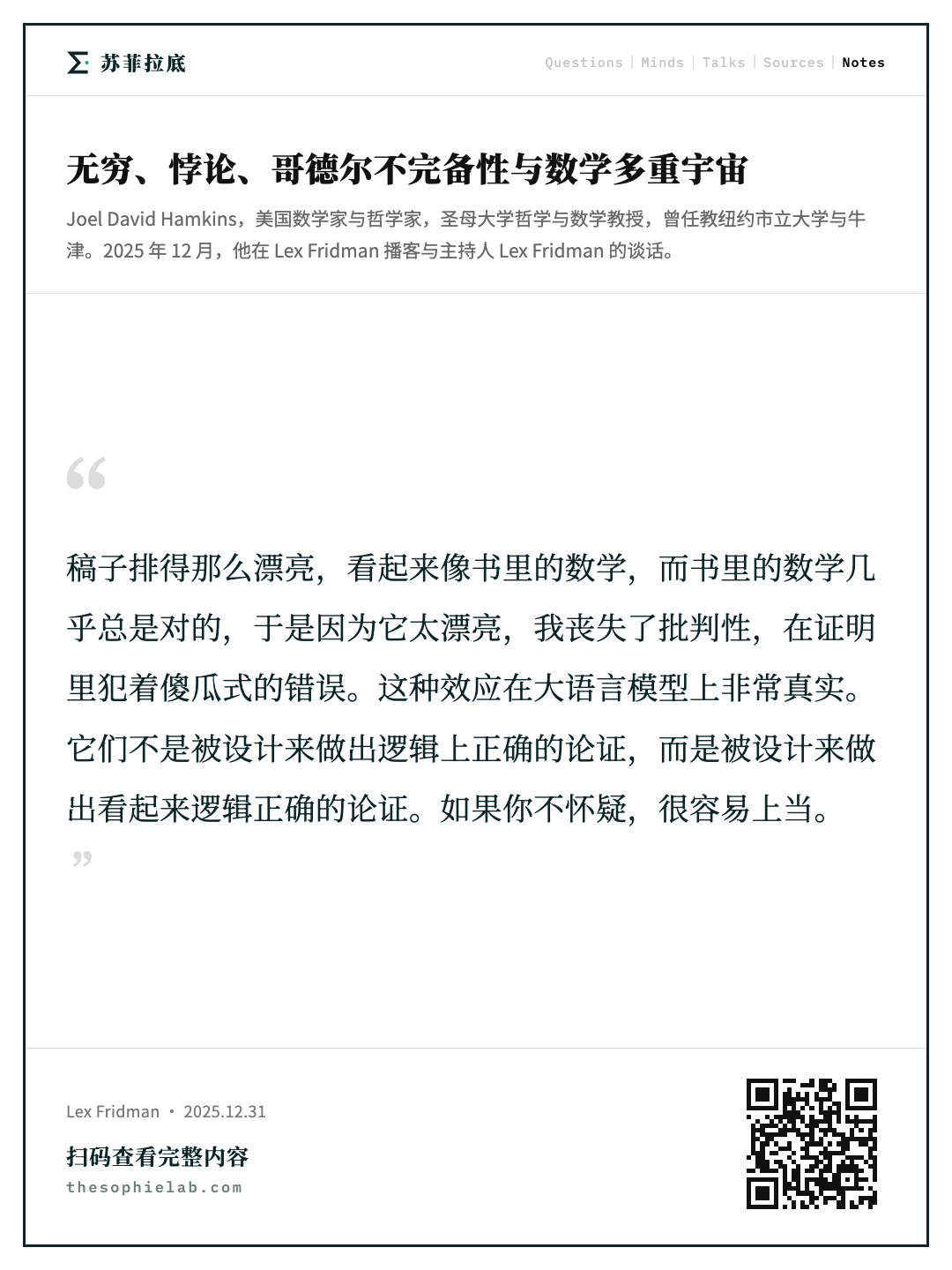
我还出于另一个理由怀疑,那就是大语言模型做数学这种路径的本性。我认识到,AI 在努力给我一个听起来像证明的论证,而不是一个确实是证明的论证。动机放错了地方。我担心这是非常危险的错误来源,因为数学里常常发生这样的事。回想我在加州理工读本科、后来主修数学的时候,LaTeX 还是很新的东西,我在学 LaTeX,用它排版作业,看起来很漂亮。其实以我现在的标准看肯定糟糕透了,但当时我什么都不懂,本科生嘛,LaTeX 几乎没人听说过。我做出这些排版精美的习题解答,打印出来交上去,成绩回来,糟糕透顶。我意识到发生了什么:稿子用这种方式排得那么漂亮,看起来像书里的数学,因为基本上只有在专业出版的书里才能见到那种数学排版,而书里的数学几乎总是对的。我习惯了只在论证完全正确时才见到那种排版,于是因为它太漂亮,我丧失了批判性,在证明里犯着傻瓜式的错误。当然我后来纠正了。但这种效应在现代大语言模型系统上非常真实。聊天程序产生的论证看起来像证明,那正是它们努力做的、被设计来做的。它们不是被设计来做出逻辑上正确的论证,而是被设计来做出看起来逻辑正确的论证。如果你不怀疑,很容易上当。这就是为什么我对人们依赖 AI 做数学论证有些担忧。把它们与 Lean 等形式证明验证系统绑定是一种完全不同的运作方式。但对坐下来用聊天程序想出数学论证的普通人来说,如果你没有特别警觉这一点,我认为它是危险的错误来源:AI 产生的东西不是基于数学理解,而是试图看起来像基于数学理解的东西,这两者完全不是一回事。而且我真的怀疑,能否做出一种产生真正数学洞见的系统,却不基于我所认为的数学理解,而只是文本生成。所用的方法似乎不够扎根于对底层数学概念的理解,而是扎根于关于这些概念的论证中词语在页面上出现的方式,那不是一回事。

我认为,给系统提供足够的信息、让它成为好合作者,确实是一种技能,你面对的不是人,你得把你的工作、你的思考方式尽可能都装进去,从它对大量知识的掌握和跨领域联系的能力中获得启发。这在编程领域也许说得通,那里训练数据太多了。至于数学训练数据,我只能假定 MathOverflow 的答案是训练数据的一部分,所以在某种意义上,我是在和自己说话。

数学与哲学中最美的思想

数学里最美的思想是超限序数。这是格奥尔格·康托尔发明的数系,关于数到无穷之外,就是「越过无穷继续数」这个想法。你数过普通的数,自然数,零、一、二、三,一直下去,然后你还没数完,因为之后是 ω,然后 ω 加一,ω 加二,永远可以加一。数完所有形如 ω 加 N 的数之后,就到了 ω 加 ω,即所有那些数之后的第一个数;然后是 ω 加 ω 加一,如此继续,永远可以加一。你就这样沿着序数数下去,永无止境。最终到 ω 乘三、ω 乘四,这些数的极限,排在所有这些数之后的第一个数,是 ω 的平方。这是第一个复合极限序数:极限序数是没有直接前驱的序数,ω、ω 乘二、ω 乘三都是极限序数;而 ω 的平方不仅是极限序数,还是极限序数的极限,因为 ω 乘三、ω 乘四这些极限序数的极限就是 ω 的平方。然后当然又有 ω 的平方加一、加二,永远不停。它绝对美妙、惊人,而且构成了后来那些超限递归构造的基础:从我提到的康托尔-本迪克松定理开始,到 V 层级的构造,哥德尔的可构造宇宙也是这样建起来的,策梅洛用选择公理证明良序原理也是一个超限递归构造。「数过无穷」这个想法如此简单优雅,却引出了那么多迷人的数学。无穷不是终点。

我一脚在哲学,一脚在数学,在某些场合似乎必须选择自己是数学家还是哲学家。我受的训练是数学,我的博士学位和所有学位都是数学。但这些年来我把自己变成了哲学家,因为我的数学工作在与这些哲学问题打交道。在纽约,我起初只有数学的职位,后来也加入了研究生中心的哲学系。第一次去牛津时,我的主要职位在哲学,现在在圣母大学也是如此,同时兼任数学教授,我仍然带数学博士生和哲学博士生。所以我不在乎决定自己是数学家还是哲学家,我的工作既涉及数学,又涉及数学中的哲学问题,也涉及纯粹的哲学,两门学科之间有一片广阔的地带,没有必要选择。记得我第一次去牛津时告诉女儿,我要去当牛津的哲学教授了,她哀怨地看着我说:可是爸爸,你不是哲学家呀。因为在她心里,父亲是数学家,母亲是哲学家,我妻子芭芭拉是哲学家,现在也在圣母大学,我们在一起。幸运的是,我不必在两者之间做选择。

哲学里最美的思想,我得说是真与证明的区分,就是我们已经讨论过的那个。它如此深刻,触及那么多哲学问题的核心。这个区分也许诞生于数学或数理逻辑,但那本身已经带有哲学性,而且它根本上是一个哲学区分。真关乎世界的本性、事情的实际情形,在某种意义上关乎客观实在;而证明关乎我们对世界的理解,关乎我们如何知道我们所知道的东西。关注证明,就是关注我们与客观实在的互动。我说的是数学实在,不是物理世界,因为如我所说,我住在柏拉图领域,与数学实在互动。证明关乎这种互动,关乎我们如何知道在这个数学实在中为真的事实;真则关乎实际情形如何,与我们的知识无关。这是我理解世界、理解逻辑和推理本性的一种核心方式。而两者之间的鸿沟,无论在柏拉图领域还是在物理领域,都充满迷人的谜。
排版 + 横图 + 来源,粘贴即成稿
章节 · 点击跳转视频
0:00 开场:康托尔与无穷的危机 ▶ 正在看
3:51 从亚里士多德到伽利略悖论 ▶ 正在看
9:20 希尔伯特旅馆与可数无穷 ▶ 正在看
23:26 实数不可数:对角线论证 ▶ 正在看
33:56 ZFC 公理与选择公理之争 ▶ 正在看
49:23 康托尔定理与罗素悖论同源 ▶ 正在看
61:39 希尔伯特纲领与哥德尔不完备 ▶ 正在看
80:12 真与证明:塔斯基与停机问题 ▶ 正在看
99:05 证明的艺术与拟人化思维 ▶ 正在看
106:39 数学对象存在吗:实在论与结构主义 ▶ 正在看
128:48 连续统假设的百年历程 ▶ 正在看
147:55 力迫法与集合论多重宇宙 ▶ 正在看
166:29 超实数、生命游戏与停机黑洞 ▶ 正在看
192:30 数学风格、合作与 AI 做数学 ▶ 正在看
225:00 最美的想法:超限序数与真证之分 ▶ 正在看
本期小问 · 档案清单
—— 连续统假设在 ZFC 中不可判定,是提错了问题,还是问对了? ▶ 正在看
—— 集合论若有无数个真值不同的宇宙,还有唯一的数学真理吗? ▶ 正在看
—— 数字 5 的存在,真的比桌上苹果的存在更容易说清吗? ▶ 正在看
—— 大模型写出的「像证明的文本」,为什么不能当作证明? ▶ 正在看
本期讲者
乔尔·大卫·哈姆金斯美国数学家与哲学家,圣母大学哲学与数学教授,曾任教纽约市立大学与牛津。集合论学者,提出「集合论多重宇宙」哲学,开创集合论地质学与无限国际象棋研究,著有《Proof and the Art of Mathematics》,长期居 MathOverflow 声望榜首。
Lex FridmanMIT 研究员、播客主持人,Lex Fridman Podcast 以与科学家、工程师、哲学家的长篇深度对话著称。
01开场:康托尔与无穷的危机
0:00
- The following is a conversation with Joel David Hamkins, a mathematician and philosopher specializing in set theory, the foundation of mathematics and the nature of infinity. He is the number one highest rated user on MathOverflow, which I think is a legendary accomplishment. MathOverflow, by the way, is like StackOverflow but for research mathematicians. He is also the author of several books, including Proof in the Art of Mathematics and Lectures on the Philosophy of Mathematics. And he has a great blog, infinitelymore.xyz. This is a super technical and super fun conversation about the foundation of modern mathematics and some mind-bending ideas about infinity, nature of reality, truth, and the mathematical paradoxes that challenged some of the greatest minds of the 20th century. I have been hiding from the world a bit, reading, thinking, writing, soul-searching, as we all do every once in a while. But mostly, just deeply focused on work and preparing mentally for some challenging travel I
- 以下是我与乔尔·大卫·哈姆金斯(Joel David Hamkins)的对话,他是一位数学家兼哲学家,专攻集合论、数学基础以及无穷的本质。他是 MathOverflow 上评分最高的用户,我觉得这可以说是个传奇般的成就。顺便说一句,MathOverflow 就像是给研究型数学家用的 StackOverflow。他还写过好几本书,包括《Proof and the Art of Mathematics》和《Lectures on the Philosophy of Mathematics》。他还有一个很棒的博客,infinitelymore.xyz。这是一场非常硬核、也非常有意思的对话,聊的是现代数学的基础,以及一些关于无穷、现实的本质、真理,还有那些曾难倒 20 世纪一些最伟大头脑的数学悖论的、让人脑洞大开的想法。我最近有点躲着这个世界,读书、思考、写作、审视内心,就像我们每隔一阵子都会做的那样。但大部分时间,我只是深深地专注于工作,并为新的一年里我打算去完成的一些颇具挑战的旅行做心理准备。
便签笔记
1:18
plan to take on in the new year. Through all of it, a recurring thought comes to me, how damn lucky I am to be alive and to get to experience so much love from folks across the world. I want to take this moment to say thank you from the bottom of my heart for everything, for your support, for the many amazing conversations I've had with people across the world. I got a little bit of hate and a whole lot of love, and I wouldn't have it any other way. I'm grateful for all of it. This is the Lex Fridman Podcast. To support it, please check out our sponsors in the description, where you can also find ways to contact me, ask questions, give feedback, and so on. And now, dear friends, here's Joel David Hamkins. Some infinities are bigger than others. This idea from Cantor at the end of the 19th century, I think it's fair to say, broke mathematics before rebuilding it. And I also read that this was a devastating and transformative discovery for
在这一切当中,有个念头反复浮现:我他妈是多么幸运,能活着,能感受到来自世界各地这么多人的爱。我想借这个机会,发自内心地说一声谢谢——谢谢这一切,谢谢你们的支持,谢谢我和世界各地的人们进行过的那么多精彩对话。我收到过一点点恨意,也收到了大量的爱,我不希望它是别的样子。我对这一切都心怀感激。这里是 Lex Fridman 播客。想支持我们,请查看简介中的赞助商,在那里你也能找到联系我、提问、给反馈等等的方式。现在,亲爱的朋友们,有请 Joel David Hamkins。有些无穷比另一些无穷更大。19 世纪末康托尔提出的这个想法,我觉得可以说,先是打碎了数学,然后又重建了它。我还读到,这是一个毁灭性的、同时也是变革性的发现,出于
便签笔记
2:32
several reasons. So one, it created a theological crisis. Because infinity is associated with God, how could there be multiple infinities? And also, Cantor was deeply religious himself. Second, there's a kind of mathematical civil war. The leading German mathematician Kronecker called Cantor a corrupter of youth and tried to block his career. Third, many fascinating paradoxes emerged from this, like Russell's paradox, about the set of all sets that don't contain themselves, and those threatened to make all of mathematics inconsistent. And finally, on the psychological side and the personal side, Cantor's own breakdown. He literally went mad, spending his final years in and out of sanatoriums, obsessed with proving the continuum hypothesis. So, laying that all out on the table, can you explain the idea of infinity, that some infinities are larger than others, and why was this so transformative to mathematics? - Well, that's a really great question. I would want to start talking about infinity and telling the story much earlier than Cantor, actually, because, I mean, you can go all the way back to Ancient Greek times when Aristotle
好几个原因。第一,它引发了一场神学危机。因为无穷是与上帝联系在一起的,怎么可能存在多个无穷呢?而且康托尔本人也非常虔诚。第二,出现了一场数学界的内战。德国数学界的领袖克罗内克(Kronecker)称康托尔是“青年的腐蚀者”,还试图阻挠他的职业发展。第三,由此涌现出许多引人入胜的悖论,比如罗素悖论——关于“所有不包含自身的集合所构成的集合”——这些悖论威胁着要让整个数学变得不一致。最后,从心理和个人层面看,还有康托尔自己的崩溃。他真的疯了,晚年反复进出疗养院,痴迷于证明连续统假设。所以,把这些都摆到桌面上,你能不能解释一下无穷的这个想法——有些无穷比另一些更大——以及为什么它对数学如此具有变革性?——嗯,这是个非常好的问题。其实我想从比康托尔早得多的地方开始讲无穷的故事,因为,我是说,你可以一直追溯到古希腊时代,那时亚里士多德
便签笔记
02从亚里士多德到伽利略悖论
3:51
emphasized the potential aspect of infinity as opposed to the impossibility, according to him, of achieving an actual infinity. And Archimedes' method of exhaustion where he is trying to understand the area of a region by carving it into more and more triangles, say, and sort of exhausting the area and thereby understanding the total area in terms of the sum of the areas of the pieces that he put into it. And it proceeded on this kind of potential understanding of infinity for hundreds of years, thousands of years. Almost all mathematicians were almost all mathematicians were potentialists only and thought that it was incoherent to speak of an actual infinity at all. Galileo is an extremely prominent exception to this, though he argued against this sort of potentialist orthodoxy in The Dialogue of Two New Sciences. Really lovely account there that he gave. And that the... In many ways, Galileo was anticipating Cantor's developments, except he couldn't quite push it all the way through and ended up throwing up his hands in confusion in a sense. I mean, the Galileo paradox is the idea or the observation that if you think about the natural numbers, I would start with zero but I think maybe he would start with one. The numbers one,
强调的是无穷的潜在方面,而反对——按他的说法——实现一个实无穷的可能性。还有阿基米德的穷竭法,他试图通过把一块区域切分成越来越多的三角形来理解它的面积,就这样一点点“耗尽”面积,从而用他放进去的那些小块的面积之和来理解总面积。数学就在这种对无穷的潜在理解上前进了几百年、几千年。几乎所有数学家都只是潜无穷论者,认为谈论一个实无穷根本就是不融贯的。伽利略是个极其突出的例外,他在《关于两门新科学的对话》中反驳了这种潜无穷的正统观点。他在那里给出了非常精彩的论述。而且……在很多方面,伽利略都预示了康托尔后来的发展,只是他没能把它一路推到底,某种意义上最后是困惑地摊了摊手。我是说,所谓伽利略悖论,就是这样一个想法或者观察:如果你想想自然数——我会从零开始,不过我想他大概会从一开始——数字一、
便签笔记
5:18
two, three, four, and so on, and you think about which of those numbers are perfect squares. So zero squared is zero and one squared is one and two squared is four, three squared is nine, 16, 25, and so on. And Galileo observed that, that the perfect squares can be put into a one-to-one correspondence with all of the numbers. I mean, we just did it. I associated every number with its square. And so it seems like on the basis of this one-to-one correspondence that there should be exactly the same number of squares, perfect squares as there are numbers, and yet there's all the gaps in between the perfect squares, right? And, and this suggests that there should be fewer perfect squares, more numbers than squares because the numbers include all the squares plus a lot more in between them, right? And Galileo was quite troubled by this observation because he took it to cause a kind of incoherence in the comparison of infinite quantities, right? And another example is, if you take two line segments of different lengths, and you can imagine drawing a kind of foliation,
二、三、四,等等,然后你想想这些数里哪些是完全平方数。零的平方是零,一的平方是一,二的平方是四,三的平方是九,然后 16、25,等等。伽利略观察到,完全平方数可以和全体自然数建立一一对应。我是说,我们刚才就做了:我把每个数和它的平方对应起来。所以基于这个一一对应,看起来完全平方数应该和全体自然数一样多,可是完全平方数之间还有那么多空隙,对吧?这又暗示着完全平方数应该更少、数应该比平方数更多,因为这些数包含了所有平方数,外加中间一大堆别的数,对吧?伽利略对这个观察相当困扰,因为他认为这会在比较无穷量时造成某种不融贯,对吧?另一个例子是,如果你取两条长度不同的线段,你可以想象画出一种叶状的连线,
便签笔记
6:37
a fan of lines that connect them. So the endpoints are matched from the shorter to the longer segment, and the midpoints are matched and so on. So spreading out the lines as you go. And so every point on the shorter line would be associated with a, a unique distinct point on the longer line in a one-to-one way. And so it seems like the two line segments have the same number of points on them because of that, even though the longer one is longer. And so it makes, again, a kind of confusion over our ideas about infinity. And also with two circles, if you just place them concentrically and draw the rays from the center, then every point on the smaller circle is associated with a corresponding point on the larger circle, you know, in a one-to-one way. And, and again, that seems to show that the smaller circle has the same number of points on it as the larger one, precisely precisely because they can be put into this one-to-one correspondence. Of course, the contemporary attitude about this situation is that those two infinities are exactly the same, and that Galileo was right in those observations about the equinumerosity. We would talk about it now
一把连接它们的扇形射线。短线段的端点与长线段的端点相匹配,中点与中点相匹配,等等,射线越往外越张开。于是短线段上的每个点都会以一一对应的方式,对应到长线段上唯一一个不同的点。所以看起来这两条线段上的点一样多,尽管其中一条更长。这又一次让我们关于无穷的想法陷入某种混乱。两个圆也是一样:如果你把它们同心地放在一起,从圆心画出射线,那么小圆上的每个点都会以一一对应的方式,对应到大圆上的一个点。这似乎又表明,小圆上的点和大圆上的点一样多,恰恰是因为它们之间能建立这种一一对应。当然,当代对这种情况的看法是,这两个无穷完全一样大,伽利略在那些关于等势的观察上是对的。我们现在会这样来谈论它——
便签笔记
7:47
by appealing to what I call the Cantor-Hume principle, or some people just call it Hume's principle, which is the idea that if you have two collections, whether they're finite or infinite, then we want to say that those two collections have the same size. They're equinumerous if and only if there's a one-to-one correspondence between those collections. Galileo was observing that line segments of different lengths are equinumerous, and the perfect squares are equinumerous with all of the natural numbers, and any two circles are equinumerous, and so on. The tension between the Cantor-Hume principle and what could be called Euclid's principle, which is that the whole is always greater than the part, is a principle that Euclid appealed to in the Elements many times when he's calculating area and so on. It's a basic idea that if something is just a part of another thing, then the whole is greater than the part. So what Galileo was troubled by was this tension between what we call the Cantor-Hume principle and Euclid's principle. It wasn't fully resolved, I think, until Cantor. He's the one who really explained so clearly about these different sizes of infinity and so on in a way that was so compelling. He exhibited two different infinite sets and proved that they're not equinumerous; they can't be put into one-to-one
——诉诸我称之为康托尔–休谟原则的东西,有些人就叫它休谟原则,也就是这个想法:如果你有两个集合,不管是有限的还是无限的,我们想说这两个集合一样大——它们是等势的,当且仅当这两个集合之间存在一一对应。伽利略观察到的是:不同长度的线段是等势的,完全平方数与全体自然数是等势的,任意两个圆是等势的,等等。而康托尔–休谟原则与可以称为欧几里得原则的东西之间存在张力,后者是说整体总是大于部分。这是欧几里得在《几何原本》里计算面积等等时反复诉诸的一条原则。它是个很基本的想法:如果某个东西只是另一个东西的一部分,那么整体就大于部分。所以困扰伽利略的,正是康托尔–休谟原则和欧几里得原则之间的这种张力。我认为这个问题直到康托尔才被彻底解决。是他真正把无穷的这些不同大小解释得如此清楚、如此有说服力。他给出了两个不同的无穷集合,并证明它们不是等势的,它们之间无法建立一一
便签笔记
03希尔伯特旅馆与可数无穷
9:20
correspondence. It's traditional to talk about the uncountability of the real numbers. Cantor's big result was that the set of all real numbers is an uncountable set. Maybe if we're going to talk about countable sets, then I would suggest that we talk about Hilbert's Hotel, which really makes that idea perfectly clear. - Yeah, let's talk about Hilbert's Hotel. - Hilbert's Hotel is a hotel with infinitely many rooms. Each room is a full floor suite. So there's floor zero... I always start with zero because for me, the natural numbers start with zero, although that's maybe a point of contention for some mathematicians. The other mathematicians are wrong. - Like I mentioned, I'm a programmer, so starting at zero is a wonderful place to start.
对应。传统上人们谈的是实数的不可数性。康托尔的重大结果就是:全体实数构成的集合是一个不可数集。也许,如果我们要谈可数集,那我建议我们先谈谈希尔伯特旅馆,那个例子能把这个想法讲得非常清楚。——好,我们来聊希尔伯特旅馆。——希尔伯特旅馆是一家有无穷多个房间的旅馆。每个房间都占满整整一层。所以有第零层……我总是从零开始,因为对我来说自然数是从零开始的,虽然这一点对某些数学家来说也许有争议。——那些数学家错了。——就像我提到的,我是个程序员,所以从零开始是个绝妙的起点。
便签笔记
10:01
- Exactly. So there's floor zero, floor one, floor two, or room zero, one, two, three, and so on, just like the natural numbers. So Hilbert's Hotel has a room for every natural number, and it's completely full. There's a person occupying room N for every N. But meanwhile, a new guest comes up to the desk and wants a room. "Can I have a room, please?" The manager says, "Hang on a second, just give me a moment." You see, when the other guests had checked in, they had to sign an agreement with the hotel that maybe there would be some changing of the rooms during this stay. So the manager sent a message up to all the current occupants and told every person, "Hey, can you move up one room, please?" So the person in room five would move to room six, and the person in room six would move to room seven and so on. And everyone moved at the same time. And of course, we never want to be placing two different guests in the same room, and we want everyone to have their own private room and... But when you move everyone up one room, then the bottom room, room zero, becomes available, of course. And so he can put the new guest in that room. So even when you have infinitely many things, then the new guest can be accommodated. And that's a way of
——完全正确。所以有第零层、第一层、第二层,或者说零号房、一号房、二号房、三号房,等等,就像自然数一样。所以希尔伯特旅馆对每个自然数都有一个房间,而且已经完全住满了。对每个 N,N 号房里都住着一个人。可这时候,一位新客人走到前台,想要一个房间。“请问能给我一个房间吗?”经理说:“稍等一下,给我一点时间。”你看,之前那些客人入住时,都得和旅馆签一份协议,说明住宿期间可能会有房间调换。于是经理往所有现住客人那里发了消息,告诉每个人:“嘿,能麻烦你往上搬一个房间吗?”于是五号房的人搬到六号房,六号房的人搬到七号房,以此类推。所有人同时搬。当然,我们绝不希望把两位不同的客人安排进同一个房间,我们希望每个人都有自己的独立房间……但当你让每个人都往上搬一个房间时,最底下那间——零号房——当然就空出来了。于是他就能把新客人安排进那间房。所以即使你有无穷多个东西,新客人也还是能被安顿下来。这就是一种方式,
便签笔记
11:17
showing how the particular infinity of the occupants of Hilbert's Hotel, it violates Euclid's principle. I mean, it exactly illustrates this idea because adding one more element to a set didn't make it larger, because we can still have a one-to-one correspondence between the total new guests and the old guests by the room number, right? - So, to just say one more time, the hotel is full. - The hotel is full. - And then you could still squeeze in one more, and that breaks the traditional notion of mathematics and breaks people's brains when they try to think about infinity, I suppose. This is a property of infinity. - It's a property of infinity that sometimes when you add an element to a set, it doesn't get larger. That's what this example shows. But one can go on with Hilbert's Hotel, for example. I mean, maybe the next day, you know,
用来说明希尔伯特旅馆住客的这种特定的无穷是如何违反欧几里得原则的。我是说,它正好诠释了这个想法:往一个集合里再加一个元素并没有让它变大,因为我们仍然能通过房间号,在新的全体客人和原来的客人之间建立一一对应,对吧?——所以,再说一遍,旅馆是满的。——旅馆是满的。——但你还是能再塞进去一个,而这打破了传统的数学观念,我猜也打破了人们思考无穷时的大脑。这是无穷的一个性质。——这是无穷的一个性质:有时候你往一个集合里加一个元素,它并不会变大。这个例子说明的就是这个。不过希尔伯特旅馆的故事还能继续讲下去。我是说,也许第二天,你知道,
便签笔记
12:15
20 people show up all at once. We can easily do the same trick again, just move everybody up 20 rooms. And then we would have 20 empty rooms at the bottom, and those new 20 guests could go in. But on the following weekend, a giant bus pulled up, Hilbert's bus. And Hilbert's bus has, of course, infinitely many seats. There's Seat Zero, Seat One, Seat Two, Seat Three, and so on. And so one wants to... You know, all the people on the bus want to check into the hotel, but the hotel is completely full. So what is the manager going to do? And when I talk about Hilbert's Hotel, when I teach Hilbert's Hotel in class, I always demand that the students provide, you know, the explanation of- of how to do it. So maybe I'll ask you. Can you tell me, yeah, what is your idea about how to fit them all in the hotel, everyone on the bus, and also the current occupants? - You separate the hotel into even and odd rooms, and you squeeze in the new Hilbert bus people into the odd rooms and the previous occupants go into the even rooms.
一下子来了 20 个人。我们可以轻松地再玩一次同样的把戏,让所有人往上搬 20 个房间。这样底部就会空出 20 个房间,那 20 位新客人就能住进去。可到了下一个周末,来了一辆巨大的巴士——希尔伯特巴士。希尔伯特巴士当然有无穷多个座位:零号座、一号座、二号座、三号座,等等。所以,你知道,车上所有人都想入住这家旅馆,可旅馆已经完全住满了。那经理该怎么办?我讲希尔伯特旅馆的时候,在课堂上教希尔伯特旅馆的时候,我总是要求学生自己给出该怎么做的解释。所以也许我问问你。你能告诉我,你的想法是什么,怎么把他们全都塞进旅馆——巴士上的每个人,加上现在的住客?——你把旅馆分成偶数号房间和奇数号房间,把希尔伯特巴士上的新客人塞进奇数号房间,原来的住客搬进偶数号房间。
便签笔记
13:20
- That's exactly right. That's a very easy way to do it. If you just tell all the current guests to double their room number, so in Room N, you move to Room 2 times N. So they're all going to get their own private room, the new room, and it will always be an even number 'cause 2 times N is always an even number. And so all the odd rooms become empty that way. And now we can put the bus occupants into the odd-numbered rooms. - And by doing so, you have now shoved an infinity into another infinity. - That's right. So what it really shows... I mean, another way of thinking about it is that, well, we can define that a set is countable if it is equinumerous with a set of natural numbers. And a kind of easy way to understand what that's saying in terms of Hilbert's Hotel is that a set is countable if it fits into Hilbert's Hotel, 'cause Hilbert's Hotel basically is the set of natural numbers in terms of the room numbers. So to be equinumerous with a set of natural numbers is just the same thing as to fit into Hilbert's Hotel. And so what we've shown is that if you have two countably infinite sets, then their union is also countably infinite. If you put them together and form a new set
——完全正确。这是个非常简单的办法。你只要告诉所有现住客人把自己的房间号翻倍,也就是在 N 号房的人搬到 2 乘以 N 号房。这样他们都会有自己独立的新房间,而且房号永远是偶数,因为 2 乘以 N 总是偶数。这样所有奇数号房间就都空出来了。现在我们就可以把巴士上的乘客安排进奇数号房间。——这么一来,你就把一个无穷塞进了另一个无穷里。——没错。所以它真正表明的是……我是说,另一种理解方式是:我们可以定义,一个集合如果与自然数集等势,那它就是可数的。用希尔伯特旅馆来理解这句话的一个简单方式是:一个集合是可数的,当且仅当它装得进希尔伯特旅馆,因为就房间号而言,希尔伯特旅馆基本上就是自然数集。所以“与自然数集等势”跟“装得进希尔伯特旅馆”是一回事。于是我们证明的就是:如果你有两个可数无穷集,那它们的并集也是可数无穷的。如果你把它们放在一起,构成一个新集合,
便签笔记
14:28
with all of the elements of either of them, then that union set is still only countably infinite. It didn't get bigger. And that's a remarkable property for a notion of infinity to have, I suppose. But if you thought that there was only one kind of infinity, then it wouldn't be surprising at all, because if you take two infinite sets and put them together, then it's still infinite. And so if there were only one kind of infinity, then it shouldn't be surprising... that the union of two countable sets is countable. So there's another way to push this a bit harder, and that is when Hilbert's train arrives, and Hilbert's train has infinitely many train cars... ...and each train car has infinitely many seats. And so we have an infinity of infinities of the train passengers together with the current occupants of the hotel, and everybody on the train wants to check in to Hilbert's Hotel.
里面包含它们两个中任意一个的所有元素,那么这个并集仍然只是可数无穷的。它并没有变大。我想,对一个无穷概念来说,这是个了不起的性质。不过,如果你原本以为只有一种无穷,那这一点根本不会让人意外,因为你把两个无穷集放在一起,它当然还是无穷的。所以如果只存在一种无穷,那么“两个可数集的并集是可数的”就一点也不奇怪了。还有一种方式可以把这个再往深里推一推,那就是希尔伯特列车到站的时候。希尔伯特列车有无穷多节车厢……而每节车厢又有无穷多个座位。所以我们有一个无穷多个无穷——列车上的乘客,再加上旅馆现有的住客,而列车上的每个人都想入住希尔伯特旅馆。
便签笔记
15:26
So the manager can, again, of course, send a message up to all the rooms telling every person to double their room number again. And so that will occupy all the even-numbered rooms again, and but free up again the odd-numbered rooms. So somehow, we want to put the train passengers into the odd-numbered rooms. And so while every train passenger is on some car, let's say Car C and Seat S, so somehow, we have to take these two coordinates, you know, C, S, the car number and the seat number, and produce from it an odd number in a one-to-one way, you know? And that's actually not very difficult. In fact, one can just use, say... An easy way to do it is to just use the number 3 to the C times 5 to the S. 3 to the C, 3 to the car number, so 3 x 3 x 3, you know, the number of the car. You multiply 3 by itself, the number of the train car, and then you multiply 5 by itself the seat number of times, and then you multiply those two numbers together. So 3 to the C times 5 to the S. That's always an odd number, 'cause the prime factorization has only 3s and 5s in it. There's no 2 there. So therefore, it's
所以经理当然还是可以往所有房间发消息,让每个人再一次把自己的房间号翻倍。这样又会占满所有偶数号房间,同时再次空出所有奇数号房间。于是我们得想办法把列车乘客安排进奇数号房间。每位列车乘客都在某节车厢的某个座位上,比方说 C 号车厢、S 号座位,所以我们得用这两个坐标——你知道,C、S,车厢号和座位号——以一一对应的方式造出一个奇数,对吧?其实这并不难。事实上,我们可以直接用……一个简单的办法是用 3 的 C 次方乘以 5 的 S 次方。3 的 C 次方,也就是 3 自乘车厢号那么多次,3 乘 3 乘 3,你知道,乘车厢号那么多次。你把 3 自乘车厢号那么多次,再把 5 自乘座位号那么多次,然后把这两个数相乘。所以是 3 的 C 次方乘以 5 的 S 次方。它永远是奇数,因为它的素因数分解里只有 3 和 5,没有 2。所以它
便签笔记
16:48
definitely an odd number, and it's always different because of the uniqueness of prime factorization. So every number can be factored uniquely into primes. So if you have a number of that form, then you can just factor it, and that tells you the exponent on 3 and the exponent on 5. And so you know exactly which person it was, which car they came from, and which seat they came from. - And prime factorization is every single number can be decomposed into the atoms of mathematics, which is the prime numbers. You can multiply them together to achieve that number. And that's prime factorization. You're showing 3 and 5 are both prime numbers, odd. So through this magical formula, you can deal with this train, infinite number of cars, with each car having infinite number of seats. - Exactly right. We've proved that if you have countably many countable sets, then the union of those sets, putting all those sets together into one giant set, is still countable. You know, because the train cars are each countable, plus the current hotel. It's sort of like another train car, if you want to think about it that way. The current occupants of the hotel could, you know, have the same number as any of the train cars. So putting countably many
肯定是奇数,而且因为素因数分解的唯一性,它永远各不相同。每个数都能被唯一地分解成素数。所以如果你拿到一个这种形式的数,你只要把它分解,就知道 3 的指数和 5 的指数分别是多少。于是你就确切地知道那是谁——他来自哪节车厢、坐的是哪个座位。——而素因数分解就是说,每一个数都能被分解成数学的原子,也就是素数。你把它们乘起来就得到那个数,这就是素因数分解。你展示的是,3 和 5 都是素数,都是奇数。所以通过这个神奇的公式,你就能应付这列有无穷多节车厢、每节车厢又有无穷多个座位的火车。——完全正确。我们证明了:如果你有可数多个可数集,那么这些集合的并集——把所有这些集合放进一个巨大的集合里——仍然是可数的。因为每节车厢都是可数的,再加上旅馆现有的住客。如果你愿意这么想的话,那就像是又一节车厢。旅馆现有的住客可以和任何一节车厢用同样的编号方式。所以把可数多个
便签笔记
18:07
countable sets together to make one big union set is still countable. It's quite remarkable, I think. I mean when I first learned this many, many years ago, I was completely shocked by it and transfixed by it. It was quite amazing to me that this notion of countable infinity could be closed under this process of infinitely many infinities adding up still to the very same infinity, which is a strong instance, a strong violation of Euclid's principle once again, right? So, the new set that we built is... has many more elements than the old set in the sense that there are additional elements, but it doesn't have many more elements in terms of its size because it's still just a countable infinity and it fits into Hilbert's Hotel. - Have you been able to sort of internalize a good intuition about countable infinity? Because that is a pretty weird thing. You can have a countably infinite set of countably infinite sets, and you can shove it all in and it still is a countable infinite set.
可数集放在一起构成一个大的并集,结果仍然是可数的。我觉得这相当了不起。我是说,很多很多年前我第一次学到这个的时候,完全被震住了,也被它迷住了。对我来说非常惊人的是,可数无穷这个概念,在“无穷多个无穷加起来还是同一个无穷”这样的过程下竟然是封闭的,这又一次是对欧几里得原则的强烈违反,对吧?所以,我们构造出的新集合……从“多了额外的元素”这个意义上说,它比原来的集合多了很多元素,但就大小而言,它并没有多出元素,因为它仍然只是一个可数无穷,仍然装得进希尔伯特旅馆。——你有没有对可数无穷形成一种好的直觉?因为这确实挺古怪的。你可以有一个由可数无穷个可数无穷集组成的集合,你把它们全塞进去,它仍然是一个可数无穷集。
便签笔记
19:11
- Yeah, that's exactly right. I mean, I guess, of course, when you work with these notions, the argument of of Hilbert's Hotel becomes kind of clear. There are many other ways to talk about it too. For example, let's think about, say, the integer lattice, the grid of points that you get by taking pairs of natural numbers, say, so the upper right quadrant of the integer lattice, yeah? So there's the, you know, row zero, row one, row two and so on, column zero, column one, column two and so on, and each row and column has a countable infinity of points on it, right? So those dots, if you think about them as dots, are really the same as the train cars if you think about each column of... in that integer lattice, it's a countable infinity. It's like one train car and then there's the next train car next to it, and then the next column next to that, the next train car. And so, but if we think about it in this grid manner, then I can imagine a kind of winding path winding through these grid points, like up and down the diagonals.
——是的,完全正确。我想,当然,当你经常用这些概念工作时,希尔伯特旅馆的论证就变得挺清楚的。还有很多别的方式来谈它。比如说,我们来想想整点格,也就是取自然数对得到的那些点构成的网格,比方说整点格的右上象限。所以有第零行、第一行、第二行,等等,还有第零列、第一列、第二列,等等,而每一行和每一列上都有可数无穷多个点,对吧?所以那些点,如果你把它们想成一个个小点,其实跟车厢是一回事:如果你把整点格里的每一列看作……它是一个可数无穷,就像一节车厢,旁边是下一节车厢,再旁边是下一列,也就是再下一节车厢。不过,如果我们用这种网格的方式来想,那我就可以想象一条蜿蜒的路径在这些格点中穿行,比如沿着对角线上上下下地走。
便签笔记
20:19
Winding back and forth. So I start at the corner point and then I go down, up and to the left, and then down and to the right, up and to the left, down and to the right, and so on, in such a way that I'm going to hit every grid point on this path. So, this gives me a way of assigning room numbers to the points. Because every grid point is going to be the Nth point on that path for some N. And that that gives a correspondence between the grid points and the natural numbers themselves. So it's a kind of different picture. Before, we used this 3 to the C, 5 times 5 to the S, which is a kind of, you know, overly arithmetic way to think about it. But there's a kind of direct way to understand that it's still a countable infinity when you have countably many countable sets, because you can just start putting them on this list. And as long as you give each of the infinite collections a chance to add one more person to the list, then you're going to accommodate everyone in any of the sets in one list. - Yeah, it's a really nice visual way to think about it. You just zigzag your way across the grid to make sure everybody's included. That gives you an algorithm for including everybody. So, can you speak to the uncountable infinities?
来回蜿蜒。所以我从角上的那个点出发,然后往下走,再往左上走,然后往右下走,再往左上,再往右下,如此往复,这样我就会走到这条路径上的每一个格点。于是这就给了我一种给这些点分配房间号的方法,因为每个格点都会是这条路径上的第 N 个点,对某个 N 而言。这就给出了格点与自然数本身之间的一个对应。所以这是一幅不太一样的图景。之前我们用的是 3 的 C 次方乘以 5 的 S 次方,那是一种,你知道,过于算术化的想法。但还有一种更直接的方式来理解,为什么“可数多个可数集”仍然是可数无穷:你可以就这样开始把它们排进一个列表里。只要你让每个无穷集合都有机会往列表里再加一个人,你最终就能把所有集合里的所有人都安排进同一个列表。——是的,这是一种非常好的可视化理解方式。你就沿着网格之字形地走,确保每个人都被包含进去。这就给了你一个把所有人都纳入的算法。那么,你能谈谈不可数无穷吗?
便签笔记
21:33
- Yeah, absolutely. - What are the integers and the real numbers- - Correct - and what is the line that Cantor was able to find? - Maybe there's one more step I want to insert before doing that. Which is the rational numbers. So we did pairs of natural numbers. Right? That's the train car, basically. But maybe it's a little bit informative to think about the rational, the fractions, the set of fractions, or rational numbers, because a lot of people maybe have an expectation that maybe this is a bigger infinity because the rational numbers are densely ordered.
——当然可以。——整数和实数分别是什么——对——康托尔发现的那条界线又是什么?——在讲那个之前,也许我还想插入一步,就是有理数。我们刚才处理了自然数对,对吧?那基本上就是车厢的情形。但也许想想有理数、分数,也就是分数或者说有理数的集合,会有点启发性,因为很多人可能会预期这是一个更大的无穷,因为有理数是稠密有序的。
便签笔记
22:08
Between any two fractions, you can find another fraction, right? The average of two fractions is another fraction. And so, sometimes people, it seems to be a different character than the integers, which are discretely ordered, right? From any integer, there's a next one and a previous one, and so on. But that's not true in the rational numbers. And yet, the rational numbers are also still only a countable infinity. And the way to see that is actually it's just exactly the same as Hilbert's train again, because every fraction consists of two integers: the numerator and the denominator. And so if I tell you two natural numbers, then you know what fraction I'm talking about. I mean, plus the sign issue, I mean if it's positive or negative. But if you just think about the positive fractions, then, you know, you have the numbers of the form P over Q, where Q is not zero. So you can still do 3 to the P times 5 to the Q. The same idea works. with the rational numbers. So this is still a countable set. And you might think, "Well, every set is going to be countable because there's only one infinity." I mean, if that's a kind of perspective maybe that you're adopting, but it's not
在任意两个分数之间,你都能再找到一个分数,对吧?两个分数的平均数还是分数。所以有时候人们觉得,它跟整数的性质似乎不一样,整数是离散有序的,对吧?从任何一个整数出发,都有下一个和上一个,等等。但在有理数里就不是这样了。然而,有理数依然只是一个可数无穷。看出这一点的方式其实和希尔伯特列车完全一样,因为每个分数都由两个整数组成:分子和分母。所以如果我告诉你两个自然数,你就知道我说的是哪个分数了。当然还要加上正负号的问题。但如果你只考虑正分数,那么,你知道,你有形如 P 比 Q 的数,其中 Q 不为零。所以你照样可以用 3 的 P 次方乘以 5 的 Q 次方。同样的想法对有理数也管用。所以这仍然是一个可数集。你可能会想:“那每个集合大概都是可数的吧,因为只有一种无穷。”我是说,如果这是你可能采取的一种视角的话——但这并不
便签笔记
04实数不可数:对角线论证
23:26
true, and that's the profound achievement that Cantor made is proving that the set of real numbers is not a countable infinity. It's a strictly larger infinity, and therefore there's more than one concept of infinity, more than one size of infinity. - So let's talk about the real numbers. What are the real numbers? Why do they break infinity? The countable infinity. Looking it up on Perplexity, real numbers include all the numbers that can be represented on the number line, encompassing both rational and irrational numbers. We've spoken about the rational numbers, and the rational numbers, by the way, are by definition, the numbers that can be represented as a fraction of two integers. - That's right. So with the real numbers, we have the algebraic numbers. We have, of course, all the rational numbers. The integers and the rationals are all part of the real number system. But then also, we have the algebraic numbers like the square root of
成立,而康托尔做出的深刻成就,正是证明了实数集不是可数无穷。它是严格更大的无穷,因此存在不止一个无穷的概念,不止一种无穷的大小。——那我们来聊聊实数吧。实数是什么?为什么它们打破了无穷——打破了可数无穷?在 Perplexity 上查了一下:实数包括所有能在数轴上表示的数,既包含有理数也包含无理数。我们已经聊过有理数了,顺便说一下,有理数按定义就是能表示成两个整数之比的数。——没错。所以在实数里,我们有代数数,我们当然也有全部有理数。整数和有理数都是实数系统的一部分。但除此之外,我们还有代数数,比如根号
便签笔记
24:16
2 or the cube root of 5 and so on. Numbers that solve an algebraic equation over the integers, those are known as algebraic numbers. It was an open question for a long time whether that was all of the real numbers or whether there would exist numbers that are the transcendental numbers. The transcendental numbers are real numbers that are not algebraic. - And we won't even go to the surreal numbers about which you have a wonderful blog post. We'll talk about that a little bit later. - Oh, great. So it was Liouville who first proved that there are transcendental numbers, and he exhibited a very specific number that's now known as the Liouville constant, which is a transcendental number. Cantor also famously proved that there are many, many transcendental numbers. In fact, it follows from his argument on the uncountability of the real numbers that there are uncountably many transcendental numbers. So most real numbers are transcendental.
2,或者 5 的立方根,等等。那些满足某个整系数代数方程的数,就叫代数数。长期以来有一个悬而未决的问题:这是不是就是实数的全部?还是说会存在超越数?超越数就是不是代数数的实数。——我们甚至还不会讲到超实数(surreal numbers),你写过一篇很棒的博客文章谈它。我们稍后再聊那个。——哦,太好了。所以是刘维尔第一个证明了超越数的存在,他给出了一个非常具体的数,现在被称为刘维尔常数,那是一个超越数。康托尔也著名地证明了存在非常非常多的超越数。事实上,从他关于实数不可数性的论证可以推出,超越数有不可数多个。所以大多数实数都是超越数。
便签笔记
25:12
- And again, going to Perplexity, "Transcendental numbers are 'real' or 'complex' numbers; they are not the root of any nonzero polynomial with integer or rational coefficients. This means they cannot be expressed as solutions to algebraic equations with integer coefficients, setting them apart from algebraic numbers." - So some of the famous transcendental numbers would include the number pi, you know, the 3.14159265 and so on. So that's a transcendental number. Also, Euler's constant, the e, like e to the x, the exponential function. - So you could say that some of the sexiest numbers in mathematics are all transcendental numbers? - Absolutely. That's true. Yeah, yeah. Although, you know, I don't know, square root of two is pretty - Square root. All right. So it depends. Let's not... Beauty can be found in in all the different kinds of sets, but yeah.
——再一次,查一下 Perplexity:“超越数是‘实’数或‘复’数;它们不是任何非零的整系数或有理系数多项式的根。这意味着它们不能被表示为整系数代数方程的解,这一点把它们和代数数区分开来。”——所以一些著名的超越数包括圆周率 π,你知道,3.14159265 等等,那是个超越数。还有欧拉常数 e,就像 e 的 x 次方,那个指数函数。——所以你可以说,数学里一些最性感的数全都是超越数?——绝对是的,确实如此。是的,是的。不过,你知道,我说不好,根号二也挺——根号。好吧,那要看情况。我们别……在各种不同的集合里都能找到美,不过是的。
便签笔记
26:02
- That's right. And if you have a kind of simplicity attitude, then zero and one are looking pretty good too, so... And they're definitely not - Sorry to take that tangent, but what is your favorite number? Do you have one? - Oh, gosh. You know- - Is it zero? - Did you know there's a proof that every number is interesting? You can prove it, because... - Yeah? What's that proof look like? - Yeah, okay. - How do you even begin?
——没错。而且如果你抱着一种崇尚简洁的态度,那零和一看起来也相当不错,所以……而且它们绝对不是——抱歉扯个题外话,但你最喜欢的数字是什么?你有吗?——哦,天哪。你知道——是零吗?——你知道有一个证明说每个数都是有趣的吗?这是可以证明的,因为……——是吗?那个证明长什么样?——嗯,好的。——你要怎么开始啊?
便签笔记
26:24
- I'm gonna prove to you- - Okay - ...that every natural number is interesting. - Okay. - Yeah. I mean, zero's interesting because it's the additive identity, right? That's pretty interesting. And one is the multiplicative identity, so when you multiply it by any other number, you just get that number back, right? And two is, you know, the first prime number. That's super interesting, right? And- Okay. So one can go on this way and give specific reasons, but I wanna prove as a general principle that every number is interesting. And this is the proof. Suppose, toward contradiction, that there were some boring numbers. Okay?
——我来向你证明——好——……每个自然数都是有趣的。——好。——是的。我是说,零很有趣,因为它是加法单位元,对吧?这挺有趣的。而一是乘法单位元,所以你用它去乘任何别的数,得到的还是那个数,对吧?至于二呢,你知道,它是第一个素数,这超级有趣,对吧?然后——好,我们可以这样一直讲下去,给出一个个具体的理由,但我想作为一条一般性原理来证明:每个数都是有趣的。证明是这样的:为了导出矛盾,假设存在一些无趣的数。好吗?
便签笔记
27:03
- Oh, okay. - But if there was an uninteresting number- - Yes - ...then there would have to be a smallest uninteresting number. - Mm-hmm. Yes. - But that's a contradiction, because the smallest uninteresting number is a super interesting property to have. So therefore- - Ah, that's good. - ...there cannot be any boring numbers. - I'm gonna have to try to find a hole in that proof- because there's a lot of baked in in the word interesting, but yeah, that's a beautiful.
- 哦,好的。 - 但如果存在一个无趣的数—— - 对 - ……那就必然存在一个最小的无趣的数。 - 嗯哼,是的。 - 但这就产生了矛盾,因为“最小的无趣的数”本身就是一个超级有趣的性质。所以说—— - 啊,这个妙。 - ……所以根本不可能存在无聊的数。 - 我得试着在这个证明里找个漏洞,因为“有趣”这个词里塞进了太多预设,不过,是啊,这确实很漂亮。
便签笔记
27:33
- Right. - That doesn't say anything about the transcendental numbers, about the real numbers that you just proved from just- - That's right - ...four natural numbers. - Yeah. Okay, should we get back to Cantor's argument, or- - Sure. You've masterfully avoided the question. Well, you basically said, "I love all numbers." - Yeah, basically. - Is that what you said? - Yeah. That was my intention.
- 对。 - 但这对超越数、对实数什么都没说明,你刚才只是从—— - 没错 - ……四个自然数推出来的。 - 是啊。好吧,我们要不要回到康托尔的论证? - 当然。你非常高明地回避了那个问题。你基本上就是说,“我爱所有的数。” - 是啊,基本上是。 - 你是这个意思吧? - 对,我就是这个意思。
便签笔记
27:49
- Back to Cantor's argument. Let's go. - Okay, so Cantor wants to prove that the infinity of the real numbers is different and strictly larger than the infinity of the natural numbers. So the natural numbers are the numbers that start with zero and add one successively, so zero, one, two, three, and so on. And the real numbers, as we said, are the numbers that come from the number line, including all the integers and the rationals and the algebraic numbers and the transcendental numbers and all of those numbers altogether. Now, obviously, since the natural numbers are included in the real numbers, we know that the real numbers are at least as large as the natural numbers. And so the claim that we want to prove is that it's strictly larger. So suppose that it wasn't strictly larger. So then they would have the same size. But to have the same size, remember, means by definition that there's a one-to-one correspondence between them. So we suppose that the real numbers can be put into one-to-one correspondence with the natural numbers.
- 回到康托尔的论证。开始吧。 - 好,康托尔想证明的是:实数的无穷与自然数的无穷不同,而且严格地更大。自然数就是从零开始、一个接一个加一的那些数,零、一、二、三,等等。而实数,就像我们说的,是来自数轴上的那些数,包括所有整数、有理数、代数数、超越数,所有这些加在一起。显然,既然自然数包含在实数里,我们就知道实数至少和自然数一样多。所以我们要证明的论断是:它严格地更大。那么假设它并不是严格更大。那它们就有相同的大小。但要记住,大小相同按定义意味着它们之间存在一一对应。所以我们假设实数可以和自然数建立一一对应。
便签笔记
28:57
So therefore, for every natural number N, we have a real number, let's call it R sub N. R sub N is the Nth real number on the list. Basically, our assumption allows us to think of the real numbers as having been placed on a list, R1, R2, and so on. Okay, and now I'm going to define the number Z, and it's going to be... The integer part is going to be a zero, and then I'm going to put a decimal place, and then I'm going to start specifying the digits of this number Z. D1, D2, D3, and so on. And what I'm going to make sure is that the Nth digit after the decimal point of Z is different from the Nth digit of the Nth number on the list. Okay? So, to specify the Nth digit of Z, I go to the Nth number on the list, R sub N, and I look at its Nth digit after the decimal point. And whatever that digit is, I make sure that my digit is different from it. Okay? And then I want to do something a little bit more, and that is I'm going to make it different in a way that I'm never using the digits zero or nine. I'm just always using the other digits and not zero
于是,对每一个自然数 N,我们都有一个实数,把它叫做 R 下标 N。R_N 就是这个列表上的第 N 个实数。基本上,我们的假设让我们可以把实数看成是被排成了一张列表,R1、R2,等等。好,现在我要定义一个数 Z,它是这样的……整数部分是零,然后我点一个小数点,然后我开始一位一位地指定这个数 Z 的数字:D1、D2、D3,等等。而我要确保的是:Z 小数点后的第 N 位,与列表上第 N 个数的第 N 位不同。明白吗?所以,要确定 Z 的第 N 位,我就去看列表上第 N 个数 R_N,看它小数点后的第 N 位。不管那一位是什么数字,我都保证我这一位跟它不一样。好吧?然后我还想再多做一点,就是我要以一种永远不使用数字 0 和 9 的方式来让它不同。我永远只用其他数字,不用 0
便签笔记
30:10
and it would form a kind of diagonal going down and to the right, and that, for that reason, this argument is called the diagonal argument because we're looking at the Nth digit of the Nth number, and those exist on a kind of diagonal going down. And we've made our number Z so that the Nth digit of Z is different from the Nth digit of the Nth number. But now it follows that Z is not on the list because Z is different from R1 because, well, the first digit after the decimal point of Z is different from the first digit of R1 after the decimal point. That's exactly how we built it. And the second digit of Z is different from the second digit of R2 and so on. The Nth digit of Z is different from the Nth digit of R sub N for every N. So therefore, Z is not equal to any of these numbers R sub N. And
它会形成一条向右下方延伸的对角线,正因为如此,这个论证被称为对角线论证,因为我们看的是第 N 个数的第 N 位,而这些位置就落在一条向下的对角线上。我们构造的数 Z 使得 Z 的第 N 位与第 N 个数的第 N 位不同。那么由此可知,Z 不在这个列表上,因为 Z 不等于 R1——道理很简单,Z 小数点后的第一位与 R1 小数点后的第一位不同,我们就是这么造出来的。而 Z 的第二位与 R2 的第二位不同,如此类推。对每一个 N,Z 的第 N 位都与 R_N 的第 N 位不同。所以 Z 不等于这些数 R_N 中的任何一个。而
便签笔记
31:32
but that's a contradiction because we had assumed that we had every real number on the list, but yet here is a real number Z that's not on the list, okay? And so that's the main contradiction. - And so it's a kind of proof by construction. - Exactly. So given a list of numbers, Cantor's proving... It's interesting that you say that actually, because there's a kind of philosophical controversy that occurs in connection with this observation about whether Cantor's construction is constructive or not. Given a list of numbers, Cantor gives us a specific means of constructing a real number that's not on the list, is a way of thinking about it. There's this one aspect, which I alluded to earlier, but some real numbers have more than one decimal representation, and it causes this slight problem in the argument. For example, the number one, you can write it as 1.0000 forever, but you can also write it as 0.999 forever. Those are two different decimal representations of exactly the same number.
但这就矛盾了,因为我们本来假设列表上有每一个实数,可现在这里却有一个实数 Z 不在列表上,对吧?这就是核心矛盾。 - 所以这算是一种构造性证明。 - 正是。给定一个数的列表,康托尔证明了……你这么说其实挺有意思的,因为围绕这一点存在一种哲学上的争论:康托尔的构造到底算不算构造性的。给定一个数的列表,康托尔给了我们一个具体的办法去构造出一个不在列表上的实数,可以这么理解。这里有一个方面,我前面提到过,就是有些实数有不止一种十进制表示,这会给论证带来一点小麻烦。比如数 1,你可以写成 1.0000 一直下去,但你也可以写成 0.999 一直下去。这是同一个数的两种不同的十进制表示。
便签笔记
32:38
- You beautifully got rid of the zeros and the nines. Therefore, we don't need to even consider that, and the proof still works. - Exactly, because the only kind of case where that phenomenon occurs is when the number is eventually zero or eventually nine. And so since our number Z never had any zeros or nines in it, it wasn't one of those numbers. And so actually, in those cases, we didn't need to do anything special to diagonalize. Just the mere fact that our number has a unique representation already means that it's not equal to those numbers. So maybe it was controversial in Cantor's day more than 100 years ago, but I think it's most commonly looked at today as, you know, one of the initial main results in set theory, and it's profound and amazing and insightful and the beginning point of so many later arguments. And this diagonalization idea has proved to be an extremely fruitful proof method, and almost every major result in mathematical logic is using in an abstract way the idea of diagonalization. It was really the start of so many other observations that were made, including Russell's paradox and the halting problem and the recursion theorem, and so many other principles are using diagonalization at their core. So...
- 你很漂亮地把 0 和 9 都排除掉了。所以我们根本不需要考虑这个问题,证明依然成立。 - 正是如此,因为这种现象唯一会出现的情形,就是这个数最终全是 0 或者最终全是 9。而既然我们的数 Z 里从来没有 0 和 9,它就不属于那类数。所以实际上,在那些情形下我们根本不需要做什么特别的对角化处理。仅仅因为我们的数有唯一的表示,就已经意味着它不等于那些数了。所以,也许在一百多年前康托尔那个时代这是有争议的,但我想今天大家普遍把它看作集合论最初的主要成果之一,它深刻、精彩、富有洞见,也是后来无数论证的起点。而这个对角化的想法后来被证明是一种极其富有成果的证明方法,数理逻辑中几乎每一个重大结果,都在抽象层面上使用了对角化的思想。它真的是后来许多观察的开端,包括罗素悖论、停机问题、递归定理,还有许许多多原理,其核心都在用对角化。所以……
便签笔记
05ZFC 公理与选择公理之争
33:56
- Can we just step back a little bit? - Sure. - This infinity crisis led to a kind of rebuilding of mathematics. So it'd be nice if you lay out the things it resulted in. So one is set theory became the foundation of mathematics. All mathematics could now be built from sets, giving math its first truly rigorous foundation. The axiomatization of mathematics, the paradoxes forced mathematicians to develop ZFC and other axiomatic systems, and mathematical logic emerged. Gödel, Turing, and others created entire new fields. So can you explain what set theory is and, how does it serve as a foundation of modern mathematics and maybe even the foundation of truth? - That's a great question. Set theory really has two roles that it's serving. There's kind of two ways that set theory emerges. On the one hand, set theory is its own subject of mathematics, with its
- 我们能不能稍微退一步? - 当然。 - 这场“无穷危机”导致了数学的一次重建。所以如果你能把它带来的结果梳理一下就太好了。首先是集合论成为了数学的基础,全部数学现在都可以从集合建立起来,这给了数学第一个真正严格的基础。然后是数学的公理化,这些悖论迫使数学家发展出 ZFC 以及其他公理系统。再然后数理逻辑诞生了,哥德尔、图灵等人开创了全新的领域。那么你能解释一下什么是集合论吗?它是如何充当现代数学的基础,甚至可能是真理的基础的? - 这是个很好的问题。集合论其实扮演着两个角色,可以说集合论是从两条路上出现的。一方面,集合论本身就是数学的一个学科,有它自己的
便签笔记
35:00
own problems and questions and answers and proof methods. And so really, from this point of view, set theory is about the transfinite recursive constructions or well-founded definitions and constructions. And those ideas have been enormously fruitful and set theorists have looked into them and developed so many ideas coming out of that. But set theory has also happened to serve in this other foundational role. It's very common to hear things said about set theory that really aren't taking account of this distinction between the two roles that it's serving. It's its own subject, but it's also serving as a foundation of mathematics. So in its foundational role, set theory provides a way to think of a collection of things as one thing. That's the central idea of set theory. A set is a collection of things, but you think of the set itself as one abstract thing. So when you form the set of real numbers, then that is a set. It's one thing. It's a set, and it has elements inside of it. So it's sort of like a bag of objects. A set is kind of like a bag of objects. And so we have a lot of different axioms that describe the nature of this
问题、疑问、答案和证明方法。从这个角度看,集合论研究的是超限递归构造,或者说良基的定义与构造。这些想法极其富有成果,集合论学家深入研究它们,发展出了大量由此衍生的思想。但集合论同时又碰巧担任了另一个基础性的角色。人们谈论集合论时常常说一些没有区分这两个角色的话。它既是自己的一个学科,同时又充当着数学的基础。在它的基础性角色中,集合论提供了一种把“一堆东西的集合”当作“一个东西”来看待的方式。这是集合论的核心思想。一个集合是一堆东西的汇集,但你把这个集合本身看作一个抽象的东西。所以当你构成实数的集合时,那就是一个集合。它是一个东西。它是个集合,里面有元素。它有点像一袋子对象。集合就像是一袋子对象。于是我们有许多不同的公理来刻画这个
便签笔记
36:15
idea of thinking of a collection of things as one thing itself, one abstract thing. - And axioms are, I guess, facts that we assume are true, based on which we then build the ideas of mathematics. So there's a bunch of facts, axioms about sets that we can put together, and if they're sufficiently...... powerful, we can then build on top of that a lot of really interesting mathematics. - Yeah, I think that's right. So, I mean, the history of the current set theory axioms, known as the Zermelo-Fraenkel axioms, came out in the early 20th century with Zermelo's idea. I mean, the history is quite fascinating because Zermelo in 1904 offered a proof that what's called the axiom of choice implies the well-order principle. So he described his proof, and that was extremely controversial at the time. And there was no theory, there weren't any axioms there. Cantor was not working in an axiomatic framework. He didn't have a list of axioms in the way that we have for set theory now, and Zermelo didn't either. And his
把“一堆东西的汇集”当作“一个东西本身”、一个抽象之物来看待的想法的性质。 - 而公理,我理解就是我们假定为真的事实,在此基础上我们再构建起数学的各种思想。所以有一堆关于集合的事实、公理,我们把它们放在一起,如果它们足够……强大,我们就能在其之上建立起许多非常有趣的数学。 - 是的,我想是这样。我是说,现在这套集合论公理,也就是所谓的策梅洛–弗兰克尔公理,其历史是在 20 世纪初随着策梅洛的想法出现的。这段历史相当迷人,因为策梅洛在 1904 年给出了一个证明,说所谓的��择公理蕴含良序原理。他描述了他的证明,那在当时极具争议。而那时并没有什么理论,那里根本没有公理。康托尔并不是在一个公理框架里工作的。他没有我们现在集合论那样的一份公理清单,策梅洛当时也没有。而他的
便签笔记
37:24
ideas were challenged so much with regard to the well-order theorem— —that he was pressed to produce the theory in which his argument could be formalized, and that was the origin of what's known as Zermelo set theory. - And going to perplexity, the axiom of choice is a fundamental principle in set theory which states that for any collection of non-empty sets, it is possible to select exactly one element from each set, even if no explicit rule to make the choices given. This axiom allows the construction of a new set containing one element from each original set, even in cases where the collection is infinite or where there is no natural way to specify a selection rule. So this was controversial and this was described before there's even a language for axiomatic systems. - That's right. So on the one hand, I mean, the axiom of choice principle is completely obvious that we want this to be true, that it is true. I mean, a lot of people take it as a law of logic. If you have a bunch of sets, then there's a way of picking an element from each of them.
想法在良序定理这一点上受到了极大的挑战——以至于他被迫拿出一套能让他的论证形式化的理论,这就是所谓策梅洛集合论的起源。 - 那么按照 Perplexity 的说法,选择公理是集合论中的一条基本原理,它断言:对任意一族非空集合,都可以从每个集合中恰好选出一个元素,即使没有给出做出这些选择的明确规则。这条公理允许构造一个新的集合,包含来自每个原集合的一个元素,即便这一族集合是无穷的,或者根本没有自然的方式来指定选择规则。所以这在当时是有争议的,而且它是在还没有公理系统的语言之前就被提出来的。 - 没错。所以一方面,选择公理这条原理,我们完全显然地希望它为真、也认为它就是真的。很多人把它当作一条逻辑法则。如果你有一堆集合,那就有办法从每一个里面挑出一个元素。
便签笔记
38:31
picking an element from each of them. There's a function. If I have a bunch of sets, then there's a function that, when you apply it to any one of those sets, gives you an element of that set. It's- it's a completely natural principle. I mean, it's called the axiom of choice, which is a way of sort of anthropomorphizing the mathematical idea. It's not like the function is choosing something. I mean, it's just that if you were to make such choices, there would be a function that consisted of the choices that you made. And the difficulty is that when you- when you can't specify a rule or a procedure by which you're making choices, then it's difficult to say choices, then it's difficult to say what the function is that you're asserting exists. function is that you're asserting exists. You know, you- you want to have the view that, well, there is a way of choosing. I don't have an easy way to say what the function is, but there definitely is one. Yeah, this is the way of thinking about the axiom of choice.
从每一个里面挑出一个元素。存在一个函数。如果我有一堆集合,那就存在一个函数,把它作用到其中任何一个集合上,就给你那个集合的一个元素。这是个完全自然的原理。我是说,它叫“选择公理”,这算是把数学思想拟人化的一种说法。并不是说这个函数在“选”什么东西。只是说,如果你真的做出了那些选择,那么就会存在一个由你所做选择构成的函数。困难在于,当你无法指定一个规则或程序来做出这些选择时,就很难说清你所断言存在的那个函数究竟是什么,很难说清你所断言存在的那个函数究竟是什么。你会想采取这样的看法:嗯,确实存在一种选择方式。我没有简单的办法说出那个函数是什么,但它肯定存在。是的,这就是理解选择公理的方式。
便签笔记
39:28
- So we're going to say the- the- the three letters of ZFC may be a lot on this conversation. You already mentioned- - Right - ...Zermelo-Fraenkel set theory, that's the Z and the F and the C in that is this... and the C in that is this... Comes from this axiom of choice. - That's right. - So ZFC sounds like a super technical thing, but it is the set of axioms that's the foundation of modern mathematics. - Yeah, absolutely. So one should be aware also that there's huge parts of mathematics that don't... That pay attention to whether the axiom of choice is being used and they don't want to use the axiom of choice, so they work out the consequences that's- that are possible without the axiom of choice or with weakened forms of- of Zermelo-Fraenkel set theory and so on. And that's quite a- there's quite a vibrant amount of work in that area. I mean, but going back to the
- 我们得说一下,ZFC 这三个字母在这次对话里可能会反复出现。你已经提到了—— - 对 - ……策梅洛–弗兰克尔集合论,这就是 Z 和 F,而其中的 C 是……其中的 C 是……来自这条选择公理。 - 没错。 - 所以 ZFC 听起来像是个超级技术性的东西,但它就是现代数学基础的那套公理。 - 是的,完全正确。不过也要知道,数学里有很大一部分是……是会留意选择公理是否被使用的,他们不想用选择公理,所以他们会推演出在不用选择公理、或者只用弱化形式的策梅洛–弗兰克尔集合论等等的情况下能得到哪些结论。这方面的工作相当活跃。不过,回到
便签笔记
40:13
axiom of choice for a bit, it's maybe interesting to- to give Russell's description of how to think about the axiom of choice. So Russell describes, this rich person who has a- an infinite closet. And in that closet, he has infinitely many pairs of shoes and he tells his butler to "Please go and give me one shoe from each pair." And- and the butler can do this easily because he can... For any pair of shoes, he can just always pick the left shoe. I mean, there's a way of picking that we can describe. We always take the left one or always take the right one, or take the left one if it's a red shoe and the right one if it's a brown shoe or, you know. We can invent rules that would result in these kind of choice functions, so we can describe explicit choice functions. And for those cases, you don't need the axiom of choice you don't need the Axiom of Choice to know that there's a choice function. When you can describe a specific way of choosing, then you don't need to appeal to the axiom to know that there's a choice But the problematic case occurs when you think about the infinite collection
选择公理,或许有意思的是可以讲讲罗素是怎么描述该如何理解选择公理的。罗素描述了一个有钱人,他有一个无穷大的衣帽间。在那个衣帽间里,他有无穷多双鞋,他吩咐管家说:“请去给我从每一双里拿一只鞋来。”管家可以轻松办到,因为他可以……对任何一双鞋,他总是可以挑左脚那只。这就是一种我们能描述出来的挑选方式。我们总是拿左边那只,或者总是拿右边那只,或者如果是红鞋就拿左边、棕鞋就拿右边,诸如此类。我们可以发明出各种规则,从而得到这类选择函数,所以我们可以明确地描述出选择函数。在那些情形下,你不需要选择公理,你不需要选择公理就能知道存在一个选择函数。当你能描述出一种具体的挑选方式时,你就不需要诉诸这条公理来知道选择函数存在。但有问题的情形出现在,当你考虑那无穷多的
便签笔记
41:25
when you think about the infinite collection of socks that the person has in their closet. And if we assume that socks are sort of indistinguishable within each pair, you know, they match each other, indiscernible, then the- the butler wouldn't have any kind of rule for which sock in each pair to pick. And so it's not so clear that he has a way of- of producing one sock from each pair because... Right? So that's what's at stake, is the question of whether you can specify a rule by which the choice function, you know, a rule that it obeys that defines the choice function, or whether there's sort of this arbitrary choosing aspect to it. That's when you need the axiom of choice to know that there is such a function. But of course, as a matter of mathematical ontology, we might find attractive the idea that, well, look, I mean, I don't- not every way of choosing the socks has to be defined by rule. Why should everything that exists in mathematical reality follow a rule or a procedure of that sort? If I have the idea that my mathematical ontology is rich with objects, then I think that, that there are all kinds of functions and
当你考虑这个人衣帽间里那无穷多双袜子时。如果我们假定每一双袜子彼此是无法区分的,它们互相配对、无从辨别,那么管家就没有任何规则来决定每一双里该挑哪一只。所以并不那么清楚他是否有办法从每一双里拿出一只,因为……对吧?这就是问题的关键所在:你能不能指定一条规则,让选择函数遵循这条规则并由它来定义;还是说其中存在某种任意挑选的成分。这时你就需要选择公理来知道确实存在这样一个函数。当然,就数学本体论而言,我们可能会觉得这样的想法很有吸引力:你看,我是说,并不是每一种挑袜子的方式都必须由规则来定义。凭什么数学实在中存在的一切都要遵循某种规则或程序?如果我持有的观念是我的数学本体论中充满了各种对象,那么我就会认为存在各种各样的函数和
便签笔记
42:44
ways of choosing. Those are all part of the mathematical reality that I wanna be talking about.... and so I don't have any problem asserting the Axiom of Choice. Yes, there is a way of choosing, But I can't t- necessarily tell you what it is. But in a mathematical argument, I can assume that I fix the choice function because I know that there is one. So it's a... The philosophical difference between working when you have the Axiom of Choice and when you don't is the question of this constructive nature of the argument. So if you make an argument and you appeal to the Axiom of Choice, then maybe you're admitting that the objects that you're producing in the proof are not gonna be constructive. You're not gonna be able to necessarily say specific things about them.
挑选方式。它们都是我想要谈论的那个数学实在的一部分……所以我在断言选择公理时毫无障碍。是的,确实存在一种挑选方式,但我不一定能告诉你它是什么。可是在数学论证中,我可以假定我固定了那个选择函数,因为我知道它存在。所以,有选择公理和没有选择公理,两种工作方式之间的哲学差别,就在于论证的这种构造性。如果你做了一个论证并诉诸选择公理,那也许你就是在承认,你在证明中造出来的那些对象不会是构造性的。你不一定能对它们说出什么具体的东西。
便签笔记
43:30
But if you're just claiming to make an existence claim, that's totally fine. Whereas if you have a constructive attitude about ma- the nature of mathematics, and you think that mathematical claims maybe are only warranted when you can provide an explicit procedure for producing the mathematical objects that you're dealing with then you're probably gonna wanna deny the axiom of choice and maybe much more. - Can we maybe speak to the axioms that underlie ZFC? So cone of perplexity, ZFC, or Zermelo-Fraenkel set theory with the Axiom of Choice, as we mentioned, is the standard foundation for most modern mathematics. It consists of the following main axioms: Axiom of Extensionality, Axiom of Empty Set, Axiom of Pairing, Axiom of Union, Axiom of Power Set, Axiom of Infinity, Axiom of Separation, Axiom of Replacement, Axiom of Regularity, and Axiom of Choice. Some of these are quite basic, but it would be nice to kinda give people a sense- ...of what it means to be an axiom. Like, what kind of basic facts we can lay on the table on which we can build some beautiful mathematics. - Yeah, so the history of it is really quite fascinating. So, Zermelo introduced most of these axioms, I mean, as part of what's now called Zermelo set theory, to formalize his proof from the Axiom of
但如果你只是声称做出一个存在性断言,那完全没问题。反过来,如果你对数学的本性抱有构造主义的态度,认为只有当你能给出一个明确的程序来产生你所处理的数学对象时,数学断言才是有依据的,那你大概就会想要否定选择公理,甚至否定更多东西。 - 我们能不能谈谈支撑 ZFC 的那些公理?按照 Perplexity 的说法,ZFC,也就是带选择公理的策梅洛–弗兰克尔集合论,正如我们提到的,是大多数现代数学的标准基础。它由以下几条主要公理组成:外延公理、空集公理、配对公理、并集公理、幂集公理、无穷公理、分离公理、替换公理、正则公理,以及选择公理。其中有些相当基础,但如果能让大家有个感觉就好了——感觉一下“公理”意味着什么。就是说,我们能在桌面上摆出什么样的基本事实,然后在其之上建立起漂亮的数学。 - 是的,这段历史确实非常有意思。策梅洛引入了其中大部分公理,作为现在所谓策梅洛集合论的一部分,为的是把他那个从选择
便签笔记
44:49
Choice to the Well-Order Principle, which was an extremely controversial result. So in 1904, he gave the proof without the theory, and then he was challenged to provide the theory. And so in 1908, he produced the Zermelo set theory and gave the proof that in that theory, you can prove that every set admits a well ordering. And so the axioms on the list, these things like extensionality, express the most fundamental principles of the understanding of sets that he wanted to be talking about. So for example, extensionality says if two sets have the same members, then they're equal. So it's this idea that the sets consist of the collection of their members, and that's it. There's nothing else that's going on in the set. So it's just if two sets have the same members, then they are the same set. So it's maybe the most primitive axiom in some respect. - Well, there's also, just to give a flavor, there exists a set with no elements, called the empty set. For any two sets, there's a set that contains exactly those two sets as elements. For any set, there's a set that contains exactly the elements of the
公理推出良序原理的证明形式化,那是个极具争议的结果。1904 年他在没有理论的情况下给出了证明,然后他被要求提供相应的理论。于是在 1908 年,他提出了策梅洛集合论,并给出证明:在那套理论中,你可以证明每个集合都能被良序化。而清单上的那些公理,比如外延公理,表达的是他想要谈论的那种“集合”的最根本的理解原则。举例来说,外延公理说:如果两个集合有相同的成员,那它们就相等。就是这个想法——集合就由它的成员构成,仅此而已。集合里没有别的东西在起作用。所以就是:如果两个集合有相同的成员,那它们就是同一个集合。从某种意义上说,这也许是最原始的一条公理。 - 另外,为了让大家有个感觉:存在一个没有元素的集合,叫空集。对任意两个集合,存在一个恰好以这两个集合为元素的集合。对任意集合,存在一个集合,其元素恰好是原集合中各元素的
便签笔记
45:59
elements of that set, so the union set. And then there's the power set. For any set, there's a set whose elements are exactly the subsets of the original set, the power set. In the axiom of infinity, there exists an infinite set, typically a set that contains the empty set and is closed under the operation of adding one more element. Back to our hotel example. - That's right. - And there's more, but this is kind of fascinating. Just put yourself in the mindset of people at the beginning of this, of trying to formalize set theory. It's fascinating that humans can do that.
各个元素,也就是并集。然后还有幂集。对任意集合,存在一个集合,其元素恰好是原集合的所有子集,这就是幂集。而在无穷公理里,存在一个无穷集合,通常是一个包含空集、并且在“再添加一个元素”这一操作下封闭的集合。回到我们那个旅馆的例子。 - 没错。 - 还有更多,但这真的挺迷人的。你把自己代入当时那些人的心态,代入这一切的开端、试图把集合论形式化的那种心态。人类居然能做到这件事,太让人着迷了。
便签笔记
46:37
- I read some historical accounts by historians about that time period, specifically about Zermelo's axioms and his proof of the well-order theorem. And the historians were saying never before in the history of mathematics has a mathematical theorem been argued about so publicly and so vociferously as that theorem of Zermelo's. And it's fascinating also because the axiom of choice was widely regarded as a kind of, you know, basic principle at first, but then when, but people were very suspicious of the well-order theorem because no one could imagine a well ordering, say, of the real numbers. And so this was a case when Zermelo seemed to be, from principles that seemed quite reasonable, proving this obvious untruth. And so people were, mathematicians were objecting. But then Zermelo and others actually looked into the mathematical papers and so on of some of the people who had been objecting so vociferously, and found, in many cases, that they were implicitly using the axiom of choice in their own arguments, even though they would argue publicly against it. Because it's so natural to use it because it's such an obvious principle in a way. I mean, it's
- 我读过一些历史学家写的关于那个时期的记述,特别是关于策梅洛的公理和他对良序定理的证明。历史学家们说,在数学史上,从来没有哪个数学定理像策梅洛的这个定理那样被如此公开、如此激烈地争论过。而且有意思的是,选择公理一开始被广泛地看作一条基本原理,可是人们却非常怀疑良序定理,因为没人能想象出实数的一个良序。所以这就出现了一种情形:策梅洛似乎从看起来相当合理的原则出发,证明了一个明显不真的东西。于是人们、数学家们就提出反对。但后来策梅洛和其他人真的去翻看了那些激烈反对者自己的数学论文之类的东西,发现在很多情况下,他们在自己的论证中隐含地使用了选择公理,尽管他们公开地反对它。因为使用它太自然了,因为在某种意义上它是如此显然的原理。我是说,如果你不够挑剔,你
便签笔记
47:57
easy to just use it by accident if you're not critical enough and you don't even realize that you're using the axiom of choice. That's true now, even. People like to pay attention to when the axiom of choice is used or not used in mathematical arguments, up until this day. It used to be more important. In the early 20th century it was very important because people didn't know if it was a consistent theory or not, and there were these antinomies arising. and so there was a worry about consistency of the axioms. but then, of course, eventually, with the result of, of Godel and Cohen and so on, they... this consistency question specifically about the axiom of choice sort of falls away. We know that the axiom of choice itself choice itself will never be the source of inconsistency in set theory. If there's inconsistency with the axiom of choice, then it's, it's already inconsistent without the axiom of choice. So it's not the cause of
很容易就顺手用了它,甚至根本没意识到自己在用选择公理。这一点直到今天依然如此。人们喜欢留意在数学论证中选择公理是否被用到,一直到今天都是这样。它以前更重要。在 20 世纪初这非常重要,因为人们不知道它是不是一个协调的理论,而且当时还冒出了那些二律背反,所以人们担心这些公理的协调性。但后来,当然,随着哥德尔和科恩等人的结果出现,这个专门针对选择公理的协调性问题也就基本消失了。我们知道,选择公理本身,选择公理本身永远不会成为集合论中不协调的来源。如果加上选择公理会不协调,那么不加选择公理它就已经不协调了。所以它不是
便签笔记
48:47
inconsistency. And so in that... from that point of view, the need to pay attention to whether you're using it or not from a consistency point of view is somehow less important. But still there's this reason to pay attention to it on the grounds of these constructivist ideas that I had mentioned earlier. - And we should say, in set theory, consistency means that it is impossible to derive a contradiction from the axioms of the theory. It means that there are no contradictions. That's a... - That's right - A consistent axiomatic system is that there are no contradictions. - A consistent theory is one for which you cannot prove a contradiction from that theory.
不协调的原因。因此从那个角度看,从协调性的角度去留意你是否用了它,就没那么重要了。但仍然有理由去留意它,理由就在于我前面提到的那些构造主义的想法。 - 我们该说明一下,在集合论里,协调性(consistency)意味着不可能从该理论的公理推出矛盾。它意味着不存在矛盾。这是…… - 没错 - 一个协调的公理系统就是不存在矛盾。 - 一个协调的理论,就是你无法从这个理论中证明出矛盾的理论。
便签笔记
06康托尔定理与罗素悖论同源
49:23
- Maybe a quick pause, a quick break, a quick bathroom break. You mentioned to me offline we were talking about Russell's paradox and that there's a- a nice, another kind of anthropomorphizable proof of uncountability. I was wondering if you can lay that out. - Oh yeah, sure. Absolutely. - Both Russell's paradox and the proof. - Right. So we talked about Cantor's proof that the real numbers, the set of real numbers is an uncountable infinity, it's a strictly larger infinity than the natural numbers. But Cantor actually proved a- a much more general fact, namely that for any set whatsoever, the power set of that set is a strictly larger set. So the power set is the set containing all the subsets of the original set. So if you have a set and you look at the collection of all of its subsets, then Cantor proved
- 也许先稍作停顿,休息一下,上个洗手间。你在录制之外跟我提到过罗素悖论,还说有另一个可以拟人化的不可数性证明。不知道你能不能讲讲。 - 哦,当然可以。 - 罗素悖论和那个证明都讲讲。 - 好。我们谈过康托尔的证明:实数、实数集合是一个不可数的无穷,是比自然数严格更大的无穷。但康托尔实际上证明了一个更一般的事实,也就是:对任意集合,该集合的幂集都是一个严格更大的集合。幂集就是包含原集合所有子集的集合。所以如果你有一个集合,然后你看它所有子集构成的族,康托尔证明了
便签笔记
50:18
that this is- this is a bigger set. They're not equinumerous. Of course, there's always at least as many subsets as elements because for any element you can make, the- the singleton subset that has only that guy as a member, right? So there's always at least as many subsets as elements. But the question is whether they, whether it's strictly more or not. And so Cantor reasoned like this. It's very simple. It's a kind of distilling the abstract diagonalization idea without being encumbered by the complexity of the real numbers. So, we have a set X, and we're looking at all of its subsets. That's the power set of X. Suppose that X and the power set of X have the same size. Suppose, towards contradiction, they have the same size. So that means we can associate to every individual of X a subset. And so now let me define a new set. Another set, I'm going to define it. Let's call it D. And D is the subset of X that contains all the individuals that are not in their set. Every individual
这是一个更大的集合。它们不是等势的。当然,子集总是至少和元素一样多,因为对任意元素你都可以造出只以它为成员的单元素子集,对吧?所以子集总是至少和元素一样多。但问题是它们是不是严格更多。康托尔是这样推理的,非常简单。这相当于把抽象的对角化思想提炼出来,而不被实数的复杂性所拖累。好,我们有一个集合 X,我们来看它的所有子集,那就是 X 的幂集。假设 X 和 X 的幂集大小相同。为了导出矛盾,我们假设它们大小相同。这意味着我们可以给 X 的每一个个体关联一个子集。现在让我来定义一个新集合。另一个集合,我来定义它。把它叫做 D。D 是 X 的这样一个子集:它包含所有那些不属于自己所对应集合的个体。每一个个体
便签笔记
51:30
was associated with a subset of X, and I'm looking at the individuals that are not in their set. Maybe nobody's like that. Maybe there's no element of X that's like that, or maybe they're all like that, or maybe some of them are and some of them aren't. It doesn't really matter for the argument. I defined a subset D consisting of the individuals that are not in the set that's attached to them, but that's a perfectly good subset. And so because of the equinumerosity, it would have to be attached to a particular individual, you know? And- ...but that... let's call that person, it should be a name starting with D, so Diana. And now we ask, is Diana an element of D or not? But if Diana is an element of D, then she is in her set. So she shouldn't be because the set D was the set of individuals that are not in their set.
都关联着 X 的一个子集,而我要看的是那些不属于自己那个集合的个体。也许没有人是这样的。也许 X 中没有元素是这样,或者也许所有元素都是这样,或者有些是有些不是。这对论证来说其实无所谓。我定义了一个子集 D,由那些不属于与自己关联的集合的个体组成,而这是一个完全合法的子集。那么因为等势,它必定要关联到某个特定的个体,对吧?那个……我们就管这个人叫——名字应该以 D 开头,那就叫戴安娜吧。现在我们问:戴安娜属不属于 D?可是如果戴安娜属于 D,那她就在自己的集合里。那她就不该属于 D,因为 D 正是那些不属于自己集合的个体组成的集合。
便签笔记
52:28
So if Diana is in D, then she shouldn't be. But if she isn't in D, then she wouldn't be in her set. And so she should be in D. That's a contradiction. So therefore, the number of subsets is always greater than the number of elements for any set. And the anthropomorphizing idea is the following. I'd like to talk about it this way. For any collection of people, you can form more committees from them than there are people, even if you have infinetely many people. Suppose you have an infinite set of people. And what's a committee? Well, a committee is just a list of who's on the committee, basically. The members of the committee. So there's all the two-person committees and there's all the one-person committees, and there's the universal, the worst committee, the one that everyone is on. Okay. The best committee
所以如果 Diana 在 D 里面,那她就不该在里面。但如果她不在 D 里面,那她就不在以她命名的那个集合里,所以她又该在 D 里面。这就是矛盾。因此,对任何集合来说,子集的数量总是大于元素的数量。而拟人化的说法是这样的,我喜欢这么讲:对任何一群人来说,你能从他们当中组成的委员会数量总是比人数还多,哪怕你有无穷多的人。假设你有一个无限的人的集合。那什么是委员会呢?委员会基本上就是一份名单,写着谁在这个委员会里,也就是委员会的成员。所以有所有的两人委员会,有所有的单人委员会,还有那个全体委员会——最糟糕的那个,人人都在里面。好。而最好的委员会
便签笔记
53:22
is the empty committee. With no members and never meets and so on. Or is the empty committee meeting all the time? I'm not sure. - Yeah. That's... wow, that's a profound question. And does a committee with just one member meet also as a- - Yeah, maybe it's always in session. I don't know. So the claim is that there are more committees than people. Okay. Suppose not. Well, then we could make an association between the people and the committees. So we would have every committee could be named after a person in a one-to-one way. And I'm not saying that the person is on the committee that's named after them, or not on it, whatever. Maybe sometimes that happens, sometimes it doesn't. I don't know.
是空委员会。没有成员,从不开会,等等。或者说空委员会是一直都在开会?我也说不准。——是啊,这……哇,这是个很深刻的问题。那只有一个成员的委员会,它开会算不算————是啊,也许它永远在会期中。我不知道。总之结论是:委员会比人多。好。假设不是这样。那我们就能在人和委员会之间建立一个对应关系。也就是说每个委员会都能用一个人的名字来命名,而且是一一对应的。我并不是说那个人一定在以他命名的那个委员会里,或者一定不在,随便。也许有时候是,有时候不是。我不知道。
便签笔记
54:04
It doesn't matter. But let's form what I call committee D, which consists of all the people that are not on the committee that's named after them. Okay. Maybe that's everyone, maybe it's no one, maybe it's half the people. It doesn't matter. That's a committee. It's a set of people. And so it has to be named after someone. Let's call that person Daniella. So now we ask, is Daniella on the committee that's named after her? Well, if she is, then she shouldn't be because it was the committee of people who aren't on their own committee. And if she isn't, then she should be. So again, it's a contradiction. So when I was teaching at Oxford, one of my students came up with the following different anthropomorphization of Cantor's argument. Let's consider all possible fruit salads. We have a given collection of fruits.
这无所谓。但我们来构造一个我称之为委员会 D 的东西,它由所有不在以自己命名的那个委员会里的人组成。好。也许那是所有人,也许一个人都没有,也许是一半的人。这无所谓。它就是一个委员会,是一群人的集合。所以它必须以某个人的名字命名。我们就叫那个人 Daniella。那我们现在问:Daniella 在以她命名的那个委员会里吗?如果她在,那她就不该在,因为那个委员会是由所有不在自己委员会里的人组成的。而如果她不在,那她就该在。所以又是矛盾。我在牛津教书的时候,我的一个学生想出了康托尔论证的另一种拟人化版本。我们来考虑所有可能的水果沙拉。我们有一堆给定的水果。
便签笔记
55:07
You know, apples and oranges and grapes, whatever. And a fruit salad consists of some collection of those fruits. So there's the banana, pear, grape salad and so on. There are a lot of different kinds of salad. Every set of fruits makes a salad, a fruit salad. Okay. And we want to prove that for any collection of fruits, even if there are infinitely many different kinds of fruit, for any collection of fruits, there are more possible fruit salads than there are fruits. So if not, then you can put a one-to-one correspondence between the fruits and the fruit salads, so you could name every fruit salad after a fruit. That fruit might not be in that salad, it doesn't matter. We're just... it's a naming, a one-to-one correspondence. And then, of course, we form the diagonal salad, which consists of all the fruits that are not in the salad that's named after them. And that's a perfectly good salad. It might be the kind of diet salad, if it was the empty salad, or it might be the universal salad which had all fruits in it, if all the fruits were in it. Or it might have just some and not all. So that diagonal salad would have to be named after some fruit. So let's suppose it's named after durian, meaning that it was associated with durian in the one-to-one correspondence. And then
你知道,苹果啊、橙子啊、葡萄啊,随便什么。一份水果沙拉就是由其中某些水果组成的。所以有香蕉梨葡萄沙拉,等等。沙拉的种类非常多。每一个水果的集合都能做成一份沙拉,一份水果沙拉。好。我们想证明的是:对任何一堆水果,哪怕有无穷多种不同的水果,可能的水果沙拉数量都比水果的数量多。所以如果不是这样,那你就能在水果和水果沙拉之间建立一一对应,也就是说你可以用一种水果来给每一份水果沙拉命名。那种水果不一定在那份沙拉里,这无所谓。我们只是……这只是个命名,一个一一对应。然后,当然,我们构造出对角沙拉,它由所有不在以自己命名的那份沙拉里的水果组成。这是一份完全合格的沙拉。如果它是空沙拉,那它可能就是那种减肥沙拉;如果所有水果都在里面,那它可能就是包含全部水果的全体沙拉。或者它只包含一部分而不是全部。所以这份对角沙拉必须以某种水果来命名。那我们假设它是以榴莲命名的,意思是在那个一一对应里它跟榴莲配上了对。然后
便签笔记
56:27
we ask, well, is durian in the salad that it's named after? And if it is, then it shouldn't be. And if it isn't, then it should be. And so it's again the same contradiction. So all of those arguments are just the same as Cantor's proof that the power set of any set is bigger than the set. And this is exactly the same logic that comes up in Russell's paradox, because Russell is arguing that the class of all sets can't be a set, because if it were, then we could form the the set of all sets that are not elements of themselves. So basically, what Russell is proving is that there are more collections of sets than elements. Because we can form the diagonal class, you know, the class of all sets that are not elements of themselves. If that were a set, then it would be an element of itself if and only if it was not an element of itself. It's exactly the same logic in all four of those arguments. Yeah. So there can't be a class of all sets, because if there were, then there would have to be a class of all sets that aren't elements of themselves. But that set would be an element of itself if and only if it's not an element of itself, which is a
我们就问:榴莲在以它命名的那份沙拉里吗?如果在,那它就不该在。如果不在,那它就该在。所以又是同样的矛盾。所以所有这些论证其实都跟康托尔的证明是一回事——任何集合的幂集都比这个集合大。而这也正是罗素悖论里出现的同一套逻辑,因为罗素论证的是:所有集合构成的类不可能是一个集合,因为如果它是,我们就能构造出所有不以自身为元素的集合所组成的集合。所以罗素本质上证明的是:集合的聚合体比元素多。因为我们可以构造那个对角类,你知道,就是所有不以自身为元素的集合构成的类。如果它是一个集合,那么它是自身的元素当且仅当它不是自身的元素。这四个论证里的逻辑完全一样。是的。所以不可能存在所有集合构成的类,因为如果存在,那就必然存在所有不以自身为元素的集合构成的类。但那个集合会是自身的元素当且仅当它不是自身的元素,而这就是
便签笔记
57:45
contradiction. So this is the essence of the Russell paradox. I don't call it the Russell paradox. Actually, when I teach it, I call it Russell's theorem. There's no universal set. And it's not really confusing anymore. At the time, it was very confusing, but now we've absorbed this nature of set theory into our fundamental understanding of how sets are, and it's not confusing anymore. I mean, the history is fascinating though about the Russell paradox, because before that time, Frege was working on his monumental work undertaking, implementing the philosophy of logicism, which is the attempt to reduce all of mathematics to logic. So Frege wanted to give an account of all of mathematics in terms of logical notions, and he was writing this monumental work and had formulated his basic principles. And those principles happened to imply that for any property whatsoever, you could form the set of objects with that property. This is known as the general comprehension principle. And he was appealing to the principles that support that axiom, throughout his work. I mean, it wasn't just an incidental thing. He was really using this principle. And Russell wrote him a letter when he observed the work in progress, that there was this problem, because if you accept the principle that for any property whatsoever, you can make
矛盾。这就是罗素悖论的实质。我其实不把它叫做罗素悖论。我上课的时候,我称它为罗素定理:不存在全集。而且它现在其实一点也不令人困惑了。在当时它非常令人困惑,但如今我们已经把集合论的这种本性吸收进了我们对集合是什么的基本理解之中,所以它不再令人困惑了。不过罗素悖论的那段历史确实很迷人,因为在那之前,弗雷格正在进行他那部里程碑式的巨著,实践逻辑主义这一哲学纲领,也就是试图把全部数学还原为逻辑。弗雷格想用逻辑概念来给出整个数学的说明,他当时正在写这部巨著,并且已经拟定好了他的基本原则。而那些原则恰好蕴含:对任何性质,你都可以构造出具有该性质的对象的集合。这就是所谓的一般概括原则。而他在整部著作里都在诉诸支持这条公理的那些原则。我是说,这不是个可有可无的东西,他是真的在使用这条原则。而罗素在看到这部进行中的著作时给他写了一封信,指出这里有个问题,因为如果你接受“对任何性质你都可以做出
便签笔记
59:21
a set of objects with that property, then you could form the set of all sets that are not members of themselves. That's just an instance of the general comprehension principle. And the set of all sets that aren't elements of themselves can't be a set, because if it were, then it would be an element of itself if and only if it's not a member of itself, and that's a contradiction. And so Russell wrote this letter to Frege, and it was just at the moment when Frege was finishing his work. It was already at the publishers and, you know, in press basically. But it's completely devastating. I mean, it must have been such a horrible situation for Frege to be placed in because he's finished this monumental work, you know, years of his life dedicated to this, and Russell finds this basically one-line proof of a contradiction in the fundamental principles of the thesis that completely destroys the whole system. And Frege had put in the appendix of his work a response to Russell's letter in which he explained what happened, and he wrote very gracefully, "Hardly anything more unwelcome can befall a scientific writer than to have one of the foundations of his edifice shaken after the work is finished. This is the position into which I was put by a letter from Mr. Bertrand Russell as the printing of this volume was nearing
具有该性质的对象的集合”这条原则,那你就能构造出所有不以自身为成员的集合所组成的集合。这只不过是一般概括原则的一个实例。而所有不以自身为元素的集合构成的东西不可能是集合,因为如果它是,那它就会是自身的元素当且仅当它不是自身的成员,这是矛盾。于是罗素给弗雷格写了这封信,而那正好是弗雷格快要完成他这部著作的时候。书稿已经交到出版社,基本上已经在付印了。但这是彻底毁灭性的。我是说,被置于那种处境,对弗雷格来说一定极其可怕,因为他刚完成这部巨著,投入了生命中好多年,而罗素找到了一个基本上只有一行的证明,证明这套论题的基本原则里存在矛盾,彻底摧毁了整个体系。弗雷格在著作的附录里写了对罗素来信的回应,解释了发生的事,而他写得非常有风度:“对一个从事科学写作的人来说,几乎没有什么比在工作完成之后、其大厦的一块基石被动摇更不受欢迎的事了。伯特兰·罗素先生的一封来信就把我置于这样的境地,而当时本卷的印刷正接近
便签笔记
60:49
completion." And then he goes on to explain the matter, it concerns his basic law five, and so on, and... - It's heartbreaking. I mean, there's nothing more traumatic to a person who dreams of constructing mathematics all from logic. to get a very clean, simple contradiction. I mean, that's just... - You devote your life to this work, and then it's shown to be contradictory, and that must have been heartbreaking. - What do you think about the Frege project, the philosophy of logic, the dream of the power of logic- - Right - ... to construct a mathematical universe? - So, of course, the project of logicism did not die with Frege, and it was continued, and, you know, there's a whole movement, the neologicists and so on, in contemporary times even. But my view of the matter is that, really, we
尾声。”然后他接着解释了这件事,说它牵涉到他的基本定律五,等等,还有……——太让人心碎了。我是说,对一个梦想着把整个数学都从逻辑构建出来的人来说,得到一个如此干净、简单的矛盾,没有什么比这更让人崩溃的了。这简直……——你把一生献给这项工作,然后它被证明是自相矛盾的,那一定令人心碎。——你怎么看弗雷格的这个纲领,逻辑哲学,那个关于逻辑之力量的梦想————对——……用逻辑去构建整个数学宇宙?——当然,逻辑主义这个纲领并没有随弗雷格一起死去,它被延续了下来,而且,你知道,甚至在当代还有一整个运动,新逻辑主义者等等。但我对这件事的看法是,其实我们
便签笔记
07希尔伯特纲领与哥德尔不完备
61:39
should view the main goals of logicism are basically completely fulfilled in the rise of set-theoretic foundationalism. I mean, When you view ZFC as the foundation of mathematics, and in my view, the principles of ZFC are fundamentally illogical in character including the axiom of choice, as I mentioned, as a principle of logic. This is a highly disputed point of view, though, cause a lot of people take even the axiom of infinity as inherently mathematical and not logical and so on. But I think if you adopt the view that the principles of ZFC have to do with the principles of abstract, you know, set formation, which is fundamentally logical in character, then it's complete success for logicism. So the fact that set theory is able to serve as a foundation means that mathematics can be founded on logic. - I think this is a good moment to talk about Gödel's incompleteness theorems. So, can you explain them and what do they teach us about the nature of mathematical truth? - Absolutely. It's one of the most profound developments in mathematical logic. I mean, the incompleteness theorems is when mathematical logic, in my view, first became sophisticated.
应该认为逻辑主义的主要目标在集合论基础主义的兴起中基本上已经完全实现了。我是说,当你把 ZFC 看作数学的基础时——在我看来,ZFC 的那些原则在本质上是逻辑性的,包括我提到过的选择公理,把它当作一条逻辑原则。不过这是个争议很大的观点,因为很多人甚至把无穷公理看作本质上是数学的而不是逻辑的,等等。但我认为,如果你采纳这样的看法:ZFC 的原则关乎抽象的集合形成原则,而那在本质上是逻辑性的,那么逻辑主义就是彻底的成功。所以集合论能够充当基础这个事实就意味着数学可以奠基于逻辑之上。——我觉得现在是个好时机来聊聊哥德尔不完备定理。你能解释一下它们,以及它们让我们了解到关于数学真理本性的什么吗?——当然。这是数理逻辑中最深刻的进展之一。我是说,在我看来,不完备定理是数理逻辑第一次变得成熟精深的时刻。
便签笔记
62:59
It's a kind of birth of the subject of mathematical logic. But to understand the theorems, you really have to start a little bit earlier with Hilbert's program. because at that time, you know, with the Russell Paradox and so on, there were these various contradictions popping up in various parts of set theory and the Burali-Forti paradox and so on. And, and Hilbert was famously supportive of set theory. I mean, there's this quote of him saying, "No one shall cast us from the paradise that Cantor has created for us." And what I take him to mean by that is he was so captured by the idea of using set theory as a foundation of mathematics and it was so powerful and convenient and unifying in a way that was extremely important. And he wasn't, he didn't wanna give that up, despite the danger of these paradoxes, these contradictions, basically, is how some people viewed them. And so, - this minefield of paradoxes. Yeah. - Right. A minefield. That's a really good way of describing the situation. And so Hilbert said, "Well, look, we have to fix this problem, you know. We wanna use the set theory foundations, but we want to
它可以说是数理逻辑这门学科的诞生。但要理解这些定理,你真的得从稍早一点的希尔伯特纲领讲起。因为在那个时候,随着罗素悖论等等的出现,集合论的各个部分冒出了各种各样的矛盾,还有布拉利-福尔蒂悖论等等。而希尔伯特是出了名地支持集合论。他有句名言:“没有人能把我们从康托尔为我们创造的乐园中驱逐出去。”我理解他的意思是,他非常着迷于把集合论用作数学基础这个想法,它如此强大、便利,并且以一种极其重要的方式统一了数学。他不愿意放弃这一点,尽管有这些悖论、这些矛盾带来的危险——有些人就是这么看待它们的。所以————这片悖论的雷区。是啊。——对,雷区。这个说法非常好地描述了当时的处境。所以希尔伯特说:“好吧,你看,我们必须解决这个问题。我们想用集合论作基础,但我们想
便签笔记
64:11
do it in a way that is trustworthy and reliable. We can't allow that the foundations of mathematics are in question. You know, this is a kind of attitude, I think, that underlies Hilbert and the Hilbert program. And so he proposed, "Look, we're going to have this strong theory, this set theory that we want to be proving our theorems in but I I mean, on the one hand, we want it to be as strong as possible. We would like it to answer all the questions." There's another famous quote of Hilbert in his retirement address where, he proclaims, "Wir müssen wissen, wir werden wissen." So, "We must know, we will know," in which he's very optimistic about the ability of mathematics to answer all of the questions of mathematics that we have posed. We have all these problems we want to solve and he is saying, "We're going to do it. We're going to solve all these problems." So we want to propose this strong theory and one has the sense that he had in mind set theory in which all the questions are going to be answered. Okay? But secondly, we want to combine that with, in a very weak arithmetic, purely finitistic theory, we want to prove
以一种值得信赖、可靠的方式来做。我们不能容许数学的基础受到质疑。”我觉得这是一种支撑着希尔伯特和希尔伯特纲领的态度。于是他提出:“看,我们要有这么一个强理论,一个我们想在其中证明定理的集合论,一方面我们希望它尽可能强,我们希望它能回答所有问题。”希尔伯特在他的退休演说里还有另一句名言,他宣称:“Wir müssen wissen, wir werden wissen.”也就是“我们必须知道,我们必将知道”,他对数学能够回答我们提出的所有数学问题这一点非常乐观。我们有这么多想解决的问题,而他说:“我们会做到的,我们会解决所有这些问题。”所以我们想提出这个强理论,而人们感觉他心里想的就是集合论,在其中所有问题都会得到回答。对吧?但其次,我们想把它和一个非常弱的算术、纯有穷主义的理论结合起来,我们想在那里面证明
便签笔记
65:32
that the reasoning process of the strong theory is safe. Okay? So in order to make sense of that point of view, you basically have to invent the philosophy of formalism, where we can look at what is a proof, what is the nature of mathematical reasoning. And on Hilbert's way of thinking about this, a proof is basically itself a finitistic kind of object. It's a sequence of... If you think about the nature of what a proof is, it's a sequence of assertions which can be viewed as sort of sequences of symbols that conform with certain rules of logical reasoning. And this is a formalist way of understanding the nature of proof. So we think about a proof in a kind of syntactic, formal way. Even though the contents of those statements might be referring to infinite uncountable objects, the statements themselves are not infinite uncountable objects. The statements themselves are just finite sequences of symbols. - So when you think of proof as, maybe it's fair to say, almost like a outside of math. It's like, tools operating on math. And then for Hilbert, he thought proof is inside the axiomatic system. Something like this.
强理论的推理过程是安全的。对吧?为了让这个观点讲得通,你基本上必须发明形式主义哲学,在那里我们可以审视什么是证明、数学推理的本性是什么。按照希尔伯特的思路,证明本身基本上是一种有穷的对象。它是一串……如果你想想证明的本性是什么,它就是一串断言,而这些断言可以看作是符合某些逻辑推理规则的符号序列。这就是理解证明之本性的形式主义方式。所以我们以一种句法的、形式的方式来看待证明。尽管那些陈述的内容可能指涉无穷的、不可数的对象,但陈述本身并不是无穷的不可数对象。陈述本身只是有穷的符号序列。——所以当你把证明看作,也许可以说,几乎像是数学之外的东西,像是作用在数学之上的工具。而对希尔伯特来说,他认为证明是在公理系统内部的。大概是这个意思。
便签笔记
66:45
- Yeah, that's helpful. - That's wild. - The main thing about formalism is that you think of the process of doing mathematics. You divorce it from the meaning of the mathematical assertions, right? So the meaning of the mathematical assertions that you make in this infinitary theory has to do with these huge uncountable infinities and so on possibly. And that's a very sort of uncertain realm maybe and the source of the paradoxes and so on in some people's minds. But the reasoning process itself consists of writing down sequences of symbols on your page and, you know, undertaking or, an argument with them which is following these finitary rules. And so, if we divorce the meaning of the symbols from just the process of manipulating the symbols, it's a way of looking at the nature of mathematics
——是啊,这么说很有帮助。——太不可思议了。——形式主义最主要的一点是,你把做数学的这个过程和数学断言的意义分开,对吧?你在这个无穷理论里做出的数学断言,其意义可能牵涉到这些巨大的不可数无穷等等。在某些人心里,那也许是个非常不确定的领域,是那些悖论的来源。但推理过程本身只不过是在纸上写下一串符号,然后用它们进行论证,而这个论证遵循的是那些有穷的规则。所以,如果我们把符号的意义和操作符号的过程分开,那这就是一种看待数学本性的方式,
便签笔记
67:40
as a kind of formal game in which- the meaning may be totally absent. I don't think it's necessarily part of the formalist view that there is no meaning behind, but rather it's emphasizing that we can divorce the meaning of the sentences from the process of manipulating those sentences. And then Hilbert wanted to prove in this purely finitary theory that if we follow the rules of that game, we're never going to get a contradiction. So those were the two aims of the Hilbert program, is to found the strong infinitary theory, probably set theory, which is going to answer all the questions. And then secondly, prove in the finitary theory that the strong theory is safe. In other words, consistent, yeah? - What does the word "finitary" in finitary theory mean?
把它看成一种形式游戏,其中意义可能完全缺席。我不认为形式主义观点必然主张背后没有意义,而是它强调我们可以把句子的意义和操作这些句子的过程分开。然后希尔伯特想在这个纯有穷的理论里证明:如果我们遵守这个游戏的规则,我们就永远不会得到矛盾。所以希尔伯特纲领的两个目标就是:奠定那个强的无穷理论,很可能就是集合论,它将回答所有问题;其次,在有穷理论中证明那个强理论是安全的。换句话说,是一致的,对吧?——“有穷理论”里的“有穷”这个词是什么意思?
便签笔记
68:34
- Yeah. Well, this is, of course, philosophically contentious, and people have different ideas about what exactly it should mean. So there's hundreds of papers on exactly that question. But I like to take it just kind of informally. I mean, it means that we're talking about finite sequences of symbols, and we're going to have a theory, you know, finite strings of symbols. A finitary theory would be one whose subject matter is about those kinds of things so that we can conceivably argue about the nature of these finite strings. A proof is just a finite sequence of statements, so that every statement is either one of the axioms or follows by the laws of logic from the earlier statements in some specified manner, like using modus ponens or some other law of logic like that. And such that the last line on the list is, you know, the theorem that you're proving. So that's what a proof is in this kind of way of thinking. To take a specific example, I mean, I always conceive of the, perhaps the most natural finitary theory that one would be called upon to exhibit would be Peano arithmetic, the theory of Peano arithmetic, which-
——是的。这在哲学上当然是有争议的,人们对它到底该指什么有不同的看法。光是关于这个问题就有上百篇论文。但我喜欢比较非正式地理解它。它的意思是,我们谈的是有穷的符号序列,我们要有一个理论,你知道,关于有穷符号串的。一个有穷理论就是其研究对象是这类东西的理论,这样我们才有可能就这些有穷符号串的性质进行论证。一个证明就是一个有穷的陈述序列,其中每个陈述要么是那些公理之一,要么按逻辑法则以某种指定的方式从前面的陈述推出,比如用分离规则或者其他类似的逻辑法则。并且列表的最后一行就是你要证明的那个定理。这就是在这种思路下证明是什么。举个具体的例子,我总是设想,人们会被要求拿出来的、也许最自然的有穷理论,就是皮亚诺算术,皮亚诺算术这个理论,它——
便签笔记
69:41
which is a first order theory of the nature of arithmetic. But okay, so some people say, "Well, Peano arithmetic has these strong first order induction axioms, and there's much, much weaker versions of arithmetic, like I-sigma-naught or I-sigma-1 and so on, which are even more finitary than Peano arithmetic." So different philosophical positions take different attitudes about what is, what does it take to be finitary? How finitary do you have to be to be truly finitary? - So according to Perplexity, Peano arithmetic is a foundational system for formalizing the properties and operations of natural numbers using a set of axioms called the Peano axioms. Peano arithmetic provides a formal language and axioms for arithmetic operations, such as addition and multiplication over the natural numbers. The axioms define the existence of a first natural number, usually zero or one, the concept of a successor function, which generates the next natural number, rules for addition and multiplication built from these concepts, the principle of induction allowing proofs around all natural numbers, and it goes on. So it's a very particular kind of arithmetic that is finitary.
它是关于算术本性的一阶理论。不过好吧,有些人会说:“皮亚诺算术有那些很强的一阶归纳公理,而还有弱得多的算术版本,比如 I-Σ₀ 或 I-Σ₁ 等等,它们比皮亚诺算术更有穷。”所以不同的哲学立场对“什么算是有穷的”持不同态度。你得多有穷才算真正的有穷?——根据 Perplexity 的说法,皮亚诺算术是一个基础系统,它用一组称为皮亚诺公理的公理来形式化自然数的性质和运算。皮亚诺算术为自然数上的算术运算,比如加法和乘法,提供了一套形式语言和公理。这些公理规定了第一个自然数的存在(通常是 0 或 1)、后继函数的概念(它生成下一个自然数)、由这些概念构建出的加法和乘法规则、允许对所有自然数进行证明的归纳原则,等等。所以它是一种非常特定的、有穷的算术。
便签笔记
70:51
- You know, in my... I view it as finitary, but this is a contentious view. Not everyone agrees with that. That's what I was trying to hint at. - Okay. I got it. All right. - Peano arithmetic is one of the hugely successful theories of the natural numbers and elementary number theory. Essentially, all of classical number theory, so whatever kind of theorems you want to be proving about the prime numbers or factorization or any kind of finitary reasoning about finite combinatorial objects, all of it can be formalized in Peano arithmetic. I mean, that's the basic situation. Of course, one has to qualify those statements in light of the Gödel incompleteness theorem, but for the most part, the classical number theoretic analysis of the finite numbers is almost entirely developable inside Peano arithmetic.
——你知道,在我……我认为它是有穷的,但这是个有争议的看法。不是所有人都同意。这就是我刚才想暗示的。——好,我明白了。好的。——皮亚诺算术是关于自然数和初等数论的极其成功的理论之一。基本上,全部经典数论——不管你想证明关于素数的什么定理、关于因子分解的,或者任何关于有穷组合对象的有穷推理——全都可以在皮亚诺算术里形式化。基本情况就是这样。当然,考虑到哥德尔不完备定理,这些说法需要加上一些限定,但绝大部分情况下,关于有穷数的经典数论分析几乎完全可以在皮亚诺算术内部展开。
便签笔记
71:45
So if we go back to the Hilbert program, so Hilbert has these two goals: produce the strong theory which is going to answer all the questions, and then prove by purely finitary means that that theory will never lead into contradiction. And one can think about, well, the incompleteness theorem should be viewed as a decisive refutation of the Hilbert program. It defeats both of those goals decisively, completely. But before explaining that, maybe one should think about, you know, what if Hilbert had been right? What would be the nature of mathematics in the world that Hilbert is telling us to search for? - And if I may, going to Perplexity's definition of Hilbert's program, it was David Hilbert's early 20th century project to give all of classical mathematics a completely secure finitary foundation. In essence, the goal was to formalize all of mathematics in precise axiomatic systems and then prove using only very elementary finitary reasoning about symbols that these systems are free of contradiction. - Right. Exactly right. Let's imagine what it would be like if he had been right. So we would have this finitary theory, and it would prove that the strong theory was free of contradiction.
所以回到希尔伯特纲领,希尔伯特有这两个目标:给出一个能回答所有问题的强理论,然后用纯有穷的手段证明那个理论永远不会导致矛盾。人们可以这么想:不完备定理应该被看作对希尔伯特纲领的决定性驳斥。它彻底地、决定性地击败了这两个目标。但在解释这一点之前,也许该先想一想:如果希尔伯特是对的会怎样?在希尔伯特让我们去追寻的那个世界里,数学会是什么样子?——如果可以的话,按 Perplexity 对希尔伯特纲领的定义,它是大卫·希尔伯特在二十世纪初的一个计划,要为全部经典数学提供一个完全稳固的有穷基础。本质上,目标是把全部数学形式化为精确的公理系统,然后仅用关于符号的非常初等的有穷推理来证明这些系统不含矛盾。——对,完全正确。我们来想象一下,如果他是对的会是什么样。那我们就会有这个有穷理论,而它能证明那个强理论没有矛盾。
便签笔记
73:04
So we could start enumerating proofs from the strong theory. Right now, we can write a computer program that would systematically generate all possible proofs from a given theory. And so we could have, like, this theorem enumeration machine that would just spit out theorems all day long in such a manner that every single theorem would eventually be produced by this device. And so if you had a mathematical question of any kind, you could answer it by just waiting for either the answer to come out yes or from the machine or the answer to come out no. So the nature of mathematical investigation in Hilbert's world is one of just turning the crank of the theorem enumeration machine, devoid of creative thinking or imagination, it's just getting the answer from this by rote. procedure. So Hilbert, in effect, is telling us, I mean, with his program, that the fundamental nature of mathematics is rote computation. I mean, the way I think about the Hilbert program seems extremely attractive in the
于是我们就可以开始枚举那个强理论的证明。其实现在我们就能写一个计算机程序,系统地生成一个给定理论的所有可能证明。所以我们可以有这么一台定理枚举机,整天不停地吐出定理,而且是以这样一种方式:每一条定理最终都会被这台装置产生出来。那么如果你有任何数学问题,你都可以通过等待来回答它——要么机器给出“是”,要么给出“否”。所以在希尔伯特的世界里,数学研究的本性就是转动定理枚举机的曲柄,不需要创造性思维或想象力,只是靠这种机械的程序把答案取出来。所以希尔伯特实际上是在用他的纲领告诉我们:数学的根本本性就是机械计算。我是说,我思考希尔伯特纲领的方式是,它在当时那个
便签笔记
74:23
historical context of being worried about the antinomies, the inconsistencies, and so how can we kind of block them? It seems natural, first of all, to have a strong theory that's going to answer all the questions, because the idea of logical independence and pervasiveness that we now know exists just wasn't, you know, there was no known. They didn't know anything like that happening ever. And so it's natural to think that it wouldn't happen, and also that they would be able to guard against this inconsistency. So it seems like the goals of the Hilbert program are quite natural in that historical context. But, you know, when you think a little more about what the nature of it would be like, it shows you this kind of rote procedure. And now you're saying, well, that doesn't seem so unlikely maybe, I mean, in the light of the increasing computer power and so on, it's actually maybe turning into our everyday experience, where the machines are calculating more and more for us in a way that could be alarming. Okay. But, okay, so to talk about the
担心二律背反、担心不一致性的历史背景下显得极有吸引力——我们要怎么把它们挡住呢?首先,有一个能回答所有问题的强理论看起来是很自然的,因为我们今天知道确实存在的那种逻辑独立性及其普遍性,在当时根本不为人所知,从来没有人见过那样的事情发生。所以自然会觉得那不会发生,也自然会觉得他们能够防住这种不一致。所以在那个历史背景下,希尔伯特纲领的目标看起来相当自然。但是,当你再多想想它到底会是什么样子,你就看到了这种机械的程序。而现在你会说,嗯,那也许看起来没那么不可能了——我是说,考虑到计算机算力越来越强等等,它实际上也许正在变成我们的日常经验,机器在越来越多地替我们做计算,而这种方式可能让人挺不安的。好。不过,好吧,那么来谈谈
便签笔记
75:30
alternative to the Hilbert point of view, I mean, if he's wrong, then what is the nature of mathematical reality? Well, it would mean that we couldn't ever maybe, for the first goal, we couldn't ever write down a theory that answered all the questions. So we would always be in a situation where our best theory, even the infinitary theories, would have questions that they stumble with and are unable to answer. Independence would occur. But then also, because of the failure of the second goal, we would also have to be constantly worrying about whether our theories were consistent or not, and we wouldn't have any truly convincing means of saying that they were free from contradiction. And the fact of Gödel's Incompleteness Theorem shows that that is exactly the nature of mathematical reality, actually. Those are the two incompleteness theorems. So the first incompleteness theorem says you cannot write down a computably axiomatizable theory that answers all the questions. Every such theory will be incomplete, assuming it includes a certain amount of arithmetic. And secondly, no such theory can ever prove its own consistency. So not only is it the case that the finitary theory can't prove the consistency of the strong infinitary theory, but even the infinitary theory can't prove
希尔伯特观点的另一种可能:如果他错了,那数学实在的本性是什么?那就意味着,就第一个目标而言,我们也许永远写不下一个能回答所有问题的理论。所以我们会一直处在这样的处境:我们最好的理论,哪怕是那些无穷理论,也会有它们卡住、无法回答的问题。独立性会出现。而且,由于第二个目标的失败,我们还得不断担心我们的理论到底一不一致,而我们没有任何真正令人信服的手段来说它们不含矛盾。而哥德尔不完备定理这个事实表明,数学实在的本性实际上正是如此。这就是那两条不完备定理。第一不完备定理说:你写不下一个可计算公理化的、能回答所有问题的理论。每一个这样的理论都是不完备的,前提是它包含一定量的算术。其次,任何这样的理论都不可能证明它自身的一致性。所以不仅是有穷理论无法证明那个强的无穷理论的一致性,甚至连那个无穷理论自己也无法证明
便签笔记
76:55
its own consistency, right? That's the second incompleteness theorem. And so it's, in that sense, a decisive takedown of the Hilbert program, which is really quite remarkable, the extent to which his theorem just really answered that whole puzzle. It's quite amazing. I mean, there's another aspect, kind of easy to think about. I mean, if you're wondering about theories that prove their own consistency, then, I mean, would you trust a theory that proves of itself that it's consistent? I mean, that's like... it's like the used car salesman telling you, "Oh, I'm trustworthy." I mean, it's not a reason to trust the used car salesman, is it? Just because he says that. So similarly, if you have a theory that proves its own consistency, well, even an inconsistent theory would prove its own consistency. And so it doesn't seem to be a logical reason to believe in the consistency, if you have a
它自身的一致性,对吧?这就是第二不完备定理。所以从这个意义上说,它是对希尔伯特纲领的决定性击倒,他的定理竟然把整个难题回答到这种程度,真的相当了不起。太惊人了。我是说,还有另一个方面,挺容易想明白的。如果你在琢磨那些能证明自身一致性的理论,那么,你会信任一个自己证明自己一致的理论吗?这就像……就像二手车销售员告诉你:“哦,我很可靠。”这可不构成信任那个二手车销售员的理由,对吧?就因为他这么说。同样地,如果你有一个证明了自身一致性的理论,那么,连一个不一致的理论也会证明自己是一致的。所以,如果你有一个
便签笔记
77:57
theory that proves itself consistent. - Just for clarification, you used the word theory. Is it, in this context, synonymous with axiomatic system? - Right. So in mathematical logic, "theory" is a technical term. And it means any set of sentences in a formal language. And so if you say axiomatic system, it's basically synonymous to my usage with theory. So a theory means, you know, the consequences of a set of axioms or... People are sometimes unclear on whether they just mean the axioms or the consequences of the axioms, but...
证明了自身一致的理论,这似乎并不构成相信它一致的逻辑理由。——澄清一下,你用了“理论”这个词。在这个语境下,它跟“公理系统”是同义的吗?——对。在数理逻辑里,“理论”是个术语,它指的是形式语言中的任意一组句子。所以如果你说公理系统,按我的用法基本上跟理论是同义的。所以理论指的是,你知道,一组公理的推论,或者……人们有时候说不清他们指的只是公理,还是公理的推论,不过……
便签笔记
78:29
- So theory includes both the axioms and the consequences of the axioms, and you use it interchangeably and the context is supposed to help you figure out which of the two you're talking about? The axioms or the consequences? Or maybe to you, they're basically the same? - Yeah, well, they're so closely connected, although all the features aren't the same. So if you have a computable list of axioms for a theory, then you can start enumerating the consequences of the axioms, but you won't be able to computably decide whether a given statement is a consequence or not. You can enumerate the consequences, so you can semi-decide the consequences, but you won't be able to decide yes or no whether a given statement is a consequence or not. So it's the distinction between a problem being computably decidable and a problem being computably enumerable, which, was made clear following the work of Turing and others that came from that. I mean, so that's one difference between the list of
——所以理论既包括公理也包括公理的推论,而你是交替使用的,靠语境来帮你判断你说的是哪一个?公理还是推论?还是说对你来说它们基本上是一回事?——是的,它们联系非常紧密,虽然并不是所有特征都一样。比如,如果你有一个理论的可计算公理表,那你就可以开始枚举这些公理的推论,但你没法用可计算的方式判定某个给定陈述是不是推论。你可以枚举推论,也就是说你可以半判定这些推论,但你没法对一个给定陈述给出“是”或“否”的判定。所以这就是“问题可计算判定”和“问题可计算枚举”之间的区别,这个区别是在图灵等人的工作以及由此而来的后续研究中被弄清楚的。所以这就是理论的公理表和
便签笔记
79:32
axioms of the theory and the theory itself. The axioms could be... You can decide, maybe computably, whether something is an axiom or not, but that doesn't mean that you can decide computably whether or not something is a theorem or not. Usually, you only get to decide the positive instances. If something is a theorem, you will eventually come to recognize that, but if something isn't a theorem, maybe at no point will you be able to say, "No, that's not a theorem." - And that's of course connected to the halting problem. ...and all of these contradictions and paradoxes are all nicely, beautifully interconnected. So can we just linger on Gödel's incompleteness theorem? You mentioned the two components there.
理论本身之间的一个区别。公理可以……你也许能可计算地判定某个东西是不是公理,但这不意味着你能可计算地判定某个东西是不是定理。通常你只能判定肯定的情形。如果某个东西是定理,你最终会认出这一点;但如果某个东西不是定理,也许在任何时刻你都没法说“不,那不是定理”。——这当然也跟停机问题有关。……而所有这些矛盾和悖论都以一种美妙的方式彼此相连。那我们能在哥德尔不完备定理上多停留一会儿吗?你刚才提到了它的两个部分。
便签笔记
08真与证明:塔斯基与停机问题
80:12
You know, there's so many questions to ask, like what is the difference between provability and truth? What is true and what is provable? Maybe that's a good line to draw. - Yeah, this is a really core distinction that it's fascinating to me to go back and read even the early 20th century people before Gödel and Tarski, and they were totally sloppy about this distinction between truth and proof. It wasn't clear at all until Gödel, basically. Although even as late as Bourbaki has the kind of confusion in this foundational work. So, this standard graduate-level textbook used in France in the presentation of logic, they are conflating truth and proof. To be true for them means to be provable. So, in the early days, maybe it wasn't clear enough that the concept of truth needed a mathematical investigation or analysis. Maybe it was already taken to be fully clear. But because of the incompleteness theorem, we realized that actually there's quite subtle things happening, right? And so, why don't we talk about this distinction a bit? To me, it's absolutely core and fundamental
你知道,可以问的问题实在太多了,比如可证性和真之间的区别是什么?什么是真的,什么是可证的?也许这是一条很好的分界线。- 对,这是一个非常核心的区分,让我觉得很有意思的是,回头去读20世纪早期、哥德尔和塔斯基之前那些人的东西,他们在真与证明这个区分上完全是含混的。基本上直到哥德尔出现,这一点才算清楚起来。不过即便晚到布尔巴基,在那部奠基性著作里也还残留着这种混淆。所以在法国被用作逻辑学标准研究生教材的那本书里,他们把真和证明混为一谈。对他们来说,“真”就意味着“可证”。所以在早期,也许人们还没有足够清楚地意识到,真这个概念需要数学上的研究和分析。也许他们觉得它本来就完全清楚了。但正是因为不完备性定理,我们才意识到这里面其实发生着相当微妙的事情,对吧?那我们何不来聊聊这个区分呢?对我来说,它绝对是核心而根本的,
便签笔记
81:30
to our understanding of mathematical logic now. This distinction between truth and proof. So, truth is on the semantic side of the syntax-semantics dichotomy. Truth has to do with the nature of reality. I mean, okay, when I talk about reality, I'm not talking about physical reality. I'm talking about mathematical reality. So, we have a concept of something being true in a structure, a statement being true in a mathematical structure. Like maybe you have the real field or something, and you want to know, does it satisfy this statement or that statement? Or you have a group of some kind, or maybe you have a graph. This is a particular kind of mathematical structure that has a bunch of vertices and edges, and you want to know does this graph satisfy that statement? And Tarski gave this absolutely wonderful account of the nature of truth in what's now known as the disquotational
对我们今天理解数理逻辑来说是这样的。真与证明之间的这个区分。真属于句法—语义这个二分法中语义的一侧。真跟实在的本性有关。我是说,好吧,当我谈到实在时,我指的不是物理实在,而是数学实在。所以我们有一个概念:某个东西在一个结构中为真,一个陈述在一个数学结构中为真。比如你也许有实数域之类的东西,你想知道,它是否满足这个陈述或那个陈述?或者你有某种群,或者你有一个图。图是一种特定的数学结构,有一堆顶点和边,你想知道这个图是否满足那个陈述?而塔斯基对真的本性给出了一个绝妙的说明,也就是现在所说的去引号
便签笔记
82:27
theory of truth. And what Tarski says is the sentence, "Snow is white," is true if and only if snow is white. And what he means by that is, look, to say truth is a property of an assertion, so we can think of the assertion as it syntactically. So, the sentence is true if and only if the content of the sentence is the case. You know? So, the sentence, "Snow is white," you know, in quotations is true, that just means that snow is white. And that's why it's called the disquotational theory because we remove the quotation marks. from the assertion, right? And you can use this idea of disquotation to give a formal definition of truth in a mathematical structure of a statement in a formal language. So, for example, if I have a formal language that allows me to make atomic statements about the objects and relations of the structure, and I can build up a formal language with, you know, with the logical connectives of "and" and "or" and
真理论。塔斯基说的是:句子“雪是白的”为真,当且仅当雪是白的。他的意思是,你看,说“真”是一个断言的性质,所以我们可以把这个断言看作句法层面的东西。于是,这个句子为真,当且仅当这个句子的内容确实是事实。你懂吗?所以加了引号的句子“雪是白的”为真,那就只是意味着雪是白的。这就是为什么它被叫做去引号理论,因为我们把引号从那个断言上去掉了,对吧?而你可以用去引号这个想法,给出一个形式定义:形式语言中的一个陈述在一个数学结构中为真是什么意思。比如说,如果我有一门形式语言,能让我对结构中的对象和关系作出原子陈述,然后我可以用逻辑联结词“并且”“或者”
便签笔记
83:41
"implies" and "not" and so on, and maybe I have quantifiers, right? Then, for example, to say that the structure satisfies phi and psi, that that single statement, phi and psi, I'm thinking of that as one statement, just means that it satisfies phi and it satisfies psi. And if you notice what happened there, I... At first, the 'and' was part of the sentence inside the sentence, but then in the second part, I was using the word 'and' to refer to the conjunction of the two conditions. So- - Yeah, it has the disquotation. - Yeah, it has the disquotation. And so this idea can be done for all the logical connectors and quantifiers and everything. You're applying Tarski's idea of disquotation, and it allows you to define by induction the truth of any assertion in a formal language inside any mathematical structure. And so to say that a sentence is true, first of all, it's ambiguous unless you tell me which structure you're talking about it being true in.
“蕴含”“非”等等来构建形式语言,也许我还有量词,对吧?那么举例来说,要说这个结构满足“φ并且ψ”,我把“φ并且ψ”这一个陈述看成一个整体,这就只是意味着它满足φ并且它满足ψ。你注意到刚才发生了什么吗?一开始那个“并且”是句子内部的一部分,但在第二部分,我是用“并且”这个词来指两个条件的合取。所以——- 对,这就是去引号。- 对,就是去引号。这个想法可以对所有逻辑联结词、量词等等都做一遍。你在应用塔斯基的去引号思想,它让你能够用归纳的方式,定义形式语言中任何断言在任何数学结构中的真。所以说一个句子为真,首先,除非你告诉我是在哪个结构里为真,否则这句话是有歧义的。
便签笔记
84:45
And so maybe we have in mind the standard model of arithmetic or something with the natural numbers and the arithmetic structure, and I want to know is a given statement true in that structure. Then we have a formal definition of what that means according to the Tarski recursive definition of truth. Okay, that's truth. Proof, on the other hand, is, you know, in this Hilbert way of thinking, we can develop proof theory. What is a proof for a mathematician, for a mathematical logician? A proof is a certain sequence or arrangement of sentences in the formal language that accord with the logical rules of a proof system. So there are certain modes of reasoning that are allowed. So if you know A and you know A implies B in the proof, then at a later step you're allowed to write B as a consequence. So if you know A and you know A implies B, those are both two statements that are known, then you can deduce B as a consequence according to the rule of modus ponens. This is the rule of modus ponens. And, you know, there are a lot of other rules. Some people would call this implication elimination. There are different kinds of proof systems. There are a lot of different formal
所以也许我们心里想的是算术的标准模型之类的东西,有自然数和算术结构,我想知道某个给定陈述在那个结构中是否为真。那么按照塔斯基对真的递归定义,我们就有了一个关于这意味着什么的形式定义。好,这是真。而证明呢,按照希尔伯特那种思路,我们可以发展证明论。对一个数学家、对一个数理逻辑学家来说,什么是证明?证明就是形式语言中一串按某种方式排列的句子,并且符合某个证明系统的逻辑规则。所以有某些被允许的推理方式。比如在证明中,如果你已知A,又已知A蕴含B,那么在后面的某一步你就可以写下B作为推论。所以如果你已知A,又已知A蕴含B,这两个都是已知的陈述,那么根据分离规则(modus ponens),你就可以推出B。这就是分离规则。当然还有很多别的规则。有些人会把它叫做蕴含消去。证明系统有很多不同种类。存在着许许多多不同的形式
便签笔记
86:01
proof systems that exist that are studied by the proof theorists, and all of them have the property that they're sound, which means that if the premises of the argument are all true in a structure and you have a proof to get a conclusion, then the conclusion is also true in that structure. So that's what it means to be sound. Proofs preserve truth. They're truth- preserving arguments. Okay? But also the proof systems are also generally complete. They're both sound and complete, and complete means that whenever a statement is a consequence, a logical consequence of some other statements, which means that whenever the assumptions are true, then then the consequence is also true in the structure. So whenever you have a logical consequence, then there is a proof of it. Okay? And the proof systems generally have both of those properties; they're sound and complete. There's a third property a lot of logicians talk about sound and complete, sound and complete this, sound and complete that. But actually, there's a hidden third adjective that they should always be talking about in any such case, which is
证明系统,证明论学者们在研究它们,而所有这些系统都有一个性质:它们是可靠的(sound),意思是如果论证的前提在某个结构中全都为真,而你有一个推出结论的证明,那么结论在那个结构中也为真。这就是可靠的含义。证明保持真。它们是保真的论证。好吧?但同时证明系统一般也是完全的。它们既可靠又完全,而完全的意思是,只要一个陈述是另外一些陈述的推论,也就是逻辑后承——意思是只要那些假设为真,那么这个结论在该结构中也为真——那么只要你有一个逻辑后承,就存在一个关于它的证明。明白吗?证明系统一般同时具备这两个性质,既可靠又完全。还有第三个性质,很多逻辑学家总在说可靠又完全、这个可靠完全、那个可靠完全。但其实还有一个被隐藏的第三个形容词,在任何这类场合他们都应该一并提到,那就是
便签笔记
87:13
that you should be able to recognize whether or whether or not something is a proof or not. So there's a computable aspect to the proof systems. We want to be able to recognize whether something is a proof. It should be computably decidable whether a given sequence of statements is a proof or not. So we don't want a proof system in which someone claims to have a proof, but we can't check that fact, whether it's a proof or not. We want to be able to correctly adjudicate all claims to having a proof. - Yeah. A mathematician comes to mind that said he has a proof, but the margins are too small - That's right. - to continue. - Exactly. So - So that doesn't count as a proof.
你应该能够识别某个东西到底是不是一个证明。所以证明系统有一个可计算的方面。我们希望能够识别某个东西是不是证明。给定一串陈述,它是不是一个证明,这应该是可计算地可判定的。所以我们不想要这样一种证明系统:有人声称自己有一个证明,但我们无法核查这个事实,无法判断它是不是证明。我们希望能够正确裁决所有“我有一个证明”的主张。- 是啊。我想到有位数学家说他有一个证明,但是页边太窄了——- 没错。- 写不下。- 正是如此。所以——- 所以那不算是证明。
便签笔记
87:55
- Yeah. So generally, all the classical proof systems that are used are sound and complete and also computably decidable in the sense that we can decide whether something is a proof or not. - So what is, again, the tension between truth and proof? Which is more powerful, and how do the two interplay with the contradictions that we've been discussing? - Right. So the incompleteness theorem is the question whether we could, say, write down a theory for arithmetic. Say, for the standard model of arithmetic where we have the natural numbers and plus and times and zero, one, and less than, and so on. In that formal language, we can express an enormous number of statements about the nature not only of arithmetic, but actually by various coding methods, we can express essentially all of finite mathematics in that structure. So the question would be, can we write down a computable list of axioms that will answer all those questions by proof? In other words, we want to have a complete theory, a theory of arithmetic that proves all and only the true
- 对。所以一般来说,所有被使用的经典证明系统都是可靠且完全的,而且在“我们能判定某个东西是不是证明”这个意义上也是可计算可判定的。- 那么,真与证明之间的张力究竟是什么?哪个更强大?这两者又如何与我们一直在讨论的那些矛盾相互作用?- 好。不完备性定理问的是这样一个问题:我们能不能写下一个关于算术的理论?比如针对算术的标准模型,其中有自然数、加法、乘法、零、一、小于关系等等。在那种形式语言里,我们可以表达数量极其庞大的陈述,不只是关于算术本性的,实际上通过各种编码方法,我们几乎可以在那个结构里表达全部的有穷数学。所以问题就是:我们能不能写下一个可计算的公理表,用证明来回答所有那些问题?换句话说,我们想要一个完全的理论,一个算术理论,它证明所有为真的陈述而且只证明为真的
便签笔记
89:00
statements. That would be the goal. Hilbert would love that. I mean, that would be supportive of Hilbert's program to have such a complete theory of arithmetic, and Godel proved that this is impossible. You cannot write down a computable list of axioms that is complete in that sense. There will always be statements... If the theory is consistent, there will always be statements that you cannot prove and you cannot refute. So they are independent of that theory. - How traumatic is that, that there are statements that are independent from the theory? - I mean, my view is that this isn't traumatic at all. This is rather completely eye-opening in terms of our understanding of the nature of mathematical reality. I mean, we're not... We understand this profound fact about our situation with regard to mathematical truth. The incompleteness theorem tells us, look, we just can't write down a list of axioms that is going to be consistent and it's going to answer all the questions.
陈述。这就是目标。希尔伯特会非常喜欢这个。我是说,拥有这样一个完全的算术理论会为希尔伯特纲领提供支持,而哥德尔证明了这是不可能的。你无法写下一个在那种意义上完全的可计算公理表。总会有一些陈述——如果这个理论是一致的,那么总会有一些陈述你既不能证明也不能反驳。所以它们独立于该理论。- 存在独立于理论的陈述,这有多让人受创伤?- 我的看法是,这一点都不让人受创伤。相反,就我们理解数学实在的本性而言,它完全是让人开眼界的。我是说,我们并不是……我们理解了关于自身处境、关于数学真理的这个深刻事实。不完备性定理告诉我们,看,我们就是没法写下一个既一致又能回答所有问题的公理表。
便签笔记
90:05
It's impossible. And so I don't think of it as trauma. I just think, look, this is the nature of mathematical reality and it's good that we know it, and so now we need to move on from that. And, you know, do what we can in light of that. - Is it fair to say that in general it means if I give you a statement, you can't know if your axiomatic system would be able to prove it? - That's right. In general, you cannot. The provability problem, we can formulate it as a decision problem. Given a theory and given a statement, is that statement a consequence of that theory? Yeah. This is one of the most famous decision problems. In fact, the very first one, because it's equivalent to the Hilbert-Ackermann Entscheidungsproblem, which is also appearing in the title of Turing's 1936 paper that was so important for computability theory. So, it's a formulation of the Entscheidungsproblem. Does a given theory have a given statement as a logical consequence? Which, because of Gödel's completeness theorem, not his incompleteness theorem, but his earlier
这是不可能的。所以我并不把它当成创伤。我只是想,看,这就是数学实在的本性,我们知道了这一点是好事,那么现在我们就该从这里往前走。然后在明白这一点的前提下,尽我们所能去做事。- 是否可以这么说,一般来说这意味着:如果我给你一个陈述,你无法知道你的公理系统能否证明它?- 没错。一般来说你无法知道。可证性问题,我们可以把它表述为一个判定问题。给定一个理论和一个陈述,这个陈述是不是该理论的推论?对。这是最著名的判定问题之一。事实上是最早的那一个,因为它等价于希尔伯特—阿克曼的判定问题(Entscheidungsproblem),这个词也出现在图灵1936年那篇对可计算性理论极其重要的论文标题里。所以这是判定问题的一种表述形式。一个给定的理论是否以某个给定陈述作为逻辑后承?而由于哥德尔的完全性定理——不是他的不完备性定理,而是更早的那个
便签笔记
91:13
completeness theorem, Gödel had proved that the proof systems that they studied did have this completeness property that I mentioned. So provability is the same as logical consequence. And this is an undecidable decision problem. Turing proved and we now know it's equivalent to the Halting Problem. - Can you describe the Halting Problem? Because it's a thing that shows up in a very useful and, again, traumatic way through a lot of computer science, through a lot of mathematics. - Yeah. The Halting Problem is expressing a fundamental property of computational processes. So, given a program, or maybe we think of it as a program together with its input, but let me just call it a program. So given a program, we could run that program, but I want to pose it as a decision problem. Will this program ever complete its task? Will it ever halt? And the Halting Problem is the question, given a program, will it halt? Yes or no? And, of course, for any one instance, the answer's either yes or no. That's not what we're talking about. We're talking about whether there's a computable procedure to answer all instances of this question. So, it's a decision problem is
完全性定理——哥德尔证明了他们所研究的那些证明系统确实具有我刚才提到的完全性。所以可证性等同于逻辑后承。而这是一个不可判定的判定问题。图灵证明了这一点,我们现在知道它等价于停机问题。- 你能描述一下停机问题吗?因为它以一种非常有用、同样也很让人受创伤的方式,出现在大量计算机科学和数学之中。- 好。停机问题表达的是计算过程的一个根本性质。给定一个程序——或者也许我们把它看成程序连同它的输入,但我就简单称之为程序吧。给定一个程序,我们可以运行它,但我想把它提成一个判定问题:这个程序会不会完成它的任务?它会不会停机?停机问题就是:给定一个程序,它会停机吗?是还是不是?当然,对任何单个实例来说,答案要么是要么否。但我们说的不是这个。我们说的是,是否存在一个可计算的程序能回答这个问题的所有实例。所以判定问题是
便签笔记
92:24
given as a scheme of instances for all possible programs that you could ask about. What I want to know is, is there a computable procedure that will answer those questions? And it turns out the answer's no. The Halting Problem is computably undecidable. There is no computable procedure that will correctly answer all instances of whether a given program will halt. And of course, we can get half the answers in the sense that you give me a program and you say, "Will this halt?" And I could take that program and I could run it. And I could keep running it, and maybe in a week, it would halt. And at that time, I could say, "Yes, it halted." So I can get the yes answers correctly for halting, all the yes answers. But the problem is if it didn't halt yet, like maybe I waited, you know, a thousand years and it still hasn't halted, I don't seem entitled to say, "No, it's not going to halt." Yet, because maybe in a thousand and one years, it'll halt. And so at no point can I seem to say, "No." In order to say, "No, it won't ever halt," it seems like I would have to really understand how the program worked and what it was doing.
以一族实例的形式给出的,涵盖你可能去问的所有程序。我想知道的是:是否存在一个可计算的过程能回答所有这些问题?结果答案是否定的。停机问题是可计算不可判定的。不存在任何可计算的过程能正确回答“某个给定程序是否会停机”的所有实例。当然,我们能拿到一半的答案,意思是你给我一个程序,问我“这个会停机吗?”我可以拿过这个程序去运行它。我可以一直运行下去,也许一周之后它停机了。那时我就可以说:“是的,它停机了。”所以对于停机,我可以正确地给出所有“是”的答案。但问题在于,如果它还没停机,比如我等了一千年它还没停,我似乎没有资格说“不,它不会停机了”。因为也许再过一千零一年它就停了。所以我似乎在任何时刻都没法说“否”。要说出“不,它永远不会停机”,我好像必须真正理解这个程序是怎么运作的、它在做什么。
便签笔记
93:41
So giving the "yes" answers was sort of trivial. You didn't have to understand it. You just needed to run it, which is a kind of rote task. But to give the "no" answers, you need to have a kind of deep insight into the nature of the program and what it's doing in such a way that you would understand it and be able to see, "Oh, no, I can see this program is never gonna halt." Because, you know, it's a much more difficult task to say, "No, it won't halt," than it is to say, "Yes, it halted because I ran it and it halted." And it turns out to be impossible to have a computable procedure that gives the "no" answers, you know? And the argument is not very difficult. Should we do it? - Yes, let's do it. - Okay. Suppose toward contradiction. I mean, all these proofs are by contradiction, and this argument is going to be a diagonal argument in the same style as the Russell argument and the Cantor argument and Gödel's argument that we haven't talked about yet. So many diagonal arguments come in. So suppose towards contradiction that we had a procedure for determining whether a given program halted on a given input. Now, let me describe. I'm gonna use that procedure
所以给出“是”的答案某种意义上是平凡的。你根本不需要理解它,只需要运行它,那是一种机械的活儿。但要给出“否”的答案,你就需要对程序的本性、对它在做什么有一种深刻的洞察,深到你能理解它,能看出“哦,不,我看得出这个程序永远不会停”。因为说“不,它不会停”比说“是的,它停了,因为我跑了一遍它就停了”要困难得多。而结果证明,要有一个可计算的过程给出“否”的答案是不可能的。而且这个论证并不难。我们要不要来做一遍?- 好,我们来做。- 好。假设为了导出矛盾——我是说,这些证明全都是反证法,而这个论证会是一个对角线论证,跟罗素的论证、康托尔的论证,以及我们还没聊到的哥德尔的论证是同一种风格。有非常多的对角线论证。那么假设为了导出矛盾,我们有一个过程,能判定给定程序在给定输入上是否停机。现在,让我来描述一下。我要把那个过程
便签笔记
94:48
as a subroutine in the following process. And my process, let's call it Q, process Q, and it takes as input a program P, okay? And the first thing it does is it asks that subroutine, "Hey, would P halt if I ran it on P itself?" Okay, that's the diagonal part because we're applying P to P, right? Okay, so I'm describing program Q, and program Q takes as input P, which is itself a program. And the first thing it does is it asks the halting subroutine program, "Would P halt on P?" And if the answer comes back from the subroutine, "Yeah, that would halt," then what I do in program Q is I immediately jump into an infinite loop. So I don't halt. If P halts on P, I don't halt. But if the answer came back, "No, P is never gonna halt on P," then I halt immediately. Okay, so and that's it. I've described what Q does. And the thing about Q is that Q's behavior on P was the opposite of P's behavior on P. I mean, that's how we designed Q specifically so that Q on P had the opposite behavior as P on P. Okay, so
当作子程序用在下面这个过程里。我的过程,就叫它Q吧,过程Q,它接受一个程序P作为输入,好吗?它做的第一件事就是去问那个子程序:“嘿,如果我把P跑在P自己身上,P会停机吗?”好,这就是对角线的部分,因为我们把P作用在P上,对吧?好,我在描述程序Q,程序Q接受P作为输入,而P本身是个程序。它做的第一件事是问那个停机子程序:“P在P上会停机吗?”如果子程序回答“会,那会停机”,那么我在程序Q里就立刻跳进一个无限循环。所以我不停机。如果P在P上停机,我就不停机。但如果回答是“不,P在P上永远不会停机”,那我就立刻停机。好,就这样。我把Q的行为描述完了。而Q的关键在于,Q在P上的行为跟P在P上的行为正好相反。我是说,我们就是专门这么设计Q的,让Q在P上的行为跟P在P上的行为相反。好,那么
便签笔记
96:13
now, of course, what do we do? Well, the same thing that Russell did and so forth, and Cantor, we ask, "Well, what would Q do on Q?" And because of this opposite behavior, Q would halt on Q if and only if Q does not halt on Q, which is a contradiction, because Q has to have the opposite behavior on Q than Q does, but that's just contradictory. - What a beautiful proof. Simple. - It's absolutely beautiful. Yeah, I agree. And it's following the same logic of Russell and Cantor. I mean, going back to Cantor basically, because Russell is also quoting Cantor in Cantor basically, because Russell is also quoting Cantor in his letter to Frege. So, therefore, the conclusion is that the halting problem is not computably decidable. And now we can immediately prove Godel's decidable. And now we can immediately prove Gödel's theorem using this, actually. It's an immediate consequence. So why don't we just do that? I view this as the simplest proof I view this as the simplest proof of Gödel's theorem. You don't need the Gödel sentence to prove Gödel's theorem. You can do it with the halting problem. So, suppose
现在,我们当然要做什么呢?跟罗素他们、跟康托尔做的一样,我们问:“那Q在Q上会怎么样?”由于这种相反的行为,Q在Q上停机当且仅当Q在Q上不停机,这就是矛盾,因为Q在Q上必须跟Q的行为相反,而这纯粹是自相矛盾的。- 多美的证明啊。简洁。- 绝对美妙。是的,我同意。而且它遵循的是罗素和康托尔一样的逻辑。我是说,基本上可以追溯到康托尔,因为罗素在给弗雷格的信里也引用了康托尔。所以结论就是:停机问题不是可计算可判定的。而现在我们其实可以立刻用它证明哥德尔定理。这是一个直接推论。那我们何不就做一下呢?我认为这是哥德尔定理最简单的证明。你不需要哥德尔句就能证明哥德尔定理。你可以用停机问题来做。那么,假设
便签笔记
97:19
that we could write down a computable axiomatization of all that we could write down a computable axiomatization of all of the true facts of elementary mathematics, meaning arithmetic and finite combinatorial things such as Turing and finite combinatorial things such as Turing machine computations and so on. So in fact, all those finite combinatorial processes are formalizable inside arithmetic with the finite combinatorial processes are formalizable inside arithmetic with the standard arithmetization coding process. But let me just be a little bit informal and say suppose we could write down a complete me just be a little bit informal and say, suppose we could write down a complete theory of elementary finite mathematics. So we have a, an axiomatization of that theory. So we have an axiomatization of that theory. Then we could produce all possible theorems from those axioms in the way that I was describing earlier with axioms in the way that I was describing earlier with Hilbert's program. I mean, if we had a complete theory of elementary mathematics, we could construct a theorem enumeration machine that mathematics, we could construct a theorem enumeration machine that produced all the theorems and only the theorems from that
我们能够写下一个可计算的公理化系统,涵盖初等数学的所有真事实,这里的初等数学指算术以及有穷组合方面的东西,比如图灵机的计算等等。事实上,通过标准的算术化编码过程,所有那些有穷组合过程都可以在算术里形式化。不过让我说得稍微不那么严格一点:假设我们能写下一个关于初等有穷数学的完全理论。于是我们有了该理论的一个公理化系统。那么我们就能像我前面讲希尔伯特纲领时描述的那样,从这些公理生成所有可能的定理。我是说,如果我们有了初等数学的完全理论,我们就能造出一台定理枚举机器,它产生该理论的所有定理,而且只产生
便签笔记
98:15
theory.... so now, I have this theorem enumeration device on my desk, and I announce theory. So now I have this theorem enumeration device on my desk, and I announce that I'm open for business to solve the halting problem. So you give me a program and input that you wanna run that program on, and input that you want to run that program on, and I'm going to answer the halting problem. And the way I'm going to do it is I'm just gonna wait for the going to wait for the statement coming out of the theorem enumeration device that asserts either that P does halt on that input or I wait for the statement that P does not P does halt on that input or I wait for the statement that P does not halt on that input. But one of them's going to happen because it was a complete theory that was enumerating all the true statements of elementary complete theory that was enumerating all the true statements of elementary mathematics. So therefore, if I had such a system, I could solve the halting problem, but we already proved that you cannot solve the halting problem, problem, but we already proved that you cannot solve the halting problem, so therefore you cannot have such a complete theory of arithmetic. So that proves Gödel's theorem.
定理。那么现在,我桌上摆着这台定理枚举装置,我宣布我开张营业,专门解决停机问题。你给我一个程序,还有你想让这个程序跑的输入,我就来回答停机问题。而我的做法是,我就等着定理枚举装置吐出那个陈述:要么是P在那个输入上会停机,要么我等到那个陈述说P在那个输入上不停机。但其中之一一定会出现,因为这是一个完全的理论,它枚举出初等数学的所有真陈述。所以,如果我有这样一套系统,我就能解决停机问题;但我们已经证明了你不可能解决停机问题,因此你不可能拥有这样一个完全的算术理论。这就证明了哥德尔定理。
便签笔记
09证明的艺术与拟人化思维
99:05
- Maybe to take a little bit of a tangent, can you speak... You've written a wonderful book about proofs and the art of mathematics. So what can you say about proving stuff in mathematics? What is the process of say about proving stuff in mathematics? What is the process of proof? What are the tools? What is the art? What is the science of proving things in mathematics? - proving things in mathematics? So this is something that I find so wonderful to teach young mathematicians who are learning how to become mathematicians and mathematicians who are learning how to become mathematicians and learning about proof, and I wrote that book when I was teaching such a proofwriting class in New York. proofwriting class in New York. So many universities have such a course, the proofreading course, which is usually taken by students who have learned some mathematics.
- 也许稍微岔开一点,你能谈谈……你写过一本很棒的关于证明和数学之艺术的书。那么关于在数学中证明东西,你能说些什么?证明的过程是怎样的?有哪些工具?其中的艺术是什么?在数学中证明事物的科学又是什么?- 这是我觉得教起来特别美好的一件事,教那些正在学着成为数学家、正在学习证明的年轻人。那本书是我在纽约教一门证明写作课的时候写的。很多大学都有这样一门课,证明写作课,通常是由已经学过一些数学的学生来修。
便签笔记
99:45
taken by students who have learned some mathematics. Usually, they've completed maybe the calculus sequence and are making the kind of transition to higher mathematics, which tends to involve much more proof, and it's a kind of challenging step for them. Many math departments have this kind of course on proofwriting where the students would get exposed to how to write proofs. I wasn't happy with most of the other books that exist for those kind of courses, and the reason was that they were so often so dull because they would concentrate on, like, these- totally uninteresting parts of what it's like to write a proof, these kind of mechanistic procedures about how to write a proof. You know, if you're going to prove an implication, then you assume the hypothesis and argue for the conclusion, and so on. And all of that is true and fine and that's good to know, except if that's all that you're saying about the nature of proof, then I don't think you're really learning very much. So I felt that it was possible to have a
通常是由已经学过一些数学的学生来修。一般来说,他们大概修完了微积分系列课程,正在向更高等的数学过渡,而高等数学往往涉及多得多的证明,这对他们来说是一个颇具挑战的台阶。很多数学系都有这种关于证明写作的课程,让学生接触怎么写证明。我对现有的大多数这类课程的教材都不太满意,原因在于它们常常太枯燥了,因为它们会把重点放在写证明这件事中那些完全没意思的部分,放在那些关于怎么写证明的机械化流程上。你知道的,如果你要证明一个蕴含式,那你就假设前件,然后论证后件,诸如此类。所有这些都没错,也很好,知道这些是好事,只不过如果你关于证明的本性就只讲这些,那我不认为你真的学到了多少。所以我觉得完全可以写出一本
便签笔记
100:46
much better kind of book, one that was much more interesting and that had interesting theorems in it that still admitted of elementary proof. So I wrote this book and tried to fill it with all of the compelling mathematical statements with very elementary proofs that exhibited lots of different proof styles in it. And so, I found that the students appreciated it a lot. - We should say, we dedicate the book to my students, may all their theorems be true, proved by elegant arguments that flow effortlessly from hypothesis to conclusion while revealing fantastical mathematical beauty. Are there some interesting proofs that maybe illustrate, for people outside of mathematics or for people who just take math classes- - Right - ...in high school and so on? - Yeah, let's do a proof. There's one in the book. We can talk about it. I think it's a nice problem. It's in the discrete math, yeah, the 5.1, that one, more pointed at than pointing. Okay. So this is the following problem. Suppose you're gathered with some
好得多的书,一本有趣得多的书,里面有有意思的定理,同时又能用初等的证明来完成。所以我写了这本书,尽量把它填满那些引人入胜的数学命题,配以非常初等的证明,展示出许多不同的证明风格。结果我发现学生们很喜欢。- 我们该提一下,这本书的献词是:献给我的学生们,愿他们的定理都为真,都由优雅的论证所证明,从假设到结论一气呵成,同时展现出奇妙的数学之美。有没有一些有意思的证明,可以给数学圈外的人,或者只在中学上过数学课的人——- 对——- ……做个示范?- 好,我们来做个证明。书里有一个。我们可以聊聊它。我觉得这是个不错的问题。它在离散数学那部分,对,5.1那一节,那个“被指的比指人的多”。好。问题是这样的。假设你和一些
便签笔记
101:55
friends, you know, in a circle, and you can point at each other however you want, or yourself, whatever, it doesn't matter, and you can point at more than one person, you know, use all your fingers or your feet or whatever you want. So maybe you point at three of your friends or something and they point at two or three of their friends or whatever, and one person is pointing at 10 people and somebody isn't pointing at anybody maybe, or and various people are pointed at also, right? So the question is, could we arrange a pattern of pointing so that everyone was more pointed at than they are pointing at others? So in other words, maybe there's seven people pointing at me, but I'm only pointing at five people and maybe there's, you know, 20 people pointing at you, but you're only pointing at 15 people or something like that, right? So I want to know. There's a similar question on Twitter. For a group of people on Twitter, could you arrange that everyone has more followers than following? Yeah, it's the same question. Mathematically, it's identical.
朋友聚在一起,围成一个圈,你们可以随意互相指,或者指自己,都行,无所谓,而且你可以指不止一个人,你知道,用上所有手指,或者用脚,随你怎么来。所以也许你指了三个朋友,他们各自又指了两三个朋友之类的,有一个人指了10个人,也许有人谁都不指,而且各种各样的人也被指着,对吧?那么问题是:我们能不能安排出一种指的模式,使得每个人被指的次数都比他指别人的次数多?换句话说,也许有七个人指着我,但我只指着五个人;也许有20个人指着你,但你只指着15个人,诸如此类,对吧?所以我想知道。推特上有个类似的问题:对于推特上的一群人,你能不能安排成每个人的粉丝数都比他关注的人数多?对,是同一个问题。数学上是一样的。
便签笔记
103:02
Although, I don't know, it's not identical, because I said you could point at yourself, and I think that's not... Can you follow yourself? - No, I don't think so, no. - I don't think you can. Okay. So can you arrange it so that everyone is more pointed at than pointing? And in my book, I give a couple of different proofs of this. I think I give an induction proof and then there's another proof. I think there's three different proofs in there. But why don't we just talk about my favorite proof? Suppose it were possible to arrange that we're all more pointed at than pointing, okay? Now what we're going to do, we're going to agree, we're going to give a dollar to everyone that we're pointing at.
不过,我说不好,其实也不完全一样,因为我说了你可以指自己,而我觉得那个……你能关注你自己吗?- 不能,我想不行。- 我想是不行的。好。那么,你能不能安排成每个人被指的都比他指出去的多?在我的书里,我给了这个问题好几种不同的证明。我想我给了一个归纳法的证明,然后还有另一个证明。我记得书里一共有三种不同的证明。但我们何不就聊聊我最喜欢的那个证明呢?假设真有可能安排成我们所有人被指的都比指出去的多,好吗?那么现在我们要做的是,我们约定:对每一个我们所指的人,我们给他一美元。
便签笔记
103:40
Okay? And so what happens? Everybody made money, because I was pointed at by more people than I'm pointing, so I got $10, but I only paid out $7. And similarly, you got paid $20, but you only paid out $15. So, if everyone is more pointed at than pointing, then everyone makes money. But it's obviously impossible for us to make money as a group by just trading money with ourselves. And therefore, it can't be possible that we're all more pointed at than pointing. And this proof illustrates something. It's one of my habits that I suggest in the book: to anthropomorphize your mathematical ideas. You should imagine that the mathematical objects that are playing a role in your question are people, or active, somehow, animals, or something that maybe have a will and a goal and so on.
好吗?那会发生什么?每个人都赚钱了,因为指我的人比我指的人多,所以我收到了10美元,但我只付出去7美元。同样地,你收到了20美元,但你只付出去15美元。所以,如果每个人被指的都比指出去的多,那么每个人都赚钱。但显然,我们作为一个群体,光靠彼此之间倒来倒去地交换金钱是不可能整体赚钱的。因此,我们所有人被指的都比指出去的多,这是不可能的。这个证明说明了一件事。这是我在书里推荐的一个习惯:把你的数学想法拟人化。你应该把问题里起作用的那些数学对象想象成人,或者是有行动力的、某种动物之类的东西,它们也许有意志、有目标等等。
便签笔记
104:36
This is this process of anthropomorphizing. And it often makes the problems easier to understand because we all are familiar with the fact that it's difficult to make money, and the proof is totally convincing because of our knowledge that we can't make money as a group by trading dollars between us, you know, without any new money coming into the group. But that by itself is actually a difficult mathematical claim. I mean, if someone had to prove that you can't make money by trading within a group, you know, it can't be that everyone in the group makes money just by shifting money around in the group. Maybe you think that's obvious, and it is obvious if you think about money. But if you had asked the question, you know, about mathematical functions of a certain kind and so on, then maybe it wouldn't be as clear as it is when you're talking about this money thing, because of we can build on our human experience about the difficulty of getting money and, you know, or other resources. It doesn't have to be money, it could be candy,
这就是拟人化的过程。它常常让问题更容易理解,因为我们都熟悉“赚钱很难”这个事实,而这个证明完全令人信服,正是因为我们知道:作为一个群体,光靠彼此之间倒美元、没有新的钱进来,是不可能赚钱的。但这件事本身其实是个不容易证明的数学命题。我是说,如果有人得去证明你不可能靠在一个群体内部交易而赚钱——不可能所有人光靠在群体内挪动钱就都赚到钱。也许你觉得这显而易见,而当你想的是钱的时候,它确实显而易见。但如果你把问题换成关于某类数学函数之类的东西,那也许就不像谈钱时那么清楚了,因为我们能借助人类关于“弄到钱有多难”的经验,或者别的资源也一样。不一定非得是钱,也可以是糖果,
便签笔记
105:41
whatever. You know, we just know that you can't easily get more things in that kind just by trading within a group. - And we should say that sometimes the power of proof is such that the non-obvious can be shown, and then over time that becomes obvious. So in the context of money, or social systems, there's a bunch of things that are non-obvious. And the whole point is that proof can guide us to the truth, to the accurate description of reality. We just proved a property of money. - It's interesting to think about, well, what if there were infinitely many people in your, in your group? Then it's not true anymore. The theorem fails. In fact, you can arrange that everyone is strictly more pointed than pointing. And also, you can if everyone has even just one dollar bill— ...then you can arrange that afterwards everyone has infinitely many dollar
随便什么。你知道,我们就是知道,光靠在一个群体内部交换,是没法轻易让那类东西变多的。- 我们也该说,有时候证明的力量就在于,它能把不显然的东西展示出来,然后随着时间推移那件事就变得显然了。所以在金钱、或者社会系统的语境里,有一大堆事情是不显然的。而关键在于,证明能引导我们走向真理,走向对实在的准确描述。我们刚刚证明了钱的一个性质。- 有意思的是可以想一想:如果你的群体里有无穷多个人会怎么样?那时候这个结论就不成立了。定理失效了。事实上,你可以安排成每个人被指的都严格多于他指出去的。而且,如果每个人哪怕只有一张一美元的钞票——……你就能安排成事后每个人都拥有无穷多美元
便签笔记
10数学对象存在吗:实在论与结构主义
106:39
bills. Cause in terms of cardinality, that's the same. It's just, say, countable infinity in each case. If you had countably many friends and everyone has one dollar bill, then you can arrange a pattern of passing those dollar bills amongst each other so that afterwards everyone has infinitely many dollar bills. What you need is for each person to be attached to, you know, one of the train cars or something. So, think of everyone as coming from Hilbert's train, but also think of them as fitting into Hilbert's Hotel. So just have everyone on the Nth car give all their money to the person who ends up in the Nth room. So they each give one dollar to that person. So afterwards, that person has infinitely many dollars, but everyone only paid out one dollar. So it's a way of making it happen. - To what degree, sticking on the topic of infinity, should we think of infinity as something real? - That's an excellent question. I mean, a huge part of the philosophy of mathematics is about this kind of question: what is the nature of the existence of mathematical objects, including infinity?
钞票。因为就基数而言,那是一样的。两种情况都可以说是可数无穷。如果你有可数无穷多个朋友,每人有一张一美元钞票,那么你可以安排一种互相传递钞票的方式,使得之后每个人都有无穷多张一美元钞票。你需要的是让每个人都对应到,比如说,某一节车厢之类的东西。所以,把每个人都想成是从希尔伯特列车上来的,同时也把他们想成能住进希尔伯特旅馆。那就让第 N 节车厢上的每个人,把他们所有的钱都给最后住进第 N 号房间的那个人。也就是每人给那个人一美元。于是之后那个人有了无穷多美元,但每个人都只付出了一美元。所以这是让这件事发生的一种办法。——还是围绕无穷这个话题,我们在多大程度上应该把无穷看作某种真实的东西?——这是个很好的问题。我是说,数学哲学的很大一部分就是关于这类问题的:数学对象——包括无穷——的存在,其本性究竟是什么?
便签笔记
107:45
But I think asking about infinity specifically is not that different than asking about the number five. What is— ...what does it mean for the number five to exist? What are the numbers really, right? This is maybe one of the fundamental questions of mathematical ontology. I mean, there's many different positions to take on the question of the nature of the existence of mathematical objects or abstract objects in general. And there's a certain kind of conversation that sometimes happens when you do that, and it goes something like this. Sometimes people find it problematic to talk about the existence of abstract objects such as numbers, and there seems to be a kind of wish that we could give an account of the existence of numbers or other mathematical objects or abstract objects that was more like, you know, the existence of tables and chairs and rocks and so on. And so there seems to be this desire to reduce mathematical existence to something, you know, that we can experience physically in the real world. But my attitude about this attempt is that it's very backward, I think, because I don't think we have such a clear understanding of the nature of physical objects, actually. I mean, we all have experience about existing in the physical world, as we must, because we do exist in the physical world, but I don't know of any
但我觉得,专门问无穷这个问题,跟问数字五其实没那么大区别。数字五存在意味着什么?数到底是什么,对吧?这也许是数学本体论最根本的问题之一。关于数学对象、或者一般而言抽象对象的存在本性,可以持有很多不同的立场。而当你讨论这个问题时,常常会出现某种特定的对话,大概是这样的。有时候人们觉得谈论像数这样的抽象对象的存在是有问题的,而且似乎有一种愿望,希望我们能给出一种关于数、或其他数学对象、抽象对象之存在的解释,让它更像桌子、椅子、石头之类东西的存在。所以似乎有一种冲动,想把数学的存在还原成某种我们能在现实世界中物理地经验到的东西。但我对这种尝试的态度是,我觉得它完全搞反了,因为我其实并不认为我们对物理对象的本性有那么清楚的理解。我是说,我们都有在物理世界中存在的经验,我们必然如此,因为我们确实存在于物理世界中,但我不知道有任何
便签笔记
109:24
satisfactory account of what it means to exist physically. I mean, if I ask you, say, "Imagine a certain kind of steam locomotive," you know, and I describe the engineering of it and the weight of it and the nature of the gear linkages and you know, and I show you schematic drawings of the whole design and so on and, you know, we talk in detail about every single detailed aspect of this steam locomotive. But then suppose after all that conversation, I say, "Okay, now I would like you to tell me what would it mean for it to exist physically, I mean, as opposed to just being an imaginary steam locomotive?" Then what, what could you possibly say about it? I mean, except by saying, "Oh, I just mean that it exists in the physical world." But what does that mean? That's the question, right? It's not an answer to the question. That is the question. So I don't think that there's anything sensible that we can say about the nature of physical existence. It is a profound mystery. In fact, it becomes more and more mysterious the more physics we know. I mean, back in, say, Newtonian physics, one had a picture of the nature of physical objects as, you know, little billiard balls or something, or maybe they're infinitely divisible or something like that. Okay, but then this picture is upset with the
令人满意的解释能说清楚“物理地存在”到底意味着什么。比如,如果我对你说,“想象某种蒸汽机车”,然后我描述它的工程结构、它的重量、齿轮联动装置的性质,还给你看整个设计的示意图等等,我们详细讨论这台蒸汽机车的每一个细节。但假设在所有这些讨论之后,我说:“好,现在我想请你告诉我,它物理地存在意味着什么?我是说,与仅仅是一台想象中的蒸汽机车相对而言。”那你还能说什么呢?除了说“哦,我的意思就是它存在于物理世界中”。但那又是什么意思呢?那正是问题所在,对吧?那不是对问题的回答,那就是问题本身。所以我认为,关于物理存在的本性,我们说不出什么有意义的东西。这是个深刻的谜。事实上,我们知道的物理越多,它就变得越神秘。比如,回到牛顿物理学那时候,人们对物理对象本性的图像是小台球之类的东西,或者也许它们可以无限可分之类的。好,但这个��像被物质的原子论
便签笔记
110:47
atomic theory of matter. But then that picture's upset when we realize that the atoms actually can be split and consist of electrons and protons and neutrons and so on. But then that picture's upset when we realize that those things themselves are built out of quarks and leptons and so on, and who knows what's coming. Furthermore, all of those things, the nature of their existence is actually as wave functions in you know, some cloud of probability and so on. So it just becomes more and more and more mysterious the more we learn, and not at all clarifying. So the nature of what it means to say that, you know, there's an apple on my desk, and to give an account of what that physical existence really is at bottom, I think, is totally absent. Whereas we do seem to have a much more satisfactory account of the nature of abstract existence. I mean, I can talk about the nature of the empty set. You know, this is the predicate which is never true or something like that. I can talk about those kind of logical properties or the singleton of the empty set and so on. I mean, of course, it's very difficult if you go very far with it, but the point is that it doesn't get more and more mysterious. The more that you say, it becomes only more and more clear. So it seems to me that, we don't really have any understanding of what the
打破了。然后当我们意识到原子其实可以被分割、由电子、质子、中子等等构成时,那个图像又被打破了。接着当我们意识到这些东西本身又是由夸克、轻子等等构成的时候,那个图像再次被打破,而且谁知道接下来还会有什么。而且,所有这些东西,它们存在的本性其实是波函数,是某种概率云之类的东西。所以我们了解得越多,它就变得越来越神秘,一点也没有变清晰。所以,说“我桌上有个苹果”,然后要解释这种物理存在归根结底究竟是什么,我认为这样的解释是完全缺失的。而相比之下,我们对抽象存在的本性似乎有一种令人满意得多的解释。我是说,我可以谈论空集的本性。你知道,那就是那个永远不为真的谓词之类的东西。我可以谈论这类逻辑性质,或者空集的单元素集等等。当然,如果你走得很远,会非常困难,但关键在于,它不会变得越来越神秘。你说得越多,它只会变得越来越清楚。所以在我看来,我们其实并不真正理解
便签笔记
112:11
physical world is as opposed to the abstract world, and it's the abstract world where existence is much more clear. - It is very true that we don't know anything about the soda bottle or the steam locomotive just because we can poke at it. Again, we anthropomorphize, and that actually gets us into trouble sometimes because I'm not feeling the quantum mechanics when I'm touching it. - That's right. - And therefore, it's easy to forget and feel like this is real and mathematical objects are not, but you're making the opposite argument. When you draw a distinction between numerals and numbers, which numerals are the representation of the number on the page, and so on, but could you say that a number is real? Do numbers exist?
物理世界是什么,相比之下,反倒是在抽象世界里,存在要清楚得多。——确实,我们并不因为能戳一戳汽水瓶或蒸汽机车就真的了解它们。而且我们又会把它们拟人化,这有时候反而会给我们带来麻烦,因为我摸它的时候并感受不到量子力学。——没错。——因此很容易忘记这一点,觉得这个才是真实的,而数学对象不是,但你提出的是相反的论证。当你区分数字符号(numerals)和数(numbers)——数字符号是数在纸面上的表示——诸如此类,那你能说一个数是真实的吗?数存在吗?
便签笔记
112:57
- I happen to think so. I mean, I'm on the side of realism in mathematics, and I think that these abstract objects do have a real existence in a way that we can give an account of, in a way I just tried to describe. - So, you would describe it as the size of a set with four elements in it? - Well, there are different ways to understand the nature of four. I mean, actually, this gets into the question of structuralism, which is maybe a good place to talk about it. - What is structuralism? - Structuralism is a philosophical position in mathematics, or the philosophy of mathematics, by which one emphasizes that what's important about mathematical objects is not what they're made out of or what their substance or essence is, but rather how they function in a mathematical structure. And so, what I call the structuralist attitude in mathematics is that we should only care about our mathematical structures up
——我恰好是这么认为的。我是说,我站在数学实在论这一边,我认为这些抽象对象确实有一种真实的存在,而且我们可以对它给出说明,就像我刚才试图描述的那样。——那你会把它描述成一个有四个元素的集合的大小吗?——嗯,理解“四”的本性有不同的方式。其实这就涉及到结构主义的问题,也许现在正是谈这个的好时机。——什么是结构主义?——结构主义是数学中、或者说数学哲学中的一种哲学立场,它强调数学对象重要的不是它们由什么构成、它们的实体或本质是什么,而是它们在一个数学结构中如何发挥作用。所以,我所谓的数学中的结构主义态度是:我们只应该在同构意义下
便签笔记
113:52
to isomorphism. If I have a mathematical structure of a certain kind, and I make an exact copy of it using different individuals to form the elements of that structure, then the isomorphic copy is just as good mathematically, and there's no important mathematical difference that would ever arise from working with this isomorphic copy instead of the original structure. And so, therefore, that's another way of saying that the substance of individuals, you know, in a mathematical structure is irrelevant with regard to any mathematical property of that structure. And so, to ask a question like, "What is the number four really?" is an anti-structuralist thing because, you know, if you have if you have a structure, say, the natural numbers, you know, with all the numbers in it: 0, 1, 2, 3, 4, and so on, then I could replace the number four with something else, like, you know, this bottle of water could play the role of the number four in that structure, and it would be isomorphic. And it wouldn't matter at all for any mathematical purpose to use this alternative mathematical system, you know?
关心我们的数学结构。如果我有某种数学结构,我用不同的个体作为元素做出它的一个精确副本,那么这个同构副本在数学上同样好,用这个同构副本代替原来的结构,永远不会产生任何重要的数学差异。所以,换个说法就是:在一个数学结构里,个体的实体是什么,跟这个结构的任何数学性质都无关。因此,问“数字四究竟是什么?”这样的问题是反结构主义的,因为如果你有一个结构,比如自然数,里面有所有的数:0、1、2、3、4等等,那么我可以把数字四换成别的东西,比如这瓶水就可以在那个结构里扮演数字四的角色,而它是同构的。用这个替代的数学系统,对任何数学目的来说都完全无关紧要,你明白吧?
便签笔记
115:07
That's to say that we don't care what the number four is really. That is irrelevant. The only thing that matters is what are the properties of the number four in a given mathematical system, you know, and recognizing that there are other isomorphic copies of that system, and the properties of that other system's number four are going to be identical to the properties of this system's number four with regard to any question that's important about the number four. But those questions won't be about essence. So, in a sense, structuralism is an anti-essential in mathematics. - So, is it fair to think of numbers as a kind of pointer to a deep underlying structure? - Yeah, I think so, because I guess part of the point of structuralism is that it doesn't make sense to consider mathematical objects or individuals in isolation. What's interesting and important about mathematical objects is how they interact with each other and how they behave in a system, and so maybe one wants to think about the structural role that the objects play, you know, in a larger
也就是说,我们并不在乎数字四究竟是什么。那不相干。唯一重要的是,在一个给定的数学系统里,数字四有哪些性质,并且要认识到这个系统还有其他同构副本,而那个系统里的数字四的性质,在任何关于数字四的重要问题上,都会跟这个系统里的数字四的性质完全相同。但那些问题不会是关于本质的。所以在某种意义上,结构主义在数学中是反本质主义的。——那么,把数看作某种指向深层底层结构的指针,这样理解公平吗?——对,我想是的,因为我猜结构主义的部分要点就在于,孤立地考察数学对象或个体是没有意义的。数学对象有趣和重要的地方在于它们如何彼此互动、如何在一个系统中表现,所以也许人们想思考的是这些对象在一个更大的
便签笔记
116:11
system, a larger structure. There's a famous question that Frege had asked actually when he was looking into the nature of numbers, because in his logicist program, right, he was trying to reduce all of mathematics to logic. And in that process, he was referring to the Cantor-Hume principle that, you know, whenever two sets are equinumerous, then they have the same number of elements, I mean, if and only if. And he founded his theory of number on this principle, but he recognized that there was something that dissatisfied him about that situation, which is that the Cantor-Hume principle does not seem to give you criteria for which things are numbers. It only tells you a kind of identity criteria for when two numbers are equal to each other. Well, two numbers are equal just in case the sets of those sizes are equinumerous, so that's the criteria for number identity. But it is not a criteria for what is a number. And so this problem has become known as the Julius Caesar problem because Frege said we don't seem to have any way of telling from the Hume principle whether Julius Caesar is a number or not. So he's asking about the essence of number and whether... Of course, one has a sense that he picked maybe what he was trying to present as a ridiculous example, because maybe you have the idea that well, obviously Julius Caesar is not a
系统、更大的结构中所扮演的结构性角色。弗雷格在研究数的本性时曾问过一个著名的问题,因为在他的逻辑主义纲领里,他试图把全部数学还原为逻辑。在这个过程中,他引用了康托-休谟原则:只要两个集合是等势的,它们就有相同的元素个数——我是说,当且仅当。他把他的数论建立在这个原则之上,但他意识到这个情况里有让他不满意的地方,那就是康托-休谟原则似乎并没有给出“哪些东西是数”的判别标准。它只告诉你一种同一性标准,即两个数何时彼此相等。两个数相等,当且仅当这两个大小的集合是等势的,这就是数的同一性标准。但它不是“什么是数”的标准。于是这个问题就被称为尤利乌斯·凯撒问题,因为弗雷格说,从休谟原则出发,我们似乎没有办法判断尤利乌斯·凯撒是不是一个数。所以他问的是数的本质,以及是否……当然,人们会觉得他挑的这个大概是他想呈现为荒谬的例子,因为你可能会觉得,很显然凯撒不是一个
便签笔记
117:40
number, and there's a lot of philosophical writing that seems to take that line also, that obviously the answer is that Julius Caesar is not a number. But the structuralists disagree with that position. The structuralist attitude is, "Look, you give me a number system. If Julius Caesar isn't a number, then I can just... let's take the number 17 out of that system and plug in Julius Caesar for that role, and now I've got a new number system, and now Julius Caesar happens to be the number 17." And that's totally fine, you know. So the point of structuralism is is that the question of whether Julius Caesar is a number or not is irrelevant to mathematics. It is irrelevant because it is not about structure, it's about this essence of the mathematical objects. So that's the structuralist criticism of Frege's point. - You've kind of made the case that you can say more concrete things about the existence of objects in mathematics than you can in our physical reality, about which to us human brains, things are obvious or not. So what's more real? The
数,而且有很多哲学著作似乎也持这种立场,认为答案显然是凯撒不是数。但结构主义者不同意这个立场。结构主义的态度是:“瞧,你给我一个数系。如果凯撒不是数,那我就可以……我们把数 17 从那个系统里拿出来,把凯撒插进那个角色,现在我就有了一个新的数系,而现在凯撒恰好就是数 17。”这完全没问题。所以结构主义的要点在于,凯撒是不是数这个问题跟数学无关。它无关,是因为它不是关于结构的,而是关于数学对象之本质的。这就是结构主义对弗雷格观点的批评。——你差不多论证了这一点:关于数学中对象的存在,你能说出比关于我们物理实在更具体的东西,而物理实在对我们人脑来说,有些事情看起来显然、有些则不然。那么,什么更真实?是我们
便签笔记
118:51
reality we see with our eyes or the reality we can express in mathematical theorems? - I'm not quite sure. I mean, I live entirely in the Platonic realm, and I don't really understand the physical universe at all. So I don't have strong views. - Let's talk about the Platonic realm. Is it- because you live there, is it real? Or- - Oh yeah, totally, yeah. This is the realist position in mathematics is that abstract objects have a real existence. And okay, what's meant by that is that there's some sense of existence in which those objects can be regarded as real. - How should we think about that? How should we try to visualize that? What does it mean to live amongst abstract objects? - Right.
用眼睛看到的实在,还是我们能用数学定理表达的实在?——我不太确定。我是说,我完全生活在柏拉图王国里,我根本不理解这个物理宇宙。所以我没有很强的看法。——那我们来谈谈柏拉图王国。因为你生活在那里——它是真实的吗?还是——哦,是的,完全真实。这就是数学中的实在论立场:抽象对象具有真实的存在。而这里所说的意思是,在某种存在的意义上,这些对象可以被看作是真实的。——我们该怎么理解这一点?该怎么试着把它形象化?生活在抽象对象之中意味着什么?——对。
便签笔记
119:41
- Because life is finite. We're all afraid of death. We f- fall in love with other physical manifestations of objects. And you're telling me that maybe reality actually exists elsewhere, and this is all just a projection- - Well, I mean- - ... from the abstract realm. - Do abstract objects exist in a place and at a time? That's very debatable, I think. - Right. And what does place and time mean? - Uh, all time, yeah, so... - So what's more real, physics or the mathematical Platonic space?
——因为生命是有限的。我们都怕死。我们会爱上对象的其他物理显现。而你却告诉我,也许实在其实存在于别处,而这一切只是一个投影————嗯,我是说——……来自抽象王国的投影。——抽象对象存在于某个地点、某个时间吗?我觉得这非常值得商榷。——对。那地点和时间又是什么意思呢?——呃,所有时间,对,所以……——那什么更真实,物理,还是数学的柏拉图空间?
便签笔记
120:16
- Well, the mathematical Platonic realm is... I'm not sure I would say it's more real, but I'm saying we understand the reality of it in a much deeper and more- ...a more convincing way. I don't think we understand the nature of physical reality very well at all. And I think most people aren't even scratching the surface of the question as I intend to be asking it. So, you know, obviously we understand physical reality. I mean, I knock on the table- ...and so on, and we know all about what it's like to, you know, have a birthday party or to drink a martini or whatever. And so we, we, we have a deep understanding of existing in the physical world. But maybe understanding is the wrong word. We have an experience of living in the world- - Yeah, experience. - ...and riding bicycles and all those things, but I don't think we actually have an understanding at all. I mean, very, very little of the nature of physical existence. I think it's a profound mystery. Whereas I think that we do have something a little better of an understanding of the nature of mathematical existence and abstract existence.
——嗯,数学的柏拉图王国是……我不确定我会说它更真实,但我要说的是,我们对它的实在性的理解要深刻得多、也更有说服力。我不认为我们对物理实在的本性理解得有多好。而且我觉得大多数人甚至还没有触及我想问的这个问题的表面。当然,显然我们理解物理实在。我是说,我敲敲桌子……等等,我们也都知道过生日、喝一杯马提尼是什么感觉。所以我们对在物理世界中存在有一种深刻的理解。但也许“理解”这个词用得不对。我们有的是一种在这个世界里生活的经验——对,经验。——……骑自行车之类的所有这些事,但我不认为我们真的有任何理解。我是说,对物理存在的本性,我们理解得非常非常少。我觉得那是个深刻的谜。而我认为,对于数学存在和抽象存在的本性,我们的理解要稍微好一些。
便签笔记
121:23
So that's how I would describe the point. - Somehow it feels like we're approaching some deep truth from different directions, and we just haven't traveled as far in the physics world as we have in the mathematical world. - Maybe I could hope that someone will give, you know, the convincing account, but it seems to be a profound mystery to me. I can't even imagine what it would be like to give an account of physical existence. - Yeah, I wonder, like a thousand years from now as physics progresses... - Right - ...what this same conversation would look like. - Right. That would be quite interesting.
所以我会这样来描述这个观点。——感觉上我们像是在从不同方向逼近某种深层真理,只是在物理这条路上,我们还没走得像数学那么远。——也许我可以期望有人会给出一个令人信服的说明,但对我来说它似乎是个深刻的谜。我甚至无法想象,对物理存在给出一个说明会是什么样子。——是啊,我很好奇,比如一千年后随着物理学的发展——对——同样的这场对话会是什么样子。——对。那会非常有意思。
便签笔记
122:00
- Do you think there's breakthroughs a thousand years from now on the mathematics side? Because we've just discussed, and we'll return to, a lot of turmoil a century ago. - Right. - Do you think there's more turmoil to be had? - It's interesting to me because I have my feet in two worlds of mathematics and philosophy, and to compare the differences between these subjects. And one of the, one of the big... There's many cultural differences, but one of the big cultural differences is towards the idea of progress in the subject. Because mathematics has huge progress. We simply understand the mathematical ideas much, much better, you're continually improving our understanding and
——你觉得一千年后数学这边会有突破吗?因为我们刚讨论过、后面还会再回到一个世纪前的很多动荡。——对。——你觉得还会有更多动荡吗?——这对我来说很有意思,因为我一只脚在数学、一只脚在哲学这两个世界里,可以比较这两个学科的差异。其中一个大的……有很多文化差异,但一个很大的文化差异在于对这门学科中“进步”这个观念的态度。因为数学有巨大的进步。我们对数学思想的理解确实好得多得多,我们的理解在不断改进,
便签笔记
122:45
there's growth in knowledge. We understand the nature of infinity now better than they did 100 years ago. I mean, definitely better. And they understood it better 100 years ago than they did, you know, for the previous thousands of years and so on. So, in almost every part of mathematics, there's improved understanding of the core issues so much so that, you know, the questions at hand become totally different and the field sort of moves on to more difficult, interesting questions. Whereas in philosophy, there's... That's a little bit true that there's progress. But meanwhile, it's also true that there are these eternal questions that have been with us for thousands of years and in fact, so much so that you can find a lot of philosophers arguing the important contribution of philosophy is in asking the questions rather than answering them because it's hopeless to answer them. I mean, the nature of these deep philosophical questions is so difficult. Less of a sense of progress is what I'm trying to say. I don't see any reason to think that the progress in mathematics, in the growth in our mathematical understanding and knowledge won't simply continue. And so, a thousand years from now, maybe the mathematics that they will be doing at that time would probably be completely unrecognizable to me. I maybe wouldn't even begin to understand what they're talking about, even without sort of
知识在增长。我们现在对无穷本性的理解比一百年前更好。我是说,确实明显更好。而他们在一百年前的理解,也比之前几千年里的理解更好,等等。所以在数学几乎每一个部分,对核心问题的理解都在提升,提升到什么程度呢——手头的问题变得完全不同了,这个领域会转向更困难、更有趣的问题。而在哲学里……说有进步也有一点道理。但与此同时,也确实存在那些跟随我们几千年的永恒问题,以至于你能找到很多哲学家主张:哲学的重要贡献在于提出问题,而不是回答问题,因为回答它们是没希望的。我是说,这些深刻哲学问题的本性太难了。我想说的是,那里的进步感要弱得多。我看不出有什么理由认为,数学的进步、我们数学理解与知识的增长不会就这样继续下去。所以,一千年后,那时候他们做的数学对我来说大概会完全无法辨认。我可能连他们在说什么都开始听不懂,如果没有亲眼
便签笔记
124:12
witnessing, you know, the intervening developments. So if you bring someone from ancient times to today, they maybe wouldn't even understand what we're talking about with some of the questions. But I feel that, you know, if Archimedes came and we were able to communicate, I think I would be able to tell him, you know, about some of the things that are going on in mathematics now and, and maybe, you know... Or, or anyone from that time, I mean. So I think it is possible to have this kind of progress even when the subject kind of shifts away from the earlier concerns as a result of the progress, basically. - To take a tangent on a tangent since you mentioned philosophy, maybe potentially more about the questions and maybe mathematics is about the answers, I have to say you are a legend on MathOverflow, which is like Stack Overflow but for math. You're ranked number one all time on there with currently over 246,000 reputation points. How do you approach answering difficult questions on there? - Well, MathOverflow has really been one of the great pleasures of my, of my life. I've really enjoyed it. I mean... And I've learned so much from interacting on MathOverflow. I've been on there since
见证中间那些发展的话。所以如果你把一个古代人带到今天,他们可能连我们讨论的一些问题在说什么都不明白。但我觉得,如果阿基米德来了,而我们能够交流,我想我是能够跟他讲一讲现在数学里正在发生的一些事情的,而且也许……或者说那个时代的任何人,我是说。所以我认为,即使这门学科由于进步本身而逐渐偏离了早期的关切,这种进步仍然是可能的。——既然你提到了哲学,我想在题外话上再扯个题外话——也许哲学更多是关于问题,而数学也许是关于答案——我得说,你在 MathOverflow 上是个传奇,那就像是数学版的 Stack Overflow。你在那里历史总排名第一,目前有超过 246,000 声望值。你是怎么去回答上面那些难题的?——嗯,MathOverflow 真的是我人生中最大的乐趣之一。我真的很享受它。我是说……而且我从 MathOverflow 的互动中学到了太多东西。我从
便签笔记
125:39
2009, which was shortly after it started. I mean, it wasn't exactly at the start, but a little bit later. And and I think it gives you the stats for how many characters I typed and I don't know how many million it is, but uh, this enormous amount of um, time that I've spent thinking about those questions and it has really just been amazing to me. Uh- - How do you find the questions that grab you and how do you go about- - Right - ... answering them? - So, I'm interested in any question that I find interesting. So... And it's not all questions. Sometimes certain kinds of questions just don't appeal to me that much. - So you go outside of set theory as well? - So, I think when I first joined MathOverflow, I was, I was basically one of the only, one of the few people in logic who was answering. I mean, there were other people who know some logic, particularly from category theory and other parts of
2009 年就在上面了,那是它刚开始不久之后。我是说,不完全是最开始,但稍晚一点。而且我想它会给你统计打了多少个字符,我不知道到底是多少百万,但这是我花在思考那些问题上的巨量时间,这对我来说真的很不可思议。——你是怎么找到那些吸引你的问题的,又是怎么——对——……去回答它们的?——任何我觉得有意思的问题我都感兴趣。所以……但也不是所有问题。有时候某些类型的问题就是不太吸引我。——那你也会走出集合论之外?——我想我刚加入 MathOverflow 的时候,基本上是逻辑领域里唯一的、或者说少数几个在回答问题的人之一。我是说,也有别人懂一些逻辑,特别是来自范畴论、以及数学中
便签笔记
126:38
mathematics that aren't in the most traditional parts of logic, but they were answering some of the logic questions. So I really found myself able to make a contribution in those very early days by engaging with the logic-related questions. But there weren't many logic people asking questions either. But what I found was that there was an enormous amount of interest in topics that were logic-adjacent. So a question would arise, you know, in group theory, but it had a logic aspect or an analysis or whatever, and there would be some logic angle on it. And what I found was that I was often able to figure out an answer by learning enough about that other subject matter. This is what was so rewarding for me, because basically I had to learn enough. had to learn enough. My expertise, my main expertise was logic, but someone would ask a question, you know, that, that was about, say, the axiom of choice in this other subject matter or the continuum hypothesis or something like that in an, in the other subject matter. And I would have to learn enough about that other subject and the context of the question in order to answer and I was often able to do that. And so I was quite happy to do that. And, and also
那些不属于最传统逻辑范围的其他部分的人,他们也在回答一些逻辑问题。所以在那些非常早期的日子里,我发现自己能通过参与逻辑相关的问题做出贡献。但提问的逻辑领域的人也不多。不过我发现,人们对与逻辑相邻的话题有巨大的兴趣。比如一个问题出现在群论里,但它有一个逻辑的方面,或者出现在分析里,总之会有某个逻辑的角度。而我发现,只要我对那个别的学科了解得足够多,我常常能想出答案。这对我来说特别有收获,因为基本上我必须学到足够多。我的专长主要是逻辑,但有人会问一个问题,比如是关于选择公理在另一个学科中的情形,或者连续统假设之类的在另一个学科里的情形。而我就得对那个学科以及问题的背景了解得足够多才能回答,而我常常能做到。所以我很乐意这么做。而且
便签笔记
127:51
I learned a lot by doing that because I had to learn about these other problem areas. And so it really allowed me to grow enormously as a mathematician. - To give some examples of questions you've answered, what are some reasonable sounding statements that are independent of ZFC? What are the most misleading alternate definitions in taught mathematics? Is the analysis as taught in universities in fact the analysis of definable numbers? Solutions to the continuum hypothesis? Most unintuitive application of the axiom of choice? Non-trivial theorems with trivial proofs? Reductio ad absurdum or the contrapositive? What is a chess piece mathematically? We should say you worked quite a bit on infinite chess, which we should definitely talk about. It's awesome. You've worked on so many fascinating things. Has philosophy ever clarified mathematics?... why do we have two theorems when one implies the other?
我通过这么做也学到了很多,因为我必须去了解这些别的问题领域。所以这真的让我作为一个数学家有了巨大的成长。——举几个你回答过的问题为例:有哪些听起来合情合理的陈述其实独立于 ZFC?数学教学中最容易误导人的另类定义有哪些?大学里教的分析其实是不是可定义数上的分析?连续统假设的解?选择公理最反直觉的应用?有平凡证明的非平凡定理?归谬法还是逆否命题?棋子在数学上是什么?我们该提一下,你在无穷棋盘国际象棋上做了不少工作,这个我们一定要聊,太酷了。你研究过太多引人入胜的东西。哲学有没有澄清过数学?……为什么在一个定理蕴涵另一个的情况下,我们还要有两个定理?
便签笔记
11连续统假设的百年历程
128:48
And, of course, just as an example you've given a really, a great, almost historical answer on the topic of the continuum hypothesis. Maybe that's a good place to go. We've touched on it a little bit, but it would be nice to lay out what is the continuum hypothesis that Cantor struggled with. And I would love to also speak to the psychology of his- his own life story, his own struggle with it. It's the human side of mathematics is also fascinating. So what is the continuum hypothesis? - So the continuum hypothesis is the question that arises so naturally whenever you prove that there's more than one size of infinity. So Cantor proved that the infinity of the real numbers is strictly larger than the infinity of the natural numbers. But immediately when you prove that, one wants to know, well, is there anything in between? I mean, what could be a more natural question to ask immediately after that? And so Cantor did ask it, and he spent his
当然,再举个例子,你在连续统假设这个话题上给出过一个非常棒的、几乎是历史性的回答。也许那是个好的切入点。我们已经稍微提到过它,但把康托尔为之苦苦挣扎的连续统假设到底是什么讲清楚会很好。我也很想聊聊他个人的心理、他自己的人生故事、他自己的挣扎。数学的这种人性一面同样迷人。那么,什么是连续统假设?——连续统假设是这样一个问题:只要你证明了无穷不止一种大小,它就非常自然地冒出来了。康托尔证明了实数的无穷严格大于自然数的无穷。但你一证明这一点,人们马上就想知道:那中间有没有别的东西?我是说,在那之后还有什么比这更自然的问题呢?所以康托尔确实问了这个问题,而且他花了他
便签笔记
129:46
whole life thinking about this question. And so the continuum hypothesis is the assertion that there is no infinity in between the natural numbers and the real numbers. And, of course, Cantor knew many sets of real numbers. Everything in between... I mean, everything that's in that interval would be equinumerous with some set of real numbers. But we know lots of sets of real numbers. I mean, there's all these various closed sets, Cantor sets, and so on. There's Vitali sets. We have all kinds of sets of real numbers. And so you might think, well, if the continuum hypothesis is false, then we've probably seen the- the set already. We just have to prove, you know, that it's strictly in between. But it turned out that for all the sets that anyone ever could define or pick out or observe, for all the sets of real numbers, it was always the case either that they were countable, in which case they're equinumerous with the natural numbers or else finite. Or they were fully equinumerous with the whole real line. And so they were never strictly in between. I mean, you're in this situation and you have 100, thousands of sets that are candidates to be in between, but in every single case, you can prove it's on one side or the other and not strictly in between. And so in every situation where you're able to figure out whether it's in between or not, it's
一辈子来思考它。所以,连续统假设断言:在自然数和实数之间不存在别的无穷。当然,康托尔知道很多实数集合。中间的一切……我是说,落在那个区间里的一切都会与某个实数集合等势。而我们知道很多很多实数集合。有各种各样的闭集、康托尔集等等。有维塔利集。我们有各种各样的实数集合。所以你可能会想,如果连续统假设是假的,那我们大概已经见过那个集合了。我们只需要证明它严格居于中间。但结果是,对于任何人所能定义、挑出或观察到的所有集合,对于所有这些实数集合,情况总是:要么它们是可数的,那样它们就与自然数等势,要么是有限的;要么它们与整条实线完全等势。所以它们从来不严格居于中间。我是说,你处在这样一种境地:有成百上千个候选集合可能落在中间,但在每一个例子里,你都能证明它在这一边或那一边,而不是严格居于中间。所以在每一个你能判断它是否居于中间的情形里,它
便签笔记
131:06
always never strictly in between. - Now, Cantor was obsessed with this. - I think he was. Yeah, I'm not a historian, so I don't know the exact history. - Well, everything I've seen, it seems to be the question that broke him, huh? Um, I mean, just struggling with different opinions on the hypothesis within himself and... ...Desperately chasing, trying to prove it. - So he had a program for proving it, which has been affirmed in a certain respect. Of course, the continuum hypothesis holds for open sets. That's easy to see. If you have an open interval, then this is fully equinumerous with the whole real line. Any interval is equinumerous with the whole line because all you would need is a function, you know, like the arctangent function or something that maps the whole real line into an interval. And
总是从不严格居于中间。——康托尔当时对此非常着迷。——我想是的。是的,我不是历史学家,所以我不知道确切的历史。——嗯,我看到的所有材料都显示,这似乎是击垮他的那个问题,对吧?我是说,就是在内心里跟对这个假设的不同看法搏斗……拼命地追逐,试图证明它。——他确实有一个证明它的纲领,而这个纲领在某种意义上被证实了。当然,连续统假设对开集是成立的。这很容易看出来。如果你有一个开区间,那么它与整条实线完全等势。任何区间都与整条实线等势,因为你只需要一个函数,比如反正切函数之类的,把整条实线映到一个区间里。而
便签笔记
131:55
that's a one-to-one function. So we know the open sets have the property that their non-trivial open sets are all fully equinumerous with the whole real line. So, never strictly in between. But remarkably, Cantor proved it also for the closed sets, and that is using what's called the Cantor-Bendixson theorem. So, it's quite a remarkable result. It's definitely not obvious. And in this theorem actually was the origin of the ordinals. Cantor had to invent the ordinals in order to make sense of his Cantor-Bendixson process. - Can you define the open and the closed set in this context? - Oh, yeah. Sure. So a set of reals is open if every point that it contains is surrounded by a little interval of points, the whole tiny little interval. But that tiny little interval is already just by itself equinumerous with the whole line. So that's why that question is sort of easy for open sets. A closed set is a complement of an open set, and there's a lot of closed sets that are really complicated of varying sizes. So of course, any closed interval is a closed set, but it's not only those.
那是一个一一对应的函数。所以我们知道,开集有这样的性质:非平凡的开集都与整条实线完全等势。所以从不严格居于中间。但了不起的是,康托尔对闭集也证明了这一点,用的是所谓的康托-本迪克森定理。所以这是个相当了不起的结果。它绝对不显然。而且实际上,序数的起源就在这个定理里。为了让他的康托-本迪克森过程说得通,康托尔不得不发明序数。——你能在这个语境下定义一下开集和闭集吗?——哦,当然可以。一个实数集是开的,如果它包含的每个点都被一小段区间的点所包围,一整段小小的区间。而那一小段区间本身就已经与整条实线等势了。所以这就是为什么那个问题对开集来说算是容易的。闭集是开集的补集,而有很多闭集非常复杂,大小各异。当然,任何闭区间都是闭集,但不只是这些。
便签笔记
133:04
There's also things like the Cantor set, which you get by omitting middle thirds. Maybe some people have seen this construction. Or you can imagine sort of randomly taking a lot of little tiny open intervals, you know, all over the line and so on. So that altogether would be an open set, and the complement of it would be a closed set. So you can imagine just kind of tossing down these open intervals, and what's left over is the closed set. Those sets can be quite complicated, and they can have isolated points, for example, if the two open intervals were just kissing and leaving only the one point between them. But also you could have sequences that are converging to a point, that would also be a closed set, or convergent sequences of convergent sequences and so on. That would be a closed set also. - The Cantor set is constructed by iteratively removing open intervals, middle thirds, like you mentioned, from the interval, and trying to see, can we do a thing that that goes in between? - Right. So the question would be, can you produce a set that has an intermediate size? an intermediate cardinality, right?
还有像康托尔集这样的东西,你通过反复去掉中间三分之一来得到它。也许有些人见过这个构造。或者你可以想象,在实线上到处随机地撒下很多很小的开区间等等。那么这些合起来就是一个开集,而它的补集就是一个闭集。所以你可以想象就这样撒下这些开区间,剩下的就是闭集。这些集合可以相当复杂,比如它们可以有孤立点——如果两个开区间刚好“亲吻”在一起,中间只留下一个点的话。但你也可以有收敛到某点的序列,那也会是一个闭集,或者收敛序列的收敛序列等等,那也会是闭集。——康托尔集是通过反复从区间中移除开区间、也就是你说的中间三分之一来构造的,然后想看看:我们能不能造出一个落在中间的东西?——对。所以问题就是,你能不能造出一个具有中间大小、中间基数的集合,对吧?
便签笔记
134:09
And Cantor proved, with the closed set, "No, it's impossible." Every closed set is either countable or equinumerous with the whole real line. And the Cantor program for solving the Continuum Hypothesis was, a sort of working up. So you did it for open sets and for closed sets, and you sort of work up. Maybe he wants to go into what are called the Borel sets, which are sort of combinations of open and closed sets. And there's a vast hierarchy of Borel complexity. And it turns out that the Continuum Hypothesis has been proved also for the Borel sets in this hierarchy. But then one wants to go beyond. What about more complicated sets? So there's this hierarchy of complexity for sets of real numbers. And Cantor's idea was to sort of work your way up the hierarchy by proving that the Continuum Hypothesis was more and more true for those more and more complicated sets, based on our understanding of the earlier cases. And that has been carried out to a remarkable degree. It turns out that one begins to need large cardinal assumptions, though, in order to get to the higher realms, even at the level of projective hierarchy, which are sets that you can define by using quantifiers over the real numbers
而康托尔对闭集证明了:「不,这不可能。」每个闭集要么是可数的,要么与整条实数线等势。康托尔解决连续统假设的纲领,是一种逐级往上推进的做法。你先对开集做,再对闭集做,然后一步步往上推。也许他想进一步进入所谓的博雷尔集(Borel sets),也就是开集和闭集的某种组合。而博雷尔复杂度有一个庞大的层谱。结果表明,连续统假设对这个层谱中的博雷尔集也已经被证明了。但接下来人们想走得更远。更复杂的集合又如何呢?所以,实数的集合存在这样一个复杂度层谱。康托尔的想法就是沿着这个层谱一路往上推,基于我们对较低层情形的理解,证明连续统假设对越来越复杂的集合也成立。这条路已经推进到了相当惊人的程度。不过事实表明,要进入更高的领域,人们开始需要大基数假设,甚至在射影层谱(projective hierarchy)这一层就需要了——射影集就是那些你可以通过对实数
便签笔记
135:27
themselves. So you get this hierarchy on top of the Borel hierarchy, the hierarchy of projectively definable sets. And it turns out that if you have enough large cardinals, then the projective sets also are always either countable or equinumerous with the whole real line. And then one can try to go beyond this and so on. So I view all of those results which came, you know, in the past 50 years, the later ones, as fulfilling this Cantor idea that goes back, you know, 120 years to his idea that we would prove the Continuum Hypothesis by establishing more and more instances for greater and greater complexity of sets. But of course, even with what we know now, it hasn't fully succeeded and it can't because the hierarchy of complexity doesn't include all sets of real numbers. Some of them are, sort of, transcending this hierarchy completely, in a way. And so the program can't ever fully be successful, especially in light of the independence result. - Yeah. Well, spoiler alert, can you go to the independence result?
本身使用量词来定义的集合。于是你就在博雷尔层谱之上得到了这样一个层谱,即射影可定义集的层谱。而事实表明,如果你有足够多的大基数,那么射影集也总是要么可数,要么与整条实数线等势。然后人们还可以试着走得更远,等等。所以我把过去五十年里出现的所有这些结果,尤其是后期的那些,看作是在实现康托尔一百二十年前的那个想法:我们将通过对越来越复杂的集合确立越来越多的实例,来证明连续统假设。但当然,即使以我们今天所知,它也没有完全成功,而且不可能成功,因为这个复杂度层谱并不包含实数的所有集合。有些集合在某种意义上完全超出了这个层谱。所以这个纲领永远不可能彻底成功,尤其是考虑到独立性结果。——是啊。那,剧透一下,你能讲讲独立性结果吗?
便签笔记
136:38
- Sure. - So what does that mean? So the Continuum Hypothesis was shown to be independent from the ZFC axioms of mathematics? - Right. So the ZFC axioms were the axioms that were put forth first by Zermelo in 1908 in regard to his proof of the well-order theorem using the axiom of choice. That wasn't fully ZFC. At that time, it was just Zermelo theory because he sort of... There was a kind of missing axiom, the replacement axiom, and the foundation axiom were added later, and that's what makes the Zermelo-Fraenkel axiomatization, which became, sort of, standard. Actually, there's another aspect, which is Zermelo's original theory allowed for the existence of ur-elements, or these atoms, mathematical objects that are not sets but out of which we build the set theoretic universe, whereas set theorists today generally don't use ur-elements at all. I, I argue that it's really the philosophy of structuralism that leads them to omit the ur-elements because it turns out that
——当然可以。——那它到底意味着什么?连续统假设被证明独立于数学的 ZFC 公理系统?——对。ZFC 公理最早是策梅洛在 1908 年提出的,与他用选择公理证明良序定理有关。那时候还不是完整的 ZFC,只是策梅洛的理论,因为他……当时缺了一条公理,替换公理,还有基础公理,这两条是后来加进去的,加上之后才构成了策梅洛-弗兰克尔公理化,也就成了标准的版本。其实还有另一个方面:策梅洛最初的理论允许本元(ur-elements)的存在,也就是那些原子——它们是数学对象但不是集合,而我们用它们来构建集合论宇宙。而今天的集合论学家一般完全不用本元。我认为,正是结构主义哲学促使他们舍弃了本元,因为事实表明,
便签笔记
137:44
if you adopt ZFC axioms with ur-elements, ZFCU it's called, or ZFA, then any structure that exists, any mathematical structure that exists in that set theoretic universe with the atoms is isomorphic to a structure that doesn't use the atoms at all. And you don't need the atoms if you're a structuralist because you only care about the structures up to isomorphism anyways, and the theory is simply more elegant and clear without the atoms. They're just not needed. And so that's why today when we talk about set theory, generally we talk about the atom-free version, and ZFC has no ur-elements. Okay. So we formulate the ZFC axioms of set theory. These are expressing the main principle ideas that we have about the nature of sets and set existence. And Canter had asked about the continuum hypothesis in the late 19th century, and it remained open, totally open until 1938. - We should mention, I apologize, that it was the number one problem in the Hilbert's 23 set of problems formulated at the beginning of the century.
如果你采用带本元的 ZFC 公理,也就是所谓的 ZFCU 或 ZFA,那么在那个带原子的集合论宇宙中存在的任何结构、任何数学结构,都同构于一个完全不使用原子的结构。而如果你是结构主义者,你并不需要这些原子,因为反正你只在同构意义下关心结构,而且没有原子的理论更加优雅清晰。它们根本就是多余的。所以今天我们谈集合论时,一般谈的是无原子版本,ZFC 里没有本元。好。于是我们把集合论的 ZFC 公理表述出来。这些公理表达了我们关于集合的本质以及集合存在性的主要原则性想法。康托尔在 19 世纪末提出了连续统假设的问题,而它一直悬而未决,完全没有进展,直到 1938 年。——抱歉,我们应该提一下,它是希尔伯特在世纪之初提出的 23 个问题中的第一个问题。
便签笔记
138:59
- That's right. - Maybe you can comment on why did he put that as number one. - So... Right. So Hilbert had introduced at his famous address at the turn of the century this list of problems that he thought could guide or were important to consider in the coming century of mathematics. I mean, that's how people talk about it now, although I'm not sure at all... Of course, I can't really speak for Hilbert at all, but if you were a very prominent mathematician, I find it a little hard to believe that Hilbert would have conceived of his list in the same way that we now take his lists. I mean, having observed the century unfold, we know that that list of 23 problems did in fact guide whole research programs, and it was extremely important and influential. But at the time, Hilbert would have no reason to think that that would be true, and he was just giving a lecture and had a list of problems that he thought were very important. And so I tend to I would find it more reasonable to think that he was just making a list of problems that he thought were
——没错。——也许你可以谈谈他为什么把它排在第一位。——嗯……对。希尔伯特在世纪之交那次著名的演讲上提出了这份问题清单,他认为这些问题可以引导、或者说值得在接下来的一个世纪的数学中去考虑。我是说,现在人们是这么谈论它的,虽然我完全不确定……当然,我也没法替希尔伯特说话,但如果你是一位非常杰出的数学家,我有点难以相信希尔伯特当初构想这份清单的方式,会跟我们今天看待它的方式一样。我是说,看着这一个世纪展开之后,我们知道那 23 个问题确实引导了整整一批研究纲领,它极其重要、极有影响力。但在当时,希尔伯特没有理由认为会是这样,他只是在做一场演讲,列出了一些他认为非常重要的问题。所以我倾向于认为,更合理的想法是:他只是在列出一些他觉得
便签笔记
140:03
extremely interesting and important and fundamental in a way without the kind of heavy burden of guiding this 20th century research. Although it turns out that in fact that's exactly what they did. And we already discussed how Hilbert's views on the nature of set theory and the fundamental character, that quote where he said, "No one will cast us from the paradise that Canter has created for us." So, so I think Hilbert was convinced by Canter on the importance and the fundamental nature of the continuum hypothesis for the foundations of mathematics, which was a critically important development for the unity of mathematics. I mean, before set theory emerged as a foundation of mathematics, you know, there are different subjects in mathematics. There's algebra and there's analysis, real analysis, and topology and geometry, and so on. There are all these disparate subjects with their own axioms, separate axioms, right? And sometimes it happens, like when you're proving, say, the fundamental theorem of algebra, you know, that the complex numbers are an algebraically closed field that you can solve any polynomial equation in.
极其有趣、重要而且根本的问题,并没有背负着要引导整个 20 世纪研究的重担。尽管结果表明,它们确实起到了这样的作用。我们前面也谈过希尔伯特对集合论本质和其根本地位的看法,就是他那句话:「没有人能把我们从康托尔为我们创造的乐园中驱逐出去。」所以我认为,希尔伯特是被康托尔说服了,认同连续统假设对数学基础的重要性和根本性,而这对数学的统一性是一个至关重要的发展。我是说,在集合论作为数学基础出现之前,数学里有各种不同的分支。有代数,有分析、实分析,有拓扑,有几何,等等。这些各不相同的学科各有各的公理,彼此分离的公理,对吧?而有时候会出现这种情况,比如你在证明代数基本定理时——复数是一个代数闭域,任何多项式方程你都能在其中求解——
便签笔记
141:16
But the proof methods for that theorem come from other parts of mathematics. You know, those topological proofs and so on. And so how does that work? I mean, if you have totally different axiom systems, but you're using results from one subject in another subject, it's somehow incoherent unless there's one underlying subject. So the unity of mathematics was provided by the existence of a mathematical foundation like set theory. And at the time, it was set theory. And so it's critically important to be able to have a single theory in which one views all of mathematics as taking place to resolve that kind of transfer and borrowing phenomenon that was definitely happening. So that must have been part of Hilbert's thinking about why it's so important to have a uniform foundation, and set theory was playing that role at the time. Now, of course, we have other possible foundations coming from category theory or type theory, and there's univalent foundations now. So there are sort of competing foundations now. There's no need to just use one foundation, one set theoretic foundation. Although set theory continues to, in my view, have an extremely successful meta-mathematical analysis as a foundation, I think is much more successful than set theory for any of those other foundations, but it's much less amenable though to things like computer proof and so on, which is part of
但那条定理的证明方法却来自数学的其他分支。你知道,那些拓扑学的证明之类的。那这是怎么回事呢?我是说,如果各个学科的公理系统完全不同,你却在一个学科里用另一个学科的结果,那除非底下有一个统一的学科,否则这在逻辑上是不融贯的。所以数学的统一性正是由集合论这样一个数学基础的存在提供的。在当时,这个基础就是集合论。因此,能有一个单一的理论,让人把全部数学都看作是在其中展开的,对于解决那种确实在发生的转移和借用现象来说,是至关重要的。所以这想必是希尔伯特思考中的一部分,即为什么拥有一个统一的基础如此重要,而集合论当时正扮演着这个角色。当然,现在我们还有来自范畴论或类型论的其他可能基础,现在还有单价基础(univalent foundations)。所以现在存在若干相互竞争的基础。没必要只用一个基础、一个集合论基础。不过在我看来,集合论作为基础,其元数学分析一直非常成功,我认为比其他那些基础要成功得多;但它对计算机证明之类的事情就没那么友好,而这正是人们
便签笔记
142:41
the motivation to find these alternative foundations. So, yeah, okay, so just to talk about Hilbert though, I think he was motivated by the need for a unifying foundation of mathematics, and set theory was playing that role, and the continuum hypothesis is such a core, fundamental question to ask, so it seems quite natural that he would put it on the list. There were other logic-related questions though, like Hilbert's tenth problem is also related to logic. This is the question about Diophantine equations, and he asked to provide an algorithm to decide whether a given Diophantine equation has a solution in the integers. So a Diophantine equation is just, I mean, it's maybe a fancy way of talking about something that's easy to understand, a polynomial equation, except it's not just one variable, many variables. So you have polynomials in several variables over the integers, and you want to know, can you solve it? So the problem is, as stated by Hilbert, to provide an algorithm for answering the question whether a given polynomial equation has a solution in the integers.
去寻找这些替代基础的部分动机。所以,是的,好,回到希尔伯特:我认为他的动机是数学需要一个统一的基础,而集合论正在扮演这个角色,同时连续统假设又是如此核心、如此根本的问题,所以他把它列进清单里似乎相当自然。不过清单上还有其他与逻辑相关的问题,比如希尔伯特第十问题也与逻辑有关。那是关于丢番图方程的问题,他要求给出一个算法,判定一个给定的丢番图方程在整数中是否有解。所谓丢番图方程,其实就是——嘛,这可能是对一件很容易理解的事情的一种花哨说法——就是多项式方程,只不过不止一个变量,而是多个变量。所以你有整数上的多元多项式,你想知道:能不能解它?所以希尔伯特陈述的这个问题,是要给出一个算法,来回答一个给定的多项式方程在整数中是否有解。
便签笔记
143:49
So he's sort of presuming that there is an algorithm, but he wants to know what it is. What is the algorithm? But the problem was solved by proving that there is no algorithm. It's an undecidable problem, like the halting problem. There is no computable procedure that will correctly decide whether a given polynomial equation has a solution in the integers. So that's quite a remarkable development, I think. There were also a few other logic-related questions on the list. - And so eventually, continuum hypothesis was shown to be independent from ZFC axioms, as we've mentioned. So, how does that make you feel? What is independence, and what does that mean? - But once you tell the story, the historical story...
所以他多少是预设了算法是存在的,他只是想知道它是什么。算法是什么?但这个问题最终是通过证明「不存在这样的算法」而被解决的。它是一个不可判定问题,就像停机问题一样。不存在任何可计算的程序,能正确判定一个给定的多项式方程在整数中是否有解。我认为这是一个相当了不起的发展。清单上还有另外几个与逻辑相关的问题。——那么最终,正如我们提到的,连续统假设被证明独立于 ZFC 公理。这让你有什么感受?什么是独立性,它又意味着什么?——不过一旦你把这个故事、这段历史讲出来……
便签笔记
144:32
- Yes - ...is really quite dramatic. - Yeah, that's great - I think, because Cantor poses the question, you know, late 19th century. And then it's totally open. Hilbert asks about it, you know, at the turn of the 20th century. Nobody has any clue. There's no answer coming until 1938. This is four decades later, right? So a long time, and Gödel, Kurt Gödel, proved half of it. What he proved is that if the axioms of set theory are consistent, then there is a set theoretic world where both the axiom of choice and the continuum hypothesis are true. So what he's doing is showing this is called the constructible universe, Gödel's L. So he solved this. This is the same result where he answers the safety question of the axiom of choice, but also for the continuum hypothesis. They're true in the same set theoretic universe we get. So if ZF, without the axiom of choice, is consistent, then so is
——是的。——……那真的相当富有戏剧性。——是啊,太棒了。——我是这么觉得的,因为康托尔在 19 世纪末提出了这个问题。然后它完全没有进展。希尔伯特在 20 世纪初又提到它。没人有任何头绪。一直到 1938 年才有答案出现。这是四十年之后了,对吧?所以过了很久。然后哥德尔,库尔特·哥德尔,证明了其中一半。他证明的是:如果集合论的公理是一致的,那么就存在一个集合论世界,在其中选择公理和连续统假设同时为真。他所做的,就是给出这个所谓的可构成宇宙,哥德尔的 L。他就这样解决了它。这跟他回答选择公理的「安全性」问题是同一个结果,但同时也适用于连续统假设。它们在我们得到的同一个集合论宇宙中都为真。所以,如果不带选择公理的 ZF 是一致的,那么
便签笔记
145:41
ZFC plus the continuum hypothesis is the result. 1938. It's really such a beautiful argument. It's just incredible, I think, because he's building an alternative mathematical reality. That's the structure of the proof, is that, okay, if there's any mathematical reality, if there's any set theoretic world, then we're going to build another one, a separate one, a different one, maybe different. Maybe it's the same as the original one, it could be. If we started already in the one that he built, then it would be the same. But there's no reason to assume it was the same. So he has this kind of model construction method to build this alternative set theoretic reality, the constructible universe. And then he proves that the axiom of choice is true there, and also the continuum hypothesis is true there, and it's just amazing. Really beautiful argument. Okay, so then for the other part of the independence, that's only half of it, because Gödel shows basically that you can't refute the continuum hypothesis, but that's not the same thing as proving that it's true. He showed that if set theory is consistent...
ZFC 加连续统假设也是一致的——这就是那个结果。1938 年。这个论证真的太漂亮了。我觉得简直难以置信,因为他是在构造一个另类的数学实在。证明的结构就是:好,如果存在任何数学实在,如果存在任何集合论世界,那么我们就要构造出另一个、一个独立的、一个不同的世界——也许不同。也许它跟原来那个一样,这也有可能。如果我们一开始就身处他构造的那个世界里,那它就是同一个。但没有理由假定它是同一个。所以他有这样一套模型构造方法,用来构造这个另类的集合论实在,即可构成宇宙。然后他证明选择公理在那里为真,连续统假设在那里也为真,这真是太惊人了。真的是非常漂亮的论证。好,那么关于独立性的另一半——这才只是一半,因为哥德尔基本上表明的是你无法反驳连续统假设,但那跟证明它为真并不是一回事。他表明的是,如果集合论是一致的……
便签笔记
146:52
without the continuum hypothesis, then it's consistent with the continuum hypothesis. So that's not the same thing as proving that it's true. Yeah. And then it didn't come until 1963, when Paul Cohen invented the method of forcing. And proved that if there's a model of set theory, then there's a model of set theory in which the continuum hypothesis is false. So Cohen also is giving us this extremely powerful tool for building alternative mathematical realities, is how I think about it. He's explained to us how to take any set theoretic world and build another different one in which the continuum hypothesis is false. The forcing extension. - It's just such a fascinating technique, tool of forcing. Maybe I'm anthropomorphizing it, but it seems like a way to escape one mathematical universe into another, or to expand it or to alter it. So you travel between mathematical
如果集合论在不带连续统假设时是一致的,那么它加上连续统假设也是一致的。所以这跟证明它为真并不是一回事。是的。然后一直要到 1963 年,保罗·科恩发明了力迫法(forcing)。他证明了:如果存在集合论的模型,那么就存在一个集合论模型,其中连续统假设为假。所以在我看来,科恩也是给了我们一个极其强大的工具,用来构造另类的数学实在。他向我们解释了如何��任意一个集合论世界,再构造出另一个不同的、其中连续统假设为假的世界。也就是力迫扩张。——力迫这个技术、这个工具真是太迷人了。也许我是在把它拟人化,但它看起来像是一种从一个数学宇宙逃到另一个宇宙、或者扩张它、改变它的方式。所以你是在不同的数学
便签笔记
12力迫法与集合论多重宇宙
147:55
universes. Can you explain the technique of forcing? - Yeah, exactly. It's all those things. It's so wonderful. I mean, that's exactly how I think about it. I mean... - And we should mention, maybe this is a good place to even give a bigger picture. One of your more controversial ideas in mathematics as laid out in the paper, The Set-Theoretic Multiverse, you describe that there may not be one true mathematics, but rather multiple mathematical universes, and forcing is one of the techniques that gets you from one to the other, so... - The- - Can you explain the whole shebang? The whole... - Yeah, sure. Let's get into it. So the lesson of Cohen's result and Gödel's result and so on, these producing these alternative set theoretic universes. We've observed that the continuum hypothesis is
宇宙之间旅行。你能解释一下力迫这个技术吗?——是的,正是如此。就是这些事情,太美妙了。我是说,我就是这么想它的。我是说……——我们也许应该提一下,这里也许正好可以给出一个更大的图景。你在论文《集合论多重宇宙》(The Set-Theoretic Multiverse)中阐述的、你那些比较有争议的数学观点之一,就是你描述说也许并不存在唯一真正的数学,而是有多个数学宇宙,而力迫是让你从一个宇宙到另一个宇宙的技术之一,所以……——那个……——你能把这一整套东西都解释一下吗?整个……——好啊,当然。我们来聊聊。所以科恩的结果、哥德尔的结果等等给我们的教训,是这些不断产生的另类集合论宇宙。我们已经观察到,连续统假设是
便签笔记
148:42
independent and the axiom of choice is independent of the other axioms, but it's not just those two. We have thousands of independence results. Practically every non-trivial statement of infinite combinatorics is independent of ZFC. I mean, this is the fact. It's not universally true. There are some extremely difficult prominent results where people proved things in ZFC, but for the most part, if you ask a non-trivial question about infinite cardinalities, then it's very likely to be independent of ZFC. And we have these thousands of arguments, these forcing arguments that are used to establish that. And so how should we take that? I mean, on the one hand, if you have a theory and it doesn't answer any of the questions that you're interested in... Okay, so what does that mean? If you're following what I call the universe view or the monist view, you might naturally say, "Well, look, ZFC is a weak theory, and there's the true set theoretic reality out there, and we need a better theory 'cause the current theory isn't answering the questions. Everything's independent." And so that seems like a quite reasonable thing to take. If you think that there is... that every set theoretic question has a definite answer and there's a unique set theoretic truth or a unique
独立的,选择公理也独立于其他公理,但不只是这两条。我们有成千上万个独立性结果。几乎所有关于无穷组合学的非平凡命题都独立于 ZFC。我是说,这是事实。它不是普遍成立的,确实有一些极其困难的著名结果,人们在 ZFC 中证明了它们。但大体上说,如果你问一个关于无穷基数的非平凡问题,那它很可能独立于 ZFC。而我们有成千上万个这样的论证、这些力迫论证,被用来确立这一点。那我们该怎么看待这件事呢?我是说,一方面,如果你有一个理论,而它回答不了你感兴趣的任何问题……好,那这意味着什么?如果你遵循我所说的「宇宙观」或者说「一元论」观点,你可能很自然地会说:「你看,ZFC 是个弱理论,外面存在着真正的集合论实在,我们需要一个更好的理论,因为现有的理论回答不了这些问题。一切都是独立的。」这看起来是个相当合理的立场。如果你认为存在……认为每个集合论问题都有确定的答案,存在唯一的集合论真理,或者唯一的
便签笔记
150:05
fact of the matter, right, this is the universe view. - And by the way, to reiterate, independent means it cannot be proved or disproved within this axiomatic system within this theory. - Right. Exactly. So to be independent means you can't prove it and also you can't prove that it's false. You can't refute it. - And you're saying that's why the statement is so traumatic or sad, that most of the interesting stuff, as you said, has been shown to be independent. of ZFC. - But, but that's an interesting way to put it, I think, because it reminds me of this, uh... when I was a graduate student in Berkeley, there was another graduate student who was working with a non-logic
事实真相,对吧,这就是宇宙观。——顺便再重申一遍,独立性意味着在这个公理系统、这个理论内部,它既不能被证明也不能被否证。——对。正是如此。所谓独立,就是你既不能证明它,也不能证明它是假的。你无法反驳它。——你刚才说,这正是为什么这个说法让人觉得如此沉重或者悲伤:正如你所说,大多数有趣的东西都被证明独立于 ZFC。——不过,不过我觉得这是一种很有意思的说法,因为它让我想起……呃,我在伯克利读研究生的时候,有另一个研究生跟着一位非逻辑方向的
便签笔记
150:43
professor in C-star algebras or something like this. So it's a part of analysis or functional analysis, and they were looking at a question, and it turned out to be independent of ZFC, right? And the attitude of this other professor was that, "Oh, I guess I asked the wrong question." But my attitude and the attitude of all the set theorists was when you ask a question that turns out to be independent, then you asked exactly the right question because this is the one... You know, it's carving nature at its joints. You're adjudicating the nature of set theoretic reality by finding these two realms. You find one of these dichotomies. You know, there's the worlds where it's true and the worlds where it's false. And so when you ask that question, that's to be celebrated. It means you asked exactly the right, interesting, fascinating question. So it's not a kind of bleak thing that you can't prove it and you can't refute it, and that's such a disaster. Rather, it means that you found this... this... this cleavage in reality, in mathematical reality, and it's good to know about those when they happen, you know?
教授做 C* 代数之类的东西。那属于分析、或者说泛函分析的一部分,他们在研究一个问题,结果发现那个问题独立于 ZFC,对吧?而那位教授的态度是:「哦,那我大概是问错问题了。」但我的态度,以及所有集合论学家的态度是:当你问的问题结果是独立的,那你恰恰问对了问题,因为这才是那种……你知道,这是在「顺着自然的关节去切分」。你是在通过找到这两个领域来裁定集合论实在的本质。你发现了这样一个二分。你知道,有它为真的那些世界,也有它为假的那些世界。所以当你问出那个问题时,那是值得庆祝的。这意味着你恰恰问出了正确的、有趣的、迷人的问题。所以这并不是什么惨淡的事情——不是说你既证明不了也反驳不了,简直是场灾难。恰恰相反,这意味着你找到了这个……这个……这个实在中的裂隙,数学实在中的裂隙,而当它们出现时,知道它们的存在是件好事,你懂吗?
便签笔记
151:52
- Carving nature at its joints. So what can you do about the things that are shown to be independent from ZFC? - Right. So... - What are the techniques? - So one thing is that because of the incompleteness theorem, we know that there's going to be... For any theory that we can write down, there's going to be things that we can't prove, true things we can't prove in it. So there's those things are gonna be independent. And so we're already aware of the fact that there will always be these independent phenomenon for any theory that we write. And furthermore, some of those theories we won't even be able to prove that they're consistent, you know, like the consistency of their own theory. So that's called the consistency-strength hierarchy.
——顺着自然的关节去切分。那么对于那些被证明独立于 ZFC 的东西,你能做些什么呢?——对。所以……——有哪些技术?——首先,由于不完备性定理,我们知道会有……对于任何我们能写下来的理论,都会有一些我们证明不了的东西,一些在其中证明不了的真命题。所以那些东西会是独立的。因此我们早就意识到,对任何我们写下的理论,总会存在这种独立性现象。而且更进一步,有些理论我们甚至无法证明它们是一致的,比如它们自身理论的一致性。这就是所谓的一致性强度层谱。
便签笔记
152:37
So it's a direct consequence of Gödel's second incompleteness theorem that for any theory we can write down, then towering over it is this incredibly tall tower of consistency strength, where the strength in theories aren't just adding another axiom, but they're adding another axiom even whose consistency was not provable in the previous layers of the hierarchy. So, and so how lucky we are to find the large cardinal axioms that instantiate exactly this feature of increasing consistency strength, this unending and extremely tall hierarchy of consistency strength of axioms. And it exactly fulfills the prediction that Gödel's theorem makes about that kind of thing. Except, it's the axioms in the large cardinal hierarchy aren't, you know, metalogical self-referential statements of the form that sometimes arise in the Gödel analysis, but rather they're professing existence of big infinities, these large cardinal axioms. And so it's such a welcome development, and yet it's also known that the continuum hypothesis is independent of all of the known large cardinal axioms. So none of the large cardinal axioms we can prove, none of them can settle the continuum hypothesis. So the independence
所以这是哥德尔第二不完备性定理的一个直接推论:对任何我们能写下的理论,其上方都耸立着一座极其高耸的一致性强度之塔,在这座塔里,更强的理论不只是多加一条公理,而是所加的那条公理其一致性在层谱较低层中都是不可证的。所以,我们能找到大基数公理恰好实现了这一「一致性强度不断递增」的特征,是何等幸运——这是一个无穷无尽而且极其高耸的公理一致性强度层谱。它恰好实现了哥德尔定理对这类事情所作的预言。只不过,大基数层谱里的公理并不是哥德尔分析中有时出现的那种元逻辑的自指命题,而是断言大无穷的存在,也就是这些大基数公理。所以这是一个非常令人欣喜的发展;然而同样已知的是,连续统假设独立于所有已知的大基数公理。所以我们能证明的大基数公理中,没有一条能定夺连续统假设。所以独立性
便签笔记
154:08
phenomenon is still there for things like the continuum hypothesis and the cardinal combinatorics that I mentioned. - So you're building this incredible hierarchy of axiomatic systems that are more powerful than the ZFC. - More powerful than ZFC and then more powerful than that, more powerful than that, and so on. It keeps going forever, and it will never be finished. - And still, to this day, the continuum hypothesis does not... - It's not settled by any of the large cardinal axioms.
现象对于连续统假设以及我前面提到的基数组合学之类的东西,依然存在。——所以你们在构建这个惊人的公理系统层谱,它们都比 ZFC 更强。——比 ZFC 更强,然后比那个更强,再比那个更强,如此下去。它永远继续下去,永远不会结束。——而直到今天,连续统假设仍然没有……——它没有被任何大基数公理定夺。
便签笔记
154:39
- Wow. Wow. What does that mean? How does that make you feel? Will it ever be settled? - Yeah, well, it's part of my multiverse view, I guess. So which we started by, I was describing the universe view, which is the view that, look, there are facts of the matter about all of these questions and that it will turn out, if you're a universe view person, which I'm not, but if you are, then you will hold that there is a right answer to the continuum hypothesis question, and there's a right answer to the large cardinal questions and so on. And that what we should be aiming to do is figure out this one true set theory, okay? In contrast I take the developments of set theory over the past half century or more as evidence that there isn't such a unique set theoretic reality. Rather, what we've been doing for decades now is producing more and more alternative set theoretic universes in which the fundamental truths are differing from one to the other. And that is the answer to the continuum hypothesis question. The fact that given any model of set theory, there's a forcing extension where the continuum
——哇。哇。这意味着什么?它会被解决吗?——是啊,我想这正是我的多重宇宙观的一部分。我们一开始谈的是宇宙观,也就是认为:所有这些问题都有事实真相,而且如果你是持宇宙观的人——我不是,但如果你是——那你会坚持认为连续统假设问题有一个正确答案,大基数问题也有正确答案,等等。而我们应当追求的,就是找出这唯一真正的集合论,好吧?与之相对,我把过去半个多世纪集合论的发展看作是证据,说明并不存在这样一个唯一的集合论实在。相反,几十年来我们一直在做的,就是产生越来越多另类的集合论宇宙,而其中的基本真理彼此不同。而这就是对连续统假设问题的回答:事实是,给定任意一个集合论模型,都存在一个力迫扩张,其中连续统
便签笔记
155:57
hypothesis is true, and another one where it's false. You can sort of turn it on and off like a light switch. And that's the fundamental nature of the continuum hypothesis is that you can have it or you can have the negation as you like within a very closely related set theoretic world. Wherever you happen to be living, there's a closely related one where CH is true, where the continuum hypothesis is true, and one where it's false. And that itself is a kind of answer. It's not a singularist answer, a universe view answer. It's a pluralist answer. And this led me to my views on the multiverse view of set theory and pluralist truth, namely the fundamental nature of set theoretic truth has this plural character in that there isn't a singular meaning to the fundamental terms, but rather, there's this choice of alternative set-theoretic universes that have different truths. - So, what does the multiverse view of mathematics enable you to do? What does it empower you to do and what are the limitations?
假设为真,还有另一个其中它为假。你可以像开关电灯一样把它打开或关上。而这就是连续统假设的根本性质:在一个关系非常紧密的集合论世界里,你想要它成立就能有它,想要它的否定就能有否定。不管你碰巧生活在哪个世界里,都存在一个与之紧密相关的世界,其中 CH 为真,即连续统假设为真,还有一个其中它为假。而这本身就是一种回答。它不是单一论式的回答,不是宇宙观式的回答,而是多元论式的回答。这把我引向了我关于集合论多重宇宙观和多元论真理的看法,也就是说,集合论真理的根本性质具有这种多元的特征:那些基本术语并没有唯一的含义,而是存在着一系列可供选择的、具有不同真理的集合论宇宙。——那么,数学的多重宇宙观让你能做什么?它赋予了你什么能力,又有什么局限?
便签笔记
157:02
What are the things it breaks about mathematics as a field, as a space of knowledge, and what does it enable? - First of all, I guess one should say that these different philosophical positions that you might take in the philosophy of set theory, like the multiverse view or the universe view, we don't ever disagree about the mathematics. We're all agreeing on what the theorems are. It's a question of philosophical perspective on the underlying meaning or the context, or really what is a philosophy of mathematics for, right? And I mean, if you look back in history, for example, like to the time of calculus with Newton and Leibniz, right? They famously developed the ideas of calculus using their concepts of infinitesimals, and those foundations were roundly mocked by Bishop Berkeley and so on who talked about, you know, what are these
作为一个学科、一个知识空间,它打破了数学中的哪些东西,又带来了什么?——首先,我想应该说明,你在集合论哲学中可能采取的这些不同哲学立场,比如多重宇宙观或宇宙观,我们在数学本身上从来没有分歧。我们都同意定理是什么。这是一个关于其底层含义、或者语境的哲学视角问题,或者说,真正的问题是:数学哲学是为了什么?我是说,如果你回顾历史,比如说牛顿和莱布尼茨的微积分时代,对吧?他们用无穷小的概念发展出了著名的微积分思想,而那套基础曾被贝克莱主教等人狠狠嘲讽,他谈到,你知道的,这些
便签笔记
157:59
same evanescent increments, and shall we not call them the ghosts of departed quantities? But the foundations really were kind of completely suspect, I think, at the time. And that foundation of infinitesimal calculus really only became rigorous in the 1950s or so with the development of non-standard analysis and Robinson's work. Okay, so the point I'm trying to make is that, do you need a robust, rigorous foundation of mathematics to make enduring insights in mathematics? And the answer, regrettably, is apparently not because in calculus, even with that lousy, creaky foundation of infinitesimals not even well understood that Newton and Leibniz had, they proved all the fundamental theorems of calculus and, you know, they had all the main insights in those early days with that extremely bad foundation. And so that shows you something about the relevance of the kind of foundational views on mathematics and how important they are for mathematical developments and progress and insight. I mean, because I view those early mathematical developments in calculus as
「同一的、转瞬即逝的增量」究竟是什么,我们难道不该称它们为「逝去之量的幽灵」吗?但我认为,那套基础在当时确实是完全可疑的。而无穷小微积分的基础,真正变得严格要等到 1950 年代左右,随着非标准分析和鲁滨逊的工作才实现。好,我想说的重点是:你是否需要一个稳固、严格的数学基础,才能在数学中做出经久不衰的洞见?而答案,遗憾地说,显然是「不需要」——因为在微积分里,即便有着牛顿和莱布尼茨那套糟糕、摇摇欲坠、甚至没被真正理解的无穷小基础,他们还是证明了微积分的全部基本定理,你知道,在那些早期日子里,他们凭着极其糟糕的基础得到了所有主要的洞见。这就说明了一些事情,关于数学中这类基础性观点的相关性,以及它们对数学的发展、进步和洞见到底有多重要。我是说,因为我把微积分早期的那些数学发展看作是
便签笔记
159:18
genuinely mathematical and extremely important and insightful, even though the foundations weren't any good, from, you know, by contemporary perspectives. Okay. So, rather... So when it comes to the philosophy of set theory and the dispute between the universe view and the pluralism, my view is that the choice of the philosophical perspective doesn't actually have to do with the mathematical developments directly at all. Rather, it tells us, "Where should set theory go? What kind of set theory should we be looking at? What kind of questions should we be asking?" So if you have a universe mentality, the universe view, then you're gonna be pushed to try to find and articulate the nature of the one true set-theoretic universe. And I think that remark is really well borne out by the developments with Hugh Woodin, who's one of the most prominent mathematicians and philosophers with the universe view and his theory of ultimate L and so on. And he's really striving.
真正的数学,而且极其重要、极富洞见,尽管从当代的视角看那套基础并不怎么样。好。所以,与其说……当谈到集合论哲学以及宇宙观与多元论之争时,我的看法是:哲学视角的选择其实跟数学的发展并没有直接关系。它告诉我们的其实是:「集合论该往哪里走?我们应该研究什么样的集合论?我们该问什么样的问题?」所以如果你抱着宇宙论的心态、宇宙观,那你就会被推着去努力寻找并刻画那唯一真正的集合论宇宙的本质。而我认为,这一点在休·伍丁(Hugh Woodin)的工作中得到了很好的印证——他是持宇宙观的最杰出的数学家和哲学家之一,有他的「终极 L」理论等等。他真的在为此全力以赴。
便签笔记
160:26
- Who was also your advisor. - He was also my supervisor. My graduate supervisor. - Which is a, a personal story as well. - This, this fundamental dispute, yeah, on this question. he is uh, has a very strong and successful research program, sort of trying to give legs to finding the nature of the one true set theoretic universe. And it's driving the questions that he's asking and the mathematical programs that he's pursuing. Whereas if you have a pluralist view, as I do, then you're gonna be led and attracted to questions that have to do with the interaction of different set theoretic universes. Or maybe you wanna
——他也是你的导师。——他也是我的导师。我的研究生导师。——这也算是一段私人故事了。——这个,这个根本性的分歧,是的,就在这个问题上。他有一个非常强有力且成功的研究纲领,可以说是在为「找出那唯一真正的集合论宇宙的本质」这件事装上双腿。它驱动着他所提的问题和他所推进的数学纲领。而如果你像我一样持多元论观点,那你就会被引向、被吸引到那些跟不同集合论宇宙之间的互动有关的问题上。或者也许你想
便签笔记
161:06
understand the nature of how are the models of set theory related to their forcing extensions and so on. And so this led to things, um that I call, say, set theoretic potentialism, where you think about a set theoretic universe in a potentialist way. Not in the sense of potential infinity directly, because all of these universes have infinite sets inside them already. But they're potentialist in the sense that we could have more sets. The universe could be wider and taller and so on, you know, by forcing or by extending upward. And so we wanna understand the nature of this realm of set theoretic universes. And, and that's quite some exciting work. And so with Benedikt Loewe and I, we proved some theorems on the modal logic of forcing and set theoretic potentialism under end extension. I've done a bunch of work on this topic. And, and also I I mounted together with Gunter Fuchs and Jonas Riets, who was one of my own PhD students, the topic of set theoretic my own PhD students, the topic of set theoretic geology, which is studying... It's taking the metaphor of forcing. I mean, in forcing, you have the ground model and the forcing extension. And when I was first working with Jonas he said, "I wanna undo forcing. I wanna go
理解集合论的模型与它们的力迫扩张之间到底是什么关系,等等。这就引出了一些我称之为“集合论潜在论”(set theoretic potentialism)的东西,也就是用一种潜在论的方式来看待集合论宇宙。这里不是直接指潜无穷的意思,因为这些宇宙里面本来就已经有无穷集合了。它们之所以是潜在论的,是说我们可以有更多的集合:宇宙可以更宽、更高,比如通过力迫,或者向上扩张。所以我们想理解这个由各种集合论宇宙构成的领域的本质。这是相当激动人心的工作。我和 Benedikt Löwe 一起证明了一些关于力迫的模态逻辑、以及端扩张下集合论潜在论的定理。我在这个题目上做了不少工作。另外,我还和 Gunter Fuchs 以及我自己的一位博士生 Jonas Reitz 一起开创了“集合论地质学”这个课题,它研究的是……它借用了力迫的比喻。我是说,在力迫里你有基底模型和力迫扩张。我最早和 Jonas 合作的时候,他说:“我想把力迫倒过来做,我想往回走。”
便签笔记
162:23
backwards." And I at first said, "But Jonas, it doesn't work that way. You start in the model, in the ground model, and you go out, you go to the bigger one. bigger one. You know, that's how forcing works." And he said, "No, no, I wanna go backwards." And, and so he was quite persistent, actually. And um, and so finally, I said, "Okay, let's, let's do it. Let's take it seriously." And so we sat down and, and s- and started thinking, you know, more precisely and carefully and deeply about the nature of taking a set theoretic universe and seeing where did it come from by forcing, which was a new way of thinking about forcing at the time. - Like reverse engineering the forcing? - Yeah, something like that. Forcing is a way of producing a new universe. And so you could start somewhere and go to that new universe, or you could look where you are and say, "Well, look, I got here by doing that already in the past."
“……往回走。”我一开始说:“可是 Jonas,事情不是这么运作的。你从模型出发,从基底模型出发,然后往外走,走到更大的那个模型去。力迫就是这么回事。”他说:“不不,我就是想往回走。”他其实相当执着。所以最后我说:“好吧,那我们就来做,认真对待它。”于是我们坐下来,开始更精确、更仔细、更深入地思考这样一件事的本质:拿一个集合论宇宙,看看它是通过力迫从哪里来的。这在当时是一种全新的思考力迫的方式。——就像对力迫做逆向工程?——对,差不多是这个意思。力迫是一种产生新宇宙的方法。所以你可以从某处出发,走到那个新宇宙;或者你也可以看看自己所在的地方,然后说:“瞧,我是在过去做了那件事才到这儿的。”
便签笔记
163:12
So we defined models of the bedrock model and ground, you know, sort of undoing the forcing. And, and really, it was quite fruitful. And I view this as part of the sort of pluralist perspective, except the difference is that set theoretic geology is amenable to the universe view. So even though the work was inspired by this philosophical view on the multiverse view, nevertheless, the central ideas of geology have now been picked up by the people with the research program in the universe view. Because it turns out that set theoretic geology is helping them or us to discover the nature of the one true universe relates to its mantle. There's this concept of the set theoretic mantle that I had introduced in a way that is extremely interesting. And so it's historically quite funny, I think, because this research program that grew entirely out of the pluralist point of view ended up being picked up by the universe point of view research program in a, in a way that is quite important.
于是我们定义了基岩模型(bedrock model)和基底(ground)这些概念,也就是在某种意义上把力迫“撤销”。这真的相当有成果。我把它看作那种多元论视角的一部分,不过区别在于,集合论地质学同样适用于单一宇宙观。所以尽管这项工作是受多元宇宙观这种哲学立场启发的,地质学的核心思想如今却被那些持单一宇宙观研究纲领的人接手了。因为事实证明,集合论地质学正在以一种极其有趣的方式,帮助他们、或者说帮助我们,去发现那唯一真实的宇宙与它的“地幔”之间的关系。我曾以某种方式引入了“集合论地幔”这个概念。所以我觉得这在历史上挺有意思的:一个完全从多元论观点中生长出来的研究纲领,最后却被单一宇宙论的研究纲领以相当重要的方式接手了。
便签笔记
164:20
- Can you prove something in the world that you arrived at through forcing and then take some of that back to the ground model? - Yeah, absolutely. And that's a really powerful argument method, actually. People often want to do that. Suppose you're in some set theoretic context. You know, you could think about as living in a set theoretic universe, and you want to prove something in that universe only. But maybe one way to do it is to first construct this forcing extension and then use the features about this forcing extension to realize that certain things must have already been true in the ground model. And then you throw the forcing extensions away and you... - Oh, cool - ...yeah. So this can happen. To pick a more elementary example, if you think about the early days of people reasoning with the complex numbers before they really understood them. So they would have these algebraic equations that they're trying to solve, you know, and they would have the tools and methods of doing it, but then in the course of, you know, so they would have to do things to the polynomial
——你能在通过力迫到达的那个世界里证明一些东西,然后把其中一部分带回基底模型吗?——当然可以,而且这其实是一种非常强大的论证方法。人们经常想这么做。假设你处在某个集合论语境中——你可以想成自己生活在一个集合论宇宙里——而你只想在那个宇宙里证明某件事。但也许一种做法是先构造出这个力迫扩张,然后利用这个力迫扩张的性质,意识到某些事情在基底模型里就必定已经成立了。然后你就把力迫扩张扔掉,你就……——噢,酷。——……对。所以这种事是会发生的。举个更初等的例子,想想早期人们还没真正理解复数时用复数做推理的日子。他们有一些想解的代数方程,也有做这件事的工具和方法,但在过程中,他们不得不对多项式做一些操作,
便签笔记
165:24
and change the factors and so on, and produce other polynomials and solve them and so on. And sometimes, they could produce solutions. in the middle of their construction, they were led to, like, the square root of minus five or something, you know, in the construction. And they didn't have any meaning for that, but they would just do it symbolically, you know. And, and eventually, it would turn in, you know, because of the methods that they had, they would combine and they would cancel and so on, and all the complex parts would cancel out and they'd end up with this, you know, actual answer, you know, three plus square root of 17 or whatever. And, and they could check it and it worked. It was a solution of the original equation. And so it must have been bewildering to them because they would start with this question purely in the real numbers, an algebraic question, and they would march on their method and proceed through the land of nonsense, you know, with these square roots of negative numbers and then end up with an answer that was real again that they could verify was correct.
改变因式之类的,造出另一些多项式再去解,等等。有时候他们确实能得到解。而在构造的中途,他们会被引向比如负五的平方根之类的东西。他们并不知道那有什么意义,但就形式地照做下去。最终,凭着他们已有的方法,这些东西会合并、抵消,所有的复数部分都消掉了,最后得到一个真正的答案,比如三加根号十七之类的。他们可以验证,而且确实有效——它就是原方程的解。这对他们来说一定很令人困惑,因为他们从一个纯粹关于实数的代数问题出发,一路按方法推进,穿过那片“胡说八道之地”——那些负数的平方根——最后却得到一个重新回到实数的答案,而且可以验证它是正确的。
便签笔记
13超实数、生命游戏与停机黑洞
166:29
And so, I view this kind of forcing argument that I was just describing in a similar way. You start in set theory, and you go to this land of nonsense in the forcing extension, this imaginary world. And you argue and you come back. I mean, you make a consequence in the ground model, and it's such a beautiful way of arguing. - So, speaking of the land of nonsense, I have to ask you about surreal numbers, but first, I need another bathroom break. All right, we're back, and there's this aforementioned wonderful blog post on the surreal numbers, and that there's quite a simple surreal number generation process that can basically construct all numbers. So, maybe this is a good spot to ask, what are surreal numbers and what is the way we can generate all numbers? - So, the surreal number system is an amazing, amazingly beautiful mathematical system that was introduced by John Conway.
所以我把刚才描述的这类力迫论证看成类似的东西。你从集合论出发,走进力迫扩张这片“胡说八道之地”,走进这个想象出来的世界,你在那里论证,然后再回来——也就是在基底模型里得到一个推论。这是一种非常漂亮的论证方式。——说到“胡说八道之地”,我得问问你超实数(surreal numbers),不过我先得再去趟洗手间。好,我们回来了。前面提到过你那篇关于超实数的精彩博客文章,里面有一个相当简单的超实数生成过程,基本上可以构造出所有的数。所以也许现在正适合问:什么是超实数?我们又是用什么方式生成所有的数的?——超实数系统是一个了不起、美得惊人的数学系统,由 John Conway 引入。
便签笔记
167:30
- Rest in peace, one of the great mathematicians ever on this earth. - Yes, absolutely. And I really admire his style of mathematical thinking and working in mathematics, and the surreal number system is a good instance of this. So, the way I think about the surreal numbers system is what it's doing is providing us a number system that unifies all the other number systems. So, it extends the real numbers. Well, not only, it extends the integers, the natural numbers and the integers and the rational numbers, and the real numbers, but also the ordinals and the infinitesimals. So, they're all sitting there inside the surreal numbers, and it's this colossal system of numbers. It's not a set even. It's a proper class, it turns out, because it contains all the ordinal numbers. But it's generated from nothing by a single rule, and the rule is, so we're gonna generate the numbers in stages, in transfinite sequence of stages. And at every stage, we take the numbers that we have so far and in all possible ways, we divide them into two sets, a lower set and an upper set, or a left set and a right set. So we divide them into these two sets, so that everything in the left set is less than everything in the right set, and then at that
——愿他安息,他是这个世界上最伟大的数学家之一。——是的,绝对是。我非常欣赏他做数学、思考数学的风格,而超实数系统就是一个很好的例子。我对超实数系统的理解是:它所做的事情,是给我们提供一个能统一所有其他数系的数系。它扩张了实数——不只是实数,它扩张了整数、自然数、有理数和实数,还包括序数和无穷小。所以它们全都坐落在超实数里面,这是一个庞大无比的数系。它甚至都不是一个集合,事实证明它是一个真类,因为它包含了所有的序数。但它是由一条唯一的规则从无中生成的。规则是这样的:我们要分阶段地生成这些数,经历一个超限的阶段序列。在每个阶段,我们取目前已有的数,用所有可能的方式把它们分成两个集合,一个下集和一个上集,或者叫左集和右集。我们这样分成两个集合,使得左集里的每个元素都小于右集里的每个元素,然后就在那一刻,
便签笔记
168:51
moment, we create a new number that fits in the gap between L and R. Okay? That's it. That's all we do. So, let me say it again. The rule is, we proceed in stages, and at any stage, then in all possible ways, we divide the numbers we have into two collections, the left set and the right set, so that everything in the left set is less than everything in the right set. And we create a new number, a new surreal number that will fit in that gap. Okay. So, for example, we could start... At the beginning, we don't have any numbers. We haven't created anything yet, and so, well, we could take nothing, and we could divide it into two sets, the empty lower set and the empty upper set. I mean, the two empty sets. And everything in the empty set is less than everything in the empty set because that's a vacuous statement. So we satisfy the conditions, and we apply the number generation rule, which says we should create
我们创造一个新的数,填进 L 和 R 之间的那个空隙。就这样,我们做的就这些。让我再说一遍。规则是:我们分阶段进行;在任何一个阶段,用所有可能的方式,把已有的数分成两堆,左集和右集,使得左集里的每个数都小于右集里的每个数。然后我们创造一个新的数,一个正好填进那个空隙的新超实数。好。举个例子,我们可以从……一开始,我们什么数都没有,我们还没创造出任何东西。那我们可以取“什么都没有”,把它分成两个集合:空的下集和空的上集,也就是两个空集。而空集里的每个元素都小于空集里的每个元素,因为这是一个空洞成立的陈述。所以我们满足了条件,于是应用生成规则,规则说我们应该创造
便签笔记
169:55
a new number. And this is what I call the Big Bang of numbers, the surreal genesis when the number zero is born. Zero is the firstborn number that is bigger than everything in the empty set and less than everything in the empty set. Okay, but now we have this number zero, and so therefore, we now can define new gaps. Because if we put zero into the left set and have an empty right set, then we should create a new number that's bigger than zero and less than everything in the empty set, and that number is called the number one. And similarly, at that same stage, we could have put zero into the right set, and so that would be the firstborn number that's less than zero, which is called minus one. So now we have three numbers, minus one, zero and one, and they have four gaps because there could be a number below minus one or between minus one and zero or between zero and one or above one, and so we create those four new numbers. The first number above one is called two. The first number between zero and one is called 1/2, and then on the negative side, we have minus 1/2 and minus two and so on. So now we have, what is that, seven numbers?
一个新的数。这就是我所说的“数的大爆炸”,超实数的创世时刻——零诞生了。零是第一个出生的数,它大于空集中的一切,又小于空集中的一切。好,现在我们有了零这个数,于是我们就能定义新的空隙了。因为如果我们把零放进左集,右集为空,那我们就该创造一个大于零、又小于空集中一切的新数,这个数叫做一。类似地,在同一个阶段,我们也可以把零放进右集,那样就得到第一个小于零的数,叫做负一。所以现在我们有三个数:负一、零和一,而它们之间有四个空隙——因为可能有一个数小于负一,或者在负一和零之间,或者在零和一之间,或者大于一。于是我们创造这四个新数。第一个大于一的数叫做二;第一个介于零和一之间的数叫做二分之一;负数那边则有负二分之一、负二,等等。所以现在我们有多少个了?七个数?
便签笔记
171:07
seven numbers. So there's eight gaps between them. So at the next birthday, they call them, the next stage will be born all the numbers between those gaps, and then between those and between those and so on. And as the days progress, we get more and more numbers, but those are just the finite birthdays, because as I said, it's a transfinite process. So at day omega, that's the first infinite day, we're going to create a lot of new surreal numbers. So every real number will be born at that stage because every real number fills a gap in the previously born rational numbers that we had just talked about. It's not all the rationals, because actually the rational numbers that are born at the finite stages are just the rationals whose denominator is a power of two, it turns out. Those are called the dyadic rationals. So the real numbers are all born on day omega, but also some other numbers are born on day omega, namely, the ordinal omega itself is the firstborn number that's bigger than all those finite numbers, and minus omega is the firstborn number that's less than all those finite numbers. But also, we have the number epsilon, which is the firstborn number that's strictly bigger than zero and strictly less than all the positive rational
七个数。它们之间有八个空隙。所以在下一个“生日”——人们是这么叫的——下一个阶段,就会诞生那些空隙之间的所有数,然后又是这些数之间的、再之间的,如此继续。随着“日子”推进,我们得到越来越多的数,但这些还只是有限的生日,因为如我所说,这是一个超限过程。所以到了第 ω 天,也就是第一个无穷天,我们会创造出大量新的超实数。每一个实数都在那个阶段诞生,因为每个实数都填补了此前诞生的有理数之间的一个空隙——就是我们刚才说的那些。其实并不是全部有理数,因为事实证明,在有限阶段诞生的有理数只是那些分母为 2 的幂的有理数,它们被称为二进有理数(dyadic rationals)。所以实数全都在第 ω 天诞生,但同时还有另一些数也在第 ω 天诞生:序数 ω 本身就是第一个大于所有那些有限数的数,而负 ω 是第一个小于所有那些有限数的数。此外还有一个数 ε,它是第一个严格大于零、又严格小于所有正有理
便签笔记
172:24
numbers. So that's going to be an infinitesimal number in that gap, and so on. On day omega plus one, we get more numbers, and then omega plus two and so on. And the numbers just keep coming forever. So, this is how you build the surreal number system. And then it turns out you can define the arithmetic operations of addition and multiplication in a natural way that is engaging with this recursive definition. So we have sort of recursive definitions of plus and times for the surreal numbers. And it turns out you can prove that they make the surreal numbers into what's called an ordered field. So they satisfy the field axioms, which means that you have distributivity and commutativity of addition and multiplication. multiplication, and also you have reciprocals for every non-zero number. You can divide by the number. So you can add and multiply and divide and subtract. And furthermore, you can take square roots. And furthermore, every odd degree polynomial has a root, which is true in the real numbers, because if you think about, say, a cubic or a fifth degree polynomial, then you know it's going to cross the axis, because it has opposite behaviors on the two
数的数。所以它会是位于那个空隙里的一个无穷小,诸如此类。到了第 ω+1 天,我们得到更多的数,然后是 ω+2,等等。数就这样永远不断地涌现。这就是超实数系统的构建方式。接着事实证明,你可以用一种与这个递归定义相契合的自然方式,定义加法和乘法这些算术运算。所以我们对超实数有了加法和乘法的递归定义。而且可以证明,它们使超实数成为所谓的有序域。也就是说它们满足域公理,这意味着加法和乘法满足分配律和交换律,而且每个非零数都有倒数,你可以做除法。所以你可以做加、减、乘、除。此外你还可以开平方根。再者,每个奇数次多项式都有根——这在实数里是成立的,因为你想想,比如一个三次或五次多项式,你知道它一定会穿过坐标轴,因为它在两端的
便签笔记
173:38
infinities, because it's an odd degree polynomial. So on the positive side, it's going to the positive infinity. On the negative side, it would be going to minus infinity. So it has to cross. So we know in the real numbers, every odd degree polynomial has a root. And that's also true in the surreal numbers. So that makes it what's called a real closed field, which is a very nice mathematical theory. So it's really quite interesting how we can find copies of all these other number systems inside the surreal numbers. - But the surreal numbers are fundamentally discontinuous as you're worried about. What are the consequences of this? - Right. So the surreal numbers have a property that they form a non-standard model of the real field, which means that they provide a notion of infinitesimality that one can use to develop calculus on the grounds of Robinson's non-standard theory that I had
无穷处行为相反,毕竟它是奇数次多项式。所以在正的那一侧它趋向正无穷,在负的那一侧它趋向负无穷,因此它必须穿过。所以我们知道在实数里,每个奇数次多项式都有根。这在超实数里也成立。这就使它成为所谓的实闭域,那是一个非常好的数学理论。所以,能在超实数里找到所有这些其他数系的副本,真的相当有意思。——但正如你所担心的,超实数在根本上是不连续的。这会带来什么后果?——对。超实数有一个性质:它们构成实数域的一个非标准模型,这意味着它们提供了一种无穷小的概念,可以用来在我之前提到的鲁滨逊(Robinson)非标准分析理论的基础上
便签笔记
174:31
mentioned earlier. But they don't have the least upper bound property for subcollections. There's no set of surreal numbers, no non-trivial set of surreal numbers has at least upper bound, and there are no convergent sequences in the surreal numbers. And so for the sort of ordinary use in calculus based on limits and convergence, that method does not work in the surreal numbers at all. So that's what I mean when I say the surreal numbers are fundamentally discontinuous. They have a fundamental discontinuity going on. But you can still do calculus with them, because you have infinitesimals if you use these non-standard methods, the infinitesimal-based methods to calculus. And people do that. I once organized a conference in New York, and we had John Conway as a speaker at that conference. And there was a question session, and someone asked him, I mean, it's a bit rude, I think, but they asked it and the question was, "What is your greatest disappointment in life?" I mean, I would never ask a question like that at a conference in a very public setting. But Conway was extremely graceful,
发展微积分。但它们对子聚合体并不具有最小上界性质。没有哪个超实数的集合——没有哪个非平凡的超实数集合——有最小上界,而且超实数中不存在收敛序列。所以对于微积分中那种基于极限和收敛的常规用法,那套方法在超实数里完全行不通。这就是我说超实数根本上不连续的意思,它们内在就有一种根本性的不连续。但你仍然可以用它们做微积分,因为你有无穷小——只要你使用那些非标准方法,也就是基于无穷小的微积分方法。人们确实这么做。我曾经在纽约组织过一次会议,John Conway 是那次会议的报告人之一。有一个提问环节,有人问他——我觉得这问题有点失礼,但他们还是问了——问题是:“你人生中最大的遗憾是什么?”我是绝不会在会议这种非常公开的场合问这种问题的。但 Conway 极为大度,
便签笔记
175:44
and he answered by saying that, "The surreal numbers..." Not the numbers themselves, but the reception of the surreal numbers, because he had ambition that the surreal numbers would become a fundamental number system used throughout mathematics and science, because it was able to do non-set analysis, it was able to do calculus, it unified the ordinals and so on. And it's such a unifying, amazing structure, beautiful structure with elegant proofs and sophisticated ideas all around it. And he was disappointed that it never really achieved that unifying status that he had the ambition for. And this, he mentioned as his greatest disappointment. - Yeah, Donald Knuth tried to celebrate it. It never quite took hold. - So I don't want to give the impression though that the surreal numbers are not widely studied, because there are thousands of people who are... - Sure - ...studying it. In fact, Philip Ehrlich, who is one of the world experts on the surreal numbers, mentioned to me once that Conway was his own worst enemy with regard to that very issue, because
他回答说,是超实数……不是这些数本身,而是超实数所受到的接受程度。因为他曾雄心勃勃地希望超实数能成为整个数学和科学中通用的基础数系,因为它能做非标准分析,能做微积分,能统一序数等等。它是这样一个具有统一性的、了不起而美丽的结构,周围环绕着优雅的证明和精妙的思想。而让他失望的是,它始终没有真正达到他所期望的那种统一性地位。他说这是他最大的遗憾。——是啊,Donald Knuth 曾试图推崇它,但它始终没能真正流行起来。——不过我不想给人留下超实数没什么人研究的印象,因为有成千上万的人在……——当然。——……研究它。事实上,超实数领域的世界级专家之一 Philip Ehrlich 曾对我说,在这件事上 Conway 是他自己最大的敌人,因为
便签笔记
176:54
in the Conway style, everything is a game. And he treated the surreal numbers as a kind of plaything, a toy, and maybe that makes people not take it seriously. Although my view is that it is extremely serious, useful, and profound, and I've been writing a whole series of essays on the surreal numbers for my Substack at Infinitely More. And I just find the whole subject so fascinating and beautiful. I mean, it's true. I'm not applying it in engineering, which maybe was part of this Conway ambition. - And I just wanted to, before I forget, mention the Conway, turning everything into a game. It is a fascinating point that I didn't quite think about, which I think the Game of Life is just an example of exploration of cellular automata. I think cellular automata is one of the most incredible, complicated, fascinating... It feels like an open door into a world we have not quite yet explored. And it's such a beautiful illustration of that world, the Game of Life, but calling it a game, maybe life balances it, 'cause that's your powerful word, but it's not quite a game. It's a fascinating invitation to an incredibly complicated and fascinating mathematical
在 Conway 的风格里,一切都是游戏。他把超实数当成一种玩物、一个玩具,也许这让人们不太拿它当回事。不过我的看法是,它极其严肃、有用而且深刻。我一直在为我在 Infinitely More 的 Substack 写一整个系列关于超实数的文章。我就是觉得整个题目太迷人、太美了。当然,这是真的,我并没有把它用到工程上,而那也许正是 Conway 雄心的一部分。——趁我还没忘,我想提一下 Conway 把一切都变成游戏这件事。这是个很有意思的点,我之前没太想过。我觉得“生命游戏”只是对元胞自动机探索的一个例子。我认为元胞自动机是最不可思议、最复杂、最迷人的东西之一……它感觉像是通往一个我们还远未探索的世界的一扇敞开的门。而“生命游戏”正是那个世界极美的一个例证。但把它叫做“游戏”……也许“生命”这个词平衡了它,因为那是个很有力量的词。但它并不太像一个游戏,它更像是一份邀请,邀你走进一个极其复杂而迷人的数学
便签笔记
178:08
world. I think every time I see cellular automata and the fact that we don't quite have mathematical tools to make sense of that world, it fills me with awe. Speaking of a thousand years from now, it feels like that is a world we might make some progress on. - The Game of Life is a sort of playground for computably undecidable questions because in fact, you can prove that the question of whether a given cell will ever become alive is computably undecidable. In other words, given a configuration and you ask, "Will this particular cell ever you know, be alive?" "...in the evolution?" And you can prove that that question is equivalent to the Halting Problem. It's computably undecidable. It's semi-decidable in the sense that if it will become alive, then you will know it at a finite stage because you could just run the Game of Life algorithm and let it run. And if it ever did come alive, you could say, "Yeah, it was alive." But if you've run it for a thousand years and it hasn't come alive yet, then you don't necessarily seem to have any basis for saying, "No, it won't ever come alive" if the behavior was very
世界。我觉得每次我看到元胞自动机,看到我们还没有合适的数学工具去理解那个世界,都会让我充满敬畏。说到一千年之后,感觉那正是一个我们也许能取得进展的世界。——“生命游戏”某种意义上是可计算不可判定问题的游乐场,因为事实上你可以证明,“某个给定的格子是否会在某一刻变成活的”这个问题是可计算不可判定的。换句话说,给定一个构型,你问:“这个特定的格子会不会……在演化过程中变成活的?”你可以证明这个问题等价于停机问题,它是可计算不可判定的。它是半可判定的,意思是如果它确实会变成活的,那你在有限步之后就会知道,因为你只要运行“生命游戏”的算法,让它一直跑,只要它一变活,你就可以说:“对,它活了。”但如果你跑了一千年它还没变活,那你也不见得有什么根据可以说“不,它永远不会变活”——如果它的行为非常
便签笔记
179:17
complicated. Maybe if you have a complete understanding of the evolution of the behavior, then you can say no, but you can prove you won't always have that understanding- ... precisely because the problem is equivalent to the halting problem. - And nevertheless, when you sit back and look and visualize the thing, some little mini cellular automata civilizations are born and die quickly, and some are very predictable and boring, but some have this rich incredible complexity. And maybe that speaks to a thing I wanted to ask on the halting problem and decidability. You've mentioned this thing where if you understand the program deeply, you might be able to say something. So can we say something interesting about maybe once statistically how many programs we know something about in terms of whether they halt or not? Or what does it mean to understand a program deeply enough to be able to make a prediction?
复杂的话。也许如果你对这种行为的演化有完整的理解,你可以说“不会”,但可以证明你并不总能拥有那种理解——恰恰因为这个问题等价于停机问题。——尽管如此,当你坐下来观察、把它可视化出来时,会看到一些小小的元胞自动机“文明”诞生又迅速消亡,有些非常可预测、很无聊,但有些则有着丰富而不可思议的复杂性。这也许触及了我想问的关于停机问题和可判定性的一件事。你提到过,如果你深入理解一个程序,也许就能说出点什么。那么我们能不能说点有意思的?比如从统计上讲,我们对多大比例的程序知道它们停不停机?或者说,“足够深入地理解一个程序以至于能做出预测”到底意味着什么?
便签笔记
180:11
- The main lesson of computability theory in my view is that it's never the case that you can have a thorough understanding of the behavior of a program by looking at the program, and that the content of what you learn from a program, I mean, in the most general case, is always obtained just by running it and looking at the behavior. And the proof of that is there's a theorem called Rice's Theorem, which makes that idea completely robust. But I want to just take a little detour towards another question riffing on something that you just said. Namely, one can ask the question, What is the behavior of a random program? So you have some formal computing language, you know, and you want to, you know, look at the collection of all programs of a certain size. Maybe there's only finitely many. And can you say something about the behavior of a randomly chosen one, like with a certain likelihood it will have a certain behavior? And the answer turns out to be extremely interesting. Once years ago, Alexey Myasnikov asked me a question. He had this concept of a decision problem with a black hole, and what that means is it's a decision problem which is possibly difficult in the worst
——在我看来,可计算性理论最主要的教训是:你绝不可能仅仅靠看一个程序就对它的行为有透彻的理解;而你从一个程序中所能学到的东西——我是说在最一般的情形下——总是只能靠运行它、观察它的行为来获得。这一点的证明是一个叫做 Rice 定理的定理,它让这个想法变得完全稳固。不过我想顺着你刚才说的话稍微岔开一下,谈另一个问题。也就是说,人们可以问:一个随机程序的行为是什么样的?你有某种形式化的计算语言,你想看看所有某个大小的程序的集合,也许只有有限多个。你能不能对随机挑出的一个程序的行为说点什么?比如说它以某个概率会有某种行为?答案结果非常有意思。多年前,Alexey Myasnikov 问过我一个问题。他有一个“带黑洞的判定问题”的概念,意思是:这是一个在最坏
便签笔记
181:33
case, but the difficulty was concentrated in a very tiny region called the black hole. And outside of that black hole, it was very easy. And so, for example, this kind of problem is a terrible problem to use if you're basing your encryption scheme, you know, you don't want to use a black hole problem because if someone can rob the bank 95% of the time, you know, then that's not what you want, or even any non-trivial percent of the time is too dangerous. So you don't want to use problems that are, you know, almost every case is easily solved as the basis of your encryption. And the question Alexey asked me was, "Does the halting problem have a black hole?" You know? And so if we take, say, the standard model of Turing machines, it's one-way infinite tape with zeros and ones on the tape and so on, the head moving back and forth, and you know, it stops when it gets into the halt state, then it turns out we proved that there is a black hole. And what that means is there's a computer procedure that decides correctly almost every instance of the halting problem. Even though the halting problem is not
情形下可能很难的判定问题,但难度全都集中在一个非常小的区域里,这个区域叫做黑洞。而在黑洞之外,它非常容易。举个例子,这类问题如果拿来做加密方案的基础,那就糟糕透顶了——你不会想用一个有黑洞的问题,因为如果有人能在 95% 的情况下把银行抢了,那就不是你想要的;哪怕是任何非平凡的比例也太危险了。所以你不会想用那种几乎每个实例都容易解决的问题作为加密的基础。而 Alexey 问我的问题是:“停机问题有黑洞吗?”于是,如果我们取标准的图灵机模型——单向无限长的纸带,带上写着 0 和 1,读写头来回移动,进入停机状态时停下——那么结果我们证明了:确实存在一个黑洞。这意味着存在一个计算过程,它能对停机问题的几乎每一个实例都作出正确判定。尽管停机问题是不可
便签笔记
182:43
decidable, we can decide almost every instance. So, more precisely, there's a collection of Turing machine programs such that we can easily decide whether a program's in that collection or not. And for the programs in the collection, we can decide the halting problem for those programs easily. And furthermore, almost every program is in the collection in the sense that as the number of states goes to, you know, becomes large, the proportion of programs in the collection goes to 100%. So the asymptotic density of the programs is one. And the proof was quite fascinating because it's one of these situations where the theorem sounds really surprising, I think, to many people when I first tell it, I mean, to computability experts. Then it's sort of intriguing to think that you can solve almost every instance of a halting problem. But then when they hear the proof, it's completely a letdown. Unfortunately, nobody likes the theorem after the proof. And so the proof is so simple, though. If you know how a Turing machine operates, there's this infinite paper tape on which the machine writes zeros and ones, and the head moves back and forth according to rigid instructions. And the instructions are
判定的,我们却能判定几乎每一个实例。更精确地说:存在一个图灵机程序的集合,我们可以很容易地判定一个程序是否属于这个集合;而对于集合中的程序,我们可以容易地判定它们的停机问题。此外,几乎每个程序都在这个集合中——意思是当状态数变得很大时,属于该集合的程序所占的比例趋于 100%。所以这些程序的渐近密度是 1。这个证明相当有意思,因为它属于那种情况:定理本身听上去非常令人惊讶——我第一次跟人说的时候,很多人,包括可计算性方面的专家,都会觉得“你竟然能解出停机问题的几乎每一个实例”,挺引人入胜的。但当他们听到证明之后,就完全泄气了。可惜的是,听完证明就没人喜欢这个定理了。不过证明真的很简单。如果你知道图灵机是怎么运作的:有一条无限长的纸带,机器在上面写 0 和 1,读写头按照严格的指令来回移动。而这些指令都是
便签笔记
184:01
all of the form, if the machine is in such and such a state and it's reading such and such symbol on the tape, then it should write this symbol on the tape and it should change to this new state specified, and it should either move left or right as specified. So a program consists of instructions like that. If you look at, If you look at a program, you know, one of the states is the halt state and that's when the program halts. But you can calculate how many programs don't have any instruction that transitions to the halt state. You can easily calculate the proportion. And in the limit, it goes to 1 over E squared, 13 and a half percent. If you calculate the limit, the proportion of programs with end states that don't ever halt because they don't have any instruction saying halt. Those programs obviously never halt because they can't halt. They don't have any instruction that says halt. - So 13% of programs, you could say, - 13%, you can say they don't halt, because you just look at them and you can understand them.
这种形式的:如果机器处于某某状态,并且读到纸带上的某某符号,那么它就应该在纸带上写下这个符号,并转到指定的新状态,并且按指定方向向左或向右移动。所以一个程序就由这样的指令构成。如果你去看一个程序,其中有一个状态是停机状态,程序在那里停机。但你可以算一算,有多少程序压根就没有任何一条转到停机状态的指令。这个比例很容易算出来。在极限情况下,它趋于 1 除以 e 的平方,也就是百分之十三点五。如果你算这个极限,就是在 n 个状态的程序中,那些永远不会停机的程序所占的比例——因为它们根本没有任何一条说“停机”的指令。这些程序显然永远不会停机,因为它们没法停机,它们没有任何一条说停机的指令。——所以你可以说,13% 的程序……——13%,你可以说它们不停机,因为你只要看一眼就能明白。
便签笔记
185:10
- There's no halt state. - There's no... They never change to the halt state, so they can't halt. - I mean, that nevertheless is beautiful to know. - So that's a kind of trivial reason for non-halting, you know. And when I first made that observation, I thought, "Okay, this is the proof strategy." Because we wanted... I wanted to say at first the goal was, look, that's a stupid reason for a program not to halt. And I just want to pile up as many stupid reasons as I can think of...
——因为没有停机状态。——没有……它们永远不会转到停机状态,所以没法停机。——我是说,知道这一点还是挺美的。——所以这算是一种平凡的不停机理由。当我第一次做出这个观察时,我想:“好,这就是证明策略。”因为我们想……我一开始的目标是:瞧,这是一个愚蠢的不停机理由,而我就想把我能想到的愚蠢理由尽可能多地堆起来……
便签笔记
185:37
...until it gets more than 50%, and then I can say most. - That was brilliant. - Yeah. That was my goal. - I love this. - Yeah. So we thought more about it, though, and we hit the jackpot because we found one gigantic stupid reason that converged to 100%. I mean, in the limit. And so, the stupid reason for a program not to halt is that, well, if you think about the behavior, see, the head is sitting there. It's on the leftmost cell of the tape at the very beginning. It's in the start state, and the head is following an instruction. And the instruction says,
……直到超过 50%,然后我就可以说“大多数”。——太妙了。——是啊,这就是我的目标。——我喜欢这个。——对。不过我们又多想了想,结果中了头彩,因为我们找到了一个巨大无比的愚蠢理由,它在极限下收敛到 100%。那么,这个让程序不停机的愚蠢理由是这样的:想想它的行为——读写头就在那儿,一开始它位于纸带最左端的格子上,处于起始状态,正在执行一条指令。而这条指令说:
便签笔记
186:14
"When you're in the start state," which it is, "and you're reading something on the tape, then you should write something and you should change to a new state, and you should either move left or right." But half of them move left. But if you move left and you are already at the end, then the head falls off. And so the computation stops because the head fell off the tape. That's a pretty stupid reason. Okay, but that's half of them already just like that. Okay, and then some of them went right, and they changed to a new state. And amongst those, you know, the new state, half of those ones are going left and half are going right from that place, and then most of those are changing to a new state. When there's a lot of states, it's very likely that the next state that you transition to is new. And so you get this random walk behavior, if you know what that means, where half go left and half go right at each step. And there's a theorem due to Pólya which is called the Pólya recurrence theorem, which says when you have a random walk, a one-dimensional random walk, then it's very likely to come back to where you started. And when that happens for us, then half of them from that place fall off on the next step.
“当你处于起始状态时”——它确实处于起始状态——“并且读到纸带上的某个符号,那么你应该写下某个符号,转到一个新状态,并且向左或向右移动。”但其中有一半是向左移动的。而如果你向左移动,可你已经在末端了,那读写头就掉下去了。于是计算就停止了,因为读写头掉出了纸带。这是个相当愚蠢的理由。好,但光这一条就已经占了一半。好,然后另一些向右走了,并转到了一个新状态。在这些之中,处在新状态时,又有一半从那个位置向左、一半向右,而其中大多数又会转到一个新状态。当状态很多时,你下一步转到的状态很可能是全新的。于是你就得到了随机游走的行为——如果你知道那是什么意思的话——每一步有一半向左、一半向右。而有一个由 Pólya 证明的定理,叫做 Pólya 常返定理,它说当你有一个一维随机游走时,它非常可能回到出发点。而对我们来说,一旦这种情况发生,处在那个位置的程序中又有一半会在下一步掉出纸带。
便签笔记
187:23
And so you can show using this kind of analysis that the probability one behavior of a random Turing machine is that the head falls off the tape before it repeats a state. And that is the stupid proof that shows how to solve the halting problem. Because when that happens, we can answer the halting problem saying, "No, the computation stopped because the machine crashed, not because it halted, so therefore it doesn't count as halting on some accounts." Or, you know, if you want to define that as halting, crashing as halting, then... But in any case, however it is that you set up your formalism, you're going to be able to answer the question for the behavior of the machine when the head falls off. - So statistically, in the limit, you solve the halting problem. - Yes, exactly. Computably solve it. Yeah.
所以用这种分析你可以证明:一个随机图灵机以概率 1 的行为是,读写头在重复某个状态之前就掉出了纸带。这就是那个愚蠢的证明,它说明了怎么去解停机问题。因为当这种情况发生时,我们可以回答停机问题:“不,计算之所以停止是因为机器崩溃了,而不是因为它停机了,所以按某些说法它不算停机。”当然,如果你想把崩溃也定义成停机,那……不管怎样,无论你怎么设定你的形式体系,当读写头掉出纸带时,你都能回答关于这台机器行为的问题。——所以在极限意义上,你从统计上解决了停机问题。——对,正是如此。而且是可计算地解决它。是的。
便签笔记
188:11
- What do we take from that? Because you didn't solve the halting problem. - No, it's impossible to fully solve... ...the halting problem correctly in all cases. - That's pretty cool. That's kind of... I mean, I don't know. This is... - It's a probabilistic way... I mean, it's probabilistic in the sense that we're solving almost all instances... ...computably. There are versions of this that are maybe more interesting from the point of view of complexity theory and actually useful. I mean, there's the whole P-NP problem and so on. And there's this genre of NP-complete
- 那我们能从中得出什么结论呢?因为你并没有真的解决停机问题。 - 对,要在所有情况下都完全正确地解决…… ……停机问题,这是不可能的。 - 这挺酷的。这有点像……我是说,我也说不好。这是…… - 这是一种概率性的方式……我是说,它是概率性的,意思是我们可以可计算地解决几乎所有的实例…… ……从复杂性理论的角度看,还有一些版本可能更有意思,而且真的有实用价值。我是说,还有整个 P-NP 问题之类的。还有这一类 NP 完全
便签笔记
188:39
problems, which are problems that are infeasible. They would take exponential time to solve them in the ordinary way. And they're not known to be polynomial time solvable, although in these cases it's an open question whether there is a polynomial time algorithm, a feasible algorithm. And for most for most of the NP-complete problems, you can prove that there's a polynomial time approximation that solves almost all instances... ...in a feasible amount of time. So like the knapsack problem, you know, packing problems, and so on, other kinds of problems, satisfaction problems, when... Depending on how you set up the formalism, you can prove, and I've proven many instances of this but also I think it's widespread for almost all the NP-complete problems, the difficult problems, and these are important problems for industrial application when these are problems that we actually want to solve. We can have feasible algorithms that solve almost every instance of them. - The amount of fields and topics you've worked on is truly incredible. I have to ask about P versus NP. This is one of the big open problems in complexity theory. So for people who don't know, it's about the relation
问题,也就是那些不可行的问题。用常规办法解决它们要花指数级的时间。而且目前也不知道它们是否能在多项式时间内解决,尽管在这些情况下,是否存在多项式时间算法、也就是可行算法,仍然是个开放问题。而对于大多数 NP 完全问题,你可以证明存在一种多项式时间的近似算法,能在可行的时间内解决几乎所有的实例…… 比如背包问题,你知道的,装箱问题之类的,还有其他各种问题、约束满足问题,当…… 取决于你怎么设定形式化框架,你可以证明——我自己证明过很多这样的例子,但我认为这在几乎所有 NP 完全问题、那些困难问题上都是普遍成立的——而这些都是对工业应用很重要的问题,是我们真正想解决的问题。我们可以有可行的算法来解决它们几乎所有的实例。 - 你涉猎过的领域和课题之多,真的令人难以置信。我一定得问问 P 对 NP 的问题。这是复杂性理论中最重要的开放问题之一。对不了解的人来说,它讲的是
便签笔记
189:53
between computation time and problem complexity. Do you think it will ever be solved? And is there any chance the weird counterintuitive thing might be true that P equals NP? - Yeah, that's an interesting question. Sometimes people ask about whether it could be independent, which I think is... ...An interesting question for logicians. And of course, well, one has to say if you're entertaining the idea of independence, you know, over which theory? Because every statement is going to be independent over an extremely weak theory. So that's, you know, it doesn't make sense to say it's independent all by itself. You're only independent relative to a theory, right? So the way I think about P-NP is that... I mean, of course it's a theoretical question about the asymptotic behavior of these problems. I mean, for a problem to be in P means that there, you know, there is a computable decision procedure that runs in time bounded by some polynomial. But the coefficients on that polynomial could be enormous, and the degree could be incredibly high. And so for small values of inputs, then it doesn't make sense to talk about this polynomial time feasibility with respect to, say, the range of problem inputs that we will ever give it in our lifetime or in the span of human civilization or whatever. I mean, because it's an
计算时间与问题复杂度之间的关系。你认为它最终会被解决吗?有没有可能那个违反直觉的怪结论是对的,也就是 P 等于 NP? - 嗯,这是个有意思的问题。有时候人们会问它会不会是独立的,我觉得这…… ……对逻辑学家来说是个有趣的问题。当然啦,必须说,如果你要认真考虑“独立性”这个想法,你得问:相对于哪个理论?因为任何一个命题相对于某个极弱的理论都会是独立的。所以你知道,光说“它是独立的”本身没有意义。独立性总是相对于某个理论而言的,对吧?所以我对 P-NP 的看法是…… 我是说,它当然是一个关于这些问题渐近行为的理论问题。一个问题属于 P,意思是存在一个可计算的判定过程,其运行时间被某个多项式所界定。但那个多项式的系数可能极其巨大,次数也可能高得离谱。所以对于较小的输入规模来说,谈论这种多项式时间的“可行性”其实没有意义——比方说,相对于我们一生中,或者整个人类文明的时间跨度里所能真正给它的那些输入范围而言。我是说,因为这是个
便签笔记
191:18
asymptotic property, it's really in the limit as the size of the inputs goes to infinity, that's the only time that polynomial or NP becomes relevant. And so maybe it's important to keep that in mind when. Sometimes you find kind of overblown remarks made about, you know, if P equals NP, then this will be incredibly important for human civilization because it means that we'll have feasible algorithms for solving these incredibly important- ... problems in NP. You know, that it would cause immense wealth for human societies and so on because we would be able to solve these otherwise intractable problems, and that would be the basis of new technology and industry and so forth. I mean, people make these kind of remarks, but- - Of course - ... you have to temper those remarks by the realization that P and P equal NP or P not equal NP are not about these practical things at all because of the asymptotic nature of the question itself. Okay, that's on the one hand. But on the second hand, we already have the algorithm, so we could use it already, except it's a terrible algorithm because it involves all this incredible amount of coding and so on.
渐近性质,它真正说的是输入规模趋于无穷时的极限情形,只有在那个时候多项式或 NP 才变得相关。所以也许把这一点记在心里很重要。有时候你会看到一些被夸大的说法,比如说,如果 P 等于 NP,那对人类文明将极其重要,因为这意味着我们会有可行的算法来解决那些极其重要的—— ……NP 里的问题。说这会给人类社会带来巨大的财富等等,因为我们就能解决那些本来棘手的问题,而那将成为新技术和新产业的基础,等等。我是说,人们会讲这类话,但是—— - 当然 - ……你得给这些说法降降温,要意识到 P 等于 NP 或 P 不等于 NP 根本不是关于这些实际问题的,因为这个问题本身具有渐近的性质。好,这是一方面。但另一方面,我们其实已经有那个算法了,所以我们现在就能用它,只不过它是个糟糕透顶的算法,因为它涉及大量难以想象的编码之类的东西。
便签笔记
14数学风格、合作与 AI 做数学
192:30
- And on the third hand, like you said, we already have approximation algorithms that- - Yes - ... that from a pragmatic perspective, solve all the actual real engineering problems of human civilization. - Like the SAT solvers work amazingly well, you know, in lots and lots of cases, even though we can prove we don't expect... If P is not equal to NP, then there won't be a polynomial time SAT solver. But the actually the SAT solver approximations, you know, are really quite amazing. - Sorry to ask the ridiculous question, but who is the greatest mathematician... ... of all time? Who are the possible candidates? Euler, Gauss, Newton, Ramanujan, Hilbert. We mentioned Gödel, Turing, if you throw him into the bucket. - So this is, I think, an incredibly difficult question to answer. Personally, I don't really think this way about ranking the mathematicians by greatness.
- 而第三方面,就像你说的,我们已经有了近似算法—— - 是的 - ……从实用的角度看,它们能解决人类文明中所有真正的工程问题。 - 比如 SAT 求解器在非常非常多的情况下都表现得惊人地好,尽管我们可以证明我们并不指望…… 如果 P 不等于 NP,那就不会有多项式时间的 SAT 求解器。但实际上那些 SAT 求解器的近似做法真的相当惊人。 - 抱歉问个荒唐的问题,谁是有史以来最伟大的数学家?可能的人选有哪些?欧拉、高斯、牛顿、拉马努金、希尔伯特。我们提到过哥德尔、图灵,如果你也把他算进去的话。 - 我觉得这是个极难回答的问题。就我个人而言,我并不太会用“伟大程度”去给数学家排名。
便签笔记
193:28
- So you don't have, like... You know, some people have a Taylor Swift poster in their dorm room. You don't have it. - I mean, if you forced me to pick someone, it would probably be Archimedes because- ... he had such incredible achievements in such an early era, which totally transcended the work of the other people in his era. But I also have the view that I want to learn mathematics and gain mathematical insight from whoever can provide it and wherever I can find it. And this isn't always just coming from the greats. And sometimes the greats are doing things that are just first and not... You know, somebody else could have easily been first. And so there's a kind of luck aspect to it when you go back and look at, you know, the achievements. And because of this progress issue in mathematics that we talked about earlier, namely, we really do understand things much better now than they used to. And when you look back at the achievements that had been made, then maybe you can imagine, you know,
- 所以你没有那种……你知道,有些人会在宿舍里贴一张泰勒·斯威夫特的海报。你没有那种。 - 我是说,如果你非要我挑一个人,那大概会是阿基米德,因为—— ……他在那么早的时代就取得了如此惊人的成就,完全超越了同时代的其他人。但我也持这样一种看法:我想学数学、想获得数学洞见,无论是谁能提供、无论我在哪里能找到。而这些并不总是来自那些伟人。而且有时候伟人所做的事只是“第一个做出来”而已,并不是…… 你知道,别人也很容易就能第一个做出来。所以当你回头去看那些成就时,其中是有运气成分的。而且因为我们前面谈到的数学中的进步问题,也就是说,我们如今对很多东西的理解确实比过去好得多。当你回头看那些已经取得的成就时,也许你可以想象,你知道,
便签笔记
194:27
thinking, "Well, you know, somebody else could've, could've had that insight also." And maybe they would have. It's already a known phenomenon that disparate mathematicians end up proving essentially similar results at approximately the same time. But okay, the person who did it first is getting the credit and so on. - What do you make of that? Because I see that sometimes when mathematicians... This also applies in physics and science, where completely separately, discoveries are made... ...Maybe at a very similar time. What does that mean? - It's relatively common. I mean, I think it's certain ideas are in the air and being thought about but not fully articulated, and so this is the nature of growth in knowledge. - Do you understand where ideas come from?
会想:「嗯,你知道,别人也可能、也可能有同样的洞见。」而且他们也许真的会有。数学界早已有一种众所周知的现象:互不相干的数学家最终在大致相同的时间证明出本质上相似的结果。但好吧,第一个做出来的人拿到了荣誉之类的。 - 你怎么看这件事?因为我有时会看到数学家…… 这在物理学和科学里也一样,完全独立地做出了相同的发现…… ……而且可能是在非常接近的时间。这意味着什么? - 这其实相当常见。我是说,我觉得某些想法就“漂浮在空气里”,人们都在思考,只是还没有被完全表述出来,而这正是知识增长的本质。 - 你明白想法是从哪里来的吗?
便签笔记
195:16
- Not really. - I mean, what's your own process when you're thinking through a problem? - Yeah, that's another difficult question. I suppose it has to do with... I mean, my mathematical style, my style as a mathematician, is that I don't really like difficult mathematics. What I love is simple, clear, easy-to-understand arguments that prove a surprising result. That's my favorite situation. And actually, so the question of whether it's a new result or not is somehow less important to me. And so that has to do with this question of the greats and so on, whoever does it first. Because I think, for example, if you prove a new result with a bad argument or complicated argument, that's great because you proved something new. But I still want to see the beautiful simple because that's what I can understand. Also, I mean, I'm kind of naturally skeptical about any complicated argument because it might be wrong. And- ...if I can't really understand it fully, like every single
- 并不真的明白。 - 我是说,当你思考一个问题时,你自己的过程是怎样的? - 嗯,这又是个难回答的问题。我想这大概跟……有关。我是说,我的数学风格,我作为数学家的风格是:我其实不太喜欢困难的数学。我喜欢的是简单、清晰、容易理解的论证,却能证明一个出人意料的结果。那是我最喜欢的情形。而实际上,它是不是一个新结果,对我来说反而没那么重要。这也跟前面说的“伟人”、谁最先做出来那个问题有关。因为我觉得,比方说,如果你用一个糟糕的或者复杂的论证证明了一个新结果,那很棒,因为你证明了新东西。但我还是想看到那个漂亮而简单的论证,因为那才是我能理解的。而且我是说,我天生对任何复杂的论证都有点怀疑,因为它可能是错的。而且—— ……如果我不能真正完全理解它,比如每一个
便签笔记
196:30
step all at once in my head, then I'm just worried maybe it's wrong. And so these different styles, sometimes mathematicians get involved with these enormous research projects that involve huge numbers of working parts and- ...different technology coming together. I mean, mathematical technology, not physical technology. - And sometimes it actually involves now more and more something like the Lean programming language where some parts are automated, so you have this gigantic- - Yeah, yeah, I see. Well, that's another issue because maybe those things are, you know, less subject to skepticism when it's validated- ...by Lean. But I'm thinking about the case where the arguments are just extremely complicated, and so I sort of worry whether it's right or not, whereas you know, I like the simple thing. And so, so I tend to have often worked on things that are a little bit off the beaten path from what other people are working on from that point of view. - Your curiosity draws you towards simplicity.
步骤都在脑子里同时把握住,那我就会担心它可能是错的。所以就有了这些不同的风格,有时候数学家会投入到那种庞大的研究项目里,涉及大量的组成部分,还有—— ……各种技术汇聚在一起。我是说数学技术,不是物理技术。 - 而且现在有时候还越来越多地涉及像 Lean 这样的编程语言,其中一些部分是自动化的,于是你就有了这个巨大的—— - 是的,是的,我明白。嗯,那是另一回事,因为也许那些东西受到的怀疑会少一些,当它被 Lean 验证过之后—— ……但我想说的是那种论证本身就极其复杂的情形,那我就会有点担心它到底对不对,而你知道,我喜欢简单的东西。所以从这个角度看,我常常会去做一些跟别人正在做的东西相比稍微偏离主流的问题。 - 你的好奇心把你引向简洁。
便签笔记
197:25
- Yeah. I wanna work on the things that I can understand and that are s- And luckily, I've found that I've been able to make contributions that other people seem to like, you know, in this way, in this style. And so I've been kind of fortunate from that point of view. I mean, my process always, though, and I've recommended this always to my students, is just a kind of playful curiosity. So whenever I have... whenever there's an idea or a topic, then I just play around with it and change little things or understand a basic case and then make it more complicated or press things a little bit on this side or apply the idea to my favorite example, you know, that's relevant or, and see what happens, or you just play around with ideas, and this often leads to insights that then lead to more methods or more, you know, then pretty soon you're making progress on the problem. And so this is basically my method, is I just, you know, fool around with the ideas until I can see a path through towards something interesting.
- 是的。我想做那些我能理解的、而且很—— 而且幸运的是,我发现自己用这种方式、这种风格,也能做出别人似乎挺喜欢的贡献。所以从这个角度说我算是挺幸运的。不过我是说,我的方法一直都是——我也一直这样建议我的学生——就是一种好玩的好奇心。所以每当我有……每当出现一个想法或者一个课题,我就会拿它玩一玩,改动一些小地方,或者先弄懂一个基本情形,然后把它变复杂一点,或者从这一侧稍微施加一点压力,或者把这个想法用到我最喜欢的例子上,你知道,那个相关的例子,然后看看会发生什么,或者你就是摆弄这些想法,而这常常会带来一些洞见,洞见又带来更多方法、更多东西,很快你就在这个问题上取得进展了。所以这基本上就是我的方法:我就是摆弄这些想法,直到我能看清一条通往某个有意思的东西的路径。
便签笔记
198:41
And then prove that, and that's worked extremely well for me. So I'm pretty pleased with that method. - You do like thought experiments where you anthropomorphize, like you mentioned? - Yeah, yeah. So this is a basic tool. I mean, I use this all the time. You know, you imagine a set-theoretic model, a model of ZFC as like a place where you're living, and you might travel to distant lands by forcing, and this is a kind of metaphor for what's going on. Of course, you know, the actual arguments aren't anything like that because there's not land, and you're not traveling and you're not... - But you allow your mind to visualize that kind of thing, in the natural real world.
然后把它证明出来,这个方法对我极其管用。所以我对这个方法挺满意的。 - 你喜欢做那种把东西拟人化的思想实验,就像你提到的那样? - 是的,是的。这是个基本工具。我是说,我一直在用它。你知道,你把一个集合论模型、一个 ZFC 的模型想象成你所居住的地方,然后你可以通过力迫法去到遥远的国度,这算是对正在发生的事情的一种隐喻。当然,你知道,真正的论证根本不是那样的,因为并没有什么国度,你也没有在旅行,你也不是…… - 但你允许自己的头脑在现实世界里去想象那样的画面。
便签笔记
199:16
- And it helps you to understand, particularly when there's parts of the argument that are in tension with one another, then you can imagine that people are fighting or something. And those kind of metaphors, you know, or you imagine it in terms of a game-theoretic, you know, two players trying to win. So that's kind of tension. And those kind of metaphorical ways of understanding a mathematical problem often are extremely helpful in realizing, aha, the enemy is going to pick this thing to be like that because, you know, it makes it more continuous or whatever, and then we should do this other thing in order to... So it makes you realize mathematical strategies for finding the answer and proving the theorem that you want to prove because of the ideas that come out of that anthropomorphization. - What do you think of somebody like Andrew Wiles, who spent seven years grinding at one of the hardest problems in the history of mathematics? And maybe contrasting that a little bit with somebody who's also brilliant, Terence Tao, who basically says if he hits a wall, he just switches to a different problem and he comes back and so on. So it's less of a focused grind for many years without any guarantee that you'll get there, which is what Andrew Wiles went through.
- 而且这有助于理解,尤其是当论证中有些部分彼此处在张力之中时,你就可以想象成有人在打架之类的。这类隐喻,你知道,或者你把它想象成博弈论式的,两个玩家都想赢。那也是一种张力。这些用隐喻方式理解数学问题的做法,常常极其有助于让你意识到:啊哈,敌人会把这个东西挑成那样,因为,你知道,这样能让它更连续什么的,那我们就该做另外一件事来…… 所以它让你意识到该用什么数学策略去找到答案、去证明你想证的定理,而这些想法正是从那种拟人化里冒出来的。 - 你怎么看安德鲁·怀尔斯这样的人?他花了七年时间死磕数学史上最难的问题之一。也许可以对比一下另一位同样才华横溢的人,陶哲轩,他基本上说,如果撞上了墙,他就换一个问题去做,之后再回来,等等。所以那不是一种多年专注死磕、而且不保证能成功的方式,而那正是安德鲁·怀尔斯经历过的。
便签笔记
200:30
Maybe Grigori Perelman did the same. - I mean, Wiles proved an amazing theorem, the Fermat's Last Theorem result is incredible. This is a totally different style than my own practice, though, of working in isolation. I mean, for me, mathematics is often a kind of social activity. I have- I counted, I mean, it's pushing towards a hundred collaborators, co-authors on various papers and so on. And, you know, anybody has an idea they want to talk about with me, if I'm interested in it, then I'm gonna wanna collaborate with them and we might solve the problem and have a joint paper or whatever. You wanna have a joint paper? Let me- - Yeah, exactly. Let's go. - So my approach to, like, making mathematical progress tends to involve working with other people quite a lot rather than just working on my- ...own, and I enjoy that aspect very much. So I,
也许格里戈里·佩雷尔曼也是这样。 - 我是说,怀尔斯证明了一个了不起的定理,费马大定理这个结果太惊人了。不过那是一种跟我自己完全不同的风格,那种孤立工作的方式。我是说,对我来说,数学往往是一种社交活动。我数过,我是说,我的合作者、各种论文的合著者已经快要接近一百人了。而且你知道,任何人有个想法想跟我聊,只要我感兴趣,我就会想跟他们合作,我们也许会解决那个问题,然后一起发一篇论文之类的。你想合写一篇论文吗?让我—— - 是啊,没错。走起。 - 所以我在取得数学进展方面的做法,往往是跟很多人一起工作,而不是自己一个人—— ……单干,我非常享受这一点。所以我,
便签笔记
201:20
personally, I couldn't ever do what Wiles did. Maybe I'm missing out. Maybe if I locked myself, you know, in the bedroom and just worked on whatever, then, uh, I would solve it. But I tend to think that no, actually, like being on MathOverflow so much and I've gotten so many ideas, so many papers have grown out of the MathOverflow conversations and back and forth. Someone posts an, you know, someone posts a question and I post an answer on part of it, and then someone else has an idea and it turns into a full solution, and then we have a three-way paper coming out of that. That's happened many times. And so for me, it's... I enjoy this kind of social aspect to it. And it's not just the social part. Rather, that's the nature of mathematical investigation as I see it, is putting forth mathematical ideas to other people and they respond to it in a way that helps me learn, helps them learn, and I think that's a very productive way of undertaking mathematics. - I think it's when you work solo on mathematics, from my outsider perspective, it seems terrifyingly lonely. And because you're, especially if you do stick to a single problem, especially if that problem has broken many brilliant mathematicians in the past, that you're really putting all your chips in. And just the torment-
就我个人而言,我永远做不到怀尔斯那样的事。也许我因此错过了什么。也许如果我把自己关在,你知道,卧室里,就埋头做一件事,那么,呃,我也能解出来。但我更倾向于认为,其实不会——比如我在 MathOverflow 上泡了那么久,从中得到了那么多想法,那么多论文都是从 MathOverflow 上的讨论、来来回回中长出来的。有人发了个,你知道,有人发了个问题,我回答了其中一部分,然后别人又有了一个想法,最后变成了一个完整的解答,接着我们三个人一起写出一篇论文。这种事发生过很多次。所以对我来说,这就是……我很享受其中这种社交的一面。而且不只是社交那部分。更确切地说,在我看来这就是数学研究的本质——把数学想法抛给别人,他们做出回应,这个过程帮助我学习,也帮助他们学习,我觉得这是一种非常高产的做数学的方式。——我觉得,当你独自做数学时,从我这个外行的角度看,那似乎孤独得可怕。因为你,尤其是如果你死磕一个问题,尤其是那个问题过去已经击垮过许多杰出的数学家,那你真的是把所有筹码都押上去了。而那种折磨——
便签笔记
202:41
...the rollercoaster of day to... that day. Because I imagine you have these moments of hopeful break, mini breakthroughs, and then you have to deal with the occasional realization that, no, it was not a breakthrough, and that disappointment. And then you have to go, like, a weekly, maybe daily disappointment where you hit a wall, and you have no other person to brainstorm with. You have no other avenue to pursue. And it's I don't know. The mental fortitude it takes to go through that. But every- Everybody's different. Some people are recluse and just really find solace in that lone grind. I have to ask about Grisha Grigori Perelman. What do you think of him famously declining the Fields Medal and the Millennial Prize? So he stated, "I'm not interested in money or fame. The prize is completely irrelevant to me. If the proof is correct, then no other recognition is needed." What do you think of him turning down the prize? - I guess what I think is that mathematics is full of a lot of different kinds of people. And my attitude is that, hey, it doesn't matter. Maybe they have a good math idea, and so I want to talk to them and interact with them. And so I think the Perelman
……那种日复一日的过山车。因为我能想象你会有那些看似有希望的时刻,那些小突破,然后你不得不面对偶尔的醒悟:不,那根本不是突破,随之而来的是失望。然后你还得经历,比如每周、也许每天的失望,你撞上一堵墙,却没有别人可以一起头脑风暴。你没有别的路可走。这……我不知道。要熬过这些需要多强的心理韧性。不过每个——每个人都不一样。有些人就是隐士,真的能在那种孤独的苦熬中找到慰藉。我得问问格里沙·格里戈里·佩雷尔曼。你怎么看他著名地拒绝了菲尔兹奖和千禧年大奖?他说:“我对金钱或名声不感兴趣。这个奖对我完全无关紧要。如果证明是正确的,那就不需要任何其他认可。”你怎么看他拒绝领奖?——我想我的看法是,数学界里有各种各样的人。我的态度是,嘿,这没关系。也许他们有很好的数学想法,那我就想跟他们聊聊、有所往来。所以我觉得佩雷尔曼这个
便签笔记
204:07
case, you know, is maybe an instance where, you know, he's such a brilliant mind and he solved this extremely famous and difficult problem, and that is a huge achievement. But he also had these views about, you know, prizes and somehow, I don't really fully understand why he would turn it down. - I do think I have a similar thing, just observing Olympic athletes that, in many cases, don't get paid very much, and they nevertheless dedicate their entire lives for the pursuit... ...of the gold medal. I think his case is a reminder that some of the greatest mathematicians, some of the greatest scientists and human beings do the thing they do, take on these problems for the love of it, not for the prizes or the money or any of that. Now, as you're saying, if the money comes, you could use it for stuff. If the prizes come, and the fame, and so on, that might be useful. But the reason fundamentally the greats do it is because of the art itself.
案例,你知道,也许就是这样一个例子:他有着如此杰出的头脑,解决了这个极其著名又极其困难的问题,那是一项巨大的成就。但他同时对奖项也有那样的看法,而不知怎的,我并不完全理解他为什么要拒绝。——我确实有类似的感受,就像观察奥运选手一样,很多情况下他们拿不到多少钱,却依然把整个人生都投入到追求……追求金牌上。我觉得他的例子提醒我们,一些最伟大的数学家、最伟大的科学家和人,之所以做他们所做的事、去挑战这些问题,是出于热爱,而不是为了奖项或金钱之类的东西。当然,正如你所说,如果钱来了,你可以用它做点事。如果奖项来了,还有名声等等,那也许有用。但归根结底,那些伟大的人这么做,是因为这门艺术本身。
便签笔记
205:13
- Sure, I totally agree with that. I mean, I share the view. That's, you know, that's why I'm a mathematician is because I find the question so compelling and I've spent my whole life thinking about these problems. But, you know, if I won an award - - Yeah, it's great. It's great. I mean, I'm pretty sure you don't contribute to MathOverflow for the wealth, and the power. That you gain. I mean, it's genuine curiosity. - Well, you asked who the greatest mathematician is, and of course, if we want to be truly objective about it, we would need a kind of an objective criteria. - Criteria, yeah. - About how to evaluate the relative strength and the reputation of various mathematicians. And so, of course, we should use MathOverflow score. ...Because - - That you're definitively. I mean, nobody's objectively the greatest mathematician of
——当然,我完全同意。我是说,我也是这么看的。你知道,这正是我成为数学家的原因,因为我觉得这些问题太引人入胜了,我一辈子都在思考这些问题。不过,你知道,如果我得了奖————是啊,那很好。那很好。我是说,我很确定你在 MathOverflow 上贡献不是为了财富和权力。为了你能获得的那些。我是说,那是真正的好奇心。——嗯,你问谁是最伟大的数学家,当然,如果我们想真正客观地看待这件事,我们就需要某种客观的标准。——标准,对。——用来评估各位数学家的相对实力和声誉。所以,当然,我们应该用 MathOverflow 的积分。……因为————那样你就能确定了。我是说,没有人是客观意义上有史以来
便签笔记
206:10
all time. - Yes, that's true. I've also argued that tenure and promotion decisions should be based... - Based on MathOverflow. - ...Yeah. So my daughter introduced me to her boyfriend. and told me that she had a boyfriend. And I, um- - asked him what his MathOverflow... - I wanted to know, first of all, what is his chess rating, and secondly, what is his MathOverflow score?
最伟大的数学家。——是的,确实如此。我还主张过,终身教职和晋升的决定应该基于……——基于 MathOverflow。——……对。所以,我女儿把她男朋友介绍给我,告诉我她有男朋友了。然后我,呃————你问他的 MathOverflow……——我想知道,首先,他的国际象棋等级分是多少,其次,他的 MathOverflow 积分是多少?
便签笔记
206:34
- Oh, man. Well, that's the only way to judge a person, I think. That's, I think, objectively correct. Yeah. I mean, since you bring up chess, I've got to ask you about infinite chess. I can't let you go. You've, I mean, you worked on a million things, but infinite chess is one of them. Somebody asked on MathOverflow, the mathematical definition of chess. - Right. - So can we talk about the math of chess and the math of infinite chess? What is infinite chess? - Oh, yeah, absolutely. Infinite chess is fantastic. Chess ordinarily is played on this tiny, tiny board. It's an eight by eight board, right? So when you play chess, normally it's on the eight by eight board. But we want to play infinite chess, so on the, on the integer board. It's infinite in all four directions, you know, but it still has the chessboard pattern, and maybe there's pieces on this board, maybe infinitely many pieces we allow. But one difference from
——天哪。嗯,我觉得那是评判一个人的唯一方式。我认为这在客观上是正确的。是啊。我是说,既然你提到了国际象棋,我必须问问你无限棋盘国际象棋的事。我不能就这么放你走。你,我是说,你做过无数的课题,但无限棋盘国际象棋是其中之一。有人在 MathOverflow 上问过国际象棋的数学定义。——对。——那我们能聊聊国际象棋的数学和无限棋盘国际象棋的数学吗?什么是无限棋盘国际象棋?——哦,当然,太可以了。无限棋盘国际象棋棒极了。普通国际象棋是在一个非常非常小的棋盘上下的。是个八乘八的棋盘,对吧?所以通常你下棋,是在八乘八的棋盘上。但我们想下无限棋盘国际象棋,也就是在整数格棋盘上下。它在四个方向上都是无限的,你知道,但它仍然保持棋盘的黑白格图案,棋盘上可能有棋子,我们甚至允许有无穷多个棋子。但和有限的
便签笔记
207:26
finite ordinary chess, in infinite chess, we don't play from a standard starting position. Rather, you... The interesting situation is that you present a position where there's a lot of pieces already on the board in a complicated way, and you say, "What would it be like to start from this position or from that one?" You know, and we want to produce positions that have interesting features, meaning mathematically interesting features. And so I can tell you for example, probably a lot of people are familiar with, say, the mate in two genre of chess problem. You know, you have a chess problem and it's white to mate in two, which means that white is going to make two moves, but the second move is going to be a checkmate. Or maybe mate in three or mate in five or whatever. We can have mate in N positions for any N. I mean, in infinite chess, you can create a position which is not mate in N for any N, but white has a winning strategy that will win infinitely many moves. So in other words, let me say it again. There are positions in infinite chess that white can definitely win. Infinitely many moves, white is going to make checkmate. But there's no particular N for which white can guarantee to win in N moves.
普通国际象棋相比有一点不同:在无限棋盘国际象棋里,我们不从标准的初始局面开始下。而是,你……有趣的情形是,你给出一个局面,上面已经以某种复杂的方式摆了很多棋子,然后你问:“从这个局面开始,或者从那个局面开始,会是什么样?”你知道,我们想构造出具有有趣特征的局面,也就是数学上有趣的特征。举个例子,可能很多人熟悉,比如说,“两步杀”这类棋题。你知道,你有一道棋题,是白先两步内将死,意思是白方要走两步棋,而第二步是将死。或者也许是三步杀、五步杀等等。对任意 N,我们都可以有 N 步杀的局面。而在无限棋盘国际象棋里,你可以构造出一个局面,它对任何 N 都不是 N 步杀,但白方有一个必胜策略,能在有限但无界的步数内取胜。换句话说,让我再说一遍。在无限棋盘国际象棋中存在这样的局面:白方肯定能赢。白方一定会在某一步将死对方。但不存在某个特定的 N,使白方能保证在 N 步内取胜。
便签笔记
208:56
- There's no N? - No N. So it's not mate in N for any N, but it's a white win, infinitely many. The way to think about it is, white is going to win, but black controls how long it takes. - Ah, got it. - But it's doomed. Black can say, "Well, I know you're gonna win, but this time it's gonna... you're gonna take a thousand moves at least." Or maybe in a different way of playing, black can say, "Well, I know you're gonna win, but this time you're gonna have to take a million moves." For any number, black can say that. So it's these really interesting positions. There's a position in my first infinite chess paper. So it's black to play in this position, and if black doesn't move that rook there, then white is gonna checkmate pretty quickly.
——不存在 N?——不存在 N。所以它对任何 N 都不是 N 步杀,但它是白方获胜。理解的方式是:白方一定会赢,但黑方控制这要花多久。——啊,明白了。——但黑方注定要输。黑方可以说:“好吧,我知道你会赢,但这一次你至少得走一千步。”或者换一种下法,黑方可以说:“好吧,我知道你会赢,但这一次你得走一百万步。”对任何数字,黑方都能这么说。所以这些局面真的很有意思。我第一篇无限棋盘国际象棋论文里就有这么一个局面。轮到黑方走,如果黑方不动那个车,白方很快就会将死。
便签笔记
209:41
- By the way, can we describe the rules of infinite chess? - Right. So the rules of infinite chess are there's just the ordinary pieces, and they move on this infinite board, which is just a chessboard, but extended in all directions- infinitely, with no edge. So there's no boundary. But the pieces move just like you'd expect. So the knights move just the same and the rooks move, you know, on the ranks and files, and the bishops move on the same color diagonals and, just like you would expect, except they can move as far as they want, you know, if there's no intervening piece in the way. The one thing is that, okay, so the white pawns always move upwards and the black pawns always move downwards, but when they're capturing, the pawns, you know, capture on the diagonal. So I think the piece movement is pretty clear. There's a couple of differences that you have to pay attention to from ordinary chess. For example, there's this threefold repetition rule in ordinary chess, but we just get rid of this for infinite chess because, of course, threefold repetition is just a proxy for infinite
——顺便问一下,我们能描述一下无限棋盘国际象棋的规则吗?——好的。无限棋盘国际象棋的规则就是,棋子还是普通的那些棋子,它们在这个无限棋盘上移动,这个棋盘就是国际象棋棋盘,只不过朝所有方向无限延伸,没有边缘。所以没有边界。但棋子的走法就跟你预想的一样。马的走法完全一样,车沿着横线和竖线走,象沿着同色的斜线走,就跟你预想的一样,只不过它们想走多远就能走多远,你知道,只要路上没有别的棋子挡着。有一点是,好吧,白兵总是向上走,黑兵总是向下走,但吃子的时候,你知道,兵是斜着吃。所以我觉得棋子的走法相当清楚。有几处和普通国际象棋的差别需要注意。比如,普通国际象棋里有三次重复局面的规则,但在无限棋盘国际象棋里我们干脆取消它,因为三次重复本来就只是无限
便签笔记
210:44
play. The real rule is infinite play is a draw, not threefold repetition is a draw. That's just a kind of convenient approximation to the, what I view as the actual rule, which is that infinite play is a draw. So the only way to win is to make checkmate on the board at a finite stage of play. And if you play infinitely, you haven't done that, and so it's a draw. - And the pawns can't be converted into- - And there's no promotion 'cause there's no edge. Right, exactly. And this position that we were just talking about is a position with game value omega, which means that because it has an ordinal value, white is going to win, but black can play as though counting down from omega. What is the nature of counting down from omega? If you're black and you need to count down from omega, then you have to say a finite number, and then after that, it's gonna be at most that many numbers afterwards to count down, right? So the nature of counting down from omega is that you take this giant step on the first count, and then after that, you subtract one each time. You can't subtract one from omega because that's not an ordinal. So if you count down from omega, you have to go to some finite number, and then if you just subtract one each time, then
对局的一个替代性判据。真正的规则是:无限地下下去算和棋,而不是三次重复算和棋。三次重复只是对我所认为的真正规则的一种方便的近似,而真正的规则是无限对局为和。所以唯一的取胜方式,就是在对局的某个有限阶段在棋盘上将死对方。如果你一直下到无穷,那你就没做到这一点,所以是和棋。——那兵不能升变成————没有升变,因为没有边缘。对,正是如此。而我们刚才说的那个局面,是一个博弈值为 ω 的局面,意思是因为它有一个序数值,白方将会获胜,但黑方可以像是从 ω 开始倒数那样来下。从 ω 倒数是什么性质呢?如果你是黑方,需要从 ω 开始倒数,那你就必须先说出一个有限的数,之后最多再数那么多个数就到底了,对吧?所以从 ω 倒数的性质就是,你在第一步跨出巨大的一步,之后每次减一。你不能从 ω 直接减一,因为那不是一个序数。所以如果你从 ω 倒数,你必须先降到某个有限的数,然后如果你每次减一,那么
便签笔记
211:56
that's how many more moves you get. So that's the sense in which black can make it take as long as he wants because he can pick his initial number to be whatever he wants. - By the way, I just noticed that you were citing a MathOverflow question, which is really cool. - That's right, yeah. My interest in infinite chess was born on MathOverflow 'cause someone asked this question. - Noam Elkies asked this question. That's so cool to see a MathOverflow citation in an arXiv paper. That's cool. How do you construct the position- - Right - the position that satisfies this? Is there an algorithm for construction? - No. This is an act of mathematical creativity, really, to come up with... I had a co-author, my co-author, Corey Evans. He's a US national master chess player.
那就是你还能多走多少步。所以从这个意义上说,黑方能让它拖多久就拖多久,因为他可以把最初那个数选成任意大。——顺便说一句,我刚注意到你引用了一个 MathOverflow 的问题,这太酷了。——没错,是的。我对无限棋盘国际象棋的兴趣就是在 MathOverflow 上产生的,因为有人问了这个问题。——是诺姆·埃尔基斯问的这个问题。在 arXiv 论文里看到 MathOverflow 的引用真是太酷了。太酷了。你怎么构造出这个局面————对——满足这个条件的局面?有构造的算法吗?——没有。这其实是一种数学上的创造性活动,要想出……我有一位合作者,我的合作者科里·埃文斯。他是美国国家大师级的棋手。
便签笔记
212:42
A very strong chess player. He's also a philosophy professor of law. - Your collaborations are wonderful. That's great. - So I met him because he was a grad student at CUNY where I was at the time in New York. And also he was my son's chess coach for when my son was playing chess competitively in elementary school. Then Corey was the coach. And so we knew him that way. And that was right around the time when I was getting interested in infinite chess, and I knew I needed a chess-knowledgeable partner. And so Corey was invaluable for the paper because the proofs in infinite chess are extremely finicky because you create these positions, but the details of the argument have to do with kind of chess
非常强的棋手。他还是一位法哲学教授。——你的合作真是精彩。太棒了。——我认识他是因为他当时是纽约市立大学的研究生,那时我也在纽约。而且在我儿子上小学参加国际象棋比赛的时候,他还是我儿子的国际象棋教练。当时科里就是教练。我们就是这样认识的。而那正好是我开始对无限棋盘国际象棋产生兴趣的时候,我知道我需要一个懂棋的搭档。所以科里对这篇论文来说是不可或缺的,因为无限棋盘国际象棋里的证明极其琐碎讲究——你构造出这些局面,但论证的细节又和棋上的
便签笔记
213:36
reasoning, you know? My chess reasoning wasn't quite up to it because I would create the positions. Almost all the positions are ones that I made, but this is like after many generations, of being corrected by Corey because Corey would come and say, "Hey, you know, this pawn is hanging, and it breaks your argument, and" "or, or, you know, this bishop can leak out" "of the cage," or whatever. And so... the process was I knew kind of in terms of these ordinals what we needed to create with the position, and I would struggle to do it and create something that sort of had the features that I wanted, and then I would show it to Corey and he would say, "Look, it doesn't work because of this and that," and so on. And so this kind of back and forth was extremely helpful to me, and eventually we, you know, converged on arguments that were correct. So it's... yeah, it's quite interesting. Also, maybe another thing to say is the follow-up paper to this one was a three-way paper with also Corey and myself and my PhD student, Norman Perlmutter, in which we improved the bound. So we were aiming to produce more and more chess positions with higher and higher ordinal values.
推理,你懂吧?我的国际象棋推理还不太够用,因为那些局面是我构造的。几乎所有局面都是我做出来的,但这是经过很多轮迭代、被 Corey 反复纠正之后的结果,因为 Corey 会过来说:“嘿,你看,这个兵是没保护的,这就把你的论证给破坏了”,“或者,或者你看,这个象能从牢笼里溜出去”,诸如此类。所以……过程就是,我大致知道就这些序数而言我们需要用局面构造出什么,然后我会费劲地去做,做出一个大体具备我想要特征的东西,然后拿给 Corey 看,他会说:“瞧,这个不行,因为这个那个”,等等。所以这种来回往复对我帮助极大,最终我们收敛到了正确的论证。所以这……是的,挺有意思的。另外,也许还值得一提的是,这篇论文的后续论文是一篇三人合作的论文,作者是 Corey、我,还有我的博士生 Norman Perlmutter,我们在里面改进了这个界。所以我们的目标是构造出越来越多序数值越来越高的国际象棋局面。
便签笔记
214:48
chess positions with higher and higher ordinal values. So the initial position was value omega, and then we made omega-squared and omega-cubed in the first paper, omega-squared and omega-cubed in the first paper, and then in this three-way collaboration, we made omega to the 4th. then in this three-way collaboration, we made omega to the 4th. - The title of the paper: The Position in Infinite Chess with Game Value Omega to the 4th. - Right. And so, at the time, this was the best-known result, the sort of state of the art, but since that time, it's been improved now dramatically. And, in fact, we know now that every countable ordinal arises as the game value of a position in infinite chess, so it's a fantastic result.
序数值越来越高的国际象棋局面。所以最初的局面值是 omega,然后在第一篇论文里我们做出了 omega 平方和 omega 立方,第一篇论文里做出了 omega 平方和 omega 立方,接着在这次三人合作中,我们做出了 omega 的 4 次方。然后在这次三人合作中,我们做出了 omega 的 4 次方。——论文的标题是:《无限国际象棋中博弈值为 omega 的 4 次方的一个局面》。——对。所以在当时,这是最好的已知结果,算是当时的最高水平,但从那以后,这个结果已经被大幅改进了。而且事实上,我们现在知道,每一个可数序数都可以作为无限国际象棋中某个局面的博弈值,所以这是个了不起的结果。
便签笔记
215:28
- Before I forget, let me ask about your views on AI and LLMs that are getting better and better in mathematics. We've spoken about collaborators, and you have so many collaborators. Do you see AI as a potential great collaborator to you as a mathematician, and what do you think the future role of those- kinds of AI systems is? - I guess I would draw a distinction between what we have currently and what might come in future years. I've played around with it and I've tried experimenting, but I haven't found it helpful at all, basically zero. It's not helpful to me. helpful to me. And, you know, I've used various systems and so on, the paid models and so on. My typical experience is interacting with AI on a mathematical question is that it gives me garbage answers that are not mathematically correct.
——趁我还没忘,我想问问你对 AI 和大语言模型在数学上越来越强这件事的看法。我们聊了很多合作者,你也有非常多的合作者。你会把 AI 看作一个潜在的绝佳合作者吗?你觉得这类 AI 系统未来的角色会是什么?——我想我会区分我们现在拥有的东西和未来几年可能出现的东西。我玩过一些,也做过一些实验,但我基本上完全没觉得它有帮助,基本上是零。它对我没有帮助。对我没有帮助。而且,你知道,我用过各种系统,付费模型之类的。我在数学问题上和 AI 互动的典型体验是,它给我的都是数学上不正确的垃圾答案。
便签笔记
216:30
And so I find that not helpful and also frustrating. Like, if I was interacting with a person, the frustrating thing is when you have to argue about whether or not, you know, the argument that they gave you is right, and you point out exactly the error, in the AI saying, "Oh, it's totally fine." And, you know, if I were having such an experience with a person, I would simply refuse to talk to that person again. But okay, one has to overlook these kind of flaws. And so I tend to be a kind of skeptic about the value of the current AI systems as far as mathematical reasoning is concerned. It seems not reliable. Okay, but I know for a fact that many, that there are several prominent mathematicians whom I have enormous respect for, who are saying that they are using it in a way that's helpful, and I'm often very surprised to hear that based on my own experience, which is quite the opposite. And so maybe my process isn't any good, although, you know, I use it for other
所以我觉得这没什么帮助,而且还挺让人恼火的。就像,如果我是在和一个人打交道,最让人恼火的是你得跟对方争论他给你的论证到底对不对,你明明精确指出了错误在哪,而 AI 却说:“哦,完全没问题。”而且,你知道,如果我跟一个人有这种经历,我干脆就再也不跟这个人说话了。但好吧,人总得对这类缺陷睁一只眼闭一只眼。所以就数学推理而言,我对当前 AI 系统的价值倾向于持怀疑态度。它似乎不可靠。好吧,但我确实知道,有好几位我极为敬重的著名数学家在说,他们正以有帮助的方式使用它,而基于我自己的经验——恰恰相反的经验——我听到这些常常非常惊讶。所以也许是我的用法不行,尽管你知道,我也把它用在别的
便签笔记
217:41
things, like, you know, for programming things or for image generation and so on. It's amazingly powerful and helpful. But for mathematical arguments, I haven't found it helpful, and maybe I'm not interacting with it in the right way. Yet, or it could be. And so maybe I just need to improve my skill. But also maybe I wonder, like, these examples that are provided by other people maybe involved quite a huge amount of interaction, and so I wonder if maybe the mathematical ideas are really coming from the person, you know, these great mathematicians who are doing it rather than the AI. And so so I tend to be kind of skeptical. But also, I'm skeptical for another reason, and that is because of the nature of the large language model approach to AI doing mathematics. Um, I recognize that the AI is trying to give me an argument that sounds like a proof rather than an argument that is a proof. The motivation is misplaced. And so I worry that this is a very dangerous source of error because it often happens in mathematics that, I mean, if I think back to when I was an undergrad, you know, here at Caltech, and I was a math major eventually, and at that
事情上,比如说,用来做编程的事,或者生成图像之类的。那真是强大得惊人,也很有帮助。但对于数学论证,我没觉得它有帮助,也许是我没有用对方式。也许还不到时候,也可能是这样。所以也许我只是需要提升自己的技巧。但我也在想,别人提供的那些例子,也许涉及了非常大量的互动,所以我在想,会不会那些数学想法其实是来自那个人——你知道,来自那些做这件事的伟大数学家——而不是来自 AI。所以我倾向于有点怀疑。而且我怀疑还有另一个原因,那就是大语言模型这套做数学的路径的本质。嗯,我意识到,AI 试图给我的是一个“听起来像证明”的论证,而不是一个“确实是证明”的论证。它的动机是错位的。所以我担心这是一个非常危险的错误来源,因为在数学里经常发生这样的事,我是说,如果我回想我读本科的时候,就在这里,在加州理工,我后来主修数学,在那个
便签笔记
219:15
time, LaTeX was a pretty new thing, and I was learning LaTeX, and so I was typing up my homeworks in LaTeX and they looked beautiful. Actually, they looked like garbage. From my current standards, I'm sure it was terrible. Except at the time, you know, I didn't know anything. I was an undergrad, and LaTeX was sort of unheard of. And so I was producing these beautifully typeset, you know, problem sets, solutions, and so on. And I would print it up and submit it and so on, and the grades would come back, terrible grades. And I realized what was happening is that the, you know, the copy was so beautiful mathematically typeset in this way. It looked like the kind of mathematics you find in a book, you know? Because basically that's the only time you saw that kind of mathematical typesetting was in a, in a professional, you know, published book.
时候,LaTeX 还是个挺新的东西,我正在学 LaTeX,所以我用 LaTeX 打我的作业,看起来非常漂亮。其实呢,它们看起来像垃圾。按我现在的标准,我敢肯定那很糟糕。只不过在当时,你知道,我什么都不懂。我是个本科生,而 LaTeX 那时候几乎没人听说过。所以我做出来的是这些排版精美的习题集、解答之类的东西。我会打印出来交上去,然后成绩发回来,很糟糕的成绩。我意识到发生了什么:就是那份稿子,用这种方式排版得太漂亮了。它看起来就像你在书里看到的那种数学,你懂吧?因为基本上,你唯一能看到那种数学排版的场合,就是在专业出版的书里。
便签笔记
220:10
And those me- that mathematics was almost always correct- ... in a book, right? And so I had somehow, you know, lost my- ... because it was so beautiful, and I'm used to only seeing that kind of type setting when an argument was, you know, totally right- ... I wasn't critical enough, and making these sort of bonehead mistakes in the proofs. And, and so, okay, so I, I corrected this, of course. - But this kind of effect is very much real with the modern LLM system. That's right. - And so I think that the chat programs and so on are producing these arguments that look really, they look like a... that's what they're striving to do, that it's what they're designed to do. They're not designed to make a logically correct argument. They're designed to make something that looks like a logically correct argument. And it's easy to get fooled if you're not skeptical. And so that's why I worry a bit when people rely on AI for mathematical arguments.
而那些……书里的数学几乎总是正确的,对吧?所以我不知怎么就……因为它太漂亮了,而我习惯了只在论证完全正确的时候才见到那种排版——我就没有足够地保持批判,在证明里犯了那些愚蠢的错误。所以,好吧,我当然纠正了这一点。——但这种效应在现代大语言模型系统上非常真实地存在着。——没错。——所以我认为,那些聊天程序之类的东西,产出的这些论证看起来真的……看起来像是……那正是它们努力要做的,那正是它们被设计出来要做的。它们并不是被设计来构造一个逻辑上正确的论证。它们是被设计来做出一个“看起来像”逻辑上正确的论证的东西。如果你不保持怀疑,很容易被骗过去。所以这就是为什么当人们在数学论证上依赖 AI 时,我会有点担心。
便签笔记
221:10
I mean, using... tying them to Lean in the formal proof, um verification systems and so on, this is a totally different way of operating. But for the sort of ordinary person sitting down and using chat to come up with a mathematical argument, I think it's a dangerous source of error if you're not especially attuned to this very issue that the AI is going to produce something that's not grounded in mathematical understanding, but rather something that is trying to look like something that is grounded in mathematical understanding. And those are not the same thing at all. And furthermore, I really wonder if one can make a kind of system for producing genuine mathematical insight that isn't based in what I would view as mathematical understanding as opposed to the text generation systems. The methods that are used, you know, they don't seem close enough grounded in understanding of the underlying mathematical concepts, but rather grounded in the way words appear on a page in arguments about those concepts, which are not the same. - So there's a couple of things to say there. So one, I think there is a real skill in providing the LLM system with enough information to be a good collaborator.
我是说,把它们和 Lean 这类形式化证明验证系统绑在一起,那是完全不同的运作方式。但对于普通人坐下来用聊天工具想出一个数学论证来说,我认为如果你没有特别警觉于这个问题本身,那它就是个危险的错误来源——AI 会产出某种并非植根于数学理解的东西,而是某种试图看起来像是植根于数学理解的东西。而这两者完全不是一回事。此外,我确实很怀疑,能不能造出一种产生真正数学洞见的系统,而它并不建立在我所理解的那种“数学理解”之上,而只是文本生成系统。所使用的方法,你知道,它们似乎并没有足够紧密地扎根于对底层数学概念的理解,而是扎根于在关于这些概念的论证中词语在纸面上如何出现,这两者并不相同。——关于这点有几件事想说。第一,我觉得给大语言模型系统提供足够的信息、让它成为一个好的合作者,这确实是一门真本事。
便签笔记
222:29
Because you really are dealing with a different... It's not a human being. You really have to load in everything you possibly can from your body of work, from the way you're thinking, and that's a real skill. And then the other thing is, you know, for me, if it's at all anything like programming, because I have a lot of colleagues and friends who are programmers who kind of feel similarly to you. And for me, I've gotten better and better and better at giving as much information as possible to the systems in a really structured way, maybe because I just like natural language as a way to express my thinking. And then the benefit comes from the inspiration that the system can provide by its ability to know a lot of things and make connections between disparate fields and between disparate concepts. And in that way, it provides not the answer but the inspiration, the handholding, the camaraderie that helps me get to the answer, because it does know a lot more than me. Know, like knowledge. And if you give it a lot of information and ask the broader questions, it can make some really
因为你面对的确实是一种不同的……它不是人类。你真的得把你能给的一切都灌进去:你的全部工作成果、你的思考方式,而这确实是一门真本事。另一件事是,你知道,对我来说,如果它跟编程有任何相似之处的话——因为我有很多做程序员的同事和朋友,他们的感受跟你差不多。而对我来说,我在以一种很有结构的方式把尽可能多的信息喂给系统这件事上,做得越来越好,也许是因为我就是喜欢用自然语言来表达我的思考。然后好处来自于系统能带来的启发:它知道很多东西,能在互不相干的领域之间、互不相干的概念之间建立联系。这样一来,它提供的不是答案,而是灵感、是手把手的陪伴、是那种战友情谊,帮我抵达答案,因为它确实比我知道得多得多。你懂的,就知识而言。如果你给它大量信息,问更宏观的问题,它能建立起一些真正
便签笔记
223:47
beautiful connections. But I do find that I have to be extremely patient, like you said. The, the amount of times I'll do something dumb where I feel like, "Uh, you don't get this at all, do you?" That's a source of a lot of frustration for us humans. Like, "This... Wait, this thing doesn't understand at all." If you can have the patience to look past that, there might be some brilliant little insights that it can provide. - Right. - At least for me in the realm of programming. I should say programming, there's just so much training data. There's so much there. And at least I see the light at the end of the tunnel of promising possibilities of it being a good collaborator, versus like something that gives you really true genius-level insights.
漂亮的联系。但我确实发现,我必须像你说的那样极有耐心。有很多次我干了什么蠢事,让我觉得:“啊,你根本一点都不懂,对吧?”这是我们人类很多挫败感的来源。就像:“这……等等,这玩意儿完全不理解啊。”如果你有耐心越过这一点,它可能会给出一些绝妙的小洞见。——对。——至少在编程这个领域对我来说是这样。我得说,编程嘛,训练数据实在太多了。那方面的东西太多了。而且至少我能看到隧道尽头的光,看到它有希望成为一个好合作者的可能性,而不是那种能给你真正天才级洞见的东西。
便签笔记
224:39
- Right. It's probably true. Uh, I also find it likely that a lot of the... As far as mathematical training data is concerned, I just have to assume that math overflow answers are part of the training data. - Yes, of course. - It's so... - And you're... - So- - I mean, you're talking to yourself, essentially. - Yeah, maybe.
——对。这大概是真的。呃,我也觉得很可能,那些……就数学训练数据而言,我只能假设 MathOverflow 上的回答是训练数据的一部分。——是的,当然。——所以太……——而你……——所以——我是说,你本质上是在跟你自己说话。——是啊,也许吧。
便签笔记
15最美的想法:超限序数与真证之分
225:00
- Sorry for the ridiculously big question, but what idea in mathematics is most beautiful to you? We've talked about so many. - The most beautiful idea in mathematics is the transfinite ordinals. These were the number system invented by Georg Cantor about counting beyond infinity, just the idea of counting beyond infinity. I mean, you count through the ordinary numbers, the natural numbers: zero, one, two, three, and so on. And then you're not done because after that comes omega, and then omega plus one, and omega plus two, and so on. And you can always add one. And so of course after you count through all those numbers of the form omega plus N, then you get to omega plus omega, the first number after all those. And then comes omega plus omega plus one, and so on. You can always add one. And so you can just keep counting through the ordinals. It never ends. Eventually, you get to omega times three, omega times four, and so on. And then the limit of those numbers, the first number that comes after all those numbers will be omega squared.
——抱歉问一个大得离谱的问题,但在数学里,什么想法对你来说是最美的?我们已经聊了那么多。——数学中最美的想法是超限序数。这是格奥尔格·康托尔发明的数系,关于超越无穷去计数,就是“超越无穷继续数下去”这个想法本身。我是说,你数完普通的数,自然数:零、一、二、三,等等。然后你还没数完,因为在那之后是 omega,然后是 omega 加一、omega 加二,等等。而你总是可以再加一。所以当然,当你把所有形如 omega 加 N 的数都数完之后,你就到了 omega 加 omega,也就是所有这些数之后的第一个数。接着是 omega 加 omega 加一,等等。你总是可以再加一。所以你可以就这样一直数着序数走下去。它永远不会结束。最终你会到 omega 乘三、omega 乘四,等等。然后是这些数的极限,来到所有这些数之后的第一个数,那就是 omega 平方。
便签笔记
226:10
And this one is the first compound limit ordinal because it's a limit ordinal, is one of these numbers, an ordinal that doesn't have an immediate predecessor like omega and omega times two, omega times three. Those are all limit ordinals. But omega squared is a limit ordinal, but it's also a limit of limit ordinals because the omega times three, omega times four, and so on, those are all limit ordinals that limit up to omega squared. And then, of course, you form omega squared plus one, and then omega squared plus two, and so on, and it never stops. And it's just absolutely beautiful and amazing, and furthermore, forms the foundation for these transfinite recursive constructions that came later. I mean starting with the Cantor-Bendixson theorem that I mentioned. And continuing with, the construction of the V hierarchy and Gödel's constructible universe is built this way, and Zermelo's proof of the well-order principle using the axiom of choice is a transfinite recursive construction. And, and so the idea of just counting past infinity is so simple and elegant, and has led to so much fascinating mathematics.
而这一个是第一个复合的极限序数,因为它是极限序数——极限序数就是这类数中没有直接前驱的那种,比如 omega、omega 乘二、omega 乘三。这些都是极限序数。但 omega 平方是极限序数,同时它还是极限序数的极限,因为 omega 乘三、omega 乘四等等,那些都是极限序数,它们向上极限到 omega 平方。然后当然,你再构造 omega 平方加一,然后 omega 平方加二,等等,而且永不停止。这实在是绝对地美妙而惊人,更进一步,它还构成了后来那些超限递归构造的基础。我是说,从我提到的康托尔–本迪克松定理开始。然后延续下去,V 层谱的构造、哥德尔的可构造宇宙都是这样建起来的,而策梅洛用选择公理证明良序原理也是一个超限递归构造。所以,仅仅是“越过无穷继续数下去”这个想法,如此简单而优雅,却催生了这么多迷人的数学。
便签笔记
227:27
- Yeah, the infinity's not the end. And what about philosophy? What to you is the most beautiful idea in philosophy? - So I have a foot in both fields: philosophy and mathematics, and in some contexts I seem to be required to choose whether I'm a mathematician or a philosopher. I mean, my training is in mathematics. My PhD, all my degrees are mathematics. But somehow I turned myself into a philosopher over the years because my mathematical work was engaging with these philosophical issues. And so when I went... In New York, I had appointments first in mathematics only, but then eventually I was also joining the philosophy faculty at the graduate center. And when I went to Oxford for the first time, my main appointment was in philosophy, and that's also true now at Notre Dame although I'm also a concurrent professor in mathematics. And I have math PhD students still and philosophy PhD students. And so I don't really care to decide whether I'm a mathematician or a philosopher. And my work is engaging with mathematics and with philosophical issues in mathematics and with plain philosophy, and there's this ample region between these re- between these two subjects. So it's not necessary to
——是啊,无穷不是终点。那哲学呢?在哲学里,对你来说最美的想法是什么?——我在两个领域里都有一只脚:哲学和数学,而在某些场合,我似乎被要求选择我到底是数学家还是哲学家。我是说,我受的训练是数学。我的博士学位,我所有的学位都是数学。但不知怎么,这些年我把自己变成了一个哲学家,因为我的数学工作一直在和这些哲学问题打交道。所以当我去……在纽约,我起初只有数学系的职位,但后来我也加入了研究生中心的哲学系。而我第一次去牛津时,我的主要职位是在哲学系,现在在圣母大学也是如此,尽管我同时也是数学系的兼任教授。而且我现在仍然带着数学的博士生和哲学的博士生。所以我并不特别想去决定我究竟是数学家还是哲学家。我的工作既涉及数学,也涉及数学中的哲学问题,还涉及纯粹的哲学,而在这两个学科之间有一片广阔的地带。所以没必要去
便签笔记
228:46
choose. I remember when I first went to Oxford and I told my daughter that I was going to become professor of philosophy in Oxford, And she looked at me plaintively and said, "Uh, but, but Papa, you're not a philosopher. Because in her mind, you know, her father was the mathematician and her mother was the philosopher 'cause my wife, Barbara, is a philosopher. Now also at Notre Dame. We're together there. And okay, but fortunately, I don't really have to choose between them. So you ask about the most beautiful idea in philosophy, and I would have to say that I think it's the distinction between truth and proof, the one that we discussed already. Um, it's, it's so profound and gets at the heart of so many philosophical issues. I mean, of course this is a distinction that's maybe born in mathematics or mathematical logic, but that's already philosophical to a degree, and it's ph- you know, fundamentally a philosophical distinction. The truth is about the, nature of the world and the way things are. It's about objective reality in a sense. Whereas proof is about our understanding of the world and about how we come to know the things that we know about the world.
选。我记得我第一次去牛津时,我告诉我女儿我要去牛津当哲学教授,她带着一种哀怨的神情看着我说:“呃,可是,可是爸爸,你不是哲学家呀。”因为在她心里,你知道,她爸爸是数学家,她妈妈才是哲学家,因为我妻子 Barbara 是哲学家。现在也在圣母大学。我们一起在那儿。好吧,不过幸好,我并不真的需要在两者之间做选择。所以你问哲学里最美的想法,我得说,我认为是真理与证明之间的区分,就是我们已经讨论过的那个。嗯,它太深刻了,切中了那么多哲学问题的核心。我是说,当然,这个区分也许诞生于数学或数理逻辑,但那本身在某种程度上已经是哲学的了,而且它——你知道——从根本上是一个哲学上的区分。真理关乎世界的本性、事物本来的样子。在某种意义上,它关乎客观实在。而证明关乎我们对世界的理解,关乎我们如何得以认识我们所知道的关于这个世界的事情。
便签笔记
230:18
And so to focus on proof is to focus on the interaction that we have with the objective reality. And, okay, I'm talking about the reality of mathematics, not the physical world, because, as I said, I live in the Platonic realm and I interact with mathematical reality, and so proof is about the interaction and how we come to know the facts that are true in this mathematical reality, whereas truth is about what's really the case, sort of apart from our knowledge of it. And this is, I think, such a core way that I have of understanding the world and the nature of logic and reasonings. - And the gap between the two is full of fascinating mysteries, both in the Platonic realm, but also in the physics realm, and I would even say in the human psychology, sociology, politics, geopolitics, all of it, if you think about proof more generally, which is the process of discovery versus the truth itself. And that's our journey whatever field we're in. Well, I for one, am grateful for how marvelous of a philosopher, mathematician, and human being you are. It's truly an honor to speak with you today.
所以聚焦于证明,就是聚焦于我们与客观实在之间的互动。而且,好吧,我说的是数学的实在,不是物理世界,因为正如我说过的,我住在柏拉图的领域里,我与数学实在打交道,所以证明关乎的是这种互动,关乎我们如何得以认识在这个数学实在中为真的那些事实,而真理关乎的是究竟什么才是实情,某种程度上与我们对它的知识无关。而我认为,这是我理解世界、理解逻辑与推理之本性的一种核心方式。——而这两者之间的鸿沟里充满了迷人的谜团,既在柏拉图的领域里,也在物理的领域里,我甚至会说在人类心理学、社会学、政治、地缘政治里都是如此,所有这一切——如果你把“证明”理解得更宽泛一些,也就是发现的过程,相对于真理本身。而无论我们身处哪个领域,那都是我们的旅程。好吧,就我个人而言,我很感激你是一位如此了不起的哲学家、数学家和人。今天能和你交谈真是莫大的荣幸。
便签笔记
231:43
- Well, thank you so much. It's such a pleasure to be here, and thank you for inviting me. - Thanks for listening to this conversation with Joel David Hamkins. To support this podcast, please check out our sponsors in the description where you can also find links to contact me, ask questions, get feedback, and so on. Thank you for listening. As always, happy New Year. I love you all.
——嗯,非常感谢你。能来这里真是太愉快了,也谢谢你邀请我。——感谢收听这期与 Joel David Hamkins 的对话。要支持这档播客,请查看简介里的赞助商,在那里你也能找到联系我的链接,可以提问、给反馈等等。谢谢你的收听。一如既往,新年快乐。我爱你们所有人。
便签笔记
视频总结 · 一句话概括与核心要点

一句话概括

集合论学家 Joel David Hamkins 从 Cantor 的多重无穷讲起,串联 Hilbert 旅馆、对角线论证、ZFC 公理、Gödel 不完备定理、停机问题、连续统假设的独立性与力迫法,最终阐述其"集合论多元宇宙"立场:不存在唯一的集合论真理,数学真理具有多元性。

核心要点

  • 无穷违反"整体大于部分"的欧几里得原则,Cantor–Hume 原则取而代之。 Galileo 早已发现完全平方数与自然数、不同长度线段上的点都能一一对应,但因与欧几里得原则冲突而放弃。现代定义:两个集合等势当且仅当存在一一对应。Hilbert 旅馆演示:满员旅馆容纳一位新客(全员上移一间)、一辆无穷大巴(原客搬到偶数房)、一列无穷节车厢每节无穷座位的火车(用 3^C·5^S 编码到奇数房,依赖素因数分解唯一性)——可数个可数集的并仍可数;有理数同理可数。
  • 实数不可数的对角线论证是几乎全部数理逻辑的原型。 假设实数可列为 R₁, R₂, …,构造 Z 使第 n 位小数不同于 Rₙ 的第 n 位,且避开 0 和 9(规避 0.999…=1 的双重表示问题),则 Z 不在表上,矛盾。更一般地,任何集合的幂集严格大于该集合("委员会比人多""水果沙拉比水果多"),Russell 悖论与停机问题都是同一逻辑结构。
  • Russell 悖论击垮了 Frege 的逻辑主义,但 Hamkins 认为其目标已由集合论基础实现。 Frege 的一般概括原则允许对任意性质构造集合,Russell 一封信指出"所有不属于自身的集合的集合"导致矛盾,此时 Frege 巨著已在付印。Hamkins 称 Russell 悖论为"Russell 定理"(不存在全集),并主张 ZFC 的公理(包括选择公理)本质上是逻辑性的,因此逻辑主义实际已成功——他承认这是有争议的观点。
  • 选择公理的争议本质是构造性问题。 Zermelo 1904 年用选择公理证明良序定理引发数学史上最激烈的公开争论,1908 年才被迫写出公理系统。Russell 的比喻:无穷双鞋可指定"取左脚",无穷双袜子则无规则可选。反对者被发现在自己论文里隐含使用了它。Gödel 和 Cohen 的工作表明选择公理绝不是不一致性的来源。
  • Gödel 不完备定理彻底击败 Hilbert 纲领的两个目标。 Hilbert 想要(1)一个回答所有问题的强理论,(2)用有穷方法证明其一致性。若成立,数学将沦为"定理枚举机"的机械运转。第一不完备定理:任何包含足够算术的可计算公理化一致理论必有独立命题;第二:此类理论无法证明自身一致性("二手车推销员说自己诚实不是相信他的理由")。Hamkins 给出最简证明:若有完备算术理论,就可用定理枚举机解决停机问题,而停机问题已被对角线论证证明不可判定。
  • 真与证明的区分是 Hamkins 心中最美的哲学思想。 20 世纪初的数学家(甚至后来的 Bourbaki)混淆二者。Tarski 的去引号理论定义了结构中的真;证明是遵守形式规则的有限符号序列。证明系统需满足可靠、完备,以及常被忽略的第三条:可计算判定某序列是否为证明。真关乎客观实在,证明关乎我们如何认识它。
  • 连续统假设独立于 ZFC,也独立于所有已知大基数公理。 CH(自然数与实数之间无中间基数)是 Hilbert 第一问题;对开集、闭集(Cantor–Bendixson 定理,序数由此诞生)、Borel 集、以及在大基数假设下的射影集均已验证成立。Gödel 1938 年用可构造宇宙 L 证明 CH 不可反驳,Cohen 1963 年发明力迫法证明 CH 不可证明。集合论中几乎所有非平凡的无穷组合命题都独立于 ZFC。
  • 多元宇宙观:独立性不是失败,而是"沿自然的关节切分"。 任一集合论模型都有力迫扩张使 CH 为真、另一使其为假,"像电灯开关一样切换"——这本身就是 CH 的答案。与导师 Hugh Woodin 的"唯一宇宙观"(追求 Ultimate L)形成对立;两派在数学定理上完全一致,分歧只在于指引研究方向。Hamkins 由此发展出集合论潜在主义、力迫模态逻辑、以及"集合论地质学"(反向追溯力迫来源,反被宇宙观阵营采纳)。
  • 停机问题在渐近意义上"几乎处处可解"。 随机图灵机中约 13.5%(1/e²)根本没有停机指令;更关键的是,读写头做一维随机游走,由 Pólya 常返定理,以概率 1 在重复状态前掉出磁带左端。因此存在可计算算法判定密度为 1 的程序实例。类似地,多数 NP 完全问题存在多项式时间算法解决几乎所有实例。
  • 超实数与无穷棋。 Conway 的超实数由单条规则从空集逐日生成(第 ω 天诞生全部实数、ω 和无穷小 ε),构成实闭域但无最小上界性质,"根本上不连续";Conway 称其未成为通用数系是平生最大遗憾。无穷棋中存在游戏值为 ω 的局面:白方必胜但不存在固定步数 N,黑方控制耗时;已知每个可数序数都是某局面的游戏值。

结论与值得注意的细节

  • Hamkins 是数学实在论者,自称"完全生活在柏拉图领域",并反向论证:物理存在比抽象存在更神秘——从台球到原子到夸克到波函数,物理学越深入越难说清"存在"是什么,而空集的定义只会越说越清楚。
  • 结构主义立场:数学对象只在同构意义下有意义,"Julius Caesar 是不是数"与数学无关——把 17 换成凯撒也无妨。
  • 微积分在 Newton/Leibniz 的"糟糕基础"上仍获得了持久洞见,直到 1950 年代 Robinson 非标准分析才严格化——说明基础哲学不直接决定数学进展,而是决定该问哪些问题。
  • Hamkins 是 MathOverflow 历史第一(24.6 万分),2009 年加入,多篇论文源于该平台讨论;近百位合作者,偏好"简单清晰论证证明惊人结果",对复杂证明本能怀疑。
  • 对当前 LLM 做数学持怀疑态度:它被设计成生成"看起来像证明"而非"是证明"的东西,类比自己本科时用 LaTeX 排版漂亮而放松了批判性检查;但承认多位受尊敬的数学家确实从中获益,且与 Lean 结合是另一回事。
  • 最美数学思想:超穷序数——"数到无穷之后继续数",是超穷递归构造(V 层级、Gödel 的 L、良序定理证明)的基础。
  • 有趣的段子:"每个自然数都有趣"的证明(最小的无趣数本身就很有趣);Perelman 拒奖被视为对艺术本身热爱的提醒;Hamkins 半开玩笑地主张用 MathOverflow 分数评终身教职并考察女儿男友。
核心句型 · 9
1. Suppose, toward contradiction, that …
“Suppose, toward contradiction, that there were some boring numbers.”
反证法的标准开场。toward contradiction 是数学英语固定搭配,表示「为导出矛盾而假设」。写论证文时可用来引入待否定的假设。
2. X if and only if Y
“They're equinumerous if and only if there's a one-to-one correspondence between those collections.”
表达充要条件,逻辑写作核心句式,常缩写为 iff。日常论述中可替代含糊的 when,使条件双向明确。
3. It wasn't fully resolved, I think, until …
“It wasn't fully resolved, I think, until Cantor.”
「直到……才」的否定强调结构,插入 I think 缓和语气。讲历史脉络、追溯某问题何时解决时非常好用。
4. So what it really shows is that …
“So what it really shows. is that if you have two countably infinite sets, then their union is also countably infinite.”
用来从例子提炼一般结论的过渡句。先讲具体案例,再用此句升华到原则,讲解与写总结段都适用。
5. That's exactly the same logic that comes up in …
“And this is exactly the same logic that comes up in Russell's paradox.”
指出不同现象共享同一结构。come up in 表「出现于」。适合做类比论证、把多个案例归为一个模式。
6. I don't think of it as X. I just think, look, …
“And so I don't think of it as trauma. I just think, look, this is the nature of mathematical reality.”
先否定他人的框架,再用口语化的 look 引出自己的判断。表达立场时既坚定又不生硬。
7. Hardly anything more … can befall … than to …
“Hardly anything more unwelcome can befall a scientific writer than to have one of the foundations of his edifice shaken.”
弗雷格式的正式比较句:hardly … more … than 表「几乎没有比……更……」。适合书面语中表达极端程度而不夸张。
8. rather than X, it's Y
“They're not designed to make a logically correct argument. They're designed to make something that looks like a logically correct argument.”
通过平行结构对比「是什么」与「看起来像什么」,用重复制造强调。批评性表达中极具说服力。
9. to the extent that …
“Which is really quite remarkable, the extent to which his theorem just really answered that whole puzzle.”
the extent to which 引导名词性从句,表「……的程度」。用于评价影响力大小,比 how much 更书面。
词汇精讲 · 149 · 按出现顺序
mind-bending /ˈmaɪnd ˌbendɪŋ/ adj. 0:00
令人脑洞大开的,难以置信的
soul-searching /ˈsoʊl ˌsɜːrtʃɪŋ/ n. 1:18
深刻的自我反省
corrupter of youth phr. 2:32
腐蚀青年者(原为对苏格拉底的指控)
sanatoriums /ˌsænəˈtɔːriəmz/ n. 2:32
疗养院(尤指精神或肺病)
method of exhaustion phr. 3:51
穷竭法(古希腊求面积的方法)
incoherent /ˌɪnkoʊˈhɪrənt/ adj. 3:51
不融贯的,自相矛盾的
orthodoxy /ˈɔːrθəˌdɑːksi/ n. 3:51
正统观念
throwing up his hands phr. 3:51
摊手放弃,表示无奈
foliation /ˌfoʊliˈeɪʃn/ n. 5:18
叶状结构;此处指一族平行连线
concentrically /kənˈsentrɪkli/ adv. 6:37
同心地
equinumerosity /ˌiːkwɪˌnuːməˈrɑːsəti/ n. 6:37
等势性(两集合可一一对应)
appealing to phr. 7:47
诉诸,援引(原则、权威)
a point of contention phr. 9:20
争议点
accommodated /əˈkɑːmədeɪtɪd/ v. 10:01
容纳,安置
shoved /ʃʌvd/ v. 13:20
硬塞进
prime factorization phr. 15:26
素因数分解
transfixed /trænsˈfɪkst/ adj. 18:07
被深深吸引而呆住的
closed under phr. 18:07
在……运算下封闭
integer lattice phr. 19:11
整点格
densely ordered phr. 21:33
稠密有序的
numerator /ˈnuːməreɪtər/ n. 22:08
分子
denominator /dɪˈnɑːmɪneɪtər/ n. 22:08
分母
transcendental /ˌtrænsenˈdentl/ adj. 24:16
超越的(非代数的)
additive identity phr. 26:24
加法单位元(0)
toward contradiction phr. 26:24
(反证法中)为导出矛盾而假设
baked in phr. 27:03
内置的,预设在其中的
alluded to phr. 31:32
间接提到,暗示
fruitful /ˈfruːtfl/ adj. 32:38
富有成果的
well-founded /ˌwel ˈfaʊndɪd/ adj. 35:00
良基的(无无穷下降链)
axiomatic /ˌæksiəˈmætɪk/ adj. 36:15
公理化的
was pressed to phr. 37:24
被迫,被逼着
anthropomorphizing /ˌænθrəpəˈmɔːrfaɪzɪŋ/ v. 38:31
拟人化
vibrant /ˈvaɪbrənt/ adj. 39:28
活跃的,充满活力的
butler /ˈbʌtlər/ n. 40:13
管家
indiscernible /ˌɪndɪˈsɜːrnəbl/ adj. 41:25
无法分辨的
at stake phr. 41:25
关键所在;利害攸关
ontology /ɑnˈtɑːlədʒi/ n. 41:25
本体论
warranted /ˈwɔːrəntɪd/ adj. 43:30
有依据的,正当的
vociferously /voʊˈsɪfərəsli/ adv. 46:37
大声疾呼地,激烈地
antinomies /ænˈtɪnəmiz/ n. 47:57
二律背反,悖论
perfectly good phr. 51:30
完全合格的,无可挑剔的
in session phr. 53:22
开会中,会期中
monumental /ˌmɑːnjuˈmentl/ adj. 57:45
里程碑式的,宏大的
comprehension principle phr. 57:45
概括原则(任一性质定义一集合)
devastating /ˈdevəsteɪtɪŋ/ adj. 59:21
毁灭性的
befall /bɪˈfɔːl/ v. 59:21
降临于(多指不幸)
edifice /ˈedɪfɪs/ n. 59:21
大厦;体系
disputed /dɪˈspjuːtɪd/ adj. 61:39
有争议的
cast us from phr. 62:59
把我们驱逐出
minefield /ˈmaɪnfiːld/ n. 62:59
雷区(喻危机四伏的领域)
finitistic /ˌfaɪnɪˈtɪstɪk/ adj. 65:32
有穷主义的
divorce it from phr. 66:45
把……与……割裂开
contentious /kənˈtenʃəs/ adj. 68:34
有争议的
modus ponens /ˌmoʊdəs ˈpoʊnenz/ n. 68:34
分离规则(由 A 与 A→B 推出 B)
decisive refutation phr. 71:45
决定性驳斥
turning the crank phr. 73:04
机械地摇动手柄;按部就班操作
devoid of phr. 73:04
完全没有
by rote phr. 73:04
死记硬背地,机械地
pervasiveness /pərˈveɪsɪvnəs/ n. 74:23
普遍性,无处不在
stumble with phr. 75:30
在……上绊倒,对付不了
takedown /ˈteɪkdaʊn/ n. 76:55
击倒,彻底驳倒
sloppy /ˈslɑːpi/ adj. 80:12
马虎的,不严谨的
conflating /kənˈfleɪtɪŋ/ v. 80:12
混为一谈
dichotomy /daɪˈkɑːtəmi/ n. 81:30
二分法
disquotational /ˌdɪskwoʊˈteɪʃənl/ adj. 81:30
去引号的(塔斯基真理论)
conjunction /kənˈdʒʌŋkʃn/ n. 83:41
合取(逻辑「与」)
sound /saʊnd/ adj. 86:01
(逻辑)可靠的:只证真命题
adjudicate /əˈdʒuːdɪkeɪt/ v. 87:13
裁决,判定
Entscheidungsproblem n. 90:05
判定问题(德语)
entitled to phr. 92:24
有资格,有权
subroutine /ˈsʌbruːˌtiːn/ n. 94:48
子程序
dull /dʌl/ adj. 99:45
枯燥的
mechanistic /ˌmekəˈnɪstɪk/ adj. 99:45
机械论的,程式化的
admitted of phr. 100:46
容许,可以有(正式用法)
flow effortlessly phr. 100:46
行云流水般展开
at bottom phr. 110:47
归根结底
realism /ˈriːəlɪzəm/ n. 112:57
实在论
isomorphism /ˌaɪsəˈmɔːrfɪzəm/ n. 113:52
同构
anti-essential adj. 115:07
反本质主义的
debatable /dɪˈbeɪtəbl/ adj. 119:41
值得商榷的
scratching the surface phr. 120:16
只触及皮毛
eternal questions phr. 122:45
永恒问题
logic-adjacent adj. 126:38
与逻辑相邻的
rewarding /rɪˈwɔːrdɪŋ/ adj. 126:38
有收获的,令人满足的
Reductio ad absurdum phr. 127:51
归谬法
contrapositive /ˌkɑːntrəˈpɑːzətɪv/ n. 127:51
逆否命题
candidates /ˈkændɪdeɪts/ n. 129:46
候选者
complement /ˈkɑːmplɪmənt/ n. 131:55
补集
isolated points phr. 133:04
孤立点
hierarchy /ˈhaɪərɑːrki/ n. 134:09
层谱,层级
transcending /trænˈsendɪŋ/ v. 135:27
超越
ur-elements /ˈʊr ˌelɪmənts/ n. 136:38
本元(非集合的原始对象)
disparate /ˈdɪspərət/ adj. 140:03
迥异的,各不相同的
amenable to phr. 141:16
适合于,易受……处理
Diophantine equations phr. 142:41
丢番图方程(整系数多项式方程求整数解)
constructible universe phr. 145:41
可构成宇宙(哥德尔的 L)
forcing /ˈfɔːrsɪŋ/ n. 146:52
力迫法(构造集合论模型的技术)
the whole shebang phr. 147:55
整套东西,全部(口语)
monist /ˈmoʊnɪst/ adj. 148:42
一元论的
carving nature at its joints phr. 150:43
顺着自然的关节切分(柏拉图语,指找到真正的分类界线)
bleak /bliːk/ adj. 150:43
惨淡的,令人沮丧的
cleavage /ˈkliːvɪdʒ/ n. 150:43
裂隙,分裂
towering over phr. 152:37
高耸于……之上
professing /prəˈfesɪŋ/ v. 152:37
宣称,断言
pluralist /ˈplʊrəlɪst/ adj. 155:57
多元论的
roundly mocked phr. 157:02
被狠狠嘲讽
evanescent /ˌevəˈnesnt/ adj. 157:59
转瞬即逝的
creaky /ˈkriːki/ adj. 157:59
摇摇欲坠的,陈旧的
borne out phr. 159:18
被证实
give legs to phr. 160:26
使……能站得住、推进下去
potentialism /pəˈtenʃəlɪzəm/ n. 161:06
潜在论
bedrock /ˈbedrɑːk/ n. 163:12
基岩;根基
mantle /ˈmæntl/ n. 163:12
地幔(此处为集合论术语)
bewildering /bɪˈwɪldərɪŋ/ adj. 165:24
令人困惑的
colossal /kəˈlɑːsl/ adj. 167:30
庞大的
proper class phr. 167:30
真类(大到不能成为集合)
vacuous /ˈvækjuəs/ adj. 168:51
空洞成立的(前提为空时自动为真)
dyadic rationals phr. 171:07
二进有理数
ordered field phr. 172:24
有序域
least upper bound phr. 174:31
最小上界
his own worst enemy phr. 175:44
自己最大的敌人
plaything /ˈpleɪθɪŋ/ n. 176:54
玩物
cellular automata phr. 176:54
元胞自动机
riffing on phr. 180:11
即兴发挥、顺着……展开
asymptotic density phr. 182:43
渐近密度
letdown /ˈletdaʊn/ n. 182:43
令人失望的事
hit the jackpot phr. 185:37
中头彩,大获成功
random walk phr. 186:14
随机游走
infeasible /ɪnˈfiːzəbl/ adj. 188:39
不可行的
overblown /ˌoʊvərˈbloʊn/ adj. 191:18
夸大的
temper /ˈtempər/ v. 191:18
缓和,冲淡
intractable /ɪnˈtræktəbl/ adj. 191:18
棘手的,难处理的
in the air phr. 194:27
(想法)在酝酿中,人人隐约感知
off the beaten path phr. 196:30
偏离主流的
fool around with phr. 197:25
摆弄,随意尝试
in isolation phr. 200:30
孤立地,独自
solace /ˈsɑːləs/ n. 202:41
慰藉
fortitude /ˈfɔːrtətuːd/ n. 202:41
坚韧,毅力
winning strategy phr. 207:26
必胜策略
threefold repetition phr. 209:41
三次重复局面(和棋规则)
finicky /ˈfɪnɪki/ adj. 212:42
过分讲究细节的,琐碎的
hanging /ˈhæŋɪŋ/ adj. 213:36
(棋子)无保护的,白送的
overlook /ˌoʊvərˈlʊk/ v. 216:30
忽略,宽容
misplaced /ˌmɪsˈpleɪst/ adj. 217:41
错位的,用错地方的
bonehead /ˈboʊnhed/ adj. 220:10
愚蠢的(口语)
attuned to phr. 221:10
对……敏感、警觉
camaraderie /ˌkɑːməˈrɑːdəri/ n. 222:29
战友情谊
immediate predecessor phr. 226:10
直接前驱
plaintively /ˈpleɪntɪvli/ adv. 228:46
哀怨地
理解自测 · 11 题
1. 希尔伯特旅馆中,无穷多辆各有无穷多座位的列车乘客如何入住?用了什么数学事实?

先让现有住客房号翻倍腾出奇数房,再把 C 号车厢 S 号座的乘客送进 3^C·5^S 号房。这个数永远是奇数(因数只有 3 和 5),且由算术基本定理(素因数分解唯一)保证不同乘客得到不同房号,可反推车厢与座位。这一段出现在「希尔伯特旅馆」章节,结论是可数多个可数集之并仍可数,是欧几里得「整体大于部分」原则在无穷上失效的强例证。

2. 康托尔对角线论证中,为什么构造的数 Z 要避开数字 0 和 9?

因为十进制表示不唯一:1.000…与 0.999…是同一个数。若 Z 的数位允许 0 或 9,可能出现 Z 与列表中某数「逐位不同」但数值相等的情况,使「Z 不在列表上」的结论失效。避开 0 和 9 后 Z 有唯一表示,与列表上每个数在第 N 位不同就足以断定 Z 是新数。这一细节在「实数不可数」章节由 Hamkins 补充,Lex 随即指出这正是证明「仍然成立」的原因。

3. 罗素给弗雷格的信为何毁灭性?弗雷格如何回应?

弗雷格《算术基本法则》的基本法则五蕴含一般概括原则:任一性质都能定义一个集合。罗素指出「所有不属于自身的集合」按此可构成集合,但它属于自身当且仅当它不属于自身,一行推出矛盾,整个体系崩塌。信到达时第二卷已在付印。弗雷格在附录中写道「几乎没有比大厦基石在完工后被动摇更不受欢迎的事」,Hamkins 称其回应极有风度。本段在「康托尔定理与罗素悖论」章节。

4. Hamkins 为何说不完备定理是对希尔伯特纲领的「决定性击倒」?两条定理分别击中哪个目标?

希尔伯特纲领有两个目标:一是找到能回答所有问题的强理论(集合论),二是用有穷手段证明该强理论一致。第一不完备定理说任何包含足够算术的一致可计算公理系统都有既不能证明也不能反驳的命题,第一目标失败;第二不完备定理说此类系统无法证明自身一致性,弱理论更不可能证明强理论一致,第二目标失败。Hamkins 补充「二手车推销员」比喻:即使某理论自证一致也毫无说服力,因为不一致的理论也能证明任何东西。见「希尔伯特纲领与哥德尔」章节。

5. Hamkins 用停机问题证明哥德尔定理的思路是什么?为什么它比原证明更简单?

先用对角线论证证明停机问题不可判定:构造程序 Q,对输入 P 做与「P 作用于 P」相反的事,问 Q(Q) 得矛盾。然后假设初等算术有完备可计算公理化,就能造一台定理枚举机;给定任何程序,等它吐出「P 停机」或「P 不停机」之一,从而判定停机问题,与前述矛盾。这条路线不需要构造自指的哥德尔句,只用了图灵机与「完备理论可枚举全部真命题」两个事实,Hamkins 视之为最简证明。见「真与证明」章节末。

6. 为什么 Hamkins 认为「物理存在」比「抽象存在」更神秘?他的论证链是什么?

他反转了常见的还原方向。要求说明一台蒸汽机车「物理地存在」意味着什么,除了重复「它在物理世界里」之外无话可说,问题本身没有答案。物理学越进步图像越模糊:台球→原子→电子质子→夸克→波函数概率云,理解在后退。相比之下,空集、单元集等抽象对象的说明越讲越清楚,不会越来越神秘。所以我们对抽象存在有更可信的理解,对物理存在只有「经验」而非「理解」。见「数学对象存在吗」章节。

7. 结构主义如何回应弗雷格的「凯撒问题」?这个回应说明了什么立场?

凯撒问题:休谟原则只告诉我们两个数何时相等,不告诉我们什么东西是数,因而无法排除凯撒是数。结构主义回答:数学只在同构意义下关心结构,把自然数系统中的 17 换成凯撒,得到同构的新系统,凯撒就「是」17,这对任何数学目的都无差别。所以「凯撒是不是数」是关于本质而非结构的问题,与数学无关。这体现结构主义的反本质主义:对象的意义只在于它在系统中的角色。见「结构主义」段落。

8. 为什么 Hamkins 说「问出一个独立于 ZFC 的问题,恰恰是问对了问题」?

他讲了伯克利一位分析教授的反应「我大概问错问题了」,与集合论学家的态度对比。独立性意味着存在该命题为真的模型和为假的模型,你发现了数学实在中的一道「裂隙」,找到了两类世界的分界线,这是「顺着自然关节切分」。在多重宇宙观下,这不是失败而是对实在结构的真正发现,值得庆祝。对于连续统假设,任意模型都有 CH 真与假的力迫扩张,「像开关灯一样」,这种可切换性本身就是答案。见「力迫法与多重宇宙」章节。

9. 随机图灵机「几乎必然」可判定停机的证明为何让人「泄气」?这个结果对停机问题不可判定性有何影响?

证明依赖模型的偶然特征:单向无限纸带上,读写头初始在最左端,每步一半概率向左,按 Pólya 常返定理随机游走几乎必返回起点,于是以概率 1 在重复状态前「掉出纸带」而崩溃。这类程序容易识别、行为容易判定,其渐近密度为 1。人们期待的是深刻洞见,得到的却是「愚蠢理由」的堆积(先是 13.5% 无停机指令的程序,再是掉头崩溃)。它不改变停机问题在最坏情况下不可判定的事实,只说明困难集中在一个测度为零的「黑洞」里。见「停机黑洞」段落。

10. 若有人反驳说「Lean 等形式验证已让 AI 生成的证明可靠,Hamkins 的担忧过时了」,他会如何回应?

他在对话中已区分两条路径:绑定 Lean 的形式验证是「完全不同的运作方式」,他并不反对;他担心的是普通人直接用聊天模型得到论证。核心批评针对生成机制:模型的目标是产出「看起来像证明」的文本而非「是证明」的推理,动机错位,不与底层数学理解挂钩。即使有 Lean 兜底,若未经验证的输出被当作理解本身,仍是危险的错误来源,正如他本科时排版精美的作业让他放松了审查。他还会追问:那些成功案例里数学想法是否其实来自使用它的数学家。所以他会说担忧针对的不是工具而是使用方式与信任基础。

11. Hamkins「没有严格基础也能做出持久数学」的论点,放到当代 AI 辅助数学的情境还成立吗?

他的原论点来自微积分史:牛顿莱布尼茨凭「逝去之量的幽灵」般的无穷小做出了全部基本定理,严格化要到 1950 年代非标准分析才完成,所以哲学基础不决定数学洞见,只决定研究方向。迁移到 AI:这似乎支持「即使 LLM 的推理不严谨,也可能产出有价值的洞见」。但 Hamkins 自己会指出一个不对称:牛顿等人拥有真正的数学理解,只是缺乏严格表述;LLM 则是「模仿证明的外观」而无理解,缺的正是那时人们所拥有的东西。所以论点可以迁移到「Lean 验证 + 人类洞见」的混合模式,而不能直接为「无理解的文本生成」背书。这需要综合他关于微积分史(力迫章节)与 AI(末尾章节)的两段论述。

精读便签
下载便签 手机:长按图片也可保存
← 上一期 · NO.094The Limits of Understanding | World Science Festival 下一期 · NO.096 →Is Reality a Controlled Hallucination? - with Anil Seth
订阅苏菲周报 每周一封:本周入库的精读、一个值得带走的问题、一条苏菲按。免费,随时退订。
免费 · 每周一封 · 一键退订
苏菲拉底 THE SOPHIE LAB · ASK THE BEST MINDS THE BIG QUESTIONS 内容仅供学习 · thesophielab.com