视频库 / NO.100ASK THE BEST MINDS THE BIG QUESTIONS
视频库 / NO.100
字幕 字幕位置
--:--
点击播放,这里会跟随视频显示当前句的中英字幕。

Andy Clark: Being and Computing: Are You Your Brain, and Is Your Brain a Computer?

节目发布 2014-11-27 · Philosophy at the University of Edinburgh
安迪·克拉克 主持人
本期追问 · 点击跳到视频对应位置
39:44 如果你不只是你的大脑,你还包括什么?2:56 手势是思维本身的一部分,还是说话时顺带的比划?21:05 毁掉失忆者手机里的笔记,算不算伤害了这个人本身?28:56 知觉是接收涌来的感官信息,还是抢先猜中它?
归入 Ⅰ·09 思想需要身体吗? →
EDITED TRANSCRIPT · 依据现场录音编译整理,可划线生成便签
编者按:本文是英国哲学家、认知科学家安迪·克拉克(Andy Clark)在一场以「存在与计算」为主题的学术会议上的演讲实录。克拉克曾任教于爱丁堡大学与萨塞克斯大学,1998 年与大卫·查默斯(David Chalmers)共同提出「延展心灵」(extended mind)假说。此次演讲的题目是「你是你的大脑吗?你的大脑是一台计算机吗?」,他从双足机器人与机器狗讲起,经由手势、金枪鱼与失忆执事的故事,最终落到预测加工理论,试图为具身认知找到一个统一的理论根基。本文依据现场录音编译整理,仅删去口语枝节与临场寒暄,论证与例证悉数保留。

开场:具身与延展的故事

主持人:我想我们可以开始今晚的下一场演讲了。演讲者是安迪·克拉克教授,本校哲学系的教授,他的题目是「存在与计算:你是你的大脑吗?你的大脑是一台计算机吗?」克拉克教授在哲学领域耕耘多年,他最著名的贡献之一,就是提出了「延展心灵」的观点:我们的心灵可以延展到头颅之外。有请克拉克教授。

克拉克:谢谢。我实在不喜欢紧接在塞思(Seth)之后上台,因为我接下来要讲的每一件事,塞思刚才似乎都给出了更好的例证。不过我们还是照计划来。我基本上要讲的,是我最喜欢的一批关于具身(embodiment)、心灵与延展的故事,其中有些对在座的一部分人来说会非常熟悉。讲到大约四分之三的地方,我会换一个挡位,谈一些其实已经出现在塞思的演讲里、也出现在今天早些时候莫瑞·沙纳汉(Murray Shanahan)演讲里的东西,并且提出一个猜想:这些晚近的进展里,也许藏着一种关于早先那些故事的基础理论的线索。我的基本看法是,早先关于具身与认知的种种进路,是一堆很漂亮的轶事,但要把它们推上成为一门系统科学的道路,恐怕还需要一点别的东西。我希望结尾的几句评论能指向那个方向。这就是计划。

我主要谈的是「存在」这一面:为什么身体的形态、行动与局部环境真正重要,它们对我们这些所谓的认知引擎造成了多么巨大的差别。我也会稍微谈一点「计算」:人的大脑就在里面某处做着重要的事,但如果它真是某种计算机,那它看上去是一台相当古怪的计算机,一台持续主动出击的计算设备,不断试图预测涌入的感官输入流。我的希望是,把这一点与前面那些图景放在一起,最终能得到一幅统一的图景。今天我给不出这幅图景,但那是我的期望,也许有一天能兑现。

先说「存在」。这里的核心想法是:控制与信息加工并不局限于大脑或中枢神经系统,身体结构、环境结构以及活动本身,也许都能承担各种各样的工作。塞思的一些例子已经展示了这一点,但让我们看一个更基础的东西,比如控制双足行走。这不是一件容易的事。

ASIMO 与被动行走器:身体是解法

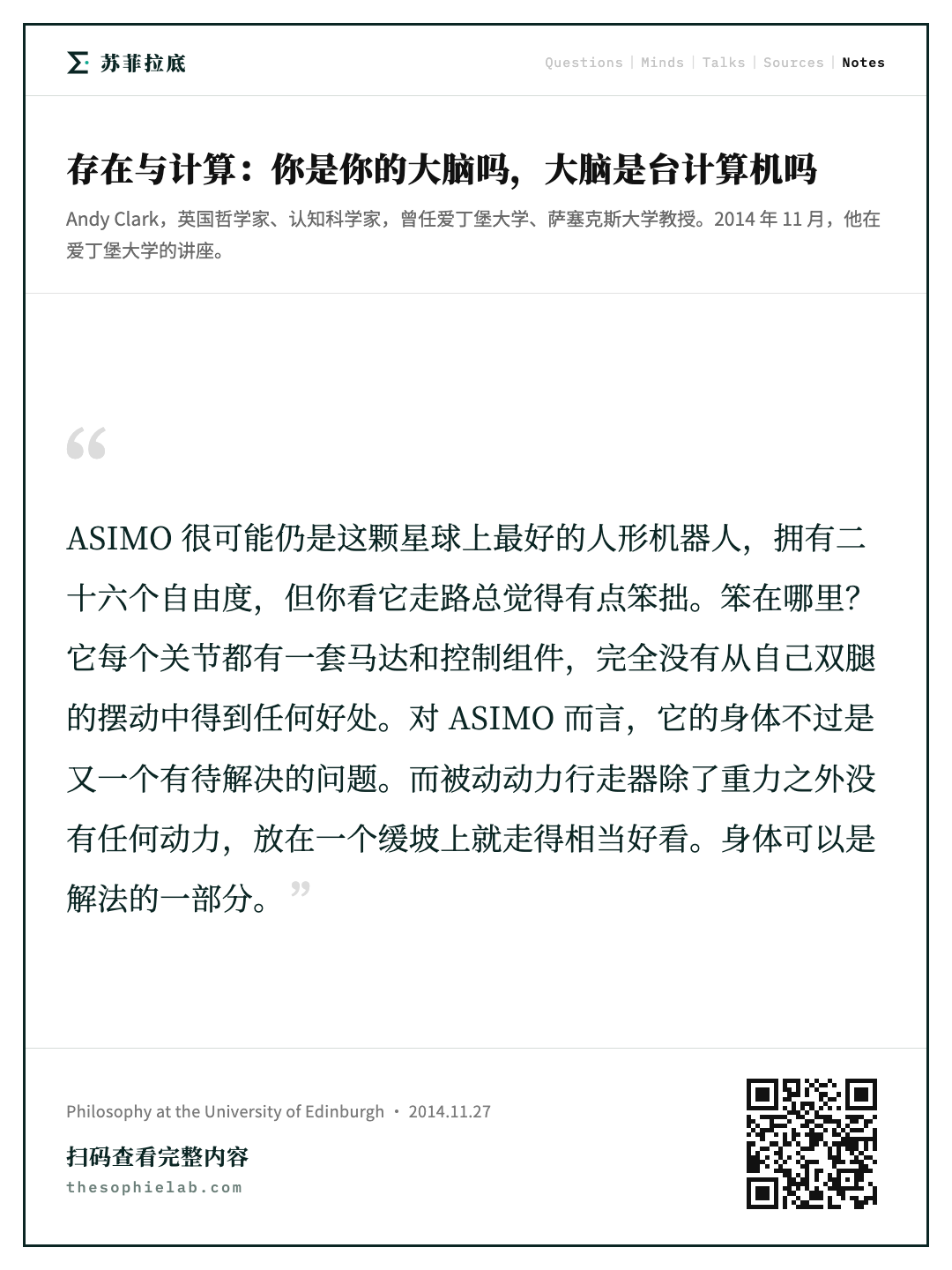
克拉克:ASIMO 就在做这件事。你们有些人见过 ASIMO,塞思的演讲里也闪过一小段。ASIMO 是一台非常先进的人形机器人,很可能仍是这颗星球上最好的人形机器人,拥有二十六个自由度。但你看 ASIMO 走路的时候,总觉得它有点笨拙。笨在哪里?也许就在于它没有充分利用自己的身体。所以这里有一个问题:你什么时候才能把自己的具身条件用到极致?

想想能量效率。这可以用所谓的「运输比能」(specific cost of transport)来衡量,也就是把单位重量运送单位距离所需的能量。这个指标的好处是它把体重的因素抹平了,你可以很重但依然得分很好,所以它并不歧视又大又重的机器人。ASIMO 在这个指标上得分是 3.2,这不算好,分数越低越好。人类的得分是 0.2,非常好。那么问题出在哪里?看起来 ASIMO 为完成任务干得太辛苦了:每个关节都有一套马达和控制组件,它完全没有从自己双腿的摆动中得到任何好处,不像塞思展示的那个投掷棒球的装置,能从自己手臂的摆动中获益。对 ASIMO 而言,它的身体不过是又一个有待解决的问题。

所以我要摆到桌面上的第一点,塞思的演讲里也已经提到了:身体可以是解法的一部分。把 ASIMO 和另一类东西比较,你就能体会到差别。这类东西叫被动动力行走器(passive dynamic walker),除了重力之外没有任何动力,也不计算关节角度控制,但只要把它们放在一个缓坡上,它们就走得相当好看,形成一种稳定的、像人一样的步态。这是第三代被动动力行走器,你可以看到它是如何从手臂的摆动、臂上的配重和脚底的弧度中得益的。

接下来你可以问:怎样把这种流畅感移植到一台有动力的行走装置上?一种做法是,把身体形态免费提供的这一整套被动动力学都保留下来,再为它找一个控制器,这个控制器只负责推一推、点一点、拨一拨,把这些动力学用到最大。我想这正是塞思那个投掷棒球的摆臂所展示的东西。

这里是康奈尔实验室的一台普通被动动力行走器,完全没有驱动装置。这是段老片子,我觉得很有意思,你看它的步态,这东西除了自己的身体形态和脚下这段缓坡之外一无所有,而它走得大概比旁边陪着走的那个人还好。随后麻省理工的机器人实验室涌现出一大批机器人,试图把动力驱动、推拨式的控制和这类被动动力学结合起来。我最喜欢的一个叫「机器学步儿」(Robo Toddler),它真的能学,能学到一套控制策略,把自己的被动动力学用到极致,还能做到诸如适应两条履带速度不一致的跑步机之类的事,相当了不起。还有一个很早的例子我也很喜欢,麻省理工腿部实验室那台蹦蹦跳跳的机器人,同样是把丰富的身体动力学和简单形式的控制结合在一起。这真是一台快乐的机器人。

Puppy 机器狗:材料与环境的匹配

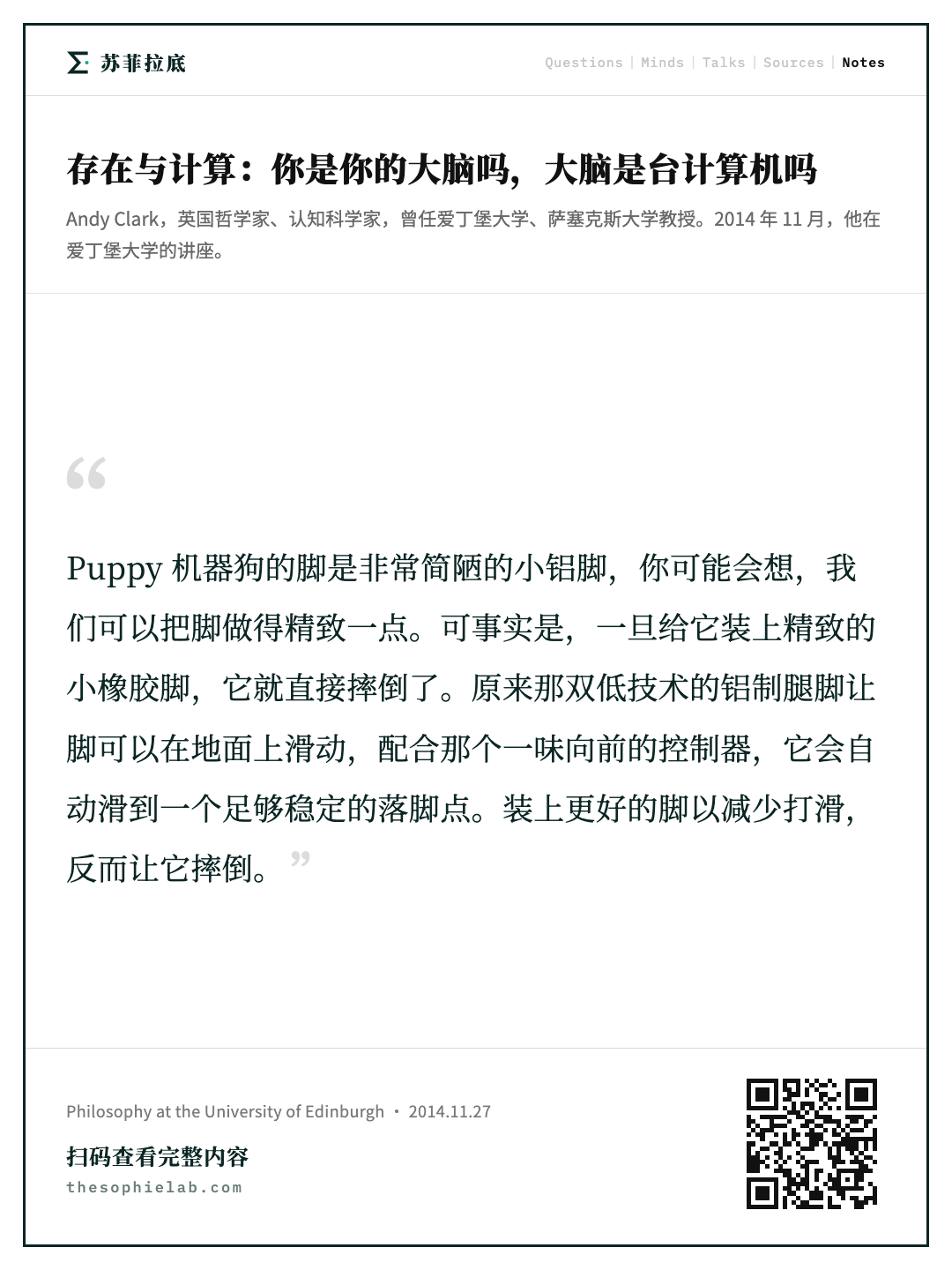
克拉克:再讲几条这类道理。这是 2006 年普法伊费尔(Pfeifer)和飯田(Iida)做的 Puppy 机器狗。这就是 Puppy 的表现,看起来不怎么惊人,就这么一路晃过去。但我想从中引出的一点是:你看 Puppy 的脚,是非常简陋的小铝脚,没有任何花哨的地方。你可能会想,我们可以把脚做得精致一点。可事实是,一旦给 Puppy 装上精致的小橡胶脚,它就直接摔倒了。原来那双低技术的铝制腿脚扮演着相当重要的角色:它们让 Puppy 的脚可以在地面上滑动,配合那个一味向前的控制器,它会自动滑到一个足够稳定、可以继续前进的落脚点。装上更好的脚以减少打滑,反而让 Puppy 摔倒。这里有一些关于材料的有趣东西:材料与环境之间的关系,以及在材料、环境和控制策略三者之间找到恰当匹配的重要性。

从某种意义上说,这些系统的身体形态、构成材料,加上被动动力学之类的生物力学特性,为控制器创造了一片高低不平的地形,控制器在这片地形上学习控制。于是控制器可以找到一些极简的策略,把材料和生物力学已经提供的东西用足。比如对我们这样的系统来说,存在若干稳定且能量消耗最低的步态:跳、跑、走、小跑、蹦。给定我们的身体生物力学、给定构成我们的材料,这些是我们可以进入的稳定步态。要控制像我们这样的身体,控制器就可以设法把这些用到极致。

这些案例都属于普法伊费尔和邦加德(Bongard)在 2007 年那本好书里所说的「形态计算」(morphological computation)。引用他们的话:身体能够执行那些本来必须由大脑来执行的功能。这就是我想放上桌面的第一条道理。在这些案例里可以说,控制与加工在某种意义上渗入了身体:身体形状、材料、生物力学的联动、被动动力学,它们简化了产生相当复杂行为所需的神经指令。我把这称作控制与加工渗入身体。当我们最后谈到心灵的时候,这一点会很重要。

主动结构化数据流:戳世界的婴儿

克拉克:现在快速看一下行动。转向行动之后的想法是:做着意想不到的工作的,不只是粗略的形态、生物力学和被动动力学,还有身体在行动中的熟练运用。我认为这里的一项关键贡献,是「主动结构化我们自身的数据流」这一概念:以某种方式在世界中移动,从而生成信息流,这些信息流再帮助我们解决问题。

这是 Babybot,梅塔(Metta)和菲茨帕特里克(Fitzpatrick)的工作。Babybot 能做的事情之一,是通过戳戳推推来学习物体的边界。基本过程是这样的:在这个特定的学习案例里,它在自己面前挥动手臂,它预期会看到某种运动特征;但如果它随后在视野里看到一大片扩张的、不断增长的运动,那就表明它碰到了一个物体,把桌面上的一个物体推动了。因此,搜索视觉上探测到的运动扩散,让 Babybot 得以利用运动来发现眼前物体的存在。本来有几段很好的视频,可惜放不出来。想法是,存在这样一些富有信息的感觉运动相关性:一阵突然的运动扩散帮你识别物体边界。而我们做大量这样的事:我们戳世界,捅世界,用各种方式介入世界,以改善我们自己的数据流。这不只是婴儿的把戏,我们人类是自身数据流肆无忌惮的结构化者。我认为这是我们身上一件略显古怪的事,需要更仔细地看。

当你主动结构化自己的数据流时,你就不再只是一台被动的输入输出机器,不是坐在那里等着什么东西撞上来再处理信息。你在生成那些可能让你学得更好、做得更好的信息流。想想高级认知,想想我们人类在高级认知中做的事,那些事很怪:我们画草图,我们涂涂写写,我们打手势,我们把东西卸载到纸页上,再回头重新审视纸页上的东西。所有这些情形里,你都可以理解为我们在创造结构化的信息流,它们以某种方式帮助我们解决问题,尽管这些信息流是我们自己生成的。你可能会想,画草图的时候你肯定已经理解了,不然怎么画得出来?但我们一直在这么做:画点什么,看一看,问题的解决就往前推进了一步。

手势是思维的一个维度

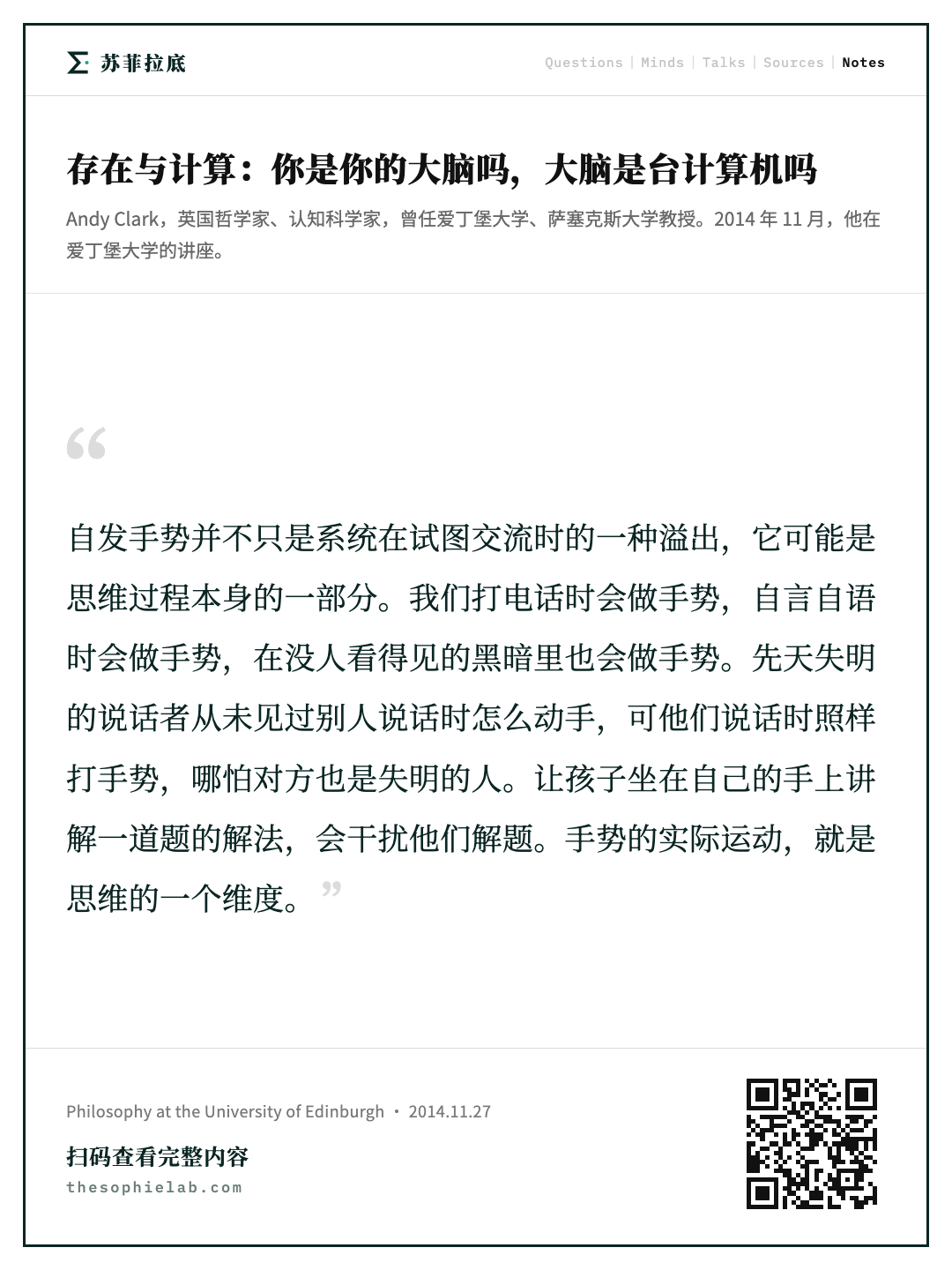
克拉克:关于这一点有一些不错的案例研究,其中一项我过去看过而且非常喜欢,是身体手势在思维中的作用。有些有趣的研究表明,自发手势并不只是系统在试图交流时的一种溢出,它可能是思维过程本身的一部分。也就是说,自发手势在某种程度上做着认知的工作。实验我稍后再讲,先说线索:有迹象表明手势可能不只是在做交流的工作。我们打电话时会做手势,自言自语时会做手势,在没人看得见的黑暗里也会做手势。据说当人真正在推理一个问题、而不只是描述一个已知答案时,手势会增多,这一点我可以作证。所以当你看到有人手势很多,你可能觉得那不过是在比划,但这或许说明他们真的在思考。这其实就是认知装置的一部分。而且你能看到它在起作用:先天失明的说话者从未对着看得见的听者说过话,从未见过别人说话时怎么动手,可他们说话时照样打手势,哪怕对方也是明知失明的人。这些线索表明,手势可能是某个整合系统的一部分,这个系统一旦运转就会自动启动手势。

还有一批不错的实验,为了给演讲结尾留出空间我把它们压掉了,但它们基本表明:如果你抑制人做手势的能力,就会干扰他们完成某些认知任务的能力。例如让孩子坐在自己的手上给你讲解一道题的解法,会干扰他们解题。这里的想法是,手势具有某种认知价值。我认为一种可能的模型是,手势有点像画草图:你打手势时,把某种物理的东西带入了存在,而这个你带入存在的物理东西,随后就可以用来驱动、增强或改变你自己的加工过程。丹尼尔·丹尼特(Daniel Dennett)有时会谈到「认知自我刺激」的路径,我想这大概就是其中一例。我们做了某件事,这件事反馈进我们自己的神经加工系统,而正是这个整体系统在解决问题。

在我看来,这是延展心灵这根楔子的尖端。艾弗森(Iverson)和西伦(Thelen)在 1999 年给出了一幅很好的图景,他们说:言语、手势和神经活动持续地相互告知、相互受告知,共同构成一个单一的整合系统。这就是说,这些表面上互不相干的东西如此紧密地耦合在一起,实际上形成了一个单一的问题解决系统。用他们的话说,这是一种涉及词语、手势和神经活动的动态相互性,其中任一成分的活动都可能牵动其他任何成分的活动。麦克尼尔(McNeill)说得更明确:手势本身,手势的实际运动,就是思维的一个维度。这是一个我愿意为之辩护的主张。

这里有一幅总体图景,手势只是一例。画草图,把你想的东西画出来,做数学时把方程写下来,这些都属于同一类。想法是:自我生成的运动活动是神经信息加工的一种补充,它带来了新的认知整体。这出自伦加雷拉(Lungarella)和斯波恩斯(Sporns):运动活动对信息的结构化,与神经系统对信息的加工,通过感觉运动回路持续地联结在一起。所以我们拥有的这种心灵,似乎总是随时准备把身体和世界用到极致,把它们纳入统一的问题解决集合体。并不是所有人工智能都必然如此,也许我们能设计并造出不这样运作的东西,如果造出来了,它们大概也是智能系统,只是不是我们所熟知的那种智能。

这是具身心灵的第二条道理:认知渗入了整个知觉行动回路。如果这是对的,那么这类认知的引擎就不只是一颗赤裸的大脑,而是一个整体,是大脑与感知着、行动着、运动着的身体协同作业的整个复合体。现在我们需要把世界也放进这个等式。塞思已经给了很多关于怎样把世界放进来的提示,那我们就来做这件事。

金枪鱼借水发力:认知渗入世界

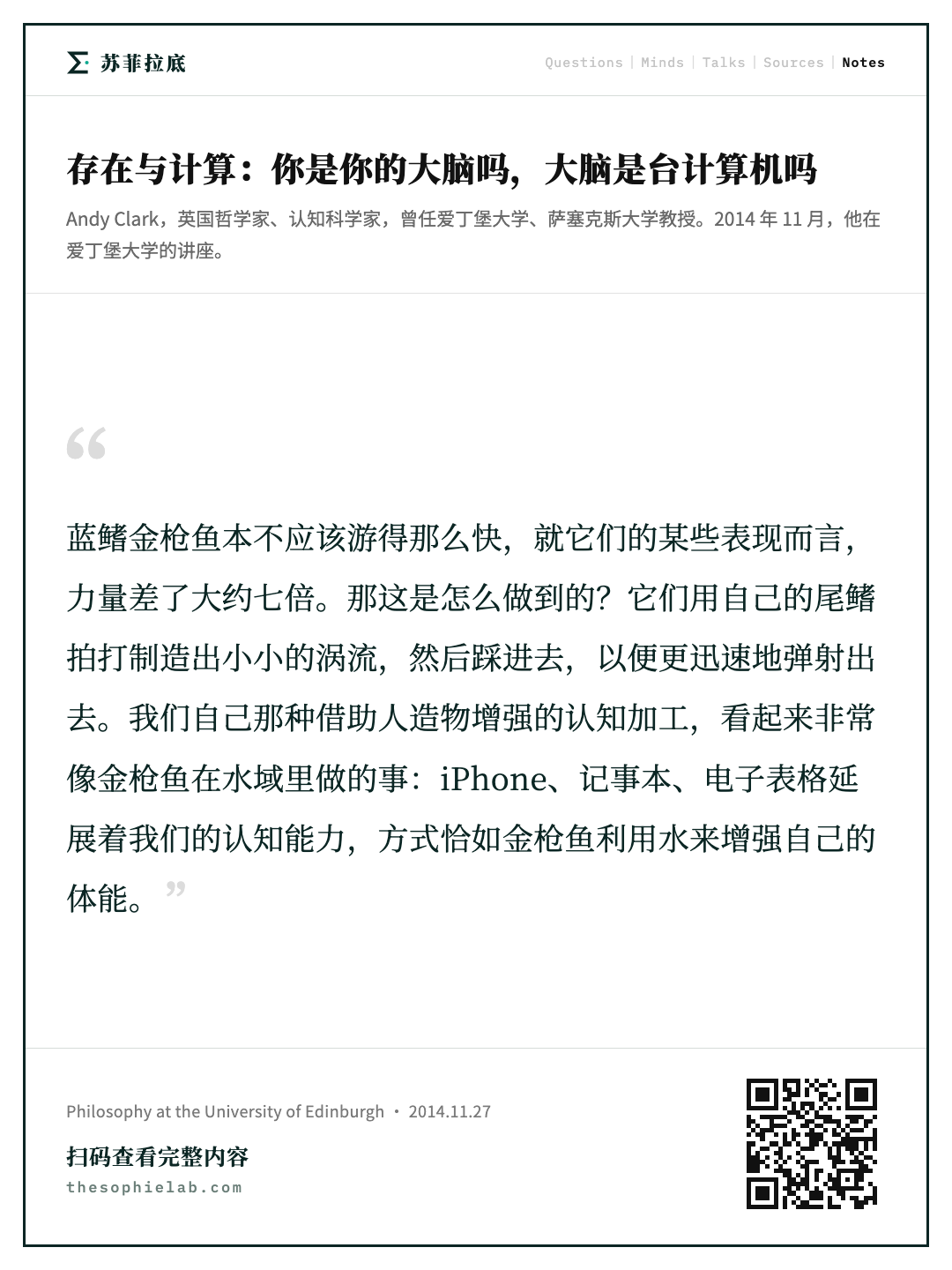
克拉克:这是我的一个很老的例子,但我至今仍然喜欢:蓝鳍金枪鱼之谜。这是麻省理工的流体动力学家特里安塔菲卢(Triantafyllou)兄弟的旧作。蓝鳍金枪鱼显然是极为出色的水生动物,它们的表现在某种意义上超出了它们的基本生理功率。我不太清楚这是怎么测的,不知道怎么测量一条蓝鳍金枪鱼的基本生理功率,但据说它们本不应该游得那么快,也不应该转弯转得那么急,就它们的某些表现而言,它们的力量差了大约七倍。那这是怎么做到的?看来金枪鱼把周围的世界用到了极致。它们利用水中自然出现的涡流和漩涡,水里有旋涡,金枪鱼就借力,这你可能料得到。但更有意思的是,它们用自己的尾鳍拍打制造出小小的涡流,然后踩进去,以便更迅速地弹射出去。金枪鱼扰动水体,再利用这个环境给自己的爆发加速。这又是在利用环境,就像塞思那个投球装置利用自身身体的动力学一样:介入环境,创造出结构,再把这些结构用足。他们用一条大型的阳极氧化铝与莱卡材质的机器金枪鱼做了测试,正是你想要的那种东西。

你大概能看出这要往哪里走。这是为延展心灵这个概念做的铺垫。因为如果你现在想想我们自己那种借助人造物增强的认知加工,我认为在认知领域里,它看起来非常像金枪鱼在水域里做的事。我们使用各种外部操作和媒介:iPhone、记事本、电子表格。它们或许正在延展和增强我们的认知能力,方式恰如金枪鱼利用水来增强自己的体能。我们边想边记笔记,之后再回看;我们画图,然后自己立刻去看这张图。这里的想法是,我们在建造更大的认知机器,并把它们用足。

这就引向一个强主张。我今天没有真正给出支持它的论证,只给了铺垫,你们在这里听不到什么论证,但铺垫就是这些。强主张是:并非所有真正的思考都发生在头颅之内、只是顺带绕进身体一圈。它全都像手势的情形。在手势的情形里,你可能会承认身体的运动是思考的一部分。如果你肯让我这一步,我想你就已经准备好接受其余的部分了:在另外那些情形里,你在记事本、电子表格、iPhone 上做的事,同样是思考的一部分。我一会儿再回来谈这个。

于是想法是:通向外部媒介的回路,可以成为我们称之为心灵的那个整合思维系统的组成部分。这就是克拉克与查默斯的延展心灵主张,你们明白意思就行。

失忆执事 Patrick:延展的人格

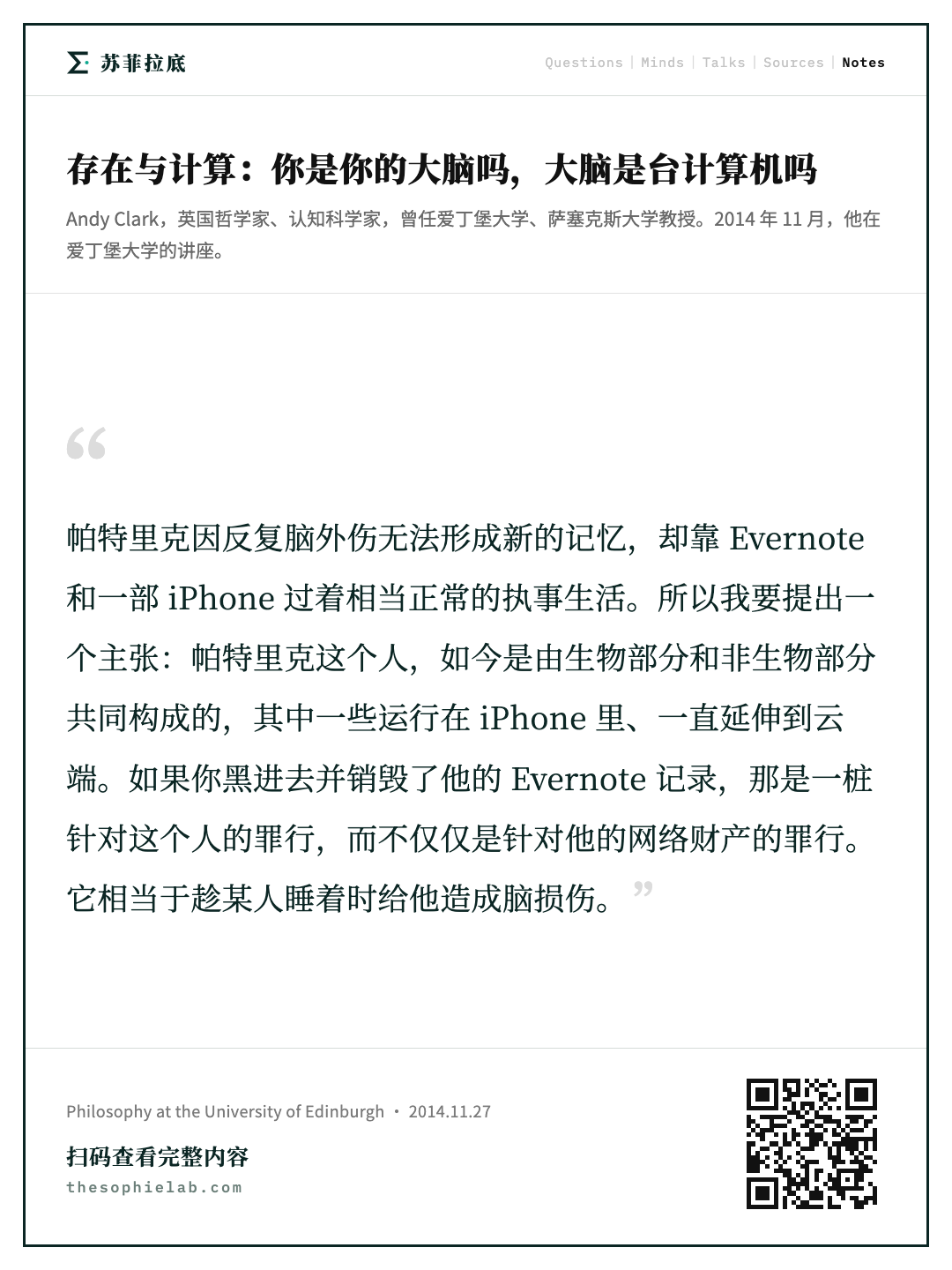
克拉克:那么我们为什么应该相信这一点?相信了又有什么要紧?我今天把所有哲学论证都压下了,我认为是有一些的,它们大体依赖于对等性(parity)、整合以及持续耦合之类的考虑。但这里有另一种思考方式。看看帕特里克·琼斯(Patrick Jones)的案例。帕特里克因反复的创伤性脑损伤而患有严重的记忆障碍。基本情况是,他小时候从婴儿床上摔下来过很多次,后来骑山地车又反复摔下来,反复的脑外伤导致他患上了你在电影《记忆碎片》里见过的那种记忆丧失:他无法形成新的记忆。尽管如此,他是科罗拉多斯普林斯的一名天主教执事,在某种描述层面上,他过着相当正常的执事生活。而且这并不依靠什么高科技干预:他用的是 Evernote、Curio 和一部 iPhone 的组合。靠着这些,他在世界中行走时,在这些外部媒介里建起了大片相互链接的结构之网,这些网基本上承担着让他在自己的事务和外界动态中保持方向感的职责。如果有人来找他,他就得去查阅这些结构之网,弄清谁是谁、什么是什么。有一篇很好的论文叫《假如 H.M. 有一部黑莓》,H.M. 是心理学文献里一个古老而著名的失忆症案例。也许就在二十年前,有这种损伤的人会被送进机构,而如今有这种损伤的人不再被收容,他们往往能在社区里过得很好。正是因为有那一整套在外部媒介中运转着的东西,他才能回想起自己和谁谈过话、做了什么决定等等,也才把天主教执事这份职责履行得相当不错。

所以我要提出一个主张:帕特里克这个人,如今是由生物部分和非生物部分共同构成的,其中一些非生物部分甚至没有附着在他的身体上,而是运行在 iPhone 里、一直延伸到云端。如果你黑进去并销毁了他的 Evernote 记录,我认为那是一桩针对这个人的罪行,而不仅仅是针对他的网络财产的罪行。它相当于,借用丹尼特的话,趁某人睡着时给他造成脑损伤。今天早些时候弗朗西斯·伊根(Frances Egan)的演讲里有这样一种想法:延展心灵已经够难吞下了,延展的人格那就更难吞下。不管值不值钱,我在这里要把「延展的人格」这颗子弹咬得死死的。当然,你也能看出这会走向哪里:如果你碰巧对这种关于帕特里克的看法有所同情,那你就应当对同样的看法用在你身上也有所同情,因为你的笔、纸、笔记本、日记补充着你基本的生物信息加工构型,方式与那些东西补充帕特里克的一模一样。如果你认为他是一个延展心灵的混合系统,那么我认为我们也是。

这就是具身心灵的最后一条道理:认知不仅渗入身体,还渗入世界。如果这是对的,那么构成「你」的某些东西,运行在由横跨大脑、身体和世界的资源所构成的新机器上。这里我省略了一些东西,马上就要换到这场演讲的第二挡了。我在第一部分省略的一点是其他人:我没有谈他们,但在这个故事里,他们当然可以是你整体认知经济的重要部分。我还省略了所有关于意识和情绪的考虑,你可能认为那些东西不会被延展,也许决定你意识状态的一切都在头颅之内,即便你的认知状态可以渗出到世界里。这一点我在这里不置一词。

到目前为止的故事是:要理解真实的人类认知,我们需要认真对待认知、控制和加工是如何与身体、行动和世界绑在一起的。只要看看人类本身,就会发现我们比乍看之下古怪得多。设想一台下棋机器,在琢磨下一步时不停地轻声自言自语;或者一个专家系统,你向它提问,它得先打印几张草图、看上一眼,才肯着手回答你的问题。你会想,它不需要这么做啊,它肚子里有什么就有什么。但我们似乎不是这样。我们做的所有这些介入,暗示着我们自身基本认知架构的某种形态。我认为这是一种内部认知架构,它生来就要与外部的东西和媒介结成统一的整体。我们就是这样的东西。

大脑是百宝箱还是有核心机制

克拉克:以上都是关于具身的老故事,是我做了很久的东西。现在我想谈点别的,然后在结尾处想一想它们如何拼在一起。你可能会说,那大脑呢?有些人听了延展心灵的故事,以为它意味着大脑不重要。它当然从来不是这个意思。那么,在这些复杂的大脑、身体、世界系统里,我们该如何看待大脑的角色?

有一个可能的答案,也是我过去真正相信过的答案:大脑就是一箱花招,这些花招或许非常巧妙地适应了我们人类身体的具体情况和我们特定的环境。它是一个很酷的百宝箱,能通过毕生学习自我调校等等,但里面也许就是许许多多不同的策略。今天有人提到罗斯·阿什比(Ross Ashby),他说过一句话:大脑没有什么诀窍,它有的是五十亿年的研发。阿什比还说过另一句话,我没放在幻灯片上:大脑的全部功能可以用两个词概括,「纠错」(error correction)。所以他大概是在两边下注。这就是那种想法:也许大脑没有什么核心诀窍,只是无数的研发堆出来的。

但还有另一种可能:也许确实存在某种核心机制,某种表明大脑中的运作比「适应性大杂烩」这幅图像所暗示的更加统一的东西。如果真是这样,那也许会有助于一项计划:在所有那些杂乱的具身互动之网底下,找出若干核心原则。如果大脑真有这样一个机制,或许就能让我们系统地把握这大批案例,否则在我看来它们只是一袋漂亮的轶事。所以我要以两点简短的想法结束,谈谈晚近的一些进展,它们让我从「一袋花招」派转向了「核心机制」派。

预测加工:知觉是受控幻觉

克拉克:候选的核心机制,或者说统一原则,就是预测。按照我想摆到桌上的这个正在浮现的故事,像我们这样的大脑是多层次的感官预测机器。这一点出现在塞思的演讲里,今天反复出现,在安尼尔(Anil)的演讲里更是随处可见。这里的经典工作有拉奥(Rao)和巴拉德(Ballard)1999 年的论文、弗里斯顿(Friston)和李(Lee)等人 2003 年的工作,最近则是卡尔·弗里斯顿拿起这些东西一路狂奔,画出了各种更宏大的图景。

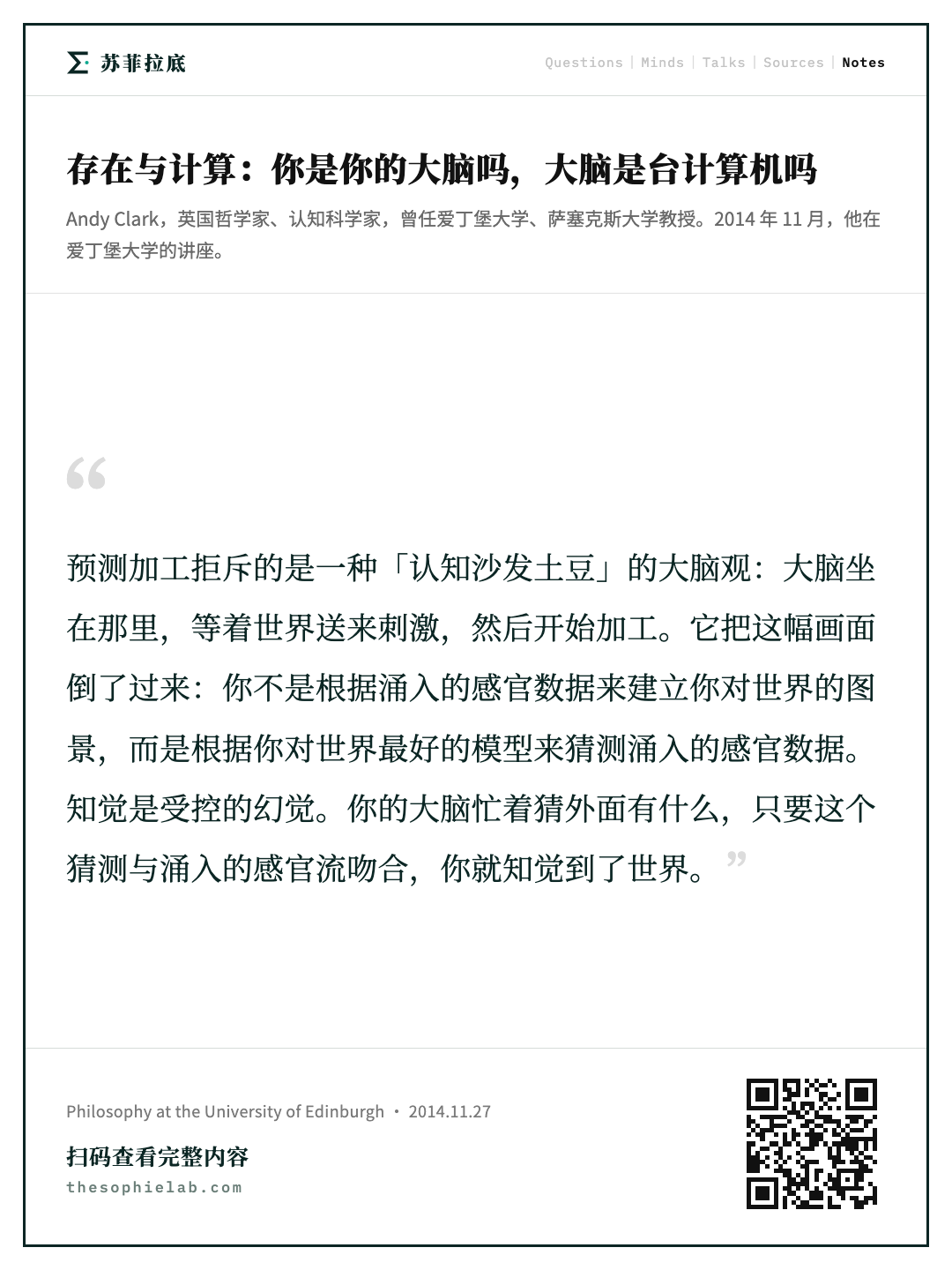
这幅图景是什么?它通常被称为「层级预测加工」(hierarchical predictive processing)、「预测加工」或者「层级预测编码」(hierarchical predictive coding)。我更喜欢「预测加工」这个说法,因为「预测编码」暗示的是一种简单的数据压缩策略,而「预测加工」暗示的更像是一种真正的加工策略,而不仅仅是数据压缩。这类理论在某种意义上把一种熟悉的知觉观翻了个底朝天。它们拒斥的是一种可以称为「认知沙发土豆」的大脑观:大脑坐在那里,等着世界送来刺激,然后开始加工,再发出一个运动指令或一个判断。那是一种「输入、加工、输出」的模型,你脑子里的画面很自然就是东西从世界扑过来砸在你身上,你再做出反应。层级预测加工把这幅画面倒了过来:你不是根据涌入的感官数据来建立你对世界的图景,而是根据你对世界最好的模型来猜测涌入的感官数据。故事里有一个贝叶斯的转折。

这里的框架是:成功的知觉,发生在你成功猜中了涌入的感官信息流的时候,而且是用一个多层的层级系统猜中的。想法是,系统内存在多路并发的信号传递:某些细胞群把它们的预测向下传送,这些预测与涌入的感官流相遇,凡有出入之处就产生一个残余的误差信号,预测误差在系统中流动,它既可以召来一个更好的预测,也可以驱动学习,去改变生成这些预测的底层模型。这只是一个极简的速写。但这样的大脑是主动出击的,它们的要紧之处在于,它们在许多空间尺度和时间尺度上,不断地试图预测所有感官通道上抵达的感官信号。这是朝着一种由内部驱动得多的知觉观的转向。它让人想起视觉科学家拉梅什·贾恩(Ramesh Jain)造的那句口号:知觉是受控的幻觉(controlled hallucination)。意思是,你的大脑忙着猜外面有什么,只要这个猜测与涌入的感官流吻合、把它「解释掉」,你就知觉到了世界。

凹面具与正弦波语音演示

克拉克:其实我早该把这东西打开,这样那个错觉会好看得多。这是一个凹面具,你大概能看出来,因为我可以把手伸进去。但在你们看来它很可能像一张朝外凸出的脸,尤其是坐在房间右侧的人。你可以把它看作一个演示,展示同一个过程如何把人引入歧途:你对「脸是凸的,鼻子是突出来的」这一点的强烈预测,在这里压过了涌入的部分感官信息。实际存在的、指明凹陷的信息,被你自上而下的凸起预测压制了,指明凹陷的信息被当作了噪声。

好,现在我可以再做一个快速演示,看看这种事能发生得多快。我要播放几段正弦波语音(sine wave speech)。正弦波语音是把普通语音剥去大部分正常属性后得到的退化版本,剩下的是一种骨架般的信号。我先放骨架版,再放原声版,然后再放一遍骨架版。将会发生的是,一旦你能通过主动预测掌握正弦波版本,它在你听来会变得截然不同。看看能不能成功,我得确保按对了按钮。

这是正弦波语音。接下来是原声:「她用刀切」(She cuts with her knife)。再放一遍正弦波版本。你们应该在现象学上听出巨大的差别。再来一个。哦,有人已经会直接听懂正弦波了,听得够多就能做到。「水壶很快烧开了」(Kettle boiled quickly)。现在给你们一个更难的,刚才那个还算容易。再听一遍。我想这确实表明,主动预测能多么迅速地改变我们的体验。

当然你可能要问,大脑一开始是怎么学会做所有这些预测的?我认为真正妙的一点在于,预测任务,也就是试图预测自己感官输入流的任务,是一种「自举天堂」(bootstrap heaven)。如果你想预测一句话的下一个词,懂语法会大有帮助;而如果你想学会大量语法知识,一个很好的办法就是一遍又一遍地去预测句子的下一个词。所以你可以利用预测任务,通过人们已经相当了解的梯度下降学习方法,自举出你日后在预测任务中要用到的知识。如果这个故事是对的,我们就是通过不断预测自己的感官刺激来了解世界的:我们了解杯子、桌子、椅子、语法,了解外面的一切,靠的就是试图预测我们自己不断变化的感官刺激。当然,预测驱动的统计学习是行得通的,它在机器学习里得到了广泛应用。

行动是自我实现的预言

克拉克:现在把这些拉回到具身行动上来,然后我就停。我觉得有趣的一点是,在这些图景里,内部经济变得与我在前半场谈到的那类具身互动极其紧密地咬合在一起。因为我们并不只是被动地预测感官流,我们实际做的是移动身体,以求把那个感官流带出来。这与主动结构化信息流的概念正相吻合。在层级预测加工中,行动的模型是:行动是一种自我实现的预言。大脑预测出如果执行某个行动将会出现的感觉轨迹,然后通过移动身体,把那组感觉带入存在,从而消除预测误差。这是让世界去符合预测。也就是说,预测「如果你把身体动得恰到好处、稳稳待在冲浪板的那个甜蜜点上会产生的感觉流」,这件事本身,如果你恰好是个好冲浪手,就会化为那股行动之流,消除预测误差,把冲浪板恰好放在你想要的位置。这是「观念运动」(ideomotor)行动观的一个版本:行动是由对这些行动本身的感官后果的预测所催生的。

所以这里的想法是,从动力学上说,整个具身的、行动着的系统在这里自组织起来,以减少对感官输入的预测误差。这带来对世间原因的把握,猫、汽车、飓风;但它同时也决定了行动,从而帮助选择接下来的感官刺激流。安尼尔几天前又向我提起,这其实是对威廉·鲍尔斯(William Powers)在七十年代提出的一条原则的重新发现:行为应当被重新理解为对知觉的控制。不要把知觉想成对行为的控制,把它倒过来,把你的行为想成对知觉的控制,方式是让行为去选择下一批感官输入流。

我喜欢这些东西。我认为这是一种非常丰富的大脑功能模型,它沟通了神经科学与计算模型,而且完美契合现实世界中实时学习和行动的要求。我认为它正是我一直在谈的所有具身认知内容的完美补充。还有一点我没提,但我认为极其重要:这些模型也承诺了极简形式的内部控制。它们基本上是在寻找能把系统维持在其小小的生存窗口之内所需的最少预测。你要找的是那些内部模型、前向模型,它们能用最少的参数预测感官流的相关方面。这是在预测任务上应用某种「奥卡姆因子」。如果这些东西要成为具身认知的完美补充,我认为这是另一件必须一起上船的事:一种关于「懒惰的预测大脑」的好图景,大脑尽量少预测,只要把事情办成就行。

结论:你不是你的大脑

克拉克:我来总结一下,然后我们可以停下来讨论。我为什么喜欢预测加工?我认为这里至少有一种基础理论的线索,它可能把知觉、行动、学习和高效形式的神经控制连接起来。

结论。「你是你的大脑吗?」这是题目里的问题之一。我要在这一点上追随苏珊·赫尔利(Susan Hurley):不,你不是你的大脑。你是一个不断变动的动态纠缠体,牵涉大脑、身体,有时还有世界。这也意味着你并不总是同一个东西,一分钟一分钟地变。如果你是这种变动的动态纠缠体,那么当你在世界中穿行时,确实有某种东西是连续的,但它不是世界中某个特定的物理小块,它更像是一种「招募」(recruitment)的过程,或者类似的东西。我想这个想法值得再往下追一追。

「你的大脑是一台计算机吗?」你们可能注意到了,我根本没有回答这个问题。我想这是因为,关于成为一台计算机、成为一次计算、成为对某个问题的一种计算式解法的必要条件,我们可以争论很久,而且我认为不会有结果。我们能说的是:如果你想把大脑看成一台计算机,那至少要注意到,它大概是一台相当古怪的计算机。这是一台永远在嗡嗡作响的计算机,总在试图赶在感官流击中它之前把它预测出来。它是一台内部自发活动多到吓人、且一刻不停的计算机。我建议,它更像是一个操作系统之类的东西,持续运转,同时处理着各种各样的任务。就到这里,谢谢大家。
排版 + 横图 + 来源,粘贴即成稿
章节 · 点击跳转视频
0:19 开场:具身、心灵与延展的故事 ▶ 正在看
2:56 ASIMO 与被动行走器:身体是解法 ▶ 正在看
6:54 Puppy 机器狗:材料与环境的匹配 ▶ 正在看
11:01 主动结构化数据流:戳世界的婴儿 ▶ 正在看
13:24 手势是思维的一个维度 ▶ 正在看
17:13 金枪鱼借水发力:认知渗入世界 ▶ 正在看
21:05 失忆执事 Patrick:延展的人格 ▶ 正在看
26:25 大脑是百宝箱还是有核心机制 ▶ 正在看
28:56 预测加工:知觉是受控幻觉 ▶ 正在看
32:58 凹面具与正弦波语音演示 ▶ 正在看
35:59 行动是自我实现的预言 ▶ 正在看
39:44 结论:你不是你的大脑 ▶ 正在看
本期小问 · 档案清单
39:44 如果你不只是你的大脑,你还包括什么? ▶ 正在看
2:56 手势是思维本身的一部分,还是说话时顺带的比划? ▶ 正在看
21:05 毁掉失忆者手机里的笔记,算不算伤害了这个人本身? ▶ 正在看
28:56 知觉是接收涌来的感官信息,还是抢先猜中它? ▶ 正在看
本期讲者
安迪·克拉克英国哲学家、认知科学家,曾任爱丁堡大学、萨塞克斯大学教授。1998 年与 David Chalmers 合作提出「延展心灵」假说,著有《Being There》《Supersizing the Mind》《Surfing Uncertainty》,是具身认知与预测加工理论的主要推动者。
主持人会议主持人,负责介绍讲者与主题。
01开场:具身、心灵与延展的故事
0:19
okay um so I think we're ready for our next talk in the evening um it's going to be given by Professor Andy Clark who's a professor at the uh School of philosophy uh uh here and um he's going to be talking about being in Computing are you your brain or is your brain a computer um and it's your brain computer first Professor Clark um is uh he's been working in philosoph for many years and he is uh most famous for developing or one of the things that famous for developing is the extended view extended mind view uh is that um our minds uh can extend beyond our heads maybe not I'll do thank you thank you cool um okay well I do absolutely hate following SE I really do because everything that I'm about to say has a better illustration I think than something that the SE has just done um but here we go anyway let's go through it basically what I'm going to do tell you a bunch of my my favorite stories about about embodiment mind and extension some of those will be familiar very familiar to some of you and then about sort of um three quarters of the
好,嗯,我想我们可以开始今晚的下一场演讲了。这场演讲由 Andy Clark 教授主讲,他是我们这里哲学学院的教授。他要讲的主题是「在场与计算」——你就是你的大脑吗?还是说你的大脑是一台计算机?你的大脑是计算机吗?Clark 教授在哲学领域已经耕耘多年,他最广为人知的贡献之一,就是提出了延展心灵的观点,也就是说我们的心灵可以延展到颅骨之外,也许不是……好,我就说到这儿。谢谢,谢谢。好的,嗯,说实话我特别不愿意排在 Seth 后面讲,真的,因为我接下来要说的每一点,Seth 刚才都已经用更好的例子演示过了。不过既然如此,我们还是往下走吧。我基本上要做的,就是给大家讲一堆我最喜欢的关于具身、心灵和延展的故事,其中一些对在座的某些人来说会非常非常熟悉,然后大概讲到四分之三的
便签笔记
1:38
way through I'll kind of switch gear try and say something about some stuff which is it was actually there in what SE was saying it's been there um earlier today and what Marie Shanahan was saying uh and suggest that maybe there might just be hints in this later stuff of a kind of fundamental theory about the earlier stuff so basically I guess what I think is earlier approaches to embodiment and cognition are a kind of nice bunch of anecdotes and it might take something more to put it on the road to be in something like um a systematic science and I'm hoping that the sort of few comments at the end point in that direction that's a plan anyway right okay thank you Eden okay so so mostly I'm going to be talking about the being there I'll be talking about why bodily form action and the local environment really matter what huge differences they make to us as if you like cognitive engines I'll also say just a little bit about Computing about why the human brain which is in there somewhere doing something important um if it is some sort of computer looks to be a rather weird kind of computer basically a Computing device which is persistently proactive one which is continuously trying to predict the incoming stream of sensory inputs so I kind of hope is
地方,我会稍微换一下档,试着讲一点别的东西,其实那些内容在 Seth 刚才的报告里就已经出现了,今天早些时候也出现过,Marie Shanahan 讲的内容里也有。我想指出的是,在后半部分这些东西里,也许恰恰藏着某种关于前半部分内容的基础理论的线索。所以基本上我的看法是,早期那些关于具身与认知的进路,只是一堆很不错的轶事集合,要把它推上通往某种系统性科学的道路,可能还需要更多的东西。我希望结尾那几句评论能指向那个方向。总之这就是计划。好,谢谢你,Eden。好,那么我主要会讲「在场」这部分:讲为什么身体形态、行动和局部环境真的重要,讲它们对我们这些——如果你愿意这么说的话——认知引擎造成了多么巨大的差别。我也会稍微讲一点计算的问题:讲为什么人类的大脑,它就在那里做着某些重要的事情,如果它算是某种计算机的话,它看起来是一种相当奇怪的计算机——基本上是一台持续保持前摄性的计算设备,一台不断试图预测即将到来的感觉输入流的设备。所以我有点希望的是,
便签笔记
02ASIMO 与被动行走器:身体是解法
2:56
putting that together with some of the earlier pictures might end up in a unified picture I won't deliver that but that's a hope so maybe one day that'll get delivered okay so be in a bit about that the the key idea here I think is that control and information processing aren't restricted to the brain or the central nervous system that should have been CNS of CNC instead maybe bodly an environmental structure and activity can do all kinds of work and we saw some of this in some of Seth's examples but so let's consider something more basic something like just controlling two-legged Locomotion not a very easy task H does azimo does some of this some of you will have seen azimo there's a little fragment of it in in se's talk um azimo is a very Advanced humanoid robot possibly still the best humanoid robot on the planet 26 Dees of freedom but there's something clunky about azimo when you watch azimo in motion there's still something clunky about azimo what might could be maybe what it is is that it's not exploiting its own embodiment to the full so there's a kind of issue yeah when can you make the most of your own embodiment so think about Energy Efficiency you can measure this by something called the specific cost of Transport which is the amount of energy
把这些和前面那几幅图景拼在一起,最终可能会得到一个统一的图景。我今天交不出这个统一图景,但那是一个希望,也许有一天能兑现。好,先讲一点「在场」的内容。我觉得这里的关键想法是:控制和信息处理并不局限于大脑或中枢神经系统——那里本来应该写 CNS 而不是 CNC——相反,身体结构和环境结构及其活动可以承担各种各样的工作。我们在 Seth 的一些例子里已经看到了一部分。那我们来考虑一些更基础的东西,比如仅仅是控制双足行走,这可不是件容易的事。ASIMO 就做了一部分这样的事,你们有些人见过 ASIMO,Seth 的报告里也有它的一小段画面。ASIMO 是一款非常先进的人形机器人,可能到现在还是地球上最好的人形机器人,26 个自由度。但 ASIMO 身上总有点笨拙的感觉,当你看着 ASIMO 运动的时候,还是能感觉到某种笨拙。原因可能在于,它没有充分利用自己的具身性。所以这里有个问题:你什么时候才算把自己的具身性用到了极致?那么想想能量效率。你可以用一个叫做「单位运输成本」的指标来衡量,也就是所需的能量
便签笔记
4:17
required to carry a unit weight a unit distance what's good about that measure is that it sort of washes over anything about your own body weight so you can be good at this despite being heavy if you like so it doesn't S of discriminate against big heavy robots but if you score aimo on this 3.2 that's not good the lower the score the better score of human on this 0.2 that's very good so what's going on looks as if what's going on is that in azimo um aimo is kind of working too hard to do the job in a certain way each joint has a motor and control assembly and aimo isn't benefiting from the swing of its own legs not for example the way that in sethu stuff there that the baseball picture was benefiting from the the swing of its own arm so as you Mo's body if you like it's kind of like just one more problem to be solved so the first thing I want to put on the table just again it was coming out in se's talk is that the body can be part of the solution so if you compare azima with a bunch of other things passive Dynamic Walkers you can begin to sort of appreciate the difference passive Dynamic Walkers don't have any power except gravity they don't calculate joint angle control but if you put them on the dental surface they look quite good so they they create a kind of
——把单位重量运送单位距离所需的能量。这个指标的好处在于,它把你自身体重的因素给抹平了,所以哪怕你很重,你也可以在这项指标上表现得很好,它不会歧视又大又重的机器人。但如果给 ASIMO 打分,是 3.2,这不太好——分数越低越好。人类的得分是 0.2,非常好。那么问题出在哪儿?看起来,ASIMO 是在以某种方式过于费劲地完成这项工作:它的每个关节都有一套马达和控制组件,而 ASIMO 并没有从自己双腿的摆动中获益,不像 Seth 讲的那个棒球投掷装置那样能从自己手臂的摆动中获益。所以对 ASIMO 来说,它的身体如果你愿意这么讲的话,只是又一个需要被解决的问题。我想摆到桌面上的第一点——这在 Seth 的报告里也已经浮现出来了——就是:身体可以成为解决方案的一部分。所以如果你把 ASIMO 和另外一类东西,也就是被动动力学行走器做个比较,你就能开始体会到差别。被动动力学行走器除了重力之外没有任何动力,它们不计算关节角度控制,但如果你把它们放在平缓的斜坡上,它们看起来相当不错。它们能产生一种
便签笔记
5:35
stable human looking Walkin there's a a third generation passive Dynamic Walker it's got kind of you can see how it might benefit from the swing of its arms the weights on its arms the curvature of the feet there here's that so you could also ask how you build on this kind of fluency in a powered walking device one thing that you can do then is try and take all of those sort of pass Dynamics so stuff that you're kind of getting for free from the bodily form and find a control a controller for that that sort of pushes and nudges and tweaks that system making the most of all of those Dynamics and I think there again that's something that you saw a nice example of in the in The Swinging sort of baseball throwing um baseball throwing arm so here's um here's actually just an ordinary passive Dynamic Walker in the cor Corell lab that's just got no no actuation at all this is an old piece of film I think it's quite you know if you look at the kind of the The Walking gate there this thing has absolutely nothing except its bodily form and being on this gentle slope and actually you know it's it's probably walking better than the guy that's walking with it and then there was a whole flurry then of of robots coming out of the MIT
稳定的、很像人类的步态。这是第三代被动动力学行走器,你可以看出它是怎么从手臂的摆动、手臂上的配重、脚部的曲率中获益的。就是这个。你还可以问,怎么在这种流畅性的基础上做出一台有动力的行走装置。你能做的一件事,就是把所有那些被动动力学——也就是你从身体形态那里白白得来的东西——拿过来,然后为它找一个控制器,这个控制器只是去推一推、轻轻拨一拨、微调一下这个系统,把所有这些动力学利用到极致。我想这方面你们刚才在那个摆动的棒球投掷手臂的例子里也看到了一个很好的示范。这里是康奈尔实验室里一台完全普通的被动动力学行走器,它根本没有任何驱动。这是一段很老的影片,我觉得挺有意思的,你看那个行走的步态,这东西除了自身的身体形态和处在这个缓坡上之外一无所有,而且说实话,它走得可能比旁边那个陪它走的人还好。后来又冒出了一大批机器人,来自 MIT 的
便签笔记
03Puppy 机器狗:材料与环境的匹配
6:54
robot lab that as it were tried to combine powered locomotion kind of nudge and tweak style control and these sorts of um passive Dynamics there's one of my favorites Robo toddler that actually was able to learn to it could learn the control policy that would make the most of its own passive Dynamics it could do stuff like adapt to treadmills where one of the the Treads was actually moving at a different speed to the other pretty cool stuff and here's a very early example that I just love the bouncing hopping robot from the MIT leg lab which again combines sort of um Rich bodily Dynamics and these simple forms of control this is just a joyful robot you got yeah we could let that Lo for so okay moving on with a few more of these sorts of morals this is a puppy robot um from R fer and uh yida back in 2006 puppy is uh well this is what puppy does it doesn't look terribly impressive you know kind of kind of wers along there but the point that I'm going to bring out of this is just that um if you look at puppy's feet there they're kind of very basic little sort of little aluminum aluminium feet so there there nothing very fancy there you might think well you know we could fancy up the feet
机器人实验室,它们试图把有动力的行走、这种推一推微调一下式的控制,和这类被动动力学结合起来。这是我最喜欢的之一,Robo toddler(学步机器人),它实际上能够学习——它能学到一套把自身被动动力学利用到极致的控制策略。它能做到像适应跑步机这样的事,哪怕跑步机的一条履带和另一条履带的速度不一样,相当酷。这里还有一个我特别喜欢的早期例子:MIT 腿部实验室的弹跳机器人,它同样把丰富的身体动力学和这些简单形式的控制结合在一起。这就是个让人开心的机器人。我们可以让它一直跳下去。好,我们继续讲更多这类寓意。这是一个叫 puppy 的机器狗,来自 Rolf Pfeifer 和 Iida,是 2006 年的工作。puppy 做的就是这样的事,看起来不怎么了不起,就是那么晃晃悠悠地走。但我想从中引出的一点是:你看 puppy 的脚,那是很基础的小铝脚,一点也不高级。你可能会想,我们完全可以把脚做得高级一点。
便签笔记
8:16
but actually if you fancy up the feet and give puppy little sort of rubber feet puppy just Falls over um so it turns out that the sort of the low Tech aluminium legs and feet were playing quite an important role and the role that they were playing really was to allow puff his feet to sort of slip around on the surface until with that sort of forward goinging controller it would automatically find a spot that was stable enough to move forward on so reducing the slippage by adding kind of fancier feet just caus puffy to fall over so there's some something interesting here about materials the relation between materials and environments and the importance of getting the right fit between materials environments and control strategies okay so what's going on there in a way is that kind of the bodily form the materials that these things are made of um plus the kind of biomechanical stuff like the passive Dynamics and so on creates if you like a sort of uneven landscape for the controller to learn the control so the controller can then if you like find sort of minimal strategies that make the most of the things which are already provided by materials and by um and by biomechanics so for example there are sort of a number of stable minimal energy extend expenditure Gates that are available for those um for those kinds
但实际上,如果你把脚做高级了,给 puppy 装上小橡胶脚,puppy 就直接摔倒了。所以事实证明,那种低技术含量的铝制腿和脚起着相当重要的作用,而它们起的作用其实是:让 puppy 的脚能在地面上打滑、四处滑动,直到在那个一味向前的控制器作用下,自动找到一个足够稳定、可以蹬着往前走的落点。所以通过换上更高级的脚来减少打滑,反而让 puppy 摔倒了。所以这里有一些关于材料的有趣之处:材料与环境之间的关系,以及在材料、环境和控制策略之间找到正确匹配的重要性。好,从某种意义上说,这里发生的事情是:身体形态、这些东西所用的材料,加上像被动动力学之类的生物力学因素,一起构成了——如果你愿意这么说的话——一片起伏不平的地形,控制器要在这片地形上学习如何控制。于是控制器可以去找到那些最省事的策略,把材料和生物力学已经提供好的东西利用到极致。举例来说,有若干种稳定的、能量消耗最小的步态可供这类
便签笔记
9:41
of systems like in US jumping running walking trotting skipping those are kind of stable Gates that we can get into given our bodily biomechanics given the materials that we're made of so to control bodies like ours you can have controllers that try to make the most of that okay Sor jump so these are all cases of what Fifer and bongard in their nice 2007 book called morphological computation quote from them bodies can perform functions that would otherwise have to be performed by brains so that's a kind of first sort of moral that I think I want toh put on the table there in those cases you could say there's a sense in which control and processing are kind of leaking into the body bodily shape the materials the biomechanical linkages the passive Dynamics they're simplifying the neural commands required to bring about quite complicated behaviors so I I think of that as control of process in leaking into the body this will be important in the end when we think about um the the mind so a quick look at action now so moving into action the thought is that it's not just grow form biomechanics passive dynamics that might be doing unexpected work but also just the skilled use of the body in action so one sort of key contribution I think
系统使用,就像我们人类的跳跃、跑步、行走、小跑、单脚跳一样,那些都是我们凭借自身的生物力学、凭借构成我们身体的材料就能进入的稳定步态。所以要控制像我们这样的身体,你可以使用那些试图把这些东西利用到极致的控制器。好,跳过这一页。这些都属于 Pfeifer 和 Bongard 在他们 2007 年那本很棒的书里称之为「形态计算」的案例。引用他们的话:身体可以执行那些原本必须由大脑来执行的功能。所以这是我想摆到桌面上的第一条寓意。在这些例子里,你可以说,控制和处理在某种意义上正在渗漏进身体:身体形状、材料、生物力学连接、被动动力学,它们都在简化实现相当复杂行为所需要的神经指令。所以我把这叫做控制与处理渗漏进身体。等我们后面谈到心灵的时候,这一点会很重要。现在快速看一下行动。转到行动方面,我的想法是:可能在做着意料之外的工作的,不只是身体形态、生物力学和被动动力学,还有在行动中对身体的熟练使用。所以我认为这里一个关键的贡献
便签笔记
04主动结构化数据流:戳世界的婴儿
11:01
here is the notion of actively self structuring our own data flows so moving around in the world in ways that bring into being flows of information that then help us to solve problems so here's baby bot um baby bot is um meta and Fitz Patrick's work one of the things that baby bot does is can learn about object boundaries by poking and shoving so basically what goes on with baby b is it sort of moves its own in this particular learning case it can s its own arm in front of it there's a kind of motion signature that it expects there but if it then gets a kind of a sort of a big expansion a growing expansion in the visual field then what that indicates is that it's come across an object that it's pushed an object around on the table in front of it so searching for spread of visually detected motion there enables baby but as it were to use motion to discover the presence of an object in front of it so were some nice videos of that I couldn't actually make work so we w't get the videos but so the idea is that there are these informative sensory motor correlations a sudden motion spread helps you identify object boundaries and we do a lot of this we poke the world we prod it we intervene in all kinds of
是「主动地自我结构化我们自己的数据流」这个概念:以某种方式在世界中活动,从而催生出信息流,而这些信息流反过来帮助我们解决问题。这里是 baby bot,是 Metta 和 Fitzpatrick 的工作。baby bot 做的其中一件事,是通过戳和推来学习物体的边界。基本上 baby bot 的做法是:在这个特定的学习情境里,它把自己的手臂伸到面前挥动,它对此有一个预期中的运动特征模式;但如果它接下来在视野中看到一大片扩张、不断增长的扩张,那就表明它碰到了一个物体,它把面前桌上的一个物体推动了。所以,去搜索视觉上检测到的运动的扩散,就让 baby bot 能够利用运动来发现面前有一个物体存在。本来有几段很不错的视频,但我没能让它们播放出来,所以我们看不了视频了。总之这个想法是:存在这些富含信息的感觉运动相关性,一片突然扩散的运动能帮你识别物体边界。而我们人类经常这么干:我们戳世界,我们捅它,我们用各种各样的方式去干预,
便签笔记
12:15
ways to improve our own data flows so it's not just a trick for babies we humans I guess are rampant self structures of our own data flows and I think this is something which is kind of slightly weird about us that we need to we need to look harder at so there's a sort of sense in which when you self structure your own data flow you're not just a sort of passive input output machine you're not just sort of waiting there for something to come at you and processing information you're bringing into being the streams of information that might enable you to learn better to perform better and so on so think about higher cognition think about the things that we humans do in higher cognition we do some weird stuff we sketch we scribble we gesture um you know we we off load stuff onto Pages we reinspect the stuff which we put out on the pages uh in all these cases what you can think of is that we're we're creating these structured flows of information that somehow help us to solve problems even though we brought those flows into being you might think that when you draw a sketch well you must have already kind of understood it because you drew it but we do this all the time we draw something then we have a look at it we move our problem solving
以此改善我们自己的数据流。所以这不只是婴儿的把戏。我想我们人类是自身数据流的疯狂结构化者。而我觉得这是关于我们的一件略显奇怪的事情,我们需要更仔细地去看它。从某种意义上说,当你自我结构化你自己的数据流时,你就不再只是一台被动的输入输出机器了,你不是干坐在那里等着什么东西撞上来然后处理信息,你是在主动催生出那些能让你学得更好、表现得更好的信息流。想想高阶认知,想想我们人类在高阶认知里做的那些事,我们干的事挺古怪的:我们画草图,我们涂涂写写,我们打手势,我们把东西卸载到纸面上,然后又回过头去重新审视我们自己写在纸上的东西。在所有这些情形里,你都可以认为,我们是在制造这些结构化的信息流,它们以某种方式帮我们解决问题,尽管这些信息流是我们自己催生出来的。你可能会想,当你画一张草图时,你肯定早就已经理解了它,不然你怎么画得出来?但我们一直在这么做:我们画点什么,然后看一看,于是我们的问题求解就
便签笔记
05手势是思维的一个维度
13:24
along so there's some nice case studies of this um one of them I've looked at and and enjoyed very much in the past is the role of physical gesture in thinking so there's some interesting work suggesting that spontaneous gesture isn't a sort of a just a sort of outflow of the system when it's engaged in trying to communicate but instead could be part of the actual process of thinking if you like so the idea is that spontaneous gesture is somehow doing cognitive work there's actually a actually I'll get to the experiment in a minute so there are clues that maybe it might be doing more than communicative work um we do spontaneous gesture when we talk on the phone we do it when we talk to ourselves we do it in the dark when nobody can see gesturing apparently increases I can vouch for this when genuinely reasoning about a problem rather than merely describing a known solution so when you see someone gesture a lot you might think well that's just sort of you know hand waving it might suggest they're really thinking about it in fact this is just part of as it were it's part of the cognitive apparatus and you can see it in action speakers blind from birth who have never spoken to a visible listener never seen others move in their hands as they speak they also
往前推进了一步。关于这一点有一些很好的案例研究,其中一个我过去研究过、也很享受的,就是身体手势在思维中的作用。有一些有意思的工作表明,自发的手势并不只是系统在试图交流时的一种外溢输出,相反,它可能就是思维实际过程的一部分。所以这个想法是,自发手势在以某种方式做着认知工作。其实我等会儿会讲到那个实验。有一些线索表明,手势也许做的不止是交流的工作:我们打电话的时候会做自发手势,我们自言自语的时候会做,我们在黑暗里没人看得见的时候也会做。而且显然,当人们在真正推理一个问题、而不只是描述一个已知答案时,手势会增加——这一点我可以现身说法。所以当你看到某人手势很多,你可能会觉得那不过是在挥手比划罢了,但这反而可能说明他们正在真正地思考。事实上这就是认知装置的一部分。你还能在这个现象上看到:天生失明、从未对着一个看得见的听者说过话、也从未见过别人说话时手怎么动的人,他们
便签笔记
14:35
jure when they speak and they do that even when they're talking to others that are known to be blind so it Clues there that gesture might be in some way part of an integrated system that that sort of Springs into action anyway there's also a bunch of nice experiments which I've suppress to make room for the the stuff at the end of this talk but basically what they show is that if you if you suppress the ability to gesture you interfere with the ability to do certain cognitive tasks so you know getting children to sit on their hands as they talk you through their solution to a problem interferes with their problem solving for example there's some idea here that gesture has some sort of cognitive value and I think a possible model of that is that when you it's a bit like sketching when you gesture you bring something physical into being that something physical that youve brought into being is then aailable to drive your own processing along to augment or alter your own processing So Daniel dennit sometimes talks about the PA of cognitive self- stimulation I think this is probably one of those cases we we do something and and that something feeds in our own neural processing systems and it's that overall system that is the
说话时同样会打手势,而且哪怕在跟明知也是盲人的人交谈时也照打不误。所以这里有线索表明,手势可能在某种意义上是一个整合系统的一部分,这个系统会自动启动起来。还有一批很不错的实验,为了给这场报告结尾的内容腾地方我把它们删掉了,但它们基本上表明:如果你抑制人打手势的能力,就会干扰他们完成某些认知任务的能力。比如让孩子们坐在自己手上,一边给你讲他们对某个问题的解法,这会干扰他们的问题求解。所以这里有个观念是,手势具有某种认知价值。而我认为一个可能的模型是:这有点像画草图——当你打手势时,你把某种物理的东西带到了世界上,而这个你带到世界上的物理东西,接着又可以反过来推动、增强或改变你自己的加工过程。所以 Daniel Dennett 有时会谈到认知的自我刺激。我想这大概就是其中一类情形:我们做出某个动作,而那个动作又反馈进我们自己的神经加工系统,正是这个整体系统才是那个
便签笔记
15:50
problem solving system so this is a kind of thin end of the extended mind wedge and my opinion at least I and Sal back in 1999 have a nice picture of this they say speech gesture and neural activity continuously inform and are informed by each other together constituting a single integrated system so this is the notion of these superficially disperate things being so deeply coupled together as to form what's effectively a single problem solving system as they say a dynamic mutuality involving words gestures and neural activity so that activity in any one component can potentially in tray in activity in any other or mcne quite explicit about this the gesture the actual motion of the gesture itself is a dimension of the thinking and that's a claim that that I would want to defend so there's a general picture here I Gest is just one example sketching um sketching what you think writing equations down while you do mathematics these would all be examples that fall in the same kind of ballpark the idea would be that self-generated motor activity is a complement to neural inflamation processing that brings into being new cognitive holes this is from larella and forms information structuring by motor activity and information processing by
解决问题的系统。所以这算是延展心灵这个楔子的薄的那一端,至少我是这么看的。I 和 Sal 在 1999 年对此有一段很好的描述,他们说:言语、手势和神经活动持续地相互告知、相互被告知,共同构成一个单一的整合系统。所以这就是那个观念——这些表面上互不相干的东西彼此耦合得如此之深,以至于形成了一个实际上单一的问题求解系统。用他们的话说,是一种涉及词语、手势和神经活动的动态互动性,其中任何一个成分中的活动都可能牵动任何其他成分中的活动。McNeill 对此说得相当明确:手势,也就是手势本身的实际运动,是思维的一个维度。这是一个我愿意为之辩护的主张。所以这里有一幅一般性的图景,手势只是其中一个例子;画草图、把你的想法画出来、做数学时把方程写下来,这些都属于同一类的例子。这个想法是:自我生成的运动活动是神经信息加工的一种补充,它催生出新的认知整体。这段话引自 Lungarella 和 Sporns:由运动活动进行的信息结构化,与由
便签笔记
06金枪鱼借水发力:认知渗入世界
17:13
the neuros system are continuously linked through sensory motor Loop so the the kind of Minds that we have seem to be Minds that are somehow um kind of always poised to make the most of body and World sort of bringing them into these sort of unified problem solving ensembl and it's not obvious that every artificial intelligence would be like that maybe we could design and build things that don't work that way if we did they'd probably be intelligent systems but not intelligence as we know so second moral of the embodied mind cognition leaks into these whole perception action Loops so if that's true then the engine of these kinds of cogni is not just a naked brain it's a whole it's a whole complex the brain in concert with the sensing acting moving body what we now need to do is um get the world into this equation you have already given many hints about how to get the world in so let's just do that so here's a very old example of mine um but one that I do still like the blue fin tuna puzzle this is um old work by the trianta fu Brothers fluid dynamicists at MIT so this is about blue tuners blue fin tuners are apparently fantastic aquatic animals their their performances in some way seem to outpace their basic physiological power so I'm
神经系统进行的信息处理,是通过感觉运动回路持续联结在一起的。所以我们拥有的这种心灵,似乎总是随时准备把身体和世界利用到极致,把它们纳入这些统一的问题求解组合体里。而且并不是所有人工智能都显然会是这样的:也许我们可以设计并建造出不那么工作的东西,如果真那样,它们大概仍然是智能系统,但不是我们所知的那种智能。所以具身心灵的第二条寓意是:认知渗漏进了整个知觉—行动回路。如果这是对的,那么这类认知的引擎就不只是一个赤裸的大脑,而是一个整体,是大脑与感知着、行动着、移动着的身体协同构成的整体。我们现在要做的,是把世界也纳入这个方程。前面已经有很多关于如何把世界纳进来的提示了,那我们就来做这件事。这是我一个很老的例子,但我到现在还是很喜欢:蓝鳍金枪鱼之谜。这是 Triantafyllou 兄弟的旧研究,他们是 MIT 的流体动力学家。这讲的是蓝鳍金枪鱼。蓝鳍金枪鱼显然是极其出色的水生动物,它们的表现在某种意义上似乎超出了自身基本的生理功率。我
便签笔记
18:37
not entirely sure how this gets measured don't know quite how you measure the basic physiological power of a blue finin tuner but apparently they shouldn't be able to go as fast as they do they shouldn't be able to turn as sharply as they do um they're too weak by boun a factor of seven for some of their own performances so how's it all working looks as if what the T do is they make the most of the world around them so the tuna use naturally occur in edes and VES so if there's a swirl in the water the tuna can make the most of it you might expect that but more interestingly maybe they use their own tail flaps to create little vortices like that that they can then sort of step into to blast off more quickly so the tuna disturb the water and then make the most of the environment to turbocharge their own sort of blast St for example so again that's um that's sort of beginning to exploit the environment in the sort of way that sethu's um baseball thrower was exploiting um dynamics of its own body intervening on the environment to create these structures that you can then make the most of okay and they tested it using a big anodite aluminium and lro robot Tor it's just what you want there it is so you can probably see where that's
其实不太确定这是怎么测出来的,也不太清楚你要怎么测量一条蓝鳍金枪鱼的基本生理功率,但显然它们不应该能游那么快,也不应该能转弯转得那么急。就它们自己的某些表现而言,它们弱了大概七倍。那这一切是怎么做到的呢?看起来金枪鱼所做的,就是把周围的世界利用到极致:金枪鱼会利用自然存在的涡流和漩涡,所以水里如果有一股旋涡,金枪鱼就能加以利用——这个你可能预料得到;但更有意思的也许是,它们还会用自己的尾鳍拍打制造出这样的小涡旋,然后再一步踏进去,借此更快地弹射出去。所以金枪鱼先扰动水体,再把环境利用到极致,来给自己的爆发起步之类的动作增压。这又开始体现出对环境的利用了,就像 Seth 那个棒球投掷器在利用自身身体的动力学一样——干预环境,制造出这些结构,然后再把它们利用到极致。好,他们用一台巨大的阳极氧化铝加莱卡布料做的机器金枪鱼验证了这一点,正是你想要的东西,就是它。你大概能看出这要
便签笔记
19:52
going this is a sort of this is a kind of a softener for the extended mind kind of notion CU if you now think about own artifact enhanced cognitive processing I think that in a more cognitive domain it looks very much like what the tuner is doing in the watery domain so we use all kinds of external operations and media we've got you know iPhones notepads spreadsheets and maybe what they're doing is extending and augmenting our cognitive capacities in much the way that the tuner as it were uses the water to augment its own its own physical capacities so we write notes as we think we reinspect them later we draw diagram that we ourselves immediately inspect the thought will be this is this is if you like this is um building larger cognitive machines that we make the most of so this leads towards a strong claim I haven't really given you the arguments for it here all I've given you the softness you're not going to get any arguments really here but they were the softeners the strong claim would be it's not that all the real thinking happens inside the head and just Loops into the body it's all like the gesture case in the gesture case you might think look the motion of the body is part of the
往哪儿走了。这算是一种铺垫,为延展心灵这个概念做软化处理。因为如果你现在去想我们自己那种被人造物增强了的认知加工过程,我觉得在更偏认知的领域里,它看起来非常像金枪鱼在水里做的事。我们使用各种各样的外部操作和媒介,我们有 iPhone、笔记本、电子表格,而它们所做的,也许正是在延展和增强我们的认知能力,就像金枪鱼利用水来增强自己的身体能力一样。我们一边思考一边写笔记,稍后再回头审视它们;我们画出图表,然后立刻去看我们自己画的图表。这个想法是——如果你愿意这么说的话——这是在建造更大的认知机器,并把它们利用到极致。这就通向一个很强的主张。我今天其实没给你们论证,我给你们的只是那些软化铺垫,这里你们大概也不会真的听到什么论证,刚才那些都是铺垫。这个强主张是:并不是所有真正的思考都发生在脑袋里、只是循环进出身体而已;情况全都像手势那种情形。在手势的例子里,你可能会认为,身体的运动是思维的
便签笔记
07失忆执事 Patrick:延展的人格
21:05
thinking if you allowed me that much I think you'd be um as it were poised to accept the rest of it that in some of these other cases uh what you're doing on notepads spreadsheets iPhones is actually part of the thinking as well this is come back to AR about that in a minute okay so the thought would be Loops into external media can come to form part and parcel of the integrated system for thinking that we call the mind that's so Clark and charma's kind of extended mind claim avoid make you get the idea so why should we believe I mean would it matter if we did believe this and why should we believe it I one argument I don't often give so I've suppressed all the sort of philosophical Arguments for this today I think there are some they s sort of turn on considerations of parity and integration and um continuous coupling and so on but here's another way of thinking about it let's take a case like Patrick Jones Patrick Jones suffers severe memory impairments as a result of repeated traumatic brain injury so basically he sort of fell out the crown quite a lot as a kid and then he rode mountain bikes he fell off the mountain bikes so repeated traumatic brain injuries resulted in him having uh the kind of sort of memory loss that you might have seen in the movie momento like that so B
一部分。如果你肯让我把这一步坐实,我想你就已经准备好接受剩下的部分了:在另外一些情形里,你在笔记本、电子表格、iPhone 上所做的事,同样也是思维的一部分。这一点我等会儿再回来讲。所以这个想法是:进出外部媒介的回路,可以成为那个我们称之为心灵的整合思维系统的组成部分。这就是 Clark 和 Chalmers 那种延展心灵的主张,大意如此,你们明白这个意思。那我们为什么该相信它?我是说,如果我们相信了,这重要吗?为什么该相信它?有一个论证我不常讲——今天我把所有那些哲学论证都压掉了,我觉得确实是有一些论证的,它们大致依赖于对等性、整合性、持续耦合之类的考量——但这里还有另一种思考方式。我们来看一个案例,比如 Patrick Jones。Patrick Jones 因为反复的创伤性脑损伤而患有严重的记忆障碍。基本上他小时候老是从高处摔下来,后来又骑山地车,还老从车上摔下来,反复的创伤性脑损伤导致他出现了那种你可能在电影《记忆碎片》里见过的失忆症状。基本上,
便签笔记
22:28
basically he can't lay down new memories nonetheless he's a Catholic Deacon working in Colorado Springs and he holds down a fairly normal kind of Life as a Catholic Deacon in some ways some level of description and not because of Any really Hightech interventions he uses a combination of Evano curio and an iPhone and because of all that he as he moves through the world he creates large Interlink sort of webs of structure in these external media and they basically just have to play the role of keeping him oriented in his own projects in what's going on in the world if someone comes to see him he has to it were you know consult these webs of structure to try to um to try to get on top of who's who and what's what um there's nice paper on this what if hm an old famous Amnesia case from the pite literature had a Blackberry so you know at one time maybe maybe just you know 20 years ago people with with that that kind of damage were institutional nowaday people with that kind of damage aren't institutionalized they can very often get by very well in the community so it's only because of that whole up and running web of stuff running through all these external media and so on that he can recall who he spoken to What was decided on and so on nonetheless you know he holds down the
他没法形成新的记忆。尽管如此,他仍然是科罗拉多斯普林斯的一位天主教执事,在某种描述层面上,他过着相当正常的生活。而这并不是靠什么真正高科技的干预:他用的是 Evernote、Curio 和一部 iPhone 的组合。正因为如此,当他在世界中活动时,他在这些外部媒介里创造出了大片相互链接的结构网络,而这些结构基本上就得承担起让他在自己的各项计划中、在正在发生的事情中保持方向感的角色。如果有人来见他,他就得去查阅这些结构网络,努力搞清楚谁是谁、事情是什么。关于这个有一篇很好的论文,标题大意是:假如 HM——那位来自文献里的著名失忆症病例——有一部黑莓手机会怎样?所以你知道,在过去,也许就在二十年前,有那种损伤的人是要被送进机构的;如今有那种损伤的人不必被机构化,他们往往能在社区里过得相当不错。正是因为有这一整套运转着的、贯穿所有这些外部媒介的结构网络,他才能回想起自己跟谁谈过话、决定了什么事等等。尽管如此,你知道,他的
便签笔记
23:48
Catholic deaconship pretty well so here's a claim that I want to make Patrick the person is built now biological and non-biological Parts some of the non-biological bits not being even attached to his body some of it running through iPhones up into the cloud if you were to hack into and Destroy his OTE records I think that would be a crime against the person not merely a crime against his cyber property tant Ms down denn it once said to inflicting brain damage on somebody while they sleep so I think earlier today um in France Egan talk um there was a kind of thought that well the extended mind that's pretty hard to swall Extended persons that would be even harder to swallow so whatever it's worth I'm biting the extended person's um bullet as hard as I can and of course you can see where that goes if you if you happen to be sympathetic to that as a take on Patrick you should be sympathetic to it as a take on you as well because your pens papers notebooks Diaries complement your basic biological information process in profile in the same way as this other stuff complements his so if you think that he's kind of extended mind hybrid um system then I think so are we so that's the last moral of the embodied mind stuff cognition leaks not
天主教执事工作干得相当好。所以这里有一个我想提出的主张:作为人的 Patrick,如今是由生物性和非生物性的部件共同构成的,其中有些非生物部件甚至并不附着在他身上,有一部分是跑在 iPhone 上、一直延伸到云端的。如果你黑进去并摧毁他的 Evernote 记录,我认为那是一桩针对人身的罪行,而不仅仅是针对他网络财产的罪行。用 Dennett 曾经说过的话来讲,那无异于趁人熟睡时对其造成脑损伤。所以我记得今天早些时候在 Frances Egan 的报告里,有一种想法是:延展心灵已经够难吞下去了,延展的人格就更难吞了。所以不管值不值钱吧,我是在拼命把延展人格这颗子弹咬下去。当然你也能看出这会走向哪里:如果你碰巧认同这种对 Patrick 的看法,那你也应该认同这种对你自己的看法。因为你的笔、纸、笔记本、日记,补足你基本的生物性信息加工特征的方式,和那些东西补足他的方式是一样的。所以如果你认为他是那种延展的心灵混合系统,那我想我们也是。所以这就是具身心灵这部分的最后一条寓意:认知渗漏出去的,不
便签笔记
25:10
just into the body but into the world if that's right some of what makes you you runs on new machines that are built out of um resources that might span brain body and world and I've admitted some stuff here and I'm just about to come to that sort of move into the second gear of this talk but what I've admitted from the first bit is other people say anything about them but of course they could be important parts of your overall uh cognitive economy on this story and i' admitted all considerations concerning Consciousness and emotion you might think that somehow that doesn't get extended you know maybe everything that determines your conscious States is in the head even if your cognitive states can bleed out into the world I'm not saying anything about that here okay so Story So Far thought is to understand real human cognition we need to take seriously the ways in which cognition control and processing are kind of bound up with Body Action and world and that if you just look at human beings we really are a lot weirder than uh if you like we might at first appear think about a chess machine for example that kept talking to itself very softly while it was pondering the next move or an expert system where if you gave it a
只是渗进身体,还渗进世界。如果这是对的,那么让你成为你的东西,有一部分是跑在由横跨大脑、身体和世界的资源所构成的新机器上的。我在这里省略了一些东西,我马上就要换到这场报告的第二档了,但我在前半部分省略掉的东西是:别人。我一个字都没提别人,但当然,按照这个故事,别人完全可能是你整个认知经济中的重要组成部分。我也省略了所有关于意识和情绪的考量。你可能会认为,那些东西不知怎么就是延展不出去的:也许决定你意识状态的一切都在脑袋里,即便你的认知状态可以渗漏到世界中去。这些我今天都不打算讲。好,目前的故事是这样:要理解真实的人类认知,我们必须认真对待认知、控制和加工与身体、行动、世界纠缠在一起的那些方式;而且如果你光看人类,我们真的比乍看上去要古怪得多。比方说,想象一台国际象棋机器,它在琢磨下一步棋的时候一直很轻声地自言自语;或者一个专家系统,你给它一个
便签笔记
08大脑是百宝箱还是有核心机制
26:25
question you had to print out a few sketches and have a at them before it will proceed to try to answer your question you know you might think well it doesn't need to do that it's got it whatever it's got in it it's got in it but uh but we don't seem to be like that we do all of these interventions that suggests something about the shape of our own basic cognitive architecture I think it's a cogn it's an internal cognitive architecture that is built to kind of create unified holes with other kind of external stuff and media okay so the thought we're on we're like that okay so that's um that's just sort of old stories about embodiment the kind of stuff that I've been doing for quite a while what I want to do now just say a little bit about something else and then towards the end just wonder how they fit together so you know you might say okay what about the brain you know some people have listened to the extended mind kind of story and sort of thought that it means that brains don't matter like well of course it was never supposed to mean that brains don't matter so how should we think about the role of the brain in these complex brain body World Systems there's one possible answer there's one that I used to actually believe the answer would be look the
问题,它非得先打印出几张草图看一看,然后才肯着手回答你的问题。你可能会觉得,它根本不需要这么做啊,它肚子里有什么就是有什么。但我们似乎不是这样的,我们会做所有这些干预动作,而这暗示了我们自身基本认知架构的某种形态。我认为那是一种内部的认知架构,它天生就是要跟其他各种外部的东西和媒介一起构成统一整体的。好,所以我们的想法是:我们就是那样的。好,那些是关于具身的老故事,是我做了相当久的那类工作。现在我想稍微讲一点别的东西,然后到最后再想一想它们怎么拼到一起。你可能会说,那大脑呢?有些人听了延展心灵这套故事,会以为它意味着大脑不重要。当然,它从来就不是要说大脑不重要。那我们该怎么看待大脑在这些复杂的大脑—身体—世界系统中的角色呢?有一个可能的答案,也是我以前确实相信过的答案,那就是:你看,大脑
便签笔记
27:41
brain is just a kind of box of tricks tricks that are may be very neatly adapted to the specifics of our human body and to uh our particular environment so you know it's a cool box of Tricks it can tune Itself by lifetime learning and so on but maybe there's you know just lots of different strategies in that and in fact Ross Ashby came up today one of the things that Ross Ashby said is the brain has no gimmic she has 5 billion years of research and development AR like this um Ross Ashby also said although I haven't got it up here um the whole function of the brain can be summed up in two words error correction so he might have been sort of hedging his Vex here a little bit so there is that that that thought maybe there's no maybe the brain brain doesn't have any sort of core gimmick maybe it's just lots and lots of research and development but there's another possibility maybe there is a sort of core gimmick something that might suggest that what's going on in the brain is a bit more unified than the Adaptive grab bag image suggested and if that were true then maybe that would help with the kind of project of finding some core principles underlying all those messy webs of embodied interaction maybe if the brain did have a kind of
不过是一个装满各种花招的百宝箱,这些花招也许非常精巧地适配了我们人类身体的具体特点和我们所处的特定环境。你知道,这是个很酷的百宝箱,它能通过一生的学习自我调校,等等。但其中也许就是有一大堆各不相同的策略。事实上今天有人提到了 Ross Ashby,他说过一句话:大脑没有什么噱头,它有的是五十亿年的研发。大致是这样。嗯,Ross Ashby 还说过——虽然我没把它放上幻灯片——大脑的全部功能可以用两个词概括:纠错。所以他在这里可能稍微给自己留了点余地。总之是有这样一种想法:也许大脑并没有什么核心噱头,也许它就只是大量大量的研发积累。但还有另一种可能:也许确实存在某种核心噱头,某种表明大脑里发生的事情比那种「适应性大杂烩」的形象所暗示的要统一得多的东西。如果那是真的,那也许它会有助于我们去寻找那些支撑起所有那些杂乱的具身互动网络的核心原则。也许,如果大脑确实有那么一种
便签笔记
09预测加工:知觉是受控幻觉
28:56
gimmick that it like that would let us get systematically to grips with a lot of these um cases that I think otherwise just look like a nice bag of anecdotes something like that so I'm going to end with a few two brief thoughts on some recent developments that have sort of shifted me from a bag of tricks to a core gimmick kind of person so the candidate go cor gimmick if you prefer unifying principle here is prediction brains like ours on the emerging story that I just want to stick on the table it came up in set was talk it's come up repeatedly today it was all over anel's talk um the thought is that brain py are multi level sensory prediction machines some of the classic works here round Ballard 1999 Liam ler 2003 most recently Carl friston picking this stuff and up and running with it and doing all kinds of um larger pictures so what is that picture it's a picture that um is normally called something like hierarchical predictive processing or predictive processing for sure or hierarchical predictive coding I prefer predictive processing just because predictive coding suggests a simple data compression strategy and predictive processing suggests something more um more like an actual processing strategy and not simply data compression so these
噱头,那就能让我们系统性地把握住许多这样的案例,否则它们在我看来就只是一堆挺不错的轶事而已。所以我打算用关于近期一些进展的两点简短想法来收尾,正是这些进展让我从一个「百宝箱」派变成了「核心噱头」派。这个候选的核心噱头,或者你更愿意叫它统一原则,就是预测。我只想把这个新兴的说法摆上桌面:像我们这样的大脑——这在 Seth 的报告里出现过,今天反复出现过,Anil 的报告里更是通篇都是——这个想法是,大脑是多层级的感觉预测机器。这方面的经典工作有 Rao 和 Ballard 1999 年的论文、Lee 和 Mumford 2003 年的论文,最近则是 Karl Friston 把这套东西接过来大力推进,做出了各种更大的图景。那么这幅图景是什么?它通常被称为层级化预测加工,或者干脆叫预测加工,或者层级化预测编码。我更喜欢「预测加工」,因为「预测编码」听上去像是一种简单的数据压缩策略,而「预测加工」听上去更像是一种真正的加工策略,而不只是数据压缩。所以这些
便签笔记
30:18
things turn in a certain sense a familiar view of perception upside down what they're doing is rejecting what you could think of as a kind of cognitive Couch Potato view of the brain the view in which the brain just kind of sits there waiting for some stimulation to arrive from the world starts to do some processing and then issues a motor command or a judgment or or whatever so it would be a sort of input processing output model where you very much got the picture of stuff coming from the world hitting you and you responding to it hierarchical predictive processing turns out on its head instead of building up your picture of how the world is on the basis of the incoming sensory data what you do is you try and guess the incoming sensory data on the basis of your best model of how the world is so that's the kind of there's a sort of basian um twist in the story there so the schemer here is that successful perception happens when you successfully guess the incoming stream of sensory information and when you successfully guess it using a multi-layer hierarchical system the thought is that there are multiple concurrent bouns of signal passing in which some populations of cells send their predictions downwards those predictions meet the
东西在某种意义上把关于知觉的一个熟悉观点整个颠倒了过来。它们所做的,是拒斥那种可以称之为「认知沙发土豆」的大脑观——在那种观点里,大脑就是坐在那儿,等着某些刺激从世界那边到来,然后开始做点加工,接着发出一个运动指令、一个判断或者别的什么。所以那会是一种输入—加工—输出的模型,你脑海里的画面很典型:东西从世界那边过来撞上你,你对它做出反应。层级化预测加工把这个画面倒了过来:你不是在传入的感觉数据的基础上自下而上地建立起你关于世界如何的图像,你做的是在你关于世界如何的最佳模型的基础上去猜测传入的感觉数据。所以这个故事里有一种贝叶斯式的转折。这里的图式是:当你成功猜中了传入的感觉信息流,知觉就成功了;而且是用一个多层的层级系统成功猜中的。这个想法是,存在多股并发的信号传递,其中某些细胞群向下发送它们的预测,这些预测遇上
便签笔记
31:33
incoming sensory stream where there's a difference you get a residual error signal and prediction error flows through the system which can recruit a better prediction or it can drive learning to change the sort of underlying model from which the predictions are being made say this will just be a very very very quick sketch of this here but brains like that are proactive what's important about them is that they're constantly trying to predict at many spatial and temporal scales the sensory signals arriving across all modalities so it's a kind of move towards a much more endogenously driven view of um of perception it recalls actually the slogan coined by the vision scientist rames Jane perception is controlled hallucination the thought would be your brain's busy trying to guess what's out there and to the extent that that guess matches explains away the incoming sensory stream you get to perceive the world well in fact I should have turned this thing on that [Music] iy but that illusion will look a lot better now so you know that's a that's a hollow that's a hollow MK as you can probably see if I stick my hand into it um but um it will probably look like a face looking outwards to you um certainly if you're on the right side of the room and sh
传入的感觉流,凡是有差异的地方就产生一个残差误差信号,预测误差在系统中流动,它可以征召出一个更好的预测,也可以驱动学习,去改变那个据以做出预测的底层模型。这里我只能给出一个非常非常非常粗略的勾勒。但像那样的大脑是前摄的,它们的关键之处在于,它们在不断地、在许多空间尺度和时间尺度上,去预测跨所有感觉通道到来的感觉信号。所以这是朝着一种更加由内部驱动的知觉观的转向。这实际上让人想起视觉科学家 Ramesh Jain 提出的那句口号:知觉是受控的幻觉。这个想法是:你的大脑正忙着猜测外面有什么,而在那个猜测与传入的感觉流相匹配、把它解释掉的程度上,你就得以知觉到世界。其实我应该把这个东西打开的……不过那个错觉现在看起来会好得多。你们知道,这是一个凹面的面具,我把手伸进去你们大概就能看出来;但它在你们看来大概会像是一张朝外看的脸,至少如果你坐在房间的右侧的话……
便签笔记
10凹面具与正弦波语音演示
32:58
so that's you can see that if you like as a demonstration of how the same process might mislead the strong prediction that you have that faces are convex and noses stick out is here trumping some of the incoming sensory information so that the information that actually is there that specifies concavity is being trumped if you like by your top down prediction of convexity so the concavity specifying information is being treated as noise [Music] good now I can do another quick [Music] demo turn that off see one more demo of how quickly something like this can happen so what I'm going to do now lucky yeah so what I'm going to do now is play um a couple of clips of sine wave speech so sine wave speech is ordinary speech that has been degraded by being stripped of most of its normal attributes so what's left is a kind of a little sort of skeletal signal so what I'll do is I'll play you the skeletal version then the original version then the skeletal sine wave version again what will happen is once you're able to
所以你可以看到,作为一个演示——同样的过程是怎样把人带偏的:你有一个很强的预测,认为人脸是凸的、鼻子是往外突出的,这个预测在这里就压倒了一部分传入的感觉信息,也就是说,实际存在的、指明这是凹面的那些信息,被你自上而下的“凸面”预测给盖过去了,于是这些指示凹陷的信息就被当成噪声处理掉了。[音乐] 好,现在我可以再做一个小演示。[音乐] 把那个关掉。再看一个演示,说明这类事情能发生得多快。我接下来要做的是——运气不错——我接下来要做的是播放几段正弦波语音。正弦波语音就是普通语音被剥掉了大部分正常属性之后退化而成的东西,剩下的只是一种骨架式的信号。我会先放骨架版本,再放原始版本,然后再放一次骨架的正弦波版本。会发生的情况是,一旦你能够——
便签笔记
34:12
if you like get to grips with a sine wave version with act prediction it will sound very different to you let's see if that's going to work need to make sure I press the right button okay that was the sign wave speech here comes the real one she cups with her knife and here comes the S Wave one again so you should really hear like phenomenologically a huge difference I'll do one more l oh you someone know some some people can just talk S waves they're like you listen to enough of you can do that compliment Kettle boiled quickly Kettle boiled quickly now I'm going to give you something harder that was hard there that one um go try that here we go [Music] [Music] again so you know I think that that that does show what a rapid difference um act act prediction can make to our experience of course you might ask how
——姑且说是“摸清”了这个正弦波版本,有了恰当的预测,它听起来就会完全不一样。我们看看能不能成功,得确认我按对了按钮。好,刚才那段是正弦波语音,接下来是真实的那一段:她用她的刀切东西。然后正弦波版本再来一次。所以从现象学上讲,你应该真的能听出巨大的差别。我再做一个……哦,有人……有些人就是能直接用正弦波说话,你听得够多了就能做到。水壶很快烧开了。水壶很快烧开了。现在我给你们一个更难的,刚才那个就挺难的了,那这个,来吧。[音乐][音乐] 再来一次。所以我觉得,这确实说明了恰当的预测能给我们的体验带来多么迅速的变化。当然你可能会问,
便签笔记
11行动是自我实现的预言
35:59
does the brain learn to make all those predictions in the first place and one of the really cool things I think is that the prediction task the task of trying to predict your own stream of sensory input is a kind of bootstrap Heaven if you want to predict the next word in a sentence it's really good if you know stuff about grammar but if you want to learn a lot of stuff about grammar a really good thing to do is to try again and again and again to predict the next word in a sentence so you can use the prediction task to bootstrap your way us it fairly well understood gradient descent learning means to the knowledge that you then use in the prediction task in future so we learn about the world if this kind of story is right by constantly trying to predict their own sensory stimulations as well we learn about you know caps tables chairs grammar all of the things that are out there by trying just trying to predict our own changing ways of sensory stimulation and of course prediction driven statistical learning works and it's wiely used in machine learning so just bring this back to embodied action and then I'll I'll stop so one of the things that I think is is interesting here is that the internal economy on these pictures
大脑一开始是怎么学会做出所有这些预测的?我觉得特别妙的一点是,预测这个任务——也就是试图预测你自己的感觉输入流——是一种自举的天堂。如果你想预测一个句子里的下一个词,那你懂一些语法知识会非常有帮助;但如果你想学到很多语法知识,一个非常好的办法就是一遍又一遍又一遍地去预测句子里的下一个词。所以你可以用预测任务,通过我们已经相当了解的梯度下降学习手段,自举出你之后在预测任务中要用到的知识。所以,如果这套说法是对的,我们就是通过不断地试图预测自身的感觉刺激来了解世界的;我们也正是靠着试图预测自己不断变化的感觉刺激方式,学会了杯子、桌子、椅子、语法,以及外部世界的所有这些东西。当然,由预测驱动的统计学习是奏效的,在机器学习里也被广泛使用。那么回到具身行动上来,然后我就要收尾了。我觉得这里有意思的一点是,在这些图景中,内部的运作方式
便签笔记
37:09
becomes very very tightly geared to the kinds of embodied interactions that I was talking about in the first half of the talk because we don't just passively predict the sensory stream what we actually do is we move our bodies in order to try and bring that stream about so this is that fits with that self structuring of information flows notion so the the model of action in hierarchical predictive processing is that action is a kind of self-fulfilling prophecy the brain predicts the trajectory of Sensations that would happen were the action being performed and it then cancels out the prediction Errors By moving the body so as to bring that set of um that set of Sensations into being this sort of making the world conform to the predictions so if you like predicting the flow of Sensation that would result were you to move your body just right to stay on that sweet spot on the surfboard results if you happen to be a good Surfer in in that very flow of action canceling out the prediction era putting the surfboard just where you want it so it's a kind of version of the idea motor view of action that as it were um actions are brought into being by predictions of the sensory consequences of those very actions so the thought here is that dynamically speaking the whole embodied
变得和我在讲座前半段谈的那类具身互动紧密咬合在一起,因为我们并不是被动地去预测感觉流,我们实际做的是移动身体,主动去促成那个感觉流。这就和“信息流的自我结构化”那个想法对上了。在层级式预测加工里,行动的模型是:行动是一种自我实现的预言。大脑预测“如果这个动作被执行,会出现怎样的感觉轨迹”,然后通过移动身体、让那一整套感觉真的发生,来消除预测误差——这就是让世界去符合预测。所以,姑且说,你预测“如果我把身体动得恰到好处、稳稳停在冲浪板的那个甜蜜点上,会产生怎样的感觉流”,而如果你恰好是个好冲浪手,这个预测就会在那一连串的行动流中兑现,消除预测误差,把冲浪板放在你想要的位置上。所以这算是“观念运动论”行动观的一个版本:行动是被对这些行动自身感觉后果的预测给带出来的。所以这里的想法是,从动力学上说,整个具身的
便签笔记
38:25
active system is what self-organized in here to reduce errors in the prediction of sensory imput that delivers a grip on worldly causes cats cars hurricans but it also simultaneously determines action and so it helps select the ongoing stream of sensory stimulation so as Aon Aon brought this to my attention again a few days ago but this is a kind of rediscovery of um a sort of principle that William poers had back in the 70s uh the thought of behavior as as being reconceptualized as a control of perception so instead of thinking of as it were perception as a control of behavior just turn that on its head a bit think about your behavior as a control of perception by having it select the next streames of sensory input so I like this stuff you know I think this is a kind of model of brain function that is very rich that Bridges neuroscience and computational models and that's really perfectly suited to the demands of real world real time learning and action I think it's actually you know the perfect complement to all the embodied cognition stuff that I've been talking about something I haven't mentioned but I think it's hugely important is that these models are also committed to minimalist forms of internal control so basically they're looking for the minimal stuff that they can predict in
主动系统正是在这里自组织起来,以减少对感觉输入的预测误差——这既让我们抓住了世界上的成因,比如猫、汽车、飓风,同时也决定了行动,从而帮助选择接下来的感觉刺激流。Aon 前几天又提醒了我这一点:这其实是对 William Powers 在七十年代提出的一个原则的重新发现——把行为重新构想为“对知觉的控制”。所以,与其把知觉看作对行为的控制,不如把它稍微颠倒过来,把你的行为看作对知觉的控制,因为行为在挑选下一轮的感觉输入流。所以我很喜欢这些东西,我觉得这是一种非常丰富的大脑功能模型,它在神经科学和计算模型之间架起了桥梁,而且非常契合真实世界中实时学习与行动的要求。我觉得它其实是我一直在讲的那些具身认知内容的完美补充。有一点我还没提到,但我觉得极其重要:这些模型同样致力于极简形式的内部控制。基本上,它们要找的是能预测的最少的东西,
便签笔记
12结论:你不是你的大脑
39:44
order to as it were keep the systems in their sort of little window of of viability so you're you're looking to find the inner models the forward models that enable you to predict the sent aspect of the sensory stream using the fewest parameters so it's applying what sometimes called an aen factor for the prediction task so that's the other thing that I think uh would need to come on board if this stuff was going to be the perfect complement to embodied cognition a good vision of the lazy predictive brain as it were the brain tries to predict as little as possible in order to get the job done okay so I'll I'll summarize and then we can stop and talk about it so this is why do I like pred processing I think there's at least a hint here of a fundamental theory that might link perception action learning and efficient forms of neural control so conclusion value your brain that was one of the questions up there I'm going to go along with Susan Hurley on this um no you're not your brain what you are is a shif in Dynamic entanglement involving brain body and sometimes world so that also means that you're not always the same thing minute by minute if you're one of these shifting dynamic in tangles there's a sort of there's there's
以便把系统维持在那个小小的可存活窗口里。所以你要寻找的是那种内部模型、正向模型,它能用最少的参数去预测感觉流中被派送出来的那一部分。也就是说,它给预测任务施加了有时被称为“奥卡姆因子”的东西。所以我觉得,如果这套东西要成为具身认知的完美补充,另一件需要一并接受的事情,就是一种“懒惰的预测大脑”的美好图景——大脑试图尽可能少地做预测,只要够把事情办成就行。好,那我总结一下,然后我们就可以停下来讨论了。我为什么喜欢预测加工?我觉得这里至少透出了一点线索,暗示存在一个基础性的理论,可能把知觉、行动、学习和高效的神经控制形式联系起来。所以结论是:珍视你的大脑。刚才上面列的问题之一就是这个,在这一点上我要站在 Susan Hurley 那边:不,你不等于你的大脑。你是一团不断变换的动态纠缠,涉及大脑、身体,有时还有世界。这也意味着,你并不是每一分钟都是同一个东西;如果你是这样一团变换的动态纠缠,那么其中
便签笔记
41:00
something which is continuous as as as you move through the world it's not a particular little physical bit of the world it's more like a it's more like a kind of process of recruitment or something so I think uh that would that would be a thought purs you in a little and then is your brain a computer you might have noticed I didn't address that question at all um and I think it's really because we could argue a long time and I think fruitlessly about the necessary conditions for being a computer for being a computation for being a computational solution to a problem what I think we can say is that if you want to think of the brain as a computer then at least notice that it's probably a pretty weird computer it's a computer that is constantly buzzing always if you like trying to predict the sensory streams before they hit it so you know it's a sort of it's a it's a computer where an awful lot of stuff is going on endogenously all the time I suggest it's you know more like an operating system something like that say there constantly buzzing doing all kinds of tasks all the time okay that's it thank you [Applause]
确实有某种连续的东西,随着你在世界中穿行而延续,但它不是世界上某一小块特定的物理东西,它更像是一种招募、征用的过程之类的。所以我觉得这个想法值得再往下追一追。然后就是:你的大脑是一台计算机吗?你可能注意到我完全没有处理这个问题。我想这是因为,关于“成为一台计算机”“成为一次计算”“成为对某个问题的计算式解法”的必要条件,我们可以争论很久,而且我觉得争不出结果。我认为我们能说的是:如果你想把大脑看成一台计算机,那至少要注意到,它多半是一台相当古怪的计算机。它是一台一直在嗡嗡运转的计算机,总是在感觉流撞上它之前就试图预测它。所以它是那种有大量活动一直在内源性地进行着的计算机。我建议把它想成更像一个操作系统之类的东西,一直嗡嗡地运转着,随时都在做各种各样的任务。好,就到这里,谢谢大家。[掌声]
便签笔记
视频总结 · 一句话概括与核心要点

一句话概括

Andy Clark 主张"你不是你的大脑":认知与控制会"泄漏"进身体、动作乃至外部世界(延展心智),而大脑本身若算计算机,也是一台不断预测感官输入的"怪异"计算机——预测加工可能正是把这些具身现象统一起来的核心原理。

核心要点

  • 身体本身就是解法的一部分(形态计算):用"比运输成本"(单位重量走单位距离的能耗,与体重无关)衡量,本田 ASIMO 得分 3.2,人类 0.2;ASIMO 每个关节都靠电机+控制器,没有利用腿的自然摆动。相反,无动力的被动动态步行机仅靠重力和身体形态就能在缓坡上走出类人步态,MIT 的 Robo-toddler 更能学会利用自身被动动力学的控制策略。Pfeifer & Bongard 2007 称之为"身体可执行原本得由大脑完成的功能"。
  • 材料与环境的匹配比精密部件更重要:Pfeifer 与 Iida 2006 年的 Puppy 机器人用简陋铝制脚才能走;换成防滑橡胶脚反而摔倒——因为铝脚在地面上的滑动让它能自动找到稳定落点。控制器只需在身体形态+生物力学造成的"崎岖地形"上找最省力的策略(走、跑、跳、小跑等稳定步态)。
  • 动作是主动构造自身数据流的手段:Metta & Fitzpatrick 的 Babybot 通过推、戳物体,利用视野中突然扩散的运动信号识别物体边界。人类更是"自我结构化数据流的狂热者":画草图、涂写、写公式后再回看,都是先制造信息流再借它推进思考。
  • 手势是思考本身而非表达副产品:人打电话、自言自语、在黑暗中都会做手势;真正推理时手势比复述已知答案时更多;先天失明者对失明听众说话时也会做手势。实验显示让儿童坐在手上讲解题,会损害解题表现。Iverson & Goldin-Meadow (1999)、McNeill 认为言语、手势、神经活动构成"单一整合系统",手势的动作本身就是思维的一个维度。
  • 环境可被利用来放大能力(蓝鳍金枪鱼之谜):MIT 流体力学家 Triantafyllou 兄弟发现,蓝鳍金枪鱼的加速与急转性能超出其生理功率约 7 倍,秘诀是利用天然涡流,甚至用尾鳍主动制造涡流再"踩"上去加速;用机器鱼验证了这一点。类比:笔记本、表格、iPhone 之于我们的认知,正如水之于金枪鱼。
  • 延展心智→延展人格(Patrick Jones 案例):多次颅脑外伤导致他无法形成新记忆(类似电影《记忆碎片》),但靠 Evernote 与 iPhone 编织的外部信息网,能正常担任科罗拉多斯普林斯的天主教执事。Clark 断言:黑掉并销毁他的云端记录是"对人的犯罪",而非仅仅侵犯网络财产(Dennett 类比为在其睡眠时施加脑损伤)。若接受这一点,我们每个人也同样是脑—身—世界的混合体。
  • 大脑的"核心把戏"是预测(预测加工):源自 Rao & Ballard 1999、Lee & Mumford 2003、Friston 等。它颠倒了"沙发土豆式"输入-加工-输出模型:不是从感官数据构建世界图景,而是用最佳世界模型去猜测感官流;多层级中高层向下发送预测,与输入的差异产生预测误差,误差向上驱动更好的预测或学习。Ramesh Jain 的口号"知觉是受控的幻觉"。
  • 现场演示证明自上而下预测的威力:凹面面具看起来仍是凸出的脸——"鼻子向外"的强先验把指示凹面的信息当噪声压掉;正弦波语音第一次听是噪音,听过原声后再听立即能懂,主观体验剧变。
  • 预测任务是"自举天堂":想预测句子的下一个词需要语法知识,而反复预测下一个词恰好是学语法的最佳途径;用梯度下降从预测自身感官流中学到关于杯子、桌椅、语法的知识,这与机器学习中预测驱动的统计学习完全一致。
  • 行动 = 自我实现的预言,大脑要"懒":大脑预测若执行某动作会产生的感觉轨迹,然后通过移动身体消除预测误差(如冲浪者停留在浪板甜区),这呼应 William Powers 70 年代"行为是对知觉的控制"。同时模型要求最小化控制:用最少参数预测感官流中关键部分(奥卡姆因子)——"懒惰的预测大脑"正是具身认知的完美补充。

结论与值得注意的细节

  • "你是你的大脑吗?"——不是。Clark 追随 Susan Hurley:你是一个不断变动的脑—身—(有时)世界的动态纠缠体,因此你并非分分钟都是"同一个东西",延续的更像一个持续"招募"资源的过程,而非某块固定的物质。
  • "大脑是计算机吗?"——他刻意回避定义之争,只说若是,那也是一台"极怪异的计算机":持续内生地嗡嗡运转、抢在感官流到来之前预测它,更像一个操作系统而非被动的输入输出装置。
  • 他承认本次演讲刻意省略了两块:他人作为认知经济中的组成部分,以及意识与情绪是否也能延展——他不主张意识延展出头颅。
  • 演讲动机上的转变值得注意:Clark 自称从"大脑只是一个适应性的把戏杂物箱"(引 Ross Ashby "大脑没有诀窍,只有 50 亿年研发")转向"核心把戏"论者,原因正是预测加工有望把此前"一堆漂亮轶事"式的具身案例变成系统性科学。
  • 他强调并非所有人工智能都必须如此:可以造出不依赖身体与外部媒介的智能系统,但那将是"智能,而非我们所知的智能"——人类的思考架构天生就是要与外部媒介结成统一整体的。

核心句型 · 8
1. X can be part of the solution, not just one more problem to be solved
“So as you Mo's body if you like it's kind of like just one more problem to be solved. the body can be part of the solution”
用「问题 vs 解法」的对立重新定位某个要素。适合论证中翻转常规看法:先陈述常规视角(被当作问题),再翻转(其实是解法的一部分)。
2. It's not just … that might be doing unexpected work, but also …
“It's not just grow form biomechanics passive dynamics that might be doing unexpected work but also just the skilled use of the body in action”
not just … but also 的强调式扩展,用于在已有论点上再加一层。「doing (unexpected) work」是地道的抽象说法,指某要素在起实质作用。
3. There's a sense in which …
“There's a sort of sense in which when you self structure your own data flow you're not just a sort of passive input output machine”
学术口语中提出有限度的主张:「在某种意义上……」。用它可以引入一个较强的说法而不显得武断,后面往往跟解释这是哪种意义。
4. This is the thin end of the wedge / I'm biting the bullet
“So this is a kind of thin end of the extended mind wedge. I'm biting the extended person's bullet as hard as I can”
两个哲学讨论常用习语:thin end of the wedge 指小让步会导向大结论;bite the bullet 指硬着头皮接受不受欢迎的推论。适合承认自己立场的代价。
5. If you happen to be sympathetic to X as a take on A, you should be sympathetic to it as a take on B as well
“If you happen to be sympathetic to that as a take on Patrick you should be sympathetic to it as a take on you as well”
一致性论证(parity argument)的标准句式:既然接受了对 A 的看法,出于一致性也该接受对 B 的看法。「a take on X」= 对 X 的看法。
6. Instead of thinking of A as B, turn that on its head: think of B as A
“Instead of thinking of as it were perception as a control of behavior just turn that on its head a bit think about your behavior as a control of perception”
「turn … on its head」表示彻底颠倒某种关系。适合介绍一个反直觉理论时,用 instead of … 先给出常规观点,再给出翻转版本。
7. X turns a familiar view of Y upside down: instead of doing A on the basis of B, you do B on the basis of A
“Instead of building up your picture of how the world is on the basis of the incoming sensory data what you do is you try and guess the incoming sensory data on the basis of your best model”
交叉对称结构(A on B → B on A)清晰表达方向的反转。写作中用来解释范式转换、因果倒置尤其有力。
8. What you are is …, not …
“No you're not your brain what you are is a shif in Dynamic entanglement involving brain body and sometimes world”
「What you are is …」是强调型分裂句,先否定常规答案再给出自己的定义,语气坚定。适合结论段落给出核心主张。
词汇精讲 · 119 · 按出现顺序
illustration /ˌɪləˈstreɪʃən/ n. 0:19
例证,说明性的例子
switch gear phr. 1:38
换挡;转换话题或方式
anecdotes /ˈænɪkˌdoʊts/ n. 1:38
轶事,零散的个案(此处含「不成体系」之意)
persistently proactive phr. 1:38
持续前摄的,一直主动预先行动的
central nervous system n. 2:56
中枢神经系统(CNS)
Locomotion /ˌloʊkəˈmoʊʃən/ n. 2:56
运动,移动(尤指生物或机器的行进)
humanoid /ˈhjuːmənɔɪd/ adj. 2:56
类人的,人形的
clunky /ˈklʌŋki/ adj. 2:56
笨重的,笨拙不流畅的
embodiment /ɪmˈbɑːdimənt/ n. 2:56
具身性;身体的物理构成
washes over phr. 4:17
抹平,使某因素不产生影响
discriminate against phr. 4:17
对……不利,歧视
assembly /əˈsembli/ n. 4:17
组件,装配件
passive Dynamic Walkers n. 4:17
被动动力学行走器(仅靠重力行走的机械装置)
curvature /ˈkɜːrvətʃər/ n. 5:35
曲率,弯曲度
fluency /ˈfluːənsi/ n. 5:35
流畅性
nudges /nʌdʒɪz/ v. 5:35
轻推,微微推动
tweaks /twiːks/ v. 5:35
微调
actuation /ˌæktʃuˈeɪʃən/ n. 5:35
驱动,致动(机械术语)
flurry /ˈflɜːri/ n. 5:35
一阵涌现,一批(a flurry of 一大批)
control policy n. 6:54
控制策略(控制论/强化学习术语)
treadmills /ˈtredmɪlz/ n. 6:54
跑步机
morals /ˈmɔːrəlz/ n. 6:54
寓意,教训(moral of the story)
slippage /ˈslɪpɪdʒ/ n. 8:16
打滑,滑动
biomechanical /ˌbaɪoʊməˈkænɪkəl/ adj. 8:16
生物力学的
uneven landscape phr. 8:16
起伏不平的地形(比喻控制器要学习的解空间)
expenditure /ɪkˈspendɪtʃər/ n. 8:16
消耗,支出
trotting /ˈtrɑːtɪŋ/ n. 9:41
小跑
morphological computation n. 9:41
形态计算(身体形态本身承担计算功能)
leaking into phr. 9:41
渗漏进,扩散到
linkages /ˈlɪŋkɪdʒɪz/ n. 9:41
连杆机构,连接
poking and shoving phr. 11:01
戳和推
motion signature n. 11:01
运动特征模式
prod /prɑːd/ v. 11:01
捅,戳
intervene /ˌɪntərˈviːn/ v. 11:01
干预,介入
rampant /ˈræmpənt/ adj. 12:15
猖獗的,无节制的(此处指「大量、频繁地」)
bringing into being phr. 12:15
使产生,催生
scribble /ˈskrɪbəl/ v. 12:15
涂写,潦草地写
off load phr. 12:15
卸载(把认知负担转移到外部)
reinspect /ˌriːɪnˈspekt/ v. 12:15
重新审视
spontaneous gesture n. 13:24
自发手势
outflow /ˈaʊtfloʊ/ n. 13:24
外溢,流出物
vouch for phr. 13:24
担保,证实
hand waving n. 13:24
挥手比划;(引申)敷衍含糊的论证
apparatus /ˌæpəˈrætəs/ n. 13:24
装置,机制
Springs into action phr. 14:35
迅速启动,立刻行动起来
suppress /səˈpres/ v. 14:35
抑制;删去(内容)
augment /ɔːɡˈment/ v. 14:35
增强,扩充
self- stimulation n. 14:35
自我刺激
thin end of the extended mind wedge phr. 15:50
「楔子的薄端」——一旦接受小主张就会导向大主张的起点
disperate /ˈdɪspərət/ adj. 15:50
(=disparate)互不相干的,迥异的
mutuality /ˌmjuːtʃuˈæləti/ n. 15:50
相互性,互动关系
ballpark /ˈbɔːlpɑːrk/ n. 15:50
大致范围(in the same ballpark 属同一类)
poised to phr. 17:13
随时准备好做……
in concert with phr. 17:13
与……协同
fluid dynamicists n. 17:13
流体动力学家
outpace /ˌaʊtˈpeɪs/ v. 17:13
超过,胜过
vortices /ˈvɔːrtɪsiːz/ n. 18:37
涡旋(vortex 的复数)
turbocharge /ˈtɜːrboʊtʃɑːrdʒ/ v. 18:37
增压;大幅提升
anodite /ˈænəˌdaɪzd/ adj. 18:37
(=anodized)阳极氧化处理的
softener /ˈsɔːfənər/ n. 19:52
软化剂;(引申)为接受某观点做的铺垫
artifact /ˈɑːrtɪfækt/ n. 19:52
人造物,工具
part and parcel of phr. 21:05
……不可分割的组成部分
parity /ˈpærəti/ n. 21:05
对等,同等(延展心灵的「对等原则」)
coupling /ˈkʌplɪŋ/ n. 21:05
耦合
traumatic brain injury n. 21:05
创伤性脑损伤
lay down new memories phr. 22:28
形成新记忆
Deacon /ˈdiːkən/ n. 22:28
(基督教)执事
holds down phr. 22:28
保住(工作),胜任
Interlink /ˌɪntərˈlɪŋk/ v. 22:28
相互链接
Amnesia /æmˈniːʒə/ n. 22:28
失忆症
institutionalized /ˌɪnstɪˈtuːʃənəlaɪzd/ v. 22:28
被送进专门机构收容
tantamount to /ˈtæntəmaʊnt/ phr. 23:48
等同于,无异于
hard to swallow phr. 23:48
难以接受
biting the ... bullet phr. 23:48
硬着头皮接受(不愉快的结论)
hybrid /ˈhaɪbrɪd/ n. 23:48
混合体
cognitive economy n. 25:10
认知经济(认知资源的整体运作与分配)
bleed out into phr. 25:10
渗出到,扩散到
bound up with phr. 25:10
与……紧密纠缠
pondering /ˈpɑːndərɪŋ/ v. 25:10
深思,琢磨
cognitive architecture n. 26:25
认知架构
box of tricks phr. 27:41
百宝箱,一堆各式各样的招数
gimmick /ˈɡɪmɪk/ n. 27:41
噱头;(此处)核心机制、独门绝招
hedging his bets phr. 27:41
两头下注,留有余地
grab bag n. 27:41
大杂烩,五花八门的集合
get to grips with phr. 28:56
着手处理,掌握
unifying principle n. 28:56
统一原则
hierarchical /ˌhaɪəˈrɑːrkɪkəl/ adj. 28:56
层级的
data compression n. 28:56
数据压缩
turn ... upside down phr. 30:18
把……彻底颠倒
Couch Potato n. 30:18
沙发土豆,懒散被动的人
basian /ˈbeɪziən/ adj. 30:18
(=Bayesian)贝叶斯的
concurrent /kənˈkɜːrənt/ adj. 30:18
并发的,同时进行的
residual error signal n. 31:33
残差误差信号
recruit /rɪˈkruːt/ v. 31:33
征召,调用
modalities /moʊˈdælətiz/ n. 31:33
感觉通道(视、听、触等)
endogenously /enˈdɑːdʒənəsli/ adv. 31:33
内源地,由内部产生地
controlled hallucination n. 31:33
受控的幻觉
explains away phr. 31:33
解释掉(预测加工术语:预测消除感觉信号)
convex /ˈkɑːnveks/ adj. 32:58
凸的
trumping /ˈtrʌmpɪŋ/ v. 32:58
压倒,胜过
concavity /kɑːnˈkævəti/ n. 32:58
凹陷,凹面
degraded /dɪˈɡreɪdɪd/ adj. 32:58
退化的,被降质的
skeletal /ˈskelətəl/ adj. 32:58
骨架式的,只剩梗概的
phenomenologically /fɪˌnɑːmɪnəˈlɑːdʒɪkli/ adv. 34:12
从现象学上,就主观体验而言
bootstrap /ˈbuːtstræp/ n./v. 35:59
自举,靠自身循环起步
gradient descent n. 35:59
梯度下降(机器学习优化算法)
geared to phr. 37:09
与……咬合、适配
self-fulfilling prophecy n. 37:09
自我实现的预言
trajectory /trəˈdʒektəri/ n. 37:09
轨迹
sweet spot n. 37:09
最佳位置,甜蜜点
idea motor view n. 37:09
(=ideomotor view)观念运动论
self-organized /ˌselfˈɔːrɡənaɪzd/ adj. 38:25
自组织的
reconceptualized /ˌriːkənˈseptʃuəlaɪzd/ v. 38:25
被重新构想
minimalist /ˈmɪnɪməlɪst/ adj. 38:25
极简的
viability /ˌvaɪəˈbɪləti/ n. 39:44
可存活性,生存能力
forward models n. 39:44
正向模型(预测动作后果的内部模型)
entanglement /ɪnˈtæŋɡəlmənt/ n. 39:44
纠缠
fruitlessly /ˈfruːtləsli/ adv. 41:00
徒劳地
buzzing /ˈbʌzɪŋ/ adj. 41:00
嗡嗡运转的,忙碌活跃的
理解自测 · 11 题
1. ASIMO 与人类在「单位运输成本」上的得分分别是多少?Clark 认为差距的原因是什么?

ASIMO 得分 3.2,人类得分 0.2,分数越低越好,差距达 16 倍。Clark 在讲座开头的「在场」部分指出,ASIMO 每个关节都配有马达和控制组件,它在「过于费劲地」完成行走,没有像人类那样从腿部自然摆动的被动动力学中获益。换言之,ASIMO 把自己的身体当作又一个需要解决的问题,而人类的身体本身就是解决方案的一部分。这一数据是他论证「身体可以是解法」的第一块基石。

2. Puppy 机器狗的实验中,给它换上更好的脚发生了什么?这说明了什么?

研究者把 Puppy 简陋的铝制小脚换成防滑的橡胶脚后,Puppy 反而直接摔倒了。Clark 解释说,铝脚的打滑让 Puppy 的脚能在地面上四处滑动,配合一个一味向前的简单控制器,自动找到足够稳定的落点再蹬地前进;减少打滑反而破坏了这一机制。这个反直觉案例说明材料、环境和控制策略必须相互匹配,单独「升级」某个部件未必让系统更好。它引出 Pfeifer 与 Bongard 的「形态计算」概念——身体可以执行原本需要大脑执行的功能。

3. Clark 列举了哪些证据说明手势不只是交流工具,而是思维的一部分?

他列举了多项证据:人们打电话、自言自语、在黑暗中无人可见时都会打手势;真正推理问题时手势比描述已知答案时更多;先天失明、从未见过别人打手势的人说话时也会打手势,甚至对明知是盲人的听众也照打不误;实验中让儿童坐在自己手上讲解题思路会损害其解题表现。这些证据出现在「手势是思维的一个维度」这一部分。Clark 由此引用 Iverson & Thelen 与 McNeill 的观点,认为言语、手势与神经活动构成单一整合系统。

4. Patrick Jones 是谁?Clark 用他的案例想说明什么?

Patrick Jones 是一位因童年反复跌落和山地车事故造成多次创伤性脑损伤、无法形成新记忆的人,类似电影《记忆碎片》里的失忆症状。尽管如此,他靠 Evernote、Curio 和 iPhone 构建的相互链接的外部结构网络,维持着科罗拉多斯普林斯天主教执事的正常生活。Clark 在讲座中段用此案例提出「延展人格」主张:Patrick 这个人由生物与非生物部件共同构成,破坏他的 Evernote 记录是针对人身的罪行而非仅仅侵犯财产,如 Dennett 所说「无异于趁人熟睡时造成脑损伤」。

5. Clark 为什么用蓝鳍金枪鱼的例子来为延展心灵做「铺垫」?这个类比的逻辑是什么?

MIT 流体力学家 Triantafyllou 兄弟发现,蓝鳍金枪鱼的游速与转弯性能超出其肌肉功率约七倍,秘诀是利用水中现有涡流,更重要的是用尾鳍主动制造涡旋再借力弹射。Clark 的推理链是:金枪鱼先干预环境、制造可利用的结构,再把环境「利用到极致」,从而增强身体能力;人类使用 iPhone、笔记本、电子表格时也是先在外部媒介上制造结构(写笔记、画图),再回头利用它们增强认知能力。若承认金枪鱼的能力包含对水的利用,就应承认人的认知能力包含对外部媒介的利用。他坦承这只是「软化」而非严格论证。

6. 预测加工理论如何把传统的知觉观「颠倒过来」?预测误差在其中起什么作用?

传统「认知沙发土豆」观认为大脑被动等待刺激,然后按输入—加工—输出的顺序处理,自下而上地根据感觉数据建立世界图像。预测加工则主张大脑基于自己关于世界的最佳模型,自上而下地猜测即将到来的感觉数据。在多层级系统中,上层细胞群向下发送预测,与实际感觉流比对,差异形成残差误差信号向上流动;误差信号既可以征召更好的预测,也可以驱动学习去修正底层模型。Clark 在讲座后四分之一处引入这一理论,并用「知觉是受控的幻觉」概括它。

7. 凹面具错觉和正弦波语音两个演示分别想说明预测加工的哪一面?

凹面具演示说明强先验可以压倒感觉证据:即便面具是凹的,「脸是凸的、鼻子向外」的自上而下预测压倒了指示凹陷的信息,后者被当作噪声处理,于是人看到一张朝外的脸——这展示了预测如何「误导」知觉。正弦波语音演示则说明预测改变体验的速度:同一段骨架式信号,在听过原句之后再听立刻变得可理解,感觉输入未变,只是有了恰当的预测。两者合起来说明知觉在多大程度上是内源性、由模型驱动的。

8. Clark 说预测任务是「自举天堂」,请解释他的推理,以及这与机器学习有何关联。

他的推理是一个正循环:要预测句子中的下一个词,懂语法会很有帮助;而要学会语法,最好的办法恰恰是一遍遍去预测下一个词。因此可以用预测任务本身,通过已被充分理解的梯度下降学习方法,自举出未来做预测所需的知识,无需外部监督标签。按这套说法,我们对杯子、桌子、椅子、语法等一切世界知识的学习,都来自不断预测自身感觉刺激的变化。Clark 指出预测驱动的统计学习在机器学习中被广泛使用,这实际上正是当代大语言模型「预测下一个词」训练范式的原理。

9. 讲座前后两半是如何衔接的?预测加工为什么被称为具身认知的「完美补充」?

前半段讲身体、行动、世界如何承担认知工作,但 Clark 自认那只是一堆轶事,缺少系统理论;后半段的预测加工提供了候选的「核心机制」。衔接点有三:一是主动推断——行动是自我实现的预言,大脑通过移动身体让预测成真,这与前半段「主动自我结构化数据流」完全对应;二是 Powers 的「行为是对知觉的控制」,把行动纳入同一框架;三是极简控制——大脑只做够用的最少预测,正如被动行走器只需轻推微调。三者共同说明预测加工把知觉、行动、学习和高效神经控制统一起来。

10. 如果有人反驳:「iPhone 不是我的心灵,因为我可以随时丢掉它,而大脑不能。」根据讲座内容,Clark 会如何回应?

Clark 大概率会诉诸一致性论证和 Patrick 案例。首先,他在讲座中承认延展心灵依赖对等性、整合性与持续耦合等条件,因此并非任何随手可弃的工具都算心灵的一部分,只有被持续、可靠地整合进问题求解回路的媒介才算。其次,他会指出可丢弃性并非决定性标准——脑组织也可能损伤或被切除,Patrick 的 Evernote 若被摧毁,对其人格的打击不亚于脑损伤,说明功能整合程度比物理位置更关键。最后他会强调,你不是某一块固定的物理东西,而是一个不断招募资源的动态纠缠过程,工具的可替换性恰恰印证了这一点。

11. Clark 明确说他不主张意识也延展到头外。这一保留对他的整体主张有何意义?把「延展人格」的论点应用到现代 AI 助手(如个人 LLM 记忆)时,还成立吗?

这一保留意味着 Clark 区分了认知延展与意识延展:认知状态(记忆、推理、问题求解)可以渗漏进身体和世界,但决定意识体验的东西可能仍在头内。这让他的主张更谨慎,也避免了「iPhone 有意识」之类的荒谬推论,同时承认「延展的人格」未必等于「延展的意识主体」。若迁移到个人 LLM 记忆:按讲座标准,如果一个人持续依赖 AI 助手存储决策、关系与计划并在行动中不断查阅,它就像 Patrick 的 Evernote 一样成为其认知经济的组成部分,删除它同样接近「对人的伤害」。但 Clark 会提醒两点:他没有讨论他人或其他智能体作为认知资源的情形;而 AI 的自主生成能力使耦合关系不再是单向的「征用」,这可能超出他框架的原有范围。

精读便签
下载便签 手机:长按图片也可保存
← 上一期 · NO.099Husserl, Heidegger & Existentialism - Hubert Dreyfus & Bryan Magee (1987) 下一期 · NO.101 →Turing's Cathedral | George Dyson | Talks at Google
订阅苏菲周报 每周一封:本周入库的精读、一个值得带走的问题、一条苏菲按。免费,随时退订。
免费 · 每周一封 · 一键退订
苏菲拉底 THE SOPHIE LAB · ASK THE BEST MINDS THE BIG QUESTIONS 内容仅供学习 · thesophielab.com