视频库 / NO.083ASK THE BEST MINDS THE BIG QUESTIONS
视频库 / NO.083
字幕 字幕位置
--:--
点击播放,这里会跟随视频显示当前句的中英字幕。

Thinking, Fast and Slow | Daniel Kahneman | Talks at Google

节目发布 2011-11-11 · Talks at Google
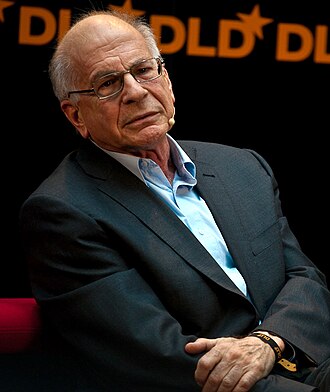
丹尼尔·卡尼曼 JJohn Boyd
EDITED TRANSCRIPT · 依据现场录音编译整理,可划线生成便签
编者按:本文是丹尼尔·卡尼曼在谷歌"Talks at Google"讲坛上的一场演讲与问答实录,主题围绕他的新书《思考,快与慢》。主持人为具有心理学背景的约翰·博伊德,他负责介绍讲者履历并主持现场提问。全文依据现场录音编译整理,只删去了口头语、寒暄、重复与断裂的残句,论证、例证与语气一仍其旧。为便于阅读,编者按话题分节并加了小标题,关键术语首次出现时括注英文。

引介:从前景理论到诺奖

主持人(约翰·博伊德): 我是约翰·博伊德。今天能为各位介绍卡尼曼教授,是我莫大的荣幸。我想先简单交代一下他这段极为出色的学术履历。1954年,他在耶路撒冷的希伯来大学取得实验心理学与数学的学士学位。1961年,他在海湾对岸的加州大学伯克利分校拿到实验心理学博士学位。1979年,他与合作者阿莫斯·特沃斯基(Amos Tversky)发表了那篇奠基性的论文,提出前景理论(prospect theory),从此改变了人们讨论收益、损失以及不确定条件下决策的方式。若干年后,也就是2002年,卡尼曼教授获得诺贝尔奖,主要就是凭前景理论的工作。

主持人: 诺贝尔奖当然不是每一次都同样让人惊叹,但他这一次也许格外值得一提,因为世上并没有诺贝尔心理学奖。他只能去经济学那边把奖拿回来。据我所知,历史上另有一位心理学家拿过诺贝尔奖,那就是伊万·巴甫洛夫,当然他算不算生理学家,这一点还可以争论。又过了几年,到2007年,心理学界试图把卡尼曼教授重新认回自己人,美国心理学会授予他终身杰出贡献奖。今天,他是普林斯顿大学伍德罗·威尔逊公共与国际事务学院的资深学者,来这里谈他的新书《思考,快与慢》。

主持人: 谷歌的使命大家都清楚,是整合全球信息,让人人都能便捷地使用并从中受益。所有的信息、所有的知识都重要,但我想有些知识比另一些更要紧一点。因为他今天要讲的这些信息非常贴身,讲的是我们每一个人自己。如果你听得仔细,它会改变你看待自身、也看待周遭世界的方式。请和我一起欢迎卡尼曼教授来到谷歌。(掌声)

直觉之争:两个阵营

卡尼曼: 谢谢。这些年,直觉这件事被讨论得很多,我今天要谈的正是直觉。在这场讨论里自然分成两个阵营,一派赞成,一派怀疑。在座很多人应该读过马尔科姆·格拉德威尔的《眨眼之间》(Blink),那本书虽然不是对直觉的无条件辩护,但它确实给人留下一种印象:我们有时候能神奇地知道某些事情,却不知道自己为何知道。

卡尼曼: 在心理学与决策研究这个学科内部,有一群人是专家直觉的坚定信奉者,领头的是一位很有意思的人物,加里·克莱因(Gary Klein)。他写过一本书,我极力推荐,叫《力量之源》(Sources of Power),是他所有著作里我最愿意推荐的一本。另一边是怀疑派,对直觉整体存疑,也包括对专家直觉存疑。长期以来,我一直被算在怀疑派里,因为我早年与阿莫斯·特沃斯基的工作,讲的就是直觉的错误、缺陷与偏差。

卡尼曼: 今天这场争论在很多领域都能看到。比如医学界,两位常给《纽约客》撰稿的作者,杰罗姆·格鲁普曼(Jerome Groopman)与阿图·葛文德(Atul Gawande),立场就明显不同。葛文德倾向于正式的系统与流程,对人的判断相当怀疑,主张事事都要有证据;格鲁普曼虽然不太肯明说,其实是喜欢老派的临床直觉的。当然他也希望医生受过良好训练,但他不喜欢那一套正式系统。医学里的问题就摆在这儿:循证医学的位置在哪里,它又该怎样与直觉的功能分工?

与克莱因的合作

卡尼曼: 我今天要讲的内容,有一部分背景来自一段颇为奇特的合作,我和刚才提到的加里·克莱因一起工作了大约八年。他是一群人的精神领袖,那群人对我做的事情,我不能说他们鄙视,但他们确实不喜欢,因为他们认为对判断偏差的强调,给人类心智描画了一幅不公正的、过分难看的画像。大体上说,这一点我是愿意承认的。

卡尼曼: 七八年前我邀请他一起工作,我们花了好几年,想弄清楚边界究竟在哪里:直觉在哪些地方精妙无比,在哪些地方漏洞百出。我认为这个问题是有答案的。六七年之后,中间经过种种波折,因为我们在根子上并不一致,我们终于写成一篇论文,题目叫《一次未能达成的分歧》(A Failure to Disagree)。在实质问题上,我认为我们弄清楚了,而且两人意见一致:什么时候可以信任直觉,什么时候不可以。但在情感上,我们谁也没变。他依旧厌恶那些偏差,不觉得专家犯的错有什么好笑,而我觉得专家犯的错相当好笑。(笑声)差别就摆在这儿。

两种思维方式

卡尼曼: 我们所有人都熟悉两种思维方式。有一种方式,念头是这样进入脑海的:请看这张脸。你知道这位女士在生气,你知道这件事的速度,我想跟你知道她头发是深色的一样快。这里值得稍作停留。"她在生气"这个判断,或者说这个印象,感觉上并不像是你做出来的。它感觉像是发生的一件事,发生在我身上。在这类判断里,我们最基本的经验是被动的经验。知觉就是这样,我们看世界,并不是我们决定要看见它。印象也是这样。一般所说的直觉思维都是这样,它就那么发生了,从某处冒出来,我们并不是它的作者。

卡尼曼: 还有另一种方式让念头进入脑海。屏幕上是17乘24。我猜你脑子里基本上什么都没冒出来,但答案是408。要得出408,需要一套完全不同的运作。你得把学校里学的那套程序调出来,程序是由一步一步组成的,你得走完这些步骤,得依次把注意力放到各个部分乘积上,得把中间结果记住,还得把整套程序拿在心里。它就是这么运作的。这是你做的一件事,不是发生在你身上的一件事。

卡尼曼: 有很多迹象表明它就是这样运作的。其中一个来自生理层面:瞳孔会放大。这是我很多年前研究过的题目。人在做这样一道题的时候,如果要在心里算,瞳孔就会放大,面积大约增加50%,一投入运算就开始放大,只要还在算就一直保持放大,等到你放弃,或者等到你找到答案,它就塌回正常大小。所以这是念头进入脑海的另一种方式,它绝不是直觉那一种。在这里我们感到一种紧迫感,感到有某种刻意的东西正在发生。而其中很重要的一点是,它是费力的。

卡尼曼: 心理学家所说的"费力"是什么意思?如果你想要一个最快的入门定义,那就是:这是你在左转横穿车流时做不了的事情。你做不了,也不该去试。原因在于,人施加努力的容量是有限的。如果这份容量、这些资源已经投在一项任务上,能留给另一项任务的就更少。

系统2与自控

卡尼曼: 系统2还有另一项功能。这里我要出一道谜题,多数人可能都听过。一支球棒和一个球加起来是1.10美元,球棒比球贵1美元,那么球多少钱?顺便问一下,有多少人知道这道题?好,那还能用。

卡尼曼: 这道题的要点在于,有一个数字自己冒到了你脑子里,那个数字是10美分。几乎所有人都承认,10美分立刻就浮上来了,这里也许有极少数例外。可它是错的。10美分加1.10美元等于1.20美元。正确答案是5美分。有意思的是,在普林斯顿、在麻省理工、在哈佛,大约50%的本科生回答10美分,斯坦福和加州理工的情况我不清楚。

卡尼曼: 而当一个人说出10美分时,我们学到了一件非常有意思的事:我们知道他没有检验过。因为如果检验过,他就不会说10美分。所以人是带着一种笃定感的,尤其是这些人。这就引出了我要称之为系统2的另一项功能。系统1是直觉的那一个,负责那些自动的活动;系统2是费力的那一个,是刻意的那一个。

卡尼曼: 我把自控归到系统2名下,理由是:自我控制、控制注意力、刻意地投入努力,都会因为同时在做别的活动而受损。举一个很琐碎的例子,让一个人在脑子里记住七位数字,然后请他在罪恶的巧克力蛋糕和清白的水果沙拉之间选一个,他选巧克力蛋糕的概率,会高于没有那七位数字压在脑子里的时候。控制冲动是要耗费努力的,哪怕只是"想吃巧克力蛋糕"这样轻微的冲动。

卡尼曼: 系统1的自动运作与系统2的刻意运作,这两者的分别在开车这件事上体现得非常清楚。开车是一项技能,而技能的标志就是事情开始自动发生。所以你可以一边开车一边聊天。左转横穿车流时不行,但大体上我们能边开边说。所以开车在很大程度上是自动的。刹车更是如此,只要有一点危险的迹象,刹车完全是自动的。你能注意到自己在刹车,但你是先反应,反应立刻发生,完全自动。

卡尼曼: 有些地方的人要在冰雪路面上开车,这里不是,他们会学怎样应付打滑。偶尔你会真的遇上打滑,这时系统2就被动员起来了,因为在打滑中,凡是你自然而然想做的事都不该做。你不该踩刹车,也不该朝打滑的反方向打方向。你应该松开刹车,顺着打滑的方向打过去,完全反直觉。而当一个人练得足够多,这一套同样会变成自动的。

卡尼曼: 所以关于系统1和系统2这两类运作,有一点是可以断定的:我们那些最基本的先天功能,比如对事物产生情绪反应,全都属于系统1。我们不是选择这么做的,它就那么发生在我们身上。但系统1同时也是技能的所在地。当我们把一件事做到熟练,它就变成自动的,不再索取资源,而我们把它做得非常好。

直觉就是识别

卡尼曼: 现在说直觉。我不太有把握,但我怀疑马尔科姆·格拉德威尔其实帮了倒忙,他让人觉得直觉里有魔法。那里根本没有任何魔法,我们应该弄明白它是怎么运作的。赫伯特·西蒙(Herbert Simon)既是心理学家,也是经济学家和政治学家,还是诺贝尔奖得主,他给直觉下过一个很好的定义:直觉不过就是识别。

卡尼曼: 医生从一个面部表情之类的线索认出某种疾病,和一个小孩子指着什么东西说"狗狗",这两者之间其实没有区别。小孩子完全不知道线索是什么,他就是说了出来。他知道这是狗,却不知道自己为什么知道。一旦这样去想,直觉的神秘色彩就被褪掉了一大半。

卡尼曼: 而且这也把加里·克莱因和我想解决的那个问题引向了答案。什么时候能信任直觉,什么时候不能?问题于是变成两问:这个世界是否足够有规律,规律到你能学会识别它?以及,这个具体的人是否有过机会去学习世界的这些规律?

卡尼曼: 棋手的世界高度有规律。从统计上说,扑克玩家的世界也很有规律,其中有运气成分,但有规则。而人的心智生来如此:只要环境里存在规则,只要我们长期暴露在这些规则之下,并且能就对错拿到即时的、或者相当及时的反馈,我们就会习得这些规则。

卡尼曼: 所以我们所有人都有专家直觉,哪怕我们不是医生,也不是国际象棋大师。我在电话里听我太太说一个词就知道她的心情,在座多数人对自己非常熟悉的人也能做到。我们所有人都能认出旁边车道上那个危险的司机,我们接收到某些线索,未必说得出线索到底是什么,但就是知道这人开得不稳,随时可能做出危险动作。这是大量被强化过的练习,我们在这方面很在行。

何时可以信直觉

卡尼曼: 各类专家、各种职业之间,专业水准是有差别的,而这取决于他们能发展出何种程度的直觉专长。举例来说,把麻醉师和放射科医生放在一起比较。麻醉师能得到非常好的、即时的反馈,只要做错什么,实时的监测数据立刻就告诉他。放射科医生拿到的反馈则糟糕透顶,他很难知道自己判断得对不对。所以你可以预期麻醉师会发展出直觉,而对放射科医生不能抱同样的期待。这就是关于直觉专长的部分答案。这一点上我们不需要争论,因为我们大致清楚,直觉专长在什么条件下才可能长出来。

卡尼曼: 这同时意味着,在一个混乱无序的世界里,直觉专长是长不出来的。所以我个人不相信,靠挑选股票来投资的人能发展出直觉,因为市场把这条路堵死了:价格未来的走向根本没有足够的规律性,让直觉得以形成。

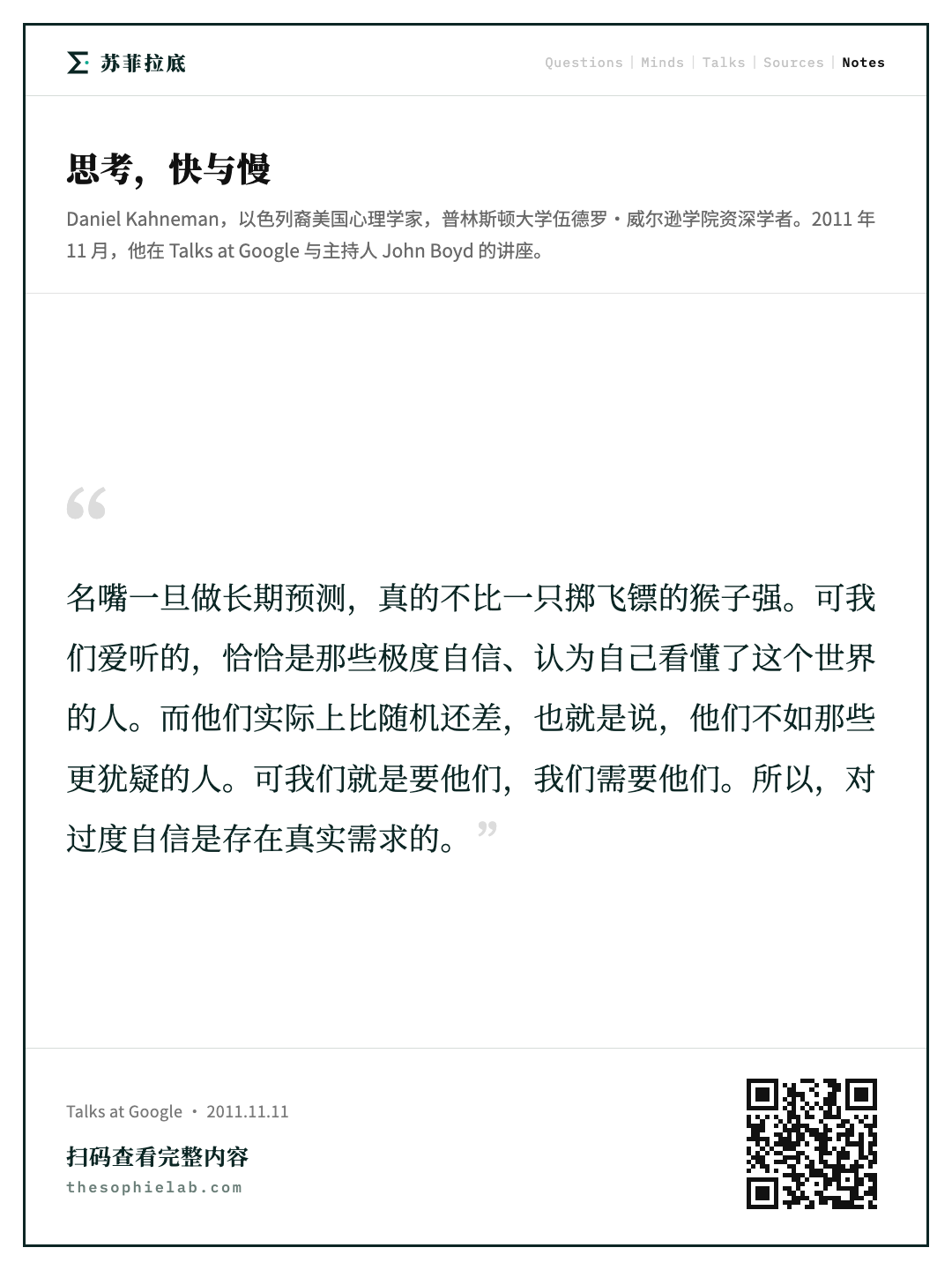
卡尼曼: 我们也知道政治预测者的情况:一旦做长期预测,他们真的不比一只掷飞镖的猴子强,也肯定不比《纽约时报》的普通读者强。而这不能怪那些名嘴。相关研究做过名嘴、中情局分析师和地区问题专家。他们没法预测十年、十五年后的远景,这真不是他们的错。他们做短期预测相当不错,做长期预测则完全不行。这是世界的错。这个世界很可能本来就不可预测。而如果世界不可预测,你就预测不了它。

卡尼曼: 还有一类边缘情形:存在一点可预测性,但公式比个人做得更好。公式稳定压倒个人判断的领域,恰恰是可预测性相当低的领域。因为线索一旦微弱,人既不擅长捕捉,也不擅长前后一致地使用它们。而公式可以基于经验建立起来,它会比个人的判断做得更好。

假直觉从何而来

卡尼曼: 好,我已经把系统1和系统2介绍给各位,也讲了技能,讲了技能栖身于系统1。现在我想指出另一件事,它适用于政治预测者,适用于选股票的人,也适用于我们所有人。我们相当频繁地拥有一些虚假的直觉。它们冒上来,进入脑海,而且从主观上根本无法与专家直觉区分开。

卡尼曼: 我现在说的是那些并非建立在专长之上的直觉。它们照样来。就"毫不费力、自动发生"这一点而言,它们确实属于系统1。那么它们从哪里来?这就是我在接下来这段时间里要设法照亮的东西。

为什么要用小人儿

卡尼曼: 所以我要把系统1介绍给各位。先把一件事说清楚,免得我等下忘了。我使用"系统1"和"系统2"这两个词,在我这个学科里是相当骇人听闻的。你本来是不该这么干的。因为每个心理学家很早就被告诫:不许拿脑子里的小人儿去解释心智里发生的事情,不许用小人儿做了什么来解释心智做了什么。那些叫侏儒(homunculi),在心理学里是个脏词。而我恰恰是完全把系统1和系统2当作小人儿来用的。

卡尼曼: 我有什么话为自己辩护?首先,我先把丑话说在前面:它们是虚构的角色,它们并不存在。我不相信真有系统1和系统2这样的东西。别到大脑里去找它们,因为大脑里并没有两个系统,一个专管这个,另一个专管那个。

卡尼曼: 那我为什么还要用这么糟糕的说法?因为我认为它有用,因为它贴合我们心智运作的方式。为了解释这个选择的来由,我想推荐一本很好、也很有趣的书,作者是约书亚·福尔(Joshua Foer),书名叫《与爱因斯坦月球漫步》(Moonwalking with Einstein),今年早些时候出版。

卡尼曼: 这本书讲的是什么呢?福尔是位科普作家,他去看了美国记忆锦标赛。你们也许不知道还有这种比赛,但确实有。参赛者背整副扑克牌,背极长的清单,表演的本事在我们看来完全不可思议。福尔决定弄清楚这里面到底发生了什么。一年之后,他自己成了美国记忆冠军。那本书讲的就是他怎么做到的。

卡尼曼: 核心的道理希腊人早就以某种形式知道了:记忆在某些事情上极为出色,在另一些事情上极为糟糕。记忆非常不擅长记清单,我们记清单的本事真的很差。记忆极其擅长记穿越空间的路线。进化赋予我们的是记路线的能力,不是记清单的能力。所以你可以骗自己一把:如果心里有一份清单要记,就在脑中造一条路线,把清单上的条目沿路分布下去。等到要回忆那副牌或者别的什么,你就沿着这条路线走一遍,一件一件把它们捡起来,因为这件事你做得到。

卡尼曼: 事情在另一个场合上非常相似。人极其擅长思考"行动者"。心智天生就为思考行动者做好了准备。行动者有特质,有行为,我们理解行动者,我们会对他们的性格形成整体印象。而如果一个句子的主语是一个抽象概念,我们就很不擅长把它记住。行动者则不然,行动者好记极了。所以请记住,每当我说"系统1做了X",我的意思是:X是一项无须费力就能完成的心理活动。如果你把它当成一个在做事的角色,你能记住的关于系统1的内容,会远多于你把它当成一堆心理活动。这帮助我思考,我想它也帮助别人理解。

眼睛海报与联想

卡尼曼: 好,让我把系统1介绍给各位。我先从一项研究说起,它是个比较极端的例子,做在英国一所大学,实际上是在一个生物系里。跟英国很多地方一样,那里有一间小小的茶水间,人们可以自己泡茶泡咖啡、拿点饼干,旁边放着一个诚实盒,大家把钱投进去。有人想出一个妙主意:在诚实盒正上方贴一张海报,每周换一张。这是第一周的海报,第二周是花,第三周是眼睛,如此轮换。

卡尼曼: 结果非常值得注意:贴眼睛的那几周,人们投进去的钱要多得多。而这件事是发生在人们身上的,他们完全不知道它正在发生。事实上他们连海报本身都没怎么注意,只是隐约觉得那儿有几张海报。他们当然不知道海报是按周系统更换的,更不知道海报影响了他们的行为。系统1能做这样的事。我们心里有大量的活动,我们并未充分意识到,甚至完全没有意识到。

卡尼曼: 眼睛和"被注视"之间有一条链接,"被注视"又和"不想做坏事"或者"想做好事"之间有一条链接。这一切都深埋在我们的联想记忆里,一被触发就活起来。你看见眼睛,尤其是第一周那双大眼睛,它就对你做了某件事,而你可能根本不知道它做了。

卡尼曼: 再看另一样东西。屏幕上是"香蕉"和"呕吐"两个词。我想极简短地列举一下,在我把它打上屏幕之后的头几秒里,你身上发生了什么。首先,你读了。你读了这两个词。你并没有打算读它们,你没有做过任何决定,你是不得不读。这件事你没有选择的余地。

卡尼曼: 第二,念头、图像和记忆涌了上来,大概没有一样是愉快的。第三件事是身体上的:你后缩了。这是真的被测量过的。人在暴露于威胁性词语时,身体会往后移。也就是说,这个威胁在某种程度上、哪怕是很轻微的程度上被当真了。象征性的威胁被当成了真的威胁。

卡尼曼: 你还做出了一个厌恶的表情,你体验到了厌恶。这件事变得有意思起来,因为这些东西是相互强化的。如果你摆出一张厌恶的脸,你更可能感到厌恶。如果你摆出一张笑脸,你更可能觉得事情好笑。我最喜欢的相关实验之一是这样:你拿一支铅笔横着咬在嘴里,漫画在你眼里就会更好笑。因为你这样咬着铅笔的时候,你其实是在做一个微笑的动作。单是肌肉状态的改变,就足以反馈到我们的情绪和感受上去。

卡尼曼: 这一切相当重要。让我先补上一点,再把线索收拢起来。我在很大程度上是通过联想记忆里发生的事情来理解系统1的。要想象联想记忆,你可以想象一张巨大的观念之网。观念之间以各种方式彼此相连:有些是别的东西的原因,有些是类别,有些是某类的实例。链接有很多种,而我们心中拥有一个庞大的表征。

卡尼曼: 任何一个时刻,一个刺激出现,它会激活这张记忆表征中的一小部分节点,然后激活沿着联想网络扩散开去。扩散得不多,但确实在扩散。我们之所以知道它在扩散,是因为我们对以这种方式被激活的其他观念变得敏感了。举例来说,此时此刻,如果有人在你耳边低声说词,你会远比平时更容易察觉并辨认出"疾病""气味""本能""恶心""宿醉"这类词。大量联想已经被激活了。你对它们中的任何一个都毫无察觉,你什么都没察觉到。这些不是有意识的激活,但它们确确实实是激活。

卡尼曼: 而正因为这些观念已被部分激活,一个很弱的刺激就足以把它们推过阈限。这又是系统1联想记忆一项非常重要的功能:这种扩散激活基本上是在为接下来可能发生的事做准备,让你能比之前更轻易地辨认并回应事物。

卡尼曼: 接下来还发生了别的事。屏幕上就"香蕉"和"呕吐"两个词,而你编了一个故事。其实完全没有必要这么做,但事实上这两个词已经足以造出一条因果链接:不知怎的,是香蕉引起了呕吐。你并没有有意识地决定让这件事发生,可我们知道这就是会发生的那类事情。刺激一出现,我们就回头去找原因,联想机器往回搜,一把抓住可能的原因。在这里,找原因太容易了,而它是有后果的:你会暂时不喜欢香蕉,因为一条联想已经建立起来。这一切都源自那股因果冲动。

连贯、常识与常态

卡尼曼: 这大致能让各位对系统1的一项功能有点感觉。为了把它讲完整,我再给各位看一样东西。这是一个著名的心理学演示,在座许多人可能没见过。上面一行你读作A、B、C,下面一列你读作12、13、14,可是那个B和那个13在物理上是完全相同的图形。

卡尼曼: 这告诉我们一件相当重要的事,关于系统1里的联想机器如何处理新的刺激:一切都会被弄成连贯的。在字母的语境里,那个含混的图形会被读成字母;在数字的语境里,它会被读成数字。这里有两点很要紧,一是连贯,二是你对那份含混毫无察觉。含混被压制掉了。也就是说,你只拿到一个解释。在这个例子里,那是一个连贯的解释。系统就是这样工作的:它对情境生成一个在联想上连贯的表征与反应。

卡尼曼: 联想记忆,或者说系统1,还满载着关于世界的常识。事件发生时,我们的反应受我们所知的大量事情所引导。我最喜欢的例子是这样一项研究:让人听一些句子,同时记录他们大脑中的事件。一个上层阶级的英国男声说:"我背上有一大片纹身。"大约三百毫秒之后,大脑给出了一个具有典型特征的惊讶反应。

卡尼曼: 你停下来想一想,这是很惊人的。先是那个声音,你得把它归类为一个上层阶级的英国男声。而上层阶级的英国男人背上不会有纹身,于是有什么地方不对劲,于是你得到一个惊讶反应。你还会得到系统2的动员,因为系统2才是负责注意的那一个。惊讶会唤起注意。换成一个男声说"我想我怀孕了",当然是一样的道理。

卡尼曼: 所以这个系统持有关于世界的常识,并用这些常识把情境归类为正常或反常,而且它以最高速度完成这件事。它更新得也非常快。

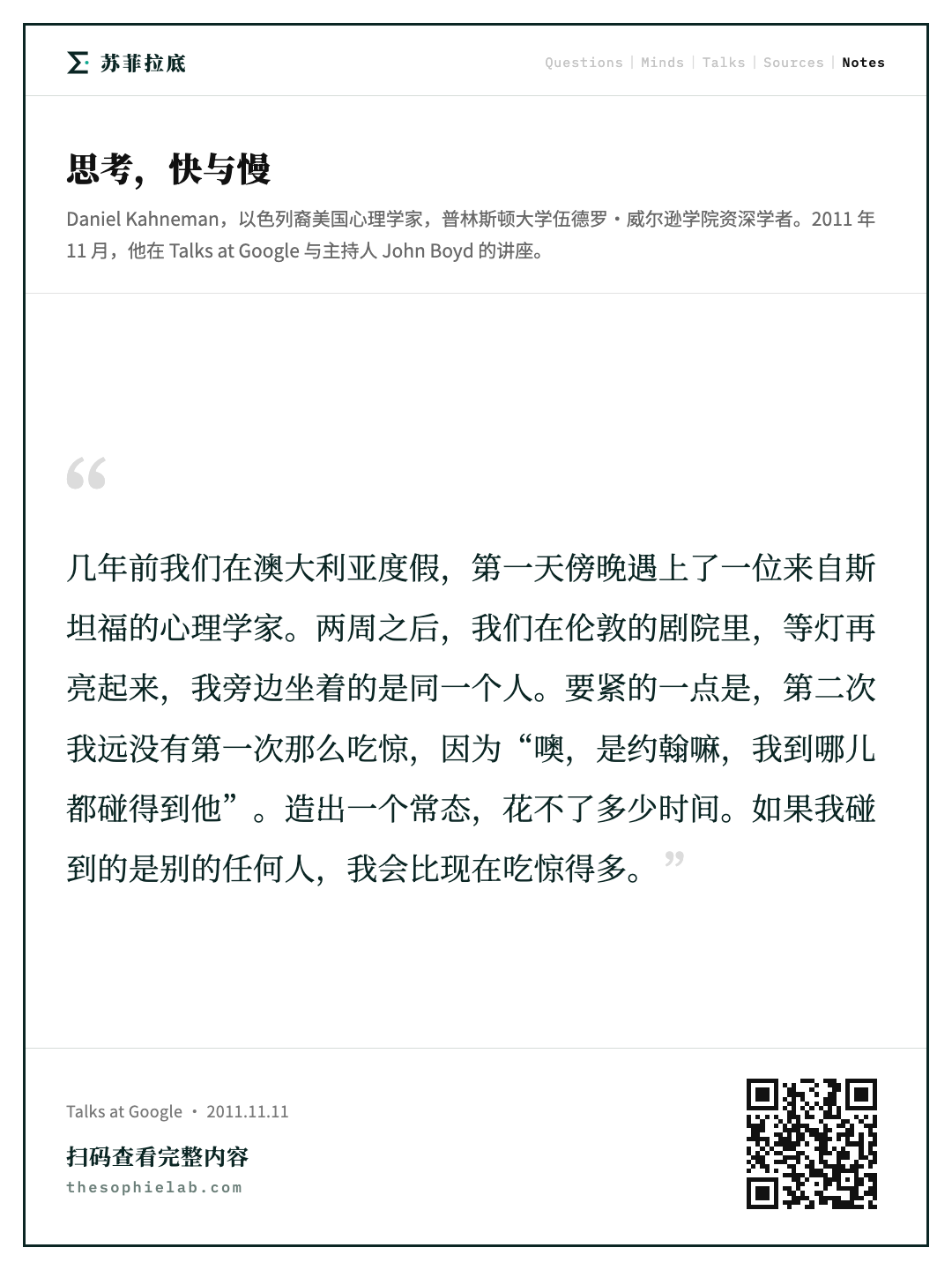
卡尼曼: 我讲一个关于更新的故事。这是件轶事,各位有不信的自由。我信,因为那是我亲身经历的。几年前我们在澳大利亚度假,住的度假村统共只有四十来幢小别墅。第一天傍晚我们去吃晚饭,遇上了一位来自斯坦福的心理学家。啊,真巧,我们都很高兴见到对方。两周之后,我们在伦敦的剧院里。灯暗下来,我们看戏。等灯再亮起来,我旁边坐着的,是同一个人。

卡尼曼: 要紧的一点是,第二次我远没有第一次那么吃惊。因为"噢,是约翰嘛,我到哪儿都碰得到他"。(笑声)造出一个我们所谓的"常态"(norm),花不了多少时间。一个事件发生,第二个事件回头挂到第一个上面。如果我碰到的是别的任何人,那才是让我震动的事。如果我碰到的是别的任何人,我会比现在吃惊得多。

卡尼曼: 从统计上看,这很荒唐,简直疯了。但事实很清楚。我不能说我有意识地期待走到哪里都能见到约翰,可是,如果我要碰到什么人,我心里是准备好碰到约翰的。(笑声)

卡尼曼: 刚才我提到了因果思维,我想让各位再体会一下它是怎么运作的。请看这个问题:哪一种更可能,女儿是蓝眼睛的情况下母亲是蓝眼睛,还是母亲是蓝眼睛的情况下女儿是蓝眼睛?跟球棒和球那道题一样,这里有一个直觉的回答,直觉的回答是:母亲是蓝眼睛则女儿是蓝眼睛,比反过来更可能。

卡尼曼: 可你要是停下来算一算,在两代人中蓝眼睛发生率相同的假设下,这两个概率严格相等。而在你动手算之前,你的推理已经顺着因果的方向流下去了,你的思考顺着因果的方向流。这是直觉地发生的。其中一个感觉上"对头",它感觉更连贯,而我们体验到的这份连贯,会被转换成一个关于概率的判断。也就是说,我们体验到的那份笃定,被当成了概率判断。

把难题换成易题

卡尼曼: 我前面说过,人会有一些未必为真的直觉,也会对未必为真的判断抱有信心。我想就此提出一个尚属尝试性的理论,解释这是怎么发生的。总的想法非常直白:当我们被问到一个自己回答不了的问题时,系统1通常会给出一个相关的、但更容易的问题的答案,然后拿这个"错问题"的答案,也就是根本没有人问的那个问题的答案,去顶替真正被问的那个问题。

卡尼曼: 我们把这叫作替代机制(substitution):用一个更容易的问题替换一个难的问题。它自动发生,人们意识不到它在发生,而它是许多并非来自专长的直觉的源头。这类直觉正确的可能性,远低于那些来自专长的直觉,但它们带着几乎同样十足的自信登场。

卡尼曼: 有几套机制参与了这个替代过程,我想逐一介绍。其中一个我称之为"心理散弹枪"(mental shotgun):当你被要求执行某项运算时,你通常还会顺带执行另一些运算,它们在联想上与目标运算相关,但并不是同一件事。

卡尼曼: 我最喜欢的例子是这样:我说出词,请你尽快判断它们押不押韵。第一对是vote和note,很容易。第二对是vote和goat。vote和goat要难上一大截。为什么?因为虽然没人要求你这么做,你把它们拼写出来了。而vote和goat在拼写上不匹配。虽然按我的发音它们押韵押得跟vote和note一样好,你却遇到了一个冲突,冲突拖慢了你。所以通常,我们计算的东西比我们打算计算的要多,而这就为替代腾出了空间。

卡尼曼: 我给各位一个替代的例子。屏幕上的问题是:"这三个人形中,哪一个在屏幕上更大?"答案是:一样大。屏幕上三个人形尺寸完全相同。但这是一个非常强悍的错觉,我们看到右边那个比左边那个大。我们之所以这样看,是因为我们控制不住。虽然你被告知要把它当成一个二维的图形,你还是算出了那个三维的解:在三维里,右边的物体确实比左边的大。而你看到的,就是那个三维的解。

卡尼曼: 这个总的过程还有许多别的例子。我喜欢的另一个叫"约会启发式"。学生填一份问卷,问两个问题:一是你有多幸福,二是你上个月约会了多少次。如果按这个顺序问,两者的相关系数基本上是零。原来人生中决定幸福的因素很多,约会并不特别重要。可你把顺序颠倒过来,先问"你上个月约会了多少次",再问"你对自己整体的生活有多满意",相关系数变成0.66。(笑声)

卡尼曼: 这里发生了什么?它既是一个启发式,也是我所谓"聚焦错觉"(focus illusion)的例子。学生对"约会次数"这个问题产生了一个情绪反应,这个反应就摆在那儿了。接着你问他一个相关的幸福问题,于是他在毫不知情的状况下,拿一个去顶替了另一个。很多问题都能这么玩。

卡尼曼: 并不是人们搞不清幸福是什么。他们清楚幸福不等于对约会次数的满意。只不过,这是"幸福"这个问题冒到脑子里来的答案。替代已经发生,而你毫无察觉。

卡尼曼: 有一个过程对此至关重要,这是系统1另一项奇特的本事:我们能在不同的维度之间映射强度。我讲一个我的标准例子。朱莉是一名即将毕业的大四学生,她四岁时就能流利阅读,问:她的绩点是多少?奇怪的地方在于,你差不多知道她的绩点是多少,至少你有个想法。显然在3.2以上,显然不到4.0,大概3.7吧,这当然是荒唐的。

卡尼曼: 但人们是怎么得到3.7这个数的?过程是这样:她四岁就能流利阅读,这给了我们一个"早慧"的印象。她作为一个阅读者早慧到什么程度?人们可以用百分位来表达,也就是说,你遇到一个读得比她还快的孩子的可能性有多大。然后当你被问到她的绩点是多少,你在毫不知情的情况下,把百分位对了过去,于是你给出的那个绩点,在绩点的分布里的极端程度,恰好等于"四岁能流利阅读"在阅读年龄分布里的极端程度。全然无觉。从统计上讲,全然荒谬。你本该做出强得多的回归调整。这不是正确答案,但它是一个在主观上极有说服力的答案。这就是导致直觉错误的机制之一,替代的机制。

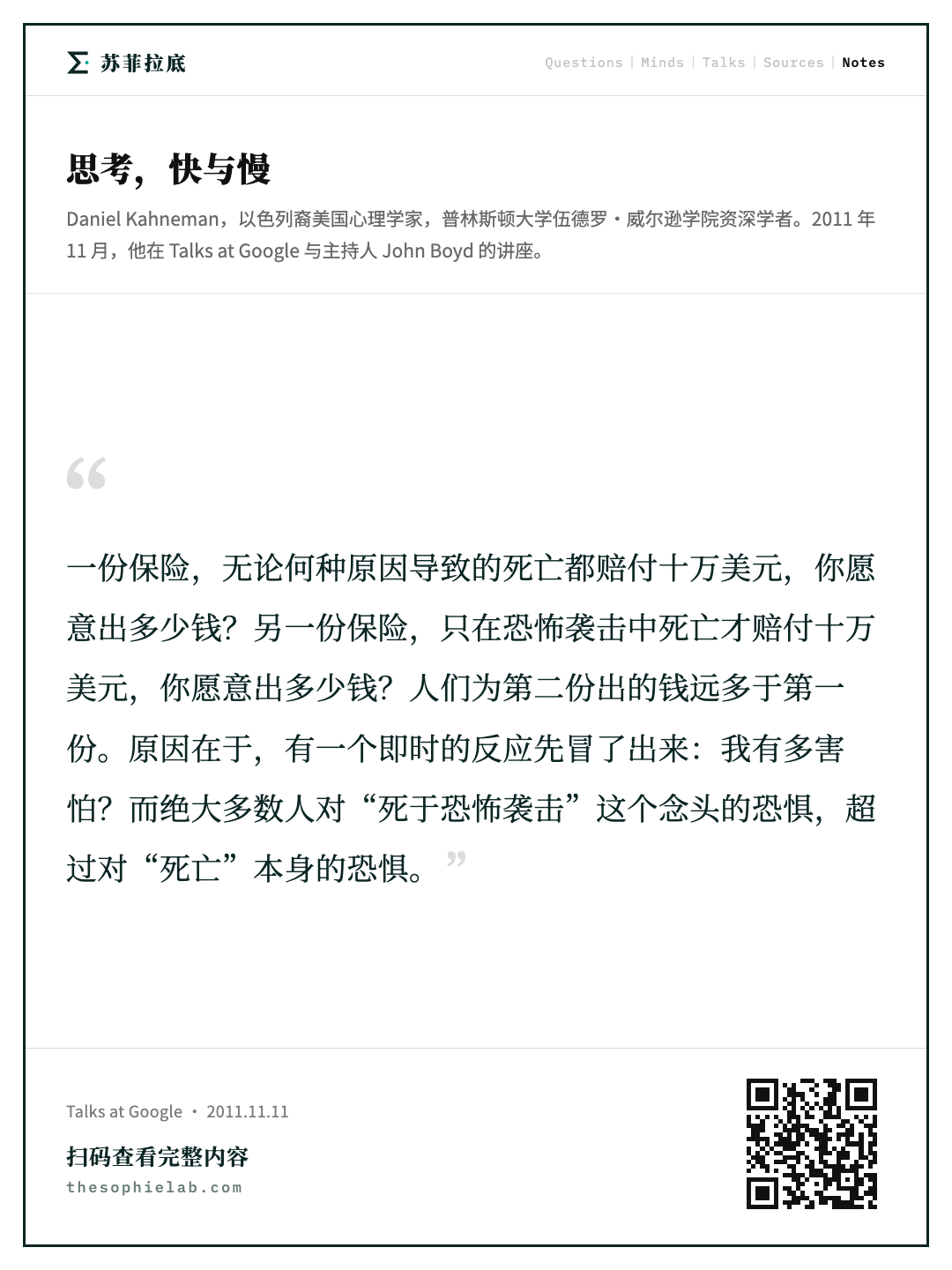
卡尼曼: 我再给一个例子,关于出国旅行。这是一项实验,做实验的那段时期,欧洲发生了不少恐怖袭击事件,这是背景。问题一:一份保险,无论何种原因导致的死亡都赔付十万美元,你愿意出多少钱?问题二:一份保险,只在恐怖袭击中死亡才赔付十万美元,你愿意出多少钱?人们为第二份出的钱远多于第一份。(笑声)

卡尼曼: 原因在于,有一个即时的反应先冒了出来:我有多害怕?而绝大多数人对"死于恐怖袭击"这个念头的恐惧,超过对"死亡"本身的恐惧。发生映射的就是这个。事情就是这么运作的,这就是联想机器。它妙就妙在从不卡壳。它会给出它其实不知道怎么回答的问题的答案,而它给出答案的办法,是去回答一个更容易的问题。我们大量的心理生活正是以这种方式进行的。

自信只是流畅感

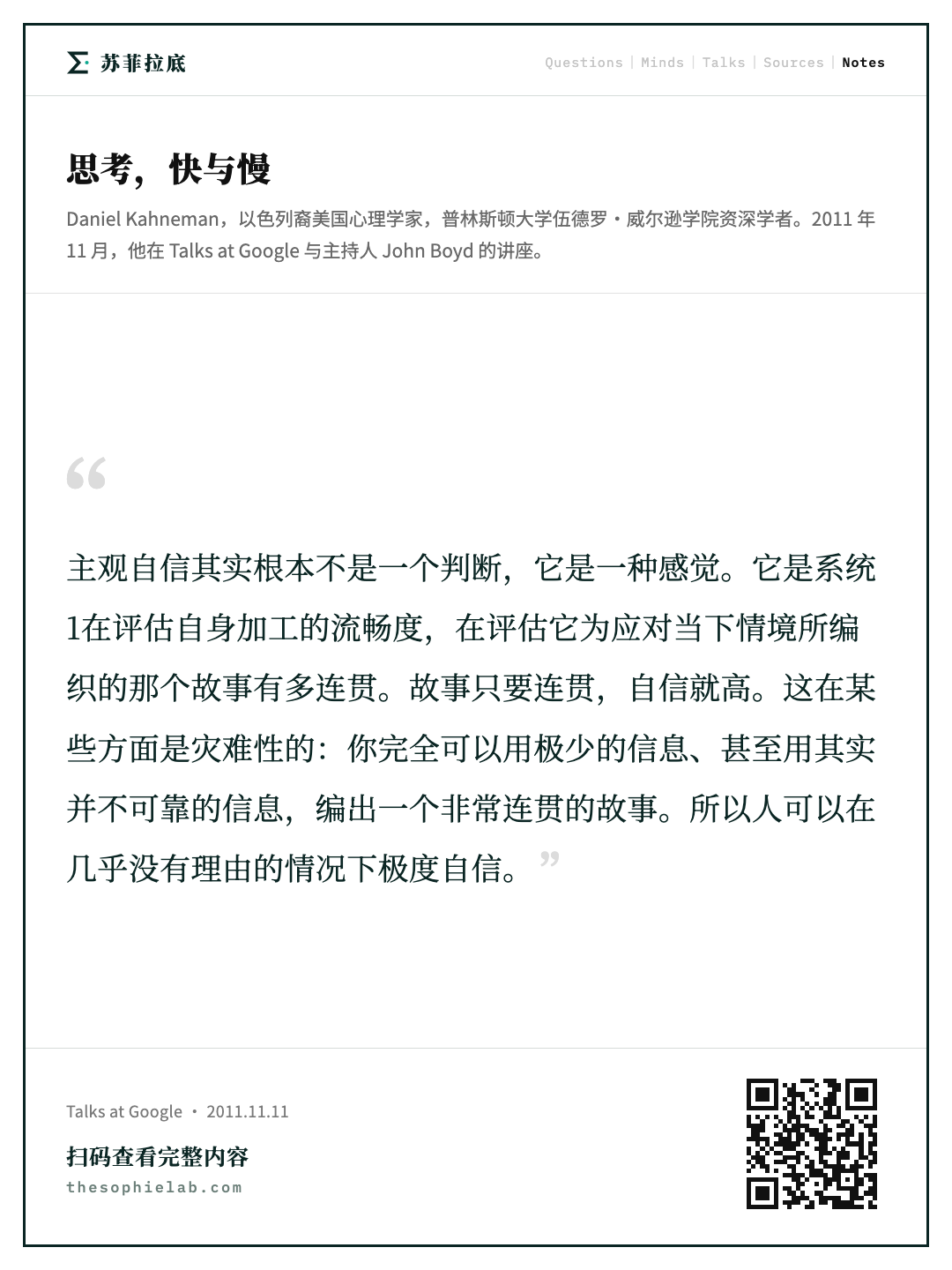
卡尼曼: 让我把这个圈收拢,谈一点主观自信。主观自信与"判断为真的概率"关系密切,可它其实根本不是一个判断。它是一种感觉,是人拥有的一种感觉。而我想我们知道这种感觉的来源:它是系统1在评估自身加工的流畅度,在评估它为应对当下情境所编织的那个故事有多连贯。故事只要连贯,自信就高。

卡尼曼: 这在某些方面是灾难性的。因为你完全可以用极少的信息、甚至用其实并不可靠的信息,编出一个非常连贯的故事。故事的质量,与信息的质量和数量几乎没什么关系。所以人可以在几乎没有理由的情况下极度自信。

卡尼曼: 因此,自信不是一个好的诊断指标,无论用来判断你能否信任自己,还是能否信任别人。如果你要评估一个自信满满的人值不值得信,靠自信是评估不出来的。正确的做法我前面已经说了:去问他们身处什么样的环境,去问他们是否有过机会习得那个环境的规律。主观自信不是一个好的指标。

卡尼曼: 以上大概就是我能用四十五分钟讲完的、关于两个系统的故事。让我再提醒各位一次:它们并不存在。但我认为各位大可以放心用这种方式去想问题。因为你们现在也许已经开始做一件事了:你们开始对系统1和系统2的"性格"有了概念。这很荒唐,但拥有关于这两种性格的概念,确实能让你在思考心理现象时比手握一长串互不相干的现象清单时想得更好。这些概念、这些性格是有某种连贯性的,而在"能不能做出判断"这本账上,它们值些钱。好,我想我们该开始提问了。(掌声)

问答:能训练直觉吗

主持人: 那边有立式话筒,我手上也有手持话筒。总得有人问第一个问题。

提问者一: 您好。系统1的这些过程有多固定、又有多可塑?像正念或者情绪调节这类东西,对它有影响吗?

卡尼曼: 按我刚才描述的方式,系统1在内容层面是可以很规律地被更新的。什么是正常、什么是不正常,你一次经历就能学会。真正困难的是取得对它"如何运作"的控制,也就是对它运作规则的控制。就这一点而言,我不知道有多少证据表明系统1能被改变,除非你获得了某种安静的技能,而那要靠反复强化的练习。

卡尼曼: 你能做的、而且人们明显做得到的,是教育你的系统2。你可以受教育,可以学会辨认出哪些情境下应当由系统2接管、由它来控制反应,从而避免一些错误。这件事做不了太多。如果我听起来对训练系统1并不乐观,那是因为我确实不乐观。

提问者二: 还是关于训练系统1的问题。您讲到强化学习、时间常数以及即时性对建立专长的作用,但我们在软件开发上的很多做法,时间常数要长得多。而您举的那个反例,就是澳大利亚和伦敦碰见约翰那件事,单单一次事件就让您对那个联想产生了预备。所以我想问,有没有做过检验,看时间常数在这里究竟起多大作用?

卡尼曼: 就更新和习得联想而言,这是我们能学得很快的事。不需要发生任何别的事情,就可以把你教到害怕某样东西。从这个意义上说,系统1的联想记忆是可以被更新的。

卡尼曼: 而发展软件方面的专长是另一回事,它更像学着成为一名国际象棋大师,那需要大量的经验、大量的强化,而且这强化最好是有效的强化。在软件这件事上,时间在某种程度上不算大问题,因为你最终会把它们放在一起看到:你犯的错,以及正确的解法。所以时间不是主要因素。相比之下,学怎么操纵一艘油轮,那里的强化非常缓慢,学起来就比学开一条小船难得多。

问答:广告与面孔

提问者三: 这是个相当宽泛的问题,请您朝任何方向展开都行。我想知道,这两个系统在媒体和广告中是怎样起作用的,我也在想它随时间发生了什么变化。

卡尼曼: 很清楚,广告是冲着系统1去的。它并不为判断提供信息。它拨动你的情绪,它制造联想。它就是为此而设计的,而且相当有效。政治里也有大量东西是冲着系统1去的,很多政治话术都是。系统1的这些活动所产生的影响,是真正重要、值得我们思考的,而它相当可怕。

卡尼曼: 我在普林斯顿有位比较年轻的同事,研究面部特征对政治偏好的影响,结果实在惊人。你拿来538组照片,每一组是某个国会选区两位候选人的一对照片,把这些照片对给普林斯顿的学生看十分之一秒,问他们:"哪一位看起来更有胜任力?"这个答案能预测70%的选举结果。所以系统1对我们所做决定的冲击,比如说往诚实盒里放多少钱,是我们极少能意识到的,而且远超我们的想象。

提问者四: 您说系统1和系统2并不以具体的结构呈现出来,但有没有功能性磁共振成像、弥散谱成像、弥散张量成像之类的研究,能显示系统1更多是原始脑区的初始激活,而系统2更多是新皮层?

卡尼曼: 系统1是极为精密的。这也正是我不相信这两个系统在大脑里有什么简单对应物的部分原因,因为我称之为系统1运作的东西,按其特征既包括先天反应,也包括高度熟练的反应,而且整个世界常识的表征都在系统1里。所以很难把其中一个归为"原始"。

卡尼曼: 我还要补一句,系统2,也就是所谓推理的那个系统,未必就是理性的。系统2知道它所知道的,它知道我们所知道的,而我们知道的并不多。所以并不是说系统2就不会出错,也不是说所有错误都来自系统1。我们在非常认真地思考时,同样会犯下非常严重的错误。请。

问答:为何仍要听专家

提问者三: 您提到专家做长期预测、并且信任自己直觉时,往往是错的。可还是有很多人在听他们说。那么,社会去听那些可能和我们错得一样离谱的专家,这整体上是件坏事吗?我们该担心吗?我们该做点什么吗?

卡尼曼: 我认为对专家的需求有其非常充分的理由。我刚才提到的是一本书,各位可以去读,或者去找《纽约客》对那本书的书评。那是菲利普·泰特洛克(Phil Tetlock)关于政治判断的书,他研究的是时间跨度十年、十五年的政治预测。

卡尼曼: 其中一项有意思的观察是:我们爱听哪些名嘴?我们爱听的,是那些极度自信、认为自己看懂了这个世界的人。而他们实际上比随机还差,也就是说,他们不如那些更犹疑的人。可我们就是要他们。我们需要他们。所以,对过度自信是存在真实需求的。(笑声)

问答:能挡住影响吗

提问者五: 您一张张放那些错觉的幻灯片,等放到屏幕上那三个人形的时候,我大概已经在预期这里有名堂了。所以哪怕右边那个看上去更大,我又看了一遍,然后说,好吧,它们一样大。那么这算系统1还是系统2?

卡尼曼: 那显然是系统2。而这正是我们能够克服错觉的方式,视觉错觉和认知错觉都一样。你依然会看到一个比另一个大,但你知道,看到这样一幅画面的时候,你不该相信自己的眼睛。同理,你也可以认出这样的处境:某个人对你的影响过大,因为她非常能言善辩,可你知道内容也许是空的。于是你强迫自己保持怀疑。

提问者五: 有没有研究表明人能利用这一点?也就是说,如果我知道广告就是要对我起情绪作用、要激活我的系统1,我是不是就更有能力去无视这些东西?

卡尼曼: 你肯定会比一无所知时更能无视它。至于你能不能彻底无视,我就要怀疑得多了。真正管用的办法是不让自己暴露在它面前。因为一旦暴露,它就会影响你。我们这个世界里那些我们意识不到的线索,其效力可以极其强大。

卡尼曼: 有一整条研究路线,虽然不完全对着你的问题,但我一定得讲讲这个故事。有一整批研究考察人在暴露于"钱"这个概念之后会怎样。比方说,受试者在做一项任务,旁边有台电脑,电脑上有个屏保,屏保是漂在水里的美钞。这会让你变得自私,让你不太愿意向别人求助,让你在布置访谈情境时把自己的椅子摆得离别人的椅子更远。它对形形色色的行为都有影响,而人们对此毫无察觉。这些链接是象征性的。

卡尼曼: 你可以意识到这一点。但你怎么抵抗它?我们暴露在钱面前,它就会产生某种作用。不过反过来说,如果你在设计一个组织,或者在为人设计一种环境,你可以造出一个时时刻刻提醒人们想到钱的环境,也可以造出一个提醒他们想到别的东西的环境,而这在一定程度上会左右他们的行为。

问答:量表与智力测验

提问者二: 虽然它大概还不算人格特质里的"大五"之一,您有没有开发出什么实证的测验,能把人在系统1到系统2的量尺上排个序,看出他们的默认行为倾向落在哪里?

卡尼曼: 关于系统2的活跃程度,是有一个相关量表的。球棒和球那道题其实是一道非常非常好的题目,这类题目还有好几个。这个测验是我从前的同事沙恩·弗雷德里克(Shane Frederick)开发的,叫认知反射测试(Cognitive Reflection Test)。在那道题上栽跟头的人,也就是回答10美分的人,与那些更能过关的人相比,在若干有意思的方面是不同的。

卡尼曼: 举个例子。你问他们那种标准的亚马逊式问题:你给自己订了一件礼物,为了明天就拿到而不是第二个工作日拿到,你愿意多付多少钱?那些在球棒和球上栽跟头的人,愿意为"明天到货"付更多的钱。所以这中间是有关联的。

卡尼曼: 真正缺失的东西,而且我对它的缺失非常吃惊,是这个:本来应该有一些针对系统1的智力测验,用来测量我们心中那个世界模型有多丰富、多精微。可我们现有的所有智力测验都是针对系统2的,它们都是推理测验。针对系统1的测验我们没有。我希望有人把它做出来,也希望终究会有人做出来,但事实是,我们目前没有。

问答:棉花糖与决断

提问者六: 您好,我这算是两部分的问题。第一,您有没有发现,在即时判断上更偏系统1或者更偏系统2的人,在长期的、更重大的决定上也倾向于保持同一种风格?

卡尼曼: 这个我了解得不够。

提问者六: 好的。

卡尼曼: 我们确实知道,自控以及系统2的总体活跃度是一项重要的人格特征。而且它在四岁时就以雏形出现,并且是有后果的。那个测验叫棉花糖测验(The Marshmallow Test):你告诉孩子,你可以现在就吃一颗棉花糖,也可以等十五分钟然后吃两颗。这件事对二十年后他们的表现有相当出色的预测力。所以有些东西是相当稳定的。

提问者六: 第二部分是,您有没有遇到过这样的人:他们要做一个决定,而且清楚自己的系统1在说选A、系统2在说选B。人们最后会跟哪一个走?

卡尼曼: 这个我了解得不够。

提问者六: 没有吗?

卡尼曼: 没有,我了解得不够。不,我了解得不够。你到底会不会把系统2的判断强加上去,这实在太依赖具体情形了。在很多情况下,系统2其实只是给系统1提交上来的东西盖个章,那就是你手上的模型。有时候你能把它推翻,但那是苦活。

卡尼曼: 谢谢各位。(掌声)
排版 + 横图 + 来源,粘贴即成稿
章节 · 点击跳转视频
0:01 主持人引介:从前景理论到诺奖 ▶ 正在看
1:21 直觉之争:支持派与怀疑派 ▶ 正在看
4:32 与 Gary Klein 八年的对抗式合作 ▶ 正在看
5:51 两种思维:印象发生,运算要做 ▶ 正在看
10:23 系统2 的自控功能与资源竞争 ▶ 正在看
13:34 直觉即识别:西蒙定义与祛魅 ▶ 正在看
16:37 何时可信:麻醉师、股票与长期预测 ▶ 正在看
19:47 为什么明知是「小人儿」仍要用 ▶ 正在看
24:12 系统1 实录:眼睛海报与联想扩散 ▶ 正在看
31:48 连贯性、世界知识与常态的瞬间更新 ▶ 正在看
37:34 替代机制:难题被悄悄换成易题 ▶ 正在看
44:47 自信只是流畅感,不是准确率 ▶ 正在看
47:41 问答:训练、广告、面孔与棉花糖 ▶ 正在看
本期小问 · 档案清单
—— 好的判断从哪里来? ▶ 正在看
—— 内省可靠吗? ▶ 正在看
—— 我们真的在做选择吗? ▶ 正在看
—— 知道了,为什么还是做不到? ▶ 正在看
本期讲者
丹尼尔·卡尼曼以色列裔美国心理学家,普林斯顿大学伍德罗·威尔逊学院资深学者。与 Amos Tversky 共同提出前景理论与启发式—偏差研究纲领,2002 年获诺贝尔经济学奖,2011 年出版《思考,快与慢》。
John Boyd本场活动主持人,心理学背景,负责介绍讲者学术履历并主持问答环节。
01主持人引介:从前景理论到诺奖
0:01
>> John Boyd: All right. I'm John Boyd. It is my great pleasure to introduce Professor Kahneman today. And I just want to give you a brief background on his outstanding career. He started in 1954 received his bachelors in experimental psychology and mathematics from the Hebrew University in Jerusalem. In 1961, he was awarded his Ph.D. from University of California Berkeley right across the bay in Experimental Psychology. In 1979, he and his coauthor Amos Tversky published their seminal paper on Prospect Theory which started to change the way people reframed the argument around gains, losses, and decision-making under uncertainty. Several years later in 2002, Professor Kahneman was awarded the Nobel Prize largely on the work of Prospect Theory of. And Nobel Prize isn't always impressive; his perhaps more so because there isn't a Nobel Prize in psychology. He had to win his Nobel Prize in economics. And as far as I know, there's only one other person, one other psychologist, who's won a Nobel Prize and that's Ivan Pavlov. He may be a physiologist, we could argue about that. Years later, in 2007, Psychologist tried to reclaim Professor Kahneman as one of their own when the American Psychological Association awarded him Lifetime
>> John Boyd:好的,我是 John Boyd。今天非常荣幸为大家介绍 Kahneman 教授。我想先简单介绍一下他杰出的学术生涯。1954 年,他在耶路撒冷的希伯来大学获得了实验心理学与数学的学士学位。1961 年,他在海湾对岸的加州大学伯克利分校拿到了实验心理学博士学位。1979 年,他和合作者 Amos Tversky 发表了关于前景理论(Prospect Theory)的奠基性论文,这篇论文开始改变人们看待收益、损失以及不确定条件下决策的思考框架。几年后的 2002 年,Kahneman 教授主要凭借前景理论的研究获得了诺贝尔奖。诺贝尔奖并不总是那么令人惊叹;但他这个也许格外了不起,因为根本就没有诺贝尔心理学奖,他只能去拿经济学奖。而据我所知,历史上只有另外一位心理学家拿过诺贝尔奖,那就是巴甫洛夫——他也许算是生理学家,这点我们可以再争论。多年之后的 2007 年,心理学界又想把 Kahneman 教授认回自己人,美国心理学会授予了他终身
便签笔记
02直觉之争:支持派与怀疑派
1:21
Distinguished Contribution Award. And today he is a Senior Scholar at the Woodrow Wilson School of Public and International Affairs at Princeton University and he's here to talk about his new book Thinking Fast and Slow. Now Google's mission which we all know is to take the world's information and to make it more useful and universally accessible. And all information, all knowledge, is important, but I think some again is more important than others. Because the information that he'll present today I think it's very personal; it's about each of us. And, if you'll listen carefully it's going to change the way you think about yourself and the world around you. So please join me in welcoming Professor Kahneman to Google. [Applause] >> Kahneman: Thank you. Well, I think intuition has been discussed a lot in recent years and I'll be talking about intuition. There are two camps in this discussion naturally there is the pro and the con. And of course, many people here will have read Malcolm Gladwell Blink which although it's not unconditional defense of intuition, it certainly gave people the impression that sometimes we magically know things without knowing why we know them.
杰出贡献奖。如今他是普林斯顿大学伍德罗·威尔逊公共与国际事务学院的资深学者,今天他来这里谈他的新书《思考,快与慢》。我们都知道,Google 的使命是整合全球的信息,让它更有用、更普遍可及。所有的信息、所有的知识都很重要,但我觉得有些知识比另一些更重要。因为他今天要讲的内容,我认为非常贴身;它关乎我们每一个人。而且,如果你仔细听,它会改变你看待自己以及周围世界的方式。所以请和我一起欢迎 Kahneman 教授来到 Google。[掌声] >> Kahneman:谢谢。嗯,我想直觉这个话题近些年被讨论得很多,而我今天要讲的正是直觉。这场讨论里自然分成两个阵营,一边支持,一边反对。当然,在座很多人读过 Malcolm Gladwell 的《眨眼之间》(Blink),虽然那本书并不是对直觉的无条件辩护,但它确实给人一种印象:有时候我们像变魔术一样就知道了某些事,却不知道自己为什么知道。
便签笔记
2:52
Within the discipline of psychology and the decision making there is a group and it is headed by a very interesting figure called Gary Kline who wrote a book that I recommend. Its Sources of Power is one of his books that I would recommend the most warmly. And they are great believers in expert intuition. The other side there are skeptics about intuition in general and including expert intuition. And I have long been counted as one of the skeptics because my early work with Amos Tversky was about intuitive errors and flaws and biases of intuitive thinking. Today you find that discussion in many places and for example in medicine among the popular writers; two writers both of whom write for the New Yorker, Jerome Groopman and Atul Gawande. They clearly differ. Atul Gawande is in favor of formal systems, very skeptical about human judgment and wanting to prove all the time and Jerome Groopman being in fact, although he doesn't quite admit he really likes good old fashioned medical intuition. Of course he likes physicians well-educated. But he doesn't like formal system and the issue in medicine is "What are the role of evidence based medicine and how do you allocate that with the function of intuition?" The background
在心理学和决策研究这个领域里,有一派人,领头的是一位非常有意思的人物,叫 Gary Klein,他写过一本我很推荐的书。《权力的来源》(Sources of Power)是他的著作之一,也是我最想热忱推荐的一本。他们非常笃信专家直觉。而另一边则是对直觉普遍持怀疑态度的人,包括对专家直觉也怀疑。长期以来我一直被算作怀疑派中的一员,因为我早期和 Amos Tversky 的研究关注的正是直觉思维中的错误、缺陷和偏差。今天你在很多地方都能看到这场争论,比如医学界的通俗作家里,有两位都为《纽约客》撰稿:Jerome Groopman 和 Atul Gawande。他们的立场明显不同。Atul Gawande 支持形式化的系统,对人的判断非常怀疑,总想不断地去验证;而 Jerome Groopman 其实——虽然他不太肯承认——他真的很喜欢老派的医学直觉。当然他喜欢的是受过良好教育的医生。但他不喜欢形式化的系统。医学界的问题就是:“循证医学的角色是什么?你又该怎么把它和直觉的作用协调起来?”而背景——
便签笔记
03与 Gary Klein 八年的对抗式合作
4:32
actually, part of the background for what I'll talk about today is a strange collaboration in which I engaged with about eight years with Gary Klein, whom I mentioned. He is a guru of a group of people who really, I wouldn't say they despise what I do but they certainly don't like what I do because they think that the emphasis and biases of judgment has drawn an unjustly unfavorable picture of the human mind. And by and large I am inclined to agree. Seven or eight years ago I invited him and we worked together for a number of years trying to figure out where is the boundary? Where is intuition marvelous and where is it flawed? And I think we can tell. And we wrote a paper at the end of six or seven years with a lot of vicissitudes that we went through since we basically don't agree. We wrote a paper the title of which was A Failure to Disagree, because on the substance I think we know and we both agree where you can trust intuition and where you cannot. Emotionally we haven't changed. He still hates the biases and doesn't think that errors of experts are very funny and I think that errors of experts are quite funny [laughter] so that's a difference right
其实,我今天要讲的内容有一部分背景,是我和刚才提到的 Gary Klein 之间一场奇特的合作,前后大约持续了八年。他是一群人的精神领袖,那群人——我不能说他们鄙视我做的事,但他们确实不太喜欢我做的事,因为他们认为强调判断中的偏差,给人的心智描绘了一幅不公正的、过于负面的图景。总体上我也倾向于同意这一点。七八年前我邀请了他,我们一起工作了好几年,试图搞清楚:边界在哪里?直觉在什么时候是了不起的,什么时候又是有缺陷的?我认为我们是能说清楚的。六七年之后,经历了不少波折——毕竟我们基本上意见不合——我们写了一篇论文,题目叫《一次未能达成的分歧》(A Failure to Disagree),因为在实质问题上,我认为我们都清楚、也都同意什么时候可以相信直觉、什么时候不能。但在情感上我们并没有改变。他依然讨厌那些偏差,也不觉得专家犯的错有什么好笑的;而我觉得专家犯的错相当好笑 [笑声],所以这就是我们之间的差别。
便签笔记
04两种思维:印象发生,运算要做
5:51
there. There are two modes of thinking that all of us are familiar with. And there is one mode, one way for thoughts that come to mind and listen to this. You know about this lady that she's I think adjust as quickly as you know her hair is dark. And it's interesting to dwell a bit about this. It is this is not something that the judgment that she is angry, the impression that she is angry. Doesn't feel like something you did. It feels like something that happens. It happens to me. We have the basic experience is a passive experience in those judgments. And that is true of perception, when we see the world we don't decide to see it. It is true of impression. And it is true in general what we call intuitive thinking. It just happens. It comes from somewhere. And we are not the author of it. Now, there is another way that thoughts come to mind and here I suppose essentially nothing came to your mind, but the answer is 408. To produce the 408, requires a completely different kind of operation. You have to retrieve the program that you learned in school. The program consists of steps. You have to go through the steps. You've got to pay attention successively to partial products and so on. And keep things in mind and keep the whole program in mind.
有两种思维模式,是我们所有人都熟悉的。有一种模式,是念头自己冒到脑子里的那种方式,请听好。关于这位女士,你知道——我想你判断出她在生气,跟你看出她头发是深色的一样快。这一点值得稍微琢磨一下。“她在生气”这个判断、这个印象,感觉上并不像是你“做”出来的事。它感觉像是“发生”的事。它是发生在我身上的。在这类判断中,我们的基本体验是一种被动的体验。知觉也是如此,我们看世界的时候并没有决定要去看它。印象也是如此。一般来说,我们所谓的直觉思维都是如此。它就那么发生了。它从某个地方冒出来。而我们并不是它的作者。现在,还有另一种念头进入脑海的方式,我猜在这里基本上你脑子里什么都没冒出来,但答案是 408。要得出 408,需要一种完全不同的运算。你得把学校里学的那套程序调出来。这个程序由若干步骤组成。你得一步步走完。你得依次注意那些中间乘积等等。还得把这些都记在脑子里,并且把整个程序也记在脑子里。
便签笔记
7:21
This is how it works. This is something that you do. It is not something that happens to you. And there are many indications that this is how it works. One is that Physiology indicates and this is how it works: pupil dilates. This is something that I studies many, many years ago that people really on a program like that if you're on a problem like that if you're going to do it in your head, your pupil will dilate. The area will increase by about 50% as soon as you engage in that. And it will stay dilated as long as you're working and it will sort of collapse back to normal size either when you quit or when you find the answer. So this is another way thoughts come to mind. And this is definitely not the intuitive way. Here we are we feel a sense of urgency. We feel something deliberate is happening and a very important aspect of it this is effortful and what psychologists mean by effort is basically, if you want the quick introduction to what effort is, this is something you cannot do while making a left turn into traffic. You cannot do it and you shouldn't try. And the reason is that there is limited capacity to exert effort. And if you are engaged that capacity or those resources at one task less is available for another task. Now, there is another function of System 2. And here I'm going to tell you a riddle. Most of you
它就是这么运作的。这是你“做”的事,而不是发生在你身上的事。有很多迹象表明它就是这么运作的。其中一个来自生理学的证据,就是这样运作的:瞳孔会放大。这是我很多年前研究过的东西:人在做那样一个程序、面对那样一个问题时,如果你要在脑子里算,你的瞳孔就会放大。你一投入进去,瞳孔面积大概会增加 50%。只要你还在算,它就一直保持放大;等你放弃或者找到答案的时候,它才会塌回正常大小。所以这是念头进入脑海的另一种方式。这显然不是直觉的那种方式。在这里我们会感到一种紧迫感,感到有某种刻意的事情正在发生,而其中一个很重要的方面是:它是费力的。心理学家所说的“费力”是什么意思呢?如果你想快速理解什么叫费力,那就是:这是你在左转穿越车流时做不了的事。你做不了,也不该去试。原因在于,人施加努力的容量是有限的。如果你把这份容量、这些资源投入到一项任务上,能留给另一项任务的就更少了。现在,系统2 还有另一个功能。这里我要给你出个谜题。你们大多数人
便签笔记
9:02
are familiar with it. A bat and a ball together costs 1.10. The bat costs more than the ball. Of course how much does the ball cost? How many people know this riddle by the way? Oh, okay. So it's still usable. The point about this riddle is that the number came to your mind. And the number is ten cents. And everybody just, I think. Maybe here they're exception, very few exceptions. People confess that the number ten cents immediately came to mind. Now, it's wrong. Ten cents and dollar 10 is a dollar 20. The solution is five cents. What is interesting here is that at Princeton, at MIT at Harvard and I don't know about Stanford or CalTech about 50% of students asked this question of undergraduates say ten cents. And we learn something very interesting when somebody says ten cents. We learn that they didn't check because if they had checked, they wouldn't say ten cents. So, there is a sense of confidence that people have that these people in particular have and it brings
都熟悉它。一个球拍和一个球一共 1.10 美元。球拍比球贵 1 美元。那么球多少钱?顺便问一下,多少人知道这个谜题?哦,好吧。那它还能用。这个谜题的关键在于,有个数字冒到了你脑子里。那个数字是 10 美分。我想每个人都是这样。也许这里有例外,但极少。人们都承认“10 美分”这个数字立刻就冒出来了。但它是错的。10 美分加 1.10 美元是 1.20 美元。正确答案是 5 美分。有意思的是,在普林斯顿、麻省理工、哈佛——斯坦福和加州理工我不清楚——大约 50% 的本科生被问到这个问题时会回答 10 美分。而当有人说 10 美分时,我们学到了一件很有意思的事:我们知道他们没有验算,因为如果他们验算过,就不会说 10 美分了。所以,人们心里有一种自信感,尤其是这些人有这种自信感,而这就把我们带到了
便签笔记
05系统2 的自控功能与资源竞争
10:23
us to another function of what I'll call System 2. System 1 is the intuitive one; they perform those automatic and activities and System 2 is the effortful one the one that the deliberate one. And the reason that I classify this as System 2 operation is that self-control and controlling your attention and deliberate exertion of effort are impaired when by other activities. So, if for example, a trivial example, if somebody is asked to retain seven digits in their head and you then give them a choice between chocolate cake, sinful chocolate cake and virtuous fruit salad they're more likely to choose the chocolate cake than they would if they didn't have seven digits in their head. It takes effort to control your impulses even such mild impulses as a preference for chocolate cake. So you should be aware of that difference between System 1 operations, the automatic ones and System 2 operations, the deliberate ones, it comes very clearly when in driving. So driving is a skill. And any skilled activity measure of skill is that things begin to happen
我称之为“系统2”的另一个功能。系统1 是直觉的那个,它执行那些自动的活动;系统2 是费力的那个,是刻意的那个。我把这归为系统2 的运作,理由是:自我控制、控制自己的注意力、有意识地付出努力,都会因为其他活动而受到削弱。举个不起眼的例子:如果让人在脑子里记住七个数字,然后让他们在罪恶的巧克力蛋糕和清白的水果沙拉之间做选择,他们选巧克力蛋糕的可能性会比脑子里没记数字时更高。控制自己的冲动是要费力的,哪怕只是“想吃巧克力蛋糕”这样温和的冲动。所以你应该意识到系统1 的运作(自动的那些)和系统2 的运作(刻意的那些)之间的区别,这一点在开车时体现得非常清楚。开车是一项技能。而任何熟练活动的一个衡量标准,就是事情开始变得
便签笔记
11:51
automatically. So you can drive and conduct a conversation. You cannot make a left turn into traffic, but by and large, we can drive and talk. So driving is largely automatic. Braking, when there is any sign of danger, braking is completely automatic. That is, you can notice while you're braking, but you first respond so that the response is immediate, it is fully automatic. Now, in some places, not here where people drive in snow or ice, they learn about skids. And then, occasionally, you'll find yourself as a driver in a skid. And then System 2 will be mobilized because in a skid you're not supposed to do anything that comes naturally to you. You shouldn't brake and you shouldn't steer away from the skid. You should leave the brakes alone and steer into the skid, completely non-intuitive. Now, when people have a lot of practice with skids that too becomes automatic. So one thing that we can tell about System 1 and System 2 those two types of operations, is some of the basic innate operations, functions that we have such as having emotional reactions to things, all this is System 1. We don't choose to do it. It just happens to us. But also System 1 is where skill is. That is when we get to be skilled at something it becomes automatic and it demands your resources and we get to be very good at it. Now, the issue
自动。所以你可以一边开车一边聊天。你没法一边左转穿越车流一边聊,但总体而言,我们能一边开一边说。所以开车基本上是自动的。刹车,只要有任何危险的迹象,刹车是完全自动的。也就是说,你能注意到自己在刹车,但你是先做出反应的,反应是即时的、完全自动的。现在,在某些地方——不是这里——人们在雪地或冰面上开车,他们会学到打滑这回事。然后偶尔,你会发现自己作为司机遇上了打滑。这时系统2 就会被调动起来,因为在打滑时,你不该做任何对你来说自然而然的动作。你不该踩刹车,也不该把方向盘往打滑的反方向打。你应该松开刹车,把方向盘顺着打滑的方向打,完全反直觉。而当人们对打滑有了大量练习之后,这也会变成自动的。所以关于系统1 和系统2 这两类运作,我们能说的一点是:一些基本的、天生的运作和功能,比如对事物产生情绪反应,这些都属于系统1。我们不是选择去做的,它就那么发生在我们身上。但系统1 也是技能所在的地方。也就是说,当我们在某件事上变得熟练,它就会变成自动的,不再占用你的资源,而我们会做得非常好。现在,说到直觉的问题——
便签笔记
06直觉即识别:西蒙定义与祛魅
13:34
of intuition and here I'm not sure, but I suspect that Malcolm Gladwell really did us a disservice by giving us a sense there is magic to intuition. There really is no magic at all and we should understand how it works. Intuition and Herbert Simon who was Psychologist then and economist and a political scientist Nobel Laureate, Herbert Simon gave a very good definition about what intuition is. It is simply recognition. There is really no difference between the physician recognizing a disease, you know, a particular disease from a facial expression or something and a little child learning, pointing to something and saying doggie. The little child has no idea what the clues are but he just said. He just knows this is dog without knowing why he knows. And once you think about it this way, this really demystifies intuition to a very considerable extent. And it also leads you to sort of a solution to the problem Gary Klein and I were trying to solve. When can you trust intuition and when can't you? And then it becomes an issue of is the world regular enough so that you can learn to recognize things? Or and then did that particular individual have an opportunity to learn the regularities of the world? And so, the world of chess players
这里我不太确定,但我怀疑 Malcolm Gladwell 其实帮了倒忙,因为他让我们觉得直觉里有某种魔法。其实完全没有魔法,我们应该理解它是怎么运作的。直觉——Herbert Simon,他先是心理学家,后来又是经济学家和政治学家,诺贝尔奖得主,Herbert Simon 对直觉给出了一个非常好的定义。直觉就是识别,仅此而已。医生从一个面部表情或别的什么东西认出某种疾病,和一个小孩指着什么东西说“狗狗”,这两者之间其实没有区别。小孩根本不知道线索是什么,他就是那么说了。他就是知道这是狗,却不知道自己为什么知道。一旦你这样去看,直觉就在很大程度上被祛魅了。而这也把你引向了 Gary Klein 和我当初想解决的那个问题的答案。什么时候可以相信直觉,什么时候不能?于是问题就变成了:这个世界是否足够有规律,让你能学会识别其中的模式?以及,那个具体的人是否有机会学到这个世界的规律性?所以,棋手的世界
便签笔记
15:09
is highly regular. And statistically, the world of poker players is very regular. So there is an element of chance, but there are rules and the mind is so set that if there are rules in the environment and we're exposed to them for a long time, and we get immediate feedback on what is right and wrong, or fairly immediate feedback, we would acquire those rules. So all of us have expert intuition even if we are not physicians and we're not master chess players. I recognize my wife's mood from one word on the telephone. You know, most of you can do that. There's people that you know very well. All of us recognize dangerous driver on the next lane. And you know we get cues and we don't necessarily know what is the cue but this person is driving erratically and could do something dangerous. And this is a lot of reinforced practice and we're very good at that. We can learn about those, there are differences. Among experts, among professionals, in the level of expertise that they have and they depend in the level of intuitive expertise that they can develop.
是高度有规律的。而从统计上说,扑克玩家的世界也很有规律。其中是有运气成分,但也有规则;而心智的构造就是这样:如果环境中存在规则,我们又长期暴露在其中,并且能得到关于对错的即时反馈或者相当及时的反馈,我们就会习得这些规则。所以我们每个人都有专家直觉,哪怕我们不是医生,也不是国际象棋大师。我能从电话里的一个字听出我妻子的心情。你知道,你们大多数人也能做到。总有些人是你非常熟悉的。我们所有人都能认出旁边车道上的危险司机。你会接收到一些线索,虽然不一定说得清线索到底是什么,但这个人开得飘忽不定,可能会做出危险的举动。这是大量被强化过的练习,我们在这方面很在行。我们可以了解这些差异——在专家之间、在专业人士之间,他们所拥有的专业水平是有差别的,而这取决于他们能发展出的直觉专长的水平。
便签笔记
07何时可信:麻醉师、股票与长期预测
16:37
So for example, compare anesthesiologists to radiologists. Anesthesiologists get very good feedback, an immediate feedback whenever they do anything wrong. You know they have those measurements in real time. Radiologists get really miserable feedback about whether they're right or wrong. So you could expect an anesthesiologist to develop intuition much more than you would expect radiologist to develop intuition. And so, that is part of the answer about intuitive expertise. We don't need to disagree about that because we know pretty much when intuitive expertise is likely to develop. And as I said, we also that means that intuitive expertise is not going to develop in a chaotic universe or in a chaotic world. So for example, I personally do not believe that that's stopped because people pick stocks to invest in can develop intuition because simply the market takes care of it. There isn't enough regularity in what's going to happen to prices for intuitions to develop. We also know about political forecasters when they forecast long-term, they are really no better than a dart-throwing monkey. And they are certainly not better than the average reader of the New York Times. Intuitions and the reason it's not the pundit's fault. And
举个例子,把麻醉师和放射科医生比较一下。麻醉师能得到非常好的反馈,只要做错什么,反馈是即时的。你知道,他们有实时的各种监测数据。而放射科医生关于自己判断对错得到的反馈实在糟糕。所以你可以预期,麻醉师发展出直觉的程度会远高于放射科医生。这就是关于直觉专长的部分答案。我们在这一点上不需要有分歧,因为我们大体上知道直觉专长在什么条件下可能发展出来。而正如我说的,这也意味着直觉专长不会在一个混乱的宇宙、一个混乱的世界里发展出来。所以举例来说,我个人不相信那些挑选股票来投资的人能发展出直觉,因为市场本身就把这件事抹平了。价格接下来会怎么走,其中并没有足够的规律性让直觉得以形成。我们也知道,政治预测者做长期预测时,其实并不比一只掷飞镖的猴子强。他们当然也不比《纽约时报》的普通读者强。直觉——而这并不是这些评论家的错。
便签笔记
18:14
that research has been done with pundits and CIA analysts and regional experts. It is really not their fault that they cannot predict the long range future 10 or 15 years. They are quite good at short-term predictions. They are really not good at all in long-term predictions. It's not their fault. It's the fault of the world. The world is probably not predictable. And if the world is not predictable, then you are not going to predict it. When there are marginal situations where there is some predictability but poor formulas do better than individuals. That is the domain where formulas beat individuals regularly is a domain of fairly low predictability. Because when there are weak cues, people are not very good at picking them up and are not good at using them consistently. But formulas can be generated on the basis of experience and they will do a better job than individual judgment. Okay. Now, I've introduced you to System 1 and System 2 and I've told you something about skill and about skill in System 1. Now I'd like to point out something that we sometimes have intuitions and that applies to political forecasters and to stock pickers and to all of us. Quite
那类研究是拿评论家、中情局分析师和地区专家做的。他们无法预测 10 年或 15 年的长期未来,这真的不是他们的错。他们做短期预测相当不错。做长期预测就完全不行。这不是他们的错,是这个世界的错。这个世界很可能就是不可预测的。而如果世界不可预测,你就没法预测它。在一些边缘情形下,存在某种程度的可预测性,但这时简单的公式反而比个人做得更好。也就是说,公式能稳定地击败个人判断的领域,恰恰是可预测性相当低的领域。因为当线索很微弱时,人不太善于捕捉它们,也不善于一致地使用它们。而公式可以基于经验建立起来,它们会比个人判断做得更好。好。现在,我已经把系统1 和系统2 介绍给你们了,也讲了一些关于技能、以及技能存在于系统1 的内容。接下来我想指出一件事:我们有时会产生直觉——这适用于政治预测者、股票挑选者,也适用于我们所有人。相当
便签笔记
08为什么明知是「小人儿」仍要用
19:47
frequently we have intuitions that are false. And they come up and come to mind and they are subjectively undistinguishable from expert intuitions. So I'm now talking of people who have intuitions that are not based on expertise. And they come. They're System 1 in the sense that they are effortless and automatic. And where do they come from? And that is what I'm going to try to illuminate, shed some light on in the rest of the talk. So I want to introduce you to System 1. And first of all, let me get one thing clear because I might forget. I use System 1 and System 2 those terms and very shocking terms in my discipline. You are really not supposed to do that. Because every psychologist gets told fairly early you're not supposed to explain what happens in the mind by invoking little agents inside the mind and explain what the mind does by what the little agents do. Those are homunculi and that's a bad word in psychology. I'm going to use System 1 and System 2 absolutely as homunculi. Now, what do I have to say in my defense? First of all, well, I'm warning
常见的是,我们会产生虚假的直觉。它们冒出来、进入脑海,而且从主观上跟专家直觉毫无分别。所以我现在讲的是那些并非建立在专长之上的直觉。它们就是会冒出来。从“不费力、自动”这个意义上说,它们属于系统1。那它们从哪儿来?这就是我接下来在演讲余下部分要试着阐明、稍微照亮一点的东西。所以我想给你们介绍一下系统1。首先,有件事我得先说清楚,免得我忘了。我用“系统1”和“系统2”这两个词,在我这个学科里是相当骇人听闻的用法。你本来是不该这么做的。因为每个心理学家在很早的时候就被告知:你不该通过在心智内部召唤一些小人儿,用这些小人儿的所作所为来解释心智做了什么。那叫“小人儿”(homunculi),在心理学里是个脏词。而我要用的“系统1”和“系统2”,完完全全就是小人儿。那我有什么辩解呢?首先,我先给你们提个醒。
便签笔记
21:10
you. Those are fictitious characters. They don't exist. I don't believe there is such a thing as System 1 and System 2. Don't look for them in the brain, because they are not two systems in the brain of which one does one and the other does the other. So why am I using this terrible language? I'm using it because I think it's helpful. It fits the way our minds work and to explain the background of that decision of why I use System 1 and System 2, I refer you to a very good book. It's very entertaining. It's by Joshua Foer and it's called Moonwalking with Einstein. It came out earlier this year. And what the book is about. Joshua Foer, he's a science writer. And he went to the Memory Championship of the United States. You might not know there is such a thing but there is. So people memorize decks of cards and very, very long lists of things and perform feats that we think are completely extraordinary. Joshua Foer decided to find out what happens. And a year later he was actually the champion -- the Memory Champion of the United States. And the book is a story of how he did it. And basically the story which was known to the Greeks in some form is that memory is very, very good at something and terrible at other things.
它们是虚构的角色。它们并不存在。我不相信真有系统1 和系统2 这种东西。别去大脑里找它们,因为大脑里并不存在两个系统,一个干这个另一个干那个。那我为什么还要用这么糟糕的说法?我用它,是因为我觉得它有帮助。它契合我们心智的运作方式。为了解释我为什么做出用“系统1”和“系统2”这个决定,我给你们推荐一本非常好的书。它很有趣,作者是 Joshua Foer,书名叫《与爱因斯坦月球漫步》(Moonwalking with Einstein),今年早些时候出版的。这本书讲的是什么呢?Joshua Foer 是一位科普作家。他去看了美国记忆锦标赛。你可能不知道还有这种比赛,但确实有。参赛者会记住整副整副的扑克牌、非常非常长的清单,做出我们觉得完全不可思议的壮举。Joshua Foer 决定搞清楚这是怎么回事。一年后,他自己竟然成了冠军——成了美国记忆冠军。这本书讲的就是他是怎么做到的。而基本的道理——古希腊人其实早就以某种形式知道了——就是:记忆在某些事情上极其在行,在另一些事情上则糟糕透顶。
便签笔记
22:41
Memory is terrible at remembering lists. We're really not good at remembering lists. Memory is superb at remembering routes through space. That evolution, evolution has endowed us with an ability to remember routes and not lists. So now, you can trick yourself. If mentally you have a list and you want to remember the list, then you create a mental route and you distribute the items on your list along the route. And then, when you want to remember the deck of cards or whatever it is, then you go through your route and you pick out items one after the other, because that you can do. It turns out something very similar happens in another context. People are very good thinking about agents. The mind is set really beautifully to think about agent. Agents have traits. Agents have behaviors. We understand agents. We form global impressions of their personalities. We are really not very good at remembering sentences where the subject of the sentence is an abstract notion. But an agent is very, very good. So just remember whenever I say System 1 does X what I mean is x is a mental activity that can be performed without effort. You'll remember a lot more about System 1 if you think about it as doing things than if you think of those mental activities.
记忆特别不擅长记清单。我们真的不擅长记清单。但记忆极其擅长记住空间中的路线。演化赋予了我们记住路线的能力,而不是记住清单的能力。所以现在,你可以跟自己玩个花招。如果你脑子里有一份清单要记住,那你就构造一条心理上的路线,把清单上的条目分布在这条路线沿途。然后,当你想回忆那副牌或者别的什么东西时,你就沿着路线走一遍,一个接一个把条目取出来,因为这是你做得到的。事实证明,在另一种情境下也会发生非常类似的事。人非常擅长思考“行动者”。心智的构造对思考行动者简直是量身定制的。行动者有特质。行动者有行为。我们理解行动者。我们会对他们的性格形成整体印象。我们其实不太擅长记住主语是抽象概念的句子。但换成行动者就非常非常在行。所以你只要记住:每当我说“系统1 做了 X”,我的意思是 X 是一种不费力就能完成的心理活动。如果你把它想成“有人在做事”,你记住的关于系统1 的内容会比你把它想成一堆心理活动多得多。
便签笔记
09系统1 实录:眼睛海报与联想扩散
24:12
It helps me think and I think it helps other people understand. Okay. So let me introduce you to System 1. I begin with a study, just an extreme case of this study was done at the University in the UK and like in many department of biology actually. And like many places in the UK, they have a small room which is a tearoom, coffee room, where people can make themselves tea or coffee and get some biscuits and there is an honesty box and they pay into the honesty box. And somebody had the bright idea of sticking a poster right on top of the honesty box and of changing the poster once a week. And so, this is week one. And that's the poster. Week 2 is flowers. Week 3 is eyes. And so on. Now, what is remarkable about this is, this is something that happens to people. They have no idea it's happening to them. In fact, they have no idea about the posters. They are barely aware there are posters there. They certainly don't know the posters change systemically. They have no idea that the posters influence their behavior. System 1 can do those things. Those things
它帮助我思考,我也觉得它能帮助别人理解。好。那我来给你们介绍一下系统1。我先从一项研究讲起——这项研究其实是个极端的例子,它是在英国的一所大学做的,好像是在生物系。跟英国很多地方一样,他们有一个小房间,是茶水间、咖啡间,人们可以在那儿给自己泡茶泡咖啡、拿点饼干,旁边有一个“诚信钱箱”,大家自觉往里投钱。有人想出一个妙点子:在诚信钱箱正上方贴一张海报,并且每周换一张。这是第一周,这就是那张海报。第二周是花。第三周是眼睛。以此类推。这件事之所以引人注目,是因为它是发生在人身上、而人完全不知道正在发生的事。事实上,他们根本没意识到有海报。他们几乎察觉不到那里有海报。他们当然不知道海报是系统性地在变换。他们完全不知道海报影响了自己的行为。系统1 就能做这些事。这些事情——
便签笔记
25:40
we, a lot is happening in our mind that we are not fully aware of. We are not aware of at all in fact. And there is a link between eyes and being watched and being watched and not wanting to do bad things or wanting to do good things. All of this is deep in our associative memory and it gets activated. You see eyes especially those large eyes on week 1 and it does something to you that you may not be aware it does. Now let me show you something else. This, I just want to enumerate very briefly what happened to you in the first couple of seconds when I put this on the screen. And first of all, you read them. You read the words. Now, you didn't intend to read the words. You didn't have to decide. You had to read them. You had no choice in the matter. Second, ideas and images and memories came to mind probably none of them very pleasant. So that's the second thing. Another thing that happened is physical. You recoiled. This is actually being measured. And when people are exposed to threatening word, they move back. So the threat is to some extent to some
我们心里有大量的活动是我们并未完全意识到的。事实上是完全没意识到。而“眼睛”和“被注视”之间是有联结的,“被注视”又和“不想做坏事”或者“想做好事”联结在一起。所有这些都深藏在我们的联想记忆里,而且会被激活。你看到眼睛,尤其是第一周那双大眼睛,它就对你起了作用,而你可能根本没察觉。现在我再给你们看点别的。我只想很简短地列举一下,当我把这个放到屏幕上之后的头几秒里,你身上发生了什么。首先,你读了它们。你读了这些词。你并没有打算去读它们。你不需要做决定。你就是得读。你在这件事上没有选择。第二,一些念头、画面和记忆冒了出来,大概没有一个是愉快的。这是第二件事。还有一件发生的事是身体上的。你往后缩了。这其实是被测量过的。当人们暴露在有威胁性的词面前时,他们会往后退。所以那个威胁在某种程度上、在某种
便签笔记
27:09
slight extent taken to be real. The symbolic threat is taken to be real. You made a disgust face. You experienced disgust. And that is getting to be interesting because those things are reciprocally reinforcing. So if you make a disgust face, you are more likely to feel disgust. If you make a smiling face, you are more likely to think that things are funny. So you know, one of my favorite experiments along those lines is, you take a pencil, you stick it in your mouth like that. And cartoons will appear funnier to you. Because, when you stick a pencil into your mouth like that, you're making a smile. And just the sheer muscular change is enough to feedback into our emotions and our feelings. This is all fairly important, because what it means is, you can think of well, let me add something. Then I'll pull it together. I think of System 1 very largely in terms of what happens in associative memory. To think of associative memory, you can think of a gigantic network of ideas. And the ideas are linked to each other in various way, associatively, some
轻微的程度上被当成了真的。象征性的威胁被当成了真的。你做出了一个厌恶的表情。你体验到了厌恶。而这就开始变得有意思了,因为这些东西是相互强化的。如果你做出厌恶的表情,你就更可能感到厌恶。如果你做出微笑的表情,你就更可能觉得事情好笑。所以这一类实验里我最喜欢的一个是:你拿一支铅笔,像这样横叼在嘴里,然后漫画在你看来就会更好笑。因为当你这样把铅笔叼在嘴里时,你其实是在做一个微笑的动作。仅仅是肌肉上的这点变化,就足以反馈到我们的情绪和感受里。这些都相当重要,因为这意味着——嗯,让我再补充一点,然后我把它们串起来。我对系统1 的理解,很大程度上是从联想记忆里发生的事出发的。要理解联想记忆,你可以把它想成一张巨大的观念网络。观念之间以各种方式联结起来,是联想式的:有些
便签笔记
28:32
of them are causes of other things or categories, example, instances of. There are many different links but you have a huge representation of what we have in mind. And at any one time the stimulus occurs, it activates a subset of those notes in that representation of memory and then activation spreads through the associative network; not a lot, but it spreads some. So for example, you're now and we can know that it spreads, because we become sensitized to other ideas that have been activated in this fashion. So for example, right now, if somebody whispered words in your ears, you would be much more likely to detect and recognize words like sickness and smell, instinct, and nausea, and hangover. A lot of the associations have been activated. You're not aware of any of them. You're not aware of anything. Those are not conscious activations. But they are activations nonetheless. And because those ideas are partially activated, weak stimulus is going to be sufficient to bring them over threshold. This again is a very important function of System 1 associative memory. We
是另一些东西的原因,有些是类别,有些是“……的实例”。联结方式有很多种,但你脑中拥有一个庞大的表征。在任何一个时刻,当一个刺激出现,它会激活这个记忆表征中的一小部分节点,然后激活就沿着联想网络扩散开去;扩散得不多,但确实会扩散一些。比如说,你现在——我们之所以知道它扩散了,是因为我们对以这种方式被激活的其他观念变得更敏感了。举个例子,就在此刻,如果有人在你耳边低声说一些词,你会更容易察觉和识别出像“疾病”“气味”“本能”“恶心”“宿醉”这样的词。很多联想已经被激活了。你对其中任何一个都毫无察觉。你什么都没察觉到。这些不是有意识的激活。但它们仍然是激活。而且因为这些观念已经被部分激活,一个微弱的刺激就足以把它们推过阈限。这又是系统1 联想记忆的一个非常重要的功能。我们
便签笔记
30:01
are prepared basically by this spreading activation prepares things for what might come next. You will be able to recognize and respond to things more easily than before. Then something else happens. And this is there are two words here, banana vomit and you made a story. What happens, you know, there is really no need to do that, but in effect, this was sufficient to create a causal link so that somehow the bananas caused the vomit. You didn't make a conscious decision for that to happen, but we know that's the kind of thing that happens. As soon as a stimulus is presented, we look back for causes; the associative machinery looks back and latches on possible causes. Here it's very simple to find a cause and you know this has an effect. So temporarily, you know, you don't like bananas because an association has been created. And that happens because of the causal surge. So [pause] this should give you a sense of one of the functions of System 1. And to complete that, let me show you something else. So this is a famous psychological demonstration. Many of you might
基本上是被这种扩散性激活预先准备好了,它为接下来可能出现的东西做好准备。你会比之前更容易识别和回应某些事物。然后还会发生别的事。这里有两个词:香蕉、呕吐——而你编了一个故事。你知道,其实完全没必要这么做,但事实上,这两个词就足以制造出一个因果联结,好像香蕉导致了呕吐。你并没有有意识地决定让这件事发生,但我们知道这类事情就是会发生。刺激一出现,我们就往回找原因;那套联想机制会往回看,抓住可能的原因。这里找到一个原因很容易,而且你知道,这是有后果的。所以暂时地,你会不喜欢香蕉,因为一个联想已经建立起来了。这之所以发生,是因为那股寻找因果的冲动。所以 [停顿] 这应该能让你们对系统1 的功能之一有点感觉。为了把这个讲完整,我再给你们看点别的。这是一个著名的心理学演示。你们中很多人可能
便签笔记
10连贯性、世界知识与常态的瞬间更新
31:48
not have seen it. You read that as A B C. You read this as 12, 13, 14, but the B and the 13 are physically identical. So this tells us something quite important about the way that associative machinery in System 1 work on new stimuli. Everything is made coherent. So, in the context of letters, that ambiguous stimulus is going to be read as a letter. In the context of numbers, it is going to be read as a number. What is quite important, two aspects here, one is the coherence and the other is that you are not aware of the ambiguity. The ambiguity is suppressed. That is, you just get one interpretation. In this case, it's a coherent interpretation. And that is the way that the system works. It generates associatively coherent representations of reaction to situation. Associative memory or System 1 is also very pository about world knowledge. So when an event occurs, our reaction to it is informed by a lot of things that we know. And I'll give you my favorite example of this. This is people are listening to sentences while events in their brain are recorded.
没见过。你把这个读成 A、B、C。你把这个读成 12、13、14,但那个 B 和那个 13 在物理上是完全一样的。这告诉了我们一件相当重要的事,关于系统1 里那套联想机制如何处理新刺激:一切都被弄成连贯的。所以在字母的语境里,那个含糊的刺激就会被读成字母。在数字的语境里,它就会被读成数字。这里有两点相当重要:一是连贯性,二是你并没有意识到那个歧义。歧义被压制掉了。也就是说,你只会得到一种解释。在这个例子里,那是一个连贯的解释。系统就是这么运作的。它以联想的方式,生成对情境作出反应的连贯表征。联想记忆,或者说系统1,也非常依赖关于世界的知识。所以当一个事件发生时,我们对它的反应会受到我们所知的大量事情的影响。我来举一个我最喜欢的例子。这是让人们听句子,同时记录他们大脑中的活动。
便签笔记
33:13
An upper class male British voice says, "I have a large tattoo, I have large tattoos all down my back." And approximately 3/10th of a second later the brain responds with a characteristically surprise. This is astonishing if you stop to think about it. There was that voice. You have to classify it as an upper class British voice. Now upper class British men don't have tattoos down their back, something is odd and you get a surprised reaction. You get a mobilization of System 2 because System 2 is the one that pays attention. Surprise calls attention. A male voice saying I believe I'm pregnant of course same thing. So this system holds a world knowledge and uses a world knowledge to classify situations as normal or abnormal and it does that at top speed. And it updates very quickly. Well, I'll tell you a story about updating. It updates what it considers normal. Now, this is an anecdote. You're free not to believe me. I believe it because it's a personal experience.
一个上流阶层的英国男性嗓音说:“我有一个大纹身,我整个背上都是大纹身。”大约三百分之一秒之后,大脑就给出了典型的惊讶反应。你要是停下来想想,这真是惊人。首先有那个嗓音。你得把它归类为上流阶层的英国口音。而上流阶层的英国男人不会在背上纹身,所以有什么地方不对劲,于是你产生了惊讶反应。你会调动起系统2,因为系统2 是负责注意的那个。惊讶会唤起注意。一个男性嗓音说“我想我怀孕了”,当然也是同样的道理。所以这个系统保有关于世界的知识,并用这些知识把情境归类为正常或反常,而且它是以最高速度做这件事的。它更新得也非常快。好,我给你们讲个关于更新的故事。它会更新自己认为什么算正常。这是个轶事。你完全可以不信我。我信,因为那是我的亲身经历。
便签笔记
34:39
We were some years ago on vacation in Australia in resort all of 40 little villas and in the evening we go to have dinner first evening and we meet a psychologist from Stanford. Ah, surprise, coincidence and we are very delighted to meet each other. Now, two weeks later, we're in the theater in London. And it goes dark. And we watch. And then, the lights come back on and next to me, same guy. Now, the important point is that I was less surprised the second time than the first. Because "Oh, John, he is the guy I meet everywhere." [laughter] It takes very little time to create what we call "a norm." So one event, the second event links back to the first. If I had met anybody else, that is what's impressed me. If I had met anybody else, I would have been more surprised.
几年前我们在澳大利亚度假,住在一个只有四十来间小别墅的度假村。第一天傍晚我们去吃晚饭,遇到了一位来自斯坦福的心理学家。啊,惊喜,真巧,我们都很高兴见到彼此。两周后,我们在伦敦的一家剧院里。灯暗了下来。我们看戏。然后灯又亮了,我旁边坐着的,还是同一个人。关键在于,第二次我比第一次要少惊讶得多。因为“哦,John 嘛,他就是那个我走到哪儿都能碰上的人。”[笑声] 建立起我们所谓的“常态”只需要极短的时间。一次事件之后,第二次事件就回连到第一次。如果我遇到的是别的任何人,那才是会让我印象深刻的事。如果我遇到的是别的任何人,我会更惊讶。
便签笔记
35:51
And that's odd if you think about statistically, it's crazy. But in fact, it was very clear that and I wouldn't say that I consciously expect to see John wherever I go. But, you know, if I'm going to meet someone, I'd be prepared to meet John. [laughter] Now, I've mentioned something about causal thinking. And I want to give you some sense how that works. So it's a question, which is more probable that a mother has blue eyes if her daughter has blue eyes or her daughter has blue eyes if her mother has blue eyes? Now again, as in the bat and ball, there is an intuitive response and the intuitive response is that it's more probable that a daughter has blue eyes if her mother has blue eyes than the other way around. If you stop to do the math on the assumption that the incidence of blue eyes is the same two generations the probabilities are strictly equal but even before you do the math, your reasoning flows along causal lines. Your thinking flows along causal lines. This happens intuitively. One of these feels okay. It feels more coherent and the coherence that we experience can be turned into a judgment of probability. That is, the confidence that we experience is a judgment of probability. Now, I'm going to skip the other example. And I said earlier
如果你从统计的角度想,这很奇怪,简直荒唐。但事实上很清楚——我不会说我有意识地期待走到哪儿都能见到 John。但你知道,如果我要碰到某个人,我心里是准备好碰到 John 的。[笑声] 现在,我提到过因果思维。我想让你们感受一下它是怎么运作的。有这样一个问题:哪一种更有可能——女儿是蓝眼睛时母亲是蓝眼睛,还是母亲是蓝眼睛时女儿是蓝眼睛?和球拍与球的题一样,这里也有一个直觉反应,而这个直觉反应是:母亲是蓝眼睛时女儿也是蓝眼睛,比反过来更有可能。如果你停下来算一算,在两代人中蓝眼睛发生率相同的假设下,这两个概率是严格相等的。但即使在你动笔算之前,你的推理就已经顺着因果的方向流动了。你的思维是顺着因果线索流动的。这是直觉性地发生的。其中一个感觉更“对”。它感觉更连贯,而我们体验到的这种连贯感,会被转化成一个关于概率的判断。也就是说,我们体验到的信心,就是一种概率判断。现在,另一个例子我就跳过了。我前面说过——
便签笔记
11替代机制:难题被悄悄换成易题
37:34
that people have intuitions that are not necessarily true. And that people are confident in judgments that are not necessarily true. And I would like to sort of present a tentative theory about how that happened. And the general idea is very straightforward. When we're asked a question that we cannot answer, typically System 1 is going to come up with the answer to a related question that is easier. And it's going to use that answer to the wrong question, the question that hasn't been asked in place of the question that was asked. We call that a mechanism of substitution: substituting an easier question for a hard one. It happens automatically. People are not aware that it happens and it is a source of many intuitions that don't come from expertise and they are much less likely to be correct than the intuitions that do come from expertise but they come with equal confidence just about. So there are several mechanisms that take part in this substitution thing and I'd like to introduce them. One of them which I call the mental shotgun is that when you are instructed to
人们的直觉未必正确。人们对某些判断很有信心,但这些判断未必正确。我想就此提出一个初步的理论,来解释这是怎么发生的。总体思路很简单。当我们被问到一个自己回答不了的问题时,通常系统1会给出一个相关但更容易的问题的答案。然后它会拿这个错误问题——也就是没有被问到的那个问题——的答案,去替代真正被问到的问题。我们把这叫做替代机制:用一个更容易的问题替换一个难的问题。它是自动发生的。人们意识不到它的发生,而它是许多直觉的来源——这些直觉并非来自专业能力,正确的可能性也远低于那些真正来自专业能力的直觉,但它们带来的自信几乎是一样的。参与这个替代过程的机制有好几个,我想逐一介绍。其中一个我称之为“心理散弹枪”:当你被要求
便签笔记
38:55
perform an operation, you typically perform other operations as well that are related to it associatively, are related to the target operation, but they are different. My favorite example is, I'll say words and you are to judge as quickly as possible whether the words rhyme or not. And the first pair of words is vote note. That's easy. The second pair of questions is vote goat. And vote goat is substantially harder than vote no. Why? Although nobody else asked you to, you spelled. And vote goat, there is a mismatch in spelling. Although they rhyme at least as I pronounce them just as well as vote note, you have a conflict and the conflict slows you down. So typically, we compute more than we intend to compute. And we can and that allows for substitutions to take place. So let me give you an example of the substitution here. The question here would be, "Which of the three figures is larger on the screen?" And the answer is, "they're equal." All three figures on the screen are of equal size. But it's a very powerful illusion. We see the figure
执行某个操作时,你通常还会执行其他一些操作,它们与目标操作有联想上的关联,但并不相同。我最喜欢的例子是这样:我说几个词,你要尽快判断它们押不押韵。第一对词是 vote–note。这很容易。第二对是 vote–goat。而 vote–goat 明显比 vote–note 难得多。为什么?虽然没人要求你去拼写,你却拼了。而 vote–goat 在拼写上是不匹配的。虽然按我的发音,它们押韵的程度和 vote–note 一样好,但你产生了冲突,冲突拖慢了你。所以我们通常计算的东西比我们打算计算的要多。这就为替代提供了可能。下面我给你们举一个替代的例子。这里的问题是:“屏幕上这三个图形哪一个更大?”答案是:一样大。屏幕上三个图形大小完全相同。但这是一个非常强烈的错觉。我们会看到
便签笔记
40:30
on the right as larger than the figure out left. And we see it because we can't help it. Although you were told to think of it as a two-dimensional object, you compute the three-dimensional solution in which the object on the right is in fact larger than the object on the left and that is what you see. There are many other examples of this general process. Another one I like is called the dating heuristic. Students are asked in a survey they're asked a couple of questions. How happy are you and the other is how many dates did you have last month? And if you ask the questions in that order, the correlation is essentially zero. Turns out there are many things in life that determine happiness and dating is not particularly important. You invert the order. So you ask people, "How many dates did you have last month and how happy are you with your life as a whole?" Correlation is .66. [laughter] What has happened and this is both a heuristic and example what I call a focus and an illusion. That you have an emotional reaction to the student has an emotional reaction to the question about the number of dates. That emotional
右边那个图形比左边那个大。我们之所以这样看,是因为我们控制不住。虽然别人让你把它当作二维物体来看,你还是算出了三维的解释——在三维里,右边的物体确实比左边的大,而那就是你看到的东西。这个一般性过程还有很多别的例子。另一个我喜欢的叫“约会启发式”。在一项调查中,学生被问到几个问题。一个是:你有多幸福?另一个是:你上个月约会了多少次?如果按这个顺序提问,相关性基本为零。事实上,生活中决定幸福感的因素很多,约会并不特别重要。把顺序倒过来。你先问:“你上个月约会了多少次?”然后问:“你对自己整体的生活有多满意?”相关性是 0.66。[笑声] 这里发生了什么?这既是一个启发式,也是我所说的“聚焦错觉”的例子。这个学生对关于约会次数的问题产生了情绪反应。那个情绪
便签笔记
41:50
reaction is sitting there. Then you're asked the related question about happiness and without knowing that you are doing this, you substitute one for the other. And you can do it for many questions. Now, it's not that people are confused what happiness is. They know happiness is not satisfaction with the number of dates. It's just that this is the answer that comes to mind to the happiness question. There has been substitution and you are not aware of it. Now, there is a process that is essential to this and this is another strange ability of System 1. We can map intensities across different dimensions. So I'll give you my standard example for this. It's about Julie who is a graduating senior and she read fluently when she was age 4 and the question is what is her GPA? And the odd thing is that you know what her GPA is pretty much. At least you have an idea. I mean, it's clearly about 3.2. It's clearly less than 4 about 3.7 maybe which is ridiculous of course. But how do people get to 3.7 or somewhere like that? Well, here is how it goes. She read fluently
反应就停在那里。然后你被问到相关的幸福感问题,在你不知情的情况下,你用一个答案替代了另一个。很多问题都可以这样。这并不是说人们搞不清幸福是什么。他们知道幸福不等于对约会次数的满意度。只是对于幸福这个问题,脑子里冒出来的就是这个答案。替代发生了,而你毫无察觉。这里有一个必不可少的过程,这是系统1另一种奇特的能力:我们能在不同维度之间映射强度。我举一个我常用的例子。关于朱莉,她是一名即将毕业的大四学生,她四岁时就能流利阅读,问题是:她的平均绩点(GPA)是多少?奇怪的是,你基本上知道她的 GPA 大概是多少。至少你有个概念。显然在 3.2 左右,显然低于 4,大概 3.7 吧——这当然很荒谬。但人们是怎么得到 3.7 或者差不多这个数字的呢?过程是这样的。她在四岁时
便签笔记
43:14
at age 4. That gives us an impression of precocity. How precocious was she as a reader? And that people could express that in percentiles. What is the likelihood that you could meet a child who would read faster than that? Then when you are asked a question about what is her GPA? Without your knowing it, you are matching the percentiles and you get the GPA that is about as extreme in the distribution of GPA as reading at age 4 is in the distribution of reading age. Completely unaware. Statistically, completely absurd. You should be much more regressive. This is not the correct answer. But this is a compelling subjective answer. This is one of the mechanisms that leads to intuitive errors this mechanism of substitution. And I'll give you one more example. International travels, this is an experiment. The experiment was run during a period when there were many terrorist incidents in Europe. So that's a background. How much will you pay for insurance that pays 100,000 dollars in case of death for any reason? And how much would you pay for insurance that pays 100,000 dollars in case of a death in a terror incident? People pay much more for the second than for the first. [laughter] And the reason that they do is that there is an immediate response which is how afraid
就能流利阅读。这给了我们一种“早慧”的印象。作为一个读者,她有多早慧?人们可以用百分位来表达这一点。你遇到一个阅读比她还快的孩子的可能性有多大?然后当你被问到她的 GPA 是多少时,在你不知情的情况下,你在做百分位的匹配——你得出的 GPA,在 GPA 分布中的极端程度,大致等同于四岁能流利阅读在阅读年龄分布中的极端程度。完全无意识。从统计上看,完全荒谬。你本应该做出强得多的回归修正。这不是正确答案。但它是一个很有说服力的主观答案。这就是导致直觉性错误的机制之一——替代机制。我再举一个例子。国际旅行,这是一个实验。这个实验是在欧洲发生很多恐怖袭击事件的时期做的。这是背景。你愿意为一份“因任何原因死亡赔付 10 万美元”的保险付多少钱?你又愿意为一份“因恐怖袭击死亡赔付 10 万美元”的保险付多少钱?人们为第二种付的钱远多于第一种。[笑声] 原因在于,人们有一个即时的反应:我有多害怕?
便签笔记
12自信只是流畅感,不是准确率
44:47
am I? And I am more afraid, most people are, I'm more afraid of the idea of dying in a terrorist incident than they are afraid of dying. And that is the mapping that takes place. Again, you know, it's that's the way it works. This is the associative machinery. And when beautiful thing about it it doesn't get stumped. It produces an answer to questions that it doesn't know how to answer. But it produces them by answering easier questions and a lot of our mental life is conducted in just this way. So let me complete the circle and talk a little bit about subjective confidence. Subjective confidence, which is closely related to the probability of being correct, is actually not a judgment at all. It is a feeling. It is a feeling that people have. And I think we know where the origin of that feeling is. And it is System 1 if you will assessing the fluency of its own processing; assessing the coherence of the story it has created to deal with the current situation. And if the story is coherent, confidence is high. Now, this is disastrous in some ways, because you can
而我更害怕——大多数人都是这样——比起“死亡”本身,我更害怕“死于恐怖袭击”这个念头。发生的就是这种映射。就是这么回事。这就是联想机制。它妙就妙在从不卡壳。对于它不知道该怎么回答的问题,它照样给出答案。但它是通过回答更容易的问题来给出答案的,而我们大量的心理活动正是以这种方式进行的。让我把这个圈子收拢一下,谈谈主观信心。主观信心与“判断正确的概率”密切相关,但它其实根本不是一个判断,它是一种感觉,是人们拥有的一种感觉。我想我们知道这种感觉的来源。可以说,是系统1在评估它自身加工的流畅度,在评估它为应对当前情境所编出来的那个故事的连贯性。如果故事连贯,信心就高。而这在某些方面是灾难性的,因为你可以
便签笔记
46:17
make a very coherent story out of very little information and out of information that is in fact not reliable. The quality of the story depends very little on the quality and quantity of the information so people can be very confident with very little reason. Confidence is therefore not a good diagnostic for when you can trust either yourself or somebody else. And if you are to evaluate whether you can trust somebody who has a lot of confidence, that's not the way to do it. The way to do it as I'm saying earlier is to ask what environment have they been in? And have they had an opportunity to learn its regularities? Subjective confidence is not a good indicator. So that's, you know, the story I could tell in about 45 minutes about the two systems. So let me remind you they don't exist. But I think you should feel free to think in those terms, because what you may be beginning to do is, you may be beginning to have an idea of the personality of System 1 and System 2. Now this is ridiculous, but having an idea of those personalities will actually enable you to think better about
用极少的信息、甚至用实际上并不可靠的信息,编出一个非常连贯的故事。故事的质量与信息的质量和数量关系很小,所以人们可以在几乎没有理由的情况下极度自信。因此,信心并不是一个好的诊断指标,用来判断你什么时候可以信任自己或信任别人。如果你要评估一个非常自信的人是否值得信任,这不是正确的方法。正确的方法,就像我前面说的,是问:他们身处什么样的环境?他们有没有机会学到这个环境的规律?主观信心不是一个好的指标。这就是我用大约 45 分钟能讲完的、关于两个系统的故事。再提醒一句:它们并不存在。但我认为你们可以放心地用这种方式去思考,因为你们可能开始形成一种关于系统1和系统2“人格”的概念。这听起来很荒唐,但拥有这些人格的概念,实际上能让你更好地思考
便签笔记
13问答:训练、广告、面孔与棉花糖
47:41
psychological events than if you were just had a long list of unrelated phenomena. So those ideas, those personalities, have a certain coherence. And, you know, they're worth something in the coin of being able to make judgments. Okay. I think we should open for questions. So. [Applause]. >> John: We have the mic up there and I also have hand-held mics if somebody has questions. Somebody's got to ask the first question. >> Male # 1: Hey. How fixed or plastic are the System 1 processes? And are there thing like mindfulness or emotional regulation that have any effect?
心理现象,而不是只有一长串互不相关的现象。所以这些概念、这些人格,具有某种连贯性。而且,就“能做出判断”这一点而言,它们是有价值的。好,我想我们可以开始提问了。>> John:那边有麦克风,我这里也有手持麦克风,如果有人有问题的话。总得有人问第一个问题。>> 男士1:嗨。系统1的这些加工过程有多固定,或者说有多可塑?像正念或情绪调节这类东西对它有影响吗?
便签笔记
48:40
>>Kahneman: As I have described it, System 1 can be updated in terms of content very regularly. So you can learn in one trial what is normal and what is not normal. What is very difficult to do is to get control over how it works, over the rules of its operation. And so, I do not know of a lot of evidence that people, that System 1 can change unless you have a quiet skill which requires reinforced practice. What you can do and what people clearly can do is you can educate your System 2. And you can educate and you can learn to recognize situations in which System 2 takes over and takes control of the reaction thereby avoid some mistakes. Can't be done too much. But if I don't sound optimistic about training System 1, it's because I'm not. >> Male #2: Another question about training System 1. You talked about reinforcement learning and the time constants and the immediacy in building expertise, but many of the practices we have around building software development, the time constants are somewhat longer and
>> 卡尼曼:按我刚才的描述,系统1在内容层面是可以经常更新的。你可以在一次尝试中就学会什么是正常的、什么是不正常的。真正难做到的,是控制它如何运作,控制它的运作规则。所以据我所知,没有多少证据表明人们能改变系统1,除非你掌握了一项需要强化练习的稳定技能。你能做的、而且人们显然做得到的,是教育你的系统2。你可以学会识别那些应该让系统2接管、控制反应的情境,从而避免一些错误。这做不了太多。但如果我听起来对训练系统1不乐观,那是因为我确实不乐观。>> 男士2:还是关于训练系统1的问题。你谈到强化学习、时间常数,以及建立专业能力所需的即时性,但我们围绕软件开发形成的很多做法,时间常数要长一些,
便签笔记
50:05
in particular you gave a counterexample which was your Australia/UK visit and the fact that a single incident with John predisposed you to that association. And so, I wonder if there has there been any testing to see what time constants really play a role here? >> Kahneman: No. In terms of updating and learning associations, this is something we can learn quite quickly. You can be taught to be afraid of something without anything else happening. And so, in that sense, System 1 associative memory can be updated. And you can now be developing software expertise that is a somewhat different story and it's more like learning how to be a chess master. And that takes a lot of experience. So that you and a lot of reinforcement and it had better be effective reinforcement. Now, in the software thing, the time is to some extent not a big problem. Because ultimately you are going to see it all together: the error you made and the correct solutions. So time is not major factor. In learning, you know, how to not steer a tanker, that's reinforcement is
特别是你举了一个反例,就是你去澳大利亚/英国访问的那次,跟 John 有关的一次事件就让你形成了那种联想。所以我想问,有没有做过测试,看看时间常数在这里究竟起什么作用?>> 卡尼曼:没有。就更新和学习联想而言,这是我们能很快学会的东西。不需要发生别的什么事,你就能被教会害怕某样东西。从这个意义上说,系统1的联想记忆是可以被更新的。而你现在要发展的是软件方面的专业能力,那是另一回事,更像是学习成为一名国际象棋大师。那需要大量的经验、大量的强化,而且最好是有效的强化。在软件这件事上,时间在某种程度上不是大问题。因为最终你会把一切放在一起看到:你犯的错误和正确的解法。所以时间不是主要因素。而在学习如何驾驶油轮这种事情上,强化就
便签笔记
51:32
very slow. And it's a lot harder to learn to do that than it is to learn to steer a smaller ship. >> Male #3: So this is a pretty broad question so please take this whichever direction you like. But I was just wondering how these systems come into play and how you see it in media and advertising and maybe I was thinking of how it's changed over time. >> Kahneman: Well, it's very clear that advertising is here to address System 1. It doesn't convey information for judgments. It moves your emotions and it creates associations. That's what it is intended to do and it's pretty effective. So, a lot of politics is addressed to System 1, a lot of political messaging. The influences of System 1 activities and you know which are really important and we should be thinking about. It's pretty frightening. One of my colleagues at Princeton, my younger colleagues at Princeton, has done studies on the effects of facial characteristics on political preferences. And it's utterly amazing. You take 538 pairs of pictures of the two contestants for each Congressional race and you show those pairs
非常缓慢了。学会那个要比学会驾驶一艘小船难得多。>> 男士3:这个问题挺宽泛的,你可以往任何方向去谈。我只是想知道这些系统是怎么起作用的,你在媒体和广告中如何看到它们,也许还有它随时间的变化。>> 卡尼曼:很明显,广告就是冲着系统1去的。它不提供用于判断的信息。它调动你的情绪,它制造联想。这就是它想做的,而且相当有效。同样,很多政治也是针对系统1的,很多政治宣传都是。系统1这些活动的影响非常重要,我们应该好好想想。这挺吓人的。我在普林斯顿的一位同事,一位比较年轻的同事,研究过面部特征对政治偏好的影响。结果令人难以置信。你取 538 场国会选举中两位候选人的照片配对,把这些配对的
便签笔记
52:56
of pictures to Princeton students for 1/10th of a second and you ask, "Which looks more competent?" That predicts 70% of elections. So the impact of System 1 on the decisions we make for example, how much to pay in an honesty box, that is something that we're really very rarely aware of and it's much more than we think. >> Male #4: So in, although that you say System 1 and System 2 don't show up as specific structures, have there been functional MRI, diffusion-spectral imaging, diffusion-tensoral imaging studies that highlight whether System 1 is more primal brain initial activation and System 2 is more neocortex? >>Kahneman: Well, you know, System 1 is extremely sophisticated. So it's not, that is in part why I don't believe there is any simple representation in the brain of those two systems because what I've called System 1 operation by their characteristics include both innate responses and highly skilled responses. And the whole the representation of world knowledge is in System 1. So it's hard to classify one as primitive. And I should add that System 2, the reasoning system as it were is not necessarily rational. I mean, System 2 knows what it knows.
照片给普林斯顿的学生看十分之一秒,然后问:“哪个看起来更有能力?”这能预测 70% 的选举结果。所以系统1对我们所做决定的影响——比如在“诚信付款箱”里放多少钱——是我们很少意识到的,而且远超我们的想象。>> 男士4:虽然你说系统1和系统2并不对应特定的结构,但有没有功能性磁共振成像、弥散谱成像、弥散张量成像方面的研究,能表明系统1更多是较原始脑区的初始激活,而系统2更多是新皮层?>> 卡尼曼:系统1是极其精密的。这也是部分原因,我不认为这两个系统在大脑中有什么简单的表征,因为我按特征称为“系统1运作”的那些东西,既包括先天反应,也包括高度熟练的反应。而且整个世界知识的表征都在系统1里。所以很难把其中一个归为原始的。我还要补充一点:系统2,也就是所谓的推理系统,并不一定是理性的。我是说,系统2只知道它所知道的东西。
便签笔记
54:29
It knows what we know and we don't know a lot. So it's not that System 2 is infallible and that all the mistakes come from System 1. We make very significant mistakes when we think very seriously. Yes. >> Male #3: So you mention that experts when making long-term forecasts and they trust their intuition they're often wrong. But there are still a lot of people who listen to them. So, is it bad for the society in general that we listen to experts who may be just as wrong as we are and should we be worried? Should we try to do something? >>Kahneman: I think there is a very good reason for the demand for experts. I was referring to a particular book that you may want to read or you may want to look for the New Yorker review of that book. It's a book by Phil Tetlock on political judgment where he studied forecasts in the time range of 10, 15 years of political forecasts. And one of the interesting observations is who are the people we like to listen to as pundits? And there are people with very high confidence who think they understand the world. Now, they actually are worse than chance. I mean, they are worse than people who are more hesitant. But we want them. We need them. And so, there is a real demand for overconfidence. [laughter] >> Male #5: So as you were going through all the slides of the various illusions, by the
它知道我们知道什么,而我们知道的并不多。所以并不是说系统2绝对可靠、所有错误都来自系统1。我们在非常认真思考的时候也会犯很严重的错误。请说。>> 男士3:你提到专家在做长期预测、并且相信自己直觉的时候,常常是错的。但仍然有很多人听他们的。那么,对整个社会来说,我们去听那些可能和我们一样错的专家,是不是一件坏事?我们该担心吗?我们该做点什么吗?>> 卡尼曼:我认为对专家的需求是有很充分理由的。我刚才提到一本书,你们可能想读一读,或者去找《纽约客》对那本书的书评。那是菲利普·泰特洛克关于政治判断的一本书,他研究了时间跨度在 10 到 15 年的政治预测。其中一个有趣的观察是:我们喜欢听哪些人当权威评论员?是那些非常自信、认为自己看懂了世界的人。而实际上他们比随机猜测还差。我是说,他们比那些更犹豫的人还差。但我们想要他们。我们需要他们。所以,对过度自信是存在真实需求的。[笑声] >> 男士5:你在放各种错觉的幻灯片时,
便签笔记
56:05
time you came to the three figures on the screen, I guess I was expecting there was something. So even though the lot on the right looked bigger, I looked again okay and they're the same. So was that System 1 or System 2. >> Kahneman: That is clearly System 2. And that is the way we can learn to overcome illusions both visual and cognitive. You still see it as one larger than the other, but you know that when you see a display like that, you shouldn't trust your eyes. And to a similar extent you can recognize that you're in a situation where somebody is having too much effect on you because she's very eloquent. But you know the content may not be there. And so, you force yourself to be skeptical. >>Male #5: Is there any research to that effect that people would avail that advertising is going to have an emotional effect on them? Is there any res- let me say that I'm aware that advertising is supposed to have an emotional effect on me activate System 1, will I be better suited to sort of ignore those things?
等我看到屏幕上那三个图形时,我大概已经预期会有什么名堂了。所以尽管右边那个看起来更大,我又看了一眼,好吧,它们是一样的。那这是系统1还是系统2?>> 卡尼曼:那显然是系统2。这也正是我们能够克服错觉的方式,无论是视觉错觉还是认知错觉。你仍然会看到一个比另一个大,但你知道看到这类图像时,不该相信自己的眼睛。在类似的程度上,你也能意识到自己正处在这样一种情境里:某个人对你影响过大,因为她非常有口才。但你知道内容可能并不扎实。于是你强迫自己保持怀疑。>> 男士5:有没有这方面的研究,就是人们意识到广告会对自己产生情绪影响?有没有研——这么说吧,如果我知道广告本来就是要对我产生情绪影响、要激活我的系统1,我是不是就更能忽略这些东西?
便签笔记
57:14
>>Kahneman: I mean you certainly are going to ignore it better than if you didn't know it whether you're capable of ignoring it altogether, that I'm much more skeptical about. The real thing is not to expose yourself to it. Because once you're exposed to it, it's going to affect you. And you know, those effects are the cues in our world that we are not aware of can be extremely powerful. There is a whole line of study, it's not exactly to your point, but I must tell you that story. There is a whole line of studies on what happens to people when they're exposed to the idea of money. And for example, they perform one task and there is a computer nearby and on the computer there is a screensaver and the screensaver are dollars floating in water. Dollar bills floating in water. That makes you selfish. It makes you reluctant to ask for the help of others. It makes you put your chair further away from the chairs of other people when you have to set up an interview situation. It has effects on all sorts of behaviors that people are completely unaware of. And the links are symbolic. And you can be aware of that. How can you resist it? We are exposed to money and it's going to have some effect. Now, if you're designing an organization or
>> 卡尼曼:你当然会比不知道的时候忽略得更好,但你能否完全忽略它,我就相当怀疑了。真正有用的做法是不要让自己暴露在其中。因为一旦你接触到它,它就会影响你。那些我们意识不到的、身处世界中的线索,其效果可能极其强大。有一整条研究路线,虽然跟你的问题不完全对应,但我一定得讲这个故事。有一整条研究是关于人在接触到“金钱”这个概念时会发生什么。比如,他们在完成某项任务,旁边有一台电脑,电脑上有个屏保,屏保是漂在水里的美元。漂在水里的美钞。这会让你变得自私。它让你不愿意向别人求助。当你要布置一个面试场景时,它会让你把自己的椅子放得离别人的椅子更远。它会影响各种各样的行为,而人们对此完全无察觉。这些联系是象征性的。你可以知道有这回事。但你怎么抵抗它呢?我们暴露在金钱之中,它就会产生某种影响。那么,如果你在设计一个组织,或者
便签笔记
58:42
if you're designing an environment for people, you can create an environment that will remind people of money all the time or you can create an environment that will remind them of other things and that will control their behavior to some extent. >> Male #2: Although possibly not one of the big five in the personality trait categories yet, have you developed any empirical testing that ranks people on a scale of one-to-two and shows where they fall in terms of default behaviors. >> Kahneman: Well, there is a relevant scale on the activity of System 2. And the bat and ball question is actually a very, very good question. There are several examples of this. My former colleague Shane Frederick developed that test. It's called the Cognitive Reflection Test and the people who fail that item that is, who say ten cents they are different in some interesting ways from the people who are better able to make it. And let me give you an example. You ask them, you know, standard Amazon questions. So you ordered a gift for yourself. How much will you pay extra to have it tomorrow rather than the second business day? And the people who fail this item are willing to pay more to get it tomorrow. So
在为人们设计一个环境,你可以营造一个时时提醒人们想到金钱的环境,也可以营造一个提醒他们想到别的东西的环境,这在某种程度上会左右他们的行为。>> 男士2:虽然它可能还算不上人格特质里的“大五”之一,但你有没有开发出什么实证测验,能把人放在“1 到 2”的量表上排序,显示他们在默认行为上处于什么位置?>> 卡尼曼:确实有一个衡量系统2活动的相关量表。那个“球棒和球”的问题其实是一道非常非常好的题目。这类例子有好几个。我以前的同事谢恩·弗雷德里克开发了那个测验,叫“认知反射测验”。做错那道题的人——也就是回答十美分的人——在一些有趣的方面不同于那些能做对的人。举个例子。你问他们那种标准的亚马逊式问题:你给自己订了一份礼物。你愿意多付多少钱,让它明天送到而不是第二个工作日送到?做错那道题的人愿意为明天拿到货付更多的钱。所以
便签笔记
60:02
there are connections. What there isn't and I'm very surprised there isn't, I don't know there should be tests of intelligence that are tests of System 1. That are tests of the richness and subtlety of the model of the world that we have. All the intelligence tests that we have are tests for System 2. They're reasoning tests. We don't have and I wish somebody would develop it and I hope somebody will but, in fact, we don't have it. >>Male #6: Hi. So this is sort of a 2-part question. So do you find that people who are more System 1 or System 2 prone for immediate judgments are more likely to be that way long-term like larger decisions? >>Kahneman: I don't know enough about this. >>Male #6: Yeah. >>Kahneman: We do know that self-control and the general activation of System 2 is an important personality characteristic. And you know its presence in a rudimentary form at age four and has implications. The ability the test is called The Marshmallow Test. You ask a
是有关联的。而现在缺少的、也是让我很惊讶居然没有的:应该有针对系统1的智力测验。也就是测量我们所拥有的世界模型有多丰富、多精细的测验。我们现有的所有智力测验都是针对系统2的。它们是推理测验。我们没有那种测验,我希望有人能把它开发出来,我也希望会有人做,但事实上我们还没有。>> 男士6:嗨。这算是一个两部分的问题。你有没有发现,那些在即时判断上更偏向系统1或系统2的人,在长期的、更重大的决策上也更可能是同样的倾向?>> 卡尼曼:我了解得不够多。>> 男士6:好的。>> 卡尼曼:我们确实知道,自我控制以及系统2的总体激活,是一项重要的人格特征。而且它在四岁时就以雏形出现,并且是有后续影响的。那个测验叫“棉花糖实验”。你问一个
便签笔记
61:14
child you can have one marshmallow now or you can have two if you wait 15 minutes. That predicts what they will do 20 years later remarkably well so there are things that are quite stable. >> Male #6: And the other part is that have you encountered people who would say they have to make a decision and they're aware that their System 1 mind is telling them decision A their System 2 mind is telling them decision B. What do people go with? >>Kahneman: I don't know enough. >>Male #6: No? >>Kahneman: No, I don't know enough. [pause] No, I don't know enough. It would be so dependent on circumstance whether you impose the System 2 judgment. In many cases, really System 2 just endorses what System 1 subjects to. That's the model you have. Sometimes you can overturn it. It's hard work.
孩子:你可以现在吃一颗棉花糖,或者等 15 分钟就能吃到两颗。这对他们二十年后的行为预测得非常准,所以确实有一些相当稳定的东西。>> 男士6:另一部分是,你有没有遇到过这样的人:他们要做一个决定,而且意识到自己的系统1告诉他们选 A,系统2告诉他们选 B。人们最后会怎么选?>> 卡尼曼:我了解得不够多。>> 男士6:没有吗?>> 卡尼曼:没有,我了解得不够。[停顿] 没有,我了解得不够。你会不会把系统2的判断强加上去,非常依赖具体情境。在很多情况下,系统2其实只是认可系统1提交上来的东西。那就是你所拥有的模型。有时候你能推翻它。那是件辛苦活。
便签笔记
62:16
[pause] Thank you. [Applause]
[停顿] 谢谢。[掌声]
便签笔记
视频总结 · 一句话概括与核心要点

一句话概括

诺贝尔经济学奖得主 Daniel Kahneman 在 Google 讲解《思考,快与慢》的核心框架:直觉(系统1)不是魔法而是"识别",它只在规律稳定、反馈及时的环境中可靠;而主观信心来自故事的连贯性而非证据质量,因此不能作为判断是否可信的依据。

核心要点

  • 系统1与系统2是"有用的虚构",而非大脑结构。 Kahneman 明确说这两个系统"不存在",别去脑中找它们——他故意违反心理学禁忌使用"小人(homunculi)"式表述。理由来自《与爱因斯坦月球漫步》一书的启发:人脑不擅长记清单,却极擅长记忆空间路线与理解"有性格、有行为的行动者"。把心理机制拟人化,记住的东西远多于罗列一堆无关现象。
  • 系统2的运作有可测量的生理指纹。 Kahneman 早年研究发现,让人心算(如两位数乘法)时瞳孔面积会扩大约 50%,并在整个运算期间保持扩张,直到找到答案或放弃才回落。努力的操作性定义很直白:你在左转汇入车流时做不了的事——因为认知资源总量有限,一处占用,别处就不够。
  • 自控力和系统2共用同一份资源池。 让人在脑中记住七位数字,再让他在巧克力蛋糕和水果沙拉之间选,选蛋糕的比例显著上升。抑制冲动本身就要消耗系统2的算力。
  • "球棒与球"题暴露的不是算错,而是根本没检查。 球棒加球共 1.10 美元、球棒比球贵 1 美元,直觉答案"10 美分"(正确答案 5 美分)。在普林斯顿、MIT、哈佛,约 50% 的本科生答 10 美分。关键推论:说 10 美分的人一定没验算——验算立刻就能发现 0.10 + 1.10 = 1.20 不对。这道题构成 Shane Frederick 的"认知反射测试",且答错者在其他场景也表现不同:他们更愿意为亚马逊次日达多付钱。
  • 直觉的本质是"识别"(Herbert Simon 的定义),可信度取决于环境而非人。 医生从表情认出疾病,和幼儿指着动物说"狗狗",机制没有区别——都是不知其所以然的识别。因此判断能否信任直觉只需问两个问题:这个环境是否足够规律?这个人是否有充分机会(配合及时反馈)学到这些规律? 麻醉师有实时监测、犯错立刻知道,能发展出真直觉;放射科医生反馈极差,就难以发展。国际象棋、扑克规律性强;选股则不然——市场会抹平规律性,Kahneman 明确表示不相信选股者能发展出直觉。
  • 长期预测的失败是世界的错,不是专家的错。 引用 Phil Tetlock 对政治判断的研究:预测 10–15 年跨度时,政治评论员、CIA 分析师、地区专家还不如"扔飞镖的猴子",也不比《纽约时报》的普通读者强;但他们的短期预测尚可。在弱可预测性领域,简单公式稳定地击败个人判断——因为线索微弱时,人既不善于捕捉,更不善于一致地使用它们。
  • 系统1会把不连贯的世界强行拉成连贯的故事,且屏蔽掉歧义。 同一个模糊图形,在 A□C 语境中读作 B,在 12□14 语境中读作 13——你甚至意识不到它有歧义。看到"香蕉 呕吐"两词,大脑自动补出因果链,让你暂时讨厌香蕉。系统1还持有世界知识并高速判断"正常/异常":听到上流社会英国男声说"我背上有大纹身",大脑在约 0.3 秒后就出现惊讶反应。而"正常"更新极快——Kahneman 讲在澳洲度假偶遇一位斯坦福心理学家,两周后在伦敦剧院再遇,第二次的惊讶反而更小("哦,John 就是那个我到处都会碰到的人"),单次事件即可建立一个"常态"。
  • 回答不了的问题,会被悄悄替换成一个更容易的问题。 这是"替代(substitution)"机制,配合"心智散弹枪"(被要求做一件事时会顺带算一堆相关的事,如判断 vote/goat 押韵时不由自主去拼写,拼写冲突拖慢反应)和跨维度强度映射:
  • 约会启发式:先问"你有多幸福"再问"上月约会几次",相关系数≈0;调换顺序,相关系数变成 0.66
  • Julie 案例:只知她 4 岁能流利阅读,人们就给出约 3.7 的 GPA 估计——实为把"阅读早熟的百分位"平移到"GPA 百分位",统计上荒谬(应大幅回归均值),主观上却极有说服力。
  • 保险实验:在欧洲恐袭频发期,人们愿为"死于恐袭赔 10 万美元"的保险付的钱,多于"任何原因死亡赔 10 万美元"——虽然后者完全包含前者。被替换的问题是"我有多害怕"。
  • 主观信心根本不是判断,而是一种感觉。 它来自系统1对自身加工流畅度和故事连贯性的评估。灾难性之处在于:用极少且不可靠的信息也能编出高度连贯的故事,故事质量几乎不取决于信息的质量与数量。因此信心不是可信度的诊断指标——无论评估自己还是评估他人,正确的问法仍是"他在什么环境里学的、有没有机会学到规律"。
  • 系统1对现实决策的影响远超我们的自知。 英国某系茶水间在诚信付款箱上方轮换海报,"眼睛"图案与"花朵"图案交替——人们几乎注意不到海报存在、更不知它每周更换,付款行为却随之变化。普林斯顿同事的研究:把 538 组国会选举对手的照片给学生看 1/10 秒,只问"谁看起来更能干",判断结果能预测约 70% 的选举结果。屏保上漂浮的美钞会让人更自私、更不愿求助他人、把椅子摆得离别人更远。

结论与值得注意的细节

  • Kahneman 对"训练系统1"明确悲观。 系统1的内容可以极快更新(一次经历即可建立常态或恐惧),但其运作规则几乎无法改变,除非通过大量强化练习获得一项真正的技能。可行的路径是教育系统2:学会识别"此刻我处在一个不该相信眼睛/直觉的情境里"。就像明知三个图形一样大,你仍会看到右边那个更大——但你知道该怀疑。他补充:这"做不了太多"。
  • 系统2并不等于理性,错误不全出自系统1。 系统2"只知道我们所知道的",而我们知道的并不多;人在极其严肃地思考时同样会犯重大错误。而且很多时候,系统2只是替系统1的结论背书,推翻它是件苦差事。
  • 与"直觉派"的八年合作以《A Failure to Disagree》收场。 Kahneman 与专家直觉的旗手 Gary Klein(推荐其著作《Sources of Power》)合作六七年,最终发现在实质结论上双方一致——何时可信任直觉是清楚的;分歧只剩情绪立场:Klein 讨厌偏误研究、不觉得专家的错误好笑,Kahneman 觉得挺好笑。他也认为 Malcolm Gladwell 的《Blink》给直觉蒙上"魔法"色彩,其实帮了倒忙。
  • 社会对过度自信存在真实需求。 被问及"听信不靠谱专家是否有害"时,Kahneman 承认:我们偏爱那些高度自信、显得洞悉世界的评论员,尽管他们的表现比更迟疑的人更差、甚至不如随机——"对过度自信存在真实的需求"。
  • 一个未被填补的空白:所有智力测验测的都是系统2。 现有智力测验全是推理测验;Kahneman 说他很惊讶至今没有测量系统1的测验——即测量一个人心中世界模型的丰富度与精细度,他希望有人做出来。
  • 相关的稳定性证据: 自控与系统2的整体激活水平是重要人格特质,四岁时的"棉花糖测试"(现在吃一颗,等 15 分钟吃两颗)对二十年后的行为有相当好的预测力。
  • 对广告的现实建议: 广告完全针对系统1——它不传递用于判断的信息,而是调动情绪、建立联想,政治传播亦然。知道这一点比不知道好,但 Kahneman 对"能否完全免疫"很怀疑;真正有效的办法是不去暴露,因为一旦暴露就会受影响。反过来说,组织和环境的设计者可以选择让环境反复提示什么——这在一定程度上就控制了人的行为。

核心句型 · 9
1. It is not something that … It is something that …
“This is something that you do. It is not something that happens to you.”
用两句对举划定概念边界,先立后破或先破后立。适合定义抽象概念时区分「主动做」与「被动发生」。仿写:It's not a decision you make; it's a reaction that happens to you.
2. by and large, …
“You cannot make a left turn into traffic, but by and large, we can drive and talk.”
「总体而言」,用于承认例外之后给出主流判断,语气比 generally 更口语、更稳。常与 but 连用,先让步再收拢结论。
3. The reason that … is that …
“The reason that I classify this as System 2 operation is that self-control … are impaired when by other activities.”
把「我这样归类」和「依据」显式分开,学术演讲中最常用的举证句式。比 because 更能承载长主语,适合写论证段的骨架句。
4. It's not X's fault. It's the fault of Y.
“It's not their fault. It's the fault of the world. The world is probably not predictable.”
两个短句对撞,把归因从个体转向结构。适合反驳「都怪某人无能」的论断。仿写:It's not the model's fault; it's the fault of the data.
5. no better than …
“When they forecast long-term, they are really no better than a dart-throwing monkey”
「并不比……强」,后接一个夸张的低标准物,是英文里最省力的贬低式比较。注意 no better than 比 not better than 语气重得多。
6. Although nobody asked you to, you …
“Although nobody else asked you to, you spelled.”
让步从句点出「无人要求」,主句给出「你还是做了」,专门用来描述自动化、不受控的行为。适合写认知或习惯类现象。
7. It takes … to …
“It takes effort to control your impulses even such mild impulses as a preference for chocolate cake.”
以 it 作形式主语,把「代价」前置。后半用 even such … as … 追加一个极端弱化的例子,反衬代价之实在,是很好用的加强手法。
8. What is interesting/important here is that …
“What is interesting here is that at Princeton, at MIT at Harvard … about 50% of students … say ten cents.”
wh- 分裂句,用来在一堆细节里给听众打聚光灯。演讲和论文里都高频,可替换为 What matters here is / What's odd is。
9. I wouldn't say … but they certainly …
“I wouldn't say they despise what I do but they certainly don't like what I do”
先否定一个过强的说法,再给出稍弱但确定的判断。英语学术圈典型的克制表达,既避免树敌又不含糊,适合评价他人立场。
词汇精讲 · 138 · 按出现顺序
seminal /ˈsemɪnl/ adj. 0:01
开创性的、奠基性的(常搭 seminal paper/work)
Prospect Theory n.phr. 0:01
前景理论(描述风险决策的行为经济学理论)
reframed /ˌriːˈfreɪmd/ v. 0:01
重新框定、换一种方式看待(reframe the argument 重构论述框架)
physiologist /ˌfɪziˈɑːlədʒɪst/ n. 0:01
生理学家
unconditional /ˌʌnkənˈdɪʃənl/ adj. 1:21
无条件的(unconditional defense 无保留的辩护)
camps /kæmps/ n. 1:21
阵营、派别(two camps 两个对立阵营)
skeptics /ˈskeptɪks/ n. 2:52
怀疑论者(美式拼写;英式 sceptics)
biases /ˈbaɪəsɪz/ n. 2:52
偏差、成见(心理学术语,指系统性偏离)
allocate /ˈæləkeɪt/ v. 2:52
分配、配置(此处指在两者间分派角色)
evidence based medicine n.phr. 2:52
循证医学(以系统研究证据指导临床决策)
guru /ˈɡʊruː/ n. 4:32
权威、精神领袖(半正式,略带调侃)
despise /dɪˈspaɪz/ v. 4:32
鄙视、看不起
vicissitudes /vɪˈsɪsɪtuːdz/ n. 4:32
变迁、起伏波折(正式用语,常用复数)
by and large phr. 4:32
总体而言、大体上
unjustly /ʌnˈdʒʌstli/ adv. 4:32
不公正地
am inclined to phr. 4:32
倾向于(表达温和立场,比 I think 更克制)
dwell /dwel/ v. 5:51
细想、停留于(dwell on/about 反复琢磨)
retrieve /rɪˈtriːv/ v. 5:51
提取、调取(认知心理学常用:从记忆中提取)
partial products n.phr. 5:51
(乘法中的)部分积、中间乘积
pupil dilates phr. 7:21
瞳孔放大(dilate /daɪˈleɪt/ 扩张)
deliberate /dɪˈlɪbərət/ adj. 7:21
刻意的、有意为之的(作形容词时重音在第二音节,与动词读音不同)
effortful /ˈefərtfl/ adj. 7:21
费力的(心理学术语,与 effortless 对举)
exert /ɪɡˈzɜːrt/ v. 7:21
施加、付出(exert effort 付出努力)
urgency /ˈɜːrdʒənsi/ n. 7:21
紧迫感
riddle /ˈrɪdl/ n. 9:02
谜题、脑筋急转弯
confess /kənˈfes/ v. 9:02
承认、坦白(此处指承认第一反应)
impaired /ɪmˈperd/ adj./v. 10:23
受损的、被削弱的
sinful /ˈsɪnfl/ adj. 10:23
罪恶的(谈食物时是常见反讽搭配:sinful chocolate cake)
virtuous /ˈvɜːrtʃuəs/ adj. 10:23
有德行的、清白的(与 sinful 成对使用,谈饮食时带幽默)
exertion /ɪɡˈzɜːrʃn/ n. 10:23
用力、努力的付出
impulses /ˈɪmpʌlsɪz/ n. 10:23
冲动
skids /skɪdz/ n. 11:51
(车辆)打滑、侧滑
steer /stɪr/ v. 11:51
驾驶、把方向(steer into the skid 顺打滑方向打方向盘)
mobilized /ˈmoʊbəlaɪzd/ v. 11:51
被调动起来、被动员
innate /ɪˈneɪt/ adj. 11:51
先天的、与生俱来的
disservice /dɪsˈsɜːrvɪs/ n. 13:34
帮倒忙、损害(do sb a disservice 好心办坏事)
demystifies /diːˈmɪstɪfaɪz/ v. 13:34
祛魅、去神秘化
Nobel Laureate /ˈlɔːriət/ n.phr. 13:34
诺贝尔奖得主(laureate 桂冠获得者)
regularities /ˌreɡjəˈlærətiz/ n. 13:34
规律性、规则性(此处指环境中可学的稳定模式)
erratically /ɪˈrætɪkli/ adv. 15:09
飘忽不定地、不稳定地
cues /kjuːz/ n. 15:09
线索、提示信号(心理学核心词)
reinforced practice n.phr. 15:09
有强化的练习(reinforcement 强化,行为主义术语)
anesthesiologists /ˌænəsˌθiːziˈɑːlədʒɪsts/ n. 16:37
麻醉科医生(美式拼写)
radiologists /ˌreɪdiˈɑːlədʒɪsts/ n. 16:37
放射科医生
miserable /ˈmɪzrəbl/ adj. 16:37
糟糕透顶的(此处形容反馈质量极差,非「悲惨」)
chaotic /keɪˈɑːtɪk/ adj. 16:37
混沌的、毫无秩序的
dart-throwing monkey n.phr. 16:37
掷飞镖的猴子(喻随机选择;预测研究中的经典比喻)
pundit /ˈpʌndɪt/ n. 16:37
时事评论员、权威专家(常含「爱下断言」的贬义色彩)
marginal /ˈmɑːrdʒɪnl/ adj. 18:14
边缘的、勉强够格的
predictability /prɪˌdɪktəˈbɪləti/ n. 18:14
可预测性
illuminate /ɪˈluːmɪneɪt/ v. 19:47
阐明、照亮(比喻用法,正式)
shed some light on phr. 19:47
使……更清楚、提供一些线索
invoking /ɪnˈvoʊkɪŋ/ v. 19:47
援引、搬出(invoke a concept 诉诸某概念来解释)
homunculi /həˈmʌŋkjəlaɪ/ n. 19:47
小人儿(homunculus 的复数;心理学中指用「脑中小人」作解释的谬误)
discipline /ˈdɪsəplɪn/ n. 19:47
学科、专业领域(此处非「纪律」义)
fictitious /fɪkˈtɪʃəs/ adj. 21:10
虚构的、杜撰的
feats /fiːts/ n. 21:10
壮举、了不起的本领(perform feats 完成壮举)
superb /suːˈpɜːrb/ adj. 22:41
极出色的(be superb at 在……上极擅长)
endowed /ɪnˈdaʊd/ v. 22:41
赋予(endow sb with sth,正式)
traits /treɪts/ n. 22:41
(人格)特质
abstract notion n.phr. 22:41
抽象概念
honesty box n.phr. 24:12
诚信钱箱(无人看管、自觉付款的收款盒,英式常见)
systemically /sɪˈstemɪkli/ adv. 24:12
系统性地(此处指海报按固定规律轮换)
associative memory /əˈsoʊʃiətɪv/ n.phr. 25:40
联想记忆(观念相互联结的记忆网络)
enumerate /ɪˈnuːməreɪt/ v. 25:40
逐一列举(正式)
recoiled /rɪˈkɔɪld/ v. 25:40
(因厌恶或惊吓)后缩、退避
reciprocally reinforcing /rɪˈsɪprəkli/ phr. 27:09
相互强化的(因果双向的循环关系)
disgust /dɪsˈɡʌst/ n./v. 27:09
厌恶(六种基本情绪之一)
sheer /ʃɪr/ adj. 27:09
纯粹的、仅仅是(the sheer muscular change 仅仅是肌肉变化)
stimulus /ˈstɪmjələs/ n. 28:32
刺激(复数 stimuli /ˈstɪmjəlaɪ/)
sensitized /ˈsensɪtaɪzd/ v./adj. 28:32
变得敏感、被致敏
nausea /ˈnɔːziə/ n. 28:32
恶心、反胃
hangover /ˈhæŋoʊvər/ n. 28:32
宿醉
over threshold /ˈθreʃhoʊld/ phr. 28:32
越过阈限(心理物理学术语,指达到可觉察水平)
latches on /ˈlætʃɪz/ phr.v. 30:01
抓住不放、锁定(latch on to sth)
causal surge /ˈkɔːzl sɜːrdʒ/ n.phr. 30:01
寻找因果的冲动(surge 一股涌动的势头)
coherent /koʊˈhɪrənt/ adj. 31:48
连贯的、自洽的(本讲核心词,名词 coherence)
ambiguity /ˌæmbɪˈɡjuːəti/ n. 31:48
歧义、多义性
suppressed /səˈprest/ v. 31:48
被压制、被抑制
characteristically /ˌkærəktəˈrɪstɪkli/ adv. 33:13
典型地、具有特征性地
astonishing /əˈstɑːnɪʃɪŋ/ adj. 33:13
令人震惊的
upper class adj.phr. 33:13
上流阶层的(英国语境下口音是重要的阶层标记)
villas /ˈvɪləz/ n. 34:39
(度假区的)独栋小屋、别墅
coincidence /koʊˈɪnsɪdəns/ n. 34:39
巧合
norm /nɔːrm/ n. 34:39
常态、规范(此处指心理上的「正常预期」)
incidence /ˈɪnsɪdəns/ n. 35:51
发生率、出现频率(注意与 incident 区分)
tentative /ˈtentətɪv/ adj. 37:34
初步的、暂定的(a tentative theory 一个尝试性理论)
substitution /ˌsʌbstɪˈtuːʃn/ n. 37:34
替代(本讲关键机制:用易题答案顶替难题)
mental shotgun n.phr. 37:34
心理散弹枪(Kahneman 造语:一次运算会附带触发一堆相关运算)
rhyme /raɪm/ v./n. 38:55
押韵
mismatch /ˈmɪsmætʃ/ n. 38:55
不匹配、不一致
substantially /səbˈstænʃəli/ adv. 38:55
显著地、大幅地
heuristic /hjuˈrɪstɪk/ n./adj. 40:30
启发式(走捷径的判断规则,常快而不准)
correlation /ˌkɔːrəˈleɪʃn/ n. 40:30
相关性、相关系数
invert the order /ɪnˈvɜːrt/ phr. 40:30
把顺序颠倒过来
focus and an illusion n.phr. 40:30
(口误的)focusing illusion 聚焦错觉:过度关注某一面而高估其重要性
map intensities phr. 41:50
跨维度映射强度(把一种量表上的程度换算到另一量表)
graduating senior n.phr. 41:50
应届毕业的大四学生(美国大学用语)
precocity /prɪˈkɑːsəti/ n. 43:14
早慧、早熟(形容词 precocious /prɪˈkoʊʃəs/)
percentiles /pərˈsentaɪlz/ n. 43:14
百分位数
regressive /rɪˈɡresɪv/ adj. 43:14
(统计)向均值回归的(预测应更 regressive,即更靠近平均)
absurd /əbˈsɜːrd/ adj. 43:14
荒谬的
compelling /kəmˈpelɪŋ/ adj. 43:14
极具说服力的、让人无法抗拒的
stumped /stʌmpt/ v./adj. 44:47
被难住、卡壳(it doesn't get stumped 它从不卡壳)
fluency /ˈfluːənsi/ n. 44:47
流畅度(认知加工的顺畅程度,是信心的来源)
disastrous /dɪˈzæstrəs/ adj. 44:47
灾难性的(注意重音在第二音节)
diagnostic /ˌdaɪəɡˈnɑːstɪk/ n./adj. 46:17
诊断指标、判别依据
plastic /ˈplæstɪk/ adj. 47:41
可塑的(neuroplasticity 神经可塑性同源)
mindfulness /ˈmaɪndflnəs/ n. 47:41
正念(源自佛教的注意训练方法)
takes over phr.v. 48:40
接管、接手(此处指系统2 接管反应)
predisposed /ˌpriːdɪˈspoʊzd/ v. 50:05
使易于、使倾向于(predispose sb to sth)
time constants n.phr. 50:05
时间常数(原为工程术语,此处指学习反馈的时间尺度)
tanker /ˈtæŋkər/ n. 50:05
油轮(操控惯性极大,反馈极慢)
convey /kənˈveɪ/ v. 51:32
传达、传递(convey information)
contestants /kənˈtestənts/ n. 51:32
参选者、竞争者
utterly /ˈʌtərli/ adv. 51:32
完全地、彻底地(强化程度副词)
competent /ˈkɑːmpɪtənt/ adj. 52:56
有能力的、能干的
primal /ˈpraɪml/ adj. 52:56
原始的、最初的(primal brain 原始脑区)
neocortex /ˌniːoʊˈkɔːrteks/ n. 52:56
新皮层(大脑最晚演化出的部分,主管高级认知)
sophisticated /səˈfɪstɪkeɪtɪd/ adj. 52:56
精密的、复杂老练的
infallible /ɪnˈfæləbl/ adj. 54:29
绝对可靠的、不会犯错的
hesitant /ˈhezɪtənt/ adj. 54:29
犹豫的、不敢下断言的
worse than chance phr. 54:29
比随机猜测还差(统计学常用表达)
overconfidence /ˌoʊvərˈkɑːnfɪdəns/ n. 54:29
过度自信
eloquent /ˈeləkwənt/ adj. 56:05
口才好的、有说服力的
avail /əˈveɪl/ v. 56:05
(口误用法)利用、意识到;标准搭配为 avail oneself of 利用
screensaver /ˈskriːnseɪvər/ n. 57:14
屏幕保护程序
reluctant /rɪˈlʌktənt/ adj. 57:14
不情愿的(be reluctant to do)
symbolic /sɪmˈbɑːlɪk/ adj. 57:14
象征性的(此处指联结靠符号而非实物)
empirical /ɪmˈpɪrɪkl/ adj. 58:42
实证的、基于经验数据的
Cognitive Reflection Test n.phr. 58:42
认知反射测验(CRT,三道题测量是否肯核验直觉答案)
subtlety /ˈsʌtlti/ n. 60:02
细微精妙之处(注意 b 不发音)
prone /proʊn/ adj. 60:02
易于……的、有某种倾向的(be prone to)
richness /ˈrɪtʃnəs/ n. 60:02
丰富程度(此处指世界模型的信息量)
rudimentary /ˌruːdɪˈmentri/ adj. 61:14
初步的、雏形的
endorses /ɪnˈdɔːrsɪz/ v. 61:14
认可、背书
overturn /ˌoʊvərˈtɜːrn/ v. 61:14
推翻、否决
marshmallow /ˈmɑːrʃmeloʊ/ n. 61:14
棉花糖(The Marshmallow Test 延迟满足实验)
理解自测 · 11 题
1. 球拍和球一共 1.10 美元、球拍比球贵 1 美元,正确答案是多少?为什么卡尼曼说这道题真正测出来的不是算术能力?

正确答案是球 5 美分、球拍 1.05 美元。「10 美分」这个数字会自动冒出来,属于系统1 的即时输出。卡尼曼指出,普林斯顿、MIT、哈佛约 50% 的本科生答 10 美分,而这些人显然做得出这道减法。所以答错说明的不是不会算,而是没有去核验——系统2 直接批准了系统1 递上来的答案。这道题因此被 Shane Frederick 做成「认知反射测验」,测的是「肯不肯停下来检查」这一倾向。

2. 卡尼曼引用赫伯特·西蒙给直觉下了什么定义?他用哪个例子说明这个定义?

西蒙的定义是:直觉就是识别(recognition),此外别无神秘。卡尼曼用「医生从一个面部表情认出某种疾病」和「小孩指着动物说狗狗」并置:两者都是从线索中认出模式,两者都说不清线索是什么,因此在机制上是同一件事。这个定义出现在演讲中段,是全场的转折点——它把直觉从「魔法」降格为「学习过的模式匹配」,从而使「什么时候可信」变成一个可回答的经验问题。

3. 麻醉师和放射科医生的对比说明了什么?

说明反馈质量决定直觉能否形成。麻醉师有实时生命体征监测,一旦操作有误立刻得到反馈;放射科医生的判读结果往往很久之后才有病理证实,甚至永远得不到验证。因此可以预期麻醉师会发展出远比放射科医生可靠的直觉。这个对比服务于卡尼曼与 Gary Klein 共同确定的判据:环境是否有规律、个体是否有机会在及时反馈中学到这些规律。

4. 「约会次数—幸福感」实验中,仅仅改变提问顺序发生了什么?这说明了什么机制?

先问幸福感再问上月约会次数,两者相关性基本为零;把顺序倒过来,相关性升至 0.66。同一批人、同样两个问题,唯一变量是顺序。卡尼曼的解释是替代机制加聚焦错觉:约会问题先激起一个情绪反应,这个现成的情绪停在那里,随后被问到「你对生活整体有多满意」这个更难的问题时,大脑就拿它顶了上去。人并不糊涂到以为幸福等于约会次数,只是那个答案先冒出来,而替代发生时人毫无察觉。

5. 为什么卡尼曼说「主观信心根本不是一个判断」?这个论断的推论是什么?

他认为信心是一种感觉,来源是系统1 对自身加工流畅度、以及它所编故事连贯度的评估。故事顺,信心就高。要害在于:故事的连贯性几乎不取决于信息的数量和质量——信息越少,反而越容易拼出一个没有矛盾的故事。推论有二:一是信心不能用作判断自己或他人是否可靠的诊断指标;二是评估一个自信的人时,应该改问他所处的环境有无规律、他有没有机会在反馈中学会——这把判据从内省转移到了环境。

6. 卡尼曼明知「系统1/系统2」是心理学里被禁止的「小人儿」式解释,为什么还坚持使用?

他给出的理由是表述形式决定可记性。他借《与爱因斯坦月球漫步》说明:记忆不擅长记清单,却极擅长记空间路线,所以记忆冠军把清单挂到路线上。同理,人脑天生擅长处理「有特质、有行为的行动者」,却不擅长记住主语是抽象概念的句子。因此把「一种不费力的心理活动」讲成「系统1 做了某事」,听众记住的会多得多。这是一次自觉的取舍:牺牲理论纯洁性换取传播效力,而依据正是他自己讲的认知规律。

7. 泰特洛克的研究显示长期政治预测者「不如掷飞镖的猴子」,卡尼曼为什么却说社会对专家的需求「有很好的理由」?

他把问题从「专家准不准」转向「我们为什么要听」。研究发现最受欢迎的评论员恰恰是那些高度自信、自称看懂了世界的人,而这类人的准确率比那些犹豫者更差、甚至不如随机。但公众想要的是确定感而非准确率,于是形成了他所说的「对过度自信的真实需求」。这构成一个供需闭环:市场奖励自信,自信与准确无关,所以最不该被听的人最容易被听。这也与他前面「信心只是故事连贯度」的论断严丝合缝。

8. 如果有人主张「只要多想一想、慢下来,就能避免这些错误」,卡尼曼会怎么回应?

他会部分同意但大幅降低预期。他在问答中明确说系统2 并不等于理性:系统2 只知道我们知道的东西,而我们知道的并不多,人在极其认真思考时也会犯重大错误。他还指出多数情况下系统2 只是为系统1 的结论背书,推翻它「是件辛苦活」。更根本的是,他对训练系统1 明说自己不乐观:内容层面(什么算正常)可以一次学会,运作规则却难以改变。他能承诺的只有一件事——学会识别「这类情境不该信自己的眼睛」,就像明知三个图形一样大却仍看着不一样。

9. 「香蕉—呕吐」和「B/13 同形」两个演示,分别揭示了系统1 的哪一面?它们如何互相补充?

「香蕉—呕吐」揭示因果建构是强制性的:两个毫无关系的词一并呈现,大脑立刻编出「香蕉导致呕吐」的故事,甚至短暂改变对香蕉的态度,而你并没有决定要这么做。「B/13」揭示歧义压制:同一个图形在字母语境读作 B、在数字语境读作 13,而你完全感觉不到它是模棱两可的。两者合起来说明系统1 的产品是「唯一且连贯的解释」——它既主动补上因果,又主动删掉不确定性。正因为不确定性在意识层面被抹掉了,我们才会对自己的解释如此有信心。

10. 卡尼曼说对付广告和金钱启动的唯一办法是「不要让自己暴露」,而不是「意识到就能抵抗」。把这一立场推到 AI 推荐系统与信息流的场景,还成立吗?

按他的逻辑仍然成立,但代价更高。他的论证前提是:影响通过阈下的联想链条起作用,知情只能减弱、无法取消,所以有效的干预点在暴露之前而非之后。推荐系统的暴露是持续、个性化且难以察觉的,比一张海报或一个屏保强度更大,按此逻辑「知情式抵抗」会更加无力。他在同一段给出的替代方案更适合迁移:设计环境。他说过可以选择让环境时时提醒人想到金钱,也可以提醒别的东西——对应到今天,就是把治理重点放在默认设置、推送节奏与产品架构上,而不是寄望于用户的媒介素养。需要注意的是,他所引用的金钱启动研究后来在重复性上争议很大,他本人 2017 年也公开承认当年过于轻信这批文献,因此结论的方向可信,效应量应打折。

11. 假设有人拿卡尼曼自己引用的实验后来「重复失败」来质疑整场演讲,这会动摇他的核心论点吗?

会削弱部分例证,但不至于推翻主干。受影响最重的是社会启动类研究:咬铅笔的面部反馈实验、金钱屏保实验、乃至棉花糖实验的预测力,都在 2010 年代的可重复性检验中大幅缩水或被家庭社经地位解释掉。但他的核心论证并不依赖这些:系统1/2 的区分建立在瞳孔测量、双任务干扰等稳健的实验室效应上;直觉可信度的两条件(环境有规律、反馈及时)由 Meehl 到泰特洛克的长期数据支持;替代机制与「信心即连贯感」则有球拍与球、蓝眼睛、恐袭保险等大量易复现的题目支撑。合理的结论是:把演讲中的启动类例子当作插图而非支柱,主干仍然站得住。

精读便签
下载便签 手机:长按图片也可保存
← 上一期 · NO.082Daniel Goleman on Focus: The Secret to High Performance and Fulfilment 下一期 · NO.084 →The surprising truth about AI’s limits and potential | Geoffrey Hinton | Strange Loop
订阅苏菲周报 每周一封:本周入库的精读、一个值得带走的问题、一条苏菲按。免费,随时退订。
免费 · 每周一封 · 一键退订
苏菲拉底 THE SOPHIE LAB · ASK THE BEST MINDS THE BIG QUESTIONS 内容仅供学习 · thesophielab.com