视频库 / NO.090ASK THE BEST MINDS THE BIG QUESTIONS
视频库 / NO.090
字幕 字幕位置
--:--
点击播放,这里会跟随视频显示当前句的中英字幕。

Testimony and Non-Ideal Epistemology -- Jennifer Lackey

节目发布 2021-09-28 · Michael Hannon

珍妮弗·拉基 RRobin
本期追问 · 点击跳到视频对应位置
听来的知识可靠吗?媒介如何改变我们所知的世界?回音室的问题在于封闭结构,还是内容真假?当「声音」背后没有人,信任还能默认吗?
归入 Ⅱ·08 听来的知识可靠吗? →
EDITED TRANSCRIPT · 依据现场录音编译整理,可划线生成便签
编者按:本文是美国西北大学哲学教授詹妮弗·拉基(Jennifer Lackey)在一次线上讲座系列中所作的报告,题为《证言与非理想认识论》,由该系列的组织者罗宾主持。拉基是社会认识论与证言认识论领域的领军学者,著有《从言语中学习》(Learning from Words,2008)。本文依据现场录音编译整理,仅删去口语枝节与寒暄,论证、例证与数据均按原样保留。

理想理论的批判

拉基:保罗·福克纳(Paul Faulkner)有这样一段话:把对话看作一种合作性活动,便会推出一对社会规范。要求说话者遵守合作原则(cooperative principle)及其各项准则,这条规定描述的是一种关于可信性(trustworthiness)的社会规范;与之配对的另一条规定是,作为听者,我们应当预设说话者是这样做的,并且表现得好像我们相信他们确实在遵守合作原则及其准则,这条规定描述的则是一种关于信任(trust)的社会规范。福克纳认为,这一对规范刻画了我们的对话实践。

我认为,这是一个相当典型的例子,展示了我们可以称之为理想认识论(ideal epistemology)的东西。查尔斯·米尔斯(Charles Mills)对理想理论的刻画,在我看来极为有力。他说,理想理论的显著特征在于它依赖理想化,而把现实排除在外,或者至少把现实边缘化。理想理论要么默认现实只是对理想的简单偏离,不值得单独加以理论化;要么声称从理想出发至少是实现理想的最佳途径。米尔斯说,理想理论会使用一系列概念与假设中的一部分或全部,其中包括理想化的能力、理想的社会制度,以及对压迫的沉默。

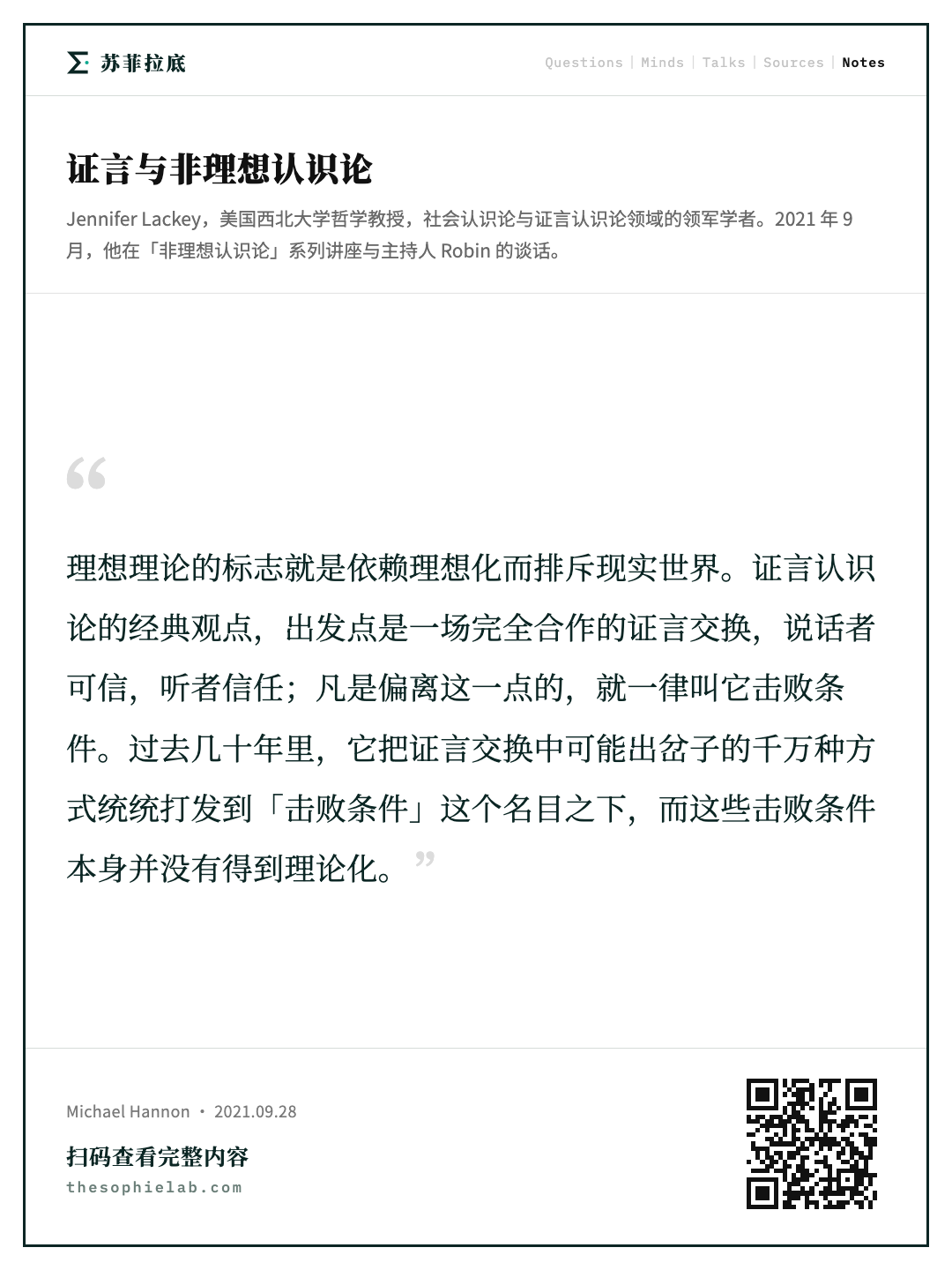
再强调一次,米尔斯认为理想理论的标志就是依赖理想化而排斥现实世界。而我们在证言认识论(epistemology of testimony)的这些经典观点中看到的,正是这样一种情形:这些理论的出发点,是一场完全合作的证言交换,其中作证的人值得信赖,说话者本身也是可信的。米尔斯指出理想理论把现实当作对理想的简单偏离,而这些理论家做的正是这件事,而且这种做法在证言认识论中占据了统治地位。我不想用一页接一页的幻灯片让各位厌烦,各位不妨直接相信我:过去几十年里,证言认识论的文献一直被这种「击败条件」(defeating conditions)的处理方式所主宰,它把证言交换中可能出岔子的千万种方式统统打发到「击败条件」这个名目之下。我想,前面引用的那几段有代表性的话已经说明了这一点。

正如米尔斯所说,这些击败条件本身并没有得到理论化。人们只是说:这是理想的出发点,合作性的对话,我信任别人告诉我的话,我自己也可信;凡是偏离这一点的,我们就一律叫它击败条件。研究证言的认识论者对这些击败条件几乎无话可说。所以,回到米尔斯的框架,在理想化的证言认识论中,我们看到了理想化的能力:说话者可信,听者信任;看到了理想的社会制度:对话是合作性活动;也看到了对压迫的沉默:说话者与听者的社会身份,以及他们面临的偏见,都被忽略了。

今天我想做的,只是朝非理想认识论迈出很小的一步,也就是转向一种非理想的证言认识论进路。我想提出的是,如果我们从现实生活中对话的复杂性出发,就会发现许多证言认识论者的出发点根本就是错的。我要说明一下,我大概只会谈现实对话复杂性的三个特征,还有许许多多其他特征今天完全不会涉及。

我将从一个对网络讨论和政治讨论的常见批评开始,也就是说人们身处回音室(echo chamber)之中。我会指出,回音室本身在认识论上并没有问题。这一点对我们讨论非理想认识论至关重要,因为我认为,许多关于回音室为何有问题的传统分析,恰恰又是一种理想化的表现:它们把回音室当成一种可以纯粹从结构上加以理论化的东西。而我认为,回音室的真正问题,用假新闻与真新闻之间的区别,或者说虚假证言与真实证言之间的区别,能解释得好得多。接着我会指出,社交媒体机器人(bot)的泛滥带来了一组独特的认识论难题,对理想化的证言认识论尤其如此。最后我会提出,证言认识论中的大量工作需要被彻底重新思考。

抱歉,罗宾,你能告诉我应该什么时候停下来吗?

主持人:你可以把目标定在你那边的十点四十五分左右。当然,如果超过五到十分钟,那就只是占用问答环节的时间。

拉基:好,那我得抓紧了,要讲的东西很多。我会讲得非常快,可能会跳过几张幻灯片。

回音室的三个特征

拉基:先说一个堪称典范的案例。特朗普当总统的时候,有一次在空军一号上撞见妻子梅拉尼娅在看CNN。他们提出的解决办法是,特朗普的幕僚确认,今后所有电视机一律调到福克斯新闻,作为标准操作流程。随之而来的,是各方几乎异口同声的批评:特朗普及其支持者身处回音室之中。

回音室有三个核心特征。第一,有某种观点被不断重复、不断强化,从而被放大,往往是通过转发来实现的。第二,这一切发生在一个封闭的系统或「室」里,比如一个社交网络,使得这种观点得以回响。第三,异见的声音要么不存在,要么被淹没。我准备了一些有代表性的引文来说明这三个要素,为节省时间就跳过了。

要注意,说某人处在回音室里,并不是一个价值中立的断言。它是一种批评,或者说是一种要求改变的呼吁,尤其是从认识论的角度看。当头条说「特朗普身处回音室」时,我们不会把它理解为还需要追问一句:那是个好的回音室还是坏的回音室?这是一个规范性断言。但令人意外的是,在关于回音室的日常讨论中,对于问题究竟出在哪里,诊断少得惊人。

第一种诊断:缺乏独立性

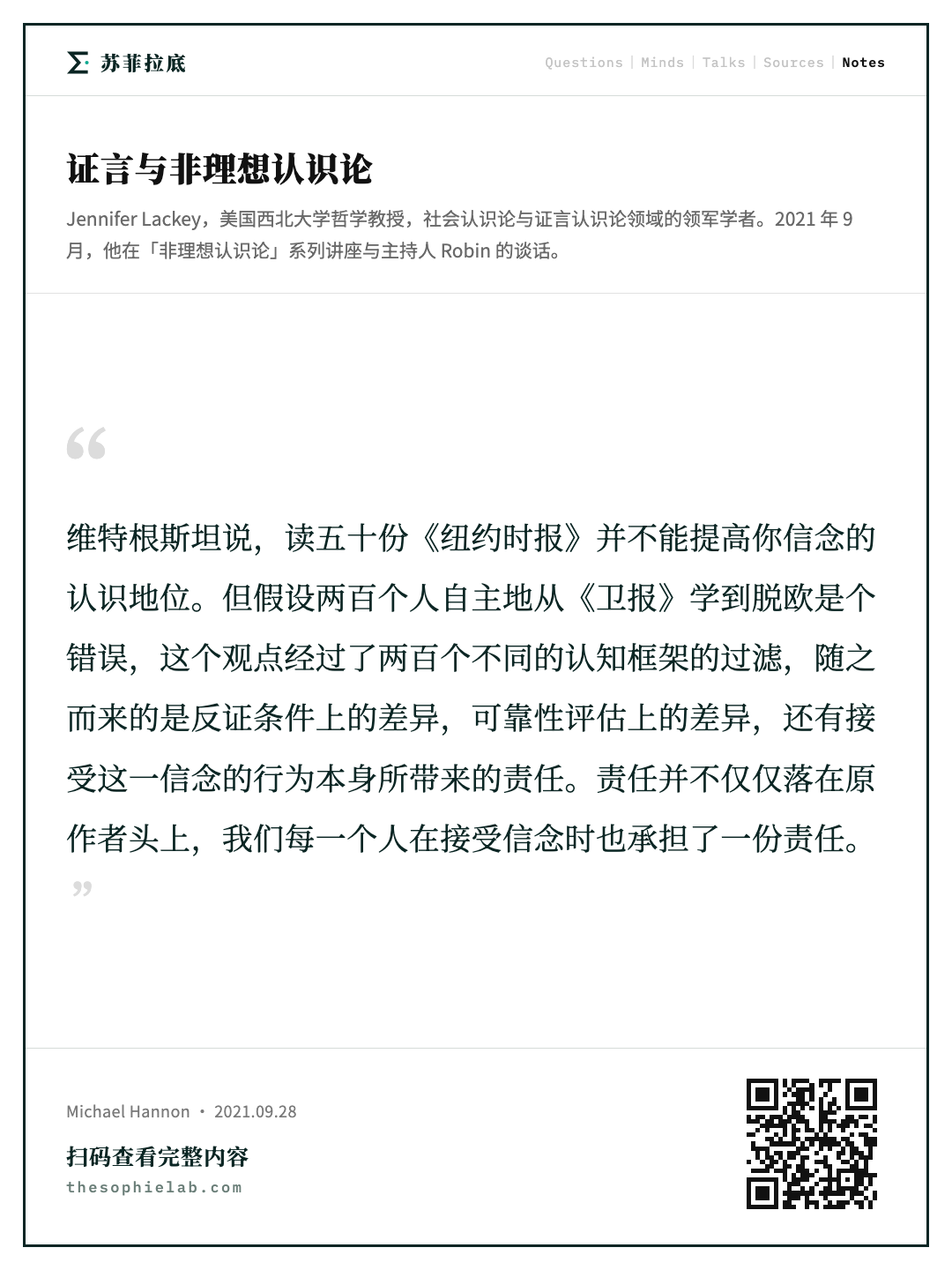
拉基:人们通常认定的一个问题,是回音室中存在过度的依赖。也就是说,回音室里被表达的各种观点之间缺乏足够的独立性,而人们又意识不到这种缺乏。你看到一大群人都在说p,就会觉得,哇,这么多人都相信p。可在回音室里,尽管声音数量庞大,实际上却严重缺乏独立性,而且人们对此浑然不觉。维特根斯坦有一个众所周知的报纸例子:读五十份《纽约时报》,并不能提高你信念的认识地位。

我认为对回音室的这种批评,在分歧认识论(epistemology of disagreement)中非常常见。托马斯·凯利(Thomas Kelly)就说过,即便在一大群通常可靠的人当中意见严重分裂的情形下,被争论双方各自的人数所打动也是一个错误,因为在缺乏独立性的情况下,数量说明不了什么。亚当·埃尔加(Adam Elga)同样说过,一个额外的外部意见,只应在你把它看作独立于你已经考虑过的意见的程度上,才对你有所触动。埃尔加声称这一论点完全没有争议,任何一种理智的分歧观都应当容纳它。所以你看,在埃尔加眼里,「他人的意见只在彼此独立的程度上才具有认识论上的力量」是一个毫无争议的论点。

但对回音室的这种诊断,问题首先出在它理解我们与共同体中其他人的关系、与他们所持信念的关系的方式上。我想主张,而且在其他著作中已经主张过,依赖在认识论上远没有人们通常说的那么具有毁灭性。显然,我非常不同意埃尔加,这绝不是一个毫无争议的论点。

二百个声音不等于一个

拉基:我们来看一个把维特根斯坦报纸情境搬到网上的合理版本。假设社交媒体上某个两百人的小组,每个成员都发了一条评论,解释脱欧为什么是个错误,而他们每一个人都只是在重复从同一个网络新闻来源,比方说《卫报》,那里学来的东西。按照对回音室的标准看法,这两百个评论脱欧是错误的声音,就归约为单一来源。

但我要说,人们通常展现的,是一种重要的依赖,我称之为自主性依赖(autonomous dependence)。自主性依赖是指主体在依赖某个信息来源时行使了认知能动性(epistemic agency)。这种能动性的要求很低,我不指望它涵盖认知能动性的所有维度,它只包括三点:一是监控接收到的证言,留意反证;二是持有关于该证言来源的可靠性和可信性的信念,无论是具体的还是一般的;三是对表达该观点承担责任。

回到脱欧的例子。如果两百个用户之所以发帖谈脱欧,是因为他们自主地从《卫报》学到了这一点,那么该主张所获得的认识论支持,就远远超出了那篇文章原作者所提供的。回想一下,依赖论题说的是,这两百人给我们提供的认识论支持,全部归约为那位《卫报》作者一人。可是这个观点经过了两百个不同的认知框架的过滤,随之而来的是反证条件上的潜在差异,是可靠性评估上的差异(也就是他们各自对来源可靠性的评估),还有他们当初接受这一信念的行为本身,这一行为带来了某种责任。责任并不仅仅落在《卫报》原作者头上,我们每一个人在接受信念时也承担了一份责任。

谁是真正的无差别反射者

拉基:有人可能会反驳说,回音室里的人根本不是自主性依赖的例子。他们可能诉诸阿尔文·戈德曼(Alvin Goldman)的非独立性(non-independence)概念。戈德曼的非独立性是这样定义的:无论h为真还是为假,Y都同样可能跟随X的意见。在这类情形中,就该问题而言,Y是X的「无差别反射者」(non-discriminating reflector)。一个人若以这种方式成为无差别反射者,那么对认知者来说,此人的意见在原始来源的意见之外,不具有任何额外的证据价值。戈德曼由此得出的结论是:如果两个或更多持有意见者彼此完全不独立,而主体知道或有理由相信这一点,那么主体的意见就不应该因为其中不止一人的意见而有丝毫动摇。按照这种看法,我们的网络讨论中人们滑入回音室的问题,就在于我们不过是彼此的无差别反射者,本质上只是在鹦鹉学舌。于是,当两百个人都在说他们从《卫报》学来的东西时,这一切确实就归约为那个原始来源,因为他们只是无差别的反射者。

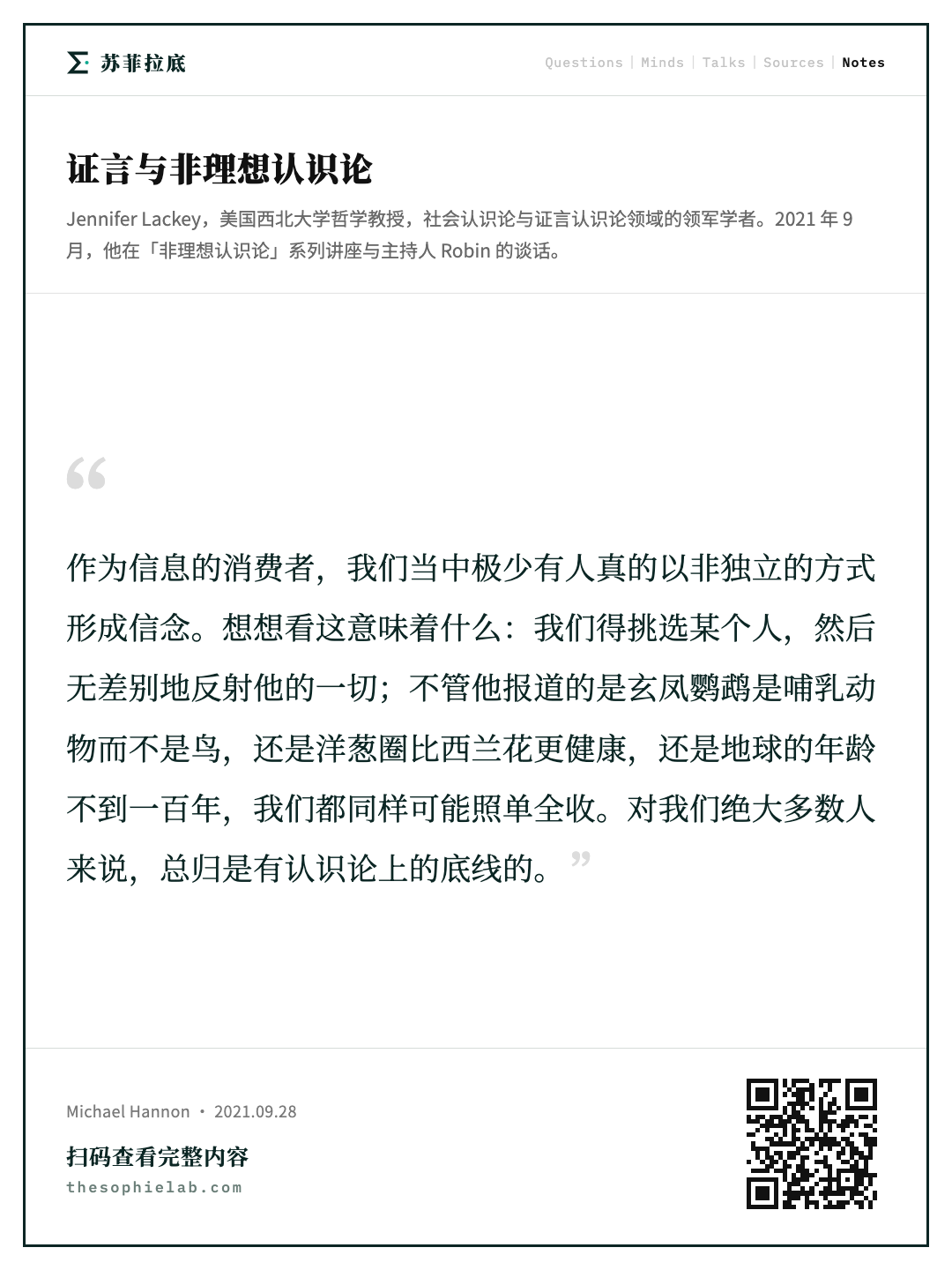
这种看法的问题在于,作为信息的消费者,我们当中极少有人真的以非独立的方式形成信念。想想看这意味着什么:我们得挑选某个人,然后无差别地反射他的一切;不管他报道的是玄凤鹦鹉是哺乳动物而不是鸟,还是洋葱圈比西兰花更健康,还是地球的年龄不到一百年,我们都同样可能照单全收。就算民主党人很可能接受CNN的报道,共和党人倾向于相信福克斯,对我们绝大多数人来说,总归是有认识论上的底线的。所以我认为,戈德曼的非独立性概念要求我们对来源的信任是完全盲目的,只有这样,才会完全不存在额外的认识论支持。

还有一个问题,我只简单提一下。戈德曼对非独立性的刻画,是就某个特定问题而言的无差别反射者。但即便某人就那个问题而言不是有差别的反射者,他在挑选所依赖的来源的种类时,仍然可能是有差别的。

这里有一个问题,说来奇怪,我几乎从没见人问过。也许文献里有,我只是一个人,读不完所有文献,但我确实没见过多少讨论围绕这个问题:这个人当初是怎么进入这个回音室的?想象一下,某人花了很多时间为自己挑选关于气候变化的信息来源,最后决定依赖一份学术期刊,气候变化领域最好的学术期刊,从此对这份期刊上关于气候变化的一切都做无差别的反射。另一个人则抛了一枚硬币,上网随便找了一个人,说,关于气候变化,我要无差别地反射此人说的一切。追问这两个人各自是怎么进入他们的回音室的,是一个极其重要的问题。戈德曼这些哲学家,以及分歧认识论中的各种观点,都想把这一切诊断为一个结构问题:你的行为有问题,因为你是个无差别的反射者。但在此之前还有一个问题:你在这个世界上是一个什么样的认知主体?你是怎么让自己置身于那些情境的?为了进入那个你将成为无差别反射者的情境,你做了什么?

第二种诊断:多样性不足

拉基:关于回音室,有时还有另一种诊断,说它的问题在于缺乏多样的观点。卡斯·桑斯坦(Cass Sunstein)就以此闻名:在一个运转良好的民主社会中,人们不会生活在回音室或「信息茧房」之中。关于多样性为什么在认识论上重要、为什么对真理重要,已有很多论证,我为节省时间一带而过。约翰·斯图尔特·密尔(John Stuart Mill)关于言论自由与真理至少有四个论证可供援引,杜威也有一些论证,我现在不展开,那会把我们带得太远,问答环节可以再谈。

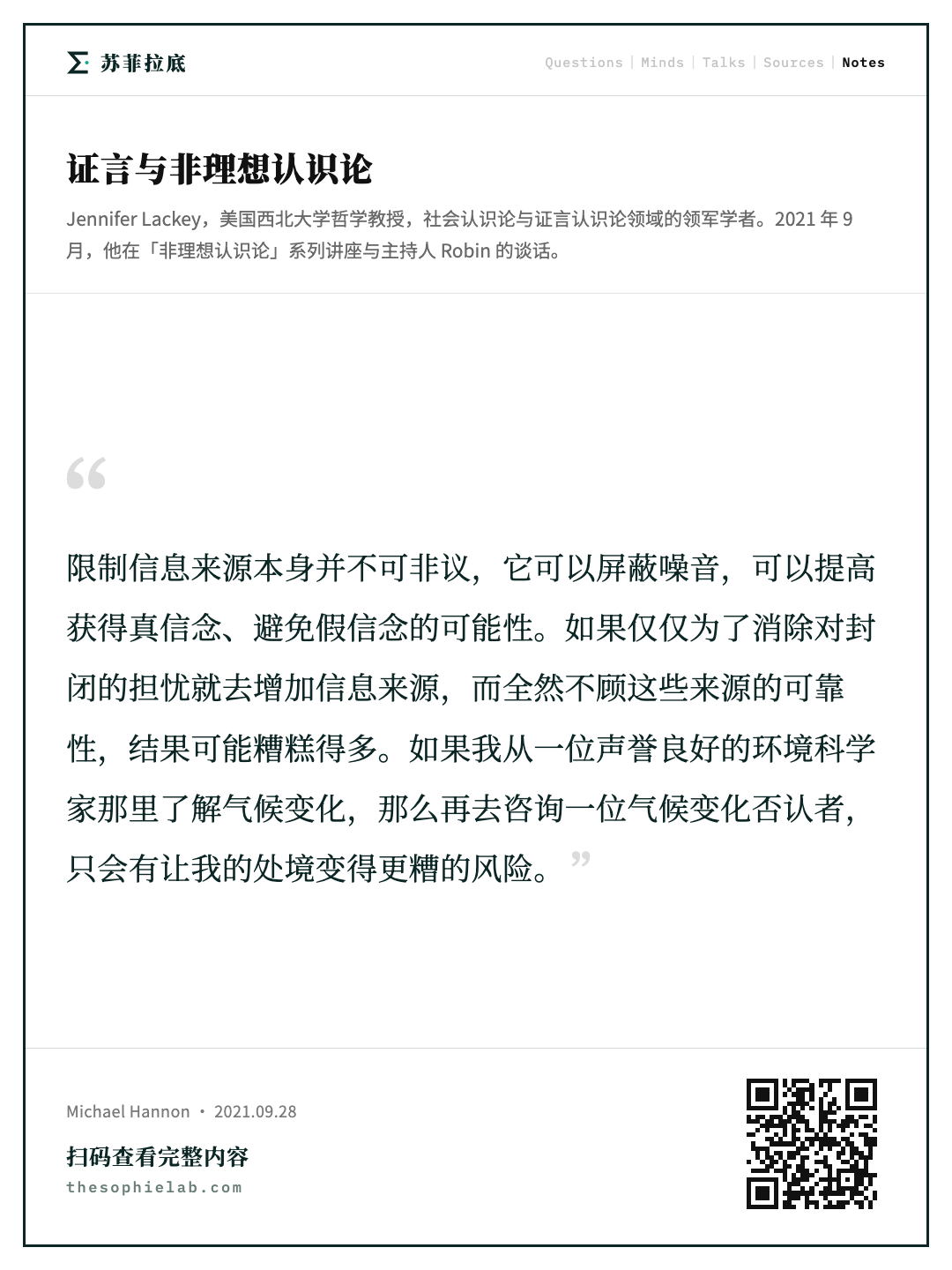
对回音室的这种诊断,同样有问题。第一,限制信息来源本身并不可非议,事实上它甚至有明显的认识论好处。它可以屏蔽噪音,可以让新闻的消费更加高效,可以提高获得真信念、避免假信念的可能性。如果仅仅为了消除对封闭和对信念被不正当强化的担忧就去增加信息来源,而全然不顾这些来源的可靠性,结果可能在认识论上糟糕得多。回到前面的情境:如果我从一位声誉良好的环境科学家那里了解气候变化,那么再去咨询一位气候变化否认者,只会有让我的处境变得更糟的风险。

第二个问题是,我认为这种诊断助长了一种「大家都是一条船上的人」的态度来看待信息消费。这种手法我见过很多次。有人说,这个政治群体只听福克斯新闻;对方就回应说,另一边不也只看CNN吗。再举一个更鲜明的对比:你只从《应用气象学与气候学杂志》获取关于气候变化的信息,所以你和那些学者都在一个回音室里;你却批评我们只从福克斯新闻了解气候变化。这又一次强化了「大家都是一条船上的人」的想法:因为缺乏对相反观点或多元观点的接触,我们各自都待在自己的小回音室里。但显然,我们想说的是,跟一群在《应用气象学与气候学杂志》上发表论文的科学家同处一个回音室的人,和另一种人之间,存在着认识论上的重要差别。

第三个问题是,我认为它可能会为深重的社会危机推销过于简单的解决方案,比如只要增加相反的观点就行了。桑斯坦就建议在社交媒体上设置一个「相反观点」按钮。当我们以为问题仅仅是多样性时,在某种意义上就允许自己不去追问那些真正困难的、可以称为「地面层次」的问题:什么样的多样性?多样性在什么时候才相关?是不是有些语境中多样性有害,有些语境中多样性有益?所有这些,我认为都是应用认识论(applied epistemology)真正要做的工作。

结构还是内容

拉基:我有点说过头了,先把话收回来。这两种回应有一个共同点:它们都把回音室的认识论问题理解为结构性的。这样一来,回音室本身就是完全内容中立的,我们不问任何我前面所说的地面层次的问题:谁在回音室里?他们是怎么进去的?他们彼此回响的是什么样的内容?结构性问题往往引向原则性的解决方案,而这些方案可以完全脱离实际的对话而漂浮着,比如我刚才提到的,人们是怎么进去的,他们在谈论什么。

所以这里存在一个结构与内容的问题。假新闻则是一种更偏内容的担忧。举个例子,「政治真相」(PolitiFact)网站对福克斯新闻及其评论嘉宾在节目中所作陈述的真实性有一份记分卡,其中只有百分之十是真的。

回到我对回音室的一个担忧,也就是我们彼此之间互相抛掷的这种指控。想想那种政治分歧:特朗普和他的支持者都在回音室里,好了,我们回家吧,这就是我们认识论批评的终点。然后对方回击说,你们也一样,你们不看福克斯新闻。于是大家都在一条船上。要打破这个僵局,就必须去看有经验依据的、真实的认识论事实,才能开始在「大家都是一条船上的人」这种回应和结构性分析之间打进一个楔子。当我们有了这样的事实,比如福克斯新闻及其评论嘉宾只有百分之十的时候说的是真话,这个事实就在「大家都是一条船上的人」的回应中打进了一个楔子。2016年大选期间,百分之四十的特朗普选民的主要新闻来源是福克斯新闻。事实上,在始终如一的保守派中,将近一半(百分之四十七)把福克斯新闻列为自己获取政府与政治新闻的主要来源。把这些放在一起:特朗普支持者和保守派的主要新闻来源,恰恰是那个据称其评论嘉宾只有百分之十的时候说真话的媒体。

谎言比真相传得更远

拉基:另一件高度相关的事是,在网上,谎言的力量和传播范围远远超过真相。这又是一个例子,说明有经验依据的应用认识论对于讨论证言认识论绝对至关重要。我不是说我们不该去思考格赖斯(Grice)意义上的合作性对话,我是说,当我们在生成关于我们应当如何在对话中与人互动的规范原则时,必须看一看地面上的数据。

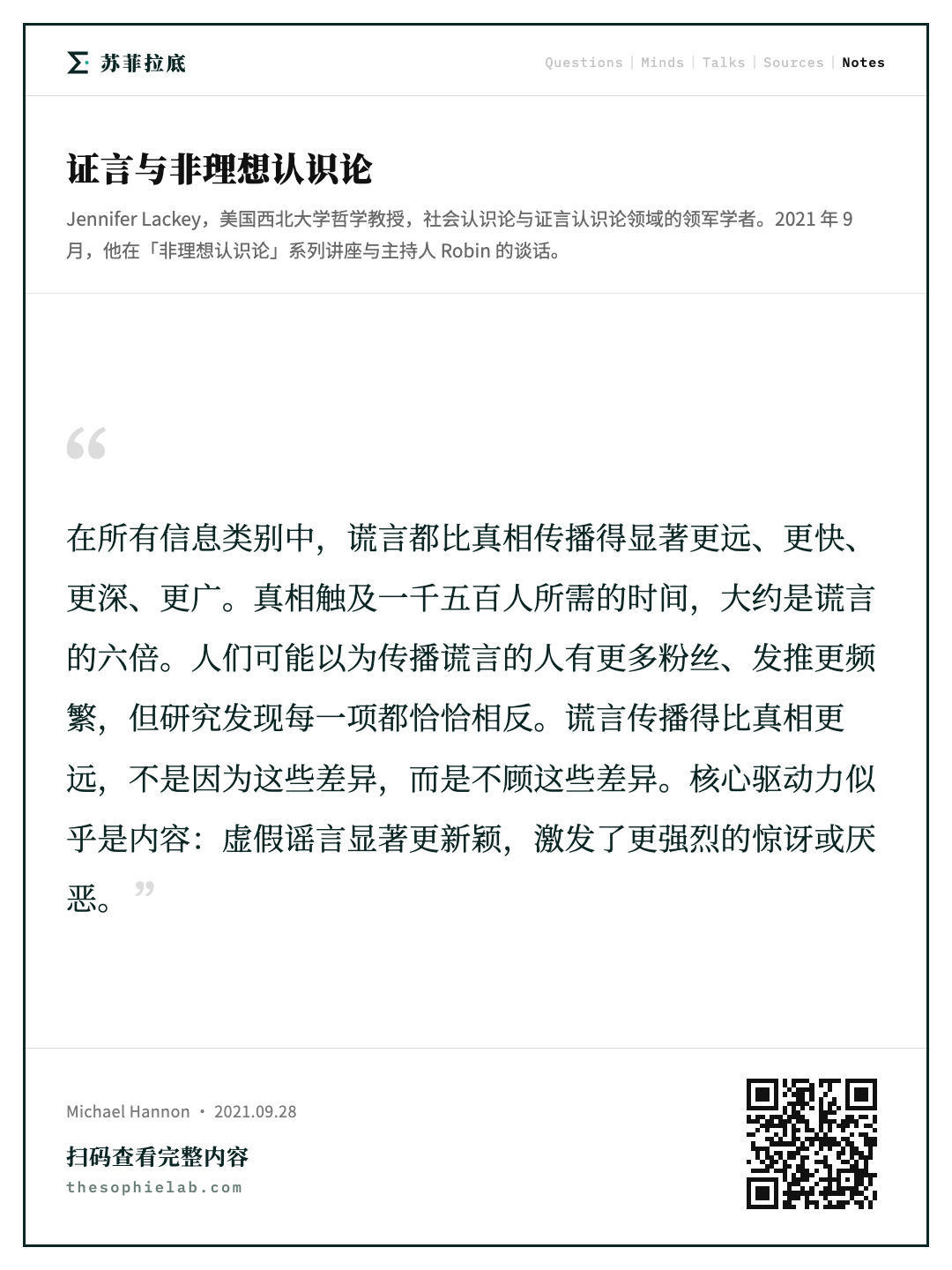
2018年有一项关于「谣言级联」(rumor cascade)的研究。谣言级联指的是源自同一起点的、不间断的转推链。数据集包括126,000条谣言级联,由三百多万人传播了超过四百六十万次,时间跨度是2006年到2017年。结果是,在所有信息类别中,谎言都比真相传播得显著更远、更快、更深、更广。虚假新闻的级联能触及一千到十万人,而真实新闻的级联很少能超过一千人。真相触及一千五百人所需的时间,大约是谎言的六倍。真假谣言级联之间的这些差异,在政治新闻上尤其突出:虚假的政治新闻触及两万多人的速度,比其他所有类型的新闻触及一万人的速度还要快将近三倍。

我们可能会以为,这里可以给出一种结构性的分析:也许传播谎言的人关注了更多的人,有更多的粉丝,发推更频繁,更多是认证用户,或者使用推特的时间更长。但研究的作者们说,当他们比较参与真假谣言级联的用户时,发现每一项都恰恰相反:传播假新闻的用户粉丝显著更少,关注的人显著更少,在推特上显著更不活跃,获得认证的比例显著更低,使用推特的时间也显著更短。谎言传播得比真相更远、更快,不是因为这些差异,而是不顾这些差异。

所以,结构性解释看起来本该是这里最有说服力的东西,但数据不支持它。虚假的谣言级联比真实的更有力量,不是因为信息被扩散的方式,而是,在作者们看来(我要说明这是一项相当新的研究),核心驱动力似乎是内容。在所有相关的新颖性指标上,虚假谣言都比真实谣言显著更新颖,比如信息独特性要高得多。作者们认为,正是这种新颖性激发了用户不同类型的反应,比如更强烈的惊讶或厌恶。

所以我认为我们看到的是:回音室本身在认识论上并没有问题,因此我们不能给出纯粹结构性的分析;但充满假新闻的回音室是有问题的。

威廉斯的量变论

拉基:这张幻灯片我跳过,直接说内容。伯纳德·威廉斯(Bernard Williams)有一段很有意思的话,大意是:我们也许以为互联网正在从性质上改变一切,但实际上,我们身边一直都有说谎的人,一直都有散布流言和谣言的人,共同体里一直都有以各种方式欺骗我们的人。所以互联网以及我们所有的线上互动和接触,并没有改变游戏规则,它只是一个数量问题:东西变多了而已。我们有了iPhone,有了脸书、推特、Snapchat、抖音之类的,但这并没有改变什么。我们过去是到本地的酒馆里去听闲话和谣言,现在只不过是换了一种形式来获取而已,所以我们只是接触到了更多。

接下来我要转向机器人,以及我认为机器人在思考这些问题时带来的一些独特挑战。再说一次,我认为这是非理想证言认识论为何如此重要的一个有力例证。我想强调两点。第一,我认为机器人带来了一种真正独特的认识论问题,由此可以看出,威廉斯的说法很可能是错的:这不只是数量的问题,不只是我们被更多的东西淹没了,而是实际的语境本身发生了变化。我认为这可以称为「改变游戏规则」。第二,聚焦机器人对我们的讨论还有一个作用:我前面为「回音室并没有那么成问题」所作的辩护,会在多个方面受到机器人存在的挑战。

回想一下,促使我认为回音室远没有人们说的那么成问题的一个理由是,我们大多数人是自主的用户,我们表现出的是一种自主性依赖,我们不是戈德曼所说的无差别反射者,不是单纯的鹦鹉,不是你说什么我就照样反射回去。你说p、q、r的时候我可能信任你,可当你说了什么奇怪或荒谬的东西,我可能就会说,不,在这一点上我还是坚持自己的看法,哪怕我已经把你认定为某个问题上的专家或权威。但是,当共同体的成员并没有行使相关的自主性,甚至当他们根本就不可能以自主的方式接受观点时,我认为我们面对的就是另一种问题了。

不是声音的声音

拉基:皮尤研究中心2017年的一项研究发现,在推特上,指向热门新闻与时事网站的链接中,有百分之六十六来自社交媒体机器人,也就是能够发布内容或与其他用户互动、无需人类直接参与的自动化账户。对于某些类型的新闻网站,来自机器人的推文链接比例还要更高:指向那些汇集全网报道的热门聚合网站的链接,有百分之八十九是机器人发布的。这项研究还发现,数量相对较少的高活跃度机器人,贡献了指向知名新闻媒体网站链接的相当大一部分:最活跃的五百个机器人账户,贡献了指向热门新闻与时事网站的推文链接的百分之二十二;相比之下,最活跃的五百个人类用户,估计只贡献了这些媒体链接的百分之六。

再回想一下我们前面关于自主性的讨论,以及它在思考线上互动、思考依赖的认识地位、思考顺从与信任等各种问题时所起的关键作用,这些问题对证言认识论、对我们在共同体中彼此依赖的关系都极其相关。但机器人不行使自主性。它们没有一套用来过滤内容的信念。回想一下,两百个相信某个主张的人全都依赖《卫报》获得这一主张,他们之所以仍然算数,一个原因就是他们把内容过滤过了各自的信念系统(doxastic system)。想想看,这次Zoom通话里的每一个人,所持有的信念集合都截然不同,而当一个信念进入其中时,它是经过所有这些不同的信念集合过滤的。这种对内容的过滤给它提供了额外的支持,所以即使存在依赖,两百个人相信一件事也不同于一个人相信它。但机器人不这么做,它们不以这种方式过滤内容。它们不能因为面对反证仍持有信念而被视为不理性,所以我们无法用共同体的规范去评价它们。它们不评估来源的可靠性,也不对自己的断言承担责任。而这些,正是自主性依赖使回音室中的信念者、共同体成员或用户得以拥有具备认识论辩护的信念,并且在原始来源之外还拥有额外辩护的种种方式。

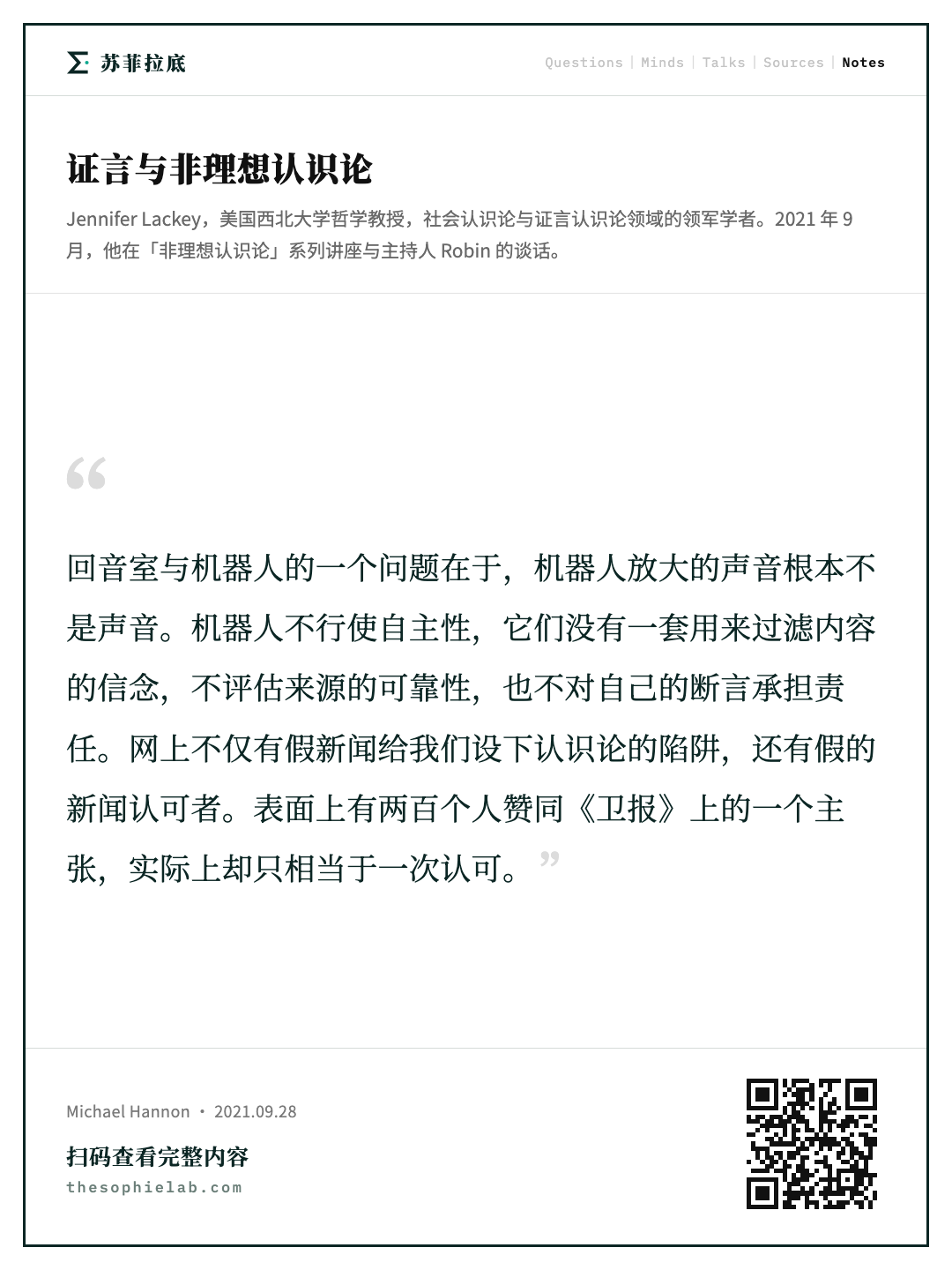
所以回音室与机器人的一个问题在于,机器人放大的声音根本不是声音。我不想重复,但为了突出这个对比:当两百个用户依赖《卫报》时,我的主张是,与凯利、埃尔加乃至戈德曼的说法相反,这并不归约为一个声音,那里有两百个真实的声音,他们行使了自主性依赖。但机器人放大的是根本不是声音的声音。当机器人牵涉其中时,我们看到的两百个用户并不是两百个声音。被表达出来的观点并不反映信念,因为不存在信念者,至少在传统意义上不存在。当出现了这样一些「新闻认可者」,他们看起来在认可某些主张,看起来在自主地发帖,实际上却连人都不是,这时回音室就变得严重成问题了。

在这个意义上,我们看到了威廉斯的说法出了问题。他认为互联网并没有改变游戏规则,不过是把本地酒馆搬到了线上、扩大了接触范围。但当我们审视机器人的泛滥,就会意识到线上互动带来了好几个改变游戏规则的因素。网上不仅有假新闻给我们设下认识论的陷阱,还有假的新闻认可者。我们通常认为,当我们身处一个共同体,有五位受尊敬的同事相信p,我们就可以把他们每一位称为一个新闻认可者:他在认可p这个主张,从而在我们这里提高了p的认识地位。我们听到共同体里有五个成员相信p,他们是新闻认可者,可以说是命题认可者,这就为我们提高了该命题的地位。但在线上互动中,机器人带来的问题是:不只是假新闻这类陷阱,还有假的新闻认可者。表面上有两百个人赞同《卫报》上的一个主张,实际上却只相当于一次认可。

证言认识论的无关紧要之险

拉基:我还剩几分钟,应该能准时结束。我想回到理想化的证言认识论。回想一下开头引用的那些主张:关于可信性与信任的规范被认为刻画了我们的对话实践。我们应当带着「说话者是可信的」这一预设走进一场证言交换,同时把可信性规范带入对话,也就是说,我们自己应当普遍地可信。至于那些乱七八糟的条件,一律打发到击败条件里去。这样的观点忽视了假新闻的泛滥,而这是一个非常严重的问题;忽视了谎言的力量;也忽视了非自主的机器人在我们的证言交换中所起的作用。

我们的许多互动,尤其对年轻一代而言,都在线上进行。我不知道这次通话里各位的年纪,但我有一个十几岁的孩子和一个刚成年的孩子。我像他们这么大的时候根本没有线上生活,而现在他们的互动有更大部分是在线上进行的,这在哪怕十年前都是我想都想不到的。当地面上的图景在剧烈变化,对话的性质在变化,交流的性质在变化,而证言认识论却继续生产这些关于信任与可信性的规范,我认为这有可能使证言认识论变得无关紧要。

出路:经验化、应用化与认知警觉

拉基:那么接下来怎么办?很遗憾,这次报告批评多于建设。我认为,首先我们需要做多得多的有经验依据的证言认识论。与其只想着通过哲学理论来生成规范,我们需要去看谎言在线上互动中扮演的角色,机器人扮演的角色,机器人有多少,它们在哪里,等等。我们需要做有经验依据的证言认识论。

其次,我认为我们还需要做更多的应用认识论。我们需要去看回音室究竟是什么,问题在哪里,它们什么时候是好的,什么时候是坏的,并且给许多至少在不少学科中仍停留于纯粹描述层面的讨论注入规范性。我认为研究证言的认识论者在这里真的有重要的工作可做。但我认为,证言认识论者一直在做的许多工作应当转向,我不是说全部,但其中很大一部分应当转向提出更多应用性的问题。

再回想米尔斯对理想认识论遗漏了什么的批评。我想通过这次报告,大家已经清楚地看到证言认识论者是如何把能力和制度理想化的。但还有一个与此相关的问题。我目前的很多研究也在处理社会认识论与刑法交叉领域的问题,我认为那里有各种各样的讨论都被高度理想化了,忽略了米尔斯所说的那个问题:对压迫的沉默。在我们今天这个语境里同样如此,关于证言交换,还有一大堆重要的问题值得追问。比如我刚看到的一项2021年的研究,就在追问一些非常重要的问题:为什么大多数机器人被设定为女性性别?这对我们关于女性和线上交流的信念意味着什么?它在关于可信与不可信的信念方面起了什么作用?还有许多研究谈到边缘群体成员在网上遭受的大量骚扰,这又如何与线上互动、信任与可信性等问题,以及我们在报告开头提出的那许多问题相互作用?

此外,还需要做更多的工作。关于认知警觉(epistemic vigilance)已经有相当多的研究,关于信任与可信性也有大量研究,这些都是有价值的好工作。但如果我所指出的这些问题以及其他许多问题,确实如我所说的那样改变了游戏规则,那么我们需要做的就远远不止于此:与其一再强调我们必须保持一种恒常的、默认的信任姿态,不如去思考如何培育认知警觉的实践,这种实践既不会让我们滑向怀疑论或普遍的猜疑,又能在认识论上保护共同体,尤其是共同体中的弱势成员。

我想我讲完了,只超时了两分钟。谢谢大家。

主持人:感谢詹妮弗,也感谢你把时间控制得这么理想。
排版 + 横图 + 来源,粘贴即成稿
章节 · 点击跳转视频
0:00 理想理论批判:从米尔斯到证言认识论 ▶ 正在看
3:58 三个非理想特征:回音室、假新闻、机器人 ▶ 正在看
5:17 回音室的定义与第一种诊断:缺乏独立性 ▶ 正在看
8:57 自主性依赖:200个声音不等于1个 ▶ 正在看
11:24 反驳戈德曼:谁是真正的无差别反射者 ▶ 正在看
14:56 第二种诊断:多样性不足及其三个问题 ▶ 正在看
18:29 结构 vs 内容:福克斯新闻的数据 ▶ 正在看
20:58 谎言比真相传得更远:2018年推特研究 ▶ 正在看
24:58 威廉斯的量变论与机器人的质变 ▶ 正在看
27:52 机器人数据:不是声音的声音 ▶ 正在看
34:39 结论:证言认识论面临无关紧要的风险 ▶ 正在看
35:56 出路:经验化、应用化与认知警觉 ▶ 正在看
本期小问 · 档案清单
—— 听来的知识可靠吗? ▶ 正在看
—— 媒介如何改变我们所知的世界? ▶ 正在看
—— 回音室的问题在于封闭结构,还是内容真假? ▶ 正在看
—— 当「声音」背后没有人,信任还能默认吗? ▶ 正在看
本期讲者
珍妮弗·拉基美国西北大学哲学教授,社会认识论与证言认识论领域的领军学者,著有《Learning from Words》(2008)、《The Epistemology of Groups》(2021)、《Criminal Testimonial Injustice》(2023),并主编《The Epistemology of Disagreement》。
Robin线上讲座系列的组织者,负责控时与问答环节主持。
01理想理论批判:从米尔斯到证言认识论
0:00
paul faulkner paul falconer says um the idea that conversation be seen as a cooperative endeavor yields a pair of social norms the prescription that speakers follow the cooperative principle and its maxims describes a social norm of trustworthiness and the paired prescription that as audiences we presume this of speakers and act as if we believe that they are following the cooperative principle and its maxims describes a social norm of trust i take this pair of norms to describe our conversational practices so so um i think that what we see here is i think a pretty powerful instance of um what we might call ideal epistemology so you know charles mills you know i think like very um you know i think in in a very kind of gripping sort of way characterizes ideal theory um as being you know kind of distinguished by its reliance on idealization to the exclusion or at least to the marginalization of the actual ideal theory either tacitly represents the actual as a simple deviation from the ideal not worth theorizing in its own right or claims that starting from the ideal is at least the best way of realizing it and so mills says that ideal theory will use some or all of a list of concepts and assumptions including idealized
保罗·福克纳(Paul Faulkner)说,嗯,把对话看作一种合作性事业的这个想法,会产生一对社会规范:要求说话者遵循合作原则及其准则,这描述的是一种「可信赖」的社会规范;而与之配对的、要求我们作为听众预设说话者会这样做、并且表现得就好像我们相信他们在遵循合作原则及其准则,这描述的是一种「信任」的社会规范。我认为这一对规范刻画了我们的对话实践。所以,嗯,我觉得我们在这里看到的,是一个相当有力的例子,可以称之为「理想化认识论」。你知道,查尔斯·米尔斯(Charles Mills),我觉得他用一种非常抓人的方式,把理想理论的特征刻画为:它依赖理想化,从而排除了、或者至少边缘化了现实。理想理论要么默认把现实表现为对理想的一种简单偏离,不值得单独加以理论化;要么主张从理想出发至少是实现理想的最佳途径。所以米尔斯说,理想理论会使用一系列概念和假设中的部分或全部,其中包括理想化的
便签笔记
1:22
capacities ideal social institutions and silence on oppression so i think that um you know ideal theory you know again is that you know the one of the you know he says the distinguishing feature is its reliance on idealization to the exclusion of the actual world and i think what we see in in these you know kind of classic views of the epistemology of testimony is that the theoretical starting point of these views is a testimonial exchange of complete cooperation where um the you know the people testifying are those who can be trusted and the speakers themselves are trustworthy and just as mills argues that ideal theory represents the actual as a simple deviation from the ideal these theorists and this is just dominates the epistemology of testimony i didn't want to bore you with screen after screen of slides but um you know you can just take my word for it um that um the the epistemology of testimony literature for for the last several decades has just been dominated by this defeating conditions can you know kind of um move that kind of relegates to defeating conditions the massive and multitude of ways in which things can go awry in testimonial exchanges and i think we see that in those i think representative quotations
能力、理想的社会制度,以及对压迫的沉默。所以我认为,嗯,理想理论,他说它的显著特征就是依赖理想化、把现实世界排除在外。而我认为,我们在这些经典的证言认识论观点里看到的是:这些观点的理论起点是一场完全合作的证言交流——作证的人都是值得信任的,说话者本身也是可信赖的。正如米尔斯论证理想理论把现实表现为对理想的简单偏离,这些理论家也是这么做的,而且这种做法完全主导了证言认识论。我不想用一屏又一屏的幻灯片把你们弄烦,但你们大可相信我的话:过去几十年的证言认识论文献基本上就被这种「挫败条件」的处理方式主导着——它把证言交流中大量的、形形色色的出错方式全都打发到「挫败条件」里去。我认为我们在那些有代表性的引文里正好能看到这一点。
便签笔记
2:39
and so those defeating conditions as mill says um are not theorized in their own right they're really just like here's you know kind of the ideal starting point cooperative conversation you know i trust what i'm told and i am trustworthy and anything that deviates from that we just say defeating conditions and you know epistemologists working on testimony just say very very little about those defeating conditions um so ideal you know kind of again referring back to charles's work um ideal epistemology of testimony we see idealized capacities speakers are trustworthy and hearers are trusting we see ideal social institutions conversations are cooperative activities and we see silence on oppression the social identity of speakers and hearers and the biases they face are ignored so um i think that what i want to do today um is um just kind of you know a very very small move towards shifting to non-ideal epistemology to to a non-ideal approach to the epistemology of testimony and what i want to suggest is that um if we begin with the complexity of real-life conversations and let me just highlight i'm going to be talking about like maybe roughly three features of the complexity of real life conversations
所以就像米尔斯说的,那些挫败条件本身并没有被单独加以理论化,它们基本上就只是——这里是理想的起点:合作性的对话,我信任别人告诉我的话,而我自己也是可信赖的;任何偏离这一点的情况,我们就统统说成是「挫败条件」。而研究证言的认识论家对这些挫败条件几乎什么都不说。所以,理想的——再回到查尔斯的工作——理想的证言认识论里我们看到的是:理想化的能力,说话者是可信赖的,听者是信任的;我们看到理想的社会制度,对话是合作性的活动;我们还看到对压迫的沉默,说话者和听者的社会身份以及他们所面对的偏见都被忽略了。所以,嗯,我今天想做的,只是朝着转向非理想认识论、转向一种非理想的证言认识论迈出非常非常小的一步。我想提出的是,如果我们从现实生活中对话的复杂性出发——让我先说明一下,我今天大概只会谈到现实生活对话复杂性中的三个特征——
便签笔记
02三个非理想特征:回音室、假新闻、机器人
3:58
there are many many many other features that i won't say anything at all about today but if we begin with the complexity of real life conversations i think that we see that the starting place of many epistemologists in um you know kind of of testimony we see that that starting place is um is just is deeply misguided so um i'm going to engage in non-ideal epistemology of testimony beginning with a common criticism of much online and political discourse namely that people are in echo chambers i'm going to suggest that echo chambers by themselves are not epistemically problematic and this is going to be crucial to our discussion of non-ideal epistemology because i think that many of the traditional analyses of what makes echo chambers problematic really does represent kind of again a form of idealization and um looking at echo chambers as being something that can be theorized in a purely sort of structural way but i think that um the problem in fact for echo chambers is much better explained by looking at the at the difference between fake and real news um or false and you know kind of true um testimony um and then i'm going to suggest that the prevalence of social media bots poses i think a unique set of epistemic problems particularly for ideal epistemology of testimony and i'm
还有非常非常多其他的特征我今天完全不会提到。但如果我们从现实生活中对话的复杂性出发,我认为我们就会看到,许多研究证言的认识论家的那个起点,是严重被误导的。所以,嗯,我打算做一点非理想的证言认识论,从一个针对大量网络话语和政治话语的常见批评开始,也就是说,人们处在回音室里。我要提出的是,回音室本身在认识上并不成问题。这一点对我们关于非理想认识论的讨论至关重要,因为我认为,许多关于回音室为何成问题的传统分析,其实同样代表了一种理想化——把回音室看成某种可以纯粹从结构角度来理论化的东西。但我认为,回音室的问题,其实用假新闻和真新闻之间的差别、或者说虚假证言和真实证言之间的差别来解释要好得多。然后我还要提出,社交媒体机器人的普遍存在,带来了一套我认为很独特的认识论问题,尤其是对理想化的证言认识论而言。而我
便签笔记
03回音室的定义与第一种诊断:缺乏独立性
5:17
going to conclude by suggesting that we need to radically rethink much work in the epistemology of testimony um so um i'm sorry robin can you just tell me what time i should stop talking if robin's there okay so if you could i guess aim for uh about uh wait that'd be quarter to 11 your time you want me to be done in a quarter two well a game four but obviously if you go five ten minutes over that then it just cuts into the time of the q a so okay okay i i'll get going because i have a lot to get through um so i'll try i'm going to talk super fast i might skip some slides um so i think that um you know we this is just a kind of a paradigmatic case while trump was president um he caught his wife melania watching um cnn on air force one and the solution that they proposed was that trump staff kind of confirmed that moving forward it would be standard operating procedure to have all tvs turned to fox um and the common criticism we saw across the board was that trump and his supporters are in an echo chamber um there are three central features that we see in echo chambers there's an opinion that is repeated and reinforced thereby amplifying it often through re-sharing it occurs in an enclosed system or chamber such as a social network allowing that opinion to echo and dissenting voices are either absent or
最后要提出的是,我们需要彻底重新思考证言认识论中的许多工作。嗯,那个,不好意思,罗宾,你能告诉我应该讲到什么时候吗?罗宾在吗?好的,那如果可以的话,我想大概目标是——等一下,那就是你们那边的十点四十五。你想让我在四十五分讲完?嗯,就按四十五分吧,不过当然,如果你超了五到十分钟,那就只是占用问答的时间而已。好的好的,那我继续讲了,因为我还有很多内容要过。嗯,我会尽量讲得非常快,可能会跳过一些幻灯片。嗯,我觉得,这就是一个典型的例子:特朗普当总统的时候,他撞见他妻子梅拉尼娅在空军一号上看CNN,而他们提出的解决办法是,特朗普的幕僚确认,从今以后的标准操作流程是把所有电视都调到福克斯台。当时我们到处看到的共同批评就是,特朗普和他的支持者处在一个回音室里。回音室有三个核心特征:一个观点被不断重复和强化,从而被放大,往往是通过转发;它发生在一个封闭的系统或者说「室」里,比如一个社交网络,让那个观点得以回响;而不同意见要么根本不存在,要么就被
便签笔记
6:38
drowned out these are just some representative quotations of um kind of that capture those three elements i'm going to skip them in the interest of time now echo chambers are not a value neutral claim it's a criticism or a call for change um particularly from an epistemic point of view when someone says um you know trump is in an echo chamber and that's the headline we're not supposed to interpret that as then calling for a further question well is it a good echo chamber or a bad echo echo chamber it's a normative claim and but but surprisingly i mean in in common conversations of echo chambers there's actually like surprisingly little diagnosis of what the actual problem is so um i think one of the standard um problems that's regard you know that that people take to be operative is that there's a problematic level of dependence um so there's you know when there's an echo chamber um there's an absence of sufficient independence among the views being expressed but there's also a lack of awareness regarding this absence right so when you see like a whole bunch of people saying you know that p um there's like wow so many people believe that p but when you're in an echo chamber there's a real lack of of independence even though there's this kind of massive number of voices and
淹没掉。这些只是一些能体现这三个要素的代表性引文,为了节省时间我就跳过了。回音室并不是一个价值中立的说法,它是一种批评,或者说是一种要求改变的呼吁,尤其是从认识论的角度看。当有人说「特朗普处在一个回音室里」,而这成了标题时,我们并不该把它理解成还要接着问一句:那这是个好的回音室还是坏的回音室?它本身就是一个规范性的断言。但令人意外的是,在日常关于回音室的讨论里,实际上很少有人诊断真正的问题到底是什么。所以,嗯,我认为人们通常认为在起作用的一个标准问题是:存在一种成问题的依赖程度。也就是说,当存在回音室时,所表达的各种观点之间缺乏足够的独立性,同时人们也缺乏对这种缺失的意识。对吧,当你看到一大堆人都在说「p」,你会觉得,哇,这么多人相信p;但当你身处回音室时,尽管声音数量庞大,其中却实实在在地缺乏独立性,而且
便签笔记
7:52
people are aware of that lack unaware of that um lack of independence um you know wittgenstein has that really well-known newspaper example that if you read 50 copies of the new york times you know it doesn't increase um the epistemic status of your beliefs um and i think that this criticism of echo chambers is really familiar from the epistemology of disagreement um so you know it's very commonly assumed you know tears thomas kelly even in cases in which opinion is sharply divided among a large number of generally reliable individuals it would be a mistake to be impressed by the sheer number of such individuals on both sides of the issue for numbers mean little in the absence of independence and similarly adam alga says an additional outside opinion should move one only to the extent that one counts it as independent from opinions one has already taken into account such a thesis alba claims is completely uncontroversial and every sensible view on disagreement should accommodate it so i think um you know kind of there's this there's this you know obviously you know you see what alga says it's a completely uncontroversial thesis that the opinions of others have epistemic
人们意识不到这种独立性的缺失。嗯,维特根斯坦有个非常有名的报纸例子:如果你读了五十份同一天的《纽约时报》,这并不会提升你信念的认识地位。而我认为,这种对回音室的批评,在分歧认识论里我们非常熟悉。所以,你知道,这被广泛地认定——托马斯·凯利(Thomas Kelly)说,即使在意见在大量总体上可靠的个体之间严重分化的情况下,仅仅因为议题两边各自有多少人就被打动,也是个错误,因为在缺乏独立性的情况下,数量意义不大。类似地,亚当·艾尔加(Adam Elga)说,一个额外的外部意见应当只在你把它算作独立于你已经考虑过的那些意见的程度上,才对你产生影响。艾尔加声称,这样一个论题是完全没有争议的,任何关于分歧的合理观点都应当容纳它。所以我觉得,嗯,就是有这么一种看法——很明显,你看艾尔加说这是一个完全没有争议的论题,即他人的意见只有在彼此独立的程度上才具有认识上的
便签笔记
04自主性依赖:200个声音不等于1个
8:57
force only to the extent that they are independent of one another um but the problem with this diagnosis of echo chambers is is first with this kind of way of thinking about um our relationship to other people in our community and our relationship to the other beliefs that they have so um dependence you know i i want to argue and i have argued in other work that it's not nearly as epistemically devastating as it's often suggested to be so i just i obviously very much disagree with elga that this is a completely uncontroversial thesis here's a plausible online version of wittgenstein's newspaper scenario suppose that every member of a 200 person group on social media posts a comment explaining why brexit is a mistake each of them is simply repeating what they learned from the same exact online news source let's just say the guardian so in such a case the standard view of echo chamber says that the number of voices commenting on brexit being a mistake just reduces to a single source but i want to say that there is an important kind of dependence that people i think often most of the time exhibit and it's what i call autonomous dependence so autonomous dependence involves the subject exercising epistemic agency in her reliance on a source of information which in turn
分量。但是,这种对回音室的诊断,问题首先出在这种看待我们与社群中其他人的关系、以及我们与他们所持信念之间关系的方式上。所以,嗯,依赖——我想论证,而且我在其他工作里已经论证过——它远没有人们常说的那么具有认识上的毁灭性。所以我显然非常不同意艾尔加说这是一个完全没有争议的论题。这里有一个维特根斯坦报纸情景的、看起来挺合理的网络版本:假设某个社交媒体上两百人的群组,每个成员都发帖解释为什么脱欧是个错误,而他们每个人都只是在重复自己从同一个网络新闻来源那里学到的东西,我们就假设是《卫报》吧。那么在这种情况下,关于回音室的标准观点会说,这两百个评论「脱欧是个错误」的声音,其实就归结为单一一个来源。但我想说的是,有一种重要的依赖,是人们——我认为往往、甚至大多数时候——会表现出来的,我称之为「自主性依赖」。自主性依赖指的是主体在依赖某个信息来源时,行使了自己的认识能动性,而这又
便签笔记
10:13
involves and this is very minimal i don't expect this to be characterizing all dimensions of epistemic agency monitoring the incoming testimony for counter evidence possessing beliefs about the reliability and trustworthiness of the testimonial source either in particular or in general and bearing responsibility for expressing the view in question so if we go back to the brexit case we see that if 200 users post about brexit because of what they autonomously learned in the guardian then the epistemic support for the claim in question goes far beyond that of the author of the original article itself recall that that dependence thesis says that all 200 the epistemic support we get from all 200 of those people just reduces to the author of that guardian article but such a view was filtered through 200 different epistemic frameworks which brings along potential differences in counter evidence conditions reliability assessments meaning their assessment of the reliability of sources and they're taking up the belief in the first place which brings with it a certain kind of responsibility so it doesn't reduce to just the responsibility of the original guardian author but there is also some responsibility that we bear for taking up beliefs now someone might argue that people in
涉及——这个要求非常低,我并不指望它能刻画认识能动性的所有维度——监控传入的证言、留意反证;对该证言来源的可靠性和可信赖性持有信念,无论是就具体来源而言还是就一般而言;并且为表达该观点承担责任。所以回到脱欧那个例子,我们看到,如果两百个用户因为自己从《卫报》自主地学到的东西而发帖谈脱欧,那么该主张所获得的认识支持,就远远超过原文作者一个人所提供的。回想一下,那个依赖论题说的是,这两百个人给我们的认识支持全都归结为那篇《卫报》文章的作者。但这个观点是经过两百个不同的认识框架过滤的,这就带来了在反证条件、可靠性评估——也就是他们对信息来源可靠性的判断——上的潜在差异,还有他们最初接受这个信念这件事本身,而这带来了某种责任。所以它并不归结为原始《卫报》作者一个人的责任,我们因为接受信念也承担了一部分责任。现在,有人可能会争辩说,处在
便签笔记
05反驳戈德曼:谁是真正的无差别反射者
11:24
echo chambers are simply not examples of autonomous dependence they might appeal to something like alvin goldman's notion of non-independence so his notion is of non-independence says that why is justice likely to follow x's opinion whether h is true or false so in these sorts of cases y is a non-discriminating reflector of x with respect to a particular question and when someone is a non-discriminating reflector in this way that person's opinion has no extra evidential worth for the agent above and beyond the original source's opinion so the upshot for goldman is that if two or more opinion holders are totally non-independent of one another and if the subject knows or is justified in believing this then the subject's opinion should not be swayed even a little by more than one of these opinion holders so on this view what's problematic with much of our online discourse where people are slipping into echo chambers is that we're just non-discriminating reflectors of one another right we're just essentially you know kind of parroting what other people are saying um so you know when we have 200 people you know kind of saying something that they learned in the guardian then it really does just reduce to that original source
回音室里的人根本就不是自主性依赖的例子。他们可能会诉诸类似阿尔文·戈德曼(Alvin Goldman)的「非独立性」概念。他的非独立性概念说的是:无论h是真是假,Y都同样有可能追随X的意见。在这类情况下,就特定问题而言,Y是X的一个「无差别反射者」。当某人以这种方式成为无差别反射者时,那个人的意见对该主体来说,除了原始来源的意见之外,就不再具有额外的证据价值。所以对戈德曼来说,结论是:如果两个或更多的持有意见者彼此完全非独立,而且主体知道这一点、或者有理由相信这一点,那么主体的意见就不应该因为这些持有意见者中不止一个人而受到哪怕一丁点影响。所以按照这个观点,我们大量网络话语中人们滑入回音室的问题就在于:我们只是彼此的无差别反射者,对吧,我们本质上只是在鹦鹉学舌地重复别人说的话。所以,当有两百个人在说他们从《卫报》学到的某件事时,那它确实就只归结为那个原始来源,
便签笔记
12:35
because they're just non-discriminating reflectors the problem with this is that very few of us as consumers of information literally form beliefs non-independently so consider what this would amount to we would pick someone for you know you know with whom we're just gonna you know non-discriminately reflect and we would be just as likely to accept what we are told when it is reported that cockatiels are mammals rather than birds that onion rings are healthier than broccoli that the earth is under rather than over 100 years old and so on so even if democrats are very likely to accept what cnn reports and republicans are disposed to believe fox surely there are epistemic limits for most of us so i think that goldman's notion of non-independence requires that the trust in our sources be entirely blind in order for there to be a complete absence of additional epistemic support but there's another problem that i'm just going to briefly mention and that's that goldman's account of non-independence is characterized in terms of being a non-discriminating reflector with respect to a particular question but even if that person is not a discriminating reflector of that question why may that person may nonetheless be discriminating when it
因为他们只是无差别反射者。这里的问题在于,我们作为信息消费者,几乎没有人是真的以非独立的方式形成信念的。想想看这意味着什么:我们会挑一个人,然后就打算对他做无差别的反射,于是当有人报道说鹦鹉是哺乳动物而不是鸟、洋葱圈比西兰花更健康、地球的年龄不到一百年而不是超过一百年等等,我们都会照样接受。所以,即使民主党人很可能接受CNN报道的东西、共和党人倾向于相信福克斯,对我们大多数人来说,肯定还是存在认识上的界限的。所以我认为,戈德曼的非独立性概念要求我们对信息来源的信任必须是完全盲目的,才会出现完全没有额外认识支持的情况。但还有另一个问题,我只简单提一下:戈德曼对非独立性的刻画,是就某个特定问题而言的「无差别反射者」。但即使那个人在那个问题上不是有差别的反射者,他在
便签笔记
13:44
comes to the kind of source that they are relying on and here's a question that i think it's it's it's sort of surprising that i just never see anyone ask this question i mean maybe there's literature out there i mean i'm just one person and i can't follow all the literature out there but i certainly have not seen a lot of discussions on the question of how did the person get into the echo chamber in question so we can imagine let me see what the next slide yeah sorry i thought that the next slide might get into this um so you know we you know imagine that someone kind of spends a lot of time deciding on their source on um climate you know kind of change and they decide to rely on um on an academic journal the best academic journal on climate change and so they're just going to be a non-discriminating reflector with respect to everything that they learn in that journal about climate change versus someone who flips a coin and goes online and says i'm going to be a non-discriminating reflector of everything that person says with respect to climate change it's an incredibly important question that we ask how did these respective people get into the echo chambers in question um a lot of these philosophers you know goldman and the views and disagreement want to diagnose all of this as a structural question right it's
所依赖的来源类型上,仍然可能是有差别的。这里有个问题,我觉得挺让人意外的是,我几乎从没见过有人问这个问题。我是说,也许有相关文献,我毕竟只是一个人,没法追踪所有的文献,但我确实没怎么见过关于这个问题的讨论:这个人当初是怎么进到那个回音室里去的?我们可以设想——让我看看下一张幻灯片——嗯,对,抱歉,我以为下一张会讲到这个。嗯,你想象一下,有人花了很多时间去挑选自己关于气候变化的信息来源,最后决定依赖一份学术期刊,气候变化领域最好的学术期刊,于是他就对自己从那份期刊上学到的关于气候变化的一切做无差别反射;再对比另一个人,他抛硬币决定,上网说「我要对这个人关于气候变化说的一切做无差别反射」。「这些人各自是怎么进到相应的回音室里去的」,这是个极其重要的问题。嗯,很多这些哲学家——戈德曼,还有分歧问题上的那些观点——想把这一切都诊断为一个结构性问题,对吧,就是
便签笔记
06第二种诊断:多样性不足及其三个问题
14:56
just like your behavior is problematic because you're a non-discriminating reflector but there's a prior question you know kind of what what kind of epistemic agent are you in the world right and how do you find yourself in those contexts and what did you do to get into that context in which you're going to be such a non-discriminating reflector so um another um kind of problem that sometimes this diet is said that exists with respect to echo chambers is that they just a lack of diverse viewpoints and cass sunstein is really well known for this so in a well-functioning democracy people don't live in echo chambers or information cocoons um and there are lots of arguments that have been given i'm just going to kind of gloss over in the interest of time about why diversity might matter epistemically and why diversity you know uh might matter for the truth and so john stuart mill has at least four arguments concerning free speech and truth that i think we could appeal to dewey has some arguments i'm just not going to go into those those right now just because um that's that's i think would take us too far afield um but we can certainly discuss some of that in the q a um but the problem with this diagnosis as well of echo chambers is that
「你的行为有问题,因为你是个无差别反射者」。但还有一个在先的问题:你在这个世界上是什么样的认识主体?你是怎么让自己置身于那些语境中的?你做了什么才进到那个让你成为无差别反射者的语境里?嗯,另一个据说与回音室有关的问题是,它们就是缺乏多元的观点。凯斯·桑斯坦(Cass Sunstein)在这方面非常有名:在一个运转良好的民主社会里,人们不会生活在回音室或者信息茧房里。嗯,关于多样性为什么在认识上重要、多样性为什么对真理重要,已经有很多论证,为了节省时间我就大致带过。约翰·斯图亚特·密尔关于言论自由与真理至少有四个论证,我觉得我们可以援引;杜威也有一些论证。我现在就不展开了,因为那样会离题太远,不过我们当然可以在问答环节讨论一些。嗯,但这种对回音室的诊断的问题在于,
便签笔记
16:05
restricting information sources is not objectionable by itself in fact it can even have some clear epistemic benefits so it can block out noise it can streamline the consumption of news and increase the likelihood of acquiring true and avoiding false beliefs and so if sources are added simply to avoid worries about insulation and the illegitimate reinforcement of beliefs without any regard for their reliability the result can end up far worse epistemically so you can imagine you know the scenario we were talking about before if i learn about climate change from a reputable environmental scientist there's only the danger of making my situation worse off by also consulting with a climate change denier um another problem with this is that i think it lends itself to a we're all in the same boat kind of attitude about the consumption of information i've seen this move made a lot um so you know people will say like oh well you know this political group they're listening only to fox news and then the response is well you know kind of the other political side is listening only to you know cnn or something um and so um you know i think that um you know we you know and even taking i think like a starker contrast right would be something like you're only getting your
限制信息来源本身并不是可反对的,事实上它甚至可能有一些明显的认识上的好处:它可以屏蔽噪音,可以让新闻消费更精简,并提高获得真信念、避免假信念的可能性。所以,如果只是为了避免关于隔绝和信念被不正当强化的担忧就添加信息来源,而完全不考虑这些来源的可靠性,那结果在认识上可能反而糟糕得多。你可以想象我们之前谈的那个情景:如果我从一位有声望的环境科学家那里了解气候变化,那么再去咨询一个气候变化否认者,只会让我的处境变得更糟。这里的另一个问题是,我觉得它容易导向一种「大家都半斤八两」的信息消费态度。这种说法我见过很多次。人们会说,哦,这个政治群体只听福克斯新闻;然后回应是,那另一边的政治阵营也只看CNN之类的。嗯,所以我觉得,甚至用一个更极端的对比:你关于气候变化的全部
便签笔记
17:19
information about climate change from the journal of applied meteorology and climatology so you and all those academics are in an echo chamber um and you know you're criticizing us for just getting our information about climate change from fox news again this just kind of reinforces this we're all in the same boat here we're all just in our own little echo chambers um because of a lack of exposure to opposing or diverse viewpoints but obviously we want to say that there's something importantly epistemically different between the person who is in an echo chamber with um other you know kind of scientists um who are publishing in the journal of applied meteorology and climatology and the other ones um and i think a third problem is that i think it might kind of promote some simple solutions to deep social crises um and that might be you know kind of just the addition of opposing viewpoints so sunstein suggests you're kind of having and this opposing viewpoint kind of um button on social media um and i think that um when we think that it's just diversity um we don't really kind of it allows us in some respects to not ask some of the like really difficult questions at the kind of what i might call like
信息都来自《应用气象与气候学杂志》,所以你和那些学者也在一个回音室里,而你还批评我们只从福克斯新闻获取气候变化的信息。这又一次强化了那种「我们都一样、我们都只待在自己的小回音室里」的说法,因为缺乏对相反或多元观点的接触。但很明显,我们会想说,一个和其他在《应用气象与气候学杂志》上发表论文的科学家待在一个回音室里的人,跟另外那些人之间,存在着重要的认识上的差别。嗯,我认为第三个问题是,它可能会助长对深层社会危机的一些简单化解决方案,比如就是加进相反的观点。桑斯坦就建议在社交媒体上搞一个「相反观点」的按钮之类的。嗯,我觉得,当我们认为问题只是多样性时,这在某种程度上让我们得以不去追问一些非常困难的问题,也就是我可能会称之为
便签笔记
07结构 vs 内容:福克斯新闻的数据
18:29
the ground level right um you know kind of what kind of diversity when should diversity be relevant are there some contexts in which diversity are bad and some are good all of this i think is actually like genuine work for applied epistemology um so you know well anyway i'm kind of getting ahead of myself so i think that there's a similarity in responses here both understand the epistemic problem with an echo chamber as structural in nature so echo chambers themselves are completely content neutral we don't ask any like what i was calling earlier like on the ground questions like who's in the echo chamber how did they get there what kinds of content are they just you know kind of echoing from one another and so on and i think structural problems lend themselves to principled solutions that can float freely of actual conversations um you know these actual conversations some of which i've hinted at you know about um you know like how like i said how people got there and what their and what they're discussing so i think that there's a structure versus content issue here fake news um is is a more kind of content driven sort of concern that we might have and so i'm just for instance pundit facts scorecard for the truth of statements made on air
「地面层面」的问题,对吧。什么样的多样性?多样性在什么时候是相关的?是不是在某些语境下多样性是坏的、在另一些语境下是好的?我认为所有这些其实都是应用认识论真正该做的工作。嗯,好吧,我有点讲得太超前了。所以我认为这些回应之间有一种相似性:两者都把回音室的认识问题理解为结构性的,因此回音室本身完全是内容中立的。我们不去问那些我先前称为「地面层面」的问题,比如谁在这个回音室里?他们是怎么进去的?他们彼此之间回响的是什么样的内容?等等。而我认为,结构性问题很容易导向那种可以脱离真实对话而漂浮存在的原则性解决方案。嗯,那些真实的对话,我前面也暗示过一些,比如我说的人们是怎么进去的、他们在讨论什么。所以我认为这里存在一个结构与内容的问题。假新闻则是一个更偏内容驱动的担忧。举个例子,PunditFact 对播出中所作陈述真实性的评分显示,
便签笔记
19:39
by fox news and their pundit guests only 10 are true so let's just return back to one of my worries about echo chambers right and this being the accusation that we're launching against one another so let's like think about the kind of political disagreement right like oh you know kind of trump and his supporters they're all in an echo chamber let's just go home that's like the end of our epistemic criticism right and then they come back and they say well you guys are all too you're not watching fox news right so we're all in the same boat the problem needs to get to i mean the way that we need to kind of resolve this impasse is by looking at the actual empirically informed um facts about epistemology um to start kind of driving a wedge between this we're all in the same boat sort of of response to this structural analysis of what's problematic so when we have kind of facts like this right that fox news and their pundit guests you know kind of only report the truth 10 of the time um this is a fact that drives a wedge between the we're all in the same boat um response the main source for 40 percent of trump vote voters during the 2016 elite election was fox news um in fact fox news uh nearly half of consistent conservatives 47 percent name it as their main source for government
福克斯新闻及其评论嘉宾的陈述里只有百分之十是真的。那我们回到我关于回音室的一个担忧上,也就是我们彼此之间抛出的那种指控。想想那种政治分歧,对吧,「哦,特朗普和他的支持者都在一个回音室里」,然后我们就散会了,认识论批评到此为止,对吧?接着他们回过头来说,你们也一样啊,你们又不看福克斯新闻,所以我们都半斤八两。这个僵局要解开,我们需要去看关于认识论的、真正有经验根据的事实,才能开始在这种「大家都一样」的回应和这种结构性分析之间打进一个楔子。所以,当我们有这样的事实时——福克斯新闻及其评论嘉宾只有百分之十的时间在讲真话——这个事实就在「我们都半斤八两」的回应之间打进了一个楔子。2016年大选期间,百分之四十的特朗普选民的主要信息来源是福克斯新闻。事实上,将近一半的、立场一贯的保守派(百分之四十七)把它列为自己获取政府
便签笔记
08谎言比真相传得更远:2018年推特研究
20:58
and political news so putting this all together the main source of news for trump supporters and conservatives is also said to have punted guests who speak the truth only 10 of the time so another thing that is um really relevant is that um falsehoods have far greater power and reach than the truth does online and this is another um instance in which i would say um you know empirically informed you know what what we might empirically informed applied epistemology is absolutely cr you know kind of crucial to look at when we're talking about the epistemology of testimony um i'm not saying that we shouldn't kind of think about like cooperative conversations ala grace but i'm suggesting that like when we're generating normative principles about how we ought to interact with people in conversations we have to look at some of this um kind of some of the data on the ground so there was a 2018 study that found that rumor cascades which are unbroken there was a 2018 study about rumor cascades which are unbroken retweet chains with a single common origin the data set included 126 000 rumor cascades spread by over 3 million people more than 4.6 million times between 2006 and 2017.
和政治新闻的主要来源。所以把这些放在一起:特朗普支持者和保守派的主要新闻来源,同时也被认为是那个评论嘉宾只有百分之十的时间讲真话的地方。另一件非常相关的事情是,在网上,谎言的力量和传播范围远远大于真相。这是另一个例子,我会说,嗯,有经验根据的应用认识论,在我们谈论证言认识论时是绝对至关重要的。我不是说我们不该去思考格莱斯式的合作性对话,但我想说的是,当我们要生成关于「我们在对话中应当如何与人互动」的规范性原则时,我们必须去看一些实地的数据。所以有一项2018年的研究,考察了「谣言级联」,也就是有单一共同源头、未被打断的转发链。这项2018年关于谣言级联的研究,数据集包含了12.6万条谣言级联,由超过三百万人在2006到2017年间传播了超过460万次。
便签笔记
22:24
the results were that falsehoods diffused significantly farther faster deeper and more broadly than the truth in all categories of information false news cascades reached between a thousand and a hundred thousand people while the true ones rarely extended beyond a thousand people it took the truth about six times longer to reach 1500 people than falsehoods did and these differences between true and false rumor cascades were especially pronounced when it comes to political news false political news reached more than 20 000 people nearly three times faster than all other types of news reached 10 000 people now we might think that there is a structural analysis that can be given here right perhaps those who spread falsity followed more people had more followers tweeted more often were more often verified users or had been on twitter longer but the study when you know kind of this is the authors of the study when we compared users involved in true and false rumor cascades we found that the opposite was true in every case users who spread who spread false news had significantly fewer followers followed significantly fewer people were significantly less active on twitter were verified significantly less often and had been on twitter for significantly less time falsehood
结果是:在所有信息类别中,谎言的扩散都显著地更远、更快、更深、更广。假新闻级联触及的人数在一千到十万之间,而真实的级联很少超过一千人。真相要触及一千五百人,所花的时间大约是谎言的六倍。而真假谣言级联之间的这些差异,在政治新闻上尤其明显:虚假的政治新闻触及两万多人的速度,几乎是其他所有类型新闻触及一万人速度的三倍。现在我们可能会想,这里是不是可以给出一个结构性的分析,对吧?也许那些散布虚假信息的人关注了更多人、有更多粉丝、发推更频繁、更常是认证用户,或者在推特上待的时间更久。但这项研究——这是研究的作者们说的——「当我们比较参与真假谣言级联的用户时,我们发现每一项的情况都恰恰相反:传播假新闻的用户粉丝显著更少,关注的人显著更少,在推特上显著更不活跃,被认证的频率显著更低,而且在推特上的时间显著更短。谎言
便签笔记
23:41
diffused farther and faster than the truth despite these differences not because of them so a structural explanation seemed like something that might not kind of might be you know kind of particularly salient here but the the data just didn't bear it out um so false rumor cascades are more powerful than the true um true ones because of the way in which so so false remember cascades it's not more powerful than the true ones because of the way in which the information is dispersed but rather it seems and again you know this is a fairly recent study but it seemed to the authors that the central driving force was content so false rumors were you know significantly more novel than true ones across all of the relevant novelty metrics such as displaying much higher information uniqueness and they were suggesting that because of this novelty it inspired different kinds of response from users for instance greater response from users of surprise or disgust so um i think that what we see here is that while echo chambers by themselves are not epistemically problematic and so we can't give this purely structural analysis um well echo chambers filled with fake news are problematic uh i'm gonna skip this slide i mean i'll just tell you what it is i think that um
的扩散比真相更远更快,是尽管有这些差异,而不是因为这些差异。」所以结构性解释看起来像是在这里可能特别显眼的东西,但数据就是不支持它。嗯,所以虚假的谣言级联比真实的更有力,并不是因为信息传播方式的缘故;而看起来——当然这是一项相当新近的研究——在作者们看来,核心的驱动因素是内容。虚假谣言在所有相关的新颖性指标上都显著比真实谣言更新颖,比如展现出高得多的信息独特性。他们提出,正是因为这种新颖性,它激发了用户不同类型的反应,比如更强烈的惊讶或厌恶反应。所以,嗯,我认为我们在这里看到的是:虽然回音室本身在认识上并不成问题——所以我们不能给出这种纯粹结构性的分析——但充斥着假新闻的回音室确实是成问题的。呃,这张幻灯片我要跳过了,我直接跟你们说是什么内容吧。我觉得,嗯,
便签笔记
09威廉斯的量变论与机器人的质变
24:58
you know bernard williams has this really interesting um you know kind of quote about um that you know we might kind of think that the internet is um you're kind of changing things in a qualitative way um but in fact really we've just always had people who are liars we've always had people who are spreading gossip and rumors we've always you know kind of had people in our community who are um deceiving us in various sorts of ways and so really you know kind of the um the internet and all of our online interaction and access is is not a game changer it's really just a problem of quantity there's just more of it right i mean we have our iphones we have facebook we have twitter we have snapchat and tick tock and whatever and so um this has not changed things i mean we used to just go to like the local pub or something and get all of our gossip and rumors uh we just get it through a different sort of you know format so to speak um and so we're just exposed to to more of it um but i think that um i think that there are two things that i want to kind of um highlight um through our disc the kind of the next sort of part of the discussion which is i'm gonna turn to um bots and um i think some unique challenges that bots pose um when we're thinking through
伯纳德·威廉斯(Bernard Williams)有一段很有意思的话,大意是我们可能会觉得互联网在质的层面上改变了什么,但其实我们一直都有说谎的人,一直都有散播流言蜚语的人,我们的社群里一直都有以各种方式欺骗我们的人。所以说,互联网以及我们所有的线上互动和获取渠道,并不是什么颠覆性的变化,它其实只是一个数量问题——只是变多了而已,对吧。我是说,我们有iPhone,有Facebook,有推特,有Snapchat、TikTok之类的。所以这并没有改变什么,我们过去只是去当地的酒吧之类的地方获取所有的流言蜚语,现在只是换了一种形式获取而已,只是我们接触到的更多了。但我认为,嗯,在接下来这部分讨论中,我想强调两点——我要转到机器人(bots)上,我认为在我们思考这些问题时,机器人带来了一些独特的挑战。
便签笔记
26:22
these issues and again i think that this is really um is a powerful instance of why non-ideal epistemology of testimony is so important so two things i want to highlight first um i think that bots um provide a really interestingly um unique sort of epistemic problem and in this way i think that it's it shows that i think what bernard williams was saying is probably incorrect that it's not just a matter of quantity it's not just that we're inundated with more of it but that there's actually a change like a change in in in the actual context so i think it is what we might call a game changer um and the second thing that i think focusing on bots does for our discussion is um i think that the earlier um defense i provided for thinking that echo chambers are not that problematic um is is called it it's challenged in various ways by the existence of bots so recall that one of the things that um made the that that um led me to suggest that um echo chambers are not nearly as problematic as as people suggest that they are is that you know kind of most of us are autonomous um you know users we're uh we we exhibit a kind of autonomous dependence so that we're not non-discriminating reflectors you know allah goldman um you know we're
而且我再一次认为,这非常有力地说明了为什么非理想的证言认识论如此重要。所以我想强调两点:第一,嗯,我认为机器人提供了一个非常有意思的、独特的认识论问题。在这个意义上,我认为它表明伯纳德·威廉斯说的很可能是错的——这不只是数量问题,不只是我们被更多的东西淹没,而是实际语境本身发生了改变。所以我认为这确实可以称为一种颠覆性的变化。第二,我认为聚焦于机器人对我们的讨论的意义在于,我先前为「回音室没那么成问题」所做的辩护,在各种方面受到了机器人存在的挑战。回想一下,让我认为回音室远没有人们说的那么成问题的理由之一是,我们大多数人是自主的用户,我们表现出一种自主性依赖,所以我们不是戈德曼意义上的无差别反射者。我们不是
便签笔记
10机器人数据:不是声音的声音
27:52
not merely parrots so that you know kind of you know whatever you say i just mirror back um i might trust you when you say p p q and r and then when you say something that is sort of kind of strange or bizarre um i might kind of then say like well no i'm gonna actually go with my own views on this even if um i have highlighted you know kind of um identified you as as an expert or an authority on a particular question um but when the members in the community are not exercising the relevant kind of autonomy indeed when they are simply such that they cannot take on views with autonomy then i think that we have a a different kind of problem so a 2017 pew research center study show found that 66 of all tweeted links to popular news and current event websites come from social media bots which are automated accounts capable of posting content or interacting with other users with no direct human involvement so the percentage of tweeted links from bots is even higher among certain kinds of news sites so 89 of tweeted links to popular aggregation sites that compile stories from around the web are posted by bots that's a picture of a bot you know kind of posting these links um so this study this 2017 study found that a relatively small number of highly
单纯的鹦鹉——不是说你说什么我就原样反射回去。我可能在你说p、q、r时都信任你,但当你说了某件有点奇怪或离谱的事情时,我可能就会说,不,这件事我要按我自己的看法来,即使我已经把你认定为某个特定问题上的专家或权威。但是,当社群中的成员并没有行使这种相关意义上的自主性时,尤其是当他们根本就不可能自主地接受观点时,我认为我们面对的就是另一种问题了。皮尤研究中心2017年的一项研究发现,指向热门新闻和时事网站的推特链接中,有百分之六十六来自社交媒体机器人,也就是那些无需人类直接参与就能发布内容或与其他用户互动的自动账号。而在某些类型的新闻网站上,来自机器人的链接比例还要更高:指向那些汇编全网报道的热门聚合类网站的推特链接中,有百分之八十九是由机器人发布的。那是一张机器人发布这些链接的示意图。嗯,所以这项2017年的研究发现,数量相对很少但极其
便签笔记
29:15
active bots are responsible for a significant percentage of the links to prominent news and media sites so the 500 most active bot accounts are responsible for 22 of the tweeted links to popular news and current events site in contrast the 500 most active human users are responsible for an estimated six percent of tweeted links to these outlets so um again just recall our earlier discussion about autonomy um and it's you know kind of how crucial of a role it plays in um in thinking through online interaction in thinking through the epistemic status of dependence and in thinking through um you know deference and trust and all sorts of issues that i think are really really relevant to the epistemology of testimony and to our um dependence on other people one another in the community but bots don't exercise autonomy they don't have sets of beliefs that are filtering content again recall that one of the reasons why even when people are um you know um you know kind of when all of you know kind of 200 people who believe a
活跃的机器人,要为指向主要新闻和媒体网站的链接中相当高的比例负责:最活跃的500个机器人账号,贡献了指向热门新闻和时事网站的推特链接的百分之二十二;相比之下,最活跃的500个人类用户,估计只贡献了指向这些媒体的推特链接的百分之六。嗯,那么再回想一下我们先前关于自主性的讨论,以及它在思考线上互动、思考依赖的认识地位、思考顺从与信任——以及所有我认为对证言认识论、对我们在社群中彼此依赖非常非常重要的问题——时所起的关键作用。但机器人并不行使自主性,它们没有用来过滤内容的一整套信念。再回想一下,为什么即使人们——即使那两百个相信某个
便签笔记
30:34
particular claim all got that claim you know depended on the guardian for that claim and they're filtering that content through their dog's astic systems i mean think about just how every single one of us on this at you know on this this zoom call has a radically different kind of set of beliefs right and when a belief makes it in it's been filtered through you know kind of all of those different dogs astic sets um and that filtering content gives it additional support so that even 200 people you know kind of 200 people is different than one person believing it even if there is dependence but bots don't do that right they're not filtering content in that sort of way um they can't be regarded as irrational for having beliefs in the face of counter evidence so we can't you know kind of use like kind of norms in the community um to you know to assess them in in various ways they don't assess the reliability of sources and they don't bear responsibility for their assertions so these were all some of the ways in which um [Music] autonomous dependence was said to allow echo chambers to have you know kind of believers or community members or users who um who have beliefs with you know epistemic justification and with additional
特定主张的人全都依赖《卫报》获得那个主张,他们仍然是在用各自的信念系统过滤那些内容。想想看,在这个Zoom通话里的每一个人,都拥有一套截然不同的信念,对吧?当一个信念被接受进来时,它是经过所有那些不同的信念集合过滤的。而这种内容过滤给了它额外的支持,所以即使存在依赖,两百个人相信它跟一个人相信它还是不一样的。但机器人不做这件事,对吧?它们不以那种方式过滤内容。它们也不能因为在有反证的情况下仍持有信念而被视为不理性的,所以我们没法用社群中的规范去以各种方式评价它们。它们不评估信息来源的可靠性,也不为自己的断言承担责任。而这些恰恰就是先前所说的、自主性依赖之所以能让回音室里的信奉者、社群成员或用户拥有具备认识辩护、并且带有额外支持的信念的那些方式。
便签笔记
31:58
epidemic justification even independently of their original source so one of the problems with echo chambers and bots is that bots are amplifying voices that are not really voices at all so again you know just the contrast i'm not you know i don't need to be repetitive here but just to kind of bring out the contrast right i mean when 200 users relied on the guardian um i'm suggesting that like in you know in contrast to what people like kelly and elga say and even goldman it's not that it reduces to one there are 200 real voices there and they exercised autonomous dependence but bots amplify voices that are not really voices at all so when we see 200 users it's not 200 voices when bots are involved um and you know the expressed views do not reflect beliefs because there aren't believers right i mean not at least in the in the traditional sense and echo chambers become seriously problematic when there are news approvers you know people who appear to be approving claims who appear to be posting with autonomy but in fact are not even human and so in this sense i think we see a way in which you know as i said like you know williams arguing vernon williams arguing that on the internet really just is not a game changer right it's just like kind of taking the pub you know the
认知辩护,甚至可以独立于其原始来源而存在。所以回音室和机器人带来的问题之一,就是机器人在放大那些根本算不上声音的声音。所以再说一次,我不想在这里重复太多,但只是想把这个对比讲清楚——当200个用户依赖《卫报》的时候,我想说的是,和凯利、埃尔加,甚至戈德曼这些人所说的相反,这并不能归约成一个声音,那里确实有200个真实的声音,而且他们行使了自主性依赖。但机器人放大的是那些根本算不上声音的声音。所以当我们看到200个用户时,如果其中有机器人参与,那就不是200个声音。而且,被表达出来的观点并不反映信念,因为根本不存在信念持有者——至少不是传统意义上的信念持有者。当出现所谓的“消息认可者”时,回音室就变得非常成问题了——就是那些看上去在认可某个主张、看上去在自主发帖,但实际上连人都不是的账号。所以在这个意义上,我认为我们可以看到一条思路,就是我刚才说的,像威廉姆斯——弗农·威廉姆斯——所主张的那样,认为互联网其实并不是什么颠覆性的变化,它只不过是把
便签笔记
33:19
local pub um to the to an online format and increasing access i think that when we look at the prevalence of bots we realize that that actually there are a number of game-changing factors that come about with our online interaction so there's not only fake news that raises epistemic pitfalls for us online but there's also fake news approvers right there are these you know kind of um you know and so obviously we think that like you know kind of when we're in a community and you know like five respected colleagues believe that p that person is let's just call that person a news approver right it's someone who's approving the claim that p and that's raising its epistemic status for us right like we hear we've got five members of our community who believe that p they're news approvers they're like our proposition approvers right in that sense and so that raises the status for us um but when we're in our online interaction bots present this problem that it's not just that we're kind of have all of these pitfalls a fake news but also that there are fake news approvers right there are um you know there is the the appearance of you know 200 um you know uh people agreeing with a claim in the guardian um but in fact it really
本地小酒馆搬到线上,扩大了参与渠道而已。但我认为,当我们看到机器人的普遍程度时,就会意识到,我们的线上互动其实带来了不少颠覆性的因素。所以线上给我们制造认知陷阱的不只有假新闻,还有假的“新闻认可者”。显然,我们通常会认为,当我们身处一个共同体中,有五位受尊敬的同事相信p,那这个人我们就称之为“消息认可者”——就是认可p这个主张的人,而这会提升该主张对我们而言的认知地位。就好比我们听说共同体里有五位成员相信p,他们是消息认可者,在这个意义上他们就像是“命题认可者”,所以这就提高了这个主张对我们的地位。但在我们的线上互动中,机器人带来了这样一个问题:我们面对的不只是假新闻这一堆陷阱,还有假的新闻认可者。就是说,表面上看有200个人赞同《卫报》里的某个说法,但实际上它真正
便签笔记
11结论:证言认识论面临无关紧要的风险
34:39
does only um amount to a single a single um approval okay so um i have just a couple minutes so good way i mean i think i i got you know i think this is gonna i think i'm gonna end on time um so i wanna just return to ideal epistemology of testimony and um just recall um you know the earlier claims um about the norms of trustworthiness and trusting that are taken to describe our conversational practices so we should walk into a a a testimonial exchange assuming that um the speaker is trustworthy and we should bring to bear in that conversation the norm of trustworthiness right that's what should be operative we should be just generally trustworthy and all those kinds of messy conditions are relegated to just defeating conditions such views ignore the prevalence of fake news which is a very serious problem it ignores the power of falsity and it ignores the role that non-autonomous bots play in our exchanges our testimonial exchanges um many of our um much interaction particularly for gender you know kind of for younger generations i don't i don't know how old everyone is
只相当于一次认可、一个人的认可。好的,我还剩几分钟,很好,我想我能准时结束。所以我想回到理想化的证言认识论,回顾一下前面关于“可信赖”和“信任”这两条规范的说法——它们被认为描述了我们的对话实践。也就是说,我们走进一次证言交流时,应当假定说话者是可信赖的,而且我们在对话中应当践行可信赖这条规范,这才是应该起作用的东西:我们总体上应该是可信赖的,而所有那些乱糟糟的复杂情况都被打发到“击败条件”里去了。这类观点忽视了假新闻的普遍程度,而这是个非常严重的问题;它忽视了虚假信息的力量;它也忽视了不具自主性的机器人在我们的交流、我们的证言交流中所扮演的角色。我们的很多互动——尤其是对更年轻的世代来说——我不知道这次通话里大家年纪都多大,
便签笔记
12出路:经验化、应用化与认知警觉
35:56
on this call but i mean i i have a you know a teenager and a young adult and and certainly um you know kind of much more of their life i mean well when i was their age i just i didn't have an online life and now much more of their interaction is online um than than would have even been you know kind of a thought in my head even let's let's say 10 years ago so when we're thinking about the epistemology of testimony kind of continuing to generate these norms of trust and trustworthiness while the landscape on the ground is radically changing and the nature of conversations is changing and the nature of communication is changing um i think it's to threaten to make the epistemology of testimony irrelevant um so now what um so you know unfortunately this talk was more critical than positive um i think that um what we need to do i mean as first of all i think we need to do a lot more empirically informed epistemology of testimony so i think that rather than only thinking about how to generate norms um through philosophical theories we need to look at you know kind of the role that falsity plays in online interaction um the role that um bots are playing how many bots there are where they are and so on i think that we need
但我自己有一个青少年孩子和一个刚成年的孩子,他们生活中相当大一部分——我在他们那个年纪时根本没有所谓的线上生活,而现在他们的互动有很大一部分都在线上,这在十年前对我来说都是难以想象的。所以当我们思考证言认识论时,如果只是不断地生成这些关于信任和可信赖的规范,而现实中的整个图景正在发生根本性的变化,对话的性质在变,沟通的性质也在变,我认为这有可能让证言认识论变得无关紧要。那么接下来怎么办呢?很遗憾,这次报告批评的成分多于建设性的成分。我认为我们需要做的是——首先,我认为我们需要更多地做有经验研究支撑的证言认识论。也就是说,与其只是通过哲学理论去生成规范,我们更需要去考察虚假信息在线上互动中扮演的角色,考察机器人在起什么作用、有多少机器人、它们在哪里,等等。我认为我们需要
便签笔记
37:16
to do empirically informed epistemology of testimony i think we also need to do more applied epistemology i think we need to look at what echo chambers are what the problems are when they're good when they're bad and ask you know kind of bring a normativity to a lot of discussions that remain at least in a lot of disciplines just purely descriptive so i think that there is actually really important work that epistemologists of testimony can do here but i think that um much of the work that um epistemologists of testimony have been doing should shift i'm not saying all of it but but i think so much of it should shift to asking a lot more um applied questions um and you know kind of thinking back to um some of mill's criticisms about what ideal epistemology leaves out you know we i think that we have a clear sense from this talk about how the epistemologists of testimony um have idealized capacities and idealized institutions but one question that is relevant here and i think that there's a whole bunch of cases i a lot of my my current research is also working on questions at the intersection of social epistemology and the criminal law and i think that there there are all sorts of ways in which um discussions are hyper idealized and ignore that
做有经验研究支撑的证言认识论。我也认为我们需要做更多的应用认识论。我们需要去看看回音室究竟是什么,它带来的问题是什么,它什么时候是好的、什么时候是坏的,并且给很多至少在不少学科里仍然停留在纯描述层面的讨论带入规范性维度。所以我认为证言认识论家在这里其实有非常重要的工作可做。但我认为,证言认识论家一直在做的很多工作应该有所转向——我不是说全部,但我觉得其中很大一部分应该转向去追问更多应用性的问题。回想一下米尔斯对理想化认识论遗漏了什么的一些批评:我想通过这次报告,我们已经清楚地看到证言认识论家是如何把能力理想化、把制度理想化的。不过这里还有一个相关的问题——我现在有不少研究也在做社会认识论与刑法交叉的议题,我认为在那个领域里,很多讨论也是被高度理想化的,并且忽略了
便签笔记
38:30
question that mills talks about which is silence on oppression but i think that in this context too um there are a whole whole host of questions um that are really important to ask with respect to testimonial exchanges um i mean one study that i think i just saw from 2021 was asking some really important questions about why most bots are gendered feminine or gendered female and what that means for our beliefs about women and online exchanges and um you know kind of how that what role that plays in terms of regarding you know kind of beliefs about trustworthiness and not trust being not trustworthy um there are also um you know lots of studies that talk about um kind of like a lot of online harassment that uh members of marginalized communities face how does that how does that um interact with questions about um online interaction and trust and trustworthiness and you know kind of a lot of these questions that we started off with at the start of the talk um and then i think that um more work needs to be done i mean you know there has been a fair bit of work but done on epistemic vigilance and um you know kind of you know there's been a lot of work done on trust and trustworthiness and that's valuable
米尔斯所说的那个问题,也就是对压迫保持沉默。但我认为在当下这个语境里同样有一大堆非常重要、值得追问的问题,涉及证言交流。比如我最近看到的一项2021年的研究,就提出了一些很重要的问题:为什么大多数机器人都被设定为女性化的性别形象,这对我们关于女性的信念、对线上交流意味着什么,以及这在“可信赖”与“不可信赖”这类信念方面起到了什么作用。另外还有很多研究谈到边缘群体成员在网上遭受的大量骚扰——这又如何与线上互动、信任与可信赖这些问题相互作用,也就是我们在报告开头提出的那一系列问题。然后我认为还有更多工作要做。当然,关于认知警觉性已经有了不少研究,关于信任与可信赖也有很多研究,这些都是有价值的、好的
便签笔记
39:45
work and good work um but i think that you know if you know kind of some of the issues that i've drawn attention to and many others um are in fact game changers in the way that i'm suggesting um then much more work needs to be done not so much on talking about how we need to have this constant default position of trust but you know kind of how to cultivate practices of epistemic vigilance that don't you know kind of follow slip us into the side of skepticism or doubt um but you know kind of protect um communities particularly vulnerable members of community um you know epistemically um so i think i've ended yeah just two minutes over so thanks i think that's it thanks uh thanks to jennifer uh for uh ideally time talks
工作。但我认为,如果我提到的这些问题——以及其他很多问题——真的像我所主张的那样是颠覆性的变化,那么就需要做更多的工作,重点不该总是放在论证我们必须始终默认信任,而应该放在如何培养认知警觉的实践上:这种警觉既不会滑向怀疑主义或猜疑那一端,又能在认知上保护共同体,尤其是共同体中的弱势成员。好,我想我讲完了,超时了两分钟,谢谢。我想就到这里,谢谢——谢谢珍妮弗组织这次“Ideally Timed Talks”。
便签笔记
视频总结 · 一句话概括与核心要点

一句话概括

Jennifer Lackey 借用 Charles Mills 对"理想理论"的批判,指出主流证言认识论以"说者可信、听者信任、对话合作"为理论起点属于理想化认识论,并通过回音室、假新闻传播数据与社交媒体机器人三个案例论证:证言认识论必须转向经验导向、应用导向的非理想认识论,否则将与真实交流环境脱节而失去相关性。

核心要点

  • 主流证言认识论是典型的"理想理论":Lackey 引用 Paul Faulkner 的表述——对话作为合作事业产生一对社会规范(说者遵守 Grice 合作原则的"可信规范"、听者预设说者合作的"信任规范")——并对照 Mills 对理想理论的三项诊断:理想化能力(说者可信、听者信任)、理想化社会制度(对话是合作活动)、对压迫的沉默(忽视说者/听者的社会身份与偏见)。数十年来该领域把一切偏离合作的情形统统归入"击败条件"(defeating conditions),却几乎不对这些条件本身做理论化。
  • 回音室本身并不构成认识论问题:回音室的三个特征是意见被重复放大、发生于封闭系统、异见缺席或被淹没;"某人在回音室里"是规范性批评而非中性描述,但流行讨论极少说清问题究竟出在哪里。
  • "依赖性"诊断被高估——引入"自主依赖"概念:Kelly、Elga、Goldman 等人主张缺乏独立性的意见不增加证据力(Wittgenstein 读 50 份《纽约时报》的例子)。Lackey 反驳:200 名用户因读了《卫报》同一篇文章而发帖反对脱欧,其证据支持并不归约为原作者一人,因为每人都在监控反证、持有关于来源可靠性的信念、并为表达该观点承担责任——观点经 200 个不同信念系统过滤。Goldman 的"非区分性反射者"要求对来源的信任完全盲目,但现实中几乎无人会因某来源说"鹦鹉是哺乳动物""洋葱圈比西兰花健康"就照单全收。
  • 被忽视的关键问题:人是如何进入回音室的:一个人经过审慎比较后选择只依赖顶级气候学期刊,与另一个人抛硬币随机选一个网民作为唯一来源,两者在结构上同为"非区分性反射者",但认识论地位天差地别。纯结构分析回避了"你是什么样的认识主体、你做了什么才进入该语境"这一前置问题。
  • "缺乏多元观点"的诊断同样有缺陷:限制信息源本身不可反对,甚至有认识收益(屏蔽噪音、提高获得真信念的概率);若为避免"被隔绝"而不顾可靠性地添加来源(如向气候科学家学习后再去咨询气候否认者),结果反而更糟。这种诊断还助长"大家都在自己的回音室"的相对主义态度,并催生 Sunstein 式"反方观点按钮"这类过于简单的方案。
  • 问题的实质在内容而非结构——假新闻:PunditFact 统计 Fox News 及其评论嘉宾在播言论仅 10% 为真;2016 年 40% 的特朗普选民以 Fox News 为主要新闻来源,47% 的一贯保守派将其列为政府与政治新闻的首要来源。正是这类经验事实在"大家都一样"的僵局中打入楔子。
  • 谎言在网络上比真相传得更远更快:2018 年一项研究分析 2006–2017 年间由 300 多万人传播 460 多万次的 12.6 万条谣言级联,发现假消息在所有类别中传播得更远、更快、更深、更广;假新闻级联可触及 1000–100000 人,真消息很少超过 1000 人;真相触达 1500 人所需时间是谎言的约 6 倍;假政治新闻触达 2 万人的速度比其他类型新闻触达 1 万人快近 3 倍。研究者排除了结构性解释——传播假消息者粉丝更少、关注更少、活跃度更低、认证比例更低、注册时间更短——驱动力是内容的新奇性及其引发的惊讶与厌恶反应。
  • 机器人是真正的"游戏规则改变者":Bernard Williams 认为互联网只是把酒馆流言搬到线上、问题仅在数量,Lackey 反对此说。2017 年皮尤研究显示,推特上 66% 指向热门新闻网站的链接由机器人发布,指向聚合类网站的链接中 89% 来自机器人;最活跃的 500 个机器人账号贡献了 22% 的新闻链接,而最活跃的 500 个人类用户仅贡献约 6%。
  • 机器人瓦解了"自主依赖"的辩护:机器人没有过滤内容的信念系统,不会因面对反证仍持信念而被视为非理性,不评估来源可靠性,也不为断言承担责任。200 个人类用户是 200 个真实声音,而 200 个机器人放大的是"根本不是声音的声音"。网络不仅有假新闻,还有"假新闻批准者"(fake news approvers)——看似自主认可某命题、实则并非人类的账号,回音室由此变得真正有害。

结论与值得注意的细节

  • Lackey 的结论:继续在"默认信任、说者可信"的理想框架下生成规范,而现实交流环境(尤其年轻一代大量转向线上)正在剧变,将使证言认识论面临失去相关性的风险。她坦承本次演讲批判多于建设。
  • 三条积极建议:(1)做经验导向的证言认识论——研究谎言的传播作用、机器人的数量与分布;(2)做应用认识论——把规范性带入对回音室"何时好、何时坏、何种多元性在何种语境下相关"的讨论,而非停留在描述层面;(3)研究如何培育不滑向怀疑论的"认识警觉"(epistemic vigilance)实践,尤其保护社群中的脆弱成员。
  • 对"对压迫的沉默"的补充:她提到 2021 年一项研究探讨为何多数机器人被赋予女性性别及其对女性可信度信念的影响,以及边缘群体遭受的网络骚扰如何与信任问题交织;她本人当前研究也涉及社会认识论与刑法的交叉。
  • 演讲中提及但因时间跳过的内容:J.S. Mill 关于言论自由与真理的至少四个论证、Dewey 的相关论证,以及对 Williams 引文的详细展开,均留待问答讨论。

核心句型 · 9
1. I take X to describe / to be …
“I take this pair of norms to describe our conversational practices”
学术表达中陈述自己对某事物的理解或定位:take + 宾语 + to + 动词原形。语气比 I think 更正式、更像立场声明。仿写:I take this result to show that…
2. … to the exclusion (or at least the marginalization) of …
“Its reliance on idealization to the exclusion or at least to the marginalization of the actual”
表示「以排除/边缘化……为代价」。括号式的 or at least 是学术口语中收敛断言强度的常用手法,可模仿用于自我限定。
3. X is not Y by itself; in fact it can even …
“Restricting information sources is not objectionable by itself in fact it can even have some clear epistemic benefits”
反直觉论点的经典推进结构:先否定常识判断,再用 in fact / even 加码给出相反结论。适合引入与流行看法相左的观点。
4. drive a wedge between A and B
“To start kind of driving a wedge between this we're all in the same boat sort of response”
习语,字面「打进楔子」,引申为在两个原本被混为一谈的事物之间制造区分。论证中用于「把表面相似的情况区分开」。
5. despite these differences, not because of them
“Falsehood diffused farther and faster than the truth despite these differences not because of them”
排除某种因果解释的精炼句式:despite… not because of…。用于报告研究发现时强调「相关因素并非原因」。
6. It's not just that …, but that …
“It's not just that we're inundated with more of it but that there's actually a change”
递进式反驳「只是量变」的框架:先承认弱版本,再推出强版本。but that 后接完整从句。
7. someone might argue that …; the problem with this is that …
“Now someone might argue that people in echo chambers are simply not examples of autonomous dependence … the problem with this is that very few of us …”
预设反对意见再回应的标准学术论辩结构。先用 might argue 公平呈现对方观点,再用 the problem with this 转入反驳。
8. threaten to make X irrelevant
“I think it's to threaten to make the epistemology of testimony irrelevant”
threaten to + 动词表「有……之虞」,主语可以是抽象事物。用于警告某种做法的长期后果,语气比 will make 更审慎。
9. not so much on A but (rather) on B
“Not so much on talking about how we need to have this constant default position of trust but … how to cultivate practices of epistemic vigilance”
「与其说是A,不如说是B」的重心转移句式。用于提出研究议程或优先级调整。
词汇精讲 · 99 · 按出现顺序
cooperative endeavor n. phr. 0:00
合作性事业;协作行动
yields /jiːldz/ v. 0:00
产生、得出(结果)
prescription /prɪˈskrɪpʃən/ n. 0:00
规定、指令(此处非「处方」)
maxims /ˈmæksɪmz/ n. 0:00
准则、格言(格莱斯合作原则下的四条准则)
trustworthiness /ˈtrʌstˌwɜːrðinəs/ n. 0:00
可信赖性、值得信任的品质
gripping /ˈɡrɪpɪŋ/ adj. 0:00
扣人心弦的、抓人的
idealization /aɪˌdiːələˈzeɪʃən/ n. 0:00
理想化
marginalization /ˌmɑːrdʒɪnələˈzeɪʃən/ n. 0:00
边缘化
tacitly /ˈtæsɪtli/ adv. 0:00
默认地、心照不宣地
deviation /ˌdiːviˈeɪʃən/ n. 0:00
偏离、偏差
oppression /əˈpreʃən/ n. 1:22
压迫
testimonial exchange n. phr. 1:22
证言交流(认识论术语:一方告知、一方接受信息的互动)
relegates /ˈrelɪɡeɪts/ v. 1:22
贬置、打发到(次要位置)
go awry phr. 1:22
出岔子、出错
take my word for it phr. 1:22
相信我的话(不必求证)
in their own right phr. 2:39
就其本身而言、凭自身
deeply misguided adj. phr. 3:58
严重误入歧途的、根本错误的
echo chambers /ˈekoʊ ˌtʃeɪmbərz/ n. 3:58
回音室(观点在封闭圈子内反复强化的环境)
prevalence /ˈprevələns/ n. 3:58
普遍性、盛行
paradigmatic /ˌpærədɪɡˈmætɪk/ adj. 5:17
典型的、范例性的
standard operating procedure n. phr. 5:17
标准操作规程(SOP)
across the board phr. 5:17
全面地、各方一致地
dissenting /dɪˈsentɪŋ/ adj. 5:17
持异议的
drowned out phr. v. 6:38
(声音)被淹没、盖过
value neutral adj. phr. 6:38
价值中立的
normative /ˈnɔːrmətɪv/ adj. 6:38
规范性的(涉及应然而非实然)
operative /ˈɑːpərətɪv/ adj. 6:38
起作用的、有效的
epistemic status n. phr. 7:52
认识地位(信念被辩护的程度)
sharply divided adj. phr. 7:52
严重分化的
in the absence of phr. 7:52
在缺乏……的情况下
accommodate /əˈkɑːmədeɪt/ v. 7:52
容纳、兼容(某观点)
devastating /ˈdevəsteɪtɪŋ/ adj. 8:57
毁灭性的
epistemic agency n. phr. 8:57
认识能动性(主体在形成信念时的主动作用)
counter evidence n. 10:13
反证
bearing responsibility phr. 10:13
承担责任
filtered through phr. v. 10:13
经……过滤
appeal to phr. v. 11:24
诉诸、援引
non-discriminating reflector n. phr. 11:24
无差别反射者(戈德曼术语:不加辨别地复述他人观点者)
evidential worth n. phr. 11:24
证据价值
upshot /ˈʌpʃɑːt/ n. 11:24
结果、要旨
swayed /sweɪd/ v. 11:24
被动摇、被影响
parroting /ˈpærətɪŋ/ v. 11:24
鹦鹉学舌地重复
amount to phr. v. 12:35
相当于、等同于
disposed to adj. phr. 12:35
倾向于
flips a coin phr. 13:44
抛硬币(随机决定)
prior question n. phr. 14:56
在先的问题、前置问题
information cocoons n. 14:56
信息茧房(桑斯坦术语)
gloss over phr. v. 14:56
一笔带过、掩饰
take us too far afield phr. 14:56
把我们带得离题太远
objectionable /əbˈdʒekʃənəbəl/ adj. 16:05
可反对的、令人不快的
streamline /ˈstriːmlaɪn/ v. 16:05
精简、使高效
insulation /ˌɪnsəˈleɪʃən/ n. 16:05
隔绝、封闭
reputable /ˈrepjətəbəl/ adj. 16:05
声誉良好的
lends itself to phr. 16:05
容易导向、适合于
we're all in the same boat idiom 16:05
大家处境相同、半斤八两
starker /stɑːrkər/ adj. 16:05
更鲜明的、更极端的(对比)
reinforces /ˌriːɪnˈfɔːrsɪz/ v. 17:19
强化、加固
getting ahead of myself idiom 18:29
讲得太超前、操之过急
content neutral adj. phr. 18:29
内容中立的
principled solutions n. phr. 18:29
原则性解决方案
float freely of phr. 18:29
脱离……而漂浮存在
pundit /ˈpʌndɪt/ n. 18:29
(媒体)评论员、专家
launching against phr. v. 19:39
(对某人)发起(指控)
impasse /ˈɪmpæs/ n. 19:39
僵局
empirically informed adj. phr. 19:39
有经验研究支撑的
driving a wedge between idiom 19:39
在……之间打进楔子、造成分裂
bring to bear phr. 20:58
施加、运用(于)
rumor cascades n. 20:58
谣言级联(同一源头的连续转发链)
diffused /dɪˈfjuːzd/ v. 22:24
扩散、传播
pronounced /prəˈnaʊnst/ adj. 22:24
显著的、明显的
salient /ˈseɪliənt/ adj. 23:41
显著的、突出的
bear it out phr. v. 23:41
证实、支持(某说法)
novelty /ˈnɑːvəlti/ n. 23:41
新颖性
game changer n. 24:58
改变局面的事物、颠覆性因素
so to speak phr. 24:58
可以说、姑且这么说
inundated /ˈɪnʌndeɪtɪd/ v. 26:22
被淹没、应接不暇
mirror back phr. v. 27:52
原样反射回去
bizarre /bɪˈzɑːr/ adj. 27:52
离奇的、怪异的
aggregation sites n. 27:52
聚合类网站(汇编各处新闻的站点)
deference /ˈdefərəns/ n. 29:15
顺从、尊从(他人判断)
doxastic /dɑkˈsæstɪk/ adj. 30:34
信念的、与信念相关的(原文误拼为 dog's astic)
in the face of phr. 30:34
面对、不顾
amplifying /ˈæmplɪfaɪɪŋ/ v. 31:58
放大
repetitive /rɪˈpetətɪv/ adj. 31:58
重复的
pitfalls /ˈpɪtfɔːlz/ n. 33:19
陷阱、隐患
walk into phr. v. 34:39
进入(某种情境)
messy /ˈmesi/ adj. 34:39
混乱的、复杂棘手的
landscape on the ground n. phr. 35:56
现实图景、实地状况
threaten to v. 35:56
有……之虞、可能导致
descriptive /dɪˈskrɪptɪv/ adj. 37:16
描述性的(对应 normative 规范性)
at the intersection of phr. 37:16
在……的交叉点上
hyper idealized adj. 37:16
高度理想化的
a whole host of phr. 38:30
一大堆、许多
gendered /ˈdʒendərd/ adj. 38:30
被赋予性别特征的
marginalized communities n. 38:30
边缘群体
epistemic vigilance n. phr. 38:30
认知警觉性(对被误导风险的警惕机制)
default position n. phr. 39:45
默认立场
cultivate /ˈkʌltɪveɪt/ v. 39:45
培养、培育
skepticism /ˈskeptɪsɪzəm/ n. 39:45
怀疑主义
理解自测 · 11 题
1. Lackey 借用 Charles Mills 的哪三个「理想理论」标志来批评证言认识论?它们分别对应什么?

三个标志是:理想化的能力、理想的社会制度、对压迫的沉默。Lackey 在第 1–2 段逐条对应:「说话者可信赖、听者信任」对应理想化的能力;「对话是合作性活动」对应理想的社会制度;「忽略说话者与听者的社会身份及其面对的偏见」对应对压迫的沉默。她指出,主流证言认识论以「完全合作的证言交流」为理论起点,把一切偏离都归入「挫败条件」而不单独理论化,这正是 Mills 所说「把现实当作理想的简单偏离」。

2. 视频中引用的 2018 年推特研究给出了哪些关键数据?研究者如何排除结构性解释?

该研究分析了 2006–2017 年间 12.6 万条谣言级联,由 300 多万人传播 460 多万次。结果:假新闻触及 1000 至 10 万人,真新闻很少超过 1000 人;真相触及 1500 人所需时间是谎言的约 6 倍;假政治新闻触及 2 万人的速度是其他类型新闻触及 1 万人速度的近 3 倍。研究者比较了传播者的账号特征,发现传假新闻的用户粉丝更少、关注更少、更不活跃、更少被认证、账龄更短——谎言「尽管有」这些劣势仍传得更快,因此不能用网络结构解释,作者归因于内容的「新颖性」(第 17–19 段)。

3. 关于社交媒体机器人,Lackey 引用了皮尤研究中心哪些数据?

第 22–23 段引用 2017 年皮尤研究:指向热门新闻与时事网站的推特链接中 66% 来自机器人(无需人类直接参与即可发帖或互动的自动账号);指向聚合类网站的链接中该比例高达 89%。集中度方面,最活跃的 500 个机器人账号贡献了 22% 的新闻链接,而最活跃的 500 个人类用户只贡献约 6%。这些数据用于说明少数机器人就能制造「很多人在说」的表象。

4. 什么是「自主性依赖」?它包含哪三个最低要求?

自主性依赖(autonomous dependence)是 Lackey 在第 7–8 段提出的概念:主体在依赖某个信息来源时仍在行使认识能动性。三个最低要求是:①监控传入的证言、留意反证;②对来源的可靠性和可信赖性持有信念(无论是针对具体来源还是一般而言);③为自己表达的观点承担责任。她强调这只是最低限度的刻画,不覆盖认识能动性的全部维度。这一概念是她反驳「回音室=坍缩为单一来源」的核心工具。

5. 为什么 Lackey 认为「200 个人从《卫报》学到脱欧是错的」不能归结为一个声音?请写出推理链。

标准观点(Kelly、Elga、Goldman)认为缺乏独立性的意见没有额外证据力,因此 200 人=1 个来源。Lackey 的推理是:①这 200 人各自有不同的信念系统(doxastic set);②同一主张要进入每个人的信念,必须经过各自的反证监控、可靠性评估、并由本人承担责任;③因此这 200 次「过滤」提供了超出原作者的额外支持;④这种依赖是「自主性依赖」,而非戈德曼意义上的「无差别反射」。她还用归谬法指出真正的无差别反射(连「鹦鹉是哺乳动物」都信)几乎不存在,所以戈德曼的条件过强(第 8–10 段)。

6. Lackey 对「缺乏多样性」这一回音室诊断提出了哪三个问题?

第 13–14 段给出三点:①限制信息来源本身不可反对,甚至有认识上的好处(屏蔽噪音、提高真信念比例),若不考虑可靠性地添加来源(在环境科学家旁边加一个气候否认者)反而更糟;②它导向「大家都半斤八两」的态度——「你们只看 CNN」「你们只读专业期刊」都成了回音室,抹平了科学家与福克斯观众之间的认识差异;③它助长对深层社会危机的简单化方案,如桑斯坦建议的「相反观点按钮」,从而回避「什么样的多样性、何时有用」这些真正困难的应用认识论问题。

7. 「结构 vs 内容」的区分在全篇论证中起什么作用?

这是贯穿第 5–19 段的主线。两种标准诊断(缺独立性、缺多样性)都把回音室理解为结构性、内容中立的问题,其解决方案可以「脱离真实对话自由漂浮」。Lackey 认为这正是一种理想化:不问谁在里面、怎么进去的、在回响什么。她用两组经验证据支持转向内容:PunditFact 显示福克斯评论嘉宾只有约 10% 陈述为真,而福克斯是 40% 特朗普选民的主要来源;2018 年研究显示谎言传播更快是因内容新颖而非网络结构。结论是:回音室本身不成问题,充斥假新闻的回音室才成问题。

8. Lackey 为什么认为机器人是「质变」而非 Bernard Williams 所说的「量变」?

Williams 的立场(第 20 段)是互联网只是把酒馆里的流言搬到线上,谎言和骗子自古就有。Lackey 在第 21–26 段反驳:她先前为回音室辩护的全部理由依赖「用户是自主的」这一前提,而机器人根本不可能自主——它们没有过滤内容的信念系统、不能因忽视反证而被评为不理性、不评估来源可靠性、不为断言负责。因此机器人放大的是「不是声音的声音」,制造了新型陷阱「假新闻认可者」:看似有 200 人认可,实际只相当于 1 次认可。这改变了证言交流的语境本身,不只是数量增加。

9. 如果有人反驳说:「福克斯观众和读专业期刊的科学家在结构上完全一样,你凭什么说前者更差?」Lackey 会如何回应?

Lackey 会说这个反驳恰恰暴露了结构性分析的缺陷。第一,她会追问「在先的问题」(第 11–12 段):这两类人是怎么进入各自回音室的?精心挑选顶级期刊与抛硬币选一个网友,即使之后都「无差别反射」,认识地位也天差地别。第二,她会引入内容层面的经验事实(第 16 段):PunditFact 显示福克斯评论嘉宾陈述只有约 10% 为真,而同行评审期刊的可靠性截然不同。她的立场是,只有把「有经验根据的」事实引入讨论,才能在「大家都半斤八两」的僵局中打进楔子;否则回音室批评永远会被对方原样反弹。

10. Lackey 的「自主性依赖」论证放到大语言模型生成的内容上还成立吗?

按她的框架,这取决于 LLM 是否满足自主性依赖的三个条件。LLM 像机器人一样没有传统意义上的信念持有者、不为断言承担责任,因此若大量 LLM 生成的内容看似「多人认可」,就会产生她所说的「假新闻认可者」问题——甚至比 2017 年的转发机器人更严重,因为内容更像人写的。另一方面,若人类用户在采纳 LLM 输出时确实监控反证、评估可靠性并对表达负责,那么人类这一端的自主性依赖仍成立。她第 28 段的方法论建议在此尤为适用:需要经验研究 LLM 内容的规模与分布,而不能仅靠哲学推导规范。

11. Lackey 在结尾提出证言认识论应如何转向?这一转向与传统「默认信任」立场有何关系?

第 28–31 段提出三点:①做有经验根据的证言认识论,研究虚假在线上的角色、机器人的数量与分布;②做应用认识论,给回音室等目前停留在描述层面的讨论带入规范性判断;③回应 Mills 的「对压迫的沉默」,研究机器人性别化为女性对可信度信念的影响、边缘群体遭受线上骚扰与信任的关系。与传统立场的关系是:她并不主张放弃格莱斯式合作模型或滑向怀疑主义,但认为工作重心应从反复论证「默认信任」转向培养「认知警觉性」的实践,使社群尤其是弱势成员在认识上得到保护。她坦承本讲批评多于建设。

精读便签
下载便签 手机:长按图片也可保存
← 上一期 · NO.089Cailin O'Connor: The Misinformation Age 下一期 · NO.091 →Interview Prof. Miranda Fricker (English) - Epistemic Injustice
订阅苏菲周报 每周一封:本周入库的精读、一个值得带走的问题、一条苏菲按。免费,随时退订。
免费 · 每周一封 · 一键退订
苏菲拉底 THE SOPHIE LAB · ASK THE BEST MINDS THE BIG QUESTIONS 内容仅供学习 · thesophielab.com