视频库 / NO.130
字幕 字幕位置
--:--
点击播放,这里会跟随视频显示当前句的中英字幕。

Inside Sequoia's Investment Committee | How the SpaceX & Citadel Deals Went Down | Julien Bek

节目发布 2026-08-24 · 20VC with Harry Stebbings
朱利安·贝克 哈里·斯特宾斯
本期追问 · 点击跳到视频对应位置
26:54 合伙人集体打低分的项目,主推人凭什么仍能拍板投资?8:25 新品类公司一年做到 1 亿美元收入,值得为此放弃成熟市场吗?37:19 顶尖创业者从不夸人,推荐人调查还能怎么问?64:28 智能体替人购买软件后,卖家的利润率真的会归零吗?
归入 Ⅴ·04 凭什么相信一件还不存在的事? →
EDITED TRANSCRIPT · 依据现场录音编译整理,可划线生成便签
编者按:本文整理自播客 20VC 的一期节目,主持人 Harry Stebbings 与红杉资本(Sequoia Capital)伦敦合伙人 Julien Bek 对谈。Bek 于 2022 年从 Accel 加入红杉,此前曾任职于 Atomico 与 Rocket Internet;两人相识近十年。谈话围绕红杉的投资委员会如何运作、SpaceX 与 Citadel 等案子如何拍板、怎样在三十分钟内读懂一位创始人,以及「智能体是新客户」「服务经济」等判断展开。本文依据现场录音编译整理,仅删去口语枝节与寒暄,论证与细节悉数保留。

开场:猎手与信念

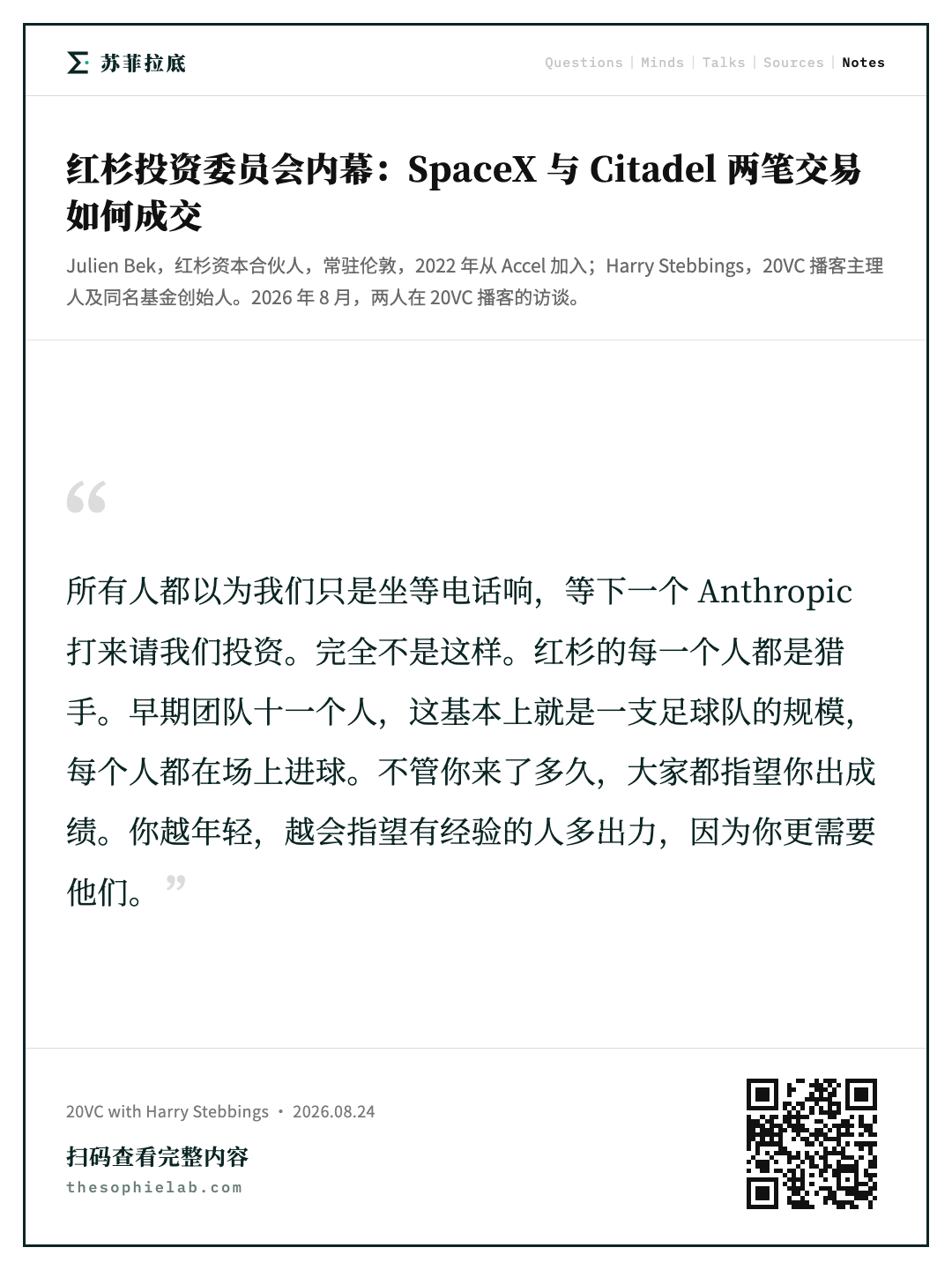
贝克:所有人都以为我们只是坐等电话响,等下一个 Anthropic 打来请我们投资。完全不是这样。红杉的每一个人都是猎手。

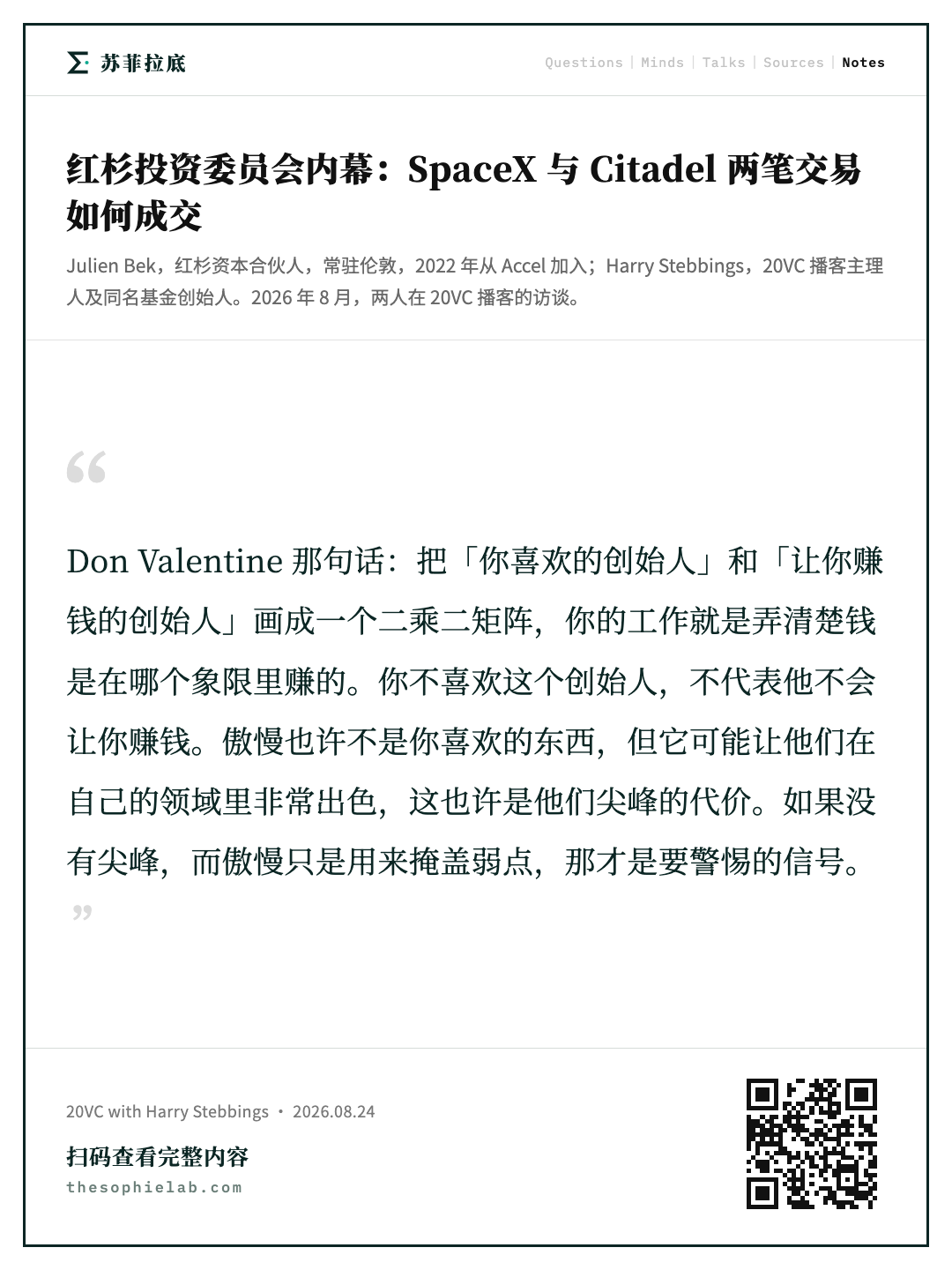
贝克:如果把「你喜欢的创始人」和「让你赚钱的创始人」画成一个二乘二矩阵,你的工作就是弄清楚,钱是在哪个象限里赚到的。

主持人:今天的节目我格外兴奋,因为来的是我最老的朋友之一。他是红杉的合伙人,也是一个了不起的人。这一期是红杉的幕后:他们怎么找到伟大的公司,怎么赢下这些公司,怎么挑中它们。这是你从未见过的红杉。

贝克:我认为现在如果你投的是新一批新型实验室(Neolab),你基本上就是在 Facebook 出现的时候投了 Quora,投了 StumbleUpon。

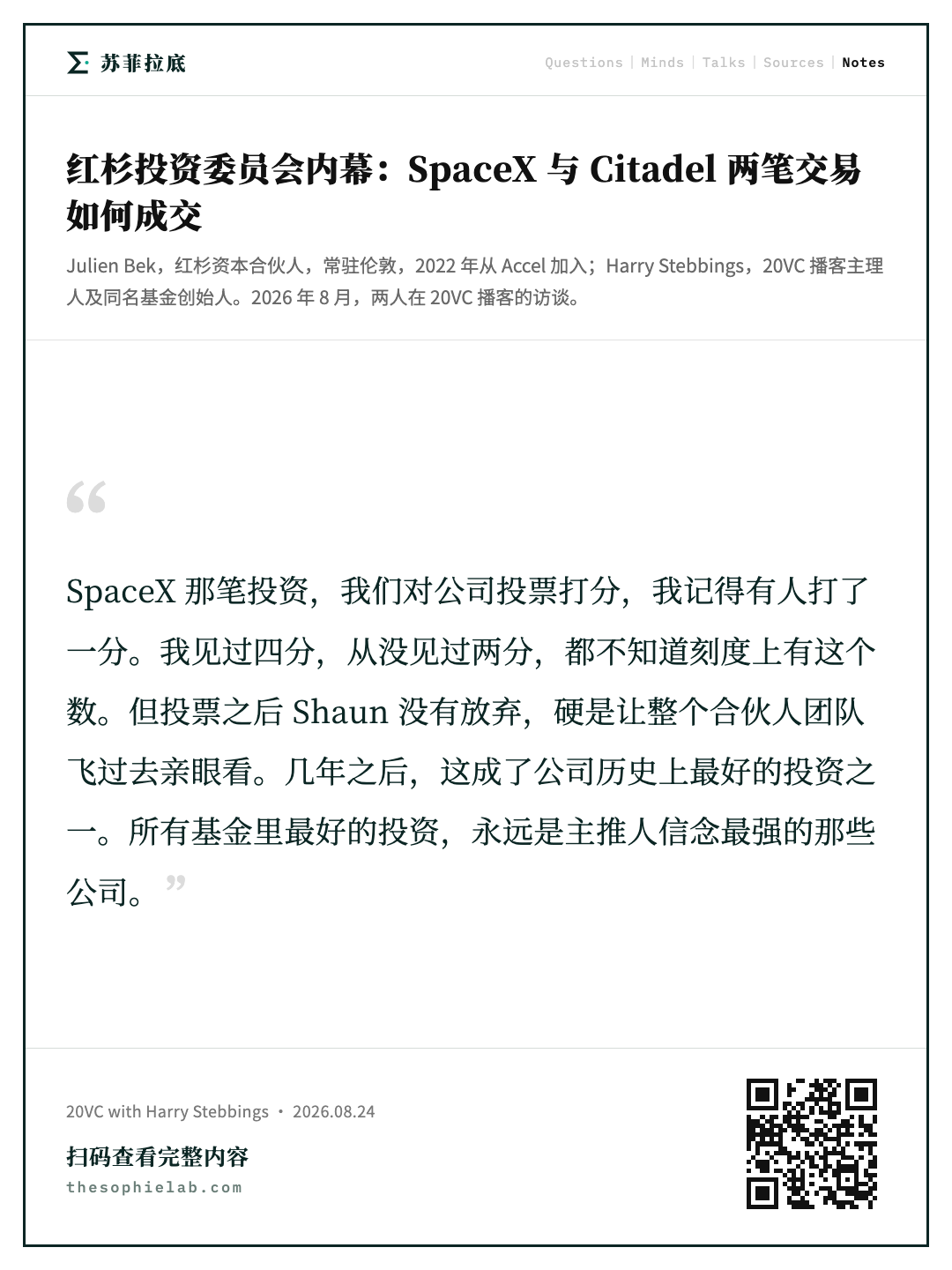
贝克:SpaceX 那笔投资,功劳归 Shaun。我们对公司投票打分,我记得有人打了一分。所有基金里最好的投资,永远是主推人信念最强的那些公司。我们的价值只取决于下一笔投资。

家庭、价值观与照顾父亲

主持人:我们认识多久了?我算了一下,八到十年了吧。

贝克:快十年了。你那时候还很年轻,现在我们都开始老了。

主持人:我记得当时你在 Atomico 刚入职,我在 Accel,他们的办公室很漂亮。我们俩都很年轻,后来回头看,居然都成了。不过我想先说点别的。很多人听你讲话,会想:哇,红杉的合伙人。但我觉得你和父母的关系,尤其是你照顾父亲的方式,最能说明你是怎样一个人。在进入所有这些理性的、极客式的讨论之前,能不能先讲讲这个,让大家先认识你。

贝克:好。我父亲患有一种神经系统疾病,在我二十岁出头的时候发作。我没有兄弟姐妹,所以从那时起我就开始照顾他。我父亲很不寻常。他来自一个四口之家,在法国农村长大,十三岁就辍学,为了给家里挣饭钱。我看着他在祖父母年迈时照料他们,我很敬佩他们。他的职业也很特别,是占星师(astrologer),不是天文学家。所以我从小就看着他走一条不同的路。他的病开始显现的时候,我就在他身边。我知道你为你的父母也做了同样的事。

主持人:我擅长发表那种让人要么爱我、要么恨我的二元论断。我认为最烂的建议之一就是「你得为自己而做」。凡是这么说的人,我觉得都是在胡扯。我做的大多数事都是为了我母亲,我爱她。我认为,当你为别人去做的时候,反而能成就大事,这才应该被赞美、被推崇,而不是永远「为你自己」。

贝克:我的看法是,如果你的价值观足够清晰,其他一切都容易。坚守它们在当下可能痛苦,但至少你对自己在做什么有清醒的认识,投入多少精力都无所谓,因为你知道自己是为了正确的理由。

主持人:当然。我们的核心价值观是流动性(liquidity)。

贝克:在风险投资里可不是这样。

主持人:你看到我前几天发的推了吗?Pat 和 Alfred 上电视,被问到 Shaun Maguire 的那些推文,Alfred 的回答是我见过最好的:「我们看的是 Shaun 的资产负债表。」用「我们看 X 的资产负债表」来概括一个人,简直是最妙的方式。当然,我为此惹了不少麻烦。

贝克:是吗?

主持人:是的。好了,我想深入聊聊红杉。你从 Accel 加入红杉,我想知道:加入之前你不知道、而在那里待了几年之后才知道的,是什么?

红杉第一天:Doug Leone 的清晨

贝克:我在红杉三年了,做风投则有十年。我觉得红杉运作起来真的像一支运动队。给你讲讲我在红杉的第一天。当时我在加州,办公室以前去过,但那天时差没倒过来,很早就醒了,大概四点半、五点就到了办公室,反正是个荒唐的时间。我当然对自己很满意,那天晚上我甚至睡在了办公室。走近大楼时,我看见里面有灯光。正要推门,门那边站着一个人,他看着我,用低沉的嗓音问:「你这么早来干什么?」我有点意外,但很自豪地回答:「我来接我的第一个电话。您这么早来干什么?」他说:「我已经打完第一个电话了。」然后他就走开了,一脸得意。我还是输了这一局。

主持人:那是 Doug。

贝克:那是 Doug。

主持人:当然是他。这是美国人天生构造不同吗?你看红杉其他人也这样,觉得自己必须跟上?

贝克:我不这么认为。我们只是雇用这种人。而且 Doug 是意大利人,欧洲血统,很小就移民美国。我认识他才几年,但我很确定他一直就是这样。

主持人:没人想跟他打躲避球。大家自以为了解红杉、但其实搞错的,是什么?

每个人都是猎手:Citadel 案

贝克:所有人都以为我们只是坐等电话响,等下一个 Anthropic 打来请我们投资。完全不是这样。红杉的每一个人都是猎手。几个月前,我们早期团队是十一个人,这基本上就是一支足球队的规模,每个人都在场上进球。不管你来了多久,大家都指望你出成绩。事实上,你越年轻,越会指望有经验的人多出力,因为你更需要他们。外面竞争极为激烈,我们认为每个人作为个体都要表现得极其出色,但要作为团队去赢,这一点非常重要。我觉得人们对此理解得不够。

给你讲个故事。我的合伙人 Konstantine Buhler 帮我们领投了 Citadel Securities,Ken Griffin 的公司。他们从未接受过外部资本。我们之所以能投进去,是因为 Konstantine 从学生时代起就和 Ken 建立了关系,Ken 多年来一直是他的导师。Konstantine 从不放弃,一直在问:我们能投吗?我们能投吗?直到 Ken 终于点头。

主持人:那这样的案子是什么样的?我不是开玩笑,但比如 Konstantine 周一来投委会说:「我有一家新创业公司要推荐,叫 Citadel,创始人是 Griffin,我觉得我们该开一张两亿五千万美元的支票。」实际上是怎么进行的?

贝克:Citadel 那笔投资我不在场。但我在更近的案子里见过类似的情形,比如 Anthropic,那种特殊的公司。

主持人:二十五亿美元。你知道我最敬佩的是什么吗?最难的事,是先拒绝了一家公司,然后还愿意保持思维弹性,后来以数倍的价格买进,跨过自己曾经拒绝它的那道自尊心坎。你懂我的意思吧?

更新先验:万亿结果与新 A 轮

贝克:懂。我们管这叫「重新审视先验」(revisiting our priors)。环境变了,就必须更新先验,这一点非常重要。这源于一个认识:如果 AI 真的会如此深刻地改变一切,那么我们只是站在一条惊人的指数曲线的山脚下。现在 AI 已经走了三年,我们看到这条指数曲线开始展开。我们突然意识到,人脑很不擅长处理指数增长。我们线性地思考很在行,指数地思考就不行了。就这个案子而言,我认为我们早期低估了这家公司。

主持人:老兄,我认为我们所有人都低估了结果的规模。像 Anthropic 和 OpenAI 这么快就到万亿美元,我不觉得有谁预料到了。你还记得当年大家追逐的是「十亿美元公司」吗?

贝克:天哪,十年前的事。

主持人:这其实很了不起。我为这种说法挨过骂。我什么都挨骂。我聊 Corgi Cafe,就有人说我贩卖奋斗鸡汤,那就是家咖啡馆而已,来打我啊。但我同意你的看法。所以我说过一句让大多数人发抖的话:十亿美元可能就是新的 A 轮。想想看,我们以前 A 轮投后估值五千万美元,指望它长成十亿美元公司。现在你投十亿,它长成两百亿美元公司。倍数是一样的。

贝克:这就是把幂律往外推。

主持人:你必须押中真正重要的那几家。

贝克:正是。而挑选从来没有这么难过,因为公司的数量多了太多。

主持人:我要在这点上追问一下。当一家公司估值十亿美元,营收五千万或者三千万,随你选个数,它的风险已经大大降低了。它通常有企业客户,有真实数据。我宁可投这个,也不投那种营收三四百万、估值三到五亿的 A 轮。

贝克:完全同意。区别在于,有些十亿美元的轮次是在什么都还没有的时候就发生的。有时候市场要你出什么价,你就得出什么价。而且我认为创始人找的也是能一起建公司的伙伴。所以只要你和创始人建立了信任,你就能投进去。

Neolab、物理 AI 与持股执念

主持人:你投过新型实验室(Neolab)吗?

贝克:我个人没有,红杉投了一批。我认为现在如果你投的是新的 Neolab,你基本上就是在 Facebook 出现的时候投了 Quora,投了 StumbleUpon。这是我的看法,不是所有人都认同,但我是这么想的。想投到一家真正新颖的公司,唯一的办法是押注一个独一无二(N of one)的创始人。比如最近我们在英国投了一家叫 Ineffable 的公司,一笔很大的种子轮。

主持人:David Silver。

贝克:David Silver,他是独一无二的研究者,追求的是一种截然不同的架构。如果成了,规模会大得惊人,因为他们不是在做同样的事、只是做得更好一点,而是要做不同的事。我认为这已经是成为一家成功 Neolab 的前提条件。

主持人:你同不同意,考虑到价格与进展的比例,再加上竞争,今天 A 轮是最难投的位置?

贝克:我觉得这个球门柱在移动,取决于你投哪个领域。比如硬件,现在的新热点,共识都在「物理 AI」上,那里拿到验证所需的时间要长得多。所以你必须早投,指望这些公司能挺过实验阶段。你不能再用「从零到一百万美元年度经常性收入(ARR)有多快」来衡量它们,而要看它们多快做出可运行的原型。而且你搬的是原子,不是比特,难度大得多,耗时更长,也需要更多资本。所以我其实认为,由此会出现更多合作:基金会想和其他资本方一起,帮助这些公司走到那些里程碑。

主持人:你对持股比例的执念比以前少了吗?你刚才提到合作。我发现,随着结果规模扩大,我们更能和别人一起投了。当年上限是十亿美元的时候你需要百分之二十,现在不需要了。你比以前更不看重持股比例了吗?

贝克:没有。

主持人:没有。

贝克:没有,我告诉你为什么。很简单。结果在变大,资本需求也在变大,但最重要的是你的时间。在你的职业生涯里,你能做二十笔投资。有人做得更多,但那不是我的风格。我一年和两三位创始人合作。所以整个职业生涯,我大概可以进入二十家公司的董事会。我不会亏待自己,我会为这些创始人拼命干活。我对他们的说法是:我基本上就是你的联合创始人。公司怎么经营由他们决定,但我坐在副驾驶上,帮他们拿下最早的客户,招到最关键的人。这种事我做不了太多家。以 Rillet 为例,从年初到现在,我们见了十七位上市公司的首席财务官,其中一些已经成了客户。你有两百家公司、每家持股百分之二,怎么可能做到这些?根本行不通。那是不同的模式,完全不同的模式。

主持人:我完全同意,我们确实很不一样。我大概有一百七十五笔投资。

贝克:你怎么样?

主持人:我们才做了两笔,一笔来自推特私信,一笔是因为 Konstantine 给我发消息。

贝克:通往极乐的路有很多条。

主持人:前几天吃饭,一位创始人过来说:「嘿,Harry。」我说:「嗨。」他说:「你领投了我的种子轮。」我说:「是的。」提醒我一下是哪家公司?结果他们改了名字。我就说:都怪你改名。我怎么知道呢。

最佳 sourcer 与最佳 picker

主持人:红杉内部有很多不同的性格。谁是公司里最好的发掘者(sourcer)?不一定要会挑,就是那个一次又一次找到有意思东西的人。

贝克:一次又一次的话,我选 Dean Meyer,我的合伙人,常驻特拉维夫,但基本住在飞机上。他是个了不起的人,当过好几年职业足球运动员。所以他有梅西那样的好胜心,又有一个在科技行业干了一辈子的人的技术深度,这是一种很危险的组合。我不知道这是哪来的,但他读人的能力惊人。他既能和那些很年轻、棱角分明的创始人建立联系,也能和把公司卖了几十亿美元的那些人打成一片。

主持人:像 Dean 这样的人,一直很受欢迎,我同意。那谁是最好的挑选者(picker)?案子摆在面前的时候,谁最能把一家公司拆解清楚?

贝克:这个简单,Luciana Lixandru,我的合伙人,也是把我带进红杉的人。我们在 Accel 就是同事,所以我职业生涯的大部分时间都和 Luciana 共事。我认识她的时候,她刚投了 Deliveroo,接着是 Framer,然后是 Pennylane、Stark,最近也是一个接一个的爆款。你去找规律,会发现没有规律,就是横跨各个品类。从消费到软件,到物理 AI 和国防,她一直能重塑自己。我选她。

SpaceX 打一分:信念高于共识

主持人:在红杉是不是特别难熬,因为你要的回报上限必须比其他基金更大?Shaun 拿来 SpaceX,别人拿来 Neuros,都是难以置信的公司,而你呢……

贝克:确实很难,但这是工作的一部分。它本来就不该容易,否则人人都能做了。我们合伙人之间的讨论有时非常激烈,我们互相逼迫的程度你无法想象。SpaceX 那笔投资要归功于 Shaun。我们对公司投票打分,我记得有人打了一分。我见过四分,当然也见过三分,从没见过两分。我都不知道还能打一分,不知道刻度上有这个数。

但接下来发生的是,投票之后他没有放弃,一直在推。他硬是让整个合伙人团队飞过去亲眼看。最后我们做了一笔较小的投资,后来引出了一笔大投资,几年之后,这成了公司历史上最好的投资之一。所以关键在于信念。每次合伙人闭门会,我们都会回看几十年来的基金回报,非常吓人。你看着那张表上惊人的回报数字,想的是:我要怎样才能做出同等甚至更大的贡献。我们每次都想耍点小聪明,看看数字:要是那笔持股比例高一点,那笔多投点钱呢。但我们总被提醒:所有基金里最好的投资,永远是主推人信念最强的那些公司。这一点在一只又一只基金里反复应验。

主持人:回头看,最好的案子当初有争议吗?还是说其实大多是共识?

贝克:不全是。我认为凡是用小钱换来大钱的,一定是有争议的。Airbnb 的故事我不在场,但听过很多遍。Brian Chesky 被大多数公司拒绝了,来到红杉,红杉领投了种子轮,我想那是我们做过的投入产出倍数最高的投资之一。当时是有争议的。让人睡在别人家地板的气垫床上,这么一个交易平台,听起来是个相当糟糕的主意。但它后来变成了完全不同的东西。而且信念不只在开始时,还要在后续持续投资这些公司。

主持人:关于 Brian,我不认识他,但读到过一件事:他对中世纪的客栈着了迷,研究以前的人怎么旅行、怎么合住,完全是个历史学家。我觉得很有意思。看 Collison 兄弟也一样,他们都是真正的历史学家。真正伟大的创始人往往是自己领域的历史学家。

贝克:这个故事我不知道,但一点也不意外。

红杉出高价吗?同价轮与增长法则

主持人:在进入几位合伙人的经验之前,我说两句话,你来评论。第一句:红杉就是靠出高价拿案子。这话对不对?你发现自己经常出价最高吗?还是能拿到折扣?

贝克:听到这个问题我很意外。我们努力尽可能早地和创始人合作。事实上,正因为门槛高,我们每年只和有限的几家公司合作,而我在实践中看到的是,一旦我们投了,往往就有资本愿意在这个估值上再加溢价。我们骨子里是早期投资人,所以尽早合作始终是首要任务。但也有一些原本投后期的机构喜欢往前走,他们愿意付溢价。

主持人:与此相关,我投的一位创始人,Mercor 的 Brendan,发过一个帖子传得很广,我觉得对红杉是绝妙的宣传,不明白你们为什么不多用用。他说,我这不是贬低 Brendan,他说的是事实:大家谈论得不够的,是红杉一直在做的那种同价轮(tranche rounds):红杉以一个价格进入,然后公司出现拐点,下一轮又以同样的价格做。在我看来,这是锁定持股比例、同时给公司锁定资金的绝佳方式。你们是这么看的吗?会不会想多推这种做法?

贝克:首先,这种情况我只见过几次,这么说大概是抬举我们了。Brendan 建了一家了不起的公司,我们没有机会和他合作。但在我们确实投了的一些案子里,这就是供需问题。创始人在建一家特殊的公司,有人投了之后,他们为什么不该获得溢价呢?

主持人:顺便说,我认为这是好事。如果我是红杉,我会转发并附上「这就是品牌的力量」。我和你们一起投过五家公司,要么我和你们同在第一轮,我心怀感激;要么我在后面那一轮,感激少一点,但仍然乐于进入这家公司。我不觉得这是坏事。

贝克:我觉得区别还在于,人们把几件不同的事混在一起了。融资有很多轮,以前是种子轮、A 轮、B 轮,从一轮到下一轮的里程碑通常要十八个月。现在有了 AI,公司的推进快得多,事情发生得非常快。所以如果你在短时间内证明了自己是对的,估值大幅提高是很正常的。

主持人:那我问一句,「三倍三倍两倍两倍」的增长法则是不是死了?以前我们说一到三,三到九,九到十八,十八到三十六,这就很好了。现在对一家公司来说这仍然很棒,我们绝不是贬低它。但你看 Lovable,看 Legora,随便举,它们一年就到一亿美元。

贝克:这一点我有很强的看法。不知道是三年还是五年,但这条法则会回来。我告诉你为什么。首先,人们又把两件事混在一起了:有些是新市场,有些是替代市场。比如一家客户关系管理(CRM)公司,它可能是 AI 原生的,但仍然要替换企业的核心记录系统。它们中有些增长很快,但终究要替换掉某样东西。而你说的那些公司处在完全空白的市场。三年前什么都没有,突然之间有了能替代人所做的事情的能力,所以这些公司自然是直线上升。几年之后,大多数客户都有了解决方案,我们就会进入替代市场,到那时你再拿这两类公司比,才是苹果比苹果。现在是苹果比橙子,只是没人注意到。

主持人:但我们的工作是在场上打球。钱可以放进这个家,也可以放进那个家。如果能把钱放进一个增长快得多的新市场,资本的机会成本就在那里,所以我想放在那里。

贝克:错。我不同意,我告诉你为什么。结果平均要十年才会兑现,也许更长。最好的公司倾向于更久地保持私有,数据是这么说的。但你现在做的决定,影响的是公司未来三年。短期内它们可能吸引更多资本,这也许是真的,但最终对你重要的是你持有多少股份、公司能长多大。而这只在投资兑现的那一刻才算数。我几乎可以保证,最大的结果会出现在更成熟的市场,而不是完全空白的市场。

主持人:我明白。不过这正是风投的乐趣,我们可以不一样。我看到的是一个前所未有地流动、同时也极度亢奋的二级市场。因为我不是红杉,这是我难得的谦虚时刻,我卖起来比你容易得多。所以我可以在一个流动的二级市场里、以一个非常狂热的价格卖出,而且是在你做不到的更短时间内。

贝克:也许吧,但你有五亿美元的基金,做二级卖出,那可是很多钱。

主持人:已经不止一只基金了。

贝克:那我得反过来质疑你了。

主持人:我亲爱的朋友,我们只是一个谦卑的播客,恰好也和伟大的创始人合作而已。

贝克:没错,没错。别让数字毁了一个好故事。

周一 IC 如何运作:投票与主推人

主持人:在聊创始人的阅读和评估之前,最后一个问题。红杉一笔案子怎么拍板,外界有太多神秘感和不透明。你们有每周的投委会(IC)。是全球性的吗?所有人都来?所有人都被邀请?有没有一个只有 Pat 和 Alfred 坐在壁炉边高谈阔论的会议?或者说战略研讨。一笔案子到底怎么做成?

贝克:有意思的是,我们已经在第五个十年了,大概五十年来一直开周一投委会,先是面对面,现在也用 Zoom,一直沿用同一套配方。但我们其实正在尝试新方法,试着把事情做得更异步一些。首先,是的,所有人都被邀请。有意思的是,我们在试验一种新做法:备忘录分享出来之后,每个人都必须异步地写下自己的意见,任何人想听所有人的看法,都可以召集一次投委会。原因是,投委会这种形式很适合快思考,异步发言则适合慢思考。两者的好处都拿到,决策应该会更好。在投委会上,我们是一个接一个发言,是一种顺序节奏。而在异步方式下,每个人在文档里各自贡献意见,最后一起得出决定。你可以召集投委会,但这样做能把合伙人团队最好的一面发挥出来。

主持人:每位创业者都要向投委会路演吗?你们怎么确保合伙人有足够的信息来形成有依据的判断?

贝克:创始人仍然要路演,这非常重要。

主持人:向整个投委会路演。

贝克:对,整个投委会。

主持人:那可相当让人紧张。

贝克:听起来吓人,但我说过,早期团队现在是十二个人,成长团队也差不多,没那么大。

主持人:那你会对创业者说:「嗨,Nick,你的投委会路演在下午六点,我事先帮你准备,建议你这样组织。」你会给他们做准备?

贝克:我尽量不做太多准备。你需要看到这个人的本质。如果你给他们一个剧本,就没人能看到你看到的东西了。

主持人:你会不会发现,你之前看到的和投委会上看到的差距很大?换句话说,人会不会紧张得判若两人?

贝克:有时候我们开玩笑说,也许该不开投委会就做决定。确实会变。但这也是一种信号,然后作为主推人(sponsor),你自己决定怎么处理这个信号。

主持人:比如你本来就在怀疑创始人的商业能力、沟通能力,如果他在投委会上搞砸了,也许你的疑问是有根据的。

贝克:对。

主持人:投委会开完了,你说到信号,创业者回去继续建他或她的公司,然后你们投票,是还是否,打一到十分。接下来呢?

贝克:首先,我们在讨论之前各自独立给出反馈,这样讨论之前就知道每个人的立场。这是一次投票。然后讨论。讨论之后所有人再投一次,主推人拿着这些信息,做他想做的决定。

主持人:所以你仍然可以投。

贝克:仍然可以投。

主持人:比如 Alfred 打了一分,说这是他见过最糟糕的路演之一,你还是可以按下绿灯。

贝克:可以。但如果你按了绿灯,结果是笔烂投资,那就看你还能待多久了。你得有非常强的信念,最好这是笔好投资。不过并没有「Alfred 打一分」这种事,现实要复杂一点。

主持人:你知道谁投了什么吗?

贝克:知道。这非常重要,我告诉你为什么。如果你想做一个好的公司共建伙伴,那就不能是 Harry 的投资或者 Julien 的投资,必须是红杉的投资。我需要能打电话给 Luciana,打给 George 或者 Stephanie,说:能不能帮我引荐你那位很珍贵的人脉?这对他们来说是要动用的重要资源,而他们会毫不犹豫地去做引荐。

主持人:有没有办公室政治?也许是我不安全感太重、太软弱。有人提过一个词叫「front stepping」,正面踩,跟背后捅刀相反。我很喜欢,意思就是对合伙人直言不讳。有人会往心里去吗?你要不要加点缓冲?我总对我们的合伙人说:投委会上没有情绪,但当我说这是个……他们还是会沉下脸,往心里去。你们怎么去掉情绪?有情绪吗?会后要打电话道歉吗?

贝克:我们肯定有激烈的讨论,当然有。人们可以剧烈地反对彼此。但归根到底,我还是回到那一点:这一切都是信号,供主推人判断自己对这笔投资有多大信念。反馈可能很严厉,但这本来就不是轻松的工作。想要轻松的工作,去干别的。这是特性,不是缺陷。你希望人们带着勇气进来。没有勇气就不会冒险,组合里就只有平庸的投资。

主持人:我觉得这种真实和坦诚很重要。但我从不想搞「创始人批斗」,所以反过来也想做一次「创始人表扬」。有没有一次投委会,某位创始人进来就碾压全场,你想到的是哪一次?

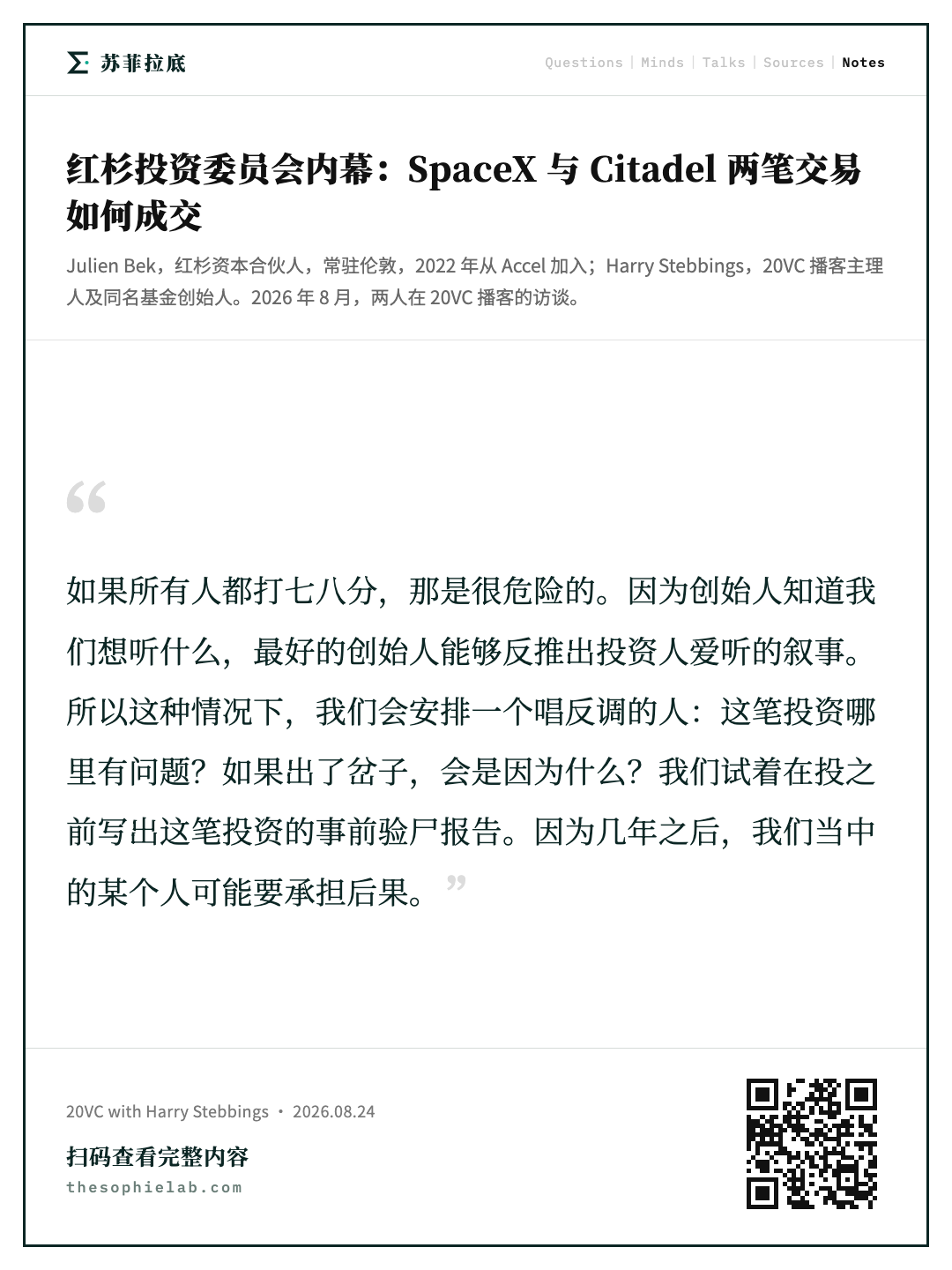
贝克:有过。但那种情况我们反而会觉得奇怪。首先,如果所有人都打七八分,那是很危险的。因为创始人知道我们想听什么,最好的创始人能够反推出他们认为投资人爱听的叙事,这可能很危险。所以在这种情况下,我们会安排一个唱反调的人(devil's advocate),让他说:这笔投资哪里有问题?如果它出了岔子,会是因为什么?我们试着在投之前写出这笔投资的事前验尸报告(premortem),围绕它交锋。因为几年之后,我们当中的某个人可能要承担后果。

三十分钟读人:先暴露自己

主持人:我想退一步。刚才这些都以主推人足够喜欢这个案子、愿意带到投委会为前提。回到「什么造就伟大的创始人」和读人这件事。你说过,准确地说是你的合伙人说过,读人已经迅速成为一种超能力。你觉得是什么让你擅长读创始人?

贝克:首先,你必须在创始人面前暴露自己(vulnerable),否则他们不会敞开,而他们敞开之后的一切就是你需要的全部信号。这一点你其实做得很好。我的工作是,在三十分钟内弄清楚这个人特别在哪里,什么可能让他们与众不同,而且不能犯错。这份工作不留情面,不是在你投错公司的时候,而是在你没投对的公司的时候。所以错误是遗漏之错,不是行动之错。你基本上只有三十分钟去找到他们的尖峰(spike)。

我的办法是自己先敞开。他们都以为是来向红杉路演的,想讲公司的故事,但我想听的是这个人的故事。所以我先讲我的故事。我告诉他们,父母分开之后是什么样:母亲是成功的女企业家,家里能俯瞰日内瓦湖,而我在那儿住一周,再回到父亲那里住一周,父子俩睡在一居室公寓的床垫上。而且这没什么,真的没什么。我告诉他们,我六岁那年母亲得了癌症,我记得得自己哄自己睡觉,因为她实在太累了。但你知道吗?一年之后她战胜了病魔,继续经营她的公司。这些事,每个人都有类似的故事,我知道你自己也有很多。我不想把它当成武器来用,我更想说的是,这正是这份工作的美妙之处。否则你永远在做交易。而在这里,我是真的好奇这个人是怎么成为今天的自己的,所以我想问所有这些问题。

主持人:我完全同意,你必须先拿出自己的脆弱,才能指望对方回报。我的问题是:我们身处一个高度交易化的世界,融资轮次、公司势头,因为有这样的播客,一切都变得透明,人们可以钻空子。我以前说过我看什么,听起来很糟糕,但我说过最会钻空子的人往往和父母关系破裂。你怎么判断一个人是不是真诚的?

连问五个为什么:识破欺诈

贝克:你只需要反复问为什么。我记得今年是我第一次揭穿一个欺诈的创始人,很有意思。第一次会面时,这个人说他们的年度经常性收入在大约六个月里从零做到七百万,在一个很热的品类里。他的自我介绍是,他来自一个条件不好的国家的小村庄,拿到了斯坦福的录取,然后决定放弃,去另一所大学读书。你只需要问为什么:你为什么这么做?这太了不起了,你有成绩能进入全球竞争最激烈的项目之一,却决定放弃去做别的,为什么?可能有非常好的理由,对吧?但有意思的是观察肢体语言,谈话节奏加快,创始人紧张起来,你就想:哦,有点奇怪。你只是记下来,不会结束通话,你给他们无罪推定。

结果几天之后,我和合伙人 George 凌晨五点在去机场的路上,准备飞去见这位创始人。在路上他告诉我们,他家里出了急事,得取消会面。当天晚些时候,我们收到几位非常可敬的投资人的消息,他们是这家公司的投资人,告诉我们他被揭穿是骗子。我记得那天我给所有竞争对手都发了消息,因为我确实认为,在这样一个机会遍地的时代,也有人出于错误的目的利用它,这一点很重要。对我来说这是个清清楚楚的案例。就像你说的,他们知道该期待什么,知道你想听什么,会非常务实地把那些话说给你听。所以问五次为什么,你就能触到底。这确实很难,尤其是我们对自己看什么如此公开。我完全理解。

主持人:傲慢是坏事吗?这一点我不确定,因为听起来很糟糕,但有时候那些混蛋其实真的很厉害。傲慢是坏事吗?

贝克:我回到 Don Valentine 那句话。把「你喜欢的创始人」和「让你赚钱的创始人」画成一个二乘二矩阵,你的工作就是弄清楚钱是在哪个象限里赚的。他以前常对我们很多合伙人这么说。你不喜欢这个创始人,不代表他不会让你赚钱。傲慢也许不是你喜欢的东西,但它可能让他们在自己的领域里非常出色。这也许是他们尖峰的代价。所以你必须先回到尖峰。如果没有尖峰,而傲慢只是用来掩盖弱点,那才是你要警惕的信号。

看走眼的复盘与文化校准

主持人:能讲讲你看走眼的一次吗?某个也许改变了你读人方式的误判。比如我被引荐给 Granola 的 Chris,我是他见的第一个投资人。说实话他不那么能言善辩,也不是个出色的推销员,想法很松散。和他共事过的人给的评价是我见过最惊人的,但我就是没法支持一个这么松散、又没什么推销的东西。

贝克:没有演示,也没有履历之类。

主持人:我学到的是,在种子前阶段,要把推荐评价(references)看得比几乎一切都重。

贝克:首先,你最后一句关于推荐评价的话我非常同意,我们做得非常深入,稍后我会回到这一点,因为那里有一个重要的观点。至于你问的误判:Lovable 的 Anton Osika 创办公司之前,我和他吃过一顿午饭,我就是没看出来。我从中学到的一件事是,我去那次会面没有带着计划。我们三个人和他一起吃午饭,就是随便聊聊,我没有刻意去问那些能揭示他特别之处的正确问题。当时我低估了他。

主持人:这很难。还有一点也很难,而且我觉得很重要:他是瑞典人,而且是一个深思型的瑞典人。我的意思是,Legora 的 Max,我知道你在红杉,所以我们在红杉这边是 Harvey 队,Max 是个进攻型的瑞典人,像美国人的瑞典人。而 Anton 是深思型、产品导向的瑞典人,表达观点时没那么斩钉截铁。而且那时候更早。你的判断会因国家而变吗?法国人一般不太会推销,不像美国人那样带着营销和表演的劲头。你的判断如何因国家而异?

贝克:这一点非常重要。我记得我在红杉做的第一次尽调,是我们组合里一家叫 Tacto 的公司。我给一批他们的客户打电话,都是我们所说的「中小企业」(Mittelstand),德国经济的主体。我们最后总会问净推荐值那个问题:零到十分,你觉得这个产品怎么样?他们清一色地说七分。我记得我问:为什么不更高?「因为我们总能做得更好。」非常德国。备忘录出来之后,一位合伙人问:「你觉得为什么推荐评价没那么正面?」我说:「因为他们是德国客户。」我记得我告诉合伙人们:如果是法国人或者德国人,就加一两分;如果是美国人,通常要减一两分。这也是在这里投资的美妙之处,你必须把当地的细微差别考虑进去。

主持人:你在童年里找到什么共性吗?也许我对童年创伤、家庭关系破裂、胖孩子有一种不健康的偏爱。我就是个胖孩子。你有偏好吗?

贝克:问题在于,如果你试图给人套模式,你就投不到对的人。这是我的发现。你的工作只是弄清楚这个人现在处在什么位置,以及未来的轨迹指向哪里。遇到一个很年轻的创始人,你不能拿他和一个有经验的经营者比,那是苹果比橙子。而要判断他们未来的轨迹,最好的办法是理解他们现在所处的轨迹。这就要回到过去。如果只停留在职业经历,有些人才工作了两年,但如果回溯他们人生的前十五年、二十年,你能得到极其丰富的信息。举个例子,我见过两位法国创始人,都毕业于巴黎综合理工(Polytechnique),法国竞争最激烈的理工科项目。我本可以说,这两个人一样优秀。有意思的是,当我开始挖掘他们的童年,一个是私募股权大亨的儿子,父亲也是综合理工毕业;另一个出生时就被父母遗弃,童年在一家又一家的福利院之间辗转。这很残酷,但同时也说明了这个人走了多远的距离才到达今天。这不意味着他会继续在这条路上走下去,但至少它告诉你很多关于他现有轨迹的信息。你的工作就是判断他们会不会继续沿着这条路走。

主持人:完全同意。走过的距离,还有他们为了走到今天所经历的那些苦,实实在在地更多。我完全同意。所以我总是很喜欢那种时刻:你去查图书馆的名字,发现,哦,图书馆上刻的也是你父亲的名字。

贝克:那通常很有帮助。

四位合伙人的四条经验

主持人:Doug Leone、Pat Grady、Alfred Lin、Shaun Maguire,每人选一条你学到的东西。先说 Doug。

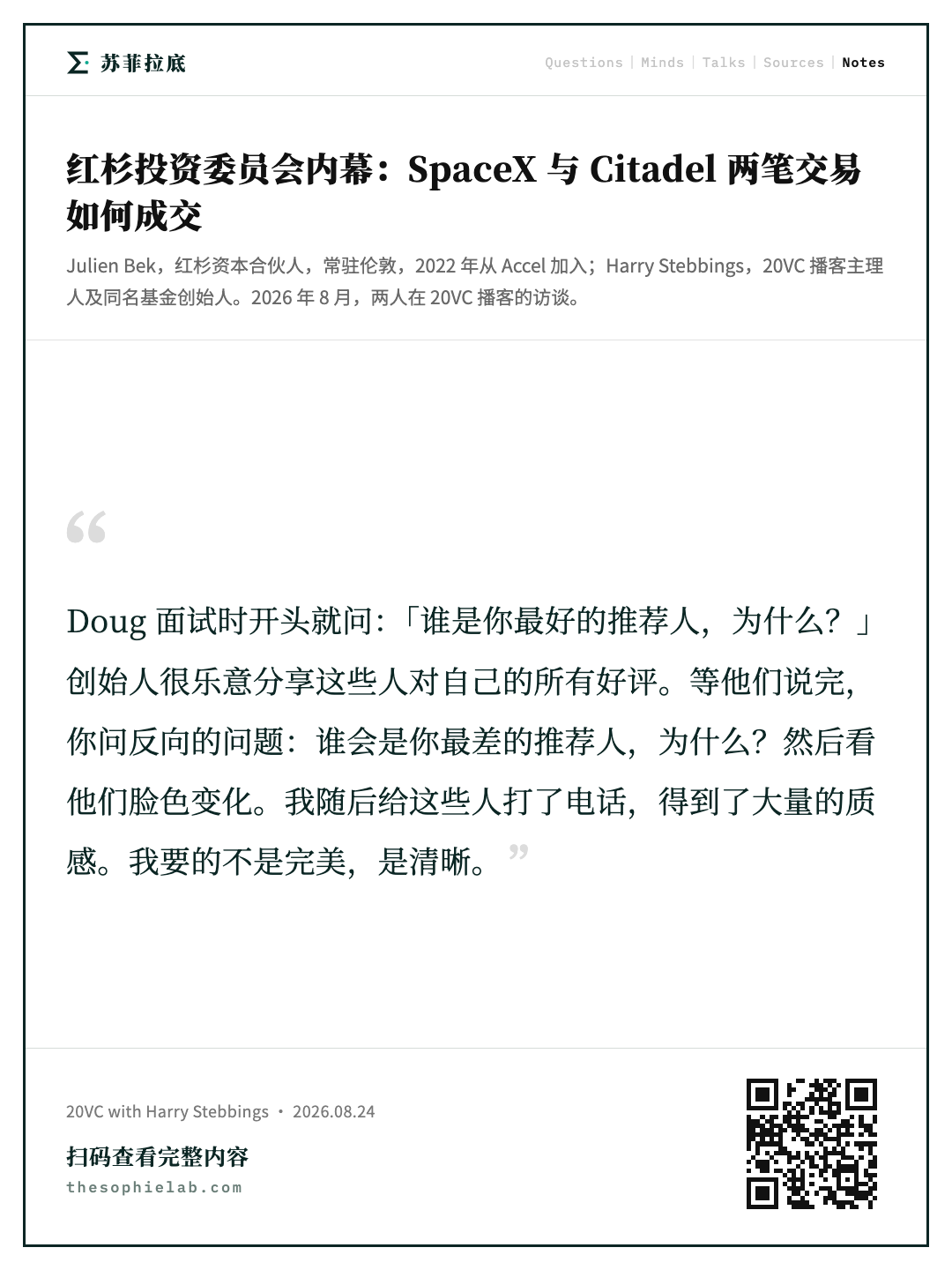
贝克:从 Doug 那里学到的一条,是他面试时问的一个问题。他开头就问:「谁是你最好的推荐人,为什么?」有意思的是,创始人通常会说,有这个人、那个人,他们很乐意分享这些人对自己的所有好评。等他们说完,你问反向的问题:谁会是你最差的推荐人,为什么?然后看他们脸色变化。

主持人:人们会回答吗?

贝克:说实话,有意思的是他们怎么回答。我遇到过创始人非常直接地说出谁是他们最差的推荐人。更妙的是,我随后给这些人打了电话,得到了大量的质感。我要的不是完美,是清晰。

主持人:你知道你最差的推荐人会是谁吗?

贝克:我有太多了。

主持人:这话听起来太像 GFC 那帮人了。我想我的会是 Atomico 的 Niklas。

贝克:真的?

主持人:我想他会说我没用。而且我确实没用。当时我在……

贝克:你当时才十七岁。

主持人:我知道,但我就是不明白,又不是我的公司,我为什么要半夜开电话会?这对我来说毫无道理。

贝克:正是。但你知道,最差的员工造就最好的创始人。你后来成了创始人。

主持人:这就是为什么推荐评价真的很难。

贝克:对,对我来说也是。关于推荐评价,你之前问到 Shaun。他有一个 ELO 方法论框架。下过棋的人知道,ELO 是根据你的水平给出的分数,分数越高越难往上爬,因为你必须击败越来越强的对手。他的观点是,如果你是一个 2400 分的棋手,那已经是极端的离群值,你更有可能判断出另一个离群值是谁。在国际象棋里,十步之内,一个 2400 分的棋手就能认出另一个 2400 分的棋手。但你去问一个 2000 分的棋手,他分辨不出来。推荐评价也一样。你要问卓越的人某人是否卓越,而不是问那些「还不错」的人。这往往正是推荐评价的问题所在。

主持人:我明白,但是,我想这些人不会介意,因为我是在说他们太卓越了:我和 Helsing 的 Torsten 或者 Fuse 的 Allan 聊的时候,他们显然是两位卓越的创业者,但我从没见他们喜欢过任何人。他们从来不会说「这人太棒了,你必须投」。最多是「嗯,还行」。这真的很难。你没发现吗?最优秀的人就是……我搞不懂。

贝克:你得把他们的性格和他们的成就分开。也许在那些案例里,是性格妨碍了成就。

主持人:好,Doug 这条很棒,我要偷走。Pat 呢?

贝克:Pat 有一个很棒的框架:人就像向量,向量是方向和大小的乘积。方向是:你为什么做这件事?你为什么对它如此有动力?你要去哪里?大小是这个人有多大的野心:他们会不会熬过那些痛苦、坚持做下去?我觉得这个框架非常简单,Pat 一向如此。因为如果你试着理解一个人的方向和大小,会极大地帮助你预测他们下一步去哪里,以及他们的轨迹。

主持人:我很喜欢。我永远记得 Pat 对我说过一句话:「人们以为我们多么了不起。每一家上市的公司,我们在它旅程的某个时刻都见过。」这恰恰说明我们错过了多少。我们必须给每一次公司会面带去能量、带去准备,永远不够。我太喜欢这种谦逊了。这是执掌红杉的 Pat Grady,还有这样的谦逊,我觉得太棒了。

贝克:还是我在红杉的第一天,我们每个人都被要求写下这一句话:我们的价值只取决于下一笔投资(we are only as good as our next investment)。现在这句话印在我们的墙上。入职第一天写下这句话,非常吓人,也非常让人谦卑。这就是焦点所在,你能从人们的行为方式里看出来。

主持人:天哪,如果你是 Shaun Maguire,你会气死吧?「我刚做完 SpaceX,拜托,让我歇歇。」

贝克:他绝对没在歇。

主持人:Alfred Lin。

贝克:Alfred 最近的一条智慧,我很喜欢:不要把离群的经营者(outlier operator)误认为离群的创始人(outlier founder)。这个错误很容易犯。你觉得某人在某家公司干得很出色,做了很多事,推出了这些新产品,人人都喜欢他。这也许让他成为离群的经营者,但不一定让他成为离群的创始人。

主持人:当简历像 OpenAI、DeepMind 那样镀了金的时候,这尤其难。我觉得今天我们都在很多方面掉进了简历陷阱,尤其是那些重量级的 AI 项目。最后是 Shaun,是 ELO 那条,还是另有一条?

贝克:ELO 那条。不过我再给你一条 Shaun 的,我也很喜欢。大家看人不是智商(IQ)就是情商(EQ)。IQ 是智力马力,EQ 是情绪马力。他另有两个维度,一个是判断力(judgment),另一个是政治系数(political coefficient,PQ)。判断力是你在复杂系统里找到解决方案的能力,PQ 则是在政治上复杂的系统里穿行的能力。他的论点是,判断力其实比 IQ 更重要,PQ 比 EQ 更重要。

主持人:他的 PQ 惊人。我还是回到那句:Shaun 的资产负债表相对来说无可辩驳。很好笑,我喜欢。这四位里,谁最会读创始人?

贝克:看是什么创始人。如果是年轻的技术型创始人,我会问 Alfred 或 Shaun。如果是更偏商业的创始人,我会问 Doug 或者 Pat。不过你只提了这四个名字,我们有十一个人。比如 Bogomil 读人就非常厉害,有些创始人我一定会带上 Bogomil。如果是金融科技公司,我会带上 George,因为他认识所有人,校准得很准。

智能体是新客户

主持人:我完全理解。我们聊了很多红杉,聊了红杉之所以是红杉的原因。至于投什么,你之前对我说过一句话,我想花点时间聊聊:智能体是新客户(agents are the new customer)。这从根本上意味着什么?我们该从中得到什么?

贝克:AI 已经三年了。智能体的流量已经和人类流量持平。我记得今天早上 Cloudflare 说,五年之后,智能体流量将是人类流量的一千倍。我再说一遍,我们不擅长思考指数,但如果我们正站在指数曲线的山脚下,最好按它将要成为的样子来行动。

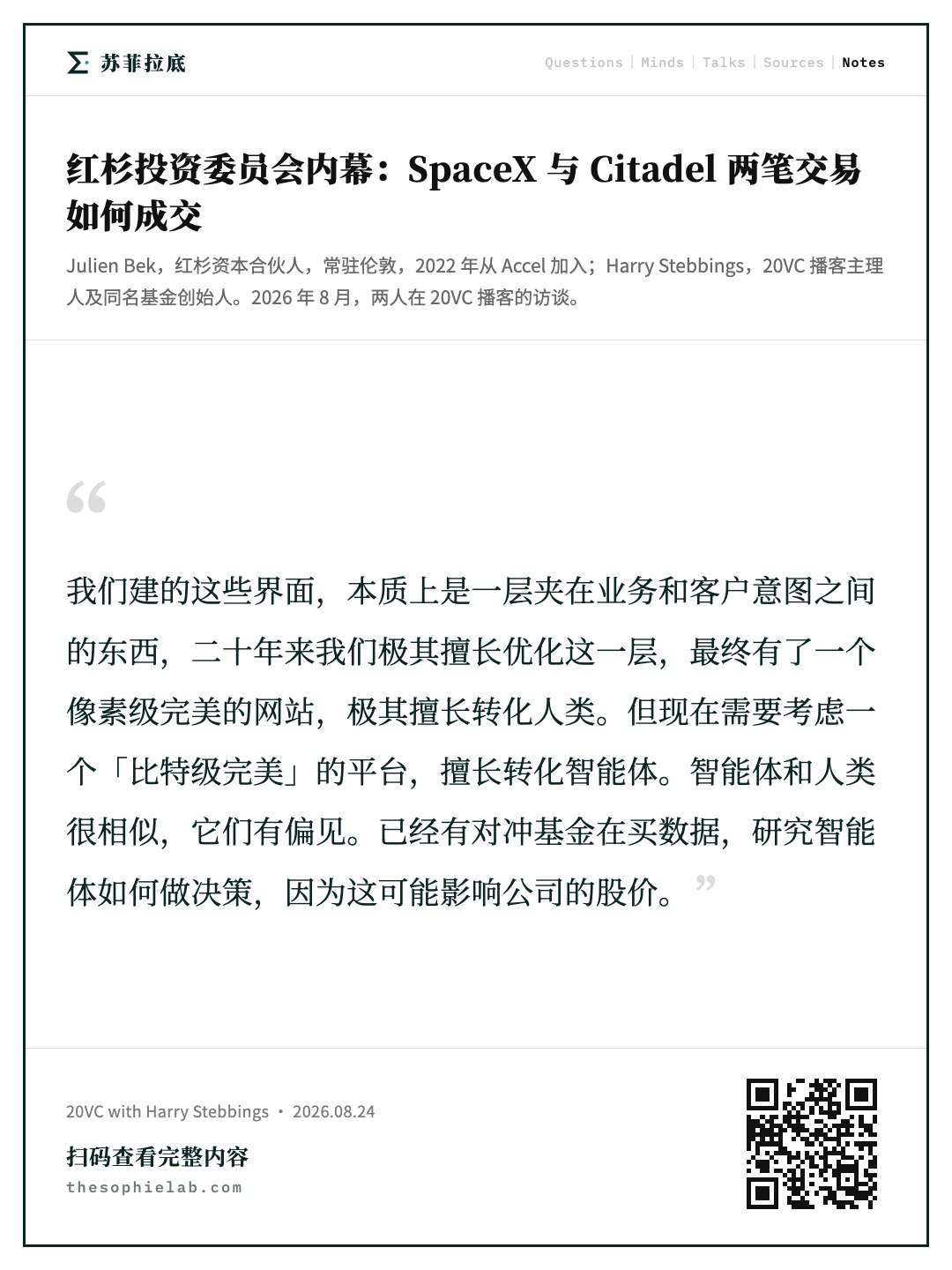
我的论点是:在需求侧,出现了一个新客户,就是智能体,而我们对它的招待远不如对人类客户。今天智能体接受委派任务,主要是出于方便;但明天,随着 AI 变聪明,会是因为它们做出的决策更好。如果你有一个智商五百的 AI,它当然会替你做决定,因为这才是理性的选择。而今天,我们建的这些界面,不管是桌面还是移动端,本质上是一层夹在你的业务和客户意图之间的东西,你试图把客户意图转化成公司的收入。抽象地看,它就是一层。二十年来我们极其擅长优化这一层。

主持人:用户界面、更好的引导流程、更好的注册、更好的支付流程,百分之百。

贝克:所以你最终有了一个像素级完美的网站,极其擅长转化人类。但现在我们需要考虑一个「比特级完美」的平台,擅长转化智能体。

主持人:那在那个世界里会变什么?创始人该从中得到什么?我们看的东西会怎么变?用户界面会变得完全无关吗?

贝克:用户界面显然是人们首先想到的。但这里有快思考的答案和慢思考的答案。快思考的答案是:用户界面归零,智能体一分钟内就能换掉你的产品,不会有品牌忠诚度,一切都是价格竞底。慢思考的答案很不一样。智能体和人类很相似,它们有偏见。它们的预训练有偏见,取决于抓取了什么数据;后训练也有偏见,因为做标注的是人。所以你看到,智能体已经非常有偏见了。它们找托管方案时会去 Cloudflare 和 Vercel。事实上已经有对冲基金在买数据,研究智能体如何做决策,因为这可能影响这些公司的股价。所以我们需要像当年研究客户一样,理解这些偏见是什么,智能体如何做决策,这在不同的模型提供商之间如何不同,以及取决于你卖的是什么产品或服务。我们才刚刚站在这个转变的起点。比如我们组合里有一家叫 Profound 的公司,它是现代营销人的 SEO 答案,帮你的业务在使用对话界面的人面前变得可见。

主持人:答案引擎优化(AEO)。我们也投了一家,欧洲的 Peec AI。我的问题是:AEO 这门生意,就智能体流量对人类流量的比例而言,和 SEO 相比,AEO 的市场会比 SEO 大得多吗?

贝克:我想说的是,我们必须认识到,这不只是一个新品类,这是一个新经济。你将有一个平行的智能体经济,就像你有一个平行的人类经济一样。在这个新经济里,会创造出新的品类,AEO 是其中之一。

主持人:你怎么判断什么属于这个新经济、什么不属于?我以前会说,给我妻子安排的蜜月,我会把它留在旧经济里。可是我和你们一起投了 Adessia,和 Konstantine 还有 Sonder 的 Francis 一起。我觉得他们离做出一个能完成我想要的一切的惊人智能体体验,并不远。你怎么划分?

贝克:订假期的时候,人仍然在回路里。但很快,智能体会自己做决定。你仍然想决定去哪里度假,他们也许做了最好的计划,但既然去度假的是你,你想有发言权。区别在于,现在百分之八十的数据库是由智能体写入的。当 AI 已经好到能比人挑得更准,人为什么还要有发言权?这就是我划的界线。

利润率、前沿模型与服务经济

主持人:完全理解。那这会摧毁软件的利润率吗?如果所有人都能极快地切换,价格竞底,智能体在为一大堆不同的偏好做优化,我们作为供应商是不是就失去利润率了?

贝克:我不这么认为,因为那假设了没有切换成本。现实是,对很琐碎的事,比如换一张机票,切换供应商很容易,确实没什么切换成本。但如果你选了一个数据库,在上面构建了很久,那就有数据引力,有企业级管控,有企业在意的所有东西。这些仍然是靠信任建立的,而信任是随时间积累的,这一点无论如何都不会变。

主持人:看 Rillet 这样的公司,它卖给大型企业,一些全球最大的企业。它们的采购方式真的会从根本上改变吗?会像我们想的那么快吗?我一直提醒自己,我已经不年轻了,你也是,抱歉,老兄。我一直警惕自己过于亢奋,也总被提醒:人总是高估一年内会发生的事,低估十年内会发生的事。企业不会动得那么快,它们的采购没有我们想的那么快。就像它们大多连 Slack 都没有。你怎么看智能体参与这种新采购行为的意愿?

贝克:和采用曲线上的一切一样,这件事会落在曲线的某个位置。现在你看到的是,智能体非常擅长挑选与编码相关的工具,因为智能体应用在那里真正达到了人类水平,而在其他职能上还没到那个程度。所以今天,这大概只会进一步拉开曲线上的差距。

主持人:我要再谦虚一次,这都快成坏习惯了。在很多情况下我不知道什么是持久的,哪个应用供应商会活下来,感觉太短暂了。而当我投 Fireworks、投 Mercor、投 ClickHouse 这样的基础设施时,我确定得多,因为我知道不管谁在顶层应用层赢,他们都会用 Fireworks,用 ClickHouse,用 Mercor 来到达那里。你们合伙人围坐一桌的时候,不会说「天哪,基础设施容易得多也好得多,我们想待在那里」吗?

贝克:我们两边都投。我认为人脑不擅长指数,也不擅长理解「把相反的想法同时握在手里」这件事。你可以同时持有对立的想法并且都正确,因为这些真理会在不同的时间兑现。以 Fireworks 为例,它们势头凶猛,因为我们正处在 AI 革命的开端,它们做出了最好的产品,吸引了最好的客户,正在卷走整个市场。与此同时,你之前提到 Rillet,它们正在签下软件行业之外的下一代公司,这些公司会把整个财务团队建在 Rillet 之上。几年之后,这会复利成一门规模很大、黏性很强的生意。那我们投这个还是那个?不,两个都投,因为我们认为两家公司都能变得非常大。

主持人:有意思,我投资时最喜欢看的一件事,是客户群里非初创、非传统科技公司的占比。当你看到爱达荷州的一家汽车厂在用,你会想:哇,这个奇怪,他们怎么知道你的?用得怎么样?对我来说这是极好的信号。

贝克:你这么说很巧,Rillet 最近开董事会,他们有个「爱荷华计划」(Project Iowa),就是面向科技行业之外的公司。这是公司增长最快的板块,有洗车店、普通的拍卖公司在注册。这是公司很有意思的转折点:既能吸引 AI 领域的品味引领者,也能吸引你叔叔和他妻子一起经营的那种公司。这非常重要,因为你要参与的是实体经济,而不只是 AI 经济。

主持人:考虑到结果规模的扩大,利润率今天是不是没那么重要了?不管看 Fireworks 还是 Legora、Harvey,再加上 Lovable、Replit,所有公司的利润率都比传统成熟软件市场低。我们是不是因为市场更大就不在乎了?

贝克:这一点非常重要。我们处在一个过渡阶段,大多数面向人的应用仍然受益于在前沿模型上运行。但到某个时候,你的客服智能体不需要一个智商两百的模型来帮你把机票改到夏威夷,对吧?会保持不变的是,机器对机器的交互仍然受益于智商五百的 AI。随着我们从面向客户的应用转向面向机器的应用,在前沿运行对第一类越来越不重要,对第二类越来越重要。现在大家都在想,开放权重模型(open-weight models)该怎么用。对某些应用,开源的前沿已经足够好了,他们绝对应该开始考虑,我们也在鼓励组合公司这么做。而对那些还没达到人类水平的应用,你绝对要在前沿上运行,甚至值得以负毛利去投入,来赢得客户的信任,做出比竞争对手更好的产品。

主持人:说到利润率,说到做出比对手更好的产品:你有篇文章火了,你一定很兴奋,说服务经济是下一个万亿美元经济。你是我亲爱的朋友,我爱你,但我读了之后想:天哪,这是什么一堆废话。不就是拿 GPT 给外包公司提提效率,然后说「干得好」?我漏了什么?我知道你在文章里写得比这清楚得多。「服务是下一个万亿美元经济」,我们该注意什么?

贝克:好。预测是这样的:下一家万亿美元公司,将是一家伪装成服务企业的软件公司。「伪装」非常重要,因为它不能是一家服务公司。

主持人:明白。那它会是什么样子?

贝克:我们在 AI 的第三年。第一波是副驾驶(co-pilot),帮助人类员工把工作做得更好。之所以从这里开始,是因为模型还不够好,做不了整份工作。但正如你今年在编码上看到的,我们正在达到甚至超过人类水平,智能体能够端到端地完成任务。于是,与其卖一个帮你达成结果的工具,你可以直接卖结果。我认为这非常有意思。回到会计的例子:今天你可能花两千美元买 QuickBooks,但花一万五千美元请会计师结账。那为什么不直接卖「账已结清」这个结果,而不是只卖软件?这很重要,因为各行各业普遍存在一个一比六的比例:花在工具上的钱和花在服务上的钱。我问的问题是:哪些品类能够拿到那六美元,而别人还在为那一美元竞争?结论是,有些品类已经走到了。人们可能没意识到,客户支持已经进入这个阶段,我称之为「自动驾驶」(autopilot)品类。这个品类里,以结果计费的年度经常性收入已经有十亿美元。

它是这么运作的。我们有一家公司叫 Sierra,做客户支持和客户体验的 AI。典型的做法是,他们去见一个有 X 张工单要处理的客户,比如一家航空公司。这家公司有人工客服在处理这些工单,每解决一张可能花五十美元。Sierra 进来说:我们用五分之一的价格帮你解决这些工单。一开始客户想看看效果,所以它从副驾驶开始,但很快就变成自动驾驶。妙处在于,AI 实际上端到端地跑完了整个流程,收费依据是它产生的结果,而不是它卖的工具。

主持人:完全理解。在客户支持这种环境里这很容易做,因为解决与否、待定,边界很清楚。但有歧义的时候怎么办?销售工具、营销工具:其实不是那个触点起的作用,是另一个触点。这只在定义极其清晰的市场里才可行,不是吗?

贝克:对,非常难。所以遗憾的是我们还没看到多少公司做到。原因有两个:一是模型还在变好;二是正如你说的,这些决策里仍然有大量人类判断。我的框架是这样的:一边是智能(intelligence),模型很擅长的、可验证的东西,比如这个月那个月我们花了多少钱;另一边是人类判断,有人叫它品味(taste),有人说它是无数微小经验的总和:面试一个人时的肢体语言,对方是往后靠还是往前倾,这可能让你问出一个准备之外的问题。这种东西 AI 很难捕捉,因为它不在训练数据里。但有意思的是,那些从副驾驶起步的工具,现在正处在判断的回路里。如果它们做对了产品,就能把这些判断收集起来,让今天的判断成为明天的智能。

主持人:说到一比六。微软、OpenAI、Anthropic,每一家提供商都在往服务和实施这一侧砸大钱。我们看到的,是不是传统企业前所未有地在呼救,求人帮它们落地 AI?

贝克:你这么说很有意思,因为有个数据:我们从未见过这么多系统集成商和前沿部署工程师(forward deployed engineers)被招进劳动力市场。这与我们刚才的观点直接相关:你仍然需要人的判断和人的双手来做大量工作。ServiceNow 招的系统集成商大概比以往任何时候都多。你和我都投了一家叫 Octar 的公司,做软件实施的 AI,和一些最大的软件供应商合作,帮他们的员工给实施团队加杠杆。你能拿到的杠杆惊人:一个人能做以前十个人的工作,但人仍然在回路里。这一点很重要,我觉得人们从那篇文章里没理解到的是:从副驾驶到自动驾驶,并不意味着把人完全去掉。我提议的是,我们可以建立这样的公司:即使仍然有人在做判断,它也有软件式的利润率。区别在于,一开始是很多人、一点 AI,最后是很多 AI、一点人。

主持人:简单的框架,对人类来说真是莫大的安慰。你相信「团队会变小」的论点吗?

贝克:绝对相信。但人们同样没意识到的是,会有新的工作,你只是把瓶颈挪到了别处。

主持人:我明白,但我认为这次转型的速度前所未有。农业革命或工业革命,在法国腹地的农场上购买、培训、部署机器,用了十年、二十年、三十年。而 Gemini 的一次更新就能抹掉整整一代电影海报设计师,这太吓人了。六个月里,Claude Code 在 Andrej Karpathy 的工作量里从百分之二十涨到百分之八十。速度令人不安。

贝克:实际上数据显示,我们从未雇过这么多软件工程师。

主持人:这倒是真的。

贝克:所以你又看到对立的想法可以同时成立。真相是杰文斯悖论(Jevons paradox):你让构建变得便宜得多,结果人们有很多想法,我们不能低估人类的创造力,人们只是在建造更多东西。对你我这种投这些公司的人来说,这很令人兴奋。

主持人:你会投一家计划转型为软件公司的服务企业吗?听起来疯狂,但比如它说:我们在收集数据,理解工作流,尽可能贴近客户,为的是做出软件产品。

贝克:不会。我总会告诉你我的信念是低、中还是高。这一条介于中和高之间。我不会投这类公司,原因是:这门生意可以赚钱,但在我的职业生涯里,我只见过最好的公司能够集中人才,而前沿人才不会想去一家勉强装扮成 AI 公司的老牌服务企业。它们也许有数据,但不一定是对的数据,因为要驾驭正确的数据让这门生意跑起来非常难。所以我认为你应该从第一性原理出发去建。最好的创始人总能找到分发渠道,他们会有人才。只要能做出最好的产品,客户就会用钱投票。

主持人:你身在欧洲,但很多时候和美国的合伙人团队一起工作。你看到美国员工那种跳槽的随意吗?你刚才说人们想去 X 或 Y 公司。我发现美国员工极其「滥情」,热门公司一家接一家地跳。在欧洲我觉得我们忠诚得多。

贝克:至少在实验室里,跳槽确实非常多。人们任职时间很短。欧洲没那么严重。

主持人:你的邮件系统一定很混乱。每次都要更新 Netflix 账号?

贝克:我想他们大概会留着邮箱,以防有人回来。

主持人:能不能把 Karen 在 OpenAI 的账号留着,以防万一。传统私募股权(PE)完蛋了吗?

贝克:我其实认为他们投那些有数据的公司,会做得很好。这些公司雇不到前沿人才,但能建成很不错的生意。只是他们追求的结果和我们不同。我们要支持下一家万亿美元公司,我认为那不太可能是一家 PE 支持的公司。

主持人:没错。我觉得唯一的变量是他们还有没有能力做更多交易,因为太多人被烂交易套住了。手里握着五艘泰坦尼克,你真的还愿意让另一朵花开吗?很难。

快问快答与 Revolut 往事

主持人:我们来快问快答。我说一句短话,你给我直觉的反应。资金最过剩的品类?

贝克:大概是法律。这个品类里有太多跟风者,而我认为赢家已经存在了。我当然有偏见,但我认为 Harvey 的位置非常好,因为它的分发最广。我就是不明白投资人为什么愿意投第 N 个竞争者。

主持人:天真啊。不,我自然会说 Legora 显然会赢。回到你的观点,我认为斜率才重要。资金过剩我同意,但某种意义上又不同意。法律是个非常横向、广阔的市场。我们投了一家叫 Solve Intelligence 的公司,做知识产权法,专门给专利律师和知识产权市场用,和 Harvey、Legora 做的很多东西非常不同,以至于 Harvey 和 Legora 的创始人都投了它。你明白我的意思吧?所以我真的认为你会看到法律的拆分(unbundling)。Solve 会像 Harvey 或 Legora 那么大吗?不会,但仍然是几十亿美元的规模。

资金不足、应该获得更多资金的品类?

贝克:脑机接口(BCI)。最聪明的孩子都在往那里走。我坚信你应该跟着最聪明的人走。十年前最聪明的人去了机器学习和 AI,十年后我们大概会看到这些公司开花。那是下一个前沿。

主持人:红杉之外最好的智能体公司?

贝克:大概是 Cursor。一是它在最重要的市场之一;二是当年到处都在议论「AI 套壳」(AI wrappers)的时候,它是第一家真正理解可以对模型做后训练、可以往技术栈更深处走的公司。

主持人:那笔六百亿美元的交易发生时,你们围坐一桌,会不会说「该死」?

贝克:它们加入了红杉组合公司的行列,所以还好。

主持人:最被低估的天使投资人?

贝克:Puzzle 的 Gloria,我认为她值得很多赞誉。她的嗅觉惊人,为创始人拼命工作。

主持人:最让你耿耿于怀的错过?

贝克:大概是 Trade Republic。我们现在和 Trade Republic 有合作,但我在加入红杉之前看过它的种子轮。我记得我对创始人 Christian 说:我觉得你不会成功,因为 Revolut 会碾压你。结果证明它们几乎不竞争,而且都建成了了不起的生意。我没能理解那不是一个赢家通吃的市场,也低估了这个品类的规模。

主持人:错过伟大公司最扯的理由之一就是:「哦,起步时人们会用你,但等他们做大了就自己造一个。」经典的 Stripe、搜索 API 之类的论调。他们不会的,尤其是基础设施,那太痛苦了,我为什么要自己造?你绝不妥协的创始人特质?

贝克:强度(intensity)。

主持人:强度很重要。

贝克:建一家大公司太难了,你需要强度。

主持人:听到哪家基金在竞争,你会想「糟了,我们得拿出最佳状态」?

贝克:我觉得我们不能傲慢到说「我们没拿出最佳状态」,不管对手是谁。但我知道你想要名字。我能用一个故事回答吗?

主持人:当然。

贝克:我在红杉从没输过一笔投资,但以前输过。我第一次输,是很久以前刚做风投两周的时候,那家公司是 Revolut。极其痛苦。如果我没记错,那一轮是 Index 和 Balderton 做的。故事是这样的:我入行两周,二十岁左右,一个人都不认识,就给我在风投圈唯一认识的一个人打电话,他在 Seedcamp。他说你该来这场路演,有十家公司。我想,太好了,十家公司,这就是我拿到的全部标准。我来到东伦敦一处破旧地方的地下室,十位创始人在路演。其中一位是 Revolut 的 Nikolay,另一位是 UiPath 的 Daniel Dines。想想那一天聚集在那里的期望价值有多高,两家都在融种子轮和 A 轮。Nikolay 是我职业生涯里最一目了然的一次创始人判断,他的强度太明显了。于是我开始蹲守他在金丝雀码头的办公室,每天在人群里找他,因为他不回我邮件。我和同事最后见到了他的联合创始人 Vlad。我们努力说服他们接受投资,他们说会选一家竞争对手。我彻底崩溃了。我记得当时想,这可能比 PayPal 还大。时间会证明,但我认为它是一家极好的公司。

那时候我试了试运气,问能不能个人投资,他们勉强指给我一个特殊目的载体(SPV)。但我当时身无分文,虽然有机会,却不知道怎么筹到这笔钱。我记得回去的路上给我妈打了电话。和你妈妈一样,她在商业决策上一直支持我。她说,听起来是个不错的主意,不如我出钱,我们五五分。十年之后,我一直在买这家公司的股份,一股没卖,而我妈刚卖掉了大部分股份,七十四岁退休了。所以我总跟合伙人开玩笑说,他们只雇到了 Bek 家第二好的投资人,因为我妈在 Revolut 的 A 轮全押了。

主持人:倍数是多少?不是要钱,就是好奇。

贝克:取决于估值口径,我们进入时是一亿八到两亿,最新估值超过一千亿。

主持人:告诉你妈,她的业绩记录只需要一行。

贝克:正是,Pat,麦克风一扔。

主持人:干得好,妈妈。你看,重点不是谁找到的,而是最后谁拿到了钱。太不可思议了。不过你知道吗,这就是为什么我会永远不快乐。在这种时候我总想:只要加倍就好了。

贝克:我当时年薪三万英镑,真的很惨。那时候我给 Rocket Internet 的创始人 Oliver Samwer 干活。他在很多方面都很了不起,但人人都知道他谈判极其强硬。我加入他的公���时,说我想要三万以上,他拒绝了。于是我谈成了另一件事:我可以投资他旗下的公司,靠投资赚够活下去的钱。而那些天使支票如今相当可观:Preseries、Albert、Revolut。不过我妈的业绩记录还是最好的,她躲过了所有的坏案子。

红杉没有统一观点

主持人:你对风险投资有什么看法,是红杉大多数合伙人会不同意的?

贝克:有趣的是,人们喜欢说「红杉相信 X 和 Y」,但我们的观点其实非常不同。关于 AI 没有「机构观点」(house view)。我可以发一篇「服务是新的软件」的文章,同时 David Cahn 在谈「六千亿美元之问」,同时 Pat 和 Sonya 在说「这就是通用人工智能(AGI)」。

主持人:那会不会很难?如果我信服务那一套,而另一位合伙人发了篇观点截然相反的文章,我会担心我想吸引的创始人读了他们的文章,说「那我们不去了」。

贝克:但同时,你不能平淡无味。你希望人们因为你是谁而来找你。

主持人:这正是人们对品牌所忘记的:最好的品牌让你有感觉。最差的是「无所谓」。耐克还是阿迪达斯,苹果还是 Windows,你会有感觉。

贝克:我们想投棱角分明的人,所以自己也必须有棱角。

主持人:最后一个。未来五年的 AI,你最期待什么?会改变什么,会发生什么?

贝克:还是我之前说的。我们仍处在这样一个阶段:按最新测试,AI 大概是智商一百二十。但当我们到达智商五百的 AI,也许会找到治愈你母亲、我父亲那种疾病的办法,会发现对人类如此有变革性的东西,以至于今天我们担心的这一切都显得完全无足轻重。我不是科学界的人,但我对那些推动生命科学、生物学前沿的公司非常兴奋。而且很棒的是,伦敦对此非常关注,我们刚看到 Demis 的帖子。有这些最聪明的头脑专注于这些问题,真好。所以我确实非常期待。

主持人:关于它对慢性病能做的事,我完全同意。老兄,我太享受这次对谈了。我非常珍惜我们的友谊,快十年了,这很吓人,也让我觉得自己很老。你一直是我了不起的朋友,我真的很感激你。

贝克:你是我的兄弟。谢谢你。
排版 + 横图 + 来源,粘贴即成稿
章节 · 点击跳转视频
0:00 开场:猎手文化与信念论 ▶ 正在看
1:11 家庭、价值观与照顾父亲 ▶ 正在看
4:15 红杉第一天:Doug Leone 的清晨 ▶ 正在看
5:45 每个人都是猎手:Citadel 案 ▶ 正在看
8:25 更新先验:万亿结果与新 A 轮 ▶ 正在看
11:00 Neolab、物理 AI 与持股执念 ▶ 正在看
15:01 最佳 sourcer 与最佳 picker ▶ 正在看
17:18 SpaceX 打 1 分:信念高于共识 ▶ 正在看
20:39 红杉出高价吗?同价轮与增长法则 ▶ 正在看
26:54 周一 IC 如何运作:投票与主推人 ▶ 正在看
34:23 30 分钟读人:先暴露自己 ▶ 正在看
37:19 连问五个为什么:识破欺诈 ▶ 正在看
39:58 看走眼的复盘与文化校准 ▶ 正在看
45:57 四位合伙人的四条经验 ▶ 正在看
54:00 智能体是新客户 ▶ 正在看
64:28 利润率、前沿模型与服务经济 ▶ 正在看
76:33 快问快答与 Revolut 往事 ▶ 正在看
85:34 红杉没有统一观点 ▶ 正在看
本期小问 · 档案清单
26:54 合伙人集体打低分的项目,主推人凭什么仍能拍板投资? ▶ 正在看
8:25 新品类公司一年做到 1 亿美元收入,值得为此放弃成熟市场吗? ▶ 正在看
37:19 顶尖创业者从不夸人,推荐人调查还能怎么问? ▶ 正在看
64:28 智能体替人购买软件后,卖家的利润率真的会归零吗? ▶ 正在看
本期讲者
朱利安·贝克红杉资本合伙人,常驻伦敦,2022 年从 Accel 加入;此前在 Atomico、Rocket Internet 工作,参与 Rillet、Ineffable 等投资,以「服务经济是下一个万亿市场」的文章闻名。
哈里·斯特宾斯20VC 播客主理人及同名基金创始人,17 岁在 Atomico 实习后创办播客,现管理数亿美元基金,投资了 Mercor、Legora、Solve Intelligence 等公司。
01开场:猎手文化与信念论
0:00
Everyone thinks [music] that we're just waiting for the phone to ring for the next anthropic to call us to invest. That's completely false. Everyone at Sequoia is a hunter. If you look at founders you like versus founders who make money as a 2x2 matrix, your job is to figure out in which part of the quadrant we make money. Now, I am so excited for the show today cuz I get to welcome one of my oldest friends. Yeah, he's a partner at Sequoia. He's also an incredible human being. This episode is a behindthescenes glimpse into what makes Sequoia so special, how they find great companies, how they win them, how they pick them. This is Sequoa like you've never seen Sequoia before. I think right now if you're not invested in the new Neol, you're basically investing, you know, in the Kora [music] in the Stumble Upon when Facebook X came about. Credits to Sean when he brought in the SpaceX investment. We vote on companies. I think someone voted a one.
很多人都以为[音乐]我们只是坐在那儿等电话响,等下一个 Anthropic 打来让我们投资。这完全不是真的。红杉的每个人都是猎手。如果你把「你喜欢的创始人」和「能赚钱的创始人」画成一个 2x2 矩阵,你的工作就是搞清楚我们到底在哪个象限里赚钱。今天这期节目我特别兴奋,因为我可以请到我最老的朋友之一。是的,他是红杉的合伙人,同时也是一个非常了不起的人。这期节目是一次幕后视角,让你看看红杉到底特别在哪里,他们怎么发现好公司、怎么拿下这些公司、怎么挑选这些公司。这是你从未见过的红杉。我觉得现在如果你没投新的 Neol,你基本上就等于在投 Quora[音乐],在 Facebook 出来的时候去投 StumbleUpon。要感谢 Sean,是他带来了SpaceX 那笔投资。我们对公司进行投票。我记得有人给它投了个 1 分。
便签笔记
0:50
The best investments in all the funds are always the companies where the sponsor had the highest conviction. We are only as good as our next investment. >> Ready to go. [music]
所有基金里最好的投资,永远都是那些主导合伙人信念最强的公司。我们的水平,只取决于我们的下一笔投资。>> 准备好了。[音乐]
便签笔记
02家庭、价值观与照顾父亲
1:11
>> Dude, we have known each other. I was trying to think. I think it's been like 8 10 years. >> Almost 10 years. Yeah. You were young back then and now [laughter] we're getting like >> I remember Iing yeah you were in Excel and you they're very nice officers and I was just joined at Tomico I think >> and we were both like very young and we like wow it worked [laughter] but I want to start because I think a lot of people will hear you now and think wow so quite a partner and wow but there's something in particular about the relationship that you have with your parents and how you look after your father which I think is an embodiment of what a great human you are. So, can you just tell me a little bit about that before we dive into all the intellectual nerdy [ __ ] because I want people to know you a little bit first.
>> 老兄,我们认识多久了,我刚才在想,我觉得大概有八到十年了吧。>> 差不多十年了。是啊。那时候你还很年轻,现在我们都[笑声]开始变得像……>> 我记得,对,你当时在 Accel,你们的办公室很不错,而我好像刚加入 Atomico。>> 那时我们俩都特别年轻,我们就想,哇,居然成了[笑声]。不过我想从这里开始聊,因为我觉得很多人现在听到你,会想,哇,红杉的合伙人,好厉害,但是你和父母之间的关系有一点特别,还有你照顾父亲的方式,我觉得那正体现了你是个多好的人。所以你能不能稍微讲一讲这些然后我们再深入聊那些烧脑的学术话题,因为我想让大家先稍微了解一下你这个人。(原文重复片段,此处对应上文)
便签笔记
1:57
>> Yeah, look, um my um my dad is um suffers from a condition um neurological condition that showed up in my early 20s. Um I I have no siblings. So, when that happened [clears throat] um you know, I started looking after him. He he's very unusual. My dad, he comes from a family of four. uh grew up in rural France. Um stopped school when he was 13 and you know he did that to put money on the table for the rest of his family. Um I saw him uh care for his parents when he was uh when they were aging and I I just looked up to them. Um he's quite unusual. He's a an astrologer. Yeah. Not an astronomer.
>> 是啊,你看,嗯,我爸爸,他患有一种病,一种神经系统疾病,是在我二十出头的时候出现的。嗯,我没有兄弟姐妹。所以那件事发生之后,[清嗓子] 你知道,我就开始照顾他。他这个人非常特别。我爸爸,他来自一个四口之家,在法国乡下长大。嗯,13 岁就辍学了,你知道,他那么做是为了给家里其他人挣口饭吃。嗯,我看着他照顾他自己的父母,在他们年迈的时候,我一直很敬佩他们。嗯,他挺不一样的。他是个占星师。对,不是天文学家,是占星师。
便签笔记
2:41
Astrologer. Uh so I always saw him kind of take a different path and um when when his disease started showing up I um yeah I I was there for him and I know you've done the same for your parents. So >> do you know I I uh I specialize in binary statements that get me you know either loved or hated. Um but I think one of the biggest pieces of [ __ ] advice is you've got to do it for you. >> Everyone who says that I think is just talking out their ass. Uh I do most of the things for my mother. I did you know I adore my mom and I actually think you can achieve great things when you do it for someone else and that should be hailed and lorded not do it for yourself always.
呃,所以我一直看着他走一条不太一样的路,然后当他的病开始显现的时候,我,嗯,是啊,我就陪在他身边。而且我知道你也为你的父母做过同样的事。>> 所以 >> 你知道吗,我,呃,我特别擅长说那种非黑即白的话,要么让人特别喜欢,要么让人特别讨厌。嗯,但我觉得最扯淡的建议之一就是:你必须为你自己去做这件事。>> 所有说这话的人,我觉得都是在胡说八道。呃,我做的大部分事情都是为了我妈妈。我确实是我特别爱我妈妈,而且我真心觉得,当你为别人去做一件事的时候,你能成就伟大的事情,这一点应该被赞美、被推崇,而不是永远只强调为你自己而做。
便签笔记
3:21
>> My opinion is that if you have very clear values everything else is easy. Um it might be painful in the moment to stick to them but it's just at least you have mental clarity about what you're doing and it doesn't matter how much work you put in. Um you just know you're doing it for the right reasons. Absolutely. The core value that we have is liquidity. [laughter] >> I don't think that's true in venture capital. Dude, did you see I tweeted the other day um when Pat and um Alfred were on TV uh and they said they were asked about Sha Maguire's tweets and I said Alfred's comment was the best I've seen which is well we look at the balance sheet of Sha and I just thought when summarizing someone we look at the balance sheet of X is like the greatest way to discuss like that person. Um I got in a lot of trouble for that.
>> 我的看法是,如果你的价值观非常清晰,其他一切都会变得简单。嗯,当下坚持它们可能会很痛苦,但至少你对自己在做什么有清醒的认知,而且投入多少工作量都无所谓。嗯,你就是知道自己是出于正确的理由在做这件事。完全同意。我们的核心价值观就是流动性。[笑] >> 我觉得在风险投资里这可不成立。老兄,你看到我前几天发的推了吗?就是 Pat 和 Alfred上电视那次,他们被问到 Shaun Maguire 的推文,我说 Alfred 的那句回应是我见过最妙的,他说,嗯,我们看的是 Shaun 的资产负债表。我就觉得,评价一个人的时候说"我们看的是某某的资产负债表",简直是形容一个人的最高境界。嗯,我因为这条推惹了不少麻烦。
便签笔记
03红杉第一天:Doug Leone 的清晨
4:15
>> You did? >> Yeah. Yeah. Oh my gosh. Um anyway, I want to dive into Sequoia a little bit. Um you joined from Excel. I want to know what did you not know about Seoia before joining that you now know having been there for several years now. >> Yeah. Um yeah, I've been there 3 years. >> Yeah. >> And but I've been doing venture capital for 10. I think Seoia operates really like a sports team. Maybe you've heard that story before. Um, but this is my first day ever at Sequoia. Um, I'm in California. I've visited the office before, but I wake up early jetlagged and I show up to the office at maybe 4:30, 5:00 a.m., something ridiculous like that. Um, I felt obviously very happy about myself. I slept in the office that day. [laughter] And, uh, as I approached the building, um, I see some light inside.
>> 是吗?>> 是啊。是啊。我的天。嗯,总之,我想稍微深入聊聊红杉(Sequoia)。嗯,你是从 Accel 加入的。我想知道,加入之前你对红杉有哪些不了解的,而现在待了几年之后才明白的?在那儿待了好几年之后。>> 是啊。嗯,对,我在那儿三年了。>> 嗯。>> 但我做风投已经十年了。我觉得红杉的运作真的很像一支运动队。也许你以前听过这个故事。嗯,那是我在红杉的第一天。我人在加州,之前也来过办公室,但那天我倒时差醒得很早,大概四点半、五点就到办公室了,早得离谱。嗯,我当然对自己挺满意的。那天我就睡在办公室了。[笑] 然后,呃,当我走近大楼时,嗯,我看到里面有灯光。
便签笔记
5:12
And as about about to push the door, um, I see a man on the other side and he looks at me and with a deep voice, he goes, "What are you doing here so early?" [laughter] And [clears throat] I'm I'm a little surprised, but with pride, I tell him, "I'm here to take my first call. What are you doing here so early?" And he's like, "I've already taken my first call." Haha. >> [laughter] >> And then he just walked off and he was just so happy about it. Uh, still, you know, lost the game. >> And that was Doug.
正要推门的时候,嗯,我看到门那边有个人,他看着我,用低沉的声音说:"你这么早来干什么?"[笑] 我 [清嗓子] 有点意外,但还是很自豪地告诉他:"我来打我今天的第一个电话。你这么早来干什么?"他说:"我第一个电话已经打完了。"哈哈。>> [笑] >> 然后他就走开了,一脸得意。呃,反正,你懂的,我这局输了。>> 那人就是 Doug。
便签笔记
04每个人都是猎手:Citadel 案
5:45
>> That was Doug. >> Yeah, of course it was. >> Oh, Doug. Is that just like the Americans being built differently? Do you see everyone else at Sequoa do that and feel you have to do the same? Is that it? >> I don't think so. We just hire people who are built like that. Um, Doug is Italian. [laughter] Uh he's he's European um by roots and immigrated to the US when he was very young. And my I've I've only known him for a couple of years, but I'm pretty sure he was always like that. >> Yeah. >> And they want to play a dodgeball with him. [laughter] Um [gasps] what does everyone think they know about Sequoia that they actually get wrong? Everyone thinks that we're just waiting for the phone to ring for the next anthropic to call us to invest.
>> 就是 Doug。>> 是啊,当然是他。>> 哦,Doug。这是不是就是所谓的美国人构造不一样?你看到红杉其他人也都这样,然后觉得自己也必须这样?是这么回事吗?>> 我不这么认为。我们招的就是这种性格的人。嗯,Doug 是意大利人。[笑] 呃,他,他祖籍是欧洲,很小的时候就移民到美国了。我,我认识他才几年,但我很确定他一直就是那样。>> 嗯。>> 而且大家都想跟他打躲避球。[笑] 嗯 [倒吸气] 大家自以为了解红杉、但其实完全搞错的是什么?所有人都以为我们只是坐等电话响,等下一个 Anthropic 来找我们投资。
便签笔记
6:39
That's completely false. Everyone at Sequoia is a hunter. We're, you know, we were 11 people a couple of months back in the early team. Um, that's basically what a football team is. And everyone's just scoring on the field. It doesn't matter how long you've been there. Um, everyone expects you to perform. In fact, the younger you are, the the more people expect experienced people to perform because you just need them more. Uh it's very competitive out there and we think that people need to behave exceptionally well as individuals um but win as a team and that's that's really important. I don't think that people understand that as much. I'll give you a story to illustrate it. uh Constantine Beller uh my partner um helped us lead the investment in Citadel Securities uh Ken Griffin's company. They had never taken outside capital. Um the reason we were able to invest is Constantine built a relationship with Ken since he was a student. Um he had been his mentor for years and years and Constantine never
这完全是错的。红杉的每个人都是猎手。要知道,几个月前我们早期团队才 11 个人。嗯,这基本上就是一支足球队的规模。每个人都在场上进球。不管你来了多久,嗯,大家都期待你拿出成绩。事实上,你越年轻,大家越是指望有经验的人拿出成绩,因为你更需要他们。呃,外面竞争非常激烈,我们认为一个人作为个体必须表现得极其出色,嗯,但要作为一个团队去赢,这一点非常重要。我觉得大家对这一点的理解还不够。我给你讲个故事来说明。呃,Constantine Buhler,我的合伙人,嗯,他帮我们领投了Citadel Securities,就是 Ken Griffin 的公司。他们从来没有接受过外部资本。嗯,我们之所以能投进去,是因为 Constantine 从学生时代起就和 Ken 建立了关系。嗯,Ken 做了他很多年的导师,而 Constantine 从不放弃,一直在问:我们能投吗?我们能投吗?直到 Ken 客气地
便签笔记
7:49
gave up and just kept asking can we invest? Can we invest? until Ken kindly said yes. >> Can I ask you in that case, what does that deal look like? I mean this not super seriously or glibly, but like does Constantine come to IC on Monday and be like, I have a new startup for us. It's called Citadel with Griffin. I think we should put in a $250 million check. Like, how does that actually go down? >> Yeah. I I wasn't there for the Citadel investment. Um, but I've seen it happen with well more recently with Anthropic with special companies like that.
答应了。>> 那我能问一下,这种交易到底是什么样的?我不是特别严肃或者开玩笑地问,但比如说,Constantine 是周一走进投委会说:我有个新的初创公司要投,叫 Citadel,创始人是 Griffin。我觉得我们应该投 2.5 亿美元?实际上到底是怎么发生的?>> 是啊。我,我没有经历 Citadel 那笔投资。嗯,但我见过类似的事情发生,比较近的是 Anthropic,就是那种特别的公司。
便签笔记
05更新先验:万亿结果与新 A 轮
8:25
>> Yeah.$2 and a half billion dollars. >> Mhm. >> Do you know what I respect so much about that Jack is like I think the hardest thing to do is to turn down a company and then be willing to have the mental flexibility to pay multiples of it later and get over your own ego about turning it down. Do you know what I mean? >> Yeah. We call that revisiting our priors. It's very important that you update your priors if the environment's changed. And I think it came from the realization that if AI is going to be so transformative, we are just on the foothill of this incredible exponential. And now we're 3 years into AI and we've seen that exponential starting to play out. And suddenly we realize the mental like the human brain is just not very good at dealing with exponentials. We we can think very well linearly but not exponentially.
>> 是啊。25 亿美元。>> 嗯哼。>> 你知道我特别佩服这一点的地方吗,Jack,我觉得最难的事情就是先拒绝了一家公司,然后还愿意有那种心理上的灵活性,之后以好几倍的价格投进去,放下自己因为拒绝过它而产生的自尊心。你懂我意思吗?>> 懂。我们把这叫作重新审视我们的先验判断。如果环境变了,更新你的先验判断非常重要。我觉得这来自一个认知:如果 AI 会带来如此巨大的变革,那我们不过才站在这条惊人指数曲线的山脚下。现在 AI 已经发展三年了,我们看到那条指数曲线开始显现。然后我们突然意识到,人的大脑其实非常不擅长处理指数增长。我们能很好地线性思考,但没法指数思考。
便签笔记
9:20
And in this case, I think we underestimate the company in the early days. Um, dude, I think we all underestimated outcome sizes being what they are. >> Like anthropic and open AAI being a trillion dollars as quickly as they have been. I don't think anyone anticipated. >> Do you remember when it was about chasing the billion dollar company? >> Oh my god. 10 years ago. >> Which which is amazing by the way. I get chastised for this. Um, I get chastised for everything. [laughter] I talk about [ __ ] Corgi Cafe. You're a hustle porn. It's a [ __ ] cafe.
在这个例子里,我觉得我们在早期低估了那家公司。嗯,老兄,我觉得我们所有人都低估了如今的结果规模。>> 比如 Anthropic 和 OpenAI 这么快就达到万亿美元。我觉得没人预料到。>> 你还记得那时候大家追的是十亿美元级别的公司吗?>> 我的天。十年前。>> 顺便说一句,这真的很惊人。我因为这个被人批评。嗯,我干什么都被批评。[笑] 我聊了个该死的柯基咖啡馆,就被说成"奋斗色情"。那不过是家该死的咖啡馆。
便签笔记
9:52
Like, [laughter] shoot me. Um, I agree. Which is why I say something which gives most people like shivers, which is a billion dollars, could just be the new series A. If you think about it, we used to do a $50 million post at Series A hoping it become a billion. Now, you do a billion and it becomes a $20 billion company. Same blunt multiple. >> That's extrapolating the power law, right? Um, >> you have to be in the ones that matter. >> Exactly. And picking has never been harder because you have just so much more volume of companies.
真是,[笑] 杀了我算了。嗯,我同意。所以我才会说一句让大多数人听了直起鸡皮疙瘩的话:十亿美元,可能就是新的 A 轮。你想想,我们以前 A 轮做 5000 万美元投后估值,希望它长成十亿美元。现在你在十亿美元进去,它变成 200 亿美元的公司。倍数其实一样。>> 这是在外推幂律,对吧?嗯,>> 你必须待在真正重要的那几家里。>> 没错。而且选公司从来没有这么难过,因为公司的数量实在太多了。
便签笔记
10:19
>> Push you on that one. But I think when you are at um a billion dollars in valuation, say, and you're doing 50 million in revenue or 30 million in revenue, choose your number, you're significantly derised. You've got enterprise customers most often. There's real data. I'd much rather do that than the series A where you're 3 4 million in revenue priced at 3 to 500 million. >> Yeah, absolutely. I I think the the difference is that some of these billion dollar rounds happen before there's there's anything else. Sometimes you have what the market uh wants you to pay and then um I think founders are also looking for company building partners.
>> 我要在这一点上挑战你。我觉得当一家公司估值在,比方说十亿美元,收入做到 5000 万或者 3000 万,随你选个数字,风险已经大大降低了。通常你已经有企业客户了。有真实的数据。比起 A 轮那种收入三四百万、估值三到五亿的,我宁愿投这个。>> 是的,完全同意。我,我觉得区别在于,有些十亿美元的轮次是在什么都还没有的时候就发生了。有时候市场就是要你付这个价,然后,嗯,我觉得创始人也在寻找能一起建公司的伙伴。
便签笔记
06Neolab、物理 AI 与持股执念
11:00
So you can invest if if you build trust with the founders you can invest. Have you done any of the Neolabs? >> Personally, I haven't. Uh we we invest in a bunch of them. Um I think right now if you're going to invest in the new Neolab, you're basically investing, you know, in the Kora in the Stumble Upon when Facebook uh X came about. That that's my opinion. Uh it's not shared um you know, with with everyone, but that's the way I I think about it. Um the only way you invested in a truly novel company is either if you back an N of one founder um you know recently we we backed a company called ineffable here in UK was um a large seed round as as you mentioned >> David Silver David Silver and he's an NF1 researcher um going after u a very different type of architecture so if it works it's completely massive because they're not trying to do the exact act same thing but better. They're trying to be different and that's the prerequisite now I think to be one of the successful Neolabs.
所以只要你和创始人建立了信任,你就能投进去。你投过那些新的大模型实验室吗?>> 我个人没有。呃,我们投了不少家。嗯,我觉得现在如果你要投一家新的大模型实验室,基本上就相当于在 Facebook 出现的时候去投 Quora、投 StumbleUpon。这是我的看法。呃,嗯,不是所有人都认同,但我是这么想的。嗯,唯一能投到真正新颖公司的方式,要么是你押注一位独一无二的创始人。嗯,比如最近我们投了一家叫 Ineffable 的公司,就在英国,是一轮很大的种子轮,就像你提到的 >> David Silver,David Silver,他是那种独一无二的研究者,嗯,他在做一种非常不同的架构,所以如果成了,量级会极其巨大,因为他们不是想把同样的事情做得更好。他们想做的是不一样的事情,我觉得这现在是成为成功的大模型实验室的前提条件。
便签笔记
12:11
>> Do you agree with me that series A is the hardest place to be investing today given price to progress and then competition? >> I think that that goldpost is moving. uh it depends in which sector you're investing in in hardware now for instance which is like the new thing right that's consensus uh physical AI um the the time to get validation is just a lot longer >> and so you have to invest early hoping that those companies can get through those phases of experimentation um and so instead of measuring these companies of how quickly they get from zero to a million in AR you have to look at how quickly they get to, you know, a working prototype. U but you're you're moving atoms, not bits. So, it's just a lot harder. It takes more time and they just need a bit more capital. Um so, I actually think that we'll see more collaboration because of that. Um funds will want to work with other capital partners to uh help those companies get to those milestones.
>> 你同不同意我说的,考虑到价格与进展的比例以及竞争,A 轮是今天最难投的阶段?>> 我觉得那个标准一直在移动。呃,这取决于你投的是哪个赛道。比如现在的硬件,就是那个新热点,对吧,这是共识,呃,物理 AI,嗯,拿到验证所需要的时间就长得多。>> 所以你必须早投,寄希望于这些公司能熬过那些试验阶段。嗯,所以衡量这些公司时,不再是看它们多快从零做到 100 万年化收入,而是要看它们多快能做出一个能跑的原型。呃,但你搬的是原子,不是比特。所以难得多,耗时更久,也需要更多一点的资本。嗯,所以我其实认为,因为这个原因我们会看到更多协作。嗯,基金会愿意和其他资本方合作,呃,帮助这些公司达成那些里程碑。
便签笔记
13:16
>> Are you less ownership centric than you were before? You mentioned there the collaborative element. I find that we're able to work more with other people given outcome sizes expanding. You don't need to have the 20% that you used to when it was a capped billion dollar upside. >> Yeah. >> Are you less ownership centric than you used to be? >> No. [laughter] >> No. No. I tell you why. It's simple. It's just the the outcomes are growing. Um, it's also more capital intensive, but most importantly, it's your time. In your career, you can make 20 investments. Some people do more than that. That's just not my style. I partner with two, three founders a year.
>> 你现在对持股比例的执念是不是不如以前了?你刚提到了协作这一点。我发现,随着结果规模的扩大,我们更能和别人一起合作了。你不需要像以前那样非要拿到 20%,那时候上限就是十亿美元的回报。>> 嗯。>> 你现在对持股比例的执念是不是不如以前了?>> 不是。[笑] >> 不是。不是。我告诉你为什么。很简单。就是因为结果规模在变大。嗯,也确实更耗资本,但最重要的是你的时间。你整个职业生涯能做 20 笔投资。有些人做得比这多,但那不是我的风格。我一年只和两三位创始人合作。
便签笔记
13:58
And so, in my career, I can expect to do basically be on the board of 20 companies. I'm not going to short myself. I'm going to work really hard for those founders. What I pitch them is that I'm going to be basically their co-founder. um they decide how to run the business but I sit in the passenger seat and I help them close their first customers, close their top hires. I I literally I cannot do that with more than a handful of companies. If you look at reallet um we met with 17 public company CFOs since the start of the year. Some of them have become customers. How do you do that when you have, you know, 200 companies with 2% in each of them? It just doesn't work. It's it's a different model. It's a totally different model. I completely agree with you. Um, yeah, we're very different. D [laughter] Harry's like I think I've got 175 investments, [laughter] dude. How you doing? As long as we go did like two. One was on Twitter DM. One was cuz Constantine messaged me.
所以在我的职业生涯里,我大概能进 20 家公司的董事会。我不会让自己吃亏。我会为这些创始人非常拼命地工作。我向他们承诺的是,我基本上会成为他们的联合创始人。嗯,业务怎么运营由他们决定,但我坐在副驾上,帮他们签下第一批客户、招到最关键的人才。我,我真的没法同时对超过一小把公司做到这些。以 Rillet 为例,嗯,今年年初到现在我们见了 17 位上市公司的 CFO。其中一些已经成了客户。如果你手上有 200 家公司、每家只占 2%,你怎么可能做到这些?根本行不通。这是完全不同的模式。完全不同的模式。我完全同意你的说法。嗯,是啊,我们非常不一样。[笑] Harry 大概是:我好像有 175 笔投资,[笑] 老兄。你怎么样啊?我们这边就做了大概两笔。一笔是在推特私信里谈成的。一笔是因为 Constantine 给我发了消息。
便签笔记
07最佳 sourcer 与最佳 picker
15:01
>> There [laughter] you go. Well, there's different paths to Nirvana. [gasps] >> We start at a dinner the other day and his founders like, "Hey, Harry." I'm like, "Hey, hi." And he's like, "You let my seed and I was like, I did." Yeah. Remind me which company. Turns out they changed their name. I was like, "Just blame the name change." >> How was I to know? You changed your name. Um, there are many different personalities within Sequoia. >> Who [clears throat] is the best sourcer in the firm? >> Like finding companies. Did they need to pick them? Just who is the one who finds really interesting [ __ ] time and time again?
>> [笑] 就是这样。嘛,通往涅槃的路不止一条。[倒吸气] >> 前几天我们在一个晚宴上,他的创始人过来说:"嘿,Harry。"我说:"嘿,你好。"他说:"是你领投了我的种子轮",我说:"是我。"嗯,提醒我一下是哪家公司来着。结果发现他们改名了。我就说:"那都怪你们改名字。">> 我哪知道啊?你把名字都改了。嗯,红杉内部有很多不同性格的人。>> 谁【清嗓子】是公司里最好的 sourcer(挖项目的人)?>> 比如找公司这件事。他们需要挑吗?就是谁是那个能一次又一次找到真正有意思的鬼东西的人?一次又一次?
便签笔记
15:40
>> Time and time again. If I have to pick, I'll pick Dean Meyer, my partner who sits in Tel Aviv. Um, but basically lives on plane. He's just um a phenomenal human being. He was a professional football player for multiple years. Um he so he has the competitive juices of Messi but coupled with like the technical depth of someone who's been working in tech his whole career and that's a very dangerous combo. Um that I I I don't know where that comes from but he's just amazing at reading people. Um he's just got this ability to connect with founders both like the very young spiky people but also some of the guys who sold companies for billions of dollars.
>> 一次又一次。如果非要我选一个,我会选 Dean Meyer,我在特拉维夫的合伙人。嗯,不过他基本上住在飞机上。他就是个特别了不起的人。他做过好几年职业足球运动员。嗯,所以他有着梅西那样的好胜心,同时又有那种一辈子都在科技行业深耕的人所具备的技术深度,这是个非常可怕的组合。嗯,我不知道这是哪儿来的,但他就是特别擅长读人。嗯,他就是有那种跟创始人建立连接的能力,无论是那种非常年轻、棱角分明的人,还是那些把公司卖了几十亿美金的人。
便签笔记
16:26
>> Yeah. >> You know people like Dean he's been very very popular. I agree. Um who's the best picker who when they have it in front of them is able to deconstruct companies best. >> That one's easy. Luchana Landrew. Um my partner um who actually brought me into Sequoia. uh we worked together at Excel before so I've worked with Luchana for most of my career now um she you know when I met her she had just invested in Deliveroo um then she did framer um then she you know John Sey did penny lane uh Stark more recently it's just banger after banger and if you look at the pattern there's no pattern it's just across categories she's just been able to reinvent herself across the different um you know from consumer to software to physical AI and defense.
>> 是啊。>> 你知道,像 Dean 这样的人一直非常受欢迎。我同意。嗯,那谁是最好的 picker(挑项目的人)?就是当机会摆在面前时,最能把一家公司拆解透彻的人。>> 这个简单。Luciana Lixandru。嗯,我的合伙人,其实是她把我带进红杉的。呃,我们之前在 Accel 一起共事过,所以我职业生涯的大部分时间都在和 Luciana 共事。嗯,我认识她的时候,她刚投了Deliveroo,然后她投了 Framer,然后,你知道,John Sey 投了 Penny Lane,还有最近的 Stark,就是一个爆款接一个爆款。而且如果你去找规律,根本没有规律,就是横跨各个品类,她就是有本事不断重塑自己,跨越不同的领域,嗯,从消费到软件,再到具身 AI 和国防。
便签笔记
08SpaceX 打 1 分:信念高于共识
17:18
That would be my pick. >> Does it get really tough when you're at Sequoia because the upside just needs to be bigger than other funds like like you know Sean is bringing like SpaceX and you're like you Neros and like unbelievable companies and you're like >> you know it's really hard >> but it's part of the job. It's not meant to be easy otherwise everyone else would be doing it right. Um, our partnership discussions are sometimes very fierce. We push each other like you have no idea. Um, credits to Sean. Um, when he brought in the SpaceX investment, we we vote on companies. I think someone voted a one. Yeah, I've seen fours, of course.
这就是我的选择。>> 在红杉工作是不是真的很难,因为你们要求的上行空间必须比其他基金更大?比如你知道 Sean 带来了 SpaceX 这种,而你手上是 Neros 之类,都是些不可思议的公司,然后你就……>> 你知道,这真的很难。>> 但这就是工作的一部分。它本来就不该是容易的,否则所有人都能做了,对吧?嗯,我们的合伙人讨论有时候非常激烈。我们互相较劲的程度你根本想象不到。嗯,这得归功于 Sean。嗯,当他把 SpaceX 这个投资带进来时,我们会给公司投票。我记得有人投了 1 分。是啊,我见过 4 分,那当然。
便签笔记
18:03
I've seen threes. Never seen a two. I didn't even know we could do one. I didn't even know it [laughter] was on the scale. >> [gasps] >> Um but what happened is after that um proposition um occurred, he didn't give up. He just kept pushing. Um he forced all the partnership to fly over to seal with their own eyes. Um we ended up doing a smaller investment that led to big investment and now couple of years later that's one of the best investments in the history of the firm. So the point is it's all about conviction. Every offsite we look at our fund returns dating back from you know decades ago and it's very intimidating. You're looking at this sheet with those phenomenal returns and you think how am I going to contribute to the same degree or more. Um, and every time we try to be cute to look at the numbers. Oh, maybe if we increase the ownership there and the dollars there. But as we're always reminded, the best investments in all the funds are always the companies where the sponsor had the highest conviction. That's just
我见过 3 分。从没见过 2 分。我都不知道还能投 1 分。我都不知道量表上【笑声】还有这个分数。>> 【倒吸气】>> 嗯,但后来发生的是,在那个提案之后,嗯,他没有放弃。他就是一直推。嗯,他逼着整个合伙人团队飞过去亲眼看看。嗯,我们最后做了一笔较小的投资,后来引出了一笔大投资,而现在几年过去了,那是公司历史上最好的投资之一。所以重点是,一切都关乎信念。每次异地会议我们都会回看几十年前到现在的基金回报,那真的很有压迫感。你看着这张写满惊人回报的表,心想我要怎么做出同等甚至更大的贡献。嗯,而且每次我们都想耍点小聪明去看那些数字。哦,也许我们在那儿多拿点股份,在那儿多投点钱。但正如我们一直被提醒的那样,所有基金里最好的投资,永远是那些项目负责人信念最强的公司。这就是那个一直,嗯,在各期基金里
便签笔记
19:14
the the one thing that's been so um that happened time and time again across funds. >> Were the best deals controversial when you look back across them? Is it like ah actually no they were largely consensus or they were controversial? >> Not all of them. >> I think the where you turn small dollars into big dollars they have to be controversial. I I wasn't there, but I I heard the Airbnb story multiple times over where um I think Brian Chesky had been turned down by most other firms and um he came to Sequoia and Sequoia led a seed investment that was I think one of the the highest money on money return that we've made. It it was controversial.
一次又一次发生的事。>> 回头看那些最好的项目,当时是有争议的吗?还是说,其实不是,它们基本上都是共识?还是有争议的?>> 不全是。>> 我觉得,凡是把小钱变成大钱的,那必然是有争议的。我当时不在场,但 Airbnb 那个故事我听过好多遍,嗯,我记得 Brian Chesky 被大多数其他机构拒绝了,嗯,然后他来找红杉,红杉领投了一轮种子,那大概是我们做过的回报倍数最高的投资之一。当时是有争议的。
便签笔记
20:06
Sleeping on air mattresses on people's floor um in turn marketplace sounded like a pretty bad idea. [laughter] Um but that turned out to be something very different and um and actually having conviction not just at the beginning but to keep investing in those companies. You know what? We're going to talk about like unpacking founders, but one thing I read about Brian, I don't know him, um, but one thing I read about him was that he actually became obsessed with like medieval lodgings and how people used to travel and stay in group stays >> and the historian that he is.
睡在别人家地板上的气垫床上,嗯,做成一个市场平台,听起来是个相当糟糕的主意。【笑声】嗯,但结果证明那是完全不一样的东西,嗯,而且真正的关键是不仅在最开始有信念,还要持续加注投这些公司。你知道吗?我们等下要聊怎么解读创始人,但我读到过一件关于 Brian 的事,我不认识他,嗯,但我读到关于他的一件事是,他其实痴迷于中世纪的旅宿,痴迷于人们过去是怎么旅行、怎么群居住宿的。>> 他就是个历史学家嘛。
便签笔记
09红杉出高价吗?同价轮与增长法则
20:39
>> And I actually found that fascinating. I find actually when you look at like the Collisons as well, they're real historians and truly great founders are often historians of their sector. >> Yeah. I didn't know that story, but that doesn't surprise me. >> Yeah. Um, listen, before we dive into a couple of lessons from each, I'm going to say two statements and you can discuss them with me. Sequoa just pays up for deals. That [clears throat] a wrong statement. Do you find yourself paying the most? Do you get discounts? What do you think? I was very surprised to hear that question. Um, you know, we try to partner with founders as early as possible. And in fact what you find is because of this high bar we partner with only so many uh companies every year and when we do what I see in practice is that there's often capital that's happy to pay premium uh to that valuation. Uh we're early investors early stage investors at heart and so for us trying to partner as early as possible remains the priority. Um,
>> 我当时觉得这特别有意思。我发现其实你看 Collison 兄弟也是,他们是真正的历史学家,真正伟大的创始人往往都是他们所在行业的历史学家。>> 是啊。我不知道那个故事,但我一点也不意外。>> 是啊。嗯,听着,在我们深入聊每一条经验之前,我要说两个说法,你可以跟我讨论一下。红杉就是为了抢项目而出高价。那【清嗓子】是个错误的说法。你觉得你们经常是出价最高的吗?你们能拿到折扣吗?你怎么看?听到这个问题我很意外。嗯,你知道,我们尽量在尽可能早的阶段和创始人合作。而事实上你会发现,因为这个很高的门槛,我们每年只和为数不多的公司合作,而当我们真的出手时,我在实践中看到的是,往往有资本很乐意在那个估值上再溢价。呃,我们骨子里是早期投资人,所以对我们来说,尽可能早地建立合作依然是首要目标。嗯,
便签笔记
21:47
but there are, you know, other firms that may be investing later stages that like to come in early that are willing to pay a premium. >> Interesting. Aligned to that, [laughter] one of actually found that I back, Brandon from Mccor, >> he went like quite viral with this, which I thought was [ __ ] brilliant for Square Marketing, and I don't know why you guys didn't do more with it. um uh where basically he said like oh no one talks and I'm not dissing Brandon here like it's it's true um like people don't talk enough about the trance rounds that Sequoa keep doing where Sequoa get in at one price and then there's an inflection and there's like a next round done at the same price like to me that's just a phenomenal way to lock in ownership and money for the company. Is that how you guys see it and you're like yeah we want to push that more. I mean, f first, I've only seen that happen uh a handful of times, and I think that's probably giving us too much credit. Uh you know, in his case, Brendan's built a phenomenal business.
但确实有,你知道,一些投更后期的机构,喜欢提早进来,愿意付溢价。>> 有意思。跟这个相关,【笑声】其实我投的一位创始人,Mercor 的 Brendan,>> 他因为这个说法相当火了,我觉得那对红杉的营销来说简直是神来之笔,我不知道你们为什么没把它做得更大。嗯,呃,基本上他说,哦,没人谈论——我这里不是在踩 Brendan啊,这是真的——嗯,就是人们谈得不够多的是红杉一直在做的那种「同价轮」,红杉先以某个价格进来,然后出现了拐点,接着又有下一轮以同样的价格完成。对我来说,这是一种极其漂亮的方式,为公司锁定股份和资金。你们是这么看的吗?你们会说,对,我们想把这个做得更多?我是说,首先,我只见过这种情况发生过屈指可数的几次,我觉得这大概是给了我们太多溢美之词。呃,你知道,就他的情况而言,Brendan 建立了一家了不起的企业。
便签笔记
22:49
Um we haven't had the chance to partner with him, but in some of the cases where we uh did invest, it's a supply and demand problem. Um the founders are building a special company. Why would they not commend premiums after someone has invested? Um, yeah. >> I I by the way, I think this is a great thing. Like I I I would retweet it with like yes, the power of brand if I was Sequoa >> because I've done like five deals with you where I'm either in the first round with you and I'm grateful or I'm in the second round afterwards where I'm slightly less grateful but I'm still happy to be in the company. But I don't think it's like a bad thing.
嗯,我们没机会和他合作,但在我们确实投了的一些案例里,这是个供需问题。嗯,创始人在做一家特别的公司。凭什么在有人投了之后,他们不能要个溢价呢?嗯,是啊。>> 顺便说,我觉得这是件好事。就是,我如果是红杉,我会转发它并说:对,这就是品牌的力量,>> 因为我跟你们一起做过大概五个项目,要么我和你们在同一轮,我很感激;要么我在之后的下一轮,感激度稍微低一点,但我还是很高兴能进到这家公司。但我不觉得这是件坏事。
便签笔记
23:26
>> Yeah. Look, I think the difference is also people are conflating different things are happening. Um there there are multiple rounds that happen and you know we used to have C then series A series B and um I think the milestones to get from one to the other used to take you 18 months. Now you can move so fast with AI that things happen so quickly and so it's only normal that you command a much higher valuation in a short amount of time if you've proven yourself to to be right. Can I ask is the triple triple double double debt? You know, before we used to do one to three, three to nine, 9 to 18, 18 to 36 and that was good. Now that's still great for a company and we're not at all belittling that. But you have a lovable, a Lorra, you name it and they go to 100 million in a year.
>> 是啊。你看,我觉得区别还在于,人们把不同的事情混为一谈了。嗯,会有多轮融资发生,你知道,我们以前是种子轮、A 轮、B 轮,嗯,我觉得从一个里程碑走到下一个以前要花你 18 个月。现在有了 AI,节奏可以快到不可思议,事情发生得太快,所以如果你已经证明了自己是对的,在很短时间内拿到高得多的估值,就再正常不过了。我能问一下,「三三倍倍」那套法则死了吗?你知道,以前我们讲从 1 到 3、3 到 9、9 到 18、18 到 36,那就算好的。现在这对一家公司来说仍然很棒,我们完全没有贬低的意思。但你看 Lovable、Lorra,随便举,它们一年就做到一亿美金。
便签笔记
24:14
>> Yeah. Okay. So on that one, I have a strong view. Um I don't know if it'll be three years, maybe five, but this will come back. Uh I tell you why. First people are conflating again two things. Uh some are new markets and some are replacement markets. In the case of um you know a CRM company uh they might be AI native but they're still having to replace a core system of record for a business and some of them are growing really quickly but they still have to replace something. Here you're talking about companies that are in a complete green field market. Three years ago there was nothing and suddenly you have the capabilities that can replace basically what a human can do. Um and so naturally those companies are growing vertically in a few years from now. Um most of the customers out there will have a solution and we'll hit a replacement market and so you'll compare those companies with these other ones apples to apples but right now it's apples and oranges and no one's really paying attention to them. But our job is
>> 是啊。好,关于这个,我有个很强的观点。嗯,我不知道会是三年还是五年,但这个(旧标准)会回来。呃,我告诉你为什么。首先,人们又一次把两件事混为一谈了。呃,有些是新市场,有些是替代型市场。比如说,嗯,一家 CRM 公司,呃,它们可能是AI 原生的,但它们仍然得去替换一家企业的核心记录系统,其中有些增长非常快,但它们还是得替换掉某个东西。而你说的这些公司,是处在完全空白市场里的。三年前什么都没有,然后突然之间你有了基本上能替代人类工作的能力。嗯,所以这些公司自然是垂直起飞的。而几年之后,嗯,外面大多数客户都会已经有了某个解决方案,我们就会撞上一个替代型市场,那时你就可以把这些公司和另外那些公司同口径比较了,但现在这是苹果和橘子比,没人真的在关注这一点。但我们的工作是在场上的这盘棋里下棋,我们可以
便签笔记
25:20
to play the game on the field and we can put money in one home or another home. And if we can put our money in a home which is much faster growing in a new market, we have an opportunity cost of that capital. Which is why I want to put it there. Wrong. I disagree with that. I'll tell you why. Um the outcomes will be crystallized in 10 years on average, maybe more. The best companies tend to stay private longer. That's what the data suggests. um but you're making a decision that will impact the business over the next three years. So it may be true that they can attract more capital on the short term, but ultimately what matters to you is how much ownership you have and how big the company can get. And that will be true only when that investment crystallizes and I almost guarantee that will happen for the biggest outcomes in uh markets that are more mature uh as opposed to markets are completely green field.
把钱放进这个坑或者那个坑。如果我们能把钱放进一个在新市场里增长快得多的坑,那么把资本放在别处就有机会成本。这就是我为什么想放在那儿。错。我不同意这个说法。我告诉你为什么。嗯,结果平均要到十年后才会兑现,甚至更久。最好的公司往往会更长时间保持私有。数据是这么显示的。嗯,但你是在做一个会影响这家企业未来三年的决定。所以,它们在短期内确实可能吸引到更多资本,这可能是真的,但归根结底对你重要的是你持有多少股份,以及这家公司最终能做到多大。而那只有在那笔投资兑现的时候才见分晓,我几乎可以保证,最大的结果会发生在那些更成熟的市场,呃,而不是完全空白的市场。
便签笔记
26:16
>> I get you and I think this is actually the joy of venture though where we can be different. What I see is a more liquid secondary market than ever before which is also extremely frothy and because of my not being sequoia rare moment of humility from me [laughter] I can sell much more easily than you >> right >> and so I can sell into a liquid secondary market at a very exuberant price I think in a way that you can't in a shorter time frame >> that may be true but you have you have 500 million fund that that's a lot of money to do secondary There have been multiples. [laughter] So I'll challenge you back on that.
>> 我明白你的意思,不过我觉得这恰恰是风投的乐趣所在,我们可以有不同看法。我看到的是一个前所未有地有流动性的二级市场,同时也极度泡沫化,而因为我不是红杉——我这人难得谦虚一次【笑声】——我卖起来要容易得多,>> 对吧 >> 所以我可以在一个流动性很好的二级市场里以非常亢奋的价格卖出,我觉得这是你在更短的时间框架里做不到的。>> 那可能是真的,但你有一支五亿美金的基金,那可是一大笔钱,做二级不容易。已经有好几倍了。【笑声】所以这一点我要反驳你。
便签笔记
10周一 IC 如何运作:投票与主推人
26:54
>> My my dear friend, we are just a humble podcast that also happens to partner with great founders. >> Exactly. Exactly. [laughter] Let's not get a good story. >> Let's not let numbers ruin a good story. Um final one before we touch on like founder reading and assessment. I do just want to go into like there's so much mysticism opacity on how a deal gets done at a sequoia. You have a weekly IC meeting. Is it global? Does everyone come? Is everyone invited? Is there a meeting for like just Pat and Alfred to like sit by a fireplace and pontificate um or you strategize? How does it actually work to get a deal done? It's funny because you know we're well into uh it's our like fifth decade running and probably for five decades we've been doing Monday IC's um in person or on now on Zoom. We've been adapting the same recipe. What's interesting is that we're actually experimenting with new approaches. Um we're trying to do things a bit more asynchronously and um well first yes everyone is invited but what's interesting is uh
>> 我亲爱的朋友,我们只是一档谦逊的播客,顺便也和优秀的创始人合作而已。>> 没错。没错。【笑声】别让好故事被……>> 别让数字毁了一个好故事。嗯,在我们聊创始人解读和评估之前最后一个问题。我确实想聊聊,关于在红杉一笔投资是怎么做成的,有太多神秘感和不透明。你们有每周的投委会。是全球的吗?所有人都来吗?所有人都被邀请吗?会不会有那种就 Pat 和 Alfred 坐在壁炉边高谈阔论的会,嗯,或者你们做战略规划?实际上一笔投资是怎么做成的?这挺有意思的,因为你知道,我们已经进入了呃,我们的第五个十年了,而且大概这五十年我们一直在做周一投委会,嗯,线下开或者现在在 Zoom 上开。我们一直沿用同一套配方。有意思的是,我们其实在尝试新的做法。嗯,我们在试着把一些事情做得更异步化,而且,嗯,首先,是的,所有人都被邀请,但有意思的是,呃,我们在试一种新做法,呃,我们其实每个人都得在
便签笔记
28:04
we're experimenting with a new approach where uh we actually each have to contribute asynchronously after a memo gets shared um and everyone can call up an IC if they want to um get everyone's opinion. The reason for that is an IC is a great format for um fast thinking. Uh speaking asynchronously is great for slow thinking. And so if you can get the benefit of both, you're hopefully going to make better decisions. And in an IC format, we're each contributing one after the other. It's kind of a sequential kind of rhythm. Whereas you know in in this case we contribute each of us in a document and at the end we reach a decision altogether you can call an IC but that helps us get the best from the partnership.
备忘录分享之后异步地贡献意见,嗯,任何人如果想听听所有人的意见,都可以召集一次投委会。这么做的原因是,投委会是一种很适合快思考的形式。呃,异步表达则很适合慢思考。所以如果你能兼得两者的好处,你大概率就能做出更好的决策。而在投委会这种形式里,我们是一个接一个地发言。那是一种偏线性的节奏。而你知道,在……这种情况下我们每个人都在一份文档里写下自己的看法,最后一起做出决定,你可以把它叫做 IC(投资委员会)但这能让我们从合伙人制里拿到最好的东西。
便签笔记
28:55
>> Does every entrepreneur pitch the IC? How do you make sure that the partners have enough data to have an informed opinion? >> Yeah. Yeah. The founders still pitch. It's very important. >> So they will still pitch the entire IC. >> Yeah. But the entire >> quite [ __ ] nerve-wracking. Sounds crazy, but I told you we're we're now 12 people in the early team, >> about the same number in a growth team. So, it's not that big. >> So, you'll say to an entrepreneur, "Hi, Nick. Um, your pitch with the IC's at 6 p.m., you know, here to help beforehand.
>> 每个创业者都要向 IC 做 pitch 吗?你怎么确保合伙人们掌握了足够的信息,能形成有依据的判断?>> 是的,是的。创始人还是要来做 pitch 的。这非常重要。>> 所以他们还是要面对整个 IC 来讲。>> 是的。但整个 >> 相当 [ __ ] 让人紧张。听起来很夸张,但我跟你说过,我们早期团队现在是 12 个人,>> 成长期团队人数也差不多。所以其实没那么大。>> 所以你会跟创业者说:“嗨,Nick。呃,你跟 IC 的 pitch 定在下午 6 点,你知道的,之前我可以帮你准备。
便签笔记
29:28
This is how I'd orient it." You give them the prep. >> Yeah. I try not to prep them too much. You need to see the essence of the people. If they if you give them a script, no one's going to see what you're seeing. Do you see a really wide variance in what you saw before versus the IC? In other words, do people get super nervous and change much? Do you do you see what I mean? >> Yeah. Sometimes we joke maybe uh maybe you should make decisions without the IC. >> Yeah. >> Um it Yeah, it is true. It does change, but it also it's a signal and then you decide as a sponsor what you do with that signal.
我会这样来铺陈。”你会帮他们做准备。>> 是的。但我尽量不给他们做太多准备。你需要看到这个人本质的东西。如果你给他们一套稿子,别人就看不到你所看到的东西了。你有没有发现,你之前见到的样子和他在 IC 上的表现差别特别大?换句话说,有人会非常紧张、表现变化很大吗?你懂我的意思吗?>> 是的。我们有时开玩笑说,呃,也许你们应该不带 IC 就直接做决定。>> 是啊。>> 呃,是的,确实会变。但这本身也是一种信号,然后作为 sponsor(主推人)你自己决定怎么看待这个信号。
便签笔记
30:02
>> Um is did you have questions about the founder being commercial, a good communicator? um if you bomb the IC maybe your questions were founded >> and so that IC then happens and you said there about signal then we and cool like entrepreneur goes away continues to build his business um or her business and then we vote a yes or a no we give it a 1 to 10 what happens now >> well first we we give feedback uh independently uh of the discussion and um so that we know before the discussion where people are like the false and um and so that's a vote and then we have a discussion.
>> 呃,你本来是不是就对这位创始人的商业感、表达能力有疑问?如果他在 IC 上搞砸了,也许你的疑虑本来就是有根据的。>> 那么 IC 开完了,你刚才说到信号,然后我们觉得挺好,创业者离开,继续去做他的公司,或者她的公司,然后我们投一个 yes 或者 no,打个 1 到 10 分——接下来会发生什么?>> 嗯,首先我们会先给出反馈,在讨论之前独立地给,呃,这样在讨论开始前我们就知道大家各自的立场在哪里,呃,所以那就是一次投票,然后我们再讨论。
便签笔记
30:43
After the discussion, everyone votes and the sponsor is equipped to make the decision they want with that information. And >> so you can still do it. >> You can still do it. >> So Alfred votes one terrible uh one of the worst presentations I've seen. And you can still press green. >> Yeah, if you press green, it's a bad investment. We'll see how long you're sticking around. [laughter] You've got to have some serious conviction. [laughter] >> It better be it better be a good investment. >> Wow. >> Yeah. But it's not an Alfred voted one thing. It the reality is is a bit different.
讨论完之后,大家再投一次票,而 sponsor 就有了足够的信息,去做他想做的决定。而且>> 所以你还是可以照做。>> 你还是可以照做。>> 所以 Alfred 投了 1 分,说这是我见过最糟糕的展示之一。你还是可以按绿灯。>> 是的,如果你按了绿灯,而这是一笔糟糕的投资,那我们就看看你还能待多久。[笑] 你得有非常强的信念才行。[笑] >> 那最好,最好是一笔好投资。>> 哇。>> 是的。但现实并不是 “Alfred 投了 1 分” 这么简单,实际情况会更复杂一些。
便签笔记
31:19
>> Do you know who voted what? >> Yeah. Yeah. You know >> the the reason. But that's super important. I tell you why. Because if you want to be a good company building partner, it can't be Harry's investment or Julian's investment. It needs to be a SEO investment in this case. Uh, I need to be able to call up um Luchana. I need to call be calling up George or Stephanie to say, can you make that introduction to that amazing connection you have? Uh, that you know is quite cherished. It's big bullet for them. Um, they're going to make that introduction in a heartbeat.
>> 你们知道谁投了什么吗?>> 知道,知道。你也知道 >> 还有理由。但这一点超级重要。我告诉你为什么。因为如果你想做一个好的公司共建伙伴,这就不能是 Harry 的投资或者 Julian 的投资。在这个情况下,它必须是红杉的投资。呃,我得能打电话给 Luchana,我得能打给 George 或者 Stephanie,说:你能帮忙引荐一下你那个特别厉害的人脉吗?呃,那种非常珍贵的关系,对他们来说是一颗很重的子弹。呃,他们会毫不犹豫地去做这个引荐。
便签笔记
31:57
[sighs] >> Is there any politics? Like maybe I'm just I mean I am insecure and weak. Um, but like >> [laughter] >> You know, someone Okay, so someone said the the term front stepping, which is the opposite of backstabbing. >> And I love that. I think that's just the way you're being very direct with your partners. >> Does anyone take it personally? Like, do you have to caveat it a bit? Like I always try and say to our partners like, "Hey, in the IC there's no emotions, but when I say this is a, [laughter] you know, [gasps] like they all face sunk take it personally." How do you remove the emotion? Is there emotion? Do you have to call people up afterwards?
[叹气] >> 里面会有政治吗?比如也许只是我——我是说我确实缺乏安全感、比较脆弱。呃,但就是 >> [笑] >> 你知道,有人 好吧,有人提过一个说法叫 “front stepping(当面直言)”,跟背后捅刀正好相反。>> 我很喜欢这个说法。我觉得那就是你对合伙人非常直接的方式。>> 会有人往心里去吗?比如你需要稍微铺垫一下吗?我总是想跟我们的合伙人说:“嘿,在 IC 里没有情绪。”但当我说这是个……[笑] 你懂的,[倒吸气] 他们的脸一下就垮了,还是会往心里去。你们怎么把情绪剥离?会有情绪吗?事后你需要打电话安抚人吗?
便签笔记
32:36
I'm sorry. I didn't >> um We definitely have heated discussions. Yeah. Uh for sure. People can violently disagree, but ultimately again I go back to this is all signal for the per person who's sponsoring the investment to decide how much conviction they have in the investment they want to make. And ultimately, you know, yes, the feedback may be tough, but that's not an easy job. If you want an easy job, you go do something else. Um, and and it's a feature. It's not a bug. You want people to come in with courage. And if they don't have courage, they won't take risk and we'll have mediocre investments in the portfolio.
抱歉,我没有 >> 呃,我们绝对会有很激烈的讨论。是的,肯定会。大家可能会激烈地反对,但归根结底我还是回到那句话:这一切都是给主推这笔投资的那个人的信号,让他自己判断他对这笔想做的投资到底有多强的信念。最终,是的,反馈可能会很尖锐,但这本来就不是一份轻松的工作。如果你想要轻松的工作,你可以去干别的。呃,而且这是特性,不是 bug。你希望大家带着勇气来。如果他们没有勇气,就不会冒险,我们的组合里就会都是平庸的投资。投资组合里。
便签笔记
33:17
>> I I think it's important that it shows that like um representative and honest, but I don't ever want to do a founder bashing for sure. And so I like to do a founder praising on the flip side. So if you think of an IC where a fan has just come in and just crushed, what one comes to mind? >> That happens. What we do in those cases, we find it weird. First, if everyone's a seven or eight, it's quite dangerous because look, founders know what we want to hear. The best founders are able to uh, you know, retrofit the narrative that they think is going to land with investors and that can be dangerous. So in in those cases we try to have a devil's advocate. So we ask someone to play the devil's advocate and say okay what is wrong about that investment like what are the things that if it goes wrong we try to write the premortem of that investment before before we make it. Um and we try to spar around that conversation because you know in a couple of years time we one of us may have to to deal with the you know
>> 我觉得重要的是,这体现出一种,呃,真实和坦诚,但我绝对不想变成 “批斗创始人”。所以反过来我也喜欢 “夸创始人”。那么如果你回想某次 IC,有个创始人进来直接征服了全场,你会想到哪一个?>> 这种情况是有的。这种时候我们的做法是——我们反而会觉得这有点奇怪。首先,如果所有人都打七分八分,那其实挺危险的,因为你看,创始人是知道我们想听什么的。最优秀的创始人有能力,呃,你知道的,把叙事反向拼装成他们认为能打动投资人的样子,而那可能很危险。所以这种情况下我们会安排一个唱反调的人。我们会请某个人来扮演魔鬼代言人,说:好,这笔投资有什么问题,比如如果它出问题,会是哪些地方出问题——我们会在真正投之前,先写下这笔���资的“事前验尸”(premortem)。呃,我们会围绕这个对话来互相过招,因为你知道,过几年之后,我们中的某个人可能就得去承担
便签笔记
1130 分钟读人:先暴露自己
34:23
consequences of that. I want to go back a step though because that's like assuming that a sponsor likes a deal enough to take it there. If you go back to like unpacking what makes a great founder and like founder reading you've said before that reading founders has well to be fair your partner said this reading founders has quickly become a superpower. >> Mhm. >> What do you do you think that makes you good at reading founders? Help me. >> Well, first you have to be vulnerable with founders. um otherwise they won't open up and that's all the signal you need and you do that very well actually um my job is in 30 minutes I have to figure out what's special about this person and what might make them exceptional and I cannot make a mistake because this job is so unforgiving not when you invest in the wrong company but when you when you when you don't invest in the right companies um so it's you know emission mistakes not commission mistakes and basically you have 30 minutes to figure out what's their spike
这件事的后果。不过我想往回退一步,因为这已经假定了有个 sponsor 足够喜欢这笔交易,才会把它带到 IC 上。如果我们回到拆解 “什么造就一个伟大的创始人”,以及 “读人” 这件事——你之前说过,读创始人这件事……说句公道话,是你的合伙人说的,读创始人这件事已经迅速变成了一种超能力。>> 嗯哼。>> 你觉得是什么让你擅长读创始人?给我讲讲。>> 首先,你得在创始人面前展现脆弱。呃,否则他们不会敞开,而那正是你需要的全部信号——你在这方面其实做得非常好。呃,我的工作就是在 30 分钟里搞清楚这个人身上什么是特别的,什么可能让他成为卓越的人。而我不能出错,因为这份工作太不留情面了——不是投错了公司的时候,而是当你没有投中对的公司的时候。呃,所以这是遗漏之错(omission),而不是行动之错(commission)。所以基本上你有 30 分钟去找出他们的 “尖峰”(spike)。而我的做法是先敞开自己。
便签笔记
35:28
and my way of doing this is to open up first um they all expect to be pitching sequa and they want to tell the story of their company but what I want to hear is the story of the individual and for that I start sharing about my story um I tell them how it was like growing up with parents who split up um were My mom was the successful businesswoman um with a nice view over Lake Geneva, but I was doing a week there and then a week back with my dad where, you know, we slept on a mattress in a one-bedroom apartment.
呃,他们都以为是来向红杉做 pitch 的,都想讲自己公司的故事,但我想听的是这个人的故事。为此我会先分享我自己的故事。呃,我会告诉他们,我是在父母离异的家庭里长大的。呃,我妈妈是一位成功的女商人,家里能看到日内瓦湖的漂亮景色,但我是在那边住一周,然后再回去跟我爸住一周——你知道的,我们睡在一居室公寓里的一张床垫上。
便签笔记
36:04
Um and how it was fine, you know, it was fine. Um I tell them how when my mom um had cancer um when I was 6 years old, I remember having to put myself to sleep cuz she was just too tired. But you know what? A year later, she beat the disease and kept running her business. Um, you know, all these things are just like everyone has a story like that. I know you have many of them yourself. So, I I don't want to use that to weaponize it, but it's more that I think that's the beauty of the job. Otherwise, you're just in a transaction all the time.
呃,而且那也挺好的,你知道吗,真的挺好。呃,我还会告诉他们,在我 6 岁的时候我妈妈得了癌症,我记得那时候我得自己哄自己睡觉,因为她实在太累了。但你知道吗?一年之后她战胜了病魔,并继续经营她的生意。呃,你知道的,这些事其实每个人都有,谁都有这样的故事。我知道你自己也有很多。所以我不想把这些当成武器来用,更多的是,我觉得这才是这份工作的美妙之处。否则你就永远只是在做交易。
便签笔记
36:41
Here, I'm just so curious to understand what makes that person who they are uh that I just want to ask all these questions. So I completely agree and I think you you have to bring that vulnerability to expect it back. Uh my question to you is we're in such a transactional world where rounds and company momentum it's also transparent thanks to podcasts like this. >> Um people can game it and I've said before about what do I look for? It sounds awful but like great gamers often broken relationships with parents. How how do you actually determine if it's kind of genuine?
在这里,我真的非常好奇,是什么让这个人成为今天的他,好奇到我就是想把这些问题全都问一遍。所以我完全同意,我觉得你必须先拿出这种脆弱,才能期待对方也给你同样的东西。呃,我想问你的是,我们身处一个如此交易化的世界,融资轮次和公司势能,因为像这样的播客,也变得很透明。>> 呃,人们是可以 “刷分” 的。我之前说过我在找什么?这话听起来很糟糕,但那些最会 “刷” 的人往往跟父母的关系是破裂的。你到底怎么判断这是不是真诚的?
便签笔记
12连问五个为什么:识破欺诈
37:19
>> Yeah. >> Or not? >> You just have to ask why multiple times. I remember this year is the first year I uncovered a fraudulent founder and um it was very interesting because I remember in the first meeting um that person said um you know our numbers are going from zero to seven of AR in basically 6 months um in pretty hot category and um and you know in his introduction he told us how he came from a small village and um you unfavorable country and how he got an offer to go study at Stanford then um decide to turn it down to go study at another university and you just have to ask why why did you do that? It's amazing. You you got the grades to get accepted in one of the most competitive programs on the planet and yet you decide to leave it to do something else.
>> 是的。>> 还是不是?>> 你只需要反复地问 “为什么”。我记得今年是我第一次识破一个骗子创始人,呃,那件事非常有意思,因为我记得在第一次见面时,呃,那个人说,呃,你知道的,我们的数字在大概 6 个月里从零做到了 700 万 ARR,呃,而且是在一个非常热门的品类里。呃,而且你知道,在自我介绍里他讲到自己来自一个小村庄,呃,来自一个条件不太好的国家,说他拿到了斯坦福的录取,然后呃决定拒绝,去读了另一所大学。这时候你就得问:为什么?你为什么这么做?这太不可思议了。你的成绩足以被这个星球上最难进的项目之一录取,可你却决定放弃它去做别的事。
便签笔记
38:20
Why? and and they may be very good reasons, right? But what's interesting is just seeing the body language, the tempo of the conversation accelerating, um the fan being nervous and just think, oh, okay, that's that's strange. So, you just register. You don't end the call. Um you give them the benefit of the doubt. But it turns out a couple of days later that founder uh my partner George and I are uh on our way to the airport at 5 in the morning to go see that founder and on the way to the airport he tells us that um he had something happen um in he had a family emergency and he had to cancel our meeting. Um later uh that day we received messages from very respectable investors who were investors in the company who told us that he had come out as a fraud. Um I remember that day I sent a message to all our competitors um about that because I I do think it's important that you know in those times where where there's so much opportunity you also have people who take advantage of it for the wrong
为什么?当然可能有非常好的理由,对吧?但有意思的是去观察肢体语言,对话节奏突然加快,呃,创始人变得紧张,然后你心里就想,哦,好吧,这有点奇怪。所以你只是记下来。你不会因此挂断这通电话。呃,你还是会给他们疑罪从无的余地。但结果几天之后,那位创始人——呃,我的合伙人 George和我早上 5 点正在去机场的路上,准备去见那个创始人,而在去机场的路上他告诉我们,呃,他家里出了点事,有紧急家庭情况,得取消我们的会面。呃,后来在那天,我们收到了几位非常受人尊敬的投资人的消息——他们是这家公司的股东——他们告诉我们,他已经被曝光是个骗子。呃,我记得那天我给我们所有的竞争对手都发了消息说这件事,因为我确实觉得这很重要:在机会这么多的时代,也一定会有人出于错误的动机去利用这些机会,而那件事对我来说就是个很清楚的例子。你知道,就跟你
便签笔记
39:27
reasons and that was for me a clear case you know and they it's exactly what you said they know what to expect they they know what you want to hear and they're just going to say it to you in a very pragmatic way. So that's why ask why five times and you'll get to the bottom of it. It it is hard especially when we are as open as we are about what what we look for. Um so I totally get that. Is arrogance bad? It's one that I just I'm not sure cuz you can just This sounds awful but sometimes the douches are actually really good. [laughter] Is it bad?
说的一模一样,他们知道该预期什么,他们知道你想听什么,然后就会非常务实地把这些话讲给你听。所以这就是为什么要问五次 “为什么”,你就能问到底。这确实很难,尤其是当我们对自己在找什么这件事如此公开透明的时候。呃,所以我完全理解。傲慢是坏事吗?这是我一直不太确定的一点,因为你可以……这话听起来很糟糕,但有时候那些混蛋其实真的很能干。[笑] 这算坏事吗?
便签笔记
13看走眼的复盘与文化校准
39:58
>> Uh I'll go back to the Don Valentine quote. Um if you look at um founders you like versus founders who make money as a 2x2 matrix. uh your job is to figure out in which part of the quadrant we make money [laughter] and he he used to tell that to many of our partners and it's not because you don't like the founder that they won't make you money. Um and arrogance might not be something you like but it might make them very good at what they do. It's maybe the cost of their spike but that's why you have to go back to their spike first. If there's no spike and you're using that to hide a weakness that's the sign you want to look for. Can you tell me about a founder misread that you have which maybe changed how you think about founder reads? So like I got introduced to Chris at Granola, the first ever investor that he met.
>> 呃,我还是回到 Don Valentine 那句话。呃,如果你把 “你喜欢的创始人” 和 “能帮你赚钱的创始人” 画成一个2x2 矩阵,呃,你的工作就是搞清楚我们到底在哪个象限里赚钱。[笑] 他以前经常跟我们很多合伙人这么说。你不喜欢这个创始人,并不意味着他不会帮你赚钱。呃,而且傲慢也许不是你喜欢的特质,但它可能正是让他们把事情做到极致的原因。这也许是他们那个 “尖峰” 的代价。但正因如此,你得先回到他们的尖峰上去看。如果根本没有尖峰,而你只是用这个来掩盖某种弱点,那才是你要警惕的信号。能讲一个你看走眼的创始人吗?那件事可能改变了你对“读创始人” 的看法。比如我当年被引荐认识了 Granola 的 Chris,是他见的第一个投资人。
便签笔记
40:48
>> Um and honestly he wasn't that articulate and he wasn't a great saleserson and it was a loose idea. The references were the most unbelievable ever from working with him but I just couldn't get behind something where it was very loose and there wasn't much of a sales >> Yeah. presentation or careers more anything. I learned to focus more on references than almost anything else at Preed. >> So, first I really agree with your last statement about references. We do that extensively. Um, I'll come back to that in a second because I think there's an important point there.
>> 呃,说实话他当时表达并不算清晰,也不是个很好的销售,想法还很松散。跟他共事过的人给的 reference 是我听过最不可思议的,但我就是没法认同一个如此松散、也没有太多销售 >> 是啊 展示或者履历之类东西的项目。我后来学会了,几乎要把 reference 看得比其他任何东西都更重,在pre-seed 阶段。>> 那么,首先我非常同意你最后关于 reference 的说法。我们做得非常彻底。呃,这个我待会儿再展开。因为我觉得那里有个很重要的点,稍后再说。
便签笔记
41:19
>> Yeah. >> On your question around a founder misread. I had lunch with Anton Oika from Lavable before he founded the company and I just didn't see it. And I'll tell you one thing that I learned from that is I didn't come to the meeting with a plan. I just had lunch with him and it was three of us and him and we were just chatting and I was not intentional about asking the right questions to figure out what made made him special and um and I underestimated him at the time. >> It's hard. You know what's also hard though actually which I think is important he's Swedish um and he's a thoughtful Swede [gasps] >> and what I mean by that is like Max at Lagora um I know you're in Sequoia so we're team Harvey at Sequoa but um >> Max is like an aggressive Swede he's like an American Swede and Anton is a thoughtful Swede a product oriented Swede and so he's less declarative in his opinions but this was earlier how does your read change for country.
>> 对。>> 关于你问的看走眼的创始人。在 Lovable 成立之前,我跟 Anton Osika 一起吃过午饭,当时我就是没看出来。而且我从中学到的一点是:我去见他的时候没有带任何计划。就只是跟他吃了顿饭,我们三个人加上他,大家就是随便聊聊,我并没有刻意去问那些对的问题,去搞清楚是什么让他与众不同,嗯,所以我当时低估了他。>> 这确实很难。不过你知道还有什么也很难吗,我觉得这点很重要——他是瑞典人,而且是那种沉稳型的瑞典人。[倒吸气]>> 我的意思是,比如 Lovable 的 Max,嗯,我知道你在红杉,所以在红杉我们是 Harvey 阵营的,但是嗯>> Max 是那种很有攻击性的瑞典人,像美国化的瑞典人,而 Anton 是沉稳型的瑞典人,是偏产品型的瑞典人,所以他表达观点时没那么斩钉截铁。不过这是早些时候的事了——你的判断会因国家而变化吗。
便签笔记
42:29
French are not very good sales people generally speaking. They don't push with the same marketing showbiz of Americans. How does your read vary by country? >> Yeah, I think that that part is very important. I remember the first ever diligence I did at Sequoia uh was for a company called Tactto in our portfolio and I called up a bunch of um their customers who were what we call middle and um those are you know small businesses that compos most of the um company's economy right and um we always ask the NPS question at the end on a scale of 0 to 10 what do you think of the product And they were just so consistently saying seven. And I remember asking, "Oh, why not more?" Uh because we can always do better. You know, uh very German. And I remember when the the memo came out, um one uh one of my partners said, "Oh, um um why do you think the references are not more positive?" And I said, "Well, they're German customers." [laughter] And basically I remember telling my partners if they're French or German um you add
总体来说,法国人不太擅长做销售。他们不会像美国人那样用同样的营销秀场感去推。你的判断会因国家不同而不同吗?>> 是的,我觉得这一点非常重要。我记得我在红杉做的第一次尽调,是为了我们投资组合里一家叫 Tacto 的公司。我打电话给他们一堆客户,就是我们所说的 Mittelstand(德国中小企业),嗯,就是那些中小企业,它们构成了那个国家经济的大部分,对吧。嗯,我们最后总会问 NPS 那个问题:从0 到 10 分,你怎么看这个产品。结果他们非常一致地都说七分。我记得我问:“哦,为什么不能再高一点?”呃,“因为我们总还能做得更好。”你知道的,非常德国式的回答。我记得后来投资备忘录出来的时候,嗯,我的一位合伙人说:“哦,嗯,你觉得为什么这些客户推荐没有更正面一些?”我说:“呃,因为他们是德国客户。”[笑声]基本上我记得我跟合伙人们说,如果对方是法国人或德国人,嗯,你要往上加
便签笔记
43:42
one or two points um if they're Americans usually you want to retract one or two points on the other hand and uh yeah so that that's also the beauty of investing here is that uh you just got to take the local nuances into account. >> Do you find any commonalities in childhood? Again, maybe I have a unhealthy tail bent towards like childhood trauma, broken relationships with family, fat kids. I was a fat kid. Uh, everyone loves Augustus Gloop. You ripped a dot. [laughter] >> Um, and do you have any preferences?
一到两分;如果是美国人,通常反过来你要往下减一到两分。呃,是啊,所以这也是在这里做投资的美妙之处——你就是得把当地的这些微妙差异考虑进去。>> 你有没有发现他们童年经历上的一些共性?我可能对童年创伤、破裂的家庭关系、胖小孩这类东西有种不太健康的偏好。我小时候就是个胖子。呃,大家都喜欢 Augustus Gloop(《查理和巧克力工厂》里的胖男孩)。[笑声]>> 嗯,那你有什么偏好吗?
便签笔记
44:20
>> The problem is if you try to pattern match people, you you will just not invest in the right people. That's what I found. Your job is just to figure out where does this person sit on the intercept and what is their future-looking trajectory. If you meet a very young founder, you cannot compare them to an experienced operator. That's apples and oranges. And the best thing you can do to figure out their future trajectory is understand on what trajectory they're on. So going back to their past if you stop just at their professional history you you know in some of these cases they've been working 2 years but you have so much richness if you go back you know the first 15 or 20 years of their life and I I'll give you an example I met two founders uh French founders both went to poly technique most competitive uh technical program in France and um you know I could have said oh these two guys are equally good um What was interesting is when I started digging into their childhood story, one of them uh was the
>> 问题在于,如果你试图用模式匹配去看人,你就是投不到对的人。这是我发现的。你的工作只是搞清楚这个人现在处在什么起点上,以及他未来的成长轨迹是什么。如果你见的是一个非常年轻的创始人,你不能拿他跟一个经验丰富的高管去比。那是拿苹果比橘子。而要判断他们未来的轨迹,你能做的最好的事,就是理解他们现在处在什么样的轨迹上。所以要回溯他们的过去。如果你只看到他们的职业履历就停下来,你知道,有些情况下他们只工作了两年;但如果你往回看他们人生的头十五年、二十年,你能得到极其丰富的信息。我举个例子。我见过两位创始人,呃,两位法国创始人,都毕业于巴黎综合理工,法国竞争最激烈的理工科项目。嗯,你知道,我本可以说:哦,这两个人一样优秀。有意思的是,当我开始深挖他们的童年故事时,其中一个是某个私募大亨的儿子,他父亲也毕业于综合理工;而
便签笔记
45:25
son of private equity tycoon who had also gone to poly technique while the other one had been abandoned by his parents when he was born and spent his childhood going from like one care home to the other. Um that's terrible, but at the same time it just shows you how much distance that person traveled to get where they are. And it doesn't mean that they'll continue on that path, but at least it tells you a lot about their existing trajectory and um and so your job is just to figure out if they're going to continue on that path or not.
另一个人一出生就被父母抛弃,整个童年都在一个又一个福利院之间辗转。嗯,这很惨,但同时也让你看到,这个人为了走到今天跨越了多大的距离。这并不意味着他一定会继续沿着这条路走下去,但至少它能告诉你很多关于他既有轨迹的信息。嗯,所以你的工作就是判断他会不会继续沿着这条路走下去。
便签笔记
14四位合伙人的四条经验
45:57
>> I I totally agree with you. Um distance traveled and like the [ __ ] they have to go through to get to where they were today is materially just more. I totally agree with you. I always love it then when you check the kind of name of the library and you're like, "Oh, it's also your father's name on the library." [laughter] >> That helps usually. I did think Charles that you were you know whatever. Um okay. Um there's Doug Leone, there's Pat Grady, there's Alfred Lyn, there's Sha Maguire. I'm going to choose one lesson from each. Start with Doug.
>> 我完全同意你。嗯,走过的距离,以及他们为了走到今天所经历的那些破事,在量级上就是更多。我完全同意。所以每当我去查一下那栋图书馆的名字,然后发现“哦,图书馆上写的也是你爸的名字”,我就特别喜欢这种时刻。[笑声]>> 那通常是有帮助的。Charles,我之前确实以为你是那种,你懂的,随便吧。嗯,好。嗯,红杉有 Doug Leone,有 PatGrady,有 Alfred Lin,有 Shaun Maguire。我想从每个人身上挑一条经验。先从 Doug 开始。
便签笔记
46:28
>> What's the one lesson you learned from Doug? >> The one lesson from Doug is a question he asks in interviews. He starts by asking, "Who is your best reference and why?" What's interesting there is usually founders tend to say uh you know there's this person and this person and they're they're very happy um to share all the great things these people have to say about them and as they finish you ask the counter question which is who would be your worst reference and why and see their calls change. Do people answer that? Honestly, that honestly >> what's interesting is how they answer the question. Um, I've had founders be very direct about who their worst references were. And what was amazing is then I called those people and you just get a lot of texture. I'm not looking for perfection. I'm just looking for clarity.
>> 你从 Doug 身上学到的一条经验是什么?>> Doug 那条经验,是他在面试时会问的一个问题。他一开始会问:“谁是能给你最好评价的推荐人,为什么?”有意思的地方在于,创始人通常会说,呃,你知道,有这个人、那个人,他们非常乐意分享这些人对他们的种种好评。等他们说完,你就反问一句:那谁会是给你最差评价的推荐人,为什么?然后看他们的脸色变化。人们真的会回答吗?说实话,那真的 >> 有意思的是他们怎么回答这个问题。嗯,我遇到过一些创始人非常直接地说出谁会给他们最差的评价。神奇的是,我后来真的打电话给了那些人,你会得到大量有质感的信息。我要找的不是完美,我要找的是清晰。
便签笔记
47:20
>> Do you know who your worst reference would be? [laughter] >> I have so many. >> That sounded so like um the GFC guys. Ah, [laughter] I think mine would be Nicholas at Atomico. >> Oh, really? >> I think he'd say I was like useless. >> Uh-huh. [laughter] >> And I was, by the way, like when I was at >> You were also 17 years old. >> I know, but I just couldn't understand like why am I on a call at midnight when it's not my firm. Like, this makes no sense to me. >> Exactly. But, you know, the the worst employees make the best founders. You became a founder.
>> 那你知道谁会是给你最差评价的人吗?[笑声]>> 我有太多了。>> 这听起来太像,嗯,金融危机那帮人了。啊,[笑声]我想我的应该是 Atomico 的 Niklas。>> 哦,真的吗?>> 我觉得他会说我当时特别没用。>> 嗯哼。[笑声]>> 顺便说,我当时确实是,我在 >> 你那时候才 17 岁。>> 我知道,但我就是不理解,为什么我半夜还要开电话会议,这又不是我自己的公司。这对我来说完全说不通。>> 正是。但你知道吗,最差的员工往往能成为最好的创始人。你后来就成了创始人。
便签笔记
47:53
>> Which is why references are really hard. >> Yeah. actually for me. >> Um, okay. I love that. I'm gonna steal that. Um, >> ju just just on the reference point. >> Yeah. >> Um, well actually I can you you know you asked me about Sean. He has this ELO um methodology framework where if you've played chess, you know, ELO is the score you get attributed depending on how good you are. And it's exponentially harder to get uh to a higher score because you have to beat better and better people to get there. And so his point is that if you know you're 2400 rated player, which is, you know, extremely good outlier territory, you're much more likely to be able to judge who another outlier is.
>> 所以推荐人这件事真的很难。>> 是啊,对我来说确实如此。>> 嗯,好。我很喜欢这个。我要把它偷来用。嗯,>> 就,就再说一下推荐人这一点。>> 好。>> 嗯,其实我可以——你之前问过我 Shaun 的事。他有一套 ELO 方法论框架。如果你下过国际象棋就知道,ELO 是根据你水平高低给你打的分。而分数越高,提升就越是指数级地困难,因为你得赢过越来越强的人才能上去。所以他的观点是,如果你是一个 2400 分的棋手,那已经是非常厉害的异类水平了,你就更有可能判断出另一个人是不是异类。
便签笔记
48:39
Um, and I think in the case of chess, in 10 moves, you can tell a 2400 rated player can tell another one. Um, but if you ask someone who's a two 200 uh 2,000 rated player, uh, will be unable to tell the difference. It's the same with references. Um, you want to ask exceptional people if someone is exceptional, not good enough people. And that's often the problem with references. >> I get you, but I'm again I don't think these people will mind cuz I'm saying they're so exceptional. But like when I speak to Torston at Helsing or Allan at Fuse, they're obviously two exceptional entrepreneurs.
嗯,我觉得在国际象棋里,十步之内,一个 2400 分的棋手就能看出另一个人是不是同一水平。嗯,但如果你去问一个 2000 分的棋手,呃,他就分辨不出差别。推荐人这件事也是一样的。嗯,你要问的是卓越的人某人是不是卓越,而不是问那些还不够格的人。这往往就是推荐人这件事的问题所在。>> 我懂你的意思,但——我还是觉得这些人不会介意,因为我说的是他们非常卓越。比如当我跟 Helsing 的 Torsten 或者 Fuse 的 Allan 聊的时候,他们显然是两位极其卓越的创业者。
便签笔记
49:17
>> I've never met anyone they like. They never anyone where they're like they're amazing, you have to do it. They're like at best, yeah, they were okay. That's really hard. Like, do you not find that where like the best people just have just I don't know. I can't get it. >> You have to untangle their personality from their accomplishments and maybe in those cases the personality got in the way of the accomplishments. >> Okay. Yeah, >> Doug is great. Love that. What about Pat? >> Oh, Pat has got this great framework. Um people are like vectors and vectors are the product of their direction and magnitude. Direction is why are you doing this? Um why are you so motivated about that? Uh where are you going? And uh the magnitude is how ambitious that person is. Um are they going to go through the pain to keep doing what they're doing? And I find that framework just so simple. uh as always with Pat um because if you try to understand the person's direction and their magnitude uh it's going to help you a lot just to
>> 我从没见过他们喜欢谁。他们从来没有对谁说过“这人太棒了,你一定得投”。他们最多就是“嗯,还行吧”。这真的很难。你有没有这种感觉,就是最厉害的那些人就是有一种我也说不上来的东西。我搞不明白。>> 你得把他们的性格和他们的成就拆开来看。也许在那些情况下,正是性格妨碍了他们的成就。>> 好。是的,>> Doug 太棒了。我喜欢这个。那 Pat 呢?>> 哦,Pat 有一个特别好的框架。嗯,人就像向量,而向量由方向和大小(模)两个要素构成。方向就是:你为什么要做这件事?嗯,你为什么对这件事这么有动力?呃,你要去哪里?而呃,大小就是这个人有多大的野心。嗯,他们会不会愿意扛过痛苦、坚持把这件事做下去?我觉得这个框架特别简单,嗯,Pat 一贯如此。因为如果你试着去理解一个人的方向和他的量级,呃,这会极大地帮助你预测他下一步会去哪里,以及他的轨迹。
便签笔记
50:25
predict where they're going next and their trajectory. >> I really like that. >> You know, one thing I always remember Pat telling me, he's like, "People think that we're so great. Every single company that goes public, we have seen at some point in their journey." >> Mhm. >> That just shows you how many we've missed. We must always bring energy, bring preparation to every single company meeting we have. It's never enough. I just love that humility. Like this is this [ __ ] Pat Grady lead Sequoia. Now to have that humility, I just thought it was awesome.
>> 我真的很喜欢这个。>> 你知道吗,Pat 跟我说过一句话我一直记得,他说:“大家觉得我们特别厉害。其实每一家上市的公司,我们在他们旅程的某个阶段都见过。”>> 嗯哼。>> 这恰恰说明我们错过了多少家。我们必须永远带着能量去,带着充分的准备去参加每一次公司会议。永远都不够。我特别喜欢这种谦逊。这可是他妈的 Pat Grady,红杉的负责人啊。还能有这样的谦逊,我觉得太了不起了。
便签笔记
50:58
>> Um again, my first day at Sequoia, uh we were all asked to write this one sentence, we are only as good as our next investment. And we have that printed on the wall now. Um, it was very intimidating to write that the first day at Sequoia and very humbling. Um, so that's the focus and I I think you can just see it and the way people behave. God, you'd be pissed if you're Sean McGuire, aren't you just being like, I just did SpaceX. Come on, give me give me a break. Come on. >> He's definitely not on the break. Uh, [laughter] Alfred Lynn.
>> 嗯,还是那句话,我在红杉的第一天,我们都被要求写下这么一句话:我们的水平只取决于我们下一笔投资。现在我们把这句话印在墙上。嗯,在红杉的第一天就要写下这句话,是很有压迫感的,也很让人保持谦卑。嗯,所以这就是我们的专注点,我觉得你从大家的行事方式里就能看出来。天啊,如果你是Shaun Maguire,你不会很火大吗,会想说:我刚投了 SpaceX 啊,拜托,放我一马行不行。>> 他绝对没打算歇着。呃,[笑声]Alfred Lin。
便签笔记
51:34
>> Alfred Lynn. Uh the latest piece of wisdom that I loved from Alfred was do not mistake an outlier operator for an outlier founder. And that's very easy to make. You think someone did really well at this company. They've done so many things. They've launched these new products. Everyone liked them. Um that might make them an outlier operator. Um it might not make them an outlier founder. very difficult when the CV is as goldplated as your open AI, your deep mind. And I think we're all falling for the CV trap in a lot of ways today, especially with a lot of the heavy AI plays like that. Final one is Sean the Elo one or is there another one?
>> Alfred Lin。呃,我最近特别喜欢 Alfred 的一条智慧是:不要把一个卓越的高管误认成一个卓越的创始人。这个错误特别容易犯。你会觉得,这个人在那家公司做得非常好,做了那么多事,推出了那么多新产品,所有人都喜欢他。嗯,这可能让他成为一个卓越的高管,嗯,但未必让他成为一个卓越的创始人。当简历镀金到 OpenAI、DeepMind 这种程度时,就特别难分辨了。我觉得今天我们在很多方面都掉进了“简历陷阱”,尤其是在那些重投入的 AI 项目上。最后一位是 Shaun——是 ELO 那条,还是有别的?
便签笔记
52:20
>> Oh, the ELO one. Yeah. Yeah, I'll give you another one from Sean that I liked. >> Um, everyone thinks of people as either IQ or EQ. IQ is the intellectual horsepower. EQ is the emotional horsepower. Uh he has these two other dimensions. One is judgment. Uh the other is political coefficient. Um and basically if you think uh of judgment is how you're able to find solutions in complex systems and same with PQ, it's the ability to navigate politically complex systems. And his argument is that judgment is actually more important than uh IQ. And um PQ is more important than EQ. He's got amazing PQ. [snorts] [laughter] I go back the balance sheet of Sha is relatively undeniable. Um very funny. Um I love that.
>> 哦,ELO 那条。对对。我再给你讲一条我很喜欢的、来自 Shaun 的。>> 嗯,所有人看人都只看 IQ 或 EQ。IQ 是智力马力,EQ 是情绪马力。呃,他还加了另外两个维度。一个是判断力(judgment),另一个是政治商数(PQ)。嗯,基本上,判断力指的是你在复杂系统中找到解决方案的能力;PQ 也一样,是在政治上复杂的系统中周旋自如的能力。他的论点是,判断力其实比 IQ 更重要,嗯,而 PQ 比EQ 更重要。他自己的 PQ 就极强。[哼笑][笑声]回过头看,Shaun 的成绩单基本是无可否认的。嗯,非常有意思。嗯,我很喜欢这个。
便签笔记
53:22
Which of those four is the best reader of founders? >> Well, it depends on the founder. If it's a young technical founder, I would u ask Alfred Shawn. If it's a more commercial founder, I would actually ask um Doug or or Pat. But again, you you mentioned those four names, but we have 11 people and um actually think for instance like Burger Mill might be is amazing at reading people. Um so for some founders, I would definitely bring Burger Mill. Uh if it's a company in fintech, I would bring George because he just knows all of them. He's very calibrated.
这四个人里,谁是最会看创始人的?>> 这要看是什么样的创始人。如果是年轻的技术型创始人,我会去问 Alfred 或 Shaun。如果是偏商业的创始人,我其实会去问 Doug 或者 Pat。不过话说回来,你提到的是这四个名字,但我们有 11 位合伙人,嗯,我其实觉得,比如 Bergermeer 看人就非常厉害。嗯,所以对某些创始人,我一定会拉上他。呃,如果是一家金融科技公司,我会拉上 George,因为他认识这个领域的所有人,他的判断校准得非常准。
便签笔记
15智能体是新客户
54:00
>> I totally get that. Listen, we've covered a lot about Seora and what makes Seora what it is. In terms of like where we invest, you said something to me before um and I want to spend some time on it. You said agents are the new customer. What does that fundamentally mean? What should we take away from agents being the new customer? >> Yeah, I mean we're three years into AI. We're already at par in terms of agent traffic to human traffic. Um I think it was Cloudflare this morning um said that in five years from now we'll have 1,000 times the amount of agent traffic to human traffic. Again, we're not good at thinging exponentials, but if we're on the foothill of the exponential, we better act uh as you know it will be.
>> 完全理解。听着,我们已经聊了很多关于红杉的事,以及是什么让红杉成为红杉。至于我们投什么,你之前跟我说过一句话,嗯,我想花点时间聊聊。你说:智能体(agent)就是新的客户。这到底是什么意思?“智能体成为新客户”这件事,我们应该从中得到什么?>> 是的,我的意思是,我们进入 AI 时代已经三年了。我们在智能体流量和人类流量的对比上已经打平了。嗯,我记得今天早上 Cloudflare 说,五年之后,智能体的流量会是人类流量的一千倍。同样,我们并不擅长理解指数级增长,但如果我们正处在指数曲线的山脚下,那我们最好就照着它真会发生的样子去行动。
便签笔记
54:46
And my thesis is that on the you know on the demand side you have a new customer that we're not treating as good as human customers as the agent. Um you know today we have agents delegating tasks mostly out of convenience but tomorrow as the AI gets smarter it will be because they're just making better decisions. If you have a 500 IQ AI, of course they're going to make the decision on your behalf because that's just a rational thing to do. And today we've basically built these interfaces whether it's on uh desktop or mobile that are in basically a layer that sits between your business and the customer intent and you're trying to translate that customer intent into dollar for your business. But if you abstract it, it's just a layer, right? What we've been extremely good at is optimizing that layer for 20 years and right now >> UI, better on boarding, better sign up, better payments workflows, 100%.
我的观点是,在需求侧,你有了一类新客户,而我们对待他们还没有对待人类客户那么好,这个新客户就是智能体。嗯,今天我们让智能体去代办任务,主要是图方便,但到了明天,随着 AI 变得更聪明,原因会变成它们就是能做出更好的决策。如果你有一个 IQ 500 的 AI,它当然会替你做决定,因为那才是理性的选择。而今天,我们基本上постро建了这些界面——不管是在桌面端还是移动端——它们本质上就是一层,夹在你的业务和客户意图之间,你要做的是把客户意图转化成你业务的收入。但如果你抽象来看,它就只是一层,对吧?我们过去二十年里极其擅长的,就是优化这一层,而现在——>> 更好的 UI、更好的引导流程、更好的注册、更好的支付流程,完全同意。
便签笔记
55:50
>> And so you have you end up with like a pixel perfect website uh that's amazing at converting humans. Um but now we need to think of like a bits perfect u platform that's good at converting agents. >> What changes then in that world? like what what should founders take from that and what do what do we look for that changes like does UI become completely irrelevant then >> how do we think about that >> yeah UI is obviously the first thing that people think about um but there's the thinking fast answer and then this thinking slow answer the thinking fast answer is UI is going to zero um agents are able to swap your product in a minute and there will be no brand loyalty and it'll be a race to the bottom.
>> 所以你最后得到的是一个像素级完美的网站,特别擅长转化人类用户。但现在我们需要去思考一个「比特级完美」的平台,一个擅长转化智能体的平台。>> 那在那个世界里会发生什么变化?创始人该从中学到什么?我们该关注哪些变化?比如 UI 会不会变得完全无关紧要? >> 我们该怎么看这件事? >> 是的,UI 显然是大家最先想到的东西。但这里有一个「快思考」的答案,还有一个「慢思考」的答案。快思考的答案是:UI 的价值会归零,智能体可以在一分钟内把你的产品换掉,不会有任何品牌忠诚度,最后就是一场价格的逐底竞争。
便签笔记
56:36
>> Yeah, >> the thing in slow answer is quite different. Agents are very similar to humans. They have biases. They have biases in their pre-training based on what data they were, you know, was scraped. Um, they have biases in their post-raining because they were post-trained by humans who were annotating. Um, and so what you see is that the agents are already very biased. They go to Cloudflare and Versell when they're looking for a hosting solution. Uh in fact you have uh hedge funds who are buying data to understand how agents are making decisions because that may influence the stock price of these companies. And so we need to understand just like we did for customers what are those biases and how do agents make decisions and how that may differ across the different model providers but also uh depending on what product or service you're you're trying to sell. And we're just at the very beginning of that um of that transition. We have like you know in the portfolio we have a company called profound that's the answer to SEO
>> 是的。 >> 但慢思考的答案很不一样。智能体其实和人类很像。它们有偏见。它们在预训练阶段就有偏见,取决于抓取到的是什么数据。嗯,它们在后训练阶段也有偏见,因为是由做标注的人类来做后训练的。所以你会看到,智能体现在已经带有很强的偏好了。它们在找托管方案的时候,就会去 Cloudflare 和 Vercel。事实上,已经有对冲基金在买数据,想搞清楚智能体是怎么做决策的,因为这可能会影响这些公司的股价。所以我们需要像当年研究客户那样去研究:这些偏见是什么,智能体是怎么做决策的,不同的模型提供方之间会有什么差异,以及这些差异会怎样随着你要卖的产品或服务而变化。而我们才刚刚站在这场转变的最开端。比如在我们的投资组合里,有一家公司叫 Profound,它是 SEO 在新时代的答案,
便签笔记
57:39
um for the modern marketer they help you um they help you make your business visible to people who are using chat interfaces um >> AEO answer engine optimization right um is the AE so we have a business too peak AI um uh in Europe um and my question to you is is the AEO answer engine optimization business the same as agent to human in terms of traffic when you compare AEO to SEO like will AEO be a significantly larger market than the SEO market? >> Oh, I see. Um, what I would say is just we have to consider that it's not just a new category. It's a new economy and you're you're just going to have a parallel economy for agents. Uh, just like you have a parallel economy for humans. And in that new economy, you will have new categories created. The EU is [clears throat] one of them.
面向现代营销人员,它帮你让你的业务在那些使用聊天界面的人面前变得可见。 >> AEO,答案引擎优化,对吧?我们在欧洲也投了一家做这个的公司 Peak AI。我想问你的是,AEO(答案引擎优化)这门生意,是不是就相当于流量上的「智能体对人类」?把 AEO 和 SEO 相比,AEO 会不会是一个比 SEO 大得多的市场?>> 哦,我明白了。我想说的是,我们必须意识到,这不只是一个新品类,这是一个新经济体,你会拥有一个专属于智能体的平行经济,就像你有一个属于人类的平行经济一样。而在这个新经济里,会诞生新的品类。AEO 就是其中之一。
便签笔记
58:34
>> How do you determine what is in that new economy versus what is not? Cuz I would have traditionally said a honeymoon for my my wife would be in the I'm going to keep it in the old economy. >> I don't know, dude. I invested in Adessia with you guys um with Constantine uh and Francis from Sonda. Mhm. >> I don't think they're that far away from making an amazing agent experience that could do everything that I would want to do. >> Yeah. >> So, how do you determine which is in which? >> Yeah, you still have a human in the loop when you're booking your uh holiday. Um but very quickly, agents will just make their own decisions. You still want to decide where you're going on holiday.
>> 那你怎么判断什么属于这个新经济、什么不属于?因为按传统想法,我会说给我太太安排蜜月这种事,我还是想把它留在旧经济里。>> 我说不好,兄弟。我和你们一起投了 Adessia,还有 Constantine 和 Sonder 的 Francis。嗯。>> 我觉得他们离做出一个特别棒的智能体体验并不远,那个体验能完成我想做的一切事情。>> 是的。>> 那你到底怎么判断哪个属于哪边?>> 是这样,你订假期的时候,流程里仍然有人类参与。但很快,智能体就会自己做决定了。你还是会想决定自己去哪儿度假。
便签笔记
59:15
They might have made the best plan, but if you uh are the one who's going on that holiday, you want to have a say. The difference is right now there's 80% of the databases are written by agents. So why would humans have a say as the AI has become so good that they can pick better than humans? So that's the distinction I would have. >> Totally get that. So does that destroy software margins then? If everyone's able to switch super quickly and it could be uh race to the bottom on price, agents are optimizing for a load of different preferences, do we just lose margin as providers? Like what happens there?
它可能已经做出了最好的方案,但如果去度假的人是你,你就会想有发言权。区别在于,现在有 80% 的数据库是由智能体写的。那当 AI 已经好到比人类挑得更准时,人类为什么还要有发言权呢?这就是我会做的区分。>> 完全理解。那这会不会摧毁软件的利润率?如果所有人都能极快地切换,价格上可能是一场逐底竞争,而智能体又在为一大堆不同的偏好做优化,那我们这些服务提供方是不是就没利润了?会发生什么?
便签笔记
59:54
>> I I don't think that's true because that's assuming that you can you have no uh switching cost. And the reality is you may have no switching costs for very menial things like okay you might want to book a different plane tickets that that's easy to swap uh provider but if you've picked a database you're you've been building in that database there's data gravity there's enterprise controls there's all the things that enterprises care about um that will remain something you build with trust and trust you build it over time um that will remain true no matter matter what >> when you look at like a a riot, it sells to large enterprises, some of the biggest in the world. The way that they buy, is that really going to fundamentally change? And is it going to fundamentally change as quickly as we think? You know, I'm always conscious of being I'm not that young anymore.
>> 我不认为是这样,因为那个说法假设了完全没有切换成本。而现实是,对某些很琐碎的事情,你确实可能没有切换成本,比如说你要换一张机票,那换个供应商很容易。但如果你选定了一个数据库,你一直在这个数据库上做开发,那就有数据引力,有企业级的管控,有企业所在意的一切东西——那些依然是靠信任建立起来的,而信任是要用时间去累积的。这一点不管怎样都不会变。 >> 那看像 Ramp 这样的公司,它卖给大型企业,其中一些是世界上最大的企业。它们的采购方式,真的会发生根本性的改变吗?而且会像我们想的那么快就发生改变吗?你知道,我总是很留意——我已经没那么年轻了。
便签笔记
60:47
Neither are you. Sorry, mate. Uh but like I'm always conscious of being exuberant. And then I'm always reminded you always, you know, overestimate what happens in a year and underestimate what happens in 10. >> Enterprises won't move that fast. They don't buy as quickly as we think they do. Yeah. Agents buying and no no just like they don't have slack mostly. How do you think about like agent willingness to engage in that new buying >> behavior? Yeah. I mean like everything in the adoption curve this will sit somewhere else on on that one. Um right now what you're seeing is agents are very good at picking tools that are uh connected with coding because that's where aentic applications have really reached human parity but you haven't reached that level in other functions as much and yeah to today I think that will be probably just further help the spectrum.
你也不年轻了,抱歉了兄弟。但我总是很留意不要过度亢奋。然后我又总会被提醒:人们总是高估一年内会发生的事,低估十年内会发生的事。>> 企业不会动得那么快。它们买东西没有我们想的那么快。是的。智能体来采购——不不,只是说它们大多没有那种冗余空间。你怎么看智能体愿不愿意参与到这种新的采购 >> 行为里? >> 是的,我觉得就像所有事情在采纳曲线上一样,这件事会落在曲线的另一个位置上。现在你看到的是,智能体非常擅长挑选和编程相关的工具,因为正是在那里,智能体应用真正达到了与人类相当的水平;但在其他职能上还没达到那个程度。所以到今天为止,我觉得这大概只会进一步拉开这个分布的两端。
便签笔记
61:39
>> I I'm going to be humble again maybe D is D this is this is becoming a bad bad habit. Um I don't know in a lot of cases which is durable, which application provider will survive. It's it feels so transient and um I feel a lot more certainty when I invest in Fireworks, when I invest in Mccor, when I invest in click the infrastructure that I know whoever wins at the top layer in the app layer wins. >> Yeah. >> But they're going to use Fireworks. They're going to use Click House. They're going to use Mort to get there.
>> 我又要谦虚一下了,也许这正在变成一个坏习惯。嗯,很多情况下我并不知道什么是持久的,哪家应用层的提供方能活下来。那感觉太不稳定了。而当我投 Fireworks 的时候,我会有多得多的确定感,当我投 MotherDuck、投 ClickHouse 这些基础设施的时候,我知道不管顶层的应用层谁赢,我都赢。>> 是的。>> 但他们都会用 Fireworks。他们都会用 ClickHouse。他们都会用 MotherDuck 来做到那一点。
便签笔记
62:15
Do you not just sit around the table as a partnership and go, "God, the infrastructure is much easier and better." We want to be there. We we invest in both. I think the human brain is not very good with exponentials, but is also not very good at understanding that truth that holding ideas in tention. You can hold opposing ideas in tension and still be correct because those um truths will materialize at different times. In the case of fireworks, they're ripping and they're ripping because we're just at the beginning of the AI revolution. They built the best product and they appeal to the best customers. Um so they're running away with the market. Um, at the same time, you know, you mentioned real before, they're signing up the next generation of software companies now outside of software and those companies will build their entire finance teams on top of real. Um, in a couple of years from now, this will compound into a very large and sticky business. And so, do we invest in one or the other? No, we
>> 那你们作为合伙人围坐在桌前,难道不会说:「天哪,基础设施要容易得多、也好得多」,我们就想待在那儿。我们两边都投。我认为人脑不太擅长处理指数增长,但同样也不太擅长理解一个真相:可以让相互对立的想法并存。你可以同时持有对立的观点而仍然是对的,因为那些真相会在不同的时间兑现。就 Fireworks 而言,他们跑得飞快,而他们跑得飞快是因为我们才刚站在 AI 革命的开端。他们做出了最好的产品,也吸引到了最好的客户,所以他们正在甩开整个市场。与此同时,你刚才提到 Ramp,他们现在正在签下新一代的软件公司,以及软件之外的公司,而那些公司会把整个财务团队都搭建在 Ramp 之上。几年之后,这会复利成一门非常大、粘性也非常强的生意。所以我们是二选一吗?不,我们
便签笔记
63:21
invest in both because we think that both companies can be really big. It's funny, one of the things that I love to see when I'm investing is the percentage of customer base that is non-startup or non-traditional like tech oriented cuz when you have like Ford Motors in Idaho using it and you're like, "Wow, that's a that's a weird one. How did they find out about you? Huh? What's their usage like?" It's a really really good sign for me. It's funny you say that because in the case of really we had a board meeting recently and they have this thing they called um project Iowa um and it's basically appealing to companies uh outside of tech and we this is the fastest growing segment in the business and we have car washes and um you know regular uh auction companies signing up um so that was that was a very interesting turning point in the company that they're both able to appeal in the taste makers in AI but also to uh the company that your uncle is running um you know with his wife um and that's
两个都投,因为我们认为这两家公司都能做得非常大。有意思的是,我投资时特别喜欢看的一个指标,就是客户群里非初创、非传统科技属性客户的占比。因为当你看到爱达荷州的福特汽车在用它,你会想:「哇,这个太奇怪了。他们是怎么知道你们的?他们的使用情况是什么样的?」对我来说这是一个非常非常好的信号。你这么说很有意思,因为就 Ramp 来说,我们最近开了一次董事会,他们有个东西叫「Iowa 项目」,本质上就是去打动科技行业之外的公司,而这是公司里增长最快的一块业务。我们有洗车行,还有普通的拍卖公司在注册。所以那是公司一个非常有意思的转折点,他们既能打动 AI 圈的风向标人物,也能打动你叔叔和他太太一起经营的那种公司。这非常重要,因为你希望参与到真实经济里,而不只是
便签笔记
16利润率、前沿模型与服务经济
64:28
really important because you want to participate in the real economy just not just in the AI economy >> the margins matter less today given the expansion of outcome sizes whether we look at fireworks or Lora Harvey and putting them together like lovable rap all margins are lower right now than they were traditionally in more mature software markets >> do we just not mind because markets are bigger? >> Yeah. Uh so on that point very important um we're in transient phase where um most of the human facing applications still benefit from operating at the frontier. at some point uh your customer support agent does not need a 200 IQ agent to change your plane ticket to uh Hawaii, right? Um what will remain true is that machine to machine interactions still benefit from 500 IQ AIS and as we shift from um customerf facing applications to machinef facing applications operating at the frontier will matter less and less for the first group and more and more for the the second and I think right now everyone's
参与 AI 经济。 >> 考虑到结果规模的扩大,今天利润率没那么重要了。不管我们看 Fireworks,还是 Lovable、Harvey,把它们放在一起看,现在所有的利润率都比更成熟的软件市场里传统的水平要低。 >> 我们是不是因为市场更大了就不在意这一点?>> 是的。关于这一点,非常重要:我们正处在一个过渡阶段,大多数面向人类的应用仍然受益于跑在最前沿的模型上。但到某个时候,你的客服智能体并不需要一个 IQ 200 的智能体来帮你把机票改到夏威夷,对吧?而始终成立的是:机器与机器之间的交互仍然受益于 IQ 500 的 AI。随着我们从面向客户的应用转向面向机器的应用,跑在最前沿对第一类应用会越来越不重要,对第二类会越来越重要。我觉得现在所有人都在
便签笔记
65:39
wondering what should we do with um openw weight models um for some of these applications where the frontier uh of what open source uh gives us is already good enough and they should absolutely start thinking about that and we're encouraging portfolio companies to do that. Um for the ones where we're still not at human parity, you absolutely want to be operating on the frontier and it might be worth um you know investing at even negative gross margins to earn the customer's trust and build a superior product to your competitor.
想:对于那些开源前沿能力已经足够好的应用,我们该拿开放权重模型怎么办。他们绝对应该开始考虑这件事,我们也在鼓励投资组合里的公司这么做。而对于那些还没达到人类水平的应用,你绝对会想跑在最前沿,甚至可能值得在毛利率为负的情况下去投入,以此赢得客户的信任,并做出比竞争对手更强的产品。
便签笔记
66:16
>> Speaking about kind of margins, building superior products to competitors, you you went viral um which which is very exciting to you. uh you went viral for your post on like the services economy being the next trillion dollar economy and you're my dear friend and I love you and I read it and thought my word what a load of word wank. Um [laughter] which is just like a power account with GBT make them more efficient. I'm like well done. Um [laughter] what am I missing? Like I love the way I have it written down in much more articulate ways. What am I missing when it's like services of the next trillion dollar economy that we should pay attention to?
>> 说到利润率、说到做出比竞争对手更强的产品——你火了一把,这对你来说应该挺兴奋的。你那篇关于服务经济会是下一个万亿美元经济的帖子火了,你是我的好朋友,我也很爱你,但我读完之后心想:我的天,这都是些什么车轱辘废话。嗯 [笑]不就是给一个人力外包公司套上 GPT,让他们效率更高一点嘛。我心想,厉害了。嗯 [笑] 我是不是漏看了什么?我很喜欢你写下来的那种表达方式,比我说得漂亮多了。当说到服务是下一个万亿美元经济、我们该关注它时,我到底漏掉了什么?
便签笔记
66:56
>> Sure. Yes. So the prediction was that the next trillion dollar company will be uh a software company that masquerades as a service business. It's very important the masquerading because they cannot be a service company. >> Okay. >> Um does that make sense? >> It it does. So what would that look like? >> Sure. We're in the third year of AI. Uh the first wave was about co-pilots. So it's companies that are helping human workers be better at their job. And now the reason we started there is the models were just not good enough to do the entire job. But as you've seen in coding this year, we're reaching human parity if not more. And so the agents are able to complete tests end to end.
>> 好的。我的预测是,下一家万亿美元公司会是一家「伪装成服务公司」的软件公司。这个「伪装」非常关键,因为它不能真的是一家服务公司。>> 好的。>> 嗯,这么说能理解吗?>> 能理解。那它具体会长什么样?>> 好。我们正处在 AI 的第三年。第一波是关于 co-pilot 的,也就是那些帮助人类员工把工作做得更好的公司。我们之所以从那里开始,是因为当时的模型还不够好,没法把整份工作做完。但正如你今年在编程领域看到的,我们正在达到甚至超过人类水平。所以智能体已经能端到端地完成任务了。
便签笔记
67:38
And so instead of selling a tool that can help you achieve an outcome, you can sell the outcome directly. And that I think is very interesting. Um to go back to the accounting example um today you might buy u you know QuickBooks for um 2K but you spend you know 15K to close the books with your accountant. So what if you can just sell the outcome of the closed books instead of selling the software alone. And I think that's really important because you have typically across the board a1 to6 ratio um between how much you spend on tool relative to how much you spend on the service. And the question I was asking is how do we figure out the categories that will be able to capture the $6 um where you know others are still focused and competing on the $1. Um and the conclusion is there are some categories that are already getting there. Um people may not realize but customer support is already in this phase. I call it the autopilot category. Um you have already a billion dollar in AR in this category where outcomes are sold. And
于是,你不再是卖一个帮你达成某个结果的工具,而是可以直接卖那个结果本身。而这我觉得非常有意思。呃,回到会计那个例子,今天你可能花两千美元买一个 QuickBooks,呃两千块,但你要花大概一万五千块,跟你的会计一起把账做完结账。那如果你干脆卖“账已经结完”这个结果呢?而不是只卖软件本身。我觉得这点特别重要,因为基本上各个行业普遍都是 1 比 6 的比例——呃,就是你花在工具上的钱,和你花在服务上的钱之比。所以我一直在问的问题是,我们怎么找出那些有能力去拿下那 6 美元的品类,而别人还都盯着那 1 美元在竞争。呃,结论是,已经有一些品类走到那一步了。呃,大家可能没意识到,但客户支持已经进入这个阶段了。我把它叫作“自动驾驶(autopilot)”品类。呃,这个品类里已经有十亿美元级别的经常性收入,而且卖的就是结果。它的运作方式是这样的,比如我们投了一家叫 Sierra 的公司,他们是做 AI
便签笔记
68:47
the way it works is you know we have a company called Sierra. They're an AI for customer support and customer experience. Um a typical way is they go see a customer who has X number of tickets to resolve an airline, right? and they know that today they have human agents that are um answering these tickets and for every ticket resolved they might spend let's say $50. Uh well Sierra comes in and they say well we will uh resolve those tickets for let's say a fifth of the price and at the beginning the customers may want to see how it's working. So it starts as a co-pilot but very quickly it moves to an autopilot and the beauty with that is effectively the AI is running the entire workflow end to end and is able to collect a fee from the outcome it's generating not from the tool that it's selling.
客服和客户体验的。呃,典型做法是,他们去找一个有 X 张工单要处理的客户,比如一家航空公司,对吧?他们知道这家公司现在是靠人工客服在回这些工单,而每解决一张工单,他们可能要花,比如说 50 美元。那 Sierra 来了就说,我们可以帮你解决这些工单,价格只要比如说五分之一。一开始客户可能想先看看效果怎么样,所以它是从副驾驶(co-pilot)起步的,但很快就会变成自动驾驶。而妙就妙在,实际上是 AI 在端到端地跑完整个工作流,并且能够按它创造的结果来收费,而不是按它卖的工具来收费。
便签笔记
69:39
>> Totally get that. I think it's very easy to do in uh customer support based environments where there's very clear resolution or no resolution or TBD. Um what do you do when there's ambiguity? sales tools. It wasn't actually all marketing tools. It wasn't actually that touch point. It was a different touch point. It's only really possible in super clear definable markets. No. >> Yeah. It's it's very hard. That's why um unfortunately we haven't seen many companies yet uh do that and the combo is one the models are still getting better and better. Um but two as you said there's still a lot of human judgment involved in those decision and so my framework is um you have intelligence which is what the models are really good at things are verifiable um how much do we spend for this and that month um and then you have the human judgment that's people call it taste people call it the sum of the small experiences you have interviewing someone you know the the body language they have uh are they leaning back or
>> 完全理解。我觉得在客服这类场景里很容易做到,因为那里有非常明确的解决了、没解决,或者待定。呃,那如果碰到有模糊地带的情况怎么办?比如说销售工具。其实并不全是营销工具的功劳,也不是那个触点起的作用,而是另一个触点。这是不是只有在特别清晰、可界定的市场里才做得到?不是吧。>> 是啊,这非常难。所以呃很遗憾,我们目前还没看到太多公司真正做到这一点,原因有两个:一是模型还在不断变得更好;呃,二是像你说的,那些决策里仍然涉及大量人类判断。所以我的框架是这样:呃,一边是“智能”,也就是模型真正擅长的、可验证的东西,比如这个月和那个月我们各花了多少钱;呃,另一边是“人类判断”,有人叫它品味,有人说它是你在面试某个人时积累起来的那些细微体验的总和——比如对方的肢体语言,呃,他是往后靠还是身体前倾来分享,这可能会让你
便签笔记
70:43
into to share uh that may lead you to ask a different question uh that you would have had in your uh preparation. Um that's something that's very hard for an AI to pick up because it was not in their training data, right? But today, what's interesting is those tools that stars co-pilots, they're basically in the judgment loop and if they're building the right product, they will be able to harness that judgment so that the judgment of today is the intelligence of tomorrow. When we say the$1 to6 dollars spent, Microsoft, OpenAI, Anthropic, every freaking provider is putting a huge amount of money into like the services and implementation side of their business.
问出一个跟你事先准备好的问题不一样的问题。呃,这种东西 AI 很难捕捉到,因为它不在训练数据里,对吧?但今天有意思的地方在于,那些以副驾驶起步的工具,其实已经身处判断的闭环之中,如果他们把产品做对了,就能把这种判断沉淀下来,于是今天的“判断”就变成明天的“智能”。说到 1 美元对 6 美元这件事,微软、OpenAI、Anthropic,每一家该死的供应商,都在往服务和实施这块业务里砸巨额的钱。
便签笔记
71:23
Are we not actually just seeing traditional enterprises more than ever cry out for help >> to implement AI? Yeah, it's it's interesting you say that because the stat is we've never seen so many system integrators and for deployed engineers being hired in the workforce and that's a direct correlation with the point we made which is you still need human judgment and hands to do a lot of that work and in the case of service now I think they're they've never hired so many system integrators uh you and I are investors um in a company called octar um that's an AI for software implementation and um they work with some of the largest um software vendors where they basically help their employees uh supercharge their implementation team and it's just amazing how how much leverage you can get one person can do the job that 10 person were doing before uh but you still have the human in the loop and I think that point is very important because they I think what people didn't understand from the article is that it's
我们看到的,难道不就是传统企业比以往任何时候都更迫切地在求助别人帮他们落地 AI 吗?>> 是的,你这么说很有意思,因为数据显示,我们从没见过这么多系统集成商和前置工程师被招进职场,而这恰恰印证了我们刚才那个观点:你仍然需要人的判断和人手来完成很多工作。就拿 ServiceNow 来说,我觉得他们招的系统集成商数量也是史无前例的。呃,你和我都投了一家叫 Octar 的公司,呃,它是做软件实施的 AI,呃,他们跟一些最大的软件厂商合作,基本上是帮这些厂商的员工,呃,给他们的实施团队加杠杆。真的很惊人,一个人现在能干过去十个人的活,呃,但你仍然需要人在闭环里。我觉得这一点非常重要,因为我想大家从那篇文章里没有理解到的是:从副驾驶走向自动驾驶,并不意味着你就把人完全
便签笔记
72:27
not because you go from co-pilot to autopilot that you remove the human completely. What I'm just proposing is that we can build companies that will have software-like margins even though there are still humans that are making the judgment calls. The difference is that you start with lots of humans, little AI, and you end up with lots of AI, little humans, [laughter] >> simple frameworks, you know, >> incredibly reassuring for humanity. Do you do you buy the we'll have smaller teams argument? Oh, absolutely, absolutely. But but the the thing that people also don't realize is there will be new jobs. You're just shifting the bottleneck somewhere else. Um I do get you, but I do think the speed of transition is faster than it's ever been. Like when you see, you know, the agrarian revolution or the industrial revolution, it took 10, 20, 30 years to buy, train, and then deploy machinery on farms in the middle of France. when an update to, you know, Gemini can remove a whole generation of designers in terms
拿掉了。我提出的只是,我们可以打造出拥有软件级利润率的公司,哪怕其中仍然有人在做判断决策。区别在于,你一开始是很多人、很少 AI,最后变成很多 AI、很少人。[笑] >> 简单的框架,你懂的,>> 对人类来说真是无比安心啊。那你认不认同“团队会变小”这个说法?哦,绝对认同,绝对认同。但大家也没意识到的是,会出现新的工作岗位。你只是把瓶颈挪到了别的地方。呃,我懂你的意思,但我确实觉得这次转变的速度比以往任何时候都快。比如你看,呃,农业革命也好,工业革命也好,要花 10 年、20 年、30 年才能把机器买下来、培训好,再部署到法国腹地的农场里。而 Gemini 的一次更新,就可能让整整一代做电影海报的设计师
便签笔记
73:29
of like movie posters. [ __ ] that's worrying. When, you know, in in 6 months, you know, uh, claw code became from 20% of Andre Capathy's workload to 80%. >> Speed [snorts] is uncomfortable. >> In practice, the data shows that we've never hired more software engineers. >> That's true. and and so you you see you have opposing ideas that uh can hold true at the same time the the realization is Jeban's paradox you're making building much cheaper and so it turns out that people have lots of ideas and you know we can't underestimate human creativity uh and in this case people are just building more and yeah I find that exciting for you and I who are investing in those companies >> will you invest in a services business that plans to turn into a software business. I know it sounds crazy, but I was like, "Hey, we're collecting the data. We're understanding workflows.
没了活路。靠,这真挺让人担心的。呃,就在六个月里,呃,Claude Code 在 Andrej Karpathy 的工作量里从 20% 变成了80%。>> 速度 [轻哼] 让人不安。>> 但实际数据显示,我们招的软件工程师数量也是史上最多的。>> 确实如此。所以你看,两个看似对立的观点可以同时成立。关键在于杰文斯悖论:你把“做东西”这件事变得便宜多了,结果发现大家有一大堆想法,而且我们不能低估人类的创造力,呃,在这种情况下,人们就是会做更多东西。是啊,对于我们这些在投这些公司的人来说,我觉得这挺让人兴奋的。>> 那你会投一家打算从服务转型成软件的服务型公司吗?我知道这听起来有点疯狂,但比如他们说:“嘿,我们在收集数据,我们在理解工作流,
便签笔记
74:25
We're clearly getting as close to our customer as possible to build the software product." No. >> So, I'll always tell you when I have low, medium, and high conviction. What I'm saying here, uh, I between a medium and a high. Uh, I will not invest in one of those companies for the following reason. I think you can make money in that business. The reality is I've only seen it in my career. the best companies are able to concentrate talent and you're just not going to get frontier talent wanting to work for an old service business that's kind of travesty into an AI company. They might have data but not necessarily the data because it's just really hard to harness the right data uh to make these businesses work. So I actually think you should just build it from first principles. The best founders always figure out how to get distribution. Um they will have the talent. So if they can build the best product, customers will vote with their money and buy that product.
我们显然是在尽可能贴近客户,好去做出那个软件产品。”不会吧?>> 我一向会告诉你我的信念度是低、中还是高。这件事上,呃,我大概在中和高之间。呃,我不会投这类公司,理由如下:我觉得这门生意是能赚钱的,但现实是,从我的职业生涯里看,最好的公司都能把顶尖人才聚集起来,而你根本不可能让最前沿的人才愿意去一家由老式服务公司改头换面成的所谓 AI 公司工作。他们可能有数据,但未必是“那种”数据,因为要把数据真正用起来实在太难了。对的数据,呃,让这些业务跑起来。所以我其实觉得你应该从第一性原理出发去构建。最好的创始人总能想出办法拿到分发渠道。嗯,他们会有人才。所以如果他们能做出最好的产品,客户就会用钱投票,去买那个产品。
便签笔记
75:22
>> You sit in Europe, but you work with a US partnership in a lot of ways. Um, do you see the promiscuity of US employees in terms of their willingness to move? You said about people wanting to work at X or Y. I find US employees incredibly promiscuous in terms of jumping hot hot company, hot company, hot company. In Europe, I think we're much more loyal. It's certainly in the labs. I think there's a lot of jumping around in the labs. Um, yeah, people have very short tenures and yeah, we we just don't have that in Europe as much.
>> 你人在欧洲,但很多方面你是在和美国的合伙团队一起工作。嗯,你有没有看到美国员工那种>> 换工作的随性劲儿?你刚说到有人想去 X 或者 Y 公司工作。我发现美国员工在跳槽这件事上特别随性,热门公司、热门公司、热门公司地跳。在欧洲,我觉得我们要忠诚得多。在那些实验室里确实是这样。我觉得实验室之间人员流动特别多。嗯,是啊,大家的任职时间都很短,是啊,我们在欧洲就没有那么严重。
便签笔记
75:56
>> It must be so confusing for your email. >> Do you do you update your Netflix every time? Like what? >> I I think they probably keep the emails just in case because some of them come back. >> Might come back. Can you keep Karen at OpenAI just in case? [laughter] Like what the [ __ ] Is traditional private equity [ __ ] >> I actually think they might do very well by investing um in those companies that have the data and so on and won't be able to hire frontier talent, but they'll build very fine businesses. They just also they're not seeking the same outcomes that we seek. Um we want to back the next trillion dollar company.
>> 那他们的邮箱肯定很乱吧。>> 你是不是每次都要更新你的 Netflix 账号什么的?>> 我觉得他们可能会把邮箱先留着,以防万一,因为有些人还会回来。>> 可能会回来。能不能把 Karen 在 OpenAI 的账号留着,以防万一?[笑声] 搞什么鬼啊。传统私募股权是不是完蛋了?>> 我其实觉得他们可能做得很好,去投那些拥有数据之类资源的公司,那些公司没办法招到前沿领域的顶尖人才,但他们能做出很不错的生意。只不过他们追求的也不是我们所追求的那种结果。嗯,我们想投中下一家万亿美元的公司。
便签笔记
17快问快答与 Revolut 往事
76:33
Um I think it's unlikely that's a private equity backed company. >> It's true. I think the only thing that will vary is just like do they have the ability to uh do more deals cuz so many of them underwater with [ __ ] deals. >> Yeah. [laughter] >> When you're dealing with five Titanics, are you really willing to like let another flower blossom? >> Yeah. >> Tough. >> Um listen, dude, I want to do a quick fire with you. So I say a short statement, you give me your immediate thoughts. >> What's the most overfunded category?
嗯,我觉得那不太可能是一家私募股权支持的公司。>> 确实。我觉得唯一有变数的就是,他们还有没有能力去做更多交易,因为他们中很多人都被烂交易套住了,浮亏严重。>> 是啊。[笑声] >> 当你手里有五艘泰坦尼克号的时候,>> 你真的还愿意让另一朵花开出来吗?>> 是啊。>> 难办。>> 嗯,听着,老兄,我想跟你玩个快问快答。我说一句简短的话,你给我你的第一反应。>> 哪个赛道融资最过热?
便签笔记
77:03
>> Um probably um legal. I think there's, you know, there's just so many metos in this category. Uh whereas I think that the winner is already in existence. Um I'm obviously biased, but I think Harvey is very well positioned because they have the widest distribution. Um and yeah, I I just don't understand investors willingness to invest in the nth competitor. [laughter] [gasps] Ah, so naive. Uh, no. I I um I will naturally say I think Mora is obviously going to [laughter] win. Um, but I think going back to your point, I think slope is what's important. [laughter] >> Um, I do agree with you on the overfundedness, but I kind of don't in a way actually do cuz I think you legal is a very horizontal broad market. We're in a business called solve intelligence.
>> 嗯,可能是法律吧。我觉得,你懂的,这个赛道里有太多跟风的了。而我觉得赢家其实已经出现了。嗯,我显然有偏见,但我觉得 Harvey 的位置非常好,因为他们有最广的分发渠道。嗯,是啊,我就是不理解投资人为什么愿意去投第 n 个竞争对手。[笑声] [倒吸气] 啊,太天真了。呃,不。我,嗯,我自然会说我觉得 Mora 显然会[笑声]赢。嗯,但我觉得回到你刚才的观点,我认为斜率才是重要的。[笑声] >> 嗯,关于融资过热我确实同意你,但在某种程度上我又不太其实是这样,因为我觉得法律是一个非常横向、非常宽泛的市场。我们做的这家公司叫 Solve Intelligence。
便签笔记
77:59
It's [clears throat] IP law very specific for patent lawyers and the IP market that is so different to a lot of what Harvey and Lagora do to the extent that both Harvey and Lora founders are invested in it. >> Do you see what I'm saying? And so I I really think it's actually you will see the unbundling of law. Now will solve be as big as Harvey or Lora? No, >> but still multi-billion really interesting um underfunded category that should be funded more. um they call it BCI, brain computer interfaces. That's where all the smart kids are going. So I'm a big believer that you should just follow where the smartest people are going. Um you know 10 years ago the smartest people were going to ML and AI. Um 10 years from now we'll see those companies probably blossom. That's the next frontier.
它专注的是知识产权法(IP law),非常细分,服务专利律师和知识产权市场,这和很多Harvey、Legora 做的事情差别很大——尽管 Harvey 和 Legora 的创始人都投资了它。>> 你明白我的意思吗?所以我真的认为,你会看到法律行业的「解绑」。那 Solve 会不会做到 Harvey 或 Legora 那么大?不会,>> 但它依然是一个几十亿美元规模、非常有意思、而且资金投入不足、本应获得更多投资的品类。嗯,他们叫它 BCI,也就是脑机接口。所有聪明的年轻人都往那儿去。所以我坚信,你就应该跟着最聪明的人走。你知道,十年前最聪明的人都涌向机器学习和 AI。嗯,再过十年,我们大概就会看到那些公司开花结果。那就是下一个前沿。
便签笔记
78:48
>> The best agent company outside of Sequoia. So the best company uh agent company outside Sequoia um is probably cursor um one they're in one of the most important markets um but second where there was a lot of chatter around AI rappers they were the first company to really understand that you could post train models and actually be go deeper into the stack. Um >> when that $60 billion deal happens, do you guys sit around table and go, "Oh, >> bucker." >> Well, they're they join their portfolio company. So, um >> that that helped.
>> 红杉资本之外最好的 agent 公司。红杉之外最好的呃 agent 公司大概是Cursor 吧。第一,他们身处最重要的市场之一;第二,当时大家都在议论 AI套壳,而他们是第一家真正理解到你可以对模型做后训练、能更深入到技术栈里去的公司。呃 >> 那笔 600 亿美元的交易发生时,你们几个会不会围在桌子边说:"哦,可惜了。">> 呃,他们后来加入了他们的投资组合公司。所以,嗯 >> 那还算不错。
便签笔记
79:23
>> Yeah. [laughter] >> Um best angel who doesn't get enough credit. >> Gloria from Puzzle I think deserves a lot of credit. Um she's um she's got a incredible nose and works extremely hard for her founders. >> What miss haunts you most? I think probably Trade Republic. Um, so we're in business with Trade Republic, but I looked at the seed before I joined Seoia and I remember uh telling the founder Christian. Um, I don't think you're going to succeed because Revolute is going to smoke you. The the point is like it turns out that they barely compete and they're both building building amazing businesses. Um I I think I was I had I failed to understand that um it was not winner takes all market and I underestimate the size of the category.
>> 是啊。[笑声] >> 呃,最被低估的天使投资人是谁。>> 我觉得 Puzzle 的 Gloria 非常值得称赞。嗯,她有着惊人的嗅觉,而且极其努力地为她的创始人们付出。>> 哪次错过最让你耿耿于怀?我想大概是 Trade Republic 吧。嗯,我们现在和 Trade Republic 有合作,但当初我在加入 Sequoia 之前看过他们的种子轮,我记得我跟创始人 Christian 说过。嗯,我觉得你们不会成功,因为 Revolut 会把你们碾压掉。关键在于,结果证明他们几乎不构成竞争,而且两家都在打造非常出色的业务。嗯,我觉得我当时没能理解的是,这并不是一个赢家通吃的市场,而且我低估了这个品类的规模。
便签笔记
80:21
>> You know one of the most BS reasons to miss a great company is oh well people will use you at the start but then when they become bigger they'll just build their own. >> It's like the classic Stripe or search APIs or whatever. It's like they don't for infrastructure in particular it's just painful. Why would I do that? >> Um, what founder trait do you refuse to compromise on? >> Intensity. >> Yeah, intensity is important. >> Uh, it's too hard to build a big business. Uh, you need you need intensity.
>> 你知道,错过一家伟大公司最扯淡的理由之一就是:哦,人家一开始会用你,但等他们做大了,就会自己去做一套。>> 这就是典型的 Stripe 或者搜索 API 之类的例子。其实他们不会这么干,尤其是基础设施领域,自己做就是很痛苦。我干嘛要这么做?>> 嗯,有哪个创始人特质是你绝不妥协的?>> 强度(intensity)。>> 是的,强度很重要。>> 呃,做成一家大公司太难了。呃,你需要,你需要那种强度。
便签笔记
80:54
>> Which fund when you hear are competing, do you go, "Oh [ __ ] we need to bring our agame." >> I don't think we can be condescending and say we don't bring our agame. Uh, no matter who the competitor is. Um but I know you want names. [laughter] >> Okay. Can I answer with a story? >> Yeah. >> So um I never lost a deal uh an investment in my time at Sequoia, but I've lost investments before. Uh I lost my first investment two weeks into the job uh when I started venture long time ago. Um and that company was revolute.
>> 当你听说哪家基金在跟你竞争时,你会想:"哦[ __ ],我们得拿出真本事了。">> 我觉得我们不能傲慢地说我们没拿出真本事。呃,不管对手是谁。嗯,但我知道你想听名字。[笑声] >> 好吧。我能用一个故事来回答吗?>> 可以。>> 嗯,在红杉的这段时间里我从没丢过一个项目,但我以前丢过投资。呃,我入行两周就丢了第一笔投资,很久以前我刚开始做风投的时候。嗯,那家公司是 Revolut。
便签笔记
81:29
Um incredible incredibly painful. Um I think index in Boulderton did that round if I remember correctly. Um but basically the story is um I'm two weeks into venture like you. I'm like 20 years old. I don't know anyone and I call up the one person I know in venture capital from Seed Camp. Um and he tells me you should come to that uh pitch. We have 10 companies. And I thought oh great 10 companies that's amazing. That was the only criteria that I was given. and I show up to this rundown place in East London in a basement and there's 10 founders pitching. One of them is Nikolai from Revolute. Um, another one of them is Daniel Dyn from UiPath. Um, think about the concentration of EV that was just in that that that day and they're both raising their seat in series A. Um, I think Nikolai was the most obvious founder call I've had in my career. It was just so obvious how intense he was and I proceeded to camp out of his office in Canary Warf and um I just tried to identify him in the crowd every
嗯,非常,非常痛苦。嗯,如果我没记错的话,那轮好像是 Index 和 Balderton 投的。嗯,但故事大概是这样:嗯,我入行才两周,就像你一样。我大概 20 岁。我谁都不认识,然后我给我在 Seed Camp 认识的唯一一个做风投的人打了电话。嗯,他跟我说你应该来听那个路演。我们有 10 家公司。我当时想,太好了,10 家公司,太棒了。那是我拿到的唯一筛选标准。然后我出现在东伦敦一个破破烂烂的地下室,有 10 位创始人在路演。其中一位是 Revolut 的 Nikolay。嗯,另一位是 UiPath 的 Daniel Dines。嗯,想想那一天在那个房间里聚集了多少企业价值,而他们两个都在融种子轮和 A 轮。嗯,我觉得 Nikolay 是我职业生涯中最显而易见的一次"创始人判断"。他的那种强度实在太明显了,然后我就跑去他在金丝雀码头的办公室蹲守,嗯,我每天都想在人群里把他认出来,
便签笔记
82:41
day because he wouldn't respond to my emails. Um my colleague and I ended up having a meeting with Vlad, his co-founder. Um and after trying to convince them to invest, um they said that they would go with a competitor. And I was I was really crushed. Um I I remember thinking this could be bigger than PayPal. Um and you know we we'll see time will tell but it's I think a fantastic business. Um but at that time I tried my chances and I said can I invest personally in the company and they you know begrudgingly pointed me to an SPV. Um, but I was p I was penniless at the time and um, even though I had the opportunity, I I didn't know how to fund the commitment. So, I remember calling my mom on the way back. Um, you know, like like your mom, she's uh she's always been there for me for business decisions. And she said, um, that sounds like a pretty good idea. Um, how about I give you the money, but we'll do 50/50.
因为他不回我的邮件。嗯,我和同事最后跟他的联合创始人 Vlad 见了一面。嗯,在试图说服他们让我们投资之后,嗯,他们说他们会选择另一家竞争对手。>> 我当时真的,真的崩溃了。嗯,我记得我当时想,这可能会比 PayPal 还大。嗯,你知道,我们拭目以待,时间会证明一切,但我觉得这是一门非常出色的生意。嗯,但在那个时候我碰了碰运气,我说我能不能以个人身份投这家公司,然后他们,你知道,很不情愿地把我指向了一个 SPV。嗯,但我当时身无分文,嗯,虽然我有这个机会,我却不知道怎么凑到这笔认缴的钱。所以我记得在回去的路上给我妈打了电话。嗯,你知道,就像你妈妈一样,她,呃,她在生意上的决定上一直都支持我。她说,嗯,那听起来是个挺不错的主意。嗯,不如我出钱,但我们五五分成。
便签笔记
83:48
And uh you know 10 years later, I've only kept buying shares in the business. I haven't sold one, but my mom just sold most of her shares and she just retired uh at 74 years old. And so I always joke with my partners that um they could only hire the second best investor in the Beck family because my mom went all in on Revolute at the series A. >> What multiple was that? I'm not asking for money but just like >> well it depends with valuation but um we we entered at 200 no 180 200 million and I think the latest valuation is over 100 billion >> just tell your mom to have one line on her track record. [laughter] >> Exactly pat mic drop.
>> 呃,你知道吗,10 年后,我一直在不停地买这家公司的股份。>> 我一股都没卖,但我妈刚刚把她大部分股份卖掉了,她刚刚退休了,74 岁。所以我总是跟我的合伙人开玩笑说,嗯,他们只招到了 Beck 家里第二好的投资人,因为我妈在 A 轮的时候全仓压了 Revolut。>> 那是多少倍?我不是在问钱,只是想 >> 嗯,这取决于估值,但嗯,我们进的时候是 2 亿,不对,1.8 亿到 2 亿,我想最新的估值超过 1000 亿了 >> 那就跟你妈说,让她的业绩记录上就保留这一条。[笑声]>> 没错,然后潇洒收麦。
便签笔记
84:36
>> Exactly. Exactly. >> Well done mom. Now you know what it's not about who finds it. It's about who gets the cash at the end of the day. Exactly. >> That's unbelievable. >> Do you know what though? I'm I'm This is why I'll be forever unhappy. You know what I always think in those situations? >> Only up double my track size. >> Exactly. >> Yeah. Um that's amazing. I love >> Well, I earned 30K at the time. So, you know, it was uh it was really bad. [laughter] >> Actually, at the time, I I I I worked for this guy, Ollie Samur, who was the founder of Rocket Internet. And, you know, he's amazing for so many things, but everyone knows he's a very tough negotiator. Um, and so when I I joined u his company, I said uh that I wanted more than 30k and he refused. And so I actually was able to negotiate that I was going to be able to invest in the companies in order to make enough money to survive from the investments. And actually, you know, those angel checks are um, you know, pretty pretty healthy
>> 完全正确。完全正确。>> 干得漂亮,妈妈。你知道吗,这不在于谁发现的。而在于最后谁把钱拿到手。没错。>> 太不可思议了。>> 但你知道吗?我,我,这就是为什么我永远都不会满足。你知道在那种情况下我总在想什么吗?>> 只可惜没加倍我的仓位。>> 完全正确。>> 是啊。嗯,太厉害了。我很喜欢 >> 嗯,我当时年薪才 3 万。所以,你知道,那真的挺惨的。[笑声] >> 其实,当时我给一个叫 Oliver Samwer 的人干活,他是 Rocket Internet 的创始人。你知道,他在很多方面都很厉害,但大家都知道他是个非常强硬的谈判者。嗯,所以当我加入他的公司时,我说,呃,我想要超过 3 万,他拒绝了。所以我实际上争取到的是,我可以去投资那些公司,好从投资里赚到足够活下去的钱。而实际上,你知道,那些天使投资的支票,嗯,你知道,这些年回报相当,相当可观。呃,Persentio,
便签笔记
18红杉没有统一观点
85:34
these days. Uh, precedentio, uh, Albert Revolute. Um yeah, but my mom still has the the best track record. She missed all the bad ones. >> That is [laughter] that that is fantastic. What do you believe that about venture capital that most of the Sequoia partnership would disagree with? >> Oh um you you know what the funny thing is people love to say Sequoia believes X and Y but we actually um have very different opinions. There's no house view on AI. Um you can have you know I [snorts] can post this article about services being the new software uh while simultaneously you'll have David Khan talking about the $600 billion question uh and simultaneously Pat and Sonia saying this is AGI you know >> does that make it hard then because I'd be annoyed if I believe in the services element and then another one of my partners puts out a piece saying something very different and opposing I'd worry that the founders that I'm trying to attract with mine. They're reading theirs going, "Well, we're not
呃,Albert、Revolut。嗯,是啊,但我妈的业绩记录还是最好的。她把差的项目全躲过去了。>> 那真是 [笑声] 那真是太棒了。关于风险投资,你有什么信念是红杉大多数合伙人都不会认同的?>> 哦,嗯,你知道有意思的是,大家很喜欢说"红杉认为 X 和 Y",但我们其实,嗯,有非常不同的看法。在 AI 上没有所谓的"公司统一观点"。嗯,你可以,你知道,我 [吸气] 可以发一篇文章讲服务即新软件,而与此同时 David Cahn 在谈那个 6000 亿美元的问题,再同时 Pat 和 Sonya 会说这就是 AGI,你知道 >> 那这会不会让事情变得很难?因为如果我相信"服务"那一套,然后我的另一个合伙人发了一篇观点完全不同、甚至相反的文章,我会很恼火。我会担心我想吸引的那些创始人,他们读了他们那篇会想:"那我们就不去找他们了。"
便签笔记
86:37
going to go to them." >> Yeah. But at the same time, you know, you cannot be bland. You you want people to seek you out for who you are. And >> it's what people forget about a brand, which is like the best brands make you feel something. >> Exactly. >> The worst is for or against Nike or Adidas, Apple or Apple or Windows. You feel something. >> We're trying to invest in spiky people, so we have to be spiky ourselves. >> Final one. What are you most excited for about the next 5 years of AI? About what will change, what will happen?
>> 是啊。但同时,你知道,你不能平淡无味。你希望人们因为你本来的样子而来找你。而且>> 这正是人们对品牌的误解,最好的品牌是能让你产生某种感觉的。>> 完全正确。>> 最糟的是无感——你要么支持要么反对耐克或阿迪达斯,苹果或者苹果和 Windows。你会有感觉。>> 我们想投那些有棱角的人,所以我们自己也必须有棱角。>> 最后一个问题。对于接下来 5 年的 AI,你最期待什么?什么会改变,什么会发生?
便签笔记
87:09
>> Again, I think it's what I told you before. Um, we're still in this phase where AI is maybe 120 IQ with the latest test, but when we get to 500 IQ AIS will, you know, maybe find cures for your mom or my dad's disease, um, we'll find things that are just so transformative to humanity that it will make, you know, all these things we worry about today sound completely insignificant. Um, so I'm actually I'm not from the world of science, but I'm I'm very excited about um companies that are, you know, helping push the frontier of life sciences, biology. Um, and the the great thing is actually in London, we have uh a lot of focus on that. Um, you know, we just saw Demis' post. Um, and it's great to have these big brains focusing on these problems. So, I'm actually really excited about that.
>> 还是那句话,我之前跟你说过的。嗯,我们还处在这样一个阶段:按最新的测试,AI 大概是 120 的智商,但当我们做到 500 智商的 AI 时,你知道,它也许能找到治好你妈妈或我爸爸那种病的方法,嗯,我们会发现一些对人类极具变革性的东西,会让我们今天担心的这一切听起来完全微不足道。嗯,所以我其实,我不是搞科学出身的,但我,我非常期待那些,嗯,正在推动生命科学、生物学前沿的公司。嗯,而且很棒的一点是,在伦敦,我们有,呃,很多力量都聚焦在这上面。嗯,你知道,我们刚看到 Demis 的帖子。嗯,有这些聪明的大脑在攻克这些问题,真的很棒。所以我其实对这个非常兴奋。
便签笔记
88:01
>> I couldn't agree with you more in terms of what it could do for chronic conditions. Dude, I've so enjoyed this. I I so appreciate the friendship that we have. It's like again almost 10 years, which is terrifying and makes me feel very old. But you've been an amazing friend to me and I really appreciate you. >> You're my brother. Thank you, sir.
>> 在 AI 能为慢性病做什么这一点上,我完全同意你。老兄,这次聊得太开心了。我,我真的很珍惜我们之间的这份友谊。就像我说的,快 10 年了,这挺吓人的,也让我觉得自己很老了。但你一直是我很棒的朋友,我真的很感谢你。>> 你是我兄弟。谢谢你,先生。
便签笔记
视频总结 · 一句话概括与核心要点

一句话概括

红杉合伙人 Julien Bek 揭秘红杉的内部运作——从周一投委会的投票机制、SpaceX 与 Citadel 交易的成交过程,到「创始人读心术」与「代理人是新客户」「服务即软件」等投资论题,核心信念是:最好的投资永远来自发起人(sponsor)最高的个人信念,而非共识。

核心要点

  • 红杉不是坐等电话,而是全员猎手。 早期团队仅 11–12 人(成长团队规模相当),像一支足球队,越资深的人越被期望「上场进球」。Citadel Securities 从未接受外部资本,能投进去是因为合伙人 Constantine 自学生时代起与 Ken Griffin 建立关系、当了多年被指导者,反复追问「能否投资」直到对方点头。
  • 投票是信号,不是否决权;发起人可以顶着「1 分」投绿灯。 周一 IC 流程:创始人向全体合伙人路演 → 讨论前每人独立打分(1–10)→ 讨论 → 再投票 → 发起人自行决定。Shaun Maguire 推 SpaceX 时有人投了 1 分(此前最低见过 3 分),他没放弃,逼全体合伙人飞去现场亲眼看,先做小额投资再加码,如今成为红杉史上最佳投资之一。每次 offsite 回看数十年基金回报的结论是:各期基金最好的项目,总是发起人信念最高的那个。
  • 投票记名,目的是让每笔投资都是「红杉的投资」而非个人的投资。 只有这样发起人才能理直气壮地要求其他合伙人动用珍贵人脉帮被投公司引荐客户与高管。「front-stepping」(当面直言,backstabbing 的反义)是文化特征:争论激烈是 feature 不是 bug——没有勇气就不会冒险,组合里只剩平庸项目。
  • 一致看好反而危险,红杉会指定「魔鬼代言人」写投前尸检报告。 若所有人都打 7–8 分,说明创始人可能在「按投资人想听的叙事反向包装」,因此刻意安排一人论证「这笔投资会怎么失败」。红杉正在试验异步决策:先共享备忘录、每人书面贡献(慢思考),再按需召开 IC(快思考),取两者之长。
  • 「修正先验」:拒过 Anthropic 后以数倍价格回头投 25 亿美元。 理由是人脑擅长线性、不擅长指数,早期低估了公司;「10 亿美元可能是新的 A 轮」——过去 5000 万投后估值博 10 亿,现在 10 亿博 200 亿,倍数相同,但挑选难度更大。Bek 对新兴 Neolab 持怀疑:现在投新 Neolab 等于 Facebook 崛起时投 Quora/StumbleUpon,除非是 David Silver(Ineffable)这类 N-of-1 研究者做完全不同的架构。
  • 对持股比例毫不让步,因为约束是时间而非资金。 一名合伙人一生大约只做 20 笔投资、每年 2–3 家,模式是「副驾驶式联合创始人」:帮公司关掉首批客户与核心高管,例如今年已为 Rillet 约见 17 位上市公司 CFO。200 家公司各持 2% 的模式无法做到这一点。红杉并不「溢价抢项目」——恰恰因为门槛高、出手少,后来者常愿以更高价跟进。
  • 读创始人的方法:先自我暴露,再连问五个「为什么」,看「走过的距离」。 30 分钟内找出一个人的「尖峰」,工作是不可原谅的「遗漏错误」而非「犯错」。Bek 会先讲自己的故事(父母离异、母亲 6 岁时患癌又战胜病魔)换取对方敞开。今年首次识破一名欺诈创始人:自称 6 个月内 ARR 0→700 万、放弃 Stanford 录取去别校,追问「为什么」时语速加快、肢体紧张——两天后该人以「家庭急事」取消会面,当天多位知名投资人确认其造假。两位同为 Polytechnique 毕业的创始人,一个是 PE 大亨之子,一个自幼被遗弃辗转福利院——后者的「已走过距离」揭示了完全不同的轨迹。
  • 参考人调查要按国家校准,并只问「异类」。 Taxfix 的德国中小企业客户 NPS 一律给 7(「总能更好」),法德客户加 1–2 分,美国客户减 1–2 分。Shaun Maguire 的「Elo 法则」:2400 分的棋手十步内能认出另一位 2400 分选手,2000 分的认不出——所以要问顶尖的人「此人是否顶尖」。Doug Leone 的问法:「谁是你最好的推荐人」之后紧接「谁是你最差的推荐人、为什么」,看语气变化;要的是清晰而非完美。
  • 四位合伙人的框架。 Pat Grady:人是向量 = 方向(为什么做)× 幅度(多有野心、能否熬过痛苦);他还提醒「每家上市公司我们都在某个阶段见过」——意味着错过了很多,因此墙上印着「我们只和下一笔投资一样好」。Alfred Lin:不要把「异类运营者」误当「异类创始人」,OpenAI/DeepMind 的金牌履历是陷阱。Shaun Maguire:判断力比 IQ 重要,「政治系数 PQ」比 EQ 重要。Don Valentine 的 2×2:「你喜欢的创始人」与「让你赚钱的创始人」是两个轴,傲慢可能是尖峰的代价,但若用来掩盖没有尖峰就是危险信号。
  • 两个投资论题:「代理人是新客户」与「下一个万亿公司是伪装成服务公司的软件公司」。 代理人流量已与人类流量持平,Cloudflare 预测 5 年内达 1000 倍;20 年来优化的是「像素完美」的转化人类的界面,未来需要「比特完美」的转化代理人的平台。代理人有预训练和后训练偏见(找托管时偏向 Cloudflare/Vercel),对冲基金已在购买代理人决策数据;被投公司 Profound 做 AEO。服务论:工具与服务支出比约 1:6(QuickBooks 2K vs 会计师关账 15K),客服已是「自动驾驶」品类、按结果收费的 ARR 已过 10 亿美元(如 Sierra 按解决工单收费、单价约人工的 1/5);「今天的判断力是明天的智能」——副驾驶产品处在判断回路中,可逐步吸收人类判断。人类不会消失,只是从「多人少 AI」走向「多 AI 少人」;他不会投「先做服务再转软件」的公司,因为前沿人才不会去老服务公司。

结论与值得注意的细节

  • 速答环节: 最过度融资的品类是法律(赢家 Harvey 已出现,不理解为何还投第 N 个竞争者);最应多投的是脑机接口(「最聪明的孩子都在去那里」);红杉外最好的代理公司是 Cursor(第一个看懂可以自己后训练模型、往栈下走的公司);不可妥协的创始人特质是「强度」;最痛的错过是 Trade Republic(误判 Revolut 会碾压它、误判为赢者通吃市场)。
  • 和母亲的 Revolut 故事: 入行两周就输掉 Revolut(当年在东伦敦地下室 10 家路演里同时见到 Nikolay Storonsky 与 UiPath 的 Daniel Dines),随后蹲守金丝雀码头办公室,最终争取到 SPV 个人投资额度但身无分文,年薪 3 万英镑;母亲出资 50/50 入股,估值约 1.8–2 亿美元,如今超 1000 亿;母亲最近卖出大部分股份、74 岁退休——「红杉只招到了 Bek 家第二好的投资人」。
  • 对手谁的关于「A 轮最难」的争论: Bek 认为硬件/物理 AI 验证周期长,衡量标准从 ARR 变成原型速度,需要更多资本,因此基金间会更多协作。对「绿地市场 vs 替代市场」他判断:3–5 年内「一年到 1 亿 ARR」的增速会回落,当绿地被填满就成为替代市场,最大的结果仍将出现在成熟市场。
  • 毛利问题: 目前面向人的应用仍需前沿模型,甚至值得负毛利换信任;机器对机器交互才长期需要「500 IQ」,客服改机票不需要 200 IQ,因此正鼓励被投公司评估开放权重模型。
  • 红杉无「统一观点」: 同一时间可以有 Bek 的「服务即软件」、David Cahn 的「6000 亿美元之问」、Pat/Sonya 的「这就是 AGI」——「我们要投尖锐的人,自己就得尖锐」。
  • 私人层面:Bek 独子,父亲(13 岁辍学养家、后成占星师)二十多岁时患神经疾病,由他照料;他最期待的是 AI 推进生命科学、有一天治愈父亲和主持人母亲的慢性病。

核心句型 · 10
1. We are only as good as …
“We are only as good as our next investment.”
「只取决于……」结构,用 only as good as 表达水平由某一要素决定。适合写自我警醒或组织信条,可仿写 A team is only as good as its weakest link。
2. It's not because … that …
“It's not because you don't like the founder that they won't make you money”
法语式否定因果句:「不能因为 A 就推出 B」。用于拆解错误推理,英语中更常见的是 Just because … doesn't mean …。
3. It's a feature, not a bug.
“And it's a feature. It's not a bug.”
来自软件行业的习语:看似缺陷的东西其实是有意设计。用于为争议性做法辩护,语气干脆。
4. X mistakes, not Y mistakes
“It's you know emission mistakes not commission mistakes”
对比式并列,用两个同后缀词形成节奏。omission/commission 是决策学固定对子,可仿写 sins of omission, not commission。
5. do not mistake A for B
“Do not mistake an outlier operator for an outlier founder”
mistake A for B 表示「把 A 误认为 B」,适合总结经验教训;重复 outlier 强化对比。
6. you have to untangle A from B
“You have to untangle their personality from their accomplishments”
untangle A from B 表示把两个缠在一起的东西分开评价,比 separate 更形象。
7. the X of today is the Y of tomorrow
“The judgment of today is the intelligence of tomorrow”
时间对仗句式,表达「今天的 A 会变成明天的 B」,常用于趋势判断,简洁有力。
8. overestimate what happens in a year and underestimate what happens in 10
“You always, you know, overestimate what happens in a year and underestimate what happens in 10”
Amara 定律的经典表述,over-/under- 对仗。引用时可省略前后语,作为独立论断。
9. a X that masquerades as a Y
“A software company that masquerades as a service business”
masquerade as 表示「伪装成」,适合描述本质与外表不一致的事物,比 pretend to be 更书面。
10. you start with lots of A, little B, and you end up with lots of B, little A
“You start with lots of humans, little AI, and you end up with lots of AI, little humans”
交叉对称(chiasmus)句式,描述比例反转的过程,记忆点强。
词汇精讲 · 164 · 按出现顺序
hunter /ˈhʌntər/ n. 0:00
猎手;此处指主动出击找项目的投资人
quadrant /ˈkwɑːdrənt/ n. 0:00
象限(2x2 矩阵中的一格)
behindthescenes /bɪˌhaɪnd ðə ˈsiːnz/ adj. 0:00
幕后的(behind-the-scenes)
conviction /kənˈvɪkʃən/ n. 0:50
坚定信念;风投语境指对某项目的确信程度
embodiment /ɪmˈbɑːdimənt/ n. 1:11
化身,体现
nerdy /ˈnɜːrdi/ adj. 1:11
书呆子气的,极客式的
neurological /ˌnʊrəˈlɑːdʒɪkəl/ adj. 1:57
神经系统的
siblings /ˈsɪblɪŋz/ n. 1:57
兄弟姐妹
put money on the table phr. 1:57
挣钱养家
astrologer /əˈstrɑːlədʒər/ n. 1:57
占星师(区别于 astronomer 天文学家)
binary /ˈbaɪnəri/ adj. 2:41
二元的,非黑即白的
talking out their ass phr. 2:41
(粗俗)胡说八道,信口开河
hailed /heɪld/ v. 2:41
赞扬,欢呼
liquidity /lɪˈkwɪdəti/ n. 3:21
流动性;此处指能变现
balance sheet n. 3:21
资产负债表;此处喻指一个人的业绩记录
jetlagged /ˈdʒetlæɡd/ adj. 4:15
倒时差的
built differently phr. 5:45
(口语)天生不同,构造不一样
dodgeball /ˈdɑːdʒbɔːl/ n. 5:45
躲避球
outside capital n. 6:39
外部资本
glibly /ˈɡlɪbli/ adv. 7:49
油嘴滑舌地,轻率地
go down phr. v. 7:49
(事情)发生,进行
revisiting our priors phr. 8:25
重新审视先验判断(贝叶斯用语)
foothill /ˈfʊthɪl/ n. 8:25
山麓,山脚;喻指起步阶段
exponential /ˌekspəˈnenʃəl/ n./adj. 8:25
指数(曲线);指数级的
chastised /tʃæˈstaɪzd/ v. 9:20
斥责,批评
hustle porn n. 9:20
「奋斗色情」,指过度美化拼命工作的内容
shivers /ˈʃɪvərz/ n. 9:52
战栗,鸡皮疙瘩
post /poʊst/ n. 9:52
(风投)投后估值,post-money valuation
extrapolating /ɪkˈstræpəleɪtɪŋ/ v. 9:52
外推,据已知推断
power law n. 9:52
幂律;风投回报极度集中于少数项目
derised /diːˈrɪskt/ adj. 10:19
(de-risked)已降低风险的
N of one phr. 11:00
独一无二的(样本量为一)
prerequisite /priːˈrekwəzɪt/ n. 11:00
前提条件
goldpost is moving phr. 12:11
(the goalposts are moving)标准在变动
validation /ˌvælɪˈdeɪʃən/ n. 12:11
验证;市场/技术验证
ownership centric adj. 13:16
以持股比例为核心的
capital intensive adj. 13:16
资本密集的
short myself phr. 13:58
亏待自己,让自己吃亏
passenger seat n. 13:58
副驾驶座;喻指辅助而非主导
Nirvana /nɪrˈvɑːnə/ n. 15:01
涅槃;喻指终极目标
sourcer /ˈsɔːrsər/ n. 15:01
(风投)挖掘项目的人
competitive juices n. 15:40
好胜心,竞争欲
spiky /ˈspaɪki/ adj. 15:40
有棱角的,某方面极突出的
deconstruct /ˌdiːkənˈstrʌkt/ v. 16:26
拆解,解构
banger /ˈbæŋər/ n. 16:26
(俚)爆款,极出色之作
fierce /fɪrs/ adj. 17:18
激烈的
offsite /ˈɔːfsaɪt/ n. 18:03
异地集体会议
intimidating /ɪnˈtɪmɪdeɪtɪŋ/ adj. 18:03
令人生畏的
be cute phr. 18:03
(口语)耍小聪明
sponsor /ˈspɑːnsər/ n. 18:03
(风投)主推某项目的合伙人
money on money return n. 19:14
投入资本回报倍数(MOIC)
pays up phr. v. 20:39
出高价
premium /ˈpriːmiəm/ n. 20:39
溢价
dissing /ˈdɪsɪŋ/ v. 21:47
(俚)贬低,不敬
inflection /ɪnˈflekʃən/ n. 21:47
拐点
commend premiums phr. 22:49
(应为 command premiums)获得溢价
conflating /kənˈfleɪtɪŋ/ v. 23:26
混淆,混为一谈
belittling /bɪˈlɪtlɪŋ/ v. 23:26
贬低,轻视
green field market n. 24:14
绿地市场,全新无既有方案的市场
apples to apples phr. 24:14
同口径比较
opportunity cost n. 25:20
机会成本
crystallized /ˈkrɪstəlaɪzd/ v. 25:20
(收益)兑现,明确化
frothy /ˈfrɔːθi/ adj. 26:16
泡沫化的(市场)
exuberant /ɪɡˈzuːbərənt/ adj. 26:16
亢奋的,过热的
mysticism /ˈmɪstɪsɪzəm/ n. 26:54
神秘感
opacity /oʊˈpæsəti/ n. 26:54
不透明
pontificate /pɑːnˈtɪfɪkeɪt/ v. 26:54
高谈阔论,装腔作势地发表意见
asynchronously /eɪˈsɪŋkrənəsli/ adv. 28:04
异步地
nerve-wracking /ˈnɜːrv ˌrækɪŋ/ adj. 28:55
令人紧张的
variance /ˈveriəns/ n. 29:28
差异,方差
founded /ˈfaʊndɪd/ adj. 30:02
有根据的(well-founded)
in a heartbeat phr. 31:19
毫不犹豫地
backstabbing /ˈbækstæbɪŋ/ n. 31:57
背后捅刀
caveat /ˈkæviæt/ v./n. 31:57
加限定说明;警告
heated /ˈhiːtɪd/ adj. 32:36
激烈的(讨论)
mediocre /ˌmiːdiˈoʊkər/ adj. 32:36
平庸的
retrofit /ˈretroʊfɪt/ v. 33:17
反向改装;此处指事后拼装叙事
devil's advocate n. 33:17
魔鬼代言人,故意唱反调者
premortem /priːˈmɔːrtəm/ n. 33:17
事前验尸:预先设想失败原因
spar /spɑːr/ v. 33:17
交锋,过招
unforgiving /ˌʌnfərˈɡɪvɪŋ/ adj. 34:23
不留情面的
emission mistakes n. 34:23
(应为 omission)遗漏之错,对应 commission 行动之错
weaponize /ˈwepənaɪz/ v. 36:04
武器化,利用某事作为工具
transactional /trænˈzækʃənəl/ adj. 36:41
交易性的,事务性的
game /ɡeɪm/ v. 36:41
钻空子,操纵规则
fraudulent /ˈfrɔːdʒələnt/ adj. 37:19
欺诈的
tempo /ˈtempoʊ/ n. 38:20
节奏
benefit of the doubt phr. 38:20
疑罪从无,姑且相信
get to the bottom of phr. 39:27
查明真相
douches /duːʃɪz/ n. 39:58
(粗俗)讨厌鬼,混蛋
articulate /ɑːrˈtɪkjələt/ adj. 40:48
表达清晰的
declarative /dɪˈklærətɪv/ adj. 41:19
断言式的,斩钉截铁的
diligence /ˈdɪlɪdʒəns/ n. 42:29
尽职调查(due diligence)
NPS n. 42:29
净推荐值(Net Promoter Score)
retract /rɪˈtrækt/ v. 43:42
撤回;此处指扣减
nuances /ˈnuːɑːnsɪz/ n. 43:42
细微差别
pattern match v. 44:20
模式匹配,套用既有模板
intercept /ˈɪntərsept/ n. 44:20
截距;此处指当前起点位置
tycoon /taɪˈkuːn/ n. 45:25
大亨
care home n. 45:25
福利院,寄养机构
distance traveled phr. 45:57
「走过的距离」:从起点到现状的跨度
texture /ˈtekstʃər/ n. 46:28
质感;此处指丰富细节
outlier /ˈaʊtlaɪər/ n. 47:53
异类,离群值;顶尖人才
untangle /ʌnˈtæŋɡəl/ v. 49:17
理清,拆开
magnitude /ˈmæɡnɪtuːd/ n. 49:17
量级,向量的模
humbling /ˈhʌmblɪŋ/ adj. 50:58
令人谦卑的
goldplated /ˈɡoʊldˌpleɪtɪd/ adj. 51:34
镀金的;喻指光鲜亮丽
horsepower /ˈhɔːrspaʊər/ n. 52:20
马力;喻指能力
calibrated /ˈkælɪbreɪtɪd/ adj. 53:22
校准过的;判断准确的
at par phr. 54:00
持平
thesis /ˈθiːsɪs/ n. 54:46
投资论点
delegating /ˈdelɪɡeɪtɪŋ/ v. 54:46
委派,授权
race to the bottom phr. 55:50
逐底竞争
annotating /ˈænəteɪtɪŋ/ v. 56:36
标注(数据)
human in the loop phr. 58:34
人在闭环中,人参与决策
menial /ˈmiːniəl/ adj. 59:54
琐碎的,低级的
data gravity n. 59:54
数据引力:数据越多越难迁移
adoption curve n. 60:47
技术采纳曲线
parity /ˈpærəti/ n. 60:47
同等水平
transient /ˈtrænziənt/ adj. 61:39
短暂的,过渡性的
in tention phr. 62:15
(in tension)处于张力中,并存而对立
ripping /ˈrɪpɪŋ/ v. 62:15
(俚)飞速增长
sticky /ˈstɪki/ adj. 62:15
高黏性的(客户不易流失)
taste makers n. 63:21
风向标人物
gross margins n. 64:28
毛利率
openw weight models n. 65:39
开放权重模型
word wank n. 66:16
(英式粗俗)空洞的文字游戏
masquerades /ˌmæskəˈreɪdz/ v. 66:56
伪装成
close the books phr. 67:38
结账,完成会计期末结算
end to end phr. 68:47
端到端,全流程
verifiable /ˈverɪfaɪəbəl/ adj. 69:39
可验证的
harness /ˈhɑːrnɪs/ v. 70:43
驾驭,利用
system integrators n. 71:23
系统集成商
supercharge /ˈsuːpərtʃɑːrdʒ/ v. 71:23
大幅增强
leverage /ˈlevərɪdʒ/ n. 71:23
杠杆,放大效应
agrarian /əˈɡreriən/ adj. 72:27
农业的
Jeban's paradox n. 73:29
(Jevons paradox)杰文斯悖论:效率提升反增总消耗
first principles n. 74:25
第一性原理
travesty /ˈtrævəsti/ n. 74:25
拙劣模仿,歪曲
distribution /ˌdɪstrɪˈbjuːʃən/ n. 74:25
分发渠道,触达客户的能力
promiscuity /ˌprɑːmɪˈskjuːəti/ n. 75:22
滥交;此处喻指频繁跳槽
tenures /ˈtenjərz/ n. 75:22
任职期
underwater /ˌʌndərˈwɔːtər/ adj. 76:33
(投资)浮亏的
metos n. 77:03
(me-toos)跟风者
nth /enθ/ adj. 77:03
第 n 个
unbundling /ʌnˈbʌndlɪŋ/ n. 77:59
解绑,拆分
rappers n. 78:48
(wrappers)套壳应用
nose /noʊz/ n. 79:23
嗅觉;直觉判断力
haunts /hɔːnts/ v. 79:23
萦绕,耿耿于怀
smoke /smoʊk/ v. 79:23
(俚)碾压,击败
winner takes all phr. 79:23
赢家通吃
condescending /ˌkɑːndɪˈsendɪŋ/ adj. 80:54
居高临下的
agame n. 80:54
(A-game)最佳状态
rundown /ˈrʌndaʊn/ adj. 81:29
破败的
camp out phr. v. 81:29
蹲守
crushed /krʌʃt/ adj. 82:41
备受打击的
begrudgingly /bɪˈɡrʌdʒɪŋli/ adv. 82:41
不情愿地
SPV n. 82:41
特殊目的载体(Special Purpose Vehicle)
penniless /ˈpeniləs/ adj. 82:41
身无分文的
went all in phr. 83:48
全仓押注
track record n. 83:48
业绩记录
mic drop phr. 83:48
「扔麦」:精彩收尾
house view n. 85:34
机构统一观点
bland /blænd/ adj. 86:37
平淡无味的
理解自测 · 11 题
1. 红杉为何能投进从不接受外部资本的 Citadel Securities?

因为合伙人 Constantin Buhler 从学生时代起就与创始人 Ken Griffin 建立了师徒关系,多年持续追问「我们能投吗」,直到 Griffin 同意。这是嘉宾在「每个人都是猎手」一节举的例子,用来反驳外界「红杉只是等 Anthropic 打电话」的误解:顶级项目不是等来的,而是靠长期个人关系和不放弃的追踪拿下的。

2. 红杉周一 IC 的投票流程分几步?主推人(sponsor)有多大权力?

三步:讨论前各合伙人独立打分(1–10 分),以免互相影响;然后讨论;讨论后再投一次。投票公开,谁投了什么大家都知道。最终决定权在 sponsor 手上,即使有人打 1 分也可以按绿灯,但代价是个人承担后果——「投错了就看你还能待多久」。这套机制的目的是把反对意见变成给 sponsor 的信号,而不是多数决。

3. Doug Leone 面试创始人时用的那个「反问」是什么?

先问「谁是能给你最好评价的推荐人,为什么」,等创始人畅谈完,再反问「谁会是给你最差评价的人,为什么」,观察对方反应。嘉宾在「四位合伙人的经验」一节说,他会真的去打电话给那些「最差推荐人」,获得大量有质感的信息。他强调要找的不是完美,而是创始人对自己的清晰认知。

4. 嘉宾为什么认为「三三倍倍」增长法则会在三到五年内回归?

他区分了两类市场:替代型市场(如 AI 原生 CRM 仍要替换企业既有系统)和绿地市场(三年前不存在,AI 直接替代人力)。Lovable、Legora 一年做到 1 亿美元,是因为处在绿地市场、没有替换阻力。但几年后大多数客户都会已经有解决方案,绿地会变成替代市场,增长将回到旧的节奏。所以现在把两类公司放在一起比是「苹果比橘子」。

5. 主持人说「10 亿美元估值反而更去风险」,嘉宾用什么逻辑反驳「把钱投到增长更快的新市场」?

主持人的论点是机会成本:新市场公司增长更快,钱放别处就是浪费。嘉宾反驳:风投结果平均 10 年后才兑现,最好的公司私有期更长,而投资决定只影响未来三年。短期能融更多钱不等于最终结果更大;真正重要的是持股比例和公司最终规模。他甚至断言最大的结果会出现在更成熟的市场,而不是纯绿地市场。这是全片辩论最激烈的一段。

6. 为什么红杉在所有合伙人都打 7–8 分时反而警惕?他们怎么应对?

因为最好的创始人知道投资人想听什么,能「反向拼装」叙事来迎合,全体高分可能意味着被叙事说服而非被事实说服。对策是指定一位魔鬼代言人,在投资前写「事前验尸」(premortem):假设这笔投资失败了,会是哪里出了问题。嘉宾在 IC 一节说,这样做是因为几年后总有某位合伙人要承担后果,所以要在投之前先把最坏情况想清楚。

7. 「智能体是新客户」的论证链是什么?UI 会归零吗?

数据:AI 第三年,智能体流量已与人类持平,Cloudflare 预测五年内达 1000 倍。逻辑:今天人让智能体代办是图方便,明天是因为 AI 决策更好;过去 20 年优化的「人类意图与业务之间的界面层」需要为智能体重做。关于 UI,嘉宾给了快慢两个答案:快答案是 UI 归零、逐底竞争;慢答案是智能体像人一样有预训练和后训练偏见(找托管偏好 Cloudflare、Vercel),所以要像研究人类客户一样研究智能体的决策偏好,这催生了 AEO 等新品类。

8. 「伪装成服务公司的软件公司」这个定义里,「伪装」为什么是关键词?

因为嘉宾预测的万亿公司必须有软件的利润结构,只是卖法像服务:卖结果而不是卖工具。依据是企业花 1 美元买工具、花 6 美元买围绕它的人力服务(QuickBooks 2000 美元 vs 会计结账 1.5 万美元),谁能拿到那 6 美元谁就赢。Sierra 按「解决的客服工单」收费就是例子。他澄清这不是去掉人,而是从「多人少 AI」变成「多 AI 少人」——如果真变成服务公司,就没有软件级利润率了。

9. 嘉宾拒绝投「服务公司转型软件」,但认可 PE 去投这类公司,两者矛盾吗?

不矛盾,区别在于追求的结果不同。嘉宾说这类公司能赚钱,但前沿人才不愿加入旧服务公司改头换面的「AI 公司」,而且有数据不等于有对的数据,所以做不成万亿公司;红杉只追万亿结果,故不投。PE 的目标是稳定回报,投「有数据但招不到顶尖人才」的公司可以做出很不错的生意。主持人补充 PE 的真正问题是很多基金被烂交易套牢,未必有余力做新交易。

10. 如果有人反驳「效率工具会大规模消灭岗位」,嘉宾会怎么回应?

他会引用杰文斯悖论和当前数据。杰文斯悖论:效率提升降低成本,反而扩大总需求。数据:Claude Code 六个月内在 Karpathy 工作量中从 20% 升到 80%,但软件工程师招聘量创历史新高;系统集成商和前置部署工程师也从未招得这么多。他会说岗位不是消失而是瓶颈转移,并强调「人脑要能同时持有对立观点」。不过主持人的反驳也有分量:这次转型速度远超农业和工业革命的 10–30 年,Gemini 一次更新就能淘汰一代海报设计师。

11. 「凭走过的距离判断创始人」这套方法放到中国创业者身上还适用吗?需要怎样校准?

方法本身可迁移:回看人生前 15–20 年而非只看两年职业履历,判断当前轨迹的斜率,而不是拿年轻创始人与资深高管比。但嘉宾自己就强调要做文化校准:德国客户 NPS 一致打 7 分要加 1–2 分,美国人要减 1–2 分,法国人不擅长营销式推销。放到中国,需要重新校准的至少有两点:自我叙事的表达习惯(谦逊或夸大的文化基线)和「距离」的度量(城乡、高考等结构性因素)。他也警告不要把「童年创伤」当模式去匹配,否则投不到对的人。

精读便签
下载便签 手机:长按图片也可保存
← 上一期 · NO.129Why Hardware-Software Co-Design Is AI's Real 100x: Dylan Patel of SemiAnalysis 下一期 · NO.131 →Understanding the inner thoughts of AI
订阅苏菲周报 每周一封:本周入库的精读、一个值得带走的问题、一条苏菲按。免费,随时退订。
免费 · 每周一封 · 一键退订
苏菲拉底 THE SOPHIE LAB · ASK THE BIG QUESTIONS · THINK DEEPLY · SEE THE WORLD DIFFERENTLY 内容仅供学习 · thesophielab.com