视频库 / NO.113ASK THE BEST MINDS THE BIG QUESTIONS
视频库 / NO.113
字幕 字幕位置
--:--
点击播放,这里会跟随视频显示当前句的中英字幕。

Hobbes and the Person of the State | Professor Quentin Skinner

节目发布 2016-01-04 · UCD - University College Dublin

QQuentin Skinner
本期追问 · 点击跳到视频对应位置
跨国公司和国际法院崛起后,说「国家正在退场」真的成立吗?一个只是虚构出来的「国家」,靠什么获得宣战与关押人的权力?政治代表的本质是长得像被代表者,还是获得被代表者的授权?把国家与政府当同义词,是不是丢掉了问责政府的道德词汇?
归入 Ⅳ·01 权力从哪里来? →
EDITED TRANSCRIPT · 依据现场录音编译整理,可划线生成便签
编者按:本文是英国思想史家、剑桥学派奠基人之一昆廷·斯金纳(Quentin Skinner)以《霍布斯与国家的位格》为题所作的一场公开演讲。斯金纳曾任剑桥大学钦定近代史教授,现为伦敦玛丽女王大学人文学教授,代表作有《近代政治思想的基础》。讲座从当代关于国家的两种流行共识谈起,回到霍布斯《利维坦》中的授权与代表理论,追溯普芬多夫、瓦特尔、布莱克斯通直至边沁、奥斯丁的转折,最终追问英语世界抛弃「国家位格」这一观念究竟丢失了什么。本文依据现场录音编译整理,仅删去口语枝节,未作删节与改写。

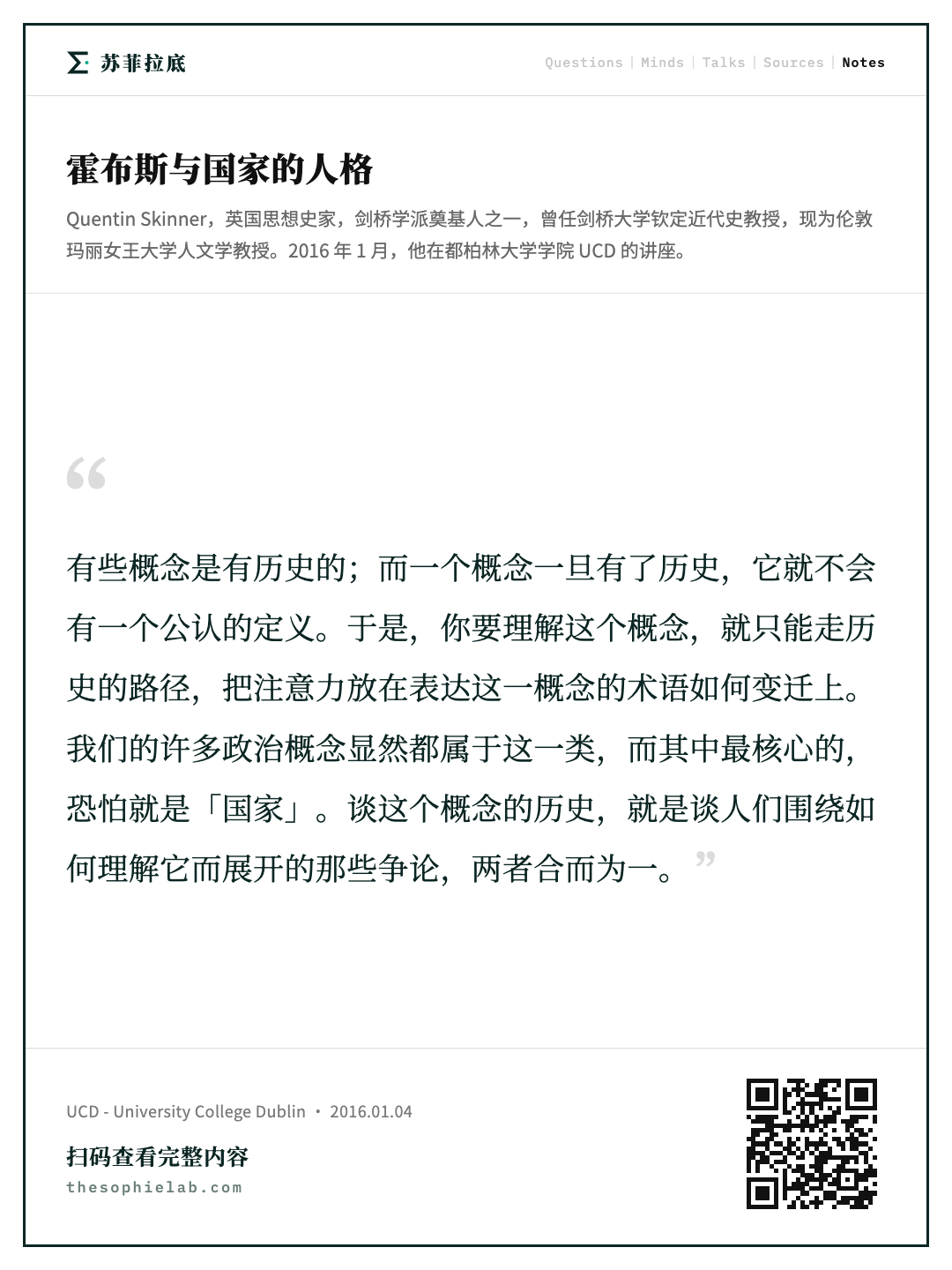
有历史的概念无法定义

我是一个哲学史家,而不是哲学家。不过今晚我想说服各位的一件事是,就政治哲学而言,这两者之间的距离其实并不太远。这里盘旋着一个尼采式的想法。他在《论道德的谱系》里说,有些概念是有历史的;而一个概念一旦有了历史,它就不会有一个公认的定义。于是,你要理解这个概念,就只能走历史的路径,把注意力放在表达这一概念的术语如何变迁上。

我们的许多政治概念显然都属于这一类,而其中最核心的,恐怕就是「国家」(the state)。毫无疑问,自近代早期以来,这个概念就一直处在持续不断的争论与角力之中。所以,谈这个概念的历史,就是谈人们围绕如何理解它而展开的那些争论,两者合而为一。这就是今晚我要说的话背后的方法论前提。

接下来的第一个历史判断,我想是完全没有争议的:在英语世界的传统里,第一次用我们今天仍在使用的术语(国家、国家权力、国家地位等等)对这个概念作出系统分析的,是托马斯·霍布斯(Thomas Hobbes)。但我想借霍布斯以及他对国家的看法,来更一般地思考这个概念本身,思考它可能如何被理解,以及它实际上曾被如何理解。

当代的两种共识

我不打算从霍布斯讲起,也不从这个概念第一次在哲学上成形的近代早期讲起,而是先看看我们今天通常是怎样理解国家的。在这一点上,我希望自己同样不会引起争议,因为在我看来,当下的讨论中有两个关于国家的一般性主张已被广泛接受。

第一个主张是:当我们提到国家时,我们真正谈论的,不过是政治权力的各种制度和强制机器,也就是政府。这类纯粹经验性的国家表述中,最著名的当然是马克斯·韦伯(Max Weber)的说法,或者不如说是他的定义:国家是在某一特定领土上合法暴力的垄断者。到如今,这种纯粹经验性的理解方式已被接受到这样的程度:只要各位稍微想一想每天报纸上这个词是怎么用的,就会发现「国家」和「政府」在日常语言里已经是同义词了。

第二个被广泛认同的主张是:一系列经济与政治的发展,一方面削弱了国家的权力,另一方面也让这种权力名声扫地。先说削弱的一面,也就是我们这个时代国家主权的衰落。最明显的原因,大概是跨国公司的崛起,它们的经济触角遍及全球,掌握着投资与就业的条件,因而明显有能力迫使各国迁就它们的意图,哪怕这些意图与该国的政策相左。尤其在发展中世界,它们的权力大过多数国家。与此同时,另一件显而易见的事,是国际法律机构的兴起,这些机构宣称拥有凌驾于国家主权之上的权力。国际法院是最初也最重要的例子,但类似的机构还有很多。这是故事的一面。

而除了主权的贬值,还有主权的失信。随着新自由主义的主张日益流行,人们越来越相信国家权力不应当成为塑造社会的手段:国家权力是坏的,它是竞争与企业精神的垄断性敌人;市场的力量才是好的,它才是塑造社会的合适力量,是创新与企业精神的助力和朋友。

这两个想法合在一起,使不少评论者相信国家权力已进入不可逆的衰落。各位都知道,福柯(Michel Foucault)在晚年一次访谈中著名地引出了这样的教训:我们应当学会在政治哲学中,也像在政治中一样,砍掉君主的头。也就是说,把我们自己从「谈论主权国家依然有意义」这一幻觉中解放出来。许多国际关系理论家如今都在谈「国家之死」。弗兰克·安克斯密特(Frank Ankersmit)教授在近来一篇讨论这些发展的文章里下了结论,容我引用一下,因为他是一位有分量的权威:「五百多年来,国家第一次走上了退场之路。」

好,我希望以上都没有争议。当下流行两种理解国家的方式:其一,谈国家就是谈一套政府机器;其二,谈国家就是谈一套气数将尽的机器。那么,我们该怎样看待这两个判断?这就是这场演讲余下部分的主题。

国家仍是最强大的行动者

先说第一个:国家是否如安克斯密特所说,正在「退场」?这一点其实远非没有争议,尤其是新自由主义如今几乎就是政治理论的全部叙事。不过我想在这里可以说得简短一些,因为这一论断最让我吃惊的地方,是它与我们的日常经验相去何其之远。

当然,无可否认,国家已经丧失了主权的许多传统属性;同样无可否认,尤其在欧盟,主权已经依附于比国家更大的联合体。但是,指出国家不再拥有传统的威斯特伐利亚意义上的主权,这一显而易见的事实,与福柯式地解构这个概念,完全不是一回事。这让我想说一句话,我担心、但也希望它听起来是再明显不过的:只要看看国际事务,你就很难怀疑,国际舞台上的主要行动者仍然是民族国家。人道主义干预的观念,至今尚未以挑战任何大国的方式付诸实施,将来也不会。它不会去挑战俄罗斯、中国、美国,或者欧盟。

再者,在各自的领土之内,民族国家依然无可比拟地是最重要的政治行动者。这怎么可能受到怀疑?它们眼下极具攻击性,以骇人的排他程度巡守自己的边界,又以同样骇人的力度监控本国公民,而且并未征得公民的同意。它们也极爱干预:面对崩溃的银行体系,它们甚至挺身而出充当最后贷款人,除了它们,还有谁来做这件事?而且,国家凭借其庞大的基础设施在为市场提供便利,其程度远超当下时髦的说法所愿意承认的。没有国家的基础设施,市场基本上是无能为力的。

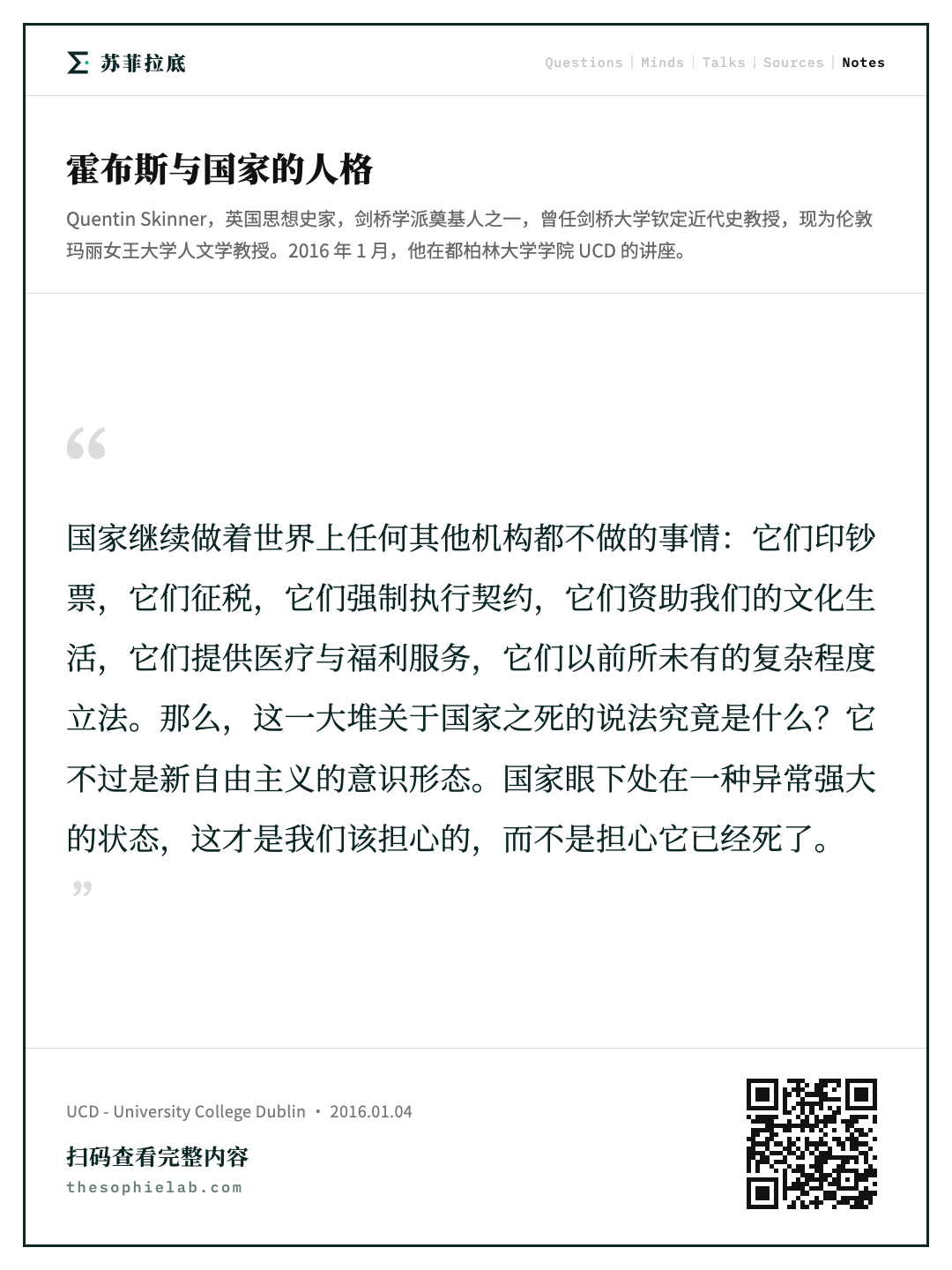
与此同时,国家继续做着世界上任何其他机构都不做的事情:它们印钞票,它们征税,它们强制执行契约,它们资助我们的文化生活,它们提供医疗与福利服务,它们以前所未有的复杂程度立法。所有这些都是绝对明显的事实。那么,这一大堆关于国家之死的说法究竟是什么?它不过是新自由主义的意识形态。我们绝不能因为右翼政府的说话方式,就被诱导着忘掉这些显而易见的事实。「退场」?对一个政治哲学家来说,这只能算是心不在焉。关于国家之死,我想说的就是这些。国家眼下处在一种异常强大的状态,强大到足以威胁欧盟,这才是我们该担心的,而不是担心它已经死了。

国家人格的传统:国家不等于政府

现在我转向另一个主张,这对我来说要严肃得多。我一开始就单独挑出来的这个主张说:谈国家就是谈政府的机器和制度,国家与政府是同义词。这当然是日常用法。我们没法挑战日常用法,但这一点确实极为重要:我们一说国家,就只是指政府。真正令我震惊的,是这种理解方式与另一种理解之间的强烈反差,后者是这个概念第一次成为我们政治话语中的核心名词(用克利福德·格尔茨的话说,「主导名词」)时人们对它的理解。

这一变化,我认为可以清楚地定位在十七世纪晚期,主要出现在霍布斯这位伟大先驱的著作中,也出现在他的一批欧洲大陆追随者的著作中,尤其是普芬多夫(Samuel Pufendorf),然后是沃尔夫(Christian Wolff)和托马修斯(Christian Thomasius),一直延续到黑格尔的国家理论。这一话语在启蒙时期也在欧洲其他地方固化下来:在法国最明显的是瓦特尔(Emer de Vattel)和卢梭,在英格兰则是布莱克斯通(William Blackstone)。这是一套在两代人之间浮现出来的关于国家的重要话语。

但只要想一想我刚才提到的任何一位作者,任何一位,当他们谈论国家时,或者说,他们之所以要把这个概念推到前台,根本原因就在于试图在国家与政府之间划出一条范畴上的界线。这就是全部的要点。对他们来说,关键恰恰在于,国家不但不能与政府等同,而且是一个独立位格(person)的名称:它既区别于统治者的位格,也区别于被统治者的位格。所以今晚我想谈的,就是这个「国家位格」(state personality)的观念。我们在当下的话语里已经彻底丢掉了它,问题在于:我们是否丢掉了某种有价值的东西?

要弄清这一点,我得回到它的第一个经典表述。我想说这一表述出自霍布斯的哲学,尤其是他1651年初版的《利维坦》,这应当没有争议。他在书的开头就告诉我们,在提出他的公共权力理论时,我引用一下,「我所谈论的不是人,而是抽象地谈论国家(Commonwealth or state)的本性」。

霍布斯:主权者只是被授权的代表

从历史上看,霍布斯当然是十七世纪英国革命期间绝对主权的辩护者,站在那个时代共和主义的对立面。但尽管有这样的政治立场,他从不像近代早期的绝对主义作者那样,谈论人们对主权者应有的敬畏,不说主权者是上帝的受膏者,也不说主权者是上帝直接赐予我们的。他从来不那样说话,尽管大多数绝对主义者,比如同时期的法国绝对主义者,都以这种神学政治的语言来思考。霍布斯不这样,原因在于他关于主权权力持有者的两个根本且相互关联的观点。

第一,一切合法的主权者,包括绝对君主在内,其地位永远不会高于一个被授权的代表(authorized representative)。所以他不说「主权者」,他只说「主权代表」(sovereign representative)。第二,无论主权代表是一位君主还是一个人民的会议(霍布斯不在乎,你可以要民主制,也可以要君主制,他认为君主制更明智,但民主制同样是国家权力的一种形式),权力的持有者都有一系列附着于其职位的具体职责,他们必须履行,也有义务履行。霍布斯假定,除非你看到臣服于主权权力之后的生活会好过自然自由状态下的生活,否则你绝不会臣服。而如果是这样,你所臣服的主权者就必然承担了相应的义务:我引用一下,要「产生人民的和平与安全」,并且要以「符合公共福祉的方式」施政。这就是主权代表的职责。

当然,由于主权代表是绝对的,你不能罢免他,你没有罢免他的权利。你当然可以做这件事,但你没有权利这样做,哪怕他未能履行那些职责。但如果一个主权者未能为公共福祉行事,他就在自然法之下有罪,霍布斯说,这是「不义」(iniquitous)。而如果他未能提供保护,他就不再是主权者了。你之所以有一个主权者,只是为了得到保护。更戏剧性的说法是:如果他是主权者却未能保护你,你就不再负有政治义务了,政治义务在那一刻终结。所以这套主权理论里,对代表的职责有着极强的意识。

他们只是代表。好,那么这一理论的关键问题就成了:他们代表谁?主权者只是代表,那么他们代表的是谁?答案并不显而易见,而找到这个答案,就找到了这套国家理论的核心。

授权与拥有:被归属的行为也是行为

要理解霍布斯如何得出「主权者代表谁」的答案,你必须了解他对政治契约(covenant)的独特理解。正如他所解释的,当这样一个契约被订立时,那是一种「仿佛如此」的思考方式:仿佛每个人都与其他每个人达成一致,某个特定的人(某个男人或女人,或某个会议)将有权以他们的名义说话和行动。《利维坦》中引入契约的公式是这样表述的,我引用:「我授权这个人或这个会议,并放弃我管理自己的权利,条件是你也把你的权利让给他,并以同样的方式授权他的一切行为。」

而在前一章,也就是第十六章(契约在第十七章),霍布斯已经告诉你授权一个代表意味着什么。他把代表归为他所谓的「人为位格」(artificial persons),并且说,我引用:「在这类人为位格中,有些人的言语和行为为他们所代表的人所拥有(owned),这时那个位格就是行动者(actor),而拥有其言语和行为的人就是授权者(author),在这种情况下,行动者是凭授权(authority)而行动的。」你看,author 与 authority,这里有一个很重要的词源关系。

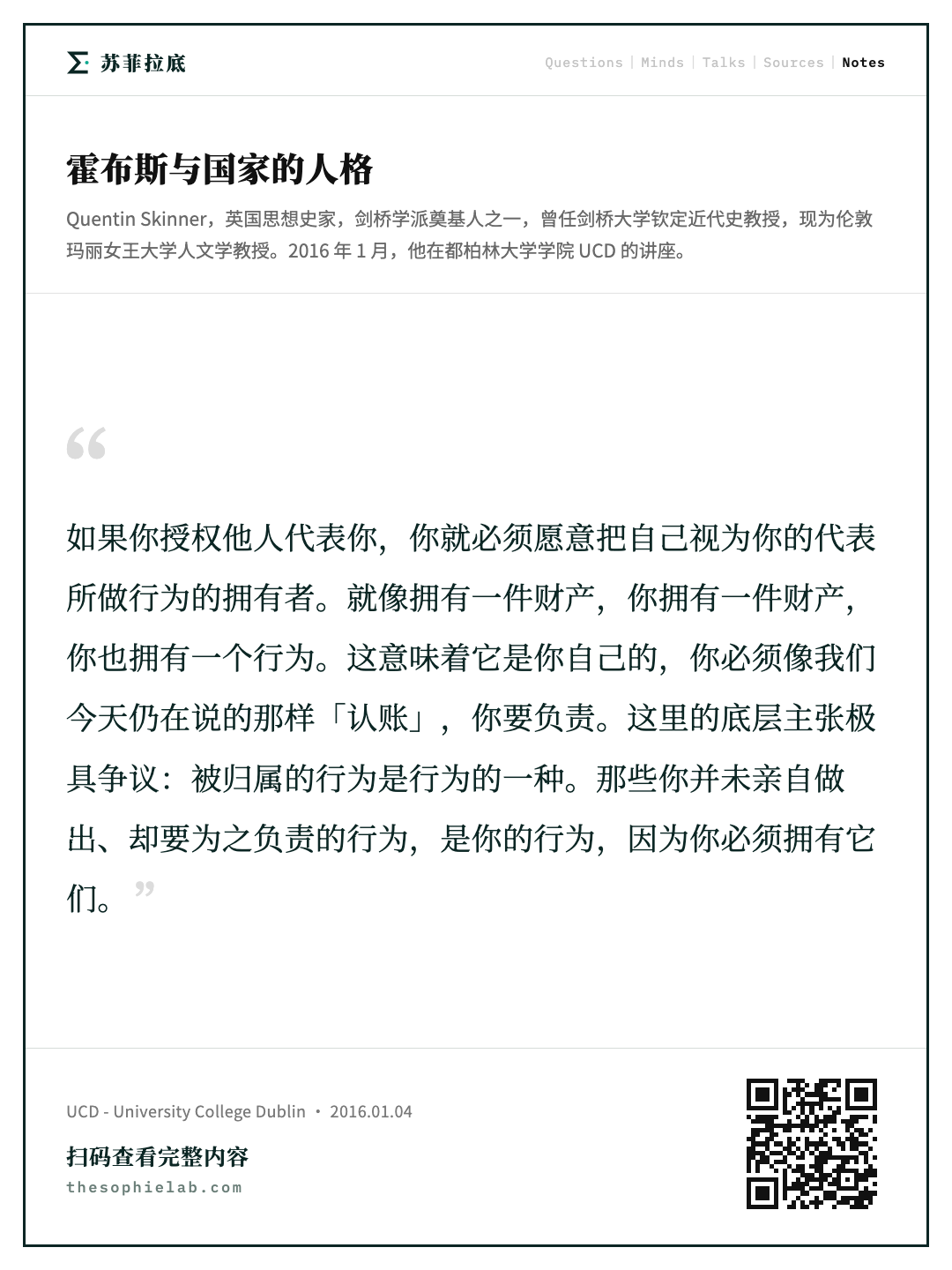
霍布斯在这里说的是什么?他是说,如果你授权他人代表你,你就必须愿意把自己视为你的代表所做行为的拥有者。理由是,通过你的授权行为,你已经把以你的名义行动的权威授予了他们,因此你必须准备好把那些行为当作你自己的行为来承担责任。这就是他说你必须「拥有」这一行为的意思。就像拥有一件财产,他说,你拥有一件财产,你也拥有一个行为。这意味着什么?意味着它是你自己的,你必须像我们今天仍在说的那样「认账」(own up),你要负责。

请注意,这里的底层主张在当代哲学中当然极具争议:被归属的行为(attributed action)是行为的一种。那些你并未亲自做出、却要为之负责的被归属行为,是你的行为,因为你必须拥有它们。这就是对授权的分析。

契约生成两个位格:主权者与国家

这把霍布斯带到了他关于订约后果的核心主张:如果你同意由主权者这一人为位格来代表你(「人为位格」只是说他们承担了一个角色,那是一种技艺),那么我们每个人同意由谁来代表我们并授权这一代表的行为,同时也就把我们从一群「多众」(multitude)转变成了「一」。我们是怎样变成一的?因为我们被一个共同协议联合在一起,那就是共同臣服于某一位特定的代表;因此我们如今有了一个起决定作用的意志,一个意志,它是我们的意志,因为我们拥有那位实际行动的代表的行为,他的行为算作我们所有人的行为。而这就是说,通过这一授权代表的行为,我们把自己转变成了一个位格。

这是霍布斯自己的总结:「一群人在被一个人或一个位格所代表时,就成为一个位格……因为其效果是把他们全体真实地统一于同一个位格之中,这一位格是由每个人与每个人订立的契约所造成的。」

所以你看,订约这一行为,也就是这套国家哲学的绝对核心,生成了两个在我们自然自由状态中并不存在的位格。一个是我们授予其权威、以我们的名义说话与行动的人为位格,我们知道这个位格的名字,那就是主权者。另一个是霍布斯所说的「拟制的位格」(person by fiction),它是我们在授权某人代表我们、从而获得单一意志与单一声音时创造出来的。而这个位格的名字,霍布斯在一个划时代的时刻说,就是国家。我引用:「如此统一于一个位格中的多众,就叫做国家(Commonwealth or state)。」

你刚刚建立的这个国家,用霍布斯的话说,是一个「有死的上帝」(mortal God)。在不朽的上帝之下,我们要把和平与防卫归功于这个有死的上帝。正如不朽的上帝是三个位格,国家这位有死的上帝也是三个位格,或者说三类位格:自然位格,即我们每一个人(在霍布斯那里,自然位格只是指一个能对自己行为负责的心智健全的成年人);人为位格,即扮演某一角色的自然位格的名称,在这里就是主权者的角色;以及拟制位格,即主权者所代表的那个位格的名称,那就是国家。

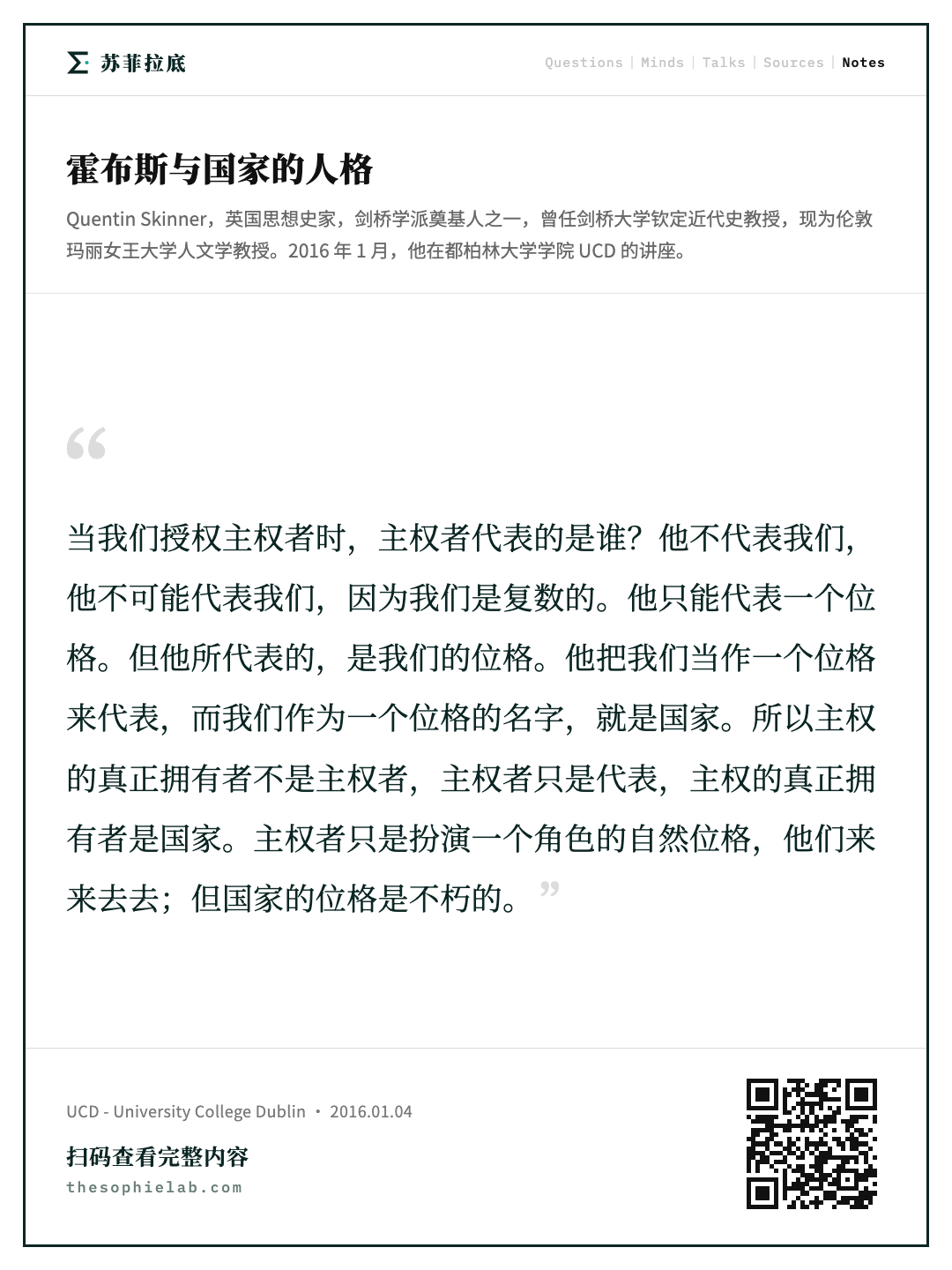
于是问题的答案来了:当我们授权主权者时,主权者代表的是谁?他不代表我们,他不可能代表我们,因为我们是复数的。他只能代表一个位格。但他所代表的,是我们的位格。他把我们当作一个位格来代表,而我们作为一个位格的名字,就是国家。所以,「主权者代表谁」的答案是:主权者代表国家。因此霍布斯得以给国家下定义,我引用:「国家是一个位格,一大群人通过彼此订立契约,使自己每一个人都成为这一位格之行为的授权者。」而主权者则是「承担着(bears or carries)国家位格」的那个人或会议。

霍布斯给了国家一个专属的名字,他称之为「利维坦」。他接着相当细致地描述了这个位格。他非常关心这个位格如何过上健康的生活,非常关心它健康的脆弱性,有整整一章,很长的第二十九章,专门讨论这个位格的疾病,也就是国家的疾病、政治体的疾病,以及政治体如何死亡:内战就是这个位格的死亡。他还强调,主权者只是扮演一个角色的自然位格,他们来来去去;多众也一直在出生和死亡,每天都在变化;但国家的位格是不朽的,它持续存在,并且必须存续到任何可以想象的臣民的生命之外。当然,他并不认为它真的不朽,他认为自己在有生之年目睹了国家的死亡,因为他经历了一场内战,而内战就是国家的死亡,因为那时没有主权者,谁是主权者成了争议。但他坚持,建立国家的目标,我引用,是「让它活得与人类一样长久」,建立一套「可以传给我们遥远后代的永久安全体系」,并「创造一种人为的永恒生命」。

好,这就是你所做的:你创造了一个由主权者代表的拟制位格。这个位格只是一个虚构,但如果以为这个虚构在现实世界中不是一股巨大的力量,那将是天大的错误,因为那样就忘记了这一理论的核心:被归属的行为也是行为。一旦你把握了被归属行为的概念,霍布斯指出,就很容易看到,纯粹虚构的国家位格为何仍然能够成为一个拥有无可超越之权力与力量的位格。当一群多众订约建立主权者时,他们把为公共福祉行事的最充分的权力都分配给了他。但请记住,主权者只是国家的代表;主权者以官方身份所做的一切行为,都是我们今天仍在说的「国家行为」(acts of state)。所以主权的真正拥有者不是主权者,主权者只是代表,主权的真正拥有者是国家。我引用:「规定并命令遵守那些我们称为法律的规则的,是国家,因此发布命令的那个位格的名字,就是 persona civitatis,国家的位格。」

两种代表的隐喻:绘画的相似与戏剧的扮演

这就是霍布斯思考公共权力的方式。但它马上会遇到一个非常明显的反驳:国家是一个虚构,然而国家又是一个主权权力,一个虚构怎么能宣战?一个主权的虚构怎么能把你关进监狱?虚构怎么可能拥有任何权力?这确实是关键问题。霍布斯的回应是:是的,这看起来像是这类理论的严重难题,但如果你觉得这是个难题,那有难题的是你。你的难题是政治哲学中一个非常普遍的难题,就是你不理解「代表」(representation)这个概念。他会毫不含糊地说,我们不理解代表的概念。

让我谈谈这一点,因为这正是这套理论的要害。确实,我们从古代继承了两种思考代表的不同隐喻。一种来自绘画和雕塑的艺术,把代表理解为「再现」(拉丁语动词是 repraesentare):把某种不在场的东西呈现出来,仿佛它在场。各位想必知道,这方面的经典文本嵌在老普林尼的《博物志》中,第三十四、三十五卷是一部关于绘画和雕塑的论著,实际上是古典美学的经典陈述之一。世界把自身呈现给我们,而在绘画与雕塑中,我们试图再现这个世界。普林尼用的动词始终是 repraesentare。他讲了一个各位或许知道的绝妙例子,关于一场绘画比赛,获胜者是画家宙克西斯。宙克西斯画了一副帘子,评委来了之后说:请把帘子拉开,让我们看看你画了什么。他就是这样赢的:他把一副帘子再现得如此精确,以至于人们看不出那是幻象。所以,在这种分析中,代表的本质就是提供尽可能好的相似物。

这种理解在近代早期及其后被应用到政治代表的观念上,即对人民这一身体的代表。在霍布斯所回应的英国革命时期的激进作者那里,这就是他们所提出的对代表的理解。而这种理解延续了很长时间:在英国的选举制度里,政治体的每一个部分,也就是各郡,无论人口多少都选出同样数量的议员。这在美国宪法之下至今仍然如此,美国参议院就是这样选举的。理由是,这些郡,或者美国的各州,构成政治体的肢体,因此,对人民这一身体的恰当代表,必须平等地再现其中每一个部分。

霍布斯怎么回答?他说:你们用错了隐喻,这根本不是思考代表的正确隐喻。他从古代拿出了另一个形象,不是来自绘画艺术,而是来自戏剧艺术。在思考政治代表时,我们从拉丁语继承了两个动词:repraesentare 和 gerere personam。gerere personam 是西塞罗爱用的戏剧用语,意思是扮演他人的角色。霍布斯引西塞罗说,这个隐喻「从剧场转移到了法庭」,变成了以委托人的名义说话这一行为。霍布斯想让你理解的是,你被有效地代表,就像在剧场里或在法庭上一样。

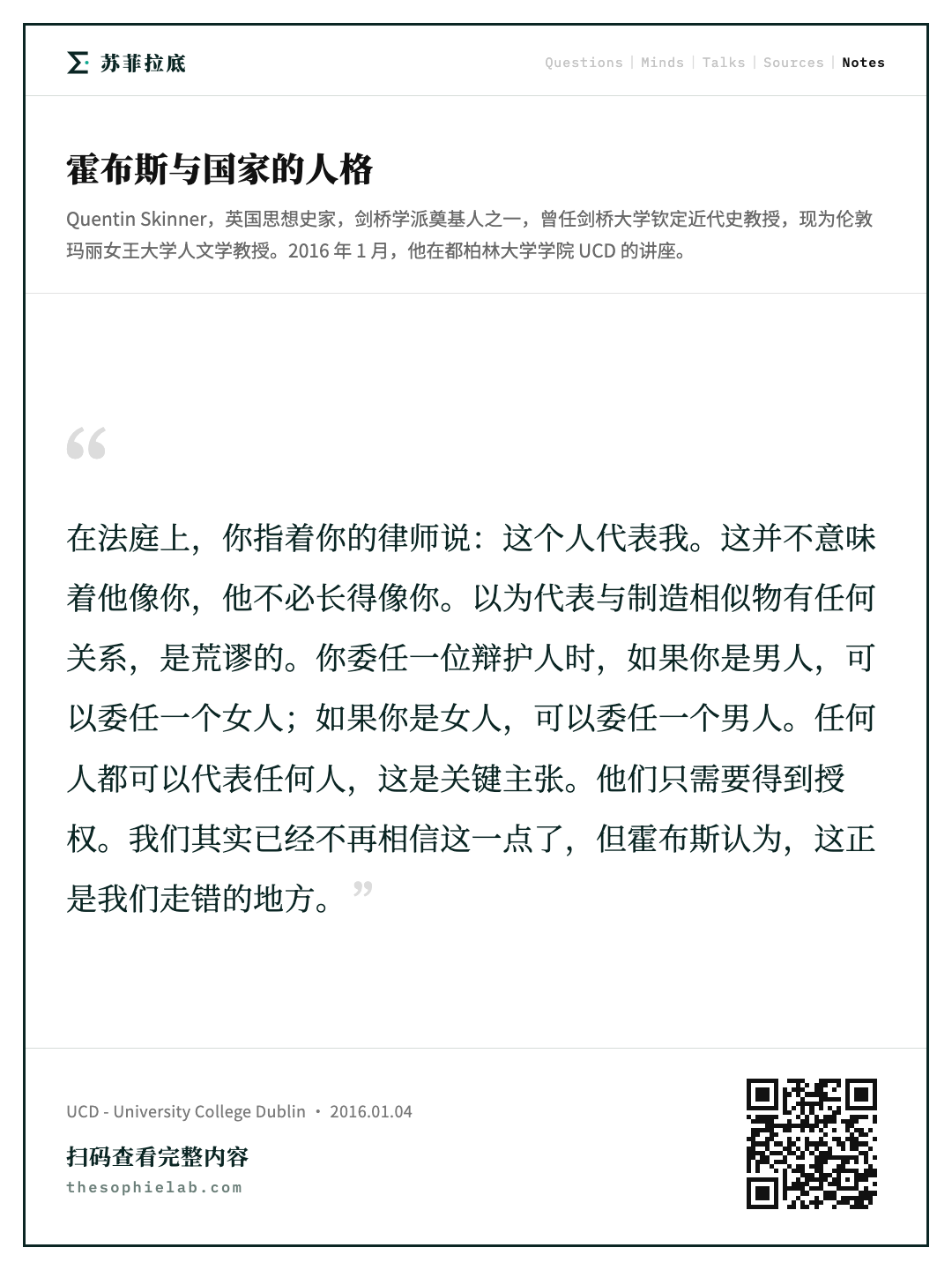
这就是霍布斯的关键一步。他想说,政治代表无非就是授权某人扮演你的角色,也就是以你的名义说话、以你的名义行动。剧场的情形当然特别:在我扮演哈姆雷特之前,他只是纸上的文字,是我通过说出那些台词让他活了过来。同样,在法庭上,法官问「谁代表你」,你当然可以说「我代表我自己」,至少在英格兰法上可以,那样法官会说,换了我可不会这么做;不过这是可能的。但通常你会指着你的律师说:这个人代表我。这并不意味着他像你,他不必长得像你。这就是那个巨大的错误,请注意它巨大的含义:以为代表与制造相似物有任何关系,是荒谬的。你委任一位辩护人时,如果你是男人,可以委任一个女人;如果你是女人,可以委任一个男人。任何人都可以代表任何人,这是关键主张。他们只需要得到授权。我们其实已经不再相信这一点了,但霍布斯认为,这正是我们走错的地方。

任何人可代表任何物:朱庇特的祭司

还要注意这里的关键之处:如果授权是代表的充分条件,那么任何人不仅可以代表任何他人,也可以代表任何事物,霍布斯就是这么说的。你可以代表一个物。霍布斯在论代表的那一章给了我们一个例子:异教徒的神。异教徒的神并不存在,霍布斯说,它们不过是头脑中的虚构,但在古罗马,它们却拥有大量财产,并且买进卖出。于是代表理论面临一个棘手的问题:如果你不存在,你怎么能卖一栋房子?霍布斯说,别担心,这不是问题。罗马国家授权祭司充当诸神的代表,因此祭司能够作为诸神的代表在法庭上以诸神的名义发言,进而完成完全有效的交易。所以在罗马法庭上,法官问:谁代表朱庇特?朱庇特并不存在,但这是一个完全有效的法律问题。于是某个祭司站起来说:我代表朱庇特,我们要卖掉他的雕像。

霍布斯说,现在你可以看到,纯粹虚构的位格如何能拥有巨大的权力,以及国家这个纯粹的虚构,如何仍然能够宣战、能够把你关进监狱。这是因为授权是代表的充分条件。你既然授权了主权者,主权者就以国家的名义说话,但行为被归属于国家,行动的是国家:国家宣战,国家把你关进监狱。这就是霍布斯的国家理论,它是西方政治哲学中第一个毫不含糊的国家位格理论。

我希望这套理论已经讲清楚了。它确实精巧,但我希望它是清楚的,而这很重要,因为它在一段时间里影响极大。这里有一个巨大的反讽:英国人对霍布斯没有用处,随着辉格党在1688年革命中的胜利,绝对主义被扔出了窗外。但在欧洲大陆,尤其是德国,后来还有法国,这套国家位格理论无处不在,发挥了巨大的影响。

普芬多夫:从拟制人格到道德人格

一般的看法是,真正把这一影响传播开来的哲学家,与其说是霍布斯,不如说是普芬多夫,以他1672年的巨著《自然法与万民法》。尤其是在德国评论者当中,最初是基尔克(Otto von Gierke),后来当然是卡尔·施米特(Carl Schmitt),普芬多夫被视为霍布斯的伟大门徒。施米特说,他是「让霍布斯在欧洲大陆获胜的人」,也就是作为一位国家理论家获胜。

这个看法我认为部分正确。普芬多夫确实同意(我引的是十八世纪的英译本)「霍布斯先生已经给了我们一幅公民国家的草图」。他也同意霍布斯的说法,国家是这样产生的:「当一群自然位格如此地联合起来,以至于他们凭这一联合所意愿或所做的事被视为一个单一位格的作为」。他进一步同意这个位格的名字是国家,因而也同意霍布斯的根本主张,即国家是主权的所在。最后,他还赞同并发展了霍布斯的一个论述:要令人满意地分析公共权力,就必须把国家不仅看作一个区别于统治者和被统治者的独立位格,而且看作拥有「人为的永恒生命」。普芬多夫很喜欢这个说法。国家之所以必须拥有这种人为的永恒生命,普芬多夫在他国家分析的最后一章提出,一个理由是像公债这样的情形;但主要理由是,这能生成一套政治义务理论。这是霍布斯与普芬多夫共有的一个真正关键的要点:组成这一联合并把国家的代表权授予主权者,目的是产生公共福祉,尤其是提供对人民的保护,也就是普芬多夫反复援引的「人民的安全是最高法律」(salus populi suprema lex)。所有这些都与霍布斯相同,这是事实。

然而在我看来,这一影响很大的德国史学传统由于强调普芬多夫从霍布斯那里拿了什么,反而讽刺性地未能看到普芬多夫国家思想中某种非常独创的东西,而这种东西的影响远远超过霍布斯所说的任何话。所以我想就普芬多夫的理论加一段补充。

首先,普芬多夫比霍布斯更充分地刻画了我们所栖居的两个世界。我们生活在一个自然世界里,其中有自然物;但我们也生活在一个人为世界里,那是我们为自己创造的公民联合的世界,其中包含着「道德物」(moral entities)。这些道德物中最重要的是道德位格(moral persons),因为它们构成了我们同时也生活于其中的这个道德世界的实体。我们生活在自然世界里,也生活在道德世界里,而道德世界有它自己的实体,正如自然世界一样。这些道德位格,就是我们在公民联合中所扮演角色的名称。我引用普芬多夫:「我可以同时承担多个位格」,背负多种 personae:我是一家之主,我是丈夫,我是元老,我是辩护人,我是宫廷顾问,所有这些都是我的位格的名称。这些位格之所以是道德位格,是因为做丈夫、做顾问、做一家之主,都附带着职责,以及履行这些职责的义务,你要履行它们才能实现那个位格的存在。这就是对「拥有位格」这一观念更充分的阐述。他会说我们都有许多 personae;正如西塞罗会说的,如果你把你所有的 personae、所有的角色都告诉我,那就是你这个人。这是一套关于人格同一性的论述。

但对普芬多夫来说,更重要的是他认为霍布斯在对位格的分析上脱了轨,因此在对国家的理解上也脱了轨。因为你已经可以看到,普芬多夫无法容忍的想法,是一个「物」也可以拥有位格。为什么?因为物不能拥有道德属性。它们当然有实体,但没有道德实体。而异教徒的神根本没有任何实体,它们怎么能有位格?请注意,普芬多夫放弃的正是「拟制位格」(persona ficta)的观念:对普芬多夫来说,国家不是一个拟制位格的名称。他引入了一个不同的术语,天哪,这个术语的影响之大难以估量:它不是 persona ficta,而是 persona moralis,一个道德位格,他称之为「复合的道德位格」(compound moral person)。

所以我认为我们应当这样说:近代早期政治哲学中浮现出两种相互竞争的国家理论,一种是纯粹虚构论,另一种则认为国家不是虚构的位格,而是道德位格。产生巨大影响的是后者。你在托马修斯和沃尔夫那里能找到它,在康德那里当然也能,最重要的是在黑格尔那里,在他关于法(Recht)的理念中。而在法国传统里同样清楚:瓦特尔坚持国家是一个「道德位格」(personne morale),这一点被卢梭的《社会契约论》接过去,在那里国家始终被称为 personne morale。他们在这里,尤其是瓦特尔和卢梭,虽然算得上霍布斯派,却明确地在与霍布斯的说法争辩。我引瓦特尔(当然是我的翻译):国家「由每一个臣民的理解与意志复合而成」,不只是意志,还有理解,「因此国家是一个道德位格,拥有它自己特有的理解与意志」。

瓦特尔尤其重要。卢梭当然是启蒙时代对道德人格的伟大分析,但瓦特尔的影响可能还要更大,因为他坚持认为,正是这一点解释了国家之间的关系:那是道德位格之间的关系,国际关系的全部内容就是道德位格的关系。所以,在瓦特尔极具影响的论述中,没有国家位格理论,就不可能有国际关系理论,因为正如他所说,一切同盟都是位格之间的同盟,而且它们必须是国家的位格,否则它们就没有持续的权威。

最后一点想法。我们现在已置身启蒙的核心,谈的是德国和法国的传统,而霍布斯的故事终于回到了英格兰。它主要是通过英国普通法评注者中最有影响的威廉·布莱克斯通爵士回来的。在《英国法释义》中,他以一段关于国家起源的哲学论述开篇,而那是完全霍布斯式的:他看到一个自然世界,其中是一群个别的人;他看到除非通过契约,他们无法建立单一意志;他把契约看作创造出国家的位格,把主权看作对这一位格的代表。所以我想可以毫不夸张地说,到启蒙思想的这一阶段,国家的观念,国家位格的观念,已被普遍接受,唯一的争论只是它是一个纯粹拟制的位格,还是必须是一个道德位格。

边沁与奥斯丁:英语世界抛弃虚构

我想用两个问题来结束这场演讲。一个是,在十八世纪末,英语世界的传统,不只是英格兰,而是整个英语世界,滑向了一个完全不同的方向,其结果是国家位格的观念被视为与英语世界的政治哲学格格不入;事实上,除了十九世纪末一次短暂的新黑格尔主义复兴,它实际上已经消失了。所以我想就这一时期的英语世界传统问两个问题:一,它为什么消失了?二,我们是否丢失了什么要紧的东西?

它为什么消失?我想答案的大部分在于,从十八世纪晚期起,功利主义作为一种道德与政治哲学在英语思想中的巨大影响。杰里米·边沁(Jeremy Bentham)的第一部著作是1776年的《政府片论》,各位知道,那整本书就是对我刚才引述的布莱克斯通那一节的猛烈抨击。我引边沁:「虚构的季节已经过去」,现在到了把法律论证建立在关于真实个人的事实之上的时候,尤其要建立在个人面对政治权力时体验约束之痛苦与自由之快乐的能力之上。面对布莱克斯通的那套霍布斯式说法,自然状态、自由、契约、拟制位格的创造、那个位格被代表、那个位格的名字叫国家,边沁并不说这是错的。我再引他一句:这些整节整节的文字「完全没有意义」,它们「不过是一连串的虚构」。而法律必须摆脱虚构,它必须关乎快乐与痛苦。

这一说法的影响极为深远。这种对国家的祛魅,当然正是如下想法的源头:如果我们谈论国家,除了掌管政府机器的那些人,我们还能指什么呢?这就是你在整个功利主义古典法学中所看到的,其经典范例是约翰·奥斯丁(John Austin)1832年的《法理学的范围》。我引用:「我自己对国家的理解是,这个词仅仅指在任何一个独立的政治社会中被授予最高权力的那个个人或那群个人。」所以,粗略勾勒就是这样,如果各位愿意,讨论时我可以多谈一些。这里存在一种非常强大的法律理论意识形态,它对虚构毫无用处,尤其是对那个至高的虚构:国家。

丢失了什么:国债、条约与政府问责

最后我想以另一个问题作结:在英语世界的政治思考中,以及如今更广泛的欧洲政治思考中,放弃国家位格的观念之后,有没有丢失什么有价值的东西?卡尔·施米特因为回答「有」而闻名,或者说声名狼藉。他说这是现代政治哲学最严重的损失。他那本非同寻常的书讨论他所谓的「国家位格」,霍布斯《利维坦》中的国家位格,认为那才是思考国家的正确方式,而我们丢掉了它,因此丢掉了真正要紧的东西。按施米特的说法,它之所以要紧,各位想必知道,是因为你必须有一个统一于某种意志之下的联合体,这个意志不仅作为主权权力行动,而且拥有决断例外、决断紧急状态的权力;你必须承认那就是国家的权力,只要它保护你,就必须服从它。这就是施米特的霍布斯主义。那确实是霍布斯的论证之一,也是普芬多夫的论证之一。

但如果我回想我所谈的整个传统,回想我关于霍布斯、普芬多夫和瓦特尔所说的话,那并不是他们真正想让你理解的、关于国家的要紧之处。不是的。他们还有三件事真正想让你思考,我想以此作结。

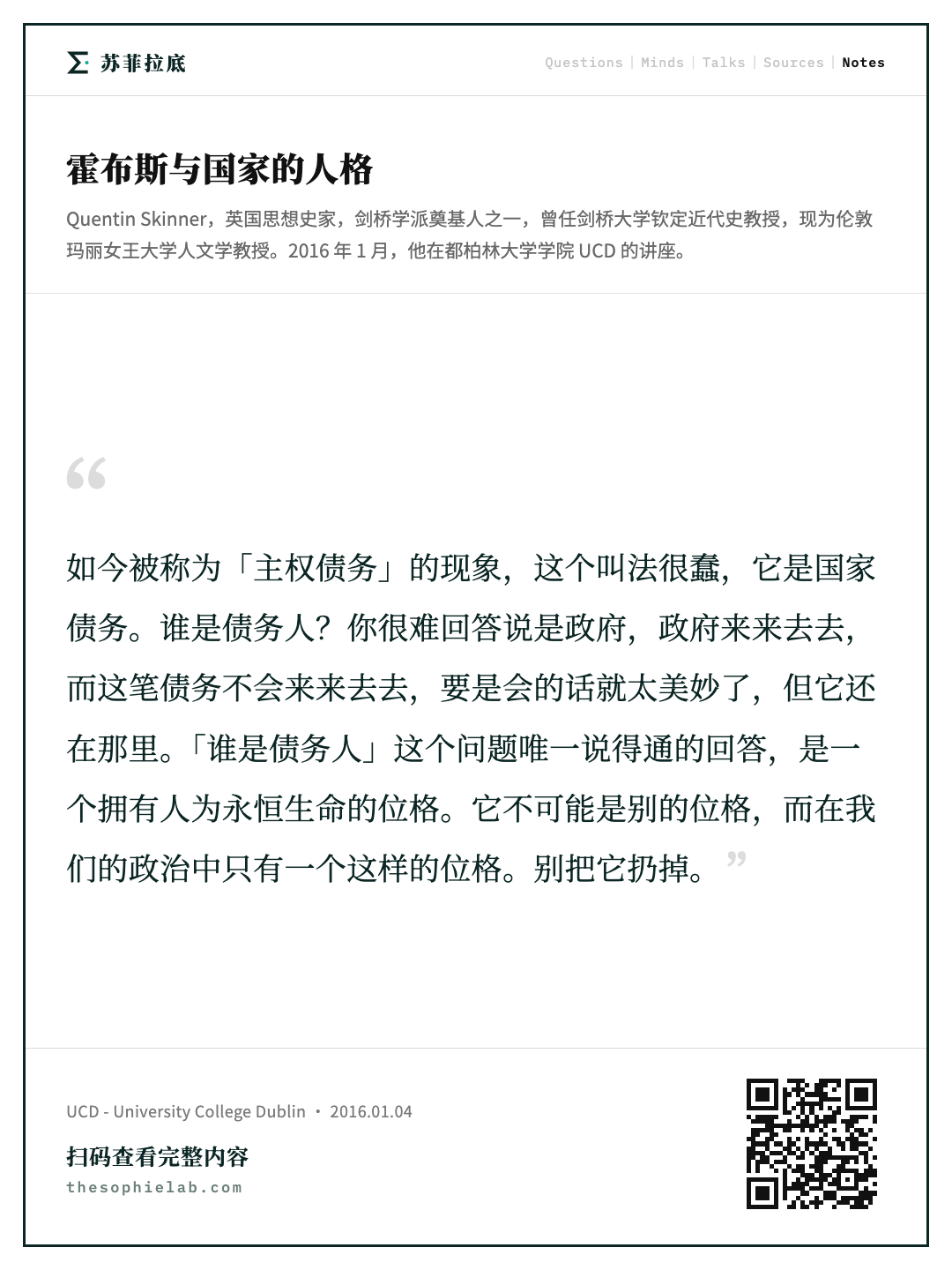
第一,你必须能够解释这样一个事实:某些政府行为的意图效果,不仅是约束当下的公民,而且要约束他们遥远的后代,霍布斯就是这样说的。我们已经看到,一个明显的例子,普芬多夫用了它,后来的许多法律理论家也用了它,梅特兰(F. W. Maitland)有一篇著名的文章谈它,就是如今被称为「主权债务」(sovereign debt)的现象。当然,这个叫法很蠢,它是国家债务,我们应该叫它国家债务,国家的债务。谁是债务人?你很难回答说是政府,政府来来去去,而这笔债务不会来来去去,要是会的话就太美妙了,但它还在那里。普芬多夫想让你理解,「谁是债务人」这个问题唯一说得通的回答,是一个拥有人为永恒生命的位格。它不可能是别的位格,而在我们的政治中只有一个这样的位格。别把它扔掉。

第二,他们想让你看到,与此类似,还有遥远后代与其他政府之间的关系问题。这是瓦特尔反复强调的一点。他有一个范畴叫「实在条约」(real treaties)。实在条约不只是一块临时的创可贴,它是道德位格之间的一种关系,其设计目的是与这些位格一样长久地存续下去。因此,签约方不可能是政府,必须理解为签约方是人为永恒的存在,所以只能是国家。这是第二个想法。

第三,对这些作者来说,也是最重要的一点:当且仅当你在国家与政府之间作出范畴上的区分,你才能用国家的观念生成你真正想要的东西,那就是一套关于政治义务之限度的理论。这对他们来说才是真正关键的一点。它如何起作用?请记住普芬多夫的箴言:让人民的安全成为最高法律,salus populi suprema lex esto。所以对这些哲学家而言,在范畴上区分国家与政府的根本理由,是它提供了一种让政府负责的手段:去追问,政府是否在履行它们对国家这一位格的义务。

人们常说,尤其在晚近的自由主义政治哲学中,这听起来有点阴森。但认为我刚才所说的东西阴森,只是对我所阐述的这套理论的误解。事实证明,这套理论在当代政治哲学中相当难以讲清。但按照我所阐述的理论,说国家的名字是一个独立位格的名字,只是指称「我们」的一种方式,也就是指称一个已授权他人代表自己的公民整体。所以当我们谈论国家的利益时,那就等于谈论任何我们可以判定为公共利益的东西。众所周知,在多元文化的社会里,「公共福祉」的观念很难说得通。但这些作者仍然会认为,你可以给公共福祉一个非常坚实的含义:存在一些所有公民都拥有的利益,比如,霍布斯会说,受教育的利益,在无法照顾自己时得到福利照顾的利益,受到保卫的利益。如果我们坚持所有这些利益都必须得到满足,我们就会拥有一套极其坚实的民主国家理论。

但这当然正是我们现在所没有的。因为我们的统治精英,在英国和美国最为无耻,已经攫取并操纵了国家的机器为自己所用,而且还在继续这样做。我们没有道德词汇来抗争这一点。其实我们有,那就是国家的词汇。这让我不禁想问,我们抛弃这套词汇,会不会是一个非常严重的错误。谢谢各位。
排版 + 横图 + 来源,粘贴即成稿
章节 · 点击跳转视频
0:00 方法论:有历史的概念无法定义 ▶ 正在看
2:39 当代两种共识:国家即政府、国家将亡 ▶ 正在看
5:24 反驳国家之死:国家仍是最强行动者 ▶ 正在看
9:18 国家人格传统:国家不等于政府 ▶ 正在看
12:03 霍布斯:主权者只是被授权的代表 ▶ 正在看
16:21 授权与拥有:被归属的行为也是行为 ▶ 正在看
18:59 契约生成两个位格:主权者与国家 ▶ 正在看
25:27 两种代表隐喻:绘画的相似与戏剧的扮演 ▶ 正在看
30:55 任何人可代表任何物:朱庇特的祭司 ▶ 正在看
33:45 普芬多夫:从拟制人格到道德人格 ▶ 正在看
42:10 边沁与奥斯丁:英语世界抛弃虚构 ▶ 正在看
46:13 丢失了什么:国债、条约与政府问责 ▶ 正在看
本期小问 · 档案清单
—— 跨国公司和国际法院崛起后,说「国家正在退场」真的成立吗? ▶ 正在看
—— 一个只是虚构出来的「国家」,靠什么获得宣战与关押人的权力? ▶ 正在看
—— 政治代表的本质是长得像被代表者,还是获得被代表者的授权? ▶ 正在看
—— 把国家与政府当同义词,是不是丢掉了问责政府的道德词汇? ▶ 正在看
本期讲者
Quentin Skinner英国思想史家,剑桥学派奠基人之一,曾任剑桥大学钦定近代史教授,现为伦敦玛丽女王大学人文学教授。代表作《近代政治思想的基础》《自由主义之前的自由》,长期研究霍布斯与国家概念的谱系。
01方法论:有历史的概念无法定义
0:00
well I'm an historian of philosophy as I say not a philosopher but one of the things I'm going to try and persuade you of this evening is that in the case of political philosophy that Gap is not actually a very large one there's a nitian thought hovering here which is that as he says in the genealogy of morality some Concepts have histories and if a concept has a history then it's not going to have an agreed definition and so your approach to the understanding of that concept will actually have to be historical and we'll need to focus on the investigation of the changing terminology in which the concept has expressed now a number of our political concepts are clearly of that character and perhaps the central concept of our political lexicon is the state and it's unquestionable that since the early modern period that concept has been subjected to continual contestation and debate so in talking about the history of the concept we're talking about those very contestations about how to understand it and so the two come together so that's the sort of methodological thought that underlies what I'll try and say this evening and then the first historical thought is that I think it would be completely uncontentious to say that in the anglophone tradition the first
我说过,我是一位哲学史家,而不是哲学家。不过今晚我想努力说服各位的一点是:就政治哲学而言,这两者之间的鸿沟其实并不算大。这里盘旋着一个尼采式的想法,就像他在《论道德的谱系》里说的,有些概念是有历史的。而一个概念一旦有历史,它就不会有一个公认的定义,因此你要理解这个概念,进路就必然得是历史性的,我们必须着力考察表达这个概念的那套不断变化的术语。我们的不少政治概念显然就具有这种性质,而在我们的政治词汇中,最核心的概念也许就是“国家”。毫无疑问,自近代早期以来,这个概念一直不断遭到争夺与辩论。所以当我们谈论这个概念的历史时,我们谈的正是关于如何理解它的那些争论,于是两者就合到一处了。这就是我今晚要讲的内容背后的那种方法论思路。接下来第一个历史性的判断是,我认为下面这句话说出来完全不会有争议:在英语世界的传统中,第一次
便签笔记
1:14
systematic analysis of how to think about this concept expressed in the terminology that we would now use of State um state power statehood and so forth is the work of Thomas Hobbs but I want to use Hobs and his view about the state to try to think about the concept itself more generally and to think about how it might be understood and how it has been understood now from having no lecton we've now got three but I'm very happy with this one thank you very much very resourceful most grateful plenty very good plenty of to I might just move between them now I want to start not with Hobbs or with the early modern period when this concept is is philosophically formed for the first time but by thinking about the concept of the state and how we now generally think about it and here I hope also to be completely uncontentious because it seems to me that two general claims about the concept have come to be very widely accepted accepted in current discourse one is that when we refer to the state what we're really talking about is simply the institutions and Co coercive
用我们今天会使用的术语——国家、国家权力、国家地位等等——对如何思考这个概念作出系统分析的,是托马斯·霍布斯的著作。但我想借助霍布斯及其国家观,来更一般地思考这个概念本身,思考它可以如何被理解、又曾经是如何被理解的。刚才一个讲台都没有,现在一下子有了三个,不过这个我很满意,非常感谢,真是机灵,感激不尽,很好,够用了,我大概可以在它们之间来回走动。现在,我想开始的地方不是霍布斯,也不是这个概念第一次在哲学上成形的近代早期,而是先想一想国家这个概念,以及我们如今一般是怎么理解它的。在这一点上我同样希望完全不引起争议,因为在我看来,关于这个概念有两个笼统的说法,在当下的话语中已被广泛接受。第一个是:当我们提到国家时,我们真正谈论的不过是政治权力、也就是政府的那套制度和强制性
便签笔记
02当代两种共识:国家即政府、国家将亡
2:39
apparatus of political power of government the most celebrated of these completely empirical formulations of how to think about the state is undoubtedly that of Max vber describing it as you know or rather I might say defining it as you know as the monopolist of legitimate power over some designated territory and by now that way of thinking that purely empirical way of thinking about the state is so widely accepted that I think if you reflect for a moment on how you see the terminology used in every newspaper of the day now the terms state and government are in common parland synonyms the other Claim about the state that's come to be widely agreed first being to talk about the state is to talk about the apparatus of government I mean that's what we're talking about is that a number number of Economic and political um developments have undermined and at the same time tended to discredit the power of the state just a word first about the undermining of State sovereignty in our time perhaps the most obvious cause of that has been the rise of multinational corporations of e of international economic reach and of course they with the capacity to control terms of investment and employment are visibly able to coer States into accommodating their designs even when those designs are out of line
机器。在所有这些完全经验性的国家表述中,最著名的无疑是马克斯·韦伯的那一个——他把国家描述为,或者不如说定义为,在某一指定领土上对正当权力的垄断者。到今天,这种思考方式,这种纯粹经验性地看待国家的方式,已经被如此广泛地接受,我想各位只要稍微回想一下每天报纸上是怎么使用这些词的就会明白,国家和政府在日常用语里已经成了同义词。关于国家的第二个被广泛认同的说法——第一个是谈国家就等于谈政府机器——第二个是:一系列经济和政治的发展已经削弱了国家的权力,同时也倾向于让国家权力名声扫地。先说说我们这个时代国家主权被削弱这件事。也许最明显的原因就是跨国公司的兴起,它们的经济触角遍及国际,当然,它们有能力掌控投资与就业的条件,显然能够胁迫国家去迁就它们的意图,哪怕这些意图并不符合
便签笔记
4:02
with the policies of those States so they have greater power especially in the developing world than most States and at the same time of course this is obvious um the developing world has witnessed the rise of international legal institutions which claim to have a power to supervene upon the sovereignty of States I mean the international courts uh the internal court of justice is the original and most important example but there are many so there's one part of the story but as well as a devaluing of sovereignty there's been a discrediting of it has there not with the increasing prevalence of neoliberal claims about how the use of state power should not be a means to shape a society state power is bad it's the monopolistic enemy of competition and Enterprise and the power of the market is instead good for shaping Society it's the enabling friend of innovation and Enterprise and so on now those two thoughts together have persuaded a number of commentators that the power of the state is now in terminal Decline and Fuko as you know famously draw draws the moral in one of his very late interviews that we should learn to cut off the head of um the Monarch in political philosophy as well as in politics that's to say to liberate ourselves from the illusion
那些国家的政策。所以尤其在发展中世界,它们拥有比大多数国家更大的权力。与此同时,当然,这也很明显,发展中世界还见证了国际法律机构的兴起,这些机构宣称自己有权凌驾于国家主权之上。我指的是国际法院——国际法院是最早也是最重要的例子,但这样的机构还有很多。这是故事的一部分。但除了主权被贬值之外,主权不也被搞臭了吗?随着新自由主义的种种主张越来越流行:不应该把国家权力当作塑造社会的手段,国家权力是坏的,它是竞争与企业精神的垄断性敌人;相反,市场的力量对塑造社会是好的,它是创新与企业精神的赋能之友,等等。这两种想法加在一起,让不少评论者相信,国家的权力如今已陷入不可逆转的衰落。各位知道,福柯在他很晚期的一次访谈中著名地引出了这个教训:我们应该学会在政治哲学中、也在政治中砍掉君主的头,也就是把我们自己从这样一种幻觉中解放出来——
便签笔记
03反驳国家之死:国家仍是最强行动者
5:24
that it still makes sense to talk about sovereign states a number of international theorists now talk about the death of the State uh and in a recent article on all of these developments Professor Frank ankori has concluded let me just quote because he's an eminent Authority now for the first time in more than half a millennium the state is on the way out okay I hope that's all uncontentious two ways of thinking about the state which are prevalent in our time first that to speak about the state is simply to speak about an apparatus of government and secondly to speak about it is to speak about an apparatus whose day is coming to an end okay what are we to think about those judgments that's going to be the theme of the remainder of this lecture so first what about the Judgment that the state is in Anor Smith's phrase on the way out I think I mean this is not at all uncontentious especially as neoliberalism is so much the story of political Theory at the moment but I I think here I can nevertheless be brief because what strikes me most of all about that contention is how much of line out of line it is with our everyday experience I mean of course it's undeniable that states have forfeited many of the traditional attributes of sovereignty and also it's undeniable
即以为谈论主权国家仍然是有意义的。如今不少国际关系理论家都在谈国家之死。在最近一篇讨论所有这些发展的文章里,弗兰克·安克斯密特教授下了这样的结论——容我引用一下,因为他是一位权威——如今,五百多年来第一次,国家正在退场。好,我希望以上都不会有争议:我们这个时代盛行两种关于国家的想法,第一,谈国家不过就是谈一套政府机器;第二,谈国家就是谈一套气数将尽的机器。那么,我们该如何看待这两个判断?这将是本场讲座余下部分的主题。首先,用安克斯密特的说法,国家“正在退场”这个判断该怎么看?我的意思是,这一点其实相当有争议,尤其是眼下新自由主义在政治理论中占了这么大的分量。不过我想在这里我还是可以讲得简短些,因为这个论断最让我吃惊的地方,是它与我们的日常经验有多么脱节。当然,不可否认,国家已经放弃了主权的许多传统属性;同样不可否认的是
便签笔记
6:41
that especially in the European Union sovereignty has attached to itself to larger associations than States but to make the obvious point that states are no longer Sovereign in the traditional West failan sense is hardly the same par Fuko as deconstructing the concept and that leads me to want to say something which which I mean I fear but also I hope is going to seem very obvious it's this if you look at International Affairs it's surely not to be doubted that the principal actors on the international stage are nation states the idea of humanitarian intervention has yet to be deployed in a way that challenges any major State and nor will it be so it will not challenge Russia or China or America or the European Union furthermore within their terrains nation states Remain incomparably the most important political actors I mean how can this be doubted they're very aggressive at the moment patrolling their boundaries with a shocking degree of exclusiveness and maintaining an equally shocking level of surveillance over their own citizens without their permission they're also very interventionist and in the face of collapsing banking system they even step forward as lenders of Last Resort who else was going to do that and to a greater degree than I
,尤其在欧盟,主权已经附着到比国家更大的联合体上。但是,指出国家在传统的威斯特伐利亚意义上不再享有主权这一显而易见的事实,与像福柯那样解构这个概念,完全不是一回事。这就引出了我想说的一点,我担心、但同时也希望,它听起来会非常显而易见。就是这样:如果你看国际事务,国际舞台上的主要行动者是民族国家,这一点肯定无可置疑。人道主义干预这个理念,至今还没有以挑战任何一个大国的方式被动用过,将来也不会——它不会去挑战俄罗斯、中国、美国或欧盟。此外,在各自的疆域之内,民族国家仍然是无可比拟的最重要的政治行动者。这怎么可能被怀疑呢?它们眼下非常咄咄逼人,以令人震惊的排外程度看守着自己的边界,同时对本国公民维持着同样令人震惊的监控——而且未经他们许可。它们还非常爱干预;面对崩溃的银行体系,它们甚至挺身而出充当最后贷款人——不然还有谁会去做?而且,其程度比我
便签笔记
8:06
think it's currently fashionable to suppose due to their major infrastructures they facilitate markets I mean markets would be largely impotent without the infrastructures of states and meanwhile they continue to do things which no other agency in the world does all of these things they print money they impose taxes they enforce contracts they subsidize our cultural lives they provide Health and Welfare State services and they legislate with an unprecedented degree of complexity all of that is absolutely obvious so what is all this stuff about the death of the state it's just neoliberal ideology we must not allow ourselves to be deceived into forgetting all these obvious facts by the way that right-wing governments talk on the way out I mean that's just inattentive from a political philosopher well that that's as much as I want to say about the death of the State uh I mean it's the states are in an extraordinary powerful shape at the moment enough of a powerful shape to be threatening the European Union and that's what we should be worrying about
认为当下流行的看法要大得多:凭借它们那些庞大的基础设施,它们让市场得以运转。我的意思是,没有国家的基础设施,市场基本上是无能为力的。与此同时,它们还在做着世上没有任何其他机构会做的事情,所有这些事情:它们印钞票、征税、强制执行合同、补贴我们的文化生活、提供医疗和福利国家的服务,还以前所未有的复杂程度进行立法。这一切都再明显不过了。那么,所有这些关于国家之死的说法到底是怎么回事?它不过是新自由主义的意识形态罢了。我们绝不能让自己被右翼政府的那套说辞蒙骗,从而忘掉所有这些显而易见的事实。“正在退场”——从一个政治哲学家嘴里说出来,那只能说是没有好好看现实。好,关于国家之死我想说的就这么多。我的意思是,国家眼下的状态强大得惊人,强大到足以威胁欧盟,而那才是我们应该担心的事,
便签笔记
04国家人格传统:国家不等于政府
9:18
not that they've died okay I want to turn now to the other claim this is far more serious for me to the other claim I began by isolating that when we talk about the state we're talking about an apparatus of and institutions of government that state and government these are synonyms I mean that is of course common par but what most strikes me here is not we can't challenge common Parliament it's extraordinarly important that when we talk about the state we just mean government but what strikes me here is what an extraordinar strong contrast there is between that way of thinking about the state and the way in which the concept was understood when it first became the central noun as clifft says the master noun of our political discourse when it first became that Master noun because when that happened which I would say is a development recognizably of the late 17th century um principally in the work of Hobs who is the great Pioneer here but also in the work of a number of Continental European followers especially pendorf and then vul and tasus and right through to the heelan theory of the state and which also solidified uh in other areas of Europe in the enlightenment in France most obviously with vatel Ando and in England with Blackstone it's a an important discourse about the state that
而不是担心它们已经死了。好,我现在想转向另一个说法,对我来说这个要严重得多——就是我一开始拎出来的另一个说法:当我们谈国家时,我们谈的是一套政府机构和制度,国家与政府是同义词。当然,这是日常用语。但这里最让我震惊的并不是——我们没法去挑战日常用语——当我们说国家时我们指的就是政府,这一点固然极其重要。真正让我震惊的是,这种思考国家的方式,与这个概念最初成为我们政治话语的核心名词、用克利福德的话说是“主名词”时人们对它的理解之间,反差有多么强烈。因为当这件事发生的时候——我会说那是可以辨认地属于17世纪后期的发展,主要体现在霍布斯的著作里,他是这方面伟大的先驱,但也体现在若干欧洲大陆追随者的著作里,尤其是普芬多夫,然后是沃尔夫和托马修斯,一路延伸到黑格尔的国家理论;这套理论在欧洲其他地区也在启蒙时代固定下来,在法国最明显的是瓦特尔和狄德罗,在英格兰则是布莱克斯通——在那两代人当中出现了一套关于国家的重要话语,
便签笔记
10:44
emerges in that two generations but if you think of any of those writers whom I've now quoted any of them when they speak about the state or or the basic reason they have for foregrounding that concept is to try to Mark a categorical distinction between states and governments that's the whole point and the whole point for them is that so far from being able to equate states with governments the state is seen as the name of a distinct person separate that is at once from the from the person of the ruler and from the persons of the ruled so what I want to talk about this evening is this idea of State personality because we've completely lost it in current discourse and the question is have we lost something of value well to see if we have I need to turn to the first classic formulation and I think it's not contentious to say that that is in the philosophy of Hobs and especially in his Treatise called laran first published in 1651 in which he informs us at the outset and I'm quoting that in putting forward he says
它就是在那两代人里浮现出来的。但只要你想一想我刚才引用过的那些作者中的任何一位,任何一位,当他们谈到国家时,或者说他们之所以要把这个概念推到前台,其根本理由都是要在国家与政府之间划出一条范畴性的区分——这才是全部要点所在。对他们来说,要点在于:国家远不能等同于政府,国家被看作一个独特“位格”(person)的名称,它同时既区别于统治者这个人,也区别于被统治者这些人。所以今晚我想谈的就是这种“国家人格”的观念,因为在当下的话语中我们已经把它彻底丢掉了。问题是,我们丢掉的东西是否有价值?要看清这一点,我得转向第一个经典表述。我想说这个表述出自霍布斯的哲学,尤其是他1651年首次出版的那部题为《利维坦》的论著,这一点应该不会有争议。在书的开头他就告诉我们——我引用——他说,在提出
便签笔记
05霍布斯:主权者只是被授权的代表
12:03
his theory of Public Power I shall be speaking not of the men but in the abstract about the nature of the Commonwealth or state now Hobs historically is of course a defender in the course of the English revolution of the 17th century of absolute sovereignty against the republicanism of the age but in spite of those political allegiances he never speaks in the manner common to absolutist writers of the early modern period of any kind of reverence which is owed to sovereigns sovereigns as the Lord's anointed or sovereigns as directly given to us by God he never talks like that although most absolutists if you think of French absolutism of the period they all think in these very theological political terms Hobbs doesn't because of two fundamental and connected features of his thinking about the holders of sovereign power and the first is that all lawful sovereigns including absolute monarchs can never be said to have any status higher than that of an authorized representative so he doesn't speak of sovereigns he only ever speaks of sovereign representatives and the second thought is that whether a sovereign representative is a monarch or an assembly of people Hobs doesn't mind you can have democracy or monarchy he thinks
他的公共权力理论时,我要谈的不是那些人,而是抽象地谈论共同体或国家的本性。就历史而言,霍布斯当然是在17世纪英国革命的进程中,站在绝对主权一边反对当时的共和主义。但尽管有这些政治立场,他从来不像近代早期绝对主义作者们惯常那样,去谈论对主权者应有的某种敬畏——主权者是上帝的受膏者,或者主权者是上帝直接赐予我们的。他从不那样讲,尽管大多数绝对主义者——想想那个时期的法国绝对主义——都在用这些非常神学政治式的说法思考。霍布斯不这样,原因在于他对主权持有者的思考中两个根本而且彼此相连的特点。第一,所有合法的主权者,包括绝对君主,都不能说拥有高于“被授权的代表”这一身份的地位。所以他不谈主权者,他谈的永远是主权代表。第二个想法是,无论主权代表是一位君主还是一个人民组成的议会——霍布斯并不在意,你可以有民主制,也可以有君主制,他认为
便签笔记
13:30
it's wiser to have monarchy but democracy is also a form of state power the holders of power have a number of specific duties attached to their office which they must and have an obligation to discharge Hobs assumes that you would never submit to Sovereign power unless you could see that there would be advantage over the way of life that you would lead in in conditions of natural Liberty but if that is so then the Sovereign to whom you've submitted must have incurred corresponding obligations I quote in such a way as to produce the peace and security of the people and to do so by way of conducting government in a manner agreeable to the common good there's the duty of The Sovereign representative now it is of course true that because Sovereign representative is absolute um you cannot remove such you have no right to remove such a representative you can of course do it you have no right to do it um if he fails in discharging those duties but if a sovereign fails to act for the common good he is guilty under the law of Nature and this is iniquitous hob says
君主制更明智,但民主制同样是国家权力的一种形式——权力的持有者都有若干附着于其职位的具体职责,是他们必须履行、也有义务履行的。霍布斯假定,除非你能看出比起在自然自由状态下你会过的那种生活更有好处,否则你绝不会服从主权权力。但如果是这样,那么你所服从的那位主权者就必定承担了相应的义务——我引用——即以能产生人民的和平与安全的方式行事,并且以符合公共善的方式治理。这就是主权代表的职责。当然,确实,由于主权代表是绝对的,你不能罢免这样的代表,你没有权利罢免——你当然做得到,但你没有权利这么做——即便他没有履行这些职责。可是如果一位主权者未能为公共善行事,他就在自然法之下有罪,霍布斯说,这是不义的。
便签笔记
14:51
and if he fails to protect then he is no longer Sovereign you only have a sovereign in order to have protection another way of putting it far more dramatically is that if he is a sovereign and fails to protect you are no longer politically obliged political obligation is at that moment at an end so there's a very strong sense of the duties of Representatives attached to this theory of sovereignty so they're just Representatives all right that makes the key question of this Theory who do they represent sovereigns are just Representatives who do they represent and to come the answer isn't obvious and to come to the answer is to come to the heart of this theory of the state now to see how Hobbs comes to his answer to the question who does a sovereign represent you have to know about his distinctive understanding of the political Covenant as he explains when such a covenant is enacted it's an as if way of thinking it's as if everybody agrees with everyone else that some particular person that's some man or woman or some assembly shall have the right to speak and act in their name so the formula in which the Covenant is introduced in the Leviathan is expressed I quote as I authorize and give up my right of governing myself to this man or to this
而如果他未能提供保护,那他就不再是主权者了。你之所以要有一个主权者,就是为了获得保护。换一种更戏剧化的说法:如果他身为主权者却未能保护你,那你在政治上就不再受义务约束了,政治义务在那一刻就终止了。所以在这套主权理论里,对代表者职责的意识是非常强烈的。既然他们只是代表,那么这套理论的关键问题就变成了:他们代表谁?主权者只是代表,那他们代表的是谁?答案并不明显,而找到答案,也就等于触及这套国家理论的核心。要看清霍布斯是怎么回答“主权者代表谁”这个问题的,你必须了解他对政治契约的独特理解。正如他解释的,当这样一个契约被订立时,那是一种“仿佛如此”的思考方式:仿佛每个人都与其他所有人达成一致,让某个特定的人——某个男人或女人,或者某个议会——有权以他们的名义说话和行动。所以在《利维坦》中,引入这个契约的表述是这样的,我引用:我授权并放弃我自我治理的权利,把它交给这个人或这个
便签笔记
06授权与拥有:被归属的行为也是行为
16:21
assembly on this condition that thou give up thy right to him and authorize all his actions in life manner now in the previous chapter that's chapter 17 and chapter 16 Hobs has just told you what it means to authorize a representative representatives are classified by Hobbs as what he calls artificial persons and he says I quote that of such persons artificial some have their words and actions owned by Those whom they represent and then the person is the actor and he that ownes his words and actions is the author in which case the actor acteth by Authority so you've got author Authority very important piece of atmology there so what's hob saying there he's saying that if you authorize your own representation you must be willing to regard yourself as the owner of the actions that are done in your by your representative and the reason is that by your act of authorization you have granted them authority to act in your name so you must be prepared to take responsibility for those actions as your
议会,条件是你也把你的权利交给他,并以同样的方式授权他的一切行为。而在前一章,也就是第17章和第16章里,霍布斯刚刚告诉过你,授权一个代表意味着什么。霍布斯把代表归类为他所谓的“人为位格”,他说,我引用:在这类人为位格中,有些人的言语和行为为他们所代表的人所“拥有”,这时这个位格就是“行动者”,而拥有其言语与行为的人则是“作者”,在这种情况下,行动者是凭“权威”行动。所以你就得到了 author(作者)与 authority(权威)——这是非常重要的一段词源。那么霍布斯在这里说的是什么?他是说,如果你授权别人代表你,你就必须愿意把自己视为你的代表所做行为的拥有者。理由在于,通过你的授权行为,你已经赋予他们以你的名义行事的权威,所以你必须准备好为那些行为承担责任,把它们当作你自己的
便签笔记
17:36
own that's what he means by saying you've got to own the action it's like owning a piece of property as he says you own a piece of property you own an action what does it mean it means that is your own you must as we still say own up you are responsible so notice underlying this very contentious in contemporary philosophy of course is the claim that an attributed action is is a species of action attributed actions which you do not yourself perform but which you're responsible for are actions of yours because you you must own them all right there's the analysis of authorization and that brings Hobbs to his Central Claim about the implications of covenanting and that is that if you agree to authorize your representation by the artificial person of a sovereign artificial person just means they've taken on a role it's an artifice the artificial person of the Sovereign then this act on the part of each one of us of a of agreeing who shall represent us and authorizing that representation at the same time transforms us from a multitude into one well how Have We Become One well
行为——这就是他说你必须“拥有”那个行为的意思。这就像拥有一件财产,正如他所说:你拥有一件财产,你也拥有一个行为。那是什么意思?意思是那是你自己的,你必须像我们今天仍会说的那样“认账”,你要负责。请注意,这背后的主张——在当代哲学中当然极具争议——是:被归属的行为也是一种行为。那些并非你亲自做出、但你要为之负责的被归属行为,就是你的行为,因为你必须拥有它们。好,这就是对授权的分析。这也把霍布斯带到了他关于订约之意涵的核心主张:如果你同意由主权者这一人为位格来代表你——人为位格无非是说他们担起了一个角色,这是一种人工制作——那么我们每个人所做的这个行为,即约定由谁来代表我们并授权这种代表,同时也就把我们从“众多之人”变成了“一个人”。那么我们是怎么变成一个人的呢?
便签笔记
07契约生成两个位格:主权者与国家
18:59
because we are united by a common agreement which is to live in subjection to a particular representative and therefore by the fact that we now have a determining will one will which is our will because we own the actions of the representative who actually acts and so his actions count as those of us all but that's to say that by this act of authorizing representation we have transformed our eles into one person here's hobbs' summary a multitude of men are made one person when they are by one man or one person represented for the effect is to produce a real Unity of them all in one and the same person made by Covenant of every man with every man so you see the act of covenanting which is the absolute core of this philosophy of the state engenders two persons who had no no previous existence in our natural condition of Liberty one is the artificial person to whom we Grant authority to speak and act in our name and we know the name of that person that is The Sovereign and the other is what Hobbs calls the person by fiction whom we bring into being when we
因为我们被一个共同的约定联合起来了,那就是生活在某个特定代表的统治之下;因而我们如今有了一个确定的意志,一个意志,而那是我们的意志,因为我们拥有那个实际行动的代表的行为,所以他的行为就算作我们全体的行为。而这也就是说,通过这个授权代表的行为,我们把自己转变成了一个位格。以下是霍布斯的总结:当众多之人由一个人或一个位格来代表时,他们就成为一个位格;因为其效果是在同一个位格中造就他们全体真正的统一,这个统一是由每个人与每个人订立契约而成的。所以你看,订约这一行为——它是这套国家哲学绝对的核心——生成了两个在我们的自然自由状态下并不存在的位格。一个是我们授予其权威、以我们的名义说话和行动的人为位格,这个位格的名字我们知道,那就是主权者;另一个则是霍布斯所说的“拟制位格”,它是当我们
便签笔记
20:18
acquire a single will and a single Voice by way of having authorized someone to represent us and the name of that person hob says in an Epoch making moment is the state I quote the multitude so United in one person is called a commonwealth or state now the state you've now just instituted um is as hob says a mortal God and we owe Under The Immortal God to this Mortal God our peace and our defense and just as the immortal God is three persons so the Mortal god of the state is also three persons or rather three types of person natural persons each one of us natural person in Hobs just means a San adult able to take responsibility for their actions an artificial person which is the name of a natural person playing a role I.E in this case the role of the Sovereign and a fictive person the name um of the person Whom The Sovereign represents and that is the state so there is the answer to the question whom when we authorize The Sovereign does The Sovereign represent he does not represent us he can't because we're
通过授权某人代表我们而获得单一意志和单一声音时,被我们带到世上的。而那个位格的名字,霍布斯在一个划时代的时刻说,就是国家。我引用:如此统一于一个位格之中的众多之人,被称为一个共同体或国家。而你刚刚设立的这个国家,用霍布斯的话说,是一位“有朽的神”。在不朽之神之下,我们的和平与防卫要归功于这位有朽之神。正如不朽的神是三个位格,这位有朽之神——国家——也同样是三个位格,或者不如说三类位格:自然位格,也就是我们每一个人(在霍布斯那里,自然位格无非是指一个能为自己行为负责的心智健全的成年人);人为位格,即扮演某个角色的自然位格的名称,在这里就是主权者这个角色;以及拟制位格,即主权者所代表的那个位格的名称,那就是国家。所以,当我们授权主权者时,主权者代表的是谁?这个问题的答案在这里:他不代表我们,他也没法代表我们,因为我们是
便签笔记
21:36
plural he can only represent a person but what he represents is our person he represents us as one person and the name of us as one person is the state so the answer to the question who does The Sovereign represent is The Sovereign represents the state and Hobbs therefore is able to define the state I quote the state is one person of whose acts a great multitude by Mutual covenants have made everyone themselves the author while The Sovereign is the man or assembly that Bears or carries the person of the state so Hobs gives the state a name of its own he calls it Leviathan um and he goes on to describe this person in rather deta detailed terms he's very interested in how this person can live a healthy life and he's very interested in the fragility of the health of this person and has a complete chapter long chapter chapter 29 on the diseases of this person the diseases of the state of the body politic and how the body politic can die Civil War is the death of this person he also stresses that sovereigns are just
复数的。他只能代表一个位格,而他所代表的是我们的位格——他把我们作为一个位格来代表,而我们作为一个位格的名字,就是国家。所以“主权者代表谁”这个问题的答案是:主权者代表国家。因此霍布斯得以这样定义国家,我引用:国家是这样一个位格,众多之人通过相互订立契约,使自己每一个人都成为其行为的作者;而主权者则是承载或担负国家这一位格的那个人或议会。霍布斯还给国家起了个专名,他称之为利维坦。他接着相当细致地描述了这个位格。他非常关心这个位格如何能过上健康的生活,也非常关心这个位格健康的脆弱性,还专门用一整章——很长的一章,第29章——写这个位格的疾病,即国家、政治体的疾病,以及政治体如何会死亡。内战就是这个位格的死亡。他还强调,主权者不过是
便签笔记
22:52
natural persons in a role they come and go the multitude they are born and die all the time they change every every day but the person of the state is Immortal it endures and it must endure beyond the life of any imaginable subjects he see he doesn't think it is Immortal of course and he thinks that he's witnessed the death of the state in his own time because he lived through a Civil War which is the death of the state because there's no Sovereign there's dispute over who is Sovereign but he insists that the aim of founding a state I quote is to make it live as long as mankind establishing a system of Perpetual security that can be beted by us to our remote prosperity and to create an artificial eternity of life okay so that's what you've done you've created this fictional person represented by a sovereign now it is only a fiction this person but it would it would be a huge mistake to suppose that this fiction is not a mighty force in the real world because that would be to forget what
扮演某个角色的自然人,他们来了又走;众多之人也一样,他们不断出生、死亡,每天都在变化。但国家这个位格是不朽的,它长存,而且必须比任何可以设想的臣民的寿命都要长久。当然,他并不认为它真的不朽,而且他认为自己就在有生之年目睹了国家之死,因为他经历了一场内战,而内战就是国家之死——因为没有主权者,或者说对谁是主权者存在争执。但他坚持认为,建立国家的目的,我引用,是让它与人类同寿,建立一套永久的安全体系,可以由我们遗赠给我们遥远的后代,并创造出一种人为的永生。好,这就是你所做的事:你创造了这个由主权者代表的虚构位格。这个位格确实只是一个虚构,但如果因此以为这个虚构在现实世界中不是一股强大的力量,那就大错特错了,因为那样就等于忘记了
便签笔记
24:05
lies at the heart of this Theory this view about attributed actions being actions once you grasp the concept of an attributed action it's easy to see Hobs points out how the fictional purely fictional person of the state is nevertheless capable of being a person of unsurpassable power and might when the members of a a um a multitude Covenant to Institute a sovereign they allocate him the fullest possible powers to act for the common good but the Sovereign remember is just the representative of the state whatever actions The Sovereign performs in his or her official capacity are acts of State as we still say so the true possessor of sovereignty is not the Sovereign The Sovereign is just a representative the true possessor of sovereignty is the state I quote it is the Commonwealth or state which prescribes and commandeth the observation of those rules which we call laws so that the name of the person commanding is Persona kartis the person of the state now there's hobbs' way of thinking about public power but it's being met with the very obvious objection
这套理论的核心所在——也就是关于被归属行为也是行为的这个看法。一旦你把握了被归属行为这个概念,霍布斯指出,你就很容易看出,国家这个纯然虚构的位格何以仍然能够成为一个拥有无与伦比的权力与威势的位格。当一群众多之人订约设立一位主权者时,他们赋予他为公共善行事的最充分可能的权力。但请记住,主权者不过是国家的代表。主权者以其官方身份所做的任何行为,都是我们今天仍然会说的“国家行为”。所以主权的真正持有者并不是主权者——主权者只是一个代表——主权的真正持有者是国家。我引用:正是这个共同体或国家,规定并命令人们遵守那些我们称之为法律的规则;因此发号施令者的名字乃是 persona civitatis,即国家的位格。这就是霍布斯思考公共权力的方式。但它会遇到一个非常明显的反驳:
便签笔记
08两种代表隐喻:绘画的相似与戏剧的扮演
25:27
um that the the state is a fiction and yet the state is a sovereign power um but how can a fiction declare war how can a sovereign fiction put you in jail how can fictions have any power well that really is the question and hobbs' response is yes that looks like a very grave problem for this type of theory but hs's claim is if you think that's a problem you've got a problem and the problem you've got is a very common problem in political philosophy which is that you don't understand the concept of representation and he would be quite clear that we don't understand the concept of representation now let me talk about that because this really is the point of this Theory it's perfectly true that we have inherited from an Antiquity two different metaphors for thinking about representation uh one draws on the Arts of painting and sculpture and thinks of representation the Latin verb is representar the representation is the representing of something absent as if it is present the classic text on this as I'm sure you know is embedded in plen great historian naturales books 34 and
就是说,国家是个虚构,可国家又是一个主权权力。可是,一个虚构怎么能宣战?一个主权的虚构怎么能把你关进监狱?虚构怎么可能有任何权力?这确实正是问题所在。霍布斯的回应是:是的,这看上去对这类理论是个很严重的问题;但他的主张是,如果你觉得这是个问题,那么有问题的是你,而你的问题是政治哲学里一个非常常见的问题,那就是你不理解“代表”这个概念。而他会非常明确地说,我们今天并不理解代表这个概念。让我来谈谈这一点,因为这才是这套理论真正的要害。确实,我们从古代继承了两种思考“代表”的隐喻。一种取自绘画与雕塑的技艺,把代表理解为——拉丁语动词是 repraesentare——把某个不在场的东西再现得仿佛在场。关于这一点,最经典的文本,我相信各位都知道,见于伟大的普林尼《自然史》,第34卷和第
便签笔记
26:57
35 are A Treatise on painting and sculpture in fact one of the classical statements of classical Aesthetics the world is sent to present itself to us and in painting and sculpture we attempt to represent the world and pl's verb is always representar PL gives a wonderful example which you perhaps know which is of a painting competition which was one by the painter zis zukus painted a pair of curtains and when the judges appeared the judge said could you part the curtains please to see what you have painted that's how he won the competition because he he he represented a pair of curtains so exactly that they appeared not to be an illusion so the essence of representation in this analysis is providing the best possible likeness representing and that gets applied in the early modern period and subsequently to the idea of political representation the representation of the body of the people among the radical writers of the English Revolution to whom Hobbs is responding this was the understanding of representation that was put forward and
35卷,那是一篇论绘画与雕塑的专论,实际上也是古典美学的经典陈述之一。世界被送来向我们呈现自身,而在绘画和雕塑中,我们试图“再现”世界,普林尼用的动词始终是 repraesentare。普林尼举了一个很妙的例子,各位也许知道,是一场绘画比赛,赢家是画家宙克西斯。他画了一对帘幕,评委们到场时,评委说:请你把帘幕拉开,让我们看看你画了什么。他就是这样赢下比赛的,因为他把一对帘幕再现得如此逼真,以至于它们看起来根本不像是幻象。所以在这种分析中,代表的本质就是提供最好的相似性、最好的形似。到了近代早期以及之后,这一点就被套用到政治代表的观念上,套用到对“人民之身体”的代表上。在霍布斯所回应的英国革命的激进作者们当中,这就是他们所提出的对“代表”的理解,
便签笔记
28:19
that remained so for a very long time uh in English voting systems each section of the body politic called the counties return to members of parliament regardless of their population this remains true under the American Constitution to this day the Senate of the Americans is of America is elected in that way the reasoning is that these counties or these states in the United States form the limbs of the body politic so that a proper representation of the body of the people must represent each of those elements equally so how does Hobbs reply he replies by saying look you've got the wrong metaphor that just is not the right metap for thinking about representation at all and what he does is to produce a different image from Antiquity which draws not on the art of painting but on the theatrical arts and instead of using the verb representar we've inherited two verbs from Latin in thinking about political representation representar and ger person G personam is the theatrical phrase which Cicero loves to use which means to play someone else's
而且这种理解维持了很长时间。在英国的选举制度中,政治体的每个部分——所谓的郡——都要选出议员,而不论其人口多寡。这一点在美国宪法之下至今仍然成立,美国参议院就是这样选出来的。其理由在于,这些郡,或者在美国就是这些州,构成了政治体的肢体,因此对人民之身体的恰当代表,必须平等地代表这些组成部分。那么霍布斯是怎么回应的呢?他的回应是:你们用错了隐喻,那根本不是思考代表的正确隐喻。而他所做的,是从古代拿出另一个意象,这个意象取自的不是绘画艺术,而是戏剧艺术。我们在思考政治代表时,从拉丁语继承了两个动词:repraesentare 和 gerere personam。gerere personam 是戏剧用语,西塞罗很爱用,意思是扮演别人的
便签笔记
29:38
role and I quote Hobs on Cicero from the theater as Hobbs says quoting Cicero the metaphor has been transferred to the law Cults and comes to be the act of speaking in the name of a client so what that shows Hobs wants you to understand understand is that what it means for you to be validly represented is just like being in a theater or a court of law so there's hobbs' crucial move political representation he wants to say is nothing more than authorizing someone to play your role that's to say to speak in your name to act in your name of course it's special in the theater because until I play the part of H then it's just words on the page I bring him to Life by speaking those words analogously in the court of law um the judge says who represents you of course you can say certainly in English law I represent myself in which case the judge will say well I wouldn't do that if I were you um but that is possible but then usually you would point to your attorney and say this person represents me doesn't mean he resembles you doesn't
角色。我引用霍布斯引西塞罗的话:霍布斯说,这个隐喻是从剧场转用到法庭上的,变成了以委托人的名义说话这一行为。霍布斯希望你明白,这说明的是:你被有效地代表,其含义就跟在剧场里或在法庭上是一样的。所以这就是霍布斯关键的一步:他要说,政治代表无非就是授权某人扮演你的角色,也就是以你的名义说话、以你的名义行动。当然,在剧场里有它特殊的地方:在我扮演哈姆雷特之前,那不过是纸上的文字,是我通过说出那些台词把他带到了生命之中。与此类似,在法庭上,法官问:谁代表你?当然你可以说——至少在英国法里——我自己代表自己,那样法官会说:换了我可不会这么干。这是可以的。但通常你会指着你的律师说:这个人代表我。这并不意味着他像你,他不必
便签笔记
09任何人可代表任何物:朱庇特的祭司
30:55
have to look like you that's the huge mistake notice that huge implication it's absurd to suppose that representation is anything to do with producing likenesses when you appoint an advocate if you're a man you can appoint a woman if you're a woman you can appoint a man anyone can represent anyone that's the crucial claim they just have to be authorized now we've actually ceased believing that but Hobs thinks that's where we've gone wrong notice also here's the crucial point point if authorization is a sufficient condition of representation then anyone can represent not merely anyone else but anything as hob says so you can represent a thing Hobbs gives us an example the gods of the Heathen in his chapter on representation the gods of the Heathen did not exist they were mere figments of the brain Hobbs says but in ancient Rome they nevertheless held extensive property which they bought and sold so here is the tough question from the theory of representation how can you sell a house if you don't exist well H says don't don't worry
长得像你——那才是天大的误解。请注意其中巨大的含义:以为代表跟制造相似性有什么关系,这是荒谬的。当你指定一位辩护人时,如果你是男人,你可以指定一位女人;如果你是女人,你可以指定一位男人。任何人都可以代表任何人,这才是关键的主张——他们只需要被授权。如今我们其实已经不再相信这一点了,但霍布斯会认为,那正是我们出错的地方。还要注意这个关键之点:如果授权是代表的充分条件,那么任何人不仅可以代表任何别的人,而且可以代表任何东西。霍布斯说,你可以代表一个物。他在讲代表的那一章里给了我们一个例子:异教徒的诸神。异教徒的诸神并不存在,霍布斯说,他们只是头脑的虚构;然而在古罗马,他们却持有大量财产,可以买进卖出。于是就有了一个来自代表理论的棘手问题:如果你不存在,你怎么能卖掉一栋房子?霍布斯说,别
便签笔记
32:14
about that that's not a problem the Roman State authorized priests to act as representatives of the Gods who were therefore able to speak in court as representatives of the Gods and in their name name and therefore to perform perfectly valid transactions so in the Roman court of law the judge says who represents Jupiter now Jupiter doesn't exist but that's a perfectly valid legal question and someone a priest stands up and says I represent Jupiter we're selling his we're selling his statute so Hobbs says now you can see how purely fictional persons can have enormous power and how the state which is just a fiction can nevertheless declare war and put you in jail it is because authorization is a sufficient condition of representation so if you've authorized a sovereign The Sovereign speaks in the name of the state but the action is attributed to the state and the state acts the state declares war the state puts you in jail so there is hobbs' theory of the state and it's the first unambiguous theory of State personality in Western political philosophy well I hope that theory is clear it's certainly intricate but I hope it's clear and it's important that it should be because it's fantastically influential for a time there's a big
担心这个,这不成问题。罗马国家授权祭司充当诸神的代表,因此他们能够作为诸神的代表、以诸神的名义在法庭上发言,从而完成完全有效的交易。所以在罗马的法庭上,法官问:谁代表朱庇特?朱庇特并不存在,但这是一个完全有效的法律问题,于是有个人——一位祭司——站起来说:我代表朱庇特,我们要卖掉他的雕像。所以霍布斯说,现在你就明白了,纯然虚构的位格何以能拥有巨大的权力,而国家——它不过是个虚构——何以仍然能够宣战、能够把你关进监狱。原因就在于授权是代表的充分条件。所以如果你授权了一位主权者,主权者就以国家的名义说话,而行为被归属于国家,于是国家在行动:国家宣战,国家把你关进监狱。这就是霍布斯的国家理论,也是西方政治哲学中第一个毫不含糊的国家人格理论。好,我希望这套理论讲清楚了。它当然错综复杂,但我希望它是清楚的,而这一点很重要,因为它在一段时间里影响极大,有一个很大的
便签笔记
10普芬多夫:从拟制人格到道德人格
33:45
irony here which is that um the English had no use for Hobs absolutism was out of the window with the success of the wigs in the English revolution in the 1688 Revolution but in Continental Europe and especially in Germany and later in France this theory of State personality is pervasive it comes to exercise an enormous influence and the general view has been that the philosopher through whom that influence actually came to be exercised was not so much Hobbs as Samuel pendorf in his great Trea deura Nat of 1672 so it's especially amongst German commentators I mean notably F gka originally and then of course K Schmidt uh that pufendorf came to be seen as the great disciple of Hobs as Schmidt says he was the man who made Hobs victorious in Continental Europe that's to say as a theorist of the state now that view um is I think partly correct um puor certainly agrees I quote him I'm quoting him in the 18th century English translation that Mr Hobbs has now given us a draft of a civil State he also agrees with Hobbs that the state is brought into existence I quote when a number of natural persons are so
这里有个讽刺之处:英国人其实用不上霍布斯——随着辉格党人在英国革命、也就是1688年革命中获胜,绝对主义已经被扔出了窗外。但在欧洲大陆,尤其是在德国、后来又在法国,这套国家人格理论却无处不在,它产生了极其巨大的影响。而一般的看法是,真正把这种影响传布开来的哲学家,与其说是霍布斯,不如说是萨缪尔·普芬多夫,体现在他1672年的巨著《自然法与万民法》中。所以尤其是在德国论者当中——最早是基尔克,当然后来还有卡尔·施密特——普芬多夫被看作霍布斯的伟大门徒。用施密特的话说,他就是让霍布斯在欧洲大陆取得胜利的那个人,也就是说,作为国家理论家的霍布斯。我认为这个看法有一部分是对的。普芬多夫确实同意——我引用他的话,引的是18世纪的英译本——霍布斯先生如今已经为我们勾画出了一个公民国家的草图。他也同意霍布斯的看法:国家之所以得以存在,是因为——我引用——若干自然人以如下方式
便签笔记
35:09
United together that what they will or act by virtue of that Union is esteemed the work of a single person he further agrees that the name of that person is the state and he consequently agrees with hobbs' fundamental contention that the state is the seat of sovereignty finally he also endorses but also develops Hobs is account of why it is essential to a satisfactory analysis of Public Power to think of the state not um merely as a person distinct from rulers and rules a separate person but also as having artificial eternity of life he loves that phrase poof Andor the state indeed has artificial eternity of life one reason why it must have hindorf suggests It's the final chapter of his analysis of the state um is if you take a case like public debt but the main reason why it has to have artificial eternity of life um is that this generates a theory of political obligation and that is a really crucial Point common to Hobbs and to pendorf um that the reason for forming the Union uh which grants The Sovereign representation of the state is to
联合在一起,以致他们凭借这一联合所意愿、所行动的事情,被视为某个单一人格的作为。他还同意,这个人格的名字就是国家;因而他也同意霍布斯的根本论点:国家是主权的所在。最后,他还赞同并进一步发展了霍布斯的一个论述,即为什么要对公共权力作出令人满意的分析,就必须把国家不仅看作一个有别于统治者与被统治者的人格、一个独立的人格,而且还要看作具有人为的永恒生命——他很喜欢这个说法。普芬多夫说,国家的确具有人为的永恒生命。至于它为什么必须如此,他给出的一个理由——这是他分析国家那部分的最后一章——是,你可以看看公债这样的例子。但它之所以必须具有人为的永恒生命,主要的理由在于,这会生成一套政治义务理论。这是霍布斯与普芬多夫共有的一个真正关键的要点:之所以要组成那个把国家的代表权授予主权者的联合体,是为了
便签笔记
36:30
produce the common good and above all to produce the protection of the people Salos POI supremex is what pendor continually cites so all of that is in common with Hobs that is true however it seems to me that by stressing what pendorf takes from Hobs this German histor historiographical tradition which has been very influential has I think ironically failed to see something very original in pufendorf's thinking about the state which in turn was far more influential than anything that Hobs had said I just want to add this addendum therefore about pufendorf's Theory first of all pendorf gives a much Fuller characterization than Hobs does of these two worlds that we inhabit we inhabit a world of nature with natural objects in it but we also inhabit an artificial World which we've created for ourselves which is the world of civil Association cretion and that contains um moral objects now the most important of these moral objects are moral persons because they constitute the substance of this moral World in which we also live we live in the world of nature but we live in the world of morality and the moral the world of morality has its own substances just as does the world of nature so these moral persons are the names of the roles the person that we
造就共同善,尤其是造就对人民的保护。人民的安全是最高的法律——salus populi suprema lex——普芬多夫不断引用这句话。所以这一切都是与霍布斯共有的,这一点没错。然而在我看来,这个非常有影响力的德国史学传统由于一味强调普芬多夫从霍布斯那里继承了什么,反而讽刺性地忽略了普芬多夫在国家问题上非常原创的一些思考,而那些思考的影响力其实远远超过霍布斯说过的任何东西。所以我想就普芬多夫的理论再补上这么一段。首先,对于我们所栖居的这两个世界,普芬多夫给出的刻画比霍布斯充分得多。我们栖居在一个自然的世界里,其中有各种自然物;但我们同时也栖居在一个我们为自己创造出来的人为世界里,那就是公民结合的世界,其中包含着各种道德物。而这些道德物当中最重要的就是道德人格,因为它们构成了我们同样生活于其中的那个道德世界的实体。我们生活在自然的世界里,但也生活在道德的世界里,而道德的世界像自然世界一样,有它自己的实体。所以这些道德人格,就是各种角色的名称,是我们所
便签笔记
37:57
have the roles we play uh in civil Association I quote pendorf I can at one and the same time sustain several persons together bear various persons have various personi I am a householder I am a husband I am a senator I am an advocate I am a a counselor at court and all of these are the names of my person so these person are moral person because being a husband or a counselor or a householder these have duties attached to them and an obligation to discharge those duties if you are to fulfill the being of that Persona so there's much Fuller account of that notion of of having person he would say we all have many person as Cicero would say if you tell me all your person all the roles that you have that's your person so that's an account of personal identity but far more important for pendorf is he thinks that Hobbs is skidded off the rails in his analysis of personhood and hence in his understanding of the state because what pindor you can already see cannot tolerate is the thought that a thing could have personhood why is that because things can't have moral
拥有的人格,是我们在公民结合中所扮演的角色。我引用普芬多夫:我可以同时维持若干个人格,同时承担各种人格,拥有各种 personae——我是一家之主,我是丈夫,我是元老,我是辩护人,我是宫廷顾问,而所有这些都是我的人格的名称。这些人格之所以是道德人格,是因为身为丈夫、顾问或一家之主,都附带着义务;如果你要充实那个角色的存在,你就有履行这些义务的责任。所以对于拥有人格这个概念,他的论述要充分得多。他会说,我们都拥有许多人格;就像西塞罗会说的那样,如果你把你所有的人格、你所担当的所有角色都告诉我,那就是你这个人。所以这是一种关于个人同一性的说法。但对普芬多夫来说更重要的是,他认为霍布斯在对人格的分析上、进而在对国家的理解上出了轨,因为你已经能看出来,普芬多夫无法容忍的是这样一个想法:一个物也可以拥有人格。为什么?因为物不可能拥有道德
便签笔记
39:22
properties they have they have substance of course but they don't have moral substance so the gods of the Heathen have no substance at all so how can they have personhood so notice that what pendor has given up is the idea of the Persona Victor the state is not the name of a persona pictor for pu andorf he introduces a different term my goodness this is extraordinar influential it it's not a persona pictor it's a Persona Morales it's a moral person it is what he calls a compound moral person so I think that what we should say is that what emerged in early modern philosophy of politics is two rival theories of the state one is the theory of pure fictionality and the other is that the state is not a fictional person it is a moral person it's the latter view that has the great influence you find it in tasus and vulf you find it in Kant of course above all you find it in Hegel in the idea of the Rat but you find it just as clearly in the French tradition in vel's insistence that the stat of person moral which is picked up in Russo's contal where L is always referred to as a person moral and they are explicitly here especially in Vel and Russo although of course they are sort of Hoban contesting what Hobs says I quote
属性。它们当然有实体,但没有道德实体。所以异教徒的诸神根本就没有任何实体,那它们怎么可能拥有人格呢?所以请注意,普芬多夫放弃掉的是拟制人格(persona ficta)这个观念。对普芬多夫来说,国家并不是某个拟制人格的名称。他引入了一个不同的术语——天哪,这个术语影响极其深远——它不是 persona ficta,而是 persona moralis,是一个道德人格,是他所说的复合道德人格。所以我认为我们应该说,在近代早期的政治哲学中出现了两种相互竞争的国家理论:一种是纯粹拟制的理论,另一种则认为国家不是一个拟制人格,而是一个道德人格。产生巨大影响的是后一种看法。你在托马修斯和沃尔夫那里能看到它,当然在康德那里也能看到,最突出的是在黑格尔关于国家(der Staat)的观念中;但你在法国传统里同样清楚地看到它——瓦特尔坚持认为国家是一个道德人格(l'état est une personne morale),这一点又被卢梭的《社会契约论》所吸收,在那里主权者始终被称为一个道德人格。而在这里,尤其是在瓦特尔和卢梭那里,他们是明确地——当然他们本身也带有某种霍布斯色彩——在与霍布斯的说法争辩。我引用
便签笔记
40:50
Vel the state compounded I'm now translating obviously both of the understanding and the will of each subject not just the will but the understanding so that the state is a moral person which has an understanding as well as a will peculiar to itself Vel is particularly important I mean obviously russos is the great analysis of moral personality um in the enlightenment but vatel is probably even more influential because of his insistance that this is what explains the relations between states they are relations between moral persons that's what international relations Is All About relations of moral persons so you cannot have a theory of international relations in vel's very influential account in the absence of a theory of State personality because as he says all alliances are alliances between persons and they must be persons of the state because otherwise they don't have any continuing Authority okay final thought is is that if we're now in the heart of the Enlightenment as we are talking about the German and the French tradition hobbs' story at last comes to England and it comes to England above all in the most influential of the English common law commentators Sir William blackton in
瓦特尔:国家是复合而成的——我现在显然是在翻译——由每个臣民的理智和意志复合而成,不只是意志,还有理智。因此国家是一个道德人格,它拥有自己特有的理智,也拥有自己特有的意志。瓦特尔特别重要。当然,卢梭对启蒙时代道德人格的分析才是最伟大的分析,但瓦特尔的影响力可能还要更大,因为他坚持认为,正是这一点解释了国家之间的关系:它们是道德人格之间的关系。国际关系讲的就是这个——道德人格之间的关系。所以在瓦特尔那个极具影响力的论述里,如果没有国家人格理论,你就不可能有国际关系理论。因为正如他所说,一切同盟都是人格之间的同盟,而它们必须是国家这样的人格,否则它们就不具备任何持续的权威。好,最后一点想法是:如果说我们现在正处在启蒙运动的核心地带——因为我们谈的是德国和法国的传统——那么霍布斯的故事终于回到了英格兰。而它主要是通过最有影响力的英国普通法评注者威廉·布莱克斯通爵士回到英格兰的,就在
便签笔记
11边沁与奥斯丁:英语世界抛弃虚构
42:10
the commentaries on the laws of England where he begins with a philosophical disquisition uh on um the origins of the state and it's completely hobium that's to say he sees a world of nature which is a multitude of individual people uh he sees that they cannot Institute um a single will except by a covenant he sees the Covenant as creating the person of the state and sovereignty as a representation of that person so I think you could say without it being um an exaggeration that by that stage in Enlightenment thought the idea of the state has become very generally accepted the idea of the person of the state and the only debate is whether it's a purely fictive person or must be a moral person well I want to end this lecture I've got five minutes more I think we started after the hour didn't we so have I got five minutes more I want to end um by raising two questions one is that at the end of the 18th century the anglophone tradition not just the English but the anglophone tradition skidded off in a completely different direction as a result of which the idea of State
《英国法释义》里。他在开篇作了一番关于国家起源的哲学论述,而那完全是霍布斯式的。也就是说,他看到一个自然的世界,那是由众多个体的人构成的;他看到,除非通过一项契约,他们无法确立一个单一的意志;他把这项契约看作创造出了国家这个人格,而主权则是对该人格的代表。所以我想可以毫不夸张地说,到了启蒙思想的那个阶段,国家的观念、国家人格的观念已经被非常普遍地接受了,唯一的争论在于它究竟是一个纯粹拟制的人格,还是必须是一个道德人格。好,我想结束这一讲了——我还有五分钟。我想我们是过了整点才开始的,对吧?那我还有五分钟吗?我想在结束时提出两个问题。第一个是:到18世纪末,英语世界的传统——不只是英格兰,而是整个英语世界——拐向了一个完全不同的方向,其结果就是国家
便签笔记
43:31
personality came to be seen as completely foreign to anglophone political philosophy and indeed except for a brief uh neoh hugarian Revival of the end of the 19th century it has effectively disappeared now I just want to ask two questions about the anglophone tradition then over this period one is why did it disappear and the other is did we lose anything that matters so let me just end by raising very briefly those two questions why did it disappear I think most of the answer is to be found in the enormous influence from the late 18th century onwards in anglophone thought of utilitarianism as a moral and political philosophy Jeremy bentham's first work is the fragment of government 1776 which actually you know entirely consists of a vituperative attack on exactly the section of Blackstone that I have just cited I quote benam the season of fictions is over the time has G to ground legal arguments on facts about real individuals and especially on the capacity of individuals for experiencing in relation to political power the pain of restraint and the pleasure of Liberty so confronted with blon's Hobs and stuff about the state of nature Freedom the Covenant the creation of of a fictive person that person being being represented the name of that person
人格这个观念被看成是完全外在于英语政治哲学的东西。而且,除了19世纪末一段短暂的新黑格尔主义复兴之外,它实际上已经消失了。现在我只想就这段时期的英语传统提两个问题:一是它为什么消失了,二是我们有没有失去什么要紧的东西。那就让我非常简短地提出这两个问题来收尾。它为什么消失了?我想答案大部分要到功利主义身上去找——从18世纪晚期开始,功利主义作为一种道德与政治哲学在英语思想中产生了巨大的影响。杰里米·边沁的第一部作品是1776年的《政府片论》,而这本书其实完全是对我刚才引用的布莱克斯通那一节的猛烈抨击。我引用边沁:虚构的时代已经结束了,现在应当把法律论证建立在关于真实个人的事实之上,尤其是建立在个人的这样一种能力之上:在与政治权力的关系中,去感受约束之痛与自由之乐。所以,面对布莱克斯通那套霍布斯式的东西——自然状态、自由、契约、一个拟制人格的创造、那个人格被代表、那个人格的名字
便签笔记
44:58
being the state benam doesn't say that that's mistaken I quote him again these entire sections are completely meaningless they are a mere sequence of fictions but law must get rid of fictions it's got to be about pleasure pain and that is remarkably influential and of course that prop proped demystification of the state is the origin of the idea that if we're talking about well what could we mean if we're talking about the state except those who have charge of an apparatus of government and that's what you find in the whole of utilitarian classical jurist Prudence of which the classic instance would be John Austin's um province of jurist prudence determined of 1832 I quote my own understanding of the state is that the term simply denotes the individual person or the body of individual persons who are given the supreme power in any independent political Society so there in brief outline I could certainly talk more about that if you wished in discussion but there is a very powerful legal theoretical ideology which has no use for fictions and above
就是国家——边沁并没有说这是错的。我再引用他:这几节完全是毫无意义的,它们不过是一连串虚构;而法律必须摆脱虚构,它必须关乎快乐与痛苦。这一点的影响力惊人。当然,这种对国家的祛魅,正是这样一种观念的起源:如果我们谈论国家,那我们除了指那些掌管一套政府机构的人之外,还能指什么呢?这正是你在整个功利主义古典法理学中看到的东西,其典型例子就是约翰·奥斯丁1832年的《法理学范围之限定》。我引用:我对国家一词的理解是,这个词仅仅指称在任何一个独立的政治社会中被授予最高权力的那个个人,或者那一群个人。以上就是一个简要的轮廓。如果你们愿意,我当然可以在讨论环节里多谈一些。但这里存在着一种非常强大的法律理论意识形态,它用不上任何虚构,尤其
便签笔记
12丢失了什么:国债、条约与政府问责
46:13
all the Supreme fiction the state so finally the other question I'd like to end with is has anything of value been lost in anglophone and now far more generally in in European political speculation as a result of giving up the idea of State personality well KL Schmidt became celebrated Infamous um for saying yes that has been the gravest loss in modern political philosophy and his extraordinary book about the the state person as he calls it the state person in Hobs laran is that that's that is the way to think about the state and we lost it and so we've lost what really matters and the reason that it matters according to Schmidt is of course as I'm sure you know that um you have to have a union under some will which not only acts as a sovereign power but has the power to determine the exception to determine the emergency and that you have to recognize that that is the power of the state and that it must be obeyed as long as it protects you well there is Schmidt's Hoban ISM that is one of hoby's arguments as it's one of pufendorf's arguments but if I
用不上那个至高的虚构——国家。那么最后一个我想用来收尾的问题是:由于放弃了国家人格这个观念,英语世界、如今更广泛地说是整个欧洲的政治思考,是否失去了什么有价值的东西?卡尔·施密特正是因为回答“是”而变得既著名又声名狼藉:他认为这是现代政治哲学中最严重的损失。他那本论述国家人格的奇特的书——他称之为霍布斯《利维坦》中的国家人格——想说的就是,那才是思考国家的正确方式,而我们把它弄丢了,因此我们丢掉的正是真正要紧的东西。按照施密特的说法,它之所以要紧,当然——我相信你们都知道——是因为你必须有一个处在某个意志之下的联合体,这个意志不仅作为主权权力行动,而且拥有决断例外状态、决断紧急状态的权力;你必须承认那就是国家的权力,并且只要它保护你,就必须服从它。好,这就是施密特的霍布斯主义。那确实是霍布斯的论证之一,也是普芬多夫的论证之一。但如果我
便签笔记
47:37
think back to the whole tradition that I've talked about and if you remember what I said about Hobs and pendorf and vatel that's not what they really want you to understand matters about the state oh no they have three further things that they really want you to think about and I want to end with them one is this idea that you've got to be able to make sense of the fact that some governmental actions have the intended effect of binding not merely the citizens now but their remote Prosperity as Hobs says and as we've seen one obvious example F takes it and many later legal theorist took it matland has a celebrated essay on it is the phenomenon of what's come to be called sovereign debt of course that's a stupid thing to call it it's state debt we should call it State debt the debts of states who is the debtor well you can hardly answer the government governments come and go but that debt doesn't come and go and I mean it' be wonderful if it did um but that debt is still there the only way to make sense of the question who is the deor pendorf wants you to understand is to say it must be a person with an artificial eternity of Life can't be any other person and there's only one such person in our politics don't get rid of it secondly they want you to see that
回想我刚才讲过的整个传统,如果你们还记得我关于霍布斯、普芬多夫和瓦特尔所说的话,那么这并不是他们真正希望你理解的、关于国家的要害所在。哦不,他们还有另外三件真正希望你去思考的事情,我想用它们来收尾。第一,你必须能够说明这样一个事实:某些政府行为的预期效果,不只是约束当下的公民,而且如霍布斯所说,还约束遥远的后代。我们已经看到一个明显的例子,基尔克用过它,后来许多法学理论家也用过它,梅特兰还就此写过一篇著名的文章,那就是如今被称为主权债务的现象。当然,这个叫法很蠢,它其实是国家债务,我们应该叫它国家债务,是国家的债务。谁是债务人呢?你很难回答说是政府——政府来来去去,可那笔债务并不会来来去去。我是说,要是它也说走就走该多好。但那笔债务还在那里。普芬多夫希望你明白,要弄清谁是债务人这个问题,唯一的办法就是说:它必须是一个具有人为的永恒生命的人格,不可能是别的人格;而在我们的政治中,这样的人格只有一个——别把它丢掉。其次,他们希望你看到
便签笔记
48:58
there's analogously the question of the relation of remote posterity in relation to other governments and there's the point that vatel keeps making he has this category which he calls real treaties a real treaty is not just a sticking plas to a real treaty is a relationship of moral persons which is designed to endure as long as those persons so the signatories cannot be governments it will have to be understood that the signatories are are artificially Eternal and therefore must be States that's the second thought the third and for these writers much the most important point is if and only if you make a categorical distinction between states and governments can you use the idea of the state to generate what you really want which is a theory of the limits of political obligation that's for them the really crucial point and how does that work well through remember pufendorf's mantra let the people's safety be the supreme law salus POI Supreme alect so for these philosophers the basic reason for c for categorically distinguishing state from government is that it is a means of holding governments to account to ask are they satisfying their obligations to the person of the state now it's commonly been said especially in recent liberal political
还有一个与之类似的问题,即在与其他政府的关系中,遥远后代的关系问题。这正是瓦特尔一再强调的一点。他有一个范畴,叫作真正的条约(real treaties)。真正的条约不只是一块权宜的创可贴,它是一种道德人格之间的关系,被设计成与这些人格一样长久地存续下去。所以签约方不可能是政府;必须把签约方理解为是人为地永恒的,因而必须是国家。这是第二点。第三点,对这些作者来说也是最重要的一点:只有当你在国家与政府之间作出范畴上的区分时,你才能用国家这个观念生成你真正想要的东西,也就是一套关于政治义务之界限的理论。对他们来说,这才是真正关键的一点。它是怎么运作的呢?记住普芬多夫的那句箴言:让人民的安全成为最高的法律——salus populi suprema lex。所以对这些哲学家来说,把国家与政府在范畴上区分开来的根本理由在于,这是一种让政府承担责任的手段,让人可以追问:他们有没有履行对国家这个人格所负的义务?现在人们常常说——尤其是在晚近的自由主义政治
便签笔记
50:29
philosophy that sounds a bit Sinister but the belief that what I've just said is Sinister is just a misunderstanding of the theory that I've been laying out and it turns out to be quite a different difficult Theory to get across in contemporary political philosophy but according to the theory I've laid out to say that the name of the state is the name of a distinct person is just a way way of referring to us that's to say a body of citizens who have authorized their representation so when we speak about the interests of the state that is equivalent to speaking about anything that we could judge to be a public interest now notoriously it's hard to make sense of the notion of the common good in um societies which are Multicultural but these writers would nevertheless think that you could give a very robust sense of the common good that there are interests that all citizens have for example an interest Hobs would say in being educated an interest in being given welfare to look after them when they can't look after themselves an interest in being defended if we were to insist that all of those interests were served we would have an extraordinary robust theory of the democratic state but of course that's what we now don't have because our ruling Elites most shamelessly in the United Kingdom
哲学里——这听起来有点让人不安。但认为我刚才所说的东西令人不安,其实只是对我一直在阐述的这套理论的误解。而事实证明,这套理论在当代政治哲学中相当难以讲清楚。不过按照我所阐述的这套理论,说国家之名是一个独立人格之名,只不过是一种指称我们自己的方式,也就是指一群授权了自身之代表的公民。所以当我们谈论国家的利益时,那就等同于在谈论任何我们可以判定为公共利益的东西。当然,众所周知,在多元文化的社会里很难说清共同善这个概念。但这些作者仍然会认为,你可以赋予共同善一种非常有力的含义:有些利益是所有公民共同拥有的,比如霍布斯会说,受教育的利益;在人们无法照料自己时得到福利照顾的利益;受到保卫的利益。如果我们坚持要求所有这些利益都得到满足,我们就会拥有一套极其有力的民主国家理论。但当然,这恰恰是我们如今所没有的,因为我们的统治精英——最无耻的是在英国
便签笔记
51:57
and the United States have seized and manipulated the apparatus of the state for their own purposes and are continuing to do so we don't have the moral vocabulary with which to contest that but we do because it is the vocabulary of the state which leads me to wonder if our abandonment of that vocabulary may not have been a very serious mistake thank you very much
和美国——已经攫取并操纵国家机器来服务于他们自己的目的,而且还在继续这样做。我们没有可以用来抗辩这一点的道德词汇。但其实我们是有的,因为那就是国家的词汇。这让我不禁想:我们放弃那套词汇,也许是一个非常严重的错误。非常感谢各位。
便签笔记
视频总结 · 一句话概括与核心要点

一句话概括

昆廷·斯金纳借霍布斯《利维坦》中"国家是由主权者代表的虚构人格"这一理论,论证当代把"国家"等同于"政府"、并宣称"国家正在消亡"是双重错误,而英语世界自边沁以来抛弃"国家人格"概念,使我们失去了追问政府是否履行对公共利益之义务的道德词汇。

核心要点

  • 方法论前提:有历史的概念没有固定定义。 斯金纳引尼采《道德谱系学》"有历史的概念无法被定义",主张"国家"这一政治词汇的核心概念自近代早期起持续处于争议之中,因此理解它必须走历史路径,考察其术语如何演变;英语传统中第一次系统分析即霍布斯。
  • 当代两大共识:国家=政府,且国家正在消亡。 第一,韦伯式经验定义(对特定领土内合法暴力的垄断者)已成通行观念,报纸里 state 与 government 已是同义词。第二,跨国公司左右投资与就业条件、国际法院(如国际法院 ICJ)声称可凌驾于国家主权之上,加上新自由主义视国家权力为竞争与企业之敌,令福柯呼吁"砍掉政治哲学里君主的头",安克斯密特断言"五百多年来国家首次在退场"。
  • "国家消亡论"与日常经验严重不符,只是新自由主义意识形态。 斯金纳承认国家已失去传统威斯特伐利亚式主权的诸多属性、欧盟等更大联合体也承载了主权,但指出:国际舞台的主要行动者仍是民族国家,人道干预从未也不会挑战俄、中、美、欧盟;国内层面国家以惊人的排他性巡逻边境、对公民实施空前监控、在银行体系崩溃时充当最后贷款人、以基础设施支撑市场,并且独家印钞、征税、执行契约、资助文化、提供医疗福利、以空前复杂度立法。真正值得担忧的是强势国家正在威胁欧盟,而不是国家已死。
  • "国家=政府"与近代国家概念的初衷完全相反。 17世纪末,霍布斯及其欧陆追随者普芬道夫、托马修斯、沃尔夫直至黑格尔,法国的瓦泰尔、卢梭,英国的布莱克斯通,之所以把"国家"推为政治话语的"主名词",恰恰是为了在国家与政府之间划出范畴性区分:国家是既区别于统治者、也区别于被统治者的一个独立人格。
  • 霍布斯的主权者只是"被授权的代表",负有明确义务。 霍布斯虽在英国革命中捍卫绝对主权,却从不使用"君权神授"式神学语言,只讲"主权代表"(可为君主或议会,他认为君主制更明智但民主制同样是国家形式)。人们服从主权只因预期比自然自由状态更有利,故主权者相应负有"促成人民和平与安全、依公共善施政"的义务;主权者虽不可被正当罢免,但违背公共善即违反自然法、构成不义,若不能提供保护则不再是主权者,政治义务即刻终止。
  • 授权理论的关键:被归属的行动也是你自己的行动。 《利维坦》第16章把代表归为"人为人格",其言行由被代表者"拥有"(own)——行动者是 actor,拥有者是 author,故 actor 凭 authority 行动。授权意味着你必须像拥有财产一样"认领"(own up)代表以你之名所做之事,为其负责。这一主张(被归属的行动是行动的一个种类)在当代哲学中仍极具争议。
  • 契约同时生出两个此前不存在的人格:主权者与国家。 第17章的契约公式:我把自己治理自己的权利授予此人或此议会,条件是你也如此。由此众人由"多数"(multitude)变为"一人":因共同的服从约定而有了统一意志与声音。霍布斯的定义性时刻是:"如此统一于一人的多数,被称为共同体或国家。"这一"有死之神"包含三类人格:自然人(能负责的成年人)、人为人格(扮演主权者角色的自然人)、虚构人格(主权者所代表的对象,即国家)。
  • 主权者代表的不是"我们"而是"国家",主权真正属于国家。 由于众人是复数、代表只能代表一个人格,主权者代表的是"作为一人的我们",其名为国家。霍布斯据此定义:国家是一个人格,众人以相互契约使自己成为其行为的作者;主权者则是"承载"国家人格的人或议会。主权者以官方身份所做的一切都是"国家行为"(acts of state),下达法律的是"国家之人格"(persona civitatis)。第29章专论国家这一"身体"的疾病,内战即其死亡;主权者生死更替、臣民生生灭灭,但国家应当"活得与人类一样久",拥有"人为的永恒生命"。
  • 虚构如何拥有真实权力?——纠正对"代表"的误解。 古典遗产中有两种代表隐喻:一是绘画雕塑式的 repraesentare(呈现缺席者的逼真形象,普林尼《博物志》第34–35卷中宙克西斯画帘骗过评委的故事为典范),英国革命的激进派及后来按郡而非人口选议员、美国参议院按州平等代表的制度都基于此"肖像"逻辑;二是戏剧式的 gerere personam(西塞罗爱用的"扮演他人角色",后转入法庭指以委托人之名发言)。霍布斯采用后者:代表即被授权扮演你的角色、以你之名说话行动,无需与你相像——男可代表女、女可代表男。授权是代表的充分条件,因而不仅任何人可代表任何人,还可代表任何"物":罗马诸神并不存在,却由国家授权的祭司在法庭上以其名义买卖房产,交易完全有效。同理,纯属虚构的国家可以宣战、可以把你投入监狱。
  • 普芬道夫的关键修正:国家不是"虚构人格"而是"道德人格"。 德国学界(基尔克、施米特)视普芬道夫为"让霍布斯在欧陆获胜的人",他确实继承了契约造成单一人格、国家是主权所在、须有人为永恒生命(如公共债务问题)、salus populi suprema lex 等要点。但斯金纳强调其原创处:普芬道夫区分自然世界与我们创造的、由"道德实体"构成的公民世界,人可同时承担多重 personae(家长、丈夫、元老、律师、廷臣)且每一角色附有义务;他无法接受"物可以有人格",因为物没有道德属性,故弃"persona ficta"而立"persona moralis"——复合道德人格。由此近代政治哲学分出两条国家理论:纯虚构说与道德人格说,后者影响远大,见于托马修斯、沃尔夫、康德、黑格尔,以及瓦泰尔"国家兼具全体臣民的理解与意志"、卢梭《社会契约论》中始终以 personne morale 称呼国家。瓦泰尔更以此奠基国际关系理论:一切联盟都是道德人格之间的关系,签约方必须是有延续权威的国家。
  • 英语世界的转向源于功利主义对"虚构"的清洗。 布莱克斯通《英国法释义》开篇几乎完全霍布斯式(自然状态的多数、契约、国家人格、主权为其代表)。边沁1776年《政府片论》正是对这一段的猛烈攻击:"虚构的季节已经结束",法律论证须建立在真实个人的快乐与痛苦之上,布莱克斯通那些章节"完全没有意义"。这一去神秘化直接催生"国家只能指掌握政府机器的那些人"的观念,典型如奥斯丁1832年《法理学范围之限定》:国家仅指在独立政治社会中握有最高权力的个人或群体。除19世纪末短暂的新黑格尔主义复兴外,国家人格观念自此在英语传统中消失。

结论与值得注意的细节

  • 斯金纳对"我们失去了什么"的回答,刻意与卡尔·施米特区隔:施米特认为最大的损失是失去了那个能决断例外状态、只要提供保护就必须服从的统一意志——这确是霍布斯与普芬道夫的一个论点,但不是这一传统真正想让人理解的东西。
  • 传统真正强调的三点:(1)某些政府行为意在约束遥远的后代,典型即"主权债务"——斯金纳说这个叫法很蠢,应叫"国家债务",债务人不可能是来来去去的政府,只能是拥有人为永恒生命的那个人格(梅特兰有名文论此);(2)瓦泰尔的"真实条约"(real treaties)不是临时创可贴,而是道德人格间旨在与其同寿的关系,签约者只能是国家而非政府;(3)最重要的是,唯有范畴性地区分国家与政府,才能生成"政治义务的界限"理论——以"人民的安全是最高法"为标准追问政府是否履行了对国家人格的义务,从而问责政府。
  • 对当代自由主义视此说为"阴险"的回应:说国家是一个独立人格,只是对"已授权他人代表自己的公民全体"的另一种称呼;"国家利益"等价于任何可判定为公共利益的东西。即便在多元文化社会难以界定共同善,仍有所有公民共享的稳健利益——霍布斯会举受教育、失能时获得福利、受到防卫保护为例——若坚持这些利益必须得到满足,便能得出一种极为稳健的民主国家理论。
  • 结尾的政治锋芒:斯金纳直言英美的统治精英"最无耻地"攫取并操纵国家机器为己所用,而我们缺乏与之抗辩的道德词汇——其实这套词汇本来就有,就是"国家"的词汇;放弃它可能是一个非常严重的错误。
  • 一个耐人寻味的历史反讽:霍布斯的国家理论在其祖国无人问津(1688年辉格党胜利后绝对主义出局),却在德、法经普芬道夫、瓦泰尔、卢梭大放异彩,最后才经布莱克斯通"回到"英国,随即被边沁扼杀。

核心句型 · 8
1. It's surely not to be doubted that …
“It's surely not to be doubted that the principal actors on the international stage are nation states”
以「不容置疑」的被动式加强断言,比 obviously 更书面。适合学术论证中引出你认为毋庸置疑的事实,后接完整从句。
2. so far from being able to …, X is …
“So far from being able to equate states with governments the state is seen as the name of a distinct person”
「远非……反而……」的对比结构,先否定一种预期,再引出相反判断。写论文反驳流行看法时可直接套用。
3. what most strikes me here is …
“What strikes me here is what an extraordinar strong contrast there is between …”
用 what 分裂句把「最令我震惊的一点」推到句首制造悬念,讲座和评论中引出核心观察的常用开场。
4. if you think that's a problem, you've got a problem
“Hs's claim is if you think that's a problem you've got a problem”
口语化的反转修辞:把对方提出的困难反弹回去,指出问题出在对方的理解。适合辩论中回击反驳,注意语气偏锋利。
5. X is a sufficient condition of Y
“Authorization is a sufficient condition of representation”
哲学论证标准句式,「X 是 Y 的充分条件」。与 necessary condition 对举使用,写分析性文章时可精确表达逻辑关系。
6. if and only if …, can you …
“If and only if you make a categorical distinction between states and governments can you use the idea of the state to generate …”
「当且仅当」加倒装,表达严格的必要充分关系并强调。注意主句因 only 前置而倒装(can you)。
7. It would be a huge mistake to suppose that …
“It would be a huge mistake to suppose that this fiction is not a mighty force in the real world”
先预设读者可能的误解再否定之,「以为……那就大错特错了」。适合提醒读者避开常见误读。
8. which leads me to wonder if … may not have been …
“Which leads me to wonder if our abandonment of that vocabulary may not have been a very serious mistake”
英式委婉结论:用 wonder if … may not 表达「恐怕是」的强判断而不显武断。收尾段落用来提出个人判断很得体。
词汇精讲 · 113 · 按出现顺序
genealogy /ˌdʒiːniˈælədʒi/ n. 0:00
谱系、系谱学;此处指尼采《论道德的谱系》
lexicon /ˈleksɪkɑːn/ n. 0:00
词汇(总汇);某一领域的全部词汇
contestation /ˌkɑːnteˈsteɪʃən/ n. 0:00
争夺、争议、争辩
uncontentious /ˌʌnkənˈtenʃəs/ adj. 0:00
不会引起争议的
anglophone /ˈæŋɡləfoʊn/ adj. 0:00
英语国家的、以英语为母语的
statehood /ˈsteɪthʊd/ n. 1:14
国家地位、国家资格
lectern /ˈlektərn/ n. 1:14
讲台、讲桌(原文误拼为 lecton)
resourceful /rɪˈsɔːrsfəl/ adj. 1:14
足智多谋的、善于应变的
coercive /koʊˈɜːrsɪv/ adj. 1:14
强制性的、胁迫的
apparatus /ˌæpəˈrætəs/ n. 2:39
机器、机构、体系(尤指政府/组织的)
empirical /ɪmˈpɪrɪkəl/ adj. 2:39
经验的、以观察为依据的
parlance /ˈpɑːrləns/ n. 2:39
说法、用语;in common parlance 用日常说法(原文误拼为 parland)
discredit /dɪsˈkredɪt/ v. 2:39
使丧失信誉、败坏名声
accommodating /əˈkɑːmədeɪtɪŋ/ v. 2:39
迁就、顺应(他人要求)
supervene upon phr. 4:02
凌驾于……之上;附随于(哲学术语)
prevalence /ˈprevələns/ n. 4:02
流行、盛行、普遍
terminal decline phr. 4:02
不可逆转的衰落、末期衰退
draw the moral phr. 4:02
引出教训、得出寓意
eminent /ˈemɪnənt/ adj. 5:24
杰出的、有声望的
on the way out phr. 5:24
正在退场、即将过时
forfeited /ˈfɔːrfɪtɪd/ v. 5:24
丧失、被剥夺(forfeit 的过去式)
Westphalian /westˈfeɪliən/ adj. 6:41
威斯特伐利亚式的(指1648年和约确立的主权国家体系;原文误拼 West failan)
deconstructing /ˌdiːkənˈstrʌktɪŋ/ v. 6:41
解构(批判性拆解概念)
humanitarian intervention phr. 6:41
人道主义干预
terrains /təˈreɪnz/ n. 6:41
疆域、地域
surveillance /sərˈveɪləns/ n. 6:41
监控、监视
lenders of Last Resort phr. 6:41
最后贷款人(金融危机中兜底的机构)
impotent /ˈɪmpətənt/ adj. 8:06
无力的、无能为力的
unprecedented /ʌnˈpresɪdentɪd/ adj. 8:06
前所未有的
inattentive /ˌɪnəˈtentɪv/ adj. 8:06
不留心的、疏忽的
master noun phr. 9:18
主名词、核心名词(话语中的统摄性概念)
solidified /səˈlɪdɪfaɪd/ v. 9:18
固化、巩固
foregrounding /ˈfɔːrɡraʊndɪŋ/ v. 10:44
把……置于前景、突出强调
categorical distinction phr. 10:44
范畴上的区分、根本区别
Treatise /ˈtriːtɪs/ n. 10:44
论著、专论
Commonwealth /ˈkɑːmənwelθ/ n. 12:03
共同体、国家(霍布斯用语)
allegiances /əˈliːdʒənsɪz/ n. 12:03
效忠、拥护
reverence /ˈrevərəns/ n. 12:03
敬畏、尊崇
anointed /əˈnɔɪntɪd/ adj. 12:03
受膏的(the Lord's anointed 上帝的受膏者,指君主)
discharge /dɪsˈtʃɑːrdʒ/ v. 13:30
履行(职责、义务)
incurred /ɪnˈkɜːrd/ v. 13:30
招致、承担(义务、债务)
agreeable to phr. 13:30
符合、与……一致(古旧用法)
iniquitous /ɪˈnɪkwɪtəs/ adj. 13:30
极不公正的、邪恶的
politically obliged phr. 14:51
负有政治义务的
Covenant /ˈkʌvənənt/ n. 14:51
契约、盟约(霍布斯的社会契约)
enacted /ɪˈnæktɪd/ v. 14:51
订立、制定、实施
artificial persons phr. 16:21
人为位格、拟制人(法律/哲学术语)
etymology /ˌetɪˈmɑːlədʒi/ n. 16:21
词源、词源学(原文误拼 atmology)
own up phr. 17:36
承认(错误)、认账
attributed action phr. 17:36
被归属的行为(归于某人名下的行为)
artifice /ˈɑːrtɪfɪs/ n. 17:36
人工制品、巧计
multitude /ˈmʌltɪtuːd/ n. 17:36
众人、群众(霍布斯指未结成整体的人群)
in subjection to phr. 18:59
处于……的统治/支配之下
engenders /ɪnˈdʒendərz/ v. 18:59
产生、引起
Epoch making adj. 20:18
划时代的
fictive /ˈfɪktɪv/ adj. 20:18
虚构的、拟制的
body politic phr. 21:36
政治体、国家有机体
bequeathed /bɪˈkwiːðd/ v. 22:52
遗赠、传给后代(原文误拼 beted)
posterity /pɑːˈsterəti/ n. 22:52
后代、子孙(原文误作 prosperity)
unsurpassable /ˌʌnsərˈpæsəbəl/ adj. 24:05
无法超越的
official capacity phr. 24:05
官方身份、公职身份
commandeth /kəˈmændɪθ/ v. 24:05
命令(commands 的古体)
grave /ɡreɪv/ adj. 25:27
严重的、重大的
Antiquity /ænˈtɪkwəti/ n. 25:27
古代(尤指古希腊罗马)
likeness /ˈlaɪknəs/ n. 26:57
相似、肖像
limbs /lɪmz/ n. 28:19
肢体、四肢
theatrical /θiˈætrɪkəl/ adj. 28:19
戏剧的、剧场的
analogously /əˈnæləɡəsli/ adv. 29:38
类似地、以类推的方式
attorney /əˈtɜːrni/ n. 29:38
律师、代理人
advocate /ˈædvəkət/ n. 30:55
辩护人、出庭律师
sufficient condition phr. 30:55
充分条件
Heathen /ˈhiːðən/ n. 30:55
异教徒
figments /ˈfɪɡmənts/ n. 30:55
虚构之物、凭空想象(figment of the brain)
unambiguous /ˌʌnæmˈbɪɡjuəs/ adj. 32:14
毫不含糊的、明确的
intricate /ˈɪntrɪkət/ adj. 32:14
错综复杂的
out of the window phr. 33:45
被抛弃、被放弃
pervasive /pərˈveɪsɪv/ adj. 33:45
无处不在的、弥漫的
disciple /dɪˈsaɪpəl/ n. 33:45
门徒、追随者
esteemed /ɪˈstiːmd/ v. 35:09
被视为、被认为(古用法)
seat of sovereignty phr. 35:09
主权的所在/中心
endorses /ɪnˈdɔːrsɪz/ v. 35:09
赞同、支持
historiographical /hɪˌstɔːriəˈɡræfɪkəl/ adj. 36:30
史学史的、历史编纂学的
addendum /əˈdendəm/ n. 36:30
补遗、附录
civil Association phr. 36:30
公民结合、公民社会联合
householder /ˈhaʊshoʊldər/ n. 37:57
一家之主、户主
skidded off the rails phr. 37:57
出轨、脱离正轨(比喻论证走偏)
personhood /ˈpɜːrsənhʊd/ n. 37:57
人格、作为人的资格
compound /ˈkɑːmpaʊnd/ adj. 39:22
复合的
rival theories phr. 39:22
相互竞争的理论
peculiar to phr. 40:50
为……所特有的
alliances /əˈlaɪənsɪz/ n. 40:50
同盟、联盟
disquisition /ˌdɪskwɪˈzɪʃən/ n. 42:10
长篇论述、专题探讨
exaggeration /ɪɡˌzædʒəˈreɪʃən/ n. 42:10
夸张
utilitarianism /ˌjuːtɪlɪˈteriənɪzəm/ n. 43:31
功利主义
vituperative /vaɪˈtuːpərətɪv/ adj. 43:31
谩骂的、猛烈抨击的
restraint /rɪˈstreɪnt/ n. 43:31
约束、限制
demystification /diːˌmɪstɪfɪˈkeɪʃən/ n. 44:58
祛魅、去神秘化
jurisprudence /ˌdʒʊrɪsˈpruːdəns/ n. 44:58
法理学(原文拆为 jurist Prudence)
denotes /dɪˈnoʊts/ v. 44:58
指称、表示
Infamous /ˈɪnfəməs/ adj. 46:13
声名狼藉的、臭名昭著的
the exception phr. 46:13
例外状态(施密特术语,指紧急状态下的主权决断)
sovereign debt phr. 47:37
主权债务(国家对外借款)
debtor /ˈdetər/ n. 47:37
债务人
sticking plaster phr. 48:58
创可贴;比喻权宜之计(原文误拼 sticking plas)
signatories /ˈsɪɡnətɔːriz/ n. 48:58
签约方、签署国
mantra /ˈmæntrə/ n. 48:58
口头禅、反复念诵的信条
holding governments to account phr. 48:58
让政府承担责任、问责政府
Sinister /ˈsɪnɪstər/ adj. 50:29
阴森的、不祥的、险恶的
get across phr. 50:29
讲清楚、使人理解
notoriously /noʊˈtɔːriəsli/ adv. 50:29
众所周知地(多含贬义)
robust /roʊˈbʌst/ adj. 50:29
强有力的、坚实的
shamelessly /ˈʃeɪmləsli/ adv. 51:57
无耻地
seized /siːzd/ v. 51:57
夺取、攫取
理解自测 · 11 题
1. 讲者归纳当代关于「国家」的两个流行共识是什么?

第一,谈国家就是谈政府机器:韦伯把国家定义为在特定领土上垄断合法权力者,如今报纸里 state 与 government 已是同义词。第二,国家权力正在被削弱并被贬损:跨国公司能胁迫国家迁就其意图,国际法院宣称凌驾于主权之上,新自由主义又把国家权力说成竞争的敌人,福柯主张「砍掉君主的头」,安克斯密特断言「五百年来国家第一次正在退场」。这两点在讲座开头(第 2–4 段)被拎出,作为后文逐一反驳的靶子。

2. 霍布斯对「主权者代表谁」这一问题的回答是什么?

主权者代表的是国家,而不是作为复数的臣民。讲者在讲座中段解释:契约使众人授权同一个代表,从而获得一个意志、一个声音,被转变为「一个位格」;这个位格就是国家(Commonwealth or state)。主权者只能代表一个位格,而「我们作为一个位格」的名字就是国家。因此霍布斯把国家定义为「众人通过相互契约使自己成为其行为作者的那个位格」,主权者则是「承载国家这一位格的人或议会」,主权的真正持有者是国家。

3. 普芬多夫用什么术语取代了霍布斯的「拟制人格」,理由是什么?

他用 persona moralis(道德人格)取代 persona ficta(拟制人格),称国家为「复合道德人格」。理由是普芬多夫区分自然世界与由「道德物」构成的道德世界,道德人格是附带义务的角色名称(丈夫、元老、律师等);「物」没有道德属性,因而不能拥有人格,霍布斯举的「异教诸神拥有财产」的例子在他看来站不住。讲者认为这一术语转换极具影响力,被托马修斯、沃尔夫、康德、黑格尔、瓦特尔和卢梭采纳。

4. 讲者为什么认为「国家之死」的说法与日常经验脱节?

他承认国家已让渡部分威斯特伐利亚式主权(如对欧盟),但指出这与「解构国家概念」完全不同。论据是一连串经验事实:人道主义干预从未挑战俄、中、美或欧盟;国家在境内仍是最重要的行动者,激进地看守边界、监控公民;金融危机时充当最后贷款人;用基础设施支撑市场;独家印钞、征税、执行合同、提供福利、立法。他由此断定「国家退场」只是新自由主义意识形态,政治哲学家若跟着说就是「没有好好看现实」。

5. 「被归属的行为也是行为」这一主张在霍布斯理论中承担什么功能?

它是解释「虚构的国家为何有真实权力」的枢纽。授权意味着作者「拥有」代表所做的行为,须像拥有财产一样为之负责(own up)。既然行为可以归属于并非亲自做出它的主体,那么主权者以国家之名做的事就可以归属于国家,国家因而能宣战、关押人。讲者特别指出这一主张在当代行动哲学中仍有争议,但没有它,「国家是拟制人格却又是主权权力」就会成为致命反驳。

6. 绘画隐喻与戏剧隐喻分别导向怎样的政治代表观?

绘画隐喻(普林尼、宙克西斯画帘幕)把代表理解为「再现不在场者、追求最逼真的相似」,政治上导向「代表须像被代表的整体」,如英国各郡不论人口各选两名议员、美国参议院每州两席,因为各部分是政治体的肢体。戏剧隐喻(西塞罗的 gerere personam)把代表理解为「被授权扮演别人的角色、以其名义说话」,如演员演哈姆雷特、律师替委托人出庭。霍布斯选择后者,结论是代表与相似无关,男可代表女,任何人可代表任何人甚至任何物。

7. 讲者为什么说德国史学传统「讽刺性地」忽略了普芬多夫的原创性?

基尔克、施密特把普芬多夫视为「让霍布斯在欧陆获胜」的门徒,强调他继承了众人联合为一个人格、国家是主权所在、国家有人为永生等要点。讲者说这只对了一部分:正因为一味讲继承,他们没看到普芬多夫的关键突破,即以「道德人格」取代「拟制人格」,并把国家放进一个由角色和义务构成的道德世界。而恰恰是这个原创部分,而非霍布斯本人的说法,影响了康德、黑格尔、瓦特尔和卢梭。

8. 为什么讲者认为「主权债务」这个叫法很蠢?由此想说明什么?

因为债务人不是主权者也不是政府——政府来去更替,债务却持续存在,所以它应该叫「国家债务」。这个例子(普芬多夫、基尔克、梅特兰都用过)是讲者在结尾列出的三件事之一,用来证明国家人格观念不可或缺:能跨代承担义务的主体必须是一个「有人为永生」的人格,而政治中只有国家这样一个人格。同理,瓦特尔的「真正的条约」也须由国家而非政府签署。

9. 为什么说区分国家与政府能生成「政治义务的界限」理论?

在霍布斯与普芬多夫的框架里,主权者只是国家的代表,负有为公共善、保障人民安全(salus populi suprema lex)行事的义务;一旦无法保护,政治义务即终止。这意味着必须有一个不同于政府的主体,政府对它负有义务,否则「政府失职」无从表述。国家人格就是这个主体:把国家与政府区分开,就是保留了追问「政府是否履行了对国家这个人格的义务」的手段,也就是问责政府的道德词汇。讲者认为这才是这一传统最看重的一点。

10. 面对「国家利益的说法听起来阴森、可能为威权张目」的自由主义批评,讲者会如何回应?

他会说这是对理论的误解。按这套理论,「国家」之名只是指称「授权了自身代表的公民整体」,国家利益就等同于任何可判定为公共利益的东西,如霍布斯所列的受教育、得到福利、受到保卫。他承认多元社会中共同善难以界定,但认为仍可给出有力的含义。他也区分了施密特的霍布斯主义(强调决断例外状态的意志)与这一传统真正在意的三点(跨代债务、持久条约、问责政府),暗示威权解读只抓住了一支而忽略了后者。

11. 如果把讲者的论证放到欧盟或联合国这类超国家组织上,「国家人格」概念还成立吗?

按讲者的逻辑,关键在于「授权」与「人为永生」两个条件。欧盟由成员国授权而成,且被设计为持续存在,可以说它也是一个被代表的「人格」,讲者自己在开头承认主权已「附着到比国家更大的联合体」。但他同时强调,人道主义干预与国际机构从未真正挑战大国,国家仍强大到威胁欧盟,说明超国家人格的授权链条比国家薄弱。因此这一概念在原则上可迁移,但讲者会提醒:谁被授权、谁是最终的债务人与义务承担者,仍会回落到国家。

精读便签
下载便签 手机:长按图片也可保存
← 上一期 · NO.112Medieval Philosophy - Bryan Magee & Anthony Kenny (1987) 下一期 · NO.114 →Duncan Pritchard: Faith and Reason
订阅苏菲周报 每周一封:本周入库的精读、一个值得带走的问题、一条苏菲按。免费,随时退订。
免费 · 每周一封 · 一键退订
苏菲拉底 THE SOPHIE LAB · ASK THE BEST MINDS THE BIG QUESTIONS 内容仅供学习 · thesophielab.com