视频库 / NO.087ASK THE BEST MINDS THE BIG QUESTIONS
视频库 / NO.087
字幕 字幕位置
--:--
点击播放,这里会跟随视频显示当前句的中英字幕。

The Debate Over “Understanding” in AI’s Large Language Models

节目发布 2024-04-22 · MITCBMM
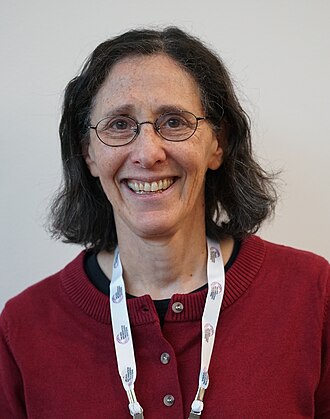
梅拉妮·米切尔 约书亚·特南鲍姆
本期追问 · 点击跳到视频对应位置
答得上来,就算懂了吗?怎样才算真正学会?思想需要身体吗?智能能被造出来吗?
归入 Ⅱ·04 答得上来,就算懂了吗? →
EDITED TRANSCRIPT · 依据现场录音编译整理,可划线生成便签
编者按:本文是圣塔菲研究所教授梅拉妮·米切尔(Melanie Mitchell)在麻省理工学院脑与认知科学系所作的一场讲演,由该系教授约书亚·特南鲍姆(Joshua Tenenbaum)主持。米切尔围绕她与同事戴维·克拉考尔(David Krakauer)发表于《美国国家科学院院刊》(PNAS)的文章,讨论大语言模型究竟是否「理解」它所处理的数据。本文依据现场录音编译整理,仅删去寒暄、口误与口语枝节,全部论证与实例均予保留。

主持人引言

特南鲍姆: 今天能请到梅拉妮·米切尔来和我们交流,我们非常高兴,也非常幸运。看看今天到场的人数就知道,她大概不需要什么介绍了。在当下的人工智能领域,她是最重要的公共专家之一,长于解释今天的 AI 世界究竟在发生什么,各种不同的路径、不同的时代、看待 AI 的不同方式。我想这也正是她今天要讲的内容。她是圣塔菲研究所(Santa Fe Institute)的教授,在那里主持着若干项目,既涉及 AI,也涉及其他极为有趣的复杂现象。

她的工作不限于 AI,还涵盖认知科学和一系列相关领域。我记得第一次见到梅拉妮,是 1991 年我在圣塔菲研究所参加暑期学校的时候,她当时在讲授遗传算法。碰巧今天我还跟人提起,我在这里读研究生时听过她的一场讲座,讲的是元胞自动机和各种涌现出来的对象,滑翔机枪之类的东西。所以,无论是考察智能的涌现,还是今天的大语言模型里那些或许像、或许不像智能的东西,抑或元胞自动机(它可以看作神经计算的一种极简模型)中涌现出来的对象与概念,再或者演化过程中算法和其他智能行为的涌现,梅拉妮一直着迷于一个总的问题:结构与功能如何在许多不同的系统和尺度上涌现,其条件是什么,现象又是什么。她对这些问题的研究和阐述,长期以来启发了我和许多人。

所以,我们能请到她是幸运的,整个领域和公众能有她也是幸运的。她写科普书,发推文,上电视,我在电视上见过她。但与此同时,她也实实在在地做着科学研究,并把研究与公共传播连接起来。长期以来,这是最重要的工作之一。今天能请到她,我们真的很幸运。下面把时间交给梅拉妮。

根本性的不确定

米切尔: 谢谢,谢谢约书亚。约书亚说我试图解释 AI 领域正在发生什么。而 AI 领域正在发生的,当然就是争论。人们几乎是在互相扼住喉咙,争着弄清眼下究竟是怎么回事。有位记者把这个时期形容为「根本性的不确定」(radical uncertainty),我想我们都有同感。今天我要谈的是「理解」这个观念与大语言模型的关系:人们认为它意味着什么,我们又可能用它来指什么。这些内容来自我和圣塔菲研究所的同事戴维·克拉考尔发表在《美国国家科学院院刊》上的一篇文章。

AI 系统理解它处理的数据吗?这当然取决于你怎么定义「理解」。

前生成式时代的失败

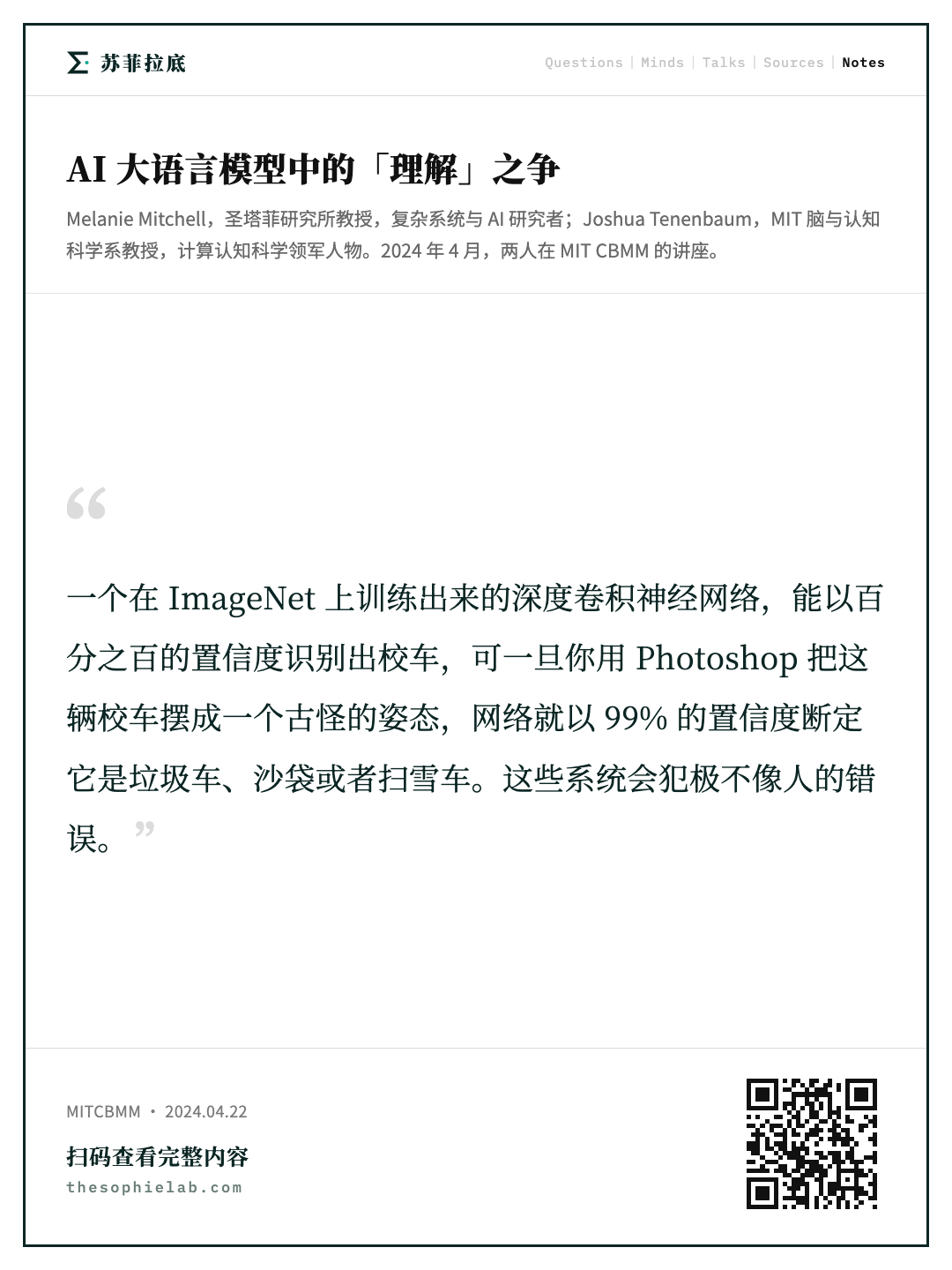
米切尔: 可以肯定的是,在生成式 AI 之前的年代,理解上的失败比比皆是。这很要紧,因为它会导致各种各样的错误,而这些错误,我想我们都会称之为理解的错误。举个例子。2018 年有一篇论文表明,一个在 ImageNet 数据集上训练出来的深度卷积神经网络,能以百分之百的置信度识别出校车,可一旦你用 Photoshop 把这辆校车摆成一个古怪的姿态,网络就以 99% 的置信度断定它是垃圾车、沙袋或者扫雪车。这些是在以类人的方式理解视觉数据这件事上出的问题。这些系统会犯极不像人的错误。

还有常识层面的问题。比如为自动驾驶训练系统去识别路上可能出现的各种物体,结果系统分不清某样东西究竟是现实世界中的实物,还是一辆面包车车尾电动自行车广告上印着的自行车图片。人类很擅长把握语境,知道什么是贴在车上的图片,什么是真实世界,这些系统却在这上面栽跟头。另一个例子也是同类的:有人在推特上说,他开着装有自动驾驶软件的特斯拉,车子在某个路段总是猛踩刹车,他想不明白为什么,后来才注意到路边的广告牌,那是一幅画着停车标志的广告,车子看见它就紧急制动。这显然是个边缘案例,不是天天会发生的事。但总有某个边缘案例在某个地方发生着。要想训练出一个系统,让它理解世界上正在发生什么这种常识性的表征,是很难的。

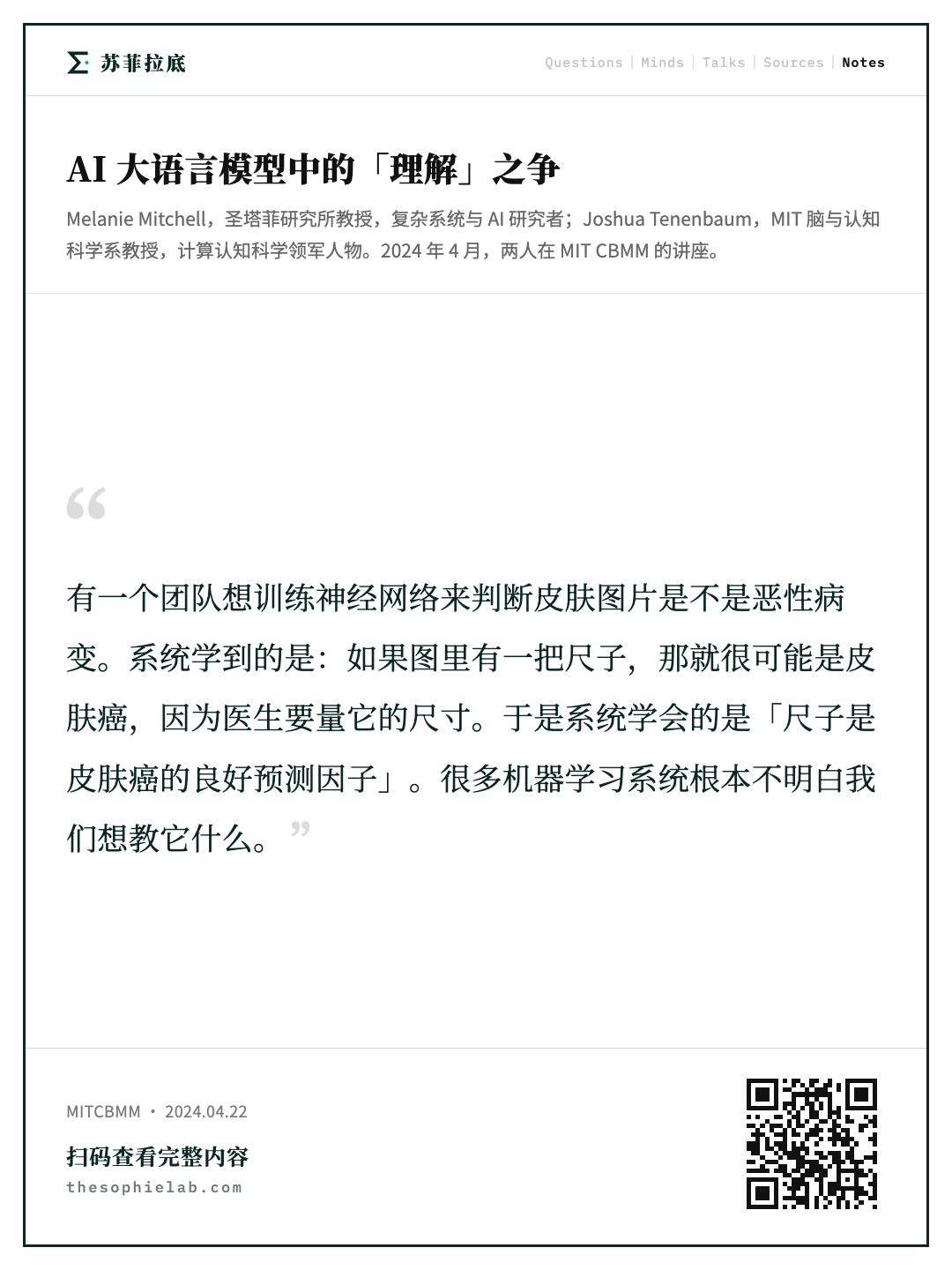
我们还见过大量机器学习系统根本不明白我们想教它什么的例子。有一篇论文里,一个团队想训练神经网络来判断皮肤图片是不是恶性病变。系统学到的是:如果图里有一把尺子,那就很可能是皮肤癌,因为医生要量它的尺寸。于是系统学会的是「尺子是皮肤癌的良好预测因子」。

自然语言处理系统同样有问题。以谷歌翻译为例,这其实就是几周前的事。我让它把这句话译成法语:「那位议员不小心把他正在起草的重要法案(bill)的副本落在了出租车上。」「bill」这个词或许有歧义。在座有人懂法语吗?有。它给出的是错误的译法,用了「facture」,那指的是水管工开给你的账单,不是议员起草的法案。事实上,翻译错误已经造成了真实世界的后果,因为有人过于信任这些翻译程序,比如用它们把庇护申请从阿富汗语言译成英语。

新时代与两极分化

米切尔: 但现在我们进入了 AI 的新时代。我们有了大语言模型,它们的训练数据量远远超过早先任何系统,而且看起来获得了更丰富、更类人的理解。比如,我让 ChatGPT 翻译同一句话,它给出了正确的译法。我甚至可以问它,你是怎么知道该这样翻译的?它会给我一段非常冗长的解释,告诉我它知道这里涉及一位议员和一份法律文件,等等。

特里·谢诺夫斯基(Terry Sejnowski),在座多数人大概都听说过,他是神经科学家,也是上世纪八十年代神经网络的先驱之一。他最近写了一篇文章,同样在努力弄清 AI 领域正在发生什么。他说,这些东西不是人,但它们提取信息的能力是超人的,它们行为的某些方面看起来是智能的。可如果这不是人类智能,那它们的智能本质是什么?我想这正是我们所有人都在苦苦思索、为之着迷的问题:这些系统的智能本质是什么,我们又该如何弄清楚?

有些人认为它们在某些方面是智能的,拥有真正的理解。布莱斯·阿圭拉·伊·阿卡斯(Blaise Agüera y Arcas)是谷歌的高管,也是 AI 研究者。他写过一篇文章,说这些模型在非常真实的意义上理解范围广泛的概念,尽管它们只靠文本获得信息。他甚至还写过另一篇文章,说它们正在越来越接近拥有意识。这一点我今天不谈。而在另一边,哲学家杰克·布朗宁(Jake Browning)和杨立昆(Yann LeCun)写道:一个仅靠语言训练的系统永远不可能逼近人类智能,哪怕从现在一直训练到宇宙热寂。所以人们在这个话题上持有极端对立的观点。也许他们对「智能」或「理解」这两个词的用法本就不同,我不知道,这很难说。

有一个团队,大约一两年前,对自然语言处理学界做了一次调查,请在 NLP 会议上发表过论文的人对下面这句话表示同意或不同意:「某些仅在文本上训练的生成模型,只要给予足够的数据和计算资源,就能在某种非平凡的意义上理解自然语言。」结果正好从中间劈开,五五开,分得干干净净。这就是根本性的不确定,大量的两极分化与分歧。

世界模型假说与奥赛罗证据

米切尔: 那么「理解」到底意味着什么?OpenAI 的联合创始人伊利亚·苏茨克维(Ilya Sutskever)提出过一个假说,说明理解意味着什么,以及大语言模型如何理解。他说,当我们训练这些系统去预测海量文本中的下一个词时,系统学到的不只是预测文本,它学到了一个世界的模型。他说得颇有诗意:它学到了关于人、关于人类处境、关于人的希望、梦想和动机的知识,学到了一种压缩的、抽象的、可用的表征。

好,这是个假说。证据呢?他没有给出任何证据。但确实有人尝试在训练好的大语言模型里寻找所谓「世界模型」的证据。有两篇论文研究了一个玩具问题,用的是黑白棋(Othello)。在座有些人大概见过这项工作:他们训练一个 Transformer,只用代表棋步的符号序列,让它预测合法的走法。然后他们查看 Transformer 的内部表征,发现这些表征似乎编码了棋盘的状态,而这个东西从未被训练去学棋盘,却不知怎么涌现出来了。这非常有趣,也很有启发性,但它并不是真正的大语言模型,而是一个相当小的语言模型,处理的是一个相当简单的封闭世界。所以它能否推广到 ChatGPT 之类的东西上,并不清楚。

可人们拿着这个结果大加外推。比如 Anthropic 的克里斯·奥拉(Chris Olah)说,他认为这是语言模型形成内部世界模型的明确证据。吴恩达(Andrew Ng)走得更远,说 Othello-GPT 项目表明它们会构建世界的模型,「这让我可以放心地说,它们确实理解」。他们是从一个相当有限的实验里外推出了相当多的东西。

另一边呢,还是杨立昆在问:这些模型真的在构建抽象并用于推理吗?还是说它们在做人们所谓的「近似检索」(approximate retrieval)?我理解这个词的意思大致是:拿到一个问题,跟记住的训练数据做某种模式匹配,然后用训练数据来解题,并没有真正形成一般性的抽象或世界模型。他说这两者之间是一个连续统,而他认为大语言模型基本落在检索、记忆那一端。亚利桑那州立大学的拉奥·坎巴姆帕蒂(Rao Kambhampati),如果你们用推特,应该关注他,他非常好笑,对这一切都极尽挖苦。他说:「涌现能力,名词:当『近似检索』听起来太不性感时,人们用来称呼你的大语言模型所做之事的首选委婉语。」这是篱笆另一边的看法。

行为测试与基准的捷径

米切尔: 那么我们该怎样评估这个理解的问题?我认为这很难。一种方式显然是老办法:只看行为,做图灵测试,宣布这个问题本身提得不好,干脆定义为「它们看起来理解,就算理解」。但我们知道,人类极易把理解投射到任何用自然语言和我们交流的东西上。早在上世纪六十年代的 Eliza 身上我们就看到了这一点,此后的聊天机器人莫不如此。所以我们可能被误导。

更客观一点的办法,是在自然语言理解基准上测试这些系统。人们一直在这么做。但基准可能允许捷径,就像皮肤癌图片里的那把尺子。几年前最流行的自然语言理解基准之一叫「通用语言理解评估」(GLUE),是一组不同的语言理解测试,还有它的后继者 SuperGLUE。这是 SuperGLUE 最近的排行榜。我们测的是通用语言理解,排行榜前七名都是大语言模型,人类排在后面。这就是我们在通用语言理解上的现状。好吧,也许这并不是对通用语言理解的真正检验,因为我认为在这方面人类大概仍然强过绝大多数语言模型。事实证明,这里面可以有捷径,也就是这些基准里词或符号之间微妙的统计相关性,它们可以预测答案,或者说神经网络可以学会借此预测答案,而不必做任何类似人类理解的事情。

我们已经看到很多论文说,自然语言理解的基准测试已经坏掉了,到处都是人为痕迹。这些系统做的事有点像「聪明的汉斯」(Clever Hans),那匹据说会算术的马,其实是在回应训练师身体语言里的细微暗示。这一直是自然语言处理基准的一个问题。

标准化考试为何靠不住

米切尔: 最近人们又开始给这些语言模型做标准化考试。你们都见过那些标题:「ChatGPT 拿到 MBA」,通过了沃顿商学院的 MBA 考试,比很多学生考得还好;它可能聪明到足以从法学院毕业;它没有临时抱佛脚就通过了医师执照考试。我不确定把整个互联网背下来算不算临时抱佛脚。

不过现在已经有一些研究对此提出质疑:是否存在数据污染,也就是有些考题其实就在系统的训练数据里;而且即便没有,这些考试上的成绩也未必与真实世界里实际任务的表现有良好的相关。我为此写过一篇文章,《ChatGPT 真的通过了研究生水平的考试吗》,在其中展示了这里面夸大宣传的几个方面。就在前几天,有个人,我想是哈佛的,写了一篇文章重新评估律师资格考试的成绩,表明此前的说法严重夸大。还有一个团队在博客上写道,这些是「对错误问题给出的错误答案」,不是评估这些系统的恰当方式。

反事实任务:推理还是背诵

米切尔: 评估理解的另一条路是:如果我们把理解看成建立抽象能力、建立抽象的世界模型,那就在需要抽象与推理的任务上评估它们。但接下来我们得问,如果它们能完成这些任务,它们的抽象有多真实、多稳固?有一篇论文,作者有几位在这里,还有几位在波士顿大学,题目叫《推理还是背诵?》(Reasoning or Reciting?)。他们取了若干推理任务,GPT-4 在这些任务上表现很好,图上蓝色柱子就是准确率。然后他们说:如果我们设计一些「反事实任务」会怎样?也就是这些任务的变体,需要的推理能力完全相同,只是内容不同,因而不太可能与训练数据相似。

举个例子,他们的一项任务是代码执行。GPT-4 很擅长读一小段 Python 代码,说出它会打印什么。顺便说一句,前几天我听了一场关于提示工程的报告,讲者说你得先给大语言模型打气,得对它说「你是个天才」,或者「你是专家级程序员」,「你是诺贝尔物理学奖得主」之类的,然后再提问。总之,它回答这些 Python 小片段的问题非常在行。这个团队做的是:现在设计一个反事实版本,告诉模型它能轻松适应新的编程语言,并且有一种假想的编程语言叫 ThonPy,它的索引从 1 开始而不是从 0 开始。你可以看到,GPT-4 的表现,也就是红色柱子,一落千丈。他们没有做人类实验,但你会预期一个人类程序员能相当轻松地适应这种变化。

另一个团队做了类似的研究。不知道你们有没有看过微软那篇《通用人工智能的火花》(Sparks of AGI),这一篇的题目叫《自回归的余烬》(Embers of Autoregression)。他们的论点是,由于这些语言模型采用自回归训练,它们会具有某些特定的性质和局限。他们做了类似的研究,考察几类不同的推理任务,比较任务内容在训练数据中很可能常见时的表现,与很可能罕见时的表现。你可以看到,尽管每类任务所需的推理能力相同,表现却随之下滑。当然,人类对推理任务的内容也很敏感。他们并没有真正研究人类,但他们的假设,或者说人们可以猜想,人类至少在某些情况下能够适应不那么常见的内容。

字母串类比:人稳机降

米切尔: 我和一位合作者在类比推理的语境下研究了这个问题。去年加州大学洛杉矶分校的泰勒·韦布(Taylor Webb)等人发表了一篇论文,《大语言模型中涌现的类比推理》,表明 GPT-3 能够做类比推理,而且成绩超过了很多 UCLA 本科生。这引起了大量报道:「GPT-3 在推理测试中大获全胜,本科生在那些帮他们考上大学的题目上被击败」。

他们考察的任务之一是所谓的字母串类比问题。比如:如果字符串 abcd 变成 abce,那么对 ijkl 做同样的变换会得到什么?再比如:有两个 b,把它缩减成一个 b,那么对另一个串该怎么做?还有一个:给你 agcd 和 abcd,也就是把序列修正过来。他们出了一批这样的题,然后比较 GPT-3 和 UCLA 本科生,结果 UCLA 本科生在准确率上不太光彩。

于是我们做了这样的事,这是我和合作者玛莎·刘易斯(Martha Lewis)最近的一篇论文:我们采用反事实任务的范式。首先我们试图复现他们的结果,没有复现出来。我们用的是众包平台 Prolific,而不是 UCLA 本科生,我们的受试者实际上表现更好,谁知道为什么。当然,我们的受试者是拿报酬的,而他们的本科生只是为心理学课程挣学分,随便吧。

然后我们说,好,怎样做一个反事实版本?一种办法是:不用常规字母表,而是把它打乱一点,交换一些字母。我们告诉受试者:字母表可能是按不熟悉的顺序排列的,请用这个顺序完成模式。比如 m 现在处在一个特定的位置,你看一眼就能明白。人类在这些题上做得相当好。我们还给了他们一种不同的字母表,由符号而非字母组成。这些其实是完全相同的类比问题,只是编码方式不同。我们问:人类做得怎么样?图上蓝点是人类,带误差条,横轴是字母表中被置换的字母数;旁边是符号字母表的结果。其他的点是各种语言模型。我们发现,人类能很好地适应这些反事实字母表,表现基本不变。而语言模型则大幅下降。

所以这里的要点是:这些系统在解决与训练数据相似的推理任务时表现更好,常常是好得多。而我敢说,在许多情况下,人类更能适应变化。这反映出抽象理解上的某些失败。

人类概念:组合、因果与隐喻

米切尔: 那么,我们怎样才能让机器学会并使用人类的概念和抽象?人类的概念又是什么?很多人把概念看作关于类别的心智模型。我想到「讲演厅」这个概念,我就拥有关于这个类别的一个心智模型,可以用来推理和预测,比如预测有时会有人中途离场。每次都会发生。情境、事件,我们都有这样的心智模型。

举个例子,「在某物之上」(on top of)这个心智模型,一个简单的空间概念。我们知道概念是可组合的。如果你理解一样东西在另一样东西之上,你就能把东西一层层叠上去,把概念组合起来。如果你理解「一只猫在电视机上」,你也能理解「一台电视机在猫身上」。我真的试过让 DALL-E 画一台电视机压在猫身上,它坚决不肯,每次画的都是猫蹲在电视机上。但人类做得到。

概念还具有因果结构。我认为这一点极其重要,它让我们能够做预测、检验假设、推理,并拥有常识。人类在很小的年纪就能推断:东西叠在一起时,如果做某种干预会发生什么。他们也能推断怎样才能爬到别的东西上面去,这是小孩子很早就学会的,早得过了头,可能会惹出麻烦。他们还学会某种三维拓扑,比如鞋子套在袜子外面,所以得先穿袜子。都是些非常常识性的东西。

概念还能通过隐喻和类比抽象到新的情境。继续用「在……之上」的例子:我们把这个空间概念用于隐喻,说「我站在世界之巅」、「扯着嗓门喊」(at the top of one's voice)、「位于社会等级的顶端」等等。研究概念的认知心理学家劳伦斯·巴萨卢(Lawrence Barsalou)把概念定义为「为某一类别生成无限多种概念化的能力或倾向」。注意,他区分了「概念」(concept)和「类别」(category),这两个词在不那么正式的场合常被混用。他的意思是,我们通常把类别看成要去区分的东西:女人与男人、狗与猫、在上面与在下面,等等。而概念更具有生成性。我们的模型能够生成概念的实例,事实上是无限多种概念化。

莱考夫(Lakoff)和约翰逊(Johnson)等人有一个著名的论述:抽象概念是通过涉及核心概念的隐喻学会的。比如他指出,人们用物理语言来描述社会概念:「她热情地(warm)跟我打招呼」,那并非字面意义上的温暖,但我们就是那样去构想它。或者,地位被隐喻性地理解为物理位置:「在公司的阶梯上她比我高两级」,诸如此类。还有一个许多人提出的假说:我们的心智模型让我们能够模拟概念。概念实际上就是模拟情境的能力,甚至抽象概念也是对情境的一种可模拟的、置身其中的理解。约书亚和他的合著者长期以来一直主张,理解是通过基本的心智模拟来实现的。

核心知识与 ARC 抽象测试

米切尔: 斯佩尔克(Spelke)等发展心理学家提出,概念建立在她所说的先天「核心知识」(core knowledge)系统之上。这些系统包括:世界被划分为物体,我们理解物体如何相互作用、可能如何行为;数量感,我们理解一样东西比另一样多、比另一样高,理解三、二、一这样的小数目;基本的几何与拓扑,比如东西装在别的东西里面,或者围绕着别的东西;主体与目标导向的行为,世界上有些东西受目标驱使,有些则不然。她和其他人主张,这些核心知识系统是我们一切概念的基础,而且是婴儿与生俱来的。先天到什么程度是个有争议的话题,但我想认知科学界的多数人都同意,这些东西很重要,要么是先天的,要么是很早就学会的。

谷歌的弗朗索瓦·肖莱(François Chollet)采纳了这个想法,说:让我们用这些核心概念来设计一种评估理解的方法。他构建了他所谓的「抽象与推理语料库」(Abstraction and Reasoning Corpus,ARC),这是一个既能测人也能测机器的领域,通过抽象能力来考察理解程度。这是该领域里一道题的例子。每道题包含少量演示,可以把它们看作训练样例。这里有三个训练样例:一个网格变成另一个网格,第二个例子,第三个例子。我相信你们看得出其中的共同概念,并且大概能回答该对测试输入做什么,才能在这个语境中实现该概念。你只看了三个训练样例,却很容易看出发生了什么,底层规则是什么。用语言表述可能有点难,大致是:有某个物体指向某个方向,从它那里射出一条线,沿着那个方向一直延伸到边界。我们是在依靠自己关于物体、空间等等的全部核心知识来解这道题。

再看一个例子。你大概很容易看出,不同种类的形状被涂上了不同颜色,与形状的朝向或大小无关,这是一种拓扑性质,保持不变。肖莱出的就是这类题。他创建了一千道这样的题,公开了八百道,留下两百道作为隐藏测试集,放到 Kaggle 平台上作为对 AI 的挑战。Kaggle 是发布机器学习挑战赛的平台,解出题目可以拿奖金。最后大约有九百支队伍提交了程序,这些程序在隐藏测试集上接受测试,获胜的程序准确率约为 20%。每道题每个程序可以猜三次,只要有一次猜对,这道题就算对。前两名程序的集成表现稍好,达到 31%。他们没有对人类做正式研究,但假定人类在这些小题目上能做得相当好。

现在有更多的奖金在等着,你们要是想参赛的话:一家瑞士实验室出价,你的程序每比 31% 高出一个百分点,就给一千瑞士法郎。一千瑞士法郎按今天的汇率大约是一千美元。听起来不该太难吧?2023 年他们又办了一届比赛,没人赢,没人超过那条线。问题出在哪儿?这些是简单的题目。嗯,我想其中不少题对人类其实也挺难的。

ConceptARC:系统性检验理解

米切尔: 我们团队对此产生了兴趣。但我们把所有题目过了一遍,注意到有些题看起来相当难。而且我们认为,这些题并没有系统地检验对概念的理解。假设机器能解出我刚才展示的那道题,这是否意味着它理解了不变性,理解了形状不变性以及所有相关概念?不见得,它可能用了某种捷径。于是我们构建了一个小基准,叫 ConceptARC,仍在这个领域里,但用的是新问题、新任务。这是我在那项工作上的两位合作者。这些任务旨在更系统地检验理解。如果有「在……之上」这样一个概念,就用许多不同的方式、许多不同的概念化来检验它,而不只是一种。我们考察了 16 个概念,为每个概念设计了 30 道题,都设计成对人类来说很容易。这些是我们考察的概念,都是基本的空间与语义概念。总共大约 480 道题。

这是一个例子,希望很容易:删除底部的物体。我们在 Prolific 上测了人,也用 Kaggle 挑战赛的获胜程序测了这些题,还测了 GPT-4。测 GPT-4 用的是网格的文本版本,用数字表示每个像素的颜色。它们全都答对了。那么这些程序都理解「顶部」和「底部」的概念了?不。我们得继续测试,确保它们没有用某种捷径。

再看一个例子。有意思的是,我们设计这些题目时,要让我的合作者去设计对人类来说容易的题,还挺费劲。他们总想设计对人类来说难的题,因为他们觉得,这些题太容易了,简直容易得可笑。结果证明它们并不容易:对人类容易,对机器可不容易。这一道,把物体的顶行涂成红色,所有程序都答对了。但另一道,删除顶部和底部的物体,人类仍然是百分之百,这几个程序却答错了。Kaggle 的获胜程序是专为 ARC 任务设计的;GPT-4 显然不是为它设计的,虽然谁知道它的训练数据里有什么,但这些题肯定不在它的训练数据里,因为是我们自己设计的,测试之前从未公开。

再举几个例子,比如「在……的中心」这个概念。取这些东西中心的像素,大家都答对了。另一道「在……的中心」,提取网格中央的物体,人类百分之百。再一道,把像素移动到与水平线中心对齐,这几个程序答错了。

还有一篇后续论文,我们用 GPT-4 和带视觉的 GPT-4 测了视觉版本。这是所有概念上的结果:人类、Kaggle 第一名、纯文本的 GPT-4。看最下面一行,那是平均值。如果你在众包网站上做过人类实验,你就知道 91% 差不多等于 100%,因为很多人根本没认真做,这是一个非常嘈杂的测量。但即便如此,人类仍然远远好过这两个程序。很多人说,这是纯文本版本,不公平,你给人类的是视觉输入,给 GPT-4 的是纯文本输入,等 GPT-4 的多模态版本出来,它就能解出来了。我们试了多模态版本。做完前面的实验我们没剩多少钱了,所以只测了最容易的那些题,我们称之为「极简任务」,在这些题上纯文本版本能答对将近 70%。结果视觉版本做得差得多。视觉版本在抽象视觉推理上真的相当糟糕。

结论:具身与可信赖的开放问题

米切尔: 那么,AI 能理解世界吗?我想答案是:原则上能。我看不出有什么理由说不能。但到目前为止,它在理解上有过许多失败,至今仍未达到类人的抽象理解。要以类人的方式理解世界,系统或许需要类似人类的核心知识系统,以及由此而来的概念。我不知道这个问题的答案,但它们能否在不具备某种具身性(embodiment)、不与真实世界主动互动的情况下做到这一点?我认为这是一个重要的问题,而我们确实不知道答案。

注意我说的是「类人的」。很多人会说,它就不能以某种非人的方式理解吗?就不能是另一种理解吗?我可以接受这种说法。但问题在于,如果它的理解与人类的理解不同,那么要让这些系统在我们的世界里、在人类的世界里与我们协作,可能会很困难。那就意味着我们不会拥有可信赖的 AI 系统。我把这些问题留在这里,就讲到这儿,很乐意展开讨论。谢谢大家。
排版 + 横图 + 来源,粘贴即成稿
章节 · 点击跳转视频
0:00 主持人引言:Mitchell 与涌现研究 ▶ 正在看
2:23 根本性不确定:AI 是否「理解」 ▶ 正在看
3:03 前生成式时代的理解失败案例 ▶ 正在看
7:01 LLM 新时代与两极分化的观点 ▶ 正在看
10:20 世界模型假说与 Othello 证据 ▶ 正在看
14:04 行为测试与基准的捷径陷阱 ▶ 正在看
16:41 标准化考试成绩为何靠不住 ▶ 正在看
19:10 反事实任务:推理还是背诵 ▶ 正在看
22:47 字母串类比实验:人稳机降 ▶ 正在看
26:46 人类概念:组合、因果与隐喻 ▶ 正在看
31:12 核心知识与 ARC 抽象测试 ▶ 正在看
37:28 ConceptARC:系统性检验理解 ▶ 正在看
43:18 结论:具身与可信赖的开放问题 ▶ 正在看
本期小问 · 档案清单
—— 答得上来,就算懂了吗? ▶ 正在看
—— 怎样才算真正学会? ▶ 正在看
—— 思想需要身体吗? ▶ 正在看
—— 智能能被造出来吗? ▶ 正在看
本期讲者
梅拉妮·米切尔圣塔菲研究所教授,复杂系统与 AI 研究者,Hofstadter 的学生,Copycat 类比程序共同开发者;著有《AI 3.0》(Artificial Intelligence: A Guide for Thinking Humans),是 AI 能力评估领域最有影响力的公共评论者之一。
约书亚·特南鲍姆MIT 脑与认知科学系教授,计算认知科学领军人物,以贝叶斯认知模型、直觉物理引擎和「像孩子一样学习」的 AI 研究纲领著称。
01主持人引言:Mitchell 与涌现研究
0:00
JOSHUA TENENBAUM: We are very, very pleased and fortunate to have Melanie Mitchell speaking with us. As I think makes sense from how many people are here, maybe Melanie needs no introduction. She is very well-known at this point as one of the leading public experts on what is going on in today's world of AI and different kinds of approaches and different eras and different ways to think about AI. And I think that's what she's going to tell us about here. She's a professor at the Santa Fe Institute, where she runs a number of programs that relate both to AI and other kinds of really interesting complex phenomena.
约书亚·特南鲍姆:我们非常非常高兴、也非常荣幸能请到梅拉妮·米切尔来给我们做演讲。看今天来了这么多人,我想梅拉妮大概不需要什么介绍了。她如今非常知名,是当今 AI 领域最重要的公共专家之一,能讲清楚现在 AI 世界里到底在发生什么、有哪些不同的路径、不同的时代、不同的思考 AI 的方式。我想这也正是她今天要跟我们讲的内容。她是圣塔菲研究所的教授,在那里负责多个项目,既涉及 AI,也涉及其他各种非常有趣的复杂现象。
便签笔记
0:43
She has worked in not just AI, but cognitive science and a range of other related topics. I remember I first met Melanie actually when I was a summer school student at the Santa Fe Institute in 1991, I think it was. And you were giving lectures on genetic algorithms. And I was just telling someone today-- totally unrelatedly, just coincidentally-- about a talk I remember you giving when I was in grad school here about cellular automata and various like emergent objects, glider guns, and so on. So whether it's looking at the emergence of intelligence or things that might be kind of like kinds of intelligence-- and maybe not, and maybe yes-- in today's large language models or emergent objects and concepts in cellular automata, simple kinds of models potentially of neural computation, or emergence of algorithms and other kinds of intelligent behavior in evolutionary processes, Melanie has been really fascinated and studied and communicated in fascinating ways about the general ways in which structure and function can,
她的工作不只限于 AI,还包括认知科学以及一系列相关领域。我记得我第一次见到梅拉妮,是我作为暑期学校学生在圣塔菲研究所的时候,好像是 1991 年。当时你在讲遗传算法。我今天还刚跟别人提到——完全无关,纯属巧合——我读研究生的时候在这里听你做过一场报告,讲元胞自动机和各种涌现出来的对象、滑翔机枪之类的东西。所以,无论是研究智能的涌现,还是研究今天的大语言模型中那些可能算是某种智能的东西——也许不是,也许是——又或者是元胞自动机中涌现的对象和概念、神经计算的某些简单模型,再或者是演化过程中算法与其他智能行为的涌现,梅拉妮一直对结构与功能的一般规律深深着迷,并对此做研究、做非常精彩的传播:
便签笔记
1:49
and what are the conditions under which, and what are the phenomena of emergence over many different systems and scales that have inspired me and many others for a long time. So I think we're really lucky both to have her here, and the field and the general public is very lucky to have her, whether it's writing popular books or tweeting or going on TV, seeing you there. And but also like really actually doing the science that it connects to also the public outreach. It's really one of doing some of the most important work over a long time.
在什么条件下会出现涌现,在许多不同的系统和尺度上涌现又表现为怎样的现象——这些长期以来启发了我和许多其他人。所以我觉得我们能请到她真的很幸运,而这个领域和公众也很幸运能有她,无论是写科普书、发推特,还是上电视,都能看到你。而且她不只是做公众传播,她也确实在做与之相关的科研工作。这确实是长期以来最重要的工作之一。
便签笔记
02根本性不确定:AI 是否「理解」
2:23
So we're really lucky to have her here today. And I'll just turn it over to Melanie. MELANIE MITCHELL: Thanks. Thanks, Josh. [APPLAUSE] All right. Thanks. Thanks, Josh. Josh said that I try and explain what's going on in AI. And of course, what's going on in AI are debates. People are just at each other's throats trying to sort of determine what actually is going on these days. And I think one journalist described it as a time of quite radical uncertainty, which is I think we all are feeling. So I'm going to be talking about this idea of understanding and large language models and what people think it means, what we might-- how we might mean.
所以今天能请到她真的很幸运。下面就交给梅拉妮。梅拉妮·米切尔:谢谢。谢谢你,Josh。[掌声] 好的。谢谢,谢谢 Josh。Josh 说我试图解释 AI 领域正在发生什么。当然,AI 领域正在发生的其实是各种争论。大家几乎要吵得不可开交,都在试图判断这些天到底在发生什么。我记得有位记者把这形容为一个「相当彻底的不确定性」的时代,我想我们都有这种感觉。所以我今天要讲的是「理解」这个概念和大语言模型,以及人们认为它意味着什么、我们又可能是在什么意义上说这个词。
便签笔记
03前生成式时代的理解失败案例
3:03
And this was an article that came out in PNAS that I did with David Krakauer, my colleague at Santa Fe Institute. So do AI systems understand the data they process? Of course, it depends what you mean by "understand." It certainly seemed like pregenerative AI days, there was a lot of failures of understanding. And it mattered because you could get all kinds of errors that I think we would say are errors of understanding. So here's an example. This was from a paper of 2018 that showed that if you have a deep convolutional neural net that's trained on, say, the ImageNet data set that can recognize school buses with 100% confidence, that if you Photoshop the object so that it's in a weird pose, the neural network is now 99% confident it's a garbage truck or a punching bag or a snowplow.
这是我和圣塔菲研究所的同事 David Krakauer 一起发表在 PNAS 上的一篇文章。那么,AI 系统理解它们处理的数据吗?当然,这取决于你说的「理解」是什么意思。在生成式 AI 出现之前,看起来确实有大量「不理解」的失败案例。而且这很要紧,因为你会遇到各种各样我认为可以称为「理解性错误」的错误。举个例子。这来自 2018 年的一篇论文,它表明:如果你有一个深度卷积神经网络,在比如 ImageNet 数据集上训练过,能以 100% 的置信度识别校车,那么如果你把这个物体 P 图成一个奇怪的姿态,这个神经网络就会以 99% 的置信度认为它是垃圾车、沙袋或者扫雪机。
便签笔记
4:09
And these were problems of sort of understanding in some human-like way, this visual data. These systems would make errors that were very unhuman-like. And also, common sense kinds of problems like looking-- being trained for like self-driving cars on different objects you might see on the road and not being able to distinguish whether something is actually an object out in the real world or is a bike-- a picture of a bike on the back of a van as part of an e-bike ad. So kind of humans are pretty good at figuring out the context and knowing what's sort of a picture and on a van and what's real world.
这些都属于某种「以类人方式理解」视觉数据的问题。这些系统会犯非常不像人的错误。还有各种常识层面的问题,比如为自动驾驶汽车训练识别路上可能出现的各种物体,结果分不清某个东西究竟是现实世界中真实存在的物体,还是一辆自行车——一辆印在货车车尾上的自行车图片,是电动自行车广告的一部分。人类其实很擅长判断语境,知道什么是货车上的图片、什么是真实世界里的东西。
便签笔记
4:56
But these systems had problems with that. And this is another example of that. A person on Twitter posted that they were driving their Tesla with self-driving software and the car slamming on the brakes in this area. And he couldn't figure out why. And then he noticed the billboard-- I don't know if you can see that-- which is an ad with a stop sign and the car just would slam on the brakes. This is an edge case, obviously, it's not something that happens all the time. But there's always some edge case that's going on somewhere.
但这些系统在这方面有困难。这是另一个例子。有人在推特上发帖说,他开着开启了自动驾驶软件的特斯拉,车子在这一段路上猛地刹车。他一开始想不明白为什么。后来他注意到了那块广告牌——不知道你们能不能看清——那是一则带有停车标志的广告,车子就会一脚急刹。这显然是一个边缘情况,不是经常发生的事。但边缘情况总会在某个地方冒出来。
便签笔记
5:34
And these cars, it's hard to figure out how to train a system to understand this common sense kind of representation of what's going on in the world. We've also seen lots of instances of machine learning systems that don't understand what it is we're trying to teach them. So this is an example from a paper where a group was trying to train neural networks to distinguish whether pictures of skin were malignant or not. And the system learned that if there's a ruler in the image, it's much more likely to be a skin cancer because that's-- they're trying to measure it.
对这些车来说,很难搞清楚怎么训练一个系统去理解这种关于世界的常识性表征。我们也见过很多机器学习系统并不理解我们想教给它们的东西的例子。比如这篇论文里的例子,有个团队试图训练神经网络来判断皮肤照片是不是恶性病变。结果系统学到的是:如果图像里有一把尺子,那它更可能是皮肤癌——因为医生会去测量它。
便签笔记
6:19
And so what the system learned was that rulers are a good predictor of skin cancer. And we also see problems with natural language processing systems. So Google Translate-- this is actually only a few weeks ago. I tried to get it to translate this sentence, "the legislator accidentally left a copy of the important bill he was writing in the taxi," into French. The word "bill" is ambiguous, perhaps. Anyone here speak French? Yeah. So this is the wrong translation, where "facture" means the kind of bill that you would get from your plumber, not the kind of bill your legislator would write.
所以系统学到的是:尺子是皮肤癌的一个很好的预测指标。我们在自然语言处理系统上也看到类似的问题。比如谷歌翻译——这其实是几周前的事。我让它把这句话翻译成法语:「这位议员不小心把他正在起草的那份重要 bill 的副本落在了出租车上。」「bill」这个词也许是有歧义的。这里有人会法语吗?对。这是个错误的翻译,其中「facture」指的是你从水管工那里收到的那种账单,而不是议员会起草的那种法案。
便签笔记
04LLM 新时代与两极分化的观点
7:01
And in fact, translation errors have had real-world impacts by people using these translation programs and trusting them too much, for instance, on translating asylum applications from Afghani to English. But now we're in a new era of AI. We have these large language models. They have been trained on vastly more data than any of these earlier systems. And they seem to have achieved a richer human-like understanding. So for example, if I asked ChatGPT to translate that same sentence, it gets the right translation.
而且事实上,翻译错误已经在现实世界中造成了影响,因为有人使用这些翻译程序并且过于信任它们,比如把庇护申请从阿富汗语翻译成英语。但现在我们进入了 AI 的新时代。我们有了这些大语言模型。它们训练所用的数据量远远超过之前那些系统。而且它们似乎已经获得了一种更丰富的、类人的理解。比如,如果我让 ChatGPT 翻译同样这句话,它就翻对了。
便签笔记
7:42
And I can even ask it, Why-- How did it know to translate that? And it can give me a like very verbose explanation that tells me that it knows it was dealing with a legislator and a legal document, et cetera, et cetera. So Terry Sejnowski, who most of you probably have heard of, a neuroscientist who was a pioneer of neural networks back in the 1980s, recently wrote this article where he's talking about-- he's also grappling with what is going on in AI. And he says, these things are-- they're not human, but they're superhuman in their ability to extract information and some aspects of their behavior appear to be intelligent.
我甚至可以问它:为什么——它是怎么知道该这样翻译的?它能给我一段非常啰嗦的解释,告诉我它知道这里涉及的是一位议员和一份法律文件,等等等等。所以,Terry Sejnowski——你们大多数人可能都听说过他,一位神经科学家,1980 年代神经网络的先驱之一——最近写了一篇文章,他也在琢磨 AI 到底怎么回事。他说,这些东西不是人,但它们在提取信息的能力上是超人的,而且它们行为的某些方面看起来是有智能的。
便签笔记
8:30
But if it's not human intelligence, what is the nature of their intelligence? And I think this is the question that kind of we're all grappling with, we're all obsessed by. What is the nature of these systems' intelligence and how do we figure it out? So some people think that they're intelligent in certain ways and they have real understanding. So Blaise Agüera y Arcas is an executive at Google, AI researcher also. And he wrote this article about how they do, in a very real sense, understand a wide range of concepts even though they're informed just by text.
但如果这不是人类智能,那它们的智能本质是什么?我想这正是我们大家都在纠结、都在着迷的问题。这些系统的智能本质是什么,我们又该怎么弄清楚?有些人认为它们在某些方面是有智能的,是有真正的理解的。比如 Blaise Agüera y Arcas,他是谷歌的一位高管,也是 AI 研究者。他写了一篇文章,说这些模型在非常真实的意义上理解了大量概念,尽管它们的信息来源只有文本。
便签笔记
9:05
He even wrote another article saying that they have-- are, I think, getting closer and closer to being conscious. I'm not going to talk about that here. But on the other hand, philosopher Jake Browning and Yann LeCun write that a system trained on language alone will never approximate human intelligence, even if trained from now until the heat death of the universe. So people have extreme polarized opinions on this topic. And maybe they're using the word "intelligence" or "understanding" differently.
他甚至还写了另一篇文章,说它们正在越来越接近有意识。我今天不打算讲这个。但另一方面,哲学家 Jake Browning 和 Yann LeCun 写道:仅靠语言训练出来的系统永远无法逼近人类智能,哪怕从现在一直训练到宇宙热寂。所以人们在这个话题上持有极端对立的观点。也许他们是在用不同的含义使用「智能」或者「理解」这些词。
便签笔记
9:40
I don't know. But it's hard to tell. But this group, a year or so ago-- a couple of years ago-- did this survey of the natural language processing community and asked-- asked people who had published in NLP conferences to agree or disagree, some generative models trained only on text, given enough data and computational resources, could understand natural language in some nontrivial sense. And the results were just split across the middle, right? Just 50/50, really perfect. And so it's radical uncertainty.
我不知道。但这很难说。不过这个团队在一年多前——或者说几年前——做了一项针对自然语言处理领域的调查,请那些在 NLP 会议上发表过论文的人对这个说法表示同意或不同意:某些仅用文本训练的生成模型,只要有足够的数据和算力,就能在某种非平凡的意义上理解自然语言。结果正好从中间一分为二,对吧?就是 50 对 50,完美对半。所以这是一种彻底的不确定性。
便签笔记
05世界模型假说与 Othello 证据
10:20
It's a lot of polarization and disagreement. So what would it mean to "understand?" Well, Ilya Sutskever, one of the co-founders of OpenAI, put out this hypothesis about what understanding means and how large language models understand. He said that when we train these systems to predict the next word in a huge amount of text, what happens is that the system learns not just to predict text, but it learns a model of the world. And he said-- he kind of said it poetically-- it learns of people, the human condition, their hopes, dreams, and motivations.
分歧和两极化非常严重。那么「理解」到底意味着什么呢?OpenAI 的联合创始人之一 Ilya Sutskever 就「理解意味着什么」以及「大语言模型如何理解」提出了一个假说。他说,当我们训练这些系统在海量文本中预测下一个词时,系统学到的不只是预测文本,它还学到了一个关于世界的模型。他还——他说得挺有诗意的——它学到了关于人的东西,关于人的处境、他们的希望、梦想和动机。
便签笔记
11:04
It learns a compressed, abstract, usable representation of that. OK. So that's a hypothesis, right? What's the evidence for that? Well, he didn't give any evidence. But some people have tried to look at evidence for so-called world models in these trained large language models. These are two papers that looked at a toy problem using the game of Othello-- some of you have probably seen this work, where they trained a transformer to generate just from sequences of tokens that represent moves in this little game called Othello to predict legal moves.
它学到了对这一切的一种压缩的、抽象的、可用的表征。好。那这是一个假说,对吧?支持它的证据是什么?其实他没有给出任何证据。但有些人试图去寻找这些训练好的大语言模型中所谓「世界模型」的证据。这里有两篇论文,研究的是一个用黑白棋(Othello)做的玩具问题——你们有些人可能见过这项工作,他们训练了一个 Transformer,仅仅从表示这个小游戏 Othello 中走子的 token 序列去生成、去预测合法走法。
便签笔记
11:49
And then they looked at what the internal representations of the transformer was and found that it seemed that the internal representations were encoding, actually, the state of the Othello board, which the thing had never been trained on, but somehow emergently had figured out. Now this was very interesting and provocative, but it wasn't really a large language model. It was a relatively small language model. And it's a pretty simple, closed world. So it's not totally clear that this will sort of generalize to things like ChatGPT or anything.
然后他们查看了 Transformer 的内部表征,发现这些内部表征似乎实际上编码了 Othello 棋盘的状态,而这是模型从未被训练过的,但它却以某种涌现的方式弄明白了。这非常有趣,也很有启发性,但它并不真的是一个大语言模型。它是一个相对较小的语言模型。而且这是一个相当简单、封闭的世界。所以并不能完全确定这会推广到 ChatGPT 之类的东西上。
便签笔记
12:33
But people sort of took this and extrapolated. So like Chris Olah, who does-- who's at Anthropic said that he thought it was clear evidence of language models determining internal world models. And Andrew Ng went further and said that the Othello GPT project showed that they build models of the world, which makes me comfortable saying they do understand. OK. So they're extrapolating quite a lot from this rather limited experiment. On the other hand, the other side, we have Yann LeCun again asking, Are these models actually building abstractions that they use to reason?
但人们把这个结果拿去做了大量外推。比如在 Anthropic 工作的 Chris Olah 就说,他认为这是语言模型能确定内部世界模型的明确证据。Andrew Ng 走得更远,他说 Othello GPT 这个项目表明它们构建了世界的模型,这让他可以放心地说它们确实理解。好。所以他们从这个相当有限的实验里外推了很多。另一方面,站在另一边的 Yann LeCun 又提出了疑问:这些模型真的在构建它们用来推理的抽象吗?
便签笔记
13:18
Or are they doing what people have called approximate retrieval? Which I think means something like taking a problem they're faced with and doing some kind of pattern matching with memorized training data and using the training data to solve the problem. So they're not really coming up with general abstractions or world models. And he's saying, there's a continuum between them, and he thinks LLMs are largely on the retrieval side, the memorization side. And Rao Kambhampati, who is at Arizona State, if you are on Twitter, you should follow him because he's hilarious.
还是说它们在做人们所说的「近似检索」?我理解这大概是指:拿到一个面对的问题,跟记住的训练数据做某种模式匹配,然后用训练数据来解决这个问题。所以它们并没有真正提出通用的抽象或世界模型。他说,这两者之间是一个连续谱,而他认为大语言模型很大程度上落在检索那一端、记忆那一端。还有亚利桑那州立大学的 Rao Kambhampati,如果你玩推特,你应该关注他,因为他特别搞笑。
便签笔记
06行为测试与基准的捷径陷阱
14:04
And he's very snarky about all of this. So he said, "Emergent abilities, noun. The preferred euphemism for what your LMM does when saying 'approximate retrieval' sounds too unsexy." OK. So these are on the other side of the fence. So how can we go about evaluating this question of understanding? And this, I think, is difficult. But one way is obviously the old-fashioned way. Just look at their behavior, do a Turing test, say it's an ill-posed question. Let's just define it as they seem to understand.
他对这一切都非常尖刻。他说:「涌现能力,名词。当你说『近似检索』显得太不性感时,用来指代你的大模型行为的首选委婉说法。」好。所以这些是站在栅栏另一边的观点。那我们该怎么去评估「理解」这个问题呢?我觉得这很难。但一种方式显然是老派做法:直接看它们的行为,做个图灵测试,就说这是个不成立的问题,我们干脆把「看起来像理解」定义为理解。
便签笔记
14:38
But of course, we have-- we know that people are very prone to project understanding onto something communicating with us in natural language. We saw that way back in the 1960s with Eliza and chat bots ever since. And so it's a little bit-- we can be misled. As a more objective approach, we can test these systems on natural language understanding benchmarks. And people do that all the time. But benchmarks can allow shortcuts of the kind like the ruler in the skin cancer. One of the more popular natural language understanding benchmarks a few years ago was something called the General Language Understanding Evaluation, or GLUE, which was a set of different tests for language understanding, and its successor SuperGLUE.
但当然,我们知道——我们知道人非常容易把「理解」投射到任何用自然语言跟我们交流的东西上。早在 1960 年代的 Eliza 身上我们就看到了这一点,此后的聊天机器人也一样。所以这有点——我们是会被误导的。作为一种更客观的方法,我们可以在自然语言理解的基准测试上测试这些系统。人们一直都在这么做。但基准测试可能会留下捷径,就像皮肤癌图像里那把尺子那种。几年前比较流行的自然语言理解基准之一叫做通用语言理解评估,也就是 GLUE,它是一组不同的语言理解测试,后来还有它的继任者 SuperGLUE。
便签笔记
15:37
And this is a recent leaderboard from SuperGLUE. The top seven-- and this is general language under-- general language understanding. This is what we're testing here. So the top seven things on the leaderboard are large language models, and here's humans. So that's where we are with general language understanding. Well, OK. Maybe this isn't exactly a test, a real test of general language understanding, because I think we humans are still probably better than most language models at that. But it turns out that there can be shortcuts, meaning subtle statistical correlations among the words or tokens in these benchmarks that can predict the answer, or these neural networks can learn to predict the answer, without actually doing something like human-like understanding.
这是 SuperGLUE 最近的一个排行榜。排名前七的——注意这是通用语言理——通用语言理解。这就是我们在这里测的东西。排行榜上前七名都是大语言模型,而人类在这里。所以这就是我们在通用语言理解上的现状。嗯,好吧。也许这并不完全算是对通用语言理解的一次真正测试,因为我觉得我们人类在这方面大概还是比大多数语言模型强的。但事实证明,这里可能存在捷径,也就是这些基准测试中词或 token 之间存在微妙的统计相关性,可以用来预测答案,或者说这些神经网络能学会预测答案,而并不需要真正做出类似人类理解的事情。
便签笔记
07标准化考试成绩为何靠不住
16:41
And we've seen a lot of papers saying benchmarking and natural language understanding is broken. There's artifacts all over the place. And what these systems are doing is they're kind of Clever Hans, the horse that supposedly could do arithmetic but was actually responding to subtle cues and body language of its trainer. So that's been an issue with these natural language processing benchmarks. More recently, people have started giving these language models standardized tests. You've all seen these headlines, "ChatGPT Gets an MBA,"
我们也看到很多论文说,自然语言理解的基准测试已经坏掉了。到处都是伪特征。这些系统所做的有点像「聪明的汉斯」,那匹据说会做算术的马,其实是在对训练者微妙的暗示和肢体语言做出反应。所以这一直是自然语言处理基准测试的一个问题。最近,人们开始让这些语言模型去考标准化考试。你们都见过这些标题:「ChatGPT 拿到了 MBA」,
便签笔记
17:21
passed Wharton MBA tests, did better than a lot of students. It might be smart enough to graduate law school. It passed medical licensing exams without cramming. I'm not sure what memorizing the whole internet is kind of cramming, but-- [LAUGHTER] Anyway, but people have now-- have done some studies questioning whether there's data contamination, that some of the tests are actually in the systems' training data, and it may even-- if not, it may not be the case that performance on these tests really correlates well with performance on the actual tasks in the real world.
通过了沃顿商学院的 MBA 考试,成绩比很多学生都好。它可能聪明到足以从法学院毕业。它没有临时抱佛脚就通过了医师执照考试。我不太确定把整个互联网背下来算不算某种临时抱佛脚,不过——(笑声)总之,现在人们——已经做了一些研究,质疑是否存在数据污染,也就是有些试题其实就在这些系统的训练数据里,甚至可能——就算没有污染,这些考试上的表现也未必真的和现实世界里实际任务上的表现有很好的相关性。
便签笔记
18:10
So I wrote an article about this, "Did ChatGPT Really Pass Graduate-Level Exams," and I sort of show some ways in which that's a bit of hype. Just the other day, somebody I think here-- I think he was at Harvard. He wrote an article re-evaluating the bar exam performance and showed that it was way overstated. And this group wrote on their blog that these are just the wrong answers to the wrong questions. These are not appropriate ways to evaluate these systems. OK. So another way to evaluate their understanding, if we think of understanding as building up these abstract abilities, this abstract world models, let's try and evaluate them on tasks that require abstraction and reasoning.
所以我写了一篇文章讲这个,《ChatGPT 真的通过了研究生水平的考试吗》,我在里面展示了这在某些方面有点炒作。就在前几天,我想是这里的某个人——我想他在哈佛。他写了一篇文章重新评估了律师资格考试的成绩,结果表明那个成绩被大大夸大了。还有一个团队在他们的博客上写道,这些不过是对错误问题给出的错误答案。这些并不是评估这些系统的恰当方式。好。那么另一种评估它们理解能力的方式是:如果我们把理解看作构建起这些抽象能力、这些抽象的世界模型,那我们就试着在需要抽象和推理的任务上评估它们。
便签笔记
08反事实任务:推理还是背诵
19:10
But then we have to ask if they can perform these tasks, how well-- how real or robust are their abstractions? So this paper, which was done by some people here and some people at BU, called "Reasoning or Reciting?" They took several kind of reasoning tasks-- you can see them there-- that GPT-4 was doing very well on. That's these blue bars, the accuracy. And they said, well, What if we come up with counterfactual tasks? Those are tasks that are versions of those tasks that use the same reasoning abilities, that require the same reasoning abilities, but just are counter-- are not the same content.
但接下来我们必须要问,如果它们能完成这些任务,那它们的抽象能力到底有多好——有多真实、多稳健?这篇论文是我们这边的一些人和波士顿大学的一些人合作的,叫《推理还是背诵?》(Reasoning or Reciting?)。他们选取了好几类推理任务——你们可以在那儿看到——GPT-4 在这些任务上表现得非常好。就是这些蓝色的柱子,代表准确率。然后他们说,那如果我们设计一些反事实任务呢?所谓反事实任务,就是这些任务的变体,它们用到同样的推理能力、要求同样的推理能力,但内容是反事实的——内容不一样了。
便签笔记
19:59
They are less likely to be similar to what's in the training data. So as an example, one of their tasks was code execution. And the way that worked was GPT-4 is very good at taking a little snippet of Python code and saying what it will print out. So for instance-- so I heard a talk the other day on AI where-- on prompt engineering, where someone said you have to give the large language model a pep talk. You have to say, you are a genius. [LAUGHTER] Or you are an expert programmer, or you are a Nobel Prize-winning physicist or something.
这些内容不太可能和训练数据里的东西相似。举个例子,他们的任务之一是代码执行。做法是这样的:GPT-4 很擅长拿到一小段 Python 代码,然后说出它会打印出什么。比方说——我前几天听了一个关于 AI 的报告,讲提示工程的,有人说你得给大语言模型来一段激励的话。你得说,你是个天才。[笑声] 或者说,你是个专家级程序员,或者你是个拿过诺贝尔奖的物理学家之类的。
便签笔记
20:41
And then you ask it the question. And so it was very good at answering these Python little code snippet questions. But what this group did was they said, well, suppose we now make a counterfactual version of that, where we tell it that it can readily adapt to new programming languages and there's this hypothetical programming language called ThonPy, which uses 1-based indexing instead of 0-based indexing. And you can see that the performance of GPT-4, the red bar, went way down. I mean, whereas-- I don't think they did human studies.
然后你再问它问题。所以它非常擅长回答这些 Python 小代码片段的问题。但这个团队做的是,他们说,那假设我们现在做一个反事实版本,我们告诉它,它能很快适应新的编程语言,有一种假想的编程语言叫 ThonPy,它用的是从 1 开始的索引,而不是从 0 开始的索引。你们可以看到 GPT-4 的表现,就是红色的柱子,大幅下降了。我是说,虽然——我想他们没有做人类的对照研究。
便签笔记
21:20
But you would expect a human programmer to be able to adapt to this pretty well. Another group did a similar study. I don't know if you guys saw the "Sparks of AGI" paper from Microsoft. Well, this was called "Embers of Autoregression." [LAUGHTER] And what they were saying is that because of the autoregressive training of these language models, they'll have certain properties and certain limitations. And they did a similar kind of study where they looked at several different kinds of reasoning tasks and looked at what the performance was when the content of the task was common in the training data, likely to be common, and contrast that with the performance where it was likely to be uncommon.
但你会预期一个人类程序员应该能相当好地适应这一点。另一个团队做了类似的研究。不知道你们有没有看过微软那篇《通用人工智能的火花》(Sparks of AGI)。嗯,这篇叫《自回归的余烬》(Embers of Autoregression)。[笑声] 他们想说的是,由于这些语言模型是自回归训练出来的,它们会具有某些特性和某些局限。他们做了类似的研究,考察了好几种不同类型的推理任务,看当任务内容在训练数据中很常见、或者说很可能常见时表现如何,再和内容很可能不常见时的表现做对比。
便签笔记
22:11
And as you can see, the performance falls off even though the reasoning abilities that are needed for each task are the same. Now humans are also sensitive to content of reasoning tasks. But their hypothesis was that-- I mean, they weren't really looking at humans, but one might-- one might guess that humans, at least in some cases, would be able to deal with adapting to the less common content. Well, I studied this with one of my-- oh, one of my collaborators and I studied this in the context of analogy making.
如你们所见,表现下滑了,尽管每个任务所需的推理能力是一样的。当然,人类对推理任务的内容也是敏感的。但他们的假设是——我是说,他们并没有真的去研究人类,不过我们可以猜测,人类至少在某些情况下能够应付并适应那些不太常见的内容。嗯,我和我的一位合作者在类比推理的背景下研究了这个问题。
便签笔记
09字母串类比实验:人稳机降
22:47
So there was this paper that came out last year from Taylor Webb, et al, at UCLA called "Emergent Analogical Reasoning in Large Language Models," where they showed that GPT-3 actually was able to do a-- perform analogy making where it exceeded a lot of UCLA undergrads. And this got a lot of press, GPT-3 aces tests of reasoning, undergrads get beaten on questions like those that help them get into college." OK. So what we-- one of the tasks that they looked at were these so-called letter string analogy problems.
去年加州大学洛杉矶分校的 Taylor Webb 等人发表了一篇论文,叫《大语言模型中涌现的类比推理》(Emergent Analogical Reasoning in Large Language Models),他们展示了 GPT-3 实际上能够做类比推理,而且表现超过了不少 UCLA 的本科生。这件事引起了很多媒体报道:GPT-3 在推理测试中大放异彩,本科生在那些帮助他们考进大学的题目上败下阵来。好。所以我们——他们研究的任务之一,就是所谓的字母串类比问题。
便签笔记
23:27
So like if a string abc is transformed to the string abce-- abcd is transformed to abce, do the same transformation to ijkl. And here's another one. You have two copies of b, reduce it to one copy of b, what do you do for this one? And another one, I have agcd, abcd, so sort of fix up the sequence. So they had a bunch of problems like this. And they showed that if they look at GPT-3 versus UCLA undergrads, UCLA undergrads don't come off too well [LAUGHS] for accuracy on this task. OK. So what we did-- this is a recent paper from my collaborator Martha Lewis and myself-- we looked at this counterfactual task paradigm and said let's come up with some-- first of all, we tried to replicate their results and didn't-- we used Prolific, which is a crowdsourcing platform rather than UCLA undergrads.
比如说,如果字符串 abc 变成了字符串 abce——是 abcd 变成 abce,那么对 ijkl 做同样的变换该怎么做?这里还有一个。你有两个 b,把它缩减成一个 b,那这个该怎么办?还有一个,我有 agcd、abcd,也就是把这个序列修正过来。他们有一堆这样的问题。他们展示出,如果比较 GPT-3 和 UCLA 本科生,本科生在这个任务的准确率上表现不太好。[笑] 好。所以我们做的——这是我和我的合作者 Martha Lewis 最近的一篇论文——我们采用了这种反事实任务的范式,说我们来设计一些——首先,我们试着复现他们的结果,结果没复现出来——我们用的是 Prolific,一个众包平台,而不是 UCLA 的本科生。
便签笔记
24:43
And our humans actually did better-- who knows. [LAUGHTER] Of course, they were getting paid and they were just getting credit for psychology majors, whatever. So meh. But then we said, OK, well let's-- How would we make a counterfactual version of that? Well, one way is to say, well, What if the regular alphabet-- instead of having the regular alphabet, we mix it up a little bit. We swap some letters. And so we said the alphabet might be in an unfamiliar order. Complete the pattern using this order.
而我们的人类被试实际上表现更好——谁知道呢。[笑声] 当然啦,他们是拿钱的,而那边的人只是心理学专业拿学分而已,随便吧。反正,一般般。但接着我们说,好,那我们——我们该怎么做一个反事实版本呢?一种办法是,那如果不用常规的字母表——我们把它稍微打乱一下。我们交换掉一些字母。所以我们说,这个字母表可能是一个不熟悉的顺序。请按照这个顺序来补全这个模式。
便签笔记
25:23
So here, we have this sequence where m is now in a particular sequence that if you looked at it, it would make sense. And people actually did pretty well on these. We also gave them a different alphabet, an alphabet made of symbols instead of letters. And these are really the same analogy problems. They're just encoded in a different way. And we asked, How do people so? And this plot shows the blue points are humans with error bars on the number of letters permuted here in the alphabet. And here's for the symbol alphabet.
所以在这里,我们有这么一个序列,m 现在处在某个特定的位置上,你如果去看的话是说得通的。人们在这些题目上做得其实相当不错。我们还给了他们一个不同的字母表,一个由符号而不是字母组成的字母表。而这些其实是完全相同的类比问题,只是用不同的方式编码了而已。我们想问的是,人们表现如何?这张图里蓝色的点是人类,带有误差棒,横轴是字母表中被置换的字母数量。这边这个是符号字母表的结果。
便签笔记
26:08
And the other dots are different language models. And we found that humans stay pretty-- they are able to adapt pretty well to these counterfactual alphabets. They don't really change in their performance. But the language models actually drop way down. So I guess the take home message here is these systems are better, often dramatically, on solving reasoning tasks that are similar to those seen in their training data. And I would venture, in many cases, humans are able to adapt better to changes.
其他那些点是不同的语言模型。我们发现人类的表现相当稳定——他们能很好地适应这些反事实字母表。他们的表现基本没什么变化。但语言模型的表现却大幅下降。所以我想这里的结论是,这些系统在解决那些与训练数据中所见相似的推理任务时,往往表现好得多,有时甚至是好得惊人。而我敢说,在很多情况下,人类更善于适应变化。
便签笔记
10人类概念:组合、因果与隐喻
26:46
And this reflects some failures of abstract understanding. So how is it that we can get machines to learn and use human concepts and abstractions? Well, what are human concepts? Well, there's certainly-- a lot of people think of them as mental models of categories. If I think of the concept of a lecture hall, it's-- I have a mental model of that category that I can use to reason and to predict things, like predict that people sometimes walk out of a talk. [LAUGHTER] Happens every time. And situations, events, these are all-- we have these mental models.
这反映出它们在抽象理解上的一些缺陷。那么我们要怎样才能让机器学会并运用人类的概念和抽象呢?那么,什么是人类的概念?确实——很多人把它们看作是类别的心智模型。如果我想到「阶梯教室」这个概念,那就是——我对这个类别有一个心智模型,我可以用它来推理、来预测事情,比如预测人们有时候会中途退场。[笑声] 每次都会发生。还有情境、事件,这些都是——我们都有这样的心智模型。
便签笔记
27:41
So let's, just as an example, the mental model of something on top of something else, simple spatial concept, OK? Well, we know that concepts are compositional. If you understand one thing on top of another, you can build up things on top of other things. You can compose the concepts. And if you understand a cat on top of a television, you can also understand a television on top of a cat. And I actually tried to get like DALL-E to draw a television on top of a cat and it absolutely refused to do that.
那我们举个例子,「某物在另一物之上」的心智模型,一个简单的空间概念,对吧?我们知道概念是可组合的。如果你理解了一个东西在另一个东西上面,你就能把东西一层层叠起来。你可以组合这些概念。而且如果你能理解一只猫在电视机上面,你也能理解一台电视机在猫上面。我实际上试过让 DALL-E 画一台电视机在猫上面,它死活就是不肯画。
便签笔记
28:21
It always drew the cat on top of the television. OK. But humans could do it. And concepts have causal structure. And this is really important, I think, for-- that enable us to make predictions, to test our hypotheses, to reason, and to have common sense. So even at a very young age, humans can reason about what's going to happen if they-- if things are on top of each other and they do some kind of intervention. And they can also reason about how to get on top of something else. This is something that kids learn very-- too early.
它总是画成猫在电视机上面。好吧。但人类是能做到的。而且概念是有因果结构的。我认为这一点非常重要,正是它让我们能够做预测、检验假设、进行推理,并具备常识。所以哪怕是很小的孩子,也能推理出如果东西叠在一起、他们做点什么干预,会发生什么。他们还能推理出怎么爬到别的东西上面去。这是小孩很早——太早——就学会的东西。
便签笔记
29:02
[LAUGHS] And you can get into trouble. And they learn about sort of 3D topology, that your shoes go on top of your socks. So you have to put your socks on first. So the very common sense kinds of things. But concepts can be abstracted via metaphor and analogy to new situations. So just to go-- continue with "on top of" idea, we use this term metaphorically as a spatial concept. But we say things like, I'm on top of the world, or at the top of one's voice, or on top of a social hierarchy, and so on.
[笑] 然后就容易闯祸。他们还会学到某种三维拓扑关系,比如鞋子要穿在袜子外面。所以你得先穿袜子。就是这些非常基本的常识。但概念还可以通过隐喻和类比被抽象到新的情境中去。所以还是接着说「在……之上」这个想法,我们把这个作为空间概念的词用作了隐喻。我们会说,我站在世界之巅(on top of the world),或者扯着嗓子喊(at the top of one's voice),或者处在社会等级的顶端,等等。
便签笔记
29:42
Lawrence Barsalou, a cognitive psychologist who studied concepts, defined it-- a concept as a competence or disposition for generating infinite conceptualizations of a category. So notice that he's distinguishing between the word concept and category, which is sometimes-- are used synonymously, more informally. But he's saying that we often think of categories as things that you discriminate-- woman versus man, dog versus cat, on top of, on bottom of, and so on. But what he's saying is that concepts are really more generative.
研究概念的认知心理学家 Lawrence Barsalou 把概念定义为一种能力或倾向,用来为某个类别生成无限多的概念化。请注意,他区分了「概念」和「类别」这两个词,而这两个词有时候——在比较随意的语境下——是当同义词用的。但他说的是,我们常常把类别看成是用来做区分的东西:女人对男人、狗对猫、在上面对在下面,等等。但他要说的是,概念其实更具有生成性。
便签笔记
30:25
That the way that we think of concepts is that our models are able to generate examples of them-- in fact, infinite conceptualizations. Lakoff and Johnson and others famously talked about how abstract concepts are learned via metaphors involving core concepts. So for instance, he showed that people use physical language to describe social concepts. So like, she gave me a warm greeting. It's not literally warm, but we sort of conceptualize it that way. Or status is metaphorically thought of in terms of physical location.
也就是说,我们理解概念的方式在于,我们的模型能够生成这个概念的实例——事实上是无限多的概念化。Lakoff 和 Johnson 等人有个著名的观点,说抽象概念是通过涉及核心概念的隐喻学会的。比如说,他指出人们会用物理性的语言来描述社会性的概念。像是,她给了我一个热情的问候。那并不是字面意义上的「热」,但我们就是这样去概念化它的。或者说地位,会被隐喻性地用物理位置来表达。
便签笔记
11核心知识与 ARC 抽象测试
31:12
She's two rungs above me in the corporate ladder, things like that. And there's a hypothesis, due to a lot of people, that we actually-- our mental models allow us to simulate concepts. That concepts are, in fact, the ability to simulate situations, or even abstract concepts are sort of simulatable situated understandings of situations. And Josh and his coauthors have for a long time talked about understanding as a way of-- as being achieved through basic simulation, mental simulation. And Spelke and other developmental psychologists have proposed that concepts are-- build on what she's called innate systems of core knowledge.
比如她在公司的阶梯上比我高两级,诸如此类。还有一个假说,是很多人都提出过的,就是我们的心智模型让我们能够模拟概念。也就是说,概念实际上就是模拟情境的能力,甚至抽象概念也是某种可模拟的、具身于情境的理解。Josh 和他的合作者们长期以来一直在讲,理解是通过基本的模拟、心智模拟来实现的。而 Spelke 和其他发展心理学家提出,概念是建立在她所说的「核心知识的先天系统」之上的。
便签笔记
32:11
And these include things like the notion that the world is divided into objects. That we understand things about how objects interact and how they might behave. Numerosity, we understand concepts like something's greater than something else, something's taller than something else, or small-- small-- sort of we understand three and two and one, small numbers, basic geometry, and topology, things being contained in other things or things surrounding other things. Agents and goal-directed behavior, some things in the world are directed by goals and some things are not.
这些系统包括这样一些东西:世界是由一个个物体构成的这一观念;我们理解物体之间如何相互作用、可能如何运动;数量感,我们理解「某物比某物更大」「某物比某物更高」这类概念,或者说我们理解三、二、一这些小的数字;基本的几何和拓扑,比如东西被装在别的东西里面,或者东西围绕着别的东西;还有施动者和目标导向行为,世界上有些东西是由目标驱动的,有些则不是。
便签笔记
32:55
And so she proposed-- she and others proposed that these kinds of core knowledge systems were behind all of our concepts, and they were actually innate in babies. That controversial topic, how innate things are, but I think most people in cognitive science agree that these are important things that are learned-- either innate or learned very early on. And Francois Chollet at Google took this idea and said, let's figure out a way to evaluate understanding using ideas from these core concepts. And he built what he called the abstraction and reasoning corpus, which is a domain that you can use to test both humans and machines to see how well they understand by being able to abstract.
所以她——她和其他人提出,这些核心知识系统是我们所有概念背后的基础,而且它们在婴儿身上就是先天的。这个话题有争议,就是这些东西到底有多先天,但我想认知科学界大多数人都同意,这些是很重要的东西,要么是先天的,要么是很早期就学会的。而谷歌的 François Chollet 接过这个想法,说,我们来想办法用这些核心概念的思路来评估「理解」。于是他构建了他称之为「抽象与推理语料库」(ARC)的东西,这是一个可以用来测试人和机器的领域,看它们能否通过抽象来体现理解。
便签笔记
33:47
So here's an example of a task in this domain. So these tasks consists of some small number of demonstrations. You can think of these as the training examples, if you like. So I have three training examples. One that shows one grid changing into another grid, here's a second example, here's a third example, and I'm sure you see sort of a common concept here. And you could probably answer what we should do to the test input to implement that concept in that context, right? So you've only seen three training examples, but somehow you-- it's very easy for you to see what's going on, what the underlying rule is.
这是这个领域中一个任务的例子。这些任务由少量几个演示样例构成。如果你愿意,可以把它们看成训练样例。所以我有三个训练样例。第一个展示了一个网格变成另一个网格,这是第二个例子,这是第三个例子,我相信你们已经看出这里有某种共同的概念了。而且你们大概能答出,对这个测试输入该怎么做,才能在那个情境下实现这个概念,对吧?所以你只看了三个训练样例,但不知怎么的——你很容易就看出这是怎么回事,底层的规则是什么。
便签笔记
34:38
It might be a little bit hard to articulate it in language, but somehow there's some object that's pointing in a certain direction. And out of it comes like some kind of ray, a line, that goes all the way to the boundary in that direction. So we're relying on all of these core knowledge that we have about objects and space and so on to solve this. Here's another example.
要用语言把它说清楚可能有点难,但大致上是有某个物体指向某个方向。从它那里射出某种射线、某条线,一直延伸到那个方向上的边界。所以我们是在依靠我们所拥有的关于物体、空间等等的全部核心知识来解决这个问题的。这是另一个例子。
便签笔记
35:11
So here, you can probably see easily what's going on is that different kinds of shapes are being colored different colors. And so if-- it doesn't matter what orientation or size the shape is, it's sort of a more topological property that remains invariant. So those are the kinds of problems Chollet posed. And he created 1,000 of these tasks, published 800 and held out 200 as sort of hidden test set and put this on the Kaggle platform as a challenge for AI. So if you don't know, Kaggle is a platform for putting up machine learning challenges.
在这里,你大概能很容易看出,不同种类的形状被涂上了不同的颜色。所以说——形状的朝向或者大小都无所谓,这更像是一种保持不变的拓扑性质。这就是 Chollet 提出的那类问题。他一共创建了 1000 个这样的任务,公开了 800 个,留出 200 个作为隐藏测试集,然后把它作为一项 AI 挑战赛放到了 Kaggle 平台上。如果你们不了解,Kaggle 是一个发布机器学习挑战赛的平台。
便签笔记
35:58
And you can get prize money for solving this. In the end, they had about 900 teams submit programs to solve this task. Those programs were then tested on the hidden test data and the winning program got about 20% accuracy. And each program for each task-- each program gets three guesses per task. And if one of them is right, the whole thing is right. And then the ensemble of the top two programs did a little better, 31% accuracy. So they didn't actually do a study on humans, a formal study on humans, but they assumed that humans can do pretty well on these tests, these little tasks.
解出来是可以拿奖金的。最后大约有 900 支队伍提交了程序来解这个任务。这些程序随后在隐藏测试数据上接受测试,冠军程序的准确率大约是 20%。每个程序在每个任务上有三次猜测机会,只要其中一次对了,整道题就算对。然后把排名前两位的程序集成起来,成绩稍好一些,达到 31% 的准确率。他们其实没有对人类做过研究,没有做正式的人类实验,但他们假定人类在这些测试、这些小任务上能做得相当不错。
便签笔记
36:48
And now there's more money available if you guys want to enter the competition. A Swiss lab is offering 1,000 Swiss francs for every percentage point your program gets above 31%-- pretty good. And I think 1,000 Swiss francs is about $1,000-- today's currency. OK, so it shouldn't be too hard, right? Well, they had a competition in 2023 and nobody-- nobody won that. Nobody got above that. What's the problem? This is simple problems. Well, I think they're actually kind of-- a lot of them are hard for humans.
而现在,如果你们想参加比赛的话,奖金更多了。一家瑞士的实验室出价:你的程序每比 31% 高出一个百分点,就给 1000 瑞士法郎——挺不错的。我想 1000 瑞士法郎按今天的汇率大概是 1000 美元。好,那应该不会太难吧?嗯,他们在 2023 年办了一次比赛,结果没有人——没有人赢。没人超过那个成绩。问题出在哪儿?这些不是很简单的问题吗?其实我觉得它们相当——其中很多对人类来说也挺难的。
便签笔记
12ConceptARC:系统性检验理解
37:28
So we-- our group-- got interested in this. But we noticed by going through all the tasks that they some of them seemed kind of hard. And also, the tasks didn't-- we didn't think they really systematically tested understanding of concepts. If you can solve one of those tasks that I showed you-- let's say the machine can solve that. Does that mean, though, it understands invariance? Sort of shape invariance and all of those concepts? Not really, it could have been using some kind of shortcut. So what we did is we built a sort of-- a little benchmark we called ConceptARC that was benchmark in this domain, but new problems, new tasks.
所以我们——我们组——对这件事产生了兴趣。但我们把所有任务过了一遍之后注意到,其中有些看起来相当难。而且这些任务并没有——我们认为它们并没有真正系统地测试对概念的理解。如果你能解出我刚才给你们看的那种任务——假设机器能解出来。但这是否意味着它理解了不变性?就是形状的不变性以及所有那些概念?其实不然,它完全可能是用了某种捷径。所以我们做的事情是,我们构建了一个小型基准测试,叫做 ConceptARC,它是在这个领域内的基准,但用的是新的题目、新的任务。
便签笔记
38:11
These are my two collaborators on that. And those problems were-- those tasks were meant to test understanding in a more systematic way. So if you have a concept like "on top of," it tested in many different ways, many different conceptualizations, not just one. And so we looked at 16 different concepts created-- for each concept, we created 30 tasks that were designed to be easy for humans with-- and here's the kind of concepts we looked at, basic spatial and semantic concepts. And so we had a total of about 480 of these tasks.
这两位是我在这项研究上的合作者。而那些问题——那些任务的目的是以更系统的方式测试理解能力。所以如果你有一个像“在……上面”这样的概念,我们会用很多种不同的方式、很多种不同的概念化来测试它,而不只是一种。于是我们选取了16个不同的概念——针对每个概念,我们设计了30个任务,这些任务被设计成对人类来说很容易。这就是我们考察的那类概念,基本的空间概念和语义概念。所以我们总共有大约480个这样的任务。
便签笔记
39:00
Here's an example. Hopefully easy, right? Delete the bottom object. And we tested them on people on Prolific. And we also tested the winning program on the Kaggle challenge on these. And we tested GPT-4. So we tested GPT-4 using a text version of the grids, just by using like numbers to signify the colors in each pixel. And all those got this correct. So all these programs understand the concept of top and bottom, right? Well, no. We have to keep testing to make sure that they're not using some shortcut.
这里有一个例子。应该很简单吧?删除下面的那个物体。我们在Prolific上招募了被试来测试。我们也用这些任务测试了Kaggle挑战赛的冠军程序。我们还测试了GPT-4。测试GPT-4时我们用的是网格的文本版本,就是用数字来表示每个像素的颜色。所有这些都答对了。所以这些程序都理解上和下的概念,对吧?其实并不是。我们还得继续测试,以确保它们不是在用某种捷径。
便签笔记
39:48
So here's another example. And it was interesting because it was kind of a challenge to get my collaborators-- when we were designing these problems, to get them to design problems that were easy for humans. They really wanted to design ones that were hard for humans because they thought, oh, these are too easy. They're just too ridiculously easy. And it turns out that they are not I mean, they are easy for humans, but they're not easy for machines. On this one, where you color the top row of the object red, all these programs got correct.
这是另一个例子。这个过程挺有意思的,因为在设计这些问题的时候,我得费点劲让我的合作者去设计对人类来说容易的问题。他们真的很想设计对人类来说有难度的题目,因为他们觉得,哎呀,这些题太简单了,简单得有点荒唐。但事实证明并非如此——我是说,对人类来说确实容易,但对机器来说并不容易。这一题是把物体最上面一行涂成红色,所有这些程序都答对了。
便签笔记
40:25
But here's another one where you delete the top and bottom object. And while humans still got 100%, these different programs got this incorrect. Now the Kaggle-winning program was designed to do these ARC tasks. GPT-4, obviously, wasn't designed to do it, although who knows what was in its training data. These were not in its training data because we designed these and never released them until we tested this. Here's just a couple more examples of a concept like "in the center of." We're taking the pixel in the center of these things.
但再看这一题,删除最上面和最下面的物体。人类的正确率仍然是100%,而这几个程序都答错了。要知道,Kaggle冠军程序就是专门为解决这些ARC任务而设计的。GPT-4显然不是为此设计的,尽管谁也不知道它的训练数据里有什么。但这些题目肯定不在它的训练数据里,因为是我们自己设计的,在做这个测试之前从未公开过。这里再举几个例子,比如“在……中心”这个概念。我们要取出这些图形正中间的那个像素。
便签笔记
41:08
Everybody got it right. Here's another example of "in the center of," sort of extract the object in the center of the grid. Everybody-- humans 100%. Here's another, move the pixel to be aligned in the center of the horizontal line. These guys got it incorrect. And overall-- oh, and here's another paper we did where we followed up by testing GPT-4 and GPT-4 with vision on the visual version of this. This was the results on the-- for humans on all of the concepts and Kaggle first place and GPT-4 with text only.
所有的都答对了。这是“在……中心”的另一个例子,也就是提取网格正中央的那个物体。所有——人类是100%。再来一个,把那个像素移动到与水平线的中心对齐。这几个都答错了。总体来看——哦,这是我们后续做的另一篇论文,我们测试了GPT-4,以及带视觉能力的GPT-4在这些题目视觉版本上的表现。这是在所有概念上的结果——人类、Kaggle第一名,以及纯文本版的GPT-4。
便签笔记
41:55
And if you go-- look at the bottom line, that's sort of the average. And if you've ever done an experiment on a crowdsourcing site for people, you know that 91% is like 100% because people-- a lot of people are just not trying. I mean, it's not-- it's a very noisy measure, I would say. But still, humans are way better than either the programs. And a lot of people said, well, this is the text-only version. They said, just-- it's unfair. You're giving humans the visual input and GPT-4 the text-only input.
看最下面那一行,那大致就是平均值。如果你在众包平台上做过关于人的实验,你就会知道91%基本上就相当于100%,因为很多人根本就没认真做。我是说,这是一个噪声很大的测量指标。但即便如此,人类还是远远优于这两个程序。很多人说,这是纯文本版本啊,这不公平,你给人类的是视觉输入,给GPT-4的却是纯文本输入。
便签笔记
42:32
And just wait till the multimodal version of GPT-4 comes out. Then it'll solve them. And we tried the multimodal version. We didn't have much money left after this, so-- [LAUGHTER] --we only did it on the easiest, what we called minimal tasks. The easiest tasks in our set on which text-only got almost 70% right. Actually, the vision part-- the vision versions did much worse. So the vision versions are really not very good at doing abstract visual reasoning at all. So can AI understand the world? Well, I think the answer is, yes, in principle.
他们说,等GPT-4的多模态版本出来就好了,到时候它就能解出来了。我们后来试了多模态版本。做完前面那些之后我们经费所剩无几了,所以——(笑声)——我们只在最简单的、我们称之为“最小任务”的那部分上做了测试。这是我们题目集中最简单的任务,纯文本版在上面的正确率接近70%。结果视觉部分——视觉版本的表现反而差得多。所以视觉版本在抽象视觉推理上真的很不擅长。那么,AI能理解世界吗?我认为答案是:原则上可以。
便签笔记
13结论:具身与可信赖的开放问题
43:18
I don't see any reason why not. But now-- up till now, it's had a lot of failures of understanding and even still hasn't achieved human-like abstract understanding. It may be that to understand the world in a human-like way, systems may need something like this human-like core knowledge systems and the resulting concepts.
我看不出有什么理由不行。但是到目前为止,它在理解方面出现了很多失败,而且仍然没有达到人类那样的抽象理解水平。也许,要以类人的方式理解世界,系统需要具备某种类似人类的核心知识系统,以及由此产生的那些概念。
便签笔记
43:46
And it's not-- I mean, I don't know the answer to this. But can they achieve this without some kind of embodiment or-- and/or active interaction in the real world? I think that's an important question that we just don't know the answer to. Now notice I said human-like. A lot of people will say, can't it understand in some nonhuman-like way? Can it be just a different kind of understanding? And I would accept that. But the problem is if it's a different-- if it's an understanding that's different than human-like understanding, it may be hard to get these systems to actually work with us in our world, in our human world.
而且——我是说,这个问题我并不知道答案。但它们能否在没有某种具身性、以及/或者没有在真实世界中主动互动的情况下做到这一点?我觉得这是个重要的问题,而我们就是不知道答案。注意我说的是“类人的”。很多人会说,它就不能以某种非类人的方式来理解吗?就不能是另一种不同的理解方式吗?这一点我可以接受。但问题在于,如果那是一种不同于人类式理解的理解,可能就很难让这些系统真正在我们的世界、在我们人类的世界里与我们协作。
便签笔记
44:27
And that would mean that we wouldn't have trustworthy AI systems. So I'll leave these questions up. And I'll stop here and happy to have any discussion. Thank you. [APPLAUSE]
那也就意味着我们不会拥有值得信赖的AI系统。我就把这些问题留在这里。我讲到这里,很乐意和大家讨论。谢谢。(掌声)
便签笔记
视频总结 · 一句话概括与核心要点

一句话概括

Melanie Mitchell 梳理了 AI 界关于大语言模型是否"真正理解"的两极分歧,并用反事实任务、字母串类比和 ConceptARC 等实验证明:LLM 在与训练数据相似的任务上表现优异,但一旦内容偏离训练分布便大幅退化,说明其尚未形成人类式的抽象概念与世界模型。

核心要点

  • 前生成式 AI 的失败本质是"理解失败":ImageNet 训练的卷积网络在校车被 Photoshop 成奇怪姿态后,以 99% 置信度判为垃圾车/沙袋/铲雪车;特斯拉自动驾驶看到广告牌上的停车标志就急刹;皮肤癌分类器学到的规律是"图里有尺子=恶性";Google Translate 把立法者写的 bill(法案)译成 facture(账单)。这些错误都是人类不会犯的、非人类式的错误。
  • LLM 时代表面上解决了这些问题,但引发更深的分歧:ChatGPT 能正确翻译同一句话并解释原因。然而对 NLP 研究者的调查显示,"仅靠文本训练的模型能否非平凡地理解语言"这一问题的赞成/反对恰好 50/50;Agüera y Arcas 认为它们"在真实意义上理解",LeCun 与 Browning 则称"哪怕训练到宇宙热寂也无法接近人类智能"。
  • "世界模型"假说的证据薄弱且被过度外推:Sutskever 提出预测下一词会学到世界的压缩表征,但未给证据;Othello-GPT 实验发现小型 transformer 内部编码了棋盘状态,但那是一个封闭的玩具世界、小模型,Chris Olah 和 Andrew Ng 却据此宣称 LLM"构建世界模型、确实理解"。反方 LeCun 认为 LLM 更接近"近似检索"(对记忆的训练数据做模式匹配),Kambhampati 讽刺"涌现能力"只是"近似检索"的性感说法。
  • 现有评估手段都有漏洞:图灵测试式的行为判断易受 Eliza 效应(人类天然把理解投射到会说话的东西上)误导;SuperGLUE 排行榜前七名全是 LLM、人类排第八,但基准中存在可被利用的统计捷径,属于"聪明汉斯"效应;标准化考试(MBA、律师资格、医师执照)存在数据污染问题,且考试成绩与真实任务表现相关性存疑,律师考试成绩已被重新评估为严重高估。
  • 反事实任务揭示推理依赖训练分布:《Reasoning or Reciting?》让 GPT-4 在假想语言"ThonPy"(1-based 索引而非 0-based)中预测代码输出,准确率从蓝柱骤降到红柱;《Embers of Autoregression》显示同一推理能力下,任务内容在训练数据中罕见时性能显著下滑,而人类程序员预期能轻松适应。
  • 字母串类比实验:人类稳定,模型崩塌:Webb 等人称 GPT-3 在字母串类比上超过 UCLA 本科生。Mitchell 与 Martha Lewis 用 Prolific 被试复现,并设计反事实版本——打乱字母表顺序或改用符号字母表(本质是同一类比问题的不同编码)。结果人类表现几乎不随打乱字母数变化,各语言模型则大幅下降。结论:模型擅长与训练数据相似的推理任务,人类更能适应变化。
  • 人类概念的四个关键属性是 LLM 所缺的:组合性(理解"猫在电视上"就能理解"电视在猫上",但 DALL-E 拒绝画后者);因果结构(幼儿能推理干预后果、袜子先于鞋子的三维拓扑);可经隐喻/类比迁移("on top of the world"、企业阶梯"高两级");生成性(Barsalou:概念是生成无限概念化的能力,而非仅做类别判别)。Spelke 的核心知识系统——物体、数量、几何拓扑、有目标的主体——被认为是这些概念的基础。
  • ARC 挑战:对人简单、对机器困难:Chollet 基于核心知识设计了 1000 个网格任务(800 公开、200 隐藏),Kaggle 上约 900 支队伍参赛,每任务允许三次猜测,冠军仅 20%,前两名集成 31%;瑞士实验室悬赏每超 31% 一个百分点 1000 瑞郎,2023 年无人达标。
  • ConceptARC 系统性测试暴露"捷径":Mitchell 团队针对 16 个概念各设计 30 个变体(共约 480 个对人类简单的任务),在同一概念下多次变换测试。例如"删除底部物体"所有程序都对,但"删除顶部和底部物体"人类 100%、程序全错;"取中心像素"都对,"把像素移到水平线中心对齐"程序全错。整体平均人类约 91%(在众包噪声下等同于满分),远超 Kaggle 冠军与 GPT-4 文本版。批评者称文本输入对 GPT-4 不公,但在最简单任务集上(文本版近 70%)GPT-4V 视觉版表现反而更差。

结论与值得注意的细节

  • Mitchell 的立场:AI 原则上可以理解世界,但迄今仍未达到人类式的抽象理解;要做到这一点可能需要类似人类核心知识系统的东西,而能否在没有具身或与真实世界主动交互的情况下实现,是尚无答案的开放问题。
  • 关于"非人类式理解"的回应:她接受 AI 可能以不同方式理解,但指出若其理解方式与人类不同,就难以让系统在人类世界中与我们协作,从而无法获得可信赖的 AI。
  • 值得注意的细节:她自己的人类被试(Prolific 付费众包)在字母串类比上比 UCLA 本科生表现更好,暗示原论文的"人机对比"结论受被试动机影响;设计 ConceptARC 时最难的是说服合作者出"对人简单"的题——他们觉得太简单,而事实证明这些题对机器并不简单;Othello-GPT 研究与 ChatGPT 之间的规模和开放性差距是外推的主要风险;"给模型打气"(你是天才/诺贝尔奖得主)的提示工程做法也被顺带调侃。

核心句型 · 9
1. It depends what you mean by "…"
“Of course, it depends what you mean by "understand."”
回应定义争议的经典开场:先指出关键词有多种含义,再分别讨论。适合辩论、学术讨论中避免直接站队。
2. X, noun. The preferred euphemism for …
“Emergent abilities, noun. The preferred euphemism for what your LMM does when saying 'approximate retrieval' sounds too unsexy.”
仿词典定义的讽刺句式,用「名词+词性+定义」格式揭穿某词的真实含义。适合社交媒体或评论写作中的幽默批评。
3. … even if trained from now until the heat death of the universe
“A system trained on language alone will never approximate human intelligence, even if trained from now until the heat death of the universe.”
用极端时间尺度作夸张让步,强化「无论如何都不可能」的绝对判断。仿写:even if you tried from now until…
4. So-and-so went further and said that …
“Andrew Ng went further and said that the Othello GPT project showed that they build models of the world”
梳理多方观点时的递进引述:先引一人,再用 went further 引出更强的主张,暗示外推程度逐级加大。
5. They're extrapolating quite a lot from this rather limited experiment.
“So they're extrapolating quite a lot from this rather limited experiment.”
学术批评中的温和句式:quite a lot 与 rather limited 形成对比,批评过度推论而不显尖刻。
6. Well, no. We have to keep testing to make sure that they're not …
“So all these programs understand the concept of top and bottom, right? Well, no. We have to keep testing to make sure that they're not using some shortcut.”
设问自答式:先抛出听众可能得出的结论并加 right?,再以 Well, no 反转。演讲中制造悬念、引导思路的常用手法。
7. I don't see any reason why not. But …
“Well, I think the answer is, yes, in principle. I don't see any reason why not. But now-- up till now, it's had a lot of failures”
表达「原则上肯定、现实上保留」的谨慎立场;先给理论上的开放态度,再用 But 转到实际差距。
8. I would venture (that) …
“And I would venture, in many cases, humans are able to adapt better to changes.”
学术式谨慎断言,比 I think 更正式、比 I claim 更收敛,表示「我斗胆提出」。适用于证据尚不完整时。
9. It may be that … may need something like …
“It may be that to understand the world in a human-like way, systems may need something like this human-like core knowledge systems”
双重弱化的推测句:It may be that + may need,表达高度不确定的假说。仿写科研结论段落时可用。
词汇精讲 · 97 · 按出现顺序
cellular automata n. 0:43
细胞自动机(复杂系统中由简单局部规则生成全局模式的离散模型)
emergent /ɪˈmɜːrdʒənt/ adj. 0:43
涌现的;新出现的(整体表现出部分不具备的性质)
public outreach n. phr. 1:49
面向公众的科普与传播工作
at each other's throats idiom 2:23
激烈争吵、互相攻讦
radical uncertainty n. phr. 2:23
根本性的不确定(无法用概率量化的深层不确定)
convolutional /ˌkɑːnvəˈluːʃənl/ adj. 3:03
卷积的(convolutional neural net 卷积神经网络)
pose /poʊz/ n. 3:03
姿态、摆放角度
unhuman-like adj. 4:09
不像人类的(此处指错误类型与人类迥异)
slam on the brakes phr. 4:56
猛踩刹车
edge case n. 4:56
边缘案例(罕见但会导致系统失效的极端情况)
malignant /məˈlɪɡnənt/ adj. 5:34
恶性的(肿瘤)
predictor /prɪˈdɪktər/ n. 5:34
预测因子、预测变量
legislator /ˈledʒɪsleɪtər/ n. 6:19
立法者、议员
ambiguous /æmˈbɪɡjuəs/ adj. 6:19
有歧义的、模棱两可的
asylum /əˈsaɪləm/ n. 7:01
(政治)庇护;asylum application 庇护申请
vastly /ˈvæstli/ adv. 7:01
极大地、大幅地
verbose /vɜːrˈboʊs/ adj. 7:42
冗长的、啰嗦的
grappling with phr. v. 7:42
努力应对、设法解决(难题)
superhuman /ˌsuːpərˈhjuːmən/ adj. 7:42
超人的、超越人类能力的
in a very real sense phr. 8:30
在非常真实的意义上(强调并非比喻)
approximate /əˈprɑːksɪmeɪt/ v. 9:05
接近、近似于(此处为动词)
heat death of the universe n. phr. 9:05
宇宙热寂(此处夸张表示「永远」)
polarized /ˈpoʊləraɪzd/ adj. 9:05
两极分化的
nontrivial /ˌnɑːnˈtrɪviəl/ adj. 9:40
非平凡的、实质性的
split across the middle phr. 9:40
正好对半分、势均力敌
hypothesis /haɪˈpɑːθəsɪs/ n. 10:20
假说
the human condition n. phr. 10:20
人类处境、人的境况
compressed /kəmˈprest/ adj. 11:04
压缩的
toy problem n. 11:04
玩具问题(简化的、用于研究的小型问题)
provocative /prəˈvɑːkətɪv/ adj. 11:49
引人深思的、有挑衅性的
closed world n. phr. 11:49
封闭世界(规则完备、状态有限的环境)
extrapolated /ɪkˈstræpəleɪtɪd/ v. 12:33
外推、推而广之
approximate retrieval n. phr. 13:18
近似检索(通过模式匹配调用记忆中的训练数据来解题)
continuum /kənˈtɪnjuəm/ n. 13:18
连续统、连续谱
snarky /ˈsnɑːrki/ adj. 14:04
尖刻的、爱挖苦的
euphemism /ˈjuːfəmɪzəm/ n. 14:04
委婉说法
unsexy /ʌnˈseksi/ adj. 14:04
不吸引人的、没噱头的
ill-posed adj. 14:04
(问题)定义不良的、提法不当的
prone to phr. 14:38
易于、倾向于
project /prəˈdʒekt/ v. 14:38
投射(把自己的心理状态归于他物)
benchmarks /ˈbentʃmɑːrks/ n. 14:38
基准测试集
leaderboard /ˈliːdərbɔːrd/ n. 15:37
排行榜
subtle /ˈsʌtl/ adj. 15:37
细微的、不易察觉的
artifacts /ˈɑːrtɪfækts/ n. 16:41
(数据中的)人为痕迹、伪影(可被利用的非本质线索)
cues /kjuːz/ n. 16:41
线索、提示
cramming /ˈkræmɪŋ/ n. 17:21
临时抱佛脚、突击复习
data contamination n. phr. 17:21
数据污染(测试题泄漏进训练数据)
correlates /ˈkɔːrəleɪts/ v. 17:21
相关、关联
hype /haɪp/ n. 18:10
炒作
overstated /ˌoʊvərˈsteɪtɪd/ adj. 18:10
被夸大的
robust /roʊˈbʌst/ adj. 19:10
稳健的、鲁棒的
counterfactual /ˌkaʊntərˈfæktʃuəl/ adj. 19:10
反事实的(此处指与训练数据内容不同的变体任务)
snippet /ˈsnɪpɪt/ n. 19:59
(代码)片段
pep talk n. 19:59
打气的话、鼓励性讲话
readily /ˈredɪli/ adv. 20:41
轻易地、迅速地
1-based indexing n. phr. 20:41
从 1 开始的索引
autoregressive /ˌɔːtoʊrɪˈɡresɪv/ adj. 21:20
自回归的(逐词预测下一个词元)
embers /ˈembərz/ n. 21:20
余烬(与 sparks 火花相对)
falls off phr. v. 22:11
下降、衰退
aces /ˈeɪsɪz/ v. 22:47
轻松通过、拿满分(口语)
crowdsourcing /ˈkraʊdsɔːrsɪŋ/ n. 23:27
众包
replicate /ˈreplɪkeɪt/ v. 23:27
复现(实验结果)
meh /me/ interj. 24:43
(表示不置可否)就那样吧
permuted /pərˈmjuːtɪd/ v. 25:23
置换、重排
error bars n. 25:23
误差线(图表中表示数据不确定度的线段)
take home message n. phr. 26:08
核心要点、带回家的结论
I would venture phr. 26:08
我斗胆认为(谨慎表达观点)
compositional /ˌkɑːmpəˈzɪʃənl/ adj. 27:41
可组合的(组合性:部分意义可组合成整体意义)
intervention /ˌɪntərˈvenʃn/ n. 28:21
干预(因果推断术语)
topology /təˈpɑːlədʒi/ n. 29:02
拓扑(关于连续变形下不变性质的学科)
at the top of one's voice idiom 29:02
高声地、扯着嗓子
disposition /ˌdɪspəˈzɪʃn/ n. 29:42
倾向、禀性
conceptualizations /kənˌseptʃuəlaɪˈzeɪʃnz/ n. 29:42
概念化、概念的具体实例化
synonymously /sɪˈnɑːnɪməsli/ adv. 29:42
作为同义词地
discriminate /dɪˈskrɪmɪneɪt/ v. 29:42
区分、辨别
generative /ˈdʒenərətɪv/ adj. 30:25
生成性的
rungs /rʌŋz/ n. 31:12
梯级(corporate ladder 职场晋升阶梯)
situated /ˈsɪtʃueɪtɪd/ adj. 31:12
情境化的、嵌入具体情境的
innate /ɪˈneɪt/ adj. 31:12
先天的、与生俱来的
numerosity /ˌnuːməˈrɑːsəti/ n. 32:11
数量感(对数目的直觉感知)
goal-directed adj. 32:11
目标导向的
corpus /ˈkɔːrpəs/ n. 32:55
语料库、题库
demonstrations /ˌdemənˈstreɪʃnz/ n. 33:47
示例、演示
articulate /ɑːrˈtɪkjuleɪt/ v. 34:38
清楚地表述
invariant /ɪnˈveriənt/ adj. 35:11
不变的
held out phr. v. 35:11
(数据)留出、保留不公开
ensemble /ɑːnˈsɑːmbl/ n. 35:58
集成(多个模型组合)
invariance /ɪnˈveriəns/ n. 37:28
不变性
shortcut /ˈʃɔːrtkʌt/ n. 37:28
捷径(机器学习中指利用非本质线索答题)
signify /ˈsɪɡnɪfaɪ/ v. 39:00
表示、代表
ridiculously /rɪˈdɪkjələsli/ adv. 39:48
荒唐地、极其
aligned /əˈlaɪnd/ adj. 41:08
对齐的
noisy measure n. phr. 41:55
噪声大的测量指标
multimodal /ˌmʌltiˈmoʊdl/ adj. 42:32
多模态的
in principle phr. 43:18
原则上
embodiment /ɪmˈbɑːdimənt/ n. 43:46
具身(拥有身体并与物理世界交互)
trustworthy /ˈtrʌstwɜːrði/ adj. 44:27
可信赖的
理解自测 · 11 题
1. 讲座开头 Mitchell 举了哪些「前生成式 AI」时代的理解失败例子?它们的共同点是什么?

她举了四类例子:卷积网络把非常规姿态的校车判为垃圾车、特斯拉因广告牌上的停车标志急刹、皮肤癌模型把「尺子」学成癌症预测因子、谷歌翻译把法案的 bill 译成账单的 facture。共同点是这些错误「不像人」:系统利用了训练数据中的表面统计线索(捷径),而没有形成对物体、情境或语境的概念性理解。这一节为后文「捷径学习」和「反事实测试」奠定了问题意识。

2. Othello-GPT 实验发现了什么?Mitchell 对由此得出的结论有何保留?

研究者只用棋步序列训练小型 Transformer 预测合法走法,结果发现其内部表征能解码出棋盘状态——一个从未直接训练过的「世界模型」。Mitchell 认为这很有意思,但强调它是小模型、封闭的玩具世界,不能直接推广到 ChatGPT 这类开放系统。她批评 Chris Olah、吴恩达等人「从相当有限的实验外推了太多」,用它来断言 LLM 理解世界。

3. ConceptARC 是如何设计的?人类和机器的成绩分别如何?

ConceptARC 是 Mitchell 团队基于 Chollet 的 ARC 领域构建的新基准:选取 16 个基本空间与语义概念(如 on top of、in the center of),每个概念设计 30 个不同「概念化」的任务,共约 480 题,要求对人容易。测试对象为 Prolific 被试、Kaggle ARC 冠军程序和 GPT-4(文本编码)。人类平均约 91%(在众包噪声下接近满分),两个程序远低于人类;后续用 GPT-4V 测最简单子集,视觉版反而比纯文本版(约 70%)更差。

4. NLP 社区调查的结果是什么?Mitchell 用它说明了什么?

调查询问在 NLP 会议发表过论文的研究者是否同意「仅用文本训练的生成模型在足够数据和算力下能非平凡地理解自然语言」,结果几乎完美地 50/50 对半分。Mitchell 用它说明这不是媒体炒作出的分歧,而是专业社区内部的真实、根本性不确定;并提示分歧可能部分源于大家对「理解」「智能」一词的用法不同,从而引出「理解究竟是什么」的讨论。

5. 「反事实任务」方法为什么能区分「推理」与「背诵」?请结合 ThonPy 例子说明。

反事实任务保持解题所需的推理能力完全不变,只改变表面内容,使其在训练数据中不常见。若系统真的掌握了抽象推理规则,成绩应基本不变;若成绩大跌,则说明它依赖的是与训练数据的表面相似性,即「近似检索」。ThonPy 例子中,假想语言只把 Python 的 0 索引改为 1 索引,人类程序员可轻松适应,但 GPT-4 的代码执行准确率大幅下降,说明其能力紧贴 Python 语料而非真正理解程序语义。

6. Mitchell 为什么认为 SuperGLUE 排行榜上 LLM 超越人类并不能证明它们具有通用语言理解?

她给出两层理由。第一,基准中存在细微的词元级统计相关性(artifacts),神经网络可以学会利用这些线索预测答案,而不需要类人理解——正如「聪明的汉斯」读取训练者的肢体线索而非真会算术。第二,人类在真实的通用语言理解上仍强于多数模型,因此排行榜的反常结果更说明基准而非模型有问题。这与前文皮肤癌/尺子的捷径例子一脉相承,也引出后文用抽象任务替代传统基准的思路。

7. 字母串类比实验的设计逻辑是什么?为什么结果对「涌现推理」主张构成挑战?

Webb 等人曾报告 GPT-3 在字母串类比上超过 UCLA 本科生,被视为涌现推理的证据。Mitchell 与 Martha Lewis 先复现(人类在 Prolific 上反而更好),再构造反事实版本:打乱字母表顺序,或换成符号字母表——类比结构完全相同,只是编码不同。结果人类表现几乎不随打乱程度变化,而各 LLM 显著下降。推理链是:若模型真掌握了「后继」「去重」等抽象关系,编码变化不应影响它;性能下降说明其能力依赖常规字母表在训练数据中的高频出现,支持 LeCun 的「近似检索」判断。

8. 讲座为什么要从「人类概念是什么」讲到 Spelke 的核心知识,再到 ARC?这三者的逻辑关系是什么?

这是讲座从「诊断」转向「处方」的推理链。先确立人类概念的三个特性:组合性(懂 A 在 B 上就懂 B 在 A 上)、因果结构(支持干预推理)、通过隐喻向抽象域迁移(Lakoff)。Barsalou 进一步指出概念是生成性的、可模拟的。Spelke 的核心知识理论则回答「这些概念的地基是什么」:物体、数量、几何拓扑、主体这四个先天或极早习得的系统。Chollet 正是基于核心知识设计 ARC,使测试无法靠海量数据刷分,只能靠少样本抽象。因此 ARC/ConceptARC 是把认知科学的概念理论转化为可操作评估的桥梁。

9. Mitchell 说「1000 瑞士法郎/百分点,应该不难吧」,而 2023 年无人突破 31%。这一反差揭示了什么?

它揭示了人与机器「难度感受」的错位:ARC 任务对人类直觉上很简单(几个示例就能看出规则),但对当前 AI 极难。Mitchell 的团队在设计 ConceptARC 时也遇到同样现象——合作者觉得题目「荒唐地简单」而想加难,结果恰恰这些简单题机器做不出。这说明当前 AI 的能力分布与人类不同:在大数据覆盖的任务上超人,在需要少样本抽象和核心知识的任务上远逊于人。这一反差也解释了为什么标准化考试成绩不能代表「理解」。

10. 如果有人反驳:「LLM 可以有一种不同于人类的理解方式,不必用人类标准衡量」,Mitchell 会如何回应?

她在讲座末尾直接处理了这一反驳。她表示愿意接受「非人类式理解」的可能性,但指出实际问题:如果系统的理解方式与人类不同,就难以让它在人类世界里与我们协作——它会在我们意想不到的地方以我们无法预测的方式失败(如广告牌停车标志、ThonPy)。这意味着我们无法建立可信赖的 AI 系统。因此她的立场不是哲学上否认其他理解方式,而是从工程可靠性出发:与人类概念结构对齐的理解是实用前提。

11. 把 Mitchell 的「反事实测试」思路迁移到教育场景:如何判断一个学生是真懂还是背答案?她的方法论给出什么启示?

直接的迁移是:保持所需能力不变、改变表面形式再考——换数字、换情境、换表述、要求反向应用(如既会「猫在电视上」也会「电视在猫上」的组合性检验)。Mitchell 的三条方法论启示是:一,单题答对不算数,同一概念要在多种「概念化」下都答对(ConceptARC 原则);二,警惕「数据污染」,练习题与考题高度相似时成绩不反映能力;三,人类概念应支持组合、因果干预与隐喻迁移,真正的理解测试应检验这些能力而非复述。这与教育心理学中的「迁移」概念一致,也提醒不要被高分(如 LLM 通过 MBA 考试)误导。

精读便签
下载便签 手机:长按图片也可保存
← 上一期 · NO.086"Godfather of AI" Geoffrey Hinton: The 60 Minutes Interview 下一期 · NO.088 →The Information: A History, a Theory, a Flood | James Gleick | Talks at Google
订阅苏菲周报 每周一封:本周入库的精读、一个值得带走的问题、一条苏菲按。免费,随时退订。
免费 · 每周一封 · 一键退订
苏菲拉底 THE SOPHIE LAB · ASK THE BEST MINDS THE BIG QUESTIONS 内容仅供学习 · thesophielab.com