视频库 / NO.110ASK THE BEST MINDS THE BIG QUESTIONS
视频库 / NO.110
字幕 字幕位置
--:--
点击播放,这里会跟随视频显示当前句的中英字幕。

23. How to live given the certainty of death

节目发布 2008-09-30 · YaleCourses
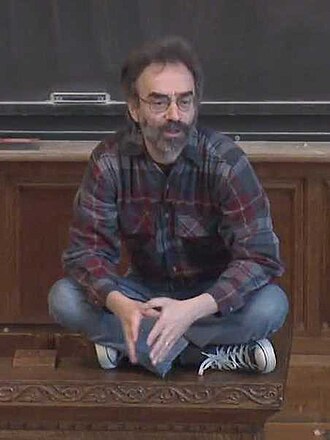
谢利·卡根
本期追问 · 点击跳到视频对应位置
要求我们谨慎生活的,是死亡本身,还是时间相对于值得做的事太短?活 3 万年但每年只勉强值得活,真的不如活 150 年的极致人生吗?作品在身后被人阅读,能否真的算一种值得追求的不朽?靠把生命看成苦来减轻失去之痛,是不是一种可取的策略?
归入 Ⅲ·01 什么是「好的生活」? →
EDITED TRANSCRIPT · 依据现场录音编译整理,可划线生成便签
编者按:本文是耶鲁大学哲学教授谢利·卡根(Shelly Kagan)"死亡"公开课第二十三讲的实录。这一讲承接此前对死亡本质与情感回应的讨论,转向一个更切身的问题:既然我们注定要死,应当如何度过此生。讲座恰逢作家库尔特·冯内古特去世次日,卡根由此说起。本文依据现场录音编译整理,仅删去口语枝节,论证、例证与转折均按原貌保留。

冯内古特之死与感激的起点

上一讲结束时,我引用了库尔特·冯内古特的几句话。那是他在一部小说里写下的临终祷告,大意是表达感激:无论你的人生装了什么内容,至少你活过。用他的话说,大多数泥巴没有运气坐起来,而他很庆幸自己是坐起来的那一小撮泥巴,他爱他见到的一切。我读那段话的时候,并不知道冯内古特头天夜里刚刚去世。课一结束,一位来旁听的客人就把这个消息告诉了我。所以今天不能不提一句:冯内古特活到八十四岁,我希望他直到最后一刻都明白,自己是多么幸运,能做一回坐起来的泥巴。

接下来我要转向的问题是这样的。前面几周,我们已经梳理了关于生与死的种种事实。那么,既然知道自己终有一死,我们该怎样活?先前我们讨论过面对这一事实应当抱有什么样的情绪。我刚刚也提醒过大家,我的主张是:尽管最常见的反应是恐惧甚至惊惶,但更恰当的态度或许是感激,庆幸自己竟然能有一段生命,能活过一场。可是,具体到怎样活,答案又是什么?

第一个跳进脑子的回答听起来几乎像个玩笑。我想说的是:既然我们会死,注定会死,那就得小心。

从前有部警匪剧叫《山街蓝调》(Hill Street Blues)。每一集开头,警长都要把当天要处理的案子和调查布置一遍,然后打发警员们出门,临了总要加一句:"外面小心点。"不过我说的小心,并不只是那种字面上的小心:你不留神,没看见街上开过来的车,被撞上,一切就此结束。

较真:有死性本身不蕴含小心

我们会死这件事,直觉上似乎要求一种特别的小心,因为人只能活一回,没法从头再来。所以看上去,有死性(mortality),也就是我们的寿命有限这个事实,逼着我们面对一个直觉:我们可能把人生搞砸,可能活错。

不过我身上那个爱较真的部分要指出,严格说来,得出这个结论的不可能是有死性本身。哪怕我们长生不死,也仍然可能活错。毕竟,不管你往人生里装了什么,一段无限的、不朽的生命仍然会呈现为某个特定的行动与活动的模式,而这个模式仍然可能不是你所能选择的最好的那一个。所以,"把人生搞砸"、"活错了"这种可能性,无论我们会不会死,都同样存在。

然而即便如此,有死性似乎还是额外添了一重风险,一重搞砸的危险。假设我们永生不死,举个再简单不过的例子:想象有个人把整个永恒都用来数整数,一、二、三、四、五、六。这样的永恒,价值也许比不上用来做别的事的永恒,比如做更复杂的数学。可是,就算你数了一百万年、十亿年整数,然后才意识到这毫无意义,你随时可以推倒重来,去做更有趣、更深刻、更有价值的数学。不朽给了你重新开始的机会,给了你重来(do-over)的可能。于是我们会想,死亡之所以格外糟糕,我们之所以为有死而忧虑,也许就在于它剥夺了重来的机会。

但这也不完全对。就算你不能永生,只活八十年或一百年,你照样可以在二十岁、三十岁、五十岁时重新审视自己的人生,决定换一条路。所以,并不是死亡本身让重来的可能性消失了。尽管如此,一想到死亡会在某个时刻到来,我们还是会被推向这个念头:必须非常小心。因为既然会死,我们能用来重来的时间就只有那么一点。

我们可能发现自己犯的错,其实分两类。一类是,我们在目标上做了糟糕的选择,瞄准的东西本身就不对。另一类是,就算目标选对了,在实现目标的过程中却做砸了,于是不得不真的从头再来,再试一次。所以我们要有两种小心:目标上的小心,和执行上的小心。因为可以说,我们用来重来的时间相当有限。

五件事的世界:小心的真正根据

不过,那个爱较真的部分又要说话了:严格讲,光凭我们会死这件事本身,还推不出我们必须格外小心。想想看,假如世上值得做的事其实没有多少,而且这些事也不怎么复杂,做好它们也不怎么难。假设值得做的事只有五件,就算不能每一件都一次做对,顶多也就试两三回,而所谓一回,不过是一两个小时。那样的世界当然贫乏得可怜,只能给我们这么一点东西。可是,如果世界真是那样运转的,而我们又有一百年可活,那我们根本不必为小心操心。我们有的是时间去追求这五件值得拥有的东西,也有的是时间把五件事一一做对。一百年绰绰有余,我们不需要小心。

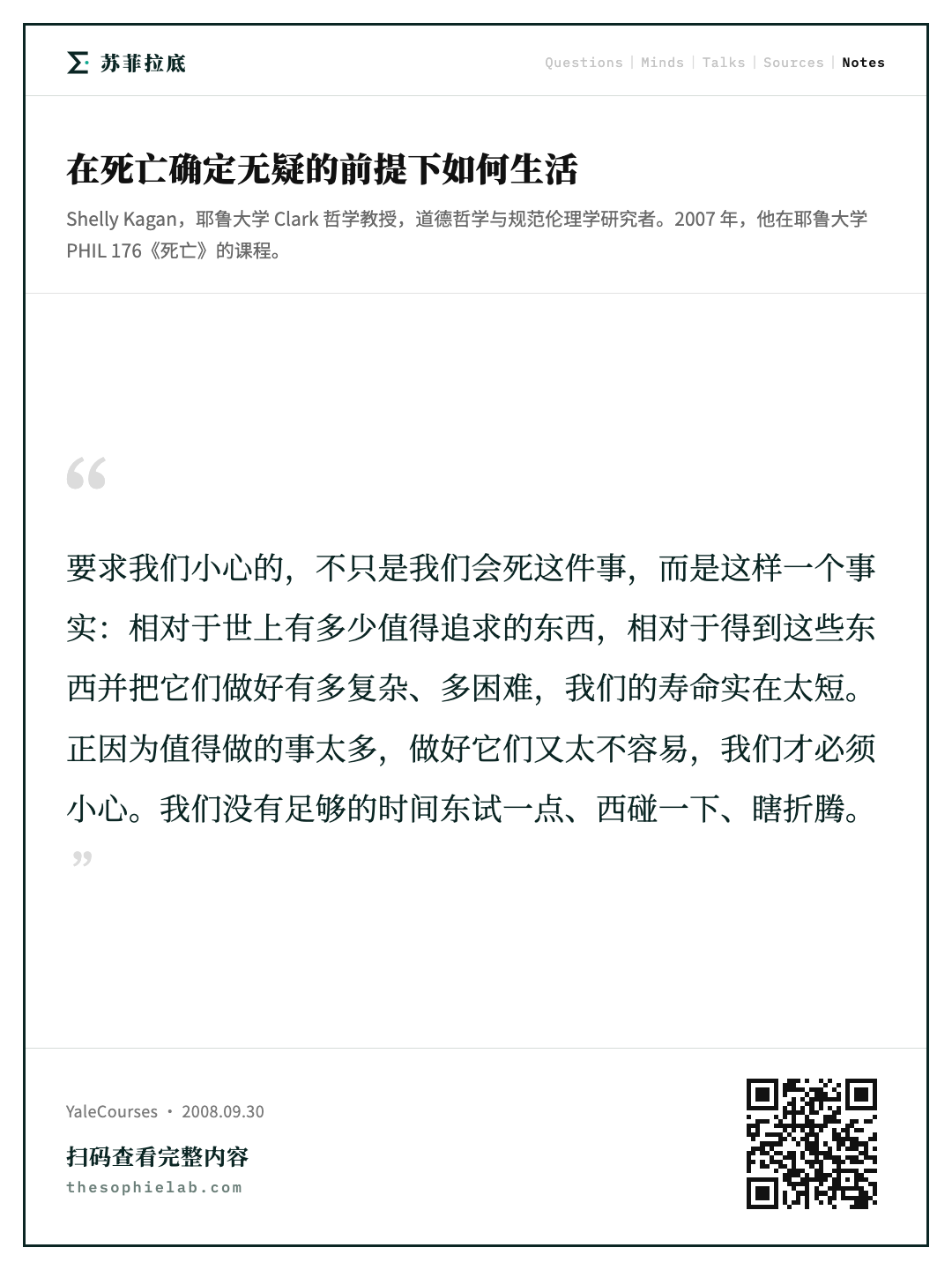
所以,要求我们小心的,不只是我们会死这件事,而是这样一个事实:相对于世上有多少值得追求的东西,相对于得到这些东西并把它们做好有多复杂、多困难,我们的寿命实在太短。正因为值得做的事太多,做好它们又太不容易,我们才必须小心。我们没有足够的时间东试一点、西碰一下、瞎折腾。那样过日子的人,到头来很可能发现自己瞄准的东西并非最好的选择。倒不是说那些东西完全不值得拥有,而是说,考虑到我们时间有限,我们身上还压着一层额外的负担:必须判断哪些东西最值得追求。我们还得面对这样一种可能,就是回头一看,发现自己没能做出最好的选择,瞄错了东西。不一定是不值得拥有的东西,但考虑到我们能往人生里装的东西数量有限,在这个意义上,选错了。我们还可能发现,在追求这些东西的过程中,自己不够小心,不够专注。因为,虽然按人生的实际情形来看,你确实有重来的机会,但你没有时间重来太多次。所以,死亡逼着我们做的事情,就是小心。

录音棚类比:目标与执行

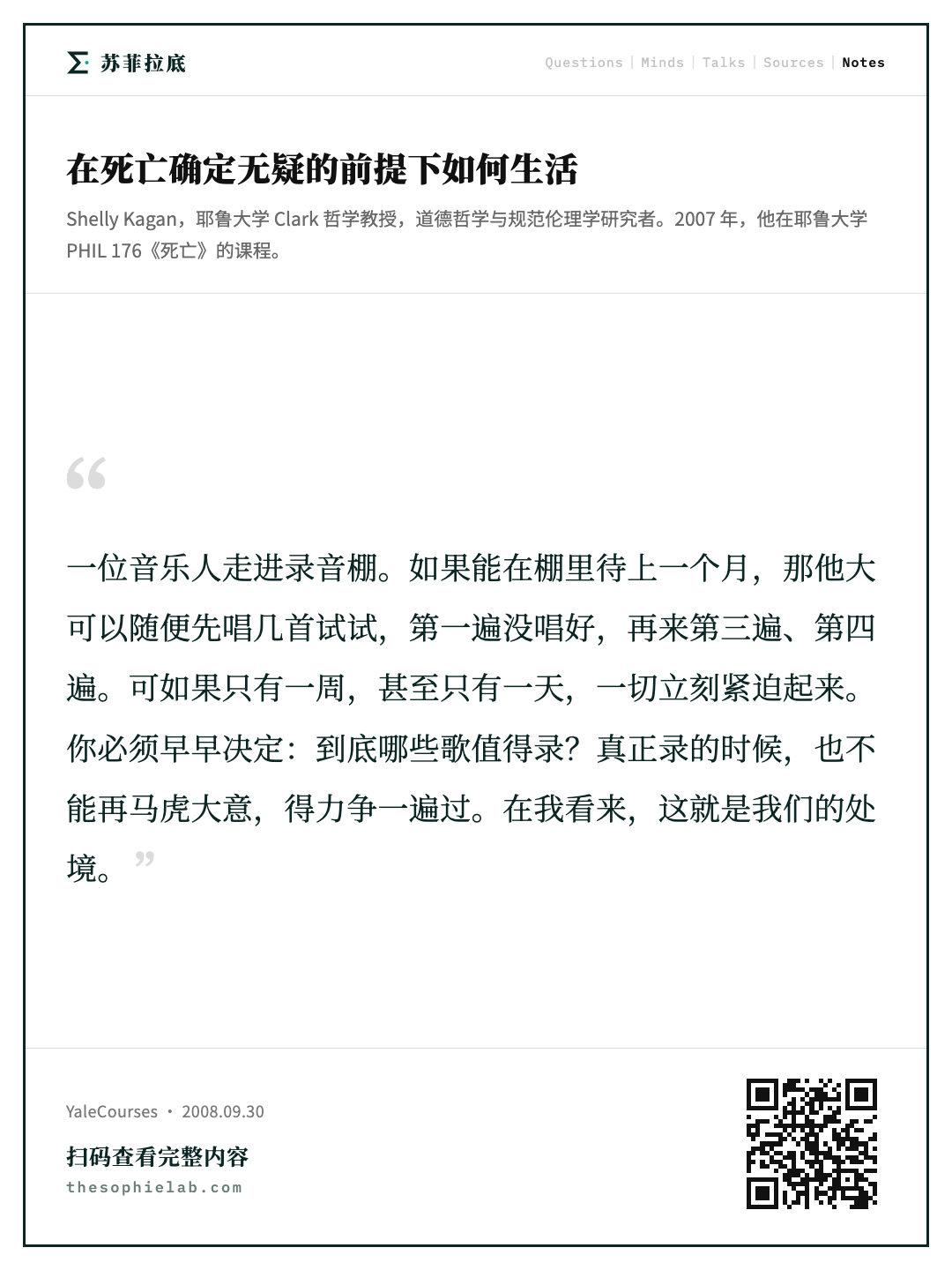
我想到一个类比:一位音乐人走进录音棚,准备录一张专辑。他的保留曲目就那么多。如果时间够长,比如在棚里待上一个月,那他大可以随便先唱几首试试。这几首也许不是最值得录的,但先试试再说。第一遍没唱好,再录一遍,再来第三遍、第四遍。时间充裕的话,开工之前或进行当中就把"我该录哪些歌""能不能一遍或者顶多两遍过"想清楚,并不那么紧迫。可如果你在棚里不是一个月,而是只有一周,甚至只有一天,一切立刻紧迫起来,时间变得极其珍贵。你必须早早决定:到底哪些歌值得录?其他歌也不错,但这几首显然是更好的选择。而真正录的时候,你也不能再马虎大意,得力争一遍过,最差也要两遍过。

在我看来,这就是我们的处境。这不只是因为我们会死,还因为这个世界如此丰富得惊人,给了我们那么多东西,那么多关于什么值得追求的选择。而其中许多东西又是那么难以做成。尽管我们有重来的机会,既可以改变心意、换一个目标,也可以对已经选定的目标再试一次,但我们必须小心。死亡这个事实要求我们专注,要求我们小心。

用什么填满人生:三种策略

说到这里,紧接着的问题自然是:好,我专注了,我小心了,那我该拿人生做什么?该往里面装什么?

课上先前讨论过,活着本身也许就有某种价值。但无论对此持什么立场,另有一点同样确定:让我们的人生有价值的,还有人生的内容。于是我们要问,我们该往人生里装些什么样的内容?

这个问题我不打算回答。追问"人生中真正值得追求的是什么",已经走到了另一个问题的边缘:"人生的意义究竟是什么?"这当然是个重要的问题,也许是最重要的问题,但那是另一门课的事。既然已经走到边缘,我现在要退回来。

不过,粗略地说,我们至少可以区分出两种策略,值得停下来想一想。两种策略背后其实有一个共同的念头:我们时间不多,所以要往人生里尽量多装东西。但落实这个念头,有两种基本路数。

第一种策略说:目标定得太高就有失败的风险,所以你应该满足于那些几乎稳拿的目标,比如美食、友伴、性、冰淇淋。有一道论文题请你们思考这样一句话:"吃吧,喝吧,快活吧,因为明天我们就死了。"这就是第一种策略。明天就死,所以趁还在,把能装的都装进去,去追求那些成功率极高的东西。

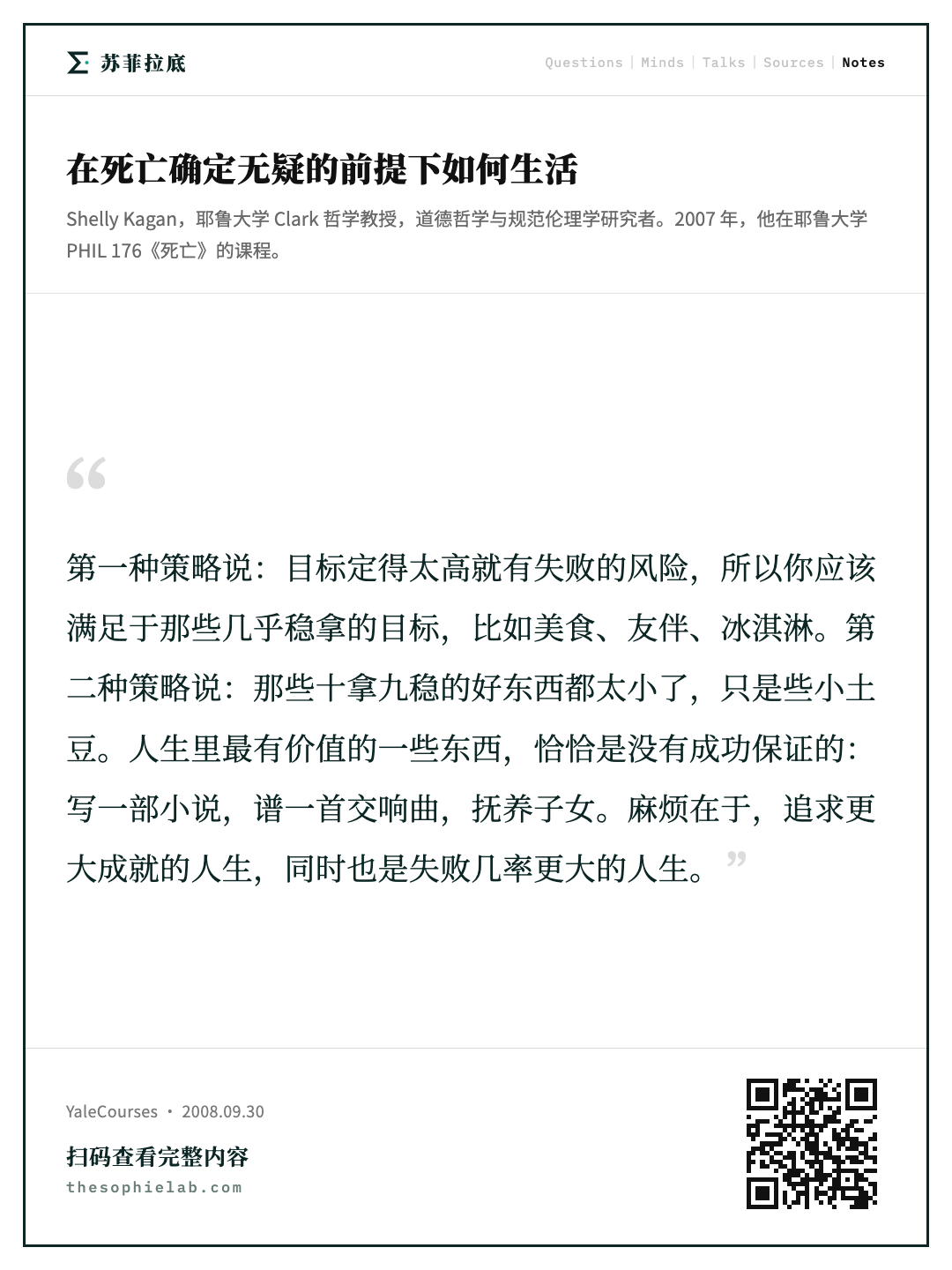
第二种策略说:那固然不错,你确实有很大把握能得到那些东西。可第一种策略的毛病在于,它能得到的好东西,那些十拿九稳的好东西,都太小了,只是些小土豆。人生里最有价值的一些东西,恰恰是不那么唾手可得、没有成功保证的:你可能想写一部小说,谱一首交响曲,或者结婚成家、抚养子女。第二种策略的拥护者主张,这些才是人生所能给予的最有价值的东西,装满这些大东西的人生,比装满小土豆的人生更有价值。

我想,"吃喝快活"策略的信徒大概不喜欢"小土豆"这个叫法,但第二种策略的拥护者很可能就会这么说。而在我看来,如果问题只是"哪种人生更好",如果有保证,如果上帝对你说:"你要哪一种?我保证你能得到。是装满吃喝的人生,还是装满成就的人生?"那么我们大多数人大概会答:装满成就的人生更有价值。麻烦当然在于,成就更大的人生,或者说追求更大成就的人生,同时也是失败几率更大的人生。你立志写出伟大的美国小说,十年过去,还没写完;二十年过去,你认定自己没这个本事。你想创办一家公司,公司倒闭了。那么,正确的策略是什么?

我猜很多人倾向于说:有第三种策略,那才是显而易见的正确做法,就是找对配比。追求一定数量的,该叫什么呢,大土豆,追求一定数量的大成就,因为一旦做成,人生的价值就更高;同时也撒上一些小东西,至少保证你从人生中确实得到了点什么。这话也不错,但它马上把我们带到下一个问题:到底什么才是正确的配比?这个问题我同样不打算回答。但选了"吃喝快活"那道题的同学,我其实就是在邀请你们思考这个问题。

越多越好?面积模型登场

换一个思路。刚才说过,不管是追求大东西还是追求小东西,背后的想法都是"尽量多装"。这个想法似乎默认了一点:只要人生的内容有价值,那就越多越好。可以说,这是两种策略的共同地盘:越多越好。

先前我论证过,不朽其实并不是好事。世界再丰富、再美妙,人生的好东西终究会耗尽,永生会变得可怕。但话说回来,这并不意味着我们,我们大多数人,离那种境地有多近。对我们绝大多数人来说,三十岁死,就失去了活到四十岁本可以得到的好东西;四十岁死,就失去了活到五十、六十、八十岁本可以得到的好东西。所以有一点我们倾向于同意:在其他条件相同的情况下,活得越长越好。

假设有一段五十年的人生,你活出了一定的价值,比如一百个价值点,不管我们用什么单位来衡量一段人生有多好。我们会说,同样的价值水平,与其只过五十年,不如过一百年。没错。可以说我们都同意,生命的数量是好东西,这似乎很可信。但我们马上又要补充:生命的数量固然重要,却不是唯一重要的东西,生命的质量同样重要。这一点也没什么争议。如果让你在"五十年、一百个价值点"和"五十年、一百三十个价值点"之间选,你会选后者。寿命长短不是我们唯一在乎的,人生整体的质量也是我们在乎的。至于究竟是什么让一段人生比另一段更好,这也是前面讨论过的话题。总结起来就是:既要看质量,也要看数量,或者说长度。

我刚才之所以改口,是因为你可以说,若从数学上想,这一切归根结底还是数量问题,只要我们在衡量数量时记住,要量的不只是人生的长度,还有那个方框的高度。五十乘以一百,方框的面积是五千个单位。我知道这里又会有人笑,请想象一下我们这个小单位:一年里一个单位的质量,就是一个"质量年",随便叫它什么,这里是五千个单位,那里是六千五百个。

可以说,把寿命的长短和人生的质量相乘,就能同时容纳"长度重要"和"质量重要"这两个想法。不必纠结这些数字,仿佛这里有什么精确性似的,底下的思路很清楚:方框的面积代表你在五十年里往人生中塞进去的总量。然后我们就可以拿各种人生来比较了。比如,我可以活五十年、每年一百三十点,也可以活一百年、每年略低一些。我们会说,质量低一点,但时间长得多,最后那个方框装的总价值更高。就是这么回事。

但我们要问的是:有了这种更丰富的数量概念,用寿命长度乘以活着时的好坏程度,它是否给了我们认为有价值的东西以恰当的位置?是否给了人生的质量以恰当的位置?让我再画几个不同的方框,几种可供选择的人生。

3 万年 vs 150 年:峰值的力量

假设你有一段很长的好日子,一百五十年。为了具体,我们给它五十个质量点,面积就是七千五百。为了让大家有个感觉,假设迄今为止地球上最好的人生也只值十分,那么五十分就是不可思议的人生,而且你能过上一百五十年。非常好的人生。

现在拿它和另一段人生比。假设这段人生就任何时刻而言都不怎么样,只有正一分。零分是不值得过、但也不比不存在更糟的人生;负分大概就是死了反而更好的人生。这段人生只是勉强值得过,正一分。但它极其漫长,长到我没法按比例画出来,所以中间用省略号。假设它延续三万年。算术很简单:三万乘以一,面积是三万。好,现在在这两段人生之间做选择,A 还是 B?

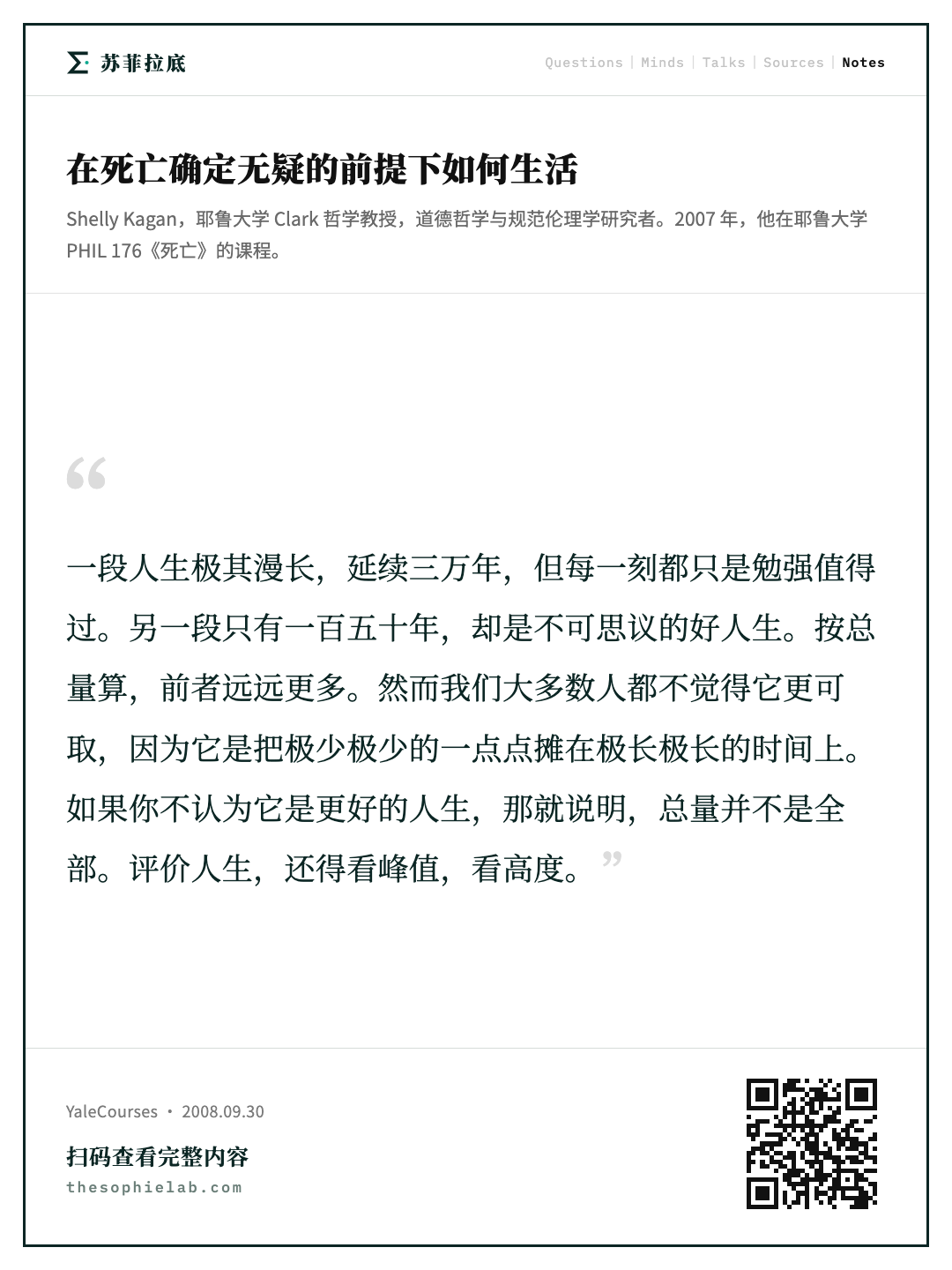
按数量算,按我们这种加强版的数量,也就是长度乘以高度,B 拥有更多我们在乎的东西:三万对七千五百。然而我们大多数人想到这个选择,都不觉得 B 是更可取的人生,尽管价值的数量更大。假设我们真能衡量塞进人生里的好东西的总量,B 就是把极少极少的一点点摊在极长极长的时间上。数量更大,A 却似乎更可取。

至少对于和我有同样想法的人来说,这未必人人如此,你可以说,人生并不全在于数量。或者说,当我们试图把质量考虑进来的时候,问题不在于质量无法衡量,而在于,如果你把质量的重要性折算进数量,让一切都归结为你得到的总量,那么 B 的总量确实比 A 大。如果你不认为 B 是更好的人生,那就说明,总量并不是全部。

那么在 A 和 B 之间,我们还能依据什么来选择?很自然的回答是:A 虽然更短,却达到了一种峰值,一种高度,而 B 在任何地方都不曾接近那个高度。也许,在评价人生、在互相竞争的人生之间做选择的时候,我们不能只看好东西的数量,还得看峰值,看高度。选择人生时,重要的不只是你总共装进去多少,还有你在一生中拥有过或做成过的最大的好是什么。也许我们该得出结论:质量可以压倒数量。

也许只要质量到位,数量就退居次要。是的,也可能这样:如果能有一段更长的人生,其中做成了伟大的事,那么比起一段更短的、同样做成了伟大的事的人生,还是长的更好。数量也可能重要,只要我们认为质量才是最重要的。但这一理论还有一个更激进的版本,它说:其实只有质量重要,只有峰值重要。

荷尔德林:曾像诸神一样活过

这正是荷尔德林在《致命运女神》(To the Parcae)一诗中表达的立场。这首诗出现在我布置的一篇文章里,让我在这里把它读一遍。

(教授在此朗读了荷尔德林的《致命运女神》,即《致帕耳开》。诗人向伟大的力量祈求:只要赐我一个夏天和一个秋天,让歌唱成熟,我的心便甘愿死去。灵魂若在生时未曾得到它神圣的权利,就无法在冥界安息;但只要我心心念念的、神圣的诗篇得以完成,那就欢迎你,阴影世界的寂静。纵然琴弦不能随我下去,我也心满意足:我曾像诸神一样活过,此外别无所求。译文依据考夫曼一九七六年英译本。)

荷尔德林是在说,他根本不在乎数量。只要能成就伟大的事,只要能登上高峰、用诗歌做成伟大的事,那就够了。一旦像诸神一样活过,此外别无所求。

所以,在思考我们想拿人生做什么的时候,光有前几周开始勾勒的那种理论,也就是思考"人生里有哪些东西值得拥有",还不够,我们还得回答质量与数量的问题。质量之所以重要,是否仅仅因为它能折算进更大的数量?还是说,质量本身就是值得追求的,哪怕这意味着数量更少?如果质量确实重要,数量是否也重要?还是说,确实只有质量重要?荷尔德林说"我曾像诸神一样活过,此外别无所求",他说得对吗?

半不朽之一:原子与后代

我猜想,荷尔德林在思考为什么那样的人生是他所能向往的最好人生时,心里想的一部分是他的诗歌留下的持久贡献。当我们想到自己做成了这样的事,就会觉得自己获得了某种不朽,我们通过作品活了下去。于是,在思考如何面对有死性、如何生活的策略时,我要转向的下一个问题是:也许某种不朽是值得追求的。或者至少,想到我们已经拥有或能够获得某种不朽,我们可以从中得到一点安慰。

我强调"某种",当然是因为严格说来,通过作品活下去,并不等于你真的活着。这是半不朽(semi-immortality),或者准不朽。我猜不信这套的人更愿意叫它伪不朽。这让我想起伍迪·艾伦的一个笑话:"我不想通过作品获得不朽,我想通过不死获得不朽。"大家知道,我先前论证过,真正的不朽,永无止境的生命,并不是好事。

尽管如此,我们许多人仍然向往这种半不朽。我认为它大体上有两种形式。有时人们想说,虽然你不是字面意义上地活下去,但有某种类似的事情在发生,因为你的一部分延续了下来。如果我有孩子,那么我的,就我这个男性而言,我的一个细胞真的延续了下去;然后他们的细胞在他们的孩子身上延续,再在孩子的孩子身上延续。想想一个阿米巴虫一分再分,原初那只阿米巴虫的一部分可以存在许多许多代。

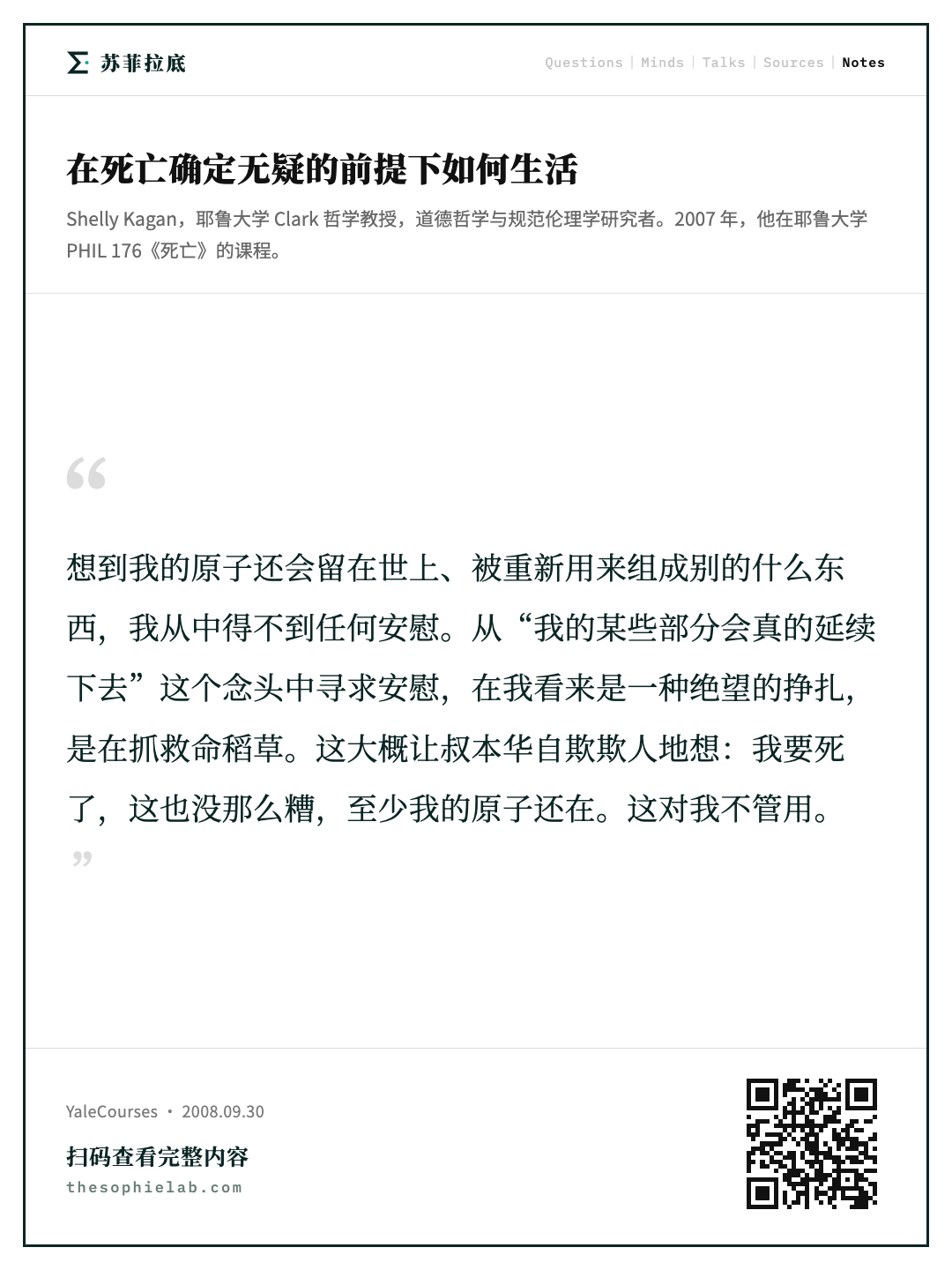
有些人从这样的想法中得到安慰:从字面上说,我的一部分会延续下去,如果不是通过后代的细胞,至少我的原子会被回收、再利用,我被吸纳进宇宙,却永不消失。德国哲学家叔本华就认为这多少能减轻死亡的刺痛。他先替反对者发问:区区尘土、粗糙的物质延续下去,怎么能算作我们真正的内在本性的延续?然后他回答说:哦,你了解这尘土吗?你知道它是什么、能做什么吗?先去认识它,再来鄙视它。这些眼下躺在那里的尘土与灰烬,一旦溶于水,很快就会结成晶体,会像金属一样闪光,会迸出电火花;它会自发地组成植物和动物,从它神秘的子宫里孕育出生命,正是你这个心胸狭窄的人为其丧失而惶惶不安的那种生命。

这是一段非常动人的文字,但我必须说,我不买账。想到我的原子还会留在世上、被重新用来组成别的什么东西,我从中得不到任何安慰。所以第一种半不朽,也就是从"我的某些部分会真的延续下去"这个念头中寻求安慰,在我看来是一种绝望的挣扎,是在抓救命稻草。就叔本华而言,这大概让他自欺欺人地想:"哦,我要死了,很快就要死了,这也没那么糟,至少我的原子还在。"这对我不管用。

半不朽之二:作品与成就

不过还有第二种进路。它安慰你的不是"你的部件会在你身后延续",而是"你的成就会在你身后延续"。荷尔德林写诗,两百年后我们还在读。你可以写一部小说,被人读上二十年、五十年、一百年甚至更久。你可以在数学、哲学或科学上做出某种贡献,五十年、一百年后,人们还在谈论那个哲学论证或那个数学结果。你还可以有别的成就。你可以盖一座在你身后仍然矗立的建筑。我读过对石匠的采访,他们想到自己参与建造的房子在自己走了很久之后还会立在那里,就感到一种自豪和安慰。你可以创办一家在你死后继续存在的公司。或者,你也可以从养育一个家庭这项成就中获得快乐与安慰。这里说的不是你的细胞留在后代身上,而是说,把另一个人养育成正派的人,是一项不小的成就,是值得用一生去做的事,而这项成就在你走后仍然延续。

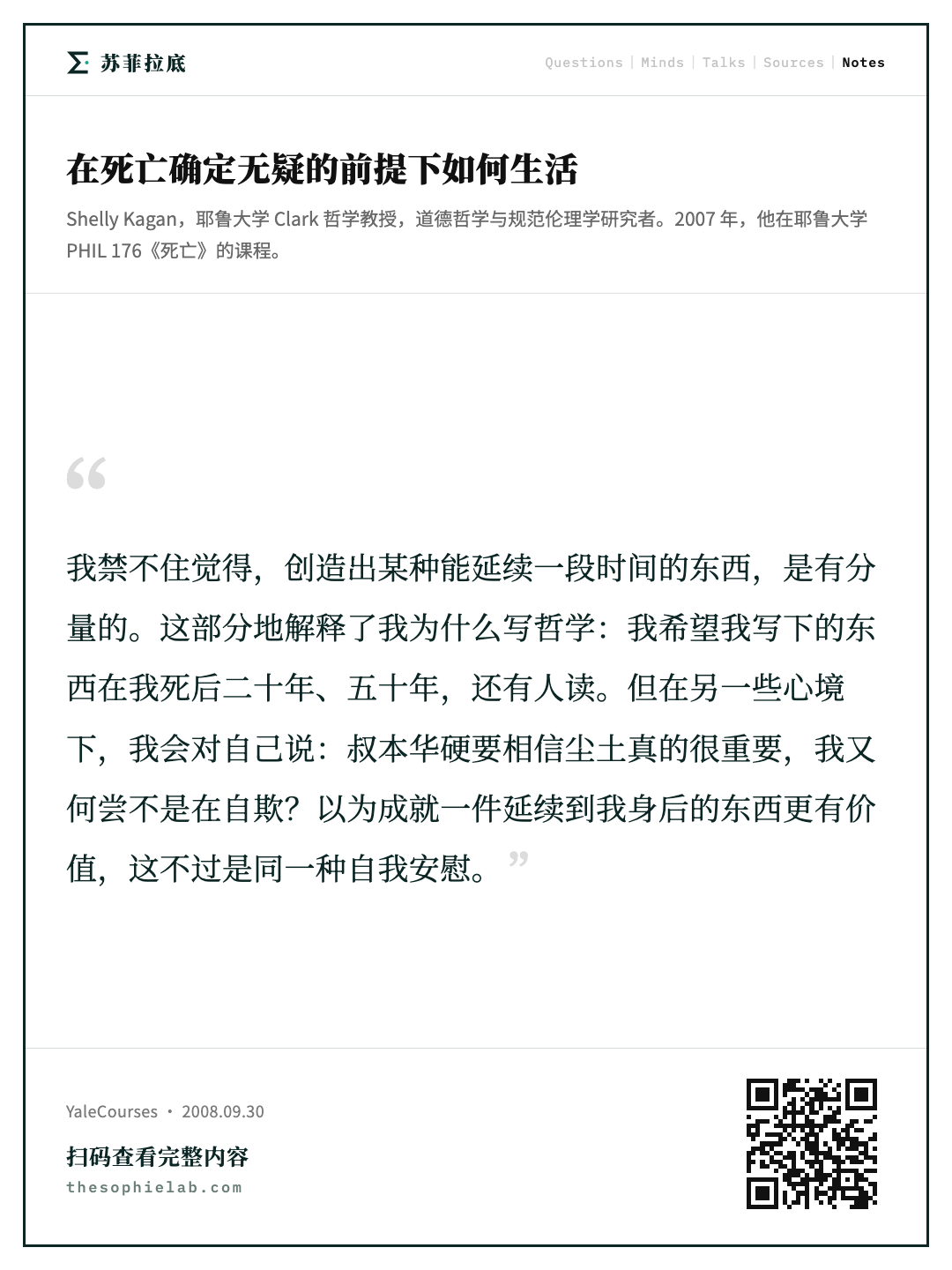
对第二类获得半不朽的进路,我们该怎么看?我得承认,我对此心里是两头摇摆的。对尘土和原子那一套,我只觉得是自欺;而对第二类想法,我发现自己是被吸引的。我禁不住觉得,创造出某种能延续一段时间的东西,是值得做的,是有分量的。就算我在世上的日子很短,只要我做成的某件事延续了下去,我的人生就因此更好。这大概就是荷尔德林的想法,而它对我有吸引力。我想这部分地解释了我为什么写哲学:我希望我写下的东西在我死后二十年、五十年,或者运气好的话一百年后,还有人读。在某些心境下,也许在大多数心境下,我被这个想法吸引。

但在另一些心境下,我得坦白,我对它心存怀疑。我会想起叔本华写下他那段小小的"尘土颂",然后对自己说:叔本华绝望到自欺,硬要相信"哦,我马上就要化为尘土,这没什么,尘土真的真的很重要";我又何尝不是在自欺?我以为做成一件事、成就一件延续到我身后的东西,是更宏大、更有分量、更有价值的,这不过是同一种自我安慰。所以至少在某些心境下,我觉得自己只是在骗自己。但那只是某些时候。至少在大多数时候,我发现自己和荷尔德林是一致的。倒不一定同意他说的"数量完全不重要,写出一部伟大作品就够了,再多的伟大作品也不添分毫",那在我看来走得太远。但至少,做成一件有分量、能长存的事,在我看来确实为我的人生增添了价值和意义。

佛教进路与西方之子的选择

最后让我提一种完全不同的进路。我只会非常简略地谈它,但它大概值得一提。今天讨论的所有思路都有一个共同的前提:应对"我们活着、然后死去"这一事实的办法,是让你拥有的这段人生尽可能好、尽可能有价值,往里面尽量多装东西,尽管在什么是最好的策略上还有争议的余地。这幅图景是说,失去生命这件事我们无能为力,所以正确的回应是让手里这段生命尽可能有价值,尽可能把它看得有价值。

但还有一种相当不同的进路。它说:是的,我们会失去生命,这很可怕;但它之所以可怕,只是因为你把生命当成一种失去了很糟的东西。毕竟,如果我们断定生命并不是真正宝贵的馈赠,并不真的值得拥抱,并不是一种我们能把它变得充满价值的东西,那么失去它就根本不是损失。这一点我们以前见过:剥夺论(deprivation account)正是这样解释死亡的核心坏处的。你被剥夺了本可以拥有的、整体上值得过的更多生命。可如果生命整体上并不值得过,那么失去它就不是坏事,而是好事。于是,诀窍就不是把人生变得尽可能有价值,而是认识到,总的来看,生命不是正数,而是负数。

我知道接下来的话有一种连环画式的简化,有些夸张,但粗略地说,第一种总体看法,生命是好的,所以失去它是坏的,所以答案是趁还拥有的时候充分利用它,可以说大体上是西方的看法。而另一种看法,即生命并不像我们以为的那么好,实际上整体是坏的,把它叫作东方的看法也许过于简化,但至少它在东方思想里比在西方思想里得到了更多的表达。这第二种看法最突出的例子,我想是佛教。佛教有四圣谛,第一圣谛是:人生即苦。佛教徒相信,只要深入思考生命的底层本性,你就会看到处处是失去,是苦,是病,是死,是痛。当然,有些东西我们想要,走运的话也能得到,但然后我们又会失去它们,这只是给苦、痛与不幸再添一笔。总的来看,人生不好。第一圣谛,人生即苦。

带着这样的判断,佛教徒要做的,是让你摆脱对这些好东西的执着,这样当你失去它们时,损失就降到最低。而且佛教徒还要把你从他们眼中的一种幻觉中解放出来,那就是自我的存在。没有一个"我"去失去任何东西。死亡之所以可怕,在于我担心它会消解我自己;如果根本没有自我,也就没有什么可消解的。这一切都讲得通,而且我对佛教怀有极大的敬意,只要接受"人生即苦"这个前提,这一切都讲得通。但不管是好是坏,我是西方之子,是《创世记》之子,在那里上帝看着这个世界,说:"这是好的。"至少对我来说,"把世界看成负数,以此把损失降到最低"这条策略,是我无法安心接受的。

对我来说,生命可以是好的。所以对我,我想也对我们大多数人来说,可选的仍然是我开头提到的那几种策略。我们怎样才能最大限度地让人生有价值?我们能做些什么,让我们能够和荷尔德林一起说:"我们曾像诸神一样活过"?
排版 + 横图 + 来源,粘贴即成稿
章节 · 点击跳转视频
0:01 冯内古特之死与感激的起点 ▶ 正在看
2:26 较真:有死性本身不蕴含小心 ▶ 正在看
6:17 五件事的世界:小心的真正根据 ▶ 正在看
8:47 录音棚类比:目标与执行 ▶ 正在看
11:22 用什么填满人生:三种策略 ▶ 正在看
17:12 越多越好?面积模型登场 ▶ 正在看
23:13 3 万年 vs 150 年:峰值的力量 ▶ 正在看
28:00 荷尔德林:曾像诸神一样活过 ▶ 正在看
31:00 半不朽之一:原子与后代 ▶ 正在看
35:49 半不朽之二:作品与成就 ▶ 正在看
39:39 佛教进路与西方之子的选择 ▶ 正在看
本期小问 · 档案清单
—— 要求我们谨慎生活的,是死亡本身,还是时间相对于值得做的事太短? ▶ 正在看
—— 活 3 万年但每年只勉强值得活,真的不如活 150 年的极致人生吗? ▶ 正在看
—— 作品在身后被人阅读,能否真的算一种值得追求的不朽? ▶ 正在看
—— 靠把生命看成苦来减轻失去之痛,是不是一种可取的策略? ▶ 正在看
本期讲者
谢利·卡根耶鲁大学 Clark 哲学教授,道德哲学与规范伦理学研究者,著有《The Limits of Morality》《Death》等;其耶鲁公开课《死亡》(PHIL 176)是全球最受欢迎的哲学公开课之一。
01冯内古特之死与感激的起点
0:01
Professor Shelly Kagan: At the end of last class, I quoted some words from Kurt Vonnegut, a kind of deathbed prayer confession that he'd written in one of his novels in which the basic gist of the prayer is to express gratitude. Whatever the content of your life, the fact that at least you've been able to live at all--As he put it, most mud isn't lucky enough to sit up. He feels lucky to have been some of the sitting-up mud. He loved everything he saw. When I read that quote, I did not know that Kurt Vonnegut had died the night before. Immediately after the class ended, a visitor to the class brought this fact to my attention. So, I can't pass without commenting on that death, and just remark that I hope that to the very end, Kurt Vonnegut, who lived until he was 84, realized how lucky he was to be some of the sitting-up mud. The question I want to turn to now is this. So, we've been going over the various facts about the nature of life and death.
Shelly Kagan 教授:上节课快结束时,我引用了库尔特·冯内古特的一段话,那是他在自己某部小说里写下的、类似临终祈祷式的自白,这段祈祷的基本意思是要表达感激。不管你这一生的内容是什么,至少你曾经活过这个事实本身——用他的话说,大多数泥巴都没那个运气坐起来。他觉得自己很幸运,能成为那坨坐起来的泥巴。他热爱他所见的一切。我念那段引文的时候,并不知道库尔特·冯内古特前一天晚上刚刚去世。课一结束,一位来旁听的人就把这件事告诉了我。所以我没法不提一句他的离世,只想说,我希望直到最后一刻,活到 84 岁的库尔特·冯内古特都意识到了,自己能成为那坨坐起来的泥巴是多么幸运。现在我想转向的问题是这个。我们一直在梳理关于生与死之本质的种种事实。
便签笔记
1:12
And the question then is, how should we live, in light of the fact that we're going to die? Previously, we've talked about what emotional response we should have to that. And I've argued, as I just reminded us, that although perhaps the most common reaction is one of fear or terror at death, it may in fact be that we should be grateful and consider ourselves lucky that we were able to have had life as well--life at all. But how, then, should we live in light of the fact that we're going to die? And the immediate answer that comes to mind seems almost like a joke. I want to say, well, we should be careful, given that we can die, that we will die.
那么问题就是:既然我们终将一死,我们该如何生活?之前我们谈过,面对这一点我们该有怎样的情绪反应。我论证过,也就是我刚才提醒大家的那点:尽管最常见的反应或许是对死亡的恐惧或惊惧,但事实上,我们或许应当心怀感激,觉得自己何其幸运,能够拥有生命——毕竟能活过一场。那么,既然我们终将一死,我们究竟该怎么活?脑子里立刻冒出来的那个答案,听着几乎像个玩笑。我想说:嗯,既然我们会死、终将会死,那我们应该小心点。
便签笔记
1:53
There used to be a TV show, a cop show called Hill Street Blues. The show began every day with the sergeant going over the various crimes and investigations that were going to fill up the day's episode. And he'd always end, as he sent off his police, the cops. He'd end by saying, "Be careful" or "Be careful out there." But the particular kind of care that I have in mind isn't just this pure fact, that if you're not careful, you won't notice that the car's coming down the street and you'll hit by the car and that'll be the end.
以前有个电视剧,是部警匪剧,叫《山街蓝调》。每集开头都是警长把当天这一集里要出现的各种案子和调查案情过一遍。然后在派警察们出勤时,他总会以一句话收尾。他会说:“小心点”,或者“在外头小心点”。但我这里说的那种“小心”,不只是那个纯粹的事实层面——如果你不小心,你就注意不到有辆车正从街上开过来,然后被车撞了,那就完了。
便签笔记
02较真:有死性本身不蕴含小心
2:26
The fact that we're going to die intuitively seems to require a particular kind of care, because, as we might put it, you only go around once, right? You don't get to do it again. And so, it seems as though the fact that we're mortal, the fact that we've got a finite lifespan, requires us to face the fact that intuitively we can blow it. We could do it wrong. Now, the nitpicky part of me wants to point out that it can't be mortality, per se, that has this implication. Even if we lived forever, we could still do it wrong.
我们终将一死这个事实,直觉上似乎要求一种特别的“小心”,因为,用我们的话说,你只能走这一遭,对吧?你没法再来一次。所以看起来,我们是有死的、我们的寿命是有限的,这个事实要求我们直面一点:直觉上,我们是可能把这一生搞砸的。我们可能活错了。不过我身上那个爱较真的部分想指出来:有这个含义的,其实并不是有死性本身。就算我们能永远活下去,我们照样可能活错。
便签笔记
3:03
After all, whatever it is you've filled your life with, with an immortal infinite life, there's still going to be the particular pattern of actions and activities that you engage in. And that particular pattern could still be one that wasn't the best pattern that was available to you. So, the possibility of having blown it, of having lived the wrong kind of life, is a possibility that's going to be true of us, whether or not we're mortal. And yet, for all that, it seems as though mortality adds an extra risk, an extra danger of blowing it. Look, suppose we lived forever and just have a kind of simplistic example.
毕竟,不管你把生命填充成了什么样,在一个不朽的、无限的生命里,仍然会有那个你所从事的那种特定的行动和活动模式。而那种特定的模式仍有可能并不是你所能采取的最好的模式。也就是说,搞砸了、过错了一生的可能性,无论我们是否终有一死,这种可能性都会存在于我们身上。然而,尽管如此,死亡似乎还是增添了一层额外的风险,一种额外的搞砸的危险。你看,假设我们能永生,举一个很简单的例子。
便签笔记
3:44
You might say, imagine somebody who spends his eternity counting the integers--1,2, 3,4, 5,6. Well, that might not be as valuable as an eternity spent doing something else, let's say, doing more complicated math. But still, if you've spent a million years or a billion years counting the integers and then realized that was sort of pointless, you could always start over by doing more interesting, more deep, more worthwhile math. The immortality gives you a chance of starting over. It gives you the possibility of do-overs. We might then worry that what's especially bad about death, the fact that we're mortal, is that it robs us of the chance of do-overs.
你可能会说,想象有个人把他的永恒用来数整数——1、2、3、4、5、6。嗯,那也许不如把永恒花在别的事情上更有价值,比方说,去做更复杂的数学。但即便如此,如果你花了一百万年或者十亿年去数整数,然后意识到那有点儿毫无意义,你总还可以重新开始,去做更有趣、更深刻、更有价值的数学。永生给了你重新来过的机会。它给了你重来一次的可能性。于是我们可能会担心,死亡、我们终有一死这件事之所以特别糟糕,就在于它剥夺了我们重来一次的机会。
便签笔记
4:32
But of course, that's not quite right either. Even if you don't live forever, you live 80 years or 100 years, you have the chance to reappraise your life at the age of 20 or 30 or 50 and decide you need to change course. So, it's not exactly as though the possibility of do-overs disappears by death itself, via death itself. Still, the thought that death comes when it does seems to push us in the direction of thinking we've still got to be very careful because, of course, given that we're mortal, we have only a limited period of time in which to do the do-overs. There are two kinds of mistakes, really, that we might catch ourselves in. We might discover, on the one hand, that we made some bad choices in terms of what we were aiming for.
但当然,这么说也不太对。即便你不能永生,你活八十年或者一百年,你仍然有机会在二十岁、三十岁或者五十岁的时候重新审视自己的人生,决定自己需要改变方向。所以,并不是说重来一次的可能性因为死亡本身、由于死亡本身就消失了。不过,一想到死亡终究会到来,这似乎还是把我们推向这样一种想法:我们仍然必须非常小心。因为,当然,既然我们终有一死,我们能用来重来的时间就只有那么多。其实我们可能会犯两类错误。我们可能会发现,一方面,我们在追求什么目标这件事上做了一些糟糕的选择。
便签笔记
5:27
And on the other hand, we might find even if we made the right choices in terms of our goals, we flubbed it in terms of actually accomplishing what we were trying to accomplish. And so we literally have to start over again, and try again. So, there's two kinds of care that we have to take. We have to be careful in our aims and we have to be careful in our execution of our aims, because we have, as it were, a rather limited amount of time to do it over. Now, again, the nitpicky part of me wants to say strictly speaking, it's not the fact that we are mortal, per se, that all by itself means we have to be especially careful. After all, suppose there just weren't all that many things worth doing.
另一方面,我们可能会发现,即使我们在目标上做了正确的选择,我们在真正实现自己想实现的东西时却搞砸了。于是我们真的不得不从头再来,再试一次。所以,我们必须在两个方面小心谨慎。我们必须在目标上小心,也必须在实现目标的执行上小心,因为我们可以说,能用来重来的时间相当有限。当然,我身上爱较真的那部分又想说,严格来讲,并不是我们终有一死这件事本身,单凭它就意味着我们必须格外小心。毕竟,假设值得做的事情并没有那么多。
便签笔记
03五件事的世界:小心的真正根据
6:17
And suppose they weren't all that complicated, all that difficult to do well. Suppose there were only five things worth doing. And even if you couldn't necessarily do every single one of them right the first time out, at most it would take two or three tries. And by a try I mean maybe an hour or two. Well, that would be a pretty impoverished world that could only offer us that much. But after all, if that was the way the world worked and we had a hundred years, we wouldn't really have to worry all that much about being careful. We'd have plenty of time to aim for each of the five things worth having and plenty of time to get each one of the five things right.
再假设它们并不那么复杂、并不那么难做好。假设值得做的事情只有五件。而且即使你未必能每一件都第一次就做对,最多也只需要试上两三次。我说的一次尝试,大概也就是一两个小时。嗯,那会是一个相当贫乏的世界,只能给我们提供这么点东西。但毕竟,如果世界真是那样运作,而我们有一百年,我们其实就不必那么担心是否小心谨慎了。我们有大把时间去追求那五件值得拥有的事情中的每一件,也有大把时间把这五件事的每一件都做好。
便签笔记
7:05
A hundred years of life would be more than enough. We wouldn't have to be careful. So, it's not just the fact that we're mortal that requires us to be careful. It's the fact that we have a relatively short span of life relative to how much there is worth aiming for, and how complicated and difficult it can be to get those things and get them right. It's because of the fact that there's so much to do and doing it properly that we have to be careful. We just don't have enough time to flail around, try a little of this, try a little of that. Somebody who lives like that may well find that the things they aimed for weren't really the best choices. You don't have to decide that these things weren't worth having at all, given the relatively short period of time we've got.
一百年的生命绰绰有余。我们不必小心翼翼。所以,要求我们必须小心的,并不只是我们终有一死这个事实。而是这样一个事实:相对于世上有那么多值得追求的东西,相对于要得到这些东西并把它们做好有多复杂、多困难,我们的寿命相对来说太短了。正是因为要做的事情如此之多,而且还要把它们做好,我们才必须小心。我们根本没有足够的时间东摸摸西碰碰,试一点这个,试一点那个。这样生活的人很可能会发现,他们所追求的东西并不真的是最好的选择。你不必断定这些东西完全不值得拥有;只是考虑到我们拥有的时间相对短暂,
便签笔记
8:10
We've got the extra burden of deciding what are the things most worth going after. And we have to face the prospect, the chance, that we'll look back and discover that we didn't make the best choices there. We aimed for the wrong things, not necessarily things that weren't worth having, but given the limited number of things we were going to be able to fill our lives with, in that sense, the wrong choices. And we may discover as well that we were not sufficiently careful, attentive in how we tried to achieve these things.
我们就额外背上了一重负担:得决定哪些才是最值得去追求的东西。而且我们必须面对这样一种前景、一种可能:回头一看,发现自己在这件事上并没有做出最好的选择。我们瞄错了目标——未必是那些完全不值得拥有的东西,而是考虑到我们能用来填充人生的事情数量有限,在这个意义上,那是错误的选择。而且我们同样可能发现,我们在设法实现这些东西的过程中不够小心、不够专注。
便签笔记
04录音棚类比:目标与执行
8:47
Because it's not as though--although given the way life is, you've got the chance for do-overs, you don't have time for a whole lot of do-overs. And so what death forces us to do is, to be careful. An analogy that comes to mind here is an artist who goes--a musician who goes into a recording studio. And look, he can start trying to record his songs to cut an album. And he may only have a certain number of songs in his repertoire. And so if he's got a long enough period of time, a month in the recording studio, he's got plenty of time, or she's got plenty of time, to sing a couple of songs. Maybe these wouldn't be the best things to record. Let's give it a try and we'll see. Didn't get it right the first take. Let's record it again.
因为并不是说——虽然按照人生本来的样子,你确实有重来一次的机会,但你没有时间一次又一次地重来。所以死亡逼着我们做的事情,就是要小心。我想到的一个类比是一位艺术家——一位音乐家走进录音棚。你看,他可以开始尝试录制自己的歌,做一张专辑。而他的曲目库里可能就只有那么几首歌。那么,如果他有足够长的时间,比如在录音棚里待一个月,他就有大把时间,或者她就有大把时间,去唱上几首歌。也许这几首并不是最值得录的,那我们先试试看,看看结果如何。第一条没录好,那就再录一次。
便签笔记
9:38
Let's try it a third time. Let's try it a fourth time. If you've got enough time, it's less pressing to get clear before you start, or as you're going along, what are the songs I should try to record, and can I get it on one take, or at most two? But if instead of having a month in the recording studio, you've got only a week in the studio, or a day in the studio, suddenly everything's much more pressing. Time is much more precious. You've got to decide early on just which are the songs that it makes sense to record? And yeah, there are some other songs, but these seem to be the better choices.
再试第三次。再试第四次。如果你时间充裕,那么在开始之前、或者在进行过程中,就不那么迫切地需要想清楚:我应该录哪些歌?我能不能一条过,最多两条?可如果你在录音棚里不是有一个月,而是只有一周,或者只有一天,那一切突然就紧迫多了。时间变得珍贵得多。你得早早决定,究竟哪些歌才值得录?没错,还有一些别的歌,但这几首看起来是更好的选择。
便签笔记
10:23
And when you record them, you can't be as careless and inattentive as you try to get them down. You've got to try to get it right the first time, or at worst, the second time. That's, it seems to me, the situation we find ourselves in, not just given the fact that we die, but, we might say, given how incredibly rich the world is, how many things it offers us, how many choices we have in terms of what's worth going after. But for many of these things, given how difficult they are to accomplish, although we've got the chance for do-overs, both in terms of changing our mind about what we should be aiming at, and trying again, for the things we have aimed at, we've got to be careful. The fact about our death requires paying attention. It requires care.
而当你录它们的时候,你在把它们录下来的过程中也不能那么马虎、那么心不在焉。你得争取第一次就录好,最差也要第二次录好。在我看来,这就是我们所处的境况——不仅仅是因为我们会死,而且可以说,是因为这个世界如此丰富得惊人,它给我们提供了这么多东西,在什么值得追求这件事上我们有这么多选择。可是对其中许多东西来说,考虑到它们有多难实现——尽管我们确实有重来的机会,既可以改变主意,重新考虑该追求什么,也可以就已经选定的目标再试一次——我们仍然必须小心。我们会死这个事实要求我们保持专注。它要求我们用心。
便签笔记
05用什么填满人生:三种策略
11:22
Well, having said that, of course, the immediate question then, is all right, so I'm paying attention. I'm trying to be careful. What should I do with my life? How shall I--What should I fill it with? We've, previously in the class, talked about the possibility that being alive, per se, may have some value. But above and beyond whatever stand we take on that, it's certainly also the case that part of what adds to the value of our lives are the contents of our lives. And so we need to ask, well, what kinds of contents should we try to fill our lives with?
话虽如此,接下来立刻就会有一个问题:好吧,我在保持专注,我在努力小心。那我该拿我的人生做什么?我该怎么——我该用什么来填满它?我们在这门课前面讨论过一种可能性:活着本身也许就具有某种价值。但无论我们在那个问题上持什么立场,还有一点肯定也是成立的:让我们的人生更有价值的部分原因,在于我们人生的内容。所以我们需要问:好吧,我们该用什么样的内容来填满自己的人生?
便签笔记
12:01
Now, I won't try to answer that. To ask the question, what are the things really worth going after in life? is to come up to the edge of asking, well, just what is the meaning of life? What's really worth going after? And although that is indeed an important, perhaps the important question, it's the question, I think, for a different class. And so having come close to the edge of that question, I'm going to now back away from it. But still, it seems we might say, in broad strokes, there are two different strategies that we could adopt.
不过,我不打算回答这个问题。问“人生中真正值得追求的东西是什么?”就等于走到了这样一个问题的边缘:那么,人生的意义究竟是什么?什么才真正值得追求?虽然那确实是一个重要的问题,也许是那个最重要的问题,但我认为,那是留给另一门课的问题。所以,走到那个问题的边缘之后,我现在要退回来。不过,我们大概仍然可以粗略地说,我们可以采取两种不同的策略。
便签笔记
12:44
And it's worth at least pausing to think about these two strategies. Strategy number one says given that you've only got a finite amount of time--Actually, the basic underlying thought behind both strategies is just this. We haven't got much time. Pack as much as you can into life. Pack as much as you can in. But there are two basic strategies about how do you put that idea into practice. And strategy number one says given the dangers of failure if you aim too ambitiously, you should settle for the kinds of goals that you're virtually guaranteed that you'll accomplish. The pleasures of food, company, sex, ice cream.
至少值得停下来想一想这两种策略。策略一说,既然你只有有限的时间——其实,这两种策略背后的基本想法都只是这个:我们的时间不多。尽可能多地把东西塞进人生里。能塞多少就塞多少。但在如何把这个想法付诸实践上,有两种基本策略。策略一说,考虑到目标定得太宏大就会有失败的危险,你应该退而选择那些你几乎肯定能实现的目标。美食的乐趣、友伴、性、冰淇淋。
便签笔记
13:44
One of the paper topics asks you to reflect on the philosophy, "Eat, drink, and be merry, for tomorrow you die." Well, that's one of the strategies. We're going to be dead tomorrow. And so while we're here, let's try to pack in as much as we can, by going for the things that we've got a very high chance of actually accomplishing. Strategy number two says that's all well and good. You've got a pretty high chance of succeeding at that. The trouble with strategy number one is the goods that you can achieve, the sort of sure thing goods are small.
有一道论文题目要求你们思考这样一种人生哲学:“吃喝作乐吧,因为明天你就要死了。”嗯,这就是策略之一。我们明天就要死了。所以趁我们还在这儿,就尽量多塞一些进来,办法是去追求那些我们极有把握真正实现的东西。策略二说,这些都很好。你在那上面成功的概率确实相当高。策略一的问题在于,你能获得的那些好东西,那种十拿九稳的好东西,都很小。
便签笔记
14:30
They're rather small potatoes, as things go. Some of the most valuable goods in life are things that don't come so readily, don't come with guarantees of achieving them. You might want to write a novel, compose a symphony, or for that matter raise--marry and raise a family. Some of these things, strat--fans of strategy number two argue, these things are the most valuable things that life can offer us. So that a life filled with these larger goods is a more valuable life than a life filled with the small potatoes goods.
就事情本身而言,它们都是些小打小闹。人生中最有价值的一些好东西,恰恰是那些不那么唾手可得、没有成功保证的东西。你可能想写一部小说、谱一首交响曲,或者就此而言,养——结婚成家、养育子女。策——策略二的拥护者主张,这些东西才是人生所能给予我们的最有价值的东西。因此,充满这些更大的好东西的人生,比充满那些小打小闹的好东西的人生更有价值。
便签笔记
15:16
I suppose fans of the "Eat, drink, and be merry" strategy don't like to call those "small potatoes goods," but that's the kind of language that might be offered by fans of strategy number two. And it seems to me that as a claim about which life, if only you had it, if you had a guarantee--If God were going to say, "Look, which life do you want? I promise you'll get it. The life filled with food and drink or the life filled with accomplishment?"--perhaps most of us would say well, it's the life filled with accomplishment that's the more valuable life. The trouble, of course, is, the life with the greater accomplishments, the life aiming for greater accomplishments, is also a life with a greater chance of failure. You aim for writing the great American novel and ten years later, you still haven't finished it. Twenty years later, you decide you don't have it in you to write the great American novel. You try to produce a business and it goes under. So, what's the right strategy to take? I suppose many of us would be
我猜“吃喝作乐”策略的拥护者并不喜欢把那些东西叫作“小打小闹的好东西”,但这正是策略二的拥护者可能会用的说法。在我看来,作为一种关于哪种人生更好的主张——如果你真能拥有它,如果你有保证的话——假如上帝对你说:“你看,你想要哪一种人生?我保证你能得到它。是充满美食美酒的人生,还是充满成就的人生?”——也许我们大多数人会说,充满成就的人生才是更有价值的人生。当然,问题在于,成就更大的人生、追求更大成就的人生,同时也是失败概率更大的人生。你立志要写出伟大的美国小说,十年过去了,你还没写完。二十年过去了,你断定自己根本没有能力写出伟大的美国小说。你想创办一家企业,结果倒闭了。那么,正确的策略究竟是什么?我猜我们很多人会倾向于说,第三种策略呗。
便签笔记
16:31
inclined to say, well, the third strategy. There's a third strategy that's the obviously right thing to do, which is, get the right mixture. Aim for a certain number of--what should we call them? Large potatoes. Aim for a certain number of the large accomplishments, because if you do manage to get them, your life will have more value. But also throw in a certain sprinkling of the smaller things, where you're at least assured of having gotten something out of life. Well, that's all well and good as well, but it just now brings us to the next question.
有第三种策略,显然那才是正确的做法,那就是:找到恰当的搭配。追求一定数量的——我们该怎么称呼它们呢?大打大闹。追求一定数量的大成就,因为如果你真的做到了,你的人生就会更有价值。但同时也掺进一些小一点的东西,这样你至少能确保从人生中得到些什么。嗯,这话说得也很在理,但它马上又把我们引向下一个问题:
便签笔记
06越多越好?面积模型登场
17:12
What is the right mixture, after all? Well, I'm not going to try to answer that one either. But again, those of you who choose the topic, the "Eat, drink, and be merry" question, basically I'm inviting you, in that topic, to reflect on that question. Here's a different thought. The entire, as I said, the underlying thought behind the go-for-the-big-things, go-for-the-small-things, was pack it all in. The underlying thoughts seem to be, look, as long as you've got a life that's got valuable contents, the more, the better.
到底什么才是恰当的搭配?嗯,这个问题我也不打算去回答。不过还是那句话,你们当中选择“吃喝作乐”这个题目的人,基本上,在那个话题上,我是在邀请你去思考那个问题。这里还有另一个想法。正如我说过的,'追求大事'和'追求小事'这两种策略背后的根本思路都是尽可能把内容塞满。背后的想法似乎是:只要你的人生有有价值的内容,那就越多越好。
便签笔记
17:52
You might say here's common ground between the two strategies--the more, the better. Now previously, we've--I've argued that immortality would not actually be a good thing. Eventually rich and incredible as the world is, eventually, the goods of life would run out and immortality would be dreadful. But having said that, that's not to suggest that we--most of us--come remotely close to that condition. For most of us, it's certainly true that dying at 30 deprives you of goods that would have come to you, if only you'd lived to 40.
你可能会说,这就是两种策略的共同点——越多越好。那么在前面,我们——我曾论证过,不朽其实并不是一件好事。无论这个世界多么丰富、多么不可思议,最终,生活中的种种美好都会耗尽,不朽会变得极其可怕。但话虽如此,这并不是说我们——我们中的大多数人——会哪怕接近那种状况。对我们大多数人来说,确实如此:30岁死去,会让你失去那些本来只要你活到40岁就能得到的美好。
便签笔记
18:35
And dying at 40 deprives you of goods that would have come to you if only you'd lived to 50 or 60 or 80. So, one thing that we're inclined to agree is, other things being equal, the longer your life, the better. So here's a life, 50 years long.
40岁死去,会让你失去那些本来只要你活到50岁、60岁或80岁就能得到的美好。所以,我们倾向于同意的一点是:在其他条件相同的情况下,你的人生越长,就越好。那么这里有一段人生,长50年。
便签笔记
18:58
And suppose you live it with a certain amount of value in your life, 100 value points, whatever that is, whatever the--however our units of measuring just how good a life is. We'd say, look, better to have a life at that value, instead of going through 50 years, went for 100 years. Fair enough. We might say, we all agree, don't we, that quantity of life's a good thing. And that does seem plausible. But at the same time we'll want to immediately say quantity of life may matter, but it's not the only thing that matters.
假设你在这段人生中拥有一定量的价值,100个价值点,不管那是什么,不管我们用什么单位来衡量一段人生到底有多好。我们会说,你看,与其过50年,不如以那个价值水平活100年,那更好。有道理。我们可能会说,我们都同意,不是吗——生命的数量是一件好事。这看起来确实说得通。但与此同时,我们会马上想说,生命的数量可能重要,但它并不是唯一重要的东西。
便签笔记
19:38
Quality of life matters as well. And again, that point's fairly uncontroversial. If you had to choose between your life of 50 years at 100 value points or 50 years at whatever that is, 130 value points, you'd rather have the second life. The length of life isn't the only thing we care about. The overall quality of your life is something we care about as well. And this, of course, is another topic that we've talked about previously. Just what is it that goes into making a life better than another? So, we now see, summing it up, yeah, got to pay attention to quality, got to pay attention to quantity or duration.
生命的质量同样重要。而且,这一点也是相当没有争议的。如果你必须在50年、每年100个价值点的人生,和50年、不管那是多少、130个价值点的人生之间做选择,你会更愿意要第二种人生。生命的长度并不是我们唯一在乎的东西。你人生的整体质量也是我们在乎的东西。当然,这也是我们之前讨论过的另一个话题。究竟是什么让一种人生比另一种更好?所以,我们现在看到,总结一下,是的,得关注质量,得关注数量,或者说时长。
便签笔记
20:32
Of course, the reason I just corrected myself is because you might say, if you want to think about it mathematically, it all is just a matter of quantity. As long as when we measure quantity, we bear in mind we need to measure not just the length of the life, but the height of the box. So, the area of the box here is 50 x 100 units, so whatever that is, that's 5,000.
当然,我刚才之所以纠正自己的说法,是因为你可能会说,如果你想用数学的方式来思考,这一切其实都只是数量的问题。只要我们在衡量数量时记住,我们需要衡量的不只是人生的长度,还有这个方框的高度。所以这里这个方框的面积是50乘100个单位,不管那是多少,也就是5000。
便签笔记
21:05
I'm going to get another giggle here, right. Imagine our little units. It's a quality, one unit of quantity--one unit of quality for a year. So, it's a quality year unit, whatever it is, 5,000 units. Here 6,500.
我猜这里又要引来一阵笑声了,对吧。想象一下我们的小单位。它是一种质量,一个数量单位——一年的一个质量单位。所以这是一个质量-年单位,不管它是多少,5000个单位。这里是6500。
便签笔记
21:28
You might say, look, we can capture the thought that the duration of your life matters, the quality of your life matters, by multiplying the two together. And without getting hung up on the numbers, as though there was any kind of precision here, the underlying thought's fairly clear. The area of the box represents the overall quality--the overall quantity that you managed to cram into your life in your 50 years. And we could start measuring different kinds of lives. We might start worrying about well, look, suppose I could live 50 years at 130 or I could live, whatever it is, 100 years at some other number that's a little bit less. We might say, oh, less quality, but longer quantity, longer duration, more valuable life filled in that last box. We see how it goes.
你可能会说,你看,我们可以通过把两者相乘,来体现这样一个想法:你生命的长度很重要,你生命的质量也很重要。而且不必纠结于具体数字,好像这里有什么精确性可言,其背后的想法是相当清楚的。这个方框的面积代表了整体的质量——代表你在这50年里所能塞进生命中的总量。然后我们就可以开始衡量不同类型的人生了。我们可能会开始琢磨,你看,假设我可以活50年、质量是130,或者我可以活比如说100年、但质量数值稍微低一些。我们可能会说,哦,质量低一些,但数量更多、时间更长,最后那个方框里填进去的是更有价值的人生。我们看看结果如何。
便签笔记
22:24
But the question we need to ask is--so, if we've got this more rich sense of quantity, where we multiply the duration of the life times the how good a life you're having while you've got it, does that give adequate place to what we think is valuable? Does that give adequate place to quality in life? Let me draw some different boxes, some different possible lives to choose between.
但我们需要问的问题是——如果我们有了这种更丰富的数量概念,把生命的长度乘以你活着时过得有多好,这是否充分体现了我们认为有价值的东西?这是否充分体现了生命中的质量?我来画几个不同的方框,几种可以从中选择的不同人生。
便签笔记
073 万年 vs 150 年:峰值的力量
23:13
Suppose you had a nice long life, 150 years.
假设你有一段美好的长寿人生,150年。
便签笔记
23:24
Again, just for the sake of concreteness, we assign 50 quality points. So, the area is 7,500.
同样,只是为了具体起见,我们给它50个质量点。所以面积是7500。
便签笔记
23:39
Let's suppose, so you can get a feel for this, let's suppose that the best life lived on earth so far was worth a 10. So this is an incredible life, to be a 50. And you get it for 150 years. A very nice life.
让我们假设——为了让你有个感觉——假设迄今为止地球上活过的最好的人生值10分。所以这是一段不可思议的人生,能达到50分。而且你能享受150年。非常美好的一生。
便签笔记
24:04
Now, compare it with this life.
现在,把它和这段人生做个比较。
便签笔记
24:12
Suppose that this life isn't really all that good in terms of how well off you are at any given time. It's plus one. Zero would be a life not worth having, though no worse than nonexistence. Negative numbers would be lives presumably that would be you're better off dead. This life is just barely worth having. It's plus one. But it's a very, very, very long life, so long that I couldn't draw it to scale. That's why we've got the "..." in the middle. Suppose it goes on for 30,000 years. Well, the math here is pretty easy.
假设这段人生在任何给定时刻的处境好坏方面,其实并没有那么好。它是正1。零代表一段不值得拥有的人生,但也不比不存在更糟。负数大概代表那种你死了反而更好的人生。这段人生只是勉强值得拥有。它是正1。但它是一段非常非常非常长的人生,长到我没法按比例画出来。这就是为什么中间有个“……”。假设它持续了3万年。好,这里的数学很简单。
便签笔记
24:57
30,000 times one is 30,000 in terms of the area. Okay. So, trying to choose between these two lives. Life A or Life B?
3万乘以1,面积就是3万。好的。所以,试着在这两种人生之间做选择。人生A还是人生B?
便签笔记
25:18
In terms of quantity, our enriched notion of quantity, where you measure the length of the life times the height of the box, Life B's got more quantity of what matters--30,000 versus 7,500. And yet, most of us, when we think about this choice, do not find B to be a preferable life, even though the quantity of value--Just suppose we could measure quantity of whatever the goods are that we've got crammed into our life. Well, this has very, very, very small amounts stretched over a very long time. The quantity's larger, but Life A seems preferable.
就数量而言——我们那个丰富化了的数量概念,即用人生的长度乘以方框的高度——人生B的数量更多重要的是——30,000 对 7,500。然而我们大多数人在思考这个选择时,并不觉得 B 是更可取的人生,尽管价值的数量——假设我们能测量塞进我们生命中的那些好东西的数量,嗯,这种人生只有极少量的好东西,被摊薄在非常漫长的时间里。数量更大,但人生 A 似乎更可取。
便签笔记
26:11
Now, for any--at least, this may not be true for everybody, but for those of us who share that thought, you might say quantity isn't all it's about. Or when we try to take quality into account, it wasn't so much that we couldn't measure it, it's that if you reduce the importance of quality into, fold it into quantity, so that what it's all about is the total amount that you're getting, well the total amount's bigger in B than A. If you don't think B's a better life, that suggests that totals aren't what it's all about.
那么,对于任何——至少,这未必对每个人都成立,但对于我们当中认同这个想法的人来说,你可能会说,重要的不只是数量。或者说,当我们试图把质量考虑进来时,问题不在于我们没法测量它,而在于,如果你把质量的重要性化约、折算进数量里,使得一切都取决于你所获得的总量,那么总量在 B 中比在 A 中更大。如果你不认为 B 是更好的人生,那就说明总量并不是全部。
便签笔记
26:57
Well, what else might we then choose between with regard to A and B? Well, the natural response is to say, even though Life A is shorter, it attains a kind of peak, a kind of height that isn't approached anyplace in Life B. And perhaps, then, in evaluating lives and choosing between rival lives, we can't just look for the quantity of good, we have to look at the peaks. We have to look at the heights. In choosing between lives, it's important to think not just about how much did you pack in, total, but what were the greatest goods that you had or accomplished in your life? And perhaps, then, we should conclude, quality can trump quantity.
那么,在 A 和 B 之间,我们还可能依据什么来选择呢?很自然的回答是:尽管人生 A 更短,它却达到了一种顶峰,一种在人生 B 里任何地方都无法企及的高度。或许,这样一来,在评价人生、在互相竞争的人生之间做选择时,我们不能只看好东西的数量,我们得看顶峰。我们得看高度。在诸种人生之间做选择时,重要的不只是你总共塞进了多少东西,而是你在一生中拥有或成就的最伟大的好东西是什么?也许,这样我们就该得出结论:质量可以压倒数量。
便签笔记
08荷尔德林:曾像诸神一样活过
28:00
Perhaps with the right quality in place, quantity becomes of secondary importance. Yeah, it might be that if we could have a longer life where we achieved great things, rather than a shorter life where we achieved great things, better to have the longer life. Quantity might matter, too, as long as we think the quality's what matters the most. But a more radical version of the theory would say, actually, quality's all that matters. The peaks are all that matter. That, at any rate, is the position that gets expressed by Hölderlin in the poem "To the Parcae," to the fates.
也许,只要质量到位,数量就成了次要的。是啊,也可能是这样:如果我们能拥有一个更长的、其中成就了伟业的人生,而不是一个更短的、其中成就了伟业的人生,那还是更长的人生更好。数量或许也重要,只要我们认为质量才是最重要的。但这个理论有个更激进的版本会说:其实,只有质量才重要。只有顶峰才重要。无论如何,这就是荷尔德林在诗作《致命运女神》(To the Parcae)中所表达的立场。
便签笔记
28:55
That was in one of the essays that I had you read. But let me read that now. "To the Parcae." A single summer grant me, great powers, and a single autumn for fully ripened song that, sated with the sweetness of my playing, my heart may more willingly die. The soul that, living, did not attain its divine right cannot repose in the nether world. But once what I am bent on, what is holy, my poetry is accomplished: Be welcome then, stillness of the shadows' world! I shall be satisfied though my lyre will not accompany me down there. Once I lived like the gods, and more is not needed [Kaufmann 1976]. Hölderlin is saying he doesn't care about quantity at all. If he can accomplish something great, if he can ascend to the heights and do something great with his poetry, that's enough.
那首诗在我让你们读的某篇文章里。不过现在让我来读一下。《致命运女神》。诗里祈求伟大的神力赐予他一个夏天、一个秋天,让他的诗歌得以完全成熟;当他饱尝了歌唱的甜美,他的心便更甘愿死去。那灵魂若活着时没有获得它神圣的权利,就无法在冥界安息。但一旦他所执着的、那神圣的东西——他的诗——完成了,那么就欢迎吧,阴影世界的寂静!即使我的琴不能随我下到那里,我也心满意足。我曾像诸神一样活过,这就够了(考夫曼 1976 年译本)。荷尔德林是在说,他压根不在乎数量。只要他能成就伟大的东西,只要他能登上顶峰,用他的诗歌做成某种伟大的事,那就够了。
便签笔记
29:55
Once he's lived like the gods, more is not needed. So, in thinking about what we want to do with our lives, it's not enough to have the kind of theory that we've begun to sketch in previous weeks, where we think about what are the various things worth having in a life?--we also have to address this question of quality versus quantity. Is quality only important insofar as it gets folded into producing greater quantity? Or does quality matter in its own right as something that's worth going for, even when it means a smaller quantity?
他一旦像诸神那样活过,就不再需要更多。所以,在思考我们要用一生做什么时,光有我们前几周开始勾勒的那种理论——即思考人生中有哪些值得拥有的东西——是不够的,我们还必须面对这个质量与数量的问题。质量之所以重要,是否仅仅因为它能被折算成更多的数量?还是说质量本身就重要,本身就值得追求,哪怕这意味着数量更少?
便签笔记
30:41
And if quality does matter, does quantity matter as well? Or is, indeed, quality all that matters? Is Hölderlin right when he says once I've lived like the gods, more is not needed?
如果质量确实重要,那数量是否也重要?抑或,真的只有质量才重要?荷尔德林说“我曾像诸神一样活过,不再需要更多”,他说得对吗?
便签笔记
09半不朽之一:原子与后代
31:00
Now, Hölderlin, I imagine, in thinking about why that kind of life is the best kind of life he could aspire to, is thinking, in part, about the lasting contribution that his poetry makes. There's a sense in which, when we think about having done things like that, we feel that we attain a kind of immortality. We live on through our works. And so the next question I want to turn to in thinking about strategies of how to live in light of the fact of, in terms of facing our mortality is, well, maybe a kind of immortality is worth going after.
我想,荷尔德林在思考为什么那样的人生是他所能追求的最好人生时,有一部分是在想他的诗歌所留下的持久贡献。在某种意义上,当我们想到自己做成了那样的事,我们会觉得自己获得了某种不朽。我们借着自己的作品活下去。所以,在思考面对死亡这一事实时该如何生活的种种策略时,我接下来要转向的问题是:或许某种不朽是值得去追求的。
便签笔记
31:54
Or maybe, at the very least, we can take a kind of comfort in thinking that we have or can attain a kind of immortality. I emphasize the word "kind," of course, because strictly speaking, if you live on through your works, it's not as though you are literally living on. It's semi-immortality or quasi-immortality. I suppose people who don't believe in it would prefer to call it pseudo-immortality. Actually, this reminds me of a joke. Here's a Woody Allen joke. "I don't want to be immortal through my work; I want to be immortal through not dying." Well, as you know, previously I've argued that genuine immortality, unending life, would not be a good thing.
或者至少,我们可以从“我们已经获得或能够获得某种不朽”这个想法中得到某种安慰。当然,我强调“某种”这个词,因为严格说来,如果你借着作品活下去,那并不是说你真的字面意义上还活着。那是半不朽或准不朽。我想不相信它的人更愿意管它叫伪不朽。其实,这让我想起一个笑话。这是伍迪·艾伦的一个笑话:“我不想通过我的作品获得不朽;我想通过不死来获得不朽。”嗯,你们知道,我先前论证过,真正的不朽、无尽的生命,并不是件好事。
便签笔记
32:48
But still, many of us aspire to this kind of semi-immortality. And actually, it can take, I think again, two broad forms. Sometimes people want to say there's a sense in which, although it's not as though you're literally living on, there's something like that going on, insofar as a part of you continues. If I have children, then literally some of my--in my case, there's a male--one of my cells continues. And then their cells continue in their children and their cells continue in their children. If you think of an amoeba splitting and splitting, and splitting and splitting again, part of the original amoeba could be there for many, many, many generations.
但尽管如此,我们许多人还是向往这种半不朽。而实际上,我认为它又可以分成两大类。有时人们想说,在某种意义上,虽然并不是你真的还活着,但确实有类似的事情在发生,因为你的一部分延续下去了。如果我有孩子,那么从字面上说,我的一些——就我而言,是个男性——我的某个细胞延续下去了。然后他们的细胞在他们的孩子身上延续,那些细胞又在他们的孩子身上延续。如果你想想一个变形虫不断分裂、分裂、再分裂、再分裂,原来那个变形虫的一部分可以存在许多许多代。
便签笔记
33:41
Some people take comfort in the thought that, literally speaking, a part of them will continue, if not through cells through my offspring, perhaps at least my atoms get recycled, get used again. And so I get absorbed into the universe, but I never disappear. Some people take comfort in that thought. The German philosopher Schopenhauer thought that this should reduce somewhat the sting of death. He said, "But it will be asked, ‘How is the permanence of mere dust, of crude matter, to be regarded as a continuance of our true inner nature?'" And he answers, Oh! Do you know this dust then?
有些人从这个想法中获得安慰:从字面上说,他们的一部分将会延续下去,就算不是通过细胞,也可以通过我的后代;或者至少,我的原子会被回收,被重新利用。于是我被宇宙重新吸收,但我从未真正消失。有些人会从这个想法里得到安慰。德国哲学家叔本华就认为,这多少能减轻一些死亡的刺痛。他说:“但有人会问:‘仅仅是尘土、是粗糙物质的持存,怎么能算作我们真正内在本性的延续呢?’”他的回答是:哦!那你了解这尘土吗?
便签笔记
34:30
Do you know what it is and what it can do? Learn to know it before you despise it. This matter, now lying there as dust and ashes, will soon form into crystals when dissolved in water. It will shine as metal; it will then emit electric sparks… It will, indeed, of its own accord, form itself into plant and animal; and from its mysterious womb it will develop that life, about the loss of which you in your narrowness of mind are so nervous and anxious. Well, that's a very moving passage, but I have to say, I don't buy it. I don't find any comfort at all in the thought that my atoms will still be around getting reused into something else. So, this first kind of semi-immortality, where you take comfort in the thought that literally there are parts of you that will continue, this strikes me as a kind of desperate striving, desperate reaching for straws. Perhaps in Schopenhauer's case, leading him to delude himself into thinking, "Oh, it's not so bad that I'm going to die and going to die soon. At least my atoms will still be
你知道它是什么、它能做什么吗?先去了解它,然后再去轻视它。这些如今躺在那里、化作尘土与灰烬的物质,一旦溶于水,很快就会结晶;它会像金属一样闪光;它还会迸出电火花……事实上,它会自发地组成植物和动物;并且从它那神秘的子宫里,它会孕育出那样一种生命——而你正因为心胸狭隘,才对失去它如此紧张、如此焦虑。嗯,这段话非常动人,但我得说,我并不买账。想到我的原子还会留在世上、被重新用到别的东西里去,我一点安慰也感觉不到。所以,这第一种“半永生”——你从“确实有一部分的你会继续存在”这个念头中获得安慰——在我看来,是一种绝望的挣扎,是抓住救命稻草。也许对叔本华来说,这让他自欺欺人地想:“哦,我快要死了,其实也没那么糟。至少我的原子还会
便签笔记
10半不朽之二:作品与成就
35:49
around." It doesn't work for me. There's a second sort of approach, though, where it's not so much that you're supposed to be comforted by the thought that your parts will continue to last after you, but that your accomplishments will continue to last after you. Hölderlin writes poetry, which we're still reading some 200 years later. You can write a novel which can be read for 20 or 50 or 100 or more years. You might make some contribution to math or philosophy or science, and 50 or 100 years later, people could still be talking about that philosophical argument or that mathematical result.
留在世上。”这对我不管用。不过还有第二类思路。这一次,让你获得安慰的不是“构成你的成分会在你死后继续存在”,而是“你的成就会在你死后继续存在”。荷尔德林写诗,两百年后我们仍在读。你可以写一部小说,被人读上二十年、五十年、一百年,甚至更久。你可能在数学、哲学或科学上做出某种贡献,五十年或一百年后,人们仍然会谈论那个哲学论证,或那个数学结论。
便签笔记
36:40
You might have other kinds of accomplishments. You might build a building that will last after you. Stone cutters, I've read interviews with stone cutters who take a kind of pride and comfort in the thought that long after they're gone, the buildings that they helped build will still be there. You might try to build a company that will last after you die. Or, for that matter, you might take pleasure and comfort in the accomplishment of having raised a family. Here, not so much the thought that some of your cells are in your offspring, but rather the thought that to have raised another decent human being is a nontrivial accomplishment, something worth having done with your life. And that accomplishment continues after you're gone. Well, what should we think about this second group of approaches to attaining semi-immortality? I've got to say that I'm of two minds when I think about them. Unlike the dust and the atoms stuff, where I just think you're deluding yourself, I find myself drawn to this second set of thoughts.
你也可能有别的成就。你可能建起一栋在你身后依然屹立的建筑。石匠——我读过对石匠的访谈,他们会有一种自豪和慰藉,觉得在他们离世很久以后,他们参与建造的建筑仍然会在那里。你也可能试着创办一家在你死后依然存续的公司。再或者,你可能从“养育了一个家庭”这项成就中获得快乐和安慰。这里重点不在于你的一些细胞留在了后代身上,而在于:把另一个正派的人养育成人,是一项相当了不起的成就,是值得用一生去做的事。而这项成就在你走后仍在延续。那么,对这第二类追求“半永生”的思路,我们该怎么看?我得说,想到它们时我心里是两种声音。不像尘土和原子那套东西——那个我只觉得是自欺欺人——这第二类想法确实吸引着我。
便签笔记
38:06
I find myself tempted by the thought that there's something worth doing about producing something that continues for a while. That it's significant. And even if my life here on earth is a short one, if something that I've accomplished continues, my life is the better for it. That's Hölderlin's thought, I suppose. And it's a view that appeals to me. I suppose it explains, in part, why I write philosophy, in the hopes that the things I write might still be read 20 years after I die, or 50 years or, if I'm so lucky, 100 years after I die. Well, in certain moods, perhaps in most moods, I'm drawn by that thought.
我确实会被这样的念头打动:创造出某种能持续一段时间的东西,是值得去做的,是有意义的。而且,即便我在世上的一生很短暂,只要我成就的某样东西还在延续,我的人生就因此更好。我想这大概就是荷尔德林的想法。这个看法对我很有吸引力。我想这也部分解释了我为什么写哲学:我希望我写的东西在我死后二十年还有人读,或者五十年,或者,如果我够幸运,一百年之后还有人读。嗯,在某些心境下,也许在大多数心境下,我被这个想法吸引。
便签笔记
39:03
But in other moods, I've got to confess, I'm skeptical of it. I remind myself of Schopenhauer writing his little passage, his Ode To Dust, and I find myself saying, just like Schopenhauer was so desperate that he deludes himself into thinking, "Oh, it doesn't matter that I'm about to turn into dust. Dust is really, really important," I'm just deluding myself as well, when I think there's something grander, something significant, something valuable about having made an accomplishment, having achieved something that continues beyond me.
但在另一些心境下,我得承认,我对它是怀疑的。我会提醒自己,叔本华写下那段小文字、那首《尘土颂》,然后我会想:就像叔本华绝望到自欺欺人地以为“哦,我就要化为尘土,这没什么大不了。尘土可是非常非常重要的”——当我以为“做出一项成就、成就某种超越我而延续的东西”里有什么更宏大、更重大、更有价值的意涵时,我不也只是在自欺欺人吗?
便签笔记
11佛教进路与西方之子的选择
39:39
So in certain moods, at least, I find myself thinking that I've just deluded myself. But that's only certain moods. And at least most of the time, I find myself in agreement with Hölderlin. Not necessarily in thinking quantity doesn't matter at all. To have written one great work is all you need and more great works doesn't add anything--that strikes me as going too far. But at least to have done something significant that abides, that does seem to me to add to the value and significance of my life. Well, let me mention an entire different approach. I'm going to give very, very short shrift to this last approach, but it's probably worth mentioning as well. The entire assumption of all the lines of thought that I've been discussing so far today have in common the underlying belief that the way to deal with the fact that we live and then we're dead is to try to make the life that you've got as good as possible, as valuable as possible, to pack as much into it as you can, even though there's room for disagreement about what's
所以至少在某些心境下,我会觉得自己不过是在自欺。但那只是某些时候。至少在大部分时间里,我还是同意荷尔德林的。但不一定同意“数量完全不重要”这一点。说写出一部伟大作品就够了、再多几部伟大作品也不增添什么——在我看来这就走得太远了。不过,至少做成某件重大而长存的事,在我看来确实增添了我人生的价值和意义。好,现在让我提一种完全不同的进路。对这最后一种进路我只会一带而过,但大概还是值得一提。到目前为止我今天讨论的所有思路,都有一个共同的潜在信念:面对“我们活着,然后就死了”这个事实,应对之道是尽量把你拥有的这一生过得尽可能好、尽可能有价值,尽可能往里面装进更多东西——尽管在“什么是最佳策略”上
便签笔记
41:12
the best strategy for doing that. The picture is one in which we say we can't do anything about the loss of life, so the right response is to make the life that we've got as valuable as it can be, to see it as valuable as it can be. But there's a rather different approach. That alternative approach says, yes, we're going to lose life and that's horrible. But it's only horrible insofar as you think of life as something that it's bad to lose. After all, if we were to decide that life wasn't really a valuable gift, if it wasn't really something worth embracing, and something that we could turn into something full of value, then its loss wouldn't actually be a loss. That's a point we've seen before, right? The central badness of death is explained in the depravation account.
还有分歧的余地。这幅图景是:我们对生命的丧失无能为力,所以正确的回应是,让我们拥有的这段人生尽可能有价值,并尽可能看到它的价值。但还有一种颇为不同的进路。那种替代进路说:没错,我们会失去生命,这很可怕。但它之所以可怕,只是因为你把生命看成一种失去了就很糟的东西。毕竟,如果我们认定生命并不是什么珍贵的礼物,并不真的值得去拥抱,也不是我们能把它变得充满价值的东西,那么失去它其实就不算损失。这一点我们之前见过,对吧?死亡之所以糟糕,其核心是由“剥夺论”来解释的。
便签笔记
42:26
You are deprived of the fact that you could have had more life that would have been worth having overall. But if life isn't worth having overall, then its loss is not a bad thing, but a good thing. The trick, then, isn't to make life as valuable as it could be, but rather to come to recognize that on balance, life isn't positive, but negative. I know that what I'm about to say has a kind of Classics Illustrated simplicity to it, and it's a bit of an over-exaggeration, but in gross terms, we might say the first general outlook--that life is good and so the loss of it is bad and so the answer is make as much of it as we can while we've got it--you might say that is, in broad strokes, the western outlook. And in broad strokes, the notion that life isn't really as good as we take it to be, but is, in fact, bad overall, perhaps it's oversimplification to call it the eastern outlook, but at least it's an outlook that gets more expression typically in eastern thought than in western thought. Foremost example of this second
你被剥夺的是:你本来可以拥有更多、总体上值得拥有的生命。但如果生命总体上并不值得拥有,那么失去它就不是坏事,而是好事。于是关键不在于把生命变得尽可能有价值,而在于认识到:总的算下来,生命不是正值,而是负值。我知道我接下来要说的,有一种“连环画版世界名著”式的简单化,也有点夸张,但粗略地说,我们可以说第一种总体世界观——生命是好的,所以失去它是坏的,因此答案是趁拥有的时候尽量利用它——大致上可以说,那是西方的世界观。而大致上,认为生命并不像我们以为的那么好、事实上总体是坏的这种看法——把它叫作东方的世界观也许过于简化,但至少这种看法在东方思想中比在西方思想中得到更多表达。第二种世界观最主要的例子,我想就是佛教。
便签笔记
43:49
outlook is, I suppose, Buddhism. Four noble truths in Buddhism. The first noble truth is that life is suffering. Buddhists believe if you think hard about the underlying nature of life, you'll see that everyplace there is loss. There is suffering. There is disease. There is death. There is pain. Sure, there are things that we want and, if we're lucky, we get them. But then we lose them and that just adds to the suffering and the pain and the misery. On balance, life isn't good. First noble truth, life is suffering.
佛教的四圣谛。第一圣谛是:人生是苦。佛教徒相信,如果你认真思考生命的底层本质,你会看到到处都是丧失,都是苦。有疾病,有死亡,有痛苦。当然,我们想要一些东西,如果幸运的话我们会得到。但接着我们又会失去它们,这只会加重苦、痛与不幸。总的算下来,人生并不好。第一圣谛:人生是苦。
便签笔记
44:46
And so, armed with this estimation, what Buddhists try to do is to free you from attachment to these goods, so that when you lose them, the loss is minimized. And indeed, Buddhists try to free you from what they take to be the illusion of there being a self. There is no me to lose anything. Death is terrifying insofar as I worry about it being the dissolution of myself. If there is no self, there's nothing to dissolve. It all makes sense--and I have tremendous respect for Buddhism--it all makes sense, given the thought that life is suffering. But for better or for worse, I'm a child of the west. I'm a child of the Book of Genesis, where God looks on the world and says, "It's good." For me, at least, the strategy of minimize your loss by viewing the world as negative, is not one that I can be at rest with.
于是,带着这样的判断,佛教徒要做的,是让你从对这些好处的执着中解脱出来,这样当你失去它们时,损失就被降到最低。而且,佛教徒还试图让你摆脱他们所认为的“有一个自我”的幻觉。并不存在一个“我”会失去任何东西。死亡之所以可怕,是因为我担心它意味着我自身的消散。如果根本没有自我,那就没有什么可消散的。这一切都说得通——我对佛教怀有极大的敬意——只要接受“人生是苦”这个前提,这一切都说得通。但不管是好是坏,我是西方之子。我是《创世记》之子——在那里,上帝看着这个世界,说:“这是好的。”至少对我来说,通过把世界看成负面的来把损失降到最低,这个策略是我无法安心接受的。
便签笔记
46:07
For me, life can be good. And so the choices for me, and I suppose for most of us, remain among the strategies with which I began. How is it that we can most make our lives valuable? What is it that we can do that will allow us, with Hölderlin, to say, "once we lived like the gods"?
对我来说,生命可以是好的。所以对我、也大概对我们大多数人来说,选择仍然在我一开始谈的那些策略之间。我们怎样才能最大程度地让我们的人生有价值?我们能做些什么,让我们可以像荷尔德林那样说出:“我们曾如神明般活过”?
便签笔记
视频总结 · 一句话概括与核心要点

一句话概括

Shelly Kagan 在耶鲁"死亡"课第23讲中论证:既然必死且时间相对于"值得做的事"极其有限,我们必须谨慎地选择目标并谨慎地执行,而在衡量一生价值时,"峰值质量"可能压倒"总量"——半永生(通过作品/后代留下痕迹)是他多数时候认同的慰藉,而"视生命为苦"的东方策略他则无法接受。

核心要点

  • 开场悼念 Vonnegut,强化"感恩"立场:上一讲引用的 Vonnegut"坐起来的泥土"祷词,Kagan 当时不知作者已于前一晚去世(享年84)。他重申:面对死亡最常见的反应是恐惧,但更恰当的态度可能是感恩——能活过就是幸运。
  • 死亡要求的"小心"不只是躲汽车,而是"只活一次、可能搞砸":有两类错误——目标选错(aim)和执行失败(execution)。但他吹毛求疵地指出:即便永生,你也可能过错一生;永生的真正优势是无限次"重来"(do-over),而有限人生也并非没有重来机会(20、30、50岁都可以转向),只是重来次数有限。
  • 真正的压力来源不是"必死"本身,而是"时间短 × 值得做的事多且难":思想实验——若世上只有5件值得做的事,每件最多试2-3次、每次1-2小时,那100年绰绰有余,根本无需小心。录音室类比:有一个月可以随便试歌、反复录;只有一天就必须提前选好曲目、争取一次录成。
  • 两种"塞满人生"的策略与显而易见的第三种:策略一"吃喝玩乐,明日将死"——追求几乎稳拿的小确幸(美食、陪伴、性、冰淇淋),缺点是收益是"小土豆";策略二追求写小说、作交响乐、成家育人等大成就——若上帝保证成功,多数人会选它,但失败风险高(写十年写不出伟大小说,创业倒闭)。策略三是"正确的混合比例",但比例是多少,Kagan 明确表示不作答,留给论文题目。
  • "数量"可以吸收"质量":面积模型:以"质量点数 × 年数"计算人生总价值——50年×100分=5000,50年×130分=6500,前者不如后者,后者又不如更长的同质量人生。这似乎把"活得久"和"活得好"统一为一个乘积。
  • 但极端案例表明峰值可以压倒总量:生命A:150年×50分(若史上最好人生只算10分,50分是极高水平)=7500;生命B:30,000年×1分(刚刚值得活)=30,000。按乘积B更优,但多数人直觉选A。结论:若你也选A,说明"总量"不是全部,人生评价必须看"高度/峰值",质量可在自身权利上压过数量。
  • Hölderlin《致命运女神》代表最激进版本——只有峰值重要:诗人只求一个夏天一个秋天完成诗作,"曾经像神一样活过,多的就不需要了"。Kagan 认为这走得太远(多写一部伟大作品当然有加分),但"做成某件留存下来的重要事"确实提升人生价值。
  • 两类"半永生"的分野:原子/细胞延续 vs 成就延续:叔本华认为尘土会结晶、发光、放电、化为动植物,故不必怕化为尘土——Kagan 直言"不买账",视之为绝望中抓稻草的自欺。相反,作品被阅读200年、建筑、公司、养大一个正派的人——这类成就的延续他多数时候被吸引(这也是他写哲学的原因,希望死后20、50乃至100年仍有人读),但某些时刻也怀疑自己是否像叔本华一样自欺。引用 Woody Allen:"我不想通过作品永生,我想通过不死永生。"
  • 另一条根本不同的路:让"失去"不再是失去:上述所有策略都预设"生命是好的,所以失去是坏的,故要塞满它"(粗略称为西方观)。佛教"苦谛"则说人生本质是苦,处处有失去、疾病、死亡;修行是解除对善好的执著并消解"自我"幻象——没有自我就没有什么可被死亡消解。Kagan 表示极为尊重此立场,但自认是"创世记之子"(神看着世界说"这是好的"),无法安于"把世界看成负面以减少损失"的策略。

结论与值得注意的细节

  • Kagan 的最终立场是有限度的 Hölderlin 主义:质量(峰值成就)是最重要的,但数量仍有分量;对死亡的正确回应是谨慎选择目标、谨慎执行,并尽力做成能留存的事。
  • 他反复用"吹毛求疵的自己"做限定:必死性本身不是关键变量,关键是"时间 / 值得做的事的丰富度与难度"的比值——这一区分是本讲最精细的论证。
  • 他刻意在"生命的意义是什么"和"正确的混合比例是什么"两个问题前止步,明确说这是别的课/论文题目要处理的。
  • 面积模型中的数字(100、130、50、1、30,000)他自嘲毫无精确性可言,只用于揭示直觉:多数人不愿用"3万年勉强值得活的人生"换"150年极好的人生"。
  • 关于半永生,他坦承"处于两种心境之间"(of two minds)——这一诚实的摇摆与对叔本华的尖锐否定形成对照,是本讲最个人化的段落。
  • 结尾呼应 Hölderlin:问题回到"我们能做什么,才能说'我们曾经像神一样活过'"。
核心句型 · 9
1. It's not X, per se, that …; it's the fact that …
“It's not the fact that we are mortal, per se, that all by itself means we have to be especially careful.”
分裂句 + per se,用于精确区分「表面原因」与「真正原因」。适合论证写作中修正粗糙直觉。仿写:It's not the deadline per se that stresses me; it's how much is left to do.
2. The nitpicky part of me wants to point out that …
“The nitpicky part of me wants to point out that it can't be mortality, per se, that has this implication.”
用「我身上较真的那部分」来引出补充修正,语气自谦、不咄咄逼人。适合课堂或讨论中提出细节异议。
3. Suppose … Well, that would be … But after all, if that was the way …, we wouldn't …
“Suppose there were only five things worth doing. … Well, that would be a pretty impoverished world … But after all, if that was the way the world worked and we had a hundred years, we wouldn't really have to worry …”
思想实验的标准展开:假设极端情形→承认其不真实→推出结论。适合用来隔离某个变量、检验一个论断是否真正成立。
4. That's all well and good, but …
“Well, that's all well and good as well, but it just now brings us to the next question.”
先让步再转折,承认对方说法「没错但不够」。口语与书面皆可,比 but 单独使用更有礼貌。
5. other things being equal, the + 比较级 …, the + 比较级 …
“Other things being equal, the longer your life, the better.”
独立主格 other things being equal(ceteris paribus)+ 双重比较级,是表述「在控制其他变量下的一般规律」的经典学术句式。
6. Not so much X as / but rather Y
“Here, not so much the thought that some of your cells are in your offspring, but rather the thought that to have raised another decent human being is a nontrivial accomplishment.”
「与其说是 X,不如说是 Y」,用于纠正重点、精确定位。注意 not so much … as … 为标准搭配,口语中也常见 but rather。
7. I find myself tempted by / drawn to / in agreement with the thought that …
“I find myself tempted by the thought that there's something worth doing about producing something that continues for a while.”
find oneself + 分词/介词短语,表达「不知不觉倾向于某想法」,语气比 I think 更有保留,适合表达尚未定论的立场。
8. I'm of two minds when I think about …
“I've got to say that I'm of two minds when I think about them.”
习语 be of two minds「拿不定主意」,后接 about/when。适合坦承内心矛盾,引出正反两面论述。
9. For better or for worse, I'm a child of …
“But for better or for worse, I'm a child of the west. I'm a child of the Book of Genesis.”
用「…之子」表明自己的文化根基,并以 for better or for worse 承认这不是理性论证而是身份认同。适合陈述无法完全论证的个人立场。
词汇精讲 · 107 · 按出现顺序
deathbed /ˈdeθbed/ n. 0:01
临终之榻;deathbed prayer 临终祈祷
gist /dʒɪst/ n. 0:01
要旨,大意(the gist of…)
in light of phr. 1:12
鉴于,考虑到
terror /ˈterər/ n. 1:12
惊惧,恐怖
sergeant /ˈsɑːrdʒənt/ n. 1:53
警长;军士
intuitively /ɪnˈtuːɪtɪvli/ adv. 2:26
凭直觉地
you only go around once phr. 2:26
人生只有一次(俗语)
mortal /ˈmɔːrtl/ adj. 2:26
终有一死的;mortality n. 有死性
finite /ˈfaɪnaɪt/ adj. 2:26
有限的
blow it phr. 2:26
搞砸,错失机会(口语)
nitpicky /ˈnɪtpɪki/ adj. 2:26
吹毛求疵的,爱较真的
per se /ˌpɜːr ˈseɪ/ adv. 2:26
本身,就其自身而言(拉丁语)
for all that phr. 3:03
尽管如此
simplistic /sɪmˈplɪstɪk/ adj. 3:03
过于简单化的(略带贬义)
integers /ˈɪntɪdʒərz/ n. 3:44
整数
do-overs /ˈduː oʊvərz/ n. 3:44
重来一次的机会(美式口语)
robs us of phr. 3:44
剥夺我们的…(rob sb. of sth.)
reappraise /ˌriːəˈpreɪz/ v. 4:32
重新评估
change course phr. 4:32
改变方向、路线
flubbed /flʌbd/ v. 5:27
搞砸,弄糟(口语)
as it were phr. 5:27
可以说,姑且这么说
strictly speaking phr. 5:27
严格说来
impoverished /ɪmˈpɑːvərɪʃt/ adj. 6:17
贫乏的,匮乏的
flail around phr. 7:05
胡乱摸索,瞎折腾
prospect /ˈprɑːspekt/ n. 8:10
前景,可能性
attentive /əˈtentɪv/ adj. 8:10
专注的,留心的
repertoire /ˈrepərtwɑːr/ n. 8:47
(演员、乐手的)全部曲目、剧目
cut an album phr. 8:47
录制一张专辑
take /teɪk/ n. 8:47
(录音、拍摄的)一条,一次录制
pressing /ˈpresɪŋ/ adj. 9:38
紧迫的
inattentive /ˌɪnəˈtentɪv/ adj. 10:23
心不在焉的
at worst phr. 10:23
最差的情况下
above and beyond phr. 11:22
除…之外,超出…
in broad strokes phr. 12:01
粗线条地,大致上
settle for phr. 12:44
退而求其次接受
virtually /ˈvɜːrtʃuəli/ adv. 12:44
几乎,实际上
be merry phr. 13:44
作乐,尽情欢乐
all well and good phr. 13:44
倒是不错(但……),常用于让步
sure thing n. 13:44
十拿九稳的事
small potatoes n. 14:30
微不足道的东西,小打小闹(美式俚语)
as things go phr. 14:30
就一般情况而言
readily /ˈredɪli/ adv. 14:30
轻易地,容易地
for that matter phr. 14:30
就此而言,同样地
you don't have it in you phr. 15:16
你没有那个能耐
goes under phr. 15:16
(企业)倒闭,破产
sprinkling /ˈsprɪŋklɪŋ/ n. 16:31
少量,点缀
assured of phr. 16:31
确保得到
common ground n. 17:12
共同点,共识
dreadful /ˈdredfl/ adj. 17:52
可怕的,糟透的
deprives you of phr. 17:52
剥夺你的…(deprive sb. of sth.)
remotely /rɪˈmoʊtli/ adv. 17:52
丝毫地(用于否定:not remotely 远远不)
other things being equal phr. 18:35
在其他条件相同的情况下
Fair enough phr. 18:58
有道理,说得过去
plausible /ˈplɔːzəbl/ adj. 18:58
貌似合理的,说得通的
uncontroversial /ˌʌnˌkɑːntrəˈvɜːrʃl/ adj. 19:38
无争议的
getting hung up on phr. 21:28
纠结于,执着于
cram into phr. 21:28
塞进,挤进
adequate /ˈædɪkwət/ adj. 22:24
充分的,足够的
for the sake of concreteness phr. 23:24
为了具体起见
well off adj. 24:12
境况好的,富裕的
nonexistence /ˌnɑːnɪɡˈzɪstəns/ n. 24:12
不存在
presumably /prɪˈzuːməbli/ adv. 24:12
大概,想必
to scale phr. 24:12
按比例
preferable /ˈprefərəbl/ adj. 25:18
更可取的
fold it into phr. 26:11
把…并入,折算进
rival /ˈraɪvl/ adj. 26:57
相互竞争的,对立的
trump /trʌmp/ v. 26:57
压倒,胜过
of secondary importance phr. 28:00
次要的
at any rate phr. 28:00
无论如何,至少
sated /ˈseɪtɪd/ adj. 28:55
饱足的,餍足的
repose /rɪˈpoʊz/ v. 28:55
安息,休憩
nether world n. 28:55
冥界,阴间
bent on phr. 28:55
一心想要,执意于
lyre /ˈlaɪər/ n. 28:55
里拉琴(古希腊竖琴,象征诗歌)
ascend /əˈsend/ v. 28:55
登上,攀升
insofar as conj. 29:55
在…范围内,就…而言
in its own right phr. 29:55
就其本身而言,凭自身
aspire to phr. 31:00
向往,渴望达到
live on phr. 31:00
继续存在,延续
quasi-immortality /ˈkwɑːzaɪ ˌɪmɔːrˈtæləti/ n. 31:54
准不朽(quasi- 前缀:准、类似)
pseudo-immortality /ˈsuːdoʊ ˌɪmɔːrˈtæləti/ n. 31:54
伪不朽(pseudo- 前缀:假的)
amoeba /əˈmiːbə/ n. 32:48
变形虫,阿米巴
offspring /ˈɔːfsprɪŋ/ n. 33:41
后代,子女
the sting of death n. 33:41
死亡的刺痛(语出《哥林多前书》)
permanence /ˈpɜːrmənəns/ n. 33:41
持久,永存
despise /dɪˈspaɪz/ v. 34:30
鄙视,轻蔑
of its own accord phr. 34:30
自发地,自动地
narrowness of mind n. 34:30
心胸狭隘
I don't buy it phr. 34:30
我不信,我不买账
reaching for straws phr. 34:30
抓救命稻草(常作 grasping at straws)
delude /dɪˈluːd/ v. 34:30
欺骗,使误信(delude oneself 自欺)
nontrivial /ˌnɑːnˈtrɪviəl/ adj. 36:40
不容小觑的,有分量的
of two minds phr. 36:40
犹豫不决,心里有两种想法
Ode /oʊd/ n. 39:03
颂歌,颂诗
abides /əˈbaɪdz/ v. 39:39
长存,持续(书面语)
give short shrift to phr. 39:39
草草处理,不予重视
embracing /ɪmˈbreɪsɪŋ/ v. 41:12
拥抱,欣然接受
depravation account n. 41:12
剥夺论(原文拼写有误,应为 deprivation account):死亡之坏在于剥夺了本可拥有的美好
on balance phr. 42:26
总的来看,权衡之后
in gross terms phr. 42:26
粗略地说
outlook /ˈaʊtlʊk/ n. 42:26
世界观,看法
Foremost /ˈfɔːrmoʊst/ adj. 42:26
最主要的,首要的
armed with phr. 44:46
以…为凭借,带着
attachment /əˈtætʃmənt/ n. 44:46
执着,依恋(佛教语境中的「执」)
dissolution /ˌdɪsəˈluːʃn/ n. 44:46
消散,解体
for better or for worse phr. 44:46
不管好坏,无论如何
at rest with phr. 44:46
对…感到安心、坦然
理解自测 · 11 题
1. Kagan 在课程开头提到了哪位作家的去世?他引用了这位作家的什么说法?

库尔特·冯内古特。Kagan 在上节课末尾引用了冯内古特小说中的一段临终祈祷,大意是感激能活过一场:「大多数泥巴都没那个运气坐起来」,而他很幸运成为「坐起来的泥巴」。Kagan 念这段话时并不知道冯内古特前一晚已去世(2007 年 4 月 11 日,享年 84 岁),课后才由旁听者告知。他借此希望冯内古特直到最后都意识到自己的幸运。这一开场同时呼应了上一讲的结论:面对死亡,感激而非恐惧才是更恰当的反应。

2. Kagan 用录音棚类比说明了什么?类比中的「一个月」和「一天」分别对应什么?

类比说明为什么有限的时间要求我们「小心」。一位曲目有限的音乐家进录音棚:如果有一个月,可以随意试录、不好就重来,不必事先想清楚该录哪些歌;如果只有一周或一天,就必须早早决定哪些歌值得录,并争取一条过、最多两条。「一个月」对应时间充裕(如永生或世界贫乏时),「一天」对应我们的真实处境——寿命相对于值得做的事太短。类比对应了两种小心:目标选择(选哪些歌)和执行(能否一次录好)。见「录音棚类比」一章。

3. Kagan 说的三种「填满人生」的策略分别是什么?

策略一:求稳,追求几乎必然能获得的小快乐——食物、陪伴、性、冰淇淋,即「吃喝作乐吧,因为明天你就要死了」。策略二:追求大成就——写小说、谱交响曲、成家育儿,理由是这些才是人生最有价值的东西,虽然没有成功保证。策略三:混搭,追求若干大成就以提高人生价值,同时点缀一些小快乐以确保至少有所收获。Kagan 指出三者共同前提是「尽量多装」,且拒绝回答混合比例是多少,把它留给学生论文。

4. 在「人生 A」与「人生 B」的对比中,两者各是多少年、多少质量点、面积多大?

人生 A:150 年,每年 50 个质量点(Kagan 设定迄今地球上最好的人生为 10 分,所以 50 分是远超人类经验的极致人生),面积 7500。人生 B:3 万年,每年 +1 分(0 表示不值得活但不比不存在更糟,负数表示死了反而更好,+1 是「勉强值得活」),面积 30000。按面积模型 B 是 A 的四倍,但 Kagan 指出多数人仍会选 A。这个对比出现在「3 万年 vs 150 年」一章,用来检验「总量决定一切」的加总观。

5. 为什么 Kagan 坚持说「要求我们小心的不是死亡本身」?他的论证步骤是什么?

他用两个反例隔离变量。第一,永生者也可能「活错」:即便无限生命,你从事的活动模式仍可能不是最好的,所以「可能搞砸」不依赖有死性。第二,即便有死,若世界只有五件值得做的事、每件试两三次、每次一两小时,一百年也绰绰有余,根本不必小心。由此推出:真正要求小心的,是「值得追求的事物之多、做好之难」相对于「寿命之短」的比值,死亡只是这一比值中的分母。这体现了 Kagan 反复用极端假设检验直觉的分析方法。

6. 面积模型已经把质量乘进去了,为什么 Kagan 仍认为它没有给质量「应有的地位」?

关键在于「折算后加总」这一思路本身。面积模型说人生总价值 = 时长 × 每时刻质量,这确实考虑了质量,但把它当成可以被时长无限稀释与补偿的量——一点点好处摊到足够长的时间,总量就能超过任何极致人生。人生 B 正是这样:+1 分持续 3 万年,面积远超 A。如果我们仍偏好 A,就说明我们评价人生时看的不只是总量,还看「峰值」——曾达到的最高点。Kagan 由此得出「质量可以压倒数量」,问题不是质量没被测量,而是「总量」不是全部。

7. Kagan 为什么接受「作品长存」这种半不朽,却拒绝「原子被回收」这种半不朽?两者区别何在?

Kagan 认为原子延续是「抓救命稻草」:延续下去的只是构成我的材料,而不是我所在乎的任何东西——我的思想、成就、人格。叔本华的「尘土颂」在他看来是绝望中的自欺。而作品延续不同:诗歌、哲学论证、建筑、养大的孩子,延续的是「我做成的事」,这是有意义的成就,即便我的生命短暂,成就的存续也让人生更好。区别的核心是:延续的必须是与「我的价值」相关的东西,而非物质成分。这与课程前面讨论的人格同一性问题相呼应。不过他也承认,在某些心境下会怀疑自己同样在自欺。

8. 佛教进路与前面所有策略的根本分歧在哪里?为什么 Kagan 说「在其前提下一切说得通」?

前面所有策略共享一个前提:生命是好的,失去它是坏的,所以应趁活着尽量利用(依据剥夺论:死亡之坏在于剥夺了本可拥有的美好)。佛教进路釜底抽薪:第一圣谛「人生是苦」——处处是失去、病、死、痛,得到的也终将失去,总的算下来生命是负值。若如此,失去生命就不是损失,剥夺论便不成立。于是应对之道不是让人生更有价值,而是断除对好处的执着,并看破「有一个自我」的幻觉——没有「我」,死亡就没有可消散的对象。Kagan 承认这在逻辑上自洽,只要接受「人生是苦」这一前提。

9. Kagan 最终选择西方立场,是靠论证击败了佛教,还是靠别的?这对本讲的结论有什么影响?

不是靠论证。他明确说「不管好坏,我是西方之子、《创世记》之子」——上帝看着世界说「这是好的」。他没有反驳「人生是苦」这个前提,只说自己无法「安心接受」以看衰世界来减少损失的策略。这意味着本讲的最终立场建立在一种文化与气质上的自我认同,而非哲学上的决定性论证。影响是:本讲所有关于三种策略、质量 vs 数量、半不朽的讨论,都是在「生命可以是好的」这一未经证明的前提下展开的;Kagan 诚实地把这一前提标示出来,并以荷尔德林的诗句收尾,暗示他个人倾向「峰值 + 长存成就」的价值观。

10. 如果有人反驳说:「人生 A 与 B 的直觉只是因为我们无法想象 3 万年的时长,并不能证明总量不重要」,Kagan 会如何回应?

Kagan 在文中已经预留了退路:他说「这未必对每个人都成立,但对认同这一直觉的人来说……」,即他不把直觉当决定性证据,只是把它作为检验加总观的试金石。他可能的回应有两层。第一,他设定 A 为 50 分(远超人类最好人生的 10 分)、B 为勉强值得活的 +1 分,正是为了让对比不依赖对时长的想象,而依赖对「质的高度」与「勉强值得活」的直观理解。第二,即便承认想象力有限,他也可以指出:峰值标准在其他领域(用代表作而非总产量评价诗人、以最高成就评价运动员)已被普遍采用,说明这一直觉并非孤立的错觉。但他不会宣称已经证明总量不重要,只会说「总量并非全部」。

11. 把 Kagan「时间稀缺要求小心」的论证放到当代信息爆炸的情境中,结论会变强还是变弱?

会变强。Kagan 的结论是:要求小心的不是死亡本身,而是「值得做的事之多、做好之难」相对于「寿命之短」的比值。当代情境中分子急剧膨胀——可学的技能、可选的职业、可接触的作品远超 2007 年,而寿命的分母只是略有延长。按他的逻辑,选择目标(aim)时的机会成本更高,「东摸摸西碰碰」的代价更大,因此「早早决定该录哪几首歌」的压力更迫切。同时他对「混合比例」的悬置也更显重要:大成就与小快乐如何搭配,在选项无限时更难回答。不过也可反向追问:若信息过载使人根本无法比较所有选项,「最值得的几件事」是否还能被识别,这是 Kagan 论证未涉及的新问题。

精读便签
下载便签 手机:长按图片也可保存
← 上一期 · NO.10917. The badness of death, Part II: The deprivation account 下一期 · NO.111 →Theism, Naturalism, and Rationality - Alvin Plantinga
订阅苏菲周报 每周一封:本周入库的精读、一个值得带走的问题、一条苏菲按。免费,随时退订。
免费 · 每周一封 · 一键退订
苏菲拉底 THE SOPHIE LAB · ASK THE BEST MINDS THE BIG QUESTIONS 内容仅供学习 · thesophielab.com