视频库 / NO.092ASK THE BEST MINDS THE BIG QUESTIONS
视频库 / NO.092
字幕 字幕位置
--:--
点击播放,这里会跟随视频显示当前句的中英字幕。

Naomi Oreskes, "Why Trust Science?"

节目发布 2020-04-14 · Harvard Science Book Talks and Research Lectures
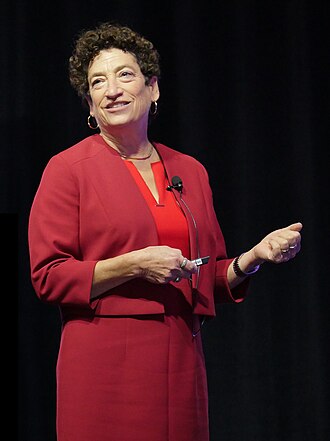
娜奥米·奥雷斯克斯 珍妮特·布朗 KKate Bruns
本期追问 · 点击跳到视频对应位置
听来的知识可靠吗?真理是客观,还是共识?科学是怎样进步的?举证责任应该落在谁身上?
归入 Ⅱ·09 真理是客观,还是共识? →
EDITED TRANSCRIPT · 依据现场录音编译整理,可划线生成便签
编者按:本文为哈佛书店「科学新书讲座」系列秋季收官场的实录。科学史家、地质学家出身的娜奥米·奥莱斯克斯(Naomi Oreskes)在哈佛大学谈她的新书《为什么要信任科学》(Why Trust Science?),达尔文传记作者、时任科学史学会主席珍妮特·布朗(Janet Browne)主持并引荐,哈佛书店的凯特·布伦斯(Kate Bruns)开场。本文依据现场录音编译整理,仅删去口语枝节,论证、例子与问答均完整保留。

开场:书店系列与讲者引荐

布伦斯: 各位晚上好,感谢大家今晚的到来。我是凯特·布伦斯,谨代表哈佛书店、哈佛大学理学部和卡博特科学图书馆,欢迎各位来参加今晚的活动:娜奥米·奥莱斯克斯谈她的新书《为什么要信任科学》。稍后我会把时间交给科学史教授珍妮特·布朗来介绍讲者,但先容我说几句这个系列本身。「科学新书讲座」贯穿整个学年,请新近出版的科学类著作的作者来演讲。今晚是秋季的收官之场,过去几周我们听了肖恩·卡罗尔、李·斯莫林、兰道尔·门罗等许多人的精彩讲座。假期里若想继续关注这个系列,几乎所有讲座都有录像,可以在我写在黑板上的网址观看,那里也会公布春季的活动安排;哈佛书店在哈佛广场周边的其他讲座,可以到 Harvard.com 订阅每周邮件。今晚的演讲之后有提问时间,随后在走廊对面的卡博特科学图书馆签售并备有茶点;《为什么要信任科学》在会场后方和图书馆都有售。照例要感谢几方:感谢哈佛的合作伙伴让这个系列(以及招待会上那一排至关重要的奶酪)成为可能,感谢各位到场,感谢你们买书支持独立书店,也感谢你们以此表明科学是要紧的。最后提醒一句,请在演讲开始前把手机调成静音。

现在请允许我介绍珍妮特·布朗:获奖作家,达尔文研究者,哈佛大学 Aramont 科学史讲席教授。《纽约时报》称她那部两卷本达尔文传记「在细节与格局上无可匹敌」。她曾任《英国科学史杂志》主编,现任科学史学会主席。请大家欢迎布朗教授。

布朗: 谢谢凯特,你太客气了,我没料到还会有人介绍我。我今晚的任务就是问候各位,感谢大家到场,然后介绍娜奥米·奥莱斯克斯,对各位而言是奥莱斯克斯教授。娜奥米 2013 年加入哈佛,是科学史系教授,同时兼任地球与行星科学系,这种双重身份她已经保持了很多年。此前她在加州大学圣迭戈分校的科学研究项目任教,我不太敢拿它跟哈佛的科学史系类比,但两者在范围和视野上非常相近;她同时还挂靠在那里的地质系和斯克里普斯海洋研究所。所以她的学术生涯一直是一半科学、一半科学研究与科学史。她早年在澳大利亚等地做过货真价实的地质学家,如果你们有幸到楼上科学史系她的办公室去,会看到那段生涯留下的战利品:她的书房里有一批非常壮观的岩石标本。

后来她转向分析科学与科学政策,尤其是环境和环境政策,如今因她关于气候变化的观点而广为人知。贯穿这一切的,是一份坚定的信念:她要帮助公众、也帮助科学家自己认识到,我们需要信任科学的发现。她已经成为揭示当前环境恶化最有说服力的声音之一,也成为揭露否认气候变化的人物及其背后政策的重要政治声音。她投入极大精力去说明的一件事是:我们常说「气候变化辩论」,而娜奥米花了大量笔墨、写了好几本书和许多文章来强调,根本不存在什么辩论。科学家全都认为气候变化正在发生。那不是辩论,那场「辩论」是被人为制造出来的,制造者就是她在那本令她声名鹊起的书《贩卖怀疑的商人》(Merchants of Doubt)里描写的那些人。这一切始于她 2004 年在《科学》杂志上发表的一篇关于气候变化科学共识的论文,当时引起了轩然大波。那篇论文表明,科学家到 2004 年为止(此后当然更是如此)拿出的结论完全值得信赖,所谓辩论并不存在。由此便有了她与埃里克·康韦合著、2010 年出版的《贩卖怀疑的商人》,明年将出新版,其间还被拍成了纪录片,我很推荐,看了既震撼又实在令人忧心。

她与康韦的合作还产生了另一本极好的书,我看到上面的桌子上就有卖,是企鹅出版的一本小说:《西方文明的崩溃》。她和合著者假想自己生活在 2393 年,回望 2000 年,记下那些不可逆的变化是由谁、在何时、以何种方式、在哪里发生的,而这些变化在那个遥远的未来正在毁灭世界。我推荐这本书,读来并不愉快,但它是小说,而且非常有启发。她眼下正在写一本关于冷战时期海洋学的新书,不过今晚我们是来听她讲最新的这本《为什么要信任科学》。我相信她会告诉大家,这本书源于她的几场公开讲座,汇集了她的一个核心关切:让人们明白科学是完全可以信赖的。诸位也许不知道,外面确实有人认为科学不可信,所以这是一本重要的书。希望大家有机会读一读,我自己也得读。演讲之后会留出提问时间。娜奥米,请。

《贩卖怀疑的商人》与红州演讲

奥莱斯克斯: 谢谢珍妮特的美言。大家都能听见吗?好。作为一个个子矮的女人,我不喜欢讲台,那是为大个子男人设计的,站在后面我就成了一颗会说话的脑袋,所以我就站在这儿讲。今晚我想换个做法,不放那一百张塞满数据和事实的幻灯片。我想谈谈我为什么写这本书,为什么认为它重要,为什么值得花这个时间,然后读几段书里的内容。顺便也要感谢哈佛书店,感谢梅利莎·富兰克林促成此事,感谢各位今晚到场。

正如珍妮特所说,我和埃里克·康韦合著了《贩卖怀疑的商人》。那本书 2010 年出版,问的是:否认气候变化的是些什么人?受过教育的人(他们当中许多人教育程度很高)为什么会拒绝来之不易的科学发现?我们在书里说明,对气候科学的反对很大程度上出于意识形态动机:不是因为无知,不是因为公众不了解科学,用「知识缺失模型」(deficit model)解释不通。这些人受过很好的教育,却出于意识形态的原因去挑战气候科学,也挑战其他许多环境议题和公共卫生议题相关的科学,因为他们信奉自由市场资本主义和放任经济学的原则,害怕政府干预市场会把我们推上通往社会主义的滑坡。这与冷战政治绑在一起,与美国的武器计划绑在一起。这些人当中很多是物理学家,参与过冷战武器项目:原子弹、氢弹、早期的太空计划。

书出版之后(其实出版之前就开始了),我做了大量公开演讲,收到的邀请非常多。在这些演讲里我讲气候变化科学的发展史,以科学史家的身份讲科学家是如何理解这个问题的,讲他们当初为什么要研究它。为什么戴夫·基林在 1958 年决定毕生测量大气中的二氧化碳?为什么从真锅淑郎和柯克·布莱恩开始的一整批科学家认定,建立地球气候系统的模型是一件科学上要紧的事?我精心打磨这些演讲,其潜台词是:这不是一时风尚,不是自由派环保人士最新的时髦,不像吃羽衣甘蓝那样。科学家研究这个问题已经超过一百年,其实超过一百五十年,可以追溯到 1840 年代约翰·丁达尔在爱尔兰发现二氧化碳是温室气体。所以如果这是一场骗局,那它一定起源于爱尔兰,而不是中国。用意在于让人们了解这门科学有多深厚,然后才能说:对它的反对不是科学上的反对。

我走遍全国讲这些,几乎凡有邀请必去。我还给自己立了个「红州誓言」:如果受邀去一个听众未必友善的地方,我一定努力去跟那些人交谈。公开演讲最好的一点是听众会提出有意思的问题,你能从听众身上学到东西,知道他们在关心什么,怎么看这个议题。所以我很高兴地说,跟某些人不同,过去十年我没有一直活在剑桥的泡泡里。

堪萨斯的质问:凭什么信科学

奥莱斯克斯: 有时候会碰上一个问题,让你久久难忘。我在堪萨斯州的海斯做过一场演讲,不知道在哪儿的话可以去谷歌地图查一查。那是一次很好的经历。演讲后签售时,一位女士走过来,拉住我的胳膊说:「上帝保佑你来海斯。」访问很愉快,但我也清楚记得一个问题。演讲结束后,听众席里一位男士站起来,双手叉腰,挺起胸膛说:「说得都挺好,可我们凭什么信这科学?」这个问题我后来遇到过很多次,形式各异,有的不那么咄咄逼人,有的更甚。

我从这些问题里意识到的是:我,很可能也包括今天在座的各位,几乎所有在哈佛教书、上学的人,以及大多数住在马萨诸塞州剑桥的人,都把「科学大体可信」当成理所当然。这并不是说我们照单全收科学家说的每句话,我们也知道科学家有时会改变看法,但我们一般不去质疑这项事业本身。大体上(当然有例外),如果科学家,真正的、严肃的科学家,比如我们自己在地球与行星科学系或公共卫生学院的同事,告诉我们他们研究过了,是的,气候正在变化,而且是温室气体和毁林驱动的;是的,吃太多红肉对健康不好;是的,疫苗不会导致自闭症,我们多半会说:好,行,不会有多大动力去挑战。可是在邮编 02138 之外,很多人不是这么看的。于是我开始觉得,应该认真对待这个问题,它并不是个无关紧要的问题。

我有种运气,时不时会撞上一个后来变得极其应景的问题。我动笔写这本书是在白宫现任主人当选之前。我丈夫爱说:「停摆的钟一天也能对两次,别太得意。」可所有人都对我说这本书来得太及时了,我倒觉得有点讽刺,因为我琢磨这件事差不多快十年了。几年前受邀去普林斯顿做坦纳人类价值讲座(Tanner Lectures),我觉得是时候正面处理这个问题了。这本书就以那几场讲座为基础,还收录了受邀到场的其他学者对我讲座的评议;之后我根据他们的评议修改讲稿,他们又根据我的回应修改评议,最后我写了一篇后记。所以书里有一场我和几位评议人之间非常丰富的交锋。事后看这是一件很好的事,事先我并没有想到,因为我们某种意义上正是在示范这本书的核心论点。接下来我先花几分钟讲这个核心论点,再提一提评议人提出的几个问题,然后读几段书里回应这些问题的文字。

核心论点:不是「科学方法」

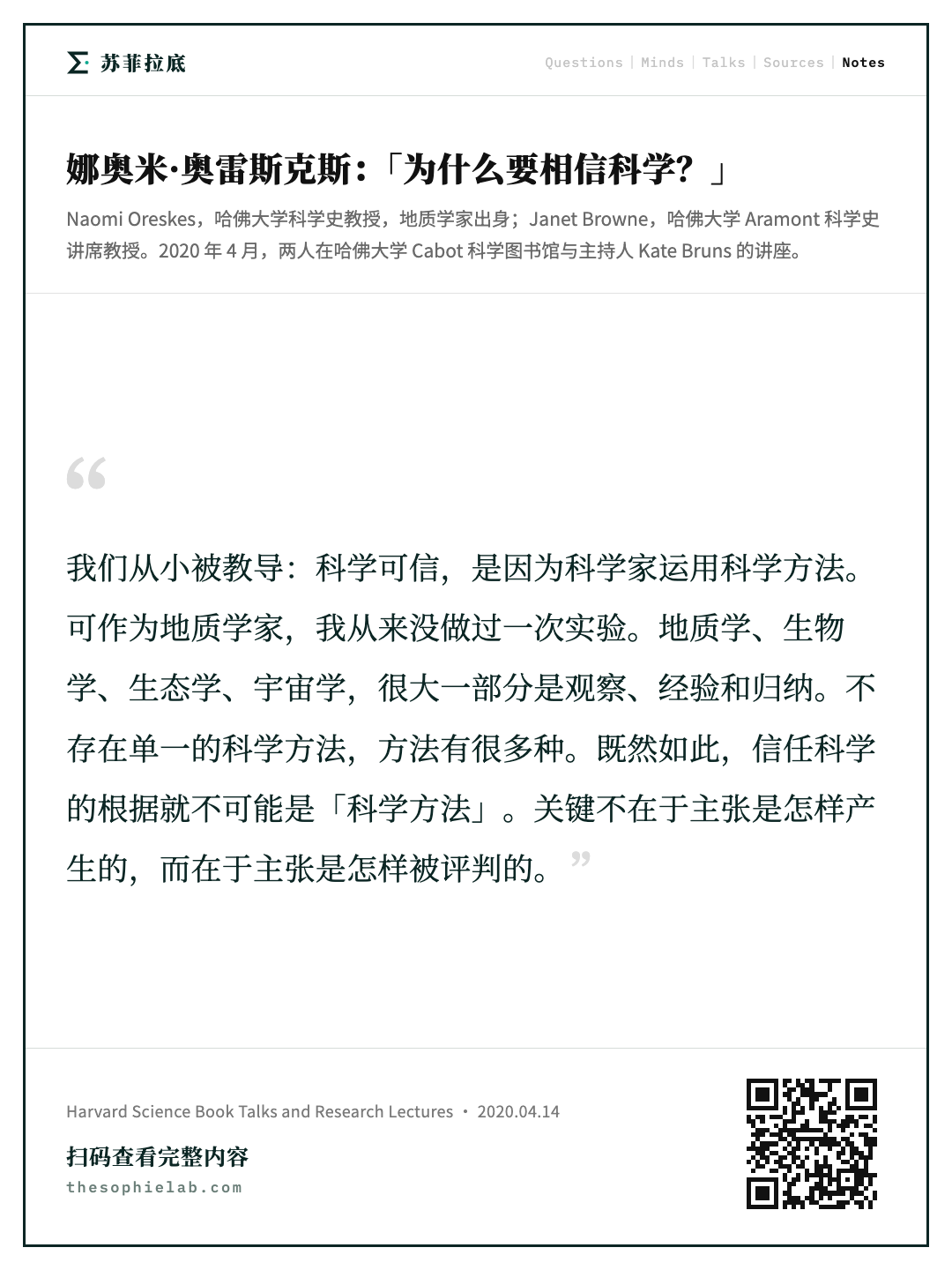
奥莱斯克斯: 这本书的核心论点是:科学之所以可信,根据并不是我们许多人以为的那样。我的意思是,根据不是「科学方法」(the scientific method)。我们很多人从小被教导:科学可信,是因为科学家运用科学方法得出可靠的结果。如果你家孩子在读高中,翻开他们的科学教科书,我几乎可以保证你会看到这一套。我上学时学的就是这个,我的孩子学的也是这个。可这种说法一直让我不安,因为我骨子里是个地质学家,受的是地质学训练(我演讲时总穿牛仔靴,好让你们知道我是地质学家)。通常被当作「科学方法」拿出来讲的那一套,根本不是地质学家做的事。

要是我问各位「什么是科学方法」,你们会怎么答?有人吗?对,做实验:先有一个假设,做实验来检验,实验成功就说假设正确,失败就回去修改,再想别的。可作为地质学家,我从来没做过一次实验。有实验地质学家,有人做实验,但我从没做过。我做的一切都是经验的、归纳的。刚才为我作介绍的,是世界上最杰出的达尔文研究者,而达尔文做的也主要是归纳性、观察性的科学。我们知道,大量的科学,大量重要的科学,在可以称作「自然历史科学」的领域里,地质学、生物学、生态学,还有宇宙学,很大一部分是观察、经验和归纳,并不建立在实验之上。就算谈实验,如今许多科学家也不再摆弄试管、穿白大褂,他们在计算机上做实验。有人现在甚至说某项工作是「在硅中」(in silico)完成的,我觉得挺装腔作势,不过也罢。要点是数值模拟,建模已经成了科学的重要工具。

所以我们在科学史中看到的,我自己作为地质学家的经历所知的,以及科学史同行反复证明的,是:不存在单一的科学方法,方法有很多种。方法随时间演变。十九世纪没有计算机建模,但二十世纪初有物理模型,有机电模型,各种各样的模型。我研究过用石膏、黏土、甘油和其他好玩的东西做模型的地质学家。科学的方法是多样的。我想多数科学史家会说,这是好事,多样即是力量。但如果科学的方法是多样的,那么信任科学的根据就不可能是「科学方法」,因为并不存在一种单一的科学方法。那么根据是什么?

我在书里主张:关键与其说在于主张是怎样产生的,不如说在于主张是怎样被评判的。科学真正要紧的东西是对主张的集体审查(collective vetting)。我做了实验或观察,提出一个主张,这在某种意义上只是过程的开始,因为接下来我得把这个主张交付批判性的检视,而检视有许多方式。

集体审查:同行评议与筛选效应

奥莱斯克斯: 期刊的正式同行评议是最显眼、最容易辨认的一种,但在我们大多数人把文章投出去之前,还有一整套非正式的同行评议。如果你是科学家,你知道这一套:你在研讨会、学术会议上把想法拿出去转一圈;也许把文章寄给几个信得过的同行,请他们提意见;也许先给研究生、博士后看看。在投稿之前,就有一整个审查、修改、修补的过程,某种意义上是投稿前的「修改后重投」。然后投给期刊,再经历一轮正式的同行评议。做过的人都知道,同行评议可能相当难堪,常常不太客气。可我们为什么要忍受它?我写完这本书的时候,我丈夫正在某家不便点名的期刊经历一轮特别难堪的评审,我记得当时就在想:我们为什么要受这个罪?当然是因为我们打心底相信,哪怕并不总是喜欢它,它对我们有好处,有点像吃药。这个过程最终会带来更好的成果:审稿人会提出正当的问题,有时逼我们把某个主张想得更透,也许还真的逼我们去多收集些数据。这是好事,因为这意味着论文发表时已经经过了相当程度的审查。

我们都知道同行评议并不完美,都知道有时候糟糕、愚蠢、无聊的坏论文照样发表。我读研究生时读过一篇论文,描述一些切穿岩石的矿脉,而对这些矿脉的放射性测年结果显示,矿脉比它们切穿的岩石还要古老。这在物理上是不可能的。我记得自己坐在那儿想:这篇论文是怎么通过评审的?所以我们知道同行评议是个不完美的过程,但总体上我们仍然相信它有很大好处。论文发表以后,审查还在继续,因为你有机会写批评、讨论和回应。当然,最后还有「布丁好不好,吃了才知道」:一篇论文如果糟糕、错误或愚蠢,它就不会真正被使用。我们引用和使用的,是我们认为有帮助的工作。哪些工作被引用、被使用、成为新想法的基础,这里面也有一个过程。我们都知道,发表的论文绝大多数从来没有被引用过,一次都没有,想想有点令人沮丧,当然不包括我们自己的论文。所以长期看有一种筛选效应(winnowing effect):经得起时间考验的论文经受住了考验。

我的论点是:正是这个过程,这种对主张的批判性审查,才真正产生可靠的结果,因为不可靠的、难以置信的结果大体上都被筛掉了。要再说一遍,这是一种统计的、概率的观点。我不是说每篇发表的论文都好,也不是说每篇坏论文都被拒了,显然不是;这是一个关于整体的论证。

不过这里有一个重要的附带条件:我们知道科学家会有盲点,科学史一再证明科学家可能有偏见。换个比喻说,科学家可能对种族或性别问题充耳不闻。十九世纪有大量工作,今天回头看,性别偏见或种族偏见一目了然。这就引出另一件要紧的事:这个过程要有效运转,科学共同体必须是多元的。共同体越多元,带入的视角就越多,就越有可能有人识别出盲点、指出偏见,并有机会加以纠正。这幅科学图景告诉我们:多元性不仅在伦理上是正确的,在认识论上同样是正确的。我认为这是一个相当重要的结论。

多元性的认识论价值与专家辩护

奥莱斯克斯: 书的另一部分,另一个论点是:科学家做这一切,投稿、提主张,凭的是什么?凭的是工作,凭的是我前面说过的各种各样的方法。所以另一个关键之处在于,科学家是以持续的、批判的方式与自然世界打交道(社会科学则是与社会世界打交道)。因此这本书在某种意义上是为专业知识(expertise)辩护。如今批评专家、怀疑专家、说专家总是出错很时髦,但我不确定这是不是真的。这也是从演讲中得来的。有时有人对我说:「专家老是出错,我们凭什么信专家?」我就反问:「你想到的是哪个科学家出错的例子?」有意思的是,很多时候对方举不出例子,只是一种笼统的印象,觉得科学家老是出错谁都知道。真有例子的时候,例子无一例外来自营养学。所以我最近对营养学的兴趣大增,一直在密切关注近来关于红肉的争论。营养学为什么成了「沉闷的科学」,我想能找出一些原因;而且眼下肉类行业和红肉问题上正在上演一出「贩卖怀疑的商人」的戏码,这些都得承认,但那不是这本书的主题。

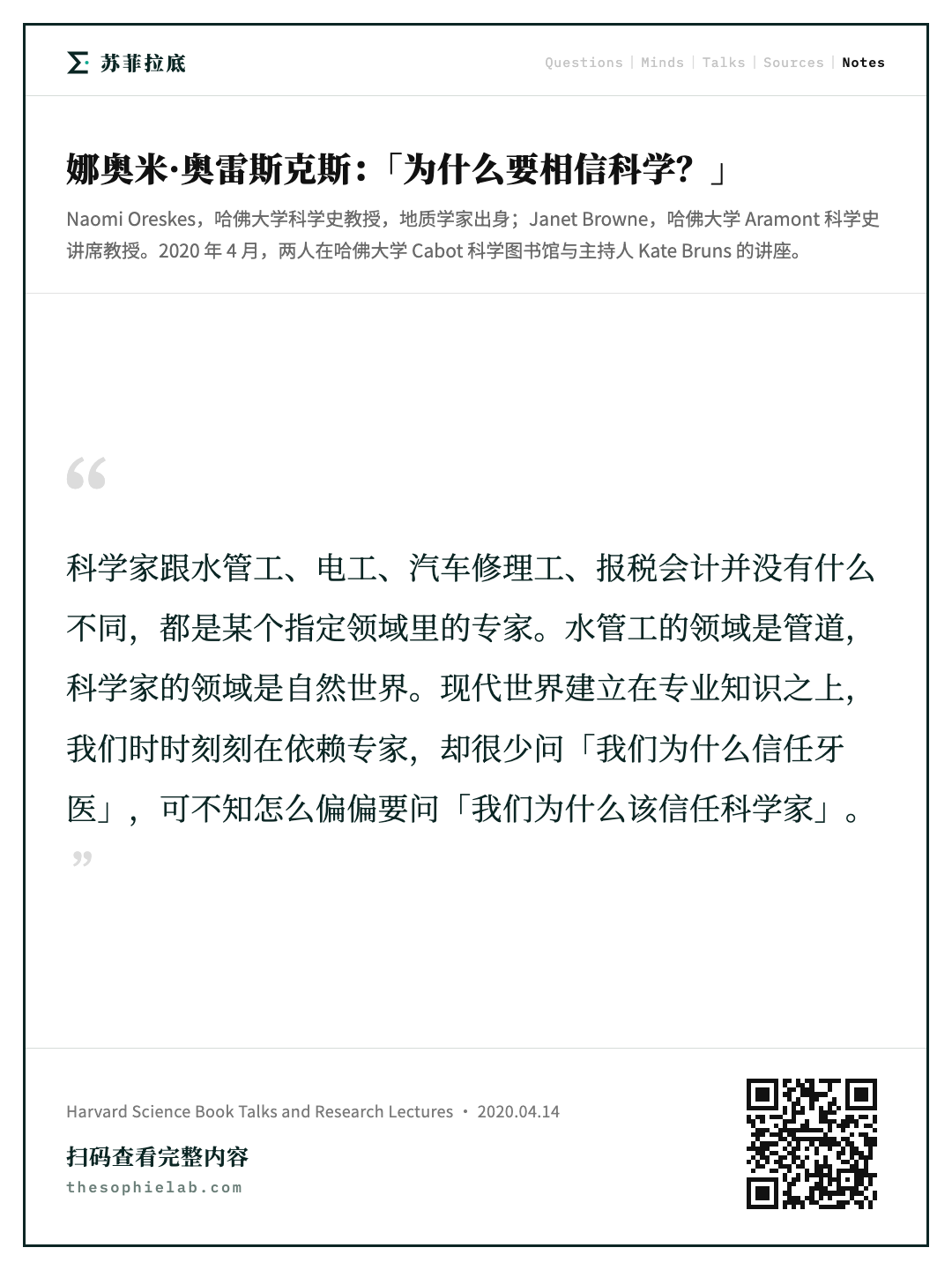
这本书的主题是为专业知识辩护。我们常常把科学说成一种非常特殊、非常崇高、深奥难懂的东西,但我想说,更好的看法是:科学家跟水管工、电工、汽车修理工、报税会计并没有什么不同,他们都是某个指定领域里的专家。水管工的领域是管道,修理工的领域是修车,科学家的领域是自然世界。我们信任修车师傅来修车,只要师傅还过得去,因为我们自己确实不会修车。我们需要修车师傅,正如需要牙医,因为我们不会给自己补牙;我们需要医生,需要报税会计。事实上我们需要各种各样的专家。现代世界建立在专业知识之上。如果不信任专家,社会就会停摆:早上都没法去上班,没法维持健康;甚至你爱看体育版,也是分析员让比赛变得更有意思,告诉你该留意什么。我们时时刻刻在依赖专家,却很少问「我们为什么信任牙医」,可不知怎么偏偏要问「我们为什么该信任科学家」。我的论点是:科学家就是我们的专家,是我们出钱雇用、托付他们去理解自然世界的人,而这项工作我们自己在大多数情况下既没能力也没资格去做。这就是本书的论点。

接下来我想提评议人提出的三个问题,各读一段书里的回应,这样各位还有兴趣去读书的主体部分,我不会把它全都讲光。评议人提出了三大问题。第一个是循环论证的问题。我说科学主张可信,是因为经过了其他科学专家的审查;可如果是专家评判专家,你可以说这是循环论证:我们怎么知道专家是对的,又怎么知道谁是专家?我会读一小段来回应。第一个问题是马克·朗(Marc Lange)提的;第二个问题由乔恩·克罗斯尼克(Jon Krosnick)教授提出,即可重复性危机(replication crisis)。几乎所有人都听说过可重复性危机,我们知道,或者我们自以为知道,这是科学中的一个大问题,我对此有几句话要说。第三个问题是价值在科学中的角色,尤其是我们都知道科学家可能过度自信,而对科学主张的过度自信有时并不是好事;我们也从科学史中知道,科学家自己并不总能清醒地意识到自身价值观如何影响他们的科学思考。对此我也有几句话。下面我读书里的文字。

回应一:循环论证与谁是专家

奥莱斯克斯: 马克·朗指出,「我们为什么该信任科学」这个问题「很容易引起一种眩晕,甚至绝望」。许多可能的答案都会坍缩成循环论证。比如,诉诸经验证据的推理(我那套基于历史的论证就是),本身就是一种科学论证,因为它是经验的;这样一来我们就是在用科学的推理方式为科学的推理方式辩护,这正是循环论证的定义。再者,如果我说我们应当信任科学,因为它是专家有根据的结论,那就得问:判断一个人是专家,依据是什么?答案当然是:由其他专家来判断。所以这也是循环的。真是这样吗?

专业知识的标志,学术资历、在相关领域同行评议期刊上的发表、奖项和荣誉,是非专家也看得见的。记者有时问我:「我怎么判断一个所谓专家是真专家而不是托儿?」我回答:一个起点是查清楚他受的是什么领域的训练,在那个领域有哪些发表。当然,朗教授说得对,训练是由其他专家提供的,要成为专家得靠专家培养,所以看起来我们仍没有逃出循环。但出路是有的,因为专业知识的社会标志对非专家是可见的。这一点并非无关紧要:相对容易看出,大多数否认气候变化的人不是气候科学家,对进化论的反对基本上来自科学之外的领域。中立的非专家能够识别专家,也能分辨专家得出了什么结论、没有得出什么结论。社会标志不能告诉我们某位专家是否值得信赖,但能告诉我们这个人是不是专家,更要紧的是,能告诉我们一个自称专家的人是否并不具备专业知识。同样,区分普林斯顿大学或劳伦斯利弗莫尔国家实验室这样的研究机构与美国企业研究所或发现研究所这样由政策驱动的智库,是容易的,或者说应当是容易的。记者常常分不清,这跟截稿期限的关系比跟认识论的关系大。

当然,正如我一再强调的,专家可能出错。若非如此,我们整个探讨都是多余的。作为一项人类活动,科学是可错的(fallible)。共识不等于真理。共识是一种社会状态,不是认识论状态,但我们把共识当作替代指标,因为我们没有办法确知真理是什么。而且共识这个范畴在认识论上是相关的,因为我们的历史案例表明,凡是专家看起来走了弯路的地方,通常都缺乏共识。因此我们必须接受这样一个事实:我们的指标是不对称的。我们永远无法绝对肯定自己是对的,但我们确实有一些指标能提示什么地方可能出了错。这就是共识为什么重要,就是为什么必须能够识别并排除托儿、名人,以及也许出于善意但走入歧途的外行,以便弄清楚谁是专家、他们说了什么、依据是什么。以上处理的是循环论证问题和专家的界定。

回应二:可重复性危机的再审视

奥莱斯克斯: 下面读一点关于可重复性危机的内容。显然,这些只是更长、更复杂的对话的片段。乔恩·克罗斯尼克教授提醒我们注意当代科学中一个严肃的问题:所谓「可重复性危机」。这个问题有可能动摇公众对科学的信任,也可能反驳我的论点,即只要审查者多元且乐于自我批评,集体审查科学主张的过程就很可能导向可靠的结果。问题是这样的:有不少广受报道的例子,发表在有声望期刊上的论文,有的还被大量引用,其结果却无法重复。有些论文被撤稿,于是评论者又宣称存在「撤稿危机」。关于可重复性危机及其补救办法的讨论,大多集中在心理学和生物医学上。但克罗斯尼克教授声称,问题涉及当代科学的全部领域,因为科学的激励结构奖励快速发表而牺牲审慎与勤勉。也许如此,但克罗斯尼克的具体例子全部来自心理学和生物医学,后者又主要来自药物临床试验。这两个领域里统计分析都处于核心地位,也都被证明存在滥用统计的现象,尤其是「p 值操纵」(p-hacking)。可以合理地推断,统计滥用不限于心理学和生物医学;但整个科学是否存在更广泛的问题?证据在这里就变得模糊了。我觉得奇怪的是,克罗斯尼克教授强调严谨经验研究的重要性,却在有限的证据上做出宽泛的论断,把可能各不相同的现象混为一谈。这里我对克罗斯尼克有点不客气,但我想是他自找的。

在开头他讲了一个赤裸裸的造假故事:一位教授在一百多篇发表于顶尖期刊的论文里伪造数据。这无疑很糟糕,但欺诈是一切人类活动的共同特征。它在科学里比在金融、房地产或矿产勘探里更常见吗?他提供的信息不足以让我们判断。它能让我们做的,是追问为什么这起欺诈没有更早被发现,提醒我们科学同任何人类活动一样需要监督,并考虑科学是否需要更好的监督机制。接着克罗斯尼克又给我们讲了一件完全不同的事:一篇声称证明了超感官知觉(ESP)确实存在的论文,「引发了一场风暴,因为结果显得难以置信,又无法重复」。这跟欺诈恰恰相反:它说明科学在按照应有的方式运转。一篇论文发表了,提出了一个强烈、意外而不可信的主张;它立刻受到严厉的批判性审视,心理学界拒绝了它。当然可以问这篇论文当初为什么会发表,但如果科学要像我主张的那样对多样的想法保持开放,那么错误的、愚蠢的甚至荒谬的东西偶尔见诸印刷就在所难免。这本身并不是对科学的控诉;恰恰相反,它证明科学共同体即便对某些我们觉得早该关门的想法也依然开放。

然后是心理学史上最著名的研究之一,那个著名的、或者说臭名昭著的斯坦福监狱实验。我们被告知,英国广播公司(BBC,它不是科学机构,所以人们立刻会对其动机和可能的偏见产生疑问)试图重复斯坦福监狱实验而未能成功。于是我们有了研究一对研究二,该怎么看?有四种可能。其一,研究一正确,研究二因自身缺陷未能重复。其二,研究二正确,研究一应被视为被推翻。其三,两项研究都不正确,只是错法不同。其四,两项研究都正确,但进行的条件不同,因而分别提供了关于人类在不同条件下如何行为的不同信息。没有更多信息,不可能确定这四种之中哪一种是对的。

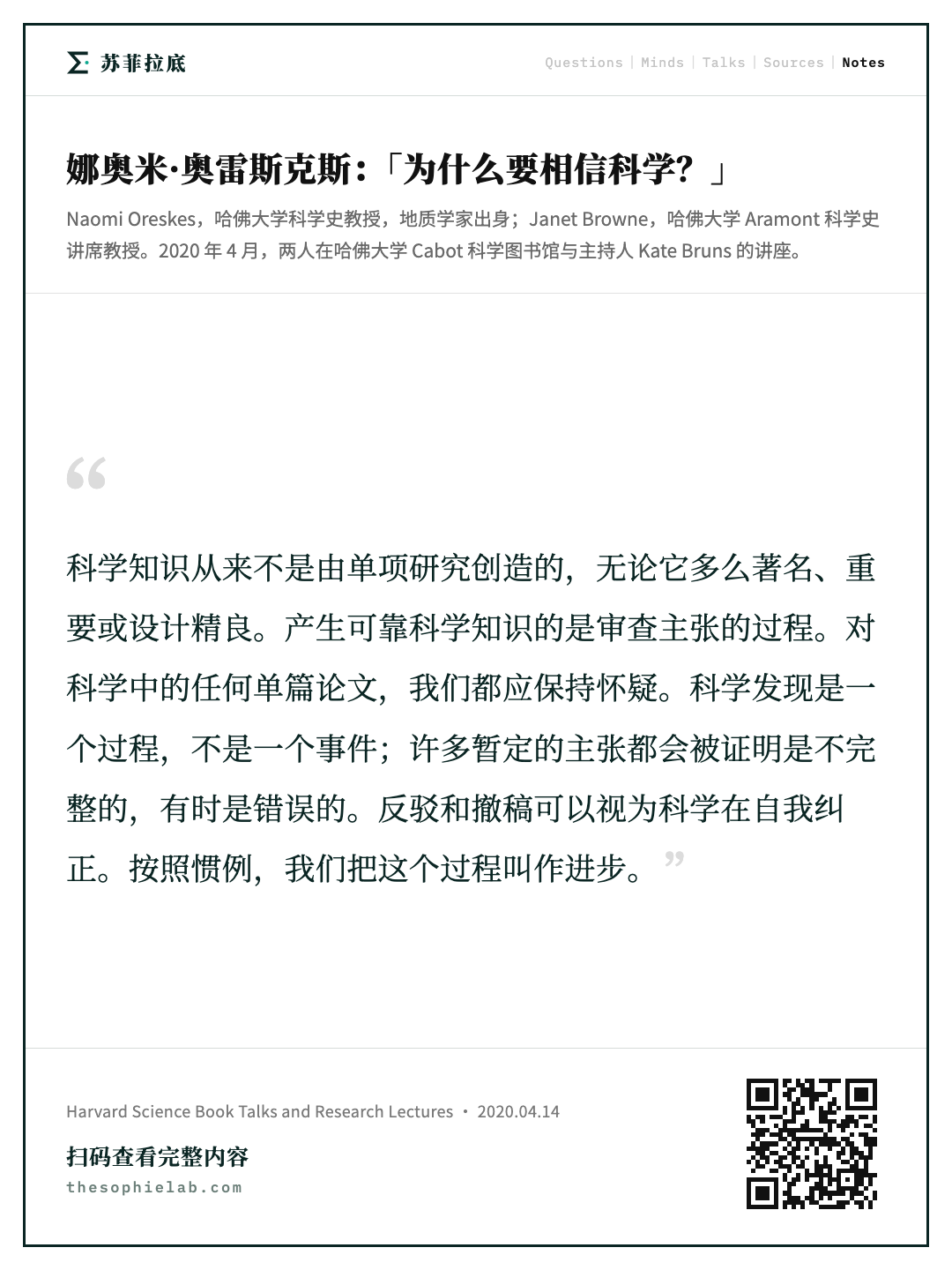
克罗斯尼克教授拿来当作科学出了毛病的证据的研究,大多是后来被证明有缺陷的单项研究,而我的论证的要旨恰恰是强调:科学知识从来不是由单项研究创造的,无论它多么著名、重要或设计精良。产生可靠科学知识的是审查主张的过程。关键在于,这种审查必须包含多元的视角,必须呈现以多种方式收集的证据。这意味着单篇论文不能成为可靠科学知识的基础。事后看,我们或许会认为,考虑到斯坦福监狱实验只是单项研究,它被赋予的分量实在太重了。因此克罗斯尼克教授的评议反而强化了我关于共识的论点。对科学中的任何单篇论文,我们都应保持怀疑。科学发现是一个过程,不是一个事件;在这个过程中,许多暂定的主张,也许是大多数暂定的主张,都会被证明是不完整的,有时是错误的。正如几位美国国家科学院前院长最近所说,若能及时进行,反驳和撤稿可以视为科学在按应有的方式自我纠正。按照惯例,我们把这个过程叫作进步。

回应三:价值中立为何行不通

奥莱斯克斯: 最后我想读关于科学中的价值问题的一节。我认为这是最棘手、最复杂的一个,因为问题本身就棘手而复杂,请各位耐心。有人担心,对科学发现或科学家观点的过度自信会导致糟糕的公共政策。我同意。过分强调技术考量而牺牲社会、道德或经济考量,可能导致糟糕的决策,但这与所涉科学本身对错无关。如果一个科学问题已有定论,而得出定论的科学共同体是开放而多元的,那么我们理应接受这门科学,然后再决定对它的含义采取什么行动,或者不采取行动。至少我认识的几乎每一位科学家都会这么说,我过去也这么说过。这是经典的事实与价值二分的具体化:我们可以先确认事实,再根据自己的价值观另行决定要不要做点什么。但从经验上看,这种策略已经不管用了,假如它曾经管用过的话,因为大多数人并不把科学和它的含义分开。我们现在知道,许多人拒绝气候科学,不是因为这门科学作为科学有什么问题,而是因为它与他们的价值观冲突,或被视为冲突:他们的宗教观点、政治意识形态或经济利益。人们拒绝或批评科学发现的理由很多,但常常包含这样一种认知:这些发现与他们的价值观相抵触,或威胁他们的生活方式。1960 年代,政治左翼的许多人批评科学,因为它被用于战争。今天,政治右翼的许多人批评科学,因为它似乎暴露了当代资本主义和「美国生活方式」的缺陷。

举个例子。1992 年里约热内卢地球峰会之前,美国总统老布什在讨论人为气候变化时坚称,「美国的生活方式没有商量的余地」。这位总统签署了《联合国气候变化框架公约》,即那次会议产生的国际条约,并承诺付诸行动。但与此同时,他点明了环境科学发现的含义与美国高消耗生活方式之间的冲突。至少有一部分环保人士把环境问题归咎于这种生活方式,因而想要改变它。这种模式延续至今,有助于解释为什么共和党人对气候科学的怀疑远甚于民主党人。事实上,只有这一点能解释为什么某些保守派坚称应对气候变化的提案是反民主、反美国或反自由的。

如果问科学家,福音派基督徒为什么拒绝进化生物学,很多人会回答:因为他们按字面解读《圣经》,坚持上帝在六天内创造了地球和万物。但天主教徒生物学家肯尼斯·米勒指出,福音派反对进化论的论证很少涉及对《圣经》的字面解读,事实上很少提及《圣经》;他们诉诸的是一种理论在道德上(或不道德上)的含义:这种理论说人类是偶然产生的,是一个无目的的随机过程的结果。前宾夕法尼亚州参议员、两度竞选总统的里克·桑托勒姆就解释过,他拒绝自然选择进化的概念,因为它把人类「变成自然的错误,从而摧毁了道德的基础」。其他反进化论者主张,如果进化论为真,生命就没有意义。

科学家试图躲开这些科学之外的考量的刺痛,办法是退回到价值中立:坚称我们的科学也许有政治、社会、经济或道德含义,但科学本身是价值无涉的,因此价值观不是拒绝科学的正当理由。重力不管你是共和党还是民主党;酸雨既落在有机农场也落在高尔夫球场(这是比尔·拉克尔肖斯多年前的原话);大气中的辐射传输今天的运作方式和 2016 年之前一模一样。这个论证是对的,但不够,因为无论应不应该,我们的听众确实把科学和它的含义联系在一起。福音派基督徒拒绝进化科学,因为他们相信它与自己的宗教观点相矛盾;自由市场的福音派拒绝气候科学,因为它暴露了他们经济世界观里的矛盾,而正因为这些矛盾,他们不信任那些揭露矛盾的科学家。这很难绕开,尤其当我们承认并不存在一种能担保科学结论真实性的科学方法,承认科学不过是相关专家经过充分考虑后对某一问题形成的共识。

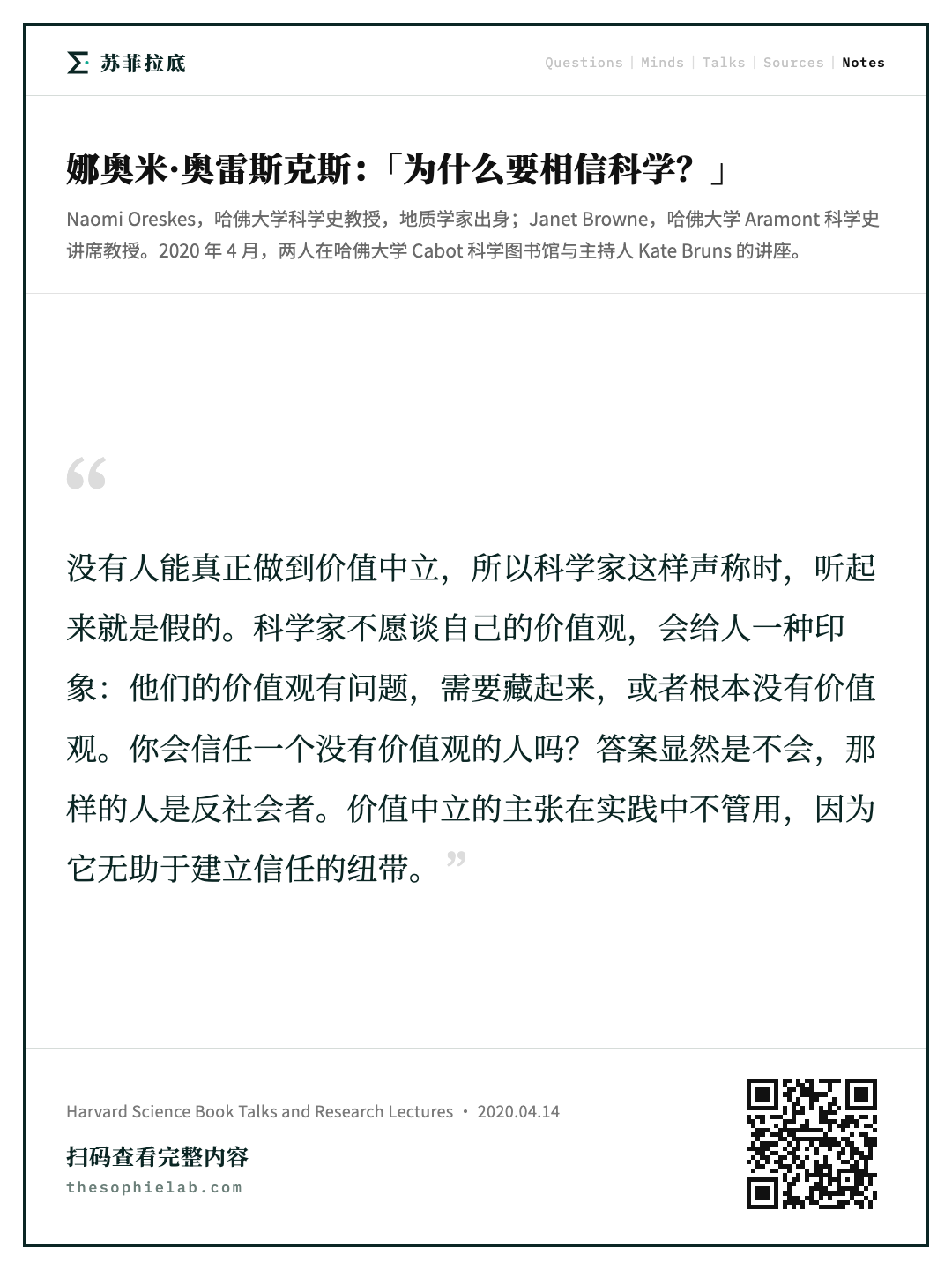
把科学知识看作专家的共识,不可避免地把我们带到这样一个问题:科学家是些什么人,凭什么该信任他们。科学家通常认为这类问题是「对人不对事」,因而不正当;但如果认真对待「科学是一个共识性的社会过程」这个结论,那么科学家是什么人就是要紧的。社会科学家关于信任如何建立和维系的发现超出了本书的范围,但我们知道一点:在价值观相同的人之间建立信任,比在没有共同价值观的人之间容易。然而价值观恰恰是科学家大体上拒绝讨论的东西。就像「科学家是谁」这个问题一样,「科学家除了科学本身还相信什么」一般被视为禁区。正如社会学家罗伯特·默顿几十年前指出的,当客观性或诚信受到质疑时,科学家的典型反应是退回到「对纯科学的颂扬」,坚称自己唯一的动机是追求知识。无论科学发现有什么含义,他们坚持这项事业本身是价值中立的。可是没有人能真正做到价值中立,所以科学家这样声称时,听起来就是假的,因为他们在声称不可能的事,除非我们把他们当作白痴天才或天真汉。我们可能因此把他们看作不诚实的人。然而诚实、开放和透明据说是科学研究的关键美德,那么科学家怎么可能一边诚实、一边否认自己有价值观?如果科学家坚持这项事业是诚实的,却在它的性质上误导听众,哪怕是无意的,他们就在自己事业的根基上制造了一个矛盾。

有人会反驳说,科学家并不是声称自己没有价值观,只是声称不让价值观影响工作。这个说法既无法证明也无法证伪,但社会科学研究和常识都表明它不大可能是真的。这又引出更进一步的一点,它不知怎么一直没有得到认真考虑,却可能正处于许多美国人不信任科学的核心:说科学是价值中立的,差不多等于说它没有价值观,至少除了知识生产之外没有,而这很容易滑向「科学家没有价值观」的暗示。显然事实并非如此,但科学家不愿谈自己的价值观,会给人一种印象:他们的价值观有问题,需要藏起来,或者他们根本没有价值观。你会信任一个没有价值观的人吗?答案显然是不会,那样的人是反社会者。你也不会信任一个价值观与你格格不入的人。但如果你觉得那个人至少与你有部分共同的价值观,哪怕不是全部,你也许愿意听一听,也许会接受你听到的一部分。因此,无论价值中立的主张在认识论上是否站得住,我认为很清楚的是,它在实践中不管用,因为它无助于沟通,无助于建立信任的纽带。

共享价值:十诫、天课与个人信念

奥莱斯克斯: 科学家有时会觉得,跟否认气候变化的人或认为世界只有六千年历史的人,根本没办法建立信任的纽带,也许确实如此。我有一次公开表示过绝望,就在这个房间,在梅利莎·富兰克林组织的这个讲座系列里。我说,对于千禧年主义者,他们的末世论说世界快要终结了,那还担心什么气候,我对说服他们不抱希望。那是一个很晚的夜晚的最后一个问题,我们回答问题回答了很久,最后一个问题是「我在得克萨斯的亲戚认为世界快完了,那我们为什么还要在乎气候变化」,我答说那也许没救了。可就在第二天,我收到好几封来信,向我提供基于基督教价值观和教义去教导他们的策略。我现在对《哥林多书》知道得可多了。人们建议,触及这些人的途径是他们的价值观,社会科学研究也支持这个想法。

基于这个论证,我再读一段,然后收尾。宗教史家斯蒂芬·普罗特罗指出,犹太教徒、天主教徒和新教徒都认同十诫,但他们的十诫版本竟然各不相同。在座有多少人知道三家的十诫不一样?有人知道,但很多人不知道。这其实解开了我心中一个多年的谜:为什么走进天主教堂,满眼都是偶像?这不是违反诫命吗?原来天主教放弃了禁止偶像的那条诫命,而犹太教徒和新教徒牢牢守着它。天主教少了一诫,只剩九条很尴尬,于是把最后一条拆成两条。有人知道是哪条吗?对,贪恋。天主教有两条关于贪恋的诫命:一条是不可贪恋邻人的妻子,另一条是不可贪恋其他一切。邻人的妻子是特殊的。尽管如此,这三种宗教,涵盖约七成美国成年人,都同意不可杀人、不可偷盗、不可奸淫、不可作假见证、不可贪恋邻人的妻子;也都同意只崇拜一位神,不可妄称神的名,守安息日,孝敬父母。伊斯兰教也认同这些,尽管它比其他三者更强调慈善。天课(zakat),即施舍,是伊斯兰教的五功之一;请注意「zakat」一词与希伯来语的「tzedakah」(慈善捐助)多么相似,后者在犹太人的生活中被视为道德义务。慈善也是基督教的核心价值,虔诚的摩门教徒缴纳什一税。所以,即便我们在许多政治议题上意见不合,我们的核心价值观仍可能有相当大的重叠。只要我们能把这些共同之处讲清楚,并说明它们与我们的科学工作有什么关系,我们或许就能克服常见的怀疑和不信任,尤其是根植于「价值观冲突」这一认知的不信任。

所以我想,我理当说清楚自己的价值观,说清楚是什么驱使我去做捍卫气候科学的工作。我希望避免可以避免的人类苦难,保护地球上生命的美与多样。我希望保留冬季运动的欢乐、珊瑚礁的壮丽和巨杉的奇观。我爱雷暴,但不希望它们变得更危险;我不希望洪水、冰雹和飓风摧毁社区、夺去无辜者的生命。我希望我们所有的子孙后代,在美国和全世界,都拥有和我一样过上好日子、兴旺发达的机会。我不希望我们越来越穷,把越来越多的钱花在修补气候紊乱造成的破坏上,而这些破坏本可以用低得多的代价避免。我不认为让少数几家公司的利润变成我们所有人的损失是公平的。我相信政府是必要的,但我无意让它不必要地膨胀。我也像教宗方济各强调的那样相信,地球是我们共同的家园,无视气候变化就是既无视自然也无视正义。教宗提醒我们,他的名号所自的圣方济各之所以封圣,是因为他「与万物相通,感到自己蒙召去关爱一切存在」。有人会觉得这种与自然相通的情感与冷静的科学理性格格不入,但在十八、十九世纪,欧洲博物学家普遍认为科学探究是接近上帝的途径。他们遵循的是《所罗门智训》第十三章第五节的话:「从受造物的伟大与美丽,人可以类推而认识其创造者」。或者如海顿在他十八世纪末的伟大清唱剧里所唱:「诸天述说上帝的荣耀」,不管我们把那荣耀理解为什么。

我也相信,历史证明了约翰·邓恩近四百年前写下的话:「任何人的死亡都使我减损,因为我与人类休戚相关。」我相信我是我兄弟的看守者,你们也是。《创世记》里紧接着堕落之后的故事就是该隐与亚伯,难道没有缘由吗?《旧约》,世界三大一神教的根基,以创世开篇,大多数其他人类社会的起源神话和故事也是如此。所以无论我们把它叫作生物多样性、创世、梦幻时代、大地母亲还是上帝,气候变化都在威胁它。科学、历史、文学、伦理告诉我们的一切都说明,关爱同胞和关爱环境是同一件事。「人与环境」「就业与环境」「繁荣与环境」的对立是一种危险的虚构,编造出来是为了给贪婪辩护,以进步许诺的虚假利润之名,玩世不恭地为破坏背书。这就是我的信念。如果我们不按科学知识行动,而科学又是对的,人们将受苦,世界将减损,这方面的证据压倒性地充分。反过来,如果我们按现有的科学证据行动,而科学结论后来被证明是错的,那么,正如那位漫画家所说:「我们就白白创造了一个更好的世界。」非常感谢。

布朗: 非常感谢娜奥米,我们以一个幽默的音符收尾。科学史系的两位研究生会拿着话筒在场内走动,让各位提的问题大家都能听见。娜奥米准备好回答问题了。劳伦,请。

问答:可错论、传播与记者

提问者: 谢谢您精彩的演讲。我想稍微挑衅一下:坦白说,如果书名不是《为什么要信任科学》,而是《为什么不信任科学的批评者》,我会更满意。作为科学史家我们都知道,如果两百年后文明还在,那时的科学家很可能会说,两百年前我们拥有的科学理论全部或至少大部分是不完整的,甚至是错的。所以要点也许不在于科学有多牢靠,而在于今天科学批评者的论点有多虚浮、多错误。

奥莱斯克斯: 这是个很好的观点,作为科学史家我当然想过很多,因为没有哪个科学史家会声称科学不会犯错。简短的回答是,你刚才说的那一点,某种意义上正是《贩卖怀疑的商人》的全部内容:那本书就是要说明,为什么气候科学的批评者不应被视为可信,因为事实上驱使他们的东西与科学证据本身毫无关系。

我想过很多的另一件事是:我成长于一代把「可错论」(fallibilism)当作核心的科学史家之中。读研究生时我们都学过「悲观归纳」(pessimistic meta-induction):回顾科学史,那么多先前的理论都被证明不完整、片面,有的干脆就是错的,由此归纳,我们今天相信的一切最终也会被证明是错的。但我现在觉得,拉里·劳丹那些人也许走得有点远了。虽然回头看确实能发现那些知识在哪些方面不完整,但我们同样能看到它在哪些方面对使用它的人依然管用。科学史上有著名的例子:托勒密天文体系能让人准确预测日食月食,这是个著名的例子;还有物理学家最爱拿来对抗「不可通约性」论题的例子,牛顿力学。我们现在可以说,牛顿力学在深层意义上是错的,因为我们如今认识到时间和空间不是绝对的,但对使用它的人来说,牛顿力学好用得不得了。所以我多少会退到一种实用主义或功利主义的论证上:即便我们肯定会发现自己的某些概念、某些理解将来会改变,这些知识对我们眼下要做的事仍然很可能是可靠的。所以,如果要决定该不该给孩子接种疫苗、该不该对气候变化采取行动,我想可以相当有把握地说,按现有知识行动,即便是最坏的情况,结局对我们来说也多半不错。反过来,如果无视它,比如不给孩子接种疫苗,那是什么样子我们已经见过了。

提问者: 您对科学传播者有什么建议?我特别关心为儿童写作的人,面向中学生、高中生或小学生的,还有试图与科学家合作来传达科学思想的艺术家。

奥莱斯克斯: 我当然不是科学传播者,虽然我在电视上扮演这个角色,人家介绍我时常常这么说,但那并不是我的本行,我不研究传播。不过如果说的是孩子,我觉得孩子实在了不起。孩子天生好奇,天生对科学感兴趣。我以前常带岩石和矿物标本去教室,孩子们总是兴致勃勃,然后你会看看自己的同事,心想:后来发生了什么?开个玩笑。我觉得孩子那里没有多少问题。只要你跟孩子打交道,蹲到地板上和他们说话,把他们当作他们本来就是的那种人来对待,就都没问题。问题出在后来,人们开始意识到科学发现与其被感知到的社会或经济含义之间的紧张关系,这就回到了关于价值观的论证。既然问题出在含义上,那就不能靠多给人们灌输科学事实来解决,现在支持这一点的证据很多。但如果你愿意在含义的层面上与人交流,说「我们来谈谈这个」,问题就有可能解决。进化论是否意味着生命没有意义?其实有很多进化生物学家写过非常动人的文字,讲他们个人如何在进化论面前找到生命的意义。肯·米勒在这方面尤其出色,但他不是唯一一位,弗朗西斯·柯林斯写过,约翰·霍顿也写过,许多科学家本身就是有信仰的人,是生物学家或进化生物学家,都谈得很好。现在也有课堂研究,尤其在亚利桑那州立大学,表明如果你真的这么做,让学生读基督徒科学家写的东西,对很多学生来说简直是脱胎换骨,他们会说:「哦,这没问题,太好了,我可以既是基督徒又学进化生物学。」所以关键是找到办法把这个对话进行下去,而不是回避它,而回避恰恰是我们很多人过去的做法。

提问者: 谢谢您精彩的演讲。我有两个问题。一个跟科学传播类似,但是关于记者的。您举了自闭症的例子,就是疫苗导致自闭症的那篇论文,后来撤稿了,但其间造成了很大伤害,部分原因是媒体为那篇文章疯狂。我完全理解,科学过程有办法随时间检验这些论文,看它们能否重复;可另一方面,科学共同体之外的人并不都明白「单篇论文不算科学结论」这个立场。怎样平衡这两件事,既对某些东西保持怀疑,又相信科学的根基?另一个简短的问题:您熟悉菲利普·泰特洛克关于专家的研究吗?他对专家的预测做过科学研究,主要在经济学和政治学领域,发现专家的预测很多时候很不准,而「超级预测者」预测得好得多。所以当你为有社会影响的决策征求专家意见时,超级预测者的准确率比公认的专家高得多,而他们的预测基于数据和计算。

奥莱斯克斯: 这些问题都很复杂,我先快速回答第一个。你自己已经说了:记者疯狂了。记者做的一件事破坏性极大:出来一项反直觉的单项研究,他们就抓住不放,不做功课。不是所有记者,但两周前红肉论文的事我们又看到了一遍。那件事特别令人反感的地方在于,记者基本上没有去查这些人是谁、这些研究可不可靠,就大肆渲染。发表它的期刊也有问题,那是个复杂的问题。可不到 24 小时就有消息出来,这些论文的几位作者与牛肉行业关系密切。普通人很快就查到了:其中一位在得州农工大学,主持一个关于烧烤的科学与文化的研讨班,由得州牛肉和猪肉行业资助。这不难查,对吧?记者本可以做一点功课,不去急着喊「天哪,牛肉很好,别担心」,而是说「与牛肉行业有关联的科学家发表了一篇有争议的论文」。这才更符合事实,也更恰当。符合事实的报道对读者更好,而且本身也是更好的报道。第二个问题极其复杂,那项具体研究我不熟悉,但我认为对个别专家的意见征询(expert elicitation)问题很大,我在另一本书里写过。厚着脸皮做个广告:去年年初我和几位同事出版了《辨识专家:面向环境政策的科学评估实践》(Discerning Experts),深入探讨了专业知识的这些棘手问题,以及专家为什么、以何种方式会犯某些类型的错误。有兴趣深究的话,推荐给你。

问答:激励、披露政策与红肉事件

提问者: 谢谢您的演讲。您说对想法的集体审查是这本书的核心,可是如果科学界和学术界的激励结构已经变了,奖励教授和科学家的是发表的数量而未必是质量,那么在这种新的激励结构下,如何既保住同行评议的诚信,又给多样的想法留出空间?

奥莱斯克斯: 这是两个不同的问题。同行评议的诚信依赖编辑和审稿人认真对待、真正在乎,这又是一个大问题,我认为期刊编辑和科学学会需要担起来。确实有实实在在的工作要做。显然,如果我们期望人们信任科学,我们就得先把自己家里收拾干净,而我认为有些地方我们肯定没做到。所以我寄望于科学学会和期刊编辑来调整。至于快速发表的压力,这个我们讨论很久了,各种提议都有过:评终身教职时只准提交若干篇论文;申请国家科学基金会经费时只准列五篇最相关的加五篇其他的。这些办法似乎都没有真正解决问题。我认为这是个真实的问题,克罗斯尼克关于科学中某些反常激励的说法并没有错,我们必须处理。但同时,据我所见,过度发表的主要受害者其实是时间,惊人的浪费,成千上万的科学家在发表没人读的论文,这不是对人力资源的好利用。但它是否损害了科学作为知识生产活动本身,是另一个问题。人们赶着发表,发一大堆没想清楚的东西,这是浪费;但是否真的造成很大损害,我认为证据并不清楚。

布朗: 还有时间再提一个问题。吉莉,那边有人吗?

提问者: 谢谢,非常感谢您的演讲。我有两个问题,正在犹豫问哪个,那就都问,您可以挑一个。第一,为什么书名是「为什么要信任科学」而不是「为什么要信任科学家」?把「科学」当作一个整块的术语有困难,它几乎可以换成「上帝」,只是一个模糊的概念。第二,您举了作者与牛肉行业有关联的例子,这让我很有共鸣,尤其是和您开头讲的那个例子放在一起:「我凭什么信你」,也就是你的价值观,或者你过去的某些经历,会让我不信任你。那么我们怎样理智地区分真正值得怀疑的东西,比如与牛肉行业的关联,和更模糊的东西,比如一个人的宗教倾向?

奥莱斯克斯: 很好的问题。某种意义上这两个问题是一枚硬币的两面,我把它们当作一个问题来答,而且要接着上一个问题说。我确实认为,科学期刊在审查程序上必须严格得多。这次的事件里,发表这组论文的《内科学年鉴》说,这些作者没有违反它的披露政策;结果发现原因在于,它的披露政策只要求披露过去三年内来自行业的直接资助。这在很多层面上都很糟糕:你可以跟行业有各种各样不属于「直接资助」的关系;而且三年这个期限荒唐可笑,那就好比我说我跟前夫没有任何关系,因为我们已经离婚五年了。时间根本不够长。《年鉴》还说,他们依靠作者的诚实,本质上是一种荣誉制度,他们没有能力核实作者的披露声明。我理解,期刊编辑确实没有时间去查每一位作者,但这个模式里,撒谎也没有任何后果,而这些人当中有些人可以说就是撒了谎,取决于你怎么解读。所以我认为,首先,披露政策必须更严格、更干净、更清楚,追溯期限必须远长于三年;其次,如果查明有人违反了披露规定,我认为论文必须撤稿,否则政策就没有牙齿。不披露没有后果,那还谈什么?期刊必须整顿门户,严格得多。

不过我也要回答你的第一个问题,因为那正是这本书原来的书名。「为什么要信任科学家」,确切地说是「我们为什么该信任科学家」,如果你们看过我的 TED 演讲,那就是它的标题。但在写这本书的过程中,我的想法发生了变化,这是好事,因为我意识到,问题不在于信任个别的科学家。我其实不认为我们该信任个别的科学家,因为他们可能有偏见,可能拿了某个有既得利益的行业的钱,可能有盲点。但如果这个过程在按应有的方式运转,同行评议严格,共同体多元,人们真的在仔细审视数据、提出尖锐的问题,那么即便个别科学家有偏见,长期的净结果也应当相当不错。事实上我要说,两周前的红肉事件固然恶劣(没有关注过的话应该去看看,它是个相当显眼的例子),可在 48 小时之内,各种各样的人都出来说这些论文是错的,包括我们哈佛的一些同事,其中几位发了写得很好的文章,我记得《哈佛公报》上就有几篇,解释这些论文为什么站不住脚,揭露与牛肉行业的关联。人们很快就盯上了这个问题,把其中的错误暴露出来。我认为这恰恰支持了我的论点。得州农工大学那位先生,不,我不认为我们该信任他,他有巨大的利益冲突。他自己爱吃烧烤,尽管吃,上帝保佑他,但别告诉我们其他人烧烤对健康有益,因为我们知道它没有。一年吃一次没问题,但你不该吃很多烧烤。所以作为个人,我不认为我们该信任他;但作为整体,这个过程运转得相当好,因为 48 小时之内就有各种人站出来说,我们其实有大量可靠证据表明多吃红肉有害,会导致心血管疾病、结肠癌,等等。这个案例里,很多好的信息其实很快就出来了。这大概是个合适的收尾之处。

布朗: 谢谢。这一部分到此结束,请大家移步走廊对面的卡博特图书馆参加招待会,那里可以买娜奥米的书,和她继续交谈、提问。现在,让我们再次感谢娜奥米·奥莱斯克斯。
排版 + 横图 + 来源,粘贴即成稿
章节 · 点击跳转视频
0:00 开场:书店系列与讲者引荐 ▶ 正在看
8:03 《贩卖怀疑的商人》与红州演讲 ▶ 正在看
12:08 堪萨斯的质问:凭什么信科学 ▶ 正在看
14:50 核心论点:不是「科学方法」 ▶ 正在看
18:49 集体审查:同行评议与筛选效应 ▶ 正在看
22:38 多元性的认识论价值与专家辩护 ▶ 正在看
27:43 回应一:循环论证与谁是专家 ▶ 正在看
31:49 回应二:可重复性危机的再审视 ▶ 正在看
38:12 回应三:价值中立为何行不通 ▶ 正在看
49:16 共享价值:十诫、天课与个人信念 ▶ 正在看
54:57 问答:可错论、传播与记者 ▶ 正在看
66:05 问答:激励、披露政策与红肉事件 ▶ 正在看
本期小问 · 档案清单
—— 听来的知识可靠吗? ▶ 正在看
—— 真理是客观,还是共识? ▶ 正在看
—— 科学是怎样进步的? ▶ 正在看
—— 举证责任应该落在谁身上? ▶ 正在看
本期讲者
娜奥米·奥雷斯克斯哈佛大学科学史教授,地质学家出身,与 Erik Conway 合著《Merchants of Doubt》(2010);2004 年《Science》论文首次系统统计气候变化科学共识。《Why Trust Science?》(2019)基于其普林斯顿 Tanner 讲座。
珍妮特·布朗哈佛大学 Aramont 科学史讲席教授,两卷本达尔文传记作者,曾任《英国科学史杂志》主编,时任科学史学会主席;本场担任引荐与主持。
Kate Bruns哈佛书店活动主持人,负责科学新书讲座系列的开场介绍。
01开场:书店系列与讲者引荐
0:00
Good evening, everyone! Thank you for joining us tonight. My name is Kate Bruns and on behalf of Harvard Book Store, the Harvard University Division of Science and the Cabot Science Library, I am very excited to welcome you to our program tonight, with Naomi Oreskes discussing her latest book, "Why Trust Science?". In just a moment, I will turn things over to History of Science Professor Janet Brown who will be introducing the program, but first I would just like to say a few words about this series and how you can learn more about our upcoming spring season. This Science Book Talk Series features talks throughout the academic year by the authors of recently- published science-related literature. Tonight our fall season is coming to a close, having featured some really wonderful talks these last few weeks by Sean Carroll, Lee Smolin, Randall Munroe and many, many others. If you'd like to stay connected to the series over the holidays, I do have a few options for you - nearly all of our talks are filmed and recorded for the public. You can access them at the web address that I've written on the board right over there. You can also find on this website announcements about our spring events line-up, and lastly you can learn about Harvard Book Store's other book talks, which take place in and around Harvard Square, by visiting us at Harvard.com and signing up for our weekly email
各位晚上好!感谢大家今晚前来。我叫 Kate Bruns,我谨代表哈佛书店、哈佛大学科学学部和 Cabot 科学图书馆,非常高兴地欢迎大家参加今晚的活动——Naomi Oreskes 将来谈她的新书《Why Trust Science?》(为什么信任科学?)。稍后我会把时间交给科学史教授 Janet Browne,由她来介绍今晚的节目,不过首先我想简单说几句,介绍一下这个系列,以及大家怎样了解我们即将到来的春季档。这个「科学新书讲座系列」全年都会邀请近期出版的科学类读物的作者来演讲。今晚我们的秋季档就要收官了,过去几周我们请到了 Sean Carroll、Lee Smolin、Randall Munroe 等许多精彩的讲者。如果你想在假期期间继续关注这个系列,我这里有几个办法——我们几乎所有讲座都会录像并向公众开放。你可以在那边黑板上写着的网址上看到它们。你也可以在这个网站上找到我们春季活动阵容的公告;最后,你还可以访问 Harvard.com,订阅我们的每周邮件,了解哈佛书店在哈佛广场一带举办的其他新书
便签笔记
1:19
newsletter. Tonight's talk is going to be followed by some time for your questions, after which we'll have the book signing and refreshments in the Cabot Science Library just across the hall. And if you haven't picked one up already, we'll have copies of "Why Trust Science?" for sale in the back of the hall and in the library as well. And, as always, just a few thank-yous: thank you to our partners here at Harvard who make this series and the very important array of cheeses at the reception possible, and thank you to all of you for being here for purchasing books that support independent business and for affirming that science matters. And finally, just a reminder to silence your cellphones before the talk begins. So now I'm excited to introduce Janet Browne, award-winning author, Charles Darwin Scholar, Aramont Professor of the History of Science here at Harvard. The New York Times calls her renowned two-volume biography of Darwin "matchless in detail and compass". She's been editor of the British Journal for the History of Science and currently serves as president of the History of Science Society. We are very happy to have her here tonight. Please join me in welcoming Professor Browne. --Thank you, Kate,
通讯。今晚的讲座之后会有一段提问时间,之后我们会在走廊对面的 Cabot 科学图书馆举行签售会并提供茶点。如果你还没拿到书,大厅后面和图书馆里都有《Why Trust Science?》出售。另外照例要说几句感谢:感谢哈佛这边的合作伙伴,是他们让这个系列以及招待会上那一大批非常重要的奶酪成为可能;也感谢在座各位今晚到场、购书支持独立书店,并以此表明科学很重要。最后提醒一下,讲座开始前请把手机静音。现在我很高兴地请出 Janet Browne——获奖作家、达尔文研究学者、哈佛大学 Aramont 科学史讲席教授。《纽约时报》称她那部著名的两卷本达尔文传记「在细节与格局上无与伦比」。她曾任《英国科学史杂志》主编,目前担任科学史学会主席。我们非常高兴今晚能请到她。请和我一起欢迎 Browne 教授。——谢谢你,Kate,
便签笔记
2:36
that was very sweet of you - I wasn't expecting an intro for me. Hey- I- my brief tonight is to say hello, thank you very much for coming and to introduce Naomi Oreskes - Professor Oreskes to you. Naomi joined Harvard in 2013 and is a professor in the History of Science Department with an affiliation to Earth and Planetary Sciences, and she's had that kind of dual career for many years now. Previously she was at the University of California San Diego in the Science Studies Program, and I hesitate to make that parallel to History of Science here, but it's very similar in its scope and range. Science Studies program at San Diego and also affiliated with the Geology Department there and the Scripps Institute of Oceanography, so that this - her life has consistently been shared between science and science studies and history. She had an early career as a geologist and a real scientist in Australia - in other places - and if you have the good fortune to go to her office in the History of Science Department upstairs here, you will find the trophies of that career as a geologist. She has a magnificent rock collection in her study. She turned to analyzing science and
你太客气了——我没想到还会有人给我做介绍。嗯——我今晚的任务就是问声好,非常感谢大家前来,并向大家介绍 Naomi Oreskes——Oreskes 教授。Naomi 于 2013 年加入哈佛,是科学史系的教授,同时也隶属地球与行星科学系;多年来她一直是这样一种双重身份的职业生涯。此前她在加州大学圣地亚哥分校的科学研究(Science Studies)项目任教——我不太敢把它和这里的科学史直接类比,但两者在范围和领域上非常相似。圣地亚哥的科学研究项目,同时她也隶属那里的地质系和斯克里普斯海洋研究所;所以她的人生始终是在科学与科学研究、历史之间分享的。她早年是一名地质学家,一名真正的科学家,在澳大利亚——也在其他地方工作过;如果你有幸去楼上科学史系她的办公室,你会看到那段地质学家生涯留下的战利品。她的书房里有一批极好的岩石收藏。后来她转向分析科学与
便签笔记
4:08
science policy - particularly the environment, environmental policy- and has now become very famous for her views on climate change - and underneath it all has been a strong commitment to - helping people recognize that we as the members of the public, we as scientists, trust - need to trust - scientific findings. She's become one of the most compelling voices in the disclosure of current environmental degradation, and she's become a very prominent political voice in exposing the individuals and the policies behind the individuals who deny climate change, and one of the things that she's been very engaged in showing is that we commonly refer to "climate change debate", and Naomi has gone to a lot of trouble - a great deal of detail, a number of books and articles - stressing that there isn't really a debate. Scientists all believe it's happening. It's not a debate and that the debate has been
科学政策——尤其是环境、环境政策——如今她因对气候变化的看法而声名远播;而这一切的底色,是一种强烈的信念:帮助人们认识到,我们作为公众的一员、我们作为科学家,都信任——都需要信任——科学的发现。她已经成为揭示当下环境退化问题最有说服力的声音之一,也成为一个非常突出的政治声音,揭露那些否认气候变化的个人,以及这些个人背后的政策。她一直着力说明的一点是:我们通常会说「气候变化之争」,而 Naomi 花了大量力气——大量细节、好几本书和多篇文章——反复强调,其实并不存在什么争论。科学家们都相信它正在发生。这不是一场争论,而这场所谓的争论是被
便签笔记
5:25
falsely manufactured - by many individuals who she describes in a book that brought her into the limelight called "Merchants of Doubt". I just want to mention that all of this began with a paper she published in Science in 2004 which was about the scientific consensus on climate change, and that caused a giant stir at the time, and shows that the results that the scientists had put forward by 2004 and obviously since then, too, are completely trustworthy -that there isn't a debate, so to speak - and these did lead to her book, with Eric Conway, called "Merchants of Doubt" which was published in 2010. There's a new edition out next year and it has in the interval been made into a documentary film that I do recommend if you get a chance to catch that - it's both striking and very worrisome indeed. The same cooperation with Eric Conway has led to a super book which I see is actually for sale at the table up at the top - it's a
人为伪造出来的——被许多个人制造出来,她在那本把她推到聚光灯下的书《Merchants of Doubt》(贩卖怀疑的商人)里描述了这些人。我想提一句,这一切始于她 2004 年发表在《科学》杂志上的一篇论文,讲的是关于气候变化的科学共识,那篇文章当时引起了轩然大波,也表明科学家们截至 2004 年提出的结果——显然此后的也一样——是完全可信的;可以说并不存在什么争论。这些工作最终促成了她与 Eric Conway 合著、2010 年出版的《Merchants of Doubt》。明年会出新版,而在这期间它还被拍成了一部纪录片,如果你有机会看,我很推荐——那部片子既震撼,又确实非常令人忧心。她和 Eric Conway 的同一合作还促成了另一本很棒的书,我看到上面那张桌子上就有卖——这是一本
便签笔记
6:43
fiction - Penguin - I'm sorry - "paperback book" for the Brits - Penguin is synonymous with paperback- book called "The Collapse of Western Civilization": a view from the future in which she and her co-author imagined they are living in the year 2393 looking back at the year 2000 - and noting who and when and how and where all the irreversible changes took place that then, in this future year, many years hence, was destroying the world - so I do recommend that. It's not a fun read, but it 'tis fiction -and um - is very illuminating. She's working on a new book at the moment on oceanography during the Cold War - but we're here tonight to hear her speak about her most recent book, "Why Trust Science?" which I'm sure she will tell us is based on some public lectures she gave and brings together many of the important - commitments that she has towards making sure that people understand that science is completely
小说——Penguin——不好意思——对英国人来说,「平装书」——Penguin 就是平装书的同义词——这本书叫《The Collapse of Western Civilization》(西方文明的崩溃):一个来自未来的视角。她和合著者设想自己生活在 2393 年,回望 2000 年,记录下那些不可逆的变化究竟是由谁、在何时、以何种方式、在何处发生的,而从那个遥远的未来年份看,这些变化正在毁掉这个世界——所以我很推荐这本书。它读起来并不轻松,不过它是虚构作品——嗯——而且非常有启发性。她目前正在写一本关于冷战时期海洋学的新书——但我们今晚是来听她谈她最新的这本《Why Trust Science?》的。我相信她会告诉我们,这本书基于她做过的一些公开讲座,并汇集了她的许多重要主张:她希望确保人们理解,科学是完全
便签笔记
02《贩卖怀疑的商人》与红州演讲
8:03
trustworthy. You may not know, but there are people out there who think it's not trustworthy - so it's an important book. I do hope you get a chance to read it - I have to read it - but also she's going to speak about it tonight. There'll be some time for questions afterwards - so here you are Naomi! -Thank you, yeah - thanks thank you, Janet, for that kind introduction. Can everyone hear me? Okay- well as a short woman, I don't like podía which are designed for big men and make me look like a talking head, so I'm gonna talk from up here - and I'm going to do something a little bit different tonight. I'm not going to do my usual thing with a hundred slides crammed with data and facts and empirical information. I want to talk a little bit tonight about why I wrote this book - why I think it's an important book - why I took the time to write it -and then do some readings from a few sections in the book; so as Janet said, - and by the way, thank you to the Harvard Book Store, thank you to Melissa Franklin also for making this possible, and thank you all for being here tonight. So as Janet said, I'm the co-author with Eric Conway of the book "Merchants of Doubt". That book was published in 2010 and it asked the question 'who are the people who deny climate change and why would educated people - because many of
可信的。你可能不知道,但外面确实有人认为它不可信——所以这是一本重要的书。我希望你有机会读一读——我自己也得读——不过她今晚也会来讲这本书。之后会有一些提问时间——那么有请 Naomi!——谢谢,好的——谢谢,谢谢你,Janet,这么亲切的介绍。大家都能听见我吗?好的——作为一个个子不高的女性,我不喜欢那种为高个子男人设计的讲台,站在后面我看起来就只剩一个会说话的脑袋了,所以我就站在这边讲——今晚我打算做点不太一样的事。我不打算像平常那样,放一百张塞满数据、事实和实证材料的幻灯片。今晚我想谈谈我为什么写这本书——为什么我认为这是一本重要的书——为什么我愿意花时间去写它——然后再念书里的几个段落。所以正如 Janet 所说——顺便说一句,感谢哈佛书店,也感谢 Melissa Franklin 促成今晚的活动,感谢各位今晚到场。正如 Janet 所说,我和 Eric Conway 合著了《Merchants of Doubt》。那本书 2010 年出版,提出的问题是:那些否认气候变化的人到底是谁?为什么受过教育的人——因为他们中很多人
便签笔记
9:22
them are highly educated - why would educated people reject hard-won scientific findings?' and in that book we showed how much of the opposition to climate change was ideologically motivated: it was not based on ignorance; it was not based on a lack of public understanding of science; it could not be explained by a deficit model, but that actually these were highly educated people who are ideologically motivated to challenge climate science and also the science related to many other environmental issues, and also public health issues, because they were ideologically committed to free-market capitalism, to the principles of laissez-faire economics, and the fear that government intervention in the marketplace would put us on a slippery slope to socialism. So it was tied up with Cold War politics; it was tied up with the American weapons programs - many of these people were physicists who had worked on Cold War weapons programs - the atomic bomb, the hydrogen bomb, the early space program - and so when the book came out, and actually even before it came out, I gave a lot of public lectures. I got tremendous numbers of invitations to speak in public, and in these public lectures I focused on the development of the science of climate change, and as a historian of science, I told the story of how scientists had come to understand
都受过很高的教育——为什么受过教育的人会拒斥来之不易的科学发现?在那本书里我们展示了,对气候变化的反对在很大程度上是出于意识形态动机:它不是源于无知;不是源于公众对科学缺乏理解;用「知识缺失模型」是解释不了的。实际上,这些人受过很高的教育,出于意识形态动机去挑战气候科学,也挑战与许多其他环境议题、公共卫生议题相关的科学,因为他们在意识形态上笃信自由市场资本主义、笃信自由放任经济学的原则,并且担心政府干预市场会把我们推上通往社会主义的滑坡。所以这与冷战政治纠缠在一起;与美国的武器计划纠缠在一起——这些人中很多是曾参与冷战武器项目的物理学家——原子弹、氢弹、早期的太空计划。所以这本书出版时,其实在出版之前,我就做了很多公开演讲。我收到了大量公开演讲的邀请,在这些演讲中我聚焦于气候变化科学的发展;作为一名科学史学者,我讲述了科学家们是如何逐步理解
便签笔记
10:44
this problem - why they started even studying it at all. Why did Dave Keeling in 1958 decide to dedicate his life to measuring carbon dioxide in the atmosphere? Why did a whole group of scientists - starting with Suki Manabi and Kirk Bryan - why did these people decide that building models of the Earth's climate system was an important thing to do scientifically? And so I would give these very carefully-crafted talks, of which the meta-message was, this is not a fad, this is not just the latest liberal environmental fad like eating kale or something, this is something that scientists have been working on for more than a hundred years. Actually more than 150 years: it goes back to the discovery of carbon dioxide as a greenhouse gas by John Tyndall in Ireland in the 1840s and so if this was a hoax, it had to have started in Ireland - not in China - so the point was to give people an understanding of the depth of the science in order then to be able to say that the opposition to this is not scientific. And so I gave these talks all over the country: I went every pretty much every place I was invited. I developed what I called my "red state pledge" to make sure that if I was invited someplace where people might be not obviously sympathetic that I would make the effort to talk to those folks - and one of the best things about giving public talks is that people ask
这个问题的——他们当初究竟为什么会开始研究它。为什么 Dave Keeling 在 1958 年决定把一生投入到测量大气中的二氧化碳?为什么一整批科学家——最早是 Suki Manabe(真锅淑郎)和 Kirk Bryan——为什么这些人会认为,建立地球气候系统的模型在科学上是一件重要的事?于是我会做这些精心打磨的演讲,其中的元信息是:这不是一时的风潮,这不是像吃羽衣甘蓝那样最新的自由派环保时髦,这是科学家们已经研究了一百多年的东西。实际上是一百五十多年:它可以追溯到 19 世纪 40 年代 John Tyndall 在爱尔兰发现二氧化碳是一种温室气体。所以如果这是个骗局,那它一定是从爱尔兰开始的——而不是中国。所以重点在于,让人们理解这门科学有多深厚的积累,然后才能说,对它的反对并不是科学上的反对。于是我在全国各地做这些演讲:基本上凡是邀请我的地方我都去。我还立下了我所谓的「红州誓约」,确保如果有人邀请我去那些听众未必对我友好的地方,我也会努力去和那些人交流。而做公开演讲最棒的一点就是,人们会提出
便签笔记
03堪萨斯的质问:凭什么信科学
12:08
interesting questions, and you learn from your audience and you learn about what are they concerned about? how do they view this issue? and so I'm happy to say that I - unlike some people, I have not lived for the last ten years in the Cambridge bubble - and sometimes there's some - there's like an incident where someone asks a question that really sticks in your mind... so I gave a talk in Hays, Kansas, and if you don't know where it is you should look it up on your Google Maps, and it was a great - it was a great experience. During the book store - during the book signing afterwards, there was a woman who came up to me - she took my arm and she said to me "God bless you for coming to Hays," so it was a great visit. I had a terrific time there but I also remember really clearly one question I got... So after the talk a man in the audience stood up, put his hands on his hips like this, puffed up his chest and said "Well, that's all very well and good, but why should we trust the science?" and in different versions, in different forms, some less aggressive, some more, I got that question a lot -that - and what I came to realize from these questions was that I, probably like most of you here today - probably like almost anyone who teaches at Harvard, goes to Harvard and most people who live in Cambridge Massachusetts - we take it for granted that science is broadly trustworthy. it doesn't mean that we
有意思的问题,你能从听众身上学到东西,了解他们在担心什么?他们怎么看待这个议题?所以我很高兴地说,不像有些人,过去十年我并没有一直活在剑桥的泡泡里。有时候会遇到那样一个场景,某个人提的问题会一直留在你脑子里……我曾在堪萨斯州的 Hays 做过一场演讲,如果你不知道那在哪儿,可以去谷歌地图上查一查。那是一次很棒的经历。在书店——在之后的签售环节,有位女士走过来,挽住我的胳膊对我说:「感谢上帝,谢谢你来 Hays。」所以那是一次很愉快的造访。我在那儿过得很开心,但我也非常清楚地记得我被问到的一个问题……演讲结束后,听众里有个男人站起来,双手像这样叉着腰,挺起胸膛说:「你说的这些都很好很对,可我们凭什么要信任科学?」这个问题以不同的说法、不同的形式,有的没那么咄咄逼人,有的更甚,我被问到了很多次。而我从这些问题里逐渐意识到的是,我——大概和今天在座的大多数人一样,大概和几乎所有在哈佛任教、在哈佛读书的人以及大多数住在马萨诸塞州剑桥的人一样——我们理所当然地认为科学大体上是可信的。这并不意味着我们
便签笔记
13:30
necessarily accept everything that scientists say, and we may be mindful of the fact that sometimes scientists do change their minds about things, but we don't generally question the basic enterprise. We take it for granted by and large, with some exceptions, that if scientists - real scientists, serious scientists - our own colleagues in the Earth and Planetary Science Department or the School of Public Health - if they tell us that they've studied this thing and yes, we know that the climate is changing and that change is being driven by greenhouse gases and deforestation, or yes, we know that eating a lot of red meat is not good for your health, or yes, we know that vaccinations don't cause autism, most of us, probably in most cases, will say, yeah, fine, and we won't really be motivated to challenge that. But there are a lot of people outside 02138 who don't view it that way - and so I started thinking that it was important to adjust this question; that this was actually a non-trivial question- and you know, I - I have the good fortune that I periodically stumble on questions that somehow become incredibly timely - so I started writing this book for the present occupant of the White House had been elected... My husband likes to say 'a broken clock is right twice a day, so don't let it go to your head' - but everybody keeps telling me how incredibly timely this book is -which I find actually a little
一定接受科学家说的每一句话,我们也可能清楚,科学家有时确实会改变看法,但我们一般不会质疑这项事业本身。我们大体上把它当作理所当然的——当然也有例外——如果科学家们,真正的科学家、严肃的科学家,我们自己在地球与行星科学系或公共卫生学院的同事,如果他们告诉我们,他们研究过这件事,是的,我们知道气候正在变化,而这种变化是由温室气体和森林砍伐驱动的;或者说,是的,我们知道大量吃红肉对健康不好;又或者,是的,我们知道疫苗不会导致自闭症——我们大多数人在大多数情况下大概都会说,嗯,好吧,并不会特别想去质疑它。但在 02138 这个邮编之外,有很多人并不这么看——所以我开始觉得,认真对待这个问题很重要;这其实是个不容小觑的问题。你知道,我挺幸运的,时不时会撞上一些莫名其妙就变得极其应景的问题——我开始写这本书的时候,白宫现在这位主人还没当选呢……我丈夫喜欢说,「一只坏掉的钟一天也能对两次,所以别得意忘形」——但所有人都不断跟我说这本书有多么应景,我其实觉得这有点
便签笔记
04核心论点:不是「科学方法」
14:50
ironic because I've been thinking about it for probably the better part of almost ten years - but when I was invited a few years ago to give the Tanner Lectures in Princeton - at Princeton - [?] lectures in human values - this seemed like the right time to address this. And so the book is based on those lectures, and it includes the comments of other scholars who were invited to the event who then commented on my lectures, and then afterwards I revised the lectures in part in response to those comments, and they revised their comments in part in response to my response to them, and then I got to write an epilogue - so there was a very very rich exchange between me and the other commentators who have written in the book. And I think this turned out to be a really great thing that we did. I didn't really think about it beforehand because in a way we modeled the central argument of the book. So I thought I'll talk for a few minutes now about what that central argument is, then mention some of the issues that the commentators read - raised, and then I'll read a few portions of the book that respond to the commentators' concerns. So the central argument of the book is that the basis for the trustworthiness of science is not what many of us think and by that I mean it's not the scientific method. Many of us were raised to believe that science is trustworthy; that scientists
讽刺,因为我思考这件事大概已经将近十年了。不过几年前,我受邀去普林斯顿做坦纳讲座(Tanner Lectures)——关于人类价值的讲座——那时候似乎正是谈这个问题的合适时机。所以这本书就基于那几场讲座,而且书里还收入了受邀参加那次活动的其他学者对我讲座的评论;之后我又部分地根据这些评论修订了讲稿,他们也部分地根据我的回应修订了他们的评论,最后我还写了一篇后记——所以我和书里其他评论者之间有过非常非常丰富的交流。我觉得这件事最后做得非常好。我事先其实没怎么想过这一点,因为在某种意义上,我们等于把这本书的核心论点演示了一遍。所以我想先花几分钟讲讲这个核心论点是什么,再提一下评论者们提出的一些问题,然后念几段书中回应这些关切的内容。这本书的核心论点是:科学之所以可信,其根基并不是我们很多人以为的那个东西——我指的是,它不是科学方法。我们很多人从小被教导说科学是可信的,说科学家
便签笔记
16:13
get reliable results by virtue of using the scientific method, and if you have children in high school and if they have a high school science textbook, I can almost guarantee you that you will be very likely to find this. I know it's what I was taught in school, I know it's what my children were taught in school, but it's always troubled me because I'm a geologist at heart - by training; I always wear my cowboy boots for talks so you know I'm a geologist; um - it's not what geologists do - that is to say, the thing that is generally presented as the scientific method. So if I were to say to you 'what is the scientific method?' what would you say? Anybody? Yeah, do an experiment - have a hypothesis - do an experiment to test the hypothesis and if this experiment succeeds, then you say the hypothesis is correct; if the experiment fails then you go back and revise and try to think of something else; but as a geologist I never did an experiment ever. I mean there are experimental geologists, there are people who do, but I never did an experiment. Everything I did was empirical, inductive, and of course we just heard an introduction by the world's pre-eminent scholar of Charles Darwin, who also was largely in inductive and observational science, and we know that a huge amount of science - a huge amount of important science in what we could call the natural historical sciences - geology,
之所以能得到可靠的结果,是因为使用了科学方法。如果你家里有上高中的孩子,他们有一本高中科学教科书,我几乎可以保证,你很有可能会在里面看到这种说法。我知道我上学时就是这么被教的,我也知道我的孩子在学校就是这么被教的,但这一直让我很困扰,因为我骨子里是个地质学家——是受地质学训练出身的;我做演讲总穿着牛仔靴,好让你们知道我是地质学家——嗯,地质学家做的并不是那种通常被说成是「科学方法」的东西。所以如果我问你们:「什么是科学方法?」你们会怎么回答?有人吗?对,做实验——提出一个假说——做实验来检验这个假说;如果实验成功,你就说这个假说是对的;如果实验失败,你就回头修改,再想点别的办法。可作为地质学家,我从来没做过一次实验。我是说,确实有实验地质学家,是有人做实验的,但我从来没做过。我做的一切都是经验性的、归纳性的。当然,我们刚刚还听了世界上最杰出的达尔文研究学者做的介绍,而达尔文的科学在很大程度上也是归纳的、观察性的。我们知道,有大量的科学——大量重要的科学,就在我们可以称之为自然史类科学的领域里——地质学、
便签笔记
17:35
biology, ecology, but also cosmology - a tremendous amount of it is observational empirical and inductive and it's not based on experiments, and even if we think about experiments, nowadays many scientists don't do experiments with test tubes, they don't wear white lab coats; they do experiments on computers. Some people now even talk about things being done "in silico" which I find very pretentious but okay, whatever; we figured out the point is numerical simulation - modeling has become an important tool in science as well. So what we see in the history of science - what I knew and learned from my own experience as a geologist and what my colleagues and history of science have amply demonstrated, over and over and over again, is that there isn't one singular scientific method - there are many methods. The methods have evolved and changed over time. We didn't have computer modeling in the nineteenth century but we did have physical modeling in the early twentieth century - we had electromechanical models, so there have been different kinds of models. I've studied geologists who made models out of plaster and clay and glycerin and other fun stuff, so -the methods of science are diverse. And I think most historians of science would say that's a
生物学、生态学,还有宇宙学——其中大量内容是观察性的、经验性的、归纳性的,并不建立在实验之上。而且即便谈到实验,如今很多科学家也不用试管做实验,不穿白大褂;他们是在计算机上做实验。现在有人甚至会说某些事情是“in silico”(在硅片中)完成的,我觉得这种说法挺装腔作势的,但无所谓;反正我们明白了,重点是数值模拟——建模也已经成为科学中的一项重要工具。所以我们在科学史上看到的——我作为地质学家从自身经历中所知所学的,以及我的同事们和科学史一次又一次充分证明过的——就是并不存在唯一的科学方法,方法是有很多种的。这些方法随着时间不断演变和改变。十九世纪我们没有计算机建模,但二十世纪初我们有实物模型——我们有机电模型,所以模型也有各种不同的类型。我研究过一些地质学家,他们用石膏、黏土、甘油之类好玩的材料来做模型,所以说,科学的方法是多样的。我想大多数科学史学家会说,这是件
便签笔记
05集体审查:同行评议与筛选效应
18:49
good thing that there's diversity - strength and diversity -but if the methods of science are diverse, then it cannot be the case that the grounds for trust in science is the scientific method, since there isn't one singular scientific method. So in that case what is it? And so in the book I argue that it's much less about how claims are generated and much more about how claims are evaluated, and I argue that the really key thing about science is the collective vetting of claims: that when I do an experiment, or make observations, develop a claim - that's in a way just the beginning of the process because now I have to subject that claim to critical scrutiny, and I do that in many different ways. Peer review, formal peer review in journals is the thing that is most obvious, the one that we can identify, but there's also a whole process of informal peer review that occurs before most of us ever even submit our articles for publication. So if you're a scientist, you know this, right? - you know that you shop your ideas around at workshops, at conferences; maybe you send articles to some colleagues who you trust and get their feedback before you submit it; maybe you show it to your grad students or your postdocs. There's a whole process of vetting and revising and fixing - in a sense of revising and resubmitting before we even
好事,这种多样性——多样即力量——但如果科学的方法是多样的,那么信任科学的依据就不可能是“科学方法”,因为根本不存在唯一的科学方法。那么依据究竟是什么呢?所以我在书里论证说,关键远不在于主张是怎么产生的,而更在于主张是怎么被评估的。我认为科学真正关键的地方在于对主张的集体审查:当我做一个实验、做出观察、提出一个主张时——某种意义上这只是整个过程的开始,因为接下来我必须让这个主张接受批判性的审视,而我会用很多不同的方式去做这件事。同行评审,也就是期刊里正式的同行评审,是最显而易见、我们最容易指认出来的那一种,但在我们大多数人把文章投出去之前,其实还有一整套非正式的同行评审过程。如果你是科学家,你就懂的,对吧?——你会在工作坊上、在会议上到处兜售自己的想法;也许你会把文章发给几位你信任的同事,在投稿前听取他们的反馈;也许你会拿给你的研究生或博士后看。在我们正式投稿之前,就已经有一整套审查、修改和修正的过程——某种意义上就是先自己“修改后重投”,然后才真正
便签笔记
20:06
submit - and then we submit to a journal for publication, and then we go through another round of formal peer review and as all of you know if you've done this, peer review can be pretty nasty - it's often not very nice, but we take it like - why do we go through - why do we put up with it? As I was finishing this book my husband was going through a particularly nasty round of peer review - at a journal whose name will not be mentioned - and I remember thinking so why do we go through this? Why do we put up with it? And of course we put up with it because we believe in our hearts, even if we don't always like it, that it's good for us - kind of like medicine, right? - that the process will lead to a better product in the end, that the reviewers will raise legitimate issues, they will make us sometimes think harder about some claim we've made, maybe they'll actually force us to collect more data - and that's a good thing, because it means when papers are published they've been vetted to a pretty significant degree. Now we all know that peer review is imperfect - we all know that sometimes crappy, stupid, inane and otherwise bad papers get published. When I was in graduate school I once read a paper - it was describing some veins of minerals or deposits that were cutting through a rock, and the radiometric dating of these veins showed the veins to be older than the rocks that they were
投出去——接着我们把文章投给期刊发表,然后又要经历一轮正式的同行评审。如果你们经历过就都知道,同行评审可能相当刻薄——往往不太友善,但我们还是接受了——我们为什么要经历这个——为什么要忍受它呢?在我快写完这本书的时候,我丈夫正好在经历一轮特别难堪的同行评审——期刊的名字就不提了——我记得当时就在想,那我们为什么要经历这些?为什么要忍受?当然,我们之所以忍受,是因为我们内心相信,哪怕并不总是喜欢它,它对我们是有好处的——有点像吃药,对吧?——相信这个过程最终会带来更好的成果,相信评审人会提出正当的问题,有时会逼我们对自己提出的某个主张想得更深入,也许还会真的迫使我们去收集更多数据——这是好事,因为这意味着论文发表出来时,已经经过了相当程度的审查。当然,我们都知道同行评审并不完美——我们都知道有时候糟糕的、愚蠢的、无聊的、总之很差的论文照样能发表。我读研究生的时候曾经读过一篇论文——它描述的是切穿某种岩石的一些矿脉或矿床,而这些矿脉的放射性测年结果显示,它们比被它们所
便签笔记
21:23
cutting through. Now this is not physically possible - and I remember sitting there reading this thinking 'how did this paper get through peer review?' Right? So we know the peer review is an imperfect process, but nevertheless we still believe by and large that it does a lot of good. And then once the paper's published there's still more review because then you have the opportunity to write a criticism, and discussion, and reply, and of course then there's the proof of the pudding - which is if a paper is bad or wrong or stupid, it doesn't really get used, right? We cite and use work that we think helps us and so the work that gets cited, the work that gets used, the work that becomes the foundations of new ideas - there's a process involved in that as well. And we all know that the vast majority of papers that are published are never actually cited - at all - a little bit of a depressing thought, but not not any of our papers, of course; but so there's this process so over time there's a kind of winnowing effect where the papers that have stood the test of time, stand the test of time; and so my argument is that it's that process, this critical vetting of claims, that is actually the thing that yields reliable results because the
切穿的岩石还要古老。这在物理上是不可能的——我记得我坐在那儿读着,心想“这篇论文到底是怎么通过同行评审的?”对吧?所以我们知道同行评审是个不完美的过程,但尽管如此,我们大体上仍然相信它起了很多好作用。而且论文一旦发表,评议还会继续,因为这时你有机会写批评、讨论和答复;当然还有最终的检验——如果一篇论文很差、有错或者很蠢,它其实就不会真正被人使用,对吧?我们引用和使用的,是那些我们认为对自己有帮助的工作,所以哪些工作被引用、被使用、成为新想法的基础——这里面同样有一个过程。我们也都知道,绝大多数发表出来的论文其实从来没有被引用过——一次都没有——想想有点让人沮丧,当然啦,我们自己的论文不在此列;但正因为有这个过程,久而久之就产生了一种筛选效应,那些经得起时间检验的论文就留了下来;所以我的论点是,正是这个过程,这种对主张的批判性审查,才是真正产出可靠结果的东西,因为那些
便签笔记
06多元性的认识论价值与专家辩护
22:38
unreliable results, or the incredible results, by and large, get winnowed out. Now again this is a kind of statistical and probabilistic view. I'm not saying that every paper that's published is good or that every bad paper gets rejected - obviously not - but it's an argument about sort of - overall. Now an important caveat to this of course, though, is that scientists can have blind spots, we know, and again, the history of science has shown this over and over and over again - that scientists can be biased. Scientists can be a bit tone-deaf - to change metaphors - to issues of race or gender, and we certainly know there's enormous amount of work from the 19th century in which we can look now and identify obvious gender bias or obvious racial bias. So this leads to one more important thing: for this process to work effectively the scientific community has to be diverse, because the more diverse it is, the more different perspectives that are brought to bear, the greater the likelihood that someone in that community can identify a blind spot, call out a bias, and have the opportunity to correct it. And so what this vision of science tells us is that diversity is not just the right thing to do ethically, it's actually the right thing
不可靠的结果,或者说那些难以置信的结果,大体上都会被筛掉。再说一次,这是一种统计性、概率性的看法。我并不是说每一篇发表的论文都好,或者每一篇差论文都会被拒——显然不是——但这是关于总体情况的论证。当然,这里有一个重要的附带说明:科学家是可能有盲点的,这我们知道,科学史也一次又一次地表明了这一点——科学家可能带有偏见。换个比喻说,科学家在种族或性别问题上可能有点“听不见”;我们当然知道,十九世纪有大量的研究,今天回头看,能明显识别出其中的性别偏见或种族偏见。所以这就引出了另一件重要的事:要让这个过程有效运转,科学共同体必须是多元的,因为它越多元,被带进来的不同视角就越多,共同体中就越有可能有人识别出某个盲点、指出某种偏见,并且有机会去纠正它。所以这种科学观告诉我们,多样性不只是在伦理上正确的事,它实际上
便签笔记
23:54
epistemologically as well, so I think that's a pretty important conclusion. Okay - the other part of the book, the one other argument is that when scientists do all this work - when they submit papers for publication, make claims - what is that based on? It's based on work; it's based on all these different methods that I've already said scientists use, and so the other key part of this is that scientists are critically engaged in a sustained way with the natural world, or if it's social science, with the social world, and so the book is in some ways a defense of expertise. So it's very trendy right now to be critical of experts, to be skeptical, to say experts are always getting it wrong, but in fact, I'm not sure that that's actually true - and this is another thing that came out of some talks. Sometimes people would say to me 'well, why should we be - get - believe experts when they're always getting it wrong?' and then I would ask my interlocutor 'well, what exactly is it that - you know - what's what example of scientists getting it wrong are you thinking of?' and interestingly enough very often the people would have no example, it was just sort of a general impression they had that we all know that scientists get it wrong all the
在认识论上也是正确的事,所以我认为这是一个相当重要的结论。好——这本书的另一部分,另一个论点是:当科学家做这一切工作的时候——投稿发表、提出主张——那是基于什么呢?是基于工作;基于我前面说过的科学家使用的各种不同方法。所以另一个关键点在于,科学家是以持续的方式、批判性地与自然世界打交道的,如果是社会科学,那就是与社会世界打交道。所以这本书在某种意义上是在为专业知识辩护。现在批评专家很时髦,怀疑专家很流行,说专家总是搞错,但事实上,我不确定这是不是真的——这也是我从一些演讲中得到的体会。有时候人们会对我说:“既然专家老是搞错,我们凭什么要相信他们?”然后我就会反问对方:“那你具体想到的是哪个例子呢——科学家搞错的例子?”有意思的是,很多时候人们根本举不出例子,那只是他们的一种笼统印象,觉得大家都知道科学家总是
便签笔记
25:07
time - but when they did have examples, they were always from nutrition - so I'm taking a greater interest in nutrition these days - been closely following this recent debate about red meat. I think we can identify some reasons why nutrition is the 'dismal science', and there is a 'merchants of doubt' story going on right now with respect to the meat industry and red meat, so we need to acknowledge those things - but that's not the topic of this book. But what is the topic of this book is a defense of expertise and in a sense what I argue is that we often talk about science as something very different and very exalted, something that's hard to understand things - very arcane - but I want to argue that a better way to think about it is that actually scientists are no different than plumbers or electricians or car mechanics or tax accountants in the sense that they are our experts in a designated area. For a plumber, that area is plumbing; for a car mechanic, it's car mechanics, and for scientists, it's the natural world. And we trust our car mechanic to fix our car, by and large, if we have a decent mechanic, because we actually don't know how to fix our cars ourselves - we need our car mechanics just as we need our dentists, because we can't fix our own teeth, and we need our doctors and we need our tax accountants.
搞错——但当他们真的举得出例子时,例子总是来自营养学——所以我这些日子对营养学更感兴趣了——一直在密切关注最近关于红肉的那场争论。我想我们能找出一些原因,说明为什么营养学是那门“沉闷的科学”;而且就肉类行业和红肉的问题而言,眼下确实正在上演一出“贩卖怀疑”的戏码,我们需要承认这些事情——但那不是这本书的主题。这本书的主题是为专业知识辩护。某种意义上我的论点是:我们常常把科学说成是非常不同、非常崇高的东西,是难以理解、非常晦涩的东西;但我想说,更好的理解方式是,科学家其实和水管工、电工、汽车修理工或者税务会计师没什么两样,因为他们都是某个指定领域里的专家。对水管工来说,那个领域是管道;对汽车修理工来说,是汽车维修;而对科学家来说,是自然世界。我们大体上会信任修车师傅来修我们的车,只要碰上的是个像样的师傅,因为我们自己其实不知道怎么修车——我们需要修车师傅,就像我们需要牙医一样,因为我们没法自己修自己的牙;我们也需要医生,还需要税务会计师。
便签笔记
26:28
In fact, we need experts of all kinds. The modern world depends upon expertise. If we didn't trust experts, society would come to a standstill. We wouldn't be able to get to work in the morning if we didn't trust experts. We wouldn't be able to maintain our health or even - if we are into sports and we read the sports pages, and analysts make it more interesting or tell us something about we should be looking out for on a game - so we're relying on experts all the time, and we rarely ask the question, well - why do we trust our dentists and yet somehow we do ask this question about why we should trust scientists? So my argument is that scientists are our experts: they are the people that we pay, that we employ and that we trust to do the work of understanding the natural world - work that we ourselves are in most cases not able or qualified to do. So that's the argument of the book. So I thought what I would do now is just mention three of the issues that the commentators raised, and then read a bit from the book in my response to that, and that way, hopefully. you'll still be interested to meet - read the main part of the book, cause I won't have given it all away. So, O.K., so there were three big issues that got raised by the commentators. One had to do with the
事实上,我们需要各种各样的专家。现代世界是依赖专业知识的。如果我们不信任专家,社会就会停摆。如果我们不信任专家,我们早上根本没法去上班。我们没法维持自己的健康,甚至——如果我们喜欢体育、会看体育版,那些分析员会让比赛更有意思,或者告诉我们看比赛时该留意些什么——所以我们其实一直都在依赖专家,而我们很少去问:我们为什么要信任牙医?可我们却偏偏会问,我们为什么应该信任科学家?所以我的论点是,科学家就是我们的专家:他们是我们出钱供养、雇用并信任其去完成“理解自然世界”这项工作的人——而这项工作在大多数情况下我们自己没有能力、也没有资格去做。这就是这本书的论点。所以我想我现在就讲一讲评论人提出的三个问题,然后读一点书里我对这些问题的回应,这样的话,希望你们仍然有兴趣去读这本书的主体部分,因为我不会把内容全都剧透掉。好,评论人提出了三个大问题。第一个和
便签笔记
07回应一:循环论证与谁是专家
27:43
problem of circularity. So I'm saying that scientific claims are trustworthy because they're vetted by other scientific experts - but of course if experts are judging experts, then you could argue that that's a circular argument, because how do we know if the experts are right and how do we even know who the experts are? So I'm going to read a little section that speaks to that issue. The second issue that was raised in the book by Professor Jon Krosnick - Mark [Lang?] raised the first issue about circularity - the issue of the replication crisis - so almost all of us have heard about the replication crisis - we know - or do we know? - we think we know that this is a big issue in science so I'm going to have a few words to say about that. And then a third issue that got raised was the role of values in science, and especially the problem that we all know that scientists can be overconfident - and that overconfidence in scientific claims can sometimes not be a great idea - and we also know again from the history of science that scientists themselves are not always deeply self-aware about how their own values can influence their scientific thinking - so I have a few things to say about that as well. So with that I will read a little bit from the book. Mark [Lang?] suggests that the question of why we should trust science can, quote, "easily induce a kind of dizziness or even
循环论证的问题有关。我说科学主张之所以可信,是因为它们经过了其他科学专家的审查——但当然,如果是专家在评判专家,那你可以说这是个循环论证,因为我们怎么知道专家是对的,我们又怎么知道谁才是专家呢?所以我要读一小段来回应这个问题。书中由Jon Krosnick教授提出的第二个问题——第一个关于循环论证的问题是Mark [Lang?]提的——是可重复性危机的问题。我们几乎都听说过可重复性危机——我们知道——或者说,我们真的知道吗?——我们自以为知道这是科学中的一个大问题,所以关于这一点我也要说几句。第三个被提出来的问题,是价值观在科学中的作用,尤其是我们都知道科学家可能会过度自信这个问题——而对科学主张过度自信有时并不是什么好事——我们同样从科学史知道,科学家自己对于他们的价值观如何影响其科学思考,并不总是有深刻的自觉——所以关于这一点我也有几句话要说。那么接下来我就读一小段书里的内容。Mark [Lang?]认为,“我们为什么应该信任科学”这个问题,用他的话说,“很容易引发一种眩晕感,甚至是
便签笔记
29:17
despair". Many potential answers collapse into circularity; for example, reasoning that invokes empirical evidence such as my argument based on history, is itself a form of scientific argument insofar as it's empirical, in which case we are using scientific styles of reasoning to defend scientific styles of reasoning - the very definition of circularity. Moreover, if I say we should trust science as the warranted conclusion of experts, then we must ask on what basis is someone judged to be an expert? The answer, of course, is by other experts, so that is circular too, or is it? The signs of expertise - academic credentials, publications on the pertinent topics in peer-reviewed journals, awards and prizes, are evident to non-experts. Journalists have sometimes asked me 'how am I to tell if an alleged expert really is one and not just a shill?' I reply: one place to start is to find out what field they trained in and what publications they have in that domain. Of course, Professor [Lang?] is right to note that training is provided by other experts - it takes an expert to make an expert - and so it may appear that we have not escaped
绝望感”。许多可能的答案都会塌缩成循环论证;比如说,援引经验证据的推理,例如我基于历史所做的论证,只要它是经验性的,它本身就是一种科学论证形式,那样一来,我们就是在用科学的推理方式为科学的推理方式辩护——这正是循环论证的定义。而且,如果我说我们应该信任科学,因为它是专家有充分根据得出的结论,那我们就得问:凭什么判定某人是专家?答案当然是由其他专家来判定,所以这也是循环的——或者说,真的是吗?专业性的标志——学术资历、在相关主题上于同行评审期刊发表的论文、获得的奖项和荣誉——对非专家来说是显而易见的。记者有时会问我:“我怎么分辨一个所谓的专家究竟是不是真专家,而不只是个托儿?”我的回答是:可以从查一查他受过哪个领域的训练、在那个领域有哪些发表开始。当然,[Lang?]教授指出训练是由其他专家提供的,这一点没错——造就一个专家需要另一个专家——所以看起来我们似乎并没有摆脱
便签笔记
30:33
circularity. But there is an escape because the social markers of expertise are evident to non-experts. This is a non-trivial point because it is relatively easy to discern that most climate-change deniers are not climate scientists and that objections to evolutionary theory largely emerge from non-scientific domains. Neutral non- experts can identify experts, and we can discern what they have or have not concluded. Social markers do not tell us if an expert is trustworthy but they do tell us if the person is an expert, and more to the point, if a person claiming expertise does not possess it. Similarly it should be - it is or it should be - easy to distinguish a research institution like Princeton University or the Lawrence Livermore National Laboratory from policy-driven think tanks such as the American Enterprise or Discovery Institutes. The fact that journalists often fail to make such distinctions has more to do with deadlines than with epistemology. Of course, as I have stressed, experts can be wrong. Our entire inquiry would be sur - superfluous were this not the case. As a human activity, science is fallible. Consensus is not the same as truth.
循环。但出路是有的,因为专业性的社会标志对非专家来说是可以辨认的。这一点并不琐碎,因为要看出大多数气候变化否认者并不是气候科学家,要看出对进化论的反对主要来自非科学领域,其实是相对容易的。中立的非专家能够识别出专家,我们也能看出他们得出了或没有得出什么结论。社会标志并不能告诉我们一个专家是否值得信赖,但它们能告诉我们这个人是不是专家,而更关键的是,能告诉我们一个自称拥有专业性的人其实并不具备。同样地,要区分普林斯顿大学或劳伦斯利弗莫尔国家实验室这样的研究机构,与美国企业研究所或“发现研究所”这类由政策立场驱动的智库,应该是——本来就是,或者说本应是——很容易的。记者常常做不出这样的区分,这跟截稿期限的关系,比跟认识论的关系更大。当然,正如我一直强调的,专家是可能出错的。如果不是这样,我们整个探讨就多余了。作为一项人类活动,科学是可能犯错的。共识并不等于真理。
便签笔记
08回应二:可重复性危机的再审视
31:49
Consensus is a social condition, not an epistemic one, but we use consensus as a proxy because we have no way to know for sure what the truth is. Moreover, the category of consensus is epistemology - epistemologically pertinent because our historical cases have shown that where experts appear to have gone astray, typically, there was a lack of consensus. Thus we need to live with the fact that our indicators are asymmetric - we can never be absolutely positively sure that we are right - but we do have indicators that suggest when something might be wrong - and this is why consensus is important - why it is so important to be able to identify and discount shills, celebrities, and perhaps well-meaning but misguided laypeople in order to clarify who is an expert, what they have to say, and on what basis they are saying it. Okay - so that deals with the circularity problem and the definition of experts. Now I'm going to read a little bit about the replication crisis and obviously, these are just short excerpts of longer more complicated conversations Professor Jon Krosnick calls attention to a serious issue in contemporary science: the quote
共识是一种社会状态,而不是认识论上的状态,但我们把共识当作一个替代指标,因为我们没有办法确切知道真理究竟是什么。而且,共识这个范畴在认识论上是有意义的,因为我们的历史案例表明,在专家看起来走偏了的地方,通常都缺乏共识。因此我们必须接受这样一个事实:我们的指标是不对称的——我们永远无法绝对肯定自己是对的——但我们确实有一些指标,能提示什么时候可能出了问题——这就是共识之所以重要的原因——也是为什么能够识别并排除那些托儿、名人,以及也许出于好意但被误导的外行人如此重要,这样才能弄清楚谁是专家、他们说了些什么、以及他们说这些话的依据是什么。好——这就回应了循环论证的问题和专家的定义问题。现在我要读一点关于可重复性危机的内容,显然,这些只是更长、更复杂的对话中的简短摘录。Jon Krosnick教授提请大家注意当代科学中的一个严重问题:即所谓
便签笔记
33:02
'replication crisis'. It is an issue with potential to undermine public trust in science, as well as to refute my argument that the communal processes of vetting scientific claims are likely to lead to reliable results so long as the vetters are diverse and open to self-criticism. The issue is this: there have been a number of well-publicized examples of papers published in reputable journals, and in some cases heavily-cited, whose results could not be replicated. Some papers have been retracted, leading commentators to declare a retraction crisis as well. Much of the discussion of the replication crisis as well as - as well as of potential remedies has focused specifically on psychology and biomedicine. However, Professor Krosnick claims that the problems pertain to all contemporary science because of the incentive structure that rewards rapid publication at the expense of care and diligence. This may be, but Krosnick's specific examples are all from psychology and biomedicine, and the latter predominantly from clinical trials of drugs. Both are domains in which statistical analysis plays a central role and both are areas in which the misuse of statistics,
“可复制性危机”。这个问题有可能损害公众对科学的信任,也可能驳倒我的一个论点——只要审查者足够多元、并且乐于自我批评,对科学主张进行集体审查的过程就很可能得出可靠的结果。问题是这样的:已经有不少广为人知的例子,一些发表在权威期刊上、有的还被大量引用的论文,其结果无法被重复出来。有些论文被撤稿,这让评论者们又宣称出现了“撤稿危机”。关于可复制性危机以及——以及可能补救办法的讨论,大多专门集中在心理学和生物医学上。不过,Krosnick 教授认为,这些问题关乎当代科学的全部领域,因为现行的激励结构奖励快速发表,而牺牲了细致与严谨。也许如此,但 Krosnick 举的具体例子全都来自心理学和生物医学,而后者又主要是药物的临床试验。这两个领域中统计分析都扮演核心角色,也都是已被证明存在统计滥用的领域,
便签笔记
34:18
particularly p-hacking, has been demonstrated. It seems reasonable to conclude that the misuse of science - of statistics - is not restricted to psychology and biomedicine, but is there a broader problem with science writ large here? The evidence becomes more ambiguous and I find it surprising that Professor Krosnick, who stresses the importance of rigorous empirical research, makes broad claims on limited evidence and lumps together phenomena that may be distinct - so here I'm being a little hard on John Krosnick, but I think he asked for it. In his opening, he offers a story of outright fraud: a professor who had fabricated data in over 100 publications and leading journals. No doubt this is bad stuff - but fraud is a feature of all human activity. Is it more common in science than in finance or real estate or mineral prospecting? The information offered here does not enable us to judge. What it does enable us to do is to ask why this fraud was not detected sooner, reminding us that science, like every human activity, demands oversight - and to consider whether better oversight mechanisms in science are needed - but then Krosnick offers us something completely different: the story of a
尤其是 p 值操纵(p-hacking)。要说统计学的滥用并不限于心理学和生物医学,这个结论似乎是合理的,但这里是否存在整个科学界的更广泛问题呢?证据就变得比较含糊了。让我意外的是,一向强调严谨实证研究之重要性的 Krosnick 教授,却基于有限的证据做出宽泛的论断,还把可能性质不同的现象混为一谈——所以这里我对 John Krosnick 有点苛刻,但我觉得这是他自找的。在开场时,他讲了一个彻头彻尾造假的故事:一位教授在一百多篇发表于顶级期刊的论文中编造数据。毫无疑问这很恶劣——但欺诈是一切人类活动都有的现象。它在科学界比在金融业、房地产业或矿产勘探业更常见吗?这里给��的信息并不足以让我们判断。它能让我们做的,是追问为什么这起造假没有更早被发现,提醒我们科学和任何人类活动一样需要监督——并思考科学是否需要更好的监督机制。但接着 Krosnick 给我们的却是完全不同的东西:一篇
便签笔记
35:37
paper that claimed to demonstrate the reality of ESP and quote "set off a firestorm because the results seemed implausible and could not be reproduced". This is the opposite of fraud: it illustrates science working as it should. A paper was published that made a strong, surprising and implausible claim; immediately it received tough critical scrutiny, and the psychology community rejected it. Now one might query why this paper was published in the first place - but if science is to be open to diverse ideas, as I argue it must be, then it is inevitable that incorrect, stupid and even absurd items will sometimes make their way into print. By itself, that is not an indictment of science; on the contrary, it is evidence that the scientific community has remained open even to ideas that some of us might think should be closed down. Then we have the example of one of the most well- known studies in the history of psychology, the famous, or infamous, Stanford Prison Experiments. Here we are told that the BBC - the British Broadcasting Corporation, which is not a scientific organization, so one has to
声称证明了超感官知觉(ESP)真实存在的论文,引用原话说,它“引发了轩然大波,因为结果看起来不可信,而且无法被重复出来”。这恰恰是欺诈的反面:它说明科学正按它应有的方式运作。一篇论文提出了强烈、令人意外而且不可信的主张;它立刻受到了严厉的批判性审视,心理学界拒绝了它。当然有人会问,这篇论文一开始为什么会被发表——但如果科学要像我主张的那样对多元观点保持开放,那就不可避免会有错误的、愚蠢的、甚至荒谬的东西偶尔见诸出版。这本身并不是对科学的控诉;恰恰相反,它恰恰证明科学共同体即便对某些人认为应当封杀的想法也依然保持开放。接下来是心理学史上最有名的研究之一,那个著名的、或者说臭名昭著的斯坦福监狱实验。这里我们被告知,BBC——英国广播公司,它并不是一个科学机构,所以人们不得不
便签笔记
36:46
immediately wonder why about motivations and possible bias - that the BBC tried and failed to replicate the Stanford Prison Experiment. So now we have Study One versus Study Two - what are we to think of that? Four options present themselves: Study One is correct and Study Two failed to replicate it because of flaws in the latter. Option two: Study Two is correct and Study One should be considered refuted. Option three: both studies are incorrect albeit in different ways. Option four: both studies are correct but the conditions under which they were performed were different, and therefore they provide different information about the effects of the conditions under which humans behave. Without additional information, it is impossible to determine which of these four options is the right one. Most of the studies that Professor Krosnick offers as evidence of trouble in science are single studies that were later shown to be faulty, but the thrust of my argument is to stress that scientific knowledge is never created by a single study, no matter how famous, important or well-designed. What leads to reliable scientific knowledge is the process by which claims are vetted. Crucially, that vetting must involve diverse perspectives and the presentation of evidence collected in diverse ways. This means that a single paper cannot be the basis for reliable
立刻对其动机和可能的偏见产生疑问——BBC 尝试重复斯坦福监狱实验,但失败了。于是我们现在有了研究一对研究二——我们该怎么看待这件事?摆在面前的有四种可能:研究一是对的,研究二没能重复出来是因为后者存在缺陷。第二种:研究二是对的,研究一应当被视为已被推翻。第三种:两项研究都不对,只是错的方式不同。第四种:两项研究都是对的,但它们进行时的条件不同,因此它们提供的是关于不同条件下人类行为效应的不同信息。在没有更多信息的情况下,根本无法判断这四种可能中哪一种才是对的。Krosnick 教授拿来作为科学出问题之证据的研究,大多是后来被证明有缺陷的单项研究,但我论点的要旨恰恰在于强调:科学知识从来不是由单项研究创造出来的,无论它多有名、多重要、设计得多好。带来可靠科学知识的,是各种主张被审查的那个过程。关键在于,这种审查必须包含多元的视角,以及以多种方式收集到的证据的呈现。这意味着,单独一篇论文不可能成为可靠
便签笔记
09回应三:价值中立为何行不通
38:12
scientific knowledge. In hindsight, we might conclude that the Stanford Prison Experiment was given far too much weight, considering that it was a single study. Professor Krosnick's commentary thus reinforces my argument about consensus. We should be skeptical of any single paper in science. Scientific discovery is a process, not an event; in that process many provisional claims - perhaps even most provisional claims - will be shown to be incomplete and sometimes erroneous - as several past presidents of the U.S. National Academy of Sciences recently argued. Refutation and retraction, if done in a timely manner, may be viewed as science correcting itself as it should. Conventionally we have called this process, progress. And now I'd like to read, finally, from a section about the question of values in science. This, I think, is the most tricky and complicated one because it is a tricky and complicated question, so bear with me. Some people worry that overconfidence in the findings of science or the views of scientists can lead to bad public policy. I agree. Over-emphasizing technical considerations of the expensive social, moral or economic ones can lead to bad
科学知识的基础。事后看来,我们或许会认为,考虑到斯坦福监狱实验只是一项研究,人们赋予它的分量实在太重了。因此,Krosnick 教授的评论反而强化了我关于共识的论点。我们对科学中的任何单篇论文都应当保持怀疑。科学发现是一个过程,而不是一个事件;在这个过程中,许多暂定的主张——也许大多数暂定主张——都会被证明是不完整的,有时甚至是错误的,正如美国国家科学院几位前任院长最近所论述的那样。反驳和撤稿,只要及时进行,就可以被看作科学在按它应有的方式自我纠正。按惯例,我们把这个过程称为“进步”。最后,我想读一段关于科学中价值问题的内容。我认为这是最棘手、最复杂的一部分,因为这本身就是个棘手而复杂的问题,所以请大家耐心一点。有些人担心,对科学发现或科学家观点的过度自信会导致糟糕的公共政策。我同意。过分强调技术层面的考量,而牺牲社会、道德或经济层面的考量,会导致糟糕的
便签笔记
39:37
decisions, but this does not bear on the question of whether the science involved is right or wrong. If a scientific matter is settled and the scientific community that has settled on it is open and diverse, then it behooves us to accept that science and then decide what, if anything, to do about its implications. This at least is what nearly every scientist I know would say. It is something that in the past I have said. It actualizes the classic fact/value distinction: the idea that we can identify facts and then separately decide what to do about them, if anything, based on our values. But as an empirical matter, this strategy is no longer working, if it ever did, because most people do not separate science from its implications. We know now that many people reject climate science not because there is anything wrong with the science qua science, but because it conflicts or is seen as conflicting with their values - their religious views, their political ideology or their economic interests. There are many reasons people reject or may be critical of scientific findings, but often involves the perception that these findings contradict their values or threaten their way of life. In the 1960s, many people on the political left criticized science because of its uses in warfare.
决策;但这并不涉及其中的科学本身是对是错的问题。如果一个科学问题已有定论,而达成这一定论的科学共同体是开放而多元的,那么我们理应接受这个科学结论,然后再决定要不要针对它的含义采取行动、采取什么行动。至少我认识的几乎每一位科学家都会这么说。这也是我过去说过的话。它体现的是经典的事实/价值二分:我们可以先确认事实,然后再依据自己的价值观,另行决定要不要对这些事实做点什么。但从经验层面看,这个策略已经不管用了——如果它曾经管用过的话——因为大多数人并不会把科学与它的含义分开。我们现在知道,许多人拒绝气候科学,并不是因为科学作为科学有什么毛病,而是因为它与他们的价值观相冲突,或者被认为相冲突——与他们的宗教观、政治意识形态或经济利益相冲突。人们拒绝或批评科学发现的原因有很多,但往往涉及一种感受,即这些发现与他们的价值观相抵触,或者威胁到他们的生活方式。在1960年代,政治左翼的许多人批评科学,是因为它被用于战争。
便签笔记
40:59
Today, many on the political right criticize it because of the way - the way it seems to explode - sorry the way it seems to expose - flaws and contemporary capitalism and the American Way of life. For example, in a discussion of anthropogenic climate change prior to the 1992 Earth Summit in Rio de Janeiro U.S. President George H.W. Bush insisted, quote, that "the American Way of life is not up for negotiation". The president signed the U.N. Framework Convention on Climate Change, the international treaty that emerged from that meeting, and he promised to act upon it. Yet at the same time, he identified a clash between the implications of the findings of environmental science and the highly consumptive American lifestyle. At least some environmentalists were blaming that lifestyle for environmental ills and thus wanting to change it. This pattern persist - persists today and helps to explain why Republicans are so much more skeptical of climate science than Democrats. Indeed, it is the only thing that explains why some conservatives insist that proposals to act on climate change are anti-democratic, anti-American or anti-freedom. If we asked scientists why do evangelical Christians reject evolutionary biology, many would answer that it is because they make a literal reading of the Bible insisting that God
今天,政治右翼的许多人批评科学,是因为它似乎爆——抱歉,是因为它似乎揭露了当代资本主义和美国生活方式的种种缺陷。举例来说,在1992年里约热内卢地球峰会之前关于人为气候变化的讨论中,美国总统乔治·H·W·布什坚称,引用原话,“美国的生活方式没有商量的余地”。这位总统签署了那次会议上产生的国际条约《联合国气候变化框架公约》,并承诺依约行动。但与此同时,他也点明了环境科学发现的含义与高消耗的美国生活方式之间的冲突。至少有一些环保人士把环境弊病归咎于这种生活方式,因而想要改变它。这种模式延续——延续至今,也有助于解释为什么共和党人比民主党人对气候科学怀疑得多。事实上,这也是唯一能解释为什么某些保守派坚称应对气候变化的提案是反民主、反美国、反自由的原因。如果我们问科学家,福音派基督徒为什么拒绝进化生物学,很多人会回答说,那是因为他们对《圣经》做字面解读,坚持认为上帝
便签笔记
42:25
created the earth and everything on it in six days, but as Catholic biologist Kevin - Kenneth Miller has pointed out, evangelical arguments against evolutionary theory rarely involved literal interpretations of the Bible. In fact, they rarely invoke the Bible at all; rather, they invoke the perceived moral, or immoral, implications of a theory that says humans arose by chance - the outcome of a non-purposeful random process. Former Pennsylvania senator and two-time presidential candidate Rick Santorum, for example, has explained that he rejects the concept of evolution by natural selection because it makes humans, quote, "into mistakes of nature and in doing so obliterates the basis for morality". Other anti-evolutionists argue that if evolutionist life is true, then life has no meaning. Now scientists attempt to escape the sting of these extra - scientific considerations by retreating into value neutrality, insisting that while our science may have political, social, economic or moral implications, the science itself is value-free; therefore, values are not legitimate grounds on which to reject science. Gravity doesn't care if you're a
在六天之内创造了地球和地球上的一切;但正如天主教徒生物学家 Kevin——Kenneth Miller 所指出的,福音派反对进化论的论证很少涉及对《圣经》的字面解释。事实上,他们几乎根本不援引《圣经》;他们援引的,是这样一种理论在他们看来所隐含的道德或不道德后果——这种理论说人类是偶然产生的,是一个没有目的的随机过程的结果。举例来说,宾夕法尼亚州前参议员、两度参选总统的里克·桑托勒姆就解释说,他之所以拒绝自然选择的进化概念,是因为它把人类变成了,引用原话,“自然的失误,并因此抹去了道德的基础”。其他反进化论者则主张,如果进化论的生命观是真的,那么生命就毫无意义。如今科学家试图通过退回到价值中立来躲开这些科学之外的考量所带来的刺痛,坚称虽然我们的科学可能有政治、社会、经济或道德上的含义,但科学本身是价值无涉的;因此,价值观不是拒斥科学的正当理由。引力才不管你是
便签笔记
43:42
Republican or Democrat; acid rain falls on both organic farms and golf courses. That was an actual line from Bill Ruckelshaus many years ago. Radiative transfer in the atmosphere functions today just as it did before 2016. This argument is true but insufficient, because whether or not they should or I should say, whether or not we should, our audiences do link science to its implications. Evangelical Christians reject evolutionary science because they believe it contradicts their religious views; evangelical free marketeers reject climate science because it exposes contradictions in their economic world view - and because of these contradictions they distrust the scientists responsible for exposing them. This is hard to get around, particularly when we acknowledge that there is no scientific method that [warrants?] the veracity of scientific conclusions, and that science is simply the consensus of relevant experts on a matter after due consideration. A view of scientific knowledge as the consensus of experts inevitably brings us to the question of who scientists are and on what basis they should be trusted. Scientists typically consider such questions to be ad hominem, and therefore illegitimate,
共和党人还是民主党人;酸雨既落在有机农场上,也落在高尔夫球场上。这其实是很多年前 Bill Ruckelshaus 说过的一句原话。大气中的辐射传输今天的运作方式,跟2016年之前一模一样。这个论证是对的,但不够充分,因为不管他们该不该——我应该说,不管我们该不该,我们的受众确实会把科学与它的含义联系起来。福音派基督徒拒绝进化科学,是因为他们相信它与自己的宗教观相抵触;信奉自由市场的福音派拒绝气候科学,是因为它暴露了他们经济世界观中的矛盾——而正因为这些矛盾,他们不信任那些揭露矛盾的科学家。这一点很难绕开,尤其是当我们承认,并不存在某种能[担保?]科学结论真实性的科学方法,科学不过是相关专家在充分考量之后就某个问题达成的共识。把科学知识看作专家的共识,就不可避免地把我们引向这样一个问题:科学家是些什么人,以及凭什么应当信任他们。科学家通常认为这类问题属于人身攻击,因而是不正当的,
便签笔记
44:56
but if we take seriously the conclusion that science is a consensual social process then it matters who scientists are. It is beyond the scope of this book to consider what social scientists have discovered as to how trust is created and sustained, but one thing we know is that it is easier to establish trust among people with shared values than among those without shared values. Yet values are precisely what scientists by and large decline to discuss, like the scientists - like the question of who the scientist is, the question of what scientists believe in other than science itself has generally been considered to be off-limits. When their objectivity or integrity is questioned, scientists cast - characteristically retreat as sociologist Robert Merton noted decades ago, and to quote, "the exaltation of pure science" insisting that their only motivation is the pursuit of knowledge. Whatever the implications of scientific findings, they insist that the enterprise itself is value-neutral; but no one can be truly value-neutral, so when scientists claim that they are it comes across as false, for they are claiming the impossible unless we accept them as idiot savants or naives. We may come to see them as dishonest - yet honesty, openness and transparency are said to be key virtues in scientific research, so how can scientists be honest and at the
但如果我们认真对待“科学是一个协商性的社会过程”这个结论,那么科学家是谁就很重要了。社会科学家关于信任如何建立和维持的研究成果超出了本书的讨论范围,但我们知道的一点是:在价值观相同的人之间建立信任,要比在价值观不同的人之间容易。然而价值观恰恰是科学家们大体上不愿谈论的东西。就像“科学家是谁”这个问题一样,科学家除了科学本身之外还信仰什么,这个问题一般被视为禁区。当自己的客观性或诚信受到质疑时,科学家往往会——正如社会学家罗伯特·默顿几十年前所指出的——退回到,引用他的话,“对纯科学的颂扬”之中,坚称自己唯一的动机就是追求知识。无论科学发现有什么含义,他们都坚称这项事业本身是价值中立的;但没有人能够真正做到价值中立,所以当科学家声称自己中立时,听上去就很假,因为他们在宣称一件不可能的事——除非我们把他们当成白痴天才或天真之辈。我们可能会觉得他们不诚实——可诚实、开放和透明据说正是科研的关键美德,那么科学家怎么可能一边诚实,一边
便签笔记
46:27
same time deny that they have values? Scientists generate a contradiction at the root of their enterprise if while insisting on its honesty, they mislead their audiences, even if unintentionally, about its character. Now it may be objected that scientists are not claiming that they have no values but only that they do not allow those values to influence their work. This is a claim that is impossible to prove or disprove, but one that both social science research and common sense suggests is unlikely to be true, and this leads us to a further point - one that has somehow escaped serious consideration but which may be at the heart of the distrust of science felt by many Americans: to say that science is value- neutral is more or less equivalent to saying that it has no values, at least none other than knowledge production, and this can elide into the implication that scientists have no values. Now clearly, this is not the case - but scientists' reluctance to discuss their values can give the impression that their values are problematic and need to be hidden or perhaps they have no values at all - and would you trust a person who has no values? So the obvious answer is you would not - such a person would be a sociopath - nor would you a trust a person whose values you consider to be anathema to your own - but if you thought that that person shared at least some of
又否认自己有价值观呢?如果科学家一边坚称这项事业是诚实的,一边又在它的性质上误导受众——哪怕是无意的——那么他们就在自己事业的根基处制造了一个矛盾。也许有人会反驳说,科学家并不是在声称自己没有价值观,而只是说他们不让这些价值观影响自己的工作。这个说法既无法证明也无法证伪,但社会科学研究和常识都表明它不太可能是真的。这又把我们引向另一点——一个不知怎么逃过了认真思考、却可能正是许多美国人不信任科学之核心的点:说科学是价值中立的,差不多等于说它没有价值观,至少除了生产知识之外没有别的价值观;而这可以悄悄滑向另一层意思,即科学家没有价值观。显然,事实并非如此——但科学家不愿谈论自己的价值观,会给人一种印象:他们的价值观有问题,需要藏起来;又或者他们根本就没有价值观——那么,你会信任一个没有价值观的人吗?显而易见的答案是不会——这样的人会是个反社会者——你也不会信任一个其价值观在你看来与你水火不容的人;但如果你觉得那个人至少和你共享一部分
便签笔记
47:58
your values even if perhaps not all of them, then you might be willing to listen and you might accept some of what you were hearing. Therefore, whether or not claims of value neutrality are epistemologically defensible, I think it is clear that they do not work in practice because they do not work to permit communication and build bonds of trust. Now scientists may sometimes feel that there is simply no way for them to forge bonds of trust with climate-change deniers or people who think the world is 6,000 years old, and perhaps that is true. I once despaired publicly - in fact in this room - in this lecture series organized by Melissa Franklin, I despaired publicly of reaching millennarians whose eschatology tells us that the world is about to end so why worry about climates? This was actually the final question on a pretty late night, where we took questions pretty long, and the final last question was about "my relatives in Texas who think the world's going to end so why should we care about climate change" and I said that might be hopeless, but in fact the very next day I received several emails from correspondents offering me strategies to teach them based on Christian values and teachings, and I know a lot now about Corinthians.
价值观,哪怕不是全部,那么你也许就愿意听一听,也许就会接受你所听到的一些东西。因此,无论价值中立的主张在认识论上是否站得住脚,我认为很清楚的一点是,它在实践中行不通,因为它无助于沟通、无助于建立信任的纽带。当然,科学家有时可能觉得,自己根本没办法与气候变化否认者,或者与那些认为世界只有六千年历史的人建立起信任的纽带,也许确实如此。我曾经公开表示过绝望——其实就在这个房间里——在 Melissa Franklin 组织的这个讲座系列上,我公开表示对千禧年主义者感到绝望,他们的末世论告诉我们世界即将终结,那还操心什么气候呢?那其实是在一个相当晚的夜里提出的最后一个问题,我们提问环节拖了很久,最后一个问题是关于“我在德州的亲戚们觉得世界反正要终结了,那我们为什么还要在意气候变化”,我说那也许是没救了。但事实上,就在第二天,我收到了好几封来信,写信人给我提供了基于基督教价值观和教义去教育他们的策略,我现在对《哥林多书》知道得可不少。
便签笔记
10共享价值:十诫、天课与个人信念
49:16
People suggested that the way to reach people was through their values, and social science research supports that idea, so ... given this argument, well, let me - I want to read one more thing and then I'll go to the end. Historian of sa - of religion Steven Prather has noted that while Jews, Catholics and Protestants all affirm the Ten Commandments there are surprisingly different versions of them. How many of you know this, that the Ten Commandments are not the same for the Jews, Protestants and Catholics? Yeah, some people know but a lot of people don't know this. It actually explains a mystery - so it always been a long time a mystery to me - of how it was that you could go to a Catholic Church and there'd be all these graven images. I'm like it's not defiling the commandments? Well, it turns out Catholics abandoned the injunction against graven images on to which Jews and Protestants have firmly held, and having thus lost a commandment and finding themselves awkwardly with only nine, they divided the last one into two. Anybody know what that is? Yeah- right - coveting; it turns out for Catholics there are two different commandments about coveting: one for coveting your neighbor's wife and one for coveting everything else, so your neighbor's wife
人们建议说,触及他人的途径是通过他们的价值观,社会科学研究也支持这个想法。所以……鉴于这个论证,好吧,让我——我想再读一段,然后就讲到结尾。宗教史学家 Steven Prather 指出,尽管犹太教徒、天主教徒和新教徒都认同“十诫”,但他们的版本却出人意料地不一样。你们当中有多少人知道这一点,知道犹太教徒、新教徒和天主教徒的十诫并不相同?对,有些人知道,但很多人不知道。这其实解开了一个谜——长期以来我一直有个谜团:为什么你走进一座天主教堂,里面会有那么多雕像。我心想,这不是违反诫命吗?结果发现,天主教徒放弃了关于不可制造雕像的那条禁令,而犹太教徒和新教徒一直牢牢守着它。这样丢了一条诫命之后,他们尴尬地发现自己只剩九条,于是就把最后一条拆成了两条。有谁知道是哪一条吗?对,没错——贪恋;原来对天主教徒来说,关于贪恋有两条不同的诫命:一条是不可贪恋邻人的妻子,一条是不可贪恋其他一切,所以邻人的妻子
便签笔记
50:36
is something special. Nevertheless these three religions, which encompass about seventy percent of American adults, agree that we should not kill, steal, commit adultery or bear false witness or covet your neighbor's wife. They also agree that we should worship only one God, not take his or her name in vain, keep the Sabbath, honor our fathers and mothers. Islam agrees with these things too, although it stresses charity more essentially than the other three do. Zakat, the giving of alms, is one of its five pillars, but note how similar the word "zakat" is to the Hebrew word "sadaqa" - charitable giving - which is considered a moral obligation in Jewish life. Charity is also essential Christian value as well and observant Mormons tithe - so even as we disagree about many political issues, our core values may overlap to a considerable degree and to the extent that we can make clear those areas of agreement and explain how they relate to our scientific work, we might be able to overcome the feelings of skepticism and distrust that often prevail, particularly distrust that is rooted in a perception of the clash of values. So I think it's only fair and right that I should be clear about my values and what motivates me to do the work that I have done defending climate science. I wish to prevent avoidable human suffering and to protect the beauty and diversity of life
是特别的。尽管如此,这三大宗教——它们涵盖了大约百分之七十的美国成年人——都认同我们不应杀人、偷盗、通奸、作伪证,或贪恋邻人之妻。它们也都认同我们只应敬拜独一的神,不可妄称他或她的名,要守安息日,要孝敬父母。伊斯兰教同样认同这些,只不过它比其他三者更根本地强调施舍。天课(Zakat),也就是施舍,是伊斯兰教的五功之一;不过请注意,“zakat”这个词与希伯来语中的“sadaqa”(慈善捐助)何其相似,而在犹太人的生活中,慈善捐助被视为一种道德义务。慈善同样是基督教的核心价值,虔诚的摩门教徒也要缴纳什一税。所以,即使我们在许多政治议题上分歧重重,我们的核心价值仍可能有相当大的重叠;只要我们能把这些共识之处讲清楚,并说明它们与我们的科学工作有何关联,我们或许就能克服那种普遍存在的怀疑和不信任,尤其是根植于“价值观冲突”这种感受的不信任。因此我认为,我应当坦白讲清我的价值观,以及是什么驱使我去做这些为气候科学辩护的工作——这才是公平而正当的。我希望防止本可避免的人类苦难,希望保护地球上生命
便签笔记
52:05
on earth. I wish to preserve the joy of winter sports, the majesty of coral reefs, and the wonder of the giant sequoia trees. I love thunderstorms but I do not want them to become more dangerous; I do not want flooding and hailstorms and hurricanes to destroy communities and kill innocent people. I do want to make sure that all of our children and grandchildren, and generations to come both in the United States and around the globe, have the same opportunity to live well and prosper that I have had. I don't want us all to become poorer as we spend increasing sums of money repairing the damage of climate disruption - damage that could have been prevented at far lower costs. I don't believe it is fair for the profits of a few corporations to become the losses of us all. I believe that government is necessary but I have no desire to expand it unnecessarily. I also believe, as Pope Francis has stressed, that Earth is our common home and to disregard climate change is to disregard both nature and justice. As the Pope reminds us, his namesake, Saint Francis, was canonized because he quote "communed with all creation and felt care - called to care for all that exists". Some would see such feelings of communion with nature as at odds with cold-hearted scientific
的美丽与多样性。我希望保住冬季运动的乐趣、珊瑚礁的壮丽,以及巨杉带来的惊奇。我热爱雷暴,但我不希望它变得更危险;我不希望洪水、冰雹和飓风摧毁社区、夺走无辜者的生命。我确实希望确保我们所有的子孙后代,以及未来世世代代——无论在美国还是全世界——都能拥有和我一样安居乐业、繁荣发展的机会。我不希望我们所有人越来越贫穷,把越来越多的钱花在修复气候失序造成的破坏上——而这些破坏本可以用低得多的成本加以预防。我不认为少数几家企业的利润应当变成我们所有人的损失,这不公平。我相信政府是必要的,但我也无意让它不必要地扩张。我还相信,正如教宗方济各所强调的,地球是我们共同的家园,无视气候变化就是同时无视自然与正义。教宗提醒我们,与他同名的圣方济各之所以被封圣,是因为他“与一切受造物相通,并感到自己被召唤去照料一切存在之物”。有些人会觉得,这种与自然相通的情感与冷冰冰的科学
便签笔记
53:30
rationality, but in the 18th and 19th century it was a commonplace among European naturalists that scientific investigations were a means to come closer to God; in this they were following the words of the wisdom of Solomon 13:5, which tells us quote "that through the greatness and the beauty of creatures, one comes to know by analogy their maker" or as Haydn put it in his great oratorio of the late 18th century, 'the heavens are telling the glory of God, whatever we conceived that glory to be'. I also believe that history proves what John Donne wrote nearly 400 years ago that quote "any man's death diminishes me, because I am involved in mankind". I believe that I am my brother's keeper, and so are you. Is there not a reason, after all, that in Genesis the story that follows immediately on the heels of the Fall is the story of Cain and Abel? The Old Testament - the foundation of the world's three great monotheistic religions - begins with creation,and so do the organizing myths and stories of most other human societies. So whether we call it biodiversity, or creation, or the Dreamtime, or Mother Earth, God, climate change threatens it. Everything we know from science, from history, from literature, from ethics, tells us that caring for our fellow citizen and caring for the environment are the same thing. The dichotomy of man versus environment
理性相抵触;但在十八、十九世纪的欧洲博物学家中间,“科学研究是让人更接近上帝的一种途径”是个再寻常不过的看法。在这一点上,他们遵循的是《所罗门智训》13章5节的说法:“藉着受造物的伟大与美丽,人可以类比地认识它们的创造者”;或者像海顿在他十八世纪末那部伟大的清唱剧中所写的:“诸天述说上帝的荣耀”——不论我们把那荣耀理解为什么。我还相信,历史印证了约翰·多恩将近四百年前写下的话:“任何人的死亡都使我有所缺损,因为我与人类同在。”我相信我是我兄弟的守护者,你也是。说到底,《创世记》中紧接着堕落故事之后的,正是该隐与亚伯的故事,这难道没有原因吗?《旧约》——世界三大一神教的根基——以创世开篇,绝大多数其他人类社会的立世神话与故事也是如此。所以,无论我们称之为生物多样性、创世、梦创时代、大地之母还是上帝,气候变化都在威胁着它。我们从科学、从历史、从文学、从伦理学中所知道的一切都告诉我们:关爱同胞与关爱环境是同一件事。所谓人与环境的对立、
便签笔记
11问答:可错论、传播与记者
54:57
or jobs versus environment or prosperity versus environment is a dangerous fiction constructed to justify greed. It cynically [warrants?] destruction in the name of the false promised profit of progress. That is what I believe and if we fail to act on our scientific knowledge and it turns out to be right, people will suffer and the world will be diminished. The evidence for this is overwhelming. On the other hand, if we act on the available scientific evidence, the scientific conclusions may turn out to be wrong -- well, then, as the cartoonist says, 'we will have created a better world for nothing'. Thank you very much. -Thank you so much, Naomi and we've ended on a humorous note. So we have two graduate students from the History of Science Department who are going to run up and down with microphones to enable you to ask questions that everyone else can hear. So Naomi is open for questions and I do hope if we have some - looks like Lauren - for that one here -Lauren please. -Thank you, thank you for a wonderful lecture. Just to provoke you a little, I confess that I would be happier if the
工作与环境的对立、繁荣与环境的对立,都是为了给贪婪找借口而编造出来的危险虚构。它玩世不恭地以“进步”这一虚假的利润承诺为名,为破坏背书。这就是我的信念;如果我们没能依据科学知识采取行动,而这些知识后来被证明是对的,那么人们将会受苦,世界将会变得贫瘠。这方面的证据是压倒性的。反过来说,如果我们依据现有的科学证据采取了行动,而那些科学结论后来被证明是错的——那么,就像那位漫画家说的,“我们不过是白白创造了一个更美好的世界”。非常感谢大家。——太感谢你了,Naomi,我们以一个幽默的调子收尾。接下来,科学史系有两位研究生会拿着话筒跑上跑下,方便大家提问,让所有人都能听见。所以 Naomi 现在开放提问,我真心希望有人提问——看起来是 Lauren——那边这位,Lauren 请讲。——谢谢,谢谢你精彩的演讲。稍微“挑衅”你一下:我承认,如果你这本书的
便签笔记
56:33
title of your book was not "Why Trust Science?" but "Why Distrust Science's Critics?" As historians of science we all know that if civilization is still around, 200 years from now, it's highly probable that scientists will say that all of the scientific theories or at least most of them that we possess now 200 years ago were incomplete, [?] or even wrong so the - the point I think might be not how solid science is but how insubstantial and wrong the arguments of the critics of science today are. -- Yeah - well, that's a great point, and of course as a historian of science I've thought about that a lot, because no historian of science would ever claim that science is infallible - but I guess the short answer to your question is, in a way, what you just said - is what "Merchants of Doubt" is all about. Right? I mean that book was about showing why the critics of climate science should not be viewed as credible because
书名不是《为什么要信任科学?》而是《为什么要不信任科学的批评者?》,我会更高兴。作为科学史学者,我们都知道,如果文明在两百年后依然存在,那么科学家们极有可能会说:我们今天拥有的所有科学理论,或者至少大多数理论——也就是他们眼中“两百年前”的理论——都是不完整的、有缺陷的,甚至是错误的。所以我想,关键或许不在于科学有多牢靠,而在于今天那些科学批评者的论证有多空洞、多错误。——是啊,这个观点很好,作为科学史学者,我当然对此想了很多,因为没有任何一位科学史学者会声称科学是绝无谬误的。不过我想,对你这个问题的简短回答,某种意义上就是你刚才说的那句话——那正是《贩卖怀疑的商人》整本书要讲的东西,对吧?我是说,那本书就是要说明,为什么气候科学的批评者不应被视为可信的,因为
便签笔记
58:01
in fact, they were motivated by things that had really nothing to do with the scientific evidence per se. I think the other thing I thought a lot about is - I mean - so I was raised in a generation of historians of science for whom 'fallibilism' was kind of the central thing, right? I mean in graduate school we were all taught about 'the pessimistic meta induction' which was that if you look at the history of science and you see that so many previous theories have been shown to be incomplete, partial or in some cases outright wrong, the induction that we would come to from that is that everything we believe now will eventually be shown to be wrong too; but I think now maybe Larry Loudon and those folks went a little too far because even though it's true that we can look back and see ways in which that knowledge was incomplete, we can also see ways in which it still worked effectively for the people who are using it and, you know, we have famous examples in the history of science, right? like the Ptolemaic system of astronomy that allowed people to accurately predict eclipses, right? I mean this is a famous example - or the one that physicists love to defend against the incommensurability thesis, right? which is Newtonian mechanics - so we could say now that in a deep way, Newtonian mechanics is false because we would say now that we recognize that time and space are not absolute, and yet Newtonian
事实上,驱动他们的东西与科学证据本身其实毫无关系。我想我还反复琢磨过另一件事——我是说,我成长于那样一代科学史学者中间,对他们而言,“可错论”几乎是核心命题,对吧?在研究生阶段,我们都被教过“悲观元归纳”:如果你回顾科学史,看到那么多先前的理论都被证明是不完整的、片面的,有些甚至是彻头彻尾错误的,那么我们由此得出的归纳就是——我们今天所相信的一切最终也会被证明是错的。但我现在觉得,也许拉里·劳丹他们那批人走得有点太远了;因为尽管我们确实能回头看到那些知识在哪些地方不完整,我们同样能看到它在哪些方面对使用它的人依然行之有效。你知道,科学史上有些著名的例子,对吧?比如托勒密的天文体系,它让人们能够准确预测日月食,对吧?这是个很有名的例子;再比如物理学家们最爱用来反驳“不可通约性”论题的那个例子——牛顿力学。我们今天可以说,从深层意义上讲牛顿力学是错的,因为我们现在承认时间和空间并不是绝对的;然而牛顿
便签笔记
59:20
mechanics worked incredibly well for the people who used it - and so, in I guess in a way I slightly fall back on a pragmatic or utilitarian argument which is that even though we will, for sure, learn that some of our conceptualization - some of our understandings of our knowledge - will definitely change, nevertheless that knowledge is still likely to be reliable for the things we need to do now. So therefore, if we need to make decisions about whether or not to vaccinate our children or whether or not to act on climate change, I think we can feel pretty confident saying that if we act on the knowledge we have - well that's the worst case scenario, right? - we still end up with something that probably will work out pretty well for us. Whereas if we ignore it, and don't vaccinate our children, for example, what we already - we've already seen what that looks like. -- Yeah - what advice do you have for science communicators? I'm specifically interested in people who are writing for children - middle- schoolers, high-schoolers or elementary- school children, but also artists who are trying to collaborate with scientists to communicate ideas? --Yeah, well of course I'm not a science communicator even though I play one on TV - they often get introduced as that - it's not really what I am. I don't study communication but I would say if the question is children, you know, I think children are just
力学对使用它的人来说效果好得惊人。所以,我想在某种程度上,我多少要退回到一种实用主义或功利主义的论证:尽管我们必定会发现,我们的某些概念框架、某些对知识的理解肯定会改变,但那些知识对于我们当下需要做的事情,仍然很可能是可靠的。因此,如果我们需要就“要不要给孩子接种疫苗”或者“要不要针对气候变化采取行动”作出决定,我想我们可以相当有信心地说:如果我们依据现有的知识行动——好吧,那么最坏的情况是什么?——我们最终得到的结果,大概率对我们还是相当不错的。反过来,如果我们无视这些知识,比如不给孩子打疫苗,那我们已经——我们已经看到那会是什么样子了。——是的,你对科学传播者有什么建议?我特别关心那些为孩子写作的人——为初中生、高中生或小学生写作的人,还有那些试图与科学家合作、传播理念的艺术家?——嗯,当然,我并不是科学传播者,虽然我在电视上“扮演”这个角色——人们常常这样介绍我——但那并不是我真正的身份。我不研究传播学。不过如果问题是关于孩子的,你知道,我觉得孩子真是
便签笔记
60:42
amazing, right? Children are naturally curious, children are naturally interested in science, lots of children... you know I used to do things where I would bring rocks and minerals to classrooms and the children were always so into it, right? and then you'd kind of like wonder like you'd look at your colleagues and think, what happened? no, just kidding, but so - I don't think there's really a lot of problem about children. I think as long as you engage with children - you get down on the floor with them and you talk and you treat them like the human beings that they are - it's all good; I think the problem comes in kind of later when people start realizing these tensions between scientific findings and what can be perceived to be their social or economic implications and that's where this argument about values comes in. But I think that because the issue is about the implications, you cannot solve it by simply giving people more scientific facts - and we have a lot of evidence to support that now - but you may be able to solve it if you are willing to actually engage them on the level of the implications and say well, let's talk about that: does evolutionary theory mean that life is meaningless? Well, actually we have lots of evolutionary biologists who have written very eloquently about how they personally find meaning in life in the face of evolutionary theory and
太了不起了,对吧?孩子天生好奇,天生对科学感兴趣,很多孩子都是……你知道,我以前常做一些事,比如把岩石和矿物带进教室,孩子们总是特别投入,对吧?然后你就会有点纳闷,你会看看你的同事,心想:后来到底发生了什么?不,开玩笑的。但总之——我不觉得孩子这一块真有多大问题。我认为,只要你愿意和孩子互动——和他们一起坐到地板上,跟他们聊天,把他们当作真正的人来对待——那就一切都好。我觉得问题往往出现在后来,当人们开始意识到科学发现与它们被认为具有的社会或经济含义之间存在张力时,这时关于价值观的争论就登场了。但我认为,正因为问题出在这些“含义”上,你没法靠简单地给人们提供更多科学事实来解决它——现在我们有大量证据支持这一点——但如果你愿意真正在“含义”这个层面上与他们对话,也许就能解决。你可以说:好,我们来聊聊这个:进化论是否意味着生命没有意义?其实,我们有许多进化生物学家写过非常动人的文字,讲述他们本人如何在进化论面前找到生命的意义。
便签笔记
61:54
as I said, I mean, Ken Miller is exceptionally good on that but he's not the only one of friends: [?] has written on this, so John Houghton - I mean there are many scientists who are themselves people of faith who are biologists, or our evolutionary biologists, who have taught quite eloquently on this, and there's research that's been done now in the classroom particularly at Arizona State that shows that if you do this, if you're actually engaged with it, and give students readings by scientists who are Christians or - that in many cases for the students it's like transformative; they're saying 'oh, that's fine, great, I can be a Christian and still learn evolutionary biology' so it's really about finding ways to have that conversation but not to avoid it, which is what in the past many of us have done. --I thank you for the - the excellent talk. I have two questions: one is the - I know is similar to the communicators of science but for journalists, that you give the example - for example - of the autism. --Well, of vaccination causing autism: that was a paper that was retracted later but meanwhile it may created a lot of damage and in part because the press went crazy about that specific article so I understand completely -
就像我说的,我是说,Ken Miller 在这方面尤其出色,但他绝不是唯一一位;还有别的朋友也写过这方面的东西,比如 John Houghton。我是说,有许多科学家本身就是有信仰的人,他们是生物学家,或者是进化生物学家,而且在这个问题上讲得非常有说服力。现在也有相关的课堂研究,尤其是在亚利桑那州立大学做的,结果表明:如果你真的这么做,真的去正面处理这个问题,给学生们读一些基督徒科学家写的东西,那么在很多情况下,对学生来说这几乎是脱胎换骨式的;他们会说“哦,那没问题啊,太好了,我可以既是基督徒,又学习进化生物学”。所以关键在于找到进行这种对话的方式,而不是回避它——而回避恰恰是过去我们很多人所做的。——谢谢你精彩的演讲。我有两个问题:第一个我知道和科学传播者那个问题类似,但是针对记者的,就是你举的那个例子——比如说自闭症那个例子。——嗯,是疫苗导致自闭症:那篇论文后来被撤稿了,但在那期间它可能已经造成了大量伤害,部分原因就是媒体对那一篇特定文章反应过度。所以我完全理解——
便签笔记
63:10
what do you say that if the scientific process has a way of varying these papers over time and finding it if - it replicates or not but on the - on the other hand, not everybody outside that community and the stance that a single paper might not be a scientific claim, right, and so how do you balance these two - these two things in a way that we -we have to be skeptical of some things but but on the other hand has a foundation well believe the foundations of science - and sorry the other quick question, as a Muslim you're familiar with Philip Tetlock work on experts and what Philip sorry sounds and it's very strange too so Philip Tetlock has done scientific studies on experts and opinion of EFT -sometimes the experts predictions mostly in the -in economics and political science and other that have been very inaccurate very many times wrong and are the super forecasters are the ones that I actually predict a lot better so is when it's not only expert I guess intuitions or reviews there are I know that you talked about it in another context in peer review but -but when you ask for expert opinion on some decisions that have a societal impact the super forecasters have a much
你会怎么说呢?如果科学过程本身有办法随着时间去检验这些论文,看它能否被重复验证,但另一方面,那个圈子之外的人未必都明白,单独一篇论文可能还算不上一项科学主张,对吧?那么你怎么在这两者之间取得平衡——一方面我们对某些东西必须保持怀疑,另一方面又要相信科学的根基?还有,抱歉,另一个简短的问题:作为一名穆斯林,你熟悉菲利普·泰特洛克关于专家的研究,还有菲利普——抱歉,这听起来也很奇怪——总之,菲利普·泰特洛克对专家和专家意见做过科学研究:有时候专家的预测,主要是在经济学、政治学等领域的预测,非常不准确,错过很多很多次;而所谓“超级预测者”反而预测得好得多。所以问题不只是专家的直觉或评审——我知道你在同行评议那个语境下谈到过——而是当你就一些具有社会影响的决策去征询专家意见时,超级预测者的预测准确率要比公认的专家
便签笔记
64:46
better rate of predicting well than the actual known experts and those based they're the predictions on data and computation so ---- well - yeah I say those are complicated questions, so I'll just try to answer quickly on the first one. I think you you said it yourself - journalists went crazy - I mean, journalists do something that's incredibly damaging, right? which is they run - you get a single study that's counterintuitive and journalists run with it and they don't do their homework - not, I mean, not all journalists, but - and we saw this two weeks ago with the red meat papers - and what was particularly offensive about that was that journalists essentially did no homework about who these people were, whether these studies were reliable, but big flat you know -splash about it; I mean the journal that published it, there's some issues there, too, but it's a complicated issue - but you know within 24 hours it had come out that several of the authors of these papers had close ties to the beef industry. So you know - and ordinary people found this very quickly - like one of the guys was at Texas A&M, where he runs a seminar on the science and culture of barbecue funded by the Texas Beef and Pork... okay, so this didn't take very long to find, right? so I mean journalists could have done a little homework and then instead of rushing with this - 'oh my God, beef is great, don't
高得多,而且他们的预测是基于数据和计算的。所以——嗯,是啊,我觉得这些都是复杂的问题,我就先简短回答第一个吧。我想你自己已经说出来了——记者们反应过度了。我是说,记者们做了一件极具破坏性的事,对吧?就是他们拿到一项反直觉的单一研究,就一路狂奔地报道,而不做功课——当然不是所有记者,但是——两周前我们在红肉那几篇论文上又看到了同样的情形。而那件事特别令人反感的地方在于,记者们基本上完全没有去做功课,去查查这些人是谁、这些研究是否可靠,就大张旗鼓地大做文章;我是说,发表它的那本期刊本身也有些问题,这事挺复杂的——但你知道,不到24小时就有人查出来,这几篇论文的好几位作者与牛肉产业关系密切。所以你看,普通人很快就查到了这些——比如其中一位在德州农工大学,他在那儿主持一个关于烧烤的科学与文化的研讨班,资金来自德州牛肉和猪肉……好吧,所以这根本花不了多长时间就能查到,对吧?我是说,记者们本可以稍微做点功课,而不是急着抛出“天哪,牛肉很棒,别
便签笔记
12问答:激励、披露政策与红肉事件
66:05
worry' - no - they could have said 'controversial paper published by scientists with links to the beef industry' and that would have been a more factually correct and also more appropriate - so the factually correct story is a better story for people but it's also a better story. So that - and the second one, super complicated thing - I'm not familiar with that particular story but if -but I think individual expert elicitation is deeply problematic and I've written about this in a different book so -shameless plug - earlier last year I published with several colleagues a book called "Discerning Experts: The Practices of Scientific Assessment for Environmental Policy" and that's a deep dive into some of these thorny issues about expertise, and how and why experts sometimes make certain kinds of errors, so I recommend that to you if you're interested in diving deeper into that issue. --Hi - thanks for the talk. You spoke about the collective vetting of ideas is central to the book, but if the incentive structure for the scientific community and academic community have changed to reward professors and scientists for a volume of publications not necessarily quality, how do we preserve the integrity of peer-review while still allowing for diverse ideas in this new incentive structure? -- Okay - well those are two different questions, right? - and the
担心”这种东西——不——他们本可以写成“与牛肉产业有关联的科学家发表了一篇有争议的论文”,那样既更符合事实,也更恰当。所以,符合事实的报道对公众来说是更好的报道,同时它本身也是更好的故事。这是第一个问题。第二个问题非常复杂——我对你说的那个具体研究不太熟悉,但我认为,向个别专家征询意见是个问题很大的做法,我在另一本书里写过这个,所以——厚着脸皮打个广告——去年早些时候我和几位同事出版了一本书,叫《辨识专家:面向环境政策的科学评估实践》,那本书深入探讨了关于专业知识的一些棘手问题,包括专家为何以及如何有时会犯某些类型的错误。所以如果你有兴趣深入研究这个议题,我推荐你读一读。——嗨,谢谢你的演讲。你谈到,对观点的集体审核是这本书的核心;但如果科学界和学术界的激励结构已经改变,变成奖励教授和科学家的发表数量而不一定是质量,那么在这种新的激励结构下,我们该如何既维护同行评议的诚信,又为多元的观点留出空间?——好的,这其实是两个不同的问题,对吧?还有
便签笔记
67:28
integrity of the peer review process relies on editors and reviewers to take it seriously and to care about it, so yeah, that's a - that's again another big question that I think - I think journal editors, scientific societies need to take on board. I do think that there's real work that needs to be done. Obviously if we expect people to trust science, we have to keep our own house in order and I think there are definitely areas where we have not done that, so I would look to the scientific societies and the journal editors to adjust that. In terms of the pressure to publish quickly, I mean, you know this has been - we've been talking about this for a long time, right? and we've - there's been all kinds of proposals that when people come up for tenure they should only be allowed to submit X number of papers or if you apply to NSF,you're only allowed to put, you know, five most relevant plus five more papers on it; these things don't seem to have really solved the problem, so I again - I think - I think it is a real issue. I don't think Krosnick is wrong about some of the perverse incentives in science and I think we do have to address them, but at the same time I think the main casualty of excessive publication, as far as I can
同行评审流程的公正性有赖于编辑和审稿人认真对待它、真正在乎它,所以是的,这又是一个我认为期刊编辑、各科学学会需要重视起来的大问题。我确实觉得有很多实实在在的工作要做。显然,如果我们期待公众信任科学,我们就得先把自家的院子扫干净,而我认为在某些方面我们确实没有做到,所以这一点我希望由科学学会和期刊编辑们来加以调整。至于急于发表的压力,我是说,你知道,这个问题我们已经讨论很久了,对吧?也有过各种各样的提议,比如评终身教职时只允许提交X篇论文,或者你申请NSF时只能列五篇最相关的、再加另外五篇论文;这些做法似乎并没有真正解决问题。所以我还是那句话——我认为这是个真实存在的问题。我不认为Krosnick关于科学界某些不良激励机制的说法是错的,我也认为我们确实必须去应对它们,但与此同时,我觉得过度发表带来的主要损失,就我所能
便签笔记
68:34
tell is just an incredible waste of time, actually, because thousands and thousands of scientists are publishing papers that no one reads so that's not really a good use of human resources, but whether it damages as a knowledge-producing activity is sort of a different question - so I think it's wasteful when people are rushing to publish and publishing a lot of stuff that's not that well-thought-out, whether it really does a lot of damage - so I think the evidence is unclear on that. -So we have time for one more question. Gilly have you someone up there? -Yes, thank you, thank you very much for your question - I have two - I'm struggling to figure out which one to go - well I guess both and I can choose one. That's great -that was what I going to suggest. So the first one would be why would the -okay - so why the title " Why Trust Science?" as opposed to "Why trust scientists?" and the difficulty of having science be this block term that you could almost replace kind of with God, right? - just kind of - this vague notion and then the second one is, you know, you cite this example of relation of these authors to the beef industry, and I think you know that that really
判断的而言,其实只是极其巨大的时间浪费,因为成千上万的科学家在发表没有人读的论文,这并不是对人力资源的良好利用;但它是否损害了科学作为一种知识生产活动,那是另一个问题了。所以我认为,当人们急着发表、发表大量没怎么深思熟虑的东西时,这是很浪费的;至于它是否真的造成了很大的危害——我觉得证据并不清晰。——好,我们还有时间回答最后一个问题。Gilly,上面那边有人举手吗?——有的,谢谢,非常感谢你的问题——我有两个问题——我正纠结该问哪一个——嗯,那我两个都说吧,你可以挑一个回答。太好了——我正想这么建议。那么第一个问题是,为什么书名是《Why Trust Science?》(为什么信任科学),而不是“为什么信任科学家”?以及把“科学”当作这样一个笼统的大词所带来的困难,你几乎可以把它替换成“上帝”,对吧?——就是那种含糊的概念。第二个问题是,你举了这些作者与牛肉产业之间关系的例子,我觉得这一点真的
便签笔记
69:56
resonates with me in in the coupling with your first example that you gave of you know -you know - why should I trust you which is -you know - your values, or you have something about your past that would cause me to distrust, so how do we intelligently sift the things there are genuine doubts, like a link to the beef industry, versus something that's more nebulous such as someone's religious disposition? --Yeah, that's a great question; in a way those are two sides of the same coin, so I'll treat them as one question, actually connected back here - so I do think, following up from the previous question, scientific journals have to be a lot stricter about their vetting processes - and one thing that happened in this last case was that the Annals of Internal Medicine which published these papers -it was a set of published - they said that these people did not violate their disclosure policy and it turned out the reason for this was because their disclosure policy was you only had to disclose funding, direct funding from industry within the last three years - so that's bad on a lot of levels because you could have all kinds of relationships with industry that don't fall into the category of quote "direct funding" and then also the 3-year thing is ridiculous - I mean that would be like me saying I have no relation to my ex-husband because we've been divorced for five years, right? - I
让我很有共鸣,尤其把它和你举的第一个例子结合起来看,就是那个“我为什么要信任你”的例子——也就是你的价值观,或者你过去有什么让我不信任你的事情。那么,我们怎样才能明智地分辨出哪些是真正值得怀疑的东西,比如和牛肉产业有利益关联,而哪些是更加模糊、说不清的东西,比如某个人的宗教倾向?——嗯,这是个很好的问题;在某种意义上这两者是一枚硬币的两面,所以我干脆把它们当作一个问题来回答,其实也和前面接得上——所以我确实认为,接着上一个问题说,科学期刊在审查把关方面必须严格得多。这次事件中发生的一件事是,发表这些论文的《内科学年鉴》(Annals of Internal Medicine)——那是一组已发表的论文——他们说这些人并没有违反其利益披露政策,而结果发现原因在于,他们的披露政策只要求你披露过去三年内来自产业界的资助、直接资助——这在很多层面上都很糟糕,因为你可能和产业界有各种各样并不属于所谓“直接资助”范畴的关系;而且那个三年的期限也很荒唐——这就好比我说我和我前夫没有任何关系,因为我们已经离婚五年了,对吧?我是说
便签笔记
71:16
mean it's just not a long enough period of time, and then the annals also said that they relied on the honesty of authors - that this is essentially an honor system and that they don't have the capacity to vet people's claims on the disclosure. Well, I understand that - I think it is true that journal editors don't really have the time to be checking on every author but there's also no consequence in this model if a person lies, which it turns out - arguably - some of these people did, depending on how you interpret it, so I think that if it comes out after the fact that a scientist did not follow the disclosure... well, let me first of all say I think the disclosure policies have to be stricter; they have to be cleaner and clearer and not - they have to have a much longer statute of limitations than three years, but also if it's found that someone violated them, I believe the paper has to be retracted because otherwise the policy has no bite, right? if there's no consequence for not disclosing then - then what then? so what - so I think journals have to clean up their act and be much stricter. But I do want to answer your first question because that was actually the original title of the book --"Why Trust Scientists?" actually was "Why Should We Trust Scientists?" and if any of you have seen my TED talk that is the title of my
,这个时间根本就不够长。而《年鉴》还说,他们依赖作者的诚实——这本质上是一套荣誉制度,他们没有能力去核查大家在披露声明中所说的话。这我理解——期刊编辑确实没有时间去核查每一位作者,这是事实;但在这种模式下,如果一个人撒谎也不会有任何后果,而事实证明——可以说——这些人当中有些确实撒了谎,取决于你怎么解读。所以我认为,如果事后发现某位科学家没有遵守披露规定……嗯,首先我要说,披露政策必须更严格;必须更干净、更清楚,而且追溯期必须比三年长得多;但另外,如果发现有人违反了规定,我认为论文就必须被撤稿,否则这个政策就没有任何约束力,对吧?如果不披露也没有任何后果,那还有什么意义呢?所以我认为期刊必须整顿自身,变得严格得多。不过我确实想回答你的第一个问题,因为那其实就是这本书最初的书名——《为什么信任科学家?》,实际上是《我们为什么应该信任科学家?》,如果你们当中有人看过我的TED演讲,那就是我
便签笔记
72:31
TED talk, but in doing this work my thinking about this actually evolved, which is a good thing because I came to realize it's not about trusting individual scientists. I actually don't think we should trust individual scientists because they may be biased - they may be taking money from you know, some industry with a vested interest - they may have a blind spot - but if we believe that this process is operating as it should, that peer review is operating in a rigorous way, that the community is diverse, that people are really looking hard at the data and asking tough questions - then even if an individual science is biased, the net result over time should be pretty good, and in fact I would argue that as bad as this red meat thing was a couple weeks ago and if you haven't looked into this you should because it's - it's a pretty conspicuous example - within 48-hours there were all kinds of people saying that these papers were wrong, including a number of our colleagues here at Harvard, including several who issued some really nice posts - there were a couple of good posts in the Harvard Gazette, I think it was, explaining why these papers were fallacious, exposing the links to the beef industry, so very quickly people got on to this issue and exposed the errors that had taken place, and I think that actually supports my argument, right? so this guy from Texas
TED演讲的题目。但在做这项研究的过程中,我对这个问题的思考发生了转变,这是件好事,因为我逐渐意识到,关键并不在于信任某位科学家个人。我其实认为我们不应该信任科学家个人,因为他们可能有偏见——他们可能拿了某个有既得利益的行业的钱——他们可能有盲点;但如果我们相信这套流程在正常运转,相信同行评审在严格地发挥作用,相信这个共同体是多元的,相信人们真的在仔细审视数据、提出尖锐的问题,那么即使某位科学家有偏见,长期下来的净结果也应该是相当好的。事实上我要说,前几周红肉那件事虽然很糟糕——如果你还没了解过,真该去看看,因为那是一个相当显眼的例子——但在48小时之内,就有各种各样的人指出这些论文是错的,其中包括我们哈佛这里的一些同事,还有几位发表了非常好的文章——我记得《哈佛公报》上就有几篇不错的文章,解释了这些论文为何站不住脚,揭露了他们与牛肉产业的关联。所以人们很快就抓住了这个问题,把其中的错误曝光了出来,我认为这恰恰支持了我的论点,对吧?所以那位来自得州
便签笔记
73:47
A&M, no I don't think we should trust him - I think he's got a giant conflict of interest and if he wants to eat barbecue because he likes it, God bless him, but don't tell the rest of us that it's good for us because we know it's not. I mean if you do it once a year, that's fine, but right? you shouldn't be eating a lot of barbecue, right? so I don't think we should trust him as an individual but I think that the process as a whole worked pretty well because within 48 hours all kinds of people were saying actually we have a lot of really good evidence that eating a lot of red meat is bad - gives you cardiovascular disease, causes colon cancer, you know etc., etc., so a lot of good information in fact came out pretty quickly in this case and that - is probably a good place to stop -so we are - thank you, we are going to end this part of the proceedings and move across the hallway to Cabot Library for a reception and the opportunity to buy Naomi's book. have more - talk more with her - ask her questions over there - and now I'd like to thank Naomi Oreskes very much.
农工大学(Texas A&M)的先生,不,我不认为我们该信任他——我觉得他有巨大的利益冲突;如果他喜欢吃烧烤、想吃烧烤,上帝保佑他,但别告诉我们其他人说这对我们有好处,因为我们知道并非如此。我是说,一年吃一次没问题,对吧?但你不该大量吃烧烤,对吧?所以我不认为我们应该信任他这个个人,但我认为整个流程运转得相当不错,因为在48小时之内,各种各样的人都在说,其实我们有大量很扎实的证据表明,大量食用红肉是有害的——会导致心血管疾病、引发结肠癌,等等等等。所以在这件事情上,很多有价值的信息其实很快就出来了。那么——这大概是个很好的收尾之处。所以我们——谢谢大家,我们这一环节到此结束,接下来请大家穿过走廊到Cabot图书馆参加招待会,还有机会购买Naomi的书,可以在那边和她多聊聊、向她提问。现在,我要非常感谢Naomi Oreskes。
便签笔记
视频总结 · 一句话概括与核心要点

一句话概括

Naomi Oreskes 在哈佛书店讲座中提出:科学之所以值得信任,不在于"科学方法",而在于多元科学共同体对主张的集体审查与共识形成,同时科学家应公开承认自身价值观,才能真正赢得公众信任。

核心要点

  • 写书动机源于"红州"演讲的追问:《Merchants of Doubt》(2010)出版后,Oreskes 走遍全美演讲(自定"红州承诺"),在堪萨斯州 Hays 遇到听众叉腰质问"我们凭什么信科学?",她意识到剑桥 02138 邮编之外的许多人并不把科学的可信性视为理所当然,这一"非平凡问题"催生了本书(基于普林斯顿 Tanner 人文价值讲座,含多位评论者的往返回应)。
  • 气候变化否认是意识形态驱动,不是无知:否认者多为高学历人士,很多是参与过原子弹、氢弹、早期太空计划的冷战物理学家,他们信奉自由放任经济,担心政府干预市场会滑向社会主义;"缺陷模型"(多给知识就行)解释不了这一现象。
  • 不存在单一"科学方法",因此它不能作为信任基础:教科书式的"假设—实验—验证"并不适用于地质学、生物学、生态学、宇宙学等观察归纳型科学(她本人作为地质学家从未做过实验);方法随时代演变(19 世纪无计算机模拟,20 世纪初有石膏、黏土、甘油的物理模型,如今有"in silico"数值模拟),方法多样性是优点而非缺陷。
  • 可信性的真正来源是主张的集体审查:包括投稿前的非正式同行评议(研讨会、同事反馈)、期刊正式评审、发表后的评论与回复,以及引用与否的"时间筛选"——绝大多数论文从未被引用,站得住脚的成果才成为新研究的基础;这是一个统计意义上的"淘汰过程",而非保证每篇论文都正确。
  • 多元性既是伦理要求也是认识论要求:科学史反复证明科学家有盲点(19 世纪明显的性别、种族偏见),共同体越多元,越可能有人识别偏见并纠正。
  • 科学家就是"自然世界的水管工":对专家的信任并非特殊——我们信牙医、汽车修理工、税务会计,因为自己做不了;现代社会没有专业分工就会停摆。质疑"专家老是出错"的人往往举不出例子,能举出的几乎全来自营养学。
  • 回应"循环论证"质疑:专家由专家认定看似循环,但专业的社会标志(所受训练领域、同行评审发表、奖项)对非专家清晰可辨——多数气候否认者不是气候科学家,反进化论主张多来自非科学领域;共识是社会状态而非真理本身,但历史案例显示专家出错时往往缺乏共识,故共识是有用的(非对称的)代理指标。
  • 回应"可重复性危机":Krosnick 的例子全来自心理学和生物医学(p-hacking 高发领域),且混淆了不同现象——造假是所有人类活动共有的问题;ESP 论文被迅速否定恰是科学正常运作;BBC 未能重复斯坦福监狱实验有四种可能解释,单凭两项研究无法判定。核心结论:任何单篇论文都不构成可靠知识,"科学发现是过程而非事件"。
  • 事实/价值二分在实践中已失效:人们拒绝科学常因其与自身价值冲突——老布什 1992 年称"美国生活方式不容谈判";Rick Santorum 反对进化论是因为它"抹去道德基础"而非诉诸圣经字面。科学家退守"价值中立"反而显得不诚实或像"没有价值观的人"(没人会信任这样的人);建立信任需要展示共享价值——犹太教、天主教、新教(覆盖约 70% 美国成年人)及伊斯兰教在十诫核心与慈善义务上高度重叠。

结论与值得注意的细节

  • Oreskes 公开陈述自己的价值观:防止可避免的人类苦难、保护生物多样性、公平(不应让少数公司的利润变成所有人的损失)、认为政府必要但不必无限扩张,并引用教皇方济各、圣方济各、《所罗门智训》、海顿、约翰·多恩表明科学与信仰并不对立;"人与环境""就业与环境"的对立是为贪婪辩护的危险虚构。结尾引漫画家语:即使科学错了,"我们也只是白白创造了一个更好的世界"。
  • 书名从"为什么信任科学家"改为"为什么信任科学":她明确表示不应信任个别科学家(可能有偏见、有利益输送、有盲点),只应信任运作良好的整体过程。
  • 红肉论文事件是活案例:《内科学年鉴》发表后 24–48 小时内即被揭露作者与牛肉业有关联(一位得州农工大学教授主持由牛肉猪肉业资助的烧烤研讨会),期刊披露政策仅要求申报三年内直接资助——她主张披露政策必须更严、时效更长,且违规者论文应撤稿,否则政策"没有牙齿"。
  • 关于"悲观元归纳"(未来科学会推翻当下理论),她持务实立场:托勒密体系能准确预测日食,牛顿力学至今好用,当下知识对当下决策(疫苗、气候)足够可靠。
  • 对科学传播的建议:儿童天生好奇,问题出在后来人们察觉科学结论与其社会/经济含义的张力;单纯灌输事实无效,应正面讨论含义(如亚利桑那州立大学研究显示,让学生阅读信教生物学家的文章后,接受进化论的态度发生转变)。
  • 对"发表压力"问题,她认为过度发表的主要代价是巨大的时间浪费,是否损害知识生产本身证据尚不清楚;期刊编辑与学会需"打扫好自己的房子"。

核心句型 · 9
1. It's not X; it's not Y; it could not be explained by Z, but actually …
“It was not based on ignorance; it was not based on a lack of public understanding of science; it could not be explained by a deficit model, but that actually these were highly educated people”
连续否定后再给出真正解释,用于纠正常见误解。排比式否定制造节奏感,「but actually」引出反转结论。写论证段落时可用来先清场再立论。
2. if A is diverse, then it cannot be the case that B, since …
“If the methods of science are diverse, then it cannot be the case that the grounds for trust in science is the scientific method, since there isn't one singular scientific method”
「it cannot be the case that」是正式的否定推论句式,比 it's impossible 更学术;since 补充前提。适合写演绎推理。
3. it's much less about X and much more about Y
“It's much less about how claims are generated and much more about how claims are evaluated”
对比式重心转移,把讨论焦点从 X 挪到 Y。两个 much 平行使用增强力度,常用于提出与主流观点不同的框架。
4. X is not the same as Y. X is a …, not a …, but we use X as a proxy because …
“Consensus is not the same as truth. Consensus is a social condition, not an epistemic one, but we use consensus as a proxy because we have no way to know for sure what the truth is.”
先区分概念,再解释为何仍用替代指标。「A, not B」的同位对比+「as a proxy」是分析写作常用结构。
5. This is the opposite of X: it illustrates Y working as it should.
“This is the opposite of fraud: it illustrates science working as it should.”
反转对方例证的解读,把「反例」变成「正例」。冒号后给出重新定性,「working as it should」表示系统正常运作。
6. X is a process, not an event
“Scientific discovery is a process, not an event”
简洁的「A, not B」定性句,常用于纠正把复杂过程简化为单一时刻的误解。可仿写:Learning is a journey, not a destination.
7. This argument is true but insufficient, because …
“This argument is true but insufficient, because whether or not they should. our audiences do link science to its implications.”
让步式批评:承认对方正确,再指出不足。比直接否定更有说服力,适合学术讨论中的温和反驳。
8. would you trust a person who …? So the obvious answer is you would not
“And would you trust a person who has no values? So the obvious answer is you would not - such a person would be a sociopath”
自问自答的修辞问句,引导听众得出讲者想要的结论。口语演讲中常用于推进论证并制造互动感。
9. as bad as X was, … and I think that actually supports my argument
“As bad as this red meat thing was a couple weeks ago. I think that actually supports my argument”
「as bad as X was」是倒装让步(=although X was bad),随后把看似不利的例子转化为支持自身论点的证据。
词汇精讲 · 131 · 按出现顺序
matchless /ˈmætʃləs/ adj. 1:19
无与伦比的
compass /ˈkʌmpəs/ n. 1:19
范围,格局(此处非「指南针」)
brief /briːf/ n. 2:36
任务,职责范围(My brief is to…)
compelling /kəmˈpelɪŋ/ adj. 4:08
有说服力的,引人注目的
environmental degradation phr. 4:08
环境退化
limelight /ˈlaɪmlaɪt/ n. 5:25
聚光灯下,公众关注(bring sb into the limelight)
stir /stɜːr/ n. 5:25
轰动,骚动(cause a giant stir)
synonymous with phr. 6:43
与……同义,等同于
irreversible /ˌɪrɪˈvɜːrsəbl/ adj. 6:43
不可逆转的
illuminating /ɪˈluːmɪneɪtɪŋ/ adj. 6:43
富有启发性的
crammed with phr. 8:03
塞满……的
hard-won /ˌhɑːrd ˈwʌn/ adj. 9:22
来之不易的
deficit model n. phr. 9:22
知识缺失模型(认为公众抗拒科学源于无知的理论)
laissez-faire /ˌlesetsˈfer/ adj. 9:22
自由放任的(经济政策)
slippery slope n. phr. 9:22
滑坡(一步走错便无法收拾)
fad /fæd/ n. 10:44
一时的风尚,时髦
hoax /hoʊks/ n. 10:44
骗局,恶作剧
sympathetic /ˌsɪmpəˈθetɪk/ adj. 10:44
支持的,赞同的(此处非「同情的」)
puffed up his chest phr. 12:08
挺起胸膛(摆出挑衅姿态)
take it for granted phr. 12:08
视为理所当然
be mindful of phr. 13:30
留意,意识到
enterprise /ˈentərpraɪz/ n. 13:30
事业(此处指科学这一整体活动)
non-trivial /ˌnɑːnˈtrɪviəl/ adj. 13:30
不容小觑的,有实质意义的
stumble on phr. v. 13:30
偶然撞见
epilogue /ˈepɪlɔːɡ/ n. 14:50
后记,尾声
by virtue of phr. 14:50
凭借,由于
empirical /ɪmˈpɪrɪkl/ adj. 16:13
经验的,基于观察的
inductive /ɪnˈdʌktɪv/ adj. 16:13
归纳的
pre-eminent /priˈemɪnənt/ adj. 16:13
卓越的,首屈一指的
in silico /ɪn ˈsɪlɪkoʊ/ adv. phr. 17:35
(拉丁语)在计算机上,通过模拟
pretentious /prɪˈtenʃəs/ adj. 17:35
装腔作势的
amply /ˈæmpli/ adv. 17:35
充分地
vetting /ˈvetɪŋ/ n. 18:49
审查,核查
critical scrutiny n. phr. 18:49
批判性审视
shop your ideas around phr. 18:49
四处兜售/试探自己的想法
put up with phr. v. 20:06
忍受
legitimate /lɪˈdʒɪtɪmət/ adj. 20:06
正当的,合理的
inane /ɪˈneɪn/ adj. 20:06
空洞无聊的
radiometric dating n. phr. 20:06
放射性测年
the proof of the pudding idiom 21:23
实践是检验的标准(is in the eating)
winnowing /ˈwɪnoʊɪŋ/ n. 21:23
筛选,去芜存菁(原指簸谷)
stood the test of time phr. 21:23
经受住时间考验
caveat /ˈkæviæt/ n. 22:38
附带说明,警告
tone-deaf /ˌtoʊn ˈdef/ adj. 22:38
(对某议题)不敏感的,迟钝的
brought to bear phr. 22:38
施加,投入(视角、力量等)
epistemologically /ɪˌpɪstəməˈlɑːdʒɪkli/ adv. 23:54
在认识论上
interlocutor /ˌɪntərˈlɑːkjətər/ n. 23:54
对话者
dismal /ˈdɪzməl/ adj. 25:07
沉闷的,惨淡的(the dismal science 原指经济学)
exalted /ɪɡˈzɔːltɪd/ adj. 25:07
崇高的,高高在上的
arcane /ɑːrˈkeɪn/ adj. 25:07
晦涩难懂的
come to a standstill phr. 26:28
陷入停顿
circularity /ˌsɜːrkjəˈlærəti/ n. 27:43
循环论证
replication crisis n. phr. 27:43
可重复性危机
overconfident /ˌoʊvərˈkɑːnfɪdənt/ adj. 27:43
过度自信的
insofar as conj. 29:17
在……范围内,就……而言
warranted /ˈwɔːrəntɪd/ adj. 29:17
有充分根据的
pertinent /ˈpɜːrtɪnənt/ adj. 29:17
相关的
shill /ʃɪl/ n. 29:17
托儿,被收买的吹鼓手
discern /dɪˈsɜːrn/ v. 30:33
辨别,看出
superfluous /suːˈpɜːrfluəs/ adj. 30:33
多余的
fallible /ˈfæləbl/ adj. 30:33
可能出错的
proxy /ˈprɑːksi/ n. 31:49
替代指标,代理
gone astray phr. 31:49
走偏,误入歧途
asymmetric /ˌeɪsɪˈmetrɪk/ adj. 31:49
不对称的
discount /dɪsˈkaʊnt/ v. 31:49
不予理会,排除
retracted /rɪˈtræktɪd/ v. 33:02
撤稿;撤回
at the expense of phr. 33:02
以……为代价
p-hacking /ˈpiː hækɪŋ/ n. 34:18
p 值操纵(反复分析直至显著)
writ large /rɪt lɑːrdʒ/ phr. 34:18
整体的,放大来看的
lumps together phr. v. 34:18
混为一谈
fabricated /ˈfæbrɪkeɪtɪd/ v. 34:18
伪造,编造
set off a firestorm phr. 35:37
引发轩然大波
indictment /ɪnˈdaɪtmənt/ n. 35:37
控诉,谴责
infamous /ˈɪnfəməs/ adj. 35:37
臭名昭著的
albeit /ɔːlˈbiːɪt/ conj. 36:46
尽管
thrust /θrʌst/ n. 36:46
要旨,主旨
in hindsight phr. 38:12
事后看来
provisional /prəˈvɪʒənl/ adj. 38:12
暂定的,临时的
bear on phr. v. 39:37
与……有关,影响
behooves /bɪˈhuːvz/ v. 39:37
(it behooves sb to do)理应,有必要
qua /kwɑː/ prep. 39:37
(拉丁语)作为……本身
up for negotiation phr. 40:59
可商量的
consumptive /kənˈsʌmptɪv/ adj. 40:59
高消耗的
obliterates /əˈblɪtəreɪts/ v. 42:25
彻底抹除
sting /stɪŋ/ n. 42:25
刺痛,锋芒
veracity /vəˈræsəti/ n. 43:42
真实性
ad hominem /æd ˈhɑːmɪnem/ adj. 43:42
针对人身的(论证)
off-limits /ˌɔːf ˈlɪmɪts/ adj. 44:56
禁止涉足的
exaltation /ˌeɡzɔːlˈteɪʃn/ n. 44:56
颂扬,抬高
idiot savants /ˌɪdiət sæˈvɑːnts/ n. 44:56
白痴天才(某方面超常而其余幼稚的人)
elide into phr. v. 46:27
悄然滑向,含混地等同于
sociopath /ˈsoʊsioʊpæθ/ n. 46:27
反社会者
anathema /əˈnæθəmə/ n. 46:27
深恶痛绝之物
forge bonds of trust phr. 47:58
建立信任纽带
eschatology /ˌeskəˈtɑːlədʒi/ n. 47:58
末世论
graven images n. phr. 49:16
雕刻的偶像
injunction /ɪnˈdʒʌŋkʃn/ n. 49:16
禁令,训诫
coveting /ˈkʌvɪtɪŋ/ v. 49:16
贪恋
bear false witness phr. 50:36
作伪证
alms /ɑːmz/ n. 50:36
施舍物
tithe /taɪð/ v. 50:36
缴纳什一税
majesty /ˈmædʒəsti/ n. 52:05
壮丽,威严
canonized /ˈkænənaɪzd/ v. 52:05
封圣
communed with phr. v. 52:05
与……心灵相通
oratorio /ˌɔːrəˈtɔːrioʊ/ n. 53:30
清唱剧
on the heels of phr. 53:30
紧随其后
dichotomy /daɪˈkɑːtəmi/ n. 53:30
二分法,对立
cynically /ˈsɪnɪkli/ adv. 54:57
玩世不恭地
diminished /dɪˈmɪnɪʃt/ v. 54:57
变得贫瘠、受损
insubstantial /ˌɪnsəbˈstænʃl/ adj. 56:33
空洞的,无实质的
fallibilism /ˈfæləbəlɪzəm/ n. 58:01
可错论
pessimistic meta induction n. phr. 58:01
悲观元归纳(科学哲学论证)
incommensurability /ˌɪnkəˌmenʃərəˈbɪləti/ n. 58:01
不可通约性(库恩概念)
fall back on phr. v. 59:20
退而依靠
super forecasters n. phr. 63:10
超级预测者(Tetlock 研究概念)
run with it phr. 64:46
不加核实地拿来大做文章
do their homework phr. 64:46
做好功课,事先核查
shameless plug n. phr. 66:05
厚脸皮的自我推销
thorny /ˈθɔːrni/ adj. 66:05
棘手的
keep our own house in order idiom 67:28
先管好自家的事
perverse incentives n. phr. 67:28
不良/扭曲的激励
casualty /ˈkæʒuəlti/ n. 67:28
受害者,牺牲品
nebulous /ˈnebjələs/ adj. 69:56
模糊不清的
disclosure policy n. phr. 69:56
(利益)披露政策
honor system n. phr. 71:16
荣誉制度(凭自觉遵守)
statute of limitations n. phr. 71:16
诉讼时效;此处指追溯期
has no bite phr. 71:16
没有约束力
vested interest n. phr. 72:31
既得利益
conspicuous /kənˈspɪkjuəs/ adj. 72:31
显眼的
fallacious /fəˈleɪʃəs/ adj. 72:31
谬误的
conflict of interest n. phr. 73:47
利益冲突
理解自测 · 11 题
1. Oreskes 说她写这本书的直接触发点是什么?

触发点是她在堪萨斯州 Hays 做气候科学演讲时,一位听众叉腰挺胸质问「你说的都很好,可我们凭什么要信任科学?」(第 9 段)。她指出这个问题以各种形式反复出现在她全国巡讲中,让她意识到哈佛、剑桥 02138 邮编圈子里「科学大体可信」的默认前提,在美国大部分地区并不成立。此后她受邀在普林斯顿做 Tanner 讲座,本书即基于这些讲稿以及评论人的回应写成(第 10–11 段)。

2. Oreskes 为什么认为「科学方法」不能作为信任科学的依据?

因为并不存在唯一的科学方法。她以自身经历说明:作为地质学家她从未做过一次实验,工作全是观察与归纳;达尔文的演化论、生态学、宇宙学等「自然史类科学」也主要是观察性的(第 12–13 段)。即便是实验,如今许多科学家也是在计算机上做数值模拟(in silico),方法随技术不断演变——19 世纪没有计算机建模,20 世纪初用石膏黏土做实物模型。既然方法多样,「方法」就不能作为可信的统一根据(第 14 段),信任的依据必须转向主张如何被评估。

3. 她描述的「集体审查」包括哪些环节?

至少四层:一是投稿前的非正式同行评审——在工作坊、会议上「兜售」想法,请信任的同事、研究生、博士后预审(第 14 段);二是期刊的正式同行评审,虽然常常刻薄,但科学家像「吃药」一样忍受,因为相信它能改进成果(第 15 段);三是发表后的批评、讨论与答复;四是「布丁的检验」——好论文被引用、被作为新研究的基础,差论文无人使用,大多数论文从未被引用,长期形成筛选效应(第 16 段)。她强调这是统计性、概率性的保证,而非对每篇论文的担保。

4. Oreskes 公开陈述了自己哪些价值观?

在朗读的最后一节(第 38–41 段),她列出:防止可避免的人类苦难;保护生命的美丽与多样性(冬季运动、珊瑚礁、巨杉);确保美国和全球的子孙后代拥有同样的繁荣机会;反对把少数企业的利润变成所有人的损失;认为政府必要但无意让其不必要地扩张;援引教宗方济各「地球是我们共同的家园」和 John Donne「任何人的死亡都使我有所缺损」。她刻意涵盖左右两翼都能接受的价值,以示范「先讲清共享价值,再说明它与科学工作的关系」这一沟通策略。

5. 多元性为何在她的框架里是「认识论上正确」而不仅是「伦理上正确」?

推理链是:集体审查之所以能产出可靠结果,依赖于有人能发现盲点、指出偏见;但科学家会有盲点,科学史上 19 世纪大量研究带有明显的性别或种族偏见(第 17 段)。一个共同体越多元,带入的视角越多,识别并纠正偏见的概率越高。因此多元性不是审查过程之外的道德附加,而是这一过程有效运转的前提条件。她由此得出「多样性在认识论上也是对的」这一她认为「相当重要」的结论,把 DEI 议题从价值判断转化为知识生产的功能要求。

6. 面对「专家评判专家是循环论证」的质疑,她如何回应?

她承认两层循环确实存在:用经验论证为经验方法辩护;专家由其他专家训练和认定(第 22 段)。但出路在于「专业性的社会标志对非专家可见」——学历、相关领域的同行评审发表、奖项,普通人(包括记者)都能查证(第 22–23 段)。这些标志不能证明某位专家一定对,却能判断某人是否是专家、自称专家者是否冒牌;也能区分普林斯顿、利弗莫尔这样的研究机构与美国企业研究所、Discovery Institute 这类政策智库。她补充说共识只是真理的替代指标,指标是不对称的:无法证明自己对,但「缺乏共识」能提示可能出错(第 24 段)。

7. 她为什么说 ESP 论文和斯坦福监狱实验的例子反而「支持」了她的论点?

Krosnick 把造假、无法重复、单项研究被推翻混为一谈,她逐一拆分(第 26 段)。Bem 的 ESP 论文发表后立即遭到严厉审视并被心理学界拒绝,这是「科学按应有方式运作」的证明,而非缺陷;开放性必然偶尔放进荒谬之作,关键是随后被淘汰(第 27 段)。斯坦福监狱实验与 BBC 重复研究不一致,有四种可能,仅凭两项研究无法判断(第 28 段)。两例的共同教训是:知识从不由单项研究创造,「事后看来斯坦福实验被赋予了过重的分量」;对任何单篇论文都应怀疑,这正是她强调「共识」与「过程」的理由(第 29 段)。

8. 她说「科学价值中立」的论证「正确但不充分」,推理是什么?

论证本身是对的:引力不分党派,酸雨同时落在有机农场和高尔夫球场,大气辐射传输在 2016 年前后没有变化(第 33 段)。但经验上人们就是会把科学与其含义捆绑:福音派因道德根基焦虑拒绝进化论(桑托勒姆:进化论把人变成「自然的失误」),自由市场信奉者因气候科学暴露其经济世界观的矛盾而不信任科学家(第 32–33 段)。既然科学是专家共识这一社会过程,「科学家是谁」就变得重要;而信任在共享价值者之间更易建立(第 34 段)。因此「价值中立」在认识论上是否成立不重要,它在实践上无助于沟通和建立信任(第 36 段)。

9. 为什么她认为科学家声称价值中立反而会削弱信任?

推理链见第 34–35 段:没有人能真正价值中立,所以科学家这样声称听上去「假」,受众只能把他们看作白痴天才、天真者或不诚实者——而诚实恰是科学自称的核心美德,这就在事业根基处制造了矛盾。进一步,「科学价值中立」会悄悄滑向「科学家没有价值观」;而人们不会信任没有价值观的人(那是反社会者),也不会信任价值观与自己水火不容的人,但会倾听至少共享部分价值的人。她认为这一点「逃过了认真思考」,却可能正是许多美国人不信任科学的核心。

10. 如果有人反驳说:「你要求科学家公开价值观,这会让科学显得更有党派色彩、更不可信」,Oreskes 可能如何回应?

她大概率会分两步回应。第一,她并非要求科学家用价值观替代证据,而是主张先在「含义」层面对话,因为大量证据表明只给事实无法改变抗拒(第 45 段);亚利桑那州立大学的课堂研究显示,向宗教学生介绍信教科学家后,接受进化论的比例显著上升(第 46 段)。第二,她自己示范的价值陈述(第 39 段)刻意跨越党派:既反对企业把成本外部化,也明言不希望政府不必要地扩张,并援引教宗、圣经和 Donne。她的核心判断是:受众本来就把科学与含义捆绑,沉默不会消除党派色彩,只会让人怀疑科学家「有什么要藏」;坦诚共享的价值反而能开辟沟通渠道,同时把「谁可信」的判断交还给利益冲突与社会标志等可查证的指标(第 52–54 段)。

11. 把她「不信个体、信过程」的论点放到 AI 或社交媒体时代的信息环境中,还成立吗?

她的论点依赖三个条件:审查者多元、评审严格、错误能被及时揭露(第 54 段)。红肉事件中 48 小时内同行驳斥、普通人迅速查出作者与牛肉产业的关系,她视为过程有效的例证(第 48、54 段)。放到今天,这些条件部分被强化——公开数据、预印本和网络评论让「发表后审查」更快;但也部分被削弱——她自己承认「唯数量」激励、披露政策松散、期刊靠荣誉制度且违规无后果(第 50、53 段),而算法放大反直觉单篇研究的速度远超纠错速度,正是她批评记者「拿到一项研究就狂奔」的放大版(第 48 段)。因此结论是有条件成立:过程可信的前提是制度「先扫干净自家院子」,她本人也把改革披露政策、撤稿机制列为必要工作,而非把信任视为理所当然。

精读便签
下载便签 手机:长按图片也可保存
← 上一期 · NO.091Interview Prof. Miranda Fricker (English) - Epistemic Injustice 下一期 · NO.093 →INCOMPLETENESS: The Proof and Paradox of Kurt Godel, Dr. Rebecca Goldstein, Harvard
订阅苏菲周报 每周一封:本周入库的精读、一个值得带走的问题、一条苏菲按。免费,随时退订。
免费 · 每周一封 · 一键退订
苏菲拉底 THE SOPHIE LAB · ASK THE BEST MINDS THE BIG QUESTIONS 内容仅供学习 · thesophielab.com