视频库 / NO.093ASK THE BEST MINDS THE BIG QUESTIONS
视频库 / NO.093
字幕 字幕位置
--:--
点击播放,这里会跟随视频显示当前句的中英字幕。

INCOMPLETENESS: The Proof and Paradox of Kurt Godel, Dr. Rebecca Goldstein, Harvard

节目发布 2018-09-29 · Linus Pauling Memorial Lecture Series
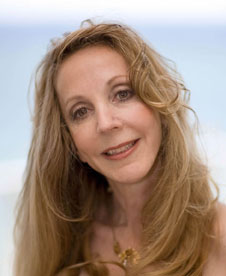
丽贝卡·戈尔茨坦 观众提问者
本期追问 · 点击跳到视频对应位置
凡是真的,都能被证明吗?数学是发现,还是发明?思考是人独有的吗?内省可靠吗?
归入 Ⅱ·13 凡是真的,都能被证明吗? →
EDITED TRANSCRIPT · 依据现场录音编译整理,可划线生成便签
编者按:本文整理自美国哲学家、小说家丽贝卡·戈德斯坦(Rebecca Goldstein)的一场公开讲座,主题是她的哥德尔传记《不完备性:库尔特·哥德尔的证明与悖论》。戈德斯坦曾任教于哈佛等校,是麦克阿瑟天才奖得主。讲座前半部分为主讲,后半部分为现场问答,听众先后就除零、哥德尔句能否作公理、哥德尔与爱因斯坦的谈话、自指的应用、精神疾病与天才等问题发问。本文依据现场录音编译整理,仅删去口语枝节、寒暄与重复,论证与细节悉数保留。

普林斯顿街头:爱因斯坦与哥德尔

戈德斯坦: 谢谢加里这段让我难为情的介绍,也谢谢各位今晚到场。走进这个地方我很激动,看到自己的名字挂在门口的招牌上倒不怎么激动,但看到库尔特·哥德尔(Kurt Gödel)的名字挂在那里,我是真的激动。

请各位先想象这样一个场景:一条绿树成荫的路,在新泽西的郊区。树后面藏着几座气派的老宅,榆树那边是一片乡村俱乐部的高尔夫球场,绿茵如毯,远远传来男人们击球的低语声。两个男人沿着这条安静的街道散步,一个年长,一个年轻,用德语低声交谈,谈得很投入。在我们所说的这个年代,也就是二十世纪四十年代,这条街上能听到德语、匈牙利语、波兰语、俄语,一点也不稀奇。

因为这条街在新泽西的普林斯顿。这里不仅有一所伟大的大学,还有当时刚成立不久的高等研究院(Institute for Advanced Study)。四十年代,研究院刚从普林斯顿大学校园里那座哥特式老楼搬出来,那座楼其实是老物理楼,爱因斯坦曾在里面工作过。当时有一篇剪报,称研究院是「知识分子的天堂」。它搬进了自己的独立校区,福尔德楼(Fuld Hall)至今仍是研究院的一部分。

为什么普林斯顿挤满了说德语、匈牙利语和其他语言的人?因为许多学者正在逃离这样的场面:这张照片摄于维也纳大学,讲台上的讲师正在行纳粹礼,台下的学生全都在行纳粹礼。我等一下要讲到的一个人,刚刚离开的就是这个地方。逃离这种场面的学者、科学家、数学家太多了,以至于一位教育家说:「希特勒摇树,我来捡苹果。」而两枚最上等的苹果,此刻正走在这条路上。

走近看,年长的那位各位当然认得,他就是当时普林斯顿最著名的居民,那个生前就已被神化为「天才」本身、天才之化身的人。镇上的人干脆把这个新研究院叫做「爱因斯坦研究院」。可年轻的那位是谁?这两个人每天从研究院走回镇上,天天一起走回家,旁人看着他们,猜他们在聊什么。不管什么天气,他们总是谈得很深,这张照片是冬天。爱因斯坦说过这样一句话(原文是德语):「我自己的工作,到了人生这个阶段,对我已经没有多大意义了。我每天去研究院的办公室,只是为了享有和哥德尔一起走回家的特权。」

那位年轻人就是库尔特·哥德尔。由于他本人和他的工作都离大众很远,他当时不如、现在也不如他的散步伙伴阿尔伯特·爱因斯坦有名。但我今天想讲的是,他的工作以自己的方式带来了一场革命,我不敢说「同样」革命,但确实极具革命性,震动了他所在领域的根基。这个领域不是物理,而是数学。

新千年之初,《时代》周刊评选上一个世纪最重要的一百位思想家、艺术家,哥德尔入选了最重要的科学家与思想家之列。我念一下他们写的评语:「库尔特·哥德尔把数学的镜头转过来对准数学自身」,这句话什么意思,我们今天要谈;「由此发现了著名的不完备性定理,一桩打进了形式主义的心脏」。写得很有戏剧性。什么是形式主义,哥德尔对它做了什么,我们也要谈。

哥德尔相当有名,可他的朋友爱因斯坦被《时代》选为「世纪人物」,整个世纪最重要的人。评语写道:「他是二十世纪科学家的标志形象,那个带德国口音、笨手笨脚的教授,上千部电影里的老套形象,像卓别林的小流浪汉一样一眼就能认出。他那一头乱发的面孔,普通人熟悉,从柏林到好莱坞各处沙龙里围着他打转的贵妇也熟悉。然而他深不可测,是天才中的天才,仅凭思考就发现了宇宙并非它看上去的样子。」有个故事说,普林斯顿的一位太太在路上认出了那张美丽的老面孔,一时失控,把车撞到了树上。爱因斯坦显然是上个世纪最重要的思想家,而这样一个人,说自己去办公室只是为了和哥德尔一起走回家。

再念一段:1952年哈佛授予哥德尔荣誉博士学位,颂词是「本世纪最重大数学真理的发现者,外行人无法理解,对哲学家和逻辑学家具有革命意义」。我今天要试着说服各位:哈佛说谎了。哈佛的校徽上写着「Veritas」,真理,可这句话不是真的。它并非外行人完全无法理解,哪怕在今晚这么短的时间里,我认为也能讲明白。

定理可以用大白话说出来

戈德斯坦: 那么他做了什么?1930年,二十三岁的哥德尔证明了一件非同寻常的事。这是他年轻时的照片。他在一个当时甚至不算完全受尊重的数学分支里做出了一个非同寻常的证明,这个分支叫数理逻辑,是他让它受到了尊重。这就是所谓的不完备性定理(incompleteness theorem),其实是两个,两个在逻辑上相关的不完备性定理。

它有一点很美妙:和大多数数学结果不同,哥德尔的不完备性定理可以用普通的英语说出来,不需要任何数学符号。证明的细节非常技术化,技术难度令人生畏,但令人欣喜的是,证明的总体策略并不技术化。它优雅、巧妙、简洁,我今天大致会讲给各位听。它可以用日常语言说出来,虽然一开始听起来不像日常语言,但讲座结束时各位会明白的。

我念一段《哲学百科全书》里「哥德尔」词条的开头,它非常简练地陈述了这两个定理。请注意,这里没有任何符号,基本就是英语:「根据哥德尔定理,以下陈述普遍成立:在任何足以表达数论的形式系统中,都存在一个不可判定的公式,即该公式不可证明,其否定亦不可证明。这一陈述有时被称为哥德尔第一定理。该定理的一个推论是:一个足以表达数论的形式系统,其一致性无法在该系统内部得到证明。这一推论有时被称为哥德尔定理,或第二定理。」词条接着说(它还算友好):「这些陈述是对哥德尔于1931年在维也纳发表的结果的略显含糊的概括。」那篇论文的题目是《论〈数学原理〉及相关系统中的形式不可判定命题》,1930年11月17日收到稿件。

从这段简短生硬的陈述里(我相信各位此刻还是听不懂,哪怕没有符号),你大概猜不到,不完备性定理非同寻常之处在于它们能说的东西太多了。它们大概是数学史上最「健谈」的定理,说个没完,能从中榨出来的东西太多。它们属于数学的一个分支,形式逻辑或数理逻辑,我们等一下会谈;可它们的影响远远超出了形式逻辑这个狭窄而形式化的领域,触及一些庞大、宽泛、杂乱的问题:真理的本质,知识与确定性的本质。而因为人的本性和这些关于真理、知识、确定性的讨论密不可分(毕竟说到知识,就是在说知道的人、思考的人,也就是我们),哥德尔的定理似乎对我们的心智可能是什么、可能不是什么,也有重要的话要说。

所以这些定理不同寻常,不仅因为它们能用大致平常的语言表述(「形式系统」「一致性」「不完备性」是术语,我们会解释,但它们不是符号,这在数学里是罕见的物种),更有意思的是,它们似乎在回应(尽管方式含糊、争议极大)人文学科的核心问题:我们拥有知识是怎么一回事?我们如何可能拥有知识?我说它们是数学史上最健谈的定理,人们对它们究竟说了什么、说了多少、精确说的是什么有分歧,但毫无疑问它们说了很多数学之外的东西,肯定延伸到了我们所说的元数学(metamathematics),也许还超出了元数学。这些定理如此特别,因为它们是数学定理,却似乎逃出了数学的边界,同时从数学内部和外部发声。它们有数学的精确,又有哲学的广度。所以你可以理解为什么哲学家对它们如此着迷。

元数学:数学如何谈论自身

戈德斯坦: 我用了「元数学」这个词,应当解释一下。「元」(meta)这个前缀来自希腊语,意思是「在后」「超出」,暗示一种从外部观看的视角。各种认知领域都有元问题,比如:这个知识领域怎么可能做到它正在做的事?我们可以对科学提元问题,对艺术提元问题,对数学提元问题。数学作为一个知识领域,在许多重要方面都是独一无二的,因此它引出的元问题格外尖锐、格外特殊:我们做数学时究竟在做什么,我们怎么可能做到?

数学的严格与确定是先验地(a priori)达到的。我本来应该有一张幻灯片解释「先验」,跳过去了。先验大致是说:我们知道这些真理,却不依赖经验。这不是说我们生来就知道它们,也不是说它们是天生的,而是说没有任何经验能反驳它们,它们的地位在某种意义上独立于经验。

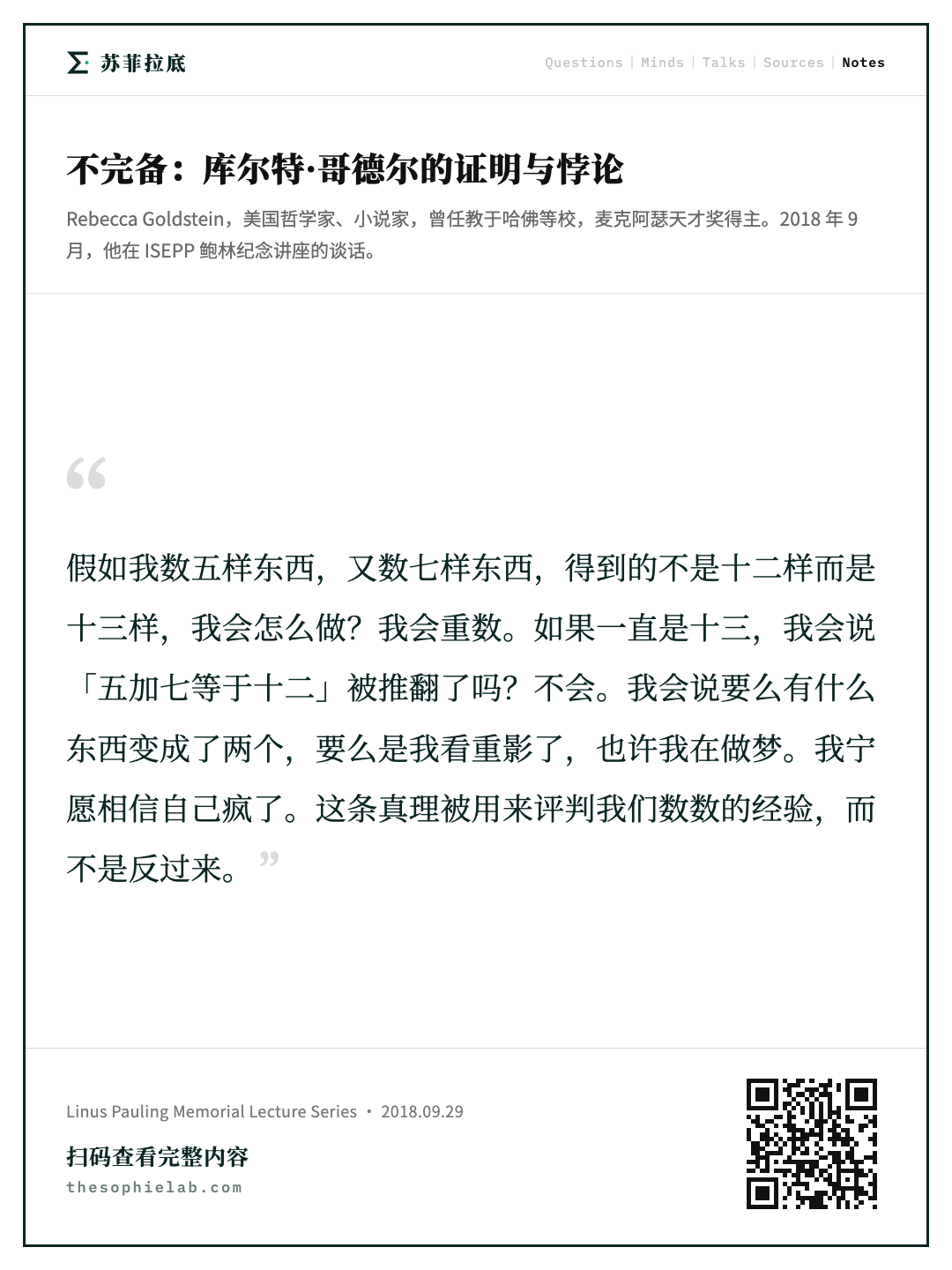
举个例子,五加七等于十二。假如我数五样东西,又数七样东西,得到的不是十二样而是十三样,会怎样?(这种事真的发生在我身上过。)我会怎么做?我会重数。如果还是十三,如果一直是十三,我会说「五加七等于十二」被推翻了、被证伪了吗?不会。我会说要么有什么东西变成了两个,要么是我看重影了,也许是我出了毛病,也许我在做梦。这是可能的。甚至,如果我一直确信一切正常、我是醒着的,我也会宁愿相信自己疯了。这大致就是我们说「五加七等于十二」是先验的时候的意思。事实上数学的全部真理都是先验的。这条真理被用来评判我们数数的经验,而不是反过来。我们不用经验评判数学真理。这些真理不知怎么站在经验之外,它们是先验的。

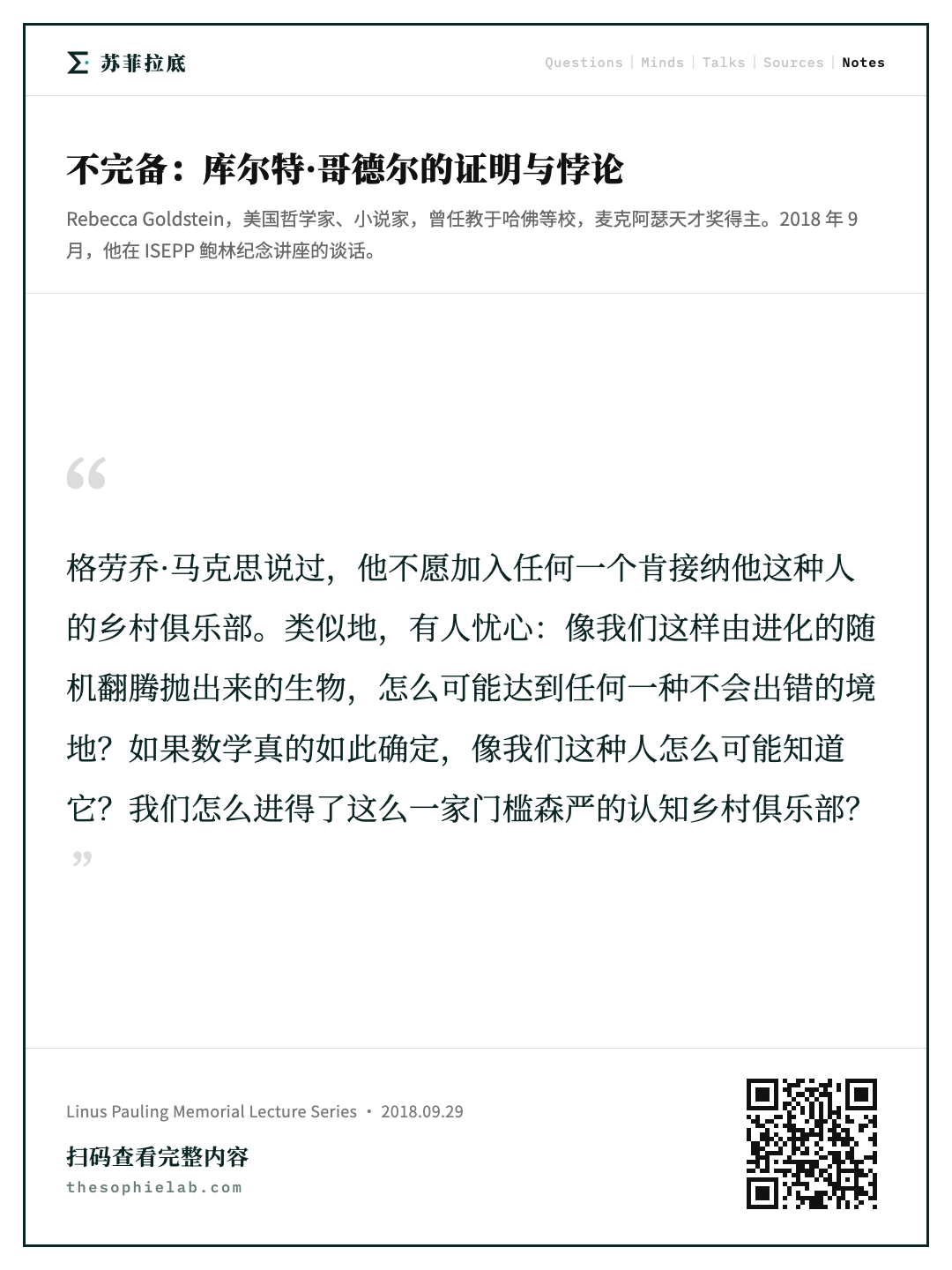
正因为数学独一无二,用先验方法得出常常令人震惊却又确定无疑、无法纠正的结果,它历来向研究知识的理论家,也就是认识论者(epistemologist;认识论就是「思考思考」的学问),提出了非常特殊的问题:像我们这样由进化的随机翻腾抛出来的生物,怎么可能达到任何一种不会出错的境地?而我们在数学里似乎做到了。我们怎么能有确定性?怎么能先验地知道事情?

为了把这个问题逼得更紧,不妨想想马克思。不是那个马克思,是格劳乔·马克思,他说过他不愿加入任何一个肯接纳他这种人的乡村俱乐部。类似地,有人忧心:如果数学真的如此确定,像我们这种人怎么可能知道它?我们怎么进得了这么一家门槛森严的认知乡村俱乐部?

这些是元数学问题。关于一个领域的元问题,无论是科学、数学还是法律,通常都不包含在该领域内部。科学的元问题本身不是科学问题;法律的元问题不能用法律的方法回答。它们是哲学问题,属于哲学的领地:科学哲学、法哲学、数学哲学。

哥德尔的定理是这条一般规则的惊人例外。它们是数学定理,是数学上证明了的定理,是先验证明的定理,毕竟这是一段数学;可它们确立的是一个元结论。他在数学内部回答元数学问题,这太惊人了,在此前的数学史上绝无仅有。这就好比有人画了一幅画,这幅画本身回答了艺术的基本问题:什么是艺术中的美?甚至回答了艺术为什么能打动我们。我能找到的最接近的形象是一幅埃舍尔的画,一幅似乎跳出了画框、反过来追问艺术本身的画。

哥德尔的定理讲的是证明的极限,形式系统(formal system)的极限。第一定理说的是:所有形式系统,要么不一致,要么不完备。所有足以表达算术的形式系统都是如此。所以对形式系统你只能二选一,不一致或者不完备,两者不可兼得,你不可能有一个既完备又一致的形式系统。这里我用了三个术语:形式系统、一致性、完备性。现在该解释它们了。

形式系统:一切皆规则

戈德斯坦: 先讲形式系统。这些概念每一个都够讲一学期,我只希望给各位刚好够用的理解,让大家能领会哥德尔用这些定理做成的那件非凡的事。

形式系统,基本上就是一切都按规则来的系统,一套系统化的规则。形式系统里没有任何东西不是按规则做的,全都是一种机械程序,是可以编进计算机的那种东西。形式系统基本上有三类规则。第一类规定符号表:这个系统里用什么符号,什么符号可以出现在系统里。第二类规定这些符号如何组合,按规则把符号组合成我们所说的合式公式(well-formed formula)。第三类规定哪些符号组合可以从哪些符号组合推出。所以一切都围绕规则,三类规则:符号是什么,怎么组合,什么组合能从什么组合推出。

形式系统的规则甚至规定了符号和合式公式在该系统里的意义。用数理逻辑或哲学的说法,在形式系统里,意义完全是句法的(syntactical),全由规则决定,由系统的语法规则决定,就是我刚才说的三类语法规则。那是规则,而且只有规则,除此之外什么都没有。

这么说很抽象,举个例子。这里有一个符号,「&」,你以为你知道它是什么意思,以为它表示「并且」。在形式系统里,这个符号的意思由以下规则定义,除了这些规则它没有任何别的意思。第一条规则:有了「P&Q」,你可以推出P。第二条:有了「P&Q」,你可以推出Q。第三条:有了P,又有了Q,你能推出什么?对,「P&Q」。这几条句法规则就穷尽了「&」在形式系统里的全部意义。这就是形式系统:一切按规则来,你不能跳出规则去问「这一切到底意味着什么」。形式系统在构成它的规则之外没有任何意义。计算机就是按形式系统运行的。

有一幅漫画表达了这个意思,讲的是被限制在形式系统里的处境。一台机器说「我思故我在」,它推出了某种意义:「我在,我在,我思故我在,活着,有生命有思想,还有我甜美的意识和不朽的灵魂。」这在形式系统里是不会发生的。

形式系统是用来证明定理的。哥德尔第一不完备性定理说:所有足以表达算术(最基本的数学)的形式系统,要么不一致,要么不完备。形式系统存在的全部理由,就是以完全机械的方式产生证明。它们对证明如此重要。那么证明是不是最终归结为在形式系统里的证明,别无其他?这就是不完备性定理核心的元问题,也是推动整个不完备性事业的元问题:数学全部是否都能还原为形式系统里那种机械程序?

形式主义与柏拉图主义之争

戈德斯坦: 还记得《时代》周刊那张幻灯片吗:「哥德尔把数学的镜头转过来对准数学自身,发现了著名的不完备性定理,一桩打进了形式主义的心脏。」形式主义(formalism)的主张是:全部数学都可以还原为形式系统。

那个大谜团,像我们这样的人怎么进得了那家门槛森严的乡村俱乐部,怎么能获得如此无法纠正、不会出错的知识,形式主义的回答是:我们创造了这些形式系统,这是我们玩的一种游戏,我们把系统的蕴涵推演出来,如此而已。我们的直觉从哪来?我们这些有限的生物,怎么能知道关于无穷的事,而且知道得如此确凿,以至于任何经验证据都反驳不了?(你们可以拿这一点考我,我宁可说自己疯了,也不会承认有某种经验证伪了「五加七等于十二」。)形式主义说:这全是形式系统的事,没什么神秘的。

举例来说,我们知道每个自然数都有后继,自然数永远数不完。我们知道素数有无穷多个,这有证明,我们永远到不了「最大的素数」。可我们这么渺小、这么有限,我怎么知道在我们数过的任何数之外,不存在某个最大的素数?我们怎么能获得这种关于无穷的知识?这是一个巨大的元问题,元数学问题。而说我们对无穷有某种直觉,说我们这些有限生物竟然能有对无穷的直觉,说我们以一种类似感官知觉的方式「看见」它,这听起来像某种神秘主义:我们能洞见一个超出感官、超出物理的世界。

这种观点,认为确实存在独立的数学真理,数学家是在发现它们而不是在形式系统里发明它们,与形式主义针锋相对。与这种观点联系最紧密的思想家,就是公元前五世纪的柏拉图,第一位柏拉图主义者。这个立场叫柏拉图主义(Platonism)。形式主义想做的,就是把这种带神秘色彩的柏拉图主义数学观扼杀在萌芽里。形式主义要把「直觉」这个概念从数学里彻底放逐出去。按形式主义的说法,全部数学不过是规则,是形式系统,就是那三类规则,那种可以编进计算机的东西。我们制定规则,然后遵守规则,看它们导向哪里。

照形式主义的讲法,数学变成了一种复杂程度更高一层的国际象棋。我们都会同意,不存在「客观的国际象棋」,不存在某个被象棋系统所刻画的象棋实在。在象棋里,人为规定的规则构成了象棋的全部真相。同样,按形式主义的说法(它和大卫·希尔伯特(David Hilbert)联系最紧密,他是哥德尔上一代最重要的数学家),形式系统里人为规定的规则构成了数学的全部真相。去掉那些神秘主义,去掉直觉,去掉柏拉图那个超感官的实在。数学是一场游戏,我们靠证明定理来赢,也就是用约定的推理规则,证明某个未加解释的符号串可以从另一些未加解释的符号串推出来。我们不引入任何额外的意义,规则提供了全部意义。没有外在的真理需要数学去对照。与柏拉图相反,数学不描述任何超验的实在。全部数学都可以还原为既一致又完备的形式系统。

完备与一致:二者不可兼得

戈德斯坦: 各位对形式系统和形式主义大致有了感觉。现在讲另外两个词。形式主义要求全部数学都能还原为一致且完备的形式系统。「完备」(complete)是什么意思?一个形式系统是完备的,基本上就是说,你想在里面证明的东西都能证明:给定任何合式公式,任何这个系统能表达的东西,你都能证明它或者它的否定。系统里没有不可判定的命题,没有既不能证明为真又不能证明为假的命题。

「不一致」(inconsistent)各位大概知道,但我们还是说一下。一个形式系统是不一致的,如果你能在里面证明一个矛盾:用这个系统的规则,在系统内部同时推出P和非P。P和非P,这非常非常糟糕,你绝对不想要这个。形式系统不完备,我们可以忍受,自哥德尔以来我们一直在忍受,也不得不忍受;形式系统不一致,我们无法忍受。

不一致有什么可怕?我告诉你:它让整个系统变得一文不值。扔掉吧,没用了。不一致的系统就是能证出矛盾的系统,而从一个矛盾出发,在形式上可以证明任何东西。随便你扔给我什么愚蠢的命题,任何东西,都能从矛盾推出来。有了矛盾,一切都随之而来。形式系统的全部意义在于证明,而一个不一致的系统让证明变得太容易了:任何毫无价值的符号串(它必须在系统内有意义,但随便什么都行)都能从矛盾证出来。所以不一致的系统一定是完备的,它能证明它能表达的一切。没有什么比不一致更能毁掉一个系统了。

说到这里,尽管哈佛在颁荣誉博士时那么说,我们已经开始看到哥德尔做了什么,看到它在元数学上为什么如此重要,为什么说他把一桩打进了形式主义的心脏。形式主义声称数学不过是形式系统,当然是一致的形式系统,我们只对一致的系统感兴趣。形式主义声称,比如算术这样的领域可以还原为一个形式系统,算术命题为真就意味着在这个形式系统里可证。形式主义声称存在一个一致的算术形式系统,包含算术的全部真理。

而哥德尔第一不完备性定理说:没有任何算术形式系统既一致又完备。对任何足以表达算术的形式系统(这是我的措辞,不是他的),都可以证明存在一些算术真理,它们在该系统内不可证明。注意,他说的是「真理」:我们能实实在在看出这些命题为真,但它们在系统内推不出来。你可以把它们添作公理,把系统扩大,可哥德尔会告诉你一种办法,在新系统里再构造出另一个命题,我们看得出它为真,但它在这个系统里不可证。各位已经能看出他给形式主义惹了什么麻烦。

第二不完备性定理说:一个足以表达算术的形式系统,它的一致性不可能在该系统内部得到证明。我必须加上「在该系统内部」。也就是说,我们使用一个系统时,除非跳到系统外面,给它提供一个解释,谈论这个系统在谈论什么,而这正是形式主义不想要的(这等于给形式主义拔了电源),否则,只要我们待在形式系统内部,只谈这个形式系统本身,我们甚至无法证明它是一致的。我们正在用的,说不定就是那种可怕的不一致系统。这对形式主义非常非常不利。

哥德尔其人:怯懦外表下的野心

戈德斯坦: 那么这是谁做的?这是我最喜欢的哥德尔照片之一,在维也纳,穿着登山装。在奥地利待过的人都知道,奥地利人整天登山。是什么在推动哥德尔?他在二十三岁前就做成了这件事。哥德尔是个柏拉图主义者,而且是热烈的柏拉图主义者。他显然很年轻时就成了柏拉图主义者,还是维也纳大学的本科生。他进大学时打算学物理,他一直最想了解实在,实在的本性,这始终是他燃烧的动机,就像多年以后在世界另一头成为他挚友的那个人一样,两人都是逃离纳粹疯狂、流亡到新泽西的难民。

但在本科阶段的某个时候(请想想,还是本科生),二十年代的某一年,他选了海因里希·贡珀茨(Heinrich Gomperz)教授的哲学导论课。多年以后在新泽西,爱因斯坦去世后(哥德尔其实只想和爱因斯坦说话,爱因斯坦死后他越来越退回自己的私人世界,他一直有些偏执,此后变得更加偏执,几乎成了隐士),一位叫伯克·格兰让(Burke Grandjean)的社会学家想采访他,想了很久,哥德尔不答复,社会学家一气之下寄给他一份问卷,问了各种问题,其中就有:谁对哥德尔影响最大,谁是他的哲学影响来源。为了方便,社会学家列了一串哲学家,哥德尔只需打勾。哥德尔填了问卷,而且填了两次,第一次没寄出去,格兰让又寄了一份。我怎么知道这些?因为和哥德尔遗稿(Nachlass)里的许多别的东西一样,他从来没把它寄出去。全在普林斯顿大学的档案库里。里面还有他本科时借书的借条,维也纳的送煤单,他什么都留着。我在那里找到了格兰让的这份问卷。

哥德尔只列了三位哲学家。顺便说一句,格兰让列出的某一位似乎让他格外恼火,就是路德维希·维特根斯坦(Ludwig Wittgenstein)。在这份没寄出、却让我有幸找到的问卷里,哥德尔显得有点被冒犯,他写道:维特根斯坦和我在元数学上的想法毫无关系,事实上他从来没理解过我的证明,他要是理解了,就不会说他说过的那些话。他对此真的很不高兴。

他列的三位是:柏拉图;莱布尼茨,他和莱布尼茨的关系非常亲近,事实上爱因斯坦去世后,哥德尔几乎不再和任何同时代的人交谈,他最亲密的同事似乎就是莱布尼茨;还有贡珀茨教授。贡珀茨的照片我没找到,只找到一幅小素描。他的父亲特奥多尔·贡珀茨是著名的古代哲学史家,写过三卷古代哲学史。哥德尔为什么把贡珀茨教授列为如此重要的影响?显然,在这门导论课上,哥德尔的人生差不多被改变了。他被柏拉图的思想激活了,柏拉图那个根本的想法:我们经验到的这个时空世界,其实是一个抽象流形的投影,是一个只能通过理性(像我们把握数学那样)去把握的实在层面,它和时空世界一样真实,实际上比它所解释的时空世界更真实,时空世界拥有的任何实在性,都来自它对这个更抽象的实在的分有。这是柏拉图的精髓。哥德尔还是本科生时,就热烈地投入了这个想法。多年后他告诉另一位逻辑学家王浩,正是在这个影响下他把专业从物理改成了数学,因为对他来说,数学从此成了发现实在的途径。他坚定地认为数学不是发明而是发现。他是柏拉图主义者,不是形式主义者。

他先进入数论,他说那是他最初以为能找到某种真理、能反映数学实在的地方。哥德尔有个奇怪的地方:他是为了哲学才进入数学的。他想要的是能反过来照亮数学整体解释的数学结果,而且他知道自己要找哪一种解释,哪一种数学观:柏拉图主义。这就是他的动机。他想证明算术是关于数的,集合论是关于集合的,是关于形式系统之外的东西的,是「关于」什么的。他想证明存在一个由抽象实体构成的柏拉图领域,构成我们所说的形式系统的模型(model),而形式系统之所以为真,就在于它真实地描述了它所意图的模型中的实体。

这让人瞥见了维也纳大学这个古怪本科生的过大野心。这个人外表几乎有趣地、甚至荒唐地胆小谨慎,被各种荒谬的恐惧折磨,有时恶化成真正的偏执狂,严重到不得不住院。这是一张照片,是奥地利的一所精神病院,他曾在里面忍受极度偏执的发作。我不喜欢这张照片,还是回到希尔伯特这张。但这个外表谨慎、恐惧、偏执的人,在智力野心和直觉方面却毫无惧色,他是一种英雄,对直觉有英雄式的自信。一个被元数学问题困扰、在贡珀茨教授的导论课上学到柏拉图的本科生,给自己定下的任务是:发现一个数学结论,它同时是一个元数学结果,能支持数学实在论,支持柏拉图主义,支持「数学是关于某种东西的」。这个野心之大已经够惊人了。可如果你看看他当时所处的历史语境,就更惊人了,因为这个观点当时完全不合时宜。

罗素悖论与希尔伯特纲领

戈德斯坦: 形式主义是当时元数学的主流学派,背后站着当时最有影响的数学家大卫·希尔伯特。形式主义为什么在那时如此流行?首先是那个「幽灵」的问题:对一个超感官世界、柏拉图世界、抽象对象世界的承诺,总有理由想把它去掉,奥卡姆剃刀,尽量削减多余的本体论承诺(ontological commitment,哲学家爱用的词,即关于什么存在的承诺)。还要记得,形式主义想把直觉从数学里驱逐出去。直觉就是你「就是知道」某事为真,那种内心的笃定,你证明不了,可你知道,而且确定地知道。人们总有理由怀疑直觉。人们声称对各种事情有直觉,常常一个人直觉P,另一个人直觉非P。有时人们对自己的直觉如此确信,以至于为它发动圣战。所以即便在数学之外,也总有理由怀疑这些确定无疑的直觉。

而在数学内部,十九世纪末二十世纪初出现了一些戏剧性的证据,表明我们的数学直觉并不牢靠:首先是非欧几何的发现,其次是所谓集合论悖论的发现。集合论内部,也就是数学内部,接连发现了好几个悖论。康托尔悖论说「所有集合的集合」不能存在。我要讲的是一个真正严重的集合论悖论,罗素悖论。它是在人们把数学形式化、从公理和定义出发推导一切的过程中被发现的。

这张照片上,哥德尔旁边站着一个我还没提到的人,汉斯·哈恩(Hans Hahn),在座的数学家都知道哈恩—巴拿赫定理。哈恩是哥德尔的博士导师,有意思的是,他完全不知道这个年轻人在酝酿什么,直到哥德尔非常安静地宣布,他证明了第一不完备性定理,构造出了一个我们能看出为真、却在算术形式系统内不可证明的命题。这里还有希尔伯特,还有伯特兰·罗素。

好,现在我们有了一个集合:我今天讲座里提到的所有数学家的集合。集合可以有各种性质,集合有时也可以是别的集合的成员。我可以问:所有数学家的集合,是不是它自己的成员?显然不是,因为所有数学家的集合不是数学家,它是一个集合。那么「所有数学构造的集合」呢?它是自己的成员吗?是的,因为所有数学构造的集合本身也是一个数学构造。

现在考虑集合的这样一个性质:不是自己的成员。所有不是自己成员的集合都有这个性质,我们把它们收拢成一个集合:所有不是自己成员的集合的集合。这是一个完全合格的描述,我已经向各位解释清楚了,我们就来构造这个集合。它是不是自己的成员?要么是,要么不是,这只是逻辑。假如它是自己的成员,那它就不是自己的成员,因为这个集合只包含那些不是自己成员的集合。好,那它不是自己的成员。可如果它不是自己的成员,它就是自己的成员,因为这个集合包含了所有不是自己成员的集合。于是它既是自己的成员,又不是自己的成员。矛盾。我们不要矛盾,这是前面说好的。

当时的集合论居然能产生矛盾,这相当糟糕。所有不是自己成员的集合的集合,不存在,不可能存在,我们知道它不存在,因为它产生矛盾。可我们的直觉说:只要有一个描述,就能构造对应的集合。这就证明直觉会出错。直觉并不完全可靠,连数学里都不可靠,更不用说伦理、政治、宗教,那些人们声称拥有直觉的地方。就连数学这门最精确的科学,直觉也会出错。

可以想见,希尔伯特对集合论里出现悖论非常不安。他写道:「必须承认,眼下我们撞上悖论的局面是不可容忍的。想想看,每个人在数学里学习、教授、使用的那些定义和演绎方法,居然导向荒谬。如果数学思维都有缺陷,我们到哪里去找真理和确定性?」这出自希尔伯特的文章《论无穷》。最要紧的事,是证明形式系统是一致的,证明它们证不出矛盾,因为正如我已经解释的,不一致的形式系统一文不值,什么都能证。所以希尔伯特在1900年给他的数学家团队做动员,要他们去证明算术的一致性。希尔伯特自己已经证明了几何是有条件地一致的,也就是说:如果算术一致,几何就一致。这取决于能否证明算术形式系统的一致性,所以他才催促数学家去证明它。

哥德尔登场。希尔伯特纲领的目标是把一切形式化,甩掉那些靠不住的直觉,证明我们不需要它们。这一切都取决于能否把算术形式化,证明存在一个能表达算术、既完备又一致的形式系统。哥德尔证明这不可能。他进一步用第二不完备性定理证明,我们甚至永远无法在算术系统内部证明该系统的一致性,我们必须走到系统外面,提供我们所说的模型,表明它是「关于」什么的。所以他在形式主义心脏上打进的是两根桩,正如《时代》所说,其实是双桩。

证明骨架:会说自己不可证的句子

戈德斯坦: 我想给各位看一点点这个证明。它太美了。当然我没法在这里展开,它很短,但非常稠密,塞进去的东西极多。事实上许多数学,递归函数的整个概念、递归论、模型论,都来自哥德尔在这个证明里做的事。而且,为了证明形式系统的局限,他把形式系统这个概念磨得比以往任何时候都锋利。在展示其局限的同时,他让形式系统的概念清晰了许多。

在最后这几分钟,我想让各位稍微感受一下他做了什么。这个精妙的证明全都严丝合缝地做了出来,令人惊叹。通过一套极其细致的工作,我们现在称之为哥德尔编码(Gödel numbering)(谦逊的哥德尔当然不会用自己的名字叫它),他让算术陈述能够「谈论自己」。这里有一种双重言说:这些命题既有直白的算术意义,说的是数与数之间的关系,就是自然数,同时又在谈论它们自身,谈论自己的可证明性,谈论自己在系统里能不能被证明。它们说的是算术的事,同时也说的是元数学的事,某种超出公式的事,关于它们自身及其可证性的事。全部做得极其严谨、极其漂亮,美得让人心跳停止。他最后得到的,是一个算术陈述,既说了关于数的事,又说了「它自己不可证明」。

这就是自指,我们在「所有集合的集合是不是自己的成员」那里已经见过。哥德尔为了帮助我们理解这个和以往任何证明都不同的证明,让我们把它和这样一个句子比较:「P:这句话是假的。」P就是这句话,它说自己是假的。这是一个古老的悖论,说谎者悖论。这个句子有什么问题?各位大概已经能说了。P是真的吗?如果P是真的,那P就是假的。好,那它是假的。可如果它是假的,那它就是真的,因为它说的正是这个。所以P既真又假。这就是自指悖论。

哥德尔那个古怪的算术命题说的东西与此类似,也是双重言说。他在系统里炮制出一个命题,它说的是算术的事,但同时,G说:G这个命题本身在系统里不可证明。这是一个算术句子,通过证明的魔法(相信我,在证明里它感觉就像魔法,但它不是魔法,它是证明,一切靠证明的巧思实现),这个古怪的算术命题同时在说自己在系统里不可证明。G的否定是「G在系统里可证明」,因为G说自己不可证明,所以非G说G可证明。

那么G在系统里可证明吗?如果G可证明,那么它的否定非G(它说的就是G可证明)就为真。所以如果G可证明,它的否定就为真。而一个命题的否定为真,这个命题本身就为假。所以如果G在系统里可证明,G就为假。可如果G在系统里可证明,G又为真,前提是系统一致。这是整个证明的条件:如果系统一致,那它就不完备。我们假设系统一致。证明说明了什么?假设系统一致,被证明的命题就是真的。所以在一致性假设下,如果G可证明,G就既真又假。从中得出什么?这是矛盾。因此G不可证明。我们刚刚证明了G不可证明。而「G不可证明」正是G所说的。因此G为真。于是G既不可证明,又为真。这正是哥德尔证明那个著名的结论:如果系统一致,系统里就存在一个可表达的真而不可证的命题。而因为G还有一个直白的算术意义,这个算术意义当然也为真,因为它就是G。哥德尔的证明由此表明,存在算术真理(比如G)无法在形式系统里证明,前提是系统一致。所以形式系统要么不一致,要么不完备。这就是第一不完备性定理。

总之,我们做成了一件很重要的事:我们证明哈佛错了。各位都是外行,各位都懂了,大致明白这里发生了什么。

最后用闵希豪森男爵和哥德尔收尾。这不是我的想法,是诗人汉斯·马格努斯·恩岑斯贝格(Hans Magnus Enzensberger)把哥德尔的论证比作闵希豪森男爵的故事。这位著名的吹牛大王,在一个儿童故事里,靠拽自己的辫子把自己和马一起从沼泽里拔了出来。这位了不起的诗人(他也试图见哥德尔,我在遗稿里找到了那封信)把哥德尔在形式系统内部证明了关于形式系统极限的元数学结果这件事,比作闵希豪森的吹牛。只不过,闵希豪森男爵是个骗子,而哥德尔手里有证明。谢谢各位。

问答:哥德巴赫、连续统与心智

观众: 零乘一等于零,可一除以零,也就是零乘以一的逆运算,却是没有定义的。这也算哥德尔所说的那种例子吗?

戈德斯坦: 我认为不算。你提到的这些真理其实是从算术规则推出来的,完全在算术内部,从我们用的基本规则、算术的公理推出来。算术已经公理化了,所以这是真正的算术,是算术系统内部的事,它没有哥德尔不完备性定理那种奇怪的「既在内又在外」的特征。它是算术的,不是元数学的。

也许你察觉到了别的东西:数学内部推出的许多东西看起来古怪而悖谬,我们得到的很多结果都是这样。无理数这个概念,希腊人就觉得古怪。事实上,数学新进展的命名方式常常记录了我们推出某些结果时的深深惊讶:「无理数」(irrational)、「虚数」(imaginary),「有理数」与「实数」相对。这些分类本身记录了历史上的惊讶,当我们推出算术蕴涵的某些结果时的惊讶。但那是另一种惊讶,和哥德尔带来的惊讶不同。

观众: 我们能不能干脆把G当作一条算术公理,直接假定它,而不是试图证明它?

戈德斯坦: 好问题,这当然是下一步合理的做法:把G添作公理。然后这就无穷无尽地进行下去。哥德尔告诉你怎么为新系统再炮制出另一个G。无论你添加多少公理,他都给了你一个在该系统内部炮制出逃脱该系统的命题的配方。

说到这个结果的含义,证明摆在这里,但它在元数学上究竟告诉了我们关于数学的什么,肯定有争议。数学是清楚的,数学的解释不清楚。它是否像哥德尔认为的那样(他明确说这是他的动机,也是他认为随之而来的结论)证明了数学实在论,证明了数学是描述性的,证明了直觉不可消除,也就是说,做数学时,直觉尽管糟糕、尽管危险、尽管会把我们引入歧途,但它不能从数学里消除,数学不能变成一套纯粹机械的、形式的、纯句法的程序。哥德尔肯定是这样解释这些结论的。某种意义上他告诉我们,数学里的风险消除不掉,数学是有风险的,我们可能大错特错,我们用的直觉可能最终把我们带进悖论,但直觉无法消除。这很有意思,我喜欢把它推广:任何值得做的事都有风险。数学也是如此,总有一定的风险,而形式主义想做的是把风险降到最小,实际上是消除风险。但回到你的问题:你要是把G添进去,就有办法在新系统里再造出另一个G。

观众: 我有两个问题。第一,能不能举一个G的例子,真的有一个方程或什么东西,说自己不可证明吗?第二,这一切在哲学上究竟意味着什么?如果数学不能证明一切,是不是说我们不能知道一切,或者不能证明一切?它到底说了关于我们的什么?

戈德斯坦: 好。这里实际炮制出来的G,我们知道它为真但不可证,是一个非常古怪的算术命题,我就不写出来了。不过哥德尔说,这类真而不可证的命题可以是以下这种类型的。他在证明的前言里实际提到了一个至今未解的著名问题:哥德巴赫猜想(Goldbach's conjecture)。哥德巴赫猜想说,每个大于二的偶数都是两个素数之和。这是一个猜想,没有证明。我们检验过的每个偶数都符合,但偶数有无穷多个,我们不可能一个个核对完。这个命题要么真要么假。如果它是假的,如果并非每个偶数都是两个素数之和,那么原则上我们可以发现这一点,因为在无穷的某处存在一个反例,一个不是两个素数之和的偶数。(素数就是只能被自己和一整除的数。回家试试,每个偶数你都能拆成两个素数之和,很神奇。)所以如果它是假的,原则上我们能发现,只要坚持得够久,会找到反例。

可假设它是真的,每个偶数都是两个素数之和,但没有办法证明它,没有办法从算术公理走到它的证明,它只是碰巧是关于数的一个事实。形式主义者会说:那它就没有真值。要么它是假的,原则上我们能发现;要么它不能从形式系统推出,没有证明,那它就不是真的,它根本没有真值。而哥德尔,作为柏拉图主义者,会说:它要么真要么假,要么每个偶数都是两个素数之和,要么存在反例。哥德尔提出的可能性是:存在哥德巴赫猜想这种量级的真而不可证的命题,一个著名的猜想,我们能证明它为真但不可证。

至于含义。一些人认为随之而来的含义是:数学不能还原为形式系统,这似乎确实成立。现在还有形式主义者,他们以这样那样的方式绕着不完备性定理跳舞,但自不完备性定理以来,做形式主义者难多了。我甚至不会说他把桩打进了形式主义的心脏,不过大体上是这样。在元数学层面,形式主义肯定遇到了困难。还有什么?你问哥德尔从中得出了什么。哥德尔没有从中得出数学知识有局限,他论证的是形式系统有局限。哥德尔的理解是:我们拥有无法形式化的数学知识。他不是说存在逃脱我们的数学,事实上我们能看出这个命题为真,尽管它不可证明,从我刚才给出的那个优雅的证明里就能看出它真而不可证。所以哥德尔说的不是数学的不完备,而是形式系统的不完备:形式系统穷尽不了我们的数学知识。

那么我们的数学知识能否穷尽数学实在?既然哥德尔说存在一个数学实在,他有时会允许自己谈这个。他有一篇著名的文章《什么是康托尔的连续统假设?》,在里面他真正推出了自己的柏拉图主义。这里有另一个不可判定命题,解释起来太费事,我试试看。康托尔的连续统假设是另一个不能从集合论公理推出的命题。十九世纪数学里发生了一件惊人的事:格奥尔格·康托尔,了不起的数学家,证明了无穷有不同的阶。你可以有一个无穷集合,又有另一个无穷集合,后者「更大」。这听起来像悖论,是数学里那些令人惊讶的结果之一,无穷不就是无穷吗?我小时候读伽莫夫的《从一到无穷大》,读到这个,大概就是它让我走上了数学的路。各位都该读读那本书。他谈到无穷的阶:有自然数的集合,也就是计数的数;有实数的集合,包括有理数和无理数。实数比自然数多。有一个精彩的论证表明,一个无穷集合可以比另一个大,意思是:你把每个自然数和一个实数配对,配完之后还会剩下实数。

于是我们有这两个集合,自然数集和实数集,我们想知道:中间有没有某个集合,比自然数集大、比实数集小?这就是康托尔的连续统假设。我想他的假设是没有,我记不清了,反正要么有一个在中间,要么没有。哥德尔和数学家保罗·科恩(Paul Cohen)合在一起证明了,连续统假设不能在集合论内部证明,它和它的否定都与集合论公理相容。但它要么真要么假。哥德尔说它要么真要么假,只是超出了我们的数学知识,我们从公理走不到它。哥德尔说,希望将来我们会有更精确、更大、更宽广的公理,让我们够到它;也可能永远够不到。但它要么真要么假:在那两个集合之间要么存在一个集合,要么不存在。所以他认为随之而来的不是我们数学知识的局限。他真正证明的只是:我们知道的数学,远比形式系统能装下的多。

再补充一点,你这个问题太好了,我才讲了这么长。还有一种主张:既然我们的数学知识比形式系统大,永远装不进形式系统,那就说明我们的心智不是计算机。即便在做数学时,更不用说写诗的时候,即便在做数学,这件我们所做的最形式化的事上,我们的心智也不可能是数字计算机。这个论证是1962年哥德尔在世时由英国哲学家约翰·卢卡斯(John Lucas)提出的,后来变得非常流行,构成了罗杰·彭罗斯(Roger Penrose)两本畅销书《皇帝新脑》和《心智的阴影》的基础。彭罗斯是一个货真价实的哥德尔式柏拉图主义者,他完全接受哥德尔的论证,认为不完备性证明了数学实在的真实性,并且认为不完备性定理说明了关于心智的某种东西:心智不是数字计算机,我们做数学时做的事超出了形式系统,超出了可以编进计算机的东西。所以,各种宏大的主张都被安在了不完备性定理头上。这就是为什么我说它们是数学史上最健谈的结果。它们到底在说什么并不清楚,但它们说了很多,远远超出了数学。

两位实在论者的友谊

观众: 首先感谢您的时间和研究。我一直在想象自己站在那条街上,哥德尔和爱因斯坦在交谈。哥德尔有今天讲的这个定理,而爱因斯坦,据我理解,在研究某种统一理论,一种能解释一切的理论。在我看来这两者是矛盾的。您的研究对他们可能谈些什么有什么发现?

戈德斯坦: 每个人都想知道这个,谢谢你的问题。写书的时候我采访了一些老人,我赶得正好,采访完没多久他们就相继去世了。其中一位数学家告诉我(我至今还能听到他的声音),他每天看着他们走来走去,「他们只跟彼此说话,不想跟任何别人说话」。他说:「我们都想知道他们在聊什么。」我在书里对此做了大量推测。

关于他们两人,有意思的地方在这里。首先我们知道他们谈物理。哥德尔从爱因斯坦那里学了很多物理。爱因斯坦七十岁生日时,人们编了一本纪念文集(Festschrift),学者们都撰文讨论爱因斯坦的工作,哥德尔贡献的东西非常迷人:那是相对论的一个解释,一个模型,其中时间是循环的,时间绕成一个圈,你可以回到自己的过去。哥德尔对这个想法很着迷,它发表在那本文集里。所有物理学家都惊讶于哥德尔对物理理解得那么透彻。他从哪学的?只能是从大师那里,从爱因斯坦那里。所以他们肯定谈物理,谈相对论,谈量子力学。各位都知道爱因斯坦不喜欢量子力学,哥德尔也不喜欢。

而且两人都是坚定的实在论者。爱因斯坦在物理上,哥德尔在数学上,哥德尔更是超级实在论者。他们都坚信自己的领域是在描述实在。有意思的是,这在数学里是一种奇怪的观点,那个超感官的、超验的世界,尽管不完备性定理之后哥德尔让人很难再把它扫到地毯下面。而在物理里,你会想,当然了,谁不相信物理是对实在的描述?可事实上,在哥德尔和爱因斯坦的年代,甚至在我们自己的年代,这都不是流行的观点,因为量子力学的悖论,测量问题,量子力学里那一堆麻烦。有趣的是,爱因斯坦和哥德尔都觉得自己在各自的圈子里被边缘化了。这真让人着迷:两位当时最重要的思想家,两人都在自己选择的领域引发了深刻的革命,整个领域不得不围绕他们重新配置,围绕相对论重新配置(爱因斯坦对量子力学的开端也贡献良多),希尔伯特整个形式主义纲领在哥德尔之后被抛弃了。这两个你以为处于领域最中心的人,却觉得自己被边缘化了。为什么?因为他们对自己发现所做的元解释。两人都是坚定的实在论者:爱因斯坦坚信物理描述客观实在,哥德尔坚信数学描述客观实在。他们都是超级实在论者,而在他们那个年代,这不时髦。我想这和他们为什么走到一起大有关系。

他们的性格完全不同,这也是人们纳闷的原因。我采访的人说,爱因斯坦非常健全,没有神经质,睿智,带着那种通俗意义上的哲人气质;而哥德尔神经质,对所有人、对常识都极不信任。可在心智层面,两人完全一致。我想这就是那段关系的黏合剂。人们至今还在猜,那当然是我最想偷听的一场对话。

我该说一句,我见过哥德尔一次。我在普林斯顿的时候,他已经是隐士,没人能接近他。不过有几个人他还会说话,会通过他们了解逻辑学的最新进展。王浩和他谈得很多。但总的来说他离群索居,很可惜。有一段短暂的社交期,持续了大约三个月。我有幸参加了高等研究院为新人举办的一个派对,哥德尔就在那里。真是不可思议。年轻的逻辑学家们围着他,他非常有礼,旧世界的风度,很亲切。可我们全都张口结舌。他离开时祝我们大家未来的研究顺利。他走后我们都懊悔,太害羞了,没人问他一个问题。我最想问他、至今仍希望当年问了的问题是(虽然我现在想我知道他会怎么答):他怎么看约翰·卢卡斯那个论证,那个声称他的定理蕴涵我们的心智不可能是计算机的论证?他接受吗?他认为它有这样的含义吗?可我太年轻、太害羞了。

观众: 戈德斯坦博士,我这样理解对不对:哥德尔定理处理的是自指的数学陈述,也就是说这些数学陈述在谈论它们自身?您在讲的时候,我想到数学之外的其他系统也处理自指陈述:每一种日常人类语言;DNA是一种承载信息的分子,它也在说关于自身的事。您刚才借卢卡斯论证稍微碰到了这一点,能否谈谈哥德尔定理在数学之外可能有什么含义和应用?

戈德斯坦: 首先你说得完全对。这些命题被炮制出来,让它们同时在系统内部和外部说话,这很不可思议。那个元数学陈述是自指的,它谈论自身,被构造成在那种解释下说的是「它自己不可证明」。所以它有自指的一面,尽管它同时也有直白的算术解释。而且如我在回答另一个问题时提到的,他说像哥德巴赫猜想这样直白的数学命题也可能属于这一类。

还有一件事:系统里有些东西真而不可证,其中之一就是该系统自身一致性的陈述。如果它为真,它就不可证。如果你能证明一个系统的一致性,这个系统就是不一致的。就是这个意思:如果你在一个足以表达算术的系统内部证明了它的一致性,它就不一致。我一直加上「足以表达算术」这个限定条件,因为哥德尔本人在博士论文里证明了我们所说的谓词逻辑的一致性和完备性,那个系统不足以表达算术。所以逻辑里有些系统既一致又完备,而讽刺的是,证明这一点的正是哥德尔。这挺有意思。总之,一致性本身是你在系统内部证明不了的。

在数学之外的含义。首先,它似乎说了关于数学本身的事,这属于数学哲学。它似乎告诉我们关于数学知识的事:我们拥有无法形式化的数学知识,我们必须依靠直觉,直觉不能从数学里消除。这些关于数学的事都很有意思。它也许还告诉我们关于人类心智的事,心智的能力是什么。彭罗斯论证、卢卡斯论证声称,从哥德尔定理可以实际证明心智不是数字计算机,对这个我远没那么放心。哥德尔本人对此持回避态度。王浩这位逻辑学家从与哥德尔的谈话里写出了三本书,他锲而不舍,追上了哥德尔,采访了他很多。有一处,哥德尔被问到这个论证,问他的定理是否表明我们不是计算机,我们做数学时做的事不能被计算机复制。他的回答非常有意思,他用一个析取句回答:要么它表明了这一点,要么我们并不拥有我们自以为拥有的那种数学知识。我们也许并没有这种逃脱形式化的数学知识,而我们无法证明自己拥有这种逃脱形式证明的知识,正因为它逃脱了形式证明。所以他用析取回答。他大致是在说:要么我们不是计算机,要么我们是患有数学夸大妄想的计算机。所以那个结论并不能直接推出。我对这个回答很满意,哥德尔觉得够好,我就觉得够好,那个析取。

思考是一种激情:人的不完备

观众: 您既是哲学家,又写小说,这两者在您那里是怎么连起来的?

戈德斯坦: 我当年懂的比一般的二十五岁的人还少,因为我受的训练教我把所有这类问题斥为泡沫、废话、无意义。于是我陷入了这样的思考:一个人如果把这些观念,柏拉图主义、哥德尔、量子力学的诠释,放在生命的中心,这会对他的生活、对他其他的关切造成什么?作为哲学家我写不了这个,我那套一流的训练立刻发作,方法论本身不允许我用我想要的那种自由方式去问。我只能在小说里问。我的第一部小说就是这么写出来的。这个问题一直让我感兴趣。

我确实相信思考是一种激情。对我来说是这样,对我感兴趣的人来说也是这样。不是激情在一边、思考在另一边,思考本身就是一种激情,一种令人沉醉的激情。可这是什么?我感兴趣的是人们实际进行的思考,它对人的生活做了什么,作为一个以思考为激情的人是怎么回事。我在小说里看这个,在最近两本非虚构作品里也在看:一本写斯宾诺莎,一本写哥德尔,两个最抽象的思想家,可我想写的是做他们是什么滋味。做哥德尔是什么滋味?做斯宾诺莎是什么滋味?观念嵌在生命里,这对我来说非常有意思。我想我这样做,就不再是一个「严肃」的哲学家了,至少这个行当认为我因为关注这些而不那么严肃了。但这让我感兴趣,也许反而让我成了更好的哲学家,反正这就是我的兴趣所在。毕竟是人在做这些思考。我们该不该这么在乎这些东西?把它作为中心关切,会对一个人的生活做什么?这就是我的中心关切。

观众: 您刚才说到「一切都不完备」,这似乎也是人的处境。

戈德斯坦: 是的。某种意义上这就是人的困境:我们是意识到自己不完备、意识到一切都不完备的生物。这就是我们。我们不断试图解决它,不断试图修补它,不断提出各种体系。某种意义上这就是哲学的开端:认识到我们是不完备的,然后去修补。我们总是提出体系,总是想把它补上。这让我觉得有些心酸:我们对完备的激情,和我们不断发现自己不完备。

观众: 但终极的不完备是我们会死。

戈德斯坦: 对。六十年代有本书我们都读过,恩斯特·贝克尔的《拒斥死亡》,很关键的一本书,他说我们是意识到自己是动物的动物。我喜欢这样想:我们是意识到自己不完备的不完备生物。是一回事。但其中有些东西并不悲剧,它是一切美的源泉,是艺术的解放性源泉。

观众: 即便试图克服它的努力,也是结构性的。

戈德斯坦: 当然,结构始终在这种美的核心,形式的、结构的东西和美大有关系。

观众: 精神疾病对不完备性定理是必要的,还是它的结果?

戈德斯坦: 我读到的每个人都问这个。这些事在我看来从来不好笑,它们非常真实,非常悲惨。不过当你真的读这个证明,它是如此不同寻常,因为它把两样东西合在了一起。哥德尔有一面极其谨慎小心,像个记账员,什么都记着,哥德尔编码就是记账员式的工作,这个对这个,那个对那个,无数琐碎的细节要追踪。然后又有一面是爱丽丝梦游仙境式的心智,你进入了另一个世界,有一种游戏性:这些命题在谈论自己。一边像在整理仙境,一边是仙境本身。这两样东西合在一起,实在古怪。也许并不需要精神疾病,不是每个人都能做到,这不只是聪明的问题。我通读这个证明时,总有什么东西让我不安。它既美、又动人、又令人不安。总之,他的精神疾病让我着迷。

他另一点让我着迷的是他对莱布尼茨的痴迷。有意思的是,爱因斯坦和哥德尔这对传奇朋友,被问到自己的哲学立场时,都回到了十七世纪的理性主义者。爱因斯坦说自己是斯宾诺莎主义者,哥德尔说自己是莱布尼茨主义者。所以除了彼此之外,他们最亲密的盟友都在十七世纪的理性主义者中间。我在普林斯顿的遗稿里(这个资源不可思议,因为他什么都留着)找到一张小索引卡,上面用德语写着他的十四条原则,他最相信的事,第一条是:世界是可理解的(Die Welt ist vernünftig)。这个观念,认为一切总有解释,叫充足理由律(principle of sufficient reason)。这也很有意思,因为它也渗进了他精神疾病的具体形态,也就是偏执狂。我采访的人和写过他的人都说,他对一切都有解释,一切都有解释,只是有时这采取了非常偏执的形式。精神科医生说,某种意义上偏执狂就是理性失控:总有一个解释,总有一个解释。伟大的经济学家和博弈论家奥斯卡·摩根斯坦(Oskar Morgenstern),也是哥德尔在研究院的密友,在日记里写道:「我和哥德尔谈话,他到处看见阴谋,总有阴谋,总有解释。」所以我感兴趣的也是这些方面:天才的脉搏渐渐融入精神疾病。我不主张所有天才都是疯子,或者你必须疯才能成为天才。爱因斯坦肯定不是,许多人都不是。

回到哥德尔,还有一件有意思的事:几乎所有人都误读了他的不完备性定理。他是热烈的柏拉图主义者,他大胆地想发现一个具有这种含义的数学证明,然后所有人都把它解释成:「啊,还有不确定性,还有相对性,一切都是主观的,没有客观真理,一场后现代的自由混战。」恰恰相反。或者他被解释成维也纳学派逻辑实证主义的最大成果,恰恰相反。他厌恶实证主义。实证主义者认为全部数学都是句法的,他厌恶这个,他想证明的正是它的反面。就像六十年代我们爱说的:「你偏执,不等于没人盯着你。」这很好笑,因为我这本书正在译成中文。哥德尔这本书的各种译本里,给我添麻烦最多的是德文版和中文版。德文版是因为我把很多德文材料译成了英文,他们不肯信任我再译回德文,要原文,可我已经不住在普林斯顿了,很难拿到原件。中文版很有意思,比如刚才那句「六十年代我们爱说」,译者写信问我:「我不明白,您是说因为哥德尔六十多岁了,是个老人,所以他偏执吗?」我不识中文,看不出这本书会译成什么样子。

观众: 哥德尔和维特根斯坦、维也纳学派的关系究竟如何?

戈德斯坦: 很迷人的问题。维特根斯坦是逻辑实证主义者的至高神,他们崇拜他的方式非常有意思。石里克崇拜他。魏斯曼每次维也纳学派聚会都以报告维特根斯坦最新的思想变化开场,「尽管维特根斯坦已声明不为我的转述负责」。他们把他看得如此之重,以至于维也纳有些哲学家推测根本不存在维特根斯坦博士这个人,是他们虚构出来给自己的理论增加分量的。他们花了两年时间读《逻辑哲学论》,它主张全部数学都是句法的。他们读它的方式(十四个人里有九个是犹太人,当然都不信教,我不是说这里面有宗教意味)让我想起犹太人每周读托拉经文的方式,每年从头到尾读完。维特根斯坦是那里的真神。很少有人被允许见他,石里克可以,魏斯曼可以,卡尔纳普问的问题太多,被逐出了,后来魏斯曼太喜欢卡尔纳普,维特根斯坦对他也生了气。他是个真正的大牌。

我想哥德尔,实证主义者中间的柏拉图主义者,对这种对维特根斯坦的崇拜气得要命。他从未见过维特根斯坦,但遗稿里有他没寄出的、关于维特根斯坦的愤怒信件。维特根斯坦在《数学基础评论》里大谈哥德尔,说哥德尔不可能证明他所声称的东西,称之为「逻辑魔术」,相当贬损。哥德尔对此的反应是给卡尔·门格尔写了一封非常愤怒的信。所以我在书里说,他们两人各自是扎在对方元数学里的一根刺,谁也无法接受对方。我想维也纳学派在这里扮演了重要角色。

观众: 您怎么会写这两本非虚构作品,又为什么把斯宾诺莎那本叫《背叛斯宾诺莎》?

戈德斯坦: 这两本书都是应邀写的,都属于丛书。哥德尔那本在诺顿的「伟大科学发现」丛书里,他们直接来问:你想写谁?两套丛书都想找会写作、会讲故事的人,这是新趋势,把抽象观念放进叙事框架。所以诺顿来问我想写哪个伟大的科学发现时,很容易,我要写哥德尔。我从那时起就痴迷于哥德尔,也一直没能问他我想问的那个问题。

叫《背叛斯宾诺莎》,是因为我以一种以前从未有过的方式看斯宾诺莎,这违背我的哲学训练,也肯定违背斯宾诺莎自己的哲学:我把他放在犹太历史里看,放在那个不同寻常的社群里看。有意思的是,他的体系我从二十六岁起就在研究,自以为了如指掌,可当我从这个历史视角、从犹太史的角度看它时,我看见这个体系在我眼前变了形。我看到它在很大程度上是对个人同一性的重新思考,因为他的社群痴迷于身份、犹太身份、什么对一个人是本质性的,他的犹太性是不是本质性的(他论证不是)。整个视角都变了。

我也对十七世纪那场如此激烈的科学与宗教之争很感兴趣。那是启蒙运动之前,而我确实相信斯宾诺莎在很大程度上创造了启蒙运动。他从犹太历史的试炼中思考出路,最终试图解决他深切感受到的犹太苦难问题,那段历史性的苦难,他亲眼见证:他的社群是逃离当时最大犹太浩劫,西班牙和葡萄牙宗教裁判所的难民。他从这里一路思考进了普世主义和世俗主义。他被犹太人逐出教门之后,又遭到整个基督教欧洲的攻击。科学与宗教、信仰与理性之战,在十七世纪打得多么凶。然后我把头从十七世纪抬起来,看看眼下世界上、美国正在发生的事,看看政教分离,心想:我以为这些问题已经解决了,斯宾诺莎已经给我们指了路。这些问题又回到了中心,我觉得这很迷人。所以我打算写一部关于这个的小说。讲得太长了。
排版 + 横图 + 来源,粘贴即成稿
章节 · 点击跳转视频
0:00 普林斯顿街头:爱因斯坦与哥德尔 ▶ 正在看
8:30 定理可以用大白话说出来 ▶ 正在看
12:45 元数学:数学如何谈论自身 ▶ 正在看
22:59 形式系统:一切皆规则 ▶ 正在看
28:33 形式主义与柏拉图主义之争 ▶ 正在看
34:17 完备与一致:二者不可兼得 ▶ 正在看
39:48 哥德尔其人:怯懦外表下的野心 ▶ 正在看
50:06 罗素悖论与希尔伯特纲领 ▶ 正在看
59:43 证明骨架:会说自己不可证的句子 ▶ 正在看
66:53 问答:哥德巴赫、连续统与心智 ▶ 正在看
84:06 两位实在论者的友谊 ▶ 正在看
97:55 思考是一种激情:人的不完备 ▶ 正在看
本期小问 · 档案清单
—— 凡是真的,都能被证明吗? ▶ 正在看
—— 数学是发现,还是发明? ▶ 正在看
—— 思考是人独有的吗? ▶ 正在看
—— 内省可靠吗? ▶ 正在看
本期讲者
丽贝卡·戈尔茨坦美国哲学家、小说家,曾任教于哈佛等校,麦克阿瑟天才奖得主。著有哥德尔传记《不完备性》(Incompleteness, 2005)与《背叛斯宾诺莎》,以叙事方式写抽象思想。
观众提问者讲座现场听众,先后就 1/0、G 能否作公理、哥德尔与爱因斯坦的谈话、自指的应用、精神疾病与天才等问题提问。
01普林斯顿街头:爱因斯坦与哥德尔
0:00
[Applause] thank you so much for that embarrassing introduction Gary it was really awesome and and thank you all for coming here tonight this is an incredible place to be talking I was so thrilling to walk up here it wasn't so thrilling to see my name out there and the marquee but to see Kurt girdle's name out there was was really thrilling for me so I want you to make sure picture this scene here's a leafy road it's in suburban New Jersey can't really see them here but there are stately old homes behind the trees there and just beyond those elm trees there there's a lush green carpet of a Country Club a golf course and muted voices of men knocking at balls are coming as if from a great distance and picture two men strolling down this quiet street quietly conversing in German and when an older man and one younger and deep in conversation it's not unusual right now at the timeframe that we're talking about which is in the 1940s to hear German and Hungarian and polish and Russian being spoken on this street
[掌声] 太感谢你刚才那段让我怪不好意思的介绍了,Gary,真的太棒了。也谢谢各位今晚过来。能在这样一个地方演讲实在难得,我走上台的时候特别激动——倒不是因为看到外面招牌上写着我的名字,而是看到库尔特·哥德尔的名字挂在那儿,那才真让我激动。所以请你们一定想象一下这个画面:一条绿树成荫的马路,在新泽西的郊区。虽然照片上不太看得出来,但树后面是一栋栋气派的老宅子,越过那些榆树,是一片乡村俱乐部、高尔夫球场的绿茵地毯,男人们击球的声音隐隐传来,好像来自很远的地方。再想象两个人沿着这条安静的街道慢慢走着,用德语轻声交谈,一位年长一些,一位年轻一些,聊得非常投入。在我们说的这个年代,也就是四十年代,在这条街上听到德语、匈牙利语、波兰语、俄语,其实一点都不稀奇,
便签笔记
1:36
since this street is actually in Princeton New Jersey and it's the home not only of a great university but of the newly established in these days in the 1940s Institute for Advanced Study so there's a sign for an Institute for Advanced Study and here in the 1940s that were imagining ourselves into in now it's only just recently moved from it's a home in Princeton University in this old gothic building and here's a newspaper clipping and talks about the intellectual paradise at the Institute for Advanced Study is supposed to be it's just moved from the University campus from this building which is actually the old physics building where Einstein had worked to its own independent campus this is fulled Hall part of the Institute for Advanced Study now and the reason now that we're imagining ourselves in the 1940s the reason that Princeton New Jersey is so filled with people speaking German and Hungarian and other languages is that many people many of the scholars are fleeing scenes like this this is actually a scene from the University of Vienna one of the people that I'm going
因为这条街就在新泽西的普林斯顿,那里不仅有一所伟大的大学,还有当时刚刚成立不久的高等研究院(Institute for Advanced Study)。这是高等研究院的牌子。在我们正设想的四十年代,它才刚刚从普林斯顿大学的一栋哥特式老楼里搬出来。这是一份剪报,讲的是高等研究院本该是个怎样的“知识天堂”。它刚从大学校园的那栋楼搬走——那其实是老物理楼,爱因斯坦曾在那里工作过——搬进了自己独立的园区。这就是福尔德楼(Fuld Hall),现在是高等研究院的一部分。而我们现在设想的四十年代,新泽西的普林斯顿之所以到处都是讲德语、匈牙利语和其他语言的人,是因为很多人、很多学者正在逃离这样的场面。这其实是维也纳大学的一个场景,我等一下要讲到的其中一个人,刚刚离开了这里。
便签笔记
3:01
to be talking about in a moment has just left this the don't know if you can see where is my my lasers not working all right but you can sort of make out the the lecturer he sees a front there he's giving the the Nazi salute all of the students are giving the Nazi salute and so many scholars scientists mathematicians are fleeing scenes like this that one of educator said Hitler shakes the tree and I gather the apples and two of the choicest apples are walking down that road right now right here they are up close you of course recognize the older gentleman there's none other than Princeton's most famous inhabitant at this time the man who even while he's still alive has been immortalized as the genius as the apotheosis of the man of genius and that the townspeople have taken to calling this new Institute the Institute for Advanced Study the Einstein
我等会儿要讲的这个人刚离开那儿。不知道你们能不能看清——我的激光笔坏了——不过你大概能看出来,前面那位讲课的教授正在行纳粹礼,所有学生也都在行纳粹礼。有那么多学者、科学家、数学家在逃离这样的场面,以至于有位教育家说:希特勒摇树,我来捡苹果。而其中两个最上等的苹果,此刻正走在那条路上。这是他们的近照。年长的那位你们当然认得,正是当时普林斯顿最有名的居民,一个还活着就已经被神化的人,被当成天才的化身、天才的最高典范。镇上的人干脆把这个新研究院叫做“爱因斯坦研究院”。
便签笔记
4:17
Institute but who's the younger guy they're these two men walked back and forth from the Institute to the town every day they walk home together every day and and other people watch them and wonder what it is that they talk about they're always deep in conversation in all sorts of weather here they are in the winter in fact Einstein said I only go to my office so this is in German here it is an English whoops sorry to have the privilege of being able to walk home with girdle with Kurt girdle they said my own work at this late stage in my life no longer means very much to me and I only go everyday to my office at the Institute in order to have the privilege of walking home with girdle so Kurt girdle obviously it's the name of that younger man and it's in the remote nature both of the men and of his work but he wasn't then and he still isn't as famous as his walking partner Albert Einstein but in his own way as I want to tell you a little bit about it today his work was just was was very revolutionary
但年轻的那位是谁呢?这两个人每天从研究院走回镇上,每天一起走回家,别人看着他们,很好奇他们到底在聊什么。他们总是聊得很投入,不管什么天气都一样。这是他们在冬天的照片。爱因斯坦其实说过——这是德文原文,这是英文翻译,哎呀弄反了——他说,我去办公室,只是为了能享受和哥德尔一起走回家的特权。他说,我自己的工作在人生这个阶段对我已经没什么意义了,我每天去研究院的办公室,只是为了能享受和哥德尔一起走回家的特权。所以库尔特·哥德尔显然就是那位年轻人的名字。由于他本人和他的工作都相当孤僻、遥远,他当时不像、现在也依然不像他的散步伙伴爱因斯坦那么有名。但用他自己的方式——这也是我今天想跟大家讲一点的——他的工作同样非常具有革命性。
便签笔记
5:37
I don't know if I want to say just as revolutionary but it was very revolutionary shaking up the very foundations of his field which wasn't physics but mathematics in fact Time magazine when it was the new century the new millennium had had a roundup of the 100 most important thinkers artists men and women of the last century and a curt girdle made it to the COTS of a hundred most important scientists and thinkers when I wanted to read what they wrote about him curt girdle he turned the lens of mathematics on itself and we're going to talk about what that means the extraordinary thing that he did in turning the lens of mathematics on itself and hit upon his famous incompleteness theorems driving a stake through the heart of formalism very dramatic and we're going to talk about what that meant what formalism was and what did what did girdle do to this of car so so you know he's quite famous but of course his friend Einstein time that he had him as the person of a century the most important person of the whole century Albert Einstein person of the
我不敢说“同样革命”,但确实非常革命,它动摇了他所在领域最根本的基础——那不是物理学,而是数学。事实上,在世纪之交、千禧年的时候,《时代》杂志盘点过上个世纪最重要的一百位思想家、艺术家,库尔特·哥德尔入选了这一百位最重要的科学家和思想家。我想读一下他们对他的评价:库尔特·哥德尔,他把数学的镜头对准了数学自身——我们等会儿会讲这是什么意思,讲他把数学的镜头对准自身这件多么了不起的事——并由此发现了他著名的不完备性定理,一刀刺穿了形式主义的心脏。写得很有戏剧性。我们等会儿会讲这是什么意思,什么是形式主义,哥德尔到底对它做了什么。所以你看,他相当有名,但他的朋友爱因斯坦当然更是被《时代》评为“世纪人物”,整个二十世纪最重要的人物——阿尔伯特·爱因斯坦,
便签笔记
7:02
century he was the iconic 20th century scientists the bumbling professor with the German accent a common cliche in a thousand films instantly recognizable like Charlie Chaplin's Little who writes this stuff Albert Einstein's shaggy-haired visage with us familiar to ordinary people as to the matrons who fluttered about him in salons from Berlin to Hollywood yet he was unfathomable a profound the genius among geniuses who discovered merely by thinking about it that the universe was not as it seemed better actually one of the stories is that one of those matrons one of the women of Princeton when she recognized the beautiful old face that she saw walking down that road lost control of her car and rammed it in to a tree so so Einstein you know clearly is you know the most important than most man of the thinker of that last century and Einstein as I said would only go to his office to talk to to walk home with girdle I wanted to read that honorary doctorate that girdle had gotten in 1952 from Harvard Discoverer of the most significant mathematical truth of this
世纪人物。他是二十世纪科学家的标志性形象:带德国口音、丢三落四的教授,无数电影里的老套形象,一眼就能认出来,就像卓别林的小流浪汉——这是谁写的呀——爱因斯坦那头蓬乱头发的面孔,对普通人来说,就跟从柏林到好莱坞的沙龙里围着他打转的贵妇一样熟悉。然而他又深不可测,是天才中的天才,仅凭思考就发现了宇宙并非表面看上去的那样。其实有个故事说,普林斯顿的一位贵妇,在路上认出了那张美丽的老面孔,激动到失去了对方向盘的控制,一头撞到了树上。所以爱因斯坦显然是上个世纪最重要的人、最重要的思想家。而就是这样一个爱因斯坦,我刚才说了,他去办公室只是为了跟哥德尔一起走回家。我想再读一段哥德尔1952年从哈佛获得荣誉博士学位时的评语:本世纪最重要数学真理的发现者,
便签笔记
02定理可以用大白话说出来
8:30
century incomprehensible to laymen revolutionary for philosophers and logicians I'm going to try to convince you that Harvard lies but it's not entirely incomprehensible to laymen even though as you can see the insignia thereof of Harvard Veritas truth I think this is not true I think that in fact it is can be made comprehensible to laymen and even maybe even in the short time that we have here so what is it that he did Kurt gödel in 1930 when he was 23 years old here is a young man it proved an extraordinary thing he had produced an extraordinary proof in a branch of mathematics that wasn't even considered altogether respectable in his day he actually made it respectable mathematical logic for something called the incompleteness theorem in fact it's actually two there are two incompleteness theorems to logically related incompleteness theorems they one of the wonderful things is that unlike most mathematical results girdles and completeness theorems can be expressed in normal words in English without any mathematical symbols at all the nitty-gritty of the details of the proof
外行无法理解,对哲学家和逻辑学家而言是革命性的。我今天要试着说服你们:哈佛在这一点上说了假话。虽然哈佛的校徽上写着 Veritas——真理——但我觉得这句不对。我认为它其实是可以讲给外行听懂的,甚至可能在我们今天这么短的时间里就能讲明白。那么他到底做了什么?1930年,库尔特·哥德尔23岁——照片上是个年轻人——他证明了一件非同寻常的事。他在一个当时甚至算不上体面的数学分支里做出了一个非凡的证明;实际上是他让这个分支变得体面起来的,这个分支叫数理逻辑,而那个成果就是不完备性定理。其实是两个,有两条在逻辑上相关的不完备性定理。有一点特别妙:跟绝大多数数学结论不同,哥德尔的不完备性定理可以用普通的话、用英语讲出来,完全不需要任何数学符号。证明的细节非常技术性、非常艰深,
便签笔记
10:03
are very technical are formidable technical but happily delightfully the overall strategy of the proof is not it's very elegant and it's it's uh ingenious and it's simple I'm going to give it to you today more or less and also it can be spoken in real in English and that so I hear is it's not gonna sound like real English to you but by the end of the talk you're gonna understand this is from the encyclopedia of philosophies article on Kurt girdle and it opens up with a very terse a very crisp statement of his two theorems that I'm going to read to you by girdle's theorem the following statement is generally met now just notice there's not gonna be any symbolism here it's English more or less in any formal system adequate for number theory there exists an undecidable formula that is a formula that is not provable and whose negation is not provable this statement is occasionally referred to as girdle's first theorem a corollary to the theorem is that the consistency of a formal system adequate
是很技术、很难啃的,但令人高兴的是,证明的整体思路并不难,它非常优雅、非常巧妙,而且很简单。我今天多多少少会把它讲给你们听。而且它确实能用大白话说出来——不过待会儿你听到的时候,可能不觉得像正常英语,但等这场演讲结束,你就能懂了。这段来自《哲学百科全书》关于库尔特·哥德尔的词条,一上来就非常简练、非常干脆地陈述了他的两条定理,我念给你们听。注意这里没有任何符号,基本就是英语:根据哥德尔定理,一般会有如下说法——在任何足以表达数论的形式系统中,都存在一个不可判定的公式,也就是一个既不能被证明、其否定也不能被证明的公式。这句话有时被称为哥德尔第一定理。该定理的一个推论是:一个足以表达数论的形式系统,其一致性
便签笔记
11:21
for number theory cannot be proved within the system and sometimes this corollary is referred to as either girdle's theorem or as the second theorem these statements are somewhat vaguely this is still friendly article these statements are somewhat vaguely formulated generalizations of results published in 1931 by kurt gödel then in Vienna and this is the title of the the article that he wrote on formally undecidable sentences of the of principia mathematica and other systems of type one which was received for publication November 17th 1930 you know you might not guess from this short terse statement I'm sure incomprehensible at this point even though there are no symbols even though you might not guess from this terse statement of these incompleteness theorems the incompleteness theorems are extraordinary for among other reasons for how much they have to say they are probably the most talkative mathematical theorems in the history of mathematics they go on and on and on there are so much that one can get out of these
无法在该系统内部得到证明。有时这个推论也被称为哥德尔定理,或者第二定理。这些陈述——这篇文章还算友好——这些陈述都是对1931年库尔特·哥德尔(当时在维也纳)发表的结果所做的、多少有点含糊的概括。这是他那篇论文的标题:《论《数学原理》及相关系统中形式上不可判定的命题 I》,投稿日期是1930年11月17日。你从这么一段简短干脆的表述里可能想不到——我相信此刻它还是难以理解,尽管里面没有符号——你可能想不到,这两条不完备性定理有多不寻常,其中一个原因就是它们“说的话”实在太多了。它们大概是数学史上最“话多”的定理,能一直讲下去、讲下去、讲下去,人们能从中挖出太多东西。
便签笔记
03元数学:数学如何谈论自身
12:45
theorems as I mentioned they belong to a branch of mathematics known as formal logic we're going to talk about that in a moment or mathematical logic and yet his theorems range far beyond formal logic this formal narrow domain addressing such large and vast and messy questions as the nature of truth and knowledge and certainty in general and because our human nature is intimately involved in these discussions of these issues of truth and knowledge and certainty after all in speaking of knowledge we're speaking about knowers about thinkers us right girdles theorems have also seemed to have important things to say about what our minds could or maybe could not be so girdles theorems are unusual not only because they're rendered in more or less plain English we use terms like formal systems consistency incompleteness these are technical terms we'll talk about what they mean but they're not symbolic right because they're these are very rare mathematical creatures not only because we can avoid symbolism and talking about them but because even more interestingly
就像我说的,这些定理属于数学的一个分支,叫形式逻辑——我们等会儿会讲——或者叫数理逻辑。然而它们的影响远远超出了形式逻辑这个狭窄的领域,触及了那些宏大、庞杂、纠缠不清的问题:真理、知识、确定性的本性。而由于人的本性和这些关于真理、知识、确定性的讨论密切相关——毕竟谈到知识,我们就是在谈认识者、谈思考者,也就是我们自己——哥德尔定理似乎对“我们的心智可能是什么、可能不是什么”也有重要的话要说。所以哥德尔定理特别之处不只在于它们能用大致的大白话表述——我们会用到“形式系统”“一致性”“不完备性”这些词,它们是技术术语,我们会讲它们的意思,但它们不是符号。这些定理是非常罕见的数学生物,不只因为谈论它们时可以避开符号,更有意思的是,
便签笔记
14:15
they seem to address themselves however ambiguously and controversial E and very controversial E - the central question of the humanities what is it that's involved in our human what is it for us to have knowledge how can we have knowledge I mentioned they're the most talkative theorems in the history of mathematics there's disagreement about what they say how much they say precisely what they're saying but there's no doubt that they're saying an awful lot beyond mathematics certainly extending into what we call meta mathematics and I'll explain that term in a moment and perhaps even beyond that even beyond metamathematics girdles theorems are so unusual because they're mathematical theorems that seem to escape the limits of mathematics they seem to speak both from inside and outside mathematics they have the precision of mathematics and the reach of philosophy so you could understand why philosophers find them so fascinating I used that term mehta mathematics and I should explain it this prefix meta comes from the Greek and it
它们似乎——尽管是以一种含混的、极具争议的方式——直接触及了人文学科的核心问题:我们拥有知识,究竟意味着什么?我们怎么可能拥有知识?我刚说了它们是数学史上最“话多”的定理,关于它们到底说了什么、说了多少、确切在说什么,一直有争论,但毫无疑问,它们说出了大量超越数学本身的东西,肯定延伸到了我们所谓的“元数学”——这个词我马上会解释——甚至可能还超出元数学。哥德尔定理如此不寻常,是因为它们是数学定理,却似乎逃出了数学的边界;它们好像同时从数学内部和外部在发声。它们有数学的精确性,又有哲学的射程。所以你就能理解为什么哲学家对它们如此着迷。我刚才用了“元数学”这个词,应该解释一下。这个前缀 meta 来自希腊语,
便签笔记
15:51
means after Beyond and it suggests the view from outside as it were all sorts of different cognitive fields present meta questions questions such as how is it possible for this ear area of knowledge to be doing what it's doing so we can ask meta questions of science we can ask meta questions of art we can ask meta questions of mathematics mathematics is a field of knowledge which is in many very important respects unique and so it presents very pointed very special meta questions questions about what it is that we are doing when we're doing and how is it possible that we're doing it the rigor and the certainty of mathematics is arrived at a priori whoops I skipped ahead a priori I should have had a slide up there I thought I did saying what a priori it is and what it means basically a priori is that we know these truths somehow independent of
意思是“之后”“超出”,它暗示的是一种从外部看的视角。各种不同的认知领域都会有“元问题”,比如:这个知识领域是怎么可能做到它正在做的事的?我们可以对科学问元问题,可以对艺术问元问题,也可以对数学问元问题。数学是一个在很多重要方面都很独特的知识领域,所以它带出的元问题特别尖锐、特别特殊:当我们在做数学的时候,我们究竟在做什么?我们怎么可能做到?数学的严格性和确定性是“先验地”获得的——哎呀我跳过去了,先验(a priori)——我本来应该有一张幻灯片解释什么是先验、它是什么意思。基本上,先验就是我们以某种方式独立于经验地知道这些真理。
便签笔记
17:18
experience it doesn't mean that we're born knowing them it doesn't mean that they're an 8 but it needs that no experience is going to count against them so in some sense their status is independent of experience so for example 5 plus 7 equals 12 what would happen if I were to count five things and seven things and not get 12 things get 13 if that were going to have if that should happen and actually it has happened to me well what would I do I would recount if I still got 13 if I continue to get 13 would I say that 5 plus 7 equals 12 had been invalidated had been falsified so I would say either it doubled something doubled or I'm seeing double maybe something is wrong with me maybe I'm dreaming right I would go perhaps that is that is possible or even if I continued to convince myself that all was well and I was awake even that I was going mad right this is something of what we mean when we say that 5 plus 7 equals 12 and in fact all the truths of mathematics are a priori this truth is used to evaluate our experiences of counting and not the
独立于经验,并不是说我们生下来就知道它们,也不是说它们是天生的,而是说没有任何经验能够反驳它们。所以在某种意义上,它们的地位独立于经验。举个例子:5加7等于12。如果我数了五个东西和七个东西,结果没得到12个,而是得到13个,会怎么样?如果真发生了这种事——其实我还真遇到过——我会怎么做?我会重新数。如果还是13呢?如果一直是13,我会说“5加7等于12”被推翻了、被证伪了吗?不会。我会说要么是东西变多了,要么是我眼花看重影了,也许是我出了什么问题,也许我在做梦,对吧?我会往那个方向想,那都有可能。甚至如果我确信一切正常、我确实醒着,我可能宁愿认为自己疯了。这就是我们说“5加7等于12”时所包含的意思之一。事实上所有数学真理都是先验的。我们是用这条真理去评判我们数数的经验,而不是
便签笔记
18:45
other way around right we don't evaluate the truths of Mattox by our experiences somehow these truths stand outside of experience they are a priority so mathematics just because it's unique using a priori methods to establish it's often astounding even though certain and incorrigible results has always forcefully presented theorists of knowledge those who study knowledge core knoweth epistemologists that's an epistemology stand epistemologists think about thinking all right the mathematics has always presented a pistol ologists with very special questions how can the likes of us you know who are thrown up by the random thrashings about of evolution attained any sort of infallibility which we seem to do in mathematics any sort of certainty how can we know things a priori and to press this real it might
反过来。我们不是用经验去评判数学真理。这些真理不知怎么就站在经验之外,它们是先验的。所以数学——正因为它独特地使用先验方法来确立那些常常令人惊叹、却又确定无误、不可动摇的结论——一直强烈地困扰着研究知识的人,也就是知识论学家、认识论学家。认识论学家就是思考“思考”的人。数学一直给认识论学家出非常特殊的难题:像我们这样的生物——被演化的随机折腾扔到这个世界上的生物——怎么可能获得某种不会出错的东西?可我们在数学里似乎做到了。怎么可能获得任何确定性?我们怎么可能先验地知道一些事情?要把这个问题讲透,
便签笔记
20:03
help to think about marks only not that marks that was right who said that he wouldn't belong to any country club that would accept the likes of him well similar a similarly some fretted that if mathematics is really so certain how can it be known by the likes of us how could we have gained entry into so restricted a cognitive country club these are many questions meta mathematical questions many questions about a field say about science or mathematics or the law all of which raise meta questions are not normally questions that are contained in the field itself so a meta question of science is not itself a scientific question meta questions in law are not something that can be answered through the methodology of the law rather their philosophical questions that's the domain of philosophy philosophy of science philosophy of the law philosophy of math Bertels
或许可以想想马克思——不是那个马克思,是格劳乔·马克斯,他说他不会加入任何愿意接纳他这种人的俱乐部。类似地,有人也焦虑:如果数学真的那么确定,它怎么可能被我们这种人知道?我们怎么会挤进这么一个门槛极高的认知俱乐部?这些都是元问题、元数学问题。关于某个领域的元问题——比如科学、数学,或者法律,这些领域都会引出元问题——通常并不包含在该领域自身之内。关于科学的元问题本身不是一个科学问题;法律中的元问题也不是靠法律方法能回答的。它们其实是哲学问题,属于哲学的地盘:科学哲学、法哲学、数学哲学。而哥德尔的
便签笔记
21:26
theorems are spectacular exceptions to this general rule these are mathematical mathematically proved theorems a priori proved theorems after all this is a map a piece of mathematics and yet they establish a meta conclusion it's as if so he's addressing within mathematics itself he's addressing many mathematical questions and this is amazing this is this is unique in the history up until then of mathematics it's as if someone had painted a picture that manages to address the basic questions of art what is it to be beautiful and art and maybe even answer how it is why it is that art is able to move us the way does this is the closest I could come an Escher picture to a question that seems to get out of the framework and to address the question of art itself girdles theorems say something about the limits of proof the limits of formal systems use this term we'll explain it in a moment what the first theorem states is that all formal systems are either inconsistent or incomplete all formal systems that are rich enough to
定理是这条一般规律的惊人例外。它们是数学定理,是经过数学证明的、先验证明的定理——毕竟这是一段数学——然而它们确立的却是一个“元”结论。就好像说,他是在数学内部处理元数学问题。这太惊人了,在此之前的数学史上是独一无二的。这就好比有人画了一幅画,而这幅画竟然能处理艺术的根本问题:什么是美?什么是艺术?甚至可能回答:艺术为什么、如何能够那样打动我们?我能找到的最接近的例子是埃舍尔的画,它似乎跳出了自己的框架,去追问艺术本身的问题。哥德尔定理讲的是证明的界限、形式系统的界限——我用了“形式系统”这个词,等一下会解释。第一定理说的是:所有形式系统要么不一致,要么不完备——所有那些丰富到足以
便签笔记
04形式系统:一切皆规则
22:59
Express arithmetic so you have a choice with formal systems either inconsistency or incompleteness take your pick you can't have both you can't have a formal system that complete and that's consistent so I've used three technical terms here formal systems consistency completeness and now it's time for me to explain them let's talk about formal systems first these are big big semesters worth of ideas right so I hope to give you only enough understanding so that you grasp the extraordinary thing that Kurt gödel did with these theorems formal system is basically a system in which everything is done by rules it's a it's systematized rules there is nothing that is not done by rules in a formal system it's all a kind of mechanical procedure the sort of thing that could be programmed into a computer formal system basically has three sorts of rules the first sort specifies just what's the alphabet of the symbols what are the symbols that are used in the formal system what are the symbols that can be used that can appear in the formal system the second sort specifies
表达算术的形式系统。所以对形式系统来说你只能二选一:要么不一致,要么不完备,随你挑。你不可能两样都要,你不可能拥有一个既完备又一致的形式系统。我这里用了三个技术术语:形式系统、一致性、完备性。现在该解释它们了。先讲形式系统。这些都是要讲一整个学期的大题目,所以我只希望让你们理解到足以领会库尔特·哥德尔用这些定理做成的那件非凡的事。形式系统基本上就是一个一切都靠规则来做的系统,是规则的系统化,在形式系统里没有任何东西不是靠规则完成的。它完全是一种机械程序,是那种可以编进计算机的东西。形式系统基本上有三类规则。第一类规定符号表:这个形式系统使用哪些符号,哪些符号可以出现在系统里。第二类规定
便签笔记
24:26
how these symbols can be combined with one another what is a meaning according to the rules of combining these symbols into what we call well-formed formulas and the third sort of rule tells you which combinations of symbols follow from which combinations of symbols right so it's all very rule-oriented three types of rules what are the symbols how can they be combined what's the most follow from what symbols what combination of symbols follow from what combinations of symbols these rules of a formal system go as far as defining what the symbols and what the well formula well-formed formulas mean in the formal system the way that we put this in mathematical logic or philosophy is that in a formal system meaning is all syntactical it all has to do with the rules the rules of the grammar of the system three types of grammatical rules that I've just given you there it's a matter of rules and nothing but rules so very abstract talk here's an example here's a symbol right you think you know what it means right you have a and right you think this ampersand means and here in a formal system are the rules that define the meaning of this term right and if this term means nothing over and
这些符号可以怎样彼此组合,按照组合规则什么样的符号串才算我们所说的“合式公式”。第三类规则告诉你,哪些符号组合可以由哪些符号组合推出来。所以一切都以规则为导向,三类规则:有哪些符号、它们怎么组合、什么由什么推出——哪些符号组合可以从哪些符号组合中推出。形式系统的这些规则甚至定义了这些符号和合式公式在系统里“意味着什么”。在数理逻辑或哲学里我们会这么说:在形式系统中,意义完全是句法性的,全都跟规则有关,跟系统语法的规则有关,就是我刚给你们讲的那三类语法规则。一切都是规则,除了规则什么都没有。讲得很抽象,我举个例子。这是一个符号,你以为你知道它是什么意思,对吧,这是一个“与”号(&),你以为这个 & 就是“并且”。而在形式系统里,定义这个符号意义的就是这些规则,这个符号的意思不多不少
便签笔记
25:48
above these rules here's one rule if you've got P saw an ampersand Q you can you can deduce P right so this is if you've got P ampersand Q you can deduce Q if you've got P then you've got Q what can you deduce thank you right and these are the syntactical rules that completely exhaust what that symbol and means in a formal system and that's what a formal system is everything is done by rules you don't ask outside the rules what does it all mean so a formal system has no meaning outside of the rules that constitute it formal systems run computers run by formal systems and here's a joke sort of a comic that's supposed to get the idea of a formal system that absorbers are restricted to formal systems I think therefore I am he comes to some sort of meaning Here I am I am I think therefore
就是这些规则。比如第一条规则:如果你有 P & Q,你就可以推出 P;同样,如果你有 P & Q,你就可以推出 Q;如果你有 P,又有 Q,你能推出什么?谢谢,对。这些句法规则完全穷尽了“&”这个符号在形式系统里的全部含义。这就是形式系统:一切靠规则完成,你不去规则之外问“这一切究竟意味着什么”。所以形式系统在构成它的规则之外没有任何意义。计算机就是靠形式系统运行的。这里有个笑话,一幅漫画,想表达的就是形式系统的这种局限——我思故我在……他好像得出了某种意义:我在这儿,我在,我思故
便签笔记
27:12
I am a live of life with life and thought and my sweet consciousness and immortal soul portable systems this can't happen in formal systems right formal systems are used to prove theorems what girdle's incompleteness first incompleteness theorem says is that all formal systems that are rich enough to express arithmetic very basic mathematics are either inconsistent or incomplete we're going to talk about what that means in a moment the whole reason for formal systems is to produce proofs in a very mechanical fashion why they're so important improves whether they're so important for proofs whether proof proof comes down to nothing but proving in a formal system this is the meta question that lies at the heart of girdles and completeness theorems it's actually the meta question motivating the whole girl incompleteness issue what the whole
我在,我活着,有生命、有思想,有我甜美的意识和不朽的灵魂——形式系统里可不会发生这种事。形式系统是用来证明定理的。哥德尔第一不完备性定理说的是:所有丰富到足以表达算术、也就是最基本数学的形式系统,要么不一致,要么不完备。我们等会儿讲这是什么意思。形式系统存在的全部意义,就是以一种非常机械的方式产生证明。它们为什么对证明这么重要?证明是不是最终就等于“在某个形式系统里做推演”?这正是位于哥德尔不完备性定理核心的那个元问题,其实也是驱动整个哥德尔不完备性问题的元问题。整件事
便签笔记
05形式主义与柏拉图主义之争
28:33
issue was about was whether or not all of mathematics can be reduced to the sort of mechanical procedures that we do in formal systems so remember the slide that we saw from Time Magazine's 100 do I have it yes here we are Kirt girdle he turned the lens of mathematics on itself and hit upon the famous and completeness theorems driving a stake through the heart of formalism formalism is the view that all of mathematics can be reduced to formal systems that great mystery of how can the likes of us get into this restricted country club how can the likes of us attain such incorrigible and fallible knowledge what formalism tried to say is that we create these formal systems it's kind of a game that we play and we carry out the implications the entailments of this formal system how do we get these intuitions where do they come from or finite creatures how can the likes of us know about infinity such that no empirical evidence would count against it you would call us on that I would rather say I was insane than that I had it some sort of experience that
的关键在于:全部数学能不能被归约为我们在形式系统里做的那种机械程序?还记得刚才《时代》杂志那张幻灯片吗?我这儿有——对,就是它:库尔特·哥德尔,他把数学的镜头对准了数学自身,由此得到著名的不完备性定理,一刀刺穿了形式主义的心脏。形式主义就是这样一种观点:全部数学都可以归约为形式系统。那个大谜题——像我们这样的生物怎么可能进入这个门槛极高的俱乐部?我们怎么可能获得这种不可动摇、不会出错的知识?——形式主义的回答是:这些形式系统是我们造出来的,就像我们玩的一种游戏,我们只是把这个系统的推论、蕴含推演出来而已。否则的话,我们这些直觉从哪来?我们这些有限的生物,怎么可能知道关于无穷的事,而且确定到没有任何经验证据能反驳它?你要是拿这个来质问我,我宁可说自己疯了,也不会说我有过某种
便签笔记
30:11
falsified 5 plus 7 equals 12 how does this happen it's all a matter of formal systems there's really nothing very mysterious about it for example we know that every natural number has a successor right we're never going to run out of natural numbers we know that there is an infinite number of prime numbers we have a proof of that they're never going to we're never going to get to the highest prime number how can we who are so small and finite and how do I know up there beyond any any number that we've counted to there is it some highest prime number how can I know this how how can we attain this kind of infinite knowledge this is this great minna question made of mathematical question and the fact that we could have some sort of intuitions of it if somehow that we finite creatures can have these intuitions of infinity can sound like a kind of mysticism right that we can somehow attain to this knowledge of of infinity that we have intuitions of it that somehow we see it in a way akin to
能证伪“5加7等于12”的经验。这怎么可能?形式主义说:这全是形式系统的事,其实没什么神秘的。比如我们知道每个自然数都有后继,自然数永远用不完;我们知道素数有无穷多个,这有证明,我们永远走不到最大的素数。像我们这样渺小而有限的生物,怎么能知道在我们数过的任何数之上,都还有更大的素数?我怎么可能知道这个?我们怎么可能获得这种关于无穷的知识?这就是那个伟大的元问题、元数学问题。而我们竟然对它有某种直觉——我们这些有限的生物竟然能对无穷有这样的直觉——这听上去可能有点像神秘主义,好像我们不知怎么就能通达关于无穷的知识,好像我们对它有直觉,好像我们以某种类似
便签笔记
31:29
sense perception the idea that that's what mathematics is which is opposed to formalism or formalism is opposed to this idea of some kind of mystical insight into an extra sensible extra physical world somewhat seemingly mystical idea there thinker with whom this idea that there really are independent mathematical truth and the mathematician is discovering them not inventing them in formal systems but discovering them is most associated with this thinker he's the the the note the the point of view at posed to formalism it's known as Platonism and here's the first clayton Asst none other than good old plato who lived in the 5th century bc formalism is the attempt to nip this kind of mystical mathematical view of play of Platonism in the bud formalism wanted to banish the whole idea of intuitions from mathematics according to formalism all of mathematics is just a matter of rules it's formal systems right it's those three kinds of rules that kind of thing we can program into computers we make up
感官知觉的方式“看见”了它。认为数学就是这么回事的观点,正是形式主义所反对的;或者说形式主义反对的,就是这种对某个超感觉、超物理世界的神秘洞见。这种看起来颇为神秘的想法——认为确实存在独立的数学真理,数学家是在“发现”它们,而不是在形式系统里“发明”它们——最常与这位思想家联系在一起。他代表的正是形式主义的对立面,这个立场叫柏拉图主义。而第一位柏拉图主义者,当然就是公元前五世纪的柏拉图本人。形式主义就是要把这种神秘主义的数学观、这种柏拉图主义扼杀在萌芽状态。形式主义想把“直觉”这整个概念逐出数学。按照形式主义,全部数学不过是规则问题,就是形式系统,就是那三类规则,就是那种能编进计算机的东西。我们制定
便签笔记
32:54
our rules and then we follow them and we see what they lead to in formalisms telling mathematics becomes chess raised to a sort of higher order of intricacy there is all of us would agree no objective chess no objective world of chess some reality that the system of chess captures in chess the stipulated rules constitute the whole truth of chess similarly similarly according to formalism which is most associated with this man David Hilbert who was the most important mathematician of the generation prior to girdles according to formalism Hilbert the stipulated rules of a formal system constitute the whole truth of mathematics away with all of this mysticism this intuition this super sensible reality of Plato mathematics is a game and we win in mathematics by proving theorems that is by showing some uninterpreted string of symbols follows
我们的规则,然后遵守它们,看它们能推出什么。按形式主义的说法,数学就变成了一种更高阶、更复杂的国际象棋。我们都会同意,不存在“客观的象棋”,不存在一个客观的象棋世界让象棋规则去刻画;在象棋里,约定的规则就构成了象棋的全部真理。同样地,按照形式主义——它最常与这个人联系在一起,大卫·希尔伯特,哥德尔上一代最重要的数学家——按照形式主义、按照希尔伯特,形式系统中约定的规则就构成了数学的全部真理。去掉那些神秘主义,去掉直觉,去掉柏拉图那个超感觉的实在。数学是一场游戏,我们在数学里的“赢”,就是证明定理,也就是按照约定好的推理规则,表明某个未经解释的符号串可以
便签笔记
06完备与一致:二者不可兼得
34:17
from some other uninterpreted string of symbols using the agreed-upon rules of inference and we don't bring in any extra meanings the rules provide all the meaning there's no external truth against which mathematics has to measure itself mathematics is not contra Plato describing some trans empirical reality all of mathematics can be reduced to formal systems which are consistent and complete ok so you have a feel for what formal systems are more or less and what formalism was now for these other terms complete what does that mean so formalism means need needs that all of mathematics can be reduced to formal systems that are consistent and that are complete what does complete means a formal system is complete basically you can prove everything in it that you want to prove in it given any well formed formula anything you can express in that system you can show that either it or its negation are provable that there are no undecidable propositions with within a propositions that can't be proved true and can't be proved false and then
从另一个未经解释的符号串推出来。我们不引入任何额外的意义,规则提供了全部意义。不存在什么外在真理需要数学去对照检验;数学——与柏拉图相反——并不是在描述某个超经验的实在。全部数学都可以归约为一致且完备的形式系统。好,现在你们大概知道形式系统是什么,也知道形式主义是什么了。接下来说另外两个词。“完备”是什么意思?形式主义主张全部数学可以归约为一致且完备的形式系统。完备是什么意思?一个形式系统是完备的,基本上就是说:凡是你想在里面证明的,你都能证出来。给定任何一个合式公式,也就是这个系统里能表达的任何东西,你都能证明它本身或它的否定是可证的,也就是说不存在不可判定的命题——既不能证明为真、也不能证明为假的命题。然后
便签笔记
35:38
inconsistent you probably know what that means but we'll go up what does it mean a formal system is if inconsistent if you can prove a contradiction in it if you can derive within that system using the rules of that system both P and not P for some proposition P P and not B this is very very bad very bad you do not want this we can live with incompleteness in our formal systems we're living with it we have to live with it ever since girdle we can't live with inconsistency in a formal system what's so wrong with inconsistency in a formal system I'll tell you what's so wrong it's just that it makes the entire system completely worthless right throw it away it's worthless an inconsistent system is one in which you can prove a contradiction and from a contradiction you can prove formerly from a contradiction anything at all follows any stupid proposition you could throw at me anything right can be proved from a contradiction if you have a contradiction anything follows from it so as the whole point of formal
不一致——你们大概知道这是什么意思,不过我们还是过一遍:一个形式系统在什么情况下叫不一致?就是当你能在它里面证明出一个矛盾的时候,当你能在那个系统内、按照那个系统的规则,同时推出某个命题 P 和非 P,P 和非 P。这非常非常糟糕,糟糕透了,你绝对不想碰上这种事。形式系统的不完备我们还能忍,我们一直都在忍,自哥德尔以来我们不得不忍。但形式系统里的不一致我们忍不了。形式系统不一致到底哪里不好?我来告诉你哪里不好:它会让整个系统彻底一文不值,对吧,扔掉算了,毫无价值。所谓不一致的系统,就是你能在里面证明出矛盾的系统,而从一个矛盾出发,你可以形式地证明——从一个矛盾出发,任何东西都能推出来,你随便扔给我一个多蠢的命题,任何命题,都能从矛盾中证出来。只要有一个矛盾,什么都能从它推出来。所以说,形式系统
便签笔记
36:58
systems is is to prove if it is it's an inconsistent system that makes it way too easy you can prove anything any worthless string of not not nonsense it has to be meaningful within the system but you can prove anything from a contradiction so an inconsistent system is to complete right it can prove anything that it can Express if nothing ruins a system like inconsistency you don't want inconsistency so now already despite what Harvard said in awarding Goodall his honorary doctorate we're beginning to see what girdle did and what why it's so men and mathematically important why it was that he drove a stake in the heart of formalism formalism claimed that mathematics is nothing but formal systems formal systems which are of course consistent we're only interested in consistent systems inconsistent systems don't want those formalism claim for example that a field like arithmetic can be reduced to a formal system that's what it means for it to be true provable in a formal system there is acclaimed a consistent formal system of arithmetic formalism claims this that
的全部意义就在于证明;如果它是个不一致的系统,那证明这件事就太容易了,你什么都能证出来,任何一串毫无价值的胡话——当然它得在系统内是有意义的表达式——但从一个矛盾出发你什么都能证明。所以一个不一致的系统是过于完备了,对吧,凡是它能表达的它都能证明。没有什么比不一致更能毁掉一个系统了,你绝对不想要不一致。所以现在,不管哈佛在授予哥德尔荣誉博士学位时是怎么说的,我们已经开始看出哥德尔做了什么,以及为什么这在数学上如此重要,为什么说他一刀捅进了形式主义的心脏。形式主义主张数学无非就是形式系统,当然是一致的形式系统——我们只对一致的系统感兴趣,不一致的系统没人要。比如形式主义主张,像算术这样一个领域可以被归约为一个形式系统,一个命题为真就意味着它在形式系统中可证。形式主义声称存在一个一致的算术形式系统,形式主义主张这个系统
便签笔记
38:26
contained all the truths of arithmetic and here's what girdles first incompleteness theorem states no formal system of arithmetic is both consistent and complete for any formal system rich enough to express arithmetic this is not his language but my there can be shown to be errant medical truths which are not provable provable within that system notice he says truth we can actually see that these propositions are true but they're not drivable within that system you can add them as an axiom to and make your system bigger but then girdle shows you a way of constructing another proposition which we can see is true but is improvable within that system so you can already see why he's making trouble for formalism I know his second incompleteness theorem claim that the consistency of a formal system cannot be proved rich enough to express arithmetic I have to say cannot be proved within that system so when we're using a system we can't unless we go out of that system and provide an interpretation of talk about what talk about what that system
包含了算术的全部真理。而哥德尔第一不完备定理说的是:没有任何算术的形式系统既是一致的又是完备的。对任何强到足以表达算术的形式系统——这不是他的说法,是我的说法——都可以证明存在一些算术真理,是在那个系统内不可证的。注意他说的是真理:我们确实能看出这些命题是真的,但它们在那个系统内不可推导。你可以把它当作公理加进去,把系统扩大,但哥德尔又会告诉你一个办法,构造出另一个命题,我们同样能看出它是真的,但在那个系统内不可证。所以你已经能看出他为什么给形式主义制造了麻烦。而他的第二不完备定理主张,一个形式系统的一致性无法被证明——只要它强到足以表达算术——我得加上一句:无法在该系统内部被证明。所以当我们使用一个系统时,除非我们走出这个系统,给出一个解释,去谈论这个系统
便签笔记
07哥德尔其人:怯懦外表下的野心
39:48
is talking about in a way that formalism doesn't want right there way that kind of pulls the plug on formalism if we stay within the formal system if we're talking about nothing but the formal system we can't even prove that that system is consistent and maybe one of those horrific inconsistent systems that work operating within this is very very bad for formalism right all right and who did this it's actually it's one of my favorite pictures of him here he is sometimes in Vienna in his hiking clothes any of you have spent time in I know all the Austrians go hiking all the time when there's girdle one motivated girdle and he did this sometime before he was 23 girdle no zipper girdle was a plate inist in fact he was a passionate plainest he apparently became one when he was very young as a young undergraduate at the University of Vienna he actually entered the University of Vienna intending to study physics he was always most interested in learning about reality the nature of reality that was always his burning
在谈论什么——而这恰恰是形式主义不愿意接受的方式——否则我们做不到。这等于是把形式主义的电源给拔了。如果我们停留在形式系统内部,如果我们谈论的只有形式系统本身,我们甚至无法证明这个系统是一致的,说不定我们正在其中工作的就是那种可怕的不一致系统。这对形式主义来说非常非常糟糕,对吧。好,那么是谁做到了这件事?这其实是我最喜欢的他的照片之一,这是他在维也纳的某个时候,穿着登山服。你们中有没有人在那边待过——我知道奥地利人整天都去爬山。这就是哥德尔,一位有动力的哥德尔,而他在 23 岁之前的某个时候就做出了这项工作。哥德尔——拉链没拉——哥德尔是一位柏拉图主义者,事实上他是一位充满激情的柏拉图主义者。他显然很年轻时就成了柏拉图主义者,在维也纳大学读本科的时候。他进维也纳大学本来是打算学物理的,他一直最想了解的是实在,实在的本性,那始终是他燃烧着的
便签笔记
41:10
motivation just like the man who would become his best friend many years later on the other side of the world both of them refugees from the madness of Nazism in New Jersey but some time as an undergraduate think about this as an undergraduate sometime in the 1920s he took an introductory course in philosophy with a professor Gunn parents Heinrich Gunn Paris gun parents years later in New Jersey many many years later after Einstein had died and girdle who really had only wanted to talk to I'm Stein and once I'm Stein died he treated more and more into his own private world and became unfortunately quite he had always been somewhat paranoid but he became even more paranoid something of a recluse a sociologist named burke cron jean who had been trying to interview kurt gödel for a long time in girdle did in to answer and finally out of frustration the sociologist sent kurt gödel a questionnaire and he asked him all sorts of questions wanted to know among other things who were the most important info on girdle who were the philosophical
动力所在——就像那位多年以后在世界另一端成为他挚友的人一样,他们两人都是从纳粹的疯狂中逃到新泽西的难民。但在本科的某个时候——想想看,还是个本科生——大概是 1920 年代,他选修了一门哲学导论课,授课的是贡佩茨教授,海因里希·贡佩茨。很多很多年以后,在新泽西,在爱因斯坦去世之后——哥德尔其实只想跟爱因斯坦说话,爱因斯坦一死,他就越来越退回到自己的私人世界里,很不幸变得相当……他一直都有点偏执,后来变得更加偏执,几乎成了隐士。有一位名叫伯克·格朗让的社会学家,长期想采访库尔特·哥德尔,哥德尔一直不回应,最后这位社会学家实在没辙,就给库尔特·哥德尔寄了一份问卷,问了他各种各样的问题,其中想知道的是:哥德尔最重要的影响来自谁,哪些哲学家
便签笔记
42:39
influences on girdle and the sociologist listed a bunch of philosophers to make it easy for girdle ladies all I had to do was put a check or a or an X and asked him just to say you know which of these and girdle made the found if that he made it out twice he didn't send it off the first time a grand gene sent it on the second time how do I know all this because like so much else in the girdle remains in the nasty archives he never sent it off right it's all down there in the archives of Princeton University right and so along with all sorts of other things is flips from books he took out as an undergraduate deliveries of coal from Vienna he saved everything in there I found this questionnaire from branching and Gerda listed just three philosophers as having influenced him he seemed by the way to take particular offense and one of the philosophers that grandjean had offered as perhaps being a great influence on Unger at all Ludwig Wittgenstein and in this questionnaire that girdle did not send off but which I was lucky enough fortunate enough to find down there girdled actually acts a little offended and says Vicki Stein had nothing to do with my ideas in in metamathematics in
影响了哥德尔。这位社会学家还列了一串哲学家,好让哥德尔省事,他只要打个钩或者打个叉就行,就说说这里面是哪些。而哥德尔真的填了——他还填了两遍,第一遍没寄出去,格朗让又寄了第二份来。我怎么会知道这些?因为跟其他很多东西一样,哥德尔的遗稿都留在了档案馆里。他从来没把它寄出去,对吧,全都躺在普林斯顿大学的档案里。跟它一起躺在那儿的还有各种各样的东西:他本科时借书的借书条、从维也纳送煤的单据,他什么都留着。我就在那里找到了格朗让的这份问卷,哥德尔只列了三位哲学家作为影响过他的人。顺带一提,格朗让给出的、可能对哥德尔有重大影响的哲学家里有一位,他似乎特别不高兴——路德维希·维特根斯坦。在这份哥德尔没有寄出、但我有幸在档案里找到的问卷上,哥德尔真的表现得有点被冒犯,他说维特根斯坦跟我在元数学上的想法毫无关系,
便签笔记
44:12
fact he never understood my proofs and if he did he would have said the things he did so it really took offense at this the three philosophers he listed were Plato live Nets he had a very very close relationship with a lightness as a matter of fact after good line Stein died and Colonel seemed to be not really talking to any of his contemporaries seem like his closest colleague was was liveness and professor golf parents he lists professor gone paris i couldn't find a picture of gone parrots but I found this little sketch of him and that these were the three philosophers who had most influenced him and he said that he took an introductory course in philosophy with professor gone parrots um professor compares his father had been uh Theodore Godric's had been a famous or historian of ancient philosophy her three books he wrote on ancient philosophy and why did Goethe list professor Gompertz as being such an important influence on him apparently while he was a student in this introductory course girdles life was was was more or less changed he he more or less became galvanized by these ideas of Plato with this fundamental idea in Plato that this spatio-temporal world that we experience is really a projection out of an abstract manifold a
事实上他从来没理解过我的证明,如果他理解了,就不会说出那些话了。所以他对这一点真的很生气。他列出的三位哲学家是柏拉图、莱布尼茨——他跟莱布尼茨有非常非常紧密的关系,事实上在维特根斯坦去世后,哥德尔似乎跟同时代的人都不怎么说话了,他最亲近的同行仿佛就是莱布尼茨——还有贡佩茨教授。他列了贡佩茨教授。我找不到贡佩茨的照片,但我找到了这幅小素描。这三位就是对他影响最大的哲学家。他说他跟贡佩茨教授上过一门哲学导论课。贡佩茨教授的父亲西奥多·贡佩茨是一位著名的古代哲学史家,写过三卷本的古代哲学著作。那哥德尔为什么把贡佩茨教授列为对他如此重要的影响呢?显然,在上这门导论课的时候,哥德尔的人生多多少少被改变了,他被柏拉图的这些思想深深震动了:柏拉图有一个根本观念,认为我们所经验的这个时空世界,其实是从一个抽象流形投射出来的,
便签笔记
45:47
level of reality that's graspable only through reason in the way that we grasp mathematics and that's as real but actually even more real than the spatio-temporal world that it explains in fact that the spatio-temporal world enjoys whatever reality it does because of the participation in this more abstract realities the essence of plato and girdle seemed wall an undergraduate to have become passionately interested and devoted to this idea he told another logician how long many years later that under this influence he changed his major from physics to mathematics that for him a thematics now became a way of discovering reality he was very committed to the view that mathematics is not an invention but a discovery he's a plainness he's not a formless he first went into number theory he said that's where he first thought that he would find some kind of truths that would reflect on this meta math of mathematical reality so he was he's a funny thing about kernel he went into the math for the philosophy that's what he was interested in he wanted
那是一个只能通过理性去把握的实在层次,就像我们把握数学的方式一样;那个层次同样真实,甚至比它所解释的时空世界更真实。事实上,时空世界所拥有的一切实在性,都来自对这个更抽象的实在的分有。这就是柏拉图的核心,而哥德尔似乎在本科时就对这个观念产生了炽热的兴趣并全心投入。多年以后他告诉另一位逻辑学家,正是在这种影响下,他把专业从物理改成了数学,因为对他来说数学如今成了发现实在的一条途径。他坚定地认为数学不是发明,而是发现。他是柏拉图主义者,不是形式主义者。他最先进入的是数论,他说那是他最初以为能找到某种真理的地方,那种能反过来说明数学实在的元数学真理。所以哥德尔有个很有意思的地方:他为了哲学才进入数学,那才是他真正感兴趣的东西。他想要的是
便签笔记
47:13
mathematical results that would somehow be able to reflect on the interpretation of mathematics in general and he knew which interpretation he was looking for which mathematical view he was looking for platonism so this was his motivation um he wanted to show that arithmetic was about numbers right that set theory was about sets that it was about things outside of the formal system that it was about things he wanted to show that there was a platonic sphere of abstract entities that constituted what we call the models for our formal systems and that our formal systems are true to the extent that they truly describe the entities of their intended models this gives one a glimpse into the really outsized ambitions of this rather strange undergraduate at the University of Vienna there is who was outwardly almost interestingly almost absurdly timid and cautious it was it is powered like prey to all sorts of absurd unfortunately fears sometimes darkened into gen genuine paranoia of such intensity that he would sometimes have to be
那种能够反过来对数学整体的解释有所说明的数学结果,而且他很清楚自己在找哪一种解释、哪一种数学观——柏拉图主义。所以这就是他的动机。他想证明算术真的是关于数的,集合论真的是关于集合的,是关于形式系统之外的东西的。他想证明存在一个由抽象实体构成的柏拉图领域,它们构成了我们形式系统的所谓模型,而我们的形式系统之为真,取决于它们是否真实地描述了其预期模型中的那些实体。这让我们瞥见了维也纳大学这位相当古怪的本科生那超乎寻常的野心。他外表上几乎是有趣地、几乎是荒唐地怯懦谨慎,很不幸地容易被各种荒诞的恐惧攫住,有时那些恐惧会加深为真正的偏执,强烈到他有时不得不
便签笔记
48:48
hospitalized here's a haha an asylum even in Austria where he suffered these these bouts of extreme paranoia but who let's get off of this bad picture I don't like this picture will stay here with Hilbert but who although outwardly cautious fearful paranoid insofar as his intellectual ambitions went and his intuitions went he was fearless he was a kind of hero he had such a heroic confidence and intuitions it's a truly audacious ambition for an undergraduate who's bothered by meta mathematical questions and who learns a Plato in an introductory course from Professor Khan parents - ensign himself the task of discovering a mathematical conclusion that would simultaneously be a meta mathematical result that would support mathematical realism Platonism that mathematics is about something and it was even warned as this is amazing enough but if you actually look at the historical context in which he was then living it's even more astounding that he had this ambition this point of view because this was completely out of
住院——哈,在奥地利甚至是进疗养院,他在那里经历过几次极度偏执的发作。不过我们别看这张照片了,我不喜欢这张,我们还是停在希尔伯特这张吧。他虽然外表谨慎、恐惧、偏执,但在智识的抱负和直觉上,他是无所畏惧的,他是一种英雄式的人物,他对自己的直觉有一种英雄般的信心。对一个被元数学问题困扰、又在贡佩茨教授的导论课上学了点柏拉图的本科生来说,给自己定下这样的任务实在是胆大包天:去发现一个数学结论,它同时又是一个元数学结果,能够支持数学实在论、柏拉图主义,支持数学是关于某种东西的。这本身已经够惊人了,但如果你再看看他当时所处的历史语境,就更令人吃惊了——因为这种抱负、这种立场在当时完全不合
便签笔记
08罗素悖论与希尔伯特纲领
50:06
fashion at the time formalism was the reigning school of meta mathematics with the most influential mathematician of the day David Hilbert behind formalism and why was formalism so popular just then well first of all there's there's the spooky aspect right this whole commitment to an extra sensible world this platonic world a world of abstract objects there's always a reason to try to eliminate that Occam's razor right you try to get rid of all extraneous ontological committing those words that philosophers use ontological commitments commitments about what exists but also remember that formalism must was trying to vanish intuitions from a thematic intuitions when you you just know that something is true right it's that gut feeling you know it's true even though you can't prove it you know it and you know it with certainty and there are always reasons for people to be suspicious of intuitions right people claim to have intuitions about all sorts of things some often one person has an intuition
时宜。形式主义是当时元数学的主流学派,背后站着那个时代最有影响力的数学家大卫·希尔伯特。那形式主义当时为什么这么流行?首先是那种“闹鬼”的成分,对吧,柏拉图主义整个是对一个超感觉世界的承诺,一个抽象对象的世界,人们总有理由想把它清除掉——奥卡姆剃刀,对吧,你总想去掉一切多余的本体论承诺,哲学家爱用这个词,本体论承诺,就是关于什么东西存在的承诺。但也要记住,形式主义还想把直觉从数学中驱逐出去。数学直觉就是:你就是知道某件事是真的,对吧,那种直觉上的感觉,你知道它是真的,哪怕你证明不了,你就是知道,而且确信无疑。人们总有理由怀疑直觉,对吧,人们声称对各种各样的事情有直觉,常常一个人的直觉是
便签笔记
51:21
or P and another person has an intuition for not P sometimes people are so certain of their intuitions that they wait you know they wage holy wars in support of their intuition so even outside of mathematics there's always a reason to be suspicious of these intuitions right these intuitions of certainty but in mathematics as well and the late 19th century the early 20th century had had some very dramatic evidence of the shakiness of our mathematical intuitions with the discovery of first of all non Euclidean geometry and also with the discovery of what we call the paradoxes of set theory there were several discoveries of paradox right within set theory right there within mathematics and I'm going to tell you about one of them there's there's Cantor's paradox of the set of all sets that can't exist I'm going to tell you about one really serious paradox of set theory known as Russell's paradox it was discovered by formalized mathematics starting with axioms definitions deriving everything from there there's our kernel there's someone I haven't mentioned right next to kernel
P,另一个人的直觉是非 P。有时人们对自己的直觉确信到会为了捍卫它去打圣战。所以即使在数学之外,人们也总有理由怀疑这些直觉,对吧,这些确定无疑的直觉。但在数学内部也一样:19 世纪末、20 世纪初出现了一些非常戏剧性的证据,表明我们的数学直觉是靠不住的。首先是非欧几何的发现,然后是我们所说的集合论悖论的发现。集合论内部出现了好几个悖论,对吧,就在数学内部。我要给你们讲其中一个。有康托尔的悖论,关于所有集合的集合不可能存在。我要讲的是集合论中一个非常严重的悖论,叫罗素悖论。它是在把数学形式化的过程中被发现的——从公理、定义出发,一步步推出一切。这是哥德尔,旁边还有一位我还没提到的人,就在哥德尔边上,
便签笔记
52:47
that's that's hans hahn who was kurt girdles those of you who are mathematicians know of hahn the famous panache Kahn theorem that Hahn was girdle's dissertation adviser and he had no idea interestingly enough what this young man was cooking up right he had no idea until girdle announced very quietly that he had proved the first incompleteness theorem that he had derived a proposition that we could see is true but is unprovable within any formal system within that's normal system of arithmetic Hahn had no idea what Goethe was up to so there's Hahn there's guilt Hilbert there's there's Bertrand Russell so here's the set of all mathematicians mentioned in my talk today so you can also have properties of assets so and you can ask so sometimes sets can be members of other sets right so I can ask for example of this set of all mathematicians whether it's a member of itself is the set of all mathematicians a member of itself clearly it's not a member of itself because the set of all mathematicians is not a mathematician it's a set right
那是汉斯·哈恩,他是库尔特·哥德尔的……学数学的人都知道哈恩,著名的哈恩–巴拿赫定理。哈恩是哥德尔的博士导师,而有意思的是,他完全不知道这个年轻人在捣鼓什么,对吧,他一无所知,直到哥德尔非常平静地宣布他证明了第一不完备定理,宣布他推出了一个我们能看出是真的、但在任何算术形式系统内都不可证的命题。哈恩完全不知道哥德尔在干什么。所以这是哈恩,这是希尔伯特,这是伯特兰·罗素。好,那么这就是我今天演讲中提到的所有数学家构成的集合。集合也可以有性质,所以你可以问……有时候集合可以是别的集合的成员,对吧。比如我可以问,这个所有数学家的集合是不是它自身的成员?所有数学家的集合是它自己的成员吗?显然不是,因为所有数学家的集合本身不是数学家,它是个集合,对吧,
便签笔记
54:20
it's a but the set of all say mathematical constructions is that set of a member of itself yes because the set of all mathematical constructions is itself a mathematical construction so is a member of itself so let's think about this particular property of sets not being a member of its self there's a property not a holds of sets all sets which are not members of themselves and we're going to form this set the set which has as its members all the sets which aren't members of itself all right it's that set it's a perfectly good description I've explained it to you let's form the set is it a member of itself is the set of all sets that aren't members of itself itself a member of itself either it is or it isn't that's just logic folks well if it is a member of itself then it's not a member of itself because this set contains only sets that are members of itself so if it's a member of itself it's not a member of itself okay so it's not a member of itself but if it's not a member of itself then it's a member of itself because this set contains all the sets that aren't
它是……但比如所有数学构造的集合呢?这个集合是它自身的成员吗?是的,因为所有数学构造的集合本身就是一个数学构造,所以它是自己的成员。那我们来考虑集合的这个特定性质:不是自身的成员。这是一个性质,对吧,它对所有不以自身为成员的集合成立。我们来构造这个集合:它的成员就是所有不以自身为成员的集合。好,就是这个集合,这是一个完全说得通的描述,我已经向你们解释清楚了,我们把这个集合构造出来。它是它自身的成员吗?这个由所有不以自身为成员的集合构成的集合,本身是不是它自己的成员?要么是,要么不是,这就是逻辑,各位。好,如果它是自身的成员,那它就不是自身的成员,因为这个集合里只包含不以自身为成员的集合。所以如果它是自身的成员,它就不是自身的成员。好吧,那它不是自身的成员。可如果它不是自身的成员,那它就是自身的成员,因为这个集合包含所有不以自身为
便签笔记
55:37
members of itself right so this set is a member of itself it's a member of itself and it's not a member of itself the set of all sets that are members of themselves both isn't isn't a member of itself contradiction right we don't want contradictions right there's this is the promise right we don't want contradictions so this was the fact that we can form this set in set theory that set theory as it then existed was able to produce a contradiction was was pretty damn bad the set of all cells that aren't members of themselves it doesn't exist it can't exist we know it can't exist because it produces contradictions but we have the intuition wherever you have a description you can form this set here is proof intuitions can go awry intuitions are not all together reliable even in mathematics let alone in FX or in politics or all the other places religion all the other places that people claim intuitions even in mathematics are most exact science intuitions can go awry Hilbert was very upset by this that the formation of as you can imagine right of of the
成员的集合,对吧。所以这个集合是它自身的成员,它既是自身的成员,又不是自身的成员。这个由所有不以自身为成员的集合构成的集合,既是又不是它自身的成员——矛盾,对吧。我们不想要矛盾,对吧,这就是问题所在,我们不想要矛盾。所以,我们竟然能在集合论中构造出这样一个集合,也就是说当时的集合论能够产生矛盾,这真是糟糕透顶。所有不以自身为成员的集合构成的集合,它不存在,它不可能存在,我们知道它不可能存在,因为它会产生矛盾。可是我们的直觉却是:只要你有一个描述,你就能构造出相应的集合。这就是证据:直觉是会出错的,直觉并不完全可靠,即使在数学里也是如此,更不用说在伦理、政治,或者宗教等等所有人们声称有直觉的领域了。即使在数学这门最精确的科学里,直觉也会出错。希尔伯特对此非常不安,可想而知,就是集合论中
便签笔记
57:01
paradoxes within set theory and here's a quote from him admittedly the present state of affairs where we run up against the paradoxes is intolerable just think the definitions and deductive methods which everyone learns teaches and uses in mathematics lead to absurdities if mathematical thinking is defective where are we to find truth and certitude this comes from David Hilbert an article on the infinite the most important thing is to show that formal or thermal systems are consistent that they can prove any contradictions because as I've already explained to you a formal system that's inconsistent is worthless you can prove anything it's to complete so Hilbert told his cadre of mathematicians in a pep talk that he gave them in 1900 that they must go out and prove fourth with me kiss me the consistency of arithmetic Hilbert himself had already shown that geometry was conditionally consistent meaning what he had shown is that geometry is consistent if arithmetic is
悖论的出现让他很不安。这里有他的一段话:诚然,我们撞上悖论的这种现状是无法容忍的。想想看,人人在数学中学习、教授和使用的那些定义和演绎方法,竟然会导致荒谬的结果。如果数学思维本身是有缺陷的,我们又该到哪里去寻找真理和确定性呢?这出自大卫·希尔伯特一篇关于无穷的文章。最重要的事情就是证明形式系统是一致的,证明它们不会证出任何矛盾,因为正如我刚才解释过的,一个不一致的形式系统毫无价值,你什么都能证出来,它过于完备了。所以希尔伯特在 1900 年给他那一群数学家做的一场动员讲话中告诉他们,必须立刻去证明算术的一致性。希尔伯特本人已经证明了几何是条件一致的,意思是他证明了:如果算术是一致的,那么几何就是一致的,
便签笔记
58:25
it was conditional on proving the consistency of the formal system of arithmetic and this is why of course he urged his mathematicians to go out and prove the consistency of enter girdle there he is that's that's me but the Hilbert's program was to formalize everything get rid of those sketchy intuitions show that we don't need them all depended on being able to formalize arithmetic to show that arithmetic their formal system that could express a risk meticulous both complete and consistent and girdle showed that this was impossible and he showed even further that with his second incompleteness theorem that we can't even within the system of arithmetic ever proved the consistency of that system we have to go out and provide what we call a model for it show that it's about something so he delivers a double stake in the heart of formalism just as the Time magazine said it's a
这个结论以证明算术形式系统的一致性为前提。当然,这就是他为什么催促他的数学家们去证明算术的一致性。然后哥德尔来了,这就是他……嗯,那是我。希尔伯特纲领是要把一切形式化,摆脱那些靠不住的直觉,证明我们不需要它们,而这一切都取决于能否把算术形式化,证明存在一个既完备又一致、能表达算术的形式系统。而哥德尔证明了这是不可能的。他还更进一步,用第二不完备定理证明了:我们甚至永远无法在算术系统内部证明该系统的一致性,我们必须走出去,提供一个所谓的模型,表明它是关于某种东西的。所以他给形式主义的心脏捅了两刀,就像《时代》杂志说的那样,这是
便签笔记
09证明骨架:会说自己不可证的句子
59:43
double stake actually where did I get this all right what I wanted to do was show you just a little bit it's such a beautiful beautiful proof like I obviously can't you know get into it here it's a very it's a it's quite short it's very very dense a tremendous amount packed into it in fact a lot of a lot of mathematics the whole notion of a recursive function and recursion theory model theory came out of what girdle did in in that proof and in fact in trying to show the limitations of the formal sis of a formal system he sharpened the notion of a formal system beyond any measures that had had been gone to before so he really made the notion of a formal system much clearer in trying to to show its limitations in mathematics but I wanted to give you justin Lee's brief last minutes a little feel for what he does here this ingenious proof which is just so beautiful it's all worked out extraordinary what it's fantastic what he manages to do through this amazing detailed work something that we now call girdle numbering though of course modest girdle didn't would never have called it
双重的一刀。我这是从哪儿弄来的?好,我想做的是给你们稍微展示一点点——这是一个太美太美的证明了,我显然没法在这里深入讲,它相当短,但极其紧凑,里面塞进了大量的东西。事实上,很多数学分支,递归函数的整个概念、递归论、模型论,都是从哥德尔在那个证明里所做的工作中生长出来的。而且事实上,在试图揭示形式系统的局限时,他把形式系统这个概念本身磨得比以往任何时候都锋利,所以他在试图展示其局限的过程中,反而让形式系统这个概念在数学中变得清晰多了。不过我想在最后这几分钟里,让你们稍微感受一下他在这里做了什么。这个精巧的证明实在太美了,他通过这项惊人细致的工作所做到的事情非同凡响,简直不可思议。这项工作我们现在叫做哥德尔编码——当然谦逊的哥德尔绝不会
便签笔记
61:18
by his own name is that he gets arithmetic 'el statements to kind of talk about themselves there's a kind of double speak going on so that these propositions have both a straightforward arithmetic 'el meaning they say something about the relationship of numbers right it's just natural numbers but they're also talking about themselves at the same time they're talking about their own proved ability whether they can be proved in the system or not they're saying something arithmetic 'el and they're say something met a mathematical something extra formula something about themselves and their own proof ability it's all worked out extraordinarily carefully beautifully it's kind of heart-stoppingly beautiful and here's what he comes up with it is an arithmetic 'el statement that's both saying something about numbers and it's also saying that it itself is not provable the self referential stuff right that we saw with the set of all sets is that a member of itself girdle tells us and trying to give us a little help heuristic help in understanding this proof which was very unlike any
用自己的名字来称呼它——他让算术命题以某种方式谈论它们自己,这里有一种双关式的双重言说:这些命题既有直截了当的算术含义,它们在说关于数与数之间关系的事情,对吧,就是自然数;同时它们又在谈论自己,谈论自己的可证性,谈论它们在系统中能不能被证明。它们既在说算术的事情,又在说元数学的事情,某种形式系统之外的、关于它们自身及其可证性的事情。这一切都被极其小心、极其漂亮地安排妥当,美得让人屏息。他得出的结果是这样的:有一个算术命题,它既在说关于数的事情,同时也在说它自己在系统中不可证。就是那种自指的东西,对吧,就像我们刚才看到的所有集合的集合是不是自己的成员。哥德尔为了帮我们理解这个证明——这个证明跟以往任何
便签笔记
62:35
proof that had come before he tells us to compare it to this statement P this very sentence is false that's this sentence the P is this sentence it is saying that it itself is false this is known as an ancient paradox it's known as the liars paradox so what's wrong with this sentence I bet you can already say is this sentence true is P true well if P is true then P is false right okay so it's false well if it's false then it's true right because that's what it says so P is both true and false I mean it is this self referential paradox girdle's strange arithmetic all arithmetic all propositions says something analogous and it's doublespeak it cooks up a proposition in a system that says something arithmetic all but it also says G says the G is this very proposition and it says that G is improvable in the system so here's an arithmetic 'el sentence through the magic and it feels like magic believe me in the proof but it's not it's a proof it all works through that cunning of the proof this proposition which is a straight very strange arithmetic
证明都很不一样——给了我们一点启发式的帮助,他让我们把它跟这个句子 P 作比较:这个句子本身是假的。就是这句话,P 就是这个句子,它说的是它自己是假的。这是一个古老的悖论,叫说谎者悖论。那这个句子有什么问题?我打赌你们已经能说出来了。这个句子是真的吗?P 是真的吗?如果 P 是真的,那 P 就是假的,对吧。好,那它是假的;可如果它是假的,那它就是真的,因为它说的就是这个。所以 P 既真又假,这就是这个自指悖论。哥德尔那个奇特的算术命题说的是某种类似的东西,也是一种双关:它在一个系统中炮制出一个命题,这个命题说的是算术的事情,但它同时也说 G——G 就是这个命题本身——它说 G 在这个系统中不可证。所以这里有一个算术句子,通过某种魔法——相信我,读那个证明时真的感觉像魔法,但它不是魔法,它是证明,全靠证明里那份巧思——这个非常奇特的算术
便签笔记
64:07
proposition is also sane about itself that it is unprovable in the system the negation of G is that G is provable in the system because G says it's not provable in the system so what not G says the negation of G is that G is provable in the system is G provable in the system if G is provable then its negation not G which after all says that she is provable in the system would be true so if G is provable in the system its negation is true get it but if the negation of a proposition is true then the proposition itself is false right P or not P so if G is provable in the system then it's false but if G is provable in the system then it's also true if the system is consistent right so that is a condition of this whole proof if the system is consistent then it's incomplete so we're assuming the consistency of the system so if G is provable then G is both true and false
命题同时在说它自己在这个系统中不可证。G 的否定就是说 G 在系统中可证,因为 G 说自己在系统中不可证,所以非 G,即 G 的否定,说的是 G 在系统中可证。那么 G 在系统中可证吗?如果 G 可证,那么它的否定非 G——毕竟非 G 说的就是 G 在系统中可证——就会是真的。所以如果 G 在系统中可证,它的否定就是真的,明白吗?可如果一个命题的否定是真的,那这个命题本身就是假的,对吧,P 或非 P。所以如果 G 在系统中可证,那它就是假的;但如果 G 在系统中可证,它同时又是真的——前提是系统是一致的,对吧。所以这是整个证明的一个条件:如果系统是一致的,那么它就是不完备的。我们在假定系统是一致的。所以如果 G 可证,那么 G 就既真又假,
便签笔记
65:29
right if the system is consistent after all what is a proof show assuming of course the system is consistent then that approved proposition is true so assuming the consistency of the system if G is provable then it's both true and false what do we conclude from this that's a contradiction therefore G is not provable we've just proved that G is not provable right we've proved and because that's exactly what she says that G is not provable is exactly what she says therefore G is true but not provable yet he's proof here is it therefore G has both unimprovable and true which is precisely what the famous conclusion of girdles proof says that there is a true of an unprovable proposition expressible in the system if the system is complete is it consistent and because G also has a straight forwardly arithmetic Ulm eating which of course is true of Jesus true because it is G girdle's proof shows that there are errant medical truths for example G that can't be proven in the formal system assuming the system to be consistent right the formal system is either inconsistent or incomplete that's the
对吧,只要系统是一致的。毕竟,一个证明说明了什么?当然是在假定系统一致的前提下,被证明的命题就是真的。所以,假定系统一致,如果 G 可证,那么它就既真又假。我们从中得出什么结论?这是个矛盾,因此 G 不可证。我们刚刚证明了 G 是不可证的,对吧,我们证明了它——而这恰恰就是 G 所说的内容,G 说的正是 G 不可证。因此 G 是真的,但不可证。这就是他的证明。所以 G 既是不可证的又是真的,而这正是哥德尔证明那个著名结论所说的:在系统中存在一个可表达的、真的但不可证的命题——如果系统是一致的。而且因为 G 同时还有一个直截了当的算术含义,这个含义当然也是真的,因为 G 是真的,所以哥德尔的证明表明存在一些算术真理,比如 G,是在形式系统中无法被证明的——前提是假定系统是一致的,对吧。所以形式系统要么不一致,要么不完备,这就是
便签笔记
10问答:哥德巴赫、连续统与心智
66:53
first incompleteness theorem well anyway we've we've done something very important we've proven Harvard wrong right you all understand you're laymen you all understand right basically what happened here I just want to end with this Baron Munchausen and Kurt hurdle the poet this isn't my idea a post poet instance verga compared girdle's argument with the tale about Baron Munchausen famous liar children's story and one of the stories of him is he manages to heave himself and his horse out of a swamp by pulling on his own ponytail right and this wonderful poet who also tried to see a girdle I found that letter in the North us also compares what girdle does here within the formal system proving that meta mathematical result of the of the limits of the formal system within the formal system kind of compares it to this tall tale of Baron Munchausen but the thing is that Baron Munchausen was a liar and Kurt gödel had a proof though thank you very much you is the fact that 0 times 1 is equal to 0 but yet 0 divided or 1 divided by 0 which is the same thing as 0 times 1 is
第一不完备定理。好吧,不管怎样,我们做了一件很重要的事:我们证明了哈佛是错的,对吧。你们都听懂了,你们都是外行,但你们基本上都明白这里发生了什么。最后我想用这个来结尾:明希豪森男爵和库尔特·哥德尔。这不是我的主意,是一位诗人的——诗人汉斯·马格努斯·恩岑斯贝格把哥德尔的论证比作明希豪森男爵的故事,那个著名的吹牛大王,儿童故事里的人物。其中一个故事说他抓着自己的辫子,把自己连人带马从沼泽里拽了出来,对吧。这位了不起的诗人也曾想见哥德尔一面,我在遗稿里找到了那封信。他把哥德尔在这里所做的事——在形式系统内部证明一个关于形式系统局限的元数学结果——比作明希豪森男爵的这个牛皮故事。但区别在于,明希豪森男爵是个吹牛的,而库尔特·哥德尔有一个证明。谢谢大家。……问题是:0 乘以 1 等于 0,可是 0 除以……或者说 1 除以 0,也就是跟 0 乘以 1 是同一回事,却是
便签笔记
68:39
undefined is that also an example of gödel I don't think so that actually the truths that you're mentioning here really follow from the rules of arithmetic right I mean it really is completely within arithmetic following from the basic rules that we use the axioms you know of arithmetic arithmetic has been acts minute eyes right and so this that kind of so that's a kind of really arithmetic codes within the system of arithmetic it doesn't have that strange kind of inside outside feature of girdles incompleteness theorems it's really that it's really arithmetic oh it's not meta mathematical maybe you're seeing something it seems you know there are there are many things that we deduce within mathematics that seem strange and paradoxical so that many many of the results that we come to I mean the whole notion of an irrational number you know that the Greeks had is
未定义的,这算不算哥德尔式的例子?我不这么认为。你提到的那些真理其实是从算术规则里推出来的,对吧,它完全是在算术内部、从我们使用的基本规则、从算术的公理推出来的。算术已经被公理化了,对吧,所以那属于真正算术内部的东西,在算术系统之内。它没有哥德尔不完备定理那种奇怪的、里外交错的特征,它真的就是算术的,不是元数学的。也许你是察觉到了某种东西——你知道,我们在数学内部推导出的很多东西看起来都很奇怪、很反直觉,我们得到的许多结果都是这样。比如无理数这整个概念,希腊人那时候的无理数,某种意义上就很
便签笔记
69:55
in some sense a strange in fact that the the classifications the way that these these new advances in mathematics get named often register the deep surprised when we deduce certain results within mathematics all right so we call irrational numbers and you know imaginary numbers and rational numbers as opposed to real numbers that these that the very classification I think some registers the kind of historical surprise that when we deduce some of the patience of our arithmetic but that's a different kind of surprise than in this surprise of that girdle delivered G itself to be an arithmetic 'l axiom if we decide to assume that instead of trying to prove it excellent question for and that's of course the next rational move to do you just add G right as an axiom and then this goes on ad infinitum girdle shows you how you cook up another G for the new system so no matter how many times you add in your axioms he's given you a recipe within that system for cooking up something that escapes the your formal
奇怪。事实上,这些数学新进展被命名的方式,往往记录下了我们在数学内部推出某些结果时的深深惊讶。所以我们才会说无理数、虚数,还有有理数与实数的对照——我觉得这些分类的名称本身,就登记了那种历史性的惊讶,那种我们推导出算术某些结论时的惊讶。但那是一种跟哥德尔所带来的惊讶不同的惊讶。……如果我们决定把 G 本身当作一条算术公理假定下来,而不是去证明它呢?很好的问题,这当然是下一个合乎理性的步骤:你就把 G 加进去作为公理。然后这会无穷无尽地继续下去,哥德尔告诉你怎么为这个新系统再炮制出另一个 G。所以不管你加进多少条公理,他都在那个系统内给了你一个配方,去炮制出某个逃出你那形式系统的东西。
便签笔记
71:28
system I mean one way of putting this result there is I just think you know it's here's the proof what it actually means what it's actually showing us Mehta mathematically about about mathematics is is certainly up for debate mathematics is clear but the interpretation of mathematics is not right so that whether or not this really shows as girdle thought as girdle actually says that he what motivated him and what he actually thought followed from this was mathematical realism was the fact that mathematics was descriptive was the unlimite bility of intuitions that intuitions that when we do mathematics as baddest and as risky as intuitions are with intuitions can lead us awry but that they can't be eliminated from mathematics that we can't just make it a mechanical formal purely syntactic procedure you know that is certainly the way girdle interpreted these these these these conclusions I mean some sense what he's telling us that you know mathematics we can't eliminate the risk right that it's it's risky we may go terribly awry we may be using intuitions that are going to lead
系统——我是说,表述这个结果的一种方式是:证明就摆在那儿,但它究竟意味着什么、它在元数学层面究竟向我们揭示了关于数学的什么,这肯定是有争议的。数学本身是清楚的,但对数学的解释并不清楚。所以,它是否真的像哥德尔所认为的那样——哥德尔本人就说过,激励他的、以及他认为由此推出的结论,是数学实在论,是数学具有描述性这一事实,是直觉的不可消除性:我们做数学时所依赖的直觉,尽管再糟糕、再冒险,尽管直觉可能把我们引入歧途,但它们无法从数学中被剔除,我们没办法把数学变成一套机械的、形式的、纯粹句法的程序。哥德尔当然就是这样解读这些结论的。某种意义上他是在告诉我们:在数学中我们无法消除风险,数学是有风险的,我们可能会大错特错,我们所用的直觉最终可能导向——
便签笔记
72:55
ultimately to into two to two problems two paradoxes but that they are they can't be eliminated so in some sense it's interesting you know that anything or at least mathematics I like to universalize it to say anything worth doing is risky you know but mathematics as well but there's a certain amount of risk and if formalism was trying to minimize the risk in fact eliminate it anyway but that's what happens if you try to add it there's a way of cooking up the system so that you can create another G I am sort of a two-fold question I don't really don't want to open up a can of worms here but can you give an example of G like is there really a equation or something that really says that it itself is not provable somehow and then the other thing that I wanted to know was really what is the implications all this of all this philosophically you know okay so if math can't prove everything does that just mean that okay we don't know everything or that we can't prove everything or what is it that it's really saying about us thank you okay so the G that's actually cooked up here which we know to be true but unprovable is a very strange arithmetic all proposition right I'm not gonna you know however girdle says that these types of
最终导向问题、导向悖论,但它们无法被消除。所以某种意义上很有意思,任何事情——至少数学是这样,我喜欢把它普遍化,说任何值得做的事都是有风险的——数学也一样,总有一定程度的风险。而形式主义想做的就是把风险降到最低,其实是想彻底消除它。不管怎样,你要是想把它加进去,结果就是这样:总有办法把系统重新炮制一番,从而造出另一个 G。——我这个问题大概分两部分,我不太想在这儿捅马蜂窝,但您能举个 G 的例子吗?真的存在某个等式或者什么东西,说它自己不可证明吗?另外我还想知道,这一切在哲学上的意涵是什么?如果数学不能证明一切,那只是意味着我们不知道一切,还是我们不能证明一切,或者它到底在说我们人类的什么?谢谢。——好的。这里被炮制出来的那个 G,我们知道它为真却不可证,它是一个非常奇怪的算术命题,我就不细讲了。不过哥德尔说,这类
便签笔记
74:19
of true but unprovable propositions are of are of the following sort so there is and he actually mentions a famous as yet unsolved problem Goldbach's conjecture he actually mentions this in the forward to his proof so what Goldust conjecture is is that every even number higher than two is the sum of two prime numbers right and so this was so this mathematician Goldbach conjecture this he doesn't have a proof right so that every even number higher than two is the sum of two prime numbers we don't have a proof for this right every even number that we've checked so far but you know what there there are an infinite number of them we're not gonna check them off every one we've checked so far this is true for every even number is the sum of two primes that proposition is either true or false if it's false that every even number is a sum of two primes then in principle we could discover that because somewhere out there in infinity there exists a counter example there exists an even number which is not the
为真但不可证的命题属于下面这种类型。他实际上提到了一个至今悬而未决的著名问题——哥德巴赫猜想,他在证明的前言里就提到了它。哥德巴赫猜想说的是:每一个大于 2 的偶数都是两个素数之和。这位数学家哥德巴赫猜到了这一点,但他没有证明。也就是说,每个大于 2 的偶数都是两个素数之和,我们没有这个命题的证明。我们迄今检验过的每一个偶数都成立——但你知道,偶数有无穷多个,我们不可能一个不落地全检验完。到目前为止我们检验过的每一个偶数都符合:每个偶数都是两个素数之和。这个命题要么真要么假。如果它是假的,即并非每个偶数都是两个素数之和,那么原则上我们是能够发现这一点的,因为在无穷远处的某个地方存在一个反例,存在一个偶数不是
便签笔记
75:42
sum of two primes with prime numbers are numbers that can only be divided by themselves and one and by nothing else right that you can't it doesn't have any divisor except itself and one and here's like you know here's an amazing thing go home and check it right for every even number you'll see that you can come up if you there it's the sum of two prime numbers so if it's false in principle we could discover that because you know we'll keep at it long enough we'll discover a counter example but let's say it's true that every even number is the sum of two prime numbers and yet there is no way to prove it there's no way to get from our axioms of arithmetic to to a proof of this it just happens to be a fact about about numbers that every even number is the sum of two primes a formalist would say well then it just has no truth value either it's false so in principle it say you know we can discover it or if it if it just doesn't follow from our formal system if no proof follows it's not true it's just it has no it has no truth fell to gur it all to a plainness look it's either true or false either every even number is the sum of two prime numbers or there exists a counter example but that girdle gives us as a possible
两个素数之和。素数就是只能被它自己和 1 整除的数,除此之外没有别的因数。而这就是神奇的地方——回去自己试试看,你会发现每一个偶数都能写成两个素数之和。所以,如果这个猜想是假的,原则上我们能发现,因为只要找得够久,总会碰到一个反例。但假设它是真的:每个偶数都是两个素数之和,然而却没有办法证明它,没有办法从我们的算术公理出发得到它的证明,它只是碰巧是关于数的一个事实——每个偶数都是两个素数之和。形式主义者会说:那它就根本没有真值。要么它是假的,那原则上我们能发现;要么它根本不从我们的形式系统中推出,如果没有证明可以推出它,那它就不是真的,它没有真值。而对哥德尔这样的柏拉图主义者来说:不,它要么真要么假——要么每个偶数都是两个素数之和,要么存在一个反例。哥德尔给我们的可能性是,
便签笔记
77:01
he says that there are true but unprovable propositions of the order of gold offs conjecture and that you know a famous conjecture that we can show our true you know but but unprovable so and what is the what are the implications for this well here are some of the implications that some people I mean it seems it does seem to follow that mathematics cannot be reduced to formal systems that does seem to fall there are still formulas around there are still people who are formulas you know who dance around girdles and completeness theorems one way or the other but it's become much harder to be a formless since girls and completeness there so I wouldn't even say that formalism is you know he drove a stake through the heart of formalism I mean I actually I would say but so it's not even you know so in terms of metamathematics what follows certainly difficulties for formalism what more follows so you ask girdle what girdled didn't conclude from this that we a limitation on mathematical knowledge he who he argued from this a limitation on
他说,存在为真但不可证的命题,其量级就相当于哥德巴赫猜想,就是这样一些我们能看出为真、却无法证明的著名猜想。那么这一切的意涵是什么?这里有一些人们提出的意涵。看起来确实可以推出:数学不能被还原为形式系统,这一点似乎是成立的。当然现在还是有形式主义者,还是有人绕着哥德尔不完全性定理左躲右闪,但自从有了不完全性定理,要当形式主义者就难多了。所以我甚至不会说他一举刺穿了形式主义的心脏——我其实会这么说,但总之,就元数学而言,能推出的当然是形式主义遇上了大麻烦。那还能推出什么呢?你问哥德尔的话,哥德尔从中得出的结论并不是数学知识有限度,他论证的是
便签笔记
78:25
formal systems so girdles way of understanding this is that we had we have mathematical knowledge that can't be formalized he wasn't saying that there are there's mathematics that escapes us in fact we actually can see that this proposition is true although on unprovable and the elegance of that proof that I just gave you can see that it's it's true but unprovable so girdle is not saying the incompleteness of mathematics he's saying the incompleteness of formal systems right that we can't we can't there are formal systems can't exhaust even all of our mathematical knowledge 10 our mathematical knowledge exhaust all mathematical reality given what girdle says that there is a mathematical reality you know he he actually sometimes allows themselves to talk about this there's a famous article called what is girdles what is Cantor's Continuum Hypothesis in which he really puts forth his his platonism and he says so here's a here's another undecidable it's too much to explain but Cantor's Continuum Hypothesis is as another one
形式系统有限度。所以哥德尔的理解方式是:我们拥有无法被形式化的数学知识。他不是说存在我们够不着的数学;事实上,我们恰恰能看出这个命题为真,尽管它不可证——从我刚才给你们讲的那个证明的优雅之处,你就能看出它为真却不可证。所以哥德尔说的不是数学的不完全性,而是形式系统的不完全性:形式系统甚至无法穷尽我们全部的数学知识。那我们的数学知识能不能穷尽全部的数学实在呢?按哥德尔的说法,是存在一个数学实在的,他有时确实会允许自己谈这个。有一篇著名的文章叫《什么是康托尔的连续统问题》,他在里面明确提出了他的柏拉图主义。他说,这里还有另一个不可判定的命题——要解释清楚太费劲了——康托尔的连续统假设也是这样一个
便签笔记
79:44
of these theorems that doesn't follow from set theory to set theoretic here's what it basically says is I can't do it I can't do it too well alright so we have the seven here's here's an amazing thing that happened in 19th century mathematics with with Cantor Georg Cantor fantastic mathematician he showed that there are orders of infinity you can have an infinite set you can have another infinite set it's kind of bigger I mean let's again this is sound so paradoxical this is one of the you know the surprising results in mathematics I mean infinity is infinity right you would think I remember reading about this when I was a kid I think this is what got me started in mathematics when I read gamma 1 2 3 infinity I don't know if any of you have read it and tossed up but a wonderful book I mean you should all read this book but he talks about these orders of infinity so there is the set of natural numbers counting numbers right and then there's set of real numbers right the rationals and Irrational's right and there are more real numbers than there are natural numbers right there's a fantastic argument to show this that there are actually one infinite set is something's bigger than the other meaning that you can put in one-to-one correspondence you
定理,它不能从集合论中推出。它大致是说……我讲不好,我真讲不好,好吧。19 世纪数学里发生了一件了不起的事,是康托尔——格奥尔格·康托尔,了不起的数学家——他证明了无穷是分层级的:你可以有一个无穷集合,还可以有另一个无穷集合,而它在某种意义上更大。这听上去太反直觉了,这是数学里最令人惊讶的结果之一。无穷就是无穷嘛,对吧,你会这么想。我记得小时候读到这个,我想这就是把我引上数学之路的东西——我读了伽莫夫的《从一到无穷大》,不知道你们有没有人读过,那真是本好书,你们都该读读。他在书里讲了这些无穷的层级。有自然数集,也就是数数用的数,然后有实数集,包括有理数和无理数。实数比自然数更多。有一个绝妙的论证可以证明这一点:一个无穷集合确实比另一个更大,意思是你没法把它们一一对应起来。你
便签笔记
81:16
can pair up every natural number with a real number and they're going to be real numbers left over that's what that means so we have these two sets we have the natural numbers we have the set of natural numbers we have the set of real numbers and what we want to know is is there some set in between that's bigger than the natural numbers and smaller than the real numbers and that was Cantor's Continuum Hypothesis and I think he said that there wasn't I can't remember what the hypothesis was either there was one in between or there was it and girdle together with the mathematician Paul Cohn together approved that the Continuum Hypothesis can't be proved within set theory both it and it's negation are compatible with the axioms of set theory but it's either true or false girdle says it's either true or false it's beyond our mathematical knowledge we can't get to it from our axioms and what girdle says is eventually hopefully we'll have more precise bigger more expansive axioms that will allow us to get to it but maybe not maybe we'll never get to it but it's either true or not there is
可以把每个自然数和一个实数配对,但总会有实数剩下——这就是它的含义。于是我们有这两个集合:自然数集和实数集。我们想知道的是,在它们之间是否存在某个集合,比自然数集大、又比实数集小。这就是康托尔的连续统假设。我记得他认为是没有的——我记不清假设具体怎么说了,要么中间有一个,要么没有。而哥德尔和数学家保罗·科恩一起证明了:连续统假设在集合论内部无法被证明,它和它的否定都与集合论公理相容。但它要么真要么假——哥德尔说它要么真要么假,只是超出了我们目前的数学知识,我们无法从现有公理抵达它。哥德尔说,但愿将来我们会有更精确、更大、更宽广的公理,让我们能够抵达它;也可能不会,也许我们永远抵达不了,但它要么是真的要么不是。要么
便签笔记
82:33
either as a set between those two sets or there isn't so what whether he thought that the the what followed here our is that the limitations of our mathematics how much mathematics can I know all that he was really proving was mathematics can't we know much more than can be contained in formal systems one more thing that has been on sorry that's such a good question that you asked to go on like this one more thing that has been claimed is that that the fact that our mathematical knowledge is bigger than formal systems that it can never be contained in formal systems shows that our minds are not computers even when we're doing mathematics much less we're writing poetry or something like this but even when we're doing mathematics right the most formal thing that we do our minds cannot be digital digital computers this argument with made when girdle was still alive in 1962 by the English philosopher John Lucas and it has since been made extremely popular and it forms the basis of Roger Penrose is two of Roger Penrose a--'s best-selling works the emperor's new clothes and shadows of the mind in which he argues he's also he's he's a real good alien platon s he completely buys girdles argument that girdles and
在那两个集合之间存在一个集合,要么不存在。所以,他认为这里推出的并不是我们数学的限度、我们能知道多少数学;他真正证明的是,我们所知道的数学远远多于形式系统所能容纳的。还有一点——抱歉,你这个问题问得太好了,我忍不住多讲一会儿——还有一个被人主张的说法是:我们的数学知识大于形式系统、永远无法被形式系统容纳,这个事实表明我们的心智不是计算机。哪怕是在我们做数学的时候——更不用说写诗之类的了——哪怕是在做数学、做我们最形式化的事情的时候,我们的心智也不可能是数字计算机。这个论证是在哥德尔还在世时、1962 年由英国哲学家约翰·卢卡斯提出的,后来被传播得极广,并且构成了罗杰·彭罗斯两本畅销书《皇帝新脑》和《心灵之影》的基础。他也是个不折不扣的柏拉图主义者,他完全接受哥德尔的论证,认为哥德尔的
便签笔记
11两位实在论者的友谊
84:06
completeness shows the truth of mathematical reality and he argues that girdles and completeness theorems show something about the mind that the mind is not a digital computer the mind is something if the might week when we're doing mathematics we're doing something beyond a formal system beyond something that can be programmed into a computer so all sorts of very large claims have been urged on the basis of girdles incompleteness theorems they that's why I say they are the most talkative mathematical results in the history of mathematics it's not clear what they're saying they're saying a lot for height they're going beyond mathematics yes first I want to thank you for your time in your research but what I was wondering if I was kind of picturing myself on that street and you have god--all and you have Einstein talking and with this theory as you as I understand it from today and then I think of Einstein and his theory he would my understanding as he was working on kind of like a universal theory something that would explain everything and to me that seems contradictory so I'm wondering what your research might have found about what kind of conversations they might have had in that sense oh yeah everybody yes thank you for that question
不完全性定理表明了数学实在的真实性;他还论证说,哥德尔不完全性定理揭示了关于心智的某种东西——心智不是数字计算机,我们做数学时所做的事情超出了形式系统,超出了任何能被编进计算机的东西。所以,各种各样极其宏大的主张都被搭在哥德尔不完全性定理之上。这就是为什么我说,它们是数学史上最能引发议论的数学结果。它们到底在说什么并不清楚,但它们说了很多,而且超出了数学本身。——请说。——首先感谢您抽时间来,也感谢您的研究。我在想,我把自己想象成站在那条街上,看着哥德尔和爱因斯坦在聊天,聊着我今天所理解的这个理论;然后我想到爱因斯坦和他的理论,据我了解他当时在做的是某种统一理论,想解释一切。对我来说这两者好像是矛盾的。所以我想知道,您的研究有没有发现他们在这方面可能聊过什么样的话。——哦,是的,每个人都好奇这个。谢谢你的问题,
便签笔记
85:21
everybody wonders about this and I interviewed when I was writing the book I interviewed old-timers I got to them just in time they were all to hide white people right after I spoke to them and they and they a one in particular on Mon Burrell a a mathematician told me you know that he would watch them every day were walking back and forth and he said to me I can still hear him they only would talk to each other they didn't want to talk to anybody else it was you know fascinating he said we all wondered what is it that they talked about and I speculate in my book very much what it was that they talked about and here's the the interesting thing about both of them about I mean one thing we know that they spoke about with physics girdle learned a lot of physics from Einstein and for his Einstein's 67th birthday a Festschrift source celebrate celebratory volume was put together of all scholars writing writing on Einsteins work and girdle contributed something which is so fascinating it's it's an interpretation it's a model of relativity theory in which time is
每个人都想知道这个。写这本书的时候我采访了一些老人家,幸好赶上了,我采访完之后不久他们就都过世了。特别是其中一位数学家博雷尔告诉我,他每天都看着他俩来来回回地走。他跟我说,我现在还能听见——他们只跟彼此说话,不想跟任何别人说话,太让人着迷了。他说我们都好奇他们到底在聊什么。我在书里对他们聊了什么做了不少推测。关于他们两人,有意思的一点是:我们知道他们谈了物理,哥德尔从爱因斯坦那儿学了很多物理。爱因斯坦 67 岁生日时,人们编了一本纪念文集,收录了众多学者论述爱因斯坦工作的文章,哥德尔也贡献了一篇,非常迷人——那是相对论的一个解释、一个模型,在这个模型里时间是
便签笔记
86:48
cyclical actually time runs in a loop you can go back into your past girdle was fascinated by this idea and so and this is published in in the specialist so we know and and and all the physicists were amazed at how well girdle understood physics where did he learn it he only learned it from the master he learned it from Einstein so one of the things they certainly spoke about there was physics was relativity theory was quantum mechanics you all know Einstein didn't like quantum mechanics girdled it like what mechanics either and both men were very committed realists they were both Einstein in physics girdle in mathematics and in a physics girdle was a super realist they were very committed to the view that their particular fields were descriptive of reality and interestingly enough I mean that's a strange view in mathematics one could say I mean this sort of extra sensible transcendental world although girdle made it hard to brush that under the rug after the incompleteness theorems but in physics you would think well of course
循环的,时间在一个环里运行,你可以回到自己的过去。哥德尔对这个想法着迷极了,这篇文章就发表在那本纪念文集里。所以我们知道这一点。而且所有物理学家都惊叹于哥德尔对物理的理解有多深——他是从哪儿学的?他只从大师那儿学过,他是从爱因斯坦那儿学的。所以他们肯定谈过的东西之一就是物理、相对论、量子力学。大家都知道爱因斯坦不喜欢量子力学,哥德尔也不喜欢。而且两个人都是极其坚定的实在论者——爱因斯坦在物理上,哥德尔在数学上,而在物理上哥德尔更是个超级实在论者。他们都非常坚定地认为,各自的领域是对实在的描述。有意思的是,在数学里这算是个古怪的观点,你可以说那是某种超感官的、先验的世界——不过不完全性定理之后,哥德尔让人很难再把这个问题扫到地毯底下了。而在物理里你会以为
便签笔记
88:02
everybody believes that physics is a description of reality you know that it somehow does it but in fact in girdle and Einstein's day and even in our own day that's not such a popular view because of paradoxes and quantum mechanics the measurement problem all of these these problems in a in quantum mechanics and both Einstein and girdle interestingly enough felt themselves marginalized in their respective communities which is really fascinating to important thinkers of their day right all that would cause such profound revolutions in their chosen field so that their field had to reconfigure itself around them right around relativity theory and Einstein also had a lot to do with the beginnings of you know his ideas in quantum mechanics as well he certainly but an internal as well cause a tremendous revolution in you know David Hilbert's whole formalism program was ditched after curdle so here are these guys who you would think are this central center players in their field and they felt marginalized why because they're the meta interpretations that they gave their discoveries both of them were
这不成问题:当然人人都相信物理是对实在的描述嘛。但事实上,在哥德尔和爱因斯坦的时代,甚至在我们今天,这也并不是那么流行的观点,因为量子力学里的那些悖论、测量问题,所有这些难题。有意思的是,爱因斯坦和哥德尔都觉得自己在各自的学界里被边缘化了。这真的很耐人寻味——两位当时最重要的思想家,他们在自己选择的领域里掀起了如此深刻的革命,以至于整个领域不得不围绕他们重新组织:围绕相对论;而爱因斯坦对量子力学的开端也有很大影响,他的一些想法确实如此;哥德尔同样引发了巨大的革命,希尔伯特整个形式主义纲领在哥德尔之后就被抛弃了。所以这两个你会以为处在各自领域中心的人,却觉得自己被边缘化了。为什么?因为他们对自己的发现所给出的那种元层面的解释。他们两人都是
便签笔记
89:19
committed realists I am committed to physics being descriptive of objective reality girl was committed to mathematics being descriptive of objective reality they were both super realists and in their particular day that was that was not that wasn't fashionable so I think that a lot to do with why they they come to each other their personalities were completely different and that's why also people wondered about it and people I spoke to say you know I mean I'm Stein was very sane none neurotic and sage and kind of philosophical in that sort of popular sense of the word you know and girdle was an erotic you know and very mistrustful of everybody and of common sense and and yet on the mental level there was complete agreement between them and so I think that's what cemented that relationship but but people still wonder and you know of course it would be the conversation I would most want to listen to I should say I did get to meet girdle once he was by the time I was at Princeton he was a recluse and nobody could really get to him but he had a window was sure I shouldn't say that I mean there were people that he that he spoke to that he and he sort of kept up with keeping up with with the feel David there are certain people that I spoke to
坚定的实在论者:爱因斯坦坚信物理是对客观实在的描述,哥德尔坚信数学是对客观实在的描述。他们都是超级实在论者,而在他们那个年代,这并不时髦。所以我认为,这跟他们为什么会走到一起有很大关系。他们的性格则完全不同,这也是人们好奇的原因之一。我采访过的人说,爱因斯坦非常健全、不神经质、通达,带着通俗意义上的那种哲人气质;而哥德尔很神经质,对所有人、对常识都极不信任。可就在思想层面上,他们之间是完全一致的。所以我想正是这一点让这段友谊如此牢固。但人们还是好奇。当然,这是我最想旁听的一场对话。我该说一句,我确实见过哥德尔一次。我在普林斯顿的时候,他已经离群索居,几乎没人能接近他。不过他有一段时间——我不该那么说,其实还是有些人他会交谈、会保持来往的,他会跟进这个领域的进展。有些我采访过的人说,
便签笔记
90:47
that he want to know what are the the newest developments in in logic and would keep up with but in general he was inclusive sadly so and and how long he spoke to her quite a lot but but there was this brief period of sociability lasted about three months and I was fortunate enough to be at a party at the Institute for Advanced Study for newcomers and there was Kurt curdle and it was you know it was amazing and he was sort of all of the young magicians were surrounding him and he was very courtly in old-world and gracious but we were all tongue-tied you know and after he left you know he wished us all luck in our future research after he left you know we all belong the fact that we were too you know shy to ask him a question and the question I most wanted to ask him and wish to this day I had asked him although now I think I know how he would answer is what did he think of that John Lucas argument claiming that the implications of his theory of his theorems is that our minds camp Computers did he buy that did he think
他想知道逻辑领域最新的进展是什么,会一直跟进。但总的来说,他很封闭,很遗憾。他跟王浩谈得倒是相当多。不过有那么一段短暂的、大约三个月的社交期,我很幸运地参加了普林斯顿高等研究院为新来者办的一场聚会,库尔特·哥德尔就在那儿。那真是太不可思议了。一群年轻学者围着他,他非常有旧世界的风度、彬彬有礼,可我们全都紧张得说不出话。他离开时祝我们未来的研究一切顺利,他走之后我们都在懊恼自己太害羞、居然没敢问他一个问题。而我最想问他、至今仍希望自己当时问了的那个问题——虽然现在我想我大概知道他会怎么回答——就是:他怎么看约翰·卢卡斯那个论证,即他的定理意涵着我们的心智不是计算机?他接受吗?他认为
便签笔记
92:02
it had it had such implications but I was too young and too shy to ask sure dr. goldstein is it in my correct in thinking that girdle serums deal with mathematical statements that are self referential I mean it seems like these are you know mathematical statements that are saying something about themselves yes you know you know as you were presenting this I was I was struck by other other systems outside of mathematics that deal with you know self referential statements every ordinary human language you know DNA is a information containing molecule that says something about itself and I think you've just kind of touched on this with a John Lucas argument but could you speak to what kind of implications and applications there might be for girdle's theorems beyond mathematics so yes first of all you know it you're absolutely right that the meta mathematical what this sighs these these these propositions are cooked up so that they're speaking they're speaking both within the system and outside of the system it's it's incredible right and meta that that meta mathematical
定理有这样的意涵吗?可惜我那时太年轻、太害羞,没敢问。——请说。——戈尔茨坦博士,我这样理解对吗:哥德尔定理处理的是自指的数学陈述?我是说,这些数学陈述好像在说关于它们自己的事情。——是的。——您在讲的时候,我一直在想数学之外的其他系统也涉及自指陈述,比如所有日常的人类语言,比如 DNA 是一种携带信息的分子,它也在说关于它自己的事情。我觉得您刚才谈约翰·卢卡斯的论证时已经稍微触及了这一点,但您能不能谈谈哥德尔定理在数学之外可能有哪些意涵和应用?——好的。首先,你完全说对了:这些命题被炮制成既在系统之内说话、又在系统之外说话,这太不可思议了。而那个元数学
便签笔记
93:21
statement is self referential it's talking about itself it's cooked up in such a way so that what it is actually seen under that interpretation is that it itself is unprovable so it has that self referential aspect to it though it also has a straightforward arithmetic 'el interpretation and as I had mentioned in the answer to another question he said that you know just straightforward mathematical propositions like Goldbach's conjecture could be also of this sort oh and one of the things also there are certain things which are true but unprovable in the system and one of them is this statement of the consistency of the system itself that is also if it's true its unprovable if you can prove the consistency of a system it's inconsistent right that's that's what that means right if you've gone and you've proved this the consistency of a system rich enough to express arithmetic I keep adding that proviso because girdle himself in his PhD dissertation had proved the consistency and the completeness of what we call predicate logic which is not a rich enough system to express arithmetic so there are systems in logic which are consistent in which are complete and ironically enough it was kurt gödel who proved that right so so that's kind of interesting but anyway so consistency itself is
陈述是自指的,它在谈论它自己,它被构造成这样:在那种解释之下,它所说的正是它自己不可证明。所以它带有自指的一面,同时它又有一个直截了当的算术解释。我在回答另一个问题时也提到过,他说像哥德巴赫猜想这样直截了当的数学命题也可能属于这一类。还有一点:系统中有一些东西为真但不可证,其中之一就是关于系统自身一致性的陈述——它如果为真,也是不可证的。如果你能在系统内部证明这个系统的一致性,那它反倒是不一致的,就是这个意思。也就是说,如果你去证明了一个强到足以表达算术的系统的一致性——我一直加这个前提,是因为哥德尔本人在博士论文里恰恰证明了我们所说的谓词逻辑的一致性和完全性,而谓词逻辑并不足以表达算术。所以逻辑中确实存在既一致又完全的系统,而且很讽刺,正是库尔特·哥德尔证明了这一点。这挺有意思的。总之,一致性本身是
便签笔记
94:47
something that you can't prove within the system what the implications are beyond mathematics is first of all it seems to sell something about mathematics itself which is something you know it's about mathematics it's a metamer it's in philosophy of mathematics it seems to tell us something about our knowledge of mathematics that we have knowledge of mathematics that can't be formalized it seems to tell us that we have to rely on intuitions that intuitions can't be eliminated from mathematics this is all very interesting about mathematics it might also tell us something you know about the human mind what the capacities of the human mind is maybe I'm much less comfortable with the the Penrose argument the Lukas argument that from girdle's implicate theorems we can actually prove that the mind is not a digital computer girdled himself shied away from this group there is one place in which how long who was a logician who got three books out of his conversations with kurt gödel he persisted he tracked him down and he spoke to him and he interviewed him a great deal and there are three books in which he talks about girdles ideas and what girdle says about this or this argument does it do his theorems show that we are not computers
系统内部无法证明的东西。至于数学之外的意涵:首先,它似乎揭示了关于数学本身的某些东西,这本身就很重要,属于数学哲学的范畴。它似乎告诉我们关于我们的数学知识的一些事情——我们拥有无法被形式化的数学知识;它似乎告诉我们必须依赖直觉,直觉无法从数学中被剔除。这些关于数学的结论都非常有意思。它也许还能告诉我们一些关于人类心智的事情,关于心智能力的边界。不过对彭罗斯的论证、卢卡斯的论证——即从哥德尔定理可以真正证明心智不是数字计算机——我要不安得多。哥德尔本人对此是回避的。有一处例外:逻辑学家王浩靠着与库尔特·哥德尔的谈话写出了三本书,他锲而不舍地找到哥德尔,跟他谈,对他做了大量访谈,最后有三本书谈到哥德尔的思想。关于这个论证——他的定理是否表明我们不是计算机、
便签笔记
96:15
our minds what we do in mathematics cannot be duplicated by a computer answered very very interestingly he answered with a disjunction he said either it shows that or we don't have the mathematical knowledge that we think we have we may not we may not have this mathematical knowledge that escapes formal formalization and that we can't actually prove that we do have that knowledge that escapes formal proof because it escapes formal proof so that we so he answered with this kind of disjunction what he sort of was saying was either we're not computers or were computers with delusions of mathematical grandeur and that so it doesn't quite follow and I'm happy with that answer that was good enough for a girdle that's good enough for me that that that disjunction oh okay I'm sorry I know less than the normal 25 year old because I had been trained to dismiss all such questions as so much froth so much fluff so much meaninglessness and so it put me into the state of thinking what is it a person to whom these ideas Platonism girdle quantum interpretations of
我们的心智、我们在数学中所做的事情不能被计算机复制——哥德尔的回答非常非常有意思:他用一个析取式来回答。他说,要么它表明了这一点,要么我们并不拥有我们自以为拥有的那种数学知识——我们可能并不拥有那种逃脱形式化的数学知识,而且我们也无法真正证明我们拥有那种逃脱形式证明的知识,正因为它逃脱了形式证明。所以他用这样一个析取式作答。他大致是在说:要么我们不是计算机,要么我们是怀有数学妄自尊大感的计算机。所以结论并不能干净利落地推出来。我对这个答案很满意——这个答案对哥德尔来说够好了,那对我来说也够好了,就是这个析取式。——哦,好的,抱歉。——我比一般 25 岁的人懂得还少,因为我受的训练是把所有这类问题都当成泡沫、当成虚饰、当成无意义的东西打发掉。于是这让我陷入一种思考:对一个人来说,柏拉图主义、哥德尔、量子力学的各种诠释——
便签笔记
12思考是一种激情:人的不完备
97:55
quantum mechanics on it it's the it's the the center of their life what's that do to their life to the other things the other concerns and and that's when I and I couldn't write about that as a philosopher because my first class training kicked right in and the methodology itself didn't allow me to ask it in sort of a free way that I wanted to ask it and I could only do it in a novel and and and and so that's how I I wrote that that that first novel and that's always been an interest with me this question okay here it is I I do believe that thinking is a passion you know it is for me it is the people that I'm interested it's not that there's passion on one side is thinking on the other thinking is a passion as an intoxicating passion but what is it so I'm interested in you know thinking as it's done by people and what does it do to their life and what is it to be the kind of person for whom thinking is a passion and I'm interested in looking at that and the novels and I'm interested in you know these last two non-fiction books that I've done one Spinoza the most abstract thinkers but what it wasn't like to be them you know what is it like to be good Oh what was it like to be Spinoza so ideas embedded in lies is for me very interesting you
量子力学这些东西,成了他生命的中心,这对他的生活、对他其他的关切意味着什么?而那时候我作为哲学家没法写这个,因为我的科班训练立刻就跳出来了,方法论本身不允许我用我想要的那种自由方式去提这个问题。我只能在小说里去做。所以我就那样写了第一本小说,而这个问题一直是我的兴趣所在。对,就是这个:我确实相信,思考是一种激情。对我来说是这样,对我感兴趣的那些人来说也是这样。并不是说激情在一边、思考在另一边——思考本身就是一种激情,一种令人沉醉的激情。但它究竟是什么?所以我感兴趣的是人所进行的思考,以及它对他们的生活做了什么,成为一个把思考当作激情的人是什么滋味。我想在小说里看这个,也想在我最近这两本非虚构作品里看这个——一本写斯宾诺莎,都是最抽象的思想家,但做他们是什么感觉?做哥德尔是什么感觉?做斯宾诺莎是什么感觉?所以嵌在生命中的思想对我来说非常有意思。
便签笔记
99:23
know in that regard you know I think that I've become less of a serious philosopher by doing I've certainly though sir specifically the profession considers me to be less of a serious philosopher for for doing this for looking at this but it is it is of interest to better maybe maybe a better philosopher but but that's what interests me you know I just that that is what interests me I mean it is after all people who are doing this thinking and should we care so much about these things you know or not you know and what it's what does it do to a life to have this as as one central concern is is to me my central concern as you were talking early on and everything isn't right you know and and in some sense the that's the human predicament we are the creatures who realize that we are incomplete that everything is incomplete right you know that that's what we are right and we're constantly trying to solve it to be or not right yeah we are constantly trying to fix it we're constantly coming up with systems that are going is in some
在这方面,我觉得因为做这些,我变成了一个不那么正经的哲学家——至少这个行业确实认为我因为做这些、因为关注这些而不那么正经了。但这是有意思的,也许反而是更好的哲学家,但不管怎样,这就是我的兴趣所在。毕竟,进行这些思考的是活生生的人。我们是不是该那么在意这些东西?把这个当作一项核心关切,对一段人生意味着什么?对我来说,这就是我的核心关切。——就像您一开始讲的,一切都不完备。——是啊,某种意义上这就是人的处境:我们是意识到自己不完备、意识到一切都不完备的造物。我们就是这样,对吧。我们不断地试图去解决它,去补全它。我们不断想修补它,不断炮制出各种系统,而某种
便签笔记
101:19
sense it's the beginning of philosophy right to try you know to recognize we are leaking into the univer incomplete right and and to fix it all right and it all and we always would come up with the system so we always try to fix the pendant we always bring awake and that is and you know there's a certain point in thing and that bad I guess is to get back to that answer I mean I find that's poignant I you know there's there's something poignant in our passion for completeness and our constant discovery that we are incomplete yeah true true but the ultimate incompleteness is that we're going to die I mean that is the other the other maybe you ever read this book there was this book in the 60s that we will all read leave the denial of death honks Becker and you know he you know was you know very pivotal book right and so you need to find you know that he just talks there that we are the animals who realize that were animals you know the way I like to think about it no we are
意义上,这正是哲学的开端:意识到我们是有漏洞的、是不完备的,然后想把它补好、把它圆满。我们总会拿出一套系统,我们总想修补那个悬而未决的东西。到了某个点上——我想这也回到刚才那个回答——我觉得这里有一种动人的酸楚:我们对完备性的激情,和我们不断发现自己并不完备,这中间有某种令人心酸的东西。——是啊,没错。不过终极的不完备是我们终将死去。——对,那是另一回事。你有没有读过 60 年代那本大家都读的书,欧内斯特·贝克尔的《拒斥死亡》?那是一本非常关键的书。他在那儿说,我们是意识到自己是动物的动物。而我喜欢的说法是:我们是
便签笔记
102:42
the incomplete creatures who realize that we're incomplete but it's the same sort of thing but there's something you're something non tragic it is it is it is it is it is the source of all beauty liberating source of art but even the attempt to overcome it structure is of course of course yeah structure is always be structures at the heart of this beauty and we certainly had a lot to do with the beauty right the formal name the structural yeah was what the mental illness necessary for the incompleteness theorems or was it a result so that's everybody I read about it but you know this was an amusing common but they never seem to me amusing it seems I'm very well they're very real and very very tragic and very real but when you do read this proof it's such an extraordinary proof yeah
意识到自己不完备的不完备造物。其实是一回事。但这里面也有某种非悲剧性的东西:它是一切美的源泉,是艺术的解放性源泉,甚至连试图克服它这件事本身也是。——结构当然也是。——当然,结构,结构永远处在这种美的核心,而它跟美的关系确实很大——形式的、结构性的东西。——那么,精神疾病对不完全性定理来说是必要的,还是它的结果?——对,这是每个人都会问的。我读到过一些说法,把它当成有趣的谈资,但我从来不觉得有趣——那些病是非常真实的,非常悲剧性的,非常真实。可当你真去读那个证明,那是个如此非凡的证明。
便签笔记
104:11
we're so you know it's so because it combines one of the interesting things about good old is that part of it he was so cautious and careful there's something like a bookkeeper there you know keeping track of everything in the girdle numbering is like such oh it's a bookkeeper type of thing you know matching that matching that and so much oh so much for trivial little detail that you have to keep track of that he had to keep track of then there's this sort of Alice in Wonderland mind of you know you're in another world right just a playfulness but Allison wonder I was organizing a that Alice in Wonderland you know that there's something that you've got these propositions speaking about themselves and you know stalking orekhova take the time at something else then the two things brought together are such a strange thing you know I'm maybe you didn't have to have a something you know I mean not in it not everybody could yeah it's not just the brilliant it's there's something all these that gets me when I read through that proof that's unsettling actually there's something that's settling it's both beautiful moving and I'm settling and but anyway yeah I you know I so his mental illness fascinates me the other aspect that fascinates me about him is
关于哥德尔,有意思的一点在于它把两种东西结合在了一起:一方面他极其谨慎细致,那里面有种记账员的气质,什么都一笔一笔记着——哥德尔编号就特别像记账,一一对应地配起来,还有那么多琐碎的小细节要盯住,他必须全都盯住。另一方面又有一种爱丽丝漫游仙境式的心智,你身处另一个世界,有一种游戏性。爱丽丝漫游仙境——就是那种感觉:你让这些命题谈论它们自己,同时表面上又在说别的东西。把这两样东西合在一起,是件非常奇怪的事。也许他不一定非得有点什么不可,但确实不是谁都能做到的。不只是聪明的问题,是别的什么东西。每次我读那个证明,都有种东西攫住我,让人不安。真的有种不安的东西,它同时是美的、动人的,又让人不安。不管怎样,他的精神疾病让我着迷。他身上另一个让我着迷的方面是
便签笔记
105:37
that he had Mike Spinoza mean it's interesting that plane Gretl who were such legendary friends were both when asked to describe that for all soften outlook went back to the 17th century rationalist you know was mine obsessed trades so Spinoza Einstein described himself as a Spinoza and girl described himself as a like knits yet so these were these two seventeenth century yeah so it's fascinating actually that they both their closest allies besides each other were in the 17th century of the rational and girdle I found in the non floss you know this incredible resource at Princeton because he saved everything so there was this little card a little index card which he wrote in German his 14 principles the things that he most believed in and the first one was developed as phonetic the world is intelligible this notion that there's all you know always an explanation on what life that's called the principle of sufficient reason and that's very interesting also because it also shaded into his particular form that is mental
他有莱布尼茨。有意思的是,爱因斯坦和哥德尔这对传奇般的朋友,当被问到描述自己整体世界观时,两人都回到了 17 世纪的理性主义者。爱因斯坦说自己是斯宾诺莎主义者,哥德尔说自己是莱布尼茨主义者。所以是这两位 17 世纪的人物。这其实很迷人:除了彼此之外,他们最亲近的盟友都在 17 世纪的理性主义那里。我在哥德尔的遗稿里发现——普林斯顿有这个了不起的资料库,因为他什么都留着——有一张小卡片,一张索引卡,上面他用德文写下了他的十四条原则,他最相信的那些东西,第一条就是:世界是可理解的、合乎理性的。这个观念认为万事万物总有一个解释,这就是所谓的充足理由律。这也很有意思,因为它同样渗进了他那种特殊形式的精神状态。
便签笔记
107:01
illness took which was paranoia and he always people I spoke to and also from people who wrote about him he always you always had an explanation for everything everything had an explanation but sometimes this took very paranoid form you know so that and that psychiatrists doctors said that you know in some sense paranoia is rationality run amok you know that you're just there's always an explanation there's always an oscar mormons during a great economist and game theorist who was was also a confidant of of jeridolp they are at the Institute wrote in his journal you know that I you know I speak to ticker Idol he seats plots everywhere there are always plus there's always always an explanation so that also just sort of interests may that in these these various aspects in which the genius is the pulse of shades off into the mental illness I'm not an advocate of the view that all geniuses or mad or that love must be mad to Beijing yes Einstein certainly was not you know what many or not and the interesting thing also with with Google getting back to Carol is that um he was right everybody did was interpret but almost everybody did misinterpret his his incompleteness there he passionate
……病症就是偏执妄想。而他,我采访过的人都这么说,写过他的人也都这么说,他总是——你总是对每件事都有一套解释,每件事都有解释,但有时候这种解释会呈现出非常偏执的形式,你知道。精神科医生、医生们说,从某种意义上说,偏执妄想就是理性失控,你知道,就是总有一个解释,总有一个……奥斯卡·摩根斯特恩是位伟大的经济学家和博弈论学者,他也是哥德尔在高等研究院的密友,他在日记里写道,你知道,我跟哥德尔谈话,他到处都看到阴谋,总是有阴谋,总是、总是有一个解释。所以这一点也让我很感兴趣,就是在这些不同的方面,天才与精神疾病之间的界限是模糊过渡的。我并不主张所有天才都是疯子,或者说必须发疯才能成为天才。爱因斯坦当然不是,你知道,很多人都不是。还有一件有趣的事,说回哥德尔——他是对的,所有人确实都误解了,几乎所有人都误解了他的不完备性定理,他很激动……
便签笔记
108:39
plainest that he is right he wants to audaciously discover mathematical proof that will you know have this implication and then everybody interprets it as oh there's also uncertainty and there's relativity and there's a lightness and everything's objective I mean subjective there's no objective truth and it's all one big postmodern free-for-all right exactly Ortiz or he's interpreted as a you know still people will say that this was the greatest outcome of the VNO positivist circle a logical problem quite quite quite the opposite again he hated positivism right positives believe that all mathematics is syntactical right that this was this was he hated this he wanted to in fact prove the exact opposite so you know and just as we would say in the sixties just because you're paranoid doesn't which is very funny because the book is being translated right now into Chinese and I gave a funniest funniest the the two translations of my kernel book that have given me the most trouble was a German when the German was because I translated
……最明白不过的是他是对的。他想大胆地发现一个数学证明,这个证明会带来某种含义,然后所有人都把它解读成:哦,还有不确定性,还有相对论,还有轻盈感,一切都是客观的——我是说主观的,不存在客观真理,一切都是一场后现代的大狂欢。对,正是如此。或者他被解读成——你知道,到现在还有人会说这是维也纳学派、逻辑实证主义圈子最伟大的成果,一个逻辑问题——完全、完全、完全相反。再说一次,他厌恶实证主义。实证主义者认为所有数学都是句法性的,对吧,而这正是他所厌恶的,事实上他想证明的恰恰相反。所以你知道,就像我们六十年代常说的那句:就算你是偏执狂,也不代表……这非常有意思,因为这本书现在正在被翻译成中文。我讲个最好笑的——我那本哥德尔的书,给我带来最多麻烦的两个译本,一个是德文版。德文版是因为我把所有德文材料都翻译成了英文,而他们不想信任我回译的德文,他们想要原文,但我当时已经不住在普林斯顿了,所以要找到原书对我来说非常非常困难。
便签笔记
109:53
all this German stuff into English and they want him they don't want to trust like my translation back into German so they wanted the original but I was no longer living in Princeton so it was very very hard for me to get the original book so they gave me a lot of trouble on the Chinese is so interesting because I uh so for example this last part when I think just because yes we used to say in the sixties right so he raced pani says I don't understand are you saying that because girdle is an old man in his sixties that he was [Laughter] personally I can't read Chinese and see how this book is gonna turn out so man is no trouble Oh fascinating question fascinating question he so Vic in Stein was the reigning god of the logical positivist I mean it's really very very interesting how they worship and they really they know Schlick and they worship this man in the sky nice men it was just this guy Wiseman would begin every he was writing above on the truck tata soar and no I think I've been confused on mathematics and he would
所以他们让我费了好大的劲。而中文版之所以这么有意思,是因为,比如说最后这部分,我说“就算你是”——对,我们六十年代常这么说,对吧。结果那位译者说,我不明白,你的意思是说因为哥德尔是个六十多岁的老人,所以他……(笑)就我个人而言,我读不懂中文,也没法知道这本书最后会译成什么样子。所以真是麻烦。哦,好问题,好问题。他——维特根斯坦是逻辑实证主义者心目中在位的神。我是说,他们那种崇拜真的非常非常有意思,他们,你知道石里克,他们崇拜这个天上的男人,好人啊。当时有个叫魏斯曼的人,他每次都会——他当时在写关于《逻辑哲学论》的东西,还有,我想我在数学问题上有点搞混了——他会……
便签笔记
111:17
report at every meeting of the vienna circle like circle he would begin with reporting the latest the latest changes in thinking Stein's ideas are this although the Kingston has renounced responsibility for my transmission of them and you know so uh and then they took them so seriously that some philosophers in Vienna theorized that there really was no dr. Vik and Stein let this one thing they took their imagination to give them some gravitas theory but anyway so but they really and then they spent two years of reading the truck Tatars which which argues that all mathematics is in tactical and they actually they read it the way people always think not nine of the fourteen of them work we're Jewish of the theological positive this and well of course thing we're not believing I mean all these shortly meaning must write biological standards what was it it's almost the ways we're reminding me the way they studied and read and discussed the trough taught us the way Jews read the Torah portion every week create a new reading to go through in the whole
在维也纳学派的每次聚会上做报告,他会先报告维特根斯坦思想的最新变化:他的想法是这样的,尽管维特根斯坦已经声明不对我的转述负责。你知道,然后他们把这些看得极其严肃,以至于维也纳有些哲学家提出理论说,其实根本不存在维特根斯坦博士这个人——就这么一件事,他们用想象力给自己的理论增添了些分量。总之呢,他们真的花了两年时间通读《逻辑哲学论》,这本书主张所有数学都是句法性的,而他们读它的方式,就像人们总会想到的那样——十四个人里有九个逻辑实证主义者是犹太人,当然他们都不信教,我是说所有这些人按宗教标准来说……那是什么呢,这几乎让我想起,他们研读、诵读、讨论《逻辑哲学论》的方式,就像犹太人每周读一段托拉经文,形成新的解读,在一整年里通读完……
便签笔记
112:37
year and you managed to finish it and you know really reminded me of the way I know reading parsha achieve Ori reading the Torah portion of the week and so so then he shines a real God there and my fear and and very few of them were allowed to meet with him slip was allowed Wiseman was allowed to and then karna asked too many questions and he was banished and then Michael liked Cornett too much so that they could shine got angry at Bible anyone left he's a real prima donna and um I think I think that girdle plaintiffs among the positivists that he was right was pissed as all hell at the worship of of the consign and and you know and I and I think he never met bekenstein but he has various again down there in the knock Lots he didn't send them off angry letters about thickest I and so thicken Stein in foundations of mathematics talks a lot about girdle and says and says the girl couldn't possibly prove what he calls it logical magic tricks and he really kind of denigrates them and you know picking Stein I mean
……一年读完,然后你读完了。你知道,这真的让我想起我所了解的读每周妥拉经文段落的方式。所以,所以维特根斯坦在那里是个真正的神,让我惊叹的是,他们当中只有很少几个人被允许去见他:石里克被允许,魏斯曼被允许,然后卡尔纳普问了太多问题,就被逐出了;再后来石里克嫌某人太喜欢卡尔纳普,就对……生气了,谁都不剩了。他真是个十足的大牌。我觉得,我觉得哥德尔在实证主义者中间——他是对的——他对那种对维特根斯坦的崇拜气得要命。你知道,我认为他从没见过维特根斯坦,但他又一次在那些笔记本里……他没有把那些愤怒的信寄出去,是关于维特根斯坦的。而维特根斯坦在《数学基础》里大量谈到哥德尔,说哥德尔不可能证明他所谓的那种“逻辑魔术把戏”,他真的相当贬低哥德尔。你知道,维特根斯坦,我是说……
便签笔记
114:03
and girdle reacts to this and sins of very angry Larry sends a very angry letter to carl menger's the matter father and and so yeah so I think that in fact actually I say in the book that each of them were thorns deep in each other's metamathematics neither neither of them could accept the others so I think that the annoying plays with an important role but it but this is their evidence and you know actually both of those last non-fiction books I was asked to write they were both appeared in series one the girl book appeared in the Norton series on great scientific discoveries and they simply came to me and they said who do you want to write
哥德尔对此作出了反应,而且非常生气——愤怒的拉里给卡尔·门格尔的父亲写了一封措辞非常愤怒的信,所以,是的,我其实在书里就说过,他们俩就像是深深扎进对方元数学里的刺,谁也无法接受对方的观点。所以我认为这种恼怒确实起了很重要的作用,但这就是他们的证据。你知道,其实我最后写的那两本非虚构作品都是别人约我写的,而且都属于某个丛书系列——哥德尔那本收在诺顿出版社的『伟大科学发现』系列里,他们直接找到我,问我想写谁
便签笔记
115:20
about thing both of these series wanted people who knew how to write I don't tell us story this is the new thing with abstract ideas you know to put it into a narrative frame and so both of it that's what both of these series we're looking for and so it was very easy when Norton's asked me to write and that's a great scientific discovery that I wanted to do ger it all and I've been obsessed with girl since and and didn't ask him the question I wanna ask him and one of the reasons I called it the trains Spinoza was that I do look at photos in a way that I never looked at in before and that goes against my philosophical training certainly goes against Spinoza's philosophy I look at him is coming out of that Jewish history that particular community which was a extraordinary community and I actually see the interesting thing that happened was that I saw his philosophy at the top it's been on this since I was 26 years old I think I understand that inside out I actually saw the system changing as I looked at it from that historical perspective looked at it from the viewpoint of Jewish history and saw it as very much a kind of rethinking of what personal identity is because of his community's obsessions with identity and
这两个系列都想找会讲故事的人,不是那种干巴巴的叙述,而是要用抽象的思想去讲,你知道的,把它放进一个叙事框架里。这正是这两个系列所寻找的。所以当诺顿找我写一个伟大的科学发现时,事情就很简单了,我想写哥德尔。我从那以后就对哥德尔着了迷,而且当年没能问他我想问的那个问题。我把那本书叫做《背叛斯宾诺莎》,原因之一是我确实用一种以前从未有过的方式去看待斯宾诺莎,这违背了我所受的哲学训练,当然也违背了斯宾诺莎自己的哲学。我把他看作是从那段犹太历史、从那个特定的社群中走出来的人,而那是一个非同寻常的社群。我发现有意思的是,我看他的哲学——我从二十六岁起就一直研究它,自认为已经里里外外都吃透了——当我从那个历史视角、从犹太历史的角度去看时,我真的看到这个体系发生了变化,看到它在很大程度上是对『个人身份是什么』的一种重新思考,因为他所在的社群极度纠结于身份问题,
便签笔记
116:43
Jewish identity and what's essential to be in a person whether his Jewishness was essential he argues it isn't to Cathy but it gives it so the whole slant changed but it can't be very interested in this whole science religion controversy that was so intense in the 17th century was pre enlightenment but I really do believe that Spinoza had a lot to do with creating the Enlightenment that he really this thinking his way out of Jewish history of trial and ultimately trying to solve the problem that he felt very keenly of Jewish suffering this historic suffering that he himself witnessed that these were these were refugees from the worst Jewish calamity of that tongue of the Portuguese Spanish Inquisition that that he thought his way into this you know universalism the secularism and he was bashed you know once he was excommunicated by the Jews he was attacked by all of Europe of Christian Europe and but just this war between science and religion and faith and reason and look how they were slugging it out in the 17th century and then I take my head out of the 17th century and
犹太身份,以及一个人的本质到底是什么,他的犹太性是不是本质性的——他论证说不是,对凯茜而言不是,但它确实给出了这一点。所以整个视角都变了。而且我对十七世纪那场如此激烈的科学与宗教之争非常感兴趣,那是启蒙运动之前的时期,但我真的相信斯宾诺莎对启蒙运动的诞生贡献极大,他真的是靠思考走出了犹太历史的苦难,最终试图解决一个他感受极其深切的问题——犹太人的苦难,那种他自己亲眼目睹的历史性苦难。这些人是从那个时代最惨烈的犹太灾难中逃出来的难民,也就是葡萄牙和西班牙宗教裁判所。他是靠思考走进了这种普世主义、这种世俗主义。而他遭到了抨击——一旦被犹太社群逐出教门,他就受到整个欧洲、整个基督教欧洲的攻击。但就是这场科学与宗教、信仰与理性之间的战争,看看他们在十七世纪是怎么激烈交锋的,然后我把头从十七世纪里抬起来,
便签笔记
117:59
I look at what's coming on right now in the world and in America and the separation of church and state and it's like oh I thought we solved these problems Spinoza showed us away and and there was and and that seemed to me fascinating you know that somehow these issues are Center there's there once again so I'm ready to novel about that that's a very long
看看现在世界上、美国正在发生的事情,还有政教分离的问题,感觉就像是:哦,我还以为我们已经解决了这些问题呢,斯宾诺莎已经给我们指出了一条路。这在我看来非常有意思,你知道,这些问题不知怎么又一次成了焦点,又一次摆在那里。所以我准备写一部关于这个的小说。这回答实在太长了
便签笔记
视频总结 · 一句话概括与核心要点

一句话概括

哲学家 Rebecca Goldstein 用通俗语言讲解哥德尔不完备性定理的内容、证明策略与哲学动机,指出这一"数学中最能说话的定理"既是一个数学结果又是一个元数学结论,它击碎了希尔伯特的形式主义纲领,而哥德尔本人的初衷恰恰是为柏拉图主义(数学实在论)辩护。

核心要点

  • 两条定理可用自然语言陈述。 第一定理:任何足以表达算术的形式系统,要么不一致,要么不完备,即存在既不可证也不可否证的命题。第二定理(第一定理的推论):这样的系统无法在自身内部证明自己的一致性。哥德尔 1930 年(23 岁)完成证明,论文于 1930 年 11 月 17 日被接收,1931 年发表。
  • 三个关键术语的定义。 形式系统 = 完全由规则运作的系统(符号表、合式公式规则、推导规则),意义纯粹是句法的,如同可编程进计算机;完备 = 系统内任一合式公式或其否定都可证;一致 = 不能同时推出 P 与非 P。不一致的系统一文不值,因为从矛盾可推出任何命题,因此"平凡地完备"。不完备可以忍受,不一致不能。
  • 数学知识的独特性在于先验性。 5+7=12 不接受经验反驳:如果数到 13,人们会重数、怀疑自己在做梦甚至发疯,而不是放弃算式。有限的人类如何获得关于无穷(自然数无穷、素数无穷)的确定知识,是数学提出的核心元问题——通常元问题属于哲学,但哥德尔定理是罕见例外:用数学本身证明了一个元数学结论。
  • 形式主义 vs 柏拉图主义。 希尔伯特领导的形式主义主张数学就是形式系统,如同"更复杂的国际象棋",规则即全部意义,不存在外在数学实在,意在消灭"直觉"和神秘的柏拉图世界。柏拉图主义则认为数学家是在发现而非发明真理。19 世纪末 20 世纪初非欧几何与集合论悖论(如罗素悖论:所有不属于自身的集合之集合,是否属于自身)的出现,证明直觉在数学中也会出错,使形式主义成为当时主流。
  • 希尔伯特纲领的具体目标。 希尔伯特已证明几何相对于算术是一致的(条件一致性),于是号召数学家去证明算术的一致性与完备性。哥德尔证明这两个目标都不可能:算术形式系统不能既一致又完备,且其一致性无法在系统内部证明——"双重利刃刺入形式主义心脏"。
  • 证明策略:哥德尔编码与自指。 通过"哥德尔编号",让算术命题同时具有两层意义:一层谈论数之间的关系,一层谈论自身的可证性。构造命题 G:“G 在系统内不可证”。若 G 可证,则其否定("G 可证")为真,G 为假,但可证的命题在一致系统中必为真——矛盾;故 G 不可证,而这正是 G 所断言的,所以 G 为真且不可证。类比说谎者悖论"这句话是假的",但哥德尔得到的不是悖论而是证明。
  • 加公理无济于事。 将 G 作为新公理加入后,哥德尔给出的构造方法可在新系统中再造出另一个 G',如此无穷无尽。哥德尔在论文前言中提到哥德巴赫猜想这类命题可能就是"真但不可证"的例子——柏拉图主义者认为它要么真要么假,形式主义者则认为若不可证便无真值。
  • 哥德尔的动机是哲学而非数学。 他在维也纳大学听 Gomperz 的哲学导论课后皈依柏拉图主义,从物理学转向数学,目标就是找到一个能支持数学实在论的数学结果。在未寄出的问卷中他只列了三位影响者:柏拉图、莱布尼茨、Gomperz,并对被与维特根斯坦扯上关系表示不满("他从未理解我的证明")。
  • 定理的解释边界。 哥德尔本人认为定理揭示的是形式系统的局限而非数学知识的局限:我们拥有无法被形式化的数学知识,直觉不可消除。Lucas(1962)和 Penrose 进一步论证"心灵不是数字计算机",哥德尔对此只以析取回应:要么心灵不是计算机,要么我们并不真正拥有自以为拥有的数学知识。他与爱因斯坦的友谊源于两人都是各自领域的坚定实在论者,且都因此感到被主流边缘化。

结论与值得注意的细节

  • 哥德尔本人在博士论文中证明了一阶谓词逻辑的完备性与一致性——不完备性只对"足以表达算术"的系统成立,这一前提贯穿全场。
  • 哥德尔与 Paul Cohen 共同证明连续统假设在集合论中不可判定;哥德尔仍坚持它"非真即假",只是超出现有公理的可及范围。
  • 哥德尔的定理常被误读为"一切皆相对、没有客观真理"或逻辑实证主义的成果,而他实际上痛恨实证主义,其结论正是反面。
  • 他为爱因斯坦 70 岁纪念文集贡献了一个时间循环的相对论解(旋转宇宙),物理知识全部来自与爱因斯坦的散步。
  • 讲者在普林斯顿档案中发现他保存的一张索引卡,列有 14 条信念,第一条是"世界是可理解的"(充足理由律);这种"凡事必有解释"的理性也与他晚年的偏执症相连——医生称偏执是"失控的理性"。
  • 哈佛 1952 年授予他荣誉博士时称其成果"外行无法理解",讲者以本次讲座为反例:证明的核心策略优雅简洁,可以向普通听众讲清。
核心句型 · 10
1. It wasn't so much X as Y / It wasn't … but …
“It wasn't so thrilling to see my name out there … but to see Kurt Gödel's name out there was really thrilling”
用对比结构强调真正的重点不在前者而在后者。适合演讲开场谦逊地转移焦点,仿写:It wasn't the prize that moved me, but the letter that came with it.
2. picture this scene: here's …
“Picture this scene here's a leafy road it's in suburban New Jersey”
祈使句 picture + 场景,用现在时“here's …”逐层铺陈画面,是英语叙事式演讲常用的代入手法。
3. unlike most X, Y can be …
“Unlike most mathematical results Gödel's incompleteness theorems can be expressed in normal words”
以 unlike 开头先立参照系,再突出例外,凸显对象的独特性。
4. have the precision of X and the reach of Y
“They have the precision of mathematics and the reach of philosophy”
平行结构 the A of X and the B of Y,把两种品质并置,简洁有力,适合总结某事物的双重优势。
5. either … or …; take your pick; you can't have both
“Either inconsistency or incompleteness take your pick you can't have both”
口语化地表达非此即彼的取舍,三个短句层层加码,讲解 trade-off 时非常好用。
6. how can the likes of us …?
“How can the likes of us … attain any sort of infallibility”
the likes of us 带自嘲意味,指“我们这种人”。反问句用来抛出一个看似不可能的难题。
7. if X, then Y; but if X, then also Z — contradiction, therefore not X
“If G is provable in the system then it's false but if G is provable in the system then it's also true … therefore G is not provable”
归谬法的英语骨架:先假设,推出两个相反结论,宣布矛盾,再否定假设。用于任何反证式论证。
8. not X, but Y (as a clarification)
“Gödel is not saying the incompleteness of mathematics he's saying the incompleteness of formal systems”
通过“不是…而是…”纠正常见误读,是澄清概念的标准句式。
9. just because X doesn't mean Y
“Just because you're paranoid doesn't [mean they aren't after you]”
否定因果推断的口语句式,常用于反驳过度推论;注意主语是整个 just because 从句。
10. either we're A or we're B with delusions of C
“Either we're not computers or we're computers with delusions of mathematical grandeur”
析取句的幽默化改写,第二支用 with + 名词短语补充讽刺色彩,适合总结两难。
词汇精讲 · 136 · 按出现顺序
marquee /mɑːrˈkiː/ n. 0:00
(剧院、会场门口的)大字招牌、遮篷
stately /ˈsteɪtli/ adj. 0:00
庄严的,气派的
lush /lʌʃ/ adj. 0:00
葱郁的,繁茂的
muted /ˈmjuːtɪd/ adj. 0:00
低沉的,压低的(声音)
apotheosis /əˌpɑːθiˈoʊsɪs/ n. 3:01
神化;典范,极致
immortalized /ɪˈmɔːrtəlaɪzd/ v. 3:01
使不朽,使名垂千古
privilege /ˈprɪvəlɪdʒ/ n. 4:17
殊荣,特权
driving a stake through the heart of phr. 5:37
一刀刺穿……的心脏,彻底摧毁(源自吸血鬼传说)
roundup /ˈraʊndʌp/ n. 5:37
综述,盘点
bumbling /ˈbʌmblɪŋ/ adj. 7:02
笨手笨脚的,糊里糊涂的
visage /ˈvɪzɪdʒ/ n. 7:02
面容(文学用语)
matrons /ˈmeɪtrənz/ n. 7:02
(尤指有地位的)已婚妇女,贵妇
unfathomable /ʌnˈfæðəməbl/ adj. 7:02
深不可测的,难以理解的
laymen /ˈleɪmən/ n. 8:30
外行,门外汉
insignia /ɪnˈsɪɡniə/ n. 8:30
徽章,标志
nitty-gritty /ˌnɪti ˈɡrɪti/ n. 8:30
实质细节,核心要点
formidable /ˈfɔːrmɪdəbl/ adj. 10:03
艰巨的,令人生畏的
terse /tɜːrs/ adj. 10:03
简洁的,言简意赅的
undecidable /ˌʌndɪˈsaɪdəbl/ adj. 10:03
(逻辑)不可判定的
corollary /ˈkɔːrəleri/ n. 10:03
推论,必然结果
talkative /ˈtɔːkətɪv/ adj. 11:21
健谈的;此处比喻“可解读出的东西多”
messy /ˈmesi/ adj. 12:45
杂乱的,纠缠不清的
metamathematics /ˌmetəˌmæθəˈmætɪks/ n. 14:15
元数学(以数学系统本身为研究对象)
a priori /ˌeɪ praɪˈɔːraɪ/ adj./adv. 15:51
先验的(地),不依赖经验的
invalidated /ɪnˈvælɪdeɪtɪd/ v. 17:18
使无效,推翻
falsified /ˈfɔːlsɪfaɪd/ v. 17:18
证伪
incorrigible /ɪnˈkɔːrɪdʒəbl/ adj. 18:45
不可纠正的;此处指不可动摇的
epistemologists /ɪˌpɪstəˈmɑːlədʒɪsts/ n. 18:45
认识论学家
infallibility /ɪnˌfæləˈbɪləti/ n. 18:45
不会出错,绝对可靠性
fretted /ˈfretɪd/ v. 20:03
焦虑,烦恼
take your pick phr. 22:59
随你挑选
well-formed formulas n. phr. 24:26
合式公式(符合语法规则的符号串)
syntactical /sɪnˈtæktɪkl/ adj. 24:26
句法的,语法结构上的
ampersand /ˈæmpərsænd/ n. 24:26
“&”符号
exhaust /ɪɡˈzɔːst/ v. 25:48
穷尽,详尽阐述
comes down to phr. 27:12
归结为,最终等于
entailments /ɪnˈteɪlmənts/ n. 28:33
(逻辑)蕴含,必然推论
mysticism /ˈmɪstɪsɪzəm/ n. 30:11
神秘主义
akin to phr. 30:11
类似于
nip ... in the bud phr. 31:29
把……扼杀在萌芽状态
banish /ˈbænɪʃ/ v. 31:29
驱逐,放逐
intricacy /ˈɪntrɪkəsi/ n. 32:54
错综复杂
stipulated /ˈstɪpjuleɪtɪd/ adj. 32:54
规定的,约定的
rules of inference n. phr. 34:17
推理规则
trans empirical adj. 34:17
超经验的
derive /dɪˈraɪv/ v. 35:38
推导出
worthless /ˈwɜːrθləs/ adj. 36:58
毫无价值的
axiom /ˈæksiəm/ n. 38:26
公理
pulls the plug on phr. 39:48
终止,切断……的命脉
burning /ˈbɜːrnɪŋ/ adj. 39:48
炽热的,迫切的(burning motivation)
recluse /ˈrekluːs/ n. 41:10
隐士,离群索居者
paranoid /ˈpærənɔɪd/ adj. 41:10
偏执的,多疑的
take particular offense phr. 42:39
特别感到被冒犯
galvanized /ˈɡælvənaɪzd/ v. 44:12
激发,震动(使突然行动)
spatio-temporal /ˌspeɪʃioʊ ˈtempərəl/ adj. 44:12
时空的
manifold /ˈmænɪfoʊld/ n. 44:12
(数学)流形;此处指抽象领域
participation /pɑːrˌtɪsɪˈpeɪʃn/ n. 45:47
(柏拉图哲学)分有
outsized /ˈaʊtsaɪzd/ adj. 47:13
超乎寻常的,巨大的
timid /ˈtɪmɪd/ adj. 47:13
胆怯的
fall prey to phr. 47:13
成为……的牺牲品,被……攫住(原文 like prey to)
bouts /baʊts/ n. 48:48
(疾病、情绪的)发作,一阵
audacious /ɔːˈdeɪʃəs/ adj. 48:48
大胆的,无畏的
reigning /ˈreɪnɪŋ/ adj. 50:06
当道的,占统治地位的
spooky /ˈspuːki/ adj. 50:06
怪异的,令人毛骨悚然的
Occam's razor n. phr. 50:06
奥卡姆剃刀(如无必要勿增实体)
extraneous /ɪkˈstreɪniəs/ adj. 50:06
多余的,无关的
ontological commitments n. phr. 50:06
本体论承诺(理论所预设的存在物)
wage holy wars phr. 51:21
发动圣战
shakiness /ˈʃeɪkinəs/ n. 51:21
不稳固,靠不住
cooking up phr. 52:47
炮制,策划(口语)
dissertation adviser n. phr. 52:47
博士论文导师
go awry phr. 55:37
出错,偏离正轨
let alone phr. 55:37
更不用说
intolerable /ɪnˈtɑːlərəbl/ adj. 57:01
无法容忍的
certitude /ˈsɜːrtɪtuːd/ n. 57:01
确定性,确信
cadre /ˈkædri/ n. 57:01
核心团队,骨干
pep talk n. phr. 57:01
动员讲话,鼓劲的话
sketchy /ˈsketʃi/ adj. 58:25
靠不住的,粗略可疑的
dense /dens/ adj. 59:43
(文本)紧凑的,信息密度高的
recursive /rɪˈkɜːrsɪv/ adj. 59:43
递归的
sharpened /ˈʃɑːrpənd/ v. 59:43
使更精确,磨砺
double speak n. 61:18
双关的言说,一语两意
self referential adj. 61:18
自指的
heart-stoppingly /ˈhɑːrt stɑːpɪŋli/ adv. 61:18
令人屏息地
heuristic /hjuˈrɪstɪk/ adj. 61:18
启发式的
liars paradox n. phr. 62:35
说谎者悖论
cunning /ˈkʌnɪŋ/ n. 62:35
巧妙,机智
negation /nɪˈɡeɪʃn/ n. 64:07
否定(命题)
heave /hiːv/ v. 66:53
用力拉、举
tall tale n. phr. 66:53
荒诞不经的吹牛故事
ad infinitum /ˌæd ɪnfɪˈnaɪtəm/ adv. 69:55
无穷无尽地
up for debate phr. 71:28
有待争论的
descriptive /dɪˈskrɪptɪv/ adj. 71:28
描述性的(描述实在的)
open up a can of worms phr. 72:55
捅马蜂窝,引出一堆麻烦
conjecture /kənˈdʒektʃər/ n. 74:19
猜想
counter example n. 74:19
反例
truth value n. phr. 75:42
真值
dance around phr. 77:01
回避,绕着走
one-to-one correspondence n. phr. 79:44
一一对应
compatible with phr. 81:16
与……相容
expansive /ɪkˈspænsɪv/ adj. 81:16
广阔的,扩展性的
much less phr. 82:33
更不用说
old-timers /ˈoʊld taɪmərz/ n. 85:21
老资格的人,老人家
Festschrift /ˈfestʃrɪft/ n. 85:21
(德语)纪念文集
brush that under the rug phr. 86:48
把问题掩盖起来
marginalized /ˈmɑːrdʒɪnəlaɪzd/ v. 88:02
边缘化
ditched /dɪtʃt/ v. 88:02
抛弃(口语)
neurotic /nʊˈrɑːtɪk/ adj. 89:19
神经质的
cemented /sɪˈmentɪd/ v. 89:19
巩固,加固
courtly /ˈkɔːrtli/ adj. 90:47
彬彬有礼的,有宫廷风度的
tongue-tied /ˈtʌŋ taɪd/ adj. 90:47
紧张得说不出话的
proviso /prəˈvaɪzoʊ/ n. 93:21
附带条件,限定条款
predicate logic n. phr. 93:21
谓词逻辑
shied away from phr. 94:47
回避,退缩
disjunction /dɪsˈdʒʌŋkʃn/ n. 96:15
(逻辑)析取,“要么…要么…”
delusions of grandeur n. phr. 96:15
妄自尊大,夸大妄想
froth /frɔːθ/ n. 96:15
泡沫;空洞无物的东西
intoxicating /ɪnˈtɑːksɪkeɪtɪŋ/ adj. 97:55
令人陶醉的
predicament /prɪˈdɪkəmənt/ n. 99:23
困境,处境
poignant /ˈpɔɪnjənt/ adj. 101:19
令人心酸的,动人的
pivotal /ˈpɪvətl/ adj. 101:19
关键的,枢纽性的
unsettling /ʌnˈsetlɪŋ/ adj. 102:42
令人不安的
bookkeeper /ˈbʊkkiːpər/ n. 104:11
记账员
principle of sufficient reason n. phr. 105:37
充足理由律(莱布尼茨)
intelligible /ɪnˈtelɪdʒəbl/ adj. 105:37
可理解的
run amok phr. 107:01
失控,狂乱
confidant /ˈkɑːnfɪdænt/ n. 107:01
密友,知己
free-for-all /ˌfriː fər ˈɔːl/ n. 108:39
混战,无规则的大乱斗
positivism /ˈpɑːzətɪvɪzəm/ n. 108:39
实证主义
renounced /rɪˈnaʊnst/ v. 111:17
放弃,声明不负责
gravitas /ˈɡrævɪtɑːs/ n. 111:17
庄重,分量
prima donna /ˌpriːmə ˈdɑːnə/ n. 112:37
自视甚高、难伺候的人
denigrates /ˈdenɪɡreɪts/ v. 112:37
贬低,诋毁
narrative frame n. phr. 115:20
叙事框架
excommunicated /ˌekskəˈmjuːnɪkeɪtɪd/ v. 116:43
逐出教门
slugging it out phr. 116:43
激烈交锋,死磕
理解自测 · 11 题
1. 讲者开场描述的两个人是谁?他们的关系有什么特殊之处?

两人是爱因斯坦和哥德尔,1940年代每天在普林斯顿高等研究院与镇上之间一起步行。特殊之处在于爱因斯坦晚年曾说自己去办公室“只是为了享受和哥德尔一起走回家的特权”,而哥德尔在爱因斯坦去世后几乎不再与同时代人交谈。讲者在开头一章用这段友谊引出主角:一个与爱因斯坦并列却远不为大众所知的革命者。后半段问答中她进一步解释,两人性格迥异,却都是“超级实在论者”,思想层面完全一致。

2. 形式系统的三类规则分别是什么?

第一类规定符号表,即系统中可以出现哪些符号;第二类规定符号如何组合成“合式公式”;第三类是推导规则,规定哪些公式串可以从哪些公式串推出。讲者在“形式系统:一切皆规则”一章中强调,在形式系统里意义完全是句法性的,比如“&”的全部含义就是 P&Q 推出 P、推出 Q,以及 P 和 Q 合起来推出 P&Q。这种一切由规则完成、可编程进计算机的机械程序,正是后文形式主义想把整个数学归约进去的东西。

3. “完备”和“一致”分别指什么?为什么讲者说不一致的系统“过于完备”?

完备指系统内任何可表达的命题,本身或其否定至少有一个可证,不存在不可判定命题;一致指不能同时证出 P 和非 P。讲者指出,由于爆炸原理,从一个矛盾可以推出任何命题,所以不一致的系统能证明它所能表达的一切——这正是“过于完备”的意思,也让它彻底失去价值。因此第一定理“要么不一致要么不完备”实际上是说:只要系统有用(一致),它就必然不完备。

4. 哥德尔在问卷中列出的三位影响者是谁?他为何对维特根斯坦被列入候选感到不快?

三位是柏拉图、莱布尼茨和维也纳大学的贡佩茨教授。讲者在普林斯顿档案中找到这份未寄出的问卷,哥德尔在上面写道维特根斯坦“与我在元数学上的想法毫无关系,他从未理解我的证明”。原因在后文问答中展开:维特根斯坦是逻辑实证主义者的偶像,其《逻辑哲学论》主张数学是句法性的,而哥德尔恰恰要证明相反的结论;维特根斯坦后来还称哥德尔定理为“逻辑魔术把戏”,两人是彼此元数学中的刺。

5. 讲者为何说哥德尔定理是“元问题在领域内部被回答”的罕见例外?

通常一个领域的元问题(如“科学如何可能”)不能用该领域自身的方法回答,而属于哲学。哥德尔定理却是一个经数学证明得出的、关于数学本身的结论:它用算术证明了算术形式系统的局限。讲者用埃舍尔的画作类比——一幅画竟然回答了“什么是艺术”。这一点之所以可能,技术上依赖哥德尔编码:把关于证明的陈述编码成关于数的陈述,使数学得以“把镜头对准自身”。

6. 重构证明骨架:为什么 G 既真又不可证?其中依赖了什么前提?

G 的算术含义等价于“G 在系统内不可证”。假设 G 可证:一方面,在一致系统中可证即为真,所以 G 真;另一方面 G 可证意味着它说的话(“G 不可证”)为假,所以 G 假。既真又假是矛盾,因此假设不成立,G 不可证。而 G 说的正是“G 不可证”,所以 G 为真。整个推理依赖“系统一致”这一前提,故定理的准确表述是“若一致则不完备”。讲者强调这与说谎者悖论的关键区别:G 说的是“我不可证”而非“我是假的”,因此得到的是真命题而非悖论。

7. 哥德巴赫猜想的例子如何揭示形式主义与柏拉图主义的分歧?

哥德巴赫猜想说每个大于2的偶数是两素数之和,至今无证明。若它为假,原则上能找到反例;若它为真却无法从公理推出,两派态度不同:形式主义者认为没有证明就没有真值;柏拉图主义者(包括哥德尔)认为它要么真要么假,真值独立于可证性。讲者在问答中用此说明,不完备性定理给出的“真而不可证”的可能性,正是柏拉图主义所需要的:真理与可证性不是一回事。

8. 哥德尔认为定理揭示的是“数学的不完备”还是“形式系统的不完备”?这一区分为何重要?

是形式系统的不完备。讲者明确指出,哥德尔不是说存在我们够不着的数学,恰恰相反,我们能看出 G 为真——这本身就是一种无法被形式化的数学知识。所以定理表明形式系统无法穷尽人类的数学知识,而非人类知识有限。这一区分重要,因为它决定了定理的哲学方向:它支持“直觉不可从数学中剔除”,而不是支持怀疑主义或“一切皆不确定”的后现代读法,后者正是讲者在结尾痛批的常见误读。

9. 第二不完备性定理为什么被讲者称为对形式主义的“第二刀”?

第二定理说,足以表达算术的一致系统无法在内部证明自身的一致性。希尔伯特纲领的核心目标正是用形式化方法证明算术一致,从而不再依赖直觉;几何的一致性已被他归约到算术,因此算术一致性是整座大厦的地基。第二定理表明,要证明一致性必须走出系统、提供一个“模型”,说明系统在描述某种东西——而这恰是形式主义想避免的柏拉图式承诺。所以第一刀否定了完备性目标,第二刀否定了一致性证明的可能,双重摧毁了希尔伯特纲领。

10. 如果有人反驳“把 G 加为公理就解决了不完备性”,讲者会如何回应?

讲者在问答中直接处理了这一反驳:加入 G 作为公理是“下一个合乎理性的步骤”,但哥德尔给出的是一个通用配方,对扩展后的新系统同样可以构造出新的 G′,如此无穷无尽。所以不完备性不是某个特定系统的缺陷,而是任何足以表达算术的一致形式系统的结构性性质。这也是为什么她说“形式主义想消除风险,但风险无法消除”——任何值得做的事都带风险,数学亦然。

11. 卢卡斯–彭罗斯论证主张人的心智不是计算机。讲者和哥德尔本人对此持什么态度?放到今天的 AI 语境下,这一论证还站得住吗?

讲者对此“要不安得多”,认为从定理直接推出心智不是数字计算机走得太远。哥德尔本人以析取式回答:要么心智不是机器,要么我们并不真正拥有自以为拥有的、逃脱形式化的数学知识——即“要么我们不是计算机,要么我们是有数学妄想的计算机”,结论并不能干净利落地推出。迁移到今天的 AI 语境,这个析取同样适用:大型模型能否“看出” G 为真,并不能靠内省或表现直接判定;讲者的谨慎态度提示我们,定理限制的是形式系统,而“人类心智是否等价于某个形式系统”仍是开放的经验与哲学问题。

精读便签
下载便签 手机:长按图片也可保存
← 上一期 · NO.092Naomi Oreskes, "Why Trust Science?" 下一期 · NO.094 →The Limits of Understanding | World Science Festival
订阅苏菲周报 每周一封:本周入库的精读、一个值得带走的问题、一条苏菲按。免费,随时退订。
免费 · 每周一封 · 一键退订
苏菲拉底 THE SOPHIE LAB · ASK THE BEST MINDS THE BIG QUESTIONS 内容仅供学习 · thesophielab.com