视频库 / NO.074ASK THE BEST MINDS THE BIG QUESTIONS
视频库 / NO.074
字幕 字幕位置
--:--
点击播放,这里会跟随视频显示当前句的中英字幕。

Yuval Noah Harari on the myths we need to survive

节目发布 2015-10-23 · Intelligence Squared
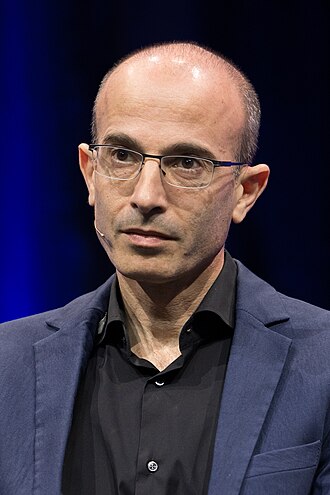
尤瓦尔·赫拉利 主持人
EDITED TRANSCRIPT · 依据现场录音编译整理,可划线生成便签
编者按:本文为尤瓦尔·诺亚·赫拉利在伦敦一场公开活动上的对谈实录。彼时他在耶路撒冷希伯来大学任教,《人类简史》(Sapiens)已被译成三十余种语言,他本人来英不过四十八小时。全场自作者与三场革命谈起,一路推进到金钱、性别、硅谷的新宗教与数据主义,最后落在历史学家的职责上,后半场为现场观众提问。以下内容依据现场录音编译整理,仅删去口语枝节、寒暄与重复,论证与例证一律保留。

开场:一位爬满灰尘的清扫者

主持人:女士们、先生们,晚上好。很高兴今晚能来到这里。顺带一提,这些椅子会滑,我要是滑走了,请不要见怪。我很荣幸为大家介绍尤瓦尔·诺亚·赫拉利。他在耶路撒冷希伯来大学任教,他的线上课程《人类简史》吸引了超过六万五千人报名,这样的听课人数,任何一所大学的任何一门课平时都只能做梦。我们今晚要讨论的这本书《人类简史》已经风靡全球,被译成三十多种语言。我们很幸运,今晚能请到他。他这次来英国只待四十八小时,你们今晚见到了他,也许今天早上还在第四广播电台听过他,之后他又平稳地转场到 Absolute Radio 继续谈这本书。要在这两个频道之间自如切换,光是这份脑力上的跳跃就够惊人的。《星期日泰晤士报》形容这是一本「把你脑子里的蛛网一扫而空」的书,作者是一位思维上的杂技演员,他的逻辑跳跃会让你惊叹出声,他的文字散发着力量与清晰,让这个世界重新变得陌生而新鲜。今晚他不会在我们面前表演杂技,至少身体上不会,但我们非常期待看到他在思维上拿出最好的状态。女士们、先生们,再一次欢迎尤瓦尔·诺亚·赫拉利。

主持人:我也得重复一下罗伯特刚才的话:活动结束后有签售,请从舞台右侧的门出去,如果你还没读过,也可以现场买一本请他签名。那么,作为一个智人对另一个智人发问:我们能不能先从这本书的整体框架谈起?在我看来,全书是围绕三场关键的革命搭起来的。请你分别讲讲。

三场革命

赫拉利:七万年前,人类,也就是智人,不过是非洲一角里无足轻重的猿类,对生态系统的影响跟其他许多动物没什么两样。在那之前,我们所谓的史前史其实就是生物学。历史大约始于七万年前的认知革命。我们并不确切知道它是怎么发生的、为什么发生,但我们由此获得了非凡的认知能力,最重要的是沟通的能力、使用语言的能力,以及创造并传播虚构故事的能力,这一点我们后面会大量讨论。这些新的认知能力把我们这个物种从一种无足轻重的猿类,变成了地球上最强大的力量,智人于是从东非迅速扩散到全世界,当时地球上所有其他人类物种随之灭绝,我们这个物种殖民了整个星球。

赫拉利:接下来是大约一万年前的农业革命,它把历史进程加快了,也再一次赋予我们巨大的新力量,让我们能够建立贸易网络、王国、城市、帝国等等。然后是最后一场革命,大约五百年前开始,而我们其实还只是站在它的开端,这就是科学革命。人类又一次获得了巨大的新力量,力量之大,可以说它也许不只是把我们从猿类变成地球的统治者,还可能把我们变成神。这句话是字面意义上的,不是什么比喻。人类正在通过科学研究和技术开发获得神一般的能力。《圣经》里,上帝按自己的意愿创造动物、植物和人;如今人类正在获得按自己的意愿重新设计和创造其他动植物,以及重新设计我们自己的能力。所以这是第三场,也可能是其中最重大的一场革命。

太快登顶的物种

主持人:我想把你带回第一场,认知革命。书里第十二页有一小段话跳出来抓住了我,我想这正是报纸说你「扫掉脑中蛛网」的地方。你说智人跃上食物链顶端时,就像一个香蕉共和国的独裁者:因为这一跃太快,不是通过漫长的演化过程完成的,所以智人对自己的地位充满焦虑。你接着说,从战争到生态灾难,许多历史性的灾祸都源于这次仓促的跃升。请你再展开讲讲。我们今天世界上那些可怕的事情,真的能追溯到当年那一次突然登顶吗?

赫拉利:你看世界上其他站在食物链顶端的动物,狮子、鲨鱼、鳄鱼,它们是经过数百万年的演化才填上这个位置的,不是很快到达,也不是偶然到达。它们自己和整个生态系统都有时间去适应。因此就有了大量的制衡机制,既有内部的也有外部的,确保它们不会把整条食物链毁掉。

赫拉利:智人的情况完全不同。人类出现在地球上大约两百五十万年,是从更早的物种演化而来的。但在这段时间里的绝大部分,也就是两百五十万年间,他们跟我们相当相似:直立行走,脑容量相对大,社会结构相对复杂,会使用工具。我们容易以为,这肯定让他们成了地球上最强大、最重要的生物。事实并非如此。两百多万年里,人类有大脑袋、复杂的社会、工具,用两条腿走路,却没干成什么大事,至少对生态系统的其余部分影响不大。非洲和欧亚大陆上散布着几百万人,人数很少,他们不是顶级掠食者,位置在中间偏上一点:猎捕小动物,吃大型掠食者留下的尸骸,同时自己也是狮子、老虎之类猛兽的猎物。

赫拉利:然后,在最近十万年里,这在演化的尺度上是极短的时间,智人这一个人类物种非常迅速地跃上了食物链的顶端。靠的不是自然选择的漫长生物演化,而是快得多的文化演化。我们自己和整个生态系统都没有足够的时间去适应。这一点在人类首次抵达澳大利亚时看得最清楚。大约四万五千到五万年前,第一批人类,也就是智人,抵达澳大利亚,此前没有任何人类物种能跨越那片海洋。智人到了,几千年之内,澳大利亚百分之九十以上的大型动物灭绝了。一万五千年前,同样的事在美洲重演:第一批智人跨过白令海峡进入阿拉斯加,一路南下,大约两千年内,美洲百分之七十以上的大型哺乳动物灭绝了。这里没有任何制衡。这个过程今天当然还在继续,就是生态系统的毁灭。今天地球上百分之九十以上的大型动物,要么是我们智人,要么是被我们奴役来满足自身需求和欲望的家畜。

主持人:我们就是那个香蕉共和国的独裁者。

赫拉利:对。像香蕉共和国的独裁者,是指我们对自己的位置极不安心。你看草原上的狮子,它对自己的地位非常笃定。智人则基本上是一群拿到了核武器和原子能的绵羊。而拿着核武器的绵羊,比拿着核武器的狼危险得多,因为它们不习惯这种力量,而且它们害怕得多。让一个害怕的人握有核武器,比让一个心里踏实的人握有核武器危险得多。

主持人:我以后再看奥巴马总统或者普京,眼光都不一样了:拿着核武器的绵羊,就这么记住他们。

故事怎么被人相信

主持人:说到认知革命,你开始谈「八卦理论」,我想你所说的「我们为了生存所需的神话」正是从这里真正开始的。你从社群如何随着规模扩大而合作这个角度切入:一旦超过了人人相识、人人知道彼此底细、可以自我调节的规模,你要再往上长,就需要结构,需要神话,需要共同的故事。你也谈到,要让这些故事起作用,关键在于让别人相信它们。可这到底是怎么发生的?我可以讲一个故事,你也可以讲一个故事,我们怎么才能让这群人相信你的故事或者我的故事?

赫拉利:最基本的办法,是让我们社群里的每个人都讲同一个故事,而且从很早开始,一遍又一遍又一遍地讲。如果你在一个社会里长大,从很小起就听所有人告诉你同一个故事,连彼此仇视的人都在讲同一个故事,那你几乎不可能去怀疑它。这就是贯穿整部历史的基本方法。当然也有出现互相冲突的故事的时候,那就麻烦大了。但一个稳定的社会,底下必须至少有一些人人都认可的故事。比如今天这样一个非常宽容、非常自由的社会,至少在英国,几乎所有人都接受人文主义关于人权的那套基本神话,也接受资本主义关于经济的那套基本神话,这些我们待会儿可以再谈。

主持人:我可以再逼问一步吗?我能理解一个故事在社群里代代相传之后,你会把它当成传统、当成事实接受下来。可最初呢?这些神话最初是怎么取得可信度的?它们的第一代信徒是怎么来的?

赫拉利:关键在于,多数情况下,至少在那些最成功的例子里,这不是靠欺骗或操纵。如果你想说服别人相信某件事,通常你自己得先相信它。我认为大多数基督教神父是真心相信他们讲的故事的,大多数资本主义银行家也一样,他们真心相信自己告诉我们的那套东西。他们并不是转到后面某个房间里,然后嘲笑我们居然信了他们的故事。

主持人:说实话,我们有时候会觉得他们真是这么干的。不过请继续。

赫拉利:这是最基本的一点:你是真信这个故事的。另外你通常会发现,人们脑子里同时装着好几个故事,一个故事失效了,他们立刻抓住另一个。这又是我们与其他动物的一个区别:正因为我们的行为如此依赖对虚构故事的相信,我们可以仅仅靠从一个故事切换到另一个故事,就极其迅速地改变自己的行为。我们脑子里通常存着好几个故事,一个不灵了就伸手去拿另一个。这在历史上发生得非常快,令人惊叹。想想二十世纪的德国史:同样一批人,同样的基因,同样的地理、气候和阶级结构,一百年间在五个完全不同的故事之间来回切换,从德意志第二帝国到魏玛共和国,到纳粹政权,再到共产主义的东德,如果你住在莱比锡的话,然后又到统一的、自由民主的德国。还是那批人,他们竟能如此迅速地更换自己所信的故事。作为历史学家,我倾向于认为多数时候这不是什么把戏,人们是真信的,而且他们会彻底忘记自己五年前、十年前信过的那个故事。我们从个人生活里也知道这一点:人通常会为自己的人生保有好几套叙事,并在其间切换,一旦切换,他们能把某样东西彻底关掉,完全忘了自己曾经对自己有过别的看法。

主持人:关于让社群得以存在的神话,你还提到一个反面:围绕共同神话建立社群的同时,也就造出了拥有不同神话的不同社群。所以那些把人聚拢起来的神话,同时也在把人分开。这个矛盾有出路吗?还是说这就是神话的天性?

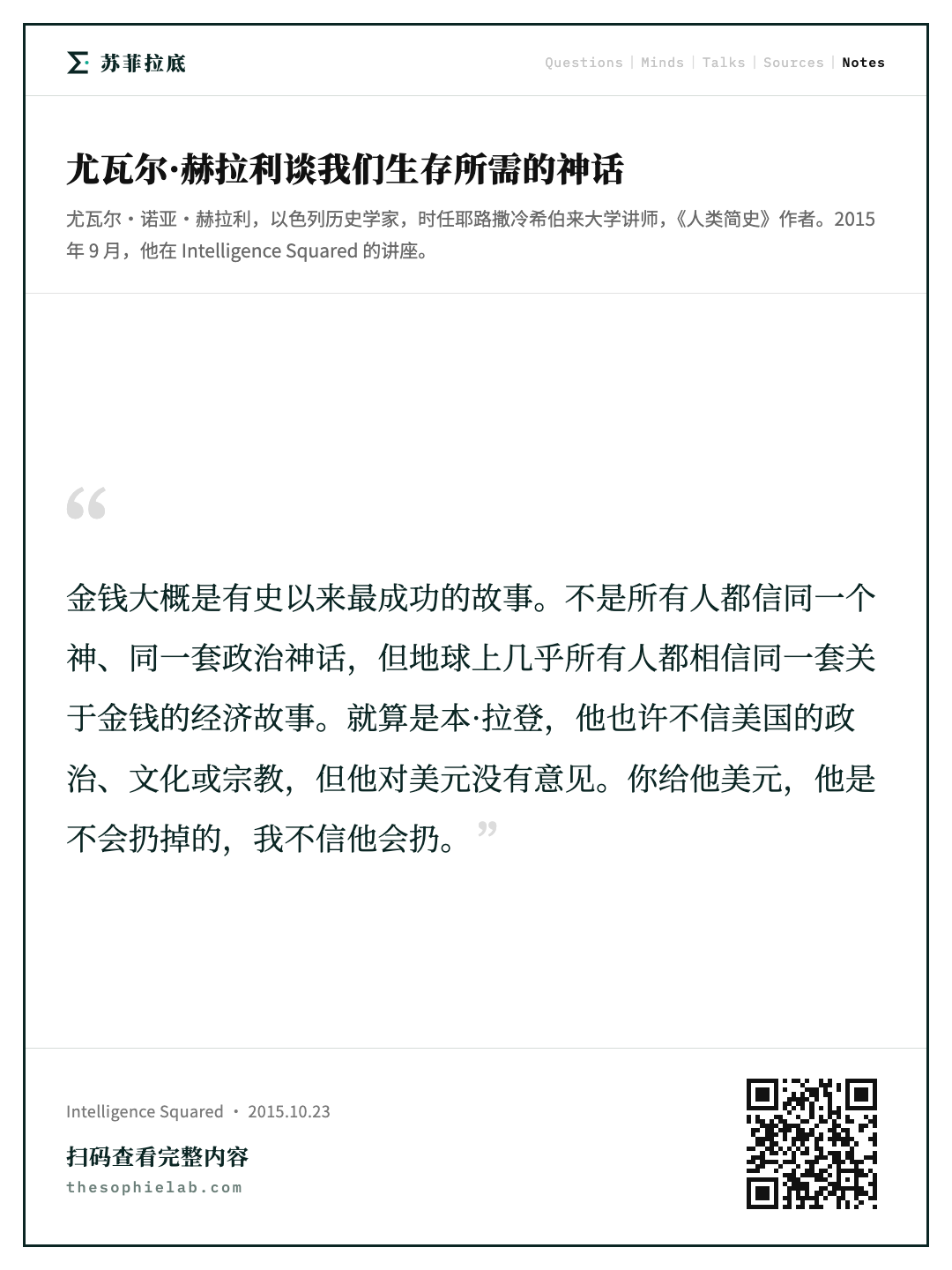
赫拉利:长远看是有出路的。你会看到,随着历史推进,故事越来越少,而相信同一个故事的人越来越多。回到两千年前或四千年前,你会发现几乎每一个小部落都有自己的神话,有自己关于世界的一整套信念。而今天你走遍世界,至少在某些方面,地球上所有人都共享同一套信念和故事。资本主义又是最好的例子。金钱大概是有史以来最成功的故事。不是所有人都信同一个神、同一套政治神话,但地球上几乎所有人都相信同一套关于金钱的经济故事。就算是本·拉登,他也许不信美国的政治、文化或宗教,但他对美元没有意见。你给他美元,他是不会扔掉的,我不信他会扔。

大脑为什么停止发问

主持人:我最近听到一件事,我想看看能不能把科学重新带回我们的历史叙述里。你讲的这个故事最好的地方之一,就是它的跨学科性:你在科学与历史之间来回穿梭,把两者接在一起。我听说美国最近做了一项测试,对象是一间浸信会教堂的会众,研究者在他们聆听富有个人魅力的传道人时监测脑部活动。人们原本期待看到的是认同、愉悦、兴奋,内啡肽狂飙之类。结果他们看到的是,前额叶皮质,也就是大脑前部负责批判性思考的区域,完全关闭了。后来的研究显示这不止是这一间教堂的现象。科学家现在的推测是,当我们面对或聆听一位有魅力的领袖,无论你怎么定义,也就是群体里的头领,我们的大脑其实是被硬性设定去停止质疑他所说的话,直接接受。这个想法放进你的世界里会是什么位置?在你的世界里,对共同神话的相信,对社群的运转、对神话的传播、对你所说的更换神话的能力,都是绝对必要的。

赫拉利:因为社会建立在对共同故事的相信之上,而且这甚至还包括用外在的方式标示「我信的是同一个故事」,比如戴某种帽子、留大胡子、穿西装,你一眼看到那个人就知道,啊,他信的和我信的是同一套。这非常重要。所以我觉得完全说得通:在我们的身体运作方式里、在大脑功能的深处,一定有某种机制,让我们能够不加过多思考就接受社会的共同故事。因为如果我们时时刻刻都在琢磨这些故事,社会就会崩溃。

赫拉利:我不想给人留下这些虚构故事都是坏东西的印象。基本的信息是:没有这些虚构,任何社会都无法运转,至少任何大规模社会都无法运转。一个一百人的群体可以完全不靠神话、不靠共同虚构而运转,仅凭彼此认识就够了:我知道你是谁,所以我能不能信任你、要不要跟你合作。但你要建立一个成千上万人乃至数百万人的社会,就必须有人人都相信的统一故事。如果我们没有这套机制,也许就是关闭前额叶皮质的机制,那是行不通的。

谁配骑那匹马

主持人:你在书里走得更远。这不只是故事的问题。如果说是围着火堆讲的民间故事,或者像金钱这样我们乐意接受的故事,我们都能理解。但你还谈到「想象的共同体」,整套社会等级在你这里也被归入故事、神话的名下。我在想,把它们称作想象出来的群体,是不是抹掉了一点现实成分?比如先天与后天之争。书里有个例子是精英阶层在早期社会、比如中世纪是怎么形成的。有人可以说,你看,如果某个人买得起一匹马,还买得起盔甲骑在马上,他就能保护众人;由于他能保护众人,他也就顺理成章地占据了社会的上层位置,替社会做决定。我很难把这看成是纯粹想象出来的群体,它看上去更像是很明白的常识:他们能做到,所以他们得到那个位置。这两者你怎么调和?

赫拉利:没错,通常的情况是,某个偶然的过程让某一群人,比如有马的人,发现自己站到了上面。但关键的问题是接下来:你如何维持自己的位置?如何建立的不是一时的等级,而是长久的等级?三百年后你跑去对农民说,看,三百年前我的曾曾祖父有一匹马,所以现在你们都得听我的,这说服不了任何人。

主持人:不过我倒真想看看有人这么试试,那场面值得一看。

赫拉利:换个现代一点的例子。如果在十九世纪美国南方,白人种植园主跑到奴隶面前说,三百年前发生了这样那样的事,所以你现在是我种植园上的奴隶,这不但让对方极难接受,就连他自己也没法向自己解释:是什么使我的位置、我的特权、我的权力成立?人们需要的是比三百年前一桩历史偶然事件深得多的正当化理由。所以他们发明各种故事,比如种族优越论,或者宗教上的辩护。像印度就有那个基本的创世神话:最初有原人普鲁沙,婆罗门,也就是最高种姓,从他的头部生出,而首陀罗,也就是最底层的,从他的腿部生出,所以他们必须服从婆罗门。把它放进恰当的宗教语境里,这听起来就比「两千年前一些来自中亚的部落入侵恒河流域、征服了当地人口,所以我们今天有了种姓制度」要容易接受得多。

性别之谜

主持人:我们转到另一种不平等。我今晚是一定要问你这个的:性别。你在书里指出,地理上遍布世界、时间上贯穿历史的大量文化,都把男性置于女性之上,而你和所有人一样,也难以给出一个令人信服的解释。请你带我们过一遍。写完这本书之后,你对我们该如何解释和理解这件事,有没有新的想法?为什么这个现象如此稳固、如此惊人?

赫拉利:这是历史上最大的谜题之一,因为很明显,这一次不能归因于某个偶发事件,也不能归因于某一个偶然的故事,因为你在几乎所有社会里都会以不同形式看到同样的结构。当然有例外,但在科学所知的绝大多数社会里,几千年来都是这样。

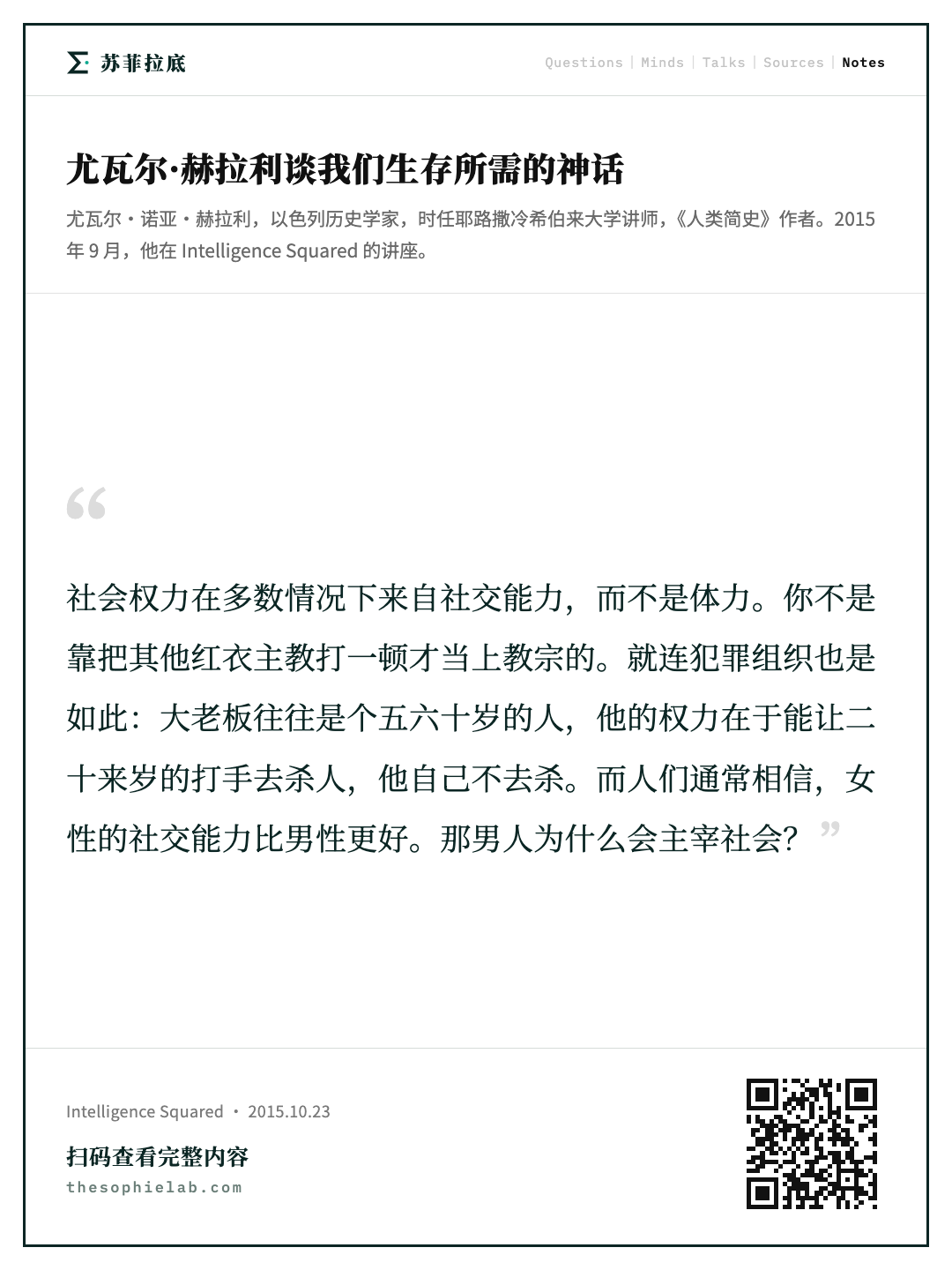
赫拉利:最先浮现在很多人脑中的最简单解释是:男人体力比女人强,所以他们主宰社会,理所当然。但这跟我们对人类、乃至对整个猿类的许多其他认识对不上。我们知道,社会权力在多数情况下来自社交能力,而不是体力。你看绝大多数人类组织的等级结构,它们与体力并不相关。想想今天世界上大概最长寿的组织,基督教会。你不是靠把其他红衣主教打一顿才当上教宗的。我想我说教宗方济各在体力上不是地球上最强壮的天主教徒,应该不会冒犯到谁。

主持人:我脑中已经出现西斯廷礼拜堂里举行举重比赛的画面了。

赫拉利:而且不只是天主教会,你看哪里都一样。就连犯罪组织也是如此:大老板往往是个五六十岁的人,他的权力在于能让二十来岁的打手去杀人,他自己不去杀。甚至在黑猩猩里,阿尔法雄性也不是体力最强的那只,而是能够建立稳定支持者联盟的那只。所以关键是社交能力。而人们通常相信,女性的社交能力比男性更好。如果是这样,而社交能力又是社会优势的关键,那男人为什么会主宰社会?

赫拉利:另有一种很常见的理论说,好吧,不是体力,是生育和育儿:女性一直在怀孕、照顾孩子,所以没时间去做那些重要的事,只好留给男人。但这个理论的问题在于,在其他动物那里,比如大象、比如倭黑猩猩(侏儒黑猩猩),情况恰恰相反。正因为雌性要负责照看幼崽,她们需要更多支援;正因为需要支援,她们必须更多地合作,于是发展出那些社交能力,因为她们在养育后代时需要其他大象或其他黑猩猩的帮助。结果就是形成一个由雌性组成的网络,这个网络主宰整个群体;而雄性在养育后代上责任少得多,它们独来独往得多,以自我为中心得多,合作起来更困难,于是基本上被挤到一边。所以尽管单只雄性倭黑猩猩比单只雌性强壮,社会仍由一个互相合作的雌性网络主宰。如果这在倭黑猩猩或大象那里可以成立,为什么在人类这里不行?何况对人类来说,社交能力是最重要的能力。

赫拉利:有一种可能,我要强调它的经验证据还不够,所以不是答案,只是值得探讨的可能:也许「女性社交能力更强」这个常见想法并不成立,至少在大规模合作上不成立。值得探索和强调的一种可能是,在小规模社会里,女性的社交能力确实更强;但一旦进入那些建立在造神话之上、必须与完全陌生的人合作的大型组织,情况就反过来了。女性恰恰因为需要直接的人际连结而处于劣势;而男性对疏离的处境、对建立在虚构而非真正认识对方之上的非人格化等级,感觉自在得多,他们在这类情境里舒服得多。所以一旦出现大规模社会和庞大的非人格化等级,男性反而在社交能力上占优。我再说一次,这只是一个值得检验的理论,不是答案。

主持人:我大学时读希罗多德,有一段印象极深。他讲到某个部落,村里的女人每有一个男性性伴侣就在腿上加一只手镯,等同一代的女人到了某个年纪,就数手镯,手镯最多的那个女人成为村子的首领。希罗多德写的时候多少带点看热闹的兴味。这类打破你所说范式的例子还是有的,只是非常少,是不是?

赫拉利:而且通常来自小规模社会。我们不知道有哪个大帝国是母权制的。这仍是历史上有待解开的问题之一。

金钱、信任与增长神话

主持人:我们来谈谈书里的一个主要神话,金钱,今晚已经提过一两次了。你说金钱能够跨越任何文化鸿沟,连本·拉登都收美元。但如果把它放到近年冲击欧洲、尤其是在希腊等地爆发的经济危机面前呢?在我看来那些危机产生了极强的分裂效应,反而拉大了文化上的裂口。这两者怎么放在一起看?

赫拉利:我认为,在这场席卷全球的经济危机中,我们恰恰看到了一些关于「相信金钱」这件事有多大力量的惊人例证。危机最严重的时候,我想是两三年前,美国联邦储备系统每天凭空创造三十亿美元,那一年总共创造了一万亿美元,办法就是进到电脑里,在某个地方加几个零,就这样。今天你甚至不用印钞票,绝大部分货币根本没有印出来,只是电子数据。制造金钱的基本材料是人的信任。只要有信任,你可以把它货币化成任何东西,甚至是电子数据。所以尽管资本主义体系自二○○八年以来接连挨打,世界上多数人对这个体系的信任程度仍然高得惊人。正是这种信任,让银行能够凭空创造出那么多钱。

赫拉利:你信任金钱,也信任生产金钱的那套系统,同时你还信任资本主义的几个基本故事。资本主义最基本的故事也许是:一切问题的答案、一切困扰我们的问题的钥匙,就是经济增长。不管你想要什么,长期而言唯一的实现途径都是经济增长。你要平等、要自由、要就业、要民主、要和平,随便你说,都得靠经济增长;如果长期没有经济增长,你什么都得不到。落到个人层面,这就转化成另一个极其强大的神话,消费主义,它是同一套包装的一部分:你在个人层面遇到任何问题,解决办法就是买点什么。什么问题都一样,你多半需要买点什么,然后就好了。可以买产品,也可以买服务,你可以买一辆车,可以买瑜伽,可以买婚姻咨询,随便什么。总之人类的问题,在集体层面靠经济增长解决,在个人层面靠多买东西解决。而绝大多数人口,至少在欧洲和世界大部分地区,仍然相信这些故事。哪一天他们不再相信了,资本主义体系就会崩溃。

未来的宗教出自硅谷

主持人:再谈你的另一个大神话,宗教。你在书里带我们过了一遍当今世界的许多宗教,指出其中不少存在相当程度的认知失调。但我想请你谈谈未来的宗教。正如你开头指出的,我们正处在一场新革命之中,这场科学革命将再一次把我们的世界改变到超出我们现在理解的程度。你怎么看未来的宗教?会不会出现以技术为基础的宗教?你今天早上在第四广播电台好像谈到,硅谷正在、或者将要成为某个被崇拜的神。

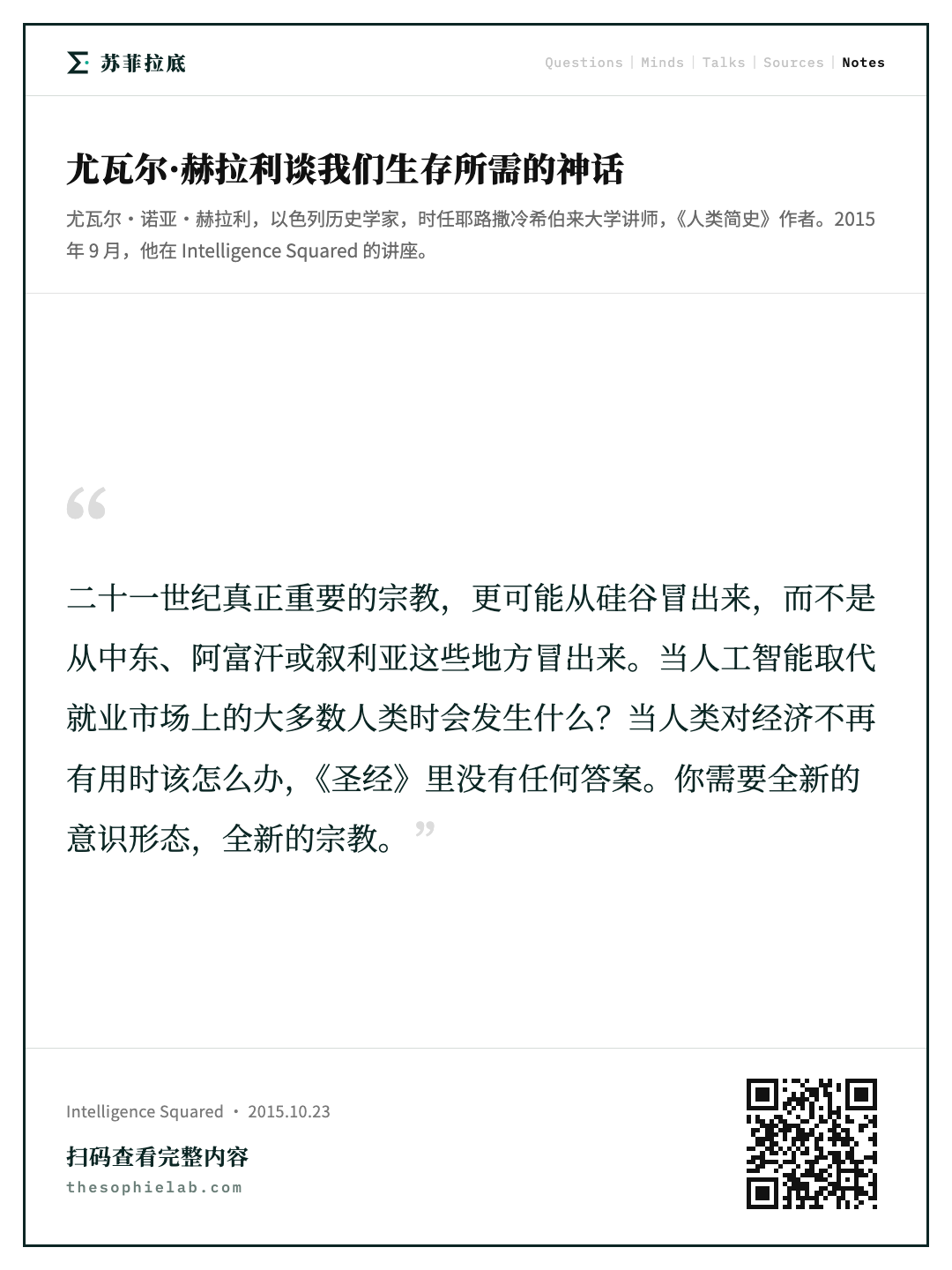
赫拉利:我认为未来属于技术宗教。二十一世纪的大宗教、真正重要的宗教,更可能从硅谷冒出来,而不是从中东、阿富汗或叙利亚这些地方冒出来。

赫拉利:这有点像十九世纪工业革命时发生的事。工业革命席卷世界,引发了大量反弹,它制造了许多新问题,摧毁了许多旧有的确定性和等级秩序。正如马克思和恩格斯在《共产党宣言》里写的:一切坚固的东西都烟消云散了。而当一切坚固的东西都烟消云散,人会非常害怕,于是回头去寻找某种令人安心的古老传统、神话或宗教,来给自己安全感。所以在十九世纪,工业革命引发了席卷全球的原教旨主义浪潮。十九世纪最大的战争不是拿破仑战争,也不是美国内战,而是中国的太平天国。面对工业革命的到来、英国帝国主义的压迫、旧有中国秩序的崩塌,出现了一个屡试不第的书生洪秀全,据说他得到了上帝的启示,上帝告诉洪,他是耶稣基督的弟弟,被派到人间来建立天国的太平。他带着这套「太平」的信息走遍华南,数百万人跟随他投入太平天国之乱,那是十九世纪最血腥的战争,按最保守的估计也有两千万人丧生,战乱持续十四年才被镇压下去。这是最大的战争。类似地,苏丹还出现了马赫迪运动,某些方面和我们今天在中东看到的情形颇为相似。

赫拉利:但这些都没成功。我们回头看十九世纪,不会把它记成一个信仰的时代。真正从工业革命和十九世纪里生长出来的重要宗教或者说意识形态,是社会主义。一八○○年时一个社会主义者都没有,它起步时非常微小,然后像野火一样蔓延,成为那个时代最重要的意识形态运动,彻底改变了我们的生活。社会主义者成功的关键在于他们切题:他们面向未来而不是回望过去,他们不去钻研古代经典,而是研究工业革命创造出来的技术和经济结构,因此他们对工业革命带来的新问题和新机会有话可说。

赫拉利:如今我们正身处第二次工业革命之中。这一次,变革的主要引擎不是蒸汽和电力,而是生物技术和计算机科学,是「智能设计」。这一次的主要产品不会是纺织品和车辆之类,而是身体、大脑和心智。二十一世纪的主要产品很可能就是身体、大脑和心智。而伊斯兰国对这里面的新机会和新危险毫无切题可言。举个例子:当人工智能取代就业市场上的大多数人类时会发生什么?专家估计这可能只需要三四十年。当人类对经济不再有用时该怎么办,《圣经》里没有任何答案。你需要全新的意识形态,全新的宗教,而它们更可能出自硅谷或者班加罗尔,而不是中东。它们很可能会给人们提供以技术为基础的愿景:旧宗教承诺过的一切,幸福、正义,甚至永生,但兑现在人间,借助技术,而不是死后借助某个超自然存在。

科学给力量,宗教定用途

主持人:在把时间交给观众之前,我还想问一个问题。你说科学革命的关键教义之一,是承认无知:承认有些事情我们还不知道,而且值得去弄清楚。这一点,与我们为了在社群中生存而讲述的、必须被相信的、必须无所不包的神话,是怎么并存的?将来又会怎么并存?

赫拉利:科学不为伦理问题提供任何答案,因此它永远无法独自站立。更深一层说,至少在我这个历史学家看来,科学其实并不关乎真理,它关乎力量。作为一项事业、作为一套建制,科学真正的目标不是真理,而是力量。具体的个人、具体的科学家在个人层面可能非常关心真理,但作为一种建制,科学真正的目标是力量。因此它可以、而且必须始终与某种意识形态或宗教结盟。

赫拉利:我们脑子里有这样一个故事、这样一个神话:科学与宗教是敌人,双方在交战,希望最后科学的光明能战胜迷信与宗教的黑暗。我认为这与过去几个世纪实际发生的事情、以及未来一个世纪将继续发生的事情相去甚远。具体的科学理论与具体的宗教之间有冲突,这是有的,但从根本上说,科学与宗教是朋友,是盟友。科学提供力量,宗教告诉我们拿这力量做什么。同一种技术,比如人工智能或基因工程,可以做完全不同的事。用基因工程,你可以治愈癌症,也可以制造订制婴儿。到底要做什么,科学家给不出答案。生物学或物理学里没有任何一个实验能告诉你该拿基因工程做什么。要回答这个,你需要相信某个故事、某种宗教、某种意识形态。二十一世纪也仍将如此。

观众问答:性别、追责与气候

主持人:非常感谢。现在我们把时间交给观众。一楼有几位工作人员会把话筒递给你们,楼上有一支立式话筒,在正中间偏右一点的位置,楼上的观众得走到那支话筒前提问。楼下请等拿到话筒再开口,这样大家才听得清。我会一次收几个问题,再一起交给尤瓦尔。先从这一区开始,那位深色头发的女士,然后是前排那位先生,还有这边穿蓝衣服的女士。

观众一:谢谢赫拉利博士,首先非常感谢你的书拓宽了这么多人的思维。我的问题还是关于性别失衡。我知道你说自己也没有令人信服的答案,我们期待哪天能听到。但我想问,以你对历史上不同人群如何获得权力的了解,放到今天的世界,你认为女性最应该做的事情是什么,无论是在行为上还是行动上,来处理这种性别失衡?以及相关的一问:你认为为什么这件事还没有发生?

观众二:谢谢你这场精彩的演讲。犹太教、基督教和天主教都曾基于自己的神话犯下可怕的种族屠杀。你认为那些创造这些神话、并把它们推向全世界的宗教领袖,应该因此入狱吗?

观众三:再来一个轻松的:气候变化。考虑到我们可能正处在下一场大灭绝的开端,我很想听听你认为未来五十年、一百年里智人的社群会是什么样子,以及你觉得我们会如何应对气候变化。

主持人:好,未来的性别、宗教、气候变化,请在两分钟内回答。

赫拉利:关于性别,我认为过去一百年发生了巨大的变化,可能是几千年历史上最大的社会变革。几千年来,我们经历了那么多政治、社会和经济的革命,那么多东西都变了,但大多数人类社会、至少是较大的人类社会那种基本的父权结构没有变。而过去一百年,你看到女性地位以及整体性别关系发生了真正根本性的变化。它当然离一个完全平等的社会还很远,是否可能出现一个完全平等的社会也还是问题,但我不会说过去几十年里什么都没做成、什么都没实现。

赫拉利:至于未来,这也和另一个问题相连:我不确定五十年、一百年或一百五十年后还会不会有性别这回事。既然重新设计和创造身体、大脑与心智将成为二十一世纪经济的基本产品,人类身体与心智最根本的结构本身就可能改变。所以我不太确定一百年后人们还会不会拥有一种清晰的、单一的性别。举个已经在发生的例子:在虚拟现实里,一个人非常容易采用不同的性别,可以切换性别,也可以构建各种替代性的性别。今天已经有男孩在虚拟世界里以女性化身出现,反过来也有。今天这还很原始,你坐在电脑前,面对的是二维现实。但三十年后,越来越多的生活可能会转移到三维虚拟现实中去,那里能提供比外部世界枯燥的生活多得多的刺激与趣味,尤其当人们在经济上已不再被需要、在政治体制中已没有权力的时候。在这种情形下,我不会想当然地认为我们今天熟悉的、也是几千年来一直如此的性别结构,在五十年或一百年后仍然有效。

赫拉利:第二个问题是宗教,是否要审判那些传播神话、进而造成种族屠杀的人。我没有一个适用于所有情况的答案,但一个很明显该问的问题是:最初发明并传播神话的人,与实施暴行、实施种族屠杀的人,两者之间的因果关系是什么?我不会因为十字军在耶稣死后一千年做的事而审判耶稣,至少据我理解,他所宣讲的内容与十字军从他的宣讲中理解到的东西之间,差别非常非常大。在另一些情况下,比如希特勒和纳粹,最初散布故事的人与以这些故事之名犯下的暴行之间,联系就紧密得多。

赫拉利:我们要记住的是,智人有一种惊人的重新诠释故事的能力,这正是故事的力量之一,它使故事能够变化、能够适应。一个故事说「白」,人们会说,是是是,这只是个寓言,写着白的地方其实是黑的意思;写着「爱你的邻人」的地方,其实意思是把你的邻人钉上十字架,或者如果他不信你这一版本的爱与慈悲之教,就该把他烧死。从这个角度说,我不会只责怪最初发明故事的人,我也会去看那些用极富创造力的方式重新诠释故事的人。

赫拉利:然后是气候变化,尤其是在大众汽车事件之后。气候变化是个很令人沮丧的议题,因为在这件事上说了很多,却没有根本性的改变。根本问题大概在于资本主义关于经济增长的那个基本故事。至少在目前,也许将来会找到让两者共存的办法,但至少在目前,要减少温室气体排放,要哪怕只是减缓全球变暖,除了停止或降低经济增长之外没有别的路,而今天几乎没有哪个政府愿意或能够这么做。当资本主义的故事与全球变暖的问题相撞,资本主义的故事总是赢。所以也许我们会找到某种新的技术手段让两者调和;但如果那不发生,我认为至少就目前看,我们不会及时采取足够激进的行动。这是一场人类正一步步走进去的灾难,我们将在不太遥远的将来承担后果。

什么是真实:以苦为检验

主持人:我们上楼,到立式话筒那边,先收楼上的三个问题。

观众四:晚上好。我想问一个同样「不大」的问题:这些故事与你所说的某种客观现实之间是什么关系?也就是说,我们在社会中讲述的那些最成功的故事,与某种客观真理之间有没有关联?还是说,它们靠的只是把人聚拢起来的能力?你提到伊斯兰国对未来五十年到一百年的人类发展毫无回应,这是否意味着,一个更接近科学真理的故事,会比一个仅仅让人娱乐、给人安慰的故事更成功?

观众五:我的问题是,我们究竟应该相信什么?我一直觉得,作为人类,我们本来是知道一些基本价值的,比如慈悲、善良,但我们的心智又如此脆弱,如此容易被干扰。比如纳粹,比如我们现在看到的伊斯兰国,能把普通人变成杀人机器。作为生活在社会中的普通人,当有人想让我们相信他们希望我们相信的东西时,我们该怎么想?怎么分辨?怎么保持独立?

观众六:我想问三个。第一,那次认知飞跃,你有没有什么想法说明它为什么发生?第二,你对自己正在传播的神话有多大程度的自觉?第三,你相信有真理这回事吗?

主持人:看来楼上那排格外哲学,也许是那里的空气不一样。我们从认知飞跃开始?还是你自己选顺序。

赫拉利:先说客观性。一个故事在客观上是否真实,与它在历史上是否成功,两者的关联少得出奇。历史上一些最成功的故事,我就不点名以免冒犯谁了,恰恰是最离奇、最古怪的。我们对它们太习惯了,觉得有人相信它们很正常;但你只要试着从一个从未听过它的人的角度去想,就会觉得,这怎么会有人信?所以两者之间没有关联。为什么某个宗教成为主流并扩散开来而另一个没有,往往是偶然的,往往与故事的真值毫无关系,更多取决于各种组织能力或历史的偶然。

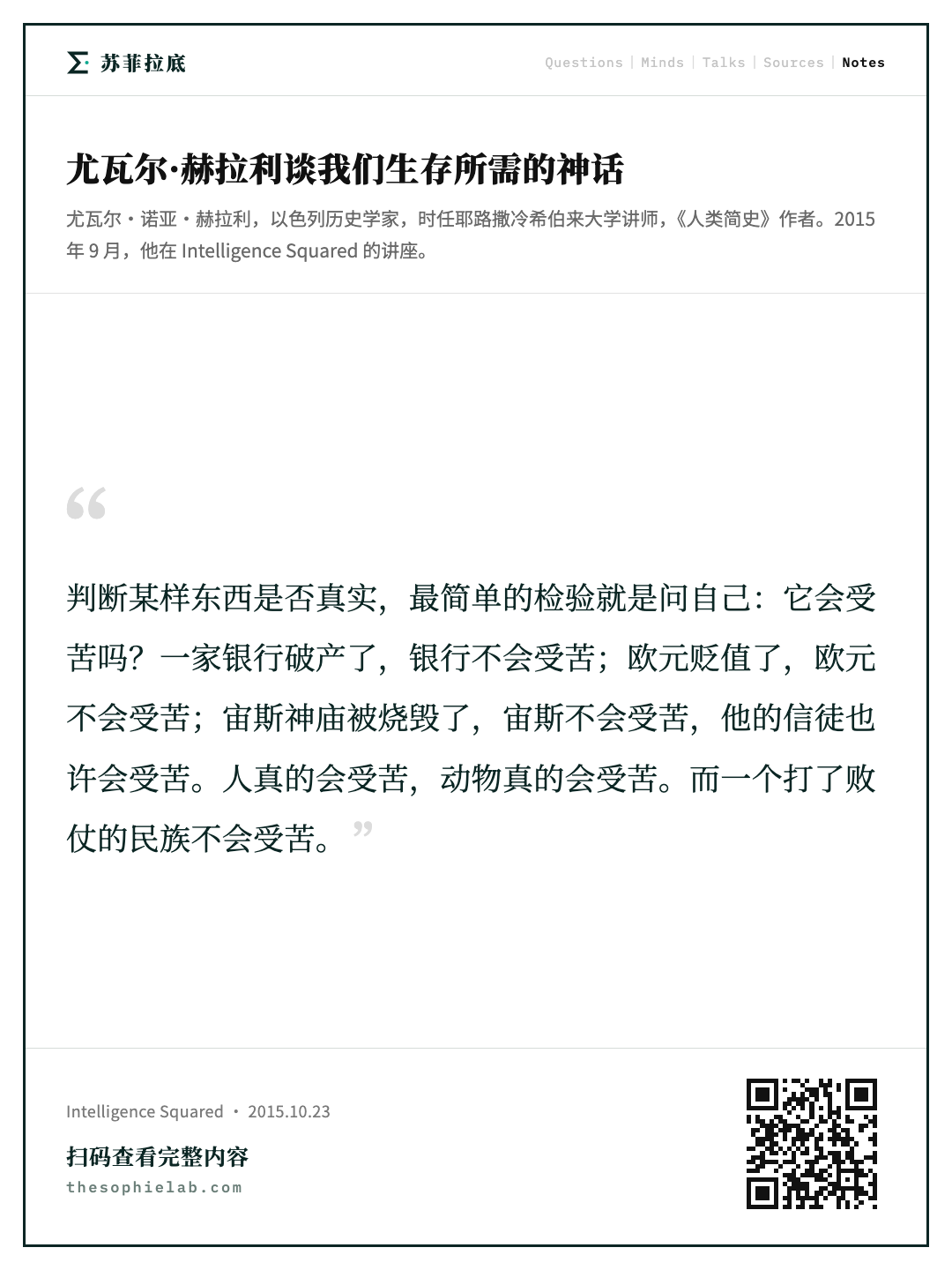
赫拉利:第二个问题是,有没有某种真理可以作为伦理和道德的基础,以及世界上什么是真实的。对我来说,伦理不是遵从这个或那个想象出来的存在的命令,而是全部围绕「苦」这个问题展开。据我理解,苦是世界上最真实的东西,或者说是最容易检验其真实性的东西。苦是真实的。它可能是相信各种想象故事和想象实体的结果,但苦本身是真实的。判断某样东西是否真实,最简单的检验就是问自己:它会受苦吗?一个民族不会受苦。我们会说这个民族在战争中蒙受了失败之苦,但那只是比喻,民族即使打了败仗也不会受苦;民族中的人,平民、士兵,他们会受苦,但民族不会受苦。同样,一家银行破产了,银行不会受苦;欧元贬值了,欧元不会受苦。宙斯神庙被烧毁了,宙斯不会受苦,他的信徒也许会受苦。人是真实的东西,人真的会受苦;动物真的会受苦。奶牛在乳业里与小牛分离,这头母牛和这头小牛真的在受苦,这是真实的。而一个打了败仗的民族不会受苦。所以我认为这是最清楚的检验。当然还有别的检验,但对我来说这是最清楚也最重要的一个。

赫拉利:至于认知飞跃、认知革命的成因,我们并不真的知道。有各种各样的理论,但七万年前智人身上究竟发生了什么并不清楚。十万年前的人类看上去和我们非常像,脑容量和我们一样大,但行为方式完全不同。我们目前最好的理论是,大约七万年前发生了某个或某几个小的基因突变,导致智人大脑内部结构发生改变,也许是把原本分开的两个脑区连接起来了,或者相反,由此产生了新的认知能力。但这目前仍只是假说。我认为科学最好的地方在于,当你不知道某件事时,你不必去编一个动听的故事,你可以直接说「我不知道」。所以,我们不知道认知革命的成因是什么。

主持人:还有一个相关的问题:你对自己正在编织给我们的那些神话有多大自觉?

赫拉利:我尽量。

主持人:注意,他刚才把这个问题跳过去了,被逮到了。

赫拉利:我尽可能保持自觉。我用的还是刚才那个检验,苦的检验。当你看到故事对人类、也对我自己有那么大的力量时,你需要一个能抓住的东西,那就是不断问自己:什么是真正真实的,而不只是我脑子里的一个故事?我一再回到的检验就是苦的检验:什么是真实的?什么是苦?是什么造成了苦?把注意力放在这上面。这至少能给你一条线索,让你不至于一路沉进越来越多的虚构与神话里。

主持人:把话题拉低一点,我想起《黑客帝国》里那句话,机器说,我们第一次给你们造的世界没有痛苦,结果没人接受。必须把痛苦放进母体的世界里,人们才会相信。而你在书里也花了不少篇幅谈幸福。

赫拉利:是的。

主持人:我想插一句:你认为幸福作为一个主题,在我们讲述的历史叙事中研究得远远不够。可你用来检验真实的标尺又是「苦」。你怎么看这两者的关系?那么研究幸福的用处是什么?

赫拉利:苦与幸福是一枚硬币的两面。而且至少我的出版商告诉我,你要是写「苦」,没人愿意读;你要是写「幸福」,那好,幸福,我们想听幸福。所以标题上是幸福,读到小字部分你才发现,哦,其实讲的大半是苦。

主持人:这大概是有史以来最高明的广告手法了。

同一个神话与下一个神话

主持人:我们转到这一区,先是第二排那位先生,第一排那位先生,还有他旁边那位女士。

观众七:接着基因这一点问:你认为人类在基因上有可能全都相信同一个神话吗?举个也许有点浅的例子,就是那条白金还是蓝黑的裙子。因此,未来的基因操控会不会成为那些真想影响人类的人让大家凝聚在一个强大神话周围的手段?

观众八:大致是同一个范畴。你谈了很多我们如何更换故事、如何放下一个再拿起另一个,以及未来的宗教可能会变成完全不同的样子。我想问反面:有没有哪些故事贯穿始终,人类从一开始就有、也许形态变过,但内核不变?还是说我们就是不断向前迁移的生物?

观众九:我们谈了很多,说金钱是人类创造出来的最大的故事,宗教和资本主义大致排在其后。你认为人类下一次飞跃中最大的故事会是什么?或者在你看来,有没有比金钱更大的故事?

赫拉利:所有人同时相信同一个故事,这是可能的。我们又有金钱这个例子,它大概是最成功的故事,而且是个很好的故事。我并不是在暗示它有什么不好,金钱和资本主义在很多方面为人类做了大量好事。今天很流行把世上一切罪恶都归到它们头上,不只是今天,但也得说,它们同样带来了一些非常好的发展。今天世界上每年死于吃得太多的人,比死于吃得太少的人多;每年死于老年病的人,比死于传染病和儿童疾病的人多;每年自杀的人数,比战争和犯罪杀死的人加起来还多。这三条都是极好的消息。听起来也许不像,但你仔细想想,这是极好的消息。而资本主义体系在这三项成就上,也就是减少饥荒、减少疾病、减少世界上的暴力,功劳不小。我觉得有必要说这些,来平衡一下前面可能给人的错误印象。所以,即便没有基因工程或生物工程,全人类相信同一个神话也是可能的。

赫拉利:至于下一个阶段会是什么,我们无法真的知道。最有可能的是,历史的下一阶段将涉及人类自身的根本改变。几千年来,我们有过社会的、政治的、技术的革命,但人类本身没有变,我们的身体、大脑和心智仍与两三万年前的狩猎采集者相同。而下一阶段很可能涉及对智人最根本特征的改变与操控,也就是身体、大脑和心智。这也可以被用来让所有人相信同一个故事,或者相信不同的故事,我不知道,但这肯定是一种可能。

赫拉利:第二个问题是有没有什么东西没有变过。故事相对于基因的力量,在于它极其灵活、极易塑造。一个蜂巢要改变自己的社会结构,大概需要几千代的自然选择。蜜蜂没法某天早上醒来搞一场革命,处决蜂王,建立蜜蜂共和国,或者搞一场共产主义专政:全世界的工蜂联合起来,我们来建立蜜蜂的无产阶级专政。这行不通。人类可以,因为我们不需要改变 DNA,我们改故事,而这可以非常非常快地完成。

赫拉利:人们有时以为有些故事几千年不变,宗教里尤其如此,人们说服自己说,我信的和几千年前的人信的是同一样东西,遵守的是同样的诫命。可你往深里看,几乎所有情况下你都会发现变化极其巨大。还是拿教宗举例,需要例子的时候教宗总是很好用。现在教宗对欧洲人说,把教堂打开,接纳从叙利亚来的穆斯林难民,欢迎这些穆斯林难民进入你们的教堂,这才是基督徒该做的事。回到一千年前,教宗说的是,到叙利亚去,杀掉那些异教徒。而教宗仍然会说,这是同一个基督教,是同一套基本故事。所以人们告诉自己什么都没变,实际上它一直在变,而且变得相当剧烈。

赫拉利:第三个问题,下一个大故事。两三分钟里解释起来有点复杂,但我认为下一个大故事是数据。如果把历史浓缩成一句话:最初人们相信神,人之所以重要,仅仅因为神创造了人并赋予人特殊的特权等等。然后是人文主义革命,人们不再信神,开始相信自己,相信人类。人本身成了神圣的,这就是对人权的信仰:智人是神圣的。为什么?就因为我们神圣,我们是宇宙中最重要的东西,是一切意义与权威的来源。而我猜,下一个大变化是:正如我们从以神为中心的世界观走到以人为中心的世界观,我们将从以人为中心走向以数据为中心。正在从硅谷冒头的那个基本神话是:整个宇宙是数据的流动,宇宙中的一切都只是不同模式的数据流;所有生物都是算法,长颈鹿、番茄、人类、流感病毒,都不过是不同的数据处理系统。直到现在,宇宙中最成功、最先进的算法是人类,这也是把人神圣化的一个好理由:他们是世界上最好的数据处理系统。但我们正在造出比人类更好的数据处理系统,人类将被挪到一边,未来将属于完全不同的算法。这是我个人的猜测,是我认为我们在二十一、二十二世纪的去向:数据取代人文主义,成为历史的中心神话。

主持人:于是所有人突然开始剪掉自己的乐购会员卡。

民族主义、爱与动物

主持人:我们到这一侧的后区,那位举着纸的先生,他后面几排那位女士,还有中间前排那位先生。抱歉,也请前排那位女士一起。我们先收这三个。

观众十:你提到,神话对于大型社会组织自身是必需的,而民族国家在二十世纪高度依赖神话,是我们在十九、二十世纪用来组织政治生活的构造。你认为在二十一、二十二世纪,政治体的组织原则将会是什么?我们要往哪里去?

观众十一:我想问,你认为爱是一种神话吗?

观众十二:谢谢。我的感觉是,我们眼下正处在故事与故事之间的空档,今天这里的很多问题似乎都把希望寄托在新的故事上,我的问题也一样。我想问你怎么看这样一种失调:我们讲给孩子听的那些关于自然和动物的故事,与我们容许动物被对待的那种恶劣方式之间的落差。

赫拉利:先说政治中的民族国家。过去两百年里,民族主义是世界上最重要的故事和神话之一,但我们现在看到的是民族主义重要性的下降。尽管有那么多关于民族主义复兴的说法,比如在欧洲,可你把今天欧洲民族主义的强度和一个世纪前相比,那是完全没有可比性的。就在一百年前的第一次世界大战中,意大利于一九一五年参战,没有人逼它参战,也没有人入侵它,它是自己主动参战的,为的是拿到几块小地方,主要是的里雅斯特和特伦蒂诺,意大利声称那是被奥匈帝国非法占领的神圣国土。意大利在那场战争中损失了大约六十五万名阵亡士兵,一百多万人受伤,为的是的里雅斯特和特伦蒂诺。今天没有哪个意大利政府会为了从斯洛文尼亚或奥地利手里拿到一块地而冒险牺牲哪怕五千名士兵,这几乎不可想象。同样,你看苏格兰的独立运动,把它和两三百年前相比,也没有可比性:几乎没有人愿意为支持或反对苏格兰独立而杀人或被杀;而两三百年前,伦敦的政府愿意把军队开进高地,在卡洛登之后、在一七四五年之后实行某种族群清洗。这是完全不同性质的故事。今天在欧洲,也许可以说存在一种「精品民族主义」,在欧盟这把大保护伞底下,有点民族特色是件不错的事,但没有人会为这种精品民族主义去送命。

赫拉利:民族主义式微在历史上也说得通,因为二十一世纪人类面对的重大问题在性质上都是全球性的,没有哪个国家能靠自己解决,那个层级不对。无论是全球变暖,是全球经济危机,还是人工智能这类新技术带来的机会与危险,当人工智能在认知上、在智能上超越人类时会发生什么,这都不是单一国家的单一政府能独自解决的事。所以从这个意义上说,未来但愿属于一种更全球化的政治。如果人类无法上升到这个层级,无法形成一种更有效的全球政治体系,不一定是全球政府,我们就无法有效应对二十一世纪那些真正重要的问题和危险。政治就说到这里。

主持人:那么爱呢?

赫拉利:关于爱。我先生就在观众席里,所以我现在说话得非常小心。爱当然是真实的。但围绕爱有非常非常多的神话。爱既是一种生物学现实,也是一种个人的主观现实,但围绕它编织出来的神话与故事多得惊人。比如你看一部好莱坞科幻片,外星人征服银河系、入侵地球,或者《黑客帝国》里那个无所不知、无所不能、奴役人类的系统,主角被这个系统玩弄于股掌之间,被外星人的邪恶机器人打成筛子。然后在最后一刻,一切都看似无望、人类即将被毁灭或征服的时候,忽然出了点什么事,主角醒来,把局面整个翻过来,外星人搞不懂发生了什么,母体也无法理解发生了什么。而这一切都是因为爱。这是大多数好莱坞编剧能想出来的最高水平。而且那甚至不是什么宇宙性的慈悲之类,通常就是两只哺乳动物之间非常肉身的爱。我个人的看法是:一个已经征服了整个银河系的外星文明,或者一台统治着整个现实的超级智能计算机,居然无法理解、无法看透一阵荷尔蒙的涌动,这实在太不可能了。所以我不认为这种神话站得住。

主持人:这是我近来听过的对「猪门」事件最外交辞令的提及了。那么最后一个问题,关于动物在二十、二十一世纪受到的恶劣对待,而我们对此似乎相当心安理得。

赫拉利:这里存在一个巨大的落差。你打开一本童书,里面全是关于毛茸茸的可爱动物的美好故事,既有农场动物也有野生动物,而这与这些动物的真实处境、与我们对待它们的方式相隔十万八千里。所以这关乎我们心智的分隔。智人有一种惊人的能力去承受认知失调:同时知道一件事又不知道它,同时相信某样东西又相信它的反面。如果没有这种能力,我们大概根本无法形成任何能运转的社会、任何能运转的文化,因为所有社会和文化都建立在矛盾之上。比如你相信一个全能全知的神,同时又把世上一切苦难从这个神身上豁免出去,归咎于魔鬼。这两者其实无法并存:要么你相信一个全能的、控制一切、创造一切的唯一神,那么如果有魔鬼,魔鬼也必定是这同一个神的造物,那么魔鬼所做的一切也要由这个神负责;要么魔鬼独立于神,那么神就不是唯一的创造者,不是全能的,也不是全知的,你至少有两个互相争斗的神。但人们总能在心里把它调和起来,既是一神论者又是二元论者,在恰当的时候取出恰当的故事。对待动物也是一样:我们可以给孩子讲一个关于某头奶牛及其冒险经历的睡前故事,然后喂他吃牛排,还要求他把盘子里的东西吃干净,中间的联系被完全略过。

最后几问与历史学家的任务

主持人:我们只剩几分钟,得进入快问快答了。回到楼上,先收两个,再回到中间后排两个。请举手,我们马上把话筒递过去。答案就限三十秒吧。

观众十三:你认为今天的世界能否在没有金钱的情况下成功运转?

赫拉利:不能。

观众十四:我儿子昨天满六岁。面对一个机器人和人工智能的世界,你会给他什么建议?

赫拉利:今天教育体系教给他的东西,几乎没有一样与他将来真正生活其中的世界相关。他最需要具备的能力,是终身不断学习。学习不会有终点,他要一次又一次地重新塑造自己。那种到二十岁或二十五岁把该学的学完,然后大半辈子靠着学到的东西工作、靠着积累的智慧应付的模式,已经行不通了。变化的速度太快,你必须终身学习。

主持人:中间那位先生,还有他旁边那位女士。

观众十五:「能让人相信荒谬的人,就能让人犯下暴行。」这句话是伏尔泰说的,很有智慧的人。我们要怎样才能让社会、让未来的世代对今天泛滥的那些有毒的正统神话产生免疫?

赫拉利:这非常非常难,我同样不知道答案。要把自己从这个时代的主导故事里哪怕只解放出一点点,都需要极大的、非常个人化的努力。我不知道历史上有哪个例子是大规模人群做到了这一点。所以我还是用科学的方法说:这一个我不知道答案。

观众十六:听你谈消费主义很有意思。你在书里说,比如我们去旅行,是被消费主义的生活方式驱动的。你认为有没有可能,我们旅行也是因为想探索世界,因为我们是被更高的智性、被文化体验所驱动的人?

赫拉利:我们常对自己说,我们跑到地球另一边是因为想探索世界。可是所有的机场和所有的度假村看上去一模一样,在「真的跑到地球另一边」这个地理意义上,可探索的东西越来越少。而且即便去了,当然不是所有旅行者都这样,但人们跑到地球另一边时往往仍然想要家里那一整套东西。从深处说,他们并不真的想探索世界,他们信的还是广告上那些故事:去泰国、去墨西哥,我就能探索另一种现实,接触到自己身上另一个部分。但事实上,我不认为你内心有一个贴着「仅限身在墨西哥时打开」标签的情绪与感受的盒子,到了墨西哥它就打开,美妙的东西涌出来。基本上我认为,你希望了解的关于自己的一切,在伦敦这里也一样能了解。

主持人:这话航空公司可不爱听。非常抱歉,还有很多举手的朋友我们没能顾上,今晚要在这里收尾了。有个念头掠过我的脑海:我们今晚描绘的图景对未来来说并不算多么令人愉快,你在书末把我们形容为不满足、不负责任、不知道自己想要什么的神明,这在未来的去向上打了个问号。但老实说,我用这个来安慰自己:还记得《回到未来》第二部吗?他们去到的那个未来,正好就是二〇一五年。我们现在就在这一年,而我还没有飞行汽车,耐克那双会自动系带的鞋也没出现,尽管据说耐克承诺年底前会有点什么。所以哪怕怀着最好的意图,我们也无法准确预测未来。最后一句留给你。

赫拉利:当然,我们没有办法预测未来,今天比历史上任何时候都更没有办法。没有人真的知道二〇五〇年的经济、社会或性别关系会是什么样子。我们能做的是探索一些可能性。我认为对历史学家、对学者来说,面对未来的任务不是做预测,而是探索不同的可能性,让我们为不同的可能性做好准备。人们常说,学历史是为了预测未来、从过去的错误中吸取教训等等。我认为学历史最主要的理由,是把我们自己从过去解放出来。过去通过所有这些故事和制度控制着我们,它控制并塑造我们的希望、我们的思想、我们的梦想、我们的恐惧,这就极大地限制了我们眼前所能看到的可能性的地平线。而我作为历史学家的工作,就是试着把过去的这种钳制稍微松开一点点,让我们能够看见一片更宽阔的可能性。

主持人:女士们、先生们,尤瓦尔·诺亚·赫拉利。
排版 + 横图 + 来源,粘贴即成稿
章节 · 点击跳转视频
0:06 开场:赫拉利与《人类简史》 ▶ 正在看
1:37 三场革命与虚构故事的诞生 ▶ 正在看
5:25 太快登顶:拿着核武器的绵羊 ▶ 正在看
10:12 故事如何被相信,等级如何被正当化 ▶ 正在看
22:34 性别之谜:体力、育儿与陌生人合作 ▶ 正在看
29:35 金钱、信任与经济增长神话 ▶ 正在看
33:12 未来的宗教将来自硅谷 ▶ 正在看
38:59 科学提供力量,宗教决定用途 ▶ 正在看
42:23 观众问答:性别、追责与气候僵局 ▶ 正在看
51:24 什么是真实:以「苦」为检验 ▶ 正在看
61:18 从人本主义到数据主义 ▶ 正在看
69:09 民族主义式微、爱、动物与历史学家的任务 ▶ 正在看
本期小问 · 档案清单
51:24 什么是「真实」? ▶ 正在看
10:12 真理是客观,还是共识? ▶ 正在看
1:37 一群人如何做成一个人做不成的事? ▶ 正在看
61:18 人类还是特殊的吗? ▶ 正在看
本期讲者
尤瓦尔·赫拉利以色列历史学家,时任耶路撒冷希伯来大学讲师,《人类简史》作者。该书由其线上公开课发展而来,已译成三十余种语言,后续著作《未来简史》《今日简史》延续了本场谈话中「虚构故事」与「数据主义」的线索。
主持人本场伦敦公开活动的对谈主持人,负责提问、串场与观众问答的组织;从提问方式看熟悉本书文本,多次以页码与具体段落发起追问与反驳。
01开场:赫拉利与《人类简史》
0:06
good evening ladies and gentlemen it's a great pleasure to be here this evening and these chairs move quite a lot um if I go sliding away don't take any offense at any point um it's my pleasure to introduce yal Noah Harari who is a lecture at the Hebrew University of Jerusalem where his online course A Brief History of humankind attracted over 65,000 signups these are the sort of attendance numbers that any lecture at any University can normally only dream of um and his book sapins which we're here this evening to discuss has been a worldwide success translated into over 30 languages and he we are very lucky to have him here this evening he's in the UK for I think 48 hours 48 hours only so you saw him here and perhaps heard him on Radio 4 this morning before he moved smoothly to discuss the book also on absolute radio so the difference between those two I think is quite an extraordinary mental leap if nothing else um and he has been described by the Sunday Times uh and his book has been
晚上好,女士们先生们,今晚很高兴来到这里。这些椅子挺滑的,嗯,如果我滑走了,大家千万别介意。嗯,我很荣幸为大家介绍尤瓦尔·赫拉利,他是耶路撒冷希伯来大学的讲师,他的在线课程《人类简史》吸引了超过65,000人报名。这样的听课人数,是任何大学的任何一门课通常都只能梦想的数字。而我们今晚要讨论的这本《人类简史》,已经在全球取得了巨大成功,被翻译成超过30种语言。今晚能请到他,我们非常幸运。他这次来英国我想只待48小时,只有48小时,所以你们今晚在这儿见到了他。也许你们今早在BBC广播四台听到了他,之后他又无缝衔接地去Absolute电台聊了这本书。我觉得这两个电台之间的差别,光从思维跳跃的角度来说,就已经相当惊人了。嗯,《星期日泰晤士报》这样评价过他,呃,也这样评价过他的书:这是一本能把你脑中的蛛网一扫而空的书,
便签笔记
1:04
described as the sort of book that sweeps the cobwebs out of your mind its author is an intellectual acrobat whose logical leaps will have you gasping with admiration his writing radiates power and Clarity making the world strange and new well he's not going to be doing acrobatics in front of us this evening at least not physically but mentally we're hoping very much to see the best on display ladies and Gentlemen please welcome once again youal Noah [Applause]
作者是一位思想上的杂技演员,他在逻辑上的腾跃会让你惊叹不已。他的文字散发着力量与清晰,让这个世界变得既陌生又新鲜。好吧,他今晚不会在我们面前表演杂技,至少不是身体上的,但在思维上,我们非常期待看到他最精彩的表现。女士们先生们,让我们再次欢迎尤瓦尔·赫拉利。[掌声]
便签笔记
02三场革命与虚构故事的诞生
1:37
Harari and I must just Echo Robert's comments earlier that there will be a book signing afterwards so if you head out of the doors on the right hand side of the stage afterwards uh we will you will be able to get your copy if you haven't read it already signed um as well from one sapen to another um can we begin just with outlining what you see as the the phrase framework of of of the book itself and and to me it's it's it's all posited around three key revolutions tell us a little bit about each of those well um 70,000 years ago human beings Homo sapiens were basically just insignificant Apes in a corner of Africa uh not very different in their impact on the ecosystem from many other animals uh before that our prehistory what is called is really just biology uh history begins about 70,000 years ago with the cognitive Revolution uh during which we don't exactly know how and why uh We've gained remarkable cognitive abilities above all abilities to communicate to use language and to create and spread fictions which
我得再强调一下罗伯特刚才提到的:稍后会有签售环节,所以如果你们从舞台右手边的门出去,呃,我们会……你们就可以把手上的书,如果你还没读过的话,也一样,让他签名。嗯,作为一个智人对另一个智人,我们能不能先请你勾勒一下,你认为这本书本身的框架是什么?在我看来,整本书都围绕着三场关键的革命展开,请跟我们稍微讲讲每一场革命。嗯,7万年前,人类——智人——基本上只是非洲一角里无足轻重的猿类,呃,就他们对生态系统的影响而言,跟其他很多动物没什么两样。呃,在那之前,我们所谓的史前史其实就是生物学。呃,历史大约始于7万年前的认知革命。呃,在这场革命中,我们并不确切知道是如何发生的、为什么发生,呃,我们获得了非凡的认知能力,最重要的是沟通的能力、使用语言的能力,以及创造并传播虚构故事的能力——这一点我们后面会大量谈到。呃,这些新的认知能力把我们这个物种
便签笔记
2:50
we'll speak about a lot later on uh these new cognitive abilities turned our specie from this insignificant ape into to the most powerful force on the planet uh and led to the very quick spread of sapiens from East Africa all over the world uh the extinction of all the other species of humans that back then populated the planet and the colonization of the entire planet by our species then you have the Agricultural Revolution about 10,000 years ago which kind of sped up uh the historical process it again gave our specie immense new powers uh enabling us to create trade networks kingdoms cities Empires and so forth and then the last uh Revolution which began about 500 years ago and which we are still really just in the beginning of it is the Scientific Revolution H again humankind gains immense new powers uh s such big powers that you can say they might really transform us not only from just Apes into the rulers of the planet they might transform us into gods and this is meant literally not as some kind of of
从一种无足轻重的猿类,变成了地球上最强大的力量。呃,并导致智人从东非迅速扩散到世界各地,呃,导致当时生活在这个星球上的所有其他人类物种灭绝,也导致我们这个物种殖民了整个地球。接下来是大约1万年前的农业革命,它某种程度上加速了,呃,历史进程。它再一次赋予我们这个物种巨大的新力量,呃,使我们能够建立贸易网络、王国、城市、帝国等等。然后是最后一场革命,它大约开始于500年前,而我们其实还只处在它的开端,那就是科学革命。呃,人类再一次获得了巨大的新力量,呃,这力量之大,你可以说它可能真的会改变我们,不只是把我们从猿类变成这个星球的统治者,它还可能把我们变成神。这话是字面意义上的,不是什么隐喻。人类如今正处在
便签笔记
4:11
metaphor but humankind are now in the process of acquiring Divine abilities through scientific research and technological development if in the Bible God creates animals and plants and humans according to his wishes so now you humankind is gaining the ability to start redesigning and creating other animals and plants and also ourselves according to our wishes so this is the third and potentially biggest revolution of all the Scientific Revolution can I take you to the first one to the cognitive Revolution there's a there's a short passage um page 12 very soon into the book which jumped out at me in which I think speaks to when the newspapers say that you chase the cobwebs out of the mind it's this that you posit when when Homo sapiens jump to the top of the food chain uh your your your comparison is to a Banana Republic dictator where suddenly as a result of that very quick jump not through evolutionary process uh that left Homo sapiens full of uh anxieties over their position um and you go on to claim that
通过科学研究和技术发展来获得神一般能力的过程。如果说在《圣经》里,上帝按照自己的意愿创造了动物、植物和人类,那么现在,人类正在获得这样一种能力:开始按照我们自己的意愿重新设计和创造其他的动物和植物,甚至包括我们自己。所以这是第三场、也可能是其中最大的一场革命,也就是科学革命。我能不能把话题带回第一场,也就是认知革命?书里有一段很短的文字,大概在第12页,很靠前,读到时一下子抓住了我。我觉得它正好呼应了报纸上说的那种“把脑子里的蛛网清理干净”。你在书中提出,当智人跃升到食物链顶端时,你把我们比作一个香蕉共和国的独裁者——这种极其迅速的跃升并不是通过漫长的演化过程完成的,因此让智人对自己的位置充满了焦虑。你接着还主张说,
便签笔记
03太快登顶:拿着核武器的绵羊
5:25
you know many historical calamities from Wars to EC iCal catastrophe have resulted from that over hasty jump very early on in in the homo sapiens story tell us a little bit more about that I mean how can we really claim that you know the the terrible things we see in our world today could in some way be linked back to a sudden jump to the top of a food chain well if you look at the other ER animals at the top of the food chain in the world like uh lions or sharks or alligators they have evolved to fill this position for Millions upon millions of years they didn't get there very fast or by accident and both they themselves and the entire ecosystem had time to adjust to it um therefore you have many checks and balances both internal and external to make sure that uh they don't destroy the the entire food chain with homo sapiens the situation is very different H humans have appeared on Earth about 2 and a half million years ago evolving from previous species but for most of these period for two and a
从战争到生态灾难,历史上的许多灾祸,都源自智人故事很早期的那次过于仓促的跃升。能再多讲一点吗?我是说,我们怎么能真的宣称今天世界上看到的那些可怕的事情,能以某种方式追溯到当年突然跃上食物链顶端这件事呢?嗯,如果你看看世界上其他处在食物链顶端的动物,比如狮子、鲨鱼或者鳄鱼,它们是花了几百万年、上千万年演化才占据这个位置的,它们不是很快或者偶然爬上去的。它们自己和整个生态系统都有时间去适应这一点。因此存在很多制衡机制,既有内部的也有外部的,确保它们不会把整条食物链毁掉。而对智人来说,情况就非常不同了。人类大约在250万年前出现在地球上,由更早的物种演化而来,但在这段时期的大部分时间里,也就是这250万年里,他们和我们相当相似:直立行走,
便签笔记
6:40
half million years they were quite similar to us they walked on two legs they had relatively big brains they had relatively sophisticated social systems they used tools and we tend to think that this must have made them the most powerful and important creatures on Earth but this was not the case for more than 2 Mill years you had humans with big brains sophisticated societies tools working on two legs and not doing much or at least not having much of an impact on the rest of the ecological system you had a few very few million humans spread over Africa and Eurasia and uh they were not the top predators they were somewhere in the middle they hunted small animals they ate carcasses left behind by the big predators and they themselves were prey to the big predators like the Lions or like the tigers or whatever and then quite quickly in the last 100,000 years which is a very short time in evolutionary terms you have Homo sapiens one of these human species jumping very quickly to the top of the food chain not thanks to
有相对较大的脑,有相对复杂的社会体系,会使用工具。我们往往会以为这一定让他们成了地球上最强大、最重要的生物,但事实并非如此。有超过200万年的时间,这些人类有大脑、有复杂社会、有工具、直立行走,却没干出什么大事,或者至少说,对生态系统的其他部分没有造成多大影响。当时只有寥寥几百万人,散布在非洲和欧亚大陆上,而且他们不是顶级掠食者,而是处在中间某个位置。他们猎捕小动物,吃大型掠食者吃剩下的腐肉,而他们自己也是狮子、老虎之类大型掠食者的猎物。然后相当迅速地,在最近的10万年里——从演化尺度上看这是极短的一段时间——智人,这些人类物种中的一种,非常快速地跃升到了食物链顶端。这靠的不是漫长的、通过自然选择的
便签笔记
7:50
a long process of biological evolution by natural selection but thanks to a much quicker process of cultural evolution and both we ourselves and the entire ecological system simply didn't have enough time to adjust to it you see it most clearly when the first humans arrived to Australia about 45 or 50,000 years ago you have the first humans arrive Homo sapiens no previous species could reach Australia because of the ocean sapiens arrive about 45,000 years ago and within a few thousand years more than 90% of all the big animals of Australia become extinct and 15,000 years ago you see the same thing happening in America with the first humans The first Homo sapiens crossing over the bearing Straits to Alaska and then spreading down and within something like 2,000 years more than 70% of the big mammals of America become extinct so there is there are no checks and balances there and you see the process continuing of course today with the destruction of the ecological system today on the on planet Earth more than
生物演化过程,而是靠快得多的文化演化过程。结果我们自己和整个生态系统都根本没有足够的时间去适应。这一点在第一批人类抵达澳大利亚时看得最清楚,大约在4万5千到5万年前。第一批人类,也就是智人,到达了那里;此前没有任何人类物种能够跨越海洋抵达澳大利亚。智人大约在4万5千年前到达,短短几千年之内,澳大利亚超过90%的大型动物就灭绝了。到1万5千年前,你在美洲看到了同样的事情:第一批人类,第一批智人穿过白令海峡到达阿拉斯加,然后一路向南扩散,在大约2000年之内,美洲超过70%的大型哺乳动物就灭绝了。所以那里根本没有什么制衡。而你看到这个过程当然一直延续到今天,表现为对生态系统的破坏。今天在这个地球上,超过
便签笔记
9:01
90% of all big animals are either we Homo sapiens or the domesticated animals that we have enslaved to our needs and desires and we're the bana Republic dictators and and yeah this is like the Banana Republic dictator in the sense that we are very insecure in our position you look at a lion in the Savanah he's very secure in his position homo sapiens is basically a bunch of sheep that got um nuclear weapons and atomic power and sheep with nuclear weapons are far more dangerous than wolves with nuclear weapons because they are not accustomed to such kind of power they are and they are much more frightened and to have somebody who is afraid with nuclear weapons is much more dangerous than to have somebody who feels very secure with nuclear weapons well I'll never look at president Obama or Putin again in the same light sheep with nuclear weapons is how we can think of them going forward but once we get to the cognitive Revolution you start to talk about gossip Theory and this is where your your your idea about
90%的大型动物,要么是我们智人自己,要么是被我们奴役来满足自身需求和欲望的家养动物。而我们就是那个香蕉共和国的独裁者。是的,说我们像香蕉共和国的独裁者,意思是我们对自己的位置非常没有安全感。你看草原上的狮子,它对自己的位置非常笃定。而智人基本上就是一群拿到了核武器和原子能的绵羊。而拥有核武器的绵羊,远比拥有核武器的狼更危险,因为它们不习惯这样的力量,它们要害怕得多。让一个心里害怕的人手握核武器,远比让一个感觉很有安全感的人手握核武器要危险得多。这下我再看奥巴马总统或者普京,眼光都不一样了——以后我们可以把他们想成“拿着核武器的绵羊”。不过说到认知革命,你开始谈到“八卦理论”,我觉得这也是你叙事中关于“我们赖以生存的神话”那个想法真正开始发挥作用的
便签笔记
04故事如何被相信,等级如何被正当化
10:12
the myths that we need to survive really starts to kick in I think in in your narrative um and you talk about it simply from the point of view of how communities cooperate with one another as they grow larger that as they get beyond the size where people can know everyone and know everyone's business and sort of self-regulate if you want to grow beyond that you need structures you need the myths you need the common stories um how how do you think you talk a little bit about about the importance of getting others to believe those stories for them to work but how does that really happen you know I can tell a story uh and you can tell a story but how are we going to get this group to believe your story or my story well the basic method is to get everybody in our community telling the same story and doing it doing it again and again and again and again from early on if you grow up in a society and you hear everybody telling you the same story even people who hate each other telling you the same story from a very
地方。你谈这件事时,是从共同体如何随着规模扩大而彼此合作的角度切入的:当群体规模超过了人人都能认识彼此、了解彼此底细、靠某种自我调节来维持的程度,如果你还想继续扩大,就需要结构,需要神话,需要共同的故事。你也谈到了让别人相信这些故事有多重要,否则故事就不管用。但这到底是怎么发生的呢?我可以讲一个故事,你也可以讲一个故事,可我们要怎么让这一群人去相信你的故事或者我的故事呢?嗯,最基本的方法就是让我们共同体里的每一个人都讲同样的故事,而且一遍又一遍、反反复复地讲,从很小的时候就开始。如果你在一个社会里长大,听到每个人都跟你讲同一个故事,连互相敌视的人都从你很小的时候起就跟你讲同一个故事,那你几乎不可能去怀疑这个故事。所以这
便签笔记
11:17
early age there is very little chance that you will doubt this story so this is the the basic method that has has been used throughout history of course there are occasions when you have con conflicting stories and then you have big problems but underneath for a stable Society you need to have at least some stories about which everybody agree so like like you have today very tolerant and liberal Society but basically almost everybody at least say in the UK believe accept the basic myth of humanism about human rights and uh the basic basic myth of capitalism about about the economy which we may discuss later on what are these B basic me can I push you a little further on that I mean I can understand how after generations and generations of people telling the same story within a community you accept it as tradition as fact as whatever it may be but at the very outset how do those myths gain Credence do you think how how do they gather their first generation of Believers well the crucial thing is in
就是整个历史上一直使用的基本方法。当然,有时候会出现相互冲突的故事,那时候就会有大麻烦。但归根结底,一个稳定的社会至少需要有一些人人都认同的故事。比如说今天,你有一个非常宽容、自由的社会,但基本上几乎所有人,至少在英国吧,都相信、接受人文主义关于人权的基本神话,以及资本主义关于经济的基本神话——这些基本神话我们待会儿可以再聊。这一点我能不能再追问一下?我是说,我能理解经过一代又一代人在一个共同体内部讲同一个故事,你会把它当作传统、当作事实或者别的什么接受下来。但在最开始的时候,这些神话是怎么获得可信度的呢?它们是怎么聚起第一代信徒的?嗯,关键在于,在大多数情况下,至少在最
便签笔记
12:26
most cases at least in the most successful cases it is not a matter of cheating or manipulating people if you want to convince people to believe something usually you have to believe it yourself and uh most I think most Christian priests they really believe in their stories just the same most capitalist Bankers they really believe in the stories that they are telling us they are not going behind in the in some back room and then laughing about us that we believe their stories I mean really believe I think we might think they do sometimes to be perfectly honest but carry on this is the basic thing you really believe the story also usually you find that there are several stories that people keep in their mind at the same time and uh when one story fails they immediately grasp another story this is again one of the things that differentiates us from other animals that because so much of our behavior depends on believing in these fictional stories we can change our Behavior extremely rapidly simply by switching
成功的那些情况下,这并不是靠欺骗或操纵别人。如果你想说服别人相信某件事,通常你自己得先相信它。我认为大多数基督教神职人员是真的相信他们讲的故事的;同样,大多数资本主义银行家也真的相信他们讲给我们听的那些故事。他们并不是躲到某个后屋里,然后嘲笑我们竟然相信他们的故事。是真的相信。老实说,我们有时候可能会觉得他们就是在骗人。不过你继续说。这是最基本的一点:你是真的相信那个故事。另外通常你会发现,人们心里同时装着好几个故事。当一个故事失灵了,他们马上就抓住另一个故事。这也是我们区别于其他动物的一点:因为我们的行为有太多取决于相信这些虚构的故事,所以我们可以极其迅速地改变自己的行为,只需要
便签笔记
13:35
from one story to the other and we usually keep several stories in our heads and when one fails we just reach out for the other and you see it happening in history very quickly how this is again it's amazing you think for ex you think for example about German history in the 20th century and you see the same people with the same DNA the same geography the same class climate and during a 100 years they switch between five completely different stories just like that from the second Reich to The viar Republic to the Nazi regime to communist East Germany at least if you liveed say in liik and then to a reunited and liberal Democratic Germany and it's the same people and they somehow manag to very quickly switch the stories in which they believe and again as a historian I tend to think that most of the time it's not um it's not a trick people really believe the story and they completely forget the story in which they believed 5 years ago or 10 years ago and we also know it from our from our own personal lives usually
从一个故事切换到另一个故事。我们脑子里通常同时存着好几个故事,一个失灵了就伸手去抓另一个。你能在历史中看到这种切换发生得非常快。这真的很惊人。比方说你想想20世纪的德国历史,你会看到同样的人,同样的DNA,同样的地理,同样的阶级、气候,而在一百年里,他们就那么在五个完全不同的故事之间来回切换:从第二帝国到魏玛共和国,到纳粹政权,到共产主义的东德——至少如果你住在莱比锡这种地方的话——再到统一后自由民主的德国。都是同一批人,他们不知怎么就做到了非常迅速地切换自己所相信的故事。而且,作为一个历史学家,我倾向于认为,大多数时候这并不是在耍花招,人们是真的相信那个故事,而且他们会彻底忘掉自己五年前、十年前相信过的故事。我们从自己的个人生活中也知道这一点:人们通常同时持有关于自己、关于自己人生的好几种叙事,并且
便签笔记
14:46
people hold several narratives of themselves of their own lives and they switch between them and when they switch they can like shut down something and they completely forgot that they ever believed something else about themselves and the other point you make about the the myths that communities tell to enable themselves to exist as communities also has a downside which in that in the creation of those communities around a shared myth you create different communities with different myths and thus those myths that that that bring people together also simultaneously are dividing people at the same time I mean is there a way out of that dissonance or do you think that is just the nature um the Miss themselves uh there is a way out in the long run and you see that as history progresses there basically fewer and fewer stories which more and more people believe if you go back uh 2,000 years or 4,000 years you find that almost every little tribe has its own mythology has its own set of beliefs about about the
在它们之间切换。切换的时候,他们可以把某个东西整个关掉,然后彻底忘记自己曾经对自己抱有过别的看法。你还提到另一点:共同体讲述这些神话是为了让自己得以作为共同体存在,但这也有个负面:在围绕一个共享神话建立起这些共同体的同时,你也造出了拥有不同神话的不同共同体。于是那些把人们凝聚在一起的神话,也同时在把人们分开。有没有办法走出这种矛盾?还是说你认为这就是神话本身的性质?从长远看是有出路的。你会看到,随着历史推进,基本上是故事越来越少,而相信这些故事的人越来越多。如果你回到两千年前或者四千年前,你会发现几乎每一个小部落都有自己的神话,有自己关于世界的一整套信念。而今天你走遍世界,
便签笔记
15:52
world you go about the world today and today at least in some respects all human on the planet have a set of of beliefs of stories which they all share whether it's again capitalism is maybe the best example money is probably the most successful story ever told uh not everybody believes in the same God or in the same or in the same political myth but almost everybody on the planet believe in the same economic stories about money even say Osama Bin Laden he may not have believed in American politics or American culture American religion but he had nothing against American dollars I mean if you gave him American dollars he would not throw them away I don't believe that and I was learning recently and I wonder here whether again we can bring science back into our historical story mean I think one of the great things about the story you tell is it's it's interdisciplinary nature isn't it that you're moving from science you're moving to history and Back Again bring the two together and I was hearing that a recent
至少在某些方面,地球上所有人都共享一套信念、一套故事,最好的例子大概还是资本主义——金钱可能是有史以来最成功的故事。并不是每个人都信同一个神,或者信同一套政治神话,但地球上几乎每个人都相信关于金钱的同一套经济故事。就算是奥萨马·本·拉登,他可能不相信美国的政治、美国的文化、美国的宗教,但他对美元可没什么意见。我是说,如果你给他美元,他不会把它们扔掉的。这我信。我最近了解到一件事,我在想我们能不能再一次把科学带回我们的历史叙事里。我觉得你讲的这个故事最了不起的一点,就是它的跨学科性,对吧——你从科学讲到历史,又回到科学,把两者结合起来。我听说最近在美国做了
便签笔记
16:56
test has been done in America with uh the congregation in a in a Baptist Church and they've been examining their brain patterns as they are listening to their charismatic preacher MH and what people were expecting to see was affirmation enjoyment excitement around the message kind of endorphins jumping going crazy all these sorts of things but what in instead they saw was that the prefrontal cortex the sort of the critical thinking area at the front of the brain completely shut down now this is not it was shown later this particular congregation and and what the the scientists are now thinking is that when faced with or listening to a charismatic leader however you define that the alpha male of the pack Etc what's happening is that our brain is actually hardwired to stop questioning what we're hearing from them MH and just accept it and I wonder how that kind of idea might play in into your your world in which you know the common belief in myths is absolutely essential for Community defunction for the dispersion of myths
一个实验,对象是一间浸信会教堂的会众,研究人员检测了他们在聆听那位很有魅力的传道人讲道时的大脑活动模式。人们原本预期看到的是认同、愉悦、对讯息的兴奋,内啡肽狂飙之类的反应,诸如此类。但他们实际看到的却是,前额叶皮层——也就是大脑前部负责批判性思考的区域——完全关闭了。当然,这后来只在这一间教会的会众身上得到验证。科学家们现在的想法是,当面对或聆听一位有魅力的领袖时——不管你怎么定义,族群中的“头狼”之类——发生的情况是,我们的大脑其实天生就会停止质疑从他们那里听到的东西,直接接受。我想知道这样的想法,在你的世界里会起到什么作用——在你的框架里,对神话的共同信念对于共同体的运作、对于神话在共同体中的传播、以及对于像你所描述的那样去改变这些神话的能力,
便签笔记
18:07
uh amongst the community and for the ability to change those myths as you've been outlining uh yeah because Society is based on these belief in common stories and uh it also involves you know even even marking that I believe in the same story by wearing a particular kind of hat or having a big beard or wearing a suit so you just need to see the person you know ah he believes in the same stor that I believe so it's extremely important so I think it's very very reasonable that we have something very deep in the way that our bodies that our brain functions that enables us to just accept the common stories of society without thinking about them too much because if all the time we went about thinking about these stories then Society will collapse I mean I don't want to give the impression that all these fictions are bad the basic message is that without these fictions no Society could function at least not any large scale Society if you look at a band of 100 people it can function without any um any mythology or any common
都是绝对必要的。是的,因为社会正是建立在对共同故事的这种信念之上的。而且这甚至还包括用某种方式来标示“我相信同样的故事”,比如戴某种帽子、留大胡子、穿西装。这样你只要看到那个人就知道:啊,他信的故事和我信的一样。所以这非常重要。因此我觉得很有道理的是,在我们的身体、我们的大脑运作方式中,有某种非常深层的机制,让我们能够不加太多思考地直接接受社会的共同故事,因为如果我们时时刻刻都去琢磨这些故事,社会就会崩溃。我不想给人一种印象,好像所有这些虚构都是坏事。基本的讯息是:没有这些虚构,任何社会都无法运作,至少任何大规模社会都不行。如果你看一个一百人的小群体,它不需要任何神话或者任何共同
便签笔记
19:21
fictions just on the basis of knowing everybody else and I know who you are and so I can trust you or not and cooperate with you or not but if you try to build a society with thousands of people or millions of people you must have some unifying stories in which everybody believes and if we didn't have this mechanism maybe for shutting down the prefrontal cortex then it wouldn't work and you go beyond I mean in your book it's not just stories I mean I think we can understand if they're they folk stories told around the fire or as you say a story we can all happily buy into like money but you also talk about make believe groups you know entire hierarchies of society that that would come under the title of a story a myth for you as well and I wondered there whether again calling them a make-believe group you know we may presume that the people believe them when they're they're making them up but to call them that isn't that taking away a little bit from certain realities nature nurture for instance as
虚构也能运作,靠的就是彼此认识:我知道你是谁,所以我能不能信任你、要不要跟你合作。但如果你想建立一个几千人甚至几百万人的社会,你就必须有一些人人都相信的统一故事。而如果我们没有这套机制——也许就是关闭前额叶皮层的机制——那它就行不通。而你还更进一步。在你的书里,不只是故事而已。我是说,如果是围着火堆讲的民间故事,或者像你说的金钱这种我们都乐意接受的故事,我们可以理解。但你还谈到“想象出来的群体”,也就是整套社会等级制度,在你看来也归到故事、神话的名下。我在想,再一次,把它们称作“想象出来的群体”——我们或许可以假定,人们在编造这些东西的时候是相信它们的——但这样称呼它们,是不是有点抹掉了某些现实因素?比如先天与后天,那也是
便签笔记
20:25
part of the debate I mean one of the examples was how do Elites uh come about uh in Societies in you know early societies say in the medieval period or something like that um and there one could argue say look well you know if you've got someone who can afford a horse uh and afford some armor to be on the top of that horse then they can defend the people uh and as a result of being able to defend the people they as a result occupy an elite position in society and make decisions about what that Society should do now I'm I'm struggling with seeing that as a completely makeb beleve group as opposed to it being a very obvious common sensical kind of well they're able to do that so that's why they get the position that they do how would you kind of square those two no definitely what usually happens is that some accidental process leads to a particular group of people say the people who had horses H finding themselves on top but then the crucial thing is is how do you uh how do you maintain your position how do you
这场辩论的一部分。我是说,其中一个例子是:精英是怎么在社会中产生的,比如在早期社会里,比方说中世纪那种情况。在那里,有人可以争辩说:你看,如果有个人买得起一匹马,还买得起盔甲骑在马上,那他就能保护民众;而由于能够保护民众,他也就因此占据了精英的位置。社会,并决定这个社会该做什么。我现在有点难以把它看成一个完全虚构出来的群体,而不是把它看成一件非常显而易见、合乎常理的事——他们有能力做到,所以才坐上了那个位置。你会怎么调和这两种看法呢?不,确实是这样,通常发生的情况是:某个偶然的过程让某一群人——比如说拥有马匹的那些人——发现自己站到了顶端。但关键在于,你要如何、呃,如何维持自己的地位,如何建立起不只是暂时的等级制度,而是长久延续的等级制度。然后过了三百年,你走到
便签笔记
21:26
establish not just a tempor orary hierarchy but a longlasting hierarchy and then after 300 years coming to The Peasants and saying look 300 years ago my great great great grandfather had a horse so now you must all obey me it wouldn't convince anybody and I'd love to see people try though that would be well worth and similarly if you take like a modern example if in the 19th century I don't know in the Southern United States the white Plantation owner would come to the to the slave on the plantation and say okay 300 years ago this and this happened this is why you are now slaved on my PL Plantation not only it would be very difficult for these people to accept it even for himself to explain it to himself what justifies my position my privileges my power people need some kind of much deeper justification than some accident of history that happened 300 years ago so they invent all kinds of stories uh for for instance of racial superiority or of religious just justification like in India you have
农民面前说:瞧,三百年前我的曾曾祖父有一匹马,所以现在你们都得听我的——这根本说服不了任何人。不过我倒真想看看有人试试,那绝对值得一看。同样地,如果你举一个比较近代的例子,比方说十九世纪,在美国南方,白人种植园主走到种植园里的奴隶面前说:好吧,三百年前发生了这样那样的事,所以你现在才是我种植园里的奴隶。这不仅让这些人很难接受,甚至连他这个人自己都很难对自己解释清楚:是什么赋予了我这样的地位、我的特权、我的权力?人们需要某种远比三百年前的一次历史偶然更深层的正当理由。于是他们编造出各种各样的故事,呃,比如种族优越论,或者宗教上的正当性。比如在印度,有一个基本的创世神话:最初的存在——原人普鲁沙,
便签笔记
05性别之谜:体力、育儿与陌生人合作
22:34
this basic creation myth that you had the original beings the pora and the brahmins the upper casts they came out of its head and the the sudras OR at the bottom of the hip they came out of his legs so this is why they must obey the brahmins now this sounds much more acceptable if you if you put it in in the right religious cont context than saying that 2,000 years ago some tribes from Central Asia invaded the ganis valley and subjugated the local population and this is why we have now this cast system move on to another disparity which I know I was I was primed to definitively ask you about this this evening and that's gender um you in your book you you you you show that so many cultures geographically spread around the world temporally spread across history have prioritized men over women and and you struggle to to to offer as everyone does a convincing explanation for why that is and why such communities have been so stable can you talk us through that have you got any more insights uh since
而婆罗门,也就是高种姓,是从他的头部诞生的;首陀罗在最底层,是从他的腿部诞生的,所以他们必须服从婆罗门。如果你把它放进恰当的宗教语境里,这听起来就比说“两千年前一些来自中亚的部落入侵了恒河流域,征服了当地人口,所以我们今天才有了种姓制度”要容易接受得多。我们再谈另一种不平等,我知道我今晚是特意准备要问你这个问题的,那就是性别。你在你的书里指出,如此多的文化——在地理上遍布全球,在时间上贯穿历史——都把男性置于女性之上。而你和所有人一样,很难给出一个令人信服的解释,说明为什么会这样,以及为什么这样的社会结构如此稳定。你能给我们讲讲吗?自从写完这本书以后,你有没有
便签笔记
23:45
writing the book as to how we might explain and understand that and and quite why it's been such a incredible phenomena well it's one of the biggest riddles of History because it's obvious that in this case it's not just just the result of some one accidental event and it's not just the result of one accidental story because you see the same structure in different ways in almost all societies there are exceptions but in most societies known to science for thousands of years now the simplest explanation that comes to the mind of many people is that men are physically stronger than women so it's obvious why they have dominated Society but this doesn't really fit in with a lot of other things know about human beings and about apes in general and that is that social power in most cases is the result of social skills not of physical strength if you look at the hierarchies of many most human organizations they not they do not correlate with physical strength if you think about maybe the most longlasting
更多的洞见,关于我们该如何解释和理解这件事,以及为什么它会成为如此惊人的现象?嗯,这是历史上最大的谜团之一,因为在这个问题上显然不只是某一次偶然事件的结果,也不只是某一个偶然故事的结果,因为你在几乎所有社会里都能看到同样的结构,只是形式不同。当然有例外,但在科学所知的绝大多数社会里,几千年来都是如此。很多人脑海中最先浮现的最简单的解释是:男性在体力上比女性强,所以他们主导社会是理所当然的。但这其实和我们对人类、以及对猿类的许多其他认识对不上号,那就是:社会权力在大多数情况下来自社会技能,而不是体力。如果你看看大多数人类组织的等级结构,它们并不与体力相关。想想看,当今世界上或许最长寿的
便签笔记
24:55
organization in the world today is a Christian Church uh you don't become Pope by beating up all the other Cardinals and I I think that I won't be offending anybody if I say that that Pope Francis is not the strongest Catholic on Earth in in physical terms so I've got this image of sort of a weightlifting competition happening in the sine Chapel now or something like that yeah and it's not just the Catholic church I mean you look everywhere I mean you look even at criminal organizations so very often the big boss is somebody in his 50s or 60s whose power is the ability to tell tell other people some thugs in of 20s to go and kill someone he's not going and killing him himself and even among chimpanzees uh the alpha male is not the strongest male physically he is the male that is able to construct stable coalitions of supporters so it's social skills and it's very often at least believed that women have better social skills than than men and if so and if social skills are the key to social superiority so how come men
组织就是基督教会——你不会靠打赢所有其他红衣主教来当上教皇。我想我这么说不会冒犯任何人:教宗方济各在体力上并不是地球上最强壮的天主教徒。于是我脑子里浮现出在西斯廷礼拜堂里举行举重比赛之类的画面。是啊,而且这不只是天主教会的情况,你看哪儿都一样。你甚至看看犯罪组织,大老板往往是一个五六十岁的人,他的权力在于能够指使别人——那些二十来岁的打手——去杀人,而不是自己去动手。就连在黑猩猩当中,阿尔法雄性也不是体力最强的那只雄性,而是那只能够建立起稳定支持者联盟的雄性。所以靠的是社会技能。而人们常常至少是相信,女性的社会技能比男性更好。如果是这样,如果社会技能是社会优势地位的关键,那男性又怎么会主导社会呢?还有另一种非常
便签笔记
26:01
dominate Society there is another very common theory that okay maybe it's not physical strength but it's the issue of childbirth and and taking CH care of children that women are all the time occupied with being pregnant we taking care of children so they don't have time H to do all the important stuff which they they they leave to men but the problem with this theory is that among other animals like elephants like bonobas the pigm Shimp panes we have cases of precisely because the females are the ones that are responsible for taking care of the young they need more support and because they need more support they need to cooperate more and they develop this is why they develop those social skills because they need help from other Elephants or from other chimpanzees in raising the the young and what you get is a network of females which dominates Society whereas the males which have much fewer responsibilities with regard to raising the children they are much more autonomous they are much more
常见的理论说:好吧,也许不是体力问题,而是生育和照料孩子的问题——女性一直在怀孕、照顾孩子,所以她们没有时间去做那些重要的事,只好把这些留给男性。但这个理论的问题在于,在其他动物中,比如大象、倭黑猩猩,我们看到的恰恰是:正因为雌性是负责照料幼崽的那一方,它们需要更多支持;而因为需要更多支持,它们就必须更多地合作,于是发展出——这正是它们发展出那些社会技能的原因,因为它们需要其他大象或其他黑猩猩帮忙抚养幼崽。结果你看到的是一个由雌性组成的网络主导着族群,而雄性在抚养后代方面责任要少得多,它们更加独立,更加以自我为中心,在合作上更有困难,基本上被排挤到边缘。所以尽管
便签笔记
27:11
self-centered they have a more difficulties in cooperating and they're basically pushed aside so even though the individual male bonobo is stronger than the individual female bonobo you have a network of cooperating females that dominates Society if this is possible among bonobos or elephants why not among uh human beings which H in which in their case I mean social skills are are the most important skills one of the possibilities uh it still doesn't have the the backing of enough empirical data so it's not like the answer but one of the possibilities is that maybe this common idea that women have Superior social skills is not true at least when it comes to large scale cooporation one possibility which is worth exploring and emphasizing it's just a possibility it's not it still hasn't got enough scientific backing is that yes in in small scale societies women have Superior social skills but when it comes to the big organizations as that are based on all this myth making and in which case you
单个雄性倭黑猩猩比单个雌性倭黑猩猩更强壮,但你看到的是一个相互合作的雌性网络主导着整个群体。如果这在倭黑猩猩或大象当中都行得通,为什么在人类当中不行呢?毕竟对人类来说,社会技能才是最重要的技能。有一种可能性——呃,它还没有足够的实证数据支持,所以并不算是答案——但其中一种可能是:也许“女性拥有更优越的社会技能”这个普遍观念并不成立,至少在大规模合作方面不成立。有一种值得探讨、值得强调的可能性——它只是一种可能,还没有得到足够的科学支持——那就是:没错,在小规模社会里,女性拥有更优越的社会技能;但一旦涉及那些建立在神话建构之上的大型组织,在那种情况下你
便签笔记
28:25
have to cooperate with complete strength strangers then the you have the reverse situation that women precisely because they need the uh the direct social connection they are at a disadvantage whereas men who are much more comfortable with an alienated situation with an impersonal hierarchy which is based on make belief and not on actually knowing the other person they feel much more comfortable with this kind of situation ation so when you have large scale societies and huge impersonal hierarchies this is the situation where men actually have Superior social skills now as I said it is just a theory worth examining it's not the answer I remember vividly from undergrad studies reading Herodotus and he tells a story about a tribe where all the women of the village uh for every male sexual partner they put a bracelet uh on their leg and then when all the women of a particular generation get to a certain age they count up their bracelets and the woman with the most bracelets becomes Chieftain of the Village
必须和完全陌生的人合作,那么情况就反过来了:正是因为女性需要那种直接的社会连结,她们反而处于劣势;而男性则对这种疏离的处境更为自在,对那种非人格化的、建立在虚构而非真正认识对方之上的等级制度,他们感觉更舒服。所以当你面对大规模社会和庞大的非人格化等级制度时,在这种情境下男性实际上拥有更优越的社会技能。不过正如我所说,这只是一个值得检验的理论,并不是答案。我至今仍清晰记得本科时读希罗多德,他讲过一个部落的故事:村里所有女人每有一个男性性伴侣,就在腿上戴一只手镯。然后当某一代的所有女人到了一定年纪,她们就数各自的手镯,手镯最多的女人成为村子的酋长。
便签笔记
06金钱、信任与经济增长神话
29:35
um Herodotus looks on it with some some amusement I to say but it kind of it's an interesting kind of that there are examples that that break your the Paradigm as it were but they are very few involved between isn't and usually they are from small scale societies we don't know of any like big Empire which was matriarcal it's a one of the questions of History still to be understood yeah like um can we break come on to to one of your your your main myths that you talk about in the book money and we've mentioned it once or twice already this evening and and one of the things you say about money is that that you know it can Bridge any cultural Gap even AMA Bin Laden is taking American dollars and I just wondered how you felt that uh uh foil um if we place it against the recent economic crises that have been rocking Europe and particularly deposited through Greece Etc which seem to me to have been having a very uh divisive effect and and opening up cultural gaps if anything how would you say the two work together well I think
呃,我得说希罗多德带着几分戏谑的眼光看待此事,但这挺有意思的,说明确实存在一些打破这种范式的例子,但它们非常少,而且通常来自小规模社会。我们不知道有哪个大帝国是母系主导的。这仍是历史上有待理解的问题之一。是啊。呃,我们能不能转到你书里谈到的另一个主要神话——金钱?我们今晚已经提到过一两次了。你关于金钱说过的一点是,它能跨越任何文化鸿沟,连本·拉登都收美元。我只是想知道,你怎么看这一点,呃,如果我们把它放到最近震动欧洲、尤其是由希腊等国引发的经济危机背景下——在我看来这些危机产生了非常大的分裂效应,如果说有什么影响的话,反而是拉开了文化鸿沟。你觉得这两者该怎么统一起来?嗯,我觉得
便签笔记
30:40
in the recent economic crisis all over the world we got some amazing examples of the power of our belief in money at the height of the economic crisis uh I think two three years ago the Federal Reserve in the US was creating every day3 billion doar out of nothing they created all together a trillion dollars during during that year simply by going into the computer and adding a few zeros somewhere that's it I mean today you don't even print the money most money is not even printed it's just electronic data the basic uh material from which you make money is human trust if you have trust you can monetize it into anything into even even into electronic data so despite the the the the recent hits that the capitalist system has had in in in since 2008 still the amount of trust that most people in the world have in the capitalist system is incredible and uh this is what enables for example the the banks to create so much money out of nothing you have trust in money and in the systems that produces money you have also trust in
在最近这场席卷全球的经济危机中,我们看到了一些关于“我们对金钱的信念有多强大”的惊人例子。在经济危机最严重的时候,呃,我想是两三年前,美国的美联储每天凭空创造出三十亿美元,那一年他们总共创造了一万亿美元,做法就是在电脑里某个地方加上几个零,仅此而已。我是说,今天你甚至不需要印钞票,大多数钱根本没被印出来,它只是电子数据。制造金钱的基本原料是人类的信任。如果你有信任,你就可以把它货币化成任何东西,甚至变成电子数据。所以尽管资本主义体系自2008年以来遭受了这些冲击,世界上大多数人对资本主义体系的信任程度仍然高得惊人。而这正是让银行能够凭空创造出如此多货币的原因。你信任金钱,也信任生产金钱的那套系统,你还信任那些基本的资本主义故事,它们说:
便签笔记
32:00
the basic uh capitalist stories that say first of all maybe the most basic story of all of capitalism is the answer to all problem the key to all the questions that bother us is economic growth no matter what you want in the long term the only way to achieve it is economic growth you want equality you want freedom you want employment you want democracy you want peace name it it's through economic growth and if there will not be economic growth in the long run you won't have any of that on the personal level this translates into another extremely powerful myth the myth of consumerism which is part of this package that if you have any problem on the personal level the solution is to buy something any problem whatsoever you probably need to buy something and then it will be okay it can be you can buy a product or you can buy a service you can buy a car you can buy yoga you can buy marriage counseling whatever but the answer to all the problems of humankind on the collective level they come from
首先,也许资本主义最基本的故事就是——所有问题的答案、所有困扰我们的问题的钥匙,就是经济增长。无论你想要什么,从长远看,唯一实现它的途径就是经济增长。你想要平等,想要自由,想要就业,想要民主,想要和平,随你说什么——都得靠经济增长。而如果长期没有经济增长,这些你一样都得不到。在个人层面上,这转化为另一个极其强大的神话:消费主义神话。它属于同一套东西——如果你在个人层面上遇到任何问题,解决办法就是买点什么。不管什么问题,你大概都需要买点什么,然后就没事了。可以是买一件商品,也可以是买一项服务;你可以买一辆车,可以买瑜伽课,可以买婚姻咨询,什么都行。总之,人类所有问题的答案,在集体层面上来自
便签笔记
07未来的宗教将来自硅谷
33:12
economic growth on the individual level they come from buying more stuff and still the vast majority of the population certainly in Europe and most of the world they believe in these stories and if ever they stop believing in those stories then the capitalist system will collapse take you on to another of your your big myths thinking about religion now you you take us through in the book A lot of the religions of the world today and show how there's a certain amount of cognitive dissonance in quite a few of them but I was wanted to direct your attention towards what you think about the religions of the future uh and you know obviously particularly as you pointed out right at the beginning we're in the throws of a new Revolution the Industrial Revolution that and scientific revolution that is is really going to change our world once again beyond anything that we understand now and how do you see religion in the future I mean are there going to be techn based religions I mean I think this morning on on radio for you we're
经济增长,在个人层面上来自买更多东西。而绝大多数人——至少在欧洲和世界大部分地区——依然相信这些故事。一旦他们不再相信这些故事,资本主义体系就会崩溃。我们再谈谈你另一个大神话,现在来说宗教。你在书里带我们梳理了当今世界的许多宗教,指出其中不少都存在一定程度的认知失调。但我想请你谈谈,你怎么看未来的宗教。呃,而且你在一开始就特别指出,我们正处在一场新革命的阵痛之中,工业革命和科学革命将再一次改变我们的世界,其程度超出我们现在所能理解的一切。那么你如何看待未来的宗教?我是说,会不会出现基于科技的宗教?我记得今天早上在BBC第四台我们
便签笔记
34:09
talking about Silicon Valley uh as as as as some God to be worshiped uh perhaps now and certainly in the future yeah I think the future belongs to techn religions I mean the big religions the important religions of the 21st century are more likely to emerge from Silicon Valley than they are from the Middle East or from Afghanistan or Syria or any of these places um it's a bit similar to what happened in the 19th century with the Industrial Revolution uh when the Industrial Revolution swept through the world you had a lot of reaction it created a lot of of new problems it destroyed a lot of old certainties and hierarchies as marks and angles wrote In The Communist Manifesto everything solid melts into air and when everything solid melts into air people become very afraid and they look back to some reassuring old tradition mythology religion to give them security so back in the 19th century the Industrial Revolution led to a wave of fundamentalism all over the world uh the biggest war of the 19th
谈到硅谷,呃,把它当作某种可供崇拜的神——也许现在如此,未来肯定如此。是啊,我认为未来属于科技宗教。我是说,二十一世纪那些大宗教、重要的宗教,更可能从硅谷崛起,而不是从中东、阿富汗、叙利亚或任何这类地方。呃,这有点类似十九世纪工业革命时发生的情况。当工业革命席卷全球时,出现了大量反弹,它制造了许多新问题,摧毁了许多旧的确定性和等级秩序。正如马克思和恩格斯在《共产党宣言》里写的,一切坚固的东西都烟消云散了。而当一切坚固的东西都烟消云散时,人们变得非常恐惧,于是回头去寻找某种令人安心的古老传统、神话、宗教,来给他们安全感。所以在十九世纪,工业革命引发了一波席卷全球的原教旨主义浪潮。呃,十九世纪最大的战争不是拿破仑战争,也不是美国内战,而是
便签笔记
35:18
century was not the Napoleonic Wars it was not the American Civil War it was the typing rebellion in China when in reaction to the coming of the Industrial Revolution of British imperialism of the collapse of the old Chinese system you had this failed scholar Hong XU kuang who had a vision from God allegedly in which God revealed to Hong that he Hong is the younger brother of Jesus Christ sent to Earth to establish the kingdom of heavenly peace and he went around southern China with this message of heavenly peace and millions followed him into the typing Rebellion which was the most bloody war of the 19th century according to the most uh moderate estimates 20 million people died perished in the typing Rebellion which lasted 14 years until it was repressed the biggest war and similarly you had other fundamentalist movements like you had in Sudan the mahadi quite similar in in some respects to what we see today in the Middle East but none of this worked when we look back to the 19th century we don't
中国的太平天国运动。当时,为了回应工业革命的到来、英国帝国主义的入侵,以及旧有中国体制的崩溃,出现了一位落第书生洪秀全,据说他得到了来自上帝的异象,上帝向洪秀全启示:他洪秀全是耶稣基督的弟弟,被派到人间来建立太平天国。他带着这个天国太平的讯息走遍中国南方,数百万人追随他投入太平天国运动。这是十九世纪最血腥的战争,按最保守的估计,有两千万人在太平天国运动中丧生。这场运动持续了十四年才被镇压下去,是最大的一场战争。类似地,还有其他一些原教旨主义运动,比如苏丹的马赫迪运动,在某些方面和我们今天在中东看到的情形颇为相似。但这些都没有成功。当我们回望十九世纪时,我们并不把它记作一个信仰的时代。真正重要的、从工业革命和十九世纪中产生的
便签笔记
36:33
remember it as the age of Faith the really important religion or ideology that came out of the Industrial Revolution and the 19 century was socialism in 1800 you didn't have any socialists it started very little but then it spread like wildfire and became the most important ideological movement of the era changing our lives completely completely and the key to the success of the Socialists was that they were relevant they looked the future not to the past they didn't study ancient scriptures they studied the technology and the economic structures created by the Industrial Revolution therefore they had something relevant to say about the new problems and opportunities of the Industrial Revolution now we are in the midst of a Second Industrial Revolution this time the main engines of change are not Steam and electricity they are biotechnology and computer science intelligent design this time the main products will not be textiles and vehicles and things like that they will be bodies and brains and Minds the main
宗教或意识形态是社会主义。1800年时还没有任何社会主义者,它起步时非常微小,但随后就像野火一样蔓延开来,成为那个时代最重要的意识形态运动,彻底改变了我们的生活,彻底改变。而社会主义者成功的关键在于,他们是切题的——他们着眼未来,而不是过去。他们不研究古代经典,他们研究的是工业革命所创造出来的技术和经济结构。因此他们对工业革命带来的新问题和新机遇有话可说,而且说得切中要害。如今我们正处在第二次工业革命之中。这一次,变革的主要引擎不是蒸汽和电力,而是生物技术和计算机科学,是智能设计。这一次主要的产品不再是纺织品和车辆之类的东西,而将是身体、大脑和心智。二十一世纪的主要产品很可能
便签笔记
37:46
products of the 21st century are likely to be bodies and brains and minds and the Islamic state has nothing relevant to say about the new opportuni opport of end danger of this for example what will happen when artificial intelligence will replace most humans in the job market experts estimate that it could take as little as 30 40 years for this to happen you don't have any answer in the Bible what to do when humans are no longer useful to the economy you need completely new ideologies completely new religions and they are likely to emerge from Silicon Valley or from Bangalore and not from the Middle East and they are likely to Pro to give people Visions based on technology everything that the old religions promised happiness and Justice and even eternal life but here on Earth with the help of technology and not after death with the help of some supernatural being if we can finish up with one more question before I want to open it up to the audience for the second half of this evening but one of
就是身体、大脑和心智。而伊斯兰国对这些新机遇根本无话可说——最后说说这方面的危险,比如说,当人工智能取代了就业市场上的大多数人类,会发生什么专家估计,这可能只需要三四十年就会发生,而《圣经》里找不到任何答案当人类对经济不再有用时该怎么办,你需要全新的意识形态、全新的宗教,而它们很可能会出现出现在硅谷,或者出现在班加罗尔,而不是中东,而且它们很可能会给人们提供某种愿景建立在技术之上,旧的宗教承诺过的一切——幸福、正义,甚至永生——但都是在这里在地球上,借助技术来实现,而不是死后靠某个超自然的存在来实现。如果我们能收个尾再问一个问题,然后我想把今晚下半场交给现场观众。不过有一个
便签笔记
08科学提供力量,宗教决定用途
38:59
the the key tenants of the Scientific Revolution you put it is is the fact that we were able to admit ignorance that there were things that we didn't yet know and that it was worth going out trying to find them out MH and how do you feel that sits with the myths we tell that we need to survive in communities that need to be believed that need to be all encompassing how do those two things sit by side by side and how will they sit by side by side in the future do you think well science doesn't provide any answers for ethical questions therefore it can never stand by itself and even in at a deeper level science is not really at least this is why view as a historian science is not really about truth it's about power the real aim of science as an project as an establishment is not truth it's power particular individuals particular scientists may be very interested in the truth personally but as a institution the real aim of science is power and therefore it can and it must form alliances always with some ideology or
你提到的科学革命的核心信条之一,就是我们能够承认自己的无知承认有些事情我们还不知道,而且值得走出去努力弄清楚。嗯,那么你觉得这一点和我们讲述的那些神话如何共存呢?我们需要这些神话才能在共同体中生存,它们需要被相信,需要包罗万象,那么这两者是怎么并存的?你觉得未来它们又会怎样并存呢?嗯,科学并不能为伦理问题提供任何答案,因此它永远无法独立存在。而且在更深的层面上,科学其实并不是——至少这是我作为历史学家的看法——科学其实并不关乎真理,而是关乎力量。科学作为一项事业、一种建制,真正的目标不是真理,而是力量。某些个人、某些科学家个人可能非常在意真理,但作为一种制度,科学真正的目标是力量。因此它可以、也必须始终与某种意识形态或
便签笔记
40:15
religion we have in our head this again story this myth that science and religion are enemies that they are fighting against each other and that hopefully in the end s the light of science will prevail over the darkness of superstition and and religion I think this is very very very far from what is actually happened in the last few centuries and what will continue to happen in the next Century science there are conflicts between particular scientific theories and particular religions yes but at basis science and religion our friends our allies uh science provides the power religion tells us what to do with it with the same technology say artificial intelligence or genetic engineering you can do completely different things with artificial sorry with genetic engineering you can cure cancer or you can make designer babies what to do with it scientists have no answer there is no experiment in biology or physics which will tell you what to do with genetic engineering for this you need to believe
宗教结盟。我们脑子里总有这样一个故事、这样一个神话:科学和宗教是敌人,它们在彼此争斗,而且但愿最终科学之光会战胜迷信与宗教的黑暗。我认为这跟过去几个世纪实际发生的事情、以及未来一个世纪将继续发生的事情,相距非常非常远。科学和某些具体的宗教之间确实存在具体科学理论层面的冲突,是的,但从根本上说,科学和宗教是朋友、是盟友,科学提供力量,宗教告诉我们该拿这份力量做什么。用同一种技术,比如人工智能,或者基因工程,你可以做完全不同的事情。用人工——抱歉,用基因工程,你可以治愈癌症,也可以制造设计婴儿。到底该拿它做什么,科学家给不出答案。生物学或物理学里没有任何一个实验能告诉你该拿基因工程做什么。要回答这个,你需要相信某个故事、某种宗教、某种意识形态,而这一点在21世纪
便签笔记
41:26
in some story in some religion in some ideology and this will continue to be the case in the 21st century also thank you very much so we're going to open it up now uh to the audience and the way this is going to work is we've got down on the ground floor here we've got some four mic spotters yes you you deserve a glass of water after that um uh to uh pick up to get a mic to you and if you're up on the top level you there is a freestanding mic right in the center uh and you need to make your way to that uh microphone is it in the center is to the sorry just to the right hand side here so if you've got a question in the upper level ref you're actually going to have to make your way over to the microphone um to to answer the question and down here uh we've got some mic spotters so can I ask you um please to wait until you've got a mic to you so to ask your question so that we can all hear your question clearly otherwise we won't have a chance to hear it um and I'll probably take questions a couple at
仍将如此。非常感谢。那么我们现在把时间交给观众,具体方式是这样的:一楼这边我们有四位举麦克风的工作人员——是的,讲了这么多你确实该喝口水了——嗯,他们会把麦克风递给你。如果你在楼上那一层,那里有一支立式麦克风就在正中间,你需要走过去到那支麦克风那里。是在正中间吗?是在抱歉,是在右手边这边。所以如果你在楼上有问题,你得自己走到麦克风那里去提问。楼下这边我们有几位举麦的工作人员,所以我想请大家等拿到麦克风再提问,这样我们所有人才能听清你的问题,否则我们就没机会听到了。嗯,我大概会一次收两三个问题,然后一起抛给
便签笔记
09观众问答:性别、追责与气候僵局
42:23
a time and then we can throw them all to your V at the same time so if we're going start in this section here there's a lady uh just yes with dark hair that and then we'll go to the gentleman uh in the row in front and then there's a lady in the blue here as well we'll do this section first then we'll come to this section and we'll take some uh in between from the top hi uh thank you Dr Rari um first of all thank you so much for uh expanding so many Minds with your book um my question is really with the gender imbalance uh issue uh I know you've said that you don't have a convincing answer for it yourself and we look forward to the day when we hear from you on that um but I wonder if you have an opinion given what you know of different groups of people throughout history and how they've attained power looking at the world today what in your opinion could be the most important thing women could be doing to address um this gender imbalance either in Behavior or action and related to that um if you
你们的嘉宾。那么我们先从这一区开始,那边有位女士——对,就是深色头发那位——然后我们再问前排的那位男士,还有这边穿蓝色衣服的那位女士。我们先做完这一区,再到那一区,中间会从楼上收几个问题。你好,谢谢你,赫拉利博士嗯,首先非常感谢你用你的书拓展了这么多人的思维。嗯,我的问题其实是关于性别不平等的问题。嗯,我知道你说过你自己也没有一个有说服力的答案,我们也很期待有一天能听到你的解答。嗯,但我想知道,基于你对历史上不同人群以及他们如何获得权力的了解,看今天的世界,在你看来,女性能做的最重要的事情是什么,来解决这种性别不平等——无论是在行为上还是行动上?还有与此相关的,嗯,如果你
便签笔记
43:26
have an opinion on that why do you think it hasn't happened already Okay so we've got J we'll hold that one if you don't mind and if you pass the microphone forward to the gentleman in the RO in front hi thank you for such a great talk uh Jewish and Christian and Catholic religions have committed terrible genocides based on their myths do you think these religious leaders who've created these lifts and pushed these myths around the world should go to prison based on their myth belief and pushing it across the world thank you okay so we've got gender and religion two small topics for you to deal with and one more uh coming from the lady in the blue and another easy one climate change um I'd love to hear your thoughts on what you think Homo sapiens communities will look like over the next 50 hundred years given that we're in the beginning stages of maybe the the next mass extinction and yeah just your thoughts on how you think we're going to respond to climate change yeah okay okay the future gender
对此有看法的话,你觉得为什么这件事至今还没有发生?好的,这个问题我们先记下,如果你不介意的话,请把麦克风往前传给前排那位男士。你好,谢谢你精彩的演讲。嗯,犹太教、基督教和天主教都曾基于他们的神话犯下可怕的种族屠杀。你认为这些宗教领袖——那些创造这些谎言、并把它们推广到全世界的人——应该因为他们的神话信仰以及在全世界推广它而入狱吗?谢谢。好,我们已经有了性别和宗教两个小话题让你来谈,还有一个来自那位穿蓝色衣服的女士。又是一个简单的话题:气候变化。嗯,我很想听听你的想法,你觉得在接下来的五十年、一百年里,智人的社群会是什么样子,鉴于我们正处在也许是下一次大灭绝的开端。嗯,就是想听听你觉得我们会如何应对气候变化。好的好的,未来、性别、宗教和气候变化。好,嗯,两分钟。那么先说性别,我认为
便签笔记
44:36
religion and climate change okay so um two minutes so with regard to gender I think that there's been a tremendous change over the last century uh it may be the biggest social change in thousands of years of history for thousands of years you had so many different revolutions political social and economic so many different things changed but this basic patriarcal structure of most human societies at least the more the bigger human societies didn't change uh and over the last 100 years you see a really fundamental change in the status of women and in the relation in gender relations in general it's still very far from being a completely egalitarian society and it's questionable whether it it will be possible ever to have a completely egalitarian society but I I wouldn't say that nothing has has been done or accomplished in the last few decades looking to the Future and it's also links to to to the other question I'm not sure there'll still be genders uh in 50 or 100 or 150 years uh with this new ability to
过去这一个世纪发生了巨大的变化,这可能是几千年历史中最大的一次社会变革。几千年来,你有过那么多不同的革命,政治的、社会的、经济的,那么多东西都变了,但大多数人类社会——至少是规模较大的那些人类社会——最基本的父权结构却没有变。嗯,而在过去这一百年里,你能看到女性地位以及两性关系整体上发生了真正根本性的变化。当然,离一个完全平等的社会还非常遥远,而且是否有可能实现一个完全平等的社会也还是个问题,但我不会说过去几十年什么都没做成、什么都没实现。展望未来——这也跟另一个问题有关——我不确定五十年、一百年或一百五十年后是否还会有性别。嗯,随着这种重新设计的能力出现,把身体、大脑和心智当作21世纪经济的基本产品来创造,
便签笔记
45:57
re-engineer to create bodies and brains and Minds as the basic products of the 21st century economy the most uh fundamental um structures of the human body and mind them themselves might change so I'm not so sure that a 100 years from now people will have a clear gender of just one gender uh just to give an example that already starting to happen um in Virtual realities for example it's very easy for a person to adopt a different gender uh to change genders or to construct all kinds of alternative genders and you have today like kids H boys who play the roles of girls and vice versa in as as avatars in Virtual Worlds today it's still very primitive you sit in front of the computer and it's a two-dimensional reality but in 30 years years uh more and more of a life might be transferred into a three-dimensional virtual reality which provides people with far more excitement and far more interest than the drab life in the outside world in an economy where they are no longer needed and a political system which in which
人类身体和心智最基本的结构本身可能都会改变。所以我不太确定一百年后人们是否还会拥有一个明确的、单一的性别。嗯,举个已经开始发生的例子,比如在虚拟现实里,一个人要采用另一种性别是非常容易的,可以切换性别,或者构建出各种各样的替代性别。而今天你已经能看到,比如有些孩子——嗯,男孩——扮演着……的角色女孩,反之亦然,以虚拟世界里的化身形式存在。今天这一切还很原始,你坐在电脑前,那是一个二维的现实。但在30年后,呃,越来越多的生活可能会被转移到三维的虚拟现实中,它能带给人们的刺激和乐趣,远远超过外部世界里那种乏味的生活——在一个不再需要他们的经济体系中,在一个他们
便签笔记
47:18
they have no power and in such a situation I mean it's it's I wouldn't just take it for granted that the gender structure familiar to us today and from thousands of years in the past will still be relevant in in 50 or 100 years so these are a few thoughts about gender uh the other topic was religion religion yes uh whether to to put on trial um people for propagating myth that then causes genocide and so forth I think the qu the big the real question is uh I don't have like a a an answer for all cases but a very obvious question to ask is what is the relation of cause and effect between the people who first invented the me and spread them and the people who committed the the atro atrocities of the genocide I wouldn't put Jesus on trial for what the Crusaders have done a thousand years after after his his death at least according to the best of my understanding there is a very very big difference between what he preached and what the Crusaders understood from his preaching in on other occasions for instance in
毫无权力的政治体系中。在这样一种情况下,我是说,我不会想当然地认为,今天我们所熟悉的、并且延续了几千年的性别结构,在50年或100年后依然适用。所以这就是关于性别的一些想法。呃,另一个话题是宗教。宗教,是的,呃,要不要审判那些传播神话、进而导致种族灭绝等等的人。我觉得那个最大的、真正的问题是,呃,我并没有一个适用于所有情形的答案,但有一个很显然该问的问题是:因果关系是怎样的——在最早发明并传播这些说法的人,和那些犯下种族灭绝暴行的人之间?我不会因为十字军在耶稣去世一千年后所做的事而去审判他,至少据我最好的理解,他所宣讲的内容和十字军从他的宣讲中理解到的东西,有非常非常大的差别。而在别的情形里,比如说,我不知道,希特勒和
便签笔记
48:34
the case of I don't know the Hitler and the Nazis there is a much closer link between the people who first spread their stories and the atrocities that were committed in the name of of these stories what we need to remember is that thos sapiens has an incredible capacity to reinterpret stories this is one of the of of of the of the power of stories that it enables them to change and to adapt so a story can say white and people will say yes yes yes this is just an allegory when it says when it's written white it actually mean black and when it says that you should love their neighbor it actually means that you should crucify their neighbor or you should put him burn him if he doesn't believe in the same version of the religion of love and compassion as as as your version so from this perspective I wouldn't blame the people who or necessarily the people who invented the story in the first place I would also look at the people who reinterpret the story in very creative ways sometimes and then climate change particularly in
纳粹的例子,那些最早传播这些故事的人,和以这些故事之名犯下的暴行之间,联系就要紧密得多。我们需要记住的是,智人有一种惊人的能力,能够重新诠释故事。这正是故事力量的一部分——它让故事可以改变、可以适应。所以一个故事说“白”,人们会说:是是是,这只是个寓言,写着“白”的时候,其实意思是“黑”;说你应该爱你的邻人,其实意思是你应该把你的邻人钉上十字架,或者把他烧死,如果他不相信跟你同一个版本的、那个讲爱与慈悲的宗教的话。所以从这个角度看,我不会(只)责怪那些最初发明这个故事的人,我也会去看那些用极具“创造力”的方式重新诠释这个故事的人。然后是气候变化,尤其是
便签笔记
49:49
light of VW recently well climate change is is a very depressing issue because in in this case there was a lot of talk but no fundamental change and and the basic problem here is um probably the H fundamental capitalist story of economic growth at least at present maybe in the future they'll find some way to to make the two work together but at least at present there is really no way of reducing say the emission of greenhouse gases of stopping slowing down even a global warming without reducing halting or decreasing economic growth and no government almost no government today is willing or able to do that when the capitalist story clashes with this problem of H global warming the capitalist story always wins so maybe we'll find some new technological ways of of settling the the two together but H if that doesn't happen then I don't think that chances at least now is that we won't do anything radical enough in time and that uh this is a unfolding disaster that humanity is simply walking into and will
考虑到最近大众汽车的事。嗯,气候变化是个非常令人沮丧的议题,因为在这件事上,谈论了很多,却没有根本性的改变。而这里最基本的问题,呃,大概是资本主义关于经济增长的那个根本故事,至少在目前是这样。也许将来人们会找到某种办法让两者兼容,但至少目前,真的没有办法在不减少、不停止或不降低经济增长的情况下,去减少比如温室气体排放,去阻止、甚至只是减缓全球变暖。而今天几乎没有哪个政府愿意或有能力这么做。当资本主义的故事和全球变暖这个问题相冲突时,资本主义的故事总是赢。所以也许我们会找到某种新技术手段,让两者协调起来,但呃,如果那没有发生,那我认为,至少现在看来,我们不会及时采取足够激进的行动,而这,呃,是一场正在展开的灾难,人类就这么一头走进去,并且将
便签笔记
10什么是真实:以「苦」为检验
51:24
have to face the consequences in and not to distant future okay we're going to go up to the top to the standing mic can we get the first sort of three questions uh from up the top please hi good evening um I wanted to ask a similarly uh small question about uh the relationship between these stories and what you might view as some kind of objective reality um basically is there some sort of relationship between the most successful stories that we tell in society and some kind of objective truth um or is it more their ability just to bring people together and you mentioned this uh interesting example of of Isis has no response to the development of humanity over the next you know 50 to 100 years does that mean that you know our proximity to a sort of scientific truth means that the story will be more successful than just a story which is entertaining and gives people Solace mhm okay thank you and the next hi so the question is what should we believe because I feel like I had this idea that as human mean we tend to
在不太遥远的将来承担后果。好的,我们接下来到上面那一排,用立式麦克风。能不能请上面的朋友先提头三个问题?嗨,晚上好,呃,我也想问一个类似的“小”问题,关于呃,这些故事和你可能认为的某种客观现实之间的关系。基本上就是,我们社会中最成功的那些故事,和某种客观真理之间,是否存在某种关联?呃,还是说更多地取决于它们把人凝聚起来的能力?你还提到了一个很有意思的例子,就是ISIS对于人类未来50到100年的发展没有任何回应。这是否意味着,我们越接近某种科学真理,故事就越成功,而不只是一个娱乐人心、给人慰藉的故事?嗯,好的,谢谢。下一位。嗨,我的问题是:我们究竟该相信什么?因为我一直有这样一个想法:作为人类,我们其实是知道那些基本价值的,比如慈悲
便签笔记
52:27
know the basic values like compassion and kindness but our mind is also so weak that is so easily interfere for example Nazi and um now right now we're seeing Isis that just turn normal people into killing machines so how should we think that as normal people living in the society when somebody trying to make us believe what they want us to believe how can we distinguish how can we keep Independence and and one more if we hadn't here um I would like to ask um firstly the cognitive leap do you have any idea why that happened um secondly hear the cognitive leap um why did that happen Okay um also how aware of you how how aware are you of the myth that you're propagating yourself okay and and do you have a belief in truth mhm uh it seems the top row are very much more philosophical maybe it's the quality of the air up there so should we start with the cognitive leap first and and then answer go for it uh so about the um objectivity there is surprisingly little connection between the objective
和善良,但我们的心智又如此脆弱,太容易被干扰,比如纳粹,还有,呃,现在我们看到的ISIS,把普通人变成杀人机器。所以作为生活在社会中的普通人,我们该怎么去想?当有人试图让我们相信他们想让我们相信的东西时,我们怎么分辨?怎么保持独立?还有一个问题,如果我们这边还没提过的话。呃,我想问,呃,首先是认知革命,你有没有什么想法,它为什么会发生?呃,第二,还是认知革命,呃,它为什么会发生?好,呃,还有,你自己有多清楚——你有多清楚自己正在传播的那套神话?好,以及,你相信有真理吗?嗯,呃,看起来上面这一排要哲学得多,也许是上面空气质量的缘故。那我们先从认知革命开始,然后再回答好的,你来吧。呃,关于,呃,客观性——一个故事在客观上是否真实,和它在历史上
便签笔记
53:51
truthfulness of a story and its historical success some of the most successful stories in history and I won't name names not to offend anybody are the most far-fetched and and and strange I mean we are so used to them that we are it's reasonable for for somebody to believe that but just try to think about it from the Viewpoint of somebody who never heard them before and how can anybody believe that uh so there is no connection you very often it's accident D Al why one religion becomes dominant and spreads and not another religion it very often has nothing to do with the truth value of the story it depends more on all kinds of either organizational skills or accidents of History um about the second question what whether there is any kind of of truth that can serve as a basis for ethics for Morality uh and what is real in in the world so for me ethics is not about obeying the commands of some this imaginary entity or or that imaginary entity but it all revolves around the question of suffering which as far as I understand
的成功之间,关联少得出奇。历史上一些最成功的故事——我就不点名了,免得冒犯谁——恰恰是最离谱、最古怪的。我是说,我们对它们太习以为常了,觉得有人相信它是很合理的,但你试着从一个从没听过这些故事的人的角度去想,怎么会有人相信这种东西?呃,所以两者之间没有关联。为什么某一种宗教成为主流、广为传播,而另一种没有,这往往是偶然的,常常跟这个故事的真值毫无关系,更多取决于各种各样的,要么是组织能力,要么是历史的偶然。呃,关于第二个问题,是否存在某种可以作为伦理、作为道德之基础的真理,呃,以及世界上什么是真实的。对我来说,伦理不是关于服从这个或那个想象出来的存在的命令,而是完全围绕着“苦”这个问题展开的。据我理解,
便签笔记
55:13
is the most real thing in the world or the thing which is most easily most easy to test it's it's reality suffering is real it can be the outcome of belief in all kinds of imaginary stories and and and entities but the suffering itself is real the easiest test whether something is real or not just ask yourself can it suffer uh a nation cannot suffer we say that the nation suffered the defeat in war this is just a metaphor a nation doesn't suffer even if it loses a war the people in in the nation the civilians the solders they can suffer but a nation doesn't suffer similarly if a a bank goes bankrupt the bank doesn't suffer if the Euro loses its value the Euro doesn't suffer and similarly if the Temple of Zeus is burned down Zeus doesn't suffer uh his Believers may suffer yes uh humans are real things they really suffer animals really suffer a cow who is separated from her cough in the dairy industry they the the cow and the cough they really suffer this is real but a nation that loses a a war doesn't suffer
苦是世界上最真实的东西,或者说是最容易被检验的东西,它是实实在在的。苦是真实的。它可能是相信各种想象出来的故事和存在的结果,但苦本身是真实的。判断某个东西是否真实,最简单的检验就是问自己:它会痛苦吗?呃,一个国家不会痛苦。我们说这个国家承受了战败之苦,这只是个比喻。一个国家即使打输了战争也不会痛苦,国家里的人——平民、士兵——他们会痛苦,但国家不会痛苦。同样,如果一家银行破产了,银行并不会痛苦;如果欧元贬值了,欧元并不会痛苦。同样,如果宙斯神庙被烧毁了,宙斯不会受苦,呃,信他的人可能会受苦,是的。人类是真实存在的东西,他们真的会受苦;动物也真的会受苦。一头奶牛,在乳制品业里被迫和自己的小牛分开,它们——那头母牛和那头小牛——是真的在受苦,这是真实的。但是一个打了败仗的国家并不会受苦。所以我认为这是最清楚的标准,当然还有别的检验方式,但对我来说
便签笔记
56:39
so this is I think the the the clearest there are other tests of course but for me this is the clearest and most important test about the cognitive leap cognitive Revolution what what caused it we don't really know um there are all kinds of of theories but it's unclear what happened to Homo sapiens about 70,000 years ago I mean before that if you go back a 100 thousand years ago you find humans that look very much like us with brains the same size as ours but they behave in a completely different way the best theory we have is that some small genetic mutation or a few small genetic mutation occurring around 70,000 years ago led to a change in the internal structure of the Sapien brain perhaps linking together two brain areas which were previously separate or or vice versa and this resulting in new cognitive abilities but again this is just a hypothesis at present uh I think the best thing about science is that when you don't know something you don't have to invent some fanciful story you
这是关于认知飞跃最清楚、也最重要的检验标准。认知革命,是什么引发的,我们其实并不知道。呃,有各种各样的理论,但大约七万年前智人身上到底发生了什么,并不清楚。我是说,在那之前,如果你回到十万年前,你会看到长得跟我们非常像的人类,脑容量跟我们一样大,但他们的行为方式完全不同。我们目前最好的理论是,某个微小的基因突变,或者几个微小的基因突变,大约在七万年前发生,导致智人大脑内部结构发生了改变,也许是把原本彼此分离的两个脑区连接了起来,或者反过来,由此产生了新的认知能力。但同样地,这目前只是一个假说。呃,我觉得科学最好的一点就是,当你不知道某件事的时候,你不必去编造某个天花乱坠的故事,你可以直接说:我不知道。所以我们并不知道是什么引发了认知革命。还有另一个问题,我
便签笔记
57:56
can just say I don't know so we don't know what caused the cognitive Revolution there was another question I think linked to it how aware are you of of the myths you're spinning for us I I try to be notice he avoided that one get out I I try to be as as aware as possible again I try to use the same test that I mentioned earlier uh the test of suffering and as some something to hold on when you see the immense power that stories have over humanity and also over myself to keep asking myself what is really real and not just a story in my mind and the test I keep returning to is the test of suffering what uh what is really what is suffering and what causes it and focus on that and that can give you at least some some lead away from just immersing yourself in more and more fictions and mythologies to bring things down a little bit I'm reminded very much of the Matrix uh movie where the guy says or the computer says you know we tried an iteration of your world first without any suffering and nobody bought it right
觉得跟这个有关:你对自己正在给我们编织的那些神话,有多少自觉?我尽量……注意,他刚才回避了那个问题,溜过去了。我尽量做到尽可能地有自觉。同样地,我会试着用我前面提到的那个标准,呃,痛苦的标准,把它当作一个可以抓住的东西。当你看到故事对人类、也对我自己拥有那么巨大的力量时,你要不断问自己:什么才是真正真实的,而不只是我脑子里的一个故事。我一再回到的检验标准就是痛苦的标准。呃,什么是真正的……什么是痛苦,什么造成了痛苦,聚焦在这上面,这至少能给你一点方向,让你不至于把自己越来越深地浸泡在虚构和神话里。说点更接地气的,我很自然想到《黑客帝国》那部电影,里面那个人,或者说那台计算机说,你知道吗,我们最初试过一个没有任何痛苦的世界版本,结果没人接受,对吧。你必须在母体的世界里保留痛苦,
便签笔记
59:16
everyone you had to have the suffering kind of within the Matrix world for it to be believe um but you spent a lot of time in your book also talking about happiness yes I just think just to jump in with the happiness that that happiness is not studied enough as a subject within the historical narrative that we tell um and yet suffering is your by line for for your your your check if you like how do you see the two what what's the use of studying happiness then suffering is two sides of the same coin and at least my Publishers told me that if I write about suffering nobody would like to read it if you write about happiness ah yes happiness we want to hear about happiness so uh so like in in the headline you have happiness but when you read the small print you see oh it's actually a lot about suffering this sounds like the best advertising gig has ever been put together we're going to come to this part of the audience for questions uh first we've got some mics coming too we've got a gentleman in the second row
人们才会相信它。呃,不过你在书里也花了很多篇幅谈幸福。是的,我只是想插一句,关于幸福——在我们讲述的历史叙事里,幸福作为一个主题被研究得还不够,然而痛苦却成了你的标签,成了你的——怎么说——你的招牌。你怎么看这两者的关系?那研究幸福的意义又在哪里呢?痛苦和幸福是同一枚硬币的两面。至少我的出版商告诉我,如果我写痛苦,没人愿意看;但如果你写幸福,啊,是的,幸福,我们想听幸福。所以呢,呃,标题上写的是幸福,但你读到小字部分就会发现,哦,其实里面讲了很多痛苦。这听起来像是史上最棒的广告策划了。我们接下来到观众席这边来提问。呃,先等麦克风递过来,第二排有一位男士,第一排有一位男士,呃,还有紧挨着他的
便签笔记
60:14
we've got a gentleman in the first row and uh we've got a a lady right next to him as well that kind of thing we'll go those through at the first and then come to the back after that just picking up on the genetics point do you believe that Humanity genetically can all believe the same myth and I give the slight sort of fasile example of the white and gold dress or the blue and d and black dress and therefore is genetic manipulation in the future the way in which those that are truly seeking to influence Humanity can get them to bond around a powerful myth mhm okay that's one come to you next um it's kind of the same ballpack but I was wondering you've spoken a lot about how we change stories and our ability to change mop one pick up another one and how we might do that with religion in the future and it might become something that looks completely different and I wondered if on the flip side there are any stories that run all the way through that Humanity has had kind of from the beginning and might
一位女士,就这样。我们先把这几位的问题过一遍,然后再到后面去。就接着刚才基因的话题:你认为人类在基因层面上有可能全都相信同一个神话吗?我举个可能有点浅显的例子,就是那条白金色和蓝黑色的裙子。那么,未来的基因操控,会不会成为那些真正想要影响人类的人让大家围绕一个强大神话凝聚起来的手段?嗯,好的,这是一个问题。接下来是你。呃,我的问题差不多在同一个范畴:你谈了很多我们如何改换故事,我们有能力丢掉一个故事、捡起另一个,以及未来我们可能怎样对宗教这么做,宗教也许会变成完全不同的样子。我想问反过来的一面:有没有哪些故事是贯穿始终的,是人类从一开始就有、可能改变过形式但有某种不变内核的?还是说我们只是一种
便签笔记
11从人本主义到数据主义
61:18
have changed but there's a kind of immutable core or are we just creatures that constantly move on mhm okay and we have one more from the front row and then take those three together thank you there's a Mike there hi there yeah we've spoken a lot about money being the biggest story that Humanity's created and with religion and capitalism uh as you know kind of the second ones under that what uh do you think will be the next biggest story in Humanity's next Leap Forward and or is there even a bigger Story the money in your opinion mhm okay should we take those so sort of uh genetically manipulating everyone to the same myth the successful ones and what's going to be the next big story well um it is possible for everybody to believe in the same story at the same time we have examples again like like money uh which has been the most successful Story Probably and it's it's a very good story I'm not implying that there is something bad about it it has done Humanity a lot of good in in in many ways uh both money and capitalism
不断向前变换的生物?嗯,好的,前排还有一位,我们把这三个问题一起提出来。谢谢,那边有麦克风。你好,是的。我们谈了很多关于金钱是人类创造的最大的故事,还有宗教和资本主义,呃,算是排在它下面的第二梯队。那么你认为,在人类的下一次飞跃中,最大的故事会是什么?或者在你看来,有没有比金钱更大的故事?嗯,好的,我们来回应这几个问题:用基因手段让所有人相信同一个神话、那些成功的神话,还有下一个大故事会是什么。嗯,所有人在同一时间相信同一个故事,这是有可能的,我们有现成的例子,比如金钱,呃,它大概是最成功的故事,而且是一个非常好的故事。我并不是在暗示它有什么不好,它在很多方面给人类带来了很多好处,呃,金钱和资本主义都是。
便签笔记
62:23
um it's very common today not only today today to blame them from all the evils in the world but you have to say that they are also responsible for some very good developments uh today in the world more people die each year from eating too much than from eating too little more people die each year um from old age diseases than from infectious diseases and childhood diseases and more people commit suicide each year than all the people killed by War and crime put together and all three are wonderful news it may not sound like it but if you think about it again this wonderful news and the capitalist system has a lot of credit for all these three achievements reducing famine H reducing disease and reducing violence in the world uh so I felt I just had to say it to counterbalance maybe the the wrong impression so it is possible for all people to believe in the same myth even without uh genetic engineering or biological engineering um we can't really say what will be the next stage um the most
嗯,今天很常见——不只是今天——把世上所有的罪恶都归咎于它们,但你也必须承认,它们同样带来了一些非常好的发展。呃,今天在这个世界上,每年死于吃得太多的人比死于吃得太少的人还多;每年死于老年疾病的人比死于传染病和儿童疾病的还多;而且每年自杀的人数,比死于战争和犯罪的人加起来还多。这三件事都是极好的消息。听上去也许不像,但你再想想,这确实是极好的消息,而资本主义体系在这三项成就上功不可没:减少饥荒,呃,减少疾病,减少世界上的暴力。呃,所以我觉得我必须说一下这些,来平衡一下可能造成的错误印象。所以,即使没有基因工程或生物工程,所有人相信同一个神话也是可能的。嗯,我们其实说不准下一个阶段会是什么。嗯,最有
便签笔记
63:38
probable thing is that the next stage of History will involve fundamental changes in humanity itself um for thousands of years of History we had social and political and technological revolutions but Humanity itself stayed the same we still have the same bodies the same brains the same Minds as hunter gatherers 20 or 30,000 years ago it's very likely that the next stage will involve uh changes and manipulations on the most fundamental feature of homo sapiens on the body the brain and the mind and it could be uh used also to make people believe all in the same story or in the in different stories I don't know uh but it's certainly a a possibility uh the second question was most successful myth to date I mean that might be money for you it sounds like and then what's the next uh kind of myth um about the most successful what it the question the most successful oh oh yeah whether something has not change well again the the the the power of stories as against genetics is that they are extremely adaptable and
可能的是,历史的下一个阶段将涉及人类自身的根本性改变。嗯,几千年的历史里,我们有过社会革命、政治革命、技术革命,但人类本身没有变。我们仍然拥有和两三万年前的狩猎采集者一样的身体、一样的大脑、一样的心智。很有可能,下一个阶段将涉及对智人最根本的特征——身体、大脑和心智——的改变和操控。呃,这也可能被用来让所有人相信同一个故事,或者相信不同的故事,我不知道,呃,但这肯定是一种可能。呃,第二个问题是迄今为止最成功的神话,听起来在你看来可能是金钱,那么下一个神话会是什么?嗯,关于最成功的……那个问题是最成功的……哦,对对,是问有没有什么东西没变过。嗯,同样地,故事相对于基因的力量在于,它们极其容易适应和塑造。一个蜂巢要改变自己的
便签笔记
65:01
malleable for a beehive to change its social structure would take probably thousands of generations of natural selection the bees cannot wake up one morning and have a revolution execute the queen and establish a republic of bees or a Communist dictatorship worker bees of the world unite let's have a Communist dictatorship of bees it won't work um humans can do it because we don't need to change our DNA we change the story and this can be done very very quickly so you don't people sometimes believe that you have stories that remain the same for thousands of years this is especially the case in religions that people convince themselves that I believe in the same thing and follow the same uh Commandments as people did thousands of years ago but when you look deeper into into it in almost all cases you find that there are enormous changes like uh again like favorite example the pope is always good when you need something some example like this so you now have the pope saying to people in Europe open the churches to the Muslim
社会结构,大概需要几千代的自然选择。蜜蜂不可能某天早上醒来就闹一场革命,处决蜂后,建立一个蜜蜂共和国,或者一个共产主义专政——全世界工蜂联合起来,我们来搞一个蜜蜂的共产主义专政。这行不通。嗯,人类可以做到,因为我们不需要改变DNA,我们改变的是故事,而这可以非常非常快地完成。所以,人们有时以为存在某些几千年都保持不变的故事,尤其是在宗教里,人们说服自己说:我相信的东西、我遵守的诫命,跟几千年前的人一模一样。但当你更深入地去看,几乎在所有情况下你都会发现其中有巨大的变化。比如,呃,还是我最爱举的例子,教宗——每当你需要这种例子的时候,教宗总是很好用。所以现在你看到教宗对欧洲的人们说:把教堂敞开,接纳来自叙利亚的穆斯林难民,这才是基督徒该做的事,欢迎
便签笔记
66:20
refugees coming from Syria this is the Christian thing to do is to welcome these Muslim refugees into your churches go back a thousand years and the Pope says go to Syria and kill these infidels and still the pope would say no it's the same Christianity it's the same it's the same basic story so people tell themselves that nothing changes but in reality changes all the time in quite drastic ways uh what was the third the next big myth the next big myth um well it will be complicated to explain in in two or three minutes but um I think the the next big story is data uh if to tell the story of like history in a nutshell uh first people believed in God and humans were important simply because God created them and gave them special privileges and whatever and then you had the humanist Revolution and people stopped believing in God and started to believe in themselves in humans human beings became the sacred sacred in their own right this is the the faith in human rights that homo sapiens is sacred why
这些穆斯林难民走进你们的教堂。回到一千年前,教宗却说:到叙利亚去,杀死这些异教徒。可教宗仍然会说:不,这是同一个基督教,是同样的,是同一个基本故事。所以人们告诉自己说什么都没变,但现实中它一直在变,而且变得相当剧烈。呃,第三个问题是什么来着?下一个大神话。下一个大神话,嗯,要在两三分钟里讲清楚会比较复杂,不过,嗯,我认为下一个大故事是数据。呃,如果要把历史浓缩成一个故事:呃,最初人们信神,人之所以重要,仅仅是因为神创造了人、赋予人特权等等。然后发生了人文主义革命,人们不再信神,转而开始相信自己,相信人。人本身成了神圣的,成了自身就神圣的存在,这就是对人权的信仰——智人是神圣的。为什么?就因为,因为我们是神圣的,我们是宇宙中最重要的
便签笔记
67:41
just because because we are sacred we are the most important thing in the universe we are the source of all meaning and Authority the next big thing I my guess is that we'll move from uh as we moved from a decentric to a homocentric worldview we'll move from a homocentric to a data Centric Viewpoint the basic myth which you see starting to emerge from Silicon Valley is that the entire universe is a flow of data everything in the universe is just different patterns of data flow all organisms are algorithms all or organisms giraffes Tomatoes humans and flu viruses are just different data processing systems up till now the most successful the most advanced algorithms in the universe were humans which was why it was a good reason to sanctify humans they are the best data processing systems in the world but we are now creating better Data Systems than humans and humans will move aside and the future will belong to a completely different kinds of algorithms um this is my personal guess uh where we are heading to in the 21st
东西,我们是一切意义和权威的来源。而下一个大转变,我的猜测是,我们会从……就像我们从以神为中心的世界观走向以人为中心的世界观一样,我们会从以人为中心走向以数据为中心的视角。你现在看到从硅谷冒出来的那个基本神话是:整个宇宙就是数据的流动,宇宙中的一切都只是数据流的不同模式,所有生物都是算法。所有生物——长颈鹿、番茄、人类、流感病毒——都只是不同的数据处理系统。直到现在,宇宙中最成功、最先进的算法一直是人类,这也是为什么把人神圣化有其道理:他们是世界上最好的数据处理系统。但我们现在正在创造比人类更好的数据系统,人类将被挪到一边,未来将属于完全不同的另一类算法。嗯,这是我个人的猜测,呃,关于我们在21、22世纪正走向何方:数据取代人文主义,成为历史的核心神话。于是大家突然开始剪掉
便签笔记
12民族主义式微、爱、动物与历史学家的任务
69:09
22nd century data replacing humanism as the central myth of History suddenly everyone starts cutting up their Tesco Club cards and U Can we head to the the back section on this side and then we'll come over here after that there was uh a gentleman with his hand up high with the paper in his hand there's a lady row or so behind him and there's a gentleman in the front row of the center oh sorry we'll go for the lady in the front row as well we'll take those three and then we'll come round to the left is there a mic um thank you you mentioned that myths are necessary for large societies to organize themselves and the nation state was really very much relied on on myths during the 20th century and was the construct that we used to organize ourselves politically in the 20th century 19th centur 20th century what do you think going forwards is going to be the organizing principle for political states in the 21st 22nd century I mean where are we going MH okay and then there was a a lady in the front row yeah
自己的乐购会员卡。呃,我们能不能到这边的后排去?之后我们再回到这边来。那边有一位男士高高举着手,手里拿着纸;他后面一两排有一位女士;还有中间前排的一位男士。哦,抱歉,我们也请前排那位女士提问吧。我们先听这三位,然后再转到左边。有麦克风吗?嗯,谢谢。你提到,神话对于大型社会的自我组织是必需的,而民族国家在20世纪确实非常依赖神话,它是我们在19世纪、20世纪用来组织政治生活的建构。你认为往前看,21、22世纪政治体的组织原则会是什么?我是说,我们要往哪儿去?嗯,好的。然后前排还有一位女士,对,就那位。我想问,嗯,你觉得爱是一种神话吗?哈,这就是会碰到的那类问题。还有
便签笔记
70:18
there I want to ask um do you think love is a myth now that's the kind of question get and there's a lady in the back row on that section as well thank you um um I have a question um regarding um well it seems it seems um that we're kind of between stories at the moment and uh a lot of the questions here today seem to um uh pinning their hopes for new stories and so is the case with mine um I'm just wondering if you have um or what your view is on the dissonance between um the stories we tell children about nature and animals and the um abysmal way in which we allow animals to be treated mhm yeah okay uh okay so first about the nation state in in politics uh for the last 200 years the Nation nationalism was one of the most important stories and myth in the world but we are now seeing the the decline in the importance of of of nationalism despite all the talk about the Revival of nationalism say say in Europe when you compare the strength of nationalism in Europe today to what it was a century ago it's there is
那一区后排也有一位女士。谢谢。嗯,嗯,我有一个问题,嗯,关于……嗯,看起来,看起来嗯,我们目前处在两个故事之间的空档,呃,今天这里很多问题似乎都把希望寄托在新的故事上,我的问题也是这样。嗯,我想问的是,你有没有,嗯,或者说你怎么看这种不协调:一方面是我们讲给孩子听的关于自然和动物的故事,另一方面是我们容许动物遭受的那种糟糕透顶的对待?嗯,是的,好。呃,好,先说政治中的民族国家。呃,过去两百年里,民族主义是世界上最重要的故事和神话之一,但我们现在看到民族主义的重要性在下降,尽管大家都在谈论民族主义的复兴,比如说在欧洲。当你把今天欧洲民族主义的强度,跟一个世纪前相比,那完全没有可比性。呃,就在一百年前,第一次世界大战中,比如意大利,
便签笔记
71:47
absolutely no comparison uh just 100 years ago in the first world war Italy for example joined the war the first world war in 1915 nobody forced it to join the war nobody invaded it it joined the war of its own volition in order to gain a few little territories mainly triest and the trantino that they claim this is sacred Italian soil illegally occupied by the austr Hungarian Empire Italy lost in the war something like 650,000 soldiers killed and more than a million soldiers injured for triest and the trantino no Italian government today would risk even 5,000 soldiers to get some territory from Slovenia or from Austria it's it's almost Unthinkable similarly if you think about all the the the independence movement in Scotland if you compare that to what you had say 200 300 years ago uh there is no comparison almost no body was willing to be killed or to kill somebody for or against a Scottish independence compared to the situation two 300 years ago when the government in London was willing to basically send its
在1915年参战。没人逼它参战,没人入侵它,它是出于自己的意愿参战,为的是夺取几小块领土,主要是的里雅斯特和特伦蒂诺,他们声称那是神圣的意大利土地,被奥匈帝国非法占领。意大利在那场战争中损失了大约65万名士兵阵亡,一百多万士兵受伤,就为了的里雅斯特和特伦蒂诺。今天没有哪个意大利政府愿意为了从斯洛文尼亚或奥地利拿到一点领土,去冒哪怕五千名士兵的风险,这几乎是不可想象的。同样地,如果你想想苏格兰的独立运动,把它跟两三百年前相比,呃,完全没有可比性,几乎没有人愿意为了支持或反对苏格兰独立而去死或者去杀人,而两三百年前的情况是,伦敦的政府愿意直接派军队进入高地,然后在1745年之后、卡洛登之役之后,实行某种
便签笔记
73:10
Army to the highlands and then then practice a sort of ethnic cleansing after koden after 1745 so it's a totally different kind of story uh you can maybe talk today in Europe about Boutique nationalism which is kind of nice to have under this big protective umbrella of the European Union but nobody's going to be killed for this Boutique nationalism and it makes good historical sense for nationalism to be waning because the big problems of humankind in the 21st century are all Global in nature and there is no country that can solve these problems on its own uh it's not the right level whether it's global warming whether it's the global economic crisis whether it's the opportunities and dangers of new technologies like artificial intelligence what will happen when artificial intelligence will outperform humans in Co in in cognition in intelligence uh this is not the kind of thing that a single government of a single country can solve by itself so uh in in this sense the future hopefully would belong to a more
族群清洗。所以这是完全不同性质的故事。呃,今天在欧洲,你也许可以谈一种“精品式民族主义”,在欧盟这把大保护伞底下拥有它挺不错,但不会有人为了这种精品式民族主义去送命。而民族主义式微,在历史上是很说得通的,因为21世纪人类面临的重大问题在性质上都是全球性的,没有哪个国家能靠自己解决这些问题,呃,这不是合适的层级。无论是全球变暖,还是全球经济危机,还是人工智能这类新技术带来的机遇和危险——当人工智能在认知、在智能上超越人类时会发生什么——呃,这都不是单一国家的单一政府能自己解决的事。所以呃,从这个意义上说,希望未来会属于一种更全球性的政治。如果人类无法走到这个层级,形成一种更全球的政治体系——不一定是
便签笔记
74:31
Global sort of politics if humankind cannot move to this level of more a global political system not necessarily Global government but some kind of more effective Global political system we will not be able to face effectively the really important problem and dangers of the 21st century so this is about politics What About Love About Love so my husband is in the audience so I have to be careful very careful about what I'm saying now love is certainly real but there are many many many myths that have [Music] [Applause] been love is is a both a biological and a personal subjective reality uh but there are a tremendous amounts of mythologies and stories woven around around it uh like you see a a a Hollywood science fiction movie and you have the aliens Conquering the Galaxy and invading Earth or you have the Matrix this all knowing all powerful system that enslaves humankind and you have the hero being manipulated right and left by this system and you have the evil robots of the aliens he's
全球政府,但至少是某种更有效的全球政治体系——我们就无法有效应对21世纪真正重要的问题和危险。这是关于政治的部分。那爱呢?说到爱……我先生就在观众席里,所以我得小心,非常小心我接下来说的话。爱当然是真实的,但有非常非常多的有关的神话 [音乐] [掌声] 爱既是一种生物学现实,也是一种个人的主观现实,但是围绕它编织出了大量的神话和故事。比如你看一部好莱坞科幻电影,里面有外星人征服银河系、入侵地球,或者是《黑客帝国》里那个无所不知、无所不能、奴役人类的系统,而主角被这个系统左右操纵,还有外星人的邪恶机器人,他被这些
便签笔记
76:01
is riddled with bullets from from from these aliens or robots or whatever and then in the very last moment when everything seems hopeless and humanity is going to be destroyed or conquered by the aliens suddenly something happens and the hero wakes up and turns the table and the aliens don't know what what happened and the Matrix cannot understand what is happening and this is all because of love this is the best that most Hollywood screenwriters can come up with and um it's not even some you know it's not even some Cosmic Compassion or something like that it's usually a very caral type of love between two mammals and uh um my personal Viewpoint is that it's extremely unlikely that aliens that have managed to conquer the entire galaxy or a super intelligent computer that that rule this entire reality cannot fathom cannot understand a hormonal rush so I I don't think that this kind of of myth works that was the most diplomatic mentioning of pig gate I've heard so far in the last and but moving on to animals the
外星人或机器人之类的打成了筛子,然后在最后一刻,当一切看似绝望、人类即将被外星人毁灭或征服的时候,突然发生了某件事,主角醒了过来,扭转了局面,外星人搞不懂发生了什么,母体也无法理解正在发生什么,而这一切都是因为爱。这就是大多数好莱坞编剧能想出来的最好的点子了。而且这甚至不是那种,你知道的,这甚至不是什么宇宙性的慈悲之类的东西,它通常是两只哺乳动物之间非常肉欲的那种爱。我个人的观点是,那些已经征服了整个银河系的外星人,或者统治着整个现实的超级智能计算机,居然无法领会、无法理解一阵荷尔蒙的冲动,这是极不可能的。所以我不认为这种神话说得通。这是我到目前为止听过的对「猪门事件」最委婉的提及了。不过接着说动物,
便签笔记
77:30
final question was about about the the very poor treatment of animals that we seem very comfortable with in the 20th and 21st century yeah so uh here we we have a huge difference between the kind of stories that you you you open a children's book and it's all full of sto nice stories about cuddly animals uh both farm animals and and wild animals and it's miles and miles away from how we from the actual lives of these animals and and how we treat them um so it's about compartmentalizing uh our minds uh again homo homo sapiens humans have an amazing capacity for cognitive dissonance of knowing something and not knowing it at the same time believing something and believing just the opposite at the same time if we did not have this capacity we probably would have been unable to form any functioning Society any functioning culture because all societies and cultures are based on contradictions like you have you believe in an all powerful all knowing god and at the same time you exempt this God
最后一个问题是关于我们在20世纪和21世纪似乎心安理得地接受的、对动物的极其恶劣的对待。是的,所以在这里我们看到了巨大的反差:你翻开一本儿童读物,里面全是关于毛茸茸可爱动物的美好故事,既有农场动物也有野生动物,而这跟这些动物的实际生活、跟我们对待它们的方式相差了十万八千里。所以这关乎我们头脑的「分隔化」处理。再说一次,智人、人类有着惊人的认知失调能力——同时既知道某件事又不知道它,同时既相信某件事又相信完全相反的事。如果我们没有这种能力,我们大概就无法形成任何运转得起来的社会、任何运转得起来的文化,因为所有的社会和文化都建立在矛盾之上,比如你相信有一个全能全知的上帝,同时你又免除这个上帝对世上一切苦难的责任,把它归咎于魔鬼。这说不通,
便签笔记
78:49
from all the suffering in the world and blame say the devil now it it it cannot work together either you believe in a single God that is all powerful and controls everything and creates everything and if there is a devil then the devil must also be the creation of that same God and then that God is responsible for whatever the devil is doing or the devil is independent of God and then he's not a single Creator he's not all powerful he's not all knowing you have at least two Gods fighting each other but somehow people manage to reconcile it in their their minds to be both monotheists and dualists and to to take out the right story at the right time so it's the same with with the attitude to animals we can tell a bedtime story to to a child about this cow its adventures and then we f it a stake and demanded it finishes everything in the plate without making the connection between the story and the think we're going to have to move to um super fast snap questions in our di minutes I want to come back up to the
二者不能并存。要么你相信只有一个全能的上帝,掌控一切、创造一切,那如果存在魔鬼,魔鬼也必定是同一个上帝的造物,那么魔鬼所做的一切,上帝都要负责;要么魔鬼独立于上帝,那上帝就不是唯一的造物主,不是全能的,也不是全知的,你至少有两个神在互相争斗。但人们不知怎么就能在脑子里把它们调和起来,既是一神论者又是二元论者,在恰当的时候拿出恰当的那套说法。对待动物的态度也是一样,我们可以给孩子讲一个睡前故事,讲一头牛和它的冒险,然后我们给他喂牛排,还要求他把盘子里的东西吃光,却完全不把故事和盘子里的东西联系起来。我想我们得进入超快速的抢答环节了,在我们剩下的几分钟里。我想回到上面去,所以我们从上面
便签笔记
80:01
top so if we can have two questions from up the top and then we'll come to two questions here in the in the center back if you can put your hands up and we'll get some mics to you very quickly and it will have to be 30 second answers go for it okay do you think that today's world can function successfully without money without money h no brilliant my son turned six yesterday what advice would you give him as he prepares for a world of Robotics and artificial intelligence um is that nothing they teach him in the educational system today is really relevant to the to the world in which he he will actually live he uh the most important capacity he will need to have is to all the throughout life learn there will be no ending to learning and to Reinventing ourselves again and again and again because the situation in which you learn things until you are 20 or 25 and then most of life you just work in whatever you learned or or use whatever wisdom you've gained it's not going to work anymore the pace of change is so fast
���两个问题,然后再到这里,中间靠后的位置接两个问题。请举手,我们会很快把话筒递给你,而且回答必须控制在30秒内。请说。好的,你认为今天的世界能在没有金钱的情况下成功运转吗?没有金钱?呃,不能。太好了。我儿子昨天满六岁了,你会给他什么建议,让他为一个机器人和人工智能的世界做好准备?呃,就是今天教育体系里教给他的东西,没有一样真正适用于他将来实际生活的那个世界。他最重要的、必须具备的能力,就是终身学习,学习不会有终点,要一次又一次地重塑自己,因为那种学到二十岁或二十五岁,然后大半辈子都靠你学过的东西工作、或者靠已经积累的智慧过日子的情况,已经行不通了。变化的速度太快了。
便签笔记
81:15
that uh you'll have to learn all your life okay we've got someone in the center we had uh someone on the front row yes gentlemen there those who can make man believe absurdities can make man commit atrocities how on Earth that was said by volter by the way very wise man how does one inoculate Society against the toxic the orthod toxic myth takes that abound today the future Generations how do we inoculate them against such myth takes and can we have the lady just next to you as well one at times yeah yeah sure sure sure um it's it's extremely ult again I don't know the answer um it Demands a really tremendous amount of work of personal work to free yourself even a little bit from the dominant stories of the age um I'm not familiar with any example from history that a large scale populations have managed to do it and uh therefore I again I I'll use the scientific way method and say that I don't know the answer to to that one and the lady next to hi um it was interesting to hear your thoughts on
这个嘛,你得用一辈子去学习。好,中间那位有位观众,我们前排也有一位,好的,那边那位先生,那些能够让人相信荒谬之事的人,也能让人犯下暴行——顺便说一句,这话是伏尔泰说的,非常有智慧的人。我们究竟该如何让社会对当今泛滥的那些有毒的、正统的神话叙事产生免疫力?对于未来的世代,我们该如何让他们对这类神话叙事产生免疫?请你旁边这位女士也一起提问吧,一次一位,好的,好的,当然当然,当然。嗯,这非常难,我还是那句话,我不知道答案。要从这个时代的主流叙事中把自己解放出来,哪怕只解放一点点,都需要付出极其巨大的努力,个人的努力。嗯,我想不起历史上有任何例子,能说明大规模的人口成功做到了这一点。因此,我还是要用科学的方法来回答,就是说我不知道这个问题的答案。请你旁边那位女士提问。嗨,嗯,听到您关于消费主义的看法很有意思,
便签笔记
82:31
consumerism and the idea that we buy things or in the book you say that we travel for example because we're driven by um a consumerism lifestyle do you think it's also possible that we would travel because we um we want to explore the world we are people who are driven to a higher intelligence or experiences cultural experiences MH yeah we often tell ourselves that we want we travel to the other side of the world because we want to explore the world but all the airports and all the resorts look exactly the same and uh there is less and less exploring to do in this geographical sense of really going to the other side of the world and even when not all of course not all travelers but very often when people do go to the other side of the world they still want to have all the things that they had back home they in a deep sense they don't really want to explore the world again they they believe in these stories that they see on the commercials and and so forth that by traveling to Thailand or to Mexico I will explore a different
还有那个观点,就是我们买东西——或者像您在书里说的,比如我们去旅行——是因为我们被消费主义的生活方式所驱动。您觉得有没有可能,我们旅行是因为我们想去探索世界,我们是被更高的智识追求或者体验、文化体验所驱动的人?嗯,是啊,我们常常告诉自己,我们想要,我们跑到地球的另一端去旅行,是因为我们想探索世界,但所有的机场、所有的度假村看起来都一模一样。而且,在这种地理意义上的、真正跑到世界另一端去的探索,已经越来越少了。而且即便是——当然不是所有旅行者都这样——但很多时候,当人们真的去到地球另一端时,他们还是想拥有在家里拥有的一切东西。从深层意义上说,他们并不是真的想去探索世界。他们相信广告之类的东西里讲的那些故事,诸如此类,觉得只要去趟泰国或者墨西哥,我就能探索一种不同的现实,就能接触到
便签笔记
83:46
reality and I'll get in touch with a different part of myself but in reality I I don't think there is kind of inside yourself there is a box of emotions and Sensations with the label open only when you're in Mexico and then you get to Mexico and wonderful things come out basically I think that everything you can hope to know about yourself you probably can know it even here in London that's not something the plane companies want to hear said um I'm very sorry to you who we haven't managed to get to for questions I think we're going to have to wrap things up now and one thought that that that struck my mind that we've been painting a picture which is potentially not that happy uh about about the future and you know the way you end your book describing us as dissatisfied and irresponsible Gods who who don't know what they want um I think sets of a question mark by where that future's going but to be honest I comfort myself with the fact that um if you remember back to Back to the Future Part Two when they when they went to the
自己身上不同的那一面。但实际上,我不认为你内心里会有那么一个装着情绪和感受的盒子,上面贴着标签写着“仅限在墨西哥时打开”,然后你一到墨西哥,各种美妙的东西就涌出来了。基本上我认为,关于你自己你所希望了解的一切,你大概在伦敦这里也一样能了解到,这可不是飞机公司愿意听到的话。呃,非常抱歉,还有些朋友的提问我们没能顾及到,我想我们现在得收尾了。有个念头浮上我的心头:我们描绘的这幅图景,关于未来,可能并不那么令人愉快。你在书的结尾把我们描述成不满足且不负责任的神,不知道自己想要什么。我觉得这给未来的走向打上了一个问号。不过说实话,我用这样一个事实来安慰自己:如果你还记得《回到未来2》,他们前往未来、想象未来的时候,他们真正抵达的那一年是2015年。而现在我们就身处其中,我却还是没有我的飞行汽车,耐克运动鞋那种自动系带的功能也还没出现——虽然据说耐克承诺今年年底会推出类似的东西。所以也许,即便怀着最好的意图,
便签笔记
84:59
Future and imagined it the year they actually went to was 2015 uh and here we are and I still don't have my flying car and uh the self-tying laces of the Nike trainers um haven't turned up although apparently Nike have promised something of that sort by the end of the year so perhaps you know give even our best intentions we can't predict the future with any accuracy um and I throw that last thought to you for the final word yeah definitely there is no way we can predict the future today less than ever before in history uh nobody really has a clue how the economy or Society or gender relations would look like in 2050 what we can do is uh explore some of the possibilities uh I think that the for historians for academics the task with regard to the future is not to make predictions it is to explore different possibilities to prepare ourselves for different possibilities and in this sense it's often said that you study history in order to kind of predict the future and learn lessons from the mistakes of the
我们也无法准确预测未来。我把最后这个念头抛给你,请你作最终发言。是的,绝对如此,今天我们完全无法预测未来,这一点比历史上任何时候都更甚。没有人真正知道经济、社会或性别关系在2050年会是什么样子。我们能做的,是去探索一些可能性。我认为对历史学家、对学者来说,面对未来的任务不是做出预测,而是去探索不同的可能性,让我们为不同的可能性做好准备。从这个意义上说,人们常说,学习历史是为了预测未来、从过去的错误中吸取教训等等。而我认为,研究历史的主要理由是把我们从过去中解放出来。过去通过这一切故事、制度控制着我们,过去控制并塑造着我们的希望、
便签笔记
86:12
past and so forth I think that the main reason to study history is to free ourselves from the past the past controls us through all these stories institutions the past controls our hopes our thoughts our dreams our fears and shapes them and this really Limits The Horizon of possibilities which we can see before us and I see my job as a historian in trying just a little bit to relax this grip of the past and enable us to Envision a wider Horizon of possibilities pleas and and gentlemen yal Noah [Music] [Applause]
我们的思想、我们的梦想、我们的恐惧,这确实限制了我们眼前所能看到的可能性的地平线。而我把自己作为历史学家的工作,看作是试着稍微松动一下过去的这种掌控,让我们能够展望更广阔的可能性地平线。女士们、先生们,尤瓦尔·诺亚 [音乐] [掌声]
便签笔记
视频总结 · 一句话概括与核心要点

一句话概括

历史学家尤瓦尔·赫拉利认为,智人靠"虚构故事"(宗教、国家、金钱、人权)实现大规模陌生人协作从而统治地球,而在生物技术与人工智能带来的第二次工业革命中,旧故事正在失效,"数据主义"很可能取代人文主义成为下一个主导神话。

核心要点

  • 三场革命定义了人类史,而第三场正把人变成神。 7万年前的认知革命赋予语言与虚构能力,让智人从东非扩散全球、灭绝其他人种;1万年前的农业革命催生贸易网络、城市与帝国;500年前开启的科学革命仍在早期阶段,但已让人类获得"按自己意愿重新设计动植物与自身"的能力——赫拉利强调这是字面意义而非比喻。
  • 智人是"拿到核武器的羊",这是生态灾难的根源。 狮子、鲨鱼用数百万年演化到食物链顶端,生态系统有充分时间形成制衡;智人靠文化演化在最近10万年内暴冲到顶点。证据:4.5万年前抵达澳洲后数千年内90%以上大型动物灭绝;1.5万年前经白令海峡进入美洲后约2000年内70%以上大型哺乳动物灭绝。今天地球上90%以上的大型动物是人类或人类驯养的牲畜。他的类比是"香蕉共和国独裁者"——地位不稳且恐惧,而恐惧者持有核武比自信者更危险。
  • 神话不是欺骗,而是社会运转的前提。 100人以内的群体靠彼此认识即可协作,超出这个规模就必须有共同故事。传播机制是所有人(包括彼此仇恨的人)从小反复讲同一个故事;关键在于讲述者自己真信——大多数神父和银行家并非在密室里嘲笑信众。他举了一项针对浸信会会众的脑成像研究:听魅力型布道者讲话时,负责批判性思考的前额叶皮层反而关闭——这种"暂停质疑"的生理机制可能正是社会得以运转的条件。
  • 故事的可切换性是人类独有的适应力。 德国人在20世纪用同样的DNA、地理、气候,一百年间切换了五套故事:第二帝国、魏玛共和国、纳粹、东德共产主义、统一后的自由民主德国。人脑同时存放多套叙事,一套失效立刻抓起另一套,并彻底遗忘自己五年前信过什么。相比之下,蜜蜂改变社会结构需要数千代自然选择——它们无法某天早上起来处决蜂王建立共和国。
  • 等级制度需要神话来把"历史偶然"洗成"永恒正当"。 某群人因偶然(比如买得起马和盔甲)登顶后,无法靠"三百年前我曾祖父有匹马"来维持统治,于是发明种族优越论或印度种姓创世神话(婆罗门出自原人头部、首陀罗出自腿部)——这比"两千年前中亚部落入侵恒河流域征服了本地人"更容易被接受。
  • 性别不平等是历史最大谜题,力量论和生育论都站不住。 社会权力通常来自社交技巧而非体力:教宗不是靠打赢所有枢机主教上位,黑帮老大是五六十岁下令的人,连黑猩猩的阿尔法雄性也是最善于构建联盟者。生育论也被反例推翻——大象和倭黑猩猩中,正因雌性承担育幼需要互助,反而形成主导社会的雌性合作网络。他提出一个"仅供探讨、尚缺实证"的假说:女性或许在小规模社会中社交技能占优,但在基于虚构、需与完全陌生人打交道的大型非人格化科层中,更适应疏离关系的男性反而占优。已知没有任何大型帝国是母系的。
  • 资本主义的两条核心教义:集体靠增长,个人靠消费。 金融危机高峰期美联储每天凭空创造约30亿美元、一年约一万亿,只需在电脑里加几个零——货币的原材料是人类信任。而"任何集体问题的答案是经济增长,任何个人问题的答案是买点什么(车、瑜伽、婚姻咨询)"这套故事一旦无人相信,资本主义体系即刻崩塌。他也为资本主义辩护了一句:今天死于吃太多的人多于吃太少,死于老年病的多于传染病,自杀人数多于战争加犯罪的总和——这三条都是好消息。
  • 21世纪的重要宗教将来自硅谷,而非中东。 类比19世纪:工业革命同样引发原教旨主义反弹,最血腥的战争不是拿破仑战争或美国内战,而是持续14年、保守估计死亡2000万人的太平天国——洪秀全自称耶稣之弟建立"天国"。但真正塑造时代的是社会主义:1800年一个社会主义者都没有,之后席卷世界,原因是它研究工业革命创造的新技术与经济结构,而非古代经文。今天主要产品不再是纺织品和车辆,而是身体、大脑与心智;面对"人工智能在30—40年内取代大多数人类劳动后怎么办",《圣经》和伊斯兰国都无话可说。
  • 科学与宗教是盟友而非敌人。 赫拉利的定位是:科学作为建制的真正目标不是真理而是力量(个别科学家可能真心求真)。基因工程既能治愈癌症也能制造定制婴儿,而没有任何物理或生物实验能告诉你该选哪个——决定用途必须依赖某种意识形态或宗教。因此科学必然与某套故事结盟。
  • 判断真实与否的标尺是"它会痛苦吗"。 国家战败不会痛苦、银行破产不会痛苦、欧元贬值不会痛苦、宙斯神庙被烧宙斯也不会痛苦——但士兵、平民、信徒会痛苦,被从母亲身边带走的奶牛和小牛也真的痛苦。这是赫拉利用来在虚构洪流中自我校准的方法,也是他关于伦理的立足点。他补充了一个出版行业的现实:书名写"幸福"读者才买,正文其实大量在谈痛苦。

结论与值得注意的细节

  • 下一个大神话是"数据"。 演化路径是:神本 → 人本(人权信仰,人自身成为神圣与意义的来源)→ 数据本。硅谷正在成型的信条是宇宙即数据流,长颈鹿、番茄、人类、流感病毒都只是不同的数据处理系统;人类过去之所以神圣,是因为曾是最强算法——而我们正在造出更好的算法,人类将被请到一边。
  • 民族主义正在实质性衰落。 1915年意大利为的里雅斯特和特伦蒂诺主动参战,付出约65万士兵阵亡、超百万受伤的代价;今天没有任何意大利政府会为从斯洛文尼亚或奥地利夺取领土冒险损失5000人。苏格兰独立议题今天几乎无人愿为之杀人或送死,对比1745年卡洛登战役后伦敦对高地的清洗式镇压。他称当代欧洲的是"精品民族主义"——在欧盟保护伞下拥有很好,但没人会为之送命。21世纪的核心问题(气候、全球经济、AI)全是全球性的,任何单一国家都无法在自己层面解决。
  • 气候变化是他最悲观的部分。 目前没有办法在不减缓或停止经济增长的前提下大幅削减温室气体排放,而当资本主义故事与全球暖化冲突时,资本主义故事总是获胜。他的判断是:除非出现新的技术调和方案,否则人类将不做出足够激进的行动,而在不太遥远的未来承担后果。
  • 对认知革命成因,他明确回答"不知道"。 目前最好的假说是7万年前某些微小基因突变改变了智人大脑的内部结构(可能连接或分离了原本独立的脑区),但仍只是假说。他称科学最好的地方就是可以直言"我不知道"——同样地,被问及如何让大众免疫于有毒神话时,他也说历史上没有大规模人群成功做到的先例,自己没有答案;被问及自己在传播什么神话时,他说只能靠"痛苦检验"持续自省。
  • 对宗教暴行的追责,他的标准是因果距离。 不会因十字军东征而审判耶稣——其布道与十字军的理解之间差距巨大;但希特勒与纳粹暴行之间的联系要紧密得多。他强调故事的力量恰恰在于可被创造性重释:同一个教宗,一千年前号召去叙利亚杀异教徒,今天号召向叙利亚穆斯林难民开放教堂,而人们仍认为这是同一个基督教。
  • 对未来教育的建议(回应一位六岁孩子的家长): 今天教育体系教的东西几乎没有一样与他将来生活的世界相关;最重要的能力是终身学习与不断重塑自我——"学到二十五岁然后靠这些吃一辈子"的模式已经失效。
  • 两个尖锐的小判断。 关于爱:爱本身是真实的生理与主观现实,但好莱坞式"英雄在绝境中因爱翻盘、外星人与矩阵无法理解"的桥段站不住——征服了整个星系的文明不太可能读不懂两只哺乳动物之间的一阵激素冲动。关于旅行:机场和度假村长得都一样,人们去了地球另一端仍要求家里的一切;你体内并没有一个标着"仅限在墨西哥打开"的情绪盒子,关于自己你能知道的一切,在伦敦大概也能知道。
  • 他给历史学的定位: 研究历史不是为了预测未来或吸取教训,而是为了从过去中解放自己——过去通过故事和制度塑造我们的希望、恐惧与想象,限制了我们能看见的可能性边界;历史学家的工作是稍微松开这只手,让视野更宽。全场最后落在这句:今天比历史上任何时候都更无法预测未来,能做的只是探索可能性。

核心句型 · 8
1. not thanks to A but thanks to B
“Jumping very quickly to the top of the food chain not thanks to a long process of biological evolution by natural selection but thanks to a much quicker process of cultural evolution”
先否定常被默认的原因,再给出真正原因,比 because 更有对比张力。适合改写「表面上是因为…,其实靠的是…」。注意 A、B 结构对称。
2. X is not really about A, it's about B
“Science is not really about truth it's about power”
重新定义议题的万能句式:否定通俗理解,直接置换核心。写论说文提出反常识主张时非常好用,注意 B 要比 A 更具体、更狠。
3. The easiest test whether … is real or not is just to ask yourself …
“The easiest test whether something is real or not just ask yourself can it suffer”
把抽象哲学问题转成一个可操作的检验动作。仿写时保留「最简单的检验是问自己+一个是非问句」的结构,能让论点立刻落地。
4. You don't become X by doing Y
“You don't become Pope by beating up all the other Cardinals”
用一个荒谬画面反证常识。适合驳斥「靠蛮力/靠单一因素取胜」的说法,幽默且省力,比正面论证更容易被记住。
5. If you compare A to what it was …, there is absolutely no comparison
“When you compare the strength of nationalism in Europe today to what it was a century ago it's there is absolutely no comparison”
表达「今非昔比、根本不在一个量级」。no comparison 是固定搭配,比 much weaker 更有力,后面通常紧跟具体数据支撑。
6. It may not sound like it, but if you think about it, this is …
“And all three are wonderful news it may not sound like it but if you think about it again this wonderful news”
预先承认结论反直觉,再请读者重想一遍。用于抛出容易被误解的判断,能显著降低对抗感。
7. there is surprisingly little connection between A and B
“There is surprisingly little connection between the objective truthfulness of a story and its historical success”
用 surprisingly little 表示「关联小得出奇」,是学术口语里推翻直觉关联的常用说法。可替换为 remarkably little / far less。
8. It's just a possibility worth exploring; it's not the answer
“It is just a theory worth examining it's not the answer … it still hasn't got enough scientific backing”
在争议问题上主动标注证据强度的学者式表达。仿写时把「假说—证据不足—仍值得检验」三段一起说出,可信度反而更高。
词汇精讲 · 134 · 按出现顺序
acrobat /ˈækrəbæt/ n. 1:04
杂技演员;此处 intellectual acrobat 指思维腾挪自如的人
cobwebs /ˈkɑːbwebz/ n. 1:04
蜘蛛网;sweep the cobwebs out of your mind 意为「一扫脑中积尘」
gasping /ˈɡæspɪŋ/ v. 1:04
倒吸一口气;gasp with admiration 惊叹不已
radiates /ˈreɪdieɪts/ v. 1:04
(气质、力量)散发、流露
posited /ˈpɑːzɪtɪd/ v. 1:37
假定;以…为立论基础(be posited around 围绕…建立)
insignificant /ˌɪnsɪɡˈnɪfɪkənt/ adj. 1:37
微不足道的、无足轻重的
prehistory /ˌpriːˈhɪstəri/ n. 1:37
史前史(有文字记载之前的时期)
cognitive /ˈkɑːɡnətɪv/ adj. 1:37
认知的;cognitive Revolution 认知革命
colonization /ˌkɑːlənəˈzeɪʃn/ n. 2:50
殖民;(生物学)向新地区的扩散定居
immense /ɪˈmens/ adj. 2:50
巨大的、极大的
Divine /dɪˈvaɪn/ adj. 4:11
神的、神性的
food chain phr. 4:11
食物链;引申指权力序列
calamities /kəˈlæmətiz/ n. 5:25
灾祸、大难(书面语,比 disaster 更正式)
alligators /ˈælɪɡeɪtərz/ n. 5:25
短吻鳄
checks and balances phr. 5:25
制衡机制(原为政治学术语,此处借用于生态系统)
hasty /ˈheɪsti/ adj. 5:25
仓促的、草率的;over hasty 过于仓促
carcasses /ˈkɑːrkəsɪz/ n. 6:40
(动物的)尸体、残骸
predators /ˈpredətərz/ n. 6:40
掠食者;top predator 顶级掠食者
natural selection phr. 7:50
自然选择(达尔文演化论核心机制)
domesticated /dəˈmestɪkeɪtɪd/ adj. 9:01
被驯化的(家养动植物)
enslaved /ɪnˈsleɪvd/ v. 9:01
奴役、使沦为奴隶
accustomed /əˈkʌstəmd/ adj. 9:01
习惯的;be accustomed to sth 习惯于某事
kick in phr. v. 10:12
开始起作用、开始生效
self-regulate /ˌselfˈreɡjuleɪt/ v. 10:12
自我调节、自我约束
Credence /ˈkriːdns/ n. 11:17
可信度;gain credence 获得认可与信服
outset /ˈaʊtset/ n. 11:17
开端;at the very outset 一开始的时候
humanism /ˈhjuːmənɪzəm/ n. 11:17
人文主义(此处指以人为价值终极来源的信念体系)
manipulating /məˈnɪpjuleɪtɪŋ/ v. 12:26
操纵、摆布(含贬义)
differentiates /ˌdɪfəˈrenʃieɪts/ v. 12:26
区分、使有别于(differentiate A from B)
dissonance /ˈdɪsənəns/ n. 14:46
不协调、失谐;cognitive dissonance 认知失调
interdisciplinary /ˌɪntərˈdɪsəplɪneri/ adj. 15:52
跨学科的
congregation /ˌkɑːŋɡrɪˈɡeɪʃn/ n. 16:56
(教堂的)会众、教友
charismatic /ˌkærɪzˈmætɪk/ adj. 16:56
有个人魅力的、有感召力的
endorphins /enˈdɔːrfɪnz/ n. 16:56
内啡肽(脑内产生的镇痛与愉悦物质)
prefrontal cortex /ˌpriːˈfrʌntl ˈkɔːrteks/ n. 16:56
前额叶皮层,负责批判性思考与执行控制
hardwired /ˌhɑːrdˈwaɪərd/ adj. 16:56
(行为、反应)天生固化的、写死在硬件里的
hierarchies /ˈhaɪərɑːrkiz/ n. 19:21
等级制度、层级结构
make believe adj. / phr. 19:21
假想的、虚构的(make-believe group 想象出来的群体)
square those two phr. 20:25
调和这两者;square A with B 使两者说得通、不矛盾
subjugated /ˈsʌbdʒuɡeɪtɪd/ v. 22:34
征服、使屈从
brahmins /ˈbrɑːmɪnz/ n. 22:34
婆罗门(印度种姓制度中的最高种姓)
disparity /dɪˈspærəti/ n. 22:34
(尤指不公平的)悬殊差异
primed /praɪmd/ v. 22:34
事先准备好、被叮嘱好(be primed to do sth)
riddles /ˈrɪdlz/ n. 23:45
谜、难解之事
empirical /ɪmˈpɪrɪkl/ adj. 23:45
实证的、基于观察与实验的
Cardinals /ˈkɑːrdɪnlz/ n. 24:55
(天主教)枢机主教、红衣主教
thugs /θʌɡz/ n. 24:55
暴徒、打手
coalitions /ˌkoʊəˈlɪʃnz/ n. 24:55
联盟、结盟(construct coalitions 建立联盟)
autonomous /ɔːˈtɑːnəməs/ adj. 26:01
自主的、不依赖他者的
backing /ˈbækɪŋ/ n. 27:11
支持、佐证;scientific backing 科学依据
pushed aside phr. 27:11
被排挤到一边、被边缘化
alienated /ˈeɪliəneɪtɪd/ adj. 28:25
疏离的、有隔膜的
impersonal /ɪmˈpɜːrsənl/ adj. 28:25
非人格化的、不涉私人关系的
at a disadvantage phr. 28:25
处于劣势
Chieftain /ˈtʃiːftən/ n. 28:25
(部落)酋长、首领
Paradigm /ˈpærədaɪm/ n. 29:35
范式、典型模式
divisive /dɪˈvaɪsɪv/ adj. 29:35
造成分裂的、引发对立的
monetize /ˈmɑːnətaɪz/ v. 30:40
使货币化、变现
out of nothing phr. 30:40
凭空地(create money out of nothing 凭空创造货币)
consumerism /kənˈsuːmərɪzəm/ n. 32:00
消费主义
in the throws of /θroʊz/ phr. 33:12
正经历…的阵痛(规范拼写为 in the throes of)
fundamentalism /ˌfʌndəˈmentəlɪzəm/ n. 34:09
原教旨主义
reassuring /ˌriːəˈʃʊrɪŋ/ adj. 34:09
令人安心的、给人定心丸的
certainties /ˈsɜːrtntiz/ n. 34:09
确定无疑的事物;old certainties 旧有的确定性
allegedly /əˈledʒɪdli/ adv. 35:18
据称、据说(暗示未经证实)
perished /ˈperɪʃt/ v. 35:18
丧生、罹难(书面语)
repressed /rɪˈprest/ v. 35:18
镇压(起义、反抗)
wildfire /ˈwaɪldfaɪər/ n. 36:33
野火;spread like wildfire 迅速蔓延
scriptures /ˈskrɪptʃərz/ n. 36:33
(宗教)经典、经文
in the midst of /mɪdst/ phr. 36:33
正处于…之中
textiles /ˈtekstaɪlz/ n. 36:33
纺织品
eternal /ɪˈtɜːrnl/ adj. 37:46
永恒的;eternal life 永生
supernatural /ˌsuːpərˈnætʃrəl/ adj. 37:46
超自然的
tenants /ˈtenənts/ n. 38:59
此处应为 tenets /ˈtenɪts/「教义、信条」,转录误作 tenants(房客)
establishment /ɪˈstæblɪʃmənt/ n. 38:59
建制、体制机构(as an establishment 作为一种制度)
form alliances /əˈlaɪənsɪz/ phr. 38:59
结盟、缔结同盟
superstition /ˌsuːpərˈstɪʃn/ n. 40:15
迷信
prevail /prɪˈveɪl/ v. 40:15
占上风、最终获胜(prevail over 战胜)
designer babies phr. 40:15
设计婴儿(通过基因编辑选定特征的婴儿)
attained /əˈteɪnd/ v. 42:23
获得、达到(正式用语,常搭配 power/status)
genocides /ˈdʒenəsaɪdz/ n. 43:26
种族灭绝
egalitarian /iˌɡælɪˈteriən/ adj. 44:36
平等主义的、主张人人平等的
patriarcal /ˌpeɪtriˈɑːrkl/ adj. 44:36
父权的(规范拼写 patriarchal)
avatars /ˈævətɑːrz/ n. 45:57
(网络、游戏中的)虚拟化身
drab /dræb/ adj. 45:57
单调乏味的、灰扑扑的
take it for granted phr. 47:18
想当然地认为、视为理所当然
propagating /ˈprɑːpəɡeɪtɪŋ/ v. 47:18
传播(思想、信仰)
atrocities /əˈtrɑːsətiz/ n. 47:18
暴行、残暴行径
Crusaders /kruːˈseɪdərz/ n. 47:18
十字军战士
allegory /ˈæləɡɔːri/ n. 48:34
寓言、隐喻性叙述
crucify /ˈkruːsɪfaɪ/ v. 48:34
把…钉上十字架处死
emission /ɪˈmɪʃn/ n. 49:49
排放;greenhouse gas emission 温室气体排放
unfolding /ʌnˈfoʊldɪŋ/ adj. 49:49
正在展开的、逐渐显现的
Solace /ˈsɑːlɪs/ n. 51:24
慰藉、安慰
far-fetched /ˌfɑːrˈfetʃt/ adj. 53:51
牵强的、离谱的、难以置信的
mutation /mjuːˈteɪʃn/ n. 56:39
(基因)突变
hypothesis /haɪˈpɑːθəsɪs/ n. 56:39
假说(复数 hypotheses)
fanciful /ˈfænsɪfl/ adj. 56:39
异想天开的、凭空臆想的
spinning /ˈspɪnɪŋ/ v. 57:56
编织(故事);spin a myth/tale 编造叙事
immersing /ɪˈmɜːrsɪŋ/ v. 57:56
沉浸;immerse yourself in sth 让自己浸没于某事
two sides of the same coin phr. 59:16
一体两面、同一事物的两个方面
small print phr. 59:16
(合同)小字条款;引申为容易被忽略的细节
immutable /ɪˈmjuːtəbl/ adj. 60:14
不可改变的、恒定的
flip side phr. 60:14
另一面、反过来看(on the flip side)
counterbalance /ˈkaʊntərbæləns/ v. 62:23
抵消、平衡(某种偏颇印象)
hunter gatherers /ˈhʌntər ˈɡæðərərz/ n. 63:38
狩猎采集者
malleable /ˈmæliəbl/ adj. 65:01
可塑的、易变形的(原指金属,引申指观念)
beehive /ˈbiːhaɪv/ n. 65:01
蜂巢、蜂群
Commandments /kəˈmændmənts/ n. 65:01
(宗教)诫命、戒律
infidels /ˈɪnfɪdlz/ n. 66:20
异教徒(宗教语境中的贬称)
in a nutshell phr. 66:20
简言之、一言以蔽之
sanctify /ˈsæŋktɪfaɪ/ v. 67:41
使神圣化、赋予神圣地位
algorithms /ˈælɡərɪðəmz/ n. 67:41
算法
abysmal /əˈbɪzməl/ adj. 70:18
糟糕透顶的、恶劣至极的
pinning their hopes /ˈpɪnɪŋ/ phr. 70:18
把希望寄托于(pin one's hopes on sth)
volition /vəˈlɪʃn/ n. 71:47
意志;of its own volition 出于自身意愿
Unthinkable /ʌnˈθɪŋkəbl/ adj. 71:47
不可想象的、想都不会去想的
ethnic cleansing /ˈeθnɪk ˈklenzɪŋ/ phr. 73:10
族群清洗
waning /ˈweɪnɪŋ/ v. 73:10
衰退、式微(月亏为本义)
outperform /ˌaʊtpərˈfɔːrm/ v. 73:10
表现优于、胜过
woven around /ˈwoʊvn/ phr. 74:31
围绕…编织出来(weave 的过去分词)
riddled with /ˈrɪdld/ phr. 76:01
布满(弹孔、缺陷);riddled with bullets 被打成筛子
fathom /ˈfæðəm/ v. 76:01
彻底理解、看透(常用于否定句)
caral /ˈkɑːrnl/ adj. 76:01
此处为 carnal 的转录,指肉体的、情欲的
compartmentalizing /ˌkɑːmpɑːrtˈmentəlaɪzɪŋ/ v. 77:30
分隔化处理(把互相矛盾的认知分开存放)
cuddly /ˈkʌdli/ adj. 77:30
(动物、玩偶)毛茸茸惹人抱的
monotheists /ˈmɑːnoʊθiːɪsts/ n. 78:49
一神论者(与 dualists 二元论者相对)
reconcile /ˈrekənsaɪl/ v. 78:49
调和、使不矛盾
exempt /ɪɡˈzempt/ v. 78:49
免除…的责任或义务
absurdities /əbˈsɜːrdətiz/ n. 81:15
荒谬之事、悖理之说
inoculate /ɪˈnɑːkjuleɪt/ v. 81:15
接种疫苗;引申为使…具备免疫力
abound /əˈbaʊnd/ v. 81:15
大量存在、充斥
wrap things up phr. 83:46
收尾、结束(会议、活动)
Envision /ɪnˈvɪʒn/ v. 86:12
展望、设想(未来图景)
理解自测 · 11 题
1. 赫拉利把人类历史划分为哪三场革命?各自大致发生在什么时候,带来了什么?

三场革命是:认知革命(约7万年前)、农业革命(约1万年前)、科学革命(约500年前)。认知革命让智人获得语言与创造、传播虚构故事的能力,从非洲一角的普通猿类变成地球最强力量,并伴随其他人类物种灭绝;农业革命加速了历史进程,使贸易网络、城市、王国、帝国成为可能;科学革命仍在开端,赫拉利认为它可能让人类获得「神一般」的能力——按自己的意愿重新设计动植物乃至人类自身。这个三段框架出现在开场部分,是全场后续所有论证的骨架。

2. 「拿着核武器的绵羊」这个比喻具体在说什么?它接在哪一段论证之后?

这个比喻用来说明智人在生态顶端的心理状态。前面赫拉利已论证:狮子、鲨鱼、鳄鱼花数百万年演化到食物链顶端,自身与生态系统同步形成了内外制衡;而智人在最近约十万年内靠文化演化迅速登顶,谁都来不及适应。因此人类像「香蕉共和国的独裁者」,对自己的位置极不安全。比喻的落点在心理而非能力:绵羊拿到核武器比狼拿到更危险,因为它不习惯这种力量、更害怕,而恐惧的持有者比自信的持有者更容易动用武力。

3. 赫拉利用什么标准来判断某个东西是不是「真实」的?他举了哪些例子?

标准是:问它会不会受苦(can it suffer)。他认为苦是世界上最真实、也最容易检验的东西。反例包括:国家打了败仗不会受苦,受苦的是其中的平民与士兵;银行破产、欧元贬值,银行和欧元本身不会受苦;宙斯神庙被烧,宙斯不会受苦,受苦的是信徒。正例是人与动物——奶牛和小牛在乳制品业中被分开,是真实的受苦。这个标准同时是他的伦理立场:伦理不建立在想象出来的存在所下的命令上,而建立在可被检验的苦之上。他随后还说,这也是他用来自省、防止自己陷入更多虚构的锚点。

4. 他为什么说十九世纪真正重要的「宗教」是社会主义,而不是太平天国、马赫迪这类原教旨主义运动?

因为后者虽然规模巨大却没有回应新问题。他指出,工业革命摧毁旧的确定性后引发了全球性的原教旨主义反弹:洪秀全自称耶稣之弟发动太平天国,按保守估计约两千万人丧生,是19世纪最血腥的战争,苏丹的马赫迪运动亦类似。但这些运动都失败了,我们今天并不把19世纪记作信仰的时代。真正胜出的是社会主义:1800年时几乎没有社会主义者,随后如野火蔓延。关键在于「切题」——社会主义者不研究古代经典,而研究工业革命创造的技术与经济结构,因此对新问题有话可说。赫拉利随即把这个模板套用到今天:新宗教将来自硅谷或班加罗尔。

5. 主持人以「骑士有马有甲、能保护民众,所以掌权是合乎常理的」质疑「等级是虚构」,赫拉利如何回应?

他没有否认功能性起源,而是把问题拆成两步。第一步:某个偶然过程确实可能让某群人(比如碰巧有马的人)站到顶端,这一点他明确承认。第二步才是关键——如何把偶然优势维持成三百年的长久等级?三百年后对农民说「我曾曾祖父有过一匹马,所以你得听我的」,说服不了任何人。他补充了一个常被忽略的点:正当性叙事不只用来说服被统治者,统治者自己也需要它来解释「是什么赋予了我这些特权」。因此人们发明种族优越论、宗教创世神话(如原人歌里婆罗门生自头、首陀罗生自足)来替代赤裸裸的历史偶然。

6. 赫拉利如何依次反驳「男性体力更强」和「女性因育儿而弱势」这两种解释?他自己提出的假说是什么?

对体力论,他指出社会权力主要来自社会技能而非肌肉:教皇不是靠打赢红衣主教当上的,黑帮大老板是五六十岁指使二十岁打手的人,连黑猩猩的阿尔法雄性也不是最强壮的,而是最能建立稳定支持者联盟的。对育儿论,他举倭黑猩猩和大象为反例——恰恰因为雌性承担育幼、更需要帮助,才发展出更强的合作能力,形成主导群体的雌性网络。他自己的假说是:女性的社交优势可能只在熟人小群体成立,而大规模、非人格化、建立在虚构之上的等级制反而奖励「与陌生人打交道的疏离能力」。他反复强调这只是值得检验的可能,缺乏足够实证支持。

7. 为什么赫拉利说科学和宗教是盟友而不是敌人?这个论断与他对科学的定义有什么关系?

因为在他看来,科学作为一种建制,真正的目标是力量而不是真理——个别科学家可以真心追求真理,但制度层面追求的是能力。既然如此,科学本身无法回答该拿这份能力做什么。他举基因工程为例:同一项技术既能治愈癌症,也能制造设计婴儿,而生物学或物理学里没有任何实验能裁决该选哪一个。因此科学必须与某种意识形态或宗教结盟:科学提供力量,宗教提供目的。他认为「科学之光终将战胜宗教之黑暗」的叙事本身就是一个神话,与过去几个世纪的实际情形相距甚远。

8. 他判断民族主义正在式微,用了哪些具体证据?这个判断如何服务于他对21世纪政治的结论?

最硬的证据是意大利:1915年它无人逼迫、主动加入一战,只为夺取的里雅斯特和特伦蒂诺这两小块「神圣国土」,结果约65万士兵阵亡、逾百万受伤;而今天没有哪个意大利政府会为了从斯洛文尼亚或奥地利取得领土而冒五千人伤亡的风险。第二个证据是苏格兰:1745年卡洛登之后伦敦曾对高地采取近似族群清洗的镇压,今天独立议题则以公投处理,几乎无人愿意为此杀人或送命。他由此提出「精品式民族主义」——在欧盟保护伞下作为文化认同存在。结论是:气候、全球经济、人工智能等重大问题都超出单一国家层级,未来需要更有效的全球政治体系,但未必是全球政府。

9. 「数据主义」为什么会威胁人文主义?请复述赫拉利给出的三阶段叙事。

三阶段是:神本—人本—数据本。最初人之所以重要,是因为神创造了人并赋予特权;人文主义革命之后人们不再信神而开始相信自己,人本身成为神圣,一切意义和权威的来源,这就是人权信仰的基础。第三阶段的基本神话正从硅谷冒出来:整个宇宙是数据的流动,所有生物——长颈鹿、番茄、人类、流感病毒——都只是不同的数据处理系统,都是算法。威胁在于,人文主义把人神圣化的隐含理由是「人是宇宙中最好的数据处理系统」;一旦我们造出更好的数据处理系统,这个理由就失效,人类会被挪到一边。赫拉利明确说这是他的个人猜测。

10. 如果有人反驳「金钱不是虚构,它有真实的购买力」,按赫拉利的框架他大概会怎么回应?

他会承认效果真实,但坚持载体是虚构。他在谈美联储时说,今天大多数钱根本没被印出来,只是在电脑里加几个零形成的电子数据,制造金钱的基本原料是人类信任;只要有信任,就能把它货币化成任何东西。购买力正是这种集体信念的产物,一旦足够多的人停止相信,体系立刻崩溃——他明确说过,如果人们不再相信资本主义故事,资本主义就会瓦解。再用他的「受苦检验」:欧元贬值时欧元本身不会受苦,受苦的是人。所以金钱是效果极其真实的虚构,而不是像人和动物那样自身真实的存在。

11. 赫拉利用「会不会受苦」界定真实,这个标准放到人工智能的语境里还成立吗?他会怎么处理?

这个标准会遇到困难,但方向仍然一致。按他的框架,判据不是智能高低而是有没有感受能力:一个能通过图灵测试的系统若不会受苦,就与国家、银行、欧元同类——效果强大但自身不真实,因此不构成道德对象。难点在于「会不会受苦」在人和动物身上可由生理与行为证据推断,对硅基系统却没有可靠的检验路径,标准从可操作退化为不可判定。以他在认知革命成因上的做法推测,他会明说不知道,并强调科学最好的一点就是可以承认无知;同时他会指出这恰恰印证了p35的论点——该不该赋予AI道德地位,是实验无法裁决、必须由某个故事或意识形态回答的问题。

精读便签
下载便签 手机:长按图片也可保存
← 上一期 · NO.073The Thinking Game | Full documentary | Tribeca Film Festival official selection 下一期 · NO.075 →Last Lecture Series: “How to Live an Asymmetric Life,” Graham Weaver
订阅苏菲周报 每周一封:本周入库的精读、一个值得带走的问题、一条苏菲按。免费,随时退订。
免费 · 每周一封 · 一键退订
苏菲拉底 THE SOPHIE LAB · ASK THE BEST MINDS THE BIG QUESTIONS 内容仅供学习 · thesophielab.com