视频库 / NO.101ASK THE BEST MINDS THE BIG QUESTIONS
视频库 / NO.101
字幕 字幕位置
--:--
点击播放,这里会跟随视频显示当前句的中英字幕。

Turing's Cathedral | George Dyson | Talks at Google

节目发布 2012-03-21 · Talks at Google
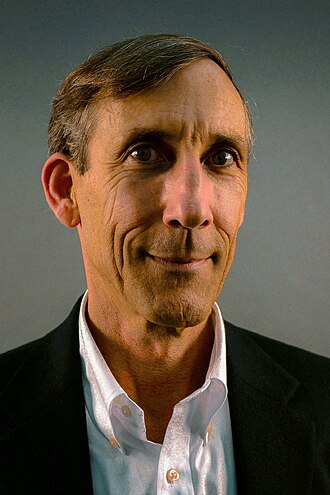
乔治·戴森 主持人
本期追问 · 点击跳到视频对应位置
5:49 研究是怎样做成的?26:32 一群人如何做成一个人做不成的事?11:21 为什么有的造物能活过它的创造者?42:14 凡是真的,都能被证明吗?
归入 Ⅵ·05 为什么有的造物能活过它的创造者? →
EDITED TRANSCRIPT · 依据现场录音编译整理,可划线生成便签
编者按:2012年3月,科学史作家乔治·戴森(George Dyson)在其新著《图灵的大教堂:数字宇宙的起源》(Turing's Cathedral: The Origins of the Digital Universe)出版次日,应邀在 Google 总部演讲。戴森是物理学家弗里曼·戴森之子,本职是造船匠,曾在一株花旗松上的树屋中生活三年。他以十年的档案挖掘为底,讲述冯·诺依曼在普林斯顿高等研究院建造电子计算机的前后经过,以及这段被遗忘的历史与今日数字世界的关联。本文依据现场录音编译整理,仅删去口语枝节,保留全部论证与细节。

缺席的计算机创世故事

主持人:感谢各位今天到场。今天来到我们这里的是作家乔治·戴森,他要谈的是他刚刚出版的新书《图灵的大教堂:数字宇宙的起源》。革命性技术的诞生故事,早已深深嵌入美国文化。我们从小就听说本杰明·富兰克林的电学实验,听说托马斯·爱迪生做电灯泡。可是计算机的发明史,几乎完全缺席于我们的集体记忆,尽管它在功能上建立在那些更早的技术之上,而它的影响可以说要大得多。戴森的新作照亮了这段历史,让我们看到这项了不起的发明如何诞生,数字宇宙又如何在二战之后骤然膨胀。

除了深入计算机的早期历史,《图灵的大教堂》还就数字宇宙接下来可能走向何方提出了一系列颇具挑衅性的设想。话不多说,让我们欢迎乔治·戴森。

造船匠与树屋:局外人的来路

戴森:谢谢。能来这里,看到大家都在工作,很高兴。我每年夏天都来参加 Sci Foo,早年办 Sci Foo 的时候,我们会和 Google 的员工混在一起,那本来就是活动的一部分;如今 Sci Foo 有些自成一体了,我们见不到真正在这里工作的人。不过七年前我来过这里,这本书的书名其实就来自那一次,稍后我会解释。

我得老实说,我完全是从场外闯进这个话题的。我不是计算机科学家。我十六岁从高中辍学,没有任何学术资历。我只是对一些事情感兴趣,好奇,然后就着了迷。我的本行是造船,设计船、造船。而我最出名的事,比我在计算史或其他任何领域做的事都出名得多,是我在一座树屋里住了三年。那座树屋在一株花旗松上,离地九十五英尺。

这张照片拍的是半截。树根大约在这个地板的位置,那就是房子。在那座树屋里我读了大量的书。我有时间,那种时间的充裕程度,今天没人能想象:没有电子邮件,没有任何干扰。有一个冬天我读完了库克船长航海日志的全部六千页。然后我就从树上下来了。

接下来要感谢几个人。我为之而来的这本书昨天刚出版,还是个新鲜事物。首先要感谢我妹妹埃丝特(Esther Dyson),你们中不少人大概认识她。她参与过硅谷的许多创业公司,我记得 Google 最初的投资里也有她的一份。这张照片是她和朋友比尔在1984年。埃丝特非常好心,把她哥哥从加拿大的荒野里拽了出来,带到她那里。她当时主办一个年度会议,最早叫「罗森电子论坛」(Rosen Electronics Forum),主要讨论半导体,而半导体的主要用途突然变成了个人计算机。她把我领进了这个世界,让我看到正在发生什么。

这把我带回了童年。我父亲在普林斯顿一个叫高等研究院(Institute for Advanced Study)的地方工作,那里不属于大学;我母亲也在那里工作。那些科学家大多做的是极其枯燥的事:用铅笔和纸,或许在黑板上写点东西,第二天再擦掉。可是约翰尼·冯·诺依曼(John von Neumann)在后面有一栋楼,他在那里造一台计算机。

关键不是第一台,而是二维寻址

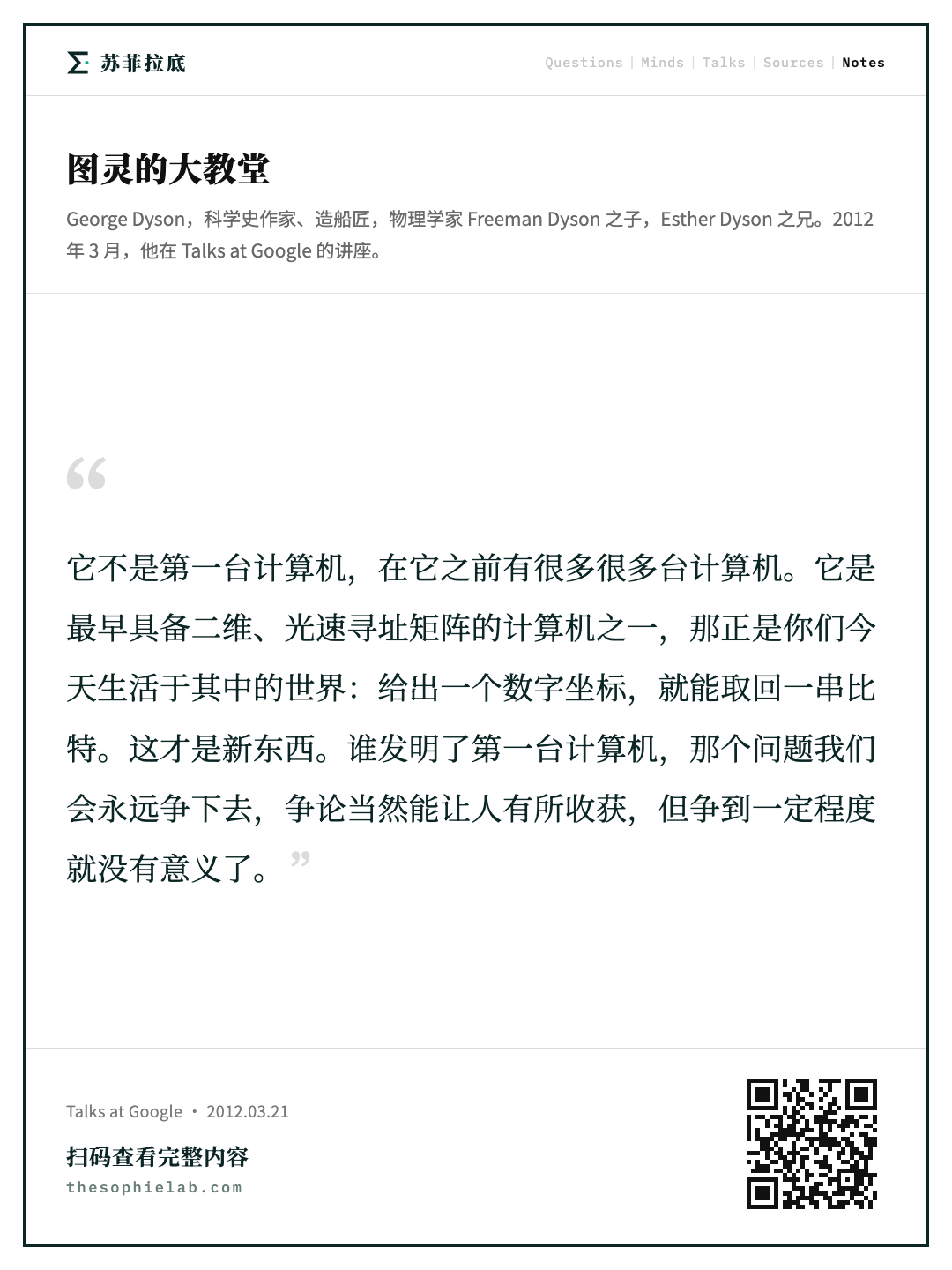
戴森:那不是第一台计算机。跟那些讨论这本书、推销这本书的人怎么说都没用,他们非要讲「乔治的书写的是第一台计算机」。它不是第一台,在它之前有很多很多台计算机。它是最早具备二维、光速寻址矩阵的计算机之一,那正是你们今天生活于其中的世界:给出一个数字坐标,就能取回一串比特。这才是新东西,也是冯·诺依曼看见的东西。

模型来自图灵(Alan Turing)的一维模型,冯·诺依曼把它做成了二维。这是我想审视的历史关键时刻,而不是谁发明了第一台计算机。那个问题我们会永远争下去,争论当然能让人有所收获,但争到一定程度就没有意义了。

1984年,我刚从树屋下来,写了一篇关于冯·诺依曼的文章,想拿给我妹妹会议上的那些人看,他们完全不感兴趣。他们关心的是明年哪种 DOS 会胜出。所以什么也没发生。不过这篇文章最终变成了《机器中的达尔文》(Darwin Among the Machines)这本书,它大概太超前于时代了,但至今仍在印行。那本书用很长的视角追问数字宇宙从何而来,我一直追溯到十七世纪的托马斯·霍布斯。

欣赏那本书的人里有施乐帕克研究中心(Xerox PARC)的查尔斯·西蒙尼(Charles Simonyi),就在马路对面。这是查尔斯在布达佩斯,旁边是冯·诺依曼的全息半身像,冯·诺依曼在匈牙利是民族英雄。正是查尔斯对我说:「乔治,你应该去把这些东西挖出来。」他察觉到我对数字考古有一种热情。高等研究院的档案从1946年起就不对外部研究者开放,是他动用关系打开了那扇门。

查尔斯第一次来 Google 时,我碰巧和他在一起。我们同乘一辆大巴来参加这里的一个活动,他那时还在微软。车开到43号楼前,他说了一句话,如今可以复述了,因为他已经离开微软:「糟了!43号楼,我们完蛋了。」他以为你们已经有43栋楼了。而你们当时才成立两年。

地下室档案:Klara 的信与 Barricelli

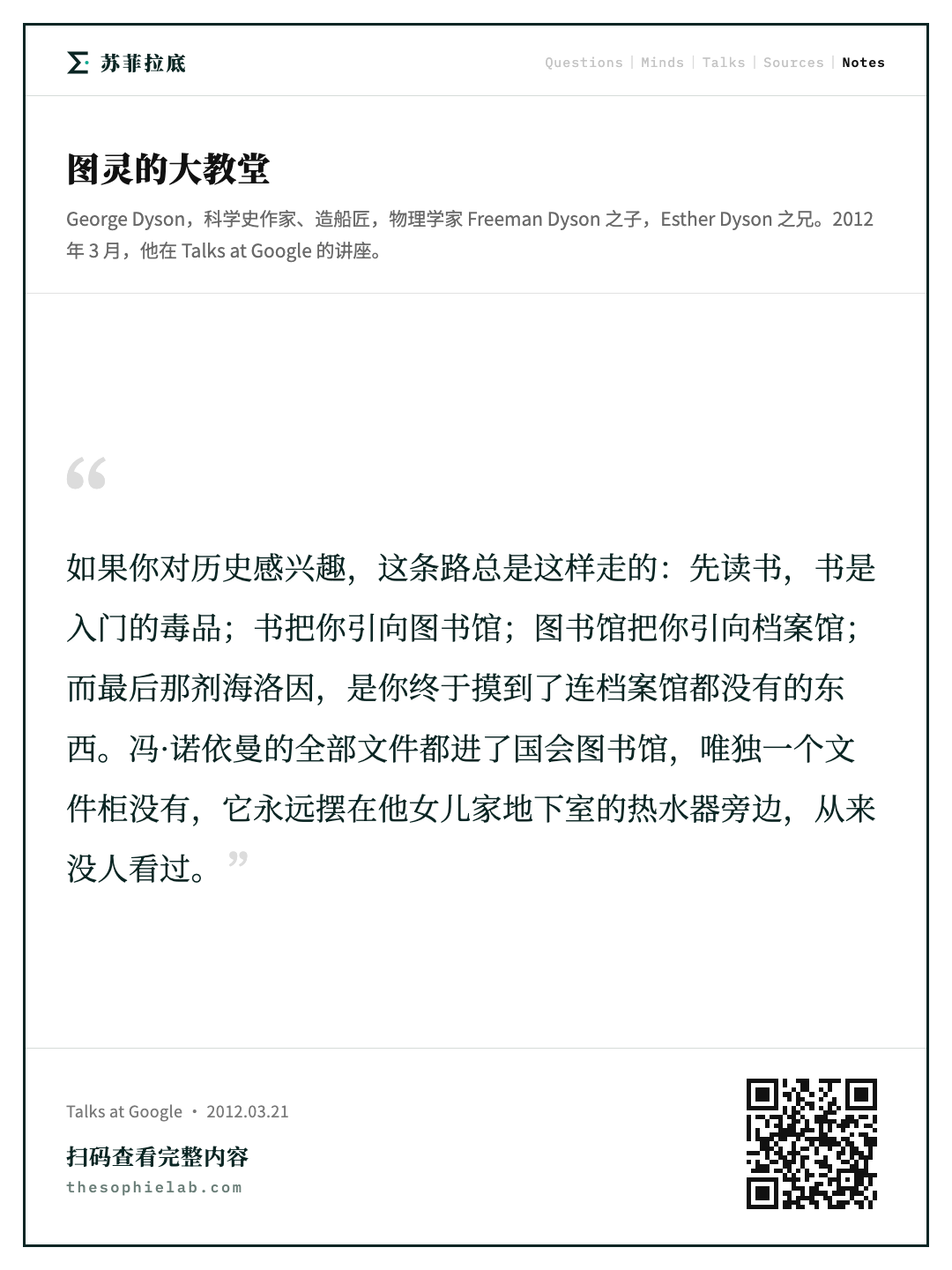
戴森:十年前查尔斯把我送上了这条路,去寻找真正发生过什么的文献。如果你对历史感兴趣,这条路总是这样走的:先读书,书是入门的毒品;书把你引向图书馆;图书馆把你引向档案馆;而最后那剂海洛因,是你终于摸到了连档案馆都没有的东西。这就是我现在做的事。这是冯·诺依曼的女儿在密歇根州安娜堡家里的文件柜,永远摆在地下室热水器旁边。

冯·诺依曼的全部文件都进了国会图书馆,唯独这个文件柜没有。他女儿说:「你也许该来安娜堡看看。」从来没人看过。对我这样的历史研究者来说,技术史上最有意思的黑暗时期,是1937年、也就是二战前夕,到斯普特尼克卫星上天之间。斯普特尼克之后我们开始把一切都记录得很好,但在那之前有一段暗区,我们并不真正知道发生了什么。

我拉开最底下那个抽屉,里面全是约翰尼和克拉拉(Klara von Neumann)之间的往来信件,双向的,从1937年一直到他1957年去世。冯·诺依曼造了这台机器,就需要为它写代码,而当时没有人做这种事,所以他教克拉拉写代码。早期的代码全是她写的,这些信就在两人之间来回。比如他在洛斯阿拉莫斯,她在华盛顿;或者她在阿伯丁,ENIAC 所在地,正在给 ENIAC 写代码,而他在田纳西州的橡树岭核实验室。这些东西全在那里,一半是匈牙利文,贝拉·波罗巴什(Béla Bollobás)和他的妻子加布里埃拉替我翻译了出来。这就是这本书的来源。在此之前我一直在挣扎,从那以后我才有了让这个故事活起来的原始材料。

克拉拉是位出色的作者,虽然英语是她的第二语言。她写的来到美国、学习为这些计算机编码、目睹这一切的日记,如果你读这本书,我想你会发现,她才是贯穿全书的那个声音。1940年他受邀去华盛顿大学做讲座,两人开着他的 V8 凯迪拉克双门跑车沿66号公路横穿美国,住在西雅图的大学塔酒店,全都在日记里,精彩极了。他们在内华达一家酒吧歇脚,一个人牵着骡子走进来,酒保给骡子端了一桶啤酒。

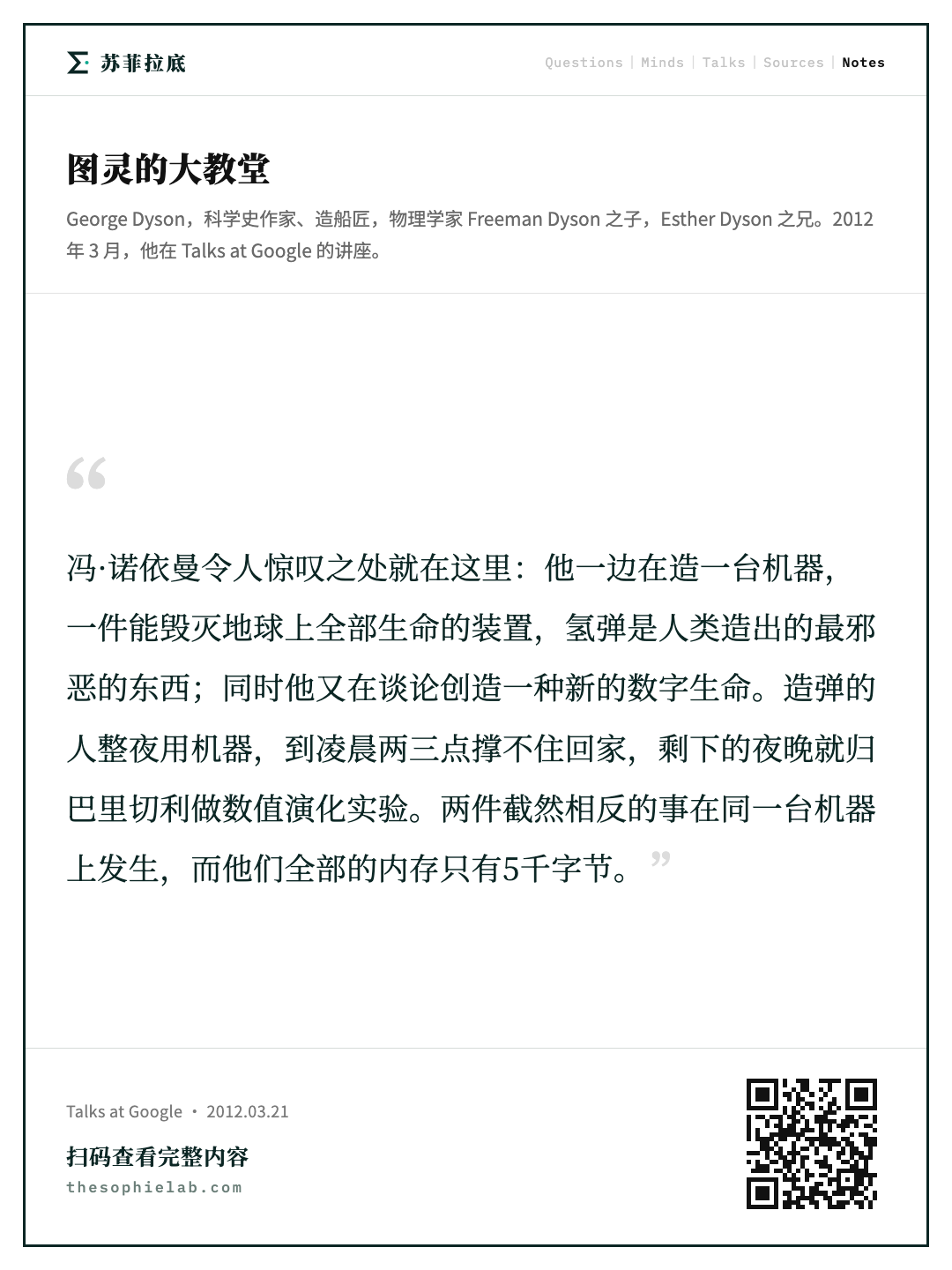
这个故事另一个真实鲜活的来源,是一位疯狂而才华横溢的意大利裔挪威数学病毒遗传学家,尼尔斯·奥尔·巴里切利(Nils Aall Barricelli)。机器还没有跑起来,巴里切利就从挪威写信给冯·诺依曼,说他想来这台机器上做数值演化实验。而这台机器是为氢弹的流体力学计算而造的。于是冯·诺依曼做了个安排:造弹的人可以整夜用机器,但他们到凌晨两三点总会撑不住回家,剩下的夜晚就归巴里切利。他有一种本事,即便没有工程师在场,也常常能让机器一直跑到天亮。

写不出来的书与酒馆里的章节

戴森:我做这件事做了五年。我有一份为期两年的出版合同,出版社给的就是两年,那时我已经超期两年,还没动笔写这本书,出版社准备取消合同了。我最后是靠把这些幻灯片拼起来才开始写的。我去找,好,笔记本找到了,第一个词写下了。书原本要叫《巴里切利的宇宙》,但出版社说:「巴里切利是谁?没人知道。」所以书名才归了图灵。

借助 Photoshop 的神奇功能,你可以把周围的东西擦掉,看到我写下的第一句话:「这一切发生在新泽西州的普林斯顿。那里的夏天酷热潮湿,有人形容那气氛『像狗嘴巴里面』。照理说那是世界上最不适合建造静电存储计算机的地方,可他们造出来了。」这句话活了下来,成了第二章的开头。于是我有了书的第一句,却没有书。我在华盛顿州贝灵厄姆的一家老酒吧里工作,可以把章节一章一章地铺开。

图灵的宅邸与 Google 的大教堂

戴森:图灵进入这幅图景,是因为这一切的构想都要追溯到他。图灵1936年来到普林斯顿,待了两年,与冯·诺依曼合作相当密切,而冯·诺依曼一直把功劳归于图灵。他总说:「原始想法是图灵的,我做的只是实现。」而如今我们却有一场极其分裂的争论,一边认为美国人得到的功劳太多,另一边认为英国人得到的功劳太多。可在当时,双方完全是在合作,没有任何对立,对立是后来的历史学家带进来的。

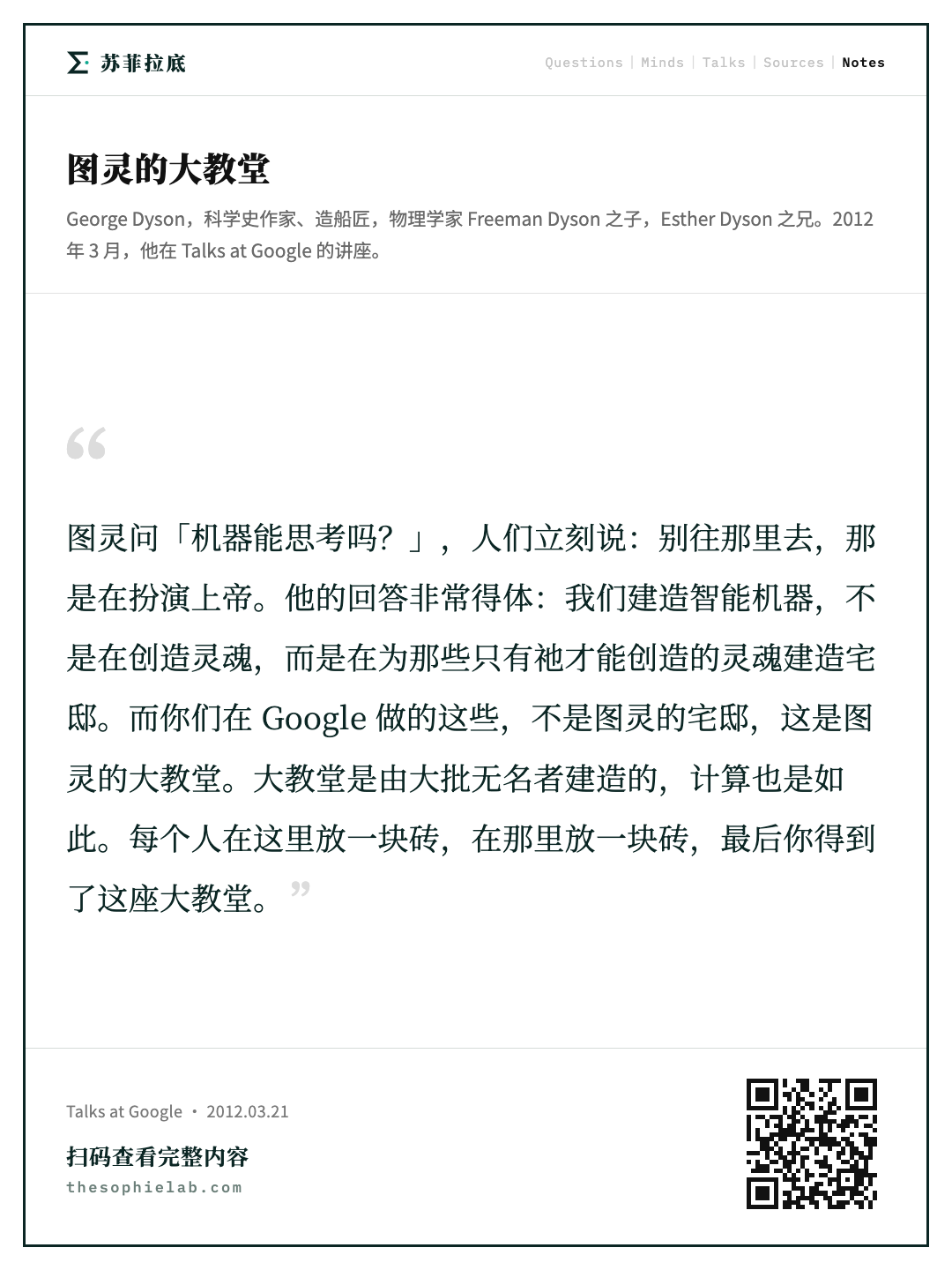
1950年,图灵对我们今天所说的人工智能极感兴趣,开始追问:「机器能思考吗?」人们立刻说:「别,别往那里去。那是在扮演上帝,只有上帝和人能思考,机器怎么能思考?」他的回答我认为非常得体:我们建造智能机器,不是在创造灵魂,而是在为那些只有祂才能创造的灵魂建造宅邸(mansions)。我也是这么想的。

然后是2005年,克里斯·迪博纳(Chris DiBona)邀请我来 Google,因为2005年距这个项目启动正好六十年。我在那个纪念日来做了一场类似的下午演讲。走进来时,我参观了你们在地下室和别处做的工程,看到了火星的第一批数据传进来。演讲结束走出去时,一句话冒进我脑子里:你们在 Google 做的这些,不是图灵的宅邸,这是图灵的大教堂。这本书的书名就是这么来的,不是在这个厅里,我那次是在食堂讲的,声学效果很差。这段幕后故事不在书里,没人知道。台前的故事就是大教堂本身:大教堂是由大批无名者建造的,计算也是如此。每个人在这里放一块砖,在那里放一块砖,最后你得到了这座大教堂。

创世神话、封面与莱布尼茨

戴森:这样我总算有了一本书的开头。副标题原本是「一则创世神话」。我不想让人以为我在讲……我不想被要求讲述真相。我只想讲我所知范围内、我认为发生过的事。我不太在乎谁是第一,我在乎真正发生了什么。我们生活在这个数字宇宙里,却没有一个共同的创世神话来讲它是怎么开始的。

作为作者,有三件事你最怕听出版社说。第一是退稿信:「这是本可爱的书,但我们不能出。」第二是:「你超期了,我们要取消合同。」第三是:「我们做好封面了,我们觉得你会喜欢。」每次收到这种消息,结果都令人极其失望,我有几本书的封面简直让人痛苦。但这次是真的。潘塞恩出版社的设计师彼得·门德尔桑德(Peter Mendelsund)做的这个封面太出色了,我爱极了,一处都没改。封面的构思是像打孔卡那样打孔,仿佛随机打出的。你看到的是数字化,是模拟到数字的转变,就在这本书的实体封面上。电子书里可没有这个。

图灵生于1912年,所以正好一百年前,他母亲萨拉·图灵怀孕五个月,我们正在倒数图灵的百年诞辰。他值得这一切。他的一生是悲剧性的。人们说他是自杀,我们认为他是自杀,但并不确定,他死于氰化物中毒,情形暧昧,时年41岁。而这本书的扉页献给莱布尼茨,他在1697年提醒我们,这一切不是为卖油和卖沙丁鱼的人准备的。用今天的话翻译就是:Google 不只是广告,还有别的事情在发生。

5KB 存储管与第42卷的证据

戴森:接下来我要做的是,这本书有82幅插图,他们全都保留了,我给你们看彩色版,书里是黑白的。每一幅都经过精心挑选。这是数字宇宙的黎明,或者说现代数字宇宙的黎明,打孔卡当然早就有了,但这是最早的电子存储管之一,比特就是管面上的带电点。如今我们有固态存储器,再把内容显示在显示器上;而在这里,存储器本身就是玻璃管面上的光点,一共有40根这样的管子,你可以亲眼看着计算进行。

这是我在另一个地下室、热水器旁边找到的一张纸片,朱利安·比奇洛(Julian Bigelow)的地下室。它被揉皱了又留了下来,上面写着:「指令:设一个字为40个二进制数字。」这说明它写于他们开始使用 bit 这个词之前。「两条指令,每条指令等于 C(A),一个命令。」他们给出坐标和地址。对我来说,这就是摩西从山上下来说:「要有命令行。」我们对此完全习以为常。可是,从前有过没有命令的世界吗?有过,而这就是它的开端。

工程师们本来谁都不该提他们实际上在设计氢弹,但这是一本深夜的日志。这一页意义重大,因为它是1953年3月3日,巴里切利开始写他有史以来第一批「数值共生生物」(numerical symbioorganisms)的第一夜,今天我们叫它们数字生物。他停下来,把机器交给原子能委员会的造弹人员,这条日志记的就是那次交接。冯·诺依曼令人惊叹之处就在这里:他一边在造一台机器,一件能毁灭地球上全部生命的装置,氢弹是人类造出的最邪恶的东西;同时他又在谈论创造一种新的数字生命。两件截然相反的事在同一台机器上发生,而他们全部的内存只有5千字节。

这是五岁的图灵和七岁的冯·诺依曼。这两个人的性格非常互补。让我恼火的是,那些历史学家至今还在争论:冯·诺依曼从图灵那里拿了什么?他为什么不把功劳归给图灵?他读过图灵的论文吗?有人说:「不,他没读过图灵的论文。」于是我想,那我去冯·诺依曼的图书馆看看就是了。图灵的论文发表在《伦敦数学会会刊》上,就是那一卷。你去研究院图书馆,所有各卷都完全没人碰过,崭新,几乎没翻开过,除了第42卷。它显然被读了太多遍,整个散架了。他们没有复印机,只能这样。我采访到的几位尚在人世的工程师说:「对,冯·诺依曼要求我们都得读那篇论文。我们干的事就是造一台图灵机。」我想这就回答了那个问题。

布莱切利:搜索引擎的原型

戴森:图灵在普林斯顿待过,之后回英国支援战事。我认为他救了英国,使其免于被德国征服,因为他帮助破译了纳粹潜艇的密码。我们忘了英国当时多么绝望:美国在向英国运送物资,但尚未参战,德国人在击沉补给船。他和身边的工程师造出了一台实际上就是图灵机的机器,叫「巨人」(Colossus),主要由汤米·弗劳尔斯(Tommy Flowers)建造,他来自邮政总局的电子研究站。这台机器能把存在真空管存储器里的编码序列,与存在纸带上的截获编码序列做比对。可以说,这就是搜索引擎的原型:在数据中搜寻模式。这是图灵在上公共汽车,他是长跑运动员,要去跑马拉松。

普林斯顿:酒馆、避难所与匈牙利人

戴森:这是冯·诺依曼和他的机器,由朱利安·比奇洛建造,两侧各有二十根这样的管子。每个罐子里是一个32乘32的比特阵列,一共40个罐子,所以他们实际拥有的是一个32乘32乘40比特的矩阵,也就是5千字节。相当于半秒钟的 MP3。

他们在新泽西的腹地做这件事,而这一切的背景故事总是很迷人。这里是河流的源头,纽约在这边,费城在那边,这片地方十七世纪就有人定居。一个叫亨利·格林兰的人在箭头所指处开了家酒馆,往返于这条路上的人可以停下来喝杯啤酒、换马或过夜。然后是威廉·佩恩领导的贵格会教徒,他们想离纽约和费城越远越好,也在这里定居,建了一座贵格会聚会所。于是这里有一家酒馆,有一座聚会所。酒馆变成了普林斯顿大学,聚会所那块地变成了高等研究院。那块地只易手过两次:从佩恩家族到奥尔登家族,再到研究院。

然后他们建了这座豪华的总部,相当于那个时代的 Googleplex。它建于1939年,正是欧洲局势急转直下之时,于是这里成了逃离德国的科学家的避难所,主要是犹太科学家。德国人把最聪明的人赶走,愚蠢得难以置信。收容他们的主要是奥斯瓦尔德·维布伦(Oswald Veblen),他是美国人,但看清了正在发生什么,建立了一个援助难民科学家的社群,为了把这些人弄进来打破了一切规则,大概就像你们办 H1 签证那样。别忘了当时普林斯顿大学对犹太教员和犹太学生设有配额,所以研究院起了非常重要的作用。

这是诺伯特·维纳(Norbert Wiener),他造了「控制论」这个词,或者说从安培那里借来又重新铸造了它。这是亚伯拉罕·弗莱克斯纳(Abraham Flexner),研究院真正是他的主意,基于一个理念:无用知识的有用性。只要让人们研究他们想研究的任何东西,他们就会做出有用的东西来。你们这里的政策是多少?还是百分之十?还是二十?二十,好。这里是百分之百。出钱的创办人是百货公司老板班伯格家族,他们相信这能推进社会正义的事业。某种意义上也许确实推进了,如果计算机真做到了他们的初衷的话。

最早的六位数学教授包括爱因斯坦和赫尔曼·外尔,还有冯·诺依曼,以及奥斯卡·摩根斯特恩,他与冯·诺依曼一起提出了现代版本的博弈论,《博弈论与经济行为》。还有爱因斯坦和哥德尔(Kurt Gödel)。逻辑学家哥德尔在标准的历史叙述里得不到任何功劳,被认为与计算完全无关。可实际上他的办公室就在冯·诺依曼楼上。我认为数字寻址这整个概念,即你可以给比特串编上地址,操作这些数字地址,从而操作底层的比特流,与哥德尔在不完备性证明里做的事非常相似。我认为他的贡献比我们以为的要大。

这是十一岁的冯·诺依曼和他的表亲。他从一开始就热爱武器。这是1915年,他们在参观奥匈帝国的炮兵阵地,坐在炮管上的那个孩子就是他。这是在他表亲的婚礼上。这些东西都在书里,因为要理解这一切为什么发生、怎么发生,很大程度上得理解两次世界大战之间的布达佩斯发生了什么:为什么冯·诺依曼、尤金·维格纳、利奥·西拉德、爱德华·泰勒和保罗·埃尔德什全部出自匈牙利的同一群人,最后都到了这里。冯·诺依曼在柏林大学有职位,但他看到了将要发生的事,早早辞职离开。他极有幽默感。这是普林斯顿,三十年代的一场鸡尾酒会,这些人全来自布达佩斯。这是 H. P. 罗伯逊,当时正在教图灵量子物理,图灵是他的学生。

我小时候在那里,但不记得见过冯·诺依曼,我两岁时他就去原子能委员会工作了。不过我记得我母亲办的一场鸡尾酒会,我被关在婴儿床里,很不高兴,一个特别开朗的数学家走进房间跟我说话,还让我抿了一口他的酒。我愿意相信,那也许就是我与冯·诺依曼的接触。

洛斯阿拉莫斯、ENIAC 与无名建造者

戴森:这些人在洛斯阿拉莫斯玩得太开心了。他们是理论数学家,从没碰过真正的硬件,突然获准在机械车间里摆弄烈性炸药。左边站着的是迪克·费曼,1949年,照片由尼克·梅特罗波利斯(Nick Metropolis)拍摄,他开发了蒙特卡洛算法。他们陶醉其中。洛斯阿拉莫斯结束后,他们不会回去教微积分之类的东西了,他们想要的下一样东西就是计算机。于是他们都参与了 ENIAC。说来奇怪,ENIAC 是我们今天所谓的多核处理器,有二十个并行处理器协同工作,后来他们重新布线,把它改成了更偏串行的模式。但它起初是多核架构。

冯·诺依曼和其他工程师一起编了这本小册子,讲如何造一台更好的计算机。像加法器这种我们完全习以为常的东西,他们得从头想出来。存储器,输入输出。弗拉基米尔·兹沃里金(Vladimir Zworykin)是另一位惊人的人物,俄国流亡者,经俄国北极地区逃到美国,在纽约找到工作,最终把电视带到了美国,他确实是把电视带到美国的两个人之一。他和冯·诺依曼结成了搭档,所以这个项目的第一次会议就在兹沃里金的办公室。你看到名单上第五个人是统计学家约翰·图基(John Tukey),就是他厌倦了老说「二进制数字」,最后说:「伙计们,咱们就叫它们比特吧。」于是我们有了 bit。

伯妮塔·米勒(Bernetta Miller),没有一个机构能离开一位让一切运转、解决问题、把事情办成的秘书。她是美国第五个取得飞行执照的人,后来视力变差,就在研究院找了份工作,管理事务。她做的是让计算机项目物资不断的苦活。后来奥本海默解雇了她,我想是因为她知道得太多了。

阿克里维·康多普里亚·埃马努伊利季斯(Akrevoe Kondopria Emmanouilides),希腊裔,十六岁时在费城,父亲不会读写英语,她的升学顾问告诉她上不了大学,没有希望,但有一个项目,如果她搬去宾夕法尼亚也许能去工作,那就是 ENIAC。于是她成了 ENIAC 项目的秘书,干得太出色,赫尔曼·戈德斯坦(Herman Goldstine)和冯·诺依曼在她十七岁时把她带到了研究院。今晚我在计算机历史博物馆有一场讨论,她会到场。她是仍然在世的最后几个亲历者之一,因为当时她太年轻了。她住在洛杉矶,专程为今晚赶来,明天在旧金山还有一场。那些著名的报告,确立了后来所有机器架构的报告,就是她打的字,每个字都不错。这真令人惊叹,还有这样一个人留在世上。她还校对了我的书,有她在实在太好了。她非常风趣。她直到2009年才有自己的电脑,是女儿给她买的 Mac。

还有一些人,比如做天气预报的诺曼·菲利普斯。他们处理了一批问题,包括杰里·埃斯特林(Jerry Estrin),他的两个女儿朱迪和德博拉·埃斯特林,一位是思科的核心人物,两人都活跃在下一代计算的发展中。

Selectron、Williams 管与硬件细节

戴森:这台机器是按兹沃里金的承诺来造的,RCA 会造出一种叫「选数管」(Selectron)的东西。这就像恐龙,某处有一只最早长出羽毛的恐龙,这就是模拟到数字那个神话般的转变:一根模拟真空管,里面装着4096比特的数字存储器,一个纯粹的数字矩阵。它是你们 U 盘的祖先。可它始终没能及时造出来。他们造好了机器等着这些东西插上去,而它们从未出现,于是他们做了那个用阴极射线管的怪异改造。

但这一架构由此确立。我认为我们之所以那么快进入固态时代,很大程度上是因为当仙童等公司开始拿出固态器件和存储器时,这个架构从一开始就在期待它们。它等了二三十年,所以固态存储器可以直接插进去。事实上我这台新 Mac 装的是固态硬盘,所以它其实是一台选数管机器。

在英国的曼彻斯特,一群非常聪明的英国人,包括图灵在内,比普林斯顿的人早得多就让一台机器跑了起来。这是弗雷德里克·威廉斯(Frederic C. Williams)和汤姆·基尔伯恩(Tom Kilburn),他们把示波器管面上的电荷斑点做成了存储器。普林斯顿的人过去采纳并改进了这个想法,把它做成了随机存取的。就是这个:一个标准垫圈,加一根示波器管,上面装一个放大器。把信号放大三万倍,运气好的话,你就能在0.7微秒这一瞬间分辨出0和1。

朱利安·比奇洛是真正动手造出这台机器的工程师。我认为它绝对是件艺术品。它造得像一台顶置气门的四十缸柴油机,本质上就是一台发动机,一台处理数字的发动机。每个单元里放着1040个字各一个比特。只要你知道它是什么时候运转的,这就是一个绝顶出色的设计。它现在在那里,可惜被捐给了史密森尼博物馆,而他们甚至没有展出,它躺在马里兰某处的封闭仓库里。这不应该。如果我能做成什么事,也许就是让它回到该在的地方:它应该放在这里的计算机历史博物馆,他们有空间,那是最合适的地方。

朱利安·比奇洛,赫尔曼·戈德斯坦,罗伯特·奥本海默(我们以为他反对氢弹,其实他相当支持),冯·诺依曼,以及所有帮过忙的工程师。还有许多做编码工作的女性,她们没地方住,于是能解决任何问题的比奇洛跑到纽约州北部一个叫迈恩维尔的地方,买下这些战争剩余的营房,锯成两半,用铁路运到普林斯顿。

这是第一台磁存储装置,你们硬盘的祖先:磁记录线绕在两个自行车轮上,输入输出能达到每秒九万比特。这就是一个40位的字的样子。令人惊叹的是,他们用这么糟糕的数字表示居然能解决实际问题。他们在努力让模拟的东西以数字的方式行事。这是最早的移位寄存器原型。我们以为移位寄存器天经地义一直存在,可总得有人来做,他们试了大约七个版本才说:「就这么定了。」现在它就是这样。

体力活由高中女生和学生完成,他们叫「接线工」,负责实际的布线和焊接。这是移位寄存器的接线图,设计得非常出色。叼烟斗的是吉姆·波默林,中间是比奇洛,威利斯·韦尔(Willis Ware)仍然在世,他起了很大作用,从普林斯顿去了兰德公司,这是他在讲解计算机架构。这是我能找到的第一张流程图,也许哪天有人能找到另一张,但这张是1947年的,他们在做一个氢弹的蒙特卡洛问题。这是斯坦·乌拉姆(Stan Ulam),蒙特卡洛算法实际上是因他而得名的。他是个赌徒,这是洛斯阿拉莫斯每周一次的扑克牌局。这是尼克·梅特罗波利斯,我们欠他一大笔债,他是计算机科学的奠基人之一,同样从不为自己揽功。

克拉拉,约翰尼的第二任妻子,十四岁就是匈牙利花样滑冰全国冠军,上学时从不用心,但约翰尼教会了她编码。这是他们开着 V8 凯迪拉克去佛罗里达。斯坦·乌拉姆和弗朗索瓦丝,两人都在欧洲的大屠杀中失去了全家,逃到美国。

氢弹、间谍与科学家的辩解

戴森:你必须记住这一点。当你问「这些人为什么要研制这些可怕至极的武器」时,他们研制这些武器,是因为他们相信我们这一方必须拥有最强的武器,而且还有一些当时不为公众所知的原因。这是尼克·梅特罗波利斯在洛斯阿拉莫斯的证件,这是他在洛斯阿拉莫斯和 MANIAC 下第一盘计算机象棋。注意棋盘是六乘六的。为了简化,他们不用象,管它叫「反教权象棋」。输入输出仍然是打孔纸带,机器叫 MANIAC,「数学数值积分计算机」。

回到冯·诺依曼。他在洛斯阿拉莫斯与克劳斯·福克斯(Klaus Fuchs)密切合作,两人实际上在做一种氢弹设计,后来福克斯被证明是苏联间谍,是苏联安插的人。所以冯·诺依曼知道的比他能说的多。他真心相信俄国人可能已经走了一半,我们必须追上。这不是要为他做的事辩解,好吧,这就是在为他做的事辩解。

这是冯·诺依曼在大峡谷,他的骡子朝着与所有人相反的方向。克拉拉和弗朗索瓦丝·乌拉姆,克莱尔·乌拉姆仍然在世,她父亲斯坦·乌拉姆来自波兰,约翰尼和乌拉姆一家,这些人都让我进了他们的地下室,乌拉姆家也有类似的文件柜。这是乔治·伽莫夫(George Gamow)1951年画的一幅漂亮的画,画的是氢弹这出戏的演员:斯大林抱着炸弹,奥本海默像个圣人,不管他是不是;斯坦·乌拉姆在吐口水,爱德华·泰勒在中间,伽莫夫在拽一只猫的尾巴。这些画在物理上有些含义,关系到解决氢弹问题的不同路径,但已经没有人能给我解释了,我不懂。冯·诺依曼和沃纳·冯·布劳恩,来自德国的火箭先驱。

刘易斯·弗莱·理查森(Lewis Fry Richardson)是这整件事的另一条线索,英国的气象学家,他用元胞模型给大气的流体力学行为编码,那正是我们今天的做法。他说要跟上天气本身的速度去解那些偏微分方程,需要六万四千名人工计算员,而后来实际发生的差不多就是这样。他还回答了人工智能的问题:我们有人工智能吗?当然有,只是多少的问题。这是一个非确定性电路,你无法预测它会处于什么状态。它用来演示一个只容得下两个念头的、有意志的心灵。而我认为这正是你们在 Google 做的事:你们在建造一个巨大的非确定性电路,只不过它不是只容得下两个念头,而是容得下人类有过的所有念头。这就是这本书为什么叫《图灵的大教堂》。

这是那次远征的照片,他们第一次确认,用不到24小时的处理时间做出了24小时的天气预报。此后进展飞快。

26个数量级:五大问题与时间尺度

戴森:看看他们做了什么。在这5千字节的内存里,他们处理了五个大问题,这些问题在计算上有些相似,却跨越完全不同的时间尺度。他们研究核爆,那里一切在纳秒内结束,就完了。答案也许要几周才算得出来,但现象本身极短。冯·诺依曼对冲击波极感兴趣,那是秒到分钟量级的,也很短。然后他们研究气象,那是小时、天和周的尺度;如果到了月,那就变成了气候。尼尔斯·巴里切利来研究生物演化,尺度是世纪、千年。另一位德国难民马丁·施瓦西(Martin Schwarzschild)来了,写了大量恒星演化代码,研究恒星在数十亿年间的演化。五个问题,跨越了几乎全部的时间跨度,全在5千字节里,相当惊人。这五个问题今天仍然是大问题。

中间这一栏是以秒计的尺度,从10的负8次方到10的17次方秒,26个数量级。人类可以感知的范围,从眨眼的三分之一秒到九十年的一生。而正中间恰好是一天,大致就是八小时的一个工作日,它是可感知宇宙的中点。我至今对此困惑。我不知道这是不是因为我们是身处中间的观察者,所以它总会是对称的。可为什么我们偏偏在这个时间尺度的正中间?

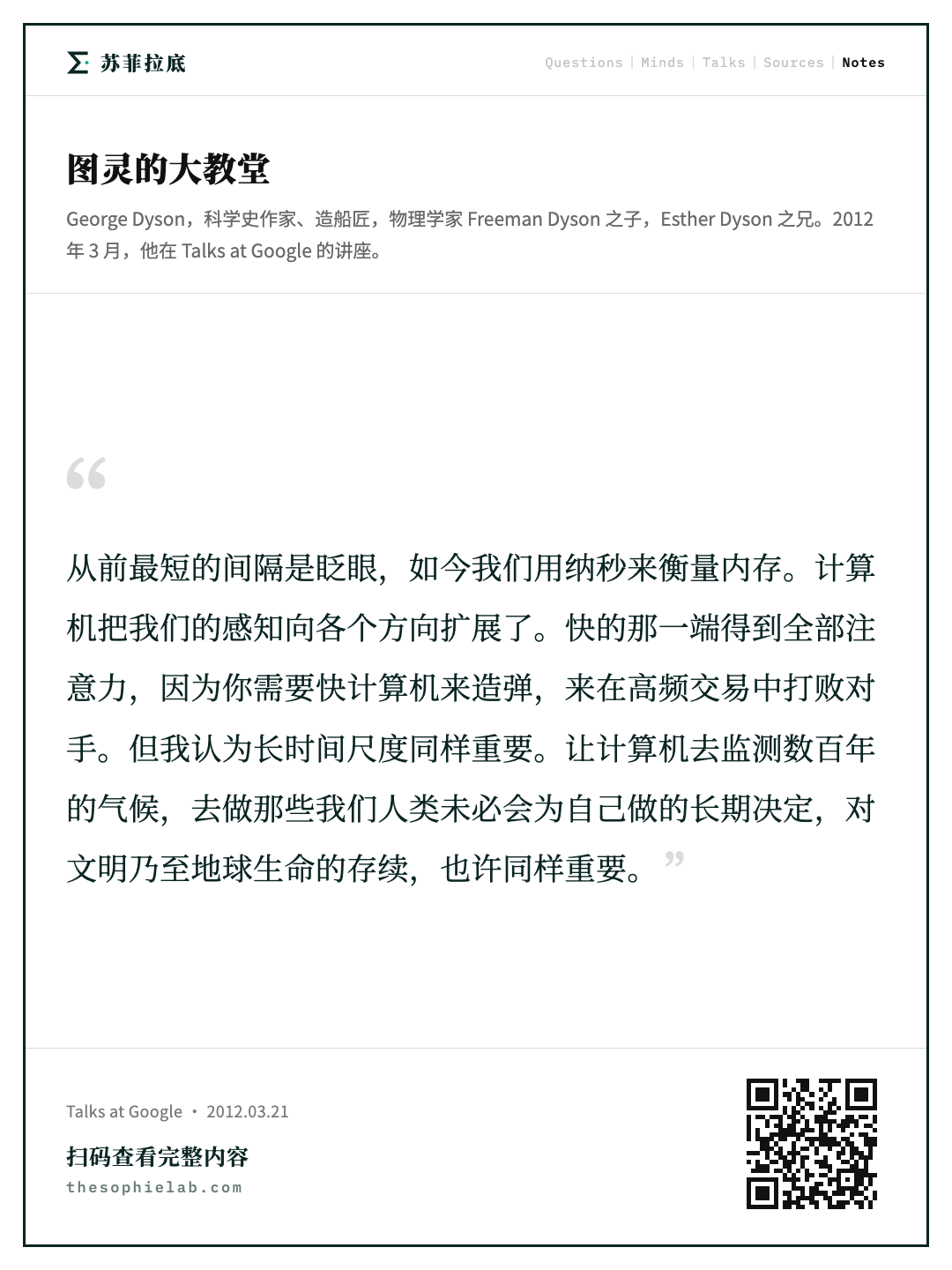
而计算机所做的是扩展我们的感知。从前最短的间隔是眨眼,如今我们用纳秒来衡量内存。计算机把我们的范围向各个方向扩展了。快的那一端得到全部注意力,因为你需要快计算机来造弹,来在高频交易中打败对手,诸如此类。但我认为长时间尺度同样重要。从长远看,让计算机去监测数百年的气候,去做那些我们人类未必会为自己做的长期决定,对我们这个物种、对文明,乃至对地球生命的存续,也许同样重要。

非确定性:判定问题与最后的便条

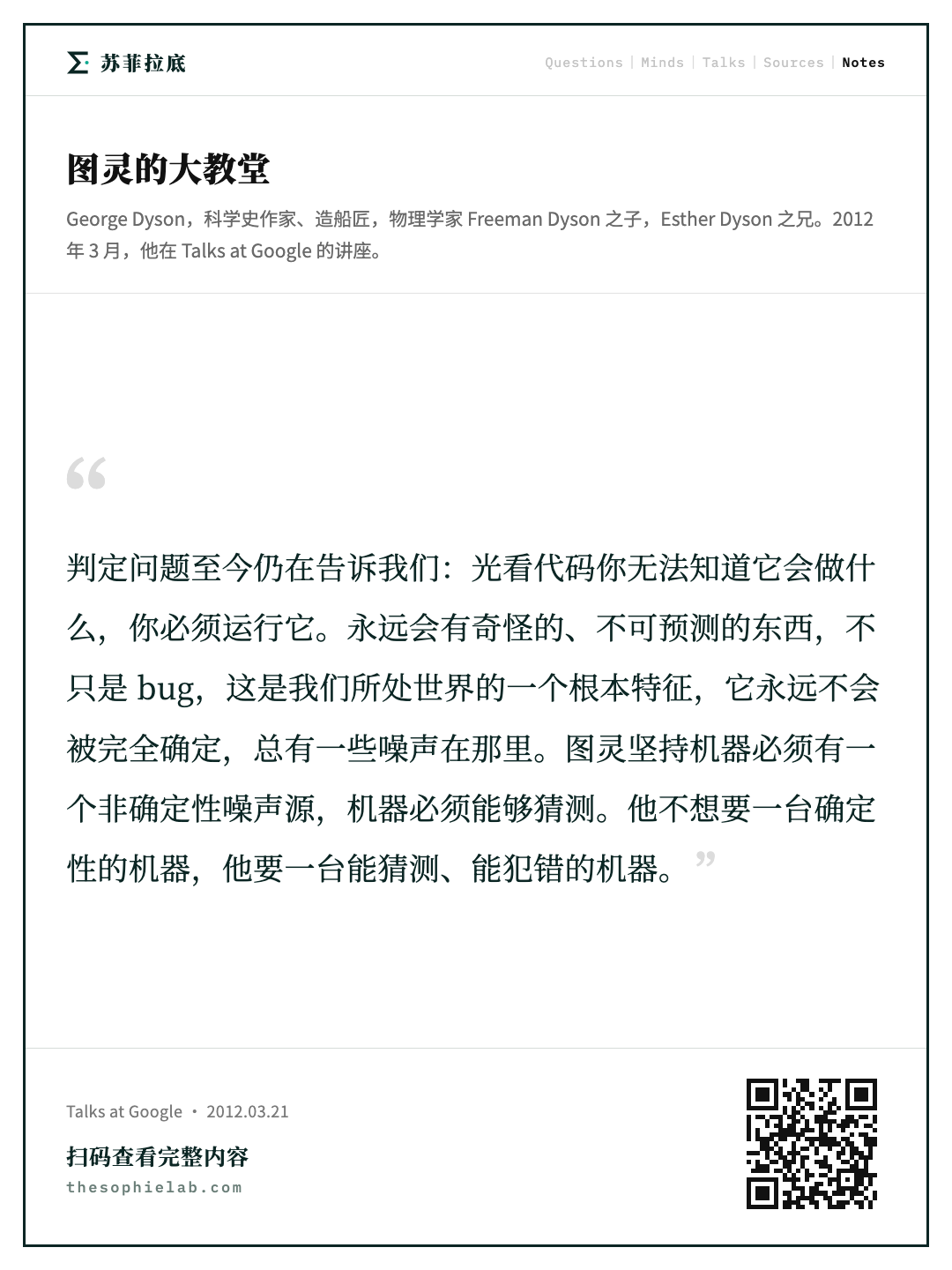
戴森:冯·诺依曼对生命和生物学非常感兴趣。这是巴里切利,他完全用二进制思考。他们没有真正的操作系统,没有语言,什么都没有。大多数人用十六进制工作,他直接写原始二进制代码。这是他的一个宇宙。这是1951年的图灵,他当时在做一台商用机器,坚持这台商用机器必须有一个非确定性电子噪声源。机器必须能够猜测。他不想要一台确定性的机器,他要一台能猜测、能犯错的机器。

朱利安·比奇洛明年就一百岁了。冯·诺依曼一去世,研究院就给这个项目拔了插头。1958年7月15日午夜十二点,日志的最后一条。这对朱利安太残酷了,他和这台机器有那样的默契,它运转良好,他手头堆着待解的问题,可他们拔了插头,一切就结束了。

在其中一个地下室里,我翻到一个箱子,表面是二战时期的电传打字机手册,本来我该放着不管,但我一直挖到箱底,箱底是一盒打孔卡,装着巴里切利某次数字生命起源实验的全部源代码和输出。里面夹着一张便条,是工程师写给巴里切利先生的:「这段代码里一定还有什么东西是您没解释的。」找到这句话的时候,就像走进这里找到书名一样,我知道这将是全书的最后一句。因为图灵一开始就是从这里进入这个问题的。他想回答一个非常抽象的数学问题,叫判定问题(Entscheidungsproblem):看着任意一串代码,你能否预先判断它是不是一个可证明的公式?答案是不能。而他得出这个答案的途径,是发明了我们所说的图灵机。这是一个很奇特的意外:他在做这个极为抽象的问题时,帮着催生了这项极为具体的技术。

判定问题至今仍在告诉我们,你们比谁都清楚这一点:光看代码你无法知道它会做什么,你必须运行它。永远会有奇怪的、不可预测的东西,不只是 bug,这是我们所处世界的一个根本特征,它永远不会被完全确定,总有一些噪声在那里。我认为这很重要。这又把我们带回莱布尼茨最初的构想,一个纯粹的数字宇宙,一切都是二进制代码。

书里最后一张照片是我,那是我,不,吮大拇指的那个是埃丝特。1954年。所以我在这里,不算目击者,但要提醒大家这一切从哪里开始:从那些极为深远的想法,从开启它的那些人。他们不是想解决某一个问题,他们想解决所有问题。感谢所有慷慨地让我翻他们东西的人。就到这里,我们有时间回答几个问题。

问答:发明者神话与模拟计算的回归

主持人:再次感谢这场引人入胜的演讲,以及对这段近乎神话的创世时刻的深入梳理。你提到电的发明、电灯泡的发明都有各自的神话。你认为有朝一日,这个故事会不会也凝练成一个连孩子都能接受和拥抱的概念,或许是个隐喻,来讲现代计算的根基和起点?

戴森:这是个好问题。难就难在人们总想把它归于一个人,想说「爱迪生发明了电灯泡」,「富兰克林发明了电」。我不知道该怎么办。这也是我把书叫作《图灵的大教堂》的原因,我想把这个极为抽象的想法归功于图灵,却不说某某人发明了计算机。关于谁发明了计算机,有那么多本书,那么多争论。我不知道我们最终会形成什么样的文化神话。我想给出一幅更大的图景:这是一场群体努力,把我们带进了一个数字宇宙,那是一次非常根本的转变。就像我们不争论谁发明了语言,对吧?没人在争「是这个人,不,是他叔叔说了第一句话」。我们不在乎,它就是发生了。有大量学者在研究语言的演化,但我们不会说是某个人发明了它。

主持人:在等其他提问的时候,我还有一个问题。你提到从你所描述的二维宇宙向三维宇宙的过渡。我当然期待在书里读到,但能否先透露一下,你所说的迈入三维宇宙是什么意思?

戴森:当然。我喜欢谈未来。我是历史研究者,本来只有执照谈过去,没有执照谈未来。做一个非常简化的概括:图灵的模型是一维的,冯·诺依曼的实现是二维的,至今如此,你有一个 IP 地址,那就是二维空间里的一个坐标,所以中间才有那个 @ 符号。而互联网给了我们一个更三维的世界,机器可以同时连接同一份数据,它不再是平的。它变成了三维的,可我们大多数程序仍然是按老办法写的。

我认为未来,以及这里正在发生的事情之所以令人兴奋,在于像 Facebook 这样的公司,所有做得好的公司,都在这个底层之上搭建全新种类的计算层。我们不会取代冯·诺依曼这个基底,它就像 DNA,就在那里。我们可以在它上面做别的事。而正在做的很多事,这个词几乎是不能说出口的,但你们做的很多事,是模拟计算。看看 Facebook 面对的问题:一所小小的高中,每个周末大家都在换男女朋友,你没法用数字方式把这个编码出来,它复杂得不可理喻。但如果给每个人一小段代码,让他们在 Facebook 上彼此连接,这张图就成了它自身的模型。这就是模拟计算:复杂性不在代码里,而在代码之间的连接里。Google 的运作在很大程度上也是如此,因为你们在找的是链接。这是拓扑,不是数字序列。

男听众一:你已经让我食言了。我今天来本来打算问你,为什么莱布尼茨和哥德尔总是从这类讨论中掉出去,为什么他们从来不算故事的一部分。

戴森:我认为这一切都要追溯到莱布尼茨。

男听众一:一切都追溯到莱布尼茨,而哥德尔显然在提那些问题。这里有个微妙之处:也许在模拟领域提问的人,对我们这些做计算的人来说,并不明显能看出那些东西映射进了数字领域。我想问的其实是关于历史进程的问题:这些伟大的先行者,提出问题的人,为什么自己得不到多少功劳?

戴森:我不知道。这是历史的谜。你大概看得出,我喜欢找到巴里切利这样被彻底忽视的人,把他们重新带回人间。哥德尔也一样。如果你要找早期的计算机方案,哥德尔1931年的证明在许多方面就是一个程序。令人惊讶的是它包含了那么多东西。有趣的是,这一切就在他身边进行,他却坐在那里没有……

男听众一:有意思的是,我学数学时有一道作业,要求重构那个证明,结果我找到的最简单的办法是用算术写一个 LISP 解释器。之后一切就顺理成章了。

戴森:是的。这是个很好的问题,幸好我事先把自己救了出来。

主持人:我们还要留一点时间签书,请各位记得找后面卖书的工作人员。让我们再次为乔治·戴森鼓掌。
排版 + 横图 + 来源,粘贴即成稿
章节 · 点击跳转视频
0:01 开场:缺席的计算机创世故事 ▶ 正在看
1:30 造船匠与树屋:局外人的来路 ▶ 正在看
3:38 关键不是第一台,而是二维寻址 ▶ 正在看
5:49 地下室档案:Klara 的信与 Barricelli ▶ 正在看
11:21 图灵的宅邸与 Google 的大教堂 ▶ 正在看
14:04 创世神话、封面与莱布尼茨 ▶ 正在看
16:09 5KB 存储管与第42卷的证据 ▶ 正在看
21:35 普林斯顿:酒馆、避难所与匈牙利人 ▶ 正在看
26:32 洛斯阿拉莫斯、ENIAC 与无名建造者 ▶ 正在看
30:05 Selectron、Williams 管与硬件细节 ▶ 正在看
35:21 氢弹、间谍与科学家的辩解 ▶ 正在看
39:06 26个数量级:五大问题与时间尺度 ▶ 正在看
42:14 非确定性:判定问题与最后的便条 ▶ 正在看
45:45 问答:发明者神话与模拟计算的回归 ▶ 正在看
本期小问 · 档案清单
5:49 研究是怎样做成的? ▶ 正在看
26:32 一群人如何做成一个人做不成的事? ▶ 正在看
11:21 为什么有的造物能活过它的创造者? ▶ 正在看
42:14 凡是真的,都能被证明吗? ▶ 正在看
本期讲者
乔治·戴森科学史作家、造船匠,物理学家 Freeman Dyson 之子,Esther Dyson 之兄。著有《机器中的达尔文》《图灵大教堂》(2012)《模拟》等,专注早期计算与技术史。
主持人Google Talks 活动主持人,负责引介讲者并主持问答。
01开场:缺席的计算机创世故事
0:01
>>presenter: Thanks everyone for coming today. We have author George Dyson here to talk about his upcoming book, or brand new book Turingís Cathedral: The Origins of the Digital Universe. The creation stories of revolutionary technologies is pretty deeply embedded in American culture. We all learned very young about Benjamin Franklinís experiments with electricity and Thomas Edison work on the light bulb, however, the story of the invention of the computer, which is arguably going to have much, a far greater impact even though itís based functionally on those earlier technologies, is largely missing from our collective knowledge. Dysonís new work sheds important light on this and, on this creation of this and, uh, this wonderful invention and how the digital universe exploded in the aftermath of World War II.
>>主持人:感谢大家今天前来。今天我们请到了作家 George Dyson,来聊聊他即将出版的、也就是刚刚面世的新书《图灵大教堂:数字宇宙的起源》(Turing's Cathedral: The Origins of the Digital Universe)。革命性技术的创世故事在美国文化里根深蒂固。我们从小就学过本杰明·富兰克林的电学实验、托马斯·爱迪生对灯泡的钻研,然而计算机发明的故事——尽管它在功能上正是建立在那些更早的技术之上,其影响力恐怕还要大得多——在我们的集体记忆中却基本是缺席的。Dyson 的新作对此给出了重要的阐明,讲述了这项了不起的发明是如何诞生的,以及数字宇宙如何在二战之后爆炸式地展开。
便签笔记
0:46
So, besides going deep into the early history of the computer Turingís Cathedral also offers a series of provocative suggestions as to where the digital universe may be headed next. And so without further ado, letís welcome George Dyson. [Applause] >>George Dyson: Thank you. Itís great to be here and see everybody working. I come here every summer for Sci-Fu but in the old days of Sci-Fu, sort of, we mingled with the Google people that was part of the idea but now Sci-Fu sort of isolated and we donít really see the people who are working, weíre separated from the Sci-Fu people. But I was here seven years ago, in fact, thatís where the title of this book comes from and Iíll explain that a little later.
所以,除了深入挖掘计算机的早期历史,《图灵大教堂》还就数字宇宙下一步可能走向何方提出了一系列发人深省的设想。那么闲话少说,让我们欢迎 George Dyson。[掌声] >>George Dyson:谢谢。很高兴来到这里,看到大家都在工作。我每年夏天都会来参加 Sci-Fu,不过在早年的 Sci-Fu,我们是会和 Google 的人混在一起的,那本来就是这个活动的一部分初衷,可现在 Sci-Fu 有点被隔离开了,我们其实见不到正在工作的人,我们和 Sci-Fu 那边是分开的。不过七年前我来过这里,事实上这本书的书名就是从那次来的,稍后我会解释。
便签笔记
02造船匠与树屋:局外人的来路
1:30
And, Iím coming to this; I just have to say this in all honesty, from totally left field. Iím not a computer scientist, Iím not, I dropped out of high school at age sixteen and have no credentials that Iím interested in things, I get curious about them and sort of obsessed. So I actually, by trade, Iím a boat builder. I design and build boats. And I am best known, far beyond anything in computing history or anything else, because I lived in a tree house for three years. It was 95 feet up in a Douglas Fir Tree.
而且,说句老实话,我完全是从八竿子打不着的地方进入这个领域的。我不是计算机科学家,我十六岁就从高中退学了,没有任何能证明我对这些事情感兴趣的学历,我只是会对某些东西起好奇心,然后有点着魔。其实要论职业,我是造船的。我设计并建造船只。而我最出名的事,远远超过计算史或其他任何事情,是因为我在一间树屋里住了三年。那是在一棵花旗松上,离地 95 英尺。
便签笔记
2:07
So thatís half way. The bottom of the tree would be down at about the floor. Thatís the house. And in that tree house I read lots of books. I had time. I had time on a scale that no one can imagine today.
那大概是一半的高度。树的底部差不多就在这个地板的位置。那就是那个房子。在那间树屋里我读了很多书。我有时间。那种规模的时间,今天没有人能想象。
便签笔记
2:19
You know, no e-mail, no distractions. I read the entire 6,000 pages of Cooks Journals one winter and then I came down. And so Iím gonna thank a few people. The book that Iím here for was published yesterday, so itís still, still a new thing. First of all, my sister Esther, who some of you probably know. Sheís played a role in a lot of the start ups here and in Silicon Valley she actually, I think, had some of the original investment in Google at the very beginning.
你知道,没有电子邮件,没有干扰。有一个冬天我把整整 6000 页的《库克航海日志》读完了,然后我就下来了。所以我要感谢几个人。我今天来讲的这本书昨天刚出版,所以还是个新鲜出炉的东西。首先要谢我妹妹 Esther,你们中有些人大概认识她。她在很多创业公司里都起过作用,在硅谷,我想她其实在 Google 最早期就有过一笔原始投资。
便签笔记
2:49
There she is with her friend Bill in 1984. And Esther was very kind to sort of extract her brother from the Canadian wilderness and bring me down to her, at that time she produced the annual conference for the computer, it was actually called in the beginning the Rosen Electronics Forum. It dealt mainly with semiconductors and suddenly the main application for semiconductors became the personal computer. So she introduced me to this world and I got to see what was going on. And it brought me back to my childhood when I was a young child there was a guy named, my father worked at this placed called The Institute for Advanced Study in Princeton, but not part of the university, my mother worked there too. And most of those scientists were doing completely boring things.
这是 1984 年她和她的朋友 Bill 的合影。Esther 非常好心地把她哥哥从加拿大的荒野里捞了出来,带我到她那儿去。她当时主办计算机行业的年度会议,最初其实叫 Rosen 电子论坛。会议主要谈半导体,而突然之间,半导体最主要的应用变成了个人电脑。于是她把我领进了这个世界,让我看到正在发生的事情。这也把我带回了童年。我小时候有个人——我父亲在普林斯顿一个叫高等研究院的地方工作,那不属于大学,我母亲也在那儿工作。那里大多数科学家做的事情都无聊透顶。
便签笔记
03关键不是第一台,而是二维寻址
3:38
They worked on pencil and paper and maybe they wrote on the chalkboard and erased it the next day. But Johnny Von Neumann had a building out back where he was building a computer. And it was not the first computer, itís impossible to get the people, you know, discussing and trying to sell this book, to not say, ìGeorgeís book is about the first computer.î Itís not the first computer. There were many, many computers before this computer. It was one of the first computers to have a two dimensional speed of light address matrix which is the world that you guys are all living in today, where you can give a numerical coordinate and get back a string of bits. That was the thing that was new and thatís what Von Neumann saw.
他们用铅笔和纸工作,也许在黑板上写点什么,第二天再擦掉。但 Johnny 冯·诺依曼在后面有一栋楼,他在那儿造一台计算机。那不是第一台计算机,可你没办法让那些讨论这本书、推销这本书的人不说:“George 的书讲的是第一台计算机。”它不是第一台计算机。在这台机器之前有非常非常多的计算机。它是最早拥有二维的、光速寻址矩阵的计算机之一,而那正是你们今天所生活的世界——你给出一个数字坐标,就能取回一串比特。那才是新东西,那也正是冯·诺依曼看到的东西。
便签笔记
4:21
The model was Turing, Alan Turing's one dimensional model and Von Neumann made it two dimensional, thatís sort of the key moment in history Iím trying to look at. Not who invented the first computer, weíre gonna argue about that forever. You know, weíll learn by arguing about it, but it sort of gets pointless after a while. So in 1984 just after I came down from the tree house, I wrote this piece about Von Neumann trying to give it to the people at my sisterís conference, who really were not interested. They were interested in whether DOS, which sort of flavor of DOS would win next year. So nothing happened.
那个模型来自图灵,Alan Turing 的一维模型,冯·诺依曼把它变成了二维的,那大概就是我想考察的那个历史关键时刻。不是谁发明了第一台计算机,那个我们会争到天荒地老。你知道,我们会在争论中学到东西,但过一阵子就变得没什么意义了。所以 1984 年,我刚从树屋下来之后,写了一篇关于冯·诺依曼的文章,想拿给我妹妹会议上的那些人,可他们真的不感兴趣。他们感兴趣的是 DOS,是明年哪一种 DOS 会胜出。所以什么也没发生。
便签笔记
4:57
But eventually this became this book, Darwin Among the Machines, which was probably too far ahead of its time but still in print. And looks at this very large description of where did this digital universe come from on the long side? In this book, I take it back to Thomas Hobbes in the 17th century. One of the people who appreciated this book was Charles Simonyi from Xerox PARC, right across the street here. And thatís Charles in Budapest, Hungary with a holographic bust of Johnny Von Neumann, who is a national hero in Hungary. And it was Charles who said, ìGeorge, you know you should go dig this stuff out.î He sort of sensed that I had a passion for excavating digital archeology.
但这最终变成了这本书——《机器中的达尔文》(Darwin Among the Machines),它大概太超前于时代,不过至今仍在印。这本书从很长的时间尺度上考察:这个数字宇宙究竟从何而来。在那本书里,我一直追溯到 17 世纪的托马斯·霍布斯。欣赏这本书的人当中有一位是施乐 PARC 的 Charles Simonyi,就在这条街对面。那是 Charles 在匈牙利布达佩斯,旁边是 Johnny 冯·诺依曼的全息半身像,他在匈牙利是民族英雄。是 Charles 说:“George,你应该去把这些东西挖出来。”他大概感觉到我对挖掘数字考古有一种热情。
便签笔记
04地下室档案:Klara 的信与 Barricelli
5:49
Heís the guy who pulled the strings to open the doors to the history of advanced study where there archives had been kept closed to outside researchers since 1946. And I happened to come, be with Charles when he came to Google for the first time. We were riding a bus together to an event here. And we drove up, and he was still at Microsoft then, and we drove up in front of building 43, and what he said, which I can probably repeat now, not at the time, cause heís left Microsoft, but he said, ìOh shit! Building 43, weíre screwed.î Cause he thought you guys already had 43 buildings. [Laughter] >>George Dyson: And you were only 2 years old.
是他动用关系打开了高等研究院历史档案的大门,那些档案自 1946 年起就对外部研究者封闭。而 Charles 第一次来 Google 的时候,我碰巧和他在一起。我们一起坐大巴来参加这里的一个活动。车开过来的时候——他那会儿还在微软——我们停在 43 号楼前面,他说了一句话,现在大概可以复述了,当时不行,因为他已经离开微软了,他说:“我靠!43 号楼,我们完蛋了。”因为他以为你们已经有 43 栋楼了。[笑声] >>George Dyson:而你们当时才成立两年。
便签笔记
6:36
So Charles sent me on this path ten years ago to go and try to find the documents of really happened. And the path always ends if you, if youíre interested in history you sort of, you start reading books that are gateway drugs. Books lead you to libraries. [Laughter] >>George Dyson: And libraries lead you to archives. And then the final, sort of the heroine of the whole thing, is eventually you get to stuff that is not even the archives and thatís, thatís what I do now. This is the filing cabinet belonging to Johnny Von Neumannís daughter in Ann Arbor Michigan.
所以十年前 Charles 把我送上了这条路,让我去寻找真正发生了什么的文献。而这条路总有个尽头——如果你对历史感兴趣,你会先读书,书就是入门的“毒品”。书把你引向图书馆。[笑声] >>George Dyson:图书馆再把你引向档案馆。而最后,整件事真正的“海洛因”,是你终于接触到连档案馆里都没有的东西,那就是我现在做的事。这是 Johnny 冯·诺依曼的女儿家里的文件柜,在密歇根州安娜堡。
便签笔记
7:14
Itís always next to the water heater in the basement. [Laughter] >>George Dyson: All of John Von Neumannís papers went the library of Congress, but this filing cabinet didnít and his daughter said, you know, ìYou should come to Ann Arbor, maybe, and take a look.î She didnít, nobody had looked. I opened, and to me as a historian, the most interesting, sort of, dark period of technology history is like between 1937, just before World War II and Sputnik. After Sputnik we started documenting everything really well. But thereís sort of a dark period where we donít really know what happened.
它总是放在地下室热水器旁边。[笑声] >>George Dyson:约翰·冯·诺依曼的全部文件都进了国会图书馆,但这个文件柜没有。他女儿说:“你也许该来安娜堡看看。”她没看过,也没有别人看过。我把它打开了——对我这个历史研究者来说,技术史上最有意思的那段“黑暗期”,大概是从 1937 年、也就是二战前夕,到人造卫星上天。斯普特尼克之后,我们开始把一切都记录得很好。但中间有一段黑暗期,我们并不真正知道那时发生了什么。
便签笔记
7:49
So I opened that bottom drawer and itís all the letters back and forth, both directions between Johnny and Klara from 1937 to when he died in 1957. And Von Neumann when he built this machine, he needed to write the code for it, there was nobody who did that kind of thing, so he taught Klara how to write the codes. So she wrote all the early codes and these letters were all back and forth. Heís, like there heís at Los Alamos, sheís in Washington D.C. And there sheís at Aberdeen where the ENIAC was, so sheís writing codes for the ENIAC and heís, uh, at Oak Ridge laboratory, nuclear laboratory in Tennessee. So all this stuff was there, half in Hungarian, but Bela Bolobas and his wife Gabriella translated it for me, so that, thatís the source of this book.
于是我打开了最下面那个抽屉,里面全是 Johnny 和 Klara 之间来来回回的信件,从 1937 年一直到他 1957 年去世。冯·诺依曼造这台机器的时候需要给它写代码,可当时没人干这种事,所以他就教 Klara 怎么写代码。早期的代码都是她写的,而这些信就是两边来回寄的。比如他在洛斯阿拉莫斯,她在华盛顿特区;再比如她在阿伯丁,也就是 ENIAC 所在的地方,她在给 ENIAC 写代码,而他在田纳西的橡树岭实验室,那个核实验室。所有这些材料都在那儿,有一半是匈牙利文,不过 Bela Bollobás 和他妻子 Gabriella 帮我翻译了,那就是这本书的素材来源。
便签笔记
8:39
When, until then I was struggling, then I had the raw material to really bring this story to life. And Klara was a fantastic writer, even though English was a second language, her journals of coming to America and learning to code these computers and seeing it all are just, if you read the book I think youíll find sheís the voice that really keeps it all going. In Seattle, at the University Towers Hotel, he gets invited to give the dance lectures in 1940 at University of Washington and they drive across America, you know, on Route 66 in his V8 Cadillac coupe and itís all there in the journals, itís fantastic. They stop at a bar in Nevada, and a guy comes into the bar with a mule and the bartender gives the mule a bucket of beer. [Laughter] >>George Dyson: And the other source of, the sort of, real life to this story was a crazy brilliant Italian, Norwegian mathematical viral geneticist Nils Aal Barricelli, who the moment even before Von Neumann got the
在那之前我一直很吃力,有了这些原始材料,我才真正能把这个故事写活。Klara 是个非常出色的写作者,尽管英语是她的第二语言,她记录初到美国、学着给这些计算机编程、亲眼看着这一切发生的日记实在精彩——如果你读这本书,我想你会发现真正把整个叙述贯穿起来的声音就是她。在西雅图的 University Towers 酒店,1940 年他受邀去华盛顿大学做系列讲座,他们开着他那辆 V8 凯迪拉克双门轿跑,沿着 66 号公路横穿美国,这些全在日记里,太精彩了。他们在内华达的一间酒吧停下,一个人牵着一头骡子走进酒吧,酒保给那骡子端上一桶啤酒。[笑声] >>George Dyson:而给这个故事带来另一份鲜活气息的,是一位疯狂而才华横溢的意大利-挪威裔数学病毒遗传学家 Nils Aall Barricelli,甚至在冯·诺依曼把机器
便签笔记
9:48
machine running, 1959 Baricelli writes to Von Neumann from Norway saying he wants to come and run numerical evolution experiments on this machine. And the machine is being built to hydrogen bomb, hydro dynamic calculations. So Von Neumann makes a deal, well you can have the bomb guys sort of work all night but they still fade out and go home at 2 or 3 in the morning and Baricelli gets the machine the rest of the night. And he has a knack for keeping, even with no engineers he often keeps it going, you know, until daylight. So, now, Iíve been working on this five years, I had a book contract for two years, itís what you get from publishers is two years, Iím now, now really two years overdue and I still havenít started writing the book and the publisher, theyíre gonna cancel my contract.
跑起来之前,1959 年 Barricelli 就从挪威写信给冯·诺依曼,说他想来用这台机器做数值演化实验。而这台机器造出来是为了氢弹、为了流体动力学计算的。于是冯·诺依曼做了个安排:造弹的那帮人可以通宵干,但他们到凌晨两三点还是会撑不住回家,剩下的后半夜就归 Barricelli。而他有一手本事,就算没有工程师在场,也常常能让机器一直跑到天亮。所以到这个时候,我已经做了五年,我签的书约是两年——出版社给你的期限就是两年——我这时已经整整晚了两年,书却还没开始写,出版社打算取消我的合同。
便签笔记
10:37
So I finally started writing this by putting these slides together and I went and found, ìOkay I can find the notebook. I wrote the first word. It was gonna be called Baricelliís Universe, but then the publishers, well, ìWhoís Baricelli, nobody knows?î So thatís why Turing got the title. [Laughter] >>George Dyson: Using the wonders of, you know Photoshop; you can actually erase the context and see the second, so here, whatís the first sentence I wrote. ìItís Princeton New Jersey where this took place. In summer is so hot and humid that the atmosphere has been described as quote ìLike the inside of a dogís mouth.î Itís sensing itís the worse place in the world to try and build an electrostatic memory computer, but they did.î And that sentence actually survived.
所以我最后是靠把这些幻灯片拼起来才动笔的。我去翻,心想:“好,我能找到那个笔记本。我写下了第一个词。”这本书本来打算叫《Barricelli 的宇宙》,可出版社说:“Barricelli 是谁啊,没人知道。”所以书名才落到了图灵头上。[笑声] >>George Dyson:借助 Photoshop 的神奇,你其实可以把周围的内容擦掉,看清第二……那么,我写下的第一句话是什么呢:“事情发生在新泽西的普林斯顿。那里的夏天又热又潮,有人形容那空气就像狗嘴里面一样。凭直觉,这是全世界最不适合建造静电存储计算机的地方,可他们偏偏就在那儿造了。”而这句话真的活了下来。
便签笔记
05图灵的宅邸与 Google 的大教堂
11:21
Itís the opening sentence of Chapter 2. So I had the first sentence in the book, but no book. Now I work in a bar, old bar in Bellingham Washington so I could lay out, you know, one by one, the chapters. So Turing comes into the picture because, you know, the conception of all this goes back to Turing. Turing came to Princeton in 1936, he stayed for two years. He worked fairly closely with Johnny Von Neumann who always credited Turing.
它是第二章的开头一句。所以我有了书里的第一句话,却还没有书。后来我在华盛顿州贝灵厄姆的一间老酒吧里写作,这样我可以把各章一份一份摊开来排。图灵之所以进入这个故事,是因为这一切的构想要追溯到图灵。图灵 1936 年来到普林斯顿,待了两年。他和 Johnny 冯·诺依曼合作得相当紧密,而冯·诺依曼一直把功劳归于图灵。
便签笔记
11:50
Von Neumann always said, ìThe original idea was Turingís, all I did was implement it.î And why we now have an incredible divisive battle going on between people who think the Americanís get too much credit, people who think that British get too much credit and at the time both sides were absolutely collaborating with each other. There was not rivalry until, sort of, the historians who came in later. In 1950 Alan Turing whoís very interested in the, the whole idea of what we now call, artificial intelligence, he starts asking the question, ìCan machines think?î And immediately people are saying, ìOh no, donít go there. Thatís sort of playing God and only God and people can think. How can machines think?î And he answers that question, I think, in a very tactful way.
冯·诺依曼总是说:“最初的想法是图灵的,我做的只是把它实现出来。”而如今我们却有一场极具分裂性的争论:有人觉得美国人得到的赞誉太多,有人觉得英国人得到的赞誉太多,可在当时,双方完全是在互相协作的。当年并没有什么竞争,是后来的历史学家介入才有的。1950 年,Alan Turing 对我们如今称为人工智能的整套想法非常感兴趣,他开始问一个问题:“机器能思考吗?”人们立刻说:“哦不,别往那儿去。那有点像在扮演上帝,只有上帝和人能思考。机器怎么可能思考?”而我认为他用一种非常得体的方式回答了这个问题。
便签笔记
12:39
ìWhen we build intelligent machines, weíre not creating souls weíre creating the mansions for the souls that only he can create.î And I think thatí, thatís how I feel. And then itís 2005, Chris DiBona who invites me here to Google, cause 19-, 2005 is sixty years from when this project started. So I came and gave a similar afternoon talk on that anniversary. And when I walked in here I got sort of the engineering tour of what youíre doing in the basement and other places. I saw the first of the Mars data coming in and stuff. And then as I walked out after giving the talk I just, this phrase came to my mind, ìThis is not, what youíre doing here at Google, thatís not Turingís mansion, this is Turingís Cathedral.î And thatís, so thatís, the title of this book actually comes,
“当我们建造智能机器时,我们并不是在创造灵魂,而是在为只有祂才能创造的灵魂建造宅邸。”我觉得,那也正是我的感受。然后到了 2005 年,Chris DiBona 邀请我来 Google,因为 2005 年正好是这个项目启动六十周年。所以我在那个周年之际来做了一场类似的下午讲座。我走进来的时候,被带着参观了你们在地下室和别处做的工程。我看到了第一批传回来的火星数据之类的东西。然后讲完往外走的时候,我脑子里冒出这么一句话:“你们在 Google 做的这个,不是图灵的宅邸,这是图灵的大教堂。”所以这本书的书名其实就是从那儿来的,
便签笔记
13:35
not from this right here, I gave the talk in the cafeteria, it was very bad acoustics. [Laughter] >> George Dyson: But thatís, thatís the source of Turingís Cathedral. And thatís not in the book, thatís sort of the back story that people donít know. The front story is just cathedral, cathedrals are built by large numbers of anonymous people and thatís how computing is. Everybodyís putting a little brick here a little brick there and in the end you get this cathedral. So finally, uh, Iíve sort of got the beginnings of a book.
而不是从眼下这一次来的,那次我是在餐厅讲的,声学效果非常糟糕。[笑声] >> George Dyson:不过那,那就是《图灵大教堂》的由来。这个不在书里,算是大家不知道的幕后故事。台面上的说法就只是大教堂本身——大教堂是由大量无名之人一点点建起来的,计算也是这样。每个人在这儿添一块砖,在那儿添一块砖,最后就有了这座大教堂。所以,我总算是有了一本书的开头。
便签笔记
06创世神话、封面与莱布尼茨
14:04
The subtitle was A Creation Myth. I didnít want people to think I was telling, I didnít want to be held to telling the truth. I just wanted to tell what I, the best of my knowledge, what I think happened. Iím not interested so much in who is first, but what really happened. And we lack a, we live in this digital universe, but we donít really have a common creation myth about how it started. And thereís three things that as an author that youíre terrified of hearing from your publisher.
副标题原本是“一个创世神话”。我不想让人以为我在讲……我不想被要求必须讲述真相。我只想讲我所知的、我认为发生过的事情。我关心的不太是谁是第一,而是究竟发生了什么。我们生活在这个数字宇宙里,却并没有一个关于它如何开始的共同创世神话。而作为作者,有三件事是你最怕从出版社那里听到的。
便签笔记
14:37
The first one if your rejection letter, ìItís a lovely book but we canít publish it.î The second one is, ìYouíre late and weíre gonna cancel your contract.î And the third one is, ìWe have a cover and we think you will like it.î [Laughter] >>George Dyson: Every time Iíve got that message from publishers theyíre just horribly disappointing. Some of the covers Iíve had for my books are just excruciating, but in this case, it was true. They, Pantheon, their designer, Peter Mendelsund, came up with this cover that was so brilliant. I mean, I loved it, nothing got changed. The idea, sort of, cover is punched, like the punch cards, at random machine.
第一件是退稿信:“这是本可爱的书,但我们没法出。”第二件是:“你拖稿了,我们要取消你的合同。”第三件是:“封面做好了,我们觉得你会喜欢。”[笑声] >>George Dyson:每次我收到出版社这条消息,结果都糟糕得让人难受。我有几本书的封面简直不忍直视,但这一次是真的。Pantheon 的设计师 Peter Mendelsund 想出了这个封面,实在太出色了。我是说,我很爱它,一处都没改。它的构思大致是:封面上打了孔,就像穿孔卡片一样,是机器随机打的。
便签笔记
15:21
So you see, you know the digital, thereís the transition between analog and digital, itís there in the physical cover of the book. And you wonít get that in an EBook. [Laughter] >> George Dyson: 1912 Turing was born, so exactly 100 years ago Sara Turing, his mom, was five months pregnant and weíre counting down to the centenary of Alan Turin, who deserves all the, you know, he had a tragic life. He, people say he did commit suicide, we think he committed suicide. Weíre not sure, but he died of cyanide poisoning under ambiguous circumstances at the age of 41. And the opening page of this book is a tribute to Leibniz who in 1697 reminded us that it was not made for those who sell oil or sardines.
所以你能看到,那种数字的感觉——模拟与数字之间的过渡,就体现在这本书的实体封面上。而这个在电子书里是得不到的。[笑声] >> George Dyson:1912 年图灵出生,所以正好一百年前,他的母亲 Sara Turing 怀孕五个月,我们正在倒数 Alan Turing 的百年诞辰。他配得上所有这些纪念,你知道,他的一生很悲剧。人们说他自杀了,我们认为他是自杀。我们并不确定,但他在含糊不清的情形下死于氰化物中毒,年仅 41 岁。而这本书的开篇一页是向莱布尼茨致敬,他在 1697 年提醒我们:这东西不是为那些卖油或卖沙丁鱼的人而造的。
便签笔记
075KB 存储管与第42卷的证据
16:09
Which, modern translation would be, Google isnít all about ads, thereís other stuff going on. And what Iím going to do now, because the book has all these, again they kept the 82 illustrations I gave them. Iím just going to show you the illustrations in color, but if you have the book theyíll be there in black and white. So theyíre all very carefully chosen. That is the dawn of the digital universe, or of the modern digital, we certainly had, we had punch cards long before that but this is one of the first of these electronic memory tubes where the bits actually are charged spots on the face of the tube. Now, you know, we have solid state memory and we display it on a display.
换成现代的说法就是:Google 不全是关于广告的,还有别的事情在发生。接下来我要做的是——因为这本书里有这些插图,他们把我给的 82 张插图全都保留了——我把这些插图用彩色版放给大家看,如果你有这本书,书里是黑白的。它们都是精挑细选的。那就是数字宇宙的黎明,或者说现代数字时代的黎明。当然,在那之前我们早就有穿孔卡片了,但这是最早的那类电子存储管之一,比特实际上就是管子表面上带电的光点。而今天我们有固态存储器,再把内容显示到显示器上。
便签笔记
16:53
And in this case, the actual memory were spots of light on the face of a glass tube, so you could see, there were 40 of these tubes, you could see the computation preceding. This is a scrap of paper I found in another one of these basements by the water heaters, Julian Bigelowís basement. It was crumpled up and saved, it says, ìOrders let a word 40 bd.î So that dates it from before they started using the word bit, binary digits. ìThe two orders, each order equal C of A, a command.î They give the coordinates and an address. And to me thatís Moses coming off of a mountain and saying ìLet there be the command line.î [Laughter] >> George Dyson: And we take that completely for granted. How could we, you know, was there ever a word without commandments?
而在这台机器上,真正的存储就是玻璃管表面上的一个个光点,所以你能看见——一共有 40 根这样的管子——你能看着计算一步步进行。这是我在另一个地下室、Julian Bigelow 家的热水器旁找到的一张纸片。它被揉皱了,但保存了下来,上面写着:“指令占一个字,40 个二进制位。”所以它的年代早于他们开始使用 bit 这个词、也就是 binary digits 的缩写的时候。“两条指令,每条指令等于 C of A,一条命令。”它们给出坐标和一个地址。对我来说,那就像摩西从山上下来宣告:“要有命令行。”[笑声] >> George Dyson:而我们完全把这当成理所当然。你想想,世上曾经有过没有诫命的时代吗?
便签笔记
17:41
Well, there was and thatís the beginning of it. [Laughter] >>George Dyson: And the engineers, no one was supposed to talk about the fact that they were actually designing hydrogen bombs, but here is, this is a late night log book. So this is significant because this is March 3rd 1953, so this is the first night that Baricelli starts writing his first ever, he calls them numerical simbi organisms, now we call them digital organisms. So he stops and turns it over to the AEC bomb people and thatís the log entry of that transition. So they were, on the one, why Von Neumann was so amazing that he not only, he was trying to build a machine, a device that could destroy all life on planet Earth. A hydrogen bomb is the most evil thing that has ever been created and at the same time he was talking about creating a new kind of digital life.
嗯,是有过,而这就是它的开端。[笑声] >>George Dyson:还有那些工程师,本来谁都不该谈论他们其实在设计氢弹这件事,但你看这里,这是一本深夜的值班日志。这一页很重要,因为日期是1953年3月3日,这是Baricelli第一次动手写他那套东西的第一个夜晚,他把它们叫做“数值共生生物”(numerical symbiotic organisms),我们今天叫它数字生命。所以他写到这里就停下,把机器交给原子能委员会做炸弹的人,这条日志记的就是那次交接。所以他们当时是,一方面——冯·诺伊曼之所以那么了不起,是因为他不只是,他在试图造一台机器、一种能毁灭地球上一切生命的装置。氢弹是人类创造出来的最邪恶的东西,而与此同时他又在谈论创造一种新的数字生命。
便签笔记
18:32
So thereís two very opposite things were going on in the same, you know, it was 5 kilobytes of memory was all they had. Thatís Alan Turing at age 5 and Johnny Von Neumann at age 7. So thereís, very much, complimentary personalities between these two people. And, so it irritated me how all these historians still are arguing about, ìWhat did Von Neumann take from Turing? Why didnít he give Turing credit? Did he read Turingís paper?
所以两件截然相反的事情同时在进行,而且你知道,他们全部的内存就只有5KB。这是5岁的阿兰·图灵和7岁的约翰尼·冯·诺伊曼。所以这两个人的性格非常互补。而让我恼火的是,这些历史学家到现在还在争论:“冯·诺伊曼从图灵那里拿走了什么?他为什么不给图灵署名?他到底读没读过图灵的论文?”
便签笔记
19:04
People say, ìOh no, he didnít read Turingís paper.î So I just thought Iíd go look in Von Neumannís library. Turingís paper was published in the proceedings of the London mathematical society. Thatís the volume it was in. When you go to the institute library all the volumes are absolutely untouched, mint, hardly been opened except volume 42. [Laughter] >>George Dyson: And itís clearly, you know, itís been read so many times itís completely fallen apart. They didnít have Xerox machine so they just, yeah.
有人说:“哦不,他没读过图灵的论文。”于是我就想,那我去冯·诺伊曼的藏书里翻一翻好了。图灵的论文发表在《伦敦数学会会刊》上,就是这一卷。你去研究院的图书馆,会发现所有卷册都完好如新、几乎没被翻开过——除了第42卷。[笑声] >>George Dyson:而且很明显,这一卷被读过太多次,已经彻底散架了。他们那时候没有复印机,所以就只能这样翻,对。
便签笔记
19:35
And the engineers I spoke with, the few that were left said, ìYeah, Von Neumann, we all had to read that paper. Thatís what we were doing was building a Turing machine.î So I think that answers the question. And Turing was working in England, he was in Princeton, but he went back to help with the war effort. Actually he saved, I think, I think he saved England from being conquered by Germany because he helped break the Nazi U-boat codes. We forget how desperate England was, I mean we were sending supplies to England but we hadnít entered the war yet and the Germans were sinking the supply ships. So he also, the engineers with him built, what was effectively a Turing machine called The Colossus built largely by Thomas, Tommy Flowers, who came from the Post Office Electronic Research Station and it was able to compare coded sequences stored in vacuum tube memory
我采访过的工程师,剩下的没几位了,他们说:“对啊,冯·诺伊曼要求我们所有人都得读那篇论文。我们做的事就是造一台图灵机。”所以我觉得这就回答了那个问题。图灵当时在英国工作,他曾在普林斯顿,但后来回国参与战时工作。其实我认为他拯救了英国,让它没有被德国征服,因为他帮忙破解了纳粹U型潜艇的密码。我们已经忘了当时英国有多绝望——我们在往英国运送补给,但还没参战,而德国人在击沉运输船。所以他和身边的工程师还造出了一台实际上就是图灵机的东西,叫“巨人”(Colossus),主要是由Thomas,也就是Tommy Flowers造的,他来自邮政总局电子研究站。这台机器能把存在真空管存储器里的密码序列,
便签笔记
20:32
with the intercepted coded sequences stored on paper tape and so it really, it was, who, in fact you could say this was the archetype of a search engine, searching for patterns in data. Thereís Turing getting on a bus, he was a long distance runner, heís going to a marathon. Von Neumann with his machine that was built by Julian Bigelow and it had twenty of these tubes on each side, so each of these cans had a 32x32 array of bits and there were 40 cans. So effectively they had a matrix that was 32x32x40 bits, which is five kilobytes. Thatís one half second of an Mp3. [Laughter] >>George Dyson: They did this in the middle of New Jersey which is also, and sort of the back story to all of this is always fascinating, so the, thatís the headwaters of the [inaudible] and New York is here and so Philadelphia is
和存在纸带上截获的密码序列做比对,所以它其实——事实上你可以说这就是搜索引擎的雏形,在数据中搜索模式。这是图灵在上公交车,他是个长跑运动员,正要去跑马拉松。这是冯·诺伊曼和他那台由Julian Bigelow建造的机器,两侧各有二十个这样的管子,每个管子里是32x32的位阵列,一共40个管子。所以实际上他们有一个32x32x40位的矩阵,也就是5KB。那相当于一首MP3里的半秒钟。[笑声] >>George Dyson:他们是在新泽西州中部干成这件事的,而这背后的故事一向很有意思——这里是[听不清]的源头,纽约在这边,费城在
便签笔记
08普林斯顿:酒馆、避难所与匈牙利人
21:35
there and so this has been settled in the 17th century. And a guy named Henry Greenland opens a tavern there at the arrow so people going back and forth on that trail can stop and get a beer and change their horses or spend the night. And then the Quakers led by William Penn, theyíre trying to get as far away from New York and Philadelphia is possible. So they also settle there, and they build a Quaker meeting house. So you have this tavern and you have the Quaker meeting house. And the tavern became Princeton University and the Quaker meeting house that land became the Institute for Advanced Study.
那边,这一带在17世纪就有人定居了。有个叫Henry Greenland的人在那个箭头的位置开了一家酒馆,这样在那条路上来往的人可以停下来喝杯啤酒、换马或者过夜。后来威廉·佩恩带领的贵格会教徒,他们想尽可能远离纽约和费城。所以他们也定居在那儿,还建了一座贵格会礼拜堂。于是那里既有酒馆,又有贵格会礼拜堂。而那家酒馆后来变成了普林斯顿大学,贵格会礼拜堂那块地后来成了高等研究院。
便签笔记
22:09
It only changed hands twice, from the Penn family to the Olden family to the Institute. Then they built this fabulous headquarters, the sort of Google Plex of its time. [Laughter] >>George Dyson: And this was built in 1939 right when things really went bad in Europe, so this became a refuge for all the, mainly Jewish scientists fleeing Germany who were given refuge here. I mean, it was incredible stupidity on the part of the Germans to kick out the smartest people who, who were largely given refuge by Oswald Veblen who American but saw what was happening and set up a community to aide refugee scientists and broke all the rules like you guys probably do with H1 visas to get these people in despite, forget that at that time Princeton University had a quota against Jewish faculty and Jewish students so the Institute played a very strong role. Thatís Norbert Wiener who sort of coined the word, or took the word from Ampere but then re coined the word cybernetics.
那块地只易手过两次,从佩恩家族到Olden家族,再到研究院。然后他们建起了这座气派的总部,算是那个时代的“谷歌总部”。[笑声] >>George Dyson:这是1939年建成的,正好是欧洲局势彻底恶化的时候,所以它成了一个避难所,收留那些逃离德国的科学家,主要是犹太人。我是说,德国人把最聪明的人赶出去,简直蠢到极点,而这些人很大程度上是被Oswald Veblen收留的,他是美国人,但看清了正在发生的事,于是建立了一个专门援助流亡科学家的群体,还打破了各种规矩——大概就像你们现在为H1签证做的那些事一样——想尽办法把人弄进来,别忘了当时普林斯顿大学对犹太教职和犹太学生还有名额限制,所以研究院起了非常关键的作用。这位是Norbert Wiener,是他造了“控制论”这个词,或者说他从安培那里借来这个词又重新定义了它。
便签笔记
23:17
Abraham Flexner who really, the Institute was his idea and it was based on the concept of the usefulness of useless knowledge, that if you just let people work on whatever they want, theyíre gonna come up with useful things. I think, whatís the policy here, still 10%? Or is it 20? 20, okay. So this was hundred percent. [Laughter] >>George Dyson: Itís all, itís all [inaudible]. And the founders, the people who put in the money, they were sort of the [inaudible] family, the department store owners, the Bambergers who believed in that this would further the cause of social justice which in a way maybe it has if the computer actually did what they
Abraham Flexner,研究院其实是他的构想,其理念基础是“无用知识的有用性”——只要让人们研究他们想研究的任何东西,他们最终会做出有用的成果。我想问一下,你们这里现在的政策是多少,还是10%?还是20%?20,好。当年这里可是百分之百。[笑声] >>George Dyson:全都是[听不清]。而那些创办人、出钱的人,就是[听不清]家族,百货公司的老板班伯格家族,他们相信这会推进社会正义的事业——从某种意义上说,如果计算机真的做到了他们所
便签笔记
24:00
intended. The first six math professors including Einstein and Herman Weyl as well as [Inaudible], Johnny Von Neumann and Oscar Morgenstern who together formulated the modern version of game theory, theory of games and economic behavior. And Einstein and Gˆdel, Kurt Gˆdel the logician who gets, in the standard histories gets no credit, thereís no involvement with computing at all. But actually his office was above von Neumann. And I think in many ways the whole concept of numerical addressing that you could address strings of bits, manipulate the numerical addresses and then be manipulating the underlying streams is very similar to what Gˆdel did in his, sort of, incompleteness proof. And I think he actually contributed more than what we actually think.
期望的,也许它确实做到了。最早的六位数学教授包括爱因斯坦、Hermann Weyl,还有[听不清]、约翰尼·冯·诺伊曼,以及Oskar Morgenstern,他们两人一起写出了现代版本的博弈论,《博弈论与经济行为》。还有爱因斯坦和哥德尔,逻辑学家库尔特·哥德尔,在标准的历史叙述里他完全没被提及,好像跟计算机毫无关系。但其实他的办公室就在冯·诺伊曼楼上。而且我觉得在很多方面,整个“数值寻址”的概念——你可以对位串编址,通过操作数值地址来操作底层的数据流——这跟哥德尔在他的不完备性证明里所做的事非常相似。我认为他的贡献其实比我们通常以为的要大。
便签笔记
24:45
Johnny Von Neumann at age 11 with his cousin. He loved weapons from the beginning. So here theyíre visiting an Austro-Hungarian artillery gun emplacement in 1915 and heís the kid sitting on the barrel of the cannon. There at a wedding with his, uh, his cousinís wedding. This stuff is all in it because so much of understanding why this happened and how it happened is that, what was going on in Budapest between World War I and World War II, why did all these, you know, why did Johnny Von Neumann, Eugene Wigner, Leo Szilard, Edward Teller and Paul Erdos, they all came out of the same group of people in Hungary and ended up here.
11岁的约翰尼·冯·诺伊曼和他的表亲。他从小就爱武器。这是1915年他们参观一处奥匈帝国的炮兵阵地,坐在炮管上的那个孩子就是他。这是在一场婚礼上,呃,他表亲的婚礼。这些内容之所以都写进书里,是因为要理解这一切为什么发生、怎么发生的,很大程度上得看两次世界大战之间的布达佩斯发生了什么——为什么约翰尼·冯·诺伊曼、Eugene Wigner、Leo Szilard、Edward Teller还有Paul Erdős,全都出自匈牙利同一群人,最后又都到了这里。
便签笔记
25:30
So Von Neumann was at the position at the University of Berlin but then he could see what was, he saw what was gonna happen and left early, resigned his position, had a tremendous, you know, sense of humor. Thatís Princeton, thatís a cocktail party in the 1930ís.So all these people are from Budapest. Thatís HP Robertson who at that time was teaching quantum physics to Alan Turing, Alan Turing was his student and, you know, I was there as a child, I donít ever remember meeting Johnny Von Neumann, he had left to go work for the Atomic Energy Commission while I was still like two years old. But I remember a cocktail party of my momís when I was stuck in a crib, I was very unhappy and a guy, a really cheerful mathematician came in the room and talked to me and gave me a sip of his drink. [Laughter] >>George Dyson: And I like to think, you know, maybe that was, maybe that was my contact with Von Neumann.
冯·诺伊曼当时在柏林大学有职位,但他看出了将要发生的事,于是提早离开、辞去职位。他的幽默感极强。这是普林斯顿,一场1930年代的鸡尾酒会。这些人全是从布达佩斯来的。那位是HP Robertson,当时正在教阿兰·图灵量子物理,图灵是他的学生。而你知道,我小时候就在那里,但我完全不记得见过约翰尼·冯·诺伊曼,我才两岁左右的时候他就已经离开去原子能委员会工作了。但我记得我妈办的一次鸡尾酒会,我被困在婴儿床里,非常不高兴,然后有个人,一位特别开朗的数学家走进房间跟我说话,还让我喝了一口他的酒。[笑声] >>George Dyson:我挺愿意这么想的,也许那就是,也许那就是我和冯·诺伊曼的一次接触。
便签笔记
09洛斯阿拉莫斯、ENIAC 与无名建造者
26:32
And these guys had so much fun at Los Alamos, I mean, these are theoretical mathematicians who never touched real hardware and then suddenly theyíre allowed to play with high explosives in machine shops. Dick Feynman standing on the left in 1949, the photo taken by Nick Metropolis who developed the Monte Carlo algorithm. So they were intoxicated, I mean once Los Alamos was over they werenít gonna go back to teaching calculus or anything like that. They wanted, and the computer, that was the next thing after. So, they all got involved in the ENIACs. The ENIAC which was oddly enough, it was what we would now call a multiple core processor where there were 20 parallel processors working together and then they rewired it to turn into more of a serial mode.
这些人在洛斯阿拉莫斯玩得太开心了。我是说,这些理论数学家从来没碰过真正的硬件,然后突然之间他们获准在机械车间里玩烈性炸药。左边站着的是1949年的迪克·费曼,照片是Nick Metropolis拍的,就是开发出蒙特卡洛算法的那位。所以他们都上瘾了。我是说,洛斯阿拉莫斯的工作一结束,他们才不会回去教微积分之类的东西。他们想要的,还有计算机,那就是接下来的事。于是他们全都参与了ENIAC。说来奇怪,ENIAC其实是我们今天所说的多核处理器,有20个并行处理单元一起工作,后来他们重新接线,把它改成了更偏串行的模式。
便签笔记
27:21
But it started out as multiple core architecture. And von Neumann and his, the other engineers put together this little book explaining how to build a better computer, things like an adder that we take totally for granted, they had to figure it out. The memory, the input output. Vladimir Dvorkin another amazing character, Russian emigre who escaped through the Russian Arctic to America, you know, got a job in New York and ended up bringing television to, heís really one of the two people that brought television to American. And he and Von Neumann partnered together so the origin is this project, like meeting number one is in Zworykinís office and thereís you see the fifth person down is John Tooke, the statistician, the guy who gets tired of saying binary digit and finally says, ìcome on, letís call them bits guys.î And then we get bit.
但它一开始是多核架构。然后冯·诺伊曼和其他工程师一起编了一本小册子,讲怎么造一台更好的计算机——比如加法器这种我们今天完全视为理所当然的东西,他们当时得自己琢磨出来。还有存储器、输入输出。Vladimir Zworykin是另一位了不起的人物,俄国流亡者,经由俄国北极地区逃到美国,在纽约找到工作,最后把电视带给了美国,他确实是把电视带到美国的两个人之一。他和冯·诺伊曼合作,所以这个项目的起点,第一次会议就是在Zworykin的办公室开的,名单上从上往下数第五个人是John Tukey,那位统计学家,就是那个说“binary digit”说烦了、最后说“得了吧伙计们,咱们就叫它 bit 吧”的人。于是我们就有了 bit。
便签笔记
28:16
Bernetta Miller, no institution functions without a secretary who keeps everything going and solves the problems and gets things done, she was the fifth person in the United States to get a pilotís license and then her eyesight started going bad so she ended up getting a job at the institute and ran things. So she did the hard work of keeping the computer projects supplied and so on. And, uh, then Oppenheimer fired her because she kinda, I think she knew too much. Acrivo Condopria Emmanuelise, Greek, so she was 16 years old in Philadelphia, her father couldnít read or write English and her guidance counselor told her she couldnít go to the college, there was no hope, but there was this project if she moved to Pennsylvania maybe she could work on it, and it was ENIAC, so she became the ENIAC project secretary and did such a good job that Herman Goldstein and Johnny Von Neumann brought her to the Institute at age 17.
Bernetta Miller——任何机构没有一个把一切维持运转、解决问题、把事情办成的秘书都玩不转。她是全美第五个拿到飞行执照的人,后来视力开始变差,于是就到研究院找了份工作并把各项事务管起来。所以维持计算机项目供给之类的苦活都是她干的。然后呢,奥本海默把她解雇了,因为她大概,我觉得是她知道得太多了。Akrevoe Kondopria Emmanuelides,希腊裔,她16岁时在费城,父亲不识英文,学校的辅导老师告诉她上不了大学,没什么希望,但有个项目,如果她搬到宾夕法尼亚也许能去做——那就是ENIAC。于是她成了ENIAC项目的秘书,而且干得非常出色,Herman Goldstine和约翰尼·冯·诺伊曼在她17岁时就把她带到了研究院。
便签笔记
29:21
And if youíre around this evening Iím doing a discussion at the computer history museum and sheís going to be there. Sheís one of the last persons left who really is still, cause she was so young at the time, she lives in Los Angeles and sheís come up for this tonight and then another thing in San Francisco tomorrow and thatís quite amazing, that thereís still somebody left who, all those famous reports, establishing the architecture of all the machines used them, sheís the person who typed those reports and got every word right. And she proofread my book. It was just fantastic having her. So sheís a lot of fun, I mean, and she didnít have her own computer until 2009, her daughter got her a Mac.
如果你今晚有空的话,我在计算机历史博物馆有一场对谈,她也会到场。她是仅存的几位当事人之一,因为当年她太年轻了,所以到现在还健在。她住在洛杉矶,专程为今晚赶来,明天在旧金山还有一场活动。这真的很不可思议,居然还有人在世——那些著名的、确立了所有机器架构的报告,就是她一个字一个字打出来的,而且每个字都打对了。她还帮我校对了这本书。有她在真是太棒了。她这人特别有意思,而且她一直到2009年才有了自己的第一台电脑,是她女儿给她买的Mac。
便签笔记
10Selectron、Williams 管与硬件细节
30:05
[Laughter] >>George Dyson: And some of the guys, Norman Phillips, doing weather predictions, so they worked on a bunch of problems including Jerry Estrin whoís two of his daughters, one is real principal in Cisco and Judy and Deborah Estrin and both very active in, you know, whatís happened in the next generation of computing. This machine was built with the expectation what Zworykin promised that RCA would build something called the Selectron, so this is like you heard about how dinosaur, somewhere thereís a dinosaur, the first dinosaur that has feathers and thatís the, the mythical transition from analog to digital. Thatís an analog vacuum tube with a 4,096 bit digital memory inside. A pure digital matrix and so itís the ancestor of your USB stick but it never got built in time but they built a machine waiting for these things to plug in and then they never materialized, so then they did the strange hack with the cathode ray tubse.
[笑声] >>George Dyson:还有一些人,比如Norman Phillips,在做天气预报,所以他们研究了一堆问题。还有Jerry Estrin,他的两个女儿,一个是思科的重要人物——Judy和Deborah Estrin,两人都非常活跃于下一代计算的发展。这台机器建造时是指望Zworykin承诺的东西,即RCA会造出一种叫Selectron的器件。所以这就像你听说的恐龙那样,某个地方有一只恐龙,第一只长羽毛的恐龙,那就是模拟到数字之间那个传说中的过渡。这是一支模拟真空管,里面装着4096位的数字存储器。一个纯粹的数字矩阵,所以它是你U盘的祖先,但它没能及时造出来。他们造好了机器等着这些东西插进去,结果它们始终没出现,于是他们只好用阴极射线管搞了个奇怪的变通方案。
便签笔记
31:08
But the architecture is established for this the next, I think largely the reason that we moved into the solid state age so fast that when, you know, Fairchild and those people started coming up with, with solid state devices and memory. The architecture had been expecting that from the very beginning. Itíd been waiting for it for twenty or thirty years so it just could plug right in. In fact, my new Mac here has a solid state drive so itís actually a, itís a selectron machine. So in England, in Manchester, where a very clever group of British people were also with, including Turing, were, they got a machine running way before the people in Princeton, thatís Frederic C Williams and Tom Kilburn, they did the work of getting these, using these spots of charge on the face of an oscilloscope tube to work as memory and then the Princetonians went over there and adopted and improved the idea, they made it random access.
但架构就此确立了。我认为我们之所以能那么快进入固态时代,很大程度上就是因为——当仙童那些人开始做出固态器件和存储器的时候,那套架构从一开始就在等着它。它已经等了二三十年,所以新东西可以直接插进去。事实上,我现在这台新Mac用的是固态硬盘,所以它其实就是一台Selectron机器。而在英国的曼彻斯特,一群非常聪明的英国人,包括图灵在内,比普林斯顿那边更早把机器跑起来了。那是Frederic C. Williams和Tom Kilburn,是他们做出了用示波管屏幕上的电荷斑点当存储器的工作,然后普林斯顿那帮人跑过去把这个想法拿来并加以改进,做成了随机存取。
便签笔记
32:09
So thatís one, itís a standard washer plus an oscilloscope tube with an amplifier on top. So with the amplified the signal 30,000 times and then if youíre lucky you can distinguish between a 0 and a 1 in this tiny time interval of point 7 microseconds. Julian Bigelow was the engineer who built, physically built the machine. I think itís an absolute work of art. I mean, itís built like a 40 cylinder diesel engine with overhead valves intake, I mean, itís just essentially was an engine, it was an engine for numbers and it, you know, thereís one bit each of 1,040 bit words in each cell. Itís just an absolutely brilliant design as long as you know when it was working.
所以这就是其中一个,就是一个标准的洗衣机筒加一支示波管,顶上装个放大器。他们把信号放大三万倍,运气好的话你就能在0.7微秒这么短的时间间隔里分辨出0和1。Julian Bigelow就是那位真正动手造出这台机器的工程师。我觉得它绝对是一件艺术品。我是说,它造得就像一台带顶置气门进气的40缸柴油机,它本质上就是一台发动机,一台处理数字的发动机。每个存储单元里存的,是1024个40位字中的各一位。这是个绝对精彩的设计——前提是它得正常工作。
便签笔记
32:52
And there it is, itís now, unfortunately, was given to the Smithsonian but they donít even have it on display. Itís often one of closed warehouses in Maryland or somewhere. [Pause] >>George Dyson: It shouldnít be and I hope someone will, if I succeed in anything it might be to get, you know it should be in a computer history museum right here, they have space for it and itíd be the perfect place for it. Julian Bigelow, Herman Goldstein, Robert Oppenheimer who we think was against the hydrogen bomb but was actually being quite supportive, Johnny Von Neumann, all of the engineers that helped. A lot of women who did the coding, there was no place for them to live so Bigelow, who would solve any problem, he went to upstate New York, a place called Mineville and purchased these war surplus barracks and cut them in half and brought them down to Princeton by
它就在这儿,不过很遗憾,现在被捐给了史密森学会,可他们根本没有展出。它经常被扔在马里兰还是什么地方的封闭仓库里。[停顿] >>George Dyson:这不应该,我希望有人能,如果说我能成事的话,也许就是促成这件事——它应该就放在这里的计算机历史博物馆,他们有地方,而且这是最合适的去处。Julian Bigelow、Herman Goldstine、Robert Oppenheimer(我们一直以为他反对氢弹,其实他当时相当支持)、约翰尼·冯·诺伊曼,还有所有帮忙的工程师。做编程的有很多女性,她们没地方住,于是什么问题都能解决的Bigelow跑到纽约州北部一个叫Mineville的地方,买下这些战后剩余的营房,把它们从中锯成两半,用火车运到了
便签笔记
33:45
rail. Thatís the first magnetic drive, so thatís the ancestor of your hard disc. Itís magnetic recording wire around two bicycle wheels and they got 90,000 bits per second input output outta that thing. And thatís what a 40 bit word looks like, I mean, itís amazing how they, you know, they were able to solve real problems with sort of that, you know, that bad of digital representation. So, you know, theyíre trying to get analog stuff to behave in a digital way. Thatís the very first prototype shift register, is a, we think like shift registers been there forever, but it had, somebody had to, so they went to about 7 different versions of shift registers before saying ,îThis is how itís gonna be.î And now thatís how it is.
普林斯顿。这是第一台磁存储器,也就是你硬盘的祖先。它是绕在两个自行车轮上的磁记录钢丝,靠那玩意儿他们做到了每秒9万位的输入输出。这就是一个40位字的样子。我是说,太惊人了,他们竟然能用那么粗糙的数字表示方式解决真实的问题。你知道,他们是在想办法让模拟的东西表现得像数字的一样。这是最早的移位寄存器原型。我们总觉得移位寄存器从来就存在,但总得有人做出来——他们试了大概七个不同版本的移位寄存器,才说“就这么定了”。而现在它就是那样了。
便签笔记
34:34
Physical work was done by high school girls and students. They were called wiremen, the people who had to actually had to do the wiring and soldering. Thatís the wiring guide ran for the shift register, itís really brilliantly designed. Jim Pomerantz with a pipe and Julian Bigelow in the middle, Willis Ware whoís still alive who played a big role, went from the Princeton to Rand and, uh, he was explaining computer architecture. The first flow diagram that Iíve been able to find, maybe someday somebody with find another one, but this was 1947 theyíre doing a Monte Carlo hydrogen bomb problem. And thatís Stan Ulam who really the Monte Carlos sort of named after.
体力活是由高中女生和学生做的。她们被称为“接线工”,就是真正得动手布线和焊接的人。这是移位寄存器的布线图,设计得真的非常精妙。叼着烟斗的是Jim Pomerene,中间是Julian Bigelow,还有Willis Ware,他至今健在,起过很大作用,从普林斯顿去了兰德公司,呃,他当时在讲解计算机体系结构。这是我能找到的第一张流程图,也许哪天有人会找到更早的,但这张是1947年的,他们在做一个蒙特卡洛的氢弹问题。这位是Stan Ulam,蒙特卡洛这个说法多少就是因他而来的。
便签笔记
11氢弹、间谍与科学家的辩解
35:21
He was a gambler, heís waiting, thatís the weekly poker game at Los Alamos and thatís Nick Metropolis who we owe a huge debt to, I mean, he, you know, one of the founding fathers of computer science whoís again, not, never took a huge amount of credit for himself. Klara, Johnnyís second wife, who was the champion figure skater of Hungary, national figure skating champion at age 14, paid no attention in school but Johnny taught her to do the coding. Thatís their trip to Florida in his V8 Cadillac. And Stan Ulam and Francois who both, you know, they both lost their entire families to the holocaust in Europe and escaped to the United States. And you have to remember that when you try and say, ìWhy were these people working on these terrible, terrible weapons?î They were working on these terrible weapons because they believed we had to have the strongest weapons on our side and also not publicly
他是个赌徒,这是他在等牌局,那是洛斯阿拉莫斯每周一次的扑克局,那位是Nick Metropolis,我们欠他太多了。我是说,他是计算机科学的奠基人之一,而他同样从来没给自己邀过多少功。Klara,约翰尼的第二任妻子,曾是匈牙利的花样滑冰冠军,14岁就拿了全国花滑冠军,上学时根本不听课,但约翰尼教会了她编程。这是他们开着他那辆V8凯迪拉克去佛罗里达的旅行。还有Stan Ulam和Françoise,他们两人的家人全都在欧洲的大屠杀中丧生,他们逃到了美国。当你想问“这些人为什么要研制那些可怕至极的武器”时,你必须记住这一点。他们研制那些可怕的武器,是因为他们相信我们这边必须拥有最强的武器,而且还有一点不为外人
便签笔记
36:27
known. Thatís Nick Metropolisís Los Alamos badge, now heís playing first game of computer chess against the MANIAC at Los Alamos. Notice itís a 6 by 6 chess board. [Laughter] >>George Dyson: So to make it simpler so they play without bishops and they called it anti-clerical chess. [Laughter] >>George Dyson: And the moves are, the input output is still punch paper tape, so the machine was called MANIAC for mathematical numerical integrated and computer. But back to Von Neumann, he had at Los Alamos he worked closely with Klaus Fuchs and they were actually working on a hydrogen bomb design and then it, Klaus Fuchs turned out to be this, he was the Russian spy, he was the Russian plant.
所知。这是Nick Metropolis在洛斯阿拉莫斯的工作证,这时他正在和洛斯阿拉莫斯的MANIAC下第一局计算机国际象棋。注意棋盘是6乘6的。[笑声] >>George Dyson:为了简化,他们下棋时不用象(bishop),还把这叫做“反教权国际象棋”。[笑声] >>George Dyson:走棋的输入输出还是用穿孔纸带。这台机器叫MANIAC,是“数学数值积分与计算机”的缩写。回到冯·诺伊曼,他在洛斯阿拉莫斯时和Klaus Fuchs密切合作,他们当时其实在做一个氢弹设计,后来发现Klaus Fuchs竟然是苏联间谍,是苏联安插的人。
便签笔记
37:13
So Von Neumann knew more than he could say, he really believed the Russians might be half way there and we had to catch up. So itís not to justify what, well it is to justify what he did. So thereís Von Neumann at the Grand Canyon and his mule is facing the opposite direction of everybody else. And Klara and Francois Ulam, Claire Ulam, whoís still alive, Stan Ulam her dad who was from Poland, Johnny and the Ulamís, so all these people let me into their basements and the Ulamís sort of filing cabinet. Thereís this beautiful drawing by George Kamov with sort of the actors in the hydrogen bomb drama in 1951. Thatís Joseph Stalin with the bomb, Oppenheimer looking like a saint, whether he was or not and Stan Ulam spitting, Edward Teller in the middle and George Kamov pulling the tail of a cat.
所以冯·诺伊曼知道的比他能说出口的要多,他真的相信苏联人可能已经走了一半路程,我们必须追赶。所以这不是为他的所作所为辩解——好吧,其实这确实是在为他辩解。这是冯·诺伊曼在大峡谷,他骑的骡子正朝着跟所有人相反的方向。还有Klara和Françoise Ulam,Claire Ulam至今健在,她父亲Stan Ulam来自波兰,还有约翰尼和Ulam一家。这些人都让我进了他们家的地下室,还有Ulam家的档案柜。这是George Gamow画的一幅很棒的画,画的是1951年氢弹这出戏里的各位角色。那是拿着炸弹的斯大林,看上去像个圣人的奥本海默(不管他是不是),还有吐口水的Stan Ulam、中间的Edward Teller,以及正在拽猫尾巴的George Gamow。
便签笔记
38:10
And those drawings are about they have some significance as physics relating to the different approaches that were being taken to try and solve the hydrogen bomb problem but nobody is left who can explain that to me, I donít understand it. Von Neumann and Vera Von Braun the, you know, the rocket pioneer from Germany. Lewis Fry Richardson, another thread of this whole thing, a meteorologist in England who worked on a, during, coding the hydrodynamic behavior of the atmosphere in a cellular model which is how we actually do it today. He said we would need 64,000 human computers to exchange, do the partial differential equating as fast as the weather itself and thatís about what really happened. And then he answered the artificial intelligence questions, you know, ìDo we have artificial intelligence?î Yeah, sure we do, itís just a question of how much. So this is a non-deterministic circuit, you canít predict what states itís gonna be in.
那些画其实是有物理含义的,对应着当时解决氢弹问题的几种不同思路,但已经没有人能给我讲清楚了,我看不懂。这是冯·诺伊曼和来自德国的火箭先驱冯·布劳恩。Lewis Fry Richardson,这整个故事的另一条线索,英国的一位气象学家,他曾把大气的流体动力学行为用元胞模型编码出来,这正是我们今天的做法。他说我们需要6.4万名人力计算员来交换数据、把偏微分方程算得跟天气本身一样快——而实际发生的差不多就是这样。然后他还回答了人工智能的问题,你知道,“我们有人工智能吗?”有啊,当然有,只是多少的问题。所以这是一个非确定性电路,你没法预测它会处于什么状态。
便签笔记
1226个数量级:五大问题与时间尺度
39:06
Illustrating the mind having the will thatís capable of only two ideas, and thatís, again, what I think you guys are doing here at Google. Youíre just, youíre building an enormous nondeterministic circuit that instead of the only capable of two ideas is capable of all the ideas that people have ever had. And thatís, you know, thatís why the book is called Turingís Cathedral. Thatís the expedition to do the, thatís the first day they actually knew they got a 24 hour weather prediction in less than 24 hours of processing time. And then it went very fast, if you look at what they did, weíre just about at the end, in this 5 kilobytes of memory; they worked on five big problems that were confrontationally kind of similar but across completely different scales of time. So they worked on the questions of nuclear explosions where everything is over in nanoseconds, thatís it.
说明大脑拥有那种只能产生两个想法的意志力——而这,我认为,正是你们在 Google 所做的事。你们正在构建一个巨大的非确定性电路,它不再只能容纳两个想法,而是能容纳人类有史以来所有的想法。这也就是为什么这本书叫《图灵的大教堂》。那是他们的远征,那是他们第一次真正实现了用不到 24 小时的运算时间做出 24 小时天气预报的日子。之后进展就非常快了,看看他们做了什么——我们快讲完了——就在这 5KB 内存里,他们研究了五个大问题,这些问题在本质上颇为相似,却横跨完全不同的时间尺度。所以他们研究了核爆炸的问题,那里一切都在纳秒内结束,就这样。
便签笔记
40:02
And youíve got the answer, it may take weeks to get it, but the phenomena itself is very short. Von Neumann was extremely interested in shock waves which are on the time scale of seconds to maybe minutes but a short period of time. And then they looked at meteorology, which is over periods of hours, days and weeks. If itís months then it sort of become climate. And Nils Barricelli showed up to work on biological evolution over periods of centuries, thousands of years, and another German refugee, Martin Schwarzschild showed up and did a huge number of stellar evolution codes, looking at the evolution of stars over billions of years. So itís five problems that span, sort of, entire span of time in five kilobytes, quite amazing.
你得到了答案,可能要花好几周才能算出来,但现象本身极其短暂。冯·诺依曼对激波极感兴趣,那是秒到也许几分钟的时间尺度,总之是很短的一段时间。然后他们研究了气象学,那是数小时、数天、数周的尺度。如果到了数月,那就多少变成气候了。接着尼尔斯·巴里切利出现了,研究跨越数百年、数千年的生物演化;另一位德国流亡者马丁·施瓦西尔德也来了,编写了大量恒星演化的程序,研究恒星在数十亿年间的演化。所以这五个问题,在 5KB 里横跨了几乎整个时间跨度,相当惊人。
便签笔记
40:48
These are all five problems that are still big problems today. In the middle is the scales in seconds, so you got 26 rows of magnitude from 10 to minus 8 to 10 to the 17th seconds. If you look, you know, what is humanely perceivable you have a blink of an eye, a third of a second to a 90 year life span. And in the exact middle is one day, sort of one, you know, one 8 hour day at work is like the middle of the perceivable universe and that Iím still, Iím puzzled by this. I donít know if itís because weíre observers in the middle thatís always gonna be symmetrical. But why, you know why are we in the middle of that time scale?
这五个问题在今天依然都是大问题。中间那一栏是以秒为单位的尺度,所以你有 26 个数量级,从 10 的负 8 次方到 10 的 17 次方秒。你看,人类可感知的范围是什么呢——一眨眼,三分之一秒,到 90 年的寿命。而正中间恰好是一天,差不多是一个 8 小时的工作日,就像是可感知宇宙的中点,这一点我至今仍感到困惑。我不知道是不是因为我们作为观察者身处中间,所以它总是对称的。但为什么呢,我们为什么会处在那个时间尺度的正中间?
便签笔记
41:26
And what computers have done, they have expanded our perception. Weíve gone from the blink of an eye being the shortest interval to, you know, we measure our memory in nanoseconds. So computers have just expanded our range in all directions. And the fast side gets all the attention cause you need fast computers to, you know, to build bombs, to beat the other guy in high frequency trading and that kind of thing. But the long term scale, I think, is equally important. In the long term it may be just as important to the survival of our species and civilization and even life on earth that we have computers that, you know, monitor climate of hundreds of years and make long term decisions that we as human beings might not make for ourselves.
而计算机所做的,是扩展了我们的感知。我们从以一眨眼作为最短的时间间隔,走到了用纳秒来衡量我们的存储器。所以计算机把我们的量程朝各个方向都扩展了。快的那一端得到了所有关注,因为你需要快速的计算机来造炸弹,来在高频交易里打败对手,诸如此类。但长时间尺度那一端,我认为同样重要。从长远看,这对我们物种、文明乃至地球生命的存续也许同样关键——我们要有能监测数百年气候变化、并做出人类自己可能不会为自己做出的长期决策的计算机。
便签笔记
13非确定性:判定问题与最后的便条
42:14
So von Neumann was very interested in life and biology, thereís Baricelli who thought totally in binary. They didnít have any, real operating systems, no language no nothing. It was just straight, I mean most of the guys worked at hexadecimal but he worked straight raw binary code so thatís one of his universes. Alan Turing in 1951 where he is now working on building a commercial machine and he insisted that that commercial machine had to have a source of nondeterministic electronic noise. The machine had to be able to guess, you know, he didnít want a deterministic machine he wanted a machine that was capable of making guesses and mistakes. Julian Bigelow who would be 100 years old next year, soon as von Neumann died the Institute pulled the plug on the project so 12 oí clock midnight July 15th 1958 thatís the last entry in the log book and it was so sad for, cause Julian he had such a rapport with this machine,
冯·诺依曼对生命和生物学非常感兴趣,还有巴里切利,他完全用二进制思考。他们当时没有任何真正的操作系统,没有语言,什么都没有。就是直接写,我是说大多数人用十六进制工作,但他直接写原始的二进制代码,那就是他的宇宙之一。1951 年的艾伦·图灵,那时他正在建造一台商用机器,他坚持这台商用机器必须有一个非确定性电子噪声源。机器必须能够猜测——他不想要一台确定性的机器,他想要一台能够猜测、也能犯错的机器。还有朱利安·比奇洛,他明年就满 100 岁了;冯·诺依曼一去世,研究院就把这个项目的插头拔了,所以 1958 年 7 月 15 日午夜 12 点是日志本上的最后一条记录,这太让人难过了,因为朱利安和这台机器有着那样的默契,
便签笔记
43:10
it was running fine. He had problems stacked up to work on but they pulled the plug on him and it was over. In one of these basements, you know, I was digging around there was a box that the surface of the box was World War II teleprinter manuals that I should of just, you know, left it but I dug to the bottom of the box and the bottom of the box was a box of punch cards with the entire, uh, source and output code for one of Baricelliís digital numerical origin experiments. And on, in there was a note and the note from the engineer to, you know, Mr. Baricelli, ìThere must be something about this code that you havenít explained yet.î And when I found that sentence it was like, you know, walking in here and finding the title I knew that, that was gonna be the last, those would be the last words in the book because thatís what Turing came to this problem the beginning from and was trying to answer a very abstract mathematical problem called the Entscheidungs Problem, the decision problem of whether by
它运转得好好的。他手头还堆着一摞要解决的问题,但他们把他的插头拔了,一切就结束了。在某个地下室里,我在翻找的时候看到一个箱子,箱子表面是二战时期的电传打字机手册,我本该就那样把它放下的,但我一直挖到箱底,箱底是一盒穿孔卡片,装着巴里切利某次数字数值起源实验的全部源码和输出。而在里面还夹着一张便条,是工程师写给巴里切利先生的:“这段代码里一定有些你还没解释清楚的东西。”当我发现这句话时,那感觉就像走进这里看到书名一样,我知道那会是最后的、那会是这本书的结束语。因为图灵当初正是从这个问题出发的,他试图回答一个非常抽象的数学问题,叫做判定问题(Entscheidungsproblem),也就是:仅仅通过
便签笔记
44:13
looking at any string of code can you predict whether it is a provable formula or not. And the answer is no and he got to that answer by inventing what we called the Turing machine. It was a very sort of strange accident in that doing this very abstract problem he helped to develop this very concrete technology. And the Entscheidungs Problem is still what allows us to know that, and you guys know it all too well, that you canít tell by looking at a code, you have to run the code to really know what itís gonna do. Thereís always gonna be strange unpredictable, not just bugs, but thatís a very fundamental part of this world we live in that itís never gonna be completely determined itís gonna always, thereís always gonna be some loudness there, I think thatís important. And so it brings us back to what Leibniz imagined in the beginning, this purely digital universe where everything was binary code.
看一串代码,你能否预测它是否是一个可证明的公式。答案是不能,而他得出这个答案的方式,是发明了我们所说的图灵机。这是个很奇特的意外——在做这个极其抽象的问题时,他帮忙催生了这项极其具体的技术。而判定问题至今仍让我们知道——你们对此再清楚不过了——你无法只靠看代码来判断,你必须运行代码才能真正知道它会做什么。总会有些奇怪的、不可预测的东西,不只是 bug,而这是我们所处这个世界非常根本的一部分:它永远不会被完全确定,永远会有一些噪声在那里,我认为这很重要。于是这又把我们带回莱布尼茨最初设想的那个纯数字的宇宙,那里一切都是二进制代码。
便签笔记
45:12
The last picture in the book is me, thatís me, no thatís Esther sucking her thumb. [Laughter] >>George Dyson: In 1954, so Iím sort of here as the, not the eyewitness, but to remind everybody where, you know, where this started in these sort of very, uh, far thinking ideas and the people that started it. They werenít just trying to do one problem they were trying solve all problems. And thanks to all the people who so generously let me go through their stuff. And thatís it. We have time for a few questions.
书里的最后一张照片是我,那是我——不对,那是埃丝特在吮手指。[笑声] >>乔治·戴森:那是 1954 年,所以我算是站在这里,不是作为目击者,而是提醒大家这一切是从哪里开始的,从这些极具远见的想法和开创它们的人开始的。他们不只是想解决一个问题,他们想解决所有问题。也感谢所有慷慨让我翻阅他们资料的人。就到这里。我们还有时间回答几个问题。
便签笔记
14问答:发明者神话与模拟计算的回归
45:45
[Applause] >>presenter: Thanks again for an absolutely fascinating talk and in depth history of this relatively mythical creation in time, um, I was actually wondering you mentioned, you know, theyíve got these myths about the inventor from electricity and the experiments with that and then the invention of the light bulb. How do you think some day that this story will boil down to, you know, a very maybe metaphor, but a concept that even children will be able to accept and embrace as far as the foundations and beginning of modern computation? >>George Dyson: Yeah, thatís a good question. And itís such a problem because people always want to assign it to one person, they want to say, ìThomas Edison invented the light bulb.î Or ìBenjamin Franklin invented electricity.î We somehow, so I donít know how to, I mean, thatís why I called the book Turingís Cathedral because Iím trying to give credit to Turing for this very abstract idea but not say that so and so invented the computer.
[掌声] >>主持人:再次感谢您这场极其精彩的演讲,以及对这个近乎神话般的创造在历史中的深度梳理。我其实想问,您刚才提到,人们有那些关于电的发明者、关于那些实验、以及电灯泡发明的神话。您觉得有朝一日这个故事会被浓缩成什么样——也许是一个非常简单的比喻,或者一个连孩子都能接受和拥抱的概念,用来讲述现代计算的起源和奠基? >>乔治·戴森:嗯,这是个好问题。而这特别难办,因为人们总想把功劳归给某一个人,他们想说“托马斯·爱迪生发明了电灯泡”,或者“本杰明·富兰克林发明了电”。我们不知怎么就……所以我不知道该怎么办,我是说,这就是我把书名叫《图灵的大教堂》的原因——我想把这个极其抽象的想法的功劳归于图灵,但又不想说某某人发明了计算机。
便签笔记
46:49
And there are books, I mean, if you look at how many books there are on who invented the computer and the arguments. I donít know what weíre gonna arrive at as a sort of cultural myth. I was trying to give a bigger picture of this is a very group effort that brought us into a numerical universe in a way that, you know, there was this very fundamental transition. Itís like we donít argue about who invented the language, right? Nobodyís arguing, ìOh it was this guy. No it was his uncle that said the first sentence.î We donít care, just itís something that happened but there are huge numbers of academic scientists studying the evolution of language but we donít try to say that somebody invented it.
而且有那么多书,我是说,你看看关于“谁发明了计算机”的书有多少,还有那些争论。我不知道我们最终会形成怎样一种文化神话。我想呈现的是一幅更大的图景:这是一次非常集体性的努力,把我们带进了一个数字化的宇宙,这中间有一次非常根本的转变。这就像我们不会争论是谁发明了语言,对吧?没人会争“哦,是这个人。不对,是他叔叔说出了第一个句子。”我们不在乎,它就是发生了;但确实有大量的学者在研究语言的演化,只是我们不试图说某个人发明了它。
便签笔记
47:30
>> presenter: While we wait for any other questions, I did have one other question. You said that there was a bit of pathetic or a sense of transition from those two dimensional universe you described to a three dimensional. Can you give us a glimpse of that, obviously I look forward to reading it in the book, but any sense of what you mean by stepping in to a three dimensional universe? >>George Dyson: Sure. I love to talk about the future. Iím a historian so Iím sort of licensed to talk about the past not the future.
>>主持人:在我们等其他问题的时候,我自己还有一个问题。您说过,从您描述的那个二维宇宙过渡到三维宇宙时,有一点感伤,或者说有一种过渡感。能给我们透露一点吗?当然我也很期待在书里读到,但您所说的“迈入三维宇宙”大概是什么意思? >>乔治·戴森:当然。我很喜欢谈未来。我是个历史学家,所以我的“执照”是谈过去,而不是未来。
便签笔记
47:56
But I think there is, sort of and this is making a very simplified generalization, but the Turing model was one dimensional , the on Neumann implementation was this, which still you know, if you have an IP address, thatís a coordinate in a two dimensional space. Thatís why we have the at sign in the middle. And, but what the internet has done is give us this more three dimensional world where machines can be connecting with the same data at the same time. Itís no longer flat. So itís become three dimensional but we still write most of our programs in a three dimensional way.
但我觉得,这么说是个非常简化的概括:图灵的模型是一维的,冯·诺依曼的实现是这样的——它至今仍是,你想想,如果你有一个 IP 地址,那就是二维空间里的一个坐标。这就是为什么中间会有个 @ 符号。而互联网所做的,是给了我们一个更接近三维的世界,多台机器可以同时连接到同一份数据。它不再是平面的了。所以它变成了三维,但我们写大多数程序时仍然是用三维的方式在写。
便签笔记
48:32
I think the future and the exciting thing about whatís going on here, companies like Facebook, all the companies that are doing well, is that theyíre building new layers of very different kinds of computation on top of that, weíre not gonna replace the von Neumann sub street itís like DNA, itís there. We can do other things on top of it and a lot of whatís being done, and itís an almost unmentionable word to say, but a lot of what you guys are doing is analog computation. And, I mean, if you look at the Facebook problem, you got a small high school, everybodyís changing girlfriends and boyfriends every weekend, you cannot digitally code that, itís just too incomprehensibly complex. But if you get everybody a little piece of code and let them connect on Facebook the map becomes a, you know it becomes a model of itself. And thatís analog computing.
我认为未来,以及这里正在发生的令人兴奋的事情——像 Facebook 这样的公司,所有做得好的公司——在于他们正在那之上构建全新的、非常不同类型的计算层。我们不会替换掉冯·诺依曼这个底层,它就像 DNA,它就在那儿。我们可以在它之上做别的事情,而现在做的很多事情——这几乎是个不能提的词——但你们在做的很多事情其实是模拟计算。我是说,你看 Facebook 的问题:一所小小的高中,每个周末大家都在换男女朋友,你没法用数字方式把这个编码出来,它复杂得难以理解。但如果你给每个人一小段代码,让他们在 Facebook 上互相连接,这张图谱就变成了它自身的模型。这就是模拟计算。
便签笔记
49:22
Where the complexity is not in the code but in the connections between the code and thatís a lot of how Google works because, you know, youíre finding the links. Itís topology not digital sequence. Thatís good. >>male #1: So youíve already made a liar of me. I came here today planning to ask you how come Leibniz and Gˆdel always fall out of these discussions. Why are they never made part of the story?
复杂性不在代码里,而在代码之间的连接里,而 Google 的运作方式很大程度上就是这样,因为你们找的是链接。这是拓扑,不是数字序列。这挺好的。 >>男士 1:那您已经把我变成撒谎的人了。我今天来本来打算问您,为什么莱布尼茨和哥德尔总是从这类讨论中被漏掉。为什么他们从来没被写进这个故事?
便签笔记
49:49
>>George Dyson: Oh I think it all goes back to Leibniz. >> male #1: But it all goes back to Leibniz and Gˆdel clearly, um, he was asking the questions. I think thereís a subtlety that maybe people asking questions in analog domain itís not obvious, to those of us in computing, that these things map across into the digital make. But, I was wondering, you know, this; Iím trying to ask you something about the historical process I think. How is it that these great antecedents, the people that pose the questions, donít get a very large slice of the credit themselves? >>George Dyson: I donít know.
>>乔治·戴森:哦,我认为这一切都要追溯到莱布尼茨。 >>男士 1:但这一切显然都要追溯到莱布尼茨和哥德尔,嗯,是他在提出那些问题。我觉得这里有个微妙之处:也许在模拟领域提问的人,对我们这些搞计算的人来说,并不明显能看出这些东西是如何映射到数字世界里的。但我想问的,大概是关于历史进程的一个问题:为什么这些伟大的先驱、这些提出问题的人,自己却没有分到很大一份功劳? >>乔治·戴森:我不知道。
便签笔记
50:28
I mean thatís the mystery of history. And you can probably tell I like, I enjoy sort of finding the people like Baricelli who were completely ignored, you know, and bringing them back to life. And the same with Gˆdel, I think if youíre looking for early computer plans and Gˆdelís 1931 proof is in many ways, itís a program, itís a, itís quite amazing how much, and the funny thing is that he was just sitting there with all this going on around him and he didnít >>male #1: But the point of amusement that was when I was studying mathematics and the assignment was like, go and reconstruct that proof, it turned out the easiest method I had to do was to write a LISP interpreter in arithmetic. And then everything followed. >>George Dyson: Yeah.
我是说,这就是历史的神秘之处。你大概也看得出来,我很享受去发掘像巴里切利这样完全被忽视的人,把他们重新带回来。哥德尔也是一样,我觉得如果你在找早期的计算机方案,哥德尔 1931 年的证明在很多方面就是一个程序,它相当惊人,而有趣的是,他就坐在那儿,周围发生着这一切,而他却没有—— >>男士 1:但让我觉得好玩的是,我当年学数学的时候,作业是去把那个证明重建出来,结果我发现最简单的办法是用算术写一个 LISP 解释器。然后一切就都顺理成章了。 >>乔治·戴森:是啊。
便签笔记
51:13
Thatís a very good question and Iím glad I saved myself from me. [Laughs] >>presenter: Well, again, just make sure we have a little bit of time left for book signing and again make sure you talk to the book [inaudible] people in the back. Letís give one more round of applause for George Dyson. [Applause]
这是个非常好的问题,我很高兴我把自己从自己手里救了出来。[笑] >>主持人:好的,还是那句话,我们要确保留一点时间签书,也请大家去后面找负责售书的[听不清]的工作人员。让我们再一次把掌声送给乔治·戴森。[掌声]
便签笔记
视频总结 · 一句话概括与核心要点

一句话概括

乔治·戴森借新书《图灵的大教堂》讲述冯·诺依曼在普林斯顿高等研究院建造 5KB 存储计算机的历史:它并非"第一台计算机",而是把图灵一维模型变为二维随机寻址矩阵的关键节点,同时承载着氢弹计算与数字生命实验这两种截然相反的事业。

核心要点

  • "第一台计算机"是伪问题,真正的转折是二维寻址矩阵:戴森反复强调 IAS 机器之前已有许多计算机;它的新意在于以光速工作的二维地址矩阵——给一个数值坐标就能取回一串比特,即今天所有计算的基础。冯·诺依曼始终承认"想法是图灵的,我只是实现了它",英美之争是后来的历史学家制造的。
  • 证据来自档案之外的"地下室文件柜":Charles Simonyi 帮他打开了自 1946 年封闭的 IAS 档案;冯·诺依曼女儿家水暖器旁的文件柜里藏着 1937–1957 年他与妻子克拉拉的往来信件(一半是匈牙利语)。克拉拉是匈牙利花样滑冰冠军,被冯·诺依曼教会编程,成为最早的程序员之一,她的日记是本书的叙事主线。
  • 冯·诺依曼确实读了图灵的论文,物证是磨损的第 42 卷:IAS 图书馆里伦敦数学会会刊各卷崭新如初,唯独载有图灵 1936 年论文的第 42 卷被翻到散架;幸存工程师证实"我们造的就是一台图灵机"。
  • 同一台 5KB 机器同时服务毁灭与创生:40 只阴极射线管各存 32×32 位,总计 5 千字节(约半秒 MP3)。夜间日志显示 1953 年 3 月 3 日 Barricelli 首次运行"数值共生生物"(今称数字生命)实验后,把机器交回给原子能委员会的氢弹小组——制造最邪恶武器与创造新型生命在同一内存中交替进行。
  • 硬件架构为固态时代预留了接口:机器原本等待 RCA 的 Selectron(4096 位纯数字存储真空管)而设计,该管未能及时量产,才退而采用 Williams 管方案(信号放大 3 万倍,在 0.7 微秒内分辨 0 与 1)。戴森认为正因架构"等了二三十年",Fairchild 等固态存储出现后能直接插入,加速了硅时代的到来。
  • 五个跨越 26 个数量级时间尺度的问题:在 5KB 内他们研究核爆(纳秒)、冲击波(秒)、气象(首次在 24 小时内算出 24 小时预报)、生物演化(Barricelli,世纪级)和恒星演化(Schwarzschild,十亿年级)。戴森指出人类感知区间(眨眼 1/3 秒至 90 年寿命)的正中间恰是"一天",而计算机把感知向两端扩展;长时间尺度(气候监测、长期决策)与高速计算同等重要却被忽视。
  • 被遗忘的贡献者应被重新计入:哥德尔办公室就在冯·诺依曼楼上,其 1931 年不完备性证明中"以数值编码操纵数值编码"的思想与地址寻址高度相似;秘书 Bernetta Miller 与 17 岁打字员 Akrevoe Emmanouilides(校对了本书、2009 年才拥有第一台电脑)以及做布线的女高中生"wiremen"都是大教堂的砌砖者。
  • 图灵坚持机器需要不确定性:1951 年图灵要求商用机必须内置电子噪声源,能"猜测和犯错";判定问题的答案"否"意味着看代码无法预知其行为,必须运行才知道——这是数字世界不可消除的根本属性。
  • 书名源于 2005 年对 Google 的访问:戴森参观数据中心后想到图灵 1950 年的话——造智能机器不是造灵魂,而是为灵魂造"宅邸"(mansion)——而 Google 的规模已是"大教堂":由无数匿名者一砖一瓦筑成。原定书名 "Barricelli's Universe" 因出版商"没人认识他"被否。

结论与值得注意的细节

  • 戴森主张数字宇宙需要一个"共同的创世神话"而非"谁发明了计算机"之争——正如没人争论谁发明了语言。
  • 问答环节他展望"三维"未来:图灵模型是一维,冯·诺依曼是二维(IP 地址即二维坐标),互联网让多机同时连接同一数据形成三维;Facebook、Google 之类的成功本质上是在冯·诺依曼"DNA"之上做模拟计算——复杂性不在代码里而在连接的拓扑中。
  • 细节:IAS 机器原件已捐给史密森尼却被锁在马里兰仓库,戴森呼吁将其陈列于计算机历史博物馆;1958 年 7 月 15 日午夜冯·诺依曼去世后研究院即拔掉机器电源,工程师 Bigelow 手上还有一堆待算问题;书的最后一句话来自一张给 Barricelli 的工程师便条:"这段代码里一定有你还没解释的东西"。
  • 冯·诺依曼在洛斯阿拉莫斯与后来被揭为苏联间谍的 Klaus Fuchs 共事,因此深信苏联氢弹已完成一半——戴森以此解释而非为其武器研究辩护。
  • 他的自嘲:高中辍学、造船匠、在 29 米高的树屋住了三年读完 6000 页库克航海日志——"我完全是从左外野来的"。

核心句型 · 9
1. It's not X. It's one of the first to have Y.
“It's not the first computer. There were many, many computers before this computer. It was one of the first computers to have a two dimensional speed of light address matrix”
先否定流行误解,再精确限定真正的新颖之处。适合纠偏式论证;仿写时注意用具体技术特征替换 Y,避免空泛。
2. A lead you to B, and B lead you to C.
“Books lead you to libraries. And libraries lead you to archives.”
链式递进结构,用重复的动词制造节奏感,描述一个逐步深入的过程。可用于讲述研究路径、职业发展等。
3. Not who…, but what really happened.
“I'm not interested so much in who is first, but what really happened.”
not…but 对比结构表明立场。用 who/what 两个疑问词做对照,简洁有力。适合陈述研究取向或价值判断。
4. There's X and there's Y. And X became…, and Y became…
“So you have this tavern and you have the Quaker meeting house. And the tavern became Princeton University and the Quaker meeting house that land became the Institute”
先并列铺设两个元素,再分别交代它们的归宿,形成对称叙事。讲历史渊源或对比两条线索时非常好用。
5. We forget how … ; I mean, …
“We forget how desperate England was, I mean we were sending supplies to England but we hadn't entered the war yet”
we forget how + 形容词 用来唤起听众忽略的背景,随后用 I mean 展开具体解释。口语演讲中引入历史语境的常用句式。
6. It's a question of how much, not whether.
“'Do we have artificial intelligence?' Yeah, sure we do, it's just a question of how much.”
把有/无的二元问题转换为程度问题,是一种典型的重构反驳方式。可用于讨论任何被过度二元化的议题。
7. You can't tell by looking at X, you have to Y to really know.
“You can't tell by looking at a code, you have to run the code to really know what it's gonna do”
表达“不可仅凭观察判断,必须实践验证”。can't tell by + V-ing 与 have to 形成对照,适合科普或方法论表述。
8. It's like we don't argue about who invented X, right?
“It's like we don't argue about who invented the language, right?”
用大家公认的类比来消解一个争议(谁发明了计算机)。It's like + 陈述句 + right? 是口语中引入类比并寻求认同的地道方式。
9. The complexity is not in A but in the connections between A.
“Where the complexity is not in the code but in the connections between the code”
not in…but in… 强调重点转移。适合表达“系统性/关系性大于个体”的观点,如组织、网络、生态。
词汇精讲 · 122 · 按出现顺序
embedded /ɪmˈbedɪd/ adj. 0:01
深植于、根深蒂固的(deeply embedded in culture)
sheds important light on phr. 0:01
阐明、揭示(shed light on 的搭配)
in the aftermath of phr. 0:01
在……之后(尤指重大事件后的余波期)
provocative /prəˈvɑːkətɪv/ adj. 0:46
发人深省的、引发争议的
without further ado phr. 0:46
闲话少说、不再多言
mingled /ˈmɪŋɡld/ v. 0:46
混在一起、交际往来
from totally left field phr. 1:30
出人意料地、从毫不相干的领域(美式习语,源自棒球)
credentials /krəˈdenʃlz/ n. 1:30
资历、证书
by trade phr. 1:30
就职业而言
distractions /dɪˈstrækʃnz/ n. 2:19
干扰、分心之物
extract /ɪkˈstrækt/ v. 2:49
把……拽出来(此处诙谐用法)
wilderness /ˈwɪldərnəs/ n. 2:49
荒野
semiconductors /ˌsemikənˈdʌktərz/ n. 2:49
半导体
address matrix n. 3:38
寻址矩阵(计算机术语)
a string of bits phr. 3:38
一串比特
pointless /ˈpɔɪntləs/ adj. 4:21
无意义的
ahead of its time phr. 4:57
超前于时代
holographic bust n. 4:57
全息半身像
excavating /ˈekskəveɪtɪŋ/ v. 4:57
挖掘、发掘(考古用语,此处喻指档案挖掘)
pulled the strings phr. 5:49
动用关系、幕后操纵
screwed /skruːd/ adj. 5:49
(俚)完蛋了、倒霉了
gateway drugs n. 6:36
入门毒品;喻指引人上瘾的起点
archives /ˈɑːrkaɪvz/ n. 6:36
档案馆、档案
water heater n. 7:14
热水器
back and forth phr. 7:49
来回、往复
raw material n. 8:39
原始素材
bring this story to life phr. 8:39
把故事写活
viral geneticist n. 8:39
病毒遗传学家
hydrodynamic /ˌhaɪdroʊdaɪˈnæmɪk/ adj. 9:48
流体动力学的
fade out phr. v. 9:48
逐渐撑不住、渐渐退场
has a knack for phr. 9:48
有……的诀窍/本事
overdue /ˌoʊvərˈduː/ adj. 9:48
逾期的、拖延的
electrostatic /ɪˌlektroʊˈstætɪk/ adj. 10:37
静电的
conception /kənˈsepʃn/ n. 11:21
构想、概念的形成
credited /ˈkredɪtɪd/ v. 11:21
归功于(credit sb. with sth.)
divisive /dɪˈvaɪsɪv/ adj. 11:50
造成分裂的、引起对立的
rivalry /ˈraɪvlri/ n. 11:50
竞争、对抗
tactful /ˈtæktfl/ adj. 11:50
得体的、圆通的
mansions /ˈmænʃnz/ n. 12:39
宅邸(此处引《圣经》“my Father's house are many mansions”)
acoustics /əˈkuːstɪks/ n. 13:35
音响效果、声学
anonymous /əˈnɑːnɪməs/ adj. 13:35
匿名的、无名的
be held to phr. 14:04
被要求遵守/必须做到(hold sb. to sth.)
creation myth n. 14:04
创世神话
excruciating /ɪkˈskruːʃieɪtɪŋ/ adj. 14:37
极其痛苦的、难以忍受的
punch cards n. 14:37
穿孔卡片
centenary /senˈtenəri/ n. 15:21
百年纪念
cyanide /ˈsaɪənaɪd/ n. 15:21
氰化物
ambiguous /æmˈbɪɡjuəs/ adj. 15:21
含糊不清的、模棱两可的
tribute /ˈtrɪbjuːt/ n. 15:21
致敬、献辞
solid state memory n. 16:09
固态存储器
crumpled up phr. v. 16:53
揉皱
take that completely for granted phr. 16:53
把……视为理所当然
commandments /kəˈmændmənts/ n. 16:53
诫命(双关 command 命令)
log book n. 17:41
值班日志、记录本
complimentary /ˌkɑːmplɪˈmentri/ adj. 18:32
(应为 complementary)互补的
irritated /ˈɪrɪteɪtɪd/ v. 18:32
使恼火
proceedings /prəˈsiːdɪŋz/ n. 19:04
(学会)会刊、论文集
mint /mɪnt/ adj. 19:04
崭新的、完好如新的(in mint condition)
fallen apart phr. v. 19:04
散架、破碎
war effort n. 19:35
战时工作、战争努力
desperate /ˈdespərət/ adj. 19:35
绝望的、走投无路的
vacuum tube n. 19:35
真空管、电子管
intercepted /ˌɪntərˈseptɪd/ v. 20:32
截获
archetype /ˈɑːrkitaɪp/ n. 20:32
原型、雏形
headwaters /ˈhedwɔːtərz/ n. 20:32
河流源头
tavern /ˈtævərn/ n. 21:35
酒馆、客栈
meeting house n. 21:35
(贵格会)礼拜堂
changed hands phr. 22:09
易手、转手
refuge /ˈrefjuːdʒ/ n. 22:09
避难所、庇护
quota /ˈkwoʊtə/ n. 22:09
配额、名额限制
coined /kɔɪnd/ v. 22:09
创造(新词)
further the cause of phr. 23:17
推进……事业
formulated /ˈfɔːrmjuleɪtɪd/ v. 24:00
系统阐述、制定
logician /ləˈdʒɪʃn/ n. 24:00
逻辑学家
incompleteness proof n. 24:00
不完备性证明
artillery gun emplacement n. 24:45
炮兵阵地
resigned his position phr. 25:30
辞去职位
crib /krɪb/ n. 25:30
婴儿床
high explosives n. 26:32
烈性炸药
intoxicated /ɪnˈtɑːksɪkeɪtɪd/ adj. 26:32
陶醉的、上瘾般兴奋的
rewired /ˌriːˈwaɪərd/ v. 26:32
重新接线
adder /ˈædər/ n. 27:21
加法器
emigre /ˈemɪɡreɪ/ n. 27:21
(政治)流亡者、侨民
guidance counselor n. 28:16
(学校)升学辅导老师
proofread /ˈpruːfriːd/ v. 29:21
校对
materialized /məˈtɪriəlaɪzd/ v. 30:05
成为现实、出现
hack /hæk/ n. 30:05
临时变通方案、巧妙的凑合办法
cathode ray n. 30:05
阴极射线
plug right in phr. 31:08
直接插上就用、无缝接入
random access n. 31:08
随机存取
oscilloscope /əˈsɪləskoʊp/ n. 32:09
示波器
microseconds /ˈmaɪkroʊsekəndz/ n. 32:09
微秒
overhead valves n. 32:09
顶置气门
war surplus barracks n. 32:52
战后剩余军营房
shift register n. 33:45
移位寄存器
soldering /ˈsɑːdərɪŋ/ n. 34:34
焊接
flow diagram n. 34:34
流程图
owe a huge debt to phr. 35:21
深深亏欠、极大受惠于
founding fathers n. 35:21
奠基人、开国元勋
anti-clerical /ˌæntiˈklerɪkl/ adj. 36:27
反教权的(此处双关 bishop 象/主教)
plant /plænt/ n. 36:27
卧底、安插的间谍
justify /ˈdʒʌstɪfaɪ/ v. 37:13
为……辩护、证明正当
meteorologist /ˌmiːtiəˈrɑːlədʒɪst/ n. 38:10
气象学家
partial differential adj. 38:10
偏微分的
non-deterministic /ˌnɑːndɪˌtɜːrmɪˈnɪstɪk/ adj. 38:10
非确定性的
confrontationally /ˌkɑːnfrʌnˈteɪʃənəli/ adv. 39:06
(应为 computationally)在计算上
shock waves n. 40:02
激波、冲击波
stellar evolution n. 40:02
恒星演化
orders of magnitude n. 40:48
数量级(原文口误为 rows)
perceivable /pərˈsiːvəbl/ adj. 40:48
可感知的
high frequency trading n. 41:26
高频交易
hexadecimal /ˌheksəˈdesɪml/ adj. 42:14
十六进制的
pulled the plug on phr. 42:14
终止、叫停(某项目)
rapport /ræˈpɔːr/ n. 42:14
默契、融洽关系
teleprinter /ˈteliprɪntər/ n. 43:10
电传打字机
provable formula n. 44:13
可证明的公式
boil down to phr. v. 45:45
归结为、浓缩成
licensed to phr. 47:30
有资格做……(此处诙谐)
incomprehensibly /ɪnˌkɑːmprɪˈhensəbli/ adv. 48:32
难以理解地
topology /təˈpɑːlədʒi/ n. 49:22
拓扑(结构)
antecedents /ˌæntɪˈsiːdnts/ n. 49:49
先驱、前人
subtlety /ˈsʌtlti/ n. 49:49
微妙之处
理解自测 · 11 题
1. Dyson 强调 IAS 计算机并非“第一台计算机”,那么他认为这台机器真正的新颖之处是什么?

真正新颖的是“二维的、光速寻址矩阵”:给出一个数字坐标(地址),就能立即取回一串比特。Dyson 在第 6–7 段说明,图灵 1936 年的模型是一维纸带,冯·诺依曼把它变成了可随机访问的二维阵列,这是他真正想考察的历史关键时刻。他反复表示不想争论“谁第一”,因为之前有很多计算机,争论会“变得没有意义”;他关心的是这种“地址→数据”的结构如何成为今天所有人生活于其中的数字宇宙的基础。

2. 这本书最重要的新史料来自哪里?内容是什么?

来自冯·诺依曼女儿在密歇根安娜堡家中地下室、热水器旁的一个文件柜(第 10–12 段)。冯·诺依曼的正式文件都进了国会图书馆,唯独这个柜子没有,里面是他与第二任妻子 Klara 从 1937 年到 1957 年往来的信件,一半是匈牙利文,由 Bollobás 夫妇翻译。Klara 是冯·诺依曼亲自教出来的早期程序员,为 ENIAC 写代码;信件覆盖洛斯阿拉莫斯、阿伯丁、橡树岭等地点。Dyson 说在此之前写作“一直很吃力”,有了这批材料才能把故事写活,Klara 的声音是贯穿全书的线索。

3. Dyson 用什么证据回答“冯·诺依曼到底读没读过图灵的论文”这一争论?

两类证据(第 27–28 段)。一是实物证据:图灵论文发表在《伦敦数学会会刊》第 42 卷,IAS 图书馆里其他卷册都完好如新、几乎没翻开过,唯独第 42 卷被翻到彻底散架——当时没有复印机,只能反复翻阅原书。二是口述证据:他采访的幸存工程师说,冯·诺依曼要求所有人都必须读那篇论文,“我们做的事就是造一台图灵机”。Dyson 认为这就回答了问题,也顺带说明冯·诺依曼本人一贯把原创功劳归于图灵,英美之争是后来史学家制造的。

4. 书名《图灵大教堂》有哪两层由来?

幕后由来(第 18–19 段):图灵 1950 年回应“机器思考是扮演上帝”的质疑时说,我们造智能机器不是创造灵魂,而是为只有上帝能造的灵魂建造“宅邸”(mansions)。2005 年 Dyson 应 Chris DiBona 之邀在 Google 做讲座(项目 60 周年),参观了地下机房、看到火星数据传回,走出时脑中冒出一句:“这不是图灵的宅邸,这是图灵的大教堂。”台面上的由来:大教堂由大量无名工匠一砖一瓦建成,计算亦如此,人人添一块砖。另外原名《Barricelli 的宇宙》因无人认识主角而被出版社否决。

5. 为什么 Dyson 把 1953 年 3 月 3 日的一页值班日志视为全书核心张力的象征?

那一夜 Barricelli 第一次在 IAS 机器上运行“数值共生生物”(今天所谓数字生命)实验,然后把机器交还给原子能委员会做氢弹计算,日志记录了这次交接(第 14、25 段)。这台 5KB 的机器白天用于设计“人类造出的最邪恶的东西”,深夜用于创造一种新的数字生命;冯·诺依曼本人同时推动两者。Dyson 认为这种“毁灭一切生命”与“创造新生命”共用同一装置、同一大脑的并置,正是理解这段历史道德复杂性和冯·诺依曼“了不起”之处的关键,也是他为氢弹科学家辩解(第 46–48 段)的背景。

6. Dyson 提出了怎样的论点来解释固态存储在 1960–70 年代能迅速普及?

他的论点是“架构先于器件”(第 40–41 段)。IAS 机器最初是为 RCA 承诺的 Selectron(真空管内嵌 4096 位纯数字矩阵,即 U 盘的祖先)设计的,但 Selectron 迟迟没造出来,工程师只好用 Williams 阴极射线管做变通。然而冯·诺依曼架构从一开始就假设存在可随机存取的数字存储器,“等了二三十年”。所以当仙童等公司推出固态存储时,新器件可以“直接插进去”,无需重构。他用手边配固态硬盘的 Mac 作结:“它其实就是一台 Selectron 机器。”这解释了为什么一种架构能远远活过它的物理实现。

7. “五个问题、26 个数量级”这一段想说明什么?Dyson 从中得出的未解之谜和政策性主张各是什么?

第 50–53 段。IAS 机器在 5KB 内存上研究了五个横跨时间尺度的问题:核爆(纳秒)、激波(秒到分)、气象(小时到周)、生物演化(千年,Barricelli)、恒星演化(十亿年,Schwarzschild),从 10⁻⁸ 到 10¹⁷ 秒共 26 个数量级,且都是今天仍未解决的大问题。未解之谜:人类可感知范围(0.3 秒到 90 年)的对数中点恰是“一天”,他不知道这是观察者位置使然还是巧合。主张:计算机把感知向两端扩展,但快的一端(造弹、高频交易)吸走了全部注意力,慢的一端——监测数百年气候、替人类做他们自己不会做的长期决策——对文明存续同样重要却被忽视。

8. Dyson 如何把图灵的“判定问题”与工程师给 Barricelli 的便条联系起来,作为全书的结尾?

第 55–56 段。他在一箱二战电传手册底下发现 Barricelli 某次演化实验的全套穿孔卡片,里面有工程师的便条:“这段代码里一定有些你还没解释清楚的东西。”他立刻确定这将是全书最后一句。理由是图灵最初要回答的正是判定问题:能否仅靠看一串代码判断它是否可证明?答案是否,副产品是图灵机。所以“必须运行代码才知道它会做什么”不是 bug 而是数字宇宙的根本属性——它永远不会被完全确定,永远有噪声。便条恰好用工程师的日常语言重述了这一数学结论,首尾呼应。

9. 在问答中,Dyson 为何说 Google、Facebook 在做的是“模拟计算”?这一判断与他讲的“维度”论有什么关系?

第 61–63 段。维度论:图灵模型一维(纸带),冯·诺依曼实现二维(地址即坐标,IP 地址、email 的 @ 都是坐标),互联网让多台机器同时连接同一数据,变成三维,但编程范式仍是旧的。在此之上,成功的公司在冯·诺依曼“底层”(如 DNA 不可替换)上叠加了不同类型的计算。以 Facebook 为例:一所高中里人人每周换对象,不可能用离散代码穷举,但给每人一段小代码让他们连接,图谱就成为现实自身的模型——复杂性不在代码而在连接之间,“是拓扑而非数字序列”,这正是模拟计算的定义,也是 Google 靠链接工作的原理。

10. 如果有人反驳说“Dyson 拒绝‘单一发明者’叙事只是回避了历史学家应做的功劳判定”,根据本讲他会如何回应?

他大概会承认“谁的功劳”确实是历史之谜(第 64–65 段他对提问者直言“我不知道”),但坚持这种框架本身有误。理由有三:其一,当事人从不这样看——冯·诺依曼一直说“想法是图灵的,我只是实现”,英美之争是后来者制造的(第 17 段);其二,他用语言演化作类比(第 59 段):没人争论谁说出第一句话,但大量学者研究语言演化,说明“演化视角”不等于放弃研究;其三,他实际做的正是重新分配功劳,只是分给被忽视者——Barricelli、哥德尔、秘书、接线女工。因此他的回应会是:史学家的任务是还原“到底发生了什么”,而不是裁定“谁第一”。

11. 把 Dyson “必须运行代码才知道它会做什么”的论点放到今天的大型语言模型情境里,还成立吗?他会怎么看?

很可能更成立。Dyson 的论据来自判定问题:不存在通用算法能仅凭静态检查预测任意程序的行为(第 56 段),这是数学定理而非工程限制,模型规模越大只会让静态预测更不可能。他还引用图灵 1951 年坚持商用机必须有电子噪声源以便“猜测和犯错”(第 54 段),以及 Richardson “智能只是多少的问题”(第 49 段)——大模型的随机采样与涌现行为恰好符合他“非确定性电路容纳人类所有想法”的描述(第 50 段)。可以推断他会把大模型视为“大教堂”的延续和模拟计算回归的例证,同时提醒:慢尺度、长期决策的一端仍然被忽视。

精读便签
下载便签 手机:长按图片也可保存
← 上一期 · NO.100Andy Clark: Being and Computing: Are You Your Brain, and Is Your Brain a Computer? 下一期 · NO.102 →Josh Tenenbaum | How to grow a mind from a brain: From guessing and betting to thinking and talking
订阅苏菲周报 每周一封:本周入库的精读、一个值得带走的问题、一条苏菲按。免费,随时退订。
免费 · 每周一封 · 一键退订
苏菲拉底 THE SOPHIE LAB · ASK THE BEST MINDS THE BIG QUESTIONS 内容仅供学习 · thesophielab.com