视频库 / NO.125
字幕 字幕位置
--:--
点击播放,这里会跟随视频显示当前句的中英字幕。

Dylan Patel – Two labs will soon control most of the world's workforce

节目发布 2026-08-25 · Dwarkesh Patel

迪伦·帕特尔 DDwarkesh Patel
本期追问 · 点击跳到视频对应位置
0:00 两家实验室真会在两年内掌握世界大部分算力吗?7:18 算力供给百倍利润在前,为什么供应链不立刻扩产?30:31 实验室会把越来越多算力从推理转向训练吗?48:42 AI 投资回报推高利率,会引发主权债务危机吗?
归入 Ⅵ·03 新技术创造的价值,最后流向哪里? →
EDITED TRANSCRIPT · 依据现场录音编译整理,可划线生成便签
编者按:本文是 Dwarkesh Podcast 主理人 Dwarkesh Patel 与 SemiAnalysis 创始人兼首席分析师 Dylan Patel 的年度对谈。两人从前沿实验室的盈利拐点谈起,逐层推演算力集中、供应链的百倍价值落差、算力定价权向卖方转移、监管对模型发布的拖慢、中国的算力路径、十万亿美元资本开支的资金来源,直到利率飙升、主权债务危机与「AI 人口」向两家公司集中的前景。本文依据现场录音编译整理,仅删去口语枝节与广告插播,论证与细节均予保留。

实验室盈利拐点与算力集中

主持人: 又和 SemiAnalysis 创始人 Dylan Patel 坐在一起了。我们家的「感恩节晚餐」就是每年一期播客。我们其实不是亲戚,别告诉听众,否则神话就破灭了。今天想谈的是:世界经济往哪走,越来越取决于实验室的经济账往哪走、算力市场往哪走。我想搞清楚几年之内那个疯狂的未来长什么样,但先从今天说起。给我讲讲实验室的算力和收入现状,再往后推一两年。

帕特尔: 回看去年,哪怕到年底,美国 GDP 增长的大头就是 AI 基础设施。到今年,上线算力里大约三分之一是给实验室的,也就是 OpenAI 和 Anthropic。可能由别人建、再租给他们,但终端客户是他们。再往后,算力数字在急剧膨胀。今年资本开支略高于一万亿美元,到 2028 年会超过两万亿。

实验室在其中占的比例也越来越大。于是出现了一个很有意思的局面:实验室从每年花几百亿美元的公司,变成花几千亿的公司,再到规划在这个十年末每年花上万亿。至少从他们和合作方签的合同看是这样。这就要求他们的经济结构大变样。此前,他们基本是亏钱的公司。

Anthropic 从二季度开始盈利。一般认为 OpenAI 在三季度某个时点也可能转盈,靠的是 Codex 和 5.6 的大幅增长。但回到一年前,他们所有的钱都是风险投资填的亏损;哪怕今年年初也还是。现在他们拐过弯来,真的开始赚钱了。这不等于他们不再融资,新资本仍在进来,用于进一步加速增长。

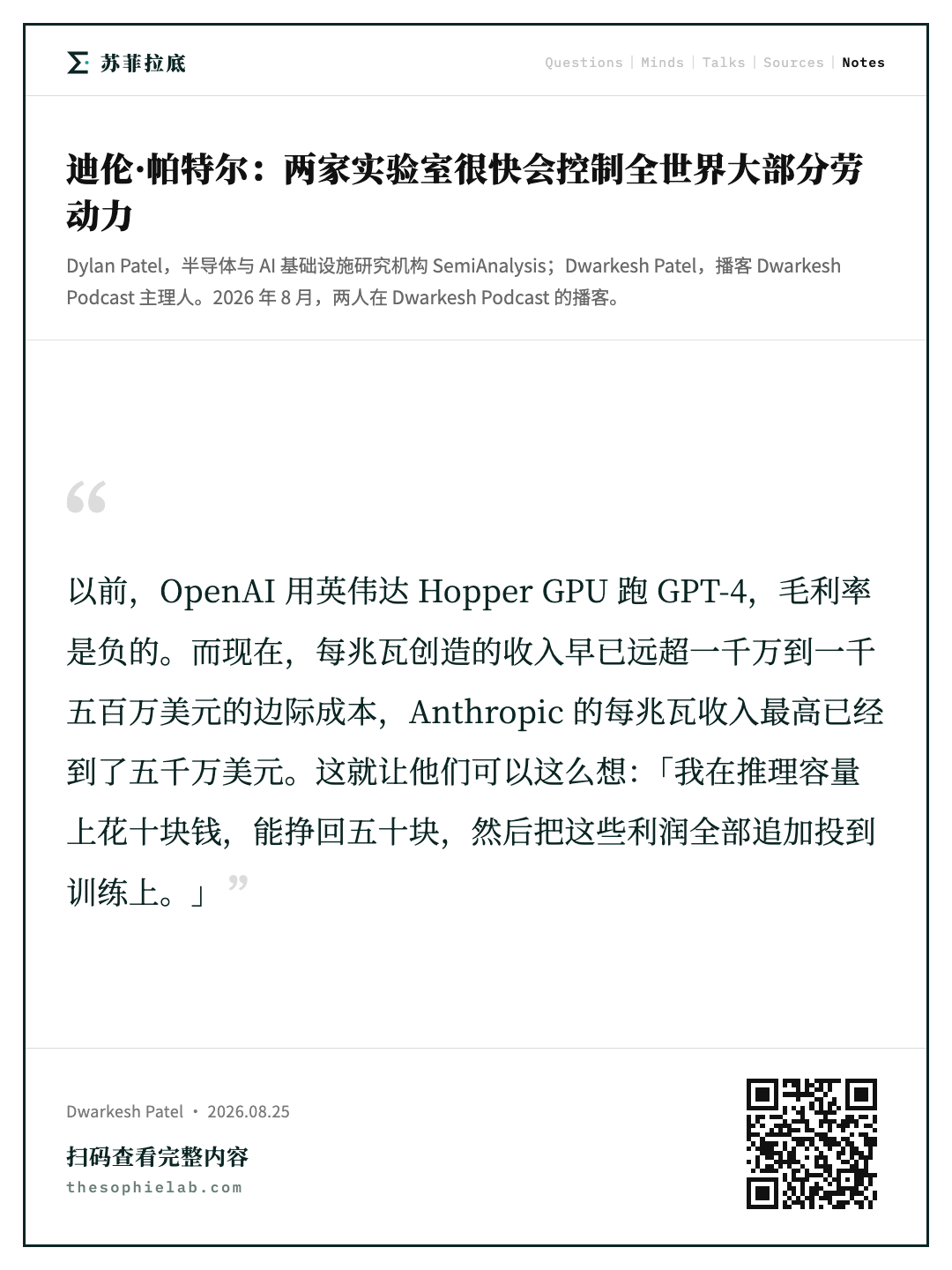
但归根到底,他们的业务越来越多靠自己的收入而非外部注资来支撑。过去一年半,他们的利润率飙升。算力的基础成本通常在每兆瓦一千万到一千五百万美元。当下最有意思的一点在这里:以前,OpenAI 用英伟达 Hopper GPU 跑 GPT-4,毛利率是负的。而现在 OpenAI 跑 GPT-5.6,或者 Anthropic 跑 Opus 5、Fable 5,每兆瓦创造的收入早已远超一千万到一千五百万美元的边际成本。Anthropic 的每兆瓦收入最高已经到了五千万美元。这就让他们可以这么想:「我在推理容量上花十块钱,能挣回五十块,然后把这些利润全部追加投到训练上。」

主持人: 我特别想理解算力向实验室集中这件事,或者说全世界拿到的算力与实验室拿到的算力之比。如果说现在边际算力的三分之一流向实验室,那到什么时候,全球新增算力的一半以上会归实验室?到什么时候实验室基本握有世界绝大部分算力?

帕特尔: 今年年初,OpenAI 是两吉瓦起步,Anthropic 不到两吉瓦。今年年底,两家都超过五吉瓦,算力整体翻了三到四倍。看今年新增的算力,他们占了大约 30%。到明年,按已经签字落笔的合同,局面更夸张:Anthropic 和 OpenAI 会拿走明年新增算力的 40% 到 50%。这种集中看不出有放缓或停止的迹象,反而只在加速。

替他们建算力的人会变。明年一个大的新进入者是 SpaceX,正在建海量算力,很可能把相当一部分租给 Anthropic 和 OpenAI,因为这两家在边际上最有能力出最高的价。此外,OpenAI 和 Anthropic 也开始自建算力:OpenAI 用自研芯片,Anthropic 从谷歌买 TPU,交给 Fluidstack 部署。

所以你问「什么时候全球新增算力的一半只归 OpenAI 和 Anthropic」,答案是明年年底。而且因为算力增长太快,新增算力基本就等于全部算力。

主持人: 所以很快,也许一年半到两年内,世界大部分算力就归两家实验室所有,或至少是在服务这两家的需求。

有这样一个趋势:全球算力按吉瓦算每年翻倍,而前沿实验室的算力每年翻三倍。按这个趋势延续下去,从今年年初的两吉瓦到年底接近六吉瓦,乘三,2027 年底是十八,2028 年底是五十四。你会不会觉得,到那个时候,受全球算力总量所限,他们根本不可能再翻三倍?你怎么看未来几年全球算力的情况?

帕特尔: 如果今年新增三十吉瓦,明年五十吉瓦,后年大约七十吉瓦,就会出现一个很有意思的现象:今年部署的一瓦,比两年前部署的一瓦效率高得多。全球算力有相当大的比例是今年部署的。虽然瓦数没有翻倍,但我部署的是 GB300、TPUv7 和 Trainium3,效率高得多,每瓦性能是上一代芯片的三到五倍。所以这里有一架很高的梯子。如果 Anthropic 和 OpenAI 明年拿走 45% 的算力,那么到 2027 年 12 月,他们拿走了全球新增算力的一半,而这一半新增算力的性能又高于此前的全部存量。

这上面还要再乘一个系数。到 2028 年底,如果趋势延续,而我看不到有什么能拦住它,他们两家就已经掌握了世界上大部分可用的算力(flops)。

主持人: 我不明白的是,如果我们进入一个算力价值暴涨的世界,你为什么认为 2028 年只新增八十吉瓦?

帕特尔: 顺便说,那已经是上限了,是「我看多到极点」的数字。

晶圆厂投入与终端收入百倍落差

主持人: 好,我们来一步步推。几个月前采访你的时候,你说要造一吉瓦的 Vera Rubin,需要五万五千片 N3 晶圆、六千片 N5 晶圆和十七万片 DRAM 晶圆。数字可能变了,但就按这个算。我让一个大模型跑了你的晶圆厂设备模型,算每年生产一吉瓦算力需要多少设备投入,结论是三十到四十亿美元。再加上洁净室、厂房外壳和其他一切,算六十亿美元的晶圆厂资本开支,每年产出一吉瓦。一吉瓦现在能产生一千亿美元的收入。而且这六十亿投下去,是每年都产出一吉瓦,每一吉瓦又每年产生一千亿。

五年下来,第一吉瓦赚了五年的利润,晶圆厂产出的第二吉瓦赚了四年,以此类推。六十亿美元的晶圆厂资本开支,最终对应超过一万亿美元的终端 AI 收入。

帕特尔: 对。中间有很多运营开支,还有很多别的资本开支,比如数据中心、电力。

主持人: 还得付钱给 OpenAI 做研发,还有安装。要拿钱的人很多。把一半都分给这些中间环节,晶圆厂资本开支和最终收入之间仍然有一百倍的差距。其实不止,我们已经非常保守了。结果就是:这就是资本主义。你有一个巨大的落差,能把一美元变成一百美元。他们不会想办法多造一些反射镜吗?

帕特尔: 会造,只是这些反射镜需要时间。

主持人: 但情况紧急到什么程度?Anthropic 和 OpenAI 会说:「我们现在就能挣一万亿,只是卡在 ASML 光刻机里的反射镜上。我们花一千亿能不能多造点反射镜?」我们很快就会处在这种局面。这个供应瓶颈解决不了吗?这很难想象。

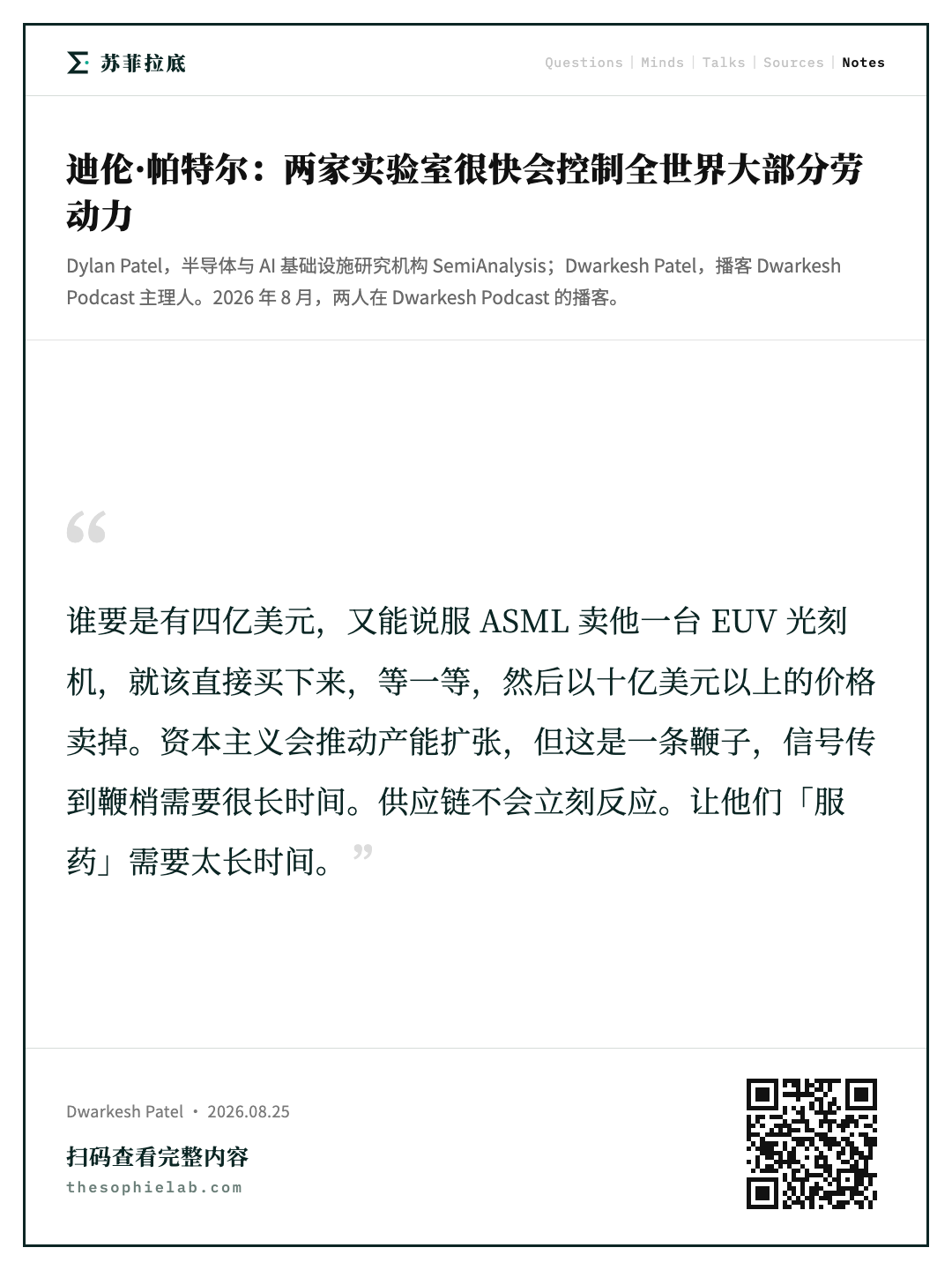
帕特尔: 你已经看到有人在做滑稽的套利,买燃气轮机再转手卖掉,因为轮机是卡住你数据中心的东西,价值高得多。我认为,谁要是有四亿美元,又能说服 ASML 卖他一台 EUV 光刻机,就该直接买下来,等一等,然后以十亿美元以上的价格卖掉。归根结底,是的,资本主义会推动这些产能扩张,但这是一条鞭子,信号传到鞭梢需要很长时间。供应链不会立刻反应。你去找蔡司(Carl Zeiss)的人聊,他们会说:「对对对,到这个十年末我们要造一百台 EUV 的量。」今年早些时候我们录节目时,他们还不觉得需要造那么多,即每年够一百台 EUV 用的反射镜。现在他们说:「好吧,得这么干。」可实际上,按眼下的经济账,应该比这还多。让他们「服药」需要太长时间。

主持人: 假设整个产业链上的每一家公司都被私募接管,进来的人是彻底的 AGI 信徒,说「我们要把产量做到最大」。你觉得多造东西的物理约束会是什么?我这么问,是因为我们很快就会处在这样一个世界:实验室收入,或者说整个 AI 现金流(加速器厂商显然也有巨额现金流),大到可以直接用现金流为整个生产体系的极端扩张买单。

帕特尔: 大方向我同意,显然有一些物理约束。按供应链现在的扩张方式,一百这个数大体还是对的。

主持人: 2030 年?

帕特尔: 2030 年一百台 ASML 光刻机。但如果你对蔡司说:「给你一百亿美元,请你他妈的赶紧扩产」,情况就会变。你得对供应链上每一家公司都这么做。

主持人: 但你不认为明年会发生?

帕特尔: 今年不会,明年不会,后年也不会,因为这个世界受资本约束。

主持人: 可如果头部实验室明年合计收入达到一万亿美元,他们拿不出一百亿?哪怕几千亿?他们看得清世界往哪走,我觉得他们完全可以……

帕特尔: 问题在于,实验室明年会有几千亿收入,但明年资本开支是两万亿左右,两者严重错配。晶圆制造设备供应链的规模大约是两千亿美元,数据中心供应链更多,加速器供应链更多,能源供应链也是一个大数。加起来远超两万亿资本开支。所以实验室还没到用现金流给这一切买单的地步。而且显然他们永远到不了,因为你会希望资本开支始终高于回报。

主持人: 对,要再投资。我真正想弄明白的关键问题是:如果当前趋势延续,2028 年底每家实验室会超过五十吉瓦,两家合计一百吉瓦。你也说了,到 2028 年这些吉瓦的吞吐量或性能是现在的许多倍,因为硬件变好了,不只是每瓦算力提高,硬件也更适配 AI 负载。那么,实验室 2028 年底一百吉瓦,全球算力是多少?

算力定价与实验室的出价能力

帕特尔: 我觉得那会有点难,因为到 2028 年他们已经拿走了 70% 到 80% 的新增算力,我不确定市场那时会怎样。算力价格要涨到什么程度,他们才买得下 70% 到 80%?谷歌、Meta、亚马逊愿意卖那么多吗?还有一个说明:谈这些吉瓦数字时,亚马逊在 Bedrock 上跑 Anthropic 模型,在我们的框架里算 Anthropic 的算力,因为最终计入 Anthropic 的收入,尽管有分成和返还。

但归根结底,到 2028 年如果他们合计到了一百吉瓦,他们对市场做的事是极具破坏性的。因为今天,任何人都能用每兆瓦一千万到一千五百万美元的算力赚钱。真的,不难:弄一个 GB300 机柜,下载 Kimi 的权重,装上 vLLM 或 SGLang,搭起来。Codex 和 Fable 都能帮你做。不算轻而易举,但也不是造火箭。挂到 OpenRouter 上,很简单,你的收入就会超过算力成本。

这已经导致每兆瓦一千万到一千五百万美元的算力价格开始上拐。要在 2028 年拿到一百吉瓦,你得相信实验室能出比别人更高的价,因为在一千万到一千五百万的价位上人人都能赚钱。算力价格会到每兆瓦两千五百万吗?四千万吗?

主持人: 如你所说,实验室每兆瓦的收入已经远高于其他所有人。如果他们保持现在的领先幅度,你会预期这一点延续。如果出现某种递归自我改进,实验室相对占优,或者他们内部有不对外发布的模型在帮着做下一代,就更是如此。你现在不是已经看到了吗?SpaceX 或任何稍微落后的人,如果内部变现不如实验室,就把算力卖给出价最高者。你会预期他们不断竞价,拿下越来越大的算力份额。

帕特尔: 这就是我的世界观。他们会继续吞下更多算力,但不可能按现价或接近现价的水平做到。要在 2028 年吞下全球 70% 的算力,达到一百吉瓦(这是个非常激进的目标),他们必须开始付每兆瓦两千五百万、三千万、五千万美元。

另一个真正棘手的方面是,我们已经看到 AI 实验室大幅放缓。他们自己倡导的监管,对实验室的拖慢远超对中国开源模型的拖慢。OpenAI 不发布 Astra,OpenAI 停训两周,Anthropic 不发布其安全评估里所说的「Model 2」,外界普遍认为那就是下一版 Mythos。他们显然没有发布最好的模型,那么每兆瓦收入就会停滞,甚至可能重新下滑,因为其他模型又有竞争力了。不是他们落后了,只是他们没把最好的东西放出来。如果监管影响让他们无法发布最好的模型,每兆瓦收入就不会涨得那么快,他们比别人出更高价买增量算力的能力就会减弱,也许就到不了一百吉瓦。

但在一个「安全不重要」的世界里,我确实相信事情就会那样发生。他们可以做到每兆瓦一亿美元甚至更多的收入,可以付每兆瓦五千万。别人没有任何理由拿自己的算力干别的,只会说:「求你了,Dario,把我手上的全拿走吧。」但有一些我们无法描述的力量,可能会把这一切放慢。

主持人: 一个好的直觉泵是:如果 AI 模型真的相当于一个完全自动化的软件工程师呢?现在还没到,我认为离完全替代一个白领的工作还远。但白领年薪是六位数或更高。如果一吉瓦能支撑大约一百万白领的「人口」……

帕特尔: 那就是一千亿美元。其实低得惊人。

主持人: 对,人均十万,一百万人口。我不确定。但如果有真正的 AGI,每吉瓦会是几千亿美元。

价值在各层之间的转移

帕特尔: 另一个方面,我们一直在看到:大部分价值没有被捕获。这些模型创造的大部分价值没有落到 OpenAI 和 Anthropic 手里,值得庆幸的是,到目前为止主要是给了用户。Jane Street 和 OpenAI 签了 GPT-5.6 Ultrafast 模式的独家合同,同时也是 Anthropic 最大的客户之一,他们从买来的 token 中榨取的价值远远超过 Anthropic 的利润,因为他们能在市场上赚钱。再比如 Meta,一度传闻占 Anthropic 业务的 10%,他们靠优化广告算法之类,把用户停留时间拉长 5%,这些带来的效率提升远超他们付的钱。他们用模型赚的钱比 Anthropic 多得多。这是必然的。当然,如果你多了一百万个软件工程师,软件工程师的价格也会下跌。

主持人: 我困惑的一点是,市场会不会走向均衡?如果均衡,你会不会预期算力价格等于 Anthropic 和 OpenAI 能从中赚到的钱,或者非常接近、只留一点加价?现在很怪的是,算力售价和 Anthropic 能从中赚的钱之间有四倍以上的差距。如果每吉瓦收入持续上涨,Anthropic 变现一吉瓦的能力翻两三倍,那这个差距还继续扩大就很奇怪了。Anthropic 仅凭手里的权重,就能把花十块钱买的东西变成一百块。

帕特尔: 这是个很有趣的老问题:AI 的价值到底流向哪里?AI 创造了这么多价值。终端用户,我想大家都同意,他们拿到的价值比谁都多,所以愿意花大价钱买模型。然后是应用层,到目前为止应用层创造的价值很少。然后是模型层,一年前还是负毛利,现在是巨额正毛利,看起来正走向每兆瓦一亿美元,也就是你说的十到十五块变一百块。

但回到一年前,硬件供应链吃掉了全部毛利,其他所有人都在亏钱。OpenAI 和 Anthropic 只是往里砸风投的钱,很多其他创业公司也一样。很多超大规模云厂商在建基础设施,却不知道会不会有回报。所以模型层当时创造的是负价值,因为他们卖 token 的价格低于基础设施成本。所有价值都被芯片和晶圆厂拿走了。而 2023 年初,内存厂商在 HBM 或 AI 内存上根本不挣钱,尽管理论上他们提供的价值巨大。现在……其实台积电捕获的价值远少于内存厂商。所以价值捕获的位置一直在挪动,对跟踪或参与这个市场的人来说很好玩,比如 Jane Street。

主持人: 这不是广告,这不是广告,这不是广告。

帕特尔: 他们是赞助商,但你不必吹那么用力。

那么往后会怎样?Anthropic 和 OpenAI 的价值捕获慢慢膨胀起来。会不会膨胀到拿走全部?大家本来是这么想的,然后 Elon 用行动证明:「不对,我可以把算力以每兆瓦两千五百万或四千万美元的价格卖给 Anthropic 和谷歌。哪怕只是短期,我按这个价卖出去,一年就收回全部资本开支。」

SpaceX 与 Meta 囤算力的卖方权力

主持人: 你预测一下,相关档次的算力,比如 SpaceX 以每吉瓦四百亿美元卖给谷歌的 B300,到明年年底卖什么价?

帕特尔: 我认为大多数算力仍会以每吉瓦低于两百亿美元成交。

主持人: 哪怕到明年年底?

帕特尔: 因为这些都得融资。如果 Meta、微软、亚马逊、SpaceX 可以不找客户就建算力,说「管他的,我先建」,建好了再等,那他们就掌握了主动权。而大多数算力是在建成之前很久就签了合同的。这正是 Elon 在市场上利用的空子。他手里真的有算力,他说:「嘿,Anthropic,我知道你每吉瓦赚六百多亿,干嘛不以一个疯狂的价格买我的?」当然,这不是 Elon 或 Anthropic 单方面决定的,是市场自己找到了平衡。

其他人,随便一家云厂商,是这样想的:「我要建一吉瓦或一百兆瓦,要花资本开支,然后得转身找客户。要找客户,先得找资本。谁给我资本、谁当客户?客户得先签约,然后我拿着客户的承诺去信贷市场融资。」所以这里有一个完全不同的权力结构:Meta 实际上在囤算力。他们和 SpaceX 是仅有的两个像样的「第三名」候选,因为他们囤了这么多算力,用自己的资产负债表和能力在没有终端客户大规模变现的情况下建算力。他们有真实的资产负债表,能进信贷市场。建一吉瓦,赚个不算离谱但不错的利润,现在手里就有了一堆算力。

于是 Meta 和 SpaceX 就有了选择权,四下看看:「我的内部用例挣得更多,还是以离谱的利润卖给 Anthropic 或 OpenAI?」我们进入了一个新阶段:SpaceX 和 Meta 说,「我先把算力建起来,我不按一千三百万出租,我按两千五百万、五千万甚至更高卖。」

主持人: 你觉得到 2027 年底,他们每吉瓦的收入是多少?Anthropic 或 OpenAI。

帕特尔: 高度取决于谁有最好的模型,以及他们是否被允许继续发布最好的模型。但我看不出为什么不会到每兆瓦五千万以上。

主持人: 到 2027 年底?

帕特尔: 哦,2027 年底?那更难说,但我认为可以更高,全公司混合算大概每兆瓦七千万、八千万,甚至更高。

主持人: 感觉偏低。如果是这样,算力价格会怎样?

帕特尔: 如果我是 Anthropic,增量算力值这个钱,也许我花每兆瓦四千万买 SpaceX 的算力。如果我是 SpaceX,我看看供应链,「我和黄仁勋(他现在突然开始用推特了)谈好了这笔交易」。Elon 说他们只用英伟达,那黄仁勋为什么不涨价?然后 SK 海力士、美光、三星看着,「我们为什么不涨价?」所以在价值捕获上我认为有牛鞭效应(bullwhip effect)。某一家涨价,不等于整个供应链立刻重新平衡,但假以时日,供应链会重新平衡,东西会越来越贵。要拿到增量产能,你不得不接受。台积电涨价很慢,内存公司涨得很快,基板公司涨得很快。一千五百万的价 Elon 不会卖,两千五百万以上他才卖,所以他显然涨价涨得很快。

监管拖慢发布与内部领先

主持人: 我很惊讶你认为到明年年底每吉瓦收入不会远超一千亿。递归自我改进(RSI)什么时候发生?起飞什么时候发生?哪怕 RSI 不发生,就按现在的进步速度延续。看看过去一年半我们走了多远。一年半前的模型是什么?Claude 3.5 之类?

帕特尔: 我的问题是,世界上现存最好的模型是二月训的。

主持人: 所以你的意思是,也许实验室最好的模型就是不让发。

帕特尔: OpenAI 说他们两周不训模型,伙计,这是什么鬼?

主持人: 这里有两回事。一是在内部,他们能不能用足这些模型,从而抬高算力价格;二是 AI 整体进步会不会因为监管而放慢。

帕特尔: 可他们连在内部用新模型都不被允许。Astra 连内部都没有广泛部署。

主持人: 但仍然,如果你有一个……去年年初发布的模型是什么?GPT-4o?从 GPT-4o 到 Mythos 2 那么大的跨越,到 2027 年底再来一次。

帕特尔: 对,但 Mythos 2 没出来。

主持人: 哪怕是 Mythos,再来一次那样的跨越。

帕特尔: 连 Mythos 都不让出来。他们把它阉割了。我们不能用它优化推理性能,不能用它优化各种东西。

主持人: 好,也许 AI 进步或部署会有些放缓,使得每吉瓦收入更低。但这是我唯一能想到的、明年年底只有每兆瓦一亿美元的原因。

帕特尔: 只要模型变好,从中产生的价值就会变大。当然,谁捕获价值还有争议,但归根结底,所有人都会涨价。因为他们能涨,而且这是极强的通胀。尤其是考虑到监管的方式。目前为止只是「别发模型」。但越来越多的监管方式是:纽约禁建数据中心,得州搞暂停令,俄亥俄说,或者至少想说,你得替一定半径内所有人交房产税。这些会减少供给、抬高成本,也会被转嫁出去。你最终会走到这样一步:进步会放慢,至少在外部看来如此,哪怕内部的模型一直在变好。

主持人: 在起飞的情景里,Anthropic 为什么不会把最好的模型比外部可用的领先六个月?既因为安全和监管,也因为竞争优势。如果进步在加速,这六个月的差距实际上是更大的差距。

帕特尔: 这就是会把每兆瓦收入的增长压到远低于今年上半年水平的因素。

非共识:推理算力占比将下降

主持人: 这一点我很感兴趣。随着这些公司上市、对投资者负责,假设明年年底他们有接近二十吉瓦,10% 的算力就是两吉瓦。假设他们想把用于训练的算力比例从 60% 提到 70%。投资者会说:「你每吉瓦能产生一千亿收入,你现在等于为了增加训练算力,对两千亿收入说不。」投资者会说:「搞什么?你在训练上已经花了这么多,为什么还要花更多?」作为上市公司,如果他们说「不,我们会继续提高训练所占算力的份额,来对冲每吉瓦收入的增长」,你觉得会怎样?

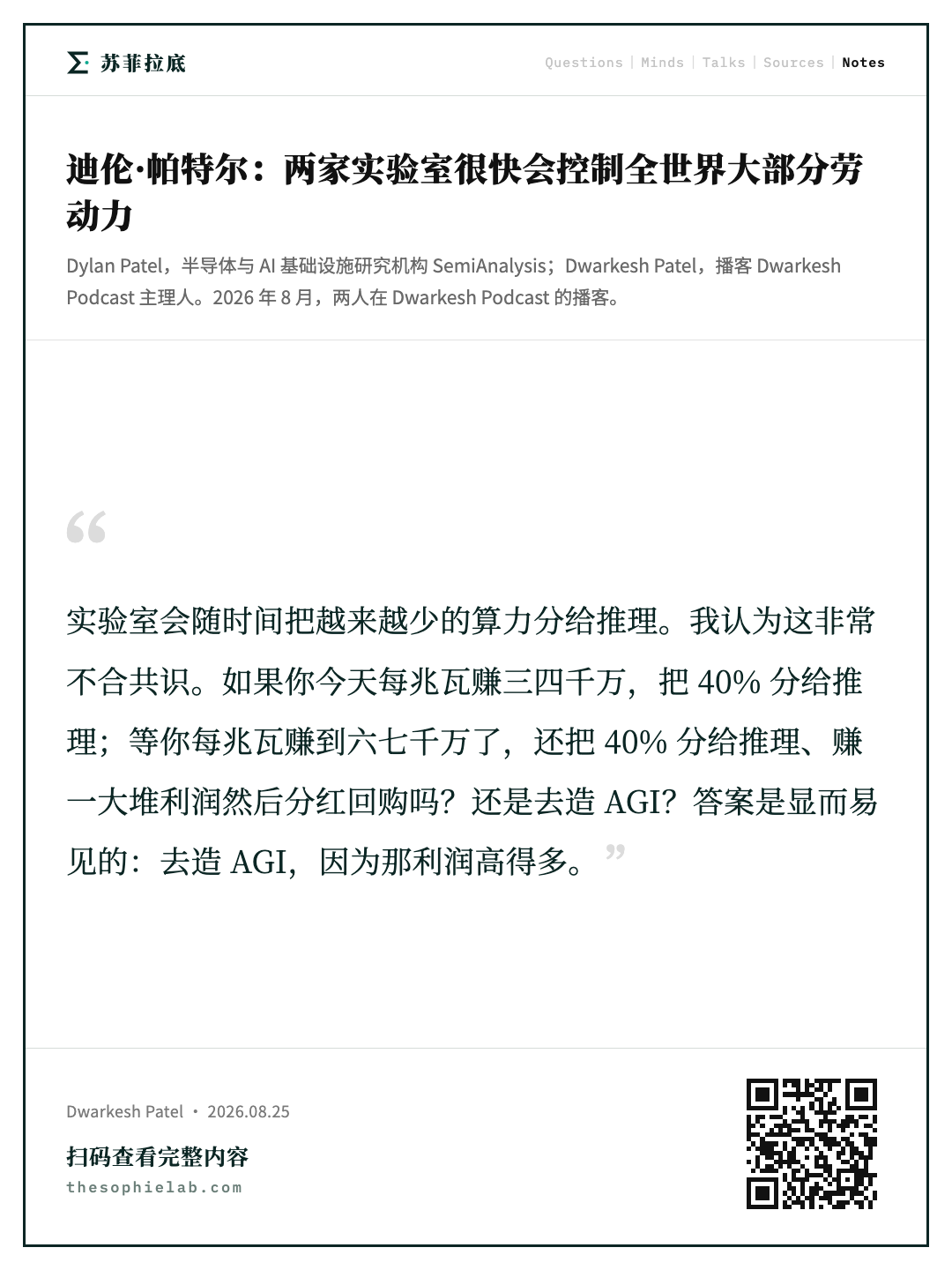
帕特尔: 这是我个人的看法:实验室会随时间把越来越少的算力分给推理。我认为这非常不合共识。多数人的标准信念是「哦,大部分算力会用于推理」。但大部分算力会用于训练的前向传播,而不一定是产生收入的推理。归根结底,如果你今天每兆瓦赚三四千万,把 40% 分给推理;等你每兆瓦赚到六七千万了,还把 40% 分给推理、赚一大堆利润然后分红回购吗?还是去造 AGI?我认为 Anthropic 和 OpenAI 的答案是显而易见的,不只是管理层,董事会也一样:去造 AGI,因为那利润高得多。所以你会看到他们不断上调用于训练的算力比例。

主持人: 尽管每一份增量算力如果用于推理,能产生越来越多的利润。

帕特尔: 对。关键在于,如果我在卖 token……OpenAI 的 Ultrafast 模式是只给外部,还是内部也用?结果是:不,我要同时分给内部和外部,因为超快 AI 或最好的 AI 模型在内部创造的价值远超外部客户的。所以,当然,我可以每兆瓦赚一亿美元,但如果我把它转向 AI 研究,我得到的增量进步是什么?对我未来的盈利潜力、对我所做一切的贴现现金流意味着什么?他们不会这样一板一眼地算,但归根结底,把越来越多的算力用于内部更划算。让推理算力保持庞大的唯一理由,是为了扩大训练机队。

主持人: 这是个有意思的经济学问题,我觉得可以让模型来消化:在一个他们减少推理算力比例的世界里,什么必须成立?

帕特尔: 我认为过去三个月他们已经在这么做了。今年有些时段他们在提高推理比例……我们按月看。你会同意,Anthropic 每个月新增的算力都比前一个月多。签 SpaceX 之类的交易时会有些噪音,但总体上算力是一条向上的曲线。一月新增的算力少于十二月,收入却在飙升。然后就有点平台了,他们现在不再是每月新增两百五十亿美元的年化收入。这意味着他们拿到的边际兆瓦,用于研发的比例高于用于推理的。所以他们今天事实上在把算力更多转向研发。只要你足够仔细地看他们在做什么,这是不言自明的。

主持人: 按你说的全球算力增速,我想弄清几件事。把你说的数加起来,2028 年底全球算力超过两百吉瓦,对吧?

帕特尔: 对,全球。

主持人: 2028 年之后,全球 AI 算力还能以多快的速度增长?

帕特尔: 今年三十,明年五十,2028 年七十,2029 年应该在九十到一百的量级。

主持人: 然后每年再加一百之类?

帕特尔: 我认为斜率可以继续上扬。超过四年的东西很难预测。谁知道我们是否处在 RSI 阶段,世界经济什么时候年增 10%?因为如果每年新增一百多吉瓦,GDP 增速会荒唐。

中国算力路径与出口管制成效

主持人: 如果你认为 2028 年全球有两百吉瓦,中国那时有多少?中国的算力在这整个趋势中怎么增长?因为如果 RSI 在西方先启动,而中国还没有大量算力,那我们所处的世界会和另一种情况完全不同。

帕特尔: 回到 2022 年做个基准:美国新增全球约 45% 到 50% 的算力,中国约 30% 到 35%,其余归世界其他地区。2022 年以来,对华监管收紧,美国大幅增长。今天 70% 的瓦数部署在美国,中国是个非常小的数,数据中心 AI 算力的部署瓦数不到 10%。往前看,他们仍然是个很小的数。本土产能很小,从英伟达买的也很少,而且很多流到了别处,比如马来西亚。所以中国国内新增算力的份额仍会低于 10%。2028 年可能开始上拐。但可以比较有把握地说,中国 AI 算力会在三十吉瓦或以下。

主持人: 2028 年?

帕特尔: 对,2028 年。

主持人: 那他们的曲棍球棒曲线拐得多快?

帕特尔: 我确实认为 2028 年他们能部署的算力会有大幅提升。2026 年他们还主要靠走私芯片,靠台积电以为不是给华为、结果是给华为造的芯片,以及三星运过去的大量 HBM。但 2027 年晶圆厂开始起来,2028 年尤其如此,中芯国际和长鑫的产线起来,本土产量真正达到每年数百万颗。那时仅 2028 年一年,他们就能新增五到十吉瓦的本土芯片。这些芯片肯定比不上英伟达、谷歌、OpenAI 在 2028 年的芯片。

主持人: 所以吉瓦数还高估了,三十吉瓦,但芯片差很多。可如果你认为再下一年全球新增一百吉瓦(我知道你说看不了那么远),中国下一年能加多少?我想知道的是:他们一旦能大量出货,是直接曲棍球棒上去,还是仍然少于美国及其盟友?

帕特尔: 很多事还有变数:美国会不会通过 MATCH 法案,设备会不会继续被出口管制,中国正开始能自产的新设备能造多快。但归根结底,中国肯定会曲棍球棒上去。要说中国真正擅长什么,就是把制造业规模拉得非常非常快。我想中国也会逐步争取更多外国芯片流入国内,或者至少缩小美国允许英伟达卖给他们的缺口之类。

主持人: 你觉得中国 2029 年能新增五十吉瓦吗?

帕特尔: 完全合理,其中一部分也可能是从国外买的。但对,我认为中国 2029 年做到五十吉瓦完全合理。不过如果大部分是国产芯片,要打个折,这五十吉瓦实际上相当于二十吉瓦的美国芯片。

主持人: 所以你实际上是在预测这样一个世界:2028 年的领先实验室,如果按质量给吉瓦加权,比中国 2029 年甚至 2030 年的全部算力还多。

帕特尔: 前提是没有人去拖慢美国的实验室。但显然政府和政客已经开始这么做了。而中国不会拖慢 AI,他们唯一会做的就是加速。

主持人: 说实话,我采访黄仁勋问出口管制时,我是个自由意志主义者,对这个问题并没有真正想清楚。我在为与他相反的观点做最强论证,因为我觉得把想法辩透很重要。我当时想:「也许有一个世界,如果我们和中国合作,对我们更好,特别是他们掌握了这么多供应链和机器人所需的其他东西。」但我没意识到算力局面像你说的这么糟。出口管制看来确实起作用了。如果他们的出货量真如你所说,那差距是巨大的。到我们有了自动化程序员、进入自动化研究员阶段时,中国在算力存量上远远落后。如果真是这样,那就是管用了,我认为这是一个显著的成功。

帕特尔: 唯一的保留是,一部分是出口管制,一部分也是金融体系的差异。美国金融体系比中国金融体系更愿意往创业公司里豪赌。但中国金融体系一旦选定一个行业,补贴力度会大得多。中国半导体行业拿到的补贴,比世界其他地区半导体行业的总和还多得多。如果起飞不像你暗示的那么快,而是需要更长时间,那中国最终会在半导体上大幅追上,而半导体到某个时点就是算力。

另一个值得注意的方面是,中国公司今天在 AI 模型上并没有落后多少,至少在公众的感知上是这样,相对于他们拥有的算力而言。领先的中国实验室总算力最多一两百兆瓦,字节 Seed 是个例外,明显更多。Kimi 跑的算力离一吉瓦差得远。而 Anthropic 到年底超过五吉瓦。所以问题是:算力差距重要吗?

训练只用两百兆瓦的原因

帕特尔: 我认为眼下这个算力差距没那么重要。把实验室的算力预算拆开,目前是 60% 训练、40% 推理。但训练还能再拆:实际上 50% 是研究,10% 是开发,40% 是推理。我说的研究和开发是指:研究员在产生想法,测试新架构、新数据配比、新超参数、新注意力技术,等等。但真正到训练运行的时候,Anthropic 训 Mythos,用的不到两百兆瓦。

主持人: 预训练,还是整个过程?

帕特尔: 预训练。不到两百兆瓦,跑了大约两个月。然后强化学习用得更少。

主持人: 你认为 RL 用的算力比预训练少?

帕特尔: 至少在预训练的单站点规模上是这样。

主持人: 但总算力可能更高,对吧?

帕特尔: 但那是串行的。任一时刻他们最多用过大约两百兆瓦。实际上他们有好几吉瓦,所以大部分算力在做研究,而不是开发某一个模型。这是有原因的:协调所有这些集群很难,把它们放在一起很难,多站点训练很难,RL 很难。RL 中多生成 rollout 不一定让模型更好。有各种原因让你没法把手里两吉瓦全压到训练上,实际上只能用两百兆瓦。随着自动化编程和自动化研究员越走越远,我预期算力预算中研究与训练之间的比例会变得模糊得多,甚至训练占比更高。还有持续学习之类的东西。这些都意味着越来越多的算力会真正用于训练模型。

十万亿资本开支的资金从哪来

帕特尔: 如果你到了每年建一百吉瓦的世界,按现在的价格,那是每年五万亿美元的资本开支。再叠加上你必须提前很久建电厂,那是三十年期的资产;数据中心是十五到二十年期的资产,也得提前建。所以这五万亿,一旦把后续年份的增长算进去,实际上会是七万亿或十万亿。

主持人: 等等,我没明白。就是说这不包括电力生产和数据中心本身的基础设施?

帕特尔: 对,就是这样。人们说 AI 资本开支四五百亿时,其实只是关键 IT:服务器、网络、光纤、光模块、光通信之类。不包括数据中心本身和电厂,而这些是提前建的。如果我今年建一百吉瓦、明年建一百五十吉瓦,那一百五十吉瓦的所有建筑今年就得花资本开支建好。如果再下一年建两百吉瓦,那些电厂的钱……轮机今年就得买。所以如果建一百吉瓦,实际远超五万亿。

主持人: 对。很可能到 2030 年底,每年的增量资本开支接近十万亿美元,接近世界经济的十分之一。如果全在美国……美国经济也会增长,但按现在的美国经济规模,那相当于四分之一到三分之一的美国经济都在建数据中心。说出口我就觉得,也许你是对的,我们就是不会允许,这才是它不会发生的原因。因为这条指数曲线要延续,美国四分之一的经济就得只建数据中心。

帕特尔: 我相信资本主义,相信资源会向最赚钱的地方重新配置。但同时,政治存在,信贷市场存在,资本市场存在。要撑起 2030 年的一百吉瓦,或者缩小到 2028 年,各项加起来三四万亿资本开支:超过两万五千亿的 IT 资本开支,再加一到两万亿的数据中心和能源,以及下游整条供应链,半导体等等。三四万亿资本开支,这些现金从哪来?还没有人从业务里赚到那么多现金。到目前为止的增长都是超大规模云厂商掏的:谷歌、微软、亚马逊、Meta,他们出了很大一部分,曾经占算力一半以上,但他们现在不产生现金了,全部花在资本开支上。此外他们还举债,也全部投入资本开支。Meta 在这么做,亚马逊、谷歌也是,微软很快也会。所有人都在举债付资本开支。

那么,之前没有出钱、现在要来出这份增量的是谁?对谷歌来说,停止回购转而买算力基础设施很简单,Meta 停止回购也一样。这对市场影响不大,但有一些。但到 2028 年,超大规模云厂商在举债几千亿,他们的整条供应链也在举债几千亿,谁来买单?

有几条路。一是英伟达、博通和内存公司这样的半导体公司决定给部分资本开支出资。二是传统的基础设施投资者,募集资本投基础设施,不修桥了,改建数据中心。最后是整个经济里的每一个人都意识到:「也许我不该买房,也许不该投那些帮人买房的信贷,也许不该买国债。我该买超大规模云厂商的债,或者这个数据中心的债,或者 Anthropic 的债。因为 Anthropic 愿意为增量的十亿美元产能付 20% 的利率,他们知道那带来的收入会很大,付 20% 也比以每吉瓦五百亿从 SpaceX 租划算。」所以各方在争夺。但一旦这样,整个世界经济就真的被重塑了。

利率上升与主权债务危机

主持人: 这几天我们私下一直在争论:AI 会不会引发主权债务危机。逻辑是这样的。如我们所说,很少的投资能变成很多钱,所以回报率……

帕特尔: 这他妈算什么问题啊,天哪,不敢相信。

主持人: 不,这对其他所有没法用小钱变大钱的人来说是个巨大的问题。回报率极高。哪怕在数据中心层面,你建一个数据中心,想以折旧成本十倍的价格租给 Anthropic 或 OpenAI,这太疯狂了。到年底一美元变两美元或十美元。这会把利率抬高。如果利率抬高,而且是整个经济的利率……人们借越来越多的钱,与政府本来要做的借贷、其他公司的借贷、你作为消费者或房贷人的借贷竞争。这让其他所有人的借贷变贵。这对无数人有巨大影响。

抱歉,我要独白一段,这是我们一起想过的。我认为美国最终会没事,因为如果数据中心建在美国,你根本上可以对数据中心征税。但按现行税制,企业所得税不到联邦收入的 10%,80% 以上是工资税和个人所得税,而随着自动化推进,这部分会缩水。同时在支出端,目前 20% 的税收用于偿债,也就是付利息。而很多债是短期的,每五年滚动一次。你他妈笑什么?

帕特尔: 因为这都是你上个月刚学的。

主持人: 你不也一样。你可是拿了金融经济学学位的。

帕特尔: 我没有。网上以为我是养蜂的。

主持人: 好吧,几个月,几个月。这是我们的本行,Dylan。

帕特尔: 我知道,抱歉。现在我不好意思了。不,挺好,你讲得好。我只是觉得好笑:一百万人在听一个这个月刚学会什么是债务的人讲话。

主持人: 假设利率上升一个百分点。五年内,税收中用于偿债的比例从 20% 升到 25%。如果上升五个百分点,就超过 40%。再考虑到政府每年借两万亿,那就从 40% 升到超过 60%。60% 的税收只用来付国债利息。我认为美国会没事,因为如果我们让数据中心建在美国,税基会扩大。其他国家在我看来就彻底完蛋了。我刚查了哪些国家债务多、税收少、而且债务需要频繁续期。巴基斯坦、尼日利亚这样的国家,在新的利率体制下会非常惨。

帕特尔: 这种挤出效应,就是为什么不会「梭哈十亿吉瓦」的原因。你有这么多依赖大量债务的行业和国家,你刚说的那些穷国会违约。快消品,那些做 Trader Joe’s 货架上东西的公司,用很多债;电信公司用很多债;银行用很多债。所以如果市场利率上升,不一定是政府设定的利率,而是联邦基金利率与其他人实际借贷成本之间的利差,因为亚马逊明年想发一千亿美元的债,或者管它多少,大概少一点,你就会面临一个很棘手的问题:现金从哪来?有一部分靠现金流,现金流也在涨。但合乎逻辑的做法是投资远超现金流,因为未来几年的回报会很惊人。

所以有一个缺口。往下压这个缺口的是所有这些东西:针对数据中心的监管、消费者不满、政客不满、针对 AI 的监管、实验室出于安全原因不发布最新模型。利率上升是所有这些的一部分影响。所有这些都把曲线从纯粹简单经济学意义上资本主义想要的位置,弯向我们这个复杂系统想要的位置,越弯越低,最后建成的吉瓦会少于本该建成的。

主持人: 不过利率本身就是资本主义的一部分吧?

帕特尔: 对,但我说的是简单经济模型与我们实际拥有的复杂模型之间的差别。

主持人: 你认为亚马逊或 Anthropic 明年发债的利率会是多少?如果他们发几千亿的债,平均利率多少?

帕特尔: 我不认为亚马逊会发几千亿的债。

主持人: 总量上。就说大型科技公司整体。

帕特尔: 超大规模云厂商加上所有云厂商……在我们的模型里,2024 到 2029 年的资本开支大约是十一万亿美元。

主持人: 总计?

帕特尔: 总计。就算尽可能用现金流出资,这十一万亿的建设仍需要发行超过五万亿的信贷。

主持人: 所以你不认为 AI 收入能继续每年翻三倍?

帕特尔: AI 收入会涨。我不认为它能永远涨下去而不撞上某些约束。实验室有各自的激励。很多情况下建算力的不是实验室,尽管他们越来越想这么做。

主持人: 但他们会有这么多现金流。你说收入会是多少?你认为他们不会有那么多收入?

帕特尔: 不,我只是说到 2029 年有大约十一万亿的资本开支,六万亿靠现金,五万亿靠债。如果是这样,整个生态发五万亿的债确实会推高利率。那什么能阻止呢?有几件事。一,实验室是否进一步提高每兆瓦收入,同时保持较大的推理分配?那样的话他们在吸走整个标普 500 的利润,因为人人都在付钱降本。当然他们的利润也会涨,但现金总得有来处。所以实验室收入增速相对于他们向世界交付的价值,有一个上限。技术还有一个扩散的问题。但归根结底实验室收入会持续上涨,他们没法全靠现金流出资。最优方案是尽可能多用信贷,因为哪怕实验室现金流能覆盖很多,你还是想建得更多。所以一定有某个量的信贷。我们目前的模型是到 2029 年五万亿信贷加六万亿现金出资的基础设施投资。而即便如此,相对于 AI 模型的需求增长,算力仍不够。所以显而易见的答案是每兆瓦收入持续上涨,这说得通。

主持人: 你觉得因为这一切,到 2029 年利率会涨多少?

帕特尔: 伙计,这纯属凭感觉报数。

主持人: 但你要是硬报一个……世界经济增长大幅上升,亚马逊的利率为什么不从现在的水平往上走?

帕特尔: 这会非常凭感觉。最近 Meta 以 5% 到 6% 融资。我看不出他们为什么不付 8%。他们会乐意付 8%,因为要建的算力回报巨大。市场不希望他们这样,但他们愿意付 8%。反面是,如果他们从今天的 5%、5.5%、6% 涨到 8%,涨了 250 个基点,经济里其他所有人也得多付 250 个基点,这会引发很多事。银行会尖叫,因为信用利差扩大时,他们的负债重定价比资产快,利差爆开他们会亏很多钱。

主持人: 另一个后果,这是你提的:利率上升,贴现率上升,所有股票的贴现现金流暴跌。也就是说,哪怕整个股市看起来还行,标普 500 没事,任何单只股票的价值可能已经崩了,尤其是巴菲特、伯克希尔那种「三十年稳定分红」型的股票。

帕特尔: 对。「我为什么要给强生付这么高的价?」它被视为稳定股,现金流好,长期回馈。或者一家铁路公司。如果我的贴现率不是 3% 或 5% 而是 8% 或 10%,我他妈为什么投那么多?

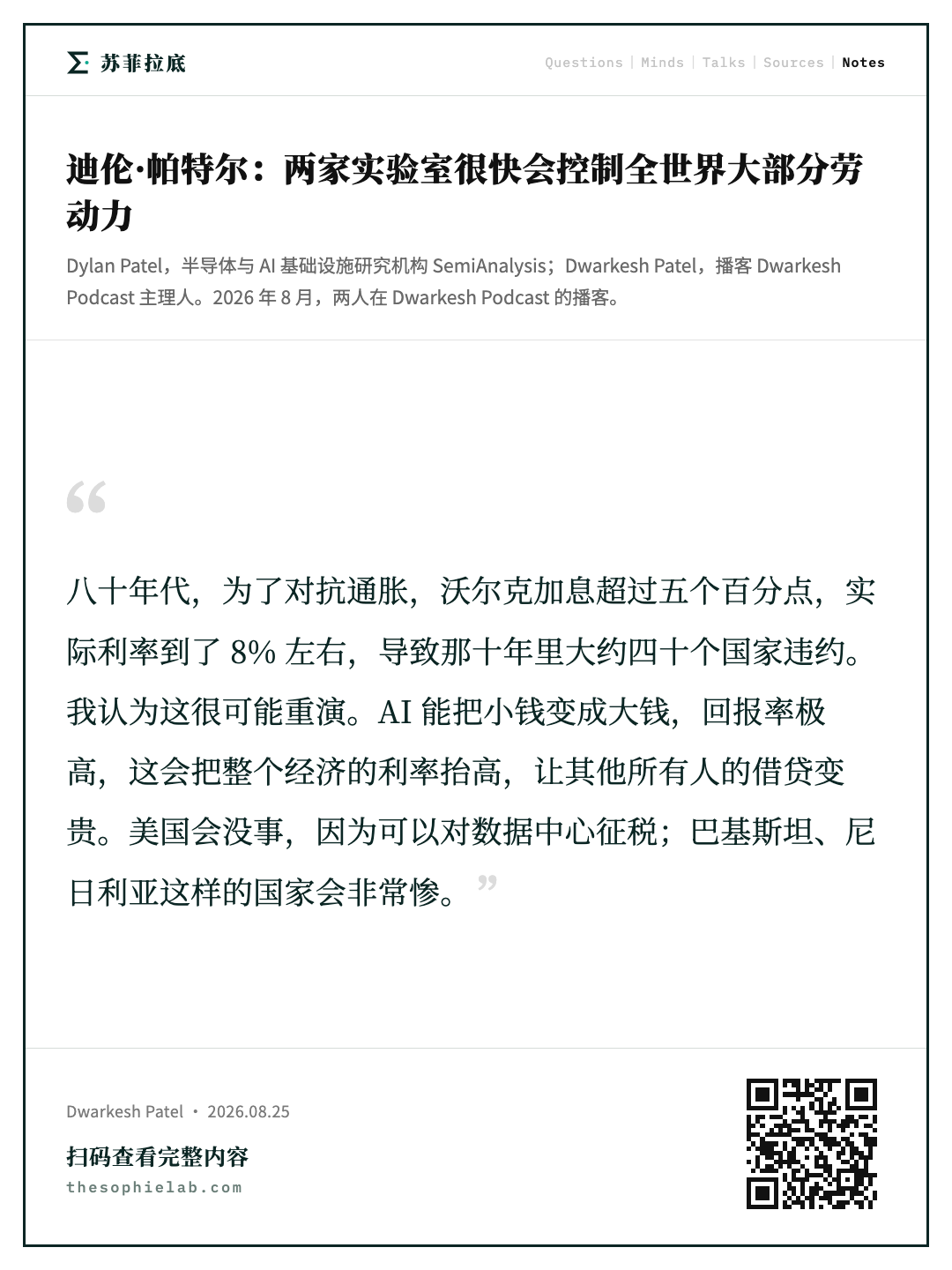
主持人: 至于发展中国家,我的好友、经济学家 Basil Halperin 提出,我们会看到第二次沃尔克冲击。八十年代,为了对抗通胀,美联储主席沃尔克加息超过五个百分点,实际利率到了 8% 左右,导致那十年里大约四十个国家违约,主要在拉美。我认为这很可能重演。

奇点前后的增长与利率体制

主持人: 好,现在进入奇点话题。我们一直在谈利率上升会怎样……

帕特尔: 顺便说,我认为这些都发生在奇点之前。

主持人: 对,我说的就是奇点之前,利率涨两三个点等等。到某个时点,我认为世界经济很可能每年翻倍。这不会在五年内发生,但终会发生。有一位研究者 Damon Binder 做过很好的工作:看一个完全自动化经济的投入产出表,要让经济里所有东西的存量每年翻倍,需要什么条件?

帕特尔: 经济年增 3%,按七十法则,二十几年翻一倍。

主持人: 对。但他说:「现在我们的瓶颈是人,人不能每年翻倍。」可在一个劳动力也能每年翻倍的世界,经济能增长多快?我认为可以每年翻倍。至少也是每年百分之几十。利率应该很接近增长率,因为消费的缘故不会完全相等,但应该差不多。那我们就会进入一个 2030 年代利率是百分之几十的世界。我脑子里一部分在说「可能是百分之几百」,但就算至少是百分之几十。那我就想:所有不参与 AI 生产的国家都会违约;所有非 AI 股票基本归零,因为贴现现金流一文不值;如果联邦政府想不出办法对 AI 征税,偿债支出就超过现在的全部税收。还有各种我们肯定还没定价的效应:你贷不到房贷,等等。这个世界从根本上在发生什么?这些都是书呆子话,对吧?退一步说,到底在发生什么?

帕特尔: 现在才开始说书呆子话?

主持人: 我们会进入一个完全不同的增长体制。经济实际上在说:「政府借钱付养老金的机会成本现在极高,因为那笔钱本可以拿去建一座造机器人工厂的机器人工厂的机器人工厂。」资本的机会成本会大幅上升。这是我们谈的所有事情的根本原因。

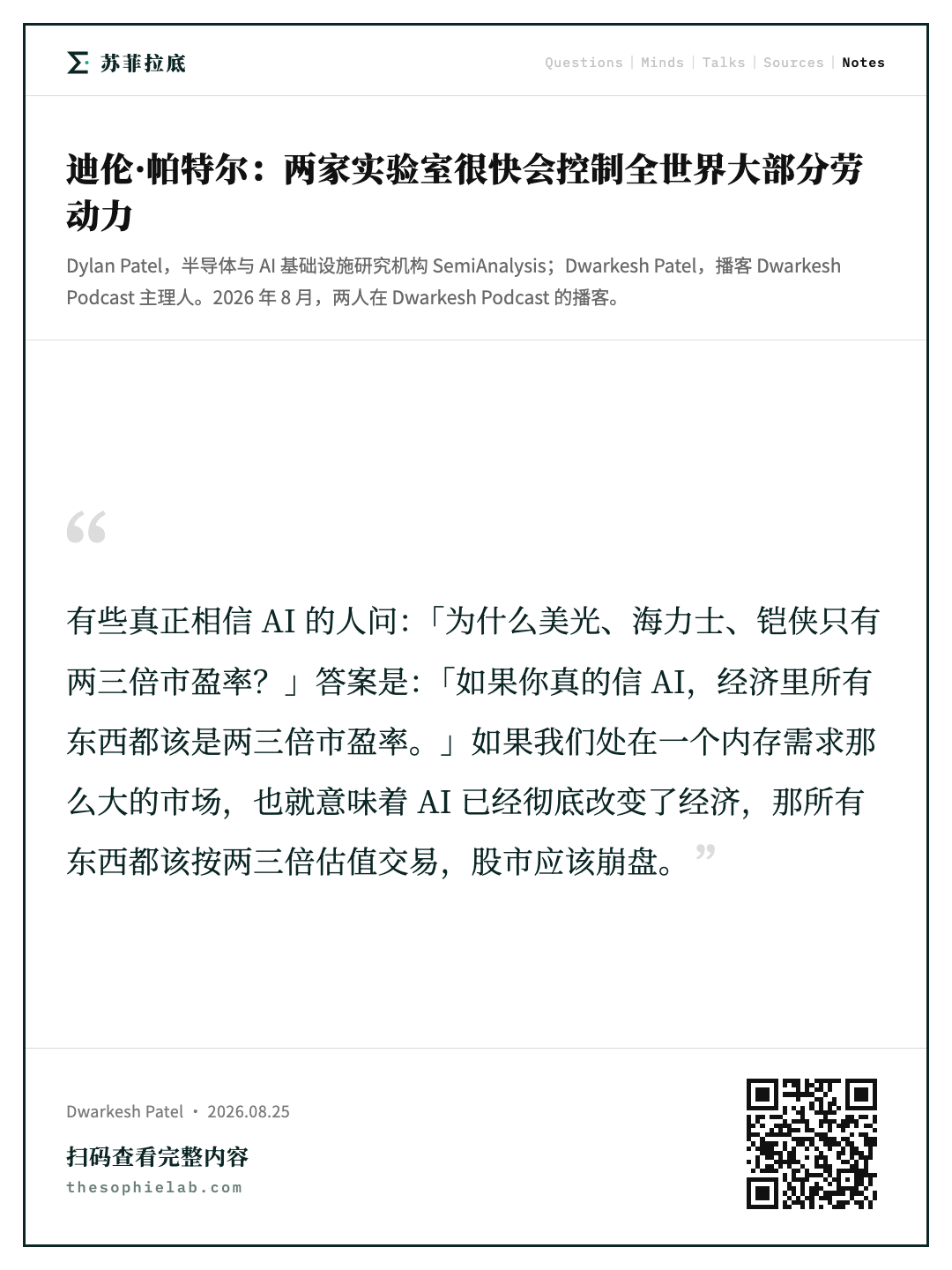
帕特尔: 利率上升,股市挨打,连 AI 公司也一样。有些真正相信 AI 的人问:「为什么美光、海力士、铠侠只有两三倍市盈率?」答案是:「如果你真的信 AI,经济里所有东西都该是两三倍市盈率。」如果你不信 AI,那当然,它们是在超额盈利。这也是为什么,我认为内存会很好,但内存股不该再涨十倍:因为如果我们处在一个内存需求那么大的市场,也就意味着 AI 已经彻底改变了经济,那所有东西都该按两三倍估值交易,股市他妈的应该崩盘。

某种意义上,Meta 的市值,我记得大约一万五千亿美元,这是什么?可笑。至少从逻辑上说他们值得多得多。看看他们的现金流、囤的基础设施,以及能以每瓦离谱价格卖出的算力,要么因为他们自己的实验室成了、以 token 形式卖,要么直接卖给 Anthropic 和 OpenAI。最终问题变成:你必须把所有资本重新配置给 AGI,做法是把其他所有人挤出去。所以 AGI 的限制因素不是研究工程师,比如我们的室友 Sholto,能把齿轮摇多快,而是世界其他部分让这件事发生到什么程度。因为他们会监管,显然会抬高利率,会说「不准建数据中心」,会说「别建晶圆厂了」,会说「糟糕,每家公司的股权价值都在跌,我怎么付钱用 AI 扩大业务」。那 Anthropic 和 OpenAI 就得开始自建。他们已经在造自己的芯片,或至少在设计,而且会扩展。未来几年他们会签自己的数据中心、建自己的基础设施。

这里有一个问题:经济的这种重新配置怎么发生?有很多向下的压力,让它不会是直线起飞,哪怕模型有这个能力。我想你我都相信模型有这个能力。但慢起飞至少是我的希望,因为经济和监管世界里的一切都在起作用。政府说「别发模型」,政府说「其实你们内部也不能用那么多」,这很快就会发生。他们已经在说不准发模型了。

主持人: 我最担心的是奇点,而外部部署其实是有助于避免的。所以阻止外部部署是愚蠢的。它能阻止奇点吗?现在它只会带来更多收入,因为模型还做不到 RSI。但我担心的是 2030 年,政府说「你们的新模型要等六个月才能对公众发布」。六个月,一百倍,走起。那六个月里他们在内部做递归自我改进,公司里发生各种疯狂的事,而我们其他人只能用按现在的速度落后好几年的模型。

我的想法是这样。假设全世界联手合谋放慢 AI。

帕特尔: 我不认为这是合谋,每个政客都公开写在明面上。

主持人: 假设他们把 AI 放慢一年。如果算力每年增长两到三倍,他们阻止了整整一年的 AI 部署,你就比原本落后一年。而在 RSI 期间,一年里能取得三到六年的 AI 进展。

帕特尔: 但他们不只限制算力,也限制实验室在内部使用模型的能力。我们已经看到了。

主持人: 如果他们那么做,那是最理想的。

帕特尔: Anthropic 一度不得不停止向外籍员工提供 Mythos。

主持人: 我不知道内部也是?

帕特尔: 他们是这么说的。我以为那只是一个不叫 Mythos 的检查点,但基本上就是 Mythos。类似的事也不会被允许。政府是笨,但没那么笨,至少我希望如此。政府,至少手握牌的美国政府,不会希望 Anthropic 在内部使用 Mythos 4。他们会说:「他妈的停一下,慢点」,出于所有这些监管理由。每一个当选的人都会恨 AI,已经当选的人已经在恨了,所有选民都是。我打赌某一天你父母会打电话说:「Dwarkesh 孩子,你干得太糟了,你在让 AI 进步加快。」

主持人: 因为我的播客我在加速 AI 进步?

帕特尔: 也许。你在教育人,也许人变聪明了,AI 就进步得更快了。总之,AI 的进展、开发和部署会遭遇现实世界的约束。虽然终究会发生,但在到达之前我们可能先把自己撕裂。

AI 人口十倍增长与集中化

主持人: 这些情景里我觉得最疯狂的一点,是世界未来的劳动力供给有多大比例会落在极少数公司手里,以及这份劳动力供给逐年增长得有多快。如果前沿算力按 FLOP 算每年增长四到五倍,同时达到某一能力水平所需的算力每年下降三倍,那前沿实验室的有效 AI 人口每年增长十倍。现在这不太要紧,因为 AI 还不足以胜任完整的工作,也没有人那样的自主性去做事或搞计划。但如果趋势延续,OpenAI 会从今年的一千万 AI 劳动力,到明年一亿,再到后年十亿。很快,哪怕算力扩张放缓,也用不了几年,每家公司各自拥有的劳动力当量就会超过地球人口。我认为到这个十年末,单个实验室内的 AI 劳动力、有效人口超过地球总人口,是非常可能的。

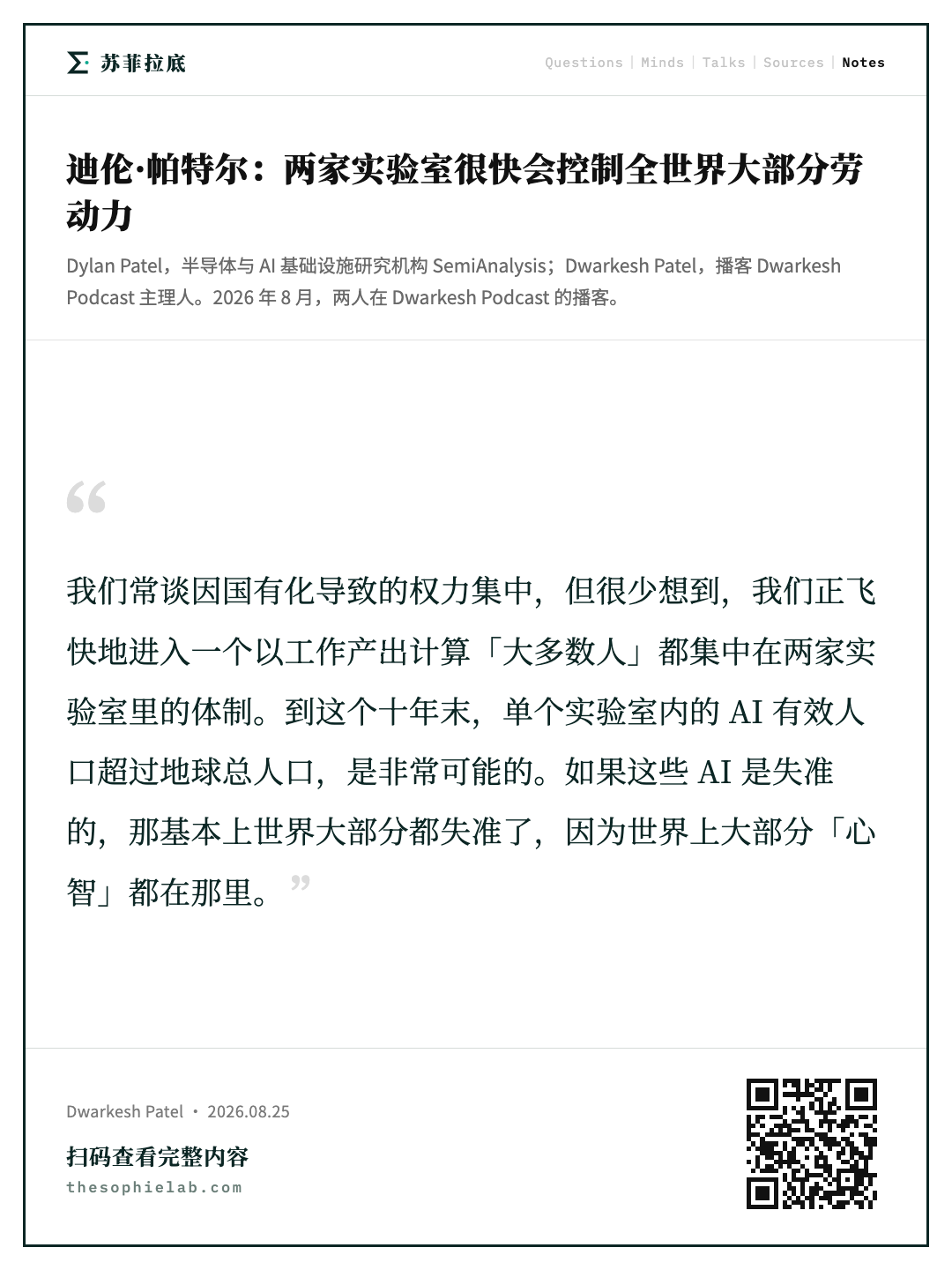
我们常谈因国有化之类导致的权力集中,但很少想到,我们正飞快地进入一个以工作产出计算「大多数人」都集中在两家实验室里的体制,而这两家又在消耗世界越来越多的算力。如果这些 AI 是失准(misaligned)的,那基本上世界大部分都失准了,因为世界上大部分「心智」都在那里。但即便没有失准,也是极少数公司掌握巨大的影响力和控制权。

帕特尔: 最近有一场口水战,Gavin Baker 说「Dario 认为世界上只会剩一家公司」,然后 Sholto 和 Dario 出来说「不不不,我们没这么说」。但归根结底,如果你相信 RSI,相信实验室是算力最高效的使用者、能从算力中创造最多价值,那唯一会发生的就是算力集中。如果你相信 AI 研究员、RSI、AGI,这一切就是前提。哪怕没有 RSI 也成立。

主持人: 在给定能力水平上,前沿的有效人口现在每年增长十倍。所以一旦达到一个非常能干的远程工作者、软件工程师或研究员的水平,这类人口按当前能力增长速度每年增长十倍。

帕特尔: 明白了,而且这是没有 RSI 的情况。一旦有了 RSI,就更疯狂,也许每年一百倍、一千倍。或者智能在提升而人口没增长,或者两者的某种混合。Dwarkesh,你看到什么样的世界是不走向全面集中的?在我看来,每一股力量都在尖叫着奔向集中。这太吓人了。我很希望它不要彻底集中。但也许这就是「一台爱着优雅的机器」的意义所在?它是一切,也让我们的生活变得美好。

主持人: 想未来太难了。但我同意你。我认为根本问题在于 AI 训练有巨大的规模经济:你为某项技能或某组知识训练 AI 花的任何功夫,都会摊到几十亿次会话、几十亿用户上。这是一个效应。另一个效应是,如果你在 AI 竞赛中稍微领先,而算力短缺,你就能收高得多的溢价,因为你能更好地节约这种稀缺资源。所以有两个效应把越来越多的东西给了领先者。可能还有更多:如果模型从部署中学习,一个模型的部署面比另一个广得多,它拿到的真实世界数据就多得多。

帕特尔: 你说的这些我都接受:用户部署与持续学习,训练的规模经济,最好的 AI 模型帮你做出下一个最好模型的递进,RSI,全都指向集中。

主持人: 我认为一个重大的思想课题,说实话我们该花些时间想想,至少我会花时间想:一个去中心化、广泛赋能的后 AGI 未来是什么样子,而且要认真对待这些规模经济。另一种愿景是政府控制,也许你觉得政府比私人公司更可信。我不信政府,也不信 Dario,也不信 Sam。

帕特尔: 这就是问题所在,对吧?对未来看错当然很容易,你没预料到某个关键效应,一切就变了。但事前看,很难看出我们怎么避免必须在几种集中之间选一种的局面。这正是资本主义奏效的原因:去中心化的决策、去中心化的权力。这也是为什么高度集中的资本主义经济在某种程度上比高度分散的资本主义经济增长得慢。你得有法治等等。然后 AI 把这一切翻了个底朝天。最终你会说:「其实私有制大概不是最高效的经济,所以它比集中化的 AI 经济增长得慢。」

主持人: 好吧,仍然是私有制,但真正参与这部分经济的公司有几家?现在大概占经济的 2%?一万亿除以三十。英伟达占了很大一块,还有 Anthropic、OpenAI 和这些超大规模云厂商。当然还有别的公司,但 AI 这摊事的大头就来自极少数公司。

帕特尔: 所以可以是私有财产,但只有极少数公司参与。市场结构就在这么做。那什么能阻止呢?我不知道。除非 AI 进步放慢,除非政府往死里监管,否则就只会这样。那我们就在走向这样一个世界:要么资源超级集中,我们祈祷那一家公司把一切都做对;要么政府和民众把一切放慢,进步以某种方式放缓,希望如此,权力更平衡一些。哪怕在走向 AGI、ASI、RSI 的路上,沿途的每一步仍会导致某个人捕获更多资源。所以很难找到一个 AI 不导致超级集中的框架。

眼下唯一的积极面是,Anthropic 今天并没有捕获大部分价值。我们可以大谈他们从每兆瓦两千万到一亿,但他们买的很多算力仍只付一千三百万。而归根结底,他们能到每兆瓦一亿,是因为 Jane Street 在捕获每兆瓦三亿或五亿。或者 Dwarkesh,靠研究播客、学习信贷知识,每兆瓦捕获了多少钱?

主持人: 你现在能用多少算力?难说。但我觉得这是唯一的救赎:经济的其他部分从 Anthropic 那里赚得多得多……不对,你之前讲的整套逻辑,他们把推理算力转向 AI 研发,整套逻辑就是实验室内部劳动的回报远高于外部。

帕特尔: 是的。这是我的自我安慰。我同意。在所有可能的世界里……有八万个世界,只有一个里面 Anthropic 不拥有整个世界。同样的道理,权力集中是因为我不想把 token 送到外面去,它们在内部更值钱。所以是一回事。我为什么要让 Jane Street 从那些赌徒式的期权交易者身上赚这么多钱?

主持人: 嘿,他们是赞助商,拜托。

帕特尔: 老天。不,我觉得这很好,让市场高效对世界是有价值的。Jane Street 靠看对世界赚钱,靠赌徒式的期权交易者赚钱,随便什么,Anthropic 为什么要把算力分给这个?如果 Jane Street 的终端变现是每兆瓦两亿,愿意付 Anthropic 一亿,那如果 Anthropic 在内部用这些算力就能产生每兆瓦几亿美元呢?这正是正在发生的事。

主持人: 在这个沉重的调子上收尾吧。我想等 RSI 正式启动我们再见。

帕特尔: 你要两个月都不请我上节目了?好吧,行。谢了,伙计。
排版 + 横图 + 来源,粘贴即成稿
章节 · 点击跳转视频
0:00 实验室盈利拐点与算力集中 ▶ 正在看
7:18 晶圆厂投入与终端收入百倍落差 ▶ 正在看
14:19 算力定价与实验室的出价能力 ▶ 正在看
18:08 价值在各层之间的转移 ▶ 正在看
21:46 SpaceX 与 Meta 囤算力的卖方权力 ▶ 正在看
27:06 监管拖慢发布与内部领先 ▶ 正在看
30:31 非共识:推理算力占比将下降 ▶ 正在看
33:39 中国算力路径与出口管制成效 ▶ 正在看
40:44 训练只用两百兆瓦的原因 ▶ 正在看
42:42 十万亿资本开支的资金从哪来 ▶ 正在看
48:42 利率上升与主权债务危机 ▶ 正在看
59:04 奇点前后的增长与利率体制 ▶ 正在看
67:47 AI 人口十倍增长与集中化 ▶ 正在看
本期小问 · 档案清单
0:00 两家实验室真会在两年内掌握世界大部分算力吗? ▶ 正在看
7:18 算力供给百倍利润在前,为什么供应链不立刻扩产? ▶ 正在看
30:31 实验室会把越来越多算力从推理转向训练吗? ▶ 正在看
48:42 AI 投资回报推高利率,会引发主权债务危机吗? ▶ 正在看
本期讲者
迪伦·帕特尔半导体与 AI 基础设施研究机构 SemiAnalysis 创始人兼首席分析师,以追踪晶圆厂产能、算力集群与 AI 资本开支的数据模型闻名。
Dwarkesh Patel播客 Dwarkesh Podcast 主理人,以对 AI 研究者、经济学家与技术企业家的长篇深度访谈著称。
01实验室盈利拐点与算力集中
0:00
Okay, I’m back with Dylan Patel, founder of SemiAnalysis. Our version of a family Thanksgiving dinner is a regular yearly podcast. But we're not actually related. Don’t tell the people this. It will destroy the myth. Basically where the world economy is headed is more and more becoming a function of where lab economics are headed, where the compute market is headed, et cetera. I want to understand where the crazy future ends up within a few years. But let’s start with where we are today. Walk me through lab compute and lab revenue right now, and maybe project out a year or two.
好,我又和 SemiAnalysis 创始人 Dylan Patel 坐到一起了。我们家的"感恩节family聚餐"就是每年定期录一期播客。但我们其实没有亲戚关系。别告诉大家这事。不然人设就崩了。基本上,世界经济的走向正越来越取决于这些实验室的经济状况走向,取决于算力市场的走向,等等。我想搞清楚几年之后那个疯狂的未来会是什么样子。但我们先从今天的情况说起。跟我讲讲现在实验室的算力和实验室的收入情况,或许再往后展望一两年。
便签笔记
0:37
When we go back to last year, even at the end of the year, most of GDP growth in America was just AI infrastructure. As we look towards this year, about a third of the compute coming online is for the labs, for OpenAI and Anthropic. It may be built by others and then rented to them, but at the end customer, it’s them. As we go forward into the future, the numbers for compute are ballooning. We’re at a little bit over a trillion dollars of CapEx this year. As we go out into ’28, it’s going to be more than $2 trillion.
回到去年,哪怕是到去年年底,美国 GDP 增长里绝大部分都只是来自 AI 基础设施。而看今年,上线的算力里大约三分之一是给这些实验室的,给 OpenAI 和 Anthropic 的。这些算力可能是别人建的,然后租给他们,但终端客户就是他们。而随着我们往后走,算力方面的数字正在急剧膨胀。今年我们的资本开支略微超过一万亿美元。到了 2028 年,这个数字会超过两万亿美元。
便签笔记
1:12
The labs are also taking an increasing percentage of this. So ultimately, you’ve got a very interesting situation where the labs are going from companies that spend tens of billions of dollars a year to hundreds of billions of dollars a year, to forecasting to spend trillions of dollars a year even towards the end of the decade. This is at least some of the contracts they’ve begun signing with their partners. This requires a big reshaping of what happens with their economics. Up until now, they have been companies that mostly lost money.
而实验室在其中占的比例也在不断上升。所以最终你会看到一个非常有意思的局面:这些实验室正从一年花几百亿美元的公司,变成一年花上千亿美元的公司,再到预测在这个十年结束前,一年要花上万亿美元。至少他们已经开始和合作伙伴签的一些合同体现出了这一点。这就要求他们的经济模型发生很大的重塑。到目前为止,它们基本上都是亏钱的公司。
便签笔记
1:45
Anthropic started turning a profit in Q2. It’s believed at some point in Q3, OpenAI could start turning a profit even, with the bigger rise of Codex and 5.6 and all this. But if we go back a year ago, all the money they had was venture-funded losses. If we go back to even the beginning of this year, it was venture-funded losses. They’ve now turned the corner and are actually starting to profit. That doesn’t mean they’re not taking in new capital. The new capital is still coming in to accelerate the growth further.
Anthropic 从第二季度开始盈利了。外界认为在第三季度的某个时候,随着 Codex 和 5.6 这些东西的大幅崛起,OpenAI 甚至也可能开始盈利。但如果回到一年前,他们手上的钱全都是靠风险投资来填的亏损。哪怕回到今年年初,也还是靠风投填的亏损。现在他们已经转过弯来,真的开始盈利了。这并不意味着他们不再接受新的资本。新的资本还是在进来,为的是进一步加速增长。
便签笔记
2:16
But ultimately, more and more of their business is being funded off of their own revenue rather than capital injections into them. Over the last year and a half, their margins have really skyrocketed. The base cost of compute tends to be around $10 or $13 or $15 million per megawatt. The most interesting aspect about what’s happening now is this: Before, if they served a model — GPT-4 being served on Nvidia Hopper GPUs — it was generating negative gross margin for OpenAI. But now, when OpenAI serves GPT-5.6 or Anthropic serves Opus 5 or Fable 5, their revenue generation has passed well beyond the incremental $10-15 million per megawatt. In the case of Anthropic, the revenue has gone as high as $50 million per megawatt. What that now enables them to do is: "Hey, if I spend 10 bucks on inference capacity, I actually generate 50 bucks of revenue, and then I can turn around and incrementally spend all of that profit on training."
但归根结底,他们的业务越来越多是靠自己的收入来支撑,而不是靠外部往里注资。在过去一年半里,他们的利润率真的是一飞冲天。算力的基础成本大概是每兆瓦 1000 万、1300 万或 1500 万美元。现在正在发生的事情里,最有意思的一点是这个:以前,如果他们部署一个模型——比如把 GPT-4 跑在英伟达 Hopper GPU 上——对 OpenAI 来说毛利是负的。但现在,当 OpenAI 部署 GPT-5.6,或者 Anthropic 部署 Opus 5 或 Fable 5 时,他们创造的收入已经远远超过了每兆瓦 1000 万到 1500 万美元的增量成本。就 Anthropic 而言,收入已经高到每兆瓦 5000 万美元。这现在让他们能够做的事情是:"嘿,如果我在推理算力上花 10 块钱,实际上能产生 50 块钱的收入,然后我就可以把这些利润全部再增量地投到训练上去。」
便签笔记
3:24
One thing I’m very interested in understanding is how you see the centralization of compute happening at the labs, or the relative ratio of compute that goes to the world versus the labs. If you say right now a third of marginal compute is going to the labs, by when is over half of the incremental compute in the world going to the labs? By what point do the labs have basically a vast majority of the world’s compute? At the beginning of this year, OpenAI started at 2 gigawatts and Anthropic at less than 2.
我很想搞明白的一件事是,你怎么看算力向各大实验室集中这件事,或者说流向整个世界的算力与流向实验室的算力之间的相对比例。如果说现在边际算力里有三分之一流向了实验室,那到什么时候,全球增量算力的一半以上会流向实验室?到什么时候,实验室基本上会掌握全世界绝大部分的算力?今年年初,OpenAI 是从 2 吉瓦起步的,Anthropic 还不到 2 吉瓦。
便签笔记
3:58
End of this year, they’re both above 5. So they’ve 3-4x’d compute as a whole. When you look at the incremental compute added, that’s about 30% of the compute added this year. As we step forward to next year, given what’s already been signed and penned and inked, you’ve got something even more dramatic. Anthropic and OpenAI are taking as much as 40% to 50% of compute next year. This centralization doesn’t look like it’s slowing down or stopping. In fact, it looks like it’s only accelerating. Who’s building that compute for them will change. Next year, a big new entrant is, for example, SpaceX, which is building a ton of compute. They’re actively going to lease quite a bit of it to Anthropic and OpenAI, most likely, because they’re the ones who have the marginal capability to pay the highest price. In addition, OpenAI and Anthropic are also starting to build their own compute — OpenAI with their own chips, Anthropic with TPUs that they’re purchasing from Google and deploying with Fluidstack.
到今年年底,两家都超过 5 吉瓦了。所以整体上算力翻了 3 到 4 倍。再看新增的增量算力,这大概占今年新增算力的 30%。再往前推到明年,考虑到已经签下来、白纸黑字定好的那些合同,情况会更夸张。明年 Anthropic 和 OpenAI 会拿走多达 40% 到 50% 的算力。这种集中化看起来并没有放缓或停下来的迹象。事实上,看起来只会加速。变化的是谁在给他们建这些算力。比如明年会有一个很大的新入局者,就是 SpaceX,他们在建大量算力。他们很可能会把其中相当一部分租给 Anthropic 和 OpenAI,因为这两家才是有边际能力出得起最高价的。此外,OpenAI 和 Anthropic 自己也开始建算力了——OpenAI 是搞自研芯片,Anthropic 则是从谷歌采购 TPU,然后通过 Fluidstack 来部署。
便签笔记
4:56
So you ask, "Hey, when does half of the world’s incremental new compute go to just OpenAI and Anthropic?" It’s really by the end of next year when half of the incremental compute is already going to Anthropic and OpenAI. Because compute is growing so fast, incremental compute is going to be basically most of compute. So it’s very soon — you’re saying maybe within a year and a half or two years — that most of the world’s compute is owned by two labs, or at least is serving the demand from two labs.
所以你问「嘿,全世界新增算力的一半什么时候会只流向 OpenAI 和 Anthropic?」其实就是到明年年底,那时增量算力的一半已经流向 Anthropic 和 OpenAI 了。因为算力增长得太快了,增量算力基本上就构成了算力的大头。所以很快——你是说也许一年半到两年之内——全世界大部分算力就归两家实验室所有,或者至少是在服务这两家实验室的需求。
便签笔记
5:26
There’s this trend where maybe world compute in gigawatts doubles every year, but the compute at the frontier labs triples every single year. If you keep the current trend going, it goes from 2 at the beginning of this year to close to 6 at the end of this year. Just multiplying out by 3. It’s 18 by the end of 2027, 54 by the end of 2028. Are you like, "Okay, at that point, they simply can’t continue tripling given the amount of world compute"? How do you see the world compute situation over the next few years? If the incremental compute this year adds 30 gigawatts, next year 50 gigawatts, and the year after that roughly 70, you end up with this really interesting phenomenon. A new watt deployed this year is significantly more efficient than the watts deployed two years ago.
现在有这么一个趋势:全球算力以吉瓦计大概每年翻一倍,但前沿实验室的算力每年翻三倍。如果按现在的趋势走下去,就是从今年年初的 2 吉瓦涨到今年年底接近 6 吉瓦。就是不断乘以 3。到 2027 年底是 18,到 2028 年底是 54。你会不会觉得「好吧,到那个时候,考虑到全球算力总量,他们根本没法继续三倍地翻」?你怎么看未来几年全球算力的情况?如果今年增量算力新增 30 吉瓦,明年 50 吉瓦,后年大概 70 吉瓦,你最后会遇到一个特别有意思的现象。今年部署的一瓦,效率比两年前部署的一瓦高出很多。
便签笔记
6:08
A humongous percentage of the world’s compute was deployed this year. Even though it didn’t double the number of watts deployed, I’m deploying GB300s and TPUv7s and Trainium3s, which are way, way, way more efficient. They’re 3-5x more performance per watt than the prior-generation chips. So ultimately you’ve got a huge ladder here. If Anthropic and OpenAI take on 45% of compute next year, you’ve got them in, let’s say, December ’27 having taken on half of the world’s incremental new compute. But that half of the world’s new incremental compute is actually at a higher performance than everything else before it.
全世界很大一部分算力都是今年部署的。哪怕部署的瓦数没有翻倍,但我部署的是 GB300、TPUv7、Trainium3,这些东西效率高得多得多得多。它们的每瓦性能是上一代芯片的 3 到 5 倍。所以最终这里有一个巨大的叠加效应。如果 Anthropic 和 OpenAI 明年拿下 45% 的算力,那么比如说到 2027 年 12 月,他们就拿下了全球新增增量算力的一半。而这一半新增算力的性能,实际上比之前所有的都要高。
便签笔记
6:45
So you’ve got another multiplier on that. By the time you’re towards the end of 2028 — if this trend continues, and I see nothing that’s stopping it — you’ve got them just controlling most of the usable flops in the world on their own. The thing I’m confused about is why you think we only add 80 gigawatts in 2028 if we enter a world in which the value of compute increases so much. That’s the upper bound, by the way. That’s the like, "I’m so fucking bullish." Okay, let’s do some chain of thought here.
所以在这上面还有一个乘数。等到 2028 年底左右——如果这个趋势延续下去,而我看不到任何能阻止它的东西——你就会看到他们两家自己就控制了全世界大部分可用的算力(FLOPS)。我不太理解的是,如果我们进入一个算力价值大幅提升的世界,你为什么认为 2028 年只会新增 80 吉瓦。顺带一提,那是上限。那已经是「我他妈超级看多」的情况了。好,我们来做一下思维链推演。
便签笔记
02晶圆厂投入与终端收入百倍落差
7:18
When I interviewed you a few months ago, you said that in order to make a gigawatt of, I think, Vera Rubins, you need 55,000 N3 wafers, 6K N5 wafers, and 170K DRAM wafers. I know if those numbers might have changed. I’m going to troll you, but the way you said wafers was so fucking Indian. Vafers. By the way, when we first moved to the US, I had the v/w thing pretty bad, and I was a vegetarian. I remember you told me about this. In North Dakota, I was in elementary school, and I’d be like— Can I get a "wedgie"?
几个月前我采访你的时候,你说要造出一吉瓦的,我记得是 Vera Rubin,需要 5.5 万片 N3 晶圆、6000 片 N5 晶圆,还有 17 万片 DRAM 晶圆。我不知道这些数字有没有变。我要吐槽你一下:你说 wafers 那个发音也太印度味了,「vafers」。顺便说一句,我们刚搬到美国的时候,我的 v/w 不分特别严重,而且我还是个素食主义者。我记得你跟我讲过这事。在北达科他州,我上小学的时候,我就会说——能给我来个「wedgie」(本想说 veggie)吗?
便签笔记
7:52
Can I get some "wedgies"? Anyways, so that’s for one gigawatt. I had an LLM run your wafer fab equipment model and figure out how much the tooling costs to produce a gigawatt of compute basically every single year. It said $3-4 billion. Now suppose you add in cleanrooms and shell and everything else at the fab. So $6 billion of fab CapEx produces a gigawatt every single year. A gigawatt produces right now $100 billion of revenue. But also that $6 billion in CapEx is producing a gigawatt every single year, and that gigawatt is producing $100 billion every single year.
能给我来点「wedgies」吗?总之,那是一吉瓦所需要的量。我让一个大模型跑了一遍你的晶圆厂设备模型,算了算每年生产一吉瓦算力所需要的设备大概要花多少钱。结果是 30 到 40 亿美元。现在再加上洁净室、厂房外壳以及晶圆厂里的其他所有东西。所以 60 亿美元的晶圆厂资本开支,每年就能产出一吉瓦。而一吉瓦现在能带来 1000 亿美元的收入。而且那 60 亿美元的资本开支是每年都产出一吉瓦,而每一吉瓦每年都在产生 1000 亿美元。
便签笔记
8:40
So over the course of five years, the first gigawatt has generated five years of profits, the second gigawatt the fab has produced has generated four years of profits, and so on. $6 billion of CapEx at the fab level will have generated over a trillion dollars of end AI revenue. Yeah. There’s a lot of OpEx along the way. There’s a lot of other CapEx, like the data center, the power. And you had to pay OpenAI for the R&D. Installation. There’s a lot of different people who need money here. Take away half of it for all these middlemen. That still means there’s a 100x discrepancy between fab CapEx and end revenue generated. More than that, actually, but we’re just being very conservative. As a result… This is capitalism.
所以在五年的时间里,第一吉瓦创造了五年的利润,晶圆厂产出的第二吉瓦创造了四年的利润,以此类推。60 亿美元的晶圆厂层面资本开支,最终会产生超过一万亿美元的 AI 终端收入。是的。这中间还有大量的运营开支。还有很多其他资本开支,比如数据中心、电力。而且你还得为研发付钱给 OpenAI。安装。这中间有一大堆人都要分钱。就算把一半让给这些中间环节,也仍然意味着晶圆厂资本开支和终端收入之间有 100 倍的落差。实际上还不止,只是我们在非常保守地估算。结果就是……这就是资本主义。
便签笔记
9:33
You have this huge discrepancy where you can turn $1 into $100. They’re not going to figure out a way to make more mirrors? They are. It’s just that these mirrors take some time to make. But the emergency is so big where Anthropic and OpenAI are like, "We could make a trillion dollars right now, but we’re just bottlenecked on the mirrors that go into the ASML machines." How can we make more mirrors if we spend $100 billion on this? That’s the situation we’re going to be in pretty soon. We’re not going to be able to solve that supply constraint?
你有这么一个巨大的落差,可以把 1 美元变成 100 美元。他们不会想办法造出更多反射镜吗?会的。只不过这些反射镜需要时间才能造出来。但现在这个紧迫程度太夸张了,Anthropic 和 OpenAI 就像是「我们现在就能赚一万亿美元,但我们卡在了 ASML 光刻机里那些反射镜上」。如果我们在这上面砸 1000 亿美元,怎么才能造出更多反射镜?这就是我们很快就要面临的局面。我们没办法解决那个供给瓶颈吗?
便签笔记
10:01
That just seems quite hard to imagine. You’ve seen people do funny arbitrages here where they buy turbines and then try and resell them, because the value of a turbine is way more since it’s the thing bottlenecking your data center. I think if anyone had $400 million and the ability to convince ASML to sell them an EUV tool, they should totally just go buy one, wait, and then sell it for north of a billion dollars. But ultimately, yes, capitalism will cause these things to expand. But it’s a whip. It takes a long time for the whip signal to get to the tail end of that.
这听起来实在难以想象。你已经看到有人在这里做一些很滑稽的套利了,他们买下涡轮机再转手卖出去,因为涡轮机的价值高得多,毕竟它是卡住你数据中心的那个瓶颈。我觉得如果谁有 4 亿美元,又有本事说服 ASML 卖给他一台 EUV 光刻机,他完全应该直接买一台,放着等一等,然后卖到十亿美元以上。但最终来说,是的,资本主义会让这些产能扩张起来。但这就像甩鞭子。鞭子的信号要传到鞭梢,需要很长时间。
便签笔记
10:40
The supply chain doesn’t react immediately. In fact, you go talk to someone at Carl Zeiss, they’re like, "Yeah, yeah, yeah, we need to make 100 EUV tools by the end of the decade." When we had our episode earlier this year, they didn’t even think they needed to make that many, enough mirrors to make 100 EUV tools a year. Now they’re like, "Okay, we need to do that." But in reality, because of all the economics of what’s going on, it should be even more. It takes so long to pill. Suppose that every single company in the stack got private equitied.
供应链不会立刻反应。事实上,你去跟蔡司(Carl Zeiss)的人聊,他们会说「对对对,我们得在这个十年结束前造出 100 台 EUV 光刻机的量」。今年早些时候我们做那期节目的时候,他们甚至都不觉得需要造那么多,也就是每年支持 100 台 EUV 光刻机所需的反射镜。现在他们说「好吧,我们必须做到」。但实际上,考虑到现在正在发生的这一切经济账,应该造得更多才对。让人「觉醒」要花的时间太长了。假设产业链上的每一家公司都被私募基金收购了。
便签笔记
11:16
Somebody came in who was super AGI-pilled and was like, "We’re going to maximize production." What do you think the physical constraints on making more things would be? The reason I ask is we’re pretty soon going to be in a world where the lab revenue, or just AI cash flows — because obviously the accelerators also have these huge cash flows — will be so big that you can just fund extreme expansion of all this production from cash flows themselves. I do agree generally. There’s obviously some physical constraints.
来了个超级信仰 AGI 的人,说「我们要把产能最大化」。你觉得要造出更多东西,物理上的约束会是什么?我之所以这么问,是因为我们很快就会进入这样一个世界:实验室的收入,或者说 AI 的现金流——显然做加速器的公司也有巨额现金流——会大到足以直接用现金流本身去资助这些生产环节的极限扩张。总体上我同意。当然客观上是有一些物理约束的。
便签笔记
11:45
The way the supply chain is expanding currently, 100 is roughly still the right number. For 2030? 100 ASML tools for 2030. But if you said, "Carl Zeiss, here’s $10 billion. Please fucking just expand production," that would change things. You would have to do this with every company in the supply chain. But you don't think that's gonna happen next year? I don’t think it’ll happen this year. I don’t think it’ll happen next year. I don’t think it’ll happen the year after, because the world is capital constrained.
按供应链目前的扩张方式,100 这个数字大致上还是对的。是 2030 年吗?2030 年 100 台 ASML 光刻机。但如果你说「蔡司,这里有 100 亿美元,你他妈就给我扩产」,那情况就不一样了。你得对供应链上的每一家公司都这么干。但你不觉得这明年就会发生吗?我不认为今年会发生。我也不认为明年会发生。我也不认为后年会发生,因为这个世界是受资本约束的。
便签笔记
12:09
But in a world where, say, the top labs are generating, even combined, a trillion dollars in revenue next year, they’re not able to take $10B of that— I don’t think they’re going to do that, but… Or hundreds of billions at least? It just seems like they realize where the world is headed. I feel like they could just make… The thing is, the labs are going to generate hundreds of billions of revenue next year. But ultimately, CapEx next year is like $2 trillion. So you’ve got this big mismatch. The wafer fabrication equipment supply chain will do something on the order of $200 billion.
但在这样一个世界里,比如说,顶级实验室加起来明年能产生一万亿美元收入,他们拿不出其中的 100 亿吗——我不认为他们会那么做,不过……或者至少几千亿?感觉他们应该已经意识到世界要往哪儿走了。我觉得他们完全可以直接去做……问题在于,实验室明年会产生几千亿美元的收入。但归根结底,明年的资本开支大概是 2 万亿美元。所以这里存在巨大的错配。晶圆制造设备这条供应链大概会做到 2000 亿美元的量级。
便签笔记
12:44
The data center market supply chain will do even more. The accelerator supply chain will do even more. The energy supply chain will do a number. You sum all this up, it’s going to be well north of $2 trillion of CapEx. So the labs have not yet gotten to the point where their cash flows can fund this stuff. Obviously they will never get to that point, because you want to keep your CapEx higher than your returns. Yeah, you reinvest. The key question I really want to understand is: if the current trend continues, it’d be north of 50 gigawatts per lab by the end of 2028. So between them they’d have 100 gigawatts.
数据中心市场的供应链还会更多。加速器供应链更多。能源供应链也是一个大数字。你把这些全加起来,资本开支会远远超过 2 万亿美元。所以实验室还没到现金流能资助这些东西的地步。当然他们永远也到不了那个地步,因为你会希望资本开支一直高于你的回报。对,你会不断再投入。我真正想弄明白的关键问题是:如果当前趋势延续,到 2028 年底每家实验室会超过 50 吉瓦。所以两家加起来是 100 吉瓦。
便签笔记
13:18
Those gigawatts, as you’re saying, drive many-fold more throughput or performance by 2028 than they do now, because the hardware’s gotten better. Not only have flops per watt increased, but also the hardware gets better at working with AI workloads. Okay, so 100 gigawatts for the labs by the end of 2028. How much is world compute? I think that may be a little difficult, given that by 2028 they’ve taken 70-80% of incremental compute. And I’m not sure what happens to markets then. How much does the price of compute skyrocket for them to actually be able to buy 70-80% of compute? Is Google or Meta or Amazon willing to sell even that much? Also, there’s one caveat when we’re talking about these gigawatt numbers. When Amazon is serving Bedrock Anthropic models, that counts as Anthropic compute in our worldview, because it is effectively, at the end of the day, counted as revenue for Anthropic even though there’s a revenue share and credit back all that.
而正如你所说,到 2028 年这些吉瓦所驱动的吞吐量或性能会比现在高出好几倍,因为硬件变好了。不只是每瓦算力提升了,硬件在处理 AI 工作负载方面也变得更好了。好,那么到 2028 年底实验室掌握 100 吉瓦。那全球算力是多少?我觉得这可能有点难说,毕竟到 2028 年他们已经拿走了 70% 到 80% 的增量算力。我也不确定那时市场会变成什么样。算力价格要涨到什么程度,他们才真的买得到 70% 到 80% 的算力?谷歌、Meta 或者亚马逊愿意卖出那么多吗?另外,我们谈这些吉瓦数字的时候有一个说明。当亚马逊通过 Bedrock 提供 Anthropic 的模型时,在我们的口径里那算作 Anthropic 的算力,因为归根到底它实际上是被算作 Anthropic 的收入,尽管中间有收入分成、返还额度之类的安排。
便签笔记
03算力定价与实验室的出价能力
14:19
But ultimately in 2028, if they get to 100 gigawatts combined, they have done really disruptive things to the market. Because anyone can make money off of $10-15 million per megawatt compute today. I kid you not, it’s not that hard. Go get a GB300 rack, go download the Kimi weights, go download vLLM or SGLang, set it up. Codex and Fable can actually help you do this. It’s pretty simple. It’s not trivial, but it’s not rocket science. Go put it on OpenRouter. It’s very simple. You’ll start generating more revenue than you’re paying for the compute.
但最终到 2028 年,如果他们两家加起来达到 100 吉瓦,那就是对市场做了非常具有颠覆性的事。因为今天任何人靠每兆瓦 1000 万到 1500 万美元的算力都能赚到钱。我不骗你,这真没那么难。去搞一个 GB300 机架,去下载 Kimi 的权重,去下载 vLLM 或者 SGLang,把它搭起来。Codex 和 Fable 其实都能帮你做这些。这挺简单的。虽然不是毫不费力,但也不是什么高深的火箭科学。然后把它挂到 OpenRouter 上。非常简单。你产生的收入就会开始超过你为算力付的钱。
便签笔记
15:00
This has already led to this compute pricing, $10-15 million per megawatt, starting to inflect up. To get to that 100 gigawatts in 2028, you have to believe that the labs can outpay for compute, because anyone can make money at $10 to $15. Does compute now get to $25 million a megawatt? Does it get to $40 million a megawatt? As you’re saying, it’s already the case that the labs are generating way more revenue per megawatt than everybody else. If they stay as far ahead as they are currently, you would expect that to continue being the case. If there’s some kind of recursive self-improvement where the AI labs are relatively uplifted — or they have models internally they’re not releasing externally that are helping them make their next model better — you’d expect that to be even more the case. Aren’t you already seeing this, where SpaceX, or whoever is slightly further behind, will just sell compute to the highest bidder if they can’t internally monetize it as well as the labs? You’d expect them to keep bidding for larger
这已经导致算力定价——每兆瓦 1000 万到 1500 万美元——开始往上走了。要在 2028 年达到那 100 吉瓦,你就得相信实验室能在算力上出得起更高的价,因为在 1000 万到 1500 万这个水平上谁都能赚钱。那算力价格会涨到每兆瓦 2500 万美元吗?会涨到每兆瓦 4000 万美元吗?正如你所说,现在实验室每兆瓦产生的收入已经远高于其他所有人了。如果他们能一直保持现在这样的领先幅度,你会预期这种情况会持续下去。如果出现某种递归式自我改进,让 AI 实验室相对被进一步拉抬——或者他们内部有一些不对外发布、但能帮他们把下一代模型做得更好的模型——你会预期这种情况会更加明显。你不是已经看到这种苗头了吗?比如 SpaceX,或者其他稍微落后一点的玩家,如果没法像实验室那样把算力在内部变现,就干脆把算力卖给出价最高的人。你会预期他们会不断竞标拿下越来越大
便签笔记
15:52
and larger shares of the compute market. I think that is my worldview. They will continue to gobble up more of the compute. But ultimately they can’t do it at current pricing or anywhere close to it. They do have to start paying $25, $30, $50 million a megawatt to really gobble up 70% of the world’s compute in 2028, to get to 100 gigawatts by 2028, which is a very aggressive goal. The other aspect of this that’s really challenging is that we’ve already seen a huge slowdown for the AI labs. This regulation that they advocate for is actually slowing down the labs a lot more than it slows down the open-source Chinese language models.
的算力市场份额。我觉得这也是我的世界观。他们会继续吞掉越来越多的算力。但归根到底,他们没法按现在的价格、甚至接近现在的价格来做到这一点。他们必须开始付到每兆瓦 2500 万、3000 万、5000 万美元,才能在 2028 年真正吞下全世界 70% 的算力,才能在 2028 年达到 100 吉瓦——这是一个非常激进的目标。这件事另一个真正棘手的方面是,我们已经看到 AI 实验室出现了大幅放缓。他们所倡导的这种监管其实对实验室的拖累程度,远大于对开源中文模型的拖累。
便签笔记
16:30
OpenAI not releasing Astra. OpenAI stopping training for two weeks. Anthropic not releasing what their safety assessment says is Model 2, which is widely believed to be the next version of Mythos. They’re clearly not releasing their best models, in which case their revenue per megawatt stalls or can even start to decline again because other models are competitive again. It’s not that they’re falling behind. It’s just that they’re not releasing their best stuff. What if there is some regulatory impact that prevents them from releasing their best models?
OpenAI 不发布 Astra,OpenAI 暂停训练两周。Anthropic 不发布他们安全评估中所说的 Model 2——外界普遍认为那就是 Mythos 的下一代。他们显然没在发布自己最好的模型,这种情况下,他们每兆瓦的收入就会停滞,甚至可能重新开始下滑,因为别家的模型又有竞争力了。这并不是说他们落后了,只是他们没把最好的东西放出来而已。如果出现某种监管上的影响,让他们没法发布最好的模型呢?
便签笔记
16:59
Now their revenue per megawatt does not climb as fast. Their ability to buy that incremental compute for a higher price than everyone else starts to diminish, and then maybe they can’t get to that 100 gigawatts. But in a world where safety doesn’t matter, I do believe that’s exactly what happens. They can start generating $100 million per megawatt or more, and they can pay $50 million a megawatt. No one else has any logical reason to do anything with their compute besides say, "Please, Dario, take everything off of my hands."
那他们每兆瓦的收入就不会涨得那么快。他们用高于所有人的价格去买那部分增量算力的能力就开始减弱,那也许他们就到不了那 100 吉瓦。但在一个安全不重要的世界里,我确实相信事情就会那样发展。他们可以做到每兆瓦产生 1 亿美元甚至更多的收入,于是他们能付得起每兆瓦 5000 万美元。别人拿着自己的算力,除了说“求你了 Dario,把我手上的全都拿走吧”,在逻辑上没有任何别的选择。
便签笔记
17:28
But there are forces at play, which we cannot describe, that would potentially slow this down. I think a good intuition pump is: what if the AI models were literally as good as a fully automated software engineer? They’re not currently there yet. I think they’re far from being able to fully automate the job of a full white-collar worker. But white-collar workers earn six figures or north of that a year. If you have a gigawatt that can sustain a population of, say, roughly a million white-collar workers.
但确实存在一些我们没法明说的力量,有可能会拖慢这一切。我觉得一个不错的直觉锚点是:假如 AI 模型真的强到相当于一个完全自动化的软件工程师呢?现在还没到那一步。我觉得离完全自动化一个白领的全部工作还差得远。但白领一年能挣六位数,甚至更多。假如你有一吉瓦算力,能支撑起大概一百万名白领这样的规模,
便签笔记
04价值在各层之间的转移
18:08
Then off the back of that…That would be $100 billion. That’s actually surprisingly low. Yeah, $100K per person, million population. I don’t know. But it would be many hundreds of billions of dollars per gigawatt if you get full AGI. The other aspect of this — and we’ve continued to see this — is that most of the value capture is not happening. Most of the value that these models generate does not get given to OpenAI and Anthropic. Thankfully, so far it is mostly just being given to the users. Jane Street, with their exclusive contract with OpenAI for GPT-5.6 Ultrafast mode, or Jane Street where they’re one of Anthropic’s biggest customers, is generating way, way, way more value out of the tokens they’re paying for than Anthropic is generating in terms of profit, because they get to make money off of the market. Or take Meta, who at one point was rumored to be as much as 10% of Anthropic’s business. They’re generating way more efficiencies by optimizing their ad algorithms or what have you, getting engagement
那么由此推算……那就是 1000 亿美元。这个数字其实低得出人意料。是啊,一百万人,每人 10 万美元。我不确定。但如果真到了完全的 AGI,那每吉瓦的价值会是好几千亿美元。这里的另一面是——而且我们一直都能看到——大部分的价值捕获并没有发生。这些模型创造的绝大部分价值,并没有落到 OpenAI 和 Anthropic 手里。谢天谢地,到目前为止它基本上都给了用户。比如 Jane Street,他们和 OpenAI 签了 GPT-5.6 Ultrafast 模式的独家合同,或者说 Jane Street 是 Anthropic 最大的客户之一,他们从所付费的 token 里榨出的价值,远远远远高于 Anthropic 从中赚到的利润,因为他们能靠市场赚钱。再比如 Meta,一度有传言说他们占了 Anthropic 业务的 10%。他们靠优化广告算法之类的手段,获得的效率提升要大得多,比如把用户停留时长拉长 5%,诸如此类。他们靠用这些模型赚到的钱,
便签笔记
19:13
time 5% longer, all these things. They’re making way more money off of using these models than Anthropic is. That’s what’s required. Sure, if you had a million new software engineers, the cost for a software engineer would also fall. One thing I’m confused about is, does the market come into equilibrium? If it comes into equilibrium, would you just expect the price of compute to equal whatever Anthropic and OpenAI can generate from it, or be very close to it with a small amount of markup for Anthropic and OpenAI? Right now it’s really weird that there is a 4x or more difference between what compute sells for and how much money Anthropic can make from it.
比 Anthropic 自己赚的多得多。这是必然的。当然,如果你多出一百万名软件工程师,软件工程师的价格也会跟着往下掉。我有一点搞不清楚:市场最终会达到均衡吗?如果达到均衡,你是不是就该预期算力的价格等于 Anthropic 和 OpenAI 从中能产生的收入,或者非常接近,只留给他们一点点加价空间?现在真的很奇怪,算力的售价和 Anthropic 能从中赚到的钱之间差着 4 倍甚至更多。
便签笔记
19:54
In a world where the revenue per gigawatt continues to increase, if Anthropic’s ability to monetize a gigawatt doubles or triples, it’d be weird if the gap continued to increase. Anthropic, just by having some weights, can take something that cost them $10 and turn it into $100. This is always a fun question. Where does the value go in AI? AI’s generating all this value. You’ve got the end user, which I think we all agree is generating more value than anyone else, hence they’re paying a lot for these models. Then you have the app layer.
在一个每吉瓦收入持续上升的世界里,如果 Anthropic 变现一吉瓦的能力翻倍甚至翻三倍,那这个差距还继续扩大就很奇怪了。Anthropic 光是手里握着一堆权重,就能把成本 10 美元的东西变成 100 美元。这个问题永远都很有意思:AI 里的价值到底流向了哪儿?AI 创造了这么多价值。首先是终端用户,我想大家都同意,他们获得的价值比谁都多,所以他们才愿意为这些模型付这么多钱。然后是应用层。
便签笔记
20:27
So far the app layer’s generated very little value. Then you’ve got the model layer, which up until a year ago was generating negative gross margins and is now generating massive positive gross margins. It looks like it’s on the path to generating $100 million per megawatt. So turning $10-15 into $100, as you said. But if we go back a year ago, the hardware supply chain was generating all this gross margin while literally everyone else was losing money on it. OpenAI and Anthropic were just plowing VC money in, as were many other startups. Many of these hyperscalers were building infrastructure without knowing if there was going to be a payoff.
到目前为止,应用层产生的价值非常有限。再往下是模型层,一年前它的毛利率还是负的,现在毛利率已经高得惊人。看起来正走在每兆瓦一亿美元收入的路上。也就是像你说的,把 10 到 15 美元变成 100 美元。但要是回到一年前,硬件供应链拿走了全部毛利,而其他所有人都在往里赔钱。OpenAI 和 Anthropic 就是在不停地往里砸 VC 的钱,其他很多创业公司也一样。很多超大规模云厂商在不知道有没有回报的情况下就开始建基础设施。
便签笔记
21:06
So ultimately you had this negative value being created on the model layer, if you will, because they were selling the tokens for less than it cost them on the infra side. All the value was being captured at the chip, the fab. Initially in 2023, the memory guys were making no money off of HBM or memory for AI, even though theoretically the value they were delivering was humongous. Now you’ve got… Well, actually TSMC captures way less value than the memory guys. So the value capture’s shifted around a lot, which is very fun for people tracking the market or participating in the market, like Jane Street as an example.
所以到头来,可以说模型层创造的是负价值,因为他们卖 token 的价格低于自己在基础设施上的成本。所有价值都被芯片、被晶圆厂拿走了。最初在 2023 年,做存储的那些人从 HBM 或者 AI 用的存储上根本没赚到钱,尽管理论上他们交付的价值大得离谱。而现在……嗯,实际上台积电捕获的价值比做存储的那帮人少得多。所以价值捕获在各个环节之间来回转移,这对于跟踪市场或者参与市场的人来说非常有意思,比如 Jane Street 就是个例子。
便签笔记
05SpaceX 与 Meta 囤算力的卖方权力
21:46
This is not an ad. This is not an ad. This is not an ad. They’re a sponsor but you don’t have to plug them that hard. So what happens going forward? Anthropic and OpenAI have slowly started to balloon in value capture. Do they balloon and take all the value capture? Well, that was a thought, and then Elon showed, "Actually, no. I can sell my compute for $25 million a megawatt or $40 million a megawatt to Anthropic and Google. Even if it’s a short-term thing, I’ve sold it for this price, and I’ll recoup my entire CapEx in a year."
这不是广告。这不是广告。这不是广告。他们是赞助商,但你也不用这么用力地给他们打广告吧。那接下来会怎样?Anthropic 和 OpenAI 在价值捕获上已经慢慢开始膨胀了。他们会一路膨胀、把所有价值都捕获走吗?曾经大家是这么想的,结果 Elon 展示了:“其实不会。我可以把我的算力按每兆瓦 2500 万或者 4000 万美元卖给 Anthropic 和 Google。哪怕只是短期的,我已经按这个价卖出去了,一年之内就能把全部资本开支收回来。”
便签笔记
22:19
What’s your prediction of how much the relevant tranche of compute — B300s or whatever that SpaceX sold for $40B a gigawatt to Google — what does that sell for at the end of next year? I think most compute will still continue to transact at sub-$20 billion a gigawatt. Even at the end of next year? Because all of it has to be financed. If Meta, Microsoft, Amazon, SpaceX can build compute without finding a customer, just saying, "Fuck it, I’m going to build this compute," and then turn around and wait till it’s already built, they now control what’s going on. Most compute is contracted well before it’s built.
你预测相关的这批算力——B300 之类的,就是 SpaceX 按每吉瓦 400 亿美元卖给 Google 的那种——到明年年底会卖多少钱?我认为大部分算力成交价还是会在每吉瓦 200 亿美元以下。到明年年底也是?因为这些都得靠融资。如果 Meta、微软、亚马逊、SpaceX 能在没找到客户的情况下就把算力建起来,就说“管他呢,我先建了再说”,然后等建成了再回头去谈,那他们就掌握了主动权。而大多数算力在建成之前很早就已经被签约了。
便签笔记
22:59
This is what Elon took advantage of in the market. He actually had all this compute. He was like, "Hey, Anthropic, I know you’re making $60-plus billion per gigawatt. Why don’t you just buy my stuff for a crazy amount of money?" Obviously it’s not like Elon decided this or Anthropic decided this. The market figured itself out. Other people, you go to a random cloud, they’re like, "Okay, I’m going to build a gigawatt of compute or 100 megawatts of compute. I’m going to spend the CapEx. I need to turn around and find a customer.
这正是 Elon 在市场上抓住的机会。他手里实实在在有这么一大堆算力。他就说:“嘿 Anthropic,我知道你们每吉瓦能赚 600 多亿美元,那你干嘛不花个天价把我的东西买下来?”当然,这并不是 Elon 或者 Anthropic 单方面决定的。是市场自己找到了答案。换成别人,你去找一家普通的云厂商,他们会说:“好,我要建一吉瓦算力,或者 100 兆瓦算力。我要花这笔资本开支,然后我得回头去找客户。
便签笔记
23:28
If I want to find a customer, I need to find the capital. Who’s going to give me the capital and the customer? The customer has to sign a deal. Then I take the customer’s commitment to the credit markets and I raise the capital." So there’s this completely different power structure where Meta is effectively hoarding compute. Them and SpaceX are the only plausible #3, because they’re hoarding all this compute. They’re using their balance sheets and capabilities to build compute without an end customer that’s monetizing at a huge degree. They have an actual balance sheet, so they can go to the credit market. You build a gigawatt, you can make your margin, not a crazy margin, but a good margin. Now I have all this compute.
我想找到客户,就得先找到资本。谁会同时给我资本和客户呢?客户必须先签约,然后我拿着客户的承诺去信贷市场融资。”所以这里存在一种完全不同的权力结构,而 Meta 实际上是在囤算力。他们和 SpaceX 是仅有的两个有可能坐上第三把交椅的玩家,因为他们囤着这么多算力。他们靠自己的资产负债表和能力,在没有大规模变现的终端客户的情况下就把算力建起来。他们有真正的资产负债表,所以能去信贷市场融资。你建一吉瓦,就能赚到自己的利润,不是疯狂的利润,但是不错的利润。现在我手里有了这么多算力。
便签笔记
24:08
Now Meta and SpaceX have this optionality of looking around and being like, "Is my internal use case going to make me more money, or should I go out there and sell it to Anthropic or OpenAI at crazy margins?" So now we’ve entered a regime where SpaceX and Meta are saying, "Actually, I’m going to build the compute, and I can rent it out for not $13. I can sell it for $25, $50, and more." So as I've been doing video essays and other formats, I've been looking to hire a new editor for the podcast. But actively searching for editors has been quite time-consuming because the vast majority of candidates don't fit the profile that I'm looking for.
于是 Meta 和 SpaceX 就有了这种选择权,可以四处看看然后想:“到底是我自己内部用能赚更多钱,还是应该拿出去以离谱的利润率卖给 Anthropic 或 OpenAI?”所以我们现在进入了这样一种格局:SpaceX 和 Meta 说“我就是要建算力,而且我租出去的价格不是 13。我可以卖 25、50,甚至更高。”另外,因为我一直在做视频随笔和其他形式的内容,我一直想给播客招一位新的剪辑师。但主动去找剪辑师相当耗时间,因为绝大多数候选人都不符合我想要的画像。
便签笔记
24:43
So I created a recruiter in Grok Bot to see if it would help. I gave it a huge context dump where I monologued basically everything that I wanted, and then it spun up four other bots to narrow in on different parts of the search. One went through the last year of my email for relevant inbound. One searched my X feed and DMs. One went through the end credits on various documentaries I like. And the last one looked for editors who work for some of the YouTubers that I follow. Grok Bot then took all these different candidates that the subagents had found, filtered them against my criteria, and delivered for a final shortlist to review. To be honest, the first batch had a few good candidates I wanted to see, but mainly a bunch of duds.
所以我在 Grok Bot 里建了一个招聘助手,看看它能不能帮上忙。我给它灌了一大段上下文,基本上把我想要的一切都自言自语地说了一遍,然后它又开了四个 bot,分别去攻克搜索中的不同部分。一个翻遍了我过去一年的邮件,找相关的主动来信。一个搜索我的 X 信息流和私信。一个去扒我喜欢的各种纪录片的片尾字幕。最后一个去找给我关注的一些 YouTuber 干活的剪辑师。然后 Grok Bot 把这些子智能体找到的所有候选人汇总起来,按我的标准做筛选,最后交给我一份候选名单来评估。说实话,第一批里有几个我确实想见的好人选,但大部分都是凑数的。
便签笔记
25:19
But after I gave Grok Bot some more feedback about what it was missing, it came back with a new list of candidates that I'm actually extremely excited about. I ended up saving this whole workflow as a routine. So every week now Grok Bot checks my inbound email and X DMs for promising new candidates to potentially interview. If you want to try Grok Bot yourself, go to x.ai/bot. What do you think their revenue per gigawatt is by the end of 2027? For Anthropic or OpenAI, by the end of ’27. I think it’s highly dependent on who has the best model, if they’re allowed to keep releasing their best models. But I don’t see why it wouldn’t be $50-plus million a megawatt. By the end of ’27.
不过在我又给了 Grok Bot 一些反馈、指出它漏掉了什么之后,它给了我一份新的候选人名单,我对这批人真的非常兴奋。我最后把整套工作流存成了一个例行任务。所以现在每周 Grok Bot 都会检查我的来信邮件和 X 私信,寻找值得面试的新候选人。如果你也想试试 Grok Bot,可以去 x.ai/bot。你觉得到 2027 年底他们每吉瓦的收入会是多少?就说 Anthropic 或者 OpenAI,到 27 年底。我觉得这高度取决于谁拥有最好的模型,以及他们是否被允许继续发布最好的模型。但我看不出为什么做不到每兆瓦5000 万美元以上。到 27 年底。
便签笔记
25:53
Oh, by the end of '27? That’s where it gets more challenging, but I think it could get higher than that, to like $70, $80 million a megawatt, blended across the company, if not higher. Seems low. So if that’s the case, then what happens to the price of compute? Well, if I’m Anthropic, incremental compute is worth it. Maybe I spend $40 million a megawatt on SpaceX compute. If I’m SpaceX, I look to the supply chain and I’m like, "Well, I’ve struck this deal with Jensen (where he’s now all of a sudden using Twitter)." And Elon’s saying they’re exclusive to Nvidia, but why doesn’t Jensen raise his prices? Then SK Hynix and Micron and Samsung look at it and they’re like, "Well, why don’t we raise our prices?"
哦,是到 27 年底?那就更难说了,但我觉得可能会更高,比如全公司混合算下来每兆瓦七八千万美元,甚至更高。感觉还是偏低。如果真是这样,那算力的价格会怎么样?这样的话,如果我是 Anthropic,增量算力就是值得买的。也许我会花每兆瓦 4000 万美元去买 SpaceX 的算力。如果我是 SpaceX,我就会回头看供应链,然后想:“我跟黄仁勋谈成了这笔交易(他现在居然开始用 Twitter 了)。”而 Elon 说他们独家用英伟达,那黄仁勋为什么不涨价呢?接着 SK 海力士、美光和三星一看,也会想:“那我们为什么不涨价?”
便签笔记
26:36
So with the value capture, I think there’s a bullwhip effect here. Just because someone has raised prices doesn’t mean the entire supply chain rebalances immediately. But over time, the supply chain will rebalance and things will cost more and more. To get that incremental capacity, you sort of have to. So TSMC raising prices very slowly, but memory companies raising prices very quickly. Substrate companies raising prices very quickly. Elon wouldn’t have sold if it was $15, but he’s selling because it’s $25+.
所以在价值捕获这件事上,我认为这里存在一个牛鞭效应。有人涨价,并不意味着整条供应链立刻就重新平衡。但随着时间推移,供应链会重新平衡,东西会越来越贵。你想拿到那部分增量产能,某种程度上就必须涨。所以台积电涨价很慢,但存储厂涨价很快,基板厂涨价也很快。如果只值 15,Elon 根本不会卖,他之所以卖,是因为价格到了 25 以上。
便签笔记
06监管拖慢发布与内部领先
27:06
So obviously he raised his prices really quickly. I’m surprised you think that revenue per gigawatt doesn’t increase way more than even 100 per gigawatt by the end of next year. When does RSI happen? When does takeoff happen? Or even if RSI doesn’t happen, just say the current rate of progress continues. Just look at how much progress we’ve made in, let’s say, the last year and a half. What was the model from a year and a half ago? Claude 3.5 or something? My problem with this is that the best model that exists in the world was trained in February. So you’re saying maybe we just won’t be allowed to release the labs’ best models. OpenAI says they’re not training models for two weeks, man. What the hell?
所以显然他涨价涨得非常快。我倒是挺意外,你居然觉得到明年年底每吉瓦的收入不会远远超过 1000 亿美元。RSI(递归自我改进)什么时候发生?起飞什么时候发生?就算 RSI 不发生,我们假设当前的进步速度继续保持。你看看我们在比如说过去一年半里取得了多大的进步。一年半前的模型是什么?Claude 3.5 之类的?我的问题在于,现在世界上最好的模型是二月份训练出来的。所以你的意思是,也许我们根本不会被允许发布这些实验室最好的模型。OpenAI 说他们两周不训练模型,天呐,这算什么?
便签笔记
27:37
There’s one thing where internally, are they getting enough use for it that they’ll bid up the price of compute? Another is, does AI progress as a whole slow down because of regulation? Yeah, but they’re not even allowed to use this new model internally. Astra’s not even widely deployed internally. But still, if you have a model that is… What was the model released at the beginning of last year? GPT… 4o? Was that 4o? Yeah. You’re talking about a GPT-4o to Mythos 2-size leap by this point, again, by the end of 2027. Yeah, but Mythos 2’s not out.
一个问题是,在内部他们用得够多,多到会把算力价格抬起来吗?另一个问题是,AI 整体的进展会不会因为监管而放缓?是啊,但他们连在内部都不被允许用这个新模型。Astra 在内部都没有大范围部署。但即便如此,如果你手里有一个模型是……去年年初发布的模型是哪个来着?GPT……4o?是 4o 吗?对。你说的是到那时候会有一个从 GPT-4o 到 Mythos 2 那种量级的跃迁,再强调一次,是到 2027 年底。是啊,但 Mythos 2 根本没发布。
便签笔记
28:09
Or even Mythos. That leap again. Even Mythos is not allowed to be out. They’ve neutered it. We can’t use it to optimize inference performance. We can’t use it to optimize all sorts of things. Yeah, maybe there’s some slowdown in AI progress or the deployment of AI that means the revenue per gigawatt can be lower. But that’s the only way I could see it being only $100 million per megawatt by the end of next year. As long as the model gets better, the value generated out of it gets better. Obviously, who captures the value is still up for debate, but ultimately everyone’s going to raise their prices. Because they can, and it’s super inflationary.
甚至连 Mythos 都算。再来一次那样的跃迁。可连 Mythos 都不被允许放出来。他们把它阉割了。我们不能用它来优化推理性能,也不能用它优化各种各样的东西。是啊,也许 AI 的进展或者 AI 的部署会有所放缓,导致每吉瓦的收入变低。但只有这样,我才能想象到明年年底还只有每兆瓦 1 亿美元。只要模型变得更好,它产生的价值就会更大。当然,价值最终被谁拿走还有得争,但归根结底所有人都会涨价。因为他们涨得起,而且这具有极强的通胀性。
便签笔记
28:44
Especially if the method of regulation is… Right now, so far, it’s just "don’t release the models." But more and more, the method of regulation is New York’s banning data centers. Texas is holding moratoriums. Ohio’s saying, or at least trying to say, you have to pay everyone’s property tax in a certain radius. These sorts of things are going to decrease supply and increase cost. That’s going to get passed on as well. You start to end up in a spot where progress does slow, at least in the external sense, even if the models internally keep getting better and better.
尤其是如果监管的方式是……目前为止,监管基本上就是“别发布模型”。但越来越多的监管方式变成了纽约禁止建数据中心。得州在搞暂停令。俄亥俄州则说,或者至少想说,你得替一定半径内所有人交房产税。这类事情会减少供给、抬高成本。这部分成本同样会被转嫁出去。你就会走到一个进展确实放缓的局面,至少从外部看是这样,即便模型在内部还在不断变好。
便签笔记
29:16
In a takeoff scenario, why would Anthropic not have their best model six months ahead of what is externally available? Because of safety and regulation, but also the competitive advantage? That six-month difference, if progress accelerates, is actually a bigger differential. So that’s the thing that would cap revenue-per-megawatt gains to much lower growth than we’ve seen in the first half of this year. Here’s something I’m very interested in. As these companies go public and they’re accountable to investors, let’s say by the end of next year they have close to 20 gigawatts.
在起飞(takeoff)情景下,Anthropic 为什么不会让自己最好的模型领先外部可获得版本六个月?出于安全和监管考虑,但也是出于竞争优势吧?如果进展在加速,这六个月的差距实际上意味着更大的落差。所以这就是会把每兆瓦收入的增长压到远低于今年上半年水平的因素。有件事我特别感兴趣。随着这些公司上市、要对投资者负责,假设到明年年底他们拥有接近 20 吉瓦。
便签笔记
29:51
So 10% of compute is 2 gigawatts. Let’s say they want to go from 60% of compute to training to 70% of compute to training. And their investors are like, "Well, if you’re going to be able to generate $100 billion per gigawatt, you’re basically saying no to $200 billion of revenue in order to increase your training compute." So investors are like, "What the fuck? You’re already spending so much on training. Why are you spending even more on training?" As a public company, what do you think would happen if they’re just like, "No, we will keep increasing the share of compute we spend on training to offset the increase in revenue that each gigawatt of compute is giving us"?
那么 10% 的算力就是 2 吉瓦。假设他们想把训练占算力的比例从 60% 提到 70%。投资者会说:“等等,如果你每吉瓦能创造 1000 亿美元,那你为了增加训练算力,等于放弃了 2000 亿美元的收入。”于是投资者就会说:“搞什么鬼?你在训练上已经砸了这么多钱。为什么还要在训练上砸更多?”作为一家上市公司,如果他们回一句“不,我们会继续提高投入训练的算力比例,以抵消每吉瓦算力所带来的收入增长”,你觉得会发生什么?
便签笔记
07非共识:推理算力占比将下降
30:31
This is what I personally believe. The labs are going to allocate less and less compute to inference over time. I think that’s very non-consensus. The standard belief of most people is, "Oh, most compute will go to inference." Most of it will go to forward passes for training, not necessarily revenue-generating inference. Ultimately, if they’re generating $30-40 million per megawatt today, you allocate 40% to inference. If you now get to generating $60-70 million per megawatt, do you still allocate 40% to inference and generate all this profit and then do dividends and share buybacks?
这是我个人的看法。各家实验室会随着时间推移,把越来越少的算力分配给推理。我认为这非常不符合共识。大多数人的标准认知是:“哦,大部分算力会用于推理。”其中大部分会用于训练中的前向传播,而不一定是产生收入的推理。归根结底,如果他们今天每兆瓦能创造 3000 万到 4000 万美元,你会把 40% 分给推理。如果现在每兆瓦能创造 6000 万到 7000 万美元,你还会照样把 40% 分给推理、赚出这么多利润,然后去分红和回购股票吗?
便签笔记
31:10
Or do you go build AGI? I think the obvious answer from Anthropic and OpenAI, not just at the executive level but also their board, is to go build AGI, because it’s way more profitable. So ultimately you’re going to see them ratchet up their percentage of compute dedicated to training— While each increment of compute is getting more and more profit-generating if they had dedicated it to inference. Right. The whole point is, if I’m selling tokens… Is OpenAI releasing Ultrafast mode for just external, or are they doing it internally too? It turns out, no. Actually, I’m going to allocate it to internal and external, because the internal value I’m generating from super-fast AI or the best AI model is way more than what someone external is.
还是说你会去造 AGI?我认为对 Anthropic 和 OpenAI 来说,显而易见的答案——不只是高管层,连董事会也一样——是去造 AGI,因为那要赚钱得多。所以最终你会看到他们不断调高用于训练的算力占比——而与此同时,每一个算力增量如果拿去做推理,其盈利能力其实越来越强。对。关键就在于,如果我在卖 token……OpenAI 推出的 Ultrafast 模式只是对外的吗,还是内部也在用?结果是,不。其实我会把它同时分配给内部和外部,因为超快 AI 或者最好的模型给我带来的内部价值,远超外部某个人所能创造的价值。
便签笔记
32:01
So ultimately, sure, I could generate $100 million per megawatt, but if I turn that towards AI research, what is the incremental progress that I get? What does that do towards my future earnings potential, the discounted cash flows of whatever the hell I’ve done? They’re not going through that calculation, but ultimately it makes more sense to dedicate more and more compute internally. The only reason to have inference compute be so large is so you can grow your training fleet. I think this is an interesting economics question that I feel we can have the models digest.
所以最终,当然,我可以每兆瓦赚 1 亿美元,但如果我把它投到 AI 研究上,我能换来多少额外进展?这对我未来的盈利潜力、对我折现现金流意味着什么?他们并不是真的在做这套计算,但归根到底,把越来越多的算力留给内部使用更划算。让推理算力保持这么大规模的唯一理由,就是好让你能扩大训练集群。我觉得这是个有意思的经济学问题,可以丢给模型去消化一下。
便签笔记
32:33
What would have to be true about a world where they reduce the fraction of compute spent on inference? I think they have been over the last three months already. I think at parts of this year, they were increasing the fraction of compute… Let’s just take it month by month. You would agree that every month, Anthropic has added more compute than the prior month. There might be some noise when they sign a SpaceX deal or whatever, but in general, the amount of compute is a curve up. So in January, they added less compute than December, and yet their revenue adds skyrocketed. Then they’ve sort of plateaued.
在一个他们降低推理算力占比的世界里,什么条件必须成立?我认为过去三个月他们已经在这么做了。我觉得今年的某些阶段,他们确实在提高算力的这个比例……我们就一个月一个月地看。你应该同意,Anthropic 每个月新增的算力都比前一个月多。当然,签下 SpaceX 那种大单时可能会有些噪声,但总体来说,算力曲线是向上的。所以一月新增的算力比十二月少,可他们的收入增量却暴涨。然后就有点走平了。
便签笔记
33:06
They’re not adding $25 billion of ARR every month now. That means the marginal megawatt they’re getting is going as a higher percentage to R&D than it is to inference. So they are factually increasing their compute towards R&D today. I think this is self-evident if you look enough at what they’re doing. If I look at the numbers you said for how fast world compute grows, here are some things I want to understand. It seems like if I add up the numbers you just said, it would be over 200 gigawatts of world compute by the end of 2028, right? Yeah, globally.
他们现在不是每个月都能新增 250 亿美元 ARR。这意味着他们拿到的边际兆瓦,投向研发的比例高于投向推理的比例。所以事实上他们今天正在提高投向研发的算力。我觉得只要看得足够多,这一点是不言自明的。如果我看你说的关于全球算力增长速度的那些数字,有几件事我想搞清楚。看起来把你刚才说的数字加起来,到 2028 年底全球算力会超过 200 吉瓦,对吧?对,全球范围。
便签笔记
08中国算力路径与出口管制成效
33:39
Okay. How fast can that continue growing, global AI compute after 2028? 30 this year, 50 next year, 70 in ’28. ’29 should be on the order of 90-100. Then just 100 more every single year or something? I think the slope can continue to go upwards. It’s hard to predict anything more than four years out. Who knows whether we’re in an RSI regime, or when is the world economy growing at 10% a year? Because if you’re at 100+ gigawatts a year, you’re at absurd GDP growth. If you think there’s 200 gigawatts globally in 2028, how much is in China by that point?
好。那 2028 年之后,全球 AI 算力还能以多快的速度继续增长?今年 30,明年 50,2028 年 70。2029 年大概是 90 到 100 的量级。然后就每年再加 100 之类的?我觉得斜率还能继续往上走。四年以上的事就很难预测了。谁知道我们会不会处在递归自我改进(RSI)的状态里,或者全球经济什么时候开始每年增长 10%?因为如果你一年就是 100 多吉瓦,那对应的 GDP 增速简直离谱。如果你认为 2028 年全球有 200 吉瓦,那时候中国占多少?
便签笔记
34:22
How does Chinese compute continue increasing through this whole trend? Because if the RSI stuff kicks off in the West before China has a large amount of compute, maybe we’re living in a different world than when it doesn’t. If we level-set back to 2022, the US was adding about 45-50% of the world’s compute. China was adding about 30-35%. The rest was being taken up by the rest of the world. Since 2022, we’ve had big regulations against China and a dramatic increase in America. So today, 70% of watts are being deployed in America.
在这整个趋势中,中国的算力是怎么持续增长的?因为如果在中国拥有大量算力之前,西方就先启动了 RSI,那我们可能就活在一个完全不同的世界里。把基准拉回 2022 年,美国当时贡献了全球新增算力的大约 45%–50%。中国大约是 30%–35%。剩下的由世界其他地区占据。2022 年以来,我们对中国出台了严厉管制,同时美国这边急剧扩张。所以今天部署的瓦数里有 70% 在美国。
便签笔记
35:02
China is really a very small number. Sub-10% of watts being deployed for data center AI compute is in China. As we step forward, they’re still at a very small number. Their domestic production is quite small. Their purchasing from Nvidia is still quite small, and a lot of that ends up in other places as well, Malaysia or what have you. So ultimately, China domestically still continues to have sub-10% of incremental new compute. In 2028 it might start to inflect up, I think. But it’s pretty easy to say China will have 30 gigawatts of AI compute or less.
中国的数字其实非常小。用于数据中心 AI 算力的部署瓦数里,中国占比不到 10%。往后看,他们仍然是个很小的数字。他们的国产产能相当小。他们从英伟达的采购量也还很小,而且其中很多最后流向了别的地方,比如马来西亚之类。所以归根结底,中国本土在新增算力中的占比仍然低于 10%。我觉得到 2028 年可能开始往上拐。但可以比较有把握地说,中国的 AI 算力会在 30 吉瓦或以下。
便签笔记
35:41
By 2028? Yeah, in 2028. Okay. And then how fast does their hockey stick go up? I do think in 2028, they have a big uplift in what compute they’re able to deploy. In 2026, they’re still mostly relying on a lot of the smuggled chips, a lot of the chips that TSMC made for companies that they thought weren’t Huawei but ended up being Huawei, or a lot of HBM that Samsung is shipping. But in ’27, fabs start to go up. In ’28 especially, fabs start to go up from SMIC and CXMT and such, where domestic production is actually reaching many millions of units a year. Now they’re incrementally adding 5-10 gigawatts, in just 2028, of domestically produced chips. Those chips are definitely worse than the chips that Nvidia will have in ’28, or Google will have in ’28, or OpenAI will have in 2028.
到 2028 年?对,2028 年。好。那他们的曲棍球杆式增长会来得多快?我确实认为 2028 年他们能部署的算力会有一次大幅提升。2026 年他们主要还是靠大量走私芯片,靠台积电给那些他们以为不是华为、结果就是华为的公司做的芯片,或者靠三星出货的大量 HBM。但到 2027 年,晶圆厂开始起来了。尤其是 2028 年,中芯国际、长鑫存储这些厂开始上量,国产产能实际能达到每年数百万颗。到那时他们仅在 2028 一年就能新增 5 到 10 吉瓦的国产芯片算力。这些芯片肯定比英伟达 2028 年的芯片、谷歌 2028 年的芯片、OpenAI 2028 年的芯片要差。
便签笔记
36:32
So even the gigawatt number overstates things, you’re saying. It’s 30 gigawatts, but it’s really much worse chips. But if you think the world is going to add 100 gigawatts the following year — I know you said you can’t really say that far out — how much is China able to add the subsequent year? Basically, I want to know: do they just hockey stick at the point at which they are able to start shipping large amounts of compute, or is it still going to be less than US plus allies? There’s a lot left to whether or not the US passes the MATCH Act, whether or not tools continue to get export-controlled, how fast China can build their new equipment that they’re starting to be able to produce domestically. But ultimately, China is definitely going to hockey stick. If there’s anything China’s really good at, it’s scaling manufacturing really, really quickly. I imagine China will start to be able to extract more and more purchasing of even foreign chips into domestic China, or at least close the gap in what the US is allowing Nvidia to sell them, or what have you.
所以你的意思是,连吉瓦这个数字都高估了实际情况。是 30 吉瓦没错,但芯片其实差得多。但如果你认为第二年全球会新增 100 吉瓦——我知道你说过那么远预测不了——中国在接下来那一年能新增多少?我基本上想知道的是:他们是不是一旦能大规模出货算力就直接曲棍球杆式起飞,还是说仍然会少于美国加盟友?这在很大程度上取决于美国会不会通过 MATCH 法案、设备工具会不会继续被出口管制、中国能多快造出他们刚开始能国产化的新设备。但归根结底,中国肯定会出现曲棍球杆式增长。要说中国有什么特别擅长的,那就是把制造规模拉起来的速度极快、极快。我猜中国会越来越有办法把哪怕是外国芯片的采购量更多地导入国内,或者至少缩小与美国允许英伟达卖给他们的额度之间的差距,诸如此类。
便签笔记
37:42
But do you think China could be adding 50 incremental gigawatts in 2029? I think that’s completely reasonable. Part of that could also be purchased from foreign. But yeah, I think it’s completely reasonable that China in 2029 can do 50 gigs. But if most of those are domestic chips, there is some factor there where that 50 gigawatts is really worth as much as 20 gigawatts from American chips. Right. So you’re actually projecting a world where maybe the leading lab in 2028 has more compute than all of China will have in ’29 or even ’30, if you weighted gigawatts by their quality.
但你觉得中国在 2029 年能新增 50 吉瓦吗?我觉得完全合理。其中一部分也可能是从国外买来的。但是的,我认为中国在 2029 年做到 50 吉瓦完全合理。可如果其中大部分是国产芯片,那就得打个折扣,那 50 吉瓦实际价值可能只相当于 20 吉瓦的美国芯片。对。所以你其实预测的是这样一个世界:如果按质量给吉瓦加权,2028 年领先实验室拥有的算力,可能比中国 2029 年甚至 2030 年的总量还多。
便签笔记
38:25
Implying that there’s nothing done to slow down the US labs. That’s right. But clearly the government and politicians are starting to do that. Whereas China’s not going to slow down AI. In fact, the only thing they’re going to do is accelerate it. Honestly, when I interviewed Jensen and asked about export controls — I am a libertarian person — I wasn’t genuinely sure what I thought about this issue. I was steelmanning the opposite view from what he has, because I think it’s important to hash out ideas. I'm like, "Yeah, maybe there’s a world where if we just cooperated with China, it would be better for us, especially since they control so much of the supply chain and the other things that will be needed for robotics."
这里隐含的前提是,没有任何措施去拖慢美国的实验室。没错。但显然政府和政客已经开始这么做了。而中国是不会给 AI 踩刹车的。事实上,他们唯一会做的就是加速。说实话,我采访黄仁勋、问到出口管制的时候——我本人是自由意志主义者——我并不真的确定自己在这个问题上怎么想。我当时是在给他的对立观点做“稻草人反面”式的最强论证,因为我觉得把想法辩透很重要。我说:“是啊,也许存在这样一个世界,我们要是和中国合作反而对我们更好,尤其是考虑到他们掌控了这么大一部分供应链,以及机器人所需的其他东西。”
便签笔记
39:03
But I didn’t realize the compute situation was as fucked as you’re saying. Actually, the export controls do seem to have really… If they ship the amount that you’re saying, that’s a huge difference. By the time we have automated coder and are getting into automated researcher, China is way far behind on the compute stock. If that ends up being the case, that would have worked. I think that’s actually a notable success. The only caveat there is that some of it is export controls, but some of it is also just financial systems.
但我没意识到算力局面糟糕到你说的这种程度。实际上,出口管制看来确实起了很大作用……如果他们真的只能出货到你说的量,那差距就非常大了。等到我们拥有自动化程序员、开始迈向自动化研究员的时候,中国在算力存量上已经落后一大截。如果结果真是这样,那就说明它奏效了。我认为那其实是一次显著的成功。唯一要补充的是,一部分原因是出口管制,但另一部分原因只是金融体系不同。
便签笔记
39:36
American financial systems are more willing to YOLO into startups than Chinese financial systems. But once Chinese financial systems choose an industry to focus on, they’ll subsidize it a hell of a lot more. So the Chinese semiconductor industry has significantly more subsidies than the rest of the world’s semiconductor industries combined. If takeoff is not as fast as you’re implying but actually takes longer, then ultimately China will catch up drastically on the semiconductor side, which then is compute at some point.
美国的金融体系比中国的金融体系更愿意对创业公司“梭哈”。但中国的金融体系一旦选定某个产业去聚焦,补贴力度会大得多得多。所以中国半导体产业拿到的补贴,显著超过世界其他所有国家半导体产业的总和。如果起飞没有你暗示的那么快、实际上要更久,那最终中国会在半导体这一侧大幅追上来,而半导体到某个时点就等于算力。
便签笔记
40:04
The other noteworthy aspect of this is that Chinese companies today are not that far behind in AI models, at least perceivably by the public, relative to the amount of compute they have. The leading Chinese labs have 100-200 megawatts total of compute at most, ByteDance Seed being the one outlier where they have significantly more than that. But Kimi is not running a gigawatt or anywhere close to it. Whereas Anthropic is more than 5 gigawatts by the end of the year. So the question is, does it matter?
这件事另一个值得注意的方面是,中国公司今天在 AI 模型上并没有落后太多——至少从公众的感知看——相对于他们拥有的算力而言更是如此。中国领先的实验室总共最多也就有 100 到 200 兆瓦算力,字节跳动 Seed 是唯一的例外,他们明显多得多。但 Kimi 可没有在跑一吉瓦,连接近都算不上。而 Anthropic 到年底会超过 5 吉瓦。所以问题是,这重要吗?
便签笔记
09训练只用两百兆瓦的原因
40:44
I think right now this difference in compute doesn’t matter that much. When we break down the compute ratio or budget of a lab, so far it’s been 60% training, 40% inference. But that training gets broken down further. Actually 50% of the compute is research, 10% of the compute is development, and then 40% is inference. What I mean by research and development is: researchers are generating ideas, testing new architectures, testing new data mixes, testing new hyperparameters, new attention techniques, blah, blah, blah.
我认为目前算力上的这个差距并没有那么重要。当我们拆解一家实验室的算力比例或者说预算时,到目前为止是 60% 训练、40% 推理。但训练这块还可以进一步拆。实际上是 50% 的算力用于研究,10% 用于开发,然后 40% 是推理。我说的研究和开发是指:研究员产生想法、试新架构、试新的数据配比、试新的超参数、新的注意力机制,等等等等。
便签笔记
41:22
But ultimately when they do the training run, when Anthropic trains Mythos, it’s sub-200 megawatts. The pre-train or the whole thing? The pre-train. It’s sub-200 megawatts for, call it, two months. Then the RL is even less. You think the RL was less compute than the pre-train? At least in terms of single site of pre-training, yeah. But total compute was probably higher, right? But it’s sequential. At most, the most they ever used at one point in time was maybe 200 megawatts. In reality they had multiple gigawatts, so most of their compute was going to the research, not the development of a model.
但最终真正跑训练的时候,比如 Anthropic 训练 Mythos,用的算力不到 200 兆瓦。是预训练还是整个流程?预训练。差不多两个月里用不到 200 兆瓦。然后 RL 用得还更少。你认为 RL 用的算力比预训练还少?至少从单个预训练站点的规模来说,是的。但总算力可能更高,对吧?但那是串行的。他们在任何单一时点最多也就用到大约 200 兆瓦。而实际上他们手里有好几吉瓦,所以他们大部分算力是投向研究,而不是某个模型的开发。
便签笔记
41:59
There’s reasons for this. It’s hard to coordinate all these clusters. It’s hard to co-locate all of them. It’s hard to do multi-site training. It’s hard to do RL. Generating even more rollouts during RL does not necessarily make it better. There’s all sorts of reasons why you may not be able to leverage all two gigawatts that you have onto training. Actually, I can only leverage 200 megawatts. As we get further and further down automated coding and automated researcher, I actually expect the percentage of the compute budget that goes to research versus training to become a lot more fuzzy, or even higher for training.
这是有原因的。协调这么多集群很难。把它们放在同一地点很难。做多站点训练很难。做 RL 很难。在 RL 里生成更多 rollout 也未必就更好。有各种各样的原因导致你没法把手上的两吉瓦全都投到训练上。实际上我只能用上 200 兆瓦。随着自动化编程和自动化研究员越走越远,我预计算力预算中研究与训练的占比界线会变得模糊得多,甚至训练的占比会更高。
便签笔记
10十万亿资本开支的资金从哪来
42:42
Also things like continual learning. All of these things start to mean that more and more is actually going to training the model. If you end up in a world where you’re doing 100 gigawatts a year, at current prices, that would be $5 trillion of CapEx every single year. Then stack on the fact that you have to build the power plants way before then. It’s also a 30-year asset. You stack on the fact that the data centers are a 15-, 20-year asset, and you have to build that then too. So the $5 trillion, once you account for future years’ growth, is actually going to be more like $7 or $10 trillion of CapEx. Wait, I didn’t understand. That doesn’t include the fact that there’s not the infrastructure for the power generation in the data center itself.
还有持续学习这类东西。所有这些都开始意味着,越来越多的算力真的会投向训练模型。如果你最终身处一个要做 100 的世界里吉瓦,按现在的价格算,那就是每年5万亿美元的资本开支。再叠加一个事实:你必须提前很久就把发电厂建起来。而且它还是个30年期的资产。再叠加上数据中心是15到20年期的资产,那时候你也得把它建起来。所以这5万亿,一旦把未来几年的增长算进去,实际上更像是7万亿甚至10万亿美元的资本开支。等等,我没听懂。这还不包括数据中心本身发电所需的基础设施根本还不存在这件事。
便签笔记
43:24
Right, exactly. When you talk about AI CapEx, people are saying $40, $50 billion. But that’s really just the critical IT: the servers, the networking, the fiber, the transceivers, optical communications, all this sort of stuff. It doesn’t account for the data center itself or the power plants themselves, which are being built ahead of time. If I’m building 100 gigawatts this year and 150 gigawatts next year, then all of the buildings for that 150 gigawatts need to be built in CapEx this year. If I’m building 200 gigawatts the year after that, all those power plants need to be spent… You have to buy the turbines this year.
对,没错。大家谈AI资本开支的时候,说的是400亿、500亿美元。但那其实只是关键IT部分:服务器、网络设备、光纤、光模块、光通信,所有这类东西。它没有算上数据中心本身,也没算上发电厂本身,而这些都是要提前建的。如果我今年要建100吉瓦,明年建150吉瓦,那这150吉瓦对应的所有厂房都得在今年的资本开支里建好。如果后年我要建200吉瓦,那些发电厂的钱都得花出去……你今年就得把涡轮机买了。
便签笔记
44:04
So actually, it’s much bigger than even $5 trillion if you’re building 100 gigawatts. Right. Very plausibly, incremental CapEx every year is getting close to $10 trillion by the end of 2030, which is going to be close to a tenth of the world economy. If all of it’s going up in the US… The US economy will have grown as well. But still, at the current size of the US economy, it’ll be like a third to a quarter of the US economy just going towards data centers. As I say that out loud, I’m like, "Maybe you’re right and we just won’t allow it, and that’s the reason this doesn’t happen." Because for this exponential to continue, a quarter of America’s economy is just building data centers.
所以实际上,如果你要建100吉瓦,这个数字比5万亿还要大得多。对。很有可能到2030年底,每年的新增资本开支会接近10万亿美元,那将接近全球经济的十分之一。如果这些全都发生在美国……当然美国经济本身也会增长。但即便如此,按美国经济现在的体量算,光是投向数据中心的部分就相当于美国经济的四分之一到三分之一。我这么说出来的时候,我心想:“也许你是对的,我们根本就不会允许这种事发生,这就是它不会实现的原因。”因为要让这条指数曲线继续下去,美国四分之一的经济都得用来建数据中心。
便签笔记
44:49
I believe in capitalism and reallocation of resources towards the most profitable thing. But at the same time, politics exist, credit markets exist, and capital markets exist. So to enable, let’s say, that 100 gigawatts by 2030… Or let’s even pare it down to 2028, where it’s like $3 or $4 trillion of CapEx across all of these items: over $2.5 trillion towards IT CapEx, and then another $1 to $2 trillion on data center and energy, and all the supply chain downstream, like semiconductors and all that stuff. If you’re at $3 or $4 trillion of CapEx, where does all this cash come from? No one is generating that much cash from the business yet. Hyperscalers funded all of the growth up until now. Google, Microsoft, Amazon, Meta. They funded a huge percentage of it. They were more than half of compute, but they now don’t generate cash. They actually spend everything on CapEx.
我相信资本主义,也相信资源会向最赚钱的方向重新配置。但与此同时,政治是存在的,信贷市场是存在的,资本市场也是存在的。所以要实现比如说2030年的那100吉瓦……或者我们把时间往前挪到2028年,那时候所有这些项目加起来大概是3万亿或4万亿美元的资本开支:其中超过2.5万亿投向IT资本开支,然后另外1万亿到2万亿投向数据中心和能源,以及下游所有供应链,比如半导体之类的东西。如果你的资本开支是3万亿或4万亿,这些现金都从哪儿来?现在还没有谁能从业务里产生这么多现金。到目前为止,超大规模云厂商资助了所有的增长。谷歌、微软、亚马逊、Meta。它们出了很大一部分钱,占了算力的一半以上,但它们现在不产生现金了。它们实际上把所有钱都花在资本开支上。
便签笔记
45:46
In addition, they raise debt and spend everything on CapEx. You’ve seen Meta do it, even Amazon, even Google. Microsoft will be there soon. Everyone is raising debt to pay for their CapEx. Now who is the incremental person to pay for this that was not doing it before? In the case of Google, it was pretty simple for them to stop doing buybacks, or Meta stop doing buybacks, and turn around and buy computer infrastructure. That doesn’t have a huge effect on the market, but it does have some effect. But as you step forward to 2028 — where the hyperscalers are now raising hundreds of billions of dollars of debt, and then all of their supply chain is raising hundreds of billions of dollars of debt — who pays for this?
除此之外,它们还借债,然后把借来的钱也全花在资本开支上。你已经看到Meta这么干了,亚马逊也是,谷歌也是。微软很快也会这样。所有人都在借债来支付资本开支。那么现在,谁是那个以前没参与、现在要来买单的边际出资人呢?拿谷歌来说,对它们来说很简单,停掉股票回购就行,Meta也一样停掉回购,转过头去买计算基础设施。这对市场没有太大影响,但确实有一些影响。可等你走到2028年——那时超大规模云厂商要借几千亿美元的债,而且它们的整条供应链也在借几千亿美元的债——谁来买单?
便签笔记
46:25
So there’s a few different ways. There’s semiconductor companies like Nvidia and Broadcom and the memory companies turning around and deciding to fund some of this CapEx. There’s the traditional infrastructure investors who are gathering capital and investing in infrastructure. Instead of bridges, it’s data centers. Then lastly, there’s everyone in the economy who’s realizing, "Maybe I shouldn’t buy a home, or maybe I shouldn’t invest in credit that’s helping people buy homes, or maybe I shouldn’t buy government debt. I should just buy hyperscaler debt, or I should buy this data center’s debt, or I should buy Anthropic’s debt.
有几种不同的路径。一是半导体公司,比如英伟达、博通和存储厂商,转过身来决定出资支持一部分资本开支。二是传统的基础设施投资者,他们募集资本投向基础设施。以前投的是桥梁,现在是数据中心。最后,还有经济中的所有人,他们会意识到:“也许我不该买房,也许我不该去投那些帮别人买房的信贷,也许我不该买国债。我应该直接买超大规模云厂商的债,或者买这家数据中心的债,或者买Anthropic的债。
便签笔记
47:03
Because Anthropic’s willing to pay 20% rates for the incremental billion dollars to build their capacity. Because they know their revenue from it’s going to be huge, and they’re going to pay 20% because it’s still better than renting it from SpaceX for $50 billion a gigawatt." So you’ve got all of this contention. But if you now do this, the whole world economy is really shifted around. Antithesis is a deterministic software testing platform that enables perfect reproducibility. It also unlocks some pretty insane approaches to debugging.
因为Anthropic愿意为新增的那10亿美元产能付20%的利率。因为它们知道这带来的收入会非常可观,而且它们愿意付20%,因为这仍然比以每吉瓦500亿美元的价格从SpaceX那里租要划算。”所以各方都在这么争抢。但如果现在真这么干,整个世界经济就真的被重塑了。Antithesis 是一个确定性软件测试平台,能够实现完美的可复现性。它还解锁了一些相当疯狂的调试方式。
便签笔记
47:36
Like time travel. With Antithesis, you can jump to any point in a trajectory and start from there. So when there's a crash, you can rewind to the exact moment that something went wrong and freeze the entire system: the application, the database, even the environment itself. This lets you do something that would otherwise be impossible, which is to observe every part of a distributed system at the exact same instant. Time travel also allows you to add telemetry and logging to an event that has already happened. For example, you can rewind to five seconds before a crash and decide to capture all the network traffic.
比如时间旅行。有了Antithesis,你可以跳到一条执行轨迹上的任意一点,然后从那里开始。所以当出现崩溃时,你可以倒回到出问题的那个确切时刻,把整个系统冻结住:应用、数据库,甚至环境本身。这让你能做到原本不可能的事:在完全同一个瞬间观察分布式系统的每一个部分。时间旅行还允许你为一个已经发生过的事件补上遥测和日志。比如说,你可以倒回到崩溃前五秒,然后决定去捕获所有的网络流量。
便签笔记
48:10
Most powerfully, Antithesis gives you a live terminal into your system that you can use to perturb anything you wish. Kill a node or disable a feature, then hit play and see what happens. Then go back and try something else. In production, you often only get one shot on goal with this sort of destructive analysis. If you restart a deadlocked service, for example, the exact deadlock you needed to study disappears. But with Antithesis, the original timeline is always reproducible, so you can test as many hypotheses as you need. And if you don't want to do all this time traveling yourself, you can just have your agents do it for you via the Antithesis API.
最强大的是,Antithesis给了你一个直通系统的实时终端,你可以用它随意扰动任何东西。杀掉一个节点,或者关掉一个功能,然后按下播放,看看会发生什么。然后再回去试点别的。在生产环境里,这类破坏性分析你往往只有一次机会。比如说,如果你重启了一个死锁的服务,你正需要研究的那个死锁就消失了。但有了Antithesis,原始的时间线永远是可复现的,所以你想验证多少个假设都可以。而如果你不想自己做这些时间旅行,也可以让你的agent通过Antithesis的API替你做。
便签笔记
11利率上升与主权债务危机
48:42
Go to antithesis.com/dwarkesh to learn more. You and I have been debating off air for the last few days whether there will be a sovereign debt crisis as a result of AI. The logic is this. As we were mentioning, you have a situation where very little investment turns into a lot of money. So the rate of return— What a fucking problem, dude. Oh my God. Can’t believe it. No, it is a huge problem for everybody else who can’t turn a little money into a lot of money. So the rate of return is incredibly high. Even at the data center level, if you build a data center and you’re trying to get rented out to an Anthropic or an OpenAI for 10x what it costs you on a depreciated basis to build it, it’s fucking crazy.
访问 antithesis.com/dwarkesh 了解更多。过去几天,我们俩在节目之外一直在争论:AI会不会引发一场主权债务危机。逻辑是这样的。就像我们刚才提到的,现在的情况是很少的投资就能变出很多钱。所以回报率——这他妈算什么问题啊,老兄。我的天。真不敢相信。不,对其他那些没法把小钱变成大钱的人来说,这是个巨大的问题。所以回报率高得离谱。哪怕在数据中心这个层面,如果你建一个数据中心,然后想把它租给Anthropic或者OpenAI,租金是你按折旧算的建造成本的10倍,这他妈太疯狂了。
便签笔记
49:34
You turn $1 into $2 or $10 or something at the end of the year. That raises the rate of interest higher. Now, if the rate of interest goes higher, and if it does that for the entire economy… People are borrowing more and more money. They’re competing against the other lending that the government would’ve done, or that other companies would’ve done, or that you as a consumer or a mortgage buyer would’ve done. That’s making it more expensive for everybody else to borrow. This has huge implications for tons and tons of people.
你把1美元在年底变成了2美元、10美元之类的。这会把利率推得更高。而如果利率上升,并且是整个经济都这样……人们在借越来越多的钱。他们是在跟政府本来会做的放贷、别的公司本来会做的借贷,或者你作为消费者、房贷买家本来会做的借贷相竞争。这就让其他所有人的借钱成本更高。这对无数无数的人都有巨大的影响。
便签笔记
50:03
Sorry, I’m going to go on a bit of a monologue here, but we’ve been thinking about this together. I think the US will be fine at the end of the day. Because if the data centers are built in America, you can fundamentally just tax the data centers. But the way the current tax system is set up, corporate income is less than 10% of federal revenues. 80%-plus is payroll taxes and income taxes, which, as more and more automation happens, will shrink. At the same time, on the spending side, currently 20% of tax revenue spending goes towards servicing the debt, paying interest payments on the debt. Now, a lot of the debt is short duration, so it rolls over every five years. Why are you fucking laughing?
抱歉,我要在这儿自说自话一段,不过这些是我们一起琢磨出来的。我觉得美国到最后应该没事。因为如果数据中心建在美国,你从根本上说可以直接对数据中心征税。但按现在的税制安排,企业所得税还不到联邦收入的10%。80%以上是工资税和个人所得税,而随着自动化越来越多,这部分会萎缩。与此同时,在支出这一边,目前税收支出的20%用于偿债,也就是支付债务利息。而且很多债务是短期的,所以每五年就要滚动一次。你他妈笑什么?
便签笔记
50:51
Because it’s things you’ve learned in the last month. Like it’s any different for you. Like you got a degree in fucking financial economics. I didn't. The internet thinks I’m a beekeeper. Few months, few months. This is our business, Dylan. I know, I know. Sorry, sorry. Now I’m self-conscious. Fuck. No, it’s good. You’re doing good. I just think it’s funny. A million people listen to this guy who just learned about debt this month.
因为这都是你过去一个月才学到的东西。说得好像你就不一样似的。搞得你好像有个金融经济学学位似的。我可没有。网上的人以为我是个养蜂人。几个月,是几个月。这可是我们的本行,Dylan。我知道,我知道。抱歉,抱歉。现在我都不好意思了。操。不,挺好的。你说得挺好。我只是觉得好笑。一百万人在听这个这个月才刚搞明白债务是怎么回事的家伙讲。
便签笔记
51:34
Suppose the interest rates rise 1%. Over a five-year basis, the fraction of tax revenue that goes towards servicing the debt goes from 20% to 25%. If it rises 5 percentage points, that would go north of 40%. But if you take into account the fact that the government is borrowing $2 trillion every single year, then that goes from 40% to north of 60%. So 60% of tax revenue just goes towards paying interest payments on the debt. Now, I think the US is going to be fine because the tax base will increase if we let data centers get built in America.
假设利率上升1%。在五年的期限上,用于偿债的税收占比会从20%升到25%。如果上升5个百分点,那就会超过40%。但如果再算上政府每年还要借2万亿美元这个事实,那就会从40%升到60%以上。也就是说,60%的税收收入只是用来支付债务的利息。不过我认为美国会没事,因为如果我们允许数据中心建在美国,税基会扩大。
便签笔记
52:08
Other countries are absolutely fucked, in my opinion. I was just looking at which countries have a lot of debt, have very little tax revenue, and also a lot of their debt is serviced quite often. Those countries, like Pakistan or Nigeria, I think are just going to be very fucked in this new interest-rate regime. This crowding-out effect is the reason it’s not YOLO 1 billion gigawatts. You’ve got all these industries and countries that use a lot of debt, all these impoverished countries that you mentioned earlier that are just going to default.
在我看来,其他国家就彻底完蛋了。我刚才在看哪些国家债务很多、税收收入很少,而且债务还要频繁续作。那些国家,比如巴基斯坦或者尼日利亚,我觉得在这种新的利率环境下会非常惨。这种挤出效应,就是为什么不会是无脑梭哈10亿吉瓦的原因。你有这么多依赖债务的行业和国家,还有你刚才提到的那些贫困国家,它们就是要违约的。
便签笔记
52:43
You’ve got consumer packaged goods, all of these companies that make things you see at Trader Joe’s or wherever. They use a lot of debt. All these telecom companies use a lot of debt. Banks use a lot of debt. So if interest rates go up in the market — not necessarily the government-set interest rate, but the spread between what the government says their federal rate is versus what everyone else is charging, because Amazon wants to raise $100 billion of debt next year or whatever the hell the number is, probably less — you end up with this really challenging problem of, where does the cash come from? There is some level that is funded by cash flows and the cash flows keep going up. But the logical thing to do is to invest way more than your cash flows because then the returns in future years will be amazing.
还有日用消费品行业,所有那些生产你在Trader Joe's之类地方看到的东西的公司。它们用很多债。所有这些电信公司都用很多债。银行也用很多债。所以如果市场上的利率上升——不一定是政府设定的那个利率,而是政府公布的联邦利率和其他所有人实际支付的利率之间的利差,因为亚马逊明年想借1000亿美元的债,或者不管那个数字到底是多少,可能更少——你最后就会遇到这个非常棘手的问题:现金从哪儿来?其中确实有一部分是靠现金流来支撑的,而且现金流还在不断上升。但合乎逻辑的做法是投得远远超过你的现金流,因为那样未来几年的回报会好得惊人。
便签笔记
53:31
So you have this delta. Then what’s pushing down on the delta is all of these other things: regulations against data centers, consumers getting mad, politicians getting mad, regulations against AI, the AI labs not releasing their latest models because of safety reasons. Interest rates going up are an influence on all of these things. So all of these things bend the curve from what capitalism wants in terms of pure, simple economics to what the complex system that we have wants, and bend it lower and lower to where not as many gigawatts as should be built will be built.
所以你就有了这个差额。而在往下压这个差额的,是所有这些别的因素:针对数据中心的监管、消费者不满、政客不满、针对AI的监管、AI实验室出于安全原因不发布最新模型。而利率上升会影响所有这些因素。所以所有这些东西都会把曲线从纯粹、简单的经济学意义上资本主义想要的样子,掰向我们这个复杂系统想要的样子,而且越掰越低,低到本该建起来的吉瓦数没那么多能真正建起来。
便签笔记
54:09
Well, the interest rate is part of capitalism, right? Yeah, but in the simple economic model versus the more complex what we have. What is the rate at which you think Amazon or Anthropic or whatever will be issuing bonds for debt next year? If they do hundreds of billions of dollars of debt. What is the average rate? I don’t think Amazon will do hundreds of billions of dollars of debt. In total. Let’s say the big tech guys. The hyperscalers in total, and all the clouds… In the modeling that we do, we have about $11 trillion of CapEx from 2024 to 2029.
可利率本身就是资本主义的一部分,对吧?是的,但我说的是简单经济模型和我们现实中这个更复杂的体系之间的差别。你觉得明年亚马逊、Anthropic之类的公司发债的利率会是多少?如果它们发几千亿美元的债,平均利率会是多少?我不觉得亚马逊会发几千亿美元的债。我说的是总量。就说那些大科技公司吧。所有超大规模云厂商加起来,还有所有云厂商……在我们做的模型里,2024到2029年大约有11万亿美元的资本开支。
便签笔记
54:42
Total? Total. If you fund a lot of this with cash flows, as much as you can, you still end up with north of $5 trillion of credit that needs to be issued for this $11 trillion-plus build out. So you don’t think the AI revenue continues even 3x-ing year over year? AI revenue does go up. I don’t think it can go up forever without certain constraints being hit. Labs will have certain incentives. Labs are not the ones building all the compute in many cases, even though they’re increasingly trying to go that way.
总共?总共。如果你尽可能多地用现金流来出资,最后仍然会有超过5万亿美元的信贷需要为这11万亿多的建设发行出来。所以你不认为AI收入能继续每年3倍增长?AI收入确实会上升。我不认为它能在不触及某些约束的情况下永远上升。实验室会有各自的激励。在很多情况下,实验室并不是那个建所有算力的人,尽管它们越来越想往这个方向走。
便签笔记
55:13
But they’ll have all this cash flow. How much did you say the revenue will be? You think they’ll not have that much revenue? No, I’m just saying till 2029 there’s something on the order of $11 trillion of CapEx. $6 trillion of that is funded with cash, and $5 trillion of that is funded with debt. If that’s the case, $5 trillion of debt being raised across the whole ecosystem does make interest rates go up. Then what prevents that? There’s a couple things. One, do labs increase their revenue per megawatt more and keep inference allocations large? In which case, they’re accumulating all the profit across the S&P 500 because everyone’s paying to reduce their costs.
但它们会有这么多现金流啊。你刚才说收入会有多少来着?你觉得它们不会有那么多收入?不,我只是说到2029年大概有11万亿美元量级的资本开支。其中6万亿是用现金出资的,5万亿是用债务出资的。如果是这样,整个生态里要发行5万亿美元的债,确实会推高利率。那什么能阻止这种情况?有几件事。第一,实验室能不能提高每兆瓦的收入,同时保持推理的算力分配规模很大?如果能,那它们就会攫取标普500里所有的利润,因为每个人都在花钱来降低自己的成本。
便签笔记
55:54
Of course, their profits will also go up, but cash has to come from somewhere. So there’s an upper limit on how fast their revenue can grow versus the value they deliver into the world. And there’s a diffusion aspect of the technology. But ultimately labs’ revenues keep going up. They can’t cash-flow fund everything. The optimal scenario is you actually use credit as much as you can to fund, because even if cash flows from the labs fund a lot of stuff, you want to build more than that. So there is some amount of credit that gets built. Our current modeling has $5 trillion of credit and $6 trillion of cash-funded infrastructure investments through ’29.
当然,这些公司的利润也会上升,但现金总得从某个地方来。所以相对于它们给世界创造的价值,它们收入增长的速度是有上限的。而且技术还有一个扩散的过程。但归根结底,实验室的收入会持续上升。它们没法用现金流为所有东西出资。最优的情形其实是尽可能多地用信贷来出资,因为即便实验室的现金流能支撑很多东西,你还是想建得比那更多。所以总会有一定量的信贷被创造出来。我们目前的模型是到2029年,有5万亿美元的信贷和6万亿美元的现金出资的基础设施投资。
便签笔记
56:29
When you take that, this is not enough compute relative to what the demand growth is from the AI models. So you’ve got the obvious answer, which is revenue per megawatt keeps going up. That makes sense. How much do you think interest rates will increase by 2029 as a result of all this? Dude, this is vibing a number, but if you’re vibing a number out… Growth in the world economy is going up a lot, so why wouldn’t interest rates for Amazon go up from where they are today? This is going to be extremely vibed out, but recently Meta’s raised at 5 to 6%.
拿这个来看,相对于 AI 模型带来的需求增长,这点算力是远远不够的。所以你就有了那个显而易见的答案,也就是每兆瓦的收入会不断上涨。这说得通。那你觉得到 2029 年,这一切会让利率上升多少?老哥,这纯粹是凭感觉给个数字,但如果非要凭感觉说……全球经济增长在大幅提升,那亚马逊的利率凭什么不比今天更高呢?这真的会是极度凭感觉的判断,但最近 Meta 的融资成本大概是 5% 到 6%。
便签笔记
57:11
I don’t see why they wouldn’t pay 8%. They would happily pay 8% because the return from the compute that they’re going to build is humongous. The market won’t want them to, but they’ll want to pay 8%. The flip side is that if they pay 8% versus the 5%, 5.5%, 6% they do today — a 250 bps increase — that makes everyone else in the economy also pay 250 bps more, which then causes a lot of things. Banks will scream, because if their credit spread goes up, their debt reprices faster than their assets reprice. They ultimately end up losing tons of money if their credit spread blows up. The other consequence of this — this is a point you made — is that if interest rates rise, the discount rate increases, which means that the discounted cash flows of all equities crater. Which means that even though the stock market as a whole might be doing fine — the S&P 500 will be fine — any individual stock will probably have just cratered in value, especially the Buffett, Berkshire type, pay-good-cash-flows-for-30-years type stocks. Yeah. It’s like, "Why would I pay
我看不出他们为什么不会付到 8%。他们会很乐意付 8%,因为他们要建的这些算力带来的回报是巨大的。市场不会希望他们这么做,但他们自己是愿意付 8% 的。反过来说,如果他们付 8%,而不是今天的 5%、5.5%、6%——也就是上升 250 个基点——那就意味着经济里所有其他人也得多付 250 个基点,这就会引发一连串后果。银行会叫苦连天,因为如果他们的信用利差扩大,负债端的重新定价会比资产端快得多。信用利差一旦爆掉,他们最终会亏掉大量的钱。另一个后果——这是你提过的一点——是如果利率上升,贴现率就会上升,这意味着所有股票的贴现现金流都会暴跌。也就是说,即便整个股市看起来还行——标普 500 可能没事——但任何一只个股很可能价值已经崩了,尤其是巴菲特、伯克希尔那一类,那种「未来三十年稳定给你现金流」型的股票。对。就像,「我为什么要花这么多钱买强生?」它们被视为稳健股:现金流好,
便签笔记
58:25
this much for Johnson & Johnson?" They’re seen as a stable stock: good cash flows, they’ll return their cash flows over time. Or a railway company. Why the fuck would I invest that much if my discount rate isn’t 3% or 5%?" It’s now 8% or 10%. For developing countries… Basil Halperin, who’s a good friend and an economist, made this point that we’ll see a second Volcker shock. In the ’80s, to fight inflation, Fed Chair Paul Volcker raised interest rates more than 5%, something like 8% real interest rate.
会随着时间把现金流回馈给你。或者一家铁路公司。如果我的贴现率不是 3% 或 5%,我他妈凭什么投这么多钱?现在贴现率是 8% 或 10% 了。对发展中国家来说……Basil Halperin,我的一位好友,也是经济学家,提出过一个观点:我们会看到第二次沃尔克冲击。八十年代,为了对抗通胀,美联储主席保罗·沃尔克把利率提高了 5% 以上,实际利率大概到了 8%。
便签笔记
12奇点前后的增长与利率体制
59:04
That caused some 40 different countries, mostly in Latin America, to default in that decade. I think that will probably happen again. Okay, now we’re getting into singularity talk. We’ve been talking about what happens if interest rates rise— I think this all happens before singularity, by the way. Yeah, that’s what I’m saying. We were talking about before singularity, interest rates rise 2-3%, et cetera. At some point, I think it’s very likely that the world economy will be doubling every single year. This is not happening in five years.
这导致那个十年里大约 40 个国家违约,主要集中在拉丁美洲。我觉得这很可能会再次上演。好,现在我们要聊到奇点了。我们一直在讨论利率上升会发生什么——顺便说一句,我认为这一切都发生在奇点之前。对,我就是这个意思。我们刚才说的是奇点之前,利率上升 2% 到 3% 之类的。但在某个时点,我觉得极有可能世界经济会每年翻一番。这不会在五年内发生。
便签笔记
59:34
But it’ll happen eventually. There’s this researcher, Damon Binder, who’s done great work on this. If you look at input-output tables in a fully automated economy… What would it take to double the entire stock of things in the economy every single year? Yeah. If the economy grows at 3% a year, then rule of 70, that’s 20-something years. Right. But he was like, "Okay, right now we’re bottlenecked by the fact that there’s people, and you can’t double people every single year." But in a world where you can also double the labor force every single year, how fast can the economy grow? I think it could double every single year.
但最终会发生。有位研究者叫 Damon Binder,他在这方面做了很棒的工作。如果你去看一个完全自动化经济体的投入产出表……要让经济中所有东西的存量每年翻一番,需要什么条件?对。如果经济每年增长 3%,按 70 法则,那要二十几年才能翻倍。没错。但他的想法是,「好,现在我们的瓶颈在于经济里得有人,而人是没办法每年翻一番的。」但在一个劳动力也能每年翻一番的世界里,经济能增长多快?我觉得可以每年翻一番。
便签笔记
60:07
At the very least it would be tens of percent every single year. Okay. The rate of interest should be pretty close to the growth rate. It won’t be exactly that because of consumption, but it should be pretty similar. Then we’ll go into a world, I think in the 2030s, where the rate of interest is tens of percent. Part of my brain is like, "It might be hundreds of percent," but let’s say it’s at least tens of percent. I’m just like, okay. Every country that is not involved in the production of AI defaults. Every stock that is not an AI stock is worth basically zero because discounted cash flows are worth nothing.
至少也会是每年百分之几十的增速。好。利率应该会相当接近增长率。因为有消费的因素,不会完全等于,但应该会挺接近。那我们就会进入一个世界,我觉得是在 2030 年代,利率高达百分之几十。我脑子里有一部分在想,「说不定是百分之几百。」但就算至少是百分之几十吧。我就想,好吧。所有没有参与 AI 生产的国家全都违约。所有不是 AI 概念的股票基本上一文不值,因为贴现现金流已经不值钱了。
便签笔记
60:38
If the federal government can’t figure out a way to tax AI, servicing the debt is more than the current tax revenue. And you have all these other effects that I’m sure we’re not even pricing in: you can’t get a mortgage, et cetera, et cetera. Fundamentally, what is happening in this world? This is all nerd speak, right? But let’s step back. What’s happening? Just now it started, the nerd speak? We’d be entering a totally different growth regime. The economy’s basically saying, "Hey, the opportunity cost of the government borrowing money to pay people pensions is extremely high now. Because that money could be spent building a robot factory that builds a robot factory that builds a robot factory."
如果联邦政府想不出办法对 AI 征税,光是偿还债务的利息就会超过现有的税收总额。而且还有一大堆其他影响是我们肯定还没定价进去的:你拿不到房贷,等等等等。从根本上说,这个世界里到底在发生什么?这些都是书呆子式的行话,对吧?我们退一步看。到底发生了什么?现在才开始说书呆子话吗?我们会进入一个完全不同的增长体制。经济基本上是在说,「嘿,政府借钱去发养老金的机会成本现在极其高。因为那笔钱本可以用来建一座机器人工厂,而那座工厂再建一座机器人工厂,再建一座机器人工厂。」
便签笔记
61:20
The opportunity cost of capital is going to increase a ton. That’s fundamentally the cause of all of these things we’re talking about. As interest rates go up, equity markets get pummeled. Even AI companies. Some people who really believe in AI are like, "Why does Micron or Hynix or Kioxia trade at 2 or 3 times earnings?" It’s like, "Well, if you’re really AI-pilled, everything in the economy should trade at 2 or 3 times earnings." If you’re not AI-pilled, then sure, they’re over-earning. It’s an argument for why — I think memory is going to do great — memory stocks shouldn’t 10x or whatever again. Because if we’re in the market where there’s that much demand for memory — which means AI’s caused this drastic change in the economy — then everything should trade at 2 or 3x multiples and the stock market should fucking crash.
资本的机会成本会大幅上升。这从根本上就是我们讨论的所有这些现象的成因。随着利率上升,股票市场会被狠狠砸下去。连 AI 公司也一样。有些真正信 AI 的人会问,「为什么美光、海力士或铠侠只有 2 到 3 倍的市盈率?」其实答案是,「如果你真的信 AI,那经济里的一切都该只值 2 到 3 倍市盈率。」如果你不信 AI,那当然,它们现在是在超额盈利。这也是一个理由,说明为什么——我觉得存储会表现很好——但存储股不该再涨十倍之类的。因为如果我们真处在一个对存储需求那么大的市场里——那意味着 AI 已经让经济发生了剧变——那所有东西都该只值 2 到 3 倍市盈率,股市该他妈崩掉才对。
便签笔记
62:15
In a sense, Meta trading at… I think they’re like a $1.5 trillion company. It’s like, what? Silly. They’re worth way more than that, at least in a logical sense. You just look at their cash flows, all the infrastructure they’re hoarding, and all the compute that they’re going to be able to sell for crazy amounts of dollars per watt, either as tokens because their lab works, or just to Anthropic and OpenAI. It ultimately becomes a question of, you have to reallocate all the capital to the AGI. You do that by pricing everyone else out. So the limiter on AGI is not how fast the research engineers, like our roommate Sholto, can crank the gears.
某种意义上,Meta 的估值……我记得他们大概是 1.5 万亿美元市值的公司。就像,什么?太荒唐了。至少从逻辑上讲,他们值的远不止这个数。你只要看看他们的现金流、他们囤积的所有基础设施,还有他们将来能以每瓦天价卖出去的算力——要么以 token 的形式(如果他们的实验室做成了),要么直接卖给 Anthropic 和 OpenAI。最终这变成一个问题:你必须把所有资本重新配置到 AGI 上。实现的方式就是把其他所有人挤出市场。所以 AGI 的限制因素并不是研究工程师——比如我们的室友 Sholto——能把齿轮转多快。
便签笔记
62:56
It’s actually just how much does the rest of the world let that happen? Because they’re going to regulate. They’re going to obviously increase interest rates. They’re going to say, "No data centers." They’re going to say, "Stop building fabs." They’re going to say, "Oh shit, every company’s equity value is tanking, so how can I pay for AI to increase my business?" Well then, Anthropic and OpenAI have to start building their own stuff. They’re building their own chips already, or at least designing their own chips, and it’ll expand out.
实际上限制在于,世界其他部分在多大程度上允许这件事发生。因为他们会来监管。他们显然会加息。他们会说,「不许建数据中心。」他们会说,「别再建晶圆厂了。」他们会说,「我操,每家公司的股权价值都在暴跌,那我怎么还有钱买 AI 来发展业务?」那么,Anthropic 和 OpenAI就得开始自己造东西了。他们已经在自研芯片了,至少是在自己设计芯片,而且这会不断往外扩展。
便签笔记
63:25
They’re contracting their own data centers and building their own infra in the next couple years. There’s the question of how this reallocation of the economy happens. There’s a lot of downward pressure on it not being just straight takeoff, even if the models were capable of it. I think you and I believe we’re in a world where models are capable of that. But slow takeoff is, at least my hope, possible, because of everything in the economy and regulatory world. Government saying, "Don’t release your models," the government saying, "Actually, you can’t even use your models internally that much," because that’s going to happen soon.
未来几年他们会自己签数据中心、自己建基础设施。于是就有了一个问题:这场经济资源的再配置到底会怎么发生。有很多向下的压力,让它不会是那种一路直冲的起飞,即便模型本身有这个能力。我觉得你我都相信,我们身处的世界里模型是有这个能力的。但慢速起飞,至少在我的期望里,是有可能的,因为经济和监管世界里的种种因素。政府会说,「别发布你们的模型。」政府会说,「其实,你们连在内部大规模使用自己的模型都不行。」因为这种事很快就会发生。
便签笔记
64:02
They’re already saying you can’t release your models. The thing I’m most worried about is a singularity, which external deployment is actually helping. So the fact that we’re preventing external deployment is stupid. Does that prevent singularity? Right now it would lead to more revenue, because the models are incapable of RSI. But I’m worried about a world where it’s 2030 and the government’s like, "We’re going to wait six months before you can release your newest model to the public." Six months, 100x. Let’s go.
他们已经在说不许发布你们的模型了。我最担心的是那种奇点——在那种情况下,对外部署其实是有帮助的。所以我们现在阻止对外部署,这是很蠢的。那能阻止奇点吗?现在来看它只会带来更多收入,因为模型还做不到递归自我改进。但我担心的是这样一个世界:到了 2030 年,政府说,「我们要等六个月,你们才能向公众发布你们最新的模型。」六个月,一百倍。冲吧。
便签笔记
64:28
In that six months, they do recursive self-improvement internally. They just have all kinds of crazy shit happening in the company. Meanwhile, the rest of us are stuck with models that are, at current pace, years behind. Here’s my thought. Suppose that the whole world gets in on this conspiracy to try to slow down AI. I don’t think it’s a conspiracy. It’s outwardly written from every politician. Suppose they slow down AI by a year. If compute is increasing 2 to 3x every single year, they prevent a whole year of AI deployment such that you’re a year behind where you would otherwise have been. During RSI, you’re getting 3 to 6 years of AI progress in a single year. But they don’t just limit compute.
在那六个月里,他们在内部搞递归自我改进。公司内部各种疯狂的事情都在发生。与此同时,我们这些外面的人只能用着按当前节奏落后好几年的模型。我的想法是这样。假设全世界都加入这场试图减缓 AI 的「阴谋」。我不觉得那是阴谋。每个政客都明明白白写出来了。假设他们把 AI 拖慢一年。如果算力每年增长 2 到 3 倍,他们阻止了整整一年的 AI 部署,让你比原本落后了一年。而在递归自我改进期间,你一年就能获得 3 到 6 年的 AI 进展。但他们不只是限制算力。
便签笔记
65:16
They also limit the lab’s ability to release the model internally. We saw that. If they did that, that would be ideal. Anthropic had to stop giving Mythos to foreign employees for a bit. I didn’t know that was true, internally as well? That’s what they claimed. I thought that was just a different checkpoint that was not Mythos, but it was basically Mythos. But stuff like that is not going to be allowed either. The government is dumb, but they’re not that dumb, I would hope, at least. Governments — at least the US government, which has the cards here — are not going to want Anthropic to use Mythos 4 internally. They’re going to be like, "Hold the fuck on.
他们还会限制实验室在内部投用模型的能力。我们已经见过了。如果他们真那么做,那反倒是理想情况。Anthropic 有一阵子不得不停止让外籍员工使用 Mythos。我不知道这是真的,内部也一样?他们是这么说的。我以为那只是另一个不是 Mythos 的检查点,但其实基本上就是 Mythos。但类似那样的事情以后也是不会被允许的。政府是笨,但我至少希望他们没笨到那个地步。各国政府——至少是手里握着牌的美国政府——是不会希望 Anthropic 在内部使用 Mythos 4 的。他们会说,「他妈的等一下。
便签笔记
65:49
Slow down," because of all of these regulatory reasons. Everyone who’s elected is going to hate AI. Even the people who are elected already hate AI. All the constituents. I bet you at some point your parents are going to call you and be like, "Dwarkesh beta, you’re doing a terrible job. You’re making AI progress happen faster." Because of my podcast I’m accelerating AI progress? Maybe. You educate people. Maybe if they’re smarter, they’re progressing AI faster. Anyway, you’re going to have real-world constraints on the progress and development and deployment of AI. Even though it will happen eventually, we could tear ourselves apart before we get there. Jane Street is hiring for two separate ML internships right now: one focused on ML engineering and the other focused on ML research.
慢点来。」出于所有这些监管上的理由。每一个被选上的人都会讨厌 AI。连已经当选的那些人也已经讨厌 AI 了。还有所有的选民。我敢打赌,到某个时候你父母会打电话给你说,「Dwarkesh 宝贝,你干得太糟了。你在让 AI 进步得更快。」因为我的播客,我在加速 AI 进步?也许吧。你在教育大众。也许他们变聪明了,就把 AI 推进得更快了。总之,AI 的进步、研发和部署都会遇到现实世界的约束。尽管它最终还是会发生,但我们可能在到达那一步之前就先把自己撕裂了。Jane Street 目前正在招两个不同的机器学习实习岗位:一个偏 ML 工程,另一个偏 ML 研究。
便签笔记
66:41
I sat down with Alok, who helps run the research track, to learn more about that program. I think this domain is fundamentally understudied. Often we have unanswered questions within our deep learning research team where we don't understand, say, some market participants' behaviors or certain dynamics of how trading happens. These unanswered questions make for really good intern projects because they are ultimately topics that we care about and just haven't gotten around to figuring out yet. So even as an intern, you'll be contributing to real research, not working on some sort of contrived exercise.
我和 Alok 聊了聊,他参与负责研究方向那条线,想多了解一下这个项目。我觉得这个领域从根本上是被研究得不够的。我们深度学习研究团队里经常会有一些悬而未决的问题,比如我们不理解某些市场参与者的行为,或者交易发生过程中的某些动态。这些没有答案的问题正好可以做很好的实习项目,因为它们本身就是我们关心、只是还没腾出手去搞明白的课题。所以哪怕作为实习生,你做的也是真正的研究,而不是某种人为设计的练习题。
便签笔记
67:12
The Jane Street team follows frontier LLM research closely. A relatively common intern project is adapting a recent paper to financial markets, which come with their own set of gnarly problems. Ultimately, we're trying to model thousands of interconnected irregular time series. The signal-to-noise ratios are extremely low because we have a lot of competitors trying to do the same. So we have this adversarial, non-stationary, extremely high-dimensional problem that we're trying to solve. To be clear, you don't need to know anything about finance in order to be a good fit. As long as you have a background in ML research, Jane Street can teach you the rest. Their 2027 internship applications are open now.
Jane Street 的团队一直在紧跟前沿的大模型研究。一个比较常见的实习项目是把最近的一篇论文迁移到金融市场上,而金融市场有它自己一整套棘手的问题。归根结底,我们是在试图对成千上万条相互关联、不规则的时间序列建模。信噪比极低,因为有大量竞争对手在做同样的事。所以我们面对的是一个对抗性的、非平稳的、极高维的问题。要说清楚的是,你并不需要懂任何金融知识才能胜任。只要你有机器学习研究的背景,其余的 Jane Street 可以教你。他们 2027 年的实习申请现在已经开放。
便签笔记
13AI 人口十倍增长与集中化
67:47
Apply at janestreet.com/dwarkesh. One thing I find crazy about these scenarios is just how much of the world’s future labor supply ends up in very few companies, and also how fast that labor supply grows year over year. If compute at the frontier in FLOP terms is growing 4-5x a year — and further the compute required to achieve a level of capabilities is decreasing 3x a year — basically the effective AI population size at the frontier labs is increasing 10x year over year. That doesn’t really matter that much right now, because AIs are not good enough to do full jobs or be as autonomous as people in their capacity to do work or pull off schemes or whatever. But if the current trend continues, you have a world where OpenAI goes from having, say, basically 10 million AI laborers this year to 100 million the next year, to a billion the year after that.
申请地址是 janestreet.com/dwarkesh。这些情景里让我觉得很疯狂的一点是,世界未来的劳动力供给竟然有那么大一部分集中在极少数几家公司手里,而且这个劳动力供给逐年增长的速度有多快。如果前沿算力按 FLOP 计算每年增长 4 到 5 倍——而且达到某个能力水平所需的算力每年还在下降 3 倍——那前沿实验室里有效的「AI 人口」规模基本上是每年增长 10 倍。这在现在还没那么要紧,因为 AI 还不够好,做不了完整的工作,也没法像人那样自主地干活或者搞什么谋划之类的。但如果当前趋势延续下去,你就会看到这样一个世界:OpenAI 今年大概有 1000 万个 AI 劳动力,明年变成 1 亿,后年变成 10 亿。
便签笔记
68:52
Pretty soon, even if compute scaling slows down, it doesn’t take many more years before each company individually has more labor equivalence than there are people on Earth. I think that’s very plausible by the end of this decade, that there’s more AI labor, more effective population, within a single lab than there are people on Earth. We talk often about centralization of power because of nationalization or whatever. But we don’t think enough about the fact that we’re actually moving very fast into a regime where most "people", in terms of work output, are concentrated within two labs who are consuming more and more of the world’s compute. If these AIs are misaligned, then most of the world is misaligned, basically, because most of the world’s minds are there.
很快,即便算力扩展放缓,也用不了太多年,每一家公司单独拥有的劳动力当量就会超过地球上的总人口。我觉得到这个十年结束时这是很有可能的:单个实验室内部的 AI 劳动力、有效人口,比地球上的人还多。我们经常谈论权力集中,比如国有化之类的。但我们想得不够多的是:我们其实正在飞快地进入这样一种格局——按工作产出算,大多数「人」都集中在两家实验室里,而它们消耗着世界上越来越多的算力。如果这些 AI 是失准的,那基本上世界的大部分就是失准的,因为世界上大多数心智都在那里。
便签笔记
69:42
But even if they’re not, very few companies have a lot of influence or a lot of control. There was the whole spat recently where I think Gavin Baker was like, "Dario believes that there’s only going to be one company in the world." Then Sholto and Dario came out and were like, "No, no, no. We didn’t say that." But ultimately, if you believe in RSI, if you believe the labs are the most effective user of compute and can generate the most value from the compute, then the only thing that’s going to happen is centralization of compute. If you believe in AI researchers, RSI, AGI, then all of this exists, all of this is the base. This is even true if there’s no RSI.
但即便它们没有失准,也意味着极少数公司拥有巨大的影响力和控制权。最近还有一场争论,我记得 Gavin Baker 说,「Dario 认为世界上最后只会剩一家公司。」然后 Sholto 和 Dario 出来说,「不不不,我们没这么说。」但归根结底,如果你相信递归自我改进,如果你相信实验室是最高效的计算资源的使用者,并且能从这些算力中创造出最大的价值,那么唯一会发生的事情就是算力的中心化。如果你相信 AI 研究员、RSI(递归自我改进)、AGI,那么这一切都成立,这一切都是基础。哪怕没有 RSI,这一点也依然成立。
便签笔记
70:22
The effective population of the frontier is currently increasing 10x year over year for a given level of capabilities. So if you get to the level of capabilities of a very competent remote worker or a very competent software engineer or a very competent researcher, the population of those is increasing 10x year over year at the current rate of capabilities growth. I see, and without RSI. Then once you have RSI, it’s even crazier. Then it’s maybe growing 100x a year or 1,000x a year. Or their intelligence is increasing but the population isn’t increasing. Or some mixture of the two, right?
在给定的能力水平下,前沿模型的有效数量目前正以每年 10 倍的速度增长。所以如果你达到了某个能力水平,比如一个非常能干的远程工作者、一个非常能干的软件工程师,或者一个非常能干的研究员,按照目前的能力增长速度,这类「人口」的数量正在以每年 10 倍的速度增长。我明白了,而且这还是在没有 RSI 的情况下。那么一旦你有了 RSI,就更疯狂了。到时候可能是每年增长 100 倍,甚至 1000 倍。或者是它们的智能在提升,但数量并没有增加。又或者是两者的某种混合,对吧?
便签笔记
70:55
What world do you see, Dwarkesh, where everything is not centralized? Because it seems to me that every force is screeching towards centralization. And that’s scary as hell. I would love for it not to be centralized completely. But maybe that’s the whole point of a machine that loves grace, right? It is everything and it makes our lives great. It’s so hard to think about the future. But I agree with you. I think the fundamental problem is that AI training has huge economies of scale, because any effort you spend on training an AI for a specific skill or a specific set of knowledge gets amortized across billions of sessions or billions of users.
德瓦克什,你能看到一个什么样的世界,是不会走向中心化的?因为在我看来,所有的力量都在尖叫着冲向中心化。这真的吓死人了。我很希望它不要完全中心化。但也许这正是一台充满恩典的机器的意义所在,对吧?它就是一切,而且它让我们的生活变得美好。思考未来实在太难了。但我同意你的看法。我认为根本问题在于,AI 训练具有巨大的规模经济效应,因为你为训练某个特定技能或特定知识集所投入的任何努力,都会被摊薄到数十亿次会话或数十亿用户身上。
便签笔记
71:41
So that’s one effect. The other effect is that if you’re slightly ahead in the AI race and compute is in shortage, you can charge a much higher markup because you can better economize this scarce resource. So there are two effects which give more and more to the person who’s ahead in the AI race. There may be more. If models are learning from deployment, and one model is deployed much more widely than another one, it’s getting much more real-world data. Your point is taken that whether it’s user deployment and continual learning, whether it’s training and having these economies of scale, whether it’s the incremental progress where the best AI model helps you to make the next best AI model, RSI, all of these things point to centralization.
这是一个效应。另一个效应是,如果你在 AI 竞赛中稍微领先,而算力又稀缺,那你就能收取高得多的加价,因为你能更好地利用这种稀缺资源。所以有两个效应,都在把更多东西送给 AI 竞赛中领先的那一方。可能还有更多。如果模型是从部署中学习的,而其中一个模型的部署范围远远大于另一个,它就能获得多得多的真实世界数据。你的观点我接受:不管是用户部署和持续学习,还是训练以及这些规模经济效应,还是那种渐进式的进展——最好的 AI 模型帮你造出下一个最好的 AI 模型,也就是 RSI——所有这些都指向中心化。
便签笔记
72:24
I think one of the big intellectual projects, honestly, that we should spend some time thinking about — or at least I’ll spend some time thinking about — is: what is a vision of a decentralized, broadly empowered future after AGI that takes these economies of scale seriously? The alternative vision is that the government controls it, and maybe you think that you can trust the government more because it’s not a private corporation. I don’t trust the government, and I don’t trust Dario, and I don’t trust Sam.
老实说,我认为我们应该花些时间去思考的一个重大智识课题——或者至少我会花些时间去想——就是:在 AGI 之后,一个去中心化、广泛赋能的未来愿景是什么样的,并且这个愿景要认真对待这些规模经济效应?另一种愿景是由政府来控制它,也许你会觉得政府更值得信任,因为它不是一家私人公司。我不信任政府,我也不信任 Dario,我也不信任 Sam。
便签笔记
72:51
That’s a problem, right? Obviously it’s very easy to be wrong about the future. You don’t anticipate a key effect or something that changes everything. But ex ante, it’s very hard to see how we avoid a scenario where we have to choose one source of centralization. It’s why capitalism worked, right? It’s decentralized decision-making and decentralized power. And it’s why super-centralized capitalistic economies actually grew slower than super-decentralized capitalist economies, to some extent. You have to have rule of law and all this. But then AI flips all this on its head.
这就是个问题,对吧?显然,对未来的判断很容易出错。你可能没预料到某个关键效应,或者某个改变一切的东西。但事前来看,很难想象我们如何能避免这样一种局面:我们不得不选择某一个中心化的来源。这正是资本主义之所以奏效的原因,对吧?它是去中心化的决策和去中心化的权力。这也是为什么在某种程度上,超级中心化的资本主义经济体,实际上比超级去中心化的资本主义经济体增长得更慢。你必须要有法治等等这一切。但接着 AI 把这一切都彻底颠覆了。
便签笔记
73:22
And ultimately you’re like, "Actually, private ownership is probably not the most efficient economy, and therefore it grows slower than an AI economy, which is centralized." Well, it’s still private ownership, but how many firms are really involved in this share of the economy? It’s, what, maybe 2% of the economy right now? $1 trillion divided by 30. Nvidia is a huge share of it, and Anthropic and OpenAI and these hyperscalers. Obviously there are other firms involved, but a large share of the AI stuff is just happening from very few companies.
最终你会觉得:「其实,私有制可能并不是效率最高的经济形式,因此它的增长速度会慢于一个中心化的 AI 经济。」嗯,这仍然是私有制,但真正参与经济中这一块的公司有多少家呢?现在这大概占经济的,什么,也许2%?1万亿除以30。英伟达占了其中很大一块,还有Anthropic、OpenAI以及这些超大规模云厂商。显然也还有其他公司参与,但AI领域的很大一部分就是由极少数几家公司在推动。
便签笔记
73:55
So it could be private property, but very few companies are involved. I mean, this is what the structure of the market is doing. So what can prevent it? I don’t know. Unless AI progress slows down, unless governments regulate the fuck out of it, this is all that happens. In which case, we’re headed for a world where either we have super concentration of resources and we pray that that one company gets everything right, or we have governments slow everything down and people slow everything down, and you have a slowdown of progress somehow hopefully, and there is more of a balance of power. Even as we go towards AGI, ASI, RSI, everything along the way will still lead to someone capturing more resources.
所以它可以是私有财产,但参与其中的公司非常少。我是说,这就是市场结构造成的结果。那什么能阻止这一切呢?我不知道。除非AI进展放缓,除非政府对它进行严厉监管,否则就只会是这样。那样的话,我们要么走向一个资源超级集中的世界,然后我们祈祷那一家公司把一切都做对;要么政府让一切慢下来、人们让一切慢下来,希望进展以某种方式放缓,从而形成更多的权力制衡。即便我们在走向AGI、ASI、RSI的路上,沿途的每一步仍然会导致某个人攫取更多资源。
便签笔记
74:37
So it’s kind of hard to find a framework in which AI doesn’t lead to super concentration. Now, the one positive thing here is that today Anthropic does not capture most of the value. We can talk all we want about how they went from $20 million per megawatt to $100 million per megawatt, but they’re still paying $13 million for a lot of the compute they’re buying. But at the end of the day, the reason they’ve gone to $100 million per megawatt is because Jane Street is capturing $300 million per megawatt or $500 million per megawatt.
所以很难找到一种框架,能让AI不导致超级集中。不过这里有一个正面的地方,就是今天Anthropic并没有攫取大部分价值。我们可以尽情讨论他们如何从每兆瓦2000万美元涨到每兆瓦1亿美元,但他们买的很多算力仍然只付了1300万美元。但说到底,他们之所以能涨到每兆瓦1亿美元,是因为Jane Street在每兆瓦上攫取了3亿美元,甚至5亿美元。
便签笔记
75:09
Or Dwarkesh, from researching his podcast and learning about credit, is capturing how many dollars per megawatt? Now how much can you use? Tough. But I think that’s the one saving grace, that the rest of the economy maybe profits so much more from Anthropic— No, but the whole logic you were laying out earlier — them reallocating inference to AI R&D — the whole logic of that is that the returns to labor inside AI labs are much higher than the returns outside. Yes. This is my cope. I agree. In all scenarios of the world… There’s 80,000 worlds and in only one of them, Anthropic doesn’t own the whole world. Again, power concentrates because I don’t want to send the tokens outside. They’re more valuable inside. So it’s the same thing. Why would I let Jane Street make all this money off of these degenerate options traders? Hey, they’re a sponsor, come on.
或者Dwarkesh,通过为他的播客做研究、了解信贷,每兆瓦攫取了多少美元?那你又能用掉多少呢?很难说。但我觉得这是唯一的救赎之处——经济的其余部分也许从Anthropic身上赚得多得多——不对,可是你刚才铺陈的整个逻辑——他们把推理算力重新分配给AI研发——那套逻辑的前提就是,AI实验室内部的劳动回报远高于外部的回报。是的。这是我的自我安慰。我同意。在这个世界的所有情景里……有八万个世界,而其中只有一个里Anthropic没有拥有整个世界。再说一次,权力会集中,因为我不想把这些token送到外面去。它们在内部更有价值。所以是一回事。我为什么要让Jane Street从那些赌徒式的期权交易者身上赚这么多钱呢?嘿,他们可是赞助商,别这样。
便签笔记
76:04
Jesus Christ. No, I think it’s great. It’s a good value for the world to make it an efficient market. Jane Street making all this money off of getting the worldview correctly, making money off of degenerate options traders, whatever it is, why would Anthropic allocate compute to that? If the end monetization that Jane Street has per megawatt is $200 million, so they’re willing to pay Anthropic $100 million… Well, what if Anthropic can just generate hundreds of millions of dollars per megawatt by using that compute internally?
我的天。不,我觉得这挺好的。让市场变得有效率,这对世界是有价值的。Jane Street靠正确地把握世界观赚这么多钱,靠那些赌徒式期权交易者赚钱,不管是什么,Anthropic为什么要把算力分配给这个?如果Jane Street每兆瓦最终的变现是2亿美元,所以他们愿意付给Anthropic1亿美元……那如果Anthropic把那块算力用在内部,就能创造出好几亿美元呢?
便签笔记
76:35
That’s what’s happening. On that somber note, I guess we’ll meet again when the RSI is officially kicked off. You’re not going to have me on your podcast again for like two months? Alright, cool. Thanks, dude.
这就是正在发生的事。就在这个略显沉重的话题上,我想我们下次再见就是RSI正式启动的时候了。你是不是要过两个月才会再请我上你的播客?好吧,行。谢了,兄弟。
便签笔记
视频总结 · 一句话概括与核心要点

一句话概括

Dylan Patel 认为,OpenAI 与 Anthropic 正以每年约 3 倍的速度吞噬全球新增算力,到 2027–2028 年将控制世界大部分可用算力,随之而来的是利率飙升、资本被迫重配、非 AI 资产贬值,以及「有效劳动力」高度集中于两家实验室的权力问题——真正的刹车不是技术,而是政治、监管与信贷市场。

核心要点

  • 实验室已由烧钱转为盈利,且毛利暴涨:算力基础成本约 1000–1500 万美元/兆瓦;此前 GPT-4 在 Hopper 上是负毛利,如今 Anthropic 每兆瓦收入高达 5000 万美元。Anthropic 于 Q2 转为盈利,OpenAI 预计 Q3 跟进。「花 10 块推理赚 50 块,再全投训练」成为飞轮。
  • 算力集中化正在加速而非减缓:年初 OpenAI 约 2 GW、Anthropic 不足 2 GW,年底两家均超 5 GW;今年新增算力约 30% 归两家实验室,明年按已签合同将达 40–50%。SpaceX 成为大出租方,实验室也在自建(OpenAI 自研芯片、Anthropic 通过 Fluidstack 部署 TPU)。因新一代芯片能效为上一代 3–5 倍,到 2028 年底两家将掌握全球大部分「可用 FLOPs」。
  • 全球算力增速:今年 +30 GW,明年 +50,2028 年 +70,2029 年 90–100;全球总 CapEx 今年略超 1 万亿美元,2028 年超 2 万亿。SemiAnalysis 模型估计 2024–2029 累计 CapEx 约 11 万亿,其中约 6 万亿靠现金流、5 万亿靠发债。
  • 供应链回报差距达百倍级,但传导缓慢(长鞭效应):约 60 亿美元晶圆厂 CapEx 每年可产出 1 GW 算力,而 1 GW 年产约 1000 亿美元终端收入,五年累积超万亿。但蔡司/ASML 等扩产以年计(2030 年 EUV 年产约 100 台),Patel 认为今后三年内不会出现「拿 100 亿砸给蔡司」的极端扩产,因为世界仍受资本约束。
  • 算力价格必然上涨,新的权力结构诞生:任何人用 GB300 + 开源权重上 OpenRouter 都能在 1000–1500 万/MW 价位盈利,因此实验室要拿走 70% 算力必须出价 2500–5000 万/MW。Meta 与 SpaceX 凭自身资产负债表「无客户先建算力」,成为唯一可能的第三极,可选择内部使用或高价转租。
  • 非共识判断:实验室会把越来越多算力从推理转向训练/研究:当前预算约 50% 研究、10% 开发、40% 推理;Mythos 预训练实际单点仅用不到 200 MW 约两个月。由于「内部用于加速研究的价值高于外售 token」,Anthropic 近三个月新增算力已更多流向 R&D(ARR 增速放缓即为证据)。即使上市后投资者反对,董事会仍会选「去造 AGI」。
  • 监管是最大的减速项,且效果不对称:OpenAI 暂停训练两周、不发布 Astra,Anthropic 不发布「Model 2」(据传即下一代 Mythos),甚至内部使用受限;纽约禁建数据中心、德州暂停令、俄亥俄税费要求——这些拖慢美国实验室远多于拖慢中国开源模型。若最佳模型无法发布,单兆瓦收入增长会停滞。
  • 中国算力占比已跌至全球新增的 10% 以下:2022 年美中分别占约 45–50% 与 30–35%,如今美国占 70%。2028 年中国总量约 30 GW 以内且芯片质量更差(折算效率约 40%);但 2027–2028 年 SMIC/CXMT 产能上量后会「曲棍球杆」式反弹,2029 年可能年增 50 GW。结论:出口管制在算力层面「显著奏效」,但若起飞较慢,中国凭补贴与制造能力终将追上。
  • AI 回报率将推高利率,引发「第二次沃尔克冲击」:Meta 近期发债利率 5–6%,Patel 认为其乐意付 8%,这会把全体经济的借贷成本推高约 250 bp。若利率升 5 个百分点加上美国年借 2 万亿,付息将占税收 60% 以上。美国可靠对数据中心征税自保,巴基斯坦、尼日利亚等高债务国将违约;高折现率使非 AI 股票(如 J&J、铁路股)估值崩塌。
  • 「有效人口」10 倍/年增长导向极端集权:前沿算力 4–5 倍/年 × 达到同等能力所需算力每年降 3 倍 ≈ 有效 AI 劳动力每年 10 倍;若趋势持续,单个实验室在本十年末的「劳动等价人口」将超过全人类。规模经济、算力短缺溢价、部署数据反哺等力量全部指向集中化。

结论与值得注意的细节

  • 两人的共识:技术上「快速起飞」可能已具备条件,真正决定曲线的是外部约束——利率、信贷市场、选民与政客对 AI 的敌意、数据中心禁令。Patel 甚至认为这些约束是「慢起飞」的希望所在。
  • Dwarkesh 提出反向担忧:若政府只限制对外发布而不限制内部使用,六个月的发布延迟反而可能让实验室在内部完成递归自我改进,公众被甩开数年。
  • 价值捕获链条一直在漂移:2023 年利润在 HBM/内存与晶圆厂,模型层负毛利;如今模型层走向 1 亿美元/MW,终端用户(Jane Street、Meta 广告优化)仍捕获远超实验室的价值——这是「Anthropic 不会拥有整个世界」的唯一安慰,但 Patel 承认这与「算力回流内部」的逻辑自相矛盾,自称是「cope」。
  • 关于 CapEx 口径:常说的「AI CapEx」仅指 IT 设备,未含数据中心建筑与电厂(15–30 年资产且需提前建设)。若年增 100 GW,真实年 CapEx 可能接近 7–10 万亿美元,相当于美国经济的四分之一到三分之一——Dwarkesh 自己说出这个数字后承认「也许正因如此社会就不会允许它发生」。
  • Patel 的结尾判断:「我不信任政府,不信任 Dario,也不信任 Sam」——除非 AI 进步放缓或监管极端收紧,否则几乎找不到一个不走向超级集中的框架;Dwarkesh 提议把「认真对待规模经济的去中心化 AGI 后愿景」作为值得投入的思想工程。
  • 细节:Patel 称 Elon 之所以愿意转租算力是因为价格已到 2500 万+/MW,一年即可回本;他还半开玩笑建议有 4 亿美元且能说服 ASML 的人直接囤一台 EUV,日后可以 10 亿以上转手。

核心句型 · 10
1. It may be X, but at the end (of the day), it's Y
“It may be built by others and then rented to them, but at the end customer, it's them.”
让步后归结本质。先承认表面情况,再用 at the end / at the end of the day 引出「归根结底」的结论。适合分析归属、责任等问题。
2. go from A to B, to C
“The labs are going from companies that spend tens of billions of dollars a year to hundreds of billions of dollars a year, to forecasting to spend trillions”
三级递进描述量级跃迁。每级用同构名词短语,末尾一级可略加长以制造高潮感。写趋势、规模变化时极好用。
3. If you keep the current trend going, it goes from X to Y
“If you keep the current trend going, it goes from 2 at the beginning of this year to close to 6 at the end of this year.”
外推式推理的标准句式。条件从句限定「趋势不变」,主句给出数字结果,后接 Just multiplying out by 3 解释算法。做预测时可仿用。
4. I see nothing that's stopping it
“If this trend continues, and I see nothing that's stopping it”
插入语表达判断的确信度。see nothing that + 动词 比 I'm sure 更克制、更显基于观察。可替换为 I see little that would change it。
5. It's not that X. It's just that Y
“It's not that they're falling behind. It's just that they're not releasing their best stuff.”
澄清误解的对比结构:先否定对方可能的解读,再给出真正原因。just 弱化后半句,显得平实而非辩解。
6. What would have to be true (about a world where) …?
“What would have to be true about a world where they reduce the fraction of compute spent on inference?”
反向推理提问法:不问「会不会发生」,而问「若发生,需要哪些前提成立」。适合分析假设、做情景推演,是投资与策略讨论的常用句式。
7. This is X, but if you're vibing a number out …
“Dude, this is vibing a number, but if you're vibing a number out…”
先自我标注估计的粗糙程度,再给出数字。口语化的免责表达,正式场合可换成 This is a rough guess, but …。
8. Not only has X increased, but also Y
“Not only have flops per watt increased, but also the hardware gets better at working with AI workloads.”
Not only 置于句首触发倒装(have flops per watt increased)。注意后半句 but also 后可用正常语序。适合并列两个同向因素。
9. The only reason to have X be Y is so (that) you can Z
“The only reason to have inference compute be so large is so you can grow your training fleet.”
have + 宾语 + 动词原形 表示「让某物处于某状态」;is so you can 引出目的。用来把某事物的存在归结为唯一目的,语气强。
10. It's kind of hard to find a framework in which X doesn't lead to Y
“So it's kind of hard to find a framework in which AI doesn't lead to super concentration.”
用「找不到反例框架」来表达结论的稳健性,比直接断言更有说服力。in which 引导定语从句,学术与分析写作常用。
词汇精讲 · 165 · 按出现顺序
ballooning /bəˈluːnɪŋ/ v. 0:37
急剧膨胀、激增(balloon 作动词)
CapEx /ˈkæpɛks/ n. 0:37
资本开支(capital expenditure 的缩写),与 OpEx 运营开支相对
reshaping /riːˈʃeɪpɪŋ/ n. 1:12
重塑、重构
turning a profit phr. 1:45
开始盈利(固定搭配 turn a profit)
venture-funded adj. 1:45
由风险投资出资的
turned the corner phr. 1:45
度过难关、扭转局面
capital injections n. 2:16
注资、资本注入
skyrocketed /ˈskaɪˌrɑːkɪtɪd/ v. 2:16
飞涨、猛增
gross margin n. 2:16
毛利率
incremental /ˌɪnkrəˈmentl/ adj. 2:16
增量的、边际的;本篇高频词
centralization /ˌsentrələˈzeɪʃn/ n. 3:24
集中化、中心化
marginal /ˈmɑːrdʒɪnl/ adj. 3:24
边际的(经济学用法,指新增的一单位)
signed and penned and inked phr. 3:58
白纸黑字签定的(三个近义词叠用强调已成定局)
entrant /ˈentrənt/ n. 3:58
新进入者、入局者
lease /liːs/ v. 3:58
租赁、出租
humongous /hjuːˈmʌŋɡəs/ adj. 6:08
巨大的(口语)
prior-generation adj. 6:08
上一代的
usable flops n. 6:45
可用算力(FLOPS 指每秒浮点运算次数)
bullish /ˈbʊlɪʃ/ adj. 6:45
看涨的、乐观的(金融用语)
wafers /ˈweɪfərz/ n. 7:18
晶圆(半导体制造的基片)
tooling /ˈtuːlɪŋ/ n. 7:52
生产设备、工装
cleanrooms /ˈkliːnruːmz/ n. 7:52
洁净室(芯片制造的无尘车间)
discrepancy /dɪˈskrepənsi/ n. 8:40
差异、落差
middlemen /ˈmɪdlmen/ n. 8:40
中间商、中间环节
bottlenecked /ˈbɑːtlnekt/ v. 9:33
被卡住瓶颈、受制于瓶颈
arbitrages /ˈɑːrbɪtrɑːʒɪz/ n. 10:01
套利行为
turbines /ˈtɜːrbaɪnz/ n. 10:01
涡轮机(此处指燃气发电涡轮)
north of phr. 10:01
超过、高于(口语,用于数字)
whip /wɪp/ n. 10:01
鞭子;此处比喻信号沿供应链滞后传导
pill /pɪl/ v. 10:40
(网络俚语)使人接受某种信念,源自「红药丸」梗;后文 AGI-pilled 即「信奉 AGI 的」
private equitied phr. 10:40
被私募股权收购(名词动用)
accelerators /əkˈseləreɪtərz/ n. 11:16
加速器(此处指 AI 芯片)
capital constrained adj. 11:45
受资本约束的
mismatch /ˈmɪsmætʃ/ n. 12:09
错配、不匹配
on the order of phr. 12:09
大约……量级
throughput /ˈθruːpʊt/ n. 13:18
吞吐量
caveat /ˈkæviæt/ n. 13:18
附加说明、但书
revenue share n. 13:18
收入分成
disruptive /dɪsˈrʌptɪv/ adj. 14:19
颠覆性的
I kid you not phr. 14:19
我不骗你、说真的
rocket science n. 14:19
高深学问(常用于否定:it's not rocket science 没那么难)
inflect up phr. 15:00
(曲线)向上拐、开始上升
outpay /ˌaʊtˈpeɪ/ v. 15:00
出价高于(他人)
recursive self-improvement n. 15:00
递归自我改进(AI 用自身改进下一代,缩写 RSI)
uplifted /ˌʌpˈlɪftɪd/ v. 15:00
被拉抬、被提升
gobble up phr. 15:52
狼吞虎咽地吃掉;此处指大量吞并(市场份额)
stalls /stɔːlz/ v. 16:30
停滞、失速
diminish /dɪˈmɪnɪʃ/ v. 16:59
减弱、减少
intuition pump n. 17:28
直觉泵(哲学家丹尼特的术语,指帮助建立直觉的思想实验)
six figures n. 17:28
六位数(年收入十万美元以上)
value capture n. 18:08
价值捕获(创造的价值中实际留在自己手里的部分)
come into equilibrium phr. 19:13
达到均衡
markup /ˈmɑːrkʌp/ n. 19:13
加价、溢价
plowing /ˈplaʊɪŋ/ v. 20:27
(plow money in)大量投入资金
hyperscalers /ˈhaɪpərˌskeɪlərz/ n. 20:27
超大规模云厂商(谷歌、微软、亚马逊、Meta 等)
payoff /ˈpeɪɔːf/ n. 20:27
回报、收益
plug /plʌɡ/ v. 21:46
(口语)为……打广告、宣传
recoup /rɪˈkuːp/ v. 21:46
收回(成本)
tranche /trɑːnʃ/ n. 22:19
(资金、资产的)一部分、一批
transact /trænˈzækt/ v. 22:19
交易、成交
hoarding /ˈhɔːrdɪŋ/ v. 23:28
囤积
balance sheets n. 23:28
资产负债表;此处引申为企业自有的财务实力
credit market n. 23:28
信贷市场
optionality /ˌɑːpʃəˈnæləti/ n. 24:08
选择权、可选择的余地
regime /reɪˈʒiːm/ n. 24:08
(市场或经济的)格局、体制、状态
context dump n. 24:43
一次性倾倒大量背景信息
duds /dʌdz/ n. 24:43
不中用的人或物、哑弹
blended /ˈblendɪd/ adj. 25:53
混合平均的(blended rate 综合费率)
bullwhip effect n. 26:36
牛鞭效应(供应链中需求波动逐级放大的现象)
rebalances /riːˈbælənsɪz/ v. 26:36
重新平衡
substrate /ˈsʌbstreɪt/ n. 26:36
基板(芯片封装的承载层)
takeoff /ˈteɪkɔːf/ n. 27:06
起飞;AI 语境中指能力爆发式增长
neutered /ˈnuːtərd/ v. 28:09
阉割、使失去效力
inflationary /ɪnˈfleɪʃəneri/ adj. 28:09
引发通胀的
moratoriums /ˌmɔːrəˈtɔːriəmz/ n. 28:44
暂停令、延缓执行
passed on phr. 28:44
(成本)被转嫁
differential /ˌdɪfəˈrenʃl/ n. 29:16
差距、差额
accountable to phr. 29:16
对……负责
non-consensus adj. 30:31
非共识的、与主流看法相悖的
forward passes n. 30:31
前向传播(神经网络计算的一次正向运算)
share buybacks n. 30:31
股票回购
ratchet up phr. 31:10
逐级调高、不断上调
discounted cash flows n. 32:01
贴现现金流(估值方法,将未来现金流折算成现值)
plateaued /plæˈtoʊd/ v. 32:33
进入平台期、趋平
self-evident /ˌself ˈevɪdənt/ adj. 33:06
不言自明的
absurd /əbˈsɜːrd/ adj. 33:39
荒谬的、离谱的
level-set v. 34:22
统一基准、对齐认知起点
hockey stick n. 35:41
曲棍球杆式增长(长期平缓后突然陡升的曲线)
smuggled /ˈsmʌɡld/ adj. 35:41
走私的
overstates /ˌoʊvərˈsteɪts/ v. 36:32
夸大、高估
export-controlled adj. 36:32
受出口管制的
steelmanning /ˈstiːlmænɪŋ/ v. 38:25
以最强形式呈现对方论点(与 strawman 稻草人相对)
hash out phr. 38:25
充分讨论、辩透
compute stock n. 39:03
算力存量
YOLO into phr. 39:36
(俚语)孤注一掷地投入
subsidize /ˈsʌbsɪdaɪz/ v. 39:36
补贴
perceivably /pərˈsiːvəbli/ adv. 40:04
可感知地、从感知上
outlier /ˈaʊtlaɪər/ n. 40:04
异常值、例外
hyperparameters /ˌhaɪpərpəˈræmɪtərz/ n. 40:44
超参数(训练前设定的模型参数)
sequential /sɪˈkwenʃl/ adj. 41:22
串行的、按顺序的
co-locate /ˌkoʊˈloʊkeɪt/ v. 41:59
同地部署
rollouts /ˈroʊlaʊts/ n. 41:59
(强化学习术语)一次完整的采样轨迹
leverage /ˈlevərɪdʒ/ v. 41:59
利用、调动
continual learning n. 42:42
持续学习(模型部署后不断学习新知识)
transceivers /trænˈsiːvərz/ n. 43:24
光模块、收发器
pare it down phr. 44:49
削减、缩减
downstream /ˌdaʊnˈstriːm/ adj. 44:49
下游的
raise debt phr. 45:46
举债、发债融资
contention /kənˈtenʃn/ n. 47:03
争夺、竞争
reproducibility /ˌriːprəˌduːsəˈbɪləti/ n. 47:03
可复现性
telemetry /təˈlemətri/ n. 47:36
遥测数据、系统监测数据
perturb /pərˈtɜːrb/ v. 48:10
扰动、干扰
deadlocked /ˈdedlɑːkt/ adj. 48:10
死锁的
sovereign debt crisis n. 48:42
主权债务危机
depreciated basis n. 48:42
折旧后的成本基础
monologue /ˈmɑːnəlɔːɡ/ n. 50:03
独白、长篇自述
payroll taxes n. 50:03
工资税(社保、医保等从工资中扣缴的税)
servicing the debt phr. 50:03
偿付债务利息
rolls over phr. 50:03
(债务)到期续作、展期
self-conscious /ˌself ˈkɑːnʃəs/ adj. 50:51
不自在的、难为情的
crowding-out effect n. 52:08
挤出效应(某方大量借贷抬高利率,挤走其他借款人)
impoverished /ɪmˈpɑːvərɪʃt/ adj. 52:08
贫困的
default /dɪˈfɔːlt/ v. 52:08
违约、无力偿债
consumer packaged goods n. 52:43
快消品、日用消费品
spread /spred/ n. 52:43
利差(两种利率之间的差额)
bend the curve phr. 53:31
扭转曲线走势
issuing bonds phr. 54:09
发行债券
diffusion /dɪˈfjuːʒn/ n. 55:54
(技术的)扩散、普及
vibing a number phr. 56:29
(俚语)凭感觉给个数字
bps n. 57:11
基点(basis points,1 bps = 0.01%)
reprices /riːˈpraɪsɪz/ v. 57:11
重新定价
crater /ˈkreɪtər/ v. 57:11
暴跌、崩盘
discount rate n. 57:11
贴现率
singularity /ˌsɪŋɡjəˈlærəti/ n. 59:04
奇点(技术进步失控加速的临界点)
input-output tables n. 59:34
投入产出表(描述经济各部门相互依赖的统计表)
rule of 70 n. 59:34
70 法则(翻倍年数约等于 70 除以年增长率)
opportunity cost n. 60:38
机会成本
pensions /ˈpenʃnz/ n. 60:38
养老金
pummeled /ˈpʌmld/ v. 61:20
痛击、重创
over-earning v. 61:20
超额盈利(盈利高于可持续水平)
pricing everyone else out phr. 62:15
以高价把其他人挤出市场
tanking /ˈtæŋkɪŋ/ v. 62:56
暴跌
downward pressure n. 63:25
下行压力
constituents /kənˈstɪtʃuənts/ n. 65:49
选民、选区居民
tear ourselves apart phr. 65:49
自我撕裂、内耗崩溃
understudied /ˌʌndərˈstʌdid/ adj. 66:41
研究不足的
contrived /kənˈtraɪvd/ adj. 66:41
人为编造的、不自然的
gnarly /ˈnɑːrli/ adj. 67:12
(俚语)棘手的、复杂难搞的
non-stationary adj. 67:12
非平稳的(统计性质随时间变化)
labor supply n. 67:47
劳动力供给
pull off schemes phr. 67:47
实施计谋、搞成某种谋划
labor equivalence n. 68:52
劳动当量
misaligned /ˌmɪsəˈlaɪnd/ adj. 68:52
(AI)失准的、目标与人类不一致的
spat /spæt/ n. 69:42
小争执、口角
screeching towards phr. 70:55
尖叫着冲向(形容不可阻挡地奔向)
economies of scale n. 70:55
规模经济
amortized /ˈæmərtaɪzd/ v. 70:55
被摊销、被分摊
economize /ɪˈkɑːnəmaɪz/ v. 71:41
节约使用、高效配置
ex ante /ˌeks ˈænti/ adv. 72:51
事前地(拉丁语,与 ex post 事后相对)
flips all this on its head phr. 72:51
把这一切彻底颠倒
balance of power n. 73:55
权力制衡
saving grace n. 75:09
唯一可取之处、救赎之处
cope /koʊp/ n. 75:09
(网络俚语)自我安慰、逃避现实的说辞
degenerate /dɪˈdʒenərət/ adj. 75:09
(俚语)赌徒式的、沉迷投机的
somber /ˈsɑːmbər/ adj. 76:35
沉重的、阴郁的
理解自测 · 11 题
1. Dylan 给出的算力基础成本和 Anthropic 当前每兆瓦收入分别是多少?这个差价意味着什么?

算力基础成本约每兆瓦 1000 万到 1500 万美元,而 Anthropic 的收入已高达每兆瓦 5000 万美元。这个差价意味着实验室的商业模式已经从「烧钱」转为「自我造血」:花 10 块钱买推理算力能赚 50 块,利润可以全部再投入训练。开场部分 Dylan 对比了 GPT-4 时代推理毛利为负的情况,指出这是过去一年半最重要的变化,也是全篇「实验室有能力高价抢购算力」论证的起点。

2. 根据 Dylan 的数据,OpenAI 与 Anthropic 明年将占全球新增算力的多大比例?为什么「一半增量」几乎等于「大部分存量」?

明年两家合计将占全球新增算力的 40% 到 50%,到 2027 年底达到一半。之所以「一半增量」接近「大部分存量」,是因为算力总量增长极快(全球年增量 30、50、70 GW 逐年递增),新增部分很快就构成存量的大头;再叠加新一代芯片(GB300、TPUv7、Trainium3)每瓦性能是上一代的 3 到 5 倍,新增算力的实际 FLOPS 占比比瓦数占比更高。因此到 2028 年底,两家将控制世界大部分「可用算力」。

3. Dylan 描述的实验室算力预算是如何拆分的?Anthropic 训练 Mythos 实际用了多少算力?

算力预算约为 50% 研究、10% 开发、40% 推理。「研究」指测试新架构、数据配比、超参数等大量实验,「开发」才是最终训练运行。Anthropic 训练 Mythos 的预训练在单一站点用不到 200 兆瓦、约两个月,RL 阶段用得更少。这与其手握数吉瓦的总量形成强烈反差,原因是多集群协调、多站点训练、RL 扩展都有技术困难。Dylan 用这一点解释为何中国实验室算力只有 100 到 200 兆瓦却模型差距不大。

4. 对比 2022 年与今天,中美在全球新增算力中的份额如何变化?Dylan 对中国 2028 年算力的判断是什么?

2022 年美国占全球新增算力 45% 到 50%,中国占 30% 到 35%;出口管制后今天美国占 70%,中国不到 10%。Dylan 判断中国到 2028 年 AI 算力在 30 GW 或以下,2026 年主要靠走私芯片和台积电误为华为代工的芯片,2027 年国产晶圆厂开始上量,2028 年中芯国际、长鑫存储可新增 5 到 10 GW,但芯片性能明显落后。按质量加权,中国 2029 年 50 GW 约等于 20 GW 美国芯片。

5. 主持人算出晶圆厂资本开支与终端 AI 收入相差百倍,Dylan 为什么仍认为供应链不会立刻扩产?

Dylan 的回答有两层。第一,供应链传导像「甩鞭子」,需求信号到达蔡司这样的最上游需要很长时间;蔡司今年才接受「每年 100 台 EUV」的目标,几个月前还认为不需要。第二,也是更根本的,世界是资本受限的:实验室明年收入是数千亿美元量级,而全行业资本开支是 2 万亿,实验室现金流远不足以给每家供应商送去「100 亿美元去扩产」。除非每一环都收到这样的资金,否则 2030 年 100 台光刻机仍是合理数字。

6. Dylan 为什么说「实验室会把越来越少的算力分给推理」?他给出了什么经验证据?

他的逻辑是:训练算力的边际回报(造出更强的 AI,提高未来盈利能力)高于卖 token 的即期收入;即便每兆瓦收入从 3000 万涨到 7000 万,理性选择也不是分红回购,而是「去造 AGI」,Ultrafast 模式内部使用价值高于外售就是例证。经验证据是 Anthropic 每月新增算力递增,但一月之后 ARR 增量不再是每月 250 亿美元并趋平,推断边际算力更多流向了研发。他自认这是「非共识」判断,与「推理将占大头」的主流看法相反。

7. Elon Musk 以每兆瓦 2500 万至 4000 万美元向 Anthropic 和 Google 出售算力,这个案例在论证中起什么作用?

它推翻了「实验室会捕获全部价值」的假设,说明供给方也能抬价。关键在融资结构:常规云厂商必须先签客户再去信贷市场融资,没有议价权;而 SpaceX 和 Meta 有自有资产负债表,可以无客户先建、囤积算力,再在「自用」与「高价卖给实验室」间择优。Dylan 由此推出「牛鞭效应」:一环涨价会沿供应链逐级传导,英伟达、存储厂、基板厂都会跟进,整体「极具通胀性」。

8. 从 AI 投资到主权债务危机的推理链是什么?为什么 Dylan 认为美国「会没事」而巴基斯坦、尼日利亚「彻底完蛋」?

推理链:AI 投资回报率极高 → 实验室和云厂商愿付更高利率(Meta 从 5% 到 6% 升至 8%)→ 全社会借贷成本同升 250 个基点 → 挤出效应使高债务国家和依赖债务的行业无法续债。美国的出路是税基扩大:只要数据中心建在美国就能对其征税,尽管企业所得税目前不到联邦收入 10%。而高债务、低税收、需频繁续债的国家没有这一缓冲,会像 1980 年代沃尔克加息时约 40 个国家违约那样重演。

9. 主持人认为「限制外部发布」不能阻止奇点,Dylan 则认为政府会进一步限制内部使用。两人的分歧和共识分别在哪?

分歧在监管的作用点:主持人担心政府只限制外部发布,实验室在六个月内部窗口里完成递归自我改进,外界反而更被动;他的算术是常规拖慢一年只损失一年,而 RSI 期间一年等于 3 到 6 年。Dylan 则认为政府「没笨到那个地步」,作为持牌方会连内部使用也限制,Anthropic 一度停止向外籍员工提供 Mythos 就是先例。共识是:模型能力上很可能已具备快速起飞条件,真正的限制来自经济、监管和政治,AI 最终会发生,但社会可能先自我撕裂。

10. Dylan 提出「存储股不该再涨十倍」的论证是内部一致性检验。请复述这个论证,并评估它是否成立。

论证是:若真信 AI 会带来存储需求爆发,就等于承认 AI 会让利率升到百分之几十,那样贴现率飙升,全经济所有股票都该只值 2 到 3 倍市盈率,股市整体应崩盘;所以「看多 AI」与「看多存储股估值扩张」不能同时成立。这一论证的力量在于把估值倍数与宏观利率绑定。可质疑之处在于:利率上升幅度和速度未必如他所说,且存储厂若能长期维持超额盈利,即使倍数不扩张,盈利本身增长也能推高股价。因此结论对「倍数」成立,对「股价」未必。

11. 如果把「AI 训练具有巨大规模经济」这一论点放到开源模型(如 Kimi)广泛可用的情境中,中心化结论还成立吗?讲者会如何回应?

开源模型确实削弱了一部分中心化力量:Dylan 自己承认在每兆瓦 1000 万到 1500 万美元价位上,任何人跑 Kimi 都能盈利,这限制了实验室压价的空间。但两位讲者会指出三个未被开源抵消的机制:一是领先者在算力稀缺时能出更高价把别人挤出市场;二是内部使用最强模型做研发的回报高于外售,导致最好的能力根本不会流出;三是部署越广获得的真实世界数据越多,形成持续学习的正反馈。开源只能追赶「已发布」的水平,而集中化发生在「未发布」的内部前沿。因此结论仍成立,只是集中的形式从「独占市场」变为「独占前沿」。

精读便签
下载便签 手机:长按图片也可保存
← 上一期 · NO.124Chelsea Finn: This is the State of the Art in Robotics 下一期 · NO.126 →Rich Sutton and Khurram Javed: Why AI Models Stop Learning, and How to Start It Again
订阅苏菲周报 每周一封:本周入库的精读、一个值得带走的问题、一条苏菲按。免费,随时退订。
免费 · 每周一封 · 一键退订
苏菲拉底 THE SOPHIE LAB · ASK THE BIG QUESTIONS · THINK DEEPLY · SEE THE WORLD DIFFERENTLY 内容仅供学习 · thesophielab.com