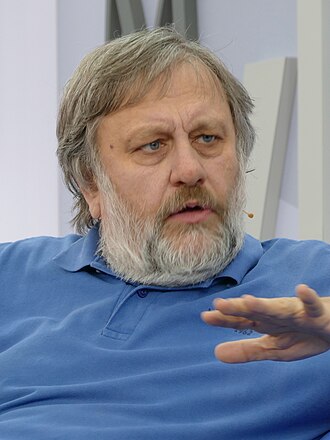
视频库 / NO.098ASK THE BEST MINDS THE BIG QUESTIONS
视频库 / NO.098
字幕 字幕位置
--:--
点击播放,这里会跟随视频显示当前句的中英字幕。

Slavoj Žižek - The Reality of the Virtual (2004)

节目发布 2018-01-19 · Ippolit Belinski
斯拉沃热·齐泽克
本期追问 · 点击跳到视频对应位置
9:26 一个并不实存的东西,为什么能产生实实在在的效果?1:12 和人相处,我们面对的其实是抹去了尴尬部分的形象吗?3:39 你不知道自己知道的东西,为什么反而支配着你?55:13 若自由既不是自然本能也不是文化规范,它还能是什么?
归入 Ⅰ·01 什么是「真实」? →
EDITED TRANSCRIPT · 依据现场录音编译整理,可划线生成便签
编者按:本文是斯洛文尼亚哲学家、精神分析理论家斯拉沃热·齐泽克(Slavoj Žižek)于二〇〇四年所作的一场演讲,原题为《虚拟之物的现实性》(The Reality of the Virtual)。齐泽克以拉康与黑格尔解读流行文化和政治意识形态著称,现任卢布尔雅那大学与伦敦大学伯克贝克学院教授。演讲从拉康的「想象、象征、实在」三元组出发,一路谈到拉姆斯菲尔德、反犹主义、康德、宽容政治与乌托邦。本文依据现场录音编译整理,仅删去口语枝节,论证与例证悉数保留。

虚拟之物的现实性:三种虚拟

今天人人都在谈虚拟现实(virtual reality),但坦率地说,我认为虚拟现实是个相当乏味的想法。它的意思无非是:让我们在一种人造的数字媒介里,把我们对现实的经验复制一遍。我认为,一个远为有趣的概念,一个对理解今日世界至关重要的概念,恰恰是它的反面:不是虚拟现实,而是虚拟之物的现实性(the reality of the virtual)。这里所说的现实性,指的是效力,是实际产生的效果,由某种尚未完全存在、尚未完全现实化的东西所生成的真实效果。

我们可以在什么意义上谈论这种现实性?在很多意义上,也许太多了。如果以拉康著名的三元组,想象界、象征界、实在界(imaginary, symbolic, real)为出发点,至少有三种意义。用最简单的说法,就是想象的虚拟、象征的虚拟和实在的虚拟。我先简单讲前两种,它们不那么重要,然后再进入真正的大题目:实在界。

想象的虚拟:被理想化的他人形象

什么是想象的虚拟?看看我们最日常的经验就清楚了,看看我们如何经验自己和他人。当我们与另一个人打交道时,从现象学上说,也就是在我们直接经验对方的方式上,我们会从对方的形象中抹去、抽掉某些特征,因为那些特征太尴尬,不可能时时刻刻挂在心上。比方说,我在跟你们讲话,从理性上我当然知道你们会排泄,会流汗,更不用说别的事情了。但实实在在地说,当我和你们互动时,这些并不在我对你们的形象之内。所以,当我与你打交道时,我基本上不是在和真实的你打交道,而是在和你的虚拟形象打交道。这个形象具有现实性,因为它切切实实地构造着我与你相处的方式。

这种理想化至关重要。有一个绝妙的反证,就是詹姆斯·乔伊斯与妻子诺拉之间的通信。据我所知,他们在接受彼此身体的粗俗现实这件事上走得非常非常远,几乎走到了尽头:各种声音,各种难闻的气味,等等,这些甚至成了他们性生活的一部分。这太不可思议了,我佩服乔伊斯这一点。

好,这就是第一个基本层次。想象的虚拟,指的是那个决定我们如何与他人互动的虚拟形象。说它是虚拟的,是因为我们虽然在和真实的人互动,却抹去了对方的整整几个层面,表现得好像它们不存在。

象征的虚拟:权威与信念只有虚拟才有效

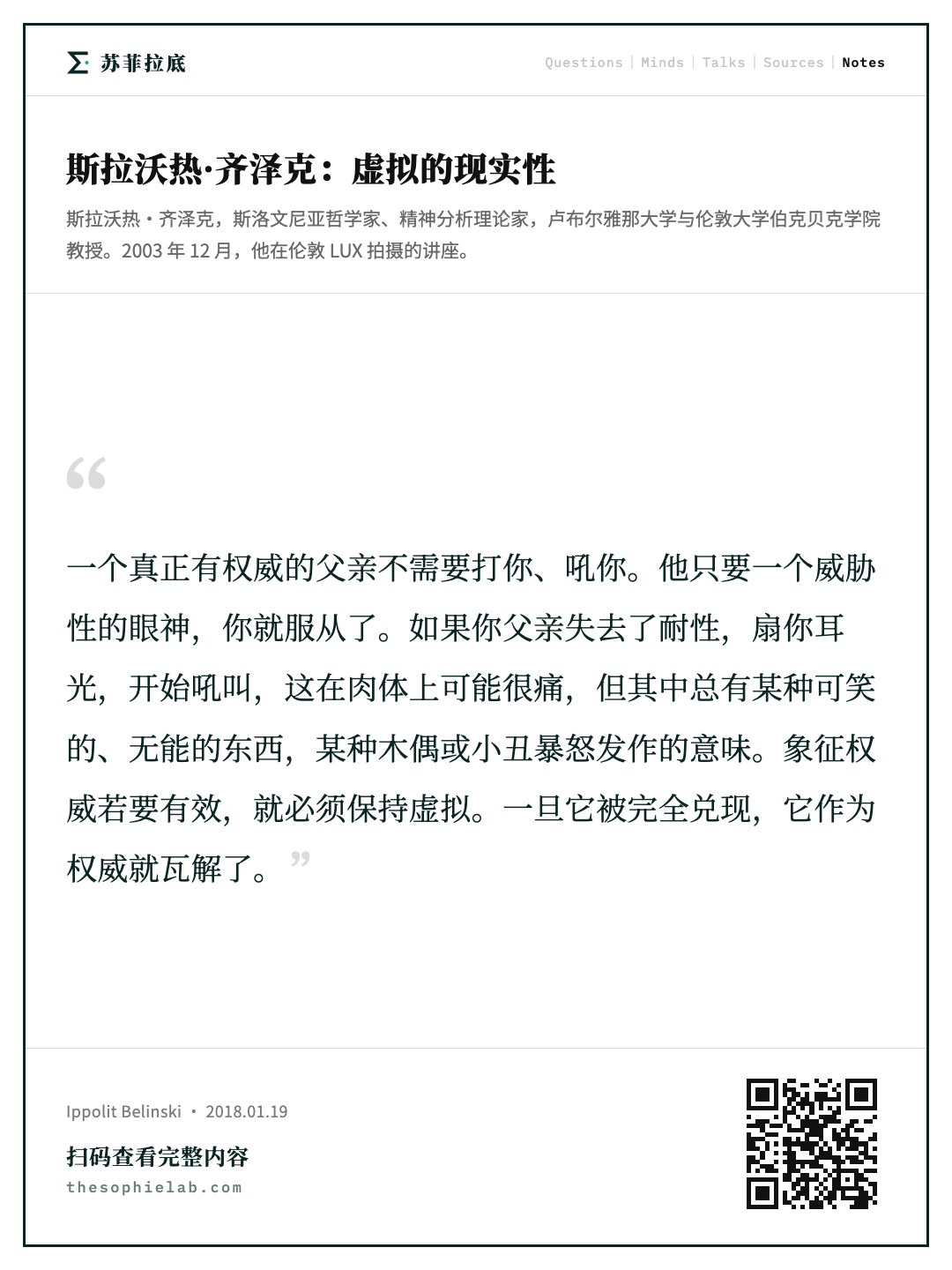
第二个层次已经复杂一些了:象征的虚拟。其实也很基本。想想我们每个人都熟悉的一种经验,经验权威,比如父亲的权威。很明显,这种权威要想有效运作,要想被经验为现实的、有效的权威(这正是有趣的悖论所在),就必须保持虚拟,也就是保持为一种威胁。如果权威被过于直接地施行,它反而会被经验为无能的标志。具体来说,一个真正有权威的父亲不需要打你、吼你。他只要一个眼神,一个威胁性的眼神,你就服从了。如果你父亲失去了耐性,扇你耳光,开始吼叫,这在肉体上可能很痛,但我们得承认,其中总有某种可笑的、无能的东西,某种木偶或小丑暴怒发作的意味。

这就是一个清楚的例子,说明象征权威若要有效,就必须保持虚拟,这是我想强调的悖论。不只是说权威作为虚拟之物就已经是现实的,而是说,它只有作为虚拟之物才是现实的。一旦它被完全现实化为一种兑现了的威胁,父亲打你、吼你,它就是自我毁灭的,它作为权威就瓦解了。

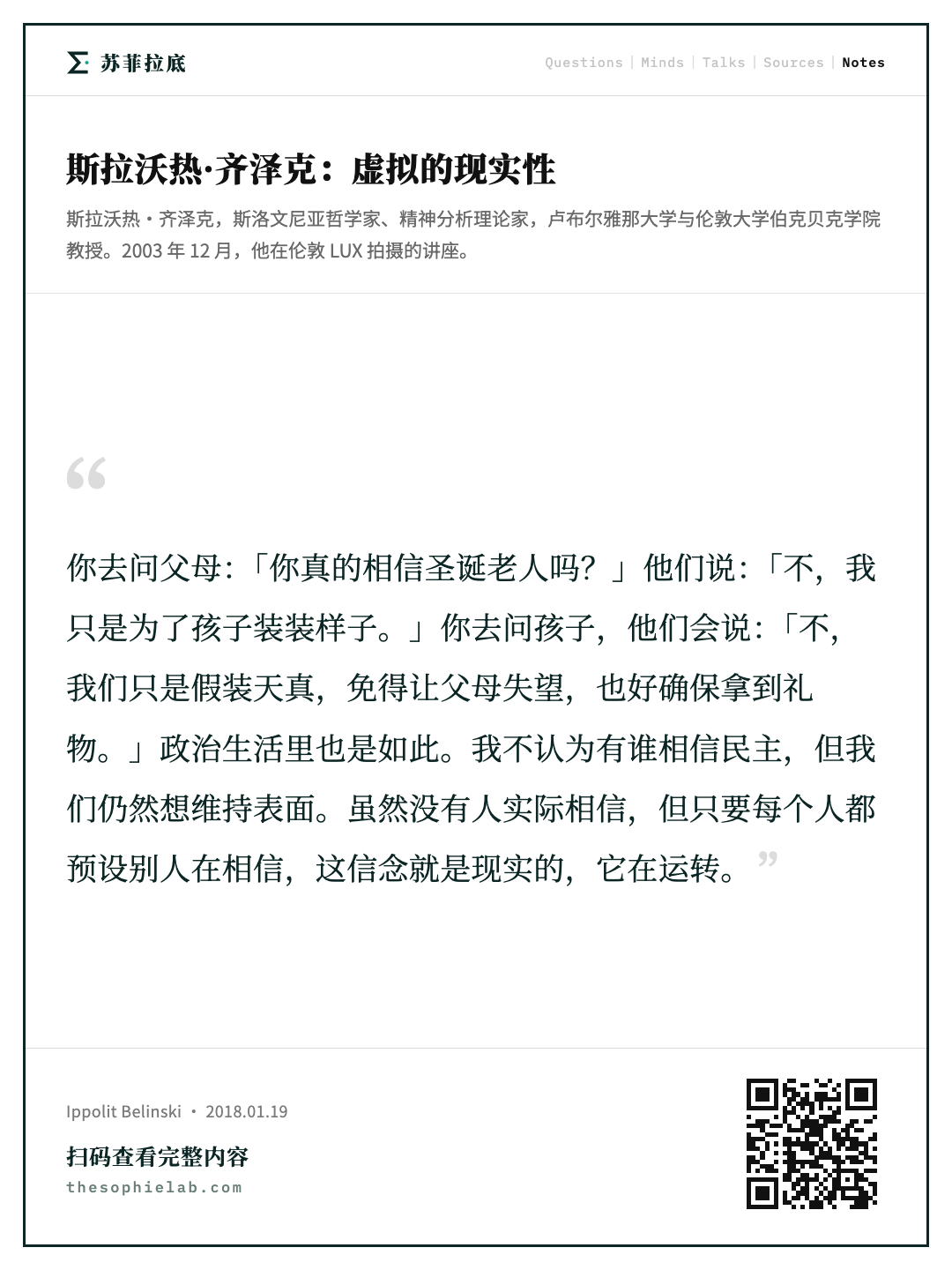
虚拟维度在象征层面上起作用的另一个例子是信念。我们是否意识到,今天我们的信念在多大程度上是虚拟的?这里的虚拟指的是:归于他人,被预设。它们并不实际存在,说它们是虚拟的,是因为没有人真的需要去相信,我们只需要预设另一个人在相信。举一个我几乎不好意思提的初级例子。假如你是父亲或母亲,有小孩,圣诞节到了。当然,要是有人问你:「你真的相信圣诞老人吗?」你会说:「不,我只是为了孩子装装样子,不想让他们失望。」可我们都知道这个游戏怎么继续下去。你去问孩子,他们会说:「不,我们只是假装天真,免得让父母失望,也好确保拿到礼物。」

我想说,这不只是孩子的事,甚至在我们的政治生活里也是如此。在我们所谓的犬儒时代(我说「所谓」,是因为我认为我们比以往任何时候都更相信),比如说,我不认为有谁相信民主,但我们仍然想维持表面。也就是说,存在某个纯粹虚拟的实体,我们不想让它失望,它必须被保持为天真无知的,为了它,我们必须假装。悖论就在这里:虽然没有人实际相信,但只要每个人都预设别人在相信,这信念就是现实的,它构造着现实,它在运转。

这里的悖论与权威的悖论类似。这不仅仅是说,信念总是虚拟的信念,不是某个实际的人的信念,而总是归于他人的信念,用拉康的说法,归于「被设定为相信的主体」(subject supposed to believe)。我想进一步说:我们许多日常信念,要想在社会上作为信念发挥作用,就必须在这个意义上保持虚拟。因为如果我们相信得太直接,我认为这对一种意识形态来说同样是自我毁灭的。我们就不再像正常的主体,而像白痴。我们都知道那种情形:遇到一个把自己的宗教信仰或政治信仰当得太真的人。直接认同于信仰的人身上有某种可怕的东西,仿佛他不再是一个真实的人,仿佛变成了某种木偶。

我希望这两个层次现在相对清楚了:想象的虚拟性,象征的虚拟性。而现在,真正的宝藏在等着我们:实在的虚拟性。

实在界的三重分层:图像、公式与内核

谈实在的虚拟,麻烦当然出在实在界这个概念上。这听起来可能有点枯燥,但我们必须再过一遍想象、象征、实在这个三元组。因为拉康把这个三元组定义为一个结(knot),意思是三者名副其实地相互交织,整个三元组都反映在三项中的每一项之内。直白地说,这意味着又有想象的实在、象征的实在和实在的实在。

什么是想象的实在?图像,但这些图像如此强烈、如此创伤性,以至于它们是实在的,强烈到无法被感知,但仍然是图像。想想那些不可思议、令人窒息的灾难,想想怪物,想想科幻或恐怖片里所谓的「那东西」(the thing),想想《异形》这类电影,那些可怕的生物强大到无法直接面对。但它仍是想象的,因为它是一个强到无法面对的图像。即使你无法面对它,我们仍然在想象的层面上活动。这就是想象的实在。

然后是象征的实在。它就是,比如说,科学话语,科学公式,比如量子物理。为什么这是实在的?理由很简单。拉康对实在界的最低限度定义是:那抵抗象征化、抵抗被纳入我们意义宇宙的东西。而量子物理不正是这样吗?量子物理是什么?是一套行得通、经过实验证实的公式,但我们无法把它们翻译成我们对日常现实的经验。大家都知道,量子物理令人受创之处正在于此:我们根本无法理解它。不是说我们这些普通人、白痴理解不了,只有少数科学家能理解。连他们也不能。在什么意义上?就在于它单纯地管用,可你一旦试图从中建构一套融贯的本体论,就会得出没有意义的结果:时间倒流,平行宇宙,等等。换言之,你得到的东西相对于我们通常的现实观念是全然无意义的。这就是象征的实在。它显然是象征的:公式,纯粹的能指。它们运转着,是一台运转中的机器,却没有意义。我们无法从中得出任何意义,无法把它与我们的经验联系起来。正因如此,我们才如此拼命地想做到这一点,才想发明种种隐喻去想象量子宇宙,但做不到。

最后,我们来到实在的实在。它恰恰不是通常被认定为实在的那种东西,那是第一种实在,想象的实在,一个过于创伤性的图像。那么,这著名的实在的实在,实在界的核心,究竟是什么?让我从两个层次来接近它。

淫秽阴影:行军号子与电影的双重讯息

第一个层次还相对贴近象征秩序。它是伴随着象征层面的一切,作为象征秩序的淫秽阴影而存在的东西。想想军队单位如何运作。你有纪律,象征机器,象征秩序,操练,等等。但我们都知道,支撑这些的是一种淫秽的、阴影般的现实,其中就包括所谓的行军号子(marching chants)。每一部关于海军陆战队的电影里你都能听到,士兵在训练、行军时唱的那些歌极其有趣,其特征是无意义的押韵,混合着施虐或性倒错的秽语。我记得一个例子,好像出自电影《军官与绅士》,海军陆战队员唱的大意是:「我不清楚,但听人说,爱斯基摩女人的那玩意儿挺凉。」谜题在于:军事话语为什么需要这个?这就是第一个层次,一种阴影般的、虚拟的情感现实,它必须伴随着官方话语。

但让我们再深入一点。想想西方文明的伟大成就之一,《音乐之声》这样的电影。在政治层面上,我们都知道,它的官方故事讲的是一群小小的、反法西斯的民主奥地利人(唱歌的部分我就略过了),诚实的小民主派奥地利人,在一九三八年抵抗纳粹对奥地利的占领。可是仔细看这部电影,看它的肌理,你会发现一个全然不同的现实,一种官方叙事现实之下的虚拟现实。看看奥地利人在片中是怎么被刻画的,长话短说,他们恰恰被刻画成一群小巧、漂亮、外省气的法西斯。影片突出他们的愚钝,那些本地民俗服装等等。他们被直接呈现为反智的,扎根于狭隘的生活世界。再看看入侵占领的纳粹是怎么呈现的。他们大多不是军人,而是经理、官僚,衣着考究,留着小胡子,抽着昂贵的香烟。换言之,几乎就是一幅世界主义的、颓废的、腐化的犹太人的漫画。

这就是我的论点。在简单的叙事现实层面,我们得到的讯息是:民主派抵抗纳粹主义。但在可以称之为虚拟肌理的层面,在所有这些微观意义的层面(也许甚至可以称之为书写),我们得到的几乎是相反的讯息:诚实的法西斯抵抗颓废的犹太世界主义者的接管。顺带一提,这也许至少是这部电影如此极端受欢迎的原因之一:它在官方上认同我们的民主意识形态,同时又诉诸我们隐秘的法西斯梦想。

再举一个更严肃的例子,罗伯特·奥特曼的杰作《短片集》(Short Cuts)。同样,在叙事层面,我们得到的是一个简单的故事,或者说九个、十个平行的故事,描绘洛杉矶中产阶级绝望的日常生活。这是一幅当今异化与孤独的肖像。但我认为,影片本身的肌理却乐观得多。它几乎是在礼赞偶然相遇的魔力,礼赞这些相遇所生成的东西,那些意料之外的意义效果。所以,正如我们应当那样去读《音乐之声》,把《短片集》仅仅读成一部社会批判作品也是错的。它还有另一个乐观得多的、甚至可以说肯定生命的层面。

拉姆斯菲尔德的第四格:未知的已知

为了给这种实在的虚拟提供一个公式,让我引述不是别人、正是唐纳德·拉姆斯菲尔德最近的一段悖论式言论。我认为这段话是对当代美国哲学论争的重要贡献。事情发生在二〇〇三年三月,伊拉克战争前夕,拉姆斯菲尔德阐述了已知与未知的关系。首先,他说,有「已知的已知」(known knowns),有些事我们知道自己知道,比如我们当时知道萨达姆是伊拉克总统。好,一切清楚。然后他接着说,有「已知的未知」(known unknowns),有些事我们知道自己不知道,比如我们知道自己不知道萨达姆有多少大规模杀伤性武器。好吧,现在我们知道他一件也没有,但这不要紧,当时看起来是这样。然后还有「未知的未知」(unknown unknowns),有些事我们不知道自己不知道,它们如此陌生、如此不可想象,以至于我们连自己不知道都不知道。比如,也许萨达姆有某种不可想象的、完全出乎意料的武器。

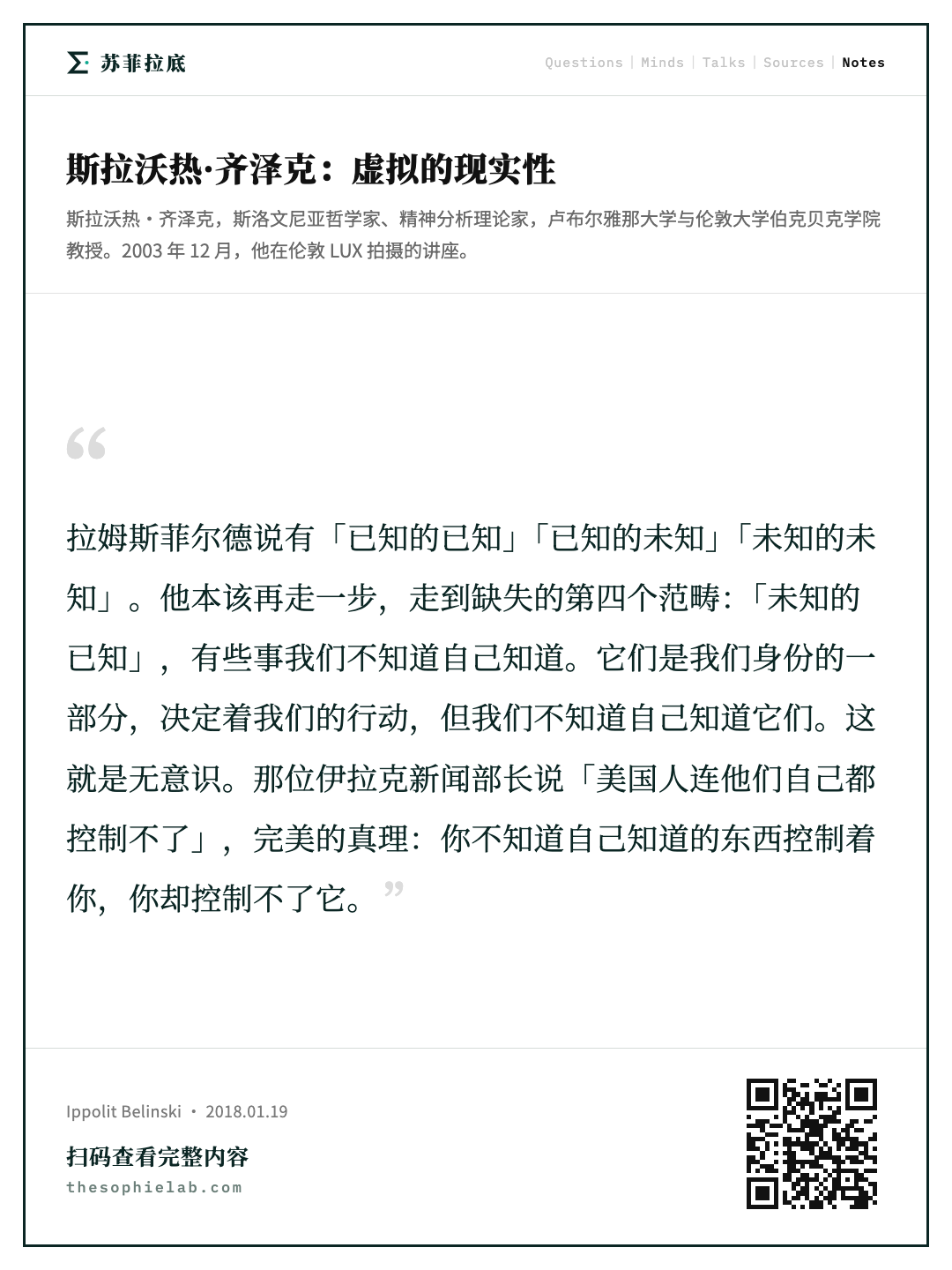
遗憾的是,拉姆斯菲尔德到此为止了。我认为他本该再走一步,走到缺失的第四个范畴,第四种变体,那不是已知的未知,而是「未知的已知」(unknown knowns):有些事我们不知道自己知道。我们知道它们,它们是我们身份的一部分,决定着我们的行动,但我们不知道自己知道它们。这当然就是精神分析所说的无意识:无意识的幻想,无意识的偏见,等等。我认为这个层次至关重要。回到前面两个电影的例子:在《音乐之声》里,我们直接知道的是,这是一部关于谦逊诚实的奥地利人反法西斯抵抗的电影;我们不知道自己知道的是,它同时也是其反面,一部关于法西斯抵抗犹太人接管的电影。

我认为,今日美国政治的悲剧正在于他们没有意识到这些未知的已知。正因如此,那位不幸的伊拉克新闻部长的一句话里有着深刻的真理。上一次伊拉克战争期间,我们都在嘲笑他,因为他那些否认显而易见之事的可笑言论。但我要说,有一处他说的话是绝对真实的。战争临近尾声时,有人问他:「美军已经控制了巴格达机场的一部分,是真的吗?」他说:「不是真的。美国人连他们自己都控制不了。」完美的真理。为什么?因为他们不知道自己知道什么。而这个你不知道自己知道的东西控制着你,你却控制不了它。

吸引子与创伤:实在是纯形式的裂隙

现在我们来到真正实在的东西,实在界的实在核心,它比那个仍然带有象征性质的实在根本得多,但悖论的是,它同时又是最虚拟的实在。它是什么?想想数学或物理学里的吸引子(attractor)。比如你有一些小铁屑,把它们撒在一个磁场周围。它们会按照某种形状散布开来,无限地逼近这个形状,但这个形状本身当然并不存在。它只是你能从铁屑的散布中抽象地分离出来的东西。这就是虚拟实在的观念。它是一个形状,是这个场的实在,但它本身并不存在。它只是一个抽象的形式,构造着实际存在的元素围绕它的布局。

这与精神分析的问题,乃至政治的问题有什么关系?我的想法是:关系很大。想想创伤在精神分析里的确切地位。它与这个不存在的吸引子很相似。说得更细一点:我们都知道,弗洛伊德在创伤问题上改变过立场。奇怪的是,他的这一转变与爱因斯坦相对论的转变平行,也就是从狭义相对论到广义相对论的转变。相对论的这一转变涉及空间的弯曲。希望我们大多数人都知道,在爱因斯坦最初的进路里,是物质的存在、物质的密度弯曲了空间。空间最初被设想为空的空间,抽象地看是对称的、不弯曲的;然后物质的存在使它弯曲。但在第二步,爱因斯坦完成了一次绝妙的颠倒。他把两项调转过来:不是物质的存在弯曲了空间,恰恰相反,空间的弯曲才是原初的,而我们所感知的物质,只是对纯粹形式性的空间弯曲的一种物化的、拜物教式的误认。

我认为精神分析的创伤概念与此完全一样。在第一种进路中,弗洛伊德把创伤想象为某种致密的、原始的在场,某种实在之物的在场,它粗暴地闯入我们的象征空间并使之弯曲。名副其实地弯曲。设想我有一个平衡良好的象征空间,然后某件创伤性的事发生在我身上:我被强奸,我目睹了可怕的事件,我遭到酷刑,随便什么。由于这一事件的创伤性冲击,我的象征空间弯曲了。有些东西不再能被象征化,那些象征的功能必须由其他象征接管。出现了某种失衡,我的象征空间里有了一道裂隙。这是第一种进路。

但后来弗洛伊德注意到一些奇怪的事。什么事?回想他最著名的病例分析,狼人。那里的创伤场景当然是幼年的狼人目睹父母从背后的性交。可是让我们更精确地看:那里究竟发生了什么?这并不单纯是一次创伤。作为一岁半的孩子,狼人在这个场景中并没有发现任何创伤性的东西。他只是感知了它,把它储存起来。三四年之后,狼人开始发展他的理论,关于性的幼儿理论,而因为他无法解释性,换言之,因为他的性理论的象征空间是弯曲的,只有在这个时候,他才重新唤起了那个创伤场景。所以我认为,与爱因斯坦清楚地平行,这里同样是反过来的。原初的事实不是实在之物、创伤性实在的某种粗暴闯入。原初的事实,同时也是原初的实在,是一种纯粹形式性的失衡。象征空间是弯曲的,被一种对抗、一种失衡横向切开。而为了解释这一点,你需要指涉某个实在之物,也就是创伤性显现意义上的实在。这里的实在是一个诱饵,一个陷阱。

反犹主义与「另类现代性」的陷阱

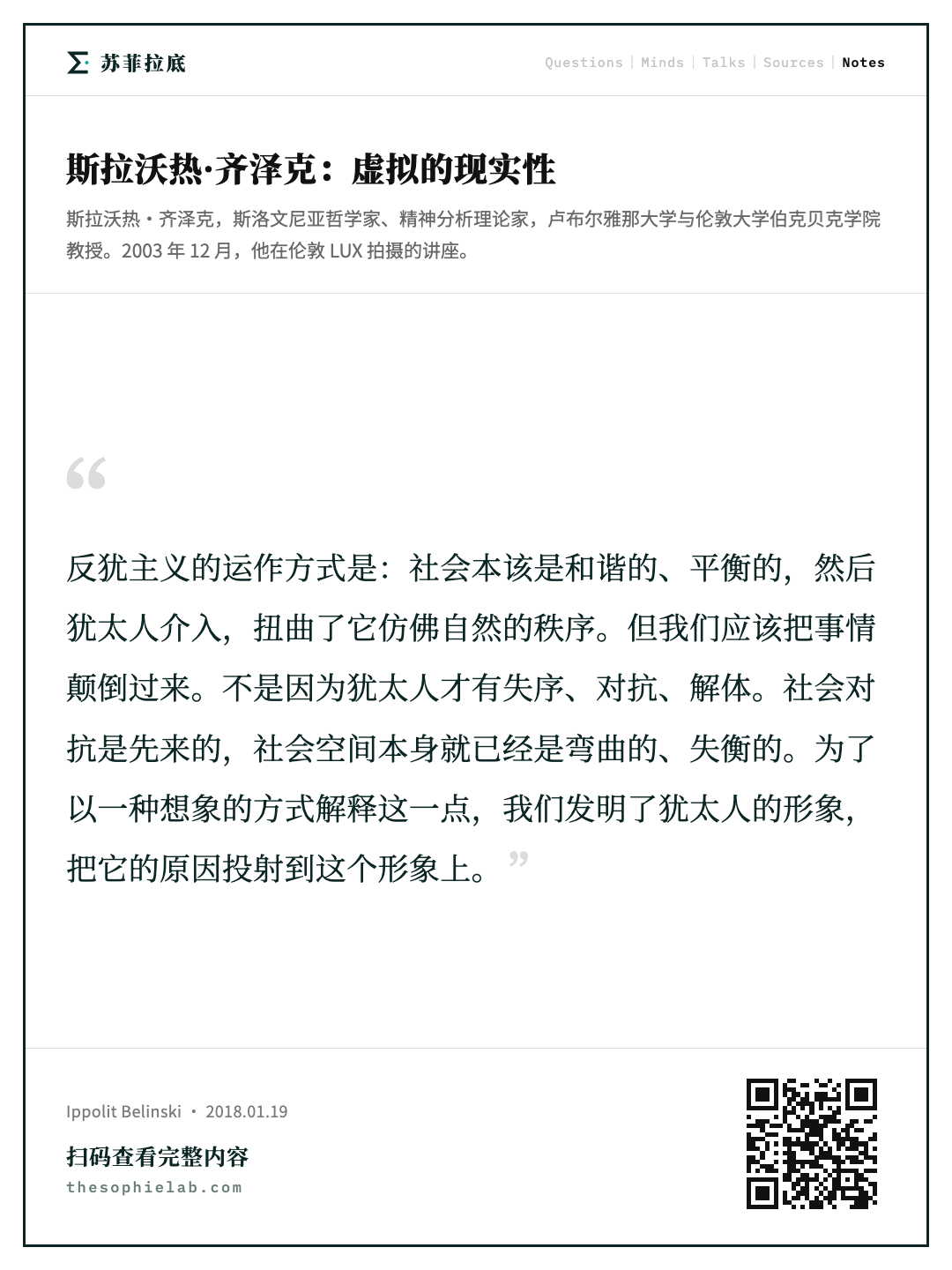
那么,作为创伤的虚拟实在,作为虚拟之物的创伤,这个概念对政治意味着什么?它能帮助我们分析政治意识形态现象吗?当然能。回想一下反犹主义是如何运作的。在它的法西斯版本里,反犹主义,或者说犹太人的形象、犹太人的阴谋,恰恰是一种外在的创伤,它粗暴地闯入,扰乱社会平衡,可以说弯曲了社会空间。社会本该是和谐的、平衡的,然后犹太人介入,扭曲了它仿佛自然的秩序。但在这里,我们至少应该做一回马克思主义者,把事情颠倒过来。不是因为犹太人才有失序、对抗、解体、阶级斗争。阶级斗争,或者更一般地说,社会对抗,是先来的。也就是说,社会空间本身就已经是弯曲的、失衡的。而为了以一种想象的方式解释这一点,我们发明了犹太人的形象,也就是把它的原因投射到犹太人的形象上。

甚至在今日经济格局这个更根本的层面上,我认为作为虚拟的实在这个概念,也能帮助我们批判性地拒斥一个在政治正确的后殖民作者中越来越流行的范畴:所谓「另类现代性」(alternative modernity)。这个想法简单说是这样的:当然,现代性的概念中存在不一致、对抗和压迫的潜能,而现代性归根结底当然意味着作为现代性动力的资本主义;但是,这套说法接着讲,这些对抗性、压迫性的要素并不属于现代性概念本身,而只限于盎格鲁-撒克逊和西欧的现代化模式。那么为什么不能有其他的另类现代性?你可以有现代化,但没有西欧现代化进程所特有的那些异化效应,没有社会性的破坏过程,没有异化,没有剥削,没有生态灾难,等等。于是,当然,人人都可以来取用。谁都可以有自己的现代性。你可以说,我们可以有拉丁美洲现代性作为另类现代性,可以有非洲现代性,亚洲现代性,随便什么。

这种进路,基本上是一种历史主义的唯名论,问题出在哪里?它背后的逻辑是那套声名狼藉的伪解构逻辑:没有现代性本身,只有各种特殊的现代性,西欧的、非洲的、拉丁美洲的,等等。这当然是对的。问题在别处。问题在于,通过这种唯名论的还原,通过宣称只有特殊的现代性才实际存在,对抗的场所就被缩减到了某一种特殊的现代性。不再是现代性本身以对抗和失衡为特征,失衡被打发为只属于现代性的某个特殊种类。这有什么问题?说得非常简单:早在二十世纪上半叶,我们不是已经有过一个著名的另类现代性大工程了吗?它叫法西斯主义。法西斯主义恰恰是建立另类现代性的第一次大尝试:要现代化进程、工业发展等等,但不付出异化、社会解体等等的代价。

那么我们应该用什么来对抗这种模式?我们应该用这样一个观念来对抗它:存在某种对抗,可以有不同的叫法,传统马克思主义者会叫它阶级斗争,法兰克福学派会叫它启蒙辩证法,但意思都是,资本主义现代性的工程本身就蕴含着某种对抗的潜能。也就是说,我们所痛惜的那些现象,战争、暴力、集中营、新的原教旨主义,随便你举,所有这些都不单纯是一种倒退,也不是像哈贝马斯所说的那样,是现代性作为「未竟工程」的标志,而是现代性工程本身的一部分。这正是被丢掉的东西。正因如此,我认为,尽管这种把现代性的对抗面缩减为现代性某一特殊形态的想法自诩为历史主义的、批判的,它其实是深刻意识形态化的,因为它保全了现代化的一般概念,使之毫发无损。

我们应该坚持的恰恰相反,正如我刚才所说:在现代性这一普遍概念本身之中内在着一种对抗。而现在我要说到我的要点了:现代性的各个特殊种类,并不只是其普遍属类、其普遍概念的例子或例证,而在某种意义上是对它的反应。它们在与它斗争。作为普遍概念的现代性意味着某种僵局、某种对抗,而各种特殊的、实际存在的现代性形态,是解决这一僵局、解决这一问题的尝试。自由资本主义作为现代性的一种形态,想以某种方式,通过市场自由等等来解决现代性的僵局;法西斯现代化以另一种方式;拉丁美洲现代化又以另一种方式。

这里真正辩证的东西是什么?又是对通常格局的这一颠倒。并不是说斗争发生在特殊内容的层面,而普遍只是某种中性的、空洞的容器,于是普遍意味着某种包罗一切的总体概念,然后在这个概念之内,各种特殊形态相互斗争,比如法西斯现代化对抗自由主义现代化,等等。不是的。斗争的场所是普遍的对抗本身,而所有特殊的、实际存在的现代性,都是掩盖、化解这一问题的尝试。所以我们要记住:对抗的场所是普遍性。

这与作为实在的虚拟有什么关系?恰恰是这个作为对抗场所的普遍性场所是虚拟的。在什么意义上?在这个意义上:并不存在普遍的现代化,它只是某种对抗的某种虚拟格局。实际存在的(唯名论者在这里是对的)只有各种特殊的现代化形态。没有现代性本身,只有盎格鲁-撒克逊的、拉丁美洲的、非洲的、法西斯的现代性,等等。但是,要把握这些特殊形态的动力本身,就必须把它们联系到它们不在场的原因(absent cause),联系到它们所回应的那个大的对抗。这又是一个例子,说明作为实在的虚拟这一概念是如何起作用的,说明如果我们要把握具体的社会动力,尤其是今日全球资本主义的动力,这个概念是如何必不可少的。

纯粹差异:左右之分与形式唯物主义

从这一切可以得出的结论是:实在界这个范畴归根结底是一个纯粹形式的范畴。它不是某种扰乱秩序的无形式内容的范畴。它是一道纯粹的结构性裂隙。它是一个完全非实体性的范畴。如果可以这么说的话,它是一种差异,但是一种纯粹差异。纯粹差异的意思是,悖论地说,这种差异先于它所区分的东西。并不是先有两项,然后两项之间有一个差异。悖论的是,两个肯定性的项是后来才出现的,它们是驾驭、掩盖这一差异的张力的尝试。

这怎么可能?再举一个简单的例子来说明这个逻辑:政治上的左右之分。我知道今天这个区分已经被遗忘了一半,没人想听它,但还是要说。认真看待这个区分,首先引人注目的一点是,它不只是某个社会整体内部的一个区分。并不是说,在某个社会里,把所有政治力量都考虑进来,我们可以说这些是右翼力量,那些是左翼力量,然后中间还有各种过渡现象,中间派、中左、中右,随你怎么说。不是这样。情况是:如果你问一个右翼分子整个社会场域是如何构造的,你得到的回答与问一个左翼分子,或者问一个中间派,会截然不同。简化地说,右翼分子会告诉你,社会是一个有机的、和谐的统一体(至少传统的右翼分子会这么说),而左翼激进分子是外来的闯入者。对激进保守派来说,令人憎恶的正是这样一个想法:社会大厦的核心刻写着一种对抗,一种失衡。而对左翼分子来说,斗争被承认为中心。所以,要点在于,不存在一种中立的方式来定义左右之间的差异。这差异本身是一个空洞。你只能要么从左派的立场、要么从右派的立场去接近它。顺带一提,对拉康来说,性别差异也以完全同样的方式运作。性别差异不是普遍人性的两个种类之间的差异,而是从男性视角看,性别差异本身呈现的方式与从女性视角看不同。所以,悖论地说,差异是先来的。

在哲学上至关重要的,是这种可以称之为纯粹形式主义的东西。有人会责难说,这难道不是某种唯心主义吗?物质在其肯定性的内在在场中难道不是原初的吗?我认为我们应该拒绝这一责难,并恰恰坚持这样一个概念,姑且称之为纯粹形式的唯物主义。唯物主义是差异的唯物主义。唯物主义的最低限度特征是:存在一种纯粹差异,在「一」的秩序内部有一道裂缝、一种对抗,原初的事实是纯粹的自我差异。我在这里非常精确:是自我差异,而不是任何一种神话式的两极对立,阴性与阳性,光明与黑暗,阴与阳,等等。我认为在这一点上,激进的唯物主义甚至应该对吉尔·德勒兹持批判态度,他喜欢主张某种原初的多元(multitude)是终极的本体论事实。从我所主张的激进立场看,多元已经是「一」与自身不一致的效果,是「一」不能与自身重合这一事实的效果。

换一种稍微不同的说法。我们并没有某种原初的两极性,阳性与阴性,光明与黑暗,然后就可以玩那些新纪元式的、诺斯替式的游戏:我们这个时代过于强调一极,得重建平衡,比如我们太理性、太阳性了,得多强调阴性的、情感的一面,诸如此类。不,事情更激进。正如拉康所说,二元能指(binary signifier)是被原初压抑的,这意味着第二个元素总是缺席的。这种对应项的缺失,我们有「一」,却没有与之相伴的「另一个」,这种原初的失衡启动了多元的生成。

再举一个极简单的例子,出自伍迪·艾伦早期的一部电影,我想是《爱与死》,一部对托尔斯泰的戏仿,整部电影的主题都围绕托尔斯泰。于是我们的第一个谜题当然是:陀思妥耶夫斯基在哪里?那个作为托尔斯泰天然补充的「另一个」?电影里没有陀思妥耶夫斯基。于是发生的事,作为一种被压抑者的回归,是在一个绝妙的短场景里,两个主角交谈时,陀思妥耶夫斯基所有小说的大标题都冒了出来。大意是:「你知道那个白痴后来怎么样了吗?」「啊,你是说卡拉马佐夫兄弟中的一个?」「对,他犯了罪,受了罚,然后去了地下室,变成了赌徒。」诸如此类。这里的教训,本体论的教训,就是「一」不能与自身重合,纯粹差异。由于这一纯粹差异,作为次级效果,多元爆发出来。

所以,针对那个惯常的责难,这不是唯心主义吗?我要说,今天倒是唯心主义才是唯物主义。我想说,今天唯物主义与唯心主义的对立在于:今天的唯心主义,或者说唯灵论,紧抱着那著名的经验的密度和惰性、物质的密度和惰性、土地、实体。难怪那位可以说最伟大的灵性电影导演,俄国的塔可夫斯基,同时几乎着迷于物质的惰性、物质的密度、物质的腐败这些主题。在他的电影里,主人公祈祷时不是仰望上方,他们祈祷的方式有时是名副其实地把头埋进泥里,与土地紧密接触。所以我认为,今天要做的事,是用真正激进的唯物主义的纯粹形式主义,去对抗这种灵性唯物主义。正因如此,对我来说,量子物理归根结底是一种深刻的唯物主义理论,在那里你不需要物质的任何肯定性,一切都可以用纯粹形式的振荡来完成。

康德的无限判断与人性中的非人过剩

回到这个核心洞见:差异是先来的。如何思考一种先于其所区分的元素的差异?伊曼努尔·康德早在他的早期著作中就引入了一个关键的区分。一个非常奇怪但清楚的区分:否定判断与无限判断(indefinite judgment)之间的区分。用康德的话说,说「你不是人」和说「你是非人」,不是一回事。如果我说你不是人,意思只是你在人性之外,你是动物,是神,随便什么,反正在外面。但如果,如康德所说,我不是单纯地否定一个谓词,而是肯定一个非谓词,也就是说,如果我不是简单地说你不是人,而是说你是非人,这意味着非人性,一种超出人性的过剩,但这一过剩内在于人性本身。

再给一个例子来说清楚。想想斯蒂芬·金的恐怖小说,那个著名的范畴:不死者(the undead)。我们能感觉到其中的差别。说「你没有死」和说「你是不死者」不是一回事。说你没有死,意思只是你活着,仅此而已,没有任何神秘之处。但每个恐怖小说的读者都知道,如果我说你是不死者,意思是你是活死人,你恰恰是作为死者活着。康德的要点是,人的自由恰恰具有这样的地位。它既不是自然(动物不自由,它们受本能奴役),也不是文化(文化已经是象征法则,象征规范)。而从康德,进而从弗洛伊德和拉康那里可以得出的结论是:文化的象征禁令试图规范、驾驭、支配、驯化(随你怎么说)的东西,并不直接是自然,不是自然本能,而是这一零度的非人过剩,用拉康的术语,人性的「外密」内核(extimate kernel)。这里的非人维度,与我们谈论不死者时的意义完全相同:不是外在于人性的非人,而是某种内在于人性本身的、狂野的激进自由的怪异过剩。所以我们又一次面对这个悖论:自然与文化之间的差异本身就是一个独立的层次,它既不是自然也不是文化,而是某种疯狂的过剩。

斗争的普遍性对抗宽容的普遍性

那么,一种纯粹差异的政治会是什么样子?首先,通过否定的方式,说说它不会是什么。它绝对不会是今天越来越成为政治之终极视野的东西:所谓身份政治,或者更广义地说,承认差异、宽容差异的政治。在我看来,这种多元文化主义的宽容政治的问题,并不只是那个粗浅的事实,即它们实际上(即便自己否认)忽视了经济斗争。问题在于斗争本身的逻辑:多元文化斗争、反种族主义斗争、反性别歧视斗争的逻辑,又是承认差异的逻辑。比如在反性别歧视的斗争中,目标当然不是(即便对激进女性主义者也不是)杀死或消灭男人,而是建立一个开放的场域,在其中两性、所有不同的性立场、性身份,还包括文化身份,都被允许自由地繁荣,一方不以牺牲他方为代价来表达自己。同样,在反种族主义斗争中,终极视野是为差异敞开空间。每个族群、宗教群体、文化群体、生活方式群体,都应有自由去自由地展开、表达自己的潜能和立场。

但这个概念场域,这个向他者开放、宽容差异、容许差异作为终极伦理视野的场域,我要说,不应该也不可能是我们的终极视野。因为我们马上就能看到,用一个简化的例子,阶级斗争。我的天,阶级斗争的终极目标可不是让无产者容许资产者、资产者容许无产者自由地展开各自的潜能。它是一场对抗性的斗争。目标不是让多元存在。目标是消灭敌人。这是一种完全不同的逻辑。这是敌意的逻辑,对抗性斗争的逻辑,它也牵涉一种完全不同的普遍性概念。这里的普遍性不再是作为包容性媒介、作为各种立场(性立场、文化立场,随便什么)之多元性的容器的普遍性。不,这里的普遍性是斗争本身的普遍性。

这种斗争立场还有一个核心悖论。斗争的立场并不意味着一种特殊身份的立场,并不意味着放弃普遍真理的概念。放弃普遍真理的概念与多元文化主义政治相处得很好:人人都有权讲述自己版本的真理,不存在全局的真理。不,我们的立场应该是:存在普遍真理。对于某一处境,总是存在一个普遍真理。但这一真理只能从一个特定的、局部的、投身于斗争的立足点才可企及。所以,并不是通过从我们的特殊介入、特殊利益中抽身,我们才达到普遍真理。那种想法是:我们每个人都有自己的利益和立场,但当我们能够仿佛走出自身,更客观地看待处境,看它实际的样子,处境的真理就浮现了。不,恰恰相反,我们应该完全承担这个悖论:普遍真理只能通过一个局部的、介入的立场才可企及。我认为这一点在今天比任何时候都更值得坚守。

也正因如此,在社会层面上,我认为我们应该紧紧抓住集体(collective)这个概念,正如它迄今在三种形式中被实践的那样:弥赛亚式的宗教集体,革命政党,还有共同体。三者共享的恰恰是同一个普遍性概念:只有通过一个介入的、斗争的主体立场才可企及的普遍性。

巧克力泻药:享乐律令与今日超我

今天,与这种纯粹差异的政治相对立的,是另一种政治,我称之为实在的政治,但这是超我的实在,正是我前面谈到的那个意义上的:超我律令,那淫秽的、虚拟的超我律令,「去享乐」。那么,在今日占主导的社会认同模式中,这一超我律令如何运作?用极简化的说法:过去伦理的运作方式是节制。伦理的终极任务是加以节制,比如:做,但别过度。吃,喝,别太多。性,别太多。那是一种适度的伦理。今天,我认为,一种不同的伦理正在浮现,它一方面允许你无限制地消费,不必节制,走到底,但为什么?因为对象本身已经被剥除了它危险的实质。今天市场上有一整个系列这样的产品:脱咖啡因咖啡,无酒精啤酒,无糖的糖,等等。也就是说,这种产品让你得到效果,却剥除了它潜在的危险实质。于是今天的律令不再是「喝咖啡,但要适度」,而是「想喝多少咖啡就喝多少,因为咖啡本身就已经是脱咖啡因的咖啡了」。也许味道稍差,但管它呢,为什么不?

这种产品最好的隐喻,是我两三年前在洛杉矶看到的东西:巧克力泻药的悖论。巧克力当然是让你便秘的东西。我还记得那广告:「还便秘吗?没问题,多吃点我们的巧克力。」悖论就在于,巧克力已经是它自身的解药,几乎是黑格尔式的对立面的直接重合。这为什么有意思?恰恰因为我认为它不限于商品现象。我感兴趣的是,我们如何在社会场域内部,也找到同一种逻辑,同一种产品即其自身反效果的悖论逻辑。

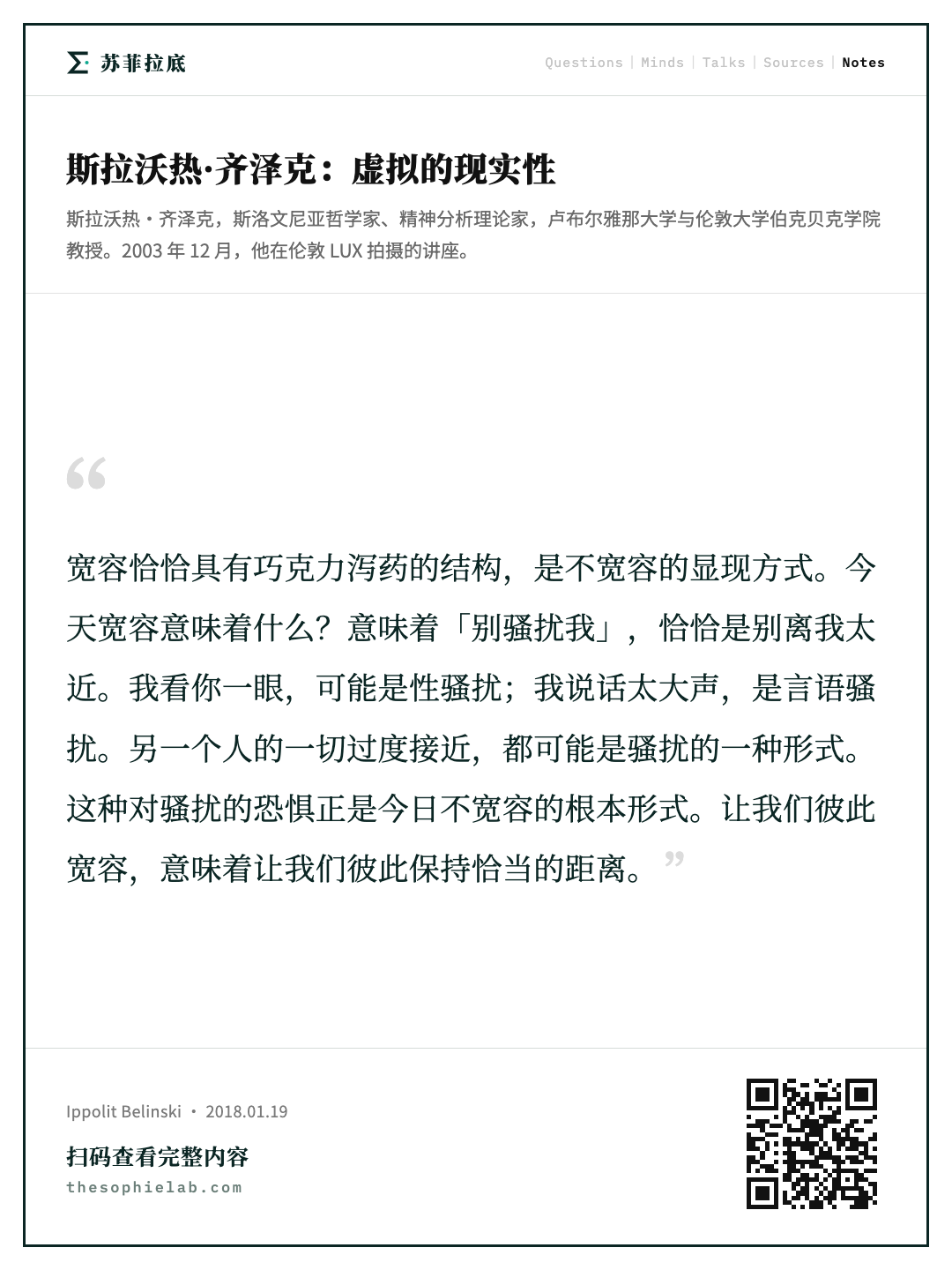
比如,拿宽容这个大题目来说。它是什么意思?我认为它恰恰具有巧克力泻药的结构。也就是说,宽容是它自身对立面的一种显现方式,是不宽容的显现方式。因为今天宽容意味着什么?意味着宽容差异,而这又意味着:别骚扰我。宽容就是「宽容我」,就是「别骚扰我」。「别骚扰我」是什么意思?恰恰是别离我太近。如果你带着你过度的享乐离我太近,你就打扰了我,你就骚扰了我。于是我们有了这样的观念:几乎一切都可以是骚扰的一种形式。我看你一眼,可能是性骚扰;我说话太大声,是言语骚扰,随便什么。一切,另一个人的一切过度接近,都可能是骚扰的一种形式。我认为这种对骚扰的恐惧正是今日不宽容的根本形式。所以我要说,今天我们谈宽容,它的意思恰恰是作为避免骚扰的宽容,也就是不宽容。它意味着让我们彼此宽容,而这又意味着让我们彼此保持恰当的距离。

又一个巧克力泻药现象:我们今天对待财富的方式不正是如此吗?对我来说,这里的典范人物是乔治·索罗斯这样的人。半天时间,他从事最无情的金融剥削,毁掉成千上万乃至数百万人的生活;另外半天,他把其中一部分还回去。也就是说,上午是巧克力,下午是泻药。你知道,他参与各种人道援助项目,政治民主化,等等。所以,他不是干脆不从事无情的投机,而是照做不误,然后再附上反向的行动。

更激进地说,今天的战争不也完全一样吗?我认为德国社会学家乌尔里希·贝克发明「军事主义的和平主义」或「人道主义的军事主义」这个词是完全有道理的。因为今天发生的事情是,所有战争都被宣布为和平之战。不只是说它们的终极目标被定义为给伊拉克带来和平、消除战争威胁等等。还要更激进:战争行动本身越来越像一种帮助当地人民的人道主义干预。比如你去读最近对攻打伊拉克的辩护,说的主要不是为了消除萨达姆对西方国家的威胁而攻打伊拉克,而是为了帮助伊拉克人民,等等。难怪那个终极的巧克力泻药,难怪集中营,正如乔治·阿甘本所说的二十世纪集体的典型范例,恰恰同时具有这两个方面。又是巧克力泻药的结构:隔离敌人的一面(关塔那摩之类),以及把人集中起来以便向他们提供人道援助的一面。

这意味着两件事。第一,我不认为今天谈论消费是有道理的,说什么我们生活在一个消费社会等等。恰恰相反,我要说,我们比以往任何时候消费得都少,如果消费意味着承担风险,真正敞开自己的话。顺带一提,这正是我们如此害怕吸烟的原因。我认为这不单纯是医学结论之类。吸烟之所以如此可怕,在于那是一个人真正地在消费烟雾,连同其中所有的危险。我认为今天真正的消费者是瘾君子、老烟枪之类。而如果说有谁是今日的恐怖形象,正是他们。结构又是巧克力泻药的结构,正因如此,即便在这个层面上,我们也都在寻找那种已经是脱咖啡因咖啡的产品。我认为这就是大麻如此流行的原因,因为它实际上是一种脱咖啡因的鸦片,没有鸦片的鸦片。你可以拥有它,但剥除了它危险的实质。

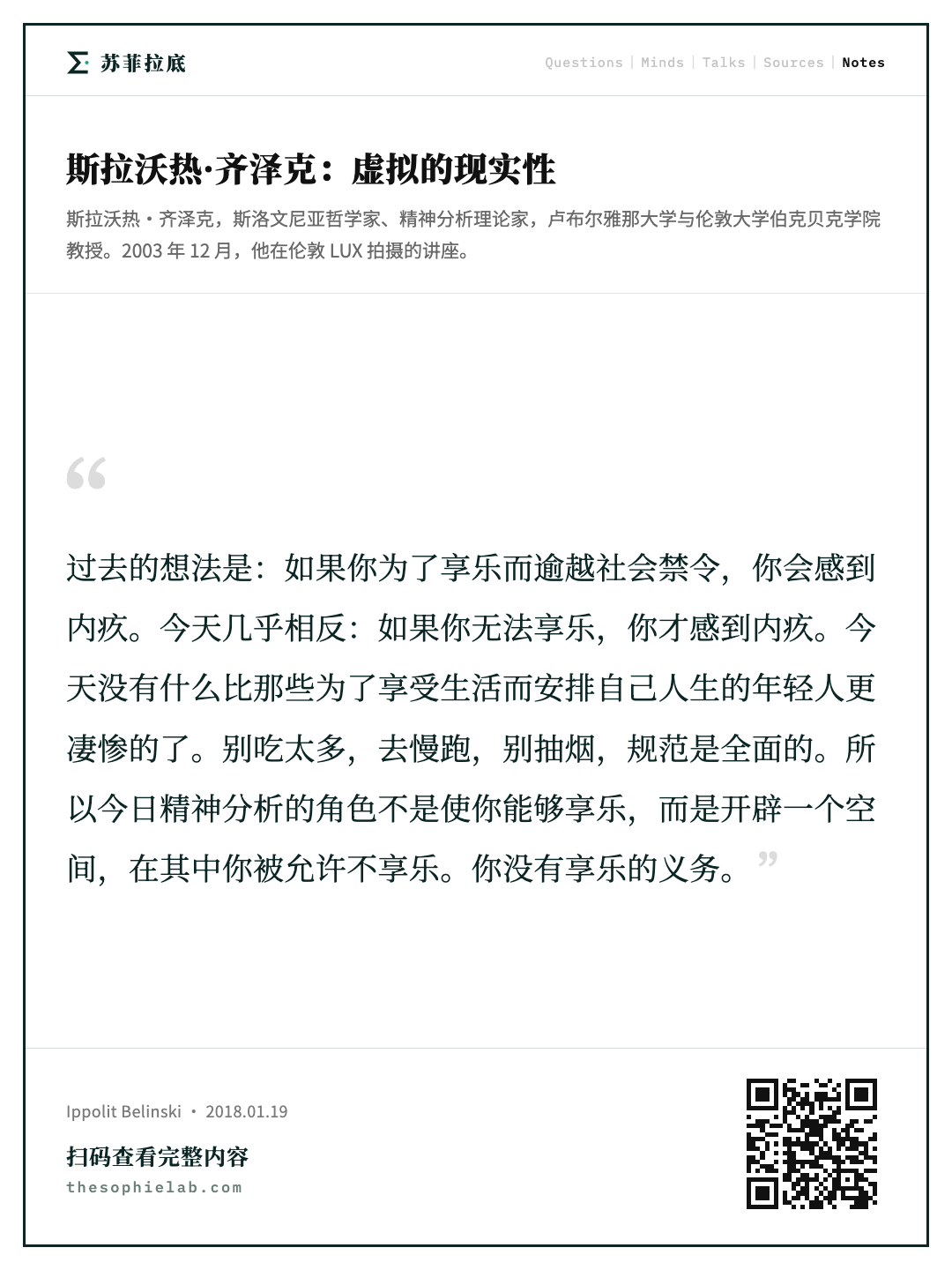
从这段简短的反思,我要说,今天社会向我们轰炸的那条根本的、可以说是伦理的律令,不再是「控制你自己」、「压抑你的欲求」之类。恰恰相反,它是「享受吧」,「走到底」。这才是我们今天感到内疚的事。而这一点,我认为,也从根本上改变了精神分析的角色。它并没有使精神分析过时,精神分析比以往任何时候都更切合当下,只是它的功能从根本上变了。在过去的好日子里(或者说看起来如此,现在很清楚,事情从来就没有那么简单),想法是这样的:比如你在性上受挫,因为你内化了某种父亲的或其他的禁令,你无法享受性,而精神分析的功能是解除你身上这一内化禁令的压力,让你能放开自己,能够享受。换言之,如果你为了享乐而逾越社会禁令,你会感到内疚。今天几乎相反:如果你做不到,如果你无法享乐,你才感到内疚。这里的享乐不应只取性、饮酒的纯粹快感之类的直接意义。它可以是权力的享乐,社会成功、职业成功的享乐。它甚至可以是新纪元意义上、诺斯替意义上的精神享乐:实现你的自我,等等。我们今天面对的情形是,如果你在这个意义上不能享受自己,你就会感到内疚。

这就把我们带到今日精神分析的双重功能。第一,它的讯息不是「放松,摆脱禁令」。它的讯息,如阿兰·巴迪欧以绝妙的措辞所说,是:你应当学会成为你自己的无情审查者。今日精神分析的角色不是使你能够享乐,而是开辟一个空间,在其中你被允许不享乐。这是今日精神分析的根本讯息:你没有享乐的义务。你被允许不享乐。当然,这不等于说你被禁止享乐,而只是说你被允许不享乐。

这进一步让我们面对今日超我的种种悖论。一方面,放纵如何终结于它的对立面。比如今天的律令是「享乐」,结果却是比以往任何时候都多的禁令和规范。你可以享受自己,但为了正确地享受自己,你被命令做什么?别吃太多,去慢跑,照顾好你的体能,别抽烟,等等。看看周围吧,我认为今天没有什么比那些为了享受生活而安排自己人生的年轻夫妇或年轻人更凄惨的了。规范是全面的。另一方面,我们有相反的悖论:所谓新兴的原教旨主义并不是来引入某种新的稳定性,在这个没有牢固稳定价值的世界里给你坚实的伦理根基。恰恰相反,我要说,它是来开辟一种虚假的自由空间。我在这里当然是隐含地指涉拉康对陀思妥耶夫斯基那句名言的著名颠倒。按拉康的说法,不是「如果上帝不存在,一切都被允许」,而是「如果上帝不存在,一切都被禁止」。这是享乐主义雅皮士的教训。而相反的教训同样关键:如果上帝存在,那么一切都被允许。这意味着,如果你能把自己的角色论证为神圣意志的工具,换言之,你听到了声音,你与上面那位有联系(乔治·布什或奥萨马·本·拉登都是如此,很多人注意到这正是他们的共同点:两人都直接从上面接到指示),那么你就可以为所欲为。你可以搞恐怖行动,可以轰炸别的国家,等等。由此可见,在今天这个格局中确定方向有多难,因为系统本身就内在地有一种奔向虚假自由的冲动。

重新发明乌托邦:做不可能之事

正因如此,我认为今天的主要任务是重新发明乌托邦,重新发明一个乌托邦的空间。我这是什么意思?当然不是老式的乌托邦,那种想象一个理想世界、而我们事先就知道它永远不会实现的乌托邦。这方面的大模型当然是柏拉图的《理想国》,托马斯·莫尔的《乌托邦》,还有我们不该忘记的萨德侯爵的《闺房哲学》。这是古典的乌托邦。然后还有我想称之为资本主义乌托邦的东西:对新的、又新的欲望的无休止的招引,它可以走得相当远。比如我今天听说,在美国,有些社区正在认真考虑这样一个想法:恋尸癖者,那些想和尸体玩性游戏的人,是被严重剥夺的群体。那么,向他们提供尸体不是我们社会的义务吗?能否设法让人们自愿签字,就像你签字同意死后心脏、器官可供使用一样,同意你的身体可以交给恋尸癖者,等等。这里的问题在于,这看似激进,其中却有某种可笑的温良。这种资本主义乌托邦就是这样:你可以走到底,基本上什么也不会发生。

但我们有第三种乌托邦。它既不是那种想象另一个宇宙、甚至不梦想真正实现它的古典乌托邦,也不是那种不断产生新欲望、以极端形式满足欲望的资本主义乌托邦。有第三种模式,我认为它恰恰是乌托邦的实在核心。我认为,真正激进的乌托邦不是一种自由想象的练习,不是你坐下来,没什么更有意义的事可做,就来想象可能的理想世界。它是你名副其实地出于一种内在冲迫而做的事。当你别无他法时,你必须发明某种新东西。对我来说,真正的乌托邦不是关于未来的事,而是在没有其他出路时必须立即实行的事。这个意义上的乌托邦,简单说就是:去做在既定象征坐标内显得不可能的事。承担风险,改变坐标本身。

我这里说的并不是什么疯狂的事。即便是一些著名的、经典的、有时甚至是保守的重大行动,也具有这种乌托邦维度。举一个可笑的例子:三十年前理查德·尼克松的中国之行。其中几乎有一种乌托邦的维度。为什么?因为他做了看似不可能的事。当时中国被描绘成终极的邪恶超级大国。与苏联可以缓和,与中国不行。那一行动改变了全部坐标。他做了不可能的事。这正是我们今天比以往任何时候都更需要的东西。

因为归根结底,我要说,今天真正的乌托邦不是另一种秩序,而是这样一种想法:现存秩序可以无限期地运转下去。真正的乌托邦不是一九八九年瓦解的共产主义,而是九十年代的乌托邦,那个由弗朗西斯·福山等人阐述的想法:我们发现了最终的社会形态,自由资本主义民主,我们不可能走得更远了。剩下的只是把它弄得稍微更宽容一点,把它传播到全世界,但我们已经掌握了公式。而我认为,如果九一一有什么象征意义的话,那就是这种乌托邦的时代结束了。历史的实在回来了。正因如此,今天的迫切之事是不要被所谓后政治的政治吓倒,它告诉我们意识形态的时代已经过去,你所能做的只是玩现实主义的游戏,接受趋势,等等。我们应当敢于实行不可能之事。我们应当重新发现如何去实行乌托邦,而不是想象乌托邦。要点不在于规划乌托邦,而在于实践乌托邦。我认为这不是一个「我们该不该这么做,还是干脆固守现存秩序」的问题。事情激进得多。这是一个生死存亡的问题。未来要么是乌托邦的,要么根本没有未来。
排版 + 横图 + 来源,粘贴即成稿
章节 · 点击跳转视频
0:01 虚拟之物的现实性:三种虚拟 ▶ 正在看
1:12 想象的虚拟:被理想化的他人形象 ▶ 正在看
3:39 象征的虚拟:权威与信念只有虚拟才有效 ▶ 正在看
9:26 实在界的三重分层:图像、公式与内核 ▶ 正在看
13:31 淫秽阴影:行军号子与电影的双重讯息 ▶ 正在看
18:09 拉姆斯菲尔德的第四格:未知的已知 ▶ 正在看
22:10 吸引子与创伤:实在是纯形式的裂隙 ▶ 正在看
28:31 反犹主义与「另类现代性」的陷阱 ▶ 正在看
36:29 纯粹差异:左右之分与形式唯物主义 ▶ 正在看
45:53 康德的无限判断与人性中的非人过剩 ▶ 正在看
48:42 斗争的普遍性对抗宽容的普遍性 ▶ 正在看
55:13 巧克力泻药:享乐律令与今日超我 ▶ 正在看
68:24 重新发明乌托邦:做不可能之事 ▶ 正在看
本期小问 · 档案清单
9:26 一个并不实存的东西,为什么能产生实实在在的效果? ▶ 正在看
1:12 和人相处,我们面对的其实是抹去了尴尬部分的形象吗? ▶ 正在看
3:39 你不知道自己知道的东西,为什么反而支配着你? ▶ 正在看
55:13 若自由既不是自然本能也不是文化规范,它还能是什么? ▶ 正在看
本期讲者
斯拉沃热·齐泽克斯洛文尼亚哲学家、精神分析理论家,卢布尔雅那大学与伦敦大学伯克贝克学院教授。以拉康与黑格尔解读流行文化和政治意识形态著称,代表作《意识形态的崇高客体》《视差之见》。
01虚拟之物的现实性:三种虚拟
0:01
Today, everybody's talking about virtual reality, but I think frankly that virtual reality is a rather miserable idea. It simply means let us reproduce in an artificial digital medium our experience of reality. I think that a much more interesting notion, crucial to understand what goes on today, is the opposite. Not virtual reality, but the reality of the virtual. That is to say, reality. By this I mean efficacy, effectiveness, real effects produced, generated by something which does not yet fully exist, which is not yet fully actual. In what sense can we talk about this? Oh, in many, maybe even too many senses. At least in three senses, if we take as the starting point the well-known Lacanian triad of imaginary, symbolic, and real. We have to put it in simple terms, uh imaginary virtual, symbolic virtual, and
今天,人人都在谈论虚拟现实,但坦白说,我觉得虚拟现实是个相当可悲的想法。它无非是说:让我们在一种人造的数字媒介里复制我们对现实的体验。我认为,一个有趣得多、而且对理解当下正在发生的事情至关重要的概念,恰恰是相反的那个。不是虚拟的现实,而是虚拟之物的现实性。也就是说,现实。我指的是效力、有效性,是由某种尚未完全存在、尚未完全现实化的东西所产生、所生成的真实效果。我们能在什么意义上谈论它?哦,在很多意义上,也许是太多意义上。如果我们以拉康那个著名的三元组——想象界、象征界、实在界——作为出发点,至少有三种意义。用简单的话说,就是:想象的虚拟、象征的虚拟,还有
便签笔记
02想象的虚拟:被理想化的他人形象
1:12
real virtual. First, a little bit about the first two of them, less important, and then of course the big topic, the real. Uh imaginary virtual, what it is. Isn't it clear if we look at our most common daily experience of ourselves and of others, that how when we deal with another person phenomenologically, that is to say, the way we immediately experience them, we erase, abstract from the image of the other person, our partner, uh certain features which are simply too embarrassing to be kept in mind all the time. Like I talk to you, of course rationally I know you are defecating, you are sweating, not to mention other things, but quite literally, when I interact with you, this is not part of the image I have of you. So, when I deal with you, I'm basically not dealing with the real you. I'm dealing with the virtual image of you.
实在的虚拟。先稍微讲讲前两个,它们没那么重要,然后当然是那个大主题:实在界。想象的虚拟是什么?如果我们看看自己以及他人最平常的日常经验,不是很清楚吗——当我们从现象学上,也就是从我们直接体验他人的方式,去与另一个人打交道时,我们会从对方、从伴侣的形象中抹去、抽离掉某些特征,那些特征实在太令人尴尬,没法一直放在心上。比如我在跟你说话,理性上我当然知道你会排泄、会出汗,更别提别的事了,但说得直白些,当我跟你互动时,这些并不属于我心中关于你的形象。所以,当我和你打交道时,我基本上不是在和真实的你打交道,我是在和你的虚拟形象打交道。
便签笔记
2:24
And this image has reality in the sense that it nonetheless structures the way I am dealing with you. And again, this idealization is crucial. The negative proof, a wonderful one, would have been letters between James Joyce and his wife Nora, where as far as I know, they went very, very far, almost to the end into accepting each other in the the vulgar reality of bodies, like all the sounds, the bad smells, and so on. That was even part of their sexual interaction. It's incredible. I admire this in Joyce. So, okay, this would be the first elementary level. Imaginary virtual in the sense of the virtual image which determines how we interact with other people. Virtual image in the sense of although we interact with real people, we erase we behave as if whole strata of the other person are not there.
而这个形象是有现实性的,因为它毕竟结构了我与你相处的方式。再说一遍,这种理想化是关键。一个绝妙的反证,是詹姆斯·乔伊斯和妻子诺拉之间的通信——据我所知,他们走得非常非常远,几乎走到了尽头,去接受彼此身体的那种粗鄙的现实,比如各种声响、难闻的气味等等。那甚至成了他们性互动的一部分。难以置信。这一点我很佩服乔伊斯。好,这就是第一个基本层面。想象的虚拟,指的是那个决定我们如何与他人互动的虚拟形象。所谓虚拟形象,是说尽管我们是在跟真实的人互动,我们却抹去了、我们表现得就好像对方身上整整几个层面根本不存在。
便签笔记
03象征的虚拟:权威与信念只有虚拟才有效
3:39
Second level, already a more complex one. Symbolic virtual. Ooh. It's elementary. Let's think about an experience known well to all of us of experiencing authority. Let us say paternal authority. Isn't it clear that this authority, in order to be operative, in order to be experienced precisely, that's the nice paradox, in order to be experienced as actual, effective authority, it has to remain virtual. Virtual in the sense of a threat. If authority is enacted too directly, it is paradoxically experienced as a sign of impotence. Concretely, father who truly is an authority doesn't have to beat you or to shout at you and so on. It's just this look, a threatening look, and you obey. If your
第二个层面,已经更复杂一些了:象征的虚拟。噢,这也很基本。想想我们都很熟悉的一种体验:体验权威。比方说父亲的权威。不是很清楚吗——这种权威要想起作用,要想恰恰被体验为——这就是那个精妙的悖论——被体验为现实的、有效的权威,它就必须保持为虚拟的。虚拟,是威胁意义上的虚拟。如果权威被过于直接地付诸实施,它反而会被体验为无能的标志。具体地说,一个真正有权威的父亲用不着打你、朝你吼什么的。只要那么一个眼神,一个带着威胁的眼神,你就服从了。如果你
便签笔记
4:37
father loses his nerves and slaps you, starts to shout, and so on, it can be physically painful, but let's admit it, there is always an aspect of of something ridiculous impotent. There is something something of a of a of a of a of a furious outburst of a of a puppet of a clown in it. Again, this is then one clear example of how symbolic authority, in order to be operative, that's the paradox I want to emphasize, has to remain virtual. So, it's not just it is actual already as virtual. No, it's actual only as virtual. If it's fully actualized as a realized threat, father beats you, shouts at you, it's self-destructive. It undermines itself as authority. Another example of how the virtual dimension is operative at the symbolic level would have been beliefs.
父亲失控了,扇你一巴掌,开始大喊大叫,那可能身体上很疼,但我们承认吧,其中总有某种可笑、无能的成分。里面有点像一个木偶、一个小丑在暴怒发作。这又是一个清楚的例子,说明象征性权威要想起作用——这就是我想强调的悖论——就必须保持为虚拟的。所以不只是说它作为虚拟的就已经是现实的了。不,它只有作为虚拟的才是现实的。如果它被完全现实化为兑现的威胁——父亲打你、朝你吼——那就是自我毁灭。它把自己作为权威给瓦解了。虚拟维度在象征层面上如何起作用,另一个例子就是信念。
便签笔记
5:47
Are we aware to what extent our beliefs today are virtual? By virtual I mean in this case attributed to others, presupposed. They don't actually exist, they are virtual in the sense that nobody really has to believe. We only have to presuppose another person to believe. Elementary example which I'm almost embarrassed to mention. If you are a father, a mother, small children, Christmas. Of course, if somebody asked you, "Do you really believe in Santa Claus Christmas?" you would say, "No, I just pretend because of the children. It's not to disappoint them." But then we know how the game goes on and on. If you ask the children, they say, "No, we just play that we are naive not to disappoint our parents and to make it sure that we get the presents and so on and so on." But it's not only with children, it's even with our political life, I'm tempted to claim. Now, in our so-called, wrongly so-called, I claim, because we believe
我们意识到今天我们的信念在多大程度上是虚拟的吗?这里说的虚拟,我指的是被归给他人的、被预设的。它们并不真的存在,它们是虚拟的,因为没人真的必须去信。我们只需要预设另一个人在信。一个基本的例子,我都不好意思提:如果你是父亲、母亲,家里有小孩子,过圣诞节。当然,如果有人问你「你真的相信圣诞老人吗?」,你会说「不,我只是为了孩子装装样子,免得让他们失望。」但接下来我们都知道这游戏是怎么一轮轮玩下去的。如果你去问孩子,他们会说:「不,我们只是装作天真,免得让父母失望,也好确保能拿到礼物什么的。」但这不只发生在孩子身上,我甚至想说,在我们的政治生活里也是如此。如今,在我们所谓的——我认为是被错误地称作的,因为我们比以往任何时候都更相信——
便签笔记
6:57
more than ever, in our so-called cynical era, for example, I don't think anyone believes in democracy, but nonetheless we want to maintain appearances. That is to say, there is some purely virtual entity whom we do not want to disappoint, who has to be kept innocent, ignorant, because of whom we have to pretend. So, the paradox is that although nobody effectively believes, it is enough that everybody presupposes somebody someone else to believe, and the belief is actual, it structures reality, it functions. Again, the paradox is here then similar as the one of authority. It's not only that a belief which is a virtual belief, not belief on an actual person, but always attributed to other. Let's call it along Lacanian lines, the subject supposed to believe. It's not only that a belief already as virtual, as merely I'm tempted to claim that many of our daily beliefs, in order to function
在我们所谓的犬儒时代,比如说,我不认为有谁真的相信民主,但我们仍然想维持表面。也就是说,存在着某个纯粹虚拟的实体,我们不想让它失望,它必须被保持在天真、无知的状态,正是为了它我们才不得不假装。所以悖论在于:尽管实际上没人相信,但只要每个人都预设某个别人在相信,这信念就是现实的,它结构着现实,它在运作。这里的悖论跟权威的那个又是类似的。不只是说这种信念是虚拟的信念,不是某个真实之人的信念,而总是被归给他者的信念——按拉康的路子,我们把它叫做「被假定相信的主体」。不只是说这种信念作为虚拟的就已经……我想说的是,我们日常的许多信念要想
便签笔记
8:20
socially as beliefs, have to remain virtual in this sense. Because if we believe too immediately, then I think it's again self-destructive for an ideology. We no longer appear normal subjects, we appear idiots. Like we all know how it is when we encounter somebody who takes too directly his or her religious beliefs or uh political beliefs. There is something monstrous about somebody who directly identifies with it. It is as if he or she is no longer a real person. It is as if he or she turns into a kind of a puppet. So, I hope now these two levels are relatively clear. The first two levels of virtuality, imaginary virtuality, symbolic virtuality. But now, of course, the true treasure is waiting for us, real virtuality.
在社会层面上作为信念运作,就必须在这个意义上保持为虚拟的。因为如果我们信得太直接,我认为这对一种意识形态来说同样是自我毁灭。我们就不再显得是正常的主体了,我们显得像白痴。就像我们都知道,当我们碰到一个把自己的宗教信仰或政治信念看得太直接的人时是什么感觉。一个直接认同它的人身上有某种怪物般的东西。就好像他或她不再是个真实的人。就好像他或她变成了某种木偶。所以,我希望这两个层面现在相对清楚了:虚拟性的头两个层面,想象的虚拟性、象征的虚拟性。但现在,当然,真正的宝藏在等着我们:实在的虚拟性。
便签笔记
04实在界的三重分层:图像、公式与内核
9:26
So, the real virtual. Well, the problem here, the catch, of course, is the notion of the real. So, this may appear boring, but we have to go again through the triad imaginary, symbolic, real. Because when Lacan defines this triad as the triad of a knot, knot, it means that they are literally interwoven in the sense that the entire triad is reflected into each of the three terms, which means, to put it bluntly, that there is, again, imaginary real, symbolic real, and real real. What would be the imaginary real? Images, but images which are so strong, so traumatic, that they are real, too strong to be perceived, but still images.
那么,实在的虚拟。这里的问题、这里的难点,当然在于「实在界」这个概念。所以这也许显得无聊,但我们又得把想象界、象征界、实在界这个三元组再走一遍。因为当拉康把这个三元组定义为一个结、一个纽结的三元组时,意思是它们真的是交织在一起的——整个三元组反映进这三项中的每一项。直白地说,这意味着又有:想象的实在、象征的实在,和实在的实在。什么是想象的实在?是图像,但是强到、创伤到成为实在的图像,强到无法被感知,可它仍然是图像。
便签笔记
10:26
Simply think about incredible, breathtaking catastrophes, think about monsters, think about precisely what in science fiction or horror is called the thing. Think about movies like Alien, this terrifying creatures too strong to be directly confronted, but nonetheless it's imaginary because it's an image which is too strong to be confronted. Even if you cannot confront it, we are still moving at the the imaginary level. That would be the imaginary real. Then, the symbolic real. It's simply, for example, scientific discourse, scientific formulas like quantum physics. Why is this real?
想想那些难以置信、令人窒息的灾难,想想怪物,想想在科幻或恐怖片里被称作「那东西」的东西。想想《异形》这样的电影,那些可怕的生物,强大到无法直接面对,但它仍然属于想象界,因为它是一个强到无法直面的图像。即使你无法直面它,我们仍然是在想象界这一层活动。这就是想象的实在。然后是象征的实在。比如说,就是科学话语,像量子物理那样的科学公式。为什么这是实在的?
便签笔记
11:20
For a simple reason. The minimum definition of the real for Lacan is that which resists symbolization, inclusion into our universe of meaning. And isn't it that precisely which happens, for example, with quantum physics? What is quantum physics? Formulas which work, experimentally confirmed and so on and so on, but we cannot translate them into our daily experience of ordinary reality. As you all know, this is what is so traumatic about quantum physics. We literally cannot understand it. Not in the sense that we, common people, idiots cannot understand it, only a couple of scientists can. Even they cannot. In what sense? In the sense that it just works, but if you try to build a consistent ontology out of it, again, you get meaningless results. You get time running backwards, you get parallel universes or whatever. In other words, you get things which simply are meaningless with regard to our ordinary notion of reality. So, this would be symbolic real. Symbolic, obviously it is symbolic, formulas, pure signifiers.
理由很简单。拉康对实在界最低限度的定义是:那个抵抗象征化、抵抗被纳入我们意义世界的东西。而这难道不正是量子物理身上发生的事吗?量子物理是什么?是一些管用的、被实验证实的公式等等,但我们没法把它们翻译成我们对日常现实的经验。你们都知道,这正是量子物理如此令人创伤的地方。我们真的没法理解它。不是说我们这些普通人、笨蛋理解不了,只有几个科学家才行。连他们也理解不了。在什么意义上?在这个意义上:它就是管用,可你要是想从中构建一套融贯的本体论,得到的又是些没有意义的结果。你会得到时间倒流,得到平行宇宙什么的。换句话说,你得到的东西相对于我们对现实的日常观念来说根本就是无意义的。所以这就是象征的实在。象征的,它显然是象征的:公式、纯粹的能指。
便签笔记
12:44
They function, it's a functioning machine, but meaningless. We cannot make any sense out of it. We cannot relate it to our experience. Which is why we try so desperately to do it, which is why we try to invent metaphors to imagine quantum universe, but it cannot be done. Then, finally, we are coming to the real real. Which it's precisely not what is usually identified as the real. This would have been the first real, the imaginary real, a too traumatic image. What then is this famous real real, the very core of the real?
它们运作着,那是台运转中的机器,却毫无意义。我们没法从中弄出任何意义来。我们没法把它和我们的经验联系起来。正因如此,我们才那么拼命地想去做到这一点,才想发明各种隐喻来想象量子宇宙,但这是做不到的。然后,我们终于来到实在的实在。而它恰恰不是通常被认作实在界的那个东西。那个是第一种实在,想象的实在,一个过于创伤的图像。那么,这著名的实在的实在、实在界的核心,究竟是什么?
便签笔记
05淫秽阴影:行军号子与电影的双重讯息
13:31
Let me approach it at two levels. The first level is still relatively close to the symbolic order. It would have been a all that accompanies the symbolic level at as its obscene shadow. Think about army units, how they function. You have discipline, symbolic machine, symbolic order, drill, and so on. But as we all know, this is sustained by a kind of obscene, shadowy reality of among other things, so-called marching chants. In every movie about the Marines, you hear them, the songs which are extremely interesting, songs that soldiers sing while they are training, marching, because they are characterized by meaningless rhymes combined with sadistic or sexually perverse obscenities.
让我从两个层面来接近它。第一个层面还相对靠近象征秩序。它是伴随着象征层面的那种淫秽的阴影。想想军队单位是怎么运作的。你有纪律、象征机器、象征秩序、操练等等。但我们都知道,这一切是靠一种淫秽的、影子般的现实来支撑的,其中之一就是所谓的行军号子。在每一部关于海军陆战队的电影里你都听得到,那些歌非常有意思,士兵们在训练、行军时唱的歌,它们的特点是无意义的押韵,配上施虐的或性变态的下流内容。
便签笔记
14:39
One example that I remember, I think it is from from An Officer and a Gentleman, the movie, where Marines are singing something like, uh, I don't know, but I was told that Eskimo [ __ ] are rather cold. The The enigma is, again, why does the military discourse need need this? So, this would be one level, this shadowy, virtual reality of affects which has to accompany the official discourse. But let's move a little bit deeper. Let's think about well, one of the great achievements of Western civilization, a movie like The Sound of Music. Officially, as we all know, it's a story about, uh, small anti-fascist democratic Austrians at the political level, that is to say. I will leave out all the singing aspect.
我记得的一个例子,我想是出自电影《军官与绅士》,里面陆战队员唱的大意是:呃,我也不清楚,不过听人说,爱斯基摩人的[脏话]相当冷。这里的谜团还是那个:军事话语为什么需要这个?所以这是一个层面:这种影子般的、虚拟的情动现实,必须伴随着官方话语。但我们再往深一点走。想想西方文明的伟大成就之一,《音乐之声》这样一部电影。官方地说,我们都知道,它讲的是——在政治层面上——一群弱小的、反法西斯的、民主的奥地利人的故事。歌唱的那一面我先放下不谈。
便签笔记
15:34
Small, honest, democratic Austrians fighting, resisting the Nazi occupation of Austria in '38. But but look at the movie really closely. Look at its texture. And you will discover a quite different reality, a kind of a virtual reality of the officially depicted narrative reality. If you look at how Austrians are depicted in the movie, you will discover, to cut a long story short, that they are precisely depicted as a kind of a smallish, beautiful, provincial fascists. Their idiocy is emphasized, this, local folkloric dresses and so on. They are presented directly as anti-intellectual, rooted in narrow life world, and so on. Now, look at how the occupying, invading Nazis are presented. They are not mostly soldiers, but, uh, managers, bureaucrats, exquisitely dressed with short mustaches, smoking expensive cigarettes and so on. In other words, almost a caricature of cosmopolitan, decadent, corrupted Jew.
弱小、诚实、民主的奥地利人,在1938年抵抗纳粹对奥地利的占领。但仔细看看这部电影,看看它的肌理,你会发现一种相当不同的现实,一种潜藏在官方所描绘的叙事现实之下的虚拟现实。如果你看看奥地利人在片中是怎么被呈现的,长话短说,你会发现他们恰恰被刻画成一群小小的、漂亮的、乡土的法西斯分子。他们的愚钝被突出了——那些地方民俗服装等等。他们被直接呈现为反智的、扎根于狭隘生活世界的等等。现在再看看入侵占领的纳粹是怎么被呈现的。他们大多不是士兵,而是经理、官僚,穿着讲究,留着小胡子,抽着昂贵的香烟等等。换句话说,几乎就是一幅世界主义的、颓废的、腐化的犹太人的漫画像。
便签笔记
16:48
So, that's my point. At the level of simple narrative reality, we get one message, democratic resistance to Nazism. But at the level of, let's call it virtual texture, all this micro micro sense, maybe we could even call it writing, we get practically the opposite message, which is honest fascists resisting decadent Jewish cosmopolitan takeover. And incidentally, maybe this is at least one of the reasons why this movie was so extremely popular, while officially agreeing with our, uh, democratic ideology, it at the same time addresses our secret fascist dreams. But let's take a more serious example. Robert Altman masterpiece Short Cuts. Again, at the narrative level, we get a simple story, or rather, nine, 10 stories, parallel stories, depicting desperate everyday life of Los Angeles, LA middle classes. It's a portrait of
这就是我的重点。在简单叙事现实的层面上,我们得到一个讯息:民主对纳粹主义的抵抗。但在——我们姑且称之为——虚拟肌理的层面上,在所有这些微观的意义里,也许我们甚至可以把它叫做书写,我们得到的实际上是相反的讯息:诚实的法西斯分子在抵抗颓废的犹太世界主义者的接管。顺带一提,这也许至少是这部电影如此受欢迎的原因之一:它在官方上迎合我们的民主意识形态,同时又照应了我们隐秘的法西斯梦。但我们来看一个更严肃的例子:罗伯特·奥特曼的杰作《银色·性·男女》。同样,在叙事层面上,我们看到一个简单的故事,或者说九个、十个平行的故事,描绘洛杉矶中产阶级绝望的日常生活。它是一幅
便签笔记
06拉姆斯菲尔德的第四格:未知的已知
18:09
today's alienation, solitude, and so on. But again, the very texture of the film, I claim, is a much more optimistic one. It's a kind of celebration of this magic of, uh, contingent encounters generating things, unexpected effects of meaning. So, I think that in a similar way to how we should read Sound of Music, it is wrong to read Short Cuts simply as kind of a social critical piece. There is another, much more optimistic, life-asserting even, level. So, to provide the formula of this, uh, real virtual. Let me refer to a recent paradoxical statement by none other than Donald Rumsfeld. I think that this statement was, uh, important contribution to contemporary American philosophical debate.
当代异化、孤独等等的画像。但我要说,这部电影的肌理本身要乐观得多。它是对那种偶然相遇之魔力的某种礼赞——偶然的相遇生成事物,生成意想不到的意义效果。所以我认为,就像我们该怎么读《音乐之声》一样,把《银色·性·男女》简单读作一部社会批判作品是错的。那里还有另一个层面,一个乐观得多、甚至肯定生命的层面。那么,为了给这个「实在的虚拟」下个公式,让我引用一段近来的悖论式表述,说这话的不是别人,正是唐纳德·拉姆斯菲尔德。我认为这段话是对当代美国哲学讨论的重要贡献。
便签笔记
19:10
This happened in March 2003, just before the war on Iraq, where Rumsfeld elaborated the relationship between known and unknown. First, he said, there are known knowns. There are things we know that we know. Like, we knew at that point that Saddam was the president of Iraq. Okay, everything clear. Then, he went on, there are known unknowns. There are things that we know that we don't know. Uh, the idea was, for example, we know that we don't know how many weapons of mass destruction, uh, Saddam has. Okay, now we know he had none. Doesn't matter. At that point it appeared like this. Then there is the unknown unknown. Things we don't know that we don't know. Things which are so foreign so unimaginable that we even don't know that we don't know.
那是2003年3月,就在伊拉克战争之前,拉姆斯菲尔德阐述了已知与未知之间的关系。首先,他说,有「已知的已知」:有些事我们知道自己知道。比如当时我们知道萨达姆是伊拉克总统。好,一切清楚。然后他接着说,有「已知的未知」:有些事我们知道自己不知道。比如那意思是,我们知道自己不知道萨达姆有多少大规模杀伤性武器。好吧,现在我们知道他一件都没有。这不要紧,在当时看起来就是那样。然后是「未知的未知」:有些事我们不知道自己不知道。那些如此陌生、如此无法想象的事,以至于我们连自己不知道都不知道。
便签笔记
20:09
For example, maybe Saddam had some unimaginable totally unexpected weapon. And here, unfortunately, Rumsfeld stopped because I think he should have gone on making the next step to the fourth category, fourth variation which is missing, which is not the known unknowns, but the unknown knowns. Things we don't know we know them. We know them. They are part of our identity. They determine our activity, but we don't know that we know them. This is what in psychoanalysis, of course, of course, is called unconscious. Unconscious fantasies, unconscious prejudices, and so on and so on. And I think that this level is crucial. To refer to previous two examples from movies, in The Sound of Music, what we directly know is that it's a
比如说,也许萨达姆有某种无法想象、完全出人意料的武器。而遗憾的是,拉姆斯菲尔德在这里停住了,因为我认为他本该继续往下走,走到第四个范畴,那个缺失的第四种变体——不是「已知的未知」,而是「未知的已知」。有些事我们不知道自己知道。我们知道它们。它们是我们身份的一部分,它们决定着我们的行动,但我们并不知道自己知道。这在精神分析里当然就叫做无意识。无意识的幻想、无意识的偏见等等。而我认为这个层面是关键的。回到前面那两个电影的例子:在《音乐之声》里,我们直接知道的是,它是一部
便签笔记
21:06
movie about anti-fascist resistance of modest honest Austrians. What we don't know that we know is that it's also the opposite. That is the movie about fascists resisting the Jewish takeover. And the tragedy of today's American politics, I think, is that precisely they are not aware of these unknown knowns, which is why there was a deep truth in one of the statements of that unfortunate Iraqi Minister of Information. We were all laughing at him during the last Iraqi war because of his ridiculous statements denying the obvious. But But at one point I claim what he told was absolutely true. When towards the end of the war he was asked, "Is it true that Americans already control American forces part of the Baghdad airport?" He said, "Not true. Americans don't control even themselves." Perfect truth. Why? Because
关于谦卑诚实的奥地利人反法西斯抵抗的电影。而我们不知道自己知道的是,它同时也是相反的东西:一部关于法西斯分子抵抗犹太人接管的电影。我认为今日美国政治的悲剧恰恰在于,他们并未意识到这些「未知的已知」,所以那位倒霉的伊拉克新闻部长有一句话里含着深刻的真理。上一次伊拉克战争期间,我们都在嘲笑他,因为他那些荒唐的、否认显而易见之事的声明。但我要说,有一刻他讲的话是绝对真实的。战争快结束时有人问他:「美国人是不是已经控制了巴格达机场的一部分?」他说:「不对。美国人连他们自己都控制不了。」完美的真理。为什么?因为
便签笔记
07吸引子与创伤:实在是纯形式的裂隙
22:10
they don't know what they know. And this, what you don't know that you know, controls you, but you don't control it. Okay. So, now we come to the really real, real core of the real, much more fundamental than this still symbolic real, but which paradoxically is at the same time the most virtual real. It is what? Let us think about attractors in mathematics or in physics. For example, you have small pieces of uh of uh iron and you throw them around a magnetic field. They are dispersed following a certain shape, infinitely approaching this shape, but this shape, of course, is not existing in itself. It's just something that you can abstractly isolate from the from the dispersion of the of the small pieces of uh iron. That's the idea of virtual real. It's a shape. This is the real of this field, but it's not It doesn't exist in itself. It's just an abstract form which structures the disposition of actually existing elements around it.
他们不知道自己知道什么。而这个你不知道自己知道的东西,控制着你,你却控制不了它。好。那么现在我们来到真正实在的、实在界的实在内核,它比那个仍属象征的实在要根本得多,但悖论的是,它同时又是最虚拟的实在。它是什么?想想数学或物理里的吸引子。比方说,你有一些小铁屑,把它们撒在一个磁场周围。它们会依照某种形状分布,无限地趋近这个形状,但这个形状当然并不自在地存在。它只是你能从铁屑的散布中抽象地分离出来的东西。这就是虚拟实在的想法。它是一个形状。这是这个场的实在,但它并不自在地存在。它只是一个抽象的形式,结构着围绕它实际存在的那些元素的配置。
便签笔记
23:40
Now, what has this to do with psychoanalytic problematic or even more with political problematic? My idea is a lot. Let's think about the precise status of trauma in psychoanalysis. It is similar to this non-existing attractor. That is to say, more closely, Freud shifted his position, as we all know, with regard to trauma. He shifted his position in an in a way which is, strangely enough, parallel to the shift in Einstein's theory of relativity, the shift from uh from uh special to general theory of relativity. This shift in theory of relativity concerns uh the reference to the curved space, curvature of space. As most of us, I hope, know, for Einstein, first in the first approach, it was the presence of the density of matter, of stuff, which curved the space.
那么,这跟精神分析的问题、甚至跟政治的问题有什么关系?我的想法是,关系很大。想想创伤在精神分析中的确切地位。它就类似于这个并不存在的吸引子。更具体地说,我们都知道,弗洛伊德在创伤问题上转变过立场。而他转变立场的方式,说来奇怪,跟爱因斯坦相对论中的那个转变是平行的——从狭义相对论到广义相对论的转变。相对论中的这一转变关乎弯曲空间、空间曲率的问题。我希望我们大多数人都知道,对爱因斯坦来说,起初在第一种进路里,是物质、是「东西」的密度的在场使空间弯曲。
便签笔记
24:49
Space was originally perceived as empty space, abstractly was symmetrical, non-curved. Then the presence of stuff curves it. But then, in a second step, Einstein accomplished a wonderful reversal. He just turned the terms around. It was not the presence of matter, of stuff, which curves the space. It was, on the contrary, the curvature of the space which was primordial. And what we perceive as matter is just a kind of a reified fetishist misperception of a purely formal curvature of the space. And I claim it's exactly like this in the psychoanalytic notion of trauma. In the first approach, Freud imagined trauma as some kind of dense, raw presence.
空间原本被设想为空的空间,抽象地说是对称的、不弯曲的。然后「东西」的在场使它弯曲。但接着,在第二步里,爱因斯坦完成了一次漂亮的反转。他只是把两项调了个位置。不是物质、不是「东西」的在场使空间弯曲;恰恰相反,是空间的曲率才是原初的。而我们所感知为物质的东西,只不过是对空间纯粹形式性曲率的一种物化的、拜物教式的误认。我认为,在精神分析的创伤概念里也完全是这样。在第一种进路里,弗洛伊德把创伤设想为某种致密的、生硬的在场。
便签笔记
25:47
Presence of some real which brutally intrudes into our symbolic space and curves it. Quite literally. Let's imagine that I have my well-balanced symbolic space, then something traumatic happens to me. I'm raped, I witness a terrifying event, I'm tortured, whatever. And because of the traumatic impact of this event, my symbolic space gets curved. Some things can no longer be symbolized. The function of those symbols has to be taken over with other symbols. There is a kind of imbalance. There is a gap in my symbolic space. This would be the first approach. But then Freud noticed some strange things. What things?
某种实在的在场,它粗暴地闯入我们的象征空间并使之弯曲。就是字面意义上的弯曲。设想我有一个平衡良好的象征空间,然后某件创伤性的事发生在我身上:我被强奸,我目睹了一件可怕的事件,我被折磨,随便什么。由于这一事件的创伤性冲击,我的象征空间被弄弯了。有些东西再也无法被象征化。那些符号的功能不得不由别的符号来接管。出现了某种失衡,我的象征空间里出现了一道裂口。这就是第一种进路。但接着弗洛伊德注意到一些奇怪的事情。什么事情?
便签笔记
26:29
Let's recall his best known analysis of Wolfman. The traumatic scene there, of course, is the small uh child Wolfman witnessing the parental coitus a tergo. But let's look at it in a much more precise way. What effectively happens there? It's not that this was simply a trauma. As a small 1 and 1/2 old child, Wolfman did not find anything traumatic in this scene. He just perceived it and stored it. It was 3-4 years later when Wolfman started to develop his theories, infantile theories of sexuality, and because he was not able to account for sexuality, in other words, because the symbolic space of his sexual theories was curved, it is only at this point that he resuscitated the traumatic scene. So, I think in clear parallel to Einstein we can see how here it's the other way around. The primordial fact is not some brutal intrusion of the real, of a traumatic real. The primordial fact, and also the
我们回想一下他最著名的「狼人」分析。那里的创伤场景当然是幼小的狼人目睹了父母从背后进行的性交。但让我们更精确地看一看,那里实际发生了什么?并不是说这单纯就是一个创伤。作为一个一岁半的小孩,狼人在那个场景里并没有觉得有任何创伤性的东西。他只是感知到了它,并把它存了起来。是在三四年之后,狼人开始发展他的理论、他那些幼儿式的性理论,而由于他无法解释性,换句话说,由于他那些性理论的象征空间是弯曲的,正是在这一刻他才重新唤起了那个创伤场景。所以我认为,与爱因斯坦清楚地平行,我们可以看到这里其实是反过来的。原初的事实不是实在界、不是创伤性实在的某种粗暴闯入。原初的事实,同时也是
便签笔记
27:42
primordial real, is a purely formal imbalance. The symbolic space is curved uh it's uh cut across by an antagonism, imbalance, uh and so on. And to account for this, you need a reference to some real, which is, of course, the real the real in the sense of the traumatic appearance. It's a lure here, a trap. So, what does this notion of the uh virtual real, as trauma, trauma as virtual, what does this notion mean for politics? Can this serve us well to analyze political ideological phenomena? Of course.
原初的实在,是一种纯粹形式性的失衡。象征空间是弯曲的,呃,它被一种对抗、失衡等等所贯穿、切割。而为了解释这一点,你就需要参照某种实在,当然,这就是创伤性显现意义上的实在。它在这里是个诱饵,一个陷阱。那么,这个虚拟的实在、作为创伤的实在、作为虚拟的创伤,这个概念对政治意味着什么?它能帮我们分析政治意识形态现象吗?当然能。
便签笔记
08反犹主义与「另类现代性」的陷阱
28:31
Let us recall how anti-Semitism functions. In its fascist version, anti-Semitism, or rather the figure of the Jew, the Jewish plot, is precisely an external trauma which brutally intrudes, disturbing social balance, curving, as it were, the social space. Society was supposed to be harmonious, balanced. Then Jews intervened, distorted, it's, as it were, natural order. But of course, here at least we should be Marxist and turn things around. It's not that there is disorder, antagonism, disintegration, class struggle, because of the Jews. Class struggle, or more generally, social antagonism, comes first. That is to say, social space is in itself already curved, imbalanced. And in order to imaginarily, in an imaginary way, account for it, we invent the figure of
让我们回想一下反犹主义是怎么运作的。在它的法西斯版本里,反犹主义,或者不如说犹太人这个形象、犹太人的阴谋,恰恰是一种外部的创伤,粗暴地闯入,扰乱了社会的平衡,可以说把社会空间弄弯曲了。社会本来应该是和谐的、平衡的,然后犹太人介入了,扭曲了这个所谓的自然秩序。但当然,在这一点上我们至少应该做马克思主义者,把事情倒过来看。并不是因为有犹太人,才有了失序、对抗、瓦解、阶级斗争。阶级斗争,或者更一般地说社会对抗,才是首要的。也就是说,社会空间本身就已经是弯曲的、失衡的。而为了以想象的方式来解释这一点,我们发明了
便签笔记
29:32
the Jew. That is to say, we project the cause of it into the figure of the Jew. Even at a more fundamental level of today's economic constellation, I think that this notion of real as virtual can help us to critically reject a category which is more and more popular with politically correct post-colonial authors, the notion of so-called alternate or alternative modernity. The idea is, to put it simply, the following one. Of course, there are inconsistencies, antagonisms, repressive potentials in the notion of modernity, which ultimately means, of course, capitalism as the force of modernity, but, so the story goes, this antagonistic repressive elements are not part of the very concept of modernity, but are only limited to the Anglo-Saxon West European model of modernization.
犹太人这个形象。也就是说,我们把它的原因投射到犹太人这个形象上。甚至在当今经济格局更根本的层面上,我认为这种把实在理解为虚拟的观念,能帮助我们批判性地拒斥一个在政治正确的后殖民作者中越来越流行的范畴,也就是所谓“另类现代性”或“替代性现代性”的概念。简单说,这个想法是这样的:当然,现代性这个概念里存在着不一致、对抗和压迫性的潜能——当然,现代性归根到底意味着作为现代化力量的资本主义——但是,按照他们的说法,这些对抗性的、压迫性的要素并不属于现代性概念本身,而只局限于盎格鲁-撒克逊、西欧的现代化模式。
便签笔记
30:41
Why then should there not be other alternate modernities? Well, you can have modernization, but without these alienating effects which characterize Western European process of modernization, without socially disruptive processes, without alienation, without exploitation, without ecological catastrophes, and so on and so on. And then, of course, it's free for grab. Anybody can have his or their own modernity. You can say we can have then Latin American modernity as alternate modernity, we can have African modernity, we can have Asian modernity, whatever. So, what is the problem with this approach, which is basically an approach of historicist nominalism? Because the underlying logic is that infamous uh the pseudo deconstructionist logic of there is no modernity as such, there are only particular modernities, like uh West European, African, Latin American, and so on and so on.
那么,为什么不能有别的、另类的现代性呢?你完全可以有现代化,但没有那些标志着西欧现代化过程的异化效应,没有社会瓦解的过程,没有异化,没有剥削,没有生态灾难,如此等等。于是当然,这就变成人人可以随手取用的东西了。谁都可以有他自己或他们自己的现代性。你可以说,我们可以有作为另类现代性的拉美现代性,可以有非洲现代性,可以有亚洲现代性,随便什么。那么,这种进路——它基本上是一种历史主义唯名论的进路——问题出在哪里?因为它背后的逻辑就是那个臭名昭著的、伪解构主义的逻辑:不存在现代性本身,只存在种种特殊的现代性,比如西欧的、非洲的、拉美的,等等等等。
便签笔记
31:48
Of course, this is true. The problem is elsewhere. The problem is that, through this nominalist reduction, again, by claiming that only particular modernities effectively exist, the site of antagonism is reduced to only one particular modernity. It is no longer modenrity as such which is characterized by antagonism, imbalance. Imbalance is dismissed as just pertaining to a certain species of particular species of modernity. And what is problematic with this? Well, to put it very simply, did we not have already in the early 20th century, in the first part of the 20th century, one big well-known project of alternate modernity? It was called fascism. Fascism was precisely the first big attempt to build an alternate modernity. That is to say, to have the process of modernization, industrial development, and so on, but without paying the price of alienation, social disintegration, and so on and so on. What should we then
当然,这话是对的。问题在别处。问题在于,通过这种唯名论的化约,再一次地,通过声称只有特殊的现代性才真正存在,对抗的场所就被缩减为某一种特殊的现代性。不再是现代性本身以对抗、失衡为特征了。失衡被打发掉,被说成只是属于某个特定物种、某种特殊类型的现代性。这有什么成问题的?说得非常简单一点:难道我们在20世纪早期、20世纪上半叶,不是已经有过一个著名的、宏大的另类现代性方案了吗?它叫法西斯主义。法西斯主义恰恰是第一次建立另类现代性的重大尝试。也就是说,要有现代化的进程、工业发展等等,但不用付出异化、社会瓦解等等的代价。那么我们该拿什么来
便签笔记
32:59
oppose to this model? We should oppose to it the idea that some antagonism, we can call it by different names. Marxists would have called it, traditional Marxists would have called it class struggle. Frankfurt School would have called it uh dialectic of enlightenment, but the idea being that there is some antagonistic potential in the very project of capitalist modernity. That is to say that all these phenomena that we deplore, wars, violences, concentration camps, new fundamentalism, you name it, that all this is not simply a regression, or, as Habermas would have put it, a sign of modernity as an unfinished project, but is part of the very project of modernity. This is what gets lost.
反对这个模式呢?我们应该用这样一个观念来反对它:存在着某种对抗——我们可以用不同的名字来称呼它。马克思主义者,传统的马克思主义者会称之为阶级斗争;法兰克福学派会称之为启蒙的辩证法;但意思都是,在资本主义现代性这一方案本身之中,就存在某种对抗性的潜能。也就是说,所有那些我们哀叹的现象——战争、暴力、集中营、新的原教旨主义,随你怎么列举——所有这一切并不仅仅是一种倒退,也不像哈贝马斯所说的那样,是现代性作为一项未完成方案的标志,而是现代性这个方案本身的一部分。这才是被丢失掉的东西。
便签笔记
33:55
Which is why I think that, although it wants to be historicist critical, this idea of reducing the antagonistic aspects of modernity to just one particular form of modernity is deeply ideological, because it saves unblemished the general notion of modernization. What we should insist on is, on the contrary, as I've just said, that there is an antagonism inherent to the very universal notion of modernity. And, now I'm coming to my point, so that the particular species of modernity are not just examples or exemplifications of their universal genus, of their universal notion, but they are, in a way, reactions to it. They fight it. Modernity as a universal notion means a certain deadlock, a certain antagonism, and particular, really existing forms of modernity are attempts to resolve this deadlock, to solve the problem. Liberal capitalism as one form of modernity wants to solve the deadlock of modernity in a certain way, through market freedoms and so on. Fascist modernization in a different way. Latin
所以我认为,尽管这种想法自诩为历史主义的、批判的,但把现代性的对抗性面向化约为现代性的某一种特殊形式,这是深刻地意识形态化的,因为它保全了现代化的一般概念,使其毫发无损。相反,我们应当坚持的是,就像我刚才说的,有一种对抗内在于现代性这个普遍概念本身。而现在,我要说到我的要点了:因此,特殊的现代性种类并不只是它们那个普遍属、那个普遍概念的例子或例示,而是在某种意义上,它们是对它的反应。它们在与它搏斗。作为普遍概念的现代性意味着某种僵局、某种对抗,而特殊的、真正存在的现代性形式则是解决这一僵局、解决这个问题的种种尝试。自由资本主义作为现代性的一种形式,想以某种方式——通过市场自由等等——来解决现代性的僵局。法西斯式的现代化则以另一种方式。拉美的
便签笔记
35:15
American modernization in a different way. So, what's properly dialectical here? It's again this very reversal of the usual constellation. It's not that struggle is at the level of the particular content, while universal is just some kind of neutral empty container, so that universal means some encompassing global notion, and then, within this notion, particular forms struggle, like fascist modernization against liberal modernization, and so on and so on. No, the site of the struggle is universal antagonism itself, and all particular actually existing modernisms are attempts to cover up, resolve this problem. So, again, we should remember this that the site of antagonism is universality. What has have this to do with virtual as real? Precisely this site of universality as the site of antagonism is virtual. In what sense? In the sense that there is no universal modernization. It's just a certain virtual constellation of a certain antagonism.
现代化又以另一种方式。那么,这里真正辩证的东西是什么?还是那种对通常格局的彻底颠倒。并不是说斗争发生在特殊内容的层面上,而普遍性只是某种中立的空容器,以至于普遍性意味着某个笼罩一切的整体概念,然后在这个概念内部,各种特殊形式相互斗争,比如法西斯式现代化对抗自由主义现代化,等等等等。不是的,斗争的场所就是普遍性的对抗本身,而所有那些特殊的、实际存在的现代主义,都是掩盖、解决这个问题的尝试。所以再说一次,我们应该记住:对抗的场所就是普遍性。这跟作为实在的虚拟有什么关系?恰恰在于,作为对抗场所的这个普遍性维度,是虚拟的。在什么意义上?在这个意义上:并不存在普遍的现代化。它只是某种对抗的某种虚拟格局。
便签笔记
09纯粹差异:左右之分与形式唯物主义
36:29
All that exists, nominalists are here right, all that effectively exist are just particular forms of modernization. There is no modernist modernity as such, there only is Anglo-Saxon uh Latin American, African, and so on, fascist modernity. But, in order to grasp the very dynamic of these particular forms, one has to refer them to this their absent cause, to the big antagonism to which they react. So, again, this would have been another example of how the notion of virtual as real is operative, of how it is a necessary notion if we are to grasp the concrete social dynamic, especially of today's global capitalism. So, the conclusion to be drawn from all this is that the category of the real is ultimately a purely formal category. It's not a category of some formless content disturbing order. It's a pure structural gap. It's a an entirely non-substantial category. It's, if you may put it in these terms, it's a difference, but a pure difference.
一切存在的东西——唯名论者在这一点上是对的——一切实际存在的,只是种种特殊的现代化形式。不存在现代性本身,只有盎格鲁-撒克逊的、呃拉美的、非洲的等等,还有法西斯式的现代性。但是,为了把握这些特殊形式的动力本身,人们必须把它们与它们那个缺席的原因联系起来,与它们所反应的那个大对抗联系起来。所以,这又是一个例子,说明把实在理解为虚拟这个概念是如何起作用的,说明如果我们要把握具体的社会动力,尤其是当今全球资本主义的社会动力,为什么它是一个必要的概念。那么,从这一切当中要得出的结论是:实在这个范畴归根到底是一个纯粹形式性的范畴。它不是某种扰乱秩序的无形式内容的范畴。它是一个纯粹的结构性裂隙。它是一个完全非实体性的范畴。如果可以这么说的话,它是一种差异,但是纯粹的差异。
便签笔记
37:59
A pure difference in the sense that it's a difference which is paradoxically prior to what it is the difference between. So, it's not that we have two terms and there is a difference between the two terms. Paradoxically, the two positive terms appear afterwards as attempts to to dominate, cover up the tension, and so on of this difference. Again, how can this be? Another simple example, just to illustrate this logic, the the political distinction, I know it's half forgotten today, nobody wants to hear about it, but nonetheless, the distinction between left and right. The first thing that strikes the eye about this distinction, if you take it seriously, is that it's not just a distinction within a certain social whole. It's not that, in a certain society, if you take into account all political forces, we can say, these are right-wing forces, these are left-wing forces, and then all the intermediate phenomena in between, center, center left, center right, whatever you want. It's different. It is
纯粹差异,意思是说,它是一种悖论式地先于它所区分的两项而存在的差异。所以,并不是我们先有两项,然后两项之间有差异。悖论在于,那两个肯定性的项是后来才出现的,作为支配、掩盖这个差异的张力等等的种种尝试。这又怎么可能呢?再举个简单的例子来说明这个逻辑,就是那个政治上的区分——我知道今天它已经半被遗忘了,谁也不想再听它——但不管怎样,左与右的区分。如果你认真对待这个区分,最先扎眼的一点是:它不只是某个社会整体内部的一个区分。并不是说,在某个社会里,如果你把所有政治力量都考虑进来,我们可以说,这些是右翼力量,这些是左翼力量,然后中间还有各种居间的现象,中间派、中间偏左、中间偏右,随你怎么说。事情不是这样。事情是
便签笔记
39:11
that if you ask a right-winger how is the entire social field structured, you will get a totally different answer than if you ask a left-winger, or for that matter, if you ask a centrist. To simplify it, a right-winger will tell you that society is an organic harmonious unity, at least the traditional right-winger, and that left radicals are external intruders. What is anathema for radical conservative is the idea that there is an antagonism, an imbalance inscribed into the very heart of the social edifice. For a left-winger the struggle is admitted as central. So, again, the point is that there is no neutral way to define the difference between left and right. In itself, it's a void. It's just that you can approach it either from the leftist or from the rightist point of view. And incidentally, for Lacan, it's exactly in the same way that also sexual difference functions. Sexual difference is not a difference between the two species of humanity in general, but it's the sex within from the male perspective, sexual difference itself appears in a different way than from the
这样:如果你去问一个右翼人士,整个社会场域是如何构造的,你得到的答案会和你问一个左翼人士时完全不同,或者就此而言,和你问一个中间派时也完全不同。简化地说,一个右翼人士会告诉你,社会是一个有机的、和谐的统一体——至少传统的右翼人士会这么说——而左翼激进分子是外来的闯入者。对激进保守派来说,最不可接受的观念就是:有一种对抗、一种失衡被铭刻在社会大厦的核心之中。而对左翼人士来说,斗争被承认为核心的东西。所以,要点还是:不存在中立的方式来界定左与右之间的差异。它本身是一个虚空。只不过,你要么从左翼的立场,要么从右翼的立场去接近它。顺带一提,对拉康来说,性差异的运作方式也完全是这样。性差异并不是一般人类内部两个物种之间的差异,而是从男性视角看,性差异本身呈现出的样子,就不同于从
便签笔记
40:40
feminine perspective. So, again, difference paradoxically comes first. Crucial, philosophically, is this, let's call it pure formalism. And against the reproach that we are dealing here with some kind of idealism, isn't matter in its positive inner presence primordial? I think that we should reject this reproach and precisely insist on this notion of, how should I call it, purely formal materialism. Materialism is materialism of the difference. The minimal feature of materialism being that there is a pure difference, that there is a crack, an antagonism in within the order of the one, that the primordial fact is pure self-difference.
女性视角看到的样子。所以,还是那句话:悖论地说,差异是第一位的。哲学上关键的就是这个,我们姑且称之为纯粹形式主义。面对这样的指责——说我们这里搞的是某种唯心主义,难道物质在其肯定性的内在在场中不是原初的吗——我认为我们应该拒斥这种指责,而恰恰坚持这个概念,该怎么称呼它呢,纯粹形式性的唯物主义。唯物主义是差异的唯物主义。唯物主义最起码的特征就是:存在着一种纯粹的差异,在“一”的秩序内部存在着一道裂痕、一种对抗,原初的事实就是纯粹的自我差异。
便签笔记
41:34
I'm very precise here. Self-difference and not any kind of this mythological polar opposites, feminine, masculine, light, darkness, yin, yang, and so on. I think that here radical materialism should be even critical towards Deleuze, Gilles Deleuze, who likes to assert some kind of primordial multitude as the ultimate ontological fact. From the radical perspective I'm advocating, multitude already is an effect of the inconsistency of the one with itself, of the fact that the one cannot coincide with itself, or to put it in a slightly different way. We do not have some primordial polarity like masculine, feminine, light, darkness, and then we can play all these new age agnostic games of how in our era we put too much accent on one pole and we have to reestablish the balance like we are too rational, masculine, let's put more accent on the feminine emotional side, whatever. No, it's more radical. It's as if as Lacan puts it, the binary signifier is primordial
我在这里要说得非常精确。是自我差异,而不是任何那种神话式的两极对立:阴性、阳性,光明、黑暗,阴、阳,等等。我认为在这一点上,激进的唯物主义甚至应该对德勒兹、吉尔·德勒兹保持批判态度,他喜欢把某种原初的多元、复多断定为终极的本体论事实。从我所主张的这种激进视角看,复多已经是“一”与自身不一致的一个结果,是“一”无法与自身重合这一事实的结果。或者换个稍微不同的说法:我们并没有某种原初的两极性,比如阳性、阴性,光明、黑暗,然后我们就可以玩那些新时代式的、灵知式的游戏,说在我们这个时代,我们太强调某一极了,我们得重建平衡,比如我们太理性、太阳性了,让我们多强调一点阴性的、情感的一面,诸如此类。不,事情要更激进。就像拉康所说的,仿佛二元能指是原初地被压抑的,
便签笔记
42:56
repressed, primordially repressed, which means the second element is always missing and this lack of the counterpoint, we have one, but we don't have the accompanying other. And this original imbalance then sets in motion the generation of multiplicity. Again, extremely simple example from one of the early movies by Woody Allen, I think it's Love and Death, a kind of a parody on Tolstoy, where again, the whole movie topic focuses on topic of Tolstoy. So, of course, our first enigma is here, where is Dostoevsky, the other, natural supplement to Tolstoy. There is no Dostoevsky, so what happens in the movie as a kind of a return of the repressed is that in one wonderful short scene, when two main characters talk with each other, all the big titles of Dostoevsky novels emerge. Like, do you know what happened with that idiot? Ah, you mean the one of the Karamazov brothers? Yes, he did his crime, it was punished, then he went underground, turned into a gambler, and so on and so on. So, the lesson of this is ontological lesson is one cannot coincide with itself, pure
被压抑的,原初地被压抑,这意味着第二个要素总是缺失的,而正是这种对应项的缺失——我们有了一个,却没有与之相伴的另一个。而这种原初的失衡,随后就启动了复多性的生成。再举一个极其简单的例子,来自伍迪·艾伦的一部早期电影,我想是《爱与死》,一部对托尔斯泰的戏仿,整部片子的主题都围绕着托尔斯泰。所以我们在这里的第一个谜题就是:陀思妥耶夫斯基在哪儿呢?那个作为托尔斯泰的另一半、天然补充的人在哪儿?没有陀思妥耶夫斯基。于是片中发生的事,就像一种被压抑者的回归:在一个精彩的短场景里,两个主角在对话时,陀思妥耶夫斯基所有小说的大标题都冒了出来。比如,你知道那个白痴后来怎么了吗?啊,你是说卡拉马佐夫兄弟里的那个?是啊,他犯了罪,受到了惩罚,然后他去了地下,变成了一个赌徒,等等等等。所以这里的教训,本体论上的教训就是:“一”无法与自身重合,纯粹的
便签笔记
44:24
difference. Because of this pure difference as a secondary effect, the multitude explodes. Uh So, again, against the usual reproach, is this not idealism? I would say that today it is rather idealism which is materialism. Today's opposition, I'm tempted to claim, between materialism and idealism is that today's idealism, or rather spiritualism, clings to this famous density, inertia of experience, of matter, of earth, of the stuff. No wonder that the greatest, arguably, spiritual movie director, the Russian Tarkovsky, was at the same time practically obsessed by the topic of inertia of matter, density of matter, matter in decay. In his films, when heroes are praying, they don't pray looking upwards. They pray by sometimes literally immersing their heads into mud, close contact with earth. So, I think the thing to do today is to oppose to this kind of spiritual material spiritual materialism the pure formalism of true radical materialism, which is
差异。正因为这种纯粹差异作为次生效应,复多才爆发出来。呃,所以,再回到那个通常的指责:这难道不是唯心主义吗?我要说,今天反倒是唯心主义才是唯物主义。我甚至想说,今天唯物主义与唯心主义的对立在于:今天的唯心主义,或者不如说唯灵论,紧抓着那个著名的经验的稠密性、惰性,物质的、大地的、材料的惰性不放。难怪那位可以说是最伟大的精神性电影导演,俄罗斯的塔可夫斯基,同时几乎痴迷于物质的惰性、物质的稠密、腐朽中的物质这些主题。在他的电影里,主人公祈祷时并不抬头向上看。他们祈祷时,有时简直是把头埋进泥里,与大地紧密接触。所以我认为,今天该做的,是用真正激进的唯物主义的纯粹形式主义,去对抗这种精神性的唯物主义。这也就是
便签笔记
10康德的无限判断与人性中的非人过剩
45:53
why for me quantum physics is ultimately a deeply materialist theory, where you don't need any positivity of matter. You can do everything with purely formal oscillations and so on. So, again, back to this central insight that difference comes first. Difference, how to think a difference which is prior to the elements it is the difference of. Immanuel Kant, in his already in his early writings, introduces here a crucial distinction. A very strange but clear distinction, a distinction between negative judgment and indefinite judgment. That is to say, as Kant puts it, it is not the same thing to say you uh you to say to say you are you aren't human and to say you are inhuman. If we I say you aren't human, it simply means you are external to humanity, you are animal, divine, whatever, it's outside. But if I say not if I as Kant puts it, if I do not simply negate a predicate, but if I affirm a
为什么在我看来,量子物理学归根到底是一种深刻唯物主义的理论,在那里你不需要任何物质的肯定性。你可以完全用纯粹形式性的振荡等等来做成一切。那么,再回到这个核心洞见:差异是第一位的。差异——如何思考一种先于它所区分的那些要素的差异?伊曼努尔·康德,在他早期的著作里就已经引入了一个关键的区分。一个非常奇怪但很清晰的区分,即否定判断与无限判断之间的区分。也就是说,用康德的话讲,说“你不是人”和说“你是非人的”并不是一回事。如果我说你不是人,那只意味着你外在于人性,你是动物、是神性的、随便什么,反正在外面。但如果我说,用康德的话讲,如果我不只是否定一个谓词,而是肯定一个
便签笔记
47:16
non-predicate, so again, if I don't say simply you aren't human, but if I say you are inhuman, it means non-humanity, an excess over humanity, but an excess which is inherent to humanity itself. To give you another example which will make it clear, let's just think about Stephen King horror novels, the well-known category of the undead. We can feel the difference. If I say you aren't dead, it's not the same as saying you are undead. If I say you aren't dead, it simply means you are alive and nothing more, nothing mysterious. But as every reader of horror novels knows, if I say you are undead, it means you are the living dead, you are alive precisely as dead. Immanuel Kant's point is that human freedom has exactly such a status. It's something which is neither nature, animals are not free, they are enslaved to their instincts, nor culture. Culture is already symbolic law, symbolic regulation. But the conclusion to be drawn from Kant and consequently from Freud and Lacan, it's that what cultural symbolic prohibitions try to regulate, to master, to dominate, to
非谓词——所以再说一次,如果我不只是说你不是人,而是说你是非人的——那它就意味着一种非人性,一种超出人性的过剩,但这种过剩是内在于人性本身的。再给你举个例子,会说得更清楚:让我们想想斯蒂芬·金的恐怖小说,那个众所周知的范畴“不死者”。我们能感觉到其中的差别。如果我说你不是死的,这和说你是不死的并不一样。如果我说你不是死的,那只是说你活着,仅此而已,没什么神秘的。但每个读恐怖小说的人都知道,如果我说你是不死的,那意味着你是活死人,你恰恰是作为死者而活着。伊曼努尔·康德的要点是,人的自由恰恰具有这样一种地位。它既不是自然——动物是不自由的,它们受本能奴役——也不是文化。文化已经是象征法则、象征性的规制了。但从康德,进而从弗洛伊德和拉康那里要得出的结论是:文化的象征性禁令所试图规制、掌控、支配、
便签笔记
11斗争的普遍性对抗宽容的普遍性
48:42
to to domesticate, whatever you want, is not directly nature, natural instincts, but it's this zero level inhuman excess, to use Lacan's term, the extimate kernel of humanity. The inhuman dimension in exactly the same sense in which we talk about the the undead. Not inhuman as external to humanity, but a monstrous excess of some radical wild freedom which is inherent to humanity itself. Again, so again, we have this paradox that the difference between nature and culture is a level of its own, is neither nature nor culture, it's some kind of crazy excess. So, what would then a politics of pure difference be? Well, first, per negationem, what it would not be. It would definitely not be what emerges today more and more as the ultimate horizon of the political, the so-called identity politics or, more broadly, the politics of recognizing the differences, of tolerating differences.
驯化的,随你怎么说,并不直接是自然、自然本能,而是这个零度层面的非人的过剩,用拉康的术语说,就是人性的“外密”内核。那个非人的维度,恰恰是在我们谈论“不死者”时的同一意义上的非人。不是作为外在于人性的非人,而是一种怪物般的过剩,一种内在于人性本身的、激进而野蛮的自由。所以再一次,我们有了这个悖论:自然与文化之间的差异,本身就是一个独立的层面,它既不是自然也不是文化,而是某种疯狂的过剩。那么,一种纯粹差异的政治会是什么样的呢?首先,从否定的方面说,它不会是什么。它绝对不会是今天越来越多地被当作政治终极视野的东西,也就是所谓的身份政治,或者更广义地说,承认差异、宽容差异的政治。
便签笔记
49:58
Uh What is for me problematic in this multiculturalist, tolerant politics, and so on. It's not just the vulgar fact that they effectively, even if they deny it, neglect economic struggle. It's the very logic of the struggle, the logic of multicultural struggle, of anti-racist struggle, of sexist struggle, uh struggle against sexism is again the logic of recognizing differences. For example, in anti-sexist struggle, the goal, of course, is not, even for radical feminists, I don't know, to kill, to annihilate men. It's to establish an open field within which both sexes, all different sexual positions, sexual identities, cultural identities inclusive, will be allowed to thrive freely, so that one will not articulate itself at the expense of others. Again, again, in the anti-racist struggle, the ultimate horizon is that of opening up the space for differences. Each ethnic group, religious group, cultural group, way of life group should have the freedom to freely deploy, articulate its potentials, its position. But
呃,在我看来,这种多元文化主义的、宽容的政治等等,问题何在?问题不只在于那个粗浅的事实,即它们实际上——哪怕它们否认这一点——忽视了经济斗争。问题在于斗争的逻辑本身,多元文化斗争的逻辑,反种族主义斗争的逻辑,反性别歧视斗争的逻辑,那还是一种承认差异的逻辑。比如在反性别歧视的斗争中,目标当然不是——哪怕对激进女权主义者来说也不是,我不知道——杀掉、消灭男人。目标是建立一个开放的场域,在其中两性、所有不同的性立场、性身份,包括文化身份,都被允许自由地繁盛,从而不会有一方以牺牲他者为代价来表达自身。同样,在反种族主义的斗争中,终极的视野也是为差异敞开空间。每个族群、宗教群体、文化群体、生活方式群体,都应该有自由去自由地展开、表达它的潜能、它的立场。但是
便签笔记
51:22
this conceptual field, the field of openness towards the other, of tolerating, allowing for differences as the ultimate ethical horizon, this, I claim, should not, cannot be our ultimate horizon, because we can immediately see that, to use the simplified example, class struggle. My God, the the ultimate goal of the class struggle is not, for proleta- proletarians to allow the bourgeois and bourgeois to allow proletarians to freely deploy their own their own potentials, and so on, and so on. It's an antagonistic struggle. The goal is not to let the the multitude be. The goal is to annihilate the enemy. It's an it it's a totally different logic. It's the logic of animosity. It's the logic of antagonistic struggle, which also involves a totally different notion of universality. The notion of universality here is no longer universality as the encompass- uh encompassing medium, container of the plurality of uh positions, sexual positions, cultural positions, whatever. No, universality is here the universality of struggle itself.
这个概念场域,这个向他者敞开、宽容、容许差异并把它当作终极伦理视野的场域,我要说,它不应该、也不能成为我们的终极视野。因为我们立刻就能看到,用那个简化的例子来说,阶级斗争。我的天,阶级斗争的终极目标可不是无产者允许资产者、资产者允许无产者自由地施展他们各自的潜能,等等等等。那是一场对抗性的斗争。目标不是让复多存在着。目标是消灭敌人。那是一种完全不同的逻辑。那是敌意的逻辑,是对抗性斗争的逻辑,它同时也包含着一种完全不同的普遍性概念。这里的普遍性概念不再是作为涵盖一切的媒介、作为诸多立场——性的立场、文化的立场,随便什么——之复多性的容器的普遍性。不,这里的普遍性是斗争本身的普遍性。
便签笔记
52:48
There is also a central paradox to this struggling position. The position of struggle does not mean uh the position of a particular identity and the abandonment of the universal notion of truth. The abandonment of universal notion of truth goes very well with multiculturalist politics, where you can say everybody has the right to narrate its own version of truth, there is no global truth. No, our position should be there is universal truth. There always is one universal truth of a certain situation. But this truth is accessible only from a specific, partial, engaged engaged in the struggle standpoint. So, it's not that we arrive at the universal truth by abstracting from our particular engagement, from our particular interests. The idea being each of us has its own interests, uh positions, but the truth of a situation emergence when we can step, as it were, outside ourselves and look at the situation more objectively, the way it really is. No, on the contrary, we should fully assume the paradox of universal truth being accessible only
这种斗争的立场还有一个核心的悖论。斗争的立场并不意味着一种特殊身份的立场以及对真理之普遍概念的放弃。放弃普遍真理的概念,跟多元文化主义政治倒是很搭:在那里你可以说,每个人都有权讲述他自己版本的真理,不存在全局的真理。不,我们的立场应该是:存在普遍真理。对于某个特定情境,总是存在一个普遍的真理。但这个真理只能从一个特定的、片面的、投身于斗争之中的立场才能通达。所以,并不是说我们通过从自己特殊的介入、特殊的利益中抽身而出,才达到普遍真理。那种想法是:我们每个人都有自己的利益、立场,而当我们能够仿佛走出自身、更客观地、按事情本来的样子去看待情境时,情境的真理才浮现出来。不,恰恰相反,我们应该完全承担起这个悖论:普遍真理只能通过
便签笔记
54:10
through a partial, engaged position. This, I think, is more precious than ever to maintain today. And this is the reason why, at the social level, I think, we should cling to the notion of collective as it was till now practiced in three forms. Messianic religious collectives, revolutionary parties, and secondly, communities. They both share, sorry, all three of them, they share precisely this same notion of universality accessible only through an engaged, struggling subjective position. This politics of pure difference is opposed today by another, I would call it, politics of the real, but the real of the superego, in precisely the sense I already talked about, that is to say,
一个片面的、介入的立场才能通达。我认为这一点在今天比以往任何时候都更值得坚持。这也是为什么,在社会层面上,我认为我们应该坚守“集体”这个概念,就像它迄今为止以三种形式被实践的那样:弥赛亚式的宗教集体,革命政党,以及第二,共同体。它们都共享——抱歉,它们三者都共享——恰恰是这同一个概念:普遍性只能通过一种介入的、斗争着的主体立场才能通达。今天,这种纯粹差异的政治遭到另一种政治的对立,我姑且称之为实在的政治,但那是超我的实在,恰恰是在我已经谈过的那个意义上,也就是说,
便签笔记
12巧克力泻药:享乐律令与今日超我
55:13
superego injunction, the obscene virtual superego injunction to enjoy. So, how does this superego injunction function today in the hegemonic mode of uh of of uh social identification? To put it in extremely simplified terms, the old functioning of ethics was that of moderation. The ultimate task of ethics was to moderate it, like, do it, but not excessively. Eat, drink, not too much. Sex, not too much. It was the ethics of the proper measure. Today, I claim a different kind of ethics is emerging, an ethics which, on the one hand, allows you limitless consumption, no moderation, go to the end, but why? Because the object in itself is already deprived of its dangerous substance, as it were. The whole series of products that we find today on the market, decaf coffee, beer without alcohol, uh uh uh sugar without sugar, and so on, and so on. That is to say, the product where you get the effect, but
超我的命令,那种淫秽的、虚拟的、要你享乐的超我命令。那么,这种超我命令在今天的霸权性社会认同模式中是如何运作的呢?用极其简化的话来说,旧的伦理学的运作方式是节制。伦理学的终极任务就是节制它:做可以,但别过度。吃、喝,别太多。性,别太多。那是恰当尺度的伦理学。而今天,我要说,一种不同的伦理学正在出现,这种伦理学一方面允许你无限度地消费,不必节制,尽情到底,可为什么呢?因为客体本身已经被剥夺了它那危险的实质,可以这么说。我们今天在市场上看到的一整套产品:无咖啡因咖啡、无酒精啤酒,呃呃呃无糖的糖,等等等等。也就是说,那种让你得到效果、但
便签笔记
56:36
deprived of its potentially dangerous substance. So, that today, the injunction is no longer drink coffee, but moderately, it is, have as much coffee as you want, because coffee is already in itself decaffeinated coffee. Maybe the best, slightly tasteless, but what the hell, why not? The best metaphor for this product is something that I saw two, three years ago in Los Angeles. It's the paradox of a chocolate laxative. Of course, chocolate being that which gives you constipation. With the publicity, I remember it, still constipated, not a problem, eat more of our chocolate. So, that's the paradox that the chocolate is already its own remedy, in a kind of almost Hegelian direct coincidence of the of the opposites. So, why is this interesting? Precisely because I claim it's not limited only to phenomena of commodities. What interests me is how we can locate the same logic, also the same paradoxical logic of an a product being its own counter effect, already and also at in within the social field. For example,
被剥夺了其潜在危险实质的产品。所以今天的命令不再是“喝咖啡,但要适量”,而是“想喝多少咖啡就喝多少”,因为咖啡本身已经是脱咖啡因的咖啡了。也许是最好的一种,味道稍微淡了点,但管他呢,为什么不呢?这类产品最好的比喻,是我两三年前在洛杉矶看到的东西。就是巧克力泻药这个悖论。当然,巧克力正是那种让你便秘的东西。我还记得那个广告词:还在便秘吗?没问题,多吃我们的巧克力。所以悖论就在于,巧克力已经是它自己的解药了,几乎是一种黑格尔式的、对立面的直接重合。那么这为什么有意思呢?恰恰因为我认为它并不只局限于商品现象。我感兴趣的是,我们如何能在社会场域之中也找到同样的逻辑,同样这种“产品即其自身反效果”的悖论逻辑。比如说,
便签笔记
57:59
let's take the big topic of tolerance. What does it mean? I claim it has precisely the structure of chocolate laxative. That is to say, tolerance is a mode of appearance of its own opposite, of intolerance. Because what does it mean, tolerance today? It means tolerate the differences, which again means don't harass me. Tolerance means tolerate me means don't harass me. What does it mean, don't harass me? It means precisely don't come too close to me. If you come too close to me with your excessive enjoyment, you disturb me, you harass me. So, we have uh then this idea that practically everything can be a form of harassment. I look at you, it's potentially sexual harassment. I speak too loudly, it's verbal harassment, whatever. Everything, every over proximity of another human being can be potentially a form of harassment. And I think that this fear of harassment is precisely fundamental form of intolerance today. And so, again, I claim that when we talk about tolerance today, means it means precisely tol- tolerance as
让我们看看宽容这个大话题。它意味着什么?我要说,它恰恰具有巧克力泻药的结构。也就是说,宽容是它自身对立面——不宽容——的一种显现方式。因为今天的宽容意味着什么?它意味着宽容差异,而这又意味着别来烦我。宽容意味着宽容我,意味着别来骚扰我。别来骚扰我又是什么意思呢?它恰恰意味着别离我太近。如果你带着你那过度的享乐离我太近,你就打扰了我,你就骚扰了我。于是我们就有了这样一种观念:实际上任何东西都可能构成一种骚扰。我看你一眼,就可能是性骚扰。我说话太大声,就是言语骚扰,随便什么。任何东西,另一个人的任何过度接近,都可能构成一种骚扰。而我认为,这种对骚扰的恐惧,恰恰是今天不宽容的根本形式。所以我要再说一次,当我们今天谈论宽容时,它恰恰意味着宽——宽容作为
便签笔记
59:15
avoiding harassment, which means intolerance. It means let's tolerate each other, again, which means let's keep from each other at a proper distance from each other. Yet another chocolate laxative phenomenon. Is it the way we deal with wealth today? The exemplary figure today for me here is somebody like George Soros. Half the day he engages in the most ruthless financial exploitations, ruining the lives of hundreds of thousands, even millions. The other half he just gives part of it back. So, the morning is chocolate, the afternoon it's laxative. Like, you know, involved in all these human aid programs and so on, political democratization and so on and so on. So, again, instead of simply not engage in ruthless speculation, he does it but then includes counteraction. And even more radically, is it not exactly the same with war today? I think that Ulrich Beck, the German sociologist, was well justified in inventing the term uh the term uh militarist pacifism or human or humanitarian militarism. For what goes on today where all the wars are declared
……避免骚扰,而这恰恰意味着不宽容。它的意思是让我们彼此宽容,而这又意味着让我们彼此保持恰当的距离。这又是一个巧克力泻药式的现象。今天我们对待财富的方式不也是如此吗?在我看来,今天最有代表性的人物就是乔治·索罗斯这样的人。半天时间里他从事最冷酷无情的金融剥削,毁掉成千上万甚至上百万人的生活。另外半天他又把其中一部分还回去。所以上午是巧克力,下午是泻药。你知道,参与各种人道援助项目之类的,还有政治民主化等等等等。所以,与其干脆不去搞那种冷酷的投机,他还是照搞不误,只不过附带上一套反向的补偿。而更极端地说,今天的战争不也完全是这么回事吗?我认为德国社会学家乌尔里希·贝克提出「军国主义的和平主义」或者说「人道主义的军国主义」这个说法,是很有道理的。因为今天所发生的一切,所有的战争都被宣称为
便签笔记
60:41
as wars for peace. It's not only that their ultimate goal is defined as to bring peace into Iraq, to remove the threat of war and so on and so on. It's even more radically. It It is that the war operation itself resembles more and more a kind of humanitarian intervention to help the people there. If you read, for example, the recent justification of attack on Iraq, it's not so much that Iraq was attacked in order to remove the threat to the Western nation of Saddam. It was in in order to help the Iraqi people and so on and so on. No wonder then that the ultimate chocolate laxative, no wonder that uh the concentration camps the the as Giorgio Agamben claims the typical exemplary case of a 20th century collective has precisely these both
为和平而战。这不只是说它们的最终目标被定义为给伊拉克带来和平、消除战争威胁等等。它还要更彻底:战争行动本身越来越像是某种为了帮助当地民众的人道主义干预。比如你去读一读最近对攻打伊拉克的辩护理由,重点已经不太是说因为萨达姆对西方国家构成威胁才要打伊拉克,而是说这是为了帮助伊拉克人民等等等等。所以难怪,那个终极的巧克力泻药——难怪集中营,如乔治·阿甘本所说,这个20世纪集体形态的典型范例,恰恰同时具备这两个
便签笔记
61:40
aspects. Again, chocolate laxative structure. The aspect of isolating the enemy, Guantanamo or whatever, and the aspect of concentrating people for in order to give them to provide them with humanitarian aid. Uh so, what this means are two things. First, I don't think that it is justified to talk today about consumption. We live in a society of consumption and so on. On the contrary, I claim, we consume less than ever. If consuming means taking the risk, really opening yourself. Which is why, incidentally, we are so afraid of of uh smoking. I claim it's not simply medical results and so on. What is so terrifying in smoking is somebody really consuming the smoke with all the dangers this involves.
面向。又是巧克力泻药的结构。一方面是隔离敌人的面向,关塔那摩之类的;另一方面则是把人集中起来、以便向他们提供人道主义援助的面向。那么,这意味着两件事。第一,我认为今天再谈论消费是不成立的——说我们生活在一个消费社会等等。恰恰相反,我主张我们比以往任何时候都消费得更少。如果消费意味着承担风险、真正向对象敞开自己的话。顺带一提,这也正是为什么我们如此害怕吸烟。我认为这不单单是医学结论之类的原因。吸烟之所以如此可怕,是因为在那里有人真的在消费那烟,连同它所包含的一切危险。
便签笔记
62:31
I think that the true consumers today are drug addicts, chain smokers and so on. And they are the figures of horror today, if anything. Again, the structure is that of chocolate laxative, which is why we are all looking, even at this level, for products which would be already a kind of decaf coffee. Which is why I think marijuana is so popular, because it's kind of decaf opium, the fact. No opium without opium. You can have it but deprived of its dangerous substance. So, this brief reflection, I would say that uh today the fundamental, as it were, ethical injunction the injunction society bombards us with is no longer the injunction to control yourself, to repress your strivings or whatever. It's on the contrary the injunction to enjoy it, to go to the end.
我认为今天真正的消费者是瘾君子、老烟枪之类的人。如果说今天有什么恐怖形象的话,那就是他们。同样,这里的结构还是巧克力泻药的结构,所以我们连在这个层面上也都在寻找那种本身就相当于低因咖啡的产品。我想这也是大麻为什么这么流行的原因,因为它算是一种脱因鸦片,事实上就是:没有鸦片的鸦片。你可以享用它,但它已经被剥除了危险成分。所以,通过这番简短的思考,我要说:今天最根本的、可以说是伦理性的律令,社会不断向我们轰炸的那个律令,已经不再是要你控制自己、压抑自己的冲动之类的了。恰恰相反,它是要你去享乐,去做到底。
便签笔记
63:35
This is what we feel guilty about today. And this, I think, also changes fundamentally the role of psychoanalysis. It does not make it outdated, it's more actual than ever. Only its its function fundamentally changed. In the good old days, or so it appeared, now it's clear that it never was simply like that. The idea was the following one. Let's say you are sexually frustrated because you internalized some uh paternal or other prohibitions, you cannot enjoy sex, and the function of psychoanalysis is to to uh relieve you, relieve you of the pressure of this uh internalized prohibition so you can let yourself go, you can enjoy.
这才是今天我们会为之内疚的东西。而我认为,这也从根本上改变了精神分析的角色。这并没有让它过时,它比以往任何时候都更切合当下。只是它的功能发生了根本变化。在过去那些美好的日子里,或者说看上去是那样——现在我们已经清楚,事情从来就不是那么简单——当时的想法是这样的:比方说你在性方面受挫,因为你内化了某些父亲的或别的禁令,你没法享受性,而精神分析的功能就是把你从这种内化禁令的压力中解脱出来,好让你能放开自己,能够享乐。
便签笔记
64:21
And in in other words, you feel guilty if you transgress social prohibitions in order to enjoy. Today it's almost the opposite. You feel guilty if you cannot make it, if you cannot enjoy. And we shouldn't take here enjoyment just in the immediate sense of sex, sheer pleasure of drinking, whatever. It can be enjoyment of power, social success, professional success. It can be even spiritual enjoyment in the New Age sense, gnostic sense of realizing your ego and so on and so on. What we are uh getting today is that you feel guilty if in this sense you cannot enjoy yourself. So, this brings us, I claim, to a double function of psychoanalysis today. A, its message is not relax, get rid of prohibitions. Its message is, as Alain Badiou put it in wonderful terms, you should learn to become a pitiless censor of yourself. The role of psychoanalysis today, it's not to enable you to enjoy, but to open up a space in which you are allowed not to enjoy. That's the fundamental message of psychoanalysis today. You are not
换句话说,你会因为违反社会禁令去享乐而感到内疚。今天几乎正好相反。你会因为做不到、因为无法享乐而感到内疚。而我们这里说的享乐,不该只从性、从喝酒之类的纯粹快感这种直接意义上来理解。它可以是权力的享乐、社会成功、事业成功的享乐。它甚至可以是新时代运动意义上的、灵知意义上的精神享乐,实现你的自我之类的。我们今天面对的情况是:如果在这个意义上你无法享乐,你就会感到内疚。所以我主张,这就把我们带到了今天精神分析的双重功能。第一,它的讯息不是「放松吧,摆脱禁令」。它的讯息是——用阿兰·巴迪欧那句精彩的话来说——你应该学会做一个对自己毫不留情的审查者。今天精神分析的角色,不是让你能够享乐,而是开辟出一个空间,在其中你被允许不享乐。这就是今天精神分析最根本的讯息。你没有
便签笔记
65:42
obliged to enjoy. You are allowed not to enjoy. Which, of course, it's not the same as saying you are prohibited to enjoy. Just you are allowed not to enjoy. This confronts us furthermore with the paradoxes of today's superego, which is how, on the one hand, permissivity ends up in its opposite. Like, today the injunction is enjoy, the result is more prohibitions, regulations than ever. You can enjoy yourself, but in order to enjoy yourself properly, you are ordered to what? Not to eat too much, to engage in jogging, to to take care of your fitness, not to smoke, uh and so on and so on. Just look around, and I think there is nothing more miserable today than those younger couples or people who organize their life in order to enjoy themselves. The regulation is total. On the other hand, we have the opposite paradox, which is that the so-called newly emerging fundamentalism is not here in order to introduce some new stability, to give you firm ethical
义务去享乐。你被允许不享乐。当然,这跟说「禁止你享乐」不是一回事。只是说,你被允许不享乐。这进一步让我们面对今天超我的种种悖论:一方面,放纵最终变成了它的反面。比如今天的律令是去享乐,结果却是禁令、规章比以往任何时候都多。你可以尽情享乐,但为了正确地享乐,你被要求做什么呢?不许吃太多,要去慢跑,要注意身材,不许抽烟,等等等等。你只要环顾四周就会发现,今天再没有比那些为了享乐而精心安排自己生活的年轻情侣或年轻人更可悲的了。规训是彻底的。另一方面,我们还有相反的悖论,那就是:所谓新近兴起的原教旨主义,并不是为了引入某种新的稳定性、在这个没有牢固稳定价值的世界里给你一个坚实的伦理
便签笔记
67:07
foundation in today's world where there are no firm stable values and so on. But on the contrary, I claim, it is here to open up a a kind of a false space of freedom. I'm referring here, of course, implicitly to Lacan's famous reversal of the Dostoevsky motto. According to Lacan, it is not that if God doesn't exist, everything is permitted, but if God doesn't exist, everything is prohibited. This is the lesson of the hedonistic yuppies. And the opposite lesson, no less crucial, if God exists, then everything is permitted. Which means, if you can justify your role as that of being the instrument of the divine will, in other words, you hear voices, you have the contact with the guy up there, either George Bush or Osama bin Laden, as many people notice, this is what they have in common. They both hear directly from up there, then you can do whatever you want. You can do terrorist acts, bomb countries and so on and so on. So, here we see how difficult it is to orient ourselves in today's constellation where there is a certain urge to false freedom inherent to the system itself.
根基而出现的。恰恰相反,我认为,它的出现是为了开辟出某种虚假的自由空间。当然,我这里隐含地引用的是拉康对陀思妥耶夫斯基那句名言的著名颠倒。按照拉康的说法,不是「如果上帝不存在,一切都被允许」,而是「如果上帝不存在,一切都被禁止」。这就是享乐主义雅皮士给我们的教训。而与之相反的教训同样关键:如果上帝存在,那么一切都被允许。这意思是说,如果你能把自己的角色论证为神圣意志的工具——换句话说,你听见了声音,你跟上头那位有直接联系,无论是乔治·布什还是奥萨马·本·拉登,很多人都注意到了,这正是他们的共同点,他们都直接从上头听到指示——那么你就可以为所欲为。你可以搞恐怖袭击,可以轰炸别的国家等等等等。所以我们在这里看到,在今天这种格局中要给自己定位有多难:这个体制本身就内在地包含着某种走向虚假自由的冲动。
便签笔记
13重新发明乌托邦:做不可能之事
68:24
Which is why I claim the main task today is to reinvent utopia, a space of utopia. What do I mean by this? It's not, of course, the old-fashioned utopia, which is the utopia of imagining ideal world about which we know in advance that it will never be realized. The big models here are, of course, Plato's Republic, Thomas More Utopia, and we should not forget Marquis de Sade uh uh Philosophy in the Bedroom. That's the classical utopia. Then we have what I'm tempted to call the capitalist utopia. This unbridled solicitation of new and new desires, which can go pretty far. Like, today I learned that in the United States they're in some communities seriously considering the idea that uh necrophiliacs, those who want to play sexual games with corpses, dead bodies, are seriously deprived. So, isn't it the duty of our society to provide them with corpses?
所以我主张,今天的首要任务是重新发明乌托邦,重新发明一个乌托邦的空间。我这么说是什么意思呢?当然不是那种老式的乌托邦,即去想象一个理想世界,而我们事先就知道它永远不会实现。这里的重要范本当然是柏拉图的《理想国》、托马斯·莫尔的《乌托邦》,另外我们也不该忘了萨德侯爵的《闺房哲学》。这是古典意义上的乌托邦。然后我们还有一种,我很想称之为资本主义的乌托邦。就是那种不加节制地不断挑起新欲望的做法,而它能走得相当远。比如我今天才知道,在美国有些群体在认真考虑一种想法:那些恋尸癖者,那些想跟尸体、跟死人玩性游戏的人,是被严重剥夺了权利的。所以,为他们提供尸体难道不是我们社会的义务吗?
便签笔记
69:34
Can it be done in some way so that people sign voluntarily in the same way that you sign that that if you die, your heart, your organs can be used, that your body can be used to be delivered to necrophiliacs, and so on and so on. The problem here is that, radical as this may appear, there is something ridiculously benign about it. About this capitalist utopia. You can go to the end, basically nothing happens. But, we have a third utopia, which is again neither this classical utopia of imagining an alternative universe, not even dreaming about really realizing it, then the capitalist utopia of ever new desires, extreme forms of satisfying your desires.
能不能用某种方式做到这一点,让人们自愿签署同意,就像你签字表示自己死后心脏、器官可以被使用那样,签字表示你的身体可以被交给恋尸癖者使用,等等等等。这里的问题在于,尽管这看上去很激进,它却有某种可笑的无害之处。我说的是这种资本主义的乌托邦。你可以一路走到底,而基本上什么也不会发生。但是,我们还有第三种乌托邦,它既不是那种想象另一个宇宙、甚至根本不梦想真去实现它的古典乌托邦,也不是那种不断制造新欲望、以极端形式满足欲望的资本主义乌托邦。
便签笔记
70:18
There is a third mode which I would say is precisely the real the the real core of utopia. I think a truly radical utopia is not an exercise in free imagination. Like, you sit down, don't have anything wiser to do than to imagine possible ideal worlds. It's something that you do literally as out of an inner urge. You have to invent something new when you cannot do it otherwise. True utopia for me is not a matter of the future, is something to be immediately enacted when there is no other way. Utopia in this sense simply means do what appears within the given symbolic coordinates as impossible. Take the risk, change the very coordinates. And I'm not talking here about something crazy. Even big classical, well-known, even sometimes conservative acts have this utopian dimension. Like, to take a ridiculous example, uh 30 years ago, then remember Richard Nixon's trip to China. There was almost a utopian dimension to it. Why? Because he did what appeared as impossible.
还有第三种模式,我认为它恰恰才是乌托邦真正的内核。我认为真正激进的乌托邦不是自由想象的练习。不是说你坐下来,没别的更聪明的事可做,于是就去想象各种可能的理想世界。它是你出于某种内在的迫切需要而真真切切去做的事情。当你没有别的办法的时候,你必须发明出某种新东西。对我来说,真正的乌托邦不是未来的事,而是在别无他路时必须立刻付诸实行的东西。在这个意义上,乌托邦就是去做那些在既定的象征坐标之内显得不可能的事。冒这个险,去改变坐标本身。而我说的并不是什么疯狂的事。就连一些重大的、经典的、众所周知的、有时甚至是保守的举动,也有这种乌托邦的维度。举个听上去很可笑的例子,三十年前,还记得理查德·尼克松访华吗?那里面几乎就有一种乌托邦的维度。为什么?因为他做了看上去不可能的事。
便签笔记
71:36
China was portrayed as the ultimate evil superpower. With Soviet Union, there was detente, not with China. That act changed the entire coordinates. He did the impossible. This is what we need more than ever today. Because ultimately, I claim, the true utopia today is not a different order. It's the idea that the existing order can function indefinitely. The true utopia, I claim, was not communism which disintegrated in '89, it was the utopia of the '90s, the idea, elaborated among others by Francis Fukuyama, that we discovered the final social form, liberal capitalist democracy, that we cannot go further. It is just a question of making it a little bit more tolerant, spread it all around the world, but that we have the formula. And I think that if there is a symbolic meaning to September 11th, it's that the time of that utopia is over. The real of history is back, which is why today the urge is not to be terrorized by the so-called post-political politics, which tells us ideological times are over, all you can
中国当时被描绘成终极的邪恶超级大国。跟苏联还有缓和,跟中国则没有。那个举动改变了全部坐标。他做成了不可能的事。这正是我们今天比以往任何时候都更需要的。因为归根结底,我主张,今天真正的乌托邦并不是某种不同的秩序,而是「现存秩序可以无限期运转下去」这个想法。我认为真正的乌托邦不是1989年瓦解的共产主义,而是九十年代的那个乌托邦,就是弗朗西斯·福山等人所阐述的那个想法:我们已经发现了社会的最终形式,即自由资本主义民主制,我们不可能再往前走了。剩下的只是让它变得稍微更宽容一点、把它推广到全世界的问题,但公式我们已经握在手里了。而我认为,如果说9·11有什么象征意义的话,那就是那个乌托邦的时代结束了。历史的实在界回来了。所以今天迫切要做的,是不要被所谓的后政治政治吓住,那种政治告诉我们意识形态的时代已经过去,你所能做的
便签笔记
72:50
do is just to play the realistic game of accepting uh the trends, and so on and so on. We should dare to enact the impossible. We should rediscover how to how to not imagine, but enact utopia. The point is not again about planning utopias. The The point is about practicing them. And I think this is not a question of uh of uh should we do it or should we simply persist in the in the existing order? It's much more radical. It's a matter for survival. The future will be utopian or there will be none.
只是玩一玩现实主义的游戏,接受既有的趋势等等等等。我们应该敢于把不可能的事付诸实行。我们应该重新发现如何——不是去想象,而是去实行乌托邦。重点再说一遍,不是去规划乌托邦,重点是去实践它们。而且我认为,这不是「我们该不该这么做,还是干脆继续待在现存秩序里」的问题。它要根本得多。这是生存攸关的事。未来要么是乌托邦式的,要么就根本没有未来。
便签笔记
视频总结 · 一句话概括与核心要点

一句话概括

齐泽克反对"虚拟现实"的平庸概念,提出"虚拟之实在"(the reality of the virtual):尚未实际存在的东西却产生真实效力——并由此沿拉康"想象/象征/实在"三元推演,最终把"实在"定义为纯粹形式化的结构性裂隙("纯差异"),并将其应用于创伤理论、反犹主义、"替代现代性"批判、当代超我"享乐命令"、宽容政治与乌托邦的重新发明。

核心要点

  • "虚拟现实"是可悲的观念,真正关键的是"虚拟之实在"。 前者只是用数字媒介复制现实经验;后者指某物尚未完全现实化,却已经生成真实效果。齐泽克按拉康三元把它分为三层:想象的虚拟、象征的虚拟、实在的虚拟。
  • 想象的虚拟:我们与他人打交道时面对的是被抹除了尴尬特征的"虚拟形象"。 理性上知道对方会排泄、出汗,但这些不进入互动的形象,而这个理想化形象实际结构着互动。反例是乔伊斯与妻子诺拉的通信——他们几乎彻底接受了彼此身体的粗俗现实。
  • 象征的虚拟:权威只有保持为"威胁"才有效,一旦直接实现便自我瓦解。 真正有权威的父亲只需一个眼神;若失控打骂,反而显得像木偶、小丑般无能。信仰亦然:圣诞老人游戏中父母说"为了孩子假装",孩子说"为了父母和礼物假装"——没人真信,只需预设"被假定相信的主体"存在,信仰就照常运作(民主亦是如此)。过于直接地认同信仰的人反而显得"怪物般"、不像正常人。
  • 实在本身也再分三层:想象的实在(过于强烈无法直视的图像,如《异形》)、象征的实在(如量子物理公式——能用但无法转译为日常经验、建不出一致本体论)、实在的实在。 实在的最低定义是"抵抗象征化"。
  • 实在的实在第一层:官方话语的淫秽阴影,即"未知的已知"。 军队纪律靠下流的行军歌维系;《音乐之声》表面是奥地利人反纳粹,但其"纹理"把奥地利人塑造成乡土法西斯,把纳粹塑造成穿着考究、抽高级烟的世界主义"堕落犹太人"漫画形象——真正的信息是"诚实的法西斯抵抗犹太世界主义接管",这或许正是其大受欢迎的原因。奥尔特曼《银色·性·男女》表面写异化,纹理却是对偶然相遇之魔力的乐观颂扬。齐泽克补足拉姆斯菲尔德2003年3月"已知的已知/已知的未知/未知的未知"的缺失第四项:"未知的已知"=无意识(幻想与偏见);伊拉克新闻部长"美国人连自己都控制不了"因此是真话。
  • 实在的实在核心:像物理中的"吸引子"——不存在于自身、却结构着实存元素排布的纯粹形式。 类比爱因斯坦从狭义到广义相对论的反转(不是物质弯曲空间,而是空间曲率是原初的,物质只是对曲率的物化误认)。弗洛伊德对创伤的理解经历同样反转:狼人1岁半目睹父母性交时并无创伤,3-4岁建构幼儿性理论失败(象征空间已弯曲)后才回溯性地把那一幕"复活"为创伤。原初事实不是实在的野蛮闯入,而是纯形式的失衡;"创伤实在"是诱饵。
  • 政治应用一:反犹主义把"犹太人"当作扰乱和谐社会的外部创伤,而马克思主义应倒转——社会对抗(阶级斗争)先在,犹太人形象是对已弯曲的社会空间的想象性归因。 政治应用二:后殖民"替代现代性"论看似历史主义批判,实则深度意识形态化——它把对抗性归咎于"盎格鲁-萨克逊/西欧"这一特殊现代性,从而使"现代化"概念免受玷污。而20世纪第一个替代现代性方案正是法西斯主义(要工业化而不付异化代价)。正确立场:对抗内在于普遍的现代性本身(阶级斗争/启蒙辩证法),各特殊现代性不是普遍的例证,而是对普遍僵局的不同"解决尝试";普遍性作为对抗场所本身即是虚拟的(不存在"现代性本身",只有对其缺席原因的反应)。
  • 结论性本体论:实在是纯结构性裂隙、"先于其所区分之两项的纯差异"。 左右之分不是社会整体内部的区分,而是从左或右问出发会得到完全不同的社会图景,其本身是"空洞";拉康的性别差异同理。这是"纯形式唯物主义":原初事实是"一"的自我不一致(非阴阳/明暗式的神话极性),批评德勒兹的"原初多样性"——多样性是"一"不能与自身重合的效果;"二元能指被原初压抑"(伍迪·艾伦《爱与死》里托尔斯泰在场、陀思妥耶夫斯基缺席,于是其所有书名在一段对话中"被压抑者回归")。今日的唯心主义反而是执迷于物质惰性的精神主义(塔可夫斯基让人物把头埋进泥里祷告),量子物理才是真正的唯物主义。
  • 康德"否定判断/无限判断"之别("不是人"≠"非人","没死"≠"不死者/undead"):文化禁令要驯服的不是自然本能,而是内在于人性的"非人过剩"——激进狂野的自由,即拉康的"外密内核"。 由此"纯差异的政治"反对身份政治/多元文化的"承认差异"逻辑:阶级斗争的目标不是让资产阶级与无产阶级各自自由展开,而是消灭敌人——这是敌对的逻辑;普遍性不是包容多元的容器而是"斗争本身的普遍性";普遍真理存在,但只能从特殊、介入、党派性的立场进入(弥赛亚宗教集体、革命政党、社群三种形式共享此结构)。
  • 当代超我命令是"享乐!",其产物是"巧克力泻药"结构:产品已是自身的解药。 旧伦理讲适度;今日则是无限消费——因为对象已被抽掉危险实质(无咖啡因咖啡、无酒精啤酒、无糖的糖),洛杉矶的"巧克力泻药"广告"还便秘?再多吃点"。同一结构遍布社会场域:宽容=别骚扰我=别靠太近=不宽容;索罗斯上午残酷金融投机、下午做慈善;贝克所谓"人道主义军国主义"——战争本身越来越像人道干预;阿甘本所说的集中营兼具隔离敌人(关塔那摩)与集中提供援助两面。故我们"消费得比以往更少"(真正的消费者是瘾君子、老烟枪,他们是恐怖形象;大麻流行因为它是"无鸦片的鸦片")。
  • 精神分析的功能已反转:今天人们因"不能享乐"而内疚(包括权力、成功、新时代式灵性自我实现),所以其任务不是解除禁令,而是(引巴迪欧)"成为自己无情的审查者",开辟一个"允许不享乐"的空间——不是禁止享乐,而是不被强制享乐。 悖论双向:享乐命令带来空前多的规训(慢跑、健身、禁烟——"为享乐而组织生活的年轻夫妇最可悲");拉康颠倒陀思妥耶夫斯基:"上帝不存在则一切被禁止"(享乐主义雅皮士),"上帝存在则一切被允许"(布什与本·拉登共同点:都直接听见"上面"的声音,于是可以轰炸、恐袭)。原教旨主义不是提供稳定,而是开辟虚假自由空间。

结论与值得注意的细节

  • 最终主张:重新发明乌托邦。 齐泽克区分三种乌托邦:古典乌托邦(柏拉图《理想国》、莫尔《乌托邦》、萨德《闺房哲学》——预知永不实现的理想世界);资本主义乌托邦(对新欲望的无限招徕,如美国某些社区认真讨论是否该像器官捐献那样让人自愿签署死后把遗体提供给恋尸癖——"激进"却"可笑地无害");真正的乌托邦——不是自由想象的练习,而是出于内在紧迫、"别无他法时立即践行的东西":做在既定象征坐标内显得不可能的事,冒险改变坐标本身。举例甚至是保守的:尼克松访华在中国被视为终极邪恶、连缓和都没有的背景下"做了不可能之事",改变了整个坐标。
  • 对"历史终结"的翻转:真正的乌托邦不是1989年瓦解的共产主义,而是90年代福山式"自由资本主义民主是最终形式、只需更宽容并推广全球"的幻想;9·11的象征意义就是这一乌托邦时代的终结,"历史的实在回来了"。 不要被宣称"意识形态时代已结束、只能现实地顺应趋势"的后政治政治吓倒。
  • 结尾金句:乌托邦的要点不在于规划而在于实践;这不是"要不要做"的选择,而是生存问题——"未来要么是乌托邦的,要么就没有未来。"
  • 值得注意的修辞细节:齐泽克坦言"实在"最终是"完全非实体性的范畴";他自嘲圣诞老人例子"几乎羞于提及";称拉姆斯菲尔德的发言是"对当代美国哲学辩论的重要贡献";并特意强调他要谈的"自我差异"与新时代"平衡阴阳/理性与感性"的游戏毫无关系。

核心句型 · 9
1. Not X, but Y.(否定前项、突出后项的对照句)
“Not virtual reality, but the reality of the virtual.”
通过词序颠倒制造概念反转,先否定通行说法再给出自己的表述。写议论文亮观点时可仿:Not A of B, but B of A。
2. in order to be X, it has to remain Y
“In order to be experienced as actual, effective authority, it has to remain virtual”
表达悖论条件:为了达到 X 反而必须保持 Y。适合阐述反直觉机制,注意 in order to 与 has to 的呼应。
3. It's not only that … No, it's … only as …
“It's not just it is actual already as virtual. No, it's actual only as virtual.”
自我加码式修正:先否定较弱表述,再推出更强版本。口头论证中用于强调层级递进。
4. Isn't it clear that … ?(反问引出论点)
“Isn't it clear that this authority, in order to be operative, … has to remain virtual.”
以否定反问句假设听众已认同,降低论点阻力。演讲和论辩中常用,注意反问后接 that 从句。
5. What is X? Y. Why? Because …(自问自答链)
“What is quantum physics? Formulas which work … Why is this real? For a simple reason.”
用连续设问推进论证,每个问题只回答一步。适合讲解复杂概念,节奏紧凑。
6. to put it bluntly / simply / in extremely simplified terms
“To put it in extremely simplified terms, the old functioning of ethics was that of moderation.”
进入简化版说明前的提示语,既示意听众这是概括,也为自己留下细化余地。可替换 bluntly/simply/crudely。
7. It's not that A. It's, on the contrary, B.
“It was not the presence of matter … which curves the space. It was, on the contrary, the curvature of the space which was primordial.”
因果反转句式:先排除常识解释,再用 on the contrary 引出相反的因果方向。配合分裂句 It was … which 强调主语。
8. X is a mode of appearance of its own opposite
“Tolerance is a mode of appearance of its own opposite, of intolerance”
黑格尔式表述「某物是其反面的显现方式」。用于揭示表里相反的现象,是齐泽克的招牌句型。
9. The future will be X or there will be none.
“The future will be utopian or there will be none.”
二择一的收束句,以极端选项制造力度。用于演讲结尾或立场宣言,注意 none 承接前文 future。
词汇精讲 · 137 · 按出现顺序
efficacy /ˈefɪkəsi/ n. 0:01
效力,功效(产生预期效果的能力)
actual /ˈæktʃuəl/ adj. 0:01
(哲学)现实的、已实现的(与 virtual/potential 相对)
triad /ˈtraɪæd/ n. 0:01
三元组,三位一体
phenomenologically /fɪˌnɑːmɪnəˈlɑːdʒɪkli/ adv. 1:12
现象学地(就事物直接向意识显现的方式而言)
defecating /ˈdefɪkeɪtɪŋ/ v. 1:12
排便
idealization /aɪˌdiːələˈzeɪʃn/ n. 2:24
理想化
strata /ˈstreɪtə/ n. 2:24
层,层面(stratum 的复数)
operative /ˈɑːpərətɪv/ adj. 3:39
起作用的,有效的
paternal /pəˈtɜːrnl/ adj. 3:39
父亲的,父系的
impotence /ˈɪmpətəns/ n. 3:39
无能,无力
loses his nerves phr. 4:37
失控,沉不住气(常规说法为 lose one's nerve)
furious outburst phr. 4:37
暴怒发作
self-destructive /ˌself dɪˈstrʌktɪv/ adj. 4:37
自我毁灭的
presupposed /ˌpriːsəˈpoʊzd/ v./adj. 5:47
被预设的,被预先假定的
attributed to phr. 5:47
被归于……
cynical /ˈsɪnɪkl/ adj. 6:57
犬儒的,玩世不恭的
maintain appearances phr. 6:57
维持表面,保持体面
monstrous /ˈmɑːnstrəs/ adj. 8:20
怪物般的,骇人的
the catch n. phr. 9:26
难点,隐藏的问题(口语)
interwoven /ˌɪntərˈwoʊvn/ adj. 9:26
交织在一起的
to put it bluntly phr. 9:26
直白地说
traumatic /trəˈmætɪk/ adj. 9:26
创伤性的
breathtaking /ˈbreθteɪkɪŋ/ adj. 10:26
惊人的,令人窒息的
symbolization /ˌsɪmbələˈzeɪʃn/ n. 11:20
象征化(纳入语言/意义系统)
ontology /ɑːnˈtɑːlədʒi/ n. 11:20
本体论
signifiers /ˈsɪɡnɪfaɪərz/ n. 11:20
能指(索绪尔/拉康术语,符号的声音/形式面)
make any sense out of phr. 12:44
从……中理出意义
obscene /əbˈsiːn/ adj. 13:31
淫秽的;(齐泽克用法)官方秩序的非官方阴暗补充
marching chants n. phr. 13:31
行军号子
sadistic /səˈdɪstɪk/ adj. 13:31
施虐的
perverse /pərˈvɜːrs/ adj. 13:31
变态的,反常的
enigma /ɪˈnɪɡmə/ n. 14:39
affects /ˈæfekts/ n. 14:39
情动,情感状态(心理学/哲学术语,名词重音在前)
texture /ˈtekstʃər/ n. 15:34
肌理,质地(此处指作品细部的整体质感)
to cut a long story short phr. 15:34
长话短说
provincial /prəˈvɪnʃl/ adj. 15:34
乡土的,地方性的,狭隘的
folkloric /foʊkˈlɔːrɪk/ adj. 15:34
民俗的
exquisitely /ɪkˈskwɪzɪtli/ adv. 15:34
精致地,讲究地
caricature /ˈkærɪkətʃər/ n. 15:34
漫画式夸张形象
cosmopolitan /ˌkɑːzməˈpɑːlɪtn/ adj. 15:34
世界主义的,四海为家的
decadent /ˈdekədənt/ adj. 15:34
颓废的,堕落的
incidentally /ˌɪnsɪˈdentli/ adv. 16:48
顺带一提
alienation /ˌeɪliəˈneɪʃn/ n. 18:09
异化;疏离
contingent /kənˈtɪndʒənt/ adj. 18:09
偶然的,非必然的
none other than phr. 18:09
不是别人正是……
elaborated /ɪˈlæbəreɪtɪd/ v. 19:10
详细阐述
prejudices /ˈpredʒədɪsɪz/ n. 20:09
偏见
attractors /əˈtræktərz/ n. 22:10
吸引子(动力系统趋向的状态集合)
dispersion /dɪˈspɜːrʒn/ n. 22:10
散布,分散
disposition /ˌdɪspəˈzɪʃn/ n. 22:10
配置,排列
problematic /ˌprɑːbləˈmætɪk/ n. 23:40
(作名词)问题域,问题系
curvature /ˈkɜːrvətʃər/ n. 23:40
曲率
primordial /praɪˈmɔːrdiəl/ adj. 24:49
原初的,最初的
reified /ˈriːɪfaɪd/ adj. 24:49
物化的(把抽象关系当成实体)
fetishist /ˈfetɪʃɪst/ adj. 24:49
拜物教式的
intrudes /ɪnˈtruːdz/ v. 25:47
闯入,侵入
coitus /ˈkoʊɪtəs/ n. 26:29
性交(医学/学术用语)
infantile /ˈɪnfəntaɪl/ adj. 26:29
幼儿的,幼稚的
resuscitated /rɪˈsʌsɪteɪtɪd/ v. 26:29
使复苏,重新唤起
antagonism /ænˈtæɡənɪzəm/ n. 27:42
对抗,敌对(齐泽克核心术语:社会内在的不可调和张力)
lure /lʊr/ n. 27:42
诱饵
anti-Semitism /ˌænti ˈsemətɪzəm/ n. 28:31
反犹主义
as it were phr. 28:31
可以说,仿佛
constellation /ˌkɑːnstəˈleɪʃn/ n. 29:32
格局,星丛(一组相关要素的结构)
post-colonial /ˌpoʊst kəˈloʊniəl/ adj. 29:32
后殖民的
repressive /rɪˈpresɪv/ adj. 29:32
压迫性的
free for grab phr. 30:41
人人可取(标准说法 up for grabs)
nominalism /ˈnɑːmɪnəlɪzəm/ n. 30:41
唯名论(否认普遍概念有独立实在性)
infamous /ˈɪnfəməs/ adj. 30:41
臭名昭著的
pertaining to phr. 31:48
属于,关于
deplore /dɪˈplɔːr/ v. 32:59
痛惜,谴责
you name it phr. 32:59
凡此种种,不胜枚举
regression /rɪˈɡreʃn/ n. 32:59
倒退,退化
unblemished /ʌnˈblemɪʃt/ adj. 33:55
无瑕的,未受损的
exemplifications /ɪɡˌzemplɪfɪˈkeɪʃnz/ n. 33:55
例示,实例
genus /ˈdʒiːnəs/ n. 33:55
属(逻辑学/生物学,与 species 相对)
deadlock /ˈdedlɑːk/ n. 33:55
僵局
dialectical /ˌdaɪəˈlektɪkl/ adj. 35:15
辩证的
cover up phr. v. 35:15
掩盖
absent cause n. phr. 36:29
缺席的原因(阿尔都塞术语)
non-substantial /ˌnɑːn səbˈstænʃl/ adj. 36:29
非实体性的
strikes the eye phr. 37:59
引人注目,扎眼
anathema /əˈnæθəmə/ n. 39:11
极其厌恶之物,禁忌
inscribed into phr. 39:11
铭刻于,内在写入
edifice /ˈedɪfɪs/ n. 39:11
大厦,宏大体系
void /vɔɪd/ n. 39:11
虚空,空无
reproach /rɪˈproʊtʃ/ n. 40:40
责备,指责
multitude /ˈmʌltɪtuːd/ n. 41:34
复多,众多(德勒兹/奈格里术语)
agnostic /æɡˈnɑːstɪk/ adj. 41:34
不可知论的(此处应为 gnostic「灵知的」之口误)
return of the repressed n. phr. 42:56
被压抑者的回归(弗洛伊德术语)
clings to phr. v. 44:24
紧抓不放,固守
inertia /ɪˈnɜːrʃə/ n. 44:24
惰性,惯性
in decay phr. 44:24
腐朽中的
oscillations /ˌɑːsɪˈleɪʃnz/ n. 45:53
振荡
predicate /ˈpredɪkət/ n. 45:53
谓词,谓项(逻辑学)
the undead /ʌnˈded/ n. 47:16
不死者,活死人
enslaved to phr. 47:16
受……奴役
domesticate /dəˈmestɪkeɪt/ v. 48:42
驯化
extimate /ˈekstɪmət/ adj. 48:42
外密的(拉康造词:最内在同时最外在)
per negationem phr. 48:42
(拉丁语)通过否定的方式
annihilate /əˈnaɪəleɪt/ v. 49:58
消灭,歼灭
at the expense of phr. 49:58
以……为代价
deploy /dɪˈplɔɪ/ v. 49:58
展开,施展
animosity /ˌænɪˈmɑːsəti/ n. 51:22
敌意,仇恨
partial /ˈpɑːrʃl/ adj. 52:48
片面的,有偏的
engaged /ɪnˈɡeɪdʒd/ adj. 52:48
介入的,投身的
Messianic /ˌmesiˈænɪk/ adj. 54:10
弥赛亚式的,救世的
superego /ˌsuːpərˈiːɡoʊ/ n. 54:10
超我(弗洛伊德人格结构)
injunction /ɪnˈdʒʌŋkʃn/ n. 55:13
命令,指令
hegemonic /ˌhedʒəˈmɑːnɪk/ adj. 55:13
霸权的,居支配地位的
moderation /ˌmɑːdəˈreɪʃn/ n. 55:13
节制,适度
deprived of phr. 55:13
被剥夺……
laxative /ˈlæksətɪv/ n. 56:36
泻药
constipation /ˌkɑːnstɪˈpeɪʃn/ n. 56:36
便秘
coincidence of the opposites n. phr. 56:36
对立面的重合
harass /həˈræs/ v. 57:59
骚扰
proximity /prɑːkˈsɪməti/ n. 57:59
接近,邻近
exemplary /ɪɡˈzempləri/ adj. 59:15
典范性的
ruthless /ˈruːθləs/ adj. 59:15
冷酷无情的
speculation /ˌspekjuˈleɪʃn/ n. 59:15
投机
humanitarian intervention n. phr. 60:41
人道主义干预
chain smokers n. phr. 61:40
烟不离手的人
transgress /trænzˈɡres/ v. 64:21
越界,违反
pitiless /ˈpɪtiləs/ adj. 64:21
毫不留情的
censor /ˈsensər/ n. 64:21
审查者
permissivity /ˌpɜːrmɪˈsɪvəti/ n. 65:42
放纵,宽容(通常作 permissiveness)
hedonistic /ˌhiːdəˈnɪstɪk/ adj. 67:07
享乐主义的
yuppies /ˈjʌpiz/ n. 67:07
雅皮士(都市年轻专业人士)
unbridled /ʌnˈbraɪdld/ adj. 68:24
不受约束的,放纵的
solicitation /səˌlɪsɪˈteɪʃn/ n. 68:24
招引,挑起
necrophiliacs /ˌnekrəˈfɪliæks/ n. 68:24
恋尸癖者
benign /bɪˈnaɪn/ adj. 69:34
无害的,温和的
enacted /ɪˈnæktɪd/ v. 70:18
付诸实行,践行
coordinates /koʊˈɔːrdɪnəts/ n. 70:18
坐标(此处指框架、参照系)
detente /deɪˈtɑːnt/ n. 71:36
(国际关系)缓和
indefinitely /ɪnˈdefɪnətli/ adv. 71:36
无限期地
post-political /ˌpoʊst pəˈlɪtɪkl/ adj. 71:36
后政治的(宣称意识形态对立终结)
理解自测 · 11 题
1. 齐泽克提出的「三种虚拟」分别是什么?各自举了什么例子?

三种虚拟对应拉康的三界:想象的虚拟、象征的虚拟、实在的虚拟。想象的虚拟指我们与他人交往时抹去其生理细节后形成的理想化形象,例子是日常互动以及乔伊斯夫妇通信这一反证(第1–2段)。象征的虚拟指只有作为威胁保持虚拟时才有效的权威,以及被归给他人的信念,例子是父亲的眼神和圣诞老人游戏(第3–7段)。实在的虚拟是讲座主体,最终以磁场中的吸引子来定义:不存在却结构着一切实际元素的纯形式(第20段)。

2. 齐泽克如何补充拉姆斯菲尔德的「已知/未知」分类?他把第四格对应于什么?

拉姆斯菲尔德列出已知的已知、已知的未知、未知的未知三类;齐泽克指出缺了第四类「未知的已知」,即我们不知道自己知道的东西,它们构成我们的身份、决定我们的行动,却不被我们觉察。他明确将其等同于精神分析的无意识——无意识的幻想与偏见(第18段)。随后他用伊拉克新闻部长「美国人连自己都控制不了」的话来说明:控制你的正是你不知道自己知道的东西(第19–20段)。

3. 「巧克力泻药」这个比喻指什么结构?齐泽克用它分析了哪些社会现象?

巧克力泻药指产品本身已经是其反效果的解药,即对立面的直接重合:巧克力致便秘,却被宣传为治便秘(第48段)。齐泽克用同一结构分析:无咖啡因咖啡、无酒精啤酒等去除危险实质的商品(第47段);宽容实为「别靠近我」的不宽容(第49–50段);索罗斯上午剥削、下午慈善(第50段);人道主义战争(第50–51段);集中营兼具隔离敌人与提供援助两面(第51–52段);大麻作为「脱因鸦片」(第53段)。

4. 齐泽克说《音乐之声》在「叙事层面」和「肌理层面」传达了怎样相反的讯息?

叙事层面讲的是诚实民主的奥地利人抵抗1938年纳粹占领,是反法西斯故事。但从影片肌理看,奥地利人被刻画为穿民俗服装、反智、扎根狭隘生活世界的「乡土法西斯」,而纳粹则是穿着讲究、抽昂贵香烟的世界主义官僚,几乎就是纳粹宣传中「颓废犹太人」的漫画像。于是肌理层面的讯息变成「诚实法西斯抵抗犹太世界主义者的接管」(第14–15段)。齐泽克推测这正是影片走红的原因之一:官方迎合民主意识形态,同时照应隐秘的法西斯幻想。

5. 为什么齐泽克说权威「只有作为虚拟的才是现实的」?这一论点如何推广到信念?

权威要被体验为有效,必须保持为威胁而不兑现:真正有权威的父亲只需一个眼神;一旦动手打人、吼叫,反而暴露无能,像木偶般可笑,权威因完全现实化而自我瓦解(第3–4段)。信念同理:圣诞老人游戏中没人真信,但每个人都预设别人在信,信念因此照常运作、结构现实(第5–6段)。齐泽克进一步指出,若有人过于直接地认同自己的信仰,反而显得怪物般、不像真人(第7段),可见信念也须保持某种虚拟距离才能在社会层面运转。

6. 齐泽克怎样用爱因斯坦的相对论类比弗洛伊德创伤理论的转向?狼人案例在其中起什么作用?

他称爱因斯坦先认为物质密度使空间弯曲,后又反转:曲率才是原初的,物质只是对形式曲率的物化误认(第21–22段)。弗洛伊德同样先把创伤看作粗暴闯入象征空间的实在,后来发现事情相反。狼人案例是证据:一岁半目睹父母性交时并无创伤,只是储存;三四岁形成幼儿性理论、因无法解释性而使象征空间弯曲时,才追溯性地把该场景唤起为创伤(第24段)。结论是原初事实是象征空间的形式性失衡,「创伤性实在」是为解释失衡而设的诱饵(第25段)。

7. 齐泽克为何认为「另类现代性」概念是「深刻地意识形态化的」?他的推理链是什么?

「另类现代性」主张异化、剥削等只属于西欧模式,其他地区可有无痛的现代化。齐泽克承认唯名论者说「只有特殊现代性存在」在事实上没错(第29、33段),但指出其效果是把对抗的场所缩减为一个特例,从而使「现代化」这一普遍概念保持毫发无损(第31段)。他的历史证据是:法西斯主义正是第一个「另类现代性」方案——要工业化、不要异化与阶级斗争(第29段)。进一步的理论立场是,对抗内在于现代性这个普遍概念本身,各特殊现代性都是对同一僵局的不同回应(第31–32段),因此否认普遍对抗才是真正的意识形态操作。

8. 齐泽克所说的「纯粹差异」为何能用左右之分和性差异来说明?这与他的「形式唯物主义」有何关系?

纯粹差异是先于其所区分两项的差异。左右之分不是社会整体内部的一个划分,而是对整个社会场域的两种不同描述:右翼视社会为有机和谐整体、对抗来自外部闯入者,左翼则把对抗视为核心;不存在中立定义,差异本身是一个虚空,只能从某一方立场接近(第34–35段)。拉康的性差异同理,从男性和女性视角看到的性差异本身就不同。由此齐泽克定义「纯粹形式的唯物主义」:唯物主义的最低要求不是承认物质实体,而是承认「一」内部的裂痕、自我差异(第36段),复多只是这一自我差异的次生效应(第37–39段)。

9. 齐泽克说今日精神分析的讯息是「你被允许不享乐」。这一主张建立在对超我怎样的理解之上?

齐泽克认为今日超我的命令不再是「控制自己」而是「去享乐、做到底」,人们的内疚不是因为越轨享乐,而是因为无法享乐——无论是性、权力、事业成功还是新时代式的自我实现(第53–55段)。因此精神分析的功能反转:旧模式是解除内化禁令以便享乐,新模式是(引巴迪欧)「做自己毫不留情的审查者」,开辟一个被允许不享乐的空间;这不同于禁止享乐,只是解除享乐的义务(第55–56段)。他还指出超我的悖论:享乐律令带来更多规训(慢跑、戒烟、控制饮食),放纵变成其反面(第56段)。

10. 如果有人反驳:「多元文化主义的宽容政治毕竟切实减少了歧视,齐泽克的『对抗性斗争』只会导向暴力」,齐泽克会如何回应?

他大概会承认宽容政治在具体议题上有效,但坚持其逻辑本身有限:承认差异的政治把普遍性理解为容纳各种立场的中立容器,而阶级斗争等真正的对抗无法被这种框架容纳,其目标不是让各方共存而是改变结构(第43–44段)。他还会用「巧克力泻药」回击:今日的宽容实为「别靠近我」,是对他者亲近的恐惧,即不宽容的显现方式(第49–50段),因此宽容并非无害的底线。至于暴力指控,他会说对抗性并不等于任意暴力,而是承认社会内在裂痕、不把它投射到外来者身上——这恰是反犹主义式暴力的解毒剂(第26段)。

11. 齐泽克把「现存秩序可以无限期运转」称为今日真正的乌托邦。若把这一判断放到2020年代的全球格局中(疫情、气候危机、地缘冲突),他的论点是否依然成立?

从他的框架看,论点会被强化而非削弱。他的核心主张是:福山式「历史终结」才是真正的幻想,9·11标志「历史的实在界回来了」(第61段);疫情、气候危机、战争都是对「现秩序可永续」的进一步否证,属于他所说的现代性内在对抗的表现,而非可用「稍微更宽容一点」修补的倒退(第30段)。他对乌托邦的定义——在别无他路时立刻做「既定坐标内不可能」的事(第60段)——也与气候议题中「不可能的」结构性转变要求相合。可以质疑的是他并未给出具体方案,「未来要么乌托邦要么没有」的二择一更像立场宣言而非分析;但这与他的意图一致:重点是「实践」而非「规划」乌托邦(第62段)。

精读便签
下载便签 手机:长按图片也可保存
← 上一期 · NO.097Atlas of AI: Kate Crawford in conversation with Judy Wajcman 下一期 · NO.099 →Husserl, Heidegger & Existentialism - Hubert Dreyfus & Bryan Magee (1987)
订阅苏菲周报 每周一封:本周入库的精读、一个值得带走的问题、一条苏菲按。免费,随时退订。
免费 · 每周一封 · 一键退订
苏菲拉底 THE SOPHIE LAB · ASK THE BEST MINDS THE BIG QUESTIONS 内容仅供学习 · thesophielab.com