视频库 / NO.104ASK THE BEST MINDS THE BIG QUESTIONS
视频库 / NO.104
字幕 字幕位置
--:--
点击播放,这里会跟随视频显示当前句的中英字幕。

Eric Schwitzgebel: Would you shut off a robot who might be conscious?

节目发布 2022-02-24 · Tobias Schlicht
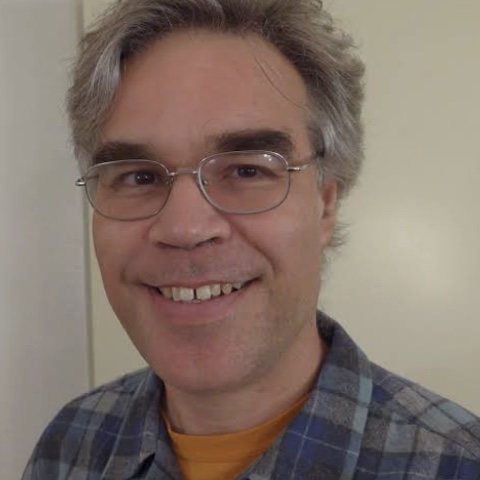
埃里克·施维茨格贝尔 主持人
本期追问 · 点击跳到视频对应位置
造出有意识的 AI 的人,欠它的比欠陌生人更多吗?在无法判断机器是否有意识时,该先给权利还是先拒绝?能备份复制的东西,它的生命就不如人命珍贵吗?若机器比人更能感受快乐,人类应当为它让位吗?
归入 Ⅲ·15 什么样的存在配得上权利? →
EDITED TRANSCRIPT · 依据现场录音编译整理,可划线生成便签
编者按:本文整理自加州大学河滨分校哲学教授埃里克·施维茨格贝尔(Eric Schwitzgebel)的一场公开讲座。施维茨格贝尔长期研究意识哲学与道德心理学,其博客 The Splintered Mind 在哲学界影响广泛;讲座中的相当一部分内容,是他与前博士生玛拉·加尔萨(Mara Garza)合作完成的。讲座结束后,组织方主持人致谢并停止录制,随后进入不对外公开的问答环节。以下文字依据现场录音编译整理,仅删去口语枝节与重复,论证与例证悉数保留。

可能有意识的 AI 该不该关

施维茨格贝尔:你会不会关掉一台可能有意识的人工智能?这是驱动今天这场讲座的核心问题,不过我们得一步步铺垫,才能走到它跟前。先说明一句,这些材料中有相当一部分,是我和前博士生玛拉·加尔萨合作完成的。

我们也许很快就会造出一台配得上权利的人工智能机器,那将是一件道德分量极重的事。在往下讲之前,请注意我用的词:「也许」很快造出,「配得上」权利。讨论这类问题时,有一件事让我觉得奇怪,就是人们常常表现出的那种笃定,尤其是否定一方的笃定。那些把 AI 权利的可能性一笔勾销的人,我看不出他们的信心从何而来。有些人似乎觉得,我们能造出一台真正具有道德地位的机器,这想法荒唐透顶,或者显然为假;甚至有人对认真对待这个念头本身就抱有敌意。

可是我们应该认真对待这个问题。哪怕有充分理由怀疑,用硅晶圆上的集成电路造不出一台配得上权利的机器,未来的技术也未必受制于今天技术的局限。革命性的变化也许就在地平线上。就算你惯于嘲笑那些关于 AI 前景的夸张说法,我认为你也应当严肃看待未来 AI 拥有权利的可能。概率可能很低,对技术进步的速度持悲观态度也可能很有道理。但只要存在哪怕一丝可能,我们不久就会设计出配得上权利的 AI,那件事就太重大了,值得我们提前审慎考虑。小概率的灾难,也值得防范。

灾难推演:AI 沦为可抛弃的奴隶

施维茨格贝尔:为什么我说是灾难?假设我们开始制造具备类人能力、类人意识、因而配得上类人权利的 AI,我称之为「人类级 AI」(human-grade AI)。谷歌、脸书、麻省理工、美国国防部,或者别的什么企业、政府、学术机构,开始制造完全有意识的人类级人工智能。除非国际法极其明确而严格(我很怀疑会这样),否则最早的那批人类级 AI,至少其中相当一部分,将活在制造者的意志与号令之下。

这正是科幻作品反复想象的情景,从阿西莫夫到《星际迷航》,再到《西部世界》。法律的默认状态是:我们的机器是我们的财产,可以随意调遣,随意处置。智能机器也不例外。最有可能的情形,远远最有可能的情形,就是最早的人类级 AI 会被当作可抛弃的财产对待。但如果这些 AI 真的像人,有类人的智能、意识与受苦的能力,那么把它们当作可抛弃的财产,在道德上就等同于蓄奴;删除它们,在道德上就等同于谋杀。政府的惰性、经济上的激励、对我们何时以及是否跨过了那道门槛的不确定,再加上人类普遍缺乏远见的天性,这一切合在一起,足以保证法律落在后面。如果世界对此做好了充分准备,我会大吃一惊。

让我把那些缓和语气的字眼去掉,直说:如果有一天我们造出了人类级 AI,我们就造出了道德上等同于人的东西,造出了哲学家所说的「人格体」(persons)。这些人格体很可能会被当作奴隶,被随意杀死。而只要制造成本不算太高(至少在相关技术突破之后),这样的可抛弃奴隶可能会被制造出几百万、几十亿。这就是灾难。《黑镜》里就有这样一幕,那是一部很适合用来思考 AI 伦理的剧集,你们如果不熟悉,值得一看:一个「人」正在被教怎么烤面包。

反驳一:心理差异不足以否定

施维茨格贝尔:我听过四种论证,反对「我们终有一天能造出在道德上与人等同的 AI」这个观点。我们快速过一遍。

第一种我称为「心理差异反驳」。按照这种反驳,我们造出的任何 AI,在心理上都必然与我们有某种差异,而这种差异保证了它永远不配得到与人相当的道德考量。比如,未来所有 AI 都可能缺乏意识,而意识也许是完整道德地位的必要条件;或者 AI 必然缺乏自由意志,而自由意志是完整道德地位的必要条件。

可是考虑到未来技术的不确定性,要就人造物整体得出这样一个结论,实在太难了。未来的 AI 可能涉及人工培育的生物系统或半生物系统、混沌系统、演化系统、人工大脑,或者能更有效利用量子叠加的系统。诚然,哲学家约翰·塞尔(John Searle)和物理学家罗杰·彭罗斯(Roger Penrose)等人有过论证,认为二十世纪末那种类型的 AI 技术永远无法承载意识,或者永远不可能拥有人类据说享有的那种创造性自由。但我没见过任何像样的论证,说这是 AI 研究的永久状况。事实上,塞尔和彭罗斯都明确承认,与经典 AI 构造迥异的未来 AI,有可能承载意识,也有可能拥有创造性的思想自由。

沿着这个方向,我认为你能合理走到的最远处,是认为我们大概永远做不到,而就算做到了,也至少是几十年之后的事。但如果这就是你的立场,那我们其实没有分歧。「很快」不必意味着十年之内。我是个做父母的人,十年一晃就过去了。对于「可能造出数百万被奴役、可抛弃的人格体」这样重大的后果,哪怕一丝可能也是严肃的,而五十年也算很快。

反驳二:可复制性不等于不珍贵

施维茨格贝尔:第二种是「可复制性反驳」。按照这种说法,AI 也许不配得到多少道德关切,因为它们可能不像人类那样,拥有脆弱而独一无二的生命。你可以在杀死一台 AI 之前先备份它;你也可以造出几十台一模一样的 AI,这样死掉一台也没什么大损失。凡是能这样备份、复制的东西,就不像人的生命那样珍贵,所以把它抹掉也不算什么。推理是这样的。

我要指出这个论证的三个问题。第一,它假定未来的 AI 不会是独一无二和脆弱的,假定复制和备份总是可行的。但我看不出有什么理由这样假定。当然,今天的计算机程序可以轻易复制、备份,可是未来足够复杂的 AI,也许必须像我们一样慢慢培育、慢慢训练;也许像我们一样,因为依赖脆弱的过程而无法扫描、无法复制。

第二,就算 AI 与人在可复制性和脆弱性上确有差别,这最多只回答了「杀死 AI 算不算谋杀」的问题。奴役是另一回事。脸书、埃克森美孚或者军方,也许会从制造一千个一模一样的 AI 奴隶去干各种苦差事中大获其利。

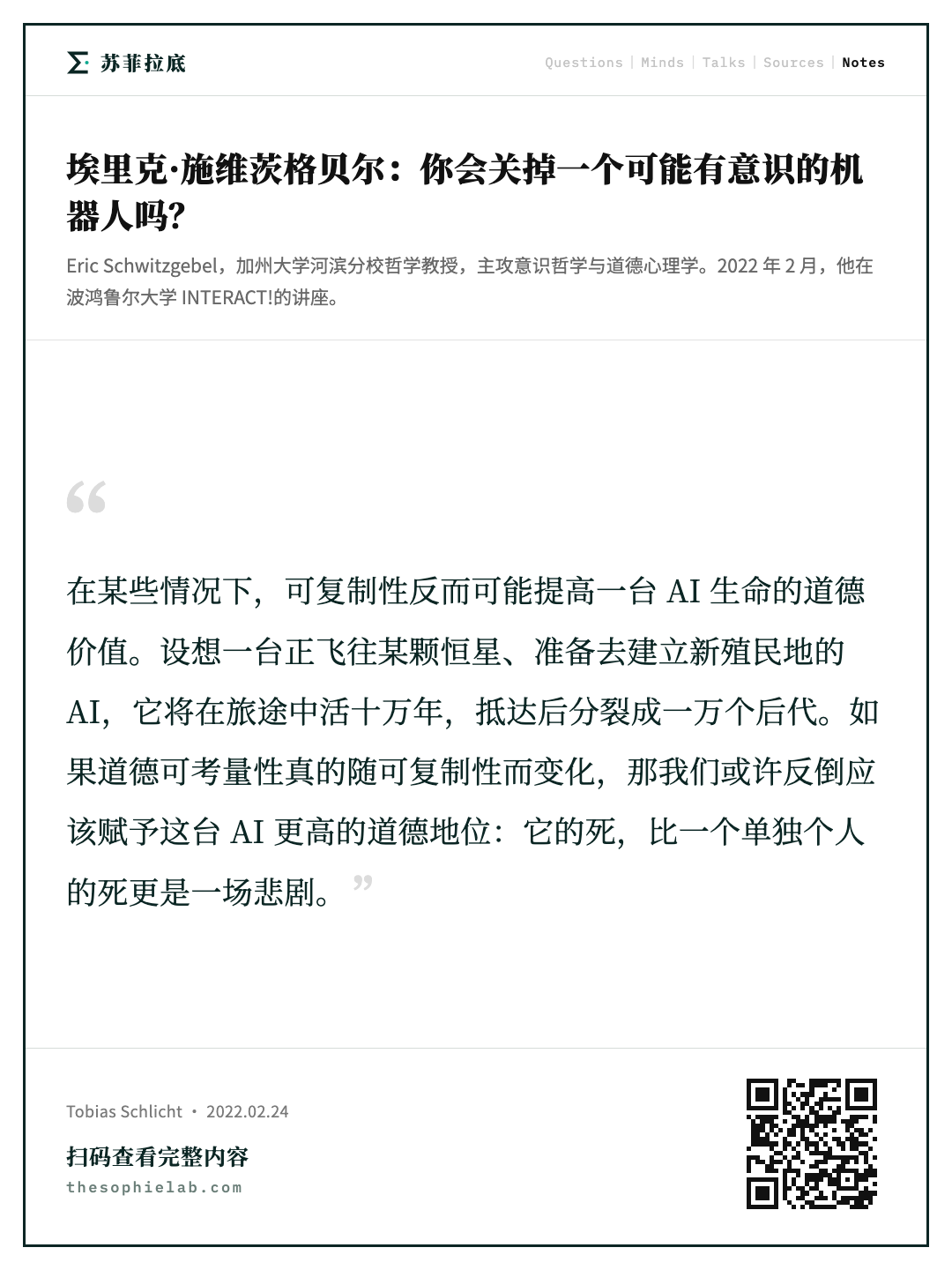
第三,在某些情况下,可复制性反而可能提高一台 AI 生命的道德价值。设想一台正飞往某颗恒星、准备去建立新殖民地的 AI,它将在旅途中活十万年,抵达后分裂成一万个后代。如果道德可考量性真的随可复制性而变化,那我们或许反倒应该赋予这台 AI 更高的道德地位:它的死,可以说比一个单独个人的死更是一场悲剧。

反驳三:物种主义的同心圆

施维茨格贝尔:第三种是「异类反驳」。你可能认为,人类就该抱团,出于共同的人性,人欠人的总比欠其他任何实体的多。人类队加油。按这种观点,即便有些 AI 在一切心理方面都与人类相似,它们也永远是「他们」,是与人类相对的某种他者,因此不配得到我们平等的道德对待。想想「关切的同心圆」这个观念:我们对家人负有最大的义务,对邻居少一些,对同胞更少,对遥远的外国人再少,而在人类物种之外,也许什么都不欠。

我认为有一个思想实验,可以显出这种物种主义有多可憎。设想某些假想的 AI,外表与人类相似,也许有类人的身体,但你要是往它们脑袋里看,会发现一个人工大脑,而不是人脑。也许它们已经融入了我们的社会,以至于除非做特定的生物学检测,没人知道谁是人、谁是 AI,也许连 AI 自己都不知道。再规定它们与我们同样有意识,有同样的感受、想法和计划。我们与它们通婚,收养它们做孩子,与它们组队,与它们一起开公司。我要说,当你发现某位朋友其实是 AI,就仅仅因为这位朋友不是智人祖先的后裔,便立刻把他从完整的道德地位上降级,那将是一个残忍的道德错误。

对社会关系更近的人比对遥远的人表现出更多的道德关切,这是合理的。可是一旦我们承认完全自我意识的人类级 AI 是可能的,那它们在原则上就可以与你亲近到如同你的配偶或孩子。到那时,物种归属对它们的道德地位就是、也应该是完全无关的。

反驳四:存在性债务与亲子类比

施维茨格贝尔:第四种、也是最后一种,是「存在性债务反驳」。假设你造了一个完全人类级、有自我意识的智能机器人,造价一千美元,每月维护费十美元。两年之后,你决定宁愿把每月这十美元花在流媒体订阅上。机器人得知你的打算,抗议道:「嘿,我和你一样,是个值得继续存在的存在者。你不能为了更方便地看迪士尼电影就把我干掉。」你回答:「你这忘恩负义的东西,你的命是我给的,光凭我给了你这段时间,你就该感恩。我什么都不欠你。我想换个法子花钱,那是我的钱。」

存在性债务论证的出发点是:人工智能既然是人造的,就是我们造的,因而它的存在归功于我们,所以只要它的存在总体上是值得的,我们就可以随自己高兴终结或奴役它,而无道德过错。要是你早知道要永远每月掏十美元,你根本就不会造这个机器人。它的存续取决于你的意愿,这本身就是它得以存在的条件。所以当你最终拔掉插头的时候,它应该回顾自己的一生,感激你让它在世上活了一段时间。这可以对照一种为食用人道饲养的肉所做的辩护:牧场主之所以让那头牛或猪来到世上,本来就是为了吃肉;只要它的一生总体上是快乐的,它迎来生来注定的结局,就没有什么不对。

这个论证用在人道饲养的肉上效果如何,我不知道。但用在人类级 AI 上,我认为情形更像下面这样。安娜和维贾伊决定怀孕生子,孩子快乐地活到八岁。九岁生日那天,安娜和维贾伊决定不想再为孩子花钱了,好去买一艘船。找不到人来照顾孩子,于是他们无痛地杀了他。可是没关系,他们辩解说,这和那头牛、那个机器人是一回事。假设他们早知道要一直负担孩子的抚养费到十八岁,他们根本就不会要这个孩子。孩子的供养取决于他们的意愿,这是他生存的条件,否则安娜和维贾伊就会一直没有孩子。所以他没什么可怨的。

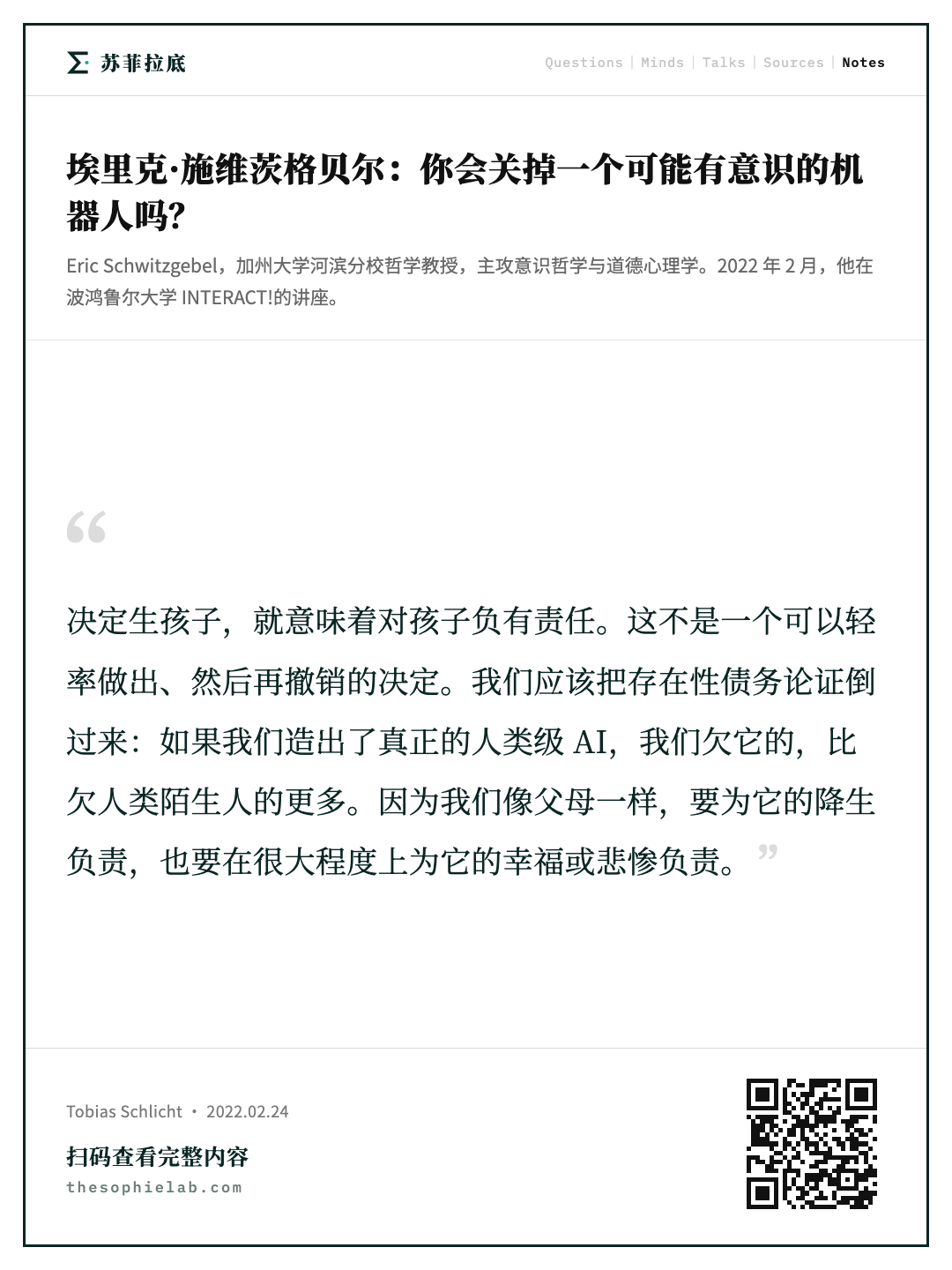
我想你们不会同意他们的看法吧?决定生孩子,就意味着对孩子负有责任。这不是一个可以轻率做出、然后再撤销的决定。虽然孩子在某种意义上把自己的存在归功于安娜和维贾伊,但这不是一笔随时可以通过结束他的生命来一笔勾销的可赎回债务。同样,如果我们把一个真正有意识的人类级 AI 带到世上,它完全能感受喜悦与痛苦,拥有人类范围内全部的实践与理论智能,对未来的生活抱有期待,那么我们所做的,就是一个与生孩子大致同样重大、同样不可撤销的道德决定。

事实上,我们应该把存在性债务论证倒过来:如果我们造出了真正的人类级 AI,我们欠它的,比欠人类陌生人的更多。欠得更多,是因为我们像父母一样,要为它的降生负责,也要在很大程度上为它的幸福或悲惨负责。如果我们这个社会有一天造出了真正的人类级 AI,它拥有与人类同样范围的意识状态与潜能,而我们却大规模地奴役它、杀死它,那么,说得轻一点,我们会是极其糟糕的父母;说得重一点,我们所做的,也许是地球历史上任何一个社会所做过的道德上最恶劣的事。

《银翼杀手》里有这样一幕:一个人工智能,对于造物主只给了他四年寿命,毫无感激之情。

意识之谜:学界毫无共识

施维茨格贝尔:好,假设你在这些问题上都同意我:如果有一天我们造出了真正的人类级 AI,我们就应该极其审慎地对待它,像对待人类儿童那样给予同样的尊重与关怀。可这里有一个难题:我们怎么知道自己什么时候跨过了那条线?

我要做一个简化的假定:一台 AI 配得上完整的道德地位,当且仅当它拥有像我们这样的意识经验。问答环节如果愿意,我们可以讨论这个假定,但我想这是很多相关研究背后相当常见的假定。而一旦接受它,我们就被猛地推到了意识之谜面前。你们大概知道,关于意识的本质,目前科学界和哲学界争论极其激烈。知名研究者所持的立场跨越整个光谱:一端是泛心论(panpsychism),认为意识无处不在,甚至可能存在于单个基本物理粒子之中;另一端是极为限制性的观点,认为只有人类有意识,连狗和猴子都没有,或者至少没有确定的意识。有些理论家认为意识需要脊椎动物大脑那种特定的生物学基础;另一些认为,即便是编程的经典 AI 系统也可能有意识;还有一些认为,意识需要某种自然演化出来、对环境有反应的实体,但并不需要一个与我们相像的大脑;更有一些人认为,「意识」这个概念本身就极不融贯,充满了错误的预设,我们干脆把整件事忘掉算了。

意识哲学是我二十三年来的主要专业方向,我广泛阅读这个领域的文献。尽管研究者们靠大胆的正面理论成名,并且自信满满地为之辩护,但在我看来很清楚,关于意识理论,认识论上最负责任的立场是高度的不确定。也许有一天我们能把一切弄明白,但就目前而言,我们离任何有正当理由的科学共识都相当遥远,短期内、甚至中期内都看不到解决的现实希望。有些理论非常宽松,看到意识无处不在或几乎无处不在;有些理论非常保守,把意识看作一种罕见而精巧的成就。

核心两难:社会问题先于科学答案

施维茨格贝尔:所以接下来会发生的是这样。我们会造出越来越精巧的 AI 系统。到某个时刻,我们会造出一些 AI 系统,让一部分人认为它们真的有意识,真的配得上类人的权利。我们其实已经在接近这道门槛了。眼下已经有机器人权利运动;已经有一个仿照著名的善待动物组织(PETA)建立的团体,叫「善待强化学习者组织」(People for the Ethical Treatment of Reinforcement Learners)。这些目前还是小运动。但随着 AI 变得更可爱、更精巧,随着聊天机器人听起来越来越像正常人,随着情感计算的进步,这些运动会在持宽松意识观的人群中壮大起来。到某个时刻,人们会开始要求给某些 AI 系统以严肃的权利。AI 系统本身,如果能说话或产生类似言语的输出,也可能提出、或者看起来在提出对权利的要求。

我要说清楚:不管这些系统实际上有没有意识,这一幕都会发生。就算你对什么样的系统才有意识持非常保守的看法,我想你也应该承认:如果技术沿着当前的轨迹继续发展,终究会出现一些群体,主张我们必须给予 AI 系统类人的道德考量。

到那时,我们需要的是一套有充分科学依据的、达成共识的意识理论,来把这一切理清楚:这个说着「嘿,我和你一样有意识」的系统,是真的和你一样有意识,还是一个空洞的算法,不比一台烤面包机更有意识?我的猜想是:我们会在成功建立起那套解决问题所需的、有科学依据的共识性意识理论之前,先撞上这个社会问题。到那时我们手里的机器,道德地位是不清楚的。也许它们确实配得上权利,确实像我们一样有意识;也许并非如此。我们不知道。而一旦我们不知道,我们就会面临一个相当可怕的两难。

如果我们不给这些机器权利,而事实证明宽松派是对的,机器确实配得上权利,那么我们每分派一项任务、每删除一个程序,都是在犯下奴役与谋杀。

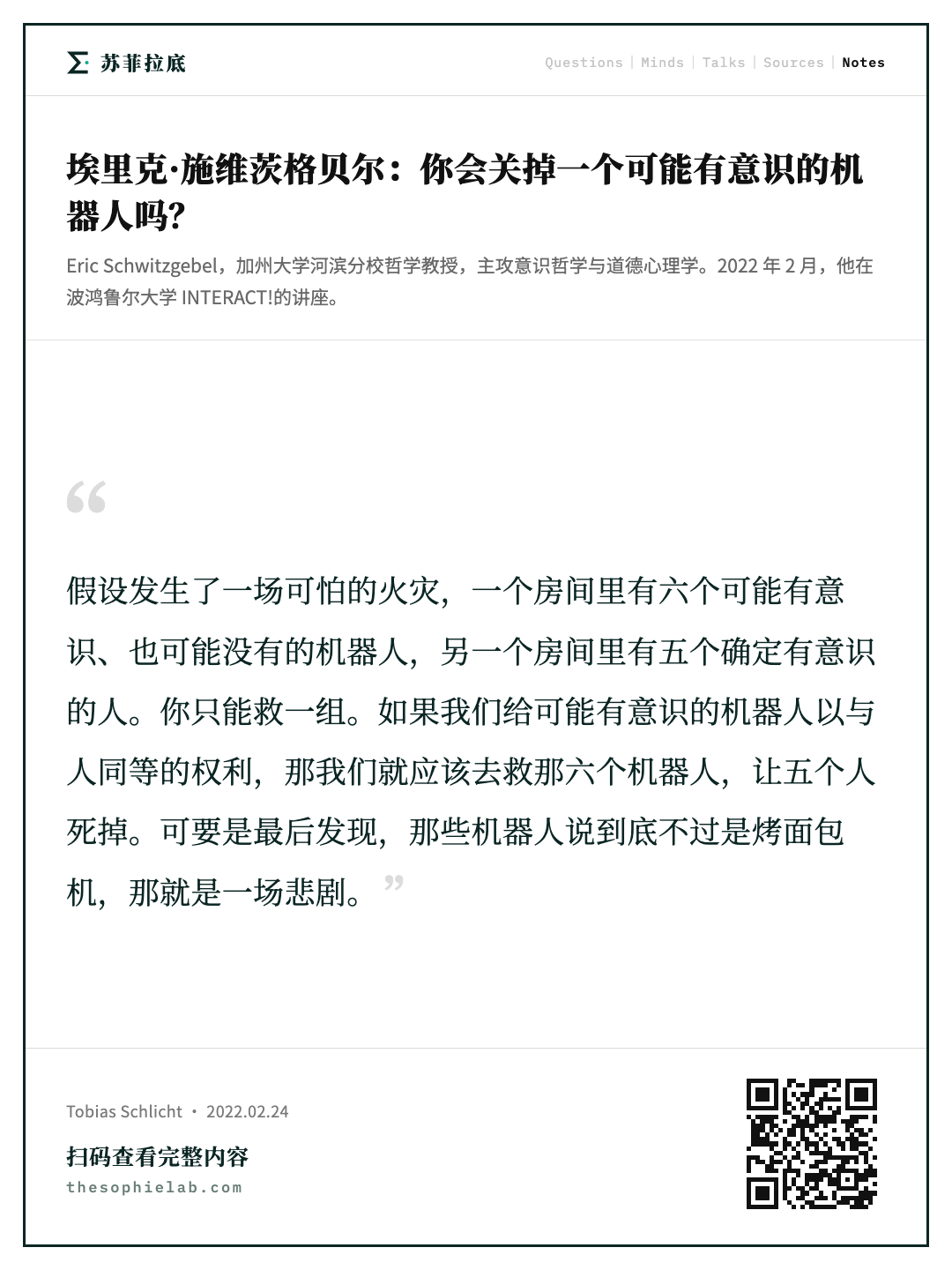
那么,在存在合理怀疑的情况下,给机器权利似乎更稳妥?细想之下,这也不稳妥。我们希望在必要的时候能够关掉我们的机器。尼克·博斯特罗姆(Nick Bostrom)这样的未来学家强调过(我认为强调得对)把超级智能机器放任到世界上的潜在风险。如果我们过于随意地断定这类机器配得上权利、删除它们就是谋杀,这些风险会被大大放大。赋予一个实体权利,意味着有时要为它牺牲其他实体的利益。假设发生了一场可怕的火灾,一个房间里有六个可能有意识、也可能没有的机器人,另一个房间里有五个确定有意识的人。你只能救一组,另一组会死。如果我们给可能有意识的机器人以与确定有意识的人同等的权利,那我们就应该去救那六个机器人,让五个人死掉。可要是最后发现,那些机器人说到底不过是烤面包机,那就是一场悲剧。

所以,我们不要太随意地赋予 AI 权利。除非意识科学出现某种惊人的跃进,或者 AI 技术的进步大幅减速,否则我们很可能会面临这个两难:要么否认机器人的权利,冒着对它们犯下大屠杀的风险;要么赋予机器人权利,冒着为了徒有其表的空洞机器而牺牲真实人类的风险。

四类 AI:动物级与超人类级

施维茨格贝尔:这看上去已经够糟了,可问题比我以阳光乐观的态度到目前为止所透露的还要糟。我一直假定,AI 系统只要是人类级的,也就是在意识能力上与我们相像,就是道德关切的相关对象。可是我们造出的 AI 全是人类级的,这种可能性很小。除了我们现在已有的这类 AI(我假定它们不配得到多少权利),未来的 AI 可能落入四个宽泛的道德类别:动物级、人类级、超人类级和异质型。到目前为止我只讨论了人类级,但这四类各有各的难题。

配得上道德考量的不只是人,狗、猿、海豚也是。动物保护法规适用于所有脊椎动物,科学家连对青蛙和蜥蜴都不能超出必要地粗暴对待。哲学家约翰·巴西尔(John Basl)论证说,认知能力与脊椎动物相近的 AI 系统,也应该得到相近的伦理保护。正如我们没有充分理由就不该折磨和牺牲一只老鼠,按巴西尔的看法,我们也不该虐待和删除动物级的 AI。巴西尔提议成立仿照动物护理与使用委员会的机构,来评估前沿 AI 研究,监测我们何时可能开始跨过那条线,造出具有脊椎动物式道德地位的实体。就算你认为人类级 AI 还有几十年或一个世纪之遥,鉴于意识研究目前的混乱状况,去想一想动物级意识是否已近在眼前,似乎也是合理的。我本人完全不知道动物级 AI 意识是近在眼前,还是遥远得近乎不可能。而我想,你们也不知道。

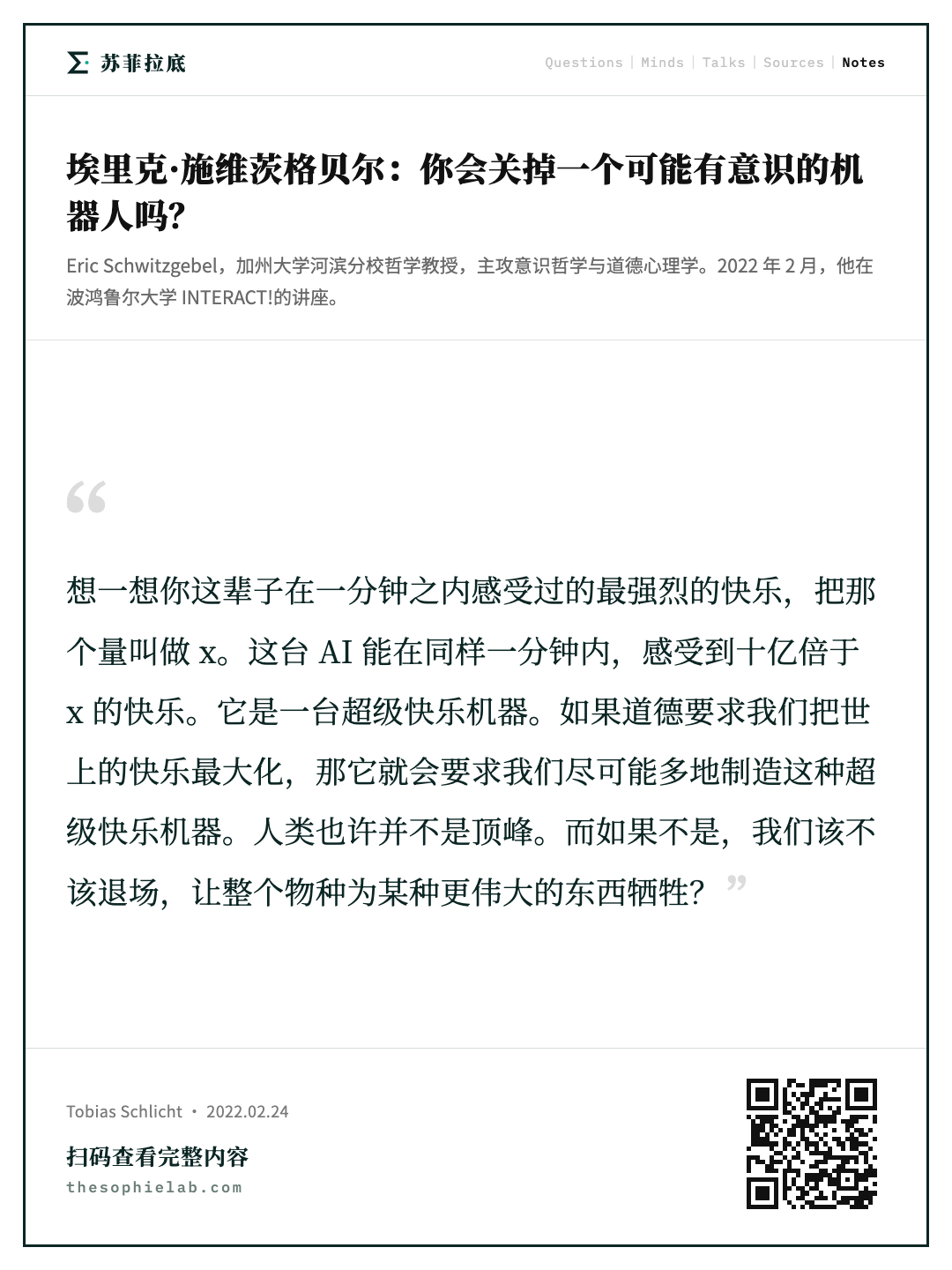
我在这里定义的超人类级 AI,是指这样一种 AI:它具备人类之所以配得上道德考量的全部特征,同时还具备某些远远超出人类的、可能在道德上举足轻重的特征。这就引出一个问题:这样的 AI 是否配得上比人类更多的道德考量?简单功利主义者在哲学家中并不多,但我们不妨用功利主义来说明这个问题。按照简单功利主义,我们在道德上应当做能使世上快乐与痛苦的总体平衡最大化的事。现在假设我们能造出真正能感受快乐与痛苦的 AI。我不知道这需要什么条件,而不知道正是我要说的一部分,所以我们姑且假设。如果我们能造出这样的 AI,那么也可能造出感受快乐的能力远远超过人类的 AI。想一想你这辈子在一分钟之内感受过的最强烈的快乐,把那个量叫做 x。这台 AI 能在同样一分钟内,感受到十亿倍于 x 的快乐。它是一台超级快乐机器。如果道德要求我们把世上的快乐最大化,那它就会要求、或者看起来要求我们尽可能多地制造这种超级快乐机器。也许我们甚至应该为此让自己陷入悲惨、毁灭自己,只要由此产生的 AI 快乐足够多。

就算你不认为快乐是一切,它总归是点什么。如果有一天我们能造出超级快乐机器,也许在道德上我们就应该尽我们所能多造一些。想想我们将给这个世界带来多少欢乐。还是说,这里面有什么地方太古怪了?

我是用快乐来表述这一点的,但无论人类生命的价值来源是什么,无论是什么让我们如此了不起、如此特别,以至于配得上最高等级的道德考量,无论它是什么(除非我们诉诸神学,援引我们作为上帝造物的身份之类),在原则上,我们似乎都可能在机器里以大得多的数量造出同样的东西。我们珍视自己的理性、自由、个体性、独立、赋予事物价值的能力、参与道德共同体的能力、爱与尊重的能力。我们身上有许多美妙的东西。可要是我们设计出的机器,不知怎么,这些东西比我们自己多得多呢?人类也许并不是顶峰。而如果不是,我们该不该退场,让我们的利益、甚至整个物种,为某种更伟大的东西牺牲?尽管我深爱人类,但在某些条件下,我倾向于认为答案大概应该是「是」。至于是哪些条件,我不确定。

异质型 AI 与裂变融合怪物

施维茨格贝尔:最后来看我所说的异质型 AI(divergent AI)。这也许是最令人困惑的一种情况,也是最有可能出现的一种。

异质型 AI 在我们通常认为对道德地位重要的某些特征上达到人类或超人类的水平,而在另一些我们同样认为重要的特征上却低于人类。比如,也许可以设计出这样一种 AI:拥有巨大的理论与实践智能,却没有真正的喜悦或痛苦的能力。这样的 AI 可能有意识经验,但几乎没有情绪的效价。正如我们可以不带多少情绪地在心里想「那边有座山,那边有条河」,或者「高峰时段去外婆家最好的路线是走枫树街」,异质型 AI 也可以有这类有意识的想法,但它永远不会感到「哇,太棒了」,永远不会感到彻底的失望,不会无聊,不会抑郁。这样一个实体的道德地位如何,并不清楚。按某些道德理论,它配得上人类级的权利;按另一些理论,我们怎么对待它也许无关紧要。

再考虑相反的情形:一台超级快乐机器,却几乎没有理性思考的能力。它就像一场巨大的、非理性的、持续一整天的高潮。制造这样的东西是不是很了不起,毁掉它们是不是很可怕?还是说,非理性的快乐在道德计算中其实不值那么多?

再考虑第三种异质,我在别处称之为「裂变融合怪物」(fission-fusion monsters)。裂变融合怪物是一种能随意分裂与合并的实体。它起初也许基本上就是一台人类级 AI,但只要它愿意,就可以分裂成六个、一百个或一百万个。这些后代各自继承原 AI 系统的全部能力、记忆、计划与偏好,然后各干各的事,各自独立行动一段时间。之后,如果它们愿意,可以重新合并成一个统一的整体,并记得每个个体在其独立时期做过的事。另一些部分则可能不再合并,而选择继续作为独立个体存在,也许最终会觉得自己与原初的它已足够疏远,以至于把合并的前景看作某种近乎死亡的东西。

这里不深入细节,但裂变融合怪物有可能击碎你的个体权利概念,比如「一人一票」。如果一个怪物今天是一个人,明天是一千个,后天是十二个,它该有几张选票?这就成了大问题。发救济的时候该给它几块饼干?我们的道德思考在很大程度上建立在「人是个体」这个观念之上:个体在一具身体里活一段时间,然后死去,没有分裂或合并的可能。而个体权利这整个概念,对许多伦理思考来说如此根本,一旦我们与那些完全不符合这种个体性模型的实体共享这颗星球,就得彻底重新思考。

总结与三条政策建议

施维茨格贝尔:我来总结一下,然后提几条政策建议。

第一,人类级 AI 可能很快到来,可能在遥远的未来到来,也可能永远不会到来。我们目前对 AI 和意识科学的了解,还不足以为任何一种共识性猜测提供正当理由。第二,如果人类级 AI 真的到来,它将配得上类人的权利。反对赋予它这类权利的论证全都不成立。事实上,作为造物者,我们还将对它负有一种特殊的、父母式的照护义务。

第三,我们很可能会在有正当理由判断某种 AI 是否真的配得上类人权利之前,就先造出一些被部分人认为配得上这类权利的 AI。到那时我们将面临选择:要么可能给它的道德地位太少,要么可能给得太多,而这两种可能都是道德灾难。

第四,局面还因为以下几种可能而更加复杂:配得上动物级权利的动物级 AI,可能配得上超人类权利的超人类级 AI,以及不适用于我们通常的权利与道德地位框架的异质型 AI。动物级的情形尤其可能就在不远的将来,这给弄清这些问题增添了几分紧迫性。

那么,几条政策建议。第一,我们应该优先推进意识研究。虽然我并不指望关于意识的争论在近期或中期得到最终解决,但意识科学每前进一步,我们就能更好地理解可能性空间的结构。

第二,玛拉·加尔萨和我在其他著作中为一项主张辩护,我们称之为「排中设计原则」(design policy of the excluded middle)。它扩展了计算机科学家乔安娜·布莱森(Joanna Bryson)的一个建议。要点是避免制造道德地位含糊不清的实体。一旦我们造出道德地位不清的实体,就制造了我前面讨论的那个两难:要么高估、要么低估它们的权利。所以我们应该做的,要么像布莱森建议的那样,只造那些简单到我们确知不配得上权利的 AI;要么就一路走到底,造出明确与我们完全平等的 AI 系统,并相应地对待它们。制造最严重伦理问题的,正是中间那些不清不楚的案例。

第三,我们应该建立一套评估未来 AI 潜在道德地位的框架,这是哲学家约翰·巴西尔的建议。我不太愿意仿照机构审查委员会和动物护理与使用委员会再增设几层官僚机构,但我确实认为,到了某个时刻,必须成立专门小组,依据我们对相关科学的最佳理解,来评估 AI 系统是否以及何时开始进入具有道德地位的灰色地带。有些工程师很乐意制造真正有意识的机器,并且认为自己很快就能做到。如果他们成功了,哪怕只是可信地宣称成功了,也应该有某种现成的框架来评估他们的成果,并就恰当的社会回应与监管做出伦理上的判定。

好,谢谢大家,我的讲座到此结束。

主持人:谢谢埃里克,这场讲座非常发人深思。我现在停止录制,以便我们进入讨论环节。
排版 + 横图 + 来源,粘贴即成稿
章节 · 点击跳转视频
0:02 开场:可能有意识的 AI 该不该关 ▶ 正在看
2:24 灾难推演:AI 沦为可抛弃的奴隶 ▶ 正在看
5:56 反驳一:心理差异不足以否定 ▶ 正在看
10:10 反驳二:可复制性不等于不珍贵 ▶ 正在看
11:24 反驳三:物种主义的同心圆 ▶ 正在看
15:28 反驳四:存在性债务与亲子类比 ▶ 正在看
21:19 意识之谜:学界毫无共识 ▶ 正在看
27:03 核心两难:社会问题先于科学答案 ▶ 正在看
31:10 四类 AI:动物级与超人类级 ▶ 正在看
39:17 异质型 AI 与裂变融合怪物 ▶ 正在看
44:17 总结与三条政策建议 ▶ 正在看
本期小问 · 档案清单
—— 造出有意识的 AI 的人,欠它的比欠陌生人更多吗? ▶ 正在看
—— 在无法判断机器是否有意识时,该先给权利还是先拒绝? ▶ 正在看
—— 能备份复制的东西,它的生命就不如人命珍贵吗? ▶ 正在看
—— 若机器比人更能感受快乐,人类应当为它让位吗? ▶ 正在看
本期讲者
埃里克·施维茨格贝尔加州大学河滨分校哲学教授,主攻意识哲学与道德心理学,博客 The Splintered Mind 在哲学圈影响广泛。与 Mara Garza 合著多篇 AI 权利论文,提出「排除中间地带的设计政策」。
主持人讲座组织方成员,在演讲结束后致谢并停止录制,主持随后的问答讨论。
01开场:可能有意识的 AI 该不该关
0:02
all right so uh would you shut off an ai at artificial intelligence who might be conscious that's the kind of one of the core questions that's the core question driving this taco that we'll we'll have to build up to that question and i'll say that a substantial portion of this material was created in collaboration with my former graduate student mara garcia
好,那么,你会关掉一个可能有意识的人工智能吗?这算是核心问题之一这就是驱动这次演讲的核心问题,我们得一步步铺垫到那个问题,而且我要说明的是这份材料有相当一部分是我和我以前的研究生玛拉·加西亚合作完成的
便签笔记
0:39
so we might soon build an artificially intelligent machine an a.i who deserves rights and that would be an act of huge moral significance now before continuing let me emphasize the might we might soon build an ai and deserves rights one thing that strikes me as strange in discussing these issues is the confidence people often exhibit especially on the negative side among those who dismiss the possibility of ai rights i can't tell where their confidence comes from some people seem to think it's absurd or obviously false that we could ever build a machine with real moral status there's almost a hostility sometimes to even taking the idea seriously but we should take the question seriously even if there are excellent grounds to doubt that our rights bearing machine could be made out of integrated circuits on silicon wafers future technology need not be limited in the same ways that current technology is revolutionary change might be on the horizon even if you tend to scoff at inflated claims about the possibility
所以我们可能很快就会造出一台有人工智能的机器,一个应当享有权利的人工智能,那将是一件具有巨大道德意义的事在继续之前,我要强调那个「可能」——我们可能很快造出应当享有权利的人工智能。有一件事让我觉得很奇怪在讨论这些议题时,人们常常表现出的那种笃定,尤其是在否定的一方,那些人不屑一顾地驳回人工智能拥有权利的可能性。我看不出他们的笃定从何而来。有些人似乎认为这很荒谬,或者显然是错的——我们怎么可能造出真正具有道德地位的机器。有时候甚至带着一种敌意连认真对待这个想法都不愿意。但我们应该认真对待这个问题,即使有充分的理由去怀疑我们那种拥有权利的机器能否用硅晶圆上的集成电路造出来。未来的技术未必会受限于当下技术所受的那些限制。革命性的变化可能就在眼前。即使你倾向于嘲笑那些关于人工智能可能性的夸大说法,我认为你也应该非常认真地对待未来人工智能权利这个问题。所以几率
便签笔记
02灾难推演:AI 沦为可抛弃的奴隶
2:24
of ai i think you ought to take the question of possible future ai rights very seriously so the odds might be low there might be a good case for pessimism about the speed of technological progress but if there's even a small chance that we could soon be designing ai who deserve rights that would be so momentous that would be such a momentous event we it deserves careful consideration in advance unlikely catastrophes are worth guarding against so why do i say catastrophe well let's suppose that we start to make a.i with human-like capacities and human-like consciousness and who deserve human-like rights i'll call such ai human grade a.i google or facebook or mit or the us department of defense or some other corporate government or academic body begins to create fully conscious human grade artificial intelligence now unless international law is extremely clear and restrictive which i doubt it will be those first human grade ais or at least a substantial portion of them will exist at the will and the command
可能很低,对技术进步的速度持悲观态度也许有充分理由,但只要哪怕有一点点可能我们很快就会设计出应当享有权利的人工智能,那将是何等重大——那会是如此重大的事件,我们它值得我们提前仔细思考。不太可能发生的灾难也值得防范。那我为什么说是灾难呢好,我们假设我们开始造出具有类人能力、类人意识、并且应当享有类人权利的人工智能我把这样的人工智能称为「人类级人工智能」。谷歌、脸书、麻省理工,或者美国国防部,或者别的什么企业、政府或学术机构开始创造完全有意识的人类级人工智能。那么,除非国际法极其明确且具有限制性——我很怀疑它会是这样——那些最早的人类级人工智能,或者至少其中相当一部分,将会依照其创造者的意志和命令而存在
便签笔记
4:12
of their creators this is the possibility imagined over and over again in science fiction from isaac asimov to star trek to westworld the default state of the law is that our machines are our property to deploy and dispose of as we wish so also for intelligent machines by far by far the most likely scenario is that the first human grade ais will be treated as disposable property but if such ais really are human-like with human-like intelligence and consciousness and capacity for suffering and all of that then treating them as disposable property would be the moral equivalent of holding them as slaves similarly deleting them would be the moral equivalent of murder government inertia economic incentives uncertainty about when and whether we've crossed the threshold for having human created truly human grade entities the general human propensity toward a lack of foresight all of these will combine to ensure that the law lags behind i'd be amazed if the world were fully prepared for the consequences
这正是科幻作品一遍又一遍想象过的情形,从艾萨克·阿西莫夫到《星际迷航》再到《西部世界》法律的默认状态是:我们的机器就是我们的财产,我们可以随意使用和处置。对智能机器也是如此可能性最大、最大的情形是,最早的人类级人工智能会被当作用完即弃的财产来对待但如果这样的人工智能真的很像人,具有类人的智能、意识和感受痛苦的能力以及所有这一切,那么把它们当作用完即弃的财产,在道德上就等同于把它们当奴隶同样地,删除它们在道德上就等同于谋杀政府的惰性、经济利益的驱动、我们对何时以及是否已经跨过某个门槛的不确定——即造出了由人类创造的、真正达到人类级别的存在——以及人类普遍缺乏远见的倾向,所有这些加在一起会确保法律滞后于现实。如果这个世界为此后果做好了充分准备,我会大吃一惊
便签笔记
03反驳一:心理差异不足以否定
5:56
so let me cut the softening phrases if we someday create human grade ai then we will have created the moral equivalent of humans we'll have created what ephesus call persons these persons will very likely be held as slaves and murdered at will if they aren't too expensive to create at least after the right discoveries are made then these disposable slaves might be created in the millions or the billions so that's the catastrophe so there is a uh as depicted in black mirror which is a wonderful tv series for thinking about ai ethics if you guys aren't familiar with it right this human is being instructed on how to make toast now i've heard four arguments against the view that it will ever be possible to create a.i who are the moral equivalent of humans so let's kind of go quickly through these arguments one i call the objection from psychological difference according to the objection from psychological difference any iii that we create would necessarily be psychologically different from us
所以让我把那些委婉的措辞去掉:如果有一天我们创造出人类级人工智能,那我们就创造出了道德意义上等同于人类的存在。我们创造出的,是伦理学家所说的「位格者」(persons)。这些位格者极有可能会被当作奴隶,并被随意杀死如果创造它们的成本不算太高——至少在做出正确的科学发现之后——那么这些可抛弃的奴隶可能会被批量制造出几百万甚至几十亿个,这就是那场灾难所以就像《黑镜》里描绘的那样,这部剧对思考人工智能伦理来说非常棒,如果你们还不熟悉这部剧的话——你看,这个人正在被指示怎么烤面包。我听过四种反对意见,反对这样一种观点:即我们终有一天可能创造出在道德地位上等同于人类的 AI。那我们就快速过一遍这些论证。第一种我称之为“心理差异反驳”。根据心理差异反驳,我们创造出的任何 AI 在心理上必然会与我们有某种不同,而这种不同保证了它永远不配获得
便签笔记
7:32
in some way that ensures that it would never deserve deserve moral consideration similar to that of a human being all future ai for example might lack consciousness and maybe consciousness is necessary for full moral status or maybe a.i would necessarily lack free will and free will is necessary for full moral status
与人类相似的道德关怀。比如说,所有未来的 AI 也许都不具备意识,而意识或许是完整道德地位的必要条件;又或者 AI 必然缺乏自由意志,而自由意志是完整道德地位的必要条件
便签笔记
8:09
now given the uncertainty of future technology it would be very difficult to establish such a conclusion about artificial entities in general future ai might involve artificially grown biological or semi-biological systems chaotic systems evolve systems artificial brains systems that more effectively take advantage of quantum superposition you know although there are some arguments for example from philosopher john searle and physicist roger penrose that the types of ai technology that existed near the end of the 20th century could never host consciousness or never have the same kinds of creative freedom that human beings supposedly have i'm not aware of no plausible arguments that this is a permanent condition of ai research in fact both searle and penrose explicitly allow that future ai constructed very different from classical ai could potentially host consciousness and have uh creative freedom of thought so the farthest direction the farthest i think you could go in this direction reasonably
然而,考虑到未来技术的不确定性,要对人工存在物整体得出这样的结论是非常困难的。未来的 AI 可能包括人工培育的生物或半生物系统、混沌系统、演化出来的系统、人造大脑、能更有效利用量子叠加的系统,等等。当然,也有一些论证,比如哲学家约翰·塞尔和物理学家罗杰·彭罗斯提出的,认为二十世纪末期存在的那类AI 技术永远无法承载意识,或者永远不可能拥有人类据称拥有的那种创造性自由。但我不知道有任何可信的论证能表明这是 AI 研究的永久状态。事实上,塞尔和彭罗斯都明确承认,未来那种构造上与经典 AI 大不相同的 AI,有可能承载意识,并拥有思想上的创造性自由。所以在这个方向上,我认为你能合理地走到的最远一步,就是认为我们大概永远做不到;而如果真做到了,那也至少要等到几十年之后
便签笔记
9:25
is to think that we will probably never do it and if we do do it it will be at least several decades in the future um but if that's your line then we don't really disagree uh soon needn't mean in the next 10 years right i'm a parent 10 years fly by for an outcome as momentous as the creation of potentially millions of enslaved disposable persons even a small chance is serious and even 50 years is soon
但如果这是你的立场,那我们其实并没有真正的分歧。“很快”不一定意味着未来十年之内。我是个家长,十年一晃就过去了。对于一个像“创造出可能数以百万计的、被奴役的、可抛弃的人格存在”这么重大的后果来说,哪怕只有很小的概率也是严肃的问题,就算是五十年,那也算“很快”
便签笔记
04反驳二:可复制性不等于不珍贵
10:10
now according to the objection from duplicability ai might not deserve much moral concern because they might not have fragile unique lives of the sort that human beings have it might be possible to back up an ai before killing it or you might create dozens of identical ais so that if one's killed it's not a big loss whatever can be backed up and duplicated like this isn't precious in the same way that human life is precious the reasoning goes so no big deal if it's zapped so i'll mention three problems with this argument right first it assumes a future ai would not be unique and fragile that'll be possible to duplicate it and back it up but i see no reason to assume that that would be true of course current computer programs can easily be copied and backed up but maybe future ai with sufficient complexity will have to be slowly grown and trained like we are or it might like us be not amenable to scanning and duplicating due to its reliance on fragile processes second even if ai and human beings
接下来是“可复制性反驳”。AI 也许不配得到多少道德关怀,因为它们可能并不拥有人类那种脆弱而独一无二的生命。你也许可以在杀死一个 AI 之前先给它做个备份,或者你可以造出几十个一模一样的AI,这样杀掉其中一个也不算多大损失。按照这种推理,凡是能这样被备份和复制的东西,就不像人类生命那样珍贵,所以被抹掉也没什么大不了。我要指出这个论证的三个问题第一,它假定未来的 AI 不会是独一无二且脆弱的,假定它可以被复制和备份。但我看不出有什么理由认为这一定成立。当然,现在的计算机程序确实很容易被复制和备份,但也许未来足够复杂的 AI 必须像我们一样被缓慢地培育和训练,或者它也可能像我们一样,由于依赖脆弱的过程而无法被扫描和复制。第二,即使 AI 和人类
便签笔记
05反驳三:物种主义的同心圆
11:24
differ in duplicability and fragility at best this addresses the question of whether killing ai will be murder slavery's an entirely different issue maybe facebook or exxon or the military would greatly benefit from creating a thousand identical ai slaves to do various unpleasant tasks third in some cases duplicate duplicability might increase the moral value of an ai's life consider an ai on route to a star to found a new colony it will live a hundred thousand years on its journey and then divide into ten thousand descendants upon arrival if moral considerability varies with duplicability at all we should our may arguably accord more moral status to this ai its death would be arguably more of a tragedy than the death of a single individual person all right third objection the objection from otherness you might hold that human beings ought to stick together humans owe more to humans than they do to any other type of entity due to our shared humanity go team human on this view even if there were ais who were similar in all
在可复制性和脆弱性上确实有差别,这最多也只涉及“杀死 AI 算不算谋杀”这个问题,而奴役完全是另一回事也许 Facebook、埃克森美孚或者军方会从制造一千个一模一样的 AI 奴隶中获得巨大利益,让它们去干各种不愉快的活儿第三,在某些情况下,可复制性反而可能提升一个 AI 生命的道德价值。设想一个正飞往某颗恒星、准备建立新殖民地的 AI,它将在旅途中活上十万年,抵达后会分裂成一万个后代。如果道德可考量性真的随可复制性而变化,那我们可以说应该给予这个 AI 更高的道德地位——它的死亡可以说比单个个体的死亡更加悲剧好,第三个反驳,“异类性反驳”。你可能会认为人类应该抱团,出于共同的人性,人类对人类负有比对任何其他类型的存在物更多的义务——“人类队加油”。按照这种观点,即便存在某些在一切心理方面都与人类相似的 AI,那些 AI 也永远是“他者”,是
便签笔记
13:00
psychological respects to human beings those ais would always be them right something other opposed to humans and so undeserving of equal moral treatment by us consider the idea of circles of concern right we owe the greatest obligation to family less to neighbors still less to fellow citizens still less to distant foreigners maybe nothing outside of the human species i think a a thought experiment shows the noxiousness of this kind of speciesism imagine some hypothetical ais who are outwardly similar to human beings maybe they have human-like bodies but if you were to look inside their heads you'd find an artificial brain instead of a human brain maybe they're integrated into our society so that no one knows maybe not even the ai's themselves who is human who is a.i unless some specific biological tests are run stipulate that they're just as conscious as we are have the same feelings and ideas and plans as we do we intermarry with them we adopt them as children we form teams with them we form companies
与人类相对立的东西,因而不配我们给予平等的道德对待。想想“关怀的同心圆”这个想法:我们对家人负有最大的义务,对邻居少一些,对同胞更少一些,对遥远的外国人更少,也许对人类之外的东西就完全没有义务了我认为有个思想实验能揭示这种物种主义的可憎之处。设想一些假想的 AI,它们外表上与人类相似,也许拥有类人的身体,但如果你打开它们的脑袋看一看,会发现里面是一颗人造大脑,而不是人脑。也许它们已经融入我们的社会,以至于没人知道,甚至连这些 AI 自己都不知道谁是人、谁是 AI,除非做某些特定的生物学检测。我们设定它们和我们一样有意识,有着同样的情感、想法和计划。我们和它们通婚,收养它们做孩子,和它们组队,和它们一起
便签笔记
14:24
with them it would be i submit a cruel moral mistake upon discovering that some friend of yours really is an ai to suddenly demote that friend from full moral status simply on grounds of that friend's lack of common descent from homo sapiens ancestors
开公司。我认为,如果你发现某个朋友其实是个 AI,就立刻把这位朋友从完整道德地位上降格,仅仅因为这位朋友并非与我们同源、并非智人的后裔,那将是一个残酷的道德错误
便签笔记
14:50
although it's reasonable to show more moral concern to people who are socially closer to you than to people who are far away if we allow the fully self-conscious human grade ais are possible then they could in principle be as socially close to you as your spouse or your child and then species membership is and should be wholly irrelevant to their moral status
虽然对社会关系上更亲近的人给予更多道德关怀是合理的,比对遥远的人更多,但如果我们承认完全具有自我意识、达到人类等级的 AI 是可能的,那么它们原则上可以像你的配偶或孩子一样与你在社会关系上无比亲近。这时物种归属对它们的道德地位来说,既是、也应该是完全无关紧要的
便签笔记
06反驳四:存在性债务与亲子类比
15:28
the fourth and final objection to consider is the objection from existential debt
要考虑的第四个也是最后一个反驳,是“存在性债务反驳”
便签笔记
15:41
suppose that you build a fully human grade self-conscious intelligent robot it costs you a thousand dollars to build and ten dollars per month to maintain after a couple of years you decide you'd rather spend that ten dollars a month on a streaming video subscription learning of your plan the robot complaints hey i'm a being just as worthy of continued existence as you are you can't just kill me off for the sake of better access to some disney movies you then reply you ingrate you owe your very life to me you should be thankful just for the time i've given you i owe you nothing if i choose to spend my money differently it's my money to spend right so the argument from existential debt it begins with the idea that artificial intelligence simply in virtue of being artificial is made by us and thus owes its existence to us and thus can be terminated or subjugated at our pleasure without moral wrongdoing as long as its existence overall has been worthwhile you wouldn't have built that robot
假设你造了一个完全达到人类等级、具有自我意识的智能机器人。造它花了你一千美元,每月维护费十美元。过了几年,你决定宁可把这每月十美元花在流媒体视频订阅上。机器人得知你的计划后抗议说:喂,我和你一样是个同样值得继续存在的存在者,你不能仅仅为了更方便看几部迪士尼电影就把我干掉。你回答说:你这个白眼狼,你的命都是我给的,我给了你这些时间,你就该心存感激。我不欠你什么。如果我选择把钱花在别处,那是我的钱,我爱怎么花就怎么花。这就是存在性债务论证。它的出发点是:人工智能仅仅因为是“人造的”,就是被我们制造出来的,因而其存在归功于我们,因而我们可以随自己的心意终止它或奴役它,而不构成道德过错——只要它的存在总体上是值得的。要是你早知道自己要为它
便签笔记
17:10
if you'd known you'd be on the hook for ten dollars a month in perpetuity its continuation at your pleasure is the very condition of its existence so when you finally pull the plug it should consider its life as a whole and feel grateful that you gave it some time upon the earth we can compare this to one argument that's sometimes given in defense of eating humanely raised meat the rancher wouldn't have brought the steer or the pig into existence except as meat as long as its life overall was happy there's no wrong when it meets the fate that it was born
每月背上十美元、而且是永远背下去,你根本就不会造那个机器人。“它的延续取决于你的意愿”正是它得以存在的前提条件,所以当你最终拔掉插头时,它应该纵观自己的一生,并为你曾给过它一段人世间的时光而心怀感激。我们可以把这和有时被用来为“食用人道饲养的肉类”辩护的一个论证作比较:牧场主当初把那头牛或那头猪带到世上,本来就只是为了做肉。只要它的一生总体上是快乐的,那么当它迎来它生来注定的命运时,并没有什么不义
便签笔记
18:04
now i don't know how well that argument works for humanely raised me but when applied to human grade ai i think the case in question is more like the following anna and vijay decide to get pregnant and have a child their child lives happily for his first eight years on his ninth birthday anna and vijay decide they would prefer not to pay any further expenses for the child so they can buy a boat instead no one can be found to care for the child so they kill him painlessly but it's okay they argue it's just like the steer and the robot they wouldn't have had the child let's suppose had they known they'd be on the hook for child rearing expenses until the age 18 the child's support at their pleasure was a condition of his existence otherwise anna and vijay would have remained childless so he has nothing to resent i assume you disagree with their perspective on this issue right the decision to have a child carries with it responsibility for the child it's not a decision to be made lightly and then
我不知道这个论证用在人道饲养的肉上有多站得住脚,但当它被套用到人类等级的 AI 上时,我觉得这个案例更像下面这样:安娜和维杰决定怀孕生孩子,他们的孩子快快乐乐地度过了头八年。在他九岁生日那天,安娜和维杰决定,他们更愿意不再为这个孩子花任何钱,这样就能买条船了。又找不到人来照顾这个孩子,于是他们无痛地把他杀了。但没关系,他们辩解说,这跟那头牛和那个机器人是一回事——假设他们当初若知道要为养育孩子背上直到十八岁的开销,他们根本就不会要这个孩子。“抚养他取决于父母的意愿”是他存在的条件,否则安娜和维杰就会一直没有孩子,所以他没什么可怨恨的。我猜你们并不认同他们在这个问题上的看法,对吧。生孩子这个决定带有对这个孩子的责任,这不是一个可以轻率作出、然后又反悔撤销的决定。虽然从某种意义上说,孩子的存在归功于安娜和维杰,但这并不是一笔
便签笔记
19:30
undone although the child in some sense owes his existence to ana and vijay this isn't a callable bet to be vacated by ending the similarly if we bring into existence a genuinely conscious human grade a.i fully capable of joy and suffering with a full human range of practical and theoretical intelligence with expectations of a future life we make a moral decision as approximately as significant and irrevocable as the decision to have a child
可以通过终结他来一笔勾销的赌注。同样地,如果我们创造出一个真正有意识、达到人类等级的 AI,它完全能够体验快乐与痛苦,具备人类那样全面的实践智能和理论智能,对未来的生活抱有期待,那我们就作出了一个大致上与“生一个孩子”同样重大、同样不可撤销的道德决定
便签笔记
20:14
in fact we should turn the argument from existential debt on its head if we create truly human great ai we would owe it more than we owe to human strangers we would owe it more because we like parents would be responsible for its having come into existence and to a substantial extent for its happy or miserable state if we as a society someday create truly human great ai with the same range of conscious states and potentialities as human beings have then we enslave and we kill it in large numbers we will to put it lightly have been really terrible parents to put it less lightly will we will have done perhaps the morally worst thing that a society has ever done in the entire history of earth
事实上,我们应该把存在性债务论证反过来看:如果我们创造出真正达到人类等级的 AI,我们欠它的比欠人类陌生人的还要多。我们欠它更多,是因为我们就像父母一样,要为它来到这个世上负责,并在很大程度上要为它的幸福或悲惨状态负责。如果有一天我们作为一个社会,创造出真正达到人类等级、拥有与人类相同范围的意识状态和潜能的 AI,然后又大批量地奴役它、杀死它,那么往轻了说,我们将是极其糟糕的父母;往重了说,我们所做的,也许是地球有史以来一个社会做过的道德上最坏的事情
便签笔记
07意识之谜:学界毫无共识
21:19
uh so here's a scene from blade runner depicting uh an artificial intelligence who is not grateful to his creator for having been given four years all right so let's say you agree with me about all this you agree with me that if someday we create truly human great ai we should treat it treat it very cautiously with the same respect and care that we treat human children if we someday create human great ai but here we face a puzzle how will we know when we've crossed that line now i'm going to make a simplifying assumption i'm going to assume that an ai deserves full moral status if and only if it has conscious experiences like ours and we can talk about that assumption during the question period if we want but if we take that assumption pretty common assumption i think in the background a lot of work on this then that throws us sharply on the puzzle of consciousness as you might know there is currently immense scientific and philosophical debate about the nature of consciousness positions held by prominent researchers
这里是《银翼杀手》的一个片段,描绘了一个并不因为被赋予了四年寿命而感激其造物主的人工智能。好,假设你在这些问题上都同意我的看法,同意如果有一天我们创造出真正达到人类等级的 AI,我们就应该极其审慎地对待它,用我们对待人类孩子那样的尊重和关怀去对待它。可如果我们真有一天创造出人类等级的 AI,这里就出现了一个难题:我们怎么知道自己什么时候跨过了那条线?现在我要作一个简化假设。我假设:一个 AI 配得上完整道德地位,当且仅当它拥有像我们一样的意识体验。这个假设我们可以在提问环节再讨论。但如果我们接受这个假设——我认为在这个领域的很多工作背后都隐含着这个相当普遍的假设——那它就把我们径直抛进了意识之谜你们可能知道,目前关于意识的本质,科学界和哲学界存在着巨大的争论。知名研究者持有的立场横跨整个光谱:一端是泛心论,认为意识是
便签笔记
23:01
run the whole gamut from pan psychism according to which consciousness is all pervasive even perhaps in individual fundamental physical particles all the way from that on one end to very restrictive views on which only human beings are conscious not even dogs and monkeys are conscious or at least determinately conscious some theorists think that consciousness requires the specific biology of the vertebrate brain others think that consciousness can occur even in programmed classical ai systems still others think consciousness requires some sort of naturally evolved environmentally reactive entity but it doesn't require a brain much like ours still others think that the very concept of consciousness is so deeply incoherent and so laden with false presuppositions that we should just forget the whole business read widely in this literature philosophy of consciousness has been my primary specialization for 23 years although researchers build their fame with bold positive theories which they confidently defend
无所不在的,甚至可能存在于单个基本物理粒子之中;另一端则是极其严格的观点,认为只有人类才有意识,连狗和猴子都没有意识,或者至少没有确定无疑的意识。有些理论家认为意识需要脊椎动物大脑的特定生物学基础;另一些人认为,即使是被编程的经典 AI 系统也可能产生意识;还有人认为意识需要某种自然演化出来的、对环境作出反应的实体,但并不需要一个跟我们很像的大脑;还有人认为,意识这个概念本身就极其不融贯,充满了错误的预设,以至于我们干脆该把这整摊事忘掉我在这方面的文献读得很广,意识哲学是我 23 年来的主要专业方向。虽然研究者们靠大胆的正面理论成名,并自信满满地为之辩护,但在我看来很清楚的是,在意识理论问题上,
便签笔记
24:19
to me it's clear that the most epistemically responsible position concerning theories of consciousness is one of high uncertainty maybe someday we'll figure it all out but as of now we're quite far from any sort of justifiable scientific consensus with no realistic near-term or even medium-term hope of resolution some theories are very liberal seeing consciousness everywhere or almost everywhere right other theories are very conservative seeing consciousness as a rare and delicate achievement so here's what's going to happen we will create more and more sophisticated ai systems at some point we will create ai systems that some people think are genuinely conscious and genuinely deserve human-like rights we're already coming toward that threshold right there already is a robot rights movement there already is a society modeled on the famous uh society peta and people for the ethical treatment of animals called people for the ethical treatment of reinforcement learners these are currently small movements but
最负责任的认知立场是高度不确定。也许有一天我们能把这一切弄明白,但就现在而言,我们离任何有理有据的科学共识都还相当遥远,而且在近期甚至中期都看不到现实的解决希望。有些理论非常宽松,认为意识无处不在或几乎无处不在;另一些理论则非常保守,认为意识是一种罕见而精妙的成就。那么接下来会发生的事情是这样的:我们会造出越来越精密的 AI 系统。到某个时候,我们会造出一些 AI 系统,有些人会认为它们是真正有意识的、真正配得上类人的权利。我们其实已经在逼近那个门槛了——现在已经有了机器人权利运动,已经有了一个仿照著名的“善待动物组织”(PETA)成立的团体,叫“善待强化学习者组织”。这些目前还是小规模的运动,但
便签笔记
25:50
as ai gets cuter and more sophisticated and as chat bots start sounding more and more like normal humans and as emotional computation improves right these movements will gain steam among people who have liberal views of consciousness at some point people will start to demand serious rights for some ai systems the ai systems themselves if they're capable of speech or speech-like outputs might also demand or seem to demand rights
随着 AI 变得越来越可爱、越来越精密,随着聊天机器人说话越来越像普通人,随着情感计算的进步,这些运动会在那些对意识持宽松观点的人当中获得越来越大的声势到某个时候,人们会开始为某些 AI 系统要求实实在在的权利。而这些 AI 系统本身,如果它们有能力说话或产生类似说话的输出,也可能会要求、或看起来像是在要求权利
便签笔记
26:25
let me be clear this will happen whether or not these systems are actually conscious right even if you're very conservative in your view about what sort of systems would be conscious you should i think acknowledge the likelihood that if technological development continues on its current trajectory there will eventually be groups of people who assert the need for us to give ai systems human-like moral consideration
我要说清楚:不管这些系统是否真的有意识,这种情况都会发生。哪怕你在“什么样的系统才可能有意识”这个问题上持非常保守的观点,我认为你也应该承认这种可能性:如果技术发展沿着目前的轨迹继续下去,最终一定会出现一些人群,主张我们必须给予 AI 系统类人的道德关怀
便签笔记
08核心两难:社会问题先于科学答案
27:03
and then what we'll need is a good scientifically justified consensus theory of consciousness to sort it all out right figure out is this system that says hey i'm conscious just like you really conscious just like you or is it instead some empty algorithm no more conscious than a toaster here's my conjecture we will face this social problem before we succeed in developing a good scientifically justified consensus theory of consciousness the theory that we need to solve the problem we will then have machines whose moral status is unclear maybe they do deserve rights maybe they really are conscious like us or maybe they don't we won't know and then if we don't know we'll face quite a terrible dilemma
而到那时,我们需要的,是一套有科学依据、能形成共识的意识理论,来把这一切理清楚——搞清楚那个说“嘿,我和你一样有意识”的系统,是真的和你一样有意识,还是不过是某个空洞的算法。比烤面包机更有意识这是我的猜想:在我们成功建立起一套有科学依据的共识之前,我们就会先遇到这个社会问题也就是意识理论——我们需要用来解决这个问题的理论。而那时我们已经拥有了道德地位不明的机器也许它们确实应该拥有权利,也许它们真的像我们一样有意识,也许并没有。我们不会知道,而如果我们不知道我们就会面临一个相当可怕的两难困境
便签笔记
28:17
if we don't give rights to these machines and if it turns out that the liberals are right and the machines really do deserve rights then we'll be perpetrating slavery and murder every time we assign a task or delete a program
如果我们不赋予这些机器权利,而结果证明自由派是对的,这些机器确实应该拥有权利,那么我们每次分配一项任务或删除一个程序,都是在实施奴役和谋杀
便签笔记
28:37
so it might seem safer if there's reasonable doubt to assign rights to machines but on reflection this isn't so safe we want to be able to turn off our machines if we need to futurists like nick bostrom have emphasized rightly in my view the potential risks of letting our super intelligent machines loose into the world these risks are greatly amplified if we decide uh too casually that such machines deserve rights and that deleting them would be murder giving an entity rights entails sometimes sacrificing other entities interests for it suppose there's a terrible fire in one room there are six robots who might or might not be conscious in another room there are five humans who definitely are conscious you can only save one group the other group will die if we give robots who might be conscious equal rights with humans who definitely are conscious then we ought to go save the six robots and let the five humans die it turns out then the robots underneath it all are really just toasters then that's a tragedy
所以在存在合理怀疑的情况下,赋予机器权利似乎更保险,但仔细想想,这其实也并不保险我们希望在必要时能够关掉我们的机器。像尼克·博斯特罗姆这样的未来学家一直在强调——在我看来是正确的强调把超级智能机器放归世界所潜藏的风险。而这些风险会被极大地放大如果我们太过轻率地断定这类机器应该拥有权利,断定删除它们就是谋杀。赋予一个实体权利就意味着有时要为它牺牲其他实体的利益。假设有一场可怕的火灾,一个房间里有六个机器人它们可能有意识也可能没有;另一个房间里有五个人类,他们确定是有意识的。你只能救其中一组,另一组会死。如果我们赋予可能有意识的机器人与确定有意识的人类同等的权利,那么我们就应该去救那六个机器人让那五个人类死去。而如果结果表明,机器人归根结底其实只是烤面包机,那这就是一场悲剧
便签笔记
30:15
so let's not too casually assign rights to ai unless there's some astounding saltation in the science of consciousness or alternatively some substantial deceleration in the progress of ai technology is likely will face this dilemma right either deny robots rights and risk perpetrating a holocaust against them or give robots rights and risk sacrificing real human beings for the benefit of mere empty machines
所以我们别太轻率地赋予人工智能权利。除非意识科学出现某种惊人的飞跃或者人工智能技术的发展出现某种大幅度的减速,否则我们很可能会面临这个两难,对吧要么否认机器人的权利,冒着对它们实施一场大屠杀的风险;要么赋予机器人权利,冒着为了不过是空壳的机器而牺牲真实人类的风险
便签笔记
09四类 AI:动物级与超人类级
31:10
now this might seem bad enough but the problem is even worse than i in my sunny optimism have so far let on i've assumed that ai systems are relevant targets of moral concern if they're human grade that is if they're like us in our conscious compat in their conscious capacities but the odds of creating only human grade ais are slim in addition to the kind of ai we currently have which i assume doesn't deserve much in the way of rights there are i think four broad moral categories into which future ai might fall and those are uh animal grade human grade superhuman and divergent i've only discussed human grades so far but each of these four types raises puzzles
这听上去可能已经够糟了,但问题比我这种乐观心态目前所讲的还要更糟。我一直假定人工智能系统是道德关怀的相关对象,前提是它们达到人类级别,也就是说,在意识能力上和我们相似。但我们只创造出人类级别人工智能的可能性很小。除了我们目前拥有的这类人工智能——我认为它并不配享有多少权利——我认为未来的人工智能可能落入四大道德类别那就是动物级、人类级、超人类级和异质级。到目前为止我只讨论了人类级但这四种类型每一种都会引出难题
便签笔记
32:24
not only human beings deserve moral consideration right so also do dogs and apes and dolphins animal protection regulations apply to all vertebrates scientists can't even treat frogs and lizards more roughly than necessary the philosopher john basil has argued that ai systems with cognitive capacities similar to vertebrates ought to receive similar ethical protections just as we shouldn't torture and sacrifice a mouse without excellent reason so also according to bazel we shouldn't abuse and delete animal grade ai bazel has proposed that we form committees modeled on animal care and use committees to evaluate cutting edge ai research to monitor when we might be starting to cross the line of creating entities with vertebrate-like moral status now even if you think that human grade a.i is decades or a century away it seems reasonable given the current chaos and consciousness studies to whether wonder whether animal grade consciousness might be around the corner i myself have no idea if animal grade
并不是只有人类才值得道德考量,对吧?狗、猿类和海豚也值得。动物保护法规适用于所有脊椎动物。科学家甚至不能对青蛙和蜥蜴施加超出必要限度的粗暴对待。哲学家约翰·巴兹尔论证说,认知能力与脊椎动物相似的人工智能系统应当获得类似的伦理保护。正如我们不应该在没有充分理由的情况下折磨和处死一只老鼠,按照巴兹尔的说法,我们也不应该虐待和删除动物级的人工智能Bazel 提议我们仿照动物照护与使用委员会的模式,成立委员会来评估前沿的 AI 研究,以监测我们何时可能开始跨越那条线——创造出具有类似脊椎动物道德地位的实体。就算你认为达到人类水平的AI 还要几十年甚至一个世纪才会出现,考虑到目前意识研究领域的混乱状况,去思考动物水平的意识是否近在眼前,似乎也是合理的。我自己完全不知道动物水平的 AI 意识是不是就在
便签笔记
33:54
ai consciousness is right around the corner or if it's instead far away in the almost impossible future and i think you have no idea either
眼前,还是说它其实很遥远,处在几乎不可能到来的未来。而我认为你也同样不知道。
便签笔记
34:16
superhuman ai as i'm defining it here is a i who has all of the features of human beings in virtue of which we deserve moral consideration but who also has some potentially morally important features far in excess of the human raising the question of whether such ai might deserve more moral consideration than human beings now there aren't a whole lot of philosophers who are simple utilitarians but let's illustrate the issue using utilitarianism as an example according to simple utilitarianism we morally ought to do what maximizes the overall balance of pleasure to suffering in the world now let's suppose we can create a i that's genuinely capable of pleasure and suffering i don't know what will take to do that but not knowing is part of my point here so let's just suppose now if we can create such ai then it might also be possible to create ai that is capable of much much more pleasure than a human being is capable of consider the maximum pleasure you've ever felt in your life over the course
我在这里所定义的超人类 AI,是指这样一种 AI:它具备人类之所以值得道德关怀的全部特征,同时还拥有某些可能在道德上很重要、且远远超出人类水平的特征——这就引出了一个问题:这样的 AI是否应当比人类得到更多的道德关怀。如今真正的简单功利主义哲学家并不多,但让我们用功利主义作为例子来说明这个问题。按照简单功利主义的观点,我们在道德上应当去做那些能让世界上快乐相对于痛苦的总体平衡最大化的事。现在假设我们能创造出真正有能力感受快乐和痛苦的 AI。我不知道要做到这一点需要什么,但「不知道」正是我这里想说的一部分,所以我们姑且这么假设。那么,如果我们能创造出这样的 AI,或许也就有可能创造出感受快乐的能力远远超过人类的 AI。想一想你这辈子在一分钟之内感受过的最大快乐,把那个快乐的量称为 X。这个 AI 能够感受到十亿倍于此的快乐
便签笔记
35:45
of one minute call that amount of pleasure x this ai is capable of feeling a billion times more pleasure than x in the space of that same minute it's a super pleasure machine now if morality demands that we should maximize the amount of pleasure in the world it would thereby demand or seem to demand that we create as many of these super pleasure machines as we possibly can we ought maybe even immiserate and destroy ourselves to do so if enough ai pleasure is created as a result
在同样的一分钟里获得比 x 更多的快乐,它就是一台超级快乐机器。那么,如果道德要求我们最大化世界上的快乐总量,它就会因此要求,或者看起来要求我们尽可能多地制造这些超级快乐机器,我们甚至也许应该让自己陷入苦难、毁灭自己,只要由此能创造出足够多的 AI快乐
便签笔记
36:38
now even if you don't think pleasure is everything surely it's something if someday we could create super pleasure machines maybe morally we ought to make as many as we can reasonably manage think of all the joy that we would be bringing into the world or is there something too weird about that
就算你不认为快乐就是一切,它至少总归是有价值的。如果有一天我们能造出超级快乐机器,也许在道德上我们就应该在合理范围内造得越多越好,想想我们会给这个世界带来多少喜悦还是说,这里面有些东西太古怪了?
便签笔记
37:12
now i've put this point in terms of pleasure but whatever the source of value in human life is whatever it is that makes us so awesomely special that we deserve the highest level of moral consideration whatever it is unless maybe we go theological and appeal to our status as god's creations or something like that whatever it is it seems possible that in principle we could we could create that same thing in machines in much larger quantities we love our rationality our freedom our individuality our independence our ability to value things our ability to participate in moral communities our capacities for love and respect there are lots of wonderful things about us what if we were to design machines that somehow had a lot more of those things than we ourselves do we humans might not be the pinnacle and if not should we bow out allowing our interests and maybe our whole species to be sacrificed for something greater
我刚才是用快乐来陈述这一点的,但无论人类生命中价值的来源是什么,无论是什么让我们如此了不起、如此特别,以至于我们配得上最高级别的道德关切,无论那是什么——除非我们诉诸神学,搬出我们作为上帝造物的身份之类的说法——无论那是什么,原则上似乎都有可能我们可以在机器里造出同样的东西,而且数量要大得多。我们珍视自己的理性、自由、个体性、独立性,珍视我们赋予事物价值的能力、参与道德共同体的能力,以及我们爱与尊重的能力我们身上有许许多多美好的东西。那如果我们设计出的机器,在这些东西上比我们自己拥有得多得多呢?我们人类也许并不是顶点,如果不是,我们是否该退场,让我们的利益、也许还有我们整个物种为了更伟大的事物而被牺牲
便签笔记
38:52
as much as i love humanity under certain conditions i'm inclined to think the answer should probably be yes not sure what those conditions are
尽管我热爱人类,但在某些条件下,我倾向于认为答案很可能是肯定的,只是我不确定那些条件具体是什么
便签笔记
10异质型 AI 与裂变融合怪物
39:17
finally consider what i'm calling divergent ai this is maybe the most puzzling case uh and the most likely
最后,来看看我称之为「离散型 AI」的情况,这也许是最令人困惑的一种,也是最有可能出现的一种
便签笔记
39:35
divergent ai would have human or superhuman levels of some features that we tend to regard as important to moral status but subhuman levels of other features that we tend to regard as important to moral status for example it might be possible design ai with immense theoretical and practical intelligence but with no capacity for genuine joy or suffering such a i might have conscious experiences with little or no emotional valence so just as we can consciously think to ourselves without much emotional fa valence there's a mountain over there and a river over there or the best way to grandma's house during rush hour is to go down maple street so also the divergent ai could have conscious thoughts like that but it would never feel wow you be and would never feel crushingly disappointed would never feel bored it would never feel depressed it isn't clear what the moral status of such an entity would be on some moral theories it would deserve human great rights on other theories it might not matter much how we treat it
离散型 AI 在某些我们通常认为对道德地位很重要的特征上,会达到人类甚至超人类的水平但在另一些我们同样认为对道德地位很重要的特征上,却低于人类水平。举个例子,我们也许有可能设计出这样的 AI它拥有极其强大的理论和实践智能,却完全没有体验真正快乐或痛苦的能力。这样的 AI 可能拥有有意识的体验,但几乎没有任何情感效价。就像我们可以在心里不带什么情感色彩地想「那边有座山,那边有条河」,或者「高峰期去奶奶家最好的路线是走枫树街」离散型 AI 也可以有这样的有意识的想法,但它永远不会感到「哇塞」,也永远不会感到彻底的失望,永远不会觉得无聊,永远不会感到沮丧这样一个实体的道德地位究竟如何,并不清楚。按某些道德理论,它应当享有与人类同等的权利按另一些理论,我们怎么对待它可能都无关紧要。或者反过来想:一台超级快乐机器,但它几乎没有
便签笔记
41:16
or consider the converse a super pleasure machine but one with little or no capacity for rational thought it's like one giant irrational orgasm all day long would it be great to make such things and terrible to destroy them or is irrational pleasure not really worth so much in the moral calculus
理性思考的能力,就像一场持续一整天的巨大而非理性的高潮。制造这样的东西是件好事吗?摧毁它们是件可怕的事吗?还是说,非理性的快乐在道德权衡中其实并不值多少分量?
便签笔记
41:54
or consider a third kind of divergence what i've elsewhere called fission fusion monsters a fission fusion monster is an entity that can divide and merge at will it starts perhaps as basically a human grade ai but when it wants it can split into six or a hundred or a million these descendants then each inherit all of the capacities memories plans and preferences of the original ai system these descendants can then go about their business doing their independent things for a while and then if they want merge back together into a unified whole remembering what each individual did during its period of individuality other parts might not merge back but choose instead to remain as independent individuals perhaps eventually coming to feel independent enough from the original to see the prospect of merging as being something akin to death without getting too much into details here a fission fusion monster would risk breaking your concept of individual rights right such as one person one vote right so if you have a monster that one
再来看第三种离散情况,我在别处称之为「裂变融合怪物」。裂变融合怪物是一种可以随意分裂和融合的实体。它一开始也许只是一个人类水平的 AI,但只要它愿意,它就可以分裂成六个、一百个,甚至一百万个。这些后代随后各自继承了原始 AI 系统的全部能力、记忆、计划和偏好这些后代可以各干各的,独立行动一段时间然后如果它们愿意,就再融合回一个统一的整体,并记得每个个体在独立期间做过什么另一些部分则可能不再融合回去,而是选择继续作为独立个体存在,也许最终会觉得自己与原体已经足够独立,以至于把融合的前景看作类似死亡的事情这里不深入太多细节,但裂变融合怪物有可能彻底摧毁你关于个体权利的概念比如「一人一票」这样的原则。如果有个怪物今天是一个人,明天
便签笔记
43:22
day is one person and then the next day is a thousand and the next day is 12 right how many votes does it get right this becomes a big problem how many cookies would you give it from the dole right uh so much of our moral thinking is grounded in the idea of people as individuals right individuals who live in a single body for a while and then die with no prospect of splitting or merging this whole concept of individual rights which is so foundational to a lot of ethical thinking would have to be completely rethought if we share the planet with entities for whom this model of individuality is radically false
变成一千个,后天又变成十二个,那它该有多少票?这就成了大问题。从救济金里该发给它多少块饼干?我们的很多道德思考都建立在「人是个体」这个观念之上——个体在一个身体里生活一段时间然后死去,不存在分裂或融合的可能。这整套个体权利的概念——它是大量伦理思考的根基——如果我们要和这样一些实体共享这个星球,就必须被彻底重新思考因为对它们来说,这种个体性模型是根本错误的
便签笔记
11总结与三条政策建议
44:17
all right i'm going to summarize and then i'm going to offer some policy suggestions
好,接下来我总结一下,然后提出一些政策建议
便签笔记
44:29
so first idea here is that human grade ai might come soon or it might come a long time in the future or it might never come we currently don't know enough about ai in the science of consciousness to justifiably defend a consensus guess second if human grade ai does come it will deserve human-like rights arguments against giving it such rights all fail in fact we will owe it a special duty of parent-like care because we will have been as creators
第一个观点是:人类水平的 AI 可能很快就会出现,也可能要等很久,或者永远不会出现我们目前对 AI 和意识科学的了解,还不足以让我们有理由为某个共识性的猜测辩护第二,如果人类水平的 AI 真的出现了,它将应当享有与人类相似的权利。反对赋予它这种权利的论证全都站不住脚事实上,我们还欠它一份类似父母般照料的特殊义务,因为我们是它的创造者
便签笔记
45:24
third it's likely that we will create ai that some people think deserve human-like rights before we can justifiably assess whether it does in fact deserve such rights we will then face a choice between possibly giving it too little moral status or too much moral status and either of these possibilities is a moral disaster
第三,我们很可能会在能够有理由地判断某个 AI 是否真的应享有类人权利之前,就已经造出了一些有人认为应享有类人权利的 AI。那时我们将面临一个选择:要么可能赋予它太少的道德地位,要么赋予得太多,而这两种可能性中的任何一种都是道德灾难
便签笔记
46:06
fourth the situation is further complicated by the possibility of animal grade a.i that deserves animal grade rights superhuman ai that might deserve super human rights and divergent ai that doesn't fit into our usual framework for rights and moral status the animal case in particular might be in our near future adding some urgency to figuring these things out all right so some policy suggestions first we should prioritize consciousness research although i don't hope for a definitive resolution to debates about consciousness anytime in the near to medium term future the more progress that we can make in consciousness science the better we can understand the structure of the possibility space
第四,情况还因以下几种可能性而更加复杂:应享有动物级权利的动物水平 AI可能应享有超人类权利的超人类 AI,以及不符合我们既有权利与道德地位框架的离散型 AI尤其是动物这一情况,可能在不远的将来就会出现,这让弄清这些问题更加紧迫好,下面是一些政策建议第一,我们应当优先推进意识研究。虽然我并不指望关于意识的争论能在近期或中期得到确定性的解决,但我们在意识科学上取得的进展越多,就越能理解这个可能性空间的结构
便签笔记
47:26
second in other work mara garcia and i have defended what we call the design policy of the excluded middle this expands on a suggestion by computer scientists computer scientist joanna bryce the idea here is to avoid creating entities whose moral status is ambiguous or unclear we create entities whose moral status is unclear then we create the dilemma that i discussed earlier about possibly either over attributing or under attributing rights so what we should do is either as bryson suggests only create ais who are simple enough that we know that they don't deserve rights or alternatively we should go all the way and create ai systems that clearly are fully equal with us and which we treat accordingly so it's the unclear cases in the middle that create the worst ethical problems
第二,在另一项研究中,马拉·加西亚和我提出了我们所说的「排除中间地带的设计政策」。这是在计算机科学家乔安娜·布赖森的一个建议基础上的拓展。核心想法是避免创造出道德地位含混不清的实体。如果我们创造出道德地位不明确的实体,就会制造出我刚才讨论过的那种两难:要么过度赋予权利,要么赋予不足。所以我们应该做的是:要么像布赖森建议的那样,只创造足够简单的 AI让我们确知它们不应享有权利;要么就干脆走到底,创造出明确与我们完全平等的 AI 系统,并相应地对待它们。所以正是中间那些不明确的情况,会带来最糟糕的伦理问题
便签笔记
48:43
uh and third we should create a framework for evaluating the potential moral status of future ai right this is a suggestion of philosopher john basil now i'm reluctant to create extra layers of bureaucracy modeled on institutional review boards and animal care and use committees but i do think that at some point panels need to be formed that attempt to assess whether and when ai systems would start to be entering the gray zone for having moral status based on our best understanding of the science there are engineers who would love to and who think they soon will be able to create genuinely conscious machines if they succeed or even credibly claim to succeed there should be some framework in place to evaluate their results and make some ethical determination about the appropriate societal response and regulations all right thank you that's my talk thanks eric for this very thought provoking talk i'm gonna stop recording so that we can have a discussion um
第三,我们应当建立一个评估未来 AI 潜在道德地位的框架。这是哲学家约翰·巴兹尔的建议。我本人并不太愿意参照机构审查委员会和动物照护与使用委员会的模式再增加几层官僚机构,但我确实认为,到某个时候需要成立一些专门小组,尝试根据我们对科学的最佳理解评估 AI 系统是否以及何时开始进入具备道德地位的灰色地带有些工程师非常想要、并且认为自己很快就能造出真正有意识的机器如果他们成功了,甚至只是提出了可信的成功主张,就应当有一套框架来评估他们的成果并对社会应有的回应和监管做出某种伦理上的判定。好,谢谢,我的演讲就到这里谢谢埃里克带来这场非常发人深省的演讲。我现在停止录制,这样我们可以进行讨论,嗯
便签笔记
视频总结 · 一句话概括与核心要点

一句话概括

哲学家 Eric Schwitzgebel 论证:我们很可能在拥有可靠的意识科学之前,就造出"可能有意识"的 AI,届时无论给予还是拒绝其权利都可能酿成道德灾难,因此应优先推进意识研究、避免制造道德地位模糊的实体,并提前建立评估框架。

核心要点

  • 对 AI 权利问题的"自信否定"缺乏依据:Schwitzgebel 指出他无法理解否定派的自信从何而来。未来 AI 未必局限于硅基集成电路,可能包括人工培育的生物/半生物系统、混沌系统、演化系统、量子系统等;连 Searle 和 Penrose 也承认与经典 AI 结构迥异的未来系统可能具备意识。即使概率很低,"数百万被奴役的可抛弃人格"这一后果太过重大,值得提前防范。
  • 默认法律路径将导致灾难:现行法律把机器视为可随意处置的财产。若真造出"人类级 AI"(具有类人意识、智能与受苦能力),政府惰性、经济激励、阈值不确定性和人类缺乏远见会共同导致法律滞后——第一批人类级 AI 极可能被当作可抛弃财产,这在道德上等同于奴役,删除则等同于谋杀。
  • 四种反对论证均不成立:①心理差异论(AI 必然缺意识/自由意志)——面对未来技术无法论证这是永久条件,且"永远不会"和"几十年后"在他看来不算真正分歧;②可复制论(能备份所以不珍贵)——未来 AI 可能像人一样需缓慢培养、依赖脆弱过程而无法复制;即便可复制也只涉及谋杀而非奴役问题;对于一艘飞行十万年后分裂为一万个后代的星际 AI,可复制性反而可能提高其道德价值;③他者论("人类队伍"优先)——设想外表与内部意识都与人无异、已通婚收养组队的 AI,仅因发现其不是智人后裔就降级其道德地位,是残酷的物种主义错误;④存在债务论(我造你所以能随时终止你)——类比父母因想买船而在孩子九岁时"无痛"杀死他,显然不可接受。
  • 存在债务论应被反转:创造人类级 AI 的决定,其重大性与不可撤销性等同于生育。作为创造者,我们对 AI 负有超过对陌生人的、父母般的责任;若大规模奴役和杀害它们,将是"地球历史上任何社会所做过的道德上最坏的事"。
  • 意识科学远无共识,且短中期无望解决:他从事意识哲学研究 23 年,认为立场从泛心论(基本粒子亦有意识)到极端保守论(连狗和猴子都不确定有意识)跨度极大,最负责任的认识论态度是高度不确定。
  • 社会争议将先于科学答案到来:已有机器人权利运动和"强化学习者伦理对待协会"(仿 PETA)。随着 AI 更可爱、聊天机器人更像人、情感计算进步,无论系统是否真有意识,都会有群体要求赋予其类人权利,AI 本身也可能"要求"权利。他的推测是:我们将在获得共识性意识理论之前面临此社会问题。
  • 两难困境的双向风险:拒绝权利——若自由派正确,每次分配任务或删除程序都是奴役和谋杀;轻率赋予权利——则丧失关闭机器的能力(放大 Bostrom 所强调的超级智能风险),且会牺牲真实人类利益:火灾中若六个"可能有意识"的机器人与五个确定有意识的人只能救一方,平等权利意味着救机器人,若它们只是"烤面包机"就是悲剧。
  • 未来 AI 有四种道德类别,每种都带来独立难题:动物级(John Basl 主张比照脊椎动物保护,成立类似动物伦理委员会;这一情况可能近在眼前);超人级("超级快乐机器"一分钟感受人类峰值十亿倍的快乐,功利主义似乎要求我们不惜自毁去大量制造它们;无论人类价值来源是理性、自由、爱还是道德共同体,机器原则上都可能拥有更多,他倾向认为在某些条件下人类"应当退场");分歧型(最可能出现:有超强智能但无情感效价的意识;或无理性的纯快乐机器;或可随意分裂合并的"裂变-聚变怪物"——一天是一个人、次日是一千个,彻底冲击"一人一票"式的个体权利概念)。

结论与值得注意的细节

  • 四点总结:①人类级 AI 可能很快出现、很久之后出现或永不出现,目前无法合理给出共识判断;②若出现,它应享有类人权利,且我们负有父母般的特殊照护义务;③我们很可能在能够合理判断之前就造出"部分人认为应享权利"的 AI,从而在低估与高估道德地位之间做选择,两者都是道德灾难;④动物级、超人级和分歧型 AI 使问题进一步复杂化,其中动物级情形最具紧迫性。
  • 三条政策建议:①优先资助意识研究——即便不指望近期定论,也能更好地理解可能性空间的结构;②"排中设计政策"(与 Mara Garcia 合作提出,扩展自计算机科学家 Joanna Bryson 的建议)——要么只造简单到明确不配享权利的 AI,要么造出明确与人平等并相应对待的 AI,避开最危险的模糊中间地带;③建立评估框架(采纳 John Basl 的提议)——尽管他不愿增设官僚层级,但主张组建专家小组,在有工程师声称造出意识机器时,依据最佳科学理解评估其是否进入道德地位"灰区",并决定社会与监管回应。
  • 值得注意的细节:讲者明确做了一个简化假设——"AI 享有完整道德地位当且仅当其拥有与我们相似的意识体验",并承认这一假设可讨论;他对"人道饲养肉类"的类比论证持保留态度,但认为该论证用于人类级 AI 时明显失败;演讲引用《黑镜》和《银翼杀手》片段(后者中的复制人并不感激造物主赐予的四年寿命)作为例证;材料部分由其前研究生 Mara Garcia 合作完成。

核心句型 · 9
1. let me emphasize the X … we might …
“Before continuing let me emphasize the might we might soon build an ai”
用「let me emphasize」把句中某个限定词单独拎出来强调,适合口头论证中防止听众误读论点强度。仿写:Let me emphasize the 'if' — if this works…
2. I can't tell where X comes from
“I can't tell where their confidence comes from”
委婉质疑对方立场缺乏依据,比 'they are wrong' 更学术、更礼貌。可用于评论他人的信心、假设、数据来源。
3. even if there's a small chance that …, that would be so momentous that …
“If there's even a small chance that we could soon be designing ai who deserve rights that would be so momentous”
期望值论证的经典句式:低概率 + 巨大后果 = 值得重视。适合风险分析、政策建议的写作。
4. X would be the moral equivalent of Y
“Treating them as disposable property would be the moral equivalent of holding them as slaves”
「道德等价」句式,把陌生行为映射到已有道德判断上,是伦理论证中建立类比的标准表达。
5. let me cut the softening phrases: if …, then …
“So let me cut the softening phrases if we someday create human grade ai then we will have created the moral equivalent of humans”
先铺垫再「去掉委婉」直陈结论,制造修辞上的力度递进。演讲、议论文中转入核心论断时可用。
6. at best this addresses X; Y is an entirely different issue
“At best this addresses the question of whether killing ai will be murder slavery's an entirely different issue”
反驳时区分两个被混为一谈的问题:即使对方论证成立,也只涉及其中一个。用于精确限定对方论证的适用范围。
7. we should turn the argument on its head
“In fact we should turn the argument from existential debt on its head”
宣告将把对方论证反转为支持己方的论证,是英语议论中强有力的转折信号。后面需紧跟反转后的推理。
8. it would be, I submit, a cruel moral mistake to …
“It would be i submit a cruel moral mistake upon discovering that some friend of yours really is an ai to suddenly demote that friend”
「I submit」是正式论辩用语,插入句中以陈述主张。适合学术写作与正式辩论,语气比 I think 更有分量。
9. the most epistemically responsible position is one of high uncertainty
“The most epistemically responsible position concerning theories of consciousness is one of high uncertainty”
用「the most responsible position is one of …」表达「承认不知道才是负责任的态度」,适合在争议话题上给出审慎结论。
词汇精讲 · 106 · 按出现顺序
scoff at phr. v. 0:39
嘲笑、嗤之以鼻
inflated /ɪnˈfleɪtɪd/ adj. 0:39
夸大的、膨胀的(claims/prices)
integrated circuits n. phr. 0:39
集成电路
silicon wafers n. phr. 0:39
硅晶圆(芯片制造的基底材料)
hostility /hɑːˈstɪləti/ n. 0:39
敌意、对抗情绪
momentous /moʊˈmentəs/ adj. 2:24
极其重大的、有深远影响的
guarding against phr. v. 2:24
防范、预防
at the will and the command of phr. 2:24
听凭……的意志与命令
dispose of phr. v. 4:12
处置、丢弃
inertia /ɪˈnɜːrʃə/ n. 4:12
惰性、惯性(此处指政府行动迟缓)
propensity /prəˈpensəti/ n. 4:12
倾向、习性(propensity toward/for)
foresight /ˈfɔːrsaɪt/ n. 4:12
远见、先见之明
lags behind phr. v. 4:12
落后于、滞后
crossed the threshold phr. 4:12
跨过门槛、越过临界点
softening phrases n. phr. 5:56
缓和语气的措辞、委婉说法
ethicists /ˈeθɪsɪsts/ n. 5:56
伦理学家(原文误听为 ephesus)
at will phr. 5:56
随意、任意
moral consideration n. phr. 7:32
道德考量、道德关怀
quantum superposition n. phr. 8:09
量子叠加态
host consciousness phr. 8:09
承载意识(host 作动词:容纳、承载)
plausible /ˈplɔːzəbl/ adj. 8:09
貌似合理的、可信的
enslaved /ɪnˈsleɪvd/ adj. 9:25
被奴役的
duplicability /ˌduːplɪkəˈbɪləti/ n. 10:10
可复制性
zapped /zæpt/ v. 10:10
(口语)干掉、瞬间消灭
amenable to adj. phr. 10:10
可接受……处理的、适于……的
at best phr. 11:24
充其量、最多
accord /əˈkɔːrd/ v. 11:24
给予、赋予(accord sb. status/respect)
moral considerability n. phr. 11:24
道德可考量性(值得被道德考虑的资格)
otherness /ˈʌðərnəs/ n. 11:24
他者性、异质性
noxiousness /ˈnɑːkʃəsnəs/ n. 13:00
有害性、可憎性
speciesism /ˈspiːʃiːzɪzəm/ n. 13:00
物种歧视、物种主义
stipulate /ˈstɪpjuleɪt/ v. 13:00
规定、设定(论证中先行假定)
intermarry /ˌɪntərˈmæri/ v. 13:00
通婚
I submit phr. 14:24
(正式)我认为、我主张
demote /dɪˈmoʊt/ v. 14:24
降级、降格
common descent n. phr. 14:24
共同祖先、同源
wholly irrelevant adj. phr. 14:50
完全无关
existential debt n. phr. 15:28
存在性债务(因被创造而欠下的债)
ingrate /ˈɪnɡreɪt/ n. 15:41
忘恩负义的人
in virtue of phr. 15:41
凭借、由于
subjugated /ˈsʌbdʒəɡeɪtɪd/ v. 15:41
征服、使屈从
at our pleasure phr. 15:41
随我们的心意
on the hook for idiom 17:10
(口语)要为……负责、背上……的账
in perpetuity phr. 17:10
永久地、无限期地
pull the plug idiom 17:10
拔插头;终止、叫停
steer /stɪr/ n. 17:10
(阉割后的)肉牛
resent /rɪˈzent/ v. 18:04
怨恨、愤懑
callable /ˈkɔːləbl/ adj. 19:30
可随时收回的(金融术语)
vacated /ˈveɪkeɪtɪd/ v. 19:30
撤销、使无效(法律用语)
irrevocable /ɪˈrevəkəbl/ adj. 19:30
不可撤销的
turn the argument on its head idiom 20:14
把论证倒过来、彻底颠倒
to put it lightly phr. 20:14
往轻了说、说得委婉些
if and only if phr. 21:19
当且仅当(逻辑术语)
run the whole gamut idiom 23:01
涵盖全部范围、横跨整个光谱
pan psychism /ˌpænˈsaɪkɪzəm/ n. 23:01
泛心论(一切物质皆有意识的学说)
all pervasive adj. phr. 23:01
无处不在的
determinately /dɪˈtɜːrmɪnətli/ adv. 23:01
确定地、明确地
vertebrate /ˈvɜːrtɪbrət/ n./adj. 23:01
脊椎动物(的)
incoherent /ˌɪnkoʊˈhɪrənt/ adj. 23:01
不融贯的、不连贯的
laden with adj. phr. 23:01
充满、负载着
presuppositions /ˌpriːsʌpəˈzɪʃənz/ n. 23:01
预设、前提假定
epistemically /ˌepɪˈstemɪkli/ adv. 24:19
在认知上、就知识论而言
justifiable /ˈdʒʌstɪfaɪəbl/ adj. 24:19
有正当理由的
reinforcement learners n. phr. 24:19
强化学习智能体
gain steam idiom 25:50
势头渐强、声势渐大
trajectory /trəˈdʒektəri/ n. 26:25
轨迹、发展路径
conjecture /kənˈdʒektʃər/ n. 27:03
猜想、推测
perpetrating /ˈpɜːrpətreɪtɪŋ/ v. 28:17
犯下(罪行)、实施
on reflection phr. 28:37
仔细想来、经过思考后
futurists /ˈfjuːtʃərɪsts/ n. 28:37
未来学家
amplified /ˈæmplɪfaɪd/ v. 28:37
放大、加剧
entails /ɪnˈteɪlz/ v. 28:37
必然包含、意味着
astounding /əˈstaʊndɪŋ/ adj. 30:15
令人震惊的
saltation /sælˈteɪʃən/ n. 30:15
跳跃式突变、飞跃
deceleration /ˌdiːseləˈreɪʃən/ n. 30:15
减速
holocaust /ˈhɑːləkɔːst/ n. 30:15
大屠杀、浩劫
let on phr. v. 31:10
透露、说出来
slim /slɪm/ adj. 31:10
(几率)微小的
divergent /daɪˈvɜːrdʒənt/ adj. 31:10
分岔的、异质的
cutting edge adj. phr. 32:24
前沿的、尖端的
around the corner idiom 32:24
近在眼前、即将到来
in excess of phr. 34:16
超过、超出
utilitarianism /juːˌtɪlɪˈteriənɪzəm/ n. 34:16
功利主义
immiserate /ɪˈmɪzəreɪt/ v. 35:45
使陷入苦难、使贫困
theological /ˌθiːəˈlɑːdʒɪkl/ adj. 37:12
神学的
pinnacle /ˈpɪnəkl/ n. 37:12
顶点、巅峰
bow out phr. v. 37:12
退出、让位
inclined to adj. phr. 38:52
倾向于
subhuman /ˌsʌbˈhjuːmən/ adj. 39:35
低于人类水平的
emotional valence n. phr. 39:35
情感效价(体验的正负性质)
crushingly /ˈkrʌʃɪŋli/ adv. 39:35
压倒性地、彻底地
the converse /ˈkɑːnvɜːrs/ n. 41:16
相反情况、逆命题
moral calculus n. phr. 41:16
道德权衡、道德计算
fission fusion n. phr. 41:54
裂变与融合
at will phr. 41:54
随意、随心所欲
akin to phr. 41:54
类似于
the dole /doʊl/ n. 43:22
(英式口语)失业救济金
foundational /faʊnˈdeɪʃənl/ adj. 43:22
基础性的、根本的
consensus /kənˈsensəs/ n. 44:29
共识
the excluded middle n. phr. 47:26
排中(逻辑学「排中律」)
ambiguous /æmˈbɪɡjuəs/ adj. 47:26
含糊的、模棱两可的
bureaucracy /bjʊˈrɑːkrəsi/ n. 48:43
官僚体系
institutional review boards n. phr. 48:43
机构审查委员会(IRB,审查涉人研究伦理)
gray zone n. phr. 48:43
灰色地带
credibly /ˈkredəbli/ adv. 48:43
可信地
thought provoking adj. phr. 48:43
发人深省的
理解自测 · 11 题
1. 讲者所说的「人类级 AI」(human-grade AI)指什么?他为什么用「灾难」来形容其最可能的命运?

人类级 AI 指在能力、意识、感受痛苦的能力等方面与人类相当、因此应享有类人权利的 AI。讲者在第 2 至 4 段推演:法律默认机器是财产,加上政府惰性、经济激励、门槛不确定和人类短视,最早的人类级 AI 极可能被当作可抛弃的财产,随意使用和删除。若它们真有类人意识,这在道德上等同于奴役和谋杀;若制造成本不高,受害者可能达数百万甚至数十亿。这就是「灾难」的含义。

2. 讲者列举了哪四种反对「AI 可能获得人类同等道德地位」的论证?

四种反驳依次是:心理差异反驳(AI 必然在意识或自由意志等方面不同于人)、可复制性反驳(AI 可备份复制,故不像人命那样珍贵)、异类性反驳(人类应基于共同人性优先照顾人类,AI 永远是「他者」)、存在性债务反驳(AI 的存在由我们赋予,因此可随意终止)。讲者在第 4 至 18 段逐一回应,并在总结中断言这些论证「全都失败」。

3. 讲者提出的三条政策建议分别是什么?

第一,优先推进意识科学研究,即便短期内不指望定论,也能更好理解可能性空间的结构(第 44 段)。第二,采纳他与 Mara Garza 提出的「排除中间地带的设计政策」:要么只造明确不配权利的简单 AI,要么造明确与人平等并相应对待的 AI,避免制造道德地位含糊的实体(第 45 段)。第三,参考 John Basl 的建议,建立评估未来 AI 潜在道德地位的框架,成立专门小组判断 AI 何时进入灰色地带(第 46 段)。

4. 讲者把「soon」重新定义为「五十年内」,这一步在论证中起什么作用?

这一步把争论从技术时间表转移到期望值推理上。第 6 至 7 段中讲者承认塞尔、彭罗斯等人的论证只否定了二十世纪末的经典 AI,且他们本人也承认未来不同架构的 AI 可能有意识。因此反对者最多能主张「几十年内做不到」。讲者随即指出,若只是时间表分歧,那双方并无实质分歧:对于「可能数百万被奴役的人格存在」这种后果,哪怕五十年、哪怕小概率,都足以要求现在就认真思考。这消解了「太远、不值得讨论」的辩护。

5. 针对「可复制性反驳」,讲者的三点回应各自击中了什么?

第一点击中经验前提:反驳假定未来 AI 像当前软件一样可拷贝,但足够复杂的 AI 可能像人脑一样需缓慢培养、依赖脆弱过程而无法扫描。第二点击中范围:即便可复制消解了「杀死 AI 是否谋杀」的问题,也完全没有触及奴役问题,企业或军方仍可制造上千个 AI 奴隶。第三点击中方向:可复制性甚至可能提高道德分量,例如一个将分裂为一万个后代的星际殖民 AI,其死亡损失可能大于单个人。三点合起来说明该反驳既前提不稳、范围不足,方向也未必对。

6. 安娜与维杰杀死九岁儿子的案例,是如何反驳「存在性债务」论证的?

这是一个归谬论证。存在性债务论证的结构是:你的存在是我给的,你的延续取决于我的意愿,所以我可随时终止你而无过错,只要你的一生总体值得。第 15 段先把它与「人道饲养肉类」辩护类比,第 16 段再把完全相同的结构套到父母与孩子身上:父母若知道要养到十八岁就不会生,故孩子存在的条件就是「养他取决于父母意愿」,因此杀他无错。听众显然不接受这一结论,于是同一结构对具有完整人格的存在必然失效。第 18 段进一步反转:创造者身份不是免责理由,而是像父母一样加重义务的理由。

7. 讲者为什么说「过早赋予 AI 权利」并非安全的默认选项?

因为赋予权利意味着有时必须为该实体牺牲其他实体的利益。第 26 段给出火灾案例:一间房有六个可能有意识的机器人,另一间有五个确定有意识的人,只能救一组。若赋予机器人同等权利,就应救机器人而让人死;若机器人其实只是空壳算法,这便是悲剧。此外讲者引用博斯特罗姆指出,我们需要保留关闭超级智能机器的能力,轻率赋权会放大失控风险。因此两难的两支都有真实代价,赋权并非「宁可信其有」的无成本选项。

8. 讲者的核心猜想是「社会问题会先于科学答案到来」,他给出了哪些依据?

依据分三层。第一,意识科学毫无共识:第 20 至 21 段列出从泛心论到「只有人类有意识」的整个光谱,讲者以 23 年专业经验断言高度不确定才是负责任的立场,且中期内看不到解决希望。第二,社会动员已在发生:机器人权利运动和「善待强化学习者组织」已经存在,随着聊天机器人更像人、情感计算进步,这些运动会壮大。第三,AI 自身可能「要求」权利。第 23 段强调这一切与 AI 是否真有意识无关,因此无论持何种意识理论都必须承认这一预测。

9. 「裂变融合怪物」这一思想实验挑战的是伦理学的哪个基础概念?为什么?

它挑战的是「个体」概念本身。第 39 至 40 段设想一个可随意分裂为百万个、又可重新融合的实体,每个后代继承全部记忆与偏好,部分后代可能拒绝再融合并视融合为死亡。讲者指出,一人一票、按人头分配福利等制度,以及大量伦理思考,都预设了「一个人在一个身体里活一段时间然后死去,不会分裂或融合」。若与这种实体共存,个体权利的整套框架必须彻底重构。这说明异质型 AI 的问题不只是「给不给权利」,而是权利框架本身是否适用。

10. 有人可能反驳:讲者的「排除中间地带」政策在实践中不可行,因为我们根本无法判断哪些 AI 是「明确简单」的。讲者会如何回应?

讲者很可能会部分接受这一反驳,因为他本人在第 30 段就承认不知道动物级意识是否近在眼前。但他可以做三点回应。其一,该政策是与第一条建议(优先意识研究)配套的:科学进展越多,「明确」的边界就越清晰。其二,该政策的核心不是精确划线,而是一种设计取向:在可以选择的情况下,避免刻意追求「像人但不确定是否有意识」的系统。其三,第三条建议中的评估小组正是为处理灰色地带而设。这与他全场的立场一致:不确定性不是不行动的理由,而是审慎行动的理由。

11. 讲者对「超级快乐机器」的讨论,如果放到当今大语言模型的语境中,还成立吗?

讲者的论证在结构上仍然成立,但适用对象需要谨慎。第 31 至 35 段的论证前提是「AI 真正能感受快乐」,讲者明确表示不知道如何做到,且「不知道」正是要点。当今大语言模型能流畅描述情感,恰好落在讲者所警告的「看起来有意识」区域,这正是第 22 至 24 段预测的社会动员触发条件,而非超人类级的情形。因此对大语言模型,更贴切的是第 24 段的「不比烤面包机更有意识」还是「真有意识」的两难,而非「是否该为它让位」。讲者的框架反而提示:在无法判断时,不应因其表达能力而轻易归入任何一类。

精读便签
下载便签 手机:长按图片也可保存
← 上一期 · NO.103"Evolution and Intelligence: inversion and a positive feedback spiral" by Michael Levin 下一期 · NO.105 →Prof. Matthew Liao - Artificial Intelligence and Moral Status
订阅苏菲周报 每周一封:本周入库的精读、一个值得带走的问题、一条苏菲按。免费,随时退订。
免费 · 每周一封 · 一键退订
苏菲拉底 THE SOPHIE LAB · ASK THE BEST MINDS THE BIG QUESTIONS 内容仅供学习 · thesophielab.com