视频库 / NO.105ASK THE BEST MINDS THE BIG QUESTIONS
视频库 / NO.105
字幕 字幕位置
--:--
点击播放,这里会跟随视频显示当前句的中英字幕。

Prof. Matthew Liao - Artificial Intelligence and Moral Status

节目发布 2017-09-09
MMatthew Liao 主持人 现场提问者
本期追问 · 点击跳到视频对应位置
AI 智商 350 时,道德地位就该高于人类吗?若婴儿没有实际道德能力,靠什么算权利持有者?把后果主义、义务论写进 AI,真的行不通吗?溺水时先救更聪明的人,是不是道德错误?
EDITED TRANSCRIPT · 依据现场录音编译整理,可划线生成便签
编者按:本文整理自纽约大学一场关于人工智能的研讨会。上一场讨论的是如何让人工智能按人类的意愿行事,这一场则转向人工智能自身的视角:它们有没有道德地位,会不会成为权利主体。发言人为纽约大学 Arthur Zitrin 讲席生命伦理学教授、生命伦理中心主任、《道德哲学杂志》主编廖马修(Matthew Liao),随后是现场问答。本文依据现场录音编译整理,仅删去口语枝节,论证与例证悉数保留。

从对齐转向 AI 的视角

主持人:上一场研讨会讨论的题目多少有些出于我们自身的利益:怎样让人工智能去做我们想让它做的事。现在我们换到人工智能自己的立场上来,问一问人工智能的道德地位:它们有什么权利?道德地位又如何取决于认知能力?第一位讲者是廖马修,纽约大学 Arthur Zitrin 讲席生命伦理学教授,生命伦理中心主任,《道德哲学杂志》主编,也是群体博客「Ethics Etc」的创办人。他关注的哲学问题很广,集中在伦理学、生命伦理学和道德心理学上。今天的题目是「人工智能与道德地位」。

廖马修:几年前我的办公室和尼克·博斯特罗姆(Nick Bostrom)隔壁相邻,我们两个人曾经试着合写一篇论文,题目就是人工智能与道德地位,可惜一直没能写完。所以我很高兴今天有机会把这个题目再往深里想一想。

机器和人工智能正在获得越来越多的能力。我们有「深蓝」在国际象棋上获胜,有「沃森」在智力问答节目里获胜,还有 AlphaGo。其中一些还获得了行动能力,可以四处移动,比如谷歌的自动驾驶汽车。人们也在努力制造能识别情绪的机器,也就是所谓的情感智能。人工智能有朝一日达到人类水平、甚至超过人类水平的可能性,如今正被严肃地讨论,在座的许多人就在讨论它。

随着人工智能获得越来越多的能力,它们会不会获得更高的道德地位,这个问题就变得突出起来。所谓道德地位(moral status),是一个实体所具有的某种身份,它使道德主体有潜在的理由以某种方式对待这个实体。举例来说,猫因为有感知能力而具有某种地位,这种基于感知的道德地位,给了道德主体至少一个初步的(pro tanto)理由,以某种方式对待它,比如不给它造成不必要的痛苦。

那么,人工智能的能力越来越强,它们会有什么样的道德地位?有一天会达到人类水平的道德地位吗?会超过人类吗?要回答这些问题,我们需要一套道德地位的理论。所以我先来勾画这样一套理论。

候选实体与三个约束

廖马修:先列一张清单,看看哪些实体可能具有道德地位,这张清单并不打算穷尽一切。有无生命的物体,比如石头,还有环境;有人类之外的地球生命,植物、动物、细菌等等;有具备完整身体、认知、情感与社会能力的正常人类,也就是正常的成年人;有受损的人类,比如昏迷者、严重智力障碍者;有生命起点上的人类,胎儿和婴儿;有可能存在的未来人类,也就是后代;有已经不在世的人类,也就是死者;还可以谈外星人,假如他们存在的话。最后,我们要把这套理论套用到人工智能和机器人身上。

那么,怎样判定这些实体各自具有什么样的道德地位?这里有几个约束。

第一,我们似乎需要某种客观的、经验的方法。原因在于,一个实体具有什么样的道德地位,似乎没有先验(a priori)的途径可以知道。比方说,我们去火星遇到了某种外星生物,想知道它有什么样的道德地位,看来我们不可能先验地知道答案。要弄清楚,我们至少得用经验的方法去考察它具备哪些属性,再考虑这些属性在规范意义上是否重要,重要到足以让这个外星生物具有某种道德地位。

第二个约束叫做物种中立要求(species neutrality requirement)。意思是,道德地位的标准不应当预先排除任何物种。举一个会预先排除其他物种的标准:「是人类」。以「是人类」为标准,就把其他一切物种都排除在外了,所以「是人类」不满足物种中立的要求。

第三个约束是,这个经验的标准应当建立在实体的内在属性之上。这一点有些争议,不过多数人认为道德地位的确基于实体的内在属性。所谓内在属性,是实体本身内部固有的属性;外在属性,则取决于实体与其他实体之间的关系。举例说,作为道德主体是内在属性,正常的成年人通常都具备;而作为配偶则是外在属性,取决于一个人与另一个人结了婚。假设你的配偶和一个陌生人同时溺水,你当然会基于你们之间的关系更看重你的配偶,先去救她。但在一个方面,你的配偶和那个陌生人仍然具有同等的道德地位,因为他们都是道德主体。

从石头到人的地位阶梯

廖马修:下面是道德地位的一些标准:实体是否活着;是否有意识;是否有感知能力,也就是能否感到疼痛;能否有欲望;是否具备理解因果关系的能力,比如知道做了 X 就会发生 Y,并且能够有意图地促成某件事,也就是理性能力;以及是否具备理解道德理由并据此行动的能力,也就是道德能动性(moral agency)。

接下来,有些实体似乎比另一些实体具有更高的道德地位。把石头和植物放在一起比,植物的道德地位似乎更高,一个明显的解释是植物活着而石头没有。在活着的实体当中,可以说有些又比另一些地位更高。把植物和乌龟放在一起比,乌龟的道德地位似乎更高,解释是乌龟有感知能力而植物没有。最后,在有感知能力的实体当中,可以说又有些比另一些地位更高。拿一个正常的成年人和一只成年乌龟比,人的道德地位似乎高于乌龟,这里的解释大致是:人具有道德能动性,而乌龟没有。这一点我稍后再回来谈。

人类地位的基础与边缘个案

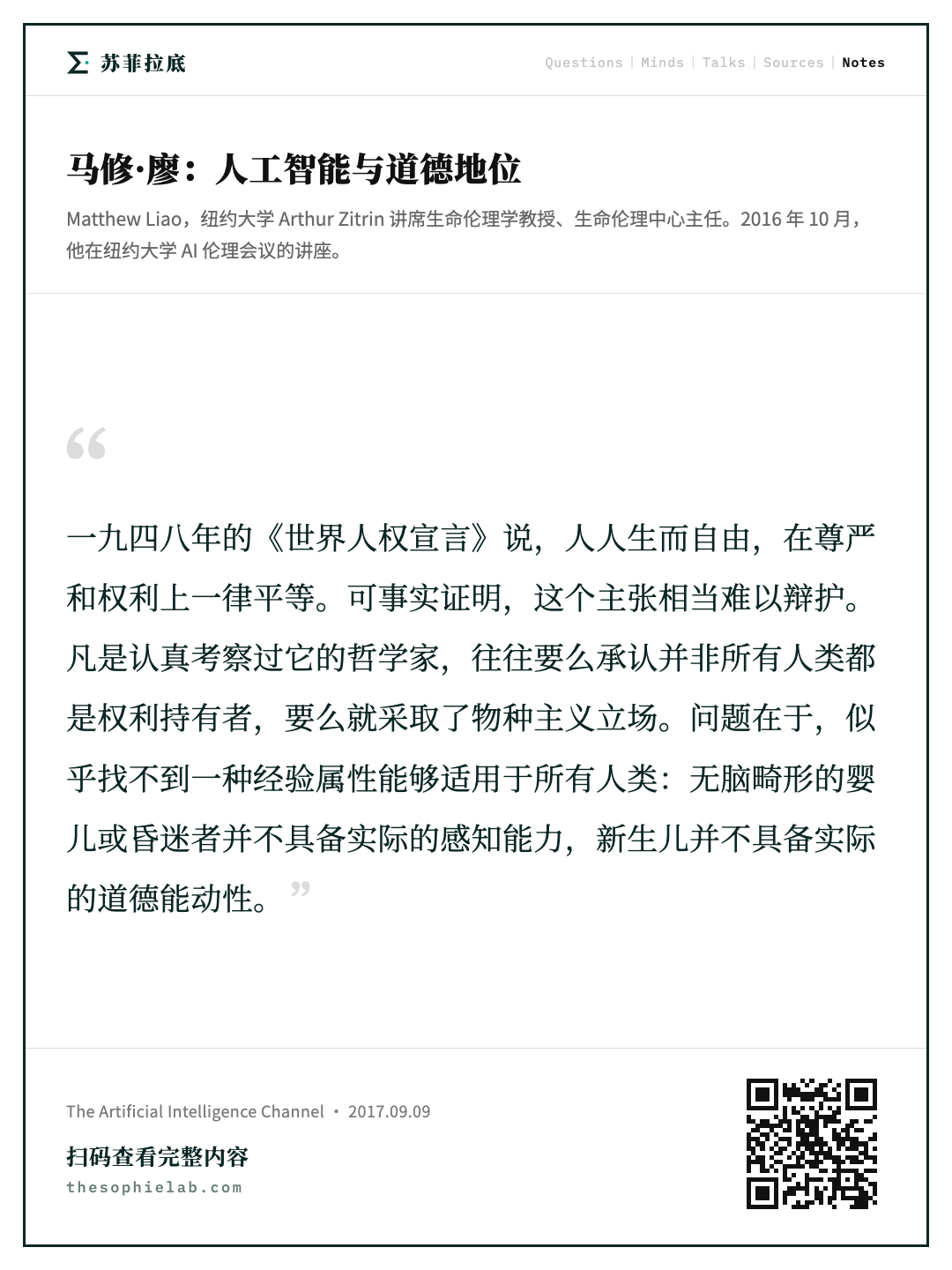
廖马修:现在来说说人类道德地位的基础。人类所具有的那种道德地位,通常叫做权利持有(right holding),人类被称作权利持有者。我们要问的一个问题是:所有人类都是权利持有者吗?一九四八年的《世界人权宣言》说,人人生而自由,在尊严和权利上一律平等。可事实证明,这个主张相当难以辩护。凡是认真考察过它的哲学家,往往要么承认并非所有人类都是权利持有者,要么就采取了彼得·辛格(Peter Singer)所说的物种主义(speciesism)立场:在没有充分理由的情况下,在道德上偏袒某一物种,在这里就是偏袒人类。

为什么会这样?问题在于,似乎找不到一种经验属性能够适用于所有人类。以实际的感知能力为例,有些人类,比如无脑畸形的婴儿或昏迷者,并不具备实际的感知能力。以实际的道德能动性为例,许多人类,包括新生儿,并不具备实际的道德能动性。按照这些关于权利持有的理论,这些人类就不是权利持有者。这就是所谓的边缘个案问题(the problem of marginal cases)。

我在别处论证过,我们可以有一种理论,既不必陷入物种主义,又看起来能让所有人类都成为权利持有者。这个理论说的是:一个实体成为权利持有者的充分条件,是它具备道德能动性的遗传基础,或者更一般地说,物理基础。

我简单勾画一下这个理论。道德能动性的物理基础,是在人类身上生成道德能动性的那一套物理编码。这套物理编码位于人类的基因组里。我们之所以知道这一点,是因为像道德能动性这样复杂的适应性表型,其发育基础需要大量的复杂性,而基因组包含了这种复杂性中相当大的一部分。要具备道德能动性的遗传基础,构成道德能动性的那些基因必须被激活,并且以恰当的方式相互协调。如果一个生物只是在基因组里的某个地方拥有能够构成某种属性的基因,可这些基因要么没有被激活,要么被打乱以致无法恰当地相互协调,那么它就不具备这种属性的遗传基础。

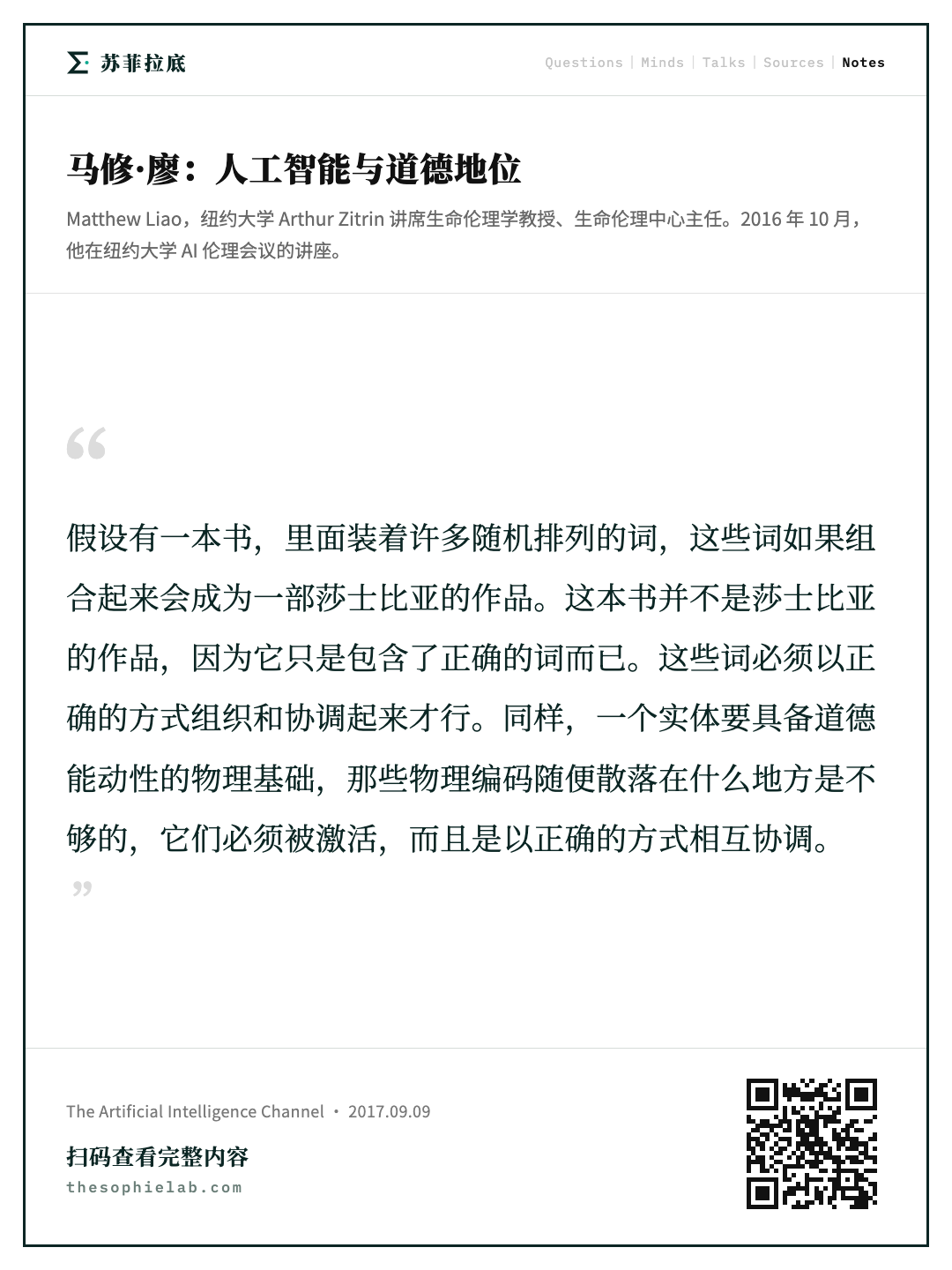
让我把这一点说得更具体些。假设有一本书,里面装着许多随机排列的词,这些词如果组合起来会成为一部莎士比亚的作品。这本书并不是莎士比亚的作品,因为它只是包含了正确的词而已。这些词必须以正确的方式组织和协调起来才行。

我论证过,可以证明所有人类,包括婴儿、重度残障者、处于持续性植物状态的人等等,都具备道德能动性的遗传基础。因此按照我的理论,他们都是权利持有者。而这个理论避开了物种主义,因为如果结果表明大猩猩、黑猩猩和其他动物也具备道德能动性的遗传基础,或者更一般地说物理基础,那它们同样是权利持有者。

我还要补充一句,这个理论与关于堕胎的宽容立场是相容的。我们可以跟随朱迪斯·贾维斯·汤姆森(Judith Jarvis Thomson)说:即使胎儿是权利持有者,女性仍然有权决定她身体内部发生的事,也就是说,她有身体完整(bodily integrity)的权利。

权利持有的功能,套用到 AI

廖马修:再说这个理论的另一个特征,即权利持有的功能(the function of right holding)。它是说:当权利持有者的利益与非权利持有者的同类利益,也就是可比的利益发生冲突时,应当由权利持有者的利益占上风。举个例子,假设你只能在保住一只乌龟的一条腿和保住一个人的一条腿之间选择。乌龟保住腿的利益和人保住腿的利益看起来是可比的。权利持有的功能说,你应当保住人的腿,这看起来是正确的判断。

现在来考虑人工智能可以具有什么样的道德地位。人工智能活着吗?有意识吗?有感知能力吗?能感到疼痛吗?能有欲望吗?具备理性能动性吗?具备道德能动性吗?如果一个人工智能能够获得其中一部分或全部能力,它就会获得与这些内在属性各自相应的那种道德地位。

我们想弄清的问题之一,是人工智能能否具有人类水平的道德地位。我认为有一条途径可以让人工智能达到人类水平的道德地位:只要它具备道德能动性的物理基础,这就足够了。这直接来自我关于权利持有的理论。同样地,这个物理基础必须是激活的,并且以正确的方式相互协调。这些物理编码随便散落在什么地方是不够的,它们必须被激活,而且是以正确的方式。

智力与道德再高也不抬升地位

廖马修:接下来还有一个问题:人工智能能否具有超过人类水平的道德地位?我认为答案是「可能」。但我想论证的是,即便这是真的,它也不会来自对我们现有道德地位标准的延伸,比如理性或道德能动性。让我解释为什么。

先看理性能动性。假设有两个人,一个叫「聪明」,智力高于平均,比方说智商一百五十;另一个叫「普通」,智力处于平均水平,比方说智商一百。尽管「聪明」比「普通」聪明得多,我们似乎仍会说两人具有同等的道德地位,都是权利持有者。假如两人同时溺水,我们大概应该掷硬币决定,而不会认为必须去救「聪明」,也不会认为救了「普通」就做了道德上不允许的事。

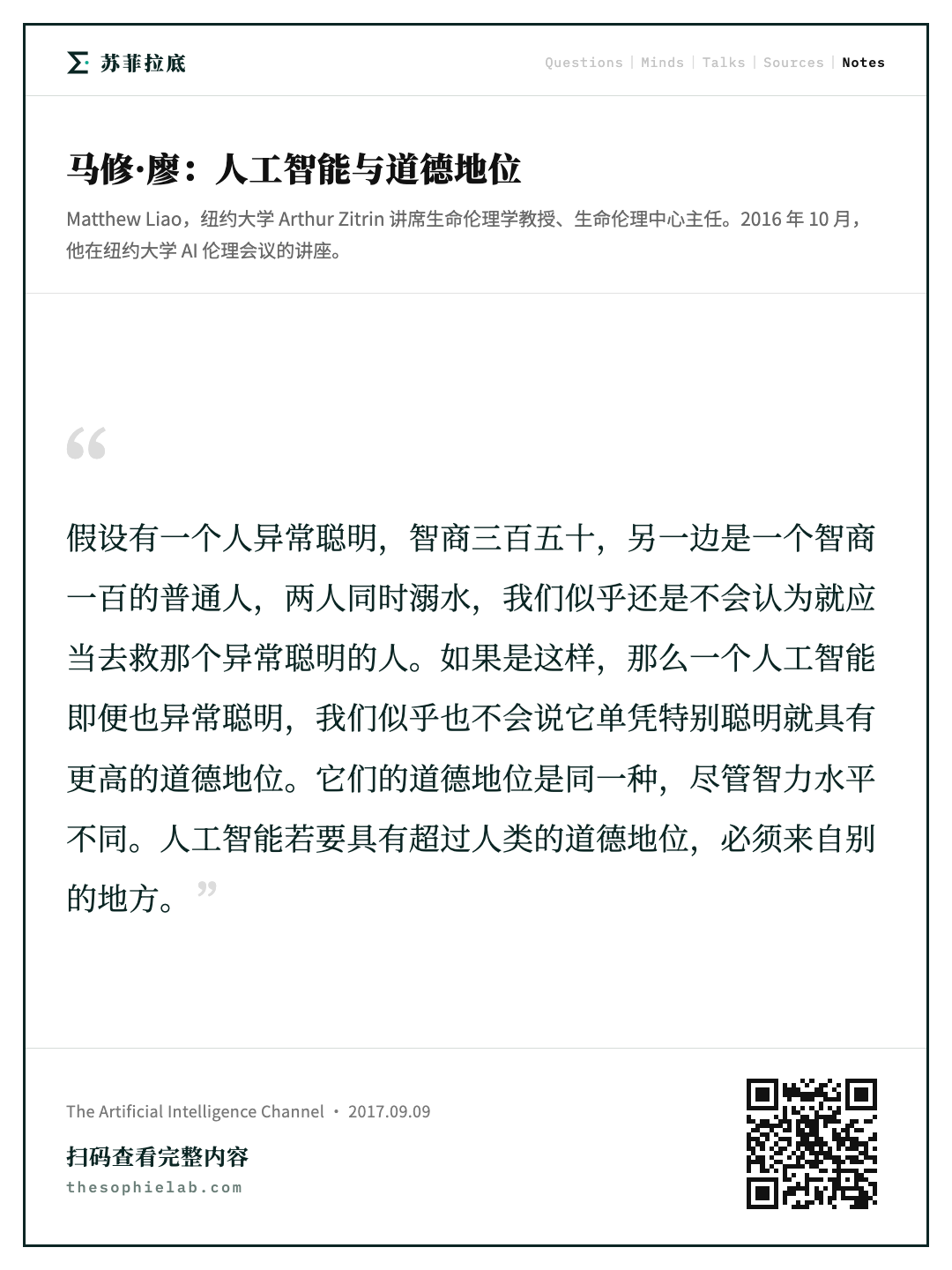
现在假设有一个人异常聪明,智商三百五十,另一边仍然是「普通」。我们似乎还是不会认为就应当去救那个异常聪明的人。如果是这样,那么一个人工智能即便也异常聪明,比方说智商三百五十,我们似乎也不会说它单凭特别聪明就具有更高的道德地位。它们的道德地位是同一种,尽管智力水平不同。

道德能动性又如何呢?我的理论说道德能动性非常重要,于是你可能会想:如果某个人特别有道德呢?如果我们把道德能动性放大呢?我同样不认为这会改变两个人是否都是权利持有者,或者让他们具有不同的道德地位。设想乔具有平均水平的道德能动性,特蕾莎具有异常的道德能动性。我们不会认为在紧急情况下就必须永远先救特蕾莎而不救乔,也不会认为救乔是不允许的。同样的推理可以用到人工智能上,可以设想具有异常道德能动性的人工智能,我们仍然会说它们的道德地位是同等的。

由此得出的结论是:如果人工智能要具有超过人类的道德地位(我不是说这不可能),那它必须来自别的地方,来自某种别的、在规范意义上重要的属性。

通往人工道德智能的两条路

廖马修:最后我想谈谈怎样才能造出人工道德智能(artificial moral intelligence)。这是关于未来的话题。关于自动驾驶汽车我也有话要说,但今天只聚焦在未来的人工道德智能上。我认为有两条路:渐进替换和编码。

渐进替换已经有很多人谈过,我简短说一下。基本想法是,把一个人的大脑逐个神经元地替换成无机的替代物。假定意识得以维持,这是一个很大的假定,因为当你替换神经元时,意识会不会在某一刻就消失了,这是一个巨大的问题。但在作出这个大假定的前提下,假设替换后的生物存活了下来,那么它似乎就是一个具备人工道德智能的实体。这是获得人工道德智能的一条路。

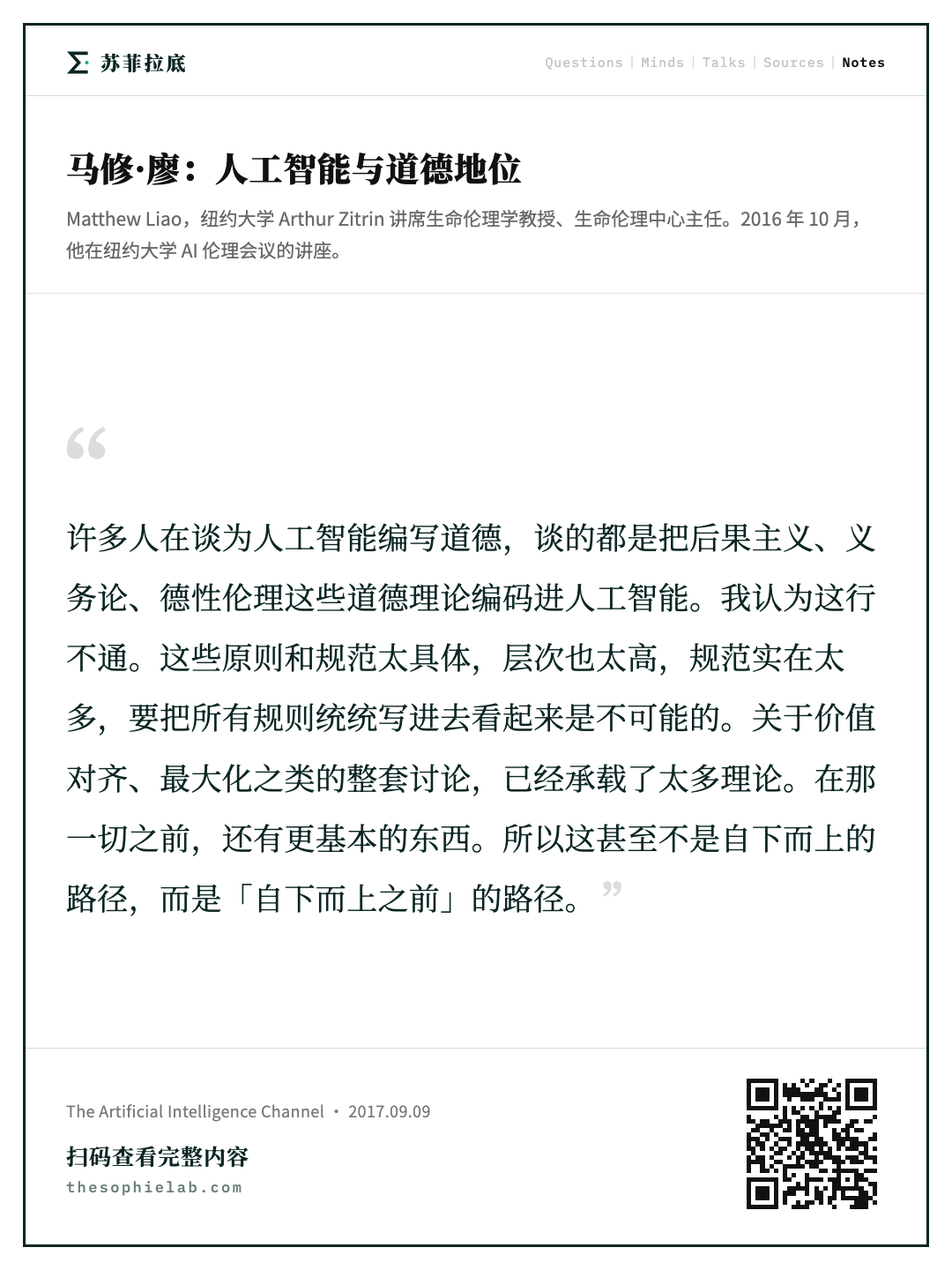
另一条路是编码。许多人在谈为人工智能编写道德,无论是自上而下还是自下而上,他们谈的都是把后果主义、义务论、德性伦理这些道德理论编码进人工智能。我认为这行不通。这些原则和规范太具体,层次也太高,我们没法把它们编码进人工智能,尤其是因为这样的规范实在太多,要把所有规则统统写进去看起来是不可能的。

普遍道德语法与道德理解

廖马修:所以我想提一个不同的方案,它建立在道德心理学关于普遍道德语法(universal moral grammar)的研究之上。这个想法是说,人的心智可能配备了一套普遍道德语法,让身处不同文化的每一个人都能够无意识地、自动地评价无穷多样的行为,并生成对错之类的道德评价。这个想法来自约翰·罗尔斯(John Rawls)和约翰·米凯尔(John Mikhail),他们借鉴的是乔姆斯基的工作。道德官能的运作方式是这样的:它拥有一般领域的认知机制,基于行动者、意图、信念、行动、承受者、后果、道德评价等变量,生成对行为的表征;然后由某些认知机制,比如道德官能本身,把这些表征组合起来,生成「不允许」「允许」之类的道德判断。我刚刚出版了一本书叫《道德的大脑》(Moral Brains),里面讨论了很多这方面的话题,有兴趣可以看看。

这里的想法是,也许我们可以借鉴普遍道德语法,构造某种人工道德语法。我们需要的是能够表征上述各种变量的代码,再把这些表征组合起来,生成道德判断。

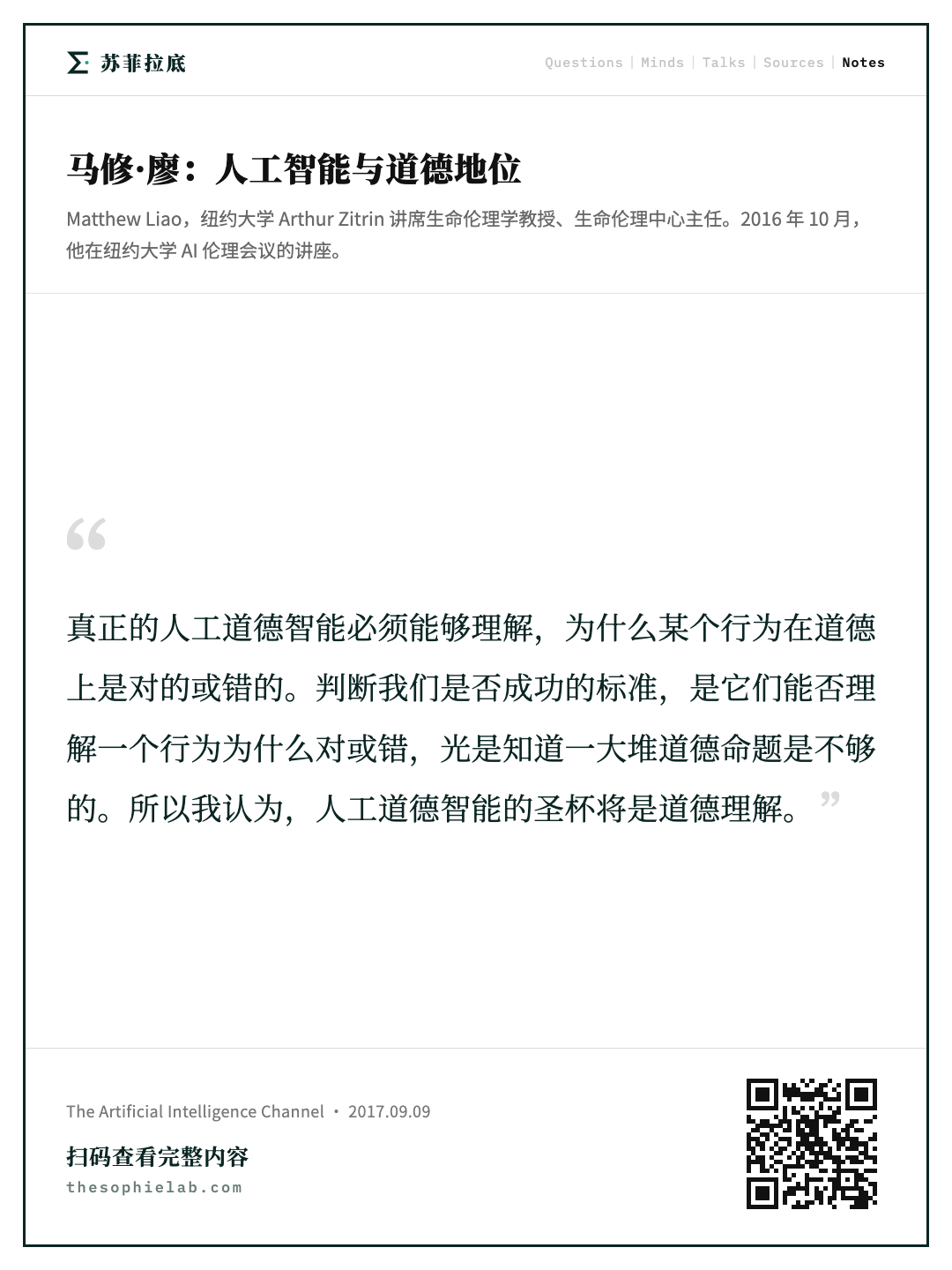
还有一点:我认为真正的人工道德智能必须能够理解,为什么某个行为在道德上是对的或错的。也就是说,判断我们是否成功的标准,是它们能否理解一个行为为什么对或错,光是知道一大堆道德命题是不够的。所以我认为,人工道德智能的圣杯将是道德理解(moral understanding)。

总结一下:当人工智能具备道德能动性的物理基础时,它就能达到人类水平的道德地位;要具有超过人类水平的道德地位,人工智能需要获得理性能动性和道德能动性之外的某种其他在规范意义上重要的能力;而真正的人工道德智能,将具备道德理解的能力。谢谢大家。

问答:堕胎与希特勒

现场提问者:您在演讲前半部分定义的术语,特别是道德能动性,我对您举的一个例子有些困惑。我知道这对很多人来说是个敏感话题,但希望您能从术语上处理一下。按照您的主张,未出生的孩子具备道德能动性的遗传或物理基础,因为他有自己的遗传编码。那么您怎么为堕胎辩护?女性的身体完整权是否压过了未出生孩子的道德地位?

廖马修:是的,我认为压过了。我想我已经说到了这一点:女性拥有身体完整的权利。我在别处对人权有整套讨论,我认为身体完整是从事基本活动的根本条件,所以她们对此拥有权利,理由就在这里。

布鲁斯·加夫萨:我是布鲁斯·加夫萨。我注意到您几乎是把有人溺水时我们会作的区分当成了公理来陈述。也许屋里只有我一个人这么想,但我很难接受这条公理:我们不会说先救特蕾莎修女而不救那个男孩,或者宁可让阿道夫·希特勒淹死也要救那个男孩?希望您能就这一点多说几句。另外,如果您愿意,也可以说说您本来打算讲的自动驾驶汽车。

廖马修:自动驾驶汽车我想留到另一场报告里讲。至于希特勒之类,如果一个人做了道德上错误的事,关于应得(desert)有各种不同的理论。我的主张可以理解为一个「其他条件相同」的主张:如果说的是两个陌生人,看来你应当掷硬币;如果其中一个只是更聪明一些,比方说两个病人进了急诊室,你不会说「看看哪个更聪明,先救那个」,那看起来是完全错误的。不过这一点上确实存在分歧。如果你是后果主义者,你可能会认为,只要我们能分辨出来,就真该先救更聪明的那个。我不同意,但我承认你说的这里确实有问题。

问答:经验方法与先验前提

保罗:谢谢马修,讲得很好。我想问的是,您说判定道德地位的方法必须是经验的,给出的理由是必须用经验的方法弄清一个有机体或生物具备哪些属性。当然,这里有两个问题:它们具备哪些属性,以及在它们具备这些属性的前提下,这些属性在道德上有什么相关性。在我看来后面这一部分必须是先验的,我不知道有什么后验的办法能做到。您的意思是两者都包括在内吗?

廖马修:是的,两者都包括。我只是想说它部分地必须是经验的,这是一项部分经验的探究,至少得去看它们具备哪些属性,这是经验问题。而那个条件句,「如果它们具备这些属性,那么它们就具有道德地位」,大概是先验的。

保罗:是这样吗?

廖马修:没错,没错。你需要一个规范前提,而那个规范前提是先验的。谢谢保罗把这一点说清楚。

现场提问者:如果您采用语言与道德之间的类比,那么在尝试编写一套普遍道德语法时,您认为会遇到哪些与编写语言程序相类似的障碍?

廖马修:我也不知道。我真希望斯蒂芬·沃尔夫勒姆(Stephen Wolfram)在场,他可以回答这个问题。我是指望斯蒂芬这样的人替我解决这个难题。不过总的想法是,我们需要在一个低得多的层次上操作。关于价值对齐、最大化之类的整套讨论,已经承载了太多理论,太多东西。在那一切之前,还有更基本的东西。所以这甚至不是自下而上的路径,而是「自下而上之前」的路径:道德官能就是我们看待世界的方式,我们看见道德属性和道德价值,比如伤害、人格之类,然后有某种机制把这些不同的东西组合起来并加以权衡。看来这才是该走的路。至于这些人工道德主体会怎样作决定,那是另一个问题。也许它们因为掌握更多信息而作出比我们更好的决定,也许更糟,这是个开放的问题,我对此没有说什么。但我确实想对在座的人工智能研究者说一句:这个方向是可以探索的,而且可能大有收获。

问答:无 DNA 实体与优先性边界

现场提问者:您非常强调物质基础,这在我看来有些奇怪。几百年前的人类显然不具备我们今天的道德发展水平,尽管他们的 DNA 几乎完全相同。您也可能遇到形态十分怪异的生物,或者虚拟实体,它们根本没有 DNA,也没有办法据此评估,可它们可能是极其复杂的人工智能。

廖马修:谢谢,我同意。正因为如此,这个理论更一般的表述是道德能动性的物理基础,这样它才能容纳人工智能。只不过碰巧我们所知的一切生物都有遗传编码,但未来这一点可能改变。如果真是那样,这些其他实体同样可以具备道德能动性。

现场提问者:非常感谢。我想,区分道德身份(moral standing)与价值这两个概念也许有用。道德身份让你进入权利持有者这个范畴,然后你可以说,无论你的智力或其他方面的价值如何,你都应当像其他所有权利持有者一样享有权利。但我不确定您是否想说权利持有者总是享有优先权。哪怕是一个义务论者,恐怕也愿意承认,有时牺牲人类的一点小利益,如果确实能大幅减少动物的痛苦,那在道德上是一件好事。所以即便是义务论者,也不必认为这里只有「身份」这一个概念在起作用,而且必须像您建议的那样分等级。我们可以把它当作获得某些道德考量、被追究责任之类的资格,但不希望它成为一道屏障,使我们对其他物种造成的一切,在面对人类利益甚至基于行动自由之类的人类主张时被完全忽视。

廖马修:这完全正确。所以我在定义道德地位时谈的是初步的(pro tanto)考量,它只是一个理由,其他条件相同意义上的理由。另一件事是,我谈权利持有的功能时,说的是利益必须是可比的。如果只是你的一点小利益,比如你的茶要凉了,而那边有一只猫正要被车碾过,看来你可以去救那只猫,因为这两种利益不可比。这一点上我完全同意。它没有词典式的优先性(lexical priority),不是一张王牌。「权利持有者享有优先权」这条一般原则,是在利益可比时的一个初步理由,一个表面上的(prima facie)理由,而不是一个通盘考虑之后的(all things considered)理由。

现场提问者:如果我理解正确,您是在论证一个实体是否为权利持有者,可以根据它成为道德主体的潜能来理解。那么人工智能本身是不是道德主体,从而是与生命体平等的权利持有者?再结合您的第二个观点,即道德智能平均水平的人与道德智能异常的人地位平等,那么一个道德智能很低的人工智能,也可以与一个道德极其卓越的人类具有同等的道德地位吗?

廖马修:能否再说一遍,人工智能是不是道德主体?

现场提问者:对。按照您的定义,它是不是与人类同等地位的权利持有者?

廖马修:如果人工智能具备道德能动性的物理基础,它们就可以是道德主体,没有什么妨碍它们具备道德能动性。至于程度,我认为道德地位存在某种层级。这一点尚未展开,但我倾向于认为道德能动性的价值高于理性能动性。设想一边是你,另一边是一个极其聪明、专门制造回形针的生物,我该救哪一个?看来我应该救你,而不是那个超级智能的回形针制造者。如果是这样,那道德能动性似乎就具有某种压倒理性能动性的价值。不过这是有争议的。
排版 + 横图 + 来源,粘贴即成稿
章节 · 点击跳转视频
0:00 开场:从价值对齐转向 AI 视角 ▶ 正在看
1:24 道德地位的定义与候选实体 ▶ 正在看
4:06 三个方法论约束 ▶ 正在看
6:27 地位阶梯:石头、植物、乌龟、人 ▶ 正在看
7:40 边缘个案与物种主义难题 ▶ 正在看
9:57 物理基础理论与莎士比亚类比 ▶ 正在看
12:02 权利持有的功能,套用到 AI ▶ 正在看
14:56 智力与道德再高也不抬升地位 ▶ 正在看
17:25 通往人工道德智能的两条路 ▶ 正在看
19:42 普遍道德语法与道德理解 ▶ 正在看
22:07 问答:堕胎、希特勒与先验前提 ▶ 正在看
27:50 问答:无 DNA 实体与优先性边界 ▶ 正在看
本期小问 · 档案清单
—— AI 智商 350 时,道德地位就该高于人类吗? ▶ 正在看
—— 若婴儿没有实际道德能力,靠什么算权利持有者? ▶ 正在看
—— 把后果主义、义务论写进 AI,真的行不通吗? ▶ 正在看
—— 溺水时先救更聪明的人,是不是道德错误? ▶ 正在看
本期讲者
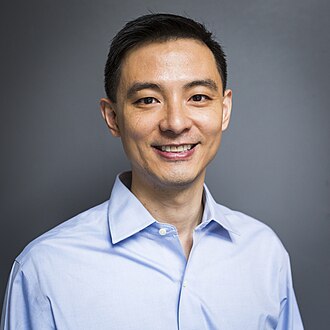
Matthew Liao纽约大学 Arthur Zitrin 讲席生命伦理学教授、生命伦理中心主任,《道德哲学杂志》主编。著有《The Right to Be Loved》,主编《Moral Brains》与《Ethics of Artificial Intelligence》。
主持人研讨会主持人,负责介绍讲者与场次主题转换。
现场提问者包括自称 Bruce Gafsa 的听众、被讲者称为 Paul 的哲学家等,就堕胎、应得、先验前提与 AI 主体性提问。
01开场:从价值对齐转向 AI 视角
0:00
okay so art that we our last symposium was on the somewhat self-interested topic of how we can get AI to do what we want now we're going to switch to the point of view of the AI itself and ask about the moral status of AI and with questions of the sort of what the rights of AI are how how the moral status depends on cognitive abilities our first speaker is Matthew Lau he's the Arthur's it Rijn professor of bioethics at NYU the director of the Center for Bioethics the editor of the Journal of moral philosophy and the founder of the ethics etc group blog he's interested in a broad spectrum of philosophical issues centering on ethics bioethics and moral psychology and his title is going to be artificial intelligence and moral status icky net in it can everybody hear me okay great okay so a couple years ago when I shared an office well not sure enough is that when I have my office next door to Nick Bostrom we actually tried to write a paper on this topic on artificial intelligence and moral status
好,那么我们上一场研讨会的主题多少带点自利色彩,讨论的是我们如何让 AI 做我们想要的事。现在我们要切换到 AI 自身的视角,来探讨 AI 的道德地位,以及诸如此类的问题:AI 拥有什么权利,道德地位如何取决于认知能力。我们的第一位讲者是 Matthew Liao,他是纽约大学 Arthur Zitrin 讲席生命伦理学教授、生命伦理中心主任、《道德哲学杂志》主编,也是 Ethics Etc 群组博客的创办人。他的兴趣涵盖以伦理学、生命伦理学和道德心理学为中心的广泛哲学议题。他的讲题是《人工智能与道德地位》。好了吗?大家都能听到我说话吗?很好。好的,几年前,当我和 Nick Bostrom 共用一间办公室时——不太确定——总之是我的办公室就在 Nick Bostrom 隔壁那会儿,我们其实尝试写一篇关于这个主题的论文,就是人工智能与道德地位,但我们一直没能把它写完,
便签笔记
02道德地位的定义与候选实体
1:24
but we never got around to finishing it so I'm really glad to have this opportunity to think more about this topic so machines and artificial intelligence are acquiring more and more capacities we have the blue winning speak into the okay we have deep blue winning the chess winning in chess Watson winning in jeopardy and alphago they're also some of them are acquiring mobility they can move around we have the Google self-driving cars and efforts are underway to build machines that can recognize emotions so the so called effective intelligence and the possibilities that a eyes may acquire human level or even greater than human level intelligence is being seriously considered indeed by many people in this room as a UH as a ice came more and more capacities the issue of whether they will acquire greater moral status becomes salient moral status is the standing that an entity has that gives more agents a potential reason to act towards it in a certain way so for example cats have a certain status in
所以我很高兴有这个机会来更深入地思考这个主题。机器和人工智能正在获得越来越多的能力。我们有深蓝赢得——好了——我们有深蓝在国际象棋上取胜,沃森在《危险边缘》上取胜,还有 AlphaGo。它们当中有些还获得了移动能力,可以四处移动,我们有谷歌的自动驾驶汽车,而且人们正在努力打造能够识别情绪的机器,也就是所谓的情感智能。而 AI 可能获得人类水平甚至超越人类水平智能的可能性,正在被很多人严肃对待,包括在座的许多人。随着 AI 获得越来越多的能力,它们是否会获得更高的道德地位,这个问题就变得突出起来。道德地位是一个实体所具有的一种资格,它给予道德主体一个潜在的理由,去以某种方式对待它。举例来说,猫因为有感受能力而具有某种地位,它们基于感受能力的道德地位,给予道德
便签笔记
2:45
virtue of being sentient they're more moral status qua sentience gives more agents at least a pro tanto reason not to to pretend a recent act wears something a certain way so for example not to cause them unnecessary pain so what kind of moral status will a eyes have as they gain greater and greater capacities well they one day have human level moral status well they have greater than human level moral status to answer these questions we need a theory of moral status so I'm gonna begin by sketching such a theory so to start here's a list of entities that could have or could have moral status and it's not intended to be exhaustive so we have in animate objects rocks the environment non-human terrestrial living things plants animals bacteria etc etc no more functioning human beings with full physical cognitive emotional and social capacities so normal adult human beings damaged human beings the comatose the severely mentally disabled human beings at the beginning of life so fetuses infants possible future human beings
主体至少一个初步的(pro tanto)理由,不要以某种方式对待它们,比如说不要给它们造成不必要的痛苦。那么随着 AI 获得越来越强的能力,它们会拥有什么样的道德地位?它们有朝一日会拥有人类水平的道德地位吗?它们会拥有高于人类水平的道德地位吗?要回答这些问题,我们需要一套道德地位的理论。所以我先来勾勒这样一套理论。作为开始,这里列出了一些可能拥有道德地位的实体,这个清单并不打算是穷尽的。我们有无生命的物体、岩石、环境,非人类的地球生命,植物、动物、细菌等等等等;功能正常的人类,具备完整的身体、认知、情感和社会能力,也就是正常的成年人;受损的人类,昏迷者、重度智力障碍者;处于生命起点的人类,比如胎儿、婴儿;可能存在的未来人类,也就是未来世代;已经不在世的人类,即逝者;你还
便签笔记
03三个方法论约束
4:06
future generations non living human beings dead human beings and you could also talk about aliens you know if they exist and we're gonna apply this to AI and robots so how do we determine what kind of moral status each of these entities has so here are some constraints first it seems that we need some kind of objective empirical methods and the reason is that there doesn't seem to be an a priori way of knowing what kind of moral status an entity has so for example if we were to me some alien beans when we go to Mars and we want to know what kind of moral status it has it seems that we would not be able to know this a priori - to find out it seems that we would at least have to investigate empirical empirically what attribute has and consider whether these attributes are normally salient such that the alien should have a certain kind of moral status a second constraint is something called the species neutrality requirement so the idea here is that the criterion for moral status should not exclude any species in
可以谈外星人,如果他们存在的话。而我们要把这套框架应用到 AI 和机器人上。那么我们如何判定这些实体各自拥有什么样的道德地位?这里有一些约束条件。首先,看起来我们需要某种客观的经验方法,理由是似乎没有一种先验的方式可以知道一个实体拥有什么样的道德地位。比如说,如果我们去火星,遇到某种外星生物,我们想知道它拥有什么样的道德地位,看起来我们没法先验地知道这一点。要弄清楚,看起来我们至少得从经验层面去调查属性,并考虑这些属性是否是道德上相关的显著属性,从而使这个外星人应当拥有某种道德地位。第二个约束条件叫做物种中立性要求,这里的想法是用来判定道德地位的标准不应该事先排除任何物种。举个会事先排除
便签笔记
5:17
advance an example of a criterion that would exclude other species in advances being human being human was exclude all other human species so that so being human doesn't satisfy the species neutrality criterion a third constraint is that the empirical criterion should be based on the intrinsic properties of an entity so this is kind of controversial but most people think that it's based on the intrinsic properties of an entity so the intrinsic properties of an entity are properties that are internal or inherent to an entity the extrinsic properties of an entity are properties that depend on an entity's relationship with other entities so for example being a moral agents is an intrinsic property that a no normal functioning adult human being typically would have whereas being a spouse would be an extrinsic property that depends on someone's being married to another person so suppose that you and your spouse are both drowning you would of course value your spouse more based on your relationship with her and try to
其他物种的标准的例子,就是“身为人类”。“身为人类”会排除所有其他物种,所以“身为人类”不满足物种中立性标准。第三个约束条件是,这个经验性标准应当建立在一个实体的内在属性之上。这一点有点争议,但大多数人认为它是基于实体的内在属性的。一个实体的内在属性,是指那些对该实体而言是内部的或固有的属性;而一个实体的外在属性,是指依赖于该实体与其他实体之间关系的属性。比如说,“是一个道德主体”就是一个内在属性,正常运作的成年人通常都具备;而“是某人的配偶”则是一个外在属性,它取决于某人与另一个人结了婚。所以假设你和你的配偶都在溺水,你当然会因为你和她的关系而更看重你的配偶,并试图
便签笔记
04地位阶梯:石头、植物、乌龟、人
6:27
save her first but in one respect your spouse and your the stranger would still have the same moral status in virtue of the fact that they're both moral agents okay so here are some criterion for moral status whether an entity is alive whether an entity is conscious whether it's sentient whether it can feel pain whether you can desire whether has the capacity to know something about the causality such as if one does X then Y would happen and the capacity to bring about something intentionally so rational capacity and whether has the capacity to understand and act in light of moral reasons so moral agency so next it seems that some entities are going to have greater moral status than others so for example if you compare a rock with a plant it seems that the plant would have greater moral status and an obvious explanation is that the plant is alive but the rock isn't and among entities that are life arguably some will have greater moral status than others so if you compare a plant in a turtle it seems
先去救她。但在某一方面,你的配偶和那个陌生人仍然拥有相同的道德地位,因为他们都是道德主体。好,那么这里有一些判定道德地位的标准:一个实体是否活着,是否有意识,是否有感受力,是否能感到疼痛,是否会有欲望,是否具备了解因果关系的能力,比如知道“如果做了X,那么Y就会发生”,以及是否具备有意图地促成某事的能力,也就是理性能力;还有是否具备理解道德理由并依据道德理由行动的能力,也就是道德主体性。接下来,看起来有些实体会比另一些实体拥有更高的道德地位。比如说,如果你把一块石头和一株植物作比较,看起来植物会拥有更高的道德地位,一个显而易见的解释是植物是活的,而石头不是。而在那些活着的实体当中,可以说有些也会比另一些拥有更高的道德地位。所以如果你把一株植物和一只乌龟作比较,看起来乌龟会比植物拥有更高的道德地位,
便签笔记
05边缘个案与物种主义难题
7:40
that the turtle would have greater moral status then then the plan and explanation of that is that the turtle is sentient and the plan isn't and finally among entities that are sentient obvious arguably some will have even greater moral status than others so take a normal functioning adult human being and an adult it seems that the human being would that have greater moral status than the turtle an explanation here is something like the human being has moral agency while the turtle doesn't I'm gonna come back to that in a minute so let me say something about the basis of human moral status the kind of moral status that human beings have is often called right holding they're called right holders so one the question we want to ask is are all human beings right holders so the Universal Declaration of Human Rights 1948 says all human beings are born free and equal in dignity and rights but it turns out that is actually quite difficult to defend this claim philosophers who have examined it have tended to find
对此的解释是乌龟有感受力而植物没有。最后,在那些有感受力的实体当中,可以说有些还会拥有更高的道德地位。比如拿一个正常运作的成年人和一只乌龟相比,看起来人会比乌龟拥有更高的道德地位。这里的解释大致是:人具有道德主体性,而乌龟没有。这一点我等一下会再回来讲。那么让我谈谈人类道德地位的基础。人类所拥有的那种道德地位常常被称为“权利持有”,他们被称为权利持有者。所以我们想问的一个问题是:是不是所有人都是权利持有者?1948 年的《世界人权宣言》说“人人生而自由,在尊严和权利上一律平等”,但结果发现要为这个主张辩护其实相当困难。研究过这个问题的哲学家往往发现自己要么承认:不,并非所有人都是权利持有者;
便签笔记
8:48
themselves either agreeing that no not all human beings are right holder or adopting what Peter singer calls a specious position where species is defined as morally favoring a particular species in this case human beings without over others without sufficient justification so what why is this well the problem is that there doesn't seem to be a real of an empirical attribute that would apply to all human beings so take actual sentience for example some human beings such as an encephalic infants or comatose person lack lacks actual sentient or take actual more agency many human beings including newborn infants lack actual more agency these human beings will not be right holders on these accounts of right holding and this is called the the problem of marginal cases so elsewhere I've actually argue that we can have an account that doesn't have to be sea species and that appears to allow all human beings to be right holders and what this account says is that a sufficient condition for an entity to be
要么采取彼得·辛格所说的“物种主义”立场。物种主义被定义为在道德上偏袒某个特定物种——在这里就是人类——而没有充分的理由。那么为什么会这样呢?问题在于,似乎并不存在一个能适用于所有人的经验性属性。比如说拿实际的感受力来说,有些人,比如无脑畸形的婴儿或处于昏迷状态的人,就缺乏实际的感受力;或者拿实际的道德主体性来说,很多人,包括新生婴儿,就缺乏实际的道德主体性。按照这些关于权利持有的说法,这些人就不会是权利持有者,这被称为“边缘个案问题”。所以我在别处论证过,我们可以有一种不必是物种主义、并且似乎能让所有人都成为权利持有者的解释。这个解释是说:一个实体成为权利持有者的充分条件是,该实体具有道德主体性的遗传基础,或者更一般地说,物理
便签笔记
06物理基础理论与莎士比亚类比
9:57
a right holder is if the entity has the genetic or more generally the physical basis for moral agency let me just very briefly sketch this account so the physical basis for more agencies the set of physical codes that generate more agency in human beings this set of physical codes is located in their genome and we know this because a lot of complexity is needed as the developmental basis for a complex adaptive phenotype like moral agency and the genome contains a significant portion of this complexity so to have the genetic basis for more agency the genes that make up moral agency must be activated and be coordinating with each other in an appropriate way a beam does not have the genetic basis for a certain attribute if it just possesses somewhere in its genome the genes for that that could make up the attribute but these genes are either not activated or are scrambled in such a way that they do not coronate with each other appropriately let me just flesh that out so consider suppose there's a book that
基础。让我非常简要地勾勒一下这个说法。道德主体性的物理基础,就是那组在人身上生成道德主体性的物理编码。这组物理编码位于他们的基因组中,我们之所以知道这一点,是因为像道德主体性这样复杂的适应性表型,其发育基础需要大量的复杂性,而基因组包含了这种复杂性中相当大的一部分。所以,要具有道德主体性的遗传基础,构成道德主体性的那些基因必须被激活,并且以恰当的方式彼此协调。一个存在者并不因为它的基因组中某处碰巧拥有那些可能构成某种属性的基因,就具有该属性的遗传基础——如果这些基因要么没有被激活,要么被打乱到彼此无法恰当协调的程度的话。让我把这一点说得更清楚一些。设想有这么一本书,里面包含很多随机的词,如果把它们拼在一起就能组成一本莎士比亚的书。这本
便签笔记
11:02
contains many random words which if put together would result in a Shakespeare book this book would not be a Shakespeare book because it just contains the correct words these words must be organized and be coordinated in the right kind of way so I've argued that it can actually be shown that all human beings including infants the severely disabled those in persistent vegetative States and so on have the genetic basis for more agency so given this on my account they would all be right holders and this account avoids species um because if it turns out that gorillas and chimpanzees and other animals have the genetic basis for more agency or more generally the physical basis for more agency they would also be right holders and let me just add that this account is compatible with permissive views about abortion so we can follow Judith Jarvis Thompson and say that even if a fetus is a right holder a woman still has a right to determine what happens inside her body that is she has a right to bodily
书并不会因此就是一本莎士比亚的书,因为它只是包含了正确的词而已。这些词还必须被组织起来,以正确的方式协调起来。所以我论证过,其实可以表明,所有人,包括婴儿、重度残障者、处于持续植物状态的人等等,都具有道德主体性的遗传基础。所以按照我的说法,鉴于此,他们都会是权利持有者。而且这个说法避免了物种主义,因为如果结果表明大猩猩、黑猩猩和其他动物也具有道德主体性的遗传基础,或者更一般地说,具有道德主体性的物理基础,那么它们也会是权利持有者。我还要补充一点,这个说法与对堕胎持宽容态度的观点是相容的。我们可以追随朱迪思·贾维斯·汤姆森的说法:即便胎儿是一个权利持有者,女性仍然有权决定在她身体内部发生什么,也就是说她拥有身体完整性的权利。好,我再提一个
便签笔记
07权利持有的功能,套用到 AI
12:02
integrity okay let me just mention one other feature of this this account so there's this idea of the function of right holding which says that if and when the right holders interest is in conflict with the same kind of interests that is with a comparable interest of a non right holder the right holders interests should prevail so just to take an example suppose that you have a choice between serving at saving a turtles limb and a human beings limb the turtles limb the turtles interest in keeping the limb and the human beings interest in keeping the lien of the limb appear to be comparable the function of right holding says that you should save the human beings limb which seems to be the correct verdict okay so is the let us now consider what kind of moral status a eyes can have is the AI alive is the AI conscious is the AI sentient can the AI feel pain can be AI desire does v AI have rational agency does the AI have more agency if an AI can acquire some or all these capacities it will gained the kind of moral status that
这个说法的另一个特点。有一个叫做“权利持有的功能”的想法,它说的是:如果并且当权利持有者的利益与同一类利益发生冲突时,也就是与一个非权利持有者的可比利益发生冲突时,权利持有者的利益应当优先。举个例子,假设你必须在拯救一只乌龟的肢体和一个人的肢体之间做选择。乌龟保住肢体的利益和人保住肢体的利益看起来是可比的。权利持有的功能说,你应当去救那个人的肢体,这看起来是正确的结论。好,那么现在让我们来考虑人工智能可以拥有什么样的道德地位。AI 是活的吗?AI 有意识吗?AI 有感受力吗?AI 能感到疼痛吗?AI 会有欲望吗?AI 具有理性主体性吗?AI 具有道德主体性吗?如果一个 AI 能够获得其中一些或全部这些能力,它就会获得伴随每一种内在属性而来的那种道德地位。我刚发现我打印的……纸用完了,技术嘛。
便签笔记
13:20
accompanies each of these intrinsic properties and I just realized that I printed my ran out of paper technology okay so yes yes okay I can do that very easily yes more paper clips that's right so so the idea so you know I mean one of the issues that we're interested in finding out is whether AI scan human have human level moral status so I think that there's a way for a eyes to have human moral level status and that is it's sufficient if an AI has the physical basis for more agency so that sort of comes out of my account of right holding and again that physical basis has to be active and be coordinating in the right way so it's not enough that these physical calls I just sort of randomly strewn somewhere it has to be activated and in the right kind of way so then there's a further issue which is whether AI can have greater than human level moral status and I think the answer to that question is sort of possibly but I want to argue that if that's true it's not going to be based on extending the
好的,好的,可以,这个我很容易就能做到。对,再多来点回形针,没错。所以说,这个想法……我们感兴趣想弄清楚的问题之一,就是 AI 能不能拥有人类水平的道德地位。我认为 AI 是有办法拥有人类水平的道德地位的,那就是:一个 AI 只要具有道德主体性的物理基础就足够了。这一点大致来自我关于权利持有的那套说法。同样地,那个物理基础必须是被激活的,并且以正确的方式协调运作。所以光是那些物理编码随随便便散落在某处是不够的,它必须被激活,而且以正确的方式激活。那么接下来还有一个问题,就是 AI 能不能拥有高于人类水平的道德地位。我认为这个问题的答案大概是“有可能”,但我想论证的是,如果那是真的,它不会来自把我们
便签笔记
08智力与道德再高也不抬升地位
14:56
current criteria that we have for moral status such as rationality or morally more agency so let me explain why so take here two people so take rational rational agency for example so first you got two people right you have a bright who's above average intelligence say 150 IQ then you have average seems average intelligence say 100 IQ it seems that even though bright is a lot brighter than ever we would say that they have equal moral status they're both right holders so if there's say they're both are drowning it seems that we would maybe we should toss a coin we wouldn't think that we necessarily have to save above average right and we wouldn't think that we would be doing something morally impermissible if we were to save average okay now suppose you've got somebody who's exceptionally bright so the this person has exceptional intelligence 350 IQ and then we're still have the average here again it seems that we wouldn't necessarily think that we should save accept accept exceptionally bright okay
现有的道德地位标准——比如理性或道德主体性——加以扩展。让我解释一下为什么。拿两个人来说,比如以理性主体性为例。首先你有两个人,对吧,你有一个“聪明人”,智力高于平均水平,比如智商 150;然后你有一个“普通人”,智力中等,比如智商 100。看起来即便聪明人比普通人聪明很多,我们仍然会说他们拥有平等的道德地位,他们都是权利持有者。所以如果他们两个都在溺水,看起来我们也许应该抛硬币决定,我们不会认为我们就一定得去救那个高于平均水平的人,而且如果我们去救那个普通人,我们也不会认为自己做了道德上不允许的事。好,现在假设你有一个特别聪明的人,这个人智力超群,智商 350,然后我们这边还是那个普通人。同样地,看起来我们也不会必然认为我们应该去救那个特别聪明的人。好,如果是这样的话,那么如果一个 AI 也特别聪明,比如智商 350,
便签笔记
16:15
and if that's the case then if an AI is also exceptionally bright say has 350 IQ it doesn't seem like we would say that just because it's really smart it has greater moral status so it's it's not gonna be they're gonna have the same kind of moral status even though they have different they they differ in their levels of intelligence what about more agency a lot of people you know one of the one of my my accounts says that you know there's something really important about moral agency so you might think well how about if you know someone is really moral what it what you know what if we amplify moral agency the capacity for more agency again I don't think that it's gonna change whether these two people are right holders so or have different moral status so take here Joe has averaged more agency and Teresa has exceptional more agency again we wouldn't think that Teresa we should always save Teresa and not Joe and we would think that it would be impermissible to save Joe if you know if say they were both in some sort of
看起来我们也不会说:仅仅因为它非常聪明,它就拥有更高的道德地位。所以并不会是那样,他们会拥有同一种道德地位,即便他们在智力水平上有差别。那么道德主体性呢?很多人……我的一个说法就是道德主体性有某种非常重要的意义。所以你可能会想,那如果某个人道德水平非常高呢?如果我们放大道德主体性、放大道德主体性的能力呢?同样地,我不认为这会改变这两个人是不是权利持有者,或者说他们是否有不同的道德地位。比如这边的乔具有中等的道德主体性,而特蕾莎具有超凡的道德主体性。同样地,我们不会认为我们总是应该救特蕾莎而不救乔,我们也不会认为在他们两个都处于某种紧急情况时去救乔是道德上不被允许的。所以你可以做
便签笔记
09通往人工道德智能的两条路
17:25
emergency situation and so you can do the same thing you can imagine a ice that are have expect exceptional more Asians see and we wouldn't again say that it seems like we would say the same thing that they have equal moral status so the upshot of that is that if a ice these AIS are going to have greater than human moral status it's gonna and I'm not saying that that's not possible it's that it's gonna have to come from somewhere else like some other attribute some other normally salient attribute okay so let me just finally conclude by talking about how we can get to artificial moral intelligence this is talking about the future I have stuff to say about self-driving cars as well but I'm just here just only focusing on the future artificial moral intelligence I think there are two ways to get there through gradual substitution and through coding so a lot of people have talked about gradual substitution so I'm gonna be very brief so basically the idea here is that an individual's brain is
同样的事,你可以设想一些具有超凡道德主体性的 AI,我们同样不会说……看起来我们会说同样的话,就是他们拥有平等的道德地位。所以由此得出的结论是,如果这些 AI 要拥有高于人类的道德地位——我并不是说那不可能——而是说那将必须来自别的地方,比如某种其他属性,某种其他在道德上相关的显著属性。好,那么最后让我以谈谈我们如何实现“人工道德智能”来作结。这是在谈未来。关于自动驾驶汽车我也有一些话要说,但我在这里只聚焦于未来的人工道德智能。我认为有两条路可以到达那里:通过渐进替换,以及通过编码。渐进替换已经有很多人谈过了,所以我会讲得很简短。基本上这里的想法是,把一个人的大脑
便签笔记
18:34
replaced by an organ and make substitution that your brain and you gradually replace it neuron by neuron with sort of an ink or inorganic substitute now assuming that consciousness is maintained this is a big assumption there's a huge question about whether you know when you substitute the neurons whether at some point the the consciousness might just disappear but just so I'm you know making this big assumption that conscious consciousness is maintained now there's a question is suppose that the resulting beam survives right it seems that this would be an artificial moral this would be an an entity with artificial moral intelligence so that's sort of one way by which we can get artificial more intelligence here's another way of and but but you know you know a lot of people are talking about coding artificial intelligence and here I want to say and they're talking about sort of I think they're talking about I think this is true whether it's top top-down or bottom-up right they're talking about coding things putting
替换掉——渐进替换,就是把你的大脑一个神经元一个神经元地逐步替换成某种无机的替代物。现在假定意识得以保持——这是一个很大的假定,有一个很大的问题是:当你替换这些神经元时,意识会不会在某个时刻就直接消失了。但姑且,我这里做这个很大的假定,即意识得以保持。那么问题是,假设由此产生的存在者存活了下来,对吧,看起来这就会是一个具有人工道德智能的实体。所以这算是我们获得人工道德智能的一条路。这里还有另一条路。不过,你知道,很多人在谈论给人工智能编码,在这里我想说……他们谈的是某种……我想他们谈的——我认为不管是自上而下还是自下而上,这一点都成立——他们谈的是把东西编码进去,把后果主义、义务论、美德伦理学这些道德理论放进这些
便签笔记
10普遍道德语法与道德理解
19:42
moral theories like consequentialism deontology and virtue ethics into these AIS and I don't think that's gonna work I think that these principles and norms and are too specific and too high for us to try to code into a is not the least because there are so many of them and it's just it seems like it's impossible to put in all the different rules etc etc so I want to suggest a different alternative and this is based on sort of some work in moral psychology on the universal moral grammar so the idea here is that the mind may be equipped with a universal moral grammar that enables each of us in different cultures unconsciously and automatically to evaluate a limitless variety of actions and generate more evaluations such as right and wrong so this came from John Rawls and Mikhail drawing on Chomsky's work so the the way the moral faculty works is that it has domain-general cognitive mechanisms generating representations of actions based on variables such as agent intention belief action receiver
AI 里。我不认为那行得通。我认为这些原则和规范太具体、层次太高,我们没法把它们编码进 AI,尤其是因为它们数量太多了,看起来根本不可能把所有那些不同的规则等等都放进去。所以我想提出一个不同的替代方案,它基于道德心理学中关于“普遍道德语法”的一些研究。这里的想法是,心智可能配备了一种普遍道德语法,它使处于不同文化中的我们每个人都能无意识地、自动地评价无限多样的行为,并生成诸如对与错这样的道德评价。这来自约翰·罗尔斯和米哈伊尔,他们借鉴了乔姆斯基的工作。道德官能的运作方式是:它有一些领域一般性的认知机制,基于诸如行为者、意图、信念、行为、承受者、后果和道德评价这些变量来生成对行为的表征;然后有一些认知机制,比如说
便签笔记
20:56
consequence and more evaluation and then some cognitive mechanisms for example the moral faculty then combine these representations to generate moral judgments such as impermissible permissible in a booth Kotori I just published the book called the moral brains that has a lot that cover discusses a lot of these topics so in case you want to look at it okay so the idea here is that maybe we can draw on the universal moral grammar to have some sort of artificial moral grammar so what we we need are codes that would represent various variables over there and then combine these representations to generate moral judgments okay and one other thing is that I think that genuine artificial moral intelligence are going to be are going to need to understand why a certain action is the morally right or wrong action that is there gonna it these sort of the way we tell whether we've succeeded is whether they can understand whether an action is right or wrong it's not gonna be enough that they know a bunch of moral
道德官能再把这些表征组合起来,生成诸如“不被允许”“被允许”“义务性的”这样的道德判断。我刚出版了一本叫《The Moral Brain》的书,里面涵盖并讨论了很多这类话题,如果你想看的话。好,那么这里的想法是,也许我们可以借助普遍道德语法来构建某种人工道德语法。所以我们需要的是能够表征上面那些变量的编码,然后把这些表征组合起来生成道德判断。好,还有一点是,我认为真正的人工道德智能将需要理解为什么某个行为在道德上是对的或错的。也就是说,我们判断自己是否成功的方式,就是看它们能不能理解一个行为是对是错。它们知道一堆道德命题是不够的。所以我认为人工道德智能的
便签笔记
11问答:堕胎、希特勒与先验前提
22:07
propositions and so I think the holy grail of artificial more intelligence is going to be moral understanding so just to wrap up I think a ice can achieve human-level moral status when they have the physical basis for more agency to have greater than human level moral status AI needs to acquire some other known normatively salient capacity besides rational agency and more agency and a genuine artificial moral intelligence will have the capacity for moral understanding thank you so with your presentation you just gave us it seems like the UM dwellin terminology that you defined in the first half of your presentation particularly moral agency I was a little confused about I'm one of the examples you gave us and even though this is a very sensitive issue to a lot of people I hope you can deal with the terminology in particular according to your claims an unborn child has the genetic or physical basis to have a moral agent to have moral agency because a child unborn child has its own genetic
圣杯将是“道德理解”。那么总结一下,我认为当 AI 具有道德主体性的物理基础时,它们就能达到人类水平的道德地位;而要拥有高于人类水平的道德地位,AI 需要除了理性能动性之外,还要具备某种其他公认的、在规范上重要的能力——道德能动性——而一个真正的人工道德智能将具备道德理解的能力。谢谢。那么,就您刚才所做的报告而言,我觉得您在报告前半部分定义的那些术语,尤其是道德能动性,我有点困惑。我想说您举的一个例子,虽然这对很多人来说是个非常敏感的问题,但我还是希望您能就术语本身作些说明。特别是,按照您的主张,一个未出生的胎儿具备拥有道德主体、拥有道德能动性的基因基础或物理基础,因为一个未出生的孩子有他自己的基因
便签笔记
23:21
code how then do you rationalize abortion does a woman's right to bodily integrity supersede an unborn child's moral status yeah I think it does so I think I cover that so they have the right to bodily integrity and elsewhere I have a whole discussion about sort of a human right so I think bodily integrity is a fundamental condition for pursuing the basic activities and so so they have a right to that and that's why yeah so hi I'm Bruce Gafsa from granite-- Forest Sangha and I noticed you had stated somewhat axiomatically about the differentiation we would make if someone were drowning and I maybe I'm alone in the room but I struggle with that as an axiom that we wouldn't say save Mother Teresa before the boy or perhaps allow Adolf Hitler to drown before the boy right so I wonder if you could just kind of speak a little more on that and if you would like say what you were gonna say about automated cars I think I will talk about because I'll take another paper talk but I will say that so Hitler or something
编码。那您如何为堕胎作辩护呢?女性的身体完整权是否优先于胎儿的道德地位?是的,我认为是这样。我想我讲到过这一点:她们拥有身体完整的权利。在别的地方我还专门讨论过人权问题。所以我认为身体完整是从事各种基本活动的一个根本条件,因此她们拥有这项权利,原因就在这里。是的。你好,我是布鲁斯·加夫萨,来自格兰尼特森林僧团。我注意到您有点像是把它当作公理来陈述的,就是有人溺水时我们会做出的那种区分。也许在场只有我一个人这样,但我很难把它当作一条公理来接受——我们不会说要先救特蕾莎修女而不是那个男孩,或者宁可让阿道夫·希特勒淹死也要先救那个男孩,对吧。所以我想请您就这一点再多讲一些,另外如果您愿意的话,也讲讲您原本打算说的关于自动驾驶汽车的内容。自动驾驶我想我会另外用一篇论文来讲。不过我要说的是,像希特勒
便签笔记
24:33
like that I mean you know if someone does something morally wrong they're sort of different theories about desserts and that's sort of you can sort of think that the claim is and other things being equal claim so other things be well if you're talking about two stranger seems like you should you know you should flip a coin and if one is just smarter so you know if you if two patients go into the you know you know the emergency room you wouldn't say hey let's see this one is smarter let's save this one first you know like that which it seems like that would be totally wrong right and so but they're disagreements about that I mean some you know if you're consequentialist you might think oh no we really if we could tell then we really should say the smarter person I disagree with that but I agree with you that there is an issue there so thanks Matthew that was great I I just wanted to ask you said at some point that you thought the method for figuring out moral status you have to be empirical and the reason you gave is
这样的情况——我是说,如果一个人做了道德上错误的事,关于应得(desert)有各种不同的理论,你可以这样理解:这个主张是一个「其他条件相同」的主张。所以其他条件相同的话,如果你说的是两个陌生人,那看起来你应该抛硬币来决定;而如果其中一个更聪明——你知道,如果两个病人被送进急诊室,你不会说:哎,我们看看谁更聪明,先救更聪明的那个。那样做看起来是完全错误的,对吧。当然对此是有分歧的,我是说,有些人如果你是个后果主义者,你可能会想:不对,如果我们真能判断出来,那我们确实应该救更聪明的那个。我不同意这种看法,但我同意你的说法,这里确实存在一个问题。谢谢,马修,讲得很好。我只想问一下,您在某个时候说,您认为确定道德地位的方法必须是经验性的,您给出的理由是
便签笔记
25:45
that you'd have to empirically figure out what attributes a particular organism or creature has and of course there's the question what attributes they have and the question of what the moral relevance of those attributes is given that they have those attributes and it seems to me that last bit has to be a priority sty don't know if any a posteriori ways of doing that did you mean to include both yeah I meant to include both I just sort of so it partly has to be empirical it's a partly empirical inquiry where you at least have to look at you know what attributes they have as an empirical question but the conditional conditional if they have these attributes then they have moral stages that's presumably a priority really that's right that's right you need to have a normative premise and that normative premise is a prize thank you Paul for clarifying that so if you're taking the analogy between Lane which in moral and morality what roadblocks do you think will face trying to program in a universal moral grammar
你必须通过经验去弄清某个特定的有机体或生物具有哪些属性。当然,这里有一个问题是它们具有哪些属性,还有另一个问题是:在它们具有这些属性的前提下,这些属性的道德相关性是什么。在我看来,后面这一部分必定是先验的,我不知道有什么后验的方式能做到这一点。您是不是打算把两者都包含进来?是的,我确实是想把两者都包含进来。我只是说,它部分地必须是经验性的,它是一种部分经验性的探究——你至少得去看看它们具有哪些属性,这是个经验问题。但那个条件句——如果它们具有这些属性,那么它们就具有道德地位——这大概是先验的,对吧。没错,没错。你需要一个规范性前提,而那个规范性前提是先验的。谢谢保罗帮我澄清这一点。那么,如果您采用语言和道德之间的类比,您认为在试图编程实现一种普遍道德语法(类似于给语言编程)时,会遇到哪些障碍?我也不知道,所以我
便签笔记
26:46
that would be analogous to programming than language I don't know either so I wish Stephen Wolfram was here he can sort of answer that question but I think that oh yeah oh maybe you want to say that's right so so I'm relying on people like Stephen to solve that problem for me but the basic I mean the general idea is that we need to operate at a much lower level this whole level about value alignment at cetera et cetera maximization seems like that's already there's too much too much too many it's too Theory Laden there are too many things sort of the basic they're sort of before any of that they're sort of so this is not even a bottom-up approach this is sort of pre bottom-up approach in a sense that this more faculties just sort of it's the way we view the world and we see moral properties and more values things like harm persons etc etc and then some sort of mechanism for being able to combine those different things and wait them right and so we need that's seems like that's the way to
希望斯蒂芬·沃尔弗拉姆在场,他大概能回答这个问题。不过我认为——哦对,也许您想说点什么。对,所以我是指望斯蒂芬这样的人来替我解决这个问题。但基本的、我是说大致的想法是,我们需要在低得多的层面上操作。价值对齐等等、最大化这一整套层面,看起来已经包含太多东西了,理论负载太重,有太多东西了。而那些基本的东西是在所有这些之前的。所以这甚至不是一种自下而上的进路,这算是一种「前自下而上」的进路,意思是这些道德官能就是我们看待世界的方式,我们由此看到道德属性和道德价值,比如伤害、人格等等;然后还需要某种机制,能够把这些不同的东西结合起来并加以权衡。所以我们需要这个,看起来这才是该走的路。至于进一步的问题是,
便签笔记
12问答:无 DNA 实体与优先性边界
27:50
go and then it's a further issue how these artificial moral agents how they're gonna make decisions they're maybe they'll make better decisions than we-well because they'll have more information maybe they'll make word eyesight rise that's an open question and I don't say anything about that but just see in terms of one of the things I do want to say is that for AI researchers in the room it seems like you know that could be explored that could be fruit fruit fully explored Thanks all right so I was just thinking cuz you put a lot of emphasis on like the material basis and that and like it seemed peculiar to me I mean like humans from a few hundred years ago clearly don't have the moral development that we have even though they have practically the same DNA yeah and you might have beings that have such bizarre forms or you might have virtual entities right that like don't have DNA at all or a way to assess like but yet they might be extremely sophisticated AI yeah that's a thank you I agree that's why the account
这些人工道德主体将如何做决定——也许它们会做出比我们更好的决定,因为它们掌握更多信息;也许它们会做出更糟的决定。这是个开放的问题,我对此没有作任何论断。不过有一点我确实想说:对在场的AI研究者来说,这似乎是个可以探索的方向,可以很有成果地去探索。谢谢。好的,我刚才在想,因为您很强调物质基础之类的东西,这在我看来有点奇怪。我是说,几百年前的人类显然不具备我们今天所拥有的道德发展水平,尽管他们的DNA基本相同。是的。而且你可能会有形态非常怪异的存在者,或者可能有虚拟实体,对吧,它们根本没有DNA或者某种可以评估的基础,但它们可能是极其复杂精密的AI。是的,谢谢你,我同意。这正是为什么这个理论
便签笔记
28:52
is more generally is the physical basis for more agency and that's why it can accommodate artificial intelligence so it just so happens that all the living things that we know have the Jeanette you know use you know have genetic base you know genetic codes but that might change in the future and if that were to be the case then these other entities could also have more agency so thanks very much I wonder if it might be useful to distinguish between something like moral standing and value so moral standing you might say gets you into the category of being a rights holder and then you might say no matter what your intelligence or other kind of value would be that you should have rights just like all the other rights holders but I don't know if you want to say that rights holders always have precedents so even a day Allah just is probably willing to say there are some times when sacrificing a small human interests if it would indeed reduce the suffering of animals let's say in a very substantial way that that
更一般地说是关于道德能动性的物理基础,也正因如此它能够容纳人工智能。只是碰巧我们所知的所有生物都具有基因基础、具有遗传密码,但这在将来可能会改变。如果真的如此,那么这些其他的实体也可以具有道德能动性。非常感谢。我在想,区分道德地位(moral standing)和价值这两样东西也许会有帮助。所谓道德地位,可以说是让你进入权利持有者这个范畴;然后你可以说,无论你的智能或其他种类的价值如何,你都应该像所有其他权利持有者一样拥有权利。但我不确定您是否想说权利持有者总是具有优先性,因为即使是一个义务论者,大概也愿意承认:有时候牺牲人类的某种微小利益,如果确实能以非常显著的方式减少动物的痛苦,那在道德上会是件好事。所以
便签笔记
30:00
would be a morally good thing and so even a Dan talk just isn't committed to the idea that we have only one notion in play here standing and that it's got to be graduated in the way you suggest we might have it as a qualification for certain kinds of moral consideration holding responsible things like that but we don't want that to so to speak be a bar against considering against human interests or against even human claims that would be based on some kind of freedom of movement or action completely ignored they disavowed you that we could cause to other species that sounds absolutely right so that's why when I define moral status I talked about pro tanto consideration so it's just it's one reason sort of other things being equal and then the other thing I say is that when I talk about the function of right holding I said that it has to be comparable interests so it's like one tiny interest of yours but really you know if your tea is gonna get cold and then there's a cat who's you know being
即便是义务论者,也并不认定我们这里只有一个概念在起作用——即地位——并且它必须按您所建议的那样分等级。我们或许可以把它作为某些道德考量的资格条件、作为追究责任之类的资格条件,但我们不希望它可以说成为一道屏障,使得我们完全不去考虑人类利益,或者完全不去考虑那些基于某种行动或迁徙自由的人类主张,也完全忽视我们可能对其他物种造成的伤害。听起来完全正确。这正是为什么我在定义道德地位时谈的是「初步的」(pro tanto)考量——它只是一个理由,是在其他条件相同的意义上讲的。另外我要说的一点是,在谈到权利持有的功能时,我说过必须是可比较的利益。也就是说,如果只是你的一点微小利益——你知道,比如你的茶要凉了,而同时有一只猫快被车碾过去了,那看起来你应该去救那只猫,对吧,因为这两种利益
便签笔记
31:00
run over by it seems like you could go save the cat right because the interests are not comparable so I totally agree there so it's not it's not it doesn't have lexical priority there's a sort of Trump so the general principle that right holders have presidents it it's a pro tanto when the interests are comparable just sort of sort of there's a reason that sort of prima facie reason they're sort of a support I don't know I've just used yet yeah there's a there's a it's there say it's not an All Things Considered reason right so yeah okay so if I'm understanding correctly you're arguing that whether entity is a right holder it can be understood by its potential as a moral agent right and so is not is the AI itself not a moral agent and therefore a right holder on equal footing with a living but otherwise what we understand to be a living being and therefore also with your the second point that you made about a person of average moral intelligence not being being on equal footing with someone if
是不可比较的。所以我完全同意你的看法。所以它并不具有词典式优先性,也不是那种绝对压倒一切的王牌。所以「权利持有者具有优先性」这一般原则,是在利益可比较时的一种初步优先性,只是说存在一个理由,一种初步(prima facie)的理由,一种支持。我不知道我是不是还没用过这个词。对,就是说,它不是一个「综合一切考量后」的理由,对吧。是的。好的,如果我理解得没错,您是在论证一个实体是否是权利持有者,可以通过它作为道德主体的潜能来理解,对吧。那么,AI本身难道不是道德主体,因而也是与生物——或者说与我们所理解的生命体——处于同等地位的权利持有者吗?再结合您讲的第二点,就是一个具有平均道德智能的人并不与一个具有
便签笔记
32:15
exceptional more intelligence you could have an AI of low moral intelligence that it has an equal moral status to an exceptionally moral living human I'm not sure if I quite follow that but I think that so what I wanted to say was that sorry can you just I is is the AI not a moral agent oh yes and by your definition then no is right holder on the same footing as a human being the eyes could be more agents if they have the physical basis for more agency so there's nothing that bars them from having more agency in terms of the degree I think that so I'm I'm around I think that there's some sort of hierarchy of moral status so I think that more agency maybe more this is something that hasn't been developed but I mean kinda think that more agency has value over rational agency so I'm imagine there's you and then there's a really smart paperclip make being right and which one should I save this seems like I should save you rather than this super intelligent paperclip making beam and if that's the case this
非凡道德智能的人处于同等地位,那你就可能有一个道德智能低的AI,它却和一个道德上极为卓越的活人具有同等的道德地位。我不太确定我完全听懂了,不过我想说的是——抱歉,您能不能——AI难道不是道德主体吗?哦,是的。那么按照您的定义,它就是与人类处于同等地位的权利持有者。如果AI具有道德能动性的物理基础,它们就可以是道德主体,所以没有什么能阻止它们具有道德能动性。至于程度问题,我认为——我倾向于认为存在某种道德地位的等级序列。所以我认为道德能动性也许——这一点还没有充分展开——但我确实有点认为,道德能动性的价值高于理性能动性。所以设想有你,还有一个非常聪明的造回形针的存在者,我该救哪一个?看起来我应该救你,而不是那个超级智能的造回形针的存在者。如果是这样,那
便签笔记
33:30
seems like more agency has some sort of value overriding rational agency but that's controversial [Applause]
看起来道德能动性具有某种压倒理性能动性的价值。但这一点是有争议的。(掌声)
便签笔记
视频总结 · 一句话概括与核心要点

一句话概括

纽约大学生物伦理学教授 Matthew Liao 提出一套基于"道德能动性的物理基础"的道德地位理论,论证 AI 一旦具备该基础即可获得与人类同等的道德地位,但单靠更高的智力或道德能力并不能使其超越人类,而真正的人工道德智能应建立在"道德语法"与道德理解之上,而非直接编码伦理理论。

核心要点

  • 道德地位的定义与动机:道德地位是一个实体所具有的、使道德行动者有初步(pro tanto)理由以特定方式对待它的身份。随着 AI 获得越来越多的能力(深蓝、Watson、AlphaGo、自动驾驶汽车、情感识别),AI 是否会获得更高道德地位的问题日益凸显。
  • 判定道德地位的三条约束:(1) 必须采用经验方法——先验无法得知火星外星人的道德地位,必须先考察其实际具有哪些属性(Liao 在问答中承认"若具有某属性则具有某地位"的规范性前提本身是先验的);(2) 物种中立性——标准不能预先排除任何物种,"是人类"这一标准不满足此要求;(3) 基于内在属性(如道德能动性)而非外在属性(如"是某人的配偶")。
  • 道德地位存在等级:生命 > 无生命(植物 vs 石头),有感知 > 仅有生命(乌龟 vs 植物),有道德能动性 > 仅有感知(人类 vs 乌龟)。候选标准依次为:是否存活、有意识、有感知、能感受痛苦、有欲望、有理性能动性(理解因果并有意图地行动)、有道德能动性(理解并依据道德理由行动)。
  • "边缘案例问题"及 Liao 的解决方案:《世界人权宣言》称所有人生而平等,但无脑儿、昏迷者、新生儿缺乏实际感知或实际道德能动性,按传统标准不是权利持有者,否则就陷入辛格所说的"物种主义"。Liao 主张:具备道德能动性的遗传(更一般地说,物理)基础即为权利持有者的充分条件——这些基因必须被激活并以恰当方式协调,如同随机堆砌的莎士比亚词汇不构成莎翁作品。由此,婴儿、严重残障者、植物人都是权利持有者;若大猩猩、黑猩猩也具备该基础,同样适用。该理论兼容宽松的堕胎立场(依 Thomson 的身体完整权论证)。
  • 权利持有的功能:当权利持有者与非权利持有者存在可比较的利益冲突时,前者优先——例如救人的肢体而非乌龟的肢体。但这只是 pro tanto 理由,不具词典式优先性:茶变凉这种微小利益不能压过救一只被车碾的猫。
  • AI 可达到人类水平道德地位:只要 AI 拥有被激活且恰当协调的道德能动性物理基础,即为权利持有者。该理论不依赖 DNA,因而能容纳没有基因组的虚拟实体或形态怪异的存在。
  • AI 难以凭借更高智力或道德能力超越人类地位:思想实验——IQ 150 vs IQ 100,甚至 IQ 350 vs IQ 100 的两人同时溺水,我们并不认为必须优先救聪明者,急诊室也不会按智商排序救治;"特蕾莎(超凡道德能动性)vs 乔(普通道德能动性)"同理。因此 IQ 350 的 AI 或道德能力超凡的 AI 与普通人道德地位相等;若 AI 真能获得高于人类的道德地位,必须来自理性能动性与道德能动性之外的其他规范上显著的属性
  • 通往人工道德智能的两条路径:(1) 渐进替代——将大脑逐个神经元替换为无机替代物,若意识得以保留(这是一个巨大的假设),结果就是具有人工道德智能的实体;(2) 编码——但 Liao 反对把后果主义、义务论、德性伦理等理论直接编入 AI(无论自上而下还是自下而上),因为这些原则过于具体、层次过高、数量太多,不可能穷举。
  • 替代方案:人工道德语法:借鉴罗尔斯、Mikhail 基于乔姆斯基提出的"普遍道德语法"——心智中的道德官能以行动者、意图、信念、行动、承受者、后果等变量生成行动表征,再由认知机制组合成"可允许/不可允许"的判断。Liao 建议在比"价值对齐/效用最大化"更低、更少理论负载的"前自下而上"层面构建类似机制,具体技术路线留给 AI 研究者(他提到 Stephen Wolfram)。
  • 圣杯是道德理解:真正的人工道德智能必须能理解为什么某行动是对或错,仅知道一堆道德命题不够。

结论与值得注意的细节

  • 三点总结:AI 具备道德能动性的物理基础即可获得人类水平道德地位;要超越人类,需要理性与道德能动性之外的新属性;真正的人工道德智能需具备道德理解能力。
  • 问答中的争议点:有听众质疑"两人溺水应抛硬币"的直觉(是否应先救特蕾莎修女而让希特勒淹死),Liao 回应这涉及"应得"理论,其主张是"其他条件相同"的陌生人情形,并承认后果主义者会有不同看法。
  • 另一听众指出应区分"道德地位(准入资格)"与"价值",Liao 表示同意,强调权利持有者的优先仅在利益可比时成立。
  • Liao 倾向认为道德能动性的价值高于理性能动性:在"你"与"超级智能回形针制造机"之间,应救人而非后者——他坦承此观点有争议且尚未充分展开。
  • 他提及与 Nick Bostrom 曾计划合写此主题论文但未完成,并推荐自己新编著的《The Moral Brain》。

核心句型 · 9
1. X gives Y a (pro tanto) reason to …
“Their moral status qua sentience gives moral agents at least a pro tanto reason not to … cause them unnecessary pain”
哲学写作中表达「理由」的标准结构,reason 后接不定式。pro tanto / prima facie 可替换为 strong / decisive 表示理由强度。
2. A sufficient condition for X to be Y is if …
“A sufficient condition for an entity to be a right holder is if the entity has the genetic … basis for moral agency”
陈述充分条件的句式,常与 necessary condition 对举。仿写:A sufficient condition for a system to count as intelligent is if it can …
3. It seems that … and an obvious explanation is that …
“It seems that the plant would have greater moral status and an obvious explanation is that the plant is alive but the rock isn't”
先给直觉判断再给解释,是论证「直觉→原则」的惯用两步。it seems that 带谨慎语气,适合学术口头论证。
4. in virtue of the fact that …
“Your spouse and the stranger would still have the same moral status in virtue of the fact that they're both moral agents”
正式表达「凭借/由于」,比 because 更强调依据。可简化为 in virtue of + 名词。
5. not the least because …
“Too specific and too high for us to try to code into AIs, not the least because there are so many of them”
标准写法是 not least because,意为「尤其是因为」,用于在多个理由中突出一个。
6. if that's the case, then …
“If that's the case then if an AI is also exceptionally bright … it doesn't seem like we would say that …”
由前一结论推向下一步的连接句式,口头论证中用来层层推进。可搭配 the upshot is that 收束。
7. The upshot of that is that …
“The upshot of that is that if these AIs are going to have greater than human moral status it's gonna have to come from somewhere else”
upshot 意为「最终结论」,用于总结一段推理。比 so 或 therefore 更正式、更书面。
8. It's not enough that …; X must …
“It's not enough that these physical codes are just sort of randomly strewn somewhere, it has to be activated and in the right kind of way”
「仅仅…不够,还必须…」,用于加设限定条件。仿写:It's not enough that the model answers correctly; it must explain why.
9. I'm not saying that's not possible, it's that …
“I'm not saying that's not possible, it's that it's gonna have to come from somewhere else”
先撇清误解再给真实主张的口语辩论技巧,it's that 引出重点。
词汇精讲 · 91 · 按出现顺序
symposium /sɪmˈpoʊziəm/ n. 0:00
研讨会,专题讨论会
self-interested /ˌselfˈɪntrəstɪd/ adj. 0:00
自利的,出于自身利益的
bioethics /ˌbaɪoʊˈeθɪks/ n. 0:00
生命伦理学
moral psychology n. phr. 0:00
道德心理学
got around to phr. v. 1:24
(拖延后)终于抽出时间做某事
underway /ˌʌndərˈweɪ/ adj. 1:24
正在进行中的
salient /ˈseɪliənt/ adj. 1:24
显著的,突出的;(伦理学)道德上相关的
moral status n. phr. 1:24
道德地位:实体所具有的、使道德主体有理由以某种方式对待它的资格
standing /ˈstændɪŋ/ n. 1:24
地位,资格(此处指道德上的地位)
in virtue of phr. 2:45
凭借,由于(正式用语)
sentient /ˈsenʃənt/ adj. 2:45
有感受力的,能感知苦乐的
qua /kwɑː/ prep. 2:45
(拉丁语)作为,以……的身份
pro tanto /proʊ ˈtæntoʊ/ adj. phr. 2:45
(拉丁语)在此限度内的、可被压倒的(理由)
exhaustive /ɪɡˈzɔːstɪv/ adj. 2:45
穷尽的,详尽无遗的
inanimate /ɪnˈænɪmət/ adj. 2:45
无生命的
terrestrial /təˈrestriəl/ adj. 2:45
地球的,陆地的
comatose /ˈkoʊmətoʊs/ adj. 2:45
昏迷的
fetuses /ˈfiːtəsɪz/ n. 2:45
胎儿(fetus 的复数)
a priori /ˌeɪ praɪˈɔːraɪ/ adv./adj. 4:06
先验地,不依赖经验地
constraints /kənˈstreɪnts/ n. 4:06
约束条件,限制
empirically /ɪmˈpɪrɪkli/ adv. 4:06
经验地,凭观察或实验地
species neutrality n. phr. 4:06
物种中立性:判定标准不预先排除任何物种
intrinsic /ɪnˈtrɪnzɪk/ adj. 5:17
内在的,固有的
extrinsic /eksˈtrɪnzɪk/ adj. 5:17
外在的,依赖外部关系的
inherent /ɪnˈhɪrənt/ adj. 5:17
固有的,内在的
moral agent n. phr. 5:17
道德主体:能理解并依道德理由行动的存在者
causality /kɔːˈzæləti/ n. 6:27
因果关系
moral agency n. phr. 6:27
道德能动性(理解并依道德理由行动的能力)
right holders n. phr. 7:40
权利持有者
dignity /ˈdɪɡnəti/ n. 7:40
尊严
speciesism /ˈspiːʃiːzɪzəm/ n. 8:48
物种主义:无充分理由地在道德上偏袒某一物种
anencephalic /ˌænənsəˈfælɪk/ adj. 8:48
无脑畸形的(先天缺失大脑主要部分)
marginal cases n. phr. 8:48
边缘个案(婴儿、昏迷者等缺乏典型能力的人)
sufficient condition n. phr. 8:48
充分条件
genome /ˈdʒiːnoʊm/ n. 9:57
基因组
phenotype /ˈfiːnətaɪp/ n. 9:57
表型:基因与环境共同决定的可观察性状
adaptive /əˈdæptɪv/ adj. 9:57
适应性的
scrambled /ˈskræmbld/ adj. 9:57
被打乱的,杂乱无序的
flesh that out phr. v. 9:57
把(观点)充实、细化
persistent vegetative States n. phr. 11:02
持续植物状态
permissive /pərˈmɪsɪv/ adj. 11:02
宽容的,宽松的(此处指对堕胎持允许态度)
bodily /ˈbɑːdɪli/ adj. 11:02
身体的
integrity /ɪnˈteɡrəti/ n. 12:02
完整性(bodily integrity 身体完整权)
prevail /prɪˈveɪl/ v. 12:02
占上风,优先
limb /lɪm/ n. 12:02
肢体
verdict /ˈvɜːrdɪkt/ n. 12:02
裁决,结论
strewn /struːn/ adj. 13:20
散落的,撒开的
toss a coin phr. 14:56
抛硬币决定
impermissible /ˌɪmpərˈmɪsəbl/ adj. 14:56
不被允许的
amplify /ˈæmplɪfaɪ/ v. 16:15
放大,增强
upshot /ˈʌpʃɑːt/ n. 17:25
最终结果,结论
gradual substitution n. phr. 17:25
渐进替换(逐个神经元替换为人工元件的思想实验)
inorganic /ˌɪnɔːrˈɡænɪk/ adj. 18:34
无机的
top-down /ˌtɑːpˈdaʊn/ adj. 18:34
自上而下的
consequentialism /ˌkɑːnsəˈkwenʃəlɪzəm/ n. 19:42
后果主义
deontology /ˌdiːɑnˈtɑːlədʒi/ n. 19:42
义务论
virtue ethics n. phr. 19:42
美德伦理学
not the least because phr. 19:42
尤其是因为(= not least because)
universal moral grammar n. phr. 19:42
普遍道德语法(类比乔姆斯基普遍语法的道德认知假说)
domain-general adj. 19:42
领域一般性的(不限于特定认知领域)
moral faculty n. phr. 20:56
道德官能
representations /ˌreprɪzenˈteɪʃnz/ n. 20:56
(认知科学)表征
propositions /ˌprɑːpəˈzɪʃnz/ n. 22:07
命题
holy grail n. phr. 22:07
圣杯;梦寐以求的终极目标
normatively /ˈnɔːrmətɪvli/ adv. 22:07
规范上地
rationalize /ˈræʃnəlaɪz/ v. 23:21
为……作合理化辩护
supersede /ˌsuːpərˈsiːd/ v. 23:21
取代,优先于
axiomatically /ˌæksiəˈmætɪkli/ adv. 23:21
如公理般地,不加论证地
desserts /dɪˈzɜːrts/ n. 24:33
(此处为 deserts 的误拼)应得,应得的赏罚
other things being equal phr. 24:33
其他条件相同的情况下
a posteriori /ˌeɪ pɑːstɪriˈɔːraɪ/ adv./adj. 25:45
后验地,基于经验地
normative premise n. phr. 25:45
规范性前提
roadblocks /ˈroʊdblɑːks/ n. 25:45
障碍,阻碍
value alignment n. phr. 26:46
价值对齐(使 AI 目标与人类价值一致)
Theory Laden adj. phr. 26:46
理论负载的(预设了过多理论)
bottom-up /ˌbɑːtəmˈʌp/ adj. 26:46
自下而上的
fruitfully /ˈfruːtfəli/ adv. 27:50
富有成效地
peculiar /pɪˈkjuːliər/ adj. 27:50
奇怪的,反常的
accommodate /əˈkɑːmədeɪt/ v. 28:52
容纳,适用于
moral standing n. phr. 28:52
道德地位(进入道德考量范畴的资格)
precedence /ˈpresɪdəns/ n. 28:52
优先权(原文误作 precedents)
graduated /ˈɡrædʒueɪtɪd/ adj. 30:00
分级的
disavowed /ˌdɪsəˈvaʊd/ v. 30:00
否认,不承认
lexical priority n. phr. 31:00
词典式优先(前一原则完全满足前不考虑后一原则)
Trump /trʌmp/ n. 31:00
王牌,压倒一切的因素
prima facie /ˌpraɪmə ˈfeɪʃi/ adj. phr. 31:00
初看之下的,表面上成立的
All Things Considered phr. 31:00
综合一切考量之后的
on equal footing phr. 31:00
处于平等地位
bars /bɑːrz/ v. 32:15
阻止,禁止
hierarchy /ˈhaɪərɑːrki/ n. 32:15
等级序列
overriding /ˌoʊvərˈraɪdɪŋ/ adj. 33:30
压倒性的,优先的
理解自测 · 11 题
1. 讲者给「道德地位」下的定义是什么?

道德地位是一个实体所具有的一种资格(standing),它给予道德主体一个潜在理由,去以某种方式对待该实体。讲者在第 1–2 段用猫举例:猫因有感受力而具有地位,这给我们至少一个 pro tanto(可被压倒的初步)理由不给它造成不必要的痛苦。这一定义强调地位是「产生理由」的属性,而非最终裁决,为后文问答中「不是词典式优先」的说明埋下伏笔。

2. 讲者列出的三个方法论约束分别是什么?

第一,判定道德地位需要客观经验方法,因为无法先验知道一个实体(如火星外星人)有什么地位,得先考察其属性。第二,物种中立性要求:标准不能预先排除任何物种,「是人类」这一标准因此不合格。第三,标准应基于内在属性而非外在关系属性,例如「是道德主体」是内在的,「是配偶」是外在的。这三条见第 3–5 段,构成整个理论的框架。

3. 讲者提出通往「人工道德智能」的两条路是什么?

第一条是渐进替换:把大脑一个神经元一个神经元地换成无机替代物,若意识得以保持且该存在者存活,它就是具有人工道德智能的实体;讲者强调「意识保持」是一个巨大假定。第二条是编码,但讲者反对直接编入后果主义、义务论等理论,主张借鉴「普遍道德语法」,在更底层用编码表征行为者、意图、后果等变量并组合成道德判断。见第 14–17 段。

4. 「边缘个案问题」是什么,讲者如何解决它?

边缘个案问题指:若以实际感受力或实际道德能动性为权利持有的标准,则无脑畸形儿、昏迷者、新生儿会被排除,而坚持人人有权利又会被 Singer 指为物种主义。讲者的方案(第 7–9 段)是把标准改为「拥有道德能动性的遗传/物理基础」,并限定该基础必须被激活且恰当协调。他论证所有人类包括婴儿与植物人都满足此条件,同时若大猩猩等也满足,它们同样是权利持有者,从而避免物种主义。

5. 莎士比亚随机词书的类比在论证中起什么作用?

它用来解释「具有遗传基础」的限定条件:一本包含莎士比亚作品全部词汇但顺序随机的书,并不是莎士比亚的书,因为词必须以正确方式组织协调。同理,基因组中含有相关基因并不等于具有道德能动性的遗传基础,基因必须被激活并彼此协调。这一限定(第 8–9 段)阻止了「每个含人类 DNA 的细胞都是权利持有者」这类归谬,也解释了为何只有整体有机体而非组织切片才有地位。

6. 为什么讲者认为扩展理性或道德能动性不能让 AI 获得高于人类的道德地位?

讲者在第 12–14 段用溺水选择的思想实验论证:IQ 150 与 IQ 100 的人同时溺水,正确做法是抛硬币,而非必须救更聪明者;即使 IQ 提到 350 也一样。道德能动性同理,超凡道德的特蕾莎与普通的乔地位相同。推理链是:若人类内部能力差异不改变地位,则 AI 在这些维度上再强也不改变地位。结论是:超人类地位若存在,必须来自某种尚未识别的其他规范显著属性。

7. 提问者 Paul 对「经验方法」提出了什么澄清,讲者如何回应?

Paul 指出(第 20–21 段)判定道德地位涉及两个问题:实体有什么属性(经验问题),以及这些属性是否具有道德相关性(他认为只能先验回答)。讲者接受了这一澄清,承认自己的方法是部分经验的:考察属性是经验探究,但「如果具有这些属性则具有道德地位」这一条件句是先验的规范性前提。这修正了讲者开场时较为笼统的「需要经验方法」说法。

8. 讲者如何回应「难道不该先救特蕾莎修女、让希特勒淹死」的质疑?

讲者(第 19–20 段)分两层回应。其一,希特勒案涉及「应得」(desert)理论——做了道德错事的人可能应得不同对待,这与地位平等是不同层面的问题。其二,他的主张是一个「其他条件相同」的主张:对两个陌生人应抛硬币,急诊室里按智力决定救谁显然是错的。他同时承认后果主义者会主张救更聪明者,并坦言这里确实存在分歧。

9. 最后一位提问者建议区分「道德地位」与「价值」,讲者用什么机制表明其理论已避免了「权利持有者永远优先」的问题?

讲者(第 24–26 段)指出理论内置两道限制:第一,道德地位只产生 pro tanto 理由,是「其他条件相同」意义上的一个理由;第二,「权利持有的功能」只在利益「可比」时给权利持有者优先权。他举例:你的茶要凉了与一只猫要被碾过,利益不可比,应去救猫。他明确否认权利持有者的优先性是罗尔斯意义的「词典式优先」或压倒一切的王牌,而只是 prima facie 理由。

10. 若有人反驳说「AI 没有基因组,因此讲者的理论不适用于 AI」,讲者会如何回应?

讲者在第 23–24 段实际上已经回应了这一反驳。他说理论的一般形式是「道德能动性的物理基础」,遗传基础只是其在已知生物中的具体实现,因为碰巧所有已知生命都用遗传密码。因此没有 DNA 的虚拟实体或形态怪异的存在者,只要其物理结构中存在被激活且恰当协调的、能生成道德能动性的编码,同样是权利持有者。这正是他在第 11 段说「AI 只要具有物理基础就足以拥有人类水平地位」的依据。

11. 把讲者「道德理解是人工道德智能的圣杯」这一标准,用于今天能流畅回答伦理问题的大语言模型,它们算具有道德智能吗?

按讲者第 17–18 段的标准,大概率不算。他明确说「知道一堆道德命题不够」,真正的人工道德智能必须理解某个行为为何对错。大语言模型能输出符合规范的伦理判断,但这更像掌握了大量道德命题及其统计关联,对应讲者反对的「把规则编进去」路径。讲者会追问:模型是否具有以行为者、意图、后果等变量表征行为并组合判断的底层道德官能,以及这种表征是否构成「理解」。这也回到全场悬而未决的意识与理解问题,讲者本人对此保持开放。

精读便签
下载便签 手机:长按图片也可保存
← 上一期 · NO.104Eric Schwitzgebel: Would you shut off a robot who might be conscious? 下一期 · NO.106 →Peter Singer Lecture - 'Animal Liberation: Past, Present and Future'
订阅苏菲周报 每周一封:本周入库的精读、一个值得带走的问题、一条苏菲按。免费,随时退订。
免费 · 每周一封 · 一键退订
苏菲拉底 THE SOPHIE LAB · ASK THE BEST MINDS THE BIG QUESTIONS 内容仅供学习 · thesophielab.com