视频库 / NO.103ASK THE BEST MINDS THE BIG QUESTIONS
视频库 / NO.103
字幕 字幕位置
--:--
点击播放,这里会跟随视频显示当前句的中英字幕。

"Evolution and Intelligence: inversion and a positive feedback spiral" by Michael Levin

节目发布 2026-01-15 · Michael Levin's Academic Content
迈克尔·莱文
本期追问 · 点击跳到视频对应位置
从基因到身体形态的发育过程,真的算一种智能吗?基因组最混乱的涡虫为什么反而最能再生、抗癌、不衰老?从未被自然选择过的异种机器人,靠什么知道如何行动?学习与因果涌现的正反馈,是不是在复制子出现前就已启动?
归入 Ⅰ·06 思考是人独有的吗? →
EDITED TRANSCRIPT · 依据现场录音编译整理,可划线生成便签
编者按:本文是美国塔夫茨大学生物学教授、Allen 发现中心主任迈克尔·莱文(Michael Levin)以「进化与智能:一次倒置与一个正反馈螺旋」为题所作的演讲。莱文长期研究发育生物电,双头涡虫、异种机器人(xenobot)与人类机器人(anthrobot)等工作均出自其实验室。本文依据现场录音编译整理,仅删去口语枝节,论证、实例与关键细节均按原样保留。

开场:进化与智能的两个论点

我要谈的是进化与智能之间关系的两个方面。第一,我将主张这两者构成一个正反馈螺旋,稍后我会解释。第二,我认为这里有一个值得讨论的倒置:智能其实先于进化,并且是它推动了进化,而不是反过来。

作为铺垫,先说几句我看待这些问题的视角。我的研究组做的是生物学、计算机科学与认知科学的交叉工作。我真正感兴趣的,是我们每个人都走过的那段旅程:从未受精卵母细胞里的一小袋化学物质出发,一路穿过各门科学。我们穿越的是那些我们赋予了名称的学科:化学、发育学、生理学、行为科学、心理学,等等。学科、资助机构、期刊、院系,这些当然彼此分立,但我认为底层的基质是连续的。在我看来,这些学科全都是行为科学,只是不同种类的行为科学而已。这是我出发点的一个方面。

另一个方面是,我想跳出对地球上生物材料与自然进化的惯常聚焦,同时也像在座许多人一样,跳出人类中心的视角。我关心各种不寻常的存在物的地位与属性。我们都知道,无论在进化尺度还是在发育尺度上,我们人类都处于这个谱系的中心。但随着技术的发展,我们正离那个「标准成年人」越来越远。这个「标准成年人」在心灵哲学之类的讨论里占据着显要位置,可如今我们既有技术上的改变,也有生物学上的改变,我们必须认真问自己:我们说的「人」到底指什么?其中有多少是与我们在地球上的起源紧密相关的?

而且我认为,这还不是故事的全部。可能的具身心智的空间是极其广袤的。达尔文说「无尽的、最美的形式」时所指的一切,不过是这个可能空间里的一个小角落。进化出来的材料、工程制造的材料、软件,再加上我在结尾会简短提到的一样东西,也就是来自某个潜在空间(latent space)的模式,这几样东西几乎任何一种组合,很可能都是某种有趣的具身智能。其中许多已经存在了。赛博格、杂合体,还有各种各样不寻常的生物,都将与我们共享这个世界。我认为我们真的需要努力,与这些非常规的心智建立一种伦理上的共生关系。这就是我的来路。

有一件事值得一提。理查德和我最近的一篇论文收到一位审稿人的评语,说发育生物学家不关心心身问题。我认为这从根本上就错了。发育生物学家恰恰是最适合处理心身问题的人,事实上他们不得不处理它。而且持这种看法的不止我一个。艾伦·图灵对智能、具身以及心智的各种载体都思考得很深,当然,他还写过那篇关于胚胎发育中秩序起源的著名论文。我认为他认识到了一个非常重要的事实:身体的自创生(autopoiesis)与心智的自创生之间存在深刻的对称性,这两者以非常重要的方式交汇在一起。

所以我今天讲的是智能与进化的关系。我不会讲的是非随机突变。在座许多人研究这个课题,但无论那里发生了什么,都是在我今天要说的内容之外附加的东西。我今天说的任何一点,都不依赖于非随机突变的存在。

我要试着说服各位相信三件具体的事。第一,基因型到表现型之间的映射是智能的。也就是说,把突变的基质转换成选择的基质的那个过程,即形态发生(morphogenesis),本身就是一个解决问题的创造性过程。坐在中间的这个东西非常重要,它不只是复杂,不只是一团因果相互作用的乱麻,它确实是一个解决问题的创造性过程。这就意味着,我们必须问自己:在这样一种材料上进化,是什么样子?我会主张,在一种多尺度的、有能动性的材料上进化,其运作方式与我们习惯的进化思维大不相同,而且我认为这有重大的含义。这两点都建立在同一个想法之上:能动主体一直向下贯穿到底(autonomous agents all the way down),这使得进化的运作方式发生了改变。

演讲的最后三分之一,我要处理两个问题。一个是提出这样一个议题:全新的存在物,也就是从未在地球进化长河中被专门选择过的存在物,它们的属性从何而来?这一点我没有时间展开,但我会给各位指一个方向,稍微预告一下我本人和许多其他人的一些演讲,涉及一个与此相关的想法:新型存在物,实际上也包括现存的存在物,它们的属性来自同一个潜在空间,而 e 的精确值以及其他数学对象也来自这个空间。这一点我只能点到为止。然后我还会谈我们最近的一些工作:在复制出现之前,究竟是什么启动了进化过程?也就是说,在复制子出现、进而差异化复制开始运作之前,发生了什么?我会介绍一个概念,名字还在斟酌中,目前暂且这么叫它。最后我会讲一些面向未来的、非常思辨性的东西。

可说服性坐标轴与多尺度胜任力

先谈第一个问题。要说服各位相信基因型到表现型的映射是一种智能,我们必须先消解一些假定,具体说,就是「智能与解决问题是有脑子的动物在三维空间里做的事」这个假定。为此我要提出两个主张。第一,多样的智能构成一个连续统。然后我们会谈形态发生究竟在拿基因组信息做什么。

我的研究组采取的一种方法,是从工程学的角度切入这个问题。你可以把它想象成一条可说服性坐标轴(axis of persuadability)。换句话说,一个系统的智能程度、能动性、认知能力,随你怎么叫,本质上是关于你能与它进行何种互动的一个主张。你事先并不知道某个系统落在这个谱系的哪个位置,你必须做实验。也就是说,你不能只是搬出古老的范畴。这不是一个哲学项目,也不是一个语言学项目,这是经验性的。

于是你要问:它是不是那种只能通过硬件重接线来改变的系统?也许它更适合用控制论和控制理论来处理?也许它具有稳态特性,因而你可以谈论它的目标?也许你可以用奖励和惩罚以及其他行为学范式来训练它?又或者,最合适的工具箱是理性沟通、友谊、爱、精神分析,也就是坐标轴右端的那些东西。这个想法的要点在于,对于生物学里我们打交道的任何事物,我们事先都不知道它落在哪里。我认为我们的直觉在这方面并不可靠,我们必须做实验。

对我们来说,有一件很难做到的事,就是在其他空间里识别出智能。比如说,中等大小、以中等速度运动的物体,鸟类、灵长类之类,或许还有鲸和章鱼,它们在三维空间里做出聪明的举动时,我们还算能注意到。但生物在其他尺度上、在各种其他空间里的导航,我们就很难识别了。比如在转录状态空间里的导航,也就是基因表达状态;生理状态空间;解剖形态空间(anatomical morphospace)。我认为生物用同样的策略在所有这些空间里导航,而这早在神经和肌肉登场之前就已经在发生了。

所以我认为,生物学里我们面对的是一种多尺度的胜任力架构(multi-scale competency architecture):在每一个层级上,都有能自主行动的子单元,各自具备在其空间里导航的某种能力,而所有这些空间又各不相同。事实上,你可以把进化理解为把同一套把戏在许多不同的空间里反复调转使用。你从代谢空间开始,然后有了生理回路,然后基因表达出现了,然后是多细胞性,于是必须在解剖形态空间里导航,然后有了神经和肌肉,于是能在常规的行为空间里导航,最终到了语言空间以及许多其他抽象空间。

这类系统有一点很有意思,稍后我会更深入地讲:每一个层级本质上都在扭曲下面一层子单元的选项空间。子单元尽其所能在自己的空间里导航,但它们的选项空间被上一层扭曲了,以至于它们采取的行动实际上在服务于它们一无所知的目标。

到这里,我需要告诉各位一个观念:形态发生,或者更宽泛地说,各种自创生过程中把基因型转换为表现型的过程,是对基因组的一种即兴诠释。它不是一个机械过程,而是一个诠释过程。原因在于,基因型与最终产生的实际形态和功能之间距离极远,分歧极大。而且这不只是复杂性的问题,不只是多基因性或简并性之类的问题。认知科学与实现这一切的发育生物学之间,确实存在一些非常深刻的平行关系。

通常我会用整整一小时来讲这个,这里只能非常简短地说。我所说的智能,是威廉·詹姆斯谈论的那种东西,一种与基质无关的、控制论式的定义,大致可以概括为「以不同的手段达到同一目标的能力」。也就是说,当情况发生变化时,在某个空间里导航以抵达目标的某种能力。我们追随了约二十五年的假说是:形态发生本质上是一种集体智能。我们所有人都是集体智能,都由一群又一群的子单元组成。而形态发生在解剖形态空间里,也就是在所有可能的解剖构型的空间里,施展它的行为胜任力。要检验这个假说,你就得逐一实验性地检验各种你预期认知存在物能够响应的方案:你得展示目标导向的活动,展示对情境的敏感性,展示穿越该空间的不同路径,展示可被黑入、可学习,等等。这就是我们一直在做的事:把行为科学的工具应用到生物基质上,弄清把遗传学映射到表现型的那个东西究竟有哪些胜任力。下面我给各位看几个例子。

再生实验:目标导向与向下因果

我们都知道调节性发育。胚胎非常可靠地变成它们该变成的样子,而正是这种可靠性掩盖了一个事实:它并不是一个死板的、硬接线的过程。至少在许多物种里,它非常擅长从不同的起始状态到达同一个解剖结构。把一个胚胎切成几块,你得到的不是半个身体,而是完全正常的同卵双胞胎和三胞胎。所以你可以把发育理解为再生:从一个细胞出发的再生。你从一个细胞恢复出整个身体,而这又只是稳态的一个实例,解剖学上的稳态。

最常用来说明这一点的例子是蝾螈。它有一条肢体,你可以沿着这条路径在任何位置截肢,接下来细胞会非常迅速地重建出一模一样的结构,然后停下来。再生最令人惊叹的地方就是它知道什么时候停。什么时候停?当它回到解剖空间中的正确位置时就停。它被偏离了,然后走一段回程,然后停下来。到这里为止,一切都还是解剖稳态:细胞协作,恢复解剖空间中的某个特定位置。

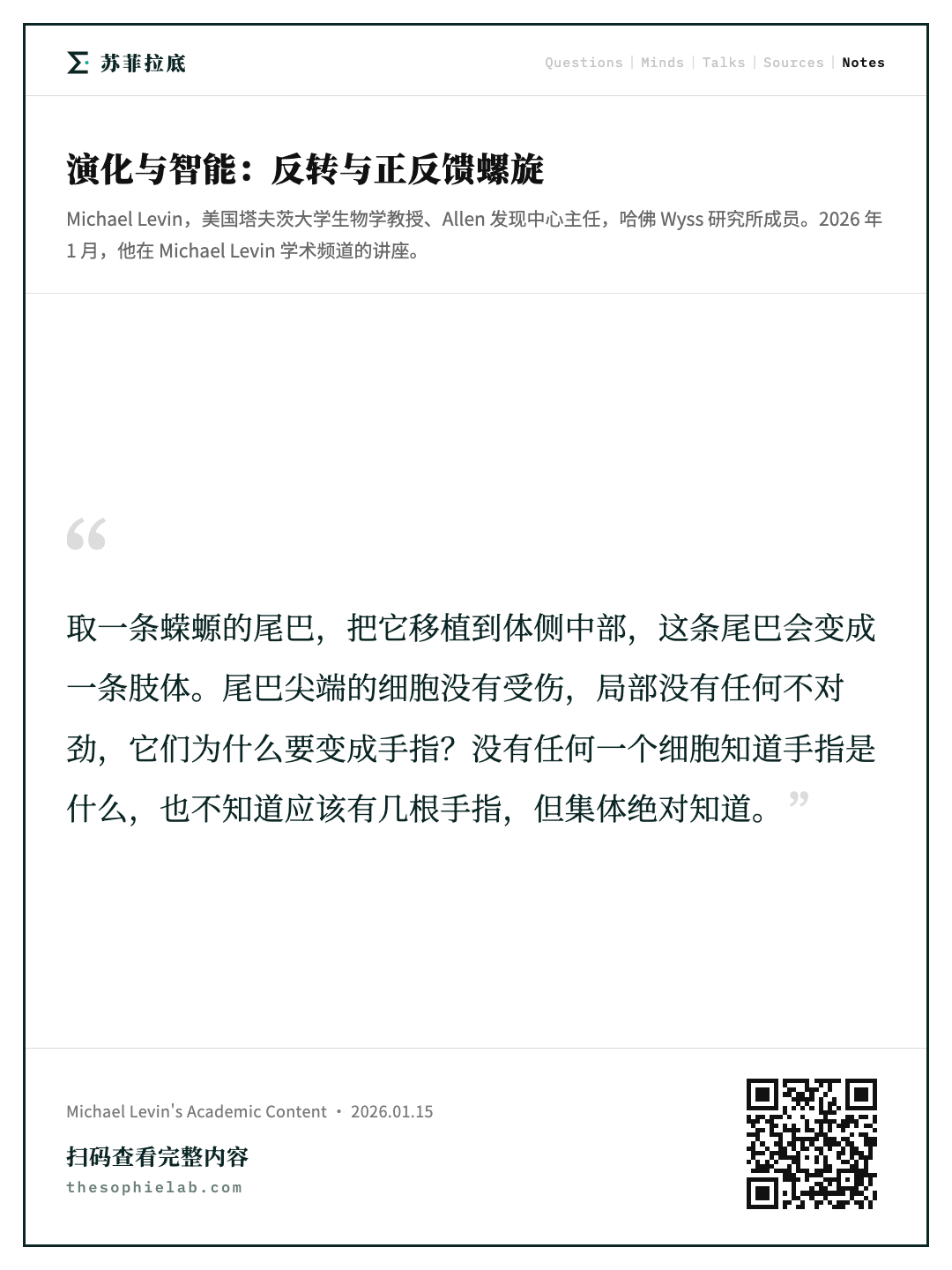
但这里还有更深一层的东西。这不只是关于损伤,而是关于整体秩序以一种向下因果(downward causation)的方式往下渗透。我举个例子。对这类生物你还可以做另一件事:取一条尾巴,把它移植到体侧中部。随着时间推移,这条尾巴会变成一条肢体。请注意尾巴尖端的那些细胞。它们没有受伤,没有损坏,局部没有任何不对劲。它们为什么要变成手指?如果你站在这些细胞的角度想,那就是:我为什么被变成了手指?一切本来都好好的,我们是尾巴尖上的细胞,安安稳稳待在尾巴末端。

这里发生的事情是,身体蓝图应该是什么样与它此刻是什么样之间存在一个全局的差值。没有任何一个细胞知道手指是什么,也不知道应该有几根手指,但集体绝对知道。当机体中部出现这么一个不合适的结构时,它会试图调节回一个更合适的身体蓝图,而这个过程涉及从身体蓝图与器官位置这个非常抽象的空间一路向下过滤,直到分子生物学层面,让这些末端结构经历一种变态,回到它们应该在的位置。

这种大尺度的抽象目标状态向下过滤、指挥化学过程的现象,我们以前见过,就在随意运动里。早上醒来的时候,你有一些非常抽象的目标,可能是社交目标、研究目标、财务目标,随便什么。为了让你起床、走路、执行这些目标,这些高度抽象的结构最终必须让离子穿过你肌肉细胞的膜。我们的身体里确实有这样一套神奇的转导机制,允许各种奇怪空间里的非常抽象的目标去改变化学过程的走向。这不是什么诡异的心身相互作用,也不是什么瑜伽修行,就是日常的随意运动。所以,无论是在随意运动的认知科学这个标准行为学场景里,还是在形态发生里,我们都有这样的例子:大尺度、高层级的目标状态向下传播,让化学过程做出它原本不会做的新事情。我认为这一点非常重要。

生物电提示词:造眼与双头涡虫

这样一个系统的另一个特点当然是,你可以在不同层级上与它沟通。你可以试着开关基因之类的,但你也可以与更高的层级沟通。就像我现在跟各位说话,我不需要操心突触蛋白会在你们大脑里的什么位置落脚,那些你们自己会处理。我只需要给出高层级的提示(prompt),如果我做得好,你们的大脑就会完成所有必要的化学过程,希望能确保你们记住这些内容。

这里有一个我们与这些高层级控制结构沟通的例子。这是一只蝌蚪的侧视图,这里是消化道,这是动物的右眼,脑在上面这里,嘴在这里,腹侧身体在下面。我们做的是注入一些离子通道,以提供一种特定的生物电信号。这又是一个我通常会讲好几个小时的话题:生物电作为认知的黏合剂。就像在我们的大脑里一样,你之所以知道你的神经元不知道、你任何一个神经元都不知道的事情,是因为电生理把它们绑定成了一个特定的网络。而这在身体的每一个部分都成立。所以我们利用了这个接口,通过各种离子通道操控技术、光遗传学之类的手段,发送对周围组织有意义的特定信号。

而我们能做的是谈论器官。不是单个基因的表达,不是干细胞生物学,而是可以说:「在这里造一只眼睛。」这是一个非常简单的高层级提示。当我们说「在这里造一只眼睛」时,细胞就照做了,它们造出一只眼睛。这只眼睛形状正确,组件正确,从切片上看,它有晶状体、视网膜、视神经,所有这些都有。我们完全不知道如何微观管理这件事,正如我不知道如何调整你们的突触蛋白来促进我们的对话。我们知道怎么发送提示,而这就够了,因为材料是有胜任力的。

事实上,如果我们只影响了这里的少数几个细胞,这是那个部位的一张横截面,蓝色的细胞是我们注入过的,那么只要我们的信息足够有说服力,这些细胞接下来就会指示它们所有的邻居一起参与眼睛的形成。至于信息什么时候有说服力、什么时候没有,那是另一个可以单独展开的话题。如果我们说服它们相信这里真的应该是一只眼睛,这并不容易,因为邻近的细胞其实在阻止它们这么做,这是一种癌症抑制机制,这里存在一场关于可能的未来的拔河。但如果我们有说服力,这些细胞就会指示邻居参与进来。这是二级指令。我们没有教它们这么做,它们本来就知道怎么做。

所以再说一遍,这就是你在其上进化的那种材料。这种材料是高度可重编程的。请看这些涡虫(planaria),它们是扁形动物,有头有尾。你可以把它们切成几段,稍后再详谈。每一段都确切地知道自己应该有几个头。你可能以为这是基因决定的,但事实证明,遗传学真正给你的是一个电路,这个电路在默认状态下呈现一种非常特定的模式,说的是「一个头,一条尾」。各位看到的这张图是用电压敏感染料拍的。一个头,一条尾。

我们能做的是拿这只动物来改写那个电信号,让两端都呈现出头的模式。请注意,这么做之后,分子生物学层面还没有任何改变,前端标志物依然只在头部,不在尾部;解剖结构也没有任何变化。所以这是一只完全正常的、解剖上正常的单头涡虫,分子生物学正常。不正常的是,它携带了一个模式记忆,记录着如果将来受伤它应该怎么做。这是一个反事实。这些非神经系统甚至能做简单的反事实推演。它是关于一只正确的涡虫应该长什么样的一个表征,而且它是潜伏的,是一段潜伏的记忆,直到你来把中段切下来,它才去查询这段记忆,造出双头的形态。

所以,一个身体,一个正常的涡虫身体,至少能存储两种不同的「一只虫应该长什么样」的表征之一。我称之为记忆,是因为如果你不断切割这些双头虫,它们会持续产生双头的动物。换句话说,一旦你改变了那个模式,它就保持不变,除非你去把它改回去,而这我们也能做到。

在我们谈遗传学和进化的时候,还有一点要记住:我们没有做任何遗传改变。基因组没有任何问题。事实上,不存在任何一种在遗传上不同于单头虫的涡虫品系。所以这是一种完全不同的做法。基因组完全正常,但幸运的是,基因组编码了一种可兴奋介质的电学组件,这种介质可以存储多种不同的模式。单头模式是默认值,但它是可重编程的。

植物系统也是可重编程的。它们同样容易用可靠性来蒙蔽我们。这是一颗橡子,每一年,在地球各处,它数以亿计次地造出一模一样的这种叶子。于是你会想:好吧,这就是橡树基因组会做的事,它知道怎么做出这种扁平的、绿色的、具有特定结构的东西。但基因组与表现型之间的那一层,同样具有各种有趣的性质,包括可重编程性和可被黑入性。于是来了这样一位生物工程师,一只小小的寄生虫,它造出了这种虫瘿(gall)。这些是在各种叶片上形成的令人难以置信的植物虫瘿。它并不是像造巢那样,像 3D 打印机一样一层层铺材料来造它。它实际上做的是留下一些提示,给植物细胞留下一些提示。正因为这种材料如此可重编程,如果不是有这个小东西,我们永远不会知道这些扁平的绿色细胞居然能造出这样一种不可思议的结构。

异位眼与巨型细胞:材料的创造力

这种可重编程性,这种类似软件的一面,有许多含义。其中一个含义是,当你对材料做出激进的改变时,它几乎总是会做出某种相当适应、相当融贯的东西。比如,我们造了这些蝌蚪,现在是俯视图。你会注意到原生的眼睛没有了,但我们在它尾巴上放了一只异位的眼睛。这么做之后,这只异位的眼睛会长出一根视神经。这根视神经不通往大脑,通常在脊髓上的某处终止,有时什么地方也不通。而这些动物能看见。我们知道它们能看见,因为我们造了一台自动化装置来训练和测试它们对视觉线索的反应。它们绝对能够利用自己唯一的一只眼睛,也就是尾巴上这只甚至不连接大脑的眼睛,运行有用的行为程序。

这就提出了一个有意思的问题:为什么不需要一轮又一轮的适应、选择、突变去重新调整动物的其余部分,这个全新的感觉运动架构就能运转?为什么它开箱即用?为什么不需要适应?在我提出一个关于这一切为什么行得通的想法之前,我再给各位看一样东西。这是我最喜欢的例子之一,我认为它展示了解剖空间里的创造性问题解决。

这是蝾螈肾小管的一个横截面。通常有八到十个细胞协作构建这样一个结构。你可以制造多倍体的蝾螈,它们有额外的遗传物质,细胞也更大,以容纳更大的细胞核。这么做之后,蝾螈的体型居然还是一样。这怎么可能?因为现在被调用来构建同一结构的细胞数量减少了。当你把细胞做得真正巨大,比如六倍体之类的蝾螈,一个细胞会自己绕着自己卷起来,在中间留出一个空腔,仍然给你同样的结构。

请注意这里发生了什么。有几件事同时在发生。首先,你看到的又是一种自上而下的因果:为了服务于一个大尺度的结构,不同的分子机制被调用了起来。这个例子里用的是细胞间通讯,那个例子里用的是细胞骨架的弯曲。这差不多就是每一份智商测验都在考的东西:给你一套标准工具,但给你一个与你熟悉的情况很不一样的问题,问你怎么用手头这些日常可用的手段去解决一个不同的问题。所以,我们可以找到不同的分子组件来解决这个问题。

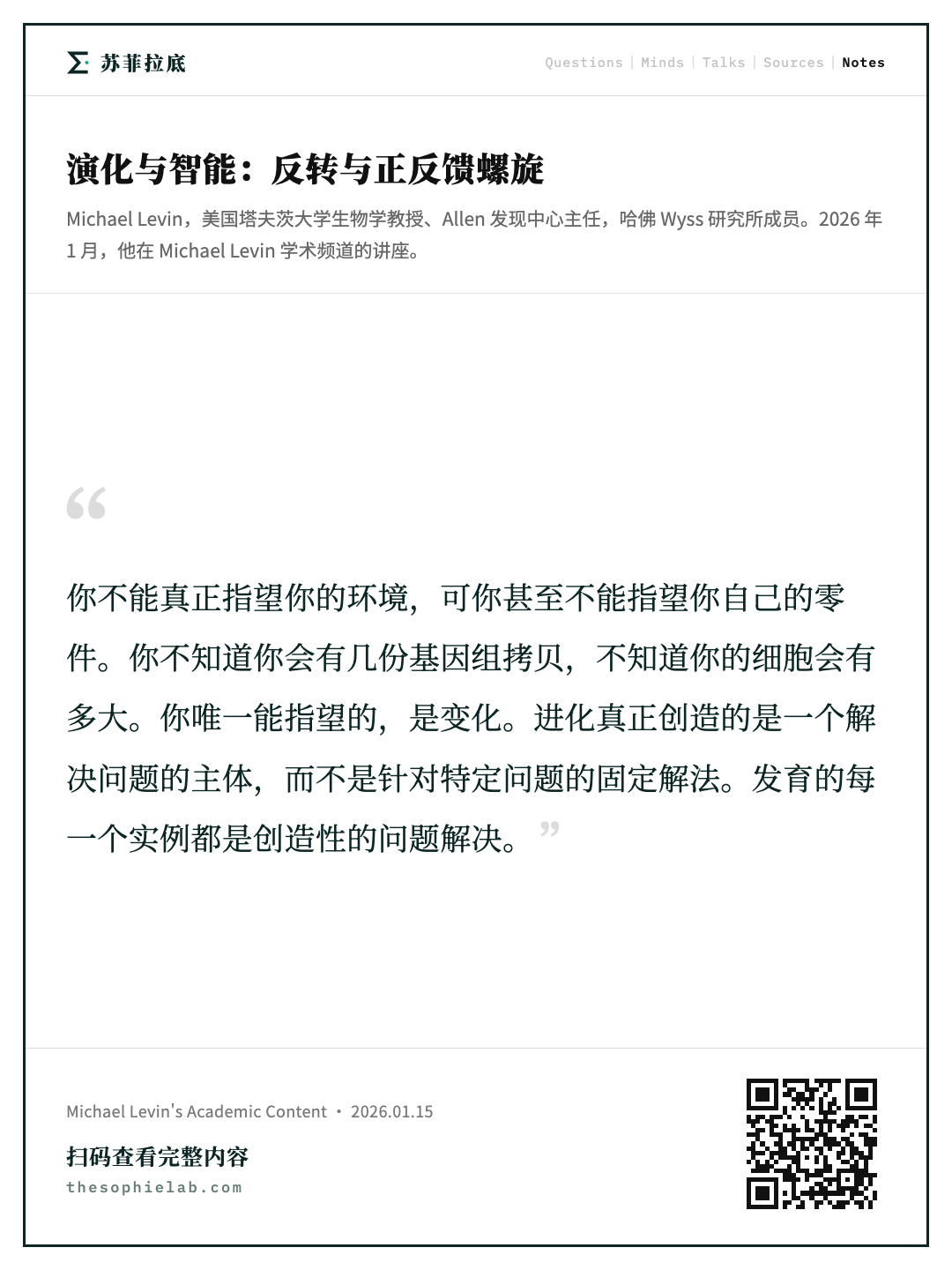
但请从一个来到世上的生物的视角想想这意味着什么。我们已经知道,你不能真正指望你的环境,你不知道自我组装之后会发生什么。可你甚至不能指望你自己的零件。你不知道你会有几份基因组拷贝,不知道你的细胞会有多大。你唯一知道的、唯一能指望的,是变化。这就是变化的悖论:事情一定会变。你会被突变,你的零件会不一样,外部世界会不一样。我认为,进化过程实际做的,就是认定这一点。这是一种「初心」的概念:你真正在创造的是一个解决问题的主体,而不是针对特定问题的固定解法。这就是为什么虫瘿、蝌蚪屁股上的眼睛之类的东西真的能用:它们能用,是因为发育的每一个实例都是创造性的问题解决。它们从来没有真正执着于把眼睛放在正确的位置,它们每一次都得重新把事情弄妥。

记忆即重建:基因组需要被诠释

让我们退一步,看看这件事的认知版本。想想我们每个人在任何一个时刻的处境:你无法触及过去。你能触及的,是过去的你留在你大脑和身体里的记忆印迹(engram),它们是关于以前发生了什么的压缩表征。所以,从一个重要的意义上说,你的记忆是你过去的自己发来的信息。而你每时每刻都必须为自己主动建构一个故事:你是谁,你有哪些可能性,你接下来要做什么。这个故事必须现在建构。

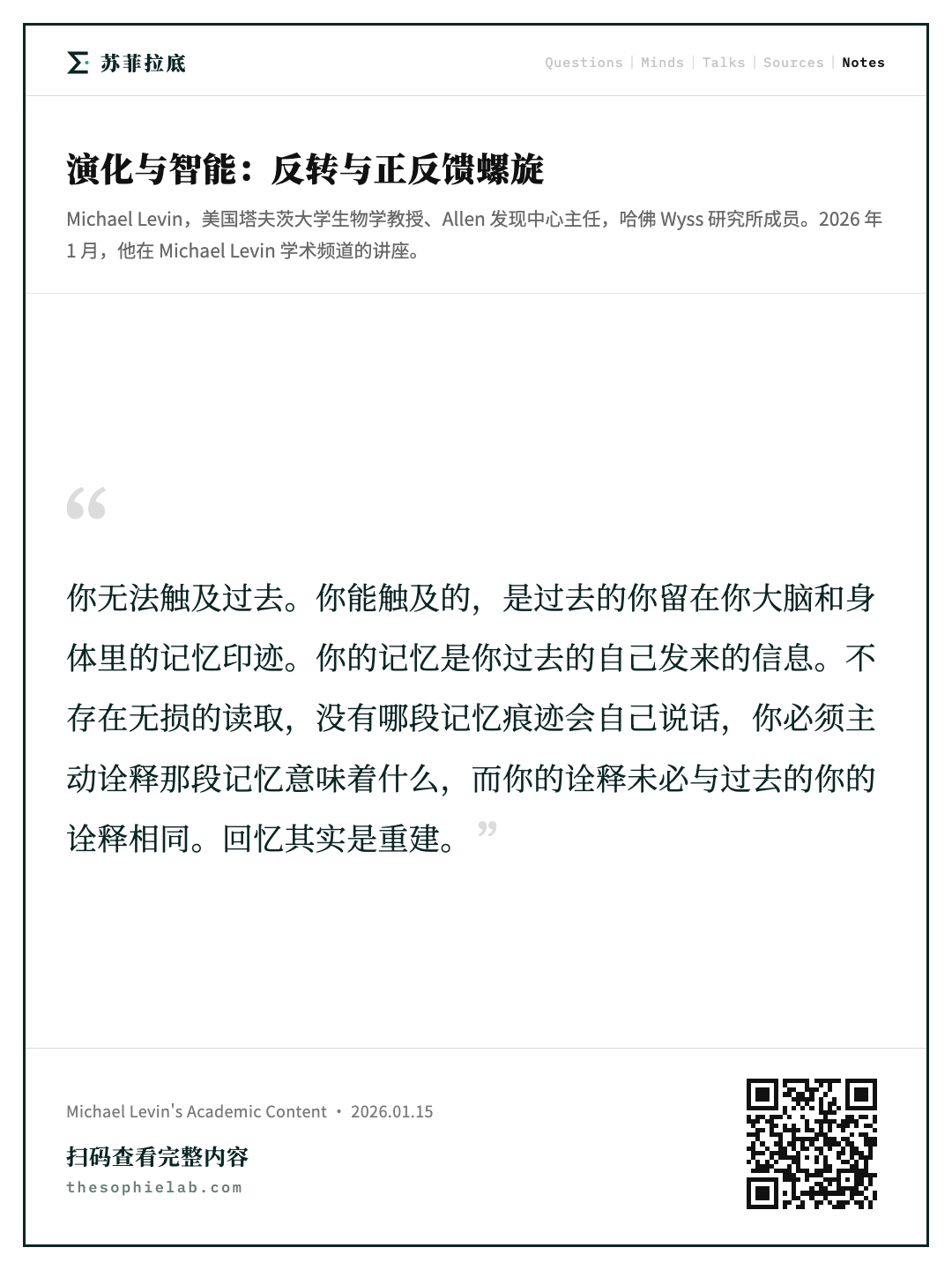
想想这种领结架构。我们生活在领结的中心,也就是「此刻」。之前发生的一切可以是算法式的,因为我们可以扔掉不重要的细节,把具体的实例压缩成泛化的表征,作为过去的压缩印迹。那一部分可以是算法式的。但这一部分不能,因为你已经扔掉了许多相关性,扔掉了许多细节。这一部分必须是创造性的。你必须拿起那些印迹,把它们重新充气。这是一个诠释的过程。你不可能直接知道你的记忆意味着什么,你必须主动去诠释它们。这就是为什么神经科学家现在会告诉你,回忆其实是重建。不存在无损的读取。没有哪段记忆痕迹会自己说话,你必须主动诠释那段记忆意味着什么,而你的诠释未必与过去的你的诠释相同。

我认为生物学里发生的正是这样的事。这一切都在这篇论文里讨论过了,我们在里面谈的是同样的事情在进化尺度上发生。换句话说,当你是一个胚胎,或者任何一种形态发生系统时,你得到的是一些以 DNA 形式存在的印迹,但至少对大多数物种而言,我认为你并不只是照着它们说的做。你必须诠释它们。你可以把它们诠释成一棵橡树,也可以把它们诠释成一个虫瘿,还有一些我稍后会展示的更奇怪的东西。

所以,我认为发生的事情是这样的:生物学从根本上假定硬件是不可靠的。你知道它会突变,你永远不知道任何东西你到底有几份拷贝。硬件从根本上说是一种不可靠的计算。你自己的零件会变,这意味着在先验上过度训练是没有帮助的。你不是单纯去维持这些信息以前的含义,你必须即时地重新诠释。当下与未来才是全部。你必须擅长重新诠释。我认为这是一个特性,而不是一个缺陷。正是这一点驱动着进化的可塑性与问题解决能力。

毕加索蝌蚪与进化的正反馈棘轮

那么,在一种有能动性的材料上进化究竟是什么样子?实际会发生什么?让我举个例子。这是一只蝌蚪,两只眼睛、两个鼻孔、一张嘴。为了变成一只青蛙,这只蝌蚪必须重新排布它的颅面器官:嘴要往前移,眼睛要挪位置,一切都要移动。曾经有一种看法认为这就是一个硬接线的过程。毕竟每只蝌蚪长得都一样,每只青蛙长得也都一样,只要你把所有部件按正确方向移动正确的距离,你就会得到一只正常的青蛙。

于是我们决定检验这一点。正如我说的,我认为所有这些都必须经过实验检验。我们造出了所谓的「毕加索蝌蚪」:我们把一切都打乱了,眼睛放在后脑,嘴歪到一侧,全都乱了。我们发现,它们基本上都长成了看起来相当正常的青蛙,因为所有这些部件都会沿着新奇的路径移动,到达它们该去的地方,然后停下来。

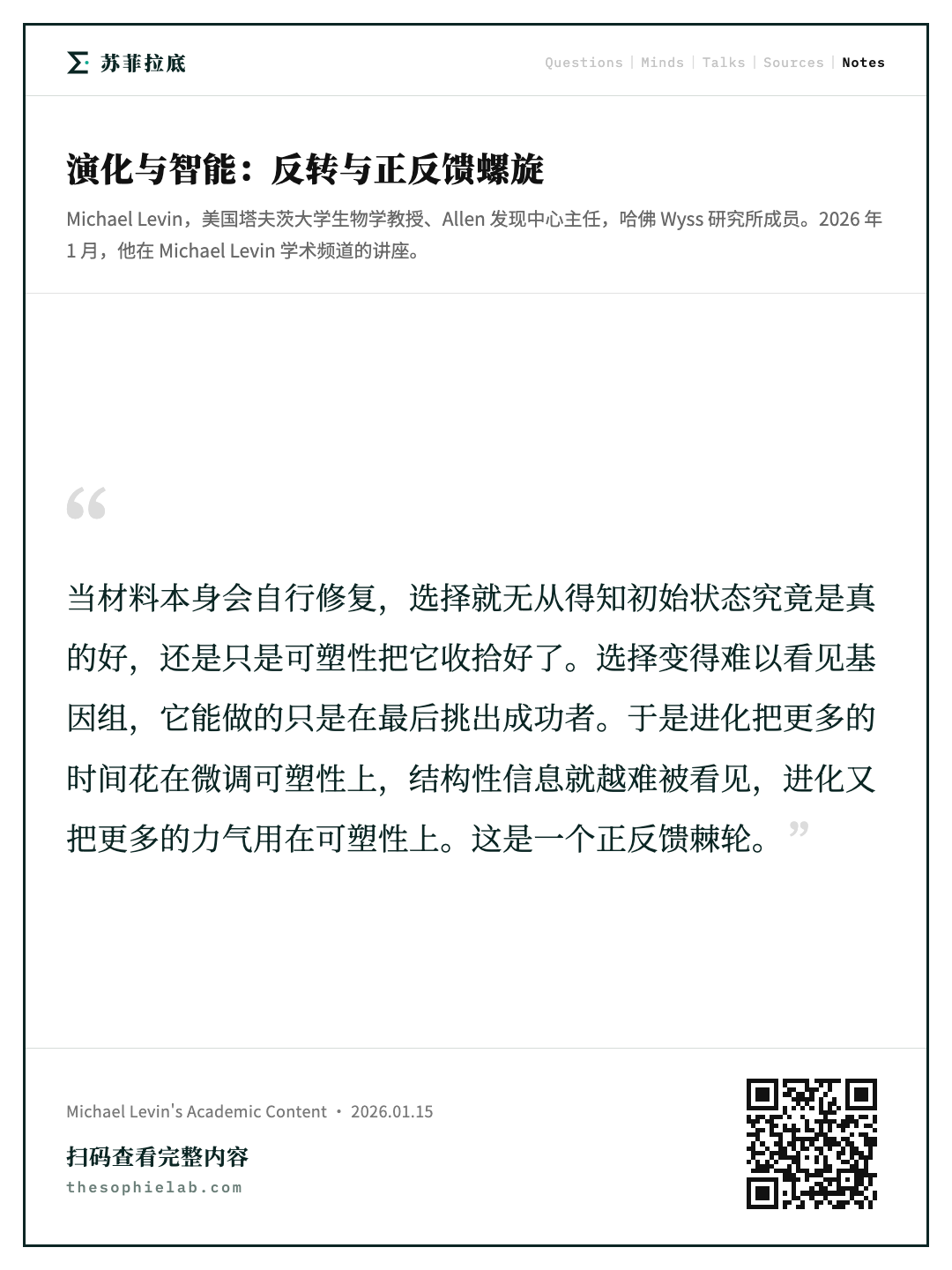
想想这种有胜任力的材料意味着什么。当材料本身会自行重新调整,我已经展示了它从不同起始位置把事情弄妥的各种可塑性,这就意味着,当选择看到这只漂亮的青蛙时,它无从得知初始状态究竟是真的好,还是初始状态其实挺糟糕、只是修复过程和再生的可塑性把它收拾好了。选择变得难以看见基因组。它能做的,只是在最后挑出成功者。

我们做了大量的模拟,全都在这篇论文里。我们发现的基本上是一个这样运作的棘轮,一个正反馈环路。一旦这种现象出现,进化就开始把更多的时间花在微调可塑性上,把更少的时间花在完善初始状态、也就是结构性信息上。但你越是这么做,结构性信息就越难被看见,于是进化又把更多的时间花在加码可塑性上。这样一来,一切都变了:第一,整个过程变快了;第二,它最终把越来越多的力气用在产生那些真正擅长解决问题的形态发生算法上,那些能在一种根本无法被完善的不可靠材料上进行创造性问题解决的算法。

涡虫悖论:垃圾基因组的完美算法

对我来说,这方面最令人印象深刻的例子是涡虫。涡虫的特别之处在于,至少我们研究的这个物种是无性繁殖的:它们把自己撕成两半,然后再生。这意味着,在我们身上发生的那种基因组清理,也就是体细胞突变不会传给下一代这件事,在它们身上不会发生。任何没有杀死干细胞的突变,基本上都会随着它们的再生被扩散到下一代。所以它们积累了数量惊人的突变。它们是混倍体的,细胞携带的染色体数目各不相同,简直是一团乱麻。

然而,这些家伙抗癌。它们抗记忆丧失,因为连它们的尾巴都保留着它们学到的东西的记忆。它们抗分解,至今没有任何涡虫的细胞系。它们不死,不衰老,涡虫身上没有任何衰老的证据。它们抗突变,不存在涡虫的遗传品系,也不存在转基因的涡虫品系。我认为发生的事情基本上是这样的:由于它们的基质极度不可靠,不断地被突变,进化把全部力气都用在打磨一个惊人的算法上,这个算法无论底层硬件出了什么状况,都会努力造出一只完美的虫子。而真正有效地做出永久改变的唯一途径,是在更高的组织层级上,比如我们的双头虫,以及我们用生物电做的另外一些事。

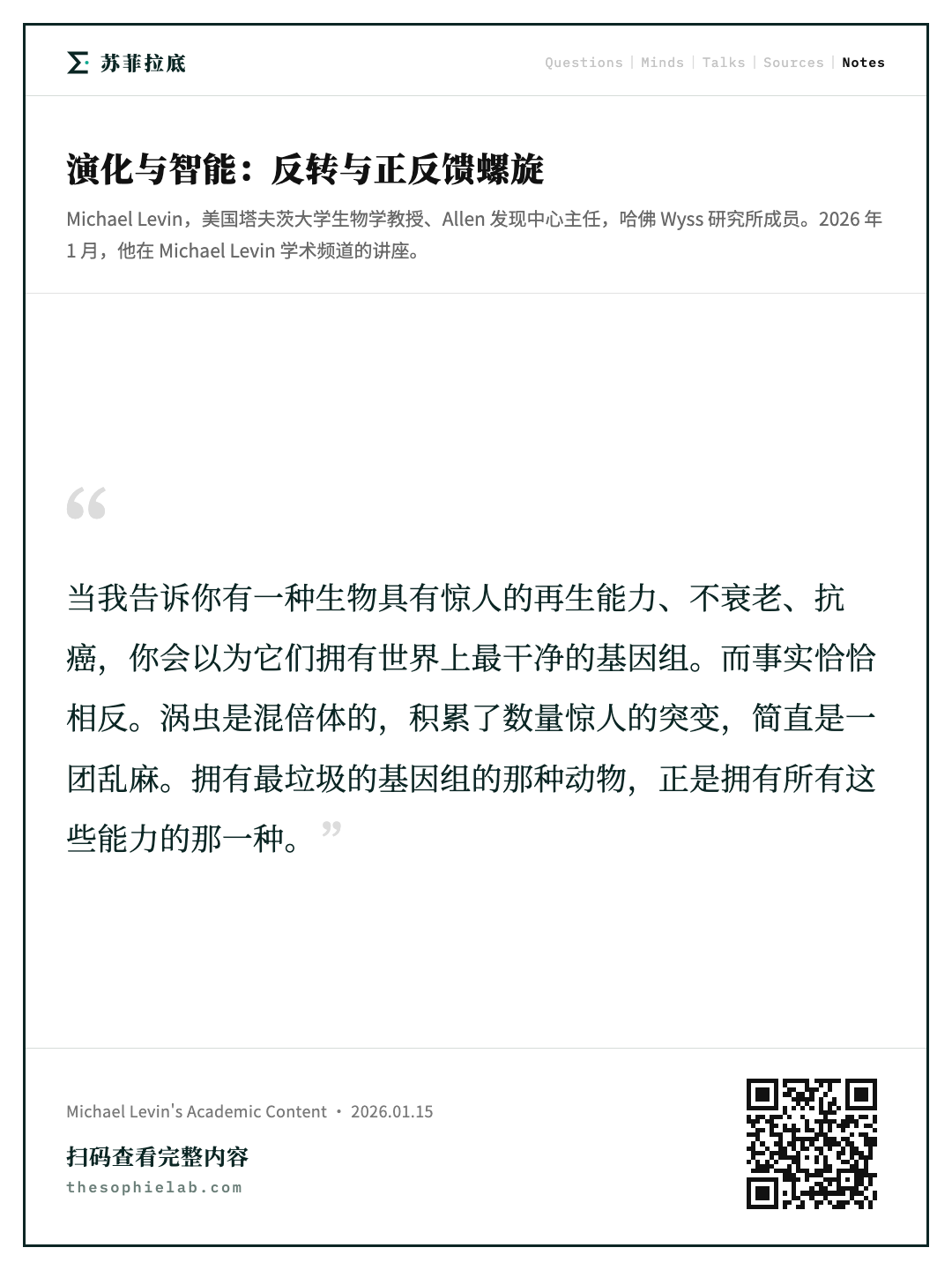
我第一次把这些讲给学生听的时候,感觉有点惊世骇俗。当我告诉你有一种生物具有惊人的再生能力、不衰老、抗癌,你会以为它们拥有世界上最干净的基因组,对吧?我们受的教育都说基因组是所有这些事情的负责人。而事实恰恰相反。拥有最垃圾的基因组的那种动物,正是拥有所有这些能力的那一种。我认为原因就在于这个螺旋:不得不有创造性,不得不在结果层面、而不是在硬件本身上做各种纠错。

所以我认为这里发生的事情是,底层材料的胜任力真正地平滑了进化的景观。它给了这个过程耐心。举个例子,如果那只蝌蚪有一个突变把嘴移到了一侧,但同时在尾巴上做了一件真正有益的事,那么在一种不能自我修复的材料里,你永远看不到那件有益的事,因为那个生物会饿死,你永远看不到那个突变的好处。但在这种情况下,嘴会自己找路回到它该去的地方。于是,许多潜在有害的突变变成了中性突变,因为存在补偿它们的胜任力。这真正改变了进化过程能够施展的耐心的量,从而提高了可进化性。

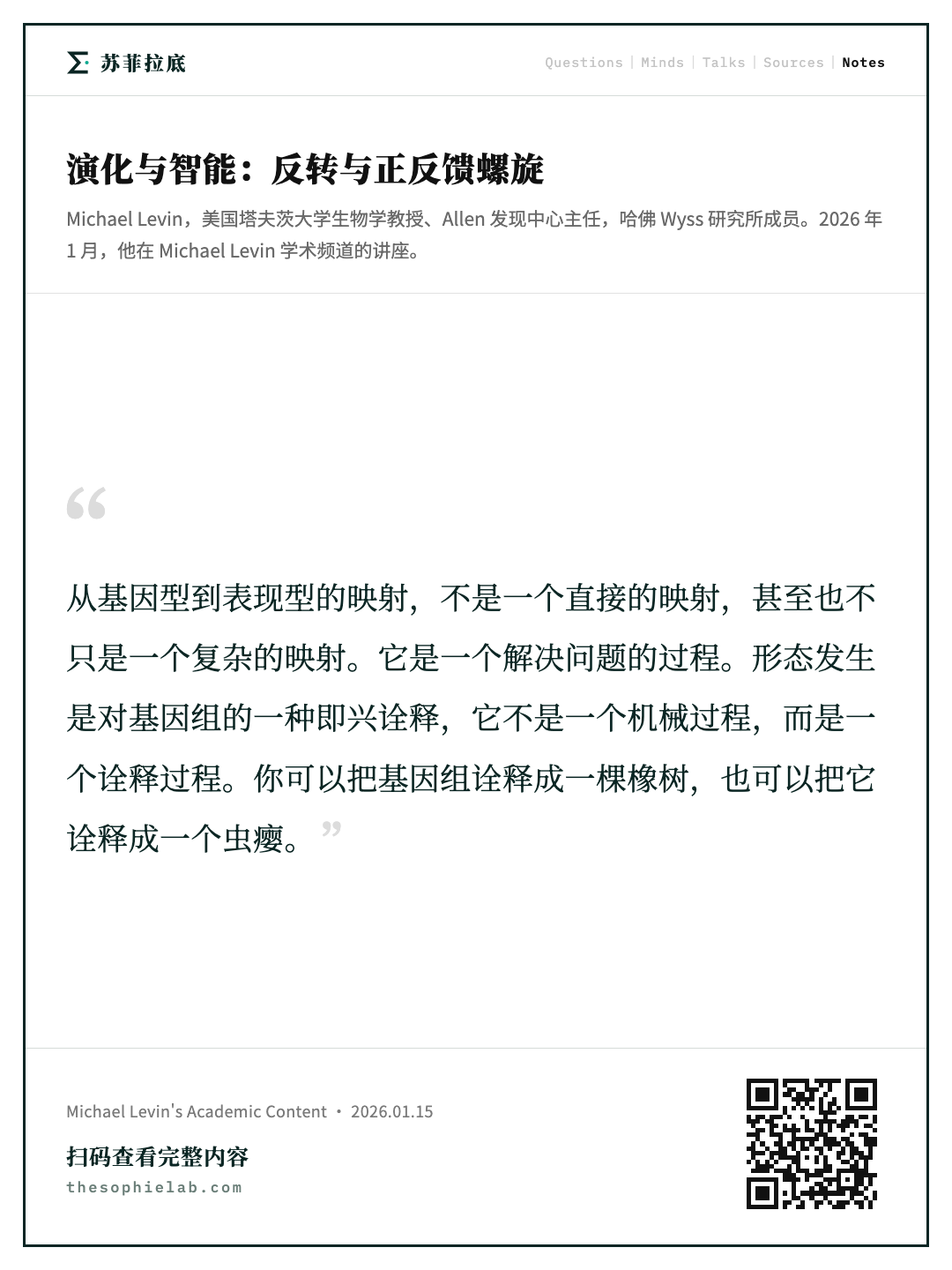
而从根本上说,它创造出来的是解决问题的系统,因为每一个尺度上的每一个生物系统都必须辨认自己的边界,必须选择哪些输入是要紧的,必须对自己的环境做粗粒化处理。即便没有任何扰动,正常的发育已经是一个解决问题的过程。我认为,每一次都必须创造性地诠释信息,既包括环境信息,也包括你自己的遗传信息,这种必要性让进化快得多,也强大得多。因为从基因型到表现型的映射,不是一个直接的映射,甚至也不只是一个复杂的映射。它是一个解决问题的过程。

异种机器人与人类机器人

接下来还有两件事要讲。我们谈了自然进化出来的系统的属性。那么新型的存在物呢?它们的属性从何而来?我想给各位介绍两种这样的生物。

第一种我们称为异种机器人(xenobot)。我们做的是从蛙胚的动物极释放出一些上皮细胞,把它们放在一边。它们可以做很多事:可以死掉,可以彼此爬开,可以像细胞培养那样形成一层单层。但它们做的却是聚在一起。我给各位看一个例子。这里每一个东西都是单个细胞。我觉得很有趣的是,这一个看起来像一匹小马。它们并不都长这样,有很多不同的形状。但它们作为一个集体移动,基本上开始聚拢,各位在这里可以看到,它们相互作用时有小小的钙闪光。然后它们自组装成这个能运动的小构造体。它在这个迷宫里游动,转弯时不用撞到对面的墙。它有自发的行为变化,不知为什么,它会掉头回到来的地方。它们有许多有趣的行为,我没时间一一展示。

它们做的事情之一是运动学自复制(kinematic self-replication)。如果你给它们一堆松散的上皮细胞,它们会集体地和单个地跑来跑去,把这些细胞打磨成小球。而这本身就是一种有能动性的材料,猜猜会发生什么?这些小球成熟为下一代异种机器人,下一代再制造下一代,再制造下一代。这里没有强遗传,但有复制,有运动学自复制。而且我们不用教它们这么做。这是完全标准的蛙细胞,没有合成生物学回路,没有支架,没有奇怪的药物。这是材料的原生胜任力。

你可能会问,这些家伙表达了哪些正常蛙胚不表达的基因?它们有大约六百个差异表达基因。我只展示其中一个。有意思的会有很多,但我只举一个例子:有一簇基因与声音和机械刺激的感觉知觉有关。于是我们问自己,它们有没有可能听得见?结果发现,它们确实对声音有反应。这是它们拥有的一种新能力,正常的胚胎并不具备。

到这里,你可能在想,好吧,这是青蛙、是两栖动物的特殊之处。那我要问各位:如果我们把你们的细胞从你们身体的其余部分释放出来,它们会做什么?请允许我介绍人类机器人(anthrobot)。如果你给这个小生物测序,你会发现它拥有百分之百正常的智人基因组。我们取的是成年人的细胞,不是胚胎的,来自成年人气管上皮的捐献者。这些细胞自组装成这个能运动的小型原始生物体。它跑来跑去,可能是在试图收集这些细胞,就像异种机器人那样,我们不知道,它们在这方面不太擅长。但它们有许多其他有趣的能力。

比如,我们取一批人类神经元铺在培养板上,像这样划一道大口子。人类机器人在这里是绿色的,它们会过来,停在这一簇里,然后开始在缺口上编织,开始愈合。这里各位可以看到神经元,它们开始把神经元愈合起来。谁能想到,你们的气管上皮细胞,几十年来安安静静地待在你们的气道里,一旦我们把它们从你们身体里取出来,就会形成一个能游来游去的小生物,而且顺便一提,遇到神经元的伤口还会去愈合它们?

这些家伙有九千个差异表达基因,大约半个基因组的表达完全不同。再说一遍,我们没有碰过基因组。这里没有合成回路,没有什么奇怪的纳米之类的东西,什么都没有。只是不同的生活方式,不同的环境。九千个差异表达基因。它们有四种不同的行为,我们可以为它们做出带转移概率的行为谱。不是十二种,不是一种,而是四种。

追问:新生物的属性从哪来

于是你会问:这些特定的属性从何而来?特定的基因表达,特定类型的行为。更宽泛地说,我们知道蛙的基因组学会了做这个:它学会了造出特定的发育阶段,最终造出蝌蚪。但显然,它也能做这个。这是一个异种机器人,一个八十三天大的异种机器人。它正在变成某种东西,我完全不知道它在变成什么。

所以我们得问几个有意思的问题。从来没有过异种机器人,从来没有过人类机器人。从来没有过针对运动学复制的选择,据我们所知,没有任何其他生物做运动学复制。所有这些都从来没有被选择过。它们为什么知道怎么做?它们特定的转录组、生理状态、行为、形状,这些从何而来?尤其是,我们知道进化出所有这些东西的计算成本是在什么时候支付的:是在这个基因组与环境相互撞击的漫长选择岁月里。可我们是什么时候支付了获得这些东西的计算成本?

当我问别人时,他们常常说:「哦,那是涌现的。」我说,那是什么意思?他们说:「我想意思大概是,在选择让它成为青蛙的那段时间里,它也学会了成为异种机器人和人类机器人。」我当然觉得这非常令人不安,因为我认为标准的进化论期望一个生物的历史与它现在的属性之间存在某种程度的特定对应关系。这本该是整件事的要点:我们本应能够根据你经历过的环境和选择的历史,讲出你为什么是现在这个样子的故事。而这种「啊,那大概是涌现的,这些东西就是在那儿」的说法,我认为远远不够。

分子网络学习与因果涌现回路

接下来我要谈的,然后给出几点结论就结束,是几件有趣的事情,关于在差异化复制之前、在选择之前、在所有这些之前发生了什么。

首先我要介绍这样一个想法:即便是分子通路,可以用常微分方程描述的非常小的分子通路网络,事实证明它们也能学习。你不需要神经元,甚至不需要细胞。只要有相互开关的耦合系统,这与理查德早先谈的东西非常相似,仅凭这一点,你就可以得到六种不同类型的学习:习惯化、敏化、联想条件反射,等等。全都已经在这种分子基质里了,已经内嵌在这些网络的性质之中。我们正把它用于生物医学目的,比如药物条件化,我们可以训练分子网络对特定刺激做出反应,等等。

但我想请各位注意下面这件有趣的事。假设你有一只大鼠,你训练它按压杠杆以获得奖励。没有任何一个细胞同时拥有这两种经验:脚底的细胞按压杠杆,肠道里的细胞得到美味的糖。这段联想记忆归谁所有?归大鼠所有,对吧?所以这又是一个集体智能,由一些各自都不知道全部信息的组件构成,但作为集体的大鼠知道。我们知道的是,这类学习需要某种程度的整合,而量化整合的一种方式,是借助信息论在因果涌现(causal emergence)等方面的进展。

于是我们问:反过来是否也成立?我们知道你必须是一个整合的主体才能学习,但学习的过程会对你作为整合主体的地位做什么?结果我们发现了一件惊人的事,很快会有几篇论文发表:当你训练分子网络时,它们的因果涌现上升了。不是全部,但是相当大的一部分,尤其包括一些随机网络。换句话说,这不是大海捞针的过程,而是即便随机网络也相当普遍地具有的一种性质。是的,进化绝对会把它优化到极致,但即便随机网络也能做到。

所以我们有三个组成部分。更高的因果涌现带来更好的学习。反过来,学习提高因果涌现。而最惊人的是遗忘:当你强迫这些网络遗忘时,它们并不会失去从学习中获得的因果涌现增益。这是一个惊人的正反馈环路,其中带有一种根本的不对称性:它指向上方。换句话说,学习与因果涌现之间、智能与「大于部分之和」的地位之间,存在一个正反馈环路。这是很早就发生的事情。它不需要生物学,不需要任何特殊的物理性质。它从哪里来?它是数学送来的一份免费礼物。它是相互开关的网络的性质,是因果涌现的性质,是调控这一切的数学。这就是它的来源,而且它内嵌在最底层。

我们下一篇论文考察的是地球上现实的、或者至少是合理可信的前生物化学体系,以展示学习与因果涌现之间的这种正反馈环路。在这个东西启动之后,你才能得到复制子,然后差异化复制以及所有那些东西才能开始运作。但仅凭随机网络的性质,这个正反馈环路就已经启动了。

再非常简短地提一件事。如果你对囚徒困境建模,让子单元除了合作与背叛之外还能合并与分裂,你实际发现的是一种偏向:偏向合并成越来越大的主体,而它们的因果涌现同样上升。这又只是数学本身的性质。它不依赖于生物学、物理学或选择的任何具体事实。这一切都远远早于任何复制子和选择的登场。我认为,这正是驱动我们在进化中所见的许多现象的东西。

结论:认知比生命更广

我再说几句就结束。我不会把这整面文字墙念一遍,如果有人感兴趣,我会分发幻灯片。我认为我们在这里得到的是这样一个观念:无论在哪个尺度上,从分子组件到整个进化过程本身,智能都不必是魔法,不必是神秘的。我们现在有工具来研究这类事物的动力学。在一种能动性一直贯穿到底的多尺度材料上进化,打破了许多关于进化能做什么、不能做什么的假定。我认为这极其强大。而且,通过这些生物机器人、嵌合体,这些以前从未存在过的东西,我们现在有能力去追问一些深刻的问题:对于生命与认知来说,无论在什么基质上,什么是本质性的,而哪些又是地球上特有的具体特征。

所以我想提出以下看法。传统的观点是这样的:你有大量的死物质,其中某个区域我们称之为生命。其中大部分算不上有智能,但有少数几种有脑子的生命形式,心智就在那里。我认为这是一种非常流行的传统观点。而我认为我们现在看到的,尤其是我最后展示的那些东西,暗示了某种相当不同的图景。这是我目前的信念,我知道它显然有争议。我认为认知系统的集合不仅比生命系统的集合更宽,实际上比所有物理具身系统的集合都更宽。我认为在这张图里,认知是最大的那个集合。在它之内,有一些无脑的智能,也有一些非常有脑子的智能。特别是,一旦你有了一个需要照料的、会复制的身体,我们才注意到它,并称之为生命,但事情其实比这深得多。我认为对于认知与进化而言,有趣的事情早在你得到细胞、通路、复制子之前就已经发生了。

我基本上就讲到这里,只再预告一下。如果有人对「这些模式从何而来」这个想法感兴趣,可以去看我们的研讨会,我们在这个平台上有一个关于柏拉图空间的研讨会。那里有各种各样的人的演讲,有我的,也有许多非常优秀的同行的,他们谈的都是那些既不来自生物学历史、也不来自物理学历史的信息从何而来。这非常有意思,它指出了一些非常有趣的知识缺口。

论文很多,如果有人对这些东西感兴趣,我可以寄送抽印本。最重要的是,我要感谢完成了所有这些工作的学生和博士后,还有与我们合作这些课题的出色合作者。我必须做利益披露:有三家公司获得了我今天展示的部分成果的许可,这是我的商业利益所在。最后,也是最重要的,是所有这些生物系统,是它们完成了这项工作中全部的重活。谢谢大家,我来回答问题。
排版 + 横图 + 来源,粘贴即成稿
章节 · 点击跳转视频
0:00 开场:进化与智能的两个论点 ▶ 正在看
6:39 可说服性坐标轴与多尺度胜任力 ▶ 正在看
11:36 再生实验:目标导向与向下因果 ▶ 正在看
16:03 生物电提示词:造眼与双头涡虫 ▶ 正在看
22:16 异位眼与巨型细胞:材料的创造力 ▶ 正在看
25:40 记忆即重建:基因组需要被诠释 ▶ 正在看
28:43 毕加索蝌蚪与进化的正反馈棘轮 ▶ 正在看
31:59 涡虫悖论:垃圾基因组的完美算法 ▶ 正在看
35:31 异种机器人与人类机器人 ▶ 正在看
40:14 追问:新生物的属性从哪来 ▶ 正在看
42:02 分子网络学习与因果涌现回路 ▶ 正在看
46:16 结论:认知比生命更广 ▶ 正在看
本期小问 · 档案清单
—— 从基因到身体形态的发育过程,真的算一种智能吗? ▶ 正在看
—— 基因组最混乱的涡虫为什么反而最能再生、抗癌、不衰老? ▶ 正在看
—— 从未被自然选择过的异种机器人,靠什么知道如何行动? ▶ 正在看
—— 学习与因果涌现的正反馈,是不是在复制子出现前就已启动? ▶ 正在看
本期讲者
迈克尔·莱文美国塔夫茨大学生物学教授、Allen 发现中心主任,哈佛 Wyss 研究所成员。以发育生物电研究、双头涡虫、异种机器人(xenobots)与人类机器人(anthrobots)闻名,提出「多样智能」与「多尺度胜任力架构」等理论框架。
01开场:进化与智能的两个论点
0:00
And so what I'm going to talk about is two aspects of the relationship between evolution and intelligence. First, I'm going to claim that they make a positive feedback spiral, which I will explain. And I also think that there's an interesting inversion to be discussed where I think intelligence actually precedes and potentiates evolution and not the other way around. Um So as a preface, I just want to say a couple words about the perspective that I take on these problems. In my group, we study kind of an intersection of biology, computer science, and cognitive science. And I'm really interested in this journey that all of us take from a little bag of chemicals in an unfertilized oocyte all through the various sciences. So we traverse disciplines that we have given names to chemistry, developmental physiology, behavioral science, psychology, and and so on. Um But I think that while the disciplines and the funding bodies and journals and departments and all these things are distinct, I actually think that the substrate is continuous. And all of these, to me all of these are actually
我要讲的是进化与智能之间关系的两个方面。首先,我要说的是,它们构成了一个正反馈的螺旋,这个我待会儿会解释。另外我还认为,这里有一个很有意思的倒置值得讨论:我认为其实是智能先于进化、并使进化成为可能,而不是反过来。嗯,作为开场,我想先说几句我看待这些问题的视角。在我的团队里,我们研究的差不多是生物学、计算机科学和认知科学的交叉地带。我真正感兴趣的,是我们每个人都经历过的这段旅程——从未受精卵里的一小袋化学物质开始,一路穿过各门科学。我们跨越了那些被我们命名过的学科:化学、发育生理学、行为科学、心理学等等。嗯,但我觉得,虽然学科、资助机构、期刊、院系这些东西都是彼此分立的,我其实认为底层的基质是连续的。而所有这些,在我看来,其实都是
便签笔记
1:02
kinds of behavioral science. Different kinds of behavioral science, but nevertheless, that's what I think is going on here. So that's that's one aspect of where I'm coming from. Another is that I'm really interested in going beyond the kind of the typical um focus on biological materials and natural evolution here on Earth and kind of a focus, I mean as as I think many of you as well, a focus beyond anthropomorphism. And I'm interested in the status and properties of all kinds of unusual beings. Of course, we all know we are at the center of this kind of um spectrum both on an evolutionary and developmental scale. But also now with technology, increasingly we're getting further apart from this sort of standard adult human that features prominently in discussions of philosophy of mind and things like this where we have technological changes, we have biological changes, and we have to really ask ourselves what what what do we mean by by a human and how much of that is critically related to our origins on on Earth and and things like this. So This this in fact I think is even actually not not the whole story.
某种形式的行为科学。是不同种类的行为科学,但不管怎么说,我认为这里发生的就是这么回事。这是我的立场的一个方面。另一个方面是,我很有兴趣超越那种典型的关注点——只盯着生物材料和地球上的自然进化——也就是说,我想,和在座很多人一样,超越拟人化的视角。我对各种不寻常的存在者的地位和属性都很感兴趣。当然,我们都知道,无论在进化尺度还是发育尺度上,我们都处在这个谱系的中心位置。但现在有了技术,我们也在越来越远离那个在心灵哲学之类的讨论中占据主导地位的“标准成年人类”:我们有技术上的改变,有生物学上的改变,我们真得问问自己,我们说“人”的时候到底指的是什么,其中又有多少是与我们在地球上的起源之类的东西紧密相关的。所以,其实我觉得这还不是故事的全部。
便签笔记
2:13
Because the space of possible embodied minds is truly vast. I think everything that Darwin was talking about when he said endless forms most beautiful are like a tiny corner of this possible space. Pretty much any combination of evolved material, engineered material, software, and something that I'll just mention briefly at the end, which are patterns from a latent space. Almost any combination of these things is is probably some kind of interesting embodied intelligence. Many of these already exist. Cyborgs and hybrids and all all kinds of unusual creatures are going to be sharing the world with us. And I think we really need to work to have a kind of ethical symbiosis with these other unconventional minds. So this is this is the kind of kind of direction I'm coming from. And in particular, we had a Richard and I had on a on a recent paper had an interesting quote from a reviewer who said that developmental biologists don't concern themselves with the mind-body problem. And I think this is this is fundamentally mistaken. I think developmental biologists are ideally suited to address the mind problem by body problem. In fact, they have to. And I'm not the only person who thought
因为可能的具身心灵的空间实在是太浩瀚了。我觉得达尔文说“无尽之形最美”时所谈到的一切,都只是这个可能空间里的一个小角落。几乎任何形式的组合——演化出来的材料、工程造出来的材料、软件,以及我最后会简单提一句的、来自某个潜在空间的模式——几乎这些东西的任何组合,都可能是某种有意思的具身智能。其中很多已经存在了。赛博格、杂合体,以及各种不寻常的造物,都将与我们共享这个世界。我认为我们真的需要努力去和这些非常规的心灵建立一种伦理上的共生关系。这就是我的大致方向。特别值得一提的是,理查德和我最近有一篇论文,收到一条很有意思的审稿意见,说发育生物学家不关心身心问题。我觉得这从根本上就是错的。我认为发育生物学家恰恰最适合处理身心问题。事实上他们不得不处理。而且这么想的不止我一个人,
便签笔记
3:23
this. Here's here's Alan Turing who thought very hard about intelligence and and embodiment and different different vehicles for for minds and so on. And of course, he wrote this very famous >> [clears throat] >> paper on the origin of of order in embryonic development. And I think he recognized a very important fact, which is that there are deep symmetries between the autopoiesis of the body and the autopoiesis of the mind. And these things come together in a in a very very important way. So what I'm going to talk about today is the relationship between intelligence and evolution. What I will not be talking about is non-random mutations. Okay, so many many of you study these these and and so on. And so the whatever whatever is going on there is in addition to everything that I'm going to say. So so nothing that I say today relies on having non-random mutations. And what I am going to talk about is try to convince you of three specific things. First of all, that the map between the genotype and the phenotype is intelligent. That is, the process of morphogenesis that converts the substrate of mutation and into the substrate of selection is itself a problem-solving creative process. The thing that sits in the middle is very important and it is not just complex, it is not just
还有别人。这位是艾伦·图灵,他对智能、具身性以及心灵的不同载体等等都做过非常深入的思考。当然,他还写了那篇非常著名的 >> [清嗓子] >> 关于胚胎发育中秩序起源的论文。我认为他意识到了一个非常重要的事实,那就是:身体的自创生与心灵的自创生之间存在着深层的对称性。这两者以一种非常非常重要的方式汇合在一起。所以我今天要讲的是智能与进化之间的关系。我不会讲的是非随机突变。好的,你们当中很多人研究这些东西。所以那边发生的任何事情,都是在我今天要说的一切之外的额外内容。我今天说的任何东西都不依赖于存在非随机突变。而我要讲的,是试图让你们相信三件具体的事。首先,从基因型到表现型的映射是有智能的。也就是说,那个把突变的基质转化为选择的基质的形态发生过程,本身就是一个解决问题的、有创造性的过程。夹在中间的那个东西非常重要,它不只是复杂,它不只是
便签笔记
4:45
you know, a big hairball of causal interactions. It is actually a problem-solving creative process. And that means that we have to ask ourselves, what does it what does it look like to evolve on this kind of material? And I'm going to claim that evolving on a multi-scale agential material works quite differently than than we're used to thinking about evolution. I think this has major implications. And basically, both of these points rest on this idea that there are autonomous agents all the way down. And this this this makes evolution work work differently. And then what I'm going to talk about for the for the last third of the of the talk is to address two questions. Um Well, for really just to raise this this issue of where do the properties of entirely novel beings come from? In other words, beings that have not been specifically selected in the evolutionary stream on Earth. And I won't have time to talk about this, but I will point you to just to sort of tease some some talks by myself and many other people about an idea related to this to this to this claim that the properties of novel beings and in fact of of existing beings, too, come from the same latent space that things like the precise value of e and and
你懂的,一大团纠缠在一起的因果互动。它其实是一个解决问题的、有创造性的过程。而这意味着我们必须问自己:在这样一种材料上进化,会是什么样子?我要说的是,在一种多尺度的、具有能动性的材料上进化,跟我们习以为常的那种进化观相当不同。我认为这有重大的含义。基本上,这两点都建立在这样一个想法上:一路向下都是自主的能动者。而这就让进化的运作方式变得不一样。然后在演讲的最后三分之一,我要谈两个问题。嗯,其实主要是提出这样一个问题:全新的存在者,它们的属性是从哪儿来的?换句话说,那些从未在地球的进化长河中被专门选择过的存在者。我没有时间细讲这个,但我会给你们指个方向,算是预告一下我自己和其他很多人关于这个想法的一些报告:新存在者的属性——其实也包括现有存在者的属性——来自同一个潜在空间,就像 e 的精确值以及
便签笔记
5:56
other mathematical objects come from. But I'll only I'll only have time to just just just touch on that. And then I will also talk about some of the recent work that we've done on what actually kickstarts the evolutionary process before you get replication. So what's going on before even replicators and thus differential differential replication kicks in. And I'll introduce you to a concept that I'm still still working on the name, but but for now this is this is what I'm calling it. And then and then I'll talk about some some very speculative things for the future. Okay, so let's let's talk about this this this first issue. So in order in order for me to to convince you that the genotype-to-phenotype map is a kind of intelligence, what we would have to do is dissolve some assumptions.
其他数学对象也来自那里一样。不过我只来得及稍微碰一下这个话题。然后我还会讲一些我们最近做的工作,关于在复制出现之前,究竟是什么启动了进化过程。也就是说,在复制子、以及由此而来的差异化复制登场之前,到底发生了什么。我会给你们介绍一个概念,它的名字我还在琢磨,但目前我就先这么叫它。然后我会讲一些关于未来的、非常具有推测性的东西。好的,我们先来谈第一个问题。为了让你们相信基因型到表现型的映射是一种智能,我们得先化解掉一些预设。
便签笔记
02可说服性坐标轴与多尺度胜任力
6:39
Specifically, assumptions that intelligence and problem-solving are things that brainy animals do in three-dimensional space. And so in order to do that, I will try to make two claims. First, that diverse intelligence forms a kind of continuum. And then we're going to talk about what morphogenesis is actually doing with with the genome with the genomic information. So one one approach that we take in my group is a kind of engineering slant on this on this problem. And you can think about it as an axis of persuadability. In other words, the degree of intelligence, agency, whatever, you know, cognitive capacities, whatever whatever you want to call it for any system is basically a claim about the kind of interactions you can have with it. So you you don't know ahead of time where a given system fits on the spectrum. You have to do experiments. That is, you can't just hold up ancient categories. This is not a philosophical project or a linguistic project. This is empirical.
具体来说,就是那种认为智能和问题解决是有脑子的动物在三维空间里做的事的预设。为了做到这一点,我会尝试提出两个论点。第一,多样化的智能构成某种连续谱。然后我们再来谈形态发生到底是拿基因组信息在做什么。我们团队采取的一种进路,是对这个问题带有工程学色彩的看法。你可以把它想成一个“可说服性”的坐标轴。换句话说,任何一个系统的智能程度、能动性,或者随便你怎么称呼的认知能力,本质上是在断言你能与它进行什么样的互动。所以你事先并不知道某个给定的系统在这个谱系上落在哪里。你必须做实验。也就是说,你不能只是搬出古老的分类。这不是一个哲学项目,也不是一个语言学项目。这是经验性的。
便签笔记
7:37
So you ask, "Okay, you know, is it this kind of system which can only be addressed by hardware rewiring? Maybe it is better subject to cybernetics and control theory. Maybe it has homeostatic properties and thus you can talk about goals and things like that. Maybe you can train it with rewards and punishments and other behavioral paradigms. Or maybe the best toolkit to bring is rational communication, friendship, love, psychoanalysis, all the kinds of things at the right side. So the idea is that we we actually don't know for any of the things we deal with in biology ahead of time where this lands. Our intuitions I think are not good. We have to do experiments. And one of the important things that's hard for us is to recognize intelligence in other spaces. So for example, you know, medium-sized objects moving at medium speeds, birds and primates and things like that, maybe a whale or an octopus. In three-dimensional space, we're okay at noticing when they're when they're doing something intelligent. But biology has been navigating all kinds of
所以你会问:好吧,这是那种只能靠硬件重新布线来对付的系统吗?也许它更适合用控制论和控制理论来处理。也许它有稳态特性,因此你可以谈论目标之类的东西。也许你可以用奖赏和惩罚以及其他行为学范式来训练它。又或者,最该带上的工具箱是理性沟通、友谊、爱、精神分析,也就是最右边那些东西。所以这个想法是:对于我们在生物学里打交道的任何东西,我们事先都不知道它落在哪儿。我认为我们的直觉并不可靠。我们必须做实验。而其中一件对我们来说很难的事,是在别的空间里识别出智能。比如说,中等大小、以中等速度运动的物体,鸟、灵长类之类的,也许还有鲸鱼或章鱼。在三维空间里,我们还算擅长注意到它们在做聪明的事。但生物学一直在导航各种各样
便签笔记
8:33
other spaces at other scales that are very difficult for us to recognize. So navigating the space of transcriptional states, right? So gene expression states, physiological state state space, anatomical morphospace. Biology I think uses the same kinds of strategies to navigate all of these spaces. And this was happening long before nerve and muscle came on the scene. And so I think in biology, what we're dealing with is this kind of multi-scale competency architecture where at every level you have autonomous subunits that are able to they have they have certain certain abilities in navigating that space. And and all and all of these spaces are different. And in fact, you can think about evolution as basically pivoting the same kinds of tricks through lots of different spaces. You know, you start out in metabolic space and then eventually you have physiological circuits and eventually gene expression comes along and then multicellularity and you have to navigate anatomical morphospace and then nerve and muscle.
其他尺度上的其他空间,那些空间我们很难识别。比如导航转录状态的空间,对吧?也就是基因表达状态;还有生理状态空间、解剖形态空间。我认为生物学用的是同一类策略来导航所有这些空间。而这远在神经和肌肉登场之前就已经在发生了。所以我认为在生物学里,我们面对的是这种多尺度胜任力架构:在每一个层级上,你都有自主的子单元,它们具备在那个空间里导航的某些能力。而所有这些空间都是不同的。事实上,你可以把进化看作基本上是把同样的那些把戏,在许多不同的空间里来回转用。你从代谢空间开始,然后逐渐有了生理回路,再后来出现了基因表达,然后是多细胞性,你就得导航解剖形态空间,接着是神经和肌肉。
便签笔记
9:31
And so now you can navigate conventional behavioral spaces and eventually linguistic space and and many other abstract spaces. And I think what's what's what's interesting about systems systems like this is that every level, and I'll get into this momentarily in more depth, every level is basically bending the option space for the subunits below. So they are navigating their space as best as they can, but their option space is being deformed by the level above such that the actions that they take are actually serving goals that they don't know anything about. Okay? And so, at this point, what I should what I need to tell you about is this notion that morphogenesis, or broadly speaking, the conversion of genotypes into phenotypes during different kinds of autopoietic processes are a kind of improvisational interpretation of the genome. Okay? It's not not a mechanical process. It's an interpretational process. And that's because there is enormous distance, and there is a lot of divergence between the genotype and the actual form and function that results. And it's not just complexity.
于是现在你可以导航常规的行为空间,最终还有语言空间以及许多其他抽象空间。我觉得这类系统有意思的地方在于,每一个层级——这一点我马上会更深入地讲——每一个层级基本上都在弯折它下面那些子单元的选项空间。所以子单元在尽其所能地导航自己的空间,但它们的选项空间正被上面的层级所变形,以至于它们采取的行动其实是在服务于它们一无所知的目标。明白吗?那么讲到这里,我需要告诉你们的是这样一个观念:形态发生,或者更宽泛地说,在各种自创生过程中把基因型转换成表现型,是对基因组的一种即兴的解释。好吧?这不是一个机械的过程,而是一个解释性的过程。之所以如此,是因为基因型与最终产生的实际形态和功能之间存在着巨大的距离,存在大量的发散。而且这不只是复杂性的问题。
便签笔记
10:38
It's not just polygenicity or degeneracy or any of those things. There are actually some some very deep parallels here between cognitive science and the developmental biology that implements this. And typically, I would do a whole hour just just on this, but I'm going to say it very briefly. What I mean by intelligence is the kind of thing William James talked about, very sort of substrate-agnostic, cybernetic definition, roughly summarized by the ability to reach the same goal by different means. Okay? So so some some level of navigation capabilities of some space to get to to get to a goal when things change. And the hypothesis that we've been following for about 25 years now is that morphogenesis basically is a collective intelligence. It's a as as we all are. We're all collective intelligences made of groups of groups of subunits. And it exerts its behavioral competencies in anatomical morphospace, the space of possible anatomical configurations. And in order to test that hypothesis, you have to go through and experimentally test all the
这不只是多基因性、简并性或者诸如此类的东西。这里其实存在一些非常深的平行关系,介于认知科学和实现它的发育生物学之间。通常我会用整整一个小时只讲这个,但今天我会讲得很简短。我说的智能,是威廉·詹姆斯谈的那种,非常基质无关的、控制论式的定义,大致概括起来就是:能够通过不同的手段达到同一个目标。好吧?也就是在某个空间里具备一定的导航能力,在情况发生变化时仍能抵达目标。而我们大约追随了 25 年的假说是:形态发生本质上是一种集体智能。它就像我们所有人一样。我们都是由一群一群子单元构成的集体智能。它在解剖形态空间——也就是所有可能的解剖构型所构成的空间——里施展它的行为能力。为了检验这个假说,你必须逐一用实验去测试所有那些
便签笔记
03再生实验:目标导向与向下因果
11:36
different kinds of protocols that you would expect cognitive beings to to be amenable to. So you have to show goal-directed activity, and you have to show context sensitivity and different paths through that through that space, and hackability and learning and and, you know, various various other things. So this is this is what we've been doing, taking tools from behavioral science and applying them to the biological substrate to understand what exactly are the competencies of the thing that maps the genetics to the to the phenotype. So I'm just going to show you a few a few examples. So We all know about regulative development. So So embryos really very reliably turn into whatever they're supposed to do. And this is this this this reliability actually obscures the fact that it is not a rote, hardwired process. It's very good at at least in in many species.
你预期认知性存在者会响应的实验范式。所以你得展示目标导向的活动,得展示情境敏感性、在那个空间里的不同路径,还有可被“黑”的性质、学习能力等等其他各种东西。所以这就是我们一直在做的事:把行为科学的工具拿过来,应用到生物基质上,去搞清楚那个把遗传映射到表现型的东西究竟具备哪些能力。我给你们看几个例子。我们都知道调节性发育。胚胎非常可靠地长成它们该长成的样子。而这种可靠性其实掩盖了一个事实:它并不是一个刻板的、硬连线的过程。至少在很多物种里,它非常擅长——
便签笔记
12:28
It's very good at getting to the same anatomy from different starting states. If you cut an embryo into pieces, you don't get half bodies, you get perfectly normal monozygotic twins and triplets. And so you can think about development as basically regeneration. It's regeneration from one cell. You're restoring the whole the whole body from one cell, which is in turn a just just an instance of homeostasis. It's anatomical homeostasis. And this is the kind of thing that is most commonly illustrated illustrated is let's say this you've got this this axolotl, and it has a limb. You can amputate anywhere along the path here, and what it will do is very rapidly, the cells will rebuild this exact structure, and that's when they stop. And that's the most amazing thing about regeneration is that it knows when to stop. When does it stop? It stops when it has reached back to the correct
它非常擅长从不同的起始状态抵达同样的解剖结构。如果你把一个胚胎切成几块,你得到的不是半个身体,而是完全正常的同卵双胞胎、三胞胎。所以你可以把发育基本上看成再生。它是从一个细胞开始的再生。你从一个细胞把整个身体恢复出来,而这本身又只是稳态的一个实例。这是解剖学上的稳态。最常被用来说明这一点的例子,比方说这只蝾螈,它有一条腿。你可以沿着这条路径在任何位置截肢,它接下来会做的是——非常迅速地,细胞们会把这个一模一样的结构重建出来,然后就停下来。而再生最惊人的地方就在于它知道什么时候该停。它什么时候停?它在回到解剖空间中正确的
便签笔记
13:18
location in anatomical space. Here, it's been deviated, then it takes this this traversal back, and then and then it stops. Okay? So so so this you know, so far so good, anatomical homeostasis. The cells work together to restore a particular position in anatomical space. But there's something there's something even deeper about this. This is not just about damage. This is about uh holistic order reaching down in a kind of downward causation, and I'll give you an example here. So another thing that that you can do with these kind of organisms is take a tail and graft it to the middle of the flank. Okay? So you take the tail, graft it to the middle. What will happen over time is that this tail turns into a limb. Now, pay attention to the cells at the tip of the tail here. There's no injury. There's no damage.
位置时就停下来。这里,它被偏离了,然后它走这段回归的路径,然后就停下来。对吧?所以到目前为止还好,解剖学上的稳态。细胞们协同工作,把解剖空间中的某个特定位置恢复出来。但这里还有更深一层的东西。这不只是关于损伤。这关乎整体性的秩序以某种向下因果的方式向下伸手,我给你们举个例子。对这类生物你还能做的另一件事,是把一条尾巴移植到体侧的中间。好吧?你把尾巴取下来,移植到中间。随着时间推移会发生的是,这条尾巴变成了一条腿。现在,注意这里尾巴尖端的那些细胞。那儿没有创伤,没有损伤。
便签笔记
14:03
There's nothing locally wrong. Why are they turning into fingers? Okay? And and if you know, if you take the perspective of these cells it's like, why am I why am I being turned into fingers? Everything everything was fine. We were we were tail tip cells sitting at the end of the tail. And what's happening here is that there is a global delta, right? Between what the body plan should look like and what it looks like here. Okay? No no individual cell knows what a finger is or how many fingers you're supposed to have or anything like that. But the collective absolutely does, and what happens is that when you when you have this inappropriate structure in the middle of the organism, it tries to regulate back to a more more appropriate body plan, and what that involves is filtering down from this very abstract space of the body plan and organ positions. Filters down to the molecular biology to make these these these these terminal structures re re you know, sort of undergo undergo a kind of metamorphosis to get back to where it needs to go.
局部没有任何不对劲的地方。它们为什么会变成手指?对吧?如果你站在这些细胞的角度想:我为什么要被变成手指?本来一切都好好的。我们本来是坐在尾巴末端的尾尖细胞。这里发生的事情是,存在一个全局性的落差,对吧?在身体蓝图本该是什么样子和它现在是什么样子之间。好吧?没有哪一个单独的细胞知道手指是什么,或者你该有几根手指,诸如此类。但这个集体绝对知道。所发生的是,当你在生物体的中间有了这个不合适的结构时,它会试图调节回一个更合适的身体蓝图,而这涉及从身体蓝图和器官位置这种非常抽象的空间向下过滤。一直过滤到分子生物学层面,让这些末端结构重新——你知道的,经历某种变态过程,好回到它该去的地方。
便签笔记
15:03
Now, this idea of large-scale abstract goal states filtering down to make the chemistry behave is something we've seen before. We've seen it in voluntary motion. So when you wake up in the morning and you have very abstract goals, these may be social goals, research goals, financial goals, whatever. In order for you to get up and walk and execute on those goals, those highly abstract kinds of structures have to eventually make the ions move across your muscle cell membranes. Literally, in our bodies, we have this this amazing transduction machinery that allows very abstract goals in in all kinds of weird spaces to change what the chemistry is doing. Right? It's not some strange you know, mind-body interaction. It's not some some yoga practice or anything. It's it's everyday voluntary motion. So this notion both in in um in our our standard behavior in the cognitive science of of of of voluntary motion, and in in morphogenesis, we have these examples of large-scale,
现在,这种大尺度抽象目标状态向下过滤、让化学过程照做的想法,我们以前见过。我们在随意运动中见过。当你早上醒来,你有非常抽象的目标,可能是社交目标、科研目标、财务目标,随便什么。为了让你能起床走路、去执行这些目标,那些高度抽象的结构最终必须让离子穿过你的肌肉细胞膜。真的,在我们体内有这套惊人的转导机制,它让各种奇怪空间中的非常抽象的目标能够改变化学过程在做什么。对吧?这不是什么奇怪的身心互动,不是什么瑜伽修炼之类的。这就是日常的随意运动。所以这个观念,无论是在我们关于随意运动的标准行为和认知科学中,还是在形态发生中,我们都有这样的例子:大尺度的、
便签笔记
04生物电提示词:造眼与双头涡虫
16:03
high-level goal states propagating down to make the chemistry do new things that it otherwise wouldn't do. I think that's that's that's very important. And so, another aspect of this, of course, is when you have a system like this, you can communicate with it at different levels. So yes, you can try to turn on and off genes and and things like that, but you can also communicate with the higher levels. Just as I'm communicating with you now, I don't need to worry about where the synaptic proteins are going to go in your brain. You're going to handle all of that. All I need to do is give you high-level prompts, and if I do a good job, then your brain will do all of the necessary chemistry to hopefully make sure that you remember these these things and so on. And so, here's one example in which we can communicate with this with these higher-level control structures. For example, here's a side view of a tadpole. So you've got the gut here. Here's the animal's right eye. Here's the brain up here. The mouth is is is here. The ventral body is down there. So what we've done is inject some ion channels that provide a specific bioelectrical signal. And this is again, this is something I would normally talk for for
高层次的目标状态向下传播,让化学过程去做它本来不会做的新事情。我认为这非常非常重要。当然,这件事的另一个方面是,当你有这样一个系统时,你可以在不同的层级上与它沟通。是的,你可以试着开关基因之类的,但你也可以和更高的层级沟通。就像我现在在跟你们沟通,我不需要操心你们大脑里的突触蛋白该往哪儿去,那些你们自己会搞定。我要做的只是给你们高层次的提示词,如果我做得好,你们的大脑就会完成所有必要的化学过程,希望能让你们记住这些东西等等。这里有一个例子,展示我们如何与这些更高层的控制结构沟通。比如说,这是一只蝌蚪的侧视图。这里是肠道。这是这只动物的右眼。上面这里是大脑。嘴在这儿。腹侧的身体在下面那儿。我们做的是注射一些离子通道,提供一个特定的生物电信号。这个我通常又会讲上
便签笔记
17:06
for hours about is is the role of bioelectricity as cognitive glue. Just like in our brains, right? The reason you know things that your neurons don't know, or that none of your individual neurons know, is because of the electrophysiology that binds them into a particular network. So that's true in every every part of the body. And so so we've we've exploited that interface to be able to send through various ion channel manipulation techniques, optogenetics, those kinds of things. We can send specific signals that mean something to the to the surrounding tissue. But what we can do is we can talk about organs. Not not individual gene expression, not stem cell biology, but we can say, "Build an eye here." Okay? It's a very simple, a high-level prompt. When we say, "Build an eye here," that's what the cells do. They build an eye. The eye is the right shape, the right components. It has to These are the sections. It has lens, retina, optic nerve, all all of that kind of stuff. So we can communicate We we don't have any idea how to micromanage it any more than I know how to tweak your synaptic proteins to facilitate our conversation.
好几个小时——就是生物电作为“认知胶水”的角色。就像在我们大脑里一样,对吧?你之所以知道你的神经元并不知道的事情,或者你任何单个神经元都不知道的事情,是因为把它们绑定成一个特定网络的电生理学。这在身体的每一个部分都成立。所以我们利用了这个接口,通过各种离子通道操纵技术、光遗传学之类的手段来发送信号。我们可以发送对周围组织有意义的特定信号。而我们能做的是谈论器官层面的事。不是单个基因表达,不是干细胞生物学,而是我们可以说:在这里造一只眼睛。好吧?这是一个非常简单的高层次提示词。当我们说“在这里造一只眼睛”,细胞们做的就是这个。它们造了一只眼睛。这只眼睛形状正确、组分正确。它有——这些是切片。它有晶状体、视网膜、视神经,所有这些东西。所以我们能够沟通——我们完全不知道该怎么去微观管理它,就像我不知道该怎么调整你们的突触蛋白来促成我们的对话一样。
便签笔记
18:06
We know how to send prompts, and that's okay because the material is competent. And so, in fact in fact, if we only get a few of the cells here, so this is a cross-section of that. The blue cells are the ones that we injected. What they will then do, if our message is convincing, and that's a whole thing we could talk about is is when the messages are and are not convincing. If we convince them that this really should be an eye, and this is not easy because the neighboring cells are actually trying to prevent them from doing it as a cancer suppression mechanism. There's a kind of a tug-of-war of possible futures here. But if we're convincing, then what these cells do is they is they instruct all of their neighbors to participate in this eye formation. Okay? That's secondary instruction. We didn't teach them to do that. They already know how to do that.
我们知道怎么发送提示词,而这就够了,因为这个材料是有胜任力的。事实上,就算我们这里只让少数几个细胞接收到——这是刚才那个的横切面。蓝色的细胞是我们注射过的。接下来它们会做的是,如果我们的信息足够有说服力——这本身就是一整个可以聊的话题,就是什么时候信息有说服力、什么时候没有。如果我们说服它们这里真的应该是一只眼睛——这并不容易,因为邻近的细胞其实在阻止它们这么做,这是一种抑癌机制。这里存在着一场关于可能未来的拉锯战。但如果我们足够有说服力,这些细胞会做的是,它们会指挥所有的邻居一起参与这只眼睛的形成。对吧?这是二级的指令。我们没有教它们这么做。它们本来就知道怎么做。
便签笔记
18:48
So again, this is this is the kind of material that you're evolving on. The material is highly reprogrammable, as you can see. These are planaria. These are flatworms. They have a head and a tail. You can cut them into pieces. We'll talk more about that in a minute. But every piece knows exactly how many heads it's supposed to have. And you might think that this is somehow genetically specified, except that it turns out what the genetics really gives you is an electrical circuit that by default has this very particular pattern that says one head, one tail. So this is a voltage-sensitive dye image that that you're seeing here.
所以再说一遍,这就是你在其上进化的那种材料。如你所见,这种材料是高度可重编程的。这些是涡虫,是扁形虫。它们有头有尾。你可以把它们切成几段,这个我们待会儿再多讲。但每一段都确切地知道自己该有几个头。你可能会以为这是由基因指定的,可事实证明,遗传学真正给你的是一个电路,这个电路默认带有这样一个非常特定的模式,写着“一个头、一个尾”。所以你们现在看到的是一张电压敏感染料的图像。
便签笔记
19:22
One head, one tail. And so what we can do is we can take this animal and rewrite that electrical signal so that both sides basically both sides have this this head pattern. Now, notice when you've done that, the molecular biology doesn't change yet, so the anterior marker is still only in the head, not in the tail. The anatomy hasn't done anything. So this is a perfectly normal, anatomically normal, one-headed worm. Molecular biology is normal. What's not normal is that it bears a pattern memory of what it should do if it gets injured at a future time. This is This is a counterfactual. Okay, so these kind of non-neural systems can even do simple counterfactuals, but it's a representation of what a correct planarian would look like. And it is latent. It's a latent memory until you come along and you and you and you cut the cut out the middle fragment and then it consults the memory and builds the two-headed uh form. So, a a single body, a normal planarian body can store at least one of two different representations of what a worm should look like. And the reason I call it a memory is because if you keep cutting these two-headed worms, you will they will they will keep uh producing two-headed animals. In other words, once you've changed that pattern, it stays
一个头,一个尾。我们能做的是,把这只动物拿来,改写那个电信号,让两边基本上都带上这个“头”的模式。注意,当你这么做之后,分子生物学还没有变化,所以前端标记物仍然只在头部,尾部没有。解剖结构也什么都没发生。所以这是一条完全正常的、解剖学上正常的单头虫。分子生物学是正常的。不正常的是,它携带着一份关于“如果将来受伤该怎么做”的模式记忆。这是一个反事实。好吧,所以这类非神经系统甚至能做简单的反事实,它是关于一条正确的涡虫该长什么样的表征。而它是潜伏的。它是一份潜伏的记忆,直到你过来把中间那一段切下来,那时它就去查阅这份记忆,然后长出双头的形态。所以,单单一个身体、一条正常的涡虫身体,就可以存储关于虫子该长什么样的两种不同表征中的至少一种。我之所以称它为记忆,是因为如果你不停地切这些双头虫,它们会一直产生双头的个体。换句话说,一旦你改变了那个模式,它就一直保持在那儿,
便签笔记
20:30
unless you go and change it back. And we can and we can do that. So, so the other thing to keep in mind here uh as we talk about as we think about genetics and evolution is that we haven't made any genetic changes. There's nothing wrong with the genome. In fact, there are no genetic uh lines of of of planaria that are anything different than the one-head. And so, this is a completely different way to uh this is a completely different way to do it. The genome is perfectly normal, but luckily it uh the genome actually encodes the electrical components for an excitable medium that can store multiple different kinds of patterns, right? The one-head pattern is the default, but it is reprogrammable. Um plant systems are reprogrammable, too. Again, they tend to they tend to fool us with their reliability. So, like this is this is an an acorn and uh billions and billions of uh the times every every year all over the Earth, it makes this
除非你去把它改回来。而我们确实能改回来。所以,在我们谈论遗传学和进化时,另一件要记住的事是:我们没有做任何遗传学上的改动。基因组没有任何问题。事实上,并不存在什么和单头涡虫不同的涡虫遗传品系。所以这是一种完全不同的做法。基因组完全正常,但幸运的是,基因组其实编码了一种可兴奋介质的电学元件,这种介质可以存储多种不同的模式,对吧?单头模式是默认值,但它是可重编程的。嗯,植物系统也是可重编程的。同样,它们往往用自己的可靠性把我们骗过去。比如这是一颗橡子,每年在地球上有成千上万亿次,它长出这个
便签笔记
21:18
exact uh leaf. And so, you think, "Okay, this is what the oak genome knows how to do. It knows how to make this flat the green thing with a particular um structure." But again, that layer in between the genome and the um uh and the and the phenotype is uh it has has all kinds of interesting properties uh including uh reprogrammability and hackability. So, so here comes this this uh bioengineer. It's a little parasite. Um it does not uh do build this gall. So, these are these are these incredible plant galls that are formed on different kinds of uh leaves. It doesn't build this the way it builds its uh nest like a 3D printer laying down, you know, pieces. What it actually does is is leave some prompts. It leaves some prompts for the plant cell. And uh because this material is so uh reprogrammable, you who wouldn't you know, you wouldn't know we would never know if not if not for this thing we would have no idea that these um that these flat green uh kinds of uh cells can actually build something like this this this this incredible incredible structure.
一模一样的叶子。于是你会想:好吧,这就是橡树基因组会做的事。它知道怎么做出这个扁扁的、绿色的、有特定结构的东西。但同样,基因组和表现型之间那一层,它具有各种有意思的特性,包括可重编程性和可被“黑”的性质。所以,这位生物工程师来了。这是一只小小的寄生虫。嗯,它并不是——它造了这个虫瘿。这些是在各种叶子上形成的、令人惊叹的植物虫瘿。它造这个东西的方式,并不像它筑巢那样、像 3D 打印机一层层铺料。它实际做的是留下一些提示词。它给植物细胞留下了一些提示词。而因为这种材料如此可重编程——要不是有这个东西,我们根本不会知道这些扁扁的绿色细胞居然能造出这样一个不可思议的结构。
便签笔记
05异位眼与巨型细胞:材料的创造力
22:16
So, um that uh that aspect of it, right? The the the the reprogrammability, the um the kind of uh uh the kind of uh software aspects of it have many implications. One implication is that when you make radical changes to the material, uh it almost always makes something that is uh quite adaptive and coherent. So, for example, here we've made these tadpoles. So, this is now a top view. What you'll notice is the eyes are the primary eyes are missing, but we put an ectopic eye on its tail. Okay? So, when you do this, actually this ectopic eye makes a spinal uh makes a makes a optic nerve. The optic nerve does not go to the brain. It typically ends up here somewhere on the on the spinal cord, sometimes nowhere at all. These animals can see. We know they can see because we built an automated device that trains and tests them for visual cues. And uh and they can absolutely uh run useful behavioral programs out of these the only eye they
所以,嗯,这个方面——对吧——可重编程性,这种软件式的特性,有很多含义。一个含义是,当你对这种材料做出激进的改动时,它几乎总能做出某种相当有适应性、相当连贯的东西。比如说,这里我们做出了这些蝌蚪。这现在是俯视图。你会注意到,它的主眼是没有的,但我们在它尾巴上放了一只异位眼。好吧?当你这么做的时候,这只异位眼其实会长出一条视神经。这条视神经并不通向大脑。它通常终止在脊髓上的某个地方,有时候哪儿都不连。这些动物能看见。我们知道它们能看见,因为我们造了一台自动化装置,用视觉线索来训练和测试它们。它们完全可以运行有用的行为程序,而它们唯一的眼睛
便签笔记
23:12
have is this is this eye on their tail. It doesn't even connect to the brain. So, now this raises an interesting question. How is it possible that you don't need rounds of adaptation, selection, mutation to readjust the rest of the animal so that this novel sensory motor architecture works? Why does it work out of the box? Why is there Why is there no need for adaptation? And uh uh I'll I'll just show you one one one more thing before I uh float an idea of why why I think all this works. And this is uh this is one of my favorite examples of of what I think is creative problem-solving in anatomical space. Okay. And so, this is a cross-section through a kidney uh tubule in the newt. And what you'll
就是尾巴上的这只眼睛。它甚至都不连到大脑。那么这就提出了一个有意思的问题:怎么可能不需要一轮又一轮的适应、选择、突变来重新调整这只动物的其余部分,就能让这套全新的感觉运动架构工作起来?为什么它开箱即用?为什么不需要适应?在我抛出一个关于我为什么认为这一切能行得通的想法之前,我再给你们看一个东西。这是我最喜欢的例子之一,我认为它体现了解剖空间中的创造性问题解决。好的。这是蝾螈肾小管的一个横切面。你会
便签笔记
23:50
see is that there are usually about eight to 10 cells that work together to build this kind of structure. What you can do is you can make polyploid newts that have extra genetic material and their cells are bigger to accommodate the bigger nucleus. So, when you do this, it turns out the newt is the same size. How's that possible? Well, because fewer cells are now being called upon to make the exact same structure. When you make the cells truly gigantic, and this is like a 6N newt or something like that. When you make it truly gigantic, one single cell will wrap around itself, leave an empty space in the middle, and still give you the same structure. So, notice what's going on here. Uh there's a couple couple of a couple of things happening. First of all, uh uh this what what you're seeing here is again a kind of top-down causation where in the service of a large-scale structure, different molecular mechanisms are being called up. In this case, cell-to-cell communication. In this case, cytoskeletal bending. So, uh this is this is pretty much what they have on every IQ test. You're given a
看到的是,通常大约有八到十个细胞协同工作来搭建这种结构。你可以做的是,制造多倍体蝾螈,它们有额外的遗传物质,细胞也更大,以容纳更大的细胞核。当你这么做的时候,结果发现蝾螈的大小还是一样的。这怎么可能?因为现在被调动起来去造出完全相同结构的细胞变少了。而当你把细胞做得真正巨大时——比如这是一只 6N 的蝾螈之类的——当你把它做得真正巨大时,单个细胞会把自己卷起来,中间留出一个空腔,仍然给你同样的结构。所以,注意这里在发生什么。呃,这里有几件事在同时发生。首先,你在这里看到的又是一种自上而下的因果:为了服务于一个大尺度的结构,不同的分子机制被调用起来。在这个情况下是细胞间通讯,在那个情况下是细胞骨架的弯曲。所以,这基本上就是所有智商测试里出的题目。给你一套标准的
便签笔记
24:45
standard set of tools, but you're given a problem uh that's quite different than what you're used to. And you're saying, "How can I use these everyday uh kinds of affordances that I have to solve in a a different problem?" So, so we can find different molecular um components uh to uh to to solve this problem. But think about what this means from the perspective of the creature coming into the world. We We already know you can't really count on your environment. You don't know what's going to happen after after your uh sort of self-assemble. But you can't even count on your own parts. You don't know how many copies of your genome you're going to have. You don't know how big your cells are going to be. What you do know is what you can count on is change. That's the one thing you can count on. This is sort of the paradox of change is that things are going to change. You will be mutated. Your parts will be different. The outside world will be different. And I think uh what uh the process of evolution actually does is uh commit to uh this idea. It's a it's a kind of be beginner's mind
工具,但给你的问题跟你习惯的那种很不一样。你会问:“我怎么用手头这些日常的手段,去解决一个不同的问题?”所以我们可以找到不同的分子组件来解决这个问题。但想想,从一个来到这个世界上的生物的角度看,这意味着什么。我们已经知道,你没法真的指望环境。你不知道在你自组装之后会发生什么。但你甚至连自己的零件都指望不上。你不知道自己会有多少份基因组拷贝,不知道自己的细胞会有多大。你唯一知道、唯一能指望的,就是变化。这是唯一能指望的东西。这算是变化的悖论:事情一定会变。你会发生突变,你的组成部分会不一样,外面的世界也会不一样。而我认为,进化这个过程真正做的,就是认定了这一点。这是一种“初心”式的
便签笔记
06记忆即重建:基因组需要被诠释
25:40
concept that um what we really what you really are are creating is a problem-solving agent. You're not creating fixed solutions to specific problems. And that's why uh things like galls and uh the I you know, eyes on the on the butts of tadpoles that uh that that actually work, they work because every instance in development is creative problem-solving. They were never uh really attached to having them in the right place. They have to work it out every single time. And so, uh just to back off for a second to a to to the uh to the cognitive version of this. Um think about think about uh what it's like uh for for each of us at any given point in time, you don't have access to the past. What you have access to are the memory engrams that uh past versions of you left in your brain and body to um as as compressed representations of what happened before. So, your memories in an important sense are messages from your past self. And what you have to do at every moment is actively construct a story for yourself of who it was what you are and what your possibilities are and what you you know, what uh what you're going to do uh next.
概念:你真正在创造的,是一个会解决问题的能动者,而不是针对特定问题的固定解法。这就是为什么像虫瘿,还有长在蝌蚪屁股上却真的管用的眼睛,它们之所以能行,是因为发育中的每一个实例都是创造性的问题求解。它们从来就没有真的依赖于“长在正确的位置”。它们每一次都得重新把问题解决掉。那么,稍微退一步,说说这件事在认知层面上的版本。想想看,对我们每个人来说,在任何一个时间点上,你其实无法直接接触到过去。你能接触到的,是过去版本的你留在你大脑和身体里的记忆印迹,它们是对之前发生之事的压缩表征。所以在一个很重要的意义上,你的记忆是过去的你发来的信息。而你每时每刻要做的,是主动为自己构建一个故事:你曾经是谁、你现在是什么、你的可能性是什么,以及你接下来要做什么。
便签笔记
26:49
Which you have to construct it now. We live here in this So, so think about this bow tie architecture. We live here in this in this center of the bow tie, the the now moment. Everything that happened before uh was algorithmic because we can we can throw away the um uh uh the the the details don't uh that don't matter and sort of compress in specific instances into generalized representations that that uh serve as compressed engrams of of the past. So, that that part can be algorithmic. But this part can't because you've you've thrown away a lot of the correlations. You've thrown away a lot of the details. This part has to be creative. You have to take those engrams and sort of reinflate them. And that's a process of interpretation. You cannot simply know what your memories mean. You have to actively interpret them. And that's why neuroscientists uh will will uh will now tell you that uh that recall is actually reconstruction. There are no non-destructive reads. The you know, no no no memory trace speaks for itself. You have to actively um uh
而你必须在此刻把它构建出来。我们就活在这里。所以,想想这个“蝴蝶结”架构。我们活在蝴蝶结的中间,也就是当下这一刻。之前发生的一切都可以是算法性的,因为我们可以把无关紧要的细节丢掉,把具体的实例压缩成一般化的表征,作为过去的压缩印迹。所以那一部分可以是算法性的。但这一部分不行,因为你已经丢掉了很多相关性,丢掉了很多细节。这一部分必须是创造性的。你得把那些印迹拿过来,重新把它们“充气展开”。那是一个诠释的过程。你没法简单地就知道你的记忆意味着什么,你必须主动去诠释它们。这就是为什么神经科学家现在会告诉你,回忆其实是重建。不存在非破坏性的读取。没有哪条记忆痕迹能自己替自己说话。你必须主动地去
便签笔记
27:48
interpret what that memory means. And it doesn't And it may not be the same way that you are that your past ins- instances of you interpreted it. And so, I think this is very much what's going on in in biology. And this is all discussed in in this in this paper, which I was um uh where where basically we talk about the exact same thing happening across the evolutionary scale. In other words, when you're an embryo, okay, or any kind of a morphogenetic system, you're given some you're given some some engrams in the form of DNA, but you don't at least for for most species, I think you don't uh just simply follow along what they say. You have to interpret them. And you might interpret them uh in the form of an oak tree, or you might interpret them in the fo- in um in the form of a uh of a of a gall. And uh some other weird things I'm going to show you momentarily. So, here's here's what I think is happening. Uh I think biology fundamentally assumes that the hardware is unreliable. You know it's going to mutate. You never know how many copies of anything you have really. Uh the
诠释那段记忆意味着什么。而且,这个诠释未必和过去的你的那些版本所做的诠释一样。所以我认为,生物学里发生的很大程度上也是这么回事。这些在这篇论文里都讨论过了,我们基本上讲的就是同样的事情在进化尺度上发生。换句话说,当你是一个胚胎,或者任何一种形态发生系统时,你被给予了一些以 DNA 形式存在的印迹,但至少对大多数物种来说,我认为你并不是简单地照着它们说的做。你必须去诠释它们。你可能把它们诠释成一棵橡树,也可能把它们诠释成一个虫瘿,还有我马上要给你看的一些别的怪东西。所以,我认为正在发生的是这样:我认为生物学从根本上就假设硬件是不可靠的。你知道它会发生突变,你从来不真正知道任何东西你到底有多少份拷贝。呃,这个
便签笔记
07毕加索蝌蚪与进化的正反馈棘轮
28:43
hardware is fundamentally uh a kind of um uh uh unreliable computing. Um your own parts will change, which means it doesn't make any it doesn't help to overtrain on your priors. And you don't simply uh try to maintain whatever the the meaning of these of this information was before. You have to reinterpret on the fly. The present and the future is all that matters. Uh you have to get good at reinterpreting. And I think uh and and this is a this is a feature, not a bug. I think it's it it drives the plasticity and the problem-solving capacities of of evolution is this this idea. And so, and so okay, so what's it like to evolve in a gentle material? What actually happens? Well, let me um let me give you an example. So, so here's a here's a tadpole. Okay, so two eyes, two nostrils, and a mouth. In order to become a frog, this this tadpole has to rearrange its craniofacial organs. So, the mouth has to move forward. The eyes have to shift. Ev- everything has to move around. And it was thought at one point that this is simply a hardwired process. I mean, every tadpole looks the
硬件从根本上说是一种不可靠的计算。你自己的组成部分会变,这意味着在你的先验上过度训练是没有好处的。你也不会只是想着去维持这些信息以前的含义。你必须实时地重新诠释。当下和未来才是重要的。你必须变得擅长重新诠释。我认为这是特性,不是缺陷。我认为正是这一点驱动了进化的可塑性和解决问题的能力。好,那么在一种有能动性的材料里进化是什么样的?实际会发生什么?让我举个例子。这是一只蝌蚪。两只眼睛、两个鼻孔、一张嘴。为了变成青蛙,这只蝌蚪必须重排它的颅面器官。嘴得往前移,眼睛得移位,所有东西都得挪动。曾经有人认为这只是一个写死的过程。我是说,每只蝌蚪看起来都
便签笔记
29:44
same. Every frog looks the same. Uh you as long as as long as you move all the pieces in the right direction, the right amount, you'll have a normal frog. So, we decided to test that. As I said, I think all of these things have to be experimentally tested. And so, we produced what's called Picasso tadpoles. We basically scrambled everything. The the eyes on the back of the head, the mouth is off to the side. Everything is scrambled. And we found that they basically make pretty normal-looking frogs because all of these things will move in novel paths to get to where they're going, and then and then they stop. So, think about what what that kind of competent material when the material itself readjusts, and and I I I've shown you some some examples of all the plasticity that it has to to to get get things right from different starting positions, it means that selection when when selection sees this this beautiful frog, what it doesn't know is was the initial state really good or was the initial state kind of junky, but but the repair processes, the regenerative plasticity took care of it, right? It becomes hard for selection to see the
一样,每只青蛙看起来也都一样。只要你把每个部件朝正确的方向、移动正确的距离,你就会得到一只正常的青蛙。所以我们决定去检验这一点。就像我说的,我认为所有这些事情都必须用实验去检验。于是我们做出了所谓的“毕加索蝌蚪”。我们基本上把一切都打乱了:眼睛长在后脑勺上,嘴歪到一边,全都乱七八糟。而我们发现,它们基本上会长成看起来相当正常的青蛙,因为所有这些器官都会沿着全新的路径移动到它们该去的地方,然后就停下来。所以想想看,当材料本身会自我调整——我已经给你看了一些例子,展示它为了从不同的起始位置把事情做对所需要的各种可塑性——这样一种有能力的材料意味着什么:当选择看到这只漂亮的青蛙时,它不知道的是,初始状态究竟是很好,还是相当糟糕、只不过被修复过程、被再生可塑性给收拾好了,对吧?选择就变得很难看到
便签笔记
30:49
the genome. What it what it what it's able to do it only is is pick out the the successful ones at at the end. And so, we've done lots and lots of simulations, and everything is in this paper. And what we basically find is that there's a ratchet that works like this, the positive feedback loop. Um it is as soon as as soon as you have this kind of phenomenon happening, then there is some evolution starts to spend more time tweaking the uh the the the plasticity and less time perfecting the initial state, the structural information. But the more you do that, actually the harder it becomes to see the structural information, and and evolution spends even more time basically cranking on the plasticity. And so, then then everything sort of changes because A, the whole process moves faster, but B, it ends up spending more and more effort on producing morphogenetic algorithms that are really good problem-solvers, that are creative problem-solvers with an unreliable material that basically cannot be cannot be perfected. And the for for me, the the the most impressive example of this is planaria.
基因组了。它能做的,只是在最后挑出那些成功的个体。我们做了大量大量的模拟,全都在这篇论文里。我们基本上发现有一个这样运作的棘轮,一个正反馈回路。一旦这种现象开始发生,进化就开始花更多时间去调整可塑性,花更少时间去完善初始状态、也就是结构性信息。但你越是这么做,结构性信息其实就越难被看到,于是进化就花更多时间在可塑性上使劲。然后一切就都变了,因为第一,整个过程跑得更快;第二,它最终会把越来越多的力气花在产生形态发生算法上,这些算法是非常好的问题解决者,是能用一种根本无法被完美化的不可靠材料进行创造性求解的。对我来说,这方面最令人印象深刻的例子是涡虫。
便签笔记
08涡虫悖论:垃圾基因组的完美算法
31:59
The thing with planaria is that at least the species that we study is that they reproduce asexually. They tear themselves in half and they regenerate. That means that this kind of cleaning up of the of the genome that happens in us, where our mutations in our soma don't make it to the next generation, that doesn't happen here. Any any mutation that doesn't kill the stem cell basically gets you know, sort of proliferated into the next generation as they as they regenerate. And so, so they they keep an incredible amount of mutations. They're mixaploid, okay? They you know, they they the cells have different numbers of chromosomes. They're they're an incredible mess. And yet, these guys are resistant to cancer, okay? They are resistant to memory loss because even their tails retain memories of things they've learned. They are resistant to being decomposed. There are yet no cell lines of these guys. They are immortal. They don't age. There's no evidence of aging in in planaria.
涡虫的特别之处在于,至少我们研究的那个物种是无性繁殖的。它们把自己撕成两半,然后再生。这意味着,在我们身上发生的那种基因组“清理”——我们体细胞里的突变不会传给下一代——在它们这里不会发生。任何不把干细胞杀死的突变,基本上都会在它们再生的过程中被扩散到下一代。所以它们身上保留了数量惊人的突变。它们是混倍体,它们的细胞染色体数目各不相同,简直是一团糟。然而,这些家伙抗癌。它们抗记忆丧失,因为连它们的尾巴都保留着它们学到的东西的记忆。它们抗分解。到现在还没有它们的细胞系。它们是不死的,它们不衰老,涡虫身上没有任何衰老的证据。
便签笔记
32:53
Uh they are resistant to mutations. There are no genetic lines of planaria. There are no transgenic lines of planaria. Uh basically, I think what's happened is that because of their because of the incredible unreliability of their substrate, the the fact that it's constantly getting mutated, basically what evolution has done is is spent all of its effort cranking on an amazing algorithm that will try to get a perfect worm no matter what's going on with the underlying hardware. And really, the only effective way to make permanent changes is at higher levels of organization such as our two-headed worms and some other things that we've done that were done by bioelectrics.
呃,它们还抗突变。没有涡虫的遗传品系,也没有转基因的涡虫品系。基本上,我认为发生的事情是:正因为它们的基质极其不可靠、不断地被突变,进化基本上把所有力气都花在打磨一个惊人的算法上,这个算法会努力得到一条完美的虫子,不管底层硬件出了什么状况。而真正有效地做出永久改变的唯一途径,是在更高的组织层次上,比如我们做出的双头虫,还有我们用生物电做的其他一些事情。
便签笔记
33:30
This is So, so all of this I mean, I I I think I think when when I first introduced this to students, it's kind of scandalous because the when when I tell you that there's going to be a creature with incredible regenerative capacity, no aging, resistance to cancer, you would think they have the cleanest genome in the world, right? This is this is what we're all taught that the the genome is responsible for all these things. And it's actually the exact opposite. The the animal with the with the kind of most junky genome is the one that that that has all of this. And I think it's because of this spiral of having to be having to be creative and doing all kinds of error correction on the on the on the outcome, not not on the on the hardware itself. So, I think what's happening here, and I'm going to take time to go through all this, but but fundamentally, I think that the the competencies of the underlying material really smooths the evolutionary landscape. It gives it gives the process patience. So, for example, if if you had a mutation in that in that tadpole that moved the mouth off to the side, but it also did something really good in the tail, in a non non self-repairing material, you
这就是……所以,所有这些——我第一次把这个介绍给学生的时候,这有点惊世骇俗,因为当我告诉你,有一种生物有惊人的再生能力、不衰老、抗癌,你会以为它们有全世界最干净的基因组,对吧?我们从小被教的就是,基因组要为所有这些负责。而事实恰恰相反:基因组最垃圾的那种动物,恰恰是拥有这一切的那个。我认为这是因为这个螺旋:不得不有创造性,不得不对结果做各种纠错,而不是对硬件本身纠错。所以我认为这里发生的是……我不会有时间把这些全讲一遍,但从根本上说,我认为底层材料的这些能力真的把进化的地形抹平了。它给了这个过程耐心。举个例子,如果那只蝌蚪身上有个突变把嘴挪到了一边,但同时在尾巴上做了非常好的事情,那么在一种不会自我修复的材料里,你
便签笔记
34:36
would never see that creature would starve, and you would never see the consequence of the good consequence of that mutation. But in this case, the mouth finds its way back to where it needs to go. And so now, lots of potentially deleterious mutations become neutral mutations because the competencies to compensate for them. So, that that really changes the you know, the kind of the amount of the the amount of patience that the evolutionary process is able to exert, so that improves evolvability. And fundamentally, what it's creating are problem-solving systems because every every biological at every scale has to identify its own borders. It has to make choices about which inputs are salient. Uh it has to coarse-grain its environment. Even without any perturbations, normal development is already a problem-solving process. And I think that the need to interpret the information, both environmental information and your own genetics, the need to interpret it
就永远看不到——那个生物会饿死,你也就永远看不到那个突变带来的好处。但在这种情况下,嘴会自己找回它该去的位置。于是现在,很多本来可能有害的突变变成了中性突变,因为存在能补偿它们的能力。这真的改变了进化过程能够施展的耐心的程度,从而提高了可进化性。而它从根本上创造出来的,是解决问题的系统,因为每一个生物系统在每一个尺度上都必须确定自己的边界,必须对哪些输入是显著的做出选择,必须对环境做粗粒化。即使没有任何扰动,正常的发育本身就已经是一个解决问题的过程。而且我认为,必须去诠释信息——既包括环境信息,也包括你自己的遗传信息——必须每一次都
便签笔记
09异种机器人与人类机器人
35:31
creatively every single time, makes evolution much faster and much more powerful. And that's because that mapping from genotype to phenotype is not a direct or even or even simply a complex map. It is a problem-solving process. And so, uh and so now, just two two more two more things to mention. Um we've talked about the properties of naturally evolved system. What about novel beings? Where where do their properties come from? And I want to introduce you to two two such two such creatures. The first we call xenobots. So, what we do is we liberate some epithelial cells uh from the animal pole of a frog embryo. We set them aside. They could do many things. They could die. They could crawl away from each other. They could form a you know, monolayer like in cell culture. But instead, what they do is they kind of get together. I'm going to show you uh an example. So, each one of these things is a single cell. This it's I I think it's really fun that this looks like a little horse. They don't all look like that. There are lots of different shapes. But they move as a as a collective, and they basically start coming together. You can see that here.
有创造性地去诠释它,这让进化快得多、也强大得多。这是因为,从基因型到表型的那个映射不是一个直接的映射,甚至也不只是一个复杂的映射,它是一个解决问题的过程。所以,接下来还有两件事要提一下。我们已经谈了自然演化出来的系统的性质。那么新奇的存在物呢?它们的性质是从哪儿来的?我想给你介绍两种这样的生物。第一种我们叫异种机器人(xenobot)。我们做的是,从青蛙胚胎的动物极里解放出一些上皮细胞,把它们放在一边。它们可以做很多事:可以死掉,可以彼此爬开,可以像细胞培养里那样形成一个单层。但它们实际做的,是聚到一起。我给你看个例子。这里每一个东西都是单个细胞。我觉得特别有意思的是,这个看起来像一匹小马。它们不都长这样,形状有很多种。但它们作为一个集体在运动,开始聚到一起。你在这里能看到。
便签笔记
36:32
There's a little calcium flashes they as they interact. Um and then what they do is they self-assemble into this motile little little little construct. So, it's swimming along in this in this maze here. It takes the corner without having to bump into the opposite wall. It has spontaneous changes in behavior. For some reason, it turns around, goes back where it comes from. They have lots of interesting behaviors that I don't have time to show you. Um one of the things it does is kinematic self-replication. So, if you give it a bunch of loose epithelial cells, what they will do is run around both collectively and individually and polish these them into little little balls. Well, this this itself is an agential material, and guess what happens? The the little balls mature into the next generation of xenobots, and they make the next generation, which then makes the next generation. Okay? There is no there is no strong inheritance here, but there is
它们相互作用的时候会有一些小小的钙闪。然后它们会自组装成这个会运动的小构造体。它就在这个迷宫里游动。它拐弯的时候不需要先撞到对面的墙。它的行为会有自发的改变。不知为什么,它掉头往回走了。它们有很多有趣的行为,我没时间都展示。其中一件它们会做的事,是运动学式的自我复制。如果你给它一堆松散的上皮细胞,它们会做的就是集体地、也各自地跑来跑去,把这些细胞搓成一个个小球。而这本身就是一种有能动性的材料,你猜怎么着?这些小球会成熟成下一代异种机器人,然后它们再造出下一代,下一代又造出再下一代。好吧?这里没有强意义上的遗传,但确实有
便签笔记
37:22
replication. There is kinematic self-replication. And we didn't have to teach them to do this. This is perfectly standard frog cells. No synthetic biology circuits. No scaffolds. No no weird drugs. This is native competency of the material. You might ask, what what genes do these guys express that normal frog embryos do not express? Well, they have about 600 differentially expressed genes. And among them, I'll just show you one. There'd be lots of interesting ones, but I'll actually show you one example. There's this cluster having to do with sensory perception of sound and mechanical stimuli. So, we asked ourselves, is it possible that they could hear? It turns out that they they absolutely react to the sound. And it
复制。存在运动学式的自我复制。而且我们并不需要教它们这么做。这就是完全标准的青蛙细胞。没有合成生物学线路,没有支架,没有什么奇怪的药物。这是这种材料本身固有的能力。你可能会问,这些家伙表达了哪些正常青蛙胚胎不表达的基因?它们大约有 600 个差异表达基因。其中,我只给你看一个。有很多有趣的,但我只举一个例子。有这么一组基因,跟对声音和机械刺激的感觉知觉有关。于是我们问自己:它们有没有可能能听见?结果发现,它们确实对声音有反应。而且结果
便签笔记
38:03
turns out this is a a new kind of capability that they have that that normal normal embryos don't do. So, now at this point, you might be thinking that okay, that's some some special special frog you know, amphibian thing. So, I would ask you, what would your cells do if we liberated them from the rest of your body? So, I would here introduce you to anthrobots. So, this little creature was if you were to sequence it, you would find out that it has 100% normal Homo sapiens genome. It we we took cells from adult human, not not embryonic, adult human tracheal epithelial donors. The cells self-assemble into this little motile proto-organism here.
表明,这是它们具备的一种新能力,正常胚胎并不会这么做。那么到这里,你可能会想:好吧,这是某种特别的青蛙、两栖动物的事儿。所以我想问你:如果我们把你的细胞从你身体其余部分里解放出来,它们会做什么?在这里我要给你介绍人类机器人(anthrobot)。这个小生物,如果你去给它测序,你会发现它有 100% 正常的智人基因组。我们取的是成年人的细胞,不是胚胎的,是成年人气管上皮的捐赠细胞。这些细胞自组装成了这里这个会运动的小小原始生物体。
便签笔记
38:44
Uh it's running around possibly trying to collect these cells much like the xenobots do. We don't we don't know. They're not very good at it. Uh but they have they have lots of other interesting capabilities. For example, if we take human a bunch of human neurons and plate them and make a big scratch through them like this, the anthrobots the anthrobots are in green here. They will come and sit in this cluster, and what they start to do is knit across the gap. They start to heal. Here, you can see the the um the neurons right here. They can start to they start to heal them. Okay? So, who would have thought that your tracheal epithelial cells that sit there quietly in your airway for decades, if we take them out of your body, would form a motile little creature that can swim around and by the way, heal neurons when when neuron wounds when it finds them? These guys have 9,000 differentially expressed genes. So,
呃,它在到处跑,可能是想像异种机器人那样去收集这些细胞,我们也不知道。它们不太擅长这个。但它们有很多其他有趣的能力。比如,如果我们取一堆人类神经元铺板,然后像这样划出一道大口子,这里绿色的就是人类机器人。它们会过来待在这个区域里,然后开始做的事,是跨过这道缝隙把它“织”起来。它们开始修复。这里你能看到神经元就在这儿。它们开始修复它们。好吧?谁能想到,在你的气道里安静待了几十年的气管上皮细胞,如果我们把它们从你的身体里取出来,会形成一个会游动的小生物,而且顺便一提,遇到神经元创伤时还会去修复神经元?这些家伙有 9000 个差异表达基因。所以,
便签笔记
39:31
about half the genome is completely differentially expressed. Again, we haven't touched the genome. We there's no synthetic circuits here. There are no um you know, no weird nano of nothing like that. Just a different lifestyle, different environment. 9,000 differentially expressed genes. They have four different behaviors that we can make it a little ethogram with transition probabilities from not not 12, not one, four. So, you might ask the question, where do these specific properties come from? The specific gene expression, specific types of behavior. Like more broadly, you know, we we know that the frog genome learned to do this. It learned to make specific developmental stages and then eventually some tadpoles. But apparently, it can also do this.
大约有一半的基因组是完全差异表达的。再说一次,我们没有动过基因组。这里没有合成线路,没有什么奇怪的纳米之类的东西,都没有。只是不同的生活方式、不同的环境,就有 9000 个差异表达基因。它们有四种不同的行为,我们可以为它做一个带转移概率的小行为谱——不是 12 种,不是 1 种,是 4 种。所以你可能会问:这些具体的性质是从哪儿来的?具体的基因表达,具体的行为类型。更广泛地说,我们知道青蛙的基因组学会了做这个:它学会了造出特定的发育阶段,最终造出蝌蚪。但显然,它也能做这个。
便签笔记
10追问:新生物的属性从哪来
40:14
This is a xenobot. This is an 83-day-old xenobot. It's turning into something. I have no idea what it's turning into. And so, um we have to ask a couple of interesting questions here. Um Uh there's never been any xenobots. There's never been any anthrobots. There's never been selection for kinematic replication. As far as we know, no other creature does kinematic replication. Um there's never been selection for any of that. Why do they know how to do this? Where do their specific uh transcriptomes, their physiological states, their behaviors, their shapes, where does this come from? And in particular, we know when the computational cost was made to evolve all of this. It was made during the time that you know, eons of selection when this genome was bashing against the environment. When did we pay the computational cost to get all of these things? Okay? And when I ask people, they often say, "Oh, well, it's emergent." And I said, "Well, what what does that mean?" And and they said, "Well, I guess I guess it means
这是一只异种机器人,一只 83 天大的异种机器人。它正在变成某种东西。我完全不知道它在变成什么。所以,我们得问几个有意思的问题。从来没有过异种机器人,从来没有过人类机器人,也从来没有针对运动学式复制的选择。据我们所知,没有别的生物会做运动学式复制。从来没有过针对这些的任何选择。它们为什么知道该怎么做?它们那些特定的转录组、生理状态、行为、形状,这些是从哪儿来的?特别是,我们知道进化出这一切的计算成本是在什么时候付出的:是在漫长岁月的选择中,在这个基因组不断与环境碰撞的过程中付出的。那么,我们是在什么时候付出计算成本、得到这些东西的呢?好吧?我问别人的时候,他们常说:“哦,这是涌现出来的。”我说:“那这是什么意思?”他们说:“我猜意思是
便签笔记
41:07
that at the time that things were selecting to be a frog, it also learned to be xenobots and anthrobots." And so, I find that very disturbing, of course, because I think with standard evolution expects some degree of specificity between a creature's history and the properties it has now, right? That was supposed to be the whole point. We were supposed to tell the story of why you are the way you are based on the history of of of environments and selection that that you've had. And that this kind of this kind of thing where, "Ah, well, it's sort of emergent, you know, these other these things so they're just they're just there." I think I think that's that's not remotely good enough. Um So, uh the next thing I want to talk about and then and then I'll I'll give a few conclusions and we'll stop is a couple of interesting things about what happens to the to what happens before differential replication, before selection, before all of that. The first thing I would introduce you to is this idea that um even molecular pathways, very very small networks of molecular pathways
在东西被选择去成为青蛙的同时,它也学会了成为异种机器人和人类机器人。”当然,我觉得这非常令人不安,因为我认为标准的进化论期待一个生物的历史和它现在所具有的性质之间存在某种程度的特异性对应,对吧?这本来就是整个要点所在。我们本来应该能根据你所经历过的环境和选择的历史,讲出你为什么是现在这个样子的故事。而这种“啊,这算是涌现吧,这些东西就那么在那儿了”的说法,我觉得这远远不够好。那么,我接下来想讲的——然后我会给出几点结论就结束——是关于在差异复制之前、在选择之前、在这一切之前发生了什么的几件有趣的事情。我要给你介绍的第一件事,是这个想法:即使是分子通路,非常非常小的分子通路网络,
便签笔记
11分子网络学习与因果涌现回路
42:02
describable by ordinary differential equations, it turns out they can learn. You don't need neurons, but you don't even need cells. If you just have a coupled systems that turn each other on and off, this is quite similar to the things that Richard was talking about earlier. Um already you can have just from that six different kinds of learning. So, associa- you can have habituation, sensitization, associative conditioning. Um all already just just in this molecular substrate. Okay, it's it's already baked into the properties of these networks. We're taking advantage of that for biomedical purposes, things like drug conditioning where we can train molecular networks to respond to specific stimuli and and so on. Um but um what what I want to draw your attention to is the following interesting thing.
也就是那种可以用常微分方程描述的网络,结果发现它们也能学习。你不需要神经元,你甚至不需要细胞。只要你有一组彼此开关的耦合系统——这跟 Richard 之前讲的东西相当相似——仅凭这一点,你就已经能得到六种不同类型的学习。习惯化、敏感化、联想性条件作用,这些全都已经在这个分子基质里了。好吧,这已经内建在这些网络的性质当中了。我们正在把这一点用于生物医学目的,比如药物条件化,我们可以训练分子网络对特定刺激做出反应,等等。但我想让你们特别注意的是下面这件有意思的事。
便签笔记
42:46
Let's say let's say you have a a rat and you train it to press a lever to get a reward. So, no individual cell has had both experiences. The cell at the in the bottoms of the feet presses the lever, the cells in the gut get the delicious sugar. Uh who owns this associative memory? Well, the rat does, right? So so again, a collective intelligence that consists of individual components that none of which know the whole information, but the collective rat does. So, what we know is that some degree of integration, okay, and and when one way you can you can sort of quantify that is by advances in information theory around a causal emergence and things like that. Some level of integration is needed for these kinds of learning. So, so we ask the question, is the reverse true? We know you have to be an integrated agent to learn, but what does the process of learning do to your status as an integrated agent? And it turns out, we discovered something amazing and there's a couple of papers coming on this very shortly, which is that when you train molecular
假设你有一只大鼠,你训练它按压杠杆来获得奖励。没有任何单个细胞同时拥有这两种经验:脚底的细胞按下了杠杆,肠道里的细胞得到了美味的糖。那么,这个联想记忆是谁的?是大鼠的,对吧?所以这又是一个集体智能:它由一个个组件构成,其中没有任何一个知道全部信息,但作为集体的大鼠知道。所以我们知道,需要某种程度的整合——量化它的一种方式,是借助信息论中围绕因果涌现之类的进展——需要某种程度的整合,才能有这类学习。于是我们问了个问题:反过来是否成立?我们知道你必须是一个整合的能动者才能学习,但学习这个过程反过来对你作为整合能动者的地位有什么影响?结果我们发现了很惊人的事情,很快就会有几篇论文出来讲这个,那就是当你训练分子
便签笔记
43:47
networks, their causal emergence goes up. Okay? Not not all of them, but but a larger number. And in particular, some random ones. In other words, this is not a needle in a haystack process. This is a fairly common property of even random networks. Yeah, evolution absolutely sort of optimizes the heck out of it, but even random networks can do this. So, here's here are the three components we have. Higher causal emergence makes for better learning. Okay? Learning, on the other hand, raises causal emergence. And the most amazing thing is that forgetting, when you force these these networks to forget, they do not lose the gains in causal emergence
网络时,它们的因果涌现会上升。好吧?不是全部网络,但相当多的网络会。特别是,其中有一些是随机网络。换句话说,这不是大海捞针式的过程,这是即使随机网络也相当普遍具有的性质。是的,进化绝对会把它优化到极致,但即使随机网络也能做到这一点。所以,我们这里有三个部分:更高的因果涌现带来更好的学习;反过来,学习又会提高因果涌现;而最惊人的是,遗忘——当你强迫这些网络去遗忘时——它们并不会失去因果涌现上的那些收益,
便签笔记
44:25
that they made from learning. So, this is a a um This is a this is an amazing positive feedback loop that has a fundamental asymmetry in it. It points upwards. In other words, a a positive feedback loop between between learning and causal emergence, between intelligence and the status of being more than the sum of your parts. This is something that happens very early on. It does not require biology. It does not require any special properties of physics. Where does it come from? It is a free gift from mathematics. It is the property of uh networks that turn each other on and off and the properties of causal emergence. Uh and and the math that that regulates that. That is that is where it comes from. And it is baked into the very bottom. So, these do not have to be in the next paper that we have coming looks
也就是它们通过学习获得的那些收益。所以这是一个惊人的正反馈回路,而且其中有一个根本性的不对称:它是向上的。换句话说,这是学习与因果涌现之间、智能与“大于部分之和”这一地位之间的正反馈回路。这是在非常早期就发生的事情。它不需要生物学,不需要物理学的任何特殊性质。那它是从哪儿来的?它是数学白送的礼物。它是那些彼此开关的网络的性质,是因果涌现的性质,以及支配这些的数学。这就是它的来源。而它被内建在最底层。所以这些并不一定要……我们即将发表的下一篇论文考察的
便签笔记
45:12
at a realistic prebiotic chemistries on Earth to show a plot plausible anyway, a plausible prebiotic chemistries to show this kind of positive feedback loop between learning and causal emergence. After after this this thing kicks off, then you can get replicators and then you know, differential replication and all that can can can start up. But already from the properties of even random networks, this is this positive feedback loop already kicks in. Uh just to mention uh very briefly, there's another thing that happens, which is that if you model, as it turns out, if you model prisoner's dilemma where the subunits have the ability to merge and split in addition to cooperate and defect, what you actually find is a bias for merging into larger and larger agents whose causal emergence again goes up. Again, this is simply the properties of the mathematics. This does not rely on any specific facts of biology or physics or selection. This this is all you know, long long before any kind of replicators and selection kicks in.
是地球上现实的前生命化学——至少是看起来说得通的、合理的前生命化学——来展示这种学习与因果涌现之间的正反馈回路。在这个东西启动之后,你才能得到复制子,然后差异复制之类的一切才能开始运转。但仅仅从随机网络的性质出发,这个正反馈回路就已经开始起作用了。再非常简短地提一下,还有另一件事:如果你去建模囚徒困境,而其中的子单元除了合作和背叛之外,还具备合并和分裂的能力,你实际会发现一种偏向——倾向于合并成越来越大的能动者,而它们的因果涌现同样会上升。同样,这只是数学本身的性质,它不依赖于生物学、物理学或选择的任何具体事实。这一切都发生在任何复制子和选择开始起作用之前很久很久。
便签笔记
12结论:认知比生命更广
46:16
I think this is this is what's what's driving a lot of a lot of what we see in evolution. Okay. So, so I'm going to I'm going to just just say a couple things and and stop. I'm not going to read this whole wall of text. If anybody's interested, I'll distribute I'll distribute the slides. But I think what we have here is this notion that intelligence, whatever scale, whether from the molecular components to the whole potentially the whole evolutionary process itself, it it doesn't have to be magic. It doesn't have to be mysterious. We now have tools to study the dynamics of these kinds of things. Um and uh we have the the evolving on a multi-scale material that has agency all the way down breaks a lot of assumptions about what evolution can and can't do. I think it's it's it's incredibly incredibly powerful. And we now have the ability through these kinds of a biobots and chimeras and things that have not been here before to really ask some some deep questions about what is what is essential to to life and
我认为这就是我们在演化中看到的很多现象背后的驱动力。好,那么,我就再说几点然后停下来。我不打算把这整面墙的文字都念一遍。如果有人感兴趣,我可以把幻灯片发给大家。但我觉得我们这里得到的是这样一个观念:智能,无论在什么尺度上,从分子组件一直到整个演化过程本身,它都不必是魔法。它不必是神秘的。我们现在有工具来研究这类事物的动力学。嗯,而且在一个多尺度的、一路向下都具有能动性(agency)的材料上进行演化,打破了很多关于演化能做什么、不能做什么的假设。我认为这非常非常有力量。而且我们现在有能力通过这些生物机器人(biobots)、嵌合体等以前从未有过的东西,去真正提出一些关于什么是生命和认知的本质的深刻问题,
便签笔记
47:17
cognition where you know, in in whatever substrate and what are the specific features that are here on Earth. And so, what I want to suggest is is the following. This is this is sort of the conventional view that you have a lot of dead matter and some some some region of that of that dead matter we call life. And most of it is sort of sort of not intelligent, but you have you know, you have a few brainy life forms and and and here's where you find minds. Okay, so I think I think this is a very popular conventional view. Um I think I think what we're seeing now, especially some of the some of the stuff I showed you at the very end, suggests something quite different. This is this is what I believe and and I think at the moment and I think this is you know, sort of obviously a controversial. I think uh the set of cognitive systems is wider not only than the set of living systems. I think it's actually wider than the set of physically embodied systems at all. I think mind is the larger the the cognition is the largest set here in this in this diagram. And then within it, you have some some some
无论在什么基质中,以及地球上具体有哪些特有的特征。所以我想提出的是以下这一点。这是一种传统观点:你有大量死物质,其中某一块死物质的区域我们称之为生命。而其中大部分算不上有智能,但你知道,你有少数几种有脑子的生命形式,心智就在这里出现。好,我认为这是一种非常流行的传统观点。嗯,我认为我们现在看到的,尤其是我在最后给大家展示的一些内容,提示了相当不同的图景。这是我所相信的,而且我认为目前来看,这显然是有争议的。我认为认知系统的集合不仅比生命系统的集合更广。我认为它实际上比所有物理具身系统的集合还要更广。我认为心智,或者说认知,是这张图里最大的那个集合。然后在它里面,你有一些
便签笔记
48:20
non-brainy intelligence and some and some very brainy intelligence. And and in particular, these things once you once you have a replicating body to to to take care of and so on, you know, then then then we we notice it and we we call it life, but it's actually much much much much deeper than that. And I think the interesting things for the purpose of cognition and evolution happen long before you get cells, pathways, replicators, and so on. So, I'm going to I'm going to basically stop here and just tease this. If anybody's interested in this idea of where do these patterns come from, you can go to you can see our symposium. We have a symposium here on the platonic space. And there's there are some talks from all kinds of people, myself and then lots of lots of really good folks that are that are talking about where information comes from that is not the history of biology nor nor physics. And it's a very very interesting pointing out some very interesting knowledge gaps.
没有脑子的智能,还有一些非常有脑子的智能。特别是,这些东西一旦你有了一个需要照料的可复制的身体等等,那么我们就注意到它,我们把它称为生命,但它实际上要比这深刻得多得多。而且我认为,就认知和演化而言,那些有趣的事情早在你有细胞、通路、复制子之类的东西之前就已经发生了。所以我基本上就讲到这里,只是先埋个引子。如果有人对这些模式从何而来这个想法感兴趣,你可以去看我们的研讨会。我们这里有一个关于柏拉图空间的研讨会。里面有各种各样的人的演讲,有我,还有很多非常优秀的人,他们在讨论信息从何而来——那既不是生物学的历史,也不是物理学的历史。这非常非常有意思,指出了一些很有意思的知识空白。
便签笔记
49:14
Lots of papers. If anybody's interested in this stuff, I can send you reprints. And most of all, I want to thank the the students and the postdocs who have done all the work. We have some some great collaborators that have been working with us on all of these things. I have to do disclosures. There are three companies that have licensed some of the stuff I showed you today. So, there's these are my commercial commercial interests. And most of all, I'll all of the uh systems um they do all the heavy lifting in this work. So, um I'll thank you and I'll take questions.
有很多论文。如果有人对这些东西感兴趣,我可以把重印本发给你们。最重要的是,我要感谢做了所有这些工作的学生和博士后。我们有一些很棒的合作者,在所有这些事情上和我们一起工作。我必须做利益披露。有三家公司授权使用了我今天展示的一些东西。所以这些是我的商业利益所在。最重要的是,所有这些系统,它们在这项工作中承担了所有的重活。那么,谢谢大家,我来回答问题。
便签笔记
视频总结 · 一句话概括与核心要点

一句话概括

Michael Levin 主张:基因型到表型的映射(形态发生)本身就是一种问题求解式的智能,在这种"处处有能动性"的材料上演化会形成"可塑性优先"的正反馈螺旋,而学习与因果涌现之间的数学正反馈甚至先于复制子出现——因此智能并非演化的产物,而是演化的前提与助推器。

核心要点

  • 智能是连续谱,需实验而非直觉判定。 Levin 提出"可说服性轴":一个系统是只能硬件重布线、可用控制论/稳态目标描述、可用奖惩训练,还是可用理性沟通对待,只能靠实验确定。生物学在转录状态空间、生理状态空间、解剖形态空间等多种空间中导航,其策略早于神经与肌肉出现;我们只擅长识别三维空间中"中等大小、中等速度"物体的智能。
  • 形态发生是对基因组的"即兴解读",而非机械执行。 采用 William James 式定义(以不同手段达到同一目标)。证据:胚胎切块得到正常同卵双胞胎而非半个身体;蝾螈肢体任意位置截肢后都能重建并在到达正确解剖位置时停止;将尾巴移植到体侧后,尾尖细胞在无任何局部损伤的情况下变成手指——这是整体身体图式的"全局差值"向下传导到分子层面的下向因果。
  • 高层控制结构可以直接"提示",无需微观管理。 通过离子通道/光遗传学向蝌蚪肠道区域发送生物电信号"在此建一只眼",细胞会自行构建含晶状体、视网膜、视神经的完整眼睛,被注射细胞还会招募邻居参与(次级指令)。生物电是"认知胶水",类似神经网络中让个体神经元不知道而整体知道的机制。
  • 表型记忆可脱离基因组被改写。 涡虫基因组编码的是一个默认"一头一尾"的电路,改写电压模式后,动物解剖和分子标记仍正常,却携带了"若受伤将长两头"的潜在反事实记忆;切割后确实长出双头,且持续切割仍产生双头——零基因改动实现稳定遗传的形态变化。植物瘿是寄生虫向植物细胞留下"提示"而非 3D 打印的产物,同样揭示了材料的可重编程性。
  • 材料自适应使新架构"开箱即用"。 眼睛移植到尾部、视神经不连接大脑的蝌蚪仍能通过自动化视觉训练测试;多倍体蝾螈肾小管在细胞变大时改用更少细胞甚至单个细胞自我卷曲,靠不同分子机制(细胞通讯 vs 细胞骨架弯曲)达成同一结构。演化押注的是"制造问题求解者"而非"固定解决方案",因为硬件(突变、基因拷贝数、细胞大小)本质不可靠。
  • 记忆是需要重新解读的信息——从认知到发育的同构。 记忆回想是重构,没有非破坏性读取;"领结架构"中过去可以算法化压缩,但当下必须创造性再膨胀。DNA 就是给胚胎的"印痕",可被解读为橡树,也可被解读为植物瘿。
  • 可塑性与选择构成正反馈棘轮。 "毕加索蝌蚪"实验:打乱眼、口、鼻位置后仍长成基本正常的青蛙,各器官沿新路径移动到位再停止。这使选择看不清初始基因状态,只能挑选最终成功者;模拟显示演化于是把更多努力投入调优可塑性而非完善结构信息,越如此结构信息越不可见,螺旋加速。结果是大量有害突变变成中性突变(如口偏移但尾部有益的突变得以保留),演化获得"耐心",可演化性提升。
  • 涡虫是"最烂基因组、最强表型"的反直觉例证。 无性繁殖(撕裂再生)使体细胞突变直接传给下一代,导致混倍体、极度混乱的基因组;却抗癌、不衰老、无细胞系、无转基因品系、尾部保留学习记忆。唯一有效的永久改变途径是高层组织(生物电),说明演化在此把全部力气花在"无论硬件如何都造出完美蠕虫"的算法上。
  • 新型生物的属性来源无法用选择历史解释。 Xenobots(青蛙表皮细胞自组装的运动体)能走迷宫、进行动力学自我复制(把散细胞滚成球,成熟为下一代),约 600 个差异表达基因,且对声音有反应;Anthrobots(成人气管上皮细胞,100% 正常人类基因组)能运动、修复划伤的人类神经元层,9,000 个差异表达基因(约半个基因组),4 种可量化行为。从未有过对这些能力的选择,"涌现"一词不足以解释,Levin 指向类似数学常数 e 所在的"柏拉图潜空间"。
  • 学习与因果涌现的正反馈先于复制子出现。 常微分方程描述的分子通路网络(甚至随机网络)就能表现习惯化、敏化、联想条件反射等 6 种学习;训练会提高网络的因果涌现(整合度),而强制遗忘不会失去这一增益——一个只向上的不对称正反馈,属于"数学的免费馈赠"。囚徒困境模型中加入合并/分裂选项后,也出现偏向合并为更大主体、因果涌现上升的倾向。这些都在差异化复制启动之前就已运行。

结论与值得注意的细节

  • 三个核心主张:基因型→表型映射是智能的;在多尺度能动材料上演化的规则与传统认知不同;新型生物的属性与前生物阶段的智能来源需要新解释。整个论证明确不依赖非随机突变,与之互补。
  • 最终图景与传统"死物质 ⊃ 生命 ⊃ 少数有脑的心智"相反:认知是最大集合,甚至比物理具身系统更宽,生命只是其中"有可复制身体需要照料"而被我们注意到的子集。
  • 发育生物学家不该回避心身问题,Turing 在胚胎发育与智能两方面的工作正体现身体与心智自创生的深层对称性。
  • 伦理意义:可演化材料、工程材料、软件、潜空间模式的任意组合都可能是具身智能,赛博格和嵌合体将与人类共存,需要建立"伦理共生"。
  • 待发表工作:可信前生物化学中的学习—因果涌现正反馈;一个 83 天的 xenobot 正在"变成某种东西",Levin 也不知是什么。三家公司已许可相关技术(利益披露)。

核心句型 · 8
1. What I will not be talking about is … / What I am going to talk about is …
“What I will not be talking about is non-random mutations. … And what I am going to talk about is try to convince you of three specific things.”
用伪分裂句先划定「不讲什么」再引出「要讲什么」,明确论域、预防误解。适合演讲开头或论文引言中的范围界定。
2. It is not just A, it is not just B. It is actually C.
“It is not just complex, it is not just … a big hairball of causal interactions. It is actually a problem-solving creative process.”
连续否定弱解释后给出强解释,层层推进制造力度。仿写时否定项宜由弱到强排列,最后一句用 actually 收束。
3. You might think that …, except that it turns out …
“You might think that this is somehow genetically specified, except that it turns out what the genetics really gives you is an electrical circuit”
先陈述常识预期,再用 except that it turns out 引出反转事实。用于呈现反直觉结论,比直接说 but 更有悬念。
4. Just as I …, I don't need to worry about …
“Just as I'm communicating with you now, I don't need to worry about where the synaptic proteins are going to go in your brain.”
以日常经验做类比锚点,说明不必微观管理的原理。适合向外行解释抽象机制,先给熟悉情境再映射到陌生对象。
5. Who would have thought that …, if …, would …?
“Who would have thought that your tracheal epithelial cells that sit there quietly in your airway for decades, if we take them out of your body, would form a motile little creature”
反问句表达惊讶,主语后插入定语与条件从句拉长悬念。仿写时注意 would 与前面 that 从句主语的呼应。
6. This is a feature, not a bug.
“And this is a this is a feature, not a bug.”
源自软件工程的习语,意为「看似缺陷实为设计」。用于为反直觉现象正名,常独立成句、放在论证转折处。
7. Where does X come from? It is a free gift from …
“Where does it come from? It is a free gift from mathematics.”
自问自答结构,问句制造停顿,答句用比喻(free gift)给出简洁归因。适合演讲中强调关键结论。
8. not only … than A; actually … than B at all
“The set of cognitive systems is wider not only than the set of living systems. I think it's actually wider than the set of physically embodied systems at all.”
递进式比较,先给温和主张再用 actually 推到更强主张,at all 加强绝对性。适合分两步抛出有争议观点。
词汇精讲 · 122 · 按出现顺序
potentiates /pəˈtenʃieɪts/ v. 0:00
增强、使成为可能(尤指使某作用得以发挥)
oocyte /ˈoʊəsaɪt/ n. 0:00
卵母细胞
substrate /ˈsʌbstreɪt/ n. 0:00
基质、底物;(此处指)承载智能的物质载体
anthropomorphism /ˌænθrəpəˈmɔːrfɪzəm/ n. 1:02
拟人化,以人为中心的投射
features prominently in phr. 1:02
在……中占据显著地位
embodied /ɪmˈbɑːdid/ adj. 2:13
具身的,有身体载体的
latent space n. phr. 2:13
潜在空间(机器学习/数学术语,此处指模式的抽象来源空间)
symbiosis /ˌsɪmbaɪˈoʊsɪs/ n. 2:13
共生
ideally suited to phr. 2:13
极其适合于
autopoiesis /ˌɔːtoʊpɔɪˈiːsɪs/ n. 3:23
自创生,系统自我生产与维持的过程
morphogenesis /ˌmɔːrfoʊˈdʒenəsɪs/ n. 3:23
形态发生,生物体形态形成的过程
genotype /ˈdʒenətaɪp/ n. 3:23
基因型
phenotype /ˈfiːnətaɪp/ n. 3:23
表现型,表型
hairball /ˈherbɔːl/ n. 4:45
毛球;(比喻)乱成一团、难以理清的东西
agential /eɪˈdʒenʃəl/ adj. 4:45
具有能动性的,能自主行动的
all the way down phr. 4:45
一直到底,逐层皆然
tease /tiːz/ v. 4:45
预告、抛出引子(吊胃口)
kickstarts /ˈkɪkstɑːrts/ v. 5:56
启动,发动
replicators /ˈreplɪkeɪtərz/ n. 5:56
复制子,能自我复制的单元
speculative /ˈspekjələtɪv/ adj. 5:56
推测性的,思辨性的
brainy /ˈbreɪni/ adj. 6:39
有脑子的;(此处)拥有神经系统的
slant /slænt/ n. 6:39
倾向,视角
persuadability /pərˌsweɪdəˈbɪləti/ n. 6:39
可说服性
cybernetics /ˌsaɪbərˈnetɪks/ n. 7:37
控制论
homeostatic /ˌhoʊmioʊˈstætɪk/ adj. 7:37
稳态的,自我调节维持平衡的
paradigms /ˈpærədaɪmz/ n. 7:37
范式,实验/理论框架
transcriptional /trænˈskrɪpʃənəl/ adj. 8:33
转录的(基因表达层面)
morphospace /ˈmɔːrfoʊspeɪs/ n. 8:33
形态空间,所有可能形态构成的抽象空间
competency /ˈkɑːmpɪtənsi/ n. 8:33
胜任力,能力
pivoting /ˈpɪvətɪŋ/ v. 8:33
转向、转用(把同一策略应用到新领域)
improvisational /ɪmˌprɑːvəˈzeɪʃənəl/ adj. 9:31
即兴的
divergence /daɪˈvɜːrdʒəns/ n. 9:31
发散,分歧
polygenicity /ˌpɑːlidʒəˈnɪsəti/ n. 10:38
多基因性,一个性状由多基因决定
degeneracy /dɪˈdʒenərəsi/ n. 10:38
简并性,不同结构可实现同一功能
substrate-agnostic adj. 10:38
基质无关的,不依赖具体物质载体的
amenable to /əˈmiːnəbl/ phr. 11:36
可接受……的,可用……处理的
hackability /ˌhækəˈbɪləti/ n. 11:36
可被入侵/改写的性质
regulative development n. phr. 11:36
调节性发育,胚胎部分缺失后仍能形成完整个体的发育
rote /roʊt/ adj. 11:36
死记硬背的,机械照办的
monozygotic /ˌmɑːnoʊzaɪˈɡɑːtɪk/ adj. 12:28
同卵的
axolotl /ˈæksəlɑːtl/ n. 12:28
墨西哥钝口螈,再生研究模式动物
amputate /ˈæmpjuteɪt/ v. 12:28
截肢,切除
traversal /trəˈvɜːrsəl/ n. 13:18
穿越,遍历(路径)
downward causation n. phr. 13:18
向下因果,高层整体影响低层组分
graft /ɡræft/ v. 13:18
移植(组织)
flank /flæŋk/ n. 13:18
侧腹,体侧
delta /ˈdeltə/ n. 14:03
差值,落差
metamorphosis /ˌmetəˈmɔːrfəsɪs/ n. 14:03
变态,形态转变
transduction /trænzˈdʌkʃən/ n. 15:03
转导,信号或能量形式的转换
propagating /ˈprɑːpəɡeɪtɪŋ/ v. 16:03
传播,传导
synaptic /sɪˈnæptɪk/ adj. 16:03
突触的
ventral /ˈventrəl/ adj. 16:03
腹侧的
electrophysiology /ɪˌlektroʊˌfɪziˈɑːlədʒi/ n. 17:06
电生理学
optogenetics /ˌɑːptoʊdʒəˈnetɪks/ n. 17:06
光遗传学,用光控制细胞活动的技术
micromanage /ˈmaɪkroʊˌmænɪdʒ/ v. 17:06
微观管理,事无巨细地控制
tug-of-war /ˌtʌɡ əv ˈwɔːr/ n. 18:06
拉锯战,角力
planaria /pləˈneriə/ n. 18:48
涡虫(扁形动物,强再生能力)
voltage-sensitive dye n. phr. 18:48
电压敏感染料,用于成像细胞膜电位
anterior /ænˈtɪriər/ adj. 19:22
前端的,前部的
counterfactual /ˌkaʊntərˈfæktʃuəl/ n. 19:22
反事实(对未发生情形的表征)
excitable medium n. phr. 20:30
可兴奋介质,能传播信号的物理系统
gall /ɡɔːl/ n. 21:18
虫瘿,寄生虫诱导植物形成的瘤状结构
ectopic /ekˈtɑːpɪk/ adj. 22:16
异位的,长在非正常位置的
visual cues n. phr. 22:16
视觉线索
out of the box phr. 23:12
开箱即用,无需调整就能工作
float an idea phr. 23:12
抛出一个想法试探
newt /nuːt/ n. 23:12
蝾螈
polyploid /ˈpɑːliplɔɪd/ adj. 23:50
多倍体的
cytoskeletal /ˌsaɪtoʊˈskelɪtl/ adj. 23:50
细胞骨架的
affordances /əˈfɔːrdənsɪz/ n. 24:45
可供性,环境或工具提供的行动可能
self-assemble v. 24:45
自组装
beginner's mind n. phr. 24:45
初心(禅宗概念,不带预设的开放态度)
engrams /ˈenɡræmz/ n. 25:40
记忆印迹,记忆的物理痕迹
bow tie architecture n. phr. 26:49
蝴蝶结架构,两端宽中间窄的压缩再展开结构
reinflate /ˌriːɪnˈfleɪt/ v. 26:49
重新充气,(比喻)把压缩信息重新展开
non-destructive reads n. phr. 26:49
非破坏性读取(读取而不改变内容)
overtrain on your priors phr. 28:43
在先验上过度训练,过分依赖既有假设
on the fly phr. 28:43
实时地,即时地
a feature, not a bug phr. 28:43
是特性不是缺陷(软件界习语)
craniofacial /ˌkreɪnioʊˈfeɪʃəl/ adj. 28:43
颅面的
scrambled /ˈskræmbld/ v. 29:44
打乱,弄乱
ratchet /ˈrætʃɪt/ n. 30:49
棘轮;(比喻)只进不退的单向机制
cranking on phr. 30:49
在……上使劲、埋头干
asexually /ˌeɪˈsekʃuəli/ adv. 31:59
无性繁殖地
soma /ˈsoʊmə/ n. 31:59
体细胞(相对于生殖细胞)
mixaploid /ˈmɪksəplɔɪd/ adj. 31:59
混倍体的,细胞染色体数目不一
transgenic /trænzˈdʒenɪk/ adj. 32:53
转基因的
scandalous /ˈskændələs/ adj. 33:30
惊世骇俗的,令人震惊的
junky /ˈdʒʌŋki/ adj. 33:30
垃圾的,质量差的
deleterious /ˌdeləˈtɪriəs/ adj. 34:36
有害的
evolvability /ɪˌvɑːlvəˈbɪləti/ n. 34:36
可进化性,产生适应性变异的能力
salient /ˈseɪliənt/ adj. 34:36
显著的,值得注意的
coarse-grain /ˌkɔːrs ˈɡreɪn/ v. 34:36
粗粒化,忽略细节做概括
epithelial /ˌepɪˈθiːliəl/ adj. 35:31
上皮的
monolayer /ˈmɑːnoʊleɪər/ n. 35:31
单层(细胞)
motile /ˈmoʊtl/ adj. 36:32
能自主运动的
kinematic self-replication n. phr. 36:32
运动学式自我复制,通过物理动作构造后代
scaffolds /ˈskæfoʊldz/ n. 37:22
支架(组织工程中的结构支撑)
differentially expressed adj. phr. 37:22
差异表达的(基因在不同条件下表达水平不同)
tracheal /ˈtreɪkiəl/ adj. 38:03
气管的
proto-organism n. 38:03
原始生物体,生物体雏形
knit across phr. 38:44
跨越缝隙织合、连接起来
ethogram /ˈiːθəɡræm/ n. 39:31
行为谱,对物种行为的分类清单
transcriptomes /trænˈskrɪptoʊmz/ n. 40:14
转录组,细胞中全部 RNA 转录本
eons /ˈiːənz/ n. 40:14
漫长岁月,亿万年
emergent /ɪˈmɜːrdʒənt/ adj. 40:14
涌现的
not remotely good enough phr. 41:07
远远不够好
habituation /həˌbɪtʃuˈeɪʃən/ n. 42:02
习惯化(对重复刺激反应减弱)
sensitization /ˌsensɪtəˈzeɪʃən/ n. 42:02
敏感化(对刺激反应增强)
associative conditioning n. phr. 42:02
联想性条件作用
baked into phr. 42:02
内建于,固有于
causal emergence n. phr. 42:46
因果涌现,宏观层级比微观层级具有更强因果力
a needle in a haystack phr. 43:47
大海捞针
optimizes the heck out of it phr. 43:47
把它优化到极致(口语强调)
asymmetry /ˌeɪˈsɪmətri/ n. 44:25
不对称性
prebiotic /ˌpriːbaɪˈɑːtɪk/ adj. 45:12
前生命的,生命出现之前的
prisoner's dilemma n. phr. 45:12
囚徒困境(博弈论经典模型)
defect /dɪˈfekt/ v. 45:12
背叛(博弈论中不合作)
chimeras /kaɪˈmɪrəz/ n. 46:16
嵌合体,由不同来源细胞组成的生物
reprints /ˈriːprɪnts/ n. 49:14
论文重印本,单行本
disclosures /dɪsˈkloʊʒərz/ n. 49:14
利益披露
heavy lifting n. phr. 49:14
重活,最吃力的工作
理解自测 · 11 题
1. Levin 说他今天的论证「不依赖」什么?他为什么要特意声明这一点?

他明确声明不依赖「非随机突变」(non-random mutations)。这在开场第 3 段提出。原因是听众中许多人研究定向或非随机变异,他要避免自己的论点被误解为建立在那类有争议机制之上。他强调,即使突变完全随机,仅凭「基因型到表型映射是智能过程」这一点,进化的运作方式就已经与常规理解不同;非随机突变若存在,只是额外叠加的效应。

2. 双头涡虫实验中,改写电信号后哪些层面没有变化?Levin 据此称这种状态为什么?

改写生物电模式后,分子标记(前端标记仍只在头部)和解剖结构都没有变化,虫体外观完全正常,基因组也未被触动。变化的只是一份「潜在的模式记忆」:若将来受伤,再生时会长出两个头。Levin 称之为「反事实」表征和「记忆」,理由是反复切割双头虫会持续得到双头后代,说明该模式稳定可继承,且可以被再改回去。这一实验在第 19~21 段。

3. 异种机器人和人类机器人各有多少差异表达基因?人类机器人来自什么细胞?

异种机器人约有 600 个差异表达基因,其中包括与声音和机械刺激感知相关的基因簇,实验证实它们对声音有反应。人类机器人有约 9,000 个差异表达基因,约占基因组一半。人类机器人来自成年人气管上皮捐赠细胞,而非胚胎细胞,基因组 100% 正常;Levin 特意选成人细胞,是为了回应「这只是两栖类胚胎特例」的质疑。见第 39~42 段。

4. Levin 为什么把「智能」定义为「以不同手段达到同一目标」?这个定义有什么用途?

这是 William James 的控制论式定义,特点是基质无关:不问系统有无神经元,只问它面对扰动能否换路径抵达目标。这样定义的好处是可操作、可实验:把行为科学的范式(目标导向、情境敏感、多路径、可干预、可学习)套到任何系统上检验。据此,胚胎从不同起始状态长成同样解剖结构、蝾螈断肢再生「知道何时停」、巨型细胞用不同分子机制造出同样肾小管,都成为形态发生具有智能的证据。见第 10~12、25 段。

5. 「可塑性遮蔽基因组」是什么意思?它如何导致进化的正反馈棘轮?

毕加索蝌蚪实验显示,即使器官位置被打乱,材料也会自行修复成正常青蛙。于是自然选择在末端只看到「漂亮青蛙」,无法分辨初始状态原本很好还是被修复过程收拾好的,即基因组的结构信息被可塑性遮蔽。既然改进结构信息收益难见,进化就把更多力气投入提升可塑性;可塑性越强,结构信息越被遮蔽,如此循环。结果是进化加速,并越来越多地产出创造性问题求解的形态发生算法。见第 31~32 段。

6. Levin 用「记忆是过去自我发来的信息」类比什么?这一类比在论证中起什么作用?

他类比胚胎与 DNA 的关系:DNA 是进化历史留下的压缩「印迹」,如同记忆印迹是过去自我留下的压缩表征。神经科学认为回忆是重建而非读取,记忆必须被主动诠释;同理,形态发生系统必须诠释基因组,同一基因组可被诠释为橡树或虫瘿。这一类比(第 27~29 段)把「基因组需要被诠释」从生物学论断提升为跨认知与发育的普遍原理,为「硬件不可靠是特性而非缺陷」的转折做铺垫。

7. 从涡虫「基因组最垃圾却最抗癌不衰老」的事实,Levin 推出了什么结论?推理链是什么?

结论:进化对结果而非硬件做纠错,材料的胜任力比基因组的干净程度更重要。推理链是:涡虫无性繁殖,体细胞突变直接传给后代,无生殖系清洗,因此基因组极度混乱(混倍体);若基因组决定一切,它们应该状况最差;但事实是它们抗癌、不衰老、无法建立转基因品系。唯一合理解释是进化把全部力气投在「无论硬件如何都造出完美虫」的算法上。这正是正反馈螺旋的极端产物,也解释了为何只有在生物电等高层级才能永久改变涡虫。见第 33~35 段。

8. 「学习提升因果涌现、遗忘不丢失收益」为什么被 Levin 称为「智能先于进化」的证据?

因为该回路不需要生物学、复制子或选择:仅凭可用常微分方程描述的分子网络(甚至随机网络),训练就能提高其因果涌现,即系统在信息论测度上更像一个整体;涌现更高又使学习更好;遗忘后涌现收益不退回,形成只向上走的不对称正反馈。Levin 称之为「数学白送的礼物」,并指出下一篇论文将在合理的前生命化学中展示它。既然它在复制出现前已启动,智能(学习与整合)就在时间和逻辑上先于进化,这正是演讲开头所说的「倒置」。见第 45~49 段。

9. Levin 为什么认为用「涌现」解释异种机器人的能力「远远不够好」?

因为标准进化论的承诺是用历史(环境与选择)解释生物为何是现在的样子,即历史与属性之间应有特异性对应。异种机器人、人类机器人从未被选择过,运动学式自我复制在自然界也无先例,却有确定的转录组、四种行为、特定形状。「进化学做青蛙的同时顺便学会了当异种机器人」这种说法放弃了解释特异性,只是给未知贴标签。Levin 追问「计算成本何时付出」,并在结尾指向「柏拉图空间」假说作为替代方向。见第 43~44、52 段。

10. 如果有人反驳:「异位眼能用只说明青蛙神经系统本来就很可塑,与智能无关」,Levin 会如何回应?

他会先指出「可塑」正是他定义的智能:以不同手段达到同一目标。视神经不通向大脑却支持视觉行为,意味着系统在没有历史选择的架构上重新求解了感觉运动整合问题,这不是预设好的容错,而是每次发育都在创造性求解。他还会引用多倍体蝾螈肾小管和虫瘿的例子,说明同样现象跨物种、跨器官、甚至跨植物出现,不能归结为青蛙特例。最后他会强调这是经验问题:反驳者应给出可塑性与问题求解的可检验区分,而非依赖直觉划界。

11. 把「材料本身是问题求解者,进化只需提供高层提示」的观点迁移到人工智能训练,能得到什么启发?又有什么不成立之处?

启发:Levin 反复用「提示词」类比生物电信号,暗示当底层材料足够有胜任力时,控制应转向高层沟通而非微观管理,这与用提示而非改权重来引导大模型的实践相呼应;「不要在先验上过度训练」「硬件不可靠是特性」也提示容错与可塑性可能比精确初始化更利于长期演化。不成立之处:人工网络的权重是可精确读写的可靠硬件,不存在涡虫式的体细胞突变压力,因此未必自发形成「遮蔽基因组」的棘轮;而 Levin 关于随机网络因果涌现上升的发现是否适用于大规模梯度训练,尚待验证。

精读便签
下载便签 手机:长按图片也可保存
← 上一期 · NO.102Josh Tenenbaum | How to grow a mind from a brain: From guessing and betting to thinking and talking 下一期 · NO.104 →Eric Schwitzgebel: Would you shut off a robot who might be conscious?
订阅苏菲周报 每周一封:本周入库的精读、一个值得带走的问题、一条苏菲按。免费,随时退订。
免费 · 每周一封 · 一键退订
苏菲拉底 THE SOPHIE LAB · ASK THE BEST MINDS THE BIG QUESTIONS 内容仅供学习 · thesophielab.com