Jared Isaacman: A New Era for NASA and American Space Exploration · 苏菲拉底
字幕 字幕位置
--:--
点击播放,这里会跟随视频显示当前句的中英字幕。

Jared Isaacman: A New Era for NASA and American Space Exploration

节目发布 2026-09-18 · All-In Podcast
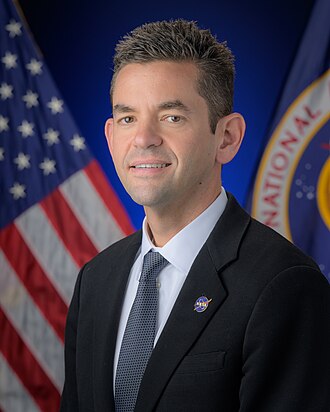
贾里德·艾萨克曼 AAll-In 主持人
EDITED TRANSCRIPT · 依据现场录音编译整理,可划线生成便签
编者按:2026 年秋,NASA 局长贾里德·艾萨克曼在 All-In 峰会发表主旨演讲,随后与主持人对谈。艾萨克曼是支付公司 Shift4 的创始人,曾两度以私人宇航员身份进入太空,去年出任 NASA 局长。演讲从技术爆发的时代讲起,直陈 NASA 多年积弊,公布重返月球、建立月球基地与核动力深空探测的时间表;对谈部分涉及月球经济、南极着陆点争夺、火星技术路线、预算分配与中俄太空实力。本文依据现场录音编译整理,仅删去口语枝节,主持人的提问以讲者转述方式并入正文。

一个不同寻常的时刻

我们正活在一个不同寻常的历史时刻。从莱特兄弟第一次升空,到尼尔和巴兹踏上月球表面,只用了 65 年。可从阿波罗 11 号到今天,已经过去了 57 年,其间很长一段时间,进步的速度实在谈不上激动人心。但看看眼下地平线上正在出现的东西:人工智能、量子技术、机器人、增材制造、可控核聚变的前景、能让残障者复原的生物技术、自动驾驶,还有人人都在谈的「富足」,所有这些都将在未来几年汇聚到一起,其规模超出多数人所能想象。我们的世界将彻底改变:怎样生活,怎样工作,怎样打仗,怎样伸手去摸星辰。

但这条路上我们并不孤单。我们正处在大国竞争之中,别的国家同样明白,这些机会足以抬升一个国家、改变一种文明。而机遇、竞争,以及做错事的后果,恐怕没有哪里比我们头顶这片终极制高点更一目了然。

如今在 NASA,我们的做法已经不同了,我们正在找回锐气,把一场场胜仗记到榜上。可我得坦白说:如果没有这位总统,没有这场地缘政治竞争,没有输掉第二次太空竞赛这个非常现实的可能,我猜多半什么都不会变。

NASA 的积弊

太长时间以来,这个世界上成就最高的太空机构,把资源撒向了每一个角落,只为让所有人满意。其中很多是外部强加的,但也有很多是自找的。我们为了合作而合作,合作者常常拖了任务的后腿,而不是推着它往前走。结果就是,我们的猎户座飞船(Orion)没法像阿波罗时代那样进入近月轨道;上一届政府取消了火星采样返回任务,因为它的预算已经涨到超过一艘航空母舰。我们造出了一批「大到不能倒」、贵到不可能真正成功的项目,指望它们能挺过一届又一届政府。结果是这样一枚火箭:设计它的时候,中国铁路上跑的主要还是烧煤的蒸汽机车;等它终于投入使用,中国已经有了两万五千英里的高铁,而且距离他们自己的「阿波罗 11 号时刻」只剩几年。

NASA 的核心能力和成千上万名员工,被租出去、外包出去,或者干脆流失了。本该几个月完成的进展变成了几年,成本高出几个数量级。到最后,剩下的东西已经不够按正确的方式做事了,也就是 NASA 过去几十年做给全世界看的那种方式。于是我们发明了所谓「终极形态即服务」这套东西,丢掉了成功的老剧本,把不可能承担的重担推给了别人。

结果如何?我们的登月火箭,把发射质量转化为奔月载荷的效率,居然不如土星五号;阿尔忒弥斯一号与二号之间的间隔,比六十年前双子座计划十二次飞行加起来的时间跨度还长。一座月球空间站,不管哪天能交付,都只会让我们的宇航员在轨道上俯瞰月球上最值钱的地皮,而不是站在地面上把它占住。X 系列试验机只剩一架,还不怎么飞。几十亿美元砸进了失败的核动力项目,而这些项目从 1965 年起就没走出过实验室。

第一次太空竞赛,我们起跑慢了,但 NASA 最终把比分拉得很大。第二次的比分会比它本该有的接近得多。

不再讨好所有人

自从去年出任 NASA 局长,我们做了不一样的选择。我们不会再试图让所有人满意。我们不会再把每一分钱撒到每一个选区,不会再为了让所有人高兴而跟每一个国家合作,也不会因为有人误以为「从来就是这么干的」就那么干。我坐在这个位置上,肯定不是为了钱,不是为了偏袒哪家公司,不是为了头衔、名声或政治。我不是来当你们的风险投资人的,不会去捧你们的梦想,不会去发明新市场,只要那会对美国人民托付给我们的任务有一丝一毫的分心。这类事情,你们可以去找商务部谈。

我在这里,是为了执行特朗普总统的国家太空政策:把资源对齐、聚焦,跟这个国家最优秀的力量并肩作战,把他们释放出来,从 NASA 的员工到我们的产业界再到合作伙伴,交出改变世界的成果。那种把尼尔和巴兹送上月球的成果,那种让你们当中许多人当初走进这个领域的成果。今天的 NASA 精神振奋、干劲十足,美国重新干起了把宇航员送上月球这门生意。

重返月球的时间表

阿尔忒弥斯二号只是开始。那四位英雄宇航员,刚刚获颁国会太空荣誉勋章,他们乘着 880 万磅推力飞到接近地球逃逸速度,飞得比人类历史上任何人都远,绕月一周后安全回家。而这只是开场。

我们不会再等三年才飞下一次,也不会再把每一枚火箭都当成艺术品来雕琢。阿尔忒弥斯三号现在就在组装,速度快到几个月前很多人都不相信。年底之前,我们打算把它推到 39B 发射台做加注测试,向我们的员工、我们的产业界以及海外的对手发出一个信号:NASA 回来了,我们不会再袖手旁观。我们不只是一个采购机构。我们要亲手做那些极为艰苦的工作,安全、负责、紧迫地达成目标,因为这就是这个时刻的要求。

2027 年夏天,阿尔忒弥斯三号将乘太空发射系统(SLS)进入近地轨道,与蓝色起源和 SpaceX 的着陆器试验飞行器交会,全世界最强大的三种火箭与飞船将同台亮相,那会是非常壮观的一幕。我们要测试互操作性,展示未来的多次发射任务究竟是什么样子。从中学到的东西,将指导随后的无人着陆试验。然后是 2028 年的阿尔忒弥斯四号,美国宇航员重返月面,而且这一次,是留下来。

月球基地与生存科学

与此同时,我们正在另一个世界上建立人类第一个前哨站:月球基地。这一次,我们用的是 NASA 几十年前的老剧本,不直接跳到终极形态。我们将以接近每月一次的节奏发射任务,去做「生存科学」。这意味着自主与载人的地面机动、场地平整、原位资源利用与制造、后勤、居住、电力、通信,以及质量预算允许携带的全部科学仪器。我们会通过月球基地网站,用高清直播把它带给你们。这一次,不会再给怀疑者留下余地。

我们去,是为了科学和经济潜力;我们去,是为了了解太阳系的形成;但最主要的原因是,月球南极,也就是水冰所在的地方,将是我们下一个必然目的地的技术试验场,那个目的地就是火星。

核动力 NASA

2028 年,NASA 将把几十年、几十亿美元的失败核动力项目抛在身后,发射 SR1「自由号」(Freedom),一座 100 千瓦的裂变反应堆,美国的太空核动力终于要启程。这次任务将飞掠火星,释放「天坠」(Skyfall)探测器,它携带三架「机智号」级别的直升机,用探地雷达勘测地下冰层和未来的着陆点。

这标志着「核动力 NASA」的开端,我们的员工和设施将重新转向去做那些近乎不可能的事:没有明显商业模式的任务,眼下没有任何公司、任何机构、任何国家能完成的任务,但它们能把人类的触角伸向更远的外太阳系。而且就像阿波罗时代一样,我们为了抵达那里所开创的技术,必定会造福地球上的生活。

核动力任务会有很多:SR2、SR3、SR4。我们将与产业伙伴一道,推进高温材料、更高效的能量转换、更轻的散热器,以及性能更高的电推进,去造访那些最有意思的卫星:土卫二(Enceladus)、木卫二(Europa)、土卫六(Titan)。这些世界有海洋,有复杂的化学环境,也许还有生命的原料。这提醒我们,人类历史上一些最伟大的发现,可能就等在自家后院。我们有机会回答那个问题:我们是不是孤独的?先不说银河系和整个宇宙,哪怕在我们自己的太阳系里,我们是不是孤独的?

总有一天,一艘化学推进辅助的核动力转移飞船,作为美国星际舰队的一员,在一支由星舰和其他飞船组成的舰队支援下,会把人类送上火星表面,再安全带回来,向我们讲述那里的一切。而且不止一次。我们走在人类探索的伟大命运之上,不会回头。

旗舰科学任务

在这条路上,我们也会去做「其他那些事」。商业卫星正在像印刷一样批量生产,这将帮助我们以可承受的成本理解我们目前唯一居住的行星,理解我们的恒星与空间天气,更好地预报天气,也许还能更好地应对山火和自然灾害。这样就能腾出更多资源,去建造只有 NASA 才做得了的精良旗舰科学任务。

比如核动力的「蜻蜓」(Dragonfly)八旋翼飞行器。它靠一台 2 千瓦的多任务放射性同位素热电发生器(MMRTG)供电,转换出来只有 100 瓦电力,比一只老式灯泡强不了多少,但它将在 2028 年启程飞往土星的卫星土卫六。「欧罗巴快帆」(Europa Clipper)将于 2030 年抵达木星的冰卫星。

我们伟大的太空望远镜,詹姆斯·韦伯和哈勃,很快将迎来罗曼(Roman)的加入。她带着近 3 亿像素的宽视场仪器和喷气推进实验室造的日冕仪,很快就会睁开眼睛。在那一刻,她看到的宇宙,将超过我们此前送入太空的任何科学仪器。她的巡天将探究暗能量和暗物质之谜,揭示藏在遥远恒星背后的成千上万个世界。罗曼传回的图像如此巨大、如此精细,地球上没有一块屏幕大到能把它完整显示出来。

另一些任务,比如近地天体巡天者(NEO Surveyor),将寻找可能威胁地球的小行星和彗星;而正在研制的下一代望远镜,将去寻找环绕其他恒星的宜居行星。

轨道经济与试验机

过去几十年告诉我们,我们小时候想象的那个太空未来,如果永远靠纳税人出钱,就永远不会实现。NASA 会在合理范围内尽一切可能,支持一个轨道经济,也许有一天还有月球经济,建立在发射、观测、通信这些已被证明的市场之上。下一个前沿也许是轨道数据中心,也许是商业空间站、在轨制造、月壤资源开采、小行星采矿,也许是我们谁都还没想到的产业。强行造出一个经济不是 NASA 的职责,但我们会在执行任务的过程中,尽全力去点燃它。

为了 NASA 名字里的第一个 A(航空),我们正在重建 X 系列试验机队。X-59 正在研究安静的超音速飞行,但这只是开始。NASA 重新投入飞行试验,与产业界一起去推动机身和推进设计的边界。用不了多久,NASA 又会像几十年前那样飞得那么高、那么快,然后飞得更高、更快。

太空学院

如果这个前沿真会像我们相信的那样迅速扩张,我们就必须培养出能引领它的人才。太空领域需要一所专注于这个未来的学府,就叫它许多人已经在叫、也理应叫的那个名字:星舰学院。这就是总统设立美国太空学院筹建委员会的原因,那将是一所 NASA 的联邦学院,培养下一代宇航员、科学家、工程师、技术员、操作员、飞行员和领导者。就像太空域演变之后,太空军的必要性变得清楚一样,我们也应该同样有前瞻性,去准备那些将来要建月球基地、操作核动力飞船、指挥火星任务、保障国家安全、在轨道上创造我们今天几乎想象不到的产业的人。没有时间可以浪费了。

如果旗帜不是美国的

我想请各位想一想,阿尔忒弥斯二号的宇航员从月球传回那些照片的时候,你在哪里?它触动了谁?你的父母、朋友、同事、孩子?

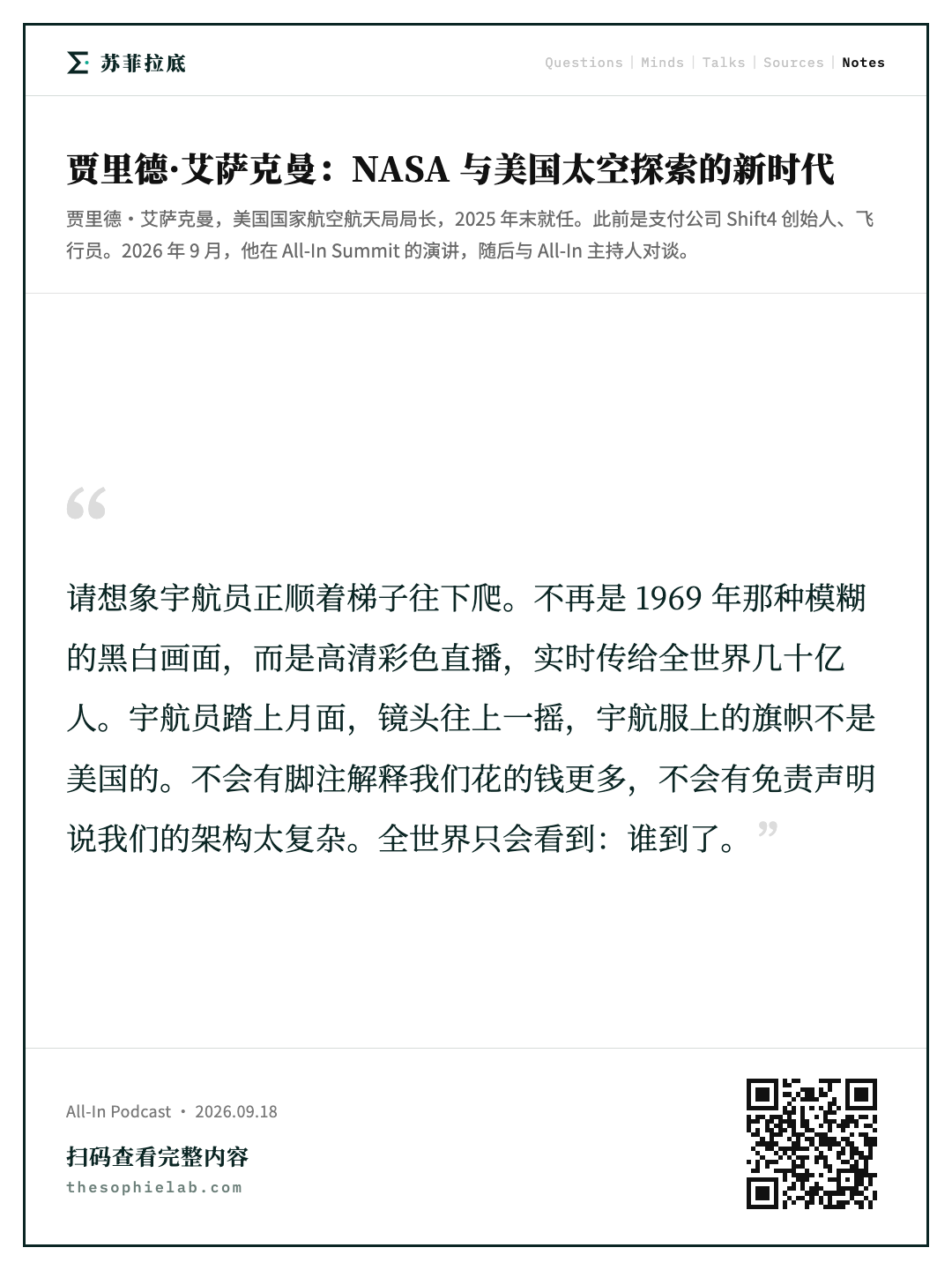
现在请想象宇航员正顺着梯子往下爬。只是这一次,不再是 1969 年 7 月 20 日那种模糊的黑白画面,而是高清彩色直播,实时传给全世界几十亿人。宇航员踏上月面,镜头往上一摇,宇航服上的旗帜不是美国的。

不会有脚注解释我们花的钱更多。不会有免责声明说我们的架构太复杂。没人会在乎我们做了多少研究、开了多少会、哪些选区受了益、谁是哪套硬件的明星说客、谁在委员会里任职,或者我们为了某个当时看来「完全合理」的理由把进度推迟了多少次。全世界只会看到:谁到了。

中国打算在 2030 年之前把他们的宇航员送上月球。他们的机器人任务明年就瞄准月球南极的沙克尔顿陨石坑,而那片街区的好车位就那么几个,他们打算把它们占住。他们正与俄罗斯合作建造他们自己的核动力月球基地。说得明白一点:中国将完成苏联在第一次太空竞赛中从未做到的事。他们有一套非常可行的两次发射架构,有把宇航员送上月面的国家意志和能力。

如果美国在几十年的承诺和一千多亿美元的投入之后仍然没有回去,那股冲击波将传遍全世界。我们的盟友会注意到,我们的对手会注意到。每一个正在决定买谁的技术、采用谁的标准、信任谁的安全保证、追随谁的未来愿景的国家,都会注意到。而也许最重要的是,我们的孩子会注意到。

这就是为什么我们必须盯住那些真正重要的目标,那些 NASA 当初被设立的理由。再也没有时间去做损害美国利益的游说,再也没有时间继续容忍现状。只有彻底的担当、能力和行动。我们这些被过去几十年的先驱和英雄激励的人知道,他们把标杆立得很高。但躺在他们的成就上过日子,不是对他们的致敬。现在轮到我们从他们停下的地方接着走:回去,再也不放弃月球,然后把目光投向火星和更远的地方。

这一切不可能靠 NASA 单独完成。我们有总统的支持,有国会,有国家太空政策给出的明确授权。但还需要杰出的企业家、科学家、工程师、我们的盟友,以及全国上下仍然相信伟大国家能做伟大事情的美国人。因为我们的孩子要么继承一个仍有能力做非凡之事的国家的信心,要么继承一段关于一个曾经如此的国家的记忆。这份责任、这个选择,属于我们所有人。

我相信,当历史回望这一刻,让它记下:美国不再犹豫。我们没有让官僚主义、自满、浪费、不作为或对失败的恐惧束缚住我们能做到的事。我们选择了去,然后我们就去了。谢谢大家。

月球有没有独立的商业价值

上台之前我们在后台聊,说 NASA 来做演讲太占便宜了,随手就能放出这么多画面,你能想象住房与城市发展部来做一场展示吗?我们手里的素材确实无与伦比,我每天都庆幸自己领导的不是国税局。

主持人的第一个问题是月球。NASA 常说月球是通往火星的起点,但月球本身能不能成为一个独立的经济体?能不能在那里建起一个产业、一套持续运转的活动,而不只是去火星之前测试设备?

我的回答是:也许吧。我们极其幸运,老天送了我们一颗三天就能到的月球,可以在那里测试这场伟大探索之旅所需的一切。你想把电力系统调试到位,去那里;宇航服,我们花了几十年才造出阿波罗时代宇航服的替代品,去月球上试;居住舱,原位资源制造,机器人。说实话,舱外活动固然精彩,宇航员在月面上蹦蹦跳跳会极其鼓舞人心,但有了月球基地之后,把人派到外面那种极端危险的环境里,应该是你最后才做的事,让机器人去干。

而要做成这一切,你必须向产业界发出一个极强的需求信号。未来四年,我们说的是几十台着陆器、几十台月球车、大量原位资源制造实验。这等于给产业界提供了世上所有的机会,去琢磨怎么从月壤里挖出价值。

但我不能保证结果。这就是我提商务部的用意:他们有一整个太空商业办公室可以去研究这件事。我要确保的是,NASA 掌握去火星所需的技能,为了火星的科学潜力。我们会在月球背面架设射电望远镜,激励下一代。如果在这个过程中点燃了月球经济,那太好了。但去那里的成本高得惊人,开采资源的成本也高得惊人。

南极的车位与「承诺号」

主持人问,是不是还得先把南极测绘一遍,才知道往哪儿去,这是不是「承诺号」(Promise)任务的内容?

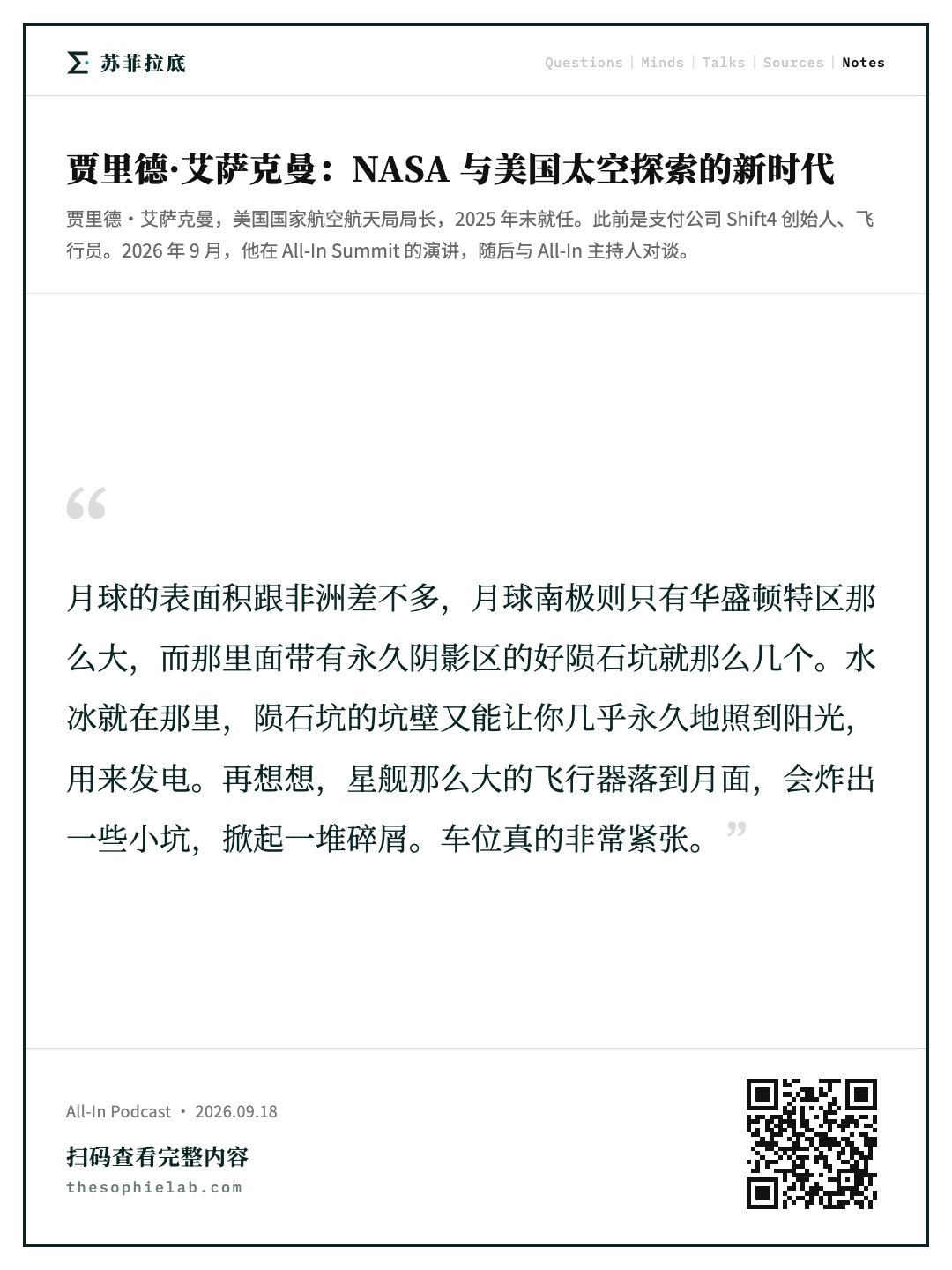
我很高兴他提到「承诺号」。月球南极我们已经测绘过了,好的着陆点就那么几个。我的意思是:月球的表面积跟非洲差不多,月球南极则只有华盛顿特区那么大,而那里面带有永久阴影区的好陨石坑就那么几个。顺便说一句,永久阴影区的环境比火星本身还要严酷。水冰就在那里。但陨石坑的坑壁又能让你几乎永久地照到阳光,用来发电。所以好的着陆点很有限。再想想,星舰那么大的飞行器落到月面,相信我,那会炸出一些小坑,掀起一堆碎屑。车位真的非常紧张。

「承诺号」的妙处在于,它是一台放射性同位素供电的月球车,本来是作为备份造的,备份对象就是现在正在火星上跑的两台车,毅力号和好奇号。给你一个概念,这东西有一辆吉普车那么大。我们手里有一批钚-238 正在衰变,能用的寿命就那么长。我们要把它装到「承诺号」上,送去月球,让它开进那些永久阴影区去勘探,换成几乎任何别的硬件,进去就得死在那里。这是对已经花出去的纳税人的钱非常好的利用。

为什么必须赶在中国前面

主持人接着问,前一晚我跟他讲过月球南极这片区域对我们抢在中国之前到达是何等关键,为什么这么关键,需要什么才能做到?还有,我接手时 NASA 是个什么状态?在他看来,自航天飞机计划以来,NASA 似乎一直不太专注、不太有效。

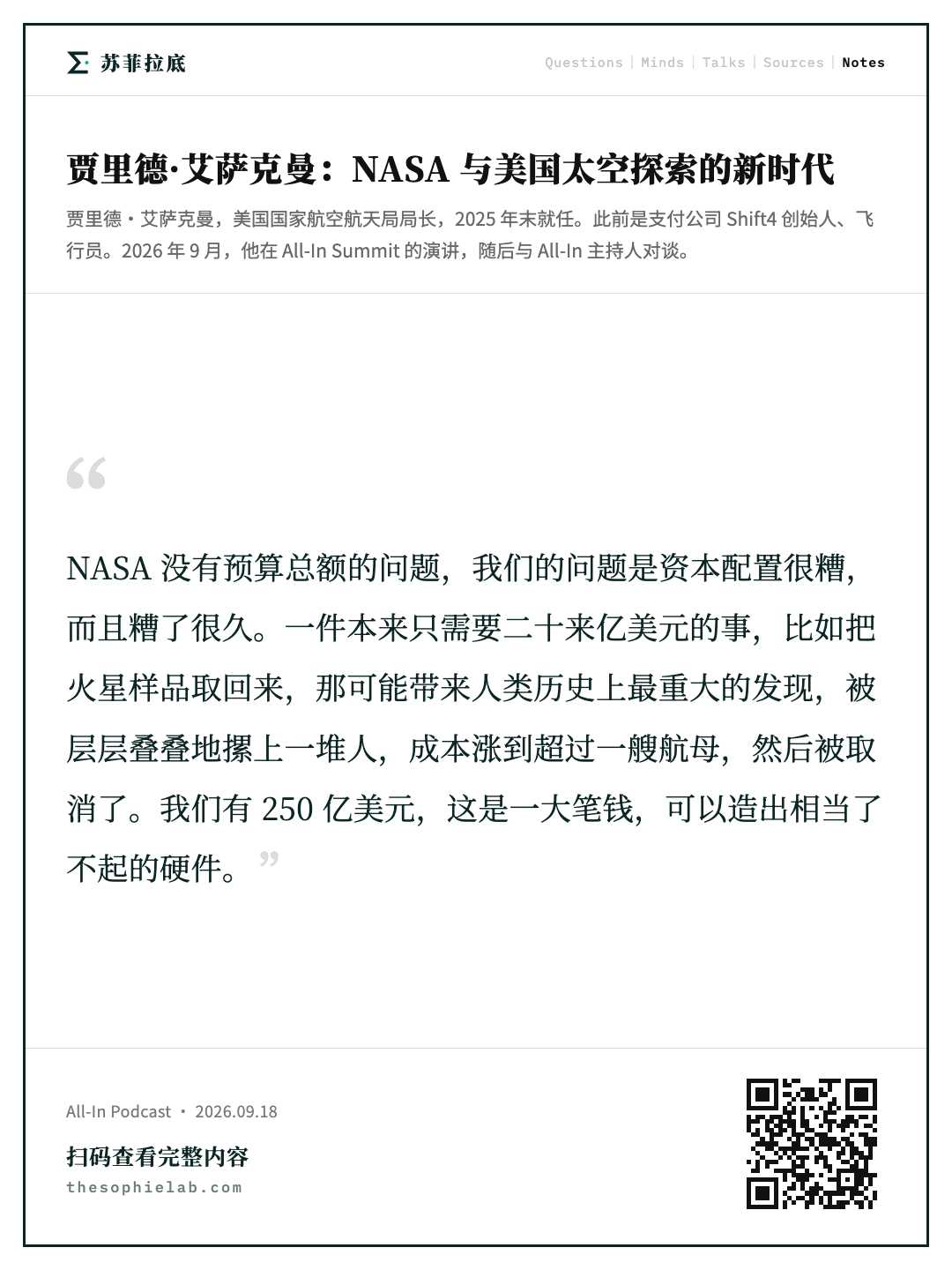
先把话说清楚:每天走进 NASA 上班的,是这个国家最顶尖的一批人才,他们想在航空和太空领域改变世界。而在很长一段时间里,谁都在试图指挥 NASA,唯独不是那些每天走进去上班的人。就像我演讲里说的:让所有人满意;把资源撒到每一个选区;为下一次任务凑齐二十五面不同的旗帜来合作。结果是一件本来只需要二十来亿美元的事,比如把火星样品取回来,那可能带来人类历史上最重大的发现,非常酷的事,被层层叠叠地摞上一堆人,成本涨到超过一艘航母,然后被取消了。

现在 NASA 重新说了算。我们在打太空竞赛,大家给了我们做该做的事的空间。于是我们极度聚焦于总统的国家太空政策:重返月球,建基地,让核动力启程,以及其他几件事。员工的反应很好,我很感激能与他们并肩。所以今天的状态已经不同了。遗憾的是,我们未必有想要的那么多时间,因为在这场新的太空竞赛里,已经有好几年被白白丢掉了。

再说月球南极。我再讲一遍,老天送了我们一颗三天就到的月球,让我们练好去火星的本领。好车位就那么几个,中国人和俄罗斯人都知道。几个星期前,他们本来要发射一次任务,就冲着沙克尔顿山脊去。也许是机械故障,也许是天气原因,也许他们够聪明,知道真要这么干了,多半会在我们这边点起一把火,逼出十足的紧迫感。但那次任务本来会占掉那几个关键车位中的一个。他们要在那里建基地,已经跟俄罗斯合作了,那里会有一座裂变反应堆。他们要做的事跟我们一模一样:跟水冰打交道,把手艺练精。然后呢?第三次太空竞赛,他们去火星。到那时他们就会拥有那种尼尔·阿姆斯特朗式的巨大时刻,向全世界发出一个信号。我们决心不让这发生。

去火星要跨过什么坎

主持人问,从当前的航向和速度出发,要让火星变得现实,必须完成的那个大的技术跃迁是什么?主要是推进和推力吗?

我觉得有几件事。首先,机器人在这一切中都会至关重要。假如你选一条纯化学推进的路线,星舰这样的飞行器在这方面会非常出色,那你毫无疑问有办法把宇航员送到火星。居住问题他们早就解决了,而且就速度而言,去月球和去火星相差不大。难的是怎么回来。你得在火星上制造推进剂才回得来。一种解法是:我有一支机器人大军来干这事,铺开足球场那么大的太阳能板,机器人再负责在一场场沙尘暴之后把板子上的灰扫掉,然后你自己造出推进剂,飞回家。难点在于,这件事哪怕在地球上,在一个大气压和一个重力加速度之下,都极其困难。你看看星际基地(Starbase)发射一次任务,「零号台」上要来多少人。顺便说,那确实是打赢这场仗的正确路子,往火星表面运大量质量。

NASA 能帮上忙的地方,是换个方向:不再做产业界已经做得很好的事,转而投资下一个巨大跃迁的能力,那些今天看不出商业用途的能力,也就是裂变电力。有了它,你就可以有化学推进辅助的核电推进(NEP)转移飞船,往返火星,一直到它回来之前都不需要加注,而且加注的是氪或者氙,不必在火星表面造推进剂。在我看来,这就是 NASA 与产业界的分工:去投资美国太空领导地位所需要的那些能力。而且顺便说,这些正是你去土卫二、去土卫六、去木卫二所需要的能力,其中两颗卫星有海洋,里面可能仍然有生命,我们不知道。

怎样留住人才

主持人问,在一个有这么多贡献渠道的世界里,怎么说服那些出色的人才来 NASA,而不是去 SpaceX 或别的商业航天公司?

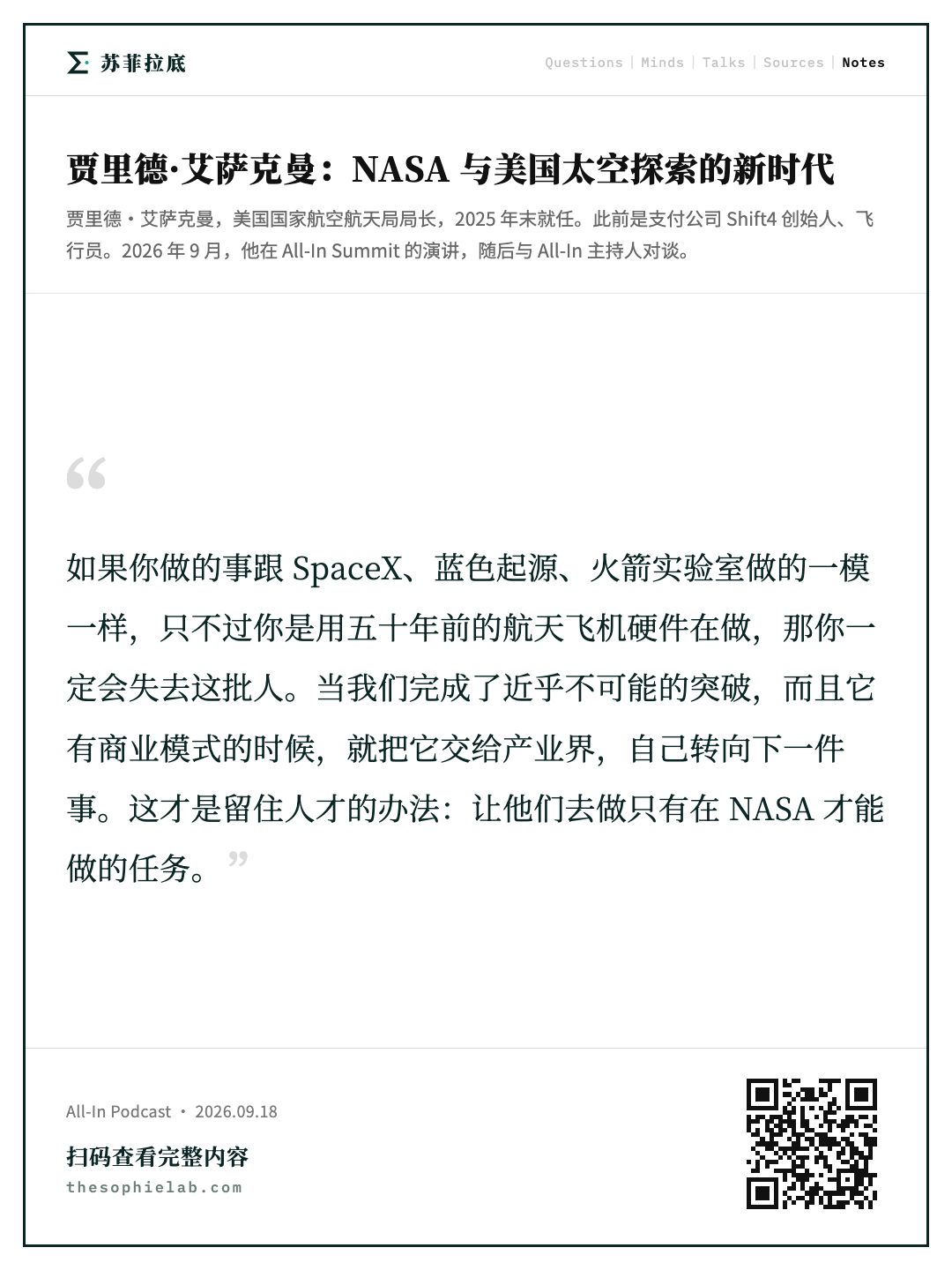
我很高兴他问这个,因为答案还是「押注核动力」。眼下我们并没有招人的问题:进入 Pathways 实习计划的申请者,我们只录取 1%,而这个计划保证一个 NASA 的职位。问题是能不能留住他们。如果你做的事跟 SpaceX、蓝色起源、火箭实验室、Stoke、联合发射联盟以及产业界其他公司做的一模一样,只不过你是用五十年前的航天飞机硬件在做,而这些硬件对登月这类任务的效率还不如土星五号,那你一定会失去这批人。

那该怎么办?当我们完成了那些近乎不可能的突破,而且它有商业模式的时候,比如发射,你可以做众多客户中的一个,就把它交给产业界,然后自己转向下一件事。这才是留住人才的办法:让他们去做只有在 NASA 才能做的任务,也就是核动力 NASA。SR1 只是开始,它是我们的「鹦鹉螺号」,前沿上将会有一支庞大的核动力舰队。你必须不停地转向下一个新东西。

核动力怎样产生推力

主持人请我简单讲讲,核能是怎么用来产生推力的。

可以先想想现在天上的星链卫星,它们用的是霍尔推进器。它们靠太阳能发电,然后借助电磁力把氪或氙电离,把离子从推进器尾部加速喷出,得到极高的喷气速度。所以它非常高效,推力很低,一份推进剂可以用很长时间。在太空里,分子从尾部喷出得越快,推动飞行器前进的力就越大。它的质量流量很小,但效率极高,喷气速度极高。

这套办法的短板在于,离太阳越远它越不管用。到了木星那么远,太阳能的效果已经可以忽略。这时候你用的就是核反应堆的热能。100 千瓦,往上做到 250 千瓦,谁知道呢,也许做到兆瓦级。你会想让反应堆尽可能烧得热,这就要用到高温材料;然后通过闭式布雷顿循环的能量转换装置,把热变成电;这些电再去驱动跟星链上一样的那种推进器,只不过放大了:12 千瓦、14 千瓦、25 千瓦的推进器。

250 亿美元够不够

主持人问 NASA 的预算是多少,如果我能随心所欲,希望是多少。

这话我说过很多次:NASA 没有预算总额的问题,我们的问题是资本配置很糟,而且糟了很久。其中很多是 NASA 自己的选择,也有很多是别人逼我们做的,而这已经变了。我们有 250 亿美元。这屋里有多少创业者?250 亿美元是一大笔钱,可以造出相当了不起的硬件。

NASA 的第一个 A

主持人说我在演讲里放了一张「黑鸟」(Blackbird)的照片。我说:你确定那是黑鸟?他反问那到底是什么,我只能说,NASA 又要重新飞得高、飞得快了。他又说,那看起来不像太空飞行器,倒像是地球上的飞机。

没错。NASA 名字里的第一个 A 是航空,是我们的航空学业务。几十年来我们贡献了什么,你可能没意识到。你在航展上看 F-22 飞过,惊叹不已,它的电传飞控技术是我们做的,推力矢量技术是我们做的。NASA 长期以来一直在推动航空学突破,民用、商业和国家安全领域都有。

但故事又是同一个:这些年来,我们被迫把航空预算花在补贴大承包商那些技术成熟度已经很高的项目上。一台四十年前的发动机,他们想再挤出 3% 的燃油效率,就让 NASA 掏钱。我说,开什么玩笑?我们绝不可能这么干。出于竞争的考虑,你们完全可以自己出这笔钱。我想做什么?我想回到激进的机身和发动机设计上去,那本来就是我们该做的事。你们在台上已经尝到了一点味道。

为什么还要送人上去

主持人问,登月、登火星时,把人送上去有多重要?如果擎天柱(Optimus)、Figure 这些人形机器人已经成熟,为什么还要让人在这些极端危险的环境里冒生命危险?是出于自负吗?是为了证明人必须在场吗?还是干脆只派机器人?

因为这是我们的命运。跟我们横渡海洋、攀登高山是同一个理由。这就是我们是谁。阿尔忒弥斯二号绕月的时候,那么多人从日常生活的喧闹中停下来,抬头看那几位宇航员,如果他们不是人类,还会有人停下来看吗?我不这么认为。

别误会,我们会需要机器人,有些环境,比如辐射的原因,只能执行无人的机器人任务。但我们可以像过去那样,带着宇航员去月球,可以去火星,可以继续往外走,而机器人在这段旅程中绝对会扮演关键角色。

自主系统与安全

主持人提到自主导航系统和我说的电传飞控,说上周亚马逊航空的事故,虽然是民航,那个冲出跑道的失效模式相当令人震惊。他问,怎样推动更好、更安全的技术和更显而易见的解决方案,哪怕这会削弱人的参与?

我只说一点,NASA 参与空中交通安全和现代化已经很久了。自动地面防撞软件就是 NASA 首创的,它救了无数战斗机飞行员的命:飞行员拉过载太大,晕过去了,机头朝地,飞机自己识别出来,把自己安全改出。那是 NASA 的工作。说到他的问题,我们当然深度参与其中,想想一个将有无数架无人机飞来飞去给我们送药送货的世界,我们必须跟联邦航空局非常紧密地合作。

而且我要告诉你们,我们正在设计的任务里,已经在考虑人工智能和自主应用。比如去金星的「达芬奇」(DAVINCI),它在那种高压环境里撑不了多久,我们只有那么一点时间去尽可能多地收集信息,然后自己修正飞行器的轨迹:这个没意思,忽略;这个有意思,我转过去。我们已经用火星上的几台巡视器测试过这种能力。还有:我在临死前最后一口气,选择把这条数据传回给地球上的科学家,帮他们理解这个环境。这只是朝一个方向迈出的一步,而那个方向必然是我们的载人和无人飞船都拥有更多的自主性。

科学经费怎么分

主持人问,资金在科学发现、观测系统、未来深空研究平台之间怎么分配,我心里有没有一个数,比如预算的 5%?我是怎样论证这笔开支往哪里走的?

眼下科学大约占 NASA 预算的三分之一。我们最近做了重组,现在主要的任务部门有三个:载人航天探索,既包括我们在国际空间站上正在做的出色工作,也包括登月和建月球基地这样的任务;研究与技术任务部,它扛着核动力 NASA 的大部分工作;然后是科学任务部。

我的思路是,你必须利用眼下的商业产业。没人会否认发射、观测、通信是真实的服务,NASA 只是众多客户之一。这么多出色的公司在批量生产卫星,用于地球观测,不管是出于国家安全还是别的原因。那就利用它:用在农业上,用在地球科学上,有必要就把仪器给他们,授权给他们,把资源腾出来,去做产业界不愿意接手的事,比如造一台核动力八旋翼飞行器去土星的卫星土卫六。尽量腾出资源去做那些事。

而且我永远会优先把新任务送出去,到那里去解开宇宙的秘密,而不是优先给研究者。只要我们拿到数据,全国各个机构有的是聪明人想去分析它。可如果你发不出下一批任务,那还有什么意义?

火星直升机

主持人在收尾前请我们看了火星直升机的视频,问这什么时候能成真。这有多酷?我跟你们说,住房与城市发展部做不出这种东西,国税局也做不出。我拿国税局开玩笑,是因为知道审计员就在台下。

我们在上一次火星巡视器任务上测试过一架「机智号」(Ingenuity),表现极其出色。想象一下,火星上接近真空,气压只有地球的百分之一左右,它在那么稀薄的大气里飞起来了。现在我们要送三架过去,带着探地雷达,我觉得这太棒了。但最重要的是它们怎么去的:靠核动力。一艘真正的裂变供电、100 千瓦的飞船,飞掠火星,把它们放出来。2028 年发射,我们估计直升机大约再过一年抵达,一些权衡还在做,但这是一次极其非凡的任务,也是后面许多任务的开端。再想想,我们自己太阳系里的那些卫星,有太多东西可学。一些真正令人震惊的发现,就等在自家后院。

主持人问我会不会亲自试飞那架「黑鸟」。那不是黑鸟。我们有很多有才华的人,在组织的各个层级,当然也包括这个组织的头儿,他飞得相当不错。

中俄的实力与 SpaceX 的分量

最后一个问题关于我提到的中俄合作。主持人说,俄罗斯连基辅都拿不下,打了四年仗,他们还有能力上太空做什么实质性的事吗?他是认真问的:中国在实时复制埃隆做的很多事,如果假定俄罗斯陷在困境里而且已经没钱了,他们的真实能力到底是什么?

我会这么说:我显然非常敬重俄罗斯和苏联太空计划的历史。就像我演讲里说的,他们起跑很猛,第一个进入轨道的宇航员,第一次太空行走,他们做过很多了不起的事,今天也仍在国际空间站上与我们合作、做贡献。但是,没错,他们在打仗,资源都优先投到那边去了。

而中国,眼下是太空中一个极其厉害的对手。他们确实没有 SpaceX 等公司那样的可复用发射能力。但他们送上太空的东西,哪怕是用类似几十年前大力神二号那种自燃推进剂火箭硬推上去的,上去的东西都是好东西。今天空军协会(AFA)大会上,我们的空军部长和太空军的几位将领披露了一些相当有意思的情况,我想让公众明白了那个环境有多么充满对抗。底线是:中国人现在在太空里非常强。再加上俄罗斯在核动力方面的一些能力,他们会重返月球,会到达月球,会在南极建起一座基地。

主持人又问,如果没有 SpaceX,我们面对中国会处在什么位置?

SpaceX 令人赞叹。他们是我们最重要的发射伙伴。没有他们,我们没法把宇航员送上空间站、接回来;没有他们,我们没法把空间站上的科学实验样品运回地面。那台正要去探究宇宙秘密的南希·格蕾丝·罗曼望远镜,不久前就是用猎鹰重型发射上去的。我们很幸运。商业航天里现在有很多出色的公司,但没有他们的能力,美国在太空这个制高点上会面临严峻的挑战。

主持人在结束时说,他不怎么喜欢政府,但 NASA 为人类扮演的角色,政府之外没有任何一个组织能替代,他想不出比我更合适的领导者。我只想说:我每一天都心怀感激。谢谢大家。
本期讲者
贾里德·艾萨克曼美国国家航空航天局(NASA)局长,2025 年末就任。此前是支付公司 Shift4 创始人、飞行员,曾自费指挥 SpaceX 商业载人任务 Inspiration4(2021)与 Polaris Dawn(2024,完成首次商业太空行走)。
All-In 主持人All-In 播客的四位主持人:大卫·弗里德伯格、杰森·卡拉卡尼斯、查马斯·帕里哈皮蒂亚、大卫·萨克斯,均为硅谷投资人。本场在 All-In 峰会现场对谈。
章节 · 点击跳转视频
0:00 开场:技术汇聚的历史时刻 ▶ 正在看
1:42 诊断:NASA 为何失去锋芒 ▶ 正在看
4:30 新选择与阿尔忒弥斯时间表 ▶ 正在看
8:28 核动力 NASA 与科学旗舰 ▶ 正在看
12:45 X 验证机、太空学院与竞赛赌注 ▶ 正在看
17:29 对谈:月球经济与南极车位 ▶ 正在看
21:03 NASA 现状与中俄月球基地 ▶ 正在看
23:30 火星难在回程:核电推进原理 ▶ 正在看
28:06 预算、航空遗产与人在回路 ▶ 正在看
31:01 自主系统与科学经费分配 ▶ 正在看
34:08 收尾:火星直升机、中国与 SpaceX ▶ 正在看
本期论点
本期回应
其他论点
0:18
核动力与核推进是人类实现下一次太空巨大飞跃必需的关键能力
2:11
没有地缘政治竞争和输掉第二次太空竞赛的风险,NASA 几乎不会改变任何做法
4:08
月球空间站只能让宇航员俯瞰月面,无法真正在月面作业和占据月球
6:20
火箭不该被当成艺术品反复打磨,发射节奏比单发的完美更重要 做法
10:30
把对地与空间天气观测交给低成本商业卫星,才能腾出资源做只有 NASA 能做的旗舰科学任务 做法
12:07
只靠纳税人出钱的太空计划,永远实现不了人们小时候想象的太空未来
13:13
太空领域需要一所专门的联邦航天院校,培养下一代宇航员、工程师与操作者 做法
14:50
登月竞赛中全世界只看谁先到,成本、架构复杂度与延期理由都不会被记住
21:48
长期管理 NASA 的是外部势力,而不是真正在 NASA 工作的人
22:44
三天可达的月球是掌握前往火星所需技能的训练场
24:10
载人火星任务真正的难点是回程,必须先在火星就地造出推进剂
26:11
继续用五十年前的航天飞机硬件执行登月任务,NASA 会流失最优秀的工程师
28:16
NASA 的问题不是钱不够,而是长期以来资本配置糟糕
30:29
若绕月飞行的不是人类,公众就不会真正停下来关注
37:50
没有 SpaceX 的能力,美国在太空这一制高点上会面临严峻挑战
01开场:技术汇聚的历史时刻
0:00
Ignition [music] sequence start all engines up. >> It's good to have an aviator and astronaut in charge. Jared Eisen, >> the new NASA administrator. >> NASA's still hot. Humankind [music] will not be contained to planet Earth indefinitely. In the next giant leap capabilities, that's nuclear power and propulsion. That's what extends America's reach farther into the solar system. That's what guarantees the third race will never be in question. Please welcome Jared Isaacman. [music]
点火,[音乐] 程序启动,所有引擎推力正常。>> 由一位飞行员兼宇航员来掌舵是件好事。贾里德·艾森,>> 新任NASA局长。>> NASA依然热度不减。人类 [音乐] 不会永远被困在地球上。在下一次巨大飞跃所需的能力中,那就是核动力与核推进。正是它把美国的触角延伸到太阳系更远的地方。正是它保证第三次竞赛的归属永远不会有悬念。欢迎贾里德·艾萨克曼。[音乐]
便签引用
0:42
Good morning everyone. It is an absolute honor to be here at Allin. We are living through an extraordinary moment in history, aren't we? It took just 65 years from Orville and Wilbur's first flight to Neil and Buzz walking on the surface of the moon. Now, it's been 57 years since Apollo 11. And for a while there, pace of progress hasn't been all that inspiring, but look at what is on the horizon right now. We got artificial intelligence, quantum technologies, robotics, additive manufacturing, the promise of fusion energy, biotech to heal the disabled, autonomous transportation, this whole abundance thing everyone's talking about, all converging in the years ahead is beyond what most people can comprehend. Our world will fundamentally change. how we live, how we work, how we fight wars, how we reach out and touch the stars.
大家早上好。能来到 All-In,我深感荣幸。我们正身处一个非凡的历史时刻,不是吗?从奥维尔和威尔伯兄弟的首次飞行,到尼尔和巴兹踏上月球表面,只用了65年。如今,距离阿波罗11号已经过去57年了。有那么一段时间,进步的速度实在算不上振奋人心,但看看现在摆在眼前的这些东西吧。我们有了人工智能、量子技术、机器人、增材制造、聚变能源的前景、能让残障人士重获健康的生物技术、自动驾驶交通,还有大家都在谈的这个「富足」概念,这一切在未来几年里的交汇,将远远超出大多数人所能理解的范围。我们的世界将发生根本性的改变。我们如何生活、如何工作、如何打仗,以及我们如何伸手触及星辰。
便签引用
02诊断:NASA 为何失去锋芒
1:42
But we are not alone on this journey. We are living through a great power competition. Other nations understand the opportunities that can elevate nations and change civilizations. And perhaps nowhere are the possibilities, the competition, and the consequences of getting it wrong more apparent than in the ultimate high ground above us. Now at NASA, we are doing things differently and we are regaining our swagger and putting wins on the board. But absent this president, absent this geopolitical competition and the very real possibility of losing the second space race, I suspect very little would have changed. For too long, resources at the world's most accomplished space agency were spread everywhere, trying to make everyone happy. Much of it was through external imposition, but plenty of it was self-inflicted. We partnered for the sake of partnerships, oftent times becoming a drag on the mission instead of accelerating it. As a result, we have the Orion spacecraft that we can't inject into low lunar orbit like we did
但在这段旅程上,我们并不孤单。我们正处在一场大国竞争之中。其他国家也明白这些机遇能够让国家崛起、让文明改变。而这些可能性、这场竞争,以及一旦走错所要付出的代价,或许在我们头顶那片终极制高点上体现得最为明显。如今在NASA,我们的做事方式不一样了,我们正在重拾那股自信,不断拿下胜利。但如果没有这位总统,没有这场地缘政治竞争,没有输掉第二次太空竞赛这种非常真实的可能性,我想几乎什么都不会改变。长期以来,这个全球最有成就的航天机构,资源被撒得到处都是,试图让所有人都满意。其中很多是外部强加的,但也有不少是自己造成的。我们为了合作而合作,很多时候合作反而拖累了任务,而不是加速它。结果就是,我们有了猎户座飞船,却没法像阿波罗时代那样把它送入低月球轨道。上一届政府还取消了火星样本
便签引用
2:47
during Apollo. And the prior administration cancelled the Mars sample return mission that was on track to cost more than an aircraft carrier. We created programs that were too big to fail fail, too costly to truly succeed in the hope that they would survive administrations. The results being a rocket that was designed when China was predominantly operating coal fired locomotives and now becoming operational as China operates 25,000 mi of highspeed rail and is just a few years away from their own Apollo 11 like moment. core competencies and tens of thousands of the NASA workforce were rented, outsourced, or lost, which turned what should have been months worth of progress into years at tremendously greater cost. Eventually, too little was left to do things the right way. The way NASA showed the world how to do it in decades past. So, we invented this whole dream state as a service thing, forgoing the playbook of success and shifting the impossible burden onto others.
返回任务,那个项目当时的成本已经走在超过一艘航空母舰的路上。我们搞出的项目大到不能倒,贵到根本不可能真正成功,只指望它们能熬过一届又一届政府。结果就是一枚火箭,它的设计年代中国还主要在跑烧煤的蒸汽机车,而等到它真正投入使用时,中国已经运营着2.5万英里的高铁,距离他们自己的「阿波罗11号时刻」也只有几年之遥。核心能力和数以万计的NASA员工,都是租来的,被外包,或者干脆丢失,本该几个月就能完成的进展,硬是拖成了好几年,成本也高得离谱。到最后,剩下的资源已经不足以用正确的方式做事了——也就是几十年前NASA向全世界展示的那种方式。于是我们发明了这么一套「梦境即服务」的东西,抛开了那本成功的剧本,把不可能完成的重担甩给了别人。
便签引用
3:51
The result is that our moon rocket is in fact less efficient than Saturn 5 at converting launch mass into payload head payload headed for the moon with more time between the Aremis 1 and Artemis 2 mission than all 12 of the Geminy missions that were flown 60 years before. A lunar space station that whenever it may have been delivered put our astronauts in a position to look down on the most desirable lunar real estate instead of operating on the surface and occupying it. one XPlane that wasn't flying very much and billions spent on failed nuclear programs that had not left the laboratory since 1965.
结果就是,我们的登月火箭在把发射质量转化为奔月载荷这件事上,效率实际上还不如土星五号,而阿尔忒弥斯1号和2号之间的间隔时间,比60年前执行的全部12次双子星任务加起来还要长。还有一个月球空间站,不管它什么时候能交付,都只会让我们的宇航员在上面俯瞰月球上最理想的那片地产,而不是在月面作业、真正占据它。一架飞得并不多的X系列验证机,以及在自1965年以来就没走出过实验室的失败核项目上花掉的数十亿美元。
便签引用
03新选择与阿尔忒弥斯时间表
4:30
Now, during the first space race, we were slow out of the gate, but NASA ultimately ran up the score. The second will be much closer than it ever needed to be. Since becoming the administrator of LA NASA last year, we have made a different choice. We are not going to try and make everyone happy. we are not going to spread every penny across every district or partner with every nation just to try and make everyone happy or because that's how people incorrectly believed it always was. I am certainly not here for the money to favor companies for the title, the notoriety, the politics. I'm not here to be your VC to entertain your dream or invent new markets if it detracts in the slightest way from the missions that we have been entrusted to achieve on behalf of the American people. You can take those conversations up with the Department of Commerce if you like. I'm here to execute on President Trump's national space policy to align and focus resources to work alongside and unleash this best the best this nation has to
在第一次太空竞赛中,我们起步很慢,但NASA最终把比分拉了上来。而第二次竞赛,会比它本来应有的样子接近得多。自从去年出任NASA局长以来,我们做出了不一样的选择。我们不会试图讨好所有人。我们不会把每一分钱都撒到每一个选区,也不会为了让所有人都满意、或者因为大家错误地以为「一直以来就是这么干的」,就去和每一个国家合作。我当然不是为了钱才来的,不是为了偏袒某些公司,不是为了头衔、名声,也不是为了政治。我不是来当你们的风投的,不是来满足你们的梦想或者开创新市场的——只要那哪怕一丁点儿偏离了美国人民托付给我们要完成的任务。你们要谈那些事,可以去找商务部。我来这儿,是为了执行特朗普总统的国家太空政策,整合并聚焦资源,与这个国家最优秀的力量并肩作战、释放他们的能量。从NASA的员工队伍,到我们的
便签引用
5:30
offer. From the NASA workforce to our industry to our partners and deliver the world changing outcomes. The kind of outcomes that put Neil and Buzz on the moon. The kind of outcomes that inspired many of you to be in this room in the first place. This is a very reinvigorated and energized NASA and America is back in the business of sending our astronauts to the moon. [applause] Now, Artemis 2 was just the beginning. Those four heroic astronauts, recent recipients of the Congressional Space Medal of Honor, rode 8.8 8 million pounds of thrust to near Earth escape velocities, traveled farther into space than any humans in history around the moon and back home safely. And that was just the opening act. We are not waiting 3 years to fly again. We are not turning every rocket into a work of art. Artemis 3 is already being assembled right now at a pace many doubted was possible just months ago. Before year end, we intend to roll out to launch complex 39B for a tanking test and send a message to our
产业界,再到我们的合作伙伴,交付出能改变世界的成果。就是那种把尼尔和巴兹送上月球的成果。就是那种最初让在座许多人走进这个房间的成果。这是一个重新焕发活力、充满干劲的NASA,而美国重新开始把宇航员送上月球了。【掌声】阿尔忒弥斯2号只是个开始。那四位英雄般的宇航员,刚刚获得了国会太空荣誉勋章,他们乘着880万磅的推力达到接近地球逃逸的速度,飞到了人类历史上最远的深空,绕月一圈并安全返回。而那只是开场戏。我们不会再等三年才重新起飞。我们不会把每一枚火箭都当成艺术品来打磨。阿尔忒弥斯3号此刻已经在总装了,速度之快,几个月前许多人还觉得不可能。年底之前,我们打算把它推到39B发射台做加注测试,向我们的员工、我们的产业界,以及我们海外的对手
便签引用
6:36
workforce, our industry, and our rivals overseas. NASA is back and we are not going to sit idly by. We are not just a procurement organization. We are going to do the extremely demanding work and achieve our objectives safely, responsibly, and urgently because that is what meeting the moment requires. Now, in the summer of 2027, Artemis 3 will launch on SLS into low Earth orbit and rendevous with lander test vehicles from Blue Origin and SpaceX in what will be a remarkable display of the three most powerful rockets and spacecraft in the world. We will test interoperability and show what a future multilaunch campaign can actually look like. What we learn will inform the uncrrewed test landings that follow. and then Artemis 4 in 2028 when American astronauts return to the lunar surface and this time to stay. In parallel [applause] in parallel we are establishing humanity's first outpost on another world, a moon base. And this time we are leveraging the NASA playbook of decades past. We are not jumping directly to the
传递一个信号:NASA回来了,我们不会坐视不管。我们不只是一个采购机构。我们要去干那些极其艰难的活儿,并且安全地、负责任地、紧迫地达成目标,因为这才是这个时刻所要求的。2027年夏天,阿尔忒弥斯3号将由SLS发射进入近地轨道,与来自蓝色起源和SpaceX的着陆器试验飞行器交会对接,那将是世界上三种最强大的火箭与飞船同台亮相的壮观场面。我们将测试互操作性,展示未来的多次发射任务到底可以是什么样子。我们从中学到的东西,将为随后的无人试验着陆提供依据。然后是2028年的阿尔忒弥斯4号,届时美国宇航员将重返月球表面,而且这一次是长期驻留。与此同时——【掌声】与此同时,我们正在另一个世界上建立人类的第一个前哨站,一座月球基地。而这一次,我们要用回NASA几十年前那本剧本。我们不会直接跳到
便签引用
7:45
dream state. We will launch missions on a near monthly cadence and undertake the science of survival. That means autonomous and crude mobility, surface improvement, [snorts] institute resource util utilization and manufacturing, logistics, habitability, power, communications, and all the science instruments the mass budget affords. We will bring it to you live and HD on the moonbased website. And we will leave no doubters this time. We go for the scientific and the economic potential. we go to learn about the formation of our solar system, but primarily because the lunar south pole, where the water ice is, is going to be the technological proving ground for where we inevitably go next, which is Mars.
梦想中的终局。我们将以接近每月一次的频率发射任务,开展「生存科学」的研究。这意味着自主与载人移动能力、月面场地改造、【吸鼻子】原位资源利用与制造、后勤、宜居性、能源、通信,以及质量预算允许范围内的所有科学仪器。我们会在月球基地网站上用高清直播把这一切呈现给你们。这一次,我们不会再留下任何怀疑者。我们去,是为了科学与经济潜力,我们去,是为了了解太阳系的形成,但主要是因为月球南极——水冰所在的地方——将成为通往我们必然要去的下一站的技术试验场,那就是火星。
便签引用
04核动力 NASA 与科学旗舰
8:28
In 2028, [applause] in 2028, NASA will leave decades and billions of dollars of failed nuclear programs behind and launch SR1 Freedom, a 100 kilowatt fision reactor that will finally get America underway on nuclear power. The mission will transit Mars and release Skyfall, which carries three Ingenuity class helicopters and using ground penetrating radar to scout subsurface ice and future landing sites. This will mark the beginning of the nuclear NASA, pivoting our workforce and facilities back to doing the near impossible. Missions with no obvious business case, what no company, no agency or nation is presently capable of accomplishing, but but that extend humanity's reach farther into the outer solar system. And just during like just like during the Apollo era, the technology that we pioneer to get there will surely benefit life back here at home. There will be lots of nuclear missions. SR2, SR3, SR4. Alongside our industry partners, we will push the boundaries of high temperature materials, more efficient power
2028年,【掌声】2028年,NASA将把几十年、数十亿美元的失败核项目甩在身后,发射SR1「自由号」,一座100千瓦的裂变反应堆,终于让美国在核动力上真正起步。这次任务将飞掠火星,释放「天降」探测器,它携带三架「机智号」级别的直升机,用探地雷达寻找地下冰层和未来的着陆点。这将标志着「核动力NASA」的开端,让我们的队伍和设施重新回到做那些几乎不可能的事情上。那些没有明显商业价值的任务,那些目前没有任何公司、机构或国家能够完成的任务,但它们能把人类的触角伸向更远的外太阳系。就像阿波罗时代一样,我们为抵达那里而开创的技术,一定也会造福地球上的生活。核动力任务会有很多:SR2、SR3、SR4。我们将与产业伙伴一起,推进高温材料、更高效的能量转换、更低的散热器质量
便签引用
9:33
conversion, more reduced radiator mass, and higher performance electric propulsion as we visit some of the most interesting moons like Enceladus, Europa, and Titan. These are worlds with oceans, with complex chemistry, and perhaps the ingredients for life. a reminder that some of the greatest discoveries in human history, they may be waiting for us in our own backyard. We could answer the question, are we alone? And are we alone even in our own solar system, let alone the galaxy and universe around us? Someday, a chemically augmented nuclearpowered transfer vehicle, part of an American starfleet, supported by a armada of starships and other spacecraft, will carry humans to the surface of Mars and bring them home safely to tell us about it. And not just once. We are on this great destiny of human exploration, and we are not turning back. Along the way, we are going to do the other things.
以及更高性能的电推进技术的极限,去造访一些最有意思的卫星,比如土卫二、木卫二和土卫六。这些世界上有海洋,有复杂的化学环境,或许还有孕育生命的成分。这提醒我们,人类历史上一些最伟大的发现,可能就在我们自家后院等着我们。我们或许能回答那个问题:我们是孤独的吗?哪怕只在我们自己的太阳系里,我们是孤独的吗?更不用说周围的银河系和整个宇宙了。总有一天,一艘化学推进增强的核动力转移飞行器——美国「星际舰队」的一部分,在一支由星舰和其他航天器组成的舰队支持下——会把人类送上火星表面,再安全地带他们回家讲述那里的故事。而且不止一次。我们正走在人类探索这条伟大的命运之路上,我们不会回头。在这条路上,我们还要做其他那些事。
便签引用
10:27
Commercial satellites are being printed off at a rate that will help us affordably understand the only planet that we presently inhabit, our home star and space weather, and better predict weather and perhaps respond to to wildfires and natural disasters better, freeing up more resources to build the exquisite flagship science missions that only NASA can undertake. Like, for example, the nuclearpowered Dragonfly Octter. It's powered by a 2 kilowatt MMRTG, converting to just 100 watts of electricity, barely better than an old light bulb, but it will journey to Saturn's moon of Titan in 2028. Europa Clipper will arrive at Jupiter's icy moon in 2030.
商业卫星正在以一种批量「印制」的速度下线,这将帮助我们以可承受的成本了解我们目前唯一居住的这颗行星、我们的母恒星以及空间天气,更好地预报天气,也许还能更好地应对野火和自然灾害,从而腾出更多资源,去建造那些只有NASA才能承担的精妙旗舰级科学任务。比如说,核动力的「蜻蜓号」旋翼飞行器。它由一台2千瓦的多任务同位素温差电池供电,转换出来只有100瓦电力,比一只老式灯泡强不了多少,但它将在2028年飞往土星的卫星土卫六。「欧罗巴快帆号」将在2030年抵达木星的这颗冰卫星。
便签引用
11:07
And our great space telescopes like James Webb and Hubble will soon be joined by Roman. And with her nearly 300 megapixel widefield instrument and JPL built coronagraph, in the moments ahead, Roman will open her eyes. And in that instance, she will see more of the universe than any scientific instrument we've ever put in space before. Her surveys will seek to it is a cool telescope. [applause] Her surveys will seek to understand the mysteries of dark energy and dark matter and reveal tens of thousands of worlds that are hidden behind in distant stars.
我们伟大的空间望远镜,詹姆斯·韦布和哈勃,很快就会迎来「罗曼」的加入。凭借她将近3亿像素的广域相机和JPL研制的星冕仪,就在接下来的时刻,罗曼将睁开她的眼睛。在那一瞬间,她所看到的宇宙,将超过我们以往送上太空的任何一台科学仪器。她的巡天将致力于——这确实是台很酷的望远镜。【掌声】她的巡天将致力于理解暗能量和暗物质之谜,并揭示数以万计隐藏在遥远恒星背后的世界。
便签引用
11:46
Roman will return images so large and in such detail there is no screen on Earth large enough to display them. Now other missions like Neo Surveyor will find asteroids and comets that can threaten Earth. While next generation telescopes in development will seek out habitable planets orbiting other stars. The last few decades have shown us that the future in space that we all imagined as children will never be realized if they're perpetually funded by taxpayers. NASA will do everything within reason to support an orbital and perhaps even lunar economy someday, building on the proven markets of launch, observation, and communication. Whether the next frontier is in orbital data centers or commercial space stations or on orbit manufacturing, regulith resource extraction, asteroid mining, or industries that none of us have even imagined yet. Now, it's not NASA's job to force an economy, but we will do all we can to ignite one as we pursue our missions. And in the service of the first A and NASA, we are rebuilding our
罗曼传回的图像会大到、细节丰富到地球上没有任何一块屏幕能完整显示。还有其他任务,比如「近地天体勘测者」,会找出可能威胁地球的小行星和彗星。而正在研制的下一代望远镜将去搜寻环绕其他恒星的宜居行星。过去几十年告诉我们,我们小时候想象的那个太空未来,如果永远靠纳税人出钱,就永远不会实现。NASA会在合理范围内尽一切努力,去支持一个轨道经济,也许某天还有月球经济,在发射、对地观测和通信这些已被验证的市场基础上继续拓展。不管下一个前沿是轨道数据中心、商业空间站、在轨制造、月壤资源提取、小行星采矿,还是我们谁都还没想到的行业。催生一个经济体不是NASA的本职,但在推进我们任务的同时,我们会尽一切所能去点燃它。而为了NASA名字里的第一个「A」(航空),我们正在重建我们的X验证机机队。X-59正在研究
便签引用
05X 验证机、太空学院与竞赛赌注
12:45
XPlane fleet. The X59 is researching quiet supersonic flight. But it's just the beginning as NASA recommmits to flight test and works alongside industry to push the boundaries of airframe and propulsion design. It will not be long before NASA is flying once again as high and as fast as we have from decades past. and then even more. But if this frontier is going to expand as rapidly as we believe it will be, we will have to cultivate the talent to lead it, the space domain deserves an institution focused on that future and call it what many already have and should, a Starfleet Academy. That is why the president established the commission for the United States Space Academy, a NASA federal academy to prepare the next generation of astronauts, scientists, engineers, technicians, operators, pilots, and leaders. And just as the need for space force became clear as the domain evolved, we should be equally forward-looking and preparing those who will build the moon base, operate nuclearpowered spacecraft,
安静的超音速飞行。但这只是个开始,NASA将重新投入飞行试验,与产业界并肩推进机体和推进系统设计的边界。用不了多久,NASA就会再次飞得像几十年前那样高、那样快,甚至更高更快。但如果这个前沿真的会像我们相信的那样迅速扩张,我们就必须培养出能够引领它的人才。太空领域值得拥有一所专注于这个未来的院校,就叫许多人已经在叫、也应该叫的那个名字:星际舰队学院。这就是为什么总统设立了美国太空学院筹建委员会,一所NASA的联邦学院,用来培养下一代宇航员、科学家、工程师、技师、操作员、飞行员和领导者。就像随着太空领域的演变,设立太空军的必要性变得越来越清晰一样,我们也应该同样有前瞻性,去培养那些将来要建造月球基地、操作核动力飞船、指挥火星任务、保障国家安全,并在轨道上创造出我们今天几乎无法想象的
便签引用
13:44
command missions to Mars, ensure our national security, and create industries in orbit we can barely imagine today. And there is no time to waste. I want you all to think about where you were when Artemis 2 astronauts sent back those images from the moon. Who did it touch? your parents, your friends, your colleagues, your children. Now, I want you to imagine astronauts climbing down the ladder. Only this time, it is not grainy black and white footage from July 20th, 1969. It's highdefinition color streaming live to billions of people all around the world. The astronaut steps foot on the lunar surface. The camera pans up and the flag on the spacuit is not American. There will be no footnote explaining that we spent more. No disclaimer that our architecture was complicated. No one will care how many studies we completed, how many meetings we held, what congressional districts benefited, who all the all-star lobbyists were for their hardware, who served on the committee, or how many times we slipped the schedule for what
产业的人。没有时间可以浪费了。我希望你们都回想一下,当阿尔忒弥斯2号的宇航员从月球传回那些影像时,你在哪里。它打动了谁?你的父母、你的朋友、你的同事、你的孩子。现在,我想让你们想象一下宇航员沿着梯子走下来的画面。只不过这一次,不再是1969年7月20日那种颗粒粗糙的黑白画面。而是高清彩色,向全世界几十亿人实时直播。那位宇航员踏上月球表面。镜头向上摇,宇航服上的国旗不是美国国旗。那时候不会有一个脚注来解释我们花的钱更多。不会有免责声明说我们的架构太复杂。没人会在乎我们做了多少研究、开了多少会、哪些国会选区受了益、谁家硬件请了哪些明星游说客、谁在委员会里任职,或者我们为了某个在某些人看来完全合情合理的理由推迟了多少次进度。全世界只会看到谁先到了那里。中国计划在2030年前
便签引用
14:47
someone thought was a perfectly reasonable reason. The world will just see who got there. China intends to put their astronauts on the moon by 2030. Its robotic missions are targeting the Shackleton crater of the lunar south pole next year and there are only so many good parking spots in that neighborhood and they intend to occupy them. They are working with Russia on their own nuclearpowered moon base. And to be clear, China will accomplish what the Soviets never could during the first space race. They have a very achievable two launch architecture, the national will and capabilities to put their astronauts on the surface of the moon.
把他们的宇航员送上月球。他们的机器人任务明年就瞄准月球南极的沙克尔顿撞击坑,而那一带的好「车位」就那么几个,他们打算把它们占下来。他们正在和俄罗斯合作建设自己的核动力月球基地。说明白点,中国将完成苏联在第一次太空竞赛中从未做到的事。他们有一套非常可行的双发射架构,有把宇航员送上月面的国家意志和能力。
便签引用
15:22
And if America has not returned despite the decades of promises and the more than 100 billion invested, the shock wave will be felt around the world. Our allies will notice. Our adversaries will notice. Every nation deciding whose technology to buy, whose standards to adopt, whose security guarantees to trust, and whose vision of the future will to follow will take notice. And perhaps most importantly, our children will notice. That is why we must remain focused on the objectives that matter. Why NASA was established in the first place. There is no time anymore for lobbying against America's interests or further tolerating the status quo. Only extreme ownership, competence, and action. Those of us inspired by the pioneers and heroes of decades past know they set the bar high. But we do not honor them by living forever on what they accomplished. This is our time to pick up where they left off, return, and never give up the moon again, and then set our sights on Mars and beyond. And none of this will be accomplished by
如果美国在承诺了几十年、投入了超过1000亿美元之后仍然没有重返月球,那种冲击波将传遍全世界。我们的盟友会注意到。我们的对手会注意到。每一个正在决定买谁的技术、采用谁的标准、信任谁的安全承诺、追随谁的未来愿景的国家,都会注意到。而也许最重要的是,我们的孩子会注意到。这就是为什么我们必须始终聚焦于那些真正重要的目标。聚焦于NASA当初成立的初衷。再没有时间去做那些损害美国利益的游说,也没有时间继续容忍现状。只有极致的担当、能力和行动。我们这些被几十年前的先驱和英雄所激励的人知道,他们把标准定得很高。但我们不能靠永远躺在他们的成就上来纪念他们。现在轮到我们接过他们未竟的事业,重返月球,并且再也不放弃月球,然后把目光投向火星乃至更远。而这一切都不是NASA一家能完成的。我们有特朗普总统的支持。我们有国会的支持。我们在国家太空政策中
便签引用
16:25
NASA alone. We have the support of President Trump. We have Congress. We have a clear mandate in the national space policy. But it will take brilliant entrepreneurs, scientists, engineers, our allies, and Americans across the country who still believe that great nations can do great things. because our children will either inherit the confidence of a nation still capable of the extraordinary or the memory of one that used to be. That responsibility, that choice belongs to all of us. And I believe when history looks back on this moment, let it record that America did not hesitate any longer. We did not allow the bureaucracy, the complacency, the waste, inaction, or fear of failure to constrain what we could accomplish.
有明确的授权。但这还需要杰出的创业者、科学家、工程师,需要我们的盟友,需要全国上下那些依然相信伟大的国家能够成就伟大事业的美国人。因为我们的孩子,要么继承一个仍有能力创造非凡的国家的自信,要么只继承一个「曾经如此」的国家的记忆。这份责任,这个选择,属于我们所有人。而我相信,当历史回望这一刻,就让它记下:美国没有再犹豫。我们没有让官僚主义、自满、浪费、不作为或者对失败的恐惧,限制住我们所能成就的一切。
便签引用
17:08
We chose to go and we went. Thank you. [applause] All right, let's go. [music] Let's go. All right, everybody. >> America. Good job. Good job. [music]
我们选择出发,我们也真的出发了。谢谢大家。【掌声】好了,我们出发吧。【音乐】我们出发。好了,各位。>> 美国。干得好。干得好。[音乐]
便签引用
06对谈:月球经济与南极车位
17:29
[music] >> Where do you want me? Oh, right on the I was commenting backstage on how uh easy it is for NASA to come and do speeches given the content the the capacity to show visuals like this. Can you imagine like housing and urban development trying to do a presentation? >> No, we have we have unbelievable material to work with. I'm thankful every day that I I don't lead uh the IRS or social >> Yeah. Right. Can we can we talk about um we don't have a lot of time so I I I know I want to move our way through the universe but can we start with the moon um what is is there a you know there's kind of this case that NASA makes about the new the moon being the starting point for getting to Mars but is the moon a potentially viable economy on its own? Is there an industry to be built on the moon? Is there an ongoing set of operations uh that could be established on the moon that make sense beyond just kind of testing equipment before we go to Mars?
[音乐] >> 你希望我站哪儿?哦,就在这儿。我刚在后台还在说,NASA 来做演讲是多么轻松的一件事,毕竟内容摆在那儿,还能展示这样的视觉素材。你能想象住房与城市发展部来做个演示是什么样吗?>> 确实,我们手上的素材实在太棒了。我每天都心怀感激,庆幸自己领导的不是国税局或者社保 >> 是啊,没错。我们能不能聊聊——我们时间不多,我知道我想带大家一路穿越整个宇宙,但我们能不能从月球开始?NASA 一直在讲一个说法,就是月球是通往火星的起点,但月球本身有没有可能形成一个可行的经济体?月球上有产业可做吗?有没有一些可以长期运转的业务能在月球上建立起来,其价值不只是在去火星之前测试设备?
便签引用
18:31
>> Yeah, maybe. Right. So, I think we are extremely fortunate. We've been gifted a moon 3 days away to test out everything we need on this great adventure of discovery, right? I mean, this is where you want to go to really dial in power. Your spac suits. It's taken us decades to build replacement spac suits from the Apollo era. Let's test that out on the moon. habitation modules certainly insitue resource manufacturing robotics right I mean you know look EVAs are fantastic astronauts bouncing around on the moon is going to be highly inspirational that's like one of the last things you should do when you have a moon base is send somebody outside in that extremely dangerous environment let robotics do it and in order to accomplish all of this you have to send an extraordinary demand signal to industry I mean over the next four years we're talking dozens of landers dozens of rovers lots of insitue resource manufacturing experimentation you're giving industry all the opportunity in the world to
>> 有可能,对吧。我觉得我们非常幸运。我们被赐予了一颗三天就能抵达的月球,可以在上面测试这场伟大探索冒险所需的一切,对吧?我是说,这正是你要去把能源真正调校到位的地方。还有你的航天服。从阿波罗时代到现在,我们花了几十年才造出替代的航天服。那就在月球上测试它。居住舱、原位资源制造、机器人技术,这些当然也要测。我是说,你看,太空行走确实精彩,宇航员在月球上蹦蹦跳跳会极具感召力,但当你有了月球基地,这恰恰是你最不该做的事之一——把人送到外面那种极度危险的环境里。让机器人去做。而要完成这一切,你必须向产业界发出一个极其强烈的需求信号。我是说,未来四年里我们谈的是几十台着陆器、几十台月球车、大量原位资源制造的实验。你等于把全世界的机会都交给了产业界,
便签引用
19:20
figure out how to unlock value from the lunar regalith, right? But I can't guarantee it, right? And that's my point on the Department of Commerce. They have a, you know, a whole space commerce office that can can work through that. I'm I am going to make sure that NASA, you know, can master the skills necessary to go to Mars for its scientific potential. We'll put radio telescopes on the far side to inspire the next generation. And if along the way it ignites a lunar economy, that's fantastic. But it costs an awful lot to get there. An awful lot to extract resources.
让他们去琢磨怎么从月壤里挖掘出价值,对吧?但我没法保证一定成,对吧?这就是我对商务部的看法。他们有一整个太空商务办公室,可以去推动这件事。而我要确保的是,NASA 能够掌握前往火星所需的各项技能,实现其科学潜力。我们会在月球背面架设射电望远镜,去激励下一代人。如果在这个过程中顺带点燃了月球经济,那当然再好不过。但去那儿的成本极其高昂,开采资源的成本也极其高昂。
便签引用
19:47
>> Sorry, one sec. But and then we have to map the South Pole to figure out where we're going. Is that right? And that's part of this promise mission. That's kind of the next big mission for the moon. >> So uh I'm glad you brought up promise. Uh so we uh we have mapped the lunar south pole. There are only so many good landing spots. And what do I mean by that? I mean surface area of the moon is like the size of Africa. The south pole of the moon is like Washington DC. And there's only so many good craters that have these permanently shaded regions, which by the way, I mean, that is a harsher environment than Mars itself.
>> 抱歉打断一下。那我们是不是还得先给南极测绘,搞清楚该往哪儿去?对吧?这也是promise 任务的一部分。那算是月球方向的下一个重大任务。>> 嗯,很高兴你提到 promise。我们其实已经对月球南极做过测绘了。好的着陆点就那么几个。我这话是什么意思呢?月球表面积大概相当于非洲那么大。而月球南极大概就华盛顿特区那么大。而且真正合适的、带有永久阴影区的撞击坑就那么几个,顺便说一句,那种环境比火星本身还要严酷。
便签引用
20:15
That's where the water ice is. But the crater cliffs can also give you near eternal access to light for solar power. So there's only so many good landing spots. And you think about when like a vehicle the size of Starship comes down lunar surface. Believe me, that's going to blast out a little bit of craters, send debris. So really limited uh uh parking spots on that. Promise is very awesome because Promise is a radioisotope powered rover that we built as a spare essentially for the two rovers uh Perseverance and Curiosity are on on on on the on Mars right now. And just to give you a sense, this thing is the size of like a jeep. Okay, so we have some uh PU238 that's decaying right now. You only get so much life out of it. We want to take that, put it on promise, and send it to the moon. and it can go in and start prospecting in those permanently shaded regions that I mean almost any other hardware would die in.
水冰就在那里。但坑壁的崖顶又能让你几乎永久地接触到阳光,用来发电。所以好的着陆点就那么几个。你想想看,当星舰那么大的飞行器降落在月球表面时,相信我,那会炸出一些小坑,还会溅起碎屑。所以那上面的“停车位”真的非常有限。Promise 特别棒,因为 Promise 是一台放射性同位素供电的月球车,我们当初造它基本上是作为备份的——就是现在在火星上的“毅力号”和“好奇号”这两台车的备份。给你一个直观概念,这东西大概有一辆吉普车那么大。好,我们手头有一些钚-238,它此刻正在衰变。它的寿命是有限的。我们想把它拿来装在 Promise 上,送到月球去。这样它就能进到那些永久阴影区里开始勘探——那种地方几乎任何别的硬件进去都得报废。
便签引用
07NASA 现状与中俄月球基地
21:03
It's a very good way to make use of taxpayer dollars that have largely already been spent. >> And Jared, you were informing me last night, informing me last night and educating me on this specific southern region of the of the moon being absolutely critical for us to get to first versus China. Why is it so critical that we get there before China? and what's it going to take to do that? And just as a followup to that, what was the state of NASA when you got there? Because it did feel like they since the space shuttle program haven't been super focused or effective, but correct me if I'm wrong.
这是非常好的方式,把纳税人已经基本花掉的钱用出价值来。>> 还有 Jared,你昨晚跟我讲,昨晚跟我科普过,说月球这块特定的南部区域对我们抢在中国之前抵达至关重要。为什么我们必须赶在中国之前到那儿?要做到这一点又需要付出什么?再顺带问一句,你上任时 NASA 是什么状态?因为感觉自从航天飞机项目之后,他们就不太有重心、也不太有成效了,如果我说错了请纠正我。
便签引用
21:41
>> Yeah. I mean, just to be clear, you're you're talking about some of the best best talent in this nation shows up to work at NASA every day, and they want to change the world in air and space. And for a very long time, everybody was trying to run NASA other than the people themselves that show up to work there. I mean, like I you heard from my remarks, you know, let's make everyone happy. Let's spread our resources to every congressional district. Let's collect 25 different flags to partner on the next mission that takes something that should cost a couple billion, which is very cool. Like going and getting samples back from Mars that could lead to the most consequential discovery in human history, and layer a bunch of other people on and make it cost more than a carrier, and then it then it gets canceled, right? So NASA's back in charge now, right? We are in a space race. People are giving us the latitude to to do what we need to do. And as a result, we are extremely focused on the president's national space policy.
>> 是这样。我先说清楚,我们讲的是这个国家最顶尖的人才,他们每天都来NASA 上班,他们想在航空航天领域改变世界。而在很长一段时间里,所有人都在试图管理 NASA,唯独不是那些真正在那儿上班的人。就像你从我的发言里听到的,你知道,咱们让每个人都高兴吧。咱们把资源撒到每一个国会选区吧。咱们再拉上 25 面不同的国旗来合作下一个任务吧——结果把一件本该花二三十亿的事,一件非常酷的事,比如去火星取样返回、可能带来人类历史上最重大的发现的事,硬是叠加上一堆别的人,让成本超过一艘航母,然后项目就被取消了,对吧?所以现在 NASA 重新说了算,对吧?我们正处在一场太空竞赛之中。大家给了我们自由度,让我们去做该做的事。因此,我们高度聚焦于总统的国家太空政策。
便签引用
22:27
Return to the moon, build a base, get underway in nuclear power and the other things. And the workforce is responding well. And I'm I'm grateful alongside them. So we are in a different state today. Unfortunately, we don't have the time necessarily we'd like because years were lost uh in this now uh new space race. Now, the south pole of the moon, again, we've been gifted a moon 3 days away to again master those skills to go to Mars. There's only so many good sparking spots. The Chinese and the Russians know that, right? They they were going to launch a mission a couple weeks ago right to the Shackleton Ridge.
重返月球,建立基地,推进核动力以及其他事项。而员工队伍的反应很积极。我和他们一起,心怀感激。所以今天我们处在一个不同的状态。遗憾的是,我们未必有我们想要的那么多时间,因为在这场如今的新太空竞赛中,我们已经损失了好几年。再说月球南极,我再说一遍,我们被赐予了一颗三天就能抵达的月球,用来掌握前往火星所需的技能。好的着陆点就那么几个。中国人和俄罗斯人都清楚这一点,对吧?他们本来打算在几周前发射一个任务,对吧,目标是沙克尔顿山脊。
便签引用
22:56
Uh which, you know, maybe it was mechanical, maybe it was weather related, or maybe they were smart enough to know that if they actually did do it, it probably would ignite one hell of a a fire and urgency in us. Uh but that would have taken up one of like a couple critical parking spots. They're going to build a base there. They've partnered with Russia. They're going to have a fision power fision reactor there. And they're going to do the exact same things we are, which is interact with the water ice and get very good. And then where are they going next? The third space race. They're going to go to Mars. And then they'll have that massive Neil Armstrong like moment that will send a message around the world. And we are very committed to not letting that happen.
呃,你知道,也许是机械故障,也许是天气原因,又或者他们足够聪明,知道如果真的干了,很可能会在我们这边点起一把大火、激起强烈的紧迫感。但那本来会占掉几个关键“停车位”中的一个。他们打算在那儿建基地。他们已经和俄罗斯结成伙伴。他们要在那儿部署一座裂变反应堆。他们要做的事情和我们完全一样,就是跟水冰打交道,把这件事练得非常熟。那之后他们下一步去哪儿?第三场太空竞赛。他们要去火星。到那时他们就会拥有那种堪比尼尔·阿姆斯特朗的高光时刻,向全世界传递一个信号。而我们非常坚决地不会让这种事发生。
便签引用
08火星难在回程:核电推进原理
23:30
>> What is the big technological leap that you have to make from the current course in speed to actually make Mars more realistic? Is it is it propulsion and thrust is the main vector? >> So I I think there's a I think there's a a couple things there. Look, robotics are going to be critical in all of this. So uh if you if you chose a path that was purely like chemical propulsion of which you know vehicles like uh Starship are going to be incredible at that. Well, you will no doubt have the means to send astronauts to Mars. uh they they've already figured out habitability a long time ago and you're talking very comparable velocities whether you're going to the to the moon or Mars in that regard. The hard part is how do you come back right? You're going to need to make propellant on Mars to do so and you know one solution to that to say is well I'll have an army of robots that'll do it and uh I'll have football field size you know solar panels and then the robots can dust them off from all the uh the
>> 要让火星变得更现实,你们必须在当前的路线和速度基础上实现哪个重大技术飞跃?是推进和推力吗?那是主要的方向吗?>> 我觉得这里面有几件事。你看,机器人技术在这一切当中都至关重要。如果你选的是一条纯粹靠化学推进的路线——在这方面,像星舰这样的飞行器会做得非常出色。那么你毫无疑问会有办法把宇航员送到火星。呃,他们早就把宜居性问题解决了,而且就这方面而言,不管你是去月球还是去火星,速度都相当接近。难的是怎么回来,对吧?你得在火星上制造推进剂才行。你知道,一种解法是说,好啊,我弄一大批机器人去干这件事,我搞几个足球场那么大的太阳能电池板,然后机器人可以在沙尘暴过后把上面的灰尘清理掉,然后
便签引用
24:27
dust storms that'll happen and then you'll make your own propellant you'll come home. The hard part is it's really it's really challenging to do that under one atmosphere and 1G here on Earth. I mean you can see how many people show up at like stage zero at you know at Starbase to launch a mission or and by the way that is the right right way to kind of win the war to put lots of mass on the surface. Um NASA can help that by kind of pivoting by stop doing what uh what industry is already doing really well and invest in that next giant leap capabilities that have no obvious you know business use case today which is fision power [snorts] and then you can have chemically augmented NEP spaceships uh transfer vehicles and go to and from Mars and you don't need to refuel them until they come back and what you're refilling is krypton or xenon. You're not having to make propellant on the surface of of uh of Mars. That to me is how NASA works alongside industry to invest in the capabilities that are
你就能自己造推进剂,然后回家。难点在于,即便是在地球上一个大气压、1G 的条件下,要做到这些都非常有挑战性。我是说,你看看有多少人得到场——比如在星舰基地的“零号台”那儿,为了发射一次任务。顺便说一句,那确实是正确的路子,能把大量质量送上表面。嗯,NASA 可以通过转向来帮上忙——不再去做产业界已经做得非常好的事,而是投资于下一个巨大飞跃级别的能力,那些今天还看不出明显商业用途的能力,也就是裂变动力[吸鼻子],然后你就能拥有化学增强的核电推进飞船、转运飞行器,往返火星,而且直到它们回来之前都不用加注燃料,而你要加注的是氪或氙。你不必在火星表面制造推进剂。在我看来,这就是 NASA 与产业界并肩协作的方式——投资于美国太空领导地位所必需的能力。顺便说一句,这些正是你想要用来前往
便签引用
25:18
necessary for American leadership in space. And by the way, those are the capabilities you want to go to like Saturn's moon of Enceladus, to go to Titan, to go to Europa where you have you have oceans on two of those moons that that could have still life in them. We don't know. How do you convince these incredible learned people to work for NASA versus SpaceX or other private space companies now in a world where there's so many ways in which you can contribute? >> So, so, so great. I'm I'm glad you asked that because it's a double down on nuclear, but it's right now we don't have a a recruiting problem initially. I mean, we take 1% uh of the intern applications that go into our pathway program which guarantee him a job at NASA. Then the question is, can you retain them? And if you're doing exactly what SpaceX, Blue, Rocket Lab, Stoke, ULA, and others are doing in industry, except you're doing it off, you know, you know, 50-y old shuttle hardware that again is not as efficient from for missions like going to the moon as
土星的卫星土卫二、前往土卫六、前往木卫二的能力——其中两颗卫星上有海洋,里面可能仍然存在生命。我们并不知道。在今天这样一个有那么多种方式可以做贡献的世界里,你怎么说服这些了不起的、学识渊博的人来为NASA 工作,而不是去 SpaceX 或其他私营航天公司?>> 这问题太好了。我很高兴你问到,因为这又要说回加倍押注核能,不过现在我们其实还没有招人难的问题。我是说,进入我们 pathway 项目的实习申请者里,我们只录取 1%,而这个项目能保证他们在 NASA 有一份工作。那么问题就变成:你能留住他们吗?如果你做的事情跟SpaceX、蓝色起源、火箭实验室、Stoke、ULA 这些产业界公司做的完全一样,只不过你是用着五十年前的航天飞机硬件在做,而那些硬件对于去月球这类任务来说,效率甚至还不如土星五号,那你就会流失这支队伍。所以你该怎么办?
便签引用
26:13
Saturn 5 was, you're going to lose that workforce. So, what do you need to do? You know when we have those near impossible breakthroughs and there is a business case like there certainly is for launch where you can be one customer many you hand it off to industry and you pivot and that's how you retain talent that can only do these type of missions at NASA which is the nuclear NASA SR1 is just the beginning that is our Nautilus there will be a grand fleet of nuclearpowered uh on the frontier essentially you need to constantly keep pivoting to the next new thing in the >> can you explain just just really briefly a primer on how nuclear works for generating thrust >> yeah sure so actually you And just think of a lot of the uh like say Starlink satellites that you'd have up right now that use uh you hauler ion thrusters right now. They're generating electricity through solar power uh and then they're using through uh electromagnetic forces. They're they're they're ionizing either krypton or xenon
你知道,当我们实现了那些近乎不可能的突破,而且确实存在商业前景时——比如发射业务肯定就是这样,你可以从一个客户做到很多客户——你就把它交给产业界,然后自己转向下一步,这才是留住人才的办法,留住那些只有在 NASA才能做这类任务的人才,也就是核能方向。NASA 的 SR1 只是个开始,那是我们的“鹦鹉螺号”,未来会有一支庞大的核动力舰队,基本上是在前沿开疆拓土。你必须不断地转向下一件新事物。>> 你能不能非常简短地讲讲,核能是怎么产生推力的?>> 当然可以。其实你想想现在天上很多,比如说星链卫星,它们用的是霍尔效应离子推进器。它们通过太阳能发电,然后利用电磁力。它们把氪或者氙电离,然后基本上就是把它加速喷出推进器,这样你就能得到非常非常高的
便签引用
27:02
and uh and then just basically accelerating it out uh of the thruster which gives you very very high uh you know exhaust velocity. So it's extremely efficient, very low thrust uh and you can use that propellant for a very long time. And and in space, the faster the molecule shoots out the back, the more thrust it generates for the for the craft to move forward. >> Yeah. I mean, it's just very low mass that you're actually it's very low mass flow, but highly efficient, right? So very very efficient, high uh you know, exhaust velocities. The idea though is where that breaks down is the farther you get away from the sun. So once you get out towards Jupiter, I mean, solar effectiveness is is negligible, right?
排气速度。所以效率极高,推力极低,而且这些推进剂可以用非常长的时间。>> 而在太空中,分子从后面喷出得越快,产生的推力就越大,推着飞行器往前走。>> 对。我是说,实际上你用的质量非常低,质量流率非常低,但效率非常高,对吧?所以效率极高,排气速度极高。不过这套东西行不通的地方在于,你离太阳越远就越不行。一旦你跑到木星那边,太阳能的效果基本可以忽略不计,对吧?
便签引用
27:38
So what you're using is like a a a uh the thermal energy from a a nuclear reactor. So 100 kows will scale it up to 250 who knows maybe megawatt class, right? You're going to want to run that reactor as hot as you possibly can. So that's your high temperature materials and then you're going to convert it through like a a closed braen cycle power conversion unit into electricity and that electricity is then going to power those same thrusters that you would see on Starlinks. It's just they're scaled up, right? They're like 12 kow, then 14 kilow, 25 kow thrusters.
所以你要用的就是核反应堆的热能。所以 100 千瓦,再往上扩到250 千瓦,谁知道呢,也许能到兆瓦级,对吧?你会想让那个反应堆跑得尽可能热。所以这就要用到你的高温材料,然后你要通过类似闭式布雷顿循环的能量转换装置把它转换成电力,而这些电力接下来就去驱动你在星链上看到的那种同样的推进器。只不过它们的规模放大了,对吧?大概是12 千瓦,然后 14 千瓦、25 千瓦的推进器。
便签引用
09预算、航空遗产与人在回路
28:06
>> What is NASA's budget and if you could have your brothers, what would it be? Uh I'm uh incredibly supportive of look I've said it I've said it many times right now like NASA does not have a topline problem like we are bad capital allocators and have been for a long time and a lot of that is based on NASA choices it's based on what other people forced us to do and that's changed we have $25 billion I mean there's got how many how many entrepreneurs are in this room starv 25 billion is a lot of money [laughter] you can build some pretty incredible hardware you're one of the few entrepreneurs that actually has built a profitable company and taken it You showed a picture of the uh blackbird up there. And uh >> you sure that's a blackbird?
>> NASA 的预算是多少?如果能让你随心所欲,你希望是多少?呃,我非常支持——你看,我已经说过很多次了,NASA 现在不存在总额不够的问题,问题是我们是糟糕的资本配置者,而且长期如此,这里面很大一部分是 NASA 自己的选择造成的,也有一部分是别人强加给我们的,而这一点已经改变了。我们有 250 亿美元,我是说,这得有多这屋里有多少位创业者?250亿美元可不是小数目 [笑声] 你能造出一些相当惊人的硬件。你是少数几个真正打造出盈利公司并把它做成的创业者之一。你刚在上面放了一张黑鸟侦察机的照片。呃 >> 你确定那是黑鸟吗?
便签引用
28:44
>> Well, okay. Uh what was that picture that you showed up there? >> Like I said, NASA's getting back in the business flying high and fast again. >> I mean, that doesn't seem like a space vehicle. It seems like a earth air vehicle. >> Yeah. So, uh the first A in NASA is our is our aeronautics portfolio. And what we've contributed to over the decades, you may not realize this. Look, when you go see an F-22 fly at an air show and wow you, the flybywire technology was us. The the, you know, thrust vectoring technology was us. Uh NASA's been contributing to breakthroughs in aeronautics, both civil, commercial, and national security applications for a long time. And again, kind of similar to the same theme, over the years, we've been forced to spend our aeronautics budget on like subsidizing high TRL uh efforts from big prime contractors. An engine that's 40 years old, they want to squeak 3% more uh fuel efficiency out of it. Get NASA to pay for it. I'm like, are you kidding? There is no way we are
>> 呃,好吧。那你刚才放的那张照片是什么?>> 就像我说的,NASA 正在重返这个领域,再次飞得又高又快。>> 我是说,那看起来不像是航天器,看起来像是大气层内的飞行器。>> 是的。呃,NASA 的第一个 A 就是我们的航空板块。我们几十年来所做的贡献,你可能没意识到。你看,当你在航展上看到 F-22 飞过、被震撼到的时候,电传操纵技术是我们搞的。那个,你懂的,推力矢量技术也是我们搞的。呃,NASA 长期以来一直在航空领域的突破上做贡献,民用的、商用的,还有国家安全方面的应用,做了很长时间。同样地,跟前面的主题类似,这些年来,我们被迫把航空预算花在给大型主承包商那些高技术成熟度的项目做补贴上。一台用了 40 年的发动机,他们想再多榨出 3% 的燃油效率,就让 NASA 来买单。我心想,你开玩笑吧?我们绝对不会干这种事。出于竞争考虑,你自己完全可以出这笔钱。
便签引用
29:41
doing that. You can underwrite that investment yourself for competitive reasons. You know what I want to do? I want to get back to the radical airframe and engine designs like we were always supposed to do. And you're getting a little bit of a taste for that on the on the >> Tell us about the importance of having a human on these ships when we go to the moon, when we go to Mars versus if Optimus figure these humanoid robotics are ready. Why would we risk a human life in these incredibly um dangerous environments? Is it ego? Is it we're trying to prove a point to have humans in the loop on these is or should we just be sending robots >> or it's our it's our destiny, right? I mean the same reason why we we cross the oceans and seas and climb the mountains.
你知道我想干什么吗?我想回到那种激进的机身和发动机设计上去,就像我们本来就应该做的那样。你们在那上面已经能稍微尝到一点这个味道了 >> 跟我们说说,当我们去月球、去火星时,船上有人到底有多重要,相比之下如果 Optimus、Figure 这些人形机器人都准备好了,我们为什么还要拿人的性命去冒险,去那些极其危险的环境里?是为了面子吗?是我们想证明什么,才要让人参与其中吗?还是说我们干脆只派机器人去就行 >> 还是说这是我们的宿命?我是说,就跟我们当年跨越大洋和海域、攀登高山是一个道理。
便签引用
30:28
This is who we are. Would have many people stopped uh pause from the the discourse of our our daily lives uh to look at those astronauts go around the moon on Artemis 2 if they weren't humans. I I don't think so. Now don't get me wrong, we are going to need robotics and there are some environments that just whether it's the radiation that we can only do uncrrewed um you know robotic missions but we can we can go to the moon as we've done before with our astronauts, we can go to Mars and we can continue on outward and robotics will absolutely play a critical role in that journey.
这就是我们的本性。如果 Artemis 2 上绕月飞行的不是人类,会有多少人从日常生活的喧嚣中停下来,去关注他们吗?我觉得不会。不过别误会,我们确实会需要机器人,而且有些环境——比如辐射太强——我们只能做无人的,嗯,机器人任务。但我们可以像以前那样带着宇航员登月,我们可以去火星,我们还可以继续往外走,而机器人在这段旅程中绝对会扮演关键角色。
便签引用
10自主系统与科学经费分配
31:01
>> What about um then just like the autonomous navigation systems you talked about fly by wire? I mean, we still see even just like last week the the incident with Amazon Air. Now, this is civil aviation, but the overrun is ridiculous. That that that error mode was pretty shocking to to people, I think. Um, how do we push better and safer technologies and the more obvious solutions, even if that may actually disintermediate uh human involvement? >> Well, I'll just say that NASA's been playing a role with uh air traffic safety and modernization for a long time. It was NASA that pioneered uh the um autonomous ground collision avoidance software. So I mean it's saved I mean countless lives of fighter pilots pull too many G's, they black out the point the nose of the aircraft's point at the ground, the aircraft recognizes it and and safely recovers it. That was NASA uh work. Um but I will I mean to to your point and we are obviously very involved as you think about a world that's going to have who knows like millions of
>> 那,嗯,说到自主导航系统,你刚提到电传操纵。我是说,我们还是看到就在上周,亚马逊航空出的那起事故。当然这是民航,但冲出跑道那么离谱。那个错误模式我觉得挺让人震惊的。嗯,我们该怎么推动更好、更安全的技术,以及那些更显而易见的解决方案,即便这可能实际上会把人从这个环节里排除掉?>> 嗯,我只想说,NASA 在空中交通安全和现代化方面已经发挥作用很久了。正是 NASA 率先搞出了那个,嗯,自动对地防撞软件。所以我是说,它救了,我是说,无数战斗机飞行员的命——拉了太多 G,飞行员黑视了,机头指向地面,飞机能识别出来,然后安全改出。那就是 NASA 的成果。嗯,不过我要说,关于你提的这一点,我们显然也深度参与其中。你想想,未来这个世界可能会有,谁知道呢,几百万架无人机飞来飞去,给我们送药品和其他东西,这种情况下我们
便签引用
31:57
drones flying around delivering us medicine and other things like we we have to work very closely with the FAA on that. But I will tell you we are thinking about uh you know uh AI and autonomous uh applications within the missions we're designing right now like one mission going to Venus Da Vinci it will not last long uh in that high pressure environment right we are going to only have so much time to gather as much information as we can to update you know kind of the trajectory of the vehicle this is not interesting disregard this is interesting I'm turning in that direction we've already tested this with some of our rovers on Mars and I in my last dying breath this is what I choose to send back uh you know to the scientists on Earth to understand this uh this environment and that's just one step towards a direction that will inevitably include more autonomy in our in our crude and uncrude spacecraft and how do you think about allocation of capital resources Jared to some of the scientific discovery uh the
必须跟 FAA 密切合作。但我可以告诉你,我们正在思考,嗯,AI 和自主,嗯,在我们现在正设计的任务中的应用。比如有个去金星的任务叫达芬奇(Da Vinci),它在那种高压环境里撑不了多久。我们只有很有限的时间去尽可能多地收集信息,去实时更新,你懂的,飞行器的轨迹——这个没意思,忽略掉;这个有意思,我要转向那个方向。我们已经在火星上的一些探测车上测试过这个了。还有,在我咽气前的最后一刻,这就是我选择传回去的东西,嗯,传给地球上的科学家,让他们理解这个,嗯,这个环境。而这只是朝着某个方向迈出的一步,那个方向必然会在我们的载人和无人航天器中包含更多自主能力。那么 Jared,你怎么看待资本资源的分配,比如说那些科学发现、
便签引用
32:50
the observational systems uh future platforms for observational for deep space research uh is there a view in your mind it should be a 5% of budget like how do you think about um rationalizing where we go with the spend there. >> Yeah, I I mean I would say right now science is uh approximately call it a third of of NASA's budget. We recently reorganized but your main mission directorates right now are human space exploration which covers both the great work we're doing in the international space station as well as missions to example moon and building a moon base.
呃,那些观测系统、呃,未来用于深空研究的观测平台?呃,在你心里有没有一个标准,比如说应该占预算的 5%?你是怎么,嗯,去理清这笔钱该往哪儿花的?>> 是的,我我是说我会说现在科学大概占 NASA 预算的,嗯,三分之一左右。我们最近做了重组,但你现在主要的任务部门是载人航天探索,它既涵盖我们在国际空间站做的那些了不起的工作,也涵盖比如登月和建月球基地的任务。
便签引用
33:21
You have your research technology mission directorate which is shouldering most of the nuclear NASA effort. Uh and then you have your science mission directorate. And how I think about this is like you have to take advantage of commercial industry right now. Like again there's no one would doubt that launch observation communications are real services where NASA is one customer of many. You've got all these great companies that are printing out satellites again for Earth observation whether it's for national security reasons um you know or otherwise like leverage it for agriculture le level it leverage it for earth sciences give them the instruments if necessary license it to them free up resources to do what industry is not going to want to take on which is building a nuclearpowered octicopter to go to Saturn's moon of Titan so free up as much resource we can to do that and I would always prioritize getting new missions out there to unlock the secrets of the universe there versus the the researchers if we get the data
然后是研究与技术任务部门,NASA 的核能工作大部分由它承担。呃,然后就是科学任务部门。我的想法是,你必须充分利用现在的商业产业。还是那句话,没人会怀疑发射、观测、通信都是实打实的服务,NASA 只是众多客户之一。你看有这么多优秀的公司在批量造卫星,用于地球观测,不管是出于国家安全原因,嗯,还是别的原因。把它用起来,用在农业上,用在地球科学上。必要的话把仪器给他们,授权给他们,把资源腾出来,去做那些产业界不愿意接手的事,比如造一架核动力八旋翼飞行器飞到土星的卫星土卫六上去。所以尽可能腾出资源去做这个。我永远会优先把新任务送出去,去解开宇宙的秘密,而不是优先给研究人员。只要我们拿到数据,
便签引用
11收尾:火星直升机、中国与 SpaceX
34:08
There'll be plenty of brilliant people at institutions around the country that will want to analyze it, but what's the point if you can't uh launch those next missions? >> And as we wrap up, can we watch the video of the helicopters on Mars and can you just tell us about the timelines to this um becoming reality for >> Oh, absolutely. >> Yeah. >> So, here it is coming in. There it is. >> Yeah. I mean, how cool is how cool is this? >> I mean, I'm telling you, you can't do this at HUD >> or IRS. Imagine IRS putting out a video.
全国各地的机构里会有一大批聪明人愿意去分析它。但如果你没法发射下一批任务,那还有什么意义呢?>> 最后收尾之前,我们能看看火星上直升机的那段视频吗?你能不能跟我们讲讲,这件事变成现实的时间表,嗯 >> 当然可以。>> 好。>> 来了,就是这个。看那儿。>> 是啊。我是说,这有多酷,这有多酷啊?>> 我是说,真的,你在住房与城市发展部(HUD)可干不了这个 >> 或者国税局。想象一下国税局发这么个视频。
便签引用
34:35
I only made the Irish joke cuz I know >> here's the auditor. >> I mean, it is it is really incredible. >> So, what's this what's the status of this uh this program? >> So, we tested one uh Ingenuity uh on our our last rover mission to Mars. It did fantastically well. I mean, can you imagine this is near vacuum by the way on Mars, >> right? It's like a 10th atmosphere, right? >> You know, fractional that are that are flying around. Now, we're going to send three of these with ground penetrating radars, uh which I think is just awesome. But most importantly, how it got there. It got there under nuclear power. A true fisionpowered 100 kilowatt spacecraft that flew by Mars and released it. This will launch in 28. Uh we believe the uh it's it's approximately a year before the uh the helicopters will get there. We're still doing some some trades, but an absolutely extraordinary mission and the start of many more. I mean, again, think about it. There is so much we can learn on the moons within our own solar
我开这个国税局的玩笑是因为我知道 >> 审计员来了。>> 我是说,这真的真的很不可思议。>> 那这个,这个项目现在什么状态?>> 我们在上一次火星探测车任务上测试了一架,呃,机智号(Ingenuity)。它表现得非常出色。我是说,你能想象吗,顺便说一句火星上接近真空,>> 对吧?差不多只有十分之一个大气压,对吧?>> 你知道,就那么点密度的空气里还能飞来飞去。现在我们要送三架过去,带着探地雷达,呃,我觉得这太棒了。但最重要的是它是怎么过去的。它是靠核动力过去的。一台真正的裂变动力、100 千瓦的航天器,飞掠火星后把它们释放出来。这个会在 28 年发射。呃,我们认为,呃,大概还要一年这些直升机才能到达那里。我们还在做一些权衡取舍,但这绝对是一次非凡的任务,而且是更多任务的开端。我是说,再想想看,在我们自己太阳系里的这些卫星上,有太多东西可以
便签引用
35:26
system. Some really shocking discoveries are just waiting for us in our own backyard. >> Are you going to test pilot the blackbird? That's not the blackbird. [laughter] We have a lot of talented folks. >> Hey Jared, you um you mentioned China, >> all levels of the organization. >> Exactly. [laughter] All of the or including the head of the organization is quitear quite a pilot. I >> I know we got a wrap, but you mentioned China and Russia collaborating together. Just wanted to double click on that.
去了解。一些相当惊人的发现就在我们自家后院等着我们。>> 你会去试飞那架黑鸟吗?那不是黑鸟。[笑声] 我们有很多有才华的人。>> 嘿 Jared,你,嗯,你提到了中国 >> 组织的各个层级。>> 没错。[笑声] 所有层级,包括这个组织的一把手,也是位相当厉害的飞行员。我 >> 我知道我们得收尾了,但你提到中国和俄罗斯在合作。就想深入问一下这个。
便签引用
35:53
>> What are their capabilities? Russia can't even take Keev. Uh and like they've been out of war for four years. Are they capable of getting to space and doing anything of material? I and I mean this genuinely in a very >> please come back >> but then China is copying a lot of what um you don't have to listen to Chimath. Um this is a serious question. China is copying a lot of what Elon's doing in real time. >> Yes. And what's their actual capability if we assume Russia is up against it and they're broke? And am I correct that Russia's up against it and they're broke? I would just say I mean look obviously have a great appreciation for the history of the the Russian and Soviet space program. I mean like I said in my remarks they came out of the gate hot first you know astronaut in orbit first spacew walk they've done a lot of great things and they contribute to us contribute with us today and collaborate on the international space station but yes they have a conflict and they're prioritizing resources there. The
>> 他们的能力到底怎么样?俄罗斯连基辅都拿不下。呃,而且他们打了四年仗。他们有能力进入太空并做出什么实质性的东西吗?我,我是很认真地问这个 >> 请再来一次>> 但是中国在大量复制,嗯,你不用听 Chamath 的。嗯,这是个严肃的问题。中国正在实时大量复制 Elon 在做的事情。>> 是的。那如果我们假设俄罗斯处境艰难而且没钱,他们的实际能力到底如何?还有我说得对吗,俄罗斯确实处境艰难又没钱?我只想说,我是说,我显然非常敬重俄罗斯和苏联太空计划的历史。我是说,就像我在发言里说的,他们一开始就势头很猛,第一个进入轨道的宇航员、第一次太空行走,他们做了很多了不起的事,而且今天他们还在为我们做贡献、跟我们合作,在国际空间站上协作。但没错,他们有一场冲突,他们在把资源优先投到那里。中国现在是太空领域
便签引用
36:48
Chinese are an incredible rival in space right now. Yes they don't have the same reusable launch capabilities that SpaceX and others have. what they do put in space, even if they brute force it there with hypergal powered thrusters or hypergall powered rockets akin to like Titan 2 of decades past, what goes in space is good. And I think there were some pretty uh interesting developments that came out of AFA today that our secretary of air force and others in the space force said that enlightened uh I think the general public about how contested that environment is. The bottom line is the Chinese are extremely good in space right now. You couple that with some Russian capabilities on nuclear power, they will return to the moon and they will get to the moon and they will build a base on the south pole.
一个非常强劲的对手。是的,他们没有 SpaceX 和其他公司那样的可重复使用发射能力。但他们送上太空的东西,哪怕是靠自燃推进剂的推进器或者自燃燃料火箭硬堆上去的——类似几十年前的大力神 2 号——他们送上太空的东西是好东西。我觉得今天空军协会(AFA)年会上有一些挺,呃,有意思的进展,我们的空军部长和太空军的其他人讲了一些,让,呃,我觉得让公众明白了那个环境的争夺有多激烈。归根结底,中国现在在太空领域极其强。你再加上俄罗斯在核动力方面的一些能力,他们会重返月球,他们会到达月球,而且他们会在南极建一个基地。
便签引用
37:27
>> And where would we be if we didn't have SpaceX in relation to China? >> I mean, SpaceX is our are I mean, they're they're incredible. I mean, they're our most important uh launch partner. We can't send astronauts to and from the space station without them. We can't have down mass of our science experiments from the space station without them. The the the Nancy Grace Roman telescope that's going out to pursue the secrets of the m of the universe was launched on a Falcon Heavy not that long ago. We are fortunate.
>> 那如果我们没有 SpaceX,相对于中国我们会处在什么位置?>> 我是说,SpaceX 是我们的,我是说,他们太了不起了。我是说,他们是我们最重要的,呃,发射伙伴。没有他们我们没法把宇航员送上空间站再接回来。我们也没法把空间站上的科学实验样品带回地面。那台南希·格蕾丝·罗曼望远镜,它要去探索宇宙的奥秘,不久前就是用猎鹰重型火箭发射的。我们很幸运。
便签引用
37:50
There's a lot of great companies in commercial space right now, but I mean the United States would be uh seriously challenged in the in the high ground of space without their capabilities. Jared, I'm not a huge fan of government. Uh but I think NASA plays one of the most important roles for humanity that no individual organization outside of government can play. I cannot think of a better person to lead it. I think you're an inspiration to so many. Absolutely. And I I truly honestly respect your service that that you've provided to this country and to the world. We're so lucky to have you. Thank you for being here.
现在商业航天领域有很多优秀的公司,但我是说,没有他们的能力,美国在太空这个制高点上会面临,呃,严峻的挑战。Jared,我不是政府的铁杆粉丝。呃,但我认为 NASA 为人类扮演着最重要的角色之一,这是政府之外任何单个组织都无法扮演的。我想不出还有谁比你更适合来领导它。我觉得你激励了很多人。绝对是这样。我真的、发自内心地尊敬你为这个国家、为这个世界所做的服务。我们太幸运能有你。谢谢你来。
便签引用
38:21
>> Oh, grateful every day. Thank you all. Thank you. [applause] Don't forget your book. Yeah. Thanks. >> Thanks for coming. >> Thanks, man. Thank you. Appreciate
>> 哦,我每天都心怀感激。谢谢大家。谢谢。[掌声] 别忘了你的书。好。谢谢。>> 谢谢你们来。>> 谢了,兄弟。谢谢。非常感谢
便签引用
视频总结 · 一句话概括与核心要点

一句话概括

新任 NASA 局长 Jared Isaacman 在 All-In 峰会上宣告 NASA 告别「取悦所有人」的分散路线,集中资源打赢与中国的第二次太空竞赛:2027 年 Artemis 3 验证多发射对接、2028 年 Artemis 4 重返月面并建月球基地,同年发射 100 千瓦裂变反应堆 SR-1 Freedom 飞掠火星,以核电推进作为 NASA 区别于商业航天的「下一次巨大飞跃」。

核心要点

  • NASA 的病根是资本配置而非预算总量。 Isaacman 直言 NASA 每年约 250 亿美元「不缺钱,缺的是会花钱的人」。过去为讨好国会选区与国际伙伴,把资源摊薄到每个地区、每次任务凑 25 面国旗,结果火星采样返回任务成本超过一艘航母后被上届政府取消;Orion 飞船无法像阿波罗那样进入低月球轨道;SLS 火箭把发射质量转成奔月载荷的效率反而低于土星五号;Artemis 1 到 2 的间隔比 60 年前全部 12 次双子座任务加起来还长。
  • 新路线是明确的时间表和「近乎月度」的节奏。 Artemis 2 四名宇航员刚完成绕月飞行,Artemis 3 已在组装,年底前推上 39B 发射台做加注测试;2027 年夏 Artemis 3 在低地球轨道与 Blue Origin、SpaceX 的着陆器测试船会合,验证互操作性和多发射架构;2028 年 Artemis 4 载人登月「这次留下来」,随后按近乎每月一次的频率发射基地建设任务,涵盖自主与载人机动、原位资源利用、居住、电力、通信。他强调这是回到「阿波罗式逐步积累」而非一步跳到「梦想状态即服务」。
  • 月球南极的「停车位」极其稀缺,是与中国竞争的核心焦点。 月球表面面积约等于非洲,南极可用区域约等于华盛顿特区,只有少数几个陨石坑同时具备永久阴影区的水冰和坑缘近乎永久的光照。Starship 级别的着陆会炸出碎片和坑洞,进一步压缩可用点位。中国计划 2030 年前载人登月,明年即以机器人任务瞄准 Shackleton 陨石坑,并与俄罗斯合作建带裂变反应堆的月球基地。Isaacman 判断中国「两次发射」架构非常可行,会做到苏联当年没做到的事。
  • NASA 的独特分工是核电推进,把商业已做好的事交出去。 逻辑链:纯化学推进(如 Starship)足以把人送到火星,难点在回程,需要在火星表面用机器人和足球场大小的太阳能板制造推进剂,而这在地球 1 个大气压、1G 下都极难。替代方案是「化学辅助的核电推进转移飞船」:反应堆热能经闭式布雷顿循环转电,驱动放大版的霍尔推进器(12→14→25 千瓦级),加注的是氪或氙而非在火星制造的燃料,且到木星以外太阳能失效,只有核能可用。SR-1(100 千瓦)之后将有 SR-2、SR-3、SR-4,目标是土卫二、木卫二、土卫六这些有海洋的卫星。
  • SR-1 Freedom 与 Skyfall 是「核 NASA」的首发任务。 2028 年发射,飞掠火星时释放 Skyfall,携带三架 Ingenuity 级直升机,用探地雷达勘测地下冰和未来着陆点,约一年后抵达。此举同时结束「自 1965 年以来从未走出实验室、耗资数十亿」的核项目历史。
  • 人才留存靠「只有 NASA 能做的事」。 NASA 实习通道录取率约 1%,招人不难,留人难。如果 NASA 做的和 SpaceX、Blue Origin、Rocket Lab 一样,只是用 50 年前的航天飞机硬件,人才必然流失。策略是:一旦某项突破有了商业模式(如发射),就交给产业界,NASA 转向下一个「没有明显商业案例」的方向。
  • 科学任务约占预算三分之一,优先「发射新任务」而非资助分析。 观点是数据一旦到手,全国机构里的研究者自然会分析,瓶颈在能否把下一个任务送出去。具体在途项目:Dragonfly 核动力八旋翼 2028 年去土卫六(2 千瓦 MMRTG 只转出约 100 瓦电);Europa Clipper 2030 年抵木卫二;Roman 望远镜近 3 亿像素广域仪器加 JPL 日冕仪,即将开机,图像大到地球上没有屏幕能完整显示;Neo Surveyor 找威胁地球的小行星;PROMISE 放射性同位素月球车用现成的钚-238 备件去南极永久阴影区勘探,把已花掉的纳税人钱物尽其用。
  • 月球经济「也许」成立,但不是 NASA 的职责。 他明确把「培育市场、当 VC」推给商务部;NASA 通过未来四年数十台着陆器、数十辆月球车和大量原位制造实验向产业释放需求信号,若由此点燃月球经济是附带收益,但开采成本极高,他不做保证。
  • 航空那个 A 也要回归激进设计。 过去 NASA 航空预算被迫补贴大承包商的高成熟度项目,例如给 40 年老发动机榨 3% 燃效;现在拒绝,转向 X-59 静音超音速等激进机身与推进设计,「很快会再次飞得像几十年前那样高、那样快」。
  • 人上太空是「命运」而非工程必需。 面对「为何不全用 Optimus 类机器人」的追问,他承认舱外活动是月球基地上「最后才该做的事」,机器人应承担危险作业和高辐射环境,但人类亲身抵达才有 Artemis 2 那种让全世界停下来看的力量。

结论与值得注意的细节

  • 整场演讲的政治框架非常明确:反复归功于「特朗普总统的国家太空政策」,并把「不再讨好每个选区、每个伙伴」作为 NASA 转向的前提。他自称「不是来做 VC、不是为头衔和政治」,语气是「极端所有权、能力、行动」。
  • 最有力的修辞画面:想象登月直播中镜头抬起,宇航服上的国旗不是美国的。届时没人会在乎美国花了更多钱、架构更复杂、开了多少会。「世界只会看到谁先到。」
  • 对中国实力的评估很坦率:没有 SpaceX 式的可复用发射,靠肼类推进「硬推」上去,但「送上太空的东西是好的」。俄罗斯因战争分流资源,但其核电能力与中国互补。
  • 对 SpaceX 的依赖被直接承认:没有 SpaceX 就无法往返空间站、无法带回科学实验样本,Roman 望远镜也是猎鹰重型发射的;「没有他们,美国在太空高地会面临严重挑战」。
  • 一个被反复否认的梗:主持人两次把演讲里的高速飞机图片当成 SR-71「黑鸟」,Isaacman 两次说「那不是黑鸟」,暗示 NASA 有未公开的新型高速试验机。
  • 「星舰学院」已进入官方程序:总统已设立美国太空学院委员会,作为 NASA 联邦学院,培养建月球基地、操作核动力飞船、指挥火星任务的下一代人才。
  • 中国几周前一次瞄准 Shackleton 山脊的发射被推迟,Isaacman 半开玩笑地猜测,可能是中方意识到真发出去会「点燃美国的紧迫感」。
  • AI 与自主性的具体用例:金星探测器 DAVINCI 在高压环境中存活时间极短,需要飞行器自主判断「这不有趣,那有趣,转向那边」,并在「最后一口气」自主决定回传什么数据。

核心句型 · 8
1. It took just X from A to B.
“It took just 65 years from Orville and Wilbur's first flight to Neil and Buzz walking on the surface of the moon.”
用「用了多久,从 A 到 B」压缩一段历史,just 强调短。B 位置放动名词短语(walking on…)比名词更有画面。适合开场建立时间尺度对比。
2. Absent X, absent Y, I suspect very little would have changed.
“But absent this president, absent this geopolitical competition and the very real possibility of losing the second space race, I suspect very little would have changed.”
absent 作介词放句首,等于 without,语体正式。连续两个 absent 形成排比,再接虚拟语气的反事实结论。写分析报告归因时可用。
3. too A to B, too C to truly D
“We created programs that were too big to fail, too costly to truly succeed”
两个 too…to 并列,前后语义相反(不能倒、不能成),制造悖论感。仿写时让两个形容词形成对照,并保留 truly 这类副词加重第二支。
4. Nowhere are X more apparent than in Y.
“Perhaps nowhere are the possibilities, the competition, and the consequences of getting it wrong more apparent than in the ultimate high ground above us.”
否定副词 nowhere 置句首触发倒装,主语可以是三项并列的长名词组。用于强调某个领域最能体现某种现象,书面演讲常见。
5. We are not going to A. We are not going to B.
“We are not waiting 3 years to fly again. We are not turning every rocket into a work of art.”
连续否定排比宣示立场,每句短、动词具体。第二句用比喻(把火箭当艺术品)替代抽象说法。适合表达「过去怎样,现在不再」。
6. There will be no X explaining that … No Y that … No one will care how many …
“There will be no footnote explaining that we spent more. No disclaimer that our architecture was complicated. No one will care how many studies we completed”
从完整句逐步缩成名词短语,节奏越来越快,最后用 no one will care 收束。用于说明「结果面前借口无效」。仿写时保持三段递进。
7. … will either inherit A or the memory of one that used to be.
“Our children will either inherit the confidence of a nation still capable of the extraordinary or the memory of one that used to be.”
either…or 两支都是名词短语,第二支用 one that used to be 回指前面的 nation,避免重复。结尾悬在 used to be 上,制造余味。
8. The hard part is how do you X.
“The hard part is how do you come back right?”
口语中把疑问句直接作表语,语法上不规范但极自然,用来把讨论焦点从大家以为的难点转到真正的难点。书面写法是 The hard part is how to come back。
词汇精讲 · 125 · 按出现顺序
additive manufacturing n. phr. 0:42
增材制造(3D 打印的正式说法)
converging /kənˈvɜːrdʒɪŋ/ v. 0:42
汇聚、交汇于一点
high ground n. phr. 1:42
制高点(军事术语,引申为战略优势位置)
swagger /ˈswæɡər/ n. 1:42
自信神气、昂首阔步的派头
putting wins on the board phr. 1:42
拿下胜利、做出成绩(体育记分板比喻)
absent /ˈæbsənt/ prep. 1:42
若没有、在……缺席的情况下(正式用法,置于句首)
imposition /ˌɪmpəˈzɪʃn/ n. 1:42
强加、强制要求
self-inflicted /ˌself ɪnˈflɪktɪd/ adj. 1:42
自己造成的(伤害、损失)
a drag on phr. 1:42
拖累、阻碍
on track to phr. 2:47
按当前趋势将会……
too big to fail phr. 2:47
大到不能倒(源自金融危机)
locomotives /ˌloʊkəˈmoʊtɪvz/ n. 2:47
机车、火车头
core competencies n. phr. 2:47
核心能力(管理学术语)
forgoing /fɔːrˈɡoʊɪŋ/ v. 2:47
放弃、舍弃
playbook /ˈpleɪbʊk/ n. 2:47
战术手册、成功套路
payload /ˈpeɪloʊd/ n. 3:51
有效载荷
real estate n. phr. 3:51
地产、地盘(此处比喻月面有价值的区域)
slow out of the gate phr. 4:30
起步慢(赛马术语)
ran up the score phr. 4:30
大幅拉开比分
notoriety /ˌnoʊtəˈraɪəti/ n. 4:30
名声、出名(常含贬义)
detracts /dɪˈtrækts/ v. 4:30
减损、分散(detract from)
entrusted /ɪnˈtrʌstɪd/ v. 4:30
托付
unleash /ʌnˈliːʃ/ v. 4:30
释放、放开束缚
reinvigorated /ˌriːɪnˈvɪɡəreɪtɪd/ adj. 5:30
重新焕发活力的
escape velocities n. phr. 5:30
逃逸速度
opening act n. phr. 5:30
开场戏、暖场节目
roll out phr. v. 5:30
推出(此处指火箭从总装厂房转运到发射台)
tanking test n. phr. 5:30
加注测试(发射前的湿彩排)
sit idly by phr. 6:36
袖手旁观
procurement /prəˈkjʊrmənt/ n. 6:36
采购
rendevous /ˈrɑːndɪvuː/ v. / n. 6:36
交会对接(原文拼写,标准拼法为 rendezvous)
interoperability /ˌɪntərˌɑːpərəˈbɪləti/ n. 6:36
互操作性
outpost /ˈaʊtpoʊst/ n. 6:36
前哨站
cadence /ˈkeɪdns/ n. 7:45
节奏、频率(发射节奏)
habitability /ˌhæbɪtəˈbɪləti/ n. 7:45
宜居性
mass budget n. phr. 7:45
质量预算(一次发射可携带的重量上限)
proving ground n. phr. 7:45
试验场、练兵场
fision /ˈfɪʃn/ n. 8:28
核裂变(原文拼写,标准拼法为 fission)
get underway phr. 8:28
启动、上路
transit /ˈtrænzɪt/ v. 8:28
飞掠、穿越
ground penetrating radar n. phr. 8:28
探地雷达
scout /skaʊt/ v. 8:28
侦察、勘察
pivoting /ˈpɪvətɪŋ/ v. 8:28
转向、调整方向
business case n. phr. 8:28
商业理由、商业可行性论证
radiator /ˈreɪdieɪtər/ n. 9:33
散热器
in our own backyard phr. 9:33
就在自家门口
armada /ɑːrˈmɑːdə/ n. 9:33
舰队(原指西班牙无敌舰队)
printed off phr. v. 10:27
像打印一样批量产出
exquisite /ɪkˈskwɪzɪt/ adj. 10:27
精妙的、极精细的
flagship /ˈflæɡʃɪp/ adj. / n. 10:27
旗舰(级)
coronagraph /kəˈroʊnəɡræf/ n. 11:07
星冕仪(遮挡恒星光以观测周围暗弱天体)
perpetually /pərˈpetʃuəli/ adv. 11:46
永久地、无休止地
within reason phr. 11:46
在合理范围内
extraction /ɪkˈstrækʃn/ n. 11:46
提取、开采
supersonic /ˌsuːpərˈsɑːnɪk/ adj. 12:45
超音速的
airframe /ˈerfreɪm/ n. 12:45
机体(不含发动机的飞机结构)
forward-looking /ˌfɔːrwərd ˈlʊkɪŋ/ adj. 12:45
有前瞻性的
grainy /ˈɡreɪni/ adj. 13:44
颗粒粗糙的(画面)
disclaimer /dɪsˈkleɪmər/ n. 13:44
免责声明
pans up phr. v. 13:44
镜头向上摇
slipped the schedule phr. 13:44
进度延期(slip 在工程语境专指日程后滑)
lobbyists /ˈlɑːbiɪsts/ n. 13:44
游说者
national will n. phr. 14:47
国家意志
status quo /ˌsteɪtəs ˈkwoʊ/ n. 15:22
现状
extreme ownership n. phr. 15:22
极致担当(对一切结果负全责)
set the bar high phr. 15:22
把标准定得很高
pick up where they left off phr. 15:22
接续前人未竟之事
set our sights on phr. 15:22
把目标瞄准
mandate /ˈmændeɪt/ n. 16:25
授权、使命
complacency /kəmˈpleɪsnsi/ n. 16:25
自满
viable /ˈvaɪəbl/ adj. 17:29
可行的、能自行存活的
dial in phr. v. 18:31
调校到位
EVAs n. 18:31
舱外活动(extravehicular activity 缩写)
demand signal n. phr. 18:31
需求信号(政府预告采购量以引导产业投资)
landers /ˈlændərz/ n. 18:31
着陆器
regalith /ˈreɡəlɪθ/ n. 19:20
风化层、月壤(原文拼写,标准拼法为 regolith)
an awful lot phr. 19:20
非常多(口语强调)
permanently shaded regions n. phr. 19:47
永久阴影区
debris /dəˈbriː/ n. 20:15
碎屑、残骸
spare /sper/ n. 20:15
备件
prospecting /ˈprɑːspektɪŋ/ v. 20:15
勘探(矿产)
latitude /ˈlætɪtuːd/ n. 21:41
自由度、回旋余地
consequential /ˌkɑːnsəˈkwenʃl/ adj. 21:41
影响重大的
one hell of a phr. 22:56
极其厉害的(口语强调)
propellant /prəˈpelənt/ n. 23:30
推进剂
vector /ˈvektər/ n. 23:30
方向、路径(此处指主攻方向)
augmented /ɔːɡˈmentɪd/ adj. 24:27
增强的、加以补充的
learned /ˈlɜːrnɪd/ adj. 25:18
博学的(作形容词时读两个音节)
double down on phr. 25:18
加倍押注
retain /rɪˈteɪn/ v. 25:18
留住(人才)
hand it off phr. v. 26:13
移交出去
primer /ˈprɪmər/ n. 26:13
入门讲解
ionizing /ˈaɪənaɪzɪŋ/ v. 26:13
电离
exhaust velocity n. phr. 27:02
排气速度
negligible /ˈneɡlɪdʒəbl/ adj. 27:02
可忽略不计的
breaks down phr. v. 27:02
失效、不再成立
thermal /ˈθɜːrml/ adj. 27:38
热的、热能的
scaled up phr. v. 27:38
放大规模
topline /ˈtɑːplaɪn/ n. / adj. 28:06
总额、总收入(对应 bottom line 净利)
capital allocators n. phr. 28:06
资本配置者
aeronautics /ˌerəˈnɔːtɪks/ n. 28:44
航空学
subsidizing /ˈsʌbsɪdaɪzɪŋ/ v. 28:44
补贴
prime contractors n. phr. 28:44
主承包商
squeak /skwiːk/ v. 28:44
勉强挤出(一点点)
underwrite /ˌʌndərˈraɪt/ v. 29:41
承担费用、担保
in the loop phr. 29:41
参与其中、处于决策环路中
discourse /ˈdɪskɔːrs/ n. 30:28
话语、日常议论
overrun /ˈoʊvərʌn/ n. 31:01
冲出跑道
disintermediate /ˌdɪsɪntərˈmiːdieɪt/ v. 31:01
去中介化、跳过中间环节
black out phr. v. 31:01
昏迷、失去意识
trajectory /trəˈdʒektəri/ n. 31:57
轨迹
disregard /ˌdɪsrɪˈɡɑːrd/ v. 31:57
忽略、不予理会
rationalizing /ˈræʃnəlaɪzɪŋ/ v. 32:50
理清、使合理化
directorates /dəˈrektərəts/ n. 32:50
任务部门、司局
shouldering /ˈʃoʊldərɪŋ/ v. 33:21
承担(重任)
leverage /ˈlevərɪdʒ/ v. 33:21
充分利用
trades /treɪdz/ n. 34:35
权衡取舍(工程术语 trade studies 的简称)
double click on phr. 35:26
深入追问(硅谷口语)
up against it phr. 35:53
处境艰难
came out of the gate hot phr. 35:53
一开局就势头很猛
brute force v. phr. 36:48
蛮力硬上
akin to phr. 36:48
类似于
contested /kənˈtestɪd/ adj. 36:48
有争夺的、受到挑战的
bottom line n. phr. 36:48
归根结底、最终结论
down mass n. phr. 37:27
下行载荷(从空间站返回地面的物资)
精读便签
下载便签 手机:长按图片也可保存
← 上一期 · NO.2022025 Predictions: Tech, Business, Media, Politics! 下一期 · NO.204 →Dan Dreyfus: The Next AI Bottleneck is Copper
苏菲周报 · THE WEEKLY 每周一封,
追问一个大问题。
苏菲拉底的每周来信,写这一周在追问的问题和看到的回应。
苏菲拉底
ASK THE BIG QUESTIONS · THINK DEEPLY · SEE THE WORLD DIFFERENTLY
苏菲拉底微信公众号二维码 微信公众号
© 2026 苏菲拉底 · 内容仅供学习 [email protected]