Why Investors Are Rethinking Everything for the AI Era · 苏菲拉底
字幕 字幕位置
--:--
点击播放,这里会跟随视频显示当前句的中英字幕。

Why Investors Are Rethinking Everything for the AI Era

节目发布 2026-09-10 · a16z
大卫·乔治 拉姆 JJen
EDITED TRANSCRIPT · 依据现场录音编译整理,可划线生成便签
编者按:本文是 a16z 播客一期对谈的现场记录。坐在录音室里的是 a16z 成长期基金合伙人大卫·乔治(David George),以及机构投资人拉姆(Ram)。拉姆既是 a16z 多年的出资人,十年前也曾在这家公司任职。三人从幂律为何在 AI 时代变得更极端谈起,一路谈到基金规模、资产配置、尽调失灵、私募信贷的隐患,以及下一家万亿级公司可能诞生在哪里。全文依据现场录音编译整理,只删去口语枝节、寒暄与重复,观点与语气均照原样保留。

幂律为何更极端

主持人: 欢迎回到 a16z 播客。价值创造的方式发生了一些根本性的变化。幂律过去只是风险投资这个小作坊行业里的一个特点,现在它贯穿了整个系统。尤其是三家前沿模型公司,SpaceX、OpenAI、Anthropic,它们代表的潜在企业价值大概在三万五千亿到五万亿美元之间。而在 SpaceX 上市之前,我们的很多出资人,乃至整个机构配置圈子,对这块几乎没有任何敞口。所以今天我们想聊的是:投资组合的构建方式和资产配置的逻辑可能已经变了;幂律为什么不再只是风险投资行业内部的事;以及今天的价值究竟在哪里、以什么方式复利。大卫·乔治,拉姆,谢谢两位。

乔治: 很高兴来。

拉姆: 谢谢你们请我们来。

主持人: 那我们从一个数字开始。把过去六年所有由风险资本支持的 IPO 加总起来,再往前看,局面会走向哪里?

乔治: 现在的幂律,显然比过去十到二十年的科技投资要极端得多,大概要追溯到网络效应驱动的消费公司崛起那一波才有可比性。原因很多。规模报酬递增在我们这行一直存在,网络效应型的生意会有规模报酬递增,这一点已经被讲烂了。但软件公司同样有,只是形式不同:市场上的品牌声誉、资源的累积,都会转化成竞争优势。这些依然成立。

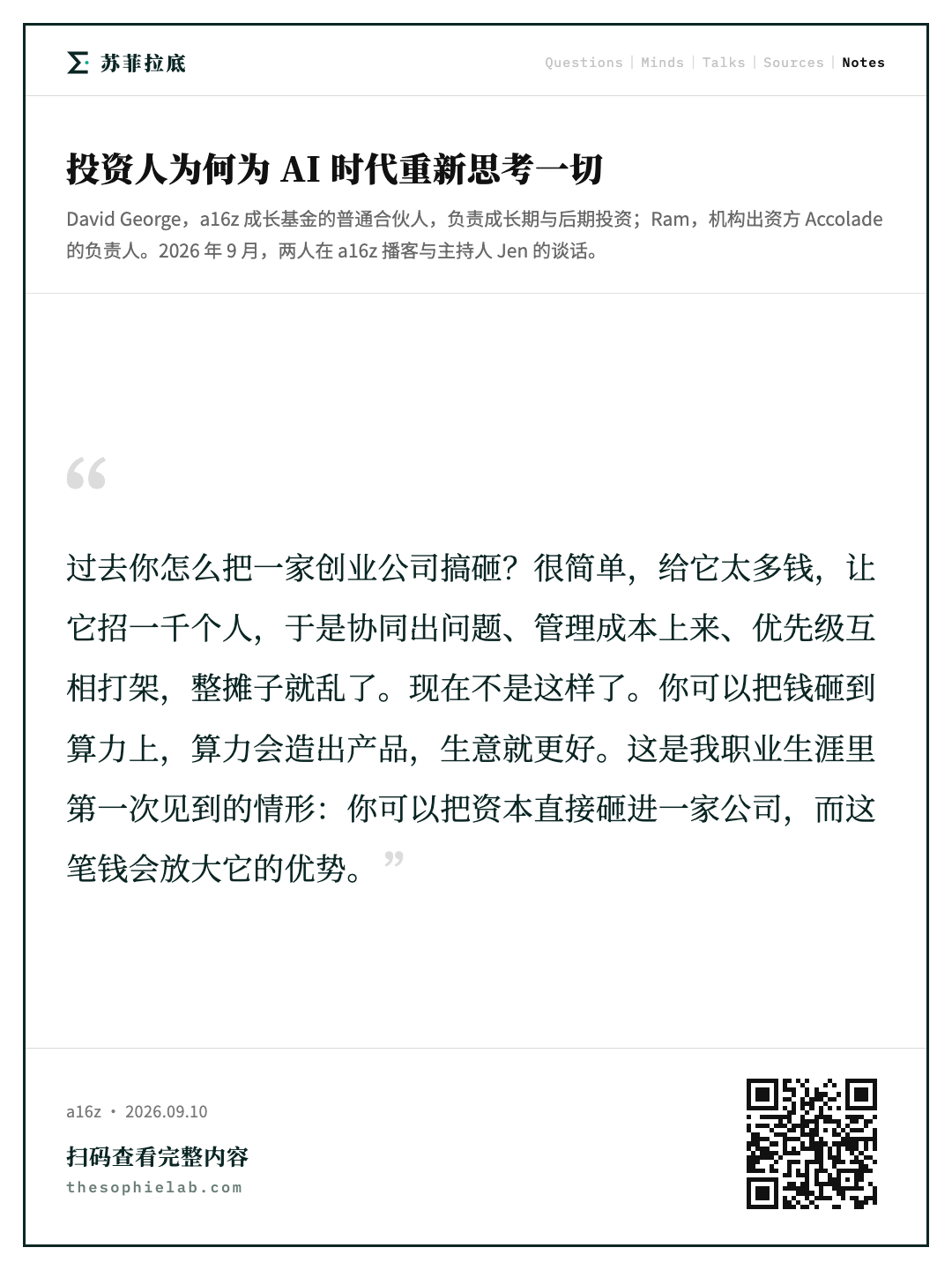
乔治: 但眼下,尤其是在这些实验室身上,出现了我职业生涯里第一次见到的情形:你可以把资本直接砸进一家公司,而这笔钱会放大它的优势。要知道,过去你怎么把一家创业公司搞砸?很简单,给它太多钱,让它招一千个人,于是协同出问题、管理成本上来、优先级互相打架,整摊子就乱了。因为你没法招够足够多的人,快到足以把足够多的事做完。

乔治: 现在不是这样了。你可以把钱砸到算力上,算力会造出产品,生意就更好。所以幂律变得更极端,在我看来一点都不意外。规模经济在 AI 市场里是非常真实的存在,我认为接下来仍然会是。

十年之后的账重新算

主持人: 拉姆,你不只是我们在 Accolade 的长期出资人。说来也巧,距离你离开 a16z 正好整整十年。为了纪念你离职十周年,我把这件宝贝翻出来了。

拉姆: 天哪,你居然还留着。

主持人: 我们从地窖里挖出来的,还特意做了个加大码,以示纪念。不过说正经的,这十年世界变了很多。你应该还记得,那时候大家正在抱怨基金规模太大。

拉姆: 你们当时有一只十亿美元的基金,我记得。

主持人: 对,第一只十亿美元的基金,也是第一只到这个量级的风险基金。这十年发生了太多事。你现在怎么看你的风险投资组合和私募股权组合之间的关系?更广义地说,资产配置该怎么做?我们进来的路上聊过这个:如果给你一张白纸重来一次,以你今天知道的东西,你会怎么搭?

拉姆: 先说今天的风险投资。AI 的收入规模已经到了一千亿美元。SaaS 走到同一个位置花了十五年,AI 用了四年。而我们离需求被满足还远得很。大卫说你可以往里砸资本,这件事的前提就是推理需求近乎无限。

拉姆: 我们现在所处的位置是,AI 正在攻击 GDP 的每一个面:运输、劳动力、服务、资本、协调。历史上没有哪一种技术范式能同时打到三十万亿美元的 GDP 上。所以你拿到的是一个增长最快的技术,而它同时命中 GDP 的所有部分。站在配置人的角度,你很难论证它只是一个卫星仓位。它应该是核心仓,甚至是超配的核心仓。

乔治: 我当然有立场,但你只要看市场的形态在我入行之后发生了什么变化就明白了。我从私募股权和成长股权起步,那大概是十八年前。这行当年是个小作坊,现在不是了。这话我天天讲:我们这个资产类别的价值是五到六万亿美元,而公司保持私有状态的时间越来越长,这个趋势不会逆转。

拉姆: 你 2019 年从 GA 出来的时候就有这个判断了,后期也能拿到风险投资级别的回报。今天它真的发生了。所以这不再只是早期的故事,也不再是收入一亿美元就去上市的世界。

乔治: 对。以前前十大退出规模大概是一百亿美元,现在是四百亿美元上下。

拉姆: 等 Anthropic 和 OpenAI 出来的时候,大概会到一千亿美元。

乔治: 是的。而这其实很合理。上一个周期创造了二十五万亿美元的新增市值,其中很大一块归了在位者,但也有很多归了初创公司。每一波浪潮都会比前一波更大。所以我们的预期是,拿二十五万亿这个数字作底,接下来的数只会更大。

AI 的市场到底多大

主持人: 我一直搞不清楚 AI 的可服务市场到底该怎么算,很想听听你们的看法。

拉姆: 拿医疗举例。医疗行业每年在医疗 IT 上的支出大概是六百亿到一千亿美元。但 AI 打的是真正的劳动力,是医疗系统里那些任务本身的价值:理赔、账单、行政。那是一个万亿美元级的行业。所以 AI 的市场空间可以比传统 SaaS 或医疗 IT 大十倍以上。

拉姆: 那这个价值怎么定义?就是那些被执行的任务的经济价值。你要看的市场空间是这个数,然后 AI 公司会从里面拿走某个比例。但这个市场能长到多大,我们心里根本没数。就像你说的,每过一波浪潮,回头看在位者都小了十倍。所以很难估。我只能说我自己的经验:我在判断这些结局能有多大这件事上,一直是错的,而且是长期低估。

乔治: 我也一样。就说劳动力,你看美国经济里花在劳动力上的钱和花在软件上的钱,差了大概四十倍。当然,很重要的一点是,这不意味着劳动力会消失。我认为劳动力会被重新发明,我们最后会得到一套被重新想象过的、由人来做的任务。

乔治: 但我认为这恰恰是 AI 的全部要点:你冲的是另外一样东西。所以把它等同于软件,说「哦,这是软件的下一次进化」,格局太小了。

主持人: 我们的法务常跟我说:我太爱 Harvey 了,我的客户现在个个都觉得自己是律师,他们能在某些问题上跟我辩论,而这些问题他们过去大概只会说「我不太懂,听你的」。所以自从大家开始用 AI,我的计费小时数反而涨了。这些用例的价值被严重低估了,而我们连边都还没摸到。

乔治: 而且它们是扩张性的。这个点很好。

拉姆: 之前还有一整套论调:前沿实验室会吃掉应用层,到底哪一层会赢?结果是,好像每一层都在长。

不是一场零和牌局

乔治: 我有个朋友做了期播客,他的说法是「什么都会成」。我的讲法稍有不同。我们经常被出资人追问:哪一层会赢?我的回答是,我不知道。市场会大到什么都可能成立。当然会有很多公司做不成,也可能有个别品类整体不成立。但总体上,如果你的思路是「开源做得好,就等于实验室倒霉」,或者反过来,那就太局限了。所以我们尽量不用这种零和的方式思考。

主持人: 那不妨往外抽一层讲:为什么大家总觉得会是赢家通吃?上一个技术时代,很多品类可能确实是赢家通吃,但这次感觉在性质上就不一样,因为我们对基本面的判断依据变了。

乔治: 赢家通吃这个说法挺有意思。你看所有领先科技公司的市值增长,成功的公司多得是,那并不是赢家通吃。不过有个重要区分:在任何一个给定品类内部,我们非常相信幂律。赢家会拿走绝大部分的市场份额和市值,第二名只能捡点残渣。但我认为品类的数量本身会大幅扩张。

乔治: 你回到二十年前,CRM 其实还算不上一个品类,它很小,就是 Siebel 那类东西。而现在它是个巨大的品类。我认为同样的事会再发生一遍。我们投的每一个技术市场都见过这个过程。

乔治: 再说我们的做法。在我们这行,我们能够容忍亏损。如果一只基金投出去那么多笔,一分钱都没亏,那说明我们冒的险不够。你看我们历史上表现最好的那几只风险基金,亏损率大概是百分之六十。

拉姆: 早期是这样。

乔治: 早期是这样。到了成长期,亏损率会低一些,大概在百分之十到二十,这个水平是合适的,因为与此对应,你会投中一些回报十倍甚至更多的项目。所以,如果我们干得不错,那就意味着我们在每一个站得住的品类里都押中了领头的公司。品类跑出来了,我们就干得漂亮;品类没跑出来,那也没关系,这就是我们承担的风险。

三千家里只有二十家

主持人: 这里面还嵌着一个时机问题。我和拉姆常感慨,很多人在某个时点上会觉得市场过热,回头再看,会发现当时其实便宜得很。但市场偶尔也会出现那种确实过热的异常时刻。我知道你经常跟出资人强调,在风险投资里保持连续性比在任何其他资产类别里都更重要,因为你永远不知道这些技术什么时候会冒出来。很多机构配置者手上其实没有前沿模型的敞口,现在开始追,追的过程中可能又做出一些过头的动作,反倒印证了泡沫的说法。这一块你展开讲讲。

拉姆: 大卫刚才讲的幂律的极端程度,落到配置人身上就是:如果过去五到十年里你没有拿到最顶尖的那五到十家公司,你的回报就已经被甩开一大截了。

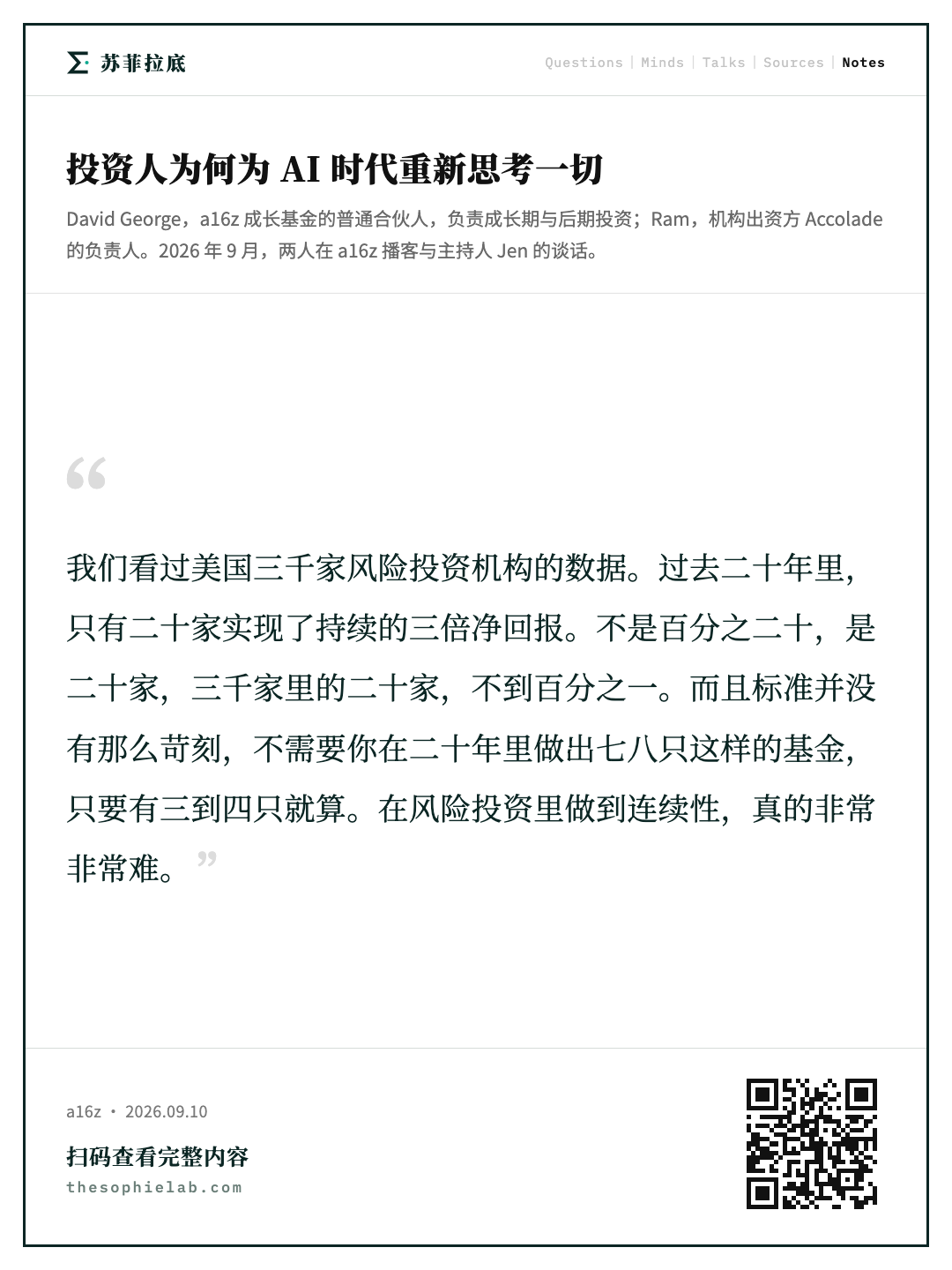
拉姆: 退一步说。我们看过美国三千家风险投资机构的数据。过去二十年里,只有二十家实现了持续的三倍净回报。

主持人: 等等,你再说一遍,百分之二十?

拉姆: 不是百分之二十,是二十家。三千家里的二十家。不到百分之一。持续的三倍净回报。

主持人: 这太惊人了。

拉姆: 而且标准并没有那么苛刻。不需要你在二十年里做出七八只这样的基金,只要在二十年里有三到四只三倍净 TVPI 的基金就算。符合的只有二十家。在风险投资里做到连续性,真的非常非常难。

拉姆: 但有意思的地方在于:那些做到连续的机构,每一期都持续拿到了定义品类的公司。当然也有例外。另外要说明,光有那个 logo 是不够的。如果你做早期,基金规模又大,你必须持有足够的份额。如果你做后期,大卫你看我说得对不对,规模的匹配是关键。

乔治: 对。

拉姆: 后期是有可能做出风险投资级回报的,但你最好的那家公司要占到基金的百分之五到十以上,这样单靠一家公司就能把整只基金还回来。后期投资的「单笔回本」这套算术过去不存在,现在存在了。所以我们发现的规律是:组合规模匹配得当,并且能持续拿到项目,这两件事合起来,就是三千家里的那二十家。

拉姆: 如果你没有它们,回报的离散度巨大,你拿到的就是风险投资的平均回报。看剑桥的数据,过去十年风险投资的平均净回报是一到两倍。那你做私募股权会更好,做公开市场肯定更好,而且钱不用锁十年。

主持人: 说到这个,我刚翻到我们那位朋友「捐赠基金埃迪」今天早上发的一条推文。他说:大基金受追捧是被创始人推动的,不是被出资人推动的。创始人多半想要一个能跟着规模走、能陪跑全生命周期、能帮忙拿客户和招人的品牌。出资人是慢慢跟上来的,大部分到现在还在拖后腿,因为这跟传统观念是反着的。

拉姆: 对。而且退出规模变大了,所以基金可以变大。当然也有例外。那二十家里也有一些小机构,它们要么专注在很窄的垂直市场,要么站在一个比大机构早得多的阶段上,在那个位置几乎不跟大机构正面撞车。

主持人: 明白。

拉姆: 但这种策略的问题在于,你必须在基金规模和策略上保持克制。一旦你越做越大,就会撞上大机构,那时候要维持连续性就变得极其困难。

中间层的消失

主持人: 中间层之死。

拉姆: 中间层之死。中间层之死。

主持人: 我们说好每讲一次「中间层之死」就喝一杯的。

乔治: 我对风险投资生态里的很多同行都心存敬意。但中间层这件事确实存在。

主持人: 你怎么定义中间?中间指什么?

乔治: 一端是你刚才描述的那种高度专门化的基金,比如很早就扎进 AI、团队里全是极深的领域专家,这批人干得相当不错。他们有时候动作比我们快,能抢进我们想做的项目,或者分走一部分份额,这是现实。另一端是所谓的大规模风险投资,也就是有完整产品线、能从种子一路做到公司上市的机构。我想我们有几家同行采用的是类似策略,我当然愿意认为我们是最好的,但确实还有那么几家在做同样的事。

乔治: 夹在这两端中间的其他所有人,我认为竞争起来会比较吃力,原因就是埃迪说的那个。创始人在乎什么?创始人在乎的是,从一个他认为能替自己降低失败风险的伙伴那里拿钱。如果要把这件事简化到底,这就是创始人真正关心的东西。当然他们也在乎具体那个人,所以这些方面你都得做得像样。

乔治: 但我们之所以堆起这么多资源是有原因的。我们为什么有七百名员工?为什么把基金上赚到的管理费投回到运营资源里?因为我们相信这么做,第一能把结果的曲线掰上去,第二能帮我们赢下项目。当创始人挑合作方的时候,如果是个热门项目,他们手上有的是选择。这就是显示性偏好。而正如埃迪所说,我们在这件事上干得还算可以。

乔治: 我同意他的另一点是:出资人来投我们,是这件事的副产品。我们的生意是个飞轮。飞轮从这里转起来:我们是不是足够深的领域专家?我们对未来会不会有一个正确的判断?我们能不能向创始人证明我们是对的合作方?如果能,我们就赢下这一单。如果我们还能把结果做得更好,那更好。而一旦我们真的把结果做得更好,两件事会发生。

乔治: 第一,我们这门生意的回报之所以有持续性,部分原因是新的创始人想待在赢家旁边。他们在意这个,因为这里有很重要的品牌信号,对他们自己有连带效应。第二,因为参与了赢家的过程,哪怕只是在小事上帮了忙,我们也攒下了极有杀伤力的背书。然后创始人会去告诉别的创始人:你该跟这帮人合作。飞轮就是这么转的。

种子基金与大基金

拉姆: 有个说法我想听听你们两位的意见。做前种子阶段,估值在两三千万到四千万美元以下,基金规模在一亿美元以下,这类机构是可以和大机构共存的。因为在最初这个阶段,假设有七家 AI 公司在做差不多的事,我猜像 Andreessen 这样的大机构会更愿意等上一两轮,等确定性相对高一点再进,因为你最不想做的事就是投成第二名或第三名。就像你说的,你必须在品类赢家里。所以你宁可等到那一轮,然后重仓,去领投 A 轮或 B 轮。这样小机构就能在比大机构早一两拍的位置上凿出自己的生态位,而且他们真的有赢的权利。他们可以做得很好,同时跟大机构形成互补。你同意吗?

乔治: 同意。我们跟生态里的种子基金关系都很健康。我们自己也做种子。前种子确实比我们通常的位置更早一些。

拉姆: 你们做的种子,我理解是偏大、偏厚的那种种子吧。

乔治: 那确实是我们的甜区。

主持人: 话虽如此,我们还有 Speed Run 项目,今天早上我们刚从那边过来。我觉得市场在演化。因为创始人对品牌有很强的偏好性依附,就像大卫说的,我们几乎什么都能看到,所以有时候我们去做前种子和种子也是合理的。你得有这种资本上的弹性。而对创始人来说,就像你说的,他们其实不太在乎你的重心在哪个阶段,他们只想进入那个轨道,然后总能找到匹配的钱。

主持人: 所以我认为大家在这个世界里是可以共存的。但有一点也很重要:我们的生意本质上是一门早期生意。我们必须第一个到位。我们不一定真的会出手,但至少要把格局和市场摸清楚,才能在后面做出明智的判断。

拉姆: 我今天在 Speed Run 也跟几位创始人聊了,他们非常希望留在这个轨道里。

主持人: 对。这是个新现象。十年前,随着早期机构开始做后期,这件事开始成形,然后一路延伸,但当时还远不是今天的样子。大卫,你是不是也这么看:如果没有早期打头、后期接续,中间阶段这门生意几乎是不可能独立成立的?

乔治: 我当然有立场,但我认为我们的成长期基金之所以做成,恰恰是因为我们的早期业务。这话我一直在讲:我们的生意始于早期,也终于早期。它在成长期阶段给了我们巨大的优势:项目通道、信息、认知、关系,等等。反过来,我想我们的早期合伙人大概也会说成长期业务对他们有好处,因为这让我们能够放大规模、能与创始人把合作关系做深,而这又有助于在早期赢下项目。

主持人: 完全同意。两边都需要。你不能只做早期,也不能只等在后期。你刚才说机构在向少数几个名字收敛,这大概是真的,还是幂律那套动力学。但同时,那些 logo 里的绝大部分,我们必须在早期就拿到,因为只有那样我们才能保住主动权,才能行使跟投权,甚至拿到更多。

拉姆: 我们坚定地相信,最强的后期业务背后一定挂着一个巨大的早期业务。有早期业务在,你赢的能力是被乘出来的。我们刚才讲后期的规模匹配:不管你的后期基金有多大,你要能规模化地把基金的百分之五到十押进一家定义品类的公司。你之所以能做到,是因为你有早期业务,早就和创业者、管理团队建立了关系。一只凭空冒出来的后期基金,想进去开出五亿美元的支票,非常难。

乔治: 非常难。这个世界我待过。

尽调比过去更难

主持人: 那么从出资人的角度看,今天做风险投资这件事,相比你刚入行的时候,是不是在结构上已经变成另一份工作了?另外,在风险投资内部你怎么做配置?因为构建组合的时候,风险投资自己也有子类别。

拉姆: 简单地说,在我们看来做风险投资有四种方式。第一是前种子和种子,也就是一亿五千万美元以下的基金,光美国今天就有接近两千家。第二是我们刚才说的那个混乱的中间层,这里也有很多机构,不到几千家,但有几百家。第三是大机构。第四是专做后期的基金。四种玩法。大机构我们投了几十年,种子机构我们也投,中间层我们选择性地投过几家,专做后期的我们没投,原因刚才讲过了。

拉姆: 那么在变的是什么?AI 让我们的工作比以往任何时候都更难。难在几个地方:轮次普遍更大,节奏更快,而行业里出现的所谓牵引力让人困惑。

拉姆: 我说说为什么困惑。一家公司从某个加速器出来,宣称一个月内从零做到五百万美元年化收入。这家公司还没经历过任何一个续约周期。然后它就拿着这个数据以极高的倍数融资。而且很多时候,同一批次的公司之间在互相买单。那甚至不是真正的年化收入,只是把某个月的数乘以十二。

拉姆: 但问题在于,每九家这样的公司里,就有一家是真正特别的:它做的是几百万美元实打实的年化收入,估值同样很高,而它会长成下一个 Cursor。所以今天要分辨什么是真牵引力、什么不是,真的非常非常难。估值又都很高。这正是大机构占优的地方,他们确实可以等,或者说他们在下一轮的时候确定性已经足够,可以去领那一轮。

拉姆: 不过话说回来,即使那样,确定性也是相对的。你们投 Cursor 的时候,我不觉得当时有多少确定性。有多少个月,大家一直在说 Cursor 完了?

主持人: 就算到宣布被收购的那天早上,还有人在说 Cursor 完了。我当时心想,人家刚宣布了以六亿美元被 SpaceX 收购。

拉姆: 你纠正我,三亿美元的年化收入,四亿美元的融资,大概是这个量级吧。

乔治: 差不多是这样。

拉姆: 很多人会说这太疯狂了,他们为什么要做这笔交易?

乔治: 好,我来说。首先,对创始人的判断非常重要。长期认识创始人,花大量时间和他们相处,观察他们怎么思考。我愿意认为我的早期合伙人在这件事上相当在行。

乔治: 其次,真牵引力和误导性牵引力确实难分。我说的误导性是指你没法从中读出市场信号,不是说有人在故意骗。

拉姆: 大概也有一些是故意的。

乔治: 大概也有一些是故意的。时不时就有人在重新定义年化收入这个词到底是什么意思。

主持人: 这是一条非常有用的公共提醒。

乔治: 我还是回到那个问题:市场对你的产品是不是要得更多了?这永远是那个问题,它就贴在我电脑屏幕上。

拉姆: 可这家公司才运营、才卖了几个月,你怎么知道?

乔治: 靠财务分析是做不到的。你只能真正去理解客户,去跟客户聊。举个例子,我一直拿 Harvey 说事。他们早期的商业化做得很好,因为他们聪明,团队是研究员加律师的组合,做出了一些势头,早期签下了几家很有名的律所。但当时的使用情况并不好。你去看产品实际被用起来的程度,跟别的软件公司比只能算平庸。

主持人: 是留存的问题吗?

乔治: 不是留存,是使用。就是产品的使用率。但推理模型出来之后,这件事彻底翻转了。你能看到采用率的绝对起飞。同时发生了好几件事:律师从产品里获得的价值大幅提高,你在使用和参与度上看得见;而因为使用和参与度是高效用的,局面几乎是反过来了,从原先「我们害怕幻觉」变成了「每一个客户都在要求律所必须用这个产品」。

乔治: 所以我们找的就是这样的市场,而且我们尽量早点抓到,比我们抓到 Harvey 的时候更早。这就是我们看的信号。你得往下再钻一层。做同期群分析谁都会,看续约数据谁都会。但真正理解一个市场的质地、客户到底想要什么、需要什么、手上还有什么替代方案,我认为这才是决策的方式。这也是为什么早期业务如此重要,因为他们扎在技术和产品最深的地方。他们在 Cursor 上看到了,在很多别的东西上也看到了。

出资人与管理人的错位

拉姆: 我想问问主持人。你是我认识的最能募资的人。出资人给你的最大反驳是什么?

主持人: 这话能让我在这家公司继续稳稳地端着饭碗。

拉姆: 我确实认为你很能募。那么在 AI 的现状、风险投资的现状上,出资人给你最大的反驳是什么?

主持人: 很多担忧集中在一个点上:我们是不是在接一把下落的刀?也就是市场时点的问题,现在是不是过热了。关于估值和市场潜力,我们前面已经聊了不少。但我从出资人那里听到的另一种情绪是,他们的工作本身也快要发生根本性的变化。你刚才提到了其中一面,就是 AI 让评估项目和基金变得更难。

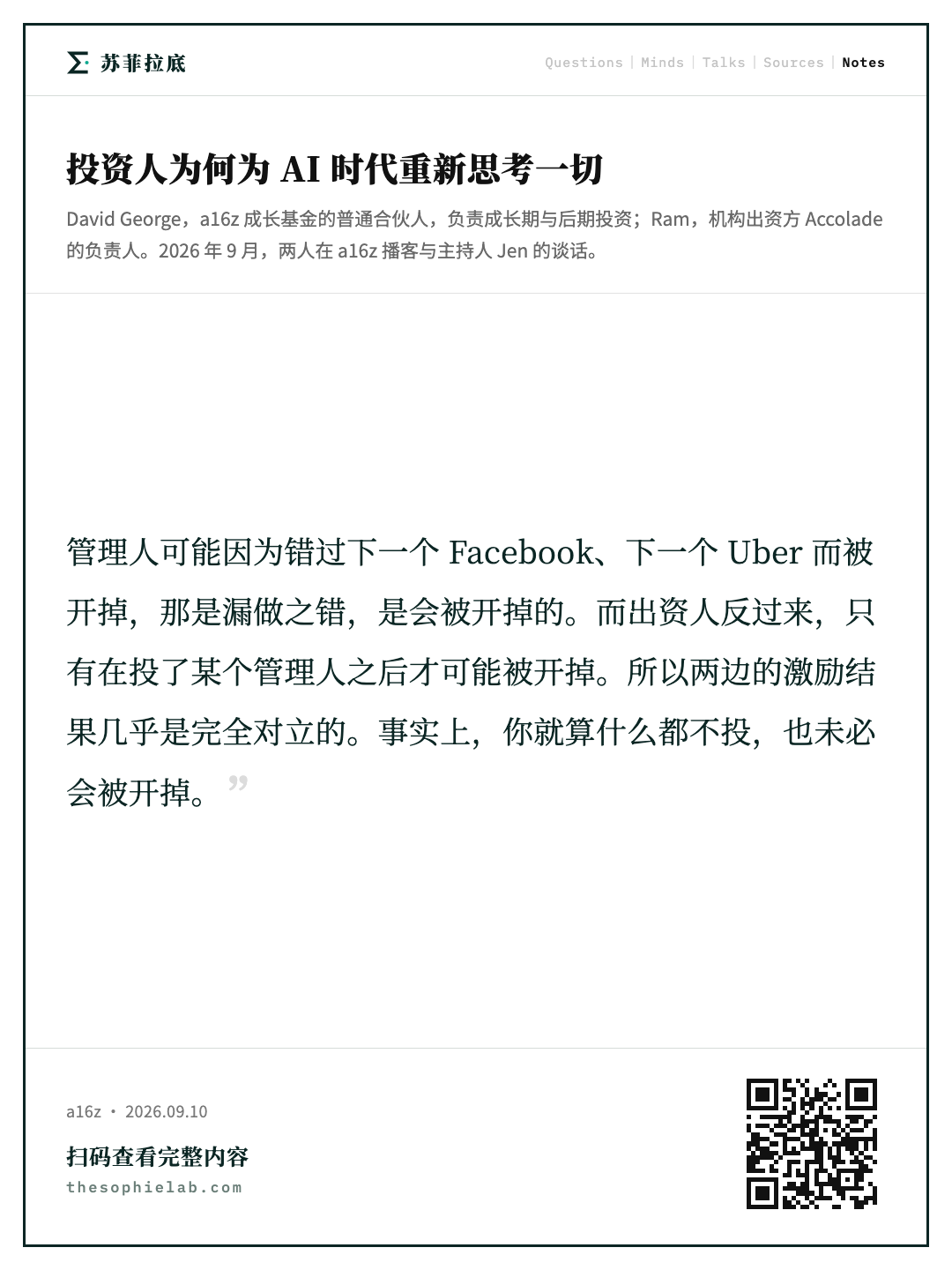
主持人: 另一面是,出资人在历史上从来就没有被激励去拥抱变化。这份工作的最终目标,在某种程度上和管理人的风险偏好是相反的。这就是这个行业的机制。管理人可能因为错过下一个 Facebook、下一个 Uber 而被开掉,那是漏做之错,是会被开掉的。而出资人反过来,只有在投了某个管理人之后才可能被开掉。所以两边的激励结果几乎是完全对立的。

拉姆: 做出资人,不会因为错过 IBM 而被开掉。

主持人: 正是如此。事实上,你就算什么都不投,也未必会被开掉。

拉姆: 就算你错过了所有前沿模型,回到你最开始那个问题,只要你大致贴着基准,哪怕略低于基准,你的饭碗是保得住的。

主持人: 对。而且对大多数人来说,先把母基金排除在外,那是另一回事,对很多人来说上行空间本身对他们并没有那么大吸引力。所以「嘿,你要错过下一代的机会了」这种说法,其实打不动他们。

拉姆: 这就是激励错位。

主持人: 而且情况相当多样。那么从这里出发,出资人的角色该往哪走?我认为我们也有一份重要的职责。我们常在自己的工作里谈到,作为风险投资行业的领导者,我们必须帮别人理解未来往哪里去,而这其中的一部分,是理解 AI 会如何渗透进他们的整个投资组合,而不只是风险投资那一小块配置。我觉得这件事比单纯说「你可能会错过下一代回报,或者错过下一个前沿模型、错过一两家幂律公司」有意思得多。

拉姆: 出资人的工作是三件事:通道、选择、规模。通道这件事,你可以说数据摆在那里,你能算出谁在历史上做得好。

主持人: 嗯。

拉姆: 三千家里的那二十家,你也不会指望它们全都保持连续,也许一半能继续保持。但出资人的工作还包括找到下一代的机构,同时继续保住已有的通道。所以第一是通道,第二是选择,第三是组合构建和规模匹配。第三件事对出资人来说是决定性的。

拉姆: 如果一个资产类别里三千家只有二十家做得好,那你就应该相当集中地押在那十五到二十家上。所以当我看到一个组合里有五六十家、七十家风险投资机构的时候,我很难想象整个组合能跑赢平均。而我一直在说的那个平均,本身就不是一个值得为之锁仓的东西。

主持人: 相对于流动性的代价来说,不够吸引人。

拉姆: 相对于任何其他资产类别都是,公开市场、私募股权都是。私募股权大概能给你一点五到两倍净回报,不用锁那么久,也不用承担风险投资的风险。你说的百分之六十亏损率,私募股权没有这回事。

主持人: 对。

拉姆: 私募股权在 AI 软件上有它自己的问题,我们待会可以聊。但对出资人来说,组合构建和规模匹配是关键。我见过太多次:一个出资人或配置人找到了一只有意思的基金,判断完全正确,然后只放了自己组合的百分之一进去。恭喜,你赚了十倍,那也只相当于你整个组合的百分之十。这根本不改变什么。

各类资产的重新定价

主持人: 那么两位觉得,我们今天走到了哪一步?我知道你有立场,但在整体资本里,风险投资和成长期投资相对于私募股权、公开市场、实物资产、信贷这些,合适的比例该是多少?

乔治: 这个问题我很难答,因为我只做风险和成长,我肯定会说应该超配。

主持人: 不过我们喜欢这个答案。

拉姆: 看今天的公开市场。我们用 AI 顺手做了个小工具,用来评估上市公司对 AI 的韧性,现在也开始把它用到私有公司上,这对我们的成长股权组合帮助巨大。在 SaaS 的公开市场里,市销率在十倍以上的公司最多只有十五到二十家。这个数字本身就很夸张,因为几年前这样的公司有几十家。而这十几家公司里,绝大多数都在显示 AI 带来的增长加速:要么在监控,要么在安全,要么在智能体的部署上。

拉姆: 所以又回到同一条原则:如果你以某种形式与 AI 绑定,而 AI 是 GDP 所有构成里增长最快的那一块,那你就应该在组合里超配它。这一点会反过来影响公开市场。

拉姆: 就连私募股权今天做新投资的时候,找的也是 AI 原生的东西。他们不会再去买一家年增长百分之十的工作流软件公司。那种事情已经不发生了。他们要找的是那种能展示增长加速、管理层是 AI 原生的记录系统。所以 AI 这条连接组织,今天贯穿了所有资产类别。

主持人: 对。

拉姆: 而要押注它,最强的方式之一大概还是通过风险投资。但通道、选择和组合构建就变得尤其关键。

主持人: 连退出的格局都变了。比如现在传言银湖可能去买 Workday,私募股权在做一些更激进的事,前提是他们有能力把这些资产改造进未来。另一面是,风险投资这边的退出规模现在远超私募股权。我昨晚特意查了一下,今年私募股权最大的退出是 EA 的收购案,大约五百亿美元,还有 Medline,也是五百亿美元上下。把 IPO 排除在外,Cursor 卖给 SpaceX 的这笔并购,规模比它们都大得多。

老软件资产的困境

拉姆: 问题在于,你去看私募股权在 ChatGPT 之前的那几期。当时你要为一家最多增长百分之十到二十的软件资产付出大概十五到二十倍的 EBITDA。而今天你去看公开市场,同样的资产只值两倍市销率。

主持人: 对。

拉姆: 而问题不只是估值。这家公司可能根本找不到买家。因为今天你看一家软件公司,第一个想到的问题是:它的终值是什么?它对 AI 有韧性吗?证明韧性的最好方式是有机增长在加速。我们的数据显示,在公开市场里,一个百分点的增长等价于百分之三的 EBITDA。

乔治: 是的。

拉姆: 说来好笑,疫情那阵子,所有人都在喊我们必须盈利。

主持人: 现在正好反过来。

乔治: 二一年是反的。疫情之后基本上完全跟风险偏好对齐了,跟公开市场的风险偏好高度相关。

拉姆: 正是。所以很不幸,很多私募股权的交易,标的增长不够快,也拿不出加速,而且它们未必有那种能把生意彻底翻修的管理层。Intercom 就是个很好的正面例子:把创始人请回来,把整个生意重做一遍,做出一个 AI 原生的产品,做到规模,然后再卖。这几乎等于亲手把自己现有的生意杀掉,而这件事在私募股权的框架里极难做到。

乔治: 确实极难。我前不久和那位创始人待了一会儿,在一个活动上我走过去跟他重重击了个掌,跟他说:哥们,你真做到了。这是那种真的真的很难的事。眼下它还是孤例。但确实还有一批很不错的创始人有这个能力,在上市公司和私有公司里都有,我想他们会去试。我们看着就是了。

主持人: 顺着这条线问下去,大卫。我们有时候也会碰到类似的反驳:那些一直在做风险投资、也在配置风险投资的人,手上同样压着一堆老资产。历史遗留的那部分该怎么平衡?

拉姆: 那让我来替他问得更具体些。假设你手里有一家二〇一六到二〇二一年、ChatGPT 之前那几期投的软件公司,它还行,但已经没有 AI 原生的能力了,也没有加速,增长大概百分之三十。在风险投资的账面上,它的估值是十倍到二十倍市销率。你说它没法上市了,没人有兴趣把它推上去。银湖对这家公司也没兴趣了,一年前会有,现在没有。那这家公司会怎么样?我们对这类公司同样有不小的敞口。

乔治: 我会说,这件事非常待定。这个周末我跟我们的一位创始人兼 CEO 在一起,他说:跟我说实话,你到底觉得在发生什么?他原话是「别给我播客式的回答」,这话放在今天挺讽刺的。

乔治: 我认为两件事可以同时为真:AI 是我们见过的最大的代际变革,它会改造各行各业;同时,那些能适应的软件公司也会留下一些持久的价值。

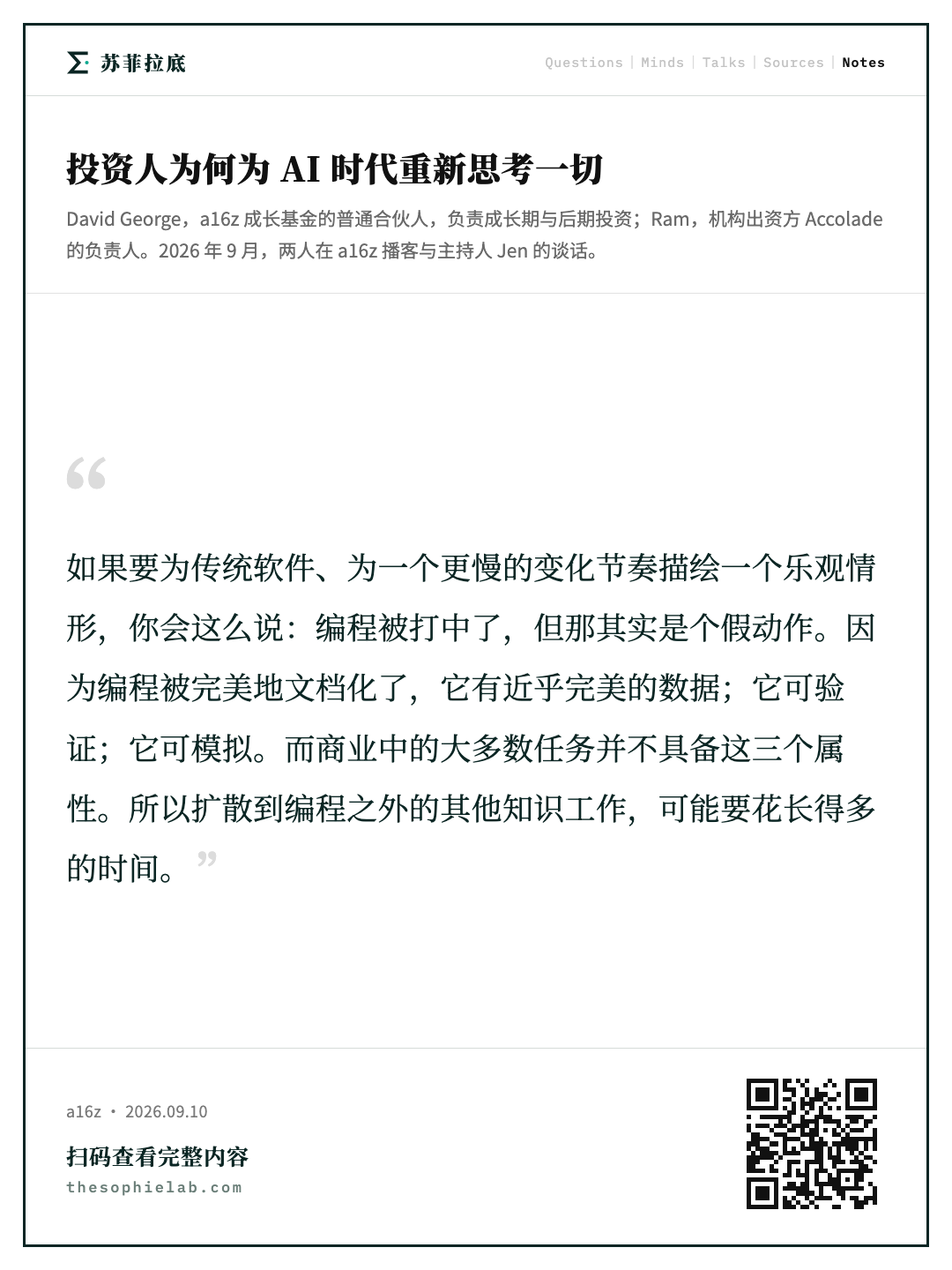
乔治: 我们一直在盯的一件事,也是让我们对 AI 极度乐观的一件事,是技术向真实经济的实际扩散。如果要为传统软件、为一个更慢的变化节奏描绘一个乐观情形,你会这么说:编程被打中了,但那其实是个假动作。因为编程被完美地文档化了,它有近乎完美的数据;它可验证;它可模拟。而商业中的大多数任务并不具备这三个属性。所以扩散到编程之外的其他知识工作,可能要花长得多的时间。这就是为软件公司辩护的理由。另外,其中一些会进化,会有 AI 的解决方案,会改变商业模式,我认为这是必须做的。这就是「也许现在有点言过其实」的论证方式。你看过去几个月很多上市 SaaS 公司的反应,我觉得市场里正在浮现这种认知。

乔治: 不过所有这些反而让我对 AI 极度极度乐观。你看我们的组合,我们也有那类公司,但我们大约百分之九十五的净资产值不在那类公司里,而在那些增长极快、还在加速的公司里。

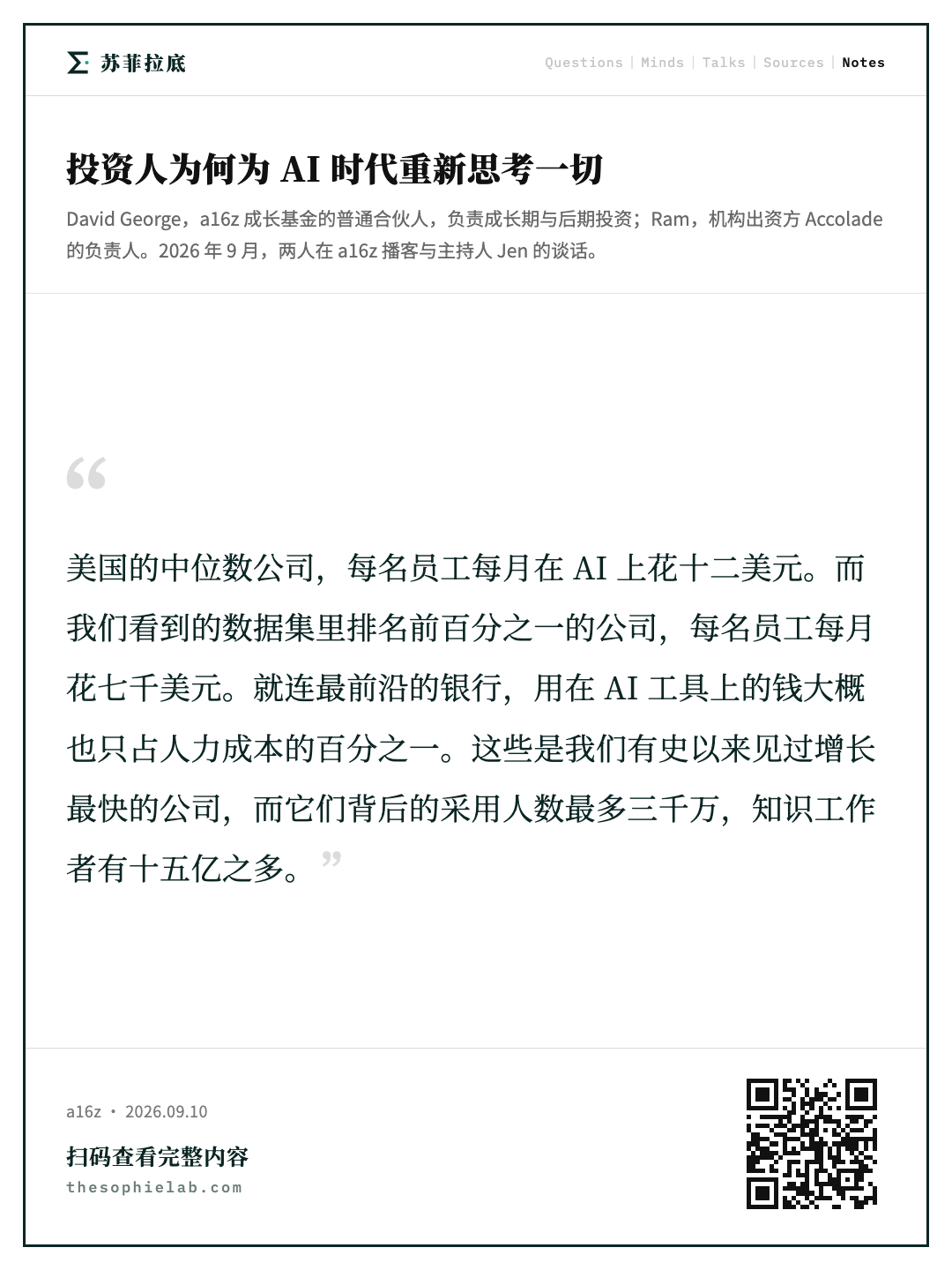
乔治: 再给几个数。美国的中位数公司,每名员工每月在 AI 上花十二美元。而我们看到的数据集里排名前百分之一的公司,每名员工每月花七千美元。

主持人: 天哪。

乔治: 所以不仅是扩散还没怎么走出编程,而且单看今天谁在消耗 token、谁真正从 AI 里拿到了价值,这个分布告诉我们,我们还处在极早期。就连最前沿的银行,用在 AI 工具上的钱大概也只占人力成本的百分之一。

乔治: 这件事之所以让我非常乐观,是因为:这些是我们有史以来见过增长最快的公司,每个月新增的收入比那些万亿市值的科技巨头还多。而它们背后的采用人数可能只有一千万,也许两千万,最多三千万。而知识工作者有十五亿之多。我认为 AI 会改变我们做很多工作的方式。

主持人: 加州公务员退休基金就是个有名的例子,因为没有投进这个市场,白白错过了几十亿美元的收益。他们现在正在补课,已经把组合从百分之九十一调到百分之五十八,风险和成长的比例从百分之九从提到了百分之四十三。真实的答案大概在这两者之间,但他们确实是在重仓压上去。

主持人: 不过历史遗留的那些公司里还是会积累出很多价值。我刚才拿 Bending Spoons 开玩笑,但那对 Airtable 来说恐怕是个很好的结局,何况他们还要把超级智能体那块业务分拆出去,我觉得会做出很有意思的东西。总的来说,我认为很多东西都能找到自己的归宿。零和式的思维方式,大概正是我们要劝人避开的坑。

私募信贷与「贴层 AI」

主持人: 我们聊了风险和成长,聊了私募股权,聊了公开市场。顺便说一句,这些市场的构成在过去十年里都发生了剧烈变化。同时,私有市场里还冒出了一些全新的品类,比如私募信贷。你对它们的相对前景有什么看法?

拉姆: 你是说软件领域?

主持人: 我是说整个科技领域。

拉姆: 我们的观察视角是,私募信贷有很大一部分躺在私募股权的软件组合里,规模是几千亿美元。我给你一个数字。二〇二一到二〇二二年,软件行业发生了大约两千亿到三千亿美元的杠杆收购,其中举借了超过两千亿美元的债务。这些软件交易的平均估值是二十五到三十二倍 EBITDA。这些公司今天的价值大概只有当时的一半。

拉姆: 你现在看到私募信贷市场出现赎回,原因正是这个。他们看的是公开市场,我们经历了 SPAC 大崩盘,软件经历了一轮巨大的估值修正。而估值收缩意味着杠杆率急剧上升。所以,如果你是一家对 AI 谈不上有韧性的软件公司,你在股权端和信贷端都会很难受。

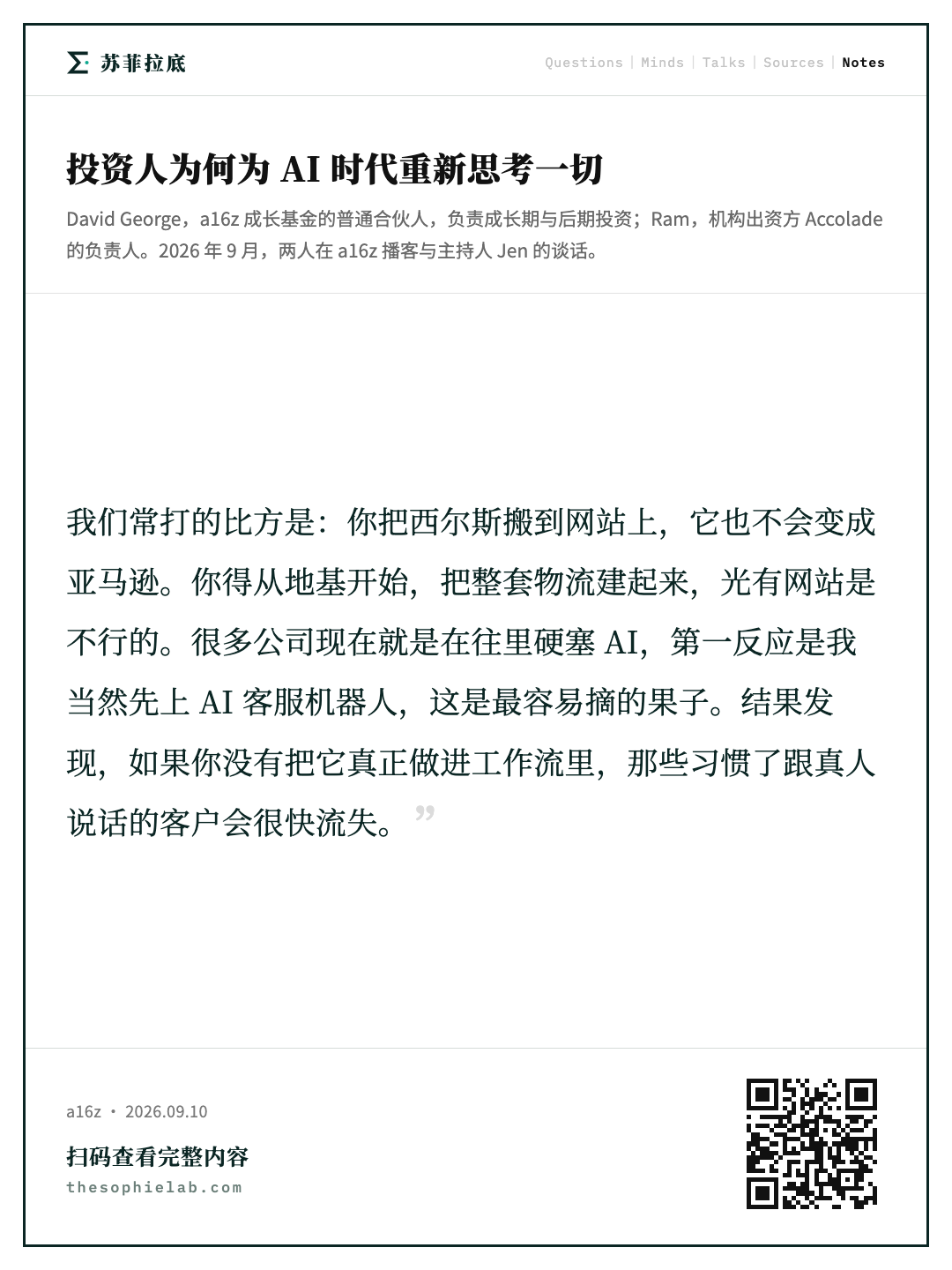
主持人: 顺便说一句,就连私募股权的 AI 版本也没能完全免疫。我们常打的比方是:你把西尔斯搬到网站上,它也不会变成亚马逊。你得从地基开始,把整套物流建起来,才能造出亚马逊,光有网站是不行的。

主持人: 很多私募股权支持的公司现在就是在往里硬塞 AI。我们在自己的一些公司里也看到了,同行的第一反应是:我当然先上 AI 客服机器人,这是最容易摘的果子。结果发现,如果你没有把它真正做进工作流里,那些习惯了跟真人说话的客户会很快流失。而 NPS 每掉一点,都直接对应收入的下滑,接着你就开始往下打转,如果上面还压着债,那就更糟。所以每当有人说「我就做私募股权的 AI 版本」,我们会说这不是什么万灵药,尤其当技术形态已经根本不同,要把 AI 真正贯穿整家公司是另一回事。

拉姆: 你不能只是派个运营合伙人过去,说我们给它加点 AI,那根本不起作用。当然,如果管理层本身有创始人心态,这件事是可能的,但董事会必须一致,所有投资人必须一致,而且你要像 Intercom 那样做出一些非常艰难的决定。

流动性要等多久

主持人: 显然在座这几位都是这个类别的支持者。那我们来谈谈正当的反面意见:为什么承担风险和成长投资的风险,可能并不值得?

拉姆: 我们听到最多的反驳是回款周期。一家独角兽平均保持私有的时间通常在十年以上,中间还会有一轮接一轮、间隔很短的后续融资,你可能在五六家不同机构的组合里看到同一个 logo。问题是,你怎么出来?

主持人: 而且 IPO 本身并不等于分配。

拉姆: 对。从 IPO 到你真正拿到流动性,可能要十二个月、二十四个月甚至更久,尤其如果你在上市时还持有百分之十到十五,那对一家世代级的公司来说要花很长时间。所以回款周期这个反驳我们听得非常多。

主持人: 那反驳的反驳是什么?

拉姆: 反驳的反驳还是回到那个数字:三千家里只有二十家能持续做好。如果你在那百分之一里,并且手上有一个品类赢家,你要做的恰恰是让它复利下去。三四年前你会想把 Stripe 或者那类公司卖掉吗?答案是众口一词的不会。

拉姆: 那么,其中一些公司会不会比过去更早上市?会。Anthropic 第一次拿到融资是二〇二一年,五年之后就要上市了。Cursor 从第一次融资到被收购,时间更短。所以最好的那些风险投资机构,其实能相当快地拿到能覆盖整只基金的流动性,也许比私募股权还快。只是这一小撮机构实在太少了。

主持人: 说到这个,有个很有名的例子。大约一年半前,我们去找我们第一只基金的出资人。当时那只基金已经十六岁了,我们手上有从种子轮投进去的 Stripe。我们问所有出资人:你们要不要把这笔的钱拿回去?我们承认,十六年过去了,我们当初来做的那份工作已经做完了。结果每一位出资人都说:不要,我们宁可让它继续复利。后来又过了一年,我们还是决定退出,因为十七年了,总得把这笔流动性交出来,把基金收尾。

主持人: 不过很多出资人的诉求其实高度依赖类别。捐赠基金更愿意让它跑下去。家族办公室坦白讲根本不想把钱拿回去,因为他们不想为此交税,他们宁可让它继续复利。所以每一类出资人都有各自的细微差别,很难一杆子打死说所有人想要的是同一件事。

主持人: 但我也同意你说的:最好的那些管理人一路上都在主动制造流动性。特别是二〇二一年,很多人没有从桌上把钱收回来,我认为那是第一个分水岭式的信号。而在接下来这个周期里,问题是你能不能通过并购拿到一些早期流动性,然后让赢家随着时间充分复利,最终走向 IPO。

拉姆: 正是如此。

下一家百万亿公司

主持人: 最后一个问题。我觉得你和加文来回讨论的那个问题很有意思:他不肯回答下一家十万亿美元的公司会是谁,但他对下一家二十万亿美元市值的公司很笃定。所以我要问你们两位:你们觉得下一家一百万亿美元市值的公司会出现在哪里?

乔治: 天哪,来了。我连这个量级都想象不出来。那大概是两个技术周期之后的事,不是一个。

乔治: 有可能会出现全新的公司。而能驱动十万亿美元甚至更高结局的那部分市值创造,我认为会发生在那些还没被触及的新产品领域。比如我刚才说的技术向企业内部的扩散,我们还在原地踏步。

乔治: 一年前所有人张口闭口都是消费级,现在没人再谈消费级 AI 了。但消费者端的最终用例不会是一个聊天机器人界面,那只是拟物化的版本。我们会有一个原生的版本,它是主动的,它会替我们干活,它会为消费者创造巨大的价值。而我们在这件事上基本还是零。是的,ChatGPT 有十亿用户,但那还只是刮了个表皮。

乔治: 我们在机器人上基本是零,而我认为机器人会比语言那一摊更大,而且会在未来十年里发生。我们在自动驾驶上也几乎是零,全美路上跑的 Waymo 不到一万辆,无人出租车更少,这个领域还有大片空地留给别人去建。医疗占 GDP 的百分之十八,无论是照护的交付还是药物发现,我们都还没真正动过。当然已经有一些公司在做,也显出了早期的进展迹象,但我认为未来十年我们在那里取得的进展会是巨大的。

乔治: 还有一件事,我们正处在一个重新想象一切物理世界的时期,从国防到制造到数据中心。把这些趋势合在一起看,我的感觉是:现在也许觉得我们靠 AI 已经做成了很多事,但十年后回头看,我们会说,天哪,原来那几个大领域创造了那么多价值。所以我很兴奋,我认为下一个 SpaceX AI 或者下一个 OpenAI 大概率会被创造出来,而且多半就在这些领域里。

拉姆: 我再加一个品类。它在我看来既是隐忧,也是巨大的机会,顺便也算是给你们新的机会基金做个广告。

拉姆: 我的想法很简单:今天 AI 的瓶颈不在需求,而在供给侧。往下拆:能源、电网、数据中心,然后是芯片,然后是前沿模型和应用。美国在这条链的右半边极其出色,也就是芯片往后的部分,风险投资生态对这块支持得很好。

拉姆: 我觉得你们的新基金真正能帮上忙的是左半边。因为美国的问题不是发电能力,而是「通电的速度」。这是审批、是输电、是监管。别的国家一年新增的可再生产能是我们的十倍。这是一个真实的瓶颈。它同时意味着数据中心要被重新想象。你刚才提到功率密度要提高十倍以上,那你就不可能把一座旧数据中心改造成新的 AI 设施。

拉姆: 所以在这个位置上,你们的新基金能创造的不是一百亿、五百亿,而是一千亿美元以上量级的机会,并且是真正能解开瓶颈的那种。我认为这是个真实的担忧,因为需求不是担忧。我听到不少出资人说,这跟互联网泡沫一样,或者跟疫情那波一样。不一样。因为牵引力是真实的,它不是疫情期间那种转瞬即逝的收入。瓶颈可能在供给。但如果输入端都对了,比如你们现在开始去投的那些公司,下一代芯片公司、存储公司等等,那就是一个巨大的机会。

乔治: 机器的时代到了。把机器带上来吧。

主持人: 我喜欢这句。就在这里收尾。非常感谢两位,聊得太尽兴了。

拉姆: 谢谢你们请我们来。

乔治: 回见。
本期讲者
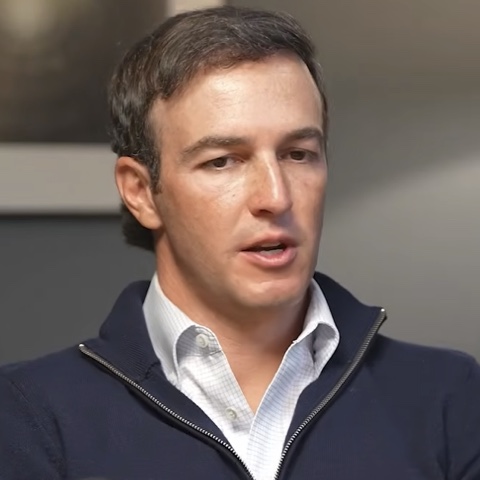
大卫·乔治a16z(Andreessen Horowitz)成长基金的普通合伙人,负责成长期与后期投资,被投公司包括 Harvey、Cursor 等 AI 应用层企业。加入 a16z 之前在成长股权领域从业约十八年。
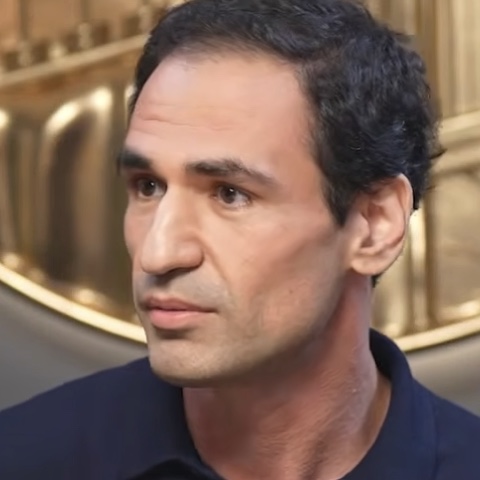
拉姆机构出资方 Accolade 的负责人,a16z 的长期 LP。十年前曾在 a16z 任职,此前在 General Atlantic 做私募与成长股权投资,2019 年离开并提出「后期也能有风投级回报」的判断。
Jena16z 负责 LP 关系与募资的合伙人,本期主持人之一,在节目中被 Ram 称为「我认识的最能募资的人」。
章节 · 点击跳转视频
0:00 幂律变极端与 30 万亿 GDP ▶ 正在看
1:26 为什么砸钱能放大优势 ▶ 正在看
3:47 AI 的市场规模该怎么算 ▶ 正在看
7:02 哪一层会赢:不是零和 ▶ 正在看
10:19 3000 家风投里只有 20 家 ▶ 正在看
12:51 中间层的消亡与基金规模 ▶ 正在看
16:35 小基金与大机构如何共存 ▶ 正在看
20:50 假 ARR 与真牵引力之辨 ▶ 正在看
25:34 LP 与 GP 的激励错配 ▶ 正在看
28:09 渠道、筛选与仓位大小 ▶ 正在看
31:18 私募股权的困境与杠杆隐忧 ▶ 正在看
40:38 流动性周期与下一个百万亿 ▶ 正在看
本期论点
本期回应
其他论点
0:23
AI 是第一次能同时冲击 30 万亿美元规模 GDP 的技术范式变革 拉姆
2:21
给 AI 实验室砸更多钱不会拖垮它,只会放大它已有的优势 大卫·乔治
2:33
传统初创公司拿到太多钱就会招人过多,制造协调成本与优先级冲突,把自己搞砸 大卫·乔治
2:57
AI 市场存在真实的规模经济,会让风投回报的幂律分布持续走向更极端 大卫·乔治
6:15
AI 的 TAM 应按被执行任务的经济价值计算,可比传统 SaaS 或医疗 IT 大十倍以上 做法拉姆
9:10
AI 技术不是赢家通吃,真正会发生的是品类数量的一次巨大扩张 大卫·乔治
9:37
一期基金如果没有亏过钱,说明它冒的风险还不够 大卫·乔治
12:13
后期投资也能拿到风投级别的回报,前提是最好的那家公司占到基金的百分之五到十以上 大卫·乔治
22:03
很多 AI 公司报出的 ARR 只是把某个月收入乘以十二,并非真实 ARR 观察拉姆
26:49
GP 会因为错过下一个 Facebook 被炒掉,LP 却只有选错管理人才会被炒 观察听众
28:45
投了五六十家风投机构的组合,很难跑赢风险投资的平均水平 拉姆
30:42
AI 是 GDP 里增长最快的部分,与它绑定的资产就该在组合里大幅加码 做法大卫·乔治
35:32
大多数商业任务不像编程那样数据完美可验证,AI 向其他知识工作的扩散会慢得多 大卫·乔治
44:59
消费者最终使用 AI 的形态不是聊天机器人界面,而是主动替人做事的原生产品 大卫·乔治
46:45
今天 AI 的瓶颈不在需求端,而在能源、电网和数据中心这条供给链上 拉姆
01幂律变极端与 30 万亿 GDP
0:00
We've looked at the data of 3,000 venture capital firms in the US. Only 20 have achieved consistent 3x net returns over the last two decades. >> Right now, clearly the power law is more extreme than it has been in the last, 10 to 20 years of technology investing. For the first time, you can take capital and throw it at a company and it compounds their advantage. >> AI is attacking every facet of the GDP, transportation, labor, services, capital, coordination. There hasn't been a technology [music] paradigm that hits on 30 trillion in GDP at the same time.
我们研究了美国 3000 家风险投资机构的数据。在过去二十年里,只有 20 家实现了持续 3 倍的净回报。在过去二十年里。>> 眼下,幂律效应显然比过去 10 到 20 年科技投资中的任何时候都更极端。这是第一次,你可以把资金砸向一家公司,而这会放大它的优势。>> AI 正在冲击 GDP 的每一个层面——交通、劳动力、服务、资本、协同。从来没有哪一次技术[音乐]范式变革能同时冲击 30 万亿美元规模的 GDP。
便签引用
0:27
>> Elon has talked publicly about Grok bot. On Sam's side, he's talked about Astra and some of the long-running capabilities that are going to come out soon. >> What do you think is going to be the next hundred trillion dollar market cap company? >> It is possible that >> Welcome back to the a16z podcast. Something fundamental has changed in how value gets created. Power law used to be just a feature of a cottage industry in venture capital and now it's systemic throughout and particularly the three frontier model companies, SpaceX, Open AI, Anthropic represent somewhere between three and a half to five trillion dollars of potential enterprise value and shockingly before SpaceX went public, a lot of our LPs and also the broader institutional allocator community didn't have a lot of exposure to it. And so we'll talk about today why potentially portfolio construction and asset allocation may have changed, um why power law is not just only in the venture capital industry and then particularly
>> Elon 公开谈过 Grok bot。Sam 那边,他谈到了 Astra,以及一些即将推出的长时运行能力。>> 你觉得下一家市值百万亿美元的公司会是谁?>> 有可能是 >> 欢迎回到 a16z 播客。价值创造的方式发生了某种根本性的变化。幂律以前只是风险投资这个小众行业的一个特征,而现在它已经渗透到了方方面面,尤其是三家前沿模型公司——SpaceX、OpenAI、Anthropic,它们代表着大约三万五千亿到五万亿美元的潜在企业价值。令人意外的是,在 SpaceX 上市之前,我们很多 LP 以及更广泛的机构配置者群体对它都没有太多敞口。所以我们今天要聊的是,为什么投资组合构建和资产配置可能已经改变,为什么幂律不只存在于风险投资行业,以及今天价值究竟在哪里、以何种方式复利增长。David George,大概 30 岁,感谢你来和我聊。
便签引用
02为什么砸钱能放大优势
1:26
where and how value actually compounds today. David George, around 30, thank you for joining me. >> Great to be here. Thanks for hanging out. >> Thank you for having us here. >> Awesome. Awesome. Awesome. Okay, so DG, so if you add up every venture backed IPO for the last six years, all of them together, where does it go from here? >> Right now, clearly the power law is more extreme than it has been in the last, you know, 10 to 20 years of technology investing. Probably going back to, you know, the emergence of the network effect driven consumer companies. Um there are many reasons why that's the case. Increasing returns to scale have always been a dynamic in our business.
>> 很高兴来到这里,谢谢你们的招待。>> 谢谢你邀请我们来。>> 太棒了,太棒了,太棒了。好,DG,如果你把过去六年所有风投支持的 IPO 加总起来,全部加在一起,接下来会走向何方?>> 眼下,幂律效应显然比过去10 到 20 年科技投资中的任何时候都更极端。大概要追溯到网络效应驱动的消费类公司刚刚兴起的时候。原因有很多。规模报酬递增在我们这行一直都是一种动态。
便签引用
2:02
Obviously, it's well covered how a network effect business can have increasing returns to scale. But so can software businesses, right? And they and they can take different forms, but you know, brand reputation in the market, the accumulation of resources all provide competitive advantages. That all still is the case, but right now, especially with the labs, for the first time you know, in my career, you can take capital and throw it at a company and it compounds their advantage. And this is a a thing like, how do you screw up a a startup? Um, well, you know, throw too much money at it and have them hire a thousand people and then, you know, you create all these coordination issues and overhead issues and and dueling priorities and and it sort of gets messed up cuz you can't hire enough people to do enough things fast enough.
很显然,网络效应型企业如何实现规模报酬递增,这已经被讲得很透了。但软件企业同样可以,对吧?而且形式各不相同,但市场上的品牌声誉、资源的累积,都能带来竞争优势。这一点至今依然成立,但现在,尤其是在这些实验室身上,我职业生涯中头一次出现这种情况:你可以把资金砸向一家公司,而这会放大它的优势。这是一件……比如说,你要怎么把一家初创公司搞砸?嗯,你知道的,砸太多钱给它,让它去招一堆一千人,然后你就会制造出各种协调问题、管理开销问题,还有互相冲突的优先级,事情就变得一团糟,因为你没法雇到足够多的人、足够快地做足够多的事。
便签引用
2:46
Um, now that's not the case. You can throw dollars at compute and compute can make products and the business is better. And so to me, it's not terribly surprising that the power law is more extreme. Right now, economies of scale are a very real thing uh in the AI market and I think it'll continue to be the case. >> So Ram, so first of all, uh you're not just one of our long-time LPs at Accolade, uh but incidentally, it's been exactly 10 years since you were actually an employee of a16z. And so for your 10-year anniversary since you were last here, I've brought this gem back.
嗯,现在情况不一样了。你可以把钱砸到算力上,算力能做出产品,生意就更好做了。所以对我来说,幂律分布变得更极端并不太令人意外。对吧?现在,规模经济在 AI 市场里是非常真实的存在,我认为这种情况还会持续下去。>> 那么 Ram,首先,呃,你不只是我们 Accolade 的长期 LP 之一,呃,而且巧的是,距离你真正在 a16z 当员工的日子,正好过去 10 年了。所以为了纪念你离开这里 10 周年,我把这件宝贝给带回来了。
便签引用
3:17
>> Oh my god. >> [laughter] >> Oh my gosh, this is amazing. How do you still have this? This is amazing. >> So we dug in the catacombs uh and we made the extra large version uh just for for posterity here. >> [laughter] >> We got this from the from the catacombs. But incidentally, during the last 10 years, a lot has changed in the world. And and if you remember, at that point in time, people were bellyaching about fund sizes being too large back then. >> And you had one at a billion, I remember. >> Yeah, the the first one at a billion, first venture fund. Exactly, exactly.
>> 我的天哪。>> [笑声] >> 我的天,这也太棒了。你怎么还留着这个?太厉害了。>> 我们在地下档案库里挖出来的,呃,还特意做了个加大号版本,呃,就为了留个纪念。>> [笑声] >> 这是我们从档案库里翻出来的。不过话说回来,过去这 10 年里,世界变了很多。而且,如果你还记得的话,在那个时候,大家都在抱怨基金规模太大了。>> 而你们当时有一只十亿美元的基金,我记得。>> 对,第一只十亿美元规模的,第一只风险投资基金。没错,没错。
便签引用
03AI 的市场规模该怎么算
3:47
And so, you know, a lot has happened since then. How do you think about your venture portfolio juxtaposed against your private equity one and then just also generally asset allocation. We talked about this on the way in. If you were to start from a blank sheet of paper again, knowing what you know now, how would you have constructed differently? >> Yeah. Let's take venture today. We've reached 100 billion in revenue in AI. It took SAS 15 years to get to the same point. AI did that in 4 years. And we're not even close to anywhere in terms of the penetration of demand. The reason DG is saying you can throw capital at it the func that's a function of unlimited demand for inference. And we are at a point where AI is attacking every facet of the GDP, transportation, labor, services, capital, coordination.
所以,你知道,从那以后发生了很多事。你怎么看待你的风投组合,跟你的私募股权组合放在一起对比,还有整体的资产配置。我们进来的路上聊到过这个。如果让你从一张白纸重新开始,以你现在所知道的一切,你会怎么构建得不一样?>> 是啊。我们看看今天的风险投资。AI 领域已经做到了 1000 亿美元的收入。SaaS 用了 15 年才走到同样的位置。AI 只花了 4 年。而且我们在需求渗透率上还差得远呢。DG 之所以说你可以往里砸资本,这个逻辑是建立在推理需求无上限的基础上的。我们现在处在一个 AI 正在攻入GDP 每一个层面的时点——交通、劳动力、服务、资本、协同调度。
便签引用
4:30
There hasn't been a technology paradigm that hits on 30 trillion in GDP at the same time. And so you have the fastest growing technology. It's hitting on all parts of the GDP. So as an allocator it's hard not to make the case you should it's not a satellite position. You should be core or a super core in some shape or form. >> Mhm. >> I'm very biased, but if you just think about the the shape of the markets and how they've changed since I started my career um you know in private equity and growth equity you know that was I guess 18 years ago.
从来没有一个技术范式能同时冲击 30 万亿美元的 GDP。所以你拥有的是增长最快的技术。它冲击的是 GDP 的每一个部分。所以作为一个资产配置者,你很难不得出这个结论:它不应该只是个卫星仓位。它应该是核心仓位,或者以某种形式成为超级核心仓位。>> 嗯哼。>> 我有很强的偏见,但如果你只看市场的形态,以及它们从我开始职业生涯以来是怎么变的,嗯,你知道,我是在私募股权和成长股权起步的,那大概是 18 年前了。
便签引用
5:02
This was a cottage industry and now it's not and I talk about this all the time, but our asset class is 5 to 6 trillion dollars in value and the dynamics around companies staying private longer they're not going to reverse. >> Yeah. I mean you had that insight in 2019 when you left GA. It's venture like outcomes in late stage which is now happening. >> Mhm. >> So it's no longer just early stage and you IPO when you have 100 million in revenues. >> Yeah. The top 10 sell out comes I think used to be 10 billion and now they're like 40 billion or so.
那时候这还是个小作坊行业,现在不是了,我经常聊这个话题,但我们这个资产类别的价值有 5 到 6 万亿美元,而公司保持私有状态越来越久的这种动态是不会逆转的。>> 是啊。我是说,你在 2019 年离开 GA 的时候就有这个洞见了——后期阶段也能有风投级别的回报,而这现在正在发生。>> 嗯哼。>> 所以不再是只有早期阶段了,也不是等你做到 1 亿美元收入就去 IPO。>> 对。前十大退出案例,我记得以前是 100 亿美元,现在大概是 400 亿美元左右。
便签引用
5:30
>> to be probably 100 billion by the time Anthropic and then Open AI came come out. Yeah. >> Yeah. Yeah. Yeah. And and look this makes sense, right? Like the last cycle created 25 trillion in market cap new market cap and a bunch of that went to the incumbents. >> Yeah. >> But a lot of it went to to startups and the new startups and Now, you know each one of these subsequent waves gets bigger than the prior one. And so, you know, our expectation is, you know, that take the 25 trillion and like it's going to be a larger number.
>> 等到 Anthropic 和 OpenAI 上市的时候,可能就是 1000 亿美元了。是啊。>> 对对对。而且你看,这是说得通的,对吧?就像上一个周期创造了 25 万亿美元的市值,全新的市值,其中一大块流向了在位巨头。>> 是啊。>> 但也有很多流向了初创公司、新的创业公司。而现在,你知道,后面的每一波浪潮都会比前一波更大。所以,你知道,我们的预期是,你知道,把那 25 万亿拿来做参照,这个数字还会更大。
便签引用
5:54
>> Yep. >> Yeah, and I'm constantly confused about the TAM of AI. We'd love your thoughts on this. Um like take health care. Health care spends like 60 to 100 billion on health care IT per year. But AI is hitting on actual labor and the value of tasks that are being performed in health care. That's claims, billing, administration. That's a trillion-dollar industry. So, the TAM of AI can be 10x plus bigger than traditional SAS or health care IT. And what is that value? Well, what's the economic value of tasks that are being performed? Like that's the TAM you're looking at. And then there's some capture rate that the AI company will take.
>> 没错。>> 是啊,而我一直搞不清楚 AI 的 TAM 到底有多大。我们很想听听你的看法。嗯,就拿医疗保健来说。医疗行业每年在医疗 IT 上大概花 600 亿到 1000 亿美元。但 AI 冲击的是真实的劳动力,是医疗行业里那些被执行的任务的价值。那包括理赔、账单、行政管理。那是一个万亿美元级别的行业。所以 AI 的 TAM 可以比传统 SaaS 或者医疗 IT 大十倍以上。那这个价值是多少呢?嗯,那些被执行的任务的经济价值是多少?这才是你要看的TAM。然后 AI 公司会从中拿走某个比例的份额。
便签引用
6:29
But we have no idea what how big the TAM can get. To your point, it's you look at every wave, the incumbents are 10x smaller uh over time. So, it's hard to estimate it, but I can tell this for myself, I've been chronically wrong about how big these outcomes can get. >> Yeah, same here. Yeah, labor, I mean, look, if you just look at like how much of, you know, dollars are spent in the US economy on labor versus software, it's like something like 40 times more. Now, that doesn't mean, importantly, that um labor is going to go away. Like I think labor is just going to get reinvented.
但我们完全不知道这个 TAM 能变得多大。照你说的,你看每一波浪潮,在位者都是十倍越来越小。所以很难估算,但就我自己而言,我可以说,我一直都严重低估了这些结果最终能做到多大。>> 是啊,我也一样。是啊,劳动力,我是说,你看,如果你只看美国经济中花在劳动力上的钱和花在软件上的钱相比,大概是40倍的差距。不过,重要的是,这并不意味着劳动力会消失。我觉得劳动力只是会被重新定义。
便签引用
04哪一层会赢:不是零和
7:02
And so, we'll we'll end up with um you know, a sort of reimagination of the tasks that humans do. Um but I think that's actually the the the whole point of AI is like you're going after this different thing. And so, to equate it to software and say, "Oh, it's the next evolution of software." is far too limiting. >> Our legal counsel uh says to us often, it's like, "I love Harvey. All my clients think they're lawyers now. And they can actually spar with me on topics where they would have probably been like, 'I don't really understand this.
所以最终我们会迎来对人类所做任务的一种重新想象。但我觉得这其实才是AI 的全部意义所在——你瞄准的是一个完全不同的东西。所以把它等同于软件,说"哦,这是软件的下一次进化",那就太局限了。>> 我们的法务顾问经常跟我们说:"我爱 Harvey。我所有的客户现在都觉得自己是律师了。他们能在一些话题上跟我据理力争,而以前他们大概会说:'这个我不太懂,
便签引用
7:27
I'm just going to defer to you.'" So, my billable hours have only gone up with the advent of the usage of AI. And so, all these use cases are are massively massively um probably underappreciated and we don't still even >> Yeah, and they're expansionary. Yeah, that's a great point. Yeah. >> And then there's there was this whole thesis where well, frontier labs are going to cannibalize the apps, which layer is going to win? It turns out like everyone is sort of growing. >> Yeah. Yeah. Yeah. Yeah. We just you know, a friend of mine did a podcast where he describes like everything is going to work kind of thing.
我听你的。'"所以随着 AI 的普及,我的计费小时数反而只增不减。所以说,所有这些用例可能都被严重严重地低估了,而且我们甚至还没有——>> 是啊,而且它们是扩张性的。是啊,这点说得太好了。是啊。>> 然后还有这么一套说法,说前沿实验室会把应用层吃掉,那到底哪一层会赢?结果发现,好像大家都在增长。>> 是啊是啊是啊。我们……你知道,我有个朋友做了一期播客,他描述说,差不多就是"什么都能行得通"这种意思。
便签引用
7:55
>> Mhm. >> Um and um you know, I I describe it slightly differently, but it's like, you know, we get questions all the time from LPs when they ask us like >> Which stack >> layer in the stack which layer in the stack is going to work and I'm kind of like, I don't know. The the market is going to be so big. Like I think everything might work. Now, there's going to be a lot of companies that don't work. And there may be idiosyncratic categories that don't work. Um but I think by and large it's far too limiting to think like, oh, if open source does a good job, it's bad for the labs and you know, vice versa. Uh so we try and like remove ourselves from thinking in a zero-sum way like that.
>> 嗯。>> 嗯,我的说法略有不同,但大概是这样:我们经常收到 LP 的提问,他们问我们,比如说——>> 哪一层 >> 技术栈的哪一层,栈里的哪一层会跑出来,而我的反应差不多是:我不知道。这个市场会大到什么程度。我觉得可能什么都能跑出来。当然,肯定会有很多公司做不成。也可能有些特殊的品类做不起来。但我觉得,总体来说,如果你想"哦,要是开源做得好,那就对实验室不利",反之亦然,这种想法太局限了。所以我们尽量让自己跳出这种零和思维。
便签引用
8:27
>> Extract it out cuz why why do people think it's going to be a winner-take-all? And and you know, if we can hypothesize, but you know, the last era of technology, it was probably winner-take-all in a lot of categories, but this feels categorically different because we're we underwrite a lot of the fundamentals. So maybe extract it out. >> Yeah, it look, winner-take-all is an interesting way to describe it cuz like if you just look at the market cap growth of all the leading technology companies like there are many, many, many that were successful. Like there did wasn't winner-take-all, right? Now, there's an important distinction like we very much are believers in the power law within any given category. So like the winners will capture the vast majority of the market share and market cap and second place is like playing for scraps, you know? Um uh but I think there will be a massive expansion of the amount of categories that we have, right? And so, you know, if you go back 20 years like CRM was not really a category. I
>> 展开讲讲,为什么大家会觉得这是赢家通吃?而且,我们可以做点假设,但你知道,上一个技术时代,在很多品类里可能确实是赢家通吃,但这次感觉本质上不一样,因为我们对很多基本面都做了判断。所以也许可以展开说说。>> 是啊,你看,用"赢家通吃"来形容挺有意思的,因为如果你只看所有领先科技公司的市值增长,会发现成功的公司非常非常多。所以并不是赢家通吃,对吧?不过有一个重要的区别,就是我们非常相信在任何一个特定品类内部都存在幂律。所以赢家会拿走绝大部分市场份额和市值,第二名基本就是捡点残羹剩饭,你懂吧?但我觉得,品类的数量会有一次巨大的扩张,对吧?所以你看,如果回到20年前,CRM 根本算不上一个品类。我是说,它很小,就是 Siebel Systems 之类的公司。但是
便签引用
9:21
mean, it was small. It was like Siebel Systems and and things like that. Um but you know, now it's a massive category. And so I think the same thing will happen. We've seen it in every technology market that we invest in. Again, our approach is um you You in our business we can tolerate loss, right? And like if we're not losing money in a given fund on a given amount of investments, we're not taking enough risk, right? And so, you know, if you look at our best performing venture funds over time, I think the loss rate is 60% or so.
你知道,现在它是一个巨大的品类。所以我觉得同样的事情还会发生。我们投的每一个技术市场里都见过这种情况。再说一次,我们的方法是——在我们这行,我们能承受亏损,对吧?如果我们在某一期基金、某一批投资上没有亏钱,那说明我们冒的风险还不够,对吧?所以你知道,如果你看我们历史上表现最好的风险基金,我觉得亏损率大概在60%左右。
便签引用
9:52
>> early stage, yeah. >> On early stage. Um now, at the growth stage, like the loss rate will be lower, but it's probably going to be in the 10 to 20% range, and that's appropriate because with that, you will get investments that we make that, you know, 10x or more in returns. And so, um you know, if we're doing a good job, we're backing the leading company in every category that is a credible category. And if the category works out well, then we do a great job. And if the category doesn't work out well, that's okay. That's kind of like the risk that we live with.
>> 早期阶段,是吧。>> 早期阶段。当然,到了成长期,亏损率会低一些,但大概会在10%到20%这个区间,这也是合理的,因为与此同时,你会拿到一些回报10倍甚至更高的投资。所以说,如果我们做得好,我们就是在每一个站得住脚的品类里押注那个领先的公司。如果这个品类发展得好,那我们就干得很漂亮。如果这个品类没做起来,那也没关系。这差不多就是我们必须承受的风险。
便签引用
053000 家风投里只有 20 家
10:19
>> Yeah. Yeah. Yeah. And and embedded in that is also kind of timing cuz I I know, Romi and I lament on this in that I think a lot of folks often times think that things are overheated in that moment in time. And then you look back in retrospect and it turns out everything was actually quite cheap. But then there's these aberrations in the market where it's probably actually true. And so, I know you advise a lot of your LPs on on the importance of consistency in venture capital, probably even more than any other asset class cuz you just never know when these technologies can come out. Maybe walk through that cuz there's a lot of institutional allocators out there who actually don't have access to a lot of the frontier certainly models.
>> 是啊是啊是啊。而且这里面还隐含着时机的问题,因为我知道,Romi 和我常常感慨这一点,我觉得很多人经常会觉得当下这个时点东西太热了。然后你事后回头看,结果发现其实一切都相当便宜。但市场上确实也会出现一些异常时期,那时候这种判断可能真的成立。所以我知道你经常向 LP 强调在风险投资中保持一致性的重要性,这一点可能比任何其他资产类别都更重要,因为你永远不知道这些技术什么时候会冒出来。也许你可以讲讲这个,因为外面有很多机构配置者其实接触不到很多前沿的东西,尤其是模型。
便签引用
10:57
Now they're trying to play catch-up and and in some instances probably maybe introducing some adverse behavior that is a little bit too reflective of things being a little bit too frothy. So, maybe unpack that for us. >> Yeah, I mean, the extremeness of the power law that DG talked about. If you as an allocator have not had access to the top five to 10 companies over the last five to 10 years, you're significantly behind in terms of returns. And let's take a step back. Like we've looked at the data of 3,000 venture capital firms in the US. Only 20 have achieved consistent 3x net returns over the last two decades.
现在他们在试图追赶,在某些情况下可能反而引入了一些不太好的行为,有点过于反映出市场有些泡沫化。所以也许你可以给我们拆解一下。>> 是啊,我是说,DG 讲的那个幂律的极端程度。如果你作为一个配置者,在过去五到十年里没能接触到最顶尖的五到十家公司,那你在回报上就已经远远落后了。让我们退一步看。我们研究过美国3000家风投机构的数据。只有20家在过去二十年里持续实现了3倍的净回报。
便签引用
11:30
>> Sorry, say that one more 20% have >> 20, no, 20. >> [clears throat] >> 20 out of 3,000. >> [laughter] >> Less than 1%. >> Wow. >> Consistent 3x net returns. >> That's incredible. >> And it's actually you don't have you don't need seven eight funds in those 20 years. It was do you have three to four 3x net TVPI funds over a 20-year period. We found only 20. >> Wow. >> Firms that have done that. >> Wow. >> Consistency in venture is really really hard. But what's interesting is the consistent ones consistently had access to the category defining companies every vintage.
>> 抱歉,再说一遍,20%的机构——>> 20家,不是20%。>> [清嗓子] >> 3000家里的20家。>> [笑声] >> 不到1%。>> 哇。>> 持续稳定的 3 倍净回报。>> 这太惊人了。>> 而且其实你不需要——在那 20 年里你不需要七八只基金。问题是:你有没有三到四只在 20 年期间达到 3 倍净 TVPI 的基金。我们只找到了 20 家。>> 哇。>> 做到这一点的机构。>> 哇。>> 在风投行业保持稳定性真的非常非常难。但有意思的是,那些稳定的机构,每一期基金都能持续拿到那些定义品类的公司的份额。
便签引用
11:59
>> Yeah. >> Um Now, there are exceptions. And by the way, just having the logo is not sufficient enough. If you're early stage and you have a large fund, you need to own enough. >> Yeah. >> If you're late stage, DJ I'm curious if you agree, sizing is really critical. >> Yeah. >> Uh so venture-like returns are possible in late stage, but your best company should be 5 10% plus of your fund. That way you can actually return the fund on a single company. Fund returning math in late stage didn't exist before. It now does.
>> 是啊。>> 嗯,当然也有例外。顺便说一句,光是把 logo 挂上去是不够的。如果你是早期投资而且基金规模很大,你必须占到足够的股比。>> 是啊。>> 如果你做的是后期,DJ 我很好奇你同不同意,规模的把控真的至关重要。>> 是啊。>> 呃,所以后期也是可能拿到风投级别回报的,但你最好的那家公司应该占到基金的 5% 到 10% 以上。这样你才能真的靠单个项目把整只基金收回来。后期投资里“单个项目回本”的算法以前是不存在的,现在存在了。
便签引用
12:26
>> Yeah. >> Um So we have found the right portfolio sizing, and the ones that consistently have gotten access are in that top 20 out of 3,000. So if you don't have them, there is a huge dispersion of returns, and if you don't have those, you're getting the average venture return. If you look at Cambridge data, the average venture return over the last 10 years is 1 to 2x net. You'll do better in private equity. You'll definitely do better in the public markets. You don't need to lock up your money for 10 years.
>> 是啊。>> 嗯,所以我们找到了合适的投资组合规模,而那些能持续拿到份额的机构,就在 3,000 家里的前 20 名之中。所以如果你投不到它们,回报的离散度是非常大的,如果你没有这些项目,你拿到的就是风投的平均回报。看看 Cambridge 的数据,过去 10 年风投的平均回报是 1 到 2 倍净回报。你在私募股权里会做得更好。你在公开市场肯定会做得更好,而且不用把钱锁定 10 年。
便签引用
06中间层的消亡与基金规模
12:51
>> Yeah. For sure. Yeah, I I just pulled up a tweet from our friend endowment Eddie who posted actually this this morning. He said, "Interest in big VC funds has been driven by founders, not LPs. Founders more often than not want the brand that can scale, be a life cycle investor, and help land customers {slash} hires. LPs have slowly followed along, but most are still dragging their heels cuz it's actually it's counter to conventional wisdom." >> Yeah. And the outcomes are larger, so funds can be larger. There are some exceptions. In those 20, there are some small firms that are focused on niche vertical markets, >> Mhm.
>> 是啊,绝对的。是的,我刚翻出我们朋友 endowment Eddie 今天早上发的一条推文。他说:“对大型 VC 基金的兴趣是创始人推动的,不是 LP 推动的。创始人往往想要那种能规模化、能做全生命周期投资、能帮忙拿下客户和招人的品牌。LP 慢慢地跟了上来,但大多数还是在拖拖拉拉,因为这其实跟传统认知是相反的。”>> 是啊。而且退出规模更大了,所以基金也可以更大。也有一些例外。在那 20 家里,有一些专注于细分垂直市场的小型机构,>> 嗯。
便签引用
13:22
>> or they're playing at a stage that's so much earlier than the bigger firms. Where it like there is not a lot of competition with the bigger firms. Now the problem with that strategy is you have to stay consistent in terms of fund size and your strategy. If you start getting bigger over time, then you bump into the big firms and I think it becomes really really hard to stay consistent. >> Yeah. Yeah, death of the middle. >> Death of the middle. Death of the middle. >> We said we're going to drink every time we said death of the middle, so [laughter] >> I'm very complimentary of of many of our peers in the in the venture ecosystem.
或者他们出手的阶段比大机构早得多。在那个阶段,跟大机构基本没什么竞争。这个策略的问题在于,你得在基金规模和策略上保持一致。如果你随着时间推移越做越大,那你就会撞上大机构,我觉得那时候就很难很难保持一致了。>> 是啊,是啊,中间层的消亡。>> 中间层的消亡。中间层的消亡。>> 我们说过每次提到"中间层的消亡"就得喝一杯,所以 [笑] >> 我对风投生态里的很多同行都是非常赞赏的。
便签引用
13:49
Um you know, like but this this death of the middle thing, you >> How do you define it? Like what's the middle? >> Uh so I think like sort of what you described, like the highly specialized funds, you know, some of the ones that were very early to AI with like deep deep deep domain experts um have done a pretty good job, right? Like they've done a good job and and you know, sometimes they can move fast get into things or take shares of deals that we want to do and you know, that that is that is a reality. Um then I think there's like the you know, whatever we're you know, large you know, large scale venture, right? In the sense that we have main product lines and we can scale all the way from you know, a seed all the way through to when you go public. Um and I think we have some peers who employ a similar strategy, right? And you know, there's I'd like to think that we're the best, but there's there's a few other folks who do that.
嗯,你知道,但是这个"中间层消亡"的说法,你 >> 你怎么定义它?中间层指的是什么?>> 呃,我觉得就像你描述的那样,那些高度专业化的基金,你知道,有些非常早就切入 AI 的基金,团队里是特别特别资深的领域专家,他们做得相当不错,对吧?他们做得很好,而且你知道,有时候他们能快速行动,抢先进入一些项目,或者拿走一部分我们想投的份额,这是事实。嗯,然后我觉得还有一类就是你知道的,不管怎么叫吧,大规模风投,对吧?意思是我们有主要的产品线,我们可以一路覆盖,从种子轮一直到你上市为止。嗯,我觉得有些同行采用的是类似的策略,对吧?而且,我当然愿意认为我们是最好的,但确实还有另外几家也这么做。
便签引用
14:41
Everything else in between that, I think struggles to compete a little bit for the reasons that Eddie said, right? The what does the founder care about? The founder cares about um you know, sort of taking capital from a partner that they think can de-risk the outcome for themselves. Like that if you were just to simplify it, that is the simplest way to describe what the founder really cares about. Now they care about the partner, right? Like they care about a person, so you have to you have to be a good actor in all those things.
而介于这两者之间的所有机构,我觉得竞争起来会比较吃力,原因就是 Eddie 说的那些,对吧?创始人在乎什么?创始人在乎的是,嗯,从一个他们认为能帮自己降低结果风险的合作伙伴那里拿钱。如果要简化来说,这就是对创始人真正在乎的东西最简单的描述方式。当然他们也在乎这个合伙人本身,对吧?他们在乎的是一个人,所以你在这些方面都得是个好角色。
便签引用
15:08
But there's a reason why we build up a tremendous amount of resources, right? Like it's why we have 700 employees. Uh that's why we take you know, the management fees that we make on our funds and we invest them in operating resources because we think that it will one, bend the curve on the outcome and two, help us to win deals. Um and so, you know, when founders select their partners, often, you know, if it's a hot deal, like they'll have many alternatives. Like that's the revealed preference and and, you know, as Eddie said, we're doing an okay job with that.
但我们之所以建立起如此庞大的资源体系,是有原因的,对吧?这就是为什么我们有 700 名员工。这也是为什么我们把基金收取的管理费拿去投入到运营资源上,因为我们认为这会,第一,改变结果的曲线,第二,帮我们赢下项目。嗯,所以你知道,当创始人挑选合作伙伴的时候,往往,如果是个热门项目,他们会有很多选择。这就是真实偏好的体现,而且,你知道,正如 Eddie 说的,我们在这方面做得还不错。
便签引用
15:37
What I agree with him about then is our LPs coming to invest in us is a byproduct of that, right? Um and so, you know, our business our business is a flywheel. Um the flywheel starts with, um you know, are we are we deep domain experts? Uh are we going to have a point of view uh that is the right point of view? Um can we demonstrate to the founder that we, you know, are the right partner for for her or him? Um if so, we win the deal. If we can help to make the outcome better, that's great. Um and then if we do make the outcome better, there's two things that happen.
我同意他的一点是,我们的 LP 来投我们,是这一切的副产品,对吧?嗯,所以我们的生意是一个飞轮。嗯,这个飞轮的起点是,嗯,我们是不是真正的领域专家?我们能不能有一个观点,而且是正确的观点?嗯,我们能不能向创始人证明,我们是最适合他或她的合作伙伴?如果可以,我们就赢下这个项目。如果我们能帮助把结果做得更好,那太棒了。嗯,然后如果我们真的把结果做得更好了,会发生两件事。
便签引用
16:11
One, um our business has persistence of returns partially because, um you know, the the new founder wants to be around the winners, right? Like they want they they care about that because there's important brand signaling and and that has knock-on effects for them. Um and then secondly, you know, by being a part of the winners and helping them, you know, in small ways, uh we we create sort of killer references. And the founders then tell the other founders, "Hey, you should work with these folks."
第一,嗯,我们的业务有回报的持续性,部分原因是,嗯,你知道,新的创始人想待在赢家身边,对吧?他们想要,他们在乎这个,因为这里有重要的品牌信号作用,这对他们会有连带的好处。嗯,其次,你知道,通过成为赢家的一部分并帮助他们,哪怕只是在一些小的方面,我们就积累了非常有杀伤力的推荐背书。然后创始人会告诉其他创始人,"嘿,你应该和这帮人合作。"
便签引用
07小基金与大机构如何共存
16:35
And so, that's the way the flywheel works in our business. >> One theory, curious to get your both of your takes, is take pre-seed seats, so sub 20, 30, 40 million dollar valuations, sub 100 million dollar funds, they can coexist with the big firms because at inception stage, say there's seven AI companies kind of doing the same thing. I would think a large firm like Andreessen would want to wait for a round or two until there's more relative certainty cuz one thing you don't want to do is be in the number two or number three, like you said. You have to be in the category winner. So, you'd rather wait for that round and actually double down and lead the A or the B. So, the small firms, they can carve out a niche for themselves a clip or two earlier than the big firms and actually have a right to win. They can do really well and be complimentary to the big firms. Yeah. Do you agree with that? Like, yeah.
这就是我们这个生意里飞轮运转的方式。>> 有一种说法,我很想听听你们俩的看法,就是做 pre-seed 的位置,比如 2000 万、3000 万、4000 万美元以下的估值,1 亿美元以下的基金,他们可以和大机构共存,因为在最初阶段,比如说有七家 AI 公司都在做差不多的事情。我会觉得像 Andreessen 这样的大机构会想再等一两轮,直到确定性相对更高一些,因为你最不想做的事情就是投到第二名或第三名,就像你说的。你必须投中那个品类的赢家。所以你宁愿再等一轮,然后加倍下注,去领投 A 轮或 B 轮。所以小机构就可以给自己开辟一个利基比大机构早一两拍,而且确实有赢的资格。他们可以做得很好,并且和大机构形成互补。是吧?你同意这个看法吗?
便签引用
17:20
>> Yeah, yeah, yeah. Yeah. And look, we have like very healthy relationships with with seed funds across the ecosystem. Um, we also do do seed ourselves, right? But pre-seed, for sure, you know, it's sort of earlier than we typically >> The seed you would do, I think, is like chunky or bigger seed, right? Yeah. >> [laughter] >> Yeah. >> That that definitely is our sweet spot. With that said, you know, we have our speed run program, which we just came from actually earlier this this uh this morning, and I don't know, I think I think the market is evolving, where where um because founders have such uh preferential attachment, as as DG was saying, to the brands, we get to look at everything, and sometimes it does make sense for us to do the pre-seed and seed. And so, you know, you kind of want that flex of capability, and for the founder, to your point, they kind of don't really care where your focus is.
>> 是的,是的,是的。而且你看,我们和生态里的种子基金关系都非常健康。嗯,我们自己也做种子轮,对吧?但 pre-seed,那肯定是比我们通常介入的阶段更早 >> 我觉得你们会做的种子轮,是那种比较大额的种子轮,对吧?是的。>> [笑] >> 是啊。>> 那确实是我们的甜蜜点。话虽如此,你知道,我们有 Speed Run 项目,我们今天早些时候刚从那边过来,今天早上,我不知道,我觉得市场在演变,因为创始人对品牌有非常强的偏好依附,就像 DG 说的那样,我们能看到所有东西,有时候确实值得我们去做 pre-seed 和种子轮。所以你知道,你会希望有这种能力上的弹性,而对创始人来说,按你的说法,他们其实并不太在乎你的重心在哪儿。
便签引用
18:07
They just want to be in that orbit, and like you'll find the funds to kind of match to it. And so, I think we can coexist in this world, but I I think it's also very um important. Like, our business is principally an early-stage business. We have to be first to the pole, and we may not actually do the investment, but we have to at least understand the landscape and market to be able to actually make the informed decisions later on. And so, I I think >> to a few founders at Speed Run today, and they very much are hoping to stay in the orbit.
他们只是想待在那个轨道里,然后你会找到相应的基金来匹配。所以我觉得我们可以在这个世界里共存,但我觉得这一点也非常重要。就是说,我们的生意本质上是一门早期的生意。我们必须抢到第一排的位置,我们也许最终并不会真的出手投,但我们至少必须理解整个格局和市场,才能在之后真正做出有依据的决策。所以我觉得 >> 今天在 Speed Run 跟几个创始人聊,他们都非常希望能留在那个轨道里。
便签引用
18:32
>> Yeah. Right. Right. And so, this is, you know, a new phenomenon that were 10 years ago, again, this is starting to really take shape as more of the early-stage folks started doing later stage, and then extended across the but not quite in the way that it is today. And DG, I don't know if you you would agree with that. Like, it's just virtually impossible to have this sort of mid-stage business effectively without having the early-stage and then also the late-stage to come behind it as well. >> Yeah, I mean, look, I'm very biased, uh but I think the reason that we've been successful as a growth fund is because of our early-stage business. I say that all the time. Like, our business starts and ends with early stage. And so, um you know, that provides us a tremendous amount of advantages at the growth stage, um, in terms of access, information, knowledge, um, relationships, etc. Um, and I would think that, you know, our early stage partners would probably say that the growth business provides them benefits,
>> 是的。对,对。所以你知道,这是一个新现象,十年前,还是那句话,这个趋势开始真正成型,是因为越来越多做早期的人开始做后期,然后又延伸开来,但还不完全是今天这个样子。DG,我不知道你同不同意这一点。就是说,如果没有早期业务,后面也没有后期业务跟上,想把这种中间阶段的生意做好,基本上是不可能的。>> 是的,我的意思是,你看,我当然非常有偏见,嗯,但我认为我们作为成长期基金之所以能成功,是因为我们的早期业务。我一直这么说。我们的生意始于早期,也终于早期。所以,嗯,这在成长期阶段给了我们巨大的优势,嗯,在准入机会、信息、认知、嗯、关系等方面都是。嗯,而且我想,你知道,我们做早期的合伙人大概也会说成长期业务同样给他们带来了好处,因为这让我们能够扩大规模,并随着时间加深与创始人的
便签引用
19:23
too, because it allows, you know, us to scale up and deepen partnerships with founders over time, and that helps to win deals at the at the early stage. >> Yeah, totally, totally. And you can't There's both sides. You can't only do the early, you can't also only wait to the late, too. And so, your point earlier around it looks like increasingly that firms are converging to a handful of names, like that's probably true because, you know, again, this power law dynamic, but also the same time, almost majority of those logos, so to speak, we have to get at the early cuz that's the only way we maintain the ball control and also participate in the pro rata and then some. And so, that's obviously the the business that that >> Yeah, we're big believers that the strongest late-stage franchises have a huge early-stage franchise attached to them. Like, the ability to win is multiplied when you have an early-stage franchise. Like, it's Um, and we talk about sizing in late stage, where you can Whatever the size
合作关系,而这又有助于在早期阶段赢下项目。>> 是的,完全同意,完全同意。而且你不能——这是双向的。你不能只做早期,也不能只等到后期才进。所以你之前说的那点,看起来机构越来越向少数几个名字收敛,那大概是真的,因为,你知道,还是这个幂律的动态,但与此同时,这些所谓的"logo"里,几乎大多数我们都必须在早期就拿到,因为那是我们保持控球权的唯一方式,也才能行使按比例跟投的权利甚至更多。所以这显然就是那门生意,>> 是的,我们坚信最强的后期业务背后都附带着一个巨大的早期业务。就是说,当你有一个早期业务时,你赢的能力会成倍放大。嗯,我们也谈到后期的下注规模,不管你的后期基金规模多大,如果你能成规模地把基金的 5% 到 10% 投进
便签引用
20:12
of your late-stage fund is, if you can at scale put 5 to 10% of your fund in one of the category-defining companies, the way you could do that is because you had an early-stage franchise that developed that relationship with the entrepreneur and the management team early on. It's really hard to come in as a de novo late-stage fund and write a $500 million check. >> Yeah, yeah, I know, it's very hard. Yeah. I I've I've lived that world. >> All right, well, how do you think about from the LPC, how venture is fundamentally perhaps a structurally different job than maybe when you started your career also as well? And, you know, how do you think about also asset allocation within venture? Cuz there's actually sub-classes within venture as you think about portfolio construction as well.
一家定义品类的公司,你之所以能做到,是因为你有一个早期业务,早早地和创业者以及管理团队建立了关系。作为一个全新的后期基金进来然后开出 5 亿美元的支票,那是非常难的。>> 是啊,是啊,我知道,非常难。是的。我,我在那个世界里待过。>> 好,那么从 LP 的角度,你怎么看风投这份工作在结构上可能已经跟你刚入行时根本不同了?还有,你知道,你怎么看风投内部的资产配置?因为在做投资组合构建的时候,风投内部其实还有细分类别。
便签引用
08假 ARR 与真牵引力之辨
20:50
>> Yeah, I mean, there's I mean, in a very simplistic way, there's In our mind, there's four ways to do venture. Pre-seed, seed, so think sub-150 funds. There's thousand close to 2,000 today in the US alone. Messy middle we talked about and then there's a lot of firms there, by the way, thousands of not thousands, hundreds of firms. And then the big firms. >> Yeah. And then dedicated late stage. So, there's four ways to play it. Um we have done the larger firms for decades now. We've done the seed firms. We've selectively done a few in the messy middle. And we haven't done dedicated late stage for the reasons we talked about. Um how is it changing? AI is actually making our jobs harder than ever before.
>> 是的,我的意思是,用一种非常简化的方式来说,在我们看来,做风投有四种方式。Pre-seed、种子轮,也就是 1.5 亿美元以下的基金。光是美国今天就有接近两千家。我们说过的"混乱的中间层",顺便说一句那里也有很多机构,不是几千家,是几百家。然后就是大机构。>> 是的。然后是专注后期的基金。所以有四种玩法。嗯,大机构我们已经投了几十年了。种子基金我们也投过。混乱中间层里我们有选择地投了几家。而专注后期的我们没投,原因就是我们刚才说的那些。嗯,这一切在怎么变化?AI 其实让我们的工作比以往任何时候都更难。
便签引用
21:32
Um it's making it harder because rounds are larger in in general. They're faster. The traction that's happening in the industry is confusing. And here's why it's confusing. You can have a company I'm actually really curious to hear this from you because we hear this a lot. Company comes out of pick your accelerator. I went from zero to five minute ARR in a month. >> Yeah. >> There's no renewal cycle yet on that company. >> Yeah. >> And they're raising off of that traction at huge multiples. And a lot of times they're selling to each other in a cohort potentially. And it's not even ARR, but a multiple by 12. So, but for every con for nine companies like that, there's one really special one that's doing a couple of million in ARR, actually ARR, that has a huge valuation that will go on to be the next Cursor.
嗯,之所以更难,是因为总体上轮次金额更大了。节奏更快了。行业里发生的这些增长数据让人困惑。为什么让人困惑呢?你可能碰到一家公司——我其实特别想听听你们对这个的看法,因为我们经常听到这种说法。一家公司从某个加速器出来。我一个月内 ARR 从零做到了五百万。>> 是啊。>> 那家公司连一个续约周期都还没经历过。>> 是啊。>> 然后他们就靠这个增长数据以极高的倍数在融资。而且很多时候他们可能是在同一批次里互相卖来卖去。而且那甚至都不是真正的 ARR,只是某个月乘以 12。所以,但是每九家这样的公司里,就有一家真正特别的,做着几百万的 ARR,是真实的 ARR,估值很高,而且会成长为下一个 Cursor。
便签引用
22:17
>> Yeah. >> So, it is really, really tough actually today to parse out like what's real traction, what's not. Valuations are really high. This is why the big firms do well. I actually think they can wait or they have enough relative certainty in the next round then lead that round. But even then, there's a lot of certainty. When you guys at Cursor I don't think there was a lot of certainty in how many for how many months were people saying Cursor is dead? >> Oh, even the morning of the acquisition announcement, people were still saying that Cursor's dead. I'm like they just announced that they were going to be acquired by SpaceX for $600 >> Tell me if I'm [laughter] wrong. $300 million ARR, $400 million round, or somewhere maybe around there.
>> 是啊。>> 所以今天要分辨什么是真实增长、什么不是,真的真的非常难。估值真的很高。这就是为什么大机构做得好。我其实觉得他们可以等,或者说他们有足够的相对确定性来下一轮再由他们来领投。但即便如此,确定性还是很高的。你们在 Cursor 的时候,我觉得当时并没有那么高的确定性。有多少个月的时间,大家一直在说Cursor 完蛋了?>> 哦,就连宣布被收购那天早上,还有人在说 Cursor 完蛋了。我心想,人家刚刚宣布要被 SpaceX 以 600 亿收购。>> 我说错了你纠正我啊 [笑]。3 亿美元 ARR,4 亿美元的融资轮,大概是这个数吧。
便签引用
22:51
>> Yeah, yeah, it was something like that. >> Like that's a lot of people would say like that's crazy. Why did they do that deal? >> Yeah, yeah, yeah, yeah. Well, look, okay, so like founder judgment is a very important thing, right? And so, you know, getting to know founders over time, spending a lot of time with them, seeing how they think, like I'd like to think that, you know, especially my early stage partners are pretty good at that. Um secondly, like it is hard to parse out real versus, you know, kind of misleading attraction. And misleading in the sense that like you can't take market signal from it, not that anybody's doing any misleading. Um >> Probably some of that, too.
>> 对对,差不多是这样。>> 很多人会说这太疯狂了,他们为什么要做这笔交易?>> 对对对对。好吧,你看,创始人的判断力是非常重要的东西,对吧?所以你知道,长期去了解创始人,花大量时间和他们相处,看他们是怎么思考的。我愿意认为,尤其是我们早期阶段的合伙人,在这方面是相当擅长的。嗯,其次,要分辨出真实的牵引力和那种有误导性的牵引力,是很难的。这里说的误导是指你没法从中读出市场信号,并不是说有谁在故意误导。嗯 >> 可能也确实有一些是故意的。
便签引用
23:24
>> Yeah, there's probably some of that, too, [laughter] but like I go back to >> every now and then people are like helping to redefine what AMR actually means. I'm like, this is a very helpful PSA for the >> This is always This is always helpful, yes. Uh yeah. But like I I don't know. I come back to, you know, is the market demanding more of your product? Like that is always the question. That's a posted note on my on my computer screen. >> But how do you know that when the company's been only operating or selling for a couple of months?
>> 对,可能也确实有一些 [笑],但我还是会回到 >> 时不时就有人在帮忙重新定义 ARR 到底是什么意思。我心想,这真是一条非常有用的公益提示。>> 这总是很有帮助的,没错。嗯对。但是我也说不好,我还是会回到那个问题:市场是不是在要求你提供更多产品?这永远是那个核心问题。这是贴在我电脑屏幕上的一张便利贴。>> 但如果一家公司才运营或者才卖了几个月,你怎么判断这一点?
便签引用
23:46
>> You're not going to be able to do it with financial analysis. You'll have to do it by really understanding the customers, talking to the customers. And then, you know, it's like one of the things that I said about Harvey over time as an example, right? Um they did a really good job commercially early days. Like cuz they were they were smart. They were They were like a research plus lawyer combo. Um you know, they got some momentum and some and some, you know, high-profile law firms to sign up early days. Um but, you know, the usage was not very good, right? And so, like if you looked at the actual deployment of it, it just it looked like mediocre compared to some other software firms. Um you know, and AI companies >> retention standpoint?
>> 你没法靠财务分析来判断。你得靠真正理解客户、和客户交流来判断。然后,你知道,就像我一直以来对 Harvey 的评价一样,举个例子,对吧?嗯,他们早期在商业化上做得非常好。因为他们很聪明。他们是那种研究人员加律师的组合。嗯,他们做出了一些势头,也让一些知名律所在早期就签了约。嗯但是,你知道,使用率并不怎么样,对吧?所以如果你看实际的部署情况,跟其他一些软件公司相比看起来是挺一般的。嗯,还有那些 AI 公司 >> 是从留存的角度看吗?
便签引用
24:24
>> Not retention. No, actually usage usage usage of it. Um now, fast forward post reasoning models, like that totally flipped. And uh you could see, you know, absolute takeoff of adoption, right? And so, a bunch of different things happened at the same time. Lawyers got way more value out of the product. You could see it in usage and engagement. Um and then it became, because it was like high utility usage and engagement, it almost became a flip from what was previously like, oh, we're scared of things like hallucinations, to No, no, no, every client is actually demanding the law firms use the product. Um and so, you know, I think we look for markets like that. We try to catch them early. Like we try to catch them earlier than when than we did at Harvey.
>> 不是留存。不是,其实是使用率,产品的使用率。嗯,但快进到推理模型出现之后,这个情况完全反转了。然后你能看到采用率的绝对起飞,对吧?所以有一堆不同的事情同时发生了。律师从产品中获得的价值大得多。你能从使用率和参与度上看出来。嗯然后因为变成了那种高实用性的使用和参与,它几乎从之前那种「哦,我们害怕幻觉之类的问题」,翻转成了「不不不,其实每个客户都在要求律所使用这个产品」。嗯所以,你知道,我觉得我们就是在找这样的市场。我们尽量早点抓住它们。我们希望比当初抓住 Harvey 的时候更早一点抓住。
便签引用
25:08
Um but, you know, that's the kind of signal that we look for. You got to go You got to go a layer down. Like everyone can do cohort analysis. Everyone can look at renewal data. Um but like understanding the texture of the market and what the customers actually want and need and their alternatives, I think, you know, that's how you make the decision. That's why it's so important to have the early stage business um because they're the deepest in the in the technology and the products. Um and they, you know, they obviously saw it in Cursors and they've seen it in many other things.
嗯但是,你知道,这就是我们寻找的那种信号。你得往下再挖一层。谁都会做同期群分析,谁都会看续约数据。嗯但真正理解市场的质感、客户实际想要和需要什么、他们有哪些替代选择,我觉得,这才是你做决策的方式。这就是为什么拥有早期阶段的业务如此重要,因为他们对技术和产品的理解是最深的。嗯而且他们,你知道,他们显然在 Cursor 身上看到了这一点,在很多其他事情上也看到了。
便签引用
09LP 与 GP 的激励错配
25:34
>> Jen, what's the biggest pushback? I mean, you're the most prolific fundraiser I know. So, what's the pushback you get from LPs? >> me very gainfully employed at this firm. >> I [laughter] I agree that you are a prolific fundraiser. What's the biggest pushback you're getting from LPs on like the state of AI, the state of venture? >> So, a lot of it is is worries around um you know, are we catching a falling knife here? Just like the timing of the market where we are, like are things overheated, etc. And so, we talked a lot about this at the the outset, you know, around valuations and what the potential of the market is, but I do get a lot of sentiment from the LPs that their job is also about to fundamentally change as well. And and you mentioned earlier one aspect of it around AI making it more challenging to evaluate opportunities and funds. But the other aspect of it as well as the the LP historically has not been incentivized to actually embrace change in some respects, right? You know, this
>> Jen,你遇到的最大质疑是什么?我是说,你是我认识的最能募资的人。那么你从 LP 那里得到的质疑是什么?>> 这让我在这家公司干得很稳当。>> 我 [笑] 我同意你确实是个募资高手。关于 AI 的现状、风投的现状,你从 LP 那里得到的最大质疑是什么?>> 很多质疑都是担心,嗯,你知道,我们是不是在接一把下落的刀子?就是关于我们所处的市场时点,比如是不是过热了等等。所以我们一开始就聊了很多这个话题,你知道,关于估值、关于市场的潜力,但我确实从 LP 那里感受到一种情绪,就是他们的工作也即将发生根本性的变化。你刚才也提到了其中一个方面,就是 AI 让评估机会和基金变得更有挑战。但另一方面是,LP 在历史上一直没有被激励去真正拥抱变化,从某些角度看是这样,对吧?你知道,这份工作的最终目标
便签引用
26:29
is very much a job where um the end goal is actually somewhat diametrically opposed with the risk tolerance of the GP. And and this is just the the mechanics of the industry, but often times say, you know, a GP can get fired for missing out, you know, the next, you know, Facebook, the next Uber, right? Like that is the error of omission and like that's fireable. But LPs on the flip side only get fired if you invest into a manager. So in some perspective, like the incentive outcomes are actually completely opposite of the two >> get fired for missing IBM if you're an LP.
其实和 GP 的风险容忍度在某种程度上是截然相反的。这就是这个行业的运作机制,但常常是这样,你知道,GP 可能因为错过了下一个 Facebook、下一个 Uber 而被炒掉,对吧?这属于「遗漏之错」,这是会被炒鱿鱼的。但反过来,LP 只有在投了某个管理人之后才会被炒。所以从某个角度看,这两者的激励结果其实是完全相反的。>> 作为 LP,你不会因为错过 IBM 而被炒。
便签引用
27:03
>> Exactly. Yeah. And in fact, like you don't potentially even get fired for not investing at all. >> Yeah. >> And so even >> if you miss the frontier models, back to your first question as an LP, but you kind of were along the benchmark, maybe slightly below the benchmark, you're keeping your job. >> Right. Right. And so >> And and also for most folks and I'll leave fund of funds out of the the equation cuz it's a different different piece, but but you know, for a lot of folks, the upside actually is not that interesting for them. So the pitch of like, "Hey, you're going to miss out on the next potential of generation of >> misalignment.
>> 正是如此。对。而且事实上,你甚至可能因为完全不投而不被炒。>> 对。>> 所以即使 >> 即使你错过了前沿模型,回到你的第一个问题,作为 LP,只要你大致跟上了基准,哪怕略低于基准,你的饭碗还是保得住的。>> 对,没错。所以 >> 而且对大多数人来说——我把母基金排除在外,因为那是不一样的情况——但你知道,对很多人来说,上行空间其实并没有那么有吸引力。所以那种「嘿,你会错过下一代的潜力」的说辞 >> 激励错配。
便签引用
27:34
>> It's it's actually quite um diverse. So so where do we go from there in terms of the LP kind of role and see if like it I think we also have an important role and function. We often times talk about in the context of our job as a leader of the venture capital industry is we have to help folks understand where the future is going and part of that is understanding how to infiltrate not just within their venture capital allocation, but across their entire portfolio. And that I think is way more interesting than just saying, "Hey, like you might miss out on this next generation returns or the optimization of like the next frontier model or, you know, one or two power law companies, etc."
>> 其实这个情况相当,嗯,多样化。那么从这里往前,LP 的角色该怎么走?我觉得我们也有一个重要的角色和职能。我们经常在讨论我们作为风险投资行业领导者的工作时提到,我们必须帮助大家理解未来的走向,其中一部分是理解如何把这个渗透进去——不只是在他们的风投配置里,而是在他们整个投资组合里。我觉得这要比只是说「嘿,你可能会错过下一代的回报,或者错过下一个前沿模型的优化,或者一两家幂律级别的公司」之类的有意思得多。
便签引用
10渠道、筛选与仓位大小
28:09
>> Access, selection, sizing is what LPs do. So access you could argue you have the data to figure out who has done well historically. >> Mhm. >> Out of those 20 firms out of 3,000, like you were not going to see consistency, right? Maybe half of them are consistent. >> Mhm. >> But the LP's job is also to find the next gen firms as well as continue accessing that. So one is you access, two is selection, three is portfolio construction and sizing and it's critical from an LP standpoint. Because if you have an asset class where 20 firms out of 3,000 do well, you should concentrate in those 15, 20 firms pretty consistently. So when I see a portfolio with 50, 60, 70 venture capital firms, it's very hard for me to imagine that the overall portfolio can generate better than the average.
>> LP 做的事情是:获取渠道、筛选、规模配置。渠道方面,你可以说你有数据能搞清楚谁在历史上表现得好。>> 嗯哼。>> 在 3000 家机构里的那 20 家里,你是看不到一致性的,对吧?也许其中一半是稳定的。>> 嗯哼。>> 但 LP 的工作还包括去发掘下一代的机构,同时继续保持对这些机构的渠道。所以第一是渠道,第二是筛选,第三是组合构建和规模配置,从 LP 的角度看这一点至关重要。因为如果你面对的资产类别是 3000 家里只有 20家表现好,那你就应该相当稳定地把资金集中在那 15、20 家上。所以当我看到一个投了 50、60、70 家风投机构的组合,我很难想象这个整体组合能跑赢平均水平。
便签引用
28:55
>> Mhm. >> And again, I'm going back to the average invention. That's just not what one >> It's not not compelling enough for the liquidity. >> Relative to any of the other asset classes, public markets, private equity. I mean, private equity can probably get you like 1 and 1/2 to 2x net without the lockup, without the risk you're taking in venture. You talked about 60% loss ratio. PE doesn't have that. >> Right. >> Uh PE has other problems we can talk about today when it comes to AI software, but um so, portfolio construction sizing for an LP is critical. Like, I've seen too many times an LP or an allocator find an interesting fund, actually get it right, and put 1% of their fund into it.
>> 嗯哼。>> 而且我还是回到平均值这个问题上。这根本不是 >> 这对于流动性来说吸引力不够。>> 相对于其他任何资产类别,公开市场、私募股权都是这样。我是说,私募股权大概能给你 1.5 到 2 倍的净回报,而且没有锁定期,也没有你在风投里承担的那些风险。你刚提到 60% 的亏损率,PE 没有这个问题。>> 对。>> 嗯,PE 在 AI 软件这块有其他问题,我们今天可以聊聊,但是嗯,所以对 LP 来说,组合构建和规模配置至关重要。比如,我太多次看到 LP 或者资产配置方发现了一只有意思的基金,而且确实选对了,结果只投了他们基金的 1%。
便签引用
29:30
>> Mhm. >> Great, you 10x'd it. It returns 10% of your fund. Does not move the needle at all. >> Yeah. >> Yeah. >> Yeah, yeah. >> Yeah. >> Where do you all think we are today in that evolution that Jen was talking about of how you would I know you're biased, but the appropriate percentage of overall capital allocated to venture and growth compared to private equity or public markets or real assets, credit, whatever. >> Yeah, this is the this is hard for me to answer cuz all I do is venture growth, so I would be biased to say it's should be super sized. Um >> We like that answer though.
>> 嗯哼。>> 很好,你赚了 10 倍。那也只是给你的基金带来 10% 的回报。完全无关痛痒。>> 对。>> 对。>> 对,对。>> 对。>> 在 Jen 刚才说的那个演变过程中,你们觉得我们今天处在什么位置?就是说——我知道你们有立场偏向——配置到风险投资和成长期投资的资金,相比私募股权、公开市场、实物资产、信贷之类的,合适的比例应该是多少?>> 对,这个问题我很难回答,因为我做的全是风投和成长期投资,所以我肯定会偏向说应该大大加码。嗯 >> 不过我们喜欢这个答案。
便签引用
30:04
>> [laughter] >> Look look at the public markets today. We vibe coded like something that created a great way for us to assess AI resiliency. Um public companies, and now we're doing that on the private side, and it's helping us hugely in in our growth equity portfolio, but the in the SaaS public markets, there're only like 15 to 20 companies max trading above 10 times revenues, which is by the way an insane number cuz it used to be dozens and dozens a few years ago. And every one of those companies for the most part is showing acceleration of growth from AI. You're either in monitoring, security, deployment of agents, etc. So, it goes back to the same principle where if you are in some shape or form tied to AI, which is the fastest growing facet of all the elements of the GDP, then you should supersize it in your portfolio. That will have impacts in the public markets.
>> [笑] >> 看看今天的公开市场。我们用 vibe coding 做了个东西,给了我们一套很好的方法去评估 AI 韧性。嗯,评估上市公司,现在我们也在私募这边做同样的事,这对我们的成长股权组合帮助巨大,但在 SaaS 公开市场里,交易价格在 10 倍收入以上的公司最多只有 15 到 20 家,顺便说一句,这个数字低得离谱,因为几年前是好几十家。而且这些公司基本上每一家都显示出因为 AI 而带来的增长加速。你要么做监控、安全,要么做 agent 部署等等。所以这又回到了同一个原则:如果你以某种形式与 AI 绑定——而 AI 是 GDP 所有构成里增长最快的那一块——那你就应该在组合里大大加码。这会对公开市场产生影响。
便签引用
30:51
Even private equity today, when they're doing a new investment, they're looking for something that's AI native. They're not looking to buy a workflow software company growing 10% that's seed-based. Like, that's just not happening. They're looking for the system of record that can show acceleration with an AI native management team. >> Yeah. >> So, that connective tissue of AI is actually across every asset class today. >> Yeah. >> And the one of the strongest way to play it is, I mean, I'm it's it's probably through venture.
就连今天的私募股权,他们在做新投资时,找的也是 AI 原生的东西。他们不会去买一家增长 10% 的、种子轮起家的工作流软件公司。那根本不会发生。他们要找的是那种能在 AI 原生管理团队带领下展现加速增长的记录系统。>> 对。>> 所以 AI 这个连接组织,如今其实贯穿了每一个资产类别。>> 对。>> 而参与其中最有力的方式之一,我是说,大概还是通过风险投资。
便签引用
11私募股权的困境与杠杆隐忧
31:18
>> Yeah. >> But, that's where selection access and portfolio construction is really critical. >> Yeah. Well, even the exits that we were talking about um you know, Silver Lake potentially, you know, buying Workday, for example. Just like doing more provocative things, for example, in private equity land when you have the capabilities to potentially infuse and and bring them into into the future as a part of that. The other version of it is also exits in venture now way exceed private equity. Like, I you know, like I was looking this up last night. Private equity this year, the biggest exits are um the buyout of EA, which was like around 50 billion, and Medline, which is around 50 billion. Cursor, let's not let's exclude the IPOs. Like, Cursor was the M&A sale to SpaceX was way bigger than that. And so, >> The the problem with that is, like, you look at the pre-ChatGPT vintages in private equity.
>> 对。>> 但这就是为什么筛选、渠道和组合构建真的至关重要。>> 对。嗯,就连我们刚才聊的那些退出案例,比如 Silver Lake 可能会收购 Workday。就像在私募股权那边做一些更大胆的事情,比如当你有能力把它们注入并带向未来,作为其中的一部分。另一个版本是,现在风投领域的退出规模已经远远超过私募股权了。我昨晚还在查这个数据。今年私募股权最大的退出案例是嗯,EA 的私有化,大概 500 亿左右,还有 Medline,也是大概 500 亿。Cursor,咱们把 IPO 排除在外。Cursor 卖给 SpaceX 的这笔并购,规模比那些大得多。所以,>> 这里的问题在于,你去看私募股权里 ChatGPT 之前的那些年份基金。
便签引用
32:06
>> Mhm. >> You would have paid, I don't know, 15 to 20 times EBITDA for a software asset that's growing 10, 20% max. >> Yeah. >> If you look at the public markets today, that asset is trading at two times revenue. >> Yeah. >> And the problem is not the just the valuation. There might not be a buyer for that company because if you're looking at a software company today, the first thing you think about, what is the terminal value? Is it resilient from AI? The best way to show that is organic growth acceleration. Our data shows one percentage of growth in the public markets is equivalent to 3% of EBITDA.
>> 嗯。>> 你可能会为一家最多只增长 10%、20% 的软件资产付出,我不知道,15 到 20 倍的 EBITDA。>> 是啊。>> 但你看今天的公开市场,那种资产的交易价格只有两倍收入。>> 对。>> 而且问题不只是估值。那家公司可能根本找不到买家,因为如果你今天要看一家软件公司,>> 你首先想的是:终值是多少?它在 AI 面前有韧性吗?>> 证明这一点最好的方式就是有机增长的加速。我们的数据显示,在公开市场上,1 个百分点的增长>> 相当于 3% 的 EBITDA。
便签引用
32:39
>> Yep. >> So, by the way, it's funny because in COVID, everyone was like, "We need to be profitable." >> the inverse. >> And now it's the opposite. >> No, no, '21 it was the inverse. And in the post-COVID, it's it's basically like fully uh aligned with risk, right? It's like correlated with like risk in the public markets. >> Exactly. Um so, unfortunately, a lot of those private equity deals, they're not growing fast enough. They're not showing that acceleration. And they may not have the management teams to revamp the business like what Intercom did is a great example. Bring the founder bank uh back, revamp the whole business, create an AI-native product, scale it, and then sell. Like it's almost like you're suiciding your existing business, which in private equity is really hard to do.
>> 是的。>> 所以,顺便说一句,很有意思,在疫情期间大家都在说:“我们得盈利。”>> 反过来了。>> 而现在恰恰相反。>> 不不,21 年才是反过来的。而在后疫情时期,基本上就是完全跟风险挂钩,对吧?就像>> 跟公开市场里的风险偏好相关联。>> 没错。嗯,所以很不幸,很多私募股权的交易,它们增长得不够快,没有展现出>> 那种加速。>> 而且它们可能也没有那种能彻底改造业务的管理团队——Intercom 做的事就是个很好的例子。把>> 创始人请回来,彻底改造整个业务,打造一个 AI 原生的产品,把它做大,>> 然后再卖掉。这几乎就像是你在亲手把现有业务给“自杀”掉,>> 而这在私募股权里是非常难做到的。
便签引用
33:15
>> It's really hard to do. I just spent a little bit of time with the founder uh and uh I I went up to him at an event and I was like, I just gave him a big high five and I'm like, "You did it, man." This is the This is the thing that like is really, really hard to do, you know? It's an N of 1 right now. Um but, you know, there's a bunch of really good founders who are capable with those businesses, public markets, private markets, uh who I think are are going to take a crack at it. Um so, we'll see.
>> 确实非常难。我前不久还跟那位创始人待了一会儿,在一个活动上我走过去找他,>> 我直接跟他击了个掌,我说:“兄弟,你真做到了。”>> >> 这件事是真的、真的非常难做到,你知道吧?>> 目前它还是个孤例。嗯,不过你知道,还是有一批很优秀的创始人有这个能力去做这些业务,不管是公开市场还是私募>> 市场,我觉得他们会去试一试。嗯,我们拭目以待吧。
便签引用
33:39
>> Yeah. May maybe on that thread though, DG, cuz we we also sometimes get the pushback as well. Like for folks who have been in venture and allocate to venture, they might also have a similar problem where they do have the legacy sound businesses also as well. Like what's the balance between how you think about the historical stuff? >> Let me ask you that question. So, I'm going to piggyback off of Jim's question to you. You got a pick a 2016 through 2021 pre-ChatGPT vintage software company that was fine, but doesn't have that AI-native features anymore, is not accelerating. It's growing like 30%.
>> 是啊。也许顺着这个话题说,DG,因为我们有时候也会收到类似的质疑。就是对于那些>> 一直在做风投、也在往风投里配资的人来说,他们可能也有类似的问题,因为他们手里同样有那些老牌的>> 稳健业务。那你怎么平衡看待这些历史遗留的东西呢?>> 我来问你这个问题吧。我要顺着 Jim 刚才问你的那个问题接着聊。假设你挑一家 2016 到 2021 年间、ChatGPT 之前那一波的软件公司,公司本身还不错,但已经没有 AI 原生的功能了,增长也没有加速。就增长 30% 左右。
便签引用
34:11
On the venture books, it's at like 10, 20 times revenue. You say it can't go public anymore. Like no one cares to take that public. Yeah. Silver Lake has no interest in that company anymore. They would have a year ago. They don't. What happens to that company? >> Um You know, look, it's >> Like we have a lot of exposure to those companies too. >> Yeah, look at I would say it's like it's it's very TBD, right? Like I you know, I was with um one of our CEO founders this weekend and you know, he was like you know, give me the straight scoop.
在创投的账面上,它的估值大概是收入的 10 倍、20 倍。你会说它已经上不了市了。就是没人有兴趣把它推上市。对吧。Silver Lake 对那家公司也没兴趣了。一年前他们会有兴趣,现在没有了。那这家公司会怎么样?>> 嗯,你知道,说实话,这……>> 就像我们对这类公司也有不少敞口。>> 是啊,我想说的是,这个真的很难说,对吧?就是,这个周末我跟我们的一位 CEO 创始人在一起,他就说,你给我说点实话。
便签引用
34:39
Like what do you actually think is happening? And um you know, not don't give me a he he actually said to me, "Don't give me a podcast answer." Um which is ironic. Um and you know, I think both things can be true that AI is like the biggest generational change that we've ever seen and it's going to transform industries. And also there will be some enduring value of software companies that adapt, right? Um part of the thing that we're monitoring which makes us extremely bullish about AI is just actual diffusion into the real economy, right? So, coding I think if if you were to paint the the bullish scenario for regular software and for slower pace of change you would say um you know, coding hit, but that's kind of a head fake, right?
你到底觉得现在在发生什么?然后,别给我那种——他当时真的对我说,“别给我那种播客式的回答。” 嗯,挺讽刺的。嗯,我觉得这两件事可以同时成立:AI 是我们见过的最大的一代人级别的变革,它会改变各个行业。同时,那些能适应的软件公司也会有一些持续存在的价值,对吧?嗯,我们在观察的一件事——这也是让我们对 AI 极其看好的原因——就是它真正扩散到实体经济的程度,对吧?所以说,编程,我觉得,如果你要描绘一个对传统软件有利、变化节奏更慢的乐观情景,你会说,嗯,编程被冲击了,但那其实有点像假动作,对吧?
便签引用
35:23
Like coding coding is perfectly documented, right? So, it has like perfect data. Uh it's verifiable and it's simulatable, right? And so, um like most tasks in business do not share those three attributes. And so, you know, maybe the diffusion into other knowledge work beyond, you know, coding will take a lot longer. That would be the case to make for the software companies. Um and then some of them will evolve and and have AI, you know, solutions and they'll change their business models. Um and I think that's a must. Um but that would be the case for why maybe, you know, it's a little bit overblown. I think if you look at the way that a lot of the public SaaS companies have reacted over the last few months, like that's I think there's a little bit of a a growing realization in that. Um All that makes me super super super bullish on AI though, right? So, like if you look at our portfolio, um you know, we have some of those companies put about 95% of our NAV is not in those companies, right? Like there it's it's
就是说,编程是被完美记录下来的,对吧?所以它有近乎完美的数据。呃,它可验证,而且可模拟,对吧?所以,嗯,商业里大多数任务并不具备这三个特点。所以,你知道,也许扩散到编程之外的其他知识型工作会花更长的时间。这就是支持那些软件公司的理由。嗯,然后其中一些会进化,会有 AI 的解决方案,它们会改变自己的商业模式。嗯,我认为这是必须的。嗯,但这就是为什么也许,你知道,现在的说法有点被夸大了。我觉得如果你看过去几个月很多上市 SaaS 公司的反应,那个,我觉得里面有一点这种逐渐形成的认知。嗯,不过所有这些让我对 AI 超级超级超级看好,对吧?所以,比如你看我们的投资组合,嗯,你知道,我们也有一些那类公司,但我们大约 95% 的净资产值不在那类公司里,对吧?就是说,那些钱
便签引用
36:17
in the it's in the companies that are, you know, growing very fast, accelerating, etc. Um you know, the average I think it was the median company in the US is spending $12 per employee on AI per month. The top 1% of the data set that we've seen is spending $7,000 >> Wow. >> per employee on AI per month. So, um not only have we had like limited diffusion beyond coding, but if you just look at diffusion of, you know, the shape of who is consuming tokens and actually getting real value out of AI today, we're super early, right? Like banks, you know, the most cutting-edge banks are probably doing 1% of headcount cost on on AI tools. Um and so, the reason this makes me very bullish is these are the fastest-growing companies we've ever seen, like of all time.
是在那些,你知道,增长非常快、在加速的公司里,等等。嗯,你知道,平均——我记得是美国的中位数公司每月每位员工在 AI 上花 12 美元。而我们看到的数据里排前 1% 的,每月花 7,000 美元。>> 哇。>> 每位员工每月在 AI 上的花费。所以,嗯,不仅 AI 的普及在编程之外还很有限,而且如果你看一下今天真正在消耗 token、并且从 AI 中获得实际价值的那群人的构成,我们其实还处在非常早期,对吧?比如说银行,你知道,最前沿的那些银行,可能也就把相当于 1% 的人力成本花在 AI 工具上。嗯,所以这让我非常看好的原因是,这些是我们见过的增长最快的公司,可以说是史上最快。
便签引用
37:07
Again, they're adding more revenue per month than the than the mega-cap tech companies. Um and yet, it's probably on the back of adoption of like 10 million users, maybe 20, maybe 30 max. And, you know, there's 1 and 1/2 billion knowledge workers in the US, and I think it's going to transform the way we do a lot of work. >> Yeah, Calpers famously, uh lost out on billions of gains by not investing in the market. They're making up for lost time now. They're they've uh converted their portfolio from 91% to 58, and venture and growth from 9 to 43.
再说一次,它们每个月新增的收入比那些万亿市值的科技巨头还多。嗯,可是这大概只是建立在大约 1000 万用户、也许 2000 万、最多 3000 万用户的采用基础上。而且,你知道,美国有 15 亿……知识工作者,我认为它将彻底改变我们做事的方式工作量很大。>> 是啊,加州公务员退休基金(Calpers)就是出了名的,呃,因为没投进这个市场而错失了数十亿的收益。他们现在正在把失去的时间补回来。他们,他们已经,呃把投资组合从 91% 调到了 58%,风投和成长期投资则从 9% 提到了 43%。
便签引用
37:37
There's probably some balance in between those things, uh but, you know, they're they're leaning hard into. Um but there's going to be a lot of value still that's going to be accreted in some of these historical companies. And, you know, I sort of joking around about Bendings, but that was probably a great outcome for Airtable, yeah, outside of the fact that, you know, they're going to actually spin off the hyper agent piece of the business and actually, um I think do really interesting things with that. But, in the scheme of things, I think there's going to be a lot of homes for a lot of things. And this zero-sum thinking I think is is probably the pitfall of which we would would advise against.
这两者之间大概存在某个平衡点,呃,不过,你懂的,他们是在重仓押注。嗯,但是在这些老牌公司身上,仍然会有很多价值被积累起来。而且,你懂的,我刚才拿 Bendings 开玩笑,但那对 Airtable 来说可能是个很好的结局,是啊,除了这么一点,你懂的,他们其实会把 hyper agent 那块业务拆分出去,而且,嗯,我用它做一些真正有意思的事情。但总体来看,我觉得会有很多容身之地,适合很多不同的东西。而这种零和思维,我认为很可能正是我们要提醒大家避免的陷阱。
便签引用
38:04
>> So, we talked about um we've talked about, you know, venture growth, we've talked about private equity, you know, we've talked about um public markets. Um and by the way, the composition of all of those have like radically changed over the last 10 years. Um we also have had the emergence of entirely new categories that are available available in the private markets like private credit. Um do you have a view on sort of outlook of those on a relative basis? >> In software in particular? >> Yeah, I'd say in technology.
>> 那么,我们聊过了……我们聊过风险成长期投资,聊过私募股权,也聊过公开市场。顺便说一句,这些领域的构成在过去十年里都发生了翻天覆地的变化。而且我们还看到了全新品类的出现,比如私募信贷这样在私募市场上可以配置的品类。你对这些品类的相对前景有什么看法吗?>> 特指软件领域吗?>> 是的,我是说科技领域。
便签引用
38:34
>> Uh the advantage point we have is looking at private credit which resides in a lot of private equity software portfolios, which is hundreds of billions. >> Mhm. >> I'll give you one statistic. So, you look at 21 22. About two to 300 billion in LBO software transactions happened with over 200 billion in debt taken out. The average valuation for the software deals were 25 to 32 times EBITDA. Those companies today are worth probably half that. The reason you're seeing redemptions in the credit markets in private credit is exactly that. They're looking at the public markets. You've had SPAC-alypse.
>> 我们的观察优势在于,我们能看到私募信贷——它大量存在于私募股权的软件投资组合里,规模是几千亿美元。>> 嗯。>> 我给你一个数据。你看2021、2022年,软件领域的杠杆收购交易大约有两三千亿美元,其中举债超过2000亿美元。这些软件交易的平均估值是EBITDA的25到32倍。那些公司今天的市值可能只有当时的一半。你之所以看到私募信贷市场出现赎回,原因正是如此。他们在看公开市场。你经历了 SPAC 泡沫的崩塌。
便签引用
39:09
It's been a massive correction in software. And the And you can see a contraction in valuations, which means the leverage ratios have gone up dramatically. So, if you are a software company that is in somewhat not resilient to AI, I think you're challenged both in terms of your equity position, also credit as well. >> By the way, even the um AI version of private equity is not completely insulated. We oftentimes talk about like you know, just because you put Sears on a website didn't make it Amazon, right? You have to have the benefit of building Amazon from the studs logistically to make it Amazon. It's not just the website. And in a lot of instances with the private equity backed companies that are now just infusing AI, we've seen it actually in some of our companies as well, where the peer competitors like, "Oh, the first thing I'll do is of course hire AI customer service agents cuz that's like an easy low-hanging fruit." Like, turns out if you don't actually build in the workflow, you start to turn customers
软件行业经历了一次大规模的估值回调。而且你能看到估值的收缩,这意味着杠杆率大幅上升了。所以,如果你是一家在某种程度上无法抵御 AI 冲击的软件公司,我认为你在股权层面会很吃力,在信贷层面也一样。>> 顺便说一句,就连私募股权的 AI 版本也没有完全免疫。我们经常会说,你知道,仅仅因为你把 Sears 搬到网站上,并不能让它变成 Amazon,对吧?你必须从最底层的物流开始搭建 Amazon,才能让它成为 Amazon。这不只是一个网站的事。而在很多情况下,那些由私募股权支持的、现在只是在往里堆 AI 的公司——我们在自己投的一些公司里也确实看到了这种情况——同行竞争对手会说:"哦,我要做的第一件事当然是雇 AI 客服,因为那是最容易摘的低垂果实。"结果发现,如果你没有真正把它嵌进工作流里,你会很快开始流失客户,尤其是那些习惯了跟
便签引用
40:10
very quickly if they're used to talking to a human. And for every dollar every drop in NPS is like a direct correlation with drop in revenue and then you start to spiral especially if you have debt laid on top of it. So often times sometimes we hear from folks like well I'll just do the AI you know kind of version of private equity. It's not a pan panacea for for generating returns especially when it's just so categorically different from a technological perspective to actually infuse that throughout the company as well.
真人交流的客户。而 NPS 每下降一点,都会直接对应到收入的下滑,然后你就开始陷入恶性循环,尤其是如果你上面还压着一层债务。所以我们经常会听到有人说,好吧,那我就去做 AI 版本的私募股权。这并不是创造回报的万灵药,尤其是当从技术角度看,真正把 AI 渗透到整个公司里是一件完全不同性质的事情。
便签引用
12流动性周期与下一个百万亿
40:38
>> Yeah, you can just throw an operating partner at the company and say let's put AI on it. It just doesn't work. You need to completely if you have By the way, if you do have a founder mentality at the management team like it is possible but the board has to be aligned all the investors have to be aligned and you do have to make some really hard decisions the way Intercom did. >> Mhm. Yeah. Yeah. >> Yeah, so obviously that this is a group that is very pro you know venture and growth this category. Let's talk about the legitimate opposition to it and what is the case you know for why maybe the you know the risk that you're taking or whatever it may be with venture and growth you know doesn't justify it.
>> 是啊,你不能只是派一个运营合伙人去公司说,我们上 AI 吧。这根本行不通。你需要彻底地……顺便说一句,如果管理团队确实有创始人心态,那是有可能做成的,但董事会必须达成一致,所有投资人都必须达成一致,而且你确实得做出一些非常艰难的决定,就像 Intercom 那样。>> 嗯。是的。是的。>> 是的,显然这是一个非常支持风险投资和成长期投资这个赛道的群体。我们来聊聊对它的合理反对意见,以及支持这种观点的理由——你知道,为什么你所承担的风险,或者不管是什么,在风投和成长期投资上可能并不划算。
便签引用
41:14
>> I mean the pushback we get a lot is timeline to liquidity. So it takes the average unicorn is private for 10 plus years typically and then you got all these follow on rounds that are happening pretty quickly one after the other. You see maybe the same logo in five six different firms and the question is how do you get out of it? Um and so >> And an IPO isn't actually a distribution. >> It takes it could take 12 24 plus months before you actually get liquidity of an IPO. Like especially if you own 10 15% at IPO like it's going to take a long time if you're in the generational company. So we get that pushback a lot in terms of timeline to liquidity.
>> 我们收到最多的反驳是变现周期太长。平均来看,一家独角兽要保持私有状态 10 年以上,通常是这样,然后还有一轮接一轮很快就发生的后续融资。你可能会在五六家不同的机构里看到同一个 logo,问题是,你怎么退出?呃,所以说 >> 而且 IPO 其实并不等于分配收益。>> 从 IPO 到你真正拿到流动性,可能要 12 到 24 个月甚至更久。尤其是如果你持有 10% 到 15%在 IPO 时——如果你投的是那种代际级的公司,上市会花很长时间。所以我们经常听到这类质疑也就是对退出周期的质疑。
便签引用
41:52
>> And then what is the what is the sort of counter to that pushback? >> Well counter to that pushback is going back to 3,000 firms 20 do all consistently. If you're in the top 1% of those firms and you have a category winner you want to make sure that compounds actually. >> Yeah. >> Um would you have wanted to sell a Stripe or any of those other companies 3, 4 years ago? Like, the answer is unanimously no. Uh, now, could some of these companies go public earlier than not? Sure. Anthropic was really first funded in 2021. It's about to go public 5 years later.
> 那针对这种质疑,你们的回应是什么?> 回应就是回到刚才说的:三千家机构里,只有二十家能持续做好。如果你在那前 1% 的机构之列,而且手上有一个品类冠军,那你其实是希望它继续复利增长的。> 是的。> 呃,你会想在三四年前就把 Stripe 或者其他那些公司卖掉吗?答案是一致的「不会」。呃,那现在,这些公司里有些会不会比预期更早上市?当然有可能。Anthropic 真正的首轮融资是在 2021 年。五年之后它就要上市了。
便签引用
42:25
>> Yeah. >> Cursor from first acquisition from first funder financing to acquisition is short. Like, >> So, the best venture firms actually have fund returning liquidity pretty quickly, maybe even quicker than private equity. But, that subset of firms is tiny. >> Yeah. >> Yeah. Yeah. Actually, very famously, uh, a year and a half ago or so, we went to our Fund 1 LPs. At that point in time, the Fund 1 was 16 years old, and we had this position in Stripe that we invested at the seed stage. And we asked all of our LPs, like, "Hey, do you want liquidity out of this?" We recognized, you know, the job that we came to do is now done 16 years in. Like, do you want liquidity back on this? And every single one of those LPs said, "No. We'd rather let this continue to compound." And then ultimately, a year later, you know, we decided to to make that exit because 17 years in, we've got to get this this liquidity out, we've got to wrap up the fund, etc. But, you know, so many LPs, I think it's very specific to certain
> 是啊。> Cursor 从首次收购、从首轮融资到被收购,周期非常短。就像……> 所以最顶尖的风投机构其实能相当快地拿到能回本整只基金的流动性,甚至可能比私募股权还快。但这类机构只是极小的一部分。> 对。> 对,对。其实有个很有名的例子:大概一年半前,我们去找了我们一号基金的 LP。当时一号基金已经十六年了,我们在 Stripe 上还有种子轮投进去的仓位。我们问所有LP:「嘿,你们想在这上面退出拿流动性吗?」我们意识到,你知道,我们该做的事在这十六年里已经做完了。你们想要把这笔钱拿回去吗?结果每一位LP 都说:「不。我们宁愿让它继续复利。」然后最终,一年之后,你知道,我们还是决定退出,因为都第十七年了,我们得把这笔流动性拿出来,得把基金收尾,等等。但是,你知道,很多 LP——我觉得这非常取决于具体类别,对吧?捐赠基金会
便签引用
43:18
categories, right? Endowments would prefer to let it run. Family offices, quite frankly, don't want the money back cuz they don't want to pay taxes on it. They'd rather have it continue to compound. And so, there is specific nuance with each LP group where it's very hard to paint a broad brush stroke stroke on like across the board on everyone wanting the same thing. But, I also think to your point, the very best LPs, uh, excuse me, the very best GPs have manufactured along the way liquidity. And particularly in 2021, when a lot of folks didn't take money off the table, you know, I think that was a good sign of the first indicator.
更愿意让它继续跑。家族办公室说白了根本不想把钱拿回去,因为他们不想为此交税。他们宁愿让它继续复利。所以每一类 LP 都有各自的细微差别,很难一刀切地说所有人都想要同一样东西。不过我也认同你的观点,最顶尖的LP——呃,不好意思,最顶尖的 GP 一路上都在主动创造流动性。尤其是在 2021 年,当时很多人没有把钱从桌上拿下来,你知道,我觉得那是第一个很好的判断指标。
便签引用
43:49
And now in this next cycle, it's can you actually get some early liquidity out through M&A, and then let, you know, potentially the winners IPO over time with the fullness of of compounding as well. >> Yeah, exactly. >> I'm going to end on this note because I I thought this is an interesting question that you and Gavin were were uh tossing back and forth, E.G., on um he he uh didn't want to answer the question on what will be the next $10 trillion company, but he had a certainty around what will be the next $20 trillion market cap company. So, I'm going to ask both of you, uh what do you think is going to be the next uh $100 trillion market cap company?
那么到了下一个周期,问题就是:你能不能通过并购拿到一些早期流动性,然后让,你知道,那些赢家随着时间充分复利之后再去 IPO。> 对,正是如此。> 我想用这个问题来收尾,因为我觉得这是个很有意思的问题,你和 Gavin 之前来回讨论过,比如说,呃,他不愿意回答「下一家十万亿美元级公司会是谁」这个问题,但他对「下一家二十万亿美元市值的公司会是谁」却很有把握。所以我要问你们两位,呃,你们觉得下一家一百万亿美元市值的公司会是谁?
便签引用
44:24
>> gosh. Here we go. >> [laughter] >> I can't even think in those terms. Yeah, we're uh that's probably two two tech cycles away, not just one. Uh it is possible that we have entirely new companies that get created. And I think a lot of the market cap creation that you would talk about that would drive a $10 trillion outcome or more um, is in new product areas that haven't yet been touched, right? So, like what I talked about the sort of diffusion of the technology into the enterprise. Like we're nowhere, right? Um you know, a year ago everyone talked about consumer all the time. Nobody even talks about consumer AI anymore. But that is going to like the end use case for consumers is not going to be a chatbot interface. Like that's the skeuomorphic version. We're going to have a native version. It's going to be proactive. It's going to do work on our behalf. It's going to it's going to create a ton of value for for consumers.
> 天哪。来了。> [笑声] > 我根本没法按那个量级去思考。是啊,我们……那大概是两个技术周期之后的事了,不只是一个。呃,完全有可能会诞生全新的公司。而且我觉得,你说的那种能撑起十万亿美元甚至更高结果的市值创造,很多都发生在还没被触及的新产品领域,对吧?就像我刚才说的那种技术向企业端的扩散。我们还差得远呢,对吧?呃,你知道,一年前所有人天天都在聊消费级。现在都没人再提消费级 AI 了。但那个方向会……消费者最终的使用场景不会是一个聊天机器人界面。那只是拟物化的版本。我们会有一个原生的版本。它会是主动的。它会代替我们去做事。它会为消费者创造巨大的价值。
便签引用
45:13
And we're kind of nowhere on that. I mean, yeah, there's, you know, a billion ChatGPT users, but, you know, like we're like that's like scratching the surface. Um we are um nowhere on robotics, but I think robotics is going to be bigger than the language stuff. Um and I think it's going to happen in the next 10 years. Um we are almost nowhere on autonomy, right? Like there's fewer than 10,000 Waymos uh live in the US, way fewer robotaxis. Um and then, you know, a lot of open space for others to build in that area, too. Um we, you know, healthcare is 18% of GDP.
我们在这方面基本还没起步。我是说,没错,ChatGPT 是有十亿用户了,但你知道,我们就像是这才刚刚触及皮毛而已。嗯,机器人方面我们几乎是零,但我觉得机器人的规模会比语言这块还要大。而且我认为这会在未来十年内发生。自动驾驶方面我们也几乎是零,对吧?全美在跑的 Waymo 还不到一万辆,Robotaxi 就更少了。而且,这个领域也还有很多空间留给别人去做。还有,你知道,医疗占了 GDP 的 18%。
便签引用
45:47
>> Yep. >> Like we've we've we've done nothing to scratch the surface either on care delivery or on drug discovery yet. I mean, there's some companies that are working on it, showing some early signs of progress, but I think the progress that we make there in the next 10 years is going to be massive. Um and then, you know, we're in this interesting era of reimagining um, all things physical world from defense to manufacturing to data centers. Um, and so, I look at the confluence of all these trends and I'm like, yeah, it may feel like we've, you know, we've we've done a lot with AI already, um, but 10 years from now we're going to look back and say it, oh my gosh, like those other major areas created a ton of value.
>> 是的。>> 不管是医疗服务的交付,还是药物研发,我们都还完全没有触及。我是说,确实有一些公司在做,也显现出一些早期的进展迹象,但我认为我们在未来十年在这方面取得的进展会是巨大的。另外,我们现在正处在一个很有意思的时代,从国防到制造业再到数据中心,物理世界的一切都在被重新想象。所以,我看着这些趋势的汇聚,就会想,是啊,可能感觉我们在 AI 上已经做了很多事情,但十年后回头看,我们会说,天哪,那几个重要领域创造了海量的价值。
便签引用
46:27
>> Yeah. >> Um, and so, I'm excited that I think the next SpaceX AI or OpenAI are probably going to get created, um, and they'll probably be in those kinds of domains. >> Yeah. >> Yeah, I'll add one category that to me is both a concern but a huge opportunity. It's a plug for your new fund on the on the opportunities fund that you did. I think very simplistically about like the bottleneck in AI today is not demand. It's on the supply side. So, you got energy, the grid, data center, then you got chips, then you got frontier models and apps.
>> 是啊。>> 所以我很兴奋,我觉得下一个 SpaceX、下一个 AI 或者 OpenAI 大概率会诞生,而且很可能就出现在那些领域里。>> 对。>> 是的,我再补充一个类别,对我来说它既是一个担忧,也是一个巨大的机会。这也算是给你们新基金打个广告,就是你们做的那只机会基金。你做到了。我的想法很简单:今天 AI 的瓶颈不在需求端,而在供给端。你看,先是能源、电网、数据中心,然后是芯片,再然后是前沿模型和应用。
便签引用
46:55
The US is amazing at the right side of that. So, like chips and onwards. The VC ecosystem supports that well. Um, I think the new fund you have is really going to help on the left side as well cuz the US doesn't have a problem with energy generation. It has a problem with speed to power. Yeah. That's permissioning, transmission, that's regulatory. Other countries are putting out 10x more renewable capacity a year. >> Mhm. >> So, that is a real bottleneck and that means reimagining the data center. You talked about the density being 10x plus.
美国在这个链条的右半边非常强。也就是芯片往后的部分。风投生态对这块支持得很好。嗯,我觉得你们的新基金在左半边也会起到很大作用,因为美国的问题不在于发电能力,而在于通电的速度。对,那是审批、输电的问题,是监管的问题。别的国家一年新增的可再生能源装机容量是我们的十倍。>> 嗯哼。>> 所以这是一个真正的瓶颈,这意味着要重新构想数据中心。你刚才提到密度要提高十倍以上。
便签引用
47:23
Well, you can't just repurpose an old data center for for new AI facility. So, this is where the new fund you have can create not 10, 50, but 100 billion plus opportunities as well. That can really solve the bottleneck and I think that is a real concern because demand is not a concern. Um, a lot of I've heard LP say, this is like the dot com or this is the COVID. It's not cuz the traction is real and it's not ephemeral revenue like COVID. >> Mhm. >> The bottleneck could be supply, but if you have the right inputs, like the fund that's you're now backing those companies, next generation chip companies, memory, etc., that's a huge opportunity.
你没法直接把一个旧数据中心改造成新的 AI 设施。所以,这正是你们的新基金可以创造出不是 100 亿、500 亿,而是 1000 亿以上量级机会的地方。这能真正解决瓶颈问题。我认为这是一个真实的担忧,因为需求根本不是问题。嗯,我听不少 LP 说,这就像互联网泡沫,或者像疫情那波。其实不是,因为这次的增长是真实的,不是像疫情时那种昙花一现的收入。>> 嗯哼。>> 瓶颈可能在供给端,但如果你有对的投入要素,比如你们现在正在投的那只基金,投那些公司、下一代芯片公司、存储等等,那就是一个巨大的机会。
便签引用
47:56
>> It's time for machine age. Let's bring the machines. >> I love it. >> All right, let's close on that. Thank you both so much. It was super fun. >> Thank you for having us. >> Awesome. >> See you.
>> 是时候迎接机器时代了。把机器请上场吧。>> 我喜欢这句话。>> 好,我们就在这里收尾。非常感谢两位。聊得太开心了。>> 谢谢你们的邀请。>> 太棒了。>> 回见。
便签引用
视频总结 · 一句话概括与核心要点

一句话概括

a16z 的 David George 与 LP Accolade 的 Ram 认为,AI 让"幂律"从风投行业的局部现象变成了整个资产配置体系的系统性特征——资本第一次可以直接买到复利优势,因此机构投资者必须把创投从卫星仓位提到核心仓位,并把钱集中押在极少数能持续拿到品类冠军的机构上。

核心要点

  • 幂律的极端程度是二十年未见的,原因是"砸钱"第一次真的管用。过去往创业公司砸太多钱是搞砸它的经典方式——招一千人、制造协调成本和优先级冲突。现在钱可以直接砸进算力,算力直接产出更好的产品,规模经济在 AI 市场是实打实的,所以领先者的优势随资本投入而复利。
  • AI 收入规模化的速度把 SaaS 甩开近四倍:AI 用 4 年做到 1000 亿美元收入,SaaS 走了 15 年。而且需求渗透率还远未到位——推理需求近乎无限,这正是"砸钱有效"的需求侧前提。
  • AI 的 TAM 不该按软件算,该按被替代的任务的经济价值算。医疗 IT 每年只花 600 亿到 1000 亿美元,但 AI 打的是理赔、账单、行政这些实际劳动,那是万亿级行业。美国经济中花在劳动力上的钱大约是花在软件上的 40 倍。整个 AI 同时冲击 30 万亿美元 GDP 的运输、劳动、服务、资本、协调各个面——没有哪一代技术范式做到过。
  • "哪一层会赢"是伪问题,但"品类内谁赢"不是。两人明确反对零和框架:前沿实验室吞掉应用层、开源好了实验室就惨的推论都太局限,实际是各层都在长。真正成立的是品类内部的幂律——赢家吃掉绝大部分市场份额和市值,老二"捡渣"。同时品类数量会大规模扩张(二十年前 CRM 几乎不算一个品类)。而且 AI 常常是扩张性的:法律顾问用上 Harvey 后客户更懂行、能和律师对辩,结果计费小时数反而上升。
  • 3000 家美国 VC 里只有 20 家做到了持续 3 倍净回报——不到 1%,标准是二十年内有三到四支 3x 净 TVPI 的基金。这 20 家的共同点是每一个 vintage 都拿到了当期的品类定义公司。拿不到这些,你拿的就是行业平均:Cambridge 数据显示近十年创投平均净回报 1~2 倍,还不如私募股权、更不如公开市场,却要锁 10 年。
  • "有 logo"不够,规模(sizing)才是决定性变量。早期基金太大就必须占足够股份;后期基金的单一最佳公司要占到基金的 5%~10% 以上,才能靠一家公司回本金——这种"后期也能回整支基金"的数学以前不存在,现在存在了。反例是 LP 选对了基金却只投 1%:涨 10 倍也只回了组合的 10%,毫无意义。因此持有 50~70 家 GP 的组合基本注定跑不赢平均。
  • "中间层之死"与早期-成长期的绑定。能活的是两端:超小的垂直专精/极早期基金(前提是永远不扩规模,一扩就撞上大厂),和能从种子一路做到上市的全栈大平台。George 强调 a16z 的成长期业务之所以成立完全建立在早期业务上——700 名员工和把管理费投进运营资源,目的是既改善结果、又赢下 deal;一个凭空成立的后期基金很难开出 5 亿美元的支票。
  • AI 让尽调变难而不是变容易。加速器出来的公司一个月做到 500 万"ARR"(其实是月数字乘 12),可能是同期公司互相买单,还没经历任何续约周期,却按高倍数融资。九家这样的公司里才有一家是真做几百万 ARR 的下一个 Cursor。财务分析解决不了这个问题,只能靠真去问客户。Harvey 就是例子:早期签下高知名度律所但使用率平平,推理模型出来后使用与参与度直接起飞,叙事从"担心幻觉"翻转成"客户要求律所必须用"。
  • LP 的激励结构与 GP 完全相反,这是行业最大的错配。GP 错过下一个 Facebook 会被开除(omission 是可开除的错误),LP 只会因为投了某个管理人而被开除——错过前沿模型、贴着基准甚至略低于基准,照样保住工作,甚至完全不投也不会被开除。所以"你会错过下一代回报"这套说辞对多数 LP 根本不构成动力。
  • 非 AI 原生的存量软件正在被双杀。2021~2022 年约 2000~3000 亿美元的软件 LBO 交易、超 2000 亿美元债务,当时估值 25~32 倍 EBITDA,如今大概腰斩,这正是私募信贷出现赎回的原因——杠杆率随估值收缩急剧上升。公开市场上超过 10 倍收入的 SaaS 公司只剩 15~20 家(几年前是几十家),而这些几乎都在因 AI 而加速增长。数据显示公开市场 1 个百分点的增长约等于 3% 的 EBITDA。PE 现在只找 AI 原生的记录系统,不再买年增 10% 的工作流软件。
  • "给被投公司装上 AI"不是万灵药。把 Sears 搬上网不等于亚马逊——亚马逊的物流是从地基建起来的。实操中最常见的低垂果实是上 AI 客服,但不重做工作流就会流失习惯真人服务的客户,NPS 每掉一点直接对应收入下滑,叠上债务就开始螺旋。Intercom 是罕见的正面案例:创始人回归、推翻重做 AI 原生产品、再规模化——本质是"自杀掉现有业务",在 PE 治理结构下极难做到,需要董事会和所有投资人完全对齐。
  • 扩散程度低到令人震惊,这正是看多的理由。美国企业中位数每员工每月在 AI 上花 12 美元,而数据集中前 1% 花 7000 美元;最前沿的银行也只有约 1% 的人力成本投在 AI 工具上。这些是史上增长最快的公司,月度新增收入超过巨头科技公司,而基础只是大约 1000 万到 3000 万用户——美国有 15 亿知识工作者。

结论与值得注意的细节

  • 关于"下一个 100 万亿市值公司",George 拒绝在这个量级上做判断("大概是两个技术周期之后,不是一个"),但给出了他认为价值创造尚未开始的几片空地:企业内扩散、消费端(聊天机器人只是"拟物版",原生形态会是主动替你干活的)、机器人(他认为会比语言模型更大,并且会在十年内发生)、自动驾驶(全美 Waymo 不到一万台,robotaxi 更少)、医疗(占 GDP 18%,护理交付与药物发现都还没被触及),以及国防、制造、数据中心的物理世界重构。
  • Ram 补充了一个看空未被充分讨论的维度:AI 的瓶颈不在需求侧而在供给侧的左半边。美国在芯片及其右侧(模型、应用)很强,VC 生态也支持得好;但能源不是发电能力问题,而是接电速度问题——审批、输电、监管。别国每年新增的可再生产能是美国的 10 倍。旧数据中心因功率密度差 10 倍以上无法改造,所以这里可能孕育不止 100 亿、而是千亿美元级的机会。
  • 对"这是不是 dot-com 或 COVID 泡沫"的直接回应:不是,因为 traction 是真实的,不是 COVID 那种一次性收入。风险在供给,不在需求。
  • 流动性是最实在的反方论据:独角兽平均保持私有 10 年以上,IPO 本身不等于分配,持股 10~15% 的话套现可能还要 12~24 个月。反驳是——三四年前你会想卖掉 Stripe 吗?答案是不会。a16z 一号基金 16 年时就 Stripe 持仓问 LP 要不要退出,全体 LP 都选择继续复利,直到第 17 年才为了收尾基金而退出。且 LP 群体诉求差异极大:捐赠基金倾向让它跑,家族办公室根本不想拿回钱(不想缴税)。
  • 一个值得留意的结构性信号:Calpers 把组合从 91% 调到 58%,创投与成长期从 9% 提到 43%——在错过多年后大幅补仓。
  • 若干人物与交易细节按字幕原文记录,但与公开常识存在出入(如把 Cursor 的收购方说成 SpaceX、把 SpaceX 与 OpenAI、Anthropic 并称为三家前沿模型公司),引用时建议核实。

核心句型 · 8
1. It's hard not to make the case that …
“As an allocator it's hard not to make the case you should it's not a satellite position”
双重否定表强力断言:「很难不得出……的结论」。比 I think 更有分量,适合陈述基于数据的判断。仿写:It's hard not to conclude that the bottleneck has moved.
2. It took A X years to get to the same point. B did that in Y years.
“We've reached 100 billion in revenue in AI. It took SAS 15 years to get to the same point. AI did that in 4 years.”
对比时长的极简三句式:先给结果,再给旧参照的耗时,最后给新参照的耗时。不加形容词而冲击力最强,适合汇报中呈现加速度。
3. To equate it to X and say "…" is far too limiting.
“To equate it to software and say, "Oh, it's the next evolution of software." is far too limiting”
用「把 A 等同于 B ……太局限了」否定一个流行类比。equate A to B 是固定搭配,far too + adj. 加强语气。适合反驳「这不过是另一个 X」。
4. If we're not …, we're not … enough.
“If we're not losing money in a given fund on a given amount of investments, we're not taking enough risk”
条件句表达反直觉标准:把通常被视为失败的现象重新定义为必要条件。仿写:If nothing in the plan ever fails, we're not trying enough new things.
5. for every nine … like that, there's one … that …
“For every con for nine companies like that, there's one really special one that's doing a couple of million in ARR”
用比例句说明「噪音里藏着真信号」。for every X, there's one Y 是英语表达稀缺性与筛选难度的地道方式,比 only a few 更具体。
6. Both things can be true that … and also …
“I think both things can be true that AI is like the biggest generational change that we've ever seen … And also there will be some enduring value of software companies that adapt”
拒绝二选一的句式,先承认对立双方各自成立,再展开。适合在辩论中避免被逼入非黑即白的立场。
7. Not only have we …, but if you just look at …, we're …
“Not only have we had like limited diffusion beyond coding, but if you just look at diffusion of … we're super early”
not only 置于句首触发倒装(have we had)。后半用 if you just look at 引出第二组证据,形成「不止如此」的递进,演讲中很常用。
8. The problem with that strategy is you have to … in terms of …
“The problem with that strategy is you have to stay consistent in terms of fund size and your strategy”
先肯定一条策略再点出其代价的标准转折句。in terms of 限定比较的维度,避免笼统。适合做方案评估时的「但是」段落。
词汇精讲 · 146 · 按出现顺序
compounds /kəmˈpaʊndz/ v. 0:00
使复利增长;使(优势)层层放大
facet /ˈfæsɪt/ n. 0:00
(事物的)层面、方面;原指宝石的刻面
paradigm /ˈpærədaɪm/ n. 0:00
范式;technology paradigm 指一整套技术范式变革
cottage industry phr. 0:27
家庭作坊式的小行业;喻规模小、不成体系
allocator /ˈæləkeɪtɚ/ n. 0:27
资产配置者;institutional allocator 指机构配置方
exposure /ɪkˈspoʊʒɚ/ n. 0:27
(投资)敞口、持仓暴露;have exposure to 对某资产有配置
increasing returns to scale phr. 1:26
规模报酬递增:投入翻倍、产出增幅更大
emergence /ɪˈmɝːdʒəns/ n. 1:26
兴起、出现;the emergence of … 某类事物的诞生期
overhead /ˈoʊvɚhed/ n. 2:02
管理成本、间接开销;这里指组织变大后的内耗
dueling priorities phr. 2:02
互相打架的优先级;dueling 原指决斗
economies of scale phr. 2:46
规模经济:产量越大单位成本越低
catacombs /ˈkætəkoʊmz/ n. 3:17
地下墓穴;此处戏称公司的地下储藏/旧档案库
posterity /pɑːˈsterəti/ n. 3:17
后世、子孙;for posterity 留作纪念
bellyaching /ˈbeliˌeɪkɪŋ/ v. 3:17
(口语)唠叨抱怨,带贬义
juxtaposed /ˈdʒʌkstəpoʊzd/ v. 3:47
并置;juxtaposed against 与……对照着看
penetration /ˌpenəˈtreɪʃən/ n. 3:47
渗透率;penetration of demand 需求被覆盖的比例
inference /ˈɪnfərəns/ n. 3:47
(AI)推理,即模型运行时的实际计算消耗
satellite position phr. 4:30
卫星仓位:组合中小比例的机会性配置,对应 core(核心仓位)
incumbents /ɪnˈkʌmbənts/ n. 5:30
在位者、现有巨头;商业语境中与新进入者相对
subsequent /ˈsʌbsɪkwənt/ adj. 5:30
随后的、后续的
TAM /tæm/ n. 5:54
Total Addressable Market,可触达市场总规模
claims /kleɪmz/ n. 5:54
(保险)理赔、索赔;医疗语境中的核心业务流程
capture rate phr. 5:54
捕获率:厂商能从市场总价值中抽走的比例
chronically /ˈkrɑːnɪkli/ adv. 6:29
长期地、一贯地(多含负面);chronically wrong 一直判断错
reimagination /ˌriːɪˌmædʒɪˈneɪʃən/ n. 7:02
重新想象、彻底重构
equate /ɪˈkweɪt/ v. 7:02
把……等同于;equate A to B
spar /spɑːr/ v. 7:02
(拳击)对练;引申为就某话题来回辩论、交锋
billable hours phr. 7:27
计费工时:律师、顾问按小时向客户收费的时数
advent /ˈædvent/ n. 7:27
(重要事物的)到来、问世;with the advent of …
expansionary /ɪkˈspænʃəneri/ adj. 7:27
扩张性的:把总量做大,而非此消彼长
cannibalize /ˈkænɪbəlaɪz/ v. 7:27
蚕食自家或他方的市场;商业常用词
idiosyncratic /ˌɪdiəsɪŋˈkrætɪk/ adj. 7:55
特异的、个别情况的;投资中指非系统性的
by and large phr. 7:55
总的来说、大体上
vice versa /ˌvaɪs ˈvɝːsə/ phr. 7:55
反之亦然(拉丁语借词)
zero-sum /ˌzɪroʊ ˈsʌm/ adj. 7:55
零和的:一方所得等于另一方所失
winner-take-all adj. 8:27
赢家通吃的(市场结构)
underwrite /ˌʌndɚˈraɪt/ v. 8:27
(投资)对基本面做出承担风险的判断;原义为承保、包销
hypothesize /haɪˈpɑːθəsaɪz/ v. 8:27
提出假设、做假想推演
playing for scraps phr. 8:27
争抢残羹剩饭;scraps 指剩余碎屑
credible /ˈkredəbəl/ adj. 9:52
可信的、站得住脚的;credible category 成立得住的品类
lament /ləˈment/ v. 10:19
哀叹、感慨;lament on sth 就某事反复感慨
aberrations /ˌæbəˈreɪʃənz/ n. 10:19
反常现象、偏离常态的时段
frothy /ˈfrɔːθi/ adj. 10:57
泡沫化的(市场);froth 是泡沫
unpack /ˌʌnˈpæk/ v. 10:57
拆解分析(论点);会议、访谈高频词
adverse /ædˈvɝːs/ adj. 10:57
不利的、有害的;adverse behavior 逆向、失当的行为
TVPI n. 11:30
Total Value to Paid-In,总价值倍数=(已分配+未实现)÷ 实缴资本
vintage /ˈvɪntɪdʒ/ n. 11:30
年份基金:按成立年份划分的基金批次;原指葡萄酒年份
dispersion /dɪˈspɝːʒən/ n. 12:26
离散度:同类基金之间回报差距的大小
lock up phr. 12:26
锁定(资金),在约定期限内不可赎回
dragging their heels phr. 12:51
故意拖延、磨蹭不行动
conventional wisdom phr. 12:51
传统认知、多数人的共识(常暗示未必正确)
niche /niːʃ/ n. 12:51
利基、细分市场;niche vertical markets 垂直细分市场
bump into phr. 13:22
撞上、正面遭遇(竞争对手)
complimentary /ˌkɑːmpləˈmentəri/ adj. 13:22
赞赏的、说好话的(注意:与表「互补」的 complementary 同音异义,原文后处应为后者)
de-risk /diːˈrɪsk/ v. 14:41
降低风险、去风险化
revealed preference phr. 15:08
显示性偏好:以实际选择而非口头表态来推断偏好(经济学术语)
bend the curve phr. 15:08
改变(发展)曲线的走向
byproduct /ˈbaɪˌprɑːdʌkt/ n. 15:37
副产品;强调不是目标而是结果
flywheel /ˈflaɪwiːl/ n. 15:37
飞轮:自我强化、越转越快的正循环
persistence of returns phr. 16:11
回报的持续性:优异业绩能否跨期延续
knock-on effects phr. 16:11
连带效应、连锁反应(英式表达,商业通用)
inception stage phr. 16:35
最初创立阶段;inception 起始、开端
double down phr. 16:35
加倍下注、追加投入(源自二十一点牌局)
carve out a niche phr. 16:35
开辟出属于自己的一块细分地盘
chunky /ˈtʃʌŋki/ adj. 17:20
(金额)大块的、成规模的;chunky seed 大额种子轮
sweet spot phr. 17:20
最佳击球点,引申为最擅长、最合适的区间
preferential attachment phr. 17:20
优先依附:新节点倾向于连接已有的大节点,网络科学术语
pro rata /ˌproʊ ˈrɑːtə/ phr. 19:23
按比例;投资中指按原持股比例参与后续融资的权利
franchise /ˈfrænˌtʃaɪz/ n. 19:23
(此处)成建制的招牌业务体系,非「加盟连锁」
de novo /ˌdiː ˈnoʊvoʊ/ phr. 20:12
全新的、从零开始的(拉丁语借词)
simplistic /sɪmˈplɪstɪk/ adj. 20:50
过于简化的(略带贬义,不同于 simple)
traction /ˈtrækʃən/ n. 21:32
牵引力;创投语境指用户或收入的实际增长实绩
accelerator /əkˈseləreɪtɚ/ n. 21:32
创业加速器(如 YC)
renewal cycle phr. 21:32
续约周期:订阅制客户到期是否续订的检验期
multiples /ˈmʌltɪpəlz/ n. 21:32
估值倍数(如市销率、EBITDA 倍数)
cohort /ˈkoʊhɔːrt/ n. 21:32
同一批次的群体;加速器同期学员或同期用户群
parse out phr. 22:17
细致辨析、分辨出(真假)
mediocre /ˌmiːdiˈoʊkɚ/ adj. 23:46
平庸的、不上不下的
retention /rɪˈtenʃən/ n. 23:46
留存(率):客户或用户持续使用的比例
hallucinations /həˌluːsɪˈneɪʃənz/ n. 24:24
(AI)幻觉:模型自信地生成错误内容
texture /ˈtekstʃɚ/ n. 25:08
质感、纹理;the texture of the market 市场的细部肌理
prolific /prəˈlɪfɪk/ adj. 25:34
多产的、成果丰硕的
gainfully employed phr. 25:34
有稳定收入地受雇;此处是自嘲的玩笑
catching a falling knife phr. 25:34
接下落的刀:在下跌途中抄底,极易受伤(交易员俗语)
incentivized /ɪnˈsentɪvaɪzd/ v. 25:34
被激励去做某事;名词 incentive
diametrically opposed /ˌdaɪəˈmetrɪkli/ phr. 26:29
截然相反(如直径两端)
error of omission /oʊˈmɪʃən/ phr. 26:29
遗漏之错:因没做某事而犯的错,对应 error of commission
fireable /ˈfaɪrəbəl/ adj. 26:29
足以被解雇的(口语构词)
fund of funds phr. 27:03
母基金:投资于其他基金而非直接投项目
misalignment /ˌmɪsəˈlaɪnmənt/ n. 27:03
(利益或激励的)错配、不一致
infiltrate /ɪnˈfɪltreɪt/ v. 27:34
渗透进入;此处指让 AI 配置渗入整个组合
lockup /ˈlɑːkʌp/ n. 28:55
锁定期:资金或股份不可动用的期限
move the needle phr. 29:30
产生实质影响(指针动得起来);否定式极常用
resiliency /rɪˈzɪliənsi/ n. 30:04
韧性、抗冲击能力;AI resiliency 指在 AI 冲击下是否站得住
system of record phr. 30:51
记录系统:企业权威数据的主库,如 ERP、CRM
connective tissue /ˈtɪʃuː/ phr. 30:51
结缔组织;喻贯穿各部分的连接物
buyout /ˈbaɪaʊt/ n. 31:18
(私募股权的)收购、私有化交易
provocative /prəˈvɑːkətɪv/ adj. 31:18
挑动性的、大胆出格的
infuse /ɪnˈfjuːz/ v. 31:18
注入、灌注(能力或资源)
EBITDA /ˈiːbɪtdɑː/ n. 32:06
息税折旧摊销前利润,收购定价的常用基准
terminal value phr. 32:06
终值:估值模型中预测期之后的剩余价值
organic growth phr. 32:06
有机增长:靠自身业务而非并购带来的增长
revamp /riːˈvæmp/ v. 32:39
彻底改造、翻新重做
N of 1 phr. 33:15
样本量为一,即孤例;借自统计学
take a crack at it phr. 33:15
试一把、试着做做看
piggyback off /ˈpɪɡibæk/ phr. 33:39
搭着(别人的问题或成果)继续说下去
straight scoop /skuːp/ phr. 34:11
(口语)实情、不加修饰的真话
enduring /ɪnˈdʊrɪŋ/ adj. 34:39
持久的、经得起时间的
bullish /ˈbʊlɪʃ/ adj. 34:39
看多的、乐观的(对应 bearish)
diffusion /dɪˈfjuːʒən/ n. 34:39
扩散:技术进入实体经济各领域的过程
head fake phr. 34:39
假动作、虚晃一枪(源自篮球);喻误导性的早期信号
simulatable /ˈsɪmjəleɪtəbəl/ adj. 35:23
可被模拟的;与 verifiable(可验证的)并列
overblown /ˌoʊvɚˈbloʊn/ adj. 35:23
被夸大的、言过其实的
NAV n. 35:23
Net Asset Value,净资产值,基金持仓的估值总额
cutting-edge adj. 36:17
最前沿的、最先进的
headcount /ˈhedkaʊnt/ n. 36:17
人员编制、员工人数;headcount cost 人力成本
mega-cap adj./n. 37:07
超大市值(公司),通常指数千亿美元以上
accreted /əˈkriːtɪd/ v. 37:37
逐层累积形成(价值、资产)
pitfall /ˈpɪtfɔːl/ n. 37:37
隐藏的陷阱、容易踩空的地方
private credit phr. 38:04
私募信贷:非银行机构向企业提供的私下融资
LBO n. 38:34
Leveraged Buyout,杠杆收购:以大量举债完成的收购
redemptions /rɪˈdempʃənz/ n. 38:34
赎回:投资人要求把资金撤回
contraction /kənˈtrækʃən/ n. 39:09
收缩、萎缩;估值倍数下滑
leverage ratios /ˈlevərɪdʒ/ phr. 39:09
杠杆率:债务相对于资产或盈利的比例
insulated /ˈɪnsəleɪtɪd/ adj. 39:09
被隔绝保护的、免受冲击的
from the studs phr. 39:09
从骨架开始重建(studs 指房屋立柱);喻彻底重做
low-hanging fruit phr. 39:09
低垂的果实:最容易拿到手的成果
NPS n. 40:10
Net Promoter Score,净推荐值,衡量客户推荐意愿
panacea /ˌpænəˈsiːə/ n. 40:10
万灵药、包治百病的良方(常用于否定)
unicorn /ˈjuːnɪkɔːrn/ n. 41:14
独角兽:估值超过十亿美元的未上市公司
unanimously /juˈnænɪməsli/ adv. 41:52
一致地、无一例外地
nuance /ˈnuːɑːns/ n. 43:18
细微差别、微妙之处
broad brush stroke phr. 43:18
大笔一挥式的概括;paint with a broad brush 一刀切
take money off the table phr. 43:18
落袋为安:把部分收益提前变现
skeuomorphic /ˌskjuːəˈmɔːrfɪk/ adj. 44:24
拟物化的:新媒介沿用旧媒介的外形,如电子书做成翻页
scratching the surface phr. 45:13
只触及皮毛、远未深入
autonomy /ɔːˈtɑːnəmi/ n. 45:13
自主性;此处指自动驾驶这一赛道
robotaxis /ˈroʊboʊˌtæksiz/ n. 45:13
无人驾驶出租车
confluence /ˈkɑːnfluəns/ n. 45:47
汇流、交汇;the confluence of trends 多股趋势叠加
bottleneck /ˈbɑːtəlnek/ n. 46:27
瓶颈:限制整体产出的最窄环节
the grid /ɡrɪd/ n. 46:27
(电力)电网
permissioning /pɚˈmɪʃənɪŋ/ n. 46:55
许可审批流程(行业用法)
transmission /trænzˈmɪʃən/ n. 46:55
输电:把电力从电厂送到用户的环节
renewable capacity phr. 46:55
可再生能源装机容量
repurpose /ˌriːˈpɝːpəs/ v. 47:23
改作他用、改造用途
ephemeral /ɪˈfemərəl/ adj. 47:23
短暂的、转瞬即逝的;ephemeral revenue 昙花一现的收入
精读便签
下载便签 手机:长按图片也可保存
← 上一期 · NO.193Why Fei-Fei Li Is Betting on Spatial Intelligence 下一期 · NO.195 →How Saying Less Makes People Respect You More - Robert Greene (4K)
苏菲周报 · THE WEEKLY 每周一封,
追问一个大问题。
苏菲拉底的每周来信,写这一周在追问的问题和看到的回应。
苏菲拉底
ASK THE BIG QUESTIONS · THINK DEEPLY · SEE THE WORLD DIFFERENTLY
苏菲拉底微信公众号二维码 微信公众号
© 2026 苏菲拉底 · 内容仅供学习 [email protected]