Finding The 1% of Stocks That Matter | Henry Ellenbogen Interview · 苏菲拉底
字幕 字幕位置
--:--
点击播放,这里会跟随视频显示当前句的中英字幕。

Finding The 1% of Stocks That Matter | Henry Ellenbogen Interview

节目发布 2025-12-16 · Invest Like The Best
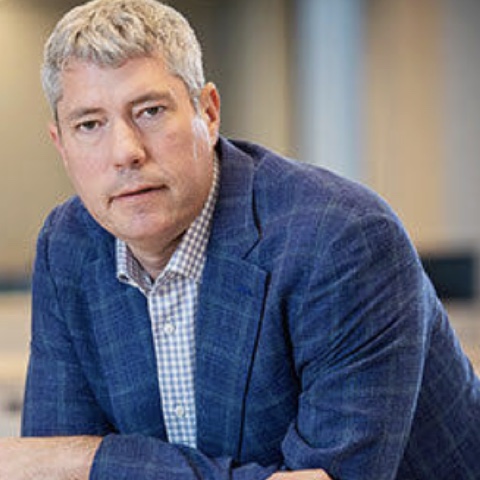
亨利·艾伦博根 PPatrick O'Shaughnessy
EDITED TRANSCRIPT · 依据现场录音编译整理,可划线生成便签
亨利·艾伦博根(Henry Ellenbogen)是 Durable Capital 的创始人,此前在普信(T. Rowe Price)管理新地平线基金(New Horizons),是美国小盘成长投资这一脉最重要的实践者之一。这次长谈从他的投资哲学源头讲起,一路谈到 1% 的「状元股」、第二幕创业者、量化与多策略平台带来的市场结构变化、AI 与机器人对成本曲线的改写,以及公司为什么仍然值得上市。本文依据现场录音编译整理,只删去口语枝节、寒暄与重复,论证、例子与语气一概保留。

从生物学进入投资

主持人: 我想从一个有意思的地方开始:请你讲讲自己投资哲学的起源。今天我们会聊到很多非常具体的现实问题,我希望听众先明白你的立场从哪里来、你是怎么一步步形成这套想法的。这道菜的关键配料是什么?它从哪儿开始的?

艾伦博根: 大概有几个来处。一个坦白说是我自己的背景。我不是从学校直接进投资这行的,我走的根本不是金融那条路,我去搞政治了,我也不是经济学专业。我本科读的是有机化学,另一个方向是历史与技术。我在政治圈干了很多年,后来开始琢磨自己到底想做什么职业,慢慢才想到投资,然后就一头扎进去了。

我开始用科学里学到的那套原理去想投资,尤其是生物学。一个组织也好,一个生物体也好,要想长期存续下去,跟人一样,它必须跟自己所在的生态达成平衡。今天你也看得到,我是两个男孩的父亲,孩子的成长要经过一条条曲线:幼儿、少年、青春期、成年,每一段都得保持平衡。平衡做到了,他就能茁壮,甚至做出很了不起的事。人类整体也是这样,你看看人相对其他物种取得的成就。

我就想,投资凭什么不遵循我们在科学里看到的同一套规律?凭什么不能这样理解:一家公司应该在客户、员工、股东,以及它所在的社区之间维持一种健康的平衡。这个念头对我触动很大。我也很幸运,职业生涯很早就进了普信,后来成为我导师的杰克·拉波特(Jack Laporte)信的正是这一套:投资小公司,投资那些像主人一样思考的人;他们每天醒来就想着让自己更好一点,他们善待员工,有好的文化,资本配置做得漂亮。这样的公司才能持续成长。这就是他做了二十五年、做得如此成功的方法。这套东西跟我一拍即合。

五十年,二十只股票

艾伦博根: 后来我撞上了一点好运气。在普信做到一半的时候,公司让我去管新地平线基金。我开始读这只基金历年的股东信。那时它刚满五十岁,我就跑进档案室,把所有股东信翻出来读,想搞清楚这只基金五十年的成功到底靠什么。它当时是全美历史最久的小盘成长基金,多数人也会说它是业绩最好的那只。

读下来我发现一件事:五十年里,真正决定业绩的只有大概二十只股票。也是凑巧,或者说杰克是有意的,他决定给基金办一个五十周年的生日会,历任基金经理都到场了,只有普信先生本人没来,他管过这只基金,但已经过世。那天我跟一位前任经理聊天,他讲了沃尔玛上市路演时见到山姆·沃尔顿的故事。不了解这段历史的人可能不知道,沃尔玛上市时是一家极小的公司,只有五十家店。后来沃尔玛就成了沃尔玛。

我回头一查,心想:哇,这肯定是那二十只里的一只。但遗憾的是,这个仓位被卖掉了。

主持人: 他们把它卖了。

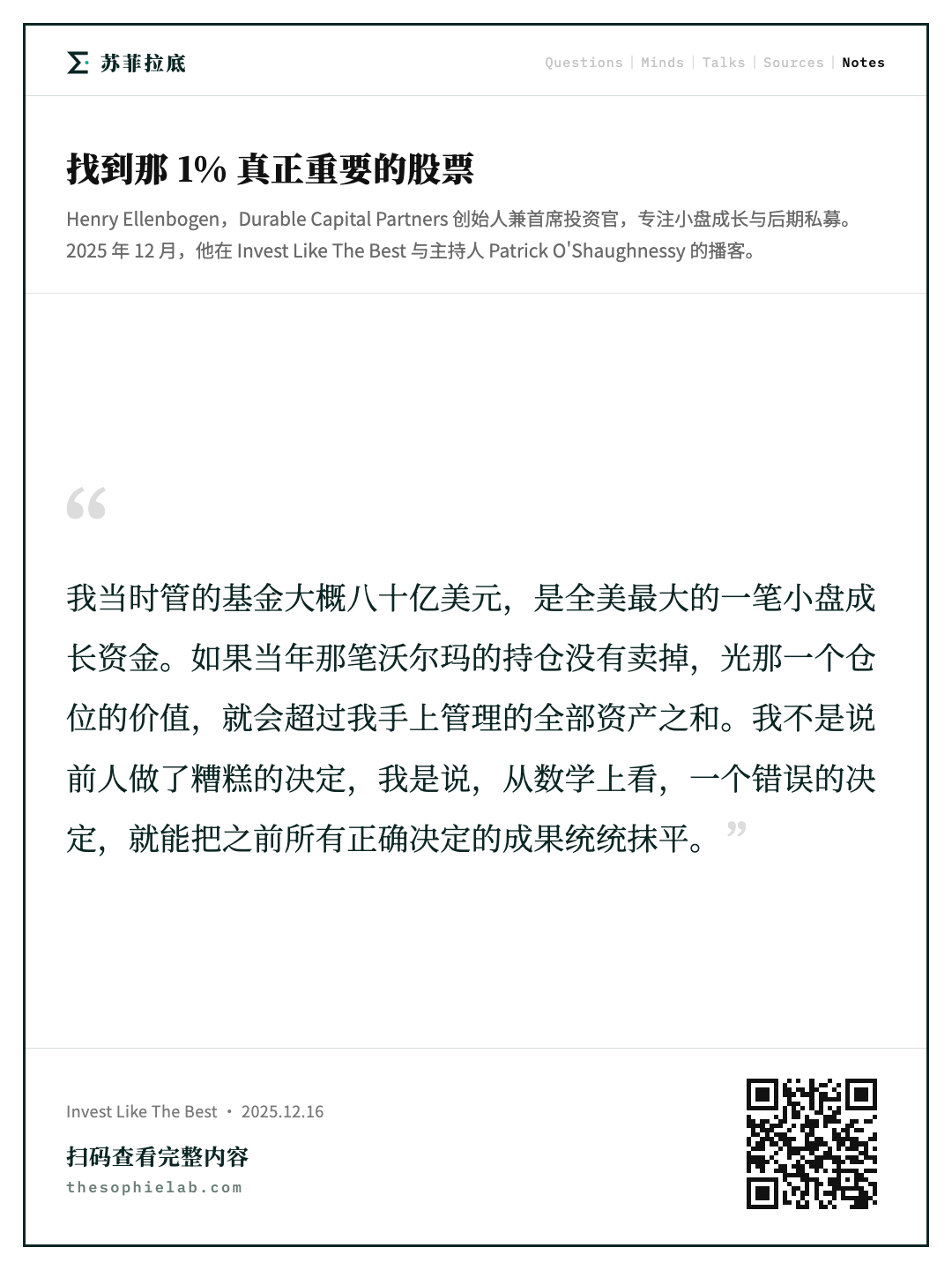
艾伦博根: 算一笔账。我当时管的基金大概八十亿美元,是全美最大的一笔小盘成长资金。如果当年那笔沃尔玛的持仓没有卖掉,光那一个仓位的价值,就会超过我手上管理的全部资产之和。我不是说前人做了糟糕的决定。我是说,从数学上看,一个错误的决定,或者说一个你每天都得重新做一遍的决定,因为公开市场每天都开门,就能把之前所有正确决定的成果统统抹平。

所以从那时起,我开始认真研究美国公开市场的历史。后来很多人在谈从芝加哥出来的那份研究。

主持人: 对,4% 的那个。

艾伦博根: 是真的。但我做这件事的时候,还没有人问过这个最简单的问题:在美国股市的历史上,也就是在我看来最能代表资本主义的那个样本里,如果平均有四千只上市公司,其中究竟有多少家是真正伟大的?

我们今天的哲学建立在这个数上:在任何一个滚动的十年区间里,大约有四十只股票能以每年 20% 的速度复利,也就是涨六倍多一点。也就是说,大约 1% 的股票是「状元」。我们要去找的就是它们。

人对一件事的理解,往往先来自旁证,比如生物学,然后是轶事,然后如果你愿意再往下点一层,或者你本来就是个数据迷,你就会真去把它研究透。此后我们就一直在搭建一套投资哲学,目的是把投中那四十家公司的概率做到最大。还有一件事:这些公司里大约 80% 是从小盘公司阶段开始它们的复利旅程的。所以老有人问我,亨利,你为什么这么爱小公司?我说,一是因为我喜欢这份工作里跟人打交道的部分,二是因为那些伟大公司里 80% 起步时都是小公司。

我们要最大化的就是这个概率,因为我们相信这才是长期财富和经济增长的来源。我们做的事说白了,就是专门造了一套投资哲学,同样重要的是,还专门造了一个能执行这套哲学的投资组织。

状元的路标

主持人: 你的公司名字本身就是对这个理念的致敬:durable,持久的长期复利。请再往细里说一层。你确定了目标是尽可能逼近那四十家公司,那么在你和你团队的风格里,哪些共同特征是「你可能抓到了一个」的信号?我知道你也做后期的私募投资,所以你看这些公司的时候,它们往往临近上市。上市这件事我们待会儿再聊,先说说:你提炼出来的、最重要的路标是什么?

艾伦博根: 如果你以前当过状元,你再当一次的概率就更高。这话听起来太简单了,但其实很有意思。我们就是去看谁真的做到过。如果一家公司我们不熟、没研究过,我们就点进去研究它,看有没有机会;就算没有机会,也把它做成一个案例研究。我们要学会它。我的合伙人之一阿努在哥伦比亚商学院开课,就是价值投资那个项目。这一方面是我们整个组织回炉再造的方式,另一方面也是我们回馈社区的方式。那门课就建立在这套方法上,学生一年大概做六个案例研究,日积月累就攒出一个案例库。你先从研究那些做到过的人开始,然后当然是去研究他们身上的模式。这是第一条。

第二,这些公司分散在整个经济里。我们现在处在 AI 影响巨大的时期,我对 AI 影响力的判断,跟你请过的很多嘉宾大概没什么不同。我想说的是,当我认真研究 AI 的力量时,我想到的不只是第一、第二层导数上的公司,也不只是大家归类为科技公司的那些。我同样在想科技行业之外那些已经存在的、业务多元的公司,它们在这一轮里也可能长成巨头。

举个例子。回头看云和移动那个时代,你当然应该持有亚马逊。但你看零售业,一旦沃尔玛和好市多真正看懂了亚马逊在做什么,而它们那时还保有相对的规模优势,它们就把自己的长处用了起来,跟着上了同一条曲线。从那以后,零售业 62% 的增量全归了这三家。当然其中一家可能比另两家更好,但实际上三家都很好。

那么在 2010 年代那十年里,罗素 2000 成长指数里最好的小盘公司是谁?不熟悉基准的听众可以先记住这个问题。答案是达美乐比萨。

主持人: 达美乐。

艾伦博根: 它其实是一家增速平平的公司,那十年里平均增速连 10% 都不到。达美乐为什么这么好?我从头研究过它,当然也持有过它一段时间。达美乐开始起跑的时候,美国的比萨市场大概三分之一是本地小店。跟很多听众一样,我也有自己最爱的那家本地比萨店,我喜欢它是因为它的比萨确实好吃。另外三分之一我们都知道,就是全国连锁:达美乐、棒约翰、小凯撒等等。而中间那三分之一,华盛顿特区以前有一家叫 Armand's 的,开了大约三十家店,它们有本地或者说区域性的规模,但它们既没有达美乐那样的规模,比萨也算不上好吃。

达美乐起跑时,首先是把产品做好了一点。但如果你跟当时的 CEO 帕特里克·多伊尔聊,你认真研究就会发现,他们真正做的是这件事:比萨的价值等式有三项,品质、价格、便利。他们意识到,只要在技术上真正下重注,就能把便利这一项做得好得多。

于是他们下大力气做自己的 App,很早就跟顾客建立了直接关系,然后就能更高效地对这些顾客做优惠券投放之类的事,把单店的单量规模拉起来。当你把一件事做对了,产品改善了,大概略高于行业平均,便利这一项不断迭代,又跟顾客有了直接关系,突然之间品牌光环也变好了。把这些叠加在一张极好的商业模式上,也就是加盟模式,投入资本极轻,最后你就得到一只极好的股票。

所以我们在 Durable 反复琢磨的是:在分销、货运这些已经做得不错、而且可能已经在另一条曲线上投入的公司里,哪些有能力用 AI 大幅降低自己相对竞争对手的成本,拿到更大的收入规模,再把这份优势再投资出去,形成某种永久性的东西,把那些迟迟才跟上、甚至永远跟不上的对手甩开。你去研究市场历史就会发现,往往这类才是最好的股票,因为你本来就在一个物理世界的生意里,技术优势会转化成物理护城河,或者分销优势,或者规模优势。这是我们观察到的一种模式,内部我们叫它「从优秀到卓越」的论点。

人:认识二十年

艾伦博根: 第二条路是人。我看今天手上的投资,很多是跟认识了二十年的人在一起做事。也许他们还在做同一件事,也许他们在做下一件事,但我们认定这就是那种能把组织建好的人。当然我们也必须认识新的人。

我们最大的持仓之一是多邻国。我们第一次跟 CEO 路易斯·冯安(Luis von Ahn)深谈是在疫情期间。那个阶段市场重新打开,一路创新高,零利率环境下私募市场热得发烫,大家都在 Zoom 上见面。我记得我跟同事胡里奥一起见完路易斯,我给胡里奥打电话问他怎么看,他说这生意太出色了,他们在自己的市场里领先,站在消费者这一边,产品也好。我说对。我还说,路易斯让我想起 Shopify 的托比。上一次我遇到一个人,技术功底这么硬,路易斯当过卡内基梅隆大学 AI 与机器学习方向的负责人,同时又有那么清晰的商业判断,还能把复杂的东西讲得极简单,简单到连我都能听懂,那还是 Shopify 尚未上市时我跟托比相处的时候。我说,我们把日程清空,只要路易斯愿意见我们,他在匹兹堡,我们就飞过去。

所以一部分是理解模式、研究过模式,一部分是理解什么样的环境会催生这种公司。红杉有句名言叫「为什么是现在」,而且这个「为什么是现在」不只发生在技术侧,它发生在整个经济里。但我觉得更关键的是那种清晰感:当你跟数以千计的高管打过交道,你见过那些真正做成过的人,你就想跟他们多做一点事;你也会遇到那些正在尝试、但让你强烈地想起那些已经做成过的人。

第二幕的创业者

主持人: 能不能多讲讲「第二幕团队」这个概念?为什么在你判断一家公司是否可能长期复利时,第二幕团队是个有意思的变量?

艾伦博根: 这件事对我特别亲切。一是我们确实在投这种团队,二是它其实就在 Durable 自身的核心里。这也是我觉得 Durable 跟别的投资机构不一样的原因之一:我们自己就是一支第二幕团队。

在我上一家机构,我在 Workday 收入约一亿美元规模时投了它。Workday 的两位联合创始人阿尼尔·布斯里和戴夫·杜菲尔德,正是在上一个客户端服务器时代开创 HR 记录系统的人。他们就是把 PeopleSoft 做出来、做大的那批人。中间有很多故事,最后甲骨文发起了一场非常凶悍的收购。某种意义上他们觉得自己的愿景已经完成了,于是又聚到一起,而真正点燃新愿景的是云。

今天说这个听起来太理所当然了。

主持人: 是啊。

艾伦博根: 但在 2012 年我们投 Workday 的时候,投资人对云的理解远没有这么清楚,坦白讲我自己也未必完全懂。但我懂的是:这是一支第二幕团队。这类产品里有一大堆东西,姑且叫「异常处理」,如果你没做过,你就不可能理解它,也就不可能做对。正因为这是第二幕团队,他们既知道怎么用新一代技术,也知道怎么在超大规模下把记录系统里那些边缘情况处理好。当然他们也清楚该切入市场的哪一段、怎么服务它。

这就是我们在 Durable 看一位创业者时脑子里的画面:他曾经在某个产品领域或某个业务领域里解决过问题并且赢了,现在他想再做一次。再做一次有巨大的优势:你等于是在一开始就带着完全的清晰度去解同一个问题。另外,因为你成功过,你可以把组织的所有部件按你想要的方式对齐,人、组织结构、投资人,全部。

比如马克斯·莱夫琴。很多人都认识他,PayPal 的联合创始人之一。我们第一次投马克斯其实是我职业生涯最早的几笔私募投资之一,我们投的是 Slide。此后很多年,直到最近,我们又是 Affirm 的投资人。我以前老开玩笑说,马克斯,我大概是所有投过你的人里唯一没赚到大钱的。玩笑归玩笑,马克斯在我看来是第二幕创业者最好的样本。不了解他的人可以记住几点:第一,他是真懂技术,而且真懂怎么用技术在极复杂的系统里解决问题;第二,他能招到极优秀的人,因为他讲的是他们的语言;第三,他是个很好的领导者,人们信他;第四,他极其有韧性。

如果 Durable 一年做五到十笔新投资,很多时候投的就是第二幕创业者。如果我们运气好,而这种运气正来自二十年积累下来的关系复利,很多时候投的是我们在他上一幕里就已经是股东的人。这一点也很好,因为他们了解我们,我们了解他们。我们知道彼此的长处,也知道彼此怎么互相帮得上忙。像马克斯这样的人、像阿尼尔这样的人,他们想跟谁做生意就能跟谁做生意。这种局面给他们的好处是,他们可以在一张白纸上决定要跟谁同行。而从我们这边看,我们本来就不做很多新事,所以能把资源真正对准他们。

我们自己的第二幕

主持人: 你自己的第二幕里,变化最大的是什么?你在把 Durable 这个机构本身造得跟你所投公司具备同样的特质:活得久、做得好、利益高度一致。从第一幕带到第二幕的最大心得是什么?又扔掉了什么?

艾伦博根: 说起来,Durable 差点就叫「第二幕资本」(Act 2 Capital)。

主持人: 真的?

艾伦博根: 这个念头在我当时的构想里分量非常重。投资哲学我们刚才聊过,其实很简单:投那些能长期复利、最终长成大公司的小公司。我们相对其他投资人的优势在哪?我们认为我们特别擅长看人,也特别擅长理解变化。因为 Durable 是一家由投资驱动的公司,我们做的每一件事都服务于这个投资使命。

我们几乎是从一张白纸开始问:如果要专门造一个能干成这件事的投资载体,它该怎么搭?所以我们放在公开市场和私募市场的资金比例,是按这个目标对齐的。组织上也一样。我们对人的安排非常刻意。我们真心认为,很少有人是按我们这种方式运转的,Durable 就是不一样。我的合伙人凯瑟琳,2020 年第一次给 Figma 做研究、2021 年我们领投那一轮的是她;Figma 全员会上迪伦宣布公司要上市时,在现场的是她;今天这家公司发布上市后的业绩,看它的还是她。这就是不一样。你需要这样的人:一家公司估值二十亿美元、还是私人公司、年化收入三千万美元的时候他在看;今天 Figma 已经是十几亿美元收入量级的上市公司了,他还在看。绝大多数投资机构不是这么搭的。所以你要有这样的人,就只能自己内部培养。

第二是时间分配。任何时点我们大概有 10% 到 15% 的资金在私募市场,其余在公开市场。我们必须愿意为新想法花上合适的时间。当年看多邻国,对多邻国合适、也许对我们也合适的决定,只是投两千万美元。我们不会把它看成一笔两千万美元的投资摆在一个一百五十亿美元的载体里,我们不会把它当成 10 个基点或者 12 个基点。我们把它看成我们未来的复利机器。

我们的投资备忘录跟别家机构写得根本不一样。当我们看一家还没有建立竞争优势的早期成长公司时,备忘录要写的是:如果多邻国在未来三年做到我们认为它能做到的事,我们不仅在承担这份风险后拿到了合理回报,而且到那个时点,我们会愿意在更高的价格上买更多。如果这份「愿意在更高价位加仓」的备忘录写不出来,我们就不能买这只股票。而且我们的论点绝不能是「它会被收购」。这一点必须对齐。

还有就是我们的出资人。我们的出资人非常好。我们必须对他们透明:要追求这套哲学,我们的业绩在月度或季度上就会有波动。这话听着理所当然,但市场其实变了,资金越来越短周期。

主持人: 短到什么程度?

艾伦博根: 太多人是按月度的激励模型在做事,不是按年度,是按月。所以我们必须极度透明地告诉出资人我们想做什么,然后兑现承诺,但是在正确的时间尺度上兑现。

向上买,向下买

主持人: 你这个「越涨越买」的概念我很感兴趣:如果一件事顺利时你不愿意在更高的价格上加仓,你一开始就不该投。这样理解对吗?也就是说,你建立完整仓位的方式,是随着价格上涨不断加码?

艾伦博根: 对,也不全对。我们的组合其实分两部分。

看早期成长公司时,它可能是还没上市的多邻国,也可能是上市之后但仍未建立竞争优势的多邻国,那时它没有现金流,也没有市盈率可谈。在我们眼里这仍然是早期成长公司:我们判断它未来可能建立竞争优势,它的经营文化可能被清晰地建立起来,回头看时你能看到这种卓越以及它的适应力,我们也能看懂它的增长公式,而且一路走来我们真心相信这是那种能把组织做大的人。我们通常按三年为基础来承保,也不总是三年。如果它做到了我们认为它能做到的事,我们就会想在它用我们的话说「变得更大同时风险变小」的时候加仓:它证明了自己是有竞争优势的生意,显示出更强的韧性,也显示出在增长、盈利、创新之间做财务平衡的能力。以多邻国为例,它要证明自己不只是一个教人学外语的强力应用,而是能延伸到更广义的自我提升,再延伸到学习本身,从而提升人参与经济世界的能力。他们现在也进了国际象棋这种完全不同的品类。

所以,当一家公司越来越接近我们所说的、姑且叫「已经成型」但仍有增长的竞争优势型企业时,我们的承保逻辑就是:如果它兑现了那个情景,我们会想买更多;如果做不到这一点,我们干脆不参与。

我这辈子投过一百多家私人公司,参与过五十多次 IPO。其中还持有多少?我们持有的大概比市场上任何人都多。你看 Durable 今天在公开市场上的最大持仓里,有 DoorDash、Affirm、Toast,这几家最后一轮私募都是我们领投的。所以它们确实留下来了,而且我们在曲线的不同位置继续加仓。

至于「持久成长型公司」那一类,由于市场波动,再加上我刚才说的那种代理人机制逼着人用短周期眼光看公开市场,事实上你往往是在它们下跌时买得更多。我们最喜欢的创业者之一叫杰伊·轩尼诗,他是高力国际(Colliers)的 CEO,也是第一服务(FirstService)的创始人,这两家我们都持有,我们还跟他一起做了一笔私募投资。高力这家公司我认为被严重误解了。这个品牌当然会让人以为它是一家商业地产经纪公司,而商业地产经纪在高利率环境里通常不好过。但人们没看懂杰伊,他这套打法已经反复用过很多次:他真正的师承是彼得·德鲁克,他对本地激励机制的理解、对资本配置的锋利判断,以及他收购团队时设计合伙制的方式,造就了别的东西。人们没意识到的是,他在地产资产管理这块已经通过哈里森街(Harrison Street)建起一门了不起的生意,同时还在建一个非常好的咨询平台。

所以我们在这家公司上的洞察从杰伊开始,但真正的内核是:高力的资产质地根本不是一家周期性商业地产公司的质地,它其实是一家很好的地产资产管理公司,外加一家正在崛起的强势咨询公司。所以去年当大家担心商业地产疲软、担心利率时,它因为短期宏观情绪被砸下去,我们大量加仓。在组合的那一部分里,我们多半是在下跌时买得更多。

机器擅长什么

主持人: 你刚才提到一件很重要的事,委托代理问题,我想深挖一下。这其实是个市场结构问题。我们以前聊过,现在边际成交量里有一个高得离谱的比例发生在那些平台型机构内部,城堡、千禧年、Balyasny、Point72 这些。你怎么感受这件事?也想听听你对市场结构整体变化的看法:它怎么加剧了波动,创造了什么机会,又带来什么危险?

艾伦博根: 这件事我想了很久。我大概两年前开始认真想,事后看,我应该三年前就开始认真想的。但人不可能每件事都对。

我职业生涯里有一段时间,量化基金开始大放异彩,比如 Two Sigma 那一批。我们在 Durable 特别强调的一点是谦逊:我们从不假设自己对、别人错,也从不假设自己好、别人坏。我们的出发点永远是假设对方非常聪明,我们能从他们身上学到什么。所以在创立 Durable 之前,我就去研究了量化。我的结论是,短期阿尔法这场游戏大概率会被「机器加人」的组合赢走。那也正是历史上第一次出现计算机与人配合能击败最强人类棋手的时候。

后来我去跟 Two Sigma 的核心人物见面、相处,我了解到他做得非常好。但聊多了我也意识到,量化能做的事其实有真实的边界。我开始明白:如果这是一个基于已知数据的「重复行为」问题,那量化确实厉害。放到当时的现实里是什么意思呢?意思是,如果你只是那种因为 PMI 掉下来就去买工业股、等 PMI 回升重新估值再赚钱的人,这套不管用了。

主持人: 机器就是比你强。

艾伦博根: 机器在这件事上就是比你强。但如果你像我们当时那样,特别擅长理解人、特别擅长理解变化,那你就有真实的优势。我在老东家内部做过一次「人对机器」的教学,我说,因此新地平线基金接下来要做的事,就是在这两件事上加倍下注,并且把它们做得更好。我们要在业务的看人这一端更聚焦,公开市场和私募市场都一样;我们要在变化如何冲击我们的早期成长公司和持久成长公司这一端更聚焦;而那些我们相对机器并不占优的地方,本来也不该做,我们要停下来。当然,所有这些都在我们的投资哲学框架内完成。

我们在 Durable 研究千禧年和城堡时,做的也是同一件事。先说清楚,我深深尊重这些机构,我认为他们把自己那件事做到了极好,我也真心认为在那里工作的人非常有才华,我们的出发点就是:这些是极有才华、把事做得很好、品质很高的人。我们要问的只是:他们做的是什么,边界在哪里?其中一个边界是,如果你所在的机构每天都严密度量你的风险,而一旦你在一个月、最多三个月的窗口里表现不好,你的资金就会被砍,你还有很大概率被请走,那就意味着你的时间视角不可能超过你的职业视角。

我们还注意到,我们不只靠轶事理解世界,我们也做统计。看最近一个财报季,也就是今年二季度的业绩发布期,如果你去研究财报后的波动率,那是金融危机以来波动最大的一个财报季。要知道金融危机时,美国银行体系的根基都在被质疑,这意味着经济和市场的可能性分布极宽,而且市场在见底和见顶时本来就更容易剧烈波动。即便如此,这一个财报季仍然是最动荡的。我认为原因就是:我们估算机构资金流里大约 80% 到 90%,要么来自那些只有一个月、三个月代理期限的机构,要么来自必须把价格信号纳入模型、而模型正是为此优化的量化。

所以我们在 Durable 的对策很简单:少做一点,才能做得多一点。既然我们打算承受股价波动,我们就必须像了解高力那样,真正了解这门生意和这些人。如果高力因为利率、因为大家担心商业经纪而下跌,那市场很可能是对的。

主持人: 市场多数时候是对的。

艾伦博根: 十次里大概九次是对的。但如果我们理解那家公司文化的独特之处,理解他们如何配置资本,如果我们因为研究了二十年、又认识经营团队而深知哈里森街的资产质量,那就有理由在这种压力下往前倾。

早期成长组合也一样。多邻国上市的 2021 年,是资本市场上一次真正对企业敞开的年份。关于 2021 年这批上市公司已经有很多文章:它们在零利率环境里上市,其中很多公司要走到盈利会很吃力。2022 年利率上行后,很多人说干脆把这一批全部扔掉,我认为这个判断在方向上是对的:2022 年罗素 2000 成长指数里亏损公司的平均跌幅超过 70%。

我们的看法是,这说得通,市场大概率是对的,但不是所有公司都无法适应,不是所有公司的生意都赚不到真实的经济回报,也不是所有公司都缺乏那种转身的纪律和组织意志,在一个因为利率变化而重新要求盈利的世界里做成一家成功的公司。多邻国就是我们在 2022 年反而加仓的例子,那是一次在早期成长公司上的向下摊平。这一点我们是占优的,因为如果你是规则驱动,或者你的时间框架只有一个月、三个月,你根本拿不住多邻国,也不可能在高力上越跌越买。

AI 这一轮有多大

主持人: 你说人和变化。两个都要聊,先说变化。我们正处在可能是我们这辈子会看到的最大一次技术变迁。你经历并投资过好几轮:互联网、移动、云。能不能把这一轮放进你经历过的那些轮次里做个参照?你一直强调研究历史、研究模式,这次哪些模式适用,哪些必须扔掉、从第一性原理重新承保?

艾伦博根: 我从 2022 年就开始在股东信里写 AI。

主持人: 是的。

艾伦博根: 当时我说,经历过互联网、云和移动之后,我判断这一轮至少和互联网一样有力量。我说我们要带着谦逊去接近它,去跟离它最近的人相处,持续学习。我也说了,Durable 不是主题投资机构,我们是复利投资机构,所以就算我们认为某件事会很大,也不代表我们的投资会议会变成「AI 会很大,那我们去买 AI 公司吧」。会议内容应该是:真正理解变化,然后理解我们投的公司会如何从中受益、如何变得更好,或者至少不被颠覆。

我一会儿会展开讲为什么我认为它的影响力可能比互联网更大。它当然会影响每一家科技公司,这一点你在市场上已经看到了。但这一次,我认为它还会影响几乎所有需要白领员工、需要知识型员工来推动工作的公司。

先说后面这一条,因为讲的人比较少。作为一个研究商业的人,多数人都知道,到 2010 年代末,只要你做的是实体产品生意,你就必须搞清楚自己的「中国成本」。这话当年印在每一本商业杂志、甚至每一本大众杂志的封面上。意思很简单:在全球供应链里,如果世界上有一个地方拥有巨大的规模和资源,像中国、像远东,能把产品做得便宜得多,算上运到你工厂或消费者手上的成本还是便宜得多,那你就必须理解它;如果你自己不用,你就会被淘汰。这是第一层导数。

第二层导数是,有很多生意本质上是赚价差的。看很多分销生意,比如暖通空调这种很好的行业,行业习惯是在原材料上加一个价差。如果你的暖通设备每年涨价 3% 到 5%,这是好事;如果每年通缩 3% 到 5%,那就是坏事。所以如果你是趴在上面赚价差的生意,那就麻烦了。

每一家做产品的公司、以及产品的衍生生意,都必须搞懂中国成本。我认为 AI 也一样,只是这次不是产品,是知识产权,是脑力产出。

把流程「精益」出来

艾伦博根: 还拿马克斯举例。多数人会把 Affirm 理解成一家金融科技公司,这没错,它让人以安全、而且相当合规友好、没有套路的方式获得信贷,他现在做的还不止这些。但归根结底,因为他受监管,公司里有大量法务成本,他跟商户之间有几十万份合同,他还要监督合作伙伴如何披露信贷信息。这些都需要很多人。如果你跟他聊,他也公开讲过,他坚信 Affirm 能在相当长一段时间里维持现在的增速,而且做到这一点不需要增加人头。原因当然是他会把很多在 AI 之前不可能精简的流程精简掉。

这里有个很有意思的故事。我从他身上学到太多东西了。有一天他发完财报我跟他聊,他说,亨利,你不是老问我怎么用 AI 提高效率吗,我觉得自己上手算晚的,但我终于想明白了。他说,我组了一个团队在公司里到处跑,去理解流程,我们的出发点不是省成本,而是「精益化」,我觉得这块进展很实在,所以我才敢对外做这个承诺。他说,这不是很棒吗?

主持人: 哈哈。

艾伦博根: 我对马克斯说,你来一趟华盛顿吧,我们去见米奇·雷尔斯。丹纳赫是他和他哥哥创办的,他现在是董事长,这件事他们已经做了四十年,叫 DBS(丹纳赫业务系统)。是他们把改善(Kaizen)带回美国的。他们最初就是走进工厂,把流程贴到白板上,研究怎么把它精简掉,精简完一个月后再回去检查,因为改变很难,要确认这个改变真的守住了。后来他们建起了一整套业务系统,不仅造就了丹纳赫,美国现在还有十几位财富 500 强 CEO 是从丹纳赫出来的,包括刚把通用电气扭转过来的那一位。

我的意思是,你既然对这件事这么兴奋,那我们就去见这门功夫在美国的祖师爷的老师。

这件事深刻到几乎难以把握:米奇会说,四十年里,因为有了中国,我们把产品类生意和营运资本做了极致的精简;而在人做的流程这一侧,我觉得我们才刚刚开始。

亚马逊教我的事

艾伦博根: 第二个例子,我尽量讲你这个节目上还没被讲滥的东西。我第一次真正看懂互联网在发生什么的时候,我管的是一只全球科技媒体电信基金,我最大的持仓是亚马逊。我们投它的时候,它市值大概一百亿美元。我那时一年去两趟西雅图。有意思的是,我记得这么清楚是因为西雅图离巴尔的摩很远,没人愿意陪我去,那还是家小公司,大家觉得我懂它。我一年两次跟杰夫·贝索斯吃午饭,当时我所在的机构是他最大的外部股东,而亚马逊显然是我为机构做的研究标的。

那些会面让我学到很多,其中一条是:最好的那类靠技术取胜的生意,用技术的方式是既降低成本又推动收入,结果是在自己的终端市场里拿下 30% 以上的增量份额。然后他们把这份单位经济优势再投资到某种具有持久性的东西上。

持久到什么程度?持久到就算竞争对手明天醒来,用跟你一样好的人、做一模一样的事,也追不上。

主持人: 也追不上。

艾伦博根: 这就是我们对「持久的竞争优势」的定义之一:对手对着你的护城河发起正面进攻,用同样优秀的人做同样的事,结果依然无关紧要,因为你已经领先太远。就像我们后来都明白的,亚马逊拿到了把一个包裹送到你手上便宜 3% 到 5% 的成本优势,还有把多件商品装进同一个箱子的能力,然后他们把这份经济优势拿去建实体的履约中心,把钱再投进资本和基础设施,让自己能沿着那条成本曲线往下走二十年。然后,等所有人终于明白他们在干什么的时候,还能陪他们玩这场游戏的,只剩下仍然拥有规模、客户关系和信任的沃尔玛和好市多。等这两家也想明白了,三家都很了不起。问题是,零售业剩下的那些就不那么好过了。

主持人: 我把你说的复述一遍看对不对:我们从米奇这样的人身上看到了四十年的改善运动如何作用于实体产品世界,而 AI 相当于把改善运动的起跑枪打响在人类脑力工作的世界,这里面会有很多个亚马逊式的故事,有人早早踏上这样一条曲线,从此追不上。而你要做的就是找出那些人会是谁。

艾伦博根: 我们在做两件事,帕特里克。一是找出那些人可能是谁,二是确保我们不会错误地持有这样一家公司:按上一代的竞争风险看,它是一家很好的公司,我们当初判断它有竞争优势、有好的经营文化、由像主人一样思考的高质量的人领导,这些判断都对,但因为非连续性的变化改变了世界,它没能适应。而理想情况是,我们找到那些本来就占优的公司,它们借这一轮从优秀走向卓越。

领导者怎么适应

主持人: 想想你合作过的那些最擅长驾驭变化的 CEO。我现在也和戴夫·杜菲尔德在他最新的公司里做投资人,所以他会浮现出来,他正在啃 AI 这件事,这人太厉害了。米奇、杰夫、戴夫这些你近距离看过的人,他们在调整自己的心态、再带动团队适应快速变化的环境时,哪些做法最让你印象深刻?这个问题对所有正在经营企业、同时面对这份风险与机会的人都成立。

艾伦博根: 那我们拿路易斯来说。多邻国在 AI 上有巨大的机会,也有巨大的风险,股价每天都在反映这一点。OpenAI 演示怎么用它做翻译,多邻国的股票常常就跌;苹果展示 AirPods 怎么在现实世界里做实时翻译,它也跌。我并不认为市场错了,市场在幅度上可能错,但市场想说的是:这里有风险。

主持人: 有风险。

艾伦博根: 所以它大概是我们组合里风险偏高的名字之一。那我们在路易斯、马克斯或者戴夫身上找什么?

第一,我们首先看这门生意本身是不是已经经营得很好。因为如果你在必须应对变化的时候还没把生意经营好,你不可能同时做两件事。你不可能一边做扭亏一边还做得漂亮。

第二,这门生意在它的第一个终端市场里已经在赢:按我们所有关于「赢」的定义,大幅获取市场份额,赚到真实的经济利润,从而有钱去投资下一条 S 曲线。

第三,我们真正在意的是人。我们在 Durable 特别强调韧性,这也是我们这么喜欢投第二幕管理者的原因之一:他们的韧性我们研究过。当你投过马克斯、看过他在 Slide 时期有多能扛,你现在看他必须扛着压力,在竞争对手动手之前用 AI 精简成本、拉动收入,你会说,我们见过他在压力下的样子。

再往下,我们要找的是有观点、能执行、同时保持谦逊的人。我们在 Durable 每半年会把自己对 AI 的看法写下来并更新一次。随着我们越来越深地进入这段变化期,我们大概是「错得更少」了,或者说我们的判断比半年前更有依据了。但我们仍在学。我们这份工作的好处是可以花时间阅读、思考、跟聪明人交谈。所以哪怕对面是极有才华的人,他们大概率也没有我们这么多时间做这件事。我们必须极其谦逊。他们必须有观点、能想出办法、不被吓瘫,但同时必须谦逊、持续学习。

最后从实务上说,回到备忘录:如果这是一个高风险局面,多邻国显然是,Affirm 也是,而且你恰好离这场变化的核心很近,那你就必须为这份风险拿到对应的补偿。我们对多邻国的说法是:是的,因为这份风险,贴现率上去了,但同等地,机会也变大了,而且我们能把它讲清楚。路易斯公开说过他们生成内容的速度快了二十倍,这一点我们已经看到了。他公开讲过他做的国际象棋产品,表现好得惊人,我的孩子特别喜欢那个产品,简直上瘾。这个产品最初是两个人做了六个月,后来又加了四个人,九个月做出来,是他做过的最好的产品。你要是问他以前要多久,他会说,我不知道,大概需要四到六倍的人,还要花四倍的时间。

你可以说创业公司也能做到这件事,但他做到了,而且是在他自己的平台上做到的。这个产品的日活已经远超一百万,而且在以惊人的速度增长,这还是一个供给严重不足的好市场,它本身就可能成为一门大生意。所以是的,贴现率上去了,但这家公司天生就是为 AI 造的。你有一个研究 AI、在卡内基梅隆教过 AI 的人,有一个全是 A 级选手、身段灵活的组织,他本人谦逊、持续学习,并且已经有了自己比别人更快的实证。这些正在创造真实的价值,也意味着它从单点产品或者几个产品走向产品套件的概率更高了。这就是我们要找的东西。

机器人这一层

主持人: 我能不能把你说过的几件事叠成一个更大的问题?把实体的改善运动和数字的改善运动这两个概念缩小一点,如果它们生个孩子,那可能就是机器人。所以我很好奇你怎么看一个时间表未知的可能性:体力劳动经济远大于数字劳动经济,我们可能会在未来四十年里迎来改善运动的第二次应用,就像米奇他们带来的第一次那样。你怎么看这个机会和这场变化?

艾伦博根: 这件事我们真的下过功夫。我们做的是这些:首先,通过跟创业者见面、跟我们已经投的、在这个领域领先的公司交流去补课,纯粹为了学。机器人这块我们是最近才开始做的。

在偏数据、偏数字的 AI 领域,我们已经养成了把结论写下来、然后保持谦逊、每半年可能就修正一次的习惯。机器人这块,我们真的是上个月才第一次把结论落成文字。所以接下来我要做一件我不太喜欢做的事:我知道我们在这里的判断非常早期,很可能大错特错,但我还是把我们的初步结论讲给你听。

在某些使用场景里,很明显机器人的成本已经低于对应的传统流程,也就是低于人力。

主持人: 低于体力劳动的成本。

艾伦博根: 低于体力劳动的成本。而我们都知道,现在是机器人最早、最差的阶段。因为现在是机器在与机器一起迭代,而且驱动它的是通用模型而不是专用模型,这条曲线是几何级的。

回到亚马逊那个心智模型,它支撑着我们在 Durable 对「持久」的大部分思考。亚马逊做到的事,是骑在一条成本曲线上,把寄出一个包裹的成本连续二十年、每年压低 3% 到 5%。而那些没有用对分销基础设施、没有在当时投对机器人,他们买下了 Kiva,也没有在合适的时机用上对的机器学习模型来规划库存、管理供应商的公司,他们的成本曲线大概每年还上涨 3% 到 5%,最好也就是持平。在一门低毛利的生意里,这个差值复利五年,坦白讲,你需要知道的全部就在这里了。

我们现在在 Durable 正努力想明白的是:如果在很多领域机器人的成本已经打平,而且有不少数据显示某些场景里它已经更便宜,同时使用场景还在增加,那么现有场景的成本下降速度,在曲线的这个位置上,恐怕不会只有 3% 到 5%。因为有规模涌入、有人力资本涌入、有知识产权涌入,加上你可以用通用大模型来驱动它,这个降幅更可能是每年 15% 到 20%。也许还更陡,降得更快。

那么五年后我们醒来,那些把自己放到一条成本曲线上的人,去对上那些放在另一条曲线上的人,这些就可能是幂律型的生意。我们认真想的是:谁会在这条曲线上受益,以至于他的竞争对手哪怕明天醒来,哪怕投进同样多的钱,哪怕能招到同样水平的人(这不太可能,因为他们没有在分销基础设施或技术基础设施上投资过),至少也落后两三年,而且每多等一天就落后更多。

在 Durable,所有人都看得到我们对变化的理解为多邻国、Affirm 和 Shopify 这些投资带来了多大好处。但我认为,我们对人和变化的理解,接下来在经济体剩下的那 70% 里,会变得更有优势。

最爱的护城河

主持人: 在你投过的所有生意里,你有没有偏爱的竞争优势类型?你整套流程的核心问题都是「它是否已经拥有」「它是否正在通往那里」。竞争优势有很多种,规模、网络效应等等。有没有哪些是你反复回到的、最好的长期竞争优势来源?

艾伦博根: 我爱实体地产。

主持人: 说说看。

艾伦博根: 你看亚马逊,或者我们投的 Carvana,我喜欢他们的整备中心,因为这些东西你没法凭空变出来。

主持人: 没法凭空变出来。

艾伦博根: 这些东西又脏又乱,你得拿地,得选对位置,得把网络布对,然后要用对的资本开支和对的系统把它立起来,接着你还得有对的经营文化。这非常非常难。地产选错了地方,你的运输成本就更贵。在那里要培养出一种文化更是难上加难。

所以我特别偏爱这些存在于物理世界的护城河,我们的组合里以各种形式包含了很多这类资产。这也是你跟我聊机器人时,我脑子里第一反应是分销的原因:机器人能在哪里让本来就占优的生意变得更占优?

但也还有别的。我还非常相信那些「柔软却极难」的东西。我总是想到丹纳赫的例子,米奇和史蒂夫做的事难到令人难以想象:近四十年里以 20% 的速度复利财富,而他们既没有很深的实体护城河,也没有像 Meta 和谷歌那样的数据网络效应,或者像那些深信 OpenAI 的人所看到的那种网络效应,那种潜力我和他们一样看得到。数据网络效应确实惊人。但另一类,是你在人力资本上锋利到极致:你对「什么才是真正的人才」有极准的判断,不是看标签;你对运营的卓越、文化、持续改善以及背后那套像改善运动一样的系统极其讲究;然后你按业务去配置资本,真正让它们对结果负责。

我们组合里的例子也很打动人。如果我把第一服务的业务和高力的业务给你过一遍,杰伊是前者的董事长、后者的 CEO,两家都是他最大股东,你会发现它们其实都没有那种特别锋利的竞争优势。但如果你真的研究过杰伊,真正理解他的人力资本文化、他怎么吸引人并让人对结果负责、他怎么把激励下放到本地,让从公寓的住宅物业管理到屋面与灾后修复这样各种各样的业务里的人利益一致,再看他们怎么配置资本,怎么把没有机会变得伟大的业务卖掉,怎么用一种让激励持续对齐的方式收购公司,你会觉得这太了不起了。

还有一点:如果我们要投小公司,那些公司等它们成形时往往已经很大了。所以我们必须对其他类型的竞争优势也有足够锋利的理解。

备忘录与三年回看

主持人: 你几次提到内部写的备忘录。你觉得一份出色的投资备忘录,结构应该是什么样?什么对你管用?

艾伦博根: 我们是一家书写文化的机构。因为人终究是人,当你身处其中,你很难保持那种必要的执行层面的距离感,去真正对自己当初的判断负责,也去真正要求被投公司做到你希望的事。尤其是我们真的认识我们投的人,我们投的都是非常优秀、非常有意思的人,我们打心底希望每个人都成功。

所以跟风险投资机构或者纯私募机构不同,我们必须有能力识别出事情没有走通,然后卖掉。但同样重要的是,如果我们要投多邻国这种带着真实风险的公司,我们必须能识别出多邻国这样的公司正在真正拐点上,而且也许我们看见了别人没看见,那我们就得去买更多。两件事都得做到。

所以我们写投资备忘录,是为投资哲学服务的:确认工作做扎实了,能清晰地说明这家公司为什么有竞争优势,或者将来为什么会有,它必须做到什么才算到达;它的经营文化为什么卓越,或者为什么具备卓越的种子;这位领导者为什么像主人一样思考,也就是他能让生意变得更好,我们把「更好」定义为穿越周期地获取市场份额,同时我们相信他能配置内部和外部资本,既推动更持久的增长,也让资产基础随时间更有价值。这就是我们的备忘录。

同样重要的是,通过建模、也通过白纸黑字写清楚我们要跟踪什么,我们才能在季度的经营复盘里,把整个组合、每一笔投资都拿出来跟全体投资团队过一遍,看看公司实际做到的和我们当初预期的差在哪里。而且在 Durable,任何一笔持有满三年的投资,我们都会做一次三年回看:当初承保的是什么,实际发生了什么。

这件事就像职业生涯里的很多东西,你会希望自己早点知道。投资这行最妙的地方在于,在我看来真正伟大的投资人七十岁时比五十岁时更好。我希望自己五十几岁的今天比三十岁做这件事时更好。你就是会学到东西:你更懂模式了,你希望自己仍然谦逊,不至于固执僵化,你身边围着更聪明、更好的人,内部外部都有。其中一项,就是你打磨出更好的流程。

我们两年前才开始做的一个流程就是这个。我们一直有季度的 KPI 复盘或者经营复盘,但我们以前不会拿一笔已经持有三年的投资,回头对照着说:三年前我们认为它会做到 X,现在它做到的是 Y。当然接下来的讨论是,差在哪儿,为什么。但这个会的书面准备极其简单,就两页。可关键在于,我们都是人,即使互相监督,如果每个季度聚一次、每次只偏离一点点,你往往会为它找理由。而如果它连续十二个季度每次都偏一点点,那就是明晃晃摆在你眼前了。这就是我们如此看重投资备忘录的原因。

2022 年那趟巡访

主持人: 我记得 2022 年你做过一次巡访,跟很多 CEO 谈市场状况、经营原则这类事。我想听你回顾那次巡访,但我更想知道:如果今天你把组合里每一位 CEO 再走一遍,也许你正在这么做,今天的讯息和 2022 年的讯息有什么不同?

艾伦博根: 2022 年我觉得我们确实有能力为那场对话增添价值,而且是最高层面的价值。顺便说清楚,我说「我们」不是「我们对他们」:我聊过的每一位 CEO、每一位投资人,包括 Durable 这家真正按现金流给资产定价的基本面机构,谁都不认为钱会永远免费,但所有人确实都基于将近十年的免费资金,做了一些简化假设。

任何学过怎么给公司估值的人都明白,说到底所有公司都要按自由现金流和内生增长来估值。而当时我们走到了什么地步?全球 30% 的国债在负收益率上,相对通胀而言,你借钱是被付钱的。这意味着风险投资人给公司估值时完全不管盈利,是合乎逻辑的;上市公司用廉价债务去买那些永远赚不回资本成本的低质量生意,是合乎逻辑的;你坐在董事会里,不去追问增长、盈利和创新之间的取舍,也是合乎逻辑的,因为你不需要。

回到我们研究复利的那个话题:我们把研究按时期切开重跑了一遍。我们问了一个很简单的问题:在实际利率为正的世界里,也就是除了那一小段之外的整部美国股市历史里。

主持人: 那一小段可能再也不会有了。

艾伦博根: 对,可能再也不会有了。在正实际利率的世界里,平均有大约四十家复利公司;而在免费资金的那段时间里,有一百二十家。也就是说,做到这件事容易了三倍。然后我们又问了一个简单的问题:哪些模式只在钱免费的时候成立?

不出所料,增长与盈利同时驱动,这个模式是长青的,无论钱是否免费都奏效。另一个对我们非常重要、也让我们有底气在 2022 年加仓多邻国这类公司的发现是:如果你是小公司,你不需要按会计准则盈利,你的投资回报率甚至不必高于资本成本,但你必须展示出通往那里的进展。

那什么不奏效?一是赚不到财务回报、而且看不到任何进展的公司。二是用极廉价的债务去高价买一门低回报的生意,这种事我们本来也很少做。

我当时之所以态度坚决,一是因为我们经历过周期,二是因为我们确实有这方面的专长,三是因为我们跟被投公司是真正的长期伙伴关系:我们希望在公司还是私人公司时就投进去,等它上市之后还继续持有,我们想帮它完成转变。我觉得我们手上有一种很多人还没有的视角。

所以那意味着什么?我们跟一批处在这种处境里的公司谈了话。我们和 Toast 的阿曼、多邻国的路易斯、Affirm 的马克斯都有过某个版本的这场对话,每一场都略有不同。比如路易斯那次,我跟他和 CFO 一起吃饭,他的 CFO 和他一样出色,我把数据摆给他们看。我了解他们,我知道他们会有很多问题,他们也确实问了很多好问题。我还对他说,路易斯,我们投你公司的时候,我总会问对方一个问题:我们会讲清楚我们看重你什么,那你想从我们这里得到什么?他当时说,我是第一次做 CEO,我的感觉是你会凭经验看到一些我看不到的东西,因为这一切对我都是新的。

我说,我今晚约你吃饭,不是因为我手上有全部答案,而是因为我有一个很强的判断:你在自己的领域里占统治地位,AI 对你是极好的事,那时 AI 才刚起步,你也有非常独特的人力资本文化。但如果你要向市场传达这种强势,这并不意味着你要立刻做到 30% 的长期利润率目标,可你必须展示出朝那个方向的进展。

对另外一些公司,我们做了别的事:我们做了限制性股票的安排,我们花更多时间陪他们,帮他们理解这意味着什么。我们甚至帮其中一批公司想清楚,该怎么向投资人沟通他们在这段转型里准备怎么做。

这些跟 2025 年的处境不一样,因为那时我确实有真实的专长,有一些东西是很多高管作为经营者没有见过的,坦白说他们不少董事会成员是在免费资金的年代成长起来的,参与过的持久型公司大概也没有我们多。今天的答案是,我们大概更多回到了学习和正常交流的状态,而不是揣着一个急于向别人解释的判断。

媒体研究的教训

主持人: 我听说你在普信早期做过一个媒体研究,把二三十年的媒体史浓缩成一份三四页的报告。能带我们回到那份研究吗?你当时学到了什么,之后这些认识又如何演化?我自己显然对媒体很有兴趣。

艾伦博根: 我一直相信,如果你真的懂一件事,你就能把它讲得极其精炼。

主持人: 是啊。

艾伦博根: 顺便说,我们在机器人上的位置、以及在一定程度上在 AI 上的位置,说明我们内部的备忘录大概还是太长了,因为未知太多,所以我们没法精炼。

在媒体上我很幸运,因为我是媒体行业的外行,我觉得我带来了新鲜的视角。我们在 Durable 用人时也刻意保留这一点。被分配去做媒体分析师的时候,今天听来难以置信,当时被视为「兼具持久竞争护城河和强劲增长」的宠儿,是康卡斯特、时代华纳、迪士尼、维亚康姆这些公司。我把这些公司逐个做了一轮研究,然后开始认真琢磨,我意识到它们内部最好的生意都是有线电视频道。

如果你去读那个年代的媒体史,最后成名的创业者,正是那些创办了有线频道的人:约翰·亨德里克斯、特德·特纳、鲍勃·约翰逊。顺便说,约翰·马龙几乎在这些人背后都投了钱,投得最多,所以马龙站在这一切的中心。基本上,有线频道二十年间以 20% 的速度增长,净资产回报率 20%。它们是复利机器,这也是为什么会冒出这么多亿万富翁级的创业者,以及为什么那些媒体公司要围绕内容与分销的平衡拼命争夺,好让自己分到这份经济利益里应得的一份。

而当你去看行业里其他板块,那不过是一门资产回报率平平的生意。整个行业就是这样。可如果你从系统层面想清楚,这一切都建立在一个封闭系统上,今天看简直太明显了。这个封闭系统的原则是:我只会在我能赚最多钱的时候,才把你最想看的节目放给你看,而不是在你最想看的时候。所以即使在线性电视的时代,即使观众最多的时段是周日晚上,最差的节目却排在周日晚上,因为大家周末已经把钱花完了,他们要回去上班,不会去购物、不会出门;最好的节目排在周四晚上,比如《老友记》、《考斯比秀》。电影业当然也有窗口期制度。

所以我的结论是:最好的生意是有线频道,这解释了为什么会有内容与分销之争,而这一切都建立在封闭系统上,这套系统实质上是按寡头垄断的方式运转的。我当时相信、后来也被证实的一点是,那场让无数投资人血本无归、当时人人觉得不可能有任何好东西出来的科技媒体电信泡沫,恰恰埋下了这个行业持久性终结的种子。因为尽管人们在电信基础设施上亏掉了那么多钱,他们埋下了宽带的种子,而宽带最终催生的是 YouTube 和 Netflix 这样的东西,它们会把这整个封闭系统砸开。

我那份备忘录总结出来的话是:最危险的事是持有那个「持久」的资产,最安全的事是去买下一个标准。

选人与把人变好

主持人: 很多人说投资是一门学徒制的手艺,你自己也说过最好的投资人七十岁比五十岁强、五十岁比三十岁强。我很想听听你在选人上学到了什么,尤其是在你还不太了解一个人的时候;以及你怎么让这些人在 Durable 变得更好,因为这显然决定了你们作为一家机构的成败。

艾伦博根: 创办 Durable 时我最重要的目标之一,就是建一家在我和最初那批合伙人离开之后,会比我们在的时候更好的投资机构。

主持人: 这目标可真狠。

艾伦博根: 这件事我想得非常深。我说过我做过巡访,我也做过一次倾听之旅,去拜访那些曾经辉煌过的机构:有些没能完成这个交接,有些真的做成了。一部分答案在于我们怎么设计 Durable 的激励机制,以及我们内部整套精神气质。这实质上是围绕「人」这个目标的反复强化。

你跟我们团队相处过。看 Durable 的资深同事:我的合伙人之一阿努,极有才华的女性,二十六岁开始跟我共事,此前从没在投资行业工作过。她刚在牛津读完硕士,之前在一家非营利机构工作。科里·肖,二十一二岁开始跟我共事,刚从威廉与玛丽学院毕业。我们还有一大批人是文科出身,不是那种「我必须先在银行或投资机构历练」的路径。每次面试,我都得告诉对方,现在要进大多数投资机构或银行,你基本得说自己从五岁起就立志做他们正在做的事。

玩笑归玩笑,我们真心相信你必须成为自己所做之事的专家,而这是逐步长成的。我们内部有一整套矩阵,讲证券分析的卓越如何一步步发展,这是一段旅程,我们的评估就按它来做。我跟大家说,看这张表,这是一段旅程;我大概是全公司经验最丰富的证券分析师,我在这张表上仍然有一段路要走,我还得变得更好。

与此同时我们也相信,投资会议室里最年轻的那个人,往往拥有最有价值的视角。我们的投资团队有十二个人。在我的职业生涯里,很多时候最好的洞察来自最资浅的那个人,因为他用一双全新的眼睛在看。阿努职业生涯早期,我在看消费公司,她真的帮我们理解了千禧一代的心态,我们顺着做了大量工作,我认为这带来了一些很好的投资,公开和私募市场都有。我们当年是 DoorDash、Sweetgreen、Warby Parker 这些当时领先公司的私募投资人。

那么我们找什么样的人?我们找强烈的求知欲。如果你不想持续学习,那我们就不是一路人。我们要那种想竞争、但愿意把竞争当团体项目来打的人。所以我们有很多运动员,有很多靠自己打工供自己念完书的人。我们要有韧性的人。我们所有人都有判断出错的时候。而如果你要做我们这种风格的投资,在一个连高力这种好公司都会剧烈波动的市场里,你必须接受有时候业绩就是不好。有时候你得扛住,你得明白自己是对的,就要相信它;有时候你得明白自己错了。当然,所有这些底下还有一层:对卓越的渴望,以及让同事变得更好的意愿。

这一点是 Durable 独有的,我们在这里就是不一样。在 Durable 谈「卓越」,你必须同时想两件事:你自己这件事做得卓越,以及你让同事变得更好这件事做得卓越。

主持人: 两件都要。

艾伦博根: 必须都要。我们是一种「和」的文化。而且我们做的事本身也不一样:我们能在多邻国还是私人公司时投进去,今天还持有;我们能在 Figma 还只有三千万美元收入时投进去,而且一直是同一个人在跟。我们必须要有既能分析早期成长型私人公司,又能理解规模化的持久成长公司的人,既懂私募市场的细腻之处、关系与治理如何运作,也真正懂在公开市场上做一个少数股东意味着什么。

「让同事更好」怎么落地

主持人: 第二条,也就是「你要让同事更好」这条,在实践中到底怎么运转?人们具体做什么?是那种看到就知道、说不清的软东西,还是有结构的?

艾伦博根: 我先说度量,再说它实际怎么发生。

我们在 Durable 做 360 度评估时,会要求每个人反馈同事做了什么让自己变得更好。这很重要,我们的文化确实很愉快,大家素质都高,但答案不能是「阿努今年帮了我,她人很好」。

主持人: 明白。

艾伦博根: 答案得是:如果你跟的是 DoorDash,那就是「阿努凭着她对 Shopify 上智能体商务的了解,帮我真正理解了 DoorDash」;或者「我们做投资复盘时,她特别上心,后来还专门来找我跟进」;或者「她去参加了一个很重要的会面,把她的视角讲给了我」。我们要求大家指向具体的投资。

第二件事是,我属于那种相信「我们要有优秀的人,就要吸引优秀的人,要让优秀的人有变得卓越的条件和环境」的人。但我同时相信,我们需要恰当分量的流程来真正促成卓越和创造力。从工时看,我们大概跟别的投资机构差不多甚至更少,但我认为效果很高。

举个简单的例子。我们和别人一样在周一开投资会,但我们额外还开一个会,把正在看的想法过一遍,然后一起决定要不要「放行」。要在某个标的上投入更多时间,做这个决定的时候所有人都在场。于是大家开始学会判断什么是值得花时间的、什么不是。而如果决定要往下看,还要明确:下一阶段的尽调里我必须回答哪几个问题?这里有没有同事能帮我一起回答?

周五我们也聚,而且是在办公室聚,投资团队一起吃午饭,聊洞察。这个会不用准备,内容可能是「我这周跟某位 CEO 聊得很有意思」,或者「我听了 OpenAI 的开发者日,我觉得有意思的是这几点」,或者「我最近在想这件事,有人想过吗」。我们是在寻找那种可以横向迁移的洞见,互相学习。当然我们也做投资复盘,对个股做深挖,多个人一起看。

KPI 复盘这件事我是从别人那里学来的。你请过 Lone Pine 的凯利上节目。

主持人: 是的。

艾伦博根: 我是从史蒂夫那里学的,我相信 Lone Pine 现在还在做。我们把它叫作 KPI 会或者经营复盘,把整个组合过一遍,每位同事向所有人汇报自己负责的部分表现如何。我们做这件事不是为了开表扬会或者认错会,而是临床式地说清楚发生了什么,让所有人都能从中学习,同时也贡献自己的视角,因为很多事不是非好即坏,很多时候很微妙:这一点不错,那一点是混合的,每个人都可以给出自己的角度。

我们还一年两次办务虚会。你大概能感觉到,Durable 是一群玩得挺开心的人,但我们的务虚会跟别人的不一样。我们以前做团队建设活动。

主持人: 现在改成 KPI 复盘了?

艾伦博根: 现在我们不做团建了。为什么不做?因为我们本来就是一群喜欢彼此学习、喜欢分享洞察的人。我们聚在一起三天,就做这些事:做回看,做复盘,研究一个行业,跟一位 CEO 聊,然后大家一起从中学到东西,好让彼此都变得更好。

主持人: 当你在做一个 KPI 预测的时候,知道半年后、一年后、两年后、三年后都会被拿出来回看,这一定很有力量,你大概会把铅笔削得更尖一点。

艾伦博根: 会的。但我觉得我们文化里特别的地方是这个,我在人加入之前就会讲清楚,当然如果你在别的地方待过,你多半不会相信:人们以为我们聚在一起做 KPI、做三年回看,或者有时候我们会专门看组合里的「重新建仓」,也就是卖掉之后又买回来的标的,那我们就要问,当初为什么卖?是不是判断错了。人们会以为这些都是在说「你犯了错」,是那种鼓励自我否定式批判的环境。不是的。我们要的是智识上的诚实,就像我们希望被投公司的高管做到的那样。我们要临床地看清自己做了什么,然后带着学习和改进的精神,或者把自己的数据摆出来,好让那些可能有价值视角的同事帮我们变得更好。如果我们能保持智识诚实、自我改进、谦逊这种态度,我们就会变得更好。

创始人之后的机构

主持人: 你去了解那些在创始人任期结束后表现更好、以及没能挺过来的机构时,学到了什么?

艾伦博根: 没做成的那些,我不点名,因为「没做成」这件事有点像我们投资备忘录里的情形:我们投的是很优秀、正努力建公司的人,很多人做成了了不起的事,只是没能走到最后。你也知道,成功里有很大一部分是运气。

主持人: 是的。

艾伦博根: 我学到的是,如果你不在第一天就把系统设计成朝向成功的样子,最后你会积下一堆冲突,这些冲突有时会毁掉你本可以完成的事。

我们在 Durable 非常努力地不做妥协。如果我们要在投资团队招一个人,我们希望招的是有朝一日可能成为资深合伙人的人,或者有朝一日能管理整个资金盘的人,又或者如果我们将来推出新产品,能去带那个产品的人。我们要找的是能做到和我、和阿努、和科里、和凯瑟琳一样好的人。我们要顶尖的人。

当然在我们这里你通常从助理做起,你会先支持别人,真正当一段学徒。等你成为分析师后的头三年,你大概已经在做真正的分析工作,但你还处在旅程的早期。我们不会招你,也不会提拔你,除非我们认为你有一天真的可能领导这个投资组织、推动这家公司。为什么我觉得这么重要?因为我们的人本来就不多。

主持人: 跟那些公司一样:如果你不相信它能变得更好,你就不会做。

艾伦博根: 对。这很难。另一件难的事是,我去看那些机构时发现,你必须追求一定程度的增长。Durable 是业绩驱动的组织,所有两难我们都按投资卓越来打破。我们从 2022 年起基本没有做过营销,也没有主动去募新钱。为什么?因为我认为我们表现得非常好,但我基本判断市场估值挺满的。我们是纯多头,不做空,也不真的去择时。但如果你要长期做我们的出资人,而我们要对得起你,那我们大概应该在整体入场点更低而不是更高的时候,多拿一点你的钱。

所以我们会打破一切常规,认真想清楚:如果我们要做得更少,在公开市场那一侧就意味着我们要能持有有分量的仓位,还要真的能在季度波动里交易,这样才能在价格有吸引力时买更多。私募这边,2023 年以来我们做了十四笔新的私募投资,回到了一年五笔的节奏。如果我们一年只做五笔,而且起手往往不大,很多时候先投一千万或者两千万美元,那这五笔就必须对出资人产生实质影响,也必须对创业者产生实质影响。我们为路易斯做过的事,必须也能为迪伦做到,我认为我们正在为迪伦做;我们必须能这样支持 Canva、Bending Spoons,以及下一代的他们。

话虽如此,我确实相信那些延续下来的投资机构做对了一件事:在最初那支团队仍处在高水平发挥、还有充足跑道的时候,就开始证明其他人也能参与到投资决策过程中来。这件事我们已经在内部开始做了,比如我们处理私募市场的方式,接下来我们还要把它一点点铺开。

为什么还要上市

主持人: 对那些优秀的、正在崛起的私人公司,你会怎么劝他们尽快或者最终走向公开市场?

艾伦博根: 这个话题有争议。我喜欢我们这行的原因之一,就是世界一直在变。我刚开始投私人公司的时候,一家后期私人公司估值超过十亿美元都是极有争议的事。我们刚才说到 Workday,我们领投它二十亿美元那一轮时,所有人都觉得我们疯了。我们以十亿美元估值投 Twitter,我被公开地狠批过。现在回头看,一家十亿美元的私人公司,根本不算新闻了。

私募市场明显变了的地方在于:你可以是一家亏钱或者微利的成长公司,不仅能值十亿美元,还能值一千亿美元。甚至有一种观点,我觉得这观点是经过思考的,我不是在批评它:你可以无限期保持私人身份。比如 SpaceX,也许埃隆是对的,SpaceX 永远不必上市。这种可能性也就是最近五年才出现的。有人指出这对某些公司可能是一条极好的路,我觉得这里面确实有道理。

在理想情形里,你不受短周期业绩的挟持。你可以推动增长、推动创新,并在正确的时点上抓盈利和纪律,而且节奏可以按你自己的生意和竞争现实来定,不必应付公开市场。我理解,我确实认为这个想法很有见地。而生活的好消息是,我们正在跑一场实验,答案总会揭晓。我不是说这个想法错了。

我的看法是这样。首先,上市这条路并不适合所有人。但我相信,通过公开市场打造一家复利公司,甚至打造有人所说的那种世代级公司,这条路是被验证过的,而且如果你懂怎么走,该做什么其实非常清楚。

回到复利公司的研究,再给你举一两个真实的例子。你看那些十年六倍的公司,那四十家,平均来说其中的每一家都经历过一次股价腰斩。而且它们腰斩不只发生在大盘跌 20% 的时候,它们腰斩往往发生在自己经历转型的时候。

我讲一个我职业生涯里的例子。Netflix 最初是个 DVD 邮寄生意。里德有一点很了不起,他意识到流媒体是未来,而且他要主动进攻。任何转型都有点乱:首先他想把公司拆开,宣布要有 Netflix 和 Qwikster。

主持人: 我记得。

艾伦博根: 后来他不得不收回,因为这违背了客户的信任,用户流失飙升。同一时期发生的另一件事是,他在 280 美元的位置回购股票,而股价跌到了 70 美元。这件事我记得特别清楚。我在普信时,主导了一笔给 Netflix 做资本重整的定向增发(PIPE)。里德是很了不起的创业者,理由很多,其中一条就体现在这里:我记得那是个周六,我打电话给他说,里德,我可能看错了,但这里存在一种情景,就是市场是对的,你必须融资。他说,亨利,你到底在说什么?

我说,里德,我非常欣赏你在做的事,我相信你做的事,我也相信这是进攻性的动作。但我同时相信,这是一次艰难的财务转型。你要从一个可变成本的商业模式,也就是制片厂按使用量把 DVD 租给你,转向一个固定成本的商业模式,你要给探索、迪士尼这样的公司开大额支票去买内容,而且你当时还没推出原创,可你要投原创节目。如果你把我算的这套订阅用户流失情景跑一遍,你会现金见底,或者至少市场会认为你要现金见底,那你的股价会跌得比 70 美元低得多。

里德的了不起在于,他说,这件事我确实没有想到应有的深度。我们明天再谈,我把 CFO 叫上,你把你的情景讲一遍,我们讲我们的,我可以学。说到底,我们把数据摆出来之后,他说,我不同意你对订阅用户的判断,但你的推演并非不合理。最后他做了一笔 PIPE。当时我在普信,我们投了其中一半,另一半是 TCV 的杰伊·霍格投的。

在我看来,这就是一家市场领先的公司拥抱转型的经典案例。他们最后当然赢了。那笔 PIPE 的估值大概是 45 亿美元,你看今天 Netflix 的市值。过程确实有点乱,但结果很好。

那么公开市场在这里做了什么?第一,它给 Netflix 发出了一个信号:你正处在一次真实的转型里,也许你财务模型里的假设需要一个更宽的情景扇面。第二,如果你在 Netflix 工作,你会说,你得承受股价从 280 跌到 70 的痛苦。顺便说,人们都以为这是笔好投资,我总要提醒大家,一年之后它跌到了 50 多美元。一年之后看,这还像笔好投资吗?

但我认为它带来的好处是,当然你必须处理得当,你必须有韧性,必须有文化,它让里德可以把外部投资和内部投资对齐,让整个高管团队在「我们必须做什么」这件事上重新对齐,也让激励重新对齐。所以我常跟人说,我真心认为,要建一家伟大的公司,你必须在增长、盈利和创新之间保持平衡。我前面说过,如果你是成长公司,你不必按市盈率交易,但你必须展示出通往那里的路径,这又回到了我们跟多邻国、跟 Toast、跟 Affirm 在那次转型里的对话,而且这件事越早做越好。第二,如果你必须重新对齐内部团队,那么把人对着正确的标尺重新对齐,其实非常有帮助。愿意再上一次牌桌的人、真的做到的人,会得到丰厚回报,不愿意的人自然可以离开。我认为这对文化非常非常有益。

「和」的生意

主持人: 我能不能这样概括:每日报价的正面价值,加上公开市场及其投资者的深度,这两件事的结合,构成了相对私人选项、上市仍然有价值的理由?

艾伦博根: 可以,但我大概是因为用了 Netflix 这个例子,那时它已经成型、已经是一家有纪律的公司。我还有另一层看法:等企业文化已经定型、规模已经大到难以改变,我不想用「停滞」这个词,但到了那个阶段再往公司里注入纪律,效果并不好。

所以我真的认为,要把一家公司经营好,你必须做「和」的生意,不是「或」的生意。你必须在短期内以市场份额来衡量地推动增长,你必须推动创新、或者把资本配置好,让自己在未来站位更好,你还必须推动盈利。盈利一部分是为了让你有钱去投资,但盈利另一部分的作用是逼着整个组织提高效率、保持纪律,在资本上做出锋利的决策。

关于这一点我常跟人说:你应该把 CFO 的职能理解成设定标准的人,而不是警察,是那个逼着你做出锋利决策的人。我想今天大家比几年前更能体会这一点:很多时候,当你把优先级排清楚、专注于真正要紧的事,敏捷和卓越反而会出现,你完成的事更多。而当你什么都想做、当投入近乎没有成本时,事情往往变得懒散、不再锋利。

竞争的两种伟大

主持人: 我觉得我们已经走过了很多地方。Durable 的故事,或者你自己的故事里,还有没有什么我们没聊到、但对理解你和你在做的事很关键的成分?

艾伦博根: 我想说的是,我们希望玩得开心,而且我们真心为每个人加油。

我这么说是因为我是个超级体育迷,我特别爱研究体育。在我看来,竞争的伟大有两种,而且两种都奏效。一种是迈克尔·乔丹:他是那么凶猛的竞争者,你达不到他的水准,他基本会把你逼走。这套是管用的,那支公牛每场比赛都带着一股狠劲上场,非常了不起,他们就是伟大。另一种是那些打球的人说:这项运动太棒了,我们要享受它,我们要抬升这项运动,我们要赢。而那些跟我们竞争的人,我们觉得他们了不起,我们为他们加油。当然,真到了同场对决的那一天,我们会全力争胜。但我们想真正享受这件事,而且我们相信每个人都能赢。

这就是 Durable,这对我非常重要。我们投人的时候,就想投这样的人。我们骨子里是公开市场投资者,如果必须做,我们就会做:我们确实卖掉过 Affirm,因为我们认为从风险回报的角度必须这么做,这是对客户负责。我常说,这不是我们的钱,这是出资人的钱,我们首先得是受托人。但即便在卖出的时候,我们仍然想看到马克斯赢,我们也从没停止过跟马克斯交流。事实上,我觉得他会告诉你,在我们不持有他股票的那段时间里,我们这段关系中有些东西他从我身上学到的,比我从他身上学到的还多。因为我们不把它当成一只股票,我们想的是:我们希望马克斯赢。

对投资人也一样。我不觉得自己在跟同行竞争。我尊重的投资人太多了,说实话,只要他们把自己的手艺做好、人品又好,我们就希望他们赢。这一点深深嵌在我们跟人打交道的方式里,也嵌在我们要求自己的方式里。

主持人: 这是不是有点像用巅峰勇士对照乔丹那一套?

艾伦博根: 对,我对勇士就是这么想的。我觉得史蒂芬·库里了不起。约翰·伍登也了不起,我认为伍登是史上最伟大的教练。想想伍登对他球员的期待:他希望他们成为优秀的人。他并不认为他们必须是同一个模子。贾巴尔和比尔·沃顿,可能是各自时代最伟大的两位大学球员,至少肯定在历史前五,两个人完全不同。伍登接受这种不同,但他希望他们不只作为球员伟大,也作为人伟大,他是拿这个标准来衡量加州大学洛杉矶分校的。当然,这种取向的产出就是他们取得的成就。

对我来说,那也是有魔术师约翰逊的湖人。你看那批人打球,他们就是打得开心,而且他们在抬升这项运动。我记得去看勇士的比赛,那时库里、追梦和克莱刚刚崛起,那些人身上的能量惊人,他们改造了这项运动,他们改变了三分球。而当你看到这样的伟大,你就得去学。我当然也去了解过史蒂夫·科尔,他在意竞争力,但他也在意正念,在意乐趣。你要是要加入勇士,他会真的去你的家乡看你,去真正理解你是个什么样的人。这在我看来太棒了,这也是「持久」的一部分含义。

母亲的那份善意

主持人: 这正好是一个绝佳的引子,让我问出我的固定收尾问题:别人为你做过的最善意的事是什么?

艾伦博根: 帕特里克,这题我提前准备过,因为我是你节目的听众。我必须说,是我妈妈。

我父母在我小时候离婚了,基本是我妈妈把我带大的,我从她身上学到太多。我妈妈为我做的那件事,事后看又智慧又善意,是这样的:我从哈佛休学,去给一位竞选联邦众议员的州议员做竞选工作,她完全支持我。那位候选人本来被认为一定会输,故事很长,总之我成了他的竞选经理,最后赢了。

主持人: 那时你十九岁?

艾伦博根: 对,十九岁。我去找她说,妈妈,我想去华盛顿,给多伊奇众议员当办公室主任。她说,哇,你真的想做这件事?我说,是的。我还说,要做这件事,我不能再申请一次休学,哈佛不允许,我必须退学。

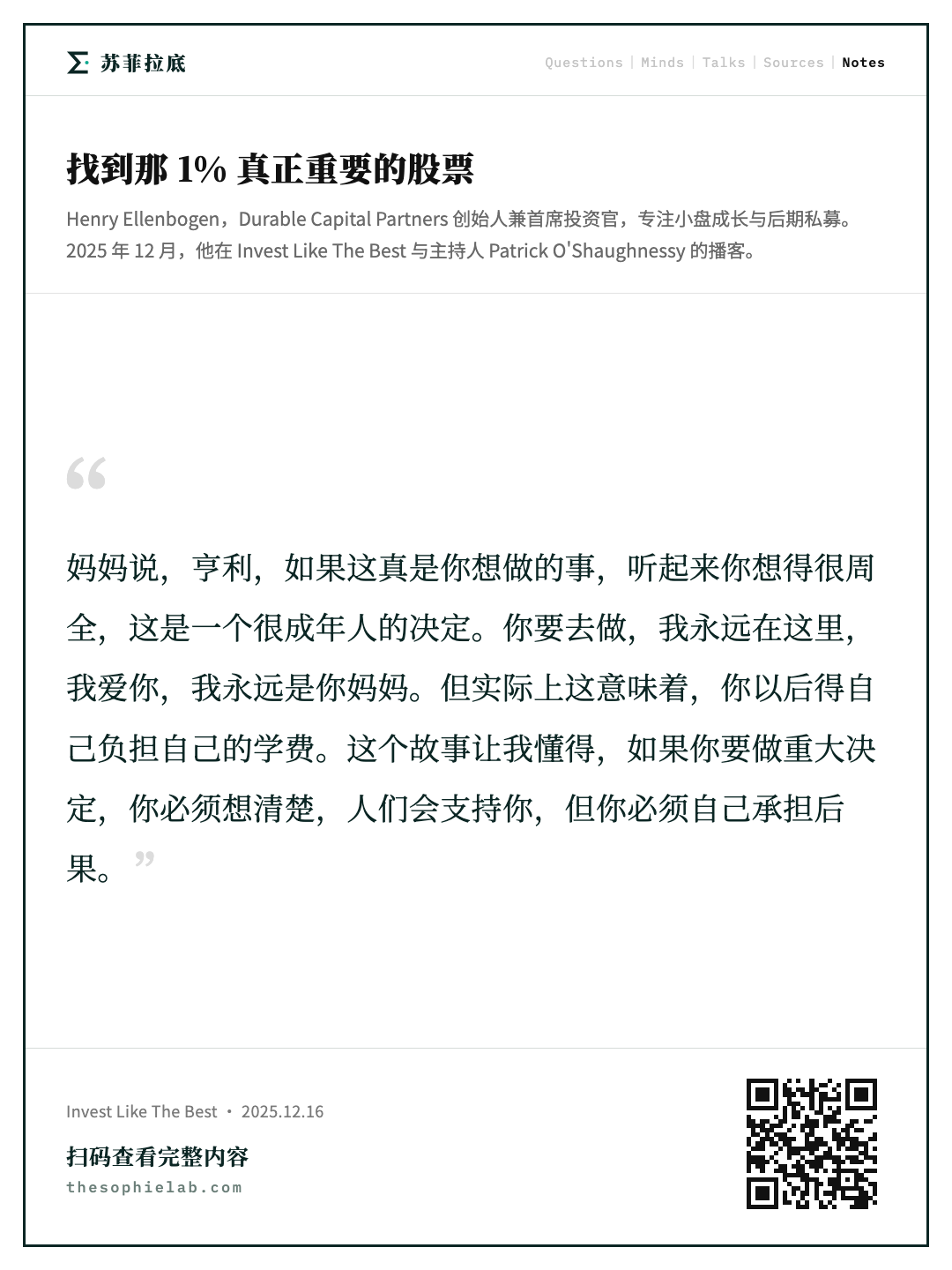
她并不信奉比尔·盖茨、或者后来扎克伯格那一套,那不是她的价值观。但她非常包容,非常慎重,她听我讲完,然后说:亨利,如果这真是你想做的事,听起来你想得很周全,这是一个很成年人的决定。你要去做,我永远在这里,我爱你,我永远是你妈妈,你有任何事都可以来找我。但实际上这意味着,你以后得自己负担自己的学费。因为你说你还会回去念书,我相信你说的话,但你现在得以一个成年人的身份去做这件事,因为你做的是一个真正成年人的决定。

这个故事我讲给我两个儿子听,因为我觉得它非常重要,也非常善意:它让我懂得,如果你要做重大决定,你必须想清楚,人们会支持你,但你必须自己承担后果。

主持人: 了不起的故事,很美,跟我通常得到的答案味道很不一样。我很喜欢。亨利,非常感谢你的时间。

艾伦博根: 谢谢你。
本期讲者
亨利·艾伦博根Durable Capital Partners 创始人兼首席投资官,专注小盘成长与后期私募,代表持仓包括 DoorDash、Affirm、Toast、多邻国与 Figma。此前在 T. Rowe Price 管理 New Horizons 基金,并主导过 Workday、Twitter、Netflix 等标的的投资。
Patrick O'Shaughnessy播客《Invest Like the Best》主持人,投资机构 Positive Sum 的创始人兼 CEO,长期以长访谈形式记录投资人与创业者的方法论。
章节 · 点击跳转视频
0:00 兼顾而非取舍的经营观 ▶ 正在看
0:39 从政治与生物学走进投资 ▶ 正在看
5:47 四十家复利公司与百分之一法则 ▶ 正在看
8:36 找已经做到过的公司与模式 ▶ 正在看
13:46 二次创业团队为何值得下注 ▶ 正在看
22:20 把机构本身按哲学重新搭建 ▶ 正在看
31:12 代理人问题与市场结构之变 ▶ 正在看
39:43 中国成本之后是 AI 的知识成本 ▶ 正在看
55:31 机器人与下一条成本曲线 ▶ 正在看
1:05:36 投资备忘录与三年回溯 ▶ 正在看
1:37:04 该不该上市:Netflix 转型的答案 ▶ 正在看
1:46:50 两种竞争的伟大与母亲的决定 ▶ 正在看
本期论点
本期回应
其他论点
3:14
值得投的是由像所有者一样思考的人经营、善待员工且资本配置得当的小公司
5:32
卖掉一只伟大公司的那个决定,在数学上会抹掉此前所有正确决定带来的全部收益
6:19
在任意滚动的十年里,约四千只美股中只有约四十只能以年均20%复利,真正的大赢家只占1% 观察
7:08
长期复利的伟大公司里,约八成是从小盘股起步的 观察
12:03
中等规模、既无全国性规模优势又无本地品质优势的公司,最容易被挤出市场份额
19:17
第二次创业的优势巨大:解决的是同一个问题,但从第一天起就有完全的清晰度
25:42
如果写不出一份「将来愿意以更高价格买更多」的备忘录,就不该买这只股票 做法
36:38
机构资金流约八到九成由一个月、三个月周期的机构驱动,这是财报季波动创危机以来新高的原因
47:07
最会用技术的公司会用它降成本、拉收入,多拿三成份额,再把优势投回去让对手追不上
59:42
机器人的单位成本年降幅接近15%到20%,远快于传统配送体系每年3%到5%的变化 观察
1:01:33
最好的长期护城河是实体不动产这类脏乱难建的资产,选址、资本开支与经营文化都无法速成
1:08:41
真正伟大的投资者在70岁时比50岁时更厉害
1:13:11
小公司不必实现GAAP盈利,但必须展示出正在朝盈利方向取得进展 做法
1:40:02
十年涨六倍的复利型公司平均都经历过股价腰斩,且往往发生在转型期而非大盘下跌时 观察
1:44:19
打造伟大公司必须同时兼顾增长、盈利能力和创新,而不是在三者之间做取舍
01兼顾而非取舍的经营观
0:00
To run a company well, you have to be in the and business, not the or business. You have to drive growth measured by market share in the short term. You have to drive innovation or allocate capital well to position yourself better for the future. And you have to drive profitability. But I believe the path to building a compounder or even a what some people would say a generational company through the public markets is proven. >> [music] [music]
要把一家公司经营好,你必须做“兼顾”的生意,而不是“取舍”的生意。你得推动增长,用短期的市场份额来衡量。你得推动创新,或者把资本配置好,为未来占据更有利的位置。你还得推动盈利能力。但我相信,通过公开市场打造一家复利型公司,甚至是有些人所说的划时代的伟大公司,这条路是被验证过的。>> [音乐][音乐]
便签引用
02从政治与生物学走进投资
0:39
>> I thought a interesting place to begin would be with you telling us the origin story of your investment philosophy. We're going to talk deep specifics about a lot of things in the world today so that people understand where you're coming from and how you came to your philosophy. I just love to begin there like the key ingredients of the recipe that's become how you attack and think about markets. Where did it come from? Where did it start? >> There's probably a couple places that come from so uh one was frankly my own personal background. So I came into investment not you know directly out of school. It's not like I went a finance pass. I went into politics. I didn't I wasn't an economics major. I was actually an organic chemistry and a history and technology major and you know I worked in politics for many years and as I started to like try to figure out what I wanted to do professionally and eventually I started to think more about investing and I get got involved in it.
>> 我想,一个有意思的开场,是请你讲讲你投资理念的起源故事。我们会深入聊很多当今世界的具体话题,所以要先让大家明白你的出发点,以及你是怎么形成自己这套理念的。我很想从这里开始,就像配方里的关键原料,它最终变成了你剖析和思考市场的方式。它是从哪儿来的?又是从哪儿开始的?>> 大概有几个源头吧。一个说白了是我自己的个人背景。我进入投资这行,并不是直接从学校出来的。我并不是走的金融那条路。我进的是政界。我当时也不是经济学专业。我其实是有机化学,还有历史与技术这两个专业,你知道,我在政界干了很多年。后来我开始试着搞清楚自己在职业上想做什么,慢慢地我开始更多地思考投资,然后就一头扎了进去。
便签引用
1:45
I started to think about um investing based on a lot of the same principles that I learned in science, right? In particularly biology that in order to have organizations or organisms that sustain over a long period of time and kind of persist much like human beings, they kind of have to be in balance with their ecosystem, right? So, you know, you see it today. I'm I'm a father of two boys and you see it today, right? When when when children develop, right, they they got to basically go through certain, you know, curves like child, adolescence, teenager, adult, and they have to basically be in balance. And if they are, they can kind of thrive and kind of do incredible things. And we as human beings, if we do that, like look at look at all the success humans have had, you know, relative to every other species. I started to think about why shouldn't investing follow the same rules we see in science right so why shouldn't investing mean that um there should be a healthy balance between companies that
我开始思考投资,用的是我在科学里学到的很多同样的原则,对吧?尤其是生物学——要让一个组织或者生物体在很长的时间里持续存在,像人类那样延续下去,它基本上必须和自己的生态系统保持平衡,对吧?你今天就能看到这一点。我是两个男孩的父亲,你今天就能看到,对吧?孩子在成长的时候,他们基本上得经历某些阶段,你知道的,像儿童期、青春前期、青少年期、成年期,他们基本上必须保持平衡。如果做到了,他们就能蓬勃发展,做出很了不起的事情。而我们人类,如果我们做到了这一点,看看人类取得的所有成就,相对于其他所有物种。我开始思考,投资为什么不该遵循我们在科学里看到的同样的规律呢?所以为什么投资不该意味着,公司在投资于它的客户、
便签引用
2:53
invest in their customers their employees their shareholders and actually support their greater communities and that that really kind of resonated with me and in many ways I was lucky too that I ended up at Euro price early in my career. And really the guy who became my mentor, Jack Leaport, this is what he believed, right? He believed you invested in small companies, run by people who thought like owners. They woke up every day to make themselves better. They were they gave their uh employees a good deal. They had good cultures. They allocated capital. Well, this is what created companies that could grow and sustain. And and that was how he had been so successful over the 25 years he did what he did. That resonated with me. You know what happened to me though was a a bit of good luck, right? Um I was asked um halfway through my career at Hero Price to basically go manage the New Horizon fund and I started reading all the shareholder letters. Um at that point it was turning 50. So I actually went into
员工、股东,同时真正支持更大范围的社区——这几者之间应该有一种健康的平衡?这一点真的让我很有共鸣。而且在很多方面我也很幸运,我职业生涯早期进了 T. Rowe Price。真正成为我导师的那个人,Jack Laporte,他信的就是这一套,对吧?他相信你要投资于小公司,投资于那些像所有者一样思考的人经营的公司。他们每天醒来都想让自己变得更好。他们给员工不错的待遇。他们有好的企业文化。他们资本配置得很好,这就是缔造那些能够成长并持续下去的公司的原因。而这正是他在那25年里做他所做的事情如此成功的原因。这让我产生了共鸣。不过我身上发生的事情算是一点好运气,对吧?嗯,我是在普信(T. Rowe Price)职业生涯过半的时候被邀请去管理新视野基金(New Horizons Fund)的,然后我开始阅读所有的股东信。嗯,那时候这只基金刚好要满50年了。所以我真的跑到档案室去,基本上把那些
便签引用
3:58
the archives and basically read the shareholder letters and tried to understand what was what drove the success of this fund over 50 years. At the time it was the oldest but also most people would say it was the most successful from a performance fund small cap growth fund in the country. And in doing it I started to realize wow it's really it was really only 20 stocks over 50 years that drove the performance. And then um coincidentally Jack or maybe purposely Jack decided to have a 50th you know birthday party for the fund and all the um fund managers came except for Troll Price himself who managed the fund but was passed away. And in doing that I um I talked to one of the managers who told the story of meeting Sam Walton on the IPO road show when Walmart first came public. And for those of you who don't know Walmart came as a super small company. It only had 50 stores and obviously Walmart, you know, became Walmart. And I went back and I looked and I was like, "Wow, this is definitely
股东信都读了一遍,试着去理解到底是什么驱动了这只基金50年来的成功。当时它是最古老的,而且很多人会说,从业绩上看它也是全美最成功的小盘成长基金。在这个过程中我开始意识到,哇,50年里真正驱动业绩的其实只有大概20只股票。然后嗯,碰巧——或者也许是有意的——杰克决定为这只基金办一个50周年的、你知道的,生日派对,所有的基金经理都来了,除了管理过这只基金的托马斯·罗·普莱斯本人,因为他已经过世了。在那个过程中我嗯,我跟其中一位基金经理聊了聊,他讲了一个故事,是关于沃尔玛刚上市时,他在IPO路演上见到山姆·沃尔顿的事。对于不了解的人来说,沃尔玛上市的时候是一家非常小的公司,只有50家门店,而显然,沃尔玛后来嘛,你知道的,成了沃尔玛。我回过头去看,我心想,哇,这绝对是
便签引用
5:04
one of the 20 stocks that mattered." But actually, unfortunately, it was sold. >> They sold it. >> And the math at the time was the retail fund, I think I was managing about $8 billion, which was the largest pool of small cap growth money in the country. And had the stake in Walmart not been sold, the stake in Walmart would have been greater than the sum total of everything that I was managing. And I'm not saying people had made bad decisions before, but actually the math was one bad decision or maybe you had to make that decision every day because the public markets are open every day actually wiped out all these other good decisions mathematically than had done.
那20只真正起作用的股票之一。但实际上,很遗憾,它被卖掉了。>> 他们把它卖了。>> 而当时算一笔账:这只零售基金,我记得我管理着大约80亿美元,是全美最大的一笔小盘成长资金池。而如果当初沃尔玛那部分持仓没有被卖掉,光是沃尔玛的持仓价值就会超过我当时管理的所有资产的总和。我不是说之前的人做了错误的决定,但从数学上讲,一个糟糕的决定——或者说你可能每天都得重新做这个决定,因为公开市场每天都开门——实际上就把之前所有那些正确的决定在数学上全部抹掉了。
便签引用
03四十家复利公司与百分之一法则
5:47
And so what that caused me to do was at that point start to really study the history of the US public market. You know, since then I think a lot of people talked about um the Benheimer study that came out of Chicago. >> Yeah. The 4% thing, >> right? And that's true. But at the time when I did this, no one had actually asked the simple question in the history of the US equity market, which is to me like representative of capitalism. If there's 4,000 average public stocks, how many of them truly are great? The philosophy we have today is predicated that over a rolling 10-year period, you have about 40 stocks that compound wealth at 20% a year or go up a little bit over 6x. So about 1% of the stock market is the are the validatorans.
所以这件事促使我从那时起开始真正研究美国公开市场的历史。你知道,从那以后我想很多人都谈到过嗯,芝加哥大学出来的那个本瑟宾德(Bessembinder)研究。>> 是的,那个4%的结论。>> 对吧?那确实是真的。但我当时做这件事的时候,还没有人真正问过一个简单的问题——在美国股票市场的历史上,在我看来它就是资本主义的代表。如果平均有4000只公开交易的股票,其中真正伟大的有多少只?我们今天的投资理念建立在这样一个基础上:在任意滚动的10年期间里,大约有40只股票能以每年20%的速度复利增长财富,或者说涨幅略微超过6倍。所以大约1%的股票市场,才是真正的大赢家。
便签引用
6:39
And that's what we want to go do. And so, you know, since then, right, you you like a lot of things in life, you get through looking at lateral examples, biology, and then you look at anecdotes, and then if you like to double click or you're you're maybe a geek on data, you start to really study it. And then obviously since then, we've tried to create an investment philosophy that maximizes the probability of investing in those 40 companies. And the other thing about 80% of those companies actually start their compounding journey as small cap companies. And so I always people always say Henry why do why why do you love small cap companies? I was like well I love them because I love the people side of the job but I also love them because 80% of them of these great companies actually start as small cavs.
而那正是我们想要去做的事。所以,你知道,从那以后,对吧,你就像人生中很多事情一样,你会通过去看一些横向的例子、生物学,然后你再去看一些个案轶事,接着如果你喜欢深挖,或者你可能是个数据迷,你就会开始真正去研究它。然后显然从那以后,我们就一直在尝试建立一套投资哲学,最大化投资到那 40 家公司的概率。另外还有一点,这些公司里大约 80% 实际上是以小盘股的身份开始它们的复利之旅的。所以我一直大家总是问,Henry,你为什么,为什么这么喜欢小盘公司?我说,嗯,我喜欢它们是因为我喜欢这份工作里跟人打交道的那一面,但我也喜欢它们,是因为这些伟大公司里有 80% 其实都是从小盘股起步的。
便签引用
7:33
That's what we're trying to maximize because we think that's what creates, you know, long-term wealth and economic growth. Basically, what we have done is basically purpose-built um an investment philosophy and just as importantly tried to purposely build an investment organization that can go do that. >> I want to ask about each your firm is literally named as an ode to this concept durable durable long-term compounding growth for the companies that you back. give us one more click of detail on after that original insight.
这就是我们想要最大化的东西,因为我们认为这才是真正创造长期财富和经济增长的东西。基本上,我们所做的就是专门打造了一套投资哲学,而同样重要的是,有意识地去搭建一个能够真正执行这套哲学的投资组织。>> 我想问问你们各自的情况,你的公司名字本身就是在致敬这个理念——你所支持的公司要有持久的、长期的复利增长。在最初那个洞察之后,能再给我们讲得更细一点吗?
便签引用
8:04
So you've identified that you want to be in this group of 40 companies as best you can possibly approximate. What are the common elements that you've discovered that fit your personal and your team style that are indicators that you might have one on your hands? And I know you do latestage private investing as well. So you're you're looking at these companies and when they're, you know, at or near their IPO. Um, we'll talk about going public later on and and why that's valuable, but what have you, what have you refined to be the most important signposts of a company that might be one of these 1% validictorians?
所以你已经确定了,你想尽可能接近地锁定这 40 家公司这个群体。那么你发现了哪些共同要素,是契合你个人和团队风格的、能预示你可能碰上了一家这样的公司的信号?我知道你们也做后期私募投资。所以你在看这些公司的时候,是在它们接近或者正在 IPO 的阶段。嗯,我们稍后会聊上市这件事,以及它为什么有价值,但你们提炼出来的、判断一家公司可能成为这 1% 优等生的最重要标志是什么?
便签引用
04找已经做到过的公司与模式
8:36
If you've been one before, you have a higher probability of being one again, [laughter] right? Which just sounds so simple, but is actually really interesting. We look at who who has actually done it. And if we don't really know the company and we haven't studied before, we'll go double click and go essentially study it, see if there's an opportunity, but if not, go do a case study on it, right? So, we want to go learn it. One of my partners, Anukate, basically um you know teaches a class at Colombia Business School, the value analysis program. And partially this is our way of kind of going back to school as an organization and partially it's our way of giving back to our community. But you know the class is based on this and the students literally do about six case studies a year but over time you kind of build out a library of them. You just start by basically studying the ones who've done it and then obviously trying to study the patterns of those who've done it.
如果你以前做到过一次,你再做到一次的概率就更高,[笑] 对吧?这听起来特别简单,但其实非常有意思。我们会去看谁真正做到过。如果我们不太了解这家公司,之前也没研究过,我们就会深入下去,基本上把它研究透,看看有没有机会,如果没有,就把它做成一个案例研究,对吧?所以我们想去学习它。我的一位合伙人,Anu Kate,基本上在哥伦比亚商学院教一门课,价值分析项目。某种程度上这是我们作为一个组织重新回到学校的方式,同时也是我们回馈社群的方式。但这门课就是基于这个理念,学生们一年大概要做六个案例研究,时间久了你就慢慢建起了一个案例库。你就是从研究那些做到过的公司开始,然后显然再去研究那些做到过的公司身上的模式。
便签引用
9:37
Right? So that that that's that's number one on how we do it. Second of all, they're diversified across the economy. So, you know, look, we're in a period of time where what's going on is and AI is so impactful. My view on the impact of this is probably no different than a lot of the other speakers you've had. I would say what I think about when I think about the power of AI and really studying it, I don't only think about the companies that are the first or second derivatives or maybe people were categorized as technology companies. I also think about the existing diversified companies outside of the technology space that could be huge companies here. So as an example when you go back and you look at the era of cloud and mobile you know for sure you wanted to go own Amazon in that period of time but actually if you look at retail once Walmart and Costco really understood what Amazon was doing but still had relative scale they leveraged their advantages and since they basically you know got on the same
对吧?所以这是我们做法里的第一点。第二点,它们在整个经济中是分散的。所以,你看,我们现在处在这样一个时期,AI 的影响力如此之大。我对这件事影响的看法可能跟你请过的很多其他嘉宾没什么不同。我想说,当我思考AI 的力量、真正去研究它的时候,我不只会想到那些第一或第二层衍生的公司,或者说那些被归类为科技公司的企业。我也会想到科技领域之外那些现有的、多元化的公司,它们在这里也可能成为巨头。举个例子,你回过头去看云和移动互联网的时代,那段时间你当然想持有亚马逊,但实际上如果你看零售业,一旦沃尔玛和 Costco真正理解了亚马逊在做什么,而它们仍然拥有相对的规模,它们就会利用自己的优势,从那以后,它们基本上
便签引用
10:49
curve 62% of all retail has gone to those three. So for sure one might have been better than the other, but actually all three were good. What What was the best Russell 2000 growth or for your investors who don't know benchmarks um small cap company over that 10-year period in the 2010s? Well, actually it was Domino's Pizza, >> which you know is is was a modest growth company. It didn't have didn't average 10% growth over the period of time. Why was Domino's so good? Well, it turned out, having gone back and studied Domino's from the beginning, but obviously owned the stock for some period of time, the pizza market in the United States, when Domino's basically started its run, you basically had a third of the market that was like local.
踏上了同一条曲线,全美零售的 62% 都流向了这三家。所以当然,其中一家可能比另一家更好,但实际上三家都不错。在 2010 年代那十年里,罗素 2000 成长指数——对于不了解基准指数的听众来说,就是小盘公司——表现最好的是哪一家?嗯,实际上是达美乐披萨,>> 你知道,那是一家增长相当温和的公司。它在那段时间里的平均增长都没到 10%。那为什么达美乐这么厉害?结果发现——我们回过头从头研究了达美乐,当然也持有过这只股票一段时间——美国的披萨市场,在达美乐开始发力的时候,基本上有三分之一的市场是本地化的。
便签引用
11:37
So, probably like a lot of um listeners, I have my favorite local pizza place and I like it because the pizza's great. And then the the other third we know, right? There's the Nationals, Domino's, Papa John's, Little Caesars, others. And then the middle third, there used to be in DC this place called Arman's that had had about 30 places and they had, you know, local or geographic scale, but they didn't have the scale of Domino's and they didn't have great pizza. And what happened was when Domino's started its run, well, first of all, it started by basically making the product a little bit better. But if you talk to Patrick Doyle, you know, who was CEO at the time and you really study it, what they started doing was if there's three value equations in pizza, it's quality, value, and convenience. And what they realized is if we really really invest in technology, we can make convenience a lot better.
所以,大概跟很多听众一样,我也有自己最喜欢的本地披萨店,我喜欢它是因为披萨做得很棒。然后另外三分之一我们都知道,对吧?就是那些全国性品牌:达美乐、棒约翰、小凯撒等等。然后中间那三分之一,华盛顿特区以前有一家叫 Arman's 的店,大概开了 30 家门店,你知道,它们有本地或者说地域上的规模,但没有达美乐那样的规模,披萨也做得不够好。而后来发生的事情是,当达美乐开始发力的时候,首先,它是从把产品做得好一点点开始的。但如果你去跟 Patrick Doyle 聊——他当时是 CEO——你真正去研究,你会发现他们开始做的是:如果说披萨有三个价值等式,那就是品质、性价比和便利性。他们意识到的是,如果我们真的在技术上大力投入,我们就能把便利性提升一大截。
便签引用
12:38
And so they really invested in their app, built a direct relationship with their customer very early on. and they could then target that customer more efficiently with couponing, what have you, drive scale through that box. And then when you basically do something well, right, you improve the product, probably was slightly above average, you really iterate on convenience and now you have a direct relationship with those customers. All of a sudden, actually the brand halo started getting a little bit better, right? Because you put all that together against a wonderful business model of a franchise business model which is you know ROI light you end up with a great stock. And so one of the things we think a lot about at durable is which of the companies that are in distribution trucking who are already good and maybe investing on a different curve have the ability to use AI to either substantially lower their their relative cost advantage versus their competition, gain more revenue scale, and then
所以他们真的重金投入自己的 App,很早就和消费者建立了直接联系。然后他们就能更高效地用优惠券之类的手段触达这些顾客,通过这个渠道做大规模。然后当你把一件事做好了,对吧,你改进了产品,大概做到了略高于平均水平,你在便利性上不断迭代,现在你又和这些顾客建立了直接联系。突然之间,其实品牌光环也开始变得好一些了,对吧?因为你把这一切叠加在一个极好的商业模式上——加盟模式,你知道,这是轻投入高回报的——最后你就有了一只很棒的股票。所以在 Durable,我们花很多心思思考的一件事是:在配送、货运这些行业里,哪些公司已经做得不错,也许正在另一条曲线上投入,有能力用 AI 来大幅降低自己相对于竞争对手的成本,获取更多的收入规模,然后把这些再投入进去,从而创造出某种永久性的优势,超越那些
便签引用
05二次创业团队为何值得下注
13:46
reinvest that in a way where you create something that's permanent over the companies that maybe get to this late if they ever get to it. And often those are the best stocks when you go study the markets because you're already in a in a physical world business where the technology advantage transitions into a physical mode advantage or distribution or scale advantage. That's one of the patterns we've ser we've observed. We call that you know the good to great thesis internally. >> And then the second way is people. If I think about um the investments we have today, we tend to be in business with um certain people we've known for 20 years now and maybe they're doing the same thing or maybe doing they're doing the next thing but we think these are the type of people who build great organizations and then obviously we have to meet new people too. So um one of our um largest holdings is Dualingo right? So we first um spent real time with the CEO Luis Vonwin um during COVID you know and you know during the COVID era um as the
可能很晚才做到——如果它们最终能做到的话——的公司。而当你去研究市场的时候,往往这些才是最好的股票,因为你本来就身处一个实体世界的业务里,技术优势会转化为实体护城河优势,或者渠道优势、规模优势。这是我们观察到的模式之一。我们内部把它叫做「从优秀到卓越」的论点。>> 然后第二条路径是人。如果我想想我们今天持有的这些投资,我们往往会跟某些认识了 20 年的人合作,也许他们还在做同样的事,也许他们在做下一件事,但我们认为这些人是那种能建立起伟大组织的人。当然我们也必须去认识新的人。嗯,我们最大的持仓之一是多邻国,对吧?我们最早跟 CEO Luis von Ahn 真正深入接触是在疫情期间,你知道,在新冠那个时期,随着市场重新开放,它们涨到了
便签引用
14:55
markets reopened you know they went to highs and the private markets were white hot you know in the zero interest rate environment and you know people were meeting people on Zoom and I remember meeting Louise you know with my colleague Julio I called Julio up and I was like what do you think and he was like well it's a super impressive business and they're they're leading their market, you know, they're [clears throat] they're on the right side of their consumer and the product's great. And I said, "Yeah." I said, "Louis reminds me of Toby from Shopify, >> right? The last time I spent time with someone that technologically strong, right, Louise had been um head of AI and ML at Carnegie Melon, but also has that much business clarity and is so crystal clear at communicating that he can make complex topics simple that even I can understand them was when I spent time with Toby when Shopify was private and I said, "We're going to basically clear our schedule and whenever Luis will spend time with us as in Pittsburgh,
高位,私募市场也火热无比,你知道,在零利率的环境下,大家都在Zoom 上见人。我记得我跟同事 Julio 一起见了 Luis,我给 Julio 打电话说,你怎么看,他说,这是一门非常厉害的生意,他们在自己的市场里处于领先,你知道,他们[清嗓子]站在消费者正确的那一边,产品也很棒。我说,是啊。我说,「Luis 让我想起了 Shopify 的 Toby,>> 对吧?上一次我跟技术实力这么强的人打交道——对吧,Luis 曾是卡内基梅隆大学 AI 和机器学习方向的负责人——但同时又有那么清晰的商业思维,表达得如此清楚,能把复杂的话题讲得连我都能听懂——那还是我在 Shopify 还是私人公司时跟 Toby 相处的时候。」我说,我们基本上要清空日程,只要 Luis 愿意在匹兹堡给我们时间,我们就去跟他待在一起。
便签引用
15:57
we're going to go spend time with him. And so I think the understanding of the patterns and having studied them, the understanding of what creates the environment, Sakori is famous for saying why now and what could lead that not only on the technology side but across the economy. But I think the clarity you have when you've spent time with you know at this point thousands of executives and you have seen the ones who've done it you want to do more with them and then you have seen the ones who are trying to do it but remind you so clearly of the ones who have done it. Can you say a little bit more about this notion of act two teams and management teams and why that is an interesting concept to you when you're thinking about the relationship between an act 2 team and a potentially very durable compounding company? This is something that is so dear to me because one, it's something we invest in, but two, it's actually at the heart of durable itself, right? And it's one of the reasons that I think durable is just
所以我认为,对这些模式的理解,以及研究过它们之后,对什么能创造出那种环境的理解——Sakori 有句名言是「为什么是现在」,以及什么能引领这一点,不只是在技术这一侧,而是在整个经济层面。但我认为,当你跟——到现在为止——成千上万的高管打过交道之后,你会有一种清晰的判断力:你见过那些真正做到过的人,你就想跟他们做更多的事;然后你也见过那些正在尝试做到、但让你如此清晰地联想到那些已经做到过的人。你能再多讲一点关于「二次创业团队」和管理团队的概念吗?当你在思考一个二次创业团队和一家可能非常持久的复利公司之间的关系时,为什么这个概念对你来说这么有意思?这件事对我来说特别重要,因为一,这是我们投资的方向,但二,这其实是 Durable 自身的核心,对吧?这也是我认为 Durable 跟其他投资机构
便签引用
16:59
different than other investment firms because we ourselves were an act 2 team, >> right? >> At my prior prior firm, I invested in uh workday when they were about at hund00 million of revenue scale. The two co-founders of workday Anneil Bushri and Dave Dufffield had basically been the people who had pioneered HR systems of record in the previous client server world. So they were they were literally the people who built peopleoft scale peopleoft and then a lot of history there but there was there was basically a very aggressive takeover by Oracle and so in many ways they had felt they had frankly completed their vision and so they came together but what really also lit up the vision was um cloud. Now this sounds so obvious today.
不一样的原因之一,因为我们自己就是一个二次创业团队,>> 对吧?>> 在我之前的上一家公司,我投资了 Workday,当时它的收入规模大概是一亿美元。Workday 的两位联合创始人 Aneel Bhusri 和 Dave Duffield,基本上就是在之前的客户端-服务器时代开创了 HR 记录系统的那批人。所以他们真的就是那些打造了 PeopleSoft、把 PeopleSoft 做大的人,后面还有很多故事,但基本上后来甲骨文发起了一次非常激进的收购,所以在很多方面他们感觉坦白说他们已经完成了自己的愿景,所以他们又聚到了一起,但真正点燃这个愿景的还有一个东西,就是云。这在今天听起来太理所当然了。
便签引用
17:55
>> Yeah. >> But you know in 2012 when we invested in workday [clears throat] I think a lot of the understanding of the cloud was not as obvious by investors and frankly I'm not sure I fully understood it either. But what I did understand was this was an act 2 team. There's a bunch of the stuff you have to build into the product that for lack of a better word is uh exception management. And if you don't understand that exception management because you have done it before, you're you're going to not properly be able to do it. And because this was an actu team, they actually knew how to leverage the modern technology but also build the system of record in the way it dealt with the edge cases at super scale. Obviously, they also understood what segment of the market to go after and then how to serve it.
>> 是的。>> 但你知道,2012年我们投资Workday的时候,我觉得当时很多投资人对云的理解并没有那么清晰,坦白说我也不确定自己当时是不是完全理解了。但我确实明白的一点是,这是一支“第二幕”的团队。产品里有一大堆东西你必须做进去,没有更好的说法,就是所谓的异常处理。如果你没有做过,就不会理解这种异常处理,那你就不可能把它做好。而正因为这是一支第二幕的团队,他们不但真的知道怎么利用现代技术,还知道在超大规模下如何构建一个能处理各种边缘情况的记录系统。当然,他们也清楚该切入市场的哪个细分,以及之后怎么服务这个细分。
便签引用
18:55
And I, you know, that to me is the image we have at durable when we look at an entrepreneur who has solved and successfully won a product product, you know, in a product area or an area of business, but now wants to go do it again. And there's you know huge advantage when you go do it again right you are essentially solving the same problem with you know total clarity at the beginning. The other thing is if you've been successful, it allows you to align all ports of the organization, the people, the organizational structure, the investors exactly how you want to go do it. You know, Max Levkin, right? So, a lot of people know Max obviously. He's one of the co-founders of PayPal and um know we we first invested in Max actually. It's one of my first private investments in my whole career. We invested in Sly, [laughter] right? And for many years until recently, we're now investors in a firm. I used to joke Max I'm I'm like the only investor in Max who hasn't made a lot of money, [laughter] right? But um with all jokes aside, Max
而对我来说,这正是我们在Durable看待创业者时脑中的那个画像:一个已经在某个产品领域、某个业务领域解决过问题并且成功胜出,但现在还想再做一次的人。你知道,再做一次的时候优势是巨大的,对吧?你本质上是在解决同一个问题,但一开始就有完全的清晰度。另一点是,如果你之前成功过,你就能把组织的各个部分都对齐——人、组织架构、投资人——完全按你想要的方式来做。你知道Max Levchin吧?很多人当然都认识Max。他是PayPal的联合创始人之一,我们其实最早就投过Max。那是我整个职业生涯里最早的几笔私募投资之一。我们投了Slide,对吧?而且很多年里直到最近,我们现在是Affirm的投资人。我以前常开玩笑说,我大概是唯一一个投了Max却没赚到大钱的投资人,对吧?不过玩笑归玩笑,在我看来Max代表了
便签引用
20:17
to me represents, you know, the best of a an act two entrepreneur, right? For those of you who don't have the benefit of knowing Max, first of all, he truly understands technology and he really understands how it can be used in very complex systems to solve problems. He can recruit exceptional people because he speaks their language. He's also a very good leader and people believe in him. He's also exceptionally resilient, right? And so Max is a perfect example of like an act two entrepreneur >> um that we had we had already been in business with. And when you look at the you know if if durable does anywhere from 5 to 10 new investments a year right with a lot of times it actually is with act two entrepreneurs >> and then if we're lucky and this happens because of compounding relationship for having done this for 20 years a lot of times it's with people that actually we were investors in their previous act and I think that's also great right because they know us and we know them. We know
第二幕创业者里最好的那一类。对于不认识Max的人来说,首先,他是真的懂技术,他非常清楚技术可以怎样被用在极其复杂的系统里去解决问题。他能招到顶尖的人,因为他说的是他们的语言。他也是个非常好的领导者,大家相信他。他还极其有韧性,对吧?所以Max就是那种第二幕创业者的完美例子,>> 而且是我们之前就已经合作过的。你看,Durable一年大概做5到10笔新投资,很多时候其实就是投第二幕创业者。>> 然后如果我们够幸运——这种事之所以会发生,是因为做了20年积累下来的复利式关系——很多时候这些人正是我们在他们上一幕时就投过的,我觉得这也很棒,因为他们了解我们,我们也了解他们。我们知道彼此的长处,也清楚
便签引用
21:32
each other's strengths and we know exactly how we can help each other and you know look this is this is like the maxes of the world and the anals of the world get to do business who with who they want but I think what it allows them to do is with a clean sheet of paper decide who we want they want to be in business with but obviously from our standpoint we we don't do a lot of new things and it allows us to basically really align our resources to support them. What changed the most in your own act two? So, as you structured durable itself to be have the same features of the companies that you're looking at investing in, last a long time, do really well, be tightly aligned, like all these things that you're referencing, what were the biggest learnings that you took with you and that you jettisoned coming from uh your first first act to your second act?
我们能怎么互相帮忙。说实话,像Max这样的人、像世界上那些顶尖创业者,他们想跟谁合作就能跟谁合作,但我觉得这让他们能够在一张白纸上决定自己想和谁做生意。当然从我们的角度看,我们做的新事情并不多,这让我们能够真正把资源集中起来去支持他们。那你自己的第二幕里变化最大的是什么?也就是说,当你把Durable本身设计成具备你所投资公司的那些特征——存续很久、做得很好、利益高度一致——所有你提到的这些,从第一幕到第二幕,你带走的最大收获是什么,又抛弃了什么?从你的第一幕到第二幕?
便签引用
06把机构本身按哲学重新搭建
22:20
>> Actually, I almost named Durable Act 2 Capital by the way. >> Oh, wow. >> It was such a prominent view >> in what I was trying to do. We talked a little bit about the investment philosophy. I mean, the investment philosophy is really simple. Let's invest in small companies that can compound over time and become, you know, large companies. And what's our advantage that we bring over other investors? I think we think we're great at people and understanding change. So basically everything we do at Durable because we're an investment driven firm is in support of that investment mission. Essentially with a clean sheet of paper said if we were going to go purpose build an investment vehicle to allow us to do this, how would it actually be structured? So you know essentially the percent of capital that we put in the public markets in the private markets is is aligned against that and then organizationally how are we going to go align against this right so the way we think about people is very purposeful we um really
>> 其实顺便说一句,我差点把Durable取名叫Act 2 Capital。>> 哦,哇。>> 这个理念在我想做的事情里占据了非常突出的位置。我们刚才聊了一点投资哲学。我是说,这个投资哲学其实很简单。就是投那些小公司,让它们随时间复利增长,变成大公司。那我们相对其他投资人的优势是什么?我们认为我们非常擅长看人和理解变化。所以基本上,因为我们是一家由投资驱动的机构,我们在Durable做的每一件事都是为了支撑这个投资使命。本质上就是拿一张白纸问自己:如果我们要专门去打造一个投资载体,让我们能做成这件事,它到底该怎么搭建?所以你知道,我们放在公开市场和私募市场的资金比例,就是按这个来对齐的;然后在组织层面上,我们又要怎么去对齐这件事。所以我们对“人”的思考是非常刻意的。我们真的相信,很少有人真的
便签引用
23:31
believe that very few people actually operate the way we do we think durable is just different my partner Katherine who when we first underwrote Figma in 2020 and also when we led the investment round in 21, you know, is the same person who basically was at the all hands meeting with Figma when Dylan announced to the um company that they were going public and is still the person that basically looks at the company when they um announced their public earnings and what have you. I mean, that's just different, right? So you have to have people who can, you know, work with companies that are valued at two billion and and they're are private and have 30 million of run rate revenue. And now, you know, Figma is a billion two companies, a public company, and can continue to work on that. And investment firms aren't structured that way. So if you want to have people who can do that, you got to develop them internally. Second of all, it's time allocation, right? So in general um at any point in time we
是按我们这种方式在运作的,我们认为Durable就是不一样。我的合伙人Katherine,2020年我们第一次尽调Figma时是她,2021年我们领投那一轮时也是她,她也是那个在Figma全员会上、Dylan向公司宣布要上市时在场的人,直到现在也还是那个在公司发布公开财报之类的时候盯着它的人。我是说,这就是不一样,对吧?所以你必须有这样的人:既能和一家估值20亿美元、还是私有、年化收入3000万美元的公司打交道;而现在Figma是一家市值一千二百亿的上市公司,她还能继续负责它。而投资机构通常不是这么搭的。所以如果你想拥有能做到这一点的人,你就得在内部培养他们。第二点是时间分配,对吧?总体来说,任何时点我们大概有10%到15%的资金在
便签引用
24:39
probably have 10 15% of our capital in the private markets and the rest in the public markets and then we have to be willing to spend the appropriate time on new ideas right so when we look at Dualingo and the right decision for Dualingo and maybe the right decision for us is is only to invest you know $20 million we don't look at it as a $20 million investment on a $15 billion vehicle And you know, we don't look at it as 10 basis points or 12 basis points. We actually look at it as our future compounder, right? Our investment memos are just fundamentally written different than other investment firms, right? So when when we look at an early stage growth company that is not already competitively advantaged, we write the memo that says if Duelingo does what we think it can do over the next three years, not only do we make a fair return for the risk of the company, but at that point in time, we would want to buy more at these higher prices. And if we can't write the memo that we want to buy more
私募市场,其余在公开市场,然后我们必须愿意在新想法上花足够的时间。所以当我们看Duolingo时,对Duolingo正确的决定、也可能对我们正确的决定,就是只投2000万美元,我们不会把它看成是一个150亿美元载体里的一笔2000万美元投资。你知道,我们不会把它当成10个基点或者12个基点。我们实际上把它看作我们未来的复利机器,对吧?我们的投资备忘录和其他投资机构写的根本就不一样。所以当我们看一家还没有形成竞争优势的早期成长型公司时,我们写的备忘录是:如果Duolingo在未来三年做到了我们认为它能做到的事,那我们不仅能就承担的公司风险拿到合理的回报,而且到那个时点,我们会愿意在更高的价格上买更多。如果我们写不出“愿意在更高价格上买更多”
便签引用
25:46
at higher prices, we can't buy the shares and our thesis can't be it gets bought. That has to be aligned. And then the investors we're in business with, we have incredible investors. We have to be transparent with them that in order to pursue this philosophy, we're going to have what people would say is monthly or quarterly volatility in our performance, right? when they look look at our performance. And that sounds so obvious, but you know, increasingly the market has changed where capital is short cycle, right?
这样的备忘录,我们就不能买它的股票,而且我们的投资逻辑不能是“它会被收购”。这必须是一致的。然后是和我们合作的投资人,我们有非常了不起的投资人。我们必须对他们透明:为了践行这套哲学,我们的业绩在别人看来会有按月或按季度的波动,对吧?当他们看我们的业绩时。这听起来太显而易见了,但你知道,市场越来越变了,资本变得非常短周期,对吧?
便签引用
26:20
Like so many people are on one month basically incentive models, not even yearly, one month. And so we have to have been very transparent with our investors and told them what we're trying to do, deliver on those promises, but deliver on those promises over the right period of time. I'm so intrigued by this uh like dollar cost averaging up concept that you're not willing to invest in the first place if you're not excited to if it goes well invest more at higher prices and is is that the right way to think about it that the way you build a position over time is um investing more as the price goes up to build your fullsome position.
比如太多人现在基本上是按一个月的激励模型在做,甚至不是按年,而是一个月。所以我们必须对我们的投资人非常透明,告诉他们我们想做什么,兑现那些承诺,但是在正确的时间周期里去兑现那些承诺。我对这个“向上摊平成本”的概念特别感兴趣——就是说,如果你不期待在事情顺利时以更高的价格买更多,你一开始就不会投。这样理解对吗?也就是你建立仓位的方式是随着价格上涨买入更多,从而建成完整的仓位。
便签引用
26:57
>> Yes and no. There's really two parts of our portfolio, right? So when we're looking at um what we call early stage growth companies and it could be Dualingo as a private company or it could be uh Dualingo after it goes public but it's still not competitively advantaged at that point in time it didn't have cash flow it didn't have PE ratios we still in our view view that as an early stage growth company where we're saying in the future could be competitively advantage the operating culture could be clearly estab established where we could look back and see the excellence of it and the adaptability of it and then we could look at the growth formula and really understand it and obviously along the way we've really believe this these are our kind of people who can scale organizations when we look at the 3 plus three we're underwriting it on a three-year basis in general not always if it does what we think it can we would then want to buy more as it in our lexicon gets bigger but also derisks and
>> 是,也不全是。我们的组合其实有两部分,对吧?当我们看所谓的早期成长型公司时——它可能是还没上市的Duolingo,也可能是上市之后但当时还没有形成竞争优势的Duolingo,那时它没有现金流,也没有市盈率——我们仍然把它看作一家早期成长型公司,我们在说:它未来可能形成竞争优势,运营文化可能被清晰地建立起来,让我们回头看时能看到它的卓越和适应力,然后我们能看清它的增长公式并真正理解它。当然一路上我们真的相信,这些人是我们认可的那种能把组织做大的人。我们看“三加三”,一般是按三年的周期来做判断,但也不总是这样。如果它做到了我们认为它能做到的,我们就会想买更多——用我们的说法,它变大了,同时风险也降低了,并且证明了自己是一门有竞争优势的生意,展现出更强的
便签引用
27:59
then proves to be a competitively advantaged business and th shows more resilience and and shows the ability to you know financially balance growth, profitability, innovation basically prove its ability in the case of Dualingo to become more of a just a power app teaching you know um speakers a foreign language for more self-improvement that it starts to do it for learning that basically increases educational ability to participate in the economic world. Right? they're obviously going to different subject with chess. So as you progress as a business more towards you know what we view as a competitively advantaged business that's for lack of a better word baked but still has growth. We underwrite those with the view that if it does that scenario we would want to buy more and if not we just can't get involved. Now, in my career, I've invested in over a hundred private companies and I think I've been involved in over 50 IPOs.
韧性,也展现出在财务上平衡增长、盈利和创新的能力。基本上,拿Duolingo来说,就是证明它不只是一个教人学外语、用于自我提升的强大应用,而是开始为“学习”本身服务,从而提升人们参与经济世界的教育能力,对吧?他们显然也在扩展到象棋这样的新科目。所以当一家公司越来越接近我们所认为的有竞争优势的生意——没有更好的说法,就是已经“成型”但仍有增长——我们做判断的视角是:如果它实现了那个情景,我们会想买更多;如果不会,我们就干脆不参与。在我的职业生涯里,我投过一百多家私营公司,我想我参与过50多次IPO。
便签引用
28:57
And then how many of them do we still own? Well, we probably still own more than anyone else in the markets, right? Like even if I look at durable, among our largest positions in the public markets are Door Dash, Affirm, Toast. We led those last private rounds, right? And so yeah, they persisted and we kind of bought more >> right at different points on the curve. I would say on a durable growth company because of market volatility and you know this kind of agency principle that I think about that's forcing people to have you know short cycle view of the public markets actually probably you're buying more of them when they're down right so um you know one of our favorite entrepreneurs is a guy named Jay Henik essentially CEO of Collars but he was also the founder of first service and we own both of them we're actually involved in a private investment with him. Also, in the case of Collers, I think it's a very misunderstood company. I think for sure the brand suggests it's a commercial real estate broker and
那其中我们现在还持有多少?我们持有的大概比市场上任何人都多,对吧?比如就看Durable,我们在公开市场上最大的几个仓位里有DoorDash、Affirm、Toast。这些公司最后一轮私募都是我们领投的,对吧?所以是的,它们一直留在组合里,而且我们在曲线的不同位置上又买了更多。我会说,对于那种“持久型成长公司”,由于市场波动,还有我一直在想的这种代理人问题,它迫使人们对公开市场抱有短周期的看法,实际上你很可能是在它们下跌时买更多。所以你知道,我们最喜欢的创业者之一是Jay Hennick,基本上是Colliers的CEO,但他也是FirstService的创始人,这两家我们都持有,我们还和他一起参与了一笔私募投资。另外,就Colliers而言,我觉得这是一家被严重误解的公司。我想品牌确实让人觉得它是一家商业地产经纪公司,而商业地产经纪在利率高的时候
便签引用
30:02
commercial real estate brokers don't do well in general when interest rates are high. But I think what's misunderstood about Jay and he's done this time and time again is because of his understanding of he was really a disciple and his mentor was Peter Ducker. his understanding of local incentives and his sharpness of capital allocation and the way he sets up the partnership model when he buys people. What people haven't realized is he's built a much an incredible business both in um asset management on the real estate side in Harrison Street and also he's building a terrific consulting platform. And so I think our insight there is starts with Jay but it starts with understanding actually the asset quality of callers is not the quality of a commercial real estate firm that's cyclical. It's actually a really good real estate asset manager and a emerging really strong consulting firm. And so last year when people were worried about, you know, the weak commercial real estate market and interest rates,
一般表现不好。但我觉得关于Jay被误解的地方——而且这件事他一次又一次地做到了——在于他的理解力,他真的是彼得·德鲁克的门徒,德鲁克是他的导师。他对本地激励机制的理解、他在资本配置上的敏锐,以及他收购团队时搭建合伙人模式的方式。人们没有意识到的是,他已经建立起一门非常了不起的生意,一边是在地产资产管理上的Harrison Street,另一边他还在打造一个极好的咨询平台。所以我觉得我们在这上面的洞察起点是Jay,但更在于真正理解Colliers的资产质量,并不是一家周期性商业地产公司的质量。它其实是一家非常优秀的房地产资产管理公司,外加一家正在崛起的很强的咨询公司。所以去年当大家在担心商业地产市场疲软和利率问题时,
便签引用
07代理人问题与市场结构之变
31:12
we bought a lot more of that company when it was it sold off based on short-term, you know, macro concerns. Yeah. So in that part of the portfolio probably we're buying more of the companies when they go down. >> You said something really important and interesting that I'd love to dive into which is the principal agent problem. And my question is [clears throat] a market structure question. We've talked before about some crazy percentage of just marginal volume that happens inside of the platforms the you know citadels millenniums balasnese 72s of the world.
我们在它因为短期宏观担忧而被抛售的时候大量加仓了这家公司。是的。所以在组合的那一部分,我们大概是在公司下跌时买更多。>> 你刚才说了一个非常重要也非常有意思的点,我很想深入聊聊,就是委托代理问题。我的问题是一个市场结构的问题。我们之前聊过一个夸张的比例,就是边际成交量中有多大一部分发生在那些平台内部——你知道的,Citadel、Millennium、Balyasny、Point72这些。
便签引用
31:43
How are how do you feel that? And I'm curious just for your thoughts on changes to market structure in general since you've been doing this. Uh how it contributes to that volatility, what opportunities it creates, what dangers it creates. >> It's something I thought a lot about. I started thinking a lot about it two years ago and in hindsight I probably started should have started thinking hard about it you know you know three years ago but but you know you don't you don't get everything right. There was a period in my career where the quant funds really started to do great. the two, you know, the two sigas of the world.
你怎么看这件事?我也很好奇你对你入行以来整个市场结构变化的看法。它如何加剧了这种波动,创造了什么机会,又带来了什么风险。>> 这是我想了很多的事情。我是两年前开始认真思考它的,事后看,我大概应该在三年前就开始认真思考,但你知道,人不可能什么都做对。我职业生涯中有一段时期,量化基金真的开始表现得非常好,就是那些Two Sigma之类的机构。
便签引用
32:17
And, you know, one of the things I've I we really stress at durable is humility, right? So, we never look at a problem and assume we're right and the other person's wrong. And we never assume we're good and the other person's bad. We actually look at things and assume the other person's really smart and what can we go learn from them. And so this this relates back to for you know I found it durable but I went and I studied the quants and what I concluded was the short-term alpha game is probably going to be won by the machines paired with the humans and at the time it was when for the first time computers paired with machines could beat the best human chess player. Mhm.
而你知道,我们在Durable特别强调的一点就是谦逊,对吧?所以我们从不看着一个问题就假定我们是对的、对方是错的。我们也从不假定我们是好的、对方是坏的。我们实际上是看着事情,假定对方非常聪明,然后思考我们能从他们身上学到什么。所以这又回到我创立Durable的时候,我去研究了量化,我得出的结论是:短期阿尔法这场游戏,最终大概率会被机器加上人的组合赢下来,而当时是当年电脑与机器联手,首次击败了最强的人类国际象棋选手。嗯。
便签引用
33:03
>> And this is obviously um when I went went to spend time, you know, with the principal at Two Sigma, I learned he was doing exceptionally well. But anyway, um I got to know him and we talked a lot and I realized actually there were very there were real limitations to what the quants could do. And so I started realizing if it's a repeat actor problem based on known data actually the quants are pretty good. So what does that mean at the time? Well, it means if if you're just a person who buys an industrial company because the PMI is down and historically when the PMI rerates and gets better and you make money, that's not going to work.
>> 显然,后来我去 Two Sigma 和那边的合伙人待了一段时间,我了解到他做得非常出色。不管怎么说,我跟他熟络起来,聊了很多,结果我发现其实有一些非常实实在在的局限,是量化投资做不到的。于是我开始意识到,如果这是一个基于已知数据的重复性博弈问题,那量化其实做得相当好。那这在当时意味着什么?意味着,如果你只是那种因为 PMI 下滑就去买工业股的人,指望历史上 PMI 重新被重新定价、转好时你就能赚钱,这一套是行不通的。
便签引用
33:47
>> The machines are just going to be better at that than you. But if you're like what we were at the time, people who are really good at understanding people and really good at understanding change, that was really advantaged. And I basically at my old firm, you know, I did a internal kind of teaching on man versus machine. And I said, as a result, what what the New Horizon fund is going to go do is we're going to go double down on these two things >> and we're going to get better at them. >> We're going to get more focused on what we do on the people's side of our business, both in the public and private market. And we're going to get more focused on where change impacts both our early stage growth companies and our durable growth companies and where we're basically investing where we're not advantaged versus these machines.
>> 机器在这件事上就是会比你做得更好。但如果你像我们当时那样,是一群特别擅长看懂人、特别擅长看懂变化的人,那你就非常有优势。我在老东家基本上做了一次内部分享,讲的就是「人对机器」。我说,因此,New Horizon 基金接下来要做的,就是在这两件事上加倍投入,>> 并且要把它们做得更好。>> 我们会更聚焦于业务中与人相关的那一块,无论是在公开市场还是私募市场。我们也会更聚焦于变化对我们的早期成长型公司和稳健成长型公司分别产生了什么影响,而在那些我们相对机器并不占优势的地方,我们基本上就不投了。
便签引用
34:45
Probably shouldn't have done it anyway, but we're going to stop doing it. [laughter] But we did it, of course, all within our investment philosophy. And that's basically what we've done at Durable as we've gone and studied Millennial and Citadels. First, let me be very clear, deeply respect those organizations. I think they're great at what they do. And I actually believe the people who work there are very talented and we start from the view that these are exceptionally talented people who are actually very good at what they do and are high quality people. But what we have said is what do they do and what is the limitation? And one of the limitations is if you work at a firm that deeply measures your risk every day and then if you have a bad period of time measured by a month, but certainly three months you get your capital cut back and you there's a good chance you get let go. It probably means you can't have a time horizon longer than your career horizon.
可能本来就不该做那些事,但总之我们不做了。[笑声] 但我们当然做到了,而且完全是在我们的投资理念框架之内。这基本上就是我们在 Durable 所做的事情,我们去研究了 Millennium 和 Citadel。首先我要说得非常清楚,我非常尊重这些机构。我认为他们在自己擅长的领域做得很棒。而且我确实相信在那里工作的人都非常有才华,我们的出发点就是:这些人是极其优秀的人才,他们真的很擅长自己做的事情,而且是高素质的人。但我们提出的问题是:他们在做什么,局限又在哪里?其中一个局限是,如果你所在的公司每天都在严密衡量你的风险,那么一旦你有一段时间表现不好——以一个月来衡量,当然三个月更是如此——你的资金就会被削减,而且你很有可能被辞退。这基本上意味着,你的时间跨度不可能长于你的职业生涯跨度。
便签引用
35:48
And what we also have noticed because we we not only understand things anecdotally, we also study them. If you look at the last public market earning season, which was companies reporting Q2 this past year, if you study earnings volatility, it was more volatile than any earning season since the financial crisis. Even though during the financial crisis as we all know the fundamental banking system in the US was under question which meant the economy and the markets as we know it really had a wide dispersion of opportunity and the markets tend to be a lot more volatile when they're making lows and making highs and yet this was the most volatile earning season. I think the reason for that is just basically the fact that you know we estimate somewhere between 80 and 90% of the institutional flow is basically driven either by the firms that have one month and three month agency or the quants that have to take these price signals into account and then their models are optimized for this. And so what we have
我们还注意到,因为我们不仅仅是凭轶事来理解事情,我们还会去研究它们。如果你看看上一个公开市场的财报季,也就是各家公司发布今年第二季度业绩的时候,如果你研究一下财报波动率,它比金融危机以来的任何一个财报季都更加剧烈。尽管在金融危机期间,正如我们都知道的,美国最根本的银行体系都受到了质疑,这意味着我们所认知的经济和市场确实存在非常大的机会分化,而且市场在创新低和创新高的时候往往波动大得多,然而这一次却是波动最剧烈的财报季。我认为原因其实很简单,就是我们估计机构资金流中大约有 80% 到 90% 基本上是由那些以一个月为周期的公司所驱动的,以及三个月周期的机构,或者那些必须把这些价格信号纳入考量、模型也都为此做了优化的量化机构。所以我们在
便签引用
36:56
said at durable is really simple. Let's go do less so we can do more. Because if we're going to accept volatility in stocks, we have to really understand the business and the people like we do at Collers such that if Collars is down because people are worried about commercial brokerage because of interest rates, actually the markets are probably right. >> They're probably right 90% of the time. But if we understand what's unique about that culture, how they allocate capital, we understand deeply how the quality of that Harrison Street is because we've studied it for 20 years and we we know the people who run it. Well, that's that's a reason why we're willing to basically lean into that stress. You know, the same thing when I look at our early stage growth portfolio, you know, we I spoke about Dualingo earlier. you know, they they came public, you know, the last time the capital markets were really open to companies, which was 2021.
Durable 提出的想法其实很简单:少做一些,才能做成更多。因为如果我们要接受股票的波动,就必须真正理解这门生意和这些人,就像我们对Colliers 那样——这样一来,如果 Colliers 因为大家担心利率、担心商业地产经纪业务而下跌,那市场其实很可能是对的。>> 市场大概九成的时候都是对的。但如果我们理解那种文化的独特之处、他们如何配置资本,我们深刻理解 Harrison Street 的质地如何——因为我们已经研究了 20 年,我们也认识经营它的那些人。那这就是我们愿意在那种压力下加仓的原因。同样,当我看我们的早期成长组合时,我前面提到过 Duolingo,他们上市的时候,正是资本市场上一次真正向公司敞开大门的时候,也就是 2021 年。
便签引用
37:58
And there's been a lot written about the 2021 IPO class, right? How they came public in a zero interest rate environment and how many so many of these companies actually were going to have a tough time getting to profitability and as as interest rates went up in 22, I think correctly, a lot of people said actually just throw them all out, right? the the average loss making company in 2022 in the Russell 2000 growth went down over 70%. >> You know, our view was makes sense. The market's probably right, but not all of these, you know, can't adapt. You know, not all these don't have businesses that are good enough to make real economic returns. Our view is not all of these companies didn't have the discipline and the organizational fortitude to transition and become successful companies in a in a world that actually, you know, required profitability based on the change of interest rates. And so, you know, Dolingo is an example of a company that we actually bought more of in 22. Um, and that was an example of an
关于 2021 年那一批 IPO 公司,外界写了很多,对吧?它们是在零利率环境下上市的,其中有多少公司其实很难走到盈利。随着 22 年利率上行,我认为很多人做出了正确的判断,他们说干脆把它们全都扔掉,对吧?2022 年罗素 2000 成长指数里,亏损公司的平均跌幅超过 70%。>> 我们的看法是,这说得通,市场很可能是对的,但并不是所有这些公司都无法适应。也不是所有这些公司的生意都差到赚不出真正的经济回报。我们的看法是,并不是所有这些公司都缺乏转型所需的纪律和组织韧性,都成不了成功的公司——在一个因为利率变化而真正要求盈利的世界里。所以,Duolingo 就是一个例子,我们在 22 年反而加仓了它。嗯,那就是一个
便签引用
39:08
early stage growth company that we dollar cost averaged down, right? And that I think we're advantaged in, right? Because if you're rulebased in what you do or you have a one or three month time frame, you just can't own Duelingo. You can't own more callers. You said people and change. We'll talk more about both, but starting with change. We're in the midst of probably the biggest technology shift or change maybe that any of us will ever see. You've invested and lived through several others, internet, mobile, cloud.
我们向下摊平成本的早期成长型公司的例子,对吧?我认为这正是我们的优势所在,因为如果你做事是纯规则驱动的,或者你的时间维度只有一个月、三个月,你根本没法持有 Duolingo,也没法加仓Colliers。你提到了人和变化。这两点我们都会再聊,先从变化说起。我们正处在可能是我们所有人这辈子会见到的最大的技术变革之中。你投资并亲历过其他好几次:互联网、移动、云。
便签引用
08中国成本之后是 AI 的知识成本
39:43
Can you put this one in frame of reference with the other ones that you've lived through and you mentioned so many times studying the past and studying history and seeing patterns? What patterns do you think might apply this time? And what patterns do you need to throw out and and re-underwrite from first principles here? >> So, I started writing about AI and our shareholder letters in 22. >> Yeah. you know and at the time I said having seen internet cloud and mobile this is going to be at least as powerful as internet and I said we're going to go approach this with humility go spend time with the people who are closest to it and constantly be learning and then I also said we're durable is not a thematic investing firm or a compounding investing firm so just because we think something's going to be big doesn't mean we're [laughter] going to go put our investment meetings aren't going to be AI is going to be big. Let's go buy AI companies. It's going to be let's really understand change and then understand
你能把这一次和你经历过的那几次做个对照吗?你多次提到研究过去、研究历史、从中发现规律。你觉得这次有哪些规律可能适用?又有哪些规律需要抛掉,从第一性原理重新去判断?>> 我从 22 年就开始在我们的股东信里写 AI 了。>> 是啊。你知道,当时我说,见识过互联网、云计算和移动互联网之后,我觉得这个东西的威力至少不亚于互联网。我还说,我们要以谦逊的态度去对待它,去花时间跟那些最贴近它的人相处,并且不断学习。然后我也说过,我们 Durable 不是一家主题投资公司,也不是一家复利式投资公司。所以,就算我们认为某个东西会很大,也不意味着我们就会去把钱投进去——我们的投资会议不会是「AI 会很大,那我们去买 AI 公司吧」。而是「我们要真正理解这种变化,然后理解我们投的那些公司会怎样从中受益」,
便签引用
40:41
how it the companies that we invest in are going to basically benefit from it or become better by it or at least not get disrupted. I'll lay out in a second think it probably is more impactful uh than the internet was. It's not only going to affect obviously every technology company which you know you see in the markets but it's also going to impact in this case I think almost every company that you know needs white collar employee and IP employee to drive their work. So let let me start with the second one first because I think less people have talked about that one. So, as a student of business, most people would know that by the end of the 2010s, everyone knew that if you were a product based business, you needed to understand your China cost, right? I mean, it was kind of on the cover of every business magazine and then every um popular magazine in the tens. And basically all that meant was if you in in a global supply chain, if there was a part of the world with huge scale and resources like China in
或者因此变得更好,或者至少不被颠覆。我待会儿会展开讲,我觉得它的影响力大概比互联网还要大。它显然不只会影响每一家科技公司——这个你在市场上已经看到了——它还会影响,我认为在这种情况下,几乎每一家需要白领员工、需要知识型员工来推动业务的公司。那我先从第二点讲起,因为我觉得谈这一点的人比较少。作为一个研究商业的人,大多数人都知道,到了 2010 年代末,所有人都清楚:如果你是一家做产品的公司,你必须搞懂你的「中国成本」,对吧?我是说,这几乎登上了每一本商业杂志的封面,那十年里每一本大众杂志也都在讲。而这基本上意味着,如果你身处全球供应链里,如果世界上有那么一个地方——比如远东的中国——拥有巨大的规模和资源,能把产品
便签引用
41:54
the Far East that could make product substantially cheaper when you landed it, you know, at your factory or to the consumer, you had to understand it and if you didn't leverage it yourself, you were going to basically go go out of business. That was the first derivative. The second derivative is actually there's a lot of businesses that are spread businesses. You know, you look at a lot of distribution businesses as an example. If you distribute, you talk about a great business like HVAC, the industry tends to put a spread on the raw material. If your HBAC unit basically inflates at 3 to 5%, that's good. And if your HVAC, you know, deflates at 3 to 5%, that's bad. And so if you were a spread business on top of it, you know, that was problematic.
做得便宜得多,等货到了你的工厂或者到了消费者手上,你就必须搞懂这件事。而如果你自己不去利用它,你基本上就要倒闭了。这是第一层导数。第二层导数其实是,有很多生意是赚价差的。你看很多分销类的生意就是个例子。如果你做分销,比如说暖通空调(HVAC)这种很好的生意,这个行业往往是在原材料上加一个价差。如果你的 HVAC 设备的价格每年涨 3% 到 5%,那是好事。而如果你的 HVAC每年跌 3% 到 5%,那就糟了。所以如果你是在它之上赚价差的生意,那就很成问题。
便签引用
42:42
Every company that was product based or derivative product based had to understand China cost. And I think the same thing applies to AI. But I think it's not product based this time. It's you know IP based. So let's go let's go back to Max as an example. So, a firm most people would think about and correctly so as, you know, basically a fintech company that basically empowers people to get access to credit in a safe way and actually pretty compliant, friendly way with no tricks. And he's doing even more than that now. But at the end of the day, because he is regulated, he has a lot of legal cost in the company, right? He's got hundreds of thousands of contracts with merchants. He's got to monitor his partners on how they basically communicate credit. And that just requires a lot of people. And if you talk to him and he's talked publicly about this, he's got great belief that a firm can grow at the rates it's growing at for a reasonable period of time. In addition, they can do it without adding
每一家做产品的、或者跟产品沾边的公司,都必须搞懂中国成本。我觉得同样的道理也适用于 AI。但我认为这一次不是产品层面的,而是知识产权(IP)层面的。那我们回到 Max 这个例子。大多数人想到这家公司,会觉得——而且这么想是对的——它基本上是一家金融科技公司,让人们能够以安全的方式获得信贷,而且是相当合规、对用户友好、没有套路的方式。他现在做的事情甚至不止这些。但归根结底,因为他受监管,公司里有大量的法务成本,对吧?他跟商户签了几十万份合同。他还得监督他的合作伙伴是怎么传达信贷信息的。这就需要很多人手。如果你跟他聊,他也公开讲过这件事,他非常相信 Affirm 能在相当长一段时间里保持现在的增长速度。而且,与此同时,他们可以在不增加人手的情况下做到这一点。原因显然是,他会去精简掉
便签引用
43:52
headcount. And the reason for that obviously he's going to go lean out a lot of processes that were not possible to go do before AI. I'll tell you a really funny story with that. So he calls, you know, I I I learned so much from him. So I I talked to him one day after he reports earnings and he explains to me, Henry, this what you know, you're always asking me about how I'm using AI to become more efficient and you know, I feel like I was late to the curb, but I finally figured it out. And so he says, you know, I have this team that goes around the company and understands processes and we start from not a cost standpoint, but we start from a leaning out standpoint. And I think like I'm making real progress there. And that's why I'm able to make this public pronouncement.
很多在 AI 出现之前根本不可能优化的流程。我给你讲一个关于这个的特别有意思的故事。他……电话会议,你知道,我我我从他身上学到了太多。所以有一天他公布财报之后我跟他聊,他跟我解释说,Henry,是这样的,你知道,你总是问我怎么用 AI 来提高效率,你知道,我觉得我起步晚了,但我终于想明白了。于是他说,你知道,我有一个团队走遍公司各个部门,去理解各种流程,而我们的出发点不是成本,而是精简。我觉得我在这方面取得了实实在在的进展。这也是为什么我能公开这么宣布。
便签引用
44:37
And he's like, isn't this great? >> [laughter] >> I say to Max, why don't you come to DC and let's go see Mitch Rails >> because Danaher, you know who who he and his brother started and he's chairman of has been doing this for 40 years. You know, it's called DBS. And they basically brought Kaizen, you know, back to the US. And they basically started, they're obviously more of a healthcare company now, by going into factories, putting processes up in whiteboards, studying how they could lean them out, basically leaning them out and coming back in a month later to make sure that because change is hard that the change is held. And then they basically built a whole b business system which has basically you know not only helped build Danaher but you know there's basically over a dozen Fortune 500 CEOs in the United States who basically started their jobs at Danaher including the guy who just have turned around GE. So since you're so excited about this let's actually go to the you know essentially
他还说,这不是很棒吗?>> [笑声] >> 我对 Max 说,你干嘛不来华盛顿,我们去见见 Mitch Rails >> 因为 Danaher,你知道他和他兄弟一手创办的,他现在是董事长,这件事他已经做了 40 年。你知道,这叫 DBS。他们基本上是把 Kaizen(改善)带回了美国。他们最开始,当然现在他们更像是一家医疗健康公司了,做法是走进工厂,把流程画在白板上,研究怎么把流程精简,然后真的去精简,一个月后再回来复查,确保因为改变很难——确保这个改变被保持住了。然后他们基本上打造了一整套商业体系,这不仅帮助成就了 Danaher,而且你知道,美国有十几位财富 500 强的 CEO职业生涯都是从 Danaher 起步的,包括刚刚让 GE 扭亏为盈的那位。所以既然你对这件事这么兴奋,那我们干脆就去见见美国这位教父级人物的
便签引用
45:45
the >> the teacher of the godfather in the United States. So the reason I say that is this is just so profound it's even hard to get your head around right that we've been able you know Mitch would say for 40 years because at China we've been able to really lean out product based businesses working capital but in many ways I feel like we're just getting started on processes that are done by humans. The second example that I'll talk about and I'm talk trying to talk about things that haven't been talked about as much on this show. When I first really understood what was going on the internet, I ran a global TMT fund and my largest investment was Amazon, right?
老师吧。>> 我之所以这么说,是因为这件事太深刻了,甚至让人难以完全理解——就是我们已经能够,你知道,Mitch 会说这 40 年来,在中国我们已经能够真正精简以产品为基础的业务、精简营运资金,但在很多方面,我觉得对于由人来完成的流程,我们才刚刚开始。我要讲的第二个例子——我尽量讲一些在这个节目里还没怎么被谈到的东西。当我第一次真正理解互联网上正在发生什么的时候,我管理着一只全球 TMT 基金,而我最大的一笔投资是 Amazon,对吧?
便签引用
46:36
And we invested in that one. It was like a $10 billion company. So I used to go to Seattle twice a year. So interestingly things you remember because it was far from Baltimore. not no one would come with me and it was a small company and people thought I understood it and I used to go you know have lunch twice a year with Jeff Bezos right at the time I worked for the firm that was his largest outside shareholder and it was obviously my research position for the firm and what I learned so many things from those meetings but one of the things I learned is the very best businesses that leverage technology leverage it in a way where they use it to lower costs and drive revenue that result in them gaining 30% or more incremental market share in their end market. And then they take that unity economic advantage and they reinvest it in something that is persistent.
我们投了那家公司。当时它市值大概 100 亿美元。所以我那时每年去西雅图两次。有意思的是你会记住这些细节,因为那儿离巴尔的摩很远。没有人愿意跟我一起去,而且那是家小公司,大家觉得我懂这个,所以我每年会去两次和 Jeff Bezos 共进午餐,对吧,当时我供职的那家公司是他最大的外部股东,而这显然是我在公司负责研究的标的。我从那些会面中学到了太多东西,但其中一点是:最优秀的那些利用技术的企业,利用技术的方式是用它来降低成本、拉动收入,最终让它们在自己的终端市场里多拿下 30% 甚至更多的增量市场份额。然后它们把这种单位经济上的优势,再投入到某种可持续的东西里去。
便签引用
47:39
even if their competition were to wake up tomorrow and do the exact same thing with people just as good as they are. >> And to me, you know, that's one of the definitions of durable of a competitive advantage is if your competitor basically does a competitive mode attack doing the exact same thing with people as well or >> doesn't matter too far ahead. And as we all have come to understand with Amazon, they took that 3 to 5% cost advantage of of getting that box to you and their ability to put more than one box, one item in the box, and they use that economic advantage to then go build fulfillment centers that are physical to basically reinvest into capital and infrastructure that allow them to go down that 3 to 5% cost curve for 20 years. And then, you know, as I said earlier in the show, they woke up And the only people who could play their game when eventually everyone realized what they were doing were the people who still had the scale and the customer relationships and the trust of
哪怕它们的竞争对手明天就醒悟过来,用一批同样优秀的人做完全一样的事情,也追不上。>> 对我来说,你知道,这就是可持续竞争优势的定义之一——如果你的竞争对手基本上,护城河攻击对人也是一样的做法,还是说……算了,别扯太远。正如我们都已经了解到的,亚马逊拿到了把包裹送到你手里那 3% 到 5% 的成本优势,再加上他们能把不止一件商品装进同一个箱子的能力,然后他们用这种经济优势去建实体的履约中心,本质上是把钱再投回资本和基础设施里,让他们能沿着那条 3% 到 5% 的成本曲线走 20 年。然后,你知道,就像我在节目前面说的,他们醒过来了。等到大家终于反应过来他们在干什么的时候,唯一还能陪他们玩这个游戏的,就是那些仍然有规模、有客户关系、有客户信任的公司——
便签引用
48:42
Walmart and Costco. And then eventually when they figured it out, all three of them were great. Now the problem is the rest, you know, the rest of retail was not was not so good. >> And so that's what we think about here. So, if I if I say it back to you, we're about we've seen through Mitch and others like him this 40-year benefit of Kaizen brought to physical product world and that AI represents a sort of kickoff of Kaizen to human work world and that that is going to have lots of stories like the Amazon story you just said where someone gets on one of these curves early and they can't be caught.
沃尔玛和好市多。等到这两家也想明白了,这三家都做得很好。问题在于其余的,你知道,零售业剩下的那些就没那么好过了。所以这就是我们在这里思考的东西。那我把你说的复述一遍:我们通过米奇这样的人,看到了 40 年来精益改善(Kaizen)给实体产品世界带来的好处,而 AI 代表着把 Kaizen 引入人类工作世界的开端,这将会出现很多像你刚说的亚马逊那样的故事——有人早早踏上了这些曲线之一,然后就再也追不上了。
便签引用
49:21
And so, you're trying, I'm sure, define who those people might be. So, we're trying to do two things, Patrick. We're trying to find the people who that might be. And then we're trying to make sure we don't get >> mistakenly own [laughter] a company that based on last generation competitive risk was a great company and and correctly we thought was competitively advantaged and had a good operating culture and was led by highquality people who thought like owners, but because discontinuous change changed the world, they weren't able to adapt. Now, ideally what we go do is we go find those already advantaged companies and then they leverage this to go from good to great. If you think about all the people that have navigated change as CEOs, the best that you've worked with, I'm an investor with Dave Duffield in his latest company and so he comes to mind because now he's tackling AI. Um, and the guy is incredible. If you think about whether it's Mitch or Jeff or Dave or you know people like this that you've
所以我相信你在试图找出这些人可能是谁。派翠克,我们其实想做两件事。我们想找到那些可能成为这种人的公司。同时我们也想确保自己不会……误持有一家公司——按上一代的竞争风险来看,它是一家很好的公司,我们也确实判断对了它有竞争优势、有良好的经营文化、由像主人翁一样思考的高素质的人领导,但因为非连续性的变化改变了整个世界,他们没能适应。理想情况下,我们要做的是去找那些本来就有优势的公司,然后他们利用这波变化从优秀走向卓越。如果你回想所有作为 CEO 驾驭过变革的人,你合作过的最优秀的那些——我是戴夫·达菲尔德最新那家公司的投资人,所以我第一个想到他,因为他现在正在攻 AI。嗯,这人真的了不起。不管是米奇、杰夫还是戴夫,或者你见过操盘的这类人,哪些方法最让你印象深刻——他们
便签引用
50:22
seen operate, what methods have you impressed you the most of how they themselves adapt first their own mentality and then their teams to these fast changing circumstances? And this is a question for everyone out there that's running businesses that is facing this same change that's a risk and an opportunity at the same time. >> Yeah. So let's let's go pick on Luis, right? We talked about Luis earlier, right? So, Dualingo has a lot of opportunity with AI and a lot of risk, right? And the stock depending on the day reflects it, right? Like when Open AI demos how you can use Open AI to basically do translation, a lot of times the stock goes down. or when Apple shows you how AirPods can be used to in the physical world live translation the stock goes down and actually I don't think the marker's wrong those now it's probably wrong the magnitude but I think what the market is saying is >> risk >> there's a risk here so that that's probably in our portfolio one of the higher risk names but what do
自己先调整心态、然后带着团队去适应这种飞速变化的环境?这也是问给外面所有正在经营企业、正面对同样变化的人的问题——这变化既是风险也是机会。是的。那我们就拿路易斯来说吧?我们前面聊过路易斯,对吧?多邻国在 AI 上既有很多机会,也有很多风险,对吧?股价每天的表现也反映了这一点,对吧?比如 OpenAI 演示怎么用 OpenAI 来做翻译,很多时候股价就跌。或者苹果展示 AirPods 怎么在现实世界里做实时翻译,股价也跌。其实我不认为市场判断错了——现在可能错的是幅度,但我觉得市场想表达的是……风险……这里有风险。所以那大概是我们组合里风险偏高的标的之一。但我们
便签引用
51:32
we look for in you know in Louise or Max or or Dave, you know, Duffield. I think the first thing we look about is um a business that already is operating well, right? Because if you're not operating well when you have to deal with change, you're you're not going to be able to like do two things at once, right? You can't do a turnaround and do well. I think the second thing we would say is a business that already was winning in its you know first end market right so you know all the definitions we would have about winning right you know substantially gaining market share driving real economic profit that allows it to reinvest in this next scurve and also the other thing we really care about is people. We we really stress resiliency at durable. It's one of the reasons we like so much investing in act two managers, right? We can go study their resiliency, right? So when you're when you're an investor in Max and you saw how resilient he was in slide and now you understand how he's got to be resilient
在路易斯、麦克斯或者戴夫·达菲尔德身上看什么呢?我觉得我们首先看的是,嗯,这家公司本身已经经营得很好,对吧?因为如果你在要应对变化的时候本身就没经营好,你根本没办法同时做两件事,对吧?你不可能一边扭亏一边还做得好。我觉得第二点是,这家公司在它的第一个终端市场里本来就在赢,对吧?就是我们对「赢」的那些定义,你知道的,大幅抢占市场份额、创造真实的经济利润,从而让它有能力把钱再投到下一条 S 曲线上。另外我们真正在意的还有人。我们在 Durable特别强调韧性。这也是我们这么喜欢投「第二段人生」的管理者的原因之一,对吧?我们可以去研究他们的韧性。所以当你是麦克斯的投资人,见过他在 Slide 时期有多能扛,现在你就明白他必须同样有韧性地去落地 AI,在竞争对手之前把成本压下来、把收入做上去。你会想,我们见过他
便签引用
52:58
to implement AI to lean out his cost and drive his revenue before his competition does. you're like, we've seen him, you know, under stress before, right? And then, um, you know, I think you're looking for people who have a perspective, can execute, but also are humble, right? Because we at durable write down our views on AI every six months and we updated them. And as we've gone more into this period of change, probably we're less wrong, our our perspective is more informed, you would say, than it was, you know, as we change it every 6 months. But we're we're learning, right? And this is we have the benefit of having a job that allows us spend our time reading and thinking and talking to smart people. So even if these are really talented people, most likely they don't have as much time to go do it as we we do. And we have to be very humble in our approach. So they have to be a have a perspective figure out how to go do this not be paralyzed but they also have to be humble and constantly learning. And
在压力下是什么样的,对吧?然后,嗯,我觉得你要找的是那种有自己观点、能执行,同时又谦逊的人,对吧?因为我们在 Durable 每六个月会把我们对 AI 的看法写下来,然后更新它。随着我们越来越深入这个变化期,我们大概是错得少一些了,可以说我们的视角比之前更有依据了,我们每 6 个月更新一次。但我们也在学习,对吧?我们的优势在于,我们的工作允许我们把时间花在阅读、思考和跟聪明人交流上。所以即便这些人非常有才华,他们大概率也没有我们这么多时间去做这件事。所以我们必须非常谦逊。他们得有自己的观点,得想清楚该怎么做,不能被吓瘫,但同时也得谦逊、持续学习。还有,我觉得实际操作上,作为投资人我们最后要考虑的
便签引用
54:03
you know the last thing I think practically we have to think about as investors is backs to the memo like if you have a high-risisk situation which we would all agree Duelingo is and you know a firm is and you're really close to that part of the change then you need to be compensated for the risk. What we would tell people on Duelingo is yeah like because of this risk the discount rate has gone up but probably commensurate the opportunity has also gone up. we can articulate it, right? He's Luis has uh talked about being 20x faster and generating content and we've already seen it. You know, he's publicly said he developed chess, which is doing incredibly well and you know, my kids really love that product. I mean, they're addicted to it. And he de first it was two people for six months and then he added another four people and he developed a product in nine months.
是回到那份备忘录:如果你面对的是一个高风险局面——我们都会同意多邻国就是,Affirm 也是——而你又离这场变化的核心非常近,那你就得为这个风险拿到相应的补偿。我们会跟大家说,关于多邻国,是的,因为有这个风险,折现率上去了,但大概相应地,机会也变大了。而且我们能把它讲清楚,对吧?路易斯谈过内容生成速度快了 20 倍,我们也已经看到了。你知道,他公开说过他们做了 Chess(国际象棋),表现好得不得了,我家孩子非常喜欢那个产品。我是说,他们上瘾了。一开始是两个人做了六个月,然后又加了四个人,九个月就做出了一个产品。
便签引用
54:59
That's the best product he's ever done. And if you ever talk to him, how long would it have taken in the past? He's like, I don't know. I probably need four to six x as many people and it would have taken them four times as long. And so you could say a startup could do that, but he's doing it. He's doing it on his platform. That product is well over a million um DAUs and is growing at astronomical rates and it's a great underserved end market. It could be a huge business. Yes, the discount rate has gone up, but this company was purpose-built for AI.
那是他做过最好的产品。如果你问他,放在过去要花多久?他会说,我也不知道,可能需要四到六倍的人手,而且时间还得是现在的四倍。你可能会说创业公司也能做到这种事,但他做到了,而且是在他自己的平台上做到的。那个产品的日活远超一百万,还在以惊人的速度增长,而且是个很好的、尚未被满足的终端市场。它可能成为一门大生意。没错,折现率是上去了,但这家公司天生就是为 AI 而生的。
便签引用
09机器人与下一条成本曲线
55:31
You actually have a person who, you know, studied AI and taught it at Carnegi Melon and has an organization of a players who are agile in his company and is humble and constantly learning a proof point on how he it's making him faster than other people. it's driving real value and obviously that means the probability of it going from a point solution or couple products to the suite is higher >> and so you know that's what we look for. Can I stack a couple of the things that you've said that interest me the most into like a big even bigger question? If I take physical kaizen and digital kaizen just to, you know, shrink the concepts down. If I were to have those that were to have a kid, it might be robotics. And and so I'm really curious how you approach the potential with an unknown timeline that we might get like a second wave of, you know, the physical labor economy is way bigger than the the digital labor economy that we may get a second application of Kaizen um over the next 40 years like the first one we saw
你面对的是一个研究过 AI、在卡内基梅隆教过 AI 的人,他的组织里全是 A 级选手、非常敏捷,而且他谦逊、持续学习,并且有实证说明这让他比别人更快。这在创造真实的价值,而这显然意味着它从单点方案或几个产品走向整套产品组合的概率更高。所以你知道,这就是我们要找的东西。我能不能把你刚说的几个我最感兴趣的点叠在一起,变成一个更大的问题?如果我把实体世界的 Kaizen 和数字世界的 Kaizen 这么概括一下,如果让这两者生个孩子,那可能就是机器人。所以我特别好奇,你怎么看待这种时间表未知的可能性——我们可能会迎来第二波浪潮。你知道,体力劳动经济体量远大于数字劳动经济,所以我们未来 40 年可能会看到 Kaizen 的第二次大规模应用,就像我们从米奇和他公司身上看到的第一次那样。你
便签引用
56:35
from Mitch Mitching Company. How do you think how do you think about that opportunity and potential change? It's something we have really thought hard about and here here's what I what what we have tried to do right so first of all we have tried to get smart by by meeting with the entrepreneurs and talking to the companies that we're involved in that we know that are leading this area just to try to learn and we only recently did this with robot otic. So if we started writing down our conclusions and then being humble that it could change every you know 6 months in AI in what you would say is more data businesses or digital businesses.
怎么看这个机会和潜在的变化?这件事我们真的认真想过,我们尝试做的是这样的:首先,我们试着通过跟创业者见面、跟我们投资的、我们知道在这个领域领先的公司交流来把自己变聪明,就是去学习。而我们直到最近才在机器人领域这么做。所以我们开始把结论写下来,同时保持谦逊——它可能每 6 个月就会变,就像我们在 AI 里对那些更偏数据型或数字型业务所做的那样。
便签引用
57:28
We only started doing this literally in the last month where we documented it for the first time. And so I'm gonna I'm gonna do something that I don't love to do, which I know our views here are very early and probably deeply wrong, but I'll give you all our initial conclusions, right? Which is in certain use cases, it's pretty clear that already the cost is lower than the um equivalent analog process or basically >> physical labor process. >> Physical label process. And yet, as we all know, this is the earliest and worst robotics is going to be. And because machines are iterating with machines and it's being powered by general purpose models, not by specific purpose models, this is riding, you know, a curve that is definitely geometric. And so back to this mental model of Amazon that drives so much of what we think about durability at durable is what Amazon was able to do is ride a cost curve where they were deflating the cost of sending a box out at 3 to 5% a year for 20 straight years. And the
我们真的是上个月才第一次把这些东西记录下来。所以我要做一件我不太喜欢做的事——我知道我们在这方面的看法还非常早期,可能错得很离谱,但我还是把我们的初步结论都说给你听。那就是:在某些使用场景下,已经很明显,成本已经低于对应的模拟流程,或者说……体力劳动流程。体力劳动流程。而我们都知道,现在是机器人最早期、最差的时候。而且因为机器是在用机器迭代,驱动它的是通用模型,而不是专用模型,它正在一条毫无疑问是几何级增长的曲线上。所以回到亚马逊这个心智模型——它在 Durable很大程度上主导了我们对持久性的思考——亚马逊做到的事情,是骑上了一条成本曲线,把寄出一个包裹的成本以每年 3% 到 5% 的速度连降了整整 20 年。而那些没有用上正确的
便签引用
58:43
people who did not leverage the right distribution infrastructure, the right investment in robotics at that time, you know, they bought KA, the right ML models when they came into play about how to basically plan inventory and deal with suppliers actually were probably at a curve that probably inflated at 3 to 5% but at best were flat. And that differential in a low margin business, you know, you compound it over five years. Honestly, that's all you need to know. And that's I think what we're starting to get our heads around at durable, which is if in many areas robotics is at par. Now there's a lot of data that says it's lower cost in certain cases and the use cases are about to go up and the cost on the existing use cases probably don't go down at 3 to 5% at this point in the curve because of the scale brought in the human capital brought in the IP bot on and the fact that you're going to be able to use these general purpose LLMs to power it.
配送基础设施、没有在当时对机器人做正确投资的人——你知道,亚马逊收购了 Kiva——也没有用上后来出现的、用来规划库存和对接供应商的正确机器学习模型,他们所在的曲线大概是每年涨 3% 到 5%,最好也就是持平。在一门低毛利的生意里,这个差距,你知道,复利五年。老实说,你只需要知道这一点就够了。我觉得这就是我们在 Durable 开始想明白的事情,那就是:如果在很多领域机器人已经打平了——现在有大量数据说在某些情况下它成本更低——而且使用场景即将增多,而现有使用场景的成本,在曲线的这个位置上,恐怕不会只以 3% 到 5% 的速度下降,因为投入的规模、投入的人力资本、投入的知识产权,再加上你将能用这些通用大模型来驱动它,
便签引用
59:51
It probably goes down at more like 15 to 20%. But maybe it's more law and it goes down even faster. Well, then we wake up in 5 years and the people who put themselves on one cost curve, if they compete against the people who put them onelves on the other cost curve, those could be power law businesses. What we have thought really hard about is who's going to go benefit from this curve where their competition even if they woke up tomorrow even if they put the same amount of money into this problem even if they could hire the same quality of people which is unlikely because they have not invested in the distribution infrastructure or the technological infrastructure to compete on this curve.
它的下降速度大概更接近 15% 到 20%。但也许它更像摩尔定律,下降得还要快。那么等我们 5 年后醒来,那些把自己放在一条成本曲线上的人,如果跟把自己放在另一条曲线上的人竞争,那这些可能就是幂律级别的生意。我们真正下功夫思考的是:谁会从这条曲线中受益,而他们的竞争对手即便明天就醒悟、即便往这个问题里砸同样多的钱、即便能招到同样水准的人——而这本身就不太可能——因为他们没有在配送基础设施或技术基础设施上投过资,去在这条曲线上竞争。
便签引用
1:00:40
you know, at minimum is probably two to three years behind and every day, you know, that they they wait, they're probably getting further behind. It's apparent to everyone at Durable why our understanding of change has been great for our investments in Dualingo and a firm and you know, Shopify. But actually I think it's about to be really advantaged our understanding of people and change as we go invest in the other 70% of the economy. >> If you think about all the businesses you backed do you have a favorite [snorts] kind of competitive advantage of source of competitive advantage? So much about your whole process is does it have it already? Is it on its trajectory to get there? There's different kinds you know scale network effects etc. Are there favorites that you find yourself returning to as the best sources of long-term competitive advantage?
所以他们至少落后两到三年,而且他们每多等一天,大概就落后得更多。在 Durable,所有人都清楚,我们对变化的理解为什么对我们投多邻国、Affirm 还有 Shopify 这些标的帮助那么大。但我其实觉得,当我们去投经济体中剩下那 70% 的时候,我们对人和变化的理解将会变成真正的优势。如果你回想你支持过的所有生意,你有没有偏爱的某一类竞争优势,或者说竞争优势的来源?你整个流程很大一部分是在问:它现在已经有了吗?它是不是走在形成优势的路上?竞争优势有不同的类型,规模、网络效应等等。有没有哪几种是你发现自己会反复回到的、最好的长期竞争优势来源?
便签引用
1:01:33
>> I love physical real estate, >> right? You know, I I love Amazon or, you know, we're investors in Carvana. I love their reconditioning centers because at the end of the day, >> you can't spin those things up. >> You can't spin those things up. They're these things that are super messy, right? You got to acquire the land. You got to put in the right place. You got to build the right network. Then you got to go stand it up with the right capex and the right systems. And then you have to have the right operating culture. And this is really really hard, right? And if if you put your your real estate in the wrong place, then your your cost of transport's more expensive. And this culture you got to go build there is super hard.
我特别喜欢实体不动产。对吧?你知道,我很喜欢亚马逊,或者说我们是 Carvana 的投资人,我很喜欢他们的翻新中心,因为说到底……你没法说建就建起来。你没法说建就建起来。这些东西特别麻烦、特别脏乱,对吧?你得拿地,得选对位置,得搭好网络。然后你还得用正确的资本开支和正确的系统把它立起来。接着你还得有正确的经营文化。这真的非常非常难,对吧?如果你的地段选错了,那你的运输成本就更高。而你要在那里建起来的这种文化,难上加难。
便签引用
1:02:21
So I I I deeply love you know these physical world modes that exist right and really our portfolio has a lot of them right in one way or the other and that's why when you and I talked about robotics my mind went to distribution [laughter] right it's like where can robotics basically take already advantaged businesses and make them more advantaged right but >> there's others and then you know the other thing I I really believe is is these soft things that are incredibly hard, right? So I I I I think about the example of Dan or her so much, right? Because what Mitch and Steve have done is just stunningly hard to imagine that for nearly 40 years you've compounded wealth at 20%.
所以我真的非常喜欢现实世界里存在的这类护城河,对吧?我们的投资组合里其实有很多这样的公司,以这样那样的形式存在。这也是为什么当我们聊到机器人时,我第一时间想到的是配送,对吧?就是说,机器人在哪里能让本来就有优势的生意变得更有优势?不过还有别的类型。另外我真正相信的一点是,还有那些极其难做到的软性因素,对吧?所以我……我常常想到 Dan 或者她的例子,对吧?因为 Mitch 和 Steve 做到的事情,简直难以想象——近 40 年里,你以 20% 的复合回报率累积财富。
便签引用
1:03:22
in something that didn't have deep physical modes or didn't have data network effects like uh metamite or Google have or or the people who believe deeply in open AI and I I see the potential there just like they do have right so those those data network effects are amazing right where you know the but the ones where you're really sharp on human capital. You're really sharp on what talent really means. Not not the sticker of talent, right? You're really sharp on your operating excellence, the culture of it, the constant improvement of it, the system behind it like Kazan, and then you allocate capital against your businesses to really hold them accountable.
而且是在一个没有深厚实体护城河、也没有数据网络效应的领域,不像 Metamite 或 Google 那样,或者那些坚信OpenAI 的人——我也和他们一样看到了那里的潜力,对吧?所以那些数据网络效应确实很惊人,对吧?但真正考验你的是对人力资本的敏锐判断。你对什么才是真正的人才有非常敏锐的判断。不是那种贴着'人才'标签的东西,对吧?你对运营卓越有非常敏锐的判断,它的文化,它的持续改进,它背后的体系,比如 Kaizen(改善),然后你把资本配置到你的各项业务上,真正让它们承担责任。
便签引用
1:04:20
I think it's amazing you know in our portfolio even though if I were to walk you through the businesses that First Service is in which you know Jay Hen's chairman of and what Collier has where he's CEO of he's you know largest shareholder both none of them actually have these super sharp competitive advantage but yet if you really have studied Jay and you truly understand his human capital culture and the and how he basically attracts and hold people accountable and his ability to basically decentralize incentives. So people are aligned in businesses everything from you know residential management of condos to you know basically roofing and restoration and then how they allocate capital. How they sell things that don't have a path to be great and how they buy businesses but they do it in a way where it actually aligns incentives and constant with them. It's just super impressive.
我觉得这很了不起。就说我们的投资组合吧,如果我带你逐一看看 First Service 所在的那些业务——Jay Hennick 是它的董事长——以及 Colliers 的业务,他是那里的 CEO,也是最大的股东——这两家公司其实都没有那种超级锋利的竞争优势。但如果你真的研究过 Jay,真正理解他的人力资本文化,理解他如何吸引人才并让他们承担责任,以及他把激励机制彻底去中心化的能力。所以在各种业务里,人的利益都是一致的——从公寓的物业管理,到屋顶施工和灾后修复。再看他们怎么配置资本,怎么把那些没有希望做到卓越的业务卖掉,怎么收购新的业务——而且他们做这些事的方式,真的能让激励一致、持续与他们保持一致。这实在是太令人印象深刻了。
便签引用
10投资备忘录与三年回溯
1:05:36
The other thing is if we're going to invest in small companies, those companies by the time they form them tend to be pretty large. And so we we have to basically be pretty sharp at really understanding other competitive advantages. >> You mentioned memo a few times, the memos you write internally. What have you learned makes for a fantastic structure of an investment memo? What works for you? We're a writing culture >> because at the end of the day, human beings are innately human. And when we are involved in something, it's very hard to have that executive distance that you need to do to really hold yourself accountable to what you thought and actually hold the companies accountable to what you would like them to do.
另一件事是,如果我们要投资小公司,那些公司等到它们成型的时候往往已经相当大了。所以我们基本上必须非常敏锐地去理解其他的竞争优势。你提到了好几次 memo,就是你们内部写的投资备忘录。你认为一份出色的投资备忘录,结构上应该是怎样的?什么方式对你们最有效?我们是一种写作文化。因为说到底,人天生就是人。当我们身处其中时,很难保持那种必要的、置身事外的距离感,而那种距离感恰恰是你真正对自己当初的判断负责、并真正督促这些公司去做到你希望他们做的事所必需的。
便签引用
1:06:27
especially since we really do know the people we invest in and we invest in really highquality interesting people and we're deeply rooting for everyone to succeed. So, you know, unlike a venture capital firm or private investing firm, we have to be able to understand when things aren't working out so we can sell them. But just as importantly, if we're going to go invest in something that has real risk by Dualingo, we have to understand when things like Dolingo are really inflecting and maybe we see and other people don't do so, we can go buy more of it. So, we got to be able to do both. And so when we write an investment memo, it's in service of our investment philosophy, making sure we've done the work and we can clearly articulate why is a comp company competitively advantage or will it be?
尤其是因为我们真的很了解我们投资的这些人,我们投的都是非常优秀、非常有意思的人,我们打心底里希望每个人都成功。所以,跟风险投资机构或私募投资机构不同,我们必须有能力判断出什么时候事情不对劲,这样我们才能卖出。但同样重要的是,如果我们要去投资一个有真实风险的标的,比如 Duolingo,我们必须能判断出 Duolingo 这样的公司什么时候真正出现拐点——也许我们看到了而别人没看到,那我们就可以去买更多。所以我们必须两件事都能做到。因此当我们写投资备忘录时,它是服务于我们的投资理念的,确保我们把功课做足了,并且能清楚地阐述:这家公司为什么具备竞争优势,或者它将来会具备?
便签引用
1:07:20
What what would it have to do? Why is this operating culture excellent or why does it have the seeds of an excellent operating culture? And why does this leader think like an owner where they can basically they make the business better which we define as gaining market share through cycle and we think that they can allocate internal and external capital such to both drive more durable growth and also make their asset base more valuable over time. And that's that's our investment memo. But then just as importantly through both modeling but clearly spelling out what we're tracking we have to then be able to when we do our quarterly what we what are really our operating reviews at durable where we go through the entire portfolio with the entire investment team on every single investment. We have to look how actually the companies are doing against what we thought they would do. And then every single investment at durable if we own for three years, we actually do a three-year look back on what we
它需要做到什么?这个运营文化为什么是卓越的,或者为什么它具备孕育卓越运营文化的种子?还有,这位领导者为什么会像所有者一样思考——也就是他们能把生意做得更好,我们对'更好'的定义是穿越周期地获取市场份额;而且我们认为他们能配置内部和外部资本,既驱动更持久的增长,也让他们的资产基础随时间变得更有价值。这就是我们的投资备忘录。但同样重要的是,通过建模、也通过清楚地写明我们要跟踪什么指标,我们才能在做季度回顾——在 Durable 我们真正称之为运营复盘——的时候,和整个投资团队一起把整个组合过一遍,每一笔投资都过。我们必须看看这些公司的实际表现,对比我们当初认为它们会做到什么。然后在 Durable,每一笔持有满三年的投资,我们都会做一次三年回溯,看看我们当初
便签引用
1:08:31
underwrote and what it did. And actually that one, you know, it's like so many things in your career you like wish you would have known earlier, right? Like, you know, the great thing about investing and the great investors to me actually are better at 70 than they are at 50. And hopefully, you know, I'm in my 50s. I'm better than I was when I did this at 30. And you just learn, right? You you you understand patterns better. Hopefully, you remain humble so you don't actually get, you know, get too stuck in your ways. You surround yourself with smarter, better people both internally, externally. But one of them is you develop better processes.
是怎么判断的、实际又发生了什么。说实话这件事——就像职业生涯里很多事情一样,你会希望自己早点知道,对吧?比如说,投资这行有意思的地方在于,在我看来真正伟大的投资者在 70 岁时比在 50 岁时更厉害。我现在 50 多岁,希望我比 30 岁做这件事的时候更强。你就是会不断学习,对吧?你会更好地理解各种模式。希望你能保持谦逊,这样你就不会太固执于自己的老一套。你会让自己身边围绕着更聪明、更优秀的人,无论是内部还是外部。但其中一点就是,你会打磨出更好的流程。
便签引用
1:09:11
And one of the process that we only started like two years ago was we always did quarterly KPIs or operating reviews but we actually didn't go back and look at an investment that we own for three years and just say and when we do them they're so simple. We say three years ago we thought they would do X and now they did Y. Now, of course, the conversation is where was it different and why? But actually, the preparation for that meeting is at least on the written side so simple. It's two slides. But then of course, what that what we all we're all human and even though we try to hold each other accountable, if you get together every quarter and something deviates a little bit, you tend to excuse it. Of course, if it deviates a little bit for 12 straight quarters, actually, it's kind of staring you in the face. And you know, that's that's why we're such a big believer in investment memos.
有一个流程我们其实两年前才开始做:我们一直都做季度 KPI 或者运营复盘,但我们以前并没有回头去看一笔持有三年的投资,去说——而且我们做这件事的时候,它其实特别简单。我们说:三年前我们认为他们会做到 X,现在他们做到了 Y。当然,接下来的讨论是:差异在哪里,为什么会有差异?但其实这个会议的准备工作,至少在书面部分,简单得不得了。就两页幻灯片。但当然,问题在于我们都是人,即便我们努力互相督促,如果你每个季度碰一次头,某个指标偏离了一点点,你往往会找理由原谅它。当然,如果它连续 12 个季度都偏离一点点,那其实就已经明晃晃摆在你面前了。这也就是为什么我们如此笃信投资备忘录。
便签引用
1:10:10
>> I think in 2022, you went and did like a tour talking to CEOs about the state of the market and and you know, just operating principles and things like this. if you were I'm curious to hear you reflect on that tour, but even more interested to hear if you were to do a tour of every CEO in the portfolio today and maybe you're doing this actively what the message would be today that's different than the message was in 2022. I felt in 2022 we truly had expertise to add to the conversation and that was at the highest level and by the way I don't say we versus us we all every CEO I talked to every investor I talked to and even Durable who is a fundamental investment firm that really values stuff on cash flow never felt money was going to be free forever actually had made simplifying assumptions based on almost a decade of free money.
我记得在 2022 年,你做过一次巡回,去和各家 CEO 聊市场状况,还有运营原则之类的事。我很好奇你对那次巡回的回顾,但我更想知道,如果你今天去和投资组合里的每一位 CEO 做一次这样的巡回——也许你正在这么做——今天的信息会是什么,和 2022 年那时候有什么不同。我觉得在 2022 年,我们确实有真正的专业见解可以贡献给那场对话,而且是在最高层面上。顺带一提,我说'我们'不是要把我们和别人分开——我们所有人,我聊过的每一位 CEO、每一位投资人,甚至包括 Durable 自己——我们是一家基本面投资机构,真正看重用现金流来估值——虽然从来没觉得钱会永远免费,但实际上都基于近十年的免费资金环境做了一些简化假设。
便签引用
1:11:11
Basically, if anyone who has been taught how to value companies understands at the end of the day all companies have to be valued on free cash flow and organic growth. And you know at the time we got to a point where 30% of all treasury bills in the world actually had negative yields and relative to inflation actually you were being paid to borrow which basically means it was logical for venture capitalists to value companies and not care about profitability at all. It was logical for companies in the public markets to buy lowquality businesses that could never own own their cost of capital but use cheap debt to go do it. It was logical why if you sat on companies boards you really wouldn't ask hard questions about trading off growth, profitability, and innovation because you didn't have to.
说到底,任何学过如何给公司估值的人都明白,所有公司最终都必须用自由现金流和有机增长来估值。而你知道,当时我们走到了一个地步:所有国债中有 30%国债在全球范围内实际上是负收益率,扣除通胀后,你借钱反而是有人付钱给你这基本上意味着,风险投资人给公司估值时完全不考虑盈利能力,是合乎逻辑的。对公开市场上的公司来说,去收购那些永远无法覆盖资本成本的低质量业务、但用廉价债务来做这件事,也是合乎逻辑的。所以如果你坐在公司董事会里,你根本不会去追问那些关于增长、盈利能力和创新之间取舍的难题,因为你不需要问。
便签引用
1:12:10
And if you go back to the conversation we had when we eventually studied compounding, we went back and we ran that study in periods. We looked at the public markets and we asked ourselves a simple question in the world of positive real rates which is the entire history of the US equity market except for that short period of time, right? >> Which I don't know if we ever will see again. Yeah, >> there on average about 40 compounders and during the period of time of free money there was 120. So it was three times easier to do it. And then we asked ourselves a simple question, what patterns only exist when money's free?
如果回到我们之前那次关于复利增长的对话,我们后来做了那项研究,把它分成几个时期来看。我们研究了公开市场,然后问了自己一个简单的问题:在正实际利率的世界里——也就是除了那一小段时间之外,美国股市的整个历史,对吧?>> 那种情况我不知道我们还会不会再见到。是啊,>> 在那种环境下平均大约有40家复利型公司,而在免费资金的那段时期有120家。所以做到这一点的难度只有原来的三分之一。然后我们问了自己一个简单的问题:哪些模式只在钱免费的时候才成立?
便签引用
1:12:52
So not surprisingly, everyone would imagine the pattern of driving growth and profitability is perennial and actually works regardless whether money is free or not. The other thing that was really interesting, which was really important to us and gave us confidence to go buy more of the Dualingos in 22 when we did this work, is that if you're a small company, you don't have to be gap profitable and you don't even have to have an ROI that is above your cost of capital, but you do have to show progress in your your path towards it. And then what doesn't work? Well, a company that doesn't earn financial returns and is showing no progress. And the other one that doesn't work, which we don't do do a lot of, was go buy a lowquality return business at a high price, but leverage, you know, really cheap debt. So I felt strongly because we had seen cycles before and because we truly had expertise and also because we're really are companies that we invest in long-term partner like we want to invest in companies that are
所以不出意料,大家都能想到,同时驱动增长和盈利能力这个模式是长期有效的,无论钱是不是免费的,它都管用。另一件特别有意思的事——这对我们非常重要,也让我们有信心在22年做完这项研究后去加仓多邻国(Duolingo)——就是如果你是一家小公司,你不需要做到GAAP盈利,甚至也不需要投资回报率高于你的资本成本,但你必须展示出你正在朝那个方向取得进展。那什么行不通呢?一家赚不到财务回报、而且看不到任何进展的公司。另一个行不通的——这也是我们很少做的——就是用高价去买一个低质量回报的业务,然后靠着非常廉价的债务撬杠杆。所以我当时很有信心,因为我们以前经历过周期,因为我们确实有这方面的专业能力,也因为我们真的是那种长期陪伴被投公司的伙伴——我们希望投资那些
便签引用
1:14:03
private and still own them when they're public. We want to help them as transition. I thought we had expertise and a perspective that many people had not gotten before. And so, you know, to reference what this meant was we had these conversations with a number of our companies that were in the situation. And so we we had some version of this conversation with Aman at Toast, with Luis at Dualingo, you know, with Max at a firm. And all of them were a little different, right? So like as an example with Louise, you know, I had dinner with him and the CFO and his CFO is very talented just like he is and I just presented them the data and I, you know, kind of knowing them, I knew they would have a lot of questions on it and they asked a lot of good questions and, you know, the the other thing I said to them is look, Luis, when when we invest in your company, you know, one of the things I always ask people is, I know, you know, we'll articulate what we're looking for in you, but what are you looking for in us?
还在私有阶段的公司,等它们上市后仍然持有。我们希望帮它们完成过渡。我觉得我们有很多人此前没有过的专业能力和视角。所以,具体来说,这意味着我们跟不少处在这种处境的被投公司进行了这些对话。我们跟Toast的Aman、多邻国的Luis、还有Affirm的Max,都进行过类似的对话。每一次都稍有不同,对吧?比如说跟Luis,我跟他和CFO一起吃了顿饭,他的CFO跟他一样非常有才华,我就把数据摆给他们看,而且我了解他们,我知道他们会有很多问题,他们也确实问了很多好问题。我还跟他们说,Luis,当我们投资你的公司时,我总会问一个问题:我知道我们会说清楚我们在你身上看重什么,但你在我们身上期待什么?
便签引用
1:15:05
And one of the things he said is, "I'm going to be a first-time CEO, and my sense is you're going to see things based on your experience that maybe I don't see because this is new to me." And I said, "The reason I wanted to have dinner with you is not because I have all the answers, but I have a strong view that you're dominant in what you do. AI is amazing for you. You know, AI was just getting started. You have a very unique human capital culture, but if you're going to communicate to people this strength in the market, it doesn't mean you need to get to your long-term margin targets at 30%. But you have to show progress towards it. With other companies, we restricted the stock. We spent more time with them. We helped them understand what this means. We even helped a bunch of them um think about how to communicate what they were going to do in this path of this transition to their investors.
他说的其中一点是:我是第一次当CEO,我的感觉是,凭你的经验你会看到一些我看不到的东西,因为这对我来说是全新的。我就说:我想跟你吃这顿饭,不是因为我掌握所有答案,而是因为我强烈地认为你在自己的领域是主导者。AI对你来说是巨大的利好。当时AI才刚刚起步。你有一种非常独特的人力资本文化,但如果你要向市场传达这种实力,这并不意味着你必须马上达到30%的长期利润率目标。但你必须展示出朝那个方向的进展。对另外一些公司,我们限制了股票。我们花更多时间陪他们。我们帮他们理解这意味着什么。我们甚至帮其中一些公司思考,该如何向投资者沟通他们在这个转型过程中要做的事。
便签引用
1:16:02
And so that was that to me is different than where we are in 2025 because I felt we had real expertise there and something to add to the conversation that a lot of these executives hadn't seen before as operators and frankly many of their board members had come of age in a period of time where money was free and frankly probably hadn't been in involved as many you know durable companies as as we had been involved in. You know, the answer is I think probably we're more back to learning and normal interaction than we are kind of having a perspective that, you know, we're dying to explain to people.
所以在我看来,那跟我们2025年的处境不同,因为我觉得当时我们在那方面有真正的专业能力,能给对话带来一些东西,而很多这些高管作为经营者此前没见过这种情况,坦白说他们很多董事会成员成长于一个钱是免费的年代,说实话可能也没有参与过像我们参与过的那么多真正有韧性的公司。你知道,我的答案是,我觉得现在我们更多是回到学习和正常互动的状态,而不是抱着某种我们迫不及待要讲给别人听的观点。
便签引用
1:16:43
>> I I heard that in your early Tro days that you were studying media and you studied 20 or 30 years worth of media history and condensed it down to a very small three or four page report. Can you bring us back to that study and what you learned about me? I'm obviously interested in media. I I'm curious what you learned then about media and how that has evolved ever since. >> Yeah, I mean we we tend to want to I tend to want to do this. I always believe that if you really understand something, you can make it super concise.
>> 我听说你早年在T. Rowe的时候研究过媒体行业,你研究了二三十年的媒体历史,然后浓缩成了一份很短的三四页报告。能带我们回到那项研究吗?你从中学到了什么?我显然对媒体很感兴趣。我很好奇你当时对媒体有什么认识,以及此后它是怎么演变的。>> 是的,我们其实倾向于——我个人倾向于这么做。我一直相信,如果你真的理解一件事,你就能把它讲得极其简洁。
便签引用
1:17:10
>> Yeah. [laughter] >> And you know where we are with robotics and less so with AI, our internal memos are probably too long because frankly there's too much unknown and so we can't be concise. I was very lucky in media because and it's something we try to do adurable with people because I was an outsider to the media industry. I think I brought fresh perspective to it. And so when I when I was assigned to basically be a media analyst, this is so hard to believe, but the companies that were viewed as the darlings of balancing durability in terms of competitive modes and having strong growth were companies like Comcast, Time Warner, Disney, Viacom And anyway, I I you know did a bunch of work on the companies individually and then I started to really think hard about it and I started to realize that the best businesses inside of all of them had been the cable networks, right? And so if you go back to if you read about media back then the entrepreneurs that you know became the most famous were the
>> 是啊。[笑声] >> 而我们现在在机器人领域的状况,还有AI稍好一些,我们内部的备忘录可能都太长了,因为坦白说未知的东西太多,所以我们没法做到简洁。我在媒体这块很幸运,因为——这也是我们在Durable努力去做的事——因为我是媒体行业的局外人。我觉得我带来了新鲜的视角。所以当我被指派去做媒体分析师的时候,这现在听起来很难相信,但当时被视为宠儿的、在竞争护城河的持久性和强劲增长之间取得平衡的公司,是像Comcast、时代华纳、迪士尼、维亚康姆这样的公司。总之,我对这些公司分别做了大量研究,然后我开始认真思考,我逐渐意识到,这些公司内部最好的业务都是有线电视网络,对吧?所以如果你回头去读那个年代的媒体史,那些后来最出名的创业者,都是创办有线电视网络的人,对吧?John Hendricks、Ted Turner、Bob Johnson,
便签引用
1:18:31
ones that launched cable networks right John Hendrickx Ted Turner Bob Johnson by the way John Malone basically backed almost all these people put the most invested so John Malone was at the center of all this and you know basically for 20 years cable networks grew 20% with 20 roes So they were compounders and that's how you had all these entrepreneurs that had become, you know, billionaires and that's how you basically had media companies that really fought over a balance of content and distribution so they could all get their fair share of these this economics.
顺便说一句,John Malone基本上支持了几乎所有这些人,投得最多,所以John Malone处在这一切的中心,基本上有20年时间,有线网络以20%的速度增长,同时有20%的ROE。所以它们就是复利型公司,这也是为什么会出现那么多创业者成为亿万富翁,也是为什么媒体公司当年会围绕内容和分发之间的平衡激烈争夺,这样它们才能各自拿到这份经济利益中属于自己的那一份。
便签引用
1:19:10
And then when you went and you looked at a bunch of the other industry, it was like an average ROA business. And that that was what the whole industry was. But the whole thing if you really thought about it a systematic level was predicated on a closed system which is so obvious today right so what the closed system was predicated on I'm only going to show you the product or the TV show that you most want to watch when I can make the most money when you want to consume consume it. So, even in a world of linear TV, even though the most people watched foot uh watched TV on Sunday night, the worst shows showed up on Sunday night because people had spent their money on the weekend and they were going back to work and they weren't going to go shopping and go out and the best shows showed up on Thursday night. No, friends, the Cosby Show and in the movie business obviously there was windowing and so anyway I was like okay so the best business is cable networks that's why we have this fight over content
然后当你去看其他很多行业的时候,会发现那就是个平均资产回报率的生意。而那那就是整个行业的样子。但如果你真的从系统层面去想,整件事都建立在一个封闭系统之上,这在今天看来太明显了,对吧,所以这个封闭系统的前提是:我只在我能赚最多钱的时候,才给你看你最想看的产品或电视节目,而不是在你想看的时候。所以,即使在线性电视的时代,尽管大多数人是在周日晚上看电视,最差的节目却排在周日晚上,因为大家周末已经把钱花掉了,又要回去上班了,不会再去购物、出门了;而最好的节目排在周四晚上。对吧,《老友记》、《考斯比一家》。而在电影行业,显然还有窗口期发行。所以总之,我当时想,好吧,那最好的生意就是有线电视网,这就是为什么会有内容与分发之间的这场争夺,而这一切都建立在这个封闭系统之上。我想,我当时相信的——
便签引用
1:20:15
distribution and then it's all predicated on this closed system and I think I what I believed at the time which obviously proved to be true was that this TMT bubble that had basically burned So many investors and no one wanted to think anything good could come out of at the time actually had laid the seeds of the end of the durability of that industry because even though people lost so much money on telecom infrastructure and laying the seeds of broadband what broadband was enabling eventually was things like YouTube and Netflix which would break down this whole comp you know basically this closed system that was basically run like an oligop boy.
后来显然被证明是对的——是这个 TMT 泡沫,它基本上让那么多投资者血本无归,当时没人愿意相信从里面还能出什么好东西,但它其实已经埋下了那个行业持久性终结的种子。因为尽管人们在电信基础设施上亏了那么多钱,在铺设宽带上埋下了种子,而宽带最终催生出来的是 YouTube 和 Netflix 这样的东西,它们会打破这整个……你知道,基本上就是这个像寡头垄断一样运作的封闭系统。
便签引用
1:21:06
>> And you know that's basically what my memo summarized was the riskiest thing is to own the durable asset and the safest thing to do is go by the next standard. >> Lots of people will say investing is an apprenticeship business and you yourself have said the best investors are better at 70 than at 50 than at 30. I would love to hear a lot about what you've learned about selecting great people, you know, when you don't know them as well and then making them better as part of Durable over time because that's obviously, you know, that's going to determine how well you do as a business.
>> 你知道,我那份备忘录基本上总结的就是:最有风险的事情是持有那个所谓持久的资产,而最安全的做法是去跟随下一个标准。>> 很多人会说投资是一门师徒相传的行当,你自己也说过,最好的投资者70 岁时胜过 50 岁时,50 岁时胜过 30 岁时。我很想多听听你在挑选优秀人才方面学到了什么,尤其是在你还不太了解他们的时候,以及之后如何让他们在 Durable 随着时间变得更好,因为那显然,那会决定你这门生意做得有多好。
便签引用
1:21:41
So, it's a a critical component. How do you do it? One of the major goals I had with Durable when we started Durable was to actually build an investment firm that would be better the day I left and the initial partners left than when we were the best while we were there. >> So I thought really hard about that. >> It's a hell of a goal. >> And I went and I talk about doing a tour. I went on a listening tour and I went to see firms that had a period of greatness and some of them didn't get it done and then some of them actually accomplished that goal. Part of it is how we have structured durables incentives and you know the whole ethos we have internally. It was really a reinforcement of this goal about people. So, you know, you spent time with our team and when you look at the senior people at Durable, you know, Nook Day, one of my partners, incredibly [snorts] talented woman, you know, she started working with me at 26.
所以这是个关键的组成部分。你是怎么做的?我们创立 Durable 的时候,我的一个主要目标就是真正建立一家投资公司,让它在我和最初的合伙人离开的那天,比我们还在时最好的状态还要好。>> 所以我在这件事上想了很久。>> 这目标可真够大的。>> 我去做了一次……我说是去做一次“巡访”。我做了一次倾听之旅,去拜访那些曾经有过辉煌期的公司,有些公司没能做到,而有些确实实现了那个目标。其中一部分在于我们如何设计 Durable 的激励机制,以及我们内部的整套理念。这其实是对这个关于“人”的目标的强化。你和我们团队相处过,你看 Durable 的资深同事,比如 Nook Day,我的合伙人之一,一位极其有才华的女性,她 26 岁就开始跟我共事。
便签引用
1:22:48
You know, she had never worked in the investment business before. You know, she had finished hers finished her masters at Oxford and she was basically working at a nonprofit. you know, Corey Schaw, he started working with me either 21 or 22 right out of, you know, William and Mary. And then we, you know, we have a host of other people who, you know, really came out of liberal arts, you know, not not like rigorous. I had to work at a bank at an investment firm or you know if I want anytime I interview with people I have to tell people since I was five which is basically what you have to do nowadays to go work at a most investment firms or banks you got to tell people that when I was ever since the age of five I wanted to do exactly what you're doing but all jokes aside we really believe that you have to be an expert in what you do develop into it there's a whole matrix we have about the development of security analysis excellence and how it's a journey right we we do our reviews based on it I tell
你知道,她之前从来没在投资行业工作过。她在牛津读完了硕士,之前基本上是在一家非营利机构工作。还有 CoreySchaw,他 21 岁还是 22 岁就开始跟我工作,刚从威廉与玛丽学院毕业。然后我们还有一大批其他人,真的是文科背景出身,不是那种很“硬核”的路子。不是说我必须先在银行、在投资公司工作过,或者说……每次我面试别人,我都得告诉人家,从我五岁起——这基本上是现在你想进大多数投资公司或银行必须说的话——你得告诉人家,从五岁起我就想做你现在做的这件事。玩笑归玩笑,我们真的相信你必须成为你所做之事的专家,并一步步成长为专家。我们有一整套矩阵,讲的是证券分析卓越能力的养成,以及它为什么是一段旅程,对吧。我们的评估就是基于它做的。我告诉
便签引用
1:23:51
people look on this sheet this is a journey I'm probably the most experienced security analyst at the firm and I still have a journey to go here I got to get better and then we also believe at the same time that the youngest person in the room on our investment team actually can have the most valuable perspective right so we have an investment team of 12 people and in my career career. A lot of times the best insight comes from the most junior person who's looking at something with a fresh set of eyes. You know, early in a Nook's career when I was looking at consumer companies, she she really helped understand a millennial mindset and then we did a lot of work against it and I think that led to some, you know, great investments both in the public private markets, right? We were, you know, we were private investors in, you know, Door Dash, Sweet Green, Orby Parker, you know, some of the leading companies of the day.
大家,看这张表,这是一段旅程。我可能是公司里最有经验的证券分析师,但我在这张表上依然还有路要走,我还得变得更好。同时我们也相信,我们投资团队里房间中最年轻的那个人,其实可能拥有最有价值的视角,对吧。我们的投资团队有 12 个人。在我的职业生涯里,很多时候最好的洞见来自最资浅的那个人,他用全新的眼光去看一件事。你知道,在 Nook 职业生涯早期,当时我在看消费类公司,她真的帮我们理解了千禧一代的心态,然后我们围绕这一点做了大量研究,我觉得这带来了一些很棒的投资,公开市场和私募市场都有,对吧。我们当时是 DoorDash、Sweetgreen、Warby Parker 的私募投资人,都是那个时代一些领先的公司。
便签引用
1:24:46
So anyway, what what do we look for? We look for deep intellectual curiosity. If you don't want to constantly learn, that's just not who we are. We want people who really want to learn. We we want to we want people who compete but want to compete as a team sport. So, you know, we have a lot of athletes. We have a lot of people who work their way through school, you know, financially, right? We want people who um are resilient ourselves, right? I mean, all of us have periods of time where we get things wrong. And then if you're going to pass our style of investing in a world where the the market has such volatility, even on good companies like call yours, you have to live with the fact that, you know, sometimes your performance isn't going to be good.
总之,我们看重什么?我们看重深度的求知欲。如果你不想持续学习,那就不是我们这类人。我们想要真正渴望学习的人。我们想要那种有竞争心、但愿意把竞争当成团队运动的人。所以我们有很多运动员出身的人。我们有很多是自己打工挣钱供自己读完书的人,对吧。我们想要有韧性的人,对吧。我是说,我们所有人都有过判断出错的时候。而且如果你要接受我们这种投资风格,在市场波动这么大的世界里,哪怕是像你们这样的好公司,你也必须接受这个事实:有时候你的业绩就是不会好看。
便签引用
1:25:36
Sometimes you got to be resilient and you know you realize you're right, believe in it and sometimes you got to realize you're wrong. Right? And all this is underlied obviously by a level of desire to be excellent at what you do but make your colleagues better. >> And you know this is unique to durable and we're just different here, right? So when people think about being excellent at durable, they have to think about being excellent in what they do and they have to be excellent at making their colleagues better.
有时候你得有韧性,你意识到自己是对的,那就坚持相信;有时候你得意识到自己错了,对吧。而所有这些底下,显然还垫着一种渴望:把自己的事做到卓越,同时让同事变得更好。>> 你知道,这一点是 Durable 独有的,我们在这方面就是不一样,对吧。所以当大家想到卓越时,在 Durable,他们既要想到把自己的工作做到卓越,也必须擅长让他们的同事变得更好。
便签引用
1:26:08
>> It's got to be both. You know, we're an and culture. And then obviously we talked about why what we do is is just different. Our ability to invest in Dualingo as a private company and still own it today. Our ability to invest in Figma when it's, you know, a $30 million company and the same person follows a day. We have to have people who are both good at analyzing private companies that are early stage growth companies and then understand scale durable growth companies and understand the subtleties and the nuances of private markets and the relationships and the way governance work but also understand truly being a minority investor.
>> 必须两者兼具。你知道,我们是一种“并且”的文化。然后显然我们谈过为什么我们做的事就是不一样。我们能在 Duolingo 还是私营公司的时候投资它,而且今天仍然持有。我们能在Figma 还只是个 3000 万美元的公司时就投它,而且是同一个人一路跟下来。我们需要的人既要擅长分析处于早期成长阶段的私营公司,又要理解规模化、持久成长的公司,还要理解私募市场的种种微妙与细节、各种关系、治理运作的方式,同时也要真正理解做一个少数股东是怎么回事。
便签引用
1:26:44
>> How the public markets >> in in practice that second piece which is you're expected to make your colleagues better. How does that actually work in practice? Like what do people literally do? Is it is it, you know, squishy know it when you see it type stuff or is it more structured than that? >> Look, I'll give you the measurement and then I'll give you how it really works. When we do 360 reviews at Durable, we actually ask everyone to give feedback on what their colleagues did to make it better. And it's not I mean it's important and we're we're a really pleasant culture. We have high quality people, but it's not a Nook helped me this year and she's a nice person.
>> 以及公开市场是怎么回事。 >> 在实际操作中,第二点,也就是你被期待要让同事变得更好,这在实践中到底是怎么运作的?大家具体会做些什么?是那种模模糊糊、看到了才知道的东西,还是比那更有结构?>> 好,我先讲我们怎么衡量,再讲它真正是怎么运作的。我们在 Durable 做 360 度评估时,其实会让每个人反馈:他们的同事做了什么让自己变得更好。这不是——我是说这很重要,我们的文化确实很融洽,我们有高素质的人——但这不是那种“Nook 今年帮了我,她人很好”。
便签引用
1:27:24
>> It's if if you're following Door Dash, it's that a Nook helped me understand Door Dash because of her knowledge about Agentic Commerce on Shopify really helped me. Or when we did an investment review as an investment team, she took a special interest and she followed up with me. or she went to a meeting that was important and gave me her perspective. Right? So, we we ask people to basically point to specific investments that that they have. The second thing we do is I'm one of these people who believe we want to have great people. We have to attract great people. We have to basically allow great people to become great and provide the environment. But I also believe um we have to have the right amount of process that basically enables true excellence and creativity.
>> 而是:如果你在跟踪 DoorDash,那就是“Nook 帮我理解了 DoorDash,因为她对Shopify 上 Agentic Commerce 的了解真的帮到了我”;或者“我们作为投资团队做投资复盘时,她特别上心,之后还专门来找我跟进”;或者“她去参加了一个重要的会议,并把她的看法告诉了我”。对吧。所以我们要求大家基本上要指向他们手上具体的投资标的。我们做的第二件事是——我属于那种人,我相信我们想要优秀的人,我们必须吸引优秀的人,我们必须让优秀的人成长为卓越的人,并提供那样的环境。但我同时也相信,我们必须有恰当分量的流程,来真正激发卓越和创造力。
便签引用
1:28:22
So from an hours perspective probably do less or the same amount as other investment firms but I think the impact is really high. So I'll give you a simple example. We we do the same investment meeting everyone else does on Mondays, but we do an additional meeting where we go through ideas that we're looking at and we gate them together. And so we're going to go spend more time on an investment. Everyone's in the room when we decide to go do it, right? And so people start to learn what is it that's a good use of their time, what's not a good use of a time. And if it is, if we're going to go look at something, who and I got to go answer these couple questions in the next sta stage of investment due diligence. Is there a colleague here who can help me do it? We get together on Fridays. And by the way, we do it in the office. We have together, we have lunch as an investment team and we talk about insights. So this is not you don't prepare for this meeting, but this would be, hey, I had an interesting conversation with a CEO
所以从工时角度看,我们大概比其他投资公司更少或者差不多,但我觉得产生的影响非常高。我举个简单的例子。我们和别人一样在周一开投资会议,但我们还多开一个会,在那个会上我们过一遍正在看的想法,然后一起决定要不要放行。所以如果我们要在某个投资上投入更多时间,做这个决定的时候所有人都在场,对吧。于是大家开始学会:什么是值得花时间的,什么是不值得的。而如果确实值得,如果我们要去研究某个东西,那么在投资尽调的下一阶段,我得回答这几个问题,这里有没有哪位同事能帮我?我们周五也会聚在一起。顺便说一句,我们是在办公室里做的。我们投资团队一起吃午饭,聊各自的洞见。所以这个会不用准备,你不需要为这个会做准备,但内容会是:嘿,我和某位 CEO 聊了一次很有意思的天,
便签引用
1:29:19
or or I was re I maybe this week, I'm sure we'll talk about it. I listened to open AI dev day and this is was what I thought was interesting or maybe I thought about this. Does anyone think about this? So we're trying to look for lateral insights to learn for each other and then you know for sure we do investment reviews where we do deep dive on stocks. You know multiple people look at this. I learned this from you know you know you had Kelly on the firm Lone Pine. Really? I I learned that from Steve. I'm sure Lone Pine still does it.
或者,我这周……我相信我们等会儿也会聊到,我听了 OpenAI 的开发者大会,这是我觉得有意思的地方;或者我想到了这个,有人也这么想过吗?所以我们是在寻找跨领域的洞见,彼此学习。然后当然,我们也做投资复盘,对个股做深度研究。你知道,会有好几个人一起看。这个我是从……你知道,你请过 Kelly 来聊过 LonePine 那家公司。真的吗?我是从 Steve 那里学来的。我相信 Lone Pine 现在还在这么做。
便签引用
1:29:49
We um we do KPIs where we get we call KPIs operate interviews where we go through the whole portfolio and every colleague reports to everyone else how they did and we do this not not to basically be a session while you're great or I got it wrong. It's more like here's clinically what happened and everyone can >> learn from it but also lend their lens because it's not great bad you know a lot of times it's subtle this thing was good this thing was mixed people can have their lens and then you know we basically um get together twice a year and and we we have off sites you can probably tell we have a lot of fun at Durable but our our off sites don't look like other people's off sites we we used to do team building activities >> and now KPI reviews >> and now we don't do them right and and uh why don't we do them >> because actually we're a group of people who likes learning from each other and like sharing insights and the activity we're going to get together for three days it's going to be we're going to
我们还做 KPI,我们把它叫做 KPI 运营访谈,我们会把整个组合过一遍,每位同事都要向所有人汇报自己做得怎么样。我们这么做不是为了搞成一场“你很棒”或者“我做错了”的会。更像是冷静客观地讲清楚发生了什么,然后每个人都可以 >> 从中学习,同时也贡献自己的视角。因为这不是非好即坏,很多时候它是微妙的:这件事做得好,这件事有好有坏,每个人可以提供各自的视角。然后,你知道,我们基本上每年聚两次,我们会做异地团建。你大概能看出来我们在 Durable 玩得挺开心,但我们的异地团建和别人的不一样。我们以前会做团队建设活动,>> 现在改成 KPI 复盘了。 >> 现在我们不做那些了,对吧,呃,为什么不做了呢?>> 因为其实我们是一群喜欢彼此学习、喜欢分享洞见的人。我们要聚在一起三天,做的事情会是:我们基本上会做回顾复盘,会看各种评估,我们会
便签引用
1:30:50
basically you know do look backs we're going to look at reviews we're going to go study an industry we're going to go talk to a CEO and then we're going to all learn from something such that we can all make each other better >> it must be very powerful when you're making an initial projection on a KPI or something to know that in the six months and year and two years and three years hence you're going to be it's going to be looked back upon like you probably sharpen your pencil a little bit. >> You do but you know I think what's special about our culture and I always say I always tell this to people before they join and then you know look we we tend to hire young people and develop them but if you've been anywhere else you don't believe us. People think when we get together and we do KPIs or do three-year look backs or we'll do a session sometimes where we'll look at reinitiations in the portfolio, things we sold before and then we bought back. And a lot of times if we did that, why did we sell it in
去研究一个行业,去和某位 CEO 聊,然后我们都从中学到东西,这样我们才能让彼此都变得更好。 >> 当你对某个 KPI 做初始预测时,这一定很有威力吧,要知道在六个月、一年、两年、三年之后,你会……这件事会被回头复盘,你大概会把功课做得更细一点。>> 确实会。但我觉得我们文化里特别的地方是——我总是这么说,在别人加入之前我就会告诉他们,但你知道,我们倾向于招年轻人然后培养他们,如果你在别的地方待过,你是不会相信我们的。大家会以为当我们聚在一起做 KPI、做三年回顾,或者有时候我们会开一个会,专门看组合里那些重新建仓的标的——就是我们以前卖掉、后来又买回来的东西。很多时候如果我们这么做了,那当初为什么要卖?
便签引用
1:31:44
the first place? Maybe we got it wrong. We don't do any of this in the spirit of you made a mistake. You know, this is like an environment where you should critique yourself negatively. It's like no, we should be intellectually honest just like we want our executives to be. We want we want to be clinical in what we did, but then we want to do in the spirit to try to learn from it and get better or put our data out there so we can learn from our colleagues who might have a valuable perspective to make us better.
也许我们当时判断错了。我们做这些完全不是本着“你犯了个错误”的精神。你知道,这不是那种你该自我负面批判的环境。而是说:不,我们应该保持理智上的诚实,就像我们希望那些公司高管那样。我们希望对自己做过的事做冷静客观的剖析,但我们这么做的精神是试图从中学习、变得更好,或者把我们的数据摆出来,好让我们能从那些可能有宝贵视角的同事那里学到东西,让我们变得更好。
便签引用
1:32:19
And if we can take the attitude of intellectual, honest, self-improvement, humility, that like that makes us better. >> When you were doing your tour to learn about the franchises that were better at the end of the founders run um and those that didn't make it, what what what did you learn? I won't mention the names of those who didn't make it because you know the thing about um not making it is a little bit like our investment memos when we invest in great people who are trying to build companies. A lot of them do great things and they just don't make it right. I mean as you know there's a lot of in success there's a lot of good fortune.
如果我们能抱着理智诚实、自我提升、谦逊的态度,那就能让我们变得更好。>> 当你做那次巡访、去了解那些在创始人退场之后反而更好的公司时,还有那些没能走到最后——你学到了什么?我不会提那些没能成功的人的名字,因为你知道,关于没能成功这件事,有点像我们的投资备忘录:我们投资那些正在努力建设公司的优秀的人,他们中很多人做成了很了不起的事,但就是没能走到最后,对吧。我是说,你也知道,成功里面有很大一部分是运气。
便签引用
1:32:58
>> Yeah. So I think what I learned was if you don't architect the system on day one for success then you end up with a lot of conflicts that sometimes undermine what you could have accomplished. We try really really hard at durable not to make compromises. If we go hire someone on the investment team, we want to go hire someone who one day could be a senior partner or one day go, you know, basically manage, you know, the capital base, right? Or if we were to ever launch a new product, go launch that product. We're looking for people who can be as good as I am or Nook is or Cory is or Katherine. We want great people. And so for sure you usually start in our parliament as an associate, right? So you're you're going to start supporting someone and you're truly going to be an apprentice in their way.
>> 是啊。所以我想我学到的是,如果你在第一天就没有把体系设计成能通向成功的样子,那你最后会遇到很多冲突,有时候这些冲突会毁掉你本来可以取得的成就。我们在 Durable 非常非常努力地不做妥协。如果我们要在投研团队招一个人,我们想招的是有朝一日能成为高级合伙人,或者有一天能去管理整个资本盘子的人,对吧?或者如果我们将来要推出一个新产品,能去把那个产品做起来的人。我们要找的是能做到跟我一样好、跟 Nook 一样好、跟 Cory 或 Katherine 一样好的人。我们要的是优秀的人。所以当然,在我们这里你通常是从助理做起的,对吧?所以你一开始要给别人做支持,真的要以学徒的方式去跟着学。
便签引用
1:33:58
And then even when you become an analyst the first three years, you're probably doing real analytical work, but we're probably um you're early in your journey. We don't want to hire you. We don't want to promote you unless we think you can actually one day lead lead the investment organization and drive the firm. And the reason I feel that's so important is we just don't have that many >> just like just like the companies. If you don't believe it can get better, you don't do it. [laughter] >> Right? So that's hard, right? The other thing that's hard about it is, you know, when I when I went and looked at these firms, I do think there is a level of growth you have to pursue, right? So, durable is a performancedriven organization. We break every tie in dri in pursuit of investment excellence. We haven't really, you know, market ourselves or try to get new investments since 2022.
然后即便你当上了分析师,头三年你大概是在做真正的分析工作,但我们大概会觉得,你还处在旅程的早期。我们不想招你,我们也不想提拔你,除非我们认为你有朝一日真的能领导整个投研组织、推动这家公司往前走。我之所以觉得这一点如此重要,是因为我们真的没有那么多 >> 就像,就像那些公司一样。如果你不相信它能变得更好,你就不会去做。[笑] >> 对吧?所以这很难。另一件难的事情是,你知道,当我去看这些机构的时候,我确实觉得有一定程度的增长是你必须去追求的,对吧?Durable 是一个以业绩驱动的组织。我们在追求投资卓越的过程中,所有的取舍都以这个为准绳。我们从 2022 年以来基本上就没怎么做过市场推广,也没怎么去争取新的投资资金。
便签引用
1:35:01
And why is that? Well, I think we're performing really, really well. But I just basically believe markets are pretty full. And we're a long only firm. We're not going to short. We're not going to really try to time markets. But if if you're going to be our investor over time and we're going to do well by you, we should probably take more of your capital when on balance the entry point is lower than higher, right? So, we're going to break everything. We're we're we're going to really understand if we're going to do less what it means to be able on the public side to be able to own meaningful positions and companies to really be able to trade if there's quarterly volatility such that we can buy more when things are attractive you know everything that if we're only going to do you know maybe five I think since 2023 we've done 14 new private investments so we've back to doing five a year if we're only going to go do five and we're going to start relatively small. A lot of times we we start by
为什么呢?嗯,我觉得我们的表现非常非常好。但我基本上认为市场估值已经相当饱满了。而且我们是一家只做多的机构。我们不会做空。我们也不会真的去择时。但如果你长期作为我们的投资人,而我们要为你创造好的回报,那我们大概应该在总体上入场点位较低而非较高的时候,多接受你的资本,对吧?所以我们会打破一切常规。我们真的要想清楚,如果我们要做得更少,在公开市场那一侧,能够持有有分量的仓位、能够在出现季度波动时真正做交易、能够在东西便宜的时候多买一些,这意味着什么——所有这些,如果我们只打算做,比如说五笔——我想从 2023 年以来我们做了 14 笔新的私募投资,所以又回到了一年五笔的节奏——如果我们只做五笔,而且起步相对较小。很多时候我们一开始只
便签引用
1:36:02
investing 10 or $20 million. It's going to make an impact, you know, for our investors, right? We got to be a performance-driven organization and for our entrepreneurs. We got to be able to do exactly what we've done for Louise. We have to be able to do for Dylan, what we're what I think we're doing for Dylan. We have to be able to support Canva and Bending Spoons them and the next generation of those. So we got to go do that. You know, with that said, I do believe that these investment firms that have persisted actually have done a good job of at some point in time while the while the initial team was at its you know high performance and so had plenty of runway actually started to you know prove that other people could you know be participate in the investing process right and so you know that's something that you know we we started to do with you know internally with with how we approach the private markets and we got to we got to over time kind of flush that out.
投一千万或者两千万美元。那它就得能产生影响,你知道,对我们的投资人来说,对吧?我们必须是一个以业绩驱动的组织,对我们的创业者也一样。我们必须能够做到我们为 Luis 所做的那些事。我们必须能为 Dylan 做到我认为我们正在为 Dylan 做的事。我们必须能够支持 Canva、Bending Spoons,以及下一代的那些。所以我们得去做这件事。话虽如此,我确实相信那些一直存续下来的投资机构其实做得不错,在初创团队还处于巅峰状态、还有充裕跑道的某个时间点上就开始真正证明其他人也能够参与到投资流程中来对吧?所以这也是我们在内部开始做的事情,就是我们怎么切入私募市场,然后我们得随着时间推移慢慢把它理顺。
便签引用
11该不该上市:Netflix 转型的答案
1:37:04
>> What is your pitch to all the great and emerging private companies out there that they should soon or eventually be publicly traded? >> Yeah, this is controversial, right? You know, I this is why I love what we do because first of all, the world keeps on adapting. And when I first started investing in private companies, it was highly controversial that any latestage private company would be valued at at above a billion dollars. [laughter] Right? You know, we we talked about Workday earlier. When we led the investment round at at workday at $2 billion, everyone thought we were crazy.
>> 对于外面那些优秀的、正在崛起的私营公司,你会怎么劝他们尽快或者最终走向公开上市?>> 是啊,这个话题挺有争议的,对吧?我之所以热爱我们做的事,首先就是因为这个世界一直在变化。我刚开始投私营公司的时候,任何一家后期私营公司估值超过十亿美元都是极具争议的。[笑声] 对吧?我们前面聊到了Workday。当我们领投Workday那轮、估值20亿美元的时候,所有人都觉得我们疯了。
便签引用
1:37:44
We invested in Twitter at a billion dollars, I was, you know, you know, severely publicly critiqued. Right now, now people look back at that and it's just like, wow, the idea that you would have a billion dollar private company, that's not even newsworthy anymore. What has changed obviously in the private markets is that you can be a growth company that loses money continues or be marginally profitable and and not only be valued at a billion dollars, you can be valued at a hundred billion dollars.
我们以十亿美元估值投了Twitter,当时我被公开地狠狠批评了一通。而现在,人们回过头看,就会觉得,哇,一家私营公司估值十亿美元这种事,已经根本算不上新闻了。私募市场上明显改变的是,你可以是一家持续亏损的成长型公司,或者只有微薄利润,却不仅能被估到十亿美元,还能被估到一千亿美元。
便签引用
1:38:15
And there's even a view among and I think it's thoughtful. I'm not criticizing it. There's even a view that you can be an indef indefinite private company for for like SpaceX m maybe maybe Elon is correct and SpaceX never has to go public and that's that's really only happened in the last 5 years and some people correctly pointed out that for this might be an incredible path for certain companies right and by the way I think there's some truth in it right So in the ideal situation, you're not beholden to short cycle performance.
甚至有一种观点——我觉得这种看法挺有道理的,我不是在批评它——甚至有人认为你可以无限期地保持私营状态,比如SpaceX,也许马斯克是对的,SpaceX永远不需要上市。而这种情况其实只是最近五年才出现的,有人也正确地指出,对某些公司来说,这可能是一条极好的路径,对吧?顺便说一句,我觉得这里面确实有道理。在理想情况下,你不用受制于短周期的业绩表现。
便签引用
1:38:58
So you can basically drive growth, innovation, and at the right point in time, profitability and discipline in your business, but you can do it on a time frame that lines up with your individual business or your own competitive reality and not have to deal with the public markets. I get it. I actually think it's very thoughtful. Here's the good news about life. We're going to actually run an experiment and we're going to we're going to actually know the answer, right? I'm not saying that that's wrong.
所以你基本上可以推动增长、创新,并在合适的时间点追求盈利和经营纪律,但你可以按照符合你自身业务节奏或者自身竞争现实的时间表来做,而不必去应付公开市场。我理解这一点,我其实觉得这个想法很有深度。但人生好就好在这儿:我们实际上会跑一个实验,我们最终会知道答案的,对吧?我不是说那个想法是错的。
便签引用
1:39:31
Here's [snorts] what I think. I first of all, I don't think it's for everyone, but I believe the path to building um a compounder or even a what some people would say a generational company through the public markets is, you know, proven and if you understand how to do it actually very clear what you do. Let's go back to the compounder studies and then I'll give you an a real life example or two. When you look at these compounders that were 6x companies in 10 years, the 40 of them, the average one of them has a period of time where the stock goes down 50%. And it doesn't go down 50% only when the market is down 20. They go down 50% when they basically go through trans transition. So, I'll give you an example for my career. Netflix uh started as a basically a DVD mail business.
我的看法是这样的。首先,我不认为这条路适合所有人,但我相信,通过公开市场去打造一家复利型公司,甚至是有些人说的划时代的公司,这条路是被验证过的,而且如果你懂得怎么做,其实要做什么非常清晰。我们回到那些复利型公司的研究,然后我给你举一两个真实的例子。当你去看那些在十年里涨了6倍的复利型公司,那40家公司,平均每一家都经历过股价下跌50%的时期。而且它们下跌50%,并不只是发生在大盘跌20%的时候。它们股价腰斩,往往是因为它们正在经历转型。我举个我职业生涯中的例子。Netflix最初基本上就是个DVD邮寄租赁生意。
便签引用
1:40:33
And to Reed's credit, he realized that streaming was the future and he wanted to tackle this offensively. Now, like any transition, it's a little messy, right? So, first of all, he tried to split the company, right? He announced >> I remember. Yeah. the he was gonna have Netflix and Flickster. He had to go back because he violated customer trust and churn spiked. And then the other thing that happened was, you know, in that period of time, you know, the stock he was buying back stock at $280 and the stock went to $70. And, you know, I remember this really well. We, when I was a Tro, I led a pipe to basically recapitalize Netflix, right? And Reed's a great entrepreneur for a lot of reasons. And that I remember calling him on a Saturday and saying, "Hey, Reed, look, I could be reading this wrong, but there is a scenario here where the market's right and you have to raise money." And he said, "Henry, what are you even talking about?" And I said, "Reed, I'm a huge admirer of what you're doing.
而里德(Reed)很了不起的一点是,他意识到流媒体是未来,而且他想主动出击去拿下它。当然,跟任何转型一样,这过程有点乱,对吧?首先,他试图把公司拆开,对吧?他宣布——>> 我记得。是的——他打算搞Netflix和Qwikster两家。后来他不得不收回,因为他破坏了客户信任,用户流失率飙升。然后另一件事是,在那段时间里,股价——他当时在以280美元的价格回购股票,结果股价跌到了70美元。我记得特别清楚。当我在General Atlantic的时候,我主导了一笔PIPE交易,基本上是为Netflix做资本重组,对吧?里德是位了不起的创业者,理由有很多。我记得我在一个周六给他打电话,说:“嘿,里德,听着,我可能判断错了,但存在这样一种情形:市场是对的,你必须去融资。”他说:“亨利,你到底在说什么?”我就说:“里德,我非常欣赏你正在做的事。
便签引用
1:41:36
I believe in what you're doing. I believe it's offensive, but I also believe it's a tough financial transition. You got to go from a variable cost business model where the studios rent you uh DVDs on um you on a usage basis to a fixed cost business model where you got to write big checks to people like Discovery and Disney to basically acquire content plus the stuff he hadn't launched any original but you're investing in original programming. And if you run this scenario that I'm doing on the potential subscriber losses in this transition, you're going to run out of cash or you're going to at least the market's going to think you're going to run out of cash and your stock is going to go down a lot more than $70. To Reed's credit, he said, "I have not thought about this as much as I thought should.
我相信你在做的事,我相信这是主动进攻,但我也相信这是一次艰难的财务转型。你得从一个可变成本的商业模式——制片厂按使用量把DVD租给你——转变成一个固定成本的商业模式,你得给Discovery、迪士尼这样的公司开出大额支票去购买内容,再加上他当时还没推出任何原创内容,但你正在投资原创节目。而如果你按我做的这个情景去推演转型期可能的订户流失,你要么会把现金烧光,要么至少市场会认为你要把现金烧光,你的股价会跌得比70美元还要惨得多。”里德的可贵之处在于,他说:“这件事我想得没有我应该想的那么多。
便签引用
1:42:24
Let's talk tomorrow. I'll get the CFO on the phone. You go through your scenario. We'll go through ours and I can learn." And look, at the end of the day, when we showed it our data, he's like, "Look, I don't agree with your scenario on subs, but yours is not out of the realm of reasonable thought process." And he ended up raising a pipe. We put when I was at Tro in half of it and I did that and then TCV J Hog, you know, did the other half. So this to me is like the classic example of a marketleading company embracing a transition.
我们明天聊。我把CFO叫上,你把你的推演过一遍,我们也把我们的过一遍,我可以学习一下。”结果到最后,当我们把数据摆出来的时候,他说:“听着,我不同意你对订户数的推演,但你的推演也不是不在合理思考的范畴之内。”最后他确实做了一笔PIPE融资。我们在General Atlantic的时候投了其中一半,我做的这笔,然后TCV的杰伊·霍格(Jay Hoag)投了另一半。所以对我来说,这就是一个市场领先公司拥抱转型的经典案例。
便签引用
1:43:03
They obviously ended up winning, right? We did that pipe at like $4.5 billion. Look at the market cap of Netflix today. And but yeah, it was a little messy, but you know, it worked out well. So what what does the public market do? I think first of all it sent a signal to Netflix that actually you're under a real transition here and maybe your assumptions on your financial model are, you know, you need to have a wider fan of scenarios. Two, if you work at Netflix, you could say, well, you had the pain of seeing your stock go from 280 to $70. By the way, people think that was a great investment. And I always point out to people a year later it was in the 50s, right? So a year later did it look like a great investment, [laughter] right? But I think what it does is it allowed now you have to do this properly. You have to be resilient. You have to have a culture. But it allowed Reed to basically align external and internal investments and actually get his entire se senior team aligned on what they
他们最后显然赢了,对吧?我们那笔PIPE是在大约45亿美元估值上做的。再看看今天Netflix的市值。不过是的,当时确实有点乱,但你知道,结果还不错。那么公开市场起了什么作用呢?我觉得首先,它向 Netflix 发出了一个信号:你们其实正处在一个真正的转型期,也许你们对财务模型的假设需要,你知道,需要把情景分析的范围铺得更宽一些。第二,如果你在 Netflix 工作,你可以说,你经历了眼看股价从 280 美元跌到 70 美元的痛苦。顺便说一句,大家都觉得那是一笔很棒的投资。我总是提醒大家,一年之后它还在 50 多美元,对吧?所以一年之后看,它还像是一笔很棒的投资吗?[笑声] 对吧?但我觉得它带来的作用是,现在你必须把这件事做对。你必须有韧性。你必须有文化。但它让 Reed 基本上能够把外部和内部的投入对齐起来,真正让整个高管团队在该做什么这件事上达成一致,同时也在
便签引用
1:44:14
needed to do, but also realigned on incentives. And so I point out to people actually I believe to build a great company you have to balance growth, profitability and innovation. You know I talked earlier about if you're a growth company you don't have to trade on a PE but you have to show that path back to the conversation with Dingo and Inoto and a firm in that transition and you're better off doing it sooner rather than later. And two, if you got to go realign your internal team, well, actually realigning people to the right mark, it's actually really helpful. And the people who want to reup reup and the people who do it actually get handsomely rewarded and the people who don't obviously can move on. And I think that's really really good culturally.
激励机制上重新对齐。所以我常跟人说,我确实认为要打造一家伟大的公司,你必须在增长、盈利能力和创新之间取得平衡。你知道,我前面讲过,如果你是一家成长型公司,你不必按市盈率来交易,但你必须展示出回到那条路径的可能性——回到和 Dingo、Inoto 那样的对话,回到那种转型中的状态——而且你越早做越好,不要拖到很晚。第二,如果你必须去重新对齐内部团队,其实按照正确的标准来重新对齐大家,这是非常有帮助的。那些愿意继续投入的人会继续投入,做到的人会得到丰厚的回报,而不愿意的人显然可以选择离开。我觉得这在文化上是非常非常好的。
便签引用
1:45:07
Could I correctly boil this down to the positive value of daily marks and the depth of public markets and their investors that those two things in combination are sort of the the reason why being public might be valuable relative to the private alternative? >> But I I think I I probably because I use the Netflix example when they were fully formed and they were a discipline company. I also think that putting discipline into a company when your corporate culture has already formed and may I don't want to use the word stasis but at a certain scale it's hard to change is not good right so I actually think to run a company well you have to be in the and business not the or business you have to drive growth measured to buy market share in the short term. You have to drive innovation or allocate capital well to position yourself better for the future. And you have to basically drive profitability partially. Profitability allows you to basically invest. But part profitability actually forces you to drive efficiency
我能不能把这个归结为:每日估值的正面价值,加上公开市场及其投资者的深度,这两者结合起来,就是相对于私有化选项,上市可能更有价值的原因?>> 但我想,我大概是因为用了 Netflix 这个例子——那时他们已经完全成型,是一家很有纪律的公司。我也认为,当你的企业文化已经定型、而且——我不想用“停滞”这个词——但到了一定规模就很难改变的时候,再往公司里注入纪律,是不好的,对吧?所以我其实认为,要把一家公司经营好,你必须做“和”的生意,而不是“或”的生意。你必须推动增长,短期内用市场份额来衡量。你必须推动创新,或者把资本配置好,让自己在未来处于更有利的位置。同时你还必须在一定程度上推动盈利能力。盈利能力让你有能力去投资。但盈利能力也实实在在地迫使你在整个组织中推行效率和纪律,在资本上做出果断的决策。
便签引用
1:46:18
and discipline through the organization and and make sharp decisions on capital. And what I always tell people about this is you should think about your CFO's function not as a policeman but actually as someone who basically sets standards that forces you to make sharp decisions. And as we I think people realize this more today than they did a couple years ago. Actually a lot of times when you prioritize and you focus on what really matters actually agility comes in and excellence come in you accomplish more.
关于这一点我总是跟人说:你应该把 CFO 的职能理解为,不是警察,而是一个制定标准、迫使你做出果断决策的人。而且我觉得,今天大家比几年前更能意识到这一点。其实很多时候,当你设定优先级、聚焦于真正重要的事情时,敏捷性就出来了,卓越也出来了,你反而能完成更多。
便签引用
12两种竞争的伟大与母亲的决定
1:46:50
And when you try to do too much and essentially investment has no cost, a lot of times it's lays and it's not sharp. >> I feel like we've covered so much ground. I'm curious if there's any other ingredient in Durable story or your story that that we haven't covered that you feel like is essential to understanding you and and what you're doing and why you're doing it. >> I think we want to have fun and we actually root for everyone. The reason I say this is I'm a huge sports fan. A huge sports fan. And um I love studying sports. And to me there's two types of like competitive greatness and they both work.
而当你想做太多事、投资基本上又没有成本的时候,很多时候就会松散,不够锐利。>> 我感觉我们聊了很多。我想知道,Durable 的故事或者你自己的故事里,还有没有什么我们没聊到、但你觉得对于理解你、理解你在做什么以及为什么这么做很关键的要素?>> 我觉得我们想把事情做得开心,而且我们真心为每个人加油。我之所以这么说,是因为我是个超级体育迷。超级体育迷。而且我很喜欢研究体育。在我看来,竞技上的伟大有两种类型,而且两种都行得通。
便签引用
1:47:33
There's Michael Jordan who basically was such a fierce competitor that essentially if you didn't rise to his level, you know, he like drove you out of there, right? I mean, and it works, right? And those Bulls showed up with a chip on their shoulder every game and it was amazing and they were great. And then there are the people who play basketball and they say, "This game is great and we want to we want to have fun and we want to elevate the game and we want to win." And the people who compete with us, we think they're great and we're rooting for them. Now, of course, if we're going to play against them, we're going to be competitive on that day and we're going to win. But we want to actually have fun and actually we believe everyone can win. And I think that's like if you that's durable, right? And I think that's really important to me, right?
有 Michael Jordan 那一种,他基本上是极其凶狠的竞争者,如果你达不到他的水平,你知道,他就会把你逼走,对吧?我的意思是,这确实管用,对吧?那支公牛队每场比赛都带着一股不服输的劲儿出场,非常了不起,他们确实很伟大。然后还有另一种人,他们打篮球,会说:“这项运动太棒了,我们想要享受乐趣,我们想提升这项运动的水平,我们想赢。”而那些和我们竞争的人,我们觉得他们很棒,我们也为他们加油。当然,如果我们要和他们对阵,那一天我们会全力竞争,我们要赢。但我们真的想享受其中,而且我们相信每个人都能赢。我觉得这就是——如果你做到这一点,这就是 durable(可持续、有韧性),对吧?我觉得这对我来说真的很重要,对吧?
便签引用
1:48:45
Like when we invest in people, that's the kind of person we want to invest in. When when you know when we do, we're public market investors at our core. If we have to, and we did, if we because we think it's right for our clients, have to go sell a firm, which we did because we believe from a riskreward standpoint, we have to go do it. We're going to go do it. You know, I always say it's not our money, it's our investors money. We got to be fiduciari first. But we when we did that want to see Max win, and we never stopped talking to Max. In fact, I think he would tell you some of the things in our relationship where he learned from me more than I learned from him was actually in the period of time where we didn't own his stock because we don't think about it as a stock. We think about as we want to see Max win and even the um investors I don't think about competing against investors. I mean, there's so many investors who I respect and honestly if they're doing their craft well and they're high quality people, we want to
比如我们投资于人的时候,这就是我们想投资的那种人。你知道,我们骨子里是公开市场投资者。如果我们不得不这么做——我们确实这么做过——如果因为我们认为这对客户是对的,不得不去卖掉一家公司,我们也做过,因为我们从风险收益的角度认为,我们必须这么做。那我们就会去做。你知道,我常说,这不是我们的钱,是我们投资人的钱。我们必须首先尽到受托责任。但我们这么做的时候,仍然希望看到 Max 赢,而且我们从未停止和 Max 交流。事实上,我觉得他会告诉你,在我们的关系里,有些他从我身上学到的东西比我从他身上学到的更多,恰恰就发生在我们没有持有他公司股票的那段时间,因为我们并不把它当成一只股票来看。我们想的是,我们希望看到Max 赢。甚至对于投资人,嗯,我也不觉得我是在和投资人竞争。我是说,有那么多投资人我都很尊敬,说实话,如果他们把自己的专业做得很好,而且是高品质的人,我们就希望看到他们赢。
便签引用
1:49:45
see them win. And that just that is so core to the way we deal with people and the way we, you know, hold ourselves accountable. >> Is that like the uh Steph Curry Wizards at their peak approach to to contrast against the Jordan approach or something? >> Yeah. I mean, that's exactly how I think about the Warriors, right? Like Steve Curry I think is amazing. John Wooden amazing. I think John Wooden is the greatest coach of all time. Like think about what John Wooden wanted from his players. He wanted them to be great people. He didn't necessarily believe they all had the same modes. I mean, Kareem Abdul Jabbar and Bill Walton, you know, maybe the two greatest college basketball players of all time in their eras, but definitely in the top five, totally different people. And he accepted that, but he wanted them to be great, not only as basketball players, but as people. and he was measuring UCLA against that. And frankly, of course, the output of that is, you know, the success they had. And to me, that was
而这一点,正是我们与人打交道的方式、以及我们要求自己担起责任的方式的核心。>> 这是不是就像巅峰时期的 Steph Curry 那支球队的打法,用来和 Jordan 那种方式形成对比,之类的?>> 是的。我是说,我对勇士队的看法正是这样,对吧?比如 Steve Curry,我觉得他太了不起了。John Wooden 也了不起。我认为 John Wooden 是史上最伟大的教练。想想 John Wooden 对他的球员有什么期待。他希望他们成为优秀的人。他并不认为他们都得是同一种模式。我是说,Kareem Abdul Jabbar 和 Bill Walton,你知道,可能是各自时代最伟大的两位大学篮球运动员,至少肯定在前五之列,但他们是完全不同的人。他接受这一点,但他希望他们变得卓越,不只是作为篮球运动员,也是作为人。他就是用这个标准来衡量 UCLA 的。而坦白说,当然,这样做的结果就是他们取得的成功。对我来说,那就是——>> 那���是有 Magic Johnson 的湖人队,
便签引用
1:50:56
the >> that was the Lakers with Magic Johnson, right? Like you watch those guys play basketball >> and they just were having fun and they were elevating the game. I remember going and seeing the Warriors, you know, when Steph and Draymond and Clay were just kind of coming up and the energy of those people was amazing and they transformed the game, right? They changed the three-point shot and then of course when you see greatness like that, you got to go learn from it. And of course, I've gone and understand the way Steve Kerr is >> and how he cares about competitiveness, but he cares about mindfulness. He cares about fun. If you're going to be a new warrior, he's going to actually go visit you in your hometown to truly understand who you are as a person, right? And I mean, that to me is great. And that's that to me is part of what being durable is, right? It's a wonderful excuse to ask you my traditional closing question.
对吧?就像你看着那些人打篮球 >> 他们就是玩得很开心,而且把整个比赛的水准都提升了。我记得去现场看勇士队,你知道,那时候库里、追梦和克莱才刚刚崭露头角,那些人身上的能量简直太惊人了而且他们改变了这项运动,对吧?他们改变了三分球,然后当然,当你看到那样的伟大,你就得去向它学习。当然,我去了解过史蒂夫·科尔是怎样的人 >> 他有多在意竞争力,但他也在意正念。他在意乐趣。如果你要成为一名新勇士,他会真的去你的家乡拜访你,真正了解你是个怎样的人,对吧?我是说,这在我看来太棒了。而这在我看来,这也是「持久」的一部分,对吧?这正好是个绝佳的契机,让我问你我惯例的收尾问题。
便签引用
1:52:02
What is the kindest thing that anyone's ever done for you? >> You know, I prepared for this one, Patrick, because I do listen to your show. So, I have to say it's my mom. You know, my parents got divorced when I was young, and my mom, you know, really raised me, and I I I learned so much from her. And um the thing my mom did for me that you know in hindsight was so wise and proved to be so kind was I um took a leave of absence from Harvard to go work on a campaign for a state representative running for US House of Representatives and she was totally supportive of that.
别人为你做过的最善良的一件事是什么?>> 你知道,我为这个问题做了准备,Patrick,因为我确实听你的节目。所以我得说,是我妈妈。你知道,我小时候父母就离婚了,基本是我妈把我拉扯大的,我从她身上学到了太多东西。嗯,我妈妈为我做的那件事,现在回头看是那么明智,也被证明是那么善良——当时我从哈佛休学,去给一位竞选美国众议员的州议员做竞选工作,而她完全支持我。
便签引用
1:52:48
And then he was expected to lose. And in a long story, I became his campaign manager and ended up winning. >> You were 19? >> Yeah, I was 19. And I came to her and I said, "Mom, I want to go um to Washington DC and be, you know, chief of staff for, you know, Congressman Deutsch or Congressman Deutsch." And she said, "Wow, you really want to do that?" And I said, "Yes." And I said, "In order to do that, I can't take another leave of absence from Harvard. They don't let you do that. I have to drop out." And she she was not on the Bill Gates or I guess future Zuckerberg belief in the world. It was not her ethos, but she was really accepting. She was very very thoughtful and listened to me. And she said, "Henry, if that's what you really want to do, it sounds like very thoughtful.
当时大家都以为他会输。说来话长,我后来成了他的竞选经理,最后赢了。>> 你当时19岁?>> 是的,我19岁。我去找她说:「妈,我想去华盛顿特区,去给多伊奇议员当幕僚长。」她说:「哇,你真的想那么做吗?」我说:「是的。」我还说:「要做到这一点,我不能再从哈佛休学一次了。他们不允许。我必须退学。」而她并不是那种信奉比尔·盖茨、或者说后来的扎克伯格那套的人。那不是她的行事理念,但她真的很包容。她非常非常用心,也认真听我说。她说:「Henry,如果这真的是你想做的事,听上去你考虑得很周全。
便签引用
1:53:38
It's a it's a very adult decision. And if you're going to go do that, um, I'm always here for you. I love you. I'll always be your mother. You come to me with anything. But what it practically means is you need to be responsible for basically paying for your education, right? Because you say you want to go back there. I'm going to take you at your word, but you know, you got to go do this now as an adult because you're making a real adult decision. And that was in, you know, and I tell this story to my two sons because I think it was frankly very important, but also kind because it it taught me that if you're going to go make major decisions, you have to be thoughtful about them and people will support you, but you have to be able to basically be responsible for the consequences.
这是个非常成熟的决定。如果你要去做,嗯,我永远都在。我爱你。我永远是你妈妈。你有任何事都可以来找我。但现实层面上,这意味着你得自己负责支付你的学费,对吧?因为你说你以后还想回去读。我就当真了,但你知道,你现在得以一个成年人的身份去做这件事,因为你正在做一个真正成年人的决定。」而那是在,你知道,我把这个故事讲给我的两个儿子听,因为我觉得这坦白说非常重要,但也很善良,因为它教会我:如果你要做重大决定,你必须深思熟虑,人们会支持你,但你必须能够为后果负起责任。
便签引用
1:54:38
>> An amazing, beautiful story. Different flavor than lots of these answers that I get. I love it. Henry, thank you so much for your time. >> Thank you. [music]
>> 一个了不起、很美的故事。跟我得到的很多答案味道都不一样。我很喜欢。Henry,非常感谢你抽出时间。>> 谢谢你。[音乐]
便签引用
视频总结 · 一句话概括与核心要点

一句话概括

Durable Capital 创始人 Henry Ellenbogen 讲述他如何从"美股 4000 只股票里只有约 1% 是十年 6 倍的优等生、其中 80% 起步于小盘股"这一统计出发,构建了一套以"人"和"变化"为核心、横跨一二级市场的复利投资体系,并解释在 AI 与机器人时代该如何重新识别护城河。

核心要点

  • 整套哲学起源于一次被卖掉的沃尔玛。 他接手 T. Rowe Price New Horizons 基金(当时约 80 亿美元,全美最大小盘成长资金池)后翻档案读 50 年股东信,发现 50 年业绩几乎只由 20 只股票贡献;其中沃尔玛在只有 50 家门店时 IPO 买入后被卖出——若不卖,那一笔持仓的市值会超过他当时管理的全部资产总和。结论是:公开市场每天都开门,所以"卖掉"这个决定每天都在被重做,一次错误可以在数学上抹掉其余所有正确决定。
  • "1% 优等生"是一个可量化的靶子。 滚动十年区间内,约 40 家公司能做到年化 20% 复利(十年略超 6 倍),对应 4000 家上市公司的约 1%;其中约 80% 的复利旅程始于小盘阶段——这既是他偏爱小盘的业绩理由,也是他偏爱"和人打交道"的工作理由。
  • 零利率扭曲了这个分母,且已被量化。 他们把复利研究分时期重跑:正实际利率环境(除那段零利率外的整部美股史)下平均约 40 家复利者,而免费货币时期有 120 家,容易三倍。进一步问"哪些模式只在钱免费时成立":增长+盈利的组合是永恒有效的;小公司不必 GAAP 盈利、ROI 也可低于资本成本,但必须展示朝它前进的进展;真正失效的是"无财务回报且毫无进展"和"用廉价债务高价买低质量回报的生意"。
  • "第二幕团队"是核心筛选器,也是 Durable 自身的写照。 Workday 的 Bhusri 与 Duffield 是做过 PeopleSoft 的人,懂云更懂"异常管理"这类只有做过一遍才知道的边缘情况,所以他在 2012 年 20 亿美元估值时敢投。同类还有 Max Levchin(他投过 Slide 亏钱、如今投 Affirm)。第二幕创业者的优势不止技术:他们能用一张白纸重新对齐人、组织结构和投资人。Durable 每年只做 5~10 笔新投资,2023 年以来共 14 笔私募。
  • 投资备忘录必须写成"涨了还想加仓"。 对早期成长公司(如上市后尚未建立竞争优势的 Duolingo),备忘录必须能论证:若三年后兑现预期,届时更高价位他们还愿意买更多;写不出这句就不能买,且论点不能是"会被收购"。而对已成熟的 durable growth 公司,加仓往往发生在下跌时——2022 年罗素 2000 成长中亏损公司平均跌超 70%,他们逆势加了 Duolingo;Colliers 因商业地产利率担忧被抛售时也大举加仓,理由是市场看错了资产结构(Harrison Street 地产资管+崛起中的咨询平台,而非周期性经纪商)。
  • 市场结构变化被明确定义为对手方研究。 他先研究量化基金,结论是"基于已知数据的重复行为问题"归机器(例如靠 PMI 周期买工业股的打法已失效),而"理解人"和"理解变化"是机器的盲区。如今他估计 80~90% 的机构资金流来自一个月/三个月考核周期的机构或需消化价格信号的量化模型——直接后果是最近一个 Q2 财报季的盈余波动率高于金融危机以来任何一个财报季。他的推论很锋利:日度风控意味着"时间视野不可能长过职业视野"。
  • AI 的第一性类比不是互联网,而是"中国成本"。 2010 年代任何产品型公司都必须理解自己的中国成本,否则出局;二阶影响落在赚价差的分销生意上(HVAC 这类,原材料每年通胀 3~5% 是好事,通缩则是灾难)。AI 把同样的逻辑搬到 IP 与白领流程上。Affirm 因强监管而背负大量法务与合规人力(数十万商户合同、合作方沟通监控),Levchin 已公开表示可在不增加人手的情况下维持当前增速。Ellenbogen 的回应是让他去见 Danaher 的 Mitch Rales——DBS 把 Kaizen 带回美国、做了 40 年,产出了十几位财富 500 强 CEO(包括刚扭转 GE 的那位)——因为"物理世界的精益已做了 40 年,人做的流程才刚开始"。
  • 亚马逊教给他的护城河定义是"成本曲线可持续下滑"。 当年亚马逊约 100 亿美元市值时他每年两次去西雅图与贝索斯共进午餐,学到的是:最好的技术型公司用技术拿下 30% 以上的增量市场份额,再把单位经济优势再投入到即便对手明天照抄也追不上的东西上。亚马逊把 3~5% 的送货成本优势投进实体履约中心,把这条成本曲线走了 20 年;最终只有仍具规模与客户信任的沃尔玛和 Costco 追得上,三家如今占全美零售的 62%,其余零售业出局。同样逻辑下,2010 年代罗素 2000 成长最佳个股是达美乐——靠 App 把"便利"这一维做到极致、建立直连客户关系、精准发券驱动单店规模,再叠加轻资本的加盟模式。
  • 机器人是他承认"结论很早、可能大错"的新领域。 团队上个月才首次落笔成文。初步判断:部分场景成本已低于人工;因为是通用模型驱动、机器迭代机器,成本下降不会是存量用例的 3~5%,而更可能是 15~20% 甚至更快。若属实,五年后押对与押错曲线的公司之间会出现幂律级差距;没提前投入分销与技术基础设施的对手"至少落后两三年,且每天在拉大"。他最偏爱的护城河是难以速成的实体资产——亚马逊的履约中心、Carvana 的翻新中心:拿地、选址、建网络、上资本开支与系统、还要养出运营文化,任何一环放错位置成本就上去了。
  • 组织本身是按"创始人走后更好"来架构的。 Durable 的投研团队 12 人,偏好招聘文理背景、没有投行履历的年轻人自己培养(一位合伙人 26 岁加入前在非营利机构工作、牛津硕士;另一位威廉玛丽毕业即入职),标准是"有朝一日能领导整个投研组织"才录用。360 评估要求同事举出具体案例说明彼此如何变得更好,而非泛泛好评。制度上:周一常规投资会之外增设"立项门"会议(决定对哪些标的追加投入时全员在场)、周五午餐分享横向洞见、季度全组合 KPI 复盘,以及两年前才建立的三年回看——只有两页 PPT,"三年前我们认为 X,实际发生 Y"。他点破了为什么这一环不可省:季度小偏差人总会替它找借口,但连续 12 个季度的小偏差会赤裸裸盯着你。

结论与值得注意的细节

  • 上市的价值在于"被迫在 and 里做事"。 他不否认 SpaceX 式的永久私有化可能对某些公司成立("我们正在跑这个实验,答案会揭晓"),但他的反例是:那 40 家十年 6 倍的复利者中,平均每一家都经历过股价腰斩,且往往不是发生在大盘跌 20% 时,而是发生在自身转型时。Netflix 就是样本——他在 T. Rowe Price 主导了那笔 PIPE(约 45 亿美元估值,TCV 出另一半),起因是他周六打电话告诉 Hastings:从租碟的可变成本模型转向要给 Discovery、Disney 开大支票的固定成本模型,叠加 Qwikster 拆分导致的信任崩塌与用户流失,现金可能撑不住。他强调的细节是:股价从 280 跌到 70,而一年后还在 50 多——当时看完全不像一笔好投资。公开市场给出的是信号、是外部与内部投资的再对齐、是激励重置,"愿意续约的人得到丰厚回报,不愿意的可以离开",这在文化上是好事。
  • 公司治理的一条实用建议:把 CFO 当标准制定者,不是警察。 盈利不仅提供再投资的弹药,更强迫组织做出锋利的资本决策;当投资没有成本时,动作往往是懒散而不锋利的。反过来,聚焦优先级反而带来敏捷与卓越。他补充了一层时机判断:把纪律装进一家文化已经定型、规模已大的公司远比早做要难——所以"早做优于晚做"。
  • Duolingo 被他自己定义为组合里风险较高的一档,而且他认为市场没错。 OpenAI 演示翻译、Apple 演示 AirPods 实时翻译时股价下跌,他的评价是"市场大概只是错在幅度,方向上它在说'这里有风险'"。对冲这一风险的证据是执行速度:Luis von Ahn 公开称内容生成快了 20 倍,象棋产品先 2 人做 6 个月、再加 4 人,9 个月出了他做过最好的产品——换作过去需要 4~6 倍人力、4 倍时间;该产品 DAU 已远超百万且高速增长。他的结论是折现率上升的同时机会也等比例上升,"这家公司是为 AI 而生的"。
  • 他对早期媒体研究的复盘给出了一条通用警告。 在 T. Rowe Price 做媒体分析师时他把 20~30 年行业史压缩成三四页:全行业最好的生意是有线电视网络(20 年里 20% 增长配 20% ROE,造就了 John Hendricks、Ted Turner、Bob Johnson 这批人,John Malone 站在中心),其余是平庸的资产回报率生意;而整个体系建立在一个封闭系统上——只在最赚钱的时点给你看你最想看的内容(所以周日晚上放最差的节目、周四晚上放《老友记》,电影则靠窗口期)。他的结论是:那场烧掉无数投资人的 TMT 泡沫铺下了宽带的种子,而宽带孕育的 YouTube 与 Netflix 正是拆掉这个寡头封闭系统的东西。"最危险的事是持有那个看起来最 durable 的资产,最安全的事是去买下一个标准。"
  • 他自己的"表达简洁度"标准。 真正理解一件事就能把它写得极短——所以他直言目前关于机器人(以及在较小程度上关于 AI)的内部备忘录"太长了",因为未知太多。团队每六个月重写一次 AI 观点,衡量的是"比上次少错一点"。
  • 闭幕问答里的私人细节。 他不是科班出身——本科念有机化学与"历史与科技",先做了多年政治工作;19 岁从哈佛休学去管理一场原本被看衰的国会竞选并赢了,随后想彻底退学去当国会议员办公室主任。母亲的回应是他所谓"最善意的事":她不认同这套硅谷式辍学叙事,但仍认真听完并说这是个成熟的决定、她永远支持——前提是你自己负担学费,因为成年决定要自己承担后果。

核心句型 · 8
1. You have to be in the … business, not the … business.
“To run a company well, you have to be in the and business, not the or business.”
用「从事哪门生意」的比喻来表达取舍立场,比 you should do A and B 更有力。仿写:We're in the listening business, not the pitching business.
2. Had + 主语 + 过去分词, 主语 would have …
“Had the stake in Walmart not been sold, the stake in Walmart would have been greater than the sum total of everything that I was managing.”
虚拟条件句省略 if 后把 had 提前,正式且有分量,适合讲反事实的代价。注意否定词 not 放在主语之后。
3. It's not like I …
“It's not like I went a finance pass. I went into politics.”
口语中先否定一个读者默认会有的预设,再给出事实。用于纠偏时比 Actually 更自然、不咄咄逼人。
4. Why shouldn't X follow …?
“Why shouldn't investing follow the same rules we see in science”
用反问把一个跨领域类比推销出去,等于说「没有理由不这样」。适合在提出非常规方法时降低对方的抵触。
5. for lack of a better word, …
“There's a bunch of the stuff you have to build into the product that for lack of a better word is exception management.”
承认用词不够精确但先把意思传达出去,是英语专业交流中的高频缓冲语。放在被修饰的词之前。
6. even if … even if … even if …
“Even if they woke up tomorrow even if they put the same amount of money into this problem even if they could hire the same quality of people”
连续让步排比,逐条封死对方的退路,最后落到真正的结论上。写论证性段落时非常有气势,注意保持结构一致。
7. To sb.'s credit, …
“To Reed's credit, he said, "I have not thought about this as much as I thought should."”
在讲某人做得不足之处后,用这个短语公允地肯定其可取之处。适合写评价性文字,显得克制而有分寸。
8. The riskiest thing is to …, and the safest thing to do is …
“The riskiest thing is to own the durable asset and the safest thing to do is go by the next standard”
用最高级对举制造反直觉的警句结构。仿写要点:两边的动词结构保持平行,把常识与结论正好对调。
词汇精讲 · 158 · 按出现顺序
compounder /kəmˈpaʊndər/ n. 0:00
复利型公司;能长期以高速度复合增长的企业(投资圈行话)
allocate capital phr. 0:00
配置资本;决定把钱投到哪里
origin story phr. 0:39
起源故事;某人或某理念的形成经过
adolescence /ˌædəˈlesns/ n. 1:45
青春期;从儿童到成人的过渡阶段
thrive /θraɪv/ v. 1:45
蓬勃发展、茁壮成长(常用于组织、生物)
resonated /ˈrezəneɪtɪd/ v. 2:53
引起共鸣;resonate with sb. 打动某人
coincidentally /koʊˌɪnsɪˈdentli/ adv. 3:58
碰巧地;巧合地
stake /steɪk/ n. 5:04
持股、股权份额;a stake in a company 某公司的股份
wiped out phr. v. 5:04
彻底抹平、清零(此处指抵消了所有正确决策的收益)
predicated /ˈpredɪkeɪtɪd/ v. 5:47
be predicated on 以⋯⋯为前提、建立在⋯⋯之上(正式用语)
rolling 10-year period phr. 5:47
滚动十年期;任意起点往后推十年的时间窗口
lateral /ˈlætərəl/ adj. 6:39
横向的;lateral examples 指跨领域的类比案例
anecdotes /ˈænɪkdoʊts/ n. 6:39
轶事、个案;与系统性数据相对
double click phr. v. 6:39
(商务口语)深挖、往下追一层细节
purpose-built /ˈpɜːrpəs bɪlt/ adj. 7:33
为特定目的专门打造的
an ode to /oʊd/ phr. 7:33
对⋯⋯的致敬(ode 原意为颂歌)
approximate /əˈprɑːksɪmeɪt/ v. 8:04
逼近、近似做到(作动词时重音与形容词不同)
signposts /ˈsaɪnpoʊsts/ n. 8:04
路标;此处指可供识别的判断标志
derivatives /dɪˈrɪvətɪvz/ n. 9:37
衍生物;first/second derivatives 指一阶、二阶受益方
leveraged /ˈlevərɪdʒd/ v. 9:37
利用、撬动(既有资源)
benchmarks /ˈbentʃmɑːrks/ n. 10:49
基准、参照指数
value equations phr. 11:37
价值等式;构成顾客取舍的几个要素
couponing /ˈkuːpɑːnɪŋ/ n. 12:38
发放优惠券的营销手段
brand halo /ˈheɪloʊ/ phr. 12:38
品牌光环;某处做好后外溢到整体形象的效应
franchise business model /ˈfræntʃaɪz/ phr. 12:38
加盟/特许经营模式
iterate /ˈɪtəreɪt/ v. 12:38
迭代、反复改进
thesis /ˈθiːsɪs/ n. 13:46
投资论点;对一笔投资为何成立的核心判断
white hot adj. 14:55
白热化的、极度火热的(形容市场情绪)
pioneered /ˌpaɪəˈnɪrd/ v. 16:59
开创、首创
exception management phr. 17:55
异常处理;系统对规则外情况的处置能力
edge cases phr. 17:55
边缘情况;极少出现但必须处理的特例
with all jokes aside phr. 18:55
玩笑归玩笑,说正经的
resilient /rɪˈzɪliənt/ adj. 20:17
有韧性的、抗打击的
a clean sheet of paper phr. 21:32
一张白纸;从零开始重新设计
jettisoned /ˈdʒetɪsənd/ v. 21:32
抛弃、舍去(原指抛出船外减重)
investment vehicle phr. 22:20
投资载体;基金等承载资金的法律/组织结构
underwrote /ˌʌndərˈroʊt/ v. 23:31
underwrite 的过去式:承保、为某笔投资做出判断与背书
all hands meeting phr. 23:31
全员大会
run rate revenue phr. 23:31
年化收入;按当前水平推算的全年营收
basis points phr. 24:39
基点;万分之一,金融业的最小计量单位
volatility /ˌvɑːləˈtɪləti/ n. 25:46
波动率、波动性
dollar cost averaging phr. 26:20
分批摊平成本;此处引申为随价格上涨或下跌分批加仓
intrigued /ɪnˈtriːɡd/ adj. 26:20
被强烈勾起兴趣的
lexicon /ˈleksɪkɑːn/ n. 26:57
(某群体特有的)术语体系、词汇表
derisks /diːˈrɪsks/ v. 26:57
降低风险、去风险化
baked /beɪkt/ adj. 27:59
(口语)已经成型、定型的
agency principle /ˈeɪdʒənsi/ phr. 28:57
代理人问题;受托人与出资人目标不一致
disciple /dɪˈsaɪpl/ n. 30:02
门徒、追随者
cyclical /ˈsɪklɪkl/ adj. 30:02
周期性的(与经济周期同步波动)
sold off phr. v. 31:12
(股价)遭抛售下跌
principal agent problem phr. 31:12
委托代理问题
in hindsight /ˈhaɪndsaɪt/ phr. 31:43
事后看来(常带反省意味)
humility /hjuːˈmɪləti/ n. 32:17
谦逊;承认自己可能错的态度
rerates /riːˈreɪts/ v. 33:03
重新估值、估值中枢上移
double down phr. v. 33:47
加倍下注、在原方向上加大投入
time horizon /həˈraɪzn/ phr. 34:45
时间跨度、投资期限
get let go phr. 34:45
被解雇(比 fired 委婉)
dispersion /dɪˈspɜːrʒn/ n. 35:48
离散度;此处指机会分布的分化程度
lean into phr. v. 36:56
迎着⋯⋯上、主动承受(压力、不适)
fortitude /ˈfɔːrtɪtuːd/ n. 37:58
坚毅;面对困境不退缩的品质
in the midst of /mɪdst/ phr. 39:08
正处于⋯⋯之中
frame of reference phr. 39:43
参照系;理解事物的比较框架
first principles phr. 39:43
第一性原理;从最基本事实重新推导
thematic investing /θiˈmætɪk/ phr. 39:43
主题投资;按大趋势而非个体基本面下注
white collar adj. 40:41
白领的(脑力/办公室工作)
disrupted /dɪsˈrʌptɪd/ v. 40:41
被(新技术)颠覆
spread businesses /spred/ phr. 41:54
赚价差的生意;在成本上加一个固定差额获利
deflates /dɪˈfleɪts/ v. 41:54
(价格)下跌、通缩
compliant /kəmˈplaɪənt/ adj. 42:42
合规的、符合监管要求的
headcount /ˈhedkaʊnt/ n. 43:52
人员编制、员工人数
lean out phr. v. 43:52
精简(流程);源自精益生产的 lean
pronouncement /prəˈnaʊnsmənt/ n. 43:52
正式的公开表态、宣告
Kaizen /ˈkaɪzen/ n. 44:37
改善;日式持续改进方法论
turned around phr. v. 44:37
(把亏损企业)扭转、扭亏为盈
get your head around phr. 45:45
(费力地)理解、想明白
working capital phr. 45:45
营运资金
incremental /ˌɪnkrəˈmentl/ adj. 46:36
增量的;incremental market share 新增市场份额
fulfillment centers /fʊlˈfɪlmənt/ phr. 47:39
履约中心、电商仓储配送中心
cost curve phr. 47:39
成本曲线;成本随规模或时间变化的路径
discontinuous change /ˌdɪskənˈtɪnjuəs/ phr. 49:21
非连续性变革;断裂式而非渐进式的变化
turnaround /ˈtɜːrnəraʊnd/ n. 51:32
扭亏、困境反转
resiliency /rɪˈzɪliənsi/ n. 51:32
韧性(与 resilience 同义,商务语境常用)
paralyzed /ˈpærəlaɪzd/ adj. 52:58
(因犹豫或恐惧而)动弹不得的
commensurate /kəˈmensərət/ adj. 54:03
相称的、成比例的;commensurate with 与⋯⋯相匹配
discount rate phr. 54:03
折现率;风险越高,折现率越高,估值越低
DAUs n. 54:59
日活跃用户数(daily active users)
astronomical /ˌæstrəˈnɑːmɪkl/ adj. 54:59
天文数字般的、极高的
agile /ˈædʒl/ adj. 55:31
敏捷的、反应快的(美音常读 /ˈædʒl/)
point solution phr. 55:31
单点解决方案;只解决一个具体问题的产品
suite /swiːt/ n. 55:31
产品套件;一整组配套产品
geometric /ˌdʒiːəˈmetrɪk/ adj. 57:28
几何级数的;指增长或下降呈倍数放大
at par /pɑːr/ phr. 58:43
持平、相当(金融中亦指按面值)
differential /ˌdɪfəˈrenʃl/ n. 58:43
差额、差值
power law phr. 59:51
幂律;少数样本占据绝大部分结果的分布
reconditioning centers /ˌriːkənˈdɪʃənɪŋ/ phr. 1:01:33
翻新中心;二手车检修整备的工厂
spin those things up phr. 1:01:33
迅速搭建、临时上马(源自技术圈的 spin up)
capex /ˈkæpeks/ n. 1:01:33
资本开支(capital expenditure 的缩写)
data network effects phr. 1:03:22
数据网络效应;用户越多数据越好、产品越强
decentralize /diːˈsentrəlaɪz/ v. 1:04:20
去中心化、下放(权力或激励)
restoration /ˌrestəˈreɪʃn/ n. 1:04:20
(建筑的)灾后修复、复原工程
innately /ɪˈneɪtli/ adv. 1:05:36
天生地、本质上
rooting for /ˈruːtɪŋ/ phr. v. 1:06:27
为⋯⋯加油、盼着某人成功
articulate /ɑːrˈtɪkjuleɪt/ v. 1:06:27
清晰地表述(作动词时词尾读 /eɪt/)
inflecting /ɪnˈflektɪŋ/ v. 1:06:27
出现拐点、增长曲线上翘
through cycle phr. 1:07:20
穿越周期;在完整经济周期内衡量表现
stuck in your ways phr. 1:08:31
固守旧习、不肯变通
deviates /ˈdiːvieɪts/ v. 1:09:11
偏离(预期或标准)
staring you in the face phr. 1:09:11
明摆在眼前、再也无法回避
simplifying assumptions phr. 1:10:10
简化假设;为便于推理而省略的前提
treasury bills /ˈtreʒəri/ phr. 1:11:11
短期国债(期限一年以内)
cost of capital phr. 1:11:11
资本成本;投资回报必须超过的门槛
perennial /pəˈreniəl/ adj. 1:12:52
长年有效的、经久不衰的
come of age phr. 1:16:02
成年、走向成熟;此处指职业成长于某个时代
concise /kənˈsaɪs/ adj. 1:16:43
简洁而准确的
darlings /ˈdɑːrlɪŋz/ n. 1:17:10
(市场的)宠儿、受追捧的标的
windowing /ˈwɪndoʊɪŋ/ n. 1:19:10
窗口期发行;影片按院线、租赁、电视分阶段释出
laid the seeds phr. 1:20:15
埋下种子、为后事铺垫(亦作 sow the seeds)
apprenticeship /əˈprentɪʃɪp/ n. 1:21:06
学徒制;apprenticeship business 师徒相传的行当
ethos /ˈiːθɑːs/ n. 1:21:41
精神特质、价值取向(一个群体的内在准则)
listening tour phr. 1:21:41
倾听之旅;逐一走访取经的调研方式
liberal arts phr. 1:22:48
文理通识教育;泛指非职业化的本科训练
fresh set of eyes phr. 1:23:51
全新的眼光;未被经验污染的视角
work their way through school phr. 1:24:46
半工半读、靠打工供自己上学
nuances /ˈnuːɑːnsɪz/ n. 1:26:08
细微差别、微妙之处
governance /ˈɡʌvərnəns/ n. 1:26:08
(公司)治理结构
minority investor phr. 1:26:08
少数股东;不具控制权的投资方
squishy /ˈskwɪʃi/ adj. 1:26:44
(口语)软性的、说不清道不明的
Agentic Commerce /eɪˈdʒentɪk/ phr. 1:27:24
代理式电商;由 AI 代理代替用户完成交易
gate /ɡeɪt/ v. 1:28:22
设关卡、按标准放行(决定是否进入下一阶段)
due diligence /ˈdɪlɪdʒəns/ phr. 1:28:22
尽职调查
clinically /ˈklɪnɪkli/ adv. 1:29:49
冷静客观地、不带情绪地(如临床记录)
off sites n. 1:29:49
异地会议、公司外集训
sharpen your pencil phr. 1:30:50
把测算做得更细更严(商务惯用语)
reinitiations /ˌriːɪnɪʃiˈeɪʃnz/ n. 1:30:50
重新建仓;卖出后又重新买回的标的
undermine /ˌʌndərˈmaɪn/ v. 1:32:58
暗中削弱、侵蚀根基
apprentice /əˈprentɪs/ n. 1:32:58
学徒
break every tie phr. 1:33:58
所有两难都按某一标准裁决(tie 指势均力敌的平局)
long only adj. 1:35:01
只做多的;不做空头交易
time markets phr. 1:35:01
择时;试图预测市场高低点进出
runway /ˈrʌnweɪ/ n. 1:36:02
跑道;引申为在耗尽资源前可用的时间
newsworthy /ˈnuːzwɜːrði/ adj. 1:37:44
有新闻价值的、值得报道的
beholden to /bɪˈhoʊldən/ phr. 1:38:15
受制于、有所亏欠于
generational company phr. 1:39:31
划时代的公司;一代人中只出现几家的伟大企业
churn /tʃɜːrn/ n. 1:40:33
用户流失(率)
recapitalize /riːˈkæpɪtəlaɪz/ v. 1:40:33
进行资本重组、重新注资
original programming phr. 1:41:36
原创节目内容
out of the realm of /relm/ phr. 1:42:24
超出⋯⋯的范围;not out of the realm of 并非不可能
handsomely rewarded /ˈhænsəmli/ phr. 1:44:14
得到丰厚回报
boil this down to phr. 1:45:07
把⋯⋯归结为、浓缩成
daily marks phr. 1:45:07
每日估值;持仓按每日市价重新计价
stasis /ˈsteɪsɪs/ n. 1:45:07
停滞状态;不再变化的平衡
agility /əˈdʒɪləti/ n. 1:46:18
敏捷性、快速应变能力
covered so much ground phr. 1:46:50
谈到了很多内容、覆盖面很广
a chip on their shoulder phr. 1:47:33
憋着一股不服输的劲、心怀被轻视的怒气
mindfulness /ˈmaɪndflnəs/ n. 1:50:56
正念;专注当下的心理训练
leave of absence phr. 1:52:02
(学业或工作的)请假、休学
chief of staff phr. 1:52:48
幕僚长;国会议员办公室的最高行政负责人
take you at your word phr. 1:53:38
当真、按你说的话认定你会做到
精读便签
下载便签 手机:长按图片也可保存
← 上一期 · NO.179The State of Startups in 2026 下一期 · NO.181 →How to Best Guide Your Life Decisions & Path | Dr. Jordan Peterson
苏菲周报 · THE WEEKLY 每周一封,
追问一个大问题。
苏菲拉底的每周来信,写这一周在追问的问题和看到的回应。
苏菲拉底
ASK THE BIG QUESTIONS · THINK DEEPLY · SEE THE WORLD DIFFERENTLY
苏菲拉底微信公众号二维码 微信公众号
© 2026 苏菲拉底 · 内容仅供学习 [email protected]