Jordan Peterson: Life, Death, Power, Fame, and Meaning | Lex Fridman Podcast #313 · 苏菲拉底
字幕 字幕位置
--:--
点击播放,这里会跟随视频显示当前句的中英字幕。

Jordan Peterson: Life, Death, Power, Fame, and Meaning | Lex Fridman Podcast #313

节目发布 2022-08-19 · Lex Fridman

乔丹·彼得森 LLex Fridman
EDITED TRANSCRIPT · 依据现场录音编译整理,可划线生成便签
这是《Lex Fridman Podcast》第 313 期的现场录音。对谈者是加拿大临床心理学家、前多伦多大学心理学教授乔丹·彼得森,著有《意义的地图》《人生十二法则》《超越秩序》;提问者是人工智能研究者莱克斯·弗里德曼。两人从陀思妥耶夫斯基的一句话起步,一路谈到《出埃及记》里的燃烧荆棘、科学背后的信仰、名气对人的腐蚀、马斯克、气候模型与饥荒、乌克兰战争、巡讲的一天,以及抑郁者如何迈出第一步。本文依据现场录音编译整理,只删去口语枝节、寒暄与重复,论证、例子与语气一概保留。

美会拯救世界吗

主持人: 陀思妥耶夫斯基在《白痴》里借梅什金公爵之口说,美将拯救世界。索尔仁尼琴在诺贝尔奖受奖辞里还专门引过这句。您觉得陀思妥耶夫斯基是什么意思?他说得对吗?

彼得森: 我想,拯救世界的是神性,这几乎可以说是定义使然。接着你可以问:有没有什么东西能指向那个拯救世界的、永恒地拯救世界的存在?答案十有八九是有。那就是真理、爱、正义,还有古典德性,而美也许在其中排在最前面。要论证这一点很难,但它确实是个路标。

主持人: 这支箭指向哪个方向?

彼得森: 向上。而且我认为美所指向的那个东西,超出了美本身,它比美更多。

主持人: 也就是指向神性。

彼得森: 它指向神性。我还是要说,这几乎是定义使然,因为我们确实可以给神性下一个实在的定义。一种定义方式是:对你来说,神性就是你最根本的那条公理。你可能说,我没有什么根本公理。那我会说,没问题。但那样你只是糊涂而已,因为你有一堆彼此矛盾的公理。你要是说,我压根没有任何公理,那我只能说,你在认识论上无知到难以形容,因为这根本不是事实。

主持人: 您不认为一个人可以带着矛盾活下去?

彼得森: 我们当然必须带着矛盾活。但当那些矛盾显形,比如表现为方向上的混乱,技术上的后果就是焦虑、挫败、失望以及各种负面情绪。而标志着前方有多条道路的那个首要负面情绪,就是焦虑。它是一个熵信号。

主持人: 您不觉得这种熵信号也可以被导向美、导向爱吗?为什么美和爱一定要是清晰的、有序的、简单的?

彼得森: 我想它其实不必如此。它不能被化约为清晰与简单,因为当结构处在最优状态时,它是秩序与混沌之间的平衡,而不是秩序本身。如果太有序,比如音乐太有序,人就受不了,那听起来像打击机,太重复,太可预测。它必须有火在里面。

主持人: 对。

彼得森: 火要和结构并存。我前阵子在迈阿密和一批学者做《出埃及记》的研讨。这正好是一场关于美的讨论。摩西第一次遇见燃烧的荆棘,那不是一场吞噬一切、迫使你注意的大火,而是一个抓住他注意力的东西。它是一种「显现」,这个词的意思就是「照耀出来」。摩西必须停下脚步,把注意力交出去,他也确实这么做了。他看见一团火,火却没有把那棵树烧掉。而树是一种结构,它是分叉的结构、层级的结构、自相似的结构、分形的结构,它是生命之树,也是分别善恶之树。树里的火,是每一种结构内部时刻都在发生的转化。火没有烧毁荆棘,这个意象本身就表明了转化与结构之间的平衡。而这个平衡,被呈现为神。吸引摩西的,在某种意义上正是美。当然也有新奇的成分。一幅画其实就像一丛燃烧的荆棘,这个比方很到位,尤其是伟大的画。

主持人: 很多人受不了这种东西。

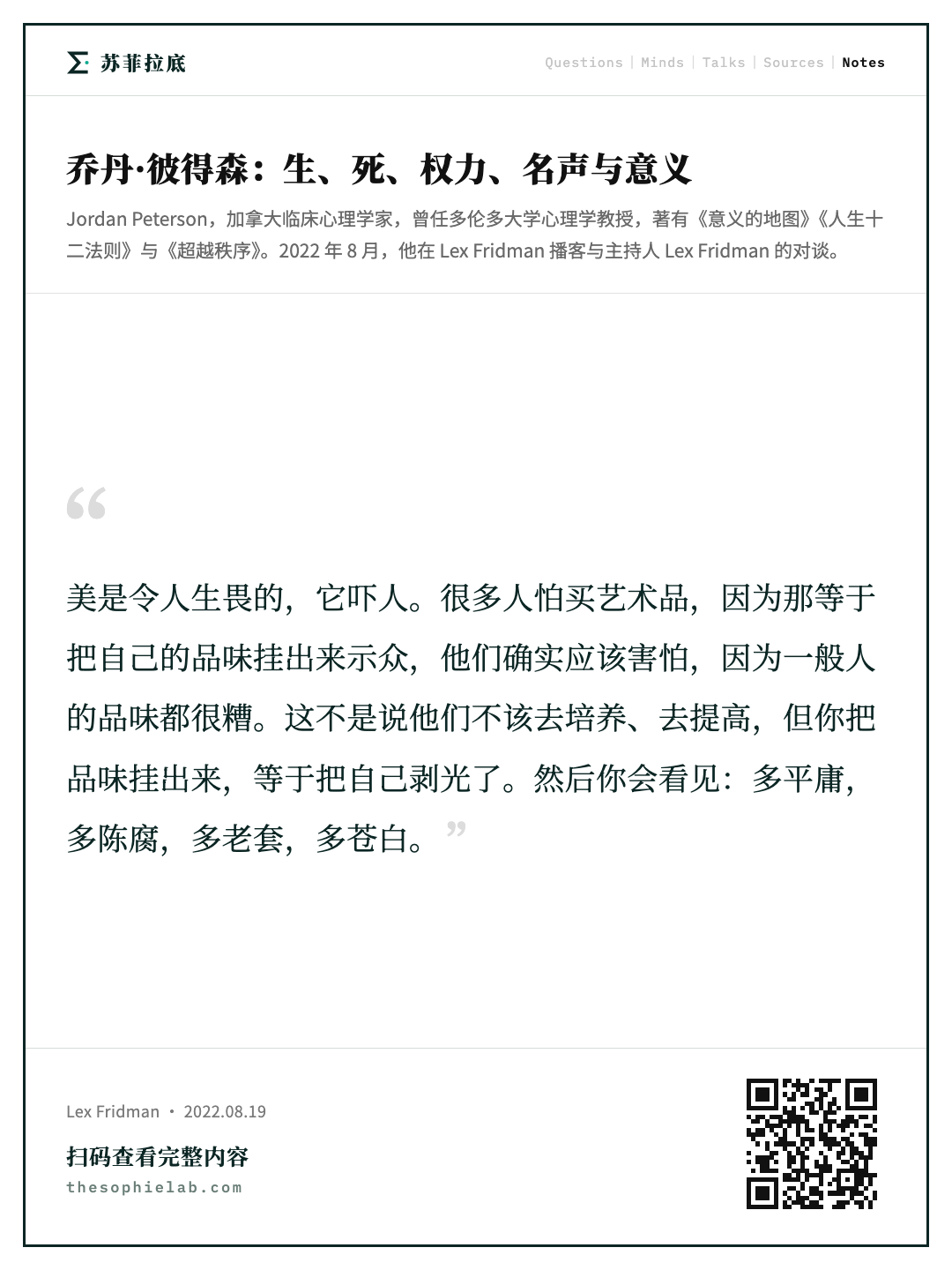
彼得森: 我家里过去满墙都是画,很快还会再挂满。来客人常常不自在。比如我母亲就说,你干嘛要住在博物馆里?我当时想,我宁愿住在博物馆里,也不愿住在别处,这是真心话。但美是令人生畏的,它吓人。比如很多人怕买艺术品,因为那等于把自己的品味挂出来示众,他们确实应该害怕,因为一般人的品味都很糟。这不是说他们不该去培养、去提高,但你把品味挂出来,等于把自己剥光了。

主持人: 甚至是对你自己剥光,每天从它面前走过。

彼得森: 绝对如此。

主持人: 这就是我这个人。

彼得森: 对。然后你会看见:多平庸,多陈腐,多老套,多苍白,或者太有序,或者太混乱。

主持人: 或者因为看得太多,很快就视而不见。

彼得森: 如果是真正的艺术品,这不会发生。

主持人: 你会一直注意到新的细节。

彼得森: 整体大于部分之和。有些图像,尤其是宗教图像,我们可以叫它们深层图像,人们解读了四千年,到今天还没解读完。我举个例子,一个很可怕的例子。我做过一整套《创世记》讲座,解开了不少,但远远没有解完。神把亚当和夏娃赶出伊甸园之后,在门口安置了基路伯(cherubim)和一把四面转动的火焰之剑,阻止人重新进入乐园。我当时想,这到底是什么意思?基路伯是什么?为什么它们要拿火剑?我不懂。后来我从马修·帕若(Matthew Pageau)那里知道,他写过一本关于《创世记》象征的好书,基路伯是神的「承载怪兽」。这是个很复杂的观念。它们部分地代表那种无法塞进概念系统的东西,而且同时带有天使和魔鬼的两面,你挑一面都行。那为什么是火剑?剑是审判的象征,是把麦子和糠分开的东西,你用剑去切、去削、去雕刻。而火焰的剑不只是切削,它还燃烧。它切掉、烧掉什么?你想进乐园?它就切掉你身上一切不完美的东西。

主持人: 那意味着什么?

彼得森: 我说了,这是个可怕的例子。你可以说,整个基督教叙事都埋在这个意象里。为什么?我们先说,火焰之剑是死亡的象征,这似乎相当明显。再说一步,它也是天启与地狱的象征,这也不算太离谱。那么结论就是:你不仅必须面对死亡,你必须先面对死亡和地狱,才能进入乐园。地狱式的审判,全都压缩在这个意象里。一件带着这种意象的艺术品,就含着这么多信息。它会「照耀出来」,它会伸进你心智深处你自己都无法理解的层次,一把攥住你。人们为什么会去博物馆,盯着自己根本看不懂的画看?为什么世界上最贵的东西,如果不是碳纤维赛艇,那一定是古典绘画?要么是极高端的技术器物,要么是古典艺术。这些东西为什么这么贵?我们为什么要造神庙来安放图像?连世俗的人也去博物馆。你说你是世俗的,那你在哪儿?在博物馆。你在干什么?在看艺术。那你凭什么觉得自己是世俗的?

主持人: 也许几百年、几千年之后,人类文明留下来的,就只剩艺术,连文字都留不下。

彼得森: 书其实留存得相当久,比如圣经里的那些篇章。

主持人: 也没那么久。

彼得森: 对,没那么久。

主持人: 放到生命演化的整个尺度上看,大概留不下。

彼得森: 可我们手上有至少五万年前的艺术图像,它们活下来了。而且有些在象征上已经极其深邃。

主持人: 您说「我们」,是指人类?

彼得森: 对,我们找到了它们,它们撑了那么久。再想想欧洲。全世界的世俗之人都往欧洲朝圣,为什么?因为美。这不言自明。部分原因是,欧洲有些东西美到让你窒息,让你汗毛竖起来,让你充满敬畏。我们需要看见这些东西,这不是可有可无的,我们需要它。那些大教堂。我在维也纳的大教堂里,那是一种可怕的美。

主持人: 可怕的美。美对您来说是痛的吗?那是不是最高形式的美,它真正挑战你?

彼得森: 绝对是。我记得有人分析米开朗基罗的大卫像,说那尊像在说:你本可以远比现在的你更伟大。那尊像说的就是这句话。而在维也纳那座教堂,我们下到它的地下结构,那里有三层楼的鼠疫死者骸骨,全在那儿堆着,教堂就建在上面。去这样一个地方不是闹着玩的,它把你从骨子里摇晃一遍。我们的宗教体系在命题层面已经变得可疑,但建筑本身没法跟你争辩,尽管现代建筑师喜欢用他们那种无菌的、到处竖起来的巨型中指来跟你争辩。美是通往神的一个可怕的路标。世俗的人会说,我不信神。那随你。但你没法凭别的东西走进那个看不见的未来,你只能凭信。你要是说,我没有信。那好,祝你的未来好运,因为那样的你是什么?虚无、绝望、被焦虑吞噬。如果不是这样,那就一定有什么在引着你往前走,那就是对某个东西或某些东西的信,而后者只会让你变成多神论者,我不推荐。

神是什么

主持人: 那我以一个短命的生物肉囊的身份,问另一个短命的生物肉囊:神到底是谁?我们能不能悄悄摸近这个问题?这个问题可以谈吗?

彼得森: 最好可以,否则关于它就无法交流了。它必须是能落到地上的东西。

主持人: 也可能我们太蠢,落不下来。

彼得森: 那不只是无知的问题,也是罪的问题。因为「不知道」是一回事,「想知道」或者「拒绝知道」是另一回事。

主持人: 明白。

彼得森: 你也许会问:能不能从对客观世界的描述里把神提取出来?神是不是就是自然实在的终极统一体?我会说,这里面有几分真,但不完全对,因为最高意义上的神,是你必须效仿才能兴旺的那个「灵」。这个生物学味的定义怎么样?灵是一种模式。你必须效仿它,才能兴旺。

主持人: 所以在某种意义上,我们说「人的精神」,指的就是这个?

彼得森: 它是一种赋予生命的原则,是一个元层次的东西,是一种模式。你会问,什么模式?我可以讲出一部分。设想你被美攫住,也被敬佩攫住。这件事你只能去注意,它不是命题。你会突然发现,原来我敬佩这个人。那意味着什么?意味着我想成为像他或她那样的人。敬佩就是这个意思。意味着他们身上有某种东西迫使你去模仿,模仿也是一种本能,或者说激起你的尊敬,甚至敬畏。那攫住你的到底是什么?我不知道。但它攫住了你,你想变成那样。小孩子会崇拜英雄,大人也一样,除非彻底愤世嫉俗了。

主持人: 我崇拜好几位英雄。

彼得森: 那就对了。

主持人: 而且很骄傲。

彼得森: 对,那就对了。那种崇拜、那种颂扬和模仿的倾向,就是敬拜,这是敬拜最根本的含义。现在设想你取来全体值得敬佩的人构成的集合,用人工智能那样的学习方式,把「值得敬佩」的核心特征抽取出来,然后反复地抽取,一层层提纯,提到最值得敬佩的那个极限。你所能得到的关于神的表征,最好也就到这个程度了。你要是说,我不信这个,那我会问,你说的「不信」是什么意思?

主持人: 明白。

彼得森: 它不是一组命题式的事实,不是关于客观世界结构的科学理论。关于这一点我还有话说,因为我最近想了很多,尤其是在跟理查德·道金斯谈过之后。后现代那一路人,往前可以追到德里达和福柯之前,甚至追到我极为敬佩的尼采,他说,上帝死了。行。但尼采说的是:上帝死了,是我们杀了他,我们再也找不到足够的水洗掉这些血。这是尼采,他可不是傻瓜。

主持人: 他很会用词。

彼得森: 确实。于是你想,好,我们杀掉了超越者。这对科学意味着什么?意味着科学被解放了,因为关于神明的那些胡话,不过是阻碍科学进程的愚蠢迷信。新无神论者的主张大致就是这个。可等一下。作为科学家,你信不信超越者?答案是,你不但信,你比信任何东西都信得更深。因为如果你是科学家,你相信那个「反驳你理论的东西」,胜过相信你的理论本身。这一点要非常仔细地想清楚。你的理论描述世界,就你而言,你对世界的描述就是世界。但因为你是科学家,你会想:虽然那是我对世界的描述,虽然那是我所相信的,但在我的信念之外还有别的东西,那就是对象。所以我要把我的理论掷向那个对象,看它在哪里碎掉。然后我要把碎裂这件事当作新信息的来源,去更新我的理论。

主持人: 所以科学家必须先设定超越者存在。

彼得森: 作为科学家,你必须先设定本体论意义上的超越者存在,否则你寸步难行。不止如此,你还必须设定:与这个本体论超越者的接触,尽管它讨厌,尽管它打翻你的一车苹果,恰恰正是那个真正能让你自由的东西。于是你接受了两个命题:存在一个超越的实在;与这个超越实在的接触在最根本的意义上是救赎性的。因为如果不是,你何必去接触它?你是打算把一切弄得更糟,还是更好?

主持人: 为什么对科学家来说,与超越者的接触让人自由?

彼得森: 因为最根本意义上的自由是什么?免于匮乏、免于疾病、免于无知。它给你信息,里面有逻各斯。

主持人: 所以这是科学的「为什么」。

彼得森: 当然是。这是方向,是科学的方向性。而方向是叙事性的方向,不是科学性的方向。接下来的问题是:这个叙事是什么?它设定了一个超越的实在;它设定这个超越实在具有纠正作用;它设定我们的知识结构应当以谦卑之心对待;它设定你应当在超越性的证据面前俯首。而且你必须立誓。作为科学家你知道这一点,如果你要做一个真正的科学家,你必须立誓走这条路:不管怎样都要真相。这就等于设定真理是一种救赎的力量。救赎又是什么意思?我们为什么要做科学?为了不让人挨饿,为了让人更有效地行动,为了生命更丰盛。所以它整个被包裹在一套底层伦理里面。我刚才谈信不信神时之所以绕到这里,是因为这是个非常复杂的题目。你信不信一个超越的实在?

主持人: 有人会说,那不过是自然。

彼得森: 假设你接受我刚才在自然这一侧做的论证,然后说:对啊,那就是自然,那不是神。那我会问:你凭什么认为你知道自然是什么?这个反驳的问题在于,它已经预设了一种唯物主义的、还原论的、客体化的自然观。但如果你是科学家,你应该会想:归根到底,我并不知道自然是什么。我当然不知道它的起源和终点,我不知道它的目的论,我对自然实在很无知。所以当我说「那不过是自然」的时候,我不该意思是「那不过是我所理解的自然」。

主持人: 认知过程有没有可能被完全还原?

彼得森: 我可以问:我们将来会不会拥有一套对认知过程的彻底还原式解释?答案是会。但等到那一天,我们对物质的理解已经变化到什么程度,那时的「还原」跟我们今天所想的还原完全不是一回事了。物质不是死掉的尘土。我不知道它是什么,我完全不知道。物质就是「有分量的东西」,这算个定义吧,一个很怪的定义。但那种认为「只要你是唯物还原论者,就可以把存在的全部复杂性还原成你关于物质本性的那些假定」的想法,本身并不是一个科学命题。

主持人: 而且那是你这个世纪、这个星期的、有限的人类假定。

彼得森: 一点没错。

主持人: 所以在某种意义上,如果没有我们刚才谈的这个宽泛意义上的神,就没有谦卑?

彼得森: 是谦卑不够。

主持人: 或者说,科学更容易偏离谦卑的轨道,如果没有一个远比个体的人更强大的东西在上面。

彼得森: 是的。而《弗兰肯斯坦》的故事立刻就从这里长出来。那对今天是个很好的故事。你正在摆弄造出新生命这件事,那你最好确保你的箭头是朝上的。

关不掉的怪物

主持人: 很有意思,您说科学内部有一套伦理。

彼得森: 它是嵌在一套伦理里的。

主持人: 不过「科学」是个很大的词,它包含很多传统各异的学科。生物学、化学、遗传学、物理学,是很不一样的共同体。我认为生物学,尤其是越靠近医学、越靠近人体的那部分,确实有一套很严肃的东西。首先它有被纳粹德国滥用的历史,还有类似的种种。所以它有认真对待这些问题的传统。真正没有这种传统的,是机器人学和人工智能,这非常值得注意。您刚才称我为科学家,我愿意骄傲地戴上这个标签,但很多人并不把计算机科学当成科学。可我认为它会是二十一世纪最重要的科学领域之一,你应该非常严肃地对待它。可现实是,人们造机器人或者人工智能系统时,常常把它们当成玩具来摆弄。哇,这多酷。

彼得森: 嗯。

主持人: 我自己也有这种感觉。这多酷。

彼得森: 它确实酷。

主持人: 但到了某个时刻,你会不会也说,这场核爆多酷?

彼得森: 因为它确实酷。或者说,避孕药多酷,晶体管多酷。还有一点,这在某种意义上是个古怪的问题:搞机器人的工程师,他们是「对物感兴趣的人」。人的兴趣大类无非是对物的兴趣和对人的兴趣。

主持人: 我最好的一些朋友就是「对物的人」。

彼得森: 对。对物的人思路极其清晰、极合逻辑,非常讲结果、讲实用。这都很好,机器就是靠他们造出来并维持运转的。但方程式里还有人这一侧。你看到极端的对物的人,你会想,那这里的人怎么办?我们刚才说技术事业必须嵌在一套伦理里,你大部分时候可以无视这一点。你摆弄你的玩具时,在某种意义上可以无视那个总体伦理。但当你在造一个人工智能时,那就不是玩具了。那可能是……

主持人: 玩具会很快变成怪物。

彼得森: 对,对。而且这是一种全新的怪物。也许它已经来了。而且你有没有注意到,有多少这样的东西你已经关不掉了?你们工程师到底怎么回事,现在怎么都不给东西装关机键了?我得按住五秒它才关,或者我压根找不到,我只是想把它关掉,啪一下关掉。

主持人: 那你们人类又是怎么回事,怎么不给别的人类装关机键?因为你注意到的那个东西里有一种魔力,关掉它会让你痛,也许有一天也会让那个东西自己痛。所以作为工程师,你在给东西加关机键这件事上必须非常小心。我认为关机键是特性,不是缺陷。关机键给我们人类、给各种存在的系统设了一个期限。死亡才是真正让生命变得清晰的东西。

彼得森: 对,所以才有火焰之剑。

主持人: 火焰之剑。我喜欢您说的荆棘里的火,以及剑作为转化之物这个说法。只是这种转化同时也在消耗那个被转化的东西。

彼得森: 那要看这个东西里有多少是糠。这也是为什么你不能触碰约柜,也是为什么有人会有非常糟糕的迷幻体验。如果你有百分之九十五是朽木,而你又靠火太近……

主持人: 嗯。

彼得森: 剩下那百分之五可能撑不住。

主持人: 您觉得全是糠,可我觉得有一部分毁灭本身是布考斯基那句话:做你爱做的事,让它杀了你。

彼得森: 对。

主持人: 您不觉得毁灭是其中的一部分吗?

彼得森: 那就是谦卑。

主持人: 那就是谦卑。

彼得森: 一点没错。就是主动请审判进来。请审判进来,因为这样你也许可以死掉一点点,而不必整个死掉。我记得是怀特海说过,我们可以让我们的想法替我们去死。我们身上有一些局部的人格,我们可以把它们烧掉,可以在它们变成暴虐的法老、把我们全部吞掉之前放它们走。所以是有一个关于死亡的最优剂量的。谁知道把这个剂量优化到极致会怎么样?假如你不断地死去,多到某个程度,你反而能一直活下去呢?而这件事我们在生物学上其实已经知道了,因为如果你的细胞不能正常地死,那就是癌性增生。在生物层面,增殖与淘汰之间是非常精微的平衡。生命就是生长与死亡之间的平衡。那么如果你把这个平衡调对了,会发生什么?我们其实多少知道,因为如果你活得得体,如果你足够谦卑,愿意让自己的愚蠢先死掉,而不是等它把你干掉,你会活得更久。这是事实。那这件事推到极限是什么?答案是我们不知道,完全不知道。

每日之死

主持人: 那我问一个难一点的问题。

彼得森: 好像你到现在问的都是简单问题似的。

主持人: 陀思妥耶夫斯基永远只是热身。如果每一天都死一次是穿越人生的方式,那么您已经很有名了。

彼得森: 死亡加地狱。

主持人: 死亡加地狱。

彼得森: 对,地狱那部分可不能忘。

主持人: 您担不担心,名气把您困在了从前那个自己里?

彼得森: 担心。连猫王到死的时候都变成了模仿猫王的人。

主持人: 您会不会害怕自己已经变成了一个模仿乔丹·彼得森的人?害怕自己在某种程度上变成那个出名的、穿西装的、聪明的乔丹·彼得森,那个在追求真理时永远笃定、永远正确的人?

彼得森: 我担心这件事胜过担心任何别的事。我希望如此。我最好如此。

主持人: 当您在镜子前、在心里安静的时候看自己,名气有没有在某种程度上腐蚀您?

彼得森: 毫无疑问,在某些方面是的。这非常难以避免,因为你周围的一切都变了。比如,你提出的要求,别人更可能照办。这很危险,因为让你能够正常地「死去」的机制之一,就是别人以恰当的力度推回来。这正是为什么那么多名人会失控,尤其是那些暴君型的、比如治理国家的人。周围所有人都不再说「你这里有点偏了」。他们对你所有的笑话都笑,替你开所有的门,他们总有事求你,红毯永远铺好。你会想,那不是挺好吗?如果红毯是铺在你走向沉沦的路上,那就不是什么好买卖,你只是更高效地到达那里。所以我一直努力学习的一件事,就是让身边始终有一群批评者,他们会说:这件事你本可以做得更好,你那里太严苛了,你在那儿没必要地把人推开了,你那部分背景功课该做得更足。而且我认为,随着影响力扩大,随之而来的责任也在扩大。影响力大了,那就是很重的责任。所以,比如我偶尔状态不好,我举个例子。我最近写了几篇专栏,谈那些让我不安的事,比如即将到来的饥荒。要认真对待这些问题很难,也很吓人。相比之下,跟妻子去湖边小屋、划到湖上看日落要容易得多。所以我会忍不住借用愤怒当作动力,帮我克服面对这些事的阻力。可这样一来,我在YouTube上读这类东西时的语气就会比最优状态更严厉、更爱下判断。我为这件事跟人辩论过。有朋友说,你在点名批评那些骚扰荷兰农民的环保全球主义者,带点怒气正合适。也有人说,你别太狠,否则你会把本来愿意听你说话的人推开。这个平衡很难拿捏。

主持人: 而且愤怒也许会让你的心变硬,让你注意不到世界上那种安静而细微的美,那种一直在、渗透一切的安静的爱。有时候你会对世界变得非常犬儒。这就是尼采那句话。

彼得森: 对。

主持人: 与怪物战斗的人,当心自己也变成怪物。

彼得森: 对。

主持人: 当你凝视深渊,深渊也在凝视你。

彼得森: 没错。但我会说:来吧。我知道他绝对说得对,可是如果你凝视深渊足够久,你看见的是光,不是黑暗。

主持人: 您确定吗?

彼得森: 我把命押在这上面。

主持人: 这个赌注可真大,因为它也可能扭曲你的心智,让你看见的全是……

彼得森: 全是深渊。

主持人: 全是深渊,全是这世界上的恶。

彼得森: 那我会说,你看得还不够久。这又回到了火焰之剑。我刚才说,基督的整个故事已经预演在那个意象里了。基督的故事在心理层面是对最糟糕的悲剧的彻底接纳,这就是它的意思,这就是十字架的意思。在心理层面它是说:凝视你最害怕的那个东西。但故事没有停在那里,因为在故事里,基督穿过死亡进入地狱。所以死亡还不够。无辜者的死不足以产生救赎,它必须是一次自愿的、下到地狱的旅程。而这也许对每个人都成立。这是按定义就不可能有更可怕的观念了。那么,你要不要凝视它?谁知道呢。

主持人: 您多久会凝视一次死亡,您自己的死亡?您多久提醒自己一次,这趟车总会到站?

彼得森: 我个人?

主持人: 您个人。

彼得森: 一直在。

主持人: 因为作为一个深度思考者、哲学家,人很容易一头扎进哲学,忘了自己今天就可能死。

彼得森: 死亡的天使坐在每一个词上面。这么说怎么样?

主持人: 您多久真正有意识地注意到那位天使?

彼得森: 一直。我想这是让我变得有点古怪的原因之一。读研究生的时候,死亡的念头一直在我脑子里。我注意到跟我一起的很多人,那些我很欣赏的人,这并不构成他们性格的一部分,但它绝对是我性格的一部分。我每天早上醒来,这种情形持续了好多年:时间不多了,动手吧。时间不多了,动手吧。有事要做。它一直在那儿,现在还在,而且在某种意义上让人难以承受。

主持人: 您怕死吗?

彼得森: 怕死?一年前我已经做好死的准备了,而且不是随口说说。我有我爱的人。所以不,我不太担心我自己,但我非常担心自己会犯错。

主持人: 明白。

彼得森: 我几个月前听到马斯克谈这件事,那是个很触动人的瞬间。有人问他关于死亡的事,他随口说了一句,然后就接着往下聊了。他说,那会是一种解脱。然后就继续谈别的了。我当时想,他肩上扛着很重的东西。我确定他有一部分在想,如果这一切都不在了会轻松些。他说得很随意,但在我看来那是个很说明问题的瞬间。

主持人: 所以对他来说,那是「为什么活着」的问题?

彼得森: 嗯。

主持人: 是生命的耗竭。

彼得森: 对。

主持人: 你可以说生命即苦,但那是艰难本身。

彼得森: 比起死亡,我更怕地狱。

主持人: 您怕的是死后的那个东西?

彼得森: 我不知道它是在死后,还是一直就在这里。我想我们会知道的。

主持人: 死亡和地狱之间是什么关系?

彼得森: 我不知道。我不知道。

主持人: 有没有什么事,是你抵达之前必须先做的?

彼得森: 如果你活成一种把你带进地狱的样子,你就更可能死得很惨。这算是一种关联。

主持人: 而「惨」是个很深的概念。

彼得森: 对。顺便说,那也是一个定义。

马斯克与反真理

主持人: 您怎么看马斯克?您谈过他,也见过他。

彼得森: 我当时被一种敬佩击中了。我对他的看法就是这个。

主持人: 现在我们又回到「敬佩」这个概念了。

彼得森: 我把它当作一种原初的东西。就像你问,你觉得这个喜剧演员好笑吗?我会说,我对着他笑了。你明白吗?它又不是命题式的。当然,我有些问题想问马斯克先生。比如火星计划,我不知道他在那儿图什么。在最根本的意义上,那件事在我看来是荒谬的,因为我想,在南极洲或者沙漠里建个前哨站要容易得多。

主持人: 可人类的事业里有多少不是荒谬的?

彼得森: 尼采怎么说的?伟人的愚蠢很少被记到他们账上。谁知道马斯克在搞什么名堂。反正他在造火箭。他的动机是他想给火星上的生命建一个平台。这是个好主意吗?我有什么资格说?火箭是人家造的。但我很想问问他。

主持人: 我很想看到那场对话。我跟他私下聊过不少,我确实认为其中几个想法,比如火星,比如人类成为多行星物种,可能是将来人类文明回头看会说「这不是明摆着的吗」的事情之一,我简直不敢相信他是少数几个真正在推这件事的人,因为对社会、对生命的延续来说,这是显而易见该做的事。

彼得森: 我并不觉得自己有资格评价马斯克。我想跟他谈谈,弄清楚他在干什么、为什么干。但他是个不可能的人。他做成的事是不可能的,每一件都是。他造出了一辆真能跑的电动车。它是不是完全成功?它会不会、该不该取代燃油车?我不知道。但如果我们要造电动车,他看上去是做得最好的,而且好一大截。而且这件事基本上是他自己做成的。人们爱挑他的毛病,但他基本上是自己做成的。我知道他很擅长分配责任,等等,但他是那个矛头。这已经很难了。然后他造了火箭,成本是美国航天局火箭的十分之一。然后他把自己的车射进了太空。这也很难。然后他在搞那个 Boring 公司,多多少少像个玩笑,可以说是一种带着玩笑意味的东西,但它又不是玩笑。他太了不起了。

主持人: 还有 Neuralink,深入心智的底层。

彼得森: 还有星链。在我看来就是:加油,埃隆。而且他总能一针见到点子上。比如,问题其实是人口不足。我也这么想。我认为这是个可怕的问题:西方的出生率已经低于世代更替水平。这意味着我们在最根本的意义上抛弃了童贞女与圣婴,这是一场彻头彻尾的灾难。而马斯克把这一点看得一清二楚。别人都在到处嚷嚷「人太多了」,他说:不对。他看准了。

主持人: 您用过一个说法叫「反真理」。

彼得森: 我逐渐明白,世界上有虚假,有谎言,还有反真理。反真理是那种荒唐到不可能再与真相相反的说法。而「地球上人太多了」就是一条反真理。人们说,你必须接受增长的极限,等等。我的回答是:我必须接受你要强加给我的那些限制,就因为你害怕未来?这就是你的理论,是吗?好吧。

主持人: 这也只是一个想法,可能对,也可能错。

彼得森: 我来告诉你为什么我认为它是错的。设想有一条「紧急恶龙」。有一条龙。有人跑过来说:有龙!我就是能对付它的那个人。这就是环保主义者,那些鼓吹增长极限的激进派说的话。然后我看着他们,心想,好,第一个问题:那条龙是真的吗?

主持人: 我每次独处的时候都会这样问我自己。

彼得森: 环境这一侧的末日是不是真的迫在眉睫?是或否,这个我暂且放在一边。我认为两边都能讲出道理,原因很多,而且这不是个无聊的担忧。我们确实把海洋捕捞过度了,确实有一些环境问题越来越严峻,至于气候变化是不是其中最要紧的那个,那是另一个问题,我们先不谈。那不是重点。重点是:你在为一条龙大喊大叫。好,那我为什么该听你的?我们来看你面对这条龙是什么反应。第一,你吓得魂不附体,处在惊恐状态。这可能说明你不是干这活儿的人。第二,你愿意用强制手段把别人绑来替你打这条龙。所以你不仅是个被吓坏的人,你还是个被吓坏的暴君。那我会说,你不是带我们走出这场新「出埃及」的那个摩西。这也许还能给出一种神经层面的解释:如果你对眼前之物害怕到瘫痪、害怕到虚无,而且愿意用暴虐的强制来达成你的目的,你就不是这个时代所需要的领袖。

主持人: 那您信任谁?

彼得森: 我更愿意听比约恩·隆堡(Bjørn Lomborg)、马特·里德利(Matt Ridley)、马里安·图皮(Marian Tupy)这样的人。他们说:我们当然有环境问题,在某些情形下也许你能论证存在马尔萨斯式的成分,但从根本上说,人类的历史记录是我们学得非常快,而且越来越快地学会用更少的东西做更多的事。我们能搞定。我认同这个判断。我是在很根本的层面上这样想的:我信任隆堡,信任图皮,信任里德利。他们对这些问题想得很深,他们不是在说「环境无所谓」。而所谓环境到底是什么?我都不知道那是什么。环境就是一切。我关心环境,这跟说「我担心所有事」在语义上有什么区别?

主持人: 环境也可能意味着「我担心人类社会」。很多复杂系统都难以谈论,因为牵涉太多。

彼得森: 对,牵涉一切。再说这些模型。有人因为我不买气候模型的账而追着骂我。我看待气候模型的方式,是把它延伸到经济模型上去看。气候模型说,到 2100 年会有某种程度的升温。行。其中一部分可能是人为的,一部分是冰期之后回暖的结果,这种事以前也发生过,但没关系,我们就接受你的前提。虽然那里面有多重前提,而且模型里的任何误差都会随着时间推移而放大,但随你。好,现在我们要把气候模型延伸进经济模型,因为现在的模型正是在经济这一侧生成的。于是我们必须给环境建模,也就是气候;还要给经济建模;然后还要给两者的相互作用建模;然后还要预测一百年之后;然后还要给这一切标上美元价格;然后还要宣称我们能做到这件事,而我们做不到。然后这就是结论。

主持人: 您具体分析过哪一份报告?

彼得森: 我分析了德勤的一篇报告。全美第三大公司,三十万员工,顶级咨询机构,他们五月刚出了一份报告。我为《每日电讯报》写了一篇文章,这周会在我的YouTube频道上发。报告说:如果我们要在经济上把气候问题控制住,我们将经历一段艰难的匮乏期,因为如果不接受增长的极限,大约五十年后会有一场灾难。所以为了避免那场灾难,我们要让人们变穷。穷多少?跟他们本来会变得多富有相比不算多,但确实要穷,他们自己的模型里就是这么写的,明确地穷,比放着他们不管更穷。

主持人: 谁会变穷?

彼得森: 于是我想,穷?谁穷?我们从生物学上看。你有一个稳定与安全的等级结构,这是一类等级。你给这样一个社会等级施加压力。假设有一群鸟生活在某个环境里,禽流感来了。你去看这群鸟的社会等级,地位低的鸟巢最差,最容易被风吹雨打日晒,离食物来源最远,最容易被捕食。所以这些鸟压力最大,这正是你在等级底端会遇到的情况。你压力更大,因为你的生活更不确定;压力大,免疫功能因此受损;你在用未来换取当下。禽流感一来,鸟就从底层往上死。每一场疫病都是这样,都是从底层往上死。所以人们说,贵族感冒的时候,工人阶级死于肺炎。好。现在我们要让人变穷。谁?我们知道,当我们让人变穷时,被弄穷的是那些本来就勉强挂在悬崖上的人。那意味着什么?意味着他们会死。所以德勤的顾问们实际上是在说:很不幸,但按我们的模型,一批穷人得死掉,这样将来才不会有更多穷人死掉。那我要说,等一下。这两件事里,哪一件是我该当作确定无疑的?一百年后你假设性地拯救的那些假设性的穷人,还是未来十年内你实实在在要害死的那些实实在在的穷人?我要把赌注押在那些你实实在在要害死的穷人这一边。

主持人: 您还提到一个道德风险的问题。

彼得森: 我进一步想:德勤的顾问们,你们真的给世界建了模,还是说这是一场盛大的广告表演,目的是用「我们聪明到能给整个世界的生态系统连同经济系统建模并预测一百年」来吸引企业客户?提出这样一个主张,里面难道没有一点道德风险吗?一丁点都没有吗?尤其是在这个时候。我上周跟比约恩·隆堡和迈克尔·永谈过。我采用的是联合国对明年饥饿人口的估计:一亿五千万人将面临「粮食不安全」。粮食不安全,这就是那个漂亮词,其实就是饥荒。而迈克尔·永认为是十二亿。而且他说还会螺旋放大,因为饥荒里会发生的是政府发疯,政府失稳,然后去从农民手里征收粮食。然后农民没钱了,也就种不出庄稼了。我想,对,他们干的就是这个,事情就会这么发展。永告诉我是十二亿。后来隆堡也说了同样的数字,我都没问他,他是顺口说出来的。

化肥令与农民

主持人: 说到饥荒,我想问三十年代那场。

彼得森: 乌克兰那场。

主持人: 乌克兰那场。您刚才讲的很多东西,跟人类历史的那一段是呼应的。

彼得森: 那道门上的洞,没有人知道。

主持人: 我刚在乌克兰待了四个星期。世界上有些地方,哪怕人们不知道,他们其实知道。历史在血里流着。

彼得森: 荷兰人在某种意义上也知道。二战末期他们经历过饥荒,荷兰农民之所以效率和产量高得不可思议,部分原因就是二战结束时荷兰人发誓,那种事绝不能再发生。然后他们不得不从海里刮出土地来,因为荷兰这个国家,本来就不该存在。它是世界第二大农产品出口国,你知道吗,荷兰,世界第二。我觉得它还没有马萨诸塞州大,那么小小一块地方,它本来就不该存在。而现在他们的计划是:让百分之三十的农民停业。荷兰农业生产的整个生态占他们GDP的百分之六。这些搞中央集权的政客在想什么,你告诉我是不是我脑子有问题:你拿一个产业,用行政命令把它砍掉百分之三十。这个产业的利润率大概只有百分之三,你要砍掉它的百分之三十,怎么可能不把整个东西拖垮?整个农业生态怎么可能不垮?运输系统怎么可能不被拖穷?杂货店怎么可能不被摧毁?你不可能用一纸命令把这样的东西削掉三成还不把它弄死。我想不出怎么做得到。

主持人: 供应链已经很脆弱了。

彼得森: 看看我们用新冠封控干了什么。我们把供应链弄断了。你最近试过买东西吗?而且等等,中国人这会儿不是正在威胁台湾吗?没有芯片我们怎么办?所以我不知道这些人在想什么。然后我又想,他们在想什么呢?德勤那些人想的是:我们多聪明,我们的企业雇主该不该雇我们?至于穷人,太可惜了。环保主义者在想什么?我们热爱地球。真的吗?我们热爱穷人。真的吗?好,我们让地球和穷人对打,谁赢?地球赢。那你并没有那么爱穷人。你是爱地球,还是恨资本主义?我们让这两样对打。结果发现,我们其实是恨资本主义。怎么看出来的?因为你愿意把它打烂,而且你知道后果会是什么。斯里兰卡那两千万现在没饭吃的人会怎么样?他们会不会把动物都吃光?会不会把柴火都烧光?德国现在正在囤柴火。所以,你那个环保全球主义的乌托邦,是要杀死穷人、毁掉地球吗?而这没关系,因为我们能把资本主义干掉?行吧。

主持人: 对恶龙的恐惧驱动着各种意识形态,有些能建成更好的世界,有些会毁掉这个世界。

彼得森: 那你觉得我那个关于可信度的理论怎么样?如果你面对的那条龙把你变成了一个被吓坏的暴君,你就不是干这活儿的人。这是个好理论吗?

主持人: 这是个有意思的理论。那我就用这个理论。难点在于,什么样子算「被吓坏」?我把问题反过来抛给您。您就很害怕、很担忧一条我们可以叫作共产主义、马克思主义的龙。

彼得森: 我被它吓坏了吗?没有吓到要去当暴君。

主持人: 您的理论有两个部分。

彼得森: 对,我没有瘫痪。

主持人: 一个是龙。

彼得森: 我没有瘫痪,而且我不想当暴君。

主持人: 暴君那部分我觉得您身上没有,但您确实非常焦灼。您那种感受的强度,至少在您的公众形象里,并没有留出多少空间让您安静地坐在那条龙旁边,喝两杯啤酒,慢慢想一想。您对社会上某些现象的愤怒和忧虑的强度,会不会把您带离那条最终通向更好世界的路?

彼得森: 这是个好问题。我一直在努力把这件事拿捏对。我们在文化上对纳粹已经形成了共识。你可以因为纳粹而愤怒吗?看起来答案是可以。

主持人: 这里我要反驳一下。我也不信任那些因为纳粹而愤怒的人。

彼得森: 公平。我说的是真正的纳粹。

主持人: 可您也知道,世界上有很多人用「真正的纳粹」指代很多东西。

彼得森: 我知道。

主持人: 其中一个用法对我个人很重要。

彼得森: 比如用在我身上。

主持人: 是的。

彼得森: 我是个纳粹,据说还是个有魔力的超级纳粹。

主持人: 为了给所有人的视角做个钢人论证,我认为很多把您叫作纳粹的人是当真的。

彼得森: 这我知道。

主持人: 不过这里有件重要的事。我去了乌克兰前线。很多失去家园的人,那些跟俄罗斯士兵打过交道的乌克兰人,他们说,那些俄罗斯士兵真的相信自己是在把这些村庄里的人从纳粹手里解救出来。

彼得森: 我理解。

主持人: 所以对他们来说,不只是「乌克兰政府里有一些纳粹」,而是「纳粹已经占领了乌克兰,我们必须去解放他们」。这就是那个信念。

彼得森: 嗯。

主持人: 所以「纳粹」仍然是一条活着的龙,而且被人利用,因为坐在那条龙旁边很安全,你可以借它散播任何意识形态。所以我只是想说,我们在这条特定的龙上是有共识的,但我仍然不信任任何使用这个词的人。

彼得森: 这里确实有边界的问题。这是个非常复杂的问题。勒内·基拉尔认为,人有一种倾向,把替罪羊妖魔化,然后把它赶出村子。我想过很多。我们需要一个地方来安放撒旦,我是认真的,这是个严肃的问题。

主持人: 它该在村子里面还是外面?

彼得森: 也许它该在你里面。这才是基督教教义最根本的核心:与撒旦作战的最佳战场是你自己的灵魂。这是对的,它是对的。

该隐的灵

主持人: 您能把您所对抗的那条龙说清楚吗?是共产主义吗?

彼得森: 是该隐的灵。

主持人: 能展开说说吗?该隐的灵是什么?

彼得森: 亚当和夏娃因为变得有自我意识而被赶出乐园,或者说在他们变得有自我意识的那一刻,他们注定要劳作。就我所能理解的,原因是:有自我意识就意味着意识到未来,意味着意识到死亡。这在亚当夏娃的故事里确实发生了,鳞片从他们眼上掉了下来。其结果是,你现在必须劳作,以防止未来的灾难。这就是工作。工作就是牺牲,是把当下献祭给未来,是延迟满足,是成熟。而且献祭总是献给某个东西、以某种精神来献。

主持人: 然后是该隐和亚伯。

彼得森: 亚当和夏娃有两个孩子,该隐和亚伯。他们是历史上最初的两个人,因为伊甸园不算数,他们是最初两个「生出来」而不是「被造出来」的人,所以他们是最初的两个人。而这是个了不得的故事,因为它是一个手足相残的故事,而且一路退化成屠杀、洪水和暴政。作为整个故事的开场,这可真够劲。亚伯和该隐都献祭。出于某种原因,亚伯的献祭令神喜悦,为什么并不完全清楚,而该隐的不。不过经文里有个暗示,说是因为该隐的祭品是二等货。神说亚伯把最好的带到祭坛上,却没有这样说该隐。所以你可以想象,该隐一直在献祭,但他留了一手,他没有全押上,他没有把最好的拿上桌,他没有把最好的献给神。于是亚伯兴旺得不得了,人人都爱他,他要什么有什么,而且恰好在他需要的时候得到,他是神所偏爱的。而该隐扛着沉重的担子往前走,拼命干活,献祭却被拒绝。

主持人: 于是他怨恨。

彼得森: 他变得怨恨,非常怨恨,怨恨到要去质问神,大意是:你搞的这个创造可真了不得啊。我把自己累成两截,什么好事都轮不到我。而那边是亚伯,太阳天天照在他身上。你怎么敢这样?好,但该隐是在跟神说话。于是神说了该隐最不想听的话,这也是神通常对人说的话。神说:去看看你自己的做法。你没有做出你本该做的献祭,而且你自己知道。然后神说了更糟的:罪像一头性欲被唤起的猎食动物蹲伏在你门口,而你把它请了进来,随它对你为所欲为。神基本上是在说,你任由你的怨恨占据你自己,你在心里反刍它,被怨恨的灵附体,从中生出某种有创造性的、新的、可怕的东西,这就是你如此悲惨的原因。

主持人: 然后该隐走了。

彼得森: 该隐走了,脸色阴沉,这也在意料之中。他被激怒到极点,因为神说:你的问题是你自己造成的;不仅如此,是你把它请进来的;不仅如此,你还在这件事上发挥了创造力;不仅如此,你把它赖到我头上;不仅如此,这让你嫉妒亚伯,而亚伯其实是你真正的偶像和目标。而该隐不去改变自己,他杀了亚伯。而该隐的后代是最早制造战争武器的人。所以,你想知道我怎么想吗?那就是人类的永恒故事。而且它此刻正在上演,只不过速度快了一千倍。

主持人: 我可以向您提一个难听的真话吗?也许不算真话,只是我的一个念头:我们当中谁是该隐,并不总是那么容易分辨。

彼得森: 那是肯定的。

主持人: 而怨恨这件事,人们完全可以把您想象成一个对某种世界观怀有怨恨的人,那种您真正忧心的世界观。

彼得森: 我上周正好公开跟一位好朋友谈过这件事,我们会把它放出来。我说,我是不是对左派怀有某种特别的敌意?大概是的。为什么?首先,我是大学教授。威胁大学的不是右派,百分之百是左派。而且不是威胁一点点,是威胁很多。这种威胁让我没法再按原来的方式从事我的职业,它也让我失去了临床执业。而且这件事还没完,我现在同时有十宗针对我的投诉案,来自心理学家学会,因为他们允许世界上任何地方的任何人以任何理由投诉我,而且他们可以选择立案调查,而调查本身就是一种惩罚,他们正在这么做。然后我还被左派的恶意行动者折磨到几乎送命,很多次。当然我也有过一些激进右翼分子对我说的话不满,但落到我个人身上的,一直是左派。不只是我,还有我的家人,让我的家人承受了巨大的风险,而且是持续不断的,不是一两次。很多人被取消一两次,而我被取消过大概四十次。我现在认识两百多个被取消过的人,我可以毫不怀疑地告诉你,那是他们一生中最糟糕的经历之一,即使只发生过一次也是如此。

主持人: 再加上历史的部分。

彼得森: 我还知道,共产党人在二十世纪杀了一亿人,知识分子一直在为他们开脱,到现在都没停,而几乎没有人知道这件事。我也知道,怨恨型马克思主义的幽灵正在全力回归。那么我对这些是不是有点敌意?是的。这种敌意是不是走得太远了?我不知道,我正在努力搞清楚。

主持人: 您刚才讲的这段经历,让您这样一个思想上的重量级人物几乎不可能没有巨大的怨恨。

彼得森: 嗯。

主持人: 那我给您出个难题。您能不能为这个国家的总理特鲁多做一个钢人论证,说他确实希望这个国家好,而且可能真的会为这个国家做些好事?就当成一个智力挑战。

彼得森: 可以。他看上去跟妻子相处得不错,他有几个孩子,没有性丑闻,而他所处的位置本来很容易出这种事。他在海洋管理方面似乎做了一些好事,把加拿大相当一部分海域划为海洋保护区,如果这件事是实打实的,那可能是他最根本的政治遗产。我一直想弄到关于这些保护是否真实有效的资料,但没能拿到。不过那是件好事。

主持人: 家庭那一块,您认为说明了什么?

彼得森: 说明他的品格。这方面确实有证据。他不是杰弗里·爱泼斯坦那种在性上放浪的人,这就是一点。他和妻子看上去是真的婚姻,他有孩子,这挺好。

主持人: 顺便说,对一个领导人来说,这是个好的起点。

彼得森: 对,先做个好人。而且我还想过,自由党上一任党魁是他们从哈佛请回来的一位加拿大知识分子,没做成,然后他们四处找不到合适的领导人。加拿大自由党很擅长维持权力和领导地位,长期是加拿大的主导执政党。于是他们去找贾斯汀说:要么是你,要么就是保守党上台。你可以想象,对一个左派、哪怕只是自由派的人来说,那不是什么好前景。而特鲁多相当偏左。他们说,我们需要你出来选。然后我想,好,其实答案本该是「不」,因为贾斯汀没有受过这方面的训练,没有经验,说到底他是个兼职的戏剧老师,没有经营过企业,他懂的东西不足以当总理。但我试着把自己放到他的位置上:好,我懂得不够,但我年轻,而且我们不想让保守党上台。保守党已经执政了十年,也许该换届了。也许我能长成这个位置所需要的人。也许我可以让好人围在我身边,我可以谦卑地学,我可以变成我现在假装成为的那个人,这本来就是我们每个人往前走时必须做的事。然后我想,好吧,我认为你在这里犯了错,因为你只是靠你父亲的名字去选的,你没有那个底子。但我们就把话说尽,假设这不是问题。

主持人: 那么当选之后呢?

彼得森: 你当选了,你的第一件事是把内阁变成百分之五十女性,尽管当选议员里只有百分之二十五是女性。那你等于一下子把人才池砍掉一半。作为第一步,这一步非常糟糕。

主持人: 我能问一下吗?您觉得这一步出自哪里?出自内心深处的某种东西,还是在听当下的社会风向,想借那股浪去换更大的人气?

彼得森: 这种决定不是想清楚之后做出来的。事实就是,你把内阁人选的人才池砍掉了一半。内阁位置是有限的。你可以说他们每个人都达到了门槛,但门槛和优秀之间差得很远。

主持人: 您不认为那可能出自某种同情心?

彼得森: 我不在乎它是不是。我不把同情心当作一种德性。同情是一种反射,不是德性。

主持人: 您不觉得……

彼得森: 有判断力的同情才是德性。

主持人: 等一下,等一下。同情可以来自人心和人的头脑的深处。我们说的是同一种同情吗?

彼得森: 是的。

主持人: 我说的是试图理解他人的痛苦。

彼得森: 把成年人当婴儿对待不是德行。

主持人: 我明白了。但同情不等于把成年人当婴儿,这只是用词问题。

彼得森: 你确定?

主持人: 好吧,不管用哪个词,也许「爱」是更好的词。

彼得森: 爱就是同情。

主持人: 我大概是在说爱。您不认为那些想法可能出自关切?

彼得森: 爱是同情、鼓励和真话的混合。爱这件事很复杂。

主持人: 对,它里面有很多好东西。

彼得森: 如果我爱你,你要的是我的同情还是我的鼓励?

主持人: 这就是那支舞。爱归根结底是两个人之间的舞蹈,它带来双方的成长。

彼得森: 关键就在这里。成长这个元素至关重要。而要培育成长,就需要判断。同情和判断从来都是这样被概念化的:神的两只手,慈悲与公义,它们必须协同运作。慈悲说的是,你尽管有缺陷,你仍然是可接纳的。那你想要这个吗?你想让你的缺陷被接纳吗?答案是不想。所以判断就是在这里进来的:但你可以更好,你可以超过现在的你。在最根本的意义上,这就是母性与父性,而这两极之间必须有活跃的信息交换。所以就算特鲁多的动机是同情,那也要问:你到底有多爱?而且不管怎样,那都是个很糟的决定。

主持人: 您还提到过别的。

彼得森: 他公开表示过对货币政策的轻蔑:我对货币政策不感兴趣。好吧,可你是总理。他还表达过对中国共产党的钦佩,因为他们在追求环境目标时可以非常高效。哦,高效啊?为你的恐惧服务的暴政的高效。我反复观察他,听了他很多话,而且努力用临床的方式、带着某种程度的冷静去听。这也很难,因为他父亲皮埃尔在 1982 年用国家能源政策把西部打得稀烂,而特鲁多现在在做同样的事。所以作为一个西部人,我有一种天生的敌意,而且这敌意来得有道理,因为加拿大中部,特别是渥太华、蒙特利尔、多伦多三角地带那些光鲜的文人精英,长久以来过度地剥削西部、轻蔑西部。而这件事眼下还在加剧,比如特鲁多最近对加拿大农民的打击。他是石油和天然气行业的敌人,这是一场彻头彻尾的灾难。看看欧洲发生了什么,至少有一部分是这么来的。他对农民也不友好。所以我确实试着为他做了钢人论证。我努力把自己放到我所批评的人的位置上。我认为他是个自恋者。

主持人: 您觉得权力在多大程度上改变了他?

彼得森: 如果你不适合那个位置,如果你不是干那件事的人,你可以百分之百确定权力会腐蚀你。怎么可能不腐蚀?至少,如果你没有胜任这份工作的本事,你就不得不贬低这份工作,贬低到你待在里面能感到自在为止。所以我认为权力腐蚀了他。你看他,还在加码。飞进加拿大要戴口罩,我们得在手机上填一份 ArriveCAN 的官僚表格,因为护照不够用。而我们连护照都办不出来。如果你八十五岁、不会用智能手机怎么办?那就活该。

主持人: 如果他愿意坐下来跟您谈,您会谈吗?您会在播客上问他什么?

彼得森: 我想我从来没有拒绝过跟任何人谈。如果他愿意跟我谈,我会谈,因为我有很多事想问他。我在播客上请过加拿大的政界人士,试着向他们提问,所以我很想知道。也许我把他的很大一部分看错了。

主持人: 是的。

彼得森: 我大概确实看错了一部分。但我的观察是,他每一次有机会从他那个法老式的立场上后退,他都选择加码。而且我们的议会未来一年都不开会,还是Zoom,还是封控状态下的议会,要再持续一年。过去两年的封控可能已经把议会致命地破坏了。而我们说的是议会。

主持人: 这里有一种瘫痪,一种由恐惧驱动的瘫痪。我认识的一些最聪明的人也陷在这种瘫痪里。我觉得人们还没给它取名字,但它几乎像是对某种潜伏在阴影里的未知之物的恐惧。而不幸的是,这种恐惧被人利用,被学术圈里的人、教职员工、学生,还有越来越多的行政人员利用,他们开始使用这种恐惧,这让我很不舒服。这会让那些本来就不擅长驾驭权力的人,一天天地、一点点地变得更腐败。

彼得森: 过去两周我一直在想清楚一件事:你怎么知道?有人在YouTube评论里问我:我凭什么相信你在环境问题上的建议?我想,这问题真好。好,我们看看能不能找出让建议值得信任的那些原则。你怎么知道它不可信?一种可能的回答是:这些说法与事实不符。但事实是很棘手的东西,而且取决于你去哪里找。这一条很难拿捏,因为比如隆堡最根本的批评者们争的就是他的事实,而不只是他对事实的解读。所以这不可能是万无一失的指南。于是我想,光靠事实不行,因为当话题是「一切」的时候,事实太多了。那么在面对末日般的未知时,你怎么判断一个人是不是值得信赖的向导?这才是真正的问题。而答案是:他们不是被吓坏的暴君。我认为这就是答案。也许这是错的。如果有人有更好的答案,我洗耳恭听。

主持人: 怎么判断一个人是被吓坏的暴君?

彼得森: 因为他们在本可以用善意的时候,选择对他人使用强制。比如加拿大的农民就提出异议,他们说:我们有充分的经济理由尽可能少用化肥,因为化肥很贵。我们有卫星地图,知道化肥施在哪里。过去四十年我们把化肥用量降低到你不敢相信的程度,而粮食产量大大提高。我们已经把自己累成两截了。如果你了解农民,尤其是还活下来的那些,你以为他们不知道自己在干什么?他们精明得很,比我们的总理精明得多。可现在你告诉他们:不行,就是减百分之三十,我们不管你种出多少粮食。也就是说,这个削减不是按「每单位化肥产出多少粮食」来定的。你完全可以设想另一种做法:你产出这么多粮食,用了这么多化肥,所以你效率极高;那我们挑出这个指标上效率最低的百分之十的农民,对他们说,你们得达到平均水平。然后他们会说,我们的情况不一样,我们在更靠北的气候带,土壤更差。你当然得跟他们商量,但至少你奖励了他们的生产效率。

主持人: 结果却是另一套逻辑。

彼得森: 结果是,荷兰将没有牛肉。那他们从哪儿弄?你不需要牛肉。哦,我明白了,现在轮到你来告诉我能吃什么了,是吗?真的吗?而且荷兰要从哪个在化肥效率上更高的地方进口粮食?没有比荷兰更高效的地方了。加拿大也一样。还有,这难道不会让粮食价格更贵吗?那不就意味着挨饿的人会死吗?因为它就是这个意思。

主持人: 最终是穷人为这类政策付出代价。

彼得森: 不是「最终」,不是将来,是现在。

主持人: 是今天。

彼得森: 今天。这个区分至关重要,因为他们说,最终穷人会受益。是啊,除了已经死掉的那些。

主持人: 战争的故事似乎也是这样:穷人替有权有势的人、有钱人、政治精英做的决定付出代价。

彼得森: 对,因为那些人可以一走了之。

战争与那句致歉

主持人: 我想问乌克兰战争。

彼得森: 那件事我也惹了一身麻烦。

主持人: 您是一个穿西装、对着麦克风说话、写出色文章的人。但那里也有人在死,在打仗。那是他们的土地、他们的国家、他们的历史,俄罗斯和乌克兰两边都是。他们在问自己:我们是谁?

彼得森: 这是肯定的。

主持人: 这是什么?这个民族的未来是什么?我们以为我们是一个伟大的民族。我认为两个国家都在这么说,然后问:我们怎样才能成为我们以为的那个伟大民族?那么首先,您惹了麻烦。是什么样的麻烦?您后悔说过什么吗?

彼得森: 不后悔。我想了很多。我列出了四条导致战争的原因,然后《大西洋月刊》批评我,把我的论证压缩成一条,而且是那条原因的漫画版。我给出的是一系列原因:柏林墙倒塌以来西方在对俄关系和外交政策上的失误,这可以理解,因为事情极其复杂;在愚蠢的环保全球主义乌托邦风潮之下,欧洲把俄罗斯当作最主要的能源供应来源,过度依赖;俄罗斯的扩张倾向,在某种意义上类似苏联式的帝国建构;最后一条,也就是让我挨骂的那条,是普京相信,或者说他愿意操纵他的人民去相信,面对愚蠢的西方觉醒主义,俄罗斯是一支救世的力量。让我挨骂的就是这条。人家说,你在为普京辩护。可是,认为西方已经疯了的不只是俄罗斯人,东欧人也这么想。我凭什么这么说?今年春天我去了十五个东欧国家,跟三百位政治和文化领域的领袖谈过。你可能会说,那些都是保守派。其实不是。多数确实是保守派,因为他们更愿意跟我谈,但其中相当一部分怎么看都是自由派,还有不少是被取消的进步派。

主持人: 因为您非常担心文化战争,认为那可能是这个国家、这一部分世界走向糟糕未来的信号,所以那条理由才特别突出。回头看这四条,您认为那一条配得上占据其中一席吗?

彼得森: 绝对配得上。而且第四条其实是分叉的。我说的是:普京可能真的相信这一点。我确实认为他相信,因为我读了不少普京的讲话,而且读了十五年。我对人的总体感觉是,希特勒也是如此。希特勒相信什么?你读过他写的东西吗?他就是照着他说的去做的。你也许会想,有些人极其狡猾,他们有一整套精心构建的言论,与他们的人格完全分离,他们的人格在追求另一套议程,而那一整套言论不过是幌子。

主持人: 嗯。

彼得森: 那祝你好运,先去找出这么高明的人来。首先,如果你把一句话说得足够久,你就会开始相信它。

主持人: 这一点非常有意思,也非常重要。哪怕一开始是谎言、是宣传,我认为希特勒就是个例子,人很快就会开始相信自己的宣传。

彼得森: 你对人工智能系统想得很多。人难道不会变成自己反复练习的东西吗?答案当然是会。我们连神经层面的机制都知道。当你第一次形成一个概念时,你大片大片的皮层被点亮。但随着你不断练习,首先右半球不再参与,然后左半���参与得越来越少,直到你为那个概念框架搭起了专门的机器。然后你就开始「看见」它,而不只是「想到」它。所以如果你把同样的谎言说了一遍又一遍,你以为你在骗谁?你会想,我能抵挡住我自己的谎言。如果那是有效的谎言,你就抵挡不住。如果那些谎言有效到能骗过几百万人,而他们又把它反射回你身上,你凭什么认为你能抵挡?你抵挡不住。所以我确实认为普京相信,至少在他还相信什么东西的程度上相信。我确实认为他把自己看成基督教世界抵御西方堕落的堡垒。这就是杜金和普京谈了十五年的那条「第三条道路」,哲学家亚历山大·杜金和普京。

主持人: 那条道路到底是什么?

彼得森: 非常含混。索尔仁尼琴认为,俄罗斯人必须回到东正教的渐进发展中去,才能逃出共产主义的陷阱。在某种程度上,这在俄罗斯确实发生了,东正教确实有所回归。你可以说,可是东正教会已经被国家收编了。我承认有证据支持这一点。比如我听说,我不知道是不是真的,某位都主教拥有价值五十亿美元的个人财产。我会说这里面有相当的道德风险,东正教会有可能已经被收编。但俄罗斯确实出现了某种程度的东正教复兴,我不认为那全是坏事。而且就算普京什么都不信,就算他只是个操纵者,不过我并不认为是这样,我读过他的讲话,在我看来不像,而且他绝不是过去一百年里最糟糕的俄罗斯领导人。

主持人: 这个名单的可选项可不少。

彼得森: 确实不少,但我是在知道这一点的前提下说的。就算他自己不信,他已经让他的人民相信那是真的。所以无论哪种情况,我们都得面对这个主张。这才是我在那篇文章里想说的点。

主持人: 有时候让我不安的是那些来解释一切的人。很多人来找我,那些专家告诉我该有什么感受、该怎么看乌克兰。你太天真了,莱克斯,你太天真了,我来告诉你真相是什么。可我看见的是那些失去家园的人。我也看见俄罗斯那一边的人,我真心认为他们中有些人心里是有爱的,他们把自己看成把一片土地从纳粹手里救出来的英雄。

彼得森: 不然你怎么可能让年轻人去打仗?

主持人: 这些人不只是在摧毁彼此的家园,他们在制造世代相传的仇恨,在摧毁彼此相爱的可能。他们其实是在制造仇恨。我听到最多的是:今年二月二十四日,那个地区诞生了前所未见规模的仇恨。不是针对弗拉基米尔·普京的仇恨,不是针对俄罗斯士兵的仇恨,而是针对所有俄罗斯人的仇恨,那种会持续几代人的仇恨。你能看到那里的痛。然后当所有这些专家在谈农业、能源、地缘政治,或者像您说的,谈对抗觉醒意识形态时,我总觉得少了某种很深的东西。战争不是为那些东西打的。战争的爆发和战争的避免,都取决于具体的人,取决于人性本身。

彼得森: 那我再说一个难听的想法,反正我们今天难听的还不够多。我们因为新冠把一切都封锁了。西方和普京之间有多少面对面的交流?一次都没有。

主持人: 对。

彼得森: 而那个数量是错的。尤其是考虑到欧洲在能源供应上完全依赖普京,好吧不是完全,但你懂我的意思,在实质上是相当依赖的。也许该每半年就去跟他谈一次。也许他被困在某种气泡里,很可能是。

主持人: 而且不只是那些专家跟我说的信息气泡。

彼得森: 对,是人际的气泡。

主持人: 人际的气泡。

彼得森: 一点没错。我真正学到的一件事是,《旧约》里对款待有着极为强烈的强调。我刚把那些学者聚在一起谈《出埃及记》。我带着安保团队,都是硬汉,是当过兵的,但他们认同这次的任务。于是他们特意去款待我那些学者客人,摆出漂亮的肉盘、奶酪和饼干,花了一整天布置我租下的那栋房子,好让我们能和那些学者度过一段宾至如归的时光。他们中大多数我并不熟,但他们说愿意来,花八天时间跟我一起讨论这本书。我们租了几台水上摩托,房子很好,我们玩得很开心,我们彼此认识了,也彼此信任了,因为我们能看到我们可以一起玩,可以稍微放松下来,不必时刻戒备。这让讨论深入得多。后来我们发现八天讲不完《出埃及记》,所以我很早就提议把时长翻倍。我把八个人从他们各自的生活里拉出来八天,这可不是件容易的事,花费也不小,而 DailyWire+ 把这些全包了,他们立刻答应了。他们说,我们很愿意再来一次。为什么?部分原因是,在智识上那太迷人了,我学到太多,我大概要花一年才能消化,如果我消化得了的话。但他们也玩得很开心。当你把这种智识挑战和款待结合起来提供给别人,那就是不用想的事。每个人都说,只要我能安排得开,我一定来。

主持人: 而华盛顿呢?

彼得森: 我去过华盛顿好几次,那里的款待文化已经崩掉了。百分之四十的国会议员睡在自己的办公室里,他们没有公寓,家人不在身边。他们跟自己党内同僚都没有社交场合,更别说跨党派。我在华盛顿试着组织过几次双边的会面,让年轻的共和党议员和民主党议员坐下来聊。而只要他们一开口,就会发现……有一次午餐大概十五个人,一半民主党一半共和党。我只请他们做一件事:花三分钟说说你当初为什么决定去当国会议员。顺便说,这份工作我是不会接的。你每周要花二十五个小时在电话上募款,家人不在身边,每两年就要竞选连任,你受制于政党机器,你不断被人妖魔化。人们以为这是特权阶层的活儿,那你去竞选一次国会议员试试看有多好玩,把你的家人押上去,然后每两年要为自己的饭碗去乞讨一次,同时你最凶的敌人和最坏的朋友在恶狠狠地啄你。

主持人: 那顿午餐怎么样?

彼得森: 我们让他们围着桌子坐下,说,就讲讲你为什么去竞选国会议员。太棒了,尤其对一个加拿大人来说,因为你们美国人太有戏剧性了,看着真过瘾。每个人讲的都像《史密斯先生到华盛顿》:这个国家给了我们这么多,我们从在这里的岁月中受益良多,我们觉得这是个了不起的国家,我们真心觉得应该回报些什么。然后下一个人讲,几乎一模一样的故事。而且你分不出他是共和党还是民主党,谁都分不出。是真心的吗?那我问你,你是真心的吗?你觉得这些人比你更差吗?首先,他们不比你差;其次,他们大概比你更好,综合来看。当上国会议员没那么容易。我相信这一群人里也有坏苹果,但总体上,你跟这些人见完面走出来,会觉得挺让人佩服。

主持人: 他们确实是以服务之名交出了自己的一部分。也许随着时间推移,他们会变得犬儒、疲惫,被整个体制磨损。但我觉得其中很多可以被治愈。

彼得森: 那还用说。

主持人: 我不是完全天真,只是部分天真,我认为很多是可以通过对话的力量、通过最基本的社会互动来治愈的。

彼得森: 一点没错。

主持人: 尤其是通过倾听。

彼得森: 尤其是倾听。

主持人: 就是坐在那儿,而且不一定非要谈具体议题,其实是幽默,是聊各自的挣扎,是那些提醒你大家都只是人的东西。

彼得森: 对。我见过的那些伟大的领袖,我现在也见过一些了,他们会去听自己的选民说话。那不是政策讨论,不是意识形态讨论。他们会说:你过得怎么样?你有什么难处?跟我说说。然后他们听,然后他们被打动。然后他们把这些苦难收拢起来,带到国会、带到议会,他们想:这就是人民在呼喊的东西。好的领袖就是这样的,领袖会听。我跟吉米·卡尔聊过喜剧。他在全球巡演,靠逗人笑把场子一场场卖空。这很难。他说,单口喜剧,也就是我在某种意义上也在做的事,我在书籍巡讲里做的事跟它最接近,这是最贴近的类比。他说,单口喜剧是最具对话性的事业。我当时想,怎么讲?因为在我看来那就是独白,而且是准备好的独白。你当然要在讲笑话的同时跟观众动态互动,你要把节奏卡准,但你手上是有一套现成的段子的。他说,我来告诉你这些段子是怎么准备的。别的喜剧演员也跟我说过同样的话:你在巡演之前要跑五十家俱乐部,你带着你觉得好笑的新材料,走进一家俱乐部,把新材料铺开,观众会对其中一些笑。你注意他们笑什么、不笑什么,把不好笑的全部扔掉。所以你把自己交给观众去审判。如果你这样做得够多,哪怕你本身没那么好笑,观众会告诉你什么是好笑的。你可以想一想:你演五十场,每场一小时,每场收获两分钟的笑料。那你扔掉了两个小时里的百分之九十八以上,每场只留两分钟。所以你一点也不好笑,你只有百分之二的时间好笑。可把这些聚合起来,你就是个能把人笑翻的人。领袖做的就是这件事,他出去,把苦难聚合起来,还有希望。而我确实认为这能让一个原本会变得犬儒疲惫的人重新活过来,因为那时他可以对自己说:尽管这个体制有种种不足,尽管我自己有种种不足,我在把苦难和希望收拢起来,把它们带到能够被处理的地方去。

主持人: 给它一个声音。

彼得森: 对,给它一个声音。

巡讲的一天

主持人: 能不能带我过一遍您巡讲时的一天?我想知道乔丹·彼得森的一天是什么样的,特别是要上台演讲的那一天。怎么准备头脑,怎么想要讲什么,怎么在身体和心理上做好和观众互动的准备,讲的过程中怎么调整,讲完之后怎么从那个状态里下来,好让作为一个有限的生物系统的你,第二天能重新开始。

彼得森: 我一般七点起床,七点半或八点准备好出发。

主持人: 咖啡?

彼得森: 不喝。

主持人: 什么都不喝?

彼得森: 牛排和水。

主持人: 一天吃几次牛排?

彼得森: 我只吃这个。

主持人: 一天几次?

彼得森: 看那天的情况,三次或四次。

主持人: 牛排和水。

彼得森: 牛排和气泡水。修道士式的苦行嘛。

主持人: 我昨晚做了一次正宗的乔丹·彼得森,我通常一天只吃一顿,昨晚就吃了两块牛排。

彼得森: 感觉怎么样?

主持人: 很棒。

彼得森: 如果你只能吃一样东西,还有更糟的选择。总之我八点准备好,因为我们基本上一直在移动。

主持人: 移动是指?

彼得森: 飞到下一个地方。我们现在一般坐私人航班,因为商业航班不够可靠,而你绝不能到不了场。这是巡演的第一条规则:一定要按时到场。

主持人: 第二条呢?

彼得森: 第二条是,谁在巡演里惹麻烦,谁就走人,因为完全没有出错的余地。准确说,是没有「出了错却不去补救」的余地,因为错误一定会有。我现在身边这些人,如果犯了错,会立刻修正,这很好。

主持人: 很多人指望你到场,所以你必须到场。

彼得森: 对,通常是四千人。

主持人: 然后呢?

彼得森: 然后我在飞机上,通常写东西,因为飞机上没有网络,那是很好的时间利用。我在写一本新书,所以我在飞机上写。

主持人: 打字还是手写?

彼得森: 打字。然后我们落地,那时通常已经是午后了,我们去酒店。一般是那种不太「企业感」的好酒店,我不太喜欢连锁商务酒店。我的秘书和一位后勤同事现在很擅长挑一些有点冒险气质的精品酒店,通常在城市的老城区,尤其在欧洲,总之是有意思的地方。到了之后一般吃午饭,有时候就是酒店房间里的一台空气炸锅加一块牛排,我在全世界身后留下了一串空气炸锅。然后我和塔米通常出去走走,看看这座城市。然后我休息一到一个半小时,或者半小时。

主持人: 是小睡吗?

彼得森: 对,小睡。我得睡二十分钟,我最多也只能睡这么久,但我需要在下午晚些时候睡这一觉。

主持人: 这能让头脑恢复?

彼得森: 对,让我在晚上重新清醒。塔米需要睡得更久,她还在从那场病里恢复,所以下午必须睡久一点,这对我们两个都是绝对必要的,否则事情就开始磨损。

主持人: 然后去场馆。

彼得森: 到了场馆,如果那天要做讲座,我通常要独自坐一个小时。我最近做了很多问答场,那稍微轻松些,但如果要讲座,我必须坐一个小时。然后我想:我要探究的是什么问题?我必须先有这个,这是关键。我要解开的是什么谜?通常和我书里的某一条规则有关,因为严格说这是书籍巡讲。而每一条规则都是对某种伦理的探究,每一条都指向某种更深的谜,而且怎么挖都挖不尽。所以我先有一个问题。那个问题可能是:在批评世界之前,先把你自己的家收拾得井井有条。好,这到底是什么意思?「家」是什么意思?「收拾」这个动词是什么意思?「井井有条」是什么意思?为什么要在批评世界之前?批评是什么意思?批评世界是什么意思?怎样算恰当地做这件事,怎样算不恰当?于是我开始想,怎样把这个问题拆开。

主持人: 然后判断哪些拆解值得深挖。

彼得森: 对,会有某个部分击中我:这里有点什么,是我一直在琢磨、想进一步探究的。然后我想,我怎么切入这个问题?我会想,我知道这个故事,还有这个故事,还有这个故事,但我从来没把它们并置过,而并置之中一定会产生有趣的互动。所以我有了问题,有了一个大致的解释框架,还有几条可能的叙事路径。然后我想,好,我可以把它们抛起来杂耍,看看会发生什么。上台之后我要做的,是一边专注于这个过程,一边留意观众,确保那些话是落到实处的,然后看我能不能挖得足够深,让一段带有结尾的叙事自己浮现出来。你做播客一定也有这种经验:如果我沉进对话里,而且我们知道大致的时间框架,就会有一条自然的叙事弧线。你会大致知道中点在哪里,会看见自己正在接近一个结论,而如果你真的留心,你会看到那是个该停下来的好地方。那像是走到了一个尖端,你必须保持警觉和耐心才能看见它,而且你必须愿意对自己所到之处感到满足。如果你做到了,那就像喜剧演员让包袱响了:我手上这么多球在空中飞,它们正飞向某个地方,而它们是这样汇到一起的。人们爱这个。这个、这个、这个、这个,啪,合到一起了。那是一次洞见,而它非常像一个笑点。

主持人: 有意思,因为您的头脑一直在朝那个方向开。我也是您播客的听众。对我来说,播客对话常常更像《爱丽丝漫游奇境》式的探索。

彼得森: 掉进兔子洞。

主持人: 然后冒出一个新东西。越荒诞越野越好。

彼得森: 嗯。

主持人: 跟埃隆的对话就是这样。

彼得森: 我猜也是。

主持人: 其实你越是朝着一条弧线开,在一场有趣而荒诞的对话里就越不自在,因为你会想,我现在变成正常人了,我不要这个,我要那只兔子,我要疯的那一面,因为那更好玩。但在整个过程里,你仍然试图抓住某种智慧,让它有一条线索。

彼得森: 这就是关键,你在跟着那条线走。

主持人: 我们尽力。

彼得森: 对,我们做的就是这件事。那条线索就是结构与自发之间的恰当平衡。它显现为意义的本能,那就是「对话」(dialogos)里的逻各斯,它确实就是逻各斯,天知道那意味着什么。圣经的主张是,逻各斯是实在的根本原则,我认为这是真的。我真的认为这是真的,因为那个引导你的意义……我最近在写这个,可以这样想:什么是真实的?物质。好,这是一种答案。什么是真实的?「有分量的东西」是真实的,因为你就是照这个行动的。好,这跟物质不一样。那么在所有「有分量的东西」里,什么最真实?疼痛怎么样?为什么它最真实?你试试把它论证掉,祝你好运。所以疼痛是最根本的实在。好吧,这很糟。这难道不通向虚无和绝望吗?是的。这难道不通向一种与存在为敌的哲学吗,既然最根本的实在是疼痛?是的。那有没有什么比疼痛更根本?爱。真的吗?如果你在疼痛之中,你有的就是爱和真理。而如果它们比疼痛更强大,也许它们才是最真实的东西。

主持人: 当您想「什么是实在」的时候,那就是最真实的东西。

彼得森: 这很难,因为如果你是个科学家、唯物论者,你会想物质最真实。可你并不知道物质是什么。到了见真章的时候,而且一定会到,你会知道什么最真实。

主持人: 我感觉物理层面的实在漏掉了一些东西。疼痛当然有生物学成分,但它漏掉了关于人之境况的某种很深的东西,至少现代科学还无法描述,但它正在朝那个方向伸手。

彼得森: 对,它在伸手。

主持人: 而按您的说法,它之所以在伸手,是因为科学底下有一个假设:这一切之下有某种深的东西。

彼得森: 逻各斯。其实有两个传统。在某种意义上有两个逻各斯传统。一个是希腊理性启蒙的传统,那是一个逻各斯传统,它坚持自然之中有逻各斯,而科学是接近它的方式。另一个是犹太教基督教的逻各斯,它更具身,更属灵。我会说,西方其实是把这两者统一起来的一次尝试,而且是恰当的尝试,因为它们确实需要被统一。而且我看到这种统合就在眼前。比如我跟弗朗斯·德瓦尔谈过黑猩猩的「主权原则」是什么。这已经很接近生物学了。是权力吗?连生物学家也常常这么主张,说最具支配力的黑猩猩有最好的繁殖成功率。哦,支配?你是说使用强制?那好,我们来看。使用强制的黑猩猩是最成功的吗?答案是:偶尔,而且很少,而且很短暂。为什么?因为它们下场不妙。那些被它们任意支配的下属会等一个它虚弱的时刻,然后把它撕成碎片。每一个独裁者的恐惧都来自这里,而且有充分理由。德瓦尔的研究显示,那些常常拥有优先交配权的雄性头领,往往而且稳定地是最好的调停者,也是最讲互惠的。所以哪怕在黑猩猩当中,主权的原则也更像是「迭代的互惠」。这个原则比权力好得多。我一直在想,权力之灵的反面是什么?我认为是游戏之灵。我不知道你怎么看,但当你有一场好的播客对话时,你刚才在某种意义上也把它描述成游戏了。它有结构,因为那是一场有秩序的对话,但你希望系统里有「游隙」。如果你把这个拿捏对了,它就非常引人入胜,而且它似乎自带叙事弧线。我并不试图把弧线强加上去,这也是我不做的事情之一。我来参加这场对话的时候,完全没有想过「我想从跟莱克斯·弗里德曼的对话里得到什么」。我不是工具性地想,我去跟莱克斯谈。为什么?我喜欢他的播客,他做对了某些事,我不知道是什么,他问的问题有意思。我去跟他谈一次。会谈到哪儿去?到哪儿算哪儿。

登台的技艺

主持人: 拥抱游戏之灵。那么当您要上台演讲,您想好了一个问题,走上台,首先,您紧张吗?

彼得森: 我最紧张的时候,是坐下来最初想结构的那一段时间,所以我和妻子现在做问答,那对我轻松些。

主持人: 就像喜剧演员的紧张。乔·罗根这个周末刚录完他的专场,所以他现在得像喜剧演员那样坐在那儿紧张:我现在一点材料都没有了,我得从零开始。

彼得森: 就是这样。当我还在持续做讲座而不是问答的时候,我基本上每天晚上都在写一整章书。这么说有点夸张,因为我会回到我发展过的主题上,但也不算太夸张,因为我从来不照着写死的材料讲。所以那非常耗人,而且那一段确实很煎熬,因为我坐下来,离开场还有一个小时,我会想:我今天做得到吗?答案是,你做过一千次了,但这次不是那一千次。

主持人: 明白。

彼得森: 我想得出一个问题吗?我能把结构想通吗?我能把那段自发的叙事撑起来吗?我能把它收拢吗?答案是我不知道。然后我在脑子里把它拢起来,我以为拢好了,这很费劲,也很煎熬。好,我拿到了。可接着是走上台的那一刻,你会想:我知道我刚才有了,可我真的能做出来吗?没有讲稿。

主持人: 然后呢?

彼得森: 然后答案是,你要在做的过程中才知道。于是我走上台,我不对着「观众」说话,我一次对着一个人说话。你能对一个人说话,因为你知道该怎么做。所以我对着一个人说,但不会太久,因为我不想让他太紧张。然后换另一个人,再换一个,这样我就和观众接上了。然后我能感觉到那些话有没有落到实处,我也在听:他们在窸窸窣窣吗?还是死一般安静?因为你想要的是死一般安静。

主持人: 因为那是专注的声音。你们在一起了。

彼得森: 一点没错。还有一条规则,如果你在学公开演讲:我从来不会在所有人百分之百安静之前开口。这是很好的开场方式,因为你在设定框架。如果框架是「你们说你们的,我说我的」,那传递的信息就是:这是个谁都可以说话的地方。不对,不是。这是人们花钱来听我说话的地方。所以在所有人都在听之前,我不会开口。于是你得到那份静止,然后你等,因为那份静止会变成一种期待,然后变成一种带点紧张的期待:他到底在干什么?这不是操纵,这是时机感。就在那个点对了的时候,你会想,好,可以开始了。

主持人: 有意思的是,从观众的角度,那份带点紧张的期待里有一种「我们在一起」。

彼得森: 当然,那是全场注意力的合一。

主持人: 在那份沉默里有一种共同体。

彼得森: 这是很了不起的事。在演唱会上你也爱这个,那时不是沉默,但所有人的注意力都被统一,所有人都在同一个节拍里,这等于我们都在敬拜同一样东西。那也就是对话的意义,是讲座的意义。敬拜就是把注意力朝那个方向投去,而它是共融,因为所有人在同一时刻这样做。所以在这个意义上,演讲厅和教堂没有多大差别,它们的布局和结构是一样的,而且彼此深刻相关,一个确实是从另一个里长出来的,演讲厅从教堂长出来。所以用这些词去想它完全合理。

主持人: 讲完之后呢?

彼得森: 讲完之后我们会放一段音乐,是我和几位乐手为秋天要出的两本书做的。那是两本可怕的书,叫《童年悲剧 ABC》,很黑暗,黑暗而滑稽的书,插图令人心碎。我们给它们配了乐,所以我们放其中一段。然后我通常要见大约一百五十人合影,每一次都是一小段……

主持人: 每一次都有一点人与人之间的火花?

彼得森: 很多。跟每个人的那十秒都非常强烈。你会想,十秒怎么可能强烈?只要你投入足够的注意力,它很快就变得强烈。

主持人: 要说这么多次再见,会不会让您心碎?

彼得森: 那就像站在婚礼的迎宾队列里,一场你确实想参加的婚礼,而且大家都盛装出席。这件事很奇妙,因为我巡演时买了几套很贵的西装,我当时心都疼了,花了那么多钱,我想,天哪,这太不像话了。可我又想,不行,我百分之百投入这件事,所以我要带着敬意去穿衣服。而观众里大约有百分之六十的人穿着两件套或三件套西装来。他们都盛装打扮,然后排成一队来跟我打招呼,而且他们都很高兴见到我。这不算太难承受。虽然在某种意义上也难,因为通常的人际互动是很浅的,你会想我不要浅的互动。可事实是,大多数时候你其实是要的。

主持人: 这很强烈。

彼得森: 非常强烈。

主持人: 我不知道您是不是……

彼得森: 你肯定也尝过一点,因为有人会认出你。

主持人: 对,但当有人认出我、带着爱走过来,而且他们常常是很聪明的人,我要处理的一个念头,我心里的一条龙,就是觉得自己配不上这种善意。

彼得森: 对,你可能确实配不上。

主持人: 对,我配不上。

彼得森: 但也许你可以配得上。

主持人: 所以这是一种负担,我必须努力成为那种配得上,或者说部分配得上这种注意的人,那真是要命。

彼得森: 这也极其重要,因为如果有人在机场认出你,而他鼓足勇气来向你,或者向你正在努力成为的那个人表达敬佩,这时你如果搞砸了,他一辈子都不会忘。

主持人: 是的。

彼得森: 所以这是高风险的事。

主持人: 反过来说,尤其对年轻人,你说的几句话可能改变他们人生的方向。

彼得森: 对,往哪个方向都有可能。所以我在机场特别要小心,因为我不喜欢机场,我不喜欢机场里那种蔓延的极权气味,它们一直让我不舒服。

主持人: 明白。

彼得森: 它们真的让我烦躁。因此我有时候是妻子很不好相处的旅伴,虽然我想我们已经把这件事处理好了,谢天谢地,因为我们要旅行很多。但大多数安检人员、边检人员,那些人都认识我,而且一般来说他们对我印象不错。所以如果我不耐烦、脾气坏,那就不好,很不好。所以这也是一根钢丝,因为我确实讨厌那种蔓延的极权气味。但反过来说,如果你只是人群里的一个普通人,有时候当一个普通人挺好,你有点烦躁,别人也就抖抖肩膀过去了。可如果你是一个别人鼓起勇气敞开心扉的对象,因为敬佩就是敞开心扉,而你辜负了它,他们永远不会忘,而且还会告诉所有人。所以这需要极强的警觉。

主持人: 这让生活变复杂了。

彼得森: 所以我和塔米的生活变得很复杂。比如在多伦多,我们不太能就这么出去散个步,那总会变成一场高强度的戏剧,因为总有人过来,讲一个撕心裂肺的故事。我不是在讽刺这件事。

主持人: 明白。

彼得森: 这很难承受,因为人们平常不会这样。他们不会就那样向你敞开自己,把自己人生里的悲剧讲给你听。可这是天天都在发生的事。所以我们去城外的小屋时,那是一种解脱。因为尽管这一切很美好,我的生活确实很怪,无论我去哪儿都很怪。我几乎是被老朋友包围着,因为我现在几乎在任何城市走在街上,都会有人说,你好,彼得森博士,很高兴见到你,或者说更好的话。极少有难听的,大概五千次里有一次,非常少见,虽然那种你也不会忘。但这很奇怪。

主持人: 而且有一种亲密,他们很了解你,他们直接跳过了寒暄。

彼得森: 嗯,他们直接跳进熟稔。

主持人: 那真的像老朋友,感觉就是这样。对我个人来说,最难受的是道别,因为你知道你再也不会见到这个朋友了。

彼得森: 对,这是件奇怪的事。

主持人: 所以对我来说,很多时候这一切感觉就像一连串的告别。

彼得森: 嗯,你说得对,确实如此。我想,这在某种意义上就是向人敞开自己所带来的痛的一部分。塔米对一件事特别有感触。她说,我以前真的不知道男人是什么样的。我说,什么意思?她说,我不敢相信那些来跟你说话的男人有多礼貌。因为模式总是一样的。有人走过来,多数是男性,不总是,但多数是。他们很小心翼翼,非常礼貌,极其礼貌。他们说,希望我没有打扰你,你介不介意我说……他们没有打扰我。而我在竭尽全力不去做那个「被打扰了」的人。你以为你是谁?

主持人: 对。

彼得森: 你是那个出了名、然后就凌驾于这些之上的人吗?

主持人: 对。

彼得森: 你不想当那种人。

主持人: 不想。

彼得森: 所以当有人这样敞开的时候,你要始终心怀感激。所以你必须警觉、在状态,而且要马上做对,因为对你来说那是五秒、十秒或者二十秒,但对他们来说,他们敞开了自己,你要是蠢,你可以把他们伤得很重。

主持人: 见完那一百五十个人之后,您怎么从那个状态里下来?怎么重新找回自己?

彼得森: 我以前常常在那个时候掉进推特的陷阱,因为讲完演讲、见完观众、过完一整天,我已经烧尽了。那是一座新的城市、新的酒店、新的五千人、新的一章书、一整片新的观念地平线,而第二天又要飞往另一座城市。我到那个时候已经烧得太厉害,控制冲动的能力不如平时,而推特对此是场彻底的灾难,因为它会把我勾住,然后我停不下来。就像我以前写书写得很投入的时候,我会给塔米打电话说,你得来把我弄走,我停不下来,我真的停不下来。我累了,但那是一种轻躁狂式的专注,我戒不掉。我会想,不行,我还在写,我得离开这个东西,可我停不下来。所以更好的办法是读点东西,读一本书。

主持人: 小说还是非虚构?

彼得森: 小说。斯蒂芬·金。上次巡演我读了很多斯蒂芬·金,那很好。我很喜欢斯蒂芬·金。

主持人: 因为叙事好?

彼得森: 叙事好,人物刻画也好。而且斯蒂芬·金的写作里有一种熟悉感,他写的是你认识的那种人。所以我确实觉得那是一种放松,很有用。而要能忍受这一切,或者说要能把它持续下去,我和塔米之间谈判了很多,因为她被卷进了这件事,她的生活成了这件事的一部分,不管这件事到底是什么。她必须找到自己的方式,而她找到了。比如现在我们出行时,她有自己单独的房间。今年春天她本来不想跟着巡演,而我中间又病了一段,这让事情更复杂。她回家去了一阵,回来之后,她很紧张地说,我想我需要自己的房间。我有一部分是不高兴的:什么叫你需要自己的房间?我们还是夫妻吗?你需要自己的房间。她说,我做不到,她因为大病一场必须做康复训练,必须保持身体状态,她需要时间做这些。她还有大量的祈祷和冥想,她需要时间,她还有自己的播客,做得挺好,她需要时间。而我信任她。她说,我需要这个才能继续下去。我想,好,如果你需要这个才能继续,那就这样。因为她并不是回去之后说「我不想跟着巡演了,我不想再做这件事了」。她是回去祈祷,问的是「我怎样才能继续做这件事」,而这就是答案。所以她有了自己的房间,那是她做出的一个非常好的决定。她在弄清楚「要让这件事可持续需要发生什么」这方面很擅长,而且越来越擅长。这一切都是加分,因为我不想不带她一起旅行,我也不想让她的生活变得痛苦,我希望她是全心在这条船上的。所以她必须恰当地「自私」,就像任何一段关系里的任何人都必须那样。

主持人: 而且不止如此,你们做的是一件很奇怪的事,你们两个都必须弄清楚怎么驾驭这场强度极高的智识与社会旅程。

彼得森: 还有一部分我没讲。刚才说的是典型的一天,但漏了一大块:我们通常还有一场跟大约十到三十位当地文化界代表的晚餐,因为我有一张人际网络,网络里的人又各有网络,他们会帮我对接各国的关键决策者。所以还有一个半小时左右是这个。有时候那是没有演讲的日子,但有时候演讲是连轴转的。这些她也得应对,而且要得体优雅。还有人带我们在城市里参观各种精彩的东西,那是一种「美好到过量」的状态。

主持人: 没错。但你必须在场,必须在心智上真正在场。

彼得森: 对。

主持人: 以一个好奇的、思考的头脑在场。那您怎么入睡?

彼得森: 幸运的是,这几乎从来不是问题。哪怕在我病得不可思议的那三年里也是。关于那三年我想了很多,我在生病期间没有把它讲清楚,因为表面上看,我生病的原因像是我在服用苯二氮卓类药物,但事实不是那样。我是先病了,然后才吃药的,而且剂量很低,吃了很长时间,它对我身上那个说不清的毛病是有帮助的。而那个毛病看起来是过敏,也许是多重过敏。后来药不管用了,我就加了一点量,大约一个月,结果病情大大恶化,于是我又大幅减量,然后事情就彻底失控了。

主持人: 所以底下有更深的东西。

彼得森: 当然有。

主持人: 比苯二氮卓更深的东西。是什么?

彼得森: 我有很多免疫方面的问题。众所周知,我女儿的免疫系统反应极其剧烈。塔米有三种免疫性疾病,每一种都相当严重。我有银屑病、周边葡萄膜炎,那是一种自身免疫病,还有斑秃和慢性牙龈病,这些看起来都和过敏有关。而米凯拉似乎把这些全继承了。我想这也是我那种抑郁倾向的根源,抑郁本来是我家族史的一部分,但据我所知,那大概全都是免疫性的。我一直注意到自己其实喘不上气,我能呼吸到的量大概只有有时候的四分之一,所以我总是气短。现在看来,那可能是因为我一直处在过敏性休克的边缘,这可不好受。那是交感神经的高度激活,副交感神经完全没有激活,我根本没法放松。

主持人: 那是免疫反应。

彼得森: 过敏反应。总之,这个饮食似乎把这一切都止住了。我不太愿意多谈这个,因为它太极端了,我不想到处传播。但我的银屑病没有了,所有斑块都消失了。

主持人: 还有别的变化吗?

彼得森: 我的牙龈病,那是不可治愈的,我做过多次手术去处理,现在完全好了,花了三年。我本来相当浑浊的右眼,完全清亮了。还有什么变了?我几乎是瞬间瘦了五十磅,而且一直没反弹。

主持人: 我得说一句,我也不是营养科学的深入研究者,我对它目前在多大程度上算得上科学是有怀疑的,因为像很多复杂系统一样,它充满了未解之谜,也充满了靠各种饮食法牟利的人。但就我个人而言,我确实发现自己只吃肉的时候感觉最好。这很有意思,而且我很早以前就发现了。

彼得森: 首先,这太荒唐了。

主持人: 您想知道我是怎么发现的吗?

彼得森: 怎么发现的?

主持人: 大概十五年前我开始听超级马拉松跑者的东西,他们在讲「脂肪适应型跑步」。我先发现,我不必跑得飞快也能享受跑步,事实上我很享受慢速跑。这是第一步。我当时想,原来如此。如果我把心率维持在一个叫 MAF 的相当低的水平上,你其实可以在总体保持较慢平均速度的同时变得相当快。总之他们是靠低碳水饮食供能的,我就照着做了。除此之外他们还经常断食,于是我发现了断食状态下头脑有多清爽,人们叫它间歇性断食。

彼得森: 那是对死亡的一种优化。因为当你断食时,你的身体从生物学上讲,只要想一想就很明显,它先吃掉什么?先吃掉受损的组织。关于断食的文献我多少了解一些,那些文献相当有说服力。如果你把狗饿到大概比最佳体重低百分之二十,老鼠也是,它们能多活百分之三十。

主持人: 百分之三十是很多。

彼得森: 非常多。

主持人: 不过这类事情总让我有点不安,因为我总觉得天下没有免费的午餐,我总觉得我迟早要为此付出代价。但断食时我确实能达到一种专注,尤其当我一天只吃一顿的时候。我的头脑几乎是一种紧张的专注,几乎像焦虑,但是正面的焦虑,一种我可以转化成兴奋的焦虑。

彼得森: 我在想这跟什么有关。设想这种状态意味着没有食物,这不难想象。那么在那种情形下,你也许本来就该更警觉得多。

主持人: 对。

彼得森: 从生物学上讲,因为你处在狩猎模式,不是绝望,而是狩猎模式。天知道,也许人类本来就该一直处在狩猎模式。

主持人: 也许常常如此,但我们不知道。所以我担心这会不会给系统造成压力,长期下来……

彼得森: 看起来不会。就断食而言,看起来不会。

主持人: 除此之外,我还发现自己其实没那么喜欢吃脂肪,但我很爱吃肉。所以在低碳水饮食的基础上,我发现如果吃带一点脂肪的肉,就只吃肉,那些让我对食物感觉不舒服的东西,比如有点迟钝、有点撑,或者别的我不喜欢的感受,在吃肉的时候都没有。而且我仍然能享受和人一起吃饭,我一天只吃一顿、只吃肉,至少在得州,你还是能享受那种热闹的。

彼得森: 对。

主持人: 和朋友一起吃晚饭。我没有像您那样把它当成一件非常严肃的健康事项。对我来说,我还可以喝威士忌,我还会做一些给生活加一点调味的事。

彼得森: 加点料。

主持人: 加点料。而当你把调味料完全去掉,事情就更难了。

彼得森: 对,社交上更难。塔米似乎只能吃羊肉,虽然也许她能吃非熟成的牛肉。这让旅行也变复杂了,原因很明显。真的只能吃这些?是啊。人生如此。也许这是一种疯狂,不过……

怎样思考

主持人: 回到您在演讲前思考一个问题的那部分。我想问的是思考本身。您和吉姆·凯勒大概都常常想这个问题:怎样思考。您是怎么把一个想法想透的?

彼得森: 首先我要说,这是个很好的问题。我和儿子开发了一个写作应用,我们试着把这件事弄清楚。因为如果你要写作,第一个问题是:我该写什么?

主持人: 这个应用叫什么?

彼得森: Essay.app。第一个问题是:什么东西在烦你?什么东西让你难受?这件事太妙了,就像在问「我的天命在哪里」。那就问:什么东西困扰你?你的天命就在那里面。为什么是那些东西困扰你?可以困扰你的东西有一百万种,但有些东西攫住你,它们让你难受,甚至让你怨恨、让你苦涩,因为它们太烦你了。那些就是你的东西,它们抓住了你。所以我会去找一个我很想知道答案的问题,是真的很想知道答案。我不假设我已经有了答案,因为我真的想要那个答案。如果我能得到更好的答案,太好了。这是第一步,而这一步就是祈祷。这里有一个谜,我想更深入地进入它。这就是谦卑:这里有一个谜,意思是我不知道;我想更深入地进入它,意思是我已有的还不够。然后才是启示。

主持人: 启示是什么?

彼得森: 如果你向自己提一个问题,一个真正的问题,你会不会得到答案?答案是会。念头开始在你脑子里出现。

主持人: 从某个地方出现。

彼得森: 没错,从某个地方。

主持人: 它们从哪里来?您有感觉吗?

彼得森: 取决于你瞄准的是什么。

主持人: 取决于问题?

彼得森: 不完全是。在某种程度上取决于你的意图。设想你的意图是把事情变好,那也许它们就来自那个旨在把事情变好的地方。假设你的意图是把事情变糟,那它们就来自地狱。你会说,不至于吧。那你有那么确定吗?

主持人: 可是意图是有意识的吗?

彼得森: 它既是有意识的,也是习惯性的。因为当你有意识地练习一件事,它就变成习惯,但它是有意识的。比如我在做演讲之前坐下来,我会想:这里的目标是什么?尽我所能把这件事做到最好。为了什么?人们来这里不是为了政治议题,他们来是因为他们想让自己的生活变好。好,那我们在做什么?我们在共同探究「什么使生活变好」这件事的本质。我的角色是什么?在这件事上尽可能做好。我必须处在什么样的心理状态里?我是在为这个场地闹心,还是我清楚地意识到并为此激动:四千人花了不小的代价、费了不小的周折来听我说话。如果我不在那种状态里,我会想,也许我需要吃点东西,或者需要跟人聊两句,因为从不感恩开始是不行的。我显然应该为在那里而感到欣喜。所以那个朝向必须在。那么它是有意识的吗?所有这些都是有意识的。我在服务什么?我所能构想的最高的善。那是什么?我有一些感觉,但归根到底我并不知道,这正是为什么要做这场探究。谁在做?我、我所交通的那一位,还有观众。

主持人: 这段时间里您会把自己隔开?

彼得森: 我把所有人都赶走,这件事我必须一个人做。

主持人: 您会写下东西吗?

彼得森: 会,那时候我会记要点,通常大概三十条。但上台之后我从来不看它们,而且经常根本不用我列好的结构。

主持人: 有意思的一件事是,那些有力量的句子是从哪儿来的?您会试着把一个想法压缩进一两句话吗?

彼得森: 我说话的时候,从 1985 年起我就在有意识地练习这件事:我试着去感受、去看这些词是踏脚石还是奠基石。它牢固吗?这个词牢固吗?这个短语牢固吗?这个句子牢固吗?每一个词底下都有一种真实的地基感。人们问我祈祷不祈祷,我会说,我在每一个词之前祈祷。

主持人: 明白。

彼得森: 那你呢?你在提问的时候思路很清楚,也很在场。你是怎么做到的?

主持人: 首先,我担心的是我的头脑很容易被卡住。当我踩到一个词,而我知道那个词是不稳的,你会意识到自己其实并不真的知道自己所用的任何一个词的定义,这会让人动弹不得。所以我试着对自己用的词更随意一点,否则你会被困住。

彼得森: 你不想变得强迫。

主持人: 我的脑子真的会在一句话说到一半时想:「句子」这个词是什么意思?

彼得森: 对,对。

主持人: 然后其他一切就爆炸了。你的大图景爆炸了,你迷失在细枝末节里。

彼得森: 从神经学上讲,有一个产出中枢和一个编辑中枢,中风可以分别影响它们。人在写作或说话时,常常试图同时激活两者。所以人们会试着写文章时第一稿就把每句话写对,这是个大错误。那么你会问,怎样才能既对词语小心,又保持轻松?答案是,把自己的朝向摆正。比如在我们这场对话里,你有一个朝向结构:你想有准备,你想专注;然后你想有一场有意思的对话,而且是那种别人也想听、对他们有益的有意思的对话。这就是一个相当好的框架。然后你搜检自己的心,想一想:你真正想要的是这个吗?你是想要名,还是想要声势,还是想要钱?我不是说这些东西一定不好,但它们不是最优的,尤其当你不愿承认它们的时候,它们会污染你。所以你要先净化,好让这趟旅程走对。你必须把自己放进正确的接收位置,带着正确的目标,这是一种冥想式的修习。然后,我认为你可以越做越好,然后你就可以信任接下来会发生的事。比如我来这里之前,我猜你做这期播客是有理由的。理由是什么?

主持人: 我们早就想聊了。

彼得森: 嗯。

主持人: 理由是演变来的。其中一个是,我听您讲了很久,所以您成了我的「单向朋友」。我有很多单向朋友,我最好的一些朋友甚至不知道我存在。我是播客和有声书的重度爱好者。其实我大部分朋友都死了。

彼得森: 对,那就是「读者」的定义。

主持人: 那些作家。

彼得森: 一个有很多了不起的死朋友的人。

主持人: 所以我想见一见这位单向朋友,跟他谈一次。另外还有一个我一直想解开的谜,跟我去乌克兰的理由一样,我在问自己:我是谁?世界上的那一块地方是什么?二十世纪在那里发生的那件事是什么,让我在那里失去了那么多家人?我觉得我家族的很大一部分是被那个地方定义的。那个地方包括苏联,包括俄罗斯和乌克兰,也包括纳粹德国,包括那些强大的领袖,以及被那个梦的美与力量吞没、同时又被各种国家机器施加酷刑的数百万人。而从某个角度看,您似乎也被这个问题吸引,想弄明白那到底是什么,而且不是从历史的意义上,而是从深层的心理与人性的意义上。那是什么?它会不会重来?它在以什么方式重来?

彼得森: 以及我们怎么阻止它。

主持人: 以及我们怎么阻止它。

彼得森: 这是最关键的问题。

主持人: 我想从一个很不一样的背景出发,去扯动那条好奇的线。我是工程师,您是心理学家,两个都迷失在这份好奇里的人,都穿着西装,用各自不同程度的雄辩谈论历史投在我们身上的阴影。这是一个理由。还有心理学本身。我有很长一段时间想当精神科医生,我着迷于人的心智,直到我发现了人工智能,发现我可以编程、可以让一个机器人动起来。在我发现那种魔法之前,我以为我想通过当精神科医生、通过谈话治疗去理解人的心智。

彼得森: 那你现在两边都占了,你既能跟人谈话,又能造机器人。

主持人: 但归根到底,梦想还是机器人。我觉得通过把一个东西造出来,你才能开始试着理解它。我认为这是一条路径。

彼得森: 对。

主持人: 我们每个人的技能和倾向不一样。我这一种是靠造东西来学。

彼得森: 对。

主持人: 我靠把一个东西造出来去把它想通。而编程是个很美妙的东西,因为它让你可以造出一个小小的玩具例子。就像你可以做思想实验一样,编程让你能造出一个「动起来的思想实验」,它能动,它能活。

彼得森: 然后你可以向它提问。

主持人: 加上我对弗洛伊德和荣格的兴趣,而您也以不同的方式,通过这些心理学家的视角深入过人性和人的心灵。因为所有这些理由,我觉得我们的路应该交汇。

彼得森: 嗯。那这就是一场对话相当完整的框架了。然后你会想,你只是任凭这场对话走向它自己要去的地方吗?其实不完全是。你花了这么多时间,这场对话不是偶然发生的,你花了所有这些时间给它搭框架。而这一切构成了对话中「游戏」的隐性底层结构。而且还有一点非常值得知道:如果你把感知的隐性结构搭对了,一切都会变成游戏。不仅如此,是你想玩的游戏,甚至到最后是你愿意永远玩下去的游戏。这当然是个遥远的、在召唤你的理想,但我们知道游戏需要规则,否则就没有玩。

走出抑郁

主持人: 既然我们已经知道了这个框架,您有什么建议可以给我,莱克斯?怎么把这档播客做得更好?怎么看待这个世界?怎么做一个好的工程师,怎么做一个好人?就以您所知道的。

彼得森: 认真对待你对苦难的关注,这是件严肃的事。这也是刚才说的那件事的一部分:那种愿意凝视深渊的意愿。你去乌克兰显然就是在做这件事。正是凝视深渊让你变得更好。而这里有个地方也许是尼采的想法还没分化到位的:有时候你的目光是被强行扭向深渊的,那时你会受创伤。如果它是不自愿的、意外的,它可能会杀死你。它越是自愿的,它的转化力就越强。这也是「面对死亡与地狱」那个观念的一部分。你能忍受死亡与地狱吗?答案,这个可怕的答案是:能。前提是你愿意自愿地去做。然后你可能会问,我凭什么要让自己经受死亡与地狱?我是无辜的。而对此的回答是:即使是无辜者,也必须自愿被献给最高的善。

主持人: 这个区分太有意思了。自愿的受苦。

彼得森: 自愿。所以基督教最核心的教义才是「背起你的十字架跟随我」。我说这话不是在讲宗教,我只是以一个心理学家的身份在说。我们过去一百年学到的一件事是:以适度的剂量自愿地暴露于那种让你僵住、让你恐惧的东西,是有疗效的。

主持人: 那么对于至少部分是非自愿的受苦,比如抑郁,您有没有建议告诉人们怎么走出来?您自己是个以这种方式受过苦、也许仍在受苦的人。怎么走出来?

彼得森: 作为临床工作者,如果有人来找我说他抑郁,我做的第一件事是问自己一个问题:这个人说的「抑郁」是什么意思?我必须弄清楚,因为也许他不是抑郁,也许他是过度焦虑,或者是强迫。强烈的负面情绪有很多形式,必须区分开。但接下来你必须问的问题是:你是抑郁,还是你的生活很糟糕,还是两者的某种组合?

主持人: 怎么分辨?

彼得森: 如果你是抑郁,就我所能判断的,你的生活并不糟:你有朋友,有家人,有亲密关系,有工作或事业,你受的教育和你的智力大致相称,你把工作之外的时间用得明智,你不被酒精或别的诱惑绑住,你在某种根本的意义上参与着社群生活,这一切都在运转。如果你有这一切,却感觉糟透了,那你要么是病了,要么就是抑郁。这时有时候有生化路径可以治疗。作为临床工作者,我的经验是:如果你抑郁但生活是有的,你吃抗抑郁药,它很可能帮你很多。但也许你并不完全是抑郁,你只是生活很糟。那是什么样子?你没有亲密关系,你的家庭一团糟,你没有朋友,你没有计划,你没有工作,你把工作之外的时间不但用得糟,而且用得有破坏性,你有药物或酒精的习惯或者别的恶习,比如色情成瘾,你完全不参与周围的社群,你没有任何脚手架来支撑你当下的存在方式或者往前走。

主持人: 那作为治疗师你怎么做?

彼得森: 分两种。如果是抑郁本身,像我说的,有时候有生化路径,有营养路径,有办法处理。如果你抑郁但生活还过得去,那多半至少部分是生理性的。有时候是概念性的,你有时可以求助于梦,因为梦里含着潜在未来的种子。如果这个人是个很好的做梦者,而你会分析梦,那会非常有帮助。但这似乎只对更具创造性的人成立。而对那些生活确实很糟的人,那就是:好,你的生活很糟,我们挑一条战线。你需要什么?你需要一个朋友,哪怕只是一种朋友。你知道怎么握手、怎么自我介绍吗?我会让那个人当场演示给我看。我们来试一下。就是这样:你好,我是乔丹。很多人不知道怎么做这件事,连球都滚不起来。

主持人: 说明一下,乔丹刚才跟我握了一个很有力的手。

彼得森: 对,而不是一条死鱼。这些最基本的社交技能,按理说,如果你被好好照料过,你三岁就学会了。

主持人: 明白。

彼得森: 而有时候人们,我有很多来访者从来没有被任何人关注过。他们需要一万小时的注意。其中一部分只是听,因为他们有一万小时的对话从来没有跟任何人说过,那些话全都在他们脑子里打成了结,他们必须说出来。我有一位来访者,我跟她工作了十五年。她想从我这里要的,就是我闭嘴五十分钟,这对我很难,让她把发生在她身上的事讲完,然后在谈话末尾我才可以跟她讨论一点。随着年复一年的推进,我们在每次会谈中用于讨论的时间比例在增加,到我们停止会面时,也就是我的临床执业垮掉的时候,我们大概有百分之八十的时间在讨论。但她真的从来没有被恰当地关注过,一次也没有。所以她是道家意义上的「朴」,未经雕琢的原木。她从来没有被那把把麦子和糠分开的火焰之剑加工过。而在治疗里你可以做这件事。

主持人: 如果一个人找不到治疗师呢?

彼得森: 如果你在听,而你抑郁,我会说,如果你找不到治疗师,而这件事越来越难,因为现在做治疗师几乎变成非法的了,你必须同意来访者说的一切,而那对他们是很糟的事,就像武断地反对他们也很糟一样。你可以在网上做「自我写作」(Self Authoring)项目,它帮你写一部自传。如果你有超过十八个月的记忆,想起来还会让你难受,那说明你的一部分被锁在那里面,你有一个未发育的部分仍然困在里面,这是一种比喻的说法,这就是它仍然有情绪分量的原因。所以你可以写下你过去的经历。但我会说,如果有坏事发生在你身上,至少要等十八个月,否则你只是在重新遭遇它时再次伤害自己。你可以用自传把自己带到当下。还有一部分是对缺点与德性的分析,那是「当下写作」。然后还有一个引导式的写作练习,帮你做未来计划,那是「未来写作」。做这件事的年轻男性,可以上大学的年轻男性,就那九十分钟的未来写作,九十分钟,他们退学的可能性降低百分之五十。就这么点事。

主持人: 有时候抑郁像一团沉重的云,让人连朝那个方向迈一步都很难。您说要走出孤立、交一个朋友,可第一步极其困难。

彼得森: 天哪,有时候比那糟得多。我有过一些来访者抑郁到字面意义上起不了床。那他们的第一步是什么?今天你能坐起来一次吗?不能。那你今天能撑着胳膊肘把自己撑起来一次吗?你就这样把恶龙一级级缩小,直到你找到一条你打得过、而且能让你往前走一点的龙。这是一条人生的准则:把恶龙缩小,直到你找到一条能打赢的,它会给你一点点目标,与你的挣扎相称的目标。

主持人: 这听上去挺让人沮丧。

彼得森: 好的一面是,你会想,天哪,这太丧了,我得从「坐起来」开始?如果你坐不起来,那就得从这里开始。但好的一面是帕累托分布的效应:积累是指数增长的。顺便说,失败也是。但积累是指数增长的。所以一旦球开始滚,它可以滚得相当快。我刚才说的那位来访者,我们最初见面时她连和我坐在咖啡馆里聊天都做不到,哪怕我是她的治疗师。可到最后她在做单口喜剧。这花了很多年,但即便如此,大多数人是不会去做单口喜剧的,那是个了不得的成就。她还在台上朗读自己的诗。对一个曾经被社交焦虑吓到瘫痪、必须从极小的一步开始的人来说,这是了不起的成就。

从一个抽屉开始

主持人: 一切都从一步开始。您对中学里的年轻人有什么建议吗?很多人把您当作建议和力量的来源,那种去寻找自己、找到自己的力量。

彼得森: 承担一点责任。为别人做点事。你在为别人做事的同时也在为自己做事,哪怕你并不确知这一点,因为你是跨越时间的一个共同体的一部分。找一个可以服务的对象。

主持人: 找一个可以帮助的人。

彼得森: 找一个人去帮。

主持人: 找一个问题去解决。

彼得森: 找一份工作。找一份工作,对顾客尽你所能。别觉得工作配不上你。你小时候找到的当然是初级的工作,那你还想要什么?你想当老板?你懂什么?你什么都不懂。但你可以在你那份工作里当老板。如果你在杂货店或便利店工作,只要你的老板不是被吓坏的暴君,你可以对顾客和气,你可以发展社交技能,你可以学会怎么处理上下级关系,你可以提前十五分钟到、晚十五分钟走。你在一份初级工作里可以学到很多。而且我告诉你,如果你做一份初级工作并且认真学,而那地方还算像样,你不会在初级岗位待太久,因为每一个有能力的人都在拼命找有能力的人。如果你去证明自己能干,当然会有试用期,但只要你证明自己能干,各种你原本都不知道存在的门会哗啦啦地为你打开。

主持人: 所以要追求能力,追求手艺。

彼得森: 对,追求纪律。我书里有一章讲的就是把自己的家收拾好。那怎么开始?整理你的床。其实我自己花了很长时间,才在早上养成整理床铺的习惯。我人生的大部分东西都还算有序,但这一件一直没有做到,还有我衣柜里的衣服。现在这些都理好了,也不是全部,我最近还在清几个抽屉。但你可以环顾四周,看看你房间里有什么让你不舒服。就看。好,我在我的房间里。我喜欢这个房间吗?不喜欢,它让我难受。为什么?那边的漆在掉,那边积灰,地毯脏了,那个角落挺丑,那盏灯不够亮,我的衣柜乱得我都不想打开。好,这有一堆问题,糟透了。这也是一堆机会。挑一个,把它修好。

主持人: 挑一个让你不舒服的。

彼得森: 对,但别挑太大的。规则是:挑一个你知道会有帮助的问题,挑一个你知道自己做得到、而且你愿意去做的解法。所以你得跟自己谈判。比如,我不会把这个房间收拾干净。你怎么知道?因为我在这儿住了十年,从来没收拾过。那显然这条龙对你太大了。那你愿不愿意整理一个抽屉?去试试看。现在设想你希望自己打开那个抽屉时是高兴的。你会说,这太蠢了。是吗?也许那是你的袜子抽屉,顺便说,我前几天刚整理了我房间里的这个抽屉。你每天早上都会打开它。

主持人: 对。

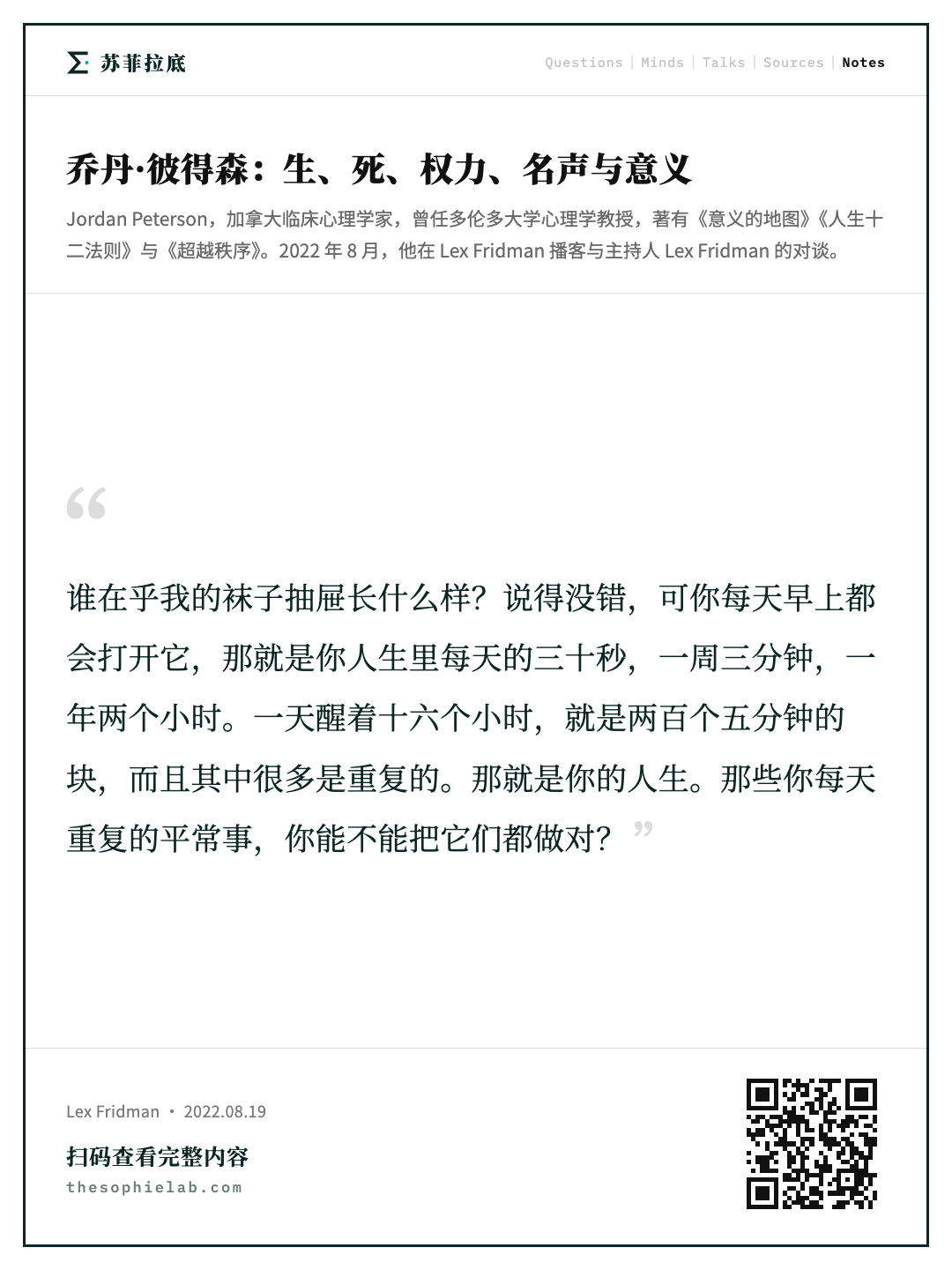
彼得森: 那就是你人生里每天的三十秒。好,那一周就是三分钟,一个月十二分钟,一年两个小时。所以也许你的人生就是由这些构成的。如果你一天有十六个小时,我们算一下:一小时十二个五分钟,十二个小时就是一百四十四个。好,算两百个吧。两百个五分钟的块,那就是你的人生。

主持人: 女士们先生们,乔丹·彼得森刚刚算了一下一天里有多少个五分钟。我相当确定这个数字八九不离十。

彼得森: 大致是对的。所以你有两百个五分钟的块,而且其中很多是重复的。如果你把每一个都做对了,它们都很琐碎,谁在乎我的袜子抽屉长什么样?说得没错,可那就是你的人生。那些你每天重复的事,那些平常事。你想,我能不能把所有这些平常事都做对?这就是游戏规则。现在所有平常的事都归位了,现在你可以玩了,因为平常事都归位了。这其实是真的。想想孩子,假设你希望你的孩子玩耍。玩在神经层面是非常脆弱的,任何竞争性的动机或情绪都会压制玩。所以一切都必须井然有序,必须是一座有围墙的花园,孩子才会玩。这是个很好的想法。所以你把一切收拾好,然后你会想,天哪,我现在被这份秩序暴政统治了。不,你没有,只要它是自愿的。那么秩序就是自由的前提。于是突然之间,你把这些东西都理顺了,你会说,瞧啊,我这儿有地方可以玩了。然后也许你就不抑郁了。当然常常没那么简单,真的没那么简单。你试试把你的房间收拾成完美的秩序,那很难。

主持人: 这是一种很有力的看待那些五分钟的方式。一天里做对其中一个就好。

彼得森: 对,如果你这样做两百天,你的人生就有序了。我跟很多来访者做过这件事。很多男人下班回家,妻子在门口迎接他们,然后立刻就是一场争吵。那里有冲突,因为他回到家,他累了、饿了、干了一整天活,他希望自己回家时被欢迎。而妻子在家带了一整天孩子,她也累了、饿了,她希望他回来时能对今天发生的一切表示一点感激。然后他们冲突,然后两个人都有各自的问题要说,因为白天都不顺。于是他们每次碰面都会有二十分钟左右的小架,然后整个晚上就毁了。那我会说,好,交易是这样的:叩门,门就会开。你可以决定你回家时发生什么,但你必须先弄清楚那是什么。

主持人: 也就是先把它想象出来。

彼得森: 这就是交易。你要好好对待自己。你设想回家,而且一切按你想要、你需要的方式发生。那是什么样子?你可以得到它,但你得知道它是什么。它是什么样子?然后你想,好,我想回家,我想为回家而高兴。我回到家,我开门,我说,亲爱的,我回来了。我妻子说,嗨,听到你的声音真好。她走过来说,嗨,亲爱的。她给我一个拥抱,她说,今天过得怎么样?我说,我们坐下来聊。你今天怎么样?我们坐下来聊。你要不要吃点什么?大概要。我们坐下来聊聊今天。这听着不错吧。也许不完美,但比我们现在这样好太多了。所以我们去跟你妻子谈谈。他说,好。我回家的时候是这样,我希望它更好。如果你能得到你想要的,你希望发生什么?于是她坐下来想,如果他回家,我希望发生什么?现在你有了两个愿景。你说,你想要什么?然后你听。她说,你想要什么?你告诉她。然后你想,好,我们能不能把这两个愿景合到一起,不只是让我们两个都得到想要的,而且因为把它们合到了一起,我们得到的比想要的更多。谁会不同意呢?除非他心里瞄的是往下走的方向。这太让人兴奋了,因为这不是妥协,这是两个理想的合一,而且合出了一个更好的���想。然后你就可以回家了。而且还有配套的一条规则:亲爱的,请你宽容一点,允许我在学的过程中把这件事做得又蠢又糟,至少二十次。

主持人: 明白。

彼得森: 我也给你同样的余地。然后我们蠢笨地练二十次,我们谈一谈,然后也许接下来的一万次我们就做对了。这件事你可以用在你的整个人生上,可以用在孩子身上,可以用在家庭上。这不容易,但做得到,而且比另一种选择容易得多。

怎样找到爱人

主持人: 我想向乔丹·彼得森求点恋爱建议。怎样找到你此生的爱人?

彼得森: 这是个好问题。巡演时我被问过很多次,而且一连三次都被问到,因为我们让观众用一个叫 Slido 的工具提问。

主持人: 这是个热门问题?

彼得森: 非常热门,它总是被顶到最上面。我一连三次被问到,可我没有好答案。后来我想,我为什么没有好答案?哦,我知道了,因为那是个蠢问题。

主持人: 为什么?

彼得森: 因为它本末倒置。正确的问题是:我怎样把自己变成完美的约会对象?你回答了这个问题,前一个问题对你就不再是问题。「我在伴侣身上想要什么」,不对。如果我能把我所能给的一切都给一个伴侣,我会是谁?你在这上面用功。就问这个问题,问问自己。好,我必须成为女人们想要的那种人。那她们想要什么?干净,这个起点不坏。身体状况还行,也就是健康、能干活、慷慨、诚实、愿意延迟满足。所以你跟一个女人跳舞。她在做什么?你们两个在做什么?那是有模式的,你们周围有模式在发生,那就是音乐,模式,存在的模式,那就是音乐。那么,你能不能优雅地让自己与存在的模式对齐?这就是她在观察的。然后,你能不能和她一起做到这件事?然后,你能不能以一种既好玩又专注的方式做到,并且至少有一分钟能管住自己的手?所以,你能不能以好玩的方式跳舞?你可以在想象里把这些过一遍,你会知道的。然后你会想,我离这些有多远?答案通常是,你和那个理想之间隔着一道相当可怕的深渊。但你越是努力去给别人他们需要和想要的东西,愿意排队来跟你玩的人就越多。所以那是个错的问题。真正的问题是:我怎样才能成为尽可能好的伴侣?

主持人: 然后你会想,如果我这样做,别人只会占我便宜。

彼得森: 这正是那种「不天真」的反驳。天真的人会想,我做个好人,所有人就会好好待我。愤世嫉俗者会说,不,我做个好人,然后有人会把我干掉。那你拿这个反驳怎么办?答案是,你把它算进去。这就是为什么你应该像鸽子一样温柔,像蛇一样智慧。意思是:我知道你满肚子是蛇,我知道,也许我比你更知道,但我们还是一起玩。

主持人: 还是冒这个险。

彼得森: 没错,自愿地。而妙就妙在,即使你面对的人满肚子是蛇,如果你伸出的手是带着信任的,而且是真的,你会唤起他身上最好的东西。

主持人: 明白。

彼得森: 这是真的。我接触过一些相当有犯罪倾向、相当精神变态的人,有时候甚至是危险的那种。你跟这种人打交道时必须非常小心地走每一步,尤其在他们喝醉的时候。可即便如此,你最好的赌注仍然是那种警觉的信任。事实上,那是我所知道的唯一……我有一位来访者是偏执型精神变态者,这是个糟糕的组合。他是个狠角色,身上有四张限制令,而限制令对那种会被下限制令的人是不起作用的。他偶尔会被那种有权力妄想的银行小职员骚扰。他会对他们说,他还跟我演过一遍,他会说:我会变成你最可怕的噩梦。而且他是当真的。

主持人: 而且他真会做到。

彼得森: 他真会做。他有那种强迫性的、精神变态式的复仇心,就在那里,偏执到骨子里。而偏执的人是极度敏锐的,他们盯着你身上任何一丝欺骗或操纵的迹象,而且他们非常擅长,因为他们是百分之百的专注,偏执就是这个意思,百分之百专注在这上面。可即便在这种情形下,只要你的每一步都走得足够小心,也许你就能避开那把斧头。如果你哪天遇到真正危险的人,这是值得知道的事。

主持人: 完全同意。我相信这一点:哪怕自己是脆弱的,仍然向另一个人迈出信任的一跃,哪怕他们是危险的,尤其当他们危险的时候,如果你在乎,如果那些山里有你想找的东西,那大概只有冒这个险,你才找得到。

善恶之线

主持人: 我一定要问您索尔仁尼琴的《古拉格群岛》,它正好说到这一点。这本书有太多层次,我们可以永远谈下去,某种意义上我们确实在永远谈它。其中一个以多种方式呈现的主题是那条穿过每一个人的善恶之线。他写道:善恶之线穿过每个人的心;在任何一颗心的一生中,这条线都在移动,有时它被挤向一边,让邪恶膨胀,有时它又退开,给善留出足够生长的空间。同一个人,在不同的年龄、不同的境遇里,会是完全不同的人。有时他近乎恶魔,有时又接近圣徒。可他的名字没有变,而我们把那全部的善与恶都记在那个名字上。您怎么看这条线?我们刚才说,如果你给一个人机会,你其实会唤出他身上最好的东西。那另一面呢,这条线在每个人心里随时间移动,而你可以决定它怎么移动。我们每个人都有能力作恶吗?

彼得森: 那场宇宙大戏,撒旦对基督,如果那不是关于你的,那是关于谁的?我只是以心理学家或者文学批评者的身份在说,他们是角色,至少他们是角色。他们是人的角色吗?显然是。他们是原型性的人的角色吗?是。那在宇宙论和本体论上意味着什么?我不知道。世界是故事吗?也许。

主持人: 不过故事常常把人物写成稳定的……

彼得森: 我知道,但伟大的文学不这样,这在伟大的文学里非常罕见。伟大的文学里通常呈现的是内在的戏剧。文学越通俗,人物就越单一,有一个彻头彻尾的坏人,有一个彻头彻尾的好人,那不够有意思,也不够精妙。当你到了陀思妥耶夫斯基或者莎士比亚那种高度,你会认同那个恶棍。这时文学才在某种意义上真正抵达它的顶峰。

主持人: 而且人物会一直变,一直难以预测。我最近更认真地对待俄罗斯文学,我跟一些翻译陀思妥耶夫斯基、托尔斯泰、契诃夫的译者谈过。译者们在很长时间里对陀思妥耶夫斯基犯的一个错误,是去「修正」他那种混乱,因为人们觉得他写得太仓促,那些岔开去的段落好像和任何东西都无关,人物不可预测、不一致,有些句子像是残缺的。而他们后来意识到,那不是仓促,那是刻意为之,那才是它的魔力所在,它捕捉了这些人物的人性:他们不可预测,他们随时间变化,他们身上充满矛盾。

彼得森: 对。

主持人: 说到这里我必须问,有没有理由说《卡拉马佐夫兄弟》是有史以来最伟大的书?

彼得森: 有,可以这么论证。我不确定。它比《罪与罚》更好吗?

主持人: 是的。

彼得森: 你这么认为?为什么?我不是在跟你争,我是想知道你为什么这么想。

主持人: 每一本书都是私人的。我最好的一些朋友就在那本书里。

彼得森: 那是一本了不起的书,这毫无疑问。

主持人: 我觉得有些书是由你和它的私人关系定义的,而那本书对我是决定性的。我几乎是「升级」到那一本的,因为在很长时间里,《白痴》是我最爱的书,因为我认同梅什金公爵所代表的观念。

彼得森: 这很有意思。

主持人: 我也认同梅什金这个人。

彼得森: 那个圣愚。

主持人: 那个愚人。因为在我狭窄的自我感知里,这个世界几乎一辈子都把我看成某种愚人。而与很多人对这本书的解读不同,我把他看成一种英雄。

彼得森: 当然是。

主持人: 做一个所谓天真的愚人,但其实只是一个天真的乐观主义者,而且是以最好的方式天真。

彼得森: 那是「童稚」。

主持人: 对。「天真」通常被看成……

彼得森: 那是幼稚。天真是幼稚。

主持人: 但童稚不同。

彼得森: 这正是为什么除非你变成小孩子的样式,否则不能进天国。那就是梅什金公爵,陀思妥耶夫斯基懂这一点。所以你才喜欢《白痴》。这太有意思了。我想我之所以喜欢《罪与罚》,是因为你认同梅什金,而我更认同拉斯柯尔尼科夫,因为我曾被路西法式的智力所诱惑,方式和他非常相似。不过我认为你可以论证《卡拉马佐夫兄弟》是陀思妥耶夫斯基的巅峰之作,那可真是了不得。他把文学给我毁了。

主持人: 怎么讲?

彼得森: 因为之后别的东西读起来都寡淡。倒也不是全部,不是全部。我确实找到过一些在我的体验里同样抵达顶峰的书。《大师与玛格丽特》,那是本要命的书,我大概读了四遍,而且它还是深不见底。还有希腊作家尼科斯·卡赞扎基斯,他有些书写得也极好。

主持人: 您有没有和加缪这样的文学存在主义者,或者黑塞、卡夫卡产生过同样的连接?

彼得森: 到同样的程度吗?

主持人: 到足以构成影响的程度。

彼得森: 你要是在根本意义上耳聋,才可能遇上一位伟大的死去的朋友却什么也没学到。我读书时会努力把麦子和糠分开。我读了所有伟大的临床学家,也许不是全部,但凡是在那个万神殿里居前列的都读了。我尽力从中提取我能提取的,而那很多。我从弗洛伊德那里学到很多,从罗杰斯那里学到很多,也从陀思妥耶夫斯基和尼采那里学到很多。我准备为彼得森学院开一门关于陀思妥耶夫斯基和尼采的课,一月开始。

主持人: 把他们放在一起讲。

彼得森: 我很期待。

主持人: 您把他们编织在一起……

彼得森: 我之前没想过把他们合在一起讲。

主持人: 是吗。

彼得森: 那会很有意思。这是个好主意。我要把这个主意偷走。

主持人: 请便。您经常把他们非常精彩地编织在一起,因为在他们两人的写作里都有广义上的宗教主题。

彼得森: 是的,他们的写作和人生之间有一种不可思议的平行。而且陀思妥耶夫斯基比尼采更深,但那是因为他是个小说家。

主持人: 尼采几乎就是陀思妥耶夫斯基小说里的一个人物。

彼得森: 他绝对是。绝对是。而且看起来尼采对陀思妥耶夫斯基的了解比人们原以为的要多,这方面近年有一些新的研究。据我所知,陀思妥耶夫斯基对尼采一无所知,我可能弄错了。但陀思妥耶夫斯基比尼采强的地方在于,尼采必须把事情命题化,因为他是哲学家,而把那些超出你能力范围的东西命题化很难,可你能把它们「人物化」。所以在《卡拉马佐夫兄弟》里,伊万是一个比阿廖沙更完整的人物,在显白的意义上他能提出更好的论证,可阿廖沙赢了,就像梅什金赢了一样,因为他是更好的人。而陀思妥耶夫斯基能在行动中把这一点展示出来。他没法把它完全命题化,但那大概是因为「善」本来就无法被完全命题化。所以陀思妥耶夫斯基在这一点上胜过尼采。伊万是个才华横溢的理性主义者、无神论者、唯物论者,他在这条战线上提出的论证,在我看来至今无人能敌,他把阿廖沙压得无话可说,可阿廖沙仍然是更好的人。这非常有意思。

主持人: 有趣的是,您,乔丹·彼得森,似乎在某种程度上同时体现了这两个人物。因为您是我们这个时代的知识分子之一,思想严密,但同时您也有那种……怎么形容呢?如果把阿廖沙身上的宗教性去掉,那是什么?对世界的爱。

彼得森: 鼓励之灵。

主持人: 是的。

彼得森: 我从凝视深渊,从我不得不凝视或者愿意凝视的那个程度里,确实学到了一件事:在某个层面上,你必须做出一个根本性的信仰宣告。神创造世界,每一天之后他都说,他看着这是好的。你会想,它是好的吗?这是个难题。你愿不愿意把一个孩子带到这样一个世界上来?这正是「它是否好」的根本问题。宣告它是好的,这是一个信仰行动,因为证据是模棱两可的。

主持人: 明白。

彼得森: 于是你想,好,我要不要就按「它是好的」这个命题去行动?如果我这样做会怎样?而答案也许是,我认为这就是答案:你越是把「它是好的」这个命题活出来,它就越好。陀思妥耶夫斯基还说过一句话:每个人不只对自己所做的一切负责,而且对所有人所做的一切负责。你会想,这话到底是深刻还是疯了?然后你想,你收到的东西是不是与你给出的东西成比例?答案可能是,是的。这是个可怕的想法。而且你在某种意义上能看出它是真的,因为人们确实会以你对待他们的方式回应你,这是确凿的。

主持人: 它既可怕又令人兴奋。

彼得森: 对。可那不就是冒险吗?

主持人: 你以你活的方式创造你的世界。你所经历的世界,是由你如何活出这个世界所定义的。这很有意思。然后合在一起看,我们是以这种方式共同创造这个世界。

彼得森: 对。

最高的理想

主持人: 您觉得这一切的意义是什么?生命的意义是什么,乔丹·彼得森?我们在这场对话里已经定义了很多次。

彼得森: 意义就是这一路上的冒险。而你会问,那冒险在哪里?在信里。什么样的信?最高的理想是爱,而真理是它的侍女。这是一个信仰宣告,因为你没法事先知道,你必须把它活出来,才知道它是不是真的。

主持人: 也就是说不先跳进去就什么都不知道。

彼得森: 你甚至根本无从知晓。这非常古怪,你必须先做出承诺。就像婚姻,是一回事。这个人是不是适合我的人?那是错的问题。正确的问题是:我怎么才能知道这个人是不是适合我的人?通过把自己和他绑定。也许生命也是同一回事。你把自己绑定在它上面,而你绑得越紧,你就越能发现它是什么。那是一种彻底的拥抱,一种真正彻底的拥抱。那就是十字架的象征。而且不只如此,因为我刚才说过,完整的受难故事不止于死亡,甚至不止于不义的死亡,甚至不止于无辜者被不义地钉上十字架,那已经够糟了。它是不义的、受尽折磨的、无辜者的死,前面是背叛与暴政,后面是地狱。要彻底拥抱这样一个东西,那可真够劲。就像说:来吧。

主持人: 我觉得很多人把真理当作最高理想,而且以为自己可以一边活在犬儒之中、最终逃离生活、躲开生活、害怕生活,一边抵达那个理想。所以您说爱是最高的理想,真理是它的侍女,说得真好。

彼得森: 我在这件事上想了很久,想这个理想的序列。真理的那种苦涩的真理、犬儒的真理,它的作用是能砸碎天真的枷锁。而被烧透的犬儒,在道德上其实是对盲目天真的一次改善,尽管一个在某些方面是正面的,但那只是因为它被保护着;另一个苦涩而黑暗,却仍然更好。但你在那个点上并没有完成,你才刚开始。你说你犬儒?你还不够犬儒。你到底有多犬儒?你有没有犬儒到「奥斯维辛看守」那个级别?因为你得在自己心里往下走很深很深,才能找到那一部分,但只要你想找,你就能找到。然后你会想,我要制止这个。而这正是你在某种意义上提出的问题:你执着于共产主义国家那些大规模的灾难到底发生了什么。而那是几百万人参与的。所以你也可能参与,而且你可能还会享受它。那么其中哪一部分是你?只要你想找,你就找得到。

主持人: 对,全都在里面。囚犯,审讯者。

彼得森: 犹大。彼拉多。

主持人: 全都在。

彼得森: 全都在。

主持人: 而这一切都在我们里面。

彼得森: 对。

主持人: 你只需要去看,而一旦你看了,也许最终你能找到那份爱。乔丹,您是个了不起的人。您愿意跟我谈,我深感荣幸。谢谢您在这个世界上做一个求真的人,也谢谢您给出的爱。

彼得森: 谢谢你的邀请。

主持人: 最后,请允许我用尼采的一句话作结:你必须心中有混沌,才能生出一颗跳舞的星。
本期讲者
乔丹·彼得森加拿大临床心理学家,曾任多伦多大学心理学教授,著有《意义的地图》《人生十二法则》与《超越秩序》。以圣经叙事、荣格心理学与人格研究相结合的公开讲座与播客广为人知。
Lex Fridman人工智能研究者、《Lex Fridman Podcast》主持人,长期以长时段深度访谈科学家、工程师与思想者著称。本场对谈前不久曾赴乌克兰前线实地走访。
章节 · 点击跳转视频
0:00 美指向神性:陀氏的命题 ▶ 正在看
5:30 深层图像与门口的火焰剑 ▶ 正在看
11:48 科学为何必须预设超越者 ▶ 正在看
20:33 技术伦理与关不掉的怪物 ▶ 正在看
26:32 名气的腐蚀与每日之死 ▶ 正在看
34:58 马斯克、人口不足与反真理 ▶ 正在看
39:04 恶龙、化肥令与谁配带路 ▶ 正在看
51:12 怨恨反问与特鲁多钢人论证 ▶ 正在看
1:16:30 乌克兰战争、款待与倾听 ▶ 正在看
1:34:05 巡讲的一天与登台的技艺 ▶ 正在看
2:10:01 如何提问、走出抑郁与起步 ▶ 正在看
2:46:47 善恶之线与最高的理想 ▶ 正在看
本期论点
本期回应
其他论点
3:09
美不能被还原为清晰与简单,它是秩序与混沌之间的平衡
11:12
美是指向上帝的骇人路标,宣称自己世俗却仍被艺术震撼的人并不真正世俗
12:40
最高意义上的上帝是那种人必须效法才能繁荣兴盛的精神模式
16:28
任何科学进展都预设了一个本体论意义上超越的实在的存在
28:02
名气会剥夺一个人被恰当反驳的机会,这正是许多名人与暴君走向失控的原因
38:05
西方生育率跌破世代更替水平是彻头彻尾的灾难,真正的问题是人口不足而非过剩
45:49
在百年后假设性获救的穷人与未来十年真实被害死的穷人之间,应当优先顾及后者
49:30
靠行政命令把一个利润率仅约3%的产业砍掉30%,必然拖垮整个相关生态系统
1:06:32
同情本身只是本能反应而非美德,唯有带着判断力的同情才是美德
1:10:15
一个人若不胜任所处的职位,权力必然会腐蚀他
1:21:00
一个谎言若有效到能骗过数百万人,说谎者自己最终也会相信它
1:46:00
黑猩猩中优先交配的是最擅长调停互惠的雄性,主权更接近反复互惠而非强制权力
2:11:02
最让人心烦、怨恨的那些事里藏着一个人的天命所在
2:24:09
受苦越是自愿,其转化力量越大;被强行推入深渊的创伤则可能毁掉人
2:59:29
最高的信仰是爱,真理只是爱的侍女
01美指向神性:陀氏的命题
0:00
- "Battle not with monsters, lest ye become a monster, and if you gaze into the abyss, the abyss gazes also into you." - Right, but I would say, bring it on. If you gaze into the abyss long enough, you see the light, not the darkness. - Are you sure about that? - I'm betting my life on it. - The following is a conversation with Jordan Peterson, an influential psychologist, lecturer, podcast host, and author of "Maps of Meaning", 12 Rules For Life" and "Beyond Order." This is the Lex Fridman podcast, to support it please check out our sponsors in the description.
- “与怪物战斗的人,应当小心自己不要成为怪物。当你凝视深渊时,深渊也在凝视着你。”- 没错,但我想说的是,放马过来吧。如果你凝视深渊足够久,你看到的会是光明,而不是黑暗。- 你确定吗?- 我拿命来赌。- 以下是我与Jordan Peterson的对话,他是一位极具影响力的心理学家、演讲者、播客主持人,也是《意义的地图》《人生十二法则》和《超越秩序》的作者。这里是Lex Fridman播客,如果想支持我们,请查看简介中的赞助商信息。
便签引用
0:43
And now dear friends, here's Jordan Peterson. Dostoevsky wrote in "The Idiot", spoken through the character of Prince Myshkin that beauty will save the world. Solzhenitsyn actually mentioned this in his Nobel Prize acceptance speech. What do you think does Dostoevsky meant by that? Was he right? - Well, I guess it's the divine that saves the world, let's say, you could say that by definition. And then you might say, "Well, are there pointers to that which will save the world or that which eternally saves the world?"
那么,亲爱的朋友们,有请Jordan Peterson。陀思妥耶夫斯基在《白痴》中借梅什金公爵之口写道,美将拯救世界。索尔仁尼琴在他的诺贝尔奖获奖演说中也提到过这句话。你认为陀思妥耶夫斯基这句话是什么意思?他说得对吗?- 嗯,我想,拯救世界的是神性,可以这么说,这几乎是定义使然。然后你可能会问:“那么,有没有什么东西指向那个能拯救世界、或者永恒地拯救世界的存在呢?”
便签引用
1:20
And the answer to that in all likelihood is yes. And that's maybe truth and love and justice and the classical virtues, beauty perhaps in some sense foremost among them. That's a difficult case to make, but definitely a pointer. - Which direction is the arrow pointing? - Well, the arrow's pointing up. And no, I think that that which it points to is, what beauty points to, it transcends beauty. It's more than beauty. - And that speaks to the divine. - It points to the divine. Yeah, and I would say again by definition, 'cause we could define the divine in some real sense.
答案十有八九是肯定的。那可能就是真理、爱、正义,以及古典美德,而美或许在某种意义上是其中最重要的。这一点很难论证,但美肯定是一个指向标。- 那支箭指向哪个方向?- 嗯,箭是向上指的。而且不,我认为它所指向的东西,也就是美所指向的东西,是超越美本身的。它不只是美。- 这就说到了神性。- 它指向神性。是的,我还是要说,这是定义使然,因为我们可以在某种真实的意义上定义神性。
便签引用
1:56
So one way of defining the divine is what is divine to you is your most fundamental axiom. And you might say, "Well, I don't have a fundamental axiom." Then I would say, "That's fine." But then you're just confused 'cause you have a bunch of contradictory axioms. And you might say, "Well, I have no axioms at all." And then I'd say, "Well, you're just epistemologically ignorant beyond comprehension if you think that, 'cause that's just not true at all." - So you don't think a human being can exist within contradictions?
定义神性的一种方式是:对你而言神圣的,就是你最根本的公理。你可能会说:“可我并没有什么根本公理。”那我会说:“没关系。”但那样你只会陷入困惑,因为你脑子里有一堆自相矛盾的公理。你可能会说:"我根本没有什么公理。"那我就会说:"如果你这么想,那你在认识论上就无知到不可理喻了,因为那根本不是事实。"- 所以你不认为人可以在矛盾中生存?
便签引用
2:24
- Well, yeah we have to exist within contradiction, but when the contradictions make themselves manifest, say in confusion with regard to direction, then the consequence of that technically is anxiety and frustration and disappointment and all sorts of other negative emotions. But the cardinal negative emotion signifying multiple pathways forward is anxiety. It's an entropy signal. - But you don't think that kind of entropy signal can be channeled into beauty, into love? Why does beauty and love have to be clear, ordered, simple?
- 呃,我们当然必须在矛盾中生存,但当那些矛盾显现出来的时候,比如在方向上陷入困惑,那么从技术上讲,其后果就是焦虑、挫败、失望,还有各种各样其他的负面情绪。但标志着前方存在多条路径的那个核心负面情绪,就是焦虑。它是一种熵的信号。- 但你不认为那种熵的信号可以被引导成美、引导成爱吗?为什么美和爱就必须是清晰的、有序的、简单的?
便签引用
3:04
- Well, I would say it probably doesn't have to be... It can't be reduced to clarity and simplicity because when it's optimally structured, it's a balance between order and chaos. Not order itself. If it's too ordered, if music is too ordered, it's not acceptable. It sounds like a drum machine. It's too repetitive. It's too predictable. It has to have, well, it has to have some fire in it. - Yes. - Along with the structure. I was in Miami doing a seminar on Exodus with a number of scholars. And this is a beauty discussion.
- 呃,我会说它可能不一定非得如此……它不能被还原为清晰和简单,因为当它处于最优的结构状态时,它是秩序与混沌之间的一种平衡。而不是秩序本身。如果太有序了,如果音乐太有序了,那就没法接受。听起来就像个鼓机。太重复了。太可预测了。它必须要有——嗯,它里面必须得有点火。- 是的。- 火要和结构并存。我当时在迈阿密,和一些学者一起做关于《出埃及记》的研讨会。而这正是一场关于美的讨论。
便签引用
3:45
When Moses first encounters the burning bush, it's not a conflagration that demands attention. It's something that catches his attention. It's a phenomena and that means to shine forth. And Moses has to stop and attend to it and he does. And he sees this fire that doesn't consume the tree and the tree, the tree is a structure, right? It's a tree like structure. It's a branching structure. It's a hierarchical structure. It's a self-similar structure. It's a fractal structure, and it's the tree of life and it's the tree of the knowledge of good and evil.
摩西第一次遇见燃烧的荆棘时,那并不是一场逼你不得不看的大火。那是某种吸引住他注意力的东西。它是一种"现象"(phenomena),这个词的意思就是"显现、发光"。摩西必须停下脚步去关注它,而他也确实这么做了。他看见一团火,却没有把那棵树烧毁,而树——树是一种结构,对吧?它是一种树状结构。是分叉的结构。是等级性的结构。是自相似的结构。它是分形结构,它是生命之树,也是分别善恶的知识之树。
便签引用
4:19
And the fire in it is the transformation that's always occurring within every structure. And the fact that the fire doesn't consume the bush in that representation is an indication of the balance of transformation with structure. And that balance is presented as God. And what attracts Moses to it, in some sense, is the beauty. Now it's the novelty and all that, but like a painting is like a burning bush. That's a good way of thinking about it. A great painting. It's too much for people often. My house was and will soon be again, completely covered with paintings inside.
而其中的火,就是每一种结构内部始终在发生的那种转化。而在那个意象中,火并没有烧毁荆棘,这一点表明了转化与结构之间的平衡。而那种平衡,被呈现为神。而在某种意义上,吸引摩西过去的,正是那种美。当然也有新奇之类的因素,但一幅画作就好比一丛燃烧的荆棘。这是个很好的理解方式。一幅伟大的画作。对很多人来说,那往往太过强烈了。我家里以前满墙都是画,很快又会变成那样,整个屋里全是画。
便签引用
4:58
And it was hard on people to come in there because, well my mother, for example, say, well, "Why would you wanna live in a museum?" And I'd think, well, I would rather live in a museum than anywhere else in some real sense. But beauty is daunting. It scares people. They're terrified of buying art, for example, because their taste is on display and they should be terrified because generally people have terrible taste. Now that doesn't mean they shouldn't foster it and develop it but... And when you put your taste on display, it really exposes you.
这让来做客的人挺不好受的,因为,比如说我母亲,她会说:"你干嘛要住在博物馆里?"而我心想,从某种真实的意义上说,我宁愿住在博物馆里,也不愿住在别的任何地方。但美是令人生畏的。它吓到人。比如说,人们很怕买艺术品,因为那等于把自己的品味公开展示出来,而他们也确实该害怕,因为一般来说人们的品味都很糟糕。当然这不意味着他们不该去培养和发展品味,但是……而当你把自己的品味展示出来时,那真的会把你暴露无遗。
便签引用
02深层图像与门口的火焰剑
5:30
- Even to yourself as you walk past it? - Oh definitely. - Every day. - Absolutely. - This is who I am. - Yeah, well, and look how mundane that is and look how trite it is and look at how cliche it is and look at how sterile or too ordered it is or too chaotic. - Or how quickly you start to take it for granted because you've seen it so many times. - [Jordan] Well, if it's a real piece of art, that doesn't happen. - You notice the little details. - The whole is greater than the sum of the parts. I mean, there are images, religious images in particular so we could call them deep images that people have been unpacking for 4,000 years and still have, I'll give you an example.
- 甚至在你每天经过它的时候,暴露给你自己?- 绝对是的。- 每一天。- 完全没错。- 这就是我。- 是啊,然后你会想,看这多平庸,多陈腐,多老套,看这多么呆板、太有序了,或者太混乱了。- 或者说,你会多快就开始对它习以为常,因为你已经看过太多遍了。- [Jordan] 呃,如果它是一件真正的艺术品,那种情况不会发生。- 你会注意到那些细枝末节。- 整体大于部分之和。我是说,有些图像,尤其是宗教图像——我们可以称之为深层图像——人们已经解读了四千年,而且还在继续解读,我给你举个例子。
便签引用
6:09
This is a terrible example. So I did a lecture series on Genesis and I got a lot of it unpacked, but by no means all of it. When God kicks Adam and Eve out of the Garden of Eden, he puts cherubim with flaming swords at the gate to stop human beings from reentering paradise. I thought, what the hell does that mean, cherubim? And why do they have flaming swords? I don't get that. What is that exactly? And then I found out from Matthew Pageau who wrote a great book on symbolism in Genesis that cherubim are the supporting monsters of God.
这个例子挺可怕的。我做过一个关于《创世记》的系列讲座,解读出了不少东西,但远远不是全部。当神把亚当和夏娃赶出伊甸园时,他在园门口安置了基路伯和发火焰的剑,阻止人类重返乐园。我当时想,基路伯到底是什么鬼意思?他们为什么拿着燃烧的剑?我不明白。那到底是什么?后来我从 Matthew Pageau 那里搞明白了,他写过一本很棒的书,讲《创世记》中的象征,他说基路伯是神的护卫怪兽。
便签引用
6:47
It's a very complicated idea. And that they're partly a representation of that which is difficult to fit into conceptual systems. They've also got an angelic or demonic aspect, take your pick. Why do they have flaming swords? Well, a sword is a symbol of judgment and the separation of the wheat from the chaff, use a sword to cut away, to cut away and to carve. And a flaming sword is not only that which carves, it's that which burns. And what does it carve away and burn? Well, you wanna get into paradise?
这是个非常复杂的概念。而且它们在一定程度上代表了那些难以被纳入概念体系的东西。它们身上还有一种天使或恶魔的面向,随你怎么看。它们为什么拿着燃烧的剑?嗯,剑是审判的象征,是把麦子和糠秕分开的象征,用剑去削去、去砍除、去雕琢。而一把燃烧的剑不只是雕琢之物,它还是焚烧之物。那它雕琢和焚烧掉的是什么?嗯,你想进入乐园?
便签引用
7:28
It carves away everything about you that isn't perfect. And so what does that mean? Okay, well, here's part of what it means. This is a terrible thing. So you could say that the entire Christian narrative is embedded in that image. Why? Well, let's say that flaming swords are a symbol of death. That seems pretty obvious. Let's say further that they're a symbol of apocalypse and hell. That doesn't seem completely unreasonable. So here's an idea. Not only do you have to face death, you have to face death and hell before you can get to paradise.
它会把你身上一切不完美的东西都削掉。那这意味着什么?好,它的部分含义是这样的。这可是件可怕的事。你可以说整个基督教叙事都嵌在那个意象里。为什么?那么,我们假设燃烧的剑是死亡的象征。这看上去相当明显。我们再进一步假设,它们是天启与地狱的象征。这似乎也不算完全不合理。所以这里有一个想法。你不仅得直面死亡,你得在进入乐园之前,先直面死亡和地狱。
便签引用
8:09
Hellish judgment and all that's embedded in that image. And a piece of art with an image like that has all that information in it. And it shines forth in some fundamental sense. It reaches into the back tendrils of your mind at levels you can't even comprehend and grips you. I mean, that's why people go to museums and gaze at paintings they don't understand. And that's why they'll pay... What's the most expensive objects in the world? If it's not carbon fiber racing yachts, it's definitely classic paintings, right?
地狱般的审判,以及所有嵌在那个意象里的东西。而一件带有这种意象的艺术品,就承载着所有这些信息。它在某种根本的意义上向外发光。它会伸进你意识深处那些连你自己都无法理解的层面,牢牢抓住你。我是说,这就是为什么人们会去博物馆,凝视那些他们并不理解的画作。这也是为什么他们愿意花……世界上最昂贵的物件是什么?如果不是碳纤维赛艇,那肯定就是经典画作,对吧?
便签引用
8:42
It's high level technological implements or it's classic art. Well, why are those things so expensive? Why do we build temples to house the images? Even secular people go to museums. "I'm secular." Well, are you in a museum? "Yes." Are you looking at art? "Yes." Well, what makes you think you're secular then? - It's arguable that the thing many, many centuries from now that will remain of all of human civilization will be our art. Not even the words. - Well, you know, a book has remained a very long time, right?
要么是高端的技术器物,要么就是经典艺术品。那么,这些东西为什么这么贵?我们为什么要建造神殿来安放那些图像?连世俗之人也会去博物馆。"我是世俗的。"那,你此刻在博物馆里吗?"在。" 你在看艺术品吗?"在看。"那你凭什么觉得自己是世俗的呢?- 可以说,许多许多个世纪之后,人类文明唯一留存下来的东西将会是我们的艺术。甚至连文字都留不下。- 不过你知道,书已经留存了很长时间了,对吧?
便签引用
9:16
The biblical readings. - Not that long. - No, that's right. - But that's in the full arc of living organisms. - Yeah. - Perhaps will not- - Well, we have images that are, we have artistic images that are at least 50,000 years old, right, that have survived. And some of those are, they're already profound in their symbolism. - By we, do you mean humans? - Yeah. We found them and they've lasted that long. And then think about Europe. Secular people all over the world make pilgrimages to Europe. Well, why?
那些圣经文本。- 也没那么长。- 对,说得没错。- 但那是放在生命体演化的整个跨度里看。- 是啊。- 也许不会——- 嗯,我们有一些图像,我们有一些艺术图像,至少有五万年历史了,对吧,它们一直留存到今天。其中有些图像,它们的象征意味已经相当深邃了。- 你说的"我们"是指人类吗?- 对。我们发现了它们,而它们已经留存了那么久。再想想欧洲。全世界的世俗之人都会朝圣般地前往欧洲。为什么呢?
便签引用
9:53
Because of the beauty. Obviously, I mean, that's self-evident, and it's partly because there are things in Europe that are so beautiful they take your breath away, right? They make your hair stand on end. They fill you with a sense of awe. And we need to see those things. It's not optional. We need to see those things. The cathedrals. I was in the cathedral in Vienna and it was terribly beautiful, you know? - Terribly beautiful. - Well, it was terribly beautiful. - Is beauty painful for you is? Is that the highest form of beauty?
因为那里的美。这很明显,我是说,这是不言自明的,而且部分原因在于,欧洲有些东西美得让你屏住呼吸,对吧?它们让你汗毛倒竖。它们让你心中充满敬畏。我们需要去看看这些东西。这不是可有可无的。我们必须去看看这些东西。那些大教堂。我去过维也纳的那座大教堂,那种美简直骇人,你懂吗?——骇人的美。——对,那种美确实骇人。——对你来说,美是痛苦的吗?那是最高形式的美吗?
便签引用
10:24
It really challenges you. - Oh, definitely. Yeah. Yeah. I got a good analysis of the Statue of David, Michelangelo statue, says, "You could be far more than you are." That's what that statue says. (Lex laughing) And this cathedral, we went down into the understructure of it and there were three floors of bones from the plague. And there they all are. And then that cathedral's on top of it. It's no joke to go visit a place like that. It rattles you to the core. And our religious systems have become propositionally dubious, but there's no arguing with the architecture, although modern architects like to with their sterility and their giant middle fingers erected everywhere.
它真的在挑战你。——噢,绝对是。是啊,是啊。我读过一段对米开朗基罗那尊大卫像的精彩解读,它说:"你本可以远比现在的自己更伟大。"那尊雕像说的就是这个。(Lex 笑)而那座大教堂,我们下到它的地下结构里,那里有三层堆满了瘟疫死者的骸骨。它们就全在那儿。然后那座大教堂就建在它们之上。去这样的地方参观可不是闹着玩的。它会把你从骨子里震撼到。我们的宗教体系在命题层面已经变得可疑,但那建筑本身是无可辩驳的——尽管现代建筑师喜欢用他们那种冷冰冰的贫瘠,还有到处竖起的巨大中指去反驳。
便签引用
11:12
But beauty is a terrible pointer to God. And you know, a secular person will say, "Well, I don't believe in God." It's like, have it your way. You cannot move forward into the unforeseen horizon of the future except on faith. And you might say, "Well, I have no faith." It's like, well, good luck with the future then, because what are you then? Nihilistic and hopeless and anxiety ridden. And if not, well, something's guiding you forward, it's faith in something or multiple things, which just makes you a polytheist, which I wouldn't recommend.
但美是指向上帝的一个骇人的路标。你知道,世俗的人会说:"嗯,我不信上帝。"那就随你怎么想吧。你无法向那个不可预见的未来地平线迈进,除非凭着信。你可能会说:"可我没有信仰。"那我只能说,那祝你在未来好运了,因为那样你算什么呢?虚无主义、绝望、被焦虑折磨。如果不是这样,那说明有某种东西在引领你前行,那就是对某种东西或多种东西的信,那只不过让你成了个多神论者,而我并不推荐这个。
便签引用
03科学为何必须预设超越者
11:48
- Well, let me ask you one short lived biological meat bag to another, who is God then? Let's try to sneak up to this question if it's at all possible. Is it possible to even talk about this? - Well, it better be because otherwise there's no communicating about it, right? It has to be something that can be brought down to earth. - Well, we might be too dumb to bring it down. - It's not just ignorant. It's also sinful, right? So, because there's not knowing and then there's wanting to know or refusing to know.
——那么,容我以一个短命的生物肉囊的身份,问另一个肉囊一句,上帝到底是谁?如果可能的话,我们试着悄悄逼近这个问题。这个问题甚至有可能谈论吗?——嗯,最好是能谈,否则关于它就无从交流了,对吧?它必须是某种能落到实处的东西。——嗯,可能我们太笨了,落不下来。——这不只是无知的问题。这也是罪,对吧?因为一种是不知道,另一种是想要知道,或者拒绝知道。
便签引用
12:23
- Yeah. - And so you might say, "Well, could you extract God from a description of the objective world, right? Is God just the ultimate unity of the natural reality? And I would say, "Well, in a sense, there's some truth in that, but not exactly because God in the highest sense is the spirit that you must emulate in order to thrive. How's that for a biological definition? Spirit is a pattern. The spirit that you must emulate in order to thrive. - So it's a kind of, in one sense, when we say the human spirit, it's that?
——是啊。——所以你可能会说:"那你能从对客观世界的描述中提取出上帝吗?"上帝就只是自然实在的终极统一体吗?我会说:"嗯,在某种意义上,这话有几分道理,但又不完全对,因为最高意义上的上帝,是你必须去效法、才能繁荣兴盛的那种精神。"这个生物学式的定义怎么样?精神是一种模式。那种你必须效法才能繁荣兴盛的精神。——所以从某种意义上说,当我们说"人的精神"时,指的就是这个?
便签引用
13:02
- It's an animating principle. Yeah. It's a meta, it's a pattern. And you might say, "Well, what's the pattern? Okay. Well, I can tell you that to some degree. Imagine that like your grip by beauty, you're gripped by admiration. And you can just notice this, this isn't proposition. You have to notice it. It's like, oh, turns out I admire that person. Hmm. So what does that mean? Well, it means I would like to be like him or her. That's what admiration means. It means there's something about the way they are that compels imitation, another instinct.
——它是一种赋予生命的原则。对。它是一种元层面的东西,是一种模式。你可能会说:"那这模式究竟是什么?"好吧,这个我多少能告诉你一点。设想一下,就像你被美攫住一样,你被钦佩之情攫住了。而你完全可以直接注意到这一点,这不是什么命题。你得去留意它。就像:噢,原来我很钦佩那个人。嗯。那这意味着什么呢?嗯,意味着我想成为像他或她那样的人。这就是钦佩的含义。意味着他们身上有某种东西,迫使你去模仿,这是另一种本能。
便签引用
13:40
Or inspires respect or awe even. Okay. What is that that grips you? Well, I don't know. Well, let's say, okay, fine. But it grips you and you wanna be like that. Kids hero worship, for example. So do adults for that matter, unless they become entirely cynical. - I worship quite a few heroes. - Yeah. Well, there you go. - Proudly. - Yes. Well, there you go. And that worship, that celebration and proclivity to imitate is worship. That's what worship means most fundamentally. Now imagine you took the set of all admirable people and you extracted AI learning, you extracted out the central features of what constitutes admirable.
或者说,激起你的尊敬,甚至敬畏。好。那攫住你的究竟是什么?嗯,我不知道。好吧,那就这样,行。但它攫住了你,而你想变成那个样子。比如说孩子对英雄的崇拜。其实成年人也一样,除非他们变得彻头彻尾地愤世嫉俗。——我崇拜的英雄可不少。——是啊。你看,正是如此。——而且很自豪。——对。你看,正是如此。而那种崇拜、那种颂扬,以及那种模仿的倾向,就是敬拜。这就是"敬拜"最根本的含义。现在设想你取来所有值得钦佩的人构成的集合,然后你像 AI 学习那样去提取,你把构成"值得钦佩"的核心特征提取出来。
便签引用
14:23
And then you did that repeatedly until you purified it to what was most admirable. That's as good as you're gonna get in terms of a representation of God. And you might say, "Well, I don't believe in that." It's like, well, what do you mean? - Yeah. - It's not a set of propositional facts. It's not a scientific theory about the structure of the objective world. And then I could say something about that too, 'cause I've been thinking about this a lot, especially since talking to Richard Dawkins. It's like, okay, the postmodernist types, going back way before Derrida and Foucault, maybe back to Nietzsche who I admire greatly by the way, He says, "God is dead."
然后你反复这么做,直到把它提纯为最值得钦佩的东西。作为对上帝的一种表征,这已经是你能做到的最好程度了。你可能会说:"我不信这个。"那我就想问,你这话是什么意思?——是啊。——它不是一套命题式的事实。它不是一个关于客观世界结构的科学理论。关于这一点我也能说上几句,因为我最近想了很多,尤其是在跟理查德·道金斯对谈之后。就好比说,好吧,那些后现代主义者,其实远在德里达和福柯之前就有了,也许可以追溯到尼采——顺便说一句我非常钦佩他——他说:"上帝死了。"
便签引用
15:06
It's like, okay. But Nietzsche said, God is dead and we have killed him and we'll not find enough water to wash away all the blood." So that was Nietzsche. He's no fool. - He's got away with words. - He certainly does. And so then you think, okay, well we killed the transcendent. Well, what does that mean for science? Well, it frees it up because all that nonsense about a deity is just the idiot superstition that stops the scientific, what process from moving forward. That's basically the new atheist claim. Something like that.
好,那行。但尼采说的是:"上帝死了,是我们杀死了他,而我们将找不到足够的水来洗净所有的血。"这就是尼采。他可不是傻子。——他很会用词。——他确实很会。于是你就会想,好吧,我们杀死了超越者。那这对科学意味着什么呢?嗯,这把科学解放了,因为所有关于神明的胡言乱语,不过是那种阻碍科学进程的愚蠢迷信,阻碍它向前推进。这基本上就是新无神论者的主张。大致如此。
便签引用
15:38
It's like, wait a second. Do you believe in the transcendent if you're a scientist? And the answer is, well, not only do you believe in it, you believe in it more than anything else, because if you're a scientist, you believe in what objects to your theory, more than you believe in your theory. Now we gotta think that through very carefully. So your theory describes the world and as far as you're concerned, you description of the world is the world. But because you're a scientist, you think, well, even though that's my description of the world and that's what I believe, there's something beyond what I believe, and that's the object.
可是,等一下。如果你是个科学家,你相信超越者吗?答案是:你不仅相信它,你对它的相信超过对其他任何东西的相信,因为如果你是个科学家,你对那个反驳你理论的东西的相信,要超过你对自己理论的相信。这一点我们得非常仔细地想清楚。所以你的理论描述了这个世界,而就你而言,你对世界的描述就是世界本身。但因为你是科学家,你会想:虽然那是我对世界的描述,也是我所相信的,但在我所相信的之外还有某种东西,那就是那个对象。
便签引用
16:18
And so I'm gonna throw my theory against the object and see where it'll break. And then I'm going to use the evidence of the break as a source of new information to revitalize my theory. So as a scientist, you have to posit the existence of the ontological transcendent before you can move forward at all. But more, you have to posit that contact with the ontological transcendent. Annoying though it is because it upsets your apple cart is exactly what will in fact set you free so then you accept the proposition that there is a transcendent reality and that contact with that transcend reality is redemptive in the most fundamental sense, because if it wasn't, well, why would you bother making contact with it?
所以我要拿我的理论去撞击那个对象,看看它会在哪里断裂。然后我要把断裂的证据当作新信息的来源,用它来重振我的理论。所以作为科学家,你必须先设定那个本体论意义上的超越者的存在,然后才能有任何前进可言。而且更进一步,你还必须设定:与那个本体论超越者的接触——尽管它很烦人,因为它打翻了你的果篮——恰恰是真正能让你自由的东西。于是你就接受了这样一个命题:存在一个超越性的实在,并且与那个超越实在的接触,在最根本的意义上是有救赎性的,因为如果不是这样,你又何必费心去跟它接触呢?
便签引用
17:03
You're gonna make everything worse or better? - Why does the contact with a transcendent set you free as a scientist? - Because you assume, I mean, freedom in the most fundamental sense, it's like, well, freedom from want, freedom from disease, freedom from ignorance, right? That it informs you. The logos in it. - So it's the why of science? - It is definitely that. Yeah, it's the direction, let's say, the directionality of science. That's a narrative direction, not a scientific direction. And then the question is what is the narrative?
难道你是要把一切弄得更糟,而不是更好吗?——为什么作为科学家,与超越者的接触会让你自由?——因为你假定……我是说,最根本意义上的自由,就好比免于匮乏的自由、免于疾病的自由、免于无知的自由,对吧?那就是它在告诉你、启迪你。其中蕴含着逻各斯。——所以这是科学的"为什么"?——它绝对是这个。对,可以说它是科学的方向,是科学的方向性。那是一个叙事上的方向,而不是科学上的方向。那么问题就是:这个叙事是什么?
便签引用
17:36
Well, it posits at transcendent reality. It posits that the transcendent reality is corrective. It posits that our knowledge structure should be regarded with humility. It posits that you should bow down in the face of the transcendent evidence. And you have to take a vow. You know this as a scientist, you have to take a vow to follow that path if you're gonna be a real scientist. It's like the truth, no matter what. And that means you posit the truth as a redemptive force. Well, what does redemptive mean?
嗯,它设定了一个超越性的实在。它假定超验的实在具有纠正的作用。它假定我们应当以谦卑的态度看待自己的知识结构。它假定在超验的证据面前,你应当俯首。而你必须立下誓愿。作为一名科学家你明白这一点,如果你要做一个真正的科学家,你必须立誓遵循那条道路。那就是追求真理,不计代价。这意味着你把真理设定为一种救赎性的力量。那么,救赎意味着什么?
便签引用
18:06
Well, why bother with science? Well, so people don't starve, so people can move about more effectively, so life can be more abundant, right? So it's all ensconced within an underlying ethic. So the reason I was saying that while we were talking about belief in God, it's like this is a very complicated topic, right? Do you believe in a transcendent reality? See, okay, now let's say you buy the argument I just made on the natural front, and you say, "Yeah, yeah, that's just nature. That's not God."
为什么要费力搞科学?为了让人不挨饿,为了让人能更有效地行动,为了让生命更加丰盛,对吧?所以这一切都被安放在一种深层的伦理之中。所以我之前在我们谈论对神的信仰时说那些话,是因为这是个非常复杂的话题,对吧?你相信存在一个超验的实在吗?你看,好,假设你接受我刚才从自然层面给出的论证,然后你说:“是啊是啊,那不过就是自然而已。那不是神。”
便签引用
18:35
And then I'd say, "Well, what makes you think you know what nature is?" Like, see, the problem with that argument is that it already presumes a materialist, a reductionist, materialist objective view of what constitutes nature. But if you're a scientist, you're gonna think, well, in the final analysis, I don't know what nature is. I certainly don't know its origin or destination point. I don't know its teleology. I'm really ignorant about nature. And so when I say it's nothing but nature, I shouldn't mean it's nothing but what I understand nature to be.
那我就会说:“那你凭什么认为你知道自然是什么?”你看,这个论证的问题在于,它已经预设了一种唯物论的、还原论的、唯物主义的、客观主义的自然观。但如果你是个科学家,你会想,说到底,我并不知道自然是什么。我当然不知道它的起源或终点。我不知道它的目的论。我对自然其实非常无知。所以当我说“那不过是自然”时,我不应该是指“那不过是我所理解的自然”。
便签引用
19:10
So I could say, will we have a fully reductionist account of cognitive processes? And the answer to that is yes but by the time we do that, our understanding of matter will have transformed so much that what we think of as reduction now won't look anything like what we think of reductionism now. Matter isn't dead dust. I don't know what it is. I have no idea what it is. Matter is what matters. There's a definition. That's a very weird definition, but the notion that we have that if you're a reductionist, a materialist reductionist, that you can reduce the complexity of what is to your assumptions about the nature of matter, that's not a scientific proposition.
所以我可以问,我们会不会得到一个对认知过程的彻底还原论解释?答案是会,但等我们做到那一步时,我们对物质的理解已经变化得太多了,以至于那时所谓的“还原”,和我们现在所理解的还原论完全不是一回事。物质不是死寂的尘埃。我不知道它是什么。我完全不知道它是什么。物质就是重要之物(matter is what matters)。这算是个定义。这是个非常古怪的定义,但我们所持的那种观念——如果你是个还原论者,一个唯物主义还原论者,你就能把存在的全部复杂性还原为你对物质本性的那些假设——这并不是一个科学命题。
便签引用
19:53
- Your specific limited human assumptions of this century of this week. - You bet. - So in some sense, without God in this complicated, big definition we're talking about, there's no humility. Or- - There's not enough. - There's less likely to be, or rather science can err in taking a trajectory away from humility. - Well- - Without something much more powerful than individual human. - Yeah, well then, and we know the Frankenstein story comes out of that instantly. And that's a good story for the current times.
——是你这个世纪、这个星期的、具体而有限的人类假设。——正是如此。——所以在某种意义上,如果没有我们所说的这个复杂而宏大定义下的神,就不会有谦卑。或者说————是谦卑不够。——是不太可能有谦卑,或者说科学可能会误入一条背离谦卑的轨道。——嗯——如果没有某种远比个体的人更强大的东西的话。——是的,而我们知道,弗兰肯斯坦的故事立刻就从这里冒出来了。那个故事对当下这个时代很有意义。
便签引用
04技术伦理与关不掉的怪物
20:33
It's like you're playing around with making new life. You bloody well better make sure you have your arrows pointed up. - And it's interesting because you said science has an ethic to it I think. - It's embedded in an ethic. - Well, there's a, you know, science is a big word. - Yeah. - And it includes a lot of disciplines that have different traditions. So biology, chemistry, genetics, physics, those are very different communities. And I think biology, especially when you get closer and closer to medicine and to the human body, does have a very serious, first of all, it has a history with Nazi Germany of being abused and all those kinds of things.
就好比说,你在摆弄创造新的生命。你他妈最好确保你的箭头是朝上的。——有意思的是,你说科学本身带有一种伦理。——它是嵌在一种伦理之中的。——嗯,你知道,“科学”是个很大的词。——是的。——它包含许多有着不同传统的学科。所以生物学、化学、遗传学、物理学,这些是非常不同的群体。我认为生物学,尤其是当它越来越接近医学、接近人体的时候,确实非常认真地对待这些问题;首先,它有一段被纳粹德国滥用的历史,诸如此类。
便签引用
21:18
But it has a history of taking this stuff seriously. What doesn't have a history of taking this stuff seriously is robotics and artificial intelligence, which is really interesting because you don't, you know, you called me a scientist, and I would like to wear that label proudly, but often people don't think of computer science as a science, but nevertheless it will be I think one of the major scientific fields of the 21st century and you should take that very seriously. Oftentimes when people build robots or AI systems, they think of them as toys to tinker with.
但它有一段认真对待这些问题的历史。而没有这种认真对待传统的,是机器人学和人工智能,这一点其实很有意思,因为你刚才称我为科学家,我也很愿意骄傲地戴上这个标签,但人们常常不把计算机科学当作科学,然而它仍将是我认为是21世纪主要的科学领域之一,你应该非常认真地对待它。很多时候人们造机器人或人工智能系统时,只把它们当作可以摆弄的玩具。
便签引用
21:57
Oh, isn't this cool? - Mm-hmm. Well that- - And I feel this too. Isn't this cool? - It is cool. - But at a certain moment you might, isn't this nuclear explosion cool? - Yeah. - Because it is. - Or birth control pill cool. It's like, or transistor cool. Yeah. Well, the other thing too, and this is a weird problem in some sense, robotics engineer types, they're thing people, right? I mean, the big classes of interest are interest in things versus interest in people. - [Lex] Some of my best friends are thing people.
“哦,这多酷啊”——嗯哼。可是那————而我自己也有这种感觉。这多酷啊。——确实酷。——但到了某个时刻你可能会问,核爆炸也很酷吗?——是啊。——因为它确实酷。——或者避孕药也很酷。就像晶体管很酷一样。是的。还有一点,从某种意义上说这是个奇怪的问题,机器人工程师这类人,他们是“对物感兴趣的人”,对吧?我是说,兴趣的两大类别是:对物的兴趣,和对人的兴趣。——[Lex] 我最好的一些朋友就是“对物感兴趣的人”。
便签引用
22:30
- Yeah. Right. And thing, people are very, very clear logical thinkers and they're very outcome oriented and practical. And that's all good. That makes the machinery and keeps it functioning, but there's a human side of the equation. And you get the extreme thing people and you think, yeah, well, what about the human here? And when we're talking about, we've been talking about the necessity of having a technological enterprise embedded in an ethic, and you can ignore that like most of the time, right?
——是啊。没错。而这类人思维非常非常清晰、有逻辑,非常以结果为导向,也很务实。这都是好事。这造出了机器,也让机器运转下去,但方程里还有属于人的那一面。你碰到极端的“物人”,你就会想,是啊,那这里头的“人”呢?我们一直在谈论技术事业必须嵌入某种伦理之中的必要性,而大多数时候你可以忽略这一点,对吧?
便签引用
23:06
You can ignore the overall ethic in some sense when you're toying around with your toys. But when you're building an artificial intelligence, it's like, well, that's not a toy. That might be- - [Lex] A toy becomes the monster very quickly. - Yeah, yeah. Yes, yes. And this is a whole new kind of monster. And maybe it's already here.
当你在摆弄自己的玩具时,某种意义上你可以忽略那整体的伦理。但当你在建造一个人工智能时,那就不一样了,那不是玩具。那可能是————[Lex] 玩具很快就变成了怪物。——是啊,是啊。没错,没错。而且这是一种全新的怪物。也许它已经在这儿了。
便签引用
23:33
Yes and you notice how many of those things you can no longer turn off. And what is it with you engineers and your inability to put off switches on things now? It's like I have to hold this for five seconds for it to shut off, or I can't figure, I just want to shut it off. Click off. - Well, what is it with you humans that don't put off switches in other humans, because there's a magic to the thing that you notice and it hurts for both you and perhaps one day the thing itself to turn it off. - Mm-hmm. - And so you have to be very careful as an engineer adding off switches to things.
是的,而且你注意到,有多少这样的东西你已经关不掉了。还有,你们这些工程师是怎么回事,现在怎么都不给东西装关机开关了?就像我得按住这个五秒钟它才关机,或者我根本搞不明白,我只是想把它关掉。咔嗒,关掉。——那你们人类又是怎么回事,不给别的人类装上关机开关,因为你所察觉到的那东西里有某种魔力,关掉它会让你痛苦,也许有一天也会让那东西自己痛苦。——嗯哼。——所以作为工程师,给东西加关机开关这件事,你得非常小心。
便签引用
24:11
I think it's a feature, not a bug, the off switch. The off switch gives a deadline to us humans, to systems of existence. It makes you, it's, you know, death is the thing that really brings clarity to life. And I do think- - Yes, hence the flaming swords. - The flaming sword. I do like your view of the flame with the bush and perhaps the sword as a thing of transformation. It's also a transformation that kind of consumes the thing in the process. - Well, it depends on how much of the thing is chaff.
我认为关机开关是个特性,不是缺陷。关机开关给我们人类、给各种存在系统设定了一个期限。它让你……你知道,死亡才是真正让生命变得清晰的东西。而且我确实觉得————是的,所以才有那把燃烧的剑。——燃烧的剑。我确实喜欢你把火焰与荆棘、也许还有那把剑,看作一种转化之物的视角。它也是一种在过程中把那东西消耗掉的转化。——嗯,那要看那东西里有多少是糠秕。
便签引用
24:44
This is why you can't touch the arc of the covenant, for example. And this is why people can have very bad psychedelic trips. It's like if you're 95% dead wood and you get too close to the flame. - Yeah. - The 5% that's left might not be able to make it. - So you think it's all chaff, but I think there is some aspect of destruction that is the Bukowski line of, "Do what you love and let it kill you." - Right. - Don't you think that destruction is part of- - That's humility. - That's humility. That's- - You bet. You bet.
比如说,这就是为什么你不能触碰约柜。这也是为什么人会经历非常糟糕的迷幻之旅。就像,如果你身上95%都是枯木,而你又靠火太近。——是啊。——剩下那5%可能撑不过去。——所以你认为那全是糠秕,但我觉得,那种毁灭里也有一面,就像布考斯基那句话,“做你所爱之事,并让它杀死你。”——没错。——你不觉得毁灭也是其中一部分吗————那就是谦卑。——那就是谦卑。那————正是如此。正是如此。
便签引用
25:20
You bet. It's like invite in the judgment. Invite in the judgment, because maybe you can die a little bit instead of dying completely. - Yeah. - And I think it's Alfred North Whitehead. "We can let our ideas die instead of us." Right? We can have these partial personalities that we can burn off and we can let them go before they become tyrannical pharaohs and we lose everything. And so, yeah, there's this optimal bite of death. And who knows what it would mean to optimize that? Like what if it was possible that if you died enough all the time that you could continue to live?
没错。就好比,主动邀请审判到来。邀请审判到来,因为也许你可以死掉一点点,而不是彻底死去。——是啊。——我想这是阿尔弗雷德·诺思·怀特海说的。“我们可以让我们的观念去死,而不是我们自己去死。”对吧?我们可以有这些局部的人格,我们可以把它们烧掉,可以放它们走,不必等到它们变成暴虐的法老、我们失去一切。所以,是的,存在一个最优的死亡剂量。谁知道要怎样去优化它呢?比如说,有没有可能,如果你一直以恰当的方式死去,你反而能继续活下去?
便签引用
25:56
And the thing is, we already know that biologically, because if you don't die properly all the time, well, it's cancerous outgrowths. Like it's a very fine balance between productivity on the biological front and the culling of that, right? Life is a real balance between growth and death. And so what would happen if you got that balance right? Well, we kind of know, right? Because if you live your life properly, so to speak, and you're humble enough to let your stupidity die before it takes you out, you will live longer.
而问题是,我们在生物学上其实已经知道这一点了,因为如果你的细胞不能持续地正常死亡,那就会变成癌性增生。这就像是,在生物层面的增殖和对增殖的清除之间,存在一种非常微妙的平衡,对吧?生命是生长与死亡之间的一种真正的平衡。那么,如果你把这个平衡拿捏对了,会发生什么呢?其实我们多少是知道的,对吧?因为如果你可以说是好好地活着,并且足够谦卑,让自己的愚蠢先死掉,而不是等它把你害死,你就会活得更久。
便签引用
05名气的腐蚀与每日之死
26:32
That's just a fact. Well, but then what's the ultimate extension of that? And the answer is we don't know. We have no idea. - Well, let me ask you a difficult question, because- - As opposed to the easy ones that you've been asking so far. - Well, Dostoevsky's always just a warm up. So if death every single day is the way to progress through life, you have become quite famous. - Death and hell. - Death and hell. - Yeah. Yeah. 'Cause you don't wanna forget the hell part. - Do you worry that your fame traps you into the person that you were before?
这就是个事实。那把这一点推到极致,会是什么样?答案是,我们不知道。我们完全不知道。- 那我问你一个难题,因为—— - 跟你到目前为止问的那些简单问题相比是吧。- 陀思妥耶夫斯基永远只是热身而已。那么,如果每一天都经历死亡是人生前进的方式——你现在已经相当有名了。- 死亡与地狱。- 死亡与地狱。 - 对,对。因为你可不能忘了地狱那一部分。- 你会担心名气把你困在了过去的那个自己里吗?
便签引用
27:12
- Yeah, well, even Elvis became an Elvis impersonator by the time he died. - Yeah. Do you fear that you have become a Jordan Peterson impersonator? Do you fear of, in some part becoming the famous suit wearing brilliant Jordan Peter, the certainty in the pursuit of truth, always right. - I think I worry about it more than anything else. I hope. I hope I do. I better. - Has fame to some degree, when you look at yourself in the mirror, in the quiet of your mind, has it corrupted you? - No doubt. In some regard.
- 会啊,毕竟连猫王到去世的时候都变成了模仿猫王的人。 - 是啊。你会担心自己已经变成了一个模仿乔丹·彼得森的人吗?你会不会担心,在某种程度上变成了那个著名的、穿着西装的、才华横溢的乔丹·彼得——那个在追求真理上笃定无疑、永远正确的形象。- 我觉得我对这件事的担心胜过其他任何事。我希望如此。我希望我确实在担心。我最好是在担心。- 当你照镜子的时候,在内心安静的时刻,名气在某种程度上,是不是腐蚀了你?- 毫无疑问。在某些方面是的。
便签引用
27:50
I mean, it's a very difficult thing to avoid, you know, because things change around you. People are much more likely to do what you ask for example. Right? And so that's a danger because one of the things that keeps you dying properly is that people push back against you optimally. This is why so many celebrities spiral out of control, especially the tyrannical types that say, run countries. Everyone around them stops saying, "Yeah, you're deviating a little bit there." They laugh at all their jokes. They open all their doors.
我是说,这是很难避免的事情,因为你周围的一切都变了。比如说,别人会更愿意照你说的去做。对吧?这就是个危险,因为让你能够正确地「死去」的因素之一,就是别人会恰到好处地反驳你。这就是为什么那么多名人会彻底失控,尤其是那些暴君式的人物,比如说统治国家的那些。他们身边的每个人都不再说:「嗯,你这里稍微有点偏了。」他们对他所有的笑话都大笑。他们为他打开所有的门。
便签引用
28:22
They always want something from them. The red carpet's always rolled out. It's like, well, you think wouldn't that be lovely? Well, not if the red carpet is rolled out to you while you're on your way to perdition. That's not a good deal. You just get there more efficiently. And so one of the things that I've tried to learn to manage is to have people around me all the time who are critics, who are saying, "Yeah, you could have done that better and you're a little too harsh there and you're alienating people unnecessarily there and you should have done some more background work there."
他们总是想从他那里得到点什么。红毯永远为他铺着。你可能会想,那不是挺美好的吗?可是,如果这条红毯是铺在你通往毁灭的路上,那就不美好了。那可不是一笔划算的买卖。你只是更高效地抵达那里而已。所以我一直在努力学会去经营的一件事,就是让身边始终有一些批评我的人,他们会说:「嗯,这件事你本可以做得更好,你那里语气太严厉了,那里你在不必要地把人推开,还有那部分你本该多做点背景功课。」
便签引用
28:57
And I think the responsibility attendant upon that increases as your influence increases. And as you're influence increases, then that becomes a lot of responsibility. So, you know, and then maybe have an off day and well, here's an example. I've been writing some columns lately about things that perturbed me like the forthcoming famine, for example. And it's hard to take those problems on. It's difficult to take those problems on in a serious manner and it's frightening. And it would be easier just to go up to the cottage with my wife and go out on the lake and watch the sunset.
而且我认为,随着你的影响力增加,随之而来的责任也在增加。影响力越大,责任就越重。所以,你知道,有时候状态不好的那天——嗯,我举个例子。我最近写了一些专栏,谈那些让我不安的事情,比如说即将到来的饥荒。要去面对那些问题很难。要认真地去面对那些问题很难,而且那让人害怕。跟妻子去乡下小屋,划船到湖上看日落,显然要轻松得多。
便签引用
29:40
And so I'm tempted to draw on anger as a motivating energy to help me overcome the resistance to doing this. But then that makes me more harsh and judgemental in my tone when I'm reading such things for example on YouTube then might be optimal. Now, I've had debates with people about that. 'cause I have friends who say, "No, if you're calling out the environmentalist globalists who are harassing the Dutch farmers, then a little anger is just the ticket." But then others say, "Well, you know, you don't want to be too harsh because you alienate people who would otherwise listen to you."
所以我会忍不住借助愤怒作为动力,来帮我克服去做这件事的阻力。但这样一来,当我在 YouTube 之类的地方读到这类东西时,我的语气就会比本该有的样子更严厉、更爱下judgment。关于这一点我跟别人辩论过。因为我有些朋友会说:「不,如果你要抨击那些骚扰荷兰农民的环保主义全球主义者,那么带点愤怒正合适。」但另一些人会说:「你不该太严厉,因为那会把本来愿意听你说话的人推开。」
便签引用
30:22
It's like that's a hard balance to get right. - But also maybe anger hardens your mind to where you don't notice the subtle, quiet beauty of the world. The quiet love that's always there that permeates everything. Sometimes you can become deeply cynical about the world, it's the Nietzsche thing. - Yeah. - "Battle not with monsters, les you become a monster." - Yeah. - And if you gaze into the abyss, the abyss gazes also into you." - Right. But I would say bring it on. (lex laughing) Right? 'Cause also knowing that he's absolutely right, but if you gaze into the abyss long enough, you see the light, not the darkness.
这个平衡真的很难把握好。- 而且也许愤怒会让你的心变硬,硬到你注意不到这个世界那种细微的、安静的美。那种始终存在、渗透一切的静默的爱。有时候你会对这个世界变得极度愤世嫉俗,就是尼采说的那回事。 - 对。- 「与怪物战斗的人,应当小心自己不要成为怪物。」- 对。 - 「当你凝视深渊时,深渊也在凝视你。」- 没错。但我会说,那就放马过来吧。(Lex 笑)对吧?因为我知道他说得完全正确,但如果你凝视深渊足够久,你看到的会是光,而不是黑暗。
便签引用
31:06
- Are you sure about that? - I'm betting my life on it. - Yeah, that's a heck of a bet, because it might distort your mind to where all you see- - Is abyss. - Is abyss. - Yeah. - Is the evil in this world- - Well then I would say you haven't looked long enough. You know, that's back to the- - You're just the- - The swords, the flaming swords. It's like, so I said, the whole story of Christ was prefigured in that image. It's like the story of Christ psychologically is radical acceptance of the worst possible tragedy.
- 你确定吗?- 我拿我的命在赌这一点。- 这可是个大赌注,因为它可能会扭曲你的心智,让你眼里只剩下—— - 只剩深渊。- 只剩深渊。 - 对。- 只剩这世上的恶—— - 那我会说,你凝视得还不够久。你知道,这又回到了—— - 你就是那—— - 那些剑,那些燃烧的剑。所以我说过,基督的整个故事在那个意象里就已经被预示了。从心理学上讲,基督的故事就是对最糟糕的悲剧的彻底接纳。
便签引用
31:40
That's what it means. That's what the crucifix means. Psychologically, it's like gaze upon that which you are most afraid of. But that story doesn't end there 'cause in the story, Christ goes through death into hell. So death isn't enough. The of innocent death is not sufficient to produce redemption. It has to be a voluntary journey to hell. And maybe that's true for everyone. And that's like, there is no more terrifying idea than that by definition. And so then, well, do you gaze upon that? Well.
这就是它的含义。这就是十字架的含义。从心理层面说,就是去凝视你最害怕的东西。但那个故事并没有到此为止,因为在故事里,基督穿过死亡进入了地狱。所以光有死亡还不够。无辜者的死亡不足以带来救赎。那必须是一场自愿前往地狱的旅程。也许对每个人来说都是如此。而按定义来说,再没有比这更可怕的想法了。那么,你要不要去凝视那个东西呢?嗯。
便签引用
32:16
Who knows? Who knows? - How often do you gaze upon death, your own? How often do you remember, remind yourself that this ride ends? - Personally? - Personally. - All the time. - 'Cause you as a deep thinker and philosopher, it's easy to start philosophizing and forgetting that you might die today. - The angel of death sits on every word. How's that? - [Lex] How often do you actually consciously- - All the time. - Notice the angel. - All the time. I think it's one of the things that made me peculiar.
谁知道呢?谁知道呢?- 你多久会凝视一次死亡,你自己的死亡?你多久会想起、提醒自己这趟旅程终将结束? - 说我个人吗?- 说你个人。 - 一直都在想。- 因为作为一个深刻的思想者和哲学家,很容易陷入哲学思辨,而忘了自己今天就可能死。- 死亡天使坐在每一个字上。这样说怎么样?- [Lex] 你实际上多久会有意识地—— - 一直都是。- 注意到那位天使。 - 一直都是。我想这是让我与众不同的原因之一。
便签引用
32:57
When I was in graduate school, I had the thought of death in my mind all the time. And I noticed that many of the people that I was with, these were people I admired fine. That wasn't part of their character, but it was definitely part of mine. I'd wake up every morning. This happened for years I think. Time short, get at it. Time short, get at it. There's things to do. And so that was always, it's still there, and it's still there I would say, and it's unbearable in some sense. - Are you afraid of it?
我读研究生的时候,死亡的念头一直在我脑子里。我注意到我身边的很多人——这些都是我很欣赏的人——那不是他们性格的一部分,但绝对是我性格的一部分。我每天早上醒来。我想这持续了很多年。时间不多了,赶紧干。时间不多了,赶紧干。有事情要做。所以那种感觉一直都在,现在也还在,我可以说它仍然在,而且某种意义上说它让人难以承受。- 你害怕它吗?
便签引用
33:31
Like what's your relationship- - Afraid of death? - Yeah. - You know, I was ready to die a year ago. And not casually. I had people I loved, you know?
你跟它的关系是—— - 害怕死亡吗?- 对。- 你知道,一年前我已经准备好去死了。而且不是随口说说。我有我爱的人,你知道吧?
便签引用
33:47
So no, I'm not very worried about me, but I am very worried about making a mistake. - Yeah. - I heard Elon Musk talk about that a couple of months ago, it was really a striking moment. Someone asked him about death and he said just offhand and then went on with the conversation. He said, "That'd be a relief." And then he went on with the conversation. And I thought, well, you know, he's got a lot of weight on his shoulders. I'm sure that part of him thinks it'd be easier if this wasn't here at all.
所以不,我并不太担心我自己,但我非常担心犯错。- 嗯。- 几个月前我听埃隆·马斯克谈到过这个,那真是个令人震动的瞬间。有人问他关于死亡的问题,他随口说了一句,然后就接着聊别的了。他说:「那会是一种解脱。」然后他就继续往下聊了。我当时想,你知道,他肩上扛着很重的担子。我相信他有一部分自己觉得,如果这一切根本不存在会轻松些。
便签引用
34:18
Now he said it offhand, but it was a telling moment in my estimation. - So for him, that's a why live question? - Hmm. - The exhaustion of life. - Yeah. - If you call it, life is suffering, but the hardship. - I'm more afraid of hell than death. - [Lex] You're afraid of the thing that follows? - I don't know if it follows or if it's always here. And I think we're gonna find out. - [Lex] What's the connection between death and hell? - I don't know. I don't know. I don't know. - [Lex] Is there something that needs to be done before you arrive?
他是随口说的,但在我看来那是个很能说明问题的瞬间。- 所以对他来说,那是一个「为什么要活着」的问题?- 嗯。 - 生命的疲惫。- 对。 - 如果你要这么说的话,人生是苦难,是艰辛。- 我更怕地狱,而不是死亡。- [Lex] 你怕的是死后接踵而来的东西?- 我不知道它是接踵而来,还是一直就在这儿。我想我们终将会知道答案。- [Lex] 死亡和地狱之间有什么联系?- 我不知道。我不知道。我不知道。- [Lex] 在你抵达之前,有什么是必须先做完的吗?
便签引用
06马斯克、人口不足与反真理
34:58
- You're more likely to die terribly if you live in a manner that brings you to hell, that's one connection. - [Lex] And terribly is a very deep kind of concept? Okay. - Yeah. Yeah. (Lex sighing) And that's a definition by the way. - What do you make of Elon Musk? You've spoken about him a bit. You met him. - I was struck with admiration. That's what I make of it and I always think- - [Lex] Now we'll go back to this idea of admiration. - I was think of that as a primary. Well, it's like do you find this comedian funny?
- 如果你以一种会把你带向地狱的方式活着,你就更可能死得很惨,这算是一种联系。- [Lex] 而「很惨」是一个非常深的概念?好吧。 - 是的,是的。(Lex 叹气)顺便说一句,那其实就是一种定义。- 你怎么看埃隆·马斯克?你谈到过他一些。你见过他。- 我心生敬佩。这就是我的看法,我一直觉得—— - [Lex] 那我们又回到「敬佩」这个概念了。- 我把它当作一种原初的东西。这就好比,你觉得这个喜剧演员好笑吗?
便签引用
35:30
It's like, well, I laugh at him. You know what I mean? It's not propositional again. And so there are things I would like to ask Mr. Musk about. The Mars venture. I don't know what he's up to there. It strikes me as absurd in the most fundamental sense, 'cause I think, well, it'd be easier just to build an outpost in the Antarctica or in the desert. - Well, how much of the human endeavor is absurd? - Well. What did Nietzsche say? "Great men are seldom credited with their stupidity." Who the hell knows what Musk is up to.
就是,嗯,我会被他逗笑。你懂我意思吧?这又不是命题式的判断。所以有些事情我很想问问马斯克先生。火星计划。我不知道他在那儿到底想干什么。从最根本的意义上说,我觉得这很荒谬,因为我想,那还不如直接在南极洲或者沙漠里建个前哨站更容易。- 那人类的事业里,有多少是荒谬的呢?- 嗯。尼采怎么说来着?「伟人的愚蠢,很少有人愿意归功于他们。」谁知道马斯克到底在搞什么。
便签引用
36:01
I mean, obviously he's building rockets. Now he's motivated because he wants to build a platform for life on Mars. Is that a good idea? Who am I to say? He's building the rockets, man, but I'd like to ask him about it. - I would like to see that conversation. I do think that having talked to him quite a bit offline, I think these, several of his ideas like Mars, like humans becoming a multi-planetary species could be one of the things that human civilization looks back at as duh, I can't believe he's one of the few people that was really pushing this idea 'cause it's the obvious thing for society, for life to survive.
我是说,显然他在造火箭。现在他的动机是,他想为火星上的生命建立一个平台。这是个好主意吗?我又有什么资格评判?人家在造火箭呢,老兄,但我确实想问问他这事。- 我很想看到那场对话。我确实觉得,跟他私下聊了不少之后,我认为这些——他的好几个想法,比如火星,比如人类成为跨行星物种,可能会成为人类文明日后回头看时觉得「这不是明摆着的吗」的事情之一,我真不敢相信他是少数真正在推动这个想法的人,因为这对社会、对生命的存续来说,是显而易见该做的事。
便签引用
36:48
- Yeah, well it isn't obvious to me that I'm in any position to evaluate Elon Musk. Like I would like to talk to him and find out what he's up to and why, but I mean, he's an impossible person. What he's done is impossible. All of it. It's like he built an electric car that works. Now, does it work completely and will it replace gas cars or should it? I don't know, but if we're gonna build electric cars, he seems to be the best at that by a lot. And he more or less did that, people carp about him, but he more or less did that by himself.
- 是啊,不过对我来说,我并不觉得自己有什么资格去评价埃隆·马斯克。我倒是很想跟他聊聊,弄清楚他在做什么、为什么这么做,但我是说,他是个不可思议的人。他做成的事情是不可能的。全都是。比如他造出了一辆真能跑的电动车。那么,它是完全可行的吗?它会取代汽油车吗?它应该取代吗?我不知道,但如果我们要造电动车,他似乎在这方面遥遥领先,是做得最好的。而且这基本上是他做到的,人们对他挑三拣四,但这基本上是他一个人做成的。
便签引用
37:19
I know he's very good at distributing responsibility and all of that, but he's the spearhead. And then that was pretty hard. And then he built a rocket. At like 1/10 the price of NASA rockets. And then he shot his car out into space. That's pretty hard. And then he's building this Boring Company more or less as a, what would you call it? It's sort of, it's this whimsical joke in some sense, but it's not a joke. He's amazing. - And Neuralink, delving into the depths of the mind. - Yeah, and Starlink, it's like go Elon as far as I'm concerned.
我知道他很擅长分配责任之类的,但他就是那个带头冲锋的人。那已经相当难了。然后他又造了火箭。成本大约是 NASA 火箭的十分之一。然后他把自己的车射到了太空里。这也相当难。然后他还在搞这个 Boring Company(无聊公司),基本上算是个,你怎么形容呢?某种意义上说,它算是个异想天开的玩笑,但它又不是玩笑。他这人太了不起了。- 还有 Neuralink,深入探索大脑的奥秘。- 是啊,还有 Starlink,在我看来就是:埃隆,加油。
便签引用
37:55
And then, you know, he puts his finger on things. So oddly, the problem is under population. It's like I think so too. I think it's a terrible problem that we're. the West, for example, is no longer at replacement with regard to birth rate. It means we've abandoned the virgin and the child in a most fundamental sense. It's a bloody catastrophe. And Musk, he sees it clear as can be. It's like, wow. And where everyone else is running around going, "Oh, there's too many people!" It's like nope. Got that.
然后,你知道,他总能一针见血地点中要害。所以很奇怪,问题其实是人口不足。我也是这么想的。我觉得这是个很糟糕的问题,我们……比如说西方,生育率已经跌破了世代更替水平。这意味着我们从最根本的意义上抛弃了圣母与圣婴。这是场彻头彻尾的灾难。而马斯克,他把这一点看得再清楚不过了。真是让人感叹。当其他所有人都在到处嚷嚷"哎呀,人太多了!"的时候,他却说,不对。他看明白了。
便签引用
38:27
See, I've learned that there are falsehoods and lies and there are anti truths. And an anti truth is something that's so preposterous that you couldn't make a claim that's more opposite to the truth. And the claim that there are too many people on the planet is an anti truth. So, you know, people say," Well, you have to accept limits to growth" and etcetera, it's like I have to accept the limits that you're going to impose on me 'cause you're frightened of the future? That's your theory, is it? Okay.
你看,我学到的是,世界上有谬误,有谎言,还有一种"反真理"。所谓反真理,就是荒谬到你再也找不出比它更与真相背道而驰的说法。而"地球上人太多了"这个说法,就是一种反真理。所以你知道,有人会说:"你必须接受增长的极限"等等,那意思就是,我得接受你要强加给我的限制,就因为你对未来感到恐惧?这就是你的理论,是吧?好吧。
便签引用
07恶龙、化肥令与谁配带路
39:04
- Well, it's an idea. It could be a right idea. It could be a wrong idea. I don't, I think anti truth... - Well, here, I'll tell you why it's the wrong idea. I think. So imagine that there's an emergency dragon. There's a dragon. And someone comes and says, "There's a dragon! I'm the guy to deal with it." That's what the environmentalists say, the radical types who push limits to growth. Then I look at them and I think, okay, is that dragon real or not? That's one question. Well- - I ask that question on myself every time when I spend time alone.
——嗯,这是一种观点。可能是对的观点,也可能是错的观点。我不……我觉得反真理……——好,我来告诉你为什么这是错的观点。我是这么认为的。想象一下,出现了一条紧急情况下的恶龙。有一条龙。然后有人跑来说:"有条龙!我就是能对付它的那个人。"这就是环保主义者说的话,那些鼓吹增长极限的激进派。然后我看着他们,心想:好吧,那条龙是真的还是假的?这是第一个问题。——嗯——每次我独处的时候,我都会这样问自己。
便签引用
39:40
- Is the apocalypse looming on the environmental front? Yes or no. I'll just leave that aside for the time being. I think you can make a case both ways for a bunch of different reasons and it's not a trivial concern. And we've over fished the oceans terribly. And there are environmental issues that are looming large, whether climate change is the cardinal one or not is a whole different question, but we won't get into that. That's not the issue. You're clamoring about a dragon. Okay. Why should I listen to you?
——环境方面的末日真的迫在眉睫吗?是还是不是。这个问题我暂且搁在一边。我觉得基于各种不同的理由,正反两方都能说得通,这也不是个无关紧要的担忧。而且我们确实把海洋过度捕捞得很严重。确实有一些环境问题正变得越来越严峻,至于气候变化是不是最核心的那个,那完全是另一个问题,但我们先不谈这个。这不是重点。你在那里大声嚷嚷有条龙。好吧。我凭什么要听你的?
便签引用
40:11
Well, let's see how you're reacting to the dragon. First of all, you're scared stiff and in the state of panic. That might indicate you're not the man for the job. Second, you're willing to use compulsion to harness other people to fight the dragon for you. So now not only are you terrified, you're a terrified tyrant. So then I would say, well then you're not the Moses that we need to lead us outta this particular Exodus. And maybe that's a neurological explanation. It's like, if you're so afraid of what you're facing that you're terrified into paralysis and nihilism, and that you're willing to use tyrannical compulsion to get your way, you are not the right leader for the time.
那咱们来看看你是怎么应对这条龙的。首先,你吓得僵住了,处于恐慌状态。这可能说明你并不是干这活儿的合适人选。其次,你愿意用强制手段驱使别人替你去跟龙搏斗。所以现在你不光是被吓坏了,你还是个被吓坏的暴君。那我就会说,那你并不是我们需要的、带我们走出这场"出埃及记"的摩西。也许这还能从神经学上得到解释。就是说,如果你对眼前的处境害怕到瘫痪和虚无的地步,而且你还愿意用暴政般的强制手段来达到目的,那你就不是这个时代所需要的领袖。
便签引用
40:54
So then I like someone like Bjorn Lomborg or Matt Ridley or Marion Tupy. And they say, "Well, look, we've got our environmental problems and maybe you could make a case that there's a malthusian element in some situations, but fundamentally the track record of the human race is that we learn very fast and faster all the time to do more with less. And we've got this. And I think yes to that idea. And I think about it in a fundamental way. It's like, I trust Lomborg. I trust Tupy. I trust Matt Ridley.
所以我更欣赏比约恩·隆伯格、马特·里德利或者玛丽安·图皮这样的人。他们会说:"你看,我们确实有环境问题,或许在某些情况下你也能论证存在马尔萨斯式的因素,但从根本上说,人类的历史记录表明,我们学得非常快,而且越来越快,能用更少的资源做更多的事。这事儿我们能搞定。"我认同这个想法。而且我是从根本层面上这么思考的。就是说,我信任隆伯格。我信任图皮。我信任马特·里德利。
便签引用
41:38
They've thought about these things deeply. They're not just saying, "Oh, the environment doesn't matter." Whatever the environment is. You know, the environment, I don't even know what that is. That's everything. The environment. I'm concerned about the environment, it's like... Which how is that different than saying, "I'm worried about everything"? How are those statements different semantically? - Well, yeah, the environment, it could be I'm worried about human society. A lot of these complex systems are difficult to talk about because there's so much involved for sure.
他们对这些问题有过深入的思考。他们并不是在说:"哦,环境无所谓。"不管环境指的是什么。你知道,环境,我甚至都不知道那到底是什么。那就是一切。环境。我很担心环境,那种感觉就像……可这跟说"我担心一切"有什么区别呢?这两句话在语义上有什么不同?- 嗯,是啊,环境,也可能是指我担心人类社会。很多这类复杂系统确实很难谈论,因为牵涉的东西实在太多了。
便签引用
42:09
- Yeah. Everything. And then these models, 'cause people have gone after me 'cause I don't buy the climate models. Well, I think about the climate models as extended into the economic models because the climate model is, well, there's gonna be a certain degree of heating let's say by 2100. It's like, okay. Some of that might be human generated. Some of it's a consequence of warming after the Ice Age. This has happened before, but fair enough. Let's take your presumption. Although there are multiple presumptions and any error in your model multiplies as time extends, but have it your way.
- 是啊。一切。还有这些模型,因为我不认可气候模型,有人就来攻击我。嗯,我看待气候模型的方式是把它延伸到经济模型里,因为气候模型说的是,嗯,比方说到2100年会有一定程度的升温。就像,好吧。其中有一部分可能是人为造成的。有一部分是冰河期之后持续变暖的结果。这种事以前也发生过,不过好吧,说得过去。咱们就接受你的前提。虽然这里面有多重假设,而且你模型里的任何误差都会随着时间推移成倍放大,但就按你说的来。
便签引用
42:46
Okay, now we're gonna extend the climate model so to speak into the economic model. So I just did an analysis of a paper by Deloitte. Third biggest company in the US. 300,000 employees, major league consultants, they just produced a report in May. I wrote an article for it in "The Telegraph," which I'm gonna release this week on my YouTube channel. Said, well, if we get the climate problem under control economically, 'cause that's where the models are now being generated on the economic front. So now we have to model the environment, that's climate, and we have to model the economy, and then we have to model their joint interaction, and then we have to predict 100 years into the future.
好,现在我们要把气候模型延伸到经济模型里去。我刚刚分析了德勤的一份报告。美国第三大公司。30万员工,顶级咨询公司,他们5月刚出了一份报告。我为此给《电讯报》写了一篇文章,这周我会在我的YouTube频道上发出来。报告说,如果我们从经济上把气候问题控制住,因为现在的模型正是从经济这条线上生成出来的。所以现在我们得给环境建模,也就是气候,还得给经济建模,然后还得给两者的相互作用建模,然后还要预测未来100年。
便签引用
43:29
And then we have to put a dollar value on that. And then we have to claim that we can do that, which we can't. And then this is our conclusion. We're going to go through a difficult period of privation because if we don't accept limits to growth, there's gonna be a catastrophe 50 years in the future or thereabout. And so to avert that catastrophe, we are going to make people poorer. Now how much poor? Well, not a lot compared to how much richer they're going to be, but definitely, and they say this in their own models, definitely poorer, definitely poorer than they would be if we just left them the hell alone.
然后还得给这一切标上一个美元价值。然后我们还得声称自己能做到这些,可我们根本做不到。然后这就是我们的结论。我们将要经历一段艰难的匮乏时期,因为如果我们不接受增长的极限,大约50年后就会有一场大灾难。所以为了避免那场灾难,我们打算让人们变穷。那么要穷多少呢?嗯,跟他们本来会变得多富有相比,也没穷太多,但确实会穷,而且他们在自己的模型里就是这么说的,肯定更穷,肯定比我们干脆不去管他们时更穷。
便签引用
44:10
And so then I think, okay, poorer, ay? Who? Well let's look at biologically. You got a hierarchy, right? Of stability and security. That's a hierarchy, or one type. You stress a hierarchy like that, a social hierarchy. So there's birds in a environment. And an avian flu comes in. And then you look at the birds in the social hierarchy and the low ranking birds have the worst nests so they're most exposed to wind and rain and sun and farthest from food supplies and most exposed to predators. And so those birds are stressed, which is what happens to you at the bottom of a hierarchy.
然后我就想,好吧,更穷,是吧?谁更穷?那我们从生物学角度看看。存在一个等级结构,对吧?关于稳定和安全的等级结构。那是一种等级制,或者说一类。你去给这样一个等级结构、一个社会等级结构施加压力。比如某个环境里有一群鸟。然后来了一场禽流感。你再去看这个社会等级中的鸟,地位低的鸟巢最差,所以最容易受风吹雨淋日晒,离食物来源最远,也最容易被捕食者盯上。所以那些鸟处于应激状态,这也正是你处在等级底层时会发生的事。
便签引用
44:49
You're more stressed 'cause your life is more uncertain. You're more stressed, your immunological function is compromised because of that. You're sacrificing the future for the present. An avian flu comes in and the birds die from the bottom up. That happens in every epidemic, you die from the bottom up. Okay? So they say, when the aristocracy catches a cold, the working class dies of pneumonia. All right. So now we're gonna make people poorer. Okay. Who? Well, we know who we make poor when we make people poorer, we make those who are barely hanging on poorer.
你压力更大,因为你的生活更不确定。你压力更大,免疫功能也因此受损。你是在牺牲未来来换取当下。禽流感一来,鸟就从底层往上死。每一次流行病都是这样,都是从底层往上死。明白吗?所以人们说,贵族感冒的时候,工人阶级死于肺炎。好。那么现在我们要让人们变穷。好。让谁变穷?嗯,我们知道让人们变穷时受害的是谁,我们让的是那些本来就勉强撑着的人更穷。
便签引用
45:27
And what does that mean? It means they die. And so what the Deloitte consultants are basically saying is, "Well, you know, it's kind of unfortunate, but according to our models, a lot of poor people are gonna have to die so that a lot more poor people don't die in the future." It's like, okay, hold on a sec. Which of those two things am I supposed to regard with certainty? The hypothetical poor people that you're gonna hypothetically save 100 years from now, or the actual poor people that you are actually going to kill in the next 10 years?
那这意味着什么?意味着他们会死。所以德勤那些咨询顾问基本上是在说:"嗯,你知道,这有点不幸,但根据我们的模型,得死掉不少穷人,才能让将来更多的穷人不死。"就像,好吧,等一下。这两件事里,我到底该把哪一件当成确定无疑的?是你要在100年后假设性地拯救的那些假设性的穷人,还是你在接下来10年里实实在在要害死的那些真实的穷人?
便签引用
46:04
Well, I'm gonna cast my law with the actual poor people that you're actually going to kill. And then I think further it's like, well, okay, the Deloitte consultants, have you actually modeled the world or is this a big advertising shtick designed to attract your corporate clients with demonstration that you're so intelligent that you can actually model the entire ecosystem of the world, including the economic system and predict it 100 years forward. And isn't there a bit of a moral hazard making a claim like that?
嗯,我会把我的赌注押在那些你实实在在要害死的真实的穷人身上。然后我进一步想,好吧,德勤的咨询顾问们,你们真的给这个世界建了模,还是说这就是一场大型广告噱头,目的是吸引企业客户,向他们展示你们聪明到能给整个世界的生态系统,包括经济系统,都建起模型,还能预测100年之后的情况。做出这样的宣称,难道不带点道德风险吗?
便签引用
46:36
Just a trifle, especially when... So I talked to Bjorn Lomborg and Michael Leon on last week. I accepted the UN estimates of starvation this coming year. 150 million people we'll suffer food insecurity. Food insecurity. Yeah. Food insecurity. That's the bloody buzzword. Famine. Well, Michael Yon thought 1.2 billion. And then that it'll spiral because he said what happens in a famine is that the governments go nuts, crazy. The governments destabilize. And then they appropriate the food from the farmers.
就一丁点儿,尤其是当……所以我上周跟比约恩·隆伯格和迈克尔·永聊过。我接受了联合国对明年饥饿人口的估计。1.5亿人将面临粮食不安全。粮食不安全。是啊。粮食不安全。那就是那个该死的流行术语。饥荒。不过,迈克尔·永认为是12亿。而且他说这还会愈演愈烈,因为他说饥荒中会发生的事是,政府会发疯,彻底失控。政府会失稳。然后他们会从农民手里征走粮食。
便签引用
47:17
Then the farmers don't have any money, then they can't grow crops. And I think, yeah, that's exactly what they do. That's exactly what would happen. And so Yon told me 1.2 billion. And then Bjorn Lomborg said the same thing. I didn't even ask him. He just made it as an offhand comment. So- - Let me ask you about the famine of the 30s. - Yeah. - Do you think- - In the Ukraine. - In the Ukraine. - Oh yeah. Fun, fun, fun. - Similar. A lot of the things you mentioned in the last few sentences kind of echo to that part of human history.
然后农民没钱了,也就没法种庄稼了。我心想,是啊,他们干的就是这个。事情肯定就会这么发展。所以永告诉我是12亿。然后比约恩·隆伯格也说了同样的话。我都没问他。他就是随口提了一句。所以——- 我想问问你三十年代那场饥荒。- 嗯。- 你觉得——- 在乌克兰。- 在乌克兰。- 哦,是啊。真有意思,真有意思。- 很相似。你刚才那几句话里提到的很多东西,都能跟人类历史的那一段对上。
便签引用
47:55
- [Jordan] The hole in the door. No one knows about. (Lex chuckling) - Well now I've just spent four weeks in Ukraine. - Oh yeah. - There's different parts of the world that still, even if they don't know, they know. - Yeah. Right. - They feel history runs in the blood. - The Dutch knew in some sense, they had a famine at the end of World War II, and part of the reason the Dutch farmers are so unbelievably efficient and productive is that the Dutch swore at the end of World War II that that was not going to happen again.
-【乔丹】门上的那个洞。没人知道这回事。(列克斯轻笑)- 我刚在乌克兰待了四个星期。- 哦,是吗。- 世界上有些地方至今仍然,即便他们不知道,他们也知道。- 是啊,对。- 他们感觉得到,历史是流在血液里的。- 荷兰人在某种意义上是知道的,他们在二战末期经历过一场饥荒,荷兰农民之所以效率和产量高得离谱,部分原因就是荷兰人在二战结束时立过誓,那种事绝不能再发生一次。
便签引用
48:26
And then they had to scrape land out of the ocean 'cause Holland, that's quite a country. It shouldn't even exist. The fact that it's the world's number two exporter, you know that' it's the world's number two exporter of agriculture products, Holland. It's like I don't think it's as big as Massachusetts. It's this little tiny place. It shouldn't even exist. And they wanna put, here's the plan. Let's put 30% of the farmers out of business. Well the broader ecosystem of agricultural production in Holland is 6% of their GDP.
然后他们还得从海里一点点刮出土地来,因为荷兰,那真是个了不起的国家。它本来根本就不该存在。它是全世界第二大出口国这一点,你知道荷兰是全世界第二大农产品出口国吧。我觉得它好像还没马萨诸塞州大。就是那么个小地方。它本来根本就不该存在。可他们还想搞,计划是这样的。咱们让30%的农民关门歇业吧。可荷兰农业生产这个更大的生态系统占他们GDP的6%。
便签引用
48:58
Now these centralizing politicians think, tell me if I'm stupid about this, take an industry, you knock it back by fiat by 30%. Now it runs on like a 3% profit margin. Now you're gonna kill 30% of it. How are you not gonna bring the whole thing down? The whole farming ecosystem down? How are you not gonna impoverish the transport systems? How are you not gonna demolish the grocery stores? You can't take something like that and pare it back by fiat by 30% and not kill it. I can't see how you can do that.
现在这些搞中央集权的政客觉得——要是我这想法太蠢你就直说——拿一个产业来,你用行政命令把它砍掉30%。而它的利润率大概只有3%。现在你要干掉它的30%。你怎么可能不把整个盘子都拖垮?把整个农业生态系统都拖垮?你怎么可能不让交通系统陷入困境呢?你怎么可能不把杂货店给毁了呢?你不能拿这样的东西,靠一纸命令削减30%,还指望它不死掉。我看不出来怎么可能做到。
便签引用
49:39
I mean, look what we did with the COVID lockdowns. We broke the supply chains. Have you tried buying something lately? And wait, aren't the Chinese threatening Taiwan at the moment? What are we gonna do without chips? So I don't know what these people are thinking. And then I think, okay, what are they thinking? Well, the Deloitte people are thinking aren't we smart and shouldn't we be hired by our corporate employers? It's like, okay, too bad about the poor. What are the environmentalist thinking?
我是说,看看我们在新冠封控期间干了什么。我们把供应链搞断了。你最近试过买东西吗?等等,中国人现在不是还在威胁台湾吗?没有芯片我们要怎么办?所以我不知道这些人在想什么。然后我又想,好吧,他们到底在想什么?嗯,德勤那帮人在想的是:我们是不是很聪明?我们的企业雇主是不是该雇我们?那感觉就是,好吧,穷人真可怜。环保主义者又在想什么?
便签引用
50:09
We love the planet. It's like, do you? We love the poor. Do you? Okay. Let's pit the planet against the poor. Who wins? The planet. Okay. You don't love the poor that much. Do you love the planet or do you hate capitalism? Let's pit those two things against each other. Oh, well it turns out we actually hate capitalism. How can we tell? Because you're willing to break it. And you know what's gonna happen. So what's gonna happen in Sri Lanka with these 20 million people who now have nothing to eat?
我们热爱地球。那就要问了,你真的爱吗?我们热爱穷人。真的吗?好吧。那我们让地球和穷人对着干。谁赢?地球赢。好吧。看来你没那么爱穷人。你到底是爱地球,还是恨资本主义?我们让这两件事对着干。哦,结果发现我们其实是恨资本主义。我们怎么看出来的?因为你愿意把它搞垮。而且你知道接下来会发生什么。那斯里兰卡那两千万现在没饭吃的人会怎么样?
便签引用
50:39
Are they gonna eat all the animals? Are they gonna burn all the firewood. Their stockpiling firewood in Germany. It's like so is your environmental globalist utopia gonna kill the poor and destroy the planet? And that's okay 'cause we'll wipe out capitalism. It's like okay. - Yeah. The dragon and the fear of the dragon drives ideologies, some of which can build a better world, some of which can destroy that world. - Now, what do you think of that theory about trustworthiness? If the dragon that you're facing turns you into a terrified tyrant.
他们会不会把动物全吃光?他们会不会把柴火全烧光?德国人正在囤积柴火呢。所以说,你们那个环保全球主义乌托邦是要饿死穷人、毁掉地球吗?而这没关系,因为我们能消灭资本主义。那就,好吧。——是啊。恶龙,以及对恶龙的恐惧,驱动着各种意识形态,其中有些能建设一个更好的世界,有些则会摧毁那个世界。——那么,你怎么看待那个关于可信度的理论?如果你面对的恶龙把你变成了一个惊恐的暴君,
便签引用
08怨恨反问与特鲁多钢人论证
51:12
You're not the man for the job. Is that a good theory? - It's an interesting theory. Let me use that theory. It's a challenge because what does terror look like? Let me table the turns. Turn the tables on you. You are terrified, afraid, concerned about the dragon of something we can call communism, Marxism. - Am i terrified of it? Not terrified enough to be a tyrant. - Your theories had two components. - [Jordan] Yeah. I'm not paralyzed. - It had a dragon. - Yeah. I'm not paralyzed and I don't want to be a tyrant.
那你就不是干这活儿的合适人选。这是个好理论吗?——这是个有意思的理论。让我来用用这个理论。它是个挑战,因为恐惧到底长什么样?让我把问题摆上桌。把矛头反过来对准你。你,对某种我们可以称之为共产主义、马克思主义的恶龙,感到恐惧、害怕、忧心忡忡。——我恐惧它吗?还没恐惧到要当暴君的地步。——你的理论有两个组成部分。——[乔丹] 是的。我并没有被吓瘫。——它有一条龙。——对。我没被吓瘫,我也不想当暴君。
便签引用
51:55
- The tyrant part I think is missing with you, but you are very concerned. The intensity of your feeling does not give much space, actually, at least in your public persona for sitting quietly with the dragon and sipping a couple of beers and thinking about this thing. The intensity of your anger, concern about certain things you're seeing in society. Is that going to drive you off the path that ultimately takes us to better world? - That's a good question. I mean, I'm trying to get that right. So we've kind of come to a cultural conclusion about the Nazis.
——我觉得你身上缺的是暴君那部分,但你确实非常忧心。你那种情绪的强烈程度,并没有留出太多空间——至少在你的公众形象里——让你安静地坐在恶龙旁边,喝上两杯啤酒,好好想想这件事。你对社会上某些现象的愤怒和忧虑的强烈程度。这会不会把你推离那条最终通往更美好世界的路?——这问题问得好。我是说,我一直在努力把这件事拿捏对。我们在文化上对纳粹已经算是有了定论。
便签引用
52:38
Do you get to be angry about the Nazis? Seems the answer to that is yes. - Well actually let me push back here. I also don't trust people who are angry about the Nazis. - [Jordan] Fair. I mean the actual Nazis. - Well, as you know, there's a lot of people in the world
你可以为纳粹而愤怒吗?看起来答案是可以。——其实让我在这里反驳一下。我也不信任那些为纳粹而愤怒的人。——[乔丹] 有道理。我指的是真正的纳粹。——嗯,你也知道,世界上有很多人
便签引用
53:02
that use actual Nazis to mean a lot of things. - I know, I know. - One of them is very important to Me. - Me for example. - Well, yes. - He's a Nazi, or magical super Nazi as it turns out. - I think to actually sort of steel man all their perspectives, I think a lot of people that call you a Nazi mean it. So- - Yeah. I'm aware of that. - There's an important thing there though, because I went to the front in Ukraine. - Yeah. - And a lot of the people that lost their home or they're kind of, that got to interact a lot with the Russian soldiers, Ukrainian people that interacted with the Russian soldiers, they reported that the Russian soldiers really believe they're saving the people of Ukraine in these local villages from the Nazis.
用“真正的纳粹”来指代一大堆东西。——我知道,我知道。——其中有一个对我来说非常重要。——比如说我。——嗯,是啊。——他是个纳粹,或者说事实证明是个魔法超级纳粹。——我觉得,要真正设身处地地理解他们所有人的立场,我认为很多叫你纳粹的人是当真的。所以————是啊。这我清楚。——不过这里面有个很重要的事情,因为我去过乌克兰前线。——嗯。——有很多人,他们失去了家园,或者说,跟俄罗斯士兵有过大量接触的人,那些跟俄罗斯士兵打过交道的乌克兰人,他们说俄罗斯士兵是真的相信自己在拯救那些乌克兰村庄里的人,把他们从纳粹手里救出来。
便签引用
53:55
- I understand. Yeah. - So to them, it's not just that the Ukraine government has, or Ukraine has some Nazis. It's like, it has been, the idea is that the Nazis have taken over Ukraine and we need to free them. This is the belief. - Yeah. - So again, Nazi is still a dragon that lives. - Yeah. - And it's used by people because it's safe to sit next to that dragon and spread any kind of ideology you want. So I just wanna kind of say that we have agreed on this particular dragon, but I still don't trust anybody who uses that word.
——我明白。是啊。——所以对他们来说,这不只是乌克兰政府里有,或者乌克兰有一些纳粹。而是,这种说法是,纳粹已经占领了乌克兰,我们得去解放他们。这就是他们的信念。——嗯。——所以你看,纳粹仍然是一条活着的恶龙。——是啊。——而且人们利用它,因为坐在那条龙旁边很安全,你可以借机散播任何你想要的意识形态。所以我只是想说,我们在这条特定的恶龙上达成了一致,但我依然不信任任何使用那个词的人。
便签引用
54:34
- Yeah, well, we have issues with boundaries, right? No, no. (Lex chuckles) So this is a very complicated problem. Right? So Rene Girard believed that it was of human proclivity to demonize the scapegoat and then drive it out of the village. And I've thought about that a lot. We need a place to put Satan, like seriously, this is a serious issue. - [Lex] Should he be inside the village or outside? - Well, maybe he should be inside you. Right? That's the fundamental essence of the Christian doctrine.
——是啊,嗯,我们在界限问题上确实有麻烦,对吧?不不。(莱克斯轻笑)所以这是个非常复杂的问题,对吧?勒内·基拉尔认为,人类天生就倾向于把替罪羊妖魔化,然后把它赶出村子。这一点我想了很多。我们需要一个地方来安放撒旦,说真的,这是个严肃的问题。——[莱克斯] 他该在村子里面还是外面?——嗯,也许他该在你里面。对吧?这才是基督教教义最根本的精髓。
便签引用
55:05
It's like Satan is best fought on the battleground of your soul. And that's, it's right. It's right. - Can you actually put words to the kind of dragon that you're fighting? Is it communism? - It's the spirit of Cain. Yeah. - [Lex] Can you elaborate? - Well. - What the spirit of Cain is? - So after Adam and Eve are thrown out of paradise for becoming self-conscious or when they become self-conscious, they're destined to work. And the reason for that as far as I can tell is that to become self-conscious is to become aware of the future.
就是说,对付撒旦最好的战场,是你自己的灵魂。而这是对的,这说得对。是对的。——你能具体说说你在对抗的那条龙是什么样的吗?是共产主义吗?——是该隐的灵。嗯。——[莱克斯] 你能展开讲讲吗?——嗯。——该隐的灵是什么意思?——亚当和夏娃因为有了自我意识而被逐出乐园,或者说当他们有了自我意识的时候,他们就注定要劳作。据我所知,原因在于,有了自我意识就意味着意识到了未来。
便签引用
55:49
It's to become aware of death. That certainly happens in the Adam and Eve story. To have the scales fall from your eyes. And then the consequence of that is that you now have to labor to prevent the catastrophes of the future. That's work. Work is sacrifice. Sacrifice of the present to the future. It's delay of gratification. It's maturity. It's sacrificed to something as well and in the spirit of something. Okay. So now Adam and Eve have two children. Cain and Abel. So those are the first two people in history because the Garden of Eden doesn't count.
就是意识到了死亡。这在亚当夏娃的故事里确实发生了。让眼上的鳞片脱落。而随之而来的后果是,你现在必须劳作,来防止未来的灾难。这就是工作。工作就是牺牲。牺牲当下,换取未来。这是延迟满足。这是成熟。这也是为某种东西、本着某种精神而做的牺牲。好。那么现在亚当和夏娃有了两个孩子。该隐和亚伯。所以他们是历史上最早的两个人,因为伊甸园不算数。
便签引用
56:28
And they're the first two people who are born rather than created so they're the first two people. And that's a hell of a story because it's a story of fratricidal murder that degenerates into genocide, flood and tyranny. So that's fun for the opening salvo of the story let's say. And Abel and Cain both make sacrifices. And for some reason Abel sacrifices, please God, it's not exactly clear why. And Cains don't. Now there's an implication in the text that it's because Cain's sacrifices are second rate.
而且他们是最早两个生出来而不是被造出来的人,所以他们是最早的两个人。这是个了不得的故事,因为这是个兄弟相残的谋杀故事,而它最终堕落成种族屠杀、洪水和暴政。所以说,作为这个故事的开场炮,这挺有意思的。接着亚伯和该隐都献上了祭物。不知为什么,亚伯的献祭蒙了上帝的喜悦,具体原因经文里并没有说清楚。而该隐的献祭却没有。不过经文里有个暗示,说是因为该隐献的东西是次一等的。
便签引用
57:05
God says that Abel brings the finest to the sacrificial altar. He doesn't say that about Cain. So you could imagine that Cain is sacrificing away, but he's holding something in reserve. He's not all in, he's not bringing his best to the table. He's not offering his best to God. And so Abel thrives like mad. And everyone loves him. And he gets exactly what he needs and wants exactly when he needs and wants it. He's favored of God. And Cain is bearing this terrible burden forward and working and his sacrifices are rejected.
上帝说亚伯把最好的带到了祭坛上。但对该隐却没有这么说。所以你可以想象,该隐也在献祭,但他留了一手。他没有全力以赴,他没有把自己最好的拿出来。他没有把最好的献给上帝。于是亚伯就顺风顺水、蒸蒸日上。所有人都喜欢他。他想要什么、需要什么,就在他想要和需要的时候正好得到。他是蒙上帝眷顾的那个。而该隐背着这个沉重的担子往前走,拼命干活,献祭却被拒绝。
便签引用
57:40
So he gets resentful, really resentful, resentful enough to call God out and say something like this is quite the creation you've got going here. I'm breaking myself in half and nothing good's coming my way. What the hell's up with that? And then there's Abel, the sun's shining on him every day. How dare you? It's like, okay, but this is God that Cain's talking to you. And so God says what Cain least wants to hear, which is what God usually says to people. He says, "Look to your own devices. You're not making the sacrifices you should.
于是他心生怨恨,怨恨到了极点,怨恨到直接质问上帝,说:你搞出来的这个世界可真行啊。我把自己累得半死,却没有一件好事落到我头上。这他妈到底怎么回事?再看看亚伯,太阳天天照在他身上。你怎么敢这样?问题是,好吧,该隐说话的对象可是上帝。于是上帝说出了该隐最不想听的话,而上帝通常就是这么对人说话的。他说:“看看你自己的所作所为吧。你并没有献上你本该献的祭物。
便签引用
58:24
And you know it." And then he says something even worse. He says, "Sin crouches at your door, like a sexually aroused predatory animal. And you've invited it in to have your way, to have its way with you." And so he basically says, you have allowed your resentment to preoccupy yourself and now you're brooding upon it and generating something creative, new, and awful possessed by the spirit of resentment. And that's why you're in the miserable state you're in. So then Cain leaves, his countenance falls, as you might expect, and Cain leaves.
而且你心里清楚。”然后他说了更难听的话。他说:“罪就伏在你的门口,像一头发情的、蓄势待扑的猛兽。而你还把它请了进来,任由它对你为所欲为。”所以他基本上是说:你任由怨恨占据了自己,现在你还在反复咀嚼它,在怨恨之灵的附体下,创造出某种新的、可怕的东西。这就是你现在这么惨的原因。于是该隐就走了,像你能想到的那样,他的脸色变得阴沉,然后他离开了。
便签引用
59:04
And he's so incensed by this because God has said, "Look, your problems are of your own making. And not only that you invited them in and not only that you engaged in this creatively and not only that you're blaming it on me and not only that that's making you jealous of Abel who's your actual idol and goal." And Cain instead of changing, kills Abel. Right? And then Cain's descendants are the first people who make weapons of war. And so that's, okay, you wanna know what I think? That's the eternal story of mankind.
他被这番话激怒到了极点,因为上帝说:“听着,你的问题是你自己造成的。不仅如此,是你自己把它们请进来的;不仅如此,你还在这上面下了功夫;不仅如此,你还把账算到我头上;不仅如此,这还让你嫉妒亚伯——而亚伯其实正是你心中的偶像和目标。”结果该隐没有改变自己,而是杀了亚伯。对吧?然后该隐的后代成了第一批制造战争武器的人。所以说,好吧,你想知道我怎么想的吗?这就是人类永恒的故事。
便签引用
59:42
And it's playing out right now, except at a thousand times the rate. - Can I present to you a difficult truth? Perhaps not a truth, but a thought I have that it is not always easy to know which among us are the Cain. - That's for sure. - And resentment, it is possible to imagine you as the person who has a resentment towards a particular worldview that you really worry about. - Yeah, well, I talked to a good friend of mine last week about that publicly. We'll release it. 'Cause I said, well, do I have a particular animus against the left?
而且它此时此刻正在上演,只不过速度快了一千倍。- 我能不能向你提出一个不太好接受的事实?也许算不上事实,只是我的一个想法:我们当中谁是该隐,其实并不总是那么容易分辨。- 这肯定是。- 还有怨恨,我们完全可以设想,你就是那个对某种你非常担忧的世界观怀有怨恨的人。- 嗯,其实上周我跟一位好朋友公开聊过这个问题。那期我们会放出来的。因为我当时说,那我是不是对左派有一种特别的敌意?
便签引用
1:00:29
Let's say. It's like, well probably. Okay. Why? Well, first of all, I'm a university professor. It's not like the universities are threatened by the right. They're threatened by the left 100%. And they're not just threatened a little bit. They're threatened a lot. And that threat made it impossible for me to continue in my profession the way I was. And it cost me my clinical practice too. And that's not over yet because I have 10 lawsuits against me out right now from the College of Psychologists, because they've allowed anyone to complain about me anywhere in the world for any reason, and have the choice to follow that up with an investigation, which is a punishment in and of itself and are doing so.
比如说。答案大概是:很可能有。好吧。为什么呢?首先,我是个大学教授。大学受到的威胁并不是来自右派。百分之百是来自左派。而且不是受到一点点威胁。是受到很大的威胁。这种威胁让我没法再按原来的方式继续我的职业生涯。它还让我失去了临床执业。而且这事还没完,因为我现在还有十起针对我的诉讼,来自心理学家学会,因为他们允许全世界任何地方的任何人、出于任何理由来投诉我,而且他们可以选择据此展开调查,调查本身就是一种惩罚,而他们正在这么做。
便签引用
1:01:15
And then I've been tortured nearly to death multiple times by bad actors on the left. Now I've had my fair share of radical right wingers being unhappy with what I've said, but personally it's been the left the whole time. Not only me, but my family, put my family at risk in a big way. And constantly, like not once or twice, 'cause many people get canceled once or twice, but I've been canceled like 40 times. And I know like 200 people now who've been canceled and I can tell you without doubt that it is one of the worst experiences of their life and that's if it only happens once.
还有,我被左派的一些恶意分子折磨到几乎丧命,而且不止一次。当然,我说的话也惹恼过不少激进右翼分子,但就我个人的经历而言,一直都是左派。不只是针对我,还针对我的家人,把我的家人置于极大的风险之中。而且是持续不断地,不是一次两次——很多人被取消过一两次,而我被取消过差不多四十次。我现在认识大概两百个被取消过的人,我可以毫不怀疑地告诉你,那是他们一生中最糟糕的经历之一,而这还只是发生一次的情况。
便签引用
1:01:58
And so, and then I also know that the communists killed 100 million people in the 20th century, that the intellectuals excused them for it nonstop and still haven't quit, that almost no one knows about it. And that the specter of resentful Marxism is back in full force. And so do I have a bit of an animus against that? Yes. Does it go too far? I don't know. I'm trying to figure that out. - The story you just told it seems nearly impossible for you, an intellectual powerhouse, not to have a tremendous amount of resentment.
再加上,我还知道共产主义者在二十世纪杀了一亿人,知识分子不停地为他们开脱,到现在都还没收手,而几乎没人知道这件事。还有,充满怨恨的马克思主义幽灵又卷土重来了。所以我对这些是不是有点敌意?是的。这种敌意是不是过头了?我不知道。我正在努力搞清楚这一点。- 听你刚才讲的这些经历,作为一个思想上的重量级人物,你几乎不可能不怀有巨大的怨恨。
便签引用
1:02:38
- Well. - So let me challenge you. - Yeah. Go right ahead. - Let me challenge you. Can you steel man? The case that the prime minister of this country, Trudeau, wants the best for this country and actually might do good things for this country. As an intellectual challenge. - Sure. He seems to get along well with his wife. He has some kids. There's no sexual scandals and he's in a position where that could easily be the case. He seems to have done some good things on the oceanic management front.
- 嗯。- 那我来向你发起一个挑战。- 好啊,尽管来。- 我来挑战你一下。你能不能做一次“钢人论证”(steel man)?也就是论证:这个国家的总理特鲁多是真心希望国家好,而且确实可能为这个国家做一些好事。就当是一次智力上的挑战。- 当然可以。他看起来和妻子相处得不错。他有几个孩子。没有任何性丑闻,而以他的位置,出这种事本来是很容易的。他在海洋管理方面似乎做了一些好事。
便签引用
1:03:15
He's put a fair bit of Canada's oceans into marine protected areas, and that might be his most fundamental legacy if it's real. I've been trying to get information about the actual reality of the protection. And I haven't been able to do that, but that's a good thing. - So sorry, the family thing is there's some aspect- - Speaks to his character. - His character, there is some aspect to him that makes him a good man in that sense. - Well, I mean, there's the evidence there, you know? I mean he's not a Jeffrey Epstein profligate on the sexual front, so that's something.
他把加拿大相当一部分海域划入了海洋保护区,如果这是真的,那可能是他最根本的政治遗产。我一直想搞清楚这些保护措施在现实中到底落实得怎么样。我还没能查到,但这件事本身是好的。- 不好意思,家庭这一点是说有某种方面——- 这说明了他的品格。- 他的品格,他身上有某些方面让他在这个意义上算是个好人。- 嗯,我是说,这方面是有证据的,你懂吧?我是说,他在男女关系上不是杰弗里·爱泼斯坦那种放荡之徒,这就不错了。
便签引用
1:03:45
And his wife, they seem to have a real marriage and he has kids. So good for him. - [Lex] That's a good start by the way for a leader. - Yeah. Right. - To be a good man. - Well then I also thought, okay, well, after the liberals had brought in a Harvard intellectual who was a Canadian to be their last leader, he didn't work out and then they're flailing a boat for a leader and the liberals in Canada are pretty good at maintaining power and leadership and have been the dominant governing party in Canada for a long time.
还有他的妻子,他们看起来是真正的婚姻,而且他有孩子。那挺好的。- [莱克斯] 顺便说一句,对一个领导人来说,这是个不错的起点。- 是啊,没错。- 先做个好人。- 那我还想过,好吧,自由党上一任党魁请来的是一位在哈佛任教的加拿大知识分子,结果没干成,然后他们就到处乱抓,找一个新领袖——而加拿大的自由党很擅长维持权力和领导地位,长期以来一直是加拿大的执政主力。
便签引用
1:04:18
And so they went to Justin and said, "Well, you know, it's you or a conservative." And you can imagine that's not a positive specter for someone who's on the left or even a liberal. And Trudeau is quite a bit on the left. And they said," We need you to run." And then I thought, okay, well the answer to that should have been no because the Trudeau, Justin has no training for this, no experience. He's not. He's a part-time drama teacher fundamentally. He hadn't run a business. He just didn't know enough to be prime minister.
于是他们找到贾斯汀说:“听着,要么是你,要么就是保守党上台。”你可以想象,对一个左派、哪怕只是自由派的人来说,那都不是什么美好的前景。而特鲁多是相当偏左的。他们说:“我们需要你出来选。”然后我就想,好吧,其实他当时应该拒绝的,因为特鲁多,贾斯汀,完全没有受过这方面的训练,也没有经验。他不是那块料。他本质上就是个兼职的戏剧老师。他没经营过企业。他就是知道得不够多,当不了总理。
便签引用
1:04:54
But then I'm trying to put myself in his position. So it's like, okay, I don't know enough, but I'm young and we don't want the conservatives. And they had had a run, a 10 year run so maybe it was time for new government. Maybe I could grow into this man. Maybe I could surround myself with good people and I could learn, humbly, and I could become the person I'm now pretending to be, which we all have to do as we move forward, right? And so then I thought, okay, I think you made a mistake there 'cause you ran only on your father's name and you didn't have the background, but let's give the devil his due and say that's no problem.
但接着我试着站在他的位置上想。那就是:好吧,我懂得不够多,但我年轻,而且我们不想让保守党上台。而且保守党已经执政了十年,也许是该换个政府了。也许我能在这个位置上成长起来。也许我能让自己身边都是靠谱的人,我可以谦卑地学习,最终成为我现在假装成为的那个人,而这正是我们每个人在往前走的过程中都必须做的,对吧?然后我就想,好吧,我觉得你在那一点上犯了个错,因为你靠的只是你父亲的名号,你并没有相应的资历背景,但咱们也公平点说,就算那不成问题。
便签引用
1:05:32
Okay. So now what do you do? Well, you get elected. And your first act is to make the cabinet 50% women despite the fact that only 25% of the elected members are female. It's like, okay, you just halved your talent pool. That was a really bad move for your first move. - Can I ask you about that? - Yeah. - Do you think, where does that move come from? Deep somewhere in the heart or is it trying to listen to the social forces of the moment and try to ride those ways towards maybe greater popularity. - You don't make a decision like that after thinking it through.
好吧。那接下来你做了什么?嗯,你当选了。然后你的第一个举措,就是让内阁一半是女性,尽管当选议员中只有25%是女性。这就好比,行吧,你等于把自己的人才库砍掉了一半。作为第一步棋,这真是糟糕透顶。- 我能就这点问你个问题吗?- 可以。- 你觉得,这个举动是从哪儿来的?是发自内心深处的某种东西,还是在试图迎合当下的社会思潮,借势而上,或许是为了更高的人气。- 你不会是深思熟虑之后才做出那种决定的。
便签引用
1:06:14
It's like, no, you just halved your talent pool for cabinet positions. That's what you did. There's enough cabinet positions. You know, you could argue that each of them met threshold, it's like there's a big difference between threshold and excellent. - So you don't think that came from a place of compassion? - I don't care if it did. I don't regard compassion as a virtue. Compassion is a reflex, not a virtue. - You don't think- - Judicious compassion is a virtue. - Wait, wait a minute, wait a minute.
就好比,不,你刚刚把可用于内阁职位的人才库砍掉了一半。你干的就是这事。内阁职位有那么多。你可以说他们每个人都达到了及格线,但及格线和优秀之间差着十万八千里。- 所以你不认为那是出于同情心?- 就算是我也不在乎。我不认为同情心是一种美德。同情是一种本能反应,不是美德。- 你不觉得——- 有判断力的同情才是美德。- 等等,等一下,等一下。
便签引用
1:06:40
Compassion can come deep from the human heart and the human mind I think. Are we talking about the same kind of compassion? - Yes. - Trying to understand the suffering- - Treating adults like infants is not virtuous. - I see. Well, compassion isn't treating adult like infants, I mean, those are just terms. - Are you sure? - Okay. Whatever the term is, love is maybe the better word. - Eatable compassion is. - I mean, I suppose I'm speaking to love. You don't think those ideas came from concern- - Love is compassion.
同情心可以来自人心和人的头脑的深处,我是这么认为的。我们说的是同一种同情心吗?- 是的。- 试图理解他人的苦难——- 把成年人当婴儿对待可不是什么美德。- 我明白了。可同情心并不等于把成年人当婴儿对待,我是说,这些不过是用词而已。- 你确定吗?- 好吧。不管用哪个词,也许「爱」是更合适的说法。- 可食用的同情是——- 我是说,我想我说的其实是爱。你不觉得那些想法是出于关心——- 爱就是同情。
便签引用
1:07:14
- You don't think love is- - Love is a blend of compassion and encouragement and truth. Love is complicated, man. - [Lex] Yeah, it has a lot of good things in it, yeah. - If I love you, is it compassion or encouragement you want from me? - Yeah. The dance. Love is definitely a dance of two humans ultimately that leads to the growth of both, yes. - Well, that's the thing. The growth element is crucial. Because the growth element, to foster the growth element that requires judgment. Compassion and judgment have been conceptualized this way forever.
- 你不觉得爱是——- 爱是同情、鼓励和真相的混合体。爱很复杂,老兄。-【莱克斯】是啊,它里面包含很多好东西,没错。- 如果我爱你,你想从我这儿得到的是同情还是鼓励?- 是啊。那种舞步。爱肯定是两个人之间的一支舞,最终让双方都得到成长,是的。- 嗯,关键就在这儿。成长这一元素至关重要。因为成长这一元素,要培育成长这一元素,是需要判断力的。同情与判断从来都是这样被理解的。
便签引用
1:07:45
Two hands of God, mercy and justice. They have to operate in tandem. Right? And mercy is flawed as you are, you're acceptable. It's like, well, do you want that? Do you want your flaws to be acceptable? And the answer that is no. So it's like, well, that's where the judgment comes in. It's like, but you could be better. You could be more than you are. And that's the maternal and the paternal in some fundamental sense. And there has to be a active exchange of information between those two polls. So even if Trudeau was motivated by compassion and it's like, yeah, just how loving are you?
上帝的两只手,仁慈与公义。它们必须协同运作。对吧?仁慈就是:尽管你有缺陷,你依然是可接受的。那么问题是,你想要那样吗?你希望自己的缺陷被接受吗?答案是否定的。所以这就是判断该登场的地方了。它在说:可是你还能更好。你可以超越现在的自己。从某种根本意义上说,这就是母性与父性。而这两极之间必须有活跃的信息交流。所以就算特鲁多的动机是同情心,那也得问:你到底有多有爱?
便签引用
1:08:26
First of all. No, it was a really bad decision. And he's expressed contempt for monetary policy. I'm not interested in monetary policy. It's like, okay, but you're a prime minister. And he's expressed admiration for the Chinese Communist Party because they can be very efficient in their pursuit of environmental goals. It's like, oh yeah, efficiency, ay? The efficiency of the tyranny in the service of your terror. And I've watched him repeatedly and I've listened to him a lot and I've tried to do that clinically and with some degree of dispassion.
首先是这一点。不,那确实是个很糟糕的决定。而且他还表达过对货币政策的不屑。「我对货币政策不感兴趣。」这就好比,行啊,可你是总理啊。他还表达过对中国共产党的钦佩,因为他们在追求环保目标时效率很高。这就好比,哦是啊,效率是吧?为你的恐怖服务的暴政式效率。我反复观察过他,也听了他很多言论,我试着以临床的方式、带着一定程度的冷静去做这件事。
便签引用
1:09:05
And that's hard too because his father Pierre devastated the West in 1982 with the national energy policy. And Trudeau is doing exactly the same thing again. And so as a Westerner as well, I have an inbuilt animus and one that's well deserved because central Canada, especially the glittery literary elite types in the Ottawa, Montreal, Toronto triangle have exploited the West and expressed contempt for the West far too much for far too long. And that's accelerating at the moment, for example, with Trudeau's recent attack on the Canadian farmers.
而这也很难,因为他父亲皮埃尔在1982年用国家能源政策重创了西部。而特鲁多现在又在做一模一样的事。所以作为一个西部人,我内心天然带着一种敌意,而且这种敌意是应得的,因为加拿大中部,尤其是渥太华、蒙特利尔、多伦多三角地带那些光鲜的文人精英,长期剥削西部,并对西部表达轻蔑,程度太深,持续太久。而这种情况眼下还在加剧,比如特鲁多最近对加拿大农民的打压。
便签引用
1:09:48
He's an enemy of the oil and gas industry, which is an utter and absolute bloody catastrophe. And look what's happened in Europe, at least in partial consequence. And he's no friend to the farmers. So I've tried to steel man him. You know? I try to put myself in the position of the people that I'm criticizing. I think he's a narcissist. - Do you think there's a degree to which power changed him? - If you're not suited for the position, if you're not the man for the position, you can be absolutely 100% sure that the power will corrupt you.
他是石油天然气行业的敌人,这简直是一场彻头彻尾的灾难。看看欧洲发生了什么,至少部分是这种做法的后果。他对农民也不友好。所以我努力站在他的立场上替他辩护过。你知道吧?我会试着把自己放在我所批评的那些人的位置上。我认为他是个自恋者。- 你觉得权力在多大程度上改变了他?- 如果你不适合那个位置,如果你不是那个位置该有的人,你完全可以百分之百确定,权力会腐蚀你。
便签引用
1:10:23
How could it not? I mean, at the least, if you don't have the chops for the job, you have to devalue the job to the point where you can feel comfortable inhabiting it. So yes, I think that it's corrupted him and I mean, look at him, doubling down. We wear masks in flights into Canada. We have to fill out an ArriveCAN bureaucratic form on our phones because a passport isn't good enough. We can't get a passport. What if you're 85 and you don't know how to use a smartphone? Oh, well. Too bad for you. - Yeah.
怎么可能不呢?我是说,至少,如果你没有胜任这份工作的能耐,你就不得不贬低这份工作,贬到你能心安理得地待在那个位子上为止。所以是的,我认为权力腐蚀了他,而且你看他,还在变本加厉。飞进加拿大的航班上我们要戴口罩。我们必须在手机上填一份ArriveCAN的官僚表格,因为光有护照还不够。护照都办不下来。要是你85岁了,不会用智能手机怎么办?那就算了呗。你自己倒霉。- 是啊。
便签引用
1:10:58
- It's like, yes, it's corrupted him. - Would you talk to him? If you were to sit down and talk with him and he wanted to talk, would you, and what kind of things would you about perhaps on your podcast? - I don't think I've ever said no to talking to anyone. So which is, you know- (Lex chuckles) - Would that be a first or would you make that conversation? Do you believe in the power of conversation- - No. I'd ask him. - In those kinds of context? - No, if he was willing to talk to me, I'd talk, 'cause I'd like to ask him, I have lots of things I'd like to ask him about.
- 所以说,没错,权力腐蚀了他。- 你会跟他对话吗?如果让你坐下来跟他聊,而他也愿意聊,你会吗?你会聊些什么,比如在你的播客上?- 我想我从没拒绝过跟任何人对话。所以说,你知道——(莱克斯轻笑)- 那会是头一遭吗,还是说你会促成那次对话?你相信对话的力量吗——- 不会。我会问他。- 在那种情境下?- 不,如果他愿意跟我聊,我会聊的,因为我想问他,我有很多想问他的事。
便签引用
1:11:33
I mean, I've had political types in Canada on my podcast and tried to ask them questions to so I'd like to know. Maybe I've got a big part of him wrong. - Yes. - And I probably do. But my observation is being that every chance he had to retreat from his pharonic position, let's say, he doubled down. And our parliament is not running for the next year. It's still Zoom in. It's still COVID lockdown parliament for the next year. It's already been fatally compromised perhaps by the lockdowns for the last couple of years.
我是说,我播客上请过加拿大的政界人士,也试着问过他们问题,所以我想弄明白。也许我对他有很大一部分理解是错的。- 是啊。- 而且我很可能确实错了。但我的观察是,每当他有机会从他那种法老般的姿态上后退一步时,可以这么说吧,他反而变本加厉。而我们的议会未来一年都不开会。还是在Zoom上。未来一年仍然是新冠封锁状态下的议会。过去这几年的封锁,或许已经对它造成了致命的损害。
便签引用
1:12:16
And this is Parliament we're talking about. - Yeah, there's a kind paralysis, fear driven paralysis that also in part, some of the most brilliant people I know are lost in this paralysis. I don't think people have assigned a word to it, but it's almost like a fear of this unknown thing that lurks in the shadows. And unfortunately, that fear is leveraged by people that who are in academic circles, who are in faculty or students and so on and more administration and they start to use that fear, which makes me quite uncomfortable.
而我们说的可是议会啊。- 是啊,有一种瘫痪,一种由恐惧驱动的瘫痪,而且在某种程度上,我认识的一些最杰出的人也陷在这种瘫痪里。我觉得大家还没给它起个名字,但那几乎就像是对潜伏在暗处的某种未知事物的恐惧。不幸的是,这种恐惧被一些人利用了,那些身处学术圈的人,那些教职人员、学生等等,还有更多是行政人员,他们开始利用这种恐惧,这让我相当不安。
便签引用
1:12:55
It does lend people in the positions of power who are not good at handling that power to become slowly, day by day, a little bit more corrupt. - I was really trying to figure out, you know, the last two weeks thinking this through, it's like how do you know? Let's say someone asked me a question in the YouTube comment, he said, "Well, why can I trust your advice on the environmental front?" And I thought that's a really good question. Okay. Let's see if we can figure out the principles by which the advice would be trustworthy.
这确实会让那些不善于驾驭权力却身居权位的人,一天天地、慢慢地变得更腐败一点。- 过去这两周我一直在琢磨这件事,真的很想弄清楚,问题是:你怎么知道呢?比如有人在YouTube评论里问我一个问题,他说:「凭什么我可以信任你在环境问题上的建议?」我觉得这问题问得非常好。好吧。咱们看看能不能理出一些原则,据此判断什么样的建议才是可信的。
便签引用
1:13:31
Okay. How do you know it's not trustworthy? Well, one potential response to that would be the claims are not in accordance with the facts, but facts are tricky things and it depends on where you look for them. So that's a tough one to get right, because for example, Lomborg's fundamental critics argue about his facts, not just his interpretation of them. So that can't be an unerring guide. And so I thought, well, the facts exactly doesn't work 'cause when it's about everything, there's too many facts.
好。那你怎么知道它不可信呢?嗯,一种可能的回答是:那些说法与事实不符,但事实是很棘手的东西,关键在于你从哪里去找它们。所以这一点很难把握,因为举例来说,对隆伯格最根本的批评者们争论的是他的事实本身,而不只是他对事实的解读。所以这不可能是一个绝对可靠的指南。于是我想,光看“事实”行不通,因为当议题是关于一切的时候,事实实在太多了。
便签引用
1:14:05
So then how do you determine if someone's a trustworthy guide in the face of the apocalyptic unknown? 'Cause that's really the question. And the answer is they're not terrified tyrants. I think that's the answer. Now maybe that's wrong. If someone has a better answer, hey. - [Lex] How do you know if they're terrified tyrant? - Because they are willing to use compulsion on other people when they could use goodwill. Like the farmers in Canada objected, they said, "Look, we have every economic reason to use as little fertilizer as we can 'cause it's expensive.
那么,面对未知的末日图景,你要怎么判断某人是不是一个值得信任的向导呢?因为这才是真正的问题所在。答案是:他们不是被恐惧驱使的暴君。我认为这就是答案。当然也许这是错的。如果有人有更好的答案,那好啊。——【莱克斯】你怎么知道他们是不是被恐惧驱使的暴君?——因为他们在本可以用善意的时候,却愿意对别人使用强制手段。比如加拿大的农民就提出反对,他们说:“你看,我们从经济角度就有充分理由尽可能少用化肥,因为化肥很贵。
便签引用
1:14:40
We have satellite maps of where we put the fertilizer. We have cut our fertilizer use so substantially in the last 40 years you can't believe it. And we grow way more food. We're already breaking ourselves in half. And if you know farmers, especially the ones who still survive, you think those people don't know what they're doing. It's like they're pretty damn sophisticated, man. Like way more sophisticated than our prime minister. And now you tell them, no, it's a 30% reduction and we don't care how much food you're growing.
我们有卫星地图,知道自己把化肥施在了哪里。过去四十年里,我们把化肥用量削减到你难以置信的程度。而我们生产的粮食却多得多。我们已经把自己累得半死了。”而且如果你了解农民,尤其是那些至今还撑得下来的农民,你以为那些人不知道自己在干什么吗?他们其实相当老练,伙计。比我们的总理老练得多。可现在你却告诉他们,不行,要减少30%,而且我们不管你种出多少粮食。
便签引用
1:15:13
So it's not a reduction that's dependent on amount of food produced per unit of fertilizer used, which would be, at least you could imagine it. Okay, so you're producing this much food and use this much fertilizer so you're hyper efficient. Maybe we take the 10% of farmers who are the least efficient in that metric and we say to them, you have to get as efficient as the average farmer. And then they say, "Well look, our situation's different. We're in a more Northern climb. The soil's weaker." You obviously have to bargain with that, but at least you reward them for their productivity.
所以这个减量并不取决于每单位化肥所生产的粮食产量,而那样的标准,至少你还能想象得通。好吧,你生产了这么多粮食,只用了这么多化肥,所以你的效率极高。也许我们挑出在这个指标上效率最低的那10%的农民,对他们说,你们必须达到平均水平农民的效率。然后他们会说:“可是你看,我们的情况不一样。我们处在更北方的气候带。土壤更贫瘠。”你当然得为此讨价还价,但至少你是在奖励他们的生产效率。
便签引用
1:15:53
Well it's like, well, Holland isn't gonna have beef. Well where are they gonna get it? Well, you don't need it. It's like, oh I see. You get to tell me what I can eat now, do you? Really? Okay. And Holland is gonna import food from where that's more efficient on the fertilizer front? There's no one more efficient than Holland. And same with Canada. And like isn't this gonna make food prices more expensive? And doesn't that mean that hungry people die? 'Cause that is what it means. - Ultimately poor people pay the price of these kinds of policies.
就好比说,荷兰以后就没有牛肉了。那他们上哪儿弄牛肉去?反正你也不需要。我就想说,哦,我懂了。现在轮到你来告诉我能吃什么了,是吧?真的吗?行吧。那荷兰要从哪儿进口食物,才能在化肥这块儿比自己更高效?没有谁比荷兰更高效了。加拿大也一样。还有,这不就会让食品价格更贵吗?那不就意味着挨饿的人会死掉吗?因为这就是它的后果。- 说到底,为这类政策买单的是穷人。
便签引用
09乌克兰战争、款待与倾听
1:16:30
- Not known, not ultimately. Now. - Today. - Today, that's a crucial distinction because they say well, ultimately the poor will benefit. Yeah. Except the dead ones. - Yes. Today. - Today. Right? - It seems like the story of war too is a time when the poor people suffer from the decision made by the powerful, the rich, the political elite. - Yeah, 'cause they can just leave. - Yeah. Let me ask you about the war in Ukraine. - Oh yeah. I got into plenty of trouble about that too. - You're just a man in a suit talking on microphones and writing brilliant articles.
- 不是以后,不是说到底。是现在。- 是今天。- 今天,这个区别至关重要,因为他们会说,最终穷人会受益。是啊。除了那些已经死掉的。- 对。就是今天。- 今天。对吧?- 感觉战争的故事也是一样,穷人承受着那些有权有势的人做出的决定带来的苦难,那些富人,那些政治精英。- 是啊,因为他们随时可以一走了之。- 是啊。我想问问你关于乌克兰战争的看法。- 哦对。我在那件事上也惹了一身麻烦。- 你只是个穿西装、对着麦克风说话、写着精彩文章的人。
便签引用
1:17:16
There's also people dying, fighting. It's their land. It's their country. It's their history. This is true for both Russia and Ukraine. - Yep. - It's people trying to ask, they have many dragons and they're asking themselves a question, who are we? - That's for sure. - What is this? What is the future of this nation? We thought we are a great nation. And I think both countries say this and they say, well, how do we become the great nation we thought we are? - Yeah. - And so what, first of all, you got in trouble.
但那边是有人在死、在打仗。那是他们的土地。那是他们的国家。那是他们的历史。这对俄罗斯和乌克兰来说都一样。- 没错。- 是一群人在试图发问,他们身上有太多的心魔,他们在问自己一个问题:我们究竟是谁?- 这是肯定的。- 这是什么?这个国家的未来是什么?我们曾以为自己是个伟大的国家。我觉得这两个国家都会这么说,然后他们会说,那我们怎样才能成为我们自以为的那个伟大国家呢?- 是啊。- 所以呢,首先,你惹上麻烦了。
便签引用
1:17:55
What the dynamics of the trouble? And is something you regret saying? - No. No, no. I thought about it a lot. I laid out four reasons for the war. And then I was criticized in "The Atlantic," the argument was reduced to one reason, which was a caricature of the reason. I gave a variety of reasons why the war happened, mismanagement on the part of the West in relationship to Russia and foreign policy since the wall fell. It's understandable 'cause it's extremely complex. Hyper reliance on Russia as a Cardinal source of energy provision for Europe in the wake of idiot environmental globalist utopianism, the expansionist tendencies of Russia that are analogous in some sense to the Soviet Union Empire building.
这场风波的来龙去脉是怎样的?有什么是你后悔说出口的吗?- 没有。没有,没有。我想了很多。我列出了这场战争的四个原因。然后《大西洋月刊》批评我,把整个论点简化成了一个原因,而那还是被漫画化处理过的原因。我给出了战争爆发的多种原因,包括西方在对俄关系和外交政策上的失当,从柏林墙倒塌之后开始。这是可以理解的,因为它极其复杂。在愚蠢的环保全球主义乌托邦思潮之下,欧洲把俄罗斯当成能源供应的头号来源,过度依赖,还有俄罗斯的扩张倾向,在某种意义上类似于苏联的帝国建构。
便签引用
1:18:51
And then the last one, which is the one I got in trouble for, which is Putin's belief or willingness to manipulate his people into believing that Russia is a salvific force in the face of idiot Western wokeism. And that's the one I got in trouble for. It's like, "Well, you're justifying Putin," it's like... It's not only the Russians that think the West has lost its mind. The Eastern Europeans think so too. And do I know that? It's like, well, I went to 15 Eastern European countries this spring and I talked to 300 political and cultural leaders.
然后是最后一条,也就是让我惹上麻烦的那一条,就是普京相信、或者说愿意操纵他的人民去相信,面对愚蠢的西方觉醒文化,俄罗斯是一股救赎的力量。这就是让我惹上麻烦的那一条。就好像,"哦,你在为普京辩护",就像……不只是俄罗斯人觉得西方已经疯了。东欧人也这么觉得。我怎么知道的?是这样,今年春天我去了15个东欧国家,跟300位政治和文化领袖聊过。
便签引用
1:19:30
And you might say, "Well, they were all conservatives. It's just like actually no they weren't. Most of them were conservatives 'cause it turns out that they're more willing to talk to me, but a good chunk of them were liberals by any stretch of the imagination and a fair number of them were canceled progressives. - Well, because you're very concerned about the culture wars that perhaps are a signal of a possible bad future for this country and for this part of the world, that reason stands out. And do you sort of looking back at four reasons think it deserves to have a place in one of the four?
你可能会说,"那他们肯定都是保守派。"其实并不是。他们中大多数是保守派,因为事实证明他们更愿意跟我交谈,但其中相当一部分人无论怎么看都是自由派,还有不少是被取消掉的进步派。- 是这样,因为你非常关注文化战争,它可能预示着这个国家、这个地区将会有一个糟糕的未来,所以那个原因才格外突出。那么回过头看这四个原因,你觉得它配得上占其中一席吗?
便签引用
1:20:16
- Oh absolutely. - Because it is, you know- - Well the four was bifurcated, eh, because I said, "Look, Putin might believe this." And I actually think he does 'cause I read a bunch of Putin speeches and I have been reading them for 15 years and my sense of people generally, and this was true of Hitler, it's like, well, what did Hitler believe? Well, did you read what he wrote? He just did what he said he was going to do. And you might think, well, some people are so tricky they have a whole body of elaborated speech that's completely separate from their personality, and their personality is pursuing a different agenda and this whole body of speech is nothing but affront.
- 当然配得上。- 因为这确实是——- 其实那第四条是分成两半的,因为我说的是,"你看,普京可能真的相信这一点。"而我确实认为他是相信的,因为我读了很多普京的讲话,我已经读了15年了,我对人的整体判断是——这在希特勒身上也成立——就是,希特勒到底相信什么?那么,你读过他写的东西吗?他就是照着自己说过的话去做了。你可能会想,有些人非常狡猾,他们有一整套精心构建的言论,跟他们的人格完全割裂,他们的人格在追求另一套议程,而这整套言论不过是个幌子。
便签引用
1:20:57
- Yeah. - It's like good luck finding someone that sophisticated, first of all, if you say things long enough, you're gonna believe them. - That's a really interesting and fascinating and important point. Even if you start out as a lie, as a propaganda, I think Hitler is an example of somebody that I think really quickly you start to believe the propaganda. - Well- - It's really interesting. You've thought a lot about AI systems. It's like don't you become what you practice? And the answer to that is, well, absolutely.
- 是啊。- 那祝你好运,去找一个这么老练的人吧,首先,一件事你说得够久,你自己就会信。- 这一点真的很有意思、很引人入胜,也很重要。哪怕一开始是谎言、是宣传,我觉得希特勒就是一个例子,他很快就开始相信自己的宣传了。- 是的——- 这真的很有意思。你对AI系统思考了很多。难道你不会变成你所反��练习的那个样子吗?答案是,当然会。
便签引用
1:21:24
We even know the neurology. It's like when you first formulate a concept, huge swaths of your cortex are lit up so to speak. But as you practice that, first of all, the right hemisphere stops participating. And then the left participates less and less until you build specialized machinery for exactly that conceptual frame. And then you start to see it, not just think it. And so if you're telling the same lies over and over, who do you think you're fooling? Think, well, I can withstand my own lies.
我们甚至知道其中的神经学机制。就是说,当你第一次形成一个概念时,可以说你大脑皮层的大片区域都被点亮了。但随着你不断练习,首先,右半球不再参与。然后左半球参与得越来越少,直到你为那个特定的概念框架建立起专门的神经机制。然后你就开始"看见"它,而不只是"想到"它。所以如果你一遍又一遍地讲同样的谎言,你以为你在骗谁?你会想,我能抵挡住自己的谎言。
便签引用
1:21:56
Not if they're effective lies. And if they're effective enough to fool millions of people and then they reflect them back to you, what makes you think you're going to be able to withstand that? You aren't. And so I do think Putin believes to the degree that he believes anything. I do believe that he thinks of himself as a ballwork for Christendom against the degeneration of the West. And that's that third way that Dugin and Putin have been talking about, the philosopher Alexander Dugin and Putin for 15 years.
如果那是有效的谎言,你就抵挡不住。如果这些谎言有效到能骗过数百万人,然后这些人又把它反射回你身上,是什么让你觉得你能扛得住?你扛不住。所以我确实认为,在普京相信任何东西的程度上,他是相信这一点的。我确实相信,他把自己看作是基督教世界抵御西方堕落的堡垒。这就是杜金和普京一直在讲的那条'第三条道路',哲学家亚历山大·杜金和普京讲了15年。
便签引用
1:22:31
Now, what that is is very amorphous. Solzhenitsyn thought the Russians would have to return to the incremental development of Orthodox Christianity to escape from the communist trap. And to some degree that's happened in Russia, 'cause there's been a return to Orthodox Christianity. Now you could say, yeah, but the Orthodox church has just been co-opted by the state. And I would say there's some evidence for that. I've heard for example, that the metropolitan owns, now, I don't know if this is true, owns $5 billion worth of personal property.
而这条道路到底是什么,其实非常模糊。索尔仁尼琴认为,俄罗斯人必须回到东正教的渐进式发展中,才能摆脱共产主义的陷阱。某种程度上,这在俄罗斯确实发生了,因为出现了向东正教的回归。你可能会说,是啊,但东正教会已经被国家收编了。我会说,这方面确实有些证据。比如我听说,都主教拥有——我不知道这是不是真的——拥有价值50亿美元的个人财产。
便签引用
1:23:06
And I would say there's a bit of a moral hazard in that and it's possible that the Orthodox church has been co-opted, but there has been somewhat of an Orthodox revival in Russia and I don't think that's all bad. Now, even if Putin doesn't believe any of this, if he's just a manipulator, and unfortunately I don't think that's true. I've read his speeches. It doesn't look like it to me. And he is by no means the worst Russian leader of the last 100 years. - [Lex] Well, there's quite a selection there.
我会说这里面存在一定的道德风险,东正教会有可能已经被收编了,但俄罗斯确实出现了某种程度的东正教复兴,我并不认为这完全是坏事。再说,就算普京并不相信这一切,就算他只是个操纵者——而不幸的是,我并不认为事实如此。我读过他的演讲。在我看来不像是装的。而且他绝不是过去100年里最糟糕的俄罗斯领导人。——(莱克斯)嗯,那个名单上可选的还真不少。
便签引用
1:23:39
- There certainly is, but, and I say that knowing that. Even if he doesn't believe it, he's convinced his people that it's true. And so we're stuck with the claim in either case. And that's the point I was trying to make in the article. - Sometimes I'm troubled by people that explain things and a lot of people have reached out to me, experts telling me how I should feel, what I should think about Ukraine. Oh, you naive, Lex, you're so naive. You know, here's how it really is. But then I get to see people that lost their home.
——确实不少,但是,我这么说是知情的。就算他自己不信,他也已经让他的人民相信这是真的。所以不管是哪种情况,我们都得面对这个主张。这也是我在那篇文章里想表达的观点。——有时候那些解释事情的人让我很困扰,很多人来找我,专家们告诉我应该有什么感受,应该怎么看待乌克兰。哦,莱克斯,你太天真了,你真是太天真了。你知道吗,真实情况是这样的。但后来我见到了那些失去家园的人。
便签引用
1:24:24
I get to see people on the Russian side who believe they're, I genuinely think that there's some degree to which they have love in their heart, they see themselves as heroes saving a land from Nazis. - How else would you motivate young men to go fight? - It's just it's these humans destroying not only their homes, but creating generational hate destroying the possibility of love towards each other. They're basically creating hate. What I've heard a lot of is on February 24th of this year, hate was born at a scale that region has not seen.
我也见到了俄罗斯那一边的人,他们相信自己是——我真心觉得,在某种程度上他们心里是有爱的,他们把自己看成是把一片土地从纳粹手中拯救出来的英雄。——不然你怎么能鼓动年轻人去打仗呢?——问题就在于,这些人不仅毁掉了自己的家园,还制造出世代相传的仇恨,摧毁了彼此相爱的可能。他们基本上是在制造仇恨。我听到很多人说,今年2月24日,那个地区诞生了前所未有规模的仇恨。
便签引用
1:25:04
Hate towards not Vladimir Putin, hate towards not the soldiers in Russia, but hates towards all Russians. Hate that will last generations. And then you could see just the pain there. And then when all these experts talk about
不是针对弗拉基米尔·普京的仇恨,不是针对俄罗斯士兵的仇恨,而是针对所有俄罗斯人的仇恨。一种会延续好几代人的仇恨。然后你就能看到那里的痛苦。而当所有这些专家在谈论
便签引用
1:25:31
agriculture and energy and geopolitics and yeah, maybe like what you say with the fighting the ideologies of the woke and so on, I just feel like it's missing something deep. That war is not fought about any of those things. War is started and war is averted based on human beings based on humanity. - Well here's another ugly thought since we haven't had enough so far. We locked everything down for COVID. How much face to face communication was there between the West and Vladimir Putin? How about none? - Yeah.
农业、能源、地缘政治,还有,是啊,可能像你说的那样,谈论跟觉醒派意识形态的斗争等等,我就觉得,这里面缺了某种很深刻的东西。战争打的根本不是这些东西。战争之所以爆发、之所以被避免,靠的是人,是人性。——好吧,这里还有一个丑陋的想法,反正我们前面说得还不够多。我们因为新冠把一切都封锁了。那段时间西方和弗拉基米尔·普京之间有多少面对面的沟通?一次都没有,怎么样?——是啊。
便签引用
1:26:14
- How about that was the wrong amount? Especially given that Europe was completely dependent on Putin for its energy supplies. Well, not completely, but you know what I mean, materially insignificantly. So maybe had to go talk to him once every six months. Maybe he's in a bit of a bubble. Probably. - And not just an information bubble how all these experts tell me about. - Yeah, no, a human bubble. - Human bubble. You bet, man. Look, one of the things I've really learned, there's a real emphasis on hospitality in the Old Testament.
——那这个量是不是错得离谱?尤其考虑到欧洲的能源供应完全依赖普京。嗯,不是完全依赖,但你懂我的意思,在物资上有着不可忽视的依赖。所以本来也许该每半年去跟他谈一次。也许他有点活在一个泡泡里。很可能是这样。——而且不只是那些专家跟我说的那种信息泡泡。——对,不,是人际的泡泡。——人际泡泡。你说对了,伙计。你看,我真正学到的一件事是,《旧约》里非常强调待客之道。
便签引用
1:26:45
I just brought all these scholars together to talk about Exodus. I have this security team with me and they're tough military guys, but they're on board for this mission, let's say. And so they went outta their way to be hospitable to my academic guests. They laid out nice platters of meat and cheese and crackers. They spent all day preparing this house I had rented so that we could have a hospitable time with these scholars. Most of whom I didn't know well, but who said they would come and spend eight days talking about this book with me.
我刚把一批学者聚到一起讨论《出埃及记》。我身边有个安保团队,都是些硬汉军人出身,但他们全力投入这次任务,可以这么说。于是他们特意去款待我那些学界的客人。他们摆出了漂亮的肉盘、奶酪和饼干。他们花了一整天时间布置我租下的这栋房子,好让我们能热情款待这些学者。其中大多数人我并不熟,但他们说愿意来,花八天时间跟我一起讨论这本书。
便签引用
1:27:15
We rented some jet skis. We had a nice house. We had fun and we got to know each other and we got to trust each other because we could see that we could have some fun and that we could let our hair down a bit. We didn't have to be on guard. And that made the talks way deeper. And then we found out we couldn't get through Exodus in eight days and so I had proposed very early on that we're gonna double the length. And so I pulled eight people out of their lives for eight days. That's not an easy thing to do.
我们租了几台水上摩托。我们有一栋很不错的房子。我们玩得很开心,彼此熟悉起来,也建立了信任,因为我们看得出来我们能一起享受乐趣,也能稍微放松、卸下包袱。我们不必时刻戒备着。这让那些讨论深入了许多。后来我们发现八天根本讲不完《出埃及记》,所以我很早就提议把时长加倍。于是我把八个人从他们各自的生活里抽离出来八天。这可不是件容易的事。
便签引用
1:27:44
It's also quite expensive and the DailyWire+ people picked all that up and they said yes right away. Said, "We'd love to do this again." Well, why? Well, partly because it was, intellectually it was unbelievably engaging. I learned so much. It'll take me like a year to digest it if I can ever digest it. But they had a really good time. And so when they were offered that combination of intellectual challenge, let's say in hospitality, it was a no brainer. They just said, every one of them said, if I can do it in any way, I will definitely be there.
费用也相当高,而 DailyWire+ 的人全包了,而且他们立刻就答应了。他们说:“我们很愿意再做一次。”那么,为什么呢?一部分原因是,这在智识上实在是太引人入胜了。我学到了太多东西。要消化它大概得花我一年时间——如果我真消化得了的话。但他们也玩得非常尽兴。所以当他们得到这样一种组合——智识上的挑战,加上款待——那就是毫无悬念的选择。他们每一个人都说,只要我有任何办法能来,我一定会到场。
便签引用
1:28:20
And I went to Washington a bunch of times and the culture of hospitality has broken down in Washington. 40% of congressmen sleep in their offices. They don't have apartments. Their family isn't there with them. They don't have social occasions with their fellow Democrats or Republicans, much less across the table. And I tried to have some meetings in Washington that were bilateral a couple of times, get young Republican congressmen and Democrats together to talk. And as soon as they talk, they think, oh...
我去过华盛顿好多次,而华盛顿的款待文化已经瓦解了。40% 的国会议员睡在自己的办公室里。他们没有公寓。家人也不在身边。他们不和同为民主党或共和党的同僚有什么社交场合,更别提跨党派了。我曾试着在华盛顿组织过几次两党之间的会面,把年轻的共和党议员和民主党议员凑到一起聊聊。而他们一开口交谈,就会想,哦……
便签引用
1:28:54
It was so interesting 'cause one of the lunches was about 15 people, half Democrats and half Republicans. And all I'd asked them to do was just spend three minutes talking about why you decided to become a Congressman, which is not a job I would take by the way. You spend 25 hours a week fundraising on the telephone. Your family isn't there with you. You have to run for reelection every two years. You're beholden to the party apparatus, right? You're vilified constantly. This is not, you know, people think, well this is a job for the privileged.
特别有意思,因为其中一次午餐大概有 15 个人,一半民主党,一半共和党。我让他们做的全部事情,就是花三分钟讲讲你当初为什么决定当国会议员,顺便说一句,这份工作我是不会接的。你每周要花 25 个小时在电话上募款。家人不在你身边。你每两年就得竞选连任一次。你得受制于党的机器,对吧?你不断地被人妖魔化。这可不是……你知道,人们会想,这是特权阶层的工作。
便签引用
1:29:26
It's like, yeah, you go and run for Congress and find out how much fun it is and put your family on the line and then have to beg for your job every two years while your enemies, the worst of your enemies and the worst of your friends are viciously henpecking you. And so anyways, we had them all sit around a table, and said, okay, just say why you ran for Congress. It was so cool, especially for a Canadian 'cause you Americans you're so bloody theatrical. It's something to watch. It was like "Mr. Smith Goes to Washington"
那你去竞选国会议员试试,看看有多好玩,把你的家庭也搭上去,然后每两年还得为自己的饭碗去求人,与此同时,你最恶劣的敌人和最恶劣的朋友还在恶狠狠地对你吹毛求疵。总之,我们让他们围坐一桌,说,好,就说说你为什么去竞选国会议员。那场面太酷了,尤其对一个加拿大人来说,因为你们美国人实在是太有戏剧感了。真是值得一看。对他们每个人来说,那都像是《史密斯先生到华盛顿》。
便签引用
1:29:56
for every one of them. It's like, well, this country's given us so much. We've benefited so much from our time here, we think this is a wonderful country. We really felt that we should give back. Then the next one would talk and it was like exactly the same story. And then it didn't matter if they were a Republican or Democrat. You couldn't tell the difference. No one could. And was it genuine? It's like, well, are you genuine? You think these people are worse than you? First of all, they're not.
那感觉就是,这个国家给了我们太多。我们从在这里的岁月中受益良多,我们觉得这是个了不起的国家。我们真心觉得应该有所回报。然后下一个人开口,讲的几乎是一模一样的故事。而且根本分不清他们是共和党人还是民主党人。你看不出区别。谁都看不出。那这是真心的吗?那要问,你自己是真心的吗?你觉得这些人比你更糟糕吗?首先,他们并不是。
便签引用
1:30:25
Second of all. They're probably better. All things considered. It's not that easy to become a Congressman. And I'm sure there's some bad apples in the bunch, but by and large, you walk away from your meetings with these people and you think pretty impressive. - They really are giving a part of themselves in the name of service. Maybe over time they become cynical and become jaded and worn down by the whole system. But I think a lot of it- - Would you imagine that. - Is healed, I think. And I don't think I'm, well, I'm in part naive, but not fully, that a lot of it is healed through the power of conversation.
其次,他们很可能比你更好。综合各方面来看。当上国会议员可不是件容易的事。我相信这群人里也有些害群之马,但总体而言,你和这些人开完会后,你会觉得,还挺让人佩服的。- 他们确实是在以服务之名,付出自己的一部分。也许随着时间推移,他们会变得愤世嫉俗,变得麻木,被整个体制磨得疲惫不堪。但我觉得很大一部分——- 你能想象吗。- 是可以治愈的,我觉得。我也不觉得自己,嗯,我有一部分是天真的,但不完全是,我觉得很大一部分是通过对话的力量治愈的。
便签引用
1:31:05
Just basic social interaction. I do think that the- - You bet, man. - The effects of this pandemic- - Especially by listening. - Listening, just sitting there and it doesn't have to be talking about the actual issue, it's actually humor and all those kinds of things about personal struggles, all those kinds of things that remind you that you're all just humans. - Yeah, well the great leaders that I've met, and I've met some now, they go listen to their constituents. It's not a policy discussion. It's not an ideology discussion.
就是最基本的社会交往。我确实觉得——- 没错,老兄。- 这场疫情的影响——- 尤其是通过倾听。- 倾听,就坐在那里,而且不一定非要谈论那个实际的问题,其实是幽默,还有所有那些关于个人挣扎的东西,所有那些让你想起大家都只是普通人的东西。- 是啊,我见过的那些伟大的领导者,我现在也见过一些,他们会去倾听自己的选民。那不是政策讨论。也不是意识形态的讨论。
便签引用
1:31:38
They go say, okay, what's your life like? And what are your problems? And tell me about them. And then they listen and then they're struck by them. And then they gather up all that misery and they bring it to the congressional officer to the parliament and they think here's what the people are crying out for. And the good leaders, that's a leader, leader listens. It's like I talked to Jimmy Carr about comedy. And he's sold out stages worldwide on a tour being funny. That's hard. He said comedy is the most, standup comedy, which is what I do in some real sense.
他们会说,好,你的生活是什么样的?你遇到了什么问题?跟我说说。然后他们倾听,然后被这些事情触动。然后他们把所有这些苦难收集起来,带到国会办公室、带到议会,他们会想,这就是人民在呼喊的东西。而好的领导者,那才是领导者,领导者会倾听。这就像我跟吉米·卡尔聊喜剧一样。他巡演的时候在全世界的场馆都卖光了票,就靠搞笑。那很难。他说喜剧是最,单口喜剧,从某种真实的意义上说,那也是我在做的事。
便签引用
1:32:20
It's a thing I do that it's the most akin to what I'm doing on my book tours I would say. It's the closest analog. He said, "It's the most dialogical enterprise." And I thought, well, why, what do you mean? Cause see, it's just a monologue. And it's a prepared monologue. I mean, you have to interact dynamically with the audience while you're telling your jokes and you gotta get the timing right, but you have a body of jokes. He said, "Well, here's how you prepare the jokes." And I've been told this by other comedians.
我做的这件事,我会说它最接近我在新书巡回演讲时做的事。它是最接近的类比。他说:“那是最具对话性的一门行当。”我就想,为什么呢,你是什么意思?因为你看,那就是个独白啊。而且是事先准备好的独白。我是说,你讲笑话的时候得跟观众动态互动,节奏得把握好,但你手里有一套现成的段子。他说:“那我来说说段子是怎么准备的。”别的喜剧演员也跟我说过这个。
便签引用
1:32:49
"You go to 50 clubs before you go on your tour and you go some new material and you think it's funny, and you go into a club and you lay out your new material and people laugh at some of it. And you pay attention to what they laugh at and what they don't laugh at. So you subject yourself to the judgment of the crowd and you get rid of everything that isn't funny. And if you do that enough, even if you're not that funny, the crowd will tell you what's funny. So you can imagine, imagine you do 50 shows and each is an hour long and you collect two minutes of humor from each show.
“开始巡演之前你要跑50家俱乐部,你写了一些新素材,自己觉得好笑,然后你走进一家俱乐部,把新素材抖出来,观众会对其中一部分笑。你就留意他们笑什么、不笑什么。所以你让自己接受观众的评判,然后把所有不好笑的都扔掉。如果你这么做得够多,哪怕你本身没那么好笑,观众也会告诉你什么是好笑的。所以你可以想象,假设你演50场,每场一小时,你从每场里收集两分钟的笑料。
便签引用
1:33:24
So you throw away 90, you throw away two hours, more than 98% of it. Collect two minutes per show. So you're not very funny at all. You're like funny 2% of the time. You aggregate that, man, you're a scream. And so that's what a leader does is, that is what a leader does is goes out and he aggregates the misery, you know? And the hopes. And then I do think that's revivifying to someone who would otherwise be cynical and jaded because then the person can say to themselves, despite the inadequacies of the system and my inadequacies, I'm gathering up the misery and the hope and I'm bringing it forward where it can be redressed.
所以你扔掉了90,你扔掉了两小时,扔掉了超过98%的内容。每场收集两分钟。所以你其实一点都不好笑。你只有2%的时间是好笑的。但你把那些都攒起来,老兄,你就笑死人了。所以领导者做的就是这个,领导者做的就是走出去,把苦难收集汇总起来,你懂吗?还有那些希望。我确实觉得,这对一个本来会变得愤世嫉俗、麻木的人来说是一种重生,因为那样这个人就可以对自己说,尽管这个体制有缺陷,我自己也有缺陷,但我在收集这些苦难和希望,并把它们带到能够得到纠正的地方。
便签引用
10巡讲的一天与登台的技艺
1:34:05
- Giving it a voice. - Yep. That's right. Giving it a voice. - Can you actually take me through a day 'cause this is fascinating through your comedy tour. What does a day in the life of Jordan Peterson look like? Which is this very interesting day. Let's look at the day when you have to speak. - Mm-hmm. - Preparing your mind, thinking of what you're going to talk about. Preparing yourself physically and mentally to interact with the crowd through the actual speaking, how do you adjust what you're thinking through and how do you come down from that so you can start all again as a limited biological system?
- 给它一个声音。- 对。没错。给它一个声音。- 你能不能带我过一遍你的一天,因为这太有意思了,就是你巡演中的一天。乔丹·彼得森一天的生活是什么样的?这是很有意思的一天。我们就看你要演讲的那一天。- 嗯哼。- 让头脑做好准备,想着自己要讲什么。在身体和精神上做好准备,通过实际的演讲和观众互动,你怎么调整自己在想的东西,又怎么从那个状态中平复下来,好让你作为一个有限的生物系统能重新再来一遍?
便签引用
1:34:48
- Well, I'm usually up by 7:00 and ready to go by 7:30 or 8:00. - Coffee? - No. - Nothing. - Steak and water. - [Lex] How many times a day, steak? - That's all I eat. - How many times? - Three or four depending on the day. - Steak and water. - Steak and sparkling water. Yeah. So monastic aestheticism, man. (Lex laughing) - Well, I did the proper, I usually just once a day, I did the proper Jordan Peterson last night and just ate two steaks. - And how was that? - Was wonderful. - Yeah, well, if you have to only eat one thing, you know, could be worse.
- 嗯,我通常7点起床,7点半或8点准备好出发。- 喝咖啡吗?- 不喝。- 什么都不喝。- 牛排和水。- [Lex] 一天吃几次牛排?- 我就吃这个。- 吃几次?- 三到四次,看那天的情况。- 牛排和水。- 牛排和气泡水。是啊。所以就是修道士般的苦行,老兄。(Lex 笑)- 我其实做得挺到位的,我一般一天就吃一次,我昨晚就很“乔丹·彼得森”地吃了两块牛排。- 感觉怎么样?- 挺棒的。- 是啊,如果你只能吃一样东西,你知道,这已经算不错了。
便签引用
1:35:27
So anyways, I'm ready to go at 8:00 because we're generally moving. - [Lex] What does it moving mean? You're constantly- - Flying somewhere. - Okay. - And we usually use private flights now because the commercial airlines aren't reliable enough and you cannot not make a venue. Right. So that's rule number one on a tour. You make the show. - Yeah. - And then rule number two is anybody who causes any trouble on the tour is gone because there is zero room for error. No, there's zero room for unnecessary unaddressed error, 'cause there's gonna be errors.
总之,我8点就准备好出发,因为我们基本上一直在移动。- [Lex] 移动是什么意思?你一直在——- 飞去某个地方。- 好的。- 而且我们现在通常坐私人飞机,因为商业航班不够可靠,而你绝对不能错过演出场次。对。所以这是巡演的第一条规则。你必须准时到场演出。- 是的。- 然后第二条规则是,任何在巡演中制造麻烦的人都得走人,因为完全没有犯错的余地。不,是完全没有不必要的、没被处理的错误的余地,因为错误肯定会有。
便签引用
1:36:06
The guys I have around me now, if they make a mistake, they fix it right away. And that's great. - There's a lot of people relying on you to be there so you have to be there. - Yeah. Like 4,000 people typically. - Yeah. - So then I'm on the plane and I usually write or often because there's no internet on the plane and that's a good use of time. So I'm writing a new book. So I write on the plane. - Typing or handwriting? - Typing. - Yeah. Typing. And then we land and we go to, it's usually early afternoon by then, we go to a hotel.
我现在身边的这些人,如果他们犯了错,会马上补救。这很棒。- 有很多人指望着你到场,所以你必须到场。- 是啊。通常是大约4000人。- 是啊。- 然后我上了飞机,我通常会写作,或者经常写,因为飞机上没有网络,这是很好的时间利用。所以我在写一本新书。我就在飞机上写。- 打字还是手写?- 打字。- 对。打字。然后我们降落,我们就去,那时候通常已经是下午早些时候了,我们去酒店。
便签引用
1:36:47
It's usually a nice hotel that's not corporate. I don't really like corporate hotels. My secretary and one of my logistics guys has got quite good at picking kind of adventurous hotels, boutique hotels. They're usually in the old parts of the city, especially in Europe, somewhere interesting. And so we go there and then lunch usually, and sometimes that's an air fryer and a steak in the hotel room and I leave a trail of air fryers behind me all across the world. And then Tammy and I usually go out and have a walk or something and take a look at the city.
通常是一家不错的、非连锁的酒店。我不太喜欢那种商务连锁酒店。我的秘书和一个负责后勤的人现在挺擅长挑那种有点探险感觉的酒店,精品酒店。它们通常在城市的老城区,尤其是在欧洲,在某个有意思的地方。然后我们过去,接着通常吃午饭,有时候就是在酒店房间里用空气炸锅做块牛排,我一路上在全世界留下了一串空气炸锅。然后我和塔米通常会出去散散步什么的,看看这座城市。
便签引用
1:37:22
And then I have a rest for like an hour and a half or an hour, half an hour. - Like a nap? - Yeah, a nap. I have to sleep for 20 minutes and that's about all I can sleep, but I need to do that in the late afternoon. - [Lex] And that refreshes your mind? - Yep. That wakes me up again for the evening. And then Tam has to sleep longer. She's still recovering from her illness and so she has to sleep longer in the afternoon, and that's absolutely necessary for both of us or things start to get frayed.
然后我会休息大概一个半小时,或者一小时、半小时。- 像小睡那样?- 对,小睡。我得睡20分钟,差不多也就只能睡这么久,但我需要在傍晚前睡这一觉。- [Lex] 这能让你的头脑恢复过来?- 没错。这能让我在晚上重新清醒起来。然后塔姆得睡得更久一些。她还在从病中恢复,所以她下午得睡更久,这对我们俩来说都是绝对必要的,否则事情就会开始变得紧绷。
便签引用
1:37:46
And so then we go to the venue and then I usually sit for an hour if I'm gonna lecture. I've been doing a lot of Q and As, and that's a little easier, but if I'm gonna lecture, I have to sit for an hour. And then I think, okay, what question am I trying to investigate? I have to have that, so that's the point. What mystery am I trying to unravel? It's usually associated with one of the rules in my book because technically it's a book tour, but each of those rules is an investigation into an ethic and each of them points to a deeper sort of mystery in some sense.
然后我们去演出场馆,如果我要做讲座的话,我通常会先坐一个小时。我最近做了很多问答环节,那会稍微轻松一点,但如果我要做讲座,我就得先坐一个小时。然后我会想,好,我想探究的问题是什么?我必须得有这个,这就是关键。我要解开的是什么谜题?它通常和我书里的某一条规则有关,因为严格来说这是新书巡回演讲,但那些规则每一条都是对一种伦理的探究,而且每一条在某种意义上都指向某个更深的谜题。
便签引用
1:38:25
And there's no end to the amount it can be explored. And so I have the question/ The question might be something like put your house in perfect order before you criticize the world. Okay. What does that mean exactly? What does house mean? What does put mean, that active verb? What does perfect and order mean? Why before you criticize the world? What does it mean to criticize? What does it mean to criticize the world? How can you do that properly or improperly? So I start to think about how to decompose the question.
而且可以探索的空间是无穷无尽的。所以我有了这个问题。这个问题可能是这样的:在批评世界之前,先把你自己的房子完全整理好。好。这到底是什么意思?“房子”是什么意思?“整理”是什么意思,那个主动动词?“完美”和“秩序”是什么意思?为什么说在你批判世界之前?“批判”意味着什么?批判这个世界意味着什么?你要怎样才算是恰当或不恰当地做这件事?所以我开始思考该如何拆解这个问题。
便签引用
1:38:59
- And you start to think which of these decompositions are important to really dig into? - Yeah, well then they'll strike me. It's like, okay, there's something there that I've been maybe noodling around on that I would like to investigate further. Then I think, okay, how can I approach this problem? I think, well, I have this story that I know and I have this story and I have this story, but I haven't juxtaposed them before. And there's gonna be some interesting interaction in the juxtaposition.
- 然后你开始思考,这些拆解出来的部分里,哪些值得真正深入挖掘?- 是啊,然后它们就会击中我。就像是,好,这里有个东西我可能一直在琢磨,我想进一步去研究它。然后我想,好,我该怎么切入这个问题?我想,我知道这个故事,我还知道这个故事,还有这个故事,但我以前从没把它们并置在一起。而在这种并置之中,会产生某种有趣的互动。
便签引用
1:39:23
So I have the question and I kind have a framework of interpretation and then I have some potential narrative places I can go. And then I think, okay, I can go juggle that and see what happens. And so then what I want to do is concentrate on that process while attending to the audience, to make sure that the words are landing and then see if I can delve into it deeply enough so that a narrative emerges spontaneously with an ending. Now I'm sure you've experienced this in podcasts, right? Maybe I'm wrong, but my experience is being, if I fall into the conversation and we know about the timeframe, there'll be a natural narrative arc.
所以我有了问题,也大致有了一个解释的框架,然后我有了几个可能展开的叙事方向。然后我想,好,我可以把这些抛起来玩一玩,看看会发生什么。所以我想做的就是专注于那个过程,同时留意听众,确保那些话是能落地的,然后看我能不能挖得足够深,让一个带有结局的叙事自发地涌现出来。我相信你在播客里也经历过这种事,对吧?也许我说错了,但我的体验是,如果我沉浸进对话里,而我们心里对时长有数,就会自然形成一个叙事弧线。
便签引用
1:40:03
So you'll kind of know when the midpoint is, and you'll kind of see when you're reaching a conclusion and then if you really pay attention, you can see that's a good place to stop. And it's kind of you come to a point and you have to be alert and patient to see that. And you have to be willing to be satisfied with where you've got to. But if you do that and then it's like a comedian making the punchline work, it's like I've got all these balls in the air and they're going somewhere and this is how they come together.
所以你大概能知道中点在哪,也能大概看出什么时候要走向结论,然后如果你真的足够专注,你就能看出那是个适合收尾的地方。那有点像是你走到了一个点上,而你必须保持警觉和耐心才能看见它。而且你得愿意对自己抵达的位置感到满足。但如果你做到了,那就像喜剧演员抖出包袱一样,就像我把这么多球都抛在空中,它们朝着某个方向去,然后它们就这样汇合到一起。
便签引用
1:40:36
And people love that, right? To say, oh, this and this and this and this and this whack together. And that's an insight and it is very much like a punchline. - Well, that's interesting because your mind actually, I'm fan of your podcast too, and you are always driving towards that. I would say for me in a podcast conversation, there's often a kind of "Alice in Wonderland" type of exploration. - Mm-hmm. Down the rabbit hole of man. - And then a new thing pops up. The more absurd, the wilder the better.
人们特别喜欢这个,对吧?那种感觉是,噢,这个、这个、这个、这个,全都砰地撞到一块儿了。那就是一个洞见,而且它非常像一个笑点。- 这很有意思,因为你的思维确实——我也是你播客的粉丝——你总是在朝着那个方向推进。我想说,对我来说,在播客对话里,常常更像是一种《爱丽丝梦游仙境》式的探索。- 嗯哼。一头钻进兔子洞里。- 然后一个新东西冒了出来。越荒诞、越野越好。
便签引用
1:41:08
- Yeah. - Conversations with Elon are like this. - Yeah. I bet. - It's like actually the more you drive towards an arc, the more uncomfortable you start to get in a fun, absurd conversation because, oh, I'm now one of the normies. No, I don't want that. I want to be, I want the rabbit, I want the crazy, because it makes it more fun. But somehow throughout it, there is wisdom that you try to grasp at such that there is a thread to- - Well, that's the thing, man. You're following the thread, eh? - Yeah. We try. - Well, that's right.
- 是啊。- 跟 Elon 的对话就是这样。- 是啊,我猜也是。- 其实是这样,你越是朝着一个弧线推进,在一场有趣、荒诞的对话里你就越会觉得不自在,因为,噢,我现在成了个普通人了。不,我可不想那样。我想要的是那只兔子,我想要疯狂,因为那样更好玩。但不知怎么的,在整个过程中,总有某种智慧是你试图去抓住的,好让它成为一条线索——- 就是这么回事,老兄。你是在顺着那条线索走,对吧?- 是啊,我们尽量。- 没错。
便签引用
1:41:42
That's what we're trying to do. That thread, that thread is the proper balance between structure and spontaneity. And it manifests itself as the instinct of meaning and that's the logos in a dialogos and it really is the logos and God only knows what that means. You know? I mean, the the biblical claim is that logos is the fundamental principle of reality. And I think that's true. I actually think that's true 'cause I think that that meaning that guides you, well, here's a way of thinking about it.
那正是我们想做的事。那条线索,那条线索就是结构与自发性之间恰当的平衡。它表现为一种对意义的直觉,那就是 dialogos(对话)中的 logos,而它真的就是 logos,至于那到底意味着什么,只有上帝知道。你懂吧?我是说,《圣经》里的主张是,logos 是现实的根本原则。我认为这是真的。我真的认为这是真的,因为我觉得那个引导你的意义——嗯,可以这样来想这件事。
便签引用
1:42:11
I've been writing about this recently. What's real? (locking) Matter. It's like, okay, that's one answer. What's real? What matters is real 'cause that's how you act. Okay. So that's different than matter. It's like, okay, what's the most real of what matters? How about pain? Why is it the most real? Try arguing it away. Good luck. So pain is the fundamental reality. All right. Well that's rough. Doesn't that lead to nihilism and hopelessness? Yeah. Doesn't it lead to a philosophy that's antithetical towards being the most fundamental reality is pain?
我最近一直在写这个。什么是真实的?(敲击声)物质。就像是,好,那是一种答案。什么是真实的?重要的东西才是真实的,因为那是你行动的依据。好。那这就跟“物质”不一样了。那就是说,好,在所有重要的东西里,最真实的是什么?痛苦怎么样?为什么它是最真实的?你试着把它论证掉看看。祝你好运。所以痛苦是根本的现实。好吧。那这挺残酷的。那难道不会导向虚无主义和绝望吗?是啊。那难道不会导向一种敌对性的哲学,认为最根本的现实就是痛苦吗?
便签引用
1:42:58
Yes. Is there anything more fundamental than pain? Love. Really. If you're in pain, (sobbing) love and truth. That's what you got. And you know,
是的。那有没有比痛苦更根本的东西?爱。真的。如果你身处痛苦之中,(啜泣声)爱与真理。那就是你所拥有的。而你知道,
便签引用
1:43:24
if they're more powerful than pain, maybe they're the most real things. - When you think about reality, what is real? That is the most real thing. - Well, it it's a tough one, right? Because you have to, 'cause if you're a scientist, a materialist think, well, (knocking) the matter is the most real. It's like, well, you don't know what the matter is. - Yeah. - So, and then when push comes to shove and it will, you'll find out what's most real. - Yeah. I feel like this is missing. The physical reality is missing some of the things.
如果它们比痛苦更有力量,也许它们就是最真实的东西。- 当你思考现实的时候,什么是真实的?什么是最真实的东西?- 嗯,这是个难题,对吧?因为你必须——因为如果你是个科学家、唯物主义者,你会想,嗯,(敲击声)物质是最真实的。那就是说,嗯,你并不知道物质到底是什么。- 是啊。- 所以,然后当真正到了紧要关头——而那一刻一定会来——你就会发现什么才是最真实的。- 是啊。我感觉这里缺了点什么。物理现实遗漏了一些东西。
便签引用
1:44:03
So of course pain has a biological component and all those kinds of things, but it's missing something deep about the human condition that at least the modern science is not able to describe, but is it is reaching towards that. - Yeah, it is. - And one way to describe it as you're describing is the reason is reaching it is because underneath of science is this assumption that there's a deep- - [Jordan] Logos. - Thing to this whole thing we're trying to do. - Well, you know, there's two traditions, right?
当然,痛苦有生物学的成分等等,但它遗漏了关于人类处境的某种深层的东西,至少现代科学还无法描述它,但它正在朝那个方向靠近。- 是的,确实如此。- 而按你所描述的,一种解释是,它之所以在靠近,是因为在科学底下有这样一个假设:存在着一个深层的——- [Jordan] Logos。- 存在着某种东西,支撑着我们试图做的这一切。- 嗯,你知道,其实有两个传统,对吧?
便签引用
1:44:36
In some sense, there's two logos traditions. There's the Greek rational enlightenment tradition. That's a logos tradition and it insists that there's a logos in nature and that science is the way to approach it. And then there's the Judeo-Christian logos, which is more embodied and more spiritual. And I would say the West is actually an attempt to unite those two. And it's the proper attempt to unite those two because they need to be united. And I see the union coming near terms, you know? I talk to Frans de Waal, for example, about the animating principle of chimpanzee sovereignty.
在某种意义上,有两个 logos 传统。一个是希腊的理性启蒙传统。那是一个 logos 传统,它坚持自然中存在 logos,而科学是通往它的途径。然后是犹太-基督教的 logos,它更具身化,也更具灵性。而我会说,西方其实是试图把这两者统一起来。而且这是统一二者的正确尝试,因为它们本来就需要被统一。我觉得这种统一已经近在眼前了,你知道吗?比如说,我跟 Frans de Waal 聊过黑猩猩“主权”背后的驱动原则。
便签引用
1:45:13
And that's pretty close biologically. Is it power? 'Cause that's the claim even from the biologists often. The most dominant chimp has the best reproductive success. It's like, oh yeah? Dominant, hey? You mean using compulsion? Okay. Let's look. Are the chimps who use compulsion the most successful? And the answer is sporadically and rarely. And for short, well, that's sporadically, for short periods of time. Why? Because they meet an unpleasant end. The subordinates over whom they exercise arbitrary control wait for a weak moment and then tear them into shreds.
那在生物学层面上已经相当接近了。是权力吗?因为即使是生物学家,也常常这么主张。最具支配地位的黑猩猩拥有最好的繁殖成功率。就像是,哦是吗?支配地位,是吧?你是说靠强制手段?好。我们来看看。那些使用强制手段的黑猩猩是最成功的吗?答案是:偶尔如此,而且很少见。而且是短期的——嗯,也就是偶尔,并且只在很短的时间里。为什么?因为它们下场都不太好。那些被它们随意支配的下属会等待一个虚弱的时刻,然后把它们撕成碎片。
便签引用
1:45:56
Right? Every dictator's terror, and for good reason. And de Waal has showed that the alpha chimps, the males, who do have preferential mat access often, are often and reliably the best peacemakers and the most reciprocal. And so even among chimps, the principle of sovereignty is something like iterated reciprocity. And that's a way better principle than power. And it's something like, I've been thinking what's the antithesis of the spirit of power? I think it's the spirit of play. And you know, I don't know what you think about that, but when you have a good podcast conversation, you already described it in some sense as play.
对吧?这是每个独裁者的恐惧,而且是有充分理由的。而 de Waal 已经证明,那些确实常常拥有优先交配权的雄性阿尔法黑猩猩,往往而且很可靠地是最好的调停者,也是最讲究互惠的。所以即便在黑猩猩当中,主权的原则也更像是某种反复进行的互惠。而那是一个比权力好得多的原则。这就有点像是——我一直在想,权力精神的对立面是什么?我觉得是游戏的精神。你知道吗,我不知道你怎么看,但当你有一场好的播客对话时,你刚才在某种意义上已经把它描述成一种玩耍了。
便签引用
1:46:41
It's like, there's a structure, right? 'Cause it's an ordered conversation, but you want there to be play in the system. And if you get that right, then it's really engaging. And then it seems to have its own narrative arc. I'm not trying to impose that even on, that's another thing I don't do. I didn't come to this conversation at all thinking here's what I want out of a conversation with Lex Fridman. Like instrumentally, I thought I'll go talk to Lex. Why? I like his podcasts. He he's doing something right. I don't know what it is.
就是说,它是有结构的,对吧?因为这是一场有秩序的对话,但你希望这个系统里有可以松动、可以发挥的空间。如果你把这一点把握好了,那就真的非常引人入胜。然后它似乎就自己有了一条叙事弧线。我并不想把那个强加上去,这是我不做的另一件事。我来参加这次对话时,完全没有想过我要从跟 Lex Fridman 的对话里得到什么。就是说,从功利的角度,我只是想着我要去和 Lex 聊聊。为什么呢?我喜欢他的播客。他有些东西做得对。我不知道那是什么。
便签引用
1:47:15
He asks interesting questions. I'll go have a conversation with him. Where's it gonna go? Wherever it goes. - Embracing the spirit of play. So you have this, when you're lecturing, you're going in front of the crowd. - Yeah. - You thought of a question. - Yeah. - You get on the stage, first of all, are you nervous at all? - I'm very nervous when I'm sitting down thinking through the structure initially, which is why my wife and I have been doing Q and As, and that's easier on me. - Yeah. (Lex chuckling) It's the way comedians are nervous.
他会问有意思的问题。那我就去跟他聊一聊。会聊到哪儿去呢?聊到哪儿算哪儿。——拥抱那种玩耍的精神。那么你在演讲的时候,你要站到人群面前。——是的。——你想到了一个问题。——对。——你走上台,首先,你会紧张吗?——我最紧张的是坐下来、最初构思结构的时候,所以我和我太太一直在做问答环节,那样对我来说轻松一些。——是啊。(Lex 轻笑)那是喜剧演员式的紧张。
便签引用
1:47:54
Like Joe Rogan just did his special this weekend. And so he now has to sit nervously like a comedian does, which is like, I have no material now. - Right. - I have to start from scratch. - Well, that's it. When I was doing the lectures constantly instead of the Q and As basically what I was doing was writing a whole book chapter every night. - Yeah. - And you know, now that's a bit of an exaggeration 'cause I would return to themes that I had developed, but it's not really an exaggeration because I didn't ever just go over wrote material ever.
比如 Joe Rogan 这个周末刚录完他的专场。所以现在他得像喜剧演员那样紧张地坐着,就是那种,我现在一点素材都没有了。——对。——我得从零开始。——就是这样。我以前不停地做讲座而不是问答时,我基本上做的事就是每天晚上写出一整章书的内容。——是啊。——你知道,这么说有点夸张,因为我会回到我已经发展过的一些主题上,但也不算真的夸张,因为我从来没有照本宣科地重复讲过已经背熟的内容。
便签引用
1:48:30
So it's very demanding and that part's nerveracking 'cause I sit down, it's an hour before the show and I think, can I do this? And you know, the answer is, well, you did it a thousand times, but that's not this time. - Yeah. - It's like can I come up with a question? Can I think through the structure? Can I pull off the spontaneous narrative? Can I pull it together? And the answer is I don't know. And so then I get it together in my mind, I think, and that's hard. It takes effort and it's nerveracking.
所以这非常费神,那部分让人紧张,因为我坐下来,离演出还有一个小时,我就想,我能做到吗?你知道,答案是,你已经做过上千次了,但这次不是那一千次。——是啊。——就是说,我能想出一个问题吗?我能把结构想清楚吗?我能把那种即兴的叙事撑起来吗?我能把它串起来吗?答案是我不知道。然后我在脑子里把它理顺了,我觉得是理顺了,而那很难。那要花力气,而且让人紧张。
便签引用
1:49:06
Okay, I got it. But then there's the moment you go out on stage and you think, well, I know I had it, but can I do it? No notes. - Yeah. - And then the question is, well, you're gonna find out while you do it. And so then I go out on stage and I don't talk to the audience. I talk to one person at a time. And you can talk to one person, you know, 'cause you know how to do that. So I talk to a person and not too long 'cause I don't wanna make them too nervous. And then someone else and someone else, and then I'm in contact with the audience.
好,我想明白了。但接着就到了你走上台的那一刻,你会想,我知道我刚才想通了,可我真的做得出来吗?没有讲稿。——是啊。——然后问题是,你只能在做的过程中才知道答案。所以我走上台,我不对着观众讲。我一次只对一个人讲。你是能跟一个人讲话的,因为你知道怎么做这件事。所以我对着一个人讲,但不会讲太久,因为我不想让他们太紧张。然后换另一个人,再换一个,然后我就和整个观众建立起了联系。
便签引用
1:49:38
And then I can tell if the words are landing and I listen. It's like are they rustling around? Are they dead quiet? Because you want dead quiet. - Oh, I see 'cause that's what focus sounds like. You're in it together then. - You bet. Well, and also here's a good rule if you're learning to speak publicly, I never say a word till everyone is 100% quiet. And it's a great way to start a talk because you're setting the frame, eh, and if the frame is well, I'll talk while you're talking, the message is, well, you can talk.
然后我就能感觉到这些话有没有打中人,我会去听。就是说,他们是不是在动来动去?还是一片死寂?因为你要的就是那种死寂。——哦,我明白了,因为那就是专注的声音。那时候你们是在一起的。——没错。还有,如果你在学习公开演讲,这里有一条很好的规则,在所有人百分之百安静下来之前,我一个字都不说。这是开场的绝佳方式,因为你是在立规矩,对吧,如果规矩是「你们说你们的,我讲我的」,那传递的信息就是,好吧,你可以说话。
便签引用
1:50:14
This is a place where everybody can talk. It's like, no, it's not. This is a place where people paid to hear me talk. So I'm not gonna talk till everyone's listening. And so then you get that stillness and then you just wait because that stillness turns into an expectation. And then it turns into a kind of nervous expectation. Like what the hell is he doing? It's not manipulative. It's a sense of timing. It's like just when that's right, you think, okay, now it's time to start. - Well, the interesting thing about that nervous expectation is from an audience perspective, we're in it together.
这是个人人都可以说话的地方。但不是这样,这不对。这是个人们花钱来听我讲话的地方。所以在所有人都在听之前,我不会开口。然后你就得到了那种静止,接着你就等,因为那种静止会变成一种期待。然后它会变成一种带点不安的期待。就像,他到底在干什么?这不是操纵。这是一种节奏感。就是说,等到那个时机刚刚好,你就想,好,现在可以开始了。——有意思的是,那种不安的期待,从观众的角度看,我们是在一起经历它的。
便签引用
1:50:49
- Yeah. - I mean, into that silence, there is a togetherness to it. - Of course, it's the union of everyone's attention. - Yeah. - Yeah. And that's a great thing. I mean, you love that at a concert when everyone, it's not silence then, but when everyone's attention is unified and everyone's moving in unison, it's like we're all worshiping the same thing, right? And that would be the point of the conversation. The point of the lecture, and the worship is the direction of attention towards it. And it's communion because everyone's doing it at the same time.
——对。——我是说,在那份沉默里,是有一种共同感的。——当然,那是所有人注意力的合一。——是啊。——对。那是件了不起的事。我的意思是,你在演唱会上会喜欢那种感觉,当所有人——那时候不是沉默,但当所有人的注意力统一了,所有人一起动起来,那就像我们都在敬拜同一样东西,对吧?这也就是对话的意义所在。讲座的意义所在,而敬拜就是把注意力朝向它。而且这是共融,因为所有人都在同一时刻做这件事。
便签引用
1:51:20
And so, I mean, there's not much difference between lecture theater and a church in that regard, right? It's the same fundamental layout and structure. And they're very integrally associated with one another, one really grew out of the other, the lecture theater grew out of the church. So it's perfectly reasonable to be thinking about it in those terms. And then, okay, so after the lecture we play a piece of music that is a piece of music that I've been producing with some musicians for a couple of books I'm gonna release in the fall.
所以我是说,从这个角度看,讲堂和教堂没什么区别,对吧?基本的布局和结构是一样的。而且它们彼此有着非常紧密的联系,一个其实是从另一个里长出来的,讲堂是从教堂里长出来的。所以用这样的角度去思考这件事是完全合理的。然后,好,讲座结束之后我们会放一段音乐,那是我和一些音乐人一起制作的一段音乐,是为我今年秋天要出的几本书做的。
便签引用
1:51:51
Terrible books. "ABC of Childhood Tragedy." They're called dark, dark books. Dark and comical books. Terrible books. Heartbreaking illustrations. We set them to music, and so we play a piece from that. And then afterwards I usually meet about 150 people to have photographs, so each of of those is a little- - [Lex] Is there a little sparkle of human connection that you have to- - A lot. A lot. It's a very intense 10 seconds with every person. You think, well, how 10 seconds be intense? It's like pay enough attention.
很沉重的书。《童年悲剧 ABC》。它们被称为黑暗、黑暗的书。黑暗又带点喜剧感的书。很沉重的书。令人心碎的插画。我们给它们配了音乐,所以我们会放其中的一段。然后结束之后我通常会见大约 150 个人,一起合影,所以每一次都是一个小小的————[Lex] 是不是每次都有一点点人与人之间连接的火花你必须————很多。非常多。和每个人的那十秒都非常强烈。你会想,十秒怎么可能强烈呢?就是说,只要你足够专注。
便签引用
1:52:31
It gets intense real quick. - Does it break your heart to say goodbye so many times? - It's like being in a wedding lineup, at a wedding that you wanna be at. And everybody's dressed up and that's so weird, eh, 'cause I bought these expensive suits when I went on tour and it broke my heart 'cause I spent so much money on them. I thought, God, that's completely unconscionable. I thought no way, man. - Yeah. - I'm in this 100%. And so I'm gonna dress with respect. And like 60% of the audience comes in two or three piece suits.
那种强烈很快就出来了。——要说这么多次再见,会让你心碎吗?——那就像站在婚礼的迎宾队列里,而且是一场你真心想参加的婚礼。每个人都盛装打扮,那感觉很奇妙,对吧,因为我去巡讲的时候买了这些很贵的西装,那让我很心疼,因为我在上面花了太多钱。我当时想,天哪,这太说不过去了。我又想,不行,不能这样。——是啊。——我要百分之百地投入这件事。所以我要穿得体面,以示尊重。然后大概有百分之六十的观众都穿着两件套或三件套西装来。
便签引用
1:53:05
They're all dressed up. Then there's this line to greet me and they're all happy to see me. That's not so hard to take. You know? Although it is in a sense, right? Because normal interactions are pretty shallow and you think I don't want shallow interactions. It's like yes, you do most of the time. - Yeah. It's intense. - It's very intense. - And I don't know if you- - You've had a taste of this no doubt 'cause people recognize you. - Yeah, but I also have when a person recognizes me and they come with the love and they're often brilliant people, one of the thoughts I have to deal with, one of the dragons in my own mind is, you know, thinking that I don't deserve that kind attention.
他们都盛装打扮。然后就有这么一队人来跟我打招呼,他们都很高兴见到我。那不算太难承受。你知道吗?不过从某种意义上说,也确实挺难的,对吧?因为平常的互动都相当浅,你会想,我不想要浅的互动。但其实是,大多数时候你是想要的。——是啊。那很强烈。——非常强烈。——我不知道你是不是————你肯定也体验过一点,因为会有人认出你。——是的,不过我还有一种情况,当有人认出我,他们带着爱走过来,而且他们往往是很出色的人,我必须应付的一个念头,我自己脑子里的一条龙,就是,你知道的,觉得我不配得到那样的善意关注。
便签引用
1:53:45
- [Jordan] Yeah. Well, you probably don't. - Right, I don't. - But maybe you could. - So it's a burden in that I have to step up to be the kind of person that deserves that, not deserves that, but in part deserves that kind of attention, and that's like holy shit. - It's crucially important too, because if someone comes up to you in an airport and they know who you are and they're brave enough to admire you or who you are attempting to be and you make a mistake, they will never forget it. - Yeah.
——[Jordan] 是啊。嗯,你可能确实不配。- 对,我不。 - 但也许你可以。- 所以它是一种负担,因为我必须努力去成为那种配得上这一切的人,不是说配得上,但某种程度上配得上那样的关注,而那感觉真是我的天哪。- 这也至关重要,因为如果有人在机场走上前来,他们认识你,而且他们鼓起了勇气来表达对你、或者对你努力想成为的那个人的敬佩,而这时你却犯了个错,他们永远都不会忘记。 - 是啊。
便签引用
1:54:16
- So it's a high stakes enterprise. - And the flip side of that, especially with young people, a few words you can say can change the direction of their life. - Yeah. One way or another. And so I really have to watch this too in airports 'cause I do not like airports. I do not like the creeping totalitarianism in airports. They've always bothered me. - Yes. - They really bothered me. - Yes. - And I'm an unpleasant travel companion for my wife sometimes because of that. Although I think we've worked that out.
- 所以这是一件风险很高的事。- 而另一方面,尤其是对年轻人来说,你说的几句话就可能改变他们人生的方向。 - 是啊。往好的方向或往坏的方向。所以在机场我真的也得特别注意这一点,因为我不喜欢机场。我不喜欢机场里那种悄悄蔓延的极权主义。它们一直让我很不舒服。 - 是的。- 真的让我很不舒服。 - 是的。- 因为这个,我有时候是我太太很难相处的旅伴。不过我觉得我们已经把这事解决了。
便签引用
1:54:43
Thank God 'cause we're doing a lot of traveling, but most of the security guards and the border personnel, all those people, they know me. And as a general rule, they're positively predisposed to me. And so if I'm peevish or irritable then well, that's not good, it's not good. And so that's a tight rope to walk too because I do not like that creeping totalitarianism, but by the same token, you know, if you're just one of the crowd, just, sometimes you it's good just to be one of the crowd and then you're a little irritable and people can just brush that off.
谢天谢地,因为我们要到处跑,但大多数安检人员、边检人员,所有那些人,他们都认识我。而且一般来说,他们对我是抱有好感的。所以如果我烦躁或者脾气不好,那就不好了,真的不好。所以这也是一条走钢丝的路,因为我确实不喜欢那种悄悄蔓延的极权主义,但同样地,你知道,如果你只是人群中的一个,就只是——有时候做人群中的一个其实挺好的,你稍微有点不耐烦,别人也就一笑置之了。
便签引用
1:55:21
But if you're someone they have dared to open their heart to 'cause that's what admiration is, and you betray that, then that's a real, they'll never forget it. And then they'll tell everyone too. So it takes a lot of alertness. And so Tammy and I, our life has got complicated because in Toronto, for example, we can't really just go for a walk. It's always a high drama production, 'cause always people come up and they have some heartrending story to tell. And I'm not being cynical about that. - Yes. - It's a hard thing to bear because people don't do that.
但如果你是一个他们敢于向其敞开心扉的人——因为敬佩就是这么回事——而你辜负了那份心意,那真的是……他们永远不会忘。然后他们还会告诉所有人。所以这需要时时保持警觉。所以塔米和我,我们的生活变得很复杂,因为比如说在多伦多,我们没法真的就出去散个步。那总是一场大戏,因为总会有人走过来,跟你讲一些让人心碎的故事。我不是在讽刺这件事。- 是的。 - 这是件很沉重的事,因为人们平时不会这样。
便签引用
1:56:03
They don't just open themselves up to you like that and share the tragedy of their life. But that's an everyday occurrence. And so when we go up to our cottage, which is outta the city, it's a relief, you know, because as wonderful as that is, like it's a weird, I have a weird life because everywhere I go, it's very weird. It's like I'm surrounded by old friends because I walk down the street in any city now virtually and people say, "Hello, Dr. Peterson. So nice to see you." Or they say better things than that. Very rarely bad things.
他们不会就这样对你敞开自己,跟你分享他们人生中的悲剧。但这对我来说是每天都会发���的事。所以当我们去城外的小屋时,那是一种解脱,你知道吗,因为尽管这一切很美好,但那有点怪,我的生活很奇怪,因为不管我走到哪里,都非常奇怪。就好像我被老朋友包围着,因为现在我几乎在任何城市走在街上,都会有人说:“您好,彼得森博士。很高兴见到您。”或者他们会说比这更暖心的话。很少有难听的话。
便签引用
1:56:38
One experience in 5,000, maybe. Very rare. Although you don't forget those either, but it's very strange. - And there's an intimacy, they know you well. And because they leap into, they avoid the small talk often. - Mm-hmm. They leap into familiarity. - It really is like it's an old friend and it feels like that. For me personally, the experience is the goodbye hurts because there's a sense where you're never gonna see that friend again. - Right. Yeah. That's a strange thing, eh? - So to me, a lot of the, a lot of it just feels like goodbyes.
也许五千次里才遇到一次。非常少见。不过那种你也不会忘,但真的很奇怪。- 而且这里有一种亲密感,他们很了解你。因为他们直接就……他们常常跳过寒暄。- 嗯。他们直接进入一种熟悉的状态。- 真的就像老朋友一样,感觉就是那样。对我个人来说,这种体验里最难受的是告别,因为你会有一种再也见不到这位朋友的感觉。 - 是啊。是啊。这事挺奇怪的,对吧?- 所以对我来说,很多时候,这一切感觉就像是不断在道别。
便签引用
1:57:19
- Mm-hmm. And it is. You're right about that. And I mean, that's I suppose in some sense part of the pain of opening yourself up to people because they also, Tammy has been struck particularly. She said, "I really never knew what men were like." I said, "Well, what do you mean?" She said, "I cannot believe how polite the men are when they come and talk to you." 'Cause it's always the same. The pattern's very similar. The person comes up. They're mostly men. Not always, but mostly. And they're tentative and they're very polite.
- 嗯。确实是这样。你说得对。我是说,我想这在某种意义上就是向别人敞开自己的痛苦的一部分,因为他们也……塔米尤其感触很深。她说:“我真的从来不知道男人是什么样的。”我说:“你这是什么意思?”她说:“我简直不敢相信,那些男人过来跟你说话时有多有礼貌。”因为总是一样的。那个模式非常相似。有人走过来。大多是男性。不总是,但大多数是。他们很迟疑,而且非常有礼貌。
便签引用
1:57:51
Very, very polite. And they say, "I hope I'm not bothering you. Do you mind that I say..." They're not bothering me. And I'm doing everything I can to not be the guy who's bothered by that. It's like, who do you think you are? - Yeah. (laughing) Yes. - You're the guy that what, is famous and now is above that? - Yeah. - You don't wanna be that guy. - No. - So you wanna be grateful all the time when people open up like that. And so you gotta be alert and on point to do that properly, like right away, 'cause for you, it's five seconds or 10 seconds or 20 seconds, whatever it is, but for them they've opened up and so you can really nail them if you're foolish.
非常非常有礼貌。他们会说:“希望我没有打扰您。您介意我说……”他们并没有打扰我。我会尽我所能,不去做那个被这种事打扰到的人。那种感觉是,你以为你是谁啊?- 是啊。(笑)是的。- 你是那种,怎么,出了名就高人一等的人吗?- 是啊。 - 你不想成为那样的人。- 不想。 - 所以当人们那样敞开心扉时,你要时时心怀感激。所以你得保持警觉、保持专注,把这件事做对,而且要立刻做到,因为对你来说,这就是五秒、十秒或者二十秒,随便多久,但对他们来说,他们敞开了自己,所以如果你犯傻,真的可能会重重伤到他们。
便签引用
1:58:37
- After the 150 people, how do you come down from that? How do you find yourself again? - Well, that was often when I got caught in Twitter traps, you know, 'cause I'm so burned out by then from the talk and the audience interactions and the whole day, 'cause it's a new city, it's a new hotel. It's a new 5,000 people. It's a new book chapter. It's a whole new horizon of ideas and it's off to another city the next day. I'm so burnt out by then that I'm not as good at controlling my impulses as I might be and Twitter was a real catastrophe for that 'cause it would hook me and then I couldn't...
- 在面对完那一百五十个人之后,你怎么从那种状态里缓下来?你怎么重新找回自己?- 嗯,那往往就是我掉进推特陷阱的时候,你知道,因为到那时候我已经被演讲、和观众的互动以及一整天耗得精疲力尽了,因为那是一座新城市、一家新酒店。是新的五千个人。是新的一章书稿。是一整片全新的思想视野,而第二天又要飞往另一座城市。到那时我已经累到不太能控制住自己的冲动,而推特在这方面真是一场灾难,因为它会把我勾住,然后我就停不下来……
便签引用
1:59:17
Like I used to, when I was working on my book a lot, I used to call Tammy. I'd say, "Look, you have to come and get me. I can't stop. I can't stop." I got tired, eh? And then I kind of 'cause it's part of a kind of hypomanic focus. I couldn't quit. It's like, oh no, I'm still writing. I need to get away from this, but I couldn't stop. And so it's better to read something. A book. - Fiction, nonfiction? - Fiction. Stephen King. I was reading a lot of Stephen King when I was on tour last time. That was good.
就像我以前写书写得很投入的时候,我会给塔米打电话。我会说:“听着,你得过来把我拉走。我停不下来。我停不下来。”我累坏了,对吧?然后我有点……因为那是一种轻躁狂式专注的一部分。我没法收手。就像,哦不,我还在写。我得从这里面抽身,但我停不下来。所以更好的办法是读点东西。读本书。- 小说还是非虚构? - 小说。斯蒂芬·金。上次巡讲的时候我读了很多斯蒂芬·金。那挺好的。
便签引用
1:59:52
I like Stephen King a lot. - So great narratives. - Great and great characterization. You know? And there's a familiarity about Steven King's writing too that he writes about people you know. And so I really found that a relief and so that was useful. And that in order to tolerate this, let's say, or to be able to sustain it, well, that's taken a lot of negotiation on the part of Tammy and I, because she's dragged into this and you know, her life is part of this, whatever this is. And she's had to find her way and has.
我非常喜欢斯蒂芬·金。 - 他的叙事很棒。- 很棒,人物塑造也很棒。你知道吧?而且斯蒂芬·金的写作有一种熟悉感,他写的是你认识的那种人。所以我真的觉得那是一种放松,很有用。还有,为了能够承受这一切,或者说为了能够持续下去,那需要塔米和我之间大量的沟通协调,因为她被卷进了这一切,你知道,她的生活也成了这个……不管这是什么的一部分。她必须找到自己的方式,而她也找到了。
便签引用
2:00:28
For example, now she has a different hotel room than me when we travel. And she found that she didn't wanna be on the tour this spring and I was ill again for part of it and that made it complicated, but she went away back home and she came back and she said, and she was nervous about it, she said, "I think I need my own room." And part of me was not happy with that. It's like, what do you mean, you need your, like are we not married anymore? It's like you need your own room. And she said, "Well, you know, I can't,"
比如说,现在我们出门旅行时,她和我住不同的酒店房间。她发现今年春天她不想参加巡讲,而且我中途又病了一段时间,那让事情变得很复杂,但她回家待了一阵,然后回来跟我说——她对此还挺紧张的——她说:“我觉得我需要自己的房间。”我心里有一部分对此并不高兴。那种感觉是,你什么意思,你需要你自己的……我们不是夫妻了吗?居然说你需要自己的房间。她说:“嗯,你知道,我没办法……”她必须做锻炼,因为她之前病得很重,她得保持身体状态。
便签引用
2:00:54
she has to do exercises because she was really sick and she has to keep herself in shape. And she has to have some time to do that. And she does a lot of prayer and meditation and she needs the time and she has her own podcast, which is going quite well and she needs the time. And I trust her and she said, "Well, I need this in order to continue." And I thought, "Well, okay, like if you need this in order to continue. Yes." 'Cause she went away and didn't say, "Well, I don't want to be on the tour.
她需要有时间做这些。而且她有大量的祷告和冥想,她需要时间,她还有自己的播客,做得相当不错,她需要时间。我信任她,她说:“我需要这个,才能继续下去。”我就想:“好吧,如果你需要这个才能继续下去。那就这样。”因为她离开那段时间,回来并没有说:“我不想参加巡讲了。
便签引用
2:01:22
I don't wanna do this anymore." She went way and prayed, let's say, how can I continue to do this? And that was the answer. And so she has her own hotel room and that was a really good decision on her part. And she's very good and getting better all the time at figuring out what has to happen for her to make this sustainable. And all that's been is a plus, 'cause I don't want to travel without her. And I don't want her life to be miserable and I want her to be fully on board. And so she has to be properly selfish like everyone does in a relationship.
我不想再做这些了。”她是离开去祷告,可以说,祈求怎样才能继续做这件事。而这就是她得到的答案。所以她有自己独立的酒店房间,这是她做的一个非常正确的决定。而且她很擅长——而且一直在进步——弄清楚要怎么做才能让这种生活方式可持续下去。这一切都是加分项,因为我不想在旅行时没有她在身边。我也不想让她的生活很痛苦,我希望她是完全心甘情愿参与的。所以她必须像每个人在关系中那样,保持恰当的自私。
便签引用
2:02:00
- Yeah, well, and not just that, this is a weird thing that you're doing and you have to, both you and her have to figure out how to manage this very intense intellectual social journey. - Well, there's another element to it too that I didn't tell you about. So that was a typical day, but it's missing a big component because usually we also have a dinner with like 30 cultural representatives, I suppose, 10 to 30 from each country 'cause I have a network of people who have networks who are setting me up with key decision makers in each country.
- 是的,而且不只是这样,你做的事情本身就很特别,你们两个人都必须弄清楚怎么去经营这段非常密集的思想与社交旅程。- 其实还有一个部分我还没跟你说。刚才说的是典型的一天,但漏掉了一个很大的组成部分,因为通常我们还会跟大约30位文化界代表共进晚餐,每个国家10到30人,因为我有一个人脉网络,这些人又各自有自己的网络,他们会帮我对接各国的关键决策者。在每个国家都是如此。
便签引用
2:02:37
And so then we have like an hour and a half of that. Now sometimes that's on a day when I don't have a talk, but sometimes the talks are back to back. And so she also has to manage that and to be gracious, and then people are showing us exciting things on tours in the cities which is all, like it's a surfeit of wonderful. - Yes, exactly. But yeah. You have to be there for it. You have to be present for it mentally. - Yeah. - As a curious mind, as an intellectual mind. How do you get to sleep? - Fortunately, that is almost never a problem.
所以这部分又要花大约一个半小时。有时候这安排在我没有演讲的日子,但有时候演讲是连着排的。所以她也得应付这些,还要举止得体,然后人们还会带我们在城市里参观,展示各种令人兴奋的东西,这简直是美好到过剩。- 是的,确实如此。不过,你得真的到场。你得在精神上全情投入。- 对。- 以一个充满好奇的头脑、一个思考者的头脑去投入。那你是怎么入睡的?- 幸运的是,这几乎从来不是问题。
便签引用
2:03:11
Even when I was unbelievably ill for about three years, I thought about that a lot too, you know, that I didn't do a really good job of explaining that while I was ill because it appeared in some sense that the reason I was ill was because I was taking benzodiazepines, but that isn't why. I was ill and then I took them and very low dose and I took that for a long time and it helped whatever was wrong with me. And it looks like it was an allergy or maybe multiple allergies and then that stopped working.
即使在我病得极其厉害的那大约三年里也是如此,我也反复想过这件事,你知道,我觉得自己在生病期间没有把那件事解释清楚,因为从某种意义上看,好像我生病的原因是我在服用苯二氮卓类药物,但其实不是那样。我是先病了,然后才开始吃药,而且剂量非常低,我吃了很长时间,它对我身上的某个问题确实有帮助。看起来那个问题是过敏,或者可能是多种过敏,后来药就不管用了。
便签引用
2:03:44
And so I took a little bit more for about a month and that made it way worse and so then I cut back a lot, and then, then things really got outta hand and so- - So there was a deeper thing. - Oh yeah. Definitely. - Then the benzo. - Oh yeah. - What can you put words to- - Well, I had a lot of immune... Well, my daughter, as everyone knows, has a very reactive immune system. And Tammy has three immunological conditions. Each of them quite serious. And I had psoriasis and peripheral uveitis, which is an autoimmune condition and alopecia areata and chronic gum disease, all of which appeared to be allergy related.
所以我又多吃了一点,持续大约一个月,结果情况严重恶化,于是我大幅减量,然后事情就彻底失控了,所以——- 所以背后有更深层的原因。- 哦,是的,肯定有。- 不只是苯二氮卓类药物。- 是的。- 你能不能描述一下——- 我当时有很多免疫方面的……嗯,众所周知,我女儿的免疫系统反应非常强烈。塔米(Tammy)有三种免疫性疾病。每一种都相当严重。而我有牛皮癣、周边葡萄膜炎(一种自身免疫疾病)、斑秃,还有慢性牙龈病,所有这些看起来都跟过敏有关。
便签引用
2:04:23
And so Mikhaila seems to have got all of that. And so that, and that I think was at the bottom of 'cause I also had this proclivity to depression that was part of my family history. But I think that was all immunological as far as I can tell. So one of the things that's happened to me, I always noticed I really couldn't breathe. Like I could breathe about 1/4 as much as I sometimes could. And so I was always short of breath and it looks like what that was perhaps was I was always on the border of an anaphylactic reaction, which is not pleasant.
米凯拉(Mikhaila)似乎把这些全都继承了。我想这也是根源所在,因为我还有抑郁倾向,这在我的家族史里是有的。但据我判断,这些其实全都是免疫方面的问题。所以我身上发生的一件事是,我一直注意到自己其实喘不上气。就好像我的呼吸量只有有时候能达到的四分之一左右。所以我总是气短,看起来这可能是因为我一直处在过敏性休克反应的边缘,那种感觉可不好受。
便签引用
2:04:58
And that's hyper sympathetic activation, no parasympathetic activation. I couldn't relax at all. - That's a immunological response. - Allergic response. Yeah. So anyways, that was what seemed, now this, I don't like to talk about this much 'cause it's so bloody radical and you know, I don't like to propagate it, but this diet seems to have stopped all of that. I don't have psoriasis. All of the patches have gone. - Yeah. - My gum disease, which is incurable. I had multiple surgeries to deal with it, is completely gone.
那是交感神经过度激活,副交感神经完全不起作用。我根本没办法放松。- 那是免疫系统的反应。- 过敏反应,对。总之,情况似乎就是这样。现在,这个我不太愿意多谈,因为它实在太极端了,你知道,我不想到处宣扬,但这个饮食方式似乎让所有这些都停止了。我的牛皮癣没有了,所有的斑块都消失了。- 是的。- 我的牙龈病,那种本来治不好的病,我为它做过多次手术,现在完全好了。
便签引用
2:05:29
Took three years. My right eye, which was quite cloudy. It's cleared up completely. What else has changed? Well, I lost 50 pounds like instantly and kept it off. - Well, I should mention that I, too, am not a deep investigator of nutritional science. I have my skepticism towards the degree to which it is currently a science 'cause like a lot of complex systems, it's full of mystery and full of profiteers, people that profit off different kinds of diets. But I should say for me personally, it does seem that I feel by far the best when I eat only meat.
花了三年时间。我的右眼,本来相当浑浊。现在完全清亮了。还有什么变化呢?嗯,我几乎是立刻瘦了50磅,而且一直没反弹。- 我得说,我自己也不是营养科学的深入研究者。我对它目前在多大程度上算得上是一门科学持怀疑态度,因为跟很多复杂系统一样,它充满了未知,也充满了牟利者,那些靠各种饮食法赚钱的人。但就我个人而言,我确实觉得,当我只吃肉的时候,感觉是最好的。
便签引用
2:06:06
It's very interesting. And I discovered that a long time ago. - It's ridiculous. First of all. - How'd you discover it? - So the discovery went like this, I started listening to ultra-marathon runners about 15 years ago and they started talking about fat adapted running. So I first discovered that I don't have to run super fast to enjoy running. That in fact, I really enjoy running at a slower pace. So that was like, step one. I was like, oh, okay. If I maintain something called the math rule, which is a pretty low heart rate, if I maintain that, you can actually get pretty fast while maintaining a pretty slow average speed in general.
很有意思。我很久以前就发现了这一点。——这太荒唐了。首先——你是怎么发现的?——发现的过程是这样的,我大概15年前开始听超马跑者聊这些,他们开始谈论“脂肪适应型跑步”。所以我首先发现的是,我不需要跑得飞快也能享受跑步。事实上,我很享受用比较慢的配速跑。所以那算是第一步。我当时就想,哦,好吧。如果我保持所谓的“麦克风法则”(MAF法则),也就是把心率维持在比较低的水平,如果保持住这个,其实你能变得挺快,同时整体平均速度还保持得挺慢。
便签引用
2:06:50
Anyway, they fuel themselves on low carb diets. So I got into that. On top of that they also fast often. So I discovered how incredible my mind feels when fasted, you know, people call it intermittent fasting, but- - Well, that's an optimization of death, eh, because when you fast your body logically and obviously if you think about it biologically is, well, what does your body scavenge first? Well, damaged tissue. So, and I know the literature on fasting to some degree and it's very compelling literature.
总之,他们靠低碳水饮食提供能量。所以我就开始接触那个。除此之外,他们还经常断食。于是我发现断食状态下我的头脑感觉有多棒,你知道,人们管它叫间歇性断食,不过——嗯,那算是对死亡的一种优化,对吧,因为当你断食的时候,你的身体从逻辑上讲,如果你从生物学角度想想,显然是,你的身体最先清理掉什么?当然是受损的组织。所以,我对断食方面的文献也算有些了解,那些文献相当有说服力。
便签引用
2:07:30
If you starve dogs down, I think it's 20% below, rats too, below their optimal body weight they live 30% longer. - Yeah. - That's a lot, 30%. Like it's like 30%. Yeah, 30%. - Well, there is aspect to a lot of these things that make me nervous 'cause I always feel like there's no free lunch, that I'm gonna pay for it somehow, but there's a focus that I am able to attain when I fast. Especially when I eat once a day. My mind is almost like nervously focused. It's almost like an anxiety, but a positive one or one that I can channel into just like an excitement.
如果你让狗挨饿,我记得是降到最佳体重以下20%,老鼠也一样,低于最佳体重,它们的寿命会延长30%。——是的。——那可不少,30%。就像是30%。是啊,30%。——嗯,这些事情里有些方面让我有点不安,因为我总觉得天下没有免费的午餐,我总得以某种方式付出代价,但断食时我确实能达到一种专注状态。尤其是当我一天只吃一顿的时候。我的头脑几乎是一种紧张的专注。那几乎像是一种焦虑,但是是正向的焦虑,或者说是我可以把它转化成一种兴奋感的东西。
便签引用
2:08:07
- You know, I wonder how much of that's associated with, well, imagine that that signifies lack of food, which not that hard to imagine. Well, maybe you should be a lot more alert in that situation, right? - Yeah. - Biologically speaking, because you're in hunting mode, let's say, you know, not desperate, but in hunting mode. And God only knows maybe human beings should be in hunting mode all the time. - Often, but we don't know that. So I wonder if it has a stress on the system that long term cause the system to- - It doesn't look like it. - Okay.
——你知道,我在想这其中有多少是跟这个有关:想象一下,那意味着食物匮乏,这并不难想象。那么,也许在那种情况下你就该更警觉得多,对吧?——是啊。——从生物学角度讲,因为你处于狩猎模式,比方说,你知道,不是走投无路,而是处于狩猎模式。天知道,也许人类本就该一直处在狩猎模式。——经常如此,但我们并不确定。所以我在想,这会不会给身体系统带来某种压力,长期下来导致系统——看起来并不会。——好吧。
便签引用
2:08:41
- It seems, on the case of fasting, not. And then on top of that, I discovered that the thing I enjoy, I just don't enjoy eating fat as much. - Mm-hmm. - So I love eating meat. And when you talk about low carb diet, so I just discovered through that process, if somewhat fatty meat, but just meat, I just feel a lot of the things that make me feel weird about food, like a little groggy or like full or just whatever, the aspects of food that I don't enjoy, they're not there with meat. And I'm still able to enjoy company and when I eat once a day and eat meat, at least in Texas, you could still have all the merriment of- - [Jordan] Yeah.
——就断食这个情况来看,似乎不会。然后除此之外,我还发现我喜欢的东西,我只是没那么喜欢吃脂肪。——嗯哼。——我很爱吃肉。说到低碳水饮食,我就是通过那个过程发现的,如果吃稍微带点脂肪的肉,但就是肉,很多让我对食物感觉怪怪的东西,比如有点昏沉、或者撑得慌、或者随便什么,那些我不喜欢的食物带来的感受,吃肉的时候都不存在。而且我照样能享受与人相处,当我一天吃一顿、并且吃肉的时候,至少在德克萨斯,你依然可以享受全部的欢聚——(乔丹)是啊。
便签引用
2:09:27
- You have dinner with friends. Now I don't do the, you know, you have a very serious thing that there's health benefits that you are very serious about. For me, I could still drink whiskey. Like I'll still do the things that add a little bit of- - Spice. - Spice into the thing. - Yeah. - Now when you completely remove the spice, it does become more difficult. - Yeah. It's more difficult socially. And Tammy seems to only be able to eat lamb, although she might be able to eat non aged beef. And that makes traveling complicated too.
——你可以和朋友们共进晚餐。不过我不搞那种,你知道,你有一套非常严肃的做法,你非常看重那些健康益处。对我来说,我还是可以喝威士忌。我照样会做一些能增添一点——调味。——给这件事增添一点情趣的事。——是啊。——而当你把这点调味完全去掉之后,确实就变得更难了。——是啊。在社交上更困难。而塔米好像只能吃羊肉,虽然她也许能吃非熟成的牛肉。这也让旅行变得复杂。
便签引用
11如何提问、走出抑郁与起步
2:10:01
- Yeah. - Right. Because, well, for obvious reasons. It's like really that's all you can eat? Yeah. Well, c'est la vie. And maybe that's a form of craziness, but- - If we can return to actually the thing you were talking about when you're thinking about a question before the lecture. - Yeah. - Let me ask you about thinking in general. This is something maybe that you and Jim Keller think a lot about is thinking how to think. How do you think through an idea? - Well, first of all, I think, okay, that's a really good question.
——是啊。——对吧。因为,嗯,原因显而易见。就像是,真的吗,你就只能吃这些?是啊。嗯,这就是人生(c'est la vie)。也许那是一种疯狂的表现,不过——如果我们能回到你刚才说的,你在演讲前思考一个问题时——那个话题。——好。——我想问问你关于思考这件事本身。这可能是你和吉姆·凯勒经常思考的东西,也就是思考“如何思考”。你是怎么把一个想法想透的?- 首先我想说,好,这是个非常好的问题。
便签引用
2:10:38
We've tried to work that out with this essay app that my son and I have developed, because if you're gonna write, the first question is, well, what should I write about? - What's the name of the app? - Essay.app. - Mm-hmm. - And well, the first question is, well, what bugs you? What's bugging you? This is such a cool thing, it's like where is my destiny? Well, what bothers you? Well, that's where your destiny is. Your destiny is to be found in what bothers you. Why do those things bother you? There's a lot of things you could be bothered by, like a million things, man.
我和我儿子开发的这个写作应用,就是在试图解决这个问题,因为如果你要写东西,第一个问题就是:我该写什么?- 这个应用叫什么?- Essay.app。- 嗯哼。- 那第一个问题就是:什么让你心烦?什么东西一直困扰着你?这真是件很酷的事,就好比在问:我的天命在哪里?那么,什么让你不舒服?答案是,你的天命就在那里。你的天命藏在那些困扰你的事情里。为什么那些事会困扰你?能让你烦心的事有很多,多得数不清。
便签引用
2:11:11
But some things grip you. They bug you and they might make you resentful and bitter 'cause they bug you so much. Like they're your things, man. They've got you. So then I look for a question that I would like the answer to, and I would really like the answer to it. So I don't assume I already have the answer 'cause I would actually really like to have the answer. So if I could get a better answer, great. And so that's the first thing and that's like a prayer. It's like, okay, here's a mystery. I would like to delve into it further.
但有些事就是牢牢抓住你。它们困扰你,甚至让你怨恨、让你苦涩,因为它们实在太让你在意了。就好像那些事本来就属于你。它们抓住了你。然后我会去找一个我很想知道答案的问题,而且是我真心想要答案的那种。所以我不会假装自己已经有了答案,因为我是真的很想得到答案。如果我能找到一个更好的答案,那太好了。这是第一步,而这就像一种祈祷。就好像在说:好,这里有一个谜。我想更深入地探究它。
便签引用
2:11:49
Well, so that's humility. It's like here's a mystery. Which means I don't know. I would like to delve into it further, which means I don't know enough already. And then comes the revelation. It's like, well, what's a revelation? Well, if you ask yourself a question, it's a real question. Do you get an answer or not? And the answer is, well, yeah. Thoughts start to appear in your head. So- - From somewhere. - That's right, from somewhere. - Where do they come from? Do you have a sense? - Depends on what you're aiming at.
这其实就是谦卑。就是说:这里有个谜。也就意味着我不知道。我想更深入地探究它,也就意味着我现有的认识还不够。然后启示就来了。那么,什么是启示呢?如果你向自己提出一个问题,一个真正的问题。你会不会得到答案?答案是:会。念头开始在你脑子里冒出来。所以——- 从某个地方冒出来。- 没错,从某个地方。- 它们从哪儿来?你有感觉吗?- 取决于你瞄准的是什么。
便签引用
2:12:21
- Depends on the question. - No, no. It does to some degree. It depends on your intent. So imagine that your intent is to make things better. Then maybe they come from the place that's designed to make things better. Maybe your intent is to make things worse. Then they come from hell. And you think not really. It's like you're so sure about that, are you? - But is your intent conscious? Like are you able- - It's conscious and habitual, right? 'Cause as you practice something consciously, it becomes habitual, but it's conscious.
- 取决于那个问题。- 不,不。某种程度上确实有关。它取决于你的意图。想象一下,你的意图是让事情变得更好。那也许它们就来自那个旨在让事情变好的地方。也许你的意图是让事情变得更糟。那它们就来自地狱。你可能觉得,不至于吧。那你就那么确定吗?- 但你的意图是有意识的吗?就是说你能不能——- 它既是有意识的,也是习惯性的,对吧?因为当你有意识地反复练习一件事,它就会变成习惯,但它仍然是有意识的。
便签引用
2:12:56
It's like when I sit down before I do a lecture, I think, okay, what's the goal here? To do the best job I can. To what end? Well, people are coming here not for political issues, they're coming here because they're trying to make their lives better. Okay. So what are we doing? We're conducting a joint investigation into the nature of that which makes life better. Okay, what's my role? To do as good a job about that as possible. What state of mind do I have to be in? Am I annoyed about the theater or am I clued in and thrilled that 4,000 people have showed up at substantial expense and trouble to come and listen to me talk.
比如我在演讲前坐下来,我会想:好,这次的目标是什么?把这件事做到我能做到的最好。为了什么?人们来这儿不是为了政治议题,他们来是因为他们想让自己的生活变得更好。好。那我们在做什么?我们在共同探究:究竟是什么让生活变得更好。好,那我的角色是什么?就是把这件事尽可能做好。我得处在什么样的心理状态?我是在为剧场的条件闹情绪,还是我头脑清醒、并且为有四千人不惜花钱费力赶来听我讲话而感到激动?为了来听我说话。
便签引用
2:13:35
And if I'm not in that state of mind, I think, well maybe I need something to eat or maybe I need to talk to someone because in gratitude is no place to start. It's like I should be thrilled to be there obviously. And so that orientation has to be there. And then is it conscious? All this is conscious. What am I serving? The highest good I can conceptualize. What is that? I have some sense, but I don't know it in the final analysis, which is why the investigation is being conducted. Who's doing it?
如果我不在那种状态里,我会想,也许我得吃点东西,或者我需要找人聊聊,因为从不知感恩的状态出发是不行的。显然,我应该为能站在那里而感到兴奋。所以那种心态定向必须先建立起来。那这一切是有意识的吗?这全都是有意识的。我在服务于什么?我所能构想到的最高的善。那是什么?我有某种感觉,但归根结底我并不真正知道,而这正是我进行这场探究的原因。是谁在做这件事?
便签引用
2:14:03
Me, whoever I'm communing with and the audience. And so I try to get myself and I chase everybody away for that. It's like I have to do that by myself. - Are you writing stuff down? - Yes, at that point I I just make point notes and it's usually about maybe 30 notes. But then on stage I never refer to them, and I often don't even use the structure that I laid out. - It's kind of an interesting thing, from where do powerful phrases come from? Do you try to encapsulate an idea into a sentence or two?
我,以及我所交流的那个存在,还有观众。所以我会让自己独处,为此我会把所有人都请出去。就是说,这件事我必须自己一个人完成。- 你会把东西写下来吗?- 会,那时候我只记要点,通常大概三十条左右。但上了台我从来不看它们,而且我常常连自己列的结构都不用。- 这挺有意思的,那些有力量的句子是从哪儿来的?你会刻意把一个想法浓缩成一两句话吗?
便签引用
2:14:38
- Well, when I talk, I've practiced this since consciously, since 1985, I try to feel and see if the words are stepping stones or foundation stones, right? It's like is this solid? Is this word solid? Is this phrase solid? Is this sentence solid? Like it's a real sense of fundamental foundation under each word. And I suppose people ask me if I pray, and I would say I pray before every word. - [Lex] Yeah. - Well, when you're asking questions, like you're very clear headed and present in your ability to ask questions and inquire.
- 我讲话的时候——这件事我从1985年起就一直有意识地练习——我会去感受、去查看,这些词到底是踏脚石还是地基石,明白吗?就是说:这个站得住吗?这个词扎实吗?这个短语扎实吗?这个句子扎实吗?就像每个词底下都有一种实实在在的根基感。我想,有人问我是否祈祷,我会说:我在说出每一个词之前都在祈祷。- [Lex] 嗯。- 那你提问的时候,你的头脑非常清晰,提问和探询时也很在状态。
便签引用
2:15:25
So how do you do that? - So first of all, I'm worried that my mind easily gets trapped when I step on a word and I know it's unstable, you kind of realize that you don't really know the definitions of any words you use and that can be debilitating. So I kind of try to be more carefree about the words I use, because otherwise you get trapped. - [Jordan] You don't wanna be obsessional. - Like literally my mind halfway through the sentence will think, well, what does the word sentence mean? - [Jordan] Right. Right, right.
你是怎么做到的?- 首先,我担心的是,当我踩到某个词、又知道它不牢靠时,我的思维很容易被困住,你会意识到自己其实并不真正知道自己用的任何一个词的定义,而这会让人动弹不得。所以我尽量对自己用的词放松一点,否则你就会被困住。- [Jordan] 你不会想陷入强迫性纠结。- 真的,一句话说到一半我就会想:那“句子”这个词又是什么意思?- [Jordan] 对。对,对。
便签引用
2:16:09
Well, you know, neurologically- - And then everything else just explodes. You're a big picture idea explodes and you lost yourself in the minutiae. - Well neurologically there's a production center and an editing center. And those can be separately affected by strokes. And so often when people are writing or talking, they try to activate both at the same time. And so people will try to write an essay and get every sentence right in the first draft. That's a big mistake. And so then you might say, well, how can you be careful with your words but carefree?
其实从神经学角度来说——- 然后其他一切就崩了。你那个宏大的想法炸开了,你在细枝末节里把自己弄丢了。- 从神经学上讲,大脑里有一个生成中心和一个编辑中心。它们可以被中风分别影响到。所以人们在写作或说话时,常常试图同时激活这两个中心。于是有人写文章时,想在初稿里就把每一句都写对。这是个大错误。那你可能会说:那怎么既对用词谨慎、又能轻松自在呢?
便签引用
2:16:42
And the answer is orient yourself properly, right? While in the conversation we're having, you have an orientation structure. You want to be prepared. You wanna be attentive. Then you wanna have an interesting conversation and you wanna have the kind of interesting conversation that other people wanna listen to that will be good for them in some manner. Okay. So that's pretty good frame. And then you kind of scour your heart and you think is that really what you want? Are you after fame or after notoriety or are you after money?
答案是:把你自己的心态定向摆正,对吧?比如在我们现在这场对话里,你有一个定向结构。你想做好准备。你想保持专注。然后你想要一场有意思的对话,而且是那种别人也愿意听的有意思的对话,并且能在某种程度上对他们有益。好。这就是个相当不错的框架了。然后你要仔细审视自己的内心,想一想:这真的是你想要的吗?你追求的是名气、是知名度,还是钱?
便签引用
2:17:14
I'm not saying any of those things are necessarily bad, but they're not optimal, especially if you're not willing to admit them, right? And so they can contaminate you. So you want to be decontaminated so you have the right trip, let's say. And so you have to put yourself, that's a meditative practice. You have to put yourself in the right receptive position with the right goal in mind, then you can, and I think you can get better and better at this, then you can trust what's going to happen. You know, so for example, before I came here, I mean, I presume you have a reason for doing the podcast with me.
我不是说这些东西一定不好,但它们不是最优的,尤其当你还不愿承认它们的时候,对吧?那样它们就会污染你。所以你要让自己去除污染,这样才能有一趟对的旅程,可以这么说。所以你必须把自己放到——这是一种冥想式的练习。你必须把自己放到正确的接收状态里,心中带着正确的目标,然后你就可以,我觉得你在这方面可以越来越熟练,然后你就能相信接下来会发生什么。比如说吧,在我来这儿之前,我想你邀请我做这期播客总归是有原因的。
便签引用
2:17:55
What's the reason? - I mean, we wanted to talk for a long time. - Yeah. - So the reason has evolved. One of the reasons is I've listened to you for quite a long time so you've become a one way friend. And I have many, one way friends. Some of my best friends don't even know I exist. (Lex laughing) So I'm a big fan of podcast and audio books. Actually, most of my friends are dead. - Yeah, right. (Lex laughing) - The writers. - The definition of a reader. - Yeah. (laughing) - Guy with a lot of great dead friends.
原因是什么?- 我们想跟你聊已经想很久了。- 是啊。- 所以这个原因后来也有变化。其中一个原因是,我听你的节目已经听了相当长时间,所以你成了我的单向朋友。我有很多这种单向朋友。我最好的一些朋友甚至都不知道我的存在。(Lex 大笑) 我特别喜欢播客和有声书。其实我大部分朋友都已经不在人世了。- 是啊,没错。(Lex 大笑) - 那些作家。- 这就是所谓的读书人。- 是啊。(笑) - 一个有很多了不起的已故朋友的人。
便签引用
2:18:34
- So I wanted to meet this one way friend, I suppose, and have a conversation. And then there was this kind of puzzle that I've been longing to solve the same reason I went to Ukraine of asking this question of myself, who am I? And what was this part of the world? What is this thing that happened in the 20th century that I lost so much of my family there. And I feel so much of my family is defined by that place. Now that place includes the Soviet Union. It includes Russia and Ukraine. It includes Nazi Germany, includes these big powerful leaders and huge millions of people that were lost in the beauty, the power of the dream, but where also the torture that was forced onto them through different governmental institutions.
- 所以我想见见这位单向的朋友,可以这么说,和他聊一聊。然后还有一个困扰我很久的谜团想要解开,就跟我去乌克兰的原因一样,我想问自己一个问题:我是谁?还有,这片土地到底意味着什么?20世纪到底发生了什么,让我在那里失去了那么多家人。我觉得我家族的很大一部分,都是被那个地方所定义的。而那个地方,现在包括苏联。包括俄罗斯和乌克兰。包括纳粹德国,包括那些强大的领导人,还有在那种美好、在那种梦想的力量中失去的数百万人,但同时也包括通过各种政府机构强加在他们身上的酷刑。
便签引用
2:19:33
And you are somebody that seemed from some angle to also be drawn to try to understand what was that. And not in some sort of historical sense, but in a deeply psychological human sense. What is that? Will it repeat again? In what ways is it repeating again? - And how can we stop it. - And how can we stop it? - That's the crucial issue. - I felt I wanted to, from a very different backgrounds pull at the thread of that curiosity. You know, I'm an engineer, you're a psychologist, both lost in that curiosity and both wear suits (laughing) and a talk with various levels of eloquence (laughing) about sort of the shadows that history cast on us.
而你,从某个角度看,似乎也被吸引着去理解那到底是什么。而且不是从某种历史的意义上,而是从一种深层的、心理层面的、人性的意义上。那到底是什么?它还会重演吗?它正在以什么样的方式重演?——我们又该如何阻止它。——我们又该如何阻止它?——这才是关键问题。——我感觉我想从一个非常不同的背景出发,去拉住这份好奇心的那根线。你知道,我是个工程师,你是个心理学家,我们都沉浸在那份好奇里,而且都穿着西装(笑),用各自不同水平的口才(笑)去聊历史投射在我们身上的那些阴影。
便签引用
2:20:28
And so that was one. And also the psychology. I wanted to be a psychiatrist for a long time. I was fascinated by the human mind until I discovered artificial intelligence, the fact that I could program and make a robot move. And until I discovered that magic, I thought I wanted to understand the human mind by being a psychiatrist, by talking to people through talk therapy, psychotherapy. - So now you've got the best of both worlds because you get to talk to people and you get build robots. - Yeah, I mean, but the dream ultimately is the robot.
所以这是其中一个原因。还有心理学。我有很长一段时间都想当精神科医生。我一直着迷于人类的心智,直到我发现了人工智能,发现我可以编程、让一个机器人动起来。在发现那种魔力之前,我以为我想通过当精神科医生来理解人类心智,通过跟人交谈,通过谈话疗法、心理治疗。——那现在你算是两全其美了,因为你既能跟人交谈,又能造机器人。——是啊,不过我的梦想归根到底还是机器人。
便签引用
2:21:03
That I felt like by building the thing can you start to try to understand it. I think that's one way. - Yeah, right. - I mean, we all have different skills of proclivity. So like my particular one has to do with I learn by building. - Yeah. - I think through a thing by building it. - Yeah. - And programming is a wonderful thing because it allows you to like build a little toy example. So in the same way you can do a little thought experiment, programming allows you to create a thought experiment in action.
我觉得,通过动手把它造出来,你才能开始试着去理解它。我觉得这是一种途径。——对,没错。——我是说,我们每个人都有不同的天赋倾向。我自己的特点就是,我通过动手建造来学习。——嗯。——我是靠把一个东西做出来,来把它想明白。——对。——编程是件特别棒的事,因为它让你可以造一个小小的玩具例子。就像你可以做一个小小的思想实验一样,编程让你能创造一个能跑起来的思想实验。
便签引用
2:21:36
It can move, it can live, it can- - Right. - And then you can ask questions of it. So all of those, because of my interest in Freud and Jung, you also in different ways have delved deeply into humanity, the human psyche, through the perspective of those psychologists. So for all those reasons, I thought our paths should cross. - Mm-hmm. Yeah. Well, so that's quite a frame for a discussion, right? You had all sorts of reasons. And then you think, well, are you just letting the conversation go where it will?
它能动,它能活起来,它能————没错。——然后你就可以向它提问。所有这些,加上我对弗洛伊德和荣格的兴趣——你也以不同的方式深入探究过人性、人的心灵,从那些心理学家的视角出发。出于所有这些原因,我觉得我们的路应该交汇。——嗯哼,是的。嗯,这倒是给一场对话搭了个不小的框架,对吧?你有各种各样的理由。然后你会想,那你是不是就任由这场对话随意发展?
便签引用
2:22:13
It's like, well, not exactly. You spent all this time. It's not like this came about by accident, this conversation, you spent all this time framing it. And so all of that provides the implicit sub structure for the play in the conversation. And if you have that implicit, here's another way. This is very much worth knowing is if you get the implicit structure of perception right, everything becomes a game. And not only that, a game you wanna play and maybe in the final analysis, a game you'd wanna play forever.
其实呢,并不完全是。你花了这么多时间准备。这场对话不是偶然发生的,你花了这么多时间给它搭框架。所有这些,就为对话中的即兴发挥提供了隐含的底层结构。如果你有了那种隐含的结构——这是另一种说法。这一点非常值得知道:如果你把知觉的隐含结构搞对了,一切都变成了一场游戏。不仅如此,还是一场你想玩的游戏,而且归根结底,是一场你愿意永远玩下去的游戏。
便签引用
2:22:47
So, you know, that's obviously a distant beckoning ideal, but we know the games need rules. Or there's no play. - Is there advice you can give now that we know the frame to give to me, Lex, about how to do this podcast better? How to
所以,你知道,这显然是一个遥远的、在召唤你的理想,但我们知道游戏需要规则。否则就没法玩了。- 既然我们现在有了这个框架,你能不能给我——莱克斯——一些建议,关于怎么把这个播客做得更好?怎么
便签引用
2:23:14
think about this world? How to be a good engineer? how to be a good human being? From what you know. - Take your preoccupation with suffering seriously. It's a serious business. Right? And that's part of that, to circle back to the beginning, let's say, that's that willingness to gaze into the abyss, which is obviously what you were doing when you went to Ukraine. It's like it's gazing into the abyss that makes you better. The thing is, and this is maybe where Nietzsche's ideas, not as differentiated as it became, sometimes your gaze can be forcefully directed towards the abyss.
思考这个世界?怎么做一个好的工程师?怎么做一个好人?就凭你所知道的。 - 认真对待你对痛苦的关注。这是件严肃的事。对吧?这也是其中一部分,回到开头说的,那就是愿意凝视深渊,而你去乌克兰的时候,显然就是在做这件事。正是凝视深渊这件事让你变得更好。问题是,这可能是尼采的想法还不够细分的地方,有时候你的目光是被强行推向深渊的。
便签引用
2:24:02
And then you're traumatized. If it's involuntary and accidental, it can kill you. The more it's voluntary, the more transformative it is. And that's part of that idea about facing death in hell. It's like can you tolerate death in hell? And the answer is, this terrible answer is yes. To the degree that you're willing to do it voluntarily. And then you might ask, well, why should I have to subject myself to death in hell? I'm innocent. And then the answer to that is
然后你就受创伤了。如果它是非自愿的、意外发生的,它可能会毁掉你。越是出于自愿,它的转化力量就越大。这也是关于直面地狱中的死亡那个观念的一部分。就是说,你能承受地狱中的死亡吗?答案是,这个可怕的答案是:能。前提是你愿意自愿地去承受它。然后你可能会问,我凭什么要让自己经受地狱般的死亡?我是无辜的啊。而对此的回答是:
便签引用
2:24:44
even the innocent must be voluntarily sacrificed to the highest good. (Lex inhales and exhales deeply) - That's such an interesting distinction. Voluntary suffering. - Voluntary. Yeah. Yeah, well, that's why the central Christian doctrine is pick up your cross and follow me. And I'm speaking, not in religious terms saying that. I'm just speaking as a psychologist. It's like one of the things we've learned in the last 100 years is voluntary exposure to that which freezes and terrifies you in measured proportions is curative.
即便是无辜者,也必须为了至高的善而自愿献身。(莱克斯深深地吸气、呼气)- 这个区分太有意思了。自愿的受苦。 - 自愿的。是的。是啊,这就是为什么基督教的核心教义是:背起你的十字架,跟随我。我这么说,并不是在用宗教的语言。我只是作为一个心理学家在说。就像我们在过去一百年里学到的一点是:以适度的剂量,自愿地去接触那些让你僵住、让你恐惧的东西,是有疗愈作用的。
便签引用
2:25:26
- So a form of, at least in part involuntary sufferings, depression, do you have advice for people on how to find a way out? You're a man who has suffered in this way, perhaps continue to suffer in this way. How do you find a way out?
- 那么对于某种至少部分是非自愿的受苦——抑郁——你对人们如何找到出路有什么建议吗?你是一个经历过这种痛苦的人,也许现在仍在经历这种痛苦。你是怎么找到出路的?
便签引用
2:25:51
- The first thing I do as a clinician if someone comes to me and says they're depressed is ask myself a question. Well, what does this person mean by that? So I have to find out like, because maybe they're not depressed, maybe they're hyper anxious or maybe they're obsessional. Like there's various forms of powerful negative emotion, so they need to be differentiated. But then the next question you have to ask is, well, are you depressed or do you have a terrible life? Or is it some combination of the two?
- 作为临床医生,如果有人来找我说他抑郁了,我做的第一件事是问自己一个问题。这个人说这话到底是什么意思?所以我得先搞清楚,因为也许他们并不是抑郁,也许他们是极度焦虑,或者是强迫性的。强烈的负面情绪有各种各样的形式,所以需要加以区分。但接下来你得问的问题是:你是抑郁了,还是你的生活很糟糕?还是两者的某种结合?
便签引用
2:26:21
So if you're depressed, as far as I can tell, you don't have a terrible life. You have friends, you have family, you have an intimate relationship, you have a job or a career, your about as educated as you should be given your intelligence, you use your time outside of work wisely. You're not beholden to alcohol or other temptations. You're engaged in the community in some fundamental sense and all that's working. Now, if you have all that and you're feeling really awful, you're either ill or you're depressed.
在我看来,如果你是抑郁,那你的生活并不糟糕。你有朋友,有家人,有一段亲密关系,你有工作或事业,以你的智力水平而言你受的教育也差不多够了,你把工作之外的时间用得很明智。你没有被酒精或其他诱惑所支配。你在某种根本的意义上参与着社区生活,而这一切都运转正常。那么,如果你拥有这一切,却还是感觉糟透了,那你要么是病了,要么就是抑郁了。
便签引用
2:26:54
And so then sometimes there's a biochemical route to that treatment of that. My experience as being as a clinician is if you're depressed, but you have a life and you take an antidepressant, it will probably help you a lot. Now, maybe you're not depressed exactly. You just have a terrible life. What does that look like? You have no relationship. Your family's a mess. You've got no friends. You've got no plan. You've got no job. You use your time outside of work not only badly, but destructively, you have a drug or alcohol habit or some other vice, pornography addiction.
所以有时候可以走生化的途径来治疗它。我作为临床医生的经验是,如果你抑郁,但你有正常的生活,然后你服用抗抑郁药,那它很可能会对你帮助很大。不过,也许你并不完全是抑郁。只是你的生活很糟糕。那是什么样子呢?你没有任何亲密关系。你的家庭一团糟。你没有朋友,也没有计划。你没有工作。你在工作之外的时间不仅用得很糟糕,而且是destructive的——你有吸毒或酗酒的习惯,或者别的什么恶习,比如色情成瘾。
便签引用
2:27:34
You are completely unengaged in the surrounding community. You have no scaffolding whatsoever to support you in your current mode of being or you move forward. And then as a therapist, well, you do two things. Well, if it's depression per se, well, like I said, there's sometimes a biochemical route, a nutritional route. There's ways that can be addressed. It's probably physiological, at least in part, if you're depressed, but you have an okay life. Sometimes it's conceptual. You can turn to dreams sometimes to help people 'cause dreams contain the seeds of the potential future.
你完全没有融入周围的社区。你没有任何支撑结构来支持你当下的生活状态,或者帮助你往前走。那么作为一名治疗师,你会做两件事。如果这本身就是抑郁症,那么就像我说的,有时候可以走生化的路子,或者营养的路子。有一些办法可以处理它。如果你抑郁,但生活其实还过得去,那它至少在部分上很可能是生理性的。有时候问题出在观念层面。有时候你可以借助梦境来帮助人们,因为梦里包含着潜在未来的种子。
便签引用
2:28:09
And if your person is a real good dreamer and you can analyze dreams, that can be really helpful. But that seems to have only true for more creative people. And for the people who just have a terrible life, it's like, okay, you have a terrible life. Well, let's pick a front. How about you need, how about you need a friend, like one sort of friend. Do you know how to shake hands and introduce yourself? I'll have the person show me. So let's do it for a sec. So. It's like this, hi, I'm Jordan. And people don't know how to do that.
如果你的来访者很会做梦,而你又能分析梦,那会非常有帮助。但这似乎只对更有创造力的人才成立。而对那些生活一团糟的人,就是:好吧,你的生活很糟糕。那我们挑一条战线来打。比如说你需要——你需要一个朋友,哪怕只是某种意义上的朋友。你知道怎么握手、怎么做自我介绍吗?我会让对方示范给我看。那我们来试一下。来。就像这样,你好,我是Jordan。可有些人根本不知道该怎么做。
便签引用
2:28:46
And then they can't even get the ball rolling. For the listener, Jordan just gave me a firm handshake. - Yeah. As opposed to a dead fish, you know? And there's these elementary social skills that hypothetically, if you were well cared for, you learned when you were like three. - Yeah. - And sometimes people have, I had lots of clients to whom no one ever paid any attention. And they needed like 10,000 hours of attention. And some of that was just listening 'cause they had 10,000 hours of conversations they never had with anyone.
然后他们连第一步都迈不出去。跟听众说明一下,Jordan刚才跟我握手,很有力。——是啊。而不是像条死鱼一样,你懂吧?这些都是最基本的社交技能,按理说,如果你从小得到了好的照顾,你三岁左右就学会了。- 是的。 - 而且有时候人们会——我有很多来访者,从来没有人关注过他们。他们需要大概一万小时的关注。其中一部分就只是倾听,因为他们有一万小时的对话从来没能跟任何人说过。
便签引用
2:29:19
And they were all tangled up in their head and they had to just, one client in particular I worked with this person for 15 years. And what she wanted from me was for me just to shut the hell up for 50 minutes, was very hard for me. And to just tell me what had happened to her and then what happened at the end of the conversation, then I could discuss a bit with her. And then as we progressed through the years, the amount of time that we spent in discussion increased in proportion in these sessions until by the time we stopped seeing each other, when my clinical practice collapsed, we were talking about 80% of the time, but she literally, she'd never been attended to properly ever.
这些东西全都纠缠在他们脑子里,他们必须得说出来。有一位来访者,我跟她合作了15年。她想从我这儿得到的,就是让我在那50分钟里彻底闭嘴,这对我来说非常难。然后她就告诉我她经历了什么,到谈话快结束的时候,我才能跟她稍微讨论一下。随着这些年的推进,我们在这些会谈中用于讨论的时间比例逐渐增加,直到我们不再见面的时候——那时我的临床执业停摆了——我们已经有大约80%的时间在交谈。但她真的是,从来没有被人好好地关注过。
便签引用
2:30:09
And so she was an uncarved block in the Taoist sense, right? She hadn't been subjected to those flaming swords that separated the wheat from the chaff. And so you can do that in therapy. If you're listening and you're depressed, I would say, if you can't find a therapist, and that's getting harder and harder, 'cause it's actually become illegal to be a therapist now 'cause you have to agree with your clients, which is a terrible thing to do with them. Just like it's terrible just to arbitrarily oppose them.
所以从道家的意义上说,她是一块未经雕琢的璞玉,对吧?她没有经历过那些把麦子和糠秕分开的烈焰之剑。而这件事你可以在心理治疗中做到。如果你正在听,而且你很抑郁,我会说,如果你找不到治疗师——这变得越来越难了,因为现在当治疗师实际上已经变成非法的了,因为你必须同意你来访者的一切,而这对他们来说是件很糟糕的事。就像单纯随意地反对他们也同样糟糕。
便签引用
2:30:40
You could do the self authoring program online 'cause it helps you write an autobiography. And so if you have memories that are more than 18 months old that bother you when you think them up, part of you is locked inside that. An undeveloped part of you is still trapped in that, that's a metaphorical way of thinking about, that's why it still has emotional significance. So you can write about your past experiences. But I would say wait for at least 18 months if something bad has happened to you, 'cause otherwise you just hurt yourself again by encountering it.
你可以在网上做自我写作(self authoring)项目,因为它能帮你写一部自传。如果你有一些超过18个月的记忆,一想起来就让你难受,那就说明你的一部分被锁在那里面了。你身上一个未发展的部分仍然困在那里面——这是一种隐喻的说法,这就是为什么它至今仍有情绪上的分量。所以你可以写下你过去的经历。但我会说,如果你遇到了什么糟糕的事,至少要等18个月,因为否则你只是在重新面对它的时候再次伤害自己。
便签引用
2:31:14
You can bring yourself up to date with an autobiography. There's an analysis of faults and virtues. That's the present authoring. And then there's a guided writing exercise that helps you make a future plan. That's... Young men who do that could go to college, young men who do that 90 minutes, just the future authoring, 90 minutes. They're 50% less likely to drop out. That's all it takes. - So sometimes depression is this heavy cloud that makes it hard to even make a single step towards it? Or you said isolate, make a friend.
你可以通过写自传让自己跟上当下。还有一部分是对缺点和优点的分析。那就是“当下写作”(present authoring)。然后还有一个引导式的写作练习,帮你制定未来的规划。那就是……做这件事的年轻人能上大学,做这件事的年轻人,90分钟,只是未来自传写作,90分钟。他们辍学的可能性降低了50%。就只需要这么多。- 所以有时候抑郁就像一片沉重的乌云,让人连朝它迈出一步都很难?或者你说的与人隔绝,去交个朋友。
便签引用
2:31:48
- Oh man. Sometimes like- - The first step is extremely difficult. - Oh my God. Sometimes it's way worse than that. Like I had clients who were so depressed they literally couldn't get out of bed. So what's their first step? It's like can you sit up once today? No. Can you prop yourself up on your elbows once today? Like you just, you scale back the dragon till you find one that's conquerable that moves you forward. There's a rubric for life. Scale back the dragons till you find one conquerable and it'll give you a little bit of goal.
- 天哪。有时候就像是—— - 第一步极其艰难。 - 我的天。有时候情况比那还要糟得多。我有过一些来访者,他们抑郁到根本没法下床。那他们的第一步是什么?就是:你今天能坐起来一次吗?不能。那你今天能用手肘把自己撑起来一次吗?就是这样,你不断把那条龙缩小,直到找到一条你能战胜的,能让你往前走一步的。这就是人生的一套准则。把那些龙缩小,直到找到一条你能战胜的,它会给你带来一点目标感。
便签引用
2:32:25
Commensurate it with the struggle. But the plus side of that, 'cause you think that God, that's depressing. You mean I have to start by sitting up? Well, you do if you can't sit up. But the plus side of that is it's the pareto distribution issue is that aggregates, exponentially increase. And failures do too, by the way. But aggregates exponentially increase. So once you start the ball rolling, it can get zipping along pretty good. This person that I talked about was incapable of sitting with me in a cafe when we first met, just talking, even though I was her therapist.
让它和你要面对的挣扎相称。但这里面积极的一面是,因为你会想,天哪,这也太让人沮丧了。你是说我得从坐起来开始?如果你连坐都坐不起来,那就得这样。但积极的一面在于,这涉及帕累托分布的问题,就是积累的效应,会呈指数级增长。顺便说一句,失败也一样。但积累的效应会呈指数级增长。所以一旦你让球滚动起来,它可以滚得相当快。我说的这个人,我们刚认识的时候,她连坐在咖啡馆里跟我聊天都做不到,哪怕我是她的治疗师。
便签引用
2:33:04
But by the end she was doing standup comedy. So you know, it took years, but still most people won't do standup comedy. That's quite the bloody achievement. She would read her poetry on stage too. So for someone who was petrified into paralysis by social anxiety and who had to start very small is a hell of an accomplishment. - Yeah. It all starts with one step. Do you have advice for young people in high school? A lot of people look up to you for advice, for strength, for strength to search for themselves, to find themselves.
但到最后,她已经在说单口喜剧了。所以你知道,这花了好几年,但即便如此,大多数人也不会去说单口喜剧。那真他妈是个了不起的成就。她还会在台上朗读自己的诗。所以对一个被社交焦虑吓得完全动弹不得、不得不从极小的一步开始的人来说,这真是了不得的成就。- 是啊。一切都始于第一步。你对高中阶段的年轻人有什么建议吗?很多人把你当作榜样,向你寻求建议,寻求力量,寻求去探索自我的力量,去找到自己。
便签引用
2:33:48
- Take on some responsibility. Do something for other people. You're doing something for yourself while you're doing that even if you don't know it for sure, 'cause you're a community across time. Find something to serve. - Somebody to help. - Someone to help. - A problem to solve. - A job. Find a job, do your best with the customers. Don't be above your job. You're gonna get an entry level job when you're a kid. Well, what else would you want? You wanna be the boss? What do you know? You don't know anything.
- 承担一些责任。为别人做点什么。你在做这件事的时候,其实也是在为自己做事,哪怕你自己并不确定这一点,因为你是跨越时间的共同体的一部分。找点什么去服务。- 找个人去帮助。 - 找个人去帮助。- 找个问题去解决。 - 找份工作。找份工作,尽力把顾客服务好。别觉得这份工作配不上你。你还年轻的时候,找到的会是入门级的工作。那你还想要什么呢?你想当老板?你懂什么?你什么都不懂。
便签引用
2:34:17
You could be the boss of your job. You know, if you're working in a grocery store or you're working in a convenience store, assuming you're not working for terrified tyrants, you can be nice to the customers. You can develop your social skills. You can learn how to handle boss/employee relationship. You can be there 15 minutes early and leave 15 minutes late. Like you can learn in an entry level job, man. And I'll tell you, if you take an entry level job and you learn and it's a reasonably decent place, you will not be in an entry level job for long because everyone who's competent is desperate for competent people.
你可以做好你这份工作的主人。你知道,如果你在杂货店工作,或者在便利店工作,假设你的上司不是被吓坏了的暴君,你可以对顾客友善一点。你可以锻炼自己的社交能力。你可以学会怎么处理上下级关系。你可以提前15分钟到,晚15分钟走。就是说,在一份入门级工作里你能学到很多,伙计。我告诉你,如果你接受一份入门级工作,好好学,而且那地方还算不错,你不会在入门级岗位上待太久,因为每一个有能力的人都极度渴求有能力的人。
便签引用
2:34:51
And if you go and show yourself as competent, they'll be a trial period, but if you go show yourself as competent, all sorts of doors you didn't even know were there will start opening like mad. - So you strive for competence, for craftsmanship. - Yeah. Yep, yep. For discipline. You know, I mean, I said in one of the chapters in my books is focused on putting your house in order. It's like, well, how do you start? Make your bed. You know? It actually took me quite a long time in my life before I made my bed regularly in the morning, most of my life was in pretty good order, but that was one thing I didn't have in order.
如果你去表现出自己的能力,会有一段试用期,但只要你去表现出自己的能力,各种你原本都不知道存在的大门就会疯狂地为你打开。- 所以你追求的是能力,是匠人精神。- 是的。对,对。是纪律。你知道,我在书里有一章讲的就是把自己的家收拾整齐。就像是,那该从哪儿开始呢?叠好你的被子。你懂吧?其实我活了挺久,才养成每天早上整理床铺的习惯,我生活的大部分方面都还挺有条理,但这一件事我一直没搞定。
便签引用
2:35:27
My clothes in my closet as well. All that's in order, not all of it. I'm cleaning out some drawers right now, but look around and see what bugs you in your room. Just look. It's like, okay, I'm in my room. Do I like this room? No, it bugs me. Okay. Why? Well, the paint's peeling there and it's dusty there and the carpet's dirty and that corner's kind of ugly. And the light there isn't very good. And my clothes closet's a mess so I don't even like to open it. Okay. That's a lot of problems. That sucks.
还有我衣柜里的衣服。那些都整理好了,不是全部。我现在正在清理一些抽屉,但你环顾一下房间,看看有什么让你不舒服的。就看一看。就像是,好吧,我在自己房间里。我喜欢这个房间吗?不,它让我烦躁。好。为什么?嗯,那边的漆在剥落,那边积了灰,地毯脏了,那个角落有点难看。那边的灯光也不太好。我的衣柜乱糟糟的,我甚至都不想打开它。好吧。问题还真不少。这很糟糕。
便签引用
2:36:00
That's a lot of opportunity. Pick something and fix it. - Something that bugs you. - Yeah. But not too much. So the rule is pick something that you know would make, pick a problem, pick a solution to it that you know would help that you could do, that you would do. So you have to negotiate with yourself. It's like, well, I won't clean up this room. How do you know? Well, I've been in here for 10 years and I've never cleaned it up. It's like, well obviously that's too big a dragon for you. Would you clean one drawer?
这是一大堆机会。挑一件事,把它解决掉。- 挑一件让你烦的事。- 对。但别挑太大的。所以规则是,挑一件你知道会有帮助的事,挑一个问题,挑一个你知道有用、你能做到、而且你愿意做的解决办法。所以你得跟自己谈判。比如说,我才不会把这房间收拾干净。你怎么知道?嗯,我在这儿住了十年,从来没收拾过。那显然,这条龙对你来说太大了。那你愿意整理一个抽屉吗?
便签引用
2:36:32
Find out. And so imagine now you wanna be happy when you open that drawer and you think, well, that's stupid. It's like, is it? Maybe it's your sock drawer. Which I cleaned up in my room the other day, by the way. You're gonna open that every morning. - Yeah. - So that's like 30 seconds of your life every day. Okay. So that's three minutes a week. That's 12 minutes a month. That's two hours a year. So maybe your life is made out, if you've got 16 hours a day, let's figure this out. Five, 12 in an hour, 12 in an hour, 144 in 12 hours.
去试试看。然后想象一下,你希望打开那个抽屉的时候心情是好的,你可能会想,这也太蠢了吧。是吗?也许那是你放袜子的抽屉。顺便说一句,我前几天刚整理了我房间里的那个抽屉。你每天早上都会打开它。- 是的。- 所以那大概占你每天生活的30秒。好。那一周就是三分钟。一个月是12分钟。一年就是两个小时。所以也许你的人生就是由这些构成的,如果你一天有16个小时,我们来算算。五,一小时12个,一小时12个,12小时就是144个。
便签引用
2:37:09
Yeah. Let's say 200. 200 five minute chunks. That's your life. - Ladies and gentlemen, Jordan Peterson did just some math of how many five minute chunks there are in a day. And I'm pretty sure that's pretty accurate. - It's approximately right. So you got 200 five minute chunks. And they repeat, a lot of them repeat. So if you get every one of those right, they're trivial, right? Who cares what my sock drawer looks like. It's there. Fair enough, man. But that's your life. The things you repeat every day, the mundane things.
对。就算200吧。200个五分钟的小块。那就是你的人生。- 女士们先生们,Jordan Peterson 刚刚算了一下一天里有多少个五分钟。而且我挺确定这算得还挺准。- 大差不差。所以你有200个五分钟的小块。而且它们会重复,很多都是重复的。所以如果你把每一个都做对了,它们都是些微不足道的小事,对吧?谁会在乎我的袜子抽屉长什么样。它就在那儿。说得也有道理,老兄。但那就是你的人生。那些你每天重复做的事,那些平淡无奇的事。
便签引用
2:37:36
Think I could get all those mundane things right. That's the game rules. It's like now all the mundane is in place. Now you can play 'cause all the mundane's in place. And this is actually true. So with children, imagine you want your children to play. Well, play is very fragile neurologically. Any competing motivation or emotion will suppress play. So everything has to be in order. Everything has to be a walled garden before the children will play. That's a good way of thinking about it. So you put everything in order and you think, oh my God, now I'm tyrannized by this order.
想想看我能不能把所有这些平凡的小事都做对。这就是游戏规则。就像是,现在所有平凡的事都各就各位了。现在你可以去玩了,因为所有平凡的事都安排妥当了。而这其实是真的。比如对孩子来说,想象你希望你的孩子去玩耍。可是从神经学上讲,玩耍是非常脆弱的。任何相互竞争的动机或情绪都会抑制玩耍。所以一切都必须井然有序。一切都得像一座围起来的花园,孩子们才会去玩。这是个很好的思考方式。所以你把一切都整理好,然后你想,天哪,现在我被这种秩序给专制统治了。
便签引用
2:38:09
It's like, no, you aren't, not if it's voluntary. And then the order is the precondition for the freedom. And so then all of a sudden you get all these things in order. It's like, oh, look at this. I've got some room to play here. And then maybe you're not depressed. Now, it's often not that simple. You know? Not that that simple. Try putting your room in order. Perfect order. That's hard, man. - And it's a really powerful way to think about those five minute chunks. Just get one of them right in a day.
其实不是的,你没有,只要它是自愿的就不会。然后秩序就成了自由的前提条件。所以突然之间,你把所有这些事都整理好了。你会想,噢,你看看。我在这儿有一些可以玩的空间了。然后也许你就不抑郁了。当然,事情往往没那么简单。你知道吧?没那么简单。试着把你的房间整理好。彻底整齐。那可不容易,老兄。- 而且这是一个非常有力的方式,去思考那些五分钟的小块。一天里哪怕只做对其中一个。
便签引用
2:38:36
- Yeah, well, if you do that for 200 days, your life is in order. - Yeah. - You know, I thought I did that with my clients a lot. So a lot of them would come home from work, the guys, eh, and their wives would meet them at the door and it'd be a fight right away, you know? And it's a clash there 'cause he comes home and he's tired and hungry and he's worked all day and he's hoping that, you know, he gets welcomed when he comes back to the home. But then the wife is at home and she's been with the kids all day and she's tired and hungry.
- 对,如果你这么做上200天,你的人生就有条理了。- 对。- 你知道,我觉得我和我的来访者常常这么做。他们中很多人下班回到家,那些男人,然后妻子在门口迎接他们,马上就吵起来了,你知道吧?那里会起冲突,因为他回到家,又累又饿,忙了一整天,他希望的是,你知道,回到家能受到欢迎。但妻子一直在家,陪了孩子一整天,她也又累又饿。
便签引用
2:39:02
And she's hoping that when he comes home, he'll show her some appreciation for what's happened today. And then they clash and then they both have problems to discuss 'cause they've had their troubles during the day. And so then every time they get together, they are not like it's a bit of a fight for 20 minutes. And then the whole evening is screwed. And so then you think, okay, here's the deal. It's knock and the door will open. Okay, you get to pick what happens when you come home, but you have to figure out what it is.
她希望他回家的时候,能对她今天做的这些事表示一点感激。然后他们就起了冲突,而且两个人都有问题要说,因为他们白天各自都遇到了麻烦。所以每次他们碰面,都会有点像是吵上20分钟。然后整个晚上就都毁了。于是你会想,好吧,是这样的。叩门,门就会开。好,你可以选择你回家时会发生什么,但你得先想清楚那是什么。
便签引用
2:39:30
So now this is the deal. You treat yourself properly. You imagine coming home and it goes the way you want and need it to go. Okay, what does that look like? You get to have it, but you have to know what it is. What does it look like? And you think, okay, I want to come home. I want to be happy about coming home. I come home. I open the door. I say, "Hello, honey. I'm home." My wife says, "Hi! It's so nice to hear your voice." She comes up. She says, "Hi, dear." She gives you a hug. She says, "How is your day?"
所以现在是这么回事。你要好好对待自己。你想象一下回到家,一切都按照你想要、你需要的方式进行。好,那会是什么样子?你可以得到它,但你必须知道它是什么样的。它是什么样子的?然后你想,好吧,我想回家。我想为回家这件事感到高兴。我回到家。我打开门。我说:“亲爱的,我回来了。”我妻子说:“嗨!听到你的声音真好。”她走过来。她说:“嗨,亲爱的。”她给你一个拥抱。她说:“你今天过得怎么样?”
便签引用
2:40:05
And you say, "Well, we'll sit and talk about that." How is your day? Well, we'll sit and talk about that. Do you need something to eat? Probably. Let's go sit and talk about our day. It's like that sounds pretty good. Okay. That sounds pretty good. Might not be perfect, but sounds a hell of a lot better than what we're doing now. So how about we go talk to, we'll go talk to your wife. He'll say, okay. This is what's happening when I come home, I would like it to be better. What would you like to have happen if you could have what you wanted?
然后你说:“嗯,我们坐下来聊聊吧。”你今天过得怎么样?嗯,我们坐下来聊聊吧。你要不要吃点什么?大概要吧。咱们坐下来聊聊今天吧。这听起来挺不错的。好。这听起来挺不错的。也许不算完美,但比我们现在这样要好得多了。那要不我们去跟,我们去跟你妻子谈谈。他会说,好吧。我回家的时候现在是这样的情况,我希望能好一些。如果你能如愿以偿的话,你希望发生什么?
便签引用
2:40:37
And so she sits down and she thinks, okay, if he comes home, what do I want to have happen? And then now you got two visions and you say, well, what would you like? And you listen. And she says, what would you like? And you tell her, and then you think, okay now can we bring these visions together so not only do we both get what we want, but because we've brought them together, we even get more than we want. Well, who wouldn't agree to that? Unless they were aiming down. And that's so exciting, it's not a compromise.
于是她坐下来,心想,好吧,如果他回家了,我希望发生什么?然后现在你们就有了两种设想,你就说,那你想要什么呢?然后你去听。她说,那你想要什么?你告诉她,然后你想,好,那我们能不能把这两种设想合到一起,这样不仅我们俩都得到自己想要的,而且因为我们把它们合在了一起,我们得到的甚至比想要的还多。那谁会不同意呢?除非他们的目标是往下走。这非常令人兴奋,这不是妥协。
便签引用
2:41:04
It's a union of ideals that even makes a better ideal. And then you get to come home. And then there's another rule that goes along with that, which is please dear, have the grace to allow me to do this stupidly and badly while I learn. at least 20 times. - Yeah. - And I'll give you the same leeway and then we'll practice stupidly for 20 times and we'll talk about it and then maybe we'll get it right for the next 10,000 times. - Yeah. - Right? And you can do that with your whole life and you can do that with your kids and you can do that with your family.
这是理想的结合,甚至造就了更好的理想。然后你就可以回家了。然后还有一条规则与之配套,那就是:亲爱的,请你宽容一点,允许我在学习的过程中笨拙地、糟糕地做这件事,至少二十次。——是啊。——我也会给你同样的余地,然后我们就笨拙地练上二十次,我们再聊一聊,然后也许接下来的一万次我们就能做对了。接下来的一万次。——是啊。——对吧?你可以把这一套用在你的一生上,用在你的孩子身上,用在你的家庭上。
便签引用
2:41:40
Like it's not easy, but you can do. It's a lot easier than the alternative. - Let me ask for some dating advice from Jordan Peterson. How do you find, on that topic, the love of your life? - That's a good question. I was asked that multiple times on my tour. Three times in a row in fact, 'cause we ask people to use this Slido gadget. - That's a popular question? - Very! It always came up to the top and I got asked that three times in a row and I didn't have a good answer. And then I thought, why don't I have a good answer?
这并不容易,但你做得到。这比另一种选择要容易得多。——我想向乔丹·彼得森请教一点恋爱建议。就这个话题而言,你怎么才能找到此生挚爱?——这是个好问题。我在巡讲中被问到过很多次。事实上是连着三次,因为我们让观众用 Slido 这个工具提问。——这是个热门问题吗?——非常热门!它总是被顶到最前面,我连着三次被问到,而我当时没有一个好答案。然后我就想,我为什么没有好答案呢?
便签引用
2:42:16
I thought, oh, I know why 'cause that's a stupid question. (Lex laughing) So why? - Yeah. - Why? Because it's putting the cart before the horse. Here's the right question. How do I make myself into the perfect date? You answer that question and you will not have any problem answering the previous question. It's like what I want in a partner. Mm mm. If I offered everything I could to a partner, who would I be? You work on that. Ask that question, just ask, just ask yourself. Okay. I have to be the person that women would want.
我心想,哦,我知道为什么了,因为这是个愚蠢的问题。(莱克斯大笑)那为什么呢?——是啊。——为什么?因为它本末倒置了。正确的问题是这样的。我怎样才能把自己变成完美的约会对象?你回答了这个问题,回答前面那个问题就毫无困难了。比如“我想要伴侣具备什么”。嗯——不对。如果我能把我所能给的一切都献给伴侣,那我会是个什么样的人?你在这上面下功夫。去问这个问题,就问,就问问你自己。好。我必须成为女人会想要的那种人。
便签引用
2:42:58
Hmm. Okay. What do they want? Clean. That's not a bad start. Reasonably good physical shape. So healthy, productive, generous, honest, willing to delay gratification. So you dance with a woman. It's like what's she doing? What are you two doing? Well, it's a patterned, there's patterns happening around you. That's the music, patterns. Patterns of being, that's the music. Now, can you align yourself with the patterns of being gracefully? That's what she's checking out. And then can you do that with her?
嗯。好。她们想要什么?干净。这开头不算差。身材还算过得去。所以是健康、有生产力、慷慨、诚实、愿意延迟满足。比如你和一个女人跳舞。她在做什么呢?你们俩在做什么?嗯,这是有模式的,你们周围有各种模式在发生。那就是音乐,各种模式。存在的模式,那就是音乐。那么,你能不能优雅地让自己与这些存在的模式对齐?这就是她在观察的东西。然后,你能不能和她一起做到这一点?
便签引用
2:43:41
And then can you do that in a playful and attentive manner and keep your bloody hands to yourself for at least a minute? And so can you dance in a playful manner? It's like you can go through this in your imagination and you know, you'll know, you know? And then you think, well, how far am I from those things? And the answer is usually, man, it's a pretty horrible abyss separating you from that ideal. But the harder you work on offering other people what they need and want, the more people will line up to play with you.
然后,你能不能以一种俏皮而专注的方式做到,并且至少有一分钟管住你那该死的手?那么你能不能以一种俏皮的方式跳舞?就好比你可以在想象中把这一切过一遍,你会知道的,你懂吧?然后你想,嗯,我离这些还差多远?答案通常是:天啊,你和那个理想之间隔着一道相当可怕的深渊。但你越是努力去提供别人需要和想要的东西,就会有越多的人排着队想和你一起玩。
便签引用
2:44:17
And so it's the wrong question. It's like how can I be the best partner possible? And then you think, well, if I do that, people will just take advantage of me. And that's the non naive objection, right? Because the naive persons think, well, I'll be good and everyone will treat me right. It's like the cynic says, no, I'll be good and someone will take me out. And then you think, well, what do you do about that objection? And the answer is, well, you factor that in. And that's why you're supposed to be, what is it?
所以那是个错误的问题。应该是:我怎样才能成为最好的伴侣?然后你会想,嗯,如果我那么做,别人就会占我便宜。这是那种不天真的反驳,对吧?因为天真的人会想,我做个好人,所有人都会好好待我。而愤世嫉俗者会说,不,我做个好人,然后就会有人把我干掉。然后你就想,那对这个反驳该怎么办呢?答案是,你把这一点考虑进去。这就是为什么你应该像什么来着?
便签引用
2:44:48
As soft as a dove and as wise as a serpent. It's like, I know you're full of snakes. I know it. Maybe I know it more than you do, but we'll play anyways. - Take the risk anyway. - That's right. Voluntarily. Right? And what's so cool about that is that even though the person you're dealing with is full of snakes, if you offer your hand in trust and it's real, you will evoke the best in them. - Yeah. - And that's true even I've dealt with people who are pretty damn criminal and pretty psychopathic and sometimes dangerously so.
像鸽子一样温驯,像蛇一样智慧。就好像在说,我知道你满肚子都是蛇。我知道。也许我比你自己还清楚,但我们还是照样玩下去。——无论如何都去冒这个险。——没错。自愿地。对吧?而最酷的一点是,即便你面对的这个人满肚子都是蛇,如果你出于信任伸出手,而且是真心的,你会唤起他们身上最好的那一面。——是啊。——这是真的,我甚至打过交道的人里有相当凶恶的罪犯,也有相当变态的人,有时还危险到那种程度。
便签引用
2:45:28
And you tread very lightly when you're dealing with someone like that, especially if they're intoxicated. And even then your best bet is that alert trust. It's the only, in fact, that the only thing I know that, I had one client who was a paranoid, he was paranoid psychopath. That's a bad combination. He was a bad guy, man. He had like four restraining orders on him and restraining orders don't work on the sort of people that you put restraining orders on. And he used to be harassed now and then by, you know, a bureaucrat in a bank with delusions of power.
跟这样的人打交道时你要非常小心谨慎,尤其是他们喝醉了的时候。即便在那种情况下,你最好的选择还是那种警觉的信任。事实上,那是我所知道的唯一的——我有一个来访者是偏执型的,他是个偏执型的精神变态者。那是个很糟糕的组合。他是个坏家伙,真的。他身上有大概四张限制令,而限制令对那种会被下限制令的人根本不起作用。他过去时不时会被人骚扰,比如银行里某个有权力妄想的官僚。
便签引用
2:46:10
And he would say to them, he used to kind of act this out to me when I was talking to him, he'd say, "I'm going to be your worst nightmare." And he meant it. - Yeah. - And he would do it. He had this obsessional psychopathic vengeance that was just like right there, paranoid to the hilt. And paranoid people are hyper acute. So they're watching you for any sign of deceit or manipulation. And they're really good at it. 'cause like they're 100% focus, that's what paranoid is. It's 100% focus on that.
他会对他们说——他跟我聊的时候还会把这演一遍——他会说,“我会变成你最可怕的噩梦。”而且他是认真的。——是啊。——他也真的会去做。他有那种执念般的、精神变态式的复仇心,就摆在那儿,偏执到了极点。而偏执的人是极度敏锐的。所以他们会盯着你,寻找任何欺骗或操纵的迹象。而且他们真的很擅长这个。因为他们是百分之百地专注,偏执就是这么回事。就是百分之百专注在那上面。
便签引用
12善恶之线与最高的理想
2:46:47
And even under those circumstances, if you step carefully enough, maybe you can avoid the ax. That's a good thing to know if you ever meet someone truly dangerous. - Absolutely. I believe in that, that being fragile, nevertheless, taking that leap of trust towards another person, even when they're dangerous, especially when they're dangerous, if you care, if there's something there in those hills you wanna find, then that's probably the only way you're gonna find it is taking that risk. I have to ask you about "Gulag Archipelago" by Solzhenitsyn that speak to this very point.
即便在那种情况下,只要你走得足够小心,也许你就能躲开那一斧头。如果你哪天真的遇到一个真正危险的人,知道这一点是件好事。——绝对是。我相信这一点,就是明知自己是脆弱的,却依然向另一个人迈出那一步去信任,哪怕他们很危险,尤其是当他们危险的时候,如果你在乎,如果那些山丘里有你想找到的东西,那么大概唯一能找到它的办法,就是去冒这个险。我得问问你索尔仁尼琴的《古拉格群岛》,它正好谈到了这一点。
便签引用
2:47:30
There's so many layers that this book, we could talk about it forever. I'm sure in many ways we are talking about it forever, but there is sort of one of the themes captured in a few ways that was described to the book is that line between good and evil that runs through every human being. As he writes, "The line dividing good and evil cuts through the heart of every human being. During the life of any heart this line keeps changing place; sometimes it is squeezed one way to exuberant evil and sometimes it shifts to allow enough space for good to flourish.
这本书有太多层次,我们可以永远聊下去。我相信在很多意义上我们确实会一直聊下去,但书里有一个主题被以几种方式表达出来,那就是那条穿过每一个人心中的善恶之界。正如他所写:善与恶的分界线穿过每个人的内心。在任何一颗心的一生中,这条线都在不断移动;有时它被挤向一边,让恶肆意膨胀,有时它又移开,为善留出足够生长的空间。
便签引用
2:48:07
One and the same human being is, at various ages, under various circumstances, a totally different human being. At times he is close to being a devil, at times to sainthood. But his name doesn't change, and to that name we ascribe the whole lot, good and evil." What do you think about this line? What do you think about this thing where we talked about if you give somebody a chance, you actually bring out the best in them. What do you think about this other aspect that throughout time that line shifts inside each person and you get to define that shift?
同一个人,在不同的年纪、不同的境况下,会是一个完全不同的人。有时他接近于魔鬼,有时又接近于圣徒。但他的名字不会变,而我们把这一切——善的和恶的——都算在这个名字上。你怎么看这条界线?你怎么看我们刚才说的那件事:如果你给某个人一个机会,你实际上会唤起他身上最好的一面。你怎么看另外这一面:随着时间推移,那条线在每个人内心不断移动,而你可以决定它怎么移动?
便签引用
2:48:43
What do you think about this line? Are we all capable of evil? - Well, you know, the cosmic drama, that's Satan versus Christ. It's like, well, who's that about if it's not about you? I'm speaking just as a psychologist or as a literary critic, those are characters. At least they're that. Well, are they human characters? Well, obviously Well, are they archetypal human characters? Yes. What does that mean cosmically and ontologically? I don't know. Is the world is story? Maybe. - [Lex] But the way stories are often told is the characters embody a stable- - Yeah, I know.
你怎么看这条界线?我们每个人都有作恶的可能吗?- 嗯,你知道,那出宇宙层面的大戏,就是撒旦对基督。这就像是说,如果讲的不是你,那讲的又是谁呢?我只是以一个心理学家、或者说文学评论者的身份在说,那些都是角色。至少他们是角色。那么,他们是人性化的角色吗?嗯,显然……那他们是人类原型式的角色吗?是的。那在宇宙层面和本体论层面意味着什么?我不知道。世界就是一个故事吗?也许吧。- [Lex] 但故事通常的讲法是,角色体现某种固定的—— - 是啊,我知道。
便签引用
2:49:28
Not great literature though. It's very rare in great literature. What you have in great literature generally is the internal drama, right? As the literature becomes more pop, I would say, the characters are more unitary so there's a real bad guy and he's all bad and there's a real good guy and he's all good. And that's not as interesting. It's not as sophisticated. When you reach Dostoevsky in heights in literary representation or Shakespearean heights, you can identify with the villain. And that's when literature really reaches its pinnacle in some sense.
但伟大的文学不是这样。在伟大的文学里,这种情况非常少见。伟大文学里通常呈现的是内心的戏剧冲突,对吧?我会说,文学越通俗化,角色就越单一,于是就有一个彻头彻尾的坏人,坏得没有一点好处,再有一个彻头彻尾的好人,好得没有一点毛病。那就没那么有意思了。也没那么有深度。当你达到陀思妥耶夫斯基那种文学表现的高度,或者莎士比亚的高度,你会对反派产生认同。从某种意义上说,那才是文学真正抵达巅峰的时刻。
便签引用
2:50:06
- And also the characters change throughout. They shift throughout, they're unpredictable throughout. I'm taking the speaking of Russia more seriously recently. And I've gotten to talk to translators of Dostoevsky and Tolstoy and Czechov and those kinds of folks, and one of the mistakes that translators made with the Dostoevsky for the longest time is they would quote, unquote, fix the chaotic mess that is Dostoevsky because there was a sense like he was too rushed in his writing. It seemed like there was tangents that had nothing to do with anything.
- 而且角色是一路在变化的。他们一路都在变,一路都难以预测。说到俄罗斯,我最近开始更认真地对待这件事了。我有机会跟翻译陀思妥耶夫斯基、托尔斯泰、契诃夫这些作家的译者聊过,译者在处理陀思妥耶夫斯基时,长期以来犯的一个错误,就是他们会所谓地“修正”那种混乱,也就是陀氏本身的那种混乱,因为大家觉得他写得太仓促了。看上去有些离题的段落跟什么都不沾边。
便签引用
2:50:43
The characters were unpredictable and inconsistent. There's parts of phrases that seemed to be incomplete, that kind of stuff. And what they realize that is, that's not, that's actually crafted that way. It's not, you know, it's like editing James Joyce, like "Finnegans Wake" or something because it doesn't make any sense. They realize that that is the magic of it, that captures the humanity of these characters, that they are unpredictable, they change throughout time. There's a bunch of contradictions.
角色难以预测,而且前后不一致。有些句子看起来是不完整的,诸如此类。而他们后来意识到,那不是毛病,其实是刻意这样写的。这就好比因为看不懂,就去给詹姆斯·乔伊斯的《芬尼根的守灵夜》之类的作品做修改。他们意识到,那恰恰是它的魔力所在,它捕捉到了这些角色的人性,他们难以预测,他们随时间而改变。身上有一大堆矛盾。
便签引用
2:51:11
On which point I gotta ask, is there a case to be made that "Brothers Karamazov" is the greatest book ever written? - Yeah. There is a case to be made for that. I don't know. Is it better than "Crime and Punishment"? - Yes. Yeah. - You think so? Why do you, I'm not arguing with it. Why do you think that? - Well, every book is a personal... Some of my best friends are inside that book. - [Jordan] Yeah. It's an amazing book. There's no doubt about it. - I think some books are defined by your personal relationship with them and that one was definitive.
说到这儿我得问一句,有没有理由说《卡拉马佐夫兄弟》是有史以来最伟大的书?- 是的,确实可以这么说。我不好说。它比《罪与罚》更好吗?- 是的。对。 - 你这么认为?你为什么……我不是要跟你争。你为什么这么想?- 嗯,每本书都是很个人的……我最好的一些朋友就在那本书里。- [Jordan] 是啊,那是一本了不起的书。这毫无疑问。- 我觉得有些书是由你和它之间的私人关系来定义的,而那本书对我来说就是决定性的。
便签引用
2:51:42
And I almost graduated to that one because for the longest time, "The Idiot" was my favorite book of all because I identified with the ideas represented by Prince Myshkin. I also identified- - Ah, that's interesting. - To Prince Myshkin a human being. - The holy fool. - The fool, yeah, because the world kind of my whole life still kind of saw me in my perception, in my narrow perception as kind of the fool and I, different from the interpretation that a lot of people take of this book, I see him as a kind of hero.
我几乎算是一路“升级”到那本书的,因为在很长一段时间里,《白痴》一直是我最喜欢的书,因为我认同梅什金公爵所代表的那些理念。我也认同—— - 啊,这很有意思。- 认同作为一个人的梅什金公爵。- 圣愚。 - 那个傻子,是的,因为在我的感受里,这个世界差不多一辈子都还是把我看成……在我狭隘的感受里,把我当成那种傻子,而我,跟很多人对这本书的解读不一样,我把他看作某种英雄。
便签引用
2:52:22
- Oh, definitely. - To be a naive, quote, unquote, fool, but really just a naive optimist and naive in the best possible way. I do believe that- - That's childlike. - Yeah. Childlike is a better, so naive is usually seen as- - That's childish. Naive. - Yeah. But childlike. - That's why no one enters the kingdom of heaven unless they become like a child. That's Prince Myshkin. Dostoevsky knew that. So that's why you liked "The Idiot." That's so interesting. See, I think I like "Crime and Punishment"
- 哦,绝对是。 - 做一个天真的、所谓的“傻子”,但其实只是个天真的乐观主义者,而且是以最好的方式天真。我确实相信—— - 那是赤子之心。- 对。“赤子般”是更好的说法,因为“天真”通常被看成—— - 那是幼稚。天真。- 对。但是是赤子般的。- 所以才说,人若不变成小孩子的样式,就不能进天国。那就是梅什金公爵。陀思妥耶夫斯基明白这一点。所以这就是你喜欢《白痴》的原因。太有意思了。你看,我想我喜欢《罪与罚》是因为,你认同的是梅什金,而我更认同拉斯科尔尼科夫,
便签引用
2:52:55
because while you identified with Myshkin I think I identified more with Raskolnikov 'cause I was tempted by Luciferian intellect, you know, in a manner very similar to the manner he was tempted. But I mean, I think you can make a case that "The Brothers Karamazov" is Dostoevsky's crowning achievement. - Well. - And that's something, man. He ruined literature for me. (Lex chuckles) 'Cause everything else just fell insipid afterwards. - Yeah. - Not everything. Not everything. I found some books that in my experience hit that pinnacle.
因为我曾被那种路西法式的理智所诱惑,你懂的,方式跟他受到的诱惑非常相似。但我是说,我觉得你可以论证《卡拉马佐夫兄弟》是陀思妥耶夫斯基的巅峰之作。- 嗯。 - 那可不得了,伙计。他把文学给我毁了。(Lex 轻笑)因为之后别的一切都显得寡淡无味。- 是啊。 - 也不是所有的。不是所有的。我也找到过几本书,在我的体验里同样达到了那种巅峰。
便签引用
2:53:31
"The Master and Margarita." That's a deadly book. I've read that I think four times. And I still, there's still, it's unbelievably deep. There's a Nikos Kazantzakis, a Greek writer. Some of his books are... His writing is amazing as well. - Did you ever connect with the literary like existentialist Camus or people like Hermann Hesse or even Kafka? - Yeah. - Did you ever connect with those? - To the same degree? - Yeah. To the same- - Enough to be an influence. You know, you have to be deaf in some fundamental sense not to encounter a great dead friend and fail to learn, you know?
《大师与玛格丽特》。那本书太致命了。我想我读了四遍。而我依然……它依然,深得令人难以置信。还有尼科斯·卡赞扎基斯,一位希腊作家。他的有些书……他的文字也非常了不起。- 你有没有跟加缪这样的文学存在主义者,或者黑塞、甚至卡夫卡这样的人产生共鸣? - 有啊。- 你跟他们有过共鸣吗?- 到同样的程度吗? - 对。同样的—— - 足以构成一种影响。你知道,一个人得在某种根本意义上是聋的,才会遇见一位伟大的、已故的朋友却什么都没学到,对吧?
便签引用
2:54:13
And I mean, I tried to separate the wheat from the chaff when I read, you know, and I read all the great clinicians. All of them, perhaps not. Those who are foremost in the pantheon. And I tried to pull out what I could and that was a lot. I learned a lot from Freud. I learned a lot from Rogers. And I learned a lot from, well, from Dostoevsky and Nietzsche. I'm gonna do a course on Dostoevsky and Nietzsche for this Peterson Academy. This is coming up in January. - Oh, that'll be them together. - [Jordan] I'm really looking forward to it.
我是说,我读书时会努力去芜存菁,你懂的,我读遍了那些伟大的临床心理学家。也许不是全部。但那些名列殿堂最前列的都读了。我尽力从中汲取我能汲取的,而那真的很多。我从弗洛伊德那里学到很多。我从罗杰斯那里学到很多。我也从陀思妥耶夫斯基和尼采那里学到很多。我打算为彼得森学院开一门讲陀思妥耶夫斯基和尼采的课。一月份就要开课了。- 哦,把他们两个放在一起讲。- [Jordan] 我非常期待。
便签引用
2:54:41
- You're weaving... - I hadn't thought about doing them together. - Oh. - That'd be fun. That's a good idea. - Well- - That'd be a good idea. (Lex laughing) I'll steal that idea. - No. No. (laughing) You often weave them together really masterfully because there is religious in the broad sense of that word themes throughout the writing of both. - Yeah, well, there is uncanny parallelisms in their writing and their lives. So. And Dostoevsky's deeper than Nietzsche but that's because he was a writer of fiction.
- 你是把他们编织在……- 我之前还没想过把他们放在一起讲。- 哦。 - 那会很有意思。这是个好主意。- 嗯—— - 那会是个好主意。(Lex 大笑)我要把这个点子偷过来。 - 不不。(笑)你经常把他们编织在一起,而且编得非常高明,因为在两人的写作中都贯穿着宗教性的————在这个词最宽泛的意义上——那样的主题。- 是啊,他们的写作和人生之间有种不可思议的平行呼应。所以。而且陀思妥耶夫斯基比尼采更深刻,但那是因为他是写小说的。
便签引用
2:55:14
- Well, Nietzsche is almost a character in a Dostoevsky novel. - He is definitely that. He is definitely that. Yes. And apparently Nietzsche knew more about Dostoevsky than people had thought. There's been some recent scholarship on that ground. Dostoevsky didn't know anything about Nietzsche as far as I know. I could be wrong about that. But the thing that Dostoevsky had over Nietzsche is Nietzsche had to make things propositional in some real sense, 'cause he was a philosopher and it's hard to propositionalize things that are outside your can, but you can characterize them.
- 嗯,尼采几乎就是陀思妥耶夫斯基小说里的一个角色。- 他绝对是。他绝对是。没错。而且看来尼采对陀思妥耶夫斯基的了解比人们以为的要多。最近这方面有一些学术研究。据我所知,陀思妥耶夫斯基对尼采一无所知。这一点我可能说错了。但陀思妥耶夫斯基胜过尼采的地方在于,尼采在某种实在的意义上必须把东西命题化,因为他是个哲学家,而那些超出你把握范围的东西是很难命题化的,但你可以把它们塑造成角色呈现出来。
便签引用
2:55:46
And so in "The Brothers Karamazov" Ivan is a more developed character than Alyosha. In the explicit sense, he can make better arguments, but Alyosha wins like Myshkin because he's the better man. and Dostoevsky can show that in the actions. He can't render it entirely propositional, but that's probably because what's good can't be rendered entirely proposition. And so Dostoevsky had that edge over Nietzsche. Well, Ivan is this brilliant rationalist atheist, materialist, and puts forward an argument on that front that's still unparalleled as far as I'm concerned, and overwhelms Alyosha who cannot respond, but Alyosha is still the better man.
所以在《卡拉马佐夫兄弟》里,伊万是个比阿廖沙更丰满的角色。在显性的层面上,他能提出更漂亮的论证,但阿廖沙像梅什金一样赢了,因为他是更好的人。而陀思妥耶夫斯基能通过行动把这一点展现出来。他没法把它完全化为命题,但那大概是因为“善”本身就无法被完全命题化。所以陀思妥耶夫斯基在这一点上胜过尼采。伊万是个绝顶聪明的理性主义者、无神论者、唯物主义者,他在这方面提出的论证,在我看来至今仍无人能及,把无法回应的阿廖沙压得死死的,但阿廖沙依然是更好的那个人。
便签引用
2:56:30
Which is very interesting, you know? - Well, you know the funny thing about those two characters is you, Jordan Peterson, seem to be somebody that at least in part embodies both because you are one of the intellectuals of our time, rigorous and thought, but also are able to have that kind of, what would you describe? If you remove the religiosity of Alyosha, there's what's a good word? Love towards the world. - Spirit of encouragement. - Yes. (laughing) Hmm. Yeah, well, it's, you know, one of the things I did learn perhaps from looking into the abyss to the degree that I have had to, or was willing to was that at some level you have to make a fundamental statement of faith.
这非常有意思,你知道吗?- 嗯,这两个角色有意思的地方在于,你,Jordan Peterson,似乎至少在某种程度上两者兼具,因为你既是我们这个时代的知识分子之一,严谨而富有思想,但同时又能拥有那种,你会怎么形容呢?如果把阿廖沙身上的宗教性去掉,剩下的用什么词形容好呢?对世界的爱。——一种鼓舞人心的精神。——对。(笑)嗯。是啊,你知道,在我不得不、或者说愿意去直视深渊的那种程度上,我确实学到了一件事,那就是在某个层面上,你必须做出一个根本性的信念宣告。
便签引用
2:57:20
When God creates the world after each day, he says he saw that it was good. You think, well, is it good? It's like, well, there's a tough question. I mean, you know, do you wanna bring a child into a world such as this, which is a fundamental question of whether or not it's good. It's an act of faith to declare that it's good because the evidence is ambivalent. - Yeah. - And so then you think, okay, well, am I gonna act as if it's good? And what would happen if I did? And maybe the answer to that is I think this is the answer.
上帝创造世界时,每一天结束后他都说,他看着这一切是好的。你会想,那么,它真的好吗?这是个很难回答的问题。我是说,你知道,你愿意把一个孩子带到这样的世界上来吗?而这本质上就是在问:这个世界到底好不好。宣称它是好的,这是一种信念行为,因为证据是模棱两可的。——是的。——所以你就会想,好吧,那我要不要就当它是好的去行动?如果我真这么做了,会发生什么?也许答案就是——我认为这就是答案。
便签引用
2:58:03
The more you act out the proposition that it's good, the better it gets. Dostoevsky said this is something else. Every man is not only responsible for everything he does, but for everything everyone else does. It's like, what, is that profound or are you just insane? Then you think is what you receive back proportionate to what you deliver? And the answer to that might be yes. That's a terrifying idea, man. And it's certainly, you can see that it's true in some sense, because people certainly respond to you in kind with how you treat them.
你越是把“它是好的”这个命题活出来,它就真的变得越好。陀思妥耶夫斯基还说过另一句话。每个人不仅要为自己所做的一切负责,还要为其他所有人所做的一切负责。你会想,这到底是深刻,还是你根本就疯了?然后你会想,你所得到的回报,是否与你所付出的成正比?而答案可能是肯定的。老兄,这是个令人恐惧的想法。而且你确实能看出,它在某种意义上是真的,因为人们确实会以你对待他们的方式来回应你。
便签引用
2:58:45
That's certainly the case. - I mean, it's terrifying and it's exciting. - Yeah. Right? (Lex chuckles) But that's an adventure, isn't it? - You, yeah. You create the world by the way you live it. The world you experience is defined by the way you live that world. And that's really interesting. And then taken as a collective, we create the world together in that way. - Yeah. - What do you think is the meaning of it all? What's the meaning of life, Jordan Peterson? We've defined it many, many times throughout this conversation - It's the adventure along the route, man.
这是毫无疑问的。——我是说,这既让人恐惧,又让人兴奋。——是啊。对吧?(Lex 轻笑)但这就是一场冒险,不是吗?——你,是啊。你用自己生活的方式创造了这个世界。你所体验到的世界,是由你如何去生活这个世界所决定的。这真的很有意思。而从集体的角度看,我们就是以这种方式共同创造了这个世界。——是的。——你觉得这一切的意义是什么?生命的意义是什么,Jordan Peterson?我们在这场对话中已经定义过很多很多次了——老兄,意义就在沿途的冒险之中。
便签引用
2:59:22
And I would say where's that adventure to be found? In faith. What's the faith? The highest failure is love and truth is it's hand maiden. That's a statement of faith. Right? 'Cause you can't tell. You have to act it out to see if it's true. - Yeah. - And so you can't even find out without, and that's so peculiar. You have to make the commitment a priory. - Yeah. - It's like a marriage. It's the same thing. It's like, well, is this the person for me? Well, that's the wrong question. How do I find out if this is the person for me?
那我会说,这场冒险要到哪里去找呢?在信仰之中。什么样的信仰?最高的信仰是爱,而真理是它的侍女。这是一句信念的宣告,对吧?因为你没法事先断定。你必须把它活出来,才能知道它是不是真的。——是的。——所以不这么做你甚至无从得知,这一点太奇特了。你必须先验地做出承诺。——是的。——这就像婚姻一样。是同一回事。就好比:这个人是不是适合我的人?其实,这个问题问错了。我该怎么知道这个人是不是适合我的人?
便签引用
3:00:03
By binding myself to them. Well, maybe the same thing's true of life. Right? You bind yourself to it. And the tighter you bind yourself to it, the more you find out what it is, and that's like a radical embrace. And it's a really radical embrace. That's the crucifix symbol. And more than that, because like I said, the full passion story isn't death. It isn't even unjust death. It isn't even unjust death and the crucifixion of the innocent, which is really getting pretty bad. It's unjust, torturous, innocent death attendant upon betrayal and tyranny followed by hell.
通过把自己与他们绑定在一起。那么,也许生活也是同样的道理,对吧?你把自己绑缚其上。而你把自己绑得越紧,你就越能发现它究竟是什么,那是一种彻底的拥抱。那是真正彻底的拥抱。那就是十字架这个象征。而且不止于此,因为就像我说的,完整的受难故事不只是死亡。甚至不只是不义的死亡。甚至不只是不义的死亡和无辜者被钉上十字架,那已经相当糟糕了。那是不义的、酷刑般的、无辜的死亡,伴随着背叛和暴政,之后还有地狱。
便签引用
3:00:48
Well, that's a hell of a thing to radically embrace. It's like bring it on. - I think a lot of people put truth as the highest ideal, and think that can get to that ideal while living in a place of cynicism and ultimately escape from life and hiding from life, afraid of life. And it's is beautifully put that love is the highest ideal to reach for. And truth is- - It's handmaiden. I thought about that for a long time, right? This hierarchy of ideal. And the thing about truth, that bitter truth, let's say, that cynical truth is it can break the shackles of naivety.
那可真是个要去彻底拥抱的可怕东西。就像是在说:放马过来吧。- 我觉得很多人把真理当作最高的理想,并且认为可以一边活在犬儒主义里,一边抵达那个理想,最终是在逃离生活、躲避生活,害怕生活。而你说得很美,爱才是要去追求的最高理想。真理是它的—— - 侍女。我想了很久这个问题,对吧?这个理想的等级次序。真理的意义在于,那种苦涩的真理,那种犬儒式的真理,它能打破天真的枷锁。
便签引用
3:01:31
And actually a burnt cynicism is a moral improvement over a blind naivety, even though one is in some ways positive, but only because it's protected. And the other is bitter and dark, but still better. But you're not done at that point. You're just barely started. It's like you're cynical? You're not cynical enough. It's like how cynical are you? Are you I'm an Auschwitz prison guard level of cynical? 'Cause you have to go down pretty deep into the weeds before you find that part of you, but you can find it if you want.
实际上,一种被灼烧过的犬儒主义,在道德上比盲目的天真是一种进步,尽管前者在某些方面是正面的,但那只是因为它被保护着。而另一种苦涩而黑暗,却仍然更好。但你到那一步还没有走完。你才刚刚开始。就好比说:你很犬儒吗?你还不够犬儒。就像是:你到底有多犬儒?你有没有犬儒到'我是奥斯维辛看守'那种程度?因为你得往深处的杂草丛里钻很久,才能找到你身上的那一部分,但只要你想,你就能找到它。
便签引用
3:02:09
And then you think, well, I wanna stop this. Well, that was the question you posed in some sense, you're obsessed with say what happened on these mass scale catastrophes in the communist countries. It's like, well, millions of people participated. So you could've, and maybe you would've enjoyed it. So what part of that is you? And you can find it if you want. - Yeah. It's all there. The prisoner, the interrogator. - [Jordan] The Judas. (Lex laughing) Pontius pilot. - All of it. - All of it. - And it's all of it is inside us. - Yeah.
然后你会想,好吧,我想要阻止这一切。这在某种意义上也正是你提出的问题,你着迷于那些大规模灾难到底发生了什么,在那些共产主义国家里。就像是,数百万人参与了其中。所以你也可能会参与,而且也许你还会乐在其中。那么其中有哪一部分就是你呢?只要你想,你就能找到它。- 是啊。全都在那里。囚犯,审讯者。- [Jordan] 犹大。(Lex 笑)本丢·彼拉多。 - 全都在。- 全都在。 - 而这一切都在我们内心。 - 是啊。
便签引用
3:02:46
- And you just have to look and once you do, maybe eventually you can find the love. Jordan, you're an incredible human being. I'm deeply honored that you would talk to me. Thank you for being a truth seeker in this world, and thank you for the love. - Hey, thanks for the invitation, man. - Thanks for listening to this conversation with Jordan Peterson. To support this podcast, please check out our sponsors in the description. And now let me leave you with some words from Friedrich Nietzsche. "You must have chaos within you to give birth to a dancing star."
- 你只需要去看,一旦你看了,也许最终你能找到那份爱。Jordan,你是个了不起的人。你愿意和我对谈,我深感荣幸。谢谢你在这个世界上做一个追寻真理的人,也谢谢你带来的爱。- 嘿,谢谢你的邀请,伙计。- 感谢你收听这期与 Jordan Peterson 的对话。想支持本播客,请查看简介中的赞助商。现在,我想用弗里德里希·尼采的一句话作为结束。"你必须内心still有混沌,才能生出一颗跳舞的星辰。"
便签引用
3:03:21
Thank you for listening and hope to see you next time.
感谢收听,希望下次再见。
便签引用
视频总结 · 一句话概括与核心要点

一句话概括

Jordan Peterson 与 Lex Fridman 展开一场横跨神学、心理学、政治与个人生活的长谈,核心主张是:人必须自愿地凝视深渊、承担责任、以爱与真理为最高信仰,才能在混乱与秩序之间找到意义。

核心要点

  • 「美是指向神性的路标,而神被定义为你最根本的公理」 —— Peterson 拒绝把神当作命题式事实,而是操作性定义:把所有你所敬仰的人的集合拿去做 AI 式的特征提取,反复提纯出「最值得敬仰」的那个模式,那就是你能得到的对神的最佳表征。他补充说,即便自称世俗的人也会去美术馆朝圣、去欧洲看大教堂——「你凭什么认为自己是世俗的?」
  • 「科学家比任何人都更相信超越性」 —— 因为科学家相信「反驳你理论的东西」胜过相信理论本身,这等于先验地假定了一个超出自身描述的本体论实在,并假定与之接触是救赎性的。因此还原论者说「不过是物质罢了」是个循环:你并不知道物质是什么,那不是科学命题。
  • 「最优的『死亡剂量』是生存策略,不是比喻」 —— 他把伊甸园门口炽焰之剑读作烧尽你身上一切不完美的判决,并类比生物学:细胞若不按时凋亡就是癌变;让愚蠢的自我人格先死掉,你本人就能活得更久。相应地,出埃及记的燃烧荆棘是「火(转化)与树(结构)」的平衡,即秩序与混沌的最优配比。
  • 「判断末日预言者是否可信,看他有没有变成『被吓坏的暴君』」 —— 他承认自己无法靠事实核查来裁决环境争论(事实太多、Lomborg 的批评者连事实本身都有争议),于是改用行为标准:若此人被恐惧逼入瘫痪与虚无,且愿意用强制手段驱使他人,他就不是带领出埃及的摩西。
  • 「气候经济模型的代价是当下的穷人,而非未来的穷人」 —— 他拆解德勤(30 万员工)2022 年 5 月的报告:要同时建模气候、经济及二者交互并预测 100 年、再折算成美元;其自身结论承认转型会让人变穷。而生物学上等级底端最先死(禽流感中鸟群「自下而上」死亡)。他的取舍是:宁可押注「你现在实际会杀死的穷人」,而非「一百年后假设中会救的穷人」。荷兰削减 30% 农业产能(农业生态占 GDP 约 6%、利润率约 3%)在他看来会拖垮整条供应链。
  • 「他对左翼确有『怨恨』,并公开承认并检视它」 —— 具体代价:大学生涯无法继续、临床执业终止、被加拿大心理学家学会提起 10 项投诉/诉讼(任何人在世界任何地方出于任何理由均可投诉)、被「取消」约 40 次。他用该隐的故事作为框架:该隐的问题在于把怨恨当作创造性原则来滋养,最终杀死亚伯——「这是人类的永恒故事,只是现在以千倍速上演」。
  • 「对特鲁多的『善意辩护』与最终判词」 —— 他照要求做了 steel man(婚姻稳定、无性丑闻、海洋保护区可能是真实遗产),随后指出其第一项施政是在仅 25% 当选议员为女性的情况下把内阁定为 50% 女性——「你把人才库砍掉了一半」。他由此拒绝把「同情」当作美德:同情是反射,不是美德;爱是同情、鼓励与真理的混合,需与判断(慈悲与正义,神的两只手)配对。
  • 「对俄乌战争他给了四条原因,被批评的只有第四条」 —— 西方冷战后对俄外交管理失当、欧洲对俄能源的过度依赖(源于环保全球主义)、俄罗斯的扩张倾向,以及普京相信(或愿意让人民相信)俄罗斯是对抗西方觉醒文化的救世力量。他辩称即使普京只是操纵者,说谎说久了就会自我相信——神经学上概念反复练习会从双半球广泛激活收缩为专用机制,「你会开始『看见』它,而不只是想它」。他还提出一个具体反事实:疫情封锁期间西方与普京的面对面交流几乎为零,「那是错误的剂量」。
  • 「名望必然腐蚀人,解药是保留批评者」 —— 「连猫王死时都成了猫王模仿者」。他说所有人都开始照你说的做、为你笑、为你铺红毯,而「红毯通往地狱时,你只是到得更快」。他刻意在身边保留会说「你那里太苛刻了」的人,并坦承自己用愤怒当燃料去写专栏(如荷兰农民议题),这让语气过硬、可能疏远本会听他的人。
  • 「行动建议高度具体:从袜子抽屉开始」 —— 一天约有 200 个五分钟单位,若把重复的琐事全部理顺,秩序就成了游戏的前提(神经学上,任何竞争性动机都会抑制「玩」,所以孩子需要围墙花园才会玩)。对抑郁者先区分「你是抑郁,还是生活糟糕」;重度者的第一步可以只是「今天能不能坐起来一次」。写自传式的 self-authoring 时要等事件过去至少 18 个月;仅 90 分钟的「未来规划」写作就能让男生的大学辍学率降低 50%。约会问题他直接否定:「怎么找到此生挚爱」是错的,正确问题是「我如何成为完美的约会对象」。

结论与值得注意的细节

Peterson 把整场对话收束到一个信仰命题:最高的价值是爱,真理是它的侍女,而这个命题无法先验验证,只能通过投入去检验——就像婚姻,「这是不是对的人」是错的问题,正确的是「我如何通过绑定自己来发现」。对应地,他重申尼采的深渊警告并反驳:「凝视得够久,你看到的是光,不是黑暗」,而 Lex 追问「你确定吗」时,他的回答是「我拿命在赌」。

值得注意的细节:

  • 他说自己一年前已做好赴死准备,真正怕的不是死而是地狱,也不是怕死亡本身而是怕「犯错」;他提到马斯克被问及死亡时随口说「那会是种解脱」,认为那是个泄露心事的瞬间。
  • 他对马斯克整体是「敬佩」而非分析性认同——公开表示看不懂火星计划的必要性(「在南极或沙漠建前哨站更容易」),但认同马斯克关于人口不足而非过剩的判断,称「地球人太多」是一种「反真理」。
  • 健康状况:他把自己长期的牛皮癣、周边葡萄膜炎、脱发、慢性牙龈病与抑郁倾向归因于免疫/过敏问题,称纯肉饮食后这些症状消失、体重掉了 50 磅;他明确表示不愿多谈、不想推广。苯二氮䓬类药物是在患病之后服用的,不是病因。
  • 生活实况:每天只吃牛排配气泡水(3–4 次),巡演靠私人飞机(商业航班不够可靠,「绝不能错过场次」),演讲前独处一小时构思问题并记约 30 条要点、上台却从不参照;讲完要与约 150 人逐一合影,每次「10 秒的高强度接触」。妻子 Tammy 在巡演中提出需要单独的酒店房间,他起初不快,最终接受——他称这是让整件事可持续的好决定。
  • 关于文学:他认为陀思妥耶夫斯基比尼采更深,因为小说家不必把一切命题化,而「善」本就无法被完全命题化——伊万论证更强,但阿廖沙是更好的人,这只能靠行动来呈现。

核心句型 · 8
1. Not only do you have to …, you have to … before you can …
“Not only do you have to face death, you have to face death and hell before you can get to paradise.”
倒装强调加递进:Not only 置于句首触发助动词提前(do you have to)。适合把一个已经很重的要求再抬一级,用于论述性写作比 also 有力得多。
2. You cannot … except on …
“You cannot move forward into the unforeseen horizon of the future except on faith.”
否定加 except 构成「唯一条件」句式,语气比 only if 更绝对。仿写:You cannot judge a policy except on its actual outcomes.
3. What makes you think …?
“Well, what makes you think you're secular then?”
反问对方立论的依据,比 Why do you think 更带质询意味但不失礼貌。适用于辩论中要求对方交代前提。
4. The more you …, the … it gets.
“The more you act out the proposition that it's good, the better it gets.”
比较级共变结构,两个 the 各带比较级。彼得森用它表达「实践本身改变结果」,仿写时注意后半句可用形容词比较级或 the more。
5. That's the wrong question. Here's the right question: How do I …?
“Here's the right question. How do I make myself into the perfect date?”
先否定问题本身再重设问题,是极实用的重构式回应。适合咨询、面试与写作论证中处理「问错了」的情况。
6. It's a hard balance to get right.
“It's like that's a hard balance to get right.”
get something right 表示「把某事拿捏对」,比 do it well 更口语也更精确。可替换为 a hard call / a tough one to get right。
7. How are you not gonna …?
“How are you not gonna bring the whole thing down?”
反问式归谬:连问数个 How are you not gonna…,把对方方案的必然后果排开。书面语中可写作 How could it not…?
8. Let me steel man the case that …
“Can you steel man? The case that the prime minister of this country, Trudeau, wants the best for this country…”
steel man 指用最强版本重述对手立场,与 straw man 相对。学术与辩论场合的高频表达,用于展示公允。
词汇精讲 · 152 · 按出现顺序
abyss /əˈbɪs/ n. 0:00
深渊;无底洞。常用于 gaze into the abyss(凝视深渊)
lest /lest/ conj. 0:00
唯恐;以免。书面语,后接虚拟语气
axiom /ˈæksiəm/ n. 1:56
公理;不证自明的前提
epistemologically /ɪˌpɪstəməˈlɑːdʒɪkli/ adv. 1:56
从认识论角度;在知识论层面
cardinal /ˈkɑːrdɪnl/ adj. 2:24
最重要的;首要的。如 cardinal virtue 主德
entropy /ˈentrəpi/ n. 2:24
熵;无序度。此处引申为不确定性信号
conflagration /ˌkɑːnfləˈɡreɪʃn/ n. 3:45
大火;冲天烈焰(书面语)
fractal /ˈfræktl/ adj. / n. 3:45
分形的;分形结构
hierarchical /ˌhaɪəˈrɑːrkɪkl/ adj. 3:45
层级的;等级制的
daunting /ˈdɔːntɪŋ/ adj. 4:58
令人生畏的;使人望而却步的
foster /ˈfɔːstər/ v. 4:58
培养;促进(能力、品味等)
mundane /mʌnˈdeɪn/ adj. 5:30
平庸的;日常琐碎的
trite /traɪt/ adj. 5:30
陈腐的;老生常谈的
sterile /ˈsterəl/ adj. 5:30
贫瘠的;毫无生气的(此处指艺术呆板)
cherubim /ˈtʃerəbɪm/ n. pl. 6:09
基路伯(天使阶级之一,cherub 的复数)
chaff /tʃæf/ n. 6:47
糠秕;无价值之物。separate the wheat from the chaff 去芜存菁
carve away phr. v. 6:47
削去;雕除(多余部分)
apocalypse /əˈpɑːkəlɪps/ n. 7:28
天启;世界末日
tendril /ˈtendrəl/ n. 8:09
卷须;此处比喻意识深处的细小分支
secular /ˈsekjələr/ adj. 8:42
世俗的;非宗教的
pilgrimage /ˈpɪlɡrɪmɪdʒ/ n. 9:16
朝圣;朝觐之旅
take your breath away phr. 9:53
美得令人屏息;令人惊叹
awe /ɔː/ n. 9:53
敬畏;又敬又惧的震撼感
rattles you to the core phr. 10:24
把人从骨子里震撼到;彻底动摇某人
dubious /ˈduːbiəs/ adj. 10:24
可疑的;靠不住的
nihilistic /ˌnaɪəˈlɪstɪk/ adj. 11:12
虚无主义的
polytheist /ˈpɑːliθiɪst/ n. 11:12
多神论者
have it your way phr. 11:12
随你怎么说;就按你的来(略带让步或不耐)
emulate /ˈemjuleɪt/ v. 12:23
效法;力求赶上并模仿
proclivity /prəˈklɪvəti/ n. 13:40
倾向;癖性(多指天生的)
cynical /ˈsɪnɪkl/ adj. 13:40
愤世嫉俗的;对人性动机持怀疑态度的
transcendent /trænˈsendənt/ adj. / n. 15:06
超越的;超验者
posit /ˈpɑːzɪt/ v. 16:18
设定;假定(某物存在)
ontological /ˌɑːntəˈlɑːdʒɪkl/ adj. 16:18
本体论的;关于存在本身的
upsets your apple cart phr. 16:18
打乱你的计划;把你的一套推翻
redemptive /rɪˈdemptɪv/ adj. 16:18
具有救赎性的
logos /ˈloʊɡoʊs/ n. 17:03
逻各斯;道、理性原则(希腊哲学与约翰福音用语)
ensconced /ɪnˈskɑːnst/ v. (pp.) 18:06
安置于;安坐于(be ensconced in)
teleology /ˌteliˈɑːlədʒi/ n. 18:35
目的论;事物的终极目的
reductionist /rɪˈdʌkʃənɪst/ n. / adj. 18:35
还原论者;还原论的
tinker with phr. v. 21:18
摆弄;小修小补地捣鼓
psychedelic /ˌsaɪkəˈdelɪk/ adj. 24:44
致幻的;迷幻的
culling /ˈkʌlɪŋ/ n. 25:56
淘汰;剔除(过剩个体或细胞)
impersonator /ɪmˈpɜːrsəneɪtər/ n. 27:12
模仿者;扮演他人的人
spiral out of control phr. 27:50
急剧失控;螺旋式恶化
tyrannical /tɪˈrænɪkl/ adj. 27:50
暴君式的;专横的
perdition /pərˈdɪʃn/ n. 28:22
沉沦;永劫(宗教语)
attendant upon phr. 28:57
随……而来的;伴随于
perturbed /pərˈtɜːrbd/ adj. 28:57
不安的;被扰动的
just the ticket phr. 29:40
正合适;正对路(口语)
alienate /ˈeɪliəneɪt/ v. 29:40
疏远;把(本可争取的人)推开
permeates /ˈpɜːrmieɪts/ v. 30:22
渗透;弥漫于
prefigured /priːˈfɪɡjərd/ v. (pp.) 31:06
预示;预表(常用于宗教象征)
crucifix /ˈkruːsəfɪks/ n. 31:40
十字苦像;带耶稣像的十字架
offhand /ˌɔːfˈhænd/ adv. / adj. 33:47
随口地;不经思索地
telling /ˈtelɪŋ/ adj. 34:18
很能说明问题的;意味深长的
carp about phr. v. 36:48
挑剔;唠叨地抱怨
spearhead /ˈspɪrhed/ n. / v. 37:19
先锋;带头冲锋者
whimsical /ˈwɪmzɪkl/ adj. 37:19
异想天开的;古灵精怪的
preposterous /prɪˈpɑːstərəs/ adj. 38:27
荒唐透顶的;反常识到可笑
clamoring /ˈklæmərɪŋ/ v. 39:40
大声疾呼;吵嚷着要求
scared stiff phr. 40:11
吓僵了;吓得动弹不得
compulsion /kəmˈpʌlʃn/ n. 40:11
强制;胁迫(此处指用权力驱使他人)
malthusian /mælˈθuːziən/ adj. 40:54
马尔萨斯式的(指人口增长超过资源供给)
track record n. phr. 40:54
过往表现;历史记录
privation /praɪˈveɪʃn/ n. 43:29
匮乏;穷困(基本生活所需被剥夺)
avert /əˈvɜːrt/ v. 43:29
避免;防止(灾难发生)
immunological /ˌɪmjənəˈlɑːdʒɪkl/ adj. 44:49
免疫学的;免疫方面的
pneumonia /nuːˈmoʊniə/ n. 44:49
肺炎
barely hanging on phr. 44:49
勉强撑着;仅能维持
moral hazard n. phr. 46:04
道德风险(作出承诺者不承担后果)
shtick /ʃtɪk/ n. 46:04
惯用噱头;招牌套路(源自意第绪语)
trifle /ˈtraɪfl/ n. 46:36
些许;微不足道的一点(a trifle 稍微)
appropriate /əˈproʊprieɪt/ v. 46:36
征用;据为己有(注意重音与形容词不同)
by fiat /ˈfiːɑːt/ phr. 48:58
凭一纸命令;靠行政指令(不经协商)
pare it back /per/ phr. v. 48:58
削减;砍掉一部分
impoverish /ɪmˈpɑːvərɪʃ/ v. 48:58
使贫困;使枯竭
turn the tables phr. 51:12
扭转局面;反过来将对方一军
persona /pərˈsoʊnə/ n. 51:55
(对外呈现的)人格面具、公众形象
scapegoat /ˈskeɪpɡoʊt/ n. 54:34
替罪羊
fratricidal /ˌfrætrɪˈsaɪdl/ adj. 56:28
手足相残的
salvo /ˈsælvoʊ/ n. 56:28
齐射;(比喻)开场炮、首轮攻势
resentful /rɪˈzentfl/ adj. 57:40
充满怨恨的;忿忿不平的
brooding /ˈbruːdɪŋ/ v. / adj. 58:24
反复咀嚼(烦心事);阴郁沉思的
countenance /ˈkaʊntənəns/ n. 58:24
面容;脸色。his countenance falls 脸色一沉
incensed /ɪnˈsenst/ adj. 59:04
被激怒的;怒不可遏的
specter /ˈspektər/ n. 1:01:58
幽灵;阴影(比喻卷土重来的威胁)
steel man v. / n. phr. 1:02:38
钢人论证:用最强版本重述对方立场(与 straw man 相对)
profligate /ˈprɑːflɪɡət/ n. / adj. 1:03:15
放荡者;挥霍无度的
give the devil his due phr. 1:04:54
就事论事地承认对手的可取之处
judicious /dʒuˈdɪʃəs/ adj. 1:06:14
有判断力的;明智审慎的
in tandem /ɪn ˈtændəm/ phr. 1:07:45
协同地;一前一后配合运作
dispassion /dɪsˈpæʃn/ n. 1:08:26
冷静;不动感情的超然
narcissist /ˈnɑːrsɪsɪst/ n. 1:09:48
自恋者
doubling down phr. v. 1:10:23
加倍下注;在原立场上变本加厉
chops /tʃɑːps/ n. pl. 1:10:23
本事;真功夫。have the chops for 胜任得了
unerring /ʌnˈɜːrɪŋ/ adj. 1:13:31
万无一失的;绝对可靠的
caricature /ˈkærɪkətʃər/ n. / v. 1:17:55
漫画化的歪曲;把观点简化到失真
salvific /sælˈvɪfɪk/ adj. 1:18:51
有救赎作用的(神学用语)
bifurcated /ˈbaɪfərkeɪtɪd/ adj. 1:20:16
分叉的;一分为二的
amorphous /əˈmɔːrfəs/ adj. 1:22:31
无定形的;含混不清的
co-opted /koʊˈɑːptɪd/ v. (pp.) 1:22:31
被收编;被拉拢利用
let our hair down phr. 1:27:15
放松下来;卸下拘束
no brainer n. phr. 1:27:44
毫无悬念的选择;不用想就知道该怎么做
beholden to /bɪˈhoʊldən/ phr. 1:28:54
受制于;对……有所亏欠
vilified /ˈvɪlɪfaɪd/ v. (pp.) 1:28:54
被污名化;被恶意中伤
henpecking /ˈhenpekɪŋ/ v. 1:29:26
没完没了地挑剔唠叨
bad apples n. phr. 1:30:25
害群之马;少数败类
jaded /ˈdʒeɪdɪd/ adj. 1:30:25
厌倦麻木的;被消磨得提不起劲的
dialogical /ˌdaɪəˈlɑːdʒɪkl/ adj. 1:32:20
对话性的;以双向交流为本质的
aggregate /ˈæɡrɪɡeɪt/ v. 1:33:24
汇总;聚合(注意动词与名词读音不同)
monastic /məˈnæstɪk/ adj. 1:34:48
修道院式的;苦行的
frayed /freɪd/ adj. 1:37:22
磨损的;(神经、关系)绷紧到快断
juxtaposed /ˈdʒʌkstəpoʊzd/ v. (pp.) 1:38:59
并置;把两物放在一起对照
communion /kəˈmjuːniən/ n. 1:50:49
共融;灵性上的相通(亦指圣餐)
unconscionable /ʌnˈkɑːnʃənəbl/ adj. 1:52:31
过分得说不过去的;良心上难以接受的
peevish /ˈpiːvɪʃ/ adj. 1:54:43
易怒的;爱발脾气的
a tight rope to walk phr. 1:54:43
要走的一条钢丝;需小心权衡的处境
heartrending /ˈhɑːrtrendɪŋ/ adj. 1:55:21
令人心碎的
tentative /ˈtentətɪv/ adj. 1:57:19
迟疑的;试探性的
hypomanic /ˌhaɪpoʊˈmænɪk/ adj. 1:59:17
轻躁狂的(精力异常亢奋但未达躁狂)
surfeit /ˈsɜːrfɪt/ n. 2:02:37
过量;多到过剩(a surfeit of)
benzodiazepines /ˌbenzoʊdaɪˈæzəpiːnz/ n. pl. 2:03:11
苯二氮卓类药物(抗焦虑镇静剂)
psoriasis /səˈraɪəsɪs/ n. 2:03:44
银屑病;牛皮癣
anaphylactic /ˌænəfəˈlæktɪk/ adj. 2:04:23
过敏性休克的;速发型过敏反应的
profiteers /ˌprɑːfɪˈtɪrz/ n. pl. 2:05:29
牟取暴利者
scavenge /ˈskævɪndʒ/ v. 2:06:50
清除;搜寻可用之物(此处指身体清理受损组织)
groggy /ˈɡrɑːɡi/ adj. 2:08:41
昏沉的;头重脚轻的
debilitating /dɪˈbɪlɪteɪtɪŋ/ adj. 2:15:25
使人虚弱无力的;令人动弹不得的
obsessional /əbˈseʃənl/ adj. 2:15:25
强迫性的;钻牛角尖的
minutiae /mɪˈnuːʃiə/ n. pl. 2:16:09
细枝末节;琐屑细节
scour /ˈskaʊər/ v. 2:16:42
仔细搜查;彻底翻查(此处指审视内心)
notoriety /ˌnoʊtəˈraɪəti/ n. 2:16:42
恶名;以负面方式出名
scaffolding /ˈskæfəldɪŋ/ n. 2:26:54
脚手架;(比喻)支撑结构
rubric /ˈruːbrɪk/ n. 2:31:48
准则;评判框架
commensurate /kəˈmensərət/ adj. 2:32:25
相称的;与……成比例的(commensurate with)
petrified /ˈpetrɪfaɪd/ adj. 2:33:04
吓呆的;僵住动不了的
walled garden n. phr. 2:37:36
围起来的花园;受保护的封闭空间
leeway /ˈliːweɪ/ n. 2:41:04
余地;回旋空间
putting the cart before the horse phr. 2:42:16
本末倒置
delay of gratification n. phr. 2:42:58
延迟满足
as soft as a dove and as wise as a serpent phr. 2:44:48
驯良像鸽子、灵巧像蛇(《马太福音》语,指善意与警觉并存)
restraining orders n. phr. 2:45:28
限制令;人身保护令
hyper acute adj. phr. 2:46:10
极度敏锐的;感知异常尖锐的
exuberant /ɪɡˈzuːbərənt/ adj. 2:47:30
繁盛的;肆意蔓生的
ascribe /əˈskraɪb/ v. 2:48:07
归于;把……算在某人头上
archetypal /ˌɑːrkɪˈtaɪpl/ adj. 2:48:43
原型的;典型范式的(荣格心理学常用)
unitary /ˈjuːnɪteri/ adj. 2:49:28
单一的;不分裂的
pinnacle /ˈpɪnəkl/ n. 2:49:28
顶峰;巅峰
insipid /ɪnˈsɪpɪd/ adj. 2:52:55
寡淡无味的;乏善可陈的
handmaiden /ˈhændmeɪdn/ n. 3:00:48
侍女;(比喻)附属、从属之物
naivety /naɪˈiːvəti/ n. 3:00:48
天真;幼稚无知
精读便签
下载便签 手机:长按图片也可保存
← 上一期 · NO.181How to Best Guide Your Life Decisions & Path | Dr. Jordan Peterson 下一期 · NO.183 →How Apollo Built an $800 Billion Capital Markets Giant | John Zito Interview
苏菲周报 · THE WEEKLY 每周一封,
追问一个大问题。
苏菲拉底的每周来信,写这一周在追问的问题和看到的回应。
苏菲拉底
ASK THE BIG QUESTIONS · THINK DEEPLY · SEE THE WORLD DIFFERENTLY
苏菲拉底微信公众号二维码 微信公众号
© 2026 苏菲拉底 · 内容仅供学习 [email protected]