视频库 / NO.109ASK THE BEST MINDS THE BIG QUESTIONS
视频库 / NO.109
字幕 字幕位置
--:--
点击播放,这里会跟随视频显示当前句的中英字幕。

17. The badness of death, Part II: The deprivation account

节目发布 2008-09-30

这期还没有生成章节与讲者信息。

0:00
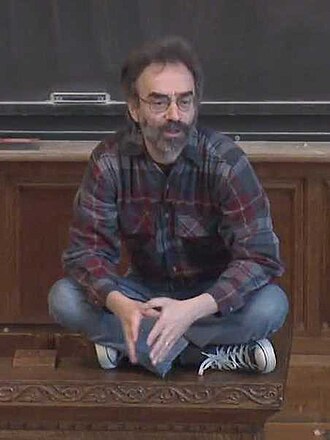
Professor Shelly Kagan: Last time we made the turn from metaphysics to value theory. We started asking about what it is about death that makes it bad. The first aspect of the badness of death that we talked about was the fact that when somebody dies, that's hard on the rest of us. We're left behind having to cope with the loss of this person that we love. Nonetheless, it seems likely that if we want to get clear about the central badness of death, it can't be a matter of the loss for those who remain behind, but rather the loss, the badness of death, for the person who dies. That, at any rate, is what I want to focus on from here on out.
Shelly Kagan 教授:上一次我们从形而上学转向了价值理论。我们开始追问,死亡究竟是哪一点让它成为坏事。我们谈到的死亡之坏的第一个方面是:当一个人死去时,这对我们其余的人来说是难熬的。我们被留了下来,不得不面对失去所爱之人的痛苦。尽管如此,如果我们想弄清楚死亡之坏的核心所在,那似乎就不能是留下来的人所承受的损失,而应该是死亡对于死者本人所构成的损失、所构成的坏。至少,这是我从现在起想要聚焦的问题。
便签笔记
0:45
What exactly is it about my death, or the fact that I'm going to die, that makes that bad for me? Now, I want to get clear about precisely what it is we want to focus in on here. Now, one thing that could be bad, obviously, is the process of dying could be a painful one. It might be, for example, that I get ripped to pieces by Bengali tigers. And if so, then the actual process of dying would be horrible. It would be painful. And clearly it makes sense to talk about the process of dying as something that could potentially be bad for me. Although similarly, I might die in my sleep, in which case the process of dying would not be bad for me. At any rate, I take it that most of us, although we might have some passing concern about the possibility that our process of dying might be a painful one, that's not, again, the central thing we're concerned about when we face the fact that we're going to die. It's also true, of course, that many of us find--;here, right now, while we're not actually dying--the prospect of
我的死,或者说我终将死去这个事实,究竟是哪一点使它对我而言是坏的?现在,我想把我们要聚焦的对象讲清楚。显然,有一件事可能是坏的,那就是死亡的过程可能是痛苦的。比如说,我可能被孟加拉虎撕成碎片。如果是这样,那么实际的死亡过程就会很可怕。那会很痛苦。显然,把死亡的过程说成某种可能对我不利的东西,是讲得通的。不过同样地,我也可能在睡梦中死去,那样的话死亡的过程对我就不算坏事。无论如何,我认为我们大多数人,虽然可能会偶尔担心自己的死亡过程会不会是痛苦的,但那——我再说一遍——并不是我们在面对自己终将死去这一事实时所关心的核心问题。同样也是这样,当然,我们很多人——此时此刻,在我们并没有真的濒临死亡的时候——会觉得,死亡这个前景是令人不快的。所以,我的死对我来说
便签笔记
1:52
dying to be unpleasant. So, one of the things that's bad about my death for me is that right now I've got some unhappy thoughts as I anticipate the fact that I'm going to die. But again, that can't be the central thing that's bad about death, because the prospect of my death--it makes sense for that to be a painful one or an unpleasant one, only given the further claim that death itself is bad for me. Having fear or anxiety or concern or regret or anguish or whatever it is that maybe I have now about the fact that I'm going to die, piggybacks on the logically prior thought that death itself is bad for me.
糟糕的一点就在于,此时此刻,当我预想到自己终将死去这个事实时,我心里会冒出一些不愉快的念头。但话说回来,这也不可能是死亡之所以糟糕的核心所在,因为我对自己死亡的预想——之所以说这种预想是痛苦的、令人不快的,前提是还得有一个更进一步的主张,即死亡本身对我来说是坏的。我现在对自己终将死去这件事所怀有的恐惧、焦虑、担忧、遗憾、痛苦,或者不管是什么情绪,都依附于一个逻辑上更在先的想法,那就是:死亡本身对我来说是坏的。
便签笔记
2:37
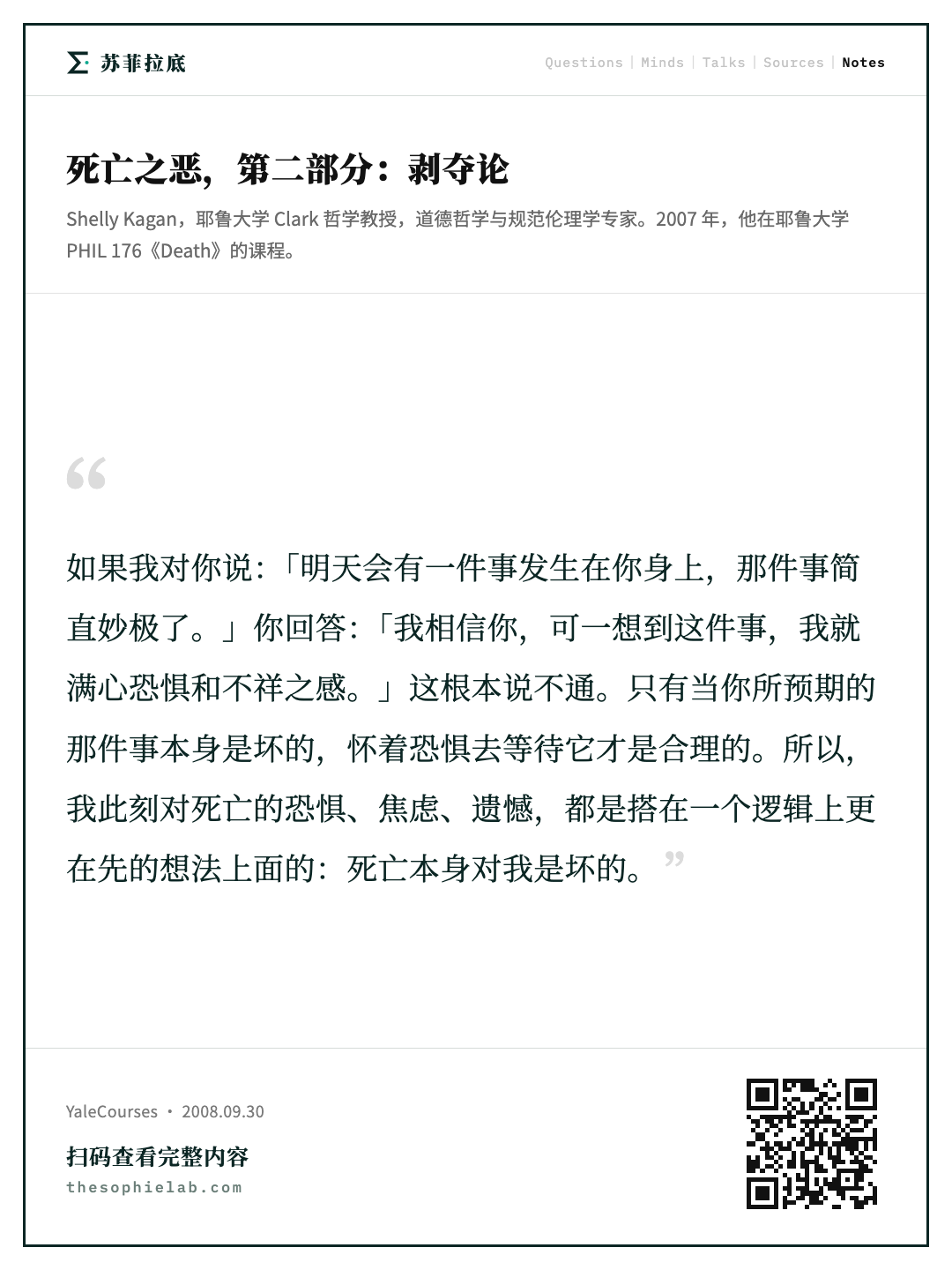
If it didn't piggyback in that way, it wouldn't make any sense to have fear or anxiety or dread or anguish or whatever it is that I may have now. I mean, suppose I said to you, "Tomorrow something's going to happen to you and that thing is going to be simply fantastic, absolutely incredible, absolutely wonderful." And you said, "Well, I believe you and I have to tell you, I'm just filled with dread and foreboding in thinking about it." That wouldn't make any sense at all. It makes sense to be filled with dread or foreboding or what have you only if the thing you're looking forward to, anticipating, is itself bad.
如果它不是这样依附于那个想法,那么我现在所怀有的恐惧、焦虑、畏惧、痛苦或者别的什么情绪,就统统说不通了。我的意思是,假设我对你说:“明天会有件事发生在你身上,而那件事是会非常棒,绝对不可思议,绝对美妙。」然后你说,「嗯,我相信你,但我得告诉你,一想到这件事,我心里就充满了恐惧和不祥的预感。」那根本说不通。只有当你所期待、所预期的那件事本身是坏的时候,充满恐惧或不祥预感才说得通。期待的那件事,本身是坏的。
便签笔记
3:17
Maybe, for example, it makes sense to dread going to the dentist, if you believe that being at the dentist is a painful, unpleasant experience. But if being at the dentist isn't itself unpleasant, it doesn't make sense to dread it in anticipation. So again, if we're thinking about the central badness of death, it seems to me that we've got to focus on my being dead. What is it about my being dead that's bad for me? Now, if we pose that question, it seems as though the answer should be simple and straightforward.
比如说,如果你认为看牙医是一种痛苦、不愉快的经历,那么害怕去看牙医也许是说得通的。但如果看牙医本身并不令人不快,那么提前去害怕它就说不通了。所以再说一遍,如果我们思考死亡的核心之坏,在我看来我们必须聚焦于我死了这件事。我死了这件事,究竟有什么对我来说是坏的?那么,如果我们提出这个问题,答案似乎应该是简单明了的。
便签笔记
3:58
When I'm dead, I won't exist. Now previously, in the first part of the class, we spent some time saying that, look, on certain views, there'll be a period of time in which you might be dead, but your body might still be alive. Or you might be dead, but even though your body still exists, it's not alive, but you exist as a corpse. Put all that aside. Go to the period beyond any of that murky stuff in the short-term and just, for simplicity, let's suppose with the physicalists that once I die, I cease to exist. All right.
当我死了,我就不存在了。之前在这门课的第一部分,我们花了些时间讲到,你看,按某些观点,会有一段时间你可能已经死了,但你的身体可能还活着。或者你已经死了,而且即便你的身体还存在,它也不再活着,你只是以尸体的形式存在。把这些都先放到一边。我们直接跳过短期内那些含混不清的东西,为了简单起见,让我们跟着物理主义者假设:我一旦死了,就不复存在。好。
便签笔记
4:35
So, don't we have the answer to what's bad about death right there? When I'm dead, I won't exist. Isn't that the straightforward explanation about why death is bad? Now, what I want to say, in effect, is this. I do think the fact that I won't exist does provide the key to getting clear about how and why death is bad. But I don't think it's quite straightforward. I think, as we'll see, it actually takes some work to spell out exactly how death, how nonexistence, could be bad for me. And even having done that, there'll be some puzzles that remain that we'll be turning to in a little while.
那么,关于死亡有什么坏处,答案不就摆在眼前了吗?当我死了,我就不存在了。这不就是死亡为什么是坏事的直白解释吗?现在我想说的,实际上是这样。我确实认为,“我将不存在”这一事实提供了关键,让我们弄清死亡如何以及为何是坏的。但我不认为这很直白。我认为,正如我们将看到的,要准确说清死亡、说清不存在如何能对我是坏的,其实还需要下一番功夫。而且即便做到了这一点,还会留下一些谜题,我们过一会儿会去处理。
便签笔记
5:18
So, the basic idea seems to be straightforward enough. When I'm dead, I won't exist. Isn't it clear that nonexistence is bad for me? Well, immediately you get an objection. You say, how could nonexistence be bad for me? After all, the whole point of nonexistence is you don't exist. How could anything be bad for you when you don't exist? Isn't there a kind of logical requirement that for something to be bad for you, you've got to be around to receive that bad thing? A headache, for example, can be bad for you.
所以,这个基本想法看起来足够简单明了。当我死了,我就不存在了。不存在对我是坏的,这不是很清楚吗?可是马上就会有人反对。你会说,不存在怎么可能对我是坏的呢?毕竟,不存在的要害就在于你并不存在。当你不存在的时候,怎么可能有任何东西对你是坏的呢?难道不存在这样一种逻辑上的要求:某个东西要对你是坏的,你就得在场来承受那个坏东西?比如说,头痛可以对你是坏的。
便签笔记
6:00
But of course, you exist during the headache. Headaches couldn't be bad for people who don't exist. They can't experience or have or receive headaches. How could anything be bad for you when you don't exist? And in particular, then, how could nonexistence be bad for you when you don't exist? So it's not, as I say, altogether straightforward to see how the answer "Death is bad for me, because when I'm dead I don't exist," how that answers the problem, as opposed to simply focusing our attention on the problem.
但当然,在头痛期间你是存在的。头痛不可能对不存在的人是坏的。他们无法体验、拥有或承受头痛。当你不存在的时候,怎么可能有任何东西对你是坏的?特别是,那么,当你不存在时,不存在又怎么可能对你是坏的呢?所以,正如我说的,“死亡对我是坏的,因为当我死了我就不存在了”这个回答,究竟怎样解决了这个问题,还是说它只是把我们的注意力集中到了问题本身,这并不完全直白。
便签笔记
6:38
How can nonexistence be bad for me? The answer to this objection, I think, is to be found in drawing a distinction between two different ways in which something can be bad for me. On the one hand, something can be bad for me, we might say, in an absolute, robust, intrinsic sense. Take a headache, again, or some other kind of pain--stubbing your toe or getting stabbed or whatever it is, being tortured. Pain is intrinsically bad. It's bad in its own right. It's something we want to avoid for its own sake.
不存在怎么能对我是坏的?我认为,对这个反驳的回答,在于区分某个东西可以对我是坏的两种不同方式。一方面,我们可以说,某个东西可以在绝对的、强意义的、内在的意义上对我是坏的。再拿头痛来说,或者别的什么疼痛——踢到脚趾、被捅一刀,或者不管是什么,被折磨。疼痛是内在地坏的。它本身就是坏的。它是我们出于它自身的缘故就想要避免的东西。
便签笔记
7:19
And those--;Normally, things that are bad for you are bad intrinsically. They're bad by virtue of their very nature. There's something about the way they are that you don't want those that are bad in their own right. But there's another way of something being bad for you that it's easy to overlook. Something can be bad comparatively. Something could be bad because of what you're not getting while you get this bad thing. It could be what the economists call bad by virtue of "the opportunity costs."
而那些——通常,对你坏的东西都是内在地坏。它们凭其本性就是坏的。它们的存在方式中有某种东西让你不想要它们,它们本身就是坏的。但还有另一种“某物对你是坏的”方式,很容易被忽略。某个东西可以在比较的意义上是坏的。某个东西之所以坏,可能是因为在你得到它的同时,你没有得到别的东西。这可能就是经济学家所说的因“机会成本”而坏。
便签笔记
7:56
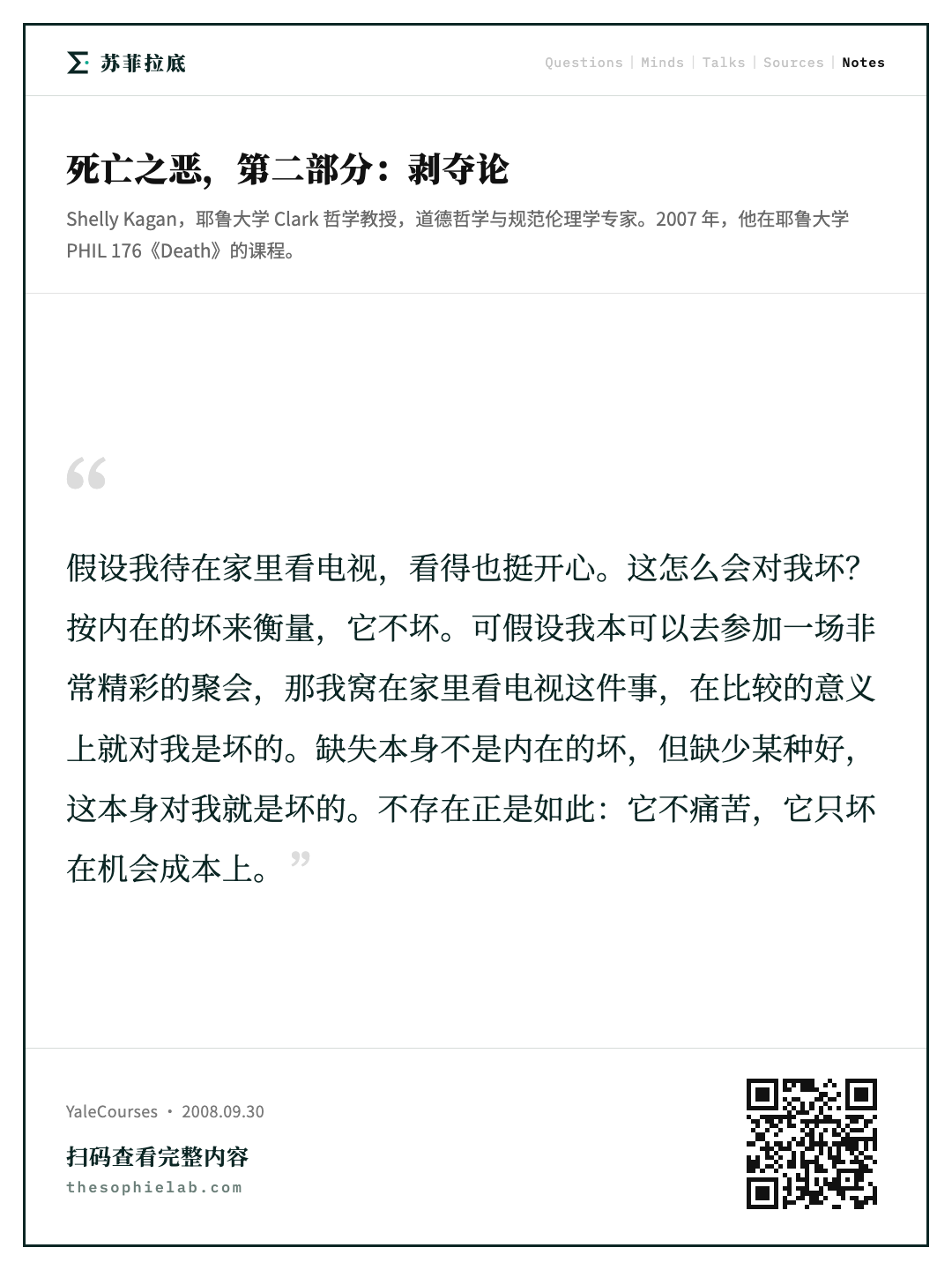
It's not that it's intrinsically bad; it's bad because while you're doing this, you're not getting something better. How could that be? Let's have a simple example. Suppose that I stay home and watch something on TV--Deal or No Deal. I watch this on TV and I have a good enough time. How could that be bad for me? Well, in terms of the first notion of bad, something being intrinsically bad, it's not bad. It's a pleasant enough way to spend a half an hour, or however long the show is on. On the other hand, suppose what I could be doing instead of watching a half an hour of television is being at a really great party. Then we might say, the fact that I'm stuck home watching television is bad for me in this comparative sense.
不是说它内在地坏;它坏是因为在你做这件事的时候,你没有得到某种更好的东西。这怎么可能呢?我们来举个简单的例子。假设我待在家里看电视——看《Deal or No Deal》。我在电视上看这个节目,过得还挺不错。这怎么会对我是坏的呢?嗯,按第一种“坏”的概念,也就是内在地坏,它并不坏。这是打发半小时的一种够愉快的方式,或者不管那节目播多久。另一方面,假设我本可以不看这半小时电视,而是去参加一个特别棒的派对。那我们也许会说,我被困在家里看电视这件事,在这种比较的意义上对我是坏的。
便签笔记
8:52
It's not that it's, in itself, an unpleasant way to spend some time; it's just that there's a better way to spend time that I could be doing, in principle at least. If only I'd gone. If only I'd been invited. If only I remembered, what have you. And because I'm foregoing that better good, there's something bad, comparatively speaking, about the fact that I'm stuck at home watching TV. There's a lack of the better good. A lack is not intrinsically bad, but it's still a kind of bad in this second sense. To be lacking a good is, itself, bad for me. Similarly, suppose I hold out two envelopes and I say, "Pick one."
不是说它本身是种不愉快的时间打发方式;只是说至少在原则上,我本可以用更好的方式度过这段时间。要是我去了就好了。要是我被邀请了就好了。要是我记得就好了,诸如此类。而因为我放弃了那个更大的好处,所以从比较的意义上说,我被困在家里看电视这件事就有某种坏。缺少了那个更好的好处。缺乏本身不是内在地坏,但在第二种意义上它仍然是一种坏。缺少一个好东西,本身对我就是坏的。同样地,假设我拿出两个信封说:“挑一个。”
便签笔记
9:43
And you open up the first one, you pick the first one, and you open it up and you say, "Hey look, ten bucks! Isn't that good for me?" Well, of course, ten bucks is intrinsically good. Anyway, well, it's not intrinsically good, it's only good as a means to buy something. But it's sort of good. It's worth having for its own right, because of what it can get you. But if unbeknownst to you, the other envelope had $1,000 in it, then we can say, "Look, it's bad for you that you picked the first envelope." Bad in what sense?
然后你打开第一个,你选了第一个,打开一看,你说:“嘿你看,十块钱!这对我不是好事吗?”当然,十块钱是内在地好的。不管怎么说——其实它并不是内在地好,它只是作为买东西的手段才是好的。但它算是好的。它凭其自身就值得拥有,因为它能给你换来东西。但如果你不知道另一个信封里装着一千美元,那我们就可以说:“你看,你选了第一个信封,这对你是坏的。”哪种意义上的坏?
便签笔记
10:12
Because you would have been better off, had you picked the second envelope. You would have been having more good, or a greater amount of good.
因为如果你选了第二个信封,你本会过得更好。你本会得到更多的好,或者说更大量的好。
便签笔记
10:25
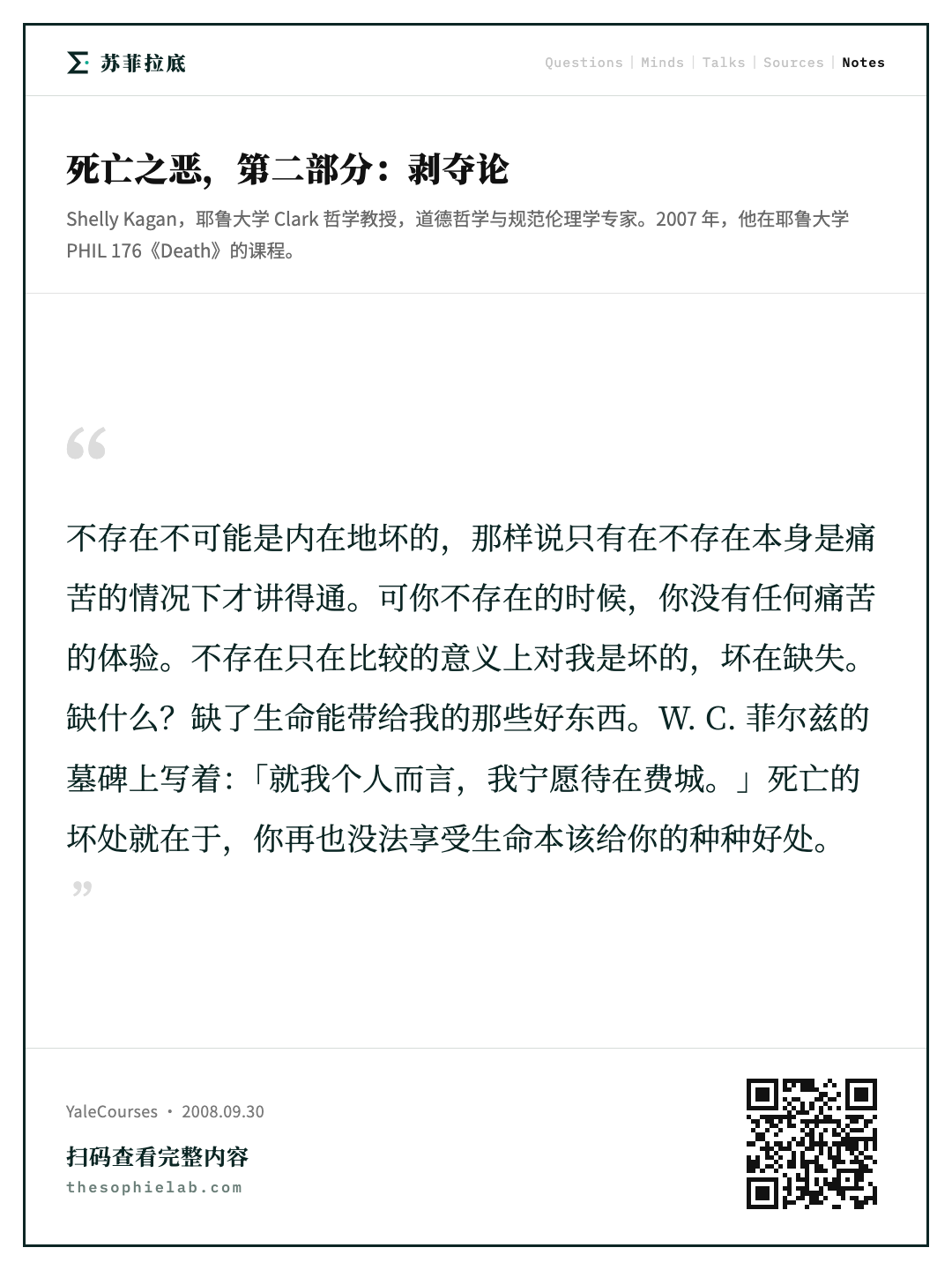
Well, nonexistence can't be bad for me in our first sense. It can't be that nonexistence is intrinsically bad, worth avoiding for its own sake. That would only make sense if nonexistence was somehow, for example, painful. But when you don't exist, you have no painful experiences. There's nothing about nonexistence in and of itself that makes us want to avoid it. Nonexistence is only bad for me in this comparative sense, because of the lack. When I don't exist, I'm lacking stuff. What am I lacking?
那么,不存在不可能在我们说的第一种意义上对我是坏的。不可能说不存在是内在地坏、本身就值得避免的。只有当不存在以某种方式,比如说,是痛苦的,那才说得通。但当你不存在时,你没有任何痛苦的体验。不存在本身没有任何东西让我们想要避免它。不存在对我是坏的,只是在这种比较的意义上,因为那种缺乏。当我不存在时,我就缺少了东西。我缺少什么呢?
便签笔记
11:06
Well, of course, what I'm lacking is life and more particularly still, the good things that life can give me. So, nonexistence is bad by virtue of the opportunity costs that are involved. Famously, W.C. Fields on his tombstone says, "Personally, I'd rather be in Philadelphia." What's bad about being dead is you don't get to experience and enjoy any longer the various good things that life would offer us. So nonexistence does point to the key aspect about death. Why is death bad? Because when I'm dead I don't exist.
当然,我缺少的是生命,更具体地说,是生命能给我的那些好东西。所以,不存在之所以坏,是因为其中涉及的机会成本。有个著名的例子,W.C. Fields 的墓碑上写着:“就我个人而言,我宁愿待在费城。”死了的坏处在于,你再也无法体验和享受生命本会提供给我们的种种好东西。所以,不存在确实指出了关于死亡的关键之处。为什么死亡是坏的?因为当我死了,我就不存在了。
便签笔记
11:51
But if we ask, why is and how can it be the case that nonexistence is bad? the answer is, because of the lack of the good things in life. Because when I don't exist, I am not getting the things that I could have otherwise gotten, if only I were still alive. Death is bad because it deprives me of the good things in life. This account is nowadays known as the deprivation account of the evil or badness of death, for obvious reasons, right? The key thought is, the central bad about death, about nonexistence, is that it deprives you of the goods of life you might otherwise be getting. That's the deprivation account.
但如果我们要问,不存在为什么、又怎么可能是坏的?答案是,因为缺少了生命中的好东西。因为当我不存在时,我就得不到那些我本来能得到的东西——只要我还活着。死亡之所以坏,是因为它剥夺了我生命中的好东西。这套说法如今被称为关于死亡之恶或死亡之坏的“剥夺说”(deprivation account),原因显而易见,对吧?核心想法是,死亡、也就是不存在的核心之坏,在于它剥夺了你本来可能得到的生命中的好东西。这就是剥夺说。
便签笔记
12:40
And it seems to me that the deprivation account basically has it right. Eventually, I'll go on to argue that there are other aspects of death that may also contribute to its badness, aspects above and beyond the one that gets focused on by the deprivation account. But still, it seems to me the deprivation account points us correctly to the central thing about death that's bad. What's most importantly bad about the fact that I'll be dead is the fact that when I'm dead, I won't be getting the good things in life. I'll be deprived of them.
在我看来,剥夺说基本上是对的。后面我会接着论证,死亡还有别的方面可能也构成它的坏,那些方面超出了剥夺说所关注的那一面。但即便如此,在我看来,剥夺说还是正确地为我们指出了死亡中最核心的那件坏事。关于“我将会死”这个事实,最重要的坏处在于,当我死了,我就得不到生命中的好东西了。我将被剥夺它们。
便签笔记
13:17
That's the badness of death according to the deprivation account. Now, if we accept the deprivation account, if we try to accept the deprivation account, we face some further philosophical puzzles. Puzzles that many people have thought are sufficiently overwhelming that we, despite the initial plausibility of the deprivation account, have to give it up. First objection is this. Look, if something is true--a quite general point, it seems, about metaphysics--if something is true, there's got to be a time when it's true.
按剥夺说,这就是死亡的坏。那么,如果我们接受剥夺说,如果我们试图接受剥夺说,我们就要面对一些进一步的哲学难题。很多人认为这些难题足够压倒性,以至于我们尽管剥夺说初看很有道理,还是不得不放弃它。第一个反驳是这样的。你看,如果某件事是真的——这似乎是关于形而上学的一个很一般的观点——如果某件事是真的,那就必定有一个它为真的时间。
便签笔记
13:58
If I make some claim about a fact, there's got to be a time when that fact is true. Here's a fact. Shelly's lecturing to you now about the badness of death. When is that fact true? When was that fact true? Well, right now. Here's another fact. Shelly once lectured to you about the nature of personal identity. When was that fact true? Well, we can point to a period of perhaps a week or two last month when I was lecturing to you about personal identity. Things that are facts can be dated. All right. That seems right.
如果我对某个事实提出一个主张,那就必定有一个该事实为真的时间。这里有个事实。Shelly 现在正在给你们讲关于死亡之坏的课。这个事实什么时候是真的?它曾在什么时候为真?就是现在。再举一个事实。Shelly 曾经给你们讲过人格同一性的本质。那个事实是什么时候为真的?我们可以指出上个月大约一两周的那段时间,那时我在给你们讲人格同一性。作为事实的事情是可以标上时间的。好。这看起来是对的。
便签笔记
14:37
But if it is right, then immediately we've got a puzzle. How could death be bad for me? If death was bad for me, that would be a fact. If my death is bad for me, that would be a fact and we'd ask, well, when is that fact true? We might say, well, it's not true now. Death isn't bad for me now. I'm not dead now. Maybe death is bad for me when I'm dead? But that seems very hard to believe. I mean, when I'm dead, I don't exist, right? How could anything be bad for me then? Surely you've got to exist.
但如果它是对的,那我们马上就有了一个难题。死亡怎么可能对我是坏的?如果死亡对我是坏的,那就会是一个事实。如果我的死对我是坏的,那就会是一个事实,然后我们会问,这个事实是什么时候为真的?我们也许会说,它现在不是真的。死亡现在对我并不坏。我现在没死。也许死亡是在我死了的时候对我是坏的?但这似乎很难让人相信。我是说,当我死了,我就不存在了,对吧?那时候怎么可能有任何东西对我是坏的?你总得存在才行。
便签笔记
15:13
So, there's a puzzle about dating the badness of death. Now, it may be that this puzzle about time and the date of the badness of death is what Epicurus had in mind. There's a passage that I'm going to read to you in a moment from Epicurus. This passage has puzzled people, it has puzzled philosophers ever since. Epicurus seems to be putting his finger on something puzzling about death, though it's difficult to pin down exactly what it is that's bugging him. So we're going to try an interpretation or two. But first, here's the passage from Epicurus. "So death, the most terrifying of ills, is nothing to us, since so long as we exist, death is not with us; but when death comes, then we do not exist. It does not then concern either the living or the dead, since for the former it is not, and the latter are no more." You see, it's not altogether clear what Epicurus is bothered by there, but one possible interpretation is this puzzle about the timing of the badness of death. Death can't be bad for me now,
所以,给死亡之坏标定时间这件事上,有一个难题。那么,这个关于时间、关于死亡之坏发生在何时的难题,也许正是伊壁鸠鲁(Epicurus)心里所想的。我等一下要给你们念一段伊壁鸠鲁的话。这段话一直让人困惑,从那以后也一直困扰着哲学家们。伊壁鸠鲁似乎点中了死亡中某种令人困惑的东西,尽管很难确切说清究竟是什么在困扰他。所以我们要试着做一两种解读。但首先,这是伊壁鸠鲁的那段话:“所以死亡,这最可怕的祸患,对我们来说什么也不是,因为只要我们存在,死亡就不与我们同在;而当死亡到来时,我们就不存在了。因此它既不关乎活着的人,也不关乎死去的人,因为对前者它尚未到来,而后者已不复存在。”你看,伊壁鸠鲁在那里究竟被什么困扰着并不完全清楚,但一种可能的解读就是这个关于死亡之坏的时间难题。死亡现在不可能对我是坏的,
便签笔记
16:29
because I'm alive. Death can't be bad for me when I'm dead. I am no more; then how can things be bad for me then? But if death has no time at which it's bad for me, and if anything that's true, any fact has to have a time when it's true, then the purported fact that death is bad for me can't really be a fact. All right. How could we respond to this objection? Well, one way of course is to accept the objection and say, "You're right. Death isn't really bad for me." And some philosophers have indeed accepted that very conclusion, maybe Epicurus.
因为我还活着。死亡在我死后也不可能对我是坏的。我已不复存在;那时候事情又怎么可能对我是坏的呢?但如果死亡对我是坏的这件事没有任何一个时间点,而任何为真的东西、任何事实又都必须有一个为真的时间,那么所谓“死亡对我是坏的”这个事实,就不可能真的是个事实。好。我们该怎么回应这个反驳?当然,一种办法是接受这个反驳,然后说:“你说得对。死亡对我其实并不坏。”确实有一些哲学家接受了这个结论,也许伊壁鸠鲁就是其中之一。
便签笔记
17:09
Most of us want to say, "No, no. Death is bad for me." So we need a better answer to the, "Oh yeah? When is it bad for you?" objection. Two possible responses. One possible response would be to grab the bull by the horns and say, "Death is bad for me. Facts do have to be dated. Let me tell you when it's bad for me." The other possible response is to grab, as it were, the other horn and say, "You know, death is bad for me and I agree that I can't date it, but you're wrong to assume that all facts have to be datable. There are some things that are true that we can't put a date on."
我们大多数人想说的是:“不不。死亡对我是坏的。”所以,对于那句“是吗?”,我们需要一个更好的回答。"它什么时候对你不好?"这个反驳。有两种可能的回应。一种回应是抓住牛的一只角,说:"死亡对我来说是坏事。事实确实需要有时间标定。让我来告诉你它什么时候对我是坏的。"另一种可能的回应则是抓住另一只角,说:"你看,死亡对我来说是坏事,我同意我没法给它标定时间,但你假设所有事实都必须能标定时间,这是错的。有些事情是真的,但我们没法给它标上一个日期。"
便签笔记
17:53
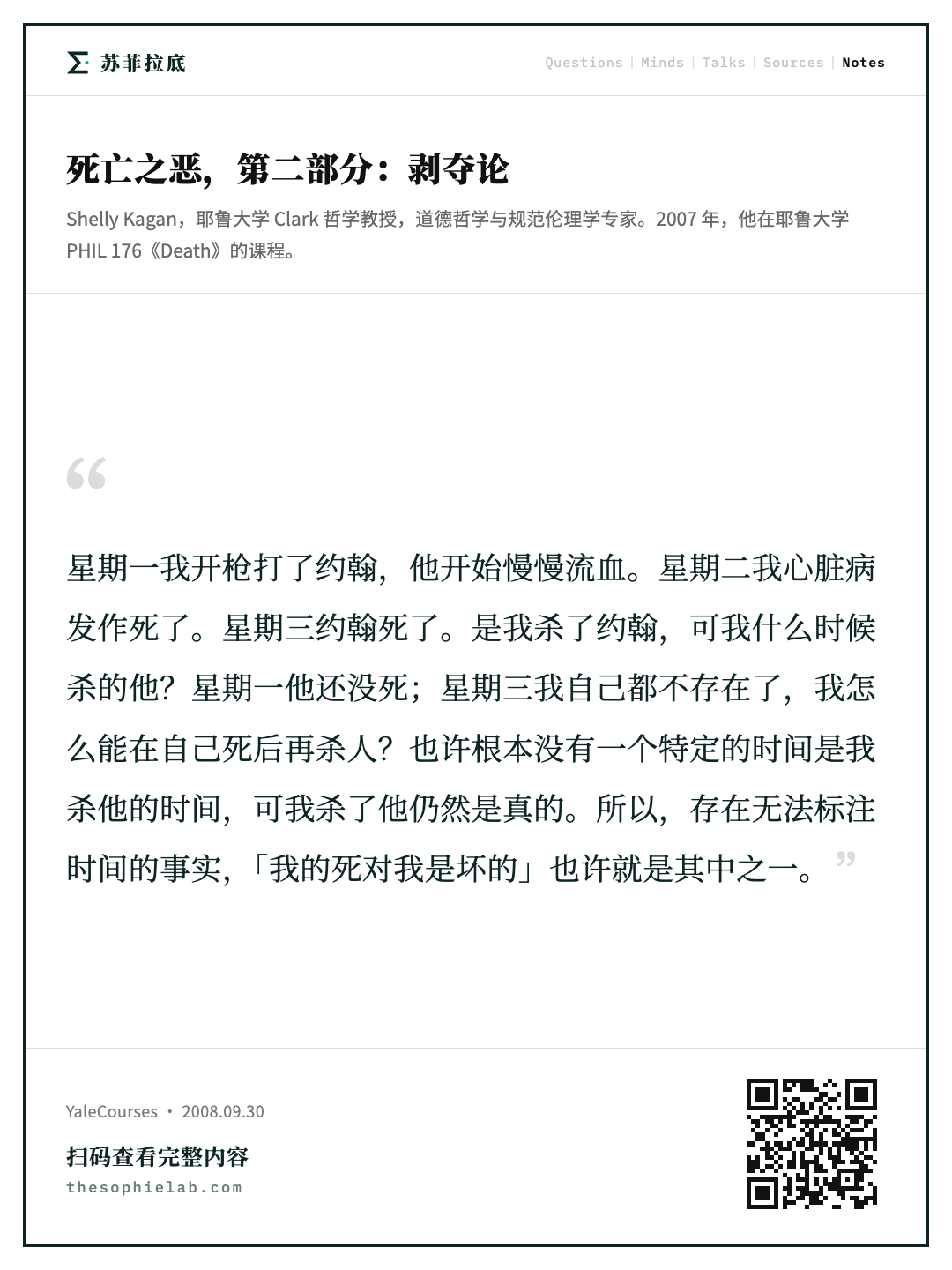
Let's start with the second. Could there be some things that are true that we can't put a date on? Well, here's one I think, maybe. Suppose that on Monday I shoot John. I wound him with the bullet that comes out of my gun. But it's not a wound directly into his heart. He simply starts bleeding. And he bleeds slowly. So he doesn't die on Monday. He's wounded and he's dying, but he doesn't die on Monday. On Tuesday, let's suppose that I have a heart attack and I die. John's still around--bleeding, but still around.
咱们先从第二种说起。会不会存在一些真实的事情,是我们没法标定时间的呢?嗯,我想这里也许有一个例子。假设星期一我开枪打了约翰。我用枪里射出的子弹打伤了他。但这一枪并不是直接打进他心脏。他只是开始流血。而且他流得很慢。所以他星期一没死。他受了伤,正在慢慢死去,但星期一他没死。再假设星期二我心脏病发作,我死了。约翰还活着——还在流血,但还活着。
便签笔记
18:38
On Wednesday, the loss of blood finally overtakes him and John dies. All right? So, I shoot him on Monday, I die on Tuesday, John dies on Wednesday. Now, I killed John. I take it we're all in agreement about that. If I hadn't shot him, he wouldn't be dead. I killed him. When did I kill him? Did I kill him on Monday, the day I shot him? That doesn't seem right. He's not dead on Monday. How could I kill him on Monday? Oh, he died on Wednesday. Did I kill him on Wednesday? Well, how could that be? I don't even exist on Wednesday. I died myself on Tuesday.
到了星期三,失血过多终于压垮了他,约翰死了。好吧?所以,我星期一开枪打了他,我星期二死了,约翰星期三死了。那么,是我杀了约翰。我想这一点我们都同意。如果我没开枪打他,他就不会死。是我杀了他。那我是什么时候杀了他的呢?我是在星期一——也就是我开枪那天——杀了他吗?这好像不对。他星期一并没有死。我怎么可能在星期一杀了他?哦,他是星期三死的。那我是在星期三杀了他吗?可这怎么可能呢?星期三我根本就不存在了。我自己星期二就死了。
便签笔记
19:20
How can I kill him after I'm dead? So I didn't kill him on Monday, didn't kill him--rather on Wednesday. I didn't kill him on Monday, didn't kill him on Wednesday when he dies. When did I kill him? Well, maybe the answer is there's no particular time at all when I killed him. But for all that, it's true that I killed him. What makes it true that I killed him? What makes it true that I killed him is that on Monday I shot him and on Wednesday, he died from the wound. That's what makes it true. But when did I kill him?
我死了之后怎么还能杀他呢?所以我不是在星期一杀了他,也不是——确切地说,不是在星期三。我没在星期一杀他,也没在他死的那个星期三杀他。那我到底是什么时候杀了他?也许答案是,根本没有某个特定的时间点是我杀他的时候。但即便如此,"我杀了他"这件事仍然是真的。是什么让"我杀了他"这件事为真呢?让它为真的是:星期一我开枪打了他,星期三他因为枪伤而死。这就是让它为真的东西。可我是什么时候杀了他呢?
便签笔记
19:49
Maybe we can't date that.
也许我们没法给这件事标定时间。
便签笔记
19:54
Suppose we can't. If we can't, then there are facts that you can't date, like the fact that I killed John. If there are facts that you can't date, maybe here's another one. My death is bad for me. When is that true? Can't date it, but for all that, maybe it's true. So maybe we shouldn't accept the assumption of the argument that all facts can be dated. Of course, the thought that all facts can be dated is a very powerful one, and no doubt, many of you are going to go home and start trying to come up with an adequate answer to the question, when exactly did Shelly kill John?
假设我们标不了。如果标不了,那就存在一些你没法标定时间的事实,比如"我杀了约翰"这个事实。如果存在你没法标定时间的事实,那也许下面这个也是其中之一。我的死对我来说是坏事。这在什么时候为真?没法标定时间,但即便如此,它也许仍然是真的。所以也许我们不该接受这个论证的那个假设:所有事实都可以被标定时间。当然,"所有事实都可以被标定时间"这个想法非常有说服力,毫无疑问,你们当中很多人回去以后会开始琢磨,想给这个问题找一个像样的答案:谢利到底是什么时候杀了约翰的?
便签笔记
20:32
And come up with an answer, maybe, that you can even accept. At any rate, maybe we should accept the thought that all facts can be dated. In which case, if we're going to want to insist that my death is bad for me, we'd better be able to come up with a date. Well, maybe we can. When would it be plausible to claim my death is bad for me? Well, not now. My death can't be bad for me now. I'm not dead. But it's not 100% clear that the other alternative isn't acceptable. Why not say, "My death is bad for me when I'm dead"? After all, when is a headache bad for me? When the headache is occurring.
也许还真能想出一个你自己都能接受的答案。不管怎么说,也许我们应该接受"所有事实都可以被标定时间"这个想法。这样一来,如果我们想坚持说我的死对我来说是坏事,那我们最好能给它找出一个时间。嗯,也许我们能。什么时候说"我的死对我来说是坏事"才讲得通呢?嗯,不是现在。我的死现在不可能对我是坏的。我还没死呢。但另一个选项是不是不可接受,这一点也不是百分之百清楚。为什么不能说"我的死在我死了的时候对我是坏的"呢?毕竟,头痛什么时候对我是坏的?在头痛发作的时候。
便签笔记
21:21
Now, according to the deprivation account, the badness of death consists in the fact that when you're dead, you are deprived of the goods of life. So when is death bad for you? During the time perhaps you're being deprived of the goods of life. Well, when are you deprived of the goods of life? When you're dead. When does the deprivation actually occur? When you're dead. So perhaps we should just say, "Well, you were right, Epicurus," if this was Epicurus' argument. "You were right, Epicurus. All facts have to be dated, but we can date the badness of death.
那么按照剥夺论的说法,死亡之所以坏,就在于当你死了的时候,你被剥夺了生命中的种种好处。所以死亡什么时候对你是坏的?也许就是在你被剥夺生命中那些好处的那段时间里。那你什么时候被剥夺了生命中的好处?在你死了的时候。这种剥夺实际发生在什么时候?在你死了的时候。所以也许我们干脆就说:"好吧,伊壁鸠鲁,你说得对"——如果这真是伊壁鸠鲁的论证的话。"你说得对,伊壁鸠鲁。所有事实都必须能标定时间,但我们确实能给死亡之坏标定时间。
便签笔记
22:05
My death is bad for me during the time I'm dead. Because during that time, I'm deprived of, I'm not getting, the good things in life that I would be getting if only I were still alive." Well, that's a possible response to the objection. But of course, it just immediately raises a further objection. How could it be that death is bad for me then? How could it be that death is bad for me when I don't exist? Surely, I have to exist in order for something to be bad for me. Or, for that matter, for something to be good for me. Don't you need to exist in order for something to be good or bad for you?
我的死在我死去的那段时间里对我是坏的。因为在那段时间里,我被剥夺了、我得不到那些生命中的好东西——而如果我还活着,我本来是能得到的。"好,这是对那个反驳的一种可能回应。但这当然又立刻引出了下一个反驳。死亡怎么可能在那个时候对我是坏的呢?我都不存在了,死亡怎么可能对我是坏的?想必,我必须存在,某件事才谈得上对我是坏的。或者,就此而言,某件事才谈得上对我是好的。难道你不需要存在,某件事才能对你有好有坏吗?
便签笔记
23:12
Well, this points our way to a different possible interpretation of Epicurus' argument. The argument would be (A) something could be bad, or for that matter, good for you only if you exist; (B) when you're dead you don't exist; so (C) death can't be bad for you. Put that up on the board.
嗯,这就把我们引向了对伊壁鸠鲁论证的另一种可能的解读。这个论证会是这样:(A)只有当你存在时,某件事才可能对你是坏的,或者就此而言,对你是好的;(B)当你死了的时候你并不存在;所以(C)死亡不可能对你是坏的。把这个写在黑板上。
便签笔记
23:36
(A) Something can be bad for you only if you exist. (B) When you're dead you don't exist.
(A)只有在你存在的时候,某个东西才可能对你不好。(B)当你死了的时候,你就不存在了。
便签笔记
24:13
So, conclusion, (C) death can't be bad for you.
所以,结论是:(C)死亡不可能对你不好。
便签笔记
24:32
Maybe that's the argument that Epicurus had in mind. Let's hear Epicurus'--the quote from Epicurus again. "So death, the most terrifying of ills, is nothing to us, since so long as we exist, death is not with us; but when death comes, then we do not exist. It does not then concern either the living or the dead, since for the former it is not, and the latter are no more." Again, the passage from Epicurus isn't altogether clear, but maybe he's got in mind something like this argument. Maybe Epicurus thinks look, (A) something can be bad for you only if you exist; (B) when you're dead you don't exist; so (C) death can't be bad for you.
也许这就是伊壁鸠鲁心里想的那个论证。我们再来听一遍伊壁鸠鲁的那段引文。“所以死亡,这最可怕的恶,与我们毫不相干,因为只要我们存在,死亡就不在我们这里;而当死亡来临时,我们就不存在了。因此它既不涉及生者,也不涉及死者,因为对前者而言它还不存在,而后者已经不复存在了。”还是那句话,伊壁鸠鲁这段话并不完全清楚,但也许他心里想的就是这样一个论证。也许伊壁鸠鲁想的是:你看,(A)只有在你存在的时候,某个东西才可能对你不好;(B)当你死了的时候,你就不存在了;所以(C)死亡不可能对你不好。
便签笔记
25:22
Well, what should we say? It's pretty clear that (B) is true. When you're dead you don't exist. And so the conclusion, (C) death can't be bad for you, looks like it's going to follow, once we accept (A). Call (A) the existence requirement. Something can be bad or, for that matter, good for you, only if you exist. That's the existence requirement for bads and goods. If we accept the existence requirement, it looks as though we have to accept the conclusion, death can't be bad for you. What should we say? Maybe what we should say is, reject the existence requirement.
那么,我们该怎么说呢?很清楚,(B)是真的。当你死了的时候,你就不存在了。所以那个结论,(C)死亡不可能对你不好,看起来只要我们接受了(A),它就会成立。我们把(A)叫做“存在要求”。某个东西对你不好,或者说对你好,都只有在你存在的时候才可能。这就是好与坏的“存在要求”。如果我们接受这个存在要求,那看起来我们就不得不接受这个结论:死亡不可能对你不好。我们该怎么说呢?也许我们该说的是:否定这个存在要求。
便签笔记
26:06
In the ordinary case, pains, being blind, being crippled, what have you, losing your job--in the ordinary case, things are bad for you when you exist. In the ordinary case, in order to receive bads, you've got to exist. But perhaps that's only the ordinary case; it's not all cases. Perhaps we should say, look, for certain kinds of bads you don't need to even exist in order for those things to be bad for you. What kind of bads could be like that? Well, of course, deprivation bads would be exactly like that.
在通常的情况下,疼痛、失明、残疾,诸如此类,失业——在通常的情况下,这些事情对你不好时,你是存在的。在通常的情况下,为了承受这些坏事,你必须存在。但也许这只是通常的情况,并不是所有的情况。也许我们该说:你看,对于某些种类的坏事,你甚至不需要存在,它们就能对你不好。哪一类坏事会是这样的呢?当然了,剥夺性的坏事就正是这样。
便签笔记
26:53
To lack something, you don't need to exist. Indeed, the very fact that you don't exist might provide the very explanation as to why you've got the deprivation, why you've got the lack. Not all lacks might be like that, right? Remember the television case. You existed while you were being deprived of the great party. You existed while you were getting the mere $10 instead of the $1,000. So, sometimes deprivations coincide with existence. But the crucial point about deprivations is you don't even need to so much as exist in order to be deprived of something. Nonexistence guarantees that you're deprived of something.
要缺少某样东西,你并不需要存在。实际上,你不存在这个事实本身,可能恰恰就解释了你为什么被剥夺了,为什么你有这种缺失。并不是所有的缺失都是这样的,对吧?还记得那个电视的例子吗。当你被剥夺了那个精彩派对的时候,你是存在的。当你只拿到10美元而不是1000美元的时候,你也是存在的。所以,有时候剥夺是和存在同时发生的。但关于剥夺,关键的一点在于:你甚至根本不需要存在,就可以被剥夺某样东西。不存在恰恰保证了你被剥夺了某些东西。
便签笔记
27:41
So perhaps we should just reject the existence requirement. Perhaps we should say, when we're talking about lacks, when we're talking about deprivations, (A) is wrong. We should reject the existence requirement. Something can be bad for you even if you don't exist. The existence requirement is false. Well, that would be a possible way to respond to this second possible interpretation of Epicurus' argument. It would be a way to retain the thought that I take it we want to have, that most of us share, at least, that death is bad.
所以也许我们就该否定这个存在要求。也许我们该说,当我们谈论缺失、谈论被剥夺时,(A) 是错的。我们应该拒绝存在性要求。即使你不存在,某件事仍然可能对你有害。存在性要求是错的。这就是回应伊壁鸠鲁论证的第二种可能解读的一条思路。这样一来,我们就能保住我们想要保住的那个想法——至少我们大多数人都认同的想法——即死亡是坏的。
便签笔记
28:26
We'd be able to retain that thought by rejecting the existence requirement.
通过拒绝存在性要求,我们就能保住这个想法。
便签笔记
28:37
Well, easy to say that, but there are some implications of rejecting the existence requirement that may be rather hard to swallow. Think about exactly what it's saying. It's saying something, for example death, nonexistence, can be bad for somebody even though they don't exist. That's why my death can be bad for me even though I won't exist.
话说起来容易,但拒绝存在性要求会带来一些后果,可能相当难以接受。想想它到底在说什么。它是说,某种东西,比如死亡、不存在,可以对某人有害,即使那个人并不存在。这就是为什么我的死可以对我有害,哪怕我到时候已经不存在了。
便签笔记
29:03
But if death can be bad for somebody even though they don't exist, then death could be bad for somebody, that is to say, nonexistence could be bad for somebody, who never exists. Take somebody who is a possible person, but never actually gets born. It's sort of hard to think about somebody like that. So let's try to get at least a little bit more concrete. I need two volunteers. I need a male volunteer from the audience. Good. Okay, you'll be the male volunteer. And I need a female volunteer from the audience. Come on, it won't hurt.
但如果死亡可以对一个不存在的人有害,那么死亡就可能对某个人有害,也就是说,不存在可能对一个从未存在过的人有害。设想某个可能存在的人,但从未真正出生。这样的人有点难以想象。所以我们不妨把它讲得具体一点。我需要两位志愿者。我需要一位男性志愿者。很好。好,你就当男志愿者。我还需要一位女性志愿者。来吧,不会痛的。
便签笔记
29:45
I need a female volunteer. Okay. What I'd like you to do after class is go have sex and have a baby. Okay. Now, let me just suppose that this isn't actually going to happen. Sorry. Or sorry, I don't know. Let's consider, though, the possibility never to be actualized, the possibility that they would have sex and have a baby. His sperm joined with her egg, form a fertilized egg. The fertilized egg develops into a fetus. The fetus is eventually born. It's the fetus that we got by mixing egg 37 with sperm 4,000,309.
我需要一位女志愿者。好的。我希望你们下课以后去发生性关系,生个孩子。好吧。现在,让我假设这件事其实不会发生。抱歉。或者说,抱歉,我也不知道。不过,让我们来考虑这个永远不会成为现实的可能性,也就是他们发生性关系并生下一个孩子的可能性。他的精子与她的卵子结合,形成受精卵。受精卵发育成胎儿。胎儿最终出生。这个胎儿就是由 37 号卵子和 4,000,309 号精子结合而来的。
便签笔记
30:42
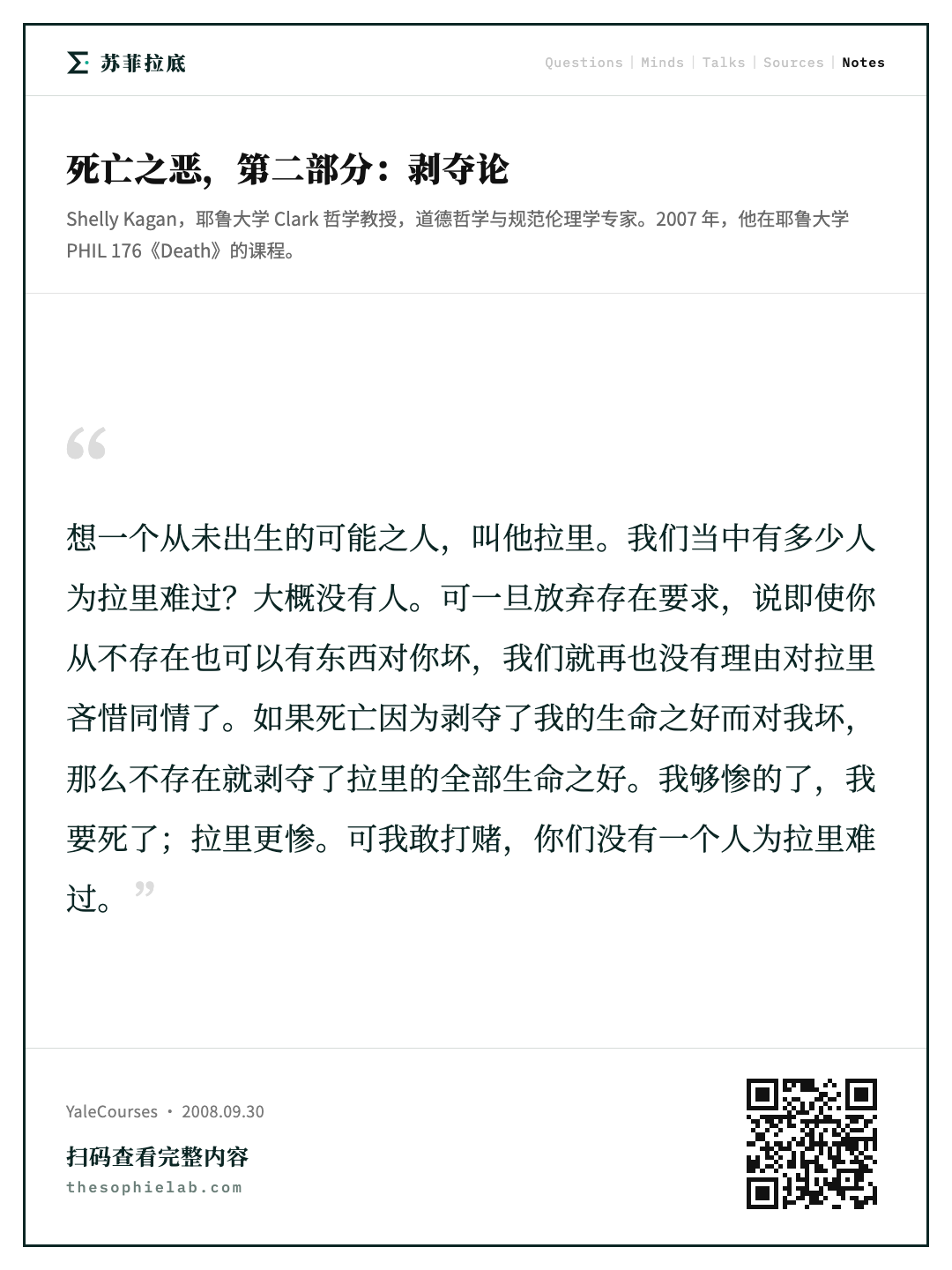
There's a person that could have been born. But let's suppose, never does get born. That particular person who could have been born, let's call Larry. Okay. Larry is a possible person. It could happen, but won't happen. It could exist, but won't exist. Now, how many of us feel sorry for Larry? Probably nobody. After all, Larry never even exists. How can we feel sorry for Larry? Now, that made perfect sense when we accepted the existence requirement, (A), something can be bad for you only if you exist. Since Larry never exists, nothing can be bad for Larry. But once we give up on the existence requirement, once we say something can be bad for you even if you never exist, then we no longer have any grounds for withholding our sympathy from Larry. We can say, "Oh my gosh!
有这么一个本来可能出生的人。但我们假设,他从未出生。那个本来可能出生的特定的人,我们就叫他拉里吧。好。拉里是一个可能存在的人。这件事可能发生,但不会发生。他可能存在,但不会存在。那么,我们当中有多少人会为拉里感到难过呢?大概没有人吧。毕竟拉里根本就从未存在过。我们怎么可能为拉里感到难过呢?当我们接受存在要求,也就是(A)——只有当你存在时,某件事才可能对你是坏的——的时候,这话完全说得通。既然拉里从未存在过,那就没有任何事情能对拉里是坏的。但一旦我们放弃存在要求,一旦我们说即使你从未存在过,某件事也可能对你是坏的,那我们就再也没有理由不去同情拉里了。我们会说:“天哪!
便签笔记
32:00
Think of all the goods in life that Larry would have had, if only he'd been born. But he never is born, so he's deprived of all those goods." And if death is bad for me, by virtue of being deprived of the goods of life, then nonexistence is bad for Larry, by virtue of his being deprived of all the goods of life. I've got it bad. I'm going to die. Larry's got it worse. We should really feel much sorrier for Larry. But I bet none of you feels sorry for Larry, this never-to-be-born-at-all person. Now, it's important in thinking about this, that we not slip back into some version of the soul view, especially some version of the soul view where the souls are prior existents. You might imagine--there's a scene in Homer, I think, where some sort of sacrifice is being made and all the dead souls go hover around, longing to be alive again, to savor the food and taste and smells of life, right?
想想拉里本来可以拥有的生命中所有那些好东西吧,只要他被生下来就行。可他从来没被生下来,所以他被剥夺了所有那些好东西。”如果说死亡对我是坏的,是因为我被剥夺了生命中的好东西,那么不存在对拉里也是坏的,因为他被剥夺了生命中所有的好东西。我的处境够糟了,我总归要死。而拉里的处境更糟。我们真的应该更加为拉里感到难过才对。但我敢打赌,你们当中没有一个人会为拉里——这个压根儿永远不会出生的人——感到难过。在思考这个问题的时候,有一点很重要:我们不能又偷偷滑回某种版本的灵魂论,尤其是那种认为灵魂先于肉体存在的灵魂论。你也许会想象——我记得荷马史诗里有这么一幕,人们在举行某种献祭,所有死者的灵魂都围拢过来,渴望重新活过来,去品尝生命中的食物、滋味和气息,对吧?
便签笔记
33:20
If you've got this picture of the nonexistent, merely potentially possible but never-to-be born individuals as somehow really already existing in a kind of ghost-like state, wishing they were born, maybe you should feel sorry for them. But that's not what the story is at all on the physicalist picture that I'm assuming. Nonexistent people don't have a kind of spooky, wish-I-were-alive ghost-like existence. They just don't exist, full stop.
如果你脑子里的图景是:那些不存在的、仅仅有可能却永远不会出生的个体,其实已经以某种幽灵般的状态真实地存在着,盼望着自己能被生下来,那你或许确实该为他们难过。但在我所假定的物理主义图景里,事情根本不是这样的。不存在的人并不拥有那种阴森森的、“真希望我活着”的幽灵式存在。他们就是不存在,仅此而已。
便签笔记
33:55
So once we keep that in mind about Larry, it's very hard to feel sorry for him. Of course, look, since I've been going on about how he's deprived of all the good things in life, maybe some of you are feeling sorry for Larry. So it's worth getting clear about just what it would mean to take seriously the thought that it's bad for merely potential people never to be born. How many merely potential people are there? I want you to get a sense of just how many there are. Not just Larry, the unborn person that would exist if we mixed whatever it was, you know, egg 37 and sperm 4,000,029, whatever the number was.
所以只要我们对拉里保持这一点认识,就很难为他感到难过。当然,你看,既然我一直在讲他被剥夺了生命中所有的好东西,也许你们中有些人真的开始同情拉里了。所以值得把一件事弄清楚:如果认真对待“仅仅是潜在的人从未出生是件坏事”这个想法,那到底意味着什么。仅仅是潜在的人有多少个?我想让你们感受一下,这个数目到底有多大。不只是拉里——那个只要我们把某个,你们知道的,第37号卵子和第4,000,029号精子结合起来就会存在的未出生的人。
便签笔记
34:44
Not just Larry, who's a potential person who never gets born, that would have to be an object of our sympathy, there's a lot of merely potential, never-to-be-born people. How many? A lot. How many? Well, I once tried to calculate. Well, as you'll see, the calculation is utterly off the back of the envelope, sort of rough and completely inadequate in ways that I'll point out. But at least it'll give you a sense of just how many potential people there are. Let's start modestly and ask: How many possible people could we, the current generation, produce? Now as I say, I made this calculation some years ago.
不只是拉里这一个从未出生的潜在之人需要成为我们同情的对象,还有大量仅仅是潜在的、永远不会出生的人。有多少?很多很多。到底多少?我曾经试着算过一次。当然,你们会看到,这个计算完全是信封背面式的粗算,很粗糙,而且在一些我马上会指出的地方完全不够严谨。但至少它能让你们感受到潜在的人到底有多少。我们先保守一点,问一个问题:我们这一代人总共能生产出多少个可能之人?就像我说的,这个计算是我好些年前做的。
便签笔记
35:37
It doesn't really matter how inaccurate it's going to be. As we'll see, it's very rough, but it makes the point. How many people are there? How many possible people, rather, could there be? Well, suppose there were 5 billion people. Roughly half of them are men, half of them are women. What we want to know then is, how many possible people could the 2.5 billion men make altogether with the 2.5 billion women? The crucial point in thinking about this is to realize that every time you combine a different egg with a different sperm, you end up with a different person, right?
它到底有多不准确其实无所谓。我们会看到它非常粗糙,但足以说明问题。有多少人?或者说,可能会有多少个可能之人?好,假设世界上有50亿人。大致一半是男性,一半是女性。那我们想知道的就是:这25亿男性和这25亿女性总共能造出多少个可能之人?思考这个问题的关键,是要意识到每当你把一个不同的卵子和一个不同的精子结合起来,你得到的就是一个不同的人,对吧?
便签笔记
36:22
If you combine an egg with a different sperm, you get a different genetic code that develops into a different person. You combine that sperm with a different egg, you get a different person. You know, if my parents had had sex five minutes earlier or five minutes later, presumably some other sperm would have joined with the egg. That would have been not me being born, but some sibling being born instead of me. Change the egg, change the sperm, you get a different person. So what we really want to know is, how many sperm-egg combinations are there with roughly 5 billion people in the world? Well, let's see.
如果你把一个卵子和另一个精子结合,你就得到一套不同的基因密码,发育出一个不同的人。你把那个精子和另一个卵子结合,你又得到一个不同的人。你想想,如果我父母早五分钟或者晚五分钟做爱,大概就会是另一个精子和卵子结合了。那样出生的就不是我,而是我的某个兄弟姐妹取代了我。换一个卵子,换一个精子,你就得到一个不同的人。所以我们真正想知道的是:在世界上大约有50亿人的情况下,总共有多少种精卵组合?好,我们来算算。
便签笔记
37:03
There's 2.5 billion women, billion women. How many eggs can a woman have? Well, fertile periods, round numbers, it's not really going to matter, precision, roughly 30 years, roughly 12 eggs a year. So that's how many eggs. Actually, I discovered some time after having done this calculation that the number of possible eggs is far greater. A woman actually ovulates and gives off this many eggs roughly during her fertile period. But there's many, many other cells, I gather, that could have developed into eggs. So that's a much, much larger number of potential eggs.
有25亿女性,25亿女性。一个女性能有多少个卵子?好,育龄期,取个整数,精确度其实无所谓,大约30年,一年大约12个卵子。这就是卵子的数目。其实在做完这个计算之后过了一段时间,我才发现可能的卵子数目要大得多。一个女性在育龄期内实际排出的卵子大概就是这么多。但据我了解,还有非常非常多其他的细胞本来也可以发育成卵子。所以潜在卵子的数目要大得多得多。
便签笔记
37:50
But this will do. 30 years, 12 eggs a year. How many men? Roughly 2.5 billion men.
不过这样算也够用了。30年,一年12个卵子。男性有多少?大约25亿男性。
便签笔记
38:04
Each man has a much longer period in which he's able to produce sperm. Let's just be round numbers here, 50 years. How many times a day can the man have sex? Well, certainly more than once, but let's be modest here and just say once a day. So that's 365 times a day--a year. 365 days a year. 365 days, I guess that should be.
每个男性能产生精子的年限要长得多。我们还是取整数吧,50年。一个男人一天能做几次爱?当然肯定不止一次,但我们保守一点,就算一天一次。所以是一天365次——是一年365次。一年365天。应该写成365天才对。
便签笔记
38:42
I wrote it too big. I don't have space left for the last number. Each time the man ejaculates, he gives off a lot of sperm. How much sperm? A lot. As it happens, I looked this up once. Round numbers, 40 million sperm each time the man ejaculates. So this last number has got to be times 40 million sperm. Okay, so we took all the men that exist now and all the women that exist now and ask: How many merely possible people? You know, most of these people are never going to be born, of course. But we're talking about possible people.
我写得太大了,最后一个数字没地方写了。男人每次射精,会射出大量的精子。有多少精子?很多。碰巧我以前查过。取个整数,男人每次射精大约4000万个精子。所以最后这个数字得再乘以4000万个精子。好,我们把现在活着的所有男性和所有女性放在一起,问:有多少仅仅是可能的人?当然,这些人里绝大多数永远不会真的被生下来。但我们谈的是可能之人。
便签笔记
39:33
How many possible people are there? There's 2.5 billion times 30 times 12 times 2.5 billion times 50 times 365 times 40 million. That equals--I'm going to round here. That equals approximately 1.5 million billion billion billion people. That's 1.5 x 10^(33).
可能之人有多少?25亿乘以30乘以12,再乘以25亿,乘以50,乘以365,乘以4000万。这等于——我这里取个整数——大约等于15亿亿亿亿个人。也就是1.5×10³³。
便签笔记
40:21
That's how many possible people we could have, roughly speaking, in the next generation, of which obviously a miniscule fraction are going to be born. There's--If you're going to feel sorry for Larry, you've got to feel sorry for every merely possible person. Every person who could have been born that never gets born. And there's 1.5 million billion billion billion such people, such possible people. And of course, the truth of the matter is, we barely scratched the surface here. Because now think of all those people and think about all the possible children they could have.
粗略地说,这就是我们下一代所能拥有的可能之人的数目,而其中显然只有极其微小的一部分会真的出生。如果你要为拉里感到难过,你就得为每一个仅仅是可能的人感到难过。为每一个本来可以出生却从未出生的人难过。而这样的人、这样的可能之人有15亿亿亿亿个。当然,事实是,我们这才刚刚触及皮毛而已。因为你现在再想想那些人,再想想他们本来可能生下的所有孩子。
便签笔记
41:17
We got this number starting with a mere 5 billion people. Imagine the number we would get if we then calculated how many possible grandchildren we could have. I don't mean that we could actually have all of those people at the same time, but for each one there is a possible person that could have existed. You quickly end up with more possible people than there are particles in the known universe. And that was just two generations, right? Three generations, you're going to have more. Four generations, you're going to have more. If we think about the number of possible people, people who could have existed but will never exist, the number just boggles the mind. And then, if we say we've gotten rid of the existence requirement and so things can be bad for you even if you never actually exist, then we have to say of each and every single one of those billions upon billions upon billions upon billions upon billions of possible people that it's a tragedy that they never get born, because they're deprived of the
我们得到这个数字,起点不过是区区50亿人。想象一下,如果我们再算一算可能有多少个孙辈,会得出多大的数字。我不是说我们真的能同时拥有那么多人,而是说其中每一个都对应着一个本来可以存在的可能之人。你很快就会得到比已知宇宙中的粒子数还要多的可能之人。而这才只是两代而已,对吧?三代,数目还要更大。四代,数目还要更大。如果我们去想可能之人的数目——那些本来可以存在却永远不会存在的人——这个数字简直超出想象。然后,如果我们说我们已经取消了存在要求,因而即使你从未真正存在过,事情也能对你是坏的,那我们就不得不对那亿万亿万亿万亿万亿万亿万个可能之人中的每一个说:他们从未出生是一场悲剧,因为他们被剥夺了生命中的好东西。如果我们废除
便签笔记
42:42
goods of life. If we do away with the existence requirement, then the tragedy of the unborn possible people is a moral tragedy that mere--that just staggers the mind. The worst possible moral horrors of human history don't begin to even be in the same ballpark as the moral horror of the loss, the deprivation for all of these unborn possible people. Now, I don't know about you, when I think about it, all I can say is it doesn't strike me as being a moral catastrophe. I don't feel anguish and sorrow and dismay at the loss, at the lack, at the deprivation for the untold billion, billion, billion, billions.
存在要求,那么这些未出生的可能之人的悲剧就是一场道德悲剧,其规模简直令人无法想象。人类历史上最可怕的道德暴行,跟所有这些未出生的可能之人所遭受的丧失、所遭受的剥夺相比,根本就不在一个量级上。不过,我不知道你们怎么想,反正当我想到这一点时,我只能说,它在我看来并不像是一场道德灾难。我并没有为那无数亿万亿万亿万亿万的丧失、缺失、剥夺而感到痛苦、悲伤和沮丧。
便签笔记
43:47
But if we give up the existence requirement and explain the badness of my death via the deprivation account, we do have to say this is a moral tragedy, the fact that the billions upon billions are never born. Well, if we're not prepared to say that's a moral tragedy, well, we could avoid that by going back to the existence requirement. But of course, if we do go back to the existence requirement, then we're back with Epicurus' argument. Something can be bad for you only if you exist. When you're dead, you don't exist.
可是,如果我们放弃存在要求,并用剥夺论来解释我死亡之所以是坏的,那我们就不得不说:亿万亿万个人从未出生,这确实是一场道德悲剧。那么,如果我们不愿意说那是一场道德悲剧,我们可以通过回到存在要求来避开它。但当然,如果我们真的回到存在要求,我们就又回到了伊壁鸠鲁的论证。只有当你存在时,某件事才可能对你是坏的。当你死了,你就不存在了。
便签笔记
44:35
So, (C), death can't be bad for you. And now we've really got ourselves in a philosophical pickle, don't we? If I accept the existence requirement, we've got an argument that says death isn't bad for me, which is really rather surprising. I can keep the claim that death is bad for me by giving up the existence requirement. But if I give up the existence requirement, I've got to say it's a tragedy that Larry and the untold billions, billions, billions, billions--it's a tragedy that they're deprived of life as well. And that seems unacceptable.
所以,(C),死亡不可能对你是坏的。这下我们可真是陷入哲学困境了,不是吗?如果我接受存在要求,我们就得到一个论证,说死亡对我不是坏事——这实在相当令人意外。我可以通过放弃存在要求来保住“死亡对我是坏的”这个主张。但如果我放弃存在要求,我就得说:拉里以及那无数亿万亿万亿万亿万的人——他们同样被剥夺了生命,这也是一场悲剧。而这看起来是无法接受的。
便签笔记
45:18
What should we do? What should we say? The suggestion is that the key here is to think about the claim that I'm using deprived in two different senses. That when we worry about my death, I'm losing something--namely, life--that I've had. But in the case of Larry and the untold billions, they never had life. And so they're not deprived of it in that same sense. I think it's a very promising suggestion. And indeed, I'm not 100% sure I've got exactly where you want to go with this in mind, but I think there's a way of taking that thought and sort of carving a middle path. The problem effectively was this. If we don't throw in any existence requirement, we have to feel sorry for the unborn billion, billion, billions.
我们该怎么办?我们该怎么说?有人建议,关键在于要注意到:我在两种不同的意义上使用“剥夺”这个词。当我们为我的死亡感到担忧时,我失去的是某种我曾经拥有过的东西——也就是生命。但在拉里和那无数亿万人的情况里,他们从来就没有拥有过生命。所以他们并不是在同样的意义上被剥夺了生命。我觉得这是一个很有前途的建议。说实话,我不能百分之百确定我完全领会到了你想把这个想法引向何处,但我认为可以顺着这个思路,开辟出一条中间道路。问题实际上是这样的:如果我们完全不加任何存在要求,我们就得为那亿万亿万亿万个未出生的人感到难过。
便签笔记
46:17
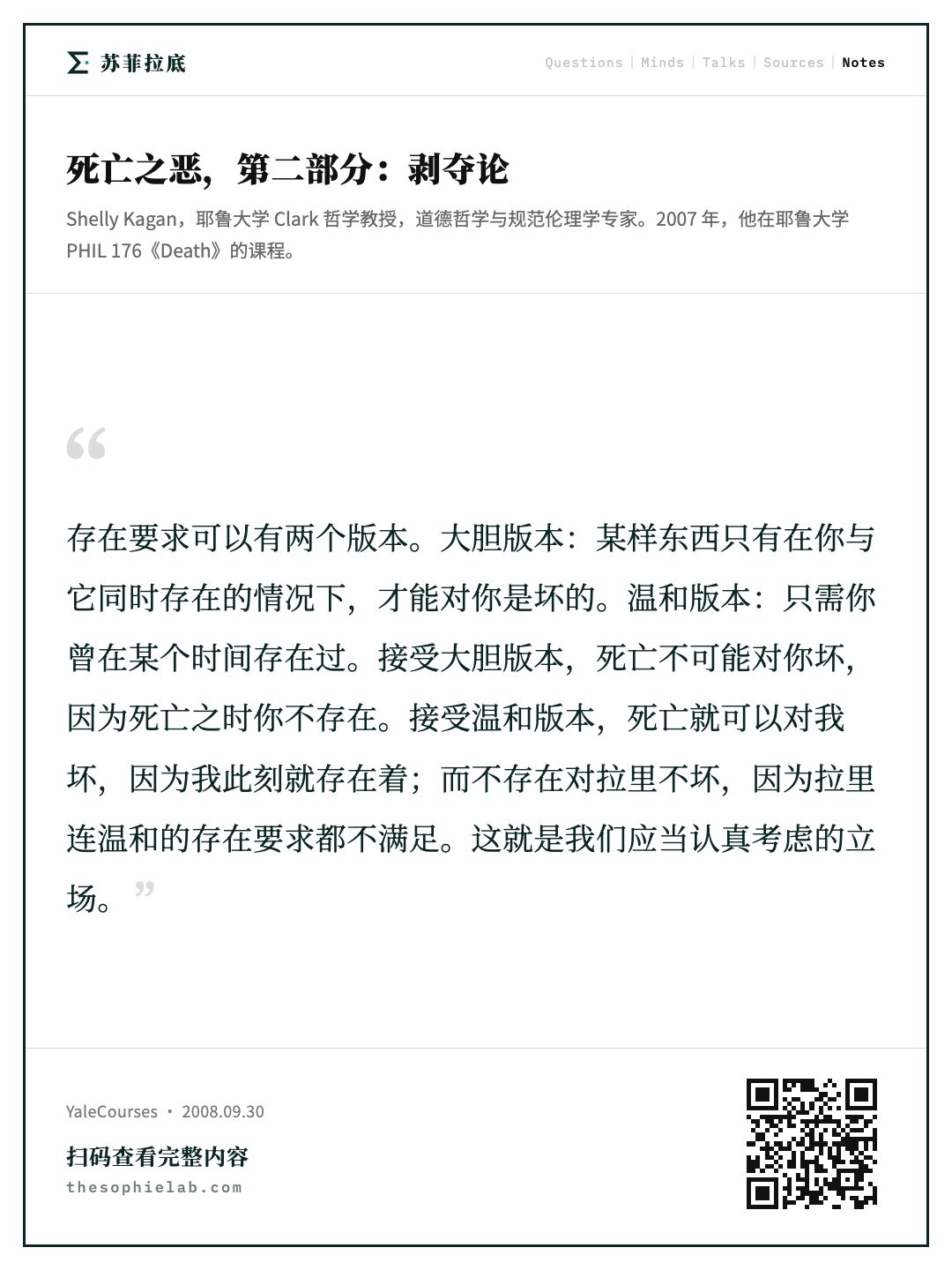
That doesn't seem acceptable. If we throw in the existence requirement, (A), something can be bad for you only if you exist, we end up saying death isn't bad for me, because I'm not existing when I'm dead. But maybe there's a more modest way of understanding the existence requirement. Or to put the point in slightly different terms, maybe we can distinguish between two different versions of the existence requirement,
这看起来无法接受。而如果我们加上存在要求,即(A)——只有当你存在时,某件事才可能对你是坏的——我们最后就得说死亡对我不是坏事,因为我死的时候我并不存在。但也许存在要求还有一种更温和的理解方式。或者换个稍微不同的说法:也许我们可以区分出存在要求的两个不同版本,
便签笔记
46:53
a bolder and a more modest version. Let's see.
一个更大胆的版本和一个更温和的版本。我们来看看。
便签笔记
47:27
Here's the modest version. Something can be bad for you only if you exist at some time or the other.
这是温和版本。只有当你在某个时刻存在过,某件事才可能对你不好。
便签笔记
48:09
Bolder claim.
更大胆的主张。
便签笔记
48:16
Something can be bad for you only if you exist at the same time as that thing.
只有当你与那个事物同时存在,它才可能对你不好。
便签笔记
48:38
All right. These are two different ways of understanding what the existence requirement requires. The modest version is called modest because it's asking less. It says something can be bad for you only if you exist at some time or the other. The bold existence requirement adds a stronger requirement. It says something can be bad for you only if you exist at the very same time as the thing that's supposed to be bad for you. There's got to be a kind of simultaneity. If something's bad for you, you had better exist at the very same time that that bad thing is happening.
好。这是理解「存在要求」到底要求什么的两种不同方式。温和版本之所以叫温和,是因为它要求得更少。它说,只有当你在某个时刻存在过,某件事才可能对你不好。而大胆的存在要求加上了一个更强的条件。它说,只有当你与那个据说对你不好的事物在同一时刻存在,它才可能对你不好。必须有某种同时性。如果某件事对你不好,那么在那件坏事发生的同一时刻,你最好是存在的。
便签笔记
49:21
That's bolder than the modest requirement. The modest requirement doesn't require that you exist that the same time as the bad thing. It only requires that you exist at some time or the other.
这比温和版的要求更大胆。温和版的要求并不要求你与那件坏事同时存在。它只要求你在某个时刻存在过。
便签笔记
49:41
One more minute, we'll finish up. Suppose we accept the bold claim. For something to be bad for you, you have to exist at the very same time as the bad thing. Then death can't be bad for you, because you don't exist at the time of death.
再讲一分钟,我们就结束。假设我们接受大胆的主张。要让某件事对你不好,你就必须与那件坏事同时存在。那么死亡就不可能对你不好,因为在死亡的时刻你并不存在。
便签笔记
50:05
Suppose, however, that we accept the modest requirement. For something to be bad for you, you have to exist at some time or the other. Well, since I do exist at some time or the other--after all, I exist right now--death can be bad for me. Admittedly, I won't exist when I'm dead. But that's okay. The modest existence requirement doesn't require that I exist at the very same time as the bad thing. The bold one did, but the modest one doesn't. So the modest one allows us to say that death is bad for me. But notice, and this is the crucial point, it does not say that nonexistence is bad for Larry, because Larry never exists at all. And so he doesn't even satisfy the modest existence requirement.
但假设我们接受的是温和的要求。要让某件事对你不好,你只需要在某个时刻存在过。那么,既然我确实在某个时刻存在过——毕竟,我此刻就存在着——死亡就可以对我不好。诚然,等我死了以后我就不存在了。但这没关系。温和的存在要求并不要求我与那件坏事同时存在。大胆的版本有这个要求,温和的版本没有。所以温和版本允许我们说,死亡对我来说是坏的。但请注意,这是关键的一点,它并没有说不存在对拉里(Larry)来说是坏的,因为拉里根本从未存在过。所以他连温和的存在要求都满足不了。
便签笔记
50:59
In short, with no existence requirement, we have to say the unexistence of the billions and billions is bad. That seems unacceptable. With the bold existence requirement, we have to say death isn't even bad for me. That seems unacceptable. But if, instead, we accept the modest existence requirement, we're able to say, nonexistence is not bad for Larry, but death is bad for me. And so that's the view that it seems to me we should be looking at. Okay.
简而言之,如果不设任何存在要求,我们就得说,那千千万万从未出生者的不存在是坏的。这似乎让人无法接受。而如果采用大胆的存在要求,我们就得说,死亡对我来说甚至都不算坏。这似乎也无法接受。但如果我们转而接受温和的存在要求,我们就能说,不存在对拉里来说不是坏的,而死亡对我来说是坏的。所以在我看来,这才是我们应该采纳的观点。好。
便签笔记

这期还没有生成总结。

这期还没有生成核心句型(制作精读 PDF 时会一并生成)。

这期还没有生成词汇表(制作精读 PDF 时会一并生成)。

这期还没有生成自测题(制作精读 PDF 时会一并生成)。

精读便签
下载便签 手机:长按图片也可保存
← 上一期 · NO.108Superintelligence | Nick Bostrom | Talks at Google 下一期 · NO.110 →23. How to live given the certainty of death
订阅苏菲周报 每周一封:本周入库的精读、一个值得带走的问题、一条苏菲按。免费,随时退订。
免费 · 每周一封 · 一键退订
苏菲拉底 THE SOPHIE LAB · ASK THE BEST MINDS THE BIG QUESTIONS 内容仅供学习 · thesophielab.com