Is Your Child Ready for the AI Era? | Daniel Susskind Lecture | Royal Society of Arts · 苏菲拉底
字幕 字幕位置
--:--
点击播放,这里会跟随视频显示当前句的中英字幕。

Is Your Child Ready for the AI Era? | Daniel Susskind Lecture | Royal Society of Arts

节目发布 2026-09-16 · Royal Society of Arts

丹尼尔·萨斯坎德 KKatie Prescott
EDITED TRANSCRIPT · 依据现场录音编译整理,可划线生成便签
编者按:本文是牛津大学经济学家丹尼尔·萨斯坎德在英国皇家文艺学会(Royal Society of Arts)的一场公开对谈实录。萨斯坎德长期研究技术对工作的影响,新著《我的孩子该学什么》(What Should My Children Do?)于对谈前一周出版,本场活动由学会的对谈主持人主持,末尾并有现场观众提问。全文依据现场录音编译整理,仅删去寒暄、口头语与重复枝节,论证、例子与细节均照原样保留。

写书缘起

主持人: 感谢各位今晚来到这里。这场活动一票难求,我一点也不意外。大约半年前我见过你,你告诉我新书的书名叫《我的孩子该学什么》,我当时就想,这正是我想知道的,也是我认识的每一个人此刻都想知道的。

萨斯坎德: 是的,我很高兴能来聊这本书。

主持人: 最近一周,人工智能变得有点吓人了,对吧?我们今晚会尽量避开「人类毁灭」这种话题,虽然后面我还是想请你从更宏观的角度谈几句。今晚主要聊这本书,我得说,通读下来它总体上让我非常安心,以至于我今晚把自己的孩子也带来了,希望他们能从这场谈话里学到点什么。最后我们会留时间提问,大家可以把问题放到 Slido 上。那我们开始吧。这本书让我印象很深的一点是它非常实用,同时又相当私人,你写了很多自己和孩子一起使用人工智能的经历。是什么促使你写这本书?写它的过程又是怎样的?毕竟它和学术专著很不一样。

萨斯坎德: 这本书的念头,来自过去十到十五年我一直在写作和思考技术对工作的冲击。这份工作把我带到世界各地,和很多背景迥异的人群、性质迥异的机构交谈。可是尤其在最近几年,无论我在哪里、和谁谈,被问得最多的问题永远是同一个:我的孩子到底该做什么?面对正在发生的技术变革,我们该怎样为下一代做准备?

萨斯坎德: 这个问题我想了很久,但它在我这里一直是一个相对偏智识、偏学术的问题。直到我有了自己的三个孩子,一个八岁、一个五岁、一个两岁,我才慢慢意识到,这件事已经关乎我自己了。他们的未来会和我的过去很不一样。所以我想回答这个问题,而且想借助我自己的生活和亲身经历来回答,写我是怎样把这些想法付诸实践的。因此书里有很多来自我自己生活的小故事。

主持人: 也包括看着他们走进教育体系的经历吧。

萨斯坎德: 是的。

回归基础

主持人: 我看着自己的孩子读小学时,最大的感受是,这和我当年读小学的经历惊人地相似。你在书里也谈到要重构教育体系,那么现有的教育里,有哪些东西是你认为应当保留并且加倍重视的?

萨斯坎德: 有意思的是,这本书上周才出版,不少教师读后的反应是觉得松了一口气,感到宽慰。因为这本书的起点是我提出的一句口号:回归基础(back to basics)。我说的基础,指的是读写、算术和批判性思维。

萨斯坎德: 如果概括一下我们过去是怎样思考「为年轻人的未来做准备」这件事的,思路大致是:尽可能聪明地去设想未来,预测将来会有哪些工作要做,然后说,好,这些就是人们将来需要的技能和能力,我们把它教给他们,他们就能过得好。我的看法是,未来太不确定了,这条路走不通。所谓「让下一代面向未来免疫」,是一个不可能完成的任务。

编程课的教训

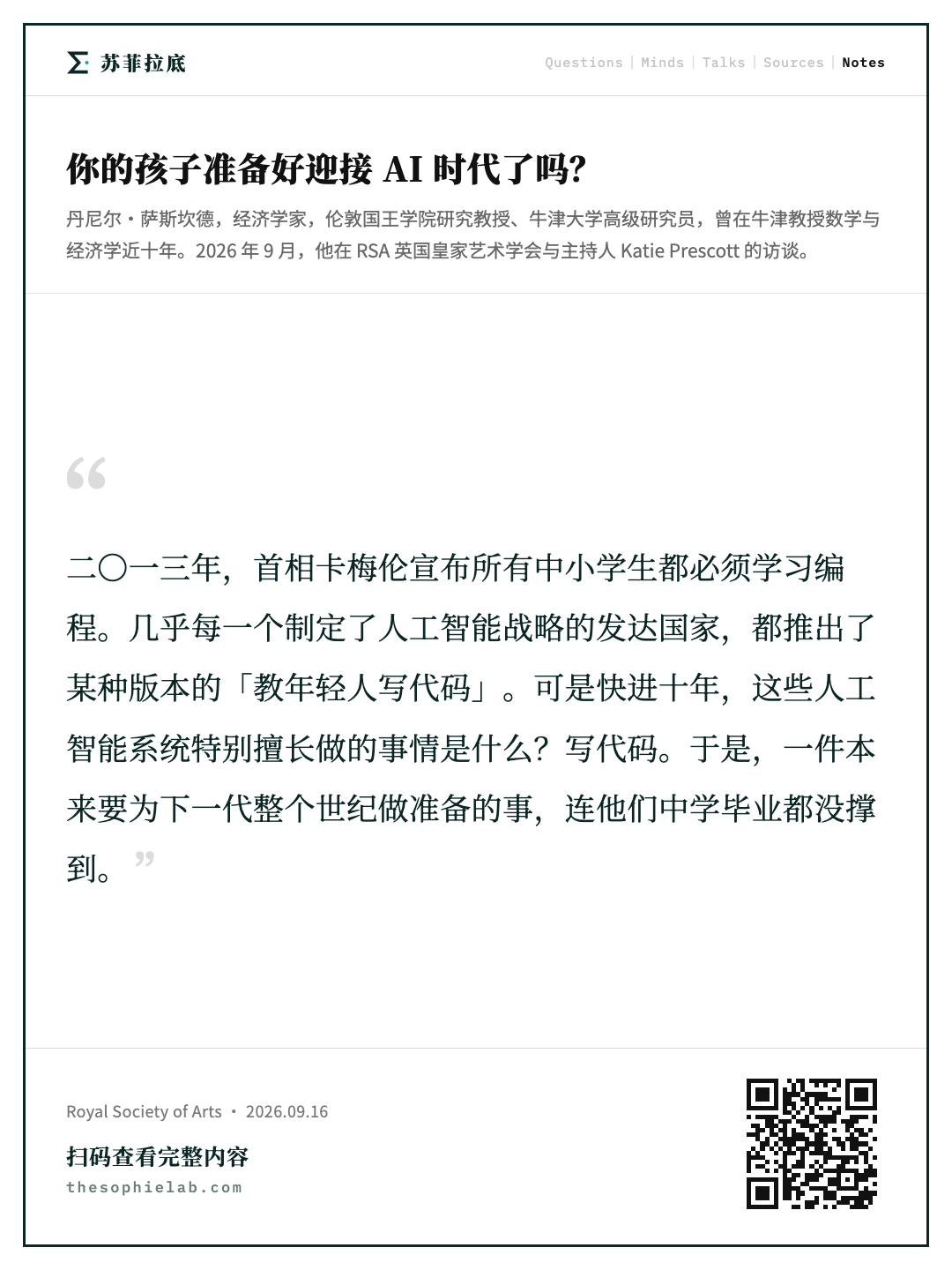
萨斯坎德: 书里有一个故事,最能说明这一点。二〇一三年,时任首相卡梅伦宣布,所有中小学生都必须学习编程。时任教育大臣迈克尔·戈夫出面说,这些就是下一代在二十一世纪取得成功所需要的技术技能。他们不是孤例,几乎每一个制定了人工智能战略的发达国家,都推出了某种版本的「教年轻人写代码」。

主持人: 在当时看来这很合理。

萨斯坎德: 不只是合理,它给人的感觉是激进的、有雄心的、新鲜的、有意思的。可是快进十年,结果证明这些人工智能系统特别擅长做的事情是什么?不是「还算擅长」,而是「特别擅长」:写代码。于是,一件本来要为下一代整个世纪做准备的事,连他们中学毕业都没撑到。

萨斯坎德: 我不认为这只是运气不好。我认为这宣告了「面向未来免疫」这个想法的终结,也就是那种以为我们能预测未来、能说出哪些高级技能将来重要的想法。我不认为我们做得到。但我认为有一件事是可以肯定的:无论未来变成什么样,无论哪些工作到头来供不应求,无论哪些高级技能到头来变得重要,也许是创造力,也许是判断力,也许是同理心,很难说,但无论是哪一种,它们都会以某种方式依赖于那些基础,也就是读写、算术,以及某种程度上的批判性思维。所以说它们是「基础」,不只是因为它们最简单,更因为它们最根本,是其他一切的积木。

萨斯坎德: 上周有一组数据显示,世界各地的读写和算术水平一直在下滑,从二〇〇九年一路降到二〇二二年,现在看来最近几年还在继续降。这本身就是一场灾难。但在我看来,如果我们要问「怎样为一个几乎无从知晓的、极不确定的未来培养下一代」,这就是一场格外严重的灾难。

教育的目的

主持人: 你在书里问了一些很大的问题,其中一个是:教育的意义何在?你引用了一位希腊国王,我记不得是哪一位了。

萨斯坎德: 斯巴达国王阿格西劳斯(Agesilaus)。

主持人: 对。那你认为,在人工智能时代,教育的意义是什么?

萨斯坎德: 我引用他,是因为他说过一句话:教育的目的,是让年轻人为将来的好生活做准备。他当年说的确实只是「年轻男子」。在他的时代,在斯巴达,那意味着让年轻人为打仗做准备。

萨斯坎德: 而在过去一百年里,教育的目的实质上变成了让人为劳动力市场做准备,为一份收入不错的工作做准备。我认为这不是眼下的难题。这本书的前提是,我们眼下在工作世界面临的主要挑战,不是没有足够的工作给人做。我认为工作是有的。挑战在于怎样让人准备好去做那些工作,这也是全书大部分篇幅关注的事情。

萨斯坎德: 不过,如果你把目光投向二十一世纪更远处,并且认真对待那些大型科技公司领袖的说法,不只是关于风险的说法,还包括关于这些技术在经济生活中的可能性的说法,比如我们也许会造出一种在一切具有经济价值的任务上都胜过我们的系统,那你就不得不面对更深一层的问题:在那样的世界里,教育的目的究竟是什么?我并不觉得,我们过去一百年的传统答案,对我们可能置身其中的那类世界来说是个好答案。

用三分之一的时间教用 AI

主持人: 但就眼下而言,正如你说的,我们要聚焦于基础,聚焦于读写能力。

萨斯坎德: 所以一个起点是回归基础。另一个起点是这样的:我们面对的未来的不确定性,在我看来几乎无法化解。事实上,关于未来我们只知道两件事。第一,未来会充满远比今天强大得多的技术。第二,除此之外我们几乎一无所知。这听起来让人泄气,让人无力。但其实我们能做的事情非常多。一是回归基础,二是教人使用这些技术。

萨斯坎德: 为了让大家感受一下我心目中的力度:我认为,我们现在应当把大约三分之一的教育时间,用来教人使用这些技术。不是盲目地用,而是批判地用,这一点也许待会儿可以展开。不过你马上会碰到一个大难题:教人使用技术、使用人工智能,最大的风险之一,不正是它会掏空那些基础吗?既然用手机拍张照,人工智能就能把一道难题解出来,何必费劲学会做一道难算的计算题?既然向这些系统问世界上任何一本书的问题,它都能给出一个漂亮的回答,何必花时间读一本难啃的书、学会啃难书的本事?所以人们今天担心这些技术会让我们变蠢,我认为这种担心是有道理的。

萨斯坎德: 因此,挑战在于:怎样既教下一代使用这些技术,又让他们在没有这些技术的时候照样能过得好?有意思的是,我们其实早就经历过一次。

计算器往事

萨斯坎德: 回到二十世纪七八十年代,当时最强大的技术是电子计算器。你去看看那时人们写的东西,他们的担忧和今天人们的担忧几乎一模一样。最主要的担忧是:算术会怎么样?人们会不会干脆放弃学算术?

萨斯坎德: 真正有意思的是接下来发生的事。当时有一位相对不知名的英国学者,叫威尔弗雷德·科克罗夫特(Wilfred Cockcroft),在赫尔大学教数学,是全国少数几个深入思考过数学教育的人之一。英国政府找到他说:数学教育一团糟,大家都在担心算术水平,现在又冒出了计算器,我们到底该怎么办?于是他写了一份报告,大家可以去找来看,叫《科克罗夫特报告》(Cockcroft Report),一九八二或八三年发表,篇幅浩大,极其细致。我怀疑当年没几个人真正读完它,今天听说过它的人恐怕也不多。但里面有一章非常精彩,讲他认为我们应当怎样应对计算器。

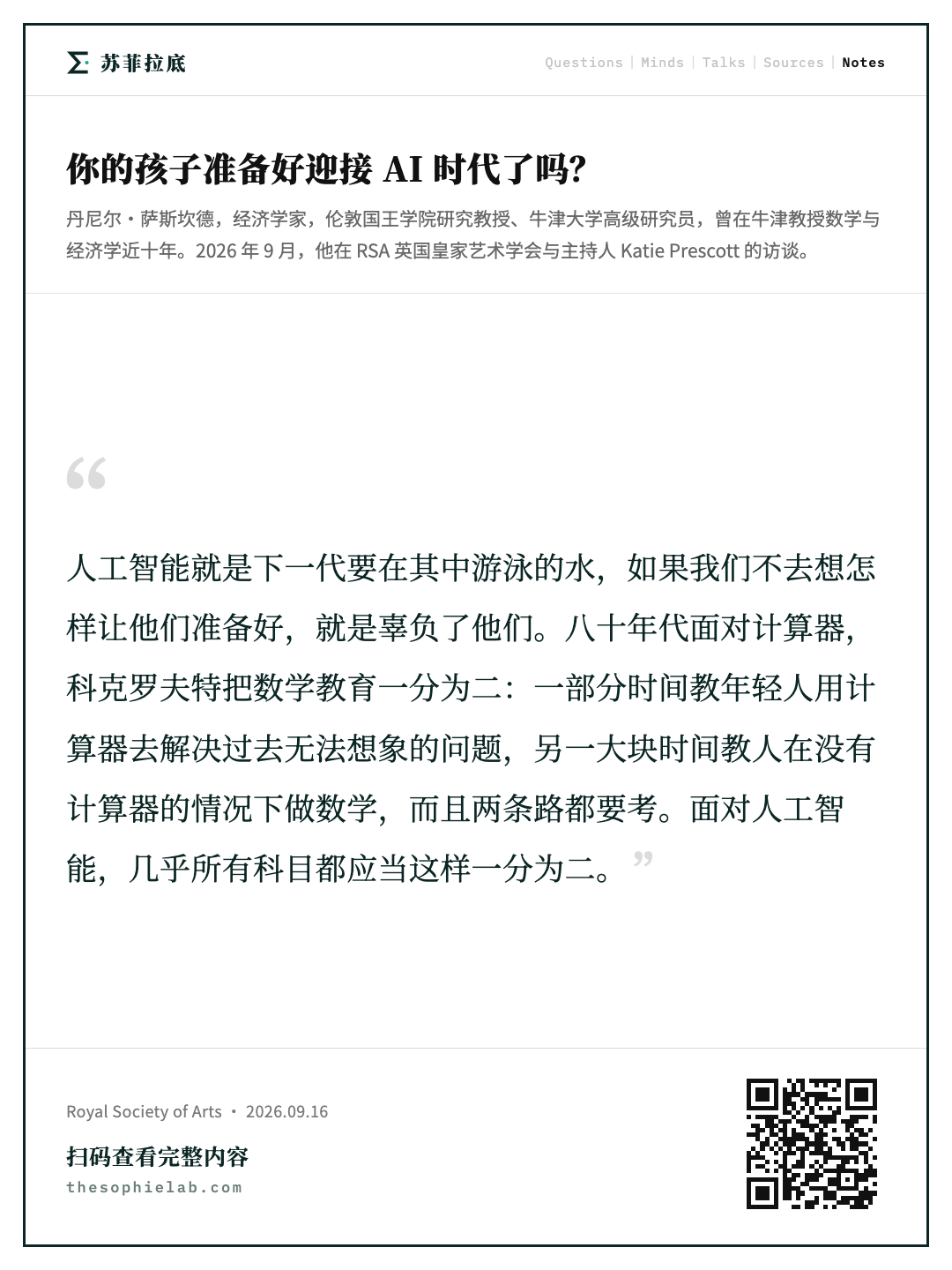
萨斯坎德: 他做的第一件事,是说:我们得现实一点。在未来几十年里,每个人都会有计算器。我觉得这句话对今天的我们同样适用。人工智能就是下一代要在其中游泳的水,如果我们不去想怎样让他们准备好,就是辜负了他们。

萨斯坎德: 接着他问:怎样教年轻人使用这台新机器,又不掏空算术?他想出了一个了不起的办法。他说,我们得把数学教育一分为二。一部分时间,教年轻人用计算器去解决过去无法想象的问题;另一大块时间,教人在没有计算器的情况下做数学。最关键的是,他说,为了确保人人都认真对待这两条路,两条路都要考。

两条路都教,两份卷都考

萨斯坎德: 我把这叫作「两条路都教、两份卷都考」(teach both, test both)。任何一个八十年代中期以后接受过数学教育的人,都经历过类似的事:你复习过一份可用计算器的试卷,也复习过一份不可用计算器的试卷。我认为,面对人工智能,我们现在需要类似的办法。我认为几乎所有科目,英语、历史、音乐、美术,随便哪一门,都应当一分为二。一边问:我们怎样用这些技术去解决问题、理解思想、做出过去无法想象的发现?另一边则要确保我们守住一块这些技术不在场的空间。而且期末要考,确保人们对两边都认真。所以,回归基础,加上两条路都教、两份卷都考,合在一起就是为下一代做准备的一个重要起点。

课堂现状

主持人: 这是理想状态。你说已经有教师联系你了,那课堂里的现状是怎样的?他们对你说了什么,担忧什么?

萨斯坎德: 现状有点乱,人们不知道该怎么办。我认为这是个问题,出于两个深层的原因。混乱导致的是一种本能:想筑起壁垒,想禁止、训诫、限制,把它挡在教室外面。这让我担心,理由有两个。第一个我刚才提过:这就是下一代将要生活的世界,他们需要学会在一个和他们长大后所处环境相似的环境里过得好。

萨斯坎德: 第二个理由贯穿全书,它不是防御性的。前一个理由是说,这是他们要游泳的水,我们得教会他们游。可我觉得,仅仅这样想还是太缺乏想象力。这是一种想象力的失败:没有去想我们可以怎样利用这些技术去理解问题、解决问题、理解思想、做出前几代人根本不可能做出的发现。我们现在的状态是一锅大杂烩,一些简单的问题,比如作业怎么布置、课怎么上、大学讲座怎么安排、招聘策略怎么定,答案都不清楚,因为我们对于「我们作为一个整体要怎样应对这件事」没有共识。

AI 不是社交媒体

主持人: 从社交媒体的经历里,我们有什么可以借鉴的吗?你在书里把它称作一场规模巨大的、无计划的社会实验。

萨斯坎德: 是的,而且结果已经出来了,并不好。人们对社交媒体的很多担忧我都认同,很多提出的限制措施我也非常支持:十四岁前不用智能手机,十六岁前不用社交媒体,校园无手机,多多玩耍。

主持人: 想必你和我一样庆幸,我们的孩子算是《网络安全法案》之后的一代,作为家长,应对社交媒体会比十年前容易一些。

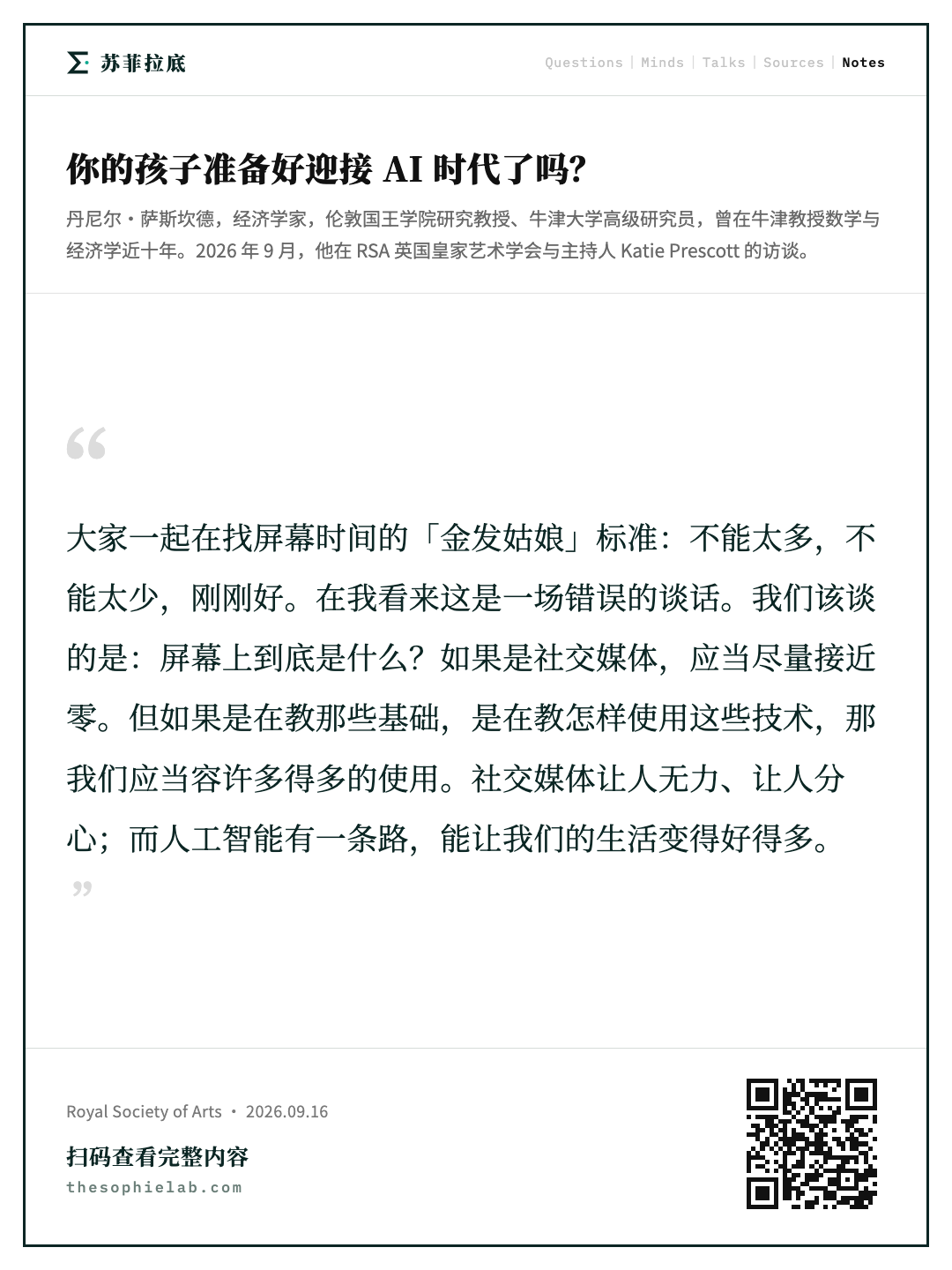
萨斯坎德: 完全正确。但我的一个担忧是,对社交媒体的合理顾虑,会渗透成对人工智能的普遍怀疑。社交媒体和人工智能不是一回事。社交媒体让人无力、让人分心、把我们的注意力切得支离破碎;而人工智能有一条路,在我看来能让我们的生活变得好得多。

萨斯坎德: 还有另一种看法。我发现自己作为家长也会陷进去,就是大家一起在找屏幕时间的「金发姑娘」标准:不能太多,不能太少,刚刚好。每个人都在争论你家孩子看多久屏幕。在我看来这是一场错误的谈话。我们该谈的是:屏幕上到底是什么?我们到底在用这些技术做什么?如果是社交媒体,我的看法是应当尽量接近零。但如果是在教那些基础,是在教怎样使用这些技术,那我认为我们应当容许多得多的使用。所以,人工智能和社交媒体是两种很不一样的东西,这一点很重要,要记在心里。

迪士尼故事与 AI 播客

主持人: 你自己是怎样和孩子一起用它的?

萨斯坎德: 方式很多。刚才开场时朱迪·丹奇谈到创造力,我一直觉得创造力和技术的关系很迷人,因为它是这项技术最后的边疆之一。过去十五年,人们总是对我说:机器永远不会有创造力。可今天,我想很多人都能指出一些具体的时刻,这些技术正开始侵入创造性的任务。

萨斯坎德: 我想起一个故事。我小时候,大概七八岁,和我父亲说好要一起写一个故事,题目叫《没人去迪士尼乐园的那一天》。故事是这样的:父亲答应我明天早上去迪士尼乐园。我上床睡觉,醒来一看窗外,天气好得惊人,简直是完美的一天,不可能更好了。我跑下楼,父亲看着我说:「今天不能去迪士尼了。天气太好了,全世界的人都会想去,那里会挤成地狱,我们去不了。」我看着他,一脸崩溃,小狗眼。他说:「好吧好吧,我们去。」我们上了车,一路开过去,路上的车少得出奇。到了停车场,好像一辆车也没有。原来全世界的人都有同样的念头:天气太好了,肯定人满为患。于是那一天没有人去迪士尼乐园,除了我和我父亲。整个乐园都是我们的。我们心里的故事就是这样:所有游乐设施随便玩,所有快过期的食物都归我们吃,妙极了。

萨斯坎德: 我们聊过很多次,可生活追上来了,我们忘了它,不再提起,故事就丢了。三十年后,一个周五晚上在我父母家吃饭,我和我八岁的女儿坐在一起,那时她七岁。我把这个故事的构思讲给她听,她说:「爸爸,你一定要把它写出来给我。」于是我们打开 ChatGPT。我说:「我正和七岁的女儿坐在一起,三十年前我和我父亲想出了这个故事,一直没动笔,你能帮帮我们吗?」我问女儿想要什么风格,她当时最喜欢苏斯博士,我们就说:苏斯博士。几秒钟之内,它就生成了一个苏斯博士风格的《没人去迪士尼乐园的那一天》,非常精彩。她笑了,觉得棒极了。当然不完美,有些错误,还混进了一些美国腔,比如满篇的肉桂卷,读着不太对劲。但接下来半小时我们玩得很开心,反复提示、调整、更新,用各种方式把她写进故事里。这让我真切地体会到,你可以怎样把这些技术当作创造的伙伴。我用它做了一件我一直没做成的事,而且这丝毫没有削弱或者贬损我和孩子的关系,反而是一件挺有创造性、挺好玩的事。这是我的一个美好时刻。

萨斯坎德: 我妻子常讲的是另一个故事。她不在科技行业工作,她做纪录片和播客。她娘家在萨福克,我们常常从伦敦开车去,沿着 A12 公路开三个小时,车里塞着三个孩子,堪称噩梦。但我们发现了一档全家都爱听的播客,叫《历史不无聊》,每集十五分钟,题材五花八门,由两个看上去十岁或十一岁的孩子讲述。我们听了很多,慢慢地,全家开始聊起这两个讲播客的孩子是谁,在哪所学校读书,怎么能请到这么多假泡在录音棚里,有什么资历,这是不是他们十岁十一岁就能做的事。最后我上了播客的网站,想查查他们是谁、有什么故事。结果发现,他们根本不存在。

萨斯坎德: 整档节目都是人工智能生成的。孩子不存在,我们听的整个故事,没有一个人知道,全家都被蒙在鼓里。对我妻子来说,一方面是那种感觉:我们全家和两个不存在的人建立了一段共同的关系。另一方面她意识到,这些技术可以用来做出相当吸引人的教育内容。但对她而言最触动的是,这样一集节目,换作她和一支能干的团队,得花几个星期才能做出来。可那里有成千上万集,我没有深挖档案,但我相当肯定其中很大一部分都是人工智能生成的。

创造力的边界

主持人: 不知道朱迪·丹奇会对这件事怎么说。回到你说的锻炼认知肌肉的问题,读写、算术,那么这对创造力意味着什么?

萨斯坎德: 我的看法是,你可以用这些系统去做一些过去非常困难甚至不可能做到的创造性事情。刚才那些是我和孩子玩耍的例子。但就在过去几周,OpenAI 宣布,他们用一个我猜想和我写迪士尼故事时用的差不多的系统,解决了纳维-斯托克斯问题(Navier–Stokes problem),数学的千禧年难题之一。很多数学家会说,它解题的方式相当有创造性。所以我的看法是,有很多例子表明,我们可以用这些技术去做那些原本需要我们自己拿出创造力的事,去做过去很难想象的事。

给年轻人的择业建议

主持人: 教育谈得差不多了,我们来谈工作。这是真正让人恐惧的话题。我们已经看到毕业生和年轻人的失业率在上升。像法律、会计这些专业领域,人工智能被视为巨大威胁。对那些想成为律师、会计师的年轻人,你有什么建议?

萨斯坎德: 首先我要说,就劳动力市场的那个角落正在发生的事,现在断言是不是技术造成的,还为时过早。

主持人: 好。

萨斯坎德: 有一些迹象。我在斯坦福的同事做了一项很好的研究,论文题为《煤矿里的金丝雀》,你可能记得,挺吓人的。它显示,容易受人工智能冲击的入门级白领岗位正在减少。但学界对这项研究争议很大。所以我总体认为现在下结论太早,但迹象是有的。

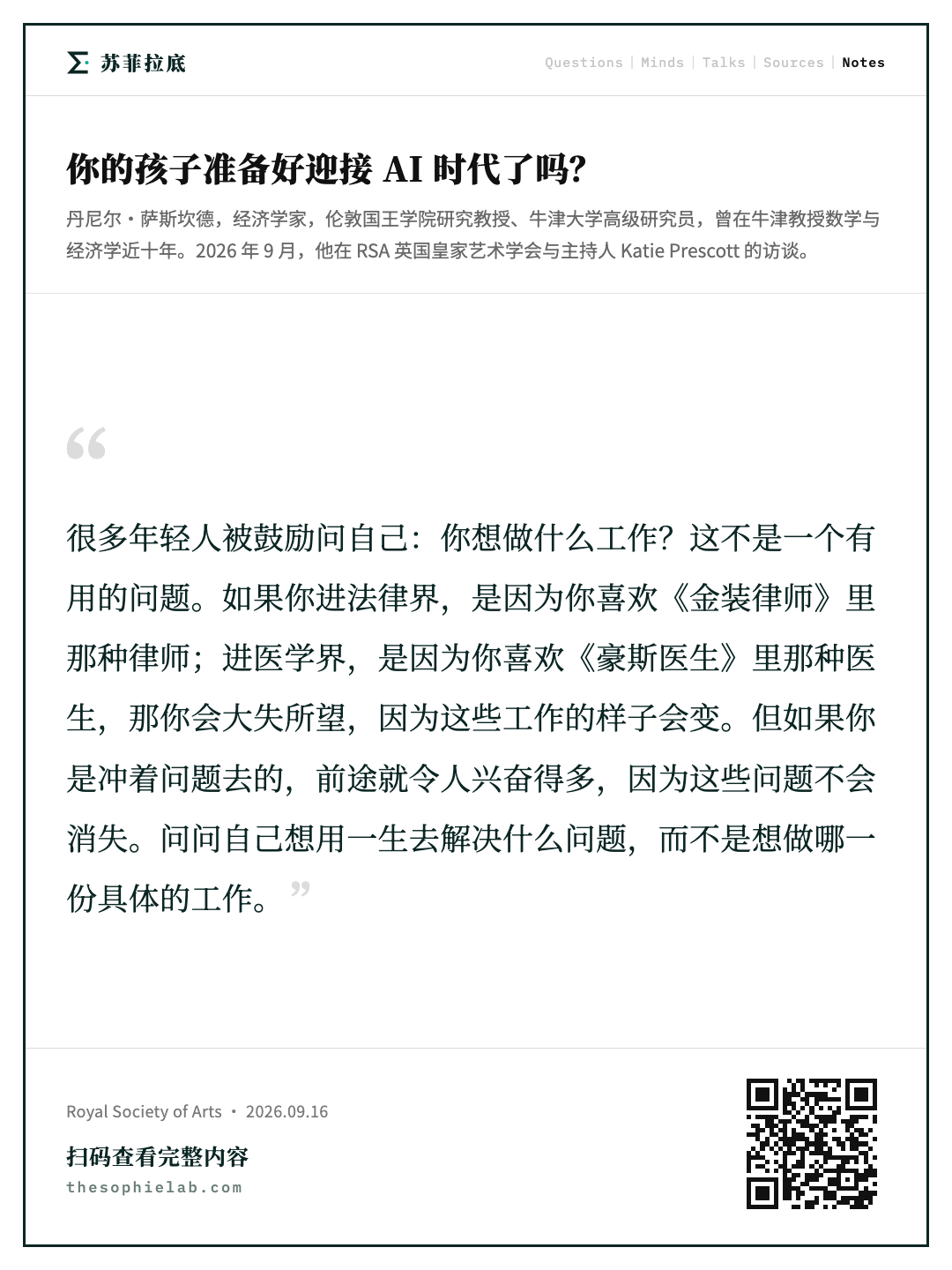
萨斯坎德: 建议有好几条。第一条是,很多年轻人被鼓励问自己:你想做什么工作?这是我们向年轻人提的标准问题。可是鉴于眼下正在发生的事,我认为这不是一个有用的问题。有一个好得多的问题。如果你进法律界,是因为你喜欢《金装律师》里那种律师;进医学界,是因为你喜欢《豪斯医生》里那种医生;进营销界,是因为你喜欢《广告狂人》里的场面,那我想你会大失所望,因为这些工作的样子会变,已经在变,未来几年还会剧变。但如果你进这些行当,是因为你对解决医疗问题感兴趣,对改善司法可及性感兴趣,想讲能把东西卖出去的故事,那前途就令人兴奋得多。因为这些问题不会消失。需求非常大,而且往往是潜在的需求,是现有的专业服务没有满足的需求,因为我们满足法律需求、医疗需求或者营销需求的方式实在太贵,大多数人负担不起。

萨斯坎德: 如果你是冲着问题去的,而不是冲着某个具体的工作去的,我认为那是理解工作世界的一种有用得多的方式。所以我会说:问问自己想用一生、用整个职业生涯去解决什么问题,而不是想做哪一份具体的工作。这对有志于白领工作的人尤其如此。

萨斯坎德: 我想给的建议太多了,某种意义上这正是我写这本书的原因,几分钟说不完。但还有一条很重要,听起来也许有点矛盾:如果你想成为传统意义上的专业人士,我仍然认为最好的途径之一是走传统的路。你对法律感兴趣,就仍然应该按传统方式训练成律师;对医学感兴趣,就仍然应该按传统方式训练成医生。

主持人: 又回到「回归基础」了。

萨斯坎德: 这是另一种意义上的基础,更多是关于领域专长。当这些技术在实践中被用起来、而且用得好的时候,你一次又一次看到的是:既有技术专家,也就是懂这项技术的人,也有领域专家,也就是懂你要解决的问题的人。比如一家法律科技初创公司,里面会有懂人工智能的人,但也必定有在法律界摸爬滚打多年的律师。他们知道一个法律问题长什么样,知道一个好的法律答案长什么样。这种搭配你会反复看到。不过,顺着第一条建议的精神,我还要说:一旦进入这些领域,就要对自己具体的工作会是什么样子保持更开放、更不预设的态度,要认识到你可能不会在传统律所或传统会计师事务所待一辈子,而是会横向流动到很不一样的机构里去。

身份错配

主持人: 我很喜欢你书里的一点:我们多么深地把自己的身份和工作绑在一起,而这可能不得不改变。能展开讲讲吗?我觉得这一点很有意思。

萨斯坎德: 越来越清楚的一件事,说起来也显而易见:人们的工作不只是收入来源,也是意义、目标和身份的来源。这在实践中意味着,人们有时找不到工作,不是因为缺少合适的技能,而是因为现有的工作和他们自认为的那种人对不上号,和他们的身份认同、和他们对自己想过的生活的期望对不上号。我把这叫作「身份错配」(identity mismatch)。你可以看到它在不同国家以不同方式上演。

萨斯坎德: 就专业岗位而言,我觉得最有意思的国家是韩国。韩国有一个很有意思的现象:它的失业人口受教育程度极高。大约六成的韩国失业者拥有大学或以上学历,是英国的三倍左右,美国的两倍。

萨斯坎德: 原因不是没有工作,而是现有的工作,不是年轻的韩国人当年闯过那道著名的韩式教育关卡时以为自己会去做的工作。这些工作薪水低、声望低、不稳定,或者就是不是他们向往的那种白领专业岗位。所以在那里,阻碍人们在劳动力市场上流动的,更多是人们对工作的期望,是他们对自己是谁的认知,而不是技能不对。在其他国家,你能以别的方式看到同样的事。

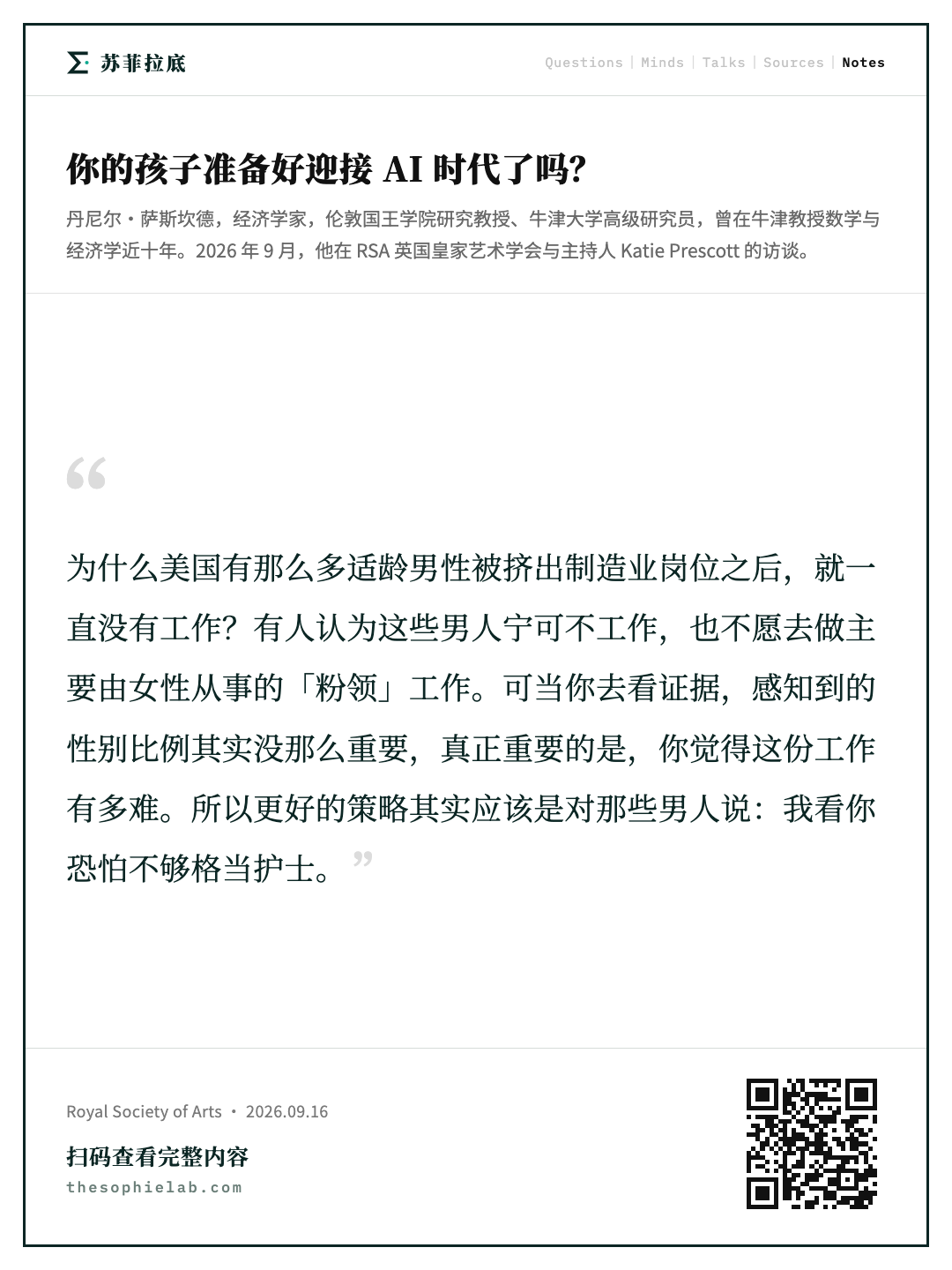
萨斯坎德: 为什么美国有那么多适龄男性,被新技术从制造业岗位上挤出来之后,就一直没有工作?有人说,这和技能无关,说得直白一点,用一个不太恰当的说法,美国劳动力市场上现有的很多工作是「粉领」工作,也就是主要由女性从事的工作。学前和幼儿园教师、护士、护理员里超过八成是女性。有人认为,这些男人宁可不工作,也不愿去做所谓的粉领工作。这同样是因为他们的身份认同扎根在某一类工作里,而那类工作已经没有了。

萨斯坎德: 于是难题变成了:拿它怎么办?看看政策制定者的应对方式挺有意思。在英国,国民医疗服务体系(NHS)发起过一场宣传活动,你可以在网上找到那段视频,画面里是许多男护士,想告诉大家男人也可以当护士。在美国,有一个州搞了一场宣传,标题是「你够爷们当护士吗?」,配的图是一些膀大腰圆的男人穿着护士服。但有意思的是,当你去看证据,看究竟什么因素真正起作用,结果发现,感知到的性别比例,也就是你是否觉得某份工作主要由女性从事,其实没那么重要。真正重要的是,你觉得这份工作有多难。

萨斯坎德: 所以更好的策略其实应该是对那些男人说:我看你恐怕不够格当护士,当学前教师对你来说有点难。

主持人: 这一招对男人一向管用。

萨斯坎德: 但这正说明了一点:身份的问题正变得越来越重要,怎样理解它,进而怎样把它往好的方向引导,这是我们需要投入多得多的功夫去研究、去弄懂的。

生存风险

主持人: 我马上就把话筒交给观众,不过既然你在这里,我不能不问问刚过去的这一周、这些新闻,还有「杀手人工智能」。你和科技界领袖打交道很多,还在政府的人工智能与工作专家组里任职。那些前沿实验室,也就是旧金山那些正在开发这项技术的顶尖公司,发出的警告让你有多担心?你多大程度上把它当真?又多大程度上接受「这只是营销」的说法?

萨斯坎德: 我想说几点。第一,这不是新鲜事。过去一周说这些话的人,过去十年一直在说。

主持人: 确实。

萨斯坎德: 我想变化在于,过去这只是一小撮尖头技术专家和学者的执念,现在人们通过几个实际案例看到,这不只是一个想法,这是真的。所以一方面,这不是新鲜事。

萨斯坎德: 另一方面,这也在意料之中。过去一个世纪几乎每一项有分量的技术,都有这种双重性质:既有非凡的前景,也伴随着巨大的代价。最好的例子是核能:一边是核武器,一边是核能,是解决我们面临的环境挑战的希望。面对这种技术的双重性质,我们不得不做的,是一边竭尽全力控制风险,一边竭尽全力把好处用足。这是一段很不舒服的路:这些技术既让人极度不安,又让人极度兴奋,我们必须同时把这两件事装在脑子里。

萨斯坎德: 就我个人而言,我认为给它安一个数字是荒谬的,比如最近流传的百分之十。

主持人: 恐怕是「高于百分之十」。

萨斯坎德: 对,但我认为这给了一种虚假的精确。不过我也认为它不是零。所以如果过去十天发生的事有什么值得庆幸之处,那就是这件事得到了更多关注、更多资源、更多聚焦。因为人工智能是我们造出过的最重要的技术,如果它偏偏不具备几乎所有先前技术都有的那种特征,也就是前景与代价并存,那才叫奇怪。

中美博弈

主持人: 谈到国际合作,人们常拿人工智能和核能作比,最近讨论得很多。你认为我们看到一个新的国际组织来监管人工智能的可能性有多大?

萨斯坎德: 我认为成立新的国际组织的想法有点转移注意力。归根结底,真正重要的只有两个国家:美国和中国。那些前沿公司、最先进的人工智能公司都在那里。一切取决于它们决定怎么做。

主持人: 确实如此。

萨斯坎德: 一方面,这个念头相当让人不安。我确实认为,在英国和欧洲,除非我们行动得聪明一些,否则我们在这场两匹马的比赛里只能当看客。而挑战当然在于人们这十年一直在谈的地缘政治压力:两国之中只要一个放慢脚步,另一个就会加速超车。

萨斯坎德: 这正是我觉得核能的例子有意思的地方。冷战期间,在美苏核竞赛中,尽管两国是敌人,深陷冲突,但几十年间仍然出现了很多双赢的时刻:两国虽然在竞争,却一致同意「这件事我们就不要碰了」。于是有了对核试验的限制、对核武器使用的限制,最终有了对核扩散的限制。我认为,为美国和中国寻找这类双赢,是思考如何监管这些技术时唯一真正重要的任务。我们要设法找出那些两国即便处在竞争中也都能同意「我们谁也不想要」的事情。而且,如果你想想中国的性质和它的政治的性质,中共把政治稳定看得高于一切。某种意义上,它比民主国家更不希望这些技术的颠覆性潜能扩散到更广泛的社会中去。所以在这个意义上,我其实认为美国处在一个相当有利的位置,可以去提出这类双赢方案。

萨斯坎德: 我还认为这给英国带来了一个有意思的角色。英国和中国、美国的关系都相对不错,可以充当某种调停者,一个居中斡旋的一方。但那种关于国际协议、新组织、新联盟的想法,我认为忽略了这个挑战的本质:从根本上说,这是美国和中国在赛跑。

主持人: 一场军备竞赛。谢谢你。看着它上演真是不同寻常,而且升级得如此之快。

能用 ChatGPT 写作业吗

主持人: 好,现在把话筒交给观众。我想先请卡丽丝问第一个问题。她问的是:我可以用 ChatGPT 做作业吗?

萨斯坎德: 这是个非常好的问题,它牵涉到太多东西。首先,还是回到「同时把两件事装在脑子里」这个说法。过去十天,我不知多少次谈论中美军备竞赛、超级智能、生存风险,然后就有人走过来说:这些都很有意思,可我家里有个女儿,她该不该用 ChatGPT 做作业?这项技术就是这样,逼着你从最宏大的问题一下子荡到最琐碎、最日常的问题。

萨斯坎德: 实话说,我希望这个问题对家长来说,能简单得像孩子问「我可以用计算器吗」一样。那时的回答是:你是在准备可用计算器的那份卷子,还是不可用计算器的那份?如果是前者,用吧;如果是后者,那对不起,我得把计算器拿到楼下厨房去,你得自己算。我希望教育在人工智能面前也能是这种感觉:哪些功课我们要用这项技术,哪些功课我们要把这项技术挡在外面,清清楚楚。而眼下我们没有这种清晰,是错配的。你得玩猜谜游戏,去揣摩老师的动机,揣摩他们想干什么,揣摩你到底在为什么做准备,一团乱。所以,回到教师们觉得这本书有用、让他们头脑清楚的那一点:我认为它能化解眼下人们提出的这些非常敏锐的问题。

主持人: 对教师和家长都是如此。

萨斯坎德: 对教师和家长都是。这种清晰极其有帮助。

大学与人文学科

主持人: 我们收到了很多很多问题。有一个问:大学教育作为通往劳动力市场的路径,会不会失去价值?年轻人是不是早点工作、早点积累关键技能更好?

萨斯坎德: 大学陷入困境已经有一段时间了,我写过大学的困境。我认为人工智能让这种困境变得更加生死攸关。但我也认为,大学面前有巨大的机会。我常被问到的一个问题是:这是不是人文学科的末日?

萨斯坎德: 有一个很醒目的时刻:二〇二二年,在美国,计算机科学学士学位的占比,有史以来第一次追平了全部人文学科学士学位加起来的占比。给人的感觉是人文学科正在退场,我们正为了追逐这些新技术而重组教育。但我认为,人文学科有一个巨大的机会,去重新思考它们教什么、怎么教。因为我在书里就做了这样的练习,把「两条路都教、两份卷都考」用到英语或历史这类科目上:我们用一部分时间以传统方式学习它,同时用另一部分时间借助这些技术去解决问题、探索思想,做那些没有这些技术就无法想象的事。

萨斯坎德: 我自己的专长是数学和经济学,我对那个世界里会是什么样子心里有数。但我在书里也玩了一把,设想一下有人工智能和没有人工智能的英语课会是什么样,有人工智能和没有人工智能的历史课会是什么样。这并不像「不用人工智能回答你读过的一本书的问题,然后用人工智能回答你没读过的一本书的问题」那么简单。我认为我们可以有创造性得多。我向教师、向整个教育界发出的号召之一,就是运用他们的领域专长,运用他们对自己学科的一切了解,去创造性地思考怎样设计这个故事的两个部分。我试了一把,但那不是我的专长领域。所以我觉得这是一项有趣的、有创造性的任务,需要我们所有人一起来做。

环境代价

主持人: 这里有一个很棒的问题,关于人工智能对环境的影响:在水资源日益稀缺的情况下,我们如何为人工智能的使用及其对水和电的消耗辩护?

萨斯坎德: 我在上一本书《增长:一场清算》(Growth: A Reckoning)里写过很多,谈追求技术进步和经济增长与我们在意的其他事情(比如环境)之间的张力。这显然是一个真实的挑战。我之前说,我们应当把大约三分之一的教育时间用来教人使用这些技术。我不认为应当盲目地教人使用,而是要批判地使用。

萨斯坎德: 批判地对待这些技术,一部分含义是不把它们告诉我们的东西照单全收。在这一点上它们不像计算器:它们会犯错,会产生幻觉。伟大的计算机科学家杰弗里·辛顿有一句话,称它们为「白痴天才」(idiot savants),因为它们有些时刻天才得惊人,能解前沿数学难题,另一些时刻又蠢得不可思议,直到不久前还数不清 strawberry 这个词里有几个 r。这带来的后果是,我们使用这些技术时必须批判地用,不能被动地照单全收,必须不断质问、检验、追问。我认为这是任何人工智能课程都应当包含的重要内容。但「批判」还有另一层意思:这些技术还有别的代价。

萨斯坎德: 环境影响就是其中之一。我认为,我们和这些技术打交道,不能只把自己当成市场上的消费者,还必须把自己当成社会中的公民,去考虑它们对政治的影响,以及方方面面的影响。这又回到那一点:我们现在需要建设一门丰富得多的人工智能课程,它不只是狭隘地讲「我怎么用这个系统做一道算术题」或者「我怎么用它写一首押韵的诗」。它丰富得多,关于环境的那些辩论和讨论,正是我设想中这门课程应有的内容。

主持人: 我记得你在书里说孩子们应该去参观数据中心,虽然数据中心很无聊,不过我明白你的意思。

萨斯坎德: 我不觉得数据中心非得是那样。当年为了输电,输电塔在全国各地竖起来的时候,办过好几次设计比赛,想把它们做得漂亮。那些比赛算不算成功,可以见仁见智,但我认为,我们正在盖的这些新建筑的美学,是我们需要思考的事。

教育科技翻盘

主持人: 我在想接下来聊哪个。有几个问题关于教育科技(edtech),也就是课堂里的教育技术。我女儿的学校用了,家长们非常不满。你怎么看?

萨斯坎德: 我认为它一直是一场灾难。原因是技术根本没到位。但我认为最近几年情况变了。举一个例子。教育科技界谈论了很久的一个愿景,是个性化教育。我们知道,人类导师是一种极其有效的教学方式。有证据显示,接受一对一辅导的学生,成绩往往超过传统课堂里百分之九十八的学生。效果惊人。我亲眼见过:我在牛津教了将近十年数学和经济学,在导师课上,面对面坐着一个、两个、三个学生,能针对每个人的长处和短处调整教什么、怎么教,这真是一种馈赠。

萨斯坎德: 教育科技的承诺之一,就是通过技术复制这种与真人之间的个性化互动,既有个性化,又便宜得多、普及得多,人人可得。当然,它一直没做到。我认为,有了这些系统,情况现在变了。只要你用对了方法,从它们那里得到的个人辅导,虽然只是我的个人观感,但坦率地说,比我见过的百分之九十五的教师都强,我自己也算在内。它强大得惊人,其中让我印象最深的是它的广度。

萨斯坎德: 光谱的一端,我想到我五岁的儿子。经典的拖延睡觉伎俩:就在你道晚安的那一刻,他决定问一个他能想到的最大的问题:「爸爸,第一个人是从哪里来的?」我精疲力竭,漫长的一天,我对进化论的了解充其量也就摇摇欲坠。于是我打开 ChatGPT,说:「我和五岁的儿子在一起,他刚问我第一个人是从哪儿来的,我的进化生物学知识很粗浅,能帮帮我吗?他喜欢这类东西。」它编了一个精彩的故事,讲猴子和乐高,我读给他听,他爱极了。而故事的内核,是对进化这个观念的表达:微小的变化经年累月,逐渐导向某种结果。这是一端:这些技术能为一个五岁的男孩量身定制内容。

萨斯坎德: 光谱的另一端,我想到我读经济学研究生时要解的一些问题。我常常想起的一个例子是:经济学一年级研究生很早就会碰到拉姆齐增长模型(Ramsey growth model),这是一套相当复杂的数学,一个聪明的好学生要花上一天才能弄明白怎么解。撇开这些系统几秒钟就能解出来不谈,那本身已经够惊人了。真正了不起的是,如果你对它说:「我是一年级研究生,正在解这道题,我不明白,你能陪我一步步走一遍吗?」它带着你穿越这些复杂问题的能力,回应你特定的兴趣、长处和短处的能力,令人瞩目。我回想自己第一次解这道题的时候:坐在那里一本又一本地翻教科书,想找到一个我能理解的切入角度,心里清楚下次见导师要等一周,就算见到也只有一个小时,而且还有另外两个学生,我得省着问,如果导师没听懂我在问什么,那就白费了。而这些系统随时都在,永远专注于你,永远能给你换一个角度,凌晨三点也会回答你的问题,哪怕最好的导师也做不到。所以,教育科技显然一直令人失望,但我认为在某些领域,它现在有了翻盘的机会。

成年人如何上手

主持人: 最后,有几个问题问的是我们成年人该做什么。你一直在谈孩子和年轻人。在座有六十多岁、七十多岁、八十多岁的人,请给他们一些建议:从哪里开始接触人工智能,怎样把它弄明白?

萨斯坎德: 这取决于你的动机是什么。对家长,我想说一件事:要感受这些技术到底有多强大,一个办法是去探索你能和它进行的那种个性化互动。想一个你想弄懂的观念,或者一个你想解决的问题,然后对它完全坦诚:说清楚你是谁,你想做什么,让它带着你一步步走,帮你理解。书里有很多我用不同问题这样做的例子。我认为这是一窥这些技术有多强大的一个办法。

萨斯坎德: 对于正在思考自己职业前途的人,我要回到开头谈的不确定性。我认为不确定性确实是未来工作的决定性特征,大量的不确定性。而我们对不确定性最好的回应是灵活性:一种在人生后半程重新培训、重新学习技能的能力和意愿,而且要拿出我们在人生起点接受教育时那种同样的强度和认真。

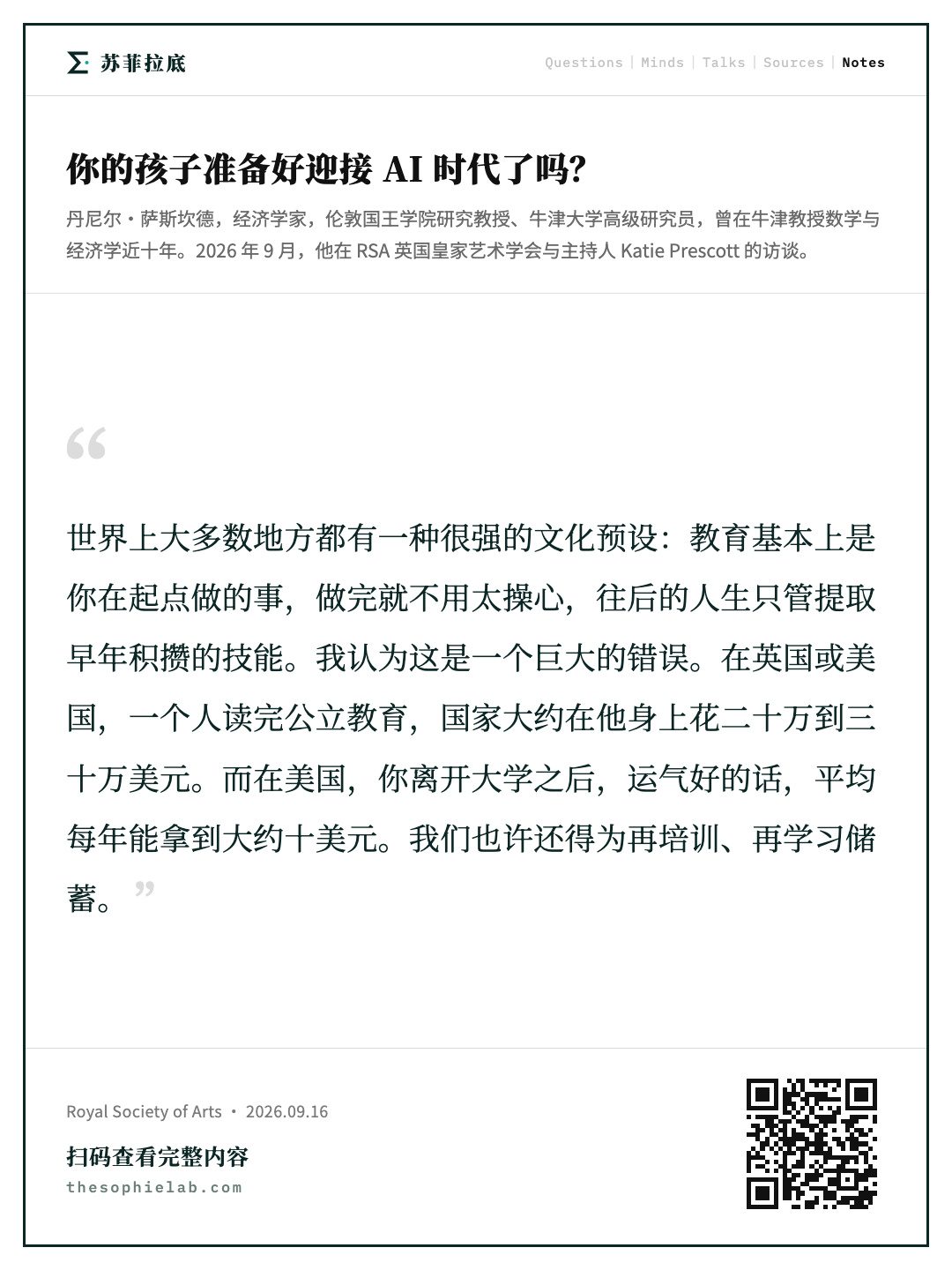
萨斯坎德: 世界上大多数地方都有一种很强的文化预设:教育基本上是你在起点做的事,做完就不用太操心,往后的人生只管提取早年积攒的技能。我认为这是一个巨大的错误。这种不确定性会要求我们持续地、灵活地回应变化。这部分意味着,国家必须做得多得多,去支持那些想在人生后半程再培训、再学习的人。今天人们谈论个人学习账户之类的东西,新加坡是最有雄心的,向想再培训的人提供几千美元。但这和我们在人生起点对一个人的投资相比,简直不值一提。在英国或美国,一个人读完公立教育,国家大约在他身上花二十万到三十万美元。而在美国,你离开大学之后,运气好的话,平均每年能拿到大约十美元。

萨斯坎德: 所以,我们根本没有认真对待人生后半程的再培训和再学习。这一部分是国家的责任,一部分是企业的责任。我知道企业爱谈「终身学习」,可看看它们在这些项目上投入的资源,和人们起步时企业对他们的投资相比,微不足道。最后,对个人也是一项挑战。我们被鼓励为退休、为老年、为家人的疾病储蓄。我认为我们所有人都得接受一个想法:我们也许还得为再培训、再学习储蓄。

萨斯坎德: 所以,别忘了成年人。我们必须像对待起点的教育一样,认真对待人生后半程的教育、再培训和再学习。这件事不能只压在个人身上,不能只压在国家身上,也不能只压在企业身上,三方必须一起来提供这种灵活性。

主持人: 我得说,这正是我读这本书读得如此愉快的原因:你直视一个极其不确定的未来,它的确让人感到非常非常不确定,而你给了人们一些积木,让他们知道该怎样去面对它。今晚听你谈话是一种享受,非常感谢。请大家为丹尼尔鼓掌。
本期讲者
丹尼尔·萨斯坎德经济学家,伦敦国王学院研究教授、牛津大学高级研究员,曾在牛津教授数学与经济学近十年,并任英国政府 AI 与工作咨询小组成员。著有《没有工作的世界》《增长:一次清算》,与父亲理查德·萨斯坎德合著《专业人士的未来》;新书《我的孩子该做什么?》于对谈前一周出版。
Katie Prescott英国皇家艺术学会(RSA)本场讲座的主持,本人是家长,带着孩子到场;其中一个孩子 Caris 在观众提问环节提出「能否用 ChatGPT 写作业」。
章节 · 点击跳转视频
0:03 开场:一本写给家长的实用书 ▶ 正在看
3:17 回归基本功:编程课的十年教训 ▶ 正在看
6:21 教育的目的与未来仅知的两件事 ▶ 正在看
9:43 计算器先例:两边都教两边都考 ▶ 正在看
12:48 课堂现状与社交媒体的区别 ▶ 正在看
16:39 和孩子用 AI:两个家庭故事 ▶ 正在看
23:31 职业选择:问问题而非问岗位 ▶ 正在看
27:36 身份错配:韩国与粉领工作 ▶ 正在看
31:57 灭绝风险、美中竞赛与核类比 ▶ 正在看
38:16 观众提问:作业、大学与环境 ▶ 正在看
46:09 教育科技翻身:AI 当家教 ▶ 正在看
50:22 成年人的账:终身再培训 ▶ 正在看
本期论点
本期回应
其他论点
5:03
编程课十年就过时,不是运气不好,而是「预测未来所需技能」这条路本身走不通
5:38
读写、算术和批判性思维之所以基础,不是因为最简单,而是其他一切能力都依赖它们
7:12
当下职场的主要挑战不是工作机会不够,而是让人有能力胜任已有的工作
8:50
教育中大约三分之一的时间应当用来教人批判地使用 AI,而不只是教会操作 做法
12:21
英语、历史、音乐、美术等所有学科都应在 AI 时代一分为二,并对两边分别考试 做法
14:04
只从防守角度看待 AI 进入课堂,是想象力的失败
16:09
争论孩子每天该看多久屏幕是错误的方向,真正该问的是屏幕上放的是什么
24:49
鼓励年轻人问「我想做什么工作」是错的,该问的是想用一生解决什么问题
26:38
想成为传统意义上的专业人士,最好的路径之一仍是接受传统的专业训练 做法
28:13
人们找不到工作,有时不是缺技能,而是可选的工作与他们的身份认同不匹配
34:04
给 AI 导致人类灭绝的风险安上具体概率是虚假的精确,但这个概率并不是零
35:07
设立新的国际组织来监管 AI 是分散注意力,真正重要的只有美国和中国的决定
37:04
中共把政治稳定看得高于一切,因而比民主国家更有动机阻止技术的颠覆性冲击蔓延
47:48
用对方式互动时,AI 提供的私人辅导已经胜过 95% 的人类教师 观察
51:56
应对未来工作的不确定,最好的办法是人生后半段以早年求学的强度重新学习技能 做法
01开场:一本写给家长的实用书
0:03
[music] [music] Thank you so much everyone for being here with us this evening. I have to say I'm not surprised that this event was so popular. Um I think I saw you about maybe six months ago and you told me the title of your book, What Should My Children Do? I thought that's exactly what I want to know and what everybody I know wants to know at the moment. So, um >> yeah, I'm delighted to be doing this. >> AI's got a bit scary in the last week or so, hasn't it? Um I think we're going to steer away from too much of the destruction of humanity, although there are some questions I'd like to ask you about that more broadly, and focus on the book, which I have to say I found immensely reassuring overall. Um so much so that I've actually brought my children here tonight to listen uh and hopefully learn something from the conversation. Um we will leave time for questions at the end. So do put those onto Slido. Um and yeah, let's get going. So one of the things that struck me about the book is that it's very
[音乐][音乐]非常感谢大家今晚来到这里。我得说,这场活动这么受欢迎,我一点都不意外。嗯,我想我大概是六个月前见到你的,你当时告诉我你书的名字——《我的孩子该做什么?》很火。嗯,我想我大概是六个月前见过你,你跟我说了你那本书的书名——《我的孩子该学什么?》我当时就想,这正是我想知道的,也是我认识的每个人现在都想知道的。所以,嗯>> 是啊,我很高兴能来做这件事。>> AI 在过去一周左右变得有点吓人了,对吧?嗯,我想我们会尽量避开太多关于人类毁灭的话题,虽然关于这方面我还是有些更宏观的问题想问你,但我们主要还是聚焦人类的毁灭,虽然关于这一点我还想从更宏观的层面问你几个问题,但主要还是聚焦在在这本书上。我得说,总体而言我觉得这本书让人非常安心。嗯,安心到我今晚把我的孩子们都带来了,让他们听一听,希望能从这场对谈中学到点什么。嗯,最后我们会留出时间提问,所以请大家把问题发到 Slido 上。嗯,好,我们开始吧。这本书让我印象很深的一点是,它非常实用,这很棒。同时它也相当个人化,这本书让我印象很深的一点是,它非常实用,这一点特别好。它也相当个人化 >> 而且你谈了很多你自己是怎么用 AI 的
便签引用
1:12
practical which is great. It's also quite personal >> and you talk a lot about how you use AI with your children. >> Yes. >> Um and I just wondered what sort of inspired you >> Yeah. to write the book and what it was like writing it because it's quite different to a sort of academic tract. >> That's right. Um I mean the the idea for the book comes from the fact that for the last 1015 years I've been writing and thinking about the impact of technology on on work and it's you know it's taken me all over the world to talk to really different groups of people very different types of institutions and yet and particularly in the last few years wherever I am and whoever I'm talking to the question I get asked the most is always the same which is what on earth should my children do you know how do we prepare the next generation for these technological changes that are taking place. Uh, and for me it had always been it's something I've been thinking about for a long time. It had always been a relatively,
>> 你谈了很多你怎么和孩子一起用 AI。>> 是的。>> 嗯,我就想问问,是什么启发了你 >> 嗯。 写这本书,写作过程是什么感觉,因为这跟那种学术论著很不一样。>> 没错。嗯,我是说,这本书的想法来自于,过去十到十五年我一直在写作和思考技术对工作的影响。你知道,这让我走遍了世界各地,跟非常不同的人群、非常不同类型的机构交流。然而,尤其是最近几年,不管我在哪里、跟谁聊,我被问得最多的问题永远是同一个,那就是我的孩子到底该做什么?你知道,我们要怎么让下一代为正在发生的这些技术变革做好准备。呃,对我来说,这一直是我思考了很久的问题。它一直以来都相对偏
便签引用
2:09
you know, intellectual academic question. But I think having three kids of my own, so 8, five, and two, and just the gradual realization that this was personal, >> and that their future was going to look really different from my past. Uh and um and so I wanted to write a yeah I wanted to answer that question but I wanted to also answer that question by drawing on my own life my own experiences and how I you know putting these ideas into practice and so yeah the the book is full of um of little sort of stories from my own life >> and seeing them go through the education system. Yes, >> I imagine. I mean, that's certainly how I felt about my kids going through primary school is how remarkably similar it was to my primary experience in many ways. Are there things about education that you think we should be keeping and focusing on because you also talked about sort of how we need to restructure the system? Yeah. And what's interesting is that you the book came out last week and um I think one one of the reactions
知识性、学术性。但我想,因为我自己有三个孩子,八岁、五岁和两岁,我慢慢意识到,这件事是私人的,>> 他们的未来会和我的过去非常不一样。呃,嗯,所以我想写一本——是的,我想回答那个问题,但我也想通过我自己的人生、我自己的经历,以及我如何把这些想法付诸实践,来回答那个问题。所以,是的,这本书里充满了我自己生活中的一些小故事,>> 还有看着他们经历教育体系。是的,>> 我能想象。我是说,我对自己孩子读小学的感受确实如此——它在很多方面跟我自己的小学经历惊人地相似。是你吗?这本书上周出版了,嗯,我觉得很多老师的一个反应是,他们
便签引用
02回归基本功:编程课的十年教训
3:17
quite a lot of teachers have had is they have found it quite liberating quite comforting because what the sort of starting point of the book is this slogan that I have about getting back to basics. >> Uh and by basics I mean sort of literacy, numeracy and critical thinking. um you know there has been you know if I try and generalize about how we've thought about how to prepare young people for the future in the past it's been you know let's try and think as cleverly as we can about the future let's try and predict what jobs are going to have to be done and then let's say okay these are the skills and capabilities that people are going to need and you know we'll we'll give them and you know they'll flourish and my view is that it is just the future's too uncertain to do that now we just can't do uh the idea of future proofing the next generation, it's an impossible task. And and and one of the stories I tell in the book to really illustrate that is 2013, David Cameron, then prime minister,
觉得这本书挺让人解脱的,挺让人安心的,因为这本书的出发点就是我一直在讲的那句口号——回归基本功。基础。>> 呃,我说的基本功指的是读写能力、算术能力和批判性思维。嗯,你知道,如果我试着概括一下过去我们是怎么思考如何让年轻人为未来做准备的,那基本上就是:我们尽可能聪明地去思考未来,试着预测将来会有哪些工作需要人做,然后说,好,这些就是人们将来需要的技能和能力,然后我们把这些教给他们,他们就能过得很好。而我的看法是,未来实在太不确定了,现在根本做不到这一点。呃,给下一代做"未来免疫"这个想法,是一项不可能完成的任务。我在书里讲了一个故事特别能说明这一点:2013年,时任首相戴维·卡梅伦
便签引用
4:14
announces, um all children in primary and secondary schools have to learn to code. Um and Michael Gove who's then the education secretary comes forward and says uh these are the technical uh technological skills that the next generation will need to succeed in the 21st century and they weren't alone right almost every advanced country with an AI strategy followed some sort of take on teach young people to code >> which made sense at the time >> made sense and didn't just make sense I mean it felt radical it felt ambitious it felt kind of fresh and new and interesting fast forward 10 years >> and what does it turn out that these systems are particularly good at doing, not just quite good at doing, right? But but particularly good at doing, you know, writing code. And so it turns out that something that was, you know, literally meant to, you know, prepare the next generation for the rest of the century barely lasted until the end of school. And so I and I don't think that was a case of bad luck. I think it's
宣布,嗯,所有中小学生都必须学习编程。嗯,然后时任教育大臣的迈克尔·戈夫站出来说,呃,这些就是下一代在21世纪取得成功所需要的技术能力。而且他们并不是个例——几乎每一个有AI战略的发达国家都推出了某种版本的"教年轻人编程"。>> 这在当时是说得通的。>> 说得通,而且不只是说得通,我是说,它当时给人的感觉是激进的、有雄心的,是新鲜有趣的。快进十年——>> 结果发现这些系统特别擅长做什么呢?不是"还挺擅长",对吧?而是"特别擅长",你知道的,写代码。所以结果就是,那个本来,你知道,字面意义上要为下一代准备好接下来整个世纪的东西,连中学都没撑到头。所以我不认为那只是运气不好。我觉得这就是"未来免疫"这个想法的死期——
便签引用
5:08
just it's the death now for this idea of future proofing that we can predict the future and we can say what advanced skills are going to matter. I don't think we can do that. But what I do think we can say is that however the future turns out to be, whatever jobs do turn out to be in demand and whatever advanced skills do turn out to be important, perhaps it's creativity, perhaps it's judgment, perhaps it's empathy, hard to know, but whatever they turn out to be, they're going to rely in some way in those basics, literacy, numeracy, and to some extent critical thinking. So they're basic in the sense not only that they're the kind of simplest skills, but they're also, you know, fundamental. They're the building blocks for everything else. And so, you know, one of the starting points is we've just got to get back to basics.
以为我们能预测未来,能说出哪些高阶技能会重要。我不认为我们做得到。但我确实认为我们可以说的是:不管未来变成什么样,不管哪些工作最后变得抢手,不管哪些高阶技能最后被证明是重要的——也许是创造力,也许是判断力,也许是共情力,很难说——但不管是哪些,它们都会在某种程度上依赖那些基本功:读写、算术,以及某种程度上的批判性思维。所以说它们"基础",不只是因为它们是最简单的技能,更因为它们是根本性的。它们是其他一切的基石。所以,你知道,一个出发点就是:我们必须回归基本功。
便签引用
5:48
And the data last week suggesting that the piece of data suggesting that literacy and numeracy have been, you know, falling around the world. I mean, they've been falling from 2009 to 2022. And we now see that's continued over the last few years. You know, that's a disaster in itself, but in my view, it's a particular disaster if we're asking how do we prepare the next generation for this incredibly uncertain future that is just so difficult to to know too much about. >> You ask some very big questions in the book and one of them is what is the point of education?
而上周的数据表明——那份数据显示,全世界的读写和算术能力一直在下滑。我是说,从2009年到2022年一直在下滑。现在我们看到,过去这几年还在继续下滑。你知道,这本身就是一场灾难,但在我看来,如果我们要问的是:怎么让下一代为这个极其不确定、难以看清的未来做好准备,那它就是一场格外严重的灾难。>> 你在书里问了一些非常宏大的问题,其中之一是:教育的意义到底是什么?
便签引用
03教育的目的与未来仅知的两件事
6:21
>> Yes. >> And I think you quote, I can't remember which Greek king >> Spartan king Aesus. >> Yes. [laughter] Yeah. Um what do you think is the point of education in this AI era then? >> Yeah. Well, I mean the point of education um yeah he the the reason I quote him he he has um he has a line where he says you know the the purpose of education is to prepare young men and he was really writing about men back then uh for you know to flourish in the future. uh and in his time Sparta that meant preparing young men for war.
>> 是的。>> 而且我记得你引用了,我想不起是哪位希腊国王——>> 斯巴达国王阿格西劳斯。>> 对。〔笑〕是的。嗯,那你认为在这个AI时代,教育的意义是什么?>> 是啊。嗯,我是说,教育的意义——嗯,我引用他,是因为他有一句话说,你知道,教育的目的是让年轻男子做好准备——他当时确实只写男性——呃,让他们在未来过得好。呃,在他那个时代的斯巴达,那意味着让年轻男子为战争做准备。
便签引用
6:58
>> Um for the last 100 years that has meant essentially preparing, you know, people for the labor market for, you know, a um uh for a well-paid job. And you know, it I I do think, you know, I don't think this is the challenge for now. And and the sort of premise of the book is that the main challenge we face for now in the world of work is is not that there aren't enough jobs for people to do. I think there are uh the challenge is how we prepare people to do those jobs and that's really what the bulk of the book is focused on. Um but I do think that if you look further into the 21st century and you take seriously some of the claims that the leaders of the large technology companies make not only about the kind of risks of these technologies but also their sort of you know possibilities in economic life. the idea that we might build a system that can outperform us at all economically useful tasks that we do, you know, then you do then you are forced to engage with these kind of deeper questions about what the
>> 嗯,而过去一百年,这基本上意味着让人们为劳动力市场做准备,为一份呃,一份高薪工作做准备。而且你知道,我确实认为——我不觉得这是眼下的挑战。这本书的前提是:眼下我们在职场世界面临的主要挑战,并不是没有足够的工作给人做。我认为工作是有的。呃,挑战在于我们怎么让人做好准备去做这些工作,这也是这本书大部分内容聚焦的地方。嗯,但我确实认为,如果你把目光放到21世纪更远处,并且认真对待大型科技公司领导者们提出的一些说法——不只是关于这些技术的风险,也包括它们在经济生活中的,你知道,可能性。那种想法是:我们可能造出一个系统,在我们所做的一切具有经济价值的任务上都超越我们。你知道,那你就不得不去面对那些更深层的问题:在那样的世界里,教育的目的可能是什么。
便签引用
7:55
purpose of education might be in that sort of work. Uh and it's not obvious to me that our traditional answers over the last 100 years are a particularly good answer for the sorts of you know worlds we might find ourselves in. >> But for now we need to focus on the basics literacy as you say. So one one starting point is um get back to basics. One of and another you know we the the uncertainty that we face in the future is just you know in my view it's impossibly difficult to resolve. In fact we only really know two things about the future. One is it is going to be full of technologies that are vastly more capable than those that exist today. And secondly we know very little else. And that feels quite dispiriting and quite disempowering and but actually I think there's a huge amount we can do. One is get back to basics. Another is you know teach people to use these technologies.
呃,我并不觉得我们过去一百年的传统答案,对我们可能身处的那种世界来说,是个特别好的答案。>> 但眼下我们需要专注于基本功,就像你说的读写能力。所以一个出发点是,嗯,回归基本功。另一个是,你知道,我们面对的未来的不确定性——在我看来是难以化解的。事实上,关于未来我们真正知道的只有两件事。一是未来会充满远比今天更强大的技术。二是我们几乎不知道别的任何事。这听起来挺让人泄气、挺让人无力的,但其实我认为我们能做的事情非常多。一是回归基本功。另一个是,你知道,教人们使用这些技术。
便签引用
8:46
>> Um I think just to give you a flavor of the ambition I think we ought to be spending about a third of our time now in education teaching people to use these technologies and not simply teaching them to use them blindly but teaching them to use them critically. And perhaps we can talk about what I mean by that. You know the big challenge you immediately confront though is this challenge of well hold on isn't one of the big risks in in teaching people to use technology and AI that it undermines those basics >> you know why bother to learn how to do a difficult calculation if you know you can take a photo with your phone and AI will solve it. Why bother to spend time you know reading a difficult book learning you know the the the skill of doing that if you can ask you know one of these systems a question on any book in the world and it will come back with a wonderful answer and so you know people worry I think legitimately today that these technologies might make us stupid. Uh and so the the the challenge
>> 嗯,为了让你感受一下我心目中的力度:我认为我们现在应该把教育中大约三分之一的时间花在教人们使用这些技术上,而且不只是盲目地教他们用,而是教他们批判性地使用。也许我们可以聊聊我这话是什么意思。你知道,你马上会碰到的一个大挑战是:等一下,教人们使用技术和AI,最大的风险之一不就是它会削弱那些基本功吗?>> 你知道,如果你能用手机拍张照,AI就替你解出来,那何必还费劲去学怎么做一道难题的计算呢?如果你能就世界上任何一本书向这些系统提问,它都会给出一个精彩的答案,那何必还花时间去读一本难读的书、去掌握读书这项技能呢?所以你知道,今天人们担心——我觉得这担心是合理的——这些技术可能会让我们变蠢。呃,所以我认为挑战在于:我们怎么既教会下一代
便签引用
04计算器先例:两边都教两边都考
9:43
I think is how do we you know teach the next generation to use these technologies but also to be able to flourish without them. And what's interesting is that we've actually been here before. Um if you go back to the 1970s 1980s the powerful technology of that time the electronic calculator right and and you look at what people were writing about it it's ex the worries that people had are so similar to the worries that people have today. In particular, the worry was what's going to happen to arithmetic? People are just going to give up on learning to do um and what was really interesting was um there was this relatively obscure British academic, this guy called Wilfred Holidayiday Cockraftoft who was teaching maths at the University of Hull and he was one of the few people in the country who'd thought a lot about maths education and the British government came to him and said look um maths education is in disarray. people are worried about the state of arithmetic.
使用这些技术,又让他们在没有这些技术的情况下也能过得很好。有意思的是,这种局面我们其实经历过。嗯,如果你回到上世纪七八十年代,那个时代的强大技术是电子计算器,对吧?你去看看当时人们写的东西,他们当时的担忧和今天人们的担忧惊人地相似。尤其是,人们担心算术会怎么样?大家会不会干脆放弃学呃,而真正有意思的是,嗯,有一位相对不出名的英国学者,叫威尔弗雷德·科克罗夫特,他在赫尔大学教数学,是全国少数几个对数学教育深入思考过的人之一。英国政府找到他说,嗯,数学
便签引用
10:38
Um, and also we've got this calculator. What on earth do we do? And he wrote this report and people can look at it. It's the called the Cockra report. It was written published in 1982 or three. And you know, vast, incredibly meticulous. I mean, I doubt anyone really read it at the time. Uh, and I doubt, you know, many people have heard of it today, but there's this one amazing chapter where he describes what he thinks we need to do in response to the calculator. And the first thing he does is he says, "Look, we've just got to be realistic." um in the decades to come, everybody is going to have access to a calculator.
教育一片混乱,人们担心算术水平的状况。嗯,而且我们现在还有了计算器这东西。我们到底该怎么办?于是他写了一份报告,大家可以去看看。那份报告叫《科克罗夫特报告》,写成并发表于1982还是1983年。你知道,篇幅浩大、极其细致。我是说,我怀疑当时真的没几个人读完。呃,我也怀疑今天还有多少人听说过它。但里面有非常精彩的一章,他在其中描述了他认为我们应该如何应对计算器。他做的第一件事是说:"听着,我们必须实事求是。"嗯,在接下来的几十年里,每个人
便签引用
11:10
>> And I think there's something in that for us today as well. You know, artificial intelligence is the water in which the next generation is going to swim, and we're letting them down if we don't think about how to prepare them for that. Um but what he then said was, look, how do we um teach young people to use this new machine without also undermining arithmetic? And he and he came up with this great innovation where he said, "Look, we've got to take maths education and divide it in two. And we've got to spend some of our time teaching young people to use this calculator to solve problems that would have been unimaginable in the past. But we also need to spend a big chunk of time teaching people to do maths without these calculators. And crucially, he said, to make sure that everyone takes both these paths seriously, we test both."
都会用得上计算器。>> 我觉得这一点对今天的我们同样有启发。你知道,人工智能就是下一代要在其中游泳的那片水,如果我们不去思考怎么让他们为此做好准备,我们就是辜负了他们。嗯,但他接着说的是:我们该怎么教年轻人使用这台新机器,同时又不削弱算术能力呢?然后他提出了一个了不起的创新。他说:听着,我们得把数学教育一分为二。我们要花一部分时间教年轻人用计算器去解决过去无法想象的问题。但我们也需要花很大一块时间,教人们在不用计算器的情况下做数学。而关键在于,他
便签引用
11:57
>> Uh, and I call this teach both, test both. And what anyone who's been through maths education since the mid 1980s onwards will have done something like that. You will have revised for a calculator paper and a non-calcul. Uh and I think we need something similar now with respect to AI as well. I think we need to take almost everything that we do >> English history music art whatever it might be divide it in two. ask how can we use these technologies to solve problems, understand ideas, make discoveries that would have been unimaginable before, but also how can we make sure that we're protecting space where those technologies are not available and again testing at the end to make sure that people take both seriously. So I think together this idea of getting back to basics and teaching both and testing both is uh you an important you know starting point for for preparing people.
说,为了确保每个人都认真对待这两条路,两边我们都要考。>> 呃,我把这叫做"两边都教,两边都考"。从八十年代中期以后接受过数学教育的人,都做过类似的事。你会为一张可用计算器的卷子和一张不可用计算器的卷子分别复习。呃,我认为现在面对AI,我们也需要类似的东西。我认为我们几乎要把我们所做的一切——>> 英语、历史、音乐、美术,不管是什么——一分为二。去问:我们怎么用这些技术去解决问题、理解概念、做出以前无法想象的发现;但同时,我们怎么确保守住一些空间,在那里这些技术是用不了的。同样,最后要考试,确保人们两边都认真对待。所以我认为,回归基本功加上"两边都教、两边都考"这两个想法合在一起,是让人们做好准备的一个
便签引用
05课堂现状与社交媒体的区别
12:48
>> So that's the holy grail. Yes. You said teachers have contacted you already. What what is the status quo quo in the classroom and what are they saying to you about that and their worries there? >> Um I mean it's a bit of a it's a bit of a mess. Um people don't know what to do. >> Yeah. >> Um and um and I think that's you know I think it's a a problem for two reasons, two sort of deep reasons. I mean, what it leads to is an instinct, I think, um, to want to, you know, put barriers up, to want to sort of ban and admonish and restrict and keep out the classroom. And I worry about that. And I worry about that for two reasons. One is the just this reason that I mentioned, which is that this is again, you know, this is the world the next generation are going to live in. and they need to learn to flourish in an environment that reflects the one that they'll live in when they grow up.
重要起点。>> 所以那就是终极目标。是的。你说已经有老师联系过你。那课堂里的现状是什么样的?他们跟你说了什么,他们在担心什么?>> 嗯,我是说,现在有点、有点乱。嗯,大家不知道该怎么办。>> 是啊。>> 嗯,而且,嗯,我觉得这是个问题,有两个原因,两个比较深层的原因。我是说,它导致的是一种本能,我觉得,嗯,就是想筑起壁垒,想去禁止、去训诫、去限制,把它挡在教室外面。我对此感到担忧。我担忧有两个原因。一个就是我刚才提到的那个理由:这又一次,你知道,这就是下一代将要生活的世界。他们需要学会在一个能反映他们长大后所处环境的环境里
便签引用
13:45
>> But there's a second part to it and it and and this sort of runs through the book and which is not kind of defensive. You know, this is the world in which they're going to swim and we need to, you know, teach them how to, you know, flourish. But to think about it just seems very unimaginative. Um it's a failure to imagine how we might use these technologies again to understand problems um to solve problems, understand ideas, make discoveries that just would have not been possible um to you know previous generations. And you know what we have at the moment is a mishmash where it's just not it's not clear you know simple questions about um you know how to you know organize homework or you know classes or you know university lectures or you know recruitment strategy just aren't obvious because we don't have the clarity about what we're you know how we're collectively trying to respond to this.
过得好。>> 但还有第二层,嗯,这一层贯穿整本书,而且它不是防守型的。你知道,这就是他们将要游泳的那片水,我们需要,你知道,教他们怎么过得好。但只从防守角度去想这件事,实在太缺乏想象力了。嗯,那是一种想象力的失败——想象不到我们可以怎样用这些技术去理解问题、去解决问题、理解概念、做出以前的世代根本不可能做出的发现。而你知道,我们现在的状况是一团混杂,就是不清楚——那些简单的问题,比如嗯,你知道,怎么安排作业,或者你知道,课堂,或者你知道,大学讲座,或者你知道招聘策略——都不明朗,
便签引用
14:41
>> Is there anything that you think we could learn from what's happened with social media? I think you describe in the book as a massive unplanned social experiment. >> Yes. And the results are in and they're not good. >> And you know my view I share a lot of the concerns that people have about social media. Uh and I you know I'm very supportive of many of the restrictions that have been proposed. So no smartphones before 14, no social media before 16, phone free schools. um um you know lots of play >> presumably happy like I am that your kids were sort of too you know a kind of post online safety bill >> that that social media is going to be easier for me to navigate as a parent than you know say you know 10 years ago.
因为我们对于自己要,你知道,怎样集体回应这件事,并没有清晰的共识。>> 你觉得从社交媒体发生的事情里,我们有什么可以借鉴的吗?我记得你在书里把它描述成一场巨大的、无人规划的社会实验。>> 是的。结果已经出来了,而且并不好。>> 而且你知道,我的看法是,我和大家一样对社交媒体有很多担忧。呃,而且你知道,我非常支持已经提出的许多限制措施。比如14岁前不给智能手机,16岁前不用社交媒体,学校里不许带手机。嗯,嗯,还有你知道,大量的玩耍时间。>> 我猜你和我一样庆幸,你的孩子差不多是在《网络安全法案》之后的时代长大的
便签引用
15:22
Yeah, I think that's exactly right. But again, just to sort of to one of the worries that I have is that legitimate concerns about social media bleed into a kind of general skepticism about artificial intelligence. Social media is not the same thing as artificial intelligence. Yeah. Whereas social media I think disempowers, it distracts, it frag fragments our attention, there is a path with AI where it can make our lives in my view go vastly better. And yeah, there's another way to think about this, which is that I think at the moment, and I find myself doing this as a parent, like you get forced into this this sort of collective search for the Goldilocks level of screen time, right? Not too much, not too little, just right. And everyone kind of argues, how much screen time do your kid, but that's the wrong conversation in my view to be having.
是的,我觉得完全正确。但话说回来,我的一个担忧是,人们对社交媒体的合理担忧会蔓延成对人工智能的普遍怀疑。社交媒体和人工智能不是一回事。是的。在我看来,社交媒体让人失去力量、分散注意力、把我们的注意力切得支离破碎,而 AI 则有一条路径,能让我们的生活变得好得多。是的,还有另一种思考方式,就是我觉得现在——我自己作为家长也会这样——你会被迫卷入这种集体式的寻找「刚刚好」的屏幕时间,对吧?不能太多,不能太少,刚刚好。大家都在争论,你家孩子每天能看多久屏幕,但在我看来,这是个错误的讨论方向。
便签引用
16:12
The the conversation we should be having is what is actually on those screens? What are we actually using these technologies to do? If it's social media, my view is it should be pretty darn close to zero. But if it's teaching those basics, if it's, you know, teaching how to use these technologies, then I think we ought to be entertaining, you know, far more use of these technologies. Uh, and so, yeah, I I think this idea that AI and social media are quite sort of different beasts is is uh is important to keep in mind.
我们真正该讨论的是:那些屏幕上到底放的是什么内容?我们到底在用这些技术做什么?如果是社交媒体,我的看法是应该尽可能接近零。但如果是在教那些基本功,如果是在教怎么使用这些技术,那我认为我们应该考虑让他们更多地使用这些技术。所以,是的,我觉得「AI 和社交媒体是完全不同的两种东西」这个观念,是很重要、需要记住的。
便签引用
06和孩子用 AI:两个家庭故事
16:39
>> And how do you use it with your children? >> Um, in lots of different ways. Um I was um um I was just reflecting on Judy Dench at the beginning there talking about creativity and I find creativity and technology fascinating because it's one of the sort of >> um final frontiers of uh this technology. It's the thing that over the last 15 years people have just said to me machines will never be creative. Uh and yet today I think you know many people can point to particular moments where these technologies are starting to encroach on um creative tasks. Uh the the one I mean what one story comes to mind of um um when I was younger I was maybe seven or eight. My dad and I had this um story that we told each other we were we were going to write together. Uh and it was called the day no one went to Disneyland. [snorts] Uh, and the story went like this, which is, uh, my dad promises me we're going to Disneyland in the morning. And I go to bed and I wake up and I look outside and it's an amazingly beautiful day. In fact, it's a
>> 那你自己是怎么和孩子一起使用它的?>> 嗯,有很多不同的方式。我刚才还在回想开头朱迪·丹奇谈到创造力那段,我觉得创造力和技术这个话题特别迷人,因为它是这项技术>> 最后的疆域之一。过去 15 年里,人们一直跟我说,机器永远不会有创造力。但今天,我觉得很多人都能指出一些具体的时刻,说明这些技术已经开始侵入创造性的任务了。我想到一个故事,是我小时候,大概七八岁的时候。我和我爸有一个我们互相讲过、说好要一起写下来的故事。它叫《没人去迪士尼乐园的那一天》。(笑)故事是这样的:我爸答应我,第二天早上带我去迪士尼乐园。我上床睡觉,醒来往窗外一看,是个美得惊人的日子。事实上,那是
便签引用
17:47
perfect day. The day couldn't be better. And I run downstairs and my dad looks at me and says, "We just can't go to Disneyland today. The weather is too good. You know, everyone in the world is going to want to go to Disneyland. It is going to be absolute hell. We just can't go." Uh, and I look at him, sort of devastated, puppy eyes, and he says, "Okay, yeah, we'll go. We'll we'll do it." And we get in the car, we drive, and the traffic is remarkably light. And we get to the car park, and doesn't seem to be a single car in the car park. And well, it turns out that everyone else in the world had that same thought, that the weather was too nice. Uh, and so, you know, no one went to Disneyland that day because the weather was too perfect, apart from me and my dad. And so, we had the park to ourselves. And the story that we had in mind and we told ourselves was um you know having the rides completely to ourselves. All the food you was going off so we got to eat it all and you know fantastic and and we
完美的一天。天气不能再好了。我跑下楼,我爸看着我说:「今天我们去不了迪士尼乐园了。天气太好了。你想想,全世界的人都会想去迪士尼乐园。那会变成人间地狱。我们真的去不了。」我看着他,一脸崩溃,可怜巴巴的眼神,然后他说:「好吧,行,我们去。我们去吧。」于是我们上了车,开车出发,路上车少得出奇。到了停车场,好像一辆车都没有。结果呢,原来全世界其他人都是同一个想法——觉得天气太好了。所以,那天没人去迪士尼乐园,因为天气太完美了,除了我和我爸。于是整个乐园就归我们俩了。我们当时想的、互相讲的故事就是,所有游乐设施都由我们独享,所有食物都要坏掉了,所以我们可以全吃掉,反正就是特别棒。我们
便签引用
18:41
we spoke about it a lot but you know life caught up with us. We forgot about it. Um stopped talking about it. Lost a history. 30 years later Friday night dinner at my parents. I'm sitting there with my um 8-year-old uh she was then seven. I told her the idea for this story and she said, "Daddy, you've got to write it for me." Uh and so, um we got Chat GPT. Uh I said, "You know, I'm sitting here with my seven-year-old. 30 years ago, my dad and I had this idea for a story. Uh we never got round to writing it. Um can you help us?" Uh, and I asked my daughter what sort of style she wanted the story written in. And at the time, Dr. Zeus was one of her favorite favorites. So, we said Dr. Zeus. And within a few seconds, it generated, you know, a wonderful Dr. Zeus take on the day no one went to Disneyland. And, you know, she laughed and she found it fantastic. And, you know, it wasn't perfect. There were al there were some mistakes and there were some sort of Americanisms that had crept in. So,
聊了很多次,但生活忙起来,我们就把这事忘了,不再提了。这个故事就丢了。30 年后,周五晚上在我父母家吃饭。我坐在那儿,旁边是我那位八岁的女儿——当时她七岁。我把这个故事的点子讲给她听,她说:「爸爸,你一定得帮我把它写出来。」于是我们打开了 ChatGPT。我说:「我现在和我七岁的女儿坐在一起。30 年前,我和我爸有过这么一个故事的点子,我们一直没抽出时间写下来。你能帮帮我们吗?」然后我问女儿,想让故事用什么风格来写。当时,苏斯博士是她最喜欢的作者之一。所以我们说:苏斯博士。几秒钟之内,它就生成了一个特别棒的、苏斯博士风格的《没人去迪士尼乐园的那一天》。她笑得很开心,觉得太棒了。当然,它并不完美,有一些错误,还混进了一些美式的东西。
便签引用
19:45
there was lots of talk of sort of cinnamon buns which didn't really, you know, sit particularly well. the but the but we had a lot of fun over the next half hour, you know, reprompting, tweaking, updating, you know, putting her into the story in different ways. And it was a kind of it was a really interesting insight into um you know, the way in which you can use these technologies as a sort of creative partner. um I was using it to do something I just had never got round to do and it didn't feel like in any way that was taking away or degrading my relationship with my child or uh indeed it felt like a pretty creative fun thing to do. Um the one that um so that was my I mean that was a good moment for me.
比如里面老是提到肉桂卷之类的,读起来其实不太对味。但接下来的半小时我们玩得非常开心,不断重新提示、微调、更新,用不同的方式把她也写进故事里。这是一次特别有意思的体验,让我看到你可以把这些技术当作一种创作伙伴来用。我用它做成了一件自己一直没腾出时间去做的事,而且我完全不觉得这件事夺走或削弱了我和孩子之间的关系,恰恰相反,它感觉是件相当有创造性、很有趣的事。至于另一个例子——刚才那个是我自己的,对我来说是个美好的时刻。
便签引用
20:29
the one that my wife um talks about. My wife doesn't work in technology. She makes we're talking she makes documentaries and podcasts and um her family live in Suffach. So we often find ourselves driving from London to Suffk 3 hours along the A12 complete nightmare with three kids in the car. But we found this podcast that everybody loved which was called uh history's not boring and it's 15 minutes um on huge variety of subjects narrated by two children um seems sort of 10 or 11 something like that and we listened to it a lot and over time we started talking as a family about you know who these kids were that were narrating the podcast um you know what school they went to how they got so much time off school to you know spend end in the studio, [laughter] uh, you know, what they, you know, what their qualifications were, if it was something that they could do when they were 10 or 11. And in the end, I went on the website to find out who they were and what their story was. And it turned out
我太太常提的是另一件事。我太太不在科技行业工作。她做的是纪录片和播客。她家人住在萨福克。所以我们经常要从伦敦开车去萨福克,沿着 A12 开三个小时,简直是噩梦,车里还有三个孩子。但我们发现了一个全家都爱的播客,叫《历史一点也不无聊》,每集 15 分钟,题材非常丰富,由两个小孩解说,听起来大概十岁或十一岁的样子。我们听了很多,慢慢地,我们开始以家庭为单位讨论:这两个解说播客的孩子到底是谁,他们上的是哪所学校,怎么能有那么多时间不上学、泡在录音棚里(笑),还有他们都有什么资质,居然十岁十一岁就能做这种事。最后,我上了他们的网站,想看看他们究竟是谁、有什么故事。结果发现,他们根本不存在。
便签引用
21:28
they didn't exist. >> The entire thing was generated by AI. The kids didn't exist. The the entire, you know, story that we were listening to, none of us knew. We had all been completely duped. And for my wife, you know, it was partly the feeling of having built this collective relationship with these people that didn't exist. It was partly a realization that you can use these technologies to create, you know, pretty engaging educational content. Um, but for her it was also an insight into, you know, this was something that really would have taken her and a talented team, you know, weeks to produce. Um, and yet there were thousands and thousands of them. I I'm pretty sure huge number of them. I didn't go deep into the archive that had been generated by AI. Um, >> sort of. Yeah.
>> 整个节目都是 AI 生成的。那两个孩子不存在。我们听的整个故事——我们谁都不知道。我们全都被彻底骗了。对我太太来说,一部分是那种感觉:你和这些人建立了一种集体性的关系,而他们根本不存在。另一部分是一种意识到:你可以用这些技术做出相当吸引人的教育内容。但对她来说,这也让她看到:这种东西如果让她带一个有才华的团队来做,得花上几周才能产出。然而这样的节目有成千上万集。我很确定数量巨大,我没有深挖那个档案库,它们都是
便签引用
22:15
>> Wonder if Judy Dench might have something to say about that. I mean to your point about using your sort of cognitive muscles, literacy, numeracy, what does that do to your creativity? >> Well, I mean >> just feeding church. >> Well, my my view is that you can use these systems to do creative things that would have been, you know, really hard or indeed impossible to do in the past. You know, those are kind of examples of um you know, playful examples with my kids. But in the last few weeks, you've had the announcement that OpenAI had used, I imagine, you know, a similar system to the one that I had used to write the day no one went to Disneyland.
AI 生成的。>> 差不多吧。是的。>> 不知道朱迪·丹奇对此会怎么说。我是说,回到你说的锻炼认知肌肉、读写能力、算数能力那点,这对你的创造力会有什么影响?>> 嗯,我是说 >> 只是在喂养教会(笑)。>> 嗯,我的看法是,你可以用这些系统去做一些在过去非常难甚至根本做不到的创造性的事。刚才那些是我和孩子之间好玩的例子。但就在过去几周,
便签引用
22:58
They had used it to solve the Navia Stokes problem, you know, one of the millennium problems in mathematics. Um you know many mathematicians would say that's a pretty you know the way in which you did it is a pretty creative you know thing to do. Um you know so my view is there are many examples of how we can use these technologies to do things that you know would have required creativity from us and you know allows us to do you know do things that would have just been very hard to imagine before. So >> we talked a bit about education. Yeah.
OpenAI 宣布,他们用了一个我猜和我写《没人去迪士尼乐园的那一天》时用的差不多的系统,去解决纳维-斯托克斯问题,那可是数学界的千禧年难题之一。很多数学家都会说,那是相当有创造性的——你解决它的方式是相当有创造性的做法。所以我的看法是,有很多例子表明,我们可以用这些技术去做那些原本需要我们发挥创造力才能做的事,而且能让我们做到一些
便签引用
07职业选择:问问题而非问岗位
23:31
Let's move on to work. Yes. cuz that is I think something that terrifies people. We've already started to see unemployment rise amongst graduates, younger people >> when it comes to things like the professions which are you know areas um where AI is seen as a huge threat. What is your advice to younger people who are interested in becoming lawyers, becoming accountants? So um I mean the first thing I would say is I think I think it is far too early to tell whether the whether what is happening in that in kind of that part of the labor market is due to technology.
在以前很难想象的事情。所以 >> 我们聊了一些教育的话题。是的。我们接着聊工作吧。好。因为我觉得那是让人们非常恐慌的事情。我们已经开始看到毕业生、年轻人当中的失业率在上升。>> 说到那些专业行业,也就是大家认为 AI 构成巨大威胁的领域,你对那些想当律师、当会计师的年轻人有什么建议?嗯,我要说的第一件事是,我认为现在下结论还为时过早——劳动力市场那一部分正在发生的事情,
便签引用
24:12
>> Okay. >> Um there are some signs so there is um some really good work done by colleagues of mine at Stanford. Uh they published a paper called the canary in the coal mine. I remember it terrifying and yeah uh suggesting that sort of AI exposed entry level white collar jobs are on the decline. um huge disagreement though about that work and I I think so I think in general it's too early to tell but there are you know there are there are signs I mean there's various pieces of advice I mean one piece of advice is I think many young people are encouraged to ask themselves what job do you want to do that's the question that you we put to young people and actually I think given what is happening now that's not a very useful question I think a far better question you know If you go into law because you like the sort of lawyer that you saw on suits or you go into medicine because you like the [laughter] sort of doctor you saw in house or right you go into marketing because you like what you saw in Madmen, you know, I
到底是不是技术造成的。>> 好的。>> 有一些迹象。我在斯坦福的同事做了一些非常出色的研究。他们发表了一篇论文,叫《煤矿里的金丝雀》。我记得那篇论文挺吓人的,对,它指出 AI 影响到的入门级白领岗位正在减少。不过,围绕那项研究有巨大的分歧。所以我觉得总体来说现在下判断还太早,但确实有一些迹象。有几条建议:一条是,我觉得很多年轻人被鼓励去问自己「我想做什么工作」,这是我们抛给年轻人的问题,但其实我觉得,考虑到现在正在发生的事,这不是一个很有用的问题。我觉得更好的问题是……你如果因为喜欢《金装律师》里那种律师形象而去学法律,或者因为喜欢《豪斯医生》里那种医生(笑)
便签引用
25:12
think you're going to be bitterly disappointed because what those jobs look like is going to change. I mean is changing and is going to continue to change dramatically in years to come. But if you go into these professions because you're interested in solving medical problems, you're interested in improving access to justice, you want to tell stories that sell things, you know, then I think the future is a far more exciting one. Um because, you know, those problems are not going away. Uh there is a huge amount of demand and often latent demand, demand that isn't being met by the current professions because the way in which we you know try and meet legal need or medical need or you know market whatever it might be is just too expensive and unaffordable for most people. If you go in because you're interested in the those problems, >> yeah, >> rather than the particular jobs, that I think is a far more useful way to think about the world of work. And so I say um you know ask you know what sort of
而去学医,或者因为喜欢《广告狂人》而去做营销,我觉得你会大失所望,因为那些工作的样子将会改变。其实已经在改变了,而且在未来几年还会继续剧烈变化。但如果你进入这些行业,是因为你对解决医学问题感兴趣,是因为你想改善人们获得司法救济的途径,是因为你想讲出能把东西卖出去的故事,那我觉得未来要令人兴奋得多。因为那些问题不会消失。需求非常庞大,而且往往是潜在需求——现有的专业行业满足不了的需求,因为我们现在满足法律需求、医疗需求或者做营销之类的方式,对大多数人来说都太贵、负担不起。如果你是因为对这些问题感兴趣而进入这一行,>> 嗯 >> 而不是因为某个具体的职位,我觉得那才是一种有用得多的方式,来思考
便签引用
26:04
problems you want to spend your life solving your career solving rather than what particular job you want to do particularly those who are interested in in white collar work. Um I mean another thing I mean there's so much advice that I want to want to give and that in a sense is why I wrote this book because it's a feeling that you can't kind of capture it in in a few minutes but another important one is and this might sound slightly paradoxical is if you want to be a traditional profession I a traditional professional I still think one of the best ways to do it is to still take the traditional route. If you're interested in the law you still ought to train to be a traditional lawyer. If you're interested in medicine, you still ought to train as a traditional doctor.
工作的世界。所以我会说,去问问自己想用一生、用职业生涯去解决什么样的问题,而不是想做什么具体的工作,尤其是那些对白领工作感兴趣的人。还有另一件事——我想给的建议实在太多了,某种意义上这也是我写这本书的原因,因为你没法在几分钟里把它讲清楚。但另一条很重要的、听起来可能有点自相矛盾的建议是:如果你想进入传统的专业行业,想成为一名传统的专业人士,我仍然认为最好的路径之一,是走传统的路子。如果你对法律感兴趣,你仍然应该按传统方式去训练成为一名律师。如果你对医学感兴趣,你仍然应该按传统方式训练成为
便签引用
26:45
>> Back to basics point. >> Well, this is so it's this is uh basics in a different sense, which is that it's more about domain expertise. One of the things that you see time and time again when these technologies are used in practice and used well is that often you see technical experts, people who know a lot about the technology, but also domain experts as well, people who know a lot about the problems that you're trying to solve. So perhaps it's a you know, a legal tech startup. There'll be someone who knows a lot about AI, but there'll also undoubtedly be lawyers who have spent a long time cutting their teeth in the law. They know what a legal problem looks like. They know what a good legal answer looks like. And so, um, and you see this, you know, time and time and time again. So I I I I but what I would also then say in the spirit of that first observation is to be far more open-minded and agnostic once you enter these worlds about you know what your particular job might look like to
一名医生。>> 又回到打基础这一点。>> 嗯,这是另一种意义上的「基础」,它更多是关于领域专长。当这些技术被投入实践、而且用得好的时候,你一次又一次看到的一点是,你往往既能看到技术专家——那些非常懂技术的人,也能看到领域专家——那些非常懂你要解决的那些问题的人。比如说一家法律科技创业公司,里面会有很懂 AI 的人,但毫无疑问也会有在法律行业摸爬滚打很久的律师。他们知道一个法律问题长什么样,知道一个好的法律解答是什么样的。所以,这种情况你会一次又一次地看到。但接着,本着前面那个观察的精神,我还要说的是,一旦你进入这些领域,对自己具体会做什么样的工作要更开放、更不预设立场,
便签引用
08身份错配:韩国与粉领工作
27:36
recognize that you might not be spending your entire career in a traditional law firm or a traditional accountancy practice but you might be moving sideways into very different types of organizations. >> I loved what you said about how much we identify our personalities with our job and how that might have to change. Yes. >> I wonder if you can just expand a little. I think that's just a very interesting point. >> Yeah. I mean, so one of the one of the things that's become clearer and clearer is I mean, it's an obvious point, but that, you know, people's jobs are not simply a source of income, but they're also a source of meaning and purpose and identity. And what that means in practice is that one of the reasons that people find themselves without work sometimes is not because they lack the right skills, but it's because the work that's available doesn't fit with the sort of people that they think they are, the kind of identity that they have, what their expectations were for the life that they wanted to live. And I
要意识到你可能不会整个职业生涯都待在一家传统的律师事务所或传统的会计师事务所,而是可能横向流动到非常不同类型的机构里去。>> 我很喜欢你说的那段,关于我们有多么把自己的人格认同和工作绑在一起,以及这一点可能必须改变。是的。>> 不知道你能不能再展开讲一点。我觉得那是个非常有意思的观点。你知道,人们的工作不仅仅是收入来源,也是意义感、目标感和身份认同的来源。这在现实中意味着,人们有时之所以找不到工作,并不是因为他们缺乏合适的技能,而是因为可供选择的工作与他们自认为的那种人不匹配,和他们的身份认同不匹配,和他们对自己想过的生活的期待不匹配。我觉得有一个特别有意思的例子,
便签引用
28:33
think a really interesting example, there's a lot and I call this a sort of identity mismatch. And you can see this unfolding in different countries in very different ways. I mean I think what in the context of the professions I think one of the most interesting countries is Korea >> where uh one of the interesting things about Korea is that they have an incredibly highly educated unemployed population. So something like 60% of the unemployed in Korea have college degrees or higher which is sort of three times what it is here twice in the US.
例子其实很多,我把这种情况叫做"身份错配"。你能看到它在不同国家以非常不同的方式上演。我是说,在专业职业这个语境下,我觉得最有意思的国家之一是韩国。>> 韩国有一点很有意思,就是他们有一大批受教育程度极高的失业人口。韩国失业人口里大概有60%拥有本科及以上学历,这大约是英国的三倍、美国的两倍。
便签引用
29:02
>> And and the reason for that is because not because there aren't jobs. It's because the jobs that are available are not the sort of jobs that young Koreans thought they were going through that famous Korean educational gauntlet to do. Uh low paid, low prestige, insecure or just not the kind of white collar professional role that they hope to do. Um, so what what kind of gets in the way of people moving around the labor market there is far more people's expectations for work, their sense of who they are, uh, and um, and rather than not having the right skills and you see it in other ways in other countries. So, um I think that that why is it um that so many men of working age in the United States displaced from manufacturing roles by new technologies are out of work.
>> 原因并不是没有工作岗位,而是现有的这些岗位并不是韩国年轻人当初拼过那场著名的韩国教育"炼狱"所期待去做的那种工作。低薪、低声望、不稳定,或者根本不是他们期望的那种白领专业职位。所以,在那里阻碍人们在劳动力市场上流动的,更多是人们对工作的期待、他们对"我是谁"的认知,而不是缺乏合适的技能。在其他国家你也能以别的形式看到这一点。比如,为什么美国有那么多处在工作年龄、因新技术而从制造业岗位上被挤出来的男性长期没有工作?
便签引用
29:56
Some people say um that it it's not to do with skills but it's because you know to put it bluntly many of the job to put it blunt to use an unfortunate phrase uh many of the jobs that are available in the US labor market are pink collar jobs. They're jobs disproportionately done by women. So more than 80% of preschool and kindergarten teachers of nurses of carers are women. And there are some who would say that these men would rather not work at all than take up that so-called pink collar work. Um and again that's because of a sense of you know they have an identity rooted in a particular type of work that's not available. The challenge is then what you do about that and >> um it's quite interesting looking at how policy makers have responded. So I mean in the UK for instance, the NHS ran a campaign um showing um and you can see the video online uh showing lots of people working as nurses who are men to try and show that you know men can be nurses too. In the US one of the states ran a campaign saying are you man enough
有人说,这跟技能无关,而是因为——说得直白点——很多可供选择的工作,用一个不太恰当的说法,美国劳动力市场上很多现有的岗位是"粉领"工作。这些工作绝大多数由女性从事。比如超过80%的学前和幼儿园教师、护士、护理人员都是女性。有人会说,这些男性宁可完全不工作,也不愿去做所谓的"粉领"工作。这同样是因为一种认知——他们的身份认同扎根于某一特定类型的工作,而那种工作已经没有了。接下来的挑战就是该怎么办。>> 看政策制定者的应对方式其实挺有意思的。比如在英国,NHS做过一场宣传活动,你在网上还能看到那个视频,里面展示了很多做护士的男性,想要说明男人也可以当护士。在美国,有个州做过一场宣传,口号是"你够man去当护士吗?"
便签引用
31:02
to be a nurse? Uh and there were sort of pictures of kind of you know burly looking men dressed as nurses. And but what was what's interesting though is that when you then look at the evidence on what actually matters, it turns out that perceived gender share, so whether or not you think that it's a job which is disproportionately or proportionately done by women turns out not to matter that much. Actually, what really matters is how hard you think the work is. M >> so if you were a better strategy it turns out would have been to tell those men well I don't think you're you know quite good enough to be a nurse or you know quite yeah being a preschool teacher is a bit hard for you >> strategy with men all the time >> well but this is but this is the kind of way in which I think these issues of identity which are becoming increasingly important how we make sense of them and how we then influence them in you know good directions is is something that we need to do far more work on for understand far better
画面上是那种身材魁梧的男人穿着护士服的照片。但有意思的是,当你去看真正起作用的证据时,会发现"感知到的性别比例",也就是你是否认为这是一份主要由女性从事的工作,其实并没有那么重要。真正重要的是你觉得这份工作有多难。嗯。>> 所以更好的策略其实应该是告诉那些男人:我看你大概还不够格当护士,或者说,当个学前班老师对你来说可能有点难。>> 这招对男人一直挺管用。>> 哈哈,不过这正是我想说的——这些身份认同问题正变得越来越重要,我们该如何理解它们,以及如何把它们往好的方向引导,这是我们需要投入更多研究、更好理解的领域。
便签引用
09灭绝风险、美中竞赛与核类比
31:57
>> I'm going to throw into audience shortly, but I can't have you here without asking you about um the week just gone and and what is in the news and and killer AI? I mean, you spend a lot of time >> with tech leaders, you've got your role on the on the government AI and work panel. >> How worried are you about some of the warnings coming out of these frontier labs? So, the top AI companies that are developing this technology in San Francisco, um how how seriously do you take that? How seriously do you take the argument that that it's just marketing?
>> 我马上就把问题交给现场观众,但你人都在这儿了,我不能不问问过去这一周的事、新闻里都在说的那些以及"杀手AI"。我是说,你花了很多时间 >> 和科技领袖打交道,你还在政府的AI与就业委员会里任职。>> 对于这些前沿实验室发出的警告,你有多担心?也就是旧金山那些开发这项技术的顶尖AI公司,你有多当真?你又有多认同"这只是营销手段"这种说法?
便签引用
32:31
>> Um so what what I would I'd say a few things. One is that this is not new. You know the people who have been saying this over the last week um have been saying it for the last decade >> for sure. Um I think what has happened is that what felt like a kind of preoccupation for sort of you know pointy head technologists and academics I think people have now seen through a few practical cases that you know this is actually this isn't just an idea this is this is real. So I think partly you know this isn't new.
>> 嗯,我想说几点。第一,这并不是什么新鲜事。过去这一周说这些话的人,其实过去十年一直都在说。>> 确实。我想变化在于,原本感觉像是技术宅和学者们的小众执念,现在人们通过几个实际案例看明白了:这不只是个想法,而是真实存在的。所以一部分原因是,这事并不新。
便签引用
33:03
>> Um I think partly it's also to be expected. Um you know almost every technology consequential technology of the last century has had this jewel nature. It's had both this extraordinary promise and also a kind of great price associated with it as well. I mean the really good example of this is nuclear energy. you know, on the one hand nuclear weapons, on the other hand, well, sorry, nuclear on the one hand nuclear weapons, on the other hand, nuclear energy. You know, the prospect of, you know, solving the environmental challenges that we face and and what we what we've had to do in response to these the kind of dual nature of these technologies is do everything that we can to, you know, control the risks while at the same time doing everything we can to, you know, make the most of the benefits. And it's this you know very uncomfortable walk that we have to do which is you know these technologies are both very unsettling but also you know very exciting and we have to hold both those things in our our head at the same time.
>> 另一部分,我觉得这也在意料之中。过去一个世纪里几乎每一项重大技术都有这种双重属性。它既有非凡的前景,也伴随着巨大的代价。一个很好的例子就是核能。一方面是核武器,另一方面……抱歉,一方面是核武器,另一方面是核能。它带来了解决我们面临的环境挑战的可能。而面对这些技术的双重属性,我们必须做的,就是尽一切可能控制风险,同时也尽一切可能把好处发挥到最大。这是一条走得非常别扭的路——这些技术既令人极度不安,也令人非常兴奋,我们必须同时把这两件事放在脑子里。
便签引用
34:04
I mean I I I think you know personally I think it's absurd to attach a number um 10% is the number that's been in the in the >> greater than I'm afraid greater than 10% chance that's been yeah but I I just think the I think it gives a kind of false precision to this. Um but I also think that it's not zero. Uh and so if there is a silver lining in what's happened over the last 10 days, it's that it is getting you know more attention and more uh you know resource and more focus because um you know it would be surprising if the most important technology that we've ever built and that is what AI is didn't have the same features that almost every technology has had before which is this promise and this price >> and people often talk, you know, make the comparison between AI and nuclear when it comes to international cooperation.
就我个人而言,我觉得给它安一个数字是荒谬的。现在流传的那个数字是10%——>> 恐怕是"高于10%"。>> 对,是高于10%的概率。但我只是觉得,这给人一种虚假的精确感。不过我也认为这个概率不是零。所以,如果说过去这十天里有什么好的一面,那就是它确实得到了更多关注、更多资源、更多聚焦。因为如果我们造出的这项最重要的技术——AI就是这样的技术——没有几乎所有以往技术都具备的那种特征,也就是既有前景又有代价,那才奇怪。>> 人们在谈到国际合作时,也常把AI和核相提并论。
便签引用
34:58
>> It's being talked about a lot. How likely do you think it is that we will see some, you know, a new organization perhaps that might >> regulate AI in some way? >> Um, I think the idea of a new international organization is a bit of a distraction. In the end, there are only two countries that matter. It is the US and China. That is where the companies, the frontier companies, the most advanced AI companies are. And um it depends on what they decide to do. Um that's >> well well quite and yeah quite so on the one hand like that is quite you know unsettling unsettling thought. uh and I I do think to some extent in in Britain and Europe, you know, we are unless we act smartly, we are just going to be spectators in this two-horse race. And the challenge of course and people have been talking about this over the last 10 years is just this, you know, the geopolitical pressure um the the the um if you if one of the two countries were to slow down, the other would you know [clears throat] speed up and take
>> 这个话题被讨论得很多。你觉得我们有多大可能会看到某种新的组织出现,以某种方式来 >> 监管AI?>> 我觉得"设立一个新的国际组织"这个想法有点分散注意力。归根结底,真正重要的只有两个国家:美国和中国。那些公司,那些前沿公司、最先进的AI公司,都在这两个国家。一切取决于他们怎么决定。>> 确实如此。>> 对,所以一方面,这确实是个让人不安的想法。而且我确实认为,在某种程度上,英国和欧洲如果不采取聪明的做法,就只会成为这场"两马赛跑"的旁观者。当然,挑战就在于——过去十年人们一直在讨论的——地缘政治压力:如果这两个国家中有一个放慢脚步,另一个就会[清嗓]加速并超越。这也正是我觉得核的例子很有意思的原因,
便签引用
36:09
over. Again, this is why I think the nuclear example is quite interesting because you know even though during that nuclear during the cold war during that nuclear race uh between the US and the USSR even though they were you know enemies and locked in this you know conflict there were nevertheless over the decades many kind of win-wins moments where both countries even though they were in competition agreed we just want to take this off the table. So there were restrictions on testing of weapons, on use of weapons, eventually on proliferation of weapons. And I think sort of searching for these win-wins for the US and China is, you know, the only task that matters in thinking about regulating these technologies. We want to be trying to identify those things that both countries, even though they're in this competition, can agree neither of us want it. Um and actually when you think about the nature of China and the nature of the politics there, the CCP prizes political stability above anything, you know, they in in a sense
因为即便在冷战期间,在美苏那场核竞赛中,即便他们是敌人、深陷冲突,几十年下来,依然出现过很多双赢的时刻:两国虽然在竞争,但也一致同意把某些东西从桌面上拿掉。于是有了对武器试验的限制、对武器使用的限制,最终还有防扩散的限制。我认为为美国和中国寻找这类双赢,才是在思考如何监管这些技术时唯一重要的任务。我们要努力找出那些两国即便身处竞争、也能一致认为"我们都不想要"的东西。而且实际上,当你想想中国的国情和那里的政治,中共把政治稳定看得高于一切。某种意义上,他们比
便签引用
37:15
far more than kind of, you know, democracies have an interest in not allowing the kind of disruptive potential of these technologies to sort of drift into wider society. So I I mean I actually think there you know in in that sense you know the the US is in quite a a strong position to be you know making proposing these sort of win-wins. I I also think it introduces an interesting role for the UK and for Britain in this Britain who has you know a relatively good relationship with China and the US uh to act as a kind of mediator a party to be able to try and you know to um but I think the idea of these sort of international agreements and you know new organizations and you know alliances and I think that neglects just the nature of the challenge which is that fundamentally this is about the US and China engaged in in this uh in in this race >> arms race. Well, yeah, thank you. No, it's extraordinary to watch it play out and it it's escalated so so quickly.
民主国家更有动机去阻止这些技术的颠覆性影响蔓延到整个社会。所以我其实觉得,从这个角度看,美国处在一个相当有利的位置去提出这类双赢方案。我还觉得,这给英国带来了一个有意思的角色。英国与中国和美国都保持着相对不错的关系,可以充当某种调解者、某个能够去尝试推动的角色。但我认为,那种国际协议、新组织、新联盟的想法,忽略了这个挑战的本质——归根结底,这就是美国和中国之间的这场 >> 军备竞赛。嗯,对,谢谢。不,看着它这样展开真是不可思议,而且升级得如此之快。
便签引用
10观众提问:作业、大学与环境
38:16
>> Um right, we're going to uh go to the audience now. I think Caris, did you have a question for Daniel first of all? Go on. >> Can I do use chat GPT to do my homework? >> Can I use chat GPT to do my homework? >> So, that is a so that's a really Yeah. So that is a great question and it's a question that um it's it's and it's a question that I mean gets to so much. I mean one is and again just to go back to this idea that you have to hold two things in your head at the same time. The number of times in the last 10 days kind of had these conversations about arms races between the US and China and super intelligence and existential risk.
>> 好,我们现在把时间交给观众。Caris,你是不是先有个问题要问Daniel?来吧。>> 我可以用ChatGPT做作业吗?>> "我可以用ChatGPT做作业吗?">> 这真是个——对。这是个特别好的问题,而且这个问题牵涉到太多东西了。首先,还是回到那个"必须同时把两件事放在脑子里"的说法。过去这十天里,我无数次在谈美中之间的军备竞赛、超级智能和生存风险,
便签引用
38:52
People come up and say look that's all very interesting but I've got a daughter at home. You know should she use chat GPT to do her homework? you know, the way in which this technology forces you to swing from some of the biggest questions to some of the most prosaic and everyday questions. And the truth is that I want the answer to that question to be as simple for parents as a child saying, should I use my calculator? When the answer is, are you using the calculator to prepare for the calculator paper or the non-cal paper? If it's the calculator paper, go ahead and use it. If it's a non-calculated paper, I'm afraid I'm going to take it downstairs to the kitchen and you need to do the sums by yourself, you know. And I I want I want education to feel like that with respect to AI that there is a kind of clarity about what work we're going to use this technology for and what work we're going to protect from this technology. And at the moment, we don't have that kind of clarity. It's a mismatch. you have to do
然后有人走过来说:这些都很有意思,但我家里有个女儿。她该不该用ChatGPT写作业?这项技术就是会逼着你在最宏大的问题和最平淡、最日常的问题之间来回摆荡。而事实是,我希望这个问题的答案对家长来说,能像孩子问"我能用计算器吗"一样简单。答案就是:你是在准备允许用计算器的那张卷子,还是不许用计算器的那张?如果是允许用的,那就用。如果是不许用的,那抱歉,我得把它拿到楼下厨房去,你得自己算。我希望在AI这件事上,教育也能给人这种感觉:清清楚楚地知道哪些学习任务我们要用这项技术,哪些任务我们要保护起来不让它介入。而目前我们没有这种清晰度,是错配的。你不得不
便签引用
39:45
this sort of guessing game, this interpretation of the kind of teachers, you know, motivations and, you know, what what it is that they're trying to do, what you know, what exactly you're preparing for and and it's a mess. And so, again, to this point that teachers finding this useful and kind of clarifying because I think it resolves some of these ex you very astute uh, you know, questions uh that people are asking at the moment >> for teachers and parents actually >> for teachers and parents. See that clarity is incredibly helpful. Well, we've got lots and lots of questions.
玩一种猜谜游戏,去揣摩老师的动机、他们到底想干什么、你到底在为什么做准备,一团糟。所以,回到刚才那点:老师们觉得这个框架很有用、很能厘清问题,因为我觉得它解决了人们现在问的那些很敏锐的问题。>> 对老师和家长来说都是。>> 对老师和家长来说都是。你看,这种清晰度极其有帮助。好,我们收到了非常非常多的问题。
便签引用
40:15
Um, >> does university education lose its value as a pathway to the labor market? >> And um, are young adults better off starting work early to gain key skills? >> Say the second part again. Sorry. >> Are young adults better off starting work earlier to gain key skills? >> Yes. Um so I mean starting on that I mean I I think there is um I think I mean universities have been in trouble for a while. >> Um and I have written about the troubles that universities are in. I think AI makes it even more existential right >> um but I think there is also a huge opportunity for universities too. I mean, so one of the questions I often get asked is, you know, is this the end of the humanities?
嗯,>> 大学教育作为通往劳动力市场的路径,是否正在失去价值?>> 以及,年轻人是不是更早开始工作、积累关键技能会更好?>> 第二部分能再说一遍吗?抱歉。>> 年轻人是不是更早开始工作来积累关键技能会更好?>> 好。先从这点说起。我觉得,大学已经陷入困境有一段时间了。>> 我也写过大学正面临的那些困境。我觉得AI让这个问题更加关乎生死存亡。>> 但我认为大学同样面临巨大的机会。我经常被问到的一个问题是:人文学科是不是要完蛋了?
便签引用
41:06
>> Um, and there there is this moment and it's really striking in 2022 in the US where the share of bachelor's degrees in computer science was neck andneck with the share of bachelor's degrees in all of humanities combined for the first time in history. So, a sense that kind of the humanities are on the way out. we're reorganizing education in pursuit of these uh new technologies and but I I I I mean I again I think there is a huge opportunity for the humanities to rethink how it is that they teach what they're teaching you because I think you can do this and I and I do this in the book this kind of teach both test both exercise >> in something like English or something like history where you say okay we'll spend part of our time studying it in the traditional way but we're also going to spend part of our time using these technologies to you know solve problems, explore ideas that would have been unimaginable without it. So I yeah I and you know my my particular expertise is mathematics and economics and I have a
>> 有一个时刻非常引人注目:2022年在美国,计算机科学的学士学位占比首次与所有人文学科学位占比加起来的历史时刻。所以,会有一种感觉,就是人文学科正在走向没落。我们为了追逐这些新技术而重组教育,但我我我我想说,我还是认为人文学科有一个巨大的机会去重新思考他们该怎么教你们现在所学的东西,因为我觉得这是可以做到的我在书里也做了这样的尝试,就是这种「两边都教、两边都考、两边都练」的做法 >> 在像英语或者像历史这样的科目里,你可以说,好,我们花一部分时间用传统方式来学它,但我们也要花一部分时间用这些技术去,你知道的,解决问题、探索一些没有它就无法想象的想法。所以我,是的,而且你知道,我个人的专长是数学和经济学,我大概能想象在那个领域里会是什么样子,但我在书里也玩了一把,
便签引用
42:08
good sense of what it might look like in in that world but I have a bit of fun in the book you know thinking about what it would look like to teach English with and without AI what it would look like to teach history with and without AI and it's not simply as you know um straightforward as you know you can um uh answer questions on this book that you've read without AI I and then use AI to answer questions on a book you haven't read. I think that we can be far more creative and I think you know one of the call to arms to teachers and to you know throughout education is to use their domain expertise use all they know about their subjects to think creatively about how you might you know design both parts of that story. Um, and yeah, as I said, you know, I have a go, but they're not my areas of expertise. And so I think there's a kind of a fun creative task for us all to to do. Now, >> a fantastic question here on the environmental impact of AI. How do we justify AI use and the environmental
就是去设想,用 AI 和不用 AI 教英语分别会是什么样,用 AI 和不用 AI 教历史又会是什么样,而且这并不像你想的那么简单,不是说,嗯,呃,你在不用 AI 的情况下回答一本你读过的书的问题,然��再用 AI 去回答一本你没读过的书的问题。我认为我们可以远比这更有创造力,而且我觉得,对老师们、对整个教育界的一个号召,就是要运用他们的专业知识,运用他们对自己学科的全部理解,去创造性地思考你要怎么设计这个故事的两个部分。嗯,而且是的,就像我说的,我自己也试了一下,但那些不是我的专业领域。所以我觉得这对我们所有人来说都是一件挺有意思的、有创造性的事情。那么现在,>> 这里有一个非常好的问题,关于 AI 的环境影响。在水正在成为越来越稀缺的资源的情况下,我们要如何为使用 AI 以及它对水和电力造成的环境影响辩护?
便签引用
43:07
environmental impact on water and power when water is becoming an increasingly scarce resource? Yeah, I mean I I so I I've written um a lot about um in in the previous book that I wrote, Growth Reckoning, about the tension between the pursuit of technological progress and economic growth and then other things that we might care about like the environment. Um I mean clearly it's a you know a real challenge and when I said earlier in the conversation I think we ought to be spending about a third of our time in education teaching people to use these technologies. I don't just think we should be teaching them to use them blindly. I think we need to be teaching them to use them critically.
是的,我是说,我我所以我我写过很多关于,嗯,在我上一本书《成长的清算》(Growth Reckoning)里,写到了追求技术进步和经济增长与我们可能在意的其他事情(比如环境)之间的张力。嗯,我是说,这显然是一个,你知道的,真实的挑战,而当我在前面的对话中说,我认为我们应该把教育中大约三分之一的时间用来教人们使用这些技术时,我并不是说我们应该教他们盲目地使用它们。我认为我们需要教他们批判性地使用它们。
便签引用
43:48
>> Part of that critical approach to these technologies is not taking what they tell us at face value. Um they're not like a calculator in that sense. They make mistakes. They hallucinate. Um Jeffrey Hinton the the great computer scientist has this line where he calls them uh idiot sants because they have these moments where they're extraordinarily santic uh you know solving frontier maths problems but on the other hand incredibly idiotic you know until recently unable to count the number of Rs in the word strawberry you know just sort of but being able to but the consequence of that is that when we use these technologies we have to use them critically we can't take what they tell us passively at face value we have to always interrogate and test and push uh and that I think is something important to you know in any AI curriculum to to feature but it's also needs to be critical in the sense that these technologies have other costs as well.
>> 这种对这些技术的批判性态度,其中一部分就是不把它们告诉我们的东西当作理所当然。嗯,它们不像计算器那样。它们会犯错。它们会产生幻觉。嗯,杰弗里·辛顿,那位伟大的计算机科学家,有一个说法,他称它们为「白痴天才」,因为它们有些时刻表现得极其天才,你知道的,能解出前沿的数学难题,但另一方面又蠢得难以置信,你知道,直到最近它们还数不出strawberry 这个词里有几个 R,你知道那种,就是,但能够做到——但这带来的后果是,当我们使用这些技术时,我们必须批判性地使用它们,我们不能被动地把它们告诉我们的东西照单全收,我们必须始终去质询、去检验、去追问,我觉得这是任何 AI 课程里都很重要、都该有的内容,但它也需要在另一个意义上具有批判性,那就是这些技术还有其他的代价。
便签引用
44:43
>> Yeah. >> Uh and um you know and the environmental impact is one I think the impact you know I think the way in which we interact with these technologies we can't simply interact with them as like consumers in a market. we have to think of ourselves interacting with them as citizens in a society and the impact they have on politics and you know there's a whole variety and again it goes to this point that there's a really rich AI curriculum that we now need to build that isn't simply narrowly about how do I use this system to do a math sum or how do I use this system to compose a you know a a poem that rhymes appropriately >> um there's something far richer and I think you know those kind of debates and discussions about the environment are exactly what I vision being in that kind of um that curriculum.
>> 是的。>> 呃,还有,嗯,你知道,环境影响就是其中之一,我认为这种影响,你知道,我觉得我们与这些技术互动的方式,我们不能仅仅像市场上的消费者那样与它们互动。我们必须把自己看作是以社会公民的身份在与它们互动,还有它们对政治的影响,你知道,有各种各样的方面,这又回到了这一点:现在我们需要构建一套真正丰富的 AI 课程,它不只是狭隘地关于我怎么用这个系统做一道数学题,或者我怎么用这个系统写一首,你知道的,押韵得当的诗>> 嗯,那里有更丰富得多的东西,我觉得,你知道,那些关于环境的辩论和讨论,正是我设想的应该出现在那种,嗯,课程里的内容。
便签引用
45:29
>> I know you say in the book kids should visit data centers which are boring but I can see that that's >> Yeah. Well, but I I I just um it's not obvious to me why data centers couldn't be, you know, when the pylons were being, you know, pylons were kind of being constructed across the country um to spread electricity. Um there were various competitions to design pylons and make them beautiful. Um we can disagree about whether or not pylons are whether or not that competition was a success, but you know, I think the kind of uh I think the aesthetics of these new, you know, buildings that we're putting up is um is something we need to be thinking about.
>> 我知道你在书里说孩子们应该去参观数据中心,虽然那些地方很无聊,但我能看出那 >> 是的。嗯,但我我我只是,嗯,我并不觉得数据中心为什么就不能是,你知道的——当年电塔正在,你知道,电塔在全国各地建起来,嗯,为了输送电力。嗯,当时有各种各样的竞赛来设计电塔,让它们变得好看。嗯,我们可以对电塔到底好不好看、那场竞赛算不算成功各持己见,但你知道,我觉得那种,呃,我觉得我们现在建起来的这些新建筑的美学,嗯,是我们需要去思考的事情。
便签引用
11教育科技翻身:AI 当家教
46:09
>> Um [snorts] I'm trying to trying to decide where we go next. A couple of questions about edtech. >> Yes. >> Educational technology in the classroom. You know, one of my daughter's schools, it's hugely unpopular amongst the parents. What's your what's your view? >> I mean, I think it's been a disaster, right? >> Uh and and the reason it's been a disaster is because the technology just wasn't there. Um and but I think that has changed in the last few years. I mean one example so something that people in education technology have spoken about for a long time is the promise of personalized education. Yes.
>> 嗯,[吸鼻子] 我在想,在想接下来聊什么。有几个关于教育科技的问题。>> 好的。>> 课堂上的教育科技。你知道,我女儿的一所学校里,它在家长中极不受欢迎。你怎么看?>> 我是说,我觉得那一直是场灾难,对吧?>> 呃,之所以是场灾难,是因为技术根本还没到位。嗯,但我觉得这在过去几年里已经变了。我是说,举个例子,教育科技领域的人长期以来一直在谈的一件事,就是个性化教育的前景。是的。
便签引用
46:44
>> Right. So we know >> that a human tutor is an incredibly effective way of teaching. Um some evidence to suggest that a student who receives onetoone tuition will tend to outperform 98% of students in a traditional classroom. So incredibly effective. And I and I saw this firsthand for the best part of a decade I taught maths and economics at Oxford and in tutorials sitting there with one two three students and it's a real gift to be able to you know tailor what you're teaching how you're teaching it to the kind of particular strengths and weaknesses. We just haven't and and and the promise of technology of edtech one promise was you that through technology we would be able to kind of replicate that sort of personalized interaction that you have with a human being. So you get the personalization and it's also far more affordable and accessible because anybody but of course it just hasn't worked. I think that has now changed with these systems. I mean the sort of personal tuition that you
>> 对。所以我们知道 >> 人类导师是一种极其有效的教学方式。嗯,有证据表明,一个接受一对一辅导的学生往往会胜过传统课堂里 98% 的学生。所以效果极其显著。而我亲眼见过这一点——我在牛津教数学和经济学教了将近十年,在导师课上和一个、两个、三个学生坐在一起,能够根据学生特定的强项和弱项去调整你教什么、怎么教,这真是一种恩赐。我们只是一直没有——而教育科技的一个承诺就是,通过技术,我们能够复制那种你和真人之间才有的个性化互动。这样你既得到了个性化,又因为任何人都能用而变得便宜得多、
便签引用
47:42
can get if you interact appropriately with them is yeah anecdotally but you know frankly better than 95% of the teachers that I've seen and and I include myself in that. It's amazingly powerful and I mean it's partly the breadth that I think is really impressive. um you know one end of the spectrum I think of my um 5-year-old son um classic piece of bedtime delaying technique where just [snorts] as you're saying good night he decides to ask the biggest question he can possibly imagine [laughter] daddy where did the first human beings come from I'm exhausted it's been a long day my knowledge of evolution is shaking at best and so I I turned to GPT and I said look I'm here with my 5-year-old Um, he's just asked me where the first human being comes from. My knowledge of evolutionary biology is pretty scratchy.
也更容易获得,但当然它就是一直没做到。我觉得有了这些系统,这一点现在已经变了。我是说,如果你用对了方式跟它们互动,你能得到的那种私人辅导,是的,虽然只是我的个人观察,但坦白讲,比我见过的 95% 的老师都要好,而且我把我自己也算在里面。它强大得惊人,而且我觉得,部分原因在于它的广度,这真的很令人印象深刻。嗯,你知道,光谱的一端,我想到我那个,嗯,5 岁的儿子,嗯,经典的拖延睡觉招数,就在 [吸鼻子] 你正要说晚安的时候,他决定问出他能想到的最大的问题[笑声],爸爸,最早的人类是从哪儿来的?我累坏了,这一天很长,我对进化论的了解也很不牢靠,所以我求助于 GPT,我说,你看,我正和我 5 岁的儿子在一起。嗯,他刚问我最早的
便签引用
48:34
Uh, can you help me out? He likes these things. Um, and it crafted this amazing story that I could read him about monkeys and Lego and he loved it. But the kernel was this, you know, articulation of the idea of evolution. you know, small changes over time gradually leading to something. And and so, you know, you have at the one end of the spectrum the ability of these technologies to personalize stuff to, you know, a 5-year-old boy. At the other end of the spectrum, I think of, you know, some of the problems that I had to solve when I was a graduate student in economics. And one of the one of the examples that I find myself going back to is you know if you're a first year graduate student in economics one of the things you'll come across quite early on is something called the Ramsey growth model which is a kind of pretty sophisticated piece of mathematics and takes a good smart student a day to figure out how to solve it. Leave aside the fact that these systems can solve it in a matter of seconds which is you know
人类是从哪儿来的。我的进化生物学知识挺粗浅的。呃,你能帮帮我吗?他喜欢这类东西。嗯,然后它编出了一个很棒的故事,我可以读给他听,关于猴子和乐高的,他特别喜欢。但它的内核就是这个,你知道的,对进化这个概念的表达。你知道,随时间累积的微小变化逐渐导向某种结果。所以,你知道,在光谱的一端,你看到这些技术有能力把内容个性化到一个 5 岁小男孩的程度。而在光谱的另一端,我想到,你知道,我读经济学研究生时必须解决的一些问题。我总是会想起的一个例子是,你知道,如果你是经济学一年级的研究生,你很早就会遇到的一样东西,叫拉姆齐增长模型,那是一套相当复杂的数学,一个聪明用功的学生要花一天
便签引用
49:30
extraordinary. What's amazing about it is that if you then say to these systems, you know, I'm a first year graduate student. I'm trying to solve this problem. I don't understand it. Can you help me, you know, walk it walk through it with me? Their ability to sort of provide to navigate you through these very complicated problems, respond to your kind of particular interests, strengths, weaknesses is really striking. And I, you know, I think back to when I solved that problem for the first time. They're sitting there leafing through textbook after textbook trying to find an angle on it that I understood, you know, aware that I'd only see my tutor in a week's time and even then I'd only have an hour and even then there'd be two other students and I'd have to ration my questions and if they didn't quite understand what I was asking, it would be a waste of time. And and you know, these systems are always there. You know, they're always paying your attention. they're always able to offer you another angle. They, you know,
才能弄明白怎么解它。先不说这些系统能在几秒钟内解出来——那已经,你知道,很不可思议了。真正惊人的是,如果你接着对这些系统说,你知道,我是一年级研究生。我想解这道题。我看不懂。你能帮我,你知道的,带我一步步走一遍吗?它们那种引导你穿过这些非常复杂的问题、回应你特定的兴趣、强项、弱项的能力,真的很惊人。而我,你知道,我会回想起我第一次解出那道题的时候。就那么坐在那儿,一本教科书翻完又翻一本,想找到一个我能理解的切入点,你知道,心里清楚我要等一个星期才能见到导师,而且就算见到了也只有一小时,而且那一小时里还有另外两个学生,我还得掂量着问问题,如果他们没完全听懂我在问什么,那就白白浪费时间了。而你知道,这些系统永远都在。你知道,它们永远在关注你,它们永远能
便签引用
12成年人的账:终身再培训
50:22
will respond to your questions at three in the morning, unlike even, you know, the very best tutors. Um, and so, so I I think, you know, edtech, I think, clearly has been a disappointment. Um, but I think in certain areas now it has a chance to redeem itself. >> Um, finally then, there are a few questions about what we should do as adults. You've been talking about kids and young people. If you could give some advice to people in the room, I know in their 60s, '7s, 80s about where to start with AI and how to get to grips with it. Yeah.
给你换一个角度。它们,你知道的,会在凌晨三点回答你的问题,这是连,你知道,最好的导师也做不到的。嗯,所以,所以我我觉得,你知道,教育科技,我认为显然一直是个让人失望的东西。嗯,但我觉得在某些领域里,它现在有机会翻身了。>> 嗯,那么最后,还有几个问题是关于我们成年人该怎么做的。你一直在谈孩子和年轻人。如果你可以给在座的一些人一些建议,我知道有六十多岁、七十多岁、
便签引用
50:53
>> What would you say? >> I so it kind of depends on what is motivating. I mean, I think one thing I would say to parents, >> yeah, >> is one way to get a flavor of quite how powerful these technologies are is to explore that personalized interaction you can have. So think of an idea that you want to understand or a problem you want to solve and you know just be completely open and frank with it and say who you are what you're trying to do and encourage it to walk you through and help you understand and yeah in the book there's lots of examples of me doing that with different problems but I think that's one way to just glimpse how powerful these technologies can be. I mean, I I think generally for somebody thinking about the future of their career, um I'd go back to um um the uncertainty that we spoke about at the start. I think uncertainty really is the sort of defining feature of the future of work. Huge amount of uncertainty. And the best response that we have really to uncertainty is
八十多岁的,关于从哪儿开始接触 AI、怎么上手。是的。>> 你会说什么?>> 我,这多少取决于是什么在驱动他们。我是说,我觉得有一件事我会对家长说,>> 是的,>> 就是,要感受这些技术到底有多强大,一个办法是去探索你能和它们进行的那种个性化互动。所以,想一个你想弄懂的概念,或者一个你想解决的问题,然后,你知道,就完全开诚布公地跟它讲,说清楚你是谁、你想做什么,并且鼓励它带着你一步步走,帮你理解,而且是的,书里有很多我用不同问题这么做的例子,但我觉得那是一个能让你窥见这些技术有多强大的办法。我是说,我我觉得总体上,对于一个在思考自己职业未来的人,嗯,我会回到,嗯,嗯,我们一开始谈到的那种不确定性。我认为不确定性
便签引用
51:55
flexibility. Yeah. you know, a capacity and a willingness to retrain and reskill later in life with the same kind of intensity and seriousness with which we engage in education at the start of our lives. Um, I think there's a very strong cultural presumption in most parts of the world that education is basically what you do at the start and once it's done, you don't need to worry about it too much and you can move through life drawing down on the skills that you built up early on. And I think that's just a huge a big mistake. Um, I think this uncertainty is going to demand us to respond. Yeah, continually and flexibly to these changes. Um I think in part that means that the state has to do far more to support people who want to retrain or reschool later in life. Um people talk today about things like personalized learning budgets. Singapore I think offers a few thousand dollars.
确实是未来工作的那个决定性特征。巨大的不确定性。而我们应对不确定性真正最好的办法是灵活性。是的。你知道,一种能力和意愿,在人生后半段用我们在人生之初投入教育时同样的强度和认真程度去重新培训、重新学习技能。嗯,我觉得在世界大部分地方都有一种非常强的文化预设,认为教育基本上是你在人生开头做的事,一旦做完了,你就不太需要再操心它了,之后你可以靠着早年积累的技能过完一生。而我觉得那是一个巨大的、很大的错误。嗯,我认为这种不确定性会要求我们去回应。是的,持续地、灵活地回应这些变化。嗯,我觉得这在一定程度上意味着国家必须做更多事情,去支持那些想在人生后期重新培训或重新上学的人。嗯,今天人们会谈到
便签引用
52:44
It's the most ambitious to people who want to retrain and reskill. It completely pales in comparison though to the kind of investments we make in people at the start of their lives. So, if you go through state education in the UK or the US, the state will spend about $200 $300,000 on you. Um, and then in the US, if you're lucky, you'll get about $10 a year on average once you leave college. >> So, you we just don't take retraining and reskilling later in life seriously. So, part of it is for the state, part of it for companies. Again, you know, I know that companies talk about things like lifelong learning, but you know, look at the resources that you put behind those initiatives.
个人学习账户之类的东西。我记得新加坡给想要重新培训、重新学技能的人提供几千美元。那已经是最有雄心的了。但跟我们在人生之初对人的那种投入相比,完全是小巫见大巫。所以,如果你在英国或美国接受公立教育,国家会在你身上花大约二三十万美元。嗯,然后在美国,如果你运气好,离开大学之后平均每年能得到大约 10 美元。>> 所以,我们就是没有认真对待人生后期的重新培训和技能再造。所以这一部分是国家的责任,一部分是企业的责任。同样,你知道,我知道企业会谈
便签引用
53:22
nothing in comparison to the kind of investments we make in people, you know, when they're setting off on those careers. And then finally, I think there's a challenge to individuals as well. You know, we are encouraged to save for retirement, for old age, for the illness of um, you know, family members and so on. You know, I I think all of us have to, you know, come to terms with the idea that we might have to, you know, save um to, you know, retrain and reskill as well. Um, so I think you know the the idea that we can't forget the adults >> and that we've got to take education, retraining, reskilling seriously later in life with the same intensity at the start is really important and it can't just fall on individuals. It can't just fall on the state. It can't just fall on companies got to sort of come together and and provide that flexibility. I have to say that's why I found the book such a joy to read because you do look at this incredibly uncertain future and it does feel very very uncertain and you provide
终身学习之类的东西,但你知道,看看你们在那些倡议背后投入的资源,跟我们在人们,你知道,刚踏上职业道路时对他们的那种投入相比,根本不算什么。然后最后,我觉得对个人也有一个挑战。你知道,我们被鼓励为退休存钱、为养老存钱、为,嗯,你知道,家人生病存钱等等。你知道,我我觉得我们所有人都得,你知道,接受这样一个想法:我们可能也得,你知道,存钱去,你知道,在人生后半段认真地再培训、再学习技能,投入和最初一样的强度,这真的很重要,而且这件事不能只靠个人。不能只靠国家,也不能只靠公司,大家得一起努力,共同提供这种灵活性。我得说,这正是我读这本书时觉得非常享受的原因,因为你确实审视了这个充满不确定性的未来——它确实让人感觉非常非常不确定——而我觉得你给了大家一些基石,
便签引用
54:14
some building blocks I think for people to know how to approach it. So um it's been a pleasure to hear from you this evening. Thank you so much. Can we have a round of applause for Daniel please? [applause] [music]
让他们知道该如何面对。所以,今晚能听到你的分享真是太荣幸了。非常感谢。让我们用掌声欢送 Daniel,好吗?[掌声] [音乐]
便签引用
视频总结 · 一句话概括与核心要点

一句话概括

丹尼尔·萨斯坎德认为未来太不确定、无法"预测岗位再教技能",所以应对 AI 时代的教育策略是回到读写、算术、批判性思维三项基本功,并仿照 1980 年代计算器的先例"两边都教、两边都考",把每门课拆成"用 AI"与"不用 AI"两部分。

核心要点

  • "未来防护"式教育已经破产。 2013 年卡梅伦政府宣布中小学全员学编程,戈夫称之为 21 世纪必备技能,几乎所有有 AI 战略的发达国家跟进。十年后,AI 恰恰最擅长写代码,这项本该管一个世纪的技能连中学都没撑到毕业。萨斯坎德认为这不是运气差,而是"预测未来需要什么高级技能"这条路本身走不通。
  • 唯一可靠的赌注是基本功。 无论未来看重的是创造力、判断力还是同理心,都建立在读写、算术和批判性思维之上。而 2009 至 2022 年全球读写与算术水平持续下滑,最新数据显示仍在继续,他称之为面对不确定未来时"格外的灾难"。
  • 1982 年考克罗夫特报告是现成模板。 英国政府当年请赫尔大学的考克罗夫特应对计算器冲击,他的方案是承认"人人都将拥有计算器",把数学教育一分为二:一部分教用计算器解过去无法想象的问题,一部分教不带计算器做数学,并且两边都考试以确保都被认真对待。此后英国数学考试的"计算器卷 / 非计算器卷"即由此而来。萨斯坎德主张对英语、历史、音乐、美术等所有科目照此办理,并建议约三分之一的教育时间用于教人批判性地使用 AI。
  • "能不能用 ChatGPT 写作业"应像"能不能用计算器"一样好回答。 现场一个孩子提出这个问题,他的答案是:教育需要明确哪些作业属于"用 AI 卷"、哪些属于"不用 AI 卷"。当前课堂的混乱正在于缺乏这种清晰界定,学生只能猜老师意图,老师则倾向于一禁了之。
  • 禁 AI 和禁社交媒体不该混为一谈。 他支持 14 岁前无智能手机、16 岁前无社交媒体、校园禁手机,但强调社交媒体分散、割裂注意力,AI 却可以让人变得更强。家长争论"屏幕时间多少合适"是错的问题,正确的问题是屏幕上放的是什么:社交媒体应接近零,教基本功和教用 AI 则可以放宽。
  • 问"想解决什么问题",不要问"想做什么工作"。 针对想进法律、会计等行业的年轻人:因为喜欢《金装律师》《豪斯医生》《广告狂人》里的职业形象而入行会大失所望,因为这些工作的形态正在剧变;但如果是冲着医疗问题、司法可及性、讲能卖货的故事而去,需求不但不会消失,还有大量因专业服务太贵而未被满足的潜在需求。他同时认为走传统路径训练成传统律师、医生仍是最佳入口,因为 AI 落地时总需要"懂问题"的领域专家配合"懂技术"的人。
  • 失业的根源常是身份错配而非技能缺口。 韩国失业人口约六成有大学学历,是英国的三倍、美国的两倍,原因不是没工作,而是可得的工作不符合年轻人闯过教育独木桥后的期待。美国被制造业淘汰的男性宁可不工作也不进护理、幼教等八成以上由女性从事的"粉领"岗位。证据显示真正起作用的不是岗位的性别比例感知,而是"你觉得这活有多难",所以"你够不够格当护士"比"男人也能当护士"更有效。
  • AI 家教的效力已经反转 edtech 的失败史。 一对一辅导的学生表现可超过传统课堂 98% 的学生,过去 edtech 承诺用技术复制这种个性化却始终做不到;他认为现在做到了,坦言合理使用的 AI 辅导比他见过 95% 的老师都好,包括他自己在牛津教的近十年。例子跨度从给五岁儿子讲进化论到辅导研究生解拉姆齐增长模型,后者聪明学生要花一天,AI 几秒解出并能按学生弱点一步步引导,且凌晨三点也在。
  • 成年人的再培训投入严重失衡。 英美国家教育对一个人从小到大的投入约 20 到 30 万美元,而美国人离开大学后年均获得的培训支持约 10 美元。新加坡的个人学习账户已是最激进的,也只有几千美元。他主张国家、企业、个人三方都要把中年再培训当作与早期教育同等强度的事,个人甚至应像为退休储蓄一样为再培训储蓄。
  • AI 风险讨论的关键只在美中两国。 他认为给灭绝风险标一个"10%"的数字是假精确,但也不是零。新建国际组织是分心之举,前沿公司只在美中;可借鉴冷战核军控找"双输不如共同放弃"的项目,而中共把政治稳定置于一切之上,反而使其对遏制颠覆性扩散有动力。英国的角色是居中调解,否则英欧只能做旁观者。

结论与值得注意的细节

萨斯坎德的立场比多数 AI 教育讨论更乐观也更具体:承认未来无法预测,但把不确定性转化为两条可执行的原则,即基本功优先和"两边都教、两边都考",并把"灵活性"作为个人面对不确定的核心回应。

值得注意的细节:

  • 他把 AI 的"双重性"类比核能,一手是武器一手是能源,主张必须同时抓风险控制和收益最大化。
  • 他给 AI 课程的定义远宽于操作技能:要教学生不把 AI 输出当真(引用辛顿的"白痴天才"说法,能解前沿数学题却曾数不清 strawberry 里有几个 r),还要作为公民讨论 AI 的环境、水电和政治代价,甚至建议带孩子参观数据中心并思考其美学,类比当年的电塔设计竞赛。
  • 家庭案例有两个方向:一是和七岁女儿用 ChatGPT 以苏斯博士风格写出他与父亲三十年前搁置的故事《没人去迪士尼的那一天》,他认为这没有削弱亲子关系;二是全家喜爱的儿童历史播客《History's Not Boring》,最后发现两个"小主播"根本不存在,整个节目是 AI 生成的,全家被蒙在鼓里。
  • 他对大学生就业下滑的态度是审慎的:斯坦福同事的《煤矿里的金丝雀》研究显示 AI 暴露度高的白领入门岗位在减少,但学界争议很大,他认为现在下结论归因于 AI 为时过早。
  • 关于人文学科:2022 年美国计算机科学学士占比首次与全部人文学科总和持平,但他认为这正是人文学科用"两边都教"重新设计教法的机会,而不只是"读过的书不用 AI 答、没读的书用 AI 答"那么简单。

核心句型 · 9
1. It's not obvious to me that / why …
“It's not obvious to me why data centers couldn't be, you know, … beautiful”
英式学术口语里表达异议的克制说法:不说「你错了」,而说「我看不出为什么不能」。适合辩论、评审、回应质疑时保持礼貌又坚持立场。
2. however / whatever … turns out to be, … are going to …
“However the future turns out to be, whatever jobs do turn out to be in demand …, they're going to rely in some way in those basics”
用让步从句承认不确定,再用主句给出不变的结论。连用两三个 whatever 造成排比,是「在不确定中找确定」的经典论证句式。
3. Leave aside the fact that …. What's amazing about it is that …
“Leave aside the fact that these systems can solve it in a matter of seconds …. What's amazing about it is that if you then say …”
先把显而易见的一点搁置,再引出更重要的一点。用于层层递进,避免听众停留在第一印象。仿写:Leave aside the cost; what matters is the timing.
4. It's not because …. It's because …
“It's because the jobs that are available are not the sort of jobs that young Koreans thought …”
否定一个流行解释,再给出自己的解释,两句并列形成强对比。写分析文章时用来纠正常见误解,比 not A but B 更有节奏。
5. If you go into X because you like Y, I think you're going to be bitterly disappointed
“If you go into law because you like the sort of lawyer that you saw on suits …, I think you're going to be bitterly disappointed”
条件句给建议:前半句描述一种动机,后半句判断后果。连续用三个平行的 if 分句(律师、医生、营销)再合并到一个主句,是演讲里制造节奏的常见手法。
6. X is the water in which Y is going to swim
“Artificial intelligence is the water in which the next generation is going to swim”
用「水」比喻无处不在、无法回避的环境。可替换主语用于任何新技术或新规则:Remote work is the water in which this team swims.
7. far too early to tell whether …
“I think it is far too early to tell whether … what is happening in that … part of the labor market is due to technology”
学者面对热点数据时的标准谨慎表达。far too 加强程度,whether 引出待定问题。适合在报告或会议里拒绝草率下结论。
8. hold both those things in our head at the same time
“We have to hold both those things in our head at the same time”
表达「同时接受两个相互张力的判断」。本场用于 AI 既危险又令人兴奋。写议论文时可用来引入辩证立场,避免非此即彼。
9. pales in comparison to …
“It completely pales in comparison though to the kind of investments we make in people at the start of their lives”
表示「相形见绌」,主语是被比下去的一方。搭配 completely 或 utterly 加强。适合用数据对比时的总结句。
词汇精讲 · 133 · 按出现顺序
steer away from phr. 0:03
避开、绕开(某话题或做法)
tract /trækt/ n. 1:12
(政治、宗教或学术性的)论著、小册子;academic tract 指学术论著
liberating /ˈlɪbəˌreɪtɪŋ/ adj. 3:17
使人解脱的、令人释然的
numeracy /ˈnuːmərəsi/ n. 3:17
算术能力、基本数学素养(与 literacy 读写能力并称)
future proofing phr. 3:17
「未来免疫」:使某物不因未来变化而过时;原为工程术语
flourish /ˈflɜːrɪʃ/ v. 3:17
繁荣、过得好、蓬勃发展(本场高频词)
fast forward phr. 4:14
快进(到某时间);叙事中用来跳到多年以后
building blocks phr. 5:08
基石、构成要素
in demand phr. 5:08
抢手的、有需求的
premise /ˈprɛmɪs/ n. 6:58
前提、基本假设
the bulk of phr. 6:58
……的大部分
outperform /ˌaʊtərˈfɔːrm/ v. 6:58
表现胜过、超越
dispiriting /dɪˈspɪrɪtɪŋ/ adj. 7:55
令人泄气的
disempowering /ˌdɪsɪmˈpaʊərɪŋ/ adj. 7:55
使人感到无力、剥夺掌控感的
give you a flavor of phr. 8:46
让你大致感受一下、略知一二
undermines /ˌʌndərˈmaɪnz/ v. 8:46
削弱、逐渐损害
legitimately /lɪˈdʒɪtəmətli/ adv. 8:46
合理地、正当地
arithmetic /əˈrɪθməˌtɪk/ n. 9:43
算术
obscure /əbˈskjʊr/ adj. 9:43
不出名的、鲜为人知的
in disarray phr. 9:43
一片混乱、失序
meticulous /məˈtɪkjələs/ adj. 10:38
极其细致的、一丝不苟的
letting them down phr. 11:10
辜负他们(let sb. down)
a big chunk of phr. 11:10
一大块、很大一部分
crucially /ˈkruːʃəli/ adv. 11:10
关键的是、至关重要地
revised /rɪˈvaɪzd/ v. 11:57
(英式)复习备考;美式常说 review
holy grail n. 12:48
圣杯;比喻梦寐以求的终极目标
status quo /ˌsteɪtəs ˈkwoʊ/ n. 12:48
现状(拉丁语借词)
admonish /ədˈmɑːnɪʃ/ v. 12:48
训诫、告诫
unimaginative /ˌʌnɪˈmædʒɪnətɪv/ adj. 13:45
缺乏想象力的
mishmash /ˈmɪʃmæʃ/ n. 13:45
大杂烩、混乱的混合物
the results are in phr. 14:41
结果已出炉(常用于宣布结论)
bleed into phr. 15:22
渗透到、蔓延成
fragments /ˈfræɡmənts/ v. 15:22
使碎片化、分裂(此处作动词,重音在词首)
Goldilocks /ˈɡoʊldiˌlɑːks/ adj. 15:22
「刚刚好」的(源自童话《金发姑娘与三只熊》,不多不少正合适)
pretty darn close to phr. 16:12
非常接近(darn 是 damn 的委婉说法)
entertaining /ˌɛntərˈteɪnɪŋ/ v. 16:12
(此处义)考虑、容许(某种想法或做法);非「娱乐」
different beasts phr. 16:12
截然不同的东西(a different beast 习语)
final frontiers phr. 16:39
最后的疆域、尚未攻克的领域
encroach on phr. 16:39
侵入、蚕食(领地或权利)
devastated /ˈdɛvəˌsteɪtɪd/ adj. 17:47
极度沮丧的、崩溃的
had the park to ourselves phr. 17:47
整个乐园由我们独享(have sth. to oneself)
life caught up with us phr. 18:41
生活琐事追上来了;因忙碌而搁置
never got round to phr. 18:41
一直没抽出时间去做(get round to doing)
Americanisms /əˈmɛrɪkəˌnɪzəmz/ n. 18:41
美式用语、美国特有的表达
crept in phr. 18:41
悄悄混入、不知不觉出现(creep in)
sit particularly well phr. 19:45
不太对味、不太合适(sit well with 表示协调)
tweaking /ˈtwiːkɪŋ/ v. 19:45
微调
degrading /dɪˈɡreɪdɪŋ/ v. 19:45
降低质量、贬损
narrated /ˈnæreɪtɪd/ v. 20:29
解说、旁白叙述
duped /duːpt/ v. 21:28
被骗、被蒙
engaging /ɪnˈɡeɪdʒɪŋ/ adj. 21:28
引人入胜的
cognitive muscles phr. 22:15
认知肌肉;比喻需要锻炼才能保持的思维能力
the professions n. 23:31
(特指)法律、医学、会计等专业行业
the canary in the coal mine phr. 24:12
煤矿里的金丝雀;比喻危险的早期预警信号
entry level adj. 24:12
入门级的、初级的(职位)
on the decline phr. 24:12
在减少、在衰退
bitterly disappointed phr. 25:12
大失所望(固定搭配)
latent demand n. 25:12
潜在需求:存在但未被现有供给满足的需求
access to justice phr. 25:12
获得司法救济的途径
paradoxical /ˌpærəˈdɑːksɪkəl/ adj. 26:04
看似矛盾的、悖论式的
domain expertise n. 26:45
领域专长;对所处行业问题的深入了解
cutting their teeth phr. 26:45
初入行积累经验、摸爬滚打(cut one's teeth on)
agnostic /æɡˈnɑːstɪk/ adj. 26:45
不预设立场的、不执着于某一方案的(原义为不可知论的)
moving sideways phr. 27:36
横向流动、平级转到不同类型的机构
identity mismatch n. 28:33
身份错配:可得工作与自我认同不匹配
unfolding /ʌnˈfoʊldɪŋ/ v. 28:33
逐渐展开、上演
gauntlet /ˈɡɔːntlət/ n. 29:02
夹道鞭打的刑罚;run the gauntlet 指经受严酷考验
prestige /prɛˈstiːʒ/ n. 29:02
声望、地位
displaced /dɪsˈpleɪst/ v. 29:02
被挤出、被取代(岗位)
to put it bluntly phr. 29:56
说得直白点
pink collar adj. 29:56
粉领的:传统上以女性为主的服务与照护类工作
disproportionately /ˌdɪsprəˈpɔːrʃənətli/ adv. 29:56
不成比例地、过多地
carers /ˈkɛrərz/ n. 29:56
(英式)护理人员、照护者;美式多说 caregivers
burly /ˈbɜːrli/ adj. 31:02
魁梧的、壮实的
perceived /pərˈsiːvd/ adj. 31:02
感知到的、被认为的(与实际相对)
make sense of phr. 31:02
理解、弄明白
frontier labs n. 31:57
前沿实验室:开发最先进 AI 模型的机构
preoccupation /priˌɑːkjəˈpeɪʃən/ n. 32:31
念念不忘的事、专注的议题
pointy head adj. 32:31
(贬)书呆子气的、学究式的(pointy-headed)
seen through phr. 32:31
看穿、通过……看明白(此处义为借实例看清)
consequential /ˌkɑːnsəˈkwɛnʃəl/ adj. 33:03
影响重大的
unsettling /ʌnˈsɛtlɪŋ/ adj. 33:03
令人不安的
absurd /əbˈsɜːrd/ adj. 34:04
荒谬的
false precision n. 34:04
虚假的精确:数字看似准确实则无依据
silver lining n. 34:04
一线希望、坏事中的好的一面
spectators /ˈspɛkteɪtərz/ n. 34:58
旁观者、看客
two-horse race n. 34:58
两强争霸的竞赛
geopolitical /ˌdʒiːoʊpəˈlɪtɪkəl/ adj. 34:58
地缘政治的
take this off the table phr. 36:09
把某选项排除在外、不再考虑
proliferation /prəˌlɪfəˈreɪʃən/ n. 36:09
扩散(尤指核武器)
prizes /ˈpraɪzɪz/ v. 36:09
珍视、看重(此处作动词)
mediator /ˈmiːdiˌeɪtər/ n. 37:15
调解者
play out phr. 37:15
展开、上演(事态发展)
existential risk n. 38:16
生存风险:可能导致人类灭绝或文明崩溃的风险
prosaic /proʊˈzeɪɪk/ adj. 38:52
平淡无奇的、日常琐碎的
astute /əˈstuːt/ adj. 39:45
敏锐的、精明的
guessing game n. 39:45
猜谜游戏;只能靠猜测的局面
existential /ˌɛɡzɪˈstɛnʃəl/ adj. 40:15
关乎存亡的
neck andneck phr. 41:06
并驾齐驱、不相上下(原文听写为 neck and neck)
on the way out phr. 41:06
正在被淘汰、走向没落
in pursuit of phr. 41:06
为追求……
call to arms n. 42:08
战斗号召、动员令
have a go phr. 42:08
(英式)试一试
scarce resource n. 43:07
稀缺资源
at face value phr. 43:48
照表面意思接受、不加质疑
hallucinate /həˈluːsɪˌneɪt/ v. 43:48
产生幻觉;AI 语境指编造不存在的事实
idiot sants n. 43:48
「白痴天才」(原文转写误拼,应为 idiot savants):某方面超常、其他方面低下的人
interrogate /ɪnˈtɛrəˌɡeɪt/ v. 43:48
质询、盘问;此处指追问 AI 的回答
pylons /ˈpaɪlɑːnz/ n. 45:29
(高压)输电塔
aesthetics /ɛsˈθɛtɪks/ n. 45:29
美学、美感
edtech /ˈɛdˌtɛk/ n. 46:09
教育科技(educational technology 缩合词)
tuition /tuˈɪʃən/ n. 46:44
(英式)辅导、教学;美式多指学费
tutorials /tuˈtɔːriəlz/ n. 46:44
(牛津、剑桥的)导师课,一对一或小组授课
tailor /ˈteɪlər/ v. 46:44
量身定制
replicate /ˈrɛplɪˌkeɪt/ v. 46:44
复制、再现
anecdotally /ˌænɪkˈdoʊtəli/ adv. 47:42
从个人见闻来看(表示证据非系统性)
scratchy /ˈskrætʃi/ adj. 47:42
(知识)粗浅的、零碎的
crafted /ˈkræftɪd/ v. 48:34
精心编写、打造
kernel /ˈkɜːrnəl/ n. 48:34
内核、核心
articulation /ɑːrˌtɪkjəˈleɪʃən/ n. 48:34
清晰表述
leafing through phr. 49:30
翻阅(leaf through)
ration /ˈræʃən/ v. 49:30
定量分配、省着用
an angle on it phr. 49:30
看问题的切入点、角度
redeem itself phr. 50:22
挽回声誉、翻身
get to grips with phr. 50:22
(英式)开始着手应对、掌握
glimpse /ɡlɪmps/ v. 50:53
瞥见、初步领略
defining feature n. 50:53
决定性特征
reskill /ˌriːˈskɪl/ v. 51:55
再培训以掌握新技能
presumption /prɪˈzʌmpʃən/ n. 51:55
预设、想当然的假定
drawing down on phr. 51:55
提取、消耗(储备)
pales in comparison phr. 52:44
相形见绌
come to terms with phr. 53:22
接受(不愿接受的现实)
setting off on phr. 53:22
踏上(旅程或职业道路)
精读便签
下载便签 手机:长按图片也可保存
← 上一期 · NO.199Networks of Outrage and Hope: Social Movements in the Internet Age 下一期 · NO.201 →The Next Breakthroughs in AI with Yossi Matias | The Google Research Podcast
苏菲周报 · THE WEEKLY 每周一封,
追问一个大问题。
苏菲拉底的每周来信,写这一周在追问的问题和看到的回应。
苏菲拉底
ASK THE BIG QUESTIONS · THINK DEEPLY · SEE THE WORLD DIFFERENTLY
苏菲拉底微信公众号二维码 微信公众号
© 2026 苏菲拉底 · 内容仅供学习 [email protected]