Capital and Ideology with Professor Thomas Piketty · 苏菲拉底
字幕 字幕位置
--:--
点击播放,这里会跟随视频显示当前句的中英字幕。

Capital and Ideology with Professor Thomas Piketty

节目发布 2020-02-10 · LSE
托马斯·皮凯蒂 主主持人
EDITED TRANSCRIPT · 依据现场录音编译整理,可划线生成便签
2020年2月,法国经济学家托马斯·皮凯蒂应伦敦政治经济学院之邀,首次以英语公开介绍新著《资本与意识形态》,这也是他在英国脱欧后第一次来到伦敦。演讲从法国大革命一路讲到里根主义与苏联解体,再到欧洲历次公投暴露的社会裂痕,随后回应了听众关于脱欧、遗产、智利与气候的提问。本文依据现场录音编译整理。

把意识形态当真

首先要向各位道歉,我的英语听起来会很像法语,希望大家还能听懂我要说的话。当年在伦敦政治经济学院待的时间大概不够长,口音没能改过来。不过,回到这里总是令人高兴,尤其是今天要向各位介绍这本新书《资本与意识形态》。

这本书刚刚出版,今天是它第一次在英语世界的公开活动上被讨论。法文版去年九月面世,西班牙和另外几个国家也已经出版,但这确实是英文版的首次发布。今天我会展示书中收录的一部分图表。《资本与意识形态》和《21世纪资本论》一样,是一本满是数据的书,讲的是不平等体制(inequality regime)的历史。书里有一百六十九幅图表,网上另有一百幅。

和前一本书相比,新书的不同在于,我着重讲述我所说的意识形态的历史,也就是不同社会如何为各自的不平等程度,或者说平等程度,提供正当性。我的核心观点是,必须认真对待这些意识形态。它们从来都比「精英为自己的地位辩护」复杂得多,不只是把社会制度描绘成公平的、人人都能接受的说辞。这些论述当然总带着几分虚伪,但也总有几分道理。如果我们想研究变革与转型的条件,就必须认真对待它们。

所以这本书不像上一本那样以西方为中心,政治色彩也更浓,关注的是不平等意识形态的脆弱之处和转变过程。书中一个重要的信息,我认为对未来是相当乐观的信息,是不平等在实践中并不由纯粹的决定性力量所主宰,无论是经济的、技术的还是文化的力量。它可以被政治动员的变化所改变。这在历史上发生过很多次,我相信将来还会再发生。我认为这本书比前一本好得多,如果只读一本,请读这一本。当然,这本书很长,很抱歉。我觉得它很好读,只是有点长。

全书的四个部分

我不打算把书里的东西都讲一遍,先带大家把目录过一遍。全书分四部分,十七章。

第一部分从欧洲的等级社会和三阶社会(ternary societies)讲起,讲它们如何在十九世纪转变为我所说的所有权社会(proprietarian societies)。法国大革命之后的法国是典型,英国、瑞典和其他欧洲国家走的路各不相同,却在某种程度上通向了类似的变革。

第二部分讲奴隶制社会与殖民地社会,讲欧洲的殖民强权和所有权强权如何彻底改变了旧的不平等体制的转型条件,改变了三阶社会走向现代所有权社会和后所有权社会的路径。印度的案例在这里非常重要。今天我不会多谈,但英国的殖民过程如何使种姓制度变得僵硬,如何固化了殖民之前并不总是那么清晰的社会类别边界,是古老的不平等体系与殖民逻辑相互作用的一个极好例子。独立后的印度如何处理这份历史遗产留下的深刻不平等,我认为对世界其他地方也很有启发。

第三部分讲二十世纪不平等的缩减:所有权社会如何在1914年到1945年间陷入深重危机,随后的社会民主社会如何在战后实现了一定程度的平等,又如何从1980年前后进入危机时代。共产主义社会和后共产主义社会在整个故事里占很大分量,我后面会讲到。

第四部分讲我所说的政治冲突的维度,也就是选举联盟的演变。特别是战后社会民主党的选举联盟如何逐渐瓦解:广义上投给社会民主党的选票,从工人和受教育较少的社会群体,转移到了教育体系的赢家手里。我会论证,这造成了今天人们对左翼的幻灭,也造成了左右政党体系的整体崩坏,取而代之的是民族主义政治和身份政治的趋势。我认为这是非常危险的演变。

在第十七章,我尝试提出更国际主义、更平等主义的方案,来改造我们经济制度的结构。先说清楚,我不认为这明天早上就会发生,不会在伦敦政治经济学院的旧礼堂里安静地讨论一番之后就成为现实。眼下很清楚,民族主义论述和身份政治提供的信息简单得多,正在得势。这是脱欧之后我第一次来到伦敦和英国,在这里谈这个话题再合适不过。

但我认为,无论是特朗普和脱欧所代表的民族主义政治,还是欧洲其他国家的同类现象,最终都解决不了问题。就在昨天,德国的中右政党第一次与极右政党一起投票组建联合政府,图林根州出现了德国历史上第一个以这种方式产生的州政府。所以这不只是英国和美国的事,整个欧洲和世界其他地方,仇外和民族主义力量都在壮大。可它们终究解决不了不平等加剧的问题,更解决不了气候变化和环境挑战。我相信我们会回到更国际主义、更平等主义的方案上来。而且非常重要的一点是,不要等到下一场危机,无论是金融危机、社会危机还是环境危机,才开始思考如何以不同的方式组织经济。我提出结论和历史教训,正是本着这样的精神。各位如果访问 piketty.pse.ens.fr/ideology,可以看到全部数据序列和今天的幻灯片。

今天要讲的四点

今天我打算讲四点。看起来很有条理,但到某个时候可能会有些混乱,因为我准备的内容肯定太多了,等主持人提醒我加快时,我就得加速。

第一点是我所说的法国大革命的失败,以及十九世纪财产的神圣化(sacralization of property)和殖民地的不平等顶峰。第二点是二十世纪不平等的缩减,社会动员在其中的作用,以及暴力冲击的作用。这些冲击本身,源于十九世纪直到第一次世界大战期间不平等与资本积累的政治矛盾。第三点是1980年代、1990年代以来不平等的回升。我要强调,起作用的与其说是经济或技术力量,不如说是两个重大的政治与意识形态转折:苏联共产主义的终结,以及里根主义。我会论证里根主义最终是失败的,因为它承诺增长会加快,不平等的扩大会被更多的创新和惠及所有人的更高增长所补偿,而这个承诺并没有兑现。三十年后,这一点与后共产主义的幻灭叠加在一起,造成了人们对经济方案普遍的丧气,尤其是对更公平的经济制度的可能性不再抱有信心。这滋养了我们今天看到的民族主义和身份政治的漂移。最后我会以另一条道路作结,就是我已经提到的社会联邦主义(social federalism)和参与式社会主义(participatory socialism)的缓慢兴起。我认为从长远看,这才是我们最终会走的路,因为其他道路短期内看似容易,却解决不了我们必须解决的问题。

法国大革命的失败

先讲第一点,我所说的法国大革命的失败。我的意思是,法国大革命承诺了更多的平等,至少在权利平等的形式层面如此。而实际上,我们看到的是十九世纪财富和财产的集中不断上升。财产权在某种程度上成了一种新的宗教。没有人真正尝试对财产进行再分配,部分原因是害怕一旦开始就不知道该在哪里停下。殖民维度是这种财产神圣化在世界范围内的极端体现。废除奴隶制时向奴隶主支付经济补偿,也说明财产神圣化作为一种意识形态可以走多远。

先看这幅图,这是法国十九世纪和二十世纪财产集中程度的演变。最上面一条线是最富有的1%所占的财产份额。可以看到,十九世纪财产集中实际上在上升。到第一次世界大战前夕,巴黎最富有的1%拥有全部私人财富的将近70%,全法国是50%到60%之间,这是极高的数字。二十世纪不平等下降了。虽然1980年代以来有所反弹,但我要强调,今天的不平等程度仍远低于一个世纪之前。这是本书中我想强调的乐观面向:从长期看,存在一个不平等缩减的趋势,而且我认为这可以继续下去。二十世纪是一个巨大的成功,不平等缩减、流动性提高、经济繁荣同时发生,我们必须记住这份遗产。

同时,财富集中的缩减也不应被高估。可以看到,即使到了曲线末端,底层50%所占的财富份额仍然只有最富1%的三分之一或四分之一,尽管底层50%的人数是最富1%的五十倍。这说明财富一直有多么集中。这也是二十世纪社会民主社会的一个局限:在财富的扩散和财产的普及上做得不够。有人会说我们做不到更好,但我认为可以。这正是为什么我在书里讨论各种促进财富扩散的方案,特别是「人人有份的遗产」(inheritance for all)这个想法。这个想法过去已有人提出,十八世纪的托马斯·潘恩,晚近的托尼·阿特金森,我认为它是我们可以比历史做得更好的路径之一。

大战前夕的欧洲

我现在想集中谈的是,为什么十九世纪财产不平等没有任何显著的缩减。我还要强调,法国的情况代表了大多数欧洲国家。第一次世界大战前夕,所有欧洲社会都是如此。这里是法国、英国和瑞典1880年到1914年的平均值:最富10%拥有全部财富的80%到90%,其中最富1%拥有60%到70%。英国比法国还要不平等一点,但归根结底差别不大。当时的法国精英和第三共和国喜欢把英国描绘成比法国不平等得多的国家,并以此为理由拒绝设立所得税,一直拖到1914年夏天。最后促使法国参议院通过所得税的,不是投资学校的需要,而是对德战争的开销。当时一个主要论调是,多亏法国大革命,我们已经是一个平等的国家,所以不需要累进所得税。可你把两国放在一起比较,英国确实更不平等一些,但归根结底区别很小。

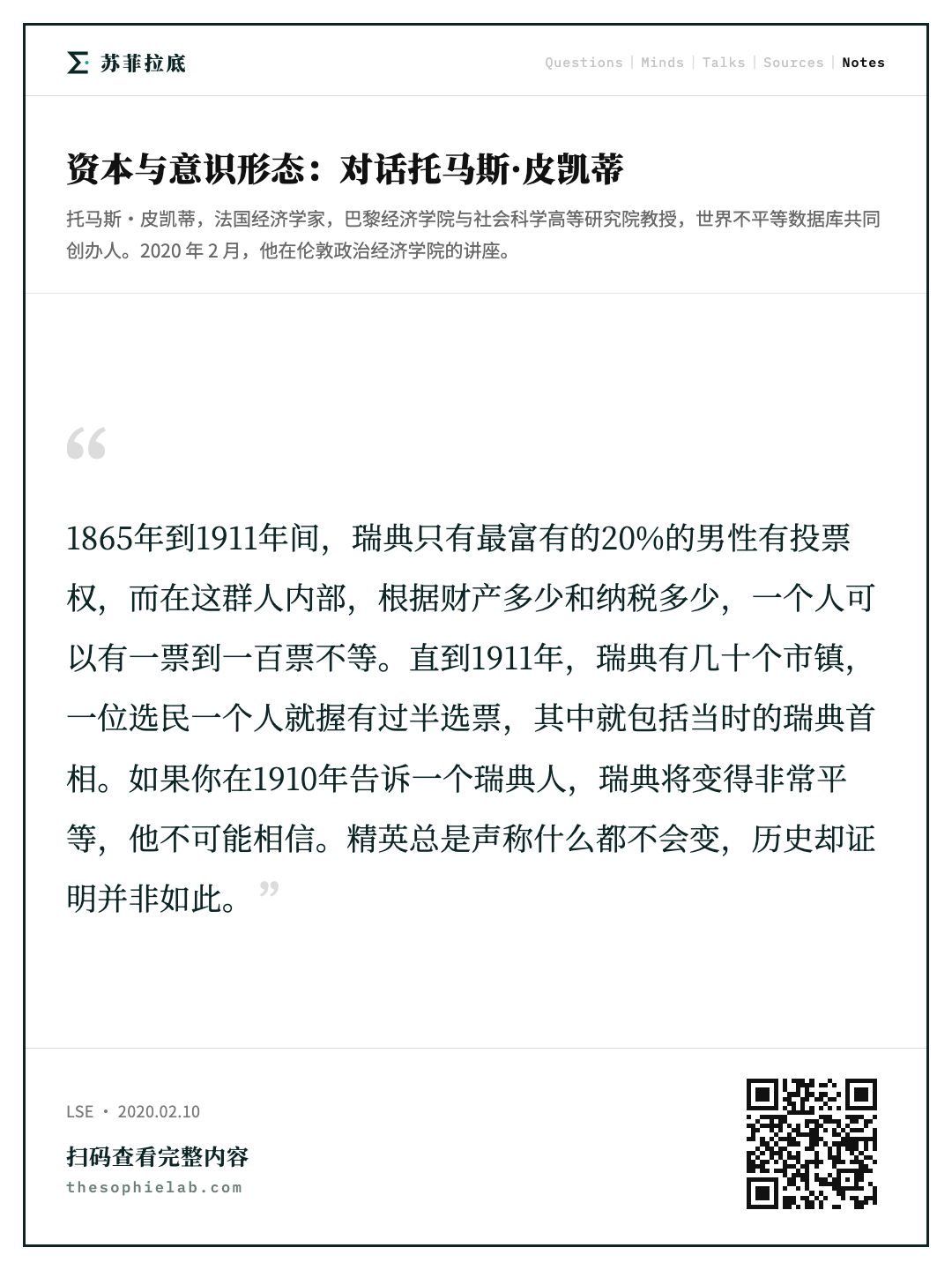
瑞典也是个有意思的案例。今天我们把瑞典看作非常平等的国家,可它在很长时间里极其不平等。就政治制度而言,二十世纪初的瑞典甚至比法国和英国更不平等。1865年到1911年间,瑞典的投票制度是这样的:首先只有最富有的20%的男性有投票权,而在这群人内部,根据财产多少和纳税多少,一个人可以有一票到一百票不等。十九世纪的法国和英国实行财产投票制时,只有一个门槛,低于门槛不能投票,高于门槛可以投票。瑞典人做得精细得多,非常富有的人可以有多达一百票。在市镇选举中,一个人能拥有的票数甚至没有上限。所以直到1911年,瑞典有几十个市镇,一位选民一个人就握有过半选票,其中就包括当时的瑞典首相。他是一位伯爵,和那时所有的首相一样是贵族。

如果你在1910年告诉一个瑞典人,瑞典将变得非常平等,他不可能相信。最终,正是通过巨大的政治动员和社会动员,瑞典的工人阶级组织起来,1932年随社会民主党执政,把瑞典的国家能力用到了完全不同的政治目标上:同样是登记和观察收入与财富的能力,不再用来按收入和财富分配投票权,而是用来按收入和财富征收累进税,为教育和其他公共开支买单。这是一个很好的例子,说明变革的动力不主要来自战争,两次世界大战对瑞典的影响都有限。改变不平等结构的,是政治动员。我在书里尝试讲了许多这样的故事,展示意识形态转变和政治动员的力量可以多么快地改变事情,远远超出精英的想象。精英总是声称什么都不会变,历史却证明并非如此。

这就是第一次世界大战前夕的局面:财产极端集中。我还想强调,把1913年的欧洲,也就是英国、法国、瑞典的平均值,其他有数据的欧洲社会也一样,与今天相比,今天的欧洲更平等,美国则介于今天的欧洲和1913年的欧洲之间。但即使今天,财富仍然高度集中。底层50%的份额通常在总财富的5%左右,最富10%则占50%到60%。所以,长期看不平等确实缩减了,但不该夸大它的幅度。

为何不曾再分配

二十世纪我一会儿再讲,先回到十九世纪。记住,法国大革命之后的一个世纪里,财产集中在上升。为什么财产的再分配这么少?其实在法国大革命时期,有过关于再分配的讨论,但最终什么也没有通过。这里是十八世纪法国实际讨论过的两个累进税方案,一个是累进所得税,一个是累进遗产税。基本设计是,收入或财富低于平均水平的人税率为5%,然后逐级上升,收入和财富达到平均水平一万倍的人税率是70%到80%。这与二十世纪美国和许多欧洲国家实际采用的方案非常接近。十八世纪就有这样的讨论,很有意思,但当时的力量对比没有让这类方案获得通过。

所以法国大革命时期没有对财富或收入进行任何明确的再分配。教会的财产被没收了,但没有转给无地农民,而是拍卖给了买得起地的人,有点像两百年前英国没收修道院财产的做法。结果是私人大财产所有者的地位反而得到了加强,谈不上任何再分配。

十九世纪法国的税制和大多数欧洲国家一样,是单一税率制。比如遗产税,无论你传给后代的是一千法郎还是一亿法郎,税率都是1%。1848年和1872年都有人提议,对非常大的财富征收更高的税率,比如5%。但每一次,关键的反对理由都是:一旦开始这么做,你永远不知道该在哪里停下,一切都会陷入混乱,所以想都别想。这个论调的实质是:如果开始质疑财产权,开始设想再分配的可能,你就不知道何处是尽头。

海地的赔偿债

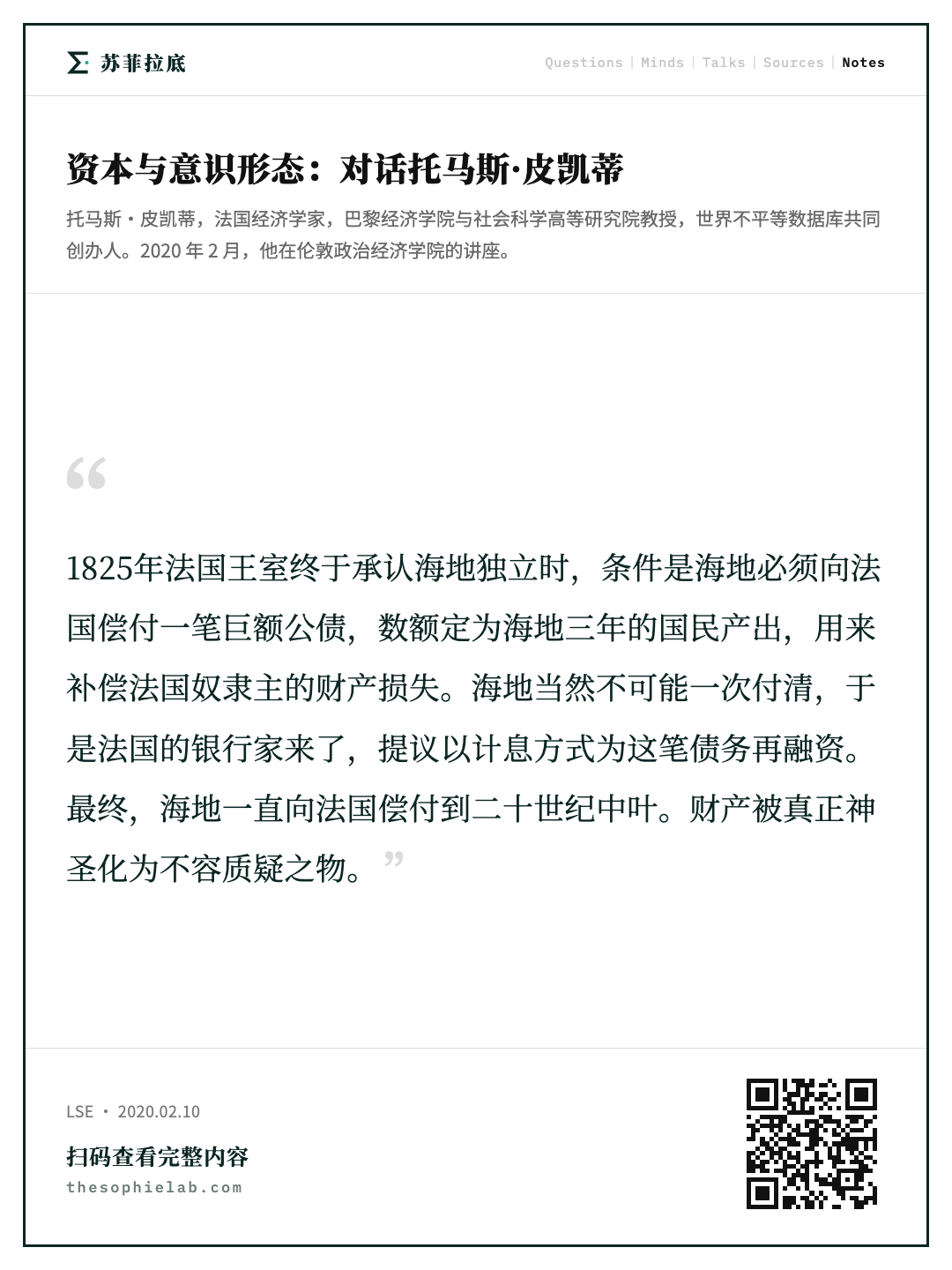
私人财产近乎神圣化的一个例证,就是我前面提到的奴隶解放。事实上,无论英国、法国还是几乎所有地方,做出的选择都是补偿奴隶主,而不是补偿被剥削了几十年、几百年的奴隶。奴隶主得到了全额补偿。法国有一个案例。圣多明各在十八世纪是大西洋奴隶制体系中奴隶最集中的地方。法国大革命期间,圣多明各爆发了奴隶起义,最终于1804年以海地的名义独立。但当法国王室1825年终于承认海地独立时,条件是海地必须向法国偿付一笔巨额公债,数额定为1825年海地三年的国民产出,按今天的说法就是GDP的300%,用来补偿法国奴隶主的财产损失。

在当时,这对托克维尔这样所谓的自由派知识分子来说是理所当然的。对他,或者对当时英国的自由派知识分子来说,奴隶主的财产损失当然必须得到补偿。海地当然不可能一次付清相当于三年产出的钱。于是法国的银行家来了,提议以计息方式为这笔债务再融资。最终,海地一直向法国偿付到二十世纪中叶。这清楚地说明了法国大革命号称的平等目标与殖民现实之间的矛盾,说明财产被真正神圣化为不容质疑之物。托克维尔这类人当时的论证是:如果开始不加补偿地没收这类财产,你又会不知道该在哪里停下。一个人过去拥有奴隶,后来卖掉了种植园,现在在巴黎拥有一栋楼或一个金融资产组合,你是不是也要让他把一部分财富吐出来?确实,对奴隶的公正补偿很可能意味着质疑所有的大财产所有者,而不只是废奴那一刻恰好拥有奴隶的人。所以那时财产的神圣化非常强。

关于这个问题还有很多可说。英国1833年废奴时,也向英国奴隶主做了全额补偿。伦敦大学学院有一个团队公布了全部数据,分析了这笔补偿在十九世纪英国所起的作用,几年前刚刚发表。书里有更多讨论。

殖民地的不平等顶峰

更一般地说,从历史角度看极端的收入不平等,海地这样的奴隶制社会是最极端的案例。但南非、阿尔及利亚,以及十九世纪末二十世纪初的殖民地社会,普遍都处于不平等的极端。我不展开所有细节,但看1930年前后的阿尔及利亚,我们整理了法国殖民地的历史数据,托尼·阿特金森也对非洲的英国殖民地做了同样的工作,收入不平等程度甚至高于第一次世界大战前的欧洲社会。这与财产的极端不平等有关,也与明显偏向殖民者的法律制度和教育制度有关。这里是1950年阿尔及利亚教育支出的集中程度,那几乎已经到独立前夕了。实际上,占人口10%的顶层,也就是法国和欧洲移民,得到了全国教育投资的80%以上。作为对照,当时法国国内的教育体系也很不平等,即使今天,法国最富10%得到的教育投资也接近底层50%的一半,考虑到前者人数只有后者的五分之一,这已经很多了。但殖民地的教育投资不平等,比这要极端得多。

累进税的发明

让我加快一点,讲二十世纪不平等的缩减。它伴随着对财产意识形态相当激进的质疑。使之成为可能的,是十九世纪大规模的社会动员和社会主义运动,它们为这一演变做了铺垫。当然,第一次世界大战、大萧条、第二次世界大战在这一转变中作用重大。但正如我在书里强调的,长期的思想和意识形态变化才是转变得以发生的前提。暴力危机加速了它,而这些危机本身也可以看作国内和国际不平等造成的强烈张力的后果。

二十世纪不平等的缩减有几种形式。第一种是我所说的累进税的发明。可以看到,第一次世界大战之前,适用于最高收入的最高税率并不高。法国是最后一个开征所得税的国家,1914年才设立,原因前面说过。但一战之后,许多国家有了非常高的最高税率,美国带头,1920年前后就开始,罗斯福时期更甚。1930年到1980年,美国最高所得税率平均超过80%。这显然没有摧毁美国资本主义,否则我们早该注意到了。如果说有什么区别,那就是这一时期的增长率和生产率增速远高于里根时代大幅削减最高税率之后。我知道很多人至今仍难以面对这场讨论,但这是我们历史遗产的一部分。我在书里试图重新评价这项政策,主张它促成了不平等的缩减,也使得整体税负的上升能为中产阶级和低收入群体所接受。今天累进性大幅下降带来的问题,正是中产阶级和最贫困群体开始质疑税收的正当性。而在当时,累进税让税负的上升和基础设施与教育公共投资的融资变得可行,最终促进了整体的经济繁荣。至少这是我的论点。

刚才说的是法定最高税率。如果看实际税率,把所得税和间接税都算上,美国最顶层群体在相当长时期内承担了60%到70%的实际税率,里根年代之后彻底消失。遗产税也经历了同样的累进税发明,美国、英国、日本的最高税率曾达到70%到80%。法国和德国一般较低,部分原因是财富再分配通过其他途径发生:战争造成的破坏,以及非常严重的通货膨胀。归根结底,我认为累进税是一种更文明的方式。在这一时期末尾,这些国家仍有30%到55%的最高遗产税率,日本几年前刚把最高遗产税率提高到55%。

资本积累的国际矛盾

使这一转变成为可能的政治矛盾之一,是第一次世界大战之前资本积累的国际矛盾。这幅图显示的是直到1914年英国和法国的财产持有者在世界其他地方拥有的海外资产。可以看到,一战期间出现巨大的下跌,原因有几个:有直接的没收,比如俄国政府债券被作废;有通货膨胀和世界各地股市上财产价值的损失;还有英法财产持有者不得不出售大量海外资产,用以支付战争开销,并借钱给本国政府。到二战结束时,海外资产基本所剩无几。

作为对照,我在图的末端标出了今天日本、德国、中国的海外资产占各自国民收入的比例。这是近几十年贸易顺差最大、在世界其他地方积累了大量外汇储备的三个国家。数额已经相当可观,但与当年的法国和英国相比仍然小得多。当年的法国和英国从海外资本收入中得到的钱如此之多,英国相当于国民收入的额外10%,法国是额外5%,以至于它们可以承受长期的贸易逆差,1880年到1914年平均每年占GDP的1%到3%。这不成问题,因为它们不仅可以用资本收入弥补贸易逆差,还能继续购买世界的其余部分。这个过程确实可以走得很远。即使没有第一次世界大战,也很难想象它能长期持续下去,因为被拥有的国家,尤其是殖民帝国内的国家,迟早会不同意。去殖民化运动和独立运动就是对此的第一波政治反应。还有与德国的竞争。德国的海外资产积累落在后面,没有同样的殖民帝国,但到十九世纪末已经成为欧洲主要的制造业和人口大国。这种竞争在很大程度上导致了两次世界大战的冲击。我认为这是十九世纪资本积累体系的重大内在矛盾之一,它最终导致了这个体系的毁灭。

战后如何甩掉公债

值得一提的是,这些海外资产有很大一部分转化成了公债。三十年后的图上,英国、法国、德国的公债在1950年达到国民收入的200%到300%。这在很大程度上是拥有海外资产和殖民地资产的人把资产卖掉,借钱给政府打仗的结果。有意思的是,1950年前后,尤其是德国和法国政府,决定不偿还这笔债务。法国的做法是大幅通胀来消化债务。德国的做法更聪明。德国在1920年代已经经历过严重通胀,这固然消灭了公债,但也有许多负面后果。所以1948年到1952年,德国政府实施了一套更有想象力的制度,本质上是对私人财富,特别是私人金融资产组合,征收高度累进的税:财富少的人税率不到5%,大财富的税率高达80%到90%。这些私人金融资产组合中有很多是公债,因为当时政府发了大量债券。以90%的税率对公债征税来削减公债,听上去有点套套逻辑,但总得有人付账。日本当时也采取了同样的策略,对巨额私人财富征收高达80%到90%的一次性财富税。

今天,半个世纪、七十年之后再说这话当然容易,但这些策略是成功的,它们让公债很快降下来,使德国、日本和大多数欧洲国家能够在1950年代、1960年代投资公共基础设施和教育,而不必背负沉重的公债。必须认识到,当时本可以做出不同的选择。这些国家可以决定既不通胀也不征一次性财富税,老老实实偿还公债。但那样的话,我们今天还在付利息。当你要偿还相当于国民收入200%的债务时,即使有很大的基本财政盈余,也可能到今天还没还完。这实际上意味着永远向战前拥有海外资产的人或他们的子女付钱。我认为那会是相当愚蠢的选择,幸好做出了不同的决定。但这需要对私人财产的正当性进行深刻质疑,尤其是在有重建这样更优先的事务的时候。我认为今天记住这些教训很重要,因为我们也面临着其他优先事务,比如全球变暖和不平等。语境与重建时期不同,但这段经历仍有可学之处。

共产主义的崩溃

现在讲最近这段时期不平等的回升。我说过,1980年代、1990年代有两大变化导致了不平等的反弹。一是共产主义的垮台,它在某种意义上成了超级资本主义最好的盟友,至少我在书里是这么论证的。我认为它助长了一种普遍的幻灭,让人们不再相信公正的经济是可能的。二是里根主义,而里根主义的最终失败也助长了我们今天的幻灭。

让我加快。看苏联时代俄国的收入不平等数据,我们发现货币不平等相对较小。当然还有许多其他形式的不平等,也谈不上完全平等,但归根结底与西欧相差不大。问题主要出在财产制度上,中央集权的国家所有制显然运转不好。无论如何,苏联解体之后是休克疗法,极快的私有化使一小群寡头受益,其中有些人现在住在伦敦、巴黎和各种地方。重点是不平等急剧上升,图上末端的红线很可能还是低估。伴随而来的是极度的不透明。这是我的朋友和同事加布里埃尔·祖克曼关于逃税的数据,可以看到俄国在逃税方面居于世界前列,与海湾国家并列。私有化之后,俄国的财富集中程度大幅上升,中国也是。看最富10%的份额,俄国和中国都非常迅速地逼近了美国的水平,而考虑到数据来源的局限,这很可能还是低估。

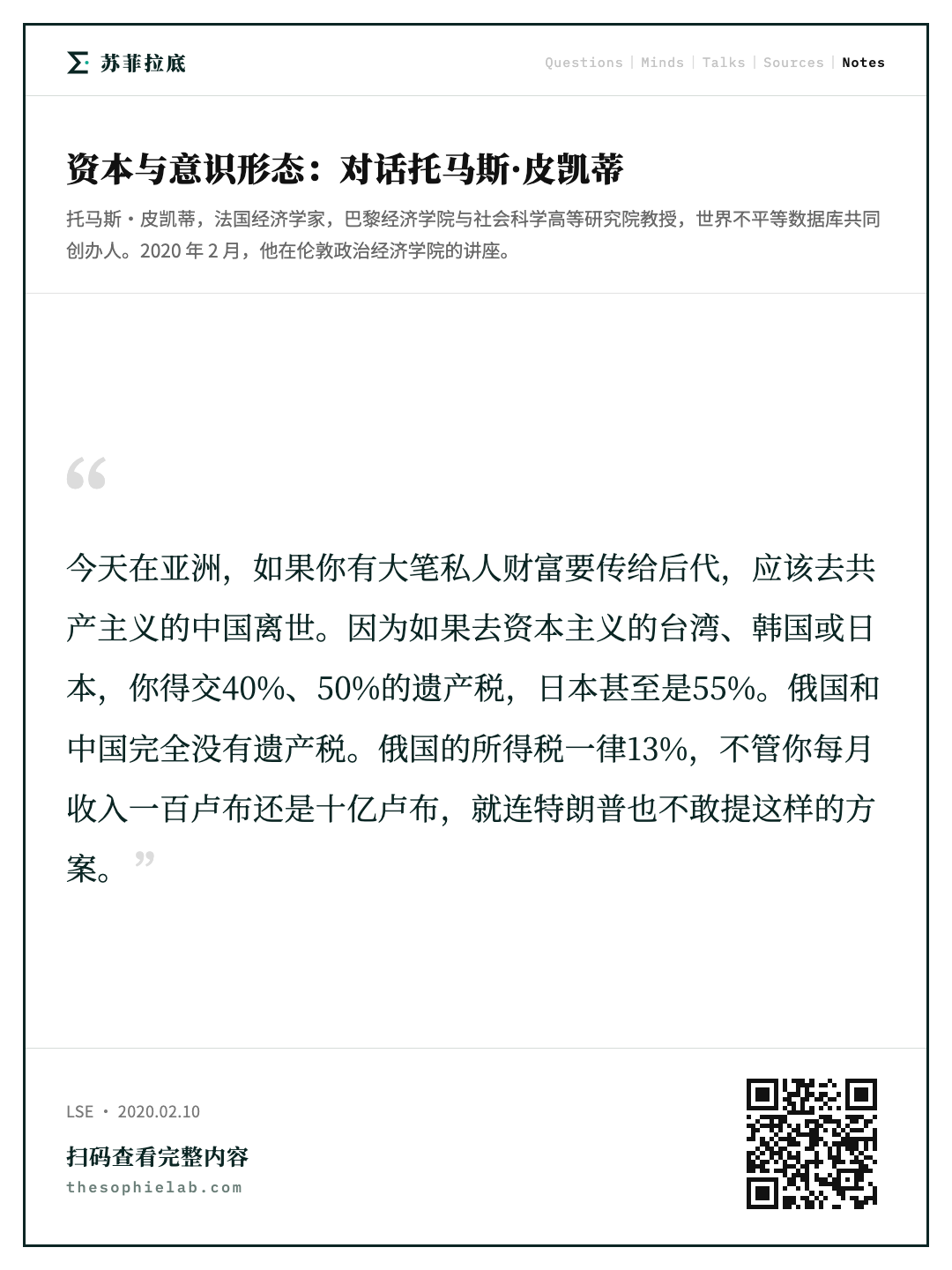
重点在于,今天的俄国完全没有累进所得税,税率一律13%,不管你每月收入一百卢布还是十亿卢布。就连特朗普也不敢提这样的方案,不敢走这么远。俄国和中国完全没有遗产税,税率为零。香港是个相当惊人的例子,回归共产主义政权之后,反而废除了遗产税,变得更不平等了。今天在亚洲,如果你有大笔私人财富要传给后代,应该去共产主义的中国离世。因为如果去资本主义的台湾、资本主义的韩国或资本主义的日本,你得交40%、50%的遗产税,日本甚至是55%,而且是最近才提高的,尽管日本当时是中右政府,也并不以左翼政治文化著称。中国和俄国从彻底废除私有财产走到今天这一步,清楚地显示了这场重大的意识形态转向。它助长了今天不平等的上升,也加大了发展国际协调的难度。

里根主义的失败

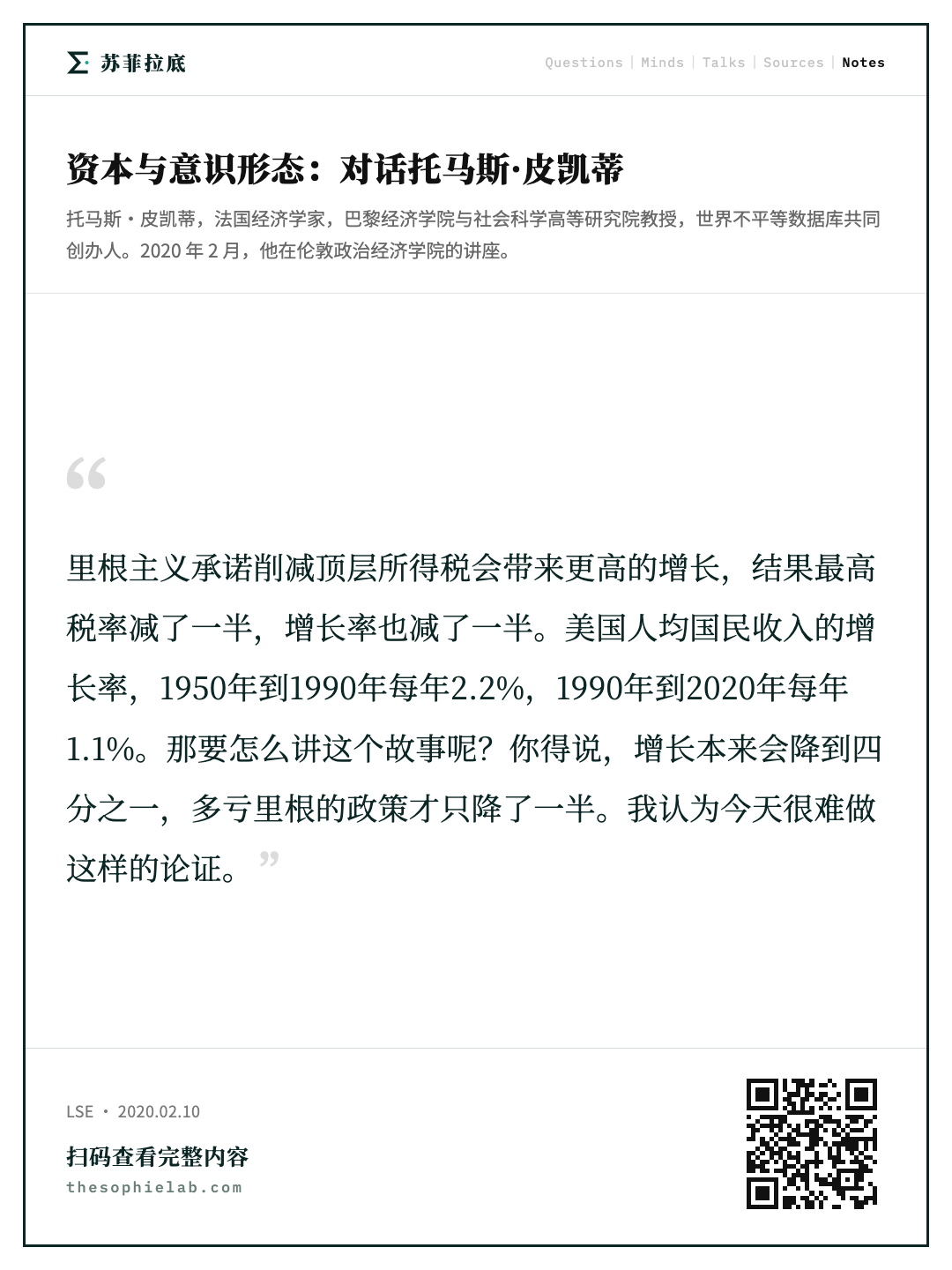
1980年代的另一大转变是美国不平等的上升。可以看到,美国底层50%的收入份额,注意这里说的是收入而不只是财产,如今已经低于最富1%的份额。里根时期的许多政策造成了这一局面,最低工资被冻结,顶层收入群体大幅上升。当初的说法是,不平等的扩大和对顶层收入减税会激发创新、提高经济增长,这可以为不平等的扩大提供正当性。只要所有人的收入都在上升,包括底层,为什么不呢?问题在于,增长不但没有加快,反而降了一半。看绿线,这是美国人均国民收入的增长率:1950年到1990年每年2.2%,1990年到2020年每年1.1%。那要怎么讲这个故事呢?你得说,增长本来会降到四分之一,多亏里根的政策才只降了一半。我认为今天很难做这样的论证。我所说的里根主义的失败,就是它承诺削减顶层所得税会带来更高的增长,结果最高税率减了一半,增长率也减了一半。

顺带说一句,我并不是说增长率减半是因为最高税率减半。我认为还有另一个因素,在我看来是教育投资的停滞。美国历史上曾是教育的领先者,如今已经不是了,部分原因是1980年代以来极不平等的高等教育体系。但无论如何,降低最高所得税率、扩大不平等、制造更多更富的亿万富翁,显然不足以提升增长表现。我认为这助长了今天的幻灭感。特朗普这样的政治领袖试图为美国中产阶级和底层没有分享到繁荣找一个理由,通常给出的故事是:这是因为墨西哥的竞争,是因为中国,是因为世界其他地方把白人美国的辛苦劳动抢走了。这开始让人有点害怕。

婆罗门左翼

在政策转向减少再分配的同时,还可以看到,美国民主党、英国工党、法国社会党和共产党的选民结构发生了变化:从以受教育较少的选民为核心,变成在受教育程度最高的人群中获得更多支持。我在其他国家也发现了同样的现象,美国、法国、英国之外,瑞典、德国、挪威的演变也类似。教育分野的结构发生了转变,从战后受教育最少的群体投给广义社会民主党,变成这些政党成了教育竞赛赢家的政党。

我在书里尝试解释这一点,但不敢说有完美的答案,肯定还有其他解释。我论证的一部分是,这些政党在1980年代、1990年代逐渐放弃了任何雄心勃勃的再分配纲领。同时出现了新的教育挑战,尤其是高等教育的兴起,教育正义的定义比普及初等和中等教育的年代更难。但无论如何,政治联盟的结构发生了彻底的改变。在欧洲,选民对社会民主党乃至所有执政党的幻灭,导致了对欧盟的强烈不信任。

欧洲的社会裂痕

现在轮到讲脱欧了。这是2016年英国投票留在欧盟的选民结构。可以看到,只有收入、教育和财富的顶层群体投票留欧。我在法国或欧洲其他地方展示这幅图时,有时有人说,这是因为英国那些疯狂的民族主义者,我们能怎么办呢?可事实上,看法国1992年和2005年的两次公投,情况完全一样。法国有过两次关于欧洲的重大公投,1992年是《马斯特里赫特条约》,创立欧元;2005年是欧盟宪法条约。同样,基本上只有最顶层的群体投票支持欧洲,底层50%投票反对。我要说明,两次公投我都投了赞成票,我是坚定的联邦主义者。但到了某个时候,你必须认真对待这一点。1992年、2005年、2016年,在两个与欧洲关系史截然不同的国家,都出现了对欧盟如此强烈的社会分野,你不能说这只是简单的误解,只要解释得更好,人们就会理解并开始支持欧洲。

我认为这意味着,欧盟的组织方式出了问题。它建立在商品、服务和资本自由流动的原则之上,却没有任何共同税收,没有任何共同的社会政策、工资政策或教育政策,没有任何带有明确减少不平等目标的社会政策。这样的欧盟最终主要有利于流动性最强的群体,也就是金融资本或人力资本最多的社会群体。底层的人觉得,我认为这不只是一种感觉,他们没有得到同样多的好处,有时还要承受竞争加剧带来的社会伤害。税收政策尤其如此。你可以看到那套说辞:顶层的人很容易流动,所以不能对他们征税,因此要对不那么容易流动的群体多征税。可到了某个时候,这些不能流动的群体的反应就是:那好,我们退出这个体系。我认为这是一个非常严重的矛盾,有点像我前面讲的国际资本积累的政治矛盾。那时候是殖民帝国的时代,是欧洲民族国家之间的竞争,今天的语境不同。但今天的矛盾是我们的选举民主在全球化面前遭遇的矛盾:官方说辞是全球化对所有人有利,带来所有人的繁荣,但中产阶级和低收入群体不这么看。这显然在非常严重地威胁整个进程。

国家之间也存在矛盾和误解。让我讲快一点。从德国或法国的角度看今天的东欧国家,我们只看到绿线,也就是欧盟预算向东欧的公共转移支付,数额相当大,占GDP的2%、3%、4%。但在东欧,人们更多想到的是私人利润的外流。波兰、捷克的工资涨幅没有人们预期的那么大,德国、法国和其他西方投资者在这些国家的投资获得了巨大的利润率。从法国或德国的角度,一种可能的态度是说:工资和利润的水平我们无能为力,这是自由公平竞争的结果,我们只应该看市场均衡之后的公共转移支付,而公共转移支付体现了西欧富国的慷慨。可问题是,工资和利润的水平也取决于法律制度、社会制度、工会和工人的议价能力,取决于有没有社会政策的协调。鉴于利润外流的规模,你必须接受关于这个问题的讨论。

关于公债危机,同样存在误解。这是欧元区的利率和公债。1999年到2009年利率完全趋同,2009年之后出现巨大的金融投机,最后欧洲央行入场,局面在末尾稳定下来。但对于这段时期发生了什么、将来该怎么办,各国之间仍有很多误解。典型的情形是,利率为零的法国和德国倾向于对希腊说:你在市场上本来要付10%的利率,我们以零利率或1%借来钱,以4%或5%借给你,我们对你非常慷慨了。而希腊那边对事件有不同的解读:你们在我们身上赚了一大笔金融差价。两种说法都对,取决于你的参照点是什么。市场利率是参照点吗?就像前面工资份额的例子一样。还是说你认为这个市场根本不该存在?因为如果有共同货币,就需要共同的利率、共同的公债,需要一个欧元区议会来决定赤字水平。在美国,如果美联储每天早上都要在加利福尼亚、路易斯安那、纽约的利率之间做选择,那会是一团糟。归根结底,这套体系连从德国和荷兰储户的角度看也不成功,他们拿到的是零利率,人人都不满意。对欧元区更民主的治理的恐惧,最终让所有人都失败,都憎恨这套体系。如果不尽快做出足够的改变,我不认为它能维持多久。

社会联邦主义

最后,我想谈几条对未来有积极意义的替代路径。简单说三点。一是教育正义。二是我在书里所说的社会的、临时的财产(social and temporary property),意思是必须在财产所有者的权利与工人的权利、地方政府的权利、环保组织的权利之间取得平衡。我认为可以大大扩展德国和北欧国家在共同管理(co-management)方面的做法。我们也可以促进财产的普及,所以我谈到了「人人有份的遗产」方向上的方案。我说过,这方面的讨论有很长的传统,新意在于,同时用遗产税和更重要的年度财富税的收入来支付这份人人有份的遗产,从而把个人积累限制在合理的规模之内。三是社会联邦主义,总的想法是,如果没有关于碳排放、社会正义和税收正义的明确目标,就不能有商品、服务和资本的自由交换。

我就讲到这里。我想再次强调,到某个时候,无论是因为气候危机、金融危机还是社会危机,我们都必须相当深刻地改变当前经济制度的运作方式。今天看到的民族主义道路也许更容易走,更容易解释,但最终解决不了这个问题。我认为我们很快就得回到这类讨论上来。包括眼下美国民主党初选中的一些动向,尽管他们在艾奥瓦州公布结果时遇到了麻烦,也表明事情可以变得很快。美国竞选中关于累进财富税的提案,与克林顿或布莱尔时代能听到的东西截然不同。这些事情的变化速度,总是快于许多观察者的想象。谢谢大家,期待各位的提问。

脱欧之后的不平等

现场的第一轮提问有三个。一位在这里读全球政治硕士的学生说,大家大概已经听腻了脱欧,但要问脱欧之后的不平等,没有比我更合适的人:英国的不平等会出现剧烈变化,还是大体维持原样?一位伦敦大学学院的公共管理硕士学生问,要出现不平等的转折点或重大变化,政治上和社会上需要发生什么转变?还有一位在伦敦政治经济学院读国际战略与外交的学生说,我们大概都同意,在现有的资本主义模式下不平等无法消除,那么我是否设想现有的资本主义模式会以某种方式得到改革?主持人说这些都是很容易回答的问题,确实容易得很。

脱欧之后的不平等,我认为脱欧只会加剧不平等上升的趋势,因为它会加剧税收竞争和社会竞争。我认为英国,至少在本届政府之下,会试图推动更多的税收竞争,以吸引流动性最强的经济行为者,也就是最有实力的公司和高收入、高财富的纳税人。我们走着看,现在下结论为时过早,但这会是最自然的倾向。我知道本届政府声称要在区域不平等上有所作为,想用这样那样的办法留住北方的新选民,因为脱欧策略不可能每次选举都管用,他们得找点别的。但我不认为这是保守党最自然的意识形态路线,税收竞争的逻辑会是最强的一股力量。我们看看吧。

什么样的政治转变能改变这个体系?我认为当前的经济体系无法解决我们必须解决的关键问题。它解决不了不平等上升的问题,也解决不了我们巨大的环境问题。借这个机会,我给大家看我们对全球碳排放分布的估算。全球排放最多的1%的人,很大一部分来自北美,也有一部分来自欧洲。重要的是记住,这1%的排放最多,而全球底层50%的排放最少。所以很清楚,以今天的不平等水平,你解决不了气候问题。排放如此集中于顶层,这本身就必须处理。而且,如果想让中层和底层的人改变能源消费,就必须让他们相信顶层的人至少做出了同样多的努力。所以我认为,气候变化,以及人们日益意识到环境危机无法在当前的不平等水平和当前的经济体系下解决,可能成为推动你所问的那种政治转变的强大力量。话虽如此,没有人知道气候变化的具体表现要过多久才能唤起这种意识。也可能我们等不了那么久,会有别的危机,社会危机或金融危机,来推动政治转变。

最后一个问题,如何改革资本主义?我在书里强调的是,我们今天的财产制度和财产法律体系,已经与一百年前的资本主义大不相同。二十世纪以来,财产所有者的权利已经被工人的权利、地方政府的权利所平衡。今天你作为财产所有者,不能随便赶走房客或解雇工人,至少不像一个世纪前那么容易。法律体系已经变了很多。有些国家,比如我提到的瑞典和德国的共同管理法,公司董事会三分之一到一半的席位属于工人代表。这意味着,比如在德国的大公司,工人代表占董事会一半席位,如果再加上工人持有公司10%或20%的股权,或者地方政府持有这样的份额,你就可以改变公司的多数,尽管有一个股东持有80%或90%的股份。这是一种与「一股一票」的标准观念截然不同的财产制度和财产权利,而「一股一票」在英国、美国,实际上在法国也仍然通行。这个例子表明,这类变革不需要全世界一起走,德国和瑞典已经做了半个世纪,而且效果相当好。它不是理想的制度,但让工人更好地参与到公司的长期战略中。我认为可以沿着这个方向继续走下去。

我在书里所说的参与式社会主义,或者你愿意的话,也可以叫二十一世纪的社会民主,就是在这些方案的基础上,在二十世纪行之有效的经验上继续建设:教育正义和教育平等,共同管理,更多的工人权利,累进税。我说过,我认为可以比二十世纪走得更远,把制度推向这样一种状态:仍然有规模合理的私有财产,但没有私有财产和财产所有者权力的过度集中,财富及其附带的经济权力处于永久的流转之中。因为归根结底,我们生活在一个受教育程度前所未有的社会里,需要广大人群非常广泛地参与经济,避免今天有时出现的那种权力的高度集中。

人人有份的遗产

主持人接着问了两个问题,先问财富。书里大量谈到财富的作用,包括财富税,也包括把财富而非收入转移给下一代的重要性,这是书中一个重要的主题。能不能更具体地说说,尤其是向下一代转移财富的部分会如何运作?

我认为收入再分配非常重要,书里谈了薪资等级,谈了全民基本收入,这些都很重要。但我认为这还不够,因为财富和财产所有权才让你有可能规划未来,有时候是创办企业,但更重要的是让你处于不同的谈判地位。如果你拥有自己的公寓,在伦敦也许不行,但英国和法国还有很多城市买房便宜得多,你的处境就完全不同于必须月复一月交房租的人。后者必须以任何价格出卖自己的劳动,因为别无选择,房租总要付。所以,有一些财产而不是一无所有,对社会的整体权力结构和议价结构有很大影响,对工资谈判、对创业都有巨大的后果。

看今天的情形。这是法国这样的国家的财富分布,英国的数字会非常接近。今天法国或英国每个成年人的平均财富大约是二十万欧元,中位数则接近十万。分布顶端把平均值拉高了,中位数只有十万。底层50%几乎一无所有。我前面说过,底层50%拥有的财富大约占总财富的5%,也就是说他们的平均财富只有整体平均值的十分之一:占人口一半,占财富5%,人均大约两万欧元,而不是二十万。他们拥有的很少,而且在所有年龄组内都是如此。我要说明,这不是年轻人现在穷、将来会富的问题。有些人确实会富起来,但很抱歉,平均而言,二十到三十五岁、三十五到五十岁、六十五岁以上,每个年龄组内部的财富集中程度都一样大,底层50%在每个年龄组里拥有的财富都不到10%。

所以我在书里描述的一种方案,就是人人有份的遗产。这里有一个具体的提案,我算了数字:用书里描述的那种累进遗产税和累进财富税,可以在每个人二十五岁时支付十二万欧元的遗产。过去也有过其他提案。十八世纪的托马斯·潘恩是英裔美国革命者,法国大革命和美国革命他都参与和鼓吹,他提议用累进遗产税来支付一笔普遍的资本,尤其是用于获得土地财产。晚近得多的托尼·阿特金森提议用遗产税收入来支付一笔普遍资本。这里的新意是把这个想法推得更远,把年度财富税的收入也用于此,从而达到显著得多的水平。可以逐步推进,可以慢慢考虑。但我认为,要改变社会的权力结构,这确实是必要的。

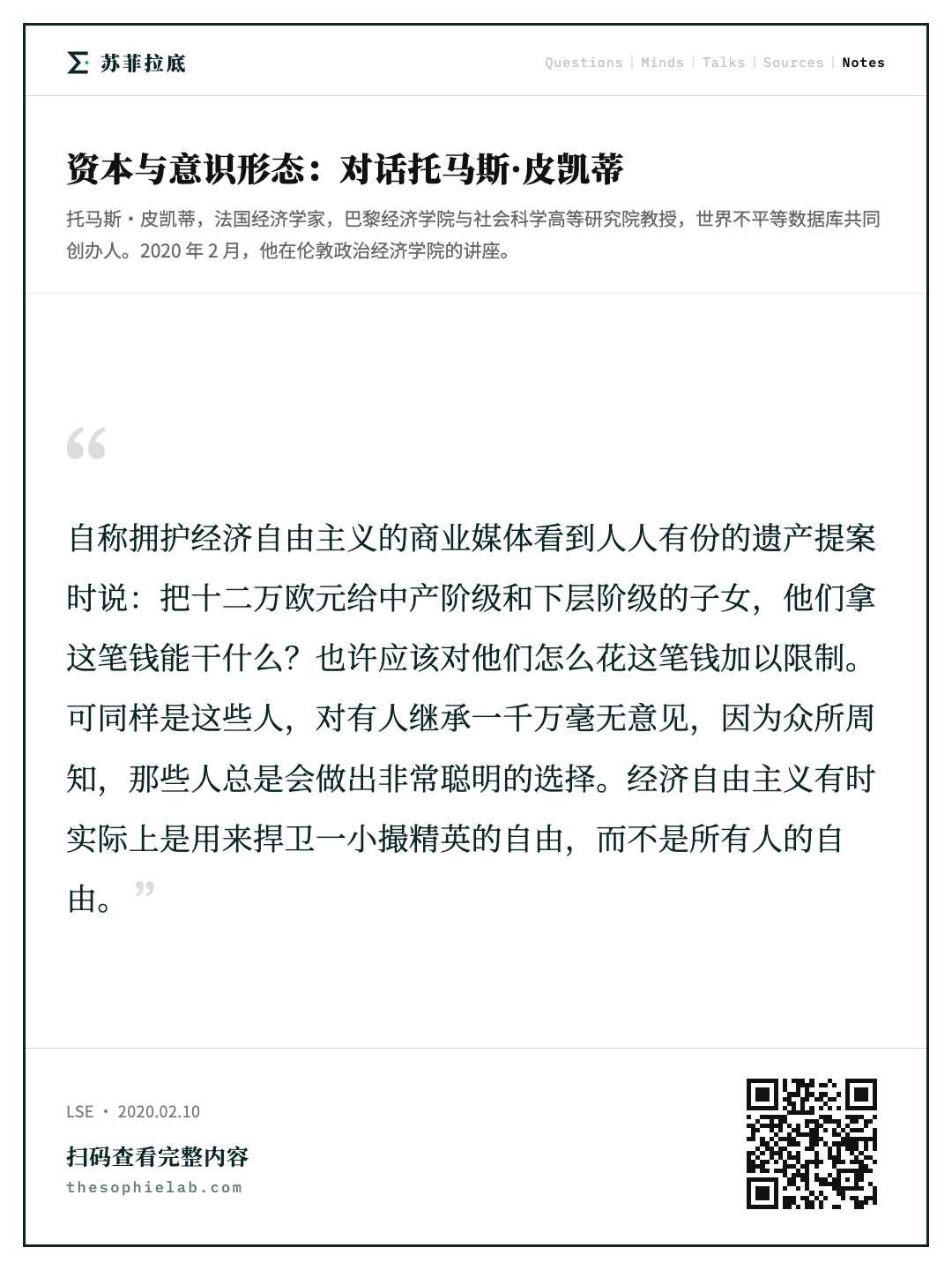
在法国,这个提案引来很多反应,尤其来自商业媒体和与商界关系密切的报纸。他们自称拥护经济自由主义,可看到这个提案时却说:把十二万欧元给这些可怜的孩子,给中产阶级和下层阶级的子女,他们拿这笔钱能干什么?这不是会削弱他们工作的动力吗?也许应该对他们怎么花这笔钱加以限制。可同样是这些人,对有人继承一百万或一千万毫无意见,那种情况就不需要对钱的用途设限,因为众所周知,那些人总是会做出非常聪明的选择。所以有时候,经济自由主义的意识形态实际上是用来捍卫一小撮精英的自由,而不是所有人的自由。

我要说,这里提出的方案一点也不激进。给各位一些数字:本来会得到零或一万欧元的人,也就是一半人口,甚至底层三分之二的人口,本来什么都得不到,在这个方案下会得到十二万。本来会继承一百万欧元的人,在我描述的制度下仍能得到六十二万。十二万与六十二万之间仍有巨大差距。如果问我的意见,可以比这走得更远。但如果不处理财产普及和人人有份的遗产这个问题,我认为你会错过很重要的东西。最后一点,让人们在更年轻的时候就能获得财产非常重要。即使在一个父母财富完全平等的社会里,你也可能希望把遗产社会化,让人们在二十五岁而不是五十岁时得到它。

主持人说,我面对的听众早已被说服了,于是开放第二轮提问。

左翼为何失去工人

一位来自丹麦、研究环境政策与监管的学生说,我展示的高学历者更倾向投左翼的图很有意思,她想知道我怎么看:是社会民主党抛弃了自己的选民,抛弃了历史上的选民基础吗?发生了什么,又该怎么办?主持人称之为「婆罗门左翼」(Brahmin left)问题。一位智利听众说,我见过智利现在的一些反对派领袖,很了解智利的局势。智利正经历四十年来最大的危机,不平等是这场动荡的核心。上周智利开始讨论对遗产设限。智利最富1%掌握全国25%甚至更多的财富。对遗产设限能怎样惠及智利,让它更平等?最后一位听众说,我在为公平增长辩护时提到了气候危机,但无论3%的指数增长分配得多么公平,它与地球的边界相容吗?反过来问,稳态经济或去增长,会不会反而让人们更专注于分配的平等?

先讲婆罗门左翼的问题。问题是,曾经吸引低学历群体的社会民主党,为什么随着时间推移变成了高学历者的政党。首先要说明,我不敢说有完整的答案。我在书里做的,首先是为这一变化提供证据。这是一个新的比较研究项目,我们正在写一本书,有几十章,分国别讨论。《资本与意识形态》里我展示了美国、法国、英国的例子,也给出了德国、瑞典、挪威、意大利等几个国家的一些结果,但只是主要发现的概述,我们还在研究更多国家。比较不同国家,本身就是理解发生了什么的一种方式。引人注目的是,所有这些国家的演变都很相似。这一点很重要,因为在美国,长期以来的说法是:民权运动之后,民主党在1960年代扛起了废除种族隔离的事业,于是开始失去一部分不太喜欢种族平等的低学历白人选民,他们转向了共和党,先是尼克松,然后是里根,最后是特朗普。这是一个渐进的过程,民主党对此似乎没什么责任,是这些贫穷的白人选民太种族主义了,我们无能为力,已经尽力挽留了。按这个故事,是穷人抛弃了左翼,而不是相反。

这个故事的问题在于,法国、英国和其他欧洲国家出现了非常相似的演变,而那里并没有1960年代的民权运动。你可以说,欧洲日益突出的移民冲突扮演了类似角色,只是来得晚得多,要到1980年代、1990年代、2000年代才真正突出。而在移民问题从未真正突出的国家,同样的演变也出现了。所以我在书里想说的是,这更多与政策纲领和政策平台的转变有关,归根结底与社会民主党缺乏再分配的雄心有关,尤其是在教育政策上。1950年代、1960年代、1970年代,社会民主党有一个相对平等的教育纲领:为所有人投资初等教育,然后是中等教育,让每个人都读完中学。到了1980年代、1990年代,随着高等教育的兴起,这个平等主义的纲领不知不觉被放弃了,某些情况下大学入学机会上还充斥着虚伪。

书里有一幅图,是美国父母收入与子女接受高等教育机会之间的关系。这是伊曼纽尔·赛斯和拉杰·切蒂整理的数据,写前几本书时我还没有这样的数据,那时它们还不存在。现在我们能把父母的所得税申报与学生的社会保障号码匹配起来,画出这样的图。可以看到,它几乎是一条四十五度的直线。也不完全是:父母贫穷时,你仍有25%的机会上大学;父母富有时,你只有95%的机会。而这还是低估了机会的不平等,因为顶端的人能进的大学和底端的人能进的大学,当然不是同一类。

实际上,如果看教育投资的数额,也就是花的钱,你会发现即使在法国这样号称更平等的公立体系里,情况也一样。这是法国教育投资的集中程度,表示方式不太一样。我看的是2018年完成学业的所有学生,计算他们在整个求学过程中,从小学、中学到高等教育,得到的公共教育投资总额。平均值大约是十二万欧元,但从六七万到二十五万、三十万不等。低端是十七八岁就离开学校的人,高端是接受非常优越的高等教育的人。法国的精英大学校体系,实际上是把多得多的钱投在一小部分学生身上。中间是普通大学体系里的人,得到的投资不多。所以你可以看到这个体系有多么虚伪:顶端的人比底端的人多得到二十万欧元的投资。这里横轴不是父母收入,只是就读最昂贵课程的人,其中有些人确实来自低收入家庭。但平均而言,这当然与父母收入相关。结果就是,公共投资往往放大了初始的不平等。我前面谈人人有份的遗产,这里的一些人得到的是双份遗产,多拿二十万欧元。

所以我认为,社会民主党没有能力或者不愿意提出足够有说服力的教育正义目标。在高等教育时代定义教育正义,比在目标只是让所有人读完小学和中学的年代复杂得多。所以不是世界没有变、社会民主党却放弃了再分配,而是世界变了,出现了新的挑战,社会民主党没有能力或者不愿意更新自己的纲领。至少这是我讲的故事。而且不只是教育,还有一般意义上的再分配、累进税、金融放松管制,可以提的话题很多。我不能每个问题都讲这么长,时间不够。

智利的转折点

智利近几个月反对不平等、要求更多经济正义的示威和抗议,我认为非常重要。它表明,在许多方面,我们正处在全球化历史的一个转折点上。在许多国家,智利,黎巴嫩,去年法国的黄背心运动,都出现了对经济正义的要求,人们感到经济体系以有偏向的方式运行,偏向最高收入和最高财富群体。就智利而言,这在我看来相当清楚。你提到遗产税和财富税,拉丁美洲,尤其是智利和巴西,是世界上最不平等的国家之一。就智利来说,你比我更清楚,皮诺切特之后的转型从未质疑过巨大不平等的基础,包括宪法基础,无论是财富上的不平等,还是教育体系上的不平等,尤其是私立教育的盛行,甚至小学阶段就有营利性学校。这里有一种不平等的意识形态,一些著名的经济学家和哲学家为这份遗产出过力。我认为这必须改变,而且我认为这场政治动员会推动这种改变。

增长与地球的边界

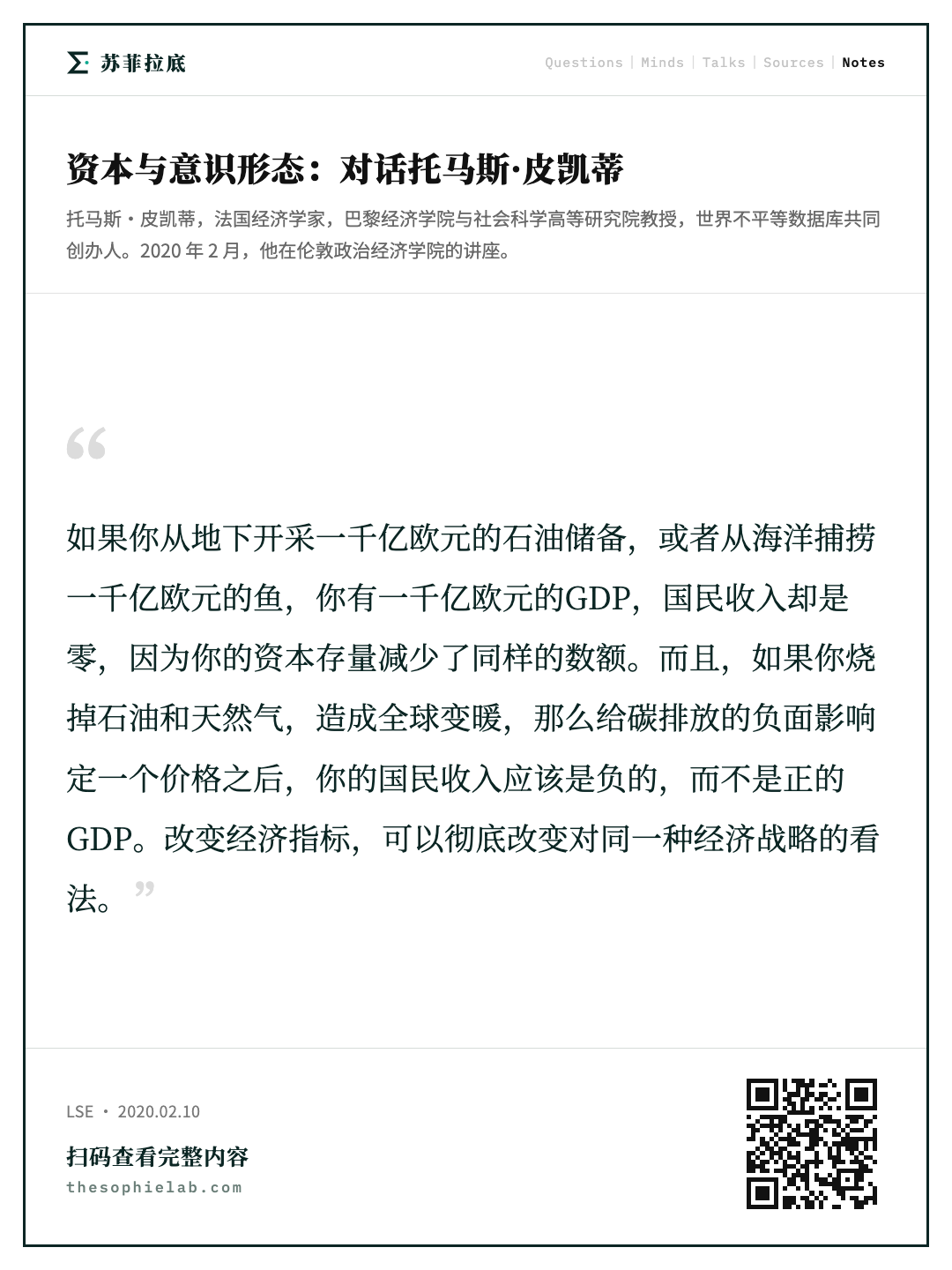
最后是气候与增长的问题:我们能不能永远保持3%的增长或正增长,同时解决气候危机?答案是不能。我认为我们必须重新思考经济进步的概念,必须改变用来衡量经济进步和经济增长的经济指标。有几种做法。一种我要提的是,我一直尽量使用国民收入(national income)而不是GDP。两者有两处不同:国民收入等于GDP减去流向国外的资本收入,再减去固定资本消耗,而固定资本消耗原则上应该包括自然资本的消耗。如果你从地下开采一千亿欧元的石油储备,或者从海洋捕捞一千亿欧元的鱼,你有一千亿欧元的GDP,国民收入却是零,因为你的资本存量减少了同样的数额。而且,如果你烧掉石油和天然气,造成全球变暖,让地球上的生活难以忍受,那么给碳排放的负面影响定一个价格之后,你的国民收入应该是负的,而不是正的GDP。所以,改变经济指标,无论是企业的还是国民账户的,可以彻底改变对同一种经济战略的看法。

但这还不够。你还需要直接的环境指标,包括碳排放,我前面展示了碳排放分布的数据,还有生物多样性。不过我认为纯粹的环境指标也不够,因为你仍然需要某种收入、工资或财富的概念,才能建立某种社会正义的规范,来决定环境政策的税负和调整负担如何分配。所以我认为,抛弃所有收入增长或工资增长的指标,只用纯粹的环境指标,是一个错误。将来必须把两者结合起来。而且必须强调这些指标的分布:谁在承受全球变暖的后果,谁得到什么样的收入,而不只是看总量和平均值。这就是我们在巴黎经济学院的世界不平等数据库所做的工作,当然也是伦敦政治经济学院的国际不平等研究所所做的工作。令人高兴的是,社会科学中有越来越多的研究,不只在经济学,也在其他所有学科,关注不平等的演变,有时比我在经济系的亲爱的同事们更务实地研究不平等。我们需要每个人都参与到社会科学中不平等研究的复兴中来。谢谢大家。
本期讲者
托马斯·皮凯蒂法国经济学家,巴黎经济学院与社会科学高等研究院教授,世界不平等数据库共同创办人。著有《21 世纪资本论》(2013)和《资本与意识形态》(2019),以长时段财富分配的历史数据研究闻名。
主持人伦敦政治经济学院本场公开讲座的主持人,负责组织问答并向皮凯蒂追问财富转移方案的运作细节。
章节 · 点击跳转视频
0:00 开场:新书结构与核心主张 ▶ 正在看
11:02 法国大革命的失败与财产神圣化 ▶ 正在看
22:17 废奴赔偿奴隶主与殖民不平等高峰 ▶ 正在看
27:08 20 世纪:累进税如何压低不平等 ▶ 正在看
31:15 海外资产、战争债务与战后清债 ▶ 正在看
37:42 苏联解体与里根主义的双重失败 ▶ 正在看
44:01 婆罗门左派与欧洲的阶层分裂 ▶ 正在看
53:56 参与式社会主义的三条路径 ▶ 正在看
56:33 问答:脱欧、临界点与改革资本主义 ▶ 正在看
1:05:58 问答:全民遗产的具体算法 ▶ 正在看
1:12:02 问答:左派选民、智利与去增长 ▶ 正在看
本期论点
本期回应
1:01:29
在今天这样的不平等程度下无法解决气候问题,因为碳排放高度集中在最顶端 财富集中与增长执念气候问题真正卡在哪里?
1:24:47
永远维持3%的正增长与解决气候危机不可兼得,必须重新定义并重新衡量经济进步 财富集中与增长执念气候问题真正卡在哪里?
其他论点
1:38
不平等意识形态远比精英的自我辩护复杂,总含有几分道理,应当被认真对待
2:34
不平等的程度不由经济、技术或文化的必然性决定,而可由政治动员改变
29:10
1930至1980年美国最高所得税率超80%,资本主义未被摧毁,增长率反而高于减税之后 观察
35:11
1950年前后德法不偿还巨额战争债务是成功的,让国家得以投入基础设施与教育
38:09
共产主义垮台成了超级资本主义最好的盟友,它助长了「不存在公正经济体系」的幻灭感
38:54
苏联的核心问题不是货币收入差距,而是中央集权国家所有制这套财产制度运转不良
48:34
欧盟只有商品、服务、资本的自由流动而无共同税收与社会政策,主要服务于最流动的群体
51:49
工资与利润的水平取决于法律制度、工会与劳动者议价能力,而非单纯的市场竞争结果
1:06:54
收入再分配不足以改变权力结构,只有拥有财产才能规划未来、创业并改变议价地位
1:09:19
应以累进遗产税与年度财富税为财源,向所有人在25岁时发放约12万欧元的全民继承款 做法
1:11:24
担心穷人乱花小额继承却不质疑巨额继承者的花法,说明经济自由主义常被用来捍卫少数人的自由
1:18:03
社会民主党丢失低学历选民,主因是其在再分配尤其教育正义上缺乏雄心,而非选民本身种族主义
1:21:39
公共教育投入放大原有的不平等:读最昂贵学业者比早早离校者多获约二十万欧元 观察
01开场:新书结构与核心主张
0:00
[applause] Thanks. Thanks a lot for your warm welcome. Let let me first apologize for the fact that my uh English is going to sound a lot like French and you know I hope you you can still understand what I have to say. I I guess I didn't stay long enough at LS and London to to improve my accent. But anyway, so um you know it's always great to be back here and and you know especially now that I'm going to present this new book to you today, capital and ideology. So uh you know in this talk so this is the cover of the book. This has just been released. This is actually the first time the first public event where this book is being discussed in the English language. So the book came out in in France last September. It came out in Spain, a couple of other countries, but this is really the first release in the English language. And so in this talk, I will present some of the figures and tables gathered in my book. So capital and ideology is like capital in the 21st century. It's a book full of data. This is a book about the history of inequality regime. So there are like 169 figures and tables in the book and another 100 and the available online. uh what's new in this book as compared to the previous uh uh work to my previous
[掌声] 谢谢,非常感谢大家热情的欢迎。首先请允许我道个歉,我的英语听起来会非常像法语,希望你们还是能听懂我要讲的内容。我想我当年在伦敦政经和伦敦待的时间还不够长,没能改掉口音。不管怎样,能再回到这里总是很棒的,尤其是今天我要向各位介绍这本新书《资本与意识形态》。在这场演讲里——这就是这本书的封面——它刚刚出版。这其实是第一次有公开活动用英语来讨论这本书。这本书去年九月在法国出版,也在西班牙和另外几个国家出版了,但这确实是英文版真正意义上的首次发布。所以在这场演讲里,我会介绍书中收集的一些图和表。《资本与意识形态》和《21世纪资本论》一样,是一本充满数据的书。这是一本关于不平等体制之历史的书。书里大概有169张图表,另外还有一百多张可以在网上查到。这本书相比我之前那本著作,新的地方在于
便签引用
1:23
book is that I try to put uh emphasis on uh the what I call the history of ideology and the way inequality or different levels of inequality or equality have been justified in different societies and basically my main point is that we we need to take this ideology seriously uh because it's always much more sophisticated than just a way by the elite of the different societies to to you know defend their position and to describe you know the the social system as as being you know fair and acceptable to all and you know it's you know of course there is always some hypocrisy in this discourse and this justification but there's always also some plausibility to to to these discourses and we need to take them seriously also if we want to study the conditions for uh change and transformation so you know this book as compared to the previous one is less western centered and also more political and focuses on the fragilities and transformation of uh inequality ideologies and one of the big message which you know I think is a pretty optimistic message for the future is that in practice you know it's the inequality is not so much determined by just pure deterministic forces either economic or technological or culture control forces but rather can be transformed by
我试图把重点放在我所说的意识形态史上,也就是不平等、不同程度的不平等或平等,在不同社会里是如何被正当化的。基本上我的核心观点是,我们必须严肃对待这些意识形态,因为它们从来都不只是各个社会的精英用来捍卫自身地位、把社会制度描述成公平且人人可接受的一套说辞,它们总是要复杂精巧得多。当然,这些论述和正当化里面总是带有某种虚伪成分,但它们同时也总有几分说得通的地方,如果我们想研究变革和转型的条件,就必须认真对待它们。所以相比前一本书,这本书没那么以西方为中心,也更具政治性,聚焦于不平等意识形态的脆弱之处和它们的转变。而其中一个重要信息——我认为对未来来说是相当乐观的信息——就是在现实中,不平等并不是由某些纯粹决定论的力量所决定的,不管是经济的、技术的还是文化的力量,它其实可以被改变,通过
便签引用
2:50
changing political mobilization and this has happened many time in the past and you know I think this will happen again in the future I I think this is a much better book than the previous one so if you if you read only one please read this one so let me you know this is a very long book that's one you know I'm sorry about that I think it's very readable but it's you know it's It's a bit long. So I'm I'm not going to try try to present everything. But let me first go through a little tour through the contents of the book. So there are four parts to the book uh 17 chapters. The part one is you know starts from European societies of orders and turnary societies and the way they were transformed into what I describe as ownership societies or proprietarian societies in the 19th century. So in particular in France after the French revolution but you have different trajectories in in Britain and Sweden and other European countries leading to to to a similar revolution to to some extent. Uh then part two is about slave and colonial societies and the way European colonial and and proprietarian powers in a way you know transform completely the condition of the transformation of old inequality regime and and turnary
改变政治动员来改变。这在历史上发生过很多次,我认为未来还会再次发生。我觉得这本书比上一本好得多,所以如果你只读一本,请读这一本。不过这是一本很长的书,这点我很抱歉。我认为它可读性很强,但确实有点长。所以我不会试图把所有内容都讲一遍。我先带大家简单浏览一下这本书的内容。全书分四个部分,共17章。第一部分从欧洲的等级社会、也就是我所说的三元社会讲起,讲它们如何在19世纪转变为我所称的所有权社会。特别是法国大革命之后的法国,但英国、瑞典以及其他欧洲国家有各自不同的轨迹,在某种程度上也走向了类似的转变。第二部分讲的是奴隶制社会和殖民社会,以及欧洲的殖民强权和所有权强权如何彻底改变了旧的不平等体制和三元
便签引用
4:14
societies into modern proprietarian and postropriarian societies. So there particular the case of India is is it plays a very important role in the story. I'm not going to talk much about it today, but the the way uh you know the the British colonization process contributed to the rigidification of the of the cast system and the boundaries between social categories that were not always so clear [snorts] before the colonization process provides a very interesting example of an interaction between ancient inequality system and and and the logic of colonization and and the way you know postindependent India is trying to deal with with very deep inequalities coming from this historical legacy is I think very interesting also for for the rest of the world. Uh part three is about the reduction of inequality in the 20th century and the way ownership societies entered into a deep crisis between 1914 1945. the the social democratic societies that follow and how they achieved a certain level of equality in the postcore period and how they entered into an era of crisis starting around
社会向现代所有权社会及后所有权社会转型的条件。其中印度的案例在整个叙述里占据非常重要的位置。今天我不会多讲它,但英国的殖民过程如何促成了种姓制度的固化,以及在殖民之前并不总是那么清晰的社会类别边界如何被固定下来,这提供了一个非常有意思的例子,展示了古老的不平等体系与殖民逻辑之间的互动。而独立后的印度如何试图处理这段历史遗产带来的极深的不平等,我认为对世界其他地方也很有启发。第三部分讲20世纪不平等的下降,讲所有权社会如何在1914到1945年间陷入深刻危机,随后出现的社会民主社会如何在战后时期实现了一定程度的平等,以及它们如何在大约
便签引用
5:31
1980. Communist and postcommunist societies play a big role in the in the in the overall story and I will I will come later about this. Part four is about the what I call here the dimensions of political conflict and really the evolution of electoral coalition and in particular how the sort of post-war social democratic electoral coalition sort of gradually failed and gradually you know the vote in favor of social democratic parties broadly understood shifted from being the party of the workers and less educated social group to the party of the of the winners of the education system and and I will argue that you know this this contributes to uh you know today the disillusionment with respect to the left and a general breakdown of the left versus right party system with today you know the the the tendency form of nationalist and identity based politics that is that is I think you know very dangerous evolution In chapter 17, you know, I try to propose, you know, more internationalist and more egalitarian solution to the to, you know, to transform the structure of
1980年之后进入危机时代。共产主义社会和后共产主义社会在整个故事里占据很重要的位置,这个我稍后会再讲。第四部分讲的是我在这里称之为政治冲突的诸多维度,主要是选举联盟的演变,特别是战后那种社会民主的选举联盟是如何逐渐瓦解的,广义上的社会民主政党的选票如何逐渐从工人和受教育程度较低群体的政党,变成了教育体系赢家的政党。我会论证说,这正是今天人们对左翼失望、以及左右政党体系整体崩解的原因之一,而与之相伴的,是今天民族主义和身份政治的抬头,我认为这是非常危险的演变。在第17章里,我试图提出更具国际主义色彩、更平等主义的方案,来改造我们经济体系的结构。
便签引用
6:50
our economic system. It's not, you know, let me make clear right away that it's not that I believe that this is going to happen tomorrow morning, you know, after a quiet deliberation in all theater at LS and, you know, I think right now it's clear that the the nationalist discourse and the, you know, identity based politics, you know, provides a much simpler message which which right now is, you know, as as you know, is gaining strength and, you know, this is the first time I come to to London and Britain after Brexit. So of course this is a you know this is a right place to to to refer to that. But I think in the end uh you know the kind of nationalist politics that we've seen with with Trump and the Brexit or that we see in other countries in in Europe and uh you know yesterday for the first time the center right parties in Germany voted with the extreme right party to form a coalition in in Tinjia for the first time a regional government is formed this way in Germany. So this is a matter not only for you know Britain and US but all over Europe and in other part of the world you know the I think the the xenophobic forces and nationalist forces are gaining strength but in the end this will not solve the problem of rising inequalities. This will certainly not
我要马上说清楚,我并不是认为这明天早上就会发生,不是说在伦敦政经的老剧场里安静地讨论一番就成了。我认为现在很明显,民族主义论述和身份政治提供的是一套简单得多的说法,而它此刻正在不断壮大。这也是英国脱欧之后我第一次来伦敦、来英国,所以当然,这里正是提到这件事的合适场合。但我认为,最终,我们在特朗普和英国脱欧身上看到的那种民族主义政治,或者我们在欧洲其他国家看到的那种政治——昨天在德国,中右政党第一次和极右政党一起投票,在图林根组成执政联盟,这是德国第一次以这种方式组成一个州政府。所以这不只是英国和美国的问题,而是整个欧洲乃至世界其他地方的问题。我认为仇外势力和民族主义势力正在壮大,但它们最终并不能解决不平等上升的问题,也肯定解决不了
便签引用
8:15
solve the the rising challenges of climate change and environmental challenges. So I you know I think we will come back to more internationalist and I think more egalitarian solution and I think it's very important you know not to wait uh for the uh you know coming crisis either financial or social or or environmental crisis to think about how to to organize the economic system differently. So that's the spirit in which I present this uh conclusion and lessons from history for the future. Uh if you go to this website you know pt effort/ ideology you will get uh all the complete set of figure series uh and also the slides that I I present that I will present today. Okay. So in today's presentation you know I'm going to try to cover these four points. So this looks very organized but at some point this may become a bit more chaotic because I have certainly planned too much to show you and so I will have to accelerate when you will tell me that I should speed up and get get close to the end. So first point is going to be about what I I call here the failure of the French revolution and marginally the
气候变化和环境方面日益严峻的挑战。所以我认为我们会回到更具国际主义、也更平等主义的解决方案上来。而且我觉得非常重要的一点是,不要等到下一场危机——不管是金融危机、社会危机还是环境危机——才来思考如何用不同的方式组织经济体系。这就是我提出这些结论、以及这些以史为鉴、面向未来的教训时所抱的态度。如果你去这个网站,piketty.pse.ens.fr/ideology,你可以拿到全部的图表系列,还有我今天要讲的这些幻灯片。好,那么在今天的演讲中,我打算讲这四点。看上去很有条理,但到某个时候可能会变得有点乱,因为我肯定准备了太多东西想给大家看,所以等你们提醒我该加快、该收尾的时候,我就得加速了。第一点我称之为法国大革命的失败,以及顺带讲一讲
便签引用
9:31
sacralization of property in the 19th century and the the colonial inequality peak. Then I will move in the second point to uh the reduction of inequality in the 20th century and the role played by social mobilization and also by violent shocks due to the basically to the political contradiction of inequality and capital accumulation in the 19th century and up until world war I. Uh the third point will be about the rise of inequality since the 1980s 1990s and the role played again not so much by economic or technological forces as such but by two major political and ideological turning point the the failure the end of Soviet communism and also reanism which in the end I will argue was a failure in the sense that the the the promise that growth will rise and that you know the rise of inequality will be compensated by higher innovation and higher growth for all you know what did not really materialize and 30 years later I think this contributes together with postcommunist disillusionment with a general well with a general feeling of demoralization with respect to economic solution in general and and certainly to the the possibility of of of more equitable economic system and and and this contributes to feed the kind of nationalist and identitarian drift that
19世纪财产的神圣化和殖民时代的不平等高峰。然后第二点我会讲20世纪不平等的下降,讲社会动员起到的作用,以及暴力冲击起到的作用——这些冲击基本上源自19世纪直到一战期间不平等与资本积累的政治矛盾。第三点讲的是1980、1990年代以来不平等的上升,同样地,起主要作用的与其说是经济或技术力量本身,不如说是两个重大的政治和意识形态转折点:苏联共产主义的终结,以及里根主义。我会论证说里根主义最终是失败的,因为它承诺增长会提高、不平等的上升会被更高的创新和惠及所有人的更高增长所补偿,而这并没有真正实现。三十年后,我认为这一点连同后共产主义的幻灭,共同造成了一种普遍的、对经济方案本身的士气低落感,也造成了对建立更公平的经济体系之可能性的普遍怀疑,而这又助长了我们今天看到的民族主义和身份主义倾向。
便签引用
02法国大革命的失败与财产神圣化
11:02
we see today. And then I will conclude with the alternative path that I will that that I have already referred to with the rise of you know slow rise of social federalism and participatory socialism but which I think in the long run you know this is this is the kind of evolution that that we we we will in the end follow because the other paths although they may seem easier in the short run they will not solve the problem we have to solve. So let me start with the first point and what I describe as the failure of the French revolution. Uh what I mean by this is that there's a a promise for more equality at the time of the French Revolution certainly in terms of equality of rights and at least at a formal level and in practice uh in fact the the what we see is a rising concentration of wealth and property in the 19th century partly you know the right of property sort of becomes like a new religion uh and and you know there's no real attempt to redistribute property in part because of the fear of not knowing where to stop redistribution. Uh the the colonial dimension uh is sort of the extreme uh illustration of this sacralization of property at the world level and also you know the way financial compensation was paid to slave owners as as as at the time of abolition
然后我会用我前面已经提到的另一条道路来收尾,也就是社会联邦主义和参与式社会主义的缓慢兴起。我认为长期来看,这才是我们最终会走上的那种演变,因为另外那些路虽然短期看起来更容易,却解决不了我们必须解决的问题。那么我先从第一点开始,也就是我所说的法国大革命的失败。我的意思是,法国大革命的时候有一个走向更平等的承诺,至少在权利平等上、至少在形式层面上是有的,但在实践中,我们看到的却是19世纪财富和财产的集中度不断上升。某种程度上,财产权变成了一种新的宗教,而且几乎没有真正尝试去重新分配财产,部分原因是害怕一旦开始就不知道该在哪里停下来。殖民这个维度,是这种财产神圣化在世界层面上的极端体现;而19世纪废奴时向奴隶主支付金钱赔偿这件事,
便签引用
12:25
of slavery in the 19th century also provides an illustration of how far you know the sexualization of property can go as an ideology. So let me start with this graph where you have uh the evolution of the concentration of property uh in in France in the 19th century and 20th century. So as you can see so at the top you have the share of total property of all firms going to the top 1% and you can see that n in the 19th century you have actually a rising concentration of property and at the eve of world war I you have almost 70% of total wealth uh private wealth owned by the top 1% in Paris uh in France it's in between 50 and 60% but this is enormous now you have a decline of inequality in the trenches century and you know although there's been a a rebound of inequality since the 1980s let me really stress that we are still today you know much less unequal than what we were a century ago and so there is you know I want to stress this optimistic dimension in my book which is that in the long run you know there's a long run trend toward the reduction of inequality and and and and you know I think this can continue and you know I think this was an enormous success in the 20th century where you had both a reduction of
也说明了财产神圣化作为一种意识形态可以走到多远。那我先从这张图讲起,这里是法国19世纪和20世纪财产集中度的演变。你们可以看到,最上面这条线是全部财产中属于最富有的1%的份额,可以看到19世纪财产集中度其实是在上升的,到一战前夕,巴黎有将近70%的私人财富掌握在最富的1%手里,全法国大约在50%到60%之间,这个数字是惊人的。20世纪不平等下降了,虽然1980年代以来有所反弹,但我要特别强调,我们今天的不平等程度仍然远低于一个世纪之前。所以我想强调我书里这个乐观的面向:长期来看,存在着一个不平等下降的长期趋势,我认为这个趋势可以延续下去。20世纪取得了巨大的成功,不平等下降、流动性提高、经济也更加繁荣,我们必须记住这份遗产。与此同时,财富集中度的这种下降
便签引用
13:46
inequality, increased mobility, increased economic prosperity and you know we have to to keep in mind this legacy. At the same time uh you know this reduction in the concentration of of wealth uh you know should not be overestimated and which as you can see even at the end you know the share of total wealth owned by the bottom 50% is still you know three or four times smaller than the share owned by the top 1% in spite of the fact that you know of course the bottom 50% is 50 times more numerous than the top 1%. So which gives a sense of how concentrated wealth has always been and this is also one of the limitation of social democratic societies during the 20th century in terms of diffusion of wealth and property and access to property. I mean you could say we cannot do better than that but you know I I think it's possible to do better and that's partly why in the book I discuss different solution to to facilitate the diffusion of wealth in particular with the idea of inheritance for all that that you know that has been already advocated in the past you know topas pain in the 18th century Tony Atkinson more recently but which I think is one of the avenues through which you can you can do better
也不应该被高估。你们可以看到,即使到了最后,最底层50%所拥有的财富份额,仍然比最富的1%所拥有的份额小三到四倍,尽管底层50%的人数是最富1%的五十倍。这让人体会到财富一直以来有多么集中,这也是20世纪社会民主社会在财富和财产的扩散、在获得财产的机会方面的一个局限。你可能会说我们做不到比这更好了,但我认为是可以做得更好的,这也是为什么我在书里讨论了各种促进财富扩散的方案,特别是全民遗产这个想法。这个想法过去已经有人提出过,18世纪的托马斯·潘恩,还有更近的托尼·阿特金森,我认为这是我们可以做得更好的途径之一。
便签引用
15:02
than what we've seen uh there at this stage what I want to concentrate is why in the 19th century you don't have any significant uh uh reduction of inequality in property I I also want to stress you know this is actually representative of most European countries so in particular at the eve of world war I all European societies so here I have uh France Britain Sweden you know and so if you look at the top 10% share in total wealth uh so this is average for 1880 1914 you have you know between 80 and 90% of wealth belonging to the top 10% you know including 60 to 70% to the top 1% but if you look at the top 10 it's 80 to 90 so you know Britain is even more unequal like France but in the end it doesn't make such a big difference so you know the French elite at the time and the third republic you know like to describe Britain as much more unequal than France and this was an argument not to create an income tax in France until the summer of 1914. And this was really the need to not to invest in schools but to pay the war for the war against Germany which in the end change the political situation and let the French senate to vote the income tax and one of the big argument at the time is we are already a country of equal you
但在现阶段我想集中讲的是,为什么19世纪财产不平等没有出现任何显著的下降。我还想强调,这其实代表了大多数欧洲国家的情况。特别是在一战前夕,所有欧洲社会——这里我列了法国、英国、瑞典——如果看最富10%在总财富中的份额,这是1880到1914年的平均值,你会看到80%到90%的财富属于最富的10%,其中60%到70%属于最富的1%;但如果看最富10%,就是80%到90%。所以英国比法国还要更不平等,但最终差别并不算很大。当时的法国精英和第三共和国喜欢把英国描述成比法国不平等得多的国家,而这正是法国直到1914年夏天都不设立所得税的一个理由。真正促成改变的,是需要为对德战争筹钱,而不是为了投资学校,这最终改变了政治局势,让法国参议院通过了所得税。当时一个很重要的论点就是:我们已经是一个平等的国家了,
便签引用
16:20
know thanks to the French revolution so we don't need a progressive income tax. Now when you you know compare the situation okay Britain was even more unequal but you know in the end it makes very little different. Sweden is also an interesting case because we tend to look today at Sweden as a very egalitarian country but in fact for a long time it was extremely unequal and and in fact in in terms of political system it was even more unequal than France and Britain in the early 19 in the early 20th century you know between 1865 and 1911 in Sweden you have a system of voting rights where basically well first only the top 20% wealthers men can vote but within this group you have between one one vote and 100 vote you know depending on the level of your property and the tax you pay so it's you know in in France or Britain in the 19th century when you have a wealth-based voting system there was just one threshold if you are below the threshold you don't vote and above the threshold you vote the Swed did it in a much more sophisticated way by having up
这要感谢法国大革命,所以我们不需要累进所得税。可是当你去比较,好吧,英国是更不平等一些,但说到底差别很小。瑞典也是个有意思的例子,我们今天倾向于把瑞典看作一个非常平等主义的国家,但事实上它在很长时间里极不平等,而且在政治制度上,20世纪初的瑞典甚至比法国和英国还要更不平等。1865到1911年间的瑞典有一套投票权制度,首先只有最富的20%的男性可以投票,而在这个群体内部,根据你的财产水平和你缴的税,你可以拥有一票到一百票不等。在19世纪的法国或英国,以财产为基础的投票制度只有一个门槛,低于门槛就不能投票,高于门槛就能投票;瑞典人做得精细得多,最多可以拥有
便签引用
17:24
to 100 votes uh if you are very wealthy and in the municipal election there was actually no limitation to the number of vote you can get. And so you had a few dozen municipalities in Sweden up until 1911 where one single voter had more than half of the vote, you know, including the prime minister of Sweden at the time who was a count, you know, an aristocrat like all prime minister at the time. And so if you had told someone in Sweden in 1910 that Sweden was going to become very egalitarian, you know, he could not have believed it. And in the end it's really through a huge political mobilization, social mobilization that the uh you know working class in Sweden organized itself took power in 1932 with the social democratic party and put the state capacity of Sweden to the you know in order to to to you know to to achieve a very different political objective using the capacity to observe and register income and wealth not to distribute voting rights in proportion to income and wealth but rather to make people pay progressive tax on the bas income and wealth and pay for education and else etc. So this is a good example where transformation it was not so much the war because World War I or World War II had a limited impact in Sweden. It
一百票,如果你非常富有的话;而在市镇选举里,你能拿到的票数其实没有上限。所以直到1911年,瑞典还有几十个市镇,其中某一位选民一个人就掌握了超过一半的选票,其中就包括当时瑞典的首相,他是个伯爵,跟当时所有首相一样是贵族。所以如果你在1910年告诉一个瑞典人,说瑞典将会变得非常平等主义,他是不可能相信的。而最终真正实现这一点的,是巨大的政治动员和社会动员:瑞典的工人阶级组织起来,社会民主党在1932年上台,并把瑞典国家的能力用来实现一个完全不同的政治目标——用观察和登记收入与财富的能力,不再是按收入和财富的比例分配投票权,而是让人们按收入和财富缴纳累进税,用来支付教育等等开支。所以这是个很好的例子,说明这种转变主要不是战争带来的,因为一战和二战对瑞典的影响都有限,
便签引用
18:40
was more the the political mobilization which changed completely the structure of inequality. And you know I try in the book to tell different stories like this showing you know the how the power of ideological transformation and political mobilization can change things much more quickly than what the elites would ever imagine and and will always pretend that nothing will change. But you know history shows things differently. So this was the situation at the eve of World War I. you know extreme concentration of property I I want to stress that you know today so if you compare so this is Europe 1913 so this is average of of Britain uh France Sweden but you have the same in other European societies for which we have data so today is it's more equal uh it's less so in the US so the US today is sort of intermediate between Europe today and Europe in 1913 but what I want to stress is that even today you wealth is very concentrated. So you know bottom 50% you know share is typically around 5% of total wealth whereas the top 10 is between 50 to 60%. So again you know there's been a reduction of inequality in the long run but you know we should not exaggerate its its magnitude. So now let let's go back to the first to the I
而更多是政治动员,是它彻底改变了不平等的结构。我在书里试图讲很多这样的故事,展示意识形态转变和政治动员的力量可以让事情改变得比精英们所能想象的快得多——精英总是宣称什么都不会变,但历史给出的答案不一样。这就是一战前夕的情况:财产极度集中。我想强调,今天——这里是1913年的欧洲,是英国、法国、瑞典的平均值,而在其他有数据的欧洲社会情况也一样——今天更平等一些;美国的平等程度差一些,美国今天大致处在今天的欧洲和1913年的欧洲之间。但我想强调的是,即便在今天,财富依然非常集中。底层50%的份额通常只占总财富的5%左右,而最富的10%占50%到60%。所以,长期来看不平等确实下降了,但我们不该夸大它的幅度。那么现在让我们回到第一点,
便签引用
19:57
will come to the 20th century in a minute but let's step back a little bit to the 19th century. Why is it that you have no you know remember in the 19th century you have this rising concentration of property following in the century following the French revolution. So what why is there so little redistribution of property? Well in fact there was some discussion about redistribution at the time of the French revolution but but nothing was in the end nothing was adopted. So these are two example of progressive tax projects that were actually discussed in 18th century France. So this is the example of a progressive income tax. This is the example of a progressive inheritance tax. So you know basically you go from a 5% tax rate below average income or below average wealth and then you go up all the way toward 70 80% if you have 10,000 times average income and wealth. So this is actually very close to what will be adopted in the 20th century in the US and in many European countries.
20世纪我一会儿再讲,我们先稍微退回到19世纪。为什么会出现——记得吧,19世纪财产集中度是在上升的,就在法国大革命之后的那个世纪里。那么为什么几乎没有任何财产的再分配呢?其实在法国大革命时期是有过一些关于再分配的讨论的,但最后什么都没有通过。这里是两个在18世纪法国真的被讨论过的累进税方案:一个是累进所得税的例子,另一个是累进遗产税的例子。基本上,收入或财富低于平均水平的税率是5%,然后一路往上,如果你的收入或财富是平均值的一万倍,税率就到70%、80%。这其实非常接近20世纪美国和许多欧洲国家后来采用的做法。
便签引用
20:58
It's interesting to see that there were discussion like this already in the 18th century but the the balance of power somehow did not allow for this kind of proposal to be adopted. So at the time of the French revolution there's no explicit redistribution of of wealth or income. The the church properties are being expropriated but they are not transferred to to landless pans. They are auctioned to those who can bury this land. a little bit like the expropriation of monasteries in Britain 200 years before and and so in the end this led to a reinforcement of of how much top private property owners own but not really to any form of of redistribution. Now one of the argument in in so in France in the 19th century the system of taxation like in most European countries is a flat tax system. So for instance the system of inheritance taxation you pay 1% whether you transmit 1,000 francs or 100 million,000 francs there were discussion in 1848 in 1872 to introduce a higher tax rate you know say 5% for very large wealths but all the time you know the key argument is to say you know if you start doing that uh you will never know where to stop and you know this will become a chaos and so don't don't even
有意思的是,18世纪就已经有过这样的讨论了,但当时的力量对比不允许这类提案被通过。所以在法国大革命时期,并没有明确的财富或收入再分配。教会的财产被没收了,但并没有转交给无地农民,而是被拍卖给了买得起这些土地的人,有点像两百年前英国没收修道院的做法。所以最终这反而强化了顶层私人产权者的财产规模,并没有带来任何形式的再分配。19世纪法国的税制,跟大多数欧洲国家一样,是一套比例税制。比如遗产税制度,不管你传给下一代的是一千法郎还是一亿法郎,你都缴1%。1848年和1872年都有讨论要提高税率,比如对巨额财富征5%,但每一次的核心论点都是:一旦你开始这么做,你就永远不知道该在哪里停下来,这会变成一片混乱,所以想都别想。
便签引用
03废奴赔偿奴隶主与殖民不平等高峰
22:17
think of doing that and and so that was you know the argument was really if we start to question property rights and imagine the possibility of redistribution you will not know where to stop. One illustration of this sort of quasi sacralization of private property is as I mentioned before the uh emancipation of slavery where in fact the choice was made both in Britain and in France and pretty much everywhere to compensate not slaves for for for being exploited for for decades or centuries but slave owners were fully compensated including so in in France there is a case of so you know sandag in The 18th century was the largest concentration of slave in the Atlantic slavery system. There was a slave revolt in Sandang during the French Revolution. In the end, Sandang became an independent country under the name of it in 1804. But when the French monarchy in 1825 finally recognized the independence of it, the condition was that it would have to pay to France a very large public debt which was set at the time to uh the equivalent of three years of national production of it of 1825. So we would say today 300% of GDP in order to
所以当时的论点其实是:如果我们开始质疑产权、开始设想再分配的可能性,就不知道该在哪里停下来了。这种对私有财产近乎神圣化的态度,有一个例证就是我前面提到的废奴。事实上,英国、法国以及几乎所有地方做出的选择,都不是补偿那些被剥削了几十年、几个世纪的奴隶,而是让奴隶主得到全额补偿。法国这边有一个案例:18世纪的圣多明各是大西洋奴隶制体系中奴隶最集中的地方。法国大革命期间,圣多明各爆发了奴隶起义,最终在1804年以海地之名成为独立国家。但1825年法国王室终于承认海地独立时,条件是海地必须向法国支付一笔巨额公共债务,当时定的数额相当于海地1825年三年的国民产出,用我们今天的说法就是GDP的300%,用来
便签引用
23:35
compensate the French slave owners for their loss of property. Okay. And at the time you know this looked like a you know obvious to you know the like tug like you know so-called liberal intellectual of the time. It was clear for him or actually for the British you know liberal intellectual of the time that you need to compensate uh slave owners for their loss of property and the key argument so in the case of it you know of course it was impossible to repay so much money in one payment you know three years of output. So what happened is you know the French bankers came and and proposed to refinance the debt with interest and and and in the end this was repaid by it until the middle of the 20th century uh to France. You know which is a clear illustration of the contradiction between the supposedly egalitarian objective of the French Revolution and the the colonial reality and the the way property was was really sacralized as something you know you cannot question. And the argument of the time of people like Tugville uh was to say you know if you start expropriating that kind of property without uh compensation again you will
补偿法国奴隶主的财产损失。而在当时,这在那些所谓自由派知识分子看来是理所当然的,比如托克维尔,或者当时的英国自由派知识分子,他们都很清楚必须补偿奴隶主的财产损失。关键的一环是,就海地的情况来说,一次性偿还这么多钱当然是不可能的,那可是三年的产出。于是法国银行家就来了,提出为这笔债务提供带息的再融资,最终海地一直向法国偿还到20世纪中叶。这清楚地说明了法国大革命所谓平等主义目标与殖民现实之间的矛盾,也说明财产是如何被真正神圣化成一种不容质疑的东西。而当时像托克维尔这样的人的论点是:如果你开始不加补偿地征收这类财产,你又会
便签引用
24:46
not know where to stop. You know what are you going to do with someone who owned slaves in the past who sold his plantation and now owns a building in Paris or a financial portfolio in Paris. We're also going to ask him or her to pay back some of the wealth and and indeed you know fair compensation to slave you know and would have probably involved you know questioning of of all property owners all large property owners and not only those who own slaves right at the time of of abolition. So you know the centralization of property was was very strong at the time. Uh you know there's a lot more that could be said about you know so in Britain at the at the time of abolition in 1833 there was also complete compensation to British slave owners and there's a team at University College London that has been publishing all the data and analyze the role it has played in 19th century Britain. You know this was published just a couple of years ago. So there's a lot more about this in in the book. More generally, you know, if you look in at extreme income inequality in historical perspective, you know, it as a slave
不知道该在哪里停下来。你说,一个过去拥有奴隶、后来卖掉种植园、现在在巴黎拥有一栋楼或者一份金融资产组合的人,你要怎么处理他?我们是不是也要让他或她吐出一部分财富?而事实上,对奴隶做出公平补偿,很可能就意味着要质疑所有的产权者、所有的大产权者,而不只是废奴那一刻恰好拥有奴隶的人。所以当时财产的神圣化是非常强烈的。关于这一点还有很多可以说的,比如1833年英国废奴时,也对英国奴隶主进行了全额补偿,伦敦大学学院有一个团队一直在发布相关数据,分析这笔补偿在19世纪英国所起的作用,就在几年前刚刚出版。书里对此还有更多讨论。更一般地说,如果你从历史视角来看极端的收入不平等,奴隶制社会
便签引用
25:51
society will be a very extreme case. But South Africa, Algeria, you know, colonial societies generally speaking at the end of the 19th century and in the early 20th century will be very extreme point in inequality. I you know I'm not going to get into all the details but if you look at Algeria in around 1930 so we've gathered historical data on French colonies and Tony Atkinson had done the same for British colonies in Africa. You have levels of inequality of income that are even higher than you know in in European societies before before World War I. This has to do with a with extreme inequality of property but also with a legal system that was of course very favorable to uh to the colonizers an educational system. So here this is the concentration of educational spending you know in Algeria in 1950 so almost until independence where in effect you know the top 10% of the population which will be the the French set and European settlers will receive you know more than 80% of total educational investment in the country which you know as compared to the situation in the in in France where you you you do have a very unequal
会是一个非常极端的案例。但南非、阿尔及利亚,以及一般意义上19世纪末20世纪初的殖民地社会,在不平等上也都是极端的点。我不打算讲所有细节,但如果你看1930年前后的阿尔及利亚——我们收集了法国殖民地的历史数据,托尼·阿特金森也为非洲的英国殖民地做过同样的工作——你会看到那里的收入不平等水平甚至高于一战前的欧洲社会。这既跟财产的极端不平等有关,也跟一套当然极有利于殖民者的法律制度有关,还有教育制度。这里是1950年阿尔及利亚教育支出的集中度,几乎已经到独立前夕了:人口中最上层的10%,也就是法国和欧洲的定居者,拿走了全国教育投入的80%以上。相比之下,当时法国国内
便签引用
0420 世纪:累进税如何压低不平等
27:08
educational system also inside France at the time. And you know even today the top 10% is receiving uh you know less you know almost half of what the bottom 50% receive which is a lot given that they are five times less numerous. Uh but you know in in the colonial context the the extreme inequality in access to educational investment was much much more extreme uh than this. Now if we go to uh the uh so let me you know accelerate a little bit and go to the reduction of inequality in the 20th century. Now this came with a pretty radical questioning of uh the ideology of of property which was made possible by very large social mobilization socialist movement during the 19th century which sort of prepared this evolution. So, of course, World War I, the Great Depression, World War II played an important role for this transformation. But, as I stress in the book, it's also the long-term uh intellectual and ideological change that made it possible that made this change possible. And you know though this was accelerated by the violent crisis which can themsel you know this crisis themselves can be viewed also as a consequence of the very strong tension created by domestic and international inequality. So let me uh say you know it
的教育制度本身也非常不平等,而且即使在今天,最上层10%所获得的教育资源仍然接近底层50%的一半,考虑到他们人数只有后者的五分之一,这已经很多了。但在殖民语境下,教育投入机会上的极端不平等要比这极端得多得多。那么现在我们进入下一部分——让我稍微加快一点,讲20世纪不平等的下降。这次下降伴随着对财产意识形态相当激进的质疑,而这之所以可能,是因为19世纪社会主义运动带来的大规模社会动员,它为这一演变做了铺垫。当然,一战、大萧条、二战对这一转变起了重要作用。但正如我在书里强调的,是长期的思想和意识形态变化让这一改变成为可能。这一改变被暴烈的危机所加速,而这些危机本身,也可以被看作是国内和国际不平等所造成的巨大张力的后果。那么我想说,
便签引用
28:31
took so the reduction of inequality in the in the 20th century took different forms. One firm is the what I refer here as the invention of progressive taxation. So you can see in the you know before World War I the top tax rate applying to the highest level of income were not very large and France actually was the very last country to create the income tax in 1914 for the reason I mentioned before. Uh but then after World War I many countries starting with the US in in in you know 1920 and and then under Roosevelt uh you know had very very high top tax rate. you know in the US it was on average more than 80% top income tax rate between 1930 1980 uh apparently this did not destroy the US capitalism you know otherwise we would have noticed it if anything the growth rate and productivity growth rate were much higher at this time that they were since the rean years and the big cut in in top tax rate. So you know I know this is a discussion which still many people have a hard time having but you know this is part of our historical legacy and I you know I think that you know I try in this book to re-evaluate this policy and make the claim that you know this policy contributed to the reduction
20世纪不平等的下降采取了不同的形式。一种形式就是我这里所说的累进税的发明。你可以看到,一战之前,适用于最高收入层级的最高税率并不高,而法国是最后一个开征所得税的国家,1914年才开征,原因我前面讲过了。但一战之后,许多国家——先是美国在1920年前后,然后是罗斯福时期——都实行了非常非常高的最高税率。在美国,1930到1980年间最高所得税率平均超过80%,显然这并没有摧毁美国资本主义,否则我们早就注意到了。恰恰相反,那个时期的增长率和生产率增长率,都比里根时代大幅削减最高税率之后要高得多。我知道很多人到现在还是很难接受这个讨论,但这是我们历史遗产的一部分,我在这本书里试图重新评价这项政策,并主张这项政策促成了不平等的下降,
便签引用
29:51
of inequality contributed to make the rise of the overall tax burden acceptable to the middle class and the and the lower groups and this is a problem that we have today with with the big decline of tax progress ressivity is that this this raises the question about the legitimacy of taxation and and fiscal concern by the middle class and the poorest economic groups. So at the time at this time this facilitated the rise of of the tax burdens and the financing of public investment in infrastructure, education and in the end this contributed uh to overall economic prosperity or you know this is what I argue. So this is the statutory top tax rate. If you look at the effective rates taking into account both uh income tax and indirect tax you can see that you have effective rates you know up to 60 70% on the very top group in the US for pretty long period of time which have completely disappeared after the rean rean years you have the same uh invention of progressive taxation regarding the taxation of inheritance you know which was up to 70 80% % in the US, in Britain, in Japan. So in France and Germany this was generally lower partly because the the redistribution of wealth happens through other means you know destruction in relation to war a
也让整体税负的上升变得能被中产阶级和更低收入群体所接受。而我们今天的一个问题恰恰在于,税收累进性大幅下降,这就让中产阶级和最贫穷的经济群体开始质疑税收的正当性和财政的公平性。在当时,这促成了税负的提高,也支撑了在基础设施、教育上的公共投资,最终——至少我是这么论证的——促成了整体的经济繁荣。这是法定最高税率。如果你看有效税率,把所得税和间接税都算进去,你会看到在相当长一段时间里,美国最顶层群体的有效税率高达60%、70%,而这在里根时代之后完全消失了。遗产税方面也有同样的累进税发明,美国、英国、日本的遗产税最高税率曾达到70%、80%。法国和德国一般要低一些,部分原因是财富的再分配是通过其他方式发生的,比如战争带来的破坏、还有
便签引用
05海外资产、战争债务与战后清债
31:15
very large inflation I mean in the end you know I think progressive taxation is a more civilized manner to to to do it and so at at the end of the period you know you still have you know 30 to 55% tax rate so Japan actually increased their top inherit tax rate to 55% a few uh years ago. Now, one of the political contradictions that made this transformation possible was also the the contra the sort of international contradictions of capital accumulation before World War I. So here on this graph you see the level of foreign assets owned by British and French property holders in the rest of the world up until 1914. And so you can see so this you have a huge fall after you know during World War I which was partly due so to a number of factors you know there was some straight expropriation like the Russian government bonds you know were expropriated. You also have a inflation a loss in property values and many stock market around the world at the time. You also have the fact that uh British and French property owners uh will have to sell a lot of their foreign assets in order to finance the war and in order to lend money to their government during World War I. Uh and uh you know at the at the end of the period
非常严重的通货膨胀。我觉得说到底,累进税是一种更文明的做法。所以到这一时期末,最高税率还有30%到55%,日本几年前还把遗产税最高税率提高到了55%。让这一转变成为可能的政治矛盾之一,还有一战之前资本积累在国际层面上的矛盾。这张图上是英国和法国的产权持有者在世界其他地方拥有的对外资产水平,一直到1914年。你可以看到一战期间出现了巨大的下跌,这部分是由若干因素造成的:有些是直接的征收,比如俄国政府债券就被没收了;也有通货膨胀、财产价值缩水,当时世界上许多股票市场都下跌;还有一个原因是,英国和法国的产权者不得不卖掉大量对外资产,以便为战争融资、在一战期间借钱给本国政府。而在这一时期末
便签引用
32:35
you know after World War II you have basically no foreign asset left. I I have shown you also at the end of the period you know for comparison the level of foreign assets owned as a fraction of their national income by Japan, Germany, China today and you know which are the three countries that have had large trade surpluses in recent decades and that have accumulated foreign reserve in the rest of the world and this is getting pretty large but this is you know of course much much smaller than France and Britain at the time. So France and Britain at the time, you know, they will get so much foreign capital income, you know, an extra 10% of national income for Britain and an extra 5% of national income for France that they could afford being in a permanent trade deficit, one two 3% of GDP on average between 1818 and 1914. But this was not a problem because they could, you know, use the capital income not only to finance this trade deficit but to keep buying the rest of the world. So you know this is a process that can go very far indeed and uh in the end you know even without World War I you know it's hard to see how this could have continued for a very long time because you know of course the countries that were being owned in particular in the colonial empires you
二战之后,基本上就没剩下什么海外资产了。我在这一时期的末端也放了一个对比,就是日本、德国、中国今天拥有的海外资产占各自国民收入的比重。这三个国家正是近几十年来有巨额贸易顺差、在世界其他地方积累了外汇储备的国家,这个数字已经相当可观了,但当然还是比当年的法国和英国小得多。当年的法国和英国能拿到极多的海外资本收入——英国相当于国民收入额外的10%,法国是额外的5%——所以它们完全负担得起长期的贸易逆差,1818年到1914年间平均是GDP的百分之一到三。但这不成问题,因为它们可以用这些资本收入不仅弥补贸易逆差,还能继续买下世界其他地方。所以这个过程确实可以走得非常远。而且到最后,就算没有一战,也很难想象这种局面能持续很久,因为那些被占有的国家、尤其是殖民帝国里的那些人,
便签引用
33:51
know at some point you know will will disagree with this and and you know the decolonization movement and the independence movement was the first you know political reaction to this and you can see also the competition with Germany. So Germany was was lagging behind in terms of foreign asset accumulation. Germany didn't have the same colonial empire. But Germany at the same time had had become at the end of the 19th century the main uh manufacturing and and demographic power in Europe. And of course this competition led contributed largely to the to you know to the shock that will follow during World War I and World War II. And I think this is of the major uh internal contradiction to the system of capital accumulation that was taking place in the 19th century and would finally led to the destruction of the uh system. Now it's interesting to mention that so a big part of these foreign assets were transferred into public debt. So if you look at the graph 30 years later you know this is public debt in Britain, France, Germany. So you can see in 1950 you have 200% to 300% of national income in public debt. This was largely you know people who own foreign assets and colonial assets who sold their asset and lent money to their government to pay for the war. Now what's interesting is that the
在某个时刻当然会对此表示不满。非殖民化运动和独立运动就是对此的第一波政治反应。你也能看到跟德国的竞争。德国在海外资产积累上是落后的,德国没有同样规模的殖民帝国。但与此同时,德国在19世纪末已经成为欧洲主要的制造业强国和人口大国。这种竞争在很大程度上促成了随后一战、二战的冲击。我认为这是19世纪那套资本积累体系主要的内部矛盾之一,最终导致了这个体系的毁灭。有意思的是,这些海外资产有很大一部分转化成了公共债务。所以如果你看三十年后的那张图,这是英国、法国、德国的公共债务。可以看到1950年公债达到国民收入的200%到300%。这在很大程度上就是那些拥有海外资产和殖民地资产的人,他们卖掉资产,把钱借给自己的政府去支付战争开支。而有意思的是,
便签引用
35:11
government in particular the the German and the French government decided around 1950 not to repay this debt and so the decision was taken. So in the case of France, there was a lot of inflation to get rid of the debt. In the case of Germany, there was a more clever system. You know, Germany had had already a lot of inflation in the 1920s, which help uh you know get rid of course of the public debt, but it also had lots of negative consequences. So between 1948 and 1952 the German government implements more imaginative system which is basically a very highly progressive tax on private wealth you know private financial portfolio in particular going from less than 5% for the low wealth level up to 80 90% for the large private uh wealth. uh this private financial portfolio are made of a lot of public bonds because there's a lot of public assets. you know you tax at 90% the public debt in order to reduce the public debt which is a bit trivial but at you know at at some point you know you someone has to pay and and you know you and and so you have the same strategy in Japan at the same time with a large exceptional wealth tax up to 80 90% on very large private wealth and you know these strategies so it's easy to
政府——特别是德国政府和法国政府——在1950年前后决定不偿还这笔债务,于是就这么定了。在法国的情形是靠大量通货膨胀把债务消化掉。在德国则是一套更聪明的办法。德国在1920年代已经经历过严重的通货膨胀,那当然帮着消掉了公共债务,但也带来了很多负面后果。所以在1948到1952年间,德国政府实施了一套更有想象力的制度,基本上就是对私人财富、特别是私人金融资产组合征收累进性极强的税,从财富水平较低的不到5%,一直到大额私人财富的80%、90%。这些私人金融资产组合里有很多是公债,因为公共资产很多。你对公债按90%征税来削减公共债务,听上去有点绕,但到某个时候总得有人买单。同一时期日本也用了同样的策略,对极大额的私人财富征收高达80%、90%的一次性特别财产税。这些策略——今天说起来当然容易,
便签引用
36:33
say today you know half a century later 70 years later but you know it was a success in the sense that it allowed to reduce very fast the public debt and this is this contributed to the fact that Germany, Japan and and most European countries were able to uh to invest in public infrastructure and education in the 50s60s without a large public debt to to to follow. So I think it's you know it's important to realize that the you know a different choice could have been made. We could, you know, these countries could have decided to repay this public debt with no inflation and no exceptional wealth tax. But then we will still be repaying today, you know, interest payment and this huge, you know, when you have 200% of national income to repay, you know, even with large primary budget surplus, you we could still be there today, which in effect would have meant, you know, repaying, you know, the the people who had foreign assets before the war or their children, you know, forever. and and I think this would have been a pretty stupid choice and I think it's good that different choices were made but this required a sort of deep questioning of the of the of the legitimacy of of private property when
半个世纪、七十年之后再说很容易——但从结果看它是成功的,因为它让公共债务很快降了下来,这也促成了德国、日本以及大多数欧洲国家能够在五六十年代投资公共基础设施和教育,而不必背着巨额公债往前走。所以我觉得重要的是要意识到,当时本来可以做出不同的选择。这些国家本来可以决定照常偿还这些公债,不搞通胀也不征特别财产税。但那样的话我们今天还在还,还在付利息。当你有相当于国民收入200%的债务要还,就算有很大的基本预算盈余,我们今天可能还在还——而这实际上意味着,永远在向战前那些拥有海外资产的人或者他们的后代付钱。我觉得那会是相当愚蠢的选择,做出不同的选择是件好事,但这需要对私有产权的正当性做一种深刻的追问——当
便签引用
06苏联解体与里根主义的双重失败
37:42
it when you know there are other priorities like like reconstruction and and you know I think it's important to remember this lessons today as we have you know other priorities like global warming or inequality I mean it's a different context than the context of reconstruction but I think there are still lessons to be to be learned from this experience. So now let me move to uh to the rise of inequality in the recent period. So as I said you know there are two big evolution in the 1980s 1990s that lead to a rebound of inequality. One is the fall of communism which has become in a way the best ally of alper capitalism or so I I argue in the in the in the book you know I think it fed a general disillusion about the possibility of a just economy and then you know the reanism and ultimately the failure of reanism also contributed I think to the form of of disillusion that we have today. So let let me accelerate. If we go if we look at what data we have for income inequality in in Soviet Russia, we find relatively small monetary inequality. Now, of course, there are many other forms of inequality, although you know it was not
当有别的优先事项时,比如重建。我觉得今天记住这些教训很重要,因为我们也有别的优先事项,比如全球变暖或者不平等。当然,这跟战后重建的情境不一样,但我认为仍然有值得从那段经历中吸取的教训。那么现在让我转到近期不平等的上升。就像我说的,1980、90年代有两个大的演变导致了不平等反弹。一个是共产主义的垮台,它在某种意义上成了超级资本主义最好的盟友——我在书里是这么论证的。我认为它助长了一种普遍的幻灭感,让人不再相信可能存在一个公正的经济体制。然后是里根主义,以及里根主义最终的失败,我觉得也造成了我们今天这种幻灭。让我讲快一点。如果看苏联时期俄国收入不平等的现有数据,会发现货币收入的不平等相对较小。当然,还存在很多其他形式的不平等,虽然那也算不上
便签引用
38:54
complete equality. In the end, it was not very different from what you have in in Western Europe. The problem was more the property system and the centralized state property system which clearly was was not working very well. Anyway, after the fall of the Soviet Union, you have the shock therapy. You have a a very fast privatization to the benefit of a small group of of oligarchs. You know, some of them are now in London and Paris and and lots of places and and yeah, but okay, the point is that there's been a huge increase in inequality. This is probably an understatement. You know what we have the the the red curve at the end of the period. This came together with a lot of opacity. So if you look, so this is data from my friend and colleague Gabriel Zukman on tax evs and you can see that Russia is really at the top of the world in terms of tax evidence and and together with with the Gulf countries. Russia you've got a huge increase in the concentration of of of wealth following privatization in Russia and also in China. So you know if you look here the top desile shares you can see Russia and China that have gone very fast toward levels that you see in the United States and and this is probably
完全的平等。最终它跟西欧的情况差别并不大。问题更多出在产权制度上,那种中央集权的国家所有制显然运转得不太好。总之,苏联解体之后就是休克疗法,极其迅速的私有化,好处落到一小撮寡头手里。他们中有些人现在在伦敦、在巴黎,在很多地方。总之,重点是不平等出现了巨大的上升。这个数字很可能还是低估了,就是末段那条红色曲线。与之相伴的还有大量的不透明。这是我的朋友和同事加布里埃尔·祖克曼关于逃税的数据,可以看到俄罗斯在逃税方面确实处于世界前列,跟海湾国家并列。俄罗斯在私有化之后财富集中度大幅上升,中国也是。你看这里最高十分位的份额,可以看到俄罗斯和中国很快就逼近了美国的水平,而这可能还是
便签引用
40:12
an understatement given the you know the limitation of our data sources. Now the point is that you know in Russia today there's no progressive income tax at all. You know it's 13% whether you have 100 rubles per month or 1 billion rubles per month. So, you know, even Trump doesn't dare proposing that and going so far. You have no inheritance tax at all in Russia or in China. You know, it's 0%. Hong Kong is a quite incredible example of a country that has become even more ingalitarian than that has suppressed its inheritance tax after becoming communist or at least after joining, you know, a communist regime. And and today in Asia, you know, if you have a lot of private wealth to transmit, you should go and and die in communist China because if you go to capitalist Taiwan or capitalist South Korea or capitalist Japan, you will pay inheritance tax of 40 50% even 55% in Japan. It was increased recently. you know, in spite of the fact that Japan, you know, it was
低估,考虑到我们数据来源的局限。现在关键是,今天的俄罗斯完全没有累进所得税,就是13%,不管你一个月挣100卢布还是10亿卢布。所以连特朗普都不敢提这种主张,不敢走这么远。俄罗斯和中国完全没有遗产税,是0%。香港是个相当不可思议的例子——一个变得比以前更不平等的地方,在成为共产主义的一部分之后、或者至少在加入一个共产主义政权之后,反而取消了遗产税。今天在亚洲,如果你有大量私人财富要传给后代,你应该去共产主义的中国离世,因为如果你在资本主义的台湾、资本主义的韩国或者资本主义的日本,你要付40%、50%的遗产税,日本甚至到55%,最近还提高了。尽管日本当时是
便签引用
41:15
under a center right government and Japan doesn't have a particularly left-wing political culture and and the fact that China and and and Russia, you know, have gone from complete abolition of private property to to to this situation today, you know, it's a clear illustration of this big ideological shift that that, you know, contribute today to to to to this to the rise of inequality and the difficulties to develop international coordination. The other big transformation in the 80s has been uh the rise of inequality in the US. So you see that in the US you know the the bottom 50% share of income and not only of property has is now below the top 1% share uh following you know many policies in rean you know it involves the minimum wage was frozen and you had a big increase of of top income groups. Now this was supposed I mean the rise of inequality and the decline of taxation on on on on top income groups was supposed to feed innovation and to increase economic growth which then could have justified you know the rise in equality and and you know as long as everybody benefits from rising uh income including at the bottom you know why why not. The problem is that if anything growth has actually declined and has actually been divided by two. So if you
在中右翼政府执政之下,而且日本也没有特别左的政治文化。而中国和俄罗斯从彻底废除私有制走到今天这种局面,这清楚地说明了这场巨大的意识形态转向,而它今天正助推着不平等的上升,也造成了国际协调的困难。80年代另一个大转变是美国不平等的上升。可以看到在美国,底层50%的收入份额——不只是财产份额——现在已经低于最富的1%的份额了。这跟里根时期的很多政策有关,最低工资被冻结,顶层收入群体大幅上升。这本来——我是说不平等的上升和对顶层收入群体减税——本来是要推动创新、提高经济增长的,而那样或许就能为不平等的上升提供正当性:只要人人都从收入增长中受益,包括底层,那有何不可。问题是,增长非但没有提高,反而下降了,实际上被砍掉了一半。所以如果你
便签引用
42:41
look at the you know the green curve this is the per per capita national income growth in the US. So this was 2.2% per year between 1950 1990. This has been 1.1% per year between 1990 and 2020. So you know what what's the story? you know what you will need to say okay growth was about to be divided by four and and thanks to the rean policy it was only divided by two you know I think it's very difficult to make this argument today and I think the what I mean by the failure of reanism is that there was this promise that growth will will increase thanks to to the reduction in top income taxation and you know the top tax rate has been divided by two but you know the growth rate in fact has also been divided by two by the way I'm not saying that the growth rate was divided by two because the top tax rate was divided by two. I think there's another factor here which is more in my view the stagnation in educational investment. The fact that historically the US had was an educational leader and has ceased to be an educational leader partly due to the very unequal higher education system since the 1980s. But anyway, the point is that you know reducing the top income tax rate and increasing inequality and having more uh billionaire and more wealthy billionaire
看那条绿色曲线,这是美国人均国民收入的增长率。1950到1990年是每年2.2%,1990到2020年是每年1.1%。那么这个故事该怎么讲?你得说:增长本来要被砍成四分之一,多亏了里根的政策才只砍了一半?我觉得今天很难提出这样的论证。我说里根主义的失败,意思是当初有个承诺:降低顶层所得税能带来更高的增长。结果最高税率被砍了一半,增长率也被砍了一半。顺便说一句,我不是说增长率被砍一半是因为最高税率被砍一半。我认为这里还有另一个因素,在我看来更重要的是教育投资的停滞。历史上美国曾是教育上的领跑者,后来不再是了,部分原因是1980年代以来高等教育体系极度不平等。但不管怎样,重点是降低最高所得税率、扩大不平等、制造更多亿万富翁和更有钱的亿万富翁,
便签引用
07婆罗门左派与欧洲的阶层分裂
44:01
is clearly not sufficient to increase the the the growth performance. And I think this contribute today to a feeling of disillusionment and the fact that political leaders uh like like Trump in particular, you know, that try to find a reason to explain the lack of shared prosperity in the US middle class and lower class and typically come with a story, you know, saying, okay, this is because of the competition with Mexico, this is because of China, this is because of, you know, the rest of the world that are taken the hard labor of white America away from you. And you know, this is getting a bit frightening. At the same time as you have this transformation of of of policies toward less redistribution, you also see how the structure of the electorate voting for the democratic party in the US and also for the Labor Party in Britain and also for the Socialist and Communist Party in France has moved from being an electorate centered around less educated uh voters two being uh you know having a bigger level of electoral support among the most highly educated this is something that I also find for for other countries so you know this is for US, France, Britain I I get similar revolution for Sweden, Germany, Norway I
显然并不足以提升增长表现。我认为这助长了今天的幻灭情绪,也助长了像特朗普这样的政治领导人——他们试图给美国中产和底层缺乏共享繁荣找一个理由,通常给出的说法是:这是因为跟墨西哥竞争,是因为中国,是因为世界其他地方把白人美国的辛苦活儿抢走了。这变得有点吓人。在政策转向减少再分配的同时,你也能看到:在美国投票给民主党、在英国投票给工党、在法国投票给社会党和共产党的选民结构,已经从以受教育程度较低的选民为核心,变成在受教育程度最高的群体中获得更多支持。这个现象我在其他国家也发现了,这里是美国、法国、英国,瑞典、德国、挪威我也得到类似的演变。
便签引用
45:28
you know many other parties you see a transformation of the of the structure of the educational cleavage basically going from a situation where uh you know the the lowest education group were were voting for these parties, social democratic parties, broadly speaking in the postwar period to a situation where these parties have become the parties of the winners of the education game and the education competition. I try to explain this in my book. I you know I don't claim I have a perfect explanation. There are certainly different uh explanation. Part of it I argue is is because these parties you know sort of abandon any form of ambitious redistributive program gradually over the 80s 90s the you know there were new educational challenge especially with the rise of educational higher education and and the notion of educational justice was also more difficult to define than at the time of primary and secondary educational push. uh but in any case you know there there was a change in the in the complete change in the in the in the structure of political coalition in the context of Europe the sort of voter disillusionment toward social democratic parties and toward governing parties in general led to a lot of distrust against Europe and so
还有很多其他政党,你都能看到教育分野的结构发生转变:基本上从战后时期教育程度最低的群体投票给这些政党——广义上的社会民主政党——变成这些政党成了教育竞赛赢家的政党。我在书里试着解释这一点。我不敢说我有完美的解释,肯定还有别的解释。我论证的部分原因是,这些政党在80、90年代逐渐放弃了任何有雄心的再分配纲领;同时出现了新的教育挑战,尤其是高等教育的扩张,而教育公正的概念也比当年推动初等和中等教育时更难界定。但无论如何,政治联盟的结构发生了彻底的改变。在欧洲的语境下,选民对社会民主政党、乃至对执政党普遍的幻灭,导致了对欧洲的强烈不信任。所以
便签引用
46:52
this is you know Brexit time in the presentation but what I want to argue is that you know if you look so this is the structure structure of vote you know the percentage of voters voting to remain in the European Union in Britain in 2016. So you can see that only the top income education and wealth group were voting uh to remain in the European Union. Uh now you know when I when you you show this in France or in the rest of Europe sometime people say oh this is because of you know this crazy British nationalist and you know what can we do about it? But in fact, you know, in fact, you have exactly the same if you look at the French referendum of 1992 and 2005. So, you know, there were two major referenda on Europe in France. 1992 was the master treaty, creation of the euro and 2005 was the referendum on the constitutional treaty. And you can see again that you know, you basically only have the very top groups voting in
这在演讲里就是脱欧的部分。但我想说的是,你看这个投票结构,这是2016年英国投票留在欧盟的选民比例。可以看到只有收入、教育和财富最高的群体投票支持留欧。当我在法国或欧洲其他地方展示这个,有时候人们会说:哦,这是因为英国那些疯狂的民族主义者,我们能拿他们怎么办?但事实上,如果你看法国1992年和2005年的公投,情况完全一样。法国有过两次关于欧洲的重大公投,1992年是马斯特里赫特条约、创立欧元,2005年是关于宪法条约的公投。你又能看到,基本上只有最顶层的群体投票
便签引用
47:52
favor of Europe and and the bottom 50% voting against it. So I should say you know I I voted for Europe in both referenda and you know I am very much a federalist believer but at some point you know you you have to take this seriously you know when you have this kind of strong social cleage with respect to the European Union in 1992 2005 2016 in two countries that have very different history with respect to their relation to Europe you know you cannot just say that it's a simple misunderstanding and that you know with better explanation you know people will understand and will start to to support Europe you know I think it means the way the European Union is organized and and and the way it's built around the principle of free movement of goods services capital and without any common taxation without any common social policy or wage policy or education policy anything which with some explicit social objective to reduce inequality in the end This is working uh you know mostly for the benefit of the most mobile groups the social groups with the highest level of financial capital or human capital and people at the bottom feel and I think it's more than a perception that they they somehow they don't benefit as much and sometimes they actually
支持欧洲,而底层50%投的是反对。我要说明一下,两次公投我都投了支持欧洲,我本人非常相信联邦主义。但到某个时候你得认真对待这件事:当1992年、2005年、2016年,在两个对欧洲关系的历史很不相同的国家里,都出现了这么强烈的社会分化,你不能只说这是个简单的误解、说只要解释得更好人们就会理解、就会开始支持欧洲。我认为这意味着,欧盟的组织方式、它围绕商品服务资本自由流动这个原则建立起来的方式——没有任何共同的税收,没有任何共同的社会政策、工资政策或教育政策,没有任何带有明确社会目标、以减少不平等为目的的东西——最终主要是让流动性最强的群体受益,也就是拥有最多金融资本或人力资本的社会群体。而底层的人感觉到——我认为这不只是一种感觉——他们没有同样地受益,有时候他们实际上还要
便签引用
49:17
face some of the social damages because of this increased competition and in particular in terms of tax policy you can see you know the discourse basically saying that you know the top people can move easily so you cannot tax them therefore you're going to tax more the immo group you know the group with less mobility but then at some point the reaction of this immo group is to say well okay then let's get away of this system so I think this is a very serious uh contradiction so it's like it's a little bit the equivalent of the political contradiction of international accumulation that I showed you earlier. Well, this was the time of colonial empires and competition between European nation state. We are in a different context. But here the contradiction is is the contradiction that our electoral democracies are facing with respect to globalization is that you have an official discourse that this is working in the benefit of all and for prosperity of all. But somehow the middle class and the lower income groups, you know, don't don't share this view. and and you know this is obviously threatening the the process in a in a very serious manner.
承受这种竞争加剧带来的一些社会损害。特别是在税收政策上,你能看到那套说辞:顶层的人容易流动,所以你没法对他们征税,因此你得对不流动的群体多征税。但到某个时候,这些不流动的群体的反应就是:那好吧,我们干脆退出这个体系。所以我认为这是一个非常严重的矛盾,有点像我前面讲的国际资本积累的政治矛盾的对应物。那时候是殖民帝国、是欧洲民族国家之间竞争的年代,我们现在处在不同的情境里。但这里的矛盾是我们的选举民主在面对全球化时遇到的矛盾:官方话语说这对所有人都有利、带来所有人的繁荣,但中产阶级和低收入群体并不这么看。这显然是在以非常严重的方式威胁着这个进程。
便签引用
50:28
There are also contradictions uh uh misunderstanding between countries. So let let me go very fast. You know, if you look at Eastern European countries today from a German or French viewpoint, you know, we only see the the green curve which are the public transfer from European Union budget to Eastern Europe and and they are pretty large, you know, two, three, four% of GDP. But in Eastern Europe, you know, people have in mind more the outflow of private profits which correspond to the fact that wages uh in Poland, in the Czech Republic have not increased as much as they thought. And so many of the investment made by German investors or French investors or western investor in general in these countries have been generating huge profit margin. Now from a French or German viewpoint you know we will you know one possible attitude would be to say you know okay the level of wages and profits you know there's nothing we can do about it this is just the outcome of competition and and you know free and fair competition and and and we should only look at the public transfer after the market equilibrium has taken place and and you know the public transfer are a sign of the generosity of of you know
国家之间也有矛盾和误解。我讲快一点。如果你从德国或法国的视角看今天的东欧国家,我们只看到那条绿色曲线,也就是欧盟预算对东欧的公共转移支付,而且数额相当大,占GDP的百分之二三四。但在东欧,人们心里更在意的是私人利润的流出,这对应着波兰、捷克的工资并没有像他们期待的那样上涨。所以德国投资者、法国投资者、或者一般西方投资者在这些国家的很多投资,产生了巨大的利润率。从法国或德国的视角,一种可能的态度是说:工资和利润的水平我们没什么办法,这就是竞争的结果,是自由公平竞争的结果,我们只该看市场均衡形成之后的公共转移,而这些公共转移体现的是
便签引用
51:47
the the rich country of Western Europe. except that you know the level of wages and profits also depend on the legal system, the social system, the bargaining power of of unions and workers, the existence of social harmonization or the lack of social harmonization. And given the magnitude of this outflow of profits, you know, we you know, you have to accept the the discussion about this. We have the same kind of misunderstanding about the public debt crisis. So here you have the interest rate and and and public debt within the Euro zone. So you have a complete convergence of interest rate between 1999 2009. Then you have a huge uh you know financial speculation after 2009. The the you know in the end the European Central Bank uh you know entered into the game and and there's been a stabilization at the end but there is still a lot of misunderstanding between countries about you know what
西欧富国的慷慨。只不过,工资和利润的水平也取决于法律制度、社会制度、工会和工人的议价能力,取决于有没有社会标准的统一。而且考虑到这种利润流出的规模,你不得不接受关于这件事的讨论。在公共债务危机上我们有同样的误解。这里是欧元区内部的利率和公共债务。可以看到1999到2009年利率完全趋同,然后2009年之后出现了巨大的金融投机。最后欧洲央行入场,局面才稳定下来。但各国之间对于
便签引用
52:41
happened over this period and what we should do in the future. Typically again you know France and Germany where the you know we have a 0% interest rate will tend to tell Greece uh you know okay you were about to have a 10% interest rate on the market and we have lent you at four or 5% interest rate money that we borrowed at zero or 1% so we have been very generous with you and now from the Greek side you know there's a different reading of the event which is well you made a big financial margin on us and you know both discourse course are right. Again, it depends what's your reference point. Is the market price here, the interest rate the reference or do you like for the wage shares on the previous example or do you consider that in this case you know this is a market that should not exist in the sense that if you have a common currency you need to have a common interest rate a common public debt with you know Euro zone assembly to decide on the level of deficit. You know in the US if the Federal Reserve had to choose every morning between the interest rate of California, Louisiana, New York, you know this will be a huge mess and and in the end this system is not working even from the point of view of savers in Germany or Netherlands. they get 0%
这段时期到底发生了什么、未来该怎么做,仍然存在很多误解。典型的情况是,利率为0%的法国和德国会对希腊说:你在市场上本来要付10%的利率,我们按四五个百分点借钱给你,而我们自己的借款成本是零到1%,所以我们对你已经很慷慨了。而从希腊那边看,对同一件事有不同的解读:你们在我们身上赚了一大笔金融利差。两种说法其实都对,还是取决于你的参照点是什么。参照点是市场价格、是市场利率吗?还是像前面工资份额那个例子一样,你认为在这种情况下这个市场本就不该存在——如果你有共同的货币,你就需要有共同的利率、共同的公共债务,还要有一个欧元区议会来决定赤字水平。在美国,如果美联储每天早上都要在加州、路易斯安那、纽约的利率之间做选择,那会是一团糟。而最终这个体系就算从德国或荷兰储蓄者的角度看也是失灵的,他们拿到0%的
便签引用
08参与式社会主义的三条路径
53:56
interest rate and everybody's unhappy and and sort of the fear of a more democratic governance in the Euro zone in the end is making everybody uh fail and hate this system and and if we don't change it sufficiently fast you know I don't think this will this will continue for for very long now let me conclude by you know referring to some positive uh you know alternative trajectories for theuture future. Let me simply say you know three uh you know point. One about educational justice, one about what I call in the book social and temporary property which what I mean by this is the need to balance the right of property owners with right of workers, right of local government, right of environmental association. Basically I think we can extend you know a lot of what has been done in particular in Germany Nordic countries in terms of co-management we can favor you know better access to property so I talk about proposal in the direction of inheritance for all as as I said you know there's a long tradition of discussion in this direction here the novelty is to try to use both the tax revenue from the inheritance tax and most importantly the annual wealth tax to to pay for this inheritance for so as to to limit individual
利率,所有人都不高兴。对欧元区更民主的治理的那种恐惧,最终让所有人都是输家、都憎恨这个体系。如果我们不够快地改变它,我不认为它还能持续很久。现在让我用几个更积极的、面向未来的替代路径来收尾。我就说三点。一点关于教育公正,一点关于我在书里称之为社会性的、临时性的财产——我的意思是需要在财产所有者的权利与工人的权利、地方政府的权利、环保团体的权利之间取得平衡。基本上我认为可以把德国和北欧国家在共同管理方面已经做到的很多东西扩展开来;我们可以促进更好的财产获取渠道,所以我谈到了“人人有遗产”方向的提案。像我说的,这个方向的讨论有很长的传统,这里新的地方是同时用遗产税的收入、更重要的是用年度财富税的收入来支付这份“人人有遗产”,从而把个人财富积累
便签引用
55:20
accumulation to a to a reasonable magnitude. Social federalism is is the general idea that you cannot have free exchange of goods and services and and capital without explicit uh objective in terms of carbon emission, social and fiscal justice. Uh I'm I'm going to stop there. But what you know again I want to stress is that you know at some point whether because of climate crisis or financial crisis or social crisis you know we'll have to change quite deeply the way the current economic system is working. The kind of nationalist path that we see today you know may be easier to follow easier to explain but in the end you know it's not going to solve this problem. And you know I think we'll have to return uh to this kind of of discussion pretty soon and you know some of the development in the including in the current US political campaign for the Democratic primaries you know in spite of the difficulties they had to to get their results out in Iowa. You know I think suggests that you know things can change very quickly. you know, the kind of proposals that you hear, for instance, about a progressive wealth tax in the US campaign, you know, are very
限制在一个合理的规模内。社会联邦主义的总体思路是:你不能在没有关于碳排放、社会与财税正义的明确目标的情况下,搞商品、服务和资本的自由交换。我要在这里打住了。但我还是想强调:到某个时候,不管是因为气候危机、金融危机还是社会危机,我们都必须相当深刻地改变当前经济体系的运作方式。我们今天看到的那种民族主义路径也许更容易走、更容易讲清楚,但最终它解决不了这些问题。我觉得我们很快就得回到这类讨论上来。包括当前美国民主党初选的一些进展——尽管他们在爱荷华连结果都很难公布出来——我认为这说明事情可以变得很快。比如你在美国竞选中听到的关于累进财富税的那类主张,跟
便签引用
09问答:脱欧、临界点与改革资本主义
56:33
different from what you would have heard at the time of Clinton or Blair or whatever. So, you know, these things are always changing much faster than what many observers tend to imagine. So, thanks a lot for your attention and I'm looking forward for your question. [applause] [applause] Okay, that was a tour div force of the history of inequality since the beginning of time. I'm going to open the floor to questions. If it's okay, can I take three at a time and then we can get through more hopefully. Uh, and so if I could ask you to raise your hand, tell us who you are, and ask your question as quickly as possible. Uh, I'm going to start with I'm looking for a woman to start. Can I have a woman? I have a woman. No, you're not a woman. [laughter] Um, all right. I'll take a I'll take the two gentlemen back here and then I'm Where are the women? Come on.
克林顿或布莱尔那个时代你会听到的东西非常不一样。所以这些事情的变化总是比很多观察者以为的快得多。非常感谢各位的聆听,我期待你们的提问。[掌声][掌声]好的,这真是一场从远古讲到今天的不平等史的精彩表演。我现在把时间交给提问。如果可以的话,我一次收三个问题,这样希望能多问几个。请举手,告诉我们你是谁,然后尽量简短地提问。我先找一位女士来开始。有女士吗?我找到一位。不,你不是女士。[笑声]好吧,那我先请后面这两位先生,然后我——女士们在哪儿?来吧。
便签引用
57:44
That's interesting. [laughter] All right. Second round. And I want all women. I'll take the gentleman in the back. So those two and that one there. Hi. Firstly, thank you for the talk. My name is Rory. I'm a global politics masters student here at Alice. Um my question everyone's probably sick of hearing about Brexit, but there's nobody better to ask I suppose than you about inequality postrexit. What are your views? Do we will we see quite a dramatic shift in inequality in the UK or will it stay pretty much the same? Okay, please go ahead. Hi, my name is Diego Cobb. I'm an executive MPA student at UCL and thank you for all the research to create a um or look to create a more equitable world. My question is um what do you think needs to shift politically and socially for a tipping point or some big change um in inequality?
这挺有意思的。[笑声]好,第二轮我要全是女士。我请后面那位先生。那两位,还有那边那位。你好,首先谢谢您的演讲。我叫罗里,是这里全球政治专业的硕士生。我的问题是——大家可能都听腻了脱欧,但要问脱欧之后的不平等,大概没有比您更合适的人了。您怎么看?英国的不平等会出现相当剧烈的变化,还是基本保持不变?好的,请继续。你好,我叫迭戈·科布,是伦敦大学学院公共管理在职硕士的学生,感谢您为创造一个更公平的世界所做的所有研究。我的问题是:您认为在政治上和社会上需要发生什么样的转变,才能在不平等问题上出现临界点或者重大变化?
便签引用
58:38
Okay. And the gentleman up at the top there Uh my name is Muhammad Dewani. Thank you for your presentation. Um I I study at um LSC ideas, executive masters, international strategy and diplomacy. Um I believe we do agree that inequality cannot be eliminated um under the current existing capitalist model. Do you um envisage that the existing capitalist model to be uh reformed in one way or the other? Okay, those are really easy questions. Yeah, sure. [laughter] That was in no time. Very easy indeed. So, uh, inequality after Brexit, you know, I I think if anything, Brexit is going to is going to exacerbate, you know, the trend toward rising inequality because it will tend to exacerbate, you know, tax competition and and social competition. And you know I think the there will be an attempt in Britain at least with this government to you know to push toward you know more tax competition to attract the most mobile
好,还有上面那位先生。我叫穆罕默德·德瓦尼,谢谢您的演讲。我在伦敦政经的LSE IDEAS读国际战略与外交在职硕士。我想我们都同意,在现有的资本主义模式下不平等无法被消除。您是否预见现有的资本主义模式会以某种方式被改革?好,这些问题真是太容易了。是啊,当然。[笑声]一下子就问完了。确实很容易。那么,脱欧之后的不平等——我认为如果说有什么影响的话,脱欧会加剧不平等上升的趋势,因为它会加剧税收竞争和社会竞争。我认为至少在这届政府之下,英国会尝试推动更多的税收竞争,以吸引流动性最强的
便签引用
59:48
economic actors the most powerful you know corporations and and high income high wealth taxpayers. So you know we we'll see we'll see how it goes. You know it's it's you know too early to say but that that will be the you know I think the most natural tendency. And so, you know, I know that the current government, you know, claims, you know, they want to do something about regional inequality. You know, they they want to keep their new voters from the north in one way or another because the Brexit strategy is not going to work for every election. You know, they will have to find something else. But um you know I I you know I don't think this is the most natural ideological route and and and to follow for for the conservative party in this country and that the logic of tax competition will will tend to be the the strongest one. But you know let's let's uh uh let's see uh what what kind of of political shift you know can make uh you know change to the system. You know, I think the the current economic system is is not working to solve the key problem we have to solve. It's not solving the the problem of of rising inequality.
经济行为者、最有实力的公司,以及高收入、高财富的纳税人。我们走着看吧,现在下结论还太早,但我认为这会是最自然的倾向。我知道现任政府声称他们想在地区不平等上做点什么,他们想以某种方式留住北方那些新选民,因为脱欧这套策略不可能在每次选举里都管用,他们得找点别的东西。但我不认为这是这个国家保守党最自然的意识形态路线,我觉得税收竞争的逻辑会是更强的那一个。不过我们看吧,看看什么样的政治转变能让这个体系发生改变。我认为当前的经济体系并没有在解决我们必须解决的关键问题。它没有解决不平等上升的问题,
便签引用
1:00:56
It's not solving, you know, as as you know, we have a huge environmental problem. So, you know, I take this opportunity to show you, you know, estimates we've done on the global distribution of tax emission. You know, if you look at the the top 1% in the world who have the largest carbon emission, you know, they they come a lot from North America, a little bit from from Europe as well. But what's important to have in mind is that this top 1% carbon emitters, you know, they have largest carbon emissions and the bottom 50% of the world will have the lowest carbon emissions. So it's clear that you know you cannot solve uh this this climate problem you know with the level of inequality we have today because you know you have such a big concentration of emission at the top that it's already you know you need to address that and also you know if you want the people in the middle and in the bottom to change their their their energy consumption you clearly you need to convince them that people at the top are making you know at least as much effort than than what they they do. So I I you know I think the climate change and the growing awareness than the environmental crisis cannot be solved
它也没有解决——如你们所知,我们还有巨大的环境问题。我借这个机会给大家看看我们做的关于全球碳排放分布的估算。如果你看世界上碳排放最高的那1%,他们很多来自北美,也有一部分来自欧洲。但重要的是要意识到,排放最高的这1%排放量最大,而世界底层50%排放量最低。所以很清楚,在我们今天这样的不平等水平下是没法解决气候问题的,因为排放在顶端如此集中,你首先就必须处理这一块。而且如果你希望中间和底层的人改变他们的能源消费,你显然需要让他们相信,顶层的人至少付出了跟他们一样多的努力。所以我认为,气候变化,以及人们越来越意识到环境危机无法在
便签引用
1:02:05
with the current level of inequality and the current economic system potentially can be a powerful force you know to deliver the political shift that you were asking about. Now that being said you know nobody knows how much time it will take for the the concrete sort of manifestation of climate change to to raise this kind of awareness. You know it could be that you know we cannot wait for so long and and and that there will be other crisis either more social crisis or financial crisis that will contribute to the to the political shift. Regarding the last question is you know how can we how can you reform capitalism? You know what what I stress in my book is that the the the kind of property regime and and legal system of property that we have today is already you know very very different from the kind of capitalism we had say 100 years ago. So the the you know over the course of the 20th century the rights of property owners you know have been balanced with the rights of of workers the rights of of local government you know. So today if you are a a property owner you know you cannot get rid of your tenant or of your worker at least not as easily as as was the case a century ago. So the legal system has already changed a lot and there are
当前的不平等水平和当前的经济体系下解决,这本身可能成为一股强大的力量,带来你所问的那种政治转变。话虽如此,没有人知道气候变化的具体表现要多久才能唤起这种程度的意识。也可能我们等不了那么久,可能会有别的危机——更偏社会性的危机或者金融危机——促成这种政治转变。至于最后一个问题,怎么改革资本主义?我在书里强调的是,我们今天拥有的财产制度和财产的法律体系,已经跟比如说一百年前的资本主义非常非常不同了。在20世纪的进程中,财产所有者的权利已经与工人的权利、地方政府的权利取得了平衡。所以今天如果你是财产所有者,你不能随便赶走你的租客或者辞退你的工人,至少不像一个世纪前那么容易。所以法律体系已经改变了很多,而且还有
便签引用
1:03:26
countries uh like you know I mentioned the case of co-management laws in in Sweden or Germany where you have between one/ird or half of the um of the of the seats in in corporate boards going to worker representative which mean that you know if if in addition to the uh 50% of the seats that go to worker repres representative in for instance in large companies in Germany if in addition you have a sharehold you know a stake in the company of 10% of of equity or 20% of equity or if a local government has such a share you can basically change the majority in the company in spite of the fact that there is a shareholder who has 80% or 90% of the share so this is a a system of property and rights of property which is very very different from uh you know the standard view of you know one one one share one vote which you still have you know in Britain or in the US or actually in France uh but I think you know this this is an example showing that this kind of change you know you don't need you know the
比如说,我提到过瑞典或德国的共同决定制(co-management)法律,公司董事会里有三分之一到一半的席位归工人代表。这意味着,比如在德国的大公司里,除了这 50% 归工人代表的席位之外,如果你还额外持有公司 10% 或 20% 的股权,或者地方政府持有这样一份股份,那么即便有个股东握着 80%、90% 的股份,你基本上也能改变公司里的多数。所以这是一套非常非常不同的财产制度和财产权利,跟英国、美国、其实也包括法国至今仍在实行的那种一股一票的标准观念完全不同。但我认为,这个例子说明,这类改变并不需要整个
便签引用
1:04:38
entire world to to do it to go in this direction you know Germany Sweden have done it for half a century and and in fact this has worked pretty well this improve you know this is not ideal system but this allowed to to get a better involvement of workers in the long-term strategy of companies and I think we can continue in this direction. So what I call in my book you know participatory socialism or you can call you know social democracy for the 21st century if you prefer is just a way to build on this solution to build on what has worked in the 20th century in terms of educational justice educational equality co-management more workers rights progressive taxation as I said you know I think we can go further even further on what we've seen in the in the 20th century and and and move the system toward in the end a system where you still have private property of reasonable magnitude but you don't have you know excessive concentration of private property and power among property owners and you have sort of a permanent circulation of um of of you know wealth and and and the economic power that comes with it because in the end, you know, we live in societies that
世界一起行动才能推进。德国、瑞典已经这么做了半个世纪,而且事实上效果相当不错。这带来了改善——它不是理想的制度,但它让工人能更好地参与到公司的长期战略中,我认为我们可以继续朝这个方向走。所以我在书里称之为参与式社会主义,你要是愿意,也可以叫它 21 世纪的社会民主主义,它其实就是在这些方案之上继续建设,在 20 世纪已经奏效的东西之上继续建设:教育公正、教育平等、共同决定制、更多的工人权利、累进税制。就像我说的,我认为我们可以在 20 世纪的经验之上走得更远,最终把这个体制推向这样一种状态:你仍然拥有合理规模的私有财产,但不会出现私有财产以及有产者权力的过度集中,财富和随之而来的经济权力会持续地流动。因为说到底,我们生活的社会
便签引用
10问答:全民遗产的具体算法
1:05:58
are more educated than ever. And, you know, you need this very broad participation to to the economy by large groups of people and and and to avoid this sort of hyper concentration of of power that that we sometime have today. Can I ask you two questions? One on wealth. You talk a lot about the role of wealth, both wealth taxation and the importance of transferring wealth to the next generation rather than income. That's a that's a huge theme in in this book. Can you describe a little bit more about how you would see that working? What would that particularly the wealth transfer bit to the next generation? Well, you know, I I think that, you know, income redistribution is very is very important and I talk about the book about salary scale about universal basic income and that's very important but I
受过比以往任何时候都更多的教育。你需要让大量的人非常广泛地参与到经济当中,来避免我们今天有时候看到的那种权力的极度集中。我能问你两个问题吗?一个关于财富。你花了很多篇幅谈财富的作用,既谈财富税,也谈把财富、而不是收入转移给下一代的重要性。这在这本书里是个非常大的主题。你能再多讲讲你设想它怎么运作吗?尤其是向下一代转移财富的那部分?嗯,我认为收入再分配非常非常重要,我在书里谈到了薪酬结构、谈到了全民基本收入,那都很重要,但我
便签引用
1:06:54
think it's not enough because wealth and you know property ownership is what gives you the possibility you know to project yourself in the future to make it sometime to start a company but also to be in a negotiating situation that is not the same you know if you can own your your apartment or maybe not in London but you know there are other cities in in Britain or in France or where it's much cheaper to to own an apartment then you are in a different situation that you know if you need to pay your rent month after months and you need to sell your labor at you know whatever price you need to sell it because because that's you have no other choice because you need to pay your rent so being being you know having some property rather than no property at all makes a big difference for the Joel structure of of power in society and bargaining power in society. So these are consequences for wage negotiation for a business creation you know it's it's a it it has huge consequences. So the way you know if you look at to today's situation so I don't know if this is visible but this is the distribution of wealth in a country like France but the numbers would be very close in Britain. So average uh average wealth today in France or in Britain is about uh €200,000 per adult. Uh the median wealth will be
认为这还不够,因为财富、财产所有权才是让你有可能规划自己的未来、有时候去创业的东西,也让你处在一个完全不同的谈判位置上。如果你能拥有自己的公寓——在伦敦也许不行,但英国还有别的城市,法国也有,那些地方买房便宜得多——那你的处境就跟每个月得交房租完全不同:交房租的人必须以任何价格出卖自己的劳动,因为他别无选择,他得付房租。所以,有一点财产和完全没有财产,对社会中的权力结构、对社会中的议价能力来说,差别非常大。这会影响工资谈判,会影响创业,影响非常大。所以,如果你看今天的情况——我不知道这个能不能看清——这是法国的财富分布,但英国的数字会非常接近。今天法国或英国每个成年人的平均财富大约是 20 万欧元。中位数财富则更接近
便签引用
1:08:16
closer to 100,000 per adult. You know the the top of the distribution is taking the the mean to to higher levels but the median is only 100,000. Now the bottom 50% owns virtually nothing. You know I said earlier you know it's less than it's around 5% of total wealth owned by the bottom 50% which means that they have on average one10enth of average wealth you know they have 50% of the population 5% of the wealth so they have say about 20,000 euros instead of 200 for the average so they own very little and this is true within all age group you know I should say it's not that the young are poor and are about to become rich you know if you well some of them are about to become rich but I'm sorry to tell you that an average you know the the concentration of wealth is just as large within you know the 20 to 35 the 35 to 50 over 65 you know within each age group the bottom 50% as always you know less than 10% of total wealth uh so the the you know one of the solution I describe in my in my book is this idea of an inheritance for all so here's you know one concrete proposal you know I put numbers I say okay with the kind progressive tax on inheritance and wealth that I that I described in the
每个成年人 10 万左右。分布的顶端把平均值拉高了,但中位数只有 10 万。而底层 50% 的人几乎一无所有。我刚才说过,底层 50% 拥有的大约只有全部财富的 5%,也就是说他们人均只有平均财富的十分之一——50% 的人口,5% 的财富,所以他们大概有两万欧元,而平均是二十万。他们拥有的非常少,而且在所有年龄段里都是这样。我要说明,这并不是说年轻人穷、但马上就要变富。当然有些人确实快要变富了,但很抱歉,平均而言,财富集中的程度在 20 到 35 岁、35 到 50 岁、65 岁以上各个年龄段内部同样大。在每个年龄组里,底层 50% 拥有的都不到全部财富的 10%。所以我在书里描述的解决方案之一,就是全民继承这个想法。这是一个很具体的提案,我给出了数字:用我在
便签引用
1:09:32
book. You could pay for an inheritance for all of you know 120,000 at age 25. So there's been other proposals that have been made in the past. you know, Thomas Spain, you know, in the 18th century already, you know, Thomas Payne was an Anglo-American, you know, revolutionary militant and advocate in the late 18th century, both in France and in the US revolution. And he had this proposal of using a progressive tax on inheritance to pay for a universal capital in particular in terms of access to land property. Tony Atkinson, you know, much more recently has made the proposal to use inheritance tax revenue to pay and capital on demand. So here the novelty is to push this idea much further by using also the proceeds from the annual tax on wealth to to finance this which allows you to reach much more significant uh level. You know you can go in this direction gradually. you can think about it. But you know I think this this is really necessary if you want to change uh the structure of of of power in society. Now you know in France you know I had a lot of reaction by the uh in particular by the the business
书里描述的那种对遗产和财富征收的累进税,你可以为所有人支付一笔在 25 岁时发放、大约 12 万欧元的继承金。过去也有人提过别的方案。托马斯·潘恩(Thomas Paine)在 18 世纪就提过了——潘恩是 18 世纪末的英美革命者、活动家和倡导者,既参与了法国革命,也参与了美国革命。他提出用遗产累进税来支付一笔全民资本,尤其是用于获得土地财产。托尼·阿特金森(Tony Atkinson)晚近得多,他提出用遗产税收入来支付一笔按需领取的资本。这里的新意在于把这个想法推得更远:同时也用每年财富税的收入来为它融资,这样就能达到高得多的水平。你可以逐步朝这个方向走,可以慢慢考虑。但我认为,如果你想改变社会中的权力结构,这真的很有必要。在法国,我收到了很多反应,尤其是来自商业
便签引用
1:10:47
media or the you know the newspaper very close to the business world who basically said I mean you know they pretend to be in favor of economic liberalism but but then when they saw this proposal they said but you know this 120,000 euros to all these poor kids of you know children of the middle class and and and lower class you know what are they going to do with this money you know is you know is that you know that's going to reduce their work incentives and you know maybe maybe we should put limit on what they will do with this money and but these are the same people who have you know no problem that some people inherit you know 1 million or 10 million and here you know there is no need to put limits on what they're going to do and as everybody knows you know they will always do very smart choices so I think you know sometimes the ideology of economic liberalism is is is actually used you to to to defend you know the liberty of you know small elite group rather than the the liberty of of all let you know let me say you know the proposal that is being made here I think is not radical at all just to give you numbers so the people who are about to receive zero or 10,000 euros which is basically half of the population or even the bottom twoird
媒体、或者那些跟商界关系很近的报纸。他们基本上说——我是说,他们自称支持经济自由主义,可当他们看到这个提案时就说:给中产阶级和下层阶级的这些穷孩子每人 12 万欧元,他们拿这笔钱能干什么?这会不会削弱他们的工作积极性?也许我们该限制他们怎么用这笔钱。可这些人对某些人继承一百万、一千万毫无意见,那里就不需要限制人家怎么花,而且众所周知,他们总会做出非常聪明的选择。所以我觉得,有时候经济自由主义的意识形态实际上是被用来捍卫一小撮精英的自由,而不是所有人的自由。让我说一句,我这里提出的方案其实一点都不激进。给你们几个数字:那些本来只能继承到零或者一万欧元的人——基本上是一半人口,甚至是底层三分之二
便签引用
11问答:左派选民、智利与去增长
1:12:02
of the population are about to receive zero here they are they will receive 120,000 people who were about to receive 1 million ion euro in the system I described they will still receive 620,000 so you know there's still a huge gap between getting 120 or 620,000 and if you want my opinion you know you could go further than this but uh you know I I think it's if you if you don't address and tackle this issue of access to property and inheritance for all you know I think you will really miss something last point uh you know there's an issue which is to to uh to make uh property accessible at a younger age which is very important you know so even in a completely egalitarian society in terms of parental wealth you may want to socialize inheritance so that people receive it at age 25 rather than 50 um I think you're talking to a very persuaded audience let's open it up I'll take the woman in the back gentleman here and the woman up Yeah. Okay. Hi, I'm Luna and I'm from Denmark.
的人口,本来会拿到零,而在这里他们会拿到 12 万;那些本来要继承一百万欧元的人,在我描述的制度里仍然会拿到 62 万。所以拿 12 万和拿 62 万之间还是有巨大的差距。要是你问我的意见,其实还可以走得更远。但我认为,如果你不去正视和处理财产可及性、以及全民继承这个问题,你会真的错失一些重要的东西。最后一点,还有一个问题是让人们能在更年轻的时候获得财产,这非常重要。所以即使在一个父辈财富完全平等的社会里,你可能也希望把继承社会化,让人们在 25 岁而不是 50 岁的时候拿到它。我想你面对的是一群已经被说服的听众。我们开放提问吧,我请后面那位女士、这边这位先生,还有上面那位女士。好,你好,我叫 Luna,来自丹麦。
便签引用
1:13:14
I study environmental. Yeah. Yeah. I'm Luna um from Denmark and I study environmental policy and regulation. I think it was very interesting you show with the um with the left or the highly educated people tend to stand to uh vote more more leftist. Um what is your take on this? Is this just the social democratic parties that just um left all the voters or like their their like old historical electorate or what happened and what should be done? So the Brahman left problem. Gentleman here up there. Hi. Um my name is Manuel. I'm from Chile and I would like to hear your opinion about what's happening right now in Chile. As you know, I know you met some of our current opposition leaders and
我研究环境……对,对。我是 Luna,来自丹麦,我研究环境政策与规制。我觉得你展示的那部分很有意思,就是左派、或者说高学历人群更倾向于投给左翼。你怎么看这件事?是社会民主党抛弃了这些选民、抛弃了他们过去的历史选民基础吗?到底发生了什么,又该怎么办?所以是婆罗门左派的问题。这边上面那位先生。你好,我叫 Manuel,来自智利。我想听听你对智利现在正在发生的事情的看法。你也知道,我知道你见过我们现在的一些反对派领袖,
便签引用
1:14:00
you're pretty aware of what's happening in Chile. We are going through one of the biggest crisis in the last 40 years in our country and inequality is in the core uh of this of this upheaval. Um and last week we started discussing about putting limits to inheritance in Chile. And as you know the 1% the richest percent in Chile holds the 25% or even more of the country's wealth. And how do you think uh putting limits on heritance can uh benefit Chile and make him make it a more equal country? Okay. And the woman in the back. Hi, thanks for your talk. Um, you evoked the climate crisis in your plea for equitable growth. Um, but my question to you is, no matter how equitably distributed 3% exponential growth is, is it compatible with planetary
你对智利正在发生的事很了解。我们正经历国内 40 年来最大的危机之一,而不平等正是这场动荡的核心。上周我们开始讨论在智利对遗产设置上限。你也知道,智利最富的 1% 掌握着全国 25% 甚至更多的财富。你觉得对遗产设限能怎样帮助智利,让它成为一个更平等的国家?好。还有后面那位女士。你好,谢谢你的演讲。你在呼吁公平增长时提到了气候危机,但我的问题是:不管 3% 的指数式增长分配得多么公平,它跟地球的
便签引用
1:14:56
boundaries? Can we entertain that question? And then can I flip it and ask you do you think that steadystate economics or degrowth might actually serve to concentrate people's focus on equality of distribution? Okay. Okay. Round of questions. Yeah. Sure. So let let me start with the brain left questions you know. So, so was the question you know why is it that social democratic uh parties you know which used to attract uh you know the lower education uh groups have have become uh you know the sort of the parties of the most highly educated over time first of all you know I should make clear that you know I don't claim I have
边界相容吗?我们能认真讨论这个问题吗?然后我能不能反过来问:你觉得稳态经济学或者去增长,会不会反而有助于把人们的注意力集中到分配平等上?好,好,一轮问题。好的。那我先从婆罗门左派的问题开始。问题是:为什么过去吸引低学历群体的社会民主党,随着时间推移变成了高学历人群的政党?首先我得说清楚,我并不声称我有
便签引用
1:15:41
the complete answer to this question okay so so what I do you know in this book is first to provide evidence for this change and and and you know I I should say also that we are you know this is a new sort of comparative uh project where we are actually we we are going to write a a book with a you know several dozen chapters with country chapters looking at the separate countries so here in in this book capital ideology you know I show the example of US France Britain I show some results for Germany Sweden Norway Italy a couple of countries but it's I just summarize some of the main findings and we're still working on more countries and comparing different countries. You know, of course, can be a way to better understand what's going on already. You know, what's striking is the similarities of the evolution across all these countries. And I think it's important because you know in the US for a long time the story has been you know a number of people in the in the US have said okay what happened is following the civil right movement and following the fact that the democratic party took the cause of desegregation in the 60s they've started to lose some of the uh you know low education white voters who didn't like racial equality too much and started to turned to the Republican party to Nixon
这个问题的完整答案。所以我在这本书里做的,首先是为这个变化提供证据。我还要说,我们现在在做一个新的比较研究项目,我们打算写一本有几十章的书,用国别章节分别考察各个国家。所以在《资本与意识形态》里,我展示的是美国、法国、英国的例子,也给出了德国、瑞典、挪威、意大利等几个国家的一些结果,但我只是概括了一些主要发现,我们还在研究更多国家、比较不同国家。当然,这本身就已经是更好地理解正在发生什么的一种方式。让人吃惊的是,所有这些国家的演变都非常相似。我觉得这很重要,因为在美国,长期以来的说法是——美国有不少人说,事情是这样的:民权运动之后,民主党在 60 年代承担起了废除种族隔离的事业,于是开始失去一部分不太喜欢种族平等的低学历白人选民,他们转向了共和党,转向尼克松、
便签引用
1:17:03
then Reagan and then finally Trump and you know this has been a gradual process and somehow you know the Democratic party is not really responsible for this you know it's of this poor white voters you know are so you know racist in a way you know there's not much we can we could do we do everything we could to keep them but you know so here the story will be something like you know the the left has been abandoned by the poor voters more than by like the opposite. I think the problem with this story is that you know as you can see you have a pretty similar revolution in France in Britain in other European countries where you don't have the civil right movement in the 60s. So you could say that you know the conflict about migration that becomes more and more salient in Europe has played a similar role except that it comes much later you know it becomes really salient more in the 80s 90s 2000 and even in countries where it never really became so salient you have a similar revolution so what I'm trying to suggest in the in the book is that I think it has more to do with the transformation of the policy package and the policy platform And in the end the lack of redistributive
然后是里根,最后是特朗普。这是一个渐进的过程,而且民主党对此并不真的负有责任,是这些穷白人选民太种族主义了,我们做不了什么,我们已经尽力留住他们了。所以这里的故事大概是:左派是被穷选民抛弃的,而不是相反。我认为这个说法的问题在于,你可以看到,在法国、在英国、在其他欧洲国家也发生了非常相似的演变,而那里在 60 年代并没有民权运动。你可以说,在欧洲,移民问题的冲突变得越来越突出,起了类似的作用,只是它来得晚得多,要到八九十年代、2000 年之后才真正凸显;而且在一些移民问题从未真正凸显的国家,也发生了类似的演变。所以我在书里想提出的是,我认为这更多跟政策组合和政策纲领的转变有关,说到底,是社会民主党在再分配上缺乏
便签引用
1:18:15
ambition from the social democratic parties in particular in terms of education policy. So you know I think in the in the 50s60s7s there was a relatively egalitarian educational platform of investing in uh you know primary and then secondary education for all and to bring everyone to the end of secondary school and you know gradually in the 80s 90s 90s with the rise of a education somehow the very you know egalitarian platform has been abandoned in some cases for you know very you know lot of hypocrisy in terms of access to universities. So you know I show in the book you know if you look in you know in a country like the US you know this is a relation between parental income and access to your education. you know this is data that was compiled by by uh by Emanuel S and Rashetti you know which I I did not have this kind of data at the time of my previous books you know this was not available and and now we are able to match uh you know the parental income tax return with the social security numbers of the students so that we can draw this kind of graph and as you can see you get almost the 45 degree line you know uh you know, not quite. You know, when your parents are poor, you still have a 25% chance to get it to higher education and
抱负,尤其是在教育政策上。我觉得在五六十、七十年代,存在一个相对平等主义的教育纲领:为所有人投资小学教育、然后是中学教育,让每个人都能读完中学。而到了八九十年代,随着高等教育的兴起,这个非常平等主义的纲领在某些情况下被放弃了,在大学入学问题上出现了大量的伪善。所以我在书里展示,如果你看美国这样的国家,这是父母收入与接受高等教育之间的关系。这是伊曼纽尔·赛斯(Emmanuel Saez)和拉杰·切蒂(Raj Chetty)编制的数据,我写前几本书的时候还没有这类数据,那时拿不到。现在我们能把父母的所得税申报数据和学生的社保号匹配起来,所以能画出这样的图。你可以看到,几乎是一条 45 度线——嗯,也不完全是。父母很穷的时候,你仍然有 25% 的机会进入高等教育;
便签引用
1:19:41
when your parents are rich, you only have a 95% chance. But and in fact, this is this is minimizing inequality of opportunity because of course the universities you have access to right there are not the same as those you have access to uh down there. So, so you know and and in fact if you look at the the amount of educational investment so the money spent uh in fact you find that even in a in a supposedly more egalitarian public system like France. So this is you know the concentration of educational investment in France. So this is a different kind of representation here. I I look at all students, [laughter] you know, who who uh who basically finish their their their their learning in in in 2018 and I look at the total public educational investment they receive throughout their their educational path, you know, from primary school, secondary school and tertiary education. So on average average public educational investment you know has been about 120,000 euros but it goes from 60 70,000 euros to 250 300 so these are the people who basically leave school at the age of
而当你父母很富有时,你也只有 95% 的机会。而且事实上,这还低估了机会不平等,因为当然,右边这些人能上的大学,跟下面那些人能上的并不是同一批。所以,如果你去看教育投入的规模、看花掉的钱,你会发现,即使在法国这样一个据说更平等的公立体系里也一样。这是法国教育投入的集中度。这里我用了另一种呈现方式。我看的是所有在 2018 年基本结束学业的学生,然后看他们在整个求学过程中——从小学、中学到高等教育——所获得的公共教育投入总额。平均而言,人均公共教育投入大约是 12 万欧元,但它的分布是从六七万欧元一直到 25 万、30 万。这些是基本上在
便签引用
1:20:58
17 or 18 these are the people who go for you know very privileged higher education typically the French system of grand decol is sort of investing a lot more on a small minority of students and in the middle you have people who are more in the sort of basic university system and don't get much investment. So in the end you see you know how much hypocrisy there is in this system because you sort of invest 200,000 more euros for you know people at the top at the bottom. So of course here this is not parental incomes. These are just the people who do the most expensive study and some of them sometime come from lower income background. But as you know on average you know there is a correlation of course with parental income. So that in the end public investment will tend to amplify uh initial inequalities and you know I was talking about inheritance for all before I mean here you have sort of double inheritance uh for for some people who get €200,000. So I think you know social democratic parties were sort of unable or unwilling to try to to to propose some target in terms of educational justice uh that were convincing enough and and you know they
17、18 岁就离开学校的人;那边则是接受非常特权的高等教育的人,典型的就是法国的大学校(grandes écoles)体系,它对一小部分学生投入多得多;中间则是那些主要待在普通大学系统里、得不到多少投入的人。所以最后你看到这个体系里有多少伪善,因为你给顶端那些人比底端多投了 20 万欧元。当然,这里说的不是父母收入,只是那些接受最昂贵教育的人,其中有些人有时候确实来自较低收入的家庭。但如你所知,平均而言,这跟父母收入当然是相关的。所以最终,公共投入往往会放大最初的不平等。我刚才讲全民继承,你看,这里有些人相当于得到了双重继承,多拿了 20 万欧元。所以我认为,社会民主党没有能力、或者不愿意在教育公正上提出足够有说服力的目标,他们
便签引用
1:22:16
they just didn't you know it's it's more complicated to define educational justice in an era of higher education than in an era where the objective was just to bring everybody to the end of primary and then secondary education. So it's not you know it's not that the world did not change and the social democratic party just abandoned retribution. The world changed there were new challenges and social democratic parties you know were sort of not able or unwilling to update their their their platform. At least this is the story I tell. Then it's not only about education, it's also about you know redistribution in general, progressive taxation, you know, financial deregulation, you know, there are many other topics to mention. I cannot possibly be so long for all questions because we will not have enough time. But let me say so what happened in Chile you know regard you know recently in recent months regarding the demonstration and protest against inequality and the demand for more economic justice. I you know I think it's very important because this shows that in many ways you know we are in a at a turning point in the history of globalization and you can see in many countries in Chile but also in in Lebanon and you you know you could see it in France with the yellow vest
就是没做到。在高等教育的时代,界定什么是教育公正,比在目标只是让所有人读完小学、然后读完中学的时代要复杂得多。所以问题不是世界没有变、社会民主党却放弃了再分配。世界变了,出现了新的挑战,而社会民主党要么没能力、要么不愿意更新自己的纲领。至少这是我讲的故事。而且这不只是教育问题,还涉及整体的再分配、累进税制、金融去监管,还有很多其他议题可以谈。我不可能每个问题都讲这么久,不然时间就不够了。那我说说智利——最近几个月围绕反对不平等的示威抗议、以及对更多经济公正的诉求。我认为这非常重要,因为它在很多方面说明,我们正处在全球化历史的一个转折点上。你在很多国家都能看到,智利,还有黎巴嫩,去年在法国你也能从黄背心
便签引用
1:23:30
movement last year. who have a a demand for more economic justice and you know you have the feeling that the the economic system is is working you know in a biased manner toward the highest income and wealth group and in the case of Chile this is pretty clear uh to me you know you mentioned taxation of inheritance and and taxation of wealth clearly Latin America and in particular Chile also Brazil you know have have you know some of the most unequal countries in the world and in the case of Chile as you know better than me, you know, the post pino transition, you know, never question, you know, some of the including the constitutional basis for, you know, very large inequality in in in terms of wealth in terms of education system and in particular the private, you know, the prevalence of private education, including in primary primary school with for-profit education schools in in some cases. And and so here there was a you know an ideology of of of inequality which you know some you know some some famous economist and philosopher like you know contributed to this to this legacy.
运动里看到。他们要求更多的经济公正,你会感觉到,这个经济体系的运作是偏向最高收入和最高财富群体的。在智利这个例子里,我觉得这一点相当清楚。你提到遗产税和财富税,很明显,拉丁美洲、尤其是智利,还有巴西,是世界上最不平等的一些国家。就智利而言,你比我更清楚,皮诺切特之后的转型从来没有质疑过一些东西,包括那些造成巨大不平等的宪法基础——在财富上、在教育体系上,尤其是私立教育的盛行,有些情况下连小学都是营利性的私立学校。所以这里存在一种不平等的意识形态,一些著名的经济学家和哲学家也为这份遗产出过力。
便签引用
1:24:47
But you know I yeah I think this has to change and I think you know this political mobilization will contribute uh to this uh to this to this kind of change. La last question about climate and growth and you know can we continue to have a 3% growth or positive growth forever and solve the climate crisis and you know the answer is no. I think we have to rethink uh the notion of of economic progress and we have to change uh the economic indicators that we use you know to measure the notion of economic progress and the notion of economic growth. So there are different ways to to do that. One way I I should mention is that I I always try to use the notion of national income rather than GDP. So as you know there are two differences. You know national income is GDP minus capital income going abroad and minus consumption or fixed capital which in principle should include the consumption of natural capital. You know, if you take 100 billion euros in oil reserves uh from the underground or if you take 100 billion euros in fish from the ocean, you know, you have 100 billion euros of GDP, but you have zero euro of national income because you have just reduced your your your capital stock by the same amount. And if in addition when you burn uh you know the
但我确实认为这必须改变,而且我认为这种政治动员会促成这样的改变。最后一个问题是关于气候和增长的:我们能不能永远保持 3% 的增长、或者说正增长,同时又解决气候危机?答案是不能。我认为我们必须重新思考经济进步这个概念,必须改变我们用来衡量经济进步和经济增长的经济指标。做这件事有不同的方式。我要提到的一种是,我一直尽量使用国民收入这个概念,而不是 GDP。你知道,两者有两个差别:国民收入等于 GDP 减去流向国外的资本收入,再减去固定资本消耗——原则上这应该包括自然资本的消耗。如果你从地下开采出价值一千亿欧元的石油储备,或者从海洋里捕捞出价值一千亿欧元的鱼,你有了一千亿欧元的 GDP,但国民收入是零,因为你的资本存量刚好减少了同样的数额。而且如果除此之外,当你燃烧那些
便签引用
1:26:12
oil of the gas you create global warming and and you know you make the the life on earth unbearable then if you take into account you know you put some price on the the negative impact of this carbon emissions then you should have negative national income uh instead of positive GDP. So changing the economic indicator both for companies but also for for national accounts can completely change the perspective on the same uh on on you know the same economic strategy. Now this is not enough you know you also need direct environmental indicators including carbon emission which you know I have shown you before some data the distribution of carbon emission or biod diversity but you know I think you know the pure environmental indicators are not sufficient either because you need some notion you still need some notion of income or or wage or wealth in order to build some uh some uh some norm of social justice about how you're going to distribute the the you know the tax burden and the burden of adjustment with respect to to environmental policy. So I think you know it would be
石油或天然气时,你造成了全球变暖,让地球上的生活变得难以忍受,那么如果你把这些碳排放的负面影响也算进去、给它标个价,你得到的应该是负的国民收入,而不是正的 GDP。所以,无论对企业还是对国民经济核算,改变经济指标都能彻底改变我们看待同一个经济战略的视角。不过这还不够,你还需要直接的环境指标,包括碳排放——我前面给你们看过一些数据,碳排放的分布,还有生物多样性。但我认为,纯粹的环境指标同样不够,因为你仍然需要某种收入、工资或财富的概念,才能建立起某种社会公正的准则,来决定在环境政策方面怎么分配税负和调整的负担。所以我认为,
便签引用
1:27:26
a mistake to to to you know to forget about any indicators of income growth or wage growth and and just have pure environmental indicators. You have to to combine both in the in the future. And you need to emphasize, you know, the distribution of these indicators. You know, who suffers from global warming, who receives what income level rather than just looking at the aggregate and the average. And so this is, you know, what we've been doing with the World Inequality Database at the Paris School of Economics. This is of course what the international inequality institute has been doing here at at LSE and I think you know it's it's great that you know there's more work in the social sciences you know not only in economics but in all other departments who are you know interested in the evolution of inequality and sometime take a more pragmatic approach to the study of inequalities than my dear colleagues in economics department but you know we we need we need everybody you know to participate to this renewal of inequality studies in the social sciences. So, thanks a lot for your attention.
如果完全抛开收入增长或工资增长的指标、只用纯粹的环境指标,那会是个错误。将来必须把两者结合起来。而且你需要强调这些指标的分布:谁在承受全球变暖的后果,谁拿到什么样的收入水平,而不是只看总量和平均值。这正是我们在巴黎经济学院用世界不平等数据库所做的事,当然也是国际不平等研究所在伦敦政经学院所做的事。我觉得很好的是,社会科学里有越来越多的研究——不只是经济学,还有其他所有系科——关注不平等的演变,而且有时候比我经济系里那些亲爱的同事采取更务实的路径来研究不平等。但我们需要每一个人都参与到社会科学中不平等研究的这场革新里来。非常感谢大家的聆听。
便签引用
1:28:36
Thank you. [applause]
谢谢。(掌声)
便签引用
视频总结 · 一句话概括与核心要点

一句话概括

皮凯蒂在伦敦政经学院首次用英语介绍新书《资本与意识形态》,核心论点是:不平等水平并非由经济或技术力量决定,而是由为其辩护的意识形态与政治动员塑造,因此历史上曾被大幅压缩、如今也能再次改变。

核心要点

  • 财产神圣化让法国大革命的平等承诺落空。 19 世纪法国财富集中度反而上升,一战前夕巴黎前 1% 持有近 70% 私人财富,全法为 50%~60%。18 世纪已有累进所得税与遗产税方案(税率从 5% 递增至 70%~80%),但均未通过。教会土地被拍卖给出得起钱的人而非分给无地农民;1848 年与 1872 年提高遗产税的提议都败于同一论据:"一旦开始再分配就不知在哪里停下"。
  • 废奴补偿是财产崇拜的极端例证。 英法废奴时补偿的是奴隶主而非奴隶。海地 1825 年被要求向法国支付相当于其三年国民产出(约 300% GDP)的"债务"以补偿法国奴隶主,经法国银行再融资后一直偿还到 20 世纪中叶。托克维尔等自由派知识分子的辩护逻辑仍是"不知在哪里停下"。
  • 瑞典的转变证明政治动员比战争更能改变不平等。 1865~1911 年瑞典仅前 20% 富有男性有投票权,且按财产多寡可持 1 到 100 票,市镇选举甚至不设上限,几十个市镇由一人掌握过半票数。两次世界大战对瑞典影响有限,真正的转折是 1932 年社会民主党执政,把原本用于按财富分配选票的国家登记能力转用于累进征税和教育投入。
  • 20 世纪的平等化来自累进税的"发明"与对公债的果断处理。 美国 1930~1980 年最高所得税率平均超过 80%,遗产税在美英日曾达 70%~80%,这一时期增长率与生产率反而高于里根之后。1950 年英法德公债达国民收入的 200%~300%,德国 1948~1952 年对大额私人财富征收最高 80%~90% 的一次性累进财产税,日本同样如此,从而为五六十年代的基建与教育投入清出空间。
  • 一战前的资本积累存在国际性内在矛盾。 英法持有的海外资产使其获得额外 10% 与 5% 的国民收入,得以在 1818~1914 年长期维持 1%~3% 的贸易逆差并"继续购买世界"。殖民地的独立运动和缺乏殖民帝国的德国的竞争,是这一体系崩溃的深层原因。当下中日德的海外净资产规模远小于当年。
  • 苏联解体与里根主义共同催生了 1980 年代以来的不平等反弹。 俄罗斯休克疗法让财富集中到少数寡头手中,如今实行 13% 单一所得税,俄中皆无遗产税,香港加入共产政权后反而废除了遗产税;台湾、韩国、日本则征收 40%~55% 的遗产税。美国方面,前 1% 的收入份额已超过后 50%,但人均国民收入增速从 1950~1990 年的 2.2% 降至 1990~2020 年的 1.1%,"减税促增长"的承诺并未兑现,皮凯蒂将真正原因归于教育投资停滞。
  • 左翼政党已变成"教育竞赛赢家的政党"。 美国民主党、英国工党、法国社会党和共产党的选民结构在美、法、英、瑞典、德国、挪威等国出现相似转向:从低学历选民为主变为高学历选民为主。他反驳"民权运动导致白人工人流失"的美国叙事,因为没有民权运动的欧洲也出现同一趋势,主因是社会民主党在高等教育时代放弃了有说服力的再分配与教育公平纲领。法国不同学生获得的公共教育投入从 6~7 万欧元到 25~30 万欧元不等,形成"双重继承"。
  • 对欧盟的不满是跨国、跨时代的社会分裂。 2016 年英国脱欧公投、1992 年法国马斯特里赫特公投和 2005 年欧洲宪法公投呈现相同结构:只有收入、教育、财富的顶层群体支持欧洲,后 50% 反对。欧盟以商品、服务、资本自由流动为基础却没有共同税收与社会政策,最终有利于最具流动性的群体。东欧视角下西方投资者汇出的利润超过欧盟公共转移支付;希腊危机中法德借入 0%~1% 再以 4%~5% 转贷,双方叙事都有道理,问题在于共同货币缺乏共同利率与共同议会。
  • "人人有遗产"是打破财富世代固化的具体方案。 法国成年人均财富约 20 万欧元,中位数约 10 万,后 50% 仅持约 5% 财富,且这一集中度在每个年龄段内都成立。他提议用累进遗产税加年度财富税筹资,在 25 岁时向每人发放 12 万欧元;原本继承 100 万者仍可得 62 万。这一思路可追溯至托马斯·潘恩与托尼·阿特金森,新意在于加入年度财富税以放大规模。
  • 气候危机无法在当前不平等水平下解决。 全球前 1% 碳排放者主要来自北美,后 50% 排放最少;若不让顶层做出至少同等的努力,就无法说服中下层改变能源消费。他主张用国民收入替代 GDP,扣除资本外流与自然资本消耗,燃烧化石燃料若计入气候损害应为负值,同时保留收入与工资分配指标以确定调整负担的分配规范。

结论与值得注意的细节

皮凯蒂的总体判断是乐观的:长期看不平等在下降,今日西方仍远比一个世纪前平等,但后 50% 的财富份额依然只有前 1% 的三分之一到四分之一,社会民主的成就不应被高估。他承认民族主义和身份政治的叙事眼下更简单、更有吸引力(演讲当天德国图林根州中右翼首次与极右翼联合组阁),但认为这些路径解决不了不平等与气候问题,人们终将回到国际主义与平等主义方案,包括社会联邦主义、劳资共治扩展和"参与式社会主义"。

值得注意的细节:他明确表示这本书比《21 世纪资本论》更好,"如果只读一本请读这本";书中共 169 张图表,另有 100 张在线。对于脱欧后的英国,他预测保守党政府的自然倾向是加剧税收竞争以吸引流动资本,尽管口头承诺缩小地区差距。谈到智利动荡时,他指出前 1% 持有 25% 以上财富,皮诺切特后的转型从未质疑不平等的宪法基础和营利性基础教育。关于增长与地球边界,他直接回答 3% 永续增长与气候目标不兼容,但反对只用环境指标而放弃收入分配指标。德国与瑞典的劳资共治(工人代表占董事会三分之一到一半)被他视为"不需要全世界一起行动"就能实施的现实案例。法国商业媒体对 12 万欧元方案的反应也被他当作意识形态的例证:同一批人从不担心有人继承 1000 万会削弱工作动力。

核心句型 · 10
1. if anything, …(要说有什么,反而…)
“If anything the growth rate and productivity growth rate were much higher at this time”
用于反转对方预期:先否定「高税伤增长」的假设,再说「若有区别,反而是更高」。写论证性文字时可在驳斥一个流行观点后用它引出相反证据。
2. It's not that … (but / it's that …)
“It's not that the young are poor and are about to become rich”
先排除一个看似合理的解释,再给出自己的解释。适合澄清误读、防止读者把数据往常识方向理解。仿写:It's not that people don't care, it's that they don't trust the system.
3. not so much (determined) by A … but rather (by) B
“Not so much determined by just pure deterministic forces … but rather can be transformed by changing political mobilization”
对比两种归因并偏向后者,语气比 not A but B 更克制。适合学术表达中「主因不在此而在彼」。注意 rather 后接与 A 平行的成分。
4. if you start doing X, you will never know where to stop
“If you start doing that you will never know where to stop”
「滑坡论证」的经典句式,皮凯蒂用它复述反对再分配者的理由。写作中可先引用这一句式再反驳,展示对手的逻辑而不代为背书。
5. This is probably an understatement.
“This is probably an understatement.”
在给出数字后补一句「这还说轻了」,暗示真实情况更严重而不必立刻举证。演讲和评论文章中用来强化数据的冲击力,语气比 even worse 更含蓄。
6. let me make clear right away that …
“Let me make clear right away that it's not that I believe that this is going to happen tomorrow morning”
预先堵住误解的元话语,常放在提出激进主张之后。类似的还有 let me stress that、I should say。适合口头报告中为观点设边界。
7. X has been divided by two (while Y has also been divided by two)
“The top tax rate has been divided by two but you know the growth rate in fact has also been divided by two”
用「被除以二」说「减半」,比 halved 更口语且便于并列对照。皮凯蒂用同一结构说税率和增速,制造反讽。仿写时注意随后声明不是因果关系。
8. whether you … or …(不管…还是…)
“You pay 1% whether you transmit 1,000 francs or 100 million francs”
用极端两端说明规则的一刀切。写政策批评时,把两个数量级悬殊的例子放进 whether…or… 里,无需评论即可显出荒谬。
9. both discourses are right. It depends what's your reference point.
“Both discourse course are right. Again, it depends what's your reference point.”
承认双方各有道理后,把争议转移到「参照系」上。这是化解对立叙事的常用框架,适合分析国家间、部门间的相互指责。
10. much less … than what we were a century ago
“We are still today you know much less unequal than what we were a century ago”
than what + 主谓 结构在口语中常见,用来与过去某状态比较。书面语可省 what,但保留它可强调「与当年的我们相比」。
词汇精讲 · 119 · 按出现顺序
hypocrisy /hɪˈpɑːkrəsi/ n. 1:23
虚伪;言行不一
plausibility /ˌplɔːzəˈbɪləti/ n. 1:23
貌似合理;可信度
deterministic /dɪˌtɜːrmɪˈnɪstɪk/ adj. 1:23
决定论的;由既定力量决定的
fragilities /frəˈdʒɪlətiz/ n. 1:23
脆弱之处(fragility 的复数)
trajectories /trəˈdʒektəriz/ n. 2:50
轨迹;发展路径
proprietarian /prəˌpraɪəˈteriən/ adj. 2:50
所有权至上的(皮凯蒂自造词,指以私有财产为最高原则的社会)
rigidification /rɪˌdʒɪdɪfɪˈkeɪʃən/ n. 4:14
僵化;固化
legacy /ˈleɡəsi/ n. 4:14
遗产;历史遗留问题
electoral coalition phr. 5:31
选举联盟;支持某党的选民组合
disillusionment /ˌdɪsɪˈluːʒənmənt/ n. 5:31
幻灭;理想破灭
deliberation /dɪˌlɪbəˈreɪʃən/ n. 6:50
审议;深思熟虑的讨论
xenophobic /ˌzenəˈfoʊbɪk/ adj. 6:50
仇外的;排外的
egalitarian /ɪˌɡælɪˈteriən/ adj. 8:15
平等主义的
sacralization /ˌsækrələˈzeɪʃən/ n. 9:31
神圣化
turning point phr. 9:31
转折点
materialize /məˈtɪriəlaɪz/ v. 9:31
(预期之事)成为现实;兑现
demoralization /dɪˌmɔːrələˈzeɪʃən/ n. 9:31
士气低落;信心丧失
identitarian /aɪˌdentɪˈteriən/ adj. 9:31
身份认同至上的(政治)
redistribute /ˌriːdɪˈstrɪbjuːt/ v. 11:02
再分配
rebound /ˈriːbaʊnd/ n. 12:25
反弹;回升
diffusion /dɪˈfjuːʒən/ n. 13:46
扩散;(财富的)分散
avenues /ˈævənuːz/ n. 13:46
途径;可行的路子
threshold /ˈθreʃhoʊld/ n. 16:20
门槛;起征点
aristocrat /əˈrɪstəkræt/ n. 17:24
贵族
state capacity phr. 17:24
国家能力(政府登记、征税、执行政策的能力)
municipal /mjuːˈnɪsɪpəl/ adj. 17:24
市镇的;地方政府的
pretend /prɪˈtend/ v. 18:40
此处受法语影响,意为「声称、断言」,而非「假装」
balance of power phr. 20:58
力量对比;权力平衡
expropriated /eksˈproʊprieɪtɪd/ v. 20:58
征收;没收(财产)
auctioned /ˈɔːkʃənd/ v. 20:58
拍卖
monasteries /ˈmɑːnəsteriz/ n. 20:58
修道院
flat tax phr. 20:58
单一税率;比例税
emancipation /ɪˌmænsɪˈpeɪʃən/ n. 22:17
解放(尤指奴隶解放)
slave revolt phr. 22:17
奴隶起义
refinance /ˌriːˈfaɪnæns/ v. 23:35
再融资;借新还旧
plantation /plænˈteɪʃən/ n. 24:46
种植园
abolition /ˌæbəˈlɪʃən/ n. 24:46
废除(尤指废奴)
settlers /ˈsetlərz/ n. 25:51
定居者;殖民者
statutory /ˈstætʃətɔːri/ adj. 28:31
法定的(statutory rate 法定税率,与 effective rate 有效税率相对)
if anything phr. 28:31
要说有什么不同的话,反而…(用于反转预期)
tax burden phr. 29:51
税负
legitimacy /lɪˈdʒɪtɪməsi/ n. 29:51
正当性;合法性
indirect tax phr. 29:51
间接税(如消费税、增值税)
government bonds phr. 31:15
政府债券
trade surpluses phr. 32:35
贸易顺差
trade deficit phr. 32:35
贸易逆差
lagging behind phr. v. 33:51
落后于
imaginative /ɪˈmædʒɪnətɪv/ adj. 35:11
富有想象力的;有创意的
trivial /ˈtrɪviəl/ adj. 35:11
此处意为「显而易见、绕了一圈」,非「琐碎」
primary budget surplus phr. 36:33
基本预算盈余(不含利息支出的财政盈余)
ally /ˈælaɪ/ n. 37:42
盟友
shock therapy phr. 38:54
休克疗法(1990 年代东欧快速市场化政策)
privatization /ˌpraɪvətəˈzeɪʃən/ n. 38:54
私有化
oligarchs /ˈɑːlɪɡɑːrks/ n. 38:54
寡头(尤指俄罗斯私有化中暴富的商人)
understatement /ˈʌndərsteɪtmənt/ n. 38:54
轻描淡写;低估的说法
opacity /oʊˈpæsəti/ n. 38:54
不透明
suppressed /səˈprest/ v. 40:12
此处受法语 supprimer 影响,意为「废除」
frozen /ˈfroʊzən/ adj. 41:15
(工资、价格)被冻结的
per capita /pər ˈkæpɪtə/ phr. 42:41
人均
stagnation /stæɡˈneɪʃən/ n. 42:41
停滞
ceased /siːst/ v. 42:41
停止;不再
electorate /ɪˈlektərət/ n. 44:01
选民(总称)
cleavage /ˈkliːvɪdʒ/ n. 45:28
(社会、政治)分野;裂痕
referendum /ˌrefəˈrendəm/ n. 46:52
全民公投(复数 referenda)
federalist /ˈfedərəlɪst/ n. 47:52
联邦主义者
free movement phr. 47:52
自由流动(欧盟商品、服务、资本、人员四大自由)
outflow /ˈaʊtfloʊ/ n. 50:28
流出
profit margin phr. 50:28
利润率
market equilibrium phr. 50:28
市场均衡
bargaining power phr. 51:47
议价能力
harmonization /ˌhɑːrmənəˈzeɪʃən/ n. 51:47
(规则、标准的)协调统一
speculation /ˌspekjəˈleɪʃən/ n. 51:47
投机
convergence /kənˈvɜːrdʒəns/ n. 51:47
趋同
reference point phr. 52:41
参照点;基准
savers /ˈseɪvərz/ n. 52:41
储蓄者
co-management n. 53:56
共同管理;劳资共同决定制
primaries /ˈpraɪmeriz/ n. 55:20
(美国)党内初选
tour div force phr. 56:33
即 tour de force,精彩绝伦的表演或作品(转录有误)
open the floor phr. 56:33
开放提问;把发言权交给听众
tipping point phr. 57:44
临界点;引爆点
exacerbate /ɪɡˈzæsərbeɪt/ v. 58:38
加剧;使恶化
envisage /ɪnˈvɪzɪdʒ/ v. 58:38
设想;预见
tax competition phr. 58:38
税收竞争(各国竞相减税以吸引资本)
carbon emitters phr. 1:00:56
碳排放者
manifestation /ˌmænɪfeˈsteɪʃən/ n. 1:02:05
表现;显现
tenant /ˈtenənt/ n. 1:02:05
租客;承租人
corporate boards phr. 1:03:26
公司董事会(德国语境下含监事会)
stake /steɪk/ n. 1:03:26
股份;持股
equity /ˈekwəti/ n. 1:03:26
股权;股本
build on phr. v. 1:04:38
在…基础上发展
project yourself in the future phr. 1:06:54
规划自己的未来;对未来有所设想
median /ˈmiːdiən/ n. 1:08:16
中位数
virtually /ˈvɜːrtʃuəli/ adv. 1:08:16
几乎;实际上
militant /ˈmɪlɪtənt/ n. 1:09:32
此处受法语影响,意为「积极活动分子」,无「好斗」贬义
proceeds /ˈproʊsiːdz/ n. 1:09:32
收益;收入款项
work incentives phr. 1:10:47
工作激励;工作积极性
economic liberalism phr. 1:10:47
经济自由主义
socialize /ˈsoʊʃəlaɪz/ v. 1:12:02
使社会化;由社会统一安排(socialize inheritance 把继承社会化)
upheaval /ʌpˈhiːvəl/ n. 1:14:00
动荡;剧变
planetary boundaries phr. 1:14:00
地球边界(人类活动不可逾越的生态阈值)
steadystate economics phr. 1:14:56
稳态经济学(主张经济总量恒定不增长)
degrowth /diːˈɡroʊθ/ n. 1:14:56
去增长;主动缩减经济规模的主张
entertain /ˌentərˈteɪn/ v. 1:14:56
此处意为「认真考虑(一个问题)」
striking /ˈstraɪkɪŋ/ adj. 1:15:41
引人注目的;惊人的
desegregation /diːˌseɡrɪˈɡeɪʃən/ n. 1:15:41
废除种族隔离
salient /ˈseɪliənt/ adj. 1:17:03
突出的;显著的
tax return phr. 1:18:15
纳税申报表
tertiary education phr. 1:19:41
高等教育
amplify /ˈæmplɪfaɪ/ v. 1:20:58
放大;加剧
correlation /ˌkɔːrəˈleɪʃən/ n. 1:20:58
相关性
financial deregulation phr. 1:22:16
金融去监管
prevalence /ˈprevələns/ n. 1:23:30
普遍;盛行
for-profit adj. 1:23:30
营利性的
capital stock phr. 1:24:47
资本存量
natural capital phr. 1:24:47
自然资本(自然资源与生态系统的存量)
unbearable /ʌnˈberəbəl/ adj. 1:26:12
难以忍受的
burden of adjustment phr. 1:26:12
调整负担(政策转型中谁承担代价)
aggregate /ˈæɡrɪɡət/ n. 1:27:26
总量;合计
pragmatic /præɡˈmætɪk/ adj. 1:27:26
务实的
精读便签
下载便签 手机:长按图片也可保存
← 上一期 · NO.1532. Behavioral Evolution 下一期 · NO.155 →Conversations With History - Francis Fukuyama
苏菲周报 · THE WEEKLY 每周一封,
追问一个大问题。
苏菲拉底的每周来信,写这一周在追问的问题和看到的回应。
苏菲拉底
ASK THE BIG QUESTIONS · THINK DEEPLY · SEE THE WORLD DIFFERENTLY
苏菲拉底微信公众号二维码 微信公众号
© 2026 苏菲拉底 · 内容仅供学习 [email protected]