
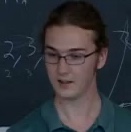
编者按:2007 年夏天,MIT 开设了一门以侯世达(Douglas Hofstadter)名著《哥德尔、埃舍尔、巴赫》为读本的研讨课。本次第二讲的原定讲者贾斯汀·柯里缺席,由柯伦·凯莱赫(Curran Kelleher)代课,他带着自己用 Groovy/Java 写的一组程序,从阶乘一路讲到分形蕨、曼德博集合与巴赫的和声迷宫。课堂上有学生反复追问,从「把科赫雪花剪断能拉多长」到「代码里没有递归函数,怎么知道输出是递归的」,把讲者一步步逼到递归定义的边界上。本文依据现场录音编译整理。
阶乘:递归的起点
凯莱赫: 我叫柯伦·凯莱赫,今天由我来讲递归和分形。贾斯汀今天不在,所以我替他上这一课。我准备了一批例子,都是递归的计算机程序,有的不画图,有的画图,凡是画图的,画出来的都是分形。所谓分形(fractal),就是在不同尺度上自相似的东西,你可以一直放大下去。我们四点休息十分钟,然后我会给你们看一批分形的例子,再放几段巴赫。
凯莱赫: 先看一个递归的数学函数:阶乘。三的阶乘是 3×2×1,四的阶乘是 4×3×2×1,就是那个感叹号。它的定义本身其实就是递归的:任意一个 n 的阶乘,等于 n 乘以 (n-1) 的阶乘。比如 n 是四,n 减一就是三,四的阶乘就是四乘以三的阶乘。这是一个递归定义。
凯莱赫: 讲义第三页上有我写的一个小程序,就是做阶乘的。给不太熟悉编程的同学解释一下:def 的意思是「定义」,所以我们在定义一个叫 factorial 的函数,它接受一个参数 n。你可以调用这个函数,传给它一个数,在函数内部,这个数就叫 n。函数体是这样的:如果 n 大于 1,就返回 n 乘以 factorial(n-1);否则,返回 1。
凯莱赫: 让这个函数成为递归函数的,恰恰是它调用了它自己。阶乘被定义成 n 乘以另一个东西的阶乘。所以,递归函数就是调用自身的函数。举个例子,假设 n 是五,我们调用 factorial(5),函数拿到 n 等于五。五大于一,于是返回五乘以 factorial(4)。四也大于一,于是返回四乘以 factorial(3),也就是五乘四乘以三的阶乘。它就这样一层层调用自己,一直降到 1 为止。这就是递归。
斐波那契数列
凯莱赫: 另一个跟阶乘很像的简单例子,是斐波那契数(Fibonacci numbers)。数列是这样的:1,1,然后把前两项加起来得到下一项,于是 1,1,2;1 加 2 是 3;2 加 3 是 5;再来是 8,如此往下。这些就是斐波那契数。
凯莱赫: 这同样是一个递归定义。这里的编号只是元素的下标。斐波那契的第二项等于第零项加第一项,第五项等于第三项加第四项。一般地说,fib(n) 等于 fib(n-1) 加 fib(n-2)。所以我们把刚才那段代码里的 factorial 换成 fib 就行了,你会发现两者几乎一模一样:如果 n 大于 1,就返回 fib(n-1) 加 fib(n-2)。这样就得到了斐波那契数列。讲义里两个程序的样例输出都有,跑出来就是这个结果。
递归转移网络
凯莱赫: 今天谁带了《哥德尔、埃舍尔、巴赫》?请翻到第 132 页。那里有两张图,是递归转移网络(recursive transition network)。它们定义了一套语法,有点像英语。它当然不是完整的英语,只是一个简化版,但作者要传达的语法本质,也就是递归语法的意思,已经完整地在里面了。
凯莱赫: 你会看到,「花哨名词」(fancy noun)这个节点里又调用了「花哨名词」自己,箭头绕回到了自身。递归就在这里。我做的事情,是把这张图改写成一个小程序:凡是遇到岔路,也就是有多条转移可选的地方,程序就随机挑一条走。这个程序在我讲义的第五页。可惜投影仪不能用,不然我就直接放给你们看了。
凯莱赫: 我们照着图看。「花哨名词」一开始就调用「普通名词」(ordinate noun)。再看讲义里的程序,大概在中间靠下的位置,写着「fancy noun 的 RTN」,然后是 fancy noun 等于某个函数调用。先说明一下,在这门语言里,给一段东西套上花括号,它基本上就成了一个函数。所以 fancy noun 等于什么呢?基本上是从图里照抄下来的:先调用 ordinate noun,然后从「介词」、「关系代词」、「什么都不接」这几项里随机挑一个。你去看书上那张图,从 ordinate noun 出来的箭头,正好指向关系代词、空、结束和介词这几处。你完全可以把它写成一个计算机程序,我做的就是这件事。
凯莱赫: 你把我的程序多看一会儿就会发现,图里所有的箭头都对应着程序里的函数调用,而它们之所以是递归的,是因为兜兜转转最后会绕回自身。侯世达在这里要说明的是:语言本身就是由递归语法定义的。这正是我们能把句子套在句子里的原因,它是递归的。递归带来嵌套,有时候是无穷的嵌套,而这正是分形的来处。
凯莱赫: 程序后面就是样例输出,你们读一读,挺好玩的。比如「奇怪的母牛里面的小小百吉饼」,作为一个英文句子居然说得通,而它是这个程序生成的。我觉得这件事本身就非常迷人。当然也有完全不知所云的,比如「跑着大小大号角的大小百吉饼」,这句就毫无意义。
递归画树
凯莱赫: 下一个例子在第五页,我们要用递归函数画一棵树。我在黑板上写一段伪代码,不是真正的代码,只是把这个程序在做什么讲清楚。
凯莱赫: 我们有一个「长树」的函数,从一根枝条开始。这里是起点,是入口。程序一启动,就会执行主类里那句 tree()。第一次调用 growTree,参数是 0.5、0、树干高度等等,画出来的就是最下面这一根。这一步启动了整个过程。函数里做的事情,基本上就是:只要深度大于零,就往下做。
凯莱赫: 这个函数会调用自己两次,一次一条分枝。程序第一次调用它,就画出这一根,直接画在屏幕上。你注意看代码里那句 add new JV line X1 X2,那一句才是真正往屏幕上添一条线。我真希望能把程序跑起来给你们看。depth 是它要分叉的次数,这里 depth 是 11,所以会长成一棵很大的树。
凯莱赫: 接下来它生成两条子枝,两次 growTree 调用分别对应这一条和那一条。看讲义里的代码:growTree(X2, Y2, ...),X2、Y2 就是上一根枝条的末端;rootLength 乘以 sizeFactor,sizeFactor 是缩放系数,这里是 0.58,所以每一级大约缩小到一半;再看角度,一个是 rootAngle 加 angleFactor,一个是 rootAngle 减 angleFactor。angleFactor 是 π/4,正好 45 度。所以每分一次叉,两条枝就按这个角度岔开。
凯莱赫: 假设第一次调用时 depth 是四,进到函数里传给下一层的是 depth 减一,于是里面这一层的 depth 是三,再往下是二、一,一直减到零为止。左右两边都这样做,就这么一直长下去。这就是一个分形。你可以设想,如果不写 depth 等于 10 或者 11,而是写 depth 等于无穷,理论上这个形状就可以无限放大下去,永远放大下去,而且放大之后看上去和大尺度上一模一样。这就是分形的概念。树的部分有问题吗?
科赫曲线
凯莱赫: 接下来是科赫曲线(Koch curve)。它和树很像,只是规则不同。先讲概念上它是什么:你从一条线段开始,有时候是从一个三角形开始(那样能做出整个雪花),把线段三等分,用中间那一段作边长,向外做一个等边三角形,也就是三边等长,然后把中间那条原线段去掉。这就是规则:从一条线变成这个折线形状。然后把同一条规则施加到新生成的每一小段上,再往下,继续对更小的段做同样的事。
凯莱赫: 一条简单的规则被反复施加,而每次施加的对象都是上一次施加规则的结果,这就是递归。你可以一直画下去。我们看代码,在第七页,函数叫 createCurve。它做的事情本质上就是调用自己四次,这四次分别对应折线的这一段、这一段、这一段和这一段。
凯莱赫: 看代码中间那四个 createCurve 调用,参数是 X1、Y1、AX、AY、CX、CY、BY 等等。对照那张红色小图:这个点是 X1、Y1,其他点在图里都标好了。第一个调用的意思是,把规则施加到这一段上;第二个从 A 点开始,也就是这里,把规则施加到那一段;第三个从 C 开始,C 是顶点;第四个施加到最后一段。这又是一个漂亮的递归分形。
凯莱赫: 如果把它推广一下,加进随机性,会发生什么呢?这些点的名字无所谓,关键是,不要让它们落在精确的位置上,而是让每个点上下随机偏移一点点,然后连线,在那里做出三角形,这里也偏一点。每一步都掺一点随机,你画出来的线条就和真实的海岸线一模一样,就是陆地边缘的那种轮廓。如果再把它推广到三维,同样加随机,生成出来的就是三维山脉,虚拟的三维曲面,看上去和真山没有分别。所以有点奇怪:这些递归结构确实存在于自然界。
有限面积,无限周长
学生: 第六页上写着,科赫雪花的面积是有限的,但周长是无限的,这是什么意思?
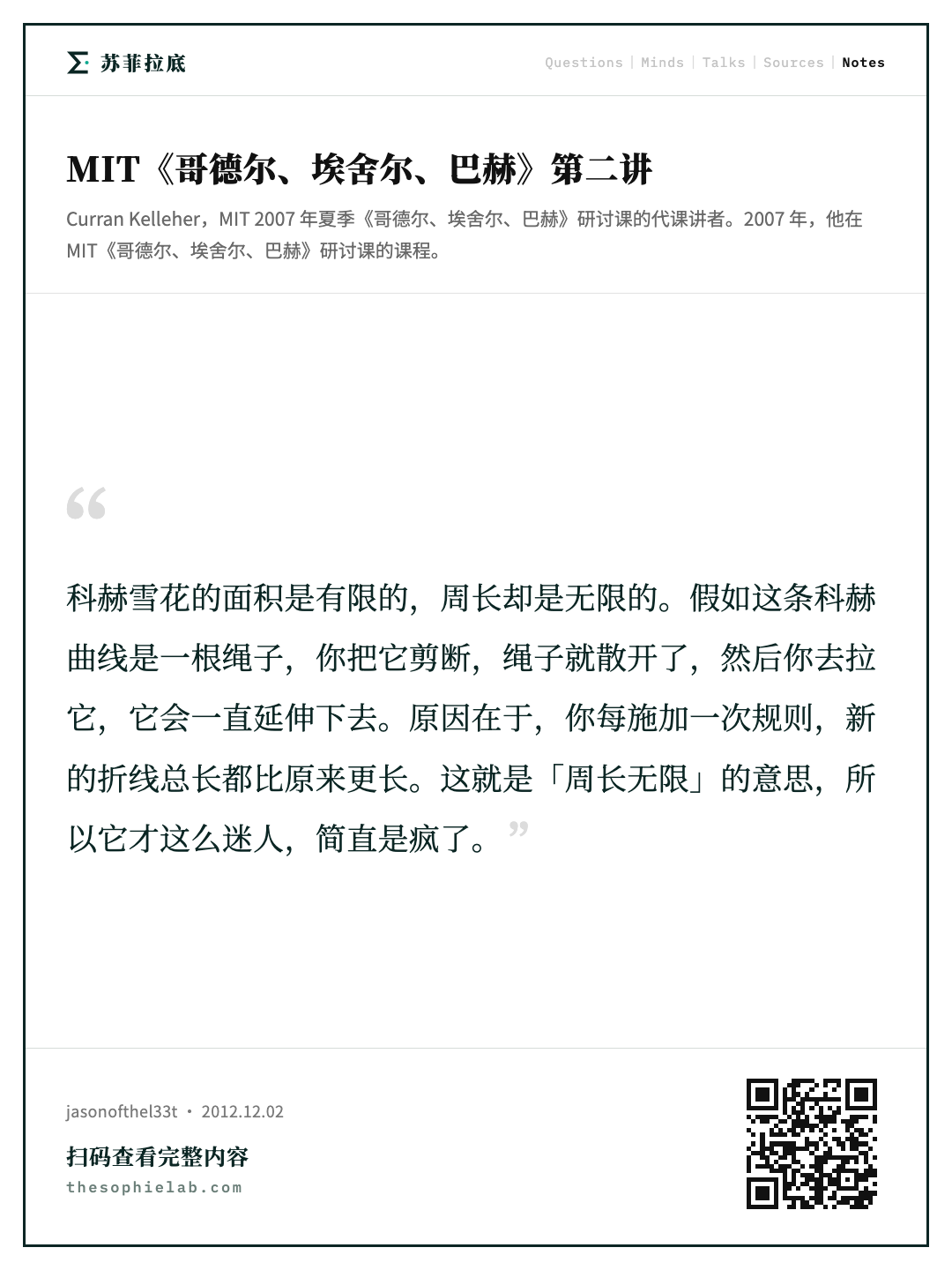
凯莱赫: 对,我刚才忘了讲,这一点特别有意思。科赫雪花是从一个三角形出发,对三角形的每一条边施加那条规则,三条边上都长出这样的曲线。数学上已经证明,或者说已经推演出来:如果你把这条规则施加无穷多次(在数学里可以这么做,因为它是纯理论的),这个图形内部的面积是有限的,是一个确定的数值。但它的表面积,不对,是周长,周长是无限的。原因在于,你每施加一次规则,周长都会变长。原来这一段有一个长度,施加规则以后,新的折线总长比原来更长。你可以想见,如果无限地做下去,它就会无限长。这真是让人头晕。
学生: 可是每迭代一次,新加的那些段不是越来越小吗?
凯莱赫: 确实越来越小。但如果你在理论上做无穷多次,它依然存在。你看第六页标题「科赫雪花」旁边那条曲线,看到了吗?即使做无穷多次,大致就是那个样子。
学生: 那假如我把这样一片雪花剪开呢?比如我把它剪成两半,再把它拉开,它会一直延伸下去吗?
凯莱赫: 你是说从中间剪断?
学生: 不是剪成两半,就是在某一处剪开。我不是要让各段互相跑到别处去,只是像剪一根围成圈的绳子那样剪一刀。
凯莱赫: 我不太确定我理解了,你要不上来画一下。
学生: 比如说我这里有一个圈,我在这个位置剪一刀。你刚才说它面积是有限的,那我这样剪开再拉直,它就能一直延伸下去,可这说不通啊。
凯莱赫: 我明白了,你说的是它同时又有有限的面积。就是说,假如这条科赫曲线是一根绳子,你把它剪断,绳子就散开了,然后你去拉它,它会一直延伸下去。是的,确实如此。这就是「周长无限」的意思,所以它才这么迷人,简直是疯了。
英国海岸线有多长
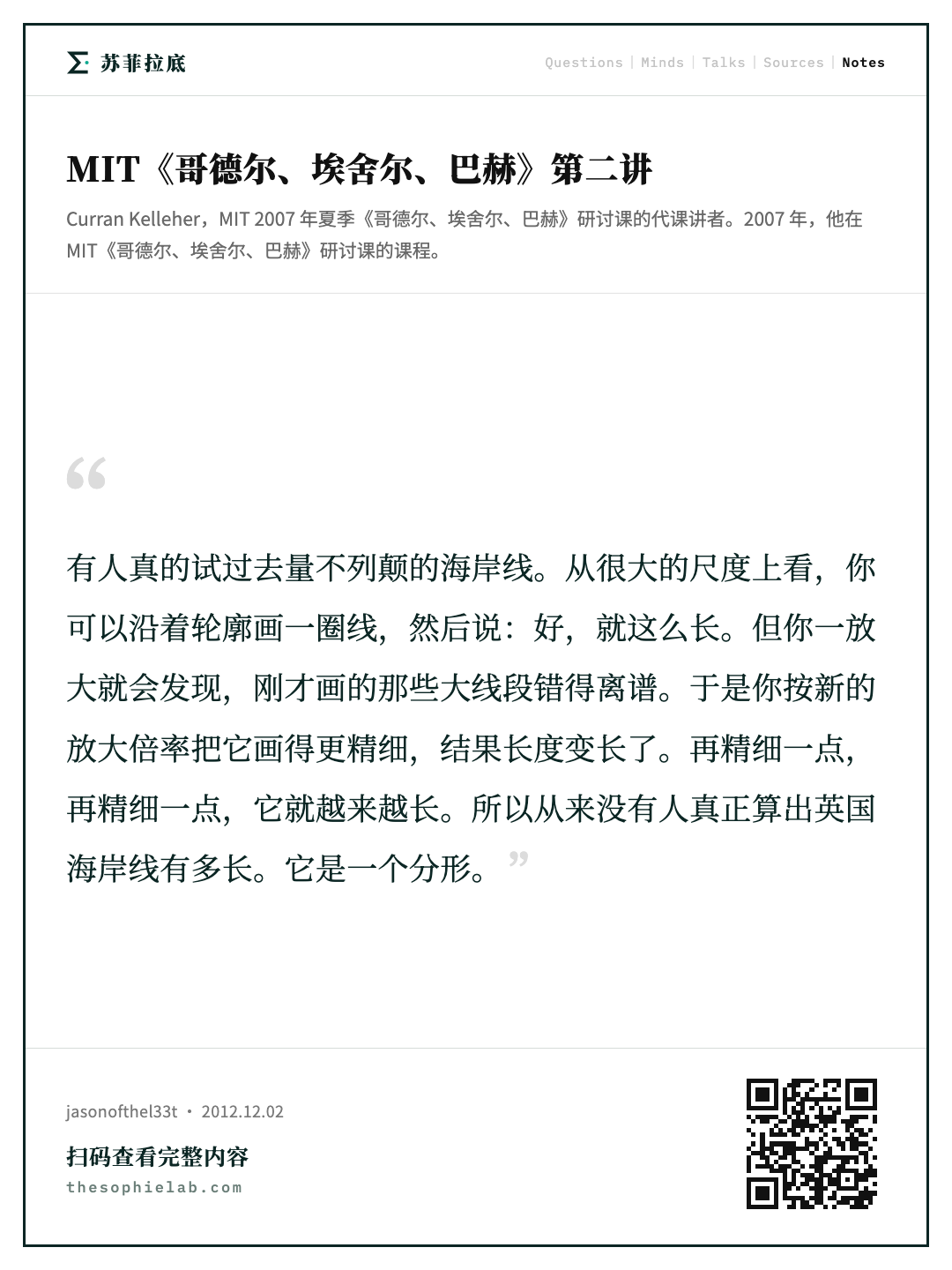
凯莱赫: 有人真的试过去量不列颠的海岸线。英国的海岸线有多长?你们听过这个问题吗?如果你从很大的尺度上看,比如整个国家的卫星照片,你可以沿着轮廓画一圈线,然后说:好,就这么长,这就是英国海岸线的长度。但你一放大就会发现,刚才画的那些大线段其实错得离谱,根本对不上真实的边界。于是你按照新的放大倍率把它画得更精细,结果长度变长了。
学生: 可是新加进去的那些不是应该越来越小吗,你只是补上一些小碎块而已。
凯莱赫: 对,只是补上一些小碎块。假设真实的海岸线是这个样子,你从极远处看,会说:好,大概就是这条直线。但你看得更仔细、把它细化以后就会说:不对,不是那条直线,大概是这几条折线。可是这些新折线加起来,总长度比原来更长。你再精细一点,再精细一点,它就越来越长、越来越长。所以从来没有人真正算出英国海岸线有多长。它是一个分形。
学生: 可是在这个现实世界里,真的可能存在无限精细的东西吗?那不是得有无穷小的尺度才行?
凯莱赫: 他问的是,在这个世界上有没有可能真的存在那样的无限。答案是没有,因为地球上的空间是有限的。
学生: 但就算在有限的范围内,你刚才不也说,就算面积或者体积是有限的,周长还是可以无限吗?
凯莱赫: 是的,科赫曲线在数学的语言里,如果你严格按数学去做,它的周长无限而面积有限。但要记住,这是一个理论上的造物,它只活在数学世界里,在宇宙中无法真正存在。不过自然界里有很多东西非常接近它。英国的海岸线并不是真的无限长,但它确实非常像这一类形状。科赫曲线还有别的问题吗?
谢尔宾斯基三角形
凯莱赫: 下一个例子在第八页,谢尔宾斯基三角形(Sierpinski triangle),非常有意思。你取一个大三角形,在里面画一个倒着的小三角形,这就是它的规则。这么一画,你就得到了三个新的三角形。然后你对这三个新三角形再施加同一条规则。这就是递归:你对一个已经施加过规则的东西再施加一次规则,得到更小的三角形,如果一直做下去,它就无限地小下去。
凯莱赫: 这是计算它的一种方式,一种看待这条规则的方式。但我在讲义里用的是另一种,我在那里谈到了迭代函数系统(iterated function system)。我直接做给你们看,做完你们就明白它是什么意思了。
凯莱赫: 假设我们从一个点开始,比如这个点,任意一个点都行。我们有三种选择,这个玩法叫「混沌游戏」(chaos game):把这个点移到它与顶点甲连线的中点,或者移到它与顶点乙连线的中点,或者与顶点丙连线的中点。假设我们选甲,那就走到这里,正好在中间。而在迭代函数系统里,我们把这件事一遍一遍地做下去,每次随机挑三个顶点中的一个,朝它走一半路。
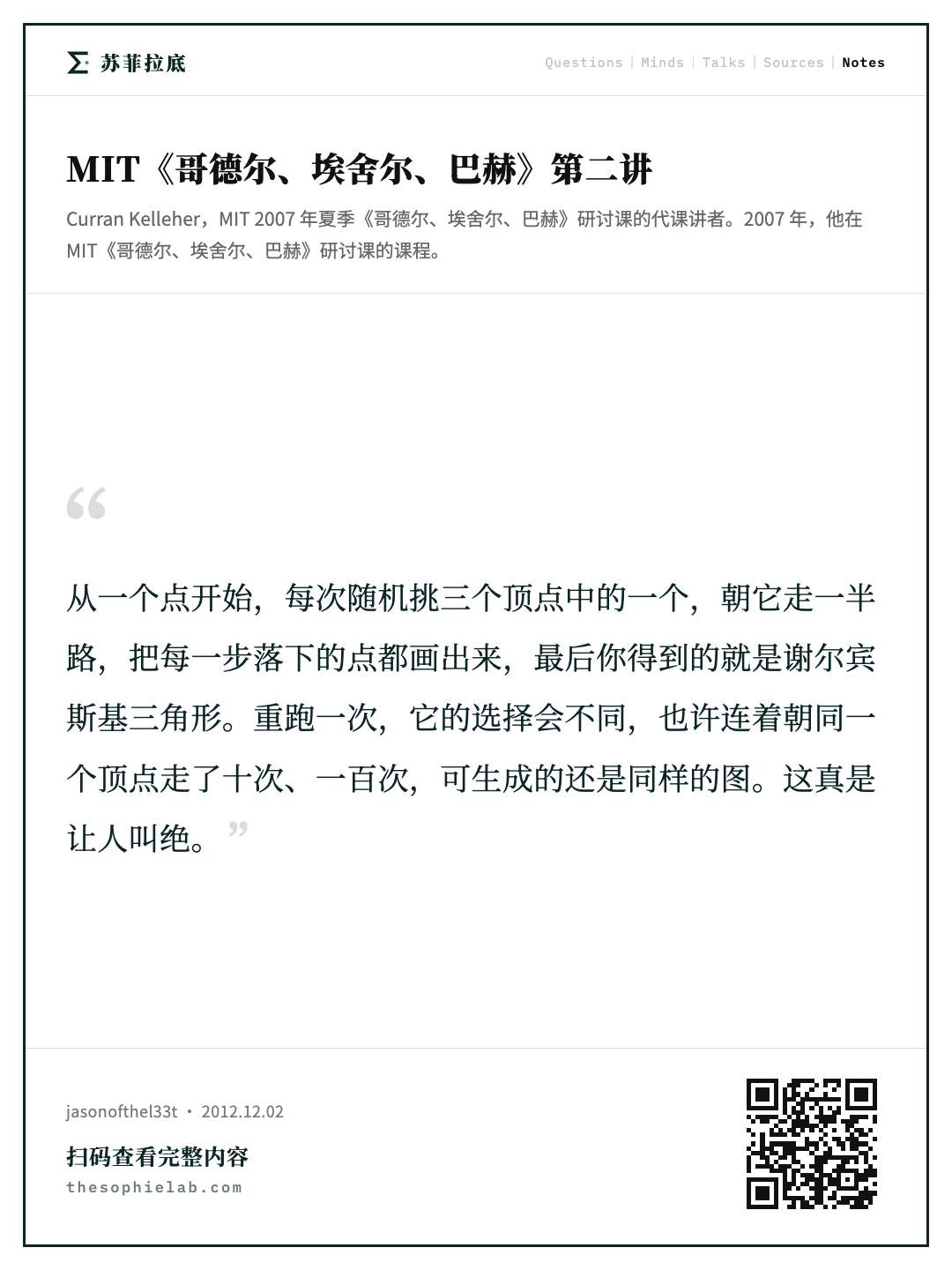
凯莱赫: 那么,接下来我们走向这一个,到这里;再走向这一个的一半;再走这一个;再这一个;再这一个;再这一个。就这样一直随机地走下去,把每一步落下的点都画出来。我写的那个程序(讲义里有)做的就是这件事,它一直跑,一直画点。最后你得到的,就是谢尔宾斯基三角形。太疯狂了。图就在第八页。
学生: 也就是说,随机怎么选都无所谓?不管你怎么选,最后画出来的总是同一个样子?
凯莱赫: 是的。
学生: 那如果我把程序重新跑一遍,因为它是随机的,选的顺序就会不一样。
凯莱赫: 对,正是这样。重跑一次,它的选择会不同,也许第一次不是走向这个顶点,而是走向那个顶点,也许它连着朝同一个顶点走了十次、一百次。程序是随机挑的。他问的是:既然是随机的,是不是还会生成同样的图?答案是会。这真是让人叫绝。等我们做完下一个例子,也就是分形蕨,你们会理解得更透彻。
凯莱赫: 我们先快速看一眼代码,然后想一个问题:谢尔宾斯基三角形的这段代码,是递归的吗?代码里 def drawSierpinski 就是画三角形的那部分。A、B、C 是三个顶点,也就是这三个点。points 等于由 A、B、C 组成的列表。currentPoint 就随便设成 A 好了。while true 的意思是,这段代码反复执行,一直做下去,做无穷多次,直到你把程序停掉为止。里面写着 nextPoint 等于 pickFrom(points),pickFrom 是上面定义的函数,作用就是从你给它的列表里随机挑一个。所以 pickFrom 正是那个随机决定走向哪个顶点的东西。
凯莱赫: 挑到点以后,就是 currentPoint.X 等于 (currentPoint.X + nextPoint.X) 除以二。你在做的其实是把当前点和目标点的 X 坐标取平均,X 和 Y 都这么做,得到的就是当前点与目标点的中点。这一句就干这件事。然后 image.fillPixel 把这个点画到屏幕上。第八页那张图,就是这个程序生成的。它就这样一直跑,一直画。
凯莱赫: 所以问题来了:这个东西是递归的吗?我们说过,递归函数是调用自身的函数。这个答案我们留到下一个例子之后再说。到这里有问题吗?
递归必须触底吗
学生: 能再说一遍递归的定义吗?
凯莱赫: 一般来说,递归就是用自身来定义自身的东西,是绕回到自身的东西。
学生: 那如果你反复施加那条递归规则,它不就会变回它一开始的样子吗?
凯莱赫: 不一定,因为每一次施加规则,都有一点微小的变化。以阶乘为例,它说的不是「n 的阶乘等于 n 的阶乘」,而是「n 的阶乘等于 n 乘以 (n-1) 的阶乘」。阶乘那一部分是递归的,但它并没有原封不动地绕回自身,中间有变化。
凯莱赫: 至少对递归函数来说是这样:函数被定义出来,然后调用自己。我不确定这能不能回答你的问题,但你设想一下,如果我们把这几行判断去掉,函数只剩下一句「def fib(n) 返回 fib(n-1) 加 fib(n-2)」,会发生什么?它会一直调用自己,无穷无尽地调用下去。这是个问题。所以,所有递归函数要想真正做成什么事,就必须在某一处触底。它们必须停下来,而停下来的机关就是这个条件:只有当 n 大于 1 时才继续;如果 n 小于或等于 1,就直接返回。这就把它止住了。这样回答你的问题了吗?你要是觉得没答上,可以再问一遍。
学生: 也就是说,只有计算机里的递归函数才需要触底?
凯莱赫: 是的,需要触底的是那些递归的计算机函数。递归还有别的种类。不过,自然界的递归其实最终也是要触底的。拿自然界的树来说,它分叉,分叉,再分叉,但最后总会走到一片叶子上,就不再分叉了。这棵树里面运行着某种递归的程序,而当枝条细到某个尺寸时,程序会收到某种信号,我想大概是这样,于是它转而长出一片叶子。所以这类递归过程也是会触底的。
凯莱赫: 但刚才那个谢尔宾斯基的程序确实是递归的,我们过一会儿会看到它为什么是递归的,而它并不触底,因为它就这样永远跑下去。
学生: 也就是说,如果你想让递归真正给出一个可见的结果,它就必须触底,否则你拿不到返回值。但你完全可以设想一个不触底的理论世界,让它一直延续下去。
凯莱赫: 对,完全正确,你概括得非常好。他的意思是:要得到递归的任何实际显现,它就必须触底,这样才能把结果交还给你。但你确实可以设想不触底的理论世界,让它一路延伸下去。侯世达在这一章前面的对话里就这么干了:一个精灵得去问元精灵,元精灵又得去问元元精灵。有人读过那一段吗?
学生: 读过,而且那一段里时间是越来越短的。
凯莱赫: 对,时间越来越短,所以最后你在无穷小的时间里重复了无穷多次。
学生: 是啊,太疯狂了。
凯莱赫: 真的很值得琢磨。虽然是纯理论的,但想一想非常有意思。
分形蕨与坐标变换
凯莱赫: 下一个是分形蕨(fractal fern),第九页,特别酷,也特别漂亮。
凯莱赫: 我要先讲一个概念:坐标变换(coordinate transformation)。假设在这个大矩形和那个小矩形之间有一个坐标变换。它是一个作用在点上的函数,作用在二维点上。比如你取这里这个点,对它施加这个变换,得到的就是那边那个点;再取这里的另一个点,施加变换,得到那边对应的点。小矩形里的图案,就是大矩形里的一个缩小的副本。
凯莱赫: 这就是「函数」,也就是迭代函数系统里「函数」的那一部分。「迭代」指的是你一遍遍地做下去,「系统」指的是这样的函数不止一个,而是有一批。在谢尔宾斯基三角形里是三个。
凯莱赫: 分形蕨是一个有四个函数的迭代函数系统。谢尔宾斯基那个有三个,那三个点每一个就是一个函数,「朝某个点走一半」就是一个函数。而蕨这个有四个函数,每一个都是一个坐标变换。比如这一个,是从外面这个大矩形到里面这个小矩形的坐标变换。如果我们取大矩形里的这个点,施加这个变换,就得到小矩形里的这个点。
凯莱赫: 假设我们取大矩形的中心点,施加一次变换,得到的是小矩形的中心点,大概在这里。但接下来我们要说:好,这个新点现在被看作是大矩形里的点,我们对它再施加一次变换。于是大矩形里的这个点,映到小矩形里大概这个位置。然后再说:好,这个点现在又是大矩形里的点,再施加一次。于是得到这里,这里,这里,一连串越来越小的点。它们最终会越缩越小,因为这两个矩形有一个角点是重合的,我想是这样,应该没错,是同一个点。
凯莱赫: 我们再看另一个变换。这个变换的目标是一条线段,你就把它当成一个压扁的矩形来想,它同样是一个坐标变换。我们把大矩形里的任意一点,映到这条线段上的某一点。大矩形里这个点会映到线段的顶端,这个点会映到线段的底端,中心点会映到线段的中点。
凯莱赫: 现在想象一个只有这两个函数的迭代函数系统。假设两个函数各有大约一半的机会被随机选中。不,我们换个设定:假设有百分之九十的时间施加第一个映射。那么从这个点出发,它会映到这里,再映到这里,只要一直施加这个映射,它就一路往上爬。但假设它爬了一百次以后,有一次选中了另一个映射,落到了下面。也就是说,它本来在最上面,一映射就回到这里重新开始,然后又往上,往上,往上。再假设走到某处时,计算机决定施加第二个映射,而它此刻大约在四分之三高的位置,那它就会落到线段四分之三高的地方。正因为是随机的,只要一直做下去,最终它几乎会把这条线段上的每一个点都填满。这一点很值得琢磨。到这里有问题吗?
四个映射与概率
凯莱赫: 现在回到蕨。四个变换全都是从外面这个大矩形出发,映到里面某一个较小的区域。比如取上面这个点施加这个变换,它会落到这里;取那个点,会落到那里。变换的走向大致就是这样。
凯莱赫: 假设我们的迭代函数系统就有这么几个。我们从大约一半高的位置出发,选中了这个映射,它落到这里,落到这块区域的中间。然后我们连续施加这个映射很多次,它一路往上爬。再施加一次那个映射时,它这次的位置更靠近顶端了,所以落点也更靠外、更靠近这个矩形的顶端。然后一次又一次地施加。也许有时候它只往上爬了一格,那落点就在下面这里。最终,它会用这个图案把整个矩形填满,长成这个样子。而由于这里面几乎每一个点都会被那个映射反复作用很多次,我们得到的就是这样一个蕨的结构。是不是特别酷?
学生: 你的意思是说,小的那一块里的所有点,会被映射到大的那一块的不同部位去?
凯莱赫: 你说的是谢尔宾斯基三角形还是蕨?
学生: 蕨。就是说小的那一块里有一堆点,那些点是不是分别对应着蕨的某一部分?看上去它们是被重复了,只是变小了,而且每一份里的点数量还一样多。
凯莱赫: 完全正确。
学生: 可是如果越缩越小,怎么可能塞进同样多的东西?
凯莱赫: 说得对,实际上塞不进。我举个例子。假设我们不是只对一个点施加变换,而是对一堆点施加,比如这条线上的所有点,或者接近所有的点。我们把这个映射施加若干次,得到这一批、这一批、这一批点。现在我们对所有这些点施加另一个映射,它们全都会映到这里来。然后我们再做一次,再做一次。这样一来,所有那些点最终都会被映到这一块里,于是你在这里就得到了整个结构的一个小副本,你有了这些小分枝。接着这一整块又被映到上面这里,于是又有了分枝、分枝、分枝。而由于这里已经有了更小的分枝,你就有了往下两层的结构。这整块东西连同新长出来的分枝,又会被映回这里去,随着迭代进行不断填充进来。
凯莱赫: 但它不会一味地往上爬。假设我们百分之百地施加那个往上的映射,它就只会一路爬上去,哪儿也不去。可如果我们只有百分之七的时间施加另外的映射,它就会爬到各种不同的高度,然后被映回下面,再往上爬,再被映回去。再加上从这一块到那一块的变换,我们得到的就是这个东西。它是递归的。它之所以递归,是因为这些映射最终映到了自身之上。
凯莱赫: 我们看看代码,它和谢尔宾斯基三角形的代码非常像。代码本身不是递归的,但映射是递归的,正是这一点让整件事成为递归。
凯莱赫: class fern,drawFern,while true,意思是这段一直执行,反反复复地做。然后从这一列变换里随机挑一个。第一个写着「映到茎」,意思是从整体映到这里,映到茎上。第二个「映到左枝」,从整体映到这一块。第三个「映到右枝」,映到下面这里。第四个则是从这里映到这里,就是往上那么一走。
凯莱赫: 紧接着,代码里写的是:从一个函数列表里挑,同时给出一个概率列表:0.01、0.07、0.07、0.85。这就是这四个映射被选中的概率。如果你让它们等概率,那么「往上」这个映射连续发生超过五次左右的机会就非常小,于是点只会爬一点点就被映回去,得到的分形会非常稀疏,绝大多数点都堆在下面这里,看上去很难看。我试过。真希望能当场写给你们看。所以,0.01 表示映到茎的情况占百分之一,映到左右两条分枝各占百分之七,而往上盘旋的那个映射占百分之八十五。
凯莱赫: 现在休息十分钟。还有问题吗?
代码不递归,映射递归
凯莱赫: 我们继续。在离开迭代函数系统之前,我想指出一点:从映射的角度看,谢尔宾斯基三角形和蕨其实是同一回事。谢尔宾斯基三角形有三个映射,一个把大三角形映到这个小三角形,一个映到那个小三角形,还有一个映到第三个小三角形,三者被选中的概率相等。
凯莱赫: 你想一想就明白了:从任意一点朝某个顶点走一半,本质上就是把它映到某个小三角形里去。假设你有这么一条线上的所有点,对它们施加这个函数,结果就是把它们整体映到那个小三角形里去。所以这些三角形是递归地映到自身之上的。这里确实有递归在发生,只不过递归不在代码里。代码本身只是在重复,但它重复的东西,正是这些自我映射的递归映射。
学生: 这么说,同一个算法总有不止一种表达方式?
凯莱赫: 同一个算法总有不止一种表达方式。是的,非常有意思。尤其是在分形这类东西上,好像总还有另一条路可以走,得到同样的结果。谢尔宾斯基三角形在这一点上尤其惊人。
跳出系统
学生: 那如果代码里根本没有递归函数呢?在不运行代码的情况下,你怎么判断它的输出会是递归的?
凯莱赫: 你是说,你手上有代码,但它里面没有递归函数?
学生: 对,代码里没有递归函数。如果你不能运行它,你怎么在不跑一遍的情况下发现输出会是递归的?
凯莱赫: 他问的是:既然代码本身不是递归的,你怎么知道输出会是递归的,哪怕里面一个递归函数都没有。我的看法是这样:当你写代码的时候,如果你意识到代码做的事情是在施加这些二维映射,你就可以在脑子里推演:这些映射会以某个概率被反复施加,那么结果会是什么。你只要在头脑里做这个外推,其实就是在跳出系统(stepping out of the system),你在问:这东西究竟在干什么?
学生: 可是非得那样不可吗?就不能待在系统里面判断?
凯莱赫: 待在系统里面?在这里,待在系统里面就意味着真的去运行代码,像计算机执行程序那样一步步走。而跳出系统,我指的是从更高的层面去看正在发生的事。
学生: 也就是说,当你把那些细节抽象掉,把做着同一件事的东西归到一起,你就得到了一个更高的层面,而递归其实是在那个层面上发生的。
凯莱赫: 完全正确,就是这样。他说的是:当你把这些函数具体在做什么的细节抽象掉,你就开始察觉到一个更高层面的东西,而那个东西本身就是递归。所以,只要你的思考抽象到足够的程度,你就能靠逻辑判断出它会生成一个递归的形状。
学生: 可是并没有什么简单的算法或者程序,能替你判断一段代码是不是递归的吧?
凯莱赫: 你是说某种检测程序?
学生: 对,某种检测。
凯莱赫: 没有,你只能靠想。这正是人能做而机器做不了的事。没有哪种严格的检测可以施加到一段计算机程序上,然后告诉你它会不会产生递归的结果。因为在这个例子里,代码里根本没有递归函数,所以计算机无从知道,它没法问自己「我能不能抽象一层看看」。只有人能做这件事,至少目前是这样。而且这段程序也不是以映射系统的形式写出来的,它就是一些普通的函数而已。
凯莱赫: 所以你只要顺着映射、映射、再映射地想下去:你把这里的东西映到那边,原先在这里、可以无限往下延展的全部结构,现在就整个装进了那个小三角形的一个小角落里。这就是一个递归结构。
凯莱赫: 我们进入下一个例子,曼德博集合,非常有意思。既然设备现在通了,我想先把讲义里的程序跑一下,让你们感觉一下。先跑递归转移网络这个,看看会怎么样。它会生成一百个句子,因为代码里有一句打印语句执行一百次。第五页上写着 (0..100).each { println fancyNoun() },这只是 Groovy 语言里一种花哨的写法。糟糕,跑不起来。算了,我一边讲一边试着修。这台机器我折腾了一整天了。
曼德博集合
凯莱赫: 下一个也是最后一个例子,是曼德博集合(Mandelbrot set)。你们大概都听说过它,非常有名,也许是所有分形里最有名的一个。它叫这个名字,是因为曼德博这个人极其热爱分形,努力把分形的概念传达给全世界,而这确实是一个了不起的分形。接下来会稍微数学一点,不过没关系。
凯莱赫: 它活在复平面上。也就是说,我们有这样一个平面,横轴是实数,纵轴是虚数,我想是这么摆的。曼德博集合由这个函数定义:Z = Z² + C。先说清楚,一个复数就是这个平面上的一个点。假设这个点,纵坐标是 B,横坐标是 A,那么这个点就写作 A + Bi,而 i 是 -1 的平方根,这在现实中并不存在,所以它才叫「虚」数。两个复数相乘并不那么简单,你得老老实实把乘法展开,得到 AC 加上一堆项。我就不全展开了,会花不少时间。总之你得到的是一种并不线性的映射,它会怎么走并不容易预料。
凯莱赫: 算法是这样运作的:你在复平面上取一个点,C 就取这个点的值。而 Z 从零开始,就是零加零 i。然后你反复施加这个函数。第一次施加:Z = Z² + C,0 的平方是零,加上 C,所以第一次迭代之后,Z 就等于 C,Z 落在这里。然后再施加一次,这次的 Z 已经是刚才得到的新 Z 了。Z = Z² + C,你先做平方,再加上 C 的实部和虚部,于是这个点就被映到了别的地方,比如这里。然后你一次又一次地施加:这里,这里,这里。我不知道我讲得是不是太快了。总之施加一次得到这个点,它成了新的 Z,然后这个新的 Z 又绕回去,我们再算 Z² + C。C 永远是最初那个点,变的只是 Z。它映到这里,新的点又成了 Z,再算一次 Z² + C,又映到那边去。我写了一个小程序,可以把这个映射过程和它的形状演示出来。
学生: C 可以取在任何地方吗?还是说 Z 可以?就是起点。
凯莱赫: 起点可以取在任何地方。但真正运行算法时,我们只在 -2 到 2 这个范围里取,因为只有在这个区域里,这个分形才有有趣的事情发生。
凯莱赫: 算法我还没讲完。假设有一个点在这里,非常靠近原点,那么随着迭代,它往往会向内盘旋。而外面这个点,尤其是落在半径二之外的点,施加这个函数以后,往往会被甩到这里,再甩到那里,越跑越远。所以,我们渲染曼德博集合的做法是:施加函数若干次,如果这个点最终跑出了以原点为心、半径为二的圆,就停止迭代,因为我们知道,一旦它出去了,就会一路跑到无穷远。它逃逸了。这就叫逃逸迭代次数(escape iterations),也就是跑出这个圆所需要的迭代次数。
凯莱赫: 然后我们根据逃逸迭代次数给这个点上色。另一半规则是:如果它永远不逃逸,我们就把它涂成黑色。而要真正判断这一点,我们的办法是固定迭代若干次,比如五百次,或者七十次,如果迭代这么多次之后它还没有逃逸,我们就姑且认为它永远不会逃逸了。这当然不严格。所以我们画出来的只是真实集合的一个近似,但要渲染出图来,就只能这么做。这类点涂黑。
凯莱赫: 真正渲染的时候,我们遍历屏幕上的每一个像素,对每个像素执行这套算法。这个点就是 C,我们迭代,检验,迭代,检验,迭代,检验。检验的内容就是它是否跑到了圆外。一旦跑到圆外,就按照所用的迭代次数给它分配一个颜色。每一个像素都这么办。比如这一个点,它会向内盘旋,其实它不是一条连续的线,只是不断施加函数得到的一串点,向内盘旋,永远不会逃逸,所以我们把它涂成黑色。
凯莱赫: 这个小程序把这一切演示得非常好。我用 Java 实现了这套算法,它会把每一步的点输出出来,并在相邻的点之间连线。比如从这里出发,画到这里,这里,这里。
凯莱赫: 结果就是我们看到的这幅图。我把鼠标移来移去,它就在做这些检验。这里只需要一次迭代,一次迭代对应浅蓝色。这里是两次,上面会列出来,一、二。所以凡是这个颜色的地方,点在跑出圆外之前只经过了两次迭代。往里走一点,就需要三次,四次,五次,六次,七次,越往里迭代次数越多。所有有颜色的点最终都会逃逸,而所有黑色的点不会。里面那些图案特别有意思。你看中间这些,就是一路向内盘旋。这边这些呢,有一种循环的模式,看到了吗?函数绕回到了自身,所以它有点像是递归的。我也说不太清它究竟怎么个递归法,但它确实有那个味道。再往外走到第二个瘤状凸起上,形状就更漂亮了。
凯莱赫: 我们还可以放大。它会重新计算,此刻它正在为每一个点重算这套算法,速度非常快。于是我们能看到这些生成分形的极漂亮的形状,简直疯了。
凯莱赫: 我们在这里确实能看到递归,看上去肯定有某种递归的东西在运作。而递归的部分在于,Z 被施加到了自身上:第 n 个 Z 等于前一个 Z 的平方加 C,然后这个 Z 又被重新当作旧的 Z。这种重新框定、重新施加函数的动作,正是它的递归所在。所以这说得通。黑色区域里的点,就是无限地递归下去。代码本身不是递归的,但映射函数还是那个递归的东西。真正的曼德博集合其实只有那些黑点,其余的点我们上色,只是为了好看。
凯莱赫: 我们快速看一下代码。def drawMandelbrot,看到了吗?window.set(-2, 2),这是把绘图范围设定在这个区间。然后对窗口宽度上的每一个 X 像素、高度上的每一个 Y 像素,C.real 和 C.imaginary 取屏幕上对应的 X、Y 值。这一步的意思是,让像素对应到我们所处理的那个空间,也就是复平面上的实际点。接着 def iterations 等于 calculateIterations(C),我们把 C 传进去。记住,这就是 C,起点就是 C。然后 def color 等于 calculateColor(iterations),我们根据逃逸所用的迭代次数算出颜色。最后把这个像素填成那个颜色,画到屏幕上。
凯莱赫: 再看 calculateIterations 函数。int calculateIterations,这个写法表示它会返回一个整数,参数是一个复数 C。Z.real 和 Z.imaginary 都从零开始,就从那里起步。iterations 也从零开始,我们要数一数用了多少次迭代。然后:只要圆还包含着 Z(这是另一个函数,专门检验点是否在圆内),并且迭代次数小于最大迭代次数,就继续。最大迭代次数就是那个界限,超过它我们就认定这个点会一直向内盘旋、老老实实待在里面。
凯莱赫: 只要这些条件成立,就执行 Z = Z*Z + C,也就是 Z 的平方加 C。之所以能这么写,是因为我为复数重载了乘法和加法运算符,所以它的行为是正确的,会去做那套古怪的复数乘法。做完之后 iterations++,也就是迭代计数加一。而 calculateColor 就是根据迭代次数算出颜色。
巴赫的嵌套和声
凯莱赫: 我们还剩二十分钟。我想用音乐和分形把你们震一震。我要放三段巴赫,它们都太棒了。第一首其实不是约翰·塞巴斯蒂安·巴赫写的,它是《小和声迷宫》(Little Harmonic Labyrinth),书里那篇对话正是以这首曲子为蓝本的,作者是卡尔·菲利普·埃马努埃尔·巴赫。
凯莱赫: 英语有一套语法,我们可以把句子嵌进句子里,再往里嵌更多的句子,我们还可以再嵌,而刚才这句话本身就是一个嵌套的句子。音乐也一样,它也有自己的语法。那些和弦进行、旋律,尤其是和声,构成了一种语言,可以在不同的调之间移动。这就是巴赫把递归嵌进音乐的一种方式:他有这些嵌套的和声结构,嵌套的和弦进行。书的第五章里谈过这件事,而那篇对话正是照着我们刚听的《小和声迷宫》写的。
凯莱赫: 旋律同样可以带有递归,因为它可以有模式。比如这个主题,巴赫经常这么干:他拿一个主题,配上不同的和声重述一遍,而且他会把它嵌进大大小小不同的尺度里。举个例子,我不确定他在这一首里是不是这么处理的,但在更大的尺度上,整体的和声走向本身可能也遵循着同一个主题的形状:在一段很长的时间里停在这个调上,又在一段很长的时间里停在那个调上;而当他身处那个调里的时候,他弹的又是这个主题。这就是嵌套的例子。
凯莱赫: 所以严格说来,这里并没有递归本身,有的是递归的结果。这就是递归过程和递归结构的区别。递归结构基本上就是任何带有嵌套的结构。英语是一种递归结构,因为它出自一套递归语法,它有嵌套。音乐也是递归结构,而不是递归过程。
学生: 那么递归过程差不多就是一个函数,它规定了你怎样得到那个递归结构?
凯莱赫: 正是如此。他说,递归过程有点像一个函数,规定了你如何最终得到一个递归结构。完全正确。
学生: 所以他弹的是这样:整体上有一个大主题,他从这个主题里挑出一些片段来弹,弹着弹着离开那一段,转到另一段,而那一段同样属于这个主题。
凯莱赫: 对,正是这样。不过这一点很难听出来。
学生: 是很难听出来。
凯莱赫: 要听出这个,需要一副相当精细的音乐耳朵。
调用栈的压入与弹出
凯莱赫: 看看还剩多少时间,三分钟。我们来说说栈的压入和弹出。假设有一个函数叫 foo,它内部调用了函数 bar,这里是 bar 的定义,bar 做了一些事,又调用了 G,做了另一些事,这里是 G 的定义,G 也许只做一件事就结束了。于是你就有了一个调用栈(call stack)。其实任何具有这种递归式流程的语法里都会出现这种情况。所以,在计算机程序里,在英语里,都有「栈」这个概念。你在这里做一些事,做一些事。
凯莱赫: 当你调用 bar 时,你的注意力其实转移到了那边,转到了 bar 上。但你在心里,或者说在计算机的内存里,保留着你刚才在哪儿、从哪儿离开的记录。
学生: 这是不是就像你想做成某件事的时候,比如你手上有好几首曲子之类的?
凯莱赫: 你是说调用?
学生: 是目标。你有目标。
凯莱赫: 对,正是这样。这也正是编程之所以难的原因:你有一个高层次的目标,但要达成它,就像你说的,你得先达成另外一些目标,而那些目标每一个又需要更下层的目标。所以它其实是递归的,很疯狂。
凯莱赫: 那么,这个程序执行的时候,它先做完这里的事,把当前位置(就叫位置 A 吧)压到栈上。这就是栈,上面现在有 A。然后它进入 bar,做完那一堆事,接着调用 G。为了记住这次是从哪儿走的,我们把这个位置叫做 B,把 B 压到栈上,然后进入 G,做完 G 里的事。做完之后 G 返回。返回的时候它要问:我上一次是在哪儿?栈就是干这个用的。我上一次在哪儿?在 B。于是我们弹出。把东西放到栈上叫压入(push),从栈上取下来叫弹出(pop)。我们弹出,说:好,这是 B,B 就是我们刚才所在的地方。于是回到那里,把 bar 剩下的部分做完。做完之后再问:我们上一次在哪儿?取出 A,回到 A,把 foo 做完。
学生: 所以你也可以让那些东西对应到别的事物上,对吧?比如乐曲的不同段落。而那个东西又在某种意义上反映着它自己。
凯莱赫: 对,当然可以,正是如此。所以,与《小和声迷宫》相对应的那篇对话就具有这样的结构:进入一层,再进入另一层,然后退出来,再退回上一层。
凯莱赫: 五点了,今天就到这里。
一句话概括
代课讲师 Curran Kelleher 通过一系列递归程序(阶乘、斐波那契、递归转移网络、分形树、Koch 曲线、Sierpinski 三角形、分形蕨、Mandelbrot 集)说明递归如何产生嵌套与分形,并区分"递归过程"与"递归结构",最后引申到语言、巴赫音乐和调用栈。
核心要点
- 递归函数的本质是"调用自身 + 终止条件":阶乘定义为 n! = n × (n−1)!,代码为 `if n > 1: return n * factorial(n-1) else: return 1`;斐波那契同理 fib(n) = fib(n−1) + fib(n−2)。若去掉 `n > 1` 的判断,函数会无限自我调用,因此所有可执行的递归都必须"触底"(bottom out)。自然界的树也会在分支足够小时生成叶子而停止。
- 自然语言的语法本身就是递归的:讲师把 GEB 第 132 页的递归转移网络(RTN)直接翻译成程序——图中每条箭头对应一个函数调用,"fancy noun"节点会再次调用自身。随机选择转移路径可生成 100 个句子,如"the small bagel inside the strange cow",有些合乎语法但无意义。递归导致嵌套,嵌套(可能无限)正是分形的来源。
- 分形树只需两条自调用即可生成:`growTree` 画一条线后调用自身两次,长度乘以 0.58 左右的缩放因子,角度各偏 ±π/4(45°),深度参数每层减一直到 0(示例深度 11)。若深度取无穷,图形可无限放大且各尺度形态相同——这就是分形的定义。
- Koch 曲线、随机化后即成海岸线和山脉:规则是把线段三等分,中段替换为等边三角形的两边;代码中 `createCurve` 对四个子段各调用一次自身。若在每次迭代中给顶点加入少量随机扰动,二维结果酷似海岸线,推广到三维则生成逼真的山体表面。
- Koch 雪花面积有限而周长无限:每次应用规则周长都变长,无限迭代后周长发散但围住的面积收敛。学生提问"把它剪开拉直会怎样",讲师答:会无限延伸。由此引出"英国海岸线长度"问题:放大越细,测得的长度越长,因此无法给出确定值;但这只是数学理想,物理世界中不存在真正无限的周长,海岸线只是近似。
- Sierpinski 三角形可由"混沌游戏"生成,代码本身不递归:从任意点出发,随机选三个顶点之一并移动到中点(`(current + next) / 2`),在 `while true` 循环中不断绘点。无论随机序列如何,最终图像总是相同的 Sierpinski 三角形。
- 分形蕨是四个仿射映射的迭代函数系统(IFS):四个映射分别对应茎、左叶、右叶、"向上卷曲",选择概率为 0.01、0.07、0.07、0.85。若概率均等,向上映射连续发生多次的机会极低,图像会稀疏难看。递归性不在代码里,而在映射本身:每个子区域是整体的缩小副本,整体又被反复映射回子区域。
- Sierpinski 与蕨在本质上相同:三角形的"走到顶点中点"等价于把大三角映射到三个子三角,概率各 1/3。因此"递归"存在于更高抽象层次——必须"跳出系统"进行整体推理才能看出,目前没有一种机械测试能仅凭代码判断输出是否递归,这是人类而非计算机的能力。
- Mandelbrot 集是复平面上 Z = Z² + C 的逃逸迭代:每个像素作为 C,Z 从 0 开始迭代;若 |Z| 超过半径 2 的圆就判定"逃逸",按逃逸迭代次数着色;在最大迭代次数(如 70 或 500)内未逃逸则涂黑,黑色部分才是真正的集合。绘制范围取 −2 到 2,因为有趣的行为只发生在这一区域。递归性在于新 Z 被重新当作旧 Z 反复代入。
- 递归过程 vs. 递归结构,以及调用栈:英语和巴赫音乐是"递归结构"(有嵌套),而非"递归过程";递归过程是生成递归结构的规则。巴赫在和声(调性嵌套)与旋律(主题在不同尺度上重述)两个层面嵌入嵌套。函数 foo 调用 bar、bar 调用 G 时,返回位置依次被压栈(push),返回时弹栈(pop)——这与 GEB《小和声迷宫》对话"进入-再进入-退出-再退出"的结构一致,也与人类完成目标时的子目标层级相同。
结论与值得注意的细节
- 全讲的核心命题:递归 → 嵌套 → 分形,而递归可以出现在代码层(自调用函数),也可以只出现在数学映射层(IFS、Mandelbrot 迭代),后者需要抽象思维才能识别。
- 讲师反复强调数学上的无限分形是理论构造,自然界(树、海岸线、山脉)只是有限层数的近似,但相似度惊人。
- 讲座中投影仪和 Groovy 程序演示多次失败,讲师主要靠板书讲解;仅 Mandelbrot 的 Java applet 成功演示了逐点迭代与缩放。
- 讲师承认自己"不完全理解 Mandelbrot 集如何是递归的",只能指出迭代中的自我代入是递归性来源。
- 学生提出的两个关键问题值得记住:一是"同一算法总有多种表示方式"(如 Sierpinski 的几何规则与混沌游戏),二是"若代码无递归函数,如何不运行就判断输出是递归的"——答案是必须跳出系统做高层推理。
追问一个大问题。 苏菲拉底的每周来信,写这一周在追问的问题和看到的回应。
 微信公众号
微信公众号