The Wealth Secrets No One Teaches You | Morgan Housel · 苏菲拉底
字幕 字幕位置
--:--
点击播放,这里会跟随视频显示当前句的中英字幕。

The Wealth Secrets No One Teaches You | Morgan Housel

节目发布 2026-01-20 · The Knowledge Project Podcast
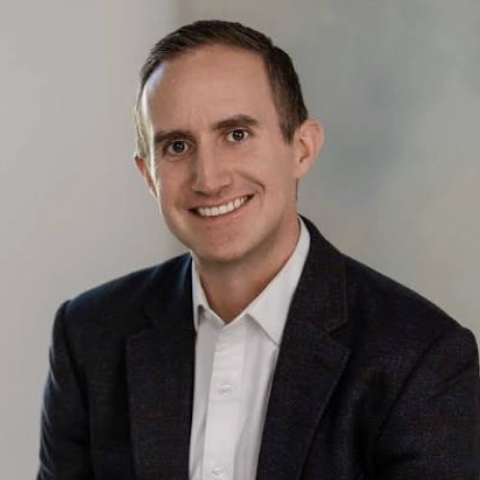
摩根·豪泽尔 谢谢恩·帕里什
EDITED TRANSCRIPT · 依据现场录音编译整理,可划线生成便签
编者按:这是摩根·豪泽尔(Morgan Housel)第三次坐进谢恩·帕里什(Shane Parrish)的播客录音室。豪泽尔是《金钱心理学》《一如既往》的作者,新书《花钱的艺术》讨论人为什么会那样花钱;帕里什是 Farnam Street 的创办人、《清醒思考》的作者,两人相识十五年,彼此熟到可以当面互相打趣。这场谈话从「是什么在驱动你」开始,一路谈到知足与进步、住房危机、遗产、范德比尔特家族的下场、被动收入的假象,以及一个人该如何用钱买回自己的生活。本文依据现场录音编译整理,只删去口语枝节、寒暄与重复,论点与例证一概保留。

榜样与嫉妒

主持人: 你已经非常成功了,书卖了超过一千万册。今天还有什么在驱动你?

豪泽尔: 你自己也非常成功,谢恩,我看着你的东西看了很多年。我提这个不是客套,因为这恰恰是重点:驱动我的,就是像你这样的人,还有詹姆斯·克利尔、迈克尔·刘易斯,那些我一直仰望的人。我不至于狂妄到说「我有一天要成为那个人」,每个人都该按自己的方式来。但我觉得,嫉妒和向往之间有一道很清楚的分界。你完全可以被一个人的成就点燃,同时一点也不嫉妒他。

我能报出半打我真心敬仰的人,觉得他们是很好的榜样,重点是我不嫉妒他们。我也能报出半打我确实嫉妒过的人,名字我就不说了。我试着往里挖一挖:我为什么会嫉妒那个人?答案往往是,他达到了某种成就,但我不喜欢他达到的方式。这当然很主观,也许他们各有各的好,我不想太武断。可我觉得这个区分很重要:生活里哪些人让你受激励,哪些人让你嫉妒。每个人如果肯说实话,两种大概都有。

我真正喜欢仰望的人是这样的:我不只欣赏你在专业上做出的东西,觉得你做得正直体面,而且看上去你自己乐在其中;至少从外面看,你过的那整套生活我都喜欢。这一点特别要紧。因为还有很多人,尤其是金融圈里的,我可以说,兄弟,你的职业生涯漂亮极了,可等我慢慢认识你,我发现你的家庭一团糟,身体也不行,或者你根本不享受自己的日子。那我真的想去追你追到的东西吗?也许不想。所以你问我什么在激励我,我想就是这个:生活里有几个你抬头能看见、可以当北极星的人,这很重要。

另一件我觉得同样重要的事,好像是巴菲特说的:生活里有几个你不愿意让他们失望的人,是件很好的事。人生没有比这更强的动力了,有那么几个人,通常不会多,你真的不想让他们失望。我非常非常不想让我太太和孩子失望,我也非常不想让我父母失望。这是根基。大多数人都会有自己的那个版本。想过好这一生,没有什么比这个更能推着你走。

主持人: 可如果你回到三十年前,看见今天的自己,看见这些财务上的成绩、名声上的成绩,你早就把当年任何一个目标都远远甩在后头了。那为什么还继续?

豪泽尔: 我觉得我身上有一种挺健康的人格分裂。一方面我可以说,我真的很擅长我做的事,我做成了不少,这太棒了;下一秒我又能把开关一拨,说,我什么也不是,我最近写的东西糟透了。整体看,这是一种相当健康的人格。因为如果你只有自负那一面,你早晚把自己开下悬崖;如果你只有谦卑加抑郁那一面,你哪儿也去不了。我很擅长在这两头来回切换,有时候一个小时之内就切完,一天之内那是肯定的。

至于是什么让我继续:首先,我是真的享受我做的事。写作对我从来不像工作。我猜对你也一样,它就是你这个人的延伸,从来不像上班。所以我乐意做。另外推着我的,就是健康的那一半,它说我可以一直做下去,而且能做出好东西;一分钟后肩膀上另一只鸟开口了:你不行,你写得烂透了。再说一次,总的算下来,这是非常健康的人格,哪怕它只由两个极端组成。

钱像疫苗

主持人: 钱能为我们做什么,又不能做什么?

豪泽尔: 它能做的好事可以列一长串,对谁都是。我认为真正成立的是:平均而言,钱多的人糟糕的日子更少,但我不确定他们美好的日子更多。更可能的情况是,当你有了钱,你早上醒来说「唉,日子过得真不顺」的概率下降了。可这不等于你会咧着嘴笑着醒来。这是生活品质的改善。糟糕的日子变少,当然很好,比反过来强太多了,但那不是快乐,完全是两码事。

有些人会因此栽跟头:他们向往快乐,或者认为自己挣到的钱、达成的成就理应让自己快乐。有时候确实会,但很多时候不会。他们醒过来一脸茫然:怎么回事?我以为这会让我快乐,可我并不快乐。所以这里需要把预期摆正。我觉得钱更像疫苗,它能挡掉大量的痛苦,这很了不起,疫苗是好东西,我们今天没有小儿麻痹症,这是大好事。但也正因为这样,这个类比才准:你和我早上醒来不会想「太好了,我没得小儿麻痹症」,我们根本不会去感激这件事,压根想不起来。钱能做的很大一部分就是这种事。它改善你的生活方式,但别指望它让你笑着醒来。

主持人: 有点像氧气吧?有的时候你从来不想它,缺了的那一刻你满脑子只剩它。

豪泽尔: 可我们偏偏想把它当成兴奋剂。我们希望吞下去就说:我现在火力全开,太爽了。短时间内它确实能做到这个。快乐本来就是转瞬即逝的情绪,大多数人一次快乐超不过几分钟。这跟幽默很像:我给你讲一个特别好笑的笑话,你不会笑十年,你笑几分钟。幽默是一闪而过的情绪,快乐也是。大多数人只是拥有一个个快乐的瞬间。你可以把生活安排得让这种瞬间多一些,比过去多一些,但它终究是瞬间。

所以人真正想要的,无论他们是否意识到,是「满足」(contentment),那不是快乐,是另一种情绪。你想抵达的状态是:我挺好的,我对拥有的一切心怀感激,我需要的都有了,我想要的大部分也有了,我对此完全没意见。如果之后还有更多,那是锦上添花,但我在这儿已经很好了,就待在这儿也很好。而且我觉得,多数人只要肯下功夫,并且持续维护,是可以在一个比自己以为的更低的收入水平上抵达那个状态的。

主持人: 我跟丹尼尔·卡尼曼聊过这件事,他区分快乐和「满意」(satisfaction)。快乐是一种情绪,大多数人以为自己想要快乐,其实他们想要的是满意。而满意更多取决于你能讲出一个什么样的人生故事,所以它跟你有多少钱、有多少地位、升过几次职都有关系。你得以对自己说:我做到了,我为此牺牲了那么多东西,也许包括跟伴侣的关系。

豪泽尔: 对。而且我觉得,当你幻想拥有更多成功、更多钱、更多东西的时候,当那个白日梦让你感觉很好,你在想「要是我有那栋房子该多好,要是我有那辆车,要是我有那份收入」,你实际上在做的,是想象自己拥有了那些东西并且对它们彻底心满意足。让人舒服的是这个,这才是白日梦好做的原因。可你想象的那种好感觉,并不是快乐。

你想象自己站在那栋房子里说:就是它了,这就是我需要的全部,这是我需求的顶点。而真实发生的往往是,你住进那栋房子以后开始想:嗯,邻居的院子是不是比我的漂亮一点?或者,厨房是有了,可我在 Instagram 上看到一张照片,我们要不要重新装修一下?真正发生的是,你并没有抵达满足。

我也不觉得「知足」是个脏字,它不是坏东西,尤其放到整个经济里看更不是。我希望活在一个大多数人,特别是聪明人,每天醒来都说「这还不够」的世界里:我们需要更多创新,我们得创办更多成功的企业。所有进步的根源就在于多数人每天早上醒来说这还不够。那些成功得离谱的人,埃隆·马斯克、杰夫·贝索斯,我敢担保马斯克身家四千亿美元每天醒来还是在说这不够。不一定是钱上的不够,虽然可能也有这个成分,更多是技术还不够好、产品还不够好,我们需要更多、更多、更多。

所以不知足是进步的种子,它不是坏事。但你在个人生活里能看到另一面:如果你觉得灵魂里有个洞,觉得自己还不够、还想要更多,那种「只要我不停往洞里铲钱,总有一天就好了」的想法,实际上极难兑现。

主持人: 从进化的角度这也讲得通,进化在乎的是物种的存续,不是个体的快乐。

豪泽尔: 它根本不在乎你快不快乐。进化还有一点:重要的不是我有多少钱,而是我比你多。

主持人: 不是我跑得有多快,而是我得比你快。

豪泽尔: 对。所以在一个我们相对前人足够富足的世界里,我会拿你来衡量我的成功,拿你的房子来衡量我的房子。哪怕按历史标准我的房子已经大得惊人,只要邻居的更大,它一瞬间就显得很小。这件事没有尽头。你完全可以想象,我们的孩子和孙辈拥有的技术和富足是你我无法想象的。我认为概率最高的一种未来是,我们的孩子,或许是孙辈,会活在一个被诊断出癌症不算什么大事的年代。也许这还是痴人说梦,但并非不可想象。而那个世界还有一点:你可以想见,他们不会因此觉得更幸福。奢侈品变成必需品的速度是两秒钟。

二十世纪那些传染病就是这样。猩红热、黄热病、小儿麻痹,全都是。如果你在一九五二年告诉一位家长,很快会有疫苗把小儿麻痹基本消灭,你的孙辈这辈子都不用担心这件事,他会说,我无法想象你们会有多幸福。可我们并不幸福。当然不幸福,人的脑子就不是那么运转的,它会瞬间把标准校准到别人都有的水平上。这就是「不够」的种子。我们几乎永远不会抵达那样一个时刻:不管技术多好、医学多好、房子多大,整个社会所有人早上醒来说,好了,这够了。

独立是一条光谱

主持人: 我十七岁那年,无意中听到我父母跟军方给他们配的理财顾问谈话。我父母都是全职为军队工作的。他们在商量是修屋顶还是修车,因为两样一起修负担不起。我记得当下就在想,我绝不要落到这个处境里:两样都是必须修的东西,我却只能二选一,因为我没钱。那时候我们家不能说穷,我从来没有饿过肚子,但也没什么余裕。那件事改变了我对钱的看法,从那一刻起我就想,我必须变得独立。对我来说,独立就是:我不需要靠一张工资单去修屋顶或者修车。你怎么看钱和独立?

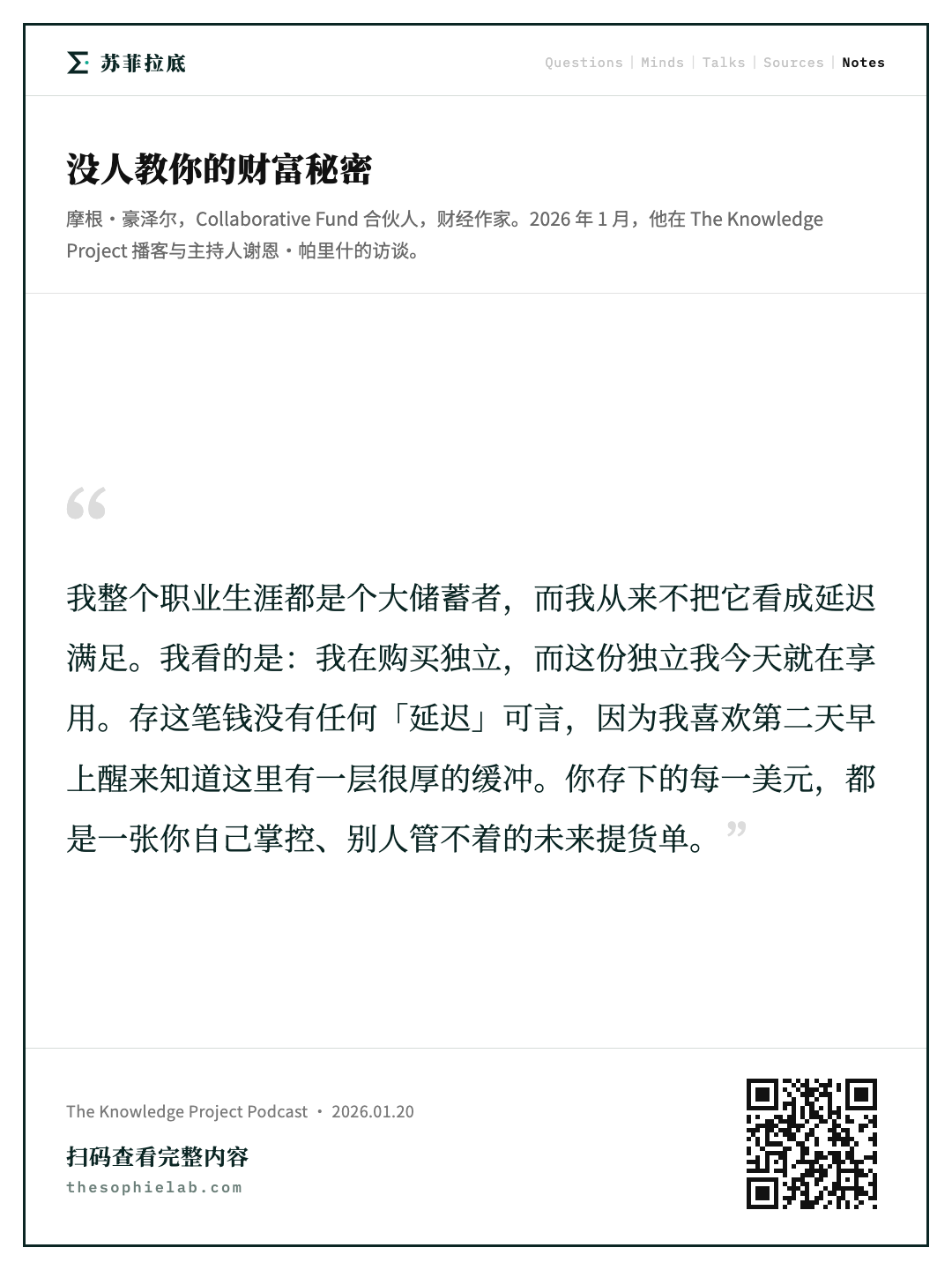
豪泽尔: 你描述的是某个程度的独立,但独立永远是一条光谱。有一种很高程度的独立是你不再需要工作,我随口编个说法,那是第十三级独立。在它下面还有很多层级:哪怕你银行里有一百美元,那也比零要更独立;如果你欠着债,那就更往下走一格。所以你会意识到,你存下的每一美元,都是一张你自己掌控、别人管不着的未来提货单。像这样重新定义独立,把它看成一条光谱,每一美元都是一张独立提货单,我觉得这是很重要的心态。

我整个职业生涯都是个大储蓄者,而我从来不把它看成延迟满足。我看的是:我在购买独立,而这份独立我今天就在享用。存这笔钱没有任何「延迟」可言,因为我喜欢第二天早上醒来知道这里有一层很厚的缓冲。所以,不是「如果」而是「当」生活里出了坏事的时候,不管是个人的事、宏观经济的事,还是一场大流行,我这里有一条很宽的通道,宽到我能扛住很多种结局。越不独立、存款越少、负债越多,你能承受的那条通道就越窄。生活里所有的起起落落,个人的和宏观的,全都发生在这条通道里。通道越宽,你能扛的就越多。

复利的关键,不只是钱的复利,还有关系、职业、友谊的复利,归根到底都在于:你能扛住什么?你能扛住并活下来的未知有多少、有多深?我在《金钱心理学》里写过,如果要用一个词概括「在财务上做得好」,我觉得这个词是「活下来」。

主持人: 完全同意。

豪泽尔: 职业上是这样,储蓄上是这样,投资上也是这样。就是活下来,就是你能扛什么、你能忍什么。这样看,你就会明白,你存下的每一美元都是一张独立提货单,它不只在未来对你有用,今天就在对你有用。

主持人: 四季酒店的创办人伊萨多·夏普有一句很好的话:卓越就是承受痛苦的能力。我们一听到这话,脑子本能地想到肉体的痛,却不会想到心理上的痛,也不会想到财务上的起落,不会想到只是熬下去这件事。因为活不下来就没有复利。

豪泽尔: 是的。

主持人: 关于复利,还有一件事人们容易误解:所有的好处都出现在末尾,不在开头。开头慢得要命,可决定胜负的是最后那一次翻倍。

豪泽尔: 就积累的金额来说确实如此。我在《金钱心理学》里写过,巴菲特百分之九十九的净资产是在他六十五岁生日之后积累的。复利就是这么运作的,数字在末尾会变得离谱。

不过在心理层面可能恰恰相反。说到净资产翻倍这件事,老实讲,我这辈子觉得自己最富有的时刻,是十几岁时银行账户里有一千美元。我记得当时的感觉是,我简直无法想象这么多钱。因为一年前我账户里可能从来没超过二十美元,现在有一千,我理解不了这么大一笔钱。所以从心理上说,起作用的是差距。很多事情都是这样,快感来自对比,就是你现在拥有什么、现在在做什么,相对于你之前拥有什么、之前在做什么。

我在《花钱的艺术》里写到一个人,家里请了私厨,等于一天三顿都在吃米其林水准的饭。你我很容易看着这个说,太夸张了,什么神仙日子。我敢担保他从中感受到的远没有那么多,因为他没有对比。他不是前一天在啃塔可,也不是前一天早餐啃硬掉的面包。当一切都很棒的时候,没有什么会显得很棒。人要的是对比、对比、对比。所以我常常想,关键不一定是你拥有多少,而是它和你此前拥有的对比。

和这个相关的是,人在心理上对「下滑」极其敏感,因为你仍然在跟从前的自己作对比。大家大概都听过那个研究:你宁愿要哪一种?一种是你现在净资产一百万美元,而你曾经有两百万;另一种是你现在五十万,而你曾经只有二十万。心理上,绝大多数人会选后者。

主持人: 因为「我以前有两百万,现在只剩一百万」这种对比,会让你觉得自己比拿五十万还要穷,而五十万是你的历史新高。

豪泽尔: 对,人对下滑的心理非常敏感。

波动是入场费

主持人: 那怎么应对?你有一千美元,那就成了你的基线,是你有过的最多的钱,可它一转眼就变成了你的对比点,变成了你此后衡量所有账户余额的参照点。

豪泽尔: 这里面有一层是这样:经济里之所以存在机会,是因为市场、世界、自由市场一定会让你付出代价才把好东西交给你,它不会白送你财富,你得为它做点什么。而在资本主义里,你要做的事,大体上就是忍受一条没有尽头的链条:不确定性、波动、你没预见到的事。处理这些从来不好玩。衰退、失业、股市跌掉三成,都不好玩,但那就是入场费。一旦你把它看成入场费,而不是对你的惩罚,虽然不见得让它更好受,但至少更容易安放。市场跌两成,你会说,疼,真难受。确实疼。但你同时知道,我之所以长期能做得不错,正是因为我愿意忍受这个。承受痛苦的胃口,或者说承受痛苦的能力,就是一切。

纳西姆·塔勒布说过,每个人都有自己的「喊停点」,到了某个程度你会喊停,你会说太多了,我扛不住了。每个人的那个点都在某处。可我认为,事先很难知道它在哪儿。很少有人能靠预想搞清楚自己对痛苦的耐受度,我觉得你得先在战壕里体验过,才知道自己真实的反应。

我在新冠期间就经历了这个。我是一个写波动的频率、写该如何理解波动心理的人,可二〇二〇年三月,很大程度上因为那不只是股市危机,甚至不只是经济危机,那是一场公共卫生紧急状态,我孩子的学校都关了。我和当时另外几十亿人一样,有过好些个失眠的夜晚,半夜醒来想,接下来会发生什么?

所以,说「别人恐惧时我贪婪」是一回事,真的做到完全是另一回事。你去问大多数人:如果现在股市跌一半,你心理上会怎么样?他们在脑子里做的练习是,想象一个一切都跟今天一模一样、只有股价打了对折的世界。

主持人: 在那个设定下,你当然会说,太棒了,好极了。

豪泽尔: 但之所以会有波动,恰恰是因为世界上正在发生某件事,没有人知道接下来会怎样,多半也没人预料到它会来,而且它多半对你和你家人的福祉构成真实的威胁,可能还包括健康上的威胁。在那种情境里,要说出「着眼长期,买入」就难多了。你可以做到,好的人做到了,好的投资者做到了,但说起来永远比做起来容易。

主持人: 大概二〇一二、二〇一三年的时候,我跟一位所有人都听过名字的顶尖投资人聊天,聊到巴菲特,聊到我们是怎么应付金融危机的。我转述他的大意:那些想当巴菲特的人全都站在场边。他们等这一刻等了很久,跟投资人讲过,也写文章写过,结果它真的来了,他们却僵住了。

豪泽尔: 最后能真正做到的大概只有一成。但本来就该是这样。不可能所有读过《聪明的投资者》的人,都能出去把最深的那个机会吃掉。它当然难。我常用一个类比:大学运动员里有多少比例能打进 NBA?我不知道确切数字,但我猜大概百分之一,也许百分之三。大家会说,本来就该这样嘛。

主持人: 对,这才正常。

豪泽尔: 不可能存在一个所有想当职业篮球运动员的人都能当上的世界,那本来就是金字塔最尖上的一小撮。投资也一样。不该存在一个所有有野心的选股人都能跑赢市场的世界。所以每次听到「百分之九十五的共同基金跑输基准」这类统计,我都想说,那你还指望什么?你指望是百分之百?指望所有下场的人都躺着印钞票?它当然难。当然,在真实处境里,每个人都以为自己是那能做到的百分之一。可只有极少数人能做到,这件事不该让任何人吃惊。

买房这件事

主持人: 对大多数人来说,房子是他们最大的一笔支出。什么时候买房是合理的,什么时候不合理?

豪泽尔: 合理的情形是:这个社区适合你和你的家人,你打算在这里长住,而且价格在你家庭预算的合理范围内。至于「合理范围」是收入的百分之多少,那是另一个话题。但你不该因为某种错失恐惧去买房,哪怕你自己心里并不这么表述:房价涨了这么多,那栋房子看着真漂亮,我们其实买不起,或者要拼尽全力才买得起,可是搬进去生活一定会好得多。这是买房最糟糕的理由。

这里有一部分我特别能共情,我甚至认为它能解释西方世界很大一部分生育危机:大多数父母,哪怕嘴上不说,也希望在生第一个孩子之前先打上几个勾,其中最大的一个勾就是有自己的房子。而房子在整个西方世界越来越买不起,英国是这样,加拿大是这样,澳大利亚也是这样。房子越买不起,就越会出现这样的情形:一群好人,有体面的工作,婚姻稳固,二十八、二十九岁,放在任何别的年代都该开始生孩子了,今天他们却说,不行,我真的希望先有一套房子,有那种「我已经稳稳站进成年生活」的感觉,然后再生。而在这个前提迟迟无法满足的情况下,它带来的问题极其严重。

住房,尤其是可负担的住房,我认为是美国最大的单一社会问题,现在的加拿大大概也是。因为很多看上去比它更大的社会问题,其实都在它的下游。相当一部分毒品危机是买不起房的下游产物,生育危机是它的下游产物,政治的败坏也是。因为如果你不觉得自己在这个社区、这个国家里有投入,你就更容易说,烧了算了,政治崩不崩溃关我什么事?你没有投入,你在这个系统里是漂着的,你随时可以搬去别的城市。我自己是有房的,我知道我非常在意本地政治,非常在意附近的公园和学校,我对这个社区投入很深。但如果你没有,你是真不在乎。所以我觉得,今天政治里发生的很多事都能牵回到住房买不起这件事上。

塔克·卡尔森说过一句我不常同意他、但我觉得既深刻又真实的话,大意是:衡量一个国家是否健康,一个很好的代理指标是,一个二十八岁的人能不能买得起房。我当时想,说得真好,这是个非常好的经验法则。而大家都知道,在美国、加拿大、英国,现在大体上买不起。

主持人: 是啊,很难。这件事得在好几个层面上一起解决。老师应该能住在自己教书的社区里,消防员应该能住在自己出勤的社区里。一个全职工作的人,我觉得哪怕不到二十八岁,二十四、二十五岁,也应该供得起一笔房贷。我真希望看到这个问题被解决。

豪泽尔: 这件事之所以特别让人火大,之所以值得大家举着草叉火把上街,是因为我不认为这么说算简化:第一,这个问题很好解决;第二,它纯粹就是一个选择。

房子之所以这么贵,几乎全部的原因是我们建得不够;而我们建得不够的原因是分区管制(zoning)。我不觉得这是简化。土地有的是,资本有的是,需求也有的是。而且有现成的例子:有些非常大、非常密集的城市,住房相对便宜。东京,巨型城市,比你我现在所在的纽约还大,住房相对而言很便宜,因为他们一直在建、建、建、建。

我们不建,尤其跟前几代人比。你回到一九五〇、六〇年代的美国,到处都是工地,放眼望去都是新社区。因为那样,我们增加了供给,房子相对买得起。现在我们不建了。这是一个选择。说人们「想要」买不起的房子,未免太犬儒,但不建到我们真正需要的量,确实是一个选择。

主持人: 这里有个古怪的激励:所有已经有房的人,一听到「可负担」,想的是这会怎么影响我的净值。如果房价跌一成,而我是加了杠杆的,那一成的回撤可能会抹掉我七成五的净值。

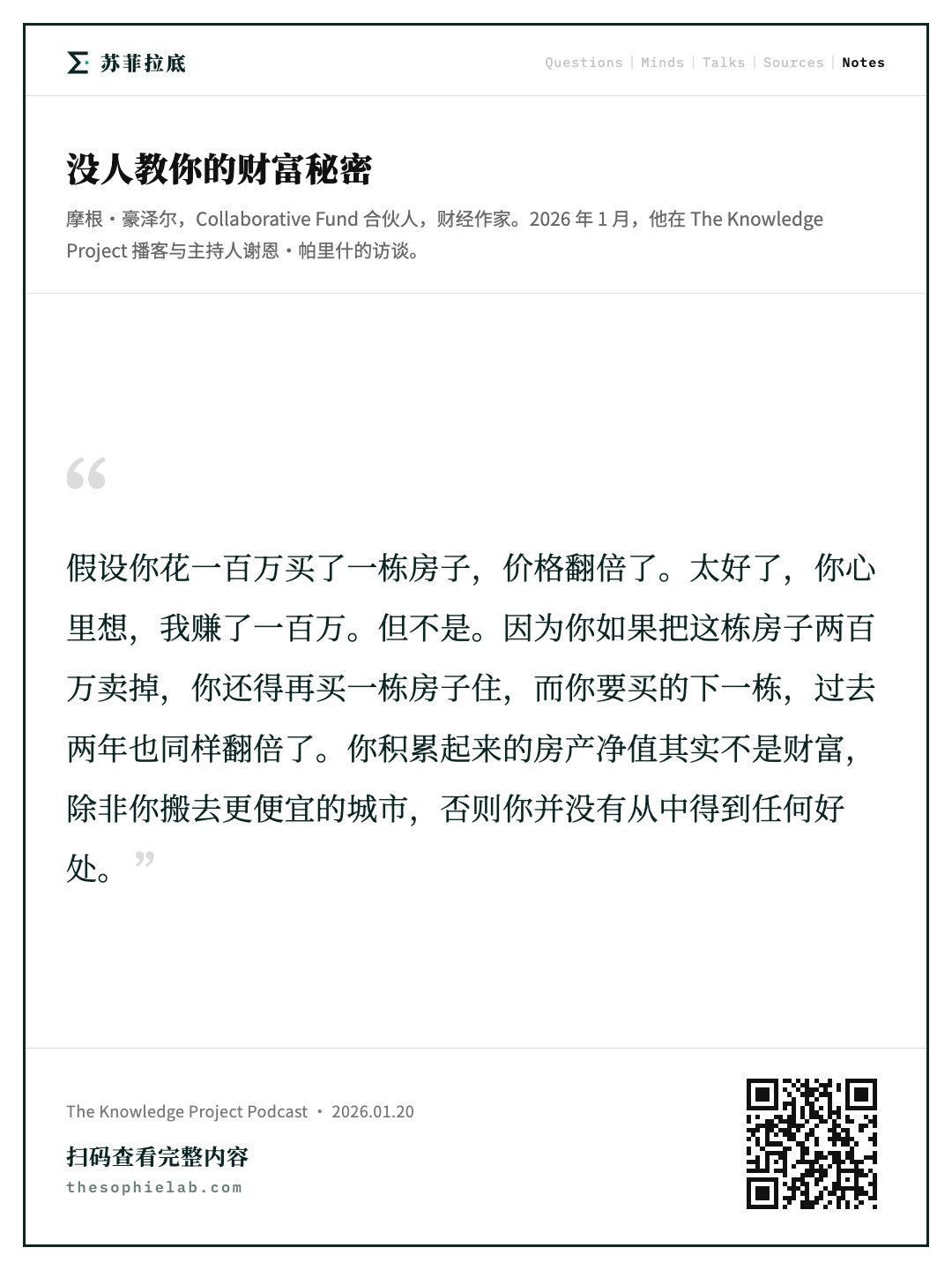
豪泽尔: 但我认为这个想法本身也是错的,我说说为什么。假设你花一百万买了一栋房子,价格翻倍了。太好了,你心里想,我赚了一百万。

主持人: 对。

豪泽尔: 但不是。因为你如果把这栋房子两百万卖掉,你还得再买一栋房子住。而你要买的下一栋,过去两年也同样翻倍了。所以这是个幻影:你积累起来的房产净值其实不是财富,因为你卖掉这栋房子以后,多半得买一栋涨幅一样的房子。除非你搬去更便宜的城市,这当然也会发生,否则你并没有从中得到任何好处。

我和我太太去年就亲身经历了。我们原来住的房子四年里翻了一倍,这本来不该发生,但它就是发生了。房子翻倍,我们大约一年前把它卖了,买了新房,而新房的价格也是它四年前售价的两倍。所以我们真的赚到钱了吗?其实没帮上我们多少忙。反过来,如果我们活在一个房价永远不涨的世界里,当然会有一大堆房主叫屈,说我以前能攒下净值,现在攒不了了。可事实是,他们的处境其实一样好,因为他们卖掉房子后能买的那些房子,价格也同样低了。

主持人: 我看过一些报告,至少在加拿大,一栋新房价格里大约三成是各种政府收费。

豪泽尔: 我信。

主持人: 太离谱了,这是在拖慢一切。这个话题我们先放下。我想转到另一个:你到底是怎么投资的?一步一步说给我听。

我的投资简单到无聊

豪泽尔: 这不会是一场很长的对话,因为它很简单。我定投指数基金,打算持有五十年,就这样。我全部的净资产就是一栋房子、现金、先锋的指数基金,以及马克尔保险(Markel)的股票,我是那家公司的董事。就这些。

我不认为它有必要更复杂。在金融里有一种非常本能的想法:只有当我的资产组合看起来像一台鲁布·戈德堡机械,足够复杂,有一堆杠杆和策略,我才能做得最好。不是这样。我不否认聪明人可以靠复杂的交易在财务上做得很好,我只是觉得那完全不是必要的。

这跟健康也许有个类比。有些很有名的「生物黑客」,他们把身体当成一台鲁布·戈德堡机械,想把每个环节都调到极致,吃这些药、用这套食谱。我不觉得那必然是坏事,但作为一个完全不懂健康的人,我的看法是:如果你就是好好吃饭、睡够八小时、一周锻炼几次,那大概就够了,大概已经拿到了生物黑客那套结果的百分之九十或九十五,甚至可能是百分之百。我觉得这个判断大体成立。

我看待财务的方式非常类似。我这套简单得让人难受的安排,我敢打赌,不是在某一年,而是在一辈子的尺度上,跟一个交易频繁、结构复杂的人相比,不仅可能打平,还很可能超过他。而我几乎没花任何力气。这就是我这么做的原因。我不建议别人也这么做,它只是适合我的性格,而且它让我能把注意力放在我真正在意的变量上,那就是耐力。越简单就越轻松,我把它坚持下去的概率就越高。要是它很复杂,那我可能会在经济、职业生涯或者认知能力的某个阶段撑不下去。所以,我能原封不动地放着它五十年的概率越高,你最终把财富最大化的概率也就越高。

主持人: 我喜欢这种思路。那假设一百美元进了你家门,它怎么被分配?

豪泽尔: 我做很多心理账户。我知道钱是可替换的,一美元跟另一美元没有区别。但在我自己的生活里,我卖书、去会议上演讲、还做些别的事情,我脑子里就是:卖书的钱放这儿,演讲的钱放那儿,这笔拿来花,那笔不动。我有一大堆并不理性的心理账户,但我就是这么想事情的。

我把卖书的钱全存下来了,一分钱都没花过。我再说一遍,我不把这看成延迟满足。它让我获得了财务独立,而这份独立是我今天就在享用的,非常有用。我太太和我,十年前是这样,今天也是这样:我们想买什么就买什么。只不过十年前我们想要的并不多。现在有了孩子,人生经验多了一些,我们稍微放松了一点。但我们基本上没有预算。

主持人: 完全没有?

豪泽尔: 我从十几岁起就是这样。我从来没觉得存钱难,它对我一直像是理所当然该做的事。

主持人: 你在哪方面放松得最多?

豪泽尔: 大概是房子。我们一年前买了一栋很不错的房子。好就好在,我在家工作,我太太也在家,我们百分之九十九的时间都在那儿,那是我们生活的核心,那你就该好好享受它。而且我觉得这房子最棒的一点是,别人基本上看不见它。它不是我开着在城里晃的车,也不是我希望别人在机场注意到的衣服,它就是给我们自己的,是内部标尺。我喜欢它。我很享受这样一件事:我是个早起的人,比我太太和孩子早三个小时起床,我非常珍惜这段时间。我喜欢一个人在黑暗里下楼,端着一杯咖啡坐在沙发上,四下看看,心想,嗯,挺好的,我喜欢这样。而关键在于,没有任何人看见我这么做。我不是在给陌生人表演。

主持人: 它不是身份象征。

豪泽尔: 不是身份象征,完全是内部标尺。所以就算我们在这上面,我不想说「投入过度」,但那确实是我们唯一觉得「这对我们来说值」的东西,在这儿花很多钱完全值得。

主持人: 几周前我跟巴里·迪勒聊天,他讲了一件关于房子的事,一直留在我脑子里。他说,小时候他看那些房子,发现里面很少有外面那么漂亮。

豪泽尔: 对。因为外面是给人看的,你希望有人开车路过时说,哎哟,看看这户人家。我觉得这是真的:你想想,请园丁、请景观师的人,和请室内设计师的人,哪一种更多?当然我们这是在谈发达国家的烦恼,但我敢说请景观师的人多得多。一部分原因是他们不想弄脏手,另一部分原因是,不管你有没有自觉,你希望包括陌生人在内的人开车经过时说,这房子真漂亮,不知道住的是谁。可屋里的样子,至少相对而言,可能是一团糟。

主持人: 我第一次听到这句话时,往另一个方向理解了:里面的意思是婚姻有问题、孩子有问题。就是那种我们从小仰望的人家,你想住进那栋房子,过那样的生活,可你要是推开门走进那种生活,看到的是孩子不跟父母说话。

豪泽尔: 是啊。我想起一个很具体的例子。「吹牛老爹」,他自己有一堆法律问题和道德问题,大家都认识他。几年前他被起诉的过程中,警方公布了他家内部的照片,我记得是洛杉矶那栋,也可能是迈阿密。从外面看,那当然是一座不折不扣的豪宅。可那些公布出来的犯罪现场照片里,屋里就是个垃圾场,真的是垃圾场。

主持人: 天哪。

豪泽尔: 我当时就觉得很有意思。从外面看,尤其是这样的名人,开车路过的人看见的是豪宅;可屋里只有我和孩子的时候,管他呢,就是个垃圾场。我觉得这件事很说明问题。

人生的四个十年

主持人: 如果把人生分成四个大的阶段,二十几岁、三十几岁、四十几岁、五十几岁,人应该怎么看待在这些阶段里挣钱和花钱?

豪泽尔: 每个人差别太大了,有人十四岁就找到了方向,有人四十岁才找到,还有人一辈子都没找到。所以我很犹豫给出一个公式。但我觉得有一个粗略的、灰度的而不是黑白分明的规律大体成立:从出生到二十岁,你在形成身份认同,你在弄清楚自己是谁,弄清楚自己这个人是怎么接线的。二十到三十岁,你大体上在学一门手艺。到三十几岁,你可以把这门手艺投入使用。到四十几、五十几岁,顺利的话,你可以真正把这门手艺用到极致,并且靠它挣到钱。作为一个非常粗的人生公式,这可以是很好的。

当然,我能举出一百万个没走这条路、最后也过得很好、很幸福的例子,所以这绝不是唯一的路。但总体而言,我觉得它大致成立。你很难遇到一个很成功的人,身上完全没有类似的轨迹。偶尔你会碰到少年时代就找到方向的人,二十三岁就在赚大钱,二十八岁基本上可以退休了。这种人是存在的。但我觉得,一个人在二十五、三十、三十五岁之前,很难知道自己是谁。

前几天有人问我怎么看 Z 世代,因为关于 Z 世代的文章铺天盖地:漫无目标、任性、缺乏职业伦理,诸如此类的评论到处都是。这提醒了我:仿佛就在昨天,十五年前所有人都是这么说我们这一代,说千禧一代漫无目标、没有职业道德、没有婴儿潮一代和更早的人所持的价值观。你回到一九七〇年代,他们对婴儿潮一代说的一模一样:漫无目标,没有职业道德,没有价值观。再回到三十年代,他们对今天被我们称作「最伟大的一代」的那批人说的也一模一样:没有道德,没有职业道德,漫无目标。

我觉得真相是,无论哪一代人,都不可能优雅体面地度过自己的二十几岁。那是非常难熬的一段,因为你还在弄清楚自己是谁。你名义上是成年人了,名义上独立了,算是离开了摇篮,正在摸索自己,可极少有人真的摸清楚。我认为这在代际层面上同样成立,所以年长的一代去批评眼下这一批二十来岁的人,既容易又几乎不可避免。

主持人: 我还记得自己二十几岁时的财务想法。我当时结了婚,我们靠一份工资生活。因为你是从没钱、基本上在学生会大楼的垃圾桶里找吃的,一下子跳到每两周有一张工资单,那种感觉很疯狂。所以我们就想,那我们靠一份工资过日子,把另一份存起来。当时的逻辑是,如果二十几岁做对了,就等于为接下来的五十年铺好了路。而所谓做对,让我们跟所有朋友都不一样:他们在买房子、装泳池,我们住在一居室公寓里,靠一份工资勉强糊口,不去度假,那些事一概不做。但我们从来没觉得自己缺了什么,因为我们心里想的是,他们在过月光的日子。我们的生活确实远没有他们的好,可只要我们能这样撑十年,三十几岁就会轻松一点,四十几岁更轻松。然后随着年纪增长,你对钱的想法又会变,四十几、五十几岁你开始想,我得退休了,我怎么在经济上照顾我父母,我怎么把房贷还完。你怎么看这些节点对人的影响?

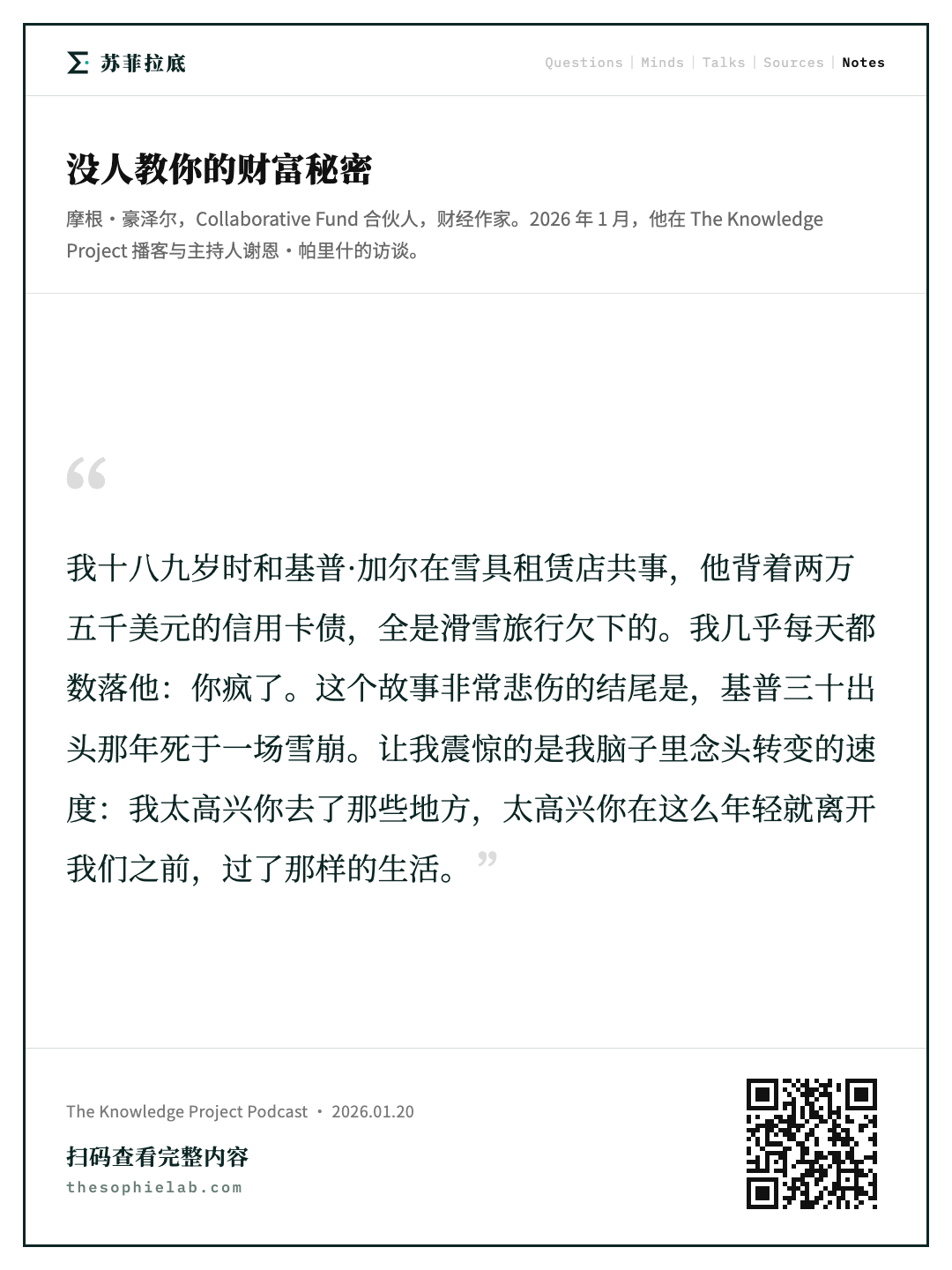
豪泽尔: 我以前讲过一个故事,但没有很仔细地想过它。我大概十八九岁的时候,跟一个二十八岁左右的人一起工作,他比我大一点,我们在一家滑雪度假村的雪具租赁店里共事。他叫基普·加尔。特别酷的一个人。我认识他那会儿,他背着两万五千美元的信用卡债,全是滑雪旅行欠下的。他去欧洲滑过雪,去南美滑过雪,等等。当时我心想,两万五的卡债,你是个疯子。

主持人: 你不是疯子,你是个蠢货。

豪泽尔: 我为这件事没少数落他,几乎每天都要说一句:你疯了,我理解不了。而这个故事非常悲伤的结尾是,基普三十岁还是三十二岁那年死于一场滑雪事故。让我震惊的是,我脑子里念头转变的速度:我太高兴你去了那些地方,我太高兴你在这么年轻就离开我们之前,过了那样的生活。

我常常想这件事。当然,谁都不该按照自己会在三十二岁死掉的假设去生活,那不是恰当的活法。但我常想,你该问自己的问题是:如果你躺在临终的床上,或者正盯着死亡的枪口,你会后悔什么?你会回头看到什么?基普死于一场滑雪事故,其实更像是登山事故,他在徒步上山的路上,被一场巨大的雪崩击中。我一直在想,那一刻他有没有几秒钟意识到自己要死了,有没有走马灯。以我对他的了解,以他过的那种生活,如果他真的看见走马灯,他大概会想:太他妈值了,我干了不少很酷的事。

所以问题是,你会后悔什么?我这一辈子,整个成年阶段,都是个大储蓄者。如果明天,但愿不会,我落到那个处境里,我不会为那些没去成的旅行后悔。因为我会从这件事里得到巨大的宽慰:因为我存了钱,我太太和孩子不会有事。对我来说没有什么比这更重要。反过来,如果我盯着那个枪口时知道,不仅我走了,而且我太太和孩子从此陷入困境,我会后悔到无法承受。

所以这件事从来不是「活在当下」还是「为明天存钱」那么简单。它永远是:你在未来某个时刻最可能后悔什么?可能是一年后,也可能是七十年后的临终床上。不管是什么时候,要一直想着你的后悔容量,想着你最可能后悔的是什么。我的后悔大概跟你的不一样,跟基普的更是天差地别。我就是这么想的:你得不停地想,你在未来最可能后悔什么。

主持人: 关于花钱,你会给年轻时的自己什么建议?

豪泽尔: 最近有人问我这个,我觉得很有意思。回到我十九岁那年,那个年纪的我们都差不多。我是个储蓄者,但在十九岁,存下一百美元就算壮举了,那简直是英雄行为;要是存下一千美元,哇,太夸张了。假设我把那一百美元投出去了,按市场这些年的表现,今天大概值五百美元。可五百美元对今天的我来说没什么分量,不算什么大事。那这笔钱到底值不值?如果有一台时光机,十九岁的摩根是不是该用那一百美元请朋友吃顿饭,而不是把它投成一笔对今天的我毫无意义的钱?

我的回答是,我觉得这个算法本身就不对。因为我认为,一个人不可能在年轻时抱着「及时行乐、月光过日子」的心态,然后假设自己三十五岁一拨开关就变成储蓄者。我之所以到今天还算有不错的理财习惯,至少在我自己看来,是因为我十九岁就开始了。重点不是那一百美元变成了五百,而是我在那个时期养成的习惯把我带到了今天。我没法在三十五岁那年把习惯换掉,事情不是那样运作的。所以,对于那些当年对我是一大笔钱、如今数额微不足道的储蓄,我一点都不后悔。真正起决定作用的,是我在那时候养成的习惯。

主持人: 看来下次吃饭该你买单了。

豪泽尔: 我来,没问题。上次好像是你付的,那我确实欠你一顿。

富养的分寸

主持人: 你现在很富裕。在跟孩子有关的金钱教育上,你怎么想?你会做什么,又刻意避免什么?

豪泽尔: 我上周刚跟一个人聊过这个。他父母是第一代移民,从别的国家搬到美国,拼了命地工作养大孩子,包括他。现在他自己有了女儿,他说,摩根,我担心她被宠坏了,至少跟我小时候的生活比是这样。她有这个有那个,想买什么玩具就买,她被宠坏了。他问我怎么办。

我说,我敢打赌,如果现在我们能跟你父母对话,他们会说,这就是目标啊。他们搬到美国、拼命工作的全部理由,就是让他们的孙辈在对比之下显得「被宠坏」。

所以,我一方面完全理解,我自己也有那种不想把孩子宠坏的冲动。我希望他们勤奋、独立、懂得一美元的价值,我当然希望,你也希望,我们都希望。但另一方面也该说一句:所有这一切的目的,就是让未来的我、我的孩子、我的孙辈,活在一个按今天的标准看「被宠坏」的世界里。这不正是目标吗?如果我们的曾孙辈过着跟我们今天一模一样的生活,一样辛苦,一样的工时,那不才是失败吗?那太糟糕了。

而且这件事从来如此。你看今天一个普通的美国中产,不是超级富人,就是中产,按一九〇〇年的标准,他被宠坏到极点,绝对是宠到骨子里。如果一九〇〇年的人坐时光机来到今天,他会笑个不停,笑这个人多娇气、他的烦恼多琐碎。但这恰恰就是重点。重点在于我们有创新、有技术,随着时间推移生活变得容易一点。对于吃过更多苦的上一代人来说,下一代总是显得「被宠坏」。可我认为真正发生的事情叫进步。

当然我明白,你希望孩子懂得感恩,希望他们勤奋。但你比较一下今天的人得了流感的反应,跟一百五十年前的标准:那时候你生八个孩子,其中七个活不到五岁就死于传染病。所以「哎哟你得了流感,你头疼了一天」,但我们不是那样想的,我们真的觉得难受。所以永远如此:一代人的进步在上一代眼里都像是娇生惯养,即便那确实是真实的进步。

至于我的孩子,作为一个大致的方针:我想用我有的钱,在一定限度内,为他们的下行风险兜底。我永远不希望他们摔在地上、再也爬不起来。我想在那里做一张安全网,但我不想当燃料。我不想直接给他们一大笔钱,说,你运气真好,你爸妈挣了点钱,现在给你。我认为那大体上不是正确的做法。

我觉得我父母无意中就是这么做的,虽然从来没说破。我在十八岁时凭直觉就知道,如果我摔倒了,他们会接住我,哪怕这从来没人讲出来过。可我同样一清二楚地知道,他们绝不会直接给我开一张支票,那是完全不可能的事。也正因为如此,我觉得我进入成年生活时多了一点底气:我可以冒个险,搬到一座新城市,试一件新事情,就算不成,我也不至于流落街头。那是一种很好的处理方式。所以,教孩子自立。哪怕他们的生活方式按今天的标准看像是娇养,只要他们能自立,他们就能靠自己把日子继续过下去。

主持人: 他们今天的生活,是不是就成了他们的对比点?也就是说,他们在你家里长大时过的生活,会变成他们的参照点。

豪泽尔: 一点没错。一两年前我和太太就遇到这个问题,我们当时在考虑换车,其中一个选项是一辆挺好的车。我就想,假设二十年后我们两个孩子想当幼儿园老师,因为这样,他们买得起的车大概是本田思域或者别的更朴素的车。那我是不是在某种程度上毁了他们的成年生活?因为我把他们的预期设成了:小时候爸妈开的是这个,而我成年后只能开那个。

同时又有一件非常自然的事:做父母的,我希望养出比我们过得更好的孩子,不只是钱上,是生活的许多方面。我觉得孩子自己也想要这种代际的上升曲线,他们希望回头看时说,我小时候在这儿,现在成年了我在这儿,太棒了。超越父母的感觉很好。

主持人: 这是第一代认为这件事可能不会发生的人。

豪泽尔: 我觉得他们总体上大概判断错了。当然会有很多例子确实如此,但我愿意打赌他们错了。不过我认为另一件事是真的:即便从统计上、从分析上看,我的孩子会过上比我们更好的生活,尤其在医疗这类事情上,但由于社交媒体,他们不会比我们当年更能体会到这份进步。

主持人: 是的。

豪泽尔: 因为他们只知道这样一个时代:Instagram 上不是有几个,而是有成千上万乃至上亿个看起来比他们更有钱、更快乐、更聪明、更成功的人。你完全可以想象,即便五十年后你过着沙特王子那样的日子,网上照样有人过得比你更好,于是你坐在自己的黄金宫殿里,为自己感到沮丧。所以,你很容易想象这样一个世界:因为社交媒体,期望的增长速度变成了指数级。

主持人: 这个东西的副作用实在太多。过去我们的参照系是自己那条街,是我们那个小社区,顶多是乔换了辆新车,或者是新自行车。

豪泽尔: 简换了个游泳池。

主持人: 而现在你打开 Instagram,乔有一架湾流,简有一辆布加迪。

豪泽尔: 或者简在照片里有一个笑得灿烂、孩子可爱的完美家庭,而你看不到拍照之前那一通尖叫和撒泼。每个人对别人的印象都是被抬高的。这件事我自己也在做。我会把孩子可爱的照片发上网,我不发他们撒泼的样子,不发争吵的样子。所以每个人都在演,虽然是无辜地在演,但那真的是在演。

主持人: 你在给自己生活的某些部分打掩护。

豪泽尔: 完全如此。偶尔也有人,我确实关注了几个,他们愿意把自己的疮疤晒出来,愿意发那些不好的部分,特别提神。有句话叫「痛苦喜欢有人作伴」。

主持人: 人们真的爱听到自己不是唯一受苦的那个,别人也在经历同样的争吵、压力、焦虑和怀疑。听到这个非常让人安心。

豪泽尔: 是的。

把疮疤露出来

主持人: 我们之前聊过我跟史蒂文·巴特利特做的那期采访,因为做得太差,我们没有播出,那是我的失败,不是史蒂夫的。我把这件事公开发了出来。

豪泽尔: 很有勇气。

主持人: 我当时吓坏了。但我想,人们看到的全是成功:书卖得好,播客做得好,通讯做得好,大家会想,谢恩这家伙真行。发出去之后那几天我很难受。

豪泽尔: 我记得你发的那条。我当时的反应是:好样的。作为一个旁观者,我的反应绝不是「瞧谢恩这个小丑,在台上摔了个跟头」,完全相反,我的反应是,兄弟,干得漂亮。因为我自己有过很多失败,知道我不是孤零零一个人,这让我很受用。

我这辈子写过四千篇博客文章,对我意义最大的那一篇,是二〇一七年写的,题目叫《战胜你的心魔》。我在里面写到我从小口吃得很严重,说话对我极其困难,老实说一直到三十出头才算好起来。回到我的童年,我几乎说不出话,说完整一句话对我都很难,是很严重的口吃。我写了那个过程,写了我部分地是怎么克服它的。

我当时非常犹豫要不要发。一是它看上去像一篇「快看我」的文章;二是,尽管本意不是这样,它看上去像在钓同情。但我在文章里提的一个要点是:每个人都有自己的心魔,而你通常不知道。

主持人: 确实。

豪泽尔: 其实口吃的人很多,只是你通常察觉不到,因为大多数口吃的人干脆就少说话。我敢担保,你身边有个朋友或者同事,你以为他性格安静,其实他不是安静,他只是不想开口,因为开口对他很吃力。这就是一个例子:很多人身上带着你完全不知道的心魔,人人都有自己的版本。而当你把自己的那份摊开来,别人会非常喜欢,因为这让他们觉得没那么孤单。

主持人: 后来发生的正是这样。那篇东西之后,我收到的短信和联络比任何一篇都多。而且内容不是我担心的「你在钓同情」,而是「天哪,我上周也遇到了这种事,我也彻底搞砸了一件事」。人一下子就不觉得孤单了。

豪泽尔: 最普遍的感受之一就是:所有人都在高歌猛进,只有我在挣扎。因为你能看到的只有别人的外面,你看到的基本上是他们希望你看到的那场演出,可你对自己脑子里跑过的那些念头一清二楚:那些怀疑、焦虑、担忧,那些从来没有暴露过的东西。我觉得,如果你能钻进每个人的脑子里,看见他们的念头,你会发现人们比你以为的焦虑一百倍,比你以为的有趣一百倍,也比你以为的更多疑、更抑郁一百倍。正反两个方向都是,你会意识到情绪的幅度比你想的大一百倍。因为大多数时候,人给你看的是他希望你看的那一面,那是演出。

遗产什么时候给

主持人: 你怎么看遗产?

豪泽尔: 我喜欢比尔·帕金斯说清楚的那个想法,他写了《最优解人生》。这个想法不是他最早提出的,但近年是他讲透的:如果你打算给孩子钱,就在他们需要的时候给,那大概是三十几岁到四十几岁,他们开始组建自己家庭的时候。我知道这跟我们刚才聊的有点矛盾。

「我要等,我要让你一直等到我死,那时候你可能七十岁了,然后你可以拿走全部」,这是一种很奇怪的哲学。它是最常见的哲学,但也确实奇怪。我承认这事很难说清,我自己也还不知道我和太太最后会怎么处理。但如果你能在孩子三十岁时帮他们买一栋房子,这对他们人生的助推,会远远大于你死后他们七十五岁时拿到的一百万美元。

芒格讲过一件事:他一位非常有钱的朋友来问,查理,如果我把钱全留给孩子,会不会毁掉他们的进取心?芒格说,会啊,当然会,但你还是得这么做。朋友问,为什么?芒格说,因为你要是不这么做,他们会恨你。我觉得这话有几分道理,而且不只对亿万富豪家庭成立。我认为怨恨是真会产生的,我也理解那种怨恨:一个四十岁的人拼死拼活、月光度日,而他的父母,我随便举个例子,在佛罗里达退休,每天打高尔夫。我理解这为什么会让人心里不舒服,父母的态度基本上是「将来这些都是你的」,而孩子想的是「我更希望那个将来就是现在」。这是个非常复杂的话题,我不认为有什么正确公式,但总体上我喜欢那种哲学。

主持人: 我们能从范德比尔特家族身上学到什么?

豪泽尔: 在所有的强盗大亨家族里,他们的故居离我们现在录音的地方不远。我觉得卡内基家族和洛克菲勒家族做得相当不错,既用财富给了自己好生活,也让社会受益。不是完美,但以他们掌握的钱的体量来说,做得挺好。洛克菲勒家族今天仍然富有,还有几十亿美元。美国的每个城市都有卡内基图书馆,还有卡内基音乐厅,这些东西留下来了。

而范德比尔特家族,我认为是做得最差的,差得很远。很难想象还有哪个家族,握着相当于今天几千亿美元的财富,却在这么短的时间里把它挥霍掉。我对他们其实有几分同情,因为我不认为他们是故意的。我想,当科尼利厄斯·范德比尔特在十九世纪去世时,他的想法是不希望家族里任何人再吃一点苦。他说的是:你们会有花不完的钱,可以像国王一样活到老,一代接一代接一代。

而这件事无意中造成的后果,尽管当时就有人预见到,是塑造出一个除了钱什么也不看重的家族,钱成了他们的独裁者。钱告诉他们能成为谁,告诉他们能住在哪里,告诉他们性格可以是什么样,告诉他们该看重什么,告诉他们能跟谁结婚、能跟谁来往。而这一切当中很大一部分,根本不是他们本来的样子。于是你就有了这样一群人:十八岁继承相当于一百亿美元的财富,却基本上是自己人生里的木偶。他们像是在自己的人生里扮演一个角色,因为他们真正想成为的是完全不同的人。也许他们想住在农场上,过非常朴素的生活,可家族结构说,不行,你要住在第五大道一栋五万平方英尺的房子里,办舞会,住在游艇上,向别人炫耀。这就是你必须成为的样子,你是范德比尔特,你只能是这个。

我认为他们当中绝大多数人因此过得很痛苦。一直要到这笔钱基本耗尽之后,后面那几代人才被毫不留情地「放走」,而他们的感受是,能被放走、能做自己是一种运气。这件事现在广为人知了,第一批获得这种自由的范德比尔特后人之一,就是 CNN 的记者安德森·库珀。说他是家族里第一个有幸做自己、过自己生活、不必去撑起「范德比尔特继承人」这个头衔的人,多少有点夸张,但他确实是最早的那几个之一,而那个头衔跟他的性格完全不搭。

主持人: 他为此写过一本书,对吧?

豪泽尔: 他写了一本讲范德比尔特家族历史的书,也讲了他们和同时代其他强盗大亨家族的关系。这些故事也不全是负面的,你去读范德比尔特家族的传记,不是全负面。但那种生活离你所以为的、一个十八岁生日就继承一百亿美元的人该有的幸福,差得非常远,非常非常远。所以,我当然也想有更高的净资产,我想变富。但你只有拿放大镜去看那些富得难以置信的人,看钱为他们做了什么、又不能为他们做什么,才真正看清钱做不到的事。

财富与婚姻

主持人: 财富会怎样影响你和伴侣的关系?

豪泽尔: 我觉得完全没有影响。这个问题很好,因为我发现自己压根没想过。我太太和我是很年轻的时候认识的,十九、二十岁,那时什么都没有,也没有钱,我们是大学生,当然一无所有。那我们今天更幸福吗?我们对生活的感受不一样了,因为我们在一起二十年了,有两个可爱的孩子,所以我们看待人生的方式不同,也有一种成就感。但要说更幸福吗?我觉得没有。

这并不罕见。不是所有人,但很多人如果你问他们,你一生中最快乐、笑得最多、最尽兴的是哪一段,很多人会告诉你是高中、大学。

主持人: 高中、大学。

豪泽尔: 跟哥们儿混在一起,派对,我们干了这件疯事那件疯事。而那个年纪一个共同的特点是:你没有钱。可你完全有能力跟朋友玩得很开心,笑,出去,参加派对,来一次公路旅行,什么都行。让我和我太太开心的那些事,我们喜欢遛狗,十年前就跟今天一样喜欢;在养狗之前,我们喜欢散步,喜欢聊天,喜欢笑,那些事一分钱都不花。我觉得这就是「钱做不到的事」清单最好的例子。

所以,跟十年前的我相比,我太太更爱我了吗?没有。我的孩子更爱我了吗?没有。不过下滑的心理学在这里又会起作用:如果我的事业垮了,而且是我自己的错,我太太会不会少爱我一点?也许会,因为下滑的心理,还有照顾家庭这件事,会掺进来。如果我们不得不卖掉房子,搬进一间满是蟑螂的公寓,我的孩子会不会看轻我?也许会。所以确实有一部分成分在,尤其在往下走的时候,不过往上走的时候也有。它的心理机制未必是你以为的那样。我太太看重的,当然这一点也不是我独有的,是我是个好丈夫:我上心,我倾听,我帮得上忙,我懂得感激。而不是我们的房子有多大、我们的车有多快。

主持人: 那是个很好的位置。

从花钱看人

主持人: 从一个人怎么花钱,你能了解到他什么?

豪泽尔: 我觉得那是一扇非常有洞察力的窗。钱是世界上最重要的东西吗?当然不是。它是你人生中最重要的东西吗?绝对不是。但它是一扇非常清楚的窗,让你看见一个人怎么看待社会性的向往、自信、自我怀疑,以及很多别的东西。我能列出半打明显比钱更重要的东西:健康,幽默,跟人的关系,都比钱重要。但当你看一个人怎么花钱,你会说,噢,我能看出你不少事。如果我看到你的银行账户和信用卡账单,我能从中了解你,了解的程度大概相当于花几天时间跟你相处。

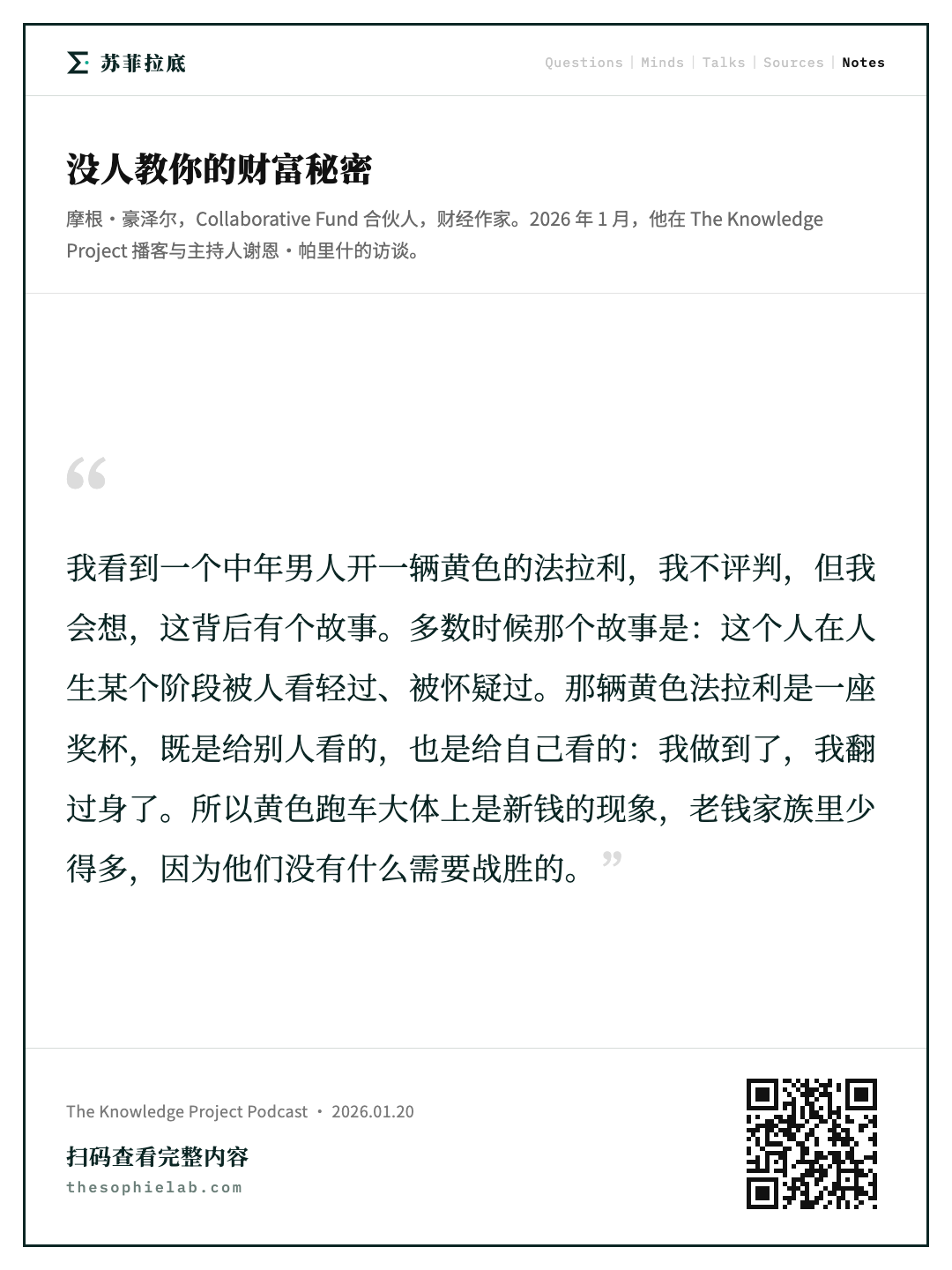
甚至光看人怎么穿衣服都很有意思。我常讲一件事,当然这是有灰度的,也有例外:我看到一个中年男人开一辆黄色的法拉利,我不评判,但我会想,这背后有个故事。

主持人: 对。

豪泽尔: 而且我敢说,多数时候,不是所有时候,那个故事是:这个人在人生某个阶段被人看轻过、被怀疑过,或者自己怀疑过自己。那辆黄色法拉利是一座奖杯,既是给别人看的,也是给自己看的:我做到了,我翻过身了。就是这样。这也是为什么我觉得,黄色跑车这种东西大体上是新钱的现象,老钱家族里很少,或者说少得多。因为新富起来的人会有一种「我战胜了什么」的雪耻感:我以前穷,现在不穷了,我希望别人知道,我也希望自己看到。那是给自己的奖杯。而老钱家族的态度更接近:我们一直就有这个,我们没有什么需要战胜的。

主持人: 那是一种理所当然。

豪泽尔: 是一种理所当然,对。

主持人: 我看那些人,还是用黄色法拉利做例子,我会想,这人肩上扛着一股气,同时,眨眨眼,我也能共情。我不觉得那是坏事,这不是批评。

豪泽尔: 我在《花钱的艺术》里写过一个亲戚,他从小穷到无家可归、进过寄养系统的那种穷,后来成了非常成功的商人。他女儿准备上大学的时候,他跟她说:请你挑你能进的最贵的学校,求你了。几乎就是越贵越好。

主持人: 因为那样他心里更舒服。

豪泽尔: 他为自己战胜的东西感到极其骄傲。他能说出「我曾经无家可归,现在我送女儿去一所一年七万美元的学校」,这对他内心就是一座奖杯。甚至不是在向别人发信号,我想他那天晚上上床时想的是:我做到了,我真做到了。所以,很多花钱行为并不是效用,甚至不是理性的。很多时候,它是在填补你人生某个阶段留下的一个心理的洞。

主持人: 我们有位共同的朋友布伦特·贝索,他有个概念我从此一直在用:干净的燃料和肮脏的燃料,说的是什么在驱动你。他主张干净的燃料是更好的来源。我的反驳是,肮脏的燃料烧不完,你用不尽它,它一直推着你往前。它在某种程度上推动着整个社会,也可能就是它推着那个人去买黄色法拉利,或者把孩子送进最贵的学校。

豪泽尔: 而他们是通过在这个世界上创造了某种经济价值、并因此得到回报,才做成这件事的。那就是他们的身份象征,随便是什么,继续烧就是了。

我对每个人的「那个东西」变得远没有以前犬儒和爱评判了。所以我再说一次,我看到黄色法拉利,我不评判你,但我知道那背后有故事。而现在我也有我的故事。我有我自己的不安全感、缺陷和毛病,人人都有,只是表达方式不同。也许我前面提到的那件事就是例子:我一直是个大储蓄者。不,不是「也许」,我几乎可以肯定地说,这有一部分来自我人生更早的阶段,那时我自尊较低,对自己挣大钱的能力非常没有信心,这让我不停地存钱,心里想着,这一切很快就会崩塌,我得为自己的失败做准备。如果你把我按在心理医生的沙发上,大概能从我嘴里掏出这类东西。所以每个人都有自己那一份,以各自独特的方式,影响着我们怎么看钱、怎么花钱。

为融入而发信号

主持人: 为身份地位而花钱,有没有派得上用场的时候?

豪泽尔: 我觉得有。你看我今天穿成这样。我周六在家不会这么穿,但我想跟你和你的观众相称、得体。这算发信号吗?如果没人看,我绝不会像现在这样穿一件有领衬衫,我会穿件 T 恤和一条脏短裤。

主持人: 拜托,至少是干净的衬衫,而且挺好看的。

豪泽尔: 但这算不算发信号?大概算。可我觉得完全没问题,因为我不是为了炫耀而发信号,我是为了融入、为了被接纳而发信号,这是两回事。任何场合里都有一定程度的「融入」成分,比如礼貌、待人客气。你说「谢谢」,服务员过来给你倒满水,你说谢谢,是因为你真心感激,可能确实如此;还是因为那是场合里得体的做法,是基本的礼貌?这算发信号吗?大概算。

所以回答你的问题:是的,发信号绝对有重要的时候。我认为危险在于,当你发信号的目的,是去吸引那些跟你没有共同事业、不属于你想赢得其尊重与欣赏的那个群体的陌生人,你想博取的是你并不认识、而且多半根本没在看你的人的注意与赞赏。我觉得很多问题出在这儿。

你经常在那些举止很差的人身上看到反面:他们很粗鲁,想到什么说什么,心里觉得,我不在乎你怎么看我,我不在乎。可事实是,他们多半进不了那些本来会对他们大有好处的圈子、团体和朋友群。有个笑话说,「做你自己」这条建议大概只适用于百分之五的人。我特别喜欢那个梗:大多数人不该做自己,他们该在与人相处时掂量一下自己说什么、怎么表现,用一种发信号的方式,好让自己融进去。

崩溃的心理学

主持人: 我想回到刚才那句「卓越是承受痛苦的能力」。研究恐慌、萧条和崩盘的历史,让你学到了什么心理学?对正在经历这些的人,你有什么建议?可能有人五年后听到这期节目,正好碰上市场下行,也可能只是觉得自己的生活眼下运转得不对。

豪泽尔: 谈到大的经济崩盘和萧条,我觉得有两面。一面是我可以说经济是周期性的,这是最大的机会所在。一九三二年股市已经跌掉百分之八十九,可它接下来像火箭一样往上冲。你可以顺着讲「别人恐惧时我贪婪」。

但我觉得这里有幸存者偏差。因为德国经济在一九二〇、三〇年代也崩溃了,他们等来反弹了吗?没有,他们等来的是希特勒。这样的例子你能列出一打。放到个人身上也是:有人事业垮了,投资组合垮了,那对他们是成长的机会吗?对很多人来说不是,那就是终点,就是崩溃。

所以,别去回避经济和个人生活都是波动的这一事实,但你永远要避开毁灭性的崩溃,你永远不能走到再也无法恢复的那一步。而那一步在哪里,是很难事先知道的。

我认为,在美国一九三〇年代大萧条所有可能的结局里,我们实际得到的那个结局大概属于最好的百分之十。它完全可能,甚至本来更「应该」,变成欧洲大部分地方的那种样子:大萧条之后,人们的反应是,也许我们该试试法西斯主义,这一套好像不管用了。那大概才是概率最高的结局。所以,它没有发生,并不意味着我们该认为它永远不会发生。这对个人的生命也成立。

崩溃心理学的一部分正在于此:我们太容易回头去看那些「从绝望的深坑里把自己拽出来」的故事。公司也是。大家都知道,或者说现在众所周知的是,苹果公司在一九九〇年代苦苦挣扎,九十年代末到两千年代初差点破产,然后迎来一场难以置信的复兴,乔布斯做出了 iPad、iPhone,接下来的事就是历史了。可每一个这样的故事背后,你都能讲出五十个纯粹失败、直接破产的公司的故事。所以那种「从深坑里爬起来」的心理学太容易讲了,因为那些才是稀有品。

也正因为这样,财务上和心理上的独立才如此关键。还有一点:作为一种生存机制,我们会低估坏事发生在自己身上的概率。因为如果我们对这些概率足够诚实,早上就很难爬起来。如果你对自己离婚的概率、失业的概率、孩子长成你没预料的样子的概率、退休前存不下钱的概率足够诚实,你明天大概醒不来,你会被压垮。所以我们身上有一种几乎算健康的无知:是啊,但那不会发生在我身上。这种无知在某种意义上是好的,它是生存机制。可正因为我们这么做,才更需要在财务上和心理上保持一定程度的独立。单说财务独立:一个看起来太多了、多到你都觉得「我真的需要这么多存款和流动性吗」的水平,答案可能是需要,因为你多半低估了人生里非常糟糕的事发生的概率。

主持人: 你的净资产里现金占多少?

豪泽尔: 大概两到三成,也可能是百分之十几,就在那个区间里。而且在我净资产发生很大变化的过程中,这个比例一直如此。任何一个理财顾问看到都会说,摩根,以你的年龄和收入,这太多了,你不需要这么多。我甚至不反对这个判断,这确实有点荒谬。但我看重的是晚上睡得着。就像我前面说的,也许我过去的某个片段给我留下了较低的自我信心,总觉得这一切会崩塌。而我看重的,超过一切的,不是跑赢市场或者跑赢同行,而是独立。

所以这是我和我太太性格上的怪癖把我带到了这里。我绝不会建议所有人、甚至很多人这么做。我觉得这属于我个人的性格。但这恰恰就是重点:你怎么配置你的钱,是由你的性格决定的。我希望你不要评判我,而你要是做得很不一样,我也不会评判你。我觉得这才是最重要的部分。它不在于我做什么,而在于我这么做是因为我是我,我不是你。

主持人: 我老是读到那种「有钱人怎么花钱」的文章,评论区总是一片愤怒,而我会想,你自己也可以换个方式做嘛。

豪泽尔: 我个人的看法是,只要那笔钱是你正当挣来的,你为社会创造了价值,你就该有权按你想要的方式花它。马克·扎克伯格是个很有意思的案例,至少从外表看是这样,我不认识他,也许那只是对外的假象。大约五年前之前,他是你能想象的最节俭的亿万富翁。你会觉得他有私人飞机是出于安保原因,但他住在一栋朴素的房子里,开一辆讴歌,至少给外界的印象是这样。而过去五年,他像是说,管他呢,来吧。他买了游艇,收藏了价值上千万美元的手表,什么都买。这是他应得的,他是人类历史上最富的人之一。但有意思的是,如果真有一个「我以前节俭,现在我这样」的转折。我依然完全不评判这件事。也许他后来发现,他过朴素生活时确实开心、知足,但后来他想,我真的喜欢手表,我喜欢它的艺术价值,喜欢它的工程价值。所以就算一个人发生很大转变,我也觉得很好。只要对你有用,那就太好了。

对照之下是我们常谈的巴菲特,他显然没有上千万美元的手表和游艇,出了名地还住在他二十六岁左右买下的那栋房子里。我觉得那对他有用,完全有用,完全贴合他的性格。每个人在这件事上都会有点不一样。

被动收入的真相

主持人: 对很多人来说,目标是靠被动收入覆盖开支。跟我说说这是什么,以及在财务独立的光谱上,它算不算一个好目标?

豪泽尔: 这个词非常诱人,因为它的意思是:我什么都不干也有钱拿。可是大多数被人们称作被动收入的东西,他们其实干得要死要活。尤其是房地产,你要是当房东,人家会说,这是被动收入。不,不是。马桶坏了,屋顶漏了,租客不付钱,墙上被砸了个洞。任何当过房东的人都知道,尤其你有好几套房产的时候,这是一份全职工作。

主持人: 绝对是全职工作。

豪泽尔: 这算被动吗?不算。真正的被动收入大概只有这种:你持有国债,拿利息,你确实什么也没做。这里当然有机会成本,所以也不是纯粹的白捡,但股息、利息这类东西可以算被动收入。而大多数人所谓的「收入妙招」,他们能玩到很疯的程度,有人会说,我做咨询,这是被动收入。什么?那是劳动。所以我觉得这个概念本身很好,只是人们在定义上走得太远了。

我的孩子在这方面查了不少东西,他们在琢磨自己的小生意,小学就开始聊这个,到中学还在聊。我一直试图告诉他们的一件事是:所有人手上的被动收入,都曾经是主动收入。

主持人: 而且是极度主动的收入。

豪泽尔: 就算是那个坐在那儿剪国债息票的人,他多半也曾拼死拼活挣下了这笔现在成为投资的钱。你得把这一段算进「被动」的账里。真正做到「我什么都没干,过去没干、现在也没干,却从这件事里赚一大笔钱」的情况,是相当罕见的。

重大决定靠直觉

主持人: 你有没有一套做人生重大决定的框架?你换过房子,几年前的事,你还从华盛顿搬到了西雅图。带我走一遍你的框架。

豪泽尔: 这绝对不构成建议,因为我不知道那些做法好不好。老实说,那些决定第一是临时起意,第二相当草率。它们大体上奏效了,是运气吗?我说「大体上」,是因为其中不少也没奏效,有些部分确实没成。

我觉得有一点是真的:尤其在人生的大岔路口上,该往哪边走完全不清楚。另一点也是真的:直觉其实相当靠谱。直觉不只是一种感觉,而是你没法把那个念头结晶成语言,但你知道该往哪边走,你知道该怎么做。我觉得多数情况下是这样,直觉的准确率比不准的时候多。

回头看我决定成为写作者、决定搬去华盛顿、决定从华盛顿搬走、决定要孩子,前几天我们还聊到这个。我们有两个孩子。我和太太从来没有坐下来深谈过:我们要孩子吗?要几个?我们的育儿理念是什么?结婚以后我们就是,不知道,那就生吧。就这么定了。但事实是,那里有一种直觉,而那个直觉其实相当准确。所以我认为,人应该比「看起来合理」的程度更多地相信直觉。你不需要为了想明白一件事,就在电子表格上做一场分析型的讨论。

主持人: 我做演讲时被问得最多的问题,差不多就是情绪、本能和理性之间的关系,我们应该站在这条光谱的哪个位置。我常用的例子是国际象棋。象棋不是完美的类比,但在这件事上说得通:特级大师脑子里会浮现一步直觉性的棋,他解释不出来,而百分之九十九点九的情况下,他走的就是那一步。那他为什么在落子前花那么长时间?因为他在检查,在验证自己的直觉是不是对的。我觉得人生有太多事情是这样的,卡尼曼大概也会同意:放慢,但不代表推翻你的直觉,也不代表忽略它,而是让它给你的决定提供信息,而不是替你做决定。

豪泽尔: 对。我还喜欢另一个想法:对那些不可逆的、会留下长久后果的决定,要非常小心;而对那些可逆的决定,就别那么挑剔、那么讲究、那么分析。贝索斯常谈这个。有时候你在生意上做个决定,你会说,如果这条路走不通,我们回到原来的做法就是了,没那么严重,可能花点钱,但我们能退回来。也有些决定像是「蟑螂屋」,我们一旦走进去,就出不来了,那就必须确认这是不是该进的地方。

人生里有很多这样的决定。哪怕像结婚、职业选择、住在哪里,这些其实是可逆的,但要逆转难得多。还有一些是真正不可逆的,比如你的名声:如果你失去了信任,你多半拿不回来,至少短期内拿不回来。所以在那些不可逆的决定上,你确实该停下来,退一步说,让我们把这件事想透了再做。

我和太太有很多次,我能想起一大堆例子,我们试着分析,试着说,好,我们把这事捋一遍,结果捋到哪儿都没去。因为大多数重大决定并没有一份清晰的利弊清单。我能看见它这样发展,也能看见它那样发展,我真不知道,两边我都能接受。这种时候最难,你只能靠直觉,然后希望时间证明它是对的。

主持人: 而且清单上的每一项权重也不一样。

豪泽尔: 是的。所以那些生活方式大师让我有点恼火,他们会说,这是我做这件事的方法,这是做好决策的多步骤流程。我心想,我不觉得事情通常是那样运作的。通常就是,嗯,我觉得就这个吧,这个感觉对。当然有人在这方面比别人更强,更懂后果,更懂自己会后悔什么,但我觉得大多数时候就是这么回事,没有更多。

给月光族的话

主持人: 对一个月光度日的人,你有什么建议?

豪泽尔: 首先是共情。我经历过,我不想回去。我理解也共情那种感觉:你觉得所有人都过得比你好,只有你不行,也许你没有过上你曾经为自己设想的生活。所以我的第一句话是对他们处境的共情。

第二,我总是讲两件事。第一件是:所有的财富都等于你拥有的减去你想要的。而这个等式的后半截,「减去你想要的」,被忽略得极其普遍,也极其容易被忽略。而且这后半截,总体上你比前半截更能掌控。把收入翻倍是可能的,但不容易;可能,但不容易,尽管它在你的掌控之内。而试着对已有的东西更知足、把期望降下来一些,这更在你的掌控之内,即便你仍然是个有野心的人。说起来容易做起来难,但它永远会起作用。

第二件是,明白独立是一条光谱。如果你能存下一美元,能存下十美元,能存下一百美元,你的处境就比之前好。很多处在这种状况的人会想,我一个月又存不下五千美元,那我干嘛还存?就是这种心态。而我认为每一美元都有分量。尤其是每十年里总有一两次,你会失业或者碰上别的什么事,那时你会想,我太感激了。你存下的那五美元、十美元,就是你生活里的氧气,它让你能做出跟原本不得不做的那些不一样的决定。

主持人: 关于「期望减去你拥有的」这一层,能不能再往深里讲?

豪泽尔: 我说这些是带着共情的,不带任何羞辱、批评,也不是在说「你应该多感恩」。确实有人挣得很少却完全心满意足。很多时候,这只是他们独特的性格,这不是一种可以学会的技能,也不是可以教会的技能,那就是他们本来的样子。他们被赋予了这份天赋:我有个小公寓,有一双鞋,我就挺好,这就是我需要的全部。这种人是存在的。反过来的人也存在。

也许更贴切的例子是那些一年挣两千万美元却觉得自己很穷的人,因为在他们心里,除非能挣到两千五百万,人生就不完整,而两千五百万只是因为那边那个人挣到了两千五百万。这种人绝对也存在。所以你会明白,期望在我们如何看待自己这件事上,力量大得惊人。

我给你一个分析性的例子,不过你要小心,必须把它包裹在期望和共情的语境里。今天新建住宅的平均面积几乎是一九五〇年代的三倍,三倍。我最近读了一本讲莱维敦的书。一九五〇年代,莱维特兄弟这些住宅开发商建了一大批巨型社区,就是那种郊区蔓延式的开发,它们构成了我们当时所知、今天所怀念的那个美国中产阶级的骨架:白色尖桩篱笆,普通人,水管工、教师、消防员、警察,二十五岁就能买房,在里面把孩子养大。

这件事常被用来说明「我们今天没有这个了,祖父母有,我们没有」。这里面有几分道理。但真相是,如果你看看莱维敦的房子到底是什么样,它按今天的标准会被算作低收入贫困住房。七百平方英尺,四个孩子共用一间卧室,六个人共用一个卫生间。别提车库,别提门廊,别提空调,一概没有。它就是最简陋、最基本、最小、最没有花哨配置的样子。莱维特兄弟能那么便宜、那么快地盖出那么多房子的部分原因,就是那些房子像纸箱一样被凑起来的。所以那栋代表着中产繁荣的了不起的房子,屋顶漏水,保温很差,按今天的标准,它不是人们想象中的样子,也不是他们想要的东西。

所以今天很容易有人说,过去的人比我们过得好。我觉得这需要被顶回去一点。如果有人说,我觉得自己没有过上我想要的、我应得的生活,这永远值得共情。但如果有人说,人们过去比我们今天过得好,这是一个可以也应该被核查的事实陈述,那是一个可以做同类对比的问题。而我认为大多数时候你去查,会得出这样的结论:当有人说「一九五〇年代的人比我们今天过得好」,通常并不成立。

但这并不排除你今天的感受:我没有过上我以为自己该有的生活,我在月光度日。因为我认为那里真正发生的事情,是期望在代际之间被抬高了。在一九五〇年代,一栋七百平方英尺、没有车库的房子是了不起的,像宫殿一样。而按今天的标准,那更接近于「我需要一千九百平方英尺,我最好有空调和车库」,等等等等。这不是在说人们被宠坏了,这只是承认期望会随时间上升。

主持人: 我记得读到过一句话,不知道是谁说的,大意是:记住,曾经有一段时间,你想要的正是你现在拥有的东西。

豪泽尔: 对。当然,有些人听到会说,不对,确实曾经有一段时间,我以为自己现在会拥有得更多。这种情况也存在。但对很多人,我甚至愿意说对多数人,你今天的生活里至少有某样东西,是你曾经向往过的,而且你多半对自己说过,如果有一天我有了它,我会多么幸福。

第二本书的阴影

主持人: 《一如既往》出版之后,跟《金钱心理学》相比,你感觉如何?我问这个是因为,它关系到任何一个取得过巨大成功、然后又要重新站上台的人。

豪泽尔: 我说过一百万遍了,我是为一个人的读者写作,那个人就是我自己。我写我自己觉得有意思的题目,用我自己觉得有意思的语调和故事。我从不想、也不会去迎合读者。所以我身上有一部分是这样的:我真的不太在乎别人怎么看这些书,好评还是差评,我基本上是为自己写的。

但事实是,我的第一本书《金钱心理学》首印五千册,最后卖了大约一千万册,还在卖。很棒,好极了。可它同时把我自己和别人的期望设到了另一个高度。所以当我的第二本、如今第三本书出来,它永远是相对那本被评判的。这是求之不得的烦恼,是彻头彻尾的第一世界烦恼。

但你看讽刺在哪儿:我在《金钱心理学》和新书里都写到期望的力量,写到只要期望足够高,任何了不起的事都能让人觉得糟糕;只要期望足够低,任何糟糕的事都能让人觉得了不起。它是你对一件事感受如何的终极裁判。我进场之前就知道这一点:哪怕《一如既往》是一本我非常自豪的书,它确实是,而且卖得不错,它确实卖得不错,它永远会被拿去跟《金钱心理学》这个东西比较,被按那个标准打分。

即便我事先就知道,如果我说这不难受,那是撒谎。它确实难受。我跟其他处境类似的作者聊过。我觉得别的创作者也有这个问题,不管是音乐人还是演员:如果你早期的成功太大,就非常难以企及。

我举一个最近看到的例子,因为他们足够大,我觉得我有资格稍微批评一下,而且每个人的音乐口味不同。U2 乐队,他们在一九八〇年代的专辑好得不可思议。你听《约书亚树》,每一首歌都像魔法,你会想,这怎么做到的,太好了。而近些年的专辑,我会评判说,我不知道,兄弟,好像没那个东西了。我觉得这里至少有一部分原因是,我是拿近年的专辑,去比他们当年连续多年产出的纯粹的魔法。如果你不喜欢这个乐队,你多半有自己的例子,没关系。事情就是这样:一切都会被拿去跟你过去的最高点相比。这是很难应付的一件事。

主持人: 你能有意识地改变参照点吗?你能不能在进入这件事之前重设标准,让它不再是《金钱心理学》,而是「我想卖出一百本」?

豪泽尔: 我不确定这能不能靠主动去做。我觉得你可以被动地被推进去:如果你人生里发生了很糟糕的事,你之后就能说,我太感激了,因为我曾经跌在绝望的深坑里。

斯蒂芬·霍金是一个极有力的例子。这位已故的科学家当然对自己的处境毫无掌控,他从头到脚瘫痪,坐在轮椅里。他说过,他对生命无比感激,每天早上醒来都很快乐,因为他二十一岁被诊断出那种病时,期望已经被降到零,此后的一切都是加法。

关于这个也有一些研究,最经典的对比是:一个彩票中奖者和一个截瘫者,谁更幸福?答案并不直觉。往往是那位截瘫者,在不抹杀他经历过的显而易见的痛苦与折磨的前提下,会说自己对生命有了新的感激,对夕阳这类事物有了新的感激。而中奖者几乎正相反。他们中奖时想的是,从今往后人生会爽翻天,而当它并没有那样时,他们想的是,天哪,我以为会很棒,结果不是。这类反直觉的结果有很多。

主持人: 我很高兴你继续写下去了。我觉得这种事会让很多人瘫痪。如果你的第一本书大获成功,你可能不想再往下走了。但就我个人而言,我觉得你的写作一直在变好。

豪泽尔: 《一如既往》一个很常见的评价是,当然评论是有光谱的,但我感觉中位数的评价大概是:好书,不如《金钱心理学》。我一直想说,兄弟,如果我没写过《金钱心理学》,你大概只会说「好书」,然后就结束了。

主持人: 你会说「很棒」。

豪泽尔: 也许吧。但我觉得这不可避免,而且这是求之不得的烦恼。有意思的是,我写的正是期望的力量,然后我以一种非常强烈的方式亲身体验了它。

朋友圈定义期望

主持人: 社交圈会如何影响我们的欲望?在跟钱有关的事情上,我们该怎么看待自己的社交圈?

豪泽尔: 我常说,一定要非常小心你跟谁来往,因为这毫无疑问会设定你想要什么。举个我自己的例子。我在太浩湖外面的山里长大,非常典型的山区小镇,不穷,但按任何标准也不富。后来我去洛杉矶上大学,那是两千年代中期的房地产泡沫时期,城里流淌着数以万亿计的假钱,那是一种极其物质主义的文化,当时如此,现在也如此。那些假钱四处飞舞,所有人都把它砸在生活方式上,把一切都吹起来。

我当时意识到,谁更幸福?根本不用比,是那个山区小镇里的人更幸福,因为在那里把期望摁住容易太多了。在那儿你很容易说,我开一辆三年车龄的福特皮卡,镇上最有钱的人开一辆两年车龄的福特皮卡,分层就这么一点点。而在洛杉矶,分层拉开了十英里长。所以,哪怕你是洛杉矶一个混得不错的牙医,一年挣三十万美元,开着奔驰,你已经相当出色了,可是洛杉矶没有哪个一年挣三十万的牙医觉得自己出色,因为他一路开车经过三万平方英尺的豪宅、劳斯莱斯和兰博基尼。相比之下,即便你不跟那些人来往,你也知道他们存在。而一旦你开始跟他们来往,你的期望就彻底冲出图表了。一个年入三十万的牙医,跟一个住三万平方英尺豪宅、有私人飞机的人做朋友,还能让期望不受影响,这很难,不是不可能,但很难。

主持人: 我们总是绕回幸福这件事。它是我们应该去优化的目标吗?

豪泽尔: 我们前面说了,你该优化的是满足。而当你跟那些富有得多、生活规模大得多的人来往,保持满足就难得多。可能,但更难。所以,小心你跟谁来往,我觉得非常重要。这不只适用于钱,也适用于价值观。今天你很容易觉得,我的道德边界在这里;可事实是,如果我开始跟不一样的人混在一起,这条边界可能会变,可能会收缩,我愿意做的事可能会被我混在一起的人深刻影响。我认为这对我们几乎所有人都成立。

没人在看

主持人: 作为朋友,我很欣赏你的一点是,你建起了一种完全属于你自己的生活。对于其他人,怎么建起属于自己的、真实的生活,怎么发现自己是什么样的人,怎么把财务当成实现它的工具,你有什么建议?

豪泽尔: 首先,谢谢你这么说,也谢谢你注意到。但这件事需要下功夫,不是说你到了那儿就可以说,太好了,一切都对了,从此我可以在这条真实的路上巡航。我觉得这需要每天的功夫。哪怕我是一个专门写期望、写攀比的人,我也得每天提醒自己。

生活里很多事情都是这样。你把冥想练到家了,也不能停,你得每天做;一旦停下,你就退回原处。健身也是,你不会练到某个体能水平就可以停了,你得每天做。所以我觉得这也是那类事情,需要持续的努力。

但那个领悟,尽管说起来容易做起来难,就是这样一个观察:别人根本没有你以为的那么关注你。因此,你应该停止试图取悦陌生人,转而把钱当作工具,用在那些真正给你带来充实感的东西上:你的关系,你的健康,等等。对我来说,这是最大的突破。它简单到没有任何深刻可言,我刚才说的那句话一点也不高明。可如果你能真正接受它,它能彻底改变你的生活:没人在看,没人在看,他们没在注意我,他们不在乎我穿什么,不在乎我开什么车。可如果我能把这笔钱用来让自己独立,能自己决定什么对我是真实的,那太了不起了。

你认识我大概十五年了,我跟你聊过我的私人生活,你也认识那个抠门、节俭时期的我。

主实人: 是的。

豪泽尔: 而你会用一种开玩笑的、友好的、尊重的方式挖苦我。

主持人: 会。

豪泽尔: 而我在某种意义上喜欢被挖苦,因为那是一种提醒:我是独立的,我不是任何人期望的奴隶。我觉得我当时甚至有点享受这个。那跟我的性格、跟我当时过的生活是一致的。我几乎享受这种提醒:我不是别人期望的一枚棋子,我在按我的方式做事。

主持人: 我也佩服你根本不在乎。你压根不在乎别人怎么想。我有时候会拿葡萄酒打趣你,你就是。

豪泽尔: 我到今天也没有那个味觉。

主持人: 你就是一副「随便吧,我不在乎」的样子。

豪泽尔: 你递给我一杯贵酒,我会说,这是查尔斯·肖吗?这什么呀?两美元查克吗,谢恩?这是什么?但我觉得,好朋友之间就是这样互相挖苦。而事实上,我甚至觉得,如果没人在你的生活方式里挖苦你某一点,你多半只是别人的一只羊。你去看一个收入高于平均水平的人,如果他的生活里没有哪一样是他花得极少的,那他很可能只是随大流,社会告诉他该想要什么,他就想要什么。所以我特别喜欢遇到穿得寒酸、吃得寒酸、开着破车的有钱人。一定得有那样一件事,让他意识到:社会告诉我该喜欢这个东西,可我就是不喜欢。当然,他多半也该有一样在收入里占比更高的东西,这同样重要。但核心的想法是,你该按自己的方式来,因为没人在看,事实就是没人在看。

富人的饭与穷人的饭

主持人: 今年夏天我们在这间录音室录过一位亿万富翁,特别好玩。我走进来,看见他午饭吃的是连锁快餐 CAVA 的碗,我当时就想,这太棒了。

豪泽尔: 就该这样。

主持人: 因为它真的好吃。

豪泽尔: 是啊。如果你明明爱吃 CAVA,却告诉自己「我是亿万富翁,我得吃鱼子酱」,然后硬着头皮往下咽那咸腻的玩意儿,那不是很惨吗?那不是很糟糕的人生吗?

主持人: 百分之百。我爱塔可钟,怎么吃都不腻。

豪泽尔: 你常点什么?

主持人: 墨西哥芝士鸡肉恰鲁帕。太好吃了,一块钱一个,是最便宜最脏的食物,可天哪它真香。罗伯·亨德森,那位学者兼出色的作者,有一条我特别喜欢的启发式:富人的食物看起来比吃起来好,穷人的食物吃起来比看起来好。

豪泽尔: 百分之百。

主持人: 所以塔可钟看着难看。

豪泽尔: 可太好吃了。

主持人: 鱼子酱看着漂亮。

豪泽尔: 可太难吃了。我有一次去旧金山演讲,结束后他们带我去一家米其林星级餐厅,特别讲究,摆盘精致,上了十三道菜之类的。而我整场都在看街对面那家汉堡店。

主持人: 能给我来点披萨吗?

豪泽尔: 门口排着长队,我心想,我只想吃个汉堡。

主持人: 我也只想吃个汉堡。米其林最高是几星,三星?

豪泽尔: 三星。我吃过一次三星米其林,去年夏天在欧洲。我觉得顶多算平庸,有几道菜我觉得是真的难吃。它们看起来很漂亮,价格很贵,气氛也很好。但我觉得这完美地印证了那条启发式:富人的食物看起来比吃起来好。我认为这是真的。

主持人: 你在什么上舍得花钱?

豪泽尔: 这个回答听起来像是耍赖,但我觉得我最舍得花钱的是独立,因为我就是这么看它的。我的储蓄率很高,可我不把它当储蓄,我把它当成购买独立,一张张小小的独立提货单。

主持人: 那实打实的花销呢?

豪泽尔: 我旅行不将就,我不省这笔钱,而且我很看重这一点,因为我经常出差,所以这几乎是保持神智清醒的必需品。这是我不省的地方。另外,我太太是个很有天赋的园艺师和景观设计师,在最近这几年之前,我完全不知道树和石头能那么贵,但她证明了确实可以。我喜欢,她喜欢,我们都喜欢。所以有些事情是这样的:出差时的舒适对我很重要,在家里做这些事对她的自我认同很重要。那太好了,没有预算,去做就是了。好玩,好极了,我爱这个。

别人可能这两样都不看重,但这恰恰是重点,我们看重。我认为钱的意义就在于花在你看重的地方。我总是问自己,也问别人:如果没人在看,你会做什么?

主持人: 对。

豪泽尔: 你会穿什么?如果没人看,她还是会像现在这样搞园艺。

主持人: 而如果没人看,我还是会像现在这样出行。

豪泽尔: 可这不就是巅峰吗?在某种意义上,这就是成功的定义。

主持人: 做你想做的事,不管那是什么。因为有些比你我富有得多的人坐经济舱,或者完全不在乎景观园艺,这也没问题,你得找到你的那一样。

豪泽尔: 对像你我这样常年在路上的人,出行大概会变成一件你年轻时的自己会觉得花得离谱的事。我每周都飞。我坐头等舱、餐盘里给你上一顿饭,这对我不是奢侈,我是在求生,那是我一天里唯一的一顿饭,是必需品。当然这是一种特权,但我就是这么看的:它不是奢侈,它是我能每周都飞并且保持清醒的唯一办法。

主持人: 或者飞越洋航班,第二天要演讲。

豪泽尔: 我必须躺平,必须这样,不然第二天讲不了。当然我心里清楚,我当然也可以不这样,所以它是一种奢侈,只是我非常乐意为它花钱。

与通胀和解

主持人: 历史能教给我们什么关于通胀的事?对今天正在应对通胀的人,你有什么建议?

豪泽尔: 历史给出的答案是,通胀无处不在,永远存在。人们对通胀非常愤怒,也许他们有理由愤怒,因为它往往是政策失误或失败。但不存在没有通胀的历史,它根本不是一件会缺席的事。

我感觉很多人卡在了悲伤的五个阶段里的「愤怒」上,而我已经走到了「接受」。我不太为它生气。我接受它会以高于我偏好的速率存在,偶尔会以非常高、具有破坏性的速率存在,可我不至于为此愤怒,因为在历史里它是不可避免的。而期待一个物价永远稳定、直到永远的世界,这件事永远不会发生,所以我不打算把时间浪费在等它上面。你花在你无法控制的事情上的每一分钟,都是以牺牲你能控制的事为代价的,比如多存一美元,或者说多买一点独立。

主持人: 我喜欢「用钱买独立」这个说法。

豪泽尔: 这并不意味着政客搞砸、制造通胀时你不该愤怒或者不该去投票,不是这个意思。但我认为有些人对「最终会进入某种状态」的期望太高了,而那种状态永远不会到来。很多事情都是这样,婚姻是,友谊是。如果你在一个人本来就不完美的领域里抱着完美的期望,我有状态差的日子,我太太也有,你就需要一定程度的容忍。对不完美保有合理的容忍度,非常重要,我觉得这套框架也可以用在人们对通胀的看法上。

耐心与长期

主持人: 看起来「节奏」影响着我们在财务上做的很多事。我说的节奏是指:我们大体上知道变富的路径,存一点钱,定投指数基金,重复二十年、三十年、四十年。

豪泽尔: 是的。

主持人: 这大概是最确定的一条路。

豪泽尔: 不是百分之百,但属于最稳妥的那一批。

主持人: 可我们缺乏耐心,部分原因是看到别人比我们富得更快。我有一句话:缺乏耐心会改变结果。但在这件事上,它改变的是我们的行为,让人去投那个一夜暴富的东西。你怎么看?

豪泽尔: 我觉得这里有一个不太让人高兴的真相:人的性格在出生时就接好线了,就是那样。我认为这也包括那些天生适合长期思维的人,以及那些天生就不适合的人。

我随口编个数字,这不是真实的研究,但我一直觉得,有百分之十的人根本不需要财务建议,他们凭直觉就懂。他们像是从娘胎里带着对复利的理解出来的,从挣到第一美元那天起就是储蓄者,没人需要教他们。另有百分之十的人是救不了的,他们是强迫性的赌徒,不管你告诉他们什么、给他们什么信息,他们永远会做糟糕的决定。健康领域大概也是这样。

但在这个框架里还剩下百分之八十,他们想要也需要好的建议,能被好的信息影响。我在高中生里做过很多工作,跟他们讲钱和投资。每一次,无一例外,总会有一个非常聪明、非常机敏的高中生举手,问出某个版本的问题:我该买哪只细价股,好让明天翻倍?

而我必须提醒自己,我不能去批评这个问题,因为我认为这对某些人来说是很自然的直觉。他们可能真觉得自己是长期投资者,而他们对「长期」的定义是一个月。

主持人: 是的。

豪泽尔: 他们并不觉得这有什么不对。生活里确实有些事情,一个月已经算长了。比如打扫厨房,一个月是很长的完成期限。所以有些事需要先把话说清楚:我们说「长期」的时候到底指什么。从历史看,讨论股市时,「长期」的一个好定义,也就是真正把成功概率押在你这边的定义,大概是十年:在经济的周期性起伏之内,赚到扣除通胀后的真实回报率,你至少要投资十年,最好是二十年、三十年、四十年。而这些人根本不会想到,我们说「长期」时说的是这个。尤其是没有经验的年轻人,他们会说,我是长期投资者,我打算持有接下来三个月,而且真心认为这是一句理性的话。所以,理解「耐心」在投资里的历史含义,是这件事的一部分。

主持人: 而我们怎么教这件事影响巨大。你提到高中生,我有个孩子去年回家说,我们班要办一个投资比赛。我说,讲讲这个比赛。结果它基本上是一个按周比谁赚得最多的比赛。

豪泽尔: 我五年级也玩过这个,一模一样,选股票然后追踪,看谁在接下来一周里赚得最多。

主持人: 我就说,可你们这不是投资,你们是在投机,这是赌博。

豪泽尔: 是投机。而且有一个真相:没有什么比年纪轻轻就很快暴富更能毁掉你的投资心理。

主持人: 我觉得那就是毁人。

豪泽尔: 它给你一种期望。我记得二〇二一年,差不多是迷因股狂热的顶点,市场直线上冲。有个年轻人在推特上给我留言,大意是:如果你不能每个月把钱翻倍,你就根本不懂投资。我当时想,祝你好运,先生。但我也不怪他。因为如果你是二〇二一年开始投资的,一上来就买迷因股的期权,你会觉得,这太容易了,每周翻一倍,没什么难的。你对成功的基础概率毫无概念。

所以我认为这非常重要:成为投资史的学生,理解历史上该期待什么、基础概率是多少。因为你太容易被最初半年的投资经历影响乃至蒙蔽,不管那半年是好是坏,它会给你留下极其糟糕的期望。

你知道投资人杰里米·格兰瑟姆吗?

主持人: 知道。

豪泽尔: 非常有名、非常聪明、非常成功的投资人,出了名的看空。不是一直看空,但历史上他倾向于相当悲观。我读到过一个说法:他的职业生涯是在一轮凶狠的熊市的牙口里开始的,那是他早期的经历。而心理学告诉我们的一切都指向:早期经历会留下伤疤,它们会跟你很久很久。所以你完全可以想象另一种历史:格兰瑟姆在科技泡沫里开始职业生涯,成了一个动量投资者,一个「天空才是极限」的人。

主持人: 也许吧。

豪泽尔: 也许不会。但我觉得大体上是这样,我们都是早期经历的产物。所以你必须非常小心,尽你所能不要过度地锚定在那上面。

VTI 与一片资本主义

主持人: 我想再回到指数基金。之前有个评论是,大家想知道你具体投的是哪些指数基金,以及它们之间的配置比例。如果你百分之百的钱都在指数基金里,各占多少?

豪泽尔: 绝大部分是先锋的全市场指数基金 VTI。不是全部,但绝大绝大部分是它,它是你能拿到的最宽的东西,基本上持有美国所有行业、所有规模、所有公司的每一只股票。

我几乎不持有别的。不,我不持有任何国际基金。部分原因是,我认为未必需要,因为即便是美国本土公司,也有一半甚至更多的营收来自海外,所以你在里面已经获得了国际敞口。我知道有些人会反驳,说不同市场的周期不同步,所以你该分散。但我只是想保持简单。这也许才是重点。就算有人说,你不该只持有 VTI,你该有国际敞口,我的反应是,这个方向盘可以一直拧下去。我只想保持简单。我持有美国资本主义的一片切片,这对我完全够用,就这样一直走下去。所以我的目的就是让它尽可能不用动脑子,好让我把全部注意力放在我认为真正重要的事情上,那就是耐力和长寿。

主持人: 你是个聪明人。你持有 VTI,而标普五百现在的权重占了其中绝大部分。

豪泽尔: 是的。

主持人: 标普五百的五百家公司和 VTI 的七千家公司,相关性非常非常高。

豪泽尔: 是的。

主持人: 而且至少从历史看,其中很大一部分是由前十大公司,或者说前三大公司构成的。你很聪明,你听到这个会想,历史告诉我这大概要横盘了,所以我该卖掉指数基金。你怎么想这件事,怎么能一直坚持下去?

豪泽尔: 我不会自负到认为自己聪明到能提前做这种判断,这个世界太复杂了。世界是一台无限复杂的机器,你能想象出的所有活动部件、杠杆、齿轮和机关它都有。它复杂到什么程度呢:你拧动一个旋钮,一英里之外的一堆传送带就开始抽风。它的运作方式非常复杂。可人们仍然觉得很直观,会说,要是我们拉一下这根杆呢?看看会发生什么。要是我们用锤子敲这里呢?看看会发生什么。

我不想骗自己,说我能把一件无限复杂的事情算明白:七十亿人,几百种文化,几百万家公司,无限的趋势,无数可能发生却没发生的路径。我居然会想,我打开 Excel 算一算就能搞清楚?我骗谁呢。我相信确实有极其聪明并且极其幸运的人能做到,但我既不是前者,也不想指望后者。

这也是我尽力教给孩子的一课。他们参加那些投资比赛、我们开始聊财务和投资的时候,我会说,有些世界上最聪明的人全职做这件事,而且他们真的想把你的钱变成他们的钱。在那样的世界里,你要靠选个股怎么跟他们竞争?

主持人: 是的。然后我会提到你,我会说,摩根有一句话:你不需要很出色,你只需要比所有人活得更久,然后做一个平均水平的人。

豪泽尔: 对。而事实是,如果我能做三十年的平均水平,我会击败绝大多数尝试过的人。不是全部,但是绝大多数。如果我能做五十年的平均水平,我最终会落在投资者的前百分之三里,历史大致就是这样:我会跑赢百分之九十七尝试过要打败市场的人。也许还更多,扣完税可能是百分之九十九。

而认为「进入前百分之三、前百分之一还不够好」,在我看来是疯了。换成任何别的领域,如果有人告诉你,嘿,你什么都不用做、不费一点力气,就能进前百分之三,我居然会说不够好,我得把余生献给挤进前百分之二,这从来对我没有吸引力。如果它对你有吸引力,那很好。而且我知道很多人爱的是选股和跟踪市场带来的智力刺激。我每天都看市场,我看了二十二年,因为我觉得那是一扇观察世界的迷人的窗。但我绝不会说,我要把自己献给预测它下一步往哪儿走,好让我从前百分之三挪到前百分之二。

主持人: 那么今天市场处在历史高位,你拿到一张版税支票。你是一次性丢进指数基金,还是分批滴入,比如说,我分六个月或者十二个月来做?还是拿到那天就整笔投进去?

豪泽尔: 过去五年,我拿到的每一张版税支票,百分之四十交税,剩下的买股票。简单,就这样。

主持人: 就是拿到的那一天。你不做分批。不管那天是哪天,就那天。

豪泽尔: 就是那天。

主持人: 你也不会因为它在历史高位而多想一秒?

豪泽尔: 不会。我也不会为此辩护说这在历史上是最优做法。我觉得它大概确实是最优的。但就算有人比我聪明,告诉我,你该这么做,你该用这套分配策略,你该一点一点滴进去,我的反应是,是啊,可我要的是简单。我不在乎你有一条能让结果变好一点的花哨公式。重点在于它简单。就像你正在吃一块很好吃的披萨,有人过来说,你知道吗,撒上这个,再多烤一分钟,和面用过滤水,你会想,你能闭嘴吗?我喜欢我的披萨,它很好吃。我对投资就是这么想的。

主持人: 是的。

豪泽尔: 我想对人们说的就是这个:闭嘴,我吃得正开心呢。

成功的定义

主持人: 你知道我们最后总是问同一个问题。跟你聊特别有意思,因为这是我们第三次对谈,我能看到你的定义随时间在变。我们总是以这个收尾:对你来说,什么是成功?

豪泽尔: 我会想到两件事。第一件,我非常喜欢这个说法:生活里有几个你不想让他们失望的人,这非常重要。我们这场谈话是从这里开始的,现在我又说回它,正好画了个圈。对我生活里那几个人来说,成功就是不让他们失望。

我知道我不完美,会有那样的时刻,他们看着我说,摩根,我希望你当时换一种做法,你做那件事的时候没有充分考虑我的感受。但我生活里有几个人,是我真的、真的不想让他们失望的。很难想象存在这样一种情形:无论我在财务上、物质上取得多大的成功,如果我真的让我的孩子、我的太太或者我的父母失望了,我还能回头看着自己的一生说,我这辈子过得很好。很难想象。所以,即便有些关系最终没能走下去,真正让那些你不想辜负的人失望,我觉得这是我对成功的定义里最根本的一条。

主持人: 我很喜欢这个说法。

豪泽尔: 还有一件与之相关的事:对值得你忠诚的人保持忠诚,是一件极有回报的事。关键在于「值得你忠诚的人」,那是一张很短的名单,很多人并不值得你的忠诚。但对一个值得的人保持忠诚,回报大得难以置信。我也常常想这件事。

主持人: 再往深里讲讲,这是什么意思?

豪泽尔: 看着我的孩子,基本上可以对他们说:不管你怎么糟糕地对待我,我永远都在,你值得我的忠诚,我会给你。这件事给我巨大的满足感。我在协作基金工作了十年,主事的是克雷格·夏皮罗。即便我到了职业生涯中不再需要在那儿工作的阶段,克雷格依然值得我的忠诚。他在没有必要的时候押注了我,那时是我需要他,而不是他需要我。他押了我,他值得我的忠诚。而给出这份忠诚的感觉不只是好,是好得不得了。他值得。所以我想,当你在生活里经历过这种事,当有人值得你的忠诚而你把它给了出去,那不只是对对方的回报,对你自己也是一种回报。

主持人: 我太喜欢这个了。谢谢你今天抽出时间,摩根。

豪泽尔: 谢谢你,谢恩。以后我们做第四次。
本期讲者
摩根·豪泽尔Collaborative Fund 合伙人,财经作家,《金钱心理学》作者(全球销量逾一千万册),另著《一如既往》与《花钱的艺术》。他同时是保险与投资公司 Markel 的董事会成员。
谢恩·帕里什Farnam Street 创始人、《知识项目》(The Knowledge Project)播客主持人,著有《清醒思考》(Clear Thinking)。此前曾在加拿大情报机构任职。
章节 · 点击跳转视频
0:00 对比决定感受,而不是绝对数量 ▶ 正在看
4:29 钱像疫苗:预防痛苦而非制造幸福 ▶ 正在看
8:26 不知足:进步的种子与灵魂的洞 ▶ 正在看
11:43 独立是光谱,每一美元都是凭证 ▶ 正在看
22:33 住房危机:分区管制与下游后果 ▶ 正在看
28:41 简单到乏味的投资与心理账户 ▶ 正在看
39:23 后悔清单与养育孩子的分寸 ▶ 正在看
53:44 遗产与范德比尔特家族的教训 ▶ 正在看
1:01:26 黄色法拉利:花钱是一扇窗 ▶ 正在看
1:07:26 崩盘心理学、现金与被动收入 ▶ 正在看
1:20:09 月光族的两条建议与预期的力量 ▶ 正在看
1:42:28 耐心、基准概率与成功的定义 ▶ 正在看
本期论点
本期回应
其他论点
4:58
钱更多的人糟糕的日子会更少,但未必有更多美好的日子 摩根·豪泽尔
9:28
不知足是进步的种子,社会的创新与繁荣正源于多数人醒来仍觉得「还不够」 摩根·豪泽尔
13:03
存下的每一美元都是一张由自己掌控的未来索取凭证,独立是连续光谱而非有无 摩根·豪泽尔
15:56
财富带来的快感来自与自己过去状态的对比,而不是绝对拥有量 摩根·豪泽尔
17:47
衰退、失业与股市大跌是参与资本主义的入场费,而非对个人行为的惩罚 摩根·豪泽尔
23:57
可负担住房是美国最大的单一社会问题,毒品、生育率与政治堕落都是它的下游产物 摩根·豪泽尔
25:53
房价昂贵几乎全部源于建得太少,而建得太少是因为分区管制 摩根·豪泽尔
27:24
自住房升值带来的净值是虚幻的,因为卖掉后还得买一套同样涨价的房子 谢恩·帕里什
46:24
父母的钱应该托住孩子的下限当安全网,而不是直接给钱充当他们的燃料 做法摩根·豪泽尔
54:11
要给孩子钱,就该在他们三四十岁组建家庭时给,而不是等到自己去世后才留给他们 做法摩根·豪泽尔
1:14:37
人们眼中的大多数被动收入其实是全职劳动,真正被动的只有利息、股息这类 摩根·豪泽尔
1:20:47
财富等于拥有的减去想要的,而人对「想要」的掌控力远大于对「拥有」的 摩根·豪泽尔
1:24:52
「1950 年代的人过得比今天好」多数情况下并不属实,真正上升的是代际之间的预期 摩根·豪泽尔
1:51:27
连续五十年拿到市场平均收益,就能进入投资者前 3%,跑赢绝大多数试图战胜市场的人 观察摩根·豪泽尔
1:54:29
让那几个你不想辜负的人失望,再多的财务成功也不算过得好 摩根·豪泽尔
01对比决定感受,而不是绝对数量
0:00
It's not necessarily how much you have. [music] It's just a contrast to what you have before. Would you rather have a net worth of a million dollars when you used to have 2 million or would you rather have a net worth of 500,000 when you used to have 200,000? And psychologically, most people would rather have 500,000. The speed at which a luxury becomes a necessity is 2 seconds. >> What advice do you have for somebody living paycheck to paycheck? >> I always say two things. One is that the second is affordable housing I think is the single biggest [music] social problem because so many other social problems that might seem bigger than that are downstream of housing. A lot of the drug problem, the fertility crisis, the degradation of politics because if you don't feel like you're invested in your community or you're invested in your country, it's much easier to be like burn the place down. And so much I wrote this in psychology money. If you have to sort of like sum up doing well financially in
关键不一定在于你拥有多少。[音乐] 而是跟你之前拥有的相比。你是愿意在曾经有两百万的时候,净资产变成一百万;还是愿意在曾经有二十万的时候,净资产变成五十万?从心理学上讲,大多数人会更愿意选五十万。而一件奢侈品变成必需品的速度,只需要两秒钟。>> 对于那些月光族、靠工资勉强度日的人,你有什么建议?>> 我总是会说两点。第一点是,第二点是,我认为可负担的住房是最大的[音乐]社会问题,因为很多看起来比它更严重的社会问题,其实都是住房问题的下游产物。比如很大一部分毒品问题、生育率危机、政治的退化——因为如果你觉得自己跟这个社区没有利害关系,或者跟这个国家没有关系,你就更容易觉得‘把这地方烧了算了’。我在《金钱心理学》里写过很多这方面的内容。如果要用一个词来概括理财上的成功,我觉得那个词是>> 你取得了非凡的成功,书卖了超过一千万册。今天是什么在驱动
便签引用
0:52
one word, I think it's >> you've been incredibly successful and sold over 10 million books. What drives you today? >> Well, you've been incredibly successful, too, Shane. I've looked up to to you for years as well. But I bring that up. I think that's an important thing to bring up because what has driven me are people like you and and others James Clear, Michael Lewis, people who I've really looked up to and not been so crazy to say I want to be that person one day. Uh both because they're it's it's that's that's not, you know, everyone should just do it in their own way. But I've I've always been uh I think there's a difference between envy and and aspiration. You can be really inspired by somebody's success without envying them.
你?>> 嗯,你也非常成功,Shane。这些年我也一直很仰慕你。但我提这件事,是因为我觉得这是件很重要的事——真正驱动我的,是像你这样的人,还有其他人,比如 James Clear、Michael Lewis,这些我真心敬仰的人,而我也没有狂妄到说‘我有一天要成为那个人’。呃,一方面是因为,那个……那并不是,你懂的,每个人都应该用自己的方式去做。但我一直……我觉得嫉妒和向往是有区别的。你完全可以被某个人的成功深深激励,而不去嫉妒他们。
便签引用
1:41
And the, you know, if I can name half a dozen people that I've really looked up to and say like, man, they've they're a good role model. But the important thing is I don't envy them. I can also name half a dozen people I won't who I who I've envied. And when I when I try to get introspective about that, why do I envy that person? It's usually it's because they achieved a level of success, but I didn't like how they did it. And that's a subjective thing. Maybe they're all they're all good people in their own right. I won't be too judgmental, which I won't name them. But I I think I think it's an important distinction. uh people in your life who inspire you versus you envy them. And I think everyone, if they're honest, probably has a, you know, some of both.
而且,你知道,如果我能说出六七个我真心仰慕的人,说‘天哪,他们真是很好的榜样’。但重要的是,我并不嫉妒他们。我也能说出六七个我不会点名、但我确实嫉妒过的人。当我试着反思这件事——我为什么会嫉妒那个人?——通常是因为他们达到了某种程度的成功,但我不喜欢他们达成的方式。而这是很主观的事情。也许他们本身都是好人。我不想太过评判,所以我不会点他们的名字。但我觉得,我觉得这是个很重要的区分。呃,生活中那些启发你的人,和那些你嫉妒的人。而我觉得每个人,如果诚实一点,大概两种人都有一些。
便签引用
2:16
But I really I I like looking up to people where it's like, not only do I appreciate what you did professionally and think you did it with a high level of integrity and and you look like you're having fun doing it, but at least from my appearance, I like the whole package of the life that you're living. And that's really important because there's also a lot of people, particularly in finance, who I can say, man, career-wise, you did amazing, but as I get to know you, I realize that your home life isn't that great and your health isn't that great. Or maybe you don't actually enjoy your life. And so, do I actually want to chase what you've achieved? Like, no, maybe not. And so, you ask what inspires me. I think it's it I I think it's I think it's that having people in your life that you look up to and you can use as as a north star is important. The other that I think is really important, I think this was a Buffett line. He said, "It is really good to have people in your life who you don't want to disappoint. Nothing is a
但我真的,我喜欢去仰慕这样的人:不仅是我欣赏你在职业上的成就,并且觉得你做得非常正直,而且看起来你做得很开心,至少在我看来,我喜欢你所过的这整个人生的‘全套配置’。这一点真的很重要,因为也有很多人,尤其是在金融圈,我可以说,哥们儿,你的职业生涯做得太棒了,但当我逐渐了解你之后,我发现你的家庭生活并不怎么样,健康状况也不怎么样。又或者你其实并不享受自己的生活。所以,我真的想去追求你所取得的那些吗?嗯,不一定,也许不想。所以,你问我什么能激励我。我觉得就是——我觉得就是,生活中有你敬佩的人,能把他们当作北极星,这一点很重要。另一点我觉得也非常重要,我记得这是巴菲特说的。他说:「生命中有一些你不想让他们失望的人,这真的很好。人生中没有什么
便签引用
3:07
bigger motivator in life than having a couple people, rarely more than that, that you really don't want to disappoint. I really desperately do not want to disappoint my wife and kids. I really don't want to disappoint my parents." That's that's fundamental. I think most people will have they'll have their own version of that, but something like that. And nothing is more of a motivator than that to want to leave to live a good life. But if you look back 30 years ago and you could see what you've accomplished today, the financial success, the uh status success that you've had, you you've blown away any goal that you would have had. Why keep going?
比拥有几个——通常也就那么几个——你真的不想让他们失望的人更有激励作用了。我特别特别不想让我太太和孩子失望。我也真的不想让我父母失望。」这是最根本的。我想大多数人都会有他们自己版本的这种人,但大致就是这样。没有什么比这更能激励你去过好这一生了。但如果你回头看,三十年前的你要是能看到今天的成就——财务上的成功、地位上的成功——你已经远远超出了当时可能定下的任何目标。为什么还要继续往前?
便签引用
3:45
I think in a healthy way, I can have a very split personality of on one hand, I can say, man, I'm really good at what I do and I'm I'm achieving a lot and this is amazing. And then I can very quickly flip a switch and say, "I'm a nobody and I'm I've done some really bad work lately." And I think on balance, that's a that's a pretty healthy personality because if you only have the ego side, you're going to run yourself off a cliff. And if you only have the humble/depressed side, you're never going to get anywhere. And so I've been pretty good at being able to toggle back and forth sometimes, you know, within the same hour, certainly within the same day. And so what keeps you going? A I I really enjoy what I do. Writing has never felt like work to me. And I think that's I think it's the same for you.
我觉得以一种健康的方式,我可以有非常分裂的人格:一方面我可以说,天啊,我真的很擅长我做的这件事,我取得了很多成绩,太棒了。然后我可以很快切换开关,说:「我什么都不是,我最近做的东西真的很糟糕。」我觉得总体来看,这其实是一种挺健康的人格,因为如果你只有自负的那一面,你会把自己开下悬崖。而如果你只有谦卑/沮丧的那一面,你永远走不到任何地方。所以我一直挺擅长在两者之间来回切换,有时候就在同一个小时里,当然更常见的是在同一天里。那么是什么让你保持前进?首先,我真的很享受我做的事。写作对我来说从来不像是工作。我想这一点对你来说也一样。
便签引用
02钱像疫苗:预防痛苦而非制造幸福
4:29
It's just an extension of kind of who you are. It's never felt like work. And so I enjoy doing it. But also what keeps me going is like the healthy side of me. Part of me says like I can keep doing this and do good work. And then a minute later the other bird on the shoulder being like you suck. You suck at this. And again on net I think it's a very healthy personality even if it's just the two extreme sides. >> What can money do for us and what can it do for us? It can do a list of positive things for everybody. What I think is true is that on average, people who have more money tend to have fewer bad days, but I don't know if they have more better days. I think it is more likely that when you have more money, you are less likely to wake up and be like, man, things are not going well. But that doesn't necessarily mean that you're going to wake up grinning ear to ear. Now, that's a lifestyle improvement. If you have fewer bad days, that's like great. Your life your life is better. That's obviously
它就是你这个人的一种延伸。从来不像工作。所以我享受做这件事。但同时让我保持前进的,也是我身上健康的那一面。我的一部分说,我可以继续做下去,并且做出好东西。然后一分钟后,肩膀上另一只鸟就会说,你不行,你做这个真差劲。再说一次,总的来说我觉得这是一种非常健康的人格,哪怕它只有这两个极端面。>> 钱能为我们做什么,又不能为我们做什么?它能为每个人做一长串好事。我认为真实的情况是,平均而言,钱更多的人糟糕的日子会更少,但我不确定他们是否有更多美好的日子。我觉得更可能的是,当你有更多钱时,你比较不容易一早醒来就觉得,天啊,事情很不顺。但这并不必然意味着你醒来会笑得合不拢嘴。那是一种生活品质的改善。如果糟糕的日子变少了,那当然很好,你的生活确实更好了。这显然比反过来强,但那不是幸福。这是完全不同的
便签引用
5:22
better than the alternative, but it's not happiness. It's a very different thing. And I think it can throw some people off when they are when they aspire to happiness or they think that what they're achieving in the money they're making should make them happy. Sometimes it does. Very often it doesn't. And they wake up and they're like, "What happened?" Like I thought this was going to make me happy, but I'm not. So, I think there's a level of expectation setting where it's like I think h I think money can be more like a vaccine where like it can prevent a lot of misery, which is great. Vaccines are wonderful. Like we don't have polio.
两回事。我觉得这一点会让一些人迷失方向,当他们向往幸福,或者认为自己取得的成就、赚到的钱应该让他们幸福的时候。有时候确实会,但很多时候不会。然后他们醒来会想:「怎么回事?」我以为这会让我幸福,但我并没有。所以我觉得这里需要做一点预期管理,我觉得钱更像是疫苗,它能预防很多痛苦,这很棒。疫苗是很了不起的东西,比如我们现在没有小儿麻痹症了。
便签引用
5:50
It's a great thing, but maybe that's a good analogy because you and I don't wake up in the morning being like, "Oh, I'm so glad I don't have polio. So grateful for the fact we don't do that. We don't we don't think about it." And I think that's a lot of what money can do. It is a lifestyle improvement, but don't think it's going to make you waking up ear to ear, grinning ear to ear. >> It's kind of like oxygen in a way, I guess, right? When you have it, you never think about it, but the minute you're lacking it, it's all you can think about.
这是件大好事,但也许这正是个好类比,因为你我早上醒来并不会想:「哦,我真高兴我没得小儿麻痹症。真感激啊。」我们不会这样。我们根本不会去想它。我觉得钱能做的很多事就是这样。它是生活品质的改善,但别指望它会让你每天醒来笑得合不拢嘴。>> 某种意义上有点像氧气,对吧?拥有的时候你从不会想到它,但一旦缺了它,你就只能想着它。
便签引用
6:16
>> But we want to think of it like it's a per a performance-enhancing drug. We want to think of it as like we're going to take it and just be like, "Oh, I'm on fire now. This is great." And I think for short periods of time, it can do this. Happiness is always a fleeting emotion. Like most people are rarely happy for more than a couple minutes at a time. And I think it's very similar to humor where if I tell you a very funny joke, you don't laugh for 10 years. You laugh for a couple minutes. Humor is a fleeting emotion. And happiness is the same. Most people, you have moments of it. And you can situate your life. So maybe you have more moments of it than others and more than you used to, but it's momentary. And so I think what people actually want to get to, what they aspire to whether they know it or not, is contentment, which is not happiness. It's a different emotion.
>> 但我们总想把它当成一种提升表现的兴奋剂。我们希望它像是我们服下去之后就会说:「哦,我现在状态爆棚,太棒了。」我觉得在很短的时间里,它确实能做到这一点。幸福始终是一种转瞬即逝的情绪。大多数人很少能连续幸福超过几分钟。我觉得这跟幽默很像:如果我给你讲一个特别好笑的笑话,你不会笑十年,你只会笑几分钟。幽默是一种转瞬即逝的情绪。幸福也一样。对大多数人来说,你只会有一些幸福的瞬间。你可以安排自己的生活,也许让这样的瞬间比别人多一些、比过去多一些,但它终究是一瞬间的。所以我觉得人们真正想要抵达的,他们真正向往的——不管他们自己是否意识到——是「知足」,那不是幸福,是另一种不同的情绪。
便签引用
6:58
You'd want to get to a point where you're just like, I'm I'm good. Like I'm very grateful for everything that I have and I have everything that I need and most of what I want and I'm totally cool with that. And if there's more to come above this, that's the cherry on top. But I'm really cool here. I'm great right here. And I think most people can realize that with a lot of work and constant upkeep, you can get to that you can get to that level at a lower income than you think. >> I remember talking to Daniel Common about this and he had a distinction between happiness and satisfaction.
你会希望到达这样一种状态:我挺好的,我对自己拥有的一切都心怀感激,我需要的都有了,想要的也基本都有了,我对此完全满意。如果在这之上还有更多那就是锦上添花。但我在这儿真的挺好,我现在这样就很好。我觉得大多数人经过大量努力和持续的维护,是可以在比自己以为的更低的收入水平上达到那个状态的。>> 我记得跟丹尼尔·卡尼曼聊过这个,他把幸福和满足做了区分。
便签引用
7:28
>> Yeah. >> And the distinction was happiness is an emotion. Most people think they want to be happy, but it turns out um that most people want to be satisfied. >> Yeah. And satisfaction was more based on the story that you can tell about your life. So it actually had to do with how much money you had, how much status you had, how much you um how many promotions you had. You were able to tell yourself the story that I did. I sacrificed all these things. Maybe my relationship with my partner >> um in order to achieve them.
>> 是的。>> 区别在于,幸福是一种情绪。大多数人以为自己想要幸福,但结果发现大多数人真正想要的是满足。>> 对。而满足更多取决于你能讲述的关于自己人生的故事。所以它确实跟你有多少钱、多高的地位、升了多少次职有关。你能对自己讲述这样一个故事:我做到了,我牺牲了这些东西,也许包括跟伴侣的关系,>> 才换来了这些成就。
便签引用
8:01
>> Yeah. And I think it's uh when you daydream about having more success or more money or more stuff. When you day when you do that daydream and it feels good and you're like, "Oh, if only I had that house. If only I had that car. If only I had this income." By and large, what you are doing is imagining yourself having those things and being totally content with them. And that's what feels good. That's why the daydream is fun to do. But by and large, when you imagine that good feeling, it's not happiness.
>> 对。我觉得,当你白日梦想着拥有更多成功、更多钱、更多东西的时候,当你做那个白日梦、感觉很好,你会想:「哦,要是我有那栋房子就好了,要是我有那辆车就好了,要是我有那份收入就好了。」总体上,你在做的事是想象自己拥有了那些东西,并且完全心满意足。那才是感觉好的部分,所以这个白日梦才有意思。但总体上,当你想象那种美好感觉时,它并不是幸福。
便签引用
03不知足:进步的种子与灵魂的洞
8:26
You imagine yourself in the house being like, "This is it. This is all I need. I don't need this is this is this is the peak of what I need. More often what happens is if you are in that house you're like ah man look at my neighbor like their yard's a little nicer, isn't it? Or like ah like I got this kitchen but like I saw this picture on Instagram. What if we what if we remodeled it? Like what actually happens is you don't have a level of contentment. And I don't think contentment is a dirty word. It's not a bad thing particularly overall in the economy. I want to live in a world where most people particularly smart people wake up every day and they're like this isn't enough. We need more innovation.
你想象自己住在那栋房子里,心想:「就是它了,这就是我需要的一切,我不需要别的,这就是我所求的顶点。」而更常发生的是,你真住进那栋房子后会想,哎,你看我邻居,他家院子好像更好看一点,是吧?或者,哎,我这厨房是有了,但我在 Instagram 上看到一张照片,我们要不要重新装修一下?实际发生的是,你并没有到达知足的状态。而且我不认为「不知足」是个贬义词,它不是坏事,尤其从整体经济来看。我希望生活在这样一个世界里:大多数人,尤其是聪明人,每天醒来都觉得这还不够,我们需要更多创新。
便签引用
8:59
We got to start more successful businesses. That is the root of all progress is that the majority of people wake up every morning and says this is not enough. And the people who are monstrously successful that Elon Musk and Jeff Bezos, they wake up still, you know, I guarantee you Elon Musk wakes up every day worth $400 billion saying this isn't enough. Not even necessarily financially, although there might be that element, but like the technology is not good enough. The products aren't good enough. We need more, more, more.
我们得创办更多成功的企业。所有进步的根源就在于,大多数人每天早上醒来都说这还不够。那些成功到离谱的人,比如埃隆·马斯克和杰夫·贝索斯,他们醒来依然如此。我敢保证,身家四千亿美元的埃隆·马斯克每天醒来都在说这还不够。甚至不一定是在财务上——虽然可能也有这个成分——而是说技术还不够好,产品还不够好,我们需要更多、更多、更多。
便签引用
9:28
And so the lack of contentment is the seed of progress. So it's not a bad thing. But you can see in the individual life where if you feel like there's a hole in your soul and you're you're just not you just feel like you haven't done enough, you just want more. That the idea of like, oh well, if I just keep shoveling money in that hole, then I'll get to a place where I'm good. It's actually very difficult to do that. That makes sense sort of evolutionarily because you think about it, evolution cares about survival of the species, not the happiness of the individual.
所以不知足是进步的种子,它不是坏事。但你也能在个人生活中看到,如果你觉得灵魂里有个洞,你就是觉得自己做得还不够,你就想要更多。那种「哦,只要我不停地往那个洞里铲钱,我就能到达一个我觉得满足的地方」的想法,其实非常难实现。从进化的角度看这也说得通,因为你想想,进化在乎的是物种的存续,而不是个体的幸福。
便签引用
9:56
>> Give a damn how happy you are. Yeah. >> And the other thing about with evolution is like it doesn't matter how much money I have. What matters is that I have more than you. >> It doesn't matter how fast I can run. It's got to run faster than you. And so in a world where we are like lucky enough to live in relative uh prosperity and abundance relative to previous eras, um I'm going to measure my success relative to you and the size of my house relative to yours. So even if the size of my house by historical standards is enormous, if my neighbors is bigger, then suddenly it feels tiny. And there's like there's no end to that. you like you can easily imagine a world where our kids and our grandkids have technology and abundance that you and I cannot fathom. I mean the most what I think is like the highest odds is that our kids maybe our grandkids will live in an era which being diagnosed with cancer is not not that big a deal. Maybe that's still a pipe dream but like it's it's not inconceivable to imagine that. And the
>> 它才不管你有多幸福呢。对。>> 关于进化还有一点:我有多少钱不重要,重要的是我比你多。>> 我能跑多快不重要。重要的是我得跑得比你快。所以在一个我们足够幸运、相对前人生活在相对繁荣富足中的世界里,我会用相对于你的标准来衡量我的成功,用相对于你家的大小来衡量我家的大小。所以哪怕按历史标准看我的房子已经大得惊人,只要我邻居的更大,它突然就显得很小。而且这件事没有尽头。你可以轻易想象这样一个世界:我们的孩子和孙辈拥有你我无法想象的技术和富足。我觉得可能性最高的一种情形是,我们的孩子,或者也许是孙辈,会生活在一个被诊断出癌症也不算什么大事的时代。也许这仍然是个白日梦,但这并非不可想象。而关于
便签引用
10:49
other thing about that world is you can imagine that they won't feel any better for it. that the the speed at which a luxury becomes a necessity is is is is two seconds. And I think that was true for a lot of the uh infectious diseases of of the 20th century. Scarlet fever, yellow fever, polio, all those. If you had told them, if you had told a parent in 1952 that there was a vaccine coming that would just effectively eradicate polio and your and your grandkids would never have to worry about that. They would have said like, I can't imagine how happy you're going to be that you don't have to deal with this. And we're not. Of course, it's not. It's just not how people's heads just instantly calibrate to the standards of what everybody else has. And that is the seed of saying it's not enough. We're very like almost never going to get to a point where we're like no matter how good the technology is, no matter how good the medicine is, no matter how big the houses are, never get to a point where at a broad scale in society,
那个世界还有一点:你可以想见,他们并不会因此感觉更好。奢侈品变成必需品的速度就是两秒钟。我觉得这一点在二十世纪很多传染病上都成立:猩红热、黄热病、小儿麻痹症,所有这些。如果你告诉他们,如果你告诉1952 年的一位家长,说有一种疫苗即将问世,能基本根除小儿麻痹症,他们的孙辈再也不用担心这件事,他们会说:我无法想象你们会有多幸福,因为再也不用面对这个了。但我们并没有。当然不会。人们的脑子就是会立刻校准到别人所拥有的标准,就是这样。这就是「还不够」这种心态的种子。我们几乎永远不会到达那样一个点:无论技术多好、医疗多好、房子多大,都不会到达那样一个点,在整个社会的层面上,
便签引用
04独立是光谱,每一美元都是凭证
11:43
everyone wakes up and says, "Oh, good. This is enough." I remember when I was 17 and um I overheard a conversation with my parents and their financial advisor that the military had provided. So both my parents worked for the military full-time and they were trying to decide whether to fix the roof or fix the car and they couldn't afford to do both. And I remember just thinking in that moment, I never want to be in this situation. Yeah. >> Uh where I have to choose between two necessary things that I have to fix and I have no money. And at this point, you know, we weren't I wouldn't say um you know, I never lacked a meal, but I didn't have a lot of sort of extras. And it changed how I think about money. From that moment on, I was like, I need to become independent. And for me, independence meant I don't need a paycheck in order to fix the roof or fix the car. How do you think about money and independence? I think what you described is a level of independence but it's independence is always a spectrum.
每个人醒来都说:「哦,太好了,这就够了。」我记得我十七岁的时候,无意中听到我父母和军方提供的财务顾问之间的一段对话。我父母都是全职为军队工作的,他们当时在纠结是修屋顶还是修车,因为两样都修他们负担不起。我记得当时我就在想,我永远不想陷入这种处境。是啊。>> 就是那种必须在两件都非修不可的事情之间做选择、而我没钱的处境。而在那时候,你知道,我们并不是——我不会说我挨过饿,我从没缺过一顿饭,但也没有太多余裕。这改变了我对钱的看法。从那一刻起,我就想,我必须变得独立。对我来说,独立意味着我不需要靠一张工资单才能修屋顶或修车。你是怎么看待金钱和独立的?我觉得你描述的是某种程度的独立,但独立永远是一个光谱。
便签引用
12:44
So there is a high level of independence in which you don't need to work anymore and but I would call that you know making this up that's like level 13 independence and below that are several different levels of like even if you have a $100 in the bank that is that is a higher level of independence than if you had zero and certainly if you had negative if you were in debt. And so you realize that literally every dollar that you save is a little claim check on your future that you control that somebody else doesn't. I think it's an important mindset like redefining independence like that that it's on a spectrum and every single dollar is an independence claim check. For me, I've always viewed it like I've always been a big saver my whole career and I've always viewed it as not saving money for delayed gratification. I viewed it as purchasing independence for which I get value out of right now today. there's nothing delayed about saving this money because I like waking up tomorrow morning and
光谱的高端是你完全不需要再工作了,不过我会把那个叫作——我随口编一个——第 13 级独立,而在它之下还有好几个不同的层级,比如哪怕你银行里只有一百美元,那也比你一分没有时的独立程度更高,更不用说比你负债的时候了。于是你会意识到,你存下的每一块钱,都是对你未来的一小张索取凭证,由你自己掌控,而不是别人。我觉得这样重新定义独立是一种重要的心态:它是一个光谱,每一块钱都是一张独立的凭证。对我来说,我一直这样看——我整个职业生涯都是个存钱很凶的人,而且我从来不把它看作为了延迟满足而存钱。我把它看作是在购买独立,而这种独立我今天此刻就能从中获得价值。存这笔钱没有任何「延迟」可言,因为我喜欢明天早上醒来时那种感觉——我这儿有一大块缓冲垫,所以生活中的坏事不是会不会发生,而是什么时候发生。
便签引用
13:34
being like I I I there there's a big cushion here and so not if but when something bad happens in my life whatever it is whether it's in my personal life or the macro economy or you know your pandemics whatever it might be like there's there there's a big gap there's a a wide channel that of outcomes that I can endure and the less independent the less savings the more debt you have the narrower that channel of endurance becomes and so within that channel is like all the ups and downs of life, individual and macro. And the wider the channel is, the more that you can endure. And so much about compound interest, not just with money, but with relationships and careers and friendships, comes down to what can you endure? How much how many unknowns and the depths of those unknowns can you endure and survive? And so much I wrote this in psychology money. If you have to surv like sum up doing well financially in one word, I think it's survival.
不管是什么,无论是我个人生活里的事,还是宏观经济,或者疫情之类的,不管是什么,总之那儿有一个很大的余地,有一条很宽的通道,容纳我能承受的各种结果。而你越不独立、存款越少、负债越多,那条承受力的通道就越窄。而在这条通道里,装的就是人生所有的起起落落,个人的和宏观的都有。通道越宽,你能承受的就越多。而复利这件事,不只是钱上的复利,还有人际关系、职业生涯和友情上的复利,很大程度上都归结为:你能承受什么?你能承受并挺过多少未知,以及多深的未知?我在《金钱心理学》里写过这一点。如果要用一个词来概括在财务上做得好,我觉得那个词是:活下来。
便签引用
14:26
That's true in your career. That's true for savings. That's true for investing. Absolutely. It's just survive. It's just what can you endure? What can you put up with? And when you view it like that, you realize that like every dollar that you save is a claim check of independence that will serve you not just in the future but today. >> Is it Sharp, the founder of Four Seasons, has this excellent quote which is excellence is the capacity to take pain. >> Yeah. >> And when we think of that, our minds just instinctively go to physical pain, but we don't think of psychological pain. And we don't think of financial um ups and downs and being able to just survive because you can't compound if you don't survive.
你的职业生涯是这样,储蓄是这样,投资也是这样。完全没错。就是活下来。就是你能承受什么?你能忍受什么?当你这样看待它的时候,你就会意识到,你存下的每一美元都是一张独立自主的提货单,它不只在未来帮到你,今天就在帮你。>> 四季酒店的创始人夏普有句很棒的话:卓越就是承受痛苦的能力。痛苦。>> 是的。>> 我们一想到这句话,脑子里本能地就去想身体上的痛苦,却不会去想心理上的痛苦。我们也不会去想财务上的起起落落,以及能不能撑下来——因为你要是活不下来,就没法复利。
便签引用
15:03
>> Yeah. >> Um >> and then the other thing about compounding I think people misunderstand is that all the advantages come at the end. >> Yeah. >> And not at the beginning. They're very slow at the beginning. But it's that last double that makes a huge difference. >> Yeah. I mean in terms of the dollars accumulated that's true. So I wrote about this in psychology money. 99% of Warren Buffett's net worth was accumulated after his 65th birthday. That's just how compounding works. Like the numbers get nuts at the end. I think what can be true psychologically though, it's just like the psychology of doubling your net worth. You know, I I think the truth is I felt the richest I ever have when I had like $1,000 in the bank when I was in teen. I remember just being like that's like I can't even fathom that much because the gap between you know a year earlier I'd probably never had more than $20 in my banks and I have a thousand like what I can't even fathom that much money and so like psychologically it's just the gap
>> 对。>> 嗯。>> 还有一点关于复利,我觉得大家常有误解,那就是所有的好处都出现在最后。>> 对。>> 而不是一开始。一开始非常慢。但正是最后那一次翻倍带来了巨大的差别。>> 对。我是说,就累积的金额而言确实如此。我在《金钱心理学》里写过这个:沃伦·巴菲特99%的净资产是在他65岁生日之后累积起来的。复利就是这么运作的。数字到了后期会变得离谱。不过我觉得从心理层面看,可能会是另一回事,就像是净资产翻倍时的心理感受。老实说,我这辈子觉得自己最有钱的时候,是我十几岁时银行里有大概1000美元的时候。我记得当时就想,这太多了,我简直想象不出来,因为差距在于——你知道,一年前我银行账户里可能从没超过20美元,而现在我有1000块,什么?我都无法想象这么多钱。所以从心理上说,关键就是那个落差——很多事情都是这样,
便签引用
15:57
between this is true for a lot of things you get pleasure out of contrast it's just how much what do you have now and what are you doing now relative to what you were doing before and so I write about in the art of spending money I know a guy who has a has a private chef and he's basically getting Michelin star meals three meals a day and it's easy for me and you to look at that and being like that is amazing. What a life. Like that is nuts. Guarantee you he does not feel that much from it because he has no contrast. He He's not eating taco. He's not eating stale bread for breakfast the day before. And so when everything is great, nothing feels great. It's all what you want is contrast, contrast, contrast. And so I I think about that a lot in terms of like it's not necessarily how much you have, it's just the contrast to what you have before.
快感来自对比,就是你现在拥有什么、现在在做什么,相对于你之前拥有和在做的。所以我在《花钱的艺术》里写到,我认识一个人,他有私人厨师,基本上一日三餐都是米其林星级水准。对我和你来说,看到这个很容易觉得太棒了,多好的生活啊,太夸张了。但我敢保证,他对此并没有多少感觉,因为他没有对比。他前一天没在吃塔可,也没在拿隔夜的干面包当早餐。所以当一切都很棒的时候,就没什么让人觉得棒了。全在于对比,你要的就是对比、对比、对比。所以我常常这么想:重点不一定是你拥有多少,而是它和你以前拥有的东西之间的对比。
便签引用
16:42
related to that is that people are very psychologically uh triggered by downgrades because you're still contrasting it to what you used what you used to have. And everyone has probably heard the studies of like what would you rather have? Would you rather have a net worth of a million dollars when you used to have 2 million or would you rather have a net worth of 500,000 when you used to have 200,000? And psychologically most people would rather have the former. >> Like the the contrast of being like I used to have two and now I only have one. that leaves you feeling much poorer than if you had 500, but that's your all-time high. And so I think people is very sensitive to the psychology of downgrades. So how do you deal with that? When you have $1,000, that's your baseline. This is the most I've ever had, but now all of a sudden that's my contrast. That's the point of which that's the reference point for how I think about all future bank account balances. Part of this is like the reason that there's opportunity in the
与此相关的是,人在心理上对“降级”特别敏感,因为你还是在拿它跟你以前拥有的作对比。大家可能都听过那类研究:你更愿意要哪一种?你是更愿意现在净资产100万、但以前有200万,还是更愿意现在净资产50万、但以前只有20万?从心理上讲,大多数人会选前者。>> 就是那种对比感——我以前有两百万,现在只剩一百万了,这会让你觉得自己穷得多,比你只有50万但那是你的历史最高点要难受得多。所以我觉得人对“降级”的心理特别敏感。那你要怎么应对呢?当你有1000美元时,那就成了你的基准线。这是我有过的最多的钱,但突然之间,那就成了我的对比基准,成了我思考未来所有银行账户余额时的参照点。这里面有一部分原因是:经济中之所以存在机会,是因为市场、
便签引用
17:36
economy is because the market, the world, the free market is going to make you pay a price to to to get something good. It's not just going to hand you wealth for free. You have to do something for it. And by and large, what you have to do in capitalism is put up with a neverending chain of uncertainty and volatility and things you didn't see coming. And so, it's never fun to deal with that. A recession, a job loss, or you stock market go down 30%. It's never it's not fun, but that's the cost of admission for doing it. And I think once you view it as the cost of admission and not a punishment for what you're doing, it doesn't necessarily make it more palatable, but it it makes it a little bit more easier to contextualize of like, yes, >> the market, you know, goes down 20%.
这个世界、自由市场会让你付出代价才能得到好东西。它不会白白把财富送给你。你得为此做点什么。而在资本主义里,你基本上要做的就是忍受一条永无止境的链条——不确定性、波动性,以及你没预料到的事。所以这从来都不好受。衰退、失业,或者股市跌30%,从来都不好玩,但那就是你参与其中的入场费。我觉得一旦你把它看成入场费,而不是对你所作所为的惩罚,这不一定会让它更容易接受,但确实会让你更容易理解它的定位,比如说,是的,>> 市场跌了20%,
便签引用
18:18
You're like, "Ah, this hurts. It sucks." And it does, but you're like, "This is why I'm going to do well over time is because I'm willing to put up with and endure the uh the appetite for pain. The the the capacity to endure pain is everything." Now, I think it was Nasin Talib talks about everyone has their uncle points where at some point you're going to cry uncle. At some point, you're going to say, "It's too much. I can't I can't handle it anymore." Everybody has that level somewhere. And um but I think it's actually difficult to know where that is looking ahead, looking forward. I think very few people know their tolerance for pain >> looking just trying to be like prospective about it. I think you have to experience it in the trenches so to speak before you actually know how you're going to feel. I'm I I went through this with co of like I'm someone who wrote about the frequency of volatility, how to think about the psychology of volatility and co March 2009 a lot of it because it was not just
你会想:“啊,这真疼,太糟了。”确实如此,但你会想:“这正是我长期能做得好的原因,因为我愿意忍受、愿意承受痛苦。承受痛苦的能力就是一切。”我记得好像是纳西姆·塔勒布说过,每个人都有自己的“认输点”,在某个时刻你会喊停。在某个时刻,你会说:“太过分了,我受不了了。”每个人都有那个临界点。但我觉得,事先、提前去判断那个点在哪儿,其实很难。我觉得很少有人真正了解自己对痛苦的承受度,>> 单靠事前的想象是不行的。我觉得你得在战壕里亲身经历过,才会真正知道自己会是什么感受。我自己在疫情期间就经历了这个——我是那种写过波动的频率、写过该怎么看待波动心理的人,而2020年3月的疫情(他说的2009年)很大程度上不只是
便签引用
19:12
a stock market crisis. It was not even an economic crisis. it was a health emergency and like my kids schools are shut down and whatnot. Like I and and of you know billions of other people at that point I had like sleepless nights of just waking up to being like man what's what's going to happen here? And so it's one thing to say I will be greedy when others are fearful. It's way different to actually do it and most people if you ask them the question how would you feel psychologically right now if the stock market fell 50%. In that exercise, what they do is they imagine a world where everything is exactly the same as it is today except stocks are half the price.
一场股市危机,甚至不只是一场经济危机,它是一场公共卫生紧急事件,我孩子的学校停课了等等。我,还有那时候另外几十亿人,都有过很多个不眠之夜,半夜醒来就想:天哪,接下来会怎么样?所以,嘴上说“别人恐惧时我贪婪”是一回事,真正做到完全是另一回事。大多数人,如果你问他们:如果现在股市跌50%,你心理上会是什么感觉?在这个思维练习里,他们想象的是一个一切都和今天完全一样、只是股票价格打了对折的世界。
便签引用
19:47
>> And in that context, you're like, "That's great. It's wonderful." >> But the reason that there is volatility is because there is something going on in the world for which nobody knows what's going to happen next. That probably nobody saw coming. That probably is a legitimate threat to you and your family's well-being, if not your your health well-being and whatnot. And in that context, it's much more difficult to be like, "Oh, take the long term and buy." You can do it. The good people do it. The good investors do it.
>> 在那种设定下,你会觉得:“那太好了,太棒了。”>> 但之所以会有波动,恰恰是因为世界上正在发生某些事,没人知道接下来会怎样,可能没人预料到它,而且它很可能对你和家人的福祉构成实实在在的威胁,甚至威胁到你们的健康之类的。在那种情境下,要说“着眼长期,买入”就难多了。你能做到,优秀的人能做到,优秀的投资者能做到,
便签引用
20:15
But it's much easier said than done. >> You're in meetings all day. You're trying to stay present, but you're also worried you'll forget the decision, the action item, the important next step. That's where Granola comes in. Granola is an AI powered notepad for meetings. You jot down rough notes like you always do, and in the background, Granola transcribes and turns them into clear, useful notes when the meeting ends. There are no bots joining your calls, no distractions, just a clean notepad that helps you focus. During or after the call, you can chat with your notes. You can ask Granola to pull out action items, help you negotiate, make a decision, write a follow-up email, and so much more. I even use it when I'm listening to podcasts. Once you try it on a first meeting, it's hard to go without. Head to granola.ai/shane and get three months free with the code shane. That's granola.ai/shane.
但说起来容易做起来难。>> 你一整天都在开会。你努力保持专注,但又担心自己会忘掉某个决定、某项待办事项、某个重要的下一步。这就是Granola的用武之地。Granola是一款由AI驱动的会议记事本。你像平时一样随手记些潦草的笔记,而在后台,Granola会转录内容,并在会议结束时把它们整理成清晰、实用的笔记。没有机器人加入你的通话,没有干扰,只有一个帮你专注的干净记事本。在通话中或通话后,你都可以和你的笔记对话。你可以让Granola帮你提取待办事项、协助你谈判、做决定、写跟进邮件,还有很多别的。我甚至在听播客的时候也用它。只要你在第一次会议上试过一次,就很难离开它了。访问granola.ai/shane,使用优惠码shane可获得三个月免费。就是granola.ai/shane。
便签引用
21:05
I remember talking to one of the world's uh more successful investors, a name everybody would recognize uh around 2012 2013 and the idea of Buffett and how uh we handled the financial crisis came up and he said all the you know I'm paraphrasing here but he's like basically all the Buffett wannabes sat on the sideline. >> Yeah. >> And they've been waiting for this moment and they told their investors about it. They written about it and then all of a sudden it happened and they were paralyzed. >> 10% of them were able to to accomplish it. But that's why it should be that way. It should not be the case where everyone who reads the intelligent investor can go out and exploit the exploit the deepest opportunities. Of course, it's hard. And I use this analogy a lot of like what percentage of college athletes make it to the NBA, let's say. I I don't know the number, but I bet it's like I bet it's like 1%.
我记得大概在2012、2013年前后,我跟一位全球比较成功的投资者聊过,一个人人都会认得的名字。当时聊到了巴菲特,以及我们是怎么应对金融危机的,他说——我这里是转述——他大意是说,所有那些想成为巴菲特的人都在场外观望。>> 对。>> 他们一直在等这个时刻,还跟他们的投资人说过这件事。他们写文章讲过这件事,然后它突然真的来了,他们却僵住了。>> 只有10%的人真正做到了。但事情本来就该是这样。不应该出现那种情况:每个读过《聪明的投资者》的人都能出去把最深的机会挖出来。它当然很难。我经常用这个类比:大学运动员中有多大比例能打进NBA?比如说吧。我不知道具体数字,但我猜大概是1%,
便签引用
21:55
Maybe 3% something like that. And people are like, "Yeah, it's how it should work." Yeah, >> like there's no world in which everyone who wants to be a pro basketball player can do it. It's supposed to be the tippity top of of the of the best. And it's the same in investing. Like there should not be a world in which every ambitious stock picker can beat the market of of course whenever you hear the statistics about 95% of mutual funds underperform their benchmark. I'm like, yeah, what would you expect? Do you expect it to be 100%? Like everyone who tries just prints money? Of course, it's hard. And so, so a lot of that, but of course in that situation, everybody thinks they're part of the 1% who can do it. But it shouldn't surprise anyone that very few people can.
也许3%左右。大家会说:“对啊,本来就该这样。”是啊,>> 就是说,不可能存在一个所有想当职业篮球运动员的人都能当上的世界。那本来就该是最顶尖中的最顶尖。投资也一样。不应该存在一个所有雄心勃勃的选股者都能跑赢市场的世界。当然,每当你听到那个统计数据——95%的共同基金跑输基准——我的反应是:是啊,那你还指望什么?你指望是100%吗?指望每个尝试的人都能印钞票?它当然难。所以很多是这么回事,但当然在那种情况下,每个人都觉得自己属于能做到的那1%。但很少有人能做到,这不该让任何人感到意外。
便签引用
05住房危机:分区管制与下游后果
22:33
>> For most people, one of their largest purchases is their house. When does it make sense to purchase a house and when doesn't it make sense to purchase a house? >> It makes sense if it's the right neighborhood for you and your family, where you want to live for a long period of time, and with is within reason of your household budget. Now, that's a completely different topic of what percentage it should be, that's that's a different thing. But you should not do it because you have even if you don't define it like this in your head because you have some level of FOMO of man, housing prices have gone up a lot and like ah that house looks so nice and things would be and we can't really afford it or it's going to be a huge stretch but oh life will be so much better in there. That's the worst reason to own a house. Part of this that I have a lot of empathy for and I think actually explains a lot of the fertility crisis in the western world is that most parents even if they don't actually vocalize this want to check a couple
>> 对大多数人来说,最大的一笔支出之一就是买房。什么时候买房是合理的,什么时候买房是不合理的?>> 如果那是适合你和你家人的社区,是你想长期居住的地方,而且在你家庭预算的合理范围内,那就是合理的。至于这笔支出该占多大比例,那完全是另一个话题,是另一回事了。但你不该因为某种程度的FOMO(错失恐惧)而买房——哪怕你心里不是这么定义的,比如觉得,天哪,房价涨了这么多,那房子看起来真不错,要是住进去生活会好很多,虽然我们其实负担不起,或者会非常吃力。这是拥有一套房最糟糕的理由。这里面有一部分我其实非常能共情,而且我认为它很大程度上解释了西方世界的生育率危机:大多数父母,哪怕他们没有真的说出口,都希望在要孩子、要第一个孩子之前打勾几个方框。其中最重要的一项就是
便签引用
23:24
boxes before they have a child their first child. One of the biggest ones is own a house. And as housing becomes more unaffordable all over the western world. It's like this in the UK. It's like this in Canada. It's like this in Australia. the more unaffordable it gets, the more you're going to have good people with good jobs and solid marriages and they're 28, 29, nine years old and in any other era would start building a start having a family and today they say no I I you know I I really want the stability and the feeling of having made it into adulthood of owning a house before I do that and in the absence of that it causes like tremendous problems.
拥有一套房。而随着整个西方世界的住房越来越买不起——英国是这样,加拿大是这样,澳大利亚也是这样——越是买不起,你就越会看到这样的人:他们很优秀,有好工作,婚姻稳固,28、29岁,放在任何其他年代都会开始组建家庭,而今天他们会说不,我真的想先有那种稳定感,那种“我已经踏入成年生活”的感觉——也就是先拥有一套房,然后再要孩子。而在做不到这一点的情况下,就会引发巨大的问题。
便签引用
23:57
housing, affordable housing, I think, is the single biggest social problem, certainly in America, probably in Canada right now, because so many other social problems that might seem bigger than that are downstream of housing. A lot of the [snorts] drug problem, the drug crisis is downstream from unaffordable housing. The fertility crisis is downstream from unaffordable housing. The uh the degradation of politics is downstream from affordable housing. Because if you don't feel like you're invested in your community or you're invested in your country, it's much easier to be like, burn the place down.
住房,可负担的住房,我认为是最大的单一社会问题,在美国肯定是,现在加拿大大概也是,因为很多看起来比它更大的社会问题,其实都是住房问题的下游产物。很多毒品问题、毒品危机,都源自买不起房的房子。生育率危机的根源就是买不起房。呃……政治的堕落,其根源也是房价太贵。因为如果你不觉得自己在这个社区、在这个国家有投入,那你就很容易想:干脆把这地方烧了算了。
便签引用
24:28
Who cares if politics is melting down? You're not invested in it. You're kind of transient in the system. You can move to another city. But as a homeowner myself, I know that like I care deeply about local politics. I care deeply about the local parks and the schools. Like I am very invested in this community, but if you're not, you don't really care. And so I think a lot of what's going on in politics can be tied to unaffordable housing. Tucker Carlson, who I don't often agree with, said something I thought was very profound and true recently. He said like a good I'm paraphrasing him, but he said a good proxy for the health of a country is whether or not a 28-year-old can purchase a house. And I was like, that's great. That's a very good rule of thumb for how well things are going. And of course, people know in US and Canada and UK, like by and large, you can't right now.
政治崩盘了又怎样?反正你没有投入其中。你在这个体系里只是个过客,你可以搬到另一个城市去。但作为一个有房的人,我自己知道,我非常在意本地政治。我非常关心本地的公园和学校。就是说,我对这个社区投入很深,但如果你没有,你就真的不在乎。所以我觉得,政治上发生的很多事情,都可以归结到买不起房这件事上。塔克·卡尔森——我通常不太同意他的观点——最近说了一句我觉得非常深刻而且真实的话。他说,我大概复述一下,他说,衡量一个国家健康程度的一个好指标,就是一个28岁的人能不能买得起房子。我当时就想,这说得太好了。这是个非常好的经验法则,用来判断情况好不好。当然,大家都知道,在美国、加拿大和英国,基本上现在是买不起的。
便签引用
25:13
>> Yeah, it's really difficult. It's something that that needs to be solved on multiple levels, right? Like teachers should be able to live in the neighborhood that they teach in. Firefighters should be able to live in the neighborhood they teach in. Somebody working full-time, I think, you know, even younger than 28, you know, 24, 25 should be able to support uh a mortgage. And, you know, I I would love to see that problem solved. What it what should be so aggravating about this and why this should be like a pitchforks and torches issue is that I don't think it's an oversimplification to say the problem is a very easy to solve and b is literally just a choice.
>> 是啊,确实很难。这是个需要在多个层面上解决的问题,对吧?比如说,老师应该能住在他们任教的那个社区里。消防员应该能住在他们服务的社区里。一个全职工作的人,我觉得,甚至比28岁更年轻一些,比如24、25岁,就应该有能力供得起房贷。而且,我真的很希望看到这个问题被解决。这件事之所以特别让人窝火,之所以应该是那种让人拿起干草叉和火把闹起来的议题,是因为我觉得这样说并不算过度简化:这个问题,第一,非常容易解决;第二,纯粹就是个选择问题。
便签引用
25:53
>> Yeah. >> That virtually all of the reason that housing is so unaffordable was because we don't build enough. And the reason we don't build enough is zoning. I don't think that's an oversimplification. We there is plenty of land. There's plenty of capital. There's plenty of demand to get this done. And there are examples of cities that do build that are very large, dense cities that have very affordable housing. Tokyo, gigantic city, bigger than the city you and I are in right now in New York, very affordable housing relatively because they build they build and build and build and build.
>> 是啊。>> 房价之所以这么贵,几乎所有原因都在于我们建得不够。而我们之所以建得不够,就是因为分区管制。我不觉得这是过度简化。我们有大把的土地。有大把的资本。有大把的需求可以把这事做成。而且确实有一些城市在大量建房,它们是非常大、非常密集的城市,但房价却很便宜。东京,一个巨型城市,比你我现在所在的纽约还要大,相对来说房价非常便宜,因为他们一直在建、建、建、建。
便签引用
26:20
>> And the fact that we don't, especially relative to previous generations, if you went back to the 1950s and60s in America, you would have seen construction everywhere. >> Everywhere you look, there would have been a new community. And because of that, we added supply and housing was relatively affordable. and we don't anymore. And it's a choice. It's it's cynical to say that people want the cho that people want unaffordable housing. It is a choice to not build as much as we need. >> Well, there's a weird incentive because anybody who owns a home when you think of affordability, it's like how does that affect my equity and my if house prices go down 10% and we're we're leveraged here, right? So, a 10% draw down in a house price might wipe out 75% of my equity. But I think that is flawed thinking too. I'll tell you why. Let's say just keep the number simple. You buy a house for 100,000. Let's say 1 million. Make it more more reason. You buy a house for a million bucks and the price doubles. Great. In your mind,
>> 而我们不建,尤其是跟前几代人相比。如果你回到1950、60年代的美国,你会看到到处都在施工。>> 放眼望去,到处都有新的社区在冒出来。正因为如此,我们增加了供给,房子也就相对买得起。而我们现在不这么干了。这是一个选择。说人们想要买不起的房子,这种说法未免太犬儒了。但不去建我们需要的那么多房子,这确实是一个选择。>> 嗯,这里有个很奇怪的激励机制,因为任何一个有房的人,一想到房价可负担性,就会想:这会怎么影响我的净值?我们这是加了杠杆的,对吧?所以房价下跌10%,可能就抹掉了我75%的净值。但我觉得这种想法也是有问题的。我来说说为什么。假设——把数字弄简单点。你花10万买了套房。算了,就说100万吧,这更合理些。你花100万买了套房,然后房价翻倍了。太好了。在你心里,你觉得我刚赚了100万。
便签引用
27:14
you're like, I just made a million dollars. >> Yeah. >> But no, because if you sell that house for 2 million, you need to buy another house to live in. And the next house you're going to buy, the price also doubled in the last two years. And so it's this fandom kind of thing where it's like the equity that you build isn't really wealth because you when you sell that house, you probably have to buy another one that went up in value just as much. And unless you are moving to a cheaper city, which of course that happens, you're not you're not getting any benefit out of that. I my my wife and I have experienced this in in where we live uh in the last year. The house that we lived in previously doubled in four years, which is not like shouldn't happen, but it did. house doubled. We lived in and then we sold it about a year ago, bought a new house and the new house that we bought was also we bought it for twice as much as it would have sold for four years before. So, did we actually make money on that? Like we we
>> 是啊。>> 但其实没有,因为如果你把那套房子以200万卖掉,你还得再买一套房子住。而你接下来要买的那套房,过去两年里价格也同样翻倍了。所以这是一种虚幻的东西,你积累的那些净值其实并不是真正的财富,因为你卖掉那套房之后,很可能得再买一套同样涨了这么多的房子。除非你要搬到一个更便宜的城市去——当然这种情况是有的——否则你从中得不到任何好处。我和我太太在我们住的地方,过去一年就经历了这个。我们之前住的那套房子,四年里价格翻了一倍,这本来是不该发生的,但它就是发生了。房价翻倍。我们住在里面,然后大概一年前把它卖了,买了套新房,而我们买的那套新房,价格也是四年前的两倍。所以我们真的赚到钱了吗?就是说,我们
便签引用
28:02
we could have it it didn't really help us that much. And if we lived in a world where home prices never went up, uh you would of course have a lot of crowing from homeowners who'd be like, I used to build equity and now I don't. But the truth is is that like they're actually just as well off because the homes that they could buy if they sold now cost less as well. >> I've seen reports at least in Canada that 30% of the price of a new home is basically government fees. >> I believe it. >> And it's insane, right? When it's slowing things down. Anyway, we we can get off this, but um I want to switch to how exactly do you invest your money?
其实并没有从中得到多少好处。如果我们生活在一个房价永远不涨的世界里,呃,当然会有一堆有房的人抱怨说,我以前还能积累净值,现在不行了。但事实是,他们其实一样过得好,因为如果他们现在卖了房,能买到的那些房子也同样更便宜了。>> 我至少在加拿大看到过一些报告说,一套新房价格的30%基本上都是政府收费。>> 我信。>> 这太离谱了,对吧?这些东西拖慢了一切。总之,我们可以先不聊这个了,不过呃,我想换个话题,聊聊你到底是怎么投资的?
便签引用
06简单到乏味的投资与心理账户
28:41
Walk me through step by step. Well, it's it's not going to be a long conversation because it's easy. I dollar cost average into index funds. I hope to own them for 50 years and that's it. My entire net worth is a house, cash, Vanguard index funds, and shares of Marquel where I'm on the board of directors and that's it. And I don't I don't think it needs necessarily to be more complicated than that. I think it is very intuitive in finance to be like, I will do the best if it's if my net worth looks like a rude Goldberg machine and it's just so complicated and there's so many levers and strategies and this and it's not I don't discount that smart people can do well financially with complicated transactions. I just don't think it's necessary at all. And maybe there's an analogy to health in this. There are the well-known biohackers out there who are just trying they view their body as a Rube Goldmer machine and they're like I got to maximize this and do this and take these pills and this diet whatnot.
一步一步给我讲讲。嗯,这不会是个很长的对话,因为很简单。我用定投的方式买指数基金。我希望能持有50年,就这样。我的全部净资产就是一套房子、现金、先锋(Vanguard)指数基金,还有Markel的股票——我在那家公司的董事会里——就这些。而且我不觉得这事非得比这更复杂。在金融领域,人们有一种很直觉的想法,觉得如果我的资产配置看起来像个鲁布·戈德堡机械装置,复杂得不得了,有一堆杠杆、一堆策略、这个那个,我就能赚得最多。但不是这样的。我不否认聪明人能通过复杂的交易在财务上做得很好。我只是觉得那完全没有必要。也许这跟健康有个类比。有那些有些很有名的biohacker(身体改造/生物黑客),他们把自己的身体看成一台鲁布·戈德堡机械,他们就想着:我得把这个指标拉满、得做这个、得吃这些药、得搞这种饮食什么的。
便签引用
29:37
I don't think that's necessarily bad, but without being any any bit of a health expert at all myself, I'm like, look, if you just eat a balanced diet and sleep eight hours and exercise a couple times a week, that's that's probably good enough. that's probably getting you 90 or 95% of the way or maybe even 100% of the way to the results that the biohacker is going to get. I think I think that's by and large true. And I view finances very similarly where um my just painfully simple finances, I bet over the course of a lifetime, not in any given year, but over a lifetime, if you compared it to someone whose finances were very complicated and had all kinds of transactions, >> not only would I be likely to match those, but probably exceed them. And I did it with virtually zero effort. And that's why I do it. I don't recommend other people do it. It fits my personality and it allows me to focus on the variable that I want to, which is endurance. The simpler it is, the easier it is. I think the higher the odds that
我不觉得那一定是坏事,但我自己完全不是健康方面的专家,我就觉得,你看,如果你只是吃得均衡、睡够八小时、一周锻炼几次,那大概就够好了。那大概已经让你拿到了那个biohacker所追求效果的90%、95%,甚至可能是100%。我觉得这大体上是成立的。我看待理财也非常类似,我那套简单到有点乏味的理财方式,我敢打赌,拉长到一辈子来看——不是某一年,而是一生——如果拿它跟那些理财极其复杂、做各种各样交易的人比,>> 我不仅很可能追平他们,甚至可能超过他们。而且我几乎没费什么力气。所以我才这么做。我不建议别人也这么做。它适合我的性格,也让我能专注在我想要的那个变量上,那就是持久性。越简单,就越容易坚持。我觉得,我能一直坚持下去的概率就越高。
便签引用
30:33
I'll just I can just stay with it. Whereas, if it was very complicated, I might get to a point in the economy or my career or my cognitive capacity where like I can't keep it going. And so, I think the higher the odds that I can just leave it alone for 50 years, the higher the odds that you will actually maximize wealth doing it. I love that that thinking. Walk me through a $100 comes into your house. How does it get allocated? >> I do a lot of mental accounting by which I mean of like money is fungeible. $1 is is the same as any other dollar. But I have a lot of mental accounting where in my own life, you know, I I sell books, I speak at conferences, I do some some other stuff like that. And it's very much like in my head I'm like, okay, the book money goes here, the speaking money goes here, I spend this and that. I have a lot of like mental accounting that is not really rational, but it's just how I how I tend to think about it. And so I've I've saved all my book money. I've not I haven't spent a single penny of
反过来,如果它非常复杂,我可能会在某个时候——经济环境、我的职业状态,或者我的认知能力——到了一个我没法再维持下去的地步。所以我觉得,我能把它放在那儿五十年不动的概率越高,你真正把财富最大化的概率也就越高。我很喜欢这种思路。带我走一遍,假如有100美元进了你家,它会怎么被分配?>> 我做很多“心理账户”式的划分。我知道钱是可替代的,这一美元和那一美元没有区别。但我在自己的生活里有很多心理账户,比如,我卖书、我去会议上演讲、我还做一些别的事情。在我脑子里就很明确:好,卖书的钱归这一块,演讲的钱归那一块,我从这儿花、从那儿花。我有很多这种心理账户,其实并不理性,但我就是习惯这么想。所以我把卖书赚的钱全存了下来。我一分
便签引用
31:25
the money that I made from books. And again, I I don't view that as delayed gratification. It's made me financially independent and in a way that I gave value from today. And so that's that's really helpful. My wife and I, this would have been true 10 years ago and it's true today that my wife and I buy anything we want, but particularly 10 years ago, we didn't want that much. We've loosened up a little bit now that we have kids and like, you know, a little more more experience with life. But, um, there's there's really no budget.
卖书赚的钱都没花过。而且我不把这看成延迟满足。它让我获得了财务独立,而这种独立从今天开始就在给我提供价值。所以这非常有用。我和我太太,这一点十年前是这样,今天也是这样——我们想买什么就买什么,但尤其是十年前,我们想要的东西其实并不多。现在有了孩子,人生经历也多了一些,我们确实放松了一点。不过,我们真的没有什么预算这回事。
便签引用
31:53
>> There's no, but I've been like that since I was a teenager. I never found it hard to save money. It was always just seemed like the the the obvious thing to do, I guess. >> Where have you loosened up the most? >> Probably our house. We have a we have a cool house we bought a year ago and it's what's great is that I work from home. My wife is is at home and so we're there 99% of the that is the core of our life. Like you might as well enjoy it. And also what I think is great about the house is that um by and large other people don't see it. It's not a car that I'm showing off around town. It's not clothes that I want people to notice when I'm at the airport. It's like this is just for us. This is internal benchmark. like I enjoy this and I I love the feeling of like I'm an early I wake up 3 hours before my wife and kids which I really value that in my life too and I love coming downstairs alone by myself in the dark and sitting on the couch with a cup of coffee and just looking around and being like yeah this
>> 没有预算,但我从十几岁起就是这样。我从来不觉得存钱难。那对我来说一直就像是显而易见该做的事,我想是这样。>> 你在哪方面放得最开?>> 大概是房子。我们一年前买了一栋很不错的房子,好处在于我在家办公,我太太也在家,所以我们99%的时间都在那儿,那就是我们生活的核心。那你不如好好享受它。而且我觉得房子的另一个好处是,基本上别人看不到它。它不是一辆我可以开着在城里显摆的车,也不是一身我希望别人在机场注意到的衣服。它就是属于我们自己的。这是内部标准。我享受它,我特别喜欢那种感觉——我是个早起的人,我比我太太和孩子早起三个小时,这一点我在生活里也非常珍惜——我特别喜欢一个人在天还黑着的时候下楼,坐在沙发上端一杯咖啡,四下看看,心里想:嗯,这挺好的,我喜欢这个。但关键在于,
便签引用
32:46
is cool I like this but what's important is that like no one else sees me do that. I'm not I'm not trying I'm not putting on a show for strangers. >> It's not a status thing. >> It's not a status thing. It is total internal benchmark. And so even if we have, you know, I don't want to say overinvested in that, but I feel like that that's the one thing where we're like, oh, this is worth it for us. Totally worth it to spend a lot of money here. >> I was talking to Barry Diller a few weeks ago and he mentioned something about housing that stuck with me and he said, you know, growing up, I looked at all these houses and uh he said the inside is rarely as beautiful as the outside.
没有任何其他人看见我这么做。我不是在给陌生人表演。>> 这不是一种身份象征。>> 这不是身份象征。完全是内部标准。所以哪怕我们,你知道,我不想说是在这上面投入过头了,但我觉得这是唯一一件我们会说“哦,这对我们来说值”的事。在这儿花很多钱,完全值得。>> 几周前我跟Barry Diller聊天,他讲到关于住房的一个说法,我一直记着。他说,你知道,我从小看那么多房子,他说,屋里很少有屋外那么漂亮。
便签引用
33:18
>> Yeah. Because the outside you want stranger, you want people to drive back by and be like, "Oh, look at that person." And I think that's true that, you know, how many people have have gardeners, landscapers, relative to how many people have like interior designers or whatnot. And I I I would venture, we're talking first world problems here, of course, but I would venture that many more people have landscapers. Part of which is they don't want to get dirty, but part of which is like I think I think whether you know it or not consciously, you want people, including strangers, to drive by and be like, "Oh, that's a nice house. Wonder who lives there." But the inside of your house might be a dump at least in relative terms >> because the internal stuff like you can't like you you're you are more external benchmark focused than others.
>> 对。因为外面是给陌生人看的,你希望有人开车路过时说:“哦,看看那个人。”我觉得这是真的,你想想,有多少人请园丁、请景观师,相比之下又有多少人请室内设计师之类的。我敢说——当然我们这是在聊发达国家的烦恼——但我敢说,请景观师的人要多得多。一部分原因是他们不想弄脏手,但另一部分原因是,我觉得不管你有没有意识到,你就是希望别人,包括陌生人,开车路过时说:“哦,那房子真不错,不知道住的是谁。”但你家里面可能一团糟,至少是相对而言。>> 因为内部的东西你没法……你是比别人更看重外部标准的。
便签引用
34:00
I think that that's probably right. >> One of the other ways to interpret that and I think the way that I went when I heard it at first was like oh there's marital problems, there's problems with the kids. There's like the the you know these people who we we grow up going like I want to live in that house and I want that life. And if you opened that door and walked into that life, you know, it's kids who don't talk to parents. >> Yeah. Yeah. I remember this once is a very specific example. Uh P. Diddy, who has his own [laughter] host of of legal issues and and and moral issues. Of course, everyone knows him. As part of his criminal process a couple years ago, the police released pictures of the inside of his house. I think it was his house in LA. It may have been Miami, though. And um this is P Diddy's house. On the outside, it is a freaking mansion as you would expect.
我觉得这大概是对的。>> 还有另一种解读方式,其实我第一次听到时就是往那个方向想的:哦,那说的是婚姻出了问题、孩子出了问题。就是那种,你知道,我们从小看着这些人,想着我想住那样的房子、过那样的生活。可你要是推开那扇门、走进那种生活,你会发现是孩子跟父母都不说话。>> 对。对。我记得有一个特别具体的例子。呃,P. Diddy,他自己有一大堆[笑]法律上的问题,还有道德上的问题。当然,所有人都认识他。几年前在他的刑事程序中,警方公开了他家里面的照片。我想是他在洛杉矶的房子。不过也可能是迈阿密的。这就是P Diddy的房子。从外面看,那就是一座你能想象到的超级豪宅。
便签引用
34:47
The inside of the house where the pictures were released, these crime scene photos, place is a dump. Place is a dump. >> Oh gosh. >> And that was so interesting. I was like I think from the outside, particularly a celebrity like that is like the people who drive by are going to see a mansion. But inside when it's just me and the kids and just like who cares? It's a dump. And I was I I thought that was very interesting. If we divide life into four major eras, the 20s, 30s, 40s, and 50s, how should people think about acquiring and spending money in those eras? I think it's so different for everybody because a lot of people find their way when they're 14 and other people find it when they're 40, if ever. So I I I hesitate to give like a formula for it, but I I think it tends to broadly be true in a gray way, not in a black and white way that like probably age birth to 20, you're forming an identity.
公布的那些照片里房子的内部,就是那些犯罪现场照片,那地方就是个垃圾堆。就是个垃圾堆。>> 我的天。>> 这点特别有意思。我当时就想,从外面看,尤其是那种名人,路过的人>> 看到的会是一座豪宅。但里面呢,就只有我和孩子们,谁在乎啊?就是一团糟。我当时觉得这点非常有意思。如果我们把人生分成四个大的阶段——二十几岁、三十几岁、四十几岁、五十几岁——人们在这些阶段里该怎么看待赚钱和花钱?我觉得这因人而异,差别太大了,因为很多人十四岁就找到了自己的路,而另一些人要到四十岁才找到,甚至一辈子都没找到。所以我不太愿意给出一个什么公式,但我觉得,笼统地讲、模糊地讲——不是非黑即白地讲——大概从出生到二十岁,你是在形成自我认同。
便签引用
35:42
You're just trying to figure out who you are and you're trying to make sense of how you're wired and whatnot. You're just figuring out your identity. 20 to 30, I think by and large, you are learning a skill. Hopefully that that again, this is gray. This is this is this is a shade of gray here. You're learning a skill. In your 30s, you can put that skill to work. And in your 40s and 50s, hopefully, you can really exploit that skill and and make some money doing it. I think as a very broad broad stroke formula for life, that can be great. Now, I I I can think of a million examples of people who did not follow that path and ended up great and ended up happy. And so, that's not But I think in general, that tends to be true.
你只是在弄清楚自己是谁,试图搞明白自己是怎么样的一个人之类的。你就是在摸索自己的身份认同。二十到三十岁,我觉得总体上你是在学一门技能。希望是这样——再说一遍,这是模糊的,这是这是一种灰色地带。你在学一门技能。三十几岁时,你可以把这门技能用起来。到了四十几岁和五十几岁,希望你能真正把这门技能发挥到极致,靠它赚到一些钱。我觉得作为一个非常粗略的人生大方向公式,这可以说是很不错的。当然,我能举出无数个例子,那些人并没有走这条路,最后也很出色、很幸福。所以这并不是——但我觉得总体来说,这个规律大致成立。
便签引用
36:21
I think it's it's hard to meet someone who is very successful, didn't have something like that. Once in a while you'll see find someone who again found their way when they were a teenager and were making a fortune when they were 23 and could basically retire at 28. Like those people exist, but I think it's it's very difficult to know who you are before you are, you know, I hesitate to say 25, 30, 35. Someone was asking me about this the other day about what do I think of Gen Z because there is so much written about Gen Z as uh a drift and weward and lacks the work ethic and whatnot. th those articles and commentaries exist everywhere. And it reminded me, I was like, it it seems like it was yesterday that our gener my generation, the millennials, everyone was saying that about us 15 years ago.
我觉得你很难碰到一个非常成功的人,身上没有类似这样的经历。偶尔你会碰到那种人,他们十几岁就找到了方向,二十三岁就在赚大钱,到二十八岁基本上就能退休了。这样的人确实存在,但我觉得,在你真正成为你自己之前——我不太敢说是二十五、三十还是三十五岁——要认清自己是很难的。前几天有人问我怎么看 Z 世代,因为关于 Z 世代有太多的说法,说他们迷茫、叛逆、缺乏职业道德之类的。这类文章和评论到处都是。这让我想起,我当时就想,好像就在昨天,我们这一代,我们千禧一代,十五年前大家也是这么说我们的。
便签引用
37:03
The millennials are a drift. They don't have the work ethic. They don't have the values that the baby boomers and they did before them. And if you go back to the 1970s, they said the exact same thing about the baby boomers. They're a drift. They don't have the work ethic. They don't have the values. Go back to the 30s and they said the exact same about what we now know as the greatest generation. They don't have the morals. They don't have the work ethic. They're a drift. I think the truth is, no matter the generation, no generation handles their 20s with a lot of grace and dignity. It's a very difficult period because you're still trying to figure out who you are. You are technically an adult. You are technically on your own and kind of, you know, out of the cradle and trying to figure yourself out, but very few people do. And I think that's true at a generational level, which is why it is so easy and almost inevitable that the older generation criticizes [snorts] whoever the current crop of 20-year-olds
千禧一代很迷茫。他们没有职业道德。他们没有婴儿潮一代以及更早那代人所拥有的价值观。而如果你回到 1970 年代,人们对婴儿潮一代说的是一模一样的话。他们很迷茫。他们没有职业道德。他们没有价值观。再回到三十年代,人们对我们今天所称的“最伟大的一代”说的也是一模一样的话。他们没有道德感。他们没有职业道德。他们很迷茫。我觉得真相是,不管哪一代人,没有哪一代人能优雅体面地度过自己的二十几岁。那是一段非常艰难的时期,因为你还在弄清楚自己是谁。严格来说你已经是一个成年人。严格来说你已经得靠自己了,算是离开了摇篮,试着搞明白自己是谁,但是很少有人真能做到。我觉得这一点在代际层面也成立,所以老一辈批评当下这批二十多岁的年轻人才会那么容易,几乎是必然会发生的事。
便签引用
37:52
are. >> I remember in my 20s how I thought about things financially. Uh I was married at the time and we lived off one salary. >> Yeah. And that was our way of like because you go from making no money and you know like scrging in the garbage basically for food at the student union building um to sort of like oh you're getting a paycheck every two weeks this is insane you know >> and so we were like oh we'll just live off one paycheck and we'll save the other paycheck and then the thinking was if we do our 20s right it just sets up the next 50 years and by doing it right we were totally different than all of our friends.
>> 我还记得自己二十多岁时是怎么看待钱的。呃,那时候我已经结婚了,我们靠一份薪水生活。>> 是啊。那就是我们的方式,因为你从没什么收入、基本上是在学生会大楼的垃圾桶里翻找吃的,一下子变成每两周就能拿到一次工资,这简直太不可思议了,你懂吧 >> 所以我们就想,那我们干脆靠一份工资过日子,把另一份存起来,当时的想法是如果二十多岁这十年过对了,接下来的五十年就都铺垫好了。而所谓「过对了」,就意味着我们跟身边所有朋友都完全不一样。
便签引用
38:32
>> Um, so they were getting houses and pools and we're like, we're in a one-bedroom condo, >> you know, barely scraping by on one salary. We're not going on vacation. We're not doing all these other, but we never felt like we were missing things with all these other people because, >> you know, in our heads we just were like, "Oh, they're living paycheck to paycheck." And we don't have nearly as as nice of a life as they do. But like if we can maintain this for a decade then all of a sudden our 30s become a little bit easier. Our 40s become easier and then as you you sort of age you start thinking about money differently right in your >> 40s and 50s you're like oh I need to retire like how do I take care of my parents financially and you know how do I pay off the house? How do I take care of my parents? How do I how do you see those milestones like affecting people?
>> 呃,他们都在买房子、装泳池,而我们呢,我们住在一室的公寓里,靠一份薪水勉强度日。我们不去度假,那些别的事我们也都不做,但我们从来没觉得自己比别人少了什么,因为>> 你知道,在我们心里就想着:「哦,他们是月光族。」而我们的生活远没有他们过得那么滋润。但如果我们能这样坚持十年,那突然之间我们的三十几岁就会轻松一点。四十几岁会更轻松。然后随着年纪渐长,你对钱的想法就会开始变化,对吧,到了 >> 四五十岁,你会想:哦,我得退休了,我要怎么在经济上照顾我父母,还有房贷怎么还清?我怎么照顾父母?你觉得这些人生节点会怎样影响一个人?
便签引用
07后悔清单与养育孩子的分寸
39:23
I told the story once before, but I hadn't really thought about it very much. Is I I uh I grew up with a guy. I worked with a guy. I was probably uh 18 or 19 and he was probably uh 28, let's say. So, he's a little bit older than me. And I worked with him at at a ski resort. And uh we we worked in the in the ski rental shop together. His name was Kipgar. Really cool guy. And Kip at the time I knew when we worked together, he had $25,000 in credit card debt from ski trips that he had taken. He skied in Europe and he skied all South America and whatnot. And at the time I was like 25 grand in credit card debt. You are a maniac.
这个故事我以前讲过一次,但其实我没怎么细想过。就是我,呃,我认识一个人。我跟他共事过。那时候我大概,呃,十八九岁,他大概,呃,二十八岁吧。所以他比我大一点。我跟他在一个滑雪度假村共事。呃,我们一起在滑雪装备租赁店里工作。他叫Kip Garr,非常酷的一个人。在我们共事那会儿,据我所知,他因为滑雪旅行欠了两万五千美元的信用卡债。他去欧洲滑过雪,去南美各地滑过雪之类的。当时我就想,两万五的信用卡债,你真是个疯子。
便签引用
39:57
>> You're not a maniac. You're an idiot. And I gave him so much grief about it. And I just thought I it was almost on like a daily basis. I'm like you are insane. I can't fathom it. And the very sad punchline here is Kip died in a ski accident when he was 30, 32, something like that. And it was amazing the speed at which in my head I was like, I'm so glad you took those trips, man. I'm so glad you lived the life you did before you tragically left us so young. And I thought [snorts] about that a lot. And like no one should live their life thinking they're they're going to die at 32 or whatever it might be. It's not an appropriate way to live. But I I I think of a lot about like the question you should ask is if you were on your deathbed >> or facing down the barrel of death, this is a terrible thing to talk about, but it's it's a fine thing to talk about.
>> 你不是疯子,你是个傻子。我为这事没少数落他。我当时就觉得,几乎是每天都在说,我说你真是疯了,我完全无法理解。而这件事非常令人难过的结尾是,Kip 在三十岁、三十二岁左右死于一场滑雪事故。让人震惊的是,我脑子里几乎是瞬间就转变成:兄弟,我真高兴你去了那些地方旅行。我真高兴在你这么年轻就悲剧地离开我们之前,你活成了你想要的样子。这件事我想了 [吸气声] 很多。但也没有人应该抱着自己会在三十二岁或者别的什么时候死掉的想法去过日子。那不是一种合适的生活方式。但我,我,我觉得很多时候……你该问自己的问题是,如果你躺在临终的病床上 >> 或者面对死亡,这话题挺可怕的,但其实也是个不错的话题。
便签引用
40:46
What would you regret? What what would you look back on? Kip died in a ski accident. It was like a mountaineering accident. He was he was hiking up the trail. He's hit by a massive avalanche. And I uh I I I wonder in that moment if he had a couple seconds of realizing he was about to die and his life flashes before his eyes. And I imagine just knowing him, the life he lived, if his life flashed before his eyes, he was probably like, "Fuck yeah, I did it." Like, "I did some cool things." And so like, so what are you gonna regret? And I I've been a big saver my whole life, my whole adult life.
你会后悔什么?你回头看会想到什么?Kip 死于一次滑雪事故。其实更像是一次登山事故。他当时正沿着山路往上走,被一场巨大的雪崩击中。我一直在想,那一刻他是不是有几秒钟意识到自己就要死了,人生走马灯在眼前闪过。我了解他这个人,想象他过的那种生活,如果他的人生在眼前闪过,他大概会想:"太爽了,我做到了。"就像"我做了一些很酷的事"。所以说,你会后悔什么呢?我这辈子一直是个储蓄型的人,整个成年阶段都是。
便签引用
41:20
>> And if I were in that situation tomorrow, heaven forbid, I would not have the regrets for the trips I didn't take >> and whatnot because I would take so much pleasure knowing that because I saved my wife and kids are going to be okay. Nothing would matter more than me than that. And I would massively regret it if I was staring down that barrel, so to speak, knowing that not only am I gone, but my wife and kids are are in in trouble now because because I'm that would that would leave me just overwhelmed with regrets. So, it is never as simple as being like live for today or save for tomorrow. It's always just what are you likely to regret at some point in the future. It could be a year from now. It can be on your deathbed 70 years from now. Whatever it is, always thinking about your capacity for regret, what you are likely to regret. and my regret's probably different than yours, very different from mine was from Kips. And so it's I think that's that's how I think about it. You have to think constantly about
>> 如果明天我真遇到那种情况——但愿不会——我不会后悔那些没去成的旅行 >> 之类的,因为我会特别欣慰地知道,正因为我存了钱,我的妻子和孩子会没事。对我来说没有什么比这更重要了。而如果我真面对那一刻,却知道不仅我走了,我的妻子和孩子还会因此陷入困境,那我会无比后悔,因为那会让我被悔恨彻底淹没。所以这事从来没那么简单,不是"及时行乐"或者"为明天存钱"二选一。它永远是——你在未来的某个时刻可能会后悔什么。可能是一年后,也可能是七十年后你临终的时候。不管是什么,永远要想想你的后悔承受力,想想你可能会后悔什么。我会后悔的事大概和你不一样,和Kip 会后悔的也非常不同。所以我觉得,这就是我思考这件事的方式。你必须不断地去想
便签引用
42:09
what you're likely to regret in the future. What advice would you give to your younger self about spending money? >> Someone asked me about this recently and I thought it was interesting. Let's go back to when I was 19 and I think we were all, you know, at that age. Uh I was a saver, but at 19 it meant like saving a hundred bucks was like a feat. That was a hero. a hundred bucks or if I saved a thousand bucks like wow that was that's crazy and let's say I I don't know what the numbers are but let's say I because I invested that that $100 is now worth 500 it's probably something like that with what the market's done $500 today does not mean that that much to me it's not that big a deal so was it worth it or if I had a time machine should 19year-old Morgan have taken his friends out to dinner with that $100 versus invested it into a amount of money that means nothing to me today and my response was I don't think that's the right way to think about Because I think it's impossible to have a yolo
自己在未来可能会后悔什么。关于花钱,你会给年轻时的自己什么建议?>> 最近有人问过我这个问题,我觉得挺有意思的。回到我 19 岁的时候,我想我们那个年纪都一样。我当时是个爱存钱的人,但在 19 岁,存下一百美元就像是一项壮举。那简直是英雄事迹。一百美元,或者我要是存下一千美元,哇,那太夸张了。假设——我也不知道具体数字——假设因为我把那笔钱投资了,那 100 美元现在值 500 美元,按市场这些年的表现大概就是这个数。可今天的 500 美元对我来说没什么分量,不是什么大事。那这么做到底值不值?如果我有台时光机,19 岁的 Morgan 是不是该用那 100 美元请朋友吃顿饭,而不是把它投资成今天对我毫无意义的一笔钱?我的回答是,我不认为这是看待这件事的正确方式。因为我觉得,你不可能年轻时抱着及时行乐、月光族的心态,
便签引用
43:03
paycheck-to paycheck mentality young in your young years and then assume that you're going to flip a switch when you're 35 and become a saver. And so I think the reason that I've had good financial habits in my mind at least um through today is because I started them at 19. Like it's not that that the $100 turned into 500. It's that the habits I formed in that era brought me through today. And I could not have changed the habits when I turned 35. It just doesn't work like that. And so I that's what part of why I don't have a lot of regret for saving money that was a huge amount to me back then that has grown to an completely insignificant amount to me today. It it was the habits that I formed back then that that made all the difference.
然后指望自己 35 岁时一按开关就变成一个会存钱的人。所以我觉得,至少在我看来,我能有良好的理财习惯一直到今天,是因为我从 19 岁就开始了。关键不在于那 100 美元变成了 500 美元,而在于我在那个阶段养成的习惯一路带我走到今天。我不可能等到 35 岁再去改变那些习惯。事情不是那样运作的。所以这也是为什么我并不太后悔存下了那些当时对我是一大笔、如今已经完全微不足道的钱。是我当年养成的那些习惯,带来了全部的改变。
便签引用
43:42
>> I think you're paying for dinner next time. >> I'll do it. It's okay. [laughter] I think you paid last time, so I probably owe you. >> Um, you're highly affluent. And how do you think about raising kids with money in terms of what are the like what do you do? What do you try to avoid? I had this conversation with someone last week and um he has first generation immigrant parents. His parents moved here from America, moved to America and worked their tails off to support their children, including this this guy. and now he has a daughter and he said,"Morgan, I worry that she's spoiled certainly relative to the life that he had when he was a kid. You know, she has this and she has that and she can buy these toys and whatnot and she's spoiled." And he said, "What do I what do I do about that?" And I said, "I bet you if we were talking to your parents right now, they would say that was the goal. The goal, the reason that they moved to America and work their tails off is so that their grandchild would
>> 我觉得下次该你请客吃饭了。>> 我请,没问题。[笑声] 我记得上次是你付的,所以大概是我欠你的。>> 嗯,你现在相当富裕。在用钱养育孩子这件事上你是怎么想的,你具体会怎么做?又会尽量避免什么?我上周和一个人聊到这个,他的父母是第一代移民。他父母从美国搬——是搬到美国,然后拼命工作来供养孩子,包括他自己。现在他有个女儿,他说:"Morgan,我担心她被宠坏了。"当然是相对于他小时候过的生活而言。你知道,她有这个有那个,可以买这些玩具什么的,就是被宠坏了。他说:"我该拿这件事怎么办?"我说:"我敢打赌,如果我们现在跟你父母聊,他们会说这正是目标。他们的目标,他们当初搬到美国拼命工作的原因,就是为了让他们的孙辈相比之下看起来像是被宠坏的。"所以
便签引用
44:37
look spoiled by comparison." And so there's part of me when I completely understand and I feel it as well, the urge to not spoil my kids. I want them to be hardworking, independent, understand the value of a dollar. Of course, I want that. You want that. We all do. I think there's also something to be said that the goal, the purpose of all of this is that so myself in the future and my kids and my grandkids and my grandkids will live in a world that by today's standards appear spoiled. That's the goal, isn't it? Like wouldn't it be a failure if our great grandkids lived the exact same life that we do today and have to work just as hard and work the same hours? That sucks. And that's always that's always been true. If you look at a middle class ordinary American today, not not someone who's super affluent, middle class American by the standards of 1900, let's say, they are spoiled rotten. They are absolutely spoiled rotten. And if the person in the 1900s had a time machine to come today,
我心里有一部分完全能理解,我自己也有这种感觉,就是不想宠坏孩子的冲动。我希望他们勤奋、独立、懂得一块钱的价值。我当然想要这些。你也想。我们都想。但我觉得也得说一点,那就是这一切的目标和意义,恰恰在于让未来的我、我的孩子、我的孙辈、以及我孙辈的孩子,生活在一个按今天的标准看起来像被宠坏的世界里。这不正是目标吗?如果我们的曾孙辈过着和我们今天一模一样的生活,一样得拼命工作、工作一样长的时间,那不才是失败吗?那太糟了。而且这一直都是如此。看看今天一个普通的中产阶级美国人,不是那种超级富裕的人,就是中产阶级美国人,按 1900 年的标准看,他们被宠坏到不行。绝对是被宠坏到极点。如果 1900 年的那个人有台时光机来到今天,
便签引用
45:33
they wouldn't stop laughing at how spoiled this person was and how trivial their problems were. And but again, like that's the point. The point is that we have innovation and technology over time so that life becomes a little bit easier. It's always the case that to the previous generation that had it harder, it looks the the the phrase you use is spoiled. But I think what's actually happening is progress. And so but now I I understand that you want your kids to be grateful. You want them to be hard, you know, hardworking and whatnot. But compare how people react when they get the flu today to how to the standards of 150 years ago where it's like you had eight kids and seven of them died of infectious disease before their fifth birthday or whatever it was. Like oh boohoo, you got the flu, you got a headache for a day, but that's not how we think about it. It it hurts. It's so it's always the case that the progress of a generation appears spoiled to one even if it's true progress that we have.
他会笑个不停,笑这人有多娇气,笑这人的烦恼有多微不足道。但话说回来,这才是重点啊。重点就是我们随着时间推移有了创新和技术,让生活变得轻松一点。永远都是这样:在吃过更多苦的上一代人眼里,它看起来——用你的词说——就是被宠坏了。但我觉得实际发生的其实是进步。不过现在我能理解你希望孩子懂得感恩。你希望他们勤奋、能吃苦之类的。但比较一下今天人们得了流感的反应,和150 年前的标准,那时候你生了八个孩子,其中七个在五岁之前死于传染病或者诸如此类。就像"哎哟好可怜,你得了流感,头疼了一天",但我们并不是那样想的。它确实难受。所以永远都是这样:一代人的进步在上一代眼里显得像是被宠坏,哪怕那确实是真正的进步。
便签引用
46:24
Now, I want my kids, I think, as a broad formula. I want to use the money that I have to protect within limitations, my children's downsides. I don't ever want them to just collapse on their face and they can't work their way out in life. I want to be there to as a somewhat of a safety net, but I don't want to be a fuel. I don't just want to give them money and be like, "Oh, lucky you. You have your parents made a little bit of money. We're just going to give it to you now." I think that's by and large not the right way to do it. And I think that's like I think inadvertently my parents did this of it was unspoken. But I think I intuitively knew when I was 18 that if I fell on my face they would be there to catch me even if it was unspoken. But I also knew clear as day that they were not just going to write me a check. Like that was completely out of the question. But because of that I think I was able to enter adulthood with a little bit more confidence knowing that like hey I'm going to take a risk
现在,我想我对孩子的大致原则是这样:我想用我手上的钱,在一定限度内,去保护我孩子的下限。我绝不希望他们哪天摔个大跟头,就再也没法靠自己爬起来。我希望自己能在那儿,算是个安全网,但我不想成为他们的燃料。我不想就这么给他们一笔钱,说:"哦,你真幸运。你爸妈赚了点钱,我们现在就直接给你。"我觉得这基本上不是正确的做法。我觉得,我父母大概是无意中这么做的,这事儿从来没挑明过。但我觉得我18岁时就本能地知道,如果我栽了跟头,他们会在那儿接住我,哪怕从来没人说出口。但我同样一清二楚地知道,他们绝不会直接给我开张支票。那是完全不可能的事。但正因为如此,我觉得我进入成年期时多了一点底气,因为我知道——嘿,我可以冒个险,搬到一个新城市,去试试这件新事情,但如果
便签引用
47:16
and move to this new city and do this this new thing but like if it doesn't work out I'm I'm I'm not going to be homeless. That was that was that was a good way to do it. And so teaching your kids to be self-sufficient. Even if their lifestyle appears spoiled by today's standards, they become self-sufficient. They can keep it going on their own. >> Is their lifestyle today, is that the contrast point? So like whatever life they're living with you in the home growing up, that becomes their reference point.
没成,我也不至于流落街头。这种方式挺好的。所以教孩子自力更生,哪怕按今天的标准看他们的生活方式显得很优渥,只要他们能自力更生,他们就能靠自己把这种生活维持下去。>> 他们今天的生活方式,就是那个参照点吗?也就是说,他们跟你在家里一起长大时过的日子,就成了他们的参照系。
便签引用
47:41
>> Right. Exactly. I, you know, my wife and I had this experience like a year or two ago where we were thinking about buying a new car. One of which, one of the options that we could buy was a pretty nice car. And I had this thing of like, let's say that our two kids 20 years from now want to be kindergarten teachers. And because of that, the car that they might be able to afford is a is a Honda Civic or whatever, you know, a much more modest car. Have I ruined their adulthood to some degree? Because I set their expectations that in childhood, mom and dad drove this, but now as when I'm an adult, we got to drive this. And I think there's just such an inherent natural thing of like parents I I I I want to raise kids who are going to do better than than we did.
>> 对,没错。你知道,我太太和我大概一两年前有过这样一段经历,我们当时在考虑买一辆新车。其中一个选项是一辆挺不错的车。我当时就在想,假设我们那两个孩子20年后想当幼儿园老师。那样的话,他们买得起的车可能就是一辆本田思域什么的,一辆朴素得多的车。那我是不是在某种程度上毁了他们的成年生活?因为我给他们立下了这样的预期:小时候爸妈开的是这种车,而我长大成人后却只能开那种车。我觉得这里头有一种非常自然的本能:做父母的,我希望养出的孩子将来能过得比我们更好。
便签引用
48:20
Not just financially, but in many aspects of life. And I think the children want to have a generational growth pattern as well. They want to look back and be like, man, I grew up here, but now as an adult, I'm here. Like amazing. Feels great to surpass your parents. >> This is the first generation where they think that might not be the case. >> I think they're probably wrong about that in general. Of course, there's going to be lots of examples where that was the case, but I think they tend to I think I I I I would bet that they would be wrong about that. Now, I think it is true that even if statistically and analytically my kids will be living a better life than than we are, particularly for things like medicine, um I think by comparison, they won't they they won't appreciate it in greater degrees than we didn't appreciate our progress because of social media.
不只是经济上,而是生活的方方面面。我觉得孩子也希望有这种代际向上的轨迹。他们希望回头看时说:天哪,我在这个起点长大,而现在作为成年人,我到了这个位置。那种感觉太棒了。超越父母的感觉很好。>> 而这是第一代认为这件事可能不会发生的人。>> 我觉得总体上他们大概想错了。当然会有很多个例确实如此,但我觉得他们往往——我敢打赌他们在这一点上是错的。不过我确实认为,即便从统计和数据上看,我的孩子会过上比我们更好的生活,尤其是在医疗这类方面,但相比之下,他们对此的珍惜程度,恐怕不会比我们珍惜自己的进步更多——原因就是社交媒体。
便签引用
49:05
>> Yeah. because they have only known an era when in which not just there are some but there are literally tens of hundreds of millions of people on Instagram who appear to be richer, happier, smarter, more successful than they are. You can so imagine a world in which even if you are living like a Saudi prince 50 years from now, someone online is doing it better and so you're sitting there in your gold palace so to speak um feeling feeling down about yourself. And so you you can easily imagine a world in which ex the the growth rate of expectations just becomes exponential because of social media.
>> 是啊,因为他们所知道的唯一一个时代,不只是有一些人,而是Instagram上有成千上万甚至数以亿计的人,看起来比他们更有钱、更快乐、更聪明、更成功。你完全可以想象这样一个世界:哪怕50年后你过着沙特王子般的生活,网上总有人过得比你更好,于是你坐在自己的黄金宫殿里,却在为自己感到失落。所以你很容易想象出这样一个世界:因为社交媒体,期望值的增长速度变成了指数级的。
便签引用
49:37
>> It's yeah there's so many negative byproducts to that. I mean I think you know it used to be our reference point was our street. >> Yeah. >> Uh our little community and maybe Joe got a new car or you >> new bike or something. Yeah. Jane got a swimming pool kind of thing and now you pop open Instagram and >> Joe's got a golf stream and and and Jane's got a Bugatti kind of thing. Or Jane has a beautiful smiling family of cute kids in their photo session without seeing the screams and the tantrums that took place before it kind of thing. It's just everyone has a very inflated sense of other people. And I do this too. I post cute pictures of my kids online. I don't p I don't post tantrums. I don't post fights. Uh and so so it's like everyone is putting on an act so to speak in an innocent way but in a very real way.
>> 是啊,这件事有太多负面的副产品。我是说,以前我们的参照点就是自己那条街。>> 是啊。>> 就是我们那个小社区,也许乔买了辆新车,或者 >> 新自行车什么的。是啊,简家装了个游泳池之类的。而现在你打开Instagram,>> 乔有了一架湾流私人飞机,简开上了布加迪。或者简晒出一家人笑容灿烂、孩子们可爱无比的写真照,而你看不到拍照之前的哭闹和撒泼。就是说,每个人对别人的印象都被极度放大了。我自己也一样。我会在网上发孩子的可爱照片,我不会发他们撒泼的样子,不会发争吵。所以某种意义上,每个人都在演戏,虽然是无心的,但这非常真实。
便签引用
50:23
>> Yeah. You're camouflaging different parts of your life. >> Absolutely. Like once in a while some people I have I I do follow a couple people who are like I think they want to post their warts so to speak. They they want to post the downside. It's very refreshing. People love like the the saying misery loves company. >> People love hearing that you're not the only one suffering that other people are going through the fights, the stresses, the anxieties, the doubts that you are as well. Like it's a very comforting thing to hear.
>> 是啊,你在给生活的某些部分打掩护。>> 完全如此。偶尔会有一些人——我确实关注了几个这样的人——我觉得他们是愿意把自己的伤疤晒出来的。他们愿意发那些不堪的一面。这非常让人耳目一新。人们喜欢那句老话:同病相怜。>> 人们喜欢听到:你不是唯一在受苦的人,别人也一样经历着争吵、压力、焦虑和自我怀疑。听到这些真的很让人安慰。
便签引用
50:49
>> Yeah. I mean, we talked earlier about the Steven Bartlett interview I did that we didn't air because it was so bad and it was my my failure >> uh and not Steve's. And I posted that publicly. >> Yeah. Brave of you. >> And I remember just being petrified. But I was like, people only see success. Like so much of what people see is like, oh, the book's doing well. The podcast is doing well. The newsletter's doing well. like, "Oh, Shane must be man." I remember like that was a hard few days for me after that.
>> 是啊。我是说,我们前面聊到我做的那期史蒂文·巴特利特的访谈,因为效果太差我们没有播出,那是我的失败,>> 呃,不是史蒂夫的问题。而我把这件事公开发了出来。>> 是啊,你挺勇敢的。>> 我记得当时真的吓坏了。但我想,人们看到的永远只有成功。人们看到的大多是:哦,书卖得不错,播客做得不错,通讯做得不错,"哦,谢恩肯定过得很好。"我记得那之后有几天对我来说特别难熬。
便签引用
51:18
>> I remember when you posted that. I remember being like, "Good for you, man." Like the response that I had as an outsider watching that was not like, "Oh, look at Shane, this clown. He's stumbled on stage." That's that was the the opposite. The response I had is like, "Man, good for you." Because I've had a lot of failures and good to know that I'm not alone in that. of of all the I wrote four 4,000 blog posts over my career and the one that meant the most to me by far was a post I wrote in 2017. It's called Overcoming Your Demons where I wrote about I grew up with a very severe stutter. I really struggled to speak until my honestly early 30s.
>> 我记得你发那条的时候。我当时的反应是:"你真棒,兄弟。"作为一个旁观者,我的反应不是"哦,看谢恩这个小丑,在台上翻车了。"恰恰相反。我的反应是"老兄,你真了不起。"因为我自己也经历过很多失败,知道自己不是孤单一个人,真的很好。在我职业生涯里写的四千篇博客文章中,对我意义最大的,毫无疑问是我2017年写的一篇,叫《战胜你的心魔》,我在里面写了我从小口吃非常严重。说实话,我一直到三十出头说话都很吃力。
便签引用
51:53
Really had a hard time. Um and if you go back to my childhood, I could I I could barely speak. It was it was very difficult for me to get a sentence out. It was severe stutter. and and I wrote about that process and in part how I how I overcame it and whatnot. And I was really hesitant to post it a because I it felt like a a look at me post >> and it felt like even though this wasn't the intention, it felt like a fishing for sympathy post. But I think one of the points that I made in the post was like everyone's got their demons >> and you usually don't know about it.
真的很艰难。嗯,回到我的童年,我几乎说不出话来。对我来说,完整说出一句话都非常困难。口吃很严重。我写了那个过程,也写了我是怎么在一定程度上克服它的等等。我当时非常犹豫要不要发出来,一是因为它感觉像一篇"快看我"的文章,>> 而且虽然这并不是我的本意,但它读起来像是在博取同情。不过我觉得我在文章里提出的一个观点是:每个人都有自己的心魔,>> 而你通常无从知晓。
便签引用
52:26
>> Actually, a lot of people stutter, but you usually don't know about it because most stutterers just don't speak that much. So, I guarantee you, you have a friend or a co-orker who you think is just quiet and and they're not quiet. They just don't want to speak because they struggle to speak. And so, that's an example of like a lot of people have demons that you just don't know about. And everyone has their own version of that. And people love it when you expose your own because they it makes them feel less alone.
>> 其实很多人都口吃,但你通常不知道,因为大多数口吃的人干脆就不怎么说话。所以我敢保证,你身边一定有个朋友或同事,你以为他只是内向,其实他并不内向。他们只是不想开口,因为开口对他们来说太吃力。这就是个例子:很多人身上都有你压根不知道的心魔。每个人都有自己版本的心魔。而当你把自己的那份坦露出来时,人们会很喜欢,因为这让他们觉得不那么孤单。
便签引用
52:49
>> Well, that's what happened. I got that. I've rarely been texted or uh contacted so much about post that I was about that. And it it wasn't sort of like I was worried people would think I'm fishing for sympathy or uh but it was more like oh my god this thing happened to me last week too. I totally bombed this >> and then all of a sudden people didn't feel alone. >> I mean one of the most common feelings is everyone else is crushing is crushing it in life >> and I'm struggling >> because all you can see is their outside. You can see basically the act that they want you to see but you are extremely a you're you are aware of nothing more than the thoughts that are running through your head. the doubts, the anxieties, the worries, the the things that didn't get exposed. I think if you could see inside of everyone's head and see their thoughts, >> [snorts] >> um you would see that people are a hundred times more anxious than you assumed. They're a hundred times funnier than you assumed. They're a hund times
>> 事情正是如此。我就收到了这样的反馈。我很少因为一篇帖子收到那么多短信和联系。而且那些反馈也不是我担心的那种——我本来怕别人觉得我在博同情——而更多是:"天哪,我上周也遇到了这种事,我也彻底搞砸了。">> 于是一下子,大家都不觉得孤单了。>> 我是说,最常见的感受之一就是:所有人的人生都顺风顺水,>> 只有我在苦苦挣扎。>> 因为你能看到的只有他们的外在。你看到的基本上是他们希望你看到的表演,而你对自己脑子里翻腾的念头却了如指掌——那些怀疑、焦虑、担忧,那些从没暴露出来的东西。我觉得如果你能钻进每个人的脑子里,看到他们的想法,>> [笑] >> 嗯,你会发现人们比你以为的焦虑一百倍,比你以为的有趣一百倍,比你以为的更加自我怀疑、更加抑郁一百倍。
便签引用
08遗产与范德比尔特家族的教训
53:44
more doubtful and depressed than you assumed. Like I think in [snorts] either direction, positive and negative, you would realize that the range of emotions is a hundred times greater than you think. Because most of the time what people are showing you is what they want you to see. It's the performance. >> How do you think about inheritance? >> I like the idea not first proposed but I think clarified in recent times by Bill Perkins who wrote the book Die with Zero who was like if you're if you are going to give your kids money and I know this might a little bit contradict what we just previously talked about. If you are going to give your kids money, give it to them when they need it, which is probably their 30s and 40s when they're starting to build a family of their own.
我觉得 [笑] 不管是正面还是负面两个方向上,你都会意识到情绪的幅度比你想象的大一百倍。因为大多数时候,人们展示给你的,都是他们希望你看到的东西。那是一场表演。>> 你怎么看待遗产继承?>> 我喜欢一个观点,它不是最早由比尔·珀金斯提出的,但我觉得是他近年把它讲清楚的,他写了《别把钱留到死》那本书,他的观点是,如果你打算给孩子钱——我知道这可能跟我们刚才聊的内容有点矛盾——如果你打算给孩子钱,那就在他们需要的时候给,那大概是他们三四十岁、开始组建自己家庭的时候。
便签引用
54:23
The idea of I'm gonna wait, I'm gonna make you wait until I die, at which time you might be 70 and then you can have all of it. Uh is is a is a weird philosophy. It's the most common philosophy, but it's kind of a weird philosophy where and I I will acknowledge again that this can and I I I still don't know what my wife and I are going to do with our kids, but if you can help them buy a house when they're 30, that is going to give them a much greater boost in life than if they get a million dollars when they're 75 after you die. And so I think that's that's that's a lot of it. There's a Charlie Mer quote where one of his very wealthy friends comes and says, "Charlie, if I leave all of my money to my kids, is that going to ruin their ambition?" And Charlie says, "Yes, of course it will, but you have to do it anyways." And the friend says, "Why? Why do I have to do it?" Charlie says, "Because if you don't, they will hate you." And I think there's there's some truth to that. Not just for the
而那种"我要等,我要让你等到我死,那时候你可能都70岁了,然后你才能拿到全部"的想法,是一种挺奇怪的哲学。它是最普遍的做法,但其实挺奇怪的。我还是要再次承认,我和我太太到现在也不知道该怎么对我们的孩子处理这件事,但如果你能在他们30岁时帮他们买套房,那对他们人生的助推,远远大于他们在你去世后75岁时拿到一百万美元。所以我觉得关键就在这里。有一句查理·芒格的话,说的是他一位非常富有的朋友来问他:"查理,如果我把所有的钱都留给孩子,会不会毁掉他们的上进心?"查理说:"会,当然会,但你还是得这么做。"朋友问:"为什么?我为什么非得这么做?"查理说:"因为如果你不这么做,他们会恨你。"我觉得这话有几分道理。不只是对亿万富豪家庭,我觉得
便签引用
55:12
billionaire families, but I think there's there's some truth to that, too. That I think there can be a lot of animosity, and I understand the animosity of a 40-year-old working their butt off and struggling living paycheck to paycheck while their parents are, just to make up an example, you know, retired in Florida playing golf every day. I understand why that creates a little bit of of ill feelings and the parents basically being like, "Oh, well, well, one day this is going to be yours." And the kid being like, "I I don't like I I would appreciate if that day were now." It's a very complicated topic. There's I don't think there's any formula for doing it, right? But that's I I I and I think in general, I like that philosophy.
对普通人也有几分道理。我是说,这里面可能积累很多怨气,而我理解那种怨气:一个40岁的人拼命工作,还在为下个月的账单发愁,而他们的父母——就随便打个比方——退休在佛罗里达每天打高尔夫。我理解这为什么会滋生一点不满,而父母大概会说:"哦,总有一天这些都是你的。"孩子心里想的却是:"我……我更希望那一天就是现在。"这是个非常复杂的话题。我不觉得有什么标准公式,对吧?但总体上,我还是喜欢那种哲学。
便签引用
55:46
>> What can people learn from the Vanderbilts? So, the Vanderbilts, of all the Robert Baron families who lived not far from where you and I are recording right now, I [snorts] think the the Carnegies and the Rockefellers did a very good job at using their wealth to both give themselves a good life and to benefit society. Not perfect, but they did a pretty good job given the sums of money that they had. Uh, and the Rock the the Rockefellers still have a lot of wealth today, have billions of wealth today.
>> 人们能从范德比尔特家族身上学到什么?范德比尔特家族——在所有那些强盗大亨家族里,他们住的地方离我们现在录音的地方并不远——我 [笑] 觉得卡内基家族和洛克菲勒家族做得非常好,他们用自己的财富既让自己过上了好日子,也造福了社会。不算完美,但考虑到他们掌握的财富规模,做得相当不错。而洛克洛克菲勒家族今天仍然拥有大量财富,如今仍有数十亿美元。
便签引用
56:12
And every library, every every city in America has a Carnegie library and Carnegie Hall. And well, not like that still exists. The Vanderbilts, I think, did the worst by far. And um it is hard to imagine other another family who had so much money, who had the equivalent of hundreds of billions of dollars, who squandered it, I think is the right word, so quickly. And part of it I I do have some empathy for them because they I don't think they meant to do this. I think I think when Cornelius Vanderbilt died in the 1800s, he wanted no one else in his family to have to suffer ever again. He just said, "You're gonna have tons of money and you could just live like an absolute king for the rest of your days for generation after generation after generation." And what I think it inadvertently did, even though some people foresaw this when it first happened, was it created a family who valued nothing but money and the money was their dictator. The money told them who they could be. It told them where
美国每个城市都有卡内基图书馆,还有卡内基音乐厅。这些东西至今仍然存在。而范德比尔特家族,我觉得是做得最糟的。嗯,很难想象还有哪个家族拥有那么多钱——相当于今天的几千亿美元——却在那么短的时间里把它挥霍一空,我觉得"挥霍"这个词是恰当的。不过我对他们也有几分同情,因为我不认为他们是故意要这样。我觉得科尼利厄斯·范德比尔特1800年代去世时,他是希望家族里没有任何人再受苦,永远不再。他就是说:"你们会有花不完的钱,余生可以像国王一样地活着。"你们世世代代都用不完。”而我觉得它无意中造成的结果——尽管一开始就有人预见到了——是它造就了一个除了钱什么都不看重的家族,而钱就是他们的独裁者。钱决定了他们能成为什么样的人,决定了他们能住在哪里,决定了他们的
便签引用
57:04
they could live. It told them what their personality could be. It told them what they could value, told them who they can marry, told them who they can socialize with, a lot of which was not who they actually were. And so you had these people who were in who would inherit the equivalent of $10 billion when they were 18, um, who were basically puppets in their own life. They were like character actors in their own life because they wanted to be somebody completely different. Maybe they wanted to like live on a farm and have a very like humble life. And the family structure said, "No, you're going to live on Fifth Avenue in a 50,000 square foot house and host balls and uh and and and live on your yacht and show off to other people.
性格能是什么样,决定了他们能看重什么,决定了他们能和谁结婚,决定了他们能和谁交往,而这里面很多都不是他们真实的自己。于是就有了这么一群人,18 岁就能继承相当于 100 亿美元的财富,嗯,但基本上是自己人生里的木偶。他们就像是自己人生里的特型演员,因为他们其实想成为完全不同的人。也许他们想住在农场上,过一种非常朴素的生活。可家族的规矩说:“不行,你得住在第五大道一栋五万平方英尺的豪宅里,举办舞会,还有呃、还有、还有住在你的游艇上,向别人炫耀。
便签引用
57:42
That's what you have to be. You are a Vanderbilt. You have to be that." And the vast majority of them, I think, were miserable for it. And it wasn't until the money was mostly exhausted that uh a lot of them were that the the subsequent errors were like mercilessly let go like with a sense of like they were lucky to be let go and be able to be themselves. And this is now well known, but one of the first Vanderbilt heirs to get to do that was Anderson Cooper of CNN, the journalist, who was uh, you know, I think one of the first people in his family, which is a little bit of an exaggeration, but one of the first people in his family to get to have the privilege to be himself and live his own life and not have to live up to the title of Vanderbilt heir, even if it didn't fit his personality at all.
你就得是这样。你是范德堡家族的人,你必须活成这样。”而我认为他们中绝大多数人都因此活得很痛苦。直到钱基本上被挥霍光了,很多人才⋯⋯才轮到后面几���继承人被毫不留情地“放生”,而那种感觉像是:他们很幸运能被放走,能做回自己。这件事现在已经广为人知了,但最早获得这种自由的范德堡后人之一,就是 CNN 的安德森·库珀,那位记者。他呃,你知道,我觉得他是他家族里最早的人之一——这么说有点夸张——但确实是最早能享有“做自己、过自己人生”这种特权的家族成员之一,不必再去撑起“范德堡继承人”这个头衔,哪怕这个头衔跟他的性格完全不搭。
便签引用
58:24
>> He wrote a book on that, didn't he? He wrote a book about the history of of of the Vanderbilts and how it it fit in with other kind of Robert Baron families uh in in his day. Um and it's it's not all negative like and and I don't if you read the biographies of the of the Vanderbilts, it's not it's not all negative, but there it is not anywhere near the happiness that you would assume for people who would uh inherit $10 billion on their 18th birthday. It's it's nowhere near that. And so, look, I want to be I I I I want to have a higher net worth. I I want to be wealthy. But you don't see it what money can't do for you until you look at the magnifying glass of like unbelievably wealthy people and what it does for them and what it can't do for them.
>> 他为此写了本书,是吧?他写了一本关于范德堡家族历史的书,讲它如何融入当时其他那些强盗大亨家族的环境。嗯,而且这也不全是负面的,我不是说⋯⋯如果你读范德堡家族的传记,会发现不全是负面的,但那种幸福感,跟你想象中一个 18 岁生日就继承 100 亿美元的人应该有的幸福,差得远。差得非常远。所以,你看,我也想⋯⋯我、我、我也想有更高的净资产,我也想变得富有。但你看不到钱到底做不到什么,除非你用放大镜去看那些富得离谱的人,看钱为他们做了什么,又做不了什么。
便签引用
59:04
>> How does wealth affect your relationship with your spouse? >> Oh, I think not at all. I don't I mean I I it's a great question because I don't think I've thought about that whatsoever. But you know when my my wife and I met when we were young, we were 19 20 years old when we met and had had nothing and and no money. We're college students and of course nothing. And are we happier today? We have a different sense of life because now we've been together for 20 years and we uh we have two two lovely kids together and whatnot. So there's a very different view on life and a sense of accomplishment for that. But are we happier? And I think that's no. But that's not uncommon. Not everybody, but a lot of people if you ask them when was the happiest time in your life when you had the most laughs, the greatest times, a lot of people, not everybody will tell you high school, college.
>> 财富会怎样影响你和伴侣的关系?>> 哦,我觉得完全没影响。我不⋯⋯我是说,这问题问得很好,因为我好像从来没想过这事。不过你知道,我和我太太是在很年轻的时候认识的,认识时我们才十九、二十岁,什么都没有,也没有钱。我们是大学生,当然一无所有。那我们今天更幸福吗?我们对人生有了不同的感受,因为我们已经在一起 20 年了,而且我们有两个可爱的孩子,等等。所以对人生的看法很不一样,也有一种成就感。但我们更幸福了吗?我觉得没有。但这并不罕见。不是所有人,但很多人,如果你问他们人生中最快乐、笑得最多、过得最爽的是什么时候,很多人——不是所有人——会告诉你:高中、大学。
便签引用
59:48
>> High school, college. this is a man hanging out with my buddies and parties and we did this crazy thing and we did that crazy thing and one of the common denominators of that era of that age is you have no money you don't but you're still very capable of having a great time with your friends and laughing and going out and going to parties and going on road trips whatever it might be and so the things that make my wife and I happy we like walking our dog and we like that 10 years ago as much as we do today and even before we had a dog we like going for walks and and doing this we like we like laughing and talking about things and whatnot. It's things that don't cost any money whatsoever.
>> 高中、大学。就是跟哥们儿一起混、开派对,我们干过这种疯狂的事,还干过那种疯狂的事。而那个年龄、那个阶段的一个共同点就是:你没钱,你就是没钱,但你照样完全有能力和朋友一起玩得很开心,一起大笑,一起出去玩,一起去派对,一起公路旅行,随便什么。所以,真正让我和我太太开心的事——我们喜欢遛狗,我们十年前就跟今天一样喜欢这件事。甚至在养狗之前,我们就喜欢散步,喜欢做这些事,我们喜欢⋯⋯我们喜欢笑,喜欢聊各种事情等等。这些都是完全不花钱的事。
便签引用
1:00:23
And I think that is a perfect example of the list of things that money cannot do for you. And so if I look at my own life relative to who I was 10 years ago, does my wife love me more? No. Do my kids love me more? No. Like that's that's now the psychology of downgrades can play back in here because what would happen if my career imploded and it was my fault? Would my wife might love me less? Like maybe because the psychology of downgrades and taking care of your family that that plays a role in there.
我觉得这就是“钱做不到的那份清单”的完美例子。所以如果我看看自己的人生,跟十年前的我相比:我太太更爱我了吗?没有。我的孩子更爱我了吗?没有。这时候“降级心理学”又可以派上用场了,因为如果我的事业崩了,而且还是我自己的错,会怎样?我太太会不会不那么爱我了?有可能吧,因为降级心理和养家糊口这件事确实起作用。
便签引用
1:00:50
Would would would my kids think less of me if we had to fire our house and move into a roach filled apartment? Like maybe. So there is some element particularly on the way down but definitely on the way up. It uh it's the the psychology of it is not necessarily what you think. What my wife values and of course this is not unique to me is that I'm I'm a good husband. I I pay attention. I listen. I'm [clears throat] helpful. I'm grateful. like not how how big is our house or how fast is our car. >> Yeah, that's a good place to be. What can you learn about someone from how they spend their money?
如果我们不得不卖掉房子、搬进一间满是蟑螂的公寓,我的孩子会不会看不起我?也有可能。所以确实存在这种因素,尤其是在往下走的时候,往上走时当然也有。呃,这里面的心理学未必是你以为的那样。我太太真正看重的——当然这不是我独有的——是我是个好丈夫,我会关心她,会倾听,我〔清嗓〕乐于帮忙,懂得感恩。而不是我们家房子多大、车开得多快。>> 是啊,能这样挺好的。从一个人怎么花钱,你能了解到他什么?
便签引用
09黄色法拉利:花钱是一扇窗
1:01:26
>> I think is it is a very insightful window into people. Now, is money everything in the world? Of course not. Is it the most important thing in your life? Absolutely not. But it is a very clear [snorts] window into how people think about social aspiration, self-confidence, doubt, a lot of other things. I I I I I could list half a dozen things that are obviously more important than money. Health, uh, humor, uh, you know, uh, your relationships with people, obviously more important. But when you look at how someone spends money, you're like, "Oh, I can tell a lot about you.
>> 我觉得这是一扇非常有洞察力的窗口。当然,钱是世界上的一切吗?当然不是。它是你人生中最重要的东西吗?绝对不是。但它是一扇非常清晰的〔吸鼻子〕窗口,让你看到人们怎么看待社会地位的渴望、自信、自我怀疑,还有很多别的东西。我、我能列出六七样明显比钱更重要的东西。健康,呃,幽默感,呃,你知道,呃,你和别人的关系,显然更重要。但当你看一个人怎么花钱,你会想:“哦,我能看出你很多东西。”
便签引用
1:01:59
If I saw your bank account and your credit card statement, uh, I I I could I could learn a lot about you. I could probably learn as much about you from that as I would if I spent a couple days just just getting to know you. And so I I think I think that's true. Even just looking at how people dress, I think is is very interesting. I always make this point of like and this is true as a as a shade of gray. There are exceptions to this, but when I see like a middle-aged man driving a yellow Ferrari, I'm like look, I don't judge, but I'm like there's a story there. Yeah.
如果我能看到你的银行账户和信用卡账单,呃,我、我能了解你很多。我从中了解到的,大概不亚于花几天时间去真正认识你。所以我我觉得这是真的。哪怕只是看人们怎么穿衣服,我都觉得很有意思。我经常讲这个观点——当然这是灰度的,有例外——但当我看到一个中年男人开着一辆黄色法拉利,我会想:我不评判啊,但我知道这里面肯定有故事。是的。
便签引用
1:02:25
>> And I bet most of the time, not all the time, but the story is that person was snubbed or doubted or doubted themselves at some previous point in their life. And the yellow Ferrari is a trophy to show to others and to show yourself of like I made it. I overcame. That's what it was. And that's why I think in general too, the yellow sports car, so to speak, tends to be a new fun a new money phenomenon. Not a lot of old money families with those or fewer of them because I think the new money wealth like feels vindicated over what they overcame. I used to be poor and I'm not anymore and I want people to know it and I want to show myself. It's a it's a trophy to myself. Whereas the old money family is is is is probably closer to be like look we we've always had this. It's like we we don't have to overcome anything.
>> 而且我敢打赌,大多数时候——不是所有时候——那个故事是:这个人在人生某个阶段被人轻视过、被人怀疑过,或者曾经怀疑过自己。而那辆黄色法拉利就是一座奖杯,既是给别人看的,也是给自己看的:我做到了,我熬出来了。就是这么回事。所以我也觉得,总体上,所谓的黄色跑车往往是一种“新贵现象”。老钱家族里这种人不多,或者说少得多,因为我觉得新富人群会有一种“我熬过来了、我被证明了”的感觉:我以前很穷,现在不穷了,我想让别人知道,也想让自己看见。这是给我自己的一座奖杯。而老钱家族的心态大概更接近:你看,我们一直就有这些。我们不需要去战胜什么。
便签引用
1:03:11
>> It's the expectation. >> It's the it's the expectation of it. Yeah. I look at the the people who do that and you know to use the yellow Ferrari example and I'm like that person has a chip on their shoulder and and also wink like I relate to that >> and I don't think that's a bad thing. It's not a criticism. >> I have a family member I wrote about this in the art of spending money who grew up extremely poor, homeless foster system kind of poor and they became a very successful businessman and he told his daughter when his daughter was getting ready for college he said please pick the most expensive school that you can get into. Please, I'm begging you.
>> 那是一种理所当然。>> 对,就是那种理所当然。是啊。我看那些这么做的人,拿黄色法拉利举例吧,我会想:这个人心里憋着一股劲儿。而且,眨个眼——我其实挺能共情的。>> 我也不觉得那是坏事。这不是批评。>> 我有个家人,我在《花钱的艺术》里写过他,他从小极度贫穷,是那种无家可归、寄养系统里的穷,后来成了非常成功的商人。他女儿准备上大学的时候,他对女儿说:请你挑一所你能考上的最贵的学校。求你了,我求你了。
便签引用
1:03:44
And it was almost like the more expensive the better. As in like as like >> he would feel better. >> He felt so good about what he overcame. >> The idea that he could say, I used to be homeless and now I'm sending my daughter to a school that cost 70 grand a year or whatever it was, that was a trophy for him internally. It wasn't even signaling to others. It was I think he went to bed that night being like, I did it. I did it, man. And so that whole idea that like a lot of spending is not utility.
那种感觉几乎是:越贵越好。就像是 >> 他会因此感觉更好。>> 他为自己克服的一切感到无比自豪。>> 那种“我以前无家可归,现在我能供女儿上一所一年七万美元的学校”的感觉——不管具体多少钱——对他内心来说就是一座奖杯。这甚至不是做给别人看的。我觉得他那天晚上上床时会想:我做到了,我真做到了。所以整个这个道理就是:很多消费不是为了效用,
便签引用
1:04:10
It's not even rational. A lot of times it's filling a psychological hole that you have from some point in your life. >> We have a mutual friend Brent Bashure and he has the concept that has stuck with me ever since and I I use it so often now between clean fuel and dirty fuel and sort of what motivates you. And you know he argues that clean fuel is a better source. And I I counter this with like dirty fuel just it never goes out like you don't use it up. It just >> you keep going with it. And that drives in part society and it it might drive that person to buy the yellow Ferrari or send their kid to the most expensive school. But >> they did that by creating some sort of economic value in life to get rewarded for that and that's their their status thing whatever keep going >> whatever it might be. I think I've I've become much less cynical and judgmental about whatever your thing might be. So again when I see the elephar I don't judge you but I know there's a story and now I have a story. I have my own
甚至不是理性的。很多时候它是在填补你人生某个阶段留下的心理空洞。>> 我们有个共同的朋友布伦特·贝舒尔,他有个概念让我一直记到现在,我现在经常用——就是“干净燃料”和“肮脏燃料”,关于到底是什么在驱动你。你知道,他认为干净燃料是更好的动力源。而我会反驳说:肮脏燃料的好处是它永远烧不完,你用不尽它。它就是>> 你可以一直靠它往前冲。而这在某种程度上推动了整个社会,也可能推动那个人去买黄色法拉利,或者把孩子送进最贵的学校。但是 >> 他们是靠在这世上创造了某种经济价值才换来这些回报的,这就是他们的身份象征,随便吧,继续说 >> 不管那是什么。我觉得我现在对你的“那个东西”是什么,已经变得没那么愤世嫉俗、没那么爱评判了。所以还是那句话,当我看到那辆黄色法拉利,我不评判你,但我知道里面有个故事,而现在我自己也有故事了。我也有我的不安全感、缺点和毛病,每个人都有,只是每个人
便签引用
1:05:06
insecurities and and faults and flaws and when everybody does and you express them in a different way and maybe it's the case I mentioned earlier I've always been a big saver. Not even maybe. I would say almost certainly, but part of that came from earlier periods in my life when I had uh lower self-esteem, very low confidence in my ability to earn a lot of money, and that has led me to saving money with the idea that like, oh, this is all going to come crashing down soon, and I need to prepare for that personal uh, you know, downfall. I think if you got me on the therapist's couch, you would you would pull something like that out of me. And so everybody has their own little version of this in some degree uh in their own unique ways that influences how we think about and spend money.
表达的方式不同。也许就像我前面提到的那样,我一直是个特别爱存钱的人。其实不是“也许”,我得说几乎可以肯定,这里面有一部分来自我人生早期的某些阶段:那时我自尊心比较低,对自己赚大钱的能力极度没信心,于是我就拼命存钱,心里想着:哦,这一切很快就会崩塌,我得为自己的那种,呃,你知道,那种垮掉做准备。我觉得如果你把我放到心理医生的沙发上,你大概就能挖出这种东西。所以每个人都有自己那一份类似的东西,程度不同、方式各异,而它在影响着我们怎么看待钱、怎么花钱。
便签引用
1:05:47
>> Is spending for status ever useful? >> I think it can be. I'm wearing a you know I'm dressed like this. I I I I don't dress like this on Saturday at my house, but I want to fit in and be appropriate for you and your audience. So is that signaling, you know, if I was if nobody was watching, I would not wear a collared shirt like I am right now. I'd be wearing a t-shirt and some dirty shorts or something, right? So and so am I Come on. It's a clean shirt. At least it's a nice looking shirt. And but so is this is this is this signaling like yeah, probably. But I think but it's perfectly fine because I'm not signaling to show off. I'm signaling to fit in and be accepted which is a little bit different. And so there's always a degree of of fitting in whether that is, you know, manners and being polite to other people. Is it that you actually, you know, you when you say thankful, you know, you know, thank you to people, someone who does something nice for you, waiter comes in and fills up your water
>> 为了身份地位而消费,有时候是有用的吗?>> 我觉得可以有用。我今天穿成这样,你知道,我这么打扮。我周六在自己家里才不会这么穿,但我想融入场合,想对你和你的观众显得得体。那这算不算发信号?如果没人看,我现在绝不会穿一件有领子的衬衫。我会穿件 T 恤加条脏短裤什么的,对吧?所以我算不算⋯⋯拜托,这至少是件干净的衬衫,至少是件挺好看的衬衫。但这算不算发信号?嗯,大概算吧。不过我觉得这完全没问题,因为我不是为了炫耀而发信号,我是为了融入、为了被接纳而发信号,这有点不一样。所以总会有一定程度的“融入”成分,不管那是你知道,礼貌、对别人客气。这到底是因为你真的,你知道,当你说谢谢的时候,你知道,你对别人说谢谢——有人为你做了件好事,服务员过来给你倒满水,你说谢谢。这是因为
便签引用
1:06:35
glass, you say thank you. Is it because you are are truly grateful for it which might be the case or is it just like that's the appropriate thing to do. It's just proper manners to do that. Is that signaling like probably and so to answer your question yes there is absolutely time when signaling is important. I think it becomes dangerous when the purpose of your signaling is I want to get the attention of strangers who are not in this with me who are not part of the group that I'm trying to gain the respect and admiration of. I'm trying to gain the attention and admiration of other people who I don't know who are probably not even watching to begin with. I think that's a lot of it. I think you you see this very often with people who have very poor manners, who are very gruff and say whatever's on their mind that in their mind they're like, I don't care what you think about me. I don't care. But the truth is like they probably don't get accepted into groups and societies and and like friend
你是真心感激——有可能是——还是说这只是该做的事?这只是基本礼貌。这算发信号吗?大概算。所以回答你的问题:是的,绝对有些时候发信号是重要的。我觉得危险的地方在于,当你发信号的目的变成:我想吸引陌生人的注意,那些跟我没关系的人,那些根本不属于我真正想赢得尊重和认可的那个群体的人。我在争取的是一群我不认识、而且很可能压根没在看的人的关注和赞赏。我觉得很多情况都是这样。我觉得你经常能在那些礼貌很差的人身上看到这一点,他们很粗鲁,想到什么说什么,心里觉得:我不在乎你怎么看我,我不在乎。但事实是,他们大概进不了那些其实对他们大有好处的圈子、社群、朋友圈、小团体等等。
便签引用
10崩盘心理学、现金与被动收入
1:07:26
circles and clicks and whatnot that would really benefit them. And so that's I think that there's a there there's there's a joke where it's like just be yourself is good advice for like 5% of people. And I I love that that joke that meme of like most people should not be themselves. They should meter what they say and how they behave around other people in a signaling way in order to fit in. >> That's a really good point. I want to come back to something we talked about earlier which is excellence is the capacity to take pain. And I want to know what you've learned about psychology from studying the history of panics, depressions, crashes, and what advice you could give people who might be going through that. Whether it's uh you know, they're listening to this 5 years from now and we're in a market downturn or um their life just feels like it's not it's not working the way it should at the moment. I think there's two things when we talk about like broad economic crashes and depressions. On one hand, I
所以我觉得⋯⋯有那么一个笑话,说“做你自己”这个建议大概只适合 5% 的人。我特别喜欢那个笑话、那个梗:大多数人不应该做自己。他们应该在别人面前有分寸地控制自己说什么、怎么表现,用一种发信号的方式,好融入进去。>> 这个观点特别好。我想回到我们前面聊过的一点:卓越就是承受痛苦的能力。我想知道,通过研究恐慌、萧条、崩盘的历史,你对心理学有什么领悟,以及你会给正在经历这些的人什么建议。不管是呃,你知道,他们可能是五年后才听到这期节目,那时我们正处在市场下行期,或者呃他们只是觉得自己的生活没有按照该有的样子运转就在那一刻。我觉得当我们谈论大范围的经济崩盘和萧条时,有两件事要说。一方面,我
便签引用
1:08:28
could say the economy is cyclical and that's the greatest sense of opportunity. 1932 the stock market had fallen 89% but it was about to go absolutely parabolic rocket ship up. And so you can talk about that be greedy when others are fearful. But I think there's some survivorship bias in there because the German economy also collapsed in the 1920s and 30s. And did they get a rebound out of it? No, they got Hitler out of it is what happened. And you could list a dozen examples of that and individual examples of when people whose career fell, their portfolio fell and was that uh an opportunity for them to grow for a lot of people. No, it was it was it was the end. It was there was collapse. So I think avoiding the idea of the economy and your individual life is is volatile, but you always want to avoid catastrophic collapse. You you never want to get to a point where you can't actually recover from it. And it's very difficult to know where that point would be. I think there are of all of the
可以说经济是有周期性的,而这正是最大的机会所在。1932年股市已经跌了89%,但接着它就要像火箭一样直线飙升。所以你可以谈"在别人恐惧时贪婪"。但我觉得这里面有一些幸存者偏差,因为德国经济在1920和30年代也崩溃了。那他们从中反弹回来了吗?没有,他们从中得到的是希特勒,事情就是这样。这样的例子你可以列出十几个,还有个体的例子——有些人事业垮了,投资组合也垮了,那对他们来说是一个成长的机会吗?对很多人来说,不是。那就是终点,那就是彻底的崩溃。所以我觉得,要认清经济和你个人的生活都是有波动的,但你永远要避免灾难性的崩塌。你绝不想走到一个再也无法恢复的地步。而且很难知道那个临界点在哪里。我觉得,在美国所有可能的结局中,
便签引用
1:09:22
possible outcomes of the United States during the Great Depression in the 1930s, we got probably the outcome that we that actually happened was like a top 10% outcome. It easily could have if not should have turned out as it did in much of Europe where after the Great Depression the people's response was like maybe we should give fascism a try. Maybe maybe this thing didn't work. maybe should we give that was probably the most probable outcome and so the fact that it didn't happen doesn't mean we should think it's always going to happen like that like that it's true for individual lives as well I think that's part of the psychology of collapse is like it's too easy to look back at what happened for companies and whatnot everyone knows or it is now well known the story of Apple absolutely Apple computer absolutely struggled in the 1990s nearly went bankrupt in the late 90s early 2000s and then had this unbelievable revival Steve Jobs created the iPad and the iPhone and the and the and the and the and the and
1930年代大萧条时期,我们实际得到的结局大概算是前10%的好结果。它完全有可能——甚至本该——像欧洲大部分地区那样收场:大萧条之后,人们的反应是,也许我们该试试法西斯主义。也许这套东西行不通,也许我们该试试那个。那大概才是最有可能的结局。所以它没有发生,并不意味着我们该以为事情总会那样发展。这对个人的人生也同样成立。我觉得这正是崩溃心理学的一部分:太容易回头去看那些公司发生了什么。所有人都知道,或者说现在人人都知道苹果的故事。没错,苹果电脑在1990年代确实举步维艰,90年代末、2000年代初差点破产,然后迎来了难以置信的复兴。史蒂夫·乔布斯做出了iPad、iPhone,然后
便签引用
1:10:17
then then the rest is history from there. But for every one of those stories, you can tell 50 stories about companies that just lost and went bankrupt. >> And so it's too easy to think about the psychology of pulling yourself up from the pits of despair because it's it's I I think those are the rarities from that. And I think this is why financial and psychological independence become so vital. And it's also the case that I think as a survival mechanism, we underestimate the odds of bad things happening to us because if we were if we were honest about the odds of it happening, it'd be too hard to get out of bed in the morning. If we were honest about the odds of of you getting divorced, of you losing your job, of your kids not turning out the way that you thought they would, of you not saving for retirement. If you were honest about those odds, it'd be hard to wake up tomorrow. You'd wake you'd be overwhelmed. And so I think we there is a a pro there is a almost healthy amount of ignorance that we have of of being
接下来的事就众所周知了。但每有一个这样的故事,你就能讲出50个公司彻底失败、走向破产的故事。>> 所以,光去想"从绝望的谷底把自己拉起来"这种心理,实在太轻松了,因为我觉得那些其实是极少数的例外。我认为这正是为什么财务和心理上的独立变得如此关键。而且我觉得,作为一种生存机制,我们会低估坏事发生在自己身上的概率,因为如果我们对这些概率足够诚实,早上就很难爬起床了。如果我们诚实面对你离婚的概率、你失业的概率、你的孩子没有长成你期望的样子的概率、你没有为退休攒够钱的概率——如果你诚实面对这些概率,明天早上都很难醒来,你会被压垮。所以我觉得,我们保有一种几乎算是健康的无知,就是
便签引用
1:11:14
like yeah but that's not going to happen to me. It's almost in a good way that you do it. It's like a survival mechanism. But because we do it I think it is a very important to financially and psychologically have a level of independence. So just focusing on the financial independence a level of savings that seems like it's too much that seems like oh this is completely excessive. Do I need this much savings and liquidity? The answer might be yes because you're probably underestimating the odds of very bad things happening in your life.
"是啊,但那不会发生在我身上"。从某种好的意义上说,你这么做是对的,它像是一种生存机制。但正因为我们会这么做,我觉得在财务上和心理上拥有一定程度的独立就非常重要。所以单说财务独立——一个看起来多得过分的储蓄水平,让你觉得"这也太夸张了吧,我真需要这么多储蓄和流动性吗?"答案可能是需要,因为你很可能低估了生活中非常糟糕的事发生的概率。
便签引用
1:11:39
>> What percentage of your net worth is in cash? >> It's probably 20 to 30%. Maybe it's high teens. Right in that in that zone and it's been like that over the over the course of of of big changes in my net worth. I've always added about like that. Now, any financial adviser would look at that and say, Morgan, given your age and income, that's way too much. You don't need that. And I I don't even disagree with that. I mean, it is it is a it is ridiculous. But I value sleeping at night. And as I said before, maybe there's a nugget of my past that's left me with a lower sense of self-confidence of being able to, you know, of the idea that this is all going to come crashing down. And the idea that what I value more than anything is not outperforming the market or outperforming my peers.
>> 你净资产里有多少比例是现金?>> 大概20%到30%。也可能是十几%的高位,大概就在这个区间。而且在我净资产发生大变化的过程中,一直都是这样。我一直都按这个比例往里加。当然,任何理财顾问看到都会说:摩根,以你的年龄和收入来看,这也太多了,你不需要这么多。我甚至并不反对这种说法。我是说,这确实挺荒唐的。但我看重的是晚上能睡得着。就像我之前说的,也许我过去的经历留下了一点东西,让我在自信心上偏低一些,总觉得这一切随时可能塌掉。而我最看重的不是跑赢市场,也不是跑赢同行,
便签引用
1:12:24
It's independence. And so there are quirks of my personality and my wife's personality that lead me to that. Never in a million years would I recommend that to everyone or even many people. And I think it's I think it is unique to my personality. But that's the point. How you allocate your money is unique to your p your personality. And I hope you don't judge me and I wouldn't judge you if you do it very differently. I think that's I think that's the most important part. It's less about what do I do and more the idea that I do it because I'm me and I'm not you. I always read these articles about how rich people are spending their money and then people in the comments are like in uproar and I'm you know I >> like you would do it differently.
而是独立。所以是我和我太太性格上的一些特质把我带到了这里。我绝不会向所有人、甚至向很多人推荐这么做。我觉得这是我个人性格特有的。但这恰恰是重点。你怎么配置自己的钱,取决于你独特的性格。我希望你不要评判我,如果你的做法很不一样,我也不会评判你。我觉得这才是最重要的部分。重点不在于我做了什么,而在于我这么做是因为我是我,不是你。我老是看到那些讲有钱人怎么花钱的文章,然后评论区就一片哗然,我就……你知道的 >> 就像你会用另一种方式花。
便签引用
1:13:03
>> Yeah. I was like my personal belief is like if you earn that money legitimately and you create a value for society you should be able to spend it however you want. Like >> Mark Zuckerberg is a very interesting case study here because at least from the appearance I don't know him so maybe this is just a fake outward appearance. >> Up until like five years ago he was the frugalest billionaire you can imagine. M you think he had a jet for private security reasons but like lived in a modest house drove an Acura like well at least gave the appearance of living and in the last five five years I think he's been like screw it we ball let's go bought a yacht bought has like a $10 million watch collection bought like everything which he deserves. He's one of the richest men of all time. But it's interesting if it is true that there was like a oh I used to be frugal but now I'm doing this. And I don't I again I I really don't judge that either. Maybe he found like he was maybe he was happy and content living a modest lifestyle, but
>> 对。我个人的看法是,如果这钱是你正当挣来的,而且你为社会创造了价值,你就应该可以随心所欲地花。比如 >> 马克·扎克伯格在这方面是个很有意思的案例,因为至少从表面上看——我不认识他,所以也许这只是对外的一个假象。>> 直到大概五年前,他还是你能想象到的最节俭的亿万富翁。嗯,你会觉得他有私人飞机是出于安保原因,但他住在一栋普通的房子里,开一辆讴歌,至少给人的印象是这样生活的。而在过去这五年里,我觉得他像是想通了——管它呢,咱就是玩——买了游艇,还有大概一千万美元的腕表收藏,什么都买。这也是他应得的,他是史上最富有的人之一。但如果确实存在"我以前很节俭,但现在我要这样过"这种转变,那还挺有意思的。我还是那句话,我也真的不评判这个。也许他发现……也许他过朴素的生活时是快乐、满足的,但
便签引用
1:13:56
then he was like, "Man, I love watches. I love the artistic value. I love the engineering of value of them." So even when people go through big changes, I think it's like great. If that works for you, that's wonderful. And we can contrast that against Buffett, who we talk a lot about, who obviously does not have $10 million watches and a yacht, famously lives in the house he bought when he was like 26 or whatever. And I think that works for him. Totally works. Totally fits his personality. Everyone's going to be a little bit different here.
后来他觉得:"天哪,我爱表。我爱它们的艺术价值,我爱它们的工程之美。"所以即便人会经历很大的转变,我也觉得挺好的。如果那对你管用,那就太棒了。我们可以把这个和巴菲特对照一下,我们经常聊到他——他显然没有一千万美元的表和游艇,众所周知他还住在26岁左右买的那栋房子里。我觉得那对他是管用的,完全管用,完全契合他的性格。每个人在这方面都会有点不一样。
便签引用
1:14:20
For a lot of people, their goal is passive income in order to fund their expenses. Talk to me about what that is and if that's a good goal or not on the spectrum of sort of financial independence. Where where is that? It's a very appealing word because the idea is I get paid to do nothing. But the vast majority of what people consider passive income, they're working their butts off for. Particularly real estate if you're a landlord. And people are like, "Oh, it's passive income." No, it's not. your toilet breaks, the roof leaks, the tenant doesn't pay, they put a hole in the wall. Like, anyone who's been a landlord knows that it could be, particularly if you have multiple properties, it's a full-time job.
对很多人来说,他们的目标是靠被动收入来覆盖开支。跟我聊聊这到底是什么,以及在财务独立这个光谱上,它算不算一个好目标?它处在什么位置?这个词非常有吸引力,因为那种感觉就是:我什么都不用做也有钱拿。但绝大多数人们眼中的被动收入,其实是要拼命干活的。尤其是房地产,如果你是房东的话。大家都说:"哦,那是被动收入。"不,不是。马桶坏了、屋顶漏水、房客不交租、他们在墙上砸个洞。任何当过房东的人都知道,尤其是你有多处房产时,那就是一份全职工作。
便签引用
1:14:55
Absolutely. A full-time job. Is that passive? Like, no. The only like true passive income would be like you own treasury bonds and the interest, you know, you you you actually didn't have to do anything for that. There's an opportunity cost in there, so it's not like purely free money, but dividends, interest, like that, that could be considered passive income. But most of what people consider like the income hacks that they have. And people get really crazy about it. They're like, "Oh, I do consulting and that's passive income." Like what? That's you you that's labor is what it is. And so I think I think it's a great idea, but people take it definitionually way too far. My my kids uh have looked this up a lot in terms of um how they think about money and like they're exploring their little ventures and you know in elementary school they start talking about it and it continues in middle school and stuff and one of the things I've tried to tell them is every form of passive income that somebody has was
绝对是全职工作。那算被动吗?当然不算。真正的被动收入大概只有:你持有国债,拿到利息,你确实什么都不用做。这里面有机会成本,所以也不算纯粹的白拿钱,但股息、利息这类,可以算被动收入。而人们说的那些所谓收入窍门,大家在这上面都快魔怔了。他们会说:"哦,我做咨询,那是被动收入。"什么?那分明就是劳动。所以我觉得这想法很好,但人们在定义上走得太远了。我的孩子们在思考钱这件事时研究了不少这方面的东西,他们也在尝试自己的小生意。你知道,他们小学就开始聊这些,到中学还在聊。而我一直想告诉他们的一点是:任何人现在拥有的每一种被动收入,曾经都是主动收入。
便签引用
1:15:50
once active income. >> Extremely active income. And so let's say the person who is just like clipping coupons for the treasury bonds that they Yeah. they probably work their butt off to make the money that is now an investment. And you have to factor that into the passiveness of it. And so there's there there's a lot of that. It's I think it's pretty rare that people truly have a situation where they're like, I'm making a ton of money from this thing that I did nothing for either in the past or today. That's pretty rare.
>> 而且是极其主动的收入。所以比如说,那个只是坐在那儿剪国债息票的人,对,他多半是拼了命才挣到这笔如今成了投资的钱。你必须把这一点算进它的"被动性"里。这类情况其实很多。我觉得,真正出现那种"我从一件事上赚了一大笔钱,而我无论过去还是现在都没为它付出过什么"的情况,是相当罕见的。
便签引用
1:16:16
>> Do you have a framework that you use for making the big decisions in life? You you've talked about sort of switching houses and I know um you did that a couple years ago. You also moved from DC to Seattle. Yeah. >> How [clears throat] do you like walk me through your framework for >> This is definitely not advice because I don't know if it was a good idea, but all of those were a spur of the moment and b pretty haphazard if if I'm being honest. And is it luck that they by and large worked out? And I say by and large because a lot of them didn't. There were elements of it where it didn't really work out.
>> 你在做人生重大决定时,有没有一套自己的框架?你聊过换房子的事,我知道你几年前搬过家。你还从华盛顿特区搬到了西雅图。对。>> 你是怎么……[清嗓子] 能不能讲讲你的框架? >> 这绝对不算什么建议,因为我也不知道那是不是个好主意。但老实说,那些决定第一都是一时兴起,第二都相当草率。它们大体上还算顺利,是运气吗?我说"大体上",是因为其中很多并不顺利,有些部分确实没走通。
便签引用
1:16:49
Um, I I think it's true that particularly the big forks in your life. It's it's not at all clear which way you should go. And I think it's also true that gut feelings tend to actually be pretty good. That's not just a gut feeling. That it's just that you can't crystallize what the thought is, but you know which way you should go. You know which way to do it. I think that tends to be the case. That gut feelings are actually pretty accurate more more often than not. Tends to be the case. So, I didn't if I look back at my decision to become a writer, my decision to move to DC, from DC to have kids. We were talking about this the other day. We have two kids. My wife and I didn't sit down and have a deep discussion about, do we want kids? How many do we want?
嗯,我觉得有一点是真的:尤其是人生中的那些大岔路口,你到底该往哪边走,其实完全不清楚。我也觉得,直觉往往其实挺准的。那不只是"直觉"而已,只是你没法把那个念头清晰地表述出来,但你知道自己该走哪条路,你知道该怎么做。我觉得多数情况就是这样:直觉其实相当准确,多数时候都挺准。所以,回头看我决定当作家、决定搬到华盛顿、要孩子这些事——我们前几天还在聊这个。我们有两个孩子。我和太太从来没有坐下来深入讨论过:我们想要孩子吗?想要几个?
便签引用
1:17:27
What are our parenting philosophies? After we got married, we're like, I don't know. I guess we should do it. And that was just it. But the truth is, there was a gut feeling there. And the gut feeling was actually pretty accurate. So, I think I think people trusting their gut more often than seems right. like you don't need to have an analytical conversation on a spreadsheet to figure something out. >> This is the one question I probably get more than any other question when I'm giving talks is sort of the relationship between um your emotions and your instincts and rational and where we should be on that spectrum.
我们的育儿理念是什么?结婚之后,我们就是"不知道,大概该生吧",就这样。但事实是,那里面有一种直觉,而那个直觉其实相当准确。所以我觉得,人们相信自己直觉的程度,应该比看起来"合理"的更多一点。你不需要靠一张电子表格、一场分析式的讨论才能想明白某件事。>> 我在做演讲时被问得最多的一个问题,大概就是情绪、直觉和理性之间的关系,以及我们应该处在这个光谱的什么位置。
便签引用
1:17:58
>> And the example I always use is sort of chess. >> And so chess is not a perfect analogy, but it works in this case which is the grand masters have an instinctual move in their head. if they can't explain >> and 99.9% of the time that's the move they make and then why do they take all this time before they make a turn well because they're checking they're verifying that their their instinct is correct >> and I think so much of life is that and Daniel Cond would agree right it's just slow down your intuitive brain doesn't mean override it doesn't mean ignore it let it inform your decision not make your decision >> yeah and I also like the idea of like you got to be very careful with decisions that are irreversible that are going to have lasting consequences and be much less choosy and picky and analytical about decisions that are reversible and whatnot. Jeff Bezos talks about that a lot. There's sometimes where you make a decision in a business and you're like, look, if this doesn't work, we can just go back to what we
>> 我总会用国际象棋来举例。>> 国际象棋不是一个完美的类比,但在这件事上很贴切:大师们脑子里会有一个直觉性的着法,哪怕他们说不清 >> 而99.9%的情况下他们最后下的就是那一步。那他们为什么在落子前要花那么长时间?因为他们在检查、在验证自己的直觉是不是对的。>> 我觉得人生中很多事都是这样,丹尼尔·卡尼曼也会同意。就是慢下来。这不代表要推翻你的直觉脑,也不代表要忽视它,而是让它为你的决定提供信息,而不是替你做决定。 >> 对。我还很喜欢一个想法:对那些不可逆的、会留下长久后果的决定,你必须格外小心;而对那些可逆的决定,就不必那么挑剔、那么纠结、那么爱分析。杰夫·贝索斯经常讲这一点。有时候你在生意上做一个决定,你会说:听着,如果这个不行,我们随时可以回到原来的
便签引用
1:18:51
were doing before. It's not that big. Might cost a little bit of money, but we can go back. And there's some decisions about like this is a this is this is a roach motel. Like you we like we we walk in, we we ain't walking out of this. We got to make sure it's the right place to go in. I think there's a lot of decisions like that in life about you know even if if it is reversible who you marry the career that you have where you live those are reversible decisions but it's much more difficult to do it and there's some decisions your reputation whatnot that are irreversible like if you lose trust what not you're probably not getting it back at least anytime soon and so those irreversible decisions are the ones where you do want to stop and take a step back and be like let's think this through and do it my wife and I I think I there's plenty of times that I can think of And we tried to be analytical about it and try to be like, "Okay, let's let's talk this through."
做法。没什么大不了的,可能会花一点钱,但我们能退回来。而有些决定就像是,这是一个"蟑螂屋"——我们一走进去,就出不来了。那我们就得确保这是个值得走进去的地方。我觉得人生中有很多这样的决定。你知道,哪怕是可逆的:和谁结婚、从事什么职业、住在哪里——这些都算可逆的决定,但要逆转难得多。还有一些决定,比如你的声誉之类的,是真正不可逆的:如果你失去了信任,你多半拿不回来了,至少短期内拿不回来。所以恰恰是那些不可逆的决定,值得你停下来、退一步,说:我们好好把这件事想清楚再做。我和我太太——我能想到很多次,我们试着用分析的方式去处理,试着说:"好,我们把这件事捋一捋。"
便签引用
1:19:37
And it led us nowhere because most big decisions don't have a very clear procon list. It's like I could see it working out this way. I could see it working out that way. And like I don't I don't know. I I could go either way. And those those are the most difficult when you you are just using your gut and hoping that it's right over time. >> And also not everything on that list is equally weighted. >> Yeah. So, that's why I get kind of frustrated when like the lifestyle gurus will be like, "Here's how I make here's here here's how I do this and here's the the the multi-step process to making good decision." I'm like, I don't I don't think that's usually how it works.
结果什么结论都没有,因为大多数重大决定并没有一份很清晰的利弊清单。往往是:我能看到它行得通会是这样。我能想象到最后就是那样发展。然后,我不我也不知道。我我两边都说得通。而这种情况是最难的,你只能凭直觉,然后希望时间证明它是对的。>> 而且那份清单上的每一项权重也不一样。>> 对。所以我有点受不了那些生活方式大师,他们会说:"我是这么做决定的,我是这样这样做的,这是做出好决定的多步骤流程。"我心想,我不,我觉得现实通常不是这样运作的。
便签引用
11月光族的两条建议与预期的力量
1:20:09
It's usually just like ah I [clears throat] think let's just go with this. That feels like the right one to do. And obviously some people are better at that than others at understanding the consequences and what they're likely to regret, but I think most of the time it's it's nothing more than that. >> What advice do you have for somebody living paycheck to paycheck? Uh, first empathy. Have been there. Don't want to go back. Understand and empathize with the idea that you feel like everyone else is doing better than you and you're not and that maybe you're not living the life that you once foresaw for yourself. So the first comment I have is empathy for what they're going through. And the second I have I always say two things.
通常就是那种感觉——啊,我[清嗓子]觉得,就这么办吧。感觉这个才是对的选择。当然有些人在这方面确实比别人强,更能看清后果、更清楚自己以后会后悔什么,但我觉得大多数时候就真的仅此而已。>> 对于月光族、靠工资勉强过活的人,你有什么建议?呃,首先是共情。我也经历过。不想再回去了。我理解也共情那种感受——你觉得所有人都过得比你好,只有你不行,而且你过的可能不是你当初为自己设想的那种生活。所以我的第一点是,对他们正在经历的一切抱有共情。第二点,我总是会说两件事。
便签引用
1:20:47
One is that all wealth is what you have minus what you want. And it is so profoundly common and easy to ignore the second part of that equation that you have to minus what you want. And you are in more in control of that by and large than what you have. It's very it's it's possible but not easy to double your income. Possible but not easy. It is well within your control even if it's not easy. It's more within your control to try to be more content with what you have and try to lower your expectations even if you're still an ambitious person and do that. uh easier said than done, but I think that it's always going to play a role. The second is understanding that independence exists on a spectrum.
第一,所有的财富都等于你拥有的减去你想要的。而人们极其普遍、也极其容易地忽略了这个等式的后半部分,也就是要减去你想要的。而总体上,你对后半部分的掌控力要大于对前半部分的掌控力。把收入翻倍是有可能的,但不容易。有可能,但不容易。这完全在你可控范围内,尽管不轻松。但更在你掌控之中的,是试着对自己已有的东西更知足,试着降低自己的预期——哪怕你依然是个有野心的人,也去这么做。呃,说起来容易做起来难,但我觉得这一点永远会起作用。第二点是,要明白独立是一个连续的光谱。
便签引用
1:21:28
And if you can save $1, if you can save $10, if you can save $100, you're in a better position than you were before. And a lot of people in this position will be like, well, I can't save $5,000 a month, so why save anything? That kind of mentality. And I think it's every dollar makes a difference. Particularly once or twice a decade when you lose your job or whatever it might be, you're going to be like, I am so grateful. That is that $5 you save, that $10 you save is the oxygen of your life that's going to allow you to make different decisions than you otherwise would have had to.
如果你能存下1美元,能存下10美元,能存下100美元,你的处境就比之前更好了。而很多处在这种境况的人会想,我一个月又存不下5000美元,那干嘛还存?就是这种心态。但我觉得,每一块钱都有意义。尤其是每十年总会有那么一两次,当你丢掉工作或者遇到别的什么事,你会想,我真是太感激了。你存下的那5美元、那10美元,就是你人生的氧气,它能让你做出和原本不得不做的完全不同的选择。
便签引用
1:22:00
>> I think go deeper on this sort of the expectations minus what you have. I mean there there are there are people and again I say this with empathy not with any sort of shame or criticism or telling you you should just be more grateful for what you have. There are people who earn very little money and are totally satisfied with it. And I think often times that is just unique to their personality. That's not a learnable skill. It's not a teachable skill. It's just who they were. They were just blessed with that of just being like I got a little apartment and a pair of shoes and I'm good. That's all I need. Those people exist and it makes and the opposite of that exists too.
>> 我觉得可以再深入聊聊这个"预期减去你拥有的"。我是说,确实有一些人——我再说一次,我说这话是出于共情,绝不是在羞辱或批评谁,也不是在告诉你应该对已有的东西更知足。确实有人赚得很少,但完全心满意足。我觉得很多时候这只是他们独特的性格使然。那不是一种能学会的技能,也不是能教出来的技能。那就是他们本来的样子。他们天生就有这份福气,会觉得:我有个小公寓,有双鞋,我就挺好。我需要的就这些。这样的人是存在的,而相反的人也同样存在。
便签引用
1:22:35
Maybe this is a more pertinent example of the people who make $20 million a year and feel broke because they their life is not complete in their mind unless they were earning 25 million because that guy over there is earning 25 million. Those people exist absolutely as well. So you realize the power of expectations is enormous in how we feel about ourselves and it is true. I'll give you I'll give you an analytical example of this. You have to be careful with this because you have to wrap it in the context of of expectations and and and empathy. But the average new house today is almost three times the size of a house in the 1950s. Three times. I read this book recently on Levittown, which is back in the 1950s. The Levit brothers, home builders, build a bunch of uh gigantic home communities, kind of urban sprawl, kind of suburban sprawl, I should say, that created kind of the backbone of what we knew then and view now as like middle class America. white picket fence average people, plumbers, teachers,
也许这个例子更贴切:有人一年赚2000万美元却觉得自己很穷,因为在他们心里,除非能赚到2500万,否则人生就是不完整的,因为那边那个家伙赚了2500万。这样的人当然也存在。所以你会意识到,预期对我们自我感受的影响力是巨大的,这是真的。我给你举一个偏数据分析的例子。这个例子要小心使用,因为你必须把它放在预期和共情的语境里来讲。但今天新建住宅的平均面积,几乎是1950年代住宅的三倍。三倍。我最近读了一本关于莱维敦(Levittown)的书,那是1950年代的事。莱维特兄弟是房地产开发商,建了一大片巨型住宅社区,算是城市扩张,应该说是郊区扩张,它们构成了我们当时所认知、如今所回望的美国中产阶级的支柱。白色尖桩篱笆,普通人,水管工、老师、
便签引用
1:23:31
firemen, policemen who can have a you buy a house when they were 25 and raise their kids in this. And I think it is often used with the example of like we don't have that today. Our grandparents have it. We don't have it today. There is some truth to that, but the truth is if you look at what the Levittown house was, it would be considered low-income poverty housing today. It was 700 square f feet. Your four kids shared one bedroom. It had one bathroom for the six of you. Forget garage, forget porch, forget air conditioning, forget any of that. It was as barebones, basic, tiny, no frills as it could get. They're also part of the reason that the Levit brothers were able to build so many houses so cheaply is that they were thrown together like cardboard boxes.
消防员、警察,二十五岁就能买房,在里面养大孩子。我觉得这个例子常被用来说:今天我们没有这种生活了。我们祖父母那辈有,我们现在没有。这话有一定道理,但事实是,如果你去看当年莱维敦的房子长什么样,按今天的标准那就是低收入贫困住房。它只有700平方英尺。四个孩子挤一间卧室。六口人共用一个卫生间。别提车库,别提门廊,别提空调,这些统统没有。它极其简陋、基础、狭小,毫无多余配置。而莱维特兄弟之所以能又快又便宜地盖出那么多房子,部分原因就是那些房子像纸箱一样被草草拼凑起来。
便签引用
1:24:14
And so that amazing middle class prosperity house that you have, the leaf was the the roof was leaking. It was poorly insulated, like going to by today's standards, it would be not what people would think and not what they would want. And and so it's easy today to be like, "You used to have it better. You used to have it better than us." And I think you have to push back on that a little bit. If somebody says, "I don't feel like I'm doing as well as I wanted and I should." I think that always demands empathy. If somebody says, "People used to be doing better than we are today." That's a factual statement that can and should be fact checked.
所以你以为的那种了不起的中产繁荣之家,屋顶是漏水的,保温极差,按今天的标准来看,那既不是人们想象的样子,也不是他们想要的。所以今天很容易就说:"以前的人日子过得比现在好。以前的人过得比我们好。"我觉得对这种说法得稍微反驳一下。如果有人说:"我觉得自己过得没有我期望的、也没有我应该达到的那么好。"我觉得这永远值得共情。但如果有人说:"以前的人过得比我们今天好。"那是一个事实陈述,可以也应该去核实。
便签引用
1:24:48
That you you that that is an applesto apples comparison that you can look at. And I think most of the time you would look at that, you would come to some conclusion that when people make a statement like people in the 1950s were better off than we are now. It's usually not true. But that does not preclude the feeling that you have today of I'm not doing as well as I thought I should and I'm living paycheck to paycheck. Because I think more often what happens there is that the expectations over generations have increased. So in the 1950s a 700 foot house with no garage was amazing.
那是一个可以直接对比的、同类相比的问题,你是能查证的。而且我觉得大多数时候,你去查证之后会得出这样的结论:当人们说"1950年代的人比我们现在过得好",这通常并不属实。但这并不排除你今天真实的感受——我过得不如我以为应该的那样好,我在月月光。因为我觉得更多时候,真正发生的是预期在代际之间不断上升。在1950年代,一栋700平方英尺、没有车库的房子就很棒了,
便签引用
1:25:18
Felt like a palace. And by today's standards, it's more along the lines of I need a 1900 foot house and I better have air conditioning and a garage, etc., etc. That's not to call people spoiled or what not. It's just the acknowledgement that expectations increase over time. >> I remember reading this thing and I don't know who said it, but it was basically boiled down to remember there was a time uh where you wanted what you have now, >> right? And I think now some people will hear that and be like, no, there was actually a time when I thought I would have more than I do now. So that I think that exists too. But for a lot of people, I'd even say maybe the majority, there is something there is at least something going on in your life right now that you used to aspire to and probably told yourself that you would be so happy if you had that thing one day.
感觉像宫殿。而按今天的标准,更接近于:我需要一栋1900平方英尺的房子,而且最好有空调有车库,等等等等。这不是说人们被惯坏了之类的。这只是承认一个事实:预期会随时间不断上升。>> 我记得读到过一句话,不知道是谁说的,但大意就是:记住,曾经有那么一段时间,你渴望的正是你现在拥有的东西。>> 对吧?我想现在有些人听到会说,不对,其实曾经有段时间我以为自己会比现在拥有得更多。所以我觉得那种情况也存在。但对很多人来说,我甚至敢说可能是大多数人,你现在的生活里至少有那么一样东西,是你曾经梦寐以求的,而且你多半还对自己说过,要是有一天能拥有它,我一定会无比幸福。
便签引用
1:25:58
>> How did you feel after Same as ever came out in relation to psychology of money? And the reason I asked this is this this relates to anybody who had a massive success and then all of a sudden they're back on stage again. >> Yeah. I've often I I've said this a million times. I write for an audience of one, which is myself. I write books that I think are interesting about topics that I'm interested in in a voice and telling stories that I think is interesting for me. And I never want to or think about pandering to you to to the audience. And so there's part of me that is inherent in that where I'm just like I I really don't really care what other people think of these, good or bad. I'm just kind of writing them for myself. But it's true that, you know, my first book, Psychology of Money, first print runs 5,000 copies, ends up selling about 10 million in counting kind of thing.
>> 《一如既往》出版之后,相对于《金钱心理学》,你是什么感受?我问这个是因为,这和任何一个取得过巨大成功、然后突然又要重新站上舞台的人都有关。>> 是啊。我经常我说过无数次了,我只为一个读者写作,那就是我自己。我写的是我自己觉得有意思的书,主题是我感兴趣的,用我自己的语气,讲我自己觉得有意思的故事。我从不想、也不会去考虑迎合你,迎合读者。所以我身上有一部分天然就是这样:我真的不太在乎别人怎么看这些书,不管是好评还是差评。我基本上就是写给自己看的。但确实,你知道,我的第一本书《金钱心理学》,首印5000册,最后卖了大概一千万册,而且还在增加。
便签引用
1:26:44
great, amazing, but it also sets the expectations of myself and other people to a different degree. And so when my second and now third book comes out, it's always judged relative to that. And good problem to have ultimate first world problem. But you see what's the irony of it is I write about including ins and psychology of money and the new book the power of expectations and how anything amazing can feel terrible if your expectations are high enough and everything anything terrible can feel amazing if your expectations were low enough. It is the ultimate arbiter of like how you're going to feel about something. And I knew this going into it that even if same as ever was a book that I was very proud of, which it is, and sold well, which it did, it was always going to be by comparison to this thing, Psychology of Money, my first book, that would be graded against it.
很棒,非常了不起,但这也把我自己和别人的预期抬到了另一个层级。所以当我的第二本、现在第三本书出版时,总会被拿来跟它比。这是个幸福的烦恼,是终极的"发达国家烦恼"。但你看讽刺的地方在于,我写的内容,包括《金钱心理学》和新书里,就有预期的力量——只要预期足够高,再美好的事也会让人觉得糟糕;只要预期足够低,再糟糕的事也能让人觉得美好。它是我们对一件事感受如何的终极裁判。我在写之前就知道这一点:即便《一如既往》是一本我非常自豪的书——它确实是——而且卖得不错——它确实卖得不错——它也终究会被拿去跟《金钱心理学》,我的第一本书,作对比,然后被���分。
便签引用
1:27:31
And even if I knew going into it, I'd be lying if I said it wasn't hard. It it was it was hard. I've talked to other authors who've been in similar situations. And I think other kind of artists who have this thing, whether you're musician or actors or whatnot, if your early success was big, it's very difficult to live up to. I will kind of name one example of this I saw recently because I think they're big enough that I'm allowed to criticize them a little bit and everyone has different taste in music. You two, the band, their albums in the 1980s are so unbelievably good. you listen to Joshua Tree and those you're like every song is like magic. I'm like how did you this is so good. The recent albums I I I I will judge and be like I I I don't know man. It doesn't doesn't really have it. And I think at least part of that is that I'm judging the recent albums relative to the pure magic that they produced for years. If you dis if you don't like that music you probably have your own example of it. It's okay. But
即便我事先就知道,但要说这不难受,那我就是在撒谎。它确实确实挺难的。我跟其他处境类似的作者聊过。我觉得别的类型的创作者也有这个问题,不管你是音乐人还是演员之类的,如果你早期的成功太大,之后就很难企及。我举一个我最近看到的例子,因为我觉得他们够大牌了,我批评两句应该没问题,而且每个人的音乐口味也不一样。U2,那支乐队,他们1980年代的专辑好到难以置信。你听《约书亚树》那几张,会觉得每首歌都像魔法。我想,你们怎么做到的,太好听了。而最近的专辑,我会评价说,我我说不好啊。感觉少了点什么。我觉得这至少有一部分原因是,我是在拿最近的专辑,去比他们当年多年间创造出的那种纯粹的魔法。如果你不不喜欢那种音乐,你大概也有你自己的例子。没关系。但
便签引用
1:28:28
that that's the case. Everything is going to be judged relative to your highest moment in the past. And that's a very hard thing to deal with. Can you change your reference point if intentionally? Can you go into this and reset the bar so it's not psychology of money? My bar is like I want to sell 100 copies of the book. >> I don't know if you can do it intentionally. I think you can be forced into it of uh if something terrible happens in your life, you are able to say I'm so grateful for it because I used to be down in these pits of despair before.
事情就是这样。一切都会被拿去和你过去的巅峰时刻作比较。这是一件非常难应对的事。你能有意识地改变自己的参照点吗?你能事先就把标准重设,让它不再是《金钱心理学》吗?比如我的标准就是,我想卖出这本书的100册。>> 我不确定这能不能刻意做到。我觉得你可能是被迫进入那种状态的——比如你生活中发生了什么可怕的事,你才能说,我对此心存感激,因为我之前掉进过绝望的深渊。
便签引用
1:28:57
>> Stephen Hawking had a very potent example of this. the late scientist who was of course had no control over. He's paralyzed head to toe and in a wheelchair. >> And he talked about that he was so grateful for life and so happy to wake up every morning because his expectations were reduced to zero when he was 21 years old when he was diagnosed with this illness and everything else since then. And there's been some studies about this of like the comparison the classic example of who is happier a lottery winner or a parapollegic? And the answer is like not intuitive. It's very often the parapolgic who uh without diminishing some of the the obvious pain and suffering that they've been through will be like might have a newfound appreciation for life, might have a newfound appreciation for sunsets and things like that. Where the lottery winner is almost the opposite. When they win, they're like, "Life's going to be freaking amazing from here on out." And when it's not, they're like, "Geez, I
>> 斯蒂芬·霍金就是一个极有说服力的例子。这位已故科学家,当然,他对自己的处境毫无掌控权。他全身瘫痪,坐在轮椅上。>> 他谈到,他对生命充满感激,每天早上醒来都非常开心,因为在他21岁被诊断出这种疾病时,他的预期就已经被降到了零,此后的一切都是额外的。关于这个还有一些研究,比如那个经典的对比案例:彩票中奖者和截瘫患者,谁更幸福?答案很反直觉。往往是截瘫患者更幸福——在不淡化他们经历过的那些显而易见的痛苦和折磨的前提下——他们可能会对生命产生全新的珍惜,对夕阳这类事物产生全新的感激。而彩票中奖者几乎相反。中奖那一刻,他们想:"从今往后人生要爽翻了。"然后当现实并非如此时,他们就想:"天哪,我以为会很棒的。结果并不是。"所以你会看到很多这样反直觉的结果。
便签引用
1:29:47
thought it was going to be great. It's not." So, you get a lot of counterintuitive results like that. >> I'm glad you you kept writing. I mean, I I feel like it can paralyze a lot of people. If you have such an overwhelming success on your first book, you might not want to keep going, but I personally, for whatever it's worth, think your writing keeps getting better and better. >> One common review of Same as Ever was, >> and of course, there's a wide spectrum of comments, but I feel like a a a median review of it was good book, not as good as Psychology of Money. And I always I always been like, man, if I didn't write Psychology Money, you probably would have just said good book and finished it there. And it's okay.
>> 我很高兴你一直在写。我是说,我觉得这件事会让很多人瘫痪、不敢动。如果你第一本书就取得了那么压倒性的成功,你可能就不想再写下去了,但我个人——不管这话有多少分量——觉得你的文字一直在变得越来越好。>> 关于《一如既往》,一条常见的评价是——>> 当然,评论的跨度很大,但我觉得中位数的评价大概是:好书,但不如《金钱心理学》。我一直我一直在想,天哪,如果我没写过《金钱心理学》,你大概就只会说"好书"然后就完了。不过没关系。
便签引用
1:30:22
would say great but >> maybe and so but I think it's inevitable and it's a it's a good problem to have but it's interesting that I write about that power of expectations and experienced it in a potent way firsthand. >> How does our social group impact our desires and how should we think about our social group in relation to spending money? I always say like be very careful who you socialize with because it will full stop will set your expectations of of what you want. And um I I use the example that I I grew up out in the out in the mountain sticks outside of Lake Tahoe and it was very much a a mountain town, not poor but not rich by any standards. And uh and then I went to college in Los Angeles. Los Angeles during the housing bubble in the mid-200s when it was just overflowing with literally trillions of dollars of fake money and and some people were just it was such a such a material culture then and now that like when that fake money flew around it was just everyone was just spending it on lifestyle just
会说"很棒",但 >> 也许吧。所以我觉得这是不可避免的,而且是个幸福的烦恼,但有意思的是,我写的正是预期的力量,然后又亲身以一种强烈的方式体验了它。>> 我们所处的社交圈如何影响我们的欲望?在花钱这件事上,我们该如何看待自己的社交圈?我总说,要非常小心你和什么人来往,因为它会——毫无疑问会——决定你对自己想要什么的预期。嗯,我常举的例子是,我在太浩湖外面的山区偏僻地带长大,那完全就是个山间小镇,不算穷,但按任何标准也算不上富。呃,然后我去了在洛杉矶上的大学。那是2000年代中期房地产泡沫时期的洛杉矶,整个城市泛滥着字面意义上数以万亿计的虚假财富,有些人就是——那时候乃至现在都是一种非常物质化的文化,当那些虚假的钱四处流动的时候,所有人都把它花在生活方式上,把一切都吹得越来越膨胀。然后我意识到
便签引用
1:31:18
inflating everything. And I I realiz like who was happier? It's not even close that it was the people in the middle mountain town were happier because it was so much easier to keep your expectations in check. You're like, it was so easy to be like, look, I drive a a three-year-old Ford pickup and the the rich guy drives a two-year-old Ford pickup. And that's the that's the stratification. The stratification was this big. And then in LA, the stratification was 10 miles long. And so, even if you are a dentist doing well in LA, you're a dentist making 300 grand a year driving a Mercedes, you're absolutely amazing, crushing it. But no dentist in LA making 300 grand a year feels like they're crushing it because they are driving past 30,000 foot mansions and Rolls-Royces and Lamborghinis and whatnot. And so by comparison, even if you're not socializing with those people, you're aware of it. But when you start socializing them with those people, then truly your expectations just blow off the charts. It's very difficult. It's
到底谁更幸福?这根本不用比,是山区小镇里的那些人更幸福,因为在那里管住自己的期望值要容易得多。你会觉得,那太容易了,就是说,我开一辆三年车龄的福特皮卡,而有钱人开的是两年车龄的福特皮卡。这就是那里的阶层分化。分化的程度就这么点儿。而在洛杉矶,这种分化能拉开十英里长。所以哪怕你是洛杉矶一个混得不错的牙医,一个年入三十万美元、开奔驰的牙医,你其实已经非常了不起、非常成功了。但在洛杉矶,没有一个年入三十万的牙医会觉得自己很成功,因为他们开车路过的是三万平方英尺的豪宅、劳斯莱斯、兰博基尼这些东西。所以两相对比,就算你不跟那些人来往,你也知道他们的存在。而一旦你开始跟那些人来往,你的期望值真的就会彻底失控。这非常难。不是不可能,但真的非常难——
便签引用
1:32:15
possible, but it's very difficult to be a dentist making 300 grand and be friends with someone who's living in a 30,000 foot mansion with a private jet and have it not impact your expectations. Very difficult to do. >> We keep coming back to happiness. Is that something we should be optimizing for? >> I think we said earlier what you want to optimize for is contentment. And when you socialize with people who are dramatically wealthy, are living a better a bigger life than you, it is much harder to remain content. possible but harder to remain content and so being careful who you socialize with I think is is very important that's true for a lot of things not just outside money but values it's very easy to think today I have these the boundary of my morality is this but the truth is like if I started hanging out with different people it might become this the boundaries of my moral or sorry it might shrink it might the what I'm willing to do might be very influenced by who I'm hanging out with I think that's true for
做一个年入三十万的牙医,同时和一个住在三万平方英尺豪宅、有私人飞机的人做朋友,还能让这一切不影响你的期望值。非常难做到。>> 我们总是绕回到幸福这个话题。这是我们应该去优化的目标吗?>> 我想我们前面说过,你该优化的是满足感。而当你和那些极其富有、过着比你更好、更大的生活的人交往时,要保持满足感就难得多。有可能做到,但更难保持满足感。所以我认为,谨慎选择跟谁交往非常重要。这一点适用于很多方面,不只是钱,还有价值观。今天你很容易觉得,我的道德边界就在这里,但事实是,如果我开始跟不同的人来往,这个边界可能就会变成那样——我的道德边界,抱歉,可能会收缩,我愿意去做的事情可能会被我交往的人深深影响。我觉得这对
便签引用
1:33:08
nearly all of us >> one of the things I admire about you as your friend is that you've built this life that is just totally authentic to you. What advice do you have for other people about going about building this life that's authentic to them, discovering who they are as a person and how they can use finances as a tool to accomplish that. >> One is I would I would say thank you for for saying that and and noticing that. But it's it takes work. It is not just you get there and you're like, "Oh, everything's great. Now I can just cruise on this authentic life." It takes I think daily work. And so even as someone who writes about expectations and keeping up with the Joneses and whatnot, I think I feel I have to remind myself daily of it. Now there are a lot of things in like that in life. If you master meditation, you don't get to stop. You got to do it every day. And if you do stop, you just revert back to where you were. See, with exercise, you don't get to physical fitness and then you get to stop. You got to work on it
我们几乎所有人都成立。 >> 作为朋友,我很欣赏你的一点是,你建立了一种完全忠于你自己的生活。对于其他人,你有什么建议,让他们也能建立起忠于自己的生活,认清自己是什么样的人,以及如何把财务当成实现这一点的工具?>> 首先,我要谢谢你这么说,也谢谢你注意到这一点。但这是需要下功夫的。并不是说你一旦到达那个状态,就可以说:“哦,一切都很棒,现在我可以躺着享受这种真实的生活了。”我觉得这需要每天都下功夫。所以即便我是一个写期望值、写攀比心理这些东西的人,我还是觉得自己每天都得提醒自己。生活中有很多事情都是这样。如果你把冥想练到家了,你也不能停。你必须每天都做。一旦你停下来,就会退回到原来的样子。健身也是,你不是练到某个体能水平之后就可以停了。你必须每天坚持。所以我觉得这件事也一样,需要付出很多
便签引用
1:33:59
daily. So I think this is one of those things as well that takes a lot of effort. But I think the realization, easier said than done, but the realization and the observation that people are not paying attention to you as much as you think they are. And therefore, you should stop trying to impress strangers and use money to give yourself [snorts] a tool of things that are giving you a lot of fulfillment, your relationships, your health, and whatnot. That's to to me that was like the biggest breakthrough. And it's so simple. Like there's nothing that profound about what I just said, but if you can actually come to terms with it, it can totally change your life of just being like, "Nobody's watching. Nobody's watching. They're not paying attention to me. They don't care what I'm wearing.
努力。但我认为最关键的领悟——说起来容易做起来难——就是意识到、观察到别人并没有你以为的那么关注你。因此你应该停止试图给陌生人留下深刻印象,而是用钱给自己[笑出声]换来那些能带给你巨大充实感的东西,你的人际关系、你的健康等等。对我来说,那是最大的突破。而且它太简单了。我刚才说的话其实没什么高深的,但如果你真的能接受它,它可以彻底改变你的人生,就是那种感觉:“没人在看。没人在看。他们根本没在关注我。他们不在乎我穿什么。
便签引用
1:34:37
They don't care what car I'm driving. But if I can instead use that money to be independent and be able to make my own decisions about what's authentic to me, that's that's amazing. You've you've known me for I don't know 15 years or so. And you have known I've I've been open with you about my personal life and you knew me during my cheap, frugal years, right? And I think in a in a playful, friendly, respectful way. You you would give me grief for it. >> Yeah. >> And I I kind of in a way I liked the grief >> because it was a reminder that I was being independent, that I wasn't a slave to anyone else's expectations. I I think I kind of reveled in that at the time.
他们不在乎我开什么车。但如果我能把那笔钱用来换取独立,能够自己决定什么才是忠于我的,那就太棒了。”你认识我大概有十五年了吧。你也知道,我在个人生活方面对你一直很坦诚,你认识我的时候,正是我那段抠门、节俭的岁月,对吧?我觉得,你会用一种开玩笑的、友善的、尊重的方式,拿这件事调侃我。>> 是的。>> 而我某种程度上还挺喜欢被调侃的,>> 因为那是一种提醒,提醒我是独立的,我没有沦为别人期望的奴隶。我觉得当时我甚至有点享受这种感觉。
便签引用
1:35:12
It was it was consistent with my personality, the lifestyle that I was living. But I almost enjoyed the reminder that I am not just a pawn to somebody else's expectations that I'm doing this my way. >> Oh yeah. But I also admired that you just didn't care. You didn't give a [ __ ] about what other people thought. So like I would tease you about wine sometimes and you were just >> I still don't have the pallet for that. >> Yeah. You were just like whatever. Like I don't care. >> You would hand me an expensive glass and I'd be like is this Charles Shaw? I don't know. What is this? Two buck Chuck Shane. What is this? But I I think we in a as as good friends do would give each other grief for it. But I actually I I feel like if people are not giving you grief for something in your lifestyle, you're you're you're probably just uh a sheep to somebody else's. If if you can if you can look at particularly someone who is above average income and there isn't something in their life that they spend very little on, I think there's a
那跟我的性格、跟我当时过的生活方式是一致的。但我几乎是享受那种提醒——我不是别人期望的棋子,我是在按自己的方式活。>> 是啊。但我也很佩服你根本不在乎。你压根不在乎别人怎么想。比如我有时会拿葡萄酒调侃你,你就 >> 我到现在也没有那个品味。>> 是啊。你就是那种无所谓的态度。就是我不在乎。>> 你递给我一杯昂贵的酒,我会说,这是Charles Shaw吗?我不知道。这是什么?两块钱的Chuck吗,Shane?这是什么?但我觉得,好朋友之间本来就会互相调侃。不过我其实觉得,如果没有人拿你生活方式里的某些地方调侃你,那你很可能只是在盲从别人。如果你看到一个人,尤其是收入高于平均水平的人,而他生活中没有任何一样东西是花得特别少的,我觉得他
便签引用
1:36:04
high chance that they're just a sheep going along with society tells them they should want. And so I love it when you meet a rich person who dresses shabby or eats shabby or drives a shabby car. There has to be something like that that they realize like that thing society told them they should like it but they just don't. Now they should probably also have a thing that they spend a higher percentage of their own of their income on like that's important too. But the the idea that you should just do it your own way with the idea that nobody's watching because the truth is nobody is watching.
很有可能只是一只随大流的羊,社会告诉他该想要什么他就想要什么。所以我特别喜欢看到一个有钱人穿得很寒酸、吃得很寒酸,或者开一辆破车。一定得有那么一样东西,是他意识到——社会告诉我应该喜欢这个,但我就是不喜欢。当然,他们大概也应该有一样东西,是愿意花掉自己收入中更高比例的,这也很重要。但关键在于,你应该按自己的方式来,心里清楚没有人在看,因为事实就是没有人在看。
便签引用
1:36:33
>> We recorded with a billionaire. It was so funny in the summer here in this very studio and I walked in and he's like eating cava for lunch and I was just like this is amazing. >> That's how it should be. >> Um >> because it's delicious. >> Yeah. >> And wouldn't it suck if you loved cava >> but you're like I'm a billionaire. I got to eat caviar and then you're just choking down the salty nastiness of the caviar. Wouldn't that Isn't that a bad life? >> 100%. >> I love Taco Bell. >> Can't get enough of Taco Bell. Love it.
>> 我们采访过一位亿万富翁。特别有意思,就在今年夏天,就在这个录音棚里,我走进来看到他在吃CAVA当午饭,我当时就想,这太棒了。>> 本来就该是这样。>> 嗯 >> 因为它很好吃啊。>> 是啊。>> 而且想想看,如果你明明爱吃CAVA >> 却觉得我是亿万富翁,我得吃鱼子酱,然后你就硬着头皮咽下那些又咸又难吃的鱼子酱,那不是很糟吗?那不是很惨的人生吗?>> 完全同意。>> 我超爱塔可钟。>> 塔可钟怎么吃都吃不腻。就是爱。
便签引用
1:37:02
>> What's your go-to? uh nacho cheese chicken chalupa [laughter] so good and they cost like a buck and they're just it's just the cheapest dirtiest food but god it tastes good there's this you know Rob Henderson he's a academic amazing writer he has this heristic I love he says rich people food looks better than it tastes and poor people food tastes better than it looks >> 100% >> so Taco Bell looks nasty so good >> caviar looks great so nasty >> I remember I I gave a talk once in San Francisco and at the end of it they took me to this Michelin starred restaurant and it was so fancy and it was so set up and they brought like 13 courses or whatever it was and the whole time I was there I was looking across the street at this burger joint. Can I get some pizza please?
>> 你必点什么?呃,玉米片芝士鸡肉chalupa[笑],太好吃了,而且才一块钱左右,就是那种最便宜、最脏的食物,但天啊,它真好吃。你知道Rob Henderson吧,他是个学者,写东西特别棒,他有个我很喜欢的判断法则,他说富人的食物看起来比吃起来好,穷人的食物吃起来比看起来好。>> 完全正确 >> 所以塔可钟看着很恶心,却超好吃 >> 鱼子酱看着很棒,却很难吃 >> 我记得有一次我在旧金山做演讲,结束之后他们带我去了一家米其林星级餐厅,特别高档,摆盘特别讲究,上了大概十三道菜之类的,而我整个过程中都在盯着马路对面那家汉堡店看。能给我来点披萨吗?
便签引用
1:37:50
>> A line out the window and I was like I just want a burger. >> I had a just want a burger. >> A is it two What's the highest Michelin star? Is it three? >> Three three >> I think it was that. I I had a three star Michelin meal one time. This is last summer in Europe. >> And uh I found it very mediocre at best. And some of the dishes I found bad, legitimately bad. And they looked beautiful and it was expensive and the atmosphere was amazing. But I think that's the perfect heristic of like rich food looks better than it tastes. I think that's true.
>> 门口排队排到街上,我当时就想,我只想吃个汉堡。>> 我就想吃个汉堡。>> 米其林最高是几星来着?是三星吗?>> 三星,三星 >> 我想就是那个吧。我吃过一次米其林三星,是去年夏天在欧洲。>> 然后我觉得那顿饭顶多算很平庸。有几道菜我觉得很难吃,是真的难吃。但它们看起来很漂亮,价格很贵,氛围也很棒。不过我觉得那正好印证了那个法则:富人的食物看起来比吃起来好。我觉得这是真的。
便签引用
1:38:24
>> What do you splurge on? I this is this seems like a cheating answer, but I think I splurge on independence because that's how I view it. I have a very high savings rate, but that's not how I view it. I view it as I buy independence. I purchase little claim checks of independence. >> But what what do you splurge on that you spend on like actually like >> I won't give examples in I travel pretty well. I don't travel cheap and I value that because I travel a lot. So I feel like it's almost a necessity to keep my sanity. So that's something that I don't I don't cheap out on. My wife is a is a very talented gardener, landscaper, and until recent years, I did not realize trees and rocks could cost so much, but she has proven that that it can. And I [clears throat] and I love it. She loves it. We love it. So, there are things where it's like that's important to my comfort when I travel, to her identity at home to do these things. And it's like, great, no budget. Just go do it.
>> 你会在什么上舍得花钱?我这个答案好像有点耍赖,但我觉得我把钱花在独立上,因为我就是这么看的。我的储蓄率很高,但我不是那么看待它的。我把它看作我在购买独立。我在一张一张地买下独立的提货凭证。>> 但你具体在什么上花钱、真的舍得花的是什么?>> 我不举太多例子,不过我旅行时住得挺好。我不会在旅行上省钱,我很看重这个,因为我经常出差。所以我觉得这几乎是保持理智的必需品。所以这方面我不会抠。我太太是一位很有天赋的园艺师、景观设计师,直到最近几年,我才知道树和石头居然能这么贵,但她证明了确实可以。而我[清嗓子]我很喜欢。她喜欢,我们都喜欢。所以有些事情就是——那对我旅行时的舒适度很重要,对她在家里的自我认同很重要。那就太好了,不设预算,去做就是了。
便签引用
1:39:17
It's fun. Awesome. Love it. And other people might might not value either of those things, but that's that's almost the point. We do. I think that is the point of money is spending it where you value it. And I always ask myself and others like what would you do if nobody was watching? >> Yeah. >> What would you wear? What would you >> If nobody was watching she would garden exactly as she does. >> Yeah. >> And if nobody was watching I would travel exactly as I do. >> But isn't that like that's the pinnacle?
很开心,很棒,喜欢。别人可能对这两样都不看重,但这恰恰就是重点。我们看重。我觉得钱的意义就在于,把它花在你真正看重的地方。我总是问自己,也问别人:如果没有人在看,你会怎么做?>> 是啊。>> 你会穿什么?你会 >> 如果没人在看,她还是会像现在这样做园艺。>> 是啊。>> 如果没人在看,我旅行的方式也和现在一模一样。>> 但那不就是最高境界吗?
便签引用
1:39:43
Like that is in a way a definition of success. >> Just doing what you want, whatever it might be. Because I think there's other people who are much wealthier than you and I who fly coach or don't value landscaping whatsoever. And that's okay. That's like you got to find your thing. >> Yeah. I think for people who travel all the time like you and I, um travel definitely becomes something that you probably spend what your younger self would consider an obscene amount of money on. >> Yeah. >> I I fly every week. The fact that I fly first class and they serve a meal on a tray, it's not a luxury. I'm trying to survive here. It's the only meal I get today. This is like a necessity. Now, of course, it's it's a privilege, but that's how I view it. It's like it's not a luxury. It's the only way that I can fly every week and keep my sanity.
某种意义上,那就是成功的定义。>> 就是做你想做的,不管是什么。因为我觉得有些人比你我富有得多,却坐经济舱,或者完全不在乎景观园艺。这也没问题。就是说,你得找到属于你自己的那样东西。>> 是啊。我觉得对于像你我这样常年在路上的人来说,旅行肯定会变成一件你愿意花大钱的事,而那个金额在年轻时的你看来简直离谱。>> 是啊。>> 我每周都要飞。我坐头等舱、他们用托盘给我上餐,这对我来说不是奢侈。我是在求生。那可能是我一天里唯一一顿饭。这几乎是必需品。当然,这确实是一种特权,但我就是这么看的。它不是奢侈。它是我能做到每周飞行还保持理智的唯一办法。
便签引用
1:40:25
>> Yeah. Or flying overseas and giving a talk the next day. >> I got I got to lay flat. I got to do it or else I can't give the talk the next day. Now, I've got that all wrapped in like of course I could, but it's a it's a luxury that I'm easily willing to spend money on. >> What can history teach us about inflation and how can we what advice would you have for somebody today about dealing with inflation? I think the history is that it is everpresent. There's there's never people get very and I maybe they're right to do this very upset at inflation. Um then again maybe they're right to do that because it's it's very often a a policy error or failure but there is no history without inflation.
>> 是啊。或者飞越洋航班,第二天还要做演讲。>> 我必须能平躺。我必须这样,不然第二天没法做演讲。当然,我知道这里面也包含着“我当然也可以不这样”,但这是一种我很乐意花钱的奢侈。>> 关于通货膨胀,历史能教给我们什么?对于今天的人,你有什么建议,来应对通胀?我觉得历史告诉我们的是,通胀永远存在。人们会非常——也许他们这么做是对的——非常愤怒地看待通胀。嗯,话说回来,他们这么做也许是对的,因为通胀往往是政策失误或失败造成的,但没有哪段历史是没有通胀的。
便签引用
1:41:06
It doesn't doesn't really exist. That's not really a thing. So I think I feel like a lot of people on the on the uh uh what what are the the the the stages of grief? You know, there's a stage of of the stages of dealing with it. A lot of people get stuck on anger and I feel like I've just moved on to acceptance of it. I I don't get that angry about it. I I accept that it's going to be there at higher rates that I would prefer and occasionally very high rates that can be destructive, but I don't necessarily get angry about it because I feel like it's inevitable within history. And the idea that I should be awaiting for a world in which prices are stable all the time and perpetuity is never going to happen. So, I'm not going to waste my time waiting for it. All the time you spend thinking about something you don't control comes at the expense of something you do control, like saving an extra dollar or sort of buying more independence. I love that idea of buying independence money.
悲伤的几个阶段叫什么来着?你知道,接受这件事是有几个阶段的。很多人卡在了愤怒那个阶段,而我感觉自己已经走到了接受的阶段。我不会为这事生那么大的气。我接受它会以高于我期望的幅度存在,偶尔还会高到具有破坏性,但我不一定会为此愤怒,因为我觉得这在历史中是不可避免的。而那种觉得我应该等待一个物价永远稳定、一直稳定下去的世界的想法,是永远不会实现的。所以我不会把时间浪费在等待这个上。你花在自己无法控制的事情上的所有时间,都是在牺牲你能控制的事情,比如多存一块钱,或者说多买一点独立。我很喜欢“用钱买独立”这个说法。>> 这并不意味着当政客搞砸、造成通胀时你不该愤怒,或者不该去投票。不是
便签引用
1:41:52
>> And that that doesn't mean that you shouldn't be angry or vote when politicians screw up and cause inflation. It's not that. But I think people have some people have too high expectations for what they expected to be eventually in an era in a way that's never going to be there. I think that's true for a lot of things, for marriages, for friendships. If your expectations for perfection, if you have expectations of perfection in an area where people are imperfect and I have bad days, my wife has bad days, you need to have a some tolerance, reasonable level of intolerance for imperfection is important and I think you can apply that framework to how people think about inflation.
那个意思。但我觉得有些人对某个领域的期望太高了,期望它最终能达到一种永远不可能达到的状态。我觉得这在很多事情上都成立,婚姻也好,友谊也好。如果你的期望是完美——如果你在一个人人都不完美的领域里期待完美——而我也有状态不好的日子,我太太也有状态不好的日子,你就需要有一定的容忍度,对不完美保持一个合理的容忍水平是很重要的,我觉得这个框架也可以套用到人们对通胀的看法上。>> 看起来节奏会影响我们在财务上做的很多事情。我说的节奏是指,我们知道变富的路径,至少
便签引用
12耐心、基准概率与成功的定义
1:42:28
>> It seems like pace affects a lot of what we do financially and by pace I mean we know the path to get wealthy at least generally speaking in life. It's to save a little bit of money, dollar cost average into index funds and repeat for 20, 30, 40 years. Yeah. And and that is about as sure of a path to gain >> wealth. Not not 100% but among the shest paths that are there. >> And yet we have this lack of patience in part because we see other people getting wealthier faster than us. And I have the saying, a lack of patience changes the outcome. But in this sense, it changes our behavior. Yeah. And because it ch oh like I want to invest in whatever this get-rich quick scheme is or how do you think about that?
大体上是知道的。就是存一点钱,用定投的方式买入指数基金,然后重复20年、30年、40年。是的。而这大概是获得财富最可靠的路径了。>> 不是百分之百,但已经是现有路径中最稳妥的之一了。>> 然而我们缺乏耐心,部分原因是我们看到别人比我们更快地变富。我有句话是这么说的:缺乏耐心会改变结果。但在这个意义上,它改变的是我们的行为。是的。因为它改变了……哦,就是那种“我想投这个快速致富的项目”之类的。你怎么看这件事?
便签引用
1:43:14
>> I think it there is a lot of there's an unfortunate truth with a lot of this stuff that people's personalities are wired at birth and that's just how they're wired. And I think that includes people who are wired for long-term thinking and some some people who are just not. I I'm making this up. This is not an actual study, but I've always thought that 10% of people do not need financial advice. They just get it intuitively. They came out of the womb understanding compound interest. They they're savers from the day that they earn their first dollar. They just get it. Nobody has to tell them. Another 10% of people cannot be helped. They're compulsive gamblers. It doesn't matter what you tell them, what information you give them, they're always going to make terrible decisions. It's probably true for health as well. Um, and so I I think inherit that is that there is a lot of this. This is just who we are. And some people are more impatient than others. I do think there is a thing where even so
>> 我觉得,这里头有很多……有一个让人无奈的事实,就是人的性格在出生时就已经被设定好了,他们天生就是那样。我认为这也包括那些天生就适合长期思考的人,以及一些完全不适合的人。我这是随口一说,这不是什么真实的研究,但我一直觉得,有10%的人根本不需要理财建议。他们天生就懂。他们一出娘胎就理解复利。他们从赚到第一块钱那天起就是储蓄者。他们就是懂,没人需要教他们。另外还有10%的人是没救的。他们是强迫性赌徒。不管你跟他们说什么,给他们什么信息,他们永远都会做出糟糕的决定。这在健康方面大概也一样。嗯,所以我觉得这里头天生的成分很大。这就是我们本来的样子。有些人就是比其他人更没耐心。我确实存在这样一种情况,即便在我刚才说的那个框架里——10% 的人不需要帮助,10% 的人帮不了
便签引用
1:44:05
so within that framework that I just said 10% don't be need help 10% can't need help. That leaves 80% who want and need good advice and can be influenced with good information. And I think within that there is a lot of things I I've done a lot of work with high school students. I'm talking about money and investing and whatnot. And it is inevitable every single time without exception that these very smart, very intelligent high schoolers, somebody will raise their hand and ask some version of the question, "What penny stock should I buy to double my money tomorrow?" And I have to remind myself that like I can't criticize that because I think that is the natural intuition for some people. If if they might think they're a long-term investor and their definition of long-term is a month.
需要帮助。那就剩下 80% 的人,他们既想要也需要好的建议,而且能被好的信息所影响。我觉得在这中间有很多事情。我和高中生做过很多交流,我讲的是钱、投资之类的东西。而且每一次无一例外都会出现这样的情况:这些非常聪明、非常机灵的高中生里,总会有人举手问出这个问题的某个版本:“我该买哪只仙股,好让我明天就把钱翻一倍?”而我必须提醒自己我不能去批评这一点,因为我觉得对有些人来说这就是本能的直觉。他们可能觉得自己是长期投资者,但他们对“长期”的定义是一个月。
便签引用
1:44:45
>> Yeah. >> And that maybe that's not they think that's that's not a bad thing. There are other things in life where a month is a long time. um you know if you're if you're you know I don't know what the example would be if you're cleaning your kitchen a month is a long time to get it done in so like there are some things where you just need to understand what we say when we mean long term and historically when we talk about the stock market a good definition of long-term of like really putting the odds of success in your favor is probably 10 years of putting like earning a real rate of return after inflation even within the cyclicality of the economy you should be investing for at least minimum 10 years if not 20 30 40 and so a lot of that's like that it would never cross their mind that that's what we're talking about when we say long-term. And particularly for young people with no experience, they're like, I'm a long-term investor. I'm going to hold for the next three months. And they
>> 是啊。>> 而且也许……他们觉得那并不是件坏事。生活中有些事情,一个月已经算很长的时间了。嗯,你知道,比如说——我也不知道该举什么例子——如果你在打扫厨房,那一个月可要算很长时间了。所以有些事情你得先搞清楚,我们说“长期”的时候到底指什么。从历史上看,当我们谈论股市时,所谓“长期”的一个不错的定义——就是真正把成功的概率变得对你有利——大概是 10 年,也就是在扣除通胀之后还能赚到真实回报率,哪怕经济本身有周期性波动,你也至少应该投资 10 年起步,甚至 20 年、30 年。40,所以很多时候,他们根本不会想到,我们说“长期”的时候指的是这个意思。长期。尤其是那些没什么经验的年轻人,他们会说:我是长期投资者,我打算持有接下来三个月。他们是真觉得这话说得
便签引用
1:45:30
really think that that's a rational statement. And so part of this is just understanding the historical context of what patience means in investing. And how we teach this has such an impact. And you mentioned high school students. So one of my kids last year came home and he's like, "We're having an investing competition in class." And I was like, "Well, tell me about this competition." And it was basically a weekly competition to see who could make the most money. >> I did this in fifth grade, too. We had the same thing. It was pick stocks and then we'll track it. And it was like who makes the most money in the next week.
很有道理。所以这里面有一部分就是要理解,在投资里“耐心”这个词在历史语境中到底意味着什么。而我们怎么教这件事,影响非常大。你刚才提到了高中生。我有个孩子去年回到家说:“我们班上要搞一个投资比赛。”我就说:“那你跟我讲讲这个比赛是怎么回事。”结果基本上就是每周比一次,看谁赚得最多。>> 我五年级的时候也干过这个。我们那会儿也一样,就是选几只股票,然后跟踪它们的表现。就是看谁在接下来一周里赚得最多。
便签引用
1:45:58
>> I was like, but you're not investing. You're speculating. This is gambling. >> Speculation. And then there is a truth that like nothing can be more damaging to your investing psychology than getting rich very quick when you're young. >> I think it just ruins you. >> It gives you this expectation. I remember in 2021, which was kind of like the peak of the meme meme stock mania. The market was just going vertical. I remember this young person tweeting me and basically saying, "If you can't double your money every month, you have no idea what you're doing investing."
>> 我就说,可这不是投资啊。这是投机。这是赌博。>> 投机。而且确实有这么个道理:对你的投资心态来说,最具破坏性的莫过于年纪轻轻就很快暴富。>> 我觉得那简直会把人毁了。>> 它会让你产生这种预期。我记得 2021 年,那差不多是 meme 股狂热的顶峰。市场当时简直是垂直拉升。我记得有个年轻人在推特上私信我,大意是说:"如果你没法每个月让钱翻一倍,那你根本不懂什么叫投资。"
便签引用
1:46:27
And I remember being like, "Yeah, good luck to you, sir." Like, but I also don't fault that because I think if you started investing in 2021 and you just started buying options on meme stocks, you're like, "Oh, this is easy. Just double my money every week. It's not that hard." Like, you have no context for what the base rate of success is. And so that's I think that's really important like becoming a student of investing history and understanding what to expect historically and the base rates around that is very very important because you can become so influenced and blinded by the expectations of your first six months of investing good or bad in a way that can like lead you to really poor expectations. Do you know the investor Jeremy Grantham?
我记得当时心想:"行吧,祝你好运,老兄。" 不过我也不怪他,因为我觉得如果你是在 2021 年开始投资的,而且一上来就买 meme 股的期权,你就会觉得:"哦,这也太简单了。每周翻一倍而已嘛,没那么难。" 你完全没有概念,不知道成功的基准概率到底是多少。所以我觉得这一点特别重要——要去研究投资史,理解历史上应该抱有什么样的预期、相应的基准概率是多少,这非常非常重要。因为你很容易被最初半年投资经历的预期所影响、所蒙蔽——不管那半年是好是坏——最终导致你形成非常糟糕的预期。你知道杰里米·格兰瑟姆(Jeremy Grantham)这位投资人吗?
便签引用
1:47:04
>> Yeah. >> Very famous investor, very smart investor, uh successful investor, notoriously known for being bearish. Not always, but historically tends to be pretty bearish. I remember reading this thing that he began his career in the teeth of a vicious bare market. That was his early experience. And everything we know about psychology is like early experiences leave scars. They stick around for a long time. So you can easily imagine an alternative history where Jeremy Grantham started his career during a tech bubble and became a momentum investor like sky's the limit kind of person.
>> 知道。>> 非常有名的投资人,非常聪明的投资人,呃,也很成功,以看空出名。倒不是一直看空,但从历史上看他确实偏悲观。我记得读到过一个说法,说他的职业生涯起步正赶上一轮惨烈的熊市。那是他早期的经历。我们对心理学的所有认知都表明,早期经历会留下伤痕。它们会长时间地挥之不去。所以你可以很容易地想象另一种历史:Jeremy Grantham 在科技泡沫时期开始他的职业生涯,然后成了一个动量型投资者,那种觉得天高任鸟飞、没有上限的人。
便签引用
1:47:36
>> Yeah, >> maybe not. But I think that tends to be true that we are all just like products of our early experiences. So you have to be very careful not anchoring too much to that to the extent that you can. >> I want to come back to the index funds for a second. One of the comments we had before was people wanted to know what specific index funds you invest in. >> Yeah. >> And what the allocation within those is. So if you had 100% of your money into index funds, what percentage is in which? >> The vast majority is a Vanguard total stock market index VTI. Not all of it, but the vast vast majority is that it is as broad as you can get. It basically owns every stock in every company in every industry in every size in the US.
>> 是啊,>> 也许不会。但我觉得这一点往往是成立的,我们都只是自己早期经历的产物。所以你必须非常小心,在力所能及的范围内,不要过度锚定在那上面。>> 我想再回到指数基金的话题。我们之前收到的评论里,有人想知道你具体投资哪些指数基金。>> 好的。>> 以及在这些基金里的配置比例是怎样的。所以如果你把 100% 的钱都放进指数基金,各占多少百分比?>> 绝大部分是先锋全市场股票指数基金 VTI。不是全部,但绝大绝大部分都是它,它是你能买到的最宽泛的基金。它基本上持有美国每个行业、每种规模、每家公司的每一只股票。
便签引用
1:48:14
I really don't own much of any. No, I don't own any international funds. Uh part of that is um I don't think you necessarily need to because even among US-based companies are doing half their revenue or more overseas and so you get international exposure even within that. I know people some people would push back at that and disagree that different markets have cycles at different times so you should diversify but I've never I just want to keep it simple. I think that's maybe the point. Even when people would be like, "Oh, you shouldn't own VTI. You shouldn't own this index. You should own international exposure." I'm like, "We could twist that wheel all day." Like, I just want to keep it simple. I own a slice of US capitalism and that is totally adequate for me and just keep it going from there. So, I just the purpose is to keep it as brainless as possible so that I can focus all of my attention on what I think actually matters, which is endurance and longevity.
我真的几乎不持有别的。不,我不持有任何国际基金。这部分原因是,我觉得你不一定需要,因为即便是美国本土公司,也有一半甚至更多的营收来自海外,所以你已经得到了即便在这其中,也要有国际市场的敞口。我知道有些人会反驳这一点,会不认同,他们认为不同市场的周期出现在不同时间点,所以你应该分散配置。但我从来没有——我只是想保持简单。我觉得这可能才是重点。就算别人会说,"哦,你不该持有 VTI。你不该持有这个指数。你应该配置国际市场。" 我就会想,"这个问题我们可以来回争论一整天。" 我只是想保持简单。我持有美国资本主义的一小份,这对我来说完全够了,然后就这样一直持续下去。所以我的目的就是让它尽可能不用动脑,这样我就能把全部注意力放在我认为真正重要的事情上,也就是持久和长期坚持。
便签引用
1:49:01
>> So, you're a smart guy. So, you own VTI. all what is the S&P 500 right now? I mean the vast majority of that that's weighted. So >> yeah um >> the correlation between the S&P 500 500 companies and VTI 7,000 companies is very very high. >> So a large historically at least a large percentage of that is made up of the top 10 companies >> or the top three let's say. Yeah. and you're smart and you hear this and you're like, "Well, I know history would indicate that this is going to go sideways, so I should sell my index funds." Or how do you think through this or like how do you keep going from >> I wouldn't pretend to think that I'm smart enough to preemptively do that given how complex the world is. The world is a just infinitely complex machine with as many moving parts and levers and gears and gizmos as you can possibly imagine. And it is so complex in the sense of like you twist one knob and a bunch of conveyor belts a mile down the road start acting funny. It's just it works in very complex ways. But
>> 你是个聪明人。所以你持有 VTI。那标普 500 现在是什么情况?我是说,按权重算,绝大部分其实是重合的。所以 >> 是的,嗯 >> 标普 500 这 500 家公司和 VTI 那 7000 家公司之间的相关性非常非常高。>> 所以,至少从历史上看,其中很大一部分是由前十大公司构成的 >> 或者说前三大吧。是的。而你很聪明,你听到这些就会想,"嗯,我知道历史表明这接下来会横盘震荡,所以我应该卖掉我的指数基金。" 你是怎么想这件事的,或者说你是怎么坚持下去的 >> 我不会自以为我聪明到能提前做出这种判断,因为这个世界太复杂了。这个世界就是一台无限复杂的机器,里面的活动部件、杠杆、齿轮和各种小装置多到你无法想象。它复杂到什么程度呢——你拧动一个旋钮,一英里之外的一堆传送带就开始出怪状况。它的运作方式非常复杂。但
便签引用
1:50:05
I think it's still intuitive for people to come up and be like, "Ah, what if we pull this lever? Let's see what happens. What if we hit this with a hammer? Let's see what happens." And like I don't want to fool myself into thinking that I can uh figure out something that is infinitely complex, 7 billion people, hundreds of different cultures, millions of different companies, infinite trends, different possibilities that could have played out. I I think I can be like, "Oh, let me just pull up Excel and I'm going to I'm going to calculate this and figure it out." Like, who am I kidding that I can do that? I think there are people who are extremely smart and lucky who can do that. But I I I I am neither I am neither the former or do I want to rely on the latter. That is one of the lessons I try to teach my kids is, you know, when they're going through these investing competitions, we start talking about finances and investing and I'm like, you know, there's people who are the smartest people in the world who do
我觉得人们还是很容易凭直觉冒出来说,"啊,我们要是拉一下这个杠杆会怎样?看看会发生什么。要是拿锤子敲一下这里会怎样?看看会发生什么。" 而我不想自欺欺人地以为我能搞懂一件无限复杂的事情——70 亿人口、几百种不同的文化、几百万家不同的公司、无穷无尽的趋势、本来可能发生的各种不同的可能性。我居然会想,"哦,我打开 Excel,我来算一算,把它搞清楚。" 我这是在骗谁呢,以为自己能做到这一点?我觉得确实有一些极其聪明又幸运的人能做到。但我两者都不是——我既不是前者,也不想去依赖后者。这也是我试图教给孩子们的一课之一:你知道,当他们参加那些投资比赛时,我们开始聊到理财和投资,我就会说,你知道吗,世界上最聪明的一批人全职在做这件事,而且他们真的就是想
便签引用
1:50:57
this full-time and they literally want to take your money and make it their money. How do you plan to compete if you're picking individual stocks in that world? Yeah. >> And then I bring up you and I'm like, well, Morgan has this thing where, you know, you don't have to be outstanding. You just have to last a longer than everybody else and be average. >> Yeah. >> And the truth is like, if I can be average for 30 years, I will beat the vast majority of people who try. Not all of them, but the vast majority of people. And the idea that let's say if I can be average for 50 years, I'll end up in the top 3% of investors. That's probably about where it'll be historically has been the case. That I will outperform 97% of people who tried to beat the market. And maybe it's even more. Maybe it's after tax it's 99%. Um the idea that being in the top 3% or the top 1% is not good enough is insane to me. That in any other endeavor if they could say, "Hey, if you do nothing with no effort, you'll end up in the top 3%."
把你的钱变成他们的钱。在这样的世界里,如果你去挑选个股,你打算怎么跟他们竞争?是啊。>> 然后我就会提到你,我会说,嗯,Morgan 有个观点是,你知道的,你不需要做到出类拔萃。你只需要比其他所有人活得更久,做个平均水平就行。>> 是的。>> 事实是,如果我能做30年的平均水平,我就能打败绝大多数尝试的人。不是所有人,但是绝大多数人。而且这个想法是,比方说如果我能做50年的平均水平,我最终会排进投资者的前3%。从历史上看大概就是这样。也就是说我会跑赢97%试图战胜市场的人。也许还不止。也许税后是99%。嗯,认为进入前3%或者前1%还不够好,这在我看来太疯狂了。在任何其他领域,如果有人说:'嘿,你什么都不做,不费任何力气,最后就能进前3%。'
便签引用
1:51:54
The idea that I would say not good enough. I need to devote my life into getting into the top 2%. Has never appealed to me. If that appeals to you, more power to you. And I think a lot of people love the intellectual stimulation of picking stocks >> and following markets. I follow markets every day. I have been I followed the stock market every day for 22 years because I think it's a f it's a fascinating window into the world. But never would I say like I need to devote myself to predicting where this is going to go next so that instead of being in the top 3% I can maybe maybe be in the top 2%.
>> 而我却说这还不够好,我得把一生都投入进去,就为了挤进前2%。这从来都打动不了我。如果这能打动你,那你尽管去做。而且我觉得很多人喜欢挑选股票带来的智力刺激 >> 还有追踪市场。我每天都在关注市场。我已经连续22年每天关注股市了,因为我觉得这是一个非常迷人的观察世界的窗口。但是我绝不会说,我得投入全部精力去预测它下一步会往哪儿走,好让我从前3%也许、可能进到前2%。
便签引用
1:52:28
>> So today markets are at an all-time high. You get a royalty check. Do you plop that into an index fund or do you drip it in? You're like, "Okay, well I'll do this over the next six months or 12 months or do you just take it all and plop it in on whatever day you get it?" >> In the last 5 years, every book check that I've gotten uh it's 40% to taxes the rest of stocks. just simple, just brand >> the exact same day you get it. You don't you don't average it in. It's like whatever day that happens to be, that's what it is.
>> 那么今天市场处于历史高点。你收到一张版税支票。你是直接投进指数基金,还是分批投入?你会想:'好吧,我要在接下来六个月或者12个月里慢慢投',还是拿到那天就全部投进去?>> 过去5年里,我收到的每一张书稿支票,嗯,40%交税,剩下的买股票。就这么简单,就是照着来 >> 就在收到的当天。你不做平均分批。就是碰上哪天是哪天,就这样。
便签引用
1:52:52
>> That's what it is. >> And you don't think twice about the fact that it's an all-time high or >> No. And I wouldn't defend that and say that that's historically the best thing to do. I think that probably is the case. But >> again, even if even if someone smarter than me could say, "Oh, you should do it this way. You should use this distribution strategy. You should you should trickle in whatnot." I'm like, "Yeah, but I I keep it simple. I just I just keep it. I I I don't care that you have a whisbang formula for me that's going to make it better. The the point is it's simple. And just like if if you're eating pizza that tastes good and someone's like, you know, if you sprinkle this on it and if you cooked it for one minute longer and use filtered water in the dough, it t like would you shut up? I like my pizza. It's delicious. And that's how I think about investing.
>> 就这样。>> 而且你不会因为现在是历史高点而多想一下,还是 >> 不会。而且我不会为此辩护说这在历史上是最好的做法。我觉得大概是的。但是 >> 再说一次,就算有比我更聪明的人说:'哦,你应该这么做。你应该用这种分配策略。你应该慢慢渗透进去'什么的。我会说:'是啊,但我要保持简单。我就是简单点。我我我不在乎你有什么花里胡哨的公式能让它更好。'重点是它很简单。就好比,如果你在吃一块很好吃的披萨,有人说,你知道吗,如果你撒上这个,再多烤一分钟,和面的时候用过滤过的水,它就会——你能不能闭嘴?我喜欢我的披萨。它很好吃。我对投资就是这么想的。
便签引用
1:53:31
>> Yeah. >> That that's what I want to tell people. I want to be like shut up. I'm enjoying myself. >> As you know, we always ask the same question at the end. It's so cool with you because this is the third time we've chatted and to see your definition evolve over time, but we always end with what is success for you. >> I I think about two things. It's I I love the idea of it's very important to have people in your life that you don't want to disappoint. I think we started the conversation with that as I'm repeating here full circle.
>> 是的。>> 这就是我想告诉大家的。我想说,闭嘴吧,我正享受着呢。>> 你知道的,我们最后总是问同一个问题。跟你聊特别有意思,因为这是我们第三次对谈了,能看到你的定义随时间演变,但我们总是以这个问题结束:对你来说什么是成功。>> 我会想到两件事。我很喜欢这个想法:生命中一定要有一些你不想让他们失望的人。我想我们这场对话就是从这里开始的,现在我又重复了一遍,正好首尾呼应。
便签引用
1:53:57
>> And uh and so those few people in my life, >> success is not disappointing them. And I know I'm not perfect and there will be times when they look at me and say, "Morgan, I wish you had done this differently. You didn't consider my feelings enough when you did this." But there's a couple people in my life who I really really don't want to disappoint. And it would be hard. There was no amount of financial material uh success in life in which I could look back at my life and say I had a great life if I really disappointed my kids or my wife or my parents. Hard to imagine that. And so even when relationships don't work out, I think really disappointing the people that you don't want to. I think that's that that's fundamental to my definition of success.
>> 嗯 >> 所以对我生命中的那几个人来说,>> 成功就是不让他们失望。我知道我并不完美,总会有一些时候他们看着我说:'Morgan,我希望你当时换个做法。你这么做的时候没有足够顾及我的感受。'但是我生命中有那么几个人,是我真的真的不想让他们失望的。那会很难受。如果我真的让我的孩子、我的妻子或者我的父母失望了,那么无论获得多少物质和财务上的成功,我都无法回顾自己的人生说我过得很好。很难想象。所以即便有些关系没能走下去,我觉得真正让那些你不想辜负的人失望,我认为那是我对成功定义的根本。
便签引用
1:54:36
Yeah, >> I love that, man. >> I think I also think related to that, loyalty to people who deserve your loyalty is a very rewarding thing. The important thing is people who deserve your loyalty, which is a small list. A lot of people do not deserve your loyalty. Uh but loyalty to someone who deserves your loyalty is unbelievably rewarding. And so that I think about that a lot too. >> Go deeper on that. What does that mean to be? >> It gives me a tremendous amount of good feeling to look at my kids and basically say no matter how poorly you treat me, I will always be there for you. You deserve my loyalty and I'm going to give it to you. I've worked at the collaborative fund for 10 years. Craig Shapiro, the guy who runs it. Even when I get to a point in my career when I don't need to work there anymore. Craig deserves my loyalty. He bet on me when he didn't need to. When I needed him, but he didn't need me. He bet on He deserves my loyalty. And I it feels good. It feels not just good. It feels
是的 >> 我太喜欢这个说法了,兄弟。>> 我还觉得,跟这个相关的是,对那些配得上你忠诚的人保持忠诚,是一件非常有回报的事。关键在于是那些配得上你忠诚的人,而这个名单很短。很多人并不配得上你的忠诚。嗯,但是对一个配得上你忠诚的人保持忠诚,回报是难以置信的。所以这一点我也经常想。>> 再深入讲讲。这具体意味着什么?>> 看着我的孩子,然后基本上说出'不管你怎么对我不好,我都会永远陪着你',这让我感觉特别好。你配得上我的忠诚,我就会给你。我在Collaborative Fund工作了10年。CraigShapiro,管理这家公司的人。哪怕我的职业生涯走到了不再需要在那儿工作的阶段,Craig依然配得上我的忠诚。在他不需要押注我的时候,他押注了我。当我需要他的时候,但他并不需要我。他押注了——他配得上我的忠诚。而且这感觉很好。不只是好,把忠诚给他的感觉是好得不得了。他
便签引用
1:55:30
tremendous to give it to him. He deserves it. And so I think when you experience that in life, when somebody deserves your loyalty and you give it back, it's not just rewarding to the other person, it's rewarding for you personally. >> I love that. Thank you for taking the time today, Morgan. >> Thanks, Shane. Let's do it a fourth time in the future.
值得。所以我觉得当你在生活中体验到这个,当某个人配得上你的忠诚,而你也回馈了,那不只是对对方有回报,对你自己也是一种回报。>> 我太喜欢这个了。谢谢你今天抽出时间,Morgan。>> 谢谢你,Shane。以后咱们来第四次吧。
便签引用
视频总结 · 一句话概括与核心要点

一句话概括

摩根·豪泽尔用「独立性」重写财富定义:钱买不来幸福只能减少坏日子,真正要优化的是「知足」而非快乐,而财务上做得好只需一个词——活下去(survival)。

核心要点

  • 金钱是疫苗不是兴奋剂。 有钱的人平均「坏日子更少」,但不见得「好日子更多」。豪泽尔用消灭小儿麻痹症类比:没人早上醒来为「我没得脊髓灰质炎」而狂喜,但这确实让生活变好。把钱当成能让你嘴角咧到耳根的增效药,是期望设定的错误,醒来会问「说好的幸福呢」。
  • 人要的不是 happiness 而是 contentment。 快乐是转瞬情绪,跟幽默一样——好笑话不会让你笑十年。可持续的目标是「我拥有需要的一切和大部分想要的,多出来的是锦上添花」。而这个状态能在比你以为低得多的收入上达成,但需要持续维护。
  • 对比感决定一切,因此「降级」最伤人。 经典选择题:净资产从 200 万跌到 100 万,还是从 20 万涨到 50 万?多数人选后者。豪泽尔说自己一生中觉得最富有的时刻,是十几岁时账户里有 1000 美元(前一年从没超过 20 美元)。他认识一个雇私厨、一天三顿米其林水准的人——正因为毫无对比,那人感受不到什么。「当一切都很棒,就没什么感觉棒了。」
  • 不知足是社会进步的种子,却是个人灵魂的黑洞。 马斯克身家 4000 亿仍每天觉得不够,这正是创新的根源;但个人层面,往那个洞里铲钱填不满。进化的逻辑解释了为什么:进化在意物种存续而非个体幸福,且关键不是我跑多快,而是我要比你快——所以奢侈品变成必需品的速度是「两秒」。
  • 每一美元都是一张独立性提货单,不是延迟满足。 独立是光谱,不是终点:存 100 美元也比 0 强,比负债强。豪泽尔说存钱「今天就在给我价值」——它拓宽了「可承受区间」(channel of endurance),意外来时能扛过去。复利在钱、关系、事业上都一样,归根到底是「你能忍受多少」。他引用四季酒店创始人 Sharp:卓越就是承受痛苦的能力。巴菲特 99% 的净资产是 65 岁生日之后积累的。
  • 他自己的投资组合简单到近乎无聊。 全部净资产 = 房子 + 现金 + Vanguard 指数基金(绝大部分是 VTI 全市场)+ Markel 股票(他是董事)。不持有任何国际基金(理由:美国公司过半收入来自海外)。版税到账当天扣 40% 税后全额买入,不做分批定投,不看是不是历史高点。现金占 20~30%,他承认任何理财顾问都会说太多,但「我要的是睡得着,不是跑赢同行」。他明确说这只适合他的性格,不推荐别人照抄。逻辑是:只要能平均 30 年,就打败绝大多数人;平均 50 年,大概进前 3%——「说前 3% 还不够、要为进前 2% 搭上一生,我无法理解」。
  • 住房可负担性是头号社会问题,且成因是「选择」。 毒品危机、生育率危机、政治极化,他认为都是住房不可负担的下游产物——不觉得自己在这个社区有投资,就容易想「烧了算了」。原因简单到不该是复杂问题:建得不够,而建得不够是因为分区管制(zoning)。土地、资本、需求都不缺;东京比纽约还大,房价相对可负担,因为一直建。他还引用塔克·卡尔森的判据:一个 28 岁年轻人能否买房,是国家健康度的好代理指标。另外,房价上涨对自住者并非真财富——他自己的房子四年翻倍,但换的新房也翻倍,等于白忙。
  • 外部标杆 vs 内部标杆。 他唯一「放开花」的是房子,理由恰恰是别人看不见:不是车、不是机场里的衣服,是他每天比家人早起三小时、独自端着咖啡坐沙发上环顾四周的那种满足。对照 Barry Diller 的观察:房子外观通常比内部漂亮(做园艺的人远多于请室内设计师的),因为外观给陌生人看。P. Diddy 案警方公布的室内照片——外面是豪宅,里面是个垃圾堆。
  • 消费是心理洞的填充物,黄色法拉利有故事。 中年人开黄色法拉利,大概率此前被人轻视或自我怀疑过,车是给别人也给自己看的奖杯。他写过一个从寄养系统里长大、后来创业成功的亲戚,求女儿「挑你能考上的最贵的学校」——不是给别人看,是他睡前能对自己说「我做到了」。他自己的高储蓄率,坦言也来自早年低自信、怕一切崩掉。所以「怎么花钱」是看人的窗口:看银行流水学到的东西,不亚于相处几天。
  • 继承要趁对方需要时给。 引 Bill Perkins《Die with Zero》:帮孩子 30 岁买房,远胜他们 75 岁时继承一百万。芒格版本更狠——朋友问「把钱留给孩子会毁掉他们的进取心吗」,芒格答「当然会,但你还是得留」,因为「不留,他们会恨你」。反面教材是范德比尔特家族:17 亿级财富几代败光,更糟的是钱成了独裁者,规定你住哪、和谁结婚、该是什么性格,继承 100 亿的 18 岁少年成了自己人生里的临时演员;直到钱耗尽,后代才被「仁慈地释放」去做自己(安德森·库珀是最早获得这份特权的人之一)。
  • 社交圈直接设定你的欲望阈值。 太浩湖山区小镇里,富人开两年的福特皮卡、你开三年的,贫富差距只有这么宽;洛杉矶的差距有十英里长,所以年入 30 万、开奔驰的牙医不觉得自己赢了——他天天开车经过 3000 平米豪宅和劳斯莱斯。他警告这不止关于钱:常来往的人也会移动你道德边界的位置。
  • 「被动收入」大多是主动劳动的谎言。 当房东不是被动:马桶坏、屋顶漏、租客不交租、墙被砸洞;房子多了就是全职工作。真正被动的只有国债利息、股息这类。而且他教孩子的一条:每一笔被动收入,都曾是极度主动的收入——剪国债票息的人,当年为赚到这笔本金拼过命。

结论与值得注意的细节

  • 全部财富的公式是「你拥有的 减去 你想要的」,多数人只盯着前半截。收入翻倍可能但不容易;降低期望同样不容易,但更在你自己掌控之内。
  • 对「过去更好」的怀旧要做事实核查:1950 年代莱维敦(Levittown)的中产样板房只有 700 平方英尺(约 65 平米),四个孩子挤一间卧室、六口人共用一个卫生间,没车库没门廊没空调,墙板薄得像纸箱、屋顶漏水,按今天标准属于低收入保障房。今天新房平均面积是它的近三倍。感受「我过得不如预期」值得共情;断言「过去的人过得比我们好」是可以被核实的事实陈述,而且通常不成立。
  • 「别人在恐惧时贪婪」说起来容易:想象股市腰斩时,人们默认世界其他一切照旧、只是股票打了五折——但波动的成因恰恰是有件没人预见、可能真威胁到你家人安危的事在发生。2008 年后一位知名投资人的评价:所有「巴菲特模仿者」等了一辈子的时刻来了,结果全都瘫在原地,只有约 10% 的人真做到了。
  • 决策框架:可逆决策别纠结,不可逆的(声誉、信任)才值得停下来推演;直觉往往比你能表述的更准,慢下来是为了核对直觉而非否决它(他用国际象棋大师举例:本能选出招法,长考是在验证)。
  • 一个关于遗憾的故事:他 19 岁时在滑雪场的同事 Kip 背着 2.5 万美元信用卡债满世界滑雪,他天天骂对方是白痴;Kip 32 岁死于雪崩。他事后只剩一个念头——「幸好你去了那些地方」。但他补充:这不意味着及时行乐,而是每个人的遗憾函数不同——他自己若明天走了,不会遗憾没去的旅行,只会遗憾妻儿没有着落。
  • 期望的力量也反噬作者本人:《金钱心理学》首印 5000 册、卖出逾 1000 万册后,《一如既往》的典型评价是「好书,但不如上一本」——他笑称「要是我没写过第一本,你们大概就只会说『好书』」。反例是霍金:21 岁被宣判后期望归零,此后每一天都是感激。彩票中奖者与截瘫者的幸福感对比常常是反直觉的结果。
  • 性格分层假说(他强调是自己编的、非研究):10% 的人生来就懂复利,不需要任何理财建议;10% 无可救药,是强迫性赌徒;剩下 80% 是好建议真正能起作用的人。相应地,他反对学校里那种「一周看谁赚得多」的选股比赛——那是投机不是投资,而年轻时暴富对投资心理的破坏力最大。2021 年有年轻人发推跟他说「如果你不能每月翻倍,你根本不懂投资」。
  • 关于孩子:目标是用钱托底(不让他们摔进爬不出来的坑),而不是当燃料(直接给钱)。他说自己 18 岁时清楚知道父母会接住他、但绝不会给他开支票,正因如此他敢冒险。另一面的顾虑很具体:如果爸妈开好车,将来想当幼儿园老师的孩子只能开思域,是不是提前毁了他们的参照点。
  • 他对「被惯坏」的辩护:第一代移民担心孙辈被宠坏,而这恰恰是当年移民的目的;如果我们的曾孙过着和我们一模一样的生活、干一样多的活,那才叫失败。
  • 成功的定义(第三次访谈给出的版本):一是人生中有几个你极不愿让其失望的人;二是把忠诚给值得的人——名单很短,但回报巨大(他举了给他机会的 Collaborative Fund 的 Craig Shapiro)。
  • 一条顺带的择食箴言,引自 Rob Henderson:富人的食物看起来比吃起来好,穷人的食物吃起来比看起来好。豪泽尔最爱塔可钟的芝士鸡肉 chalupa。

核心句型 · 10
1. It's not necessarily …, it's just …
“It's not necessarily how much you have, it's just the contrast to what you have before.”
先否定一个看似合理的解释,再给出真正起作用的变量。比「A 比 B 重要」更有力,适合表达「关键不在 X,而在 Y」。仿写时后半句要给出可观察的具体量。
2. Would you rather … or would you rather …?
“Would you rather have a net worth of a million dollars when you used to have 2 million or would you rather have a net worth of 500,000 when you used to have 200,000?”
用两难选择逼读者表态,从而暴露直觉偏差。写作中可用它把抽象心理学变成具体题目;两支必须条件对等,只留一个变量不同。
3. There's a difference between X and Y. You can … without …
“There's a difference between envy and aspiration. You can be really inspired by somebody's success without envying them.”
先立区分,再用 without 划出边界,是英文说理最常见的概念切分组合。适合辨析一对容易混为一谈的近义概念。
4. It's one thing to …, it's way different to actually …
“It's one thing to say I will be greedy when others are fearful. It's way different to actually do it”
强调「说」和「做」之间的落差。way 在口语中用来强化 different / more / better,比 much 更随意也更有力。
5. not if but when …
“Not if but when something bad happens in my life”
把「会不会发生」改写成「什么时候发生」,一句话完成风险认知的切换。风险管理、危机准备语境的高频表达。
6. X is downstream of Y
“So many other social problems that might seem bigger than that are downstream of housing.”
用河流上下游比喻因果层级,宣称 X 只是 Y 的衍生后果。比 caused by 更含蓄,适合系统性、多环节的论证。
7. I don't think it's an oversimplification to say …
“I don't think it's an oversimplification to say the problem is a very easy to solve and b is literally just a choice.”
先自行挡掉「你把问题说简单了」这一反驳,再给出强判断。学术与评论写作里常用的「预防式让步」句式。
8. It's never as simple as … or …. It's always just …
“It is never as simple as being like live for today or save for tomorrow. It's always just what are you likely to regret at some point in the future.”
先拆掉一个被广泛接受的二元对立,再给出替代性判准。适合在辩论中重设问题框架,而不是在原框架里选边。
9. All X is what you have minus what you want.
“All wealth is what you have minus what you want.”
用等式句给抽象概念下操作性定义。说服力恰恰来自被普遍忽略的后半项,仿写时务必让减号后面那一项反常识。
10. I wouldn't pretend to think that I'm … enough to …
“I wouldn't pretend to think that I'm smart enough to preemptively do that given how complex the world is.”
以自谦方式拒绝某种能力主张。pretend to think 比直接说 I can't 更体面,是表达认知谦逊的地道说法。
词汇精讲 · 200 · 按出现顺序
paycheck to paycheck phr. 0:00
月光;靠每月工资勉强度日(常作 live paycheck to paycheck)
downstream /ˌdaʊnˈstriːm/ adj./adv. 0:00
处于下游的;downstream of X 指由 X 派生出来的后果
degradation /ˌdeɡrəˈdeɪʃn/ n. 0:00
退化,堕落,品质下滑
fertility /fərˈtɪləti/ n. 0:00
生育力;fertility crisis 生育率危机
aspiration /ˌæspəˈreɪʃn/ n. 0:52
向往,志向(本片中与 envy 嫉妒相对)
envy /ˈenvi/ v./n. 0:52
嫉妒;envy sb. 妒忌某人
introspective /ˌɪntrəˈspektɪv/ adj. 1:41
内省的,自我审视的
judgmental /dʒʌdʒˈmentl/ adj. 1:41
爱对他人下评判的,苛评的
integrity /ɪnˈteɡrəti/ n. 2:16
正直,操守;也指完整性
north star phr. 2:16
北极星;比喻长期不变的参照方向
motivator /ˈmoʊtɪveɪtər/ n. 3:07
激励因素,动力来源
blown away phr. 3:07
远远超出(目标);也表示被震撼
flip a switch phr. 3:45
一键切换(心态或状态)
toggle /ˈtɑːɡl/ v. 3:45
在两种状态之间来回切换
on balance phr. 3:45
总体来看,权衡之后
grinning ear to ear /ˈɡrɪnɪŋ/ phr. 4:29
笑得合不拢嘴
on net phr. 4:29
净算下来,扣除两边之后总的来说
throw some people off phr. 5:22
让人迷失方向、判断失准
polio /ˈpoʊlioʊ/ n. 5:22
小儿麻痹症,脊髓灰质炎
performance-enhancing /ɪnˈhænsɪŋ/ adj. 6:16
提升表现的;performance-enhancing drug 兴奋剂
fleeting /ˈfliːtɪŋ/ adj. 6:16
转瞬即逝的,短暂的
contentment /kənˈtentmənt/ n. 6:16
知足,安于现状的满足感
cherry on top phr. 6:58
锦上添花,额外的好处
upkeep /ˈʌpkiːp/ n. 6:58
维持,保养,日常维护
remodeled /ˌriːˈmɑːdld/ v. 8:26
重新装修,改造(房屋)
dirty word phr. 8:26
贬义词,让人避而不谈的说法
prosperity /prɑːˈsperəti/ n. 9:56
繁荣,兴旺
abundance /əˈbʌndəns/ n. 9:56
富足,充裕
fathom /ˈfæðəm/ v. 9:56
理解,想通(多用于否定:can't fathom)
pipe dream phr. 9:56
白日梦,不切实际的空想
inconceivable /ˌɪnkənˈsiːvəbl/ adj. 9:56
无法想象的,不可思议的
calibrate /ˈkæləbreɪt/ v. 10:49
校准,调准(此处指心理标准自动对齐)
eradicate /ɪˈrædɪkeɪt/ v. 10:49
根除,彻底消灭
Scarlet fever /ˈskɑːrlət/ n. 10:49
猩红热
claim check phr. 12:44
提货凭证,寄存牌(他用来比喻每一美元储蓄)
delayed gratification /ˌɡrætɪfɪˈkeɪʃn/ n. 12:44
延迟满足
cushion /ˈkʊʃn/ n. 13:34
缓冲垫;引申为财务上的余地
endure /ɪnˈdʊr/ v. 13:34
忍受,挺过;endurance 承受力
compound interest /ˈkɑːmpaʊnd/ n. 13:34
复利
put up with phr. 14:26
忍受,容忍(不愉快的事)
nuts /nʌts/ adj. 15:03
离谱的,疯狂的(口语,the numbers get nuts)
stale /steɪl/ adj. 15:57
不新鲜的,放干了的(面包)
baseline /ˈbeɪslaɪn/ n. 16:42
基准线,比较的起点
all-time high phr. 16:42
历史最高点(金融常用)
volatility /ˌvɑːləˈtɪləti/ n. 17:36
波动性,价格起伏
recession /rɪˈseʃn/ n. 17:36
经济衰退
cost of admission phr. 17:36
入场费;比喻参与某事必须付出的代价
palatable /ˈpælətəbl/ adj. 17:36
可接受的,合口味的
contextualize /kənˈtekstʃuəlaɪz/ v. 17:36
放到语境中理解,给某事定位
cry uncle phr. 18:18
认输,喊停(美式口语)
in the trenches /ˈtrentʃɪz/ phr. 18:18
在战壕里;喻身处第一线、亲历其中
legitimate /lɪˈdʒɪtɪmət/ adj. 19:47
真实存在的,正当的(a legitimate threat)
paraphrasing /ˈpærəfreɪzɪŋ/ v. 21:05
转述,用自己的话复述
sat on the sideline phr. 21:05
在场外观望,按兵不动
paralyzed /ˈpærəlaɪzd/ adj. 21:05
僵住的,动弹不得的;也指瘫痪的
underperform /ˌʌndərpərˈfɔːrm/ v. 21:55
跑输,表现不及(基准)
mutual funds /ˈmjuːtʃuəl/ n. 21:55
共同基金
FOMO /ˈfoʊmoʊ/ n. 22:33
错失恐惧(fear of missing out 的缩写)
within reason phr. 22:33
在合理范围内
empathy /ˈempəθi/ n. 22:33
共情,设身处地的理解
in the absence of phr. 23:24
在缺少……的情况下
transient /ˈtrænʃnt/ adj. 24:28
短暂停留的,过客式的
proxy /ˈprɑːksi/ n. 24:28
代理指标,替代性衡量物
rule of thumb phr. 24:28
经验法则,粗略但好用的判断标准
profound /prəˈfaʊnd/ adj. 24:28
深刻的,意味深长的
aggravating /ˈæɡrəveɪtɪŋ/ adj. 25:13
令人恼火的
pitchforks /ˈpɪtʃfɔːrks/ n. 25:13
干草叉;pitchforks and torches 指民众群情激愤上街
oversimplification /ˌoʊvərsɪmplɪfɪˈkeɪʃn/ n. 25:13
过度简化
mortgage /ˈmɔːrɡɪdʒ/ n. 25:13
按揭,房贷(注意 t 不发音)
zoning /ˈzoʊnɪŋ/ n. 25:53
土地分区管制,规划用途限制
cynical /ˈsɪnɪkl/ adj. 26:20
犬儒的,把人往坏处想的
leveraged /ˈlevərɪdʒd/ adj. 26:20
加了杠杆的,靠借贷放大的
draw down phr. 26:20
回撤,价格自高点下跌的幅度
equity /ˈekwəti/ n. 26:20
净值,权益(房产中扣除贷款后属于你的部分)
dollar cost average phr. 28:41
定投,分批等额买入
discount /dɪsˈkaʊnt/ v. 28:41
低估,不予采信(此处非「打折」)
levers /ˈlevərz/ n. 28:41
杠杆;引申为可操纵的变量
by and large phr. 29:37
大体上,总的来说
mental accounting phr. 30:33
心理账户(行为经济学术语:给同样的钱贴不同标签)
cognitive /ˈkɑːɡnətɪv/ adj. 30:33
认知的;cognitive capacity 认知能力
loosened up /ˈluːsnd/ phr. 31:25
放松下来,放开手脚(花钱)
venture /ˈventʃər/ v. 33:18
冒昧地说,斗胆断言(I would venture…)
a dump /dʌmp/ n. 33:18
又脏又乱的地方,垃圾堆一样的住处
broad stroke phr. 35:42
粗线条的,大致的(broad brush 的同义说法)
work ethic /ˈeθɪk/ n. 37:03
职业道德,敬业精神
scraping by /ˈskreɪpɪŋ/ phr. 38:32
勉强糊口,紧巴巴地维持
gave him so much grief /ɡriːf/ phr. 39:57
没少数落他,拿这事不停调侃或责备他
punchline /ˈpʌntʃlaɪn/ n. 39:57
笑话的包袱;此处指故事出人意料的结局
deathbed /ˈdeθbed/ n. 39:57
临终之榻;on your deathbed 临终之际
avalanche /ˈævəlæntʃ/ n. 40:46
雪崩
heaven forbid phr. 41:20
但愿不会(提到不祥之事时的插入语)
feat /fiːt/ n. 42:09
壮举,了不起的成就
affluent /ˈæfluənt/ adj. 43:42
富裕的,殷实的
worked their tails off phr. 43:42
拼命干活(口语,等于 worked very hard)
spoiled rotten /ˈrɑːtn/ phr. 44:37
被宠坏到极点
trivial /ˈtrɪviəl/ adj. 45:33
微不足道的,琐碎的
inadvertently /ˌɪnədˈvɜːrtntli/ adv. 46:24
无意中,非有意地
clear as day phr. 46:24
一清二楚,明明白白
out of the question phr. 46:24
完全不可能,想都别想
self-sufficient /ˌself səˈfɪʃnt/ adj. 47:16
自给自足的,能靠自己站住的
tantrums /ˈtæntrəmz/ n. 49:37
(小孩)发脾气,撒泼打滚
putting on an act phr. 49:37
演戏,做样子给人看
camouflaging /ˈkæməflɑːʒɪŋ/ v. 50:23
伪装,掩盖(原为军事用语)
warts /wɔːrts/ n. 50:23
疣;比喻缺陷、不光彩的一面(warts and all)
misery loves company /ˈmɪzəri/ phr. 50:23
同病相怜;痛苦的人喜欢有人作伴
petrified /ˈpetrɪfaɪd/ adj. 50:49
吓坏了的,怕得僵住的
stutter /ˈstʌtər/ n./v. 51:18
口吃,结巴
demons /ˈdiːmənz/ n. 51:53
心魔,内心挥之不去的痛苦
crushing it phr. 52:49
混得风生水起,做得极其漂亮
bombed /bɑːmd/ v. 52:49
彻底搞砸,惨败(演出、考试等)
animosity /ˌænɪˈmɑːsəti/ n. 55:12
敌意,积怨
squandered /ˈskwɑːndərd/ v. 56:12
挥霍,白白浪费(钱、机会)
foresaw /fɔːrˈsɔː/ v. 56:12
预见(foresee 的过去式)
mercilessly /ˈmɜːrsɪləsli/ adv. 57:42
毫不留情地
heirs /erz/ n. 57:42
继承人(h 不发音)
live up to phr. 57:42
不辜负,配得上(名声、头衔)
magnifying glass /ˈmæɡnɪfaɪɪŋ/ n. 58:24
放大镜
common denominators /dɪˈnɑːmɪneɪtərz/ n. 59:48
共同点,公分母(数学术语的引申)
imploded /ɪmˈploʊdɪd/ v. 1:00:23
内爆,(事业、机构)从内部崩塌
snubbed /snʌbd/ v. 1:02:25
被冷落,被当众轻视
vindicated /ˈvɪndɪkeɪtɪd/ adj. 1:02:25
被证明是对的,扬眉吐气的
chip on their shoulder phr. 1:03:11
心里憋着一股劲;因旧怨或自卑而好强
foster system /ˈfɔːstər/ n. 1:03:11
寄养体系(儿童福利制度)
utility /juːˈtɪləti/ n. 1:03:44
效用,实用价值(经济学术语)
insecurities /ˌɪnsɪˈkjʊrətiz/ n. 1:05:06
不安全感,自我怀疑之处
self-esteem /ˌself ɪˈstiːm/ n. 1:05:06
自尊,自我价值感
downfall /ˈdaʊnfɔːl/ n. 1:05:06
垮台,衰败
signaling /ˈsɪɡnəlɪŋ/ n. 1:05:47
信号发送(经济学与社会学术语:用行为向他人传递身份信息)
gruff /ɡrʌf/ adj. 1:06:35
粗声粗气的,态度生硬的
meter /ˈmiːtər/ v. 1:07:26
有节制地控制(说话、行为的分寸)
cyclical /ˈsɪklɪkl/ adj. 1:08:28
周期性的,循环往复的
parabolic /ˌpærəˈbɑːlɪk/ adj. 1:08:28
抛物线式的;金融口语指近乎垂直的拉升
survivorship bias /sərˈvaɪvərʃɪp/ n. 1:08:28
幸存者偏差
catastrophic /ˌkætəˈstrɑːfɪk/ adj. 1:08:28
灾难性的,不可挽回的
fascism /ˈfæʃɪzəm/ n. 1:09:22
法西斯主义
pits of despair /dɪˈsper/ phr. 1:10:17
绝望的深渊
liquidity /lɪˈkwɪdəti/ n. 1:11:14
流动性,可随时动用的资金
nugget /ˈnʌɡɪt/ n. 1:11:39
小块(金块);此处指残留的一点心理痕迹
quirks /kwɜːrks/ n. 1:12:24
怪癖,个性上的独特之处
allocate /ˈæləkeɪt/ v. 1:12:24
配置,分配(资金、资源)
uproar /ˈʌprɔːr/ n. 1:12:24
哗然,群情激愤的喧嚣
frugalest /ˈfruːɡlɪst/ adj. 1:13:03
最节俭的(frugal 的口语化最高级)
landlord /ˈlændlɔːrd/ n. 1:14:20
房东,出租人
tenant /ˈtenənt/ n. 1:14:20
租客,承租人
treasury bonds /ˈtreʒəri/ n. 1:14:55
(美国)国债,长期国库券
dividends /ˈdɪvɪdendz/ n. 1:14:55
股息,分红
opportunity cost phr. 1:14:55
机会成本
clipping coupons /ˈkuːpɑːnz/ phr. 1:15:50
剪息票领息;旧式债券的收息方式,喻坐享其成
spur of the moment /spɜːr/ phr. 1:16:16
一时兴起,临时起意
haphazard /hæpˈhæzərd/ adj. 1:16:16
随意的,毫无章法的
crystallize /ˈkrɪstəlaɪz/ v. 1:16:49
使(想法)清晰成形,说得明白
instinctual /ɪnˈstɪŋktʃuəl/ adj. 1:17:58
本能的,出于直觉的
irreversible /ˌɪrɪˈvɜːrsəbl/ adj. 1:17:58
不可逆的,无法回头的
roach motel /roʊtʃ/ phr. 1:18:51
蟑螂屋(一种诱捕器);喻进得去出不来的处境
gurus /ˈɡʊruːz/ n. 1:19:37
权威人士,导师式人物(常带调侃意味)
profoundly /prəˈfaʊndli/ adv. 1:20:47
极其,深刻地
pertinent /ˈpɜːrtnənt/ adj. 1:22:00
贴切的,切中要点的
sprawl /sprɔːl/ n. 1:22:35
摊大饼式扩张;urban/suburban sprawl 城市/郊区蔓延
white picket fence /ˈpɪkɪt/ phr. 1:22:35
白色尖桩篱笆,美国中产安稳生活的象征
barebones /ˌberˈboʊnz/ adj. 1:23:31
最基本的,只剩骨架的
no frills /frɪlz/ phr. 1:23:31
无任何附加配置的,朴素到底的
insulated /ˈɪnsəleɪtɪd/ adj. 1:24:14
做了保温隔热处理的
push back on phr. 1:24:14
对……提出反驳、表示不认同
preclude /prɪˈkluːd/ v. 1:24:48
排除,使……不可能发生
pandering /ˈpændərɪŋ/ v. 1:25:58
迎合,讨好(受众的低级趣味)
arbiter /ˈɑːrbɪtər/ n. 1:26:44
裁决者,最终说了算的因素
counterintuitive /ˌkaʊntərɪnˈtuːɪtɪv/ adj. 1:28:57
反直觉的
diminishing /dɪˈmɪnɪʃɪŋ/ v. 1:28:57
贬低,淡化(without diminishing… 无意淡化……)
full stop phr. 1:30:22
句号;用于句末表示「毫无疑问、没得商量」
stratification /ˌstrætɪfɪˈkeɪʃn/ n. 1:31:18
分层,阶层分化
authentic /ɔːˈθentɪk/ adj. 1:33:08
本真的,忠于自我的
revert /rɪˈvɜːrt/ v. 1:33:08
退回,恢复到原先状态
come to terms with phr. 1:33:59
接受并与之和解(多指难以接受的事实)
fulfillment /fʊlˈfɪlmənt/ n. 1:33:59
充实感,成就带来的满足
reveled in /ˈrevld/ phr. 1:34:37
沉醉于,尽情享受
pawn /pɔːn/ n. 1:35:12
(象棋)兵、卒;喻被人摆布的棋子
shabby /ˈʃæbi/ adj. 1:36:04
破旧的,寒酸的
choking down /ˈtʃoʊkɪŋ/ phr. 1:36:33
硬着头皮咽下(难吃的东西)
mediocre /ˌmiːdiˈoʊkər/ adj. 1:37:50
平庸的,中不溜的
splurge /splɜːrdʒ/ v./n. 1:38:24
挥霍,舍得在某事上花大钱
cheap out phr. 1:38:24
为省钱而将就,抠门
coach /koʊtʃ/ n. 1:39:43
(飞机)经济舱(fly coach 坐经济舱)
obscene /əbˈsiːn/ adj. 1:39:43
离谱的,大得不像话的(金额);本义为淫秽的
everpresent /ˌevərˈpreznt/ adj. 1:40:25
始终存在的,无处不在的
perpetuity /ˌpɜːrpəˈtuːəti/ n. 1:41:06
永久,无限期(in perpetuity 永远地)
scheme /skiːm/ n. 1:42:28
门路,算计;get-rich-quick scheme 快速致富的套路
compulsive /kəmˈpʌlsɪv/ adj. 1:43:14
强迫性的,控制不住的(compulsive gambler 赌瘾者)
penny stock phr. 1:44:05
仙股,低价投机性股票
cyclicality /ˌsɪklɪˈkæləti/ n. 1:44:45
周期性(经济、市场的起落规律)
speculating /ˈspekjuleɪtɪŋ/ v. 1:45:58
投机(与 investing 投资相对)
base rate phr. 1:46:27
基准概率;判断时应参照的历史发生比例
bearish /ˈberɪʃ/ adj. 1:47:04
看空的,看跌的(反义 bullish)
momentum investor /moʊˈmentəm/ n. 1:47:04
动量投资者,追涨杀跌型投资者
anchoring /ˈæŋkərɪŋ/ v./n. 1:47:36
锚定(认知偏差:被最初的数字或经验固定住判断)
diversify /daɪˈvɜːrsɪfaɪ/ v. 1:48:14
分散配置,做多元化
longevity /lɔːnˈdʒevəti/ n. 1:48:14
长久,持续时间长
preemptively /priˈemptɪvli/ adv. 1:49:01
先发制人地,抢在事情发生前
go sideways phr. 1:49:01
横盘(价格不涨不跌);口语中也指出岔子
outperform /ˌaʊtpərˈfɔːrm/ v. 1:50:57
跑赢,表现优于
royalty /ˈrɔɪəlti/ n. 1:52:28
版税;royalty check 版税支票
精读便签
下载便签 手机:长按图片也可保存
← 上一期 · NO.189Andrej Karpathy — “We’re summoning ghosts, not building animals” 下一期 · NO.191 →44 Harsh Truths About The Game Of Life - Naval Ravikant (4K)
苏菲周报 · THE WEEKLY 每周一封,
追问一个大问题。
苏菲拉底的每周来信,写这一周在追问的问题和看到的回应。
苏菲拉底
ASK THE BIG QUESTIONS · THINK DEEPLY · SEE THE WORLD DIFFERENTLY
苏菲拉底微信公众号二维码 微信公众号
© 2026 苏菲拉底 · 内容仅供学习 [email protected]