视频库 / NO.112ASK THE BIG QUESTIONS
视频库 / NO.112
字幕 字幕位置
--:--
点击播放,这里会跟随视频显示当前句的中英字幕。

Medieval Philosophy - Bryan Magee & Anthony Kenny (1987)

节目发布 2023-08-24 · Philosophy Overdose
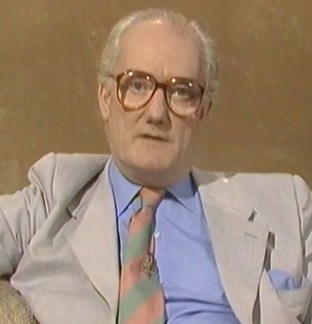
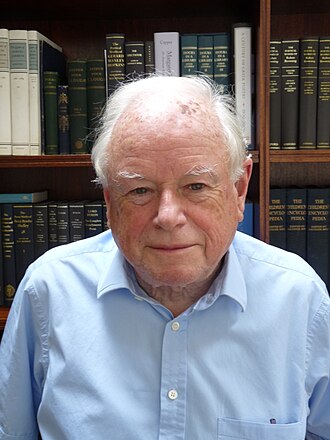
布莱恩·马基 安东尼·肯尼
本期追问 · 点击跳到视频对应位置
19:39 哲学家先信教再找理由,就不算真正追求真理吗?25:57 只凭「上帝」这个概念,真的能推出上帝存在吗?37:31 若神已预知明天,人今天的选择还算自由吗?15:28 中世纪哲学与当代分析哲学是不是同一门手艺?
归入 Ⅲ·17 信仰需要理由吗? →
EDITED TRANSCRIPT · 依据现场录音编译整理,可划线生成便签
编者按:本文译自 1987 年 BBC 系列节目《伟大的哲学家》(The Great Philosophers)中的一集。主持人布莱恩·马基(Bryan Magee)是英国哲学作家、广播人,曾任工党议员;对谈嘉宾安东尼·肯尼(Anthony Kenny)时任牛津大学贝利奥尔学院院长,曾是天主教神父,著有《阿奎那》等书,是当代少数深入研究中世纪哲学的哲学家。本文依据现场录音编译整理,仅删去口语枝节与寒暄,论证与细节悉数保留。

被跳过的一千年

马基: 出于教学上的方便,人们习惯把历史,至少是西方的历史,划分成几个很宽泛的时期:古代、中世纪、现代。哲学也一样,我们会说古代哲学、中世纪哲学、现代哲学,大多数哲学史著作都按这三段来分章。古代哲学由两个人的著作主导,柏拉图和亚里士多德。古代世界当然还有别的重要而有趣的哲学家,不仅在柏拉图和亚里士多德之前,也在他们之后,但没有谁留下的著作在数量、分量和影响上能与这两人相提并论。如果你进大学去学古代哲学,你会发现大部分时间,甚至全部时间,都花在这两位哲学家身上。然后你多半会从亚里士多德直接跳到现代哲学,把中世纪整个略过。

长期以来,中世纪哲学是哲学史里的灰姑娘。我们说的可是一千多年的时间,从罗马帝国覆灭一直到文艺复兴。我想主要原因在于,这整个时期几乎每一位重要的哲学家都是教会中人;而在我们这个时代之前的一两百年里,人们普遍对宗教产生了反弹,尤其反感宗教对思想的钳制。在这场反弹当中,中世纪哲学家受到怀疑:他们不是追随真理走到它引向的任何地方,而是在为自己早已相信的东西寻找好理由。像大多数反弹一样,包括那些健康的反弹在内,这一次也走过了头。最伟大的中世纪哲学家是真正的巨人,他们做的是今天我们所理解的那种真正的哲学,我们至今仍能从他们那里学到很多。

和古代哲学的情形一样,中世纪哲学家里也有两个人物特别突出,只不过这一回两人几乎处在这个时期的两端。圣奥古斯丁(St Augustine)公元 354 年生于北非,430 年死于北非。他的两本书至今被公认为世界文学的伟大作品:《忏悔录》和《上帝之城》。另一位分量相当的人物是托马斯·阿奎那(Thomas Aquinas),1225 年生于意大利,1274 年死于意大利。他是一位比奥古斯丁技术性强得多的哲学家,最著名的著作是两部巨型汇编,一部叫《反异教大全》(Summa Contra Gentiles),英译本题为《论天主教信仰的真理》,另一部是《神学大全》(Summa Theologiae)。

圣奥古斯丁去世和罗马帝国覆灭之后,紧接着就是我们所说的黑暗时代。在那几个世纪里,西欧有学问、识字的人竭尽全力,也只够抓住文明的残余。他们把自己的角色看成本质上是保存性的,很长一段时间里几乎没有做出任何具有持久重要性的新的思想工作。从奥古斯丁到安瑟伦(Anselm)这七百年间,只有一位第一流的哲学家,九世纪的约翰·司各特(John the Scot)。但到了十一世纪的安瑟伦,就开始出现一条稳定的重要思想家的河流,随便举几个名字:十二世纪的阿伯拉尔(Abelard),十三世纪的罗吉尔·培根(Roger Bacon)和托马斯·阿奎那,然后是邓·司各脱(Duns Scotus),再是奥卡姆的威廉(William of Ockham),到这时中世纪本身也快要走到尽头了。

为了给我们讲讲这段漫长而陌生、又引人入胜的哲学史,我请来了牛津大学贝利奥尔学院院长安东尼·肯尼,他是当代少数大量撰写中世纪哲学的哲学家之一,本人也曾是罗马天主教神父。肯尼,在我们谈具体问题或个别哲学家之前,对我刚才这幅极简的时期草图,你有什么要补充的吗?

奥古斯丁与阿奎那:两种哲学家类型

肯尼: 你选这两位哲学家来概括中世纪的成就,我是同意的。不过他们是非常不同的两种人。奥古斯丁是个孤独的思想者,正如你所说,他最出名的著作是一部自传,《忏悔录》,这本书大量取材于他自己的沉思、他自己对《圣经》的阅读、他自己的内心生活。阿奎那截然不同。他生活在晚得多的时期,而且他不是个孤独的人物,他正处在一个宗教传统和学术传统的中心。他是多明我会(Dominican)这个大修会的成员,一辈子生活在修士团体之中。他还是一位大学教师,他的一大成就就是写出了那两部辉煌的大学教科书。他的伟大著作本质上就是大学教科书。这和奥古斯丁形成了极大的反差:奥古斯丁孤独到什么程度呢,到晚年他当主教时,是全城唯一一个手头有书的人。

马基: 这其实是哲学家的两种永恒类型,对吧?一种是孤独、隔绝、内省的思想者,另一种是体制中人,大学教师。

肯尼: 是的。沿着哲学史往下看,你会发现人们不断落入这两种类型。属于奥古斯丁一路的,是笛卡尔、斯宾诺莎这样的孤独天才,可以说是从自己的头脑里把思想纺出来。也有康德、黑格尔这样的博学的大学教授,建立起体系,然后传给学生和后代哲学家,由他们接手修改。

大学的发明:辩论术与八百万字

马基: 而我们正在讨论的这个时期,中世纪,正是大学被发明出来的时期。这个事实本身对哲学产生了极大的影响,对哲学的教法和学法都是如此。你能谈谈这一点吗?

肯尼: 可以。我认为中世纪对哲学最重要的贡献之一,就是创立了大学。所谓大学,指的是一个由专职、全时从事教学的人组成的团体,他们传授一整套知识,把它交给学生,有商定的课程大纲,有商定的教学方法,还有非常高的专业标准。中世纪哲学的专业化程度高得惊人。

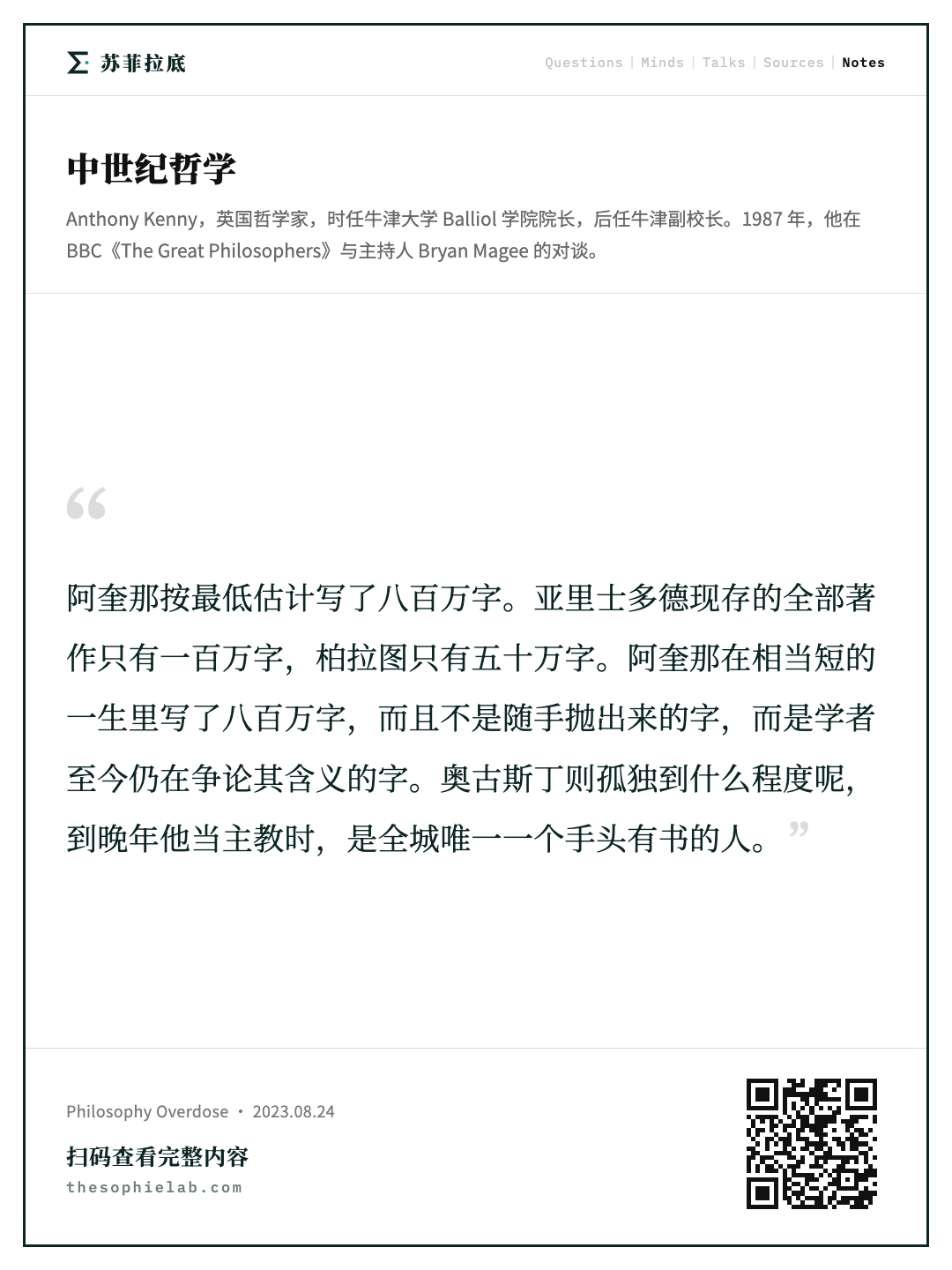
首先是哲学家们惊人的产量。阿奎那按最低估计写了八百万字,还有若干真伪有争议的作品,算进去可能到一千一百万字。八百万字是个很大的数目。亚里士多德现存的全部著作只有一百万字,柏拉图现存的全部著作只有五十万字。阿奎那在相当短的一生里写了八百万字,而且不是随手抛出来的字,而是学者至今仍在争论其含义的字。所以产量是巨大的,严谨程度也非常高。

阿奎那的著作带着中世纪辩论术(disputation)的印记。辩论是中世纪一种伟大的教学方法:老师叫出两名学生,一个高年级的,一个低年级的。高年级学生要为某个论题辩护,比如「世界不是在时间中被创造的」,或者反过来,「世界是在时间中被创造的」;另一个学生则要提出相反的论题,攻击主论题。两人相互辩驳,必须按照严格的逻辑规则来论证,然后由老师裁决这场争论,设法指出一方所说之中什么是对的,另一方的批评错在哪里。你翻开圣托马斯的《神学大全》,它本身虽然不是现场辩论的记录,却带着辩论的印记。每当阿奎那要提出某个学说、某个哲学论题或神学论题,他都先摆出他所能想到的三条最强的反对理由。这是一种了不起的智识训练:它让你无法把任何东西视为理所当然,逼你去想,我到底要说服谁相信什么,对方能提出的最强的反驳是什么。

这是两点,浩瀚的产量和严格的呈现方法。然后还有课程大纲。大学有大纲,意味着有一大堆题目是所有进大学的人都要学的,有一套知识体系是他们必须掌握的,有一个学科最前沿的水平是他们必须达到的。达到之后,他们再添上自己的一小块石头,垒到科学大厦上,然后把它传给自己的学生,希望有所增益,但至少必须保存下去。在中世纪,这份大纲尤其是由亚里士多德的存世著作定下的。到中世纪盛期开始时,亚里士多德的著作被译成了拉丁文。伟大的中世纪哲学家里很少有人能读希腊文,但他们有很好的亚里士多德译本,他们下功夫把从亚里士多德那里可能得到的一切知识都提取出来,再加以发展。

拉丁学术共同体与不列颠错觉

马基: 关于这个时期的整体,我想问你一个问题。乍听起来可能有点狭隘,但答案说不定很有意思。我想,任何一个英国人开始研究中世纪哲学时,都会惊讶于有那么多领军人物要么来自不列颠群岛,要么生涯中很重要的一段是在这里度过的,比如当过坎特伯雷大主教。我在开场时提到的那些人就是这样,约翰·司各特、圣安瑟伦、罗吉尔·培根、邓·司各脱、奥卡姆的威廉都是如此。这纯属巧合,还是确实有什么有趣的解释?

肯尼: 这确实是个引人注目的事实,但如果它让人以为中世纪哲学有什么特别英国的东西,那就是一种视觉错觉了。没错,很多哲学家在不列颠待过一段时间,其中有些人生在不列颠。但你举的人物里,安瑟伦其实是意大利人,邓·司各脱和奥卡姆的威廉也有相当长的时间在欧洲大陆。真正的原因是,你随便挑一个国家,都能说不少伟大的哲学家在那里待过,因为中世纪欧洲的大学共同体真正是一个欧洲共同体。基督教世界(Christendom),也就是所有信奉基督教的民族,构成了同一个学术共同体,一个人在这所大学毕业,就去另一所大学教书。所有大学都说同一种语言,教会的拉丁文。至少在中世纪早期,学术上的迁徙非常频繁。

到后来,出现了民族主义战争,比如英法之间的百年战争,这意味着旅行被打断,各地方言文学兴起,人们即使继续说拉丁文,也开始用英语来思考了。我认为有一个意味深长的事实:真正伟大的中世纪哲学家里最后一位是约翰·威克里夫(John Wycliffe),就在奥卡姆的威廉之后不久,而他当然也以把《圣经》译成英文而闻名,无论是他自己动手,还是让一帮学生去做,反正他是这项翻译的发起人。他站在国际性拉丁学术共同体的终点,也站在各民族文化用各自语言逐渐分裂的起点。

亚里士多德与圣经:为何还要求知

马基: 整个中世纪,哲学家们有一个持续不断的关切,你刚才已经开始触及了:他们想把古希腊的伟大经典哲学家,中世纪早期主要是柏拉图,晚期大概主要是亚里士多德,同基督教调和起来。从头到尾,这都是他们念念不忘的事,对吧?你能谈谈吗?

肯尼: 这一点在阿奎那和他的后继者身上尤其明显。奥古斯丁我想对柏拉图哲学的兴趣远大于对亚里士多德的兴趣,而他对《圣经》作为知识和信息来源的兴趣,又远远大于对任何哲学家的兴趣。奥古斯丁的身影笼罩着整个中世纪,后来的中世纪哲学家把他看成对基督教传统中全部宗教知识最好的整理,这些知识从《圣经》而来,经由圣保罗,再经由圣奥古斯丁。然后亚里士多德被译成拉丁文,人们在十二、十三世纪开始意识到,还有另一大套关于世界、关于人、关于我们为何在此、我们往何处去、我们应当做什么的知识,那就是古人的哲学,尤其是亚里士多德的哲学。亚里士多德在那么多方面都是天才,他开创了那么多后来长成哲学分支、又长成科学分支的学科:逻辑学、形而上学、生物学、心理学、植物学、气象学,这些以及许多别的科学,实际上都是从亚里士多德开始的。而中世纪早期所能得到的这些科学最成熟的版本,就是亚里士多德的表述。

马基: 我想问一个与此相关的问题,其实就是:他们为什么在乎?既然他们信奉基督教,难道他们不认为基督教已经把他们需要的关于事物本性的一切知识都给了他们吗?

肯尼: 基督教给了他们足以得救的知识。一个不识字的俄国农妇,知道基督教信仰的真理,却对古人的科学一无所知,她升天堂、在荣耀中与上帝同在的机会,和托马斯·阿奎那这样博学的人一样大。但是,把阿奎那这样的人想成眼睛只盯着宗教,那就大错特错了。他们是充满求知欲的人,想尽可能多地了解人和世界。他们当然是把人和世界当作上帝的造物来关心的,但他们认为,上帝不仅通过《圣经》这样的圣书向世界说话,我们还可以通过观察上帝自己的造物,通过观察世界以及各门科学能告诉我们的关于世界的东西,来了解上帝的计划。

马基: 我第一次读中世纪哲学时,有一点给我极深的印象:其中有那么多内容与宗教无关。我是说,有那么多扎实的逻辑学工作,有那么多在我们看来非常现代的语言分析,还有力学、心理学之类的东西。这个领域宽得不得了,对吧?

肯尼: 是的。文艺复兴之后自立门户、成为独立学科的许多科学,它们的萌芽都在这里,都能在中世纪哲学这个大家庭里找到,像正在成长的孩子。古老大学里某些教授的头衔至今还留着回响。牛津有一位物理学教授,头衔是「自然哲学教授」,因为物理学这门学科正是作为自然哲学的研究起家的,而自然哲学本身,就是对亚里士多德一部题为《物理学》的文本的沉思。

逻辑的失传与二十世纪的再发现

肯尼: 亚里士多德的著作本身勾画出了中世纪的课程大纲。亚里士多德的著作从逻辑学开始,那是他创立的科学,在中世纪得到了极大的发展。任何进中世纪大学的人最先学的东西之一就是逻辑。近年来我们重新发现了许多高度精细的逻辑定理和技巧,而这些东西在中世纪末期,对初入学的本科生来说是熟悉的。文艺复兴和宗教改革时期,逻辑学被拦腰截断,此后直到十九世纪末,大多数欧洲大学教的都只是逻辑学一具残缺的躯干。到了十九世纪,新一代逻辑学家,数理逻辑学家,德国的戈特洛布·弗雷格(Gottlob Frege)、剑桥的伯特兰·罗素(Bertrand Russell)和阿尔弗雷德·诺思·怀特海(Alfred North Whitehead),从一个不同的视角,从数学的视角进入逻辑,把数学追溯到它在逻辑中的起源,发动了逻辑学的一次伟大新生。它的一个成果就是《数学原理》(Principia Mathematica),罗素和怀特海在这部巨著中试图证明,只要研究得足够系统,整个算术都可以单纯从逻辑上的自明之理推导出来。本世纪逻辑学的这次新生,导致三十年代及以后重新发现了一些自中世纪以来完全失传的逻辑分支。直到我这一代人,才有人开始把两头接起来,认识到逻辑学中一些最现代的观念,是中世纪早已熟知的东西。

马基: 这么说是否成立:西欧研究和教授的哲学,在中世纪是以逻辑为中心的,现在也是以逻辑为中心的,但在这两头之间的大部分时间里不是?

肯尼: 我同意。我想这也是为什么,一个从现代哲学背景走来的人读中世纪晚期的著作,有时会生出一种异乎寻常的亲切和熟悉之感。

马基: 对我来说确实如此,而且感受很强烈。我第一次读邓·司各脱和奥卡姆的威廉这些作者时,就像在读年轻的罗素,或者你提到的弗雷格。这些人显然是在同一家店里干活,在同一个摊位上做生意。我原以为会是某种陌生、遥远、古怪的东西,结果恰恰相反,是我完全熟悉的东西。

肯尼: 中世纪之后,人们对逻辑失去了兴趣,很大程度上也对语言失去了兴趣,至少是对语言的哲学研究失去了兴趣。他们对语言的修辞研究和文学研究很有兴趣,却对语言的哲学研究没有兴趣。从笛卡尔开始,哲学家把认识论放在了学科的中心,也就是这些问题:我们如何认识?我们知道什么?我们怎么能知道我们所知道的?逻辑和语言退到了幕后。从弗雷格和罗素以来,尤其是在当今一代的英美哲学里,逻辑和语言又走到了哲学的前沿。今天哲学家的大问题不再是「你知道什么」,而是「你是什么意思」。关注我们所说的话的意义,坚持任何其他问题,不管是科学的、数学的还是别的什么问题,都必须伴随着对「我们提这个问题究竟是什么意思」的仔细审视,否则永远得不到答案,这在中世纪是非常典型的,如今又成了哲学的典型特征,而在中间那段时期却消失了。

回应指控:信仰与论证能否分开

马基: 我想,对中世纪哲学总体上最常见的指控,我在开场时也提到了,就是说它是由一些开始之前就已经信奉基督教的人做出来的,所以他们并不是像我先前说的那样追随真理走到它引向的任何地方,而是在为自己早已相信的东西找好理由。你对这个指控怎么回答?

肯尼: 首先我要说,说一个哲学家在为自己早已相信的东西找好理由,这本身未必是什么严重的指控。比如笛卡尔,穿着睡袍坐在炉火旁,就是在为「相信自己存在」寻找好理由,而且花了很长时间才找到。罗素指责阿奎那不是真正的哲学家,因为他在为自己早已相信的东西找理由。这话出自罗素之口,实在不可思议,因为他在我刚才提到的《数学原理》里,用了几百页来向你证明二加二等于四,而这是他一辈子都相信的事。

马基: 我想在这里插一句,把话说明白:只要在充分专业的意义上承认,理由的好坏才是要害,那么从某种意义上说,你事先相信什么并不重要,前提是论证和理由要无限度地接受最严格的检验。

肯尼: 我认为这是对的。作为哲学家,你相信什么并不重要。哲学家就是那个以分辨好论证和坏论证为职责的人。一种哲学的起点和终点是什么,在某种意义上并不重要,尽管出于别的理由可能非常重要。事实上,你我刚才作出的这个区分,你相信什么与你因何相信之间的区分,正是托马斯·阿奎那比任何别的哲学家都更清楚地揭示出来的。因为他作为基督徒信奉许多信条,同时又因为读了亚里士多德而相信许多别的东西,他非常小心地在这两者之间划出界线。用现代的说法,这就是区分他作为神学家的工作和作为哲学家的工作。他认为,作为神学家,他的首要任务是阐明、澄清并捍卫基督教圣书和教会教导中所包含的启示,关于世界的历史、世界的未来和世界的救赎的启示。而作为哲学家,他的任务是只凭不借外力的理性,不诉诸任何所谓的神圣启示,尽可能地弄清楚这个世界是个什么样的地方,我们知道哪些关于世界和关于一切思想的必然真理。

马基: 在一个具体问题上,他提出过一个非常醒目的论点,我一直记着。他在某处说,单就哲学论证而言,没有任何强制性的理由让人不能相信世界一直存在。但作为基督徒,他不这么信;作为基督徒,他相信世界有一个开端,因为上帝创造了它。

肯尼: 正是如此,这是个很好的例子。有不少基督教哲学家认为,可以证明世界必定有一个开端,本质上是因为他们不相信某几种无限序列。阿奎那指出他们论证中的漏洞,说不对,世界一直存在下去、过去永远存在、将来永远存在,这个想法没有任何自相矛盾的地方,亚里士多德就是这么相信的。所以阿奎那认为,凭不借外力的人类理性,你不能证明世界有开端;同样,你也不能证明世界没有开端。在这一点上他反对亚里士多德,因为亚里士多德认为这是可以证明的。阿奎那作为哲学家要不可知论得多,他说两边都证明不了。如果你问他,那你为什么相信世界确实有开端,他会说,因为《圣经》里《创世记》第一节就是这么说的,但这是我作为基督徒、作为神学家所相信的,不是作为哲学家。

你一开始提到他的两部巨著,《反异教大全》和《神学大全》。《反异教大全》是作为哲学著作来写的,它面向非基督徒,可能是穆斯林,可能是犹太人,可能是无神论者,它的目标是向他们提供纯粹属于人的理由,任何有善意的人都能看出是好理由的理由,来相信上帝存在、灵魂不朽等等。《神学大全》很不一样,它是写给基督徒的,它接受「《圣经》上如此说」作为论证的合适起点,尽管这部书里也包含着海量的哲学思考,虽然它的书名把它称为一本神学的书。

安瑟伦的本体论论证及其复活

马基: 有一个特定问题贯穿整个时期引发争论:上帝的存在,以及它能否被证明。正如你所说,基督教哲学家清楚地知道,如果对话对象是穆斯林或犹太人,诉诸教会或《圣经》的权威是没有用的,因为穆斯林不承认那种权威。这样你就只能退回到论证上来。在我看来,他们对于这个领域里什么算好论证、什么不算,抱着一种非常专业的态度。我想,哲学史上所有关于上帝存在的论证里最著名的,就是本体论论证(ontological argument)。它后来又出现在笛卡尔、斯宾诺莎、莱布尼茨那里,今天不少哲学家仍然对它感兴趣。它的经典表述出自十一世纪的圣安瑟伦。你能给我们讲讲这个论证是什么吗?

肯尼: 可以,不过在此之前,我或许应该先向观众解释一下什么叫本体论论证,「本体论的」这个词是什么意思。在中世纪以及后来,关于上帝存在有两类不同的论证。一类当中最有名的是圣托马斯·阿奎那的「五路」(Five Ways)。它们的出发点是外部世界的某个特征,通常是非常明显的特征,比如有些东西会从一处移到另一处,有些东西会产生又会消亡。从这些出发,再加上几条普遍的哲学真理,圣托马斯就会向你证明,存在着某种可以被认作「众人所称为上帝者」的东西。这些是宇宙论论证,因为它们从宇宙出发。而本体论论证则是一种意在单单从上帝的概念出发的论证,从上帝的观念本身出发,它的起点不需要跨出观念的领域。正如你所说,它最著名的表述是安瑟伦的。事实上安瑟伦似乎就是本体论论证的发明人,而其他论证都是对亚里士多德那里已有内容的发展。

安瑟伦的论证非常巧妙。它的出发点是给上帝下一个定义。他说,上帝是「那个无法设想有比它更伟大者」的东西。这看上去是个相当无害的定义,一个不信上帝的人也可能接受它作为定义,毕竟如果你不相信某样东西,你也得有一个关于「你不相信的到底是什么」的定义。某个无神论者可能会同意:好,我接受这个定义,上帝就是那个无法设想有比它更伟大者的东西。那么安瑟伦就会对无神论者说,我们假设上帝只存在于心中而不存在于现实中。你当然得承认上帝存在于心中,因为你此刻正在想着他,这就是他存在于心中的方式。可是,如果上帝只存在于心中而不存在于现实中,那你就能设想出某种比上帝更伟大的东西,因为你可以设想一个跟你刚才设想的上帝一模一样、却既存在于你心中又存在于现实中的东西,而那会更伟大。于是就存在着某种比上帝更伟大的东西。但上帝是那个无法设想有比它更伟大者的东西,而你刚刚却设想了某种比上帝更伟大的东西。这是荒谬的,是自相矛盾的。把我们引到这个矛盾结果的,是「上帝只存在于心中而不存在于现实中」这个假设。因此我们必须说,上帝也存在于现实中。

马基: 这种论证,今天任何有头脑的人一听就几乎必定会想:这里面有问题。可令人不安的是,当你想准确指出问题到底出在哪儿时,却非常困难,对吧?

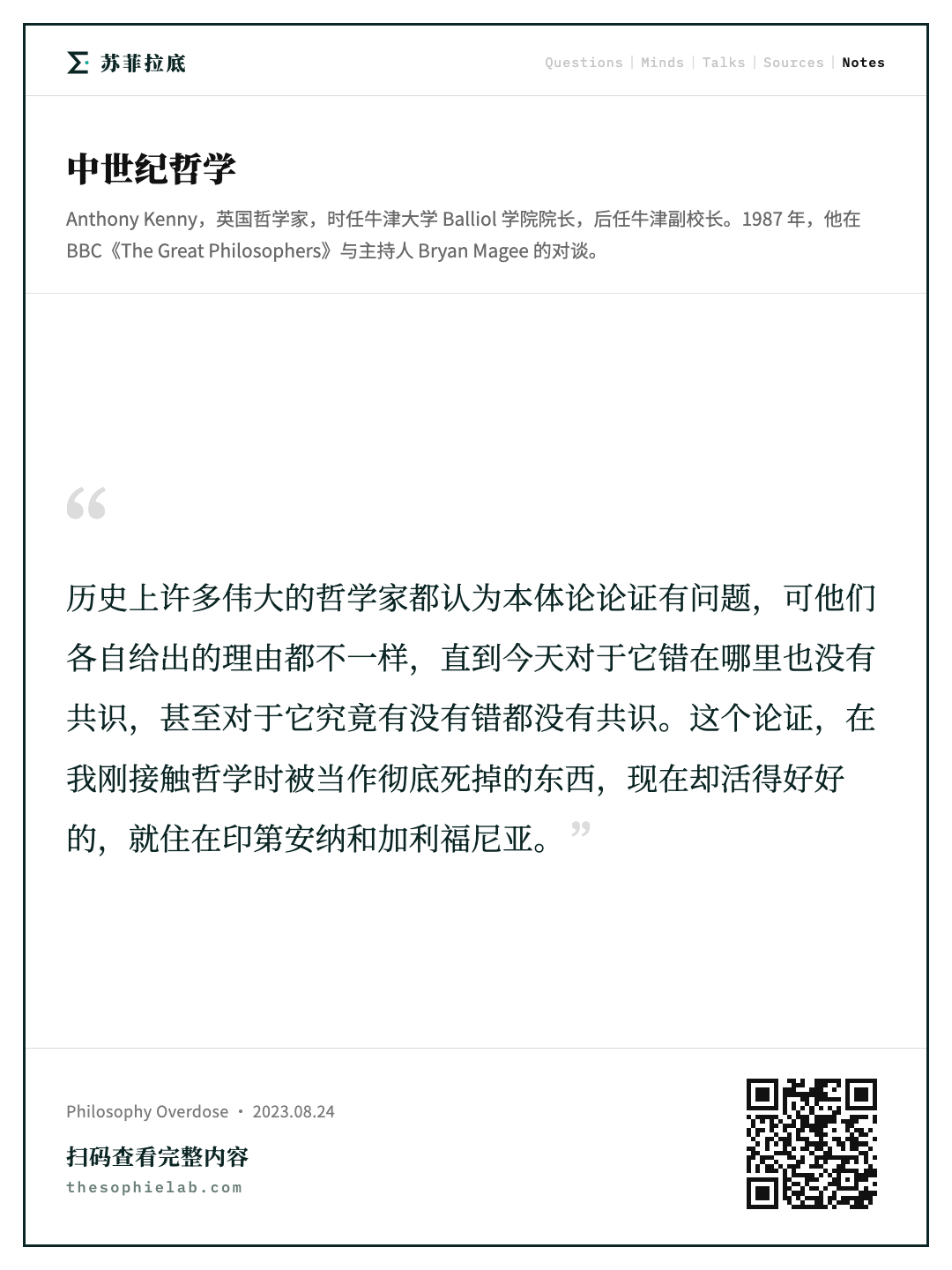
肯尼: 是的,我同意。我也是认为这个论证有问题的人之一。但让人们觉得它有问题的,并不是什么特别现代的哲学眼光。圣托马斯·阿奎那就花了不少篇幅试图向你证明这个论证有问题,他也没有被它说服。最有意思的是,历史上许多伟大的哲学家都认为这个论证有问题,可他们各自给出的理由都不一样,直到今天对于它错在哪里也没有共识,甚至对于它究竟有没有错都没有共识。而且最近在美国兴起了一群宗教哲学家,用最新的数理逻辑技巧来翻新这个论证,试图在当代逻辑的背景框架下把它表述成一种令人信服的形式。要讲清他们怎么做的,时间太长,而且我得有块黑板。但这个论证,在我刚接触哲学时被当作彻底死掉的东西,现在却活得好好的,就住在印第安纳和加利福尼亚。

一阶问题回归:正义战争与核威慑

马基: 你先前在中世纪哲学和现代哲学之间画了几条平行线,现在又添了一条,对本体论论证的兴趣复活。你先前还说,中世纪的逻辑是以语言为中心的。

肯尼: 是的,或者说在很大程度上是以逻辑和语言为中心的。

马基: 这一点今天又成立了,尽管在中间的大部分时期并不成立。我觉得现在的哲学还有另一个方面可以同那时的哲学相比:在一段很长的时期里,现代哲学家不关心具体的生活问题,只关心对逻辑论证和概念等等的分析,而现在他们又回过头来关心哲学家所说的一阶问题(first-order problems)了。中世纪大部分时间都是这样的,对吧?

肯尼: 这在你我从小接受的英美哲学里也是相当晚近的变化。我想在我们开始学哲学的时候,人们会告诉我们,道德哲学家的任务不是告诉你说谎在什么情况下是允许的、通奸有什么不对、按什么标准判断一场战争打得是否正义公平等等。这些问题固然重要,但不是哲学家的事。哲学家的任务是二阶的,是分析我们用来作出这些一阶决定的语言和概念。而在过去十年里,我认为兴趣有了一次大幅回摆,回到活生生的道德问题上,把它们看成哲学家以哲学家的身份,而不只是以公民或普通人的身份,应当关心的事。哲学家对医学伦理问题作出了巨大的投入,比如生命的保存,何时关掉生命维持系统才是对的,对胚胎做实验是否正当,等等。在我们国家,主持那项调查委员会的正是一位哲学家,玛丽·沃诺克(Mary Warnock)。人们尤其关注道德哲学和战争之间的关系。

马基: 我想就这个话题谈下去,因为你自己最近写了一本关于核威慑的书。你必须面对的一个问题,也是你那本书的核心问题,是:可以想象的任何情形下,核战争是否可能是正当的。你援引了中世纪关于正义战争(just war)的整个讨论传统,并且在书里说,任何有头脑的人都应当关心这些论证。你能给我们讲讲这些论证是什么吗?

肯尼: 正义战争理论在中世纪已有萌芽,在阿奎那和后来的思想家那里都有;它得到更充分的发展,是在中世纪刚结束之后,在后中世纪的经院学者那里。它问的是:在什么情形下发动战争在道德上是正当的?如果开战,在作战方式上、在选择打击目标上、在处置战俘等事情上,又受哪些道德约束?正义战争理论处在两种对立观点的中间。一边是和平主义的观点,认为根本不存在正义战争,一切战争都是不道德的、邪恶的,不管为之开战的理由多么高尚。另一边可以叫作「没有战争是不正义的」观点,也就是说,战争固然可怕,可一旦进入战争,就再没有任何道德法则,唯一的道德命令就是用最有效的手段打赢。正义战争传统说,这两种都不对。有些价值比生命本身更重要,因此可以正当地为之开战;但战争之中必须有约束。开战必须有充分的理由,你为之开战的价值必须真正重要到值得以这种方式去捍卫;而一旦开战,在选择目标上就有约束,绝不能蓄意杀害无辜者,所谓无辜者,指的是没有参与战争的平民,或者已成为战俘的前作战人员等等。我想很有意思的一点是,最近关于核武器的辩论中最重要的两份文献,背后都是这个中世纪的正义战争传统:在我们国家,是英国国教会的《教会与核弹》(The Church and the Bomb);在美国,是美国天主教主教团关于核武器使用与核威慑的牧函。

阿奎那的官方地位与声誉变迁

马基: 你刚才说的很多内容,虽然没提名字,其实都指向托马斯·阿奎那的工作。阿奎那现在不是等于罗马天主教会的官方哲学家吗?

肯尼: 我想那个可以这么说的时期刚刚走到尽头。十九世纪以前,他固然受到极大的尊崇,但我不认为他在任何意义上是罗马天主教会的官方哲学家。他也许是多明我会的官方哲学家,但那只是天主教会的一小部分。到十九世纪末,教宗利奥十三世(Leo XIII)发布通谕,在天主教修院和大学的哲学、神学教学中给了他一个特殊地位。而自第二次梵蒂冈大公会议以来,我的印象是,阿奎那对天主教机构的支配松动了很多,很大程度上被别的哲学家取代了,我想取代他的哲学家并不总是更好。不过事实上,阿奎那在非天主教世界的声誉反而大为提高,正因为他不再被看成只是某条党派路线的代言人。尤其在美国,对他的著作的兴趣与日俱增,感兴趣的人不是天主教徒,甚至根本不是基督徒,他们只是折服于这个人纯粹的哲学天才。

预知、恩典与自由意志

马基: 我想再提一个问题,哲学圈外的人和圈内人一样对它始终感兴趣,中世纪哲学家对它更是特别关心,那就是我们在多大程度上拥有自由意志。在中世纪,这个问题对基督教思想家格外重要,因为有恩典(grace)的教义。按照恩典的教义,能否得救根本不由我们个人决定,我们是否得救至少部分地取决于神的恩典。可如果是这样,那我们在任何要紧的方面还有多少自由意志呢?这在某种意义上就是问题的要害。你能谈谈吗?

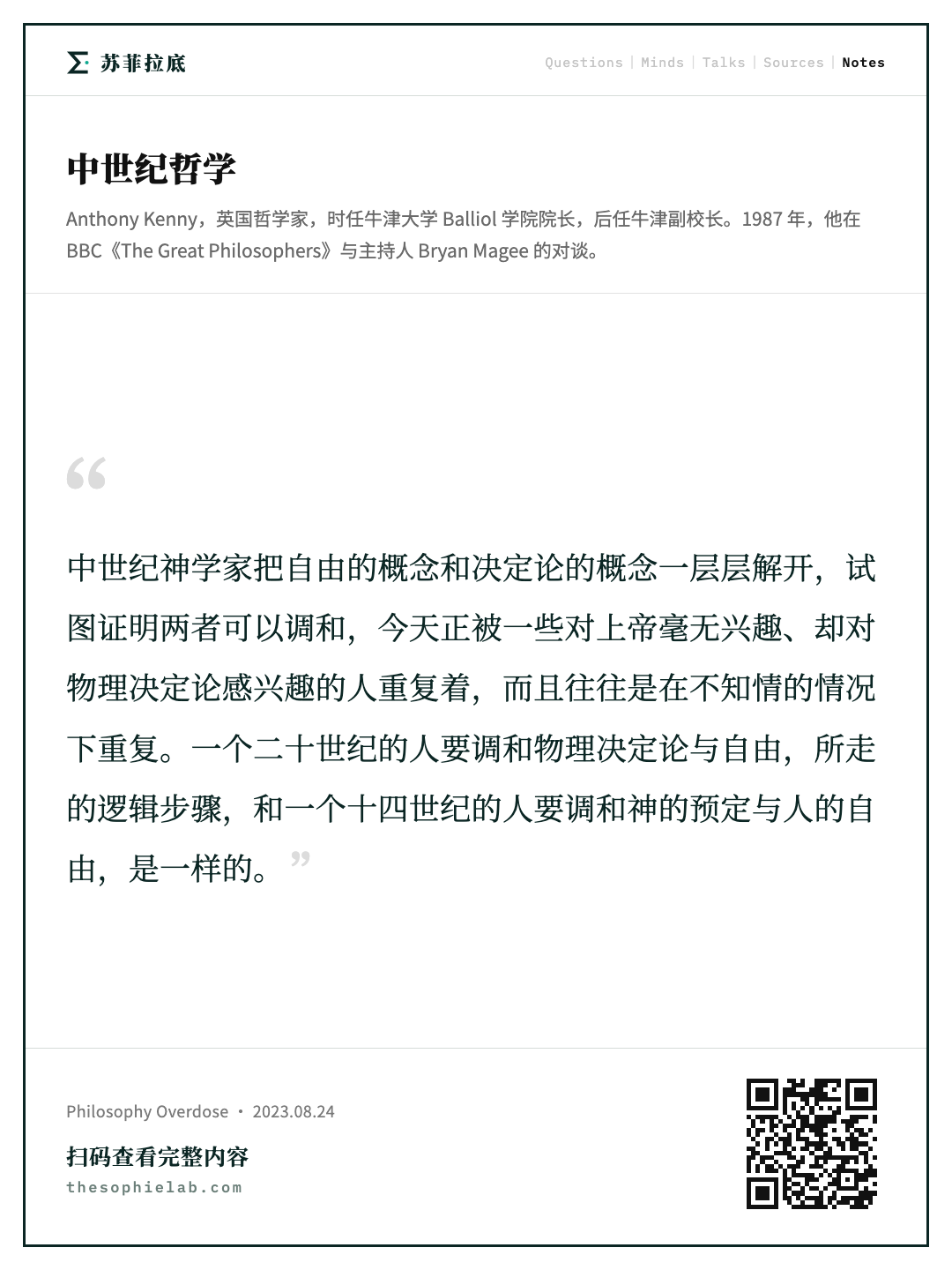
肯尼: 中世纪有两个问题交织在一起,一个是哲学问题,一个是神学问题。哲学问题是如何调和神的预知(foreknowledge)与人的自由。不仅中世纪哲学家,大多数思考过上帝本性的古代哲学家和伊斯兰哲学家都认为,如果我们对上帝有任何了解的话,其中之一就是他能预知未来,他知道将来会发生什么。可是,如果我们是自由的,如果你我是自由的,那么看起来你我今天决定做什么,就决定了明天的未来会是什么样。但如果上帝已经知道你我明天会做什么,我们今天怎么还能自由地作出决定?这是任何相信全知上帝的人都会碰到的问题,不管他们信不信《圣经》关于上帝所说的任何话。而基督徒还有一个特殊的问题,尤其是那些接受圣奥古斯丁版本的基督教的基督徒,因为圣奥古斯丁,特别是在晚年,把极大的重量压在这样一条教义上:没有人能得救、能进入天堂的荣耀,除非他被上帝预定(predestined)如此。这是基督徒额外的难题。但从哲学上看有意思的是,中世纪神学家和哲学家做的那些耐心的工作,把自由的概念和决定论的概念一层层解开,试图证明两者可以调和,今天正被一些对上帝毫无兴趣、却对决定论、对物理科学的决定论感兴趣的人重复着,而且往往是在不知情的情况下重复。一个二十世纪的人要调和物理决定论与我们对自由的体验,他所使用的逻辑步骤,和一个十四世纪的人要调和神的预定与人的自由所走过的步骤,是一样的。

入门书目与复兴前景

马基: 我们的讨论快要结束了。如果我们说的这些能激发一些观众去读一点中世纪哲学,对大多数人来说多半是生平第一次,关于从哪里入手,你有什么建议?

肯尼: 对初学者来说容易的中世纪著作不多,原因就是我先前说的:大多数伟大著作都属于大学传统,是技术性很强的大学教科书。不过有两本短书可以挑出来。第一本就是你开场提到的,奥古斯丁的《忏悔录》。我认为那是一部了不起的作品,是有史以来最伟大的自传之一,而且很可能是第一部现代意义上的自传。它充满了个人的反思,对家人温柔的回忆,对自己童年和成长的洞察;但到了末尾,它又上升到最抽象的哲学层面,提出了关于时间本性的问题,这些问题至今仍然非常鲜活。另一本我要推荐的是圣安瑟伦的《宣讲》(Proslogion),他就是在这本书里提出了我先前试着转述的那个关于上帝存在的巧妙论证。我想你们的读者会有兴趣去看看这本书,它一个下午就能读完,看看我转述得对不对,也看看他们自己觉不觉得它有说服力。

马基: 我在开场时说过,长期以来中世纪哲学一直是这门学科里的灰姑娘,过去毫无疑问是这样。但我也开始有一种印象,你自己的著作或许就是预告这个夏天的燕子之一,兴趣复兴的种种迹象都在,一场严肃的复兴,也许还没有完全到来,但已经在路上了。你也这么看吗?

肯尼: 当然,说中世纪哲学是灰姑娘,只对英美哲学而言是真的。在欧洲大陆,中世纪哲学作为研究课题已经兴旺了相当长的时间。至于当下英语世界哲学中的复兴,我想尤其是在美国,那里对一切中世纪的东西都兴趣大增,不只是中世纪哲学。

马基: 非常感谢你,安东尼·肯尼。
排版 + 横图 + 来源,粘贴即成稿
章节 · 点击跳转视频
0:00 被跳过的一千年:中世纪哲学导论 ▶ 正在看
4:19 奥古斯丁与阿奎那:两种哲学家类型 ▶ 正在看
5:34 大学的发明:辩论术与八百万字 ▶ 正在看
8:52 拉丁学术共同体与不列颠错觉 ▶ 正在看
12:09 亚里士多德与圣经:为何还要求知 ▶ 正在看
15:28 逻辑的失传与二十世纪的再发现 ▶ 正在看
19:39 回应指控:信仰与论证能否分开 ▶ 正在看
25:57 安瑟伦的本体论论证及其复活 ▶ 正在看
31:05 一阶问题回归:正义战争与核威慑 ▶ 正在看
35:27 阿奎那的官方地位与声誉变迁 ▶ 正在看
37:31 预知、恩典与自由意志 ▶ 正在看
39:45 入门书目与复兴前景 ▶ 正在看
本期小问 · 档案清单
19:39 哲学家先信教再找理由,就不算真正追求真理吗? ▶ 正在看
25:57 只凭「上帝」这个概念,真的能推出上帝存在吗? ▶ 正在看
37:31 若神已预知明天,人今天的选择还算自由吗? ▶ 正在看
15:28 中世纪哲学与当代分析哲学是不是同一门手艺? ▶ 正在看
本期讲者
布莱恩·马基英国哲学作家、广播主持人、前工党议员,主持 BBC 系列《The Great Philosophers》(1987),以通俗访谈普及哲学史著称。
安东尼·肯尼英国哲学家,时任牛津大学 Balliol 学院院长,后任牛津副校长;曾为天主教神父,著有《阿奎那》《The Logic of Deterrence》及多卷本西方哲学史,是英语世界中世纪哲学研究的代表人物。
01被跳过的一千年:中世纪哲学导论
0:00
for purposes of teaching it's customary to divide history at least the history of the West into certain very broad periods such as ancient medieval and modern and we do exactly the same thing with philosophy we talk of ancient philosophy medieval philosophy and modern philosophy and you'll find that most histories of philosophy are divided into those three sections ancient philosophy is dominated by the writings of two people Plato and Aristotle of course there were other important and interesting philosophers in the ancient world not only before Plato and Aristotle but also after them but no one who has left writings of comparable quantity caliber and influence if you went to a university to study ancient philosophy you'd find yourself spending most of your time and perhaps even all of it on the work of those two philosophers you'd then probably skip straight from Aristotle to modern philosophy jumping over the medieval period entirely medieval philosophy is for a long time been the Cinderella of the subject's
出于教学的目的,人们习惯把历史,至少是西方的历史,划分为几个非常宽泛的时期,比如古代、中世纪和近代。我们对哲学也是这么做的,我们会说古代哲学、中世纪哲学和近代哲学。你会发现,大多数哲学史著作都被划分为这三个部分。古代哲学由两个人的著作所主导:柏拉图和亚里士多德。当然,古代世界还有其他重要而有趣的哲学家,不仅有柏拉图和亚里士多德之前的,也有他们之后的,但没有谁留下的著作在数量、水准和影响力上能与他们相提并论。如果你去大学研读古代哲学,你会发现自己大部分时间,甚至可能全部时间,都花在这两位哲学家的著作上。然后你多半会直接从亚里士多德跳到近代哲学,把整个中世纪时期一跃而过。长久以来,中世纪哲学一直是这门学科历史中的灰姑娘。而我们现在谈论的是一段长达一千年甚至更久的时期,从
便签笔记
1:02
history and we're talking now about a period of a thousand years or more from the fall of the Roman Empire to the Renaissance I think the chief reason for this is that throughout that period virtually every important philosopher was an ecclesiastic whereas in the century or two leading up to our own time there's been a widespread reaction against religion especially against its hold on thought during that reaction medieval philosophers came under suspicion of not pursuing the truth wherever it might lead but of trying to find good reasons for what they believed already like most reactions including healthy ones this one went too far the greatest medieval philosophers were true Giants doing genuine philosophy as we understand it today and we can still learn a lot from them as in the case of ancient philosophy among the medieval philosophers there are also two figures who stand out from the rest though in this case they're at almost opposite ends of the period from each other Saint Augustine was born in North Africa
罗马帝国的衰亡一直到文艺复兴。我认为造成这种情况的主要原因是,在那整个时期里,几乎每一位重要的哲学家都是教会中人。而在通向我们这个时代的前一两个世纪里,出现了一股广泛的反宗教思潮,尤其是反对宗教对思想的支配。在那股思潮中,中世纪的哲学家们被怀疑并非追随真理走到哪里就到哪里,而是在为自己已经相信的东西寻找好的理由。像大多数反动思潮一样——包括那些健康的反动——这一股也走过了头。最伟大的中世纪哲学家是真正的巨人,他们所做的是我们今天所理解的那种真正的哲学,我们至今仍能从他们身上学到很多。就像古代哲学的情形一样,在中世纪哲学家当中,也有两位人物格外突出,只不过在这里,他们几乎分处这一时期的两端。圣奥古斯丁公元354年生于北非,430年
便签笔记
2:03
in the year 354 A.D and died there in 430. two of his books are still universally acknowledged as being among the world's great literature the confessions and the City of God the other figure of comparable stature is Thomas Aquinas who was born in Italy in the year 1225 and died there in 1274. he was a much more technical sort of philosopher than Augustine his most famous works are two enormous compendia one called Suma Contra Gentiles which has been translated into English under the title on the truth of the Catholic faith and the other summer theologiai or summary of theology the death of Saint Augustine and the fall of the Roman Empire were followed by the period we call the Dark Ages during those centuries it was as much as the literate and learned in Western Europe could do to cling to the remnants of civilization they saw their role as essentially preservative and for a long time scarcely any new intellectual work of lasting importance was done during the 700 years from Augustine to Anselm there
也在那里去世。他的两本书至今仍被普遍公认为世界伟大文学作品之列:《忏悔录》和《上帝之城》。另一位分量相当的人物是托马斯·阿奎那,他1225年生于意大利,1274年在意大利去世。比起奥古斯丁,他是一位技术性强得多的哲学家。他最著名的著作是两部卷帙浩繁的大全,一部叫《反异教大全》,其英译本的书名是《论天主教信仰的真理》,另一部是《神学大全》,即神学的总纲。圣奥古斯丁去世以及罗马帝国的衰亡之后,便是我们所称的黑暗时代。在那几个世纪里,西欧那些识字有学问的人所能做的,也不过是守住文明的残余。他们把自己的角色看作本质上是保存性的,长期以来几乎没有产生任何具有持久重要性的新的思想成果。从奥古斯丁到安瑟伦的这七百年间,
便签笔记
3:15
was only one philosopher of the front rank John the Scott who lived in the 9th century but once we get to Anselm in the 11th century we embark on a steady flow of significant thinkers just a few of the names are abelard in the 12th century Roger Bacon and Thomas Aquinas in the 13th then done scotus followed by William of Arkham and then the medieval period itself is beginning to come to an end to tell us a little about this long but unfamiliar and fascinating period in philosophy's history I've invited the master of baleel College Oxford Anthony Kenny one of the few contemporary philosophers who have written extensively about medieval philosophy and himself a former Roman Catholic priest Anthony Kenny before we start talking about specific issues or the work of individual philosophers is there anything you'd like to add to that very brief sketch map of the period that I put forward just now I'd agree with the your choice of two philosophers to sum up the achievement of the Middle Ages Augustine and Aquinas
只出过一位第一流的哲学家,即生活在9世纪的约翰·司各特。但一旦我们来到11世纪的安瑟伦,我们就迎来了源源不断的重要思想家。仅举几个名字:12世纪的阿伯拉尔、13世纪的罗吉尔·培根和托马斯·阿奎那,接着是邓斯·司各脱,然后是奥卡姆的威廉,此时中世纪时期本身也开始走向终结。为了给我们讲讲这个漫长却陌生而迷人的时期哲学史,我请来了牛津贝利奥尔学院的院长安东尼·肯尼,他是当代少数几位对中世纪哲学有大量著述的哲学家之一,本人还曾是一位罗马天主教神父。安东尼·肯尼,在我们开始谈具体问题或某位哲学家的著作之前,对于我刚才勾勒的这段时期的粗略轮廓,你有什么要补充的吗?我同意你挑选这两位哲学家来概括中世纪的成就——奥古斯丁和阿奎那,但他们是非常不同的两个人。奥古斯丁是一位孤独的思想家,
便签笔记
02奥古斯丁与阿奎那:两种哲学家类型
4:19
but they are both very different people Augustine is a solitary thinker somebody who's best known work as you said is an autobiography is confessions a book drawing enormously on his own meditation his own reading of the Bible his own interior life Aquinas is very different he lives as you said at a much later period and Aquinas is not a solitary figure he is somebody right in the middle of a religious and academic tradition he is one of the great order of Dominican Friars he lived his life within communities of Friars he's also a university teacher one of his great achievements was the production of these two magnificent University textbooks that's what his great works are they're essentially University textbooks an enormous contrast with Augustine who was such a lonely figure that at the end of his life when he was a bishop he was the only man in the whole town who had any books at all these These are in fact two perennial types of the philosopher aren't they the lonely isolated introspective thinker and the
正如你所说,他最著名的作品是一部自传,即《忏悔录》,这本书极大地取材于他自己的沉思、他自己对《圣经》的解读、他自己的内心生活。阿奎那则很不一样,正如你所说他生活在晚得多的时期,而且阿奎那不是一个孤独的人物,他身处宗教与学术传统的正中心,他属于那个伟大的修会——多明我会的托钵修士,他一生都生活在修士团体之中。他同时也是一位大学教师,他最伟大的成就之一就是写出了那两部宏伟的大学教科书,他的巨著本质上就是大学教科书。这与奥古斯丁形成了巨大的反差,奥古斯丁孤独到什么程度呢?在他生命的晚年,当他已经是主教时,他是全城唯一一个拥有书籍的人。这其实是哲学家的两种永恒类型,不是吗?孤独、离群、内省的思想家,和体制中人、大学教师。是的,当你继续往下看哲学史,
便签笔记
03大学的发明:辩论术与八百万字
5:34
institution man the university teacher yes as you go on in the history of philosophy you'll find people falling into these two types in the pattern of Augustine you have the solitary Geniuses like Descartes and Spinoza spinning their thought out of their own heads as it were you also have the Learned University professors like Kant and Hegel developing systems which were then to be handed on and modified to pupils and later generations of philosophers now it's during the period that we're discussing the Middle Ages that universities were invented and this very fact had a simply enormous influence on philosophy didn't it and the way it was taught the way it was studied can you say a little bit about that yes I think that is one of the most important contributions of the Middle Ages to philosophy is that it founded the university by University meaning a corporation of people engaged professionally full-time on the teaching of a corpus of knowledge handing it on to their pupils having an agreed syllabus having agreed methods of
你会发现人们大都落入这两种类型。奥古斯丁那一类的,有像笛卡尔和斯宾诺莎这样孤独的天才,可以说是从自己脑子里把思想纺出来的;另一类则是像康德和黑格尔这样博学的大学教授,他们建立起体系,再传给学生和后世的哲学家,并被不断修正。而正是在我们所讨论的这段时期——中世纪——大学被发明出来了,这件事本身对哲学产生了极其巨大的影响,不是吗?对哲学的教授方式、研究方式都是如此。你能就此谈一谈吗?是的,我认为中世纪对哲学最重要的贡献之一,就是它创立了大学。所谓大学,指的是一个由专业人士组成的团体,他们全职从事某一知识体系的教学,把它传授给学生,有一致同意的教学大纲,有一致同意的教学方法,并且有很高的专业标准。中世纪的哲学有多么
便签笔记
6:44
teaching and having very high Professional Standards it's very remarkable thing how professional philosophy was in the Middle Ages first of all there's just the enormous output of the philosophers Aquinas wrote at about the lowest estimate eight million words there are a number of other disputed Works which might bring it up to 11 million now 8 million words is a lot to write the whole of the surviving works of Aristotle are only a million Works words the whole of the surviving works of Plato are only half a million Aquinas in quite a short lifetime writes 8 million words and they're not words just tossed off they're words that Scholars to this day can argue about the meaning of so the output is enormous the rigor is very great aquinas's works bear the stamp of the medieval technique of disputation it was one of the great medieval methods of teaching the teacher would put up two of his pupils a senior and Junior one the senior pupil would have to defend some particular thesis for instance that the
专业化,是非常了不起的。首先就是哲学家们巨大的产出量,阿奎那的著述,按最低估计也有八百万字,还有一些真伪存疑的作品,加上去可能达到一千一百万字。八百万字可是相当大的写作量。亚里士多德留存下来的全部著作也只有一百万字,柏拉图留存下来的全部著作只有五十万字。阿奎那在相当短的一生中写下了八百万字,而且这些字并不是随手写就的,而是直到今天学者们还能争论其含义的文字。所以产出量是巨大的,严谨程度也非常高。阿奎那的作品带有中世纪辩论技艺的印记,那是中世纪伟大的教学方法之一:老师会安排他的两名学生,一名高年级的、一名低年级的,高年级学生必须为某个特定论题辩护,比如世界不是在时间中被创造的;或者
便签笔记
7:51
world was not created in time or for that matter the world was created in time the opposite thesis would have to be presented and the main thesis attacked by one of the other pupils the two would argue it out with each other they had to argue according to strict logical rules and then the teacher would settle the dispute try to bring out what was true in what had been said by one what was wrong in the criticisms made by the others and if you open Saint Thomas's summer theologia though it's not itself a record of of live disputations it Bears the stamp of that whenever Aquinas is going to present a particular Doctrine or philosophical thesis or theological thesis he begins by presenting three of the strongest arguments he can think of against the truth of that thesis a marvelous intellectual discipline it prevents you from taking things for granted makes you think now who have I got to convince of what and what are the strongest things they could say on the other side that's those are two of the things the
反过来,世界是在时间中被创造的。相反的论题必须被提出来,主论题则要受到攻击。由其他学生之一提出反驳,两人便互相辩论,他们必须依照严格的逻辑规则来论辩然后老师会裁决这场争论,试着指出一方所说的话中哪些是对的,其他人的批评中哪些是错的。如果你翻开圣托马斯的《神学大全》,虽然它本身并不是现场辩论的记录,却带着这种辩论的印记。每当阿奎那要提出某个特定的教义、哲学命题或神学命题时,他都会先列出他所能想到的三条最有力的、反对该命题为真的论证。这是一种了不起的思维训练,它使你不会想当然,让你去想:我要说服的是谁、要说服什么,以及对方最有力的反驳会是什么。这是其中两点——著作的浩繁,以及严谨的
便签笔记
04拉丁学术共同体与不列颠错觉
8:52
voluminous output the rigorous method of presentation then there's the syllabus a university syllabus means that you have a lot of topics which anybody going to University is expected to learn a corpus of knowledge that they're expected to master state of the art which they have to reach and then they add their own little bit their own little Stone to the can of the scientific edifice and then hand it on to their pupils hopefully enhance but it must be preserved now in the Middle Ages the syllabus is set especially by the surviving works of Aristotle Aristotle's works at the beginning of the high Middle Ages were translated into Latin very few of the great medieval philosophers could read Greek but they had good translations of Aristotle and they worked a way to extract all the knowledge that it was possible to expect from Aristotle and then develop it and I want to put you about the period as a whole it may sound at first blush rather a parochial question but it could possibly have an interesting explanation by way
论述方法。然后还有课程大纲。大学的课程大纲意味着有一大批题目是任何上大学的人都被期望要学的,一整套他们被期望要掌握的知识体系,一个他们必须达到的最高水准;然后他们再添上自己那一点点贡献,为科学这座大厦添上自己的一块砖,然后再传给他们的学生,但愿有所增益,但它必须被保存下来。而在中世纪,课程大纲主要是由亚里士多德留存下来的著作所确定的。在中世纪盛期之初,亚里士多德的著作被翻译成拉丁文。伟大的中世纪哲学家中很少有人能读希腊文,但他们有很好的亚里士多德译本,他们下功夫去把所有可能从亚里士多德那里得到的知识都提取出来,然后加以发展。我想问你一个关于这个时期的整体性问题。乍一听,这可能像是个相当狭隘的地方性问题,但它的答案或许会带出一个有趣的
便签笔记
10:01
of answer I think any British person coming to the study of medieval philosophy is likely to be struck by how very many of the leading figures either came from the British Islands or splinter very significant part of their career here says something like Archbishop of Canterbury I mean that's true of those I mentioned in my introduction it's true of John the Scott Saint Anselm Roger Bacon dance scotus William vaucom is a cheer coincidence or is there actually an interesting explanation for it I think it is a striking fact but I think that it's an optical illusion if it suggests that there was something specially British about philosophy I wasn't suggesting in the Middle Ages uh it's true that a lot of the philosophers spent some of their time in Britain and some of them were British by birth but after all Anselm one of your figures was in fact an Italian and Dan scotus and William of ochem spent quite a lot of their time on the continent the reason why if you picked any country you would be able to say quite a number
解释。我想,任何一个英国人开始研究中世纪哲学,都很可能会惊讶于其中有那么多重要人物要么来自不列颠群岛,要么在这里度过了职业生涯中很重要的一部分,比如担任坎特伯雷大主教之类的。我在开场白里提到的那些人就是如此,约翰·司各特·爱留根纳、圣安瑟伦、罗吉尔·培根、邓斯·司各脱、奥卡姆的威廉都是如此。这纯粹是巧合,还是背后真有一个有趣的解释?我认为这确实是个引人注目的事实,但如果它暗示当时的哲学有什么特别属于不列颠的东西,那就是一种错觉。我并不是在暗示中世纪如此。确实有很多哲学家在不列颠待过一段时间,其中有些人也是在不列颠出生的;但话说回来,你提到的人物之一安瑟伦其实是意大利人,而邓斯·司各脱和奥卡姆的威廉也在欧洲大陆待了相当长的时间。之所以你随便挑哪个国家,都能说出相当一批
便签笔记
11:03
of the great philosophers spent time here it was because the European university community in the Middle Ages was very much a European Community the Christendom the the nations of Christianity were all a single academic Community is somebody graduating in one University would go and teach in another University all the universities spoke a Common Language the Latin of the church and there was a great deal of academic migration at least in the Early Middle Ages later on you'll get nationalistic Wars like the Hundred Years War between England and France that means that you get an interruption of travel you get the development of the vernacular literatures which means that people even if they go on speaking Latin are beginning to think in English it's a significant fact I think that the the last of the really great medieval philosophers um was John Wycliffe just after William of Arkham and he was also of course is well known for the translation of the Bible into English whether he did it himself or whether he got a gang of his
伟大哲学家曾在那里待过,是因为中世纪的欧洲大学共同体在很大程度上就是一个欧洲共同体,是基督教世界。基督教各民族构成了一个单一的学术共同体,在一所大学毕业的人会去另一所大学任教。所有大学都讲一种共同的语言,即教会的拉丁语,而且学者之间有大量的迁徙流动,至少在中世纪早期是这样。到了后来,就出现了民族主义战争,比如英法之间的百年战争,这意味着旅行被中断,也意味着各种本国语文学的兴起——这就意味着人们即使继续说拉丁语,也开始用英语来思考了。我认为有一个很能说明问题的事实:真正伟大的中世纪哲学家中最后一位是约翰·威克里夫,就在奥卡姆的威廉之后。当然,他还以翻译……而广为人知把《圣经》译成英文——不管是他亲自动手,还是召集了一批门生来做,他都是
便签笔记
05亚里士多德与圣经:为何还要求知
12:09
pupils to do it he was the inspiration of the translation of the Bible he stands at the end of the international Latin academic community and at the beginning of the gradual fission of the different National cultures in their own languages now one uh concern that was perennial throughout the Middle Ages among philosophers and you just started to touch on this earlier was the desire to reconcile the great classic philosophers of ancient Greece Plato in the earlier Middle Ages predominantly perhaps Aristotle in the later and ages with the Christian religion wasn't it that was something they were preoccupied with from beginning to end can you say something about that that was particularly so with regard to Aquinas and those who succeeded him Augustine was much more interested I think in the philosophy of Plato than he was of Aristotle and he was very much more interested in the the Bible as a source of knowledge and information than he was in any philosopher at all Augustine's presence Broods over the
《圣经》翻译的灵魂人物。他站在国际拉丁语学术共同体的末端,也站在各民族文化逐渐分化、各自用本国语言表达的开端。那么,有一个贯穿整个中世纪的、哲学家们始终关心的问题——你刚才已经稍稍提到了——就是他们渴望把古希腊那些伟大的经典哲学家调和进来:中世纪早期主要是柏拉图,中世纪后期大概主要是亚里士多德,把他们和基督教信仰调和起来,是不是这样?这是他们从头到尾都念兹在兹的事情。你能谈谈这一点吗?这一点在阿奎那以及他的后继者身上尤其明显。我想,奥古斯丁对柏拉图哲学的兴趣,要远远大于他对亚里士多德的兴趣;而且比起任何哲学家,他更看重《圣经》作为知识和信息的来源。奥古斯丁的身影笼罩着整个中世纪,后来的中世纪哲学家把他看作——可以这么说——
便签笔记
13:15
whole of the Middle Ages and he's regarded by the later medieval philosophers as you might say the best codification of all the religious knowledge that's to be found in the Christian tradition Through the Bible in Saint Paul and then through Saint Augustine Aristotle is translated into Latin they begin to realize in the 12th and 13th centuries that there's another great Corpus of information about the world about human beings about why we're here about where we're going what we should do and that is the philosophy of the Ancients and especially of Aristotle Aristotle was a genius in so many different ways he founded so many of the disciplines that later grew into branches of philosophy and later grew into branches of science such as logic metaphysics biology psychology botany meteorology all these and many others are Sciences which really began with Aristotle and the most mature version of these Sciences available to the Early Middle Ages was the presentation I was going to ask you a question which Bears
对基督教传统中一切宗教知识最好的整理和汇编:先是通过《圣经》,通过圣保罗,然后通过圣奥古斯丁。等到亚里士多德被译成拉丁文,人们在十二、十三世纪开始意识到,还存在另一大批关于世界、关于人、关于我们为何在此、我们将往何处去、我们该做什么的知识体系,那就是古人的哲学,尤其是亚里士多德的哲学。亚里士多德在许多方面都是天才,他开创了那么多学科,这些学科后来发展成哲学的各个分支,也发展成科学的各个分支,比如逻辑学、形而上学、生物学、心理学、植物学、气象学——所有这些,还有其他许多,都是真正发端于亚里士多德的科学。而中世纪早期所能接触到的这些科学最成熟的形态,就是他的论述。我本来想问你一个与此相关的问题,问题其实是这样的:
便签笔记
14:23
on that but the question really is this why did they care because of their commitment to the Christian religion were they not of the view that Christianity provided them with all the knowledge of the nature of things that they already needed Christianity provided them with enough knowledge for for salvation that the The Humble Russian woman who knew the truths of the Christian faith and was completely ignorance of the ignorant of the science of the Ancients she had just as much chance of getting to heaven and living in glory with God as somebody has learned as Thomas Aquinas but it would be quite wrong to think of them of people like Aquinas as having only their eye on religion they were men of intellectual curiosity who wanted to know all they could about human beings and about the world of course they were interested in human beings in the world as God's creatures but they thought that God had not only things to tell the world through the sacred books like the Bible but that we could learn a great
他们为什么会在乎这些?既然他们信奉基督教,难道他们不认为基督教已经给了他们所需要的关于事物本性的全部知识吗?基督教给了他们足够得救的知识。那位懂得基督信仰真理、却对古人的科学一无所知的谦卑的俄国妇人,她上天堂、与上帝同享荣耀的机会,跟托马斯·阿奎那那样博学的人是一样的。但如果因此就以为阿奎那这类人眼里只有宗教,那就大错特错了。他们是有求知欲的人,想尽可能多地了解人、了解这个世界。当然,他们是把人和世界当作上帝的造物来关注的;但他们认为,上帝不仅通过《圣经》这样的圣书向世界说话,我们也可以通过考察上帝亲手所造之物、通过考察
便签笔记
06逻辑的失传与二十世纪的再发现
15:28
deal about God's plans by looking at God's Own creation by looking at the world and what the different Sciences could tell us about them I think something that struck me very heavily when I came to read medieval Philosophy for the first time was how much of it didn't have to do with religion I mean how much really solid work in logic there is how much linguistic analysis of the very modern seeming kind to us there is and then work in things like um mechanics or psychology I mean the the field is enormously wide isn't it oh it is it's the The Germ of many of the Sciences which now have set up house on their own after the Renaissance set up as disciplines on their own they're all to be found as where children growing up in this great household of philosophy in the Middle Ages the titles of some of the professors at the ancient universities uh Echo this I mean there is a professor of physics in Oxford whose title is Professor of natural philosophy because that was how the discipline of physics began as the study
这个世界、通过各门科学告诉我们的东西,去了解上帝的许多计划。我第一次读中世纪哲学时,有件事让我印象特别深,就是其中有那么多内容跟宗教无关。我是说,其中有大量非常扎实的逻辑学工作,有大量在我们看来极具现代感的语言分析,还有像力学、心理学之类的研究。我是说,这个领域极其广阔,是不是?哦,确实是。它是许多科学的胚芽,这些科学在文艺复兴之后才自立门户,成为独立的学科;在中世纪,它们都还是在哲学这个大家庭里长大的孩子。那些古老大学里有些教授头衔正呼应了这一点。比如牛津有一位物理学教授,他的头衔是自然哲学教授,因为物理学这门学科最初就是作为自然哲学的研究出现的,
便签笔记
16:28
of natural philosophy itself a meditation on the text of Aristotle called the physics the Aristotelian Works themselves traced out the syllabus for the Middle Ages Aristotle's work began with the logic which the science which he created and which grew enormously in the Middle Ages one of the first things which anybody going to a medieval University would learn was logic and we've rediscovered in recent years many highly refined theorems and techniques of logic which were quite familiar to beginning undergraduates towards the end of the Middle Ages logic at the Renaissance and the Reformation was cut off short and only a small truncated torso of logic was then taught in most European universities until the end of the 19th century then in the 19th century a new generation of logicians mathematical logicians people like gotlab Fraga in Germany and Bertrand Russell and Alfred North Whitehead in Cambridge they coming to logic from a different Viewpoint from a mathematical Viewpoint tracing mathematics back to its origins in logic
而自然哲学本身又是对亚里士多德那部叫《物理学》的著作的沉思。亚里士多德的著作本身就为中世纪划定了课程大纲。亚里士多德的著作从逻辑学开始——这门科学是他创立的,并在中世纪得到极大发展。任何人进入中世纪大学最先要学的东西之一就是逻辑。近些年我们重新发现的许多高度精细的逻辑定理和技巧,对中世纪末期刚入学的本科生来说其实相当熟悉。到了文艺复兴和宗教改革时期,逻辑学被拦腰斩断,此后直到十九世纪末,大多数欧洲大学教的只是被截短的一小截逻辑学。然后在十九世纪,出现了新一代逻辑学家,数理逻辑学家,比如德国的戈特洛布·弗雷格,以及剑桥的伯特兰·罗素和怀特海。他们是从一个不同的视角进入逻辑学的,从数学的视角,把数学追溯到它在逻辑中的源头。他们由此发起了逻辑学一次伟大的新复兴,
便签笔记
17:40
they set on foot a great new Rebirth of logic one of its flowerings was principia Mathematica the great work in which Russell and Whitehead tried to show that the whole of arithmetic could be derived simply from Pure logical truisms if you study them systematically enough this Rebirth of logic in the present Century led to the rediscovery in the 30s and later branches of logic which had been totally lost since the Middle Ages and it's only in my own generation that people have begun to put the two together and realize that some of the most modern ideas of logic were things that were well known in the Middle Ages would it be true to say that that philosophy has studied and taught in Western Europe was logic centered in the Middle Ages is logic centered now but hasn't been for most of the period in between would that be true I would agree with that and I think it's why one sometimes gets an extraordinary feeling of sympathy and familiarity coming from a modern philosophical background and
它的成果之一就是《数学原理》,罗素和怀特海在这部巨著中试图证明,只要研究得足够系统,全部算术都可以仅从纯粹的逻辑自明之理推导出来。本世纪逻辑学的这次复兴,使人们在三十年代及以后重新发现了一些自中世纪以来就完全失传的逻辑分支。而直到我这一代人,才有人开始把两者放到一起看,意识到某些最现代的逻辑观念其实在中世纪早已为人熟知。是否可以这样说:在西欧被研究和讲授的哲学,在中世纪是以逻辑为中心的,现在也是以逻辑为中心的,但在中间这一大段时间里却不是。这样说对吗?我同意这个说法。我想这也正是为什么,一个有现代哲学背景的人去读中世纪晚期的著作时,有时会产生一种异乎寻常的亲切和熟悉感。
便签笔记
18:42
reading late medieval and I say that that was true for me in a very strong way when I read writers like Dan scotus and William moroccum for the first time it was like reading the young Bertrand Russell you mentioned or Fraga I mean these were people obviously uh serving in the same shop so to speak we're in business at the same stand I expected it to be something alien and distant and strange and quite to the contrary it was something utterly familiar to me after the Middle Ages people lost interest in logic and to a great extent lost interest in in language at least lost interest in the philosophical study of language they were very interested in the rhetorical and literary study of language but lost interest in the philosophical study of language from Descartes onwards philosophers put epistemology in the center of their discipline that is the question how do we know what do we know how can we know what we know logic and language go to the background since Fraga and Russell and in the present generation
就我自己而言,这一点体会极深:我第一次读邓斯·司各脱和奥卡姆的威廉时,感觉就像在读年轻时的伯特兰·罗素,或者你提到的弗雷格。我是说,这些人显然是在同一家店里干活,可以这么说,是在同一个摊位上做生意。我本以为会读到某种陌生、遥远、古怪的东西,结果恰恰相反,那些东西对我来说无比熟悉。中世纪之后,人们对逻辑失去了兴趣,很大程度上也对语言失去了兴趣——至少是对语言的哲学研究失去了兴趣。他们对语言的修辞学和文学研究非常感兴趣,但对语言的哲学研究失去了兴趣。从笛卡尔开始,哲学家把认识论放在学科的中心,也就是这些问题:我们如何认识?我们知道什么?我们怎么可能知道我们所知道的东西?逻辑和语言退到了背景中。而自弗雷格和罗素以来,在当代,尤其是在英国和美国,
便签笔记
07回应指控:信仰与论证能否分开
19:39
particularly in Britain and America logic and language are in the Forefront of philosophy the Philosopher's great question nowadays is not what do you know but what do you mean and the question of the meaning of what we say the insistence that any other question whether it's in science or mathematics or anything thing else must be accompanied with a very careful awareness of what we mean by asking the question if we're ever to get an answer that's something that was very typical of the Middle Ages and is typical of philosophy again now but had disappeared in the intervening period now I suppose the commonest charge made against medieval philosophy in general and I mentioned this in my introduction to this discussion is the charge that because it was carried out by people who were already committed before they started to the Christian faith they weren't really as I put it earlier pursuing the truth wherever it might lead they were looking for good reasons for what they already believed what
逻辑和语言又回到了哲学的最前沿。如今哲学家最重大的问题不是“你知道什么”,而是“你的意思是什么”,以及我们所说的话的意义问题,以及坚持认为任何其他问题无论是在科学、数学还是其他任何领域,都必须伴随着一种非常审慎的自觉,去弄清我们提出这个问题时究竟指的是什么,如果我们想要得到答案的话。这一点在中世纪非常典型,如今在哲学中也再度成为典型,但在这两者之间的时期里却消失了。那么我想,人们对中世纪哲学最常见的指责——我在这次讨论的开场白中也提到过——就是说,因为从事这项工作的人在开始之前就已经笃信基督教信仰了,所以他们并不是像我先前说的那样,追随真理去到它所指向的任何地方,而是在为自己已经相信的东西寻找好的理由。对这个指控你会怎么回应?
便签笔记
20:36
would your answer be to that accusation well first of all I'd say that it isn't necessarily a serious charge against a philosopher to say that he's looking for good reasons for what he already believes in Descartes for instance sitting beside his fire wearing his dressing gown was looking for good reasons for believing that and took a remarkable long time to find them Bertrand Russell who accused Aquinas of not being a real philosopher because he was looking for reasons for what he already believed it's extraordinary that that accusation should be made by Russell who in that book principia Mathematica which I mentioned takes hundreds of pages to prove to you that two and two make four which is something he's believed all his life but more seriously I think that well I mean it's worth interrupting at that point I think to to say quite explicitly that provided it's acknowledged in a fully professional way that the goodness of the reasons is essential then in a way it doesn't matter what you already
嗯,首先我要说,说一位哲学家是在为他已经相信的东西寻找好的理由,这未必是一项严重的指控。比如笛卡尔,他穿着睡袍坐在炉火旁,就是在为自己已相信的东西寻找好理由,而且花了相当长的时间才找到。伯特兰·罗素指责阿奎那不是一个真正的哲学家,理由就是他在为自己已经相信的东西找理由。可这项指控出自罗素之口实在令人称奇——他在我提到的那本《数学原理》里,用了几百页来向你证明二加二等于四,而这是他一辈子都相信的事。不过更严肃地说,我认为……嗯,我觉得值得在这里插一句,非常明确地指出:只要以完全专业的方式承认理由本身的好坏是关键所在,那么在某种意义上,你原本相信什么并不重要,只要论证和理由
便签笔记
21:39
believe provided arguments and reasons are subjected without limit to fully rigorous tests yes I think that's right it doesn't matter what you believe as a philosopher the the philosopher is the person whose task it is to tell good arguments from bad and uh it doesn't in a way matter what the starting or ending point is for a philosophy it may matter a lot for other reasons indeed the distinction that you and I have just made between what you believe and the reasons for which you believe it is something that was very much brought out by Thomas Aquinas perhaps more than by any other philosopher because he was committed to a lot of beliefs as a Christian there were a lot of other things which he believed because she'd read Aristotle and he's very careful to make a distinction between these things a distinction which we might say in modern terminology is making a distinction between his job as a theologian and his job as a philosopher he sees his job as a theologian above all to articulate make explicit and
被无限度地置于完全严格的检验之下。是的,我想是这样。作为哲学家,你相信什么并不重要,哲学家就是那种以分辨论证好坏为己任的人。从某种意义上说,一种哲学的起点或终点是什么并不重要——出于别的原因它可能非常重要。事实上,你我刚才所作的那个区分,即你相信什么和你相信它的理由之间的区分,正是托马斯·阿奎那特别彰显出来的,也许比任何其他哲学家都更甚。因为作为基督徒,他信奉许多信条;同时还有许多别的东西是他因为读了亚里士多德而相信的。他非常小心地区分这两类东西,用现代术语来说,这个区分就是他作为神学家的工作和作为哲学家的工作之间的区分。他认为自己作为神学家的任务,首先是去阐明、明确表达并捍卫那个启示——关于世界的历史、世界的未来,
便签笔记
22:42
defend the revelation of the history of the world and the future of the world and the salvation of the world contained in the sacred books of Christianity and in the teaching of the church as a as a philosopher his job is to get as far as he can in discovering what kind of place the world is in what truths we know necessary truths about the world and about all of thought just using the unaided reason not appealing to any alleged divine revelation he makes a very striking point with regard to one specific issue about that which sticks in my mind he says at one point that if one considers the philosophical arguments then there is no uh compelling reason why one shouldn't believe that the world has always existed but as a Christian he doesn't believe that he Believe As a Christian he believes that the world had a beginning because God created it that's right that's a very good example there there were a number of Christian philosophers who thought that you could prove that the world must have had a beginning essentially because
以及世界的救赎——它包含在基督教的圣书和教会的教导之中。而作为哲学家,他的任务是尽其所能去发现这个世界是个什么样的地方,我们知道哪些真理、关于世界和一切思想的必然真理,仅仅运用未受助的理性,而不诉诸任何所谓的神圣启示。关于这一点,他在一个具体问题上提出了一个非常引人注目的看法,让我印象很深。他曾说过,如果只考虑哲学论证,那么并没有什么令人信服的理由让人不能相信世界一直都存在着。但作为基督徒他并不相信这一点,作为基督徒他相信世界有一个开端,因为上帝创造了它。对,这是一个很好的例子。当时有不少基督教哲学家认为,你可以证明世界必定有一个开端,本质上是因为
便签笔记
23:49
they didn't believe in certain kinds of infinite series Aquinas shows the flaws in their arguments and says no there's nothing self-contradictory in the idea that the world went on has gone on forever and will go on forever as indeed Aristotle believed it had so that Aquinas thinks that with the unaided human reason you cannot prove that the world had a beginning equally you can't prove that it didn't have a beginning and he objects to Aristotle who thought it could Aquinas is much more agnostic as a philosophy he says you can't prove it either way um if you asked him well then why do you believe that the world did have a beginning he'd say well because it says so in the first verse of the Book of Genesis in the Bible but that's something I believe as a Christian as a theologian not as a philosopher you mentioned his two great works at the beginning the summer Contra Gentiles and the summer theologiai summer Contra Gentiles is meant as a philosophical work that is it's directed to people who
他们不相信某些类型的无限序列。阿奎那指出了他们论证中的漏洞,说:不,认为世界一直存在、并将永远存在下去,这个想法本身并不自相矛盾——正如亚里士多德所相信的那样。所以阿奎那认为,仅凭未受助的人类理性,你无法证明世界有一个开端,同样你也无法证明它没有开端。他反对亚里士多德,后者认为这是可以证明的。作为哲学家,阿奎那要不可知论得多,他说两边你都证明不了。如果你问他:那你为什么相信世界确实有一个开端呢?他会说,因为《圣经·创世记》第一节就是这么说的;但那是我作为基督徒、作为神学家所相信的,而不是作为哲学家。你在开头提到了他的两部巨著,《反异教大全》和《神学大全》。《反异教大全》是作为一部哲学著作来写的,也就是说,它面向的是那些
便签笔记
24:51
are not Christians who may be Muslims who may be Jews who may be atheists and it aims to present them with purely human reasons with reasons that any human being of Good Will can see to be good reasons for believing that there is a God that the soul is Immortal and so on the son of theology is very different it's addressed to Christians it does accept as being good starting points for arguments that it says in the Bible such and such though there's an enormous amount of philosophical reflection contained in this work even though its title describes it as a book of theology hey now a particular issue about which there was uh argument throughout the period the existence of God and whether or not this could be demonstrated uh as you say uh it was clear to Christian philosophers that if we were addressing Muslims or Jews it was no word appealing to the authority of the church or the Bible because Muslims didn't accept that Authority so you were thrown back on argument and they seemed to me to have taken a very professional
不是基督徒的人,可能是穆斯林、犹太人,也可能是无神论者。它的目标是向他们呈现纯粹属人的理由——任何有善意的人都能看出是好理由的那种理由,让人相信有上帝存在、灵魂不朽等等。《神学大全》则很不一样,它是写给基督徒的,它确实接受“《圣经》上说如此这般”作为论证的良好出发点。不过这部著作里也包含了极其大量的哲学思辨,尽管它的书名把它描述成一部神学著作。那么,有一个问题在整个这一时期都存在争论,那就是上帝的存在,以及这是否能够被证明。正如你所说,基督教哲学家们很清楚,如果我们面对的是穆斯林或犹太人,那么诉诸教会或《圣经》的权威是没用的,因为穆斯林不接受那种权威。于是你就只能回到论证上来。在我看来,他们对于在这个领域里究竟什么构成、什么不构成
便签笔记
08安瑟伦的本体论论证及其复活
25:57
view of precisely what what did and what did not constitute a good argument in this field now I suppose the most famous of all Arguments for the existence of God in the history of philosophy at any rate is the ontological argument it crops up later in Descartes in Spinoza in leibniz it's even of interest to a number of philosophers today and it's classic formulation was in the 11th century by sundansen can you tell us what it was yes but perhaps before I do that I ought to explain to our listeners what an ontological argument is what's meant by the word ontologically that is it in the Middle Ages and later there were two different kinds of arguments offered for the existence of God one set of which the best known are the five ways of Saint Thomas Aquinas they take us their starting point some feature of the external World usually some very obvious feature of the external world as that some things move from place to place or that some things come into existence and go out of existence starting with those and a few
一个好论证,采取了非常专业的态度。那么我想,在哲学史上,所有关于上帝存在的论证中最著名的大概就是本体论论证了。它后来在笛卡尔、斯宾诺莎、莱布尼茨那里都出现过,甚至今天还有不少哲学家对它感兴趣。它的经典表述出自11世纪的安瑟伦。你能给我们讲讲这个论证是什么吗?可以,不过在此之前,我或许该先向听众解释一下什么叫本体论论证,“本体论的”这个词是什么意思。在中世纪以及后来,人们提出了两种不同类型的上帝存在论证。其中一类里最著名的,是圣托马斯·阿奎那的“五路”。它们以外部世界的某个特征作为出发点,通常是外部世界某个非常显而易见的特征,比如有些东西会从一处移动到另一处,或者有些东西会生成、也会毁灭。从这些出发,再加上少数几条哲学上的普遍真理,圣托马斯就要向你证明
便签笔记
27:01
Universal truths of philosophy uh Saint Thomas will offer to prove to you that there is something which is recognizable as what all men called God there are cosmological arguments because they begin from the cosmos but the ontological argument is a kind of argument which is meant to begin just from the notion of God from the very conception of God you don't we have to go outside the realm of ideas to get its starting point are they as you said the most well-known formulation now it is that of sentence indeed syndance film seems to have been the inventor of the ontological argument whereas the other arguments are developments of things to be found in Aristotle now Anselm's argument is very ingenious it takes as its starting point a definition of God he says well God is is something that you can't conceive anything greater there now that seems a pretty harmless definition of God and somebody who didn't believe in God might might accept it as a definition and after all if you don't believe in something you need a
存在着某种可被认作“众人所谓的上帝”的东西。这些是宇宙论论证,因为它们从宇宙出发。而本体论论证则是另一种论证,它意在仅仅从上帝这个概念出发,从上帝这个观念本身出发,你不需要走出观念的领域去寻找它的起点。正如你所说,这类论证最著名的表述是安瑟伦的。的确,安瑟伦似乎就是本体论论证的发明者,而其他那些论证则是从亚里士多德那里能找到的东西发展而来的。安瑟伦的论证非常巧妙,它以一个关于上帝的定义作为起点。他说,上帝就是“不能设想有比之更伟大者”的那个东西。这看起来是个相当无害的上帝定义,一个不信上帝的人可能也会接受它作为定义。毕竟,如果你不相信某样东西,你也需要一个关于你所不相信的那个东西的定义。
便签笔记
28:07
definition of what it is you don't believe in certain atheist might agree all right I accept that definition of God as something that you can't conceive anything greater than well then Anselm will say to the atheist well let's suppose that that God only exists in the mind and not in reality of course you've got to agree that God exists in the mind because you're thinking of him at this very moment and that's a way of him existing in the mind but now if God existed only in the mind and not in reality then you could conceive of something greater than God because you could conceive of something that was exactly like the god you're just conceiving of only existed in reality as well as in your mind and that would be greater therefore there would be something greater than God but God was something that couldn't be that then which you could conceive nothing greater and you've just conceived of something greater than God that's an absurdity it's something self-contradictory what led us to this contradictory result
某个无神论者可能会同意:好吧,我接受这个上帝定义,即“不能设想有比之更伟大者”的东西。于是安瑟伦就会对这位无神论者说:那好,我们假设上帝只存在于心灵中,而不存在于现实中。当然,你必须承认上帝存在于心灵中,因为此时此刻你正在想着他,而这就是他存在于心灵中的一种方式。可是,如果上帝只存在于心灵中而不存在于现实中,那么你就能设想出某种比上帝更伟大的东西,因为你可以设想某种与你正在设想的这位上帝完全一样、只不过除了存在于你心灵中之外还存在于现实中的东西,而那将是更伟大的。因此就会存在某种比上帝更伟大的东西;但上帝按定义是“不能设想有比之更伟大者”的那个东西,而你刚刚却设想出了比上帝更伟大的东西,这是荒谬的,是自相矛盾的。导致这个矛盾结果的,是“上帝只存在于心灵中而不存在于现实中”这个假设,因此
便签笔记
29:08
was the assumption that God existed only in the mind and not in reality therefore we have to say that God exists in reality as well now that's the sort of argument that when one hears anyone intelligent nowadays who hears it is almost bound to think well there's something wrong with this but the disconcerting fact is that when you try to put your finger on precisely what it is that is wrong with it it's very difficult to do so isn't it yes I agree with you I'm one of those who think there's something wrong with that argument but it's not any particularly modern uh vision of philosophy that makes people think there's something wrong with the argument some Thomas Aquinas spends quite a bit of time trying to prove to you that there's something wrong with that argument he wasn't convinced by it either but the most interesting thing is that a lot of the great philosophers through history have thought there was something wrong with the argument they all give different reasons for saying what's
我们必须说,上帝也存在于现实中。这就是那种论证——如今任何一个有头脑的人听到它,几乎都必然会想:这里头有什么地方不对劲。但令人困惑的事实是,当你想确切指出到底哪里不对时,却非常难做到,是不是?是的,我同意你的看法,我也属于认为这个论证有问题的那一派。但让人觉得这个论证有问题的,并不是什么特别现代的哲学眼光。托马斯·阿奎那就花了不少篇幅试图向你证明这个论证有问题,他也不被它说服。不过最有意思的是,历史上许多伟大的哲学家都认为这个论证有问题,可他们给出的理由各不相同,直到今天,对于它到底错在哪里也没有任何共识;
便签笔记
29:59
wrong with it and to this day there isn't any consensus about what is wrong with it indeed there isn't any consensus that there's something wrong with it at all and there is a recently has grown up in America a group of philosophers of religion using the latest techniques of mathematicized logic to revamp the argument and to try and present it in a way which is convincing within the background structures of contemporary logic it would take too long and I would need a Blackboard to spell out how they do it but it's something which when I was first coming to philosophy was thought of as completely dead dark it is now alive and living in Indiana and in California earlier you were drawing certain parallels between medieval philosophy and modern philosophy I mean and uh you've given us another one now with interest in the Revival of interest in the ontological argument you were saying earlier that um logic in the Middle Ages was Language Center uh uh well yes just to a large degree logic and language
事实上,对于它究竟是不是有问题,也根本没有共识。而且最近在美国出现了一批宗教哲学家,运用最新的数理逻辑技术来翻新这个论证,试图以一种在当代逻辑的背景框架内令人信服的方式来呈现它。要讲清楚他们是怎么做的会花太长时间,而且我需要一块黑板。但这个东西在我刚开始学哲学时被认为是彻底死掉了的,如今它却活着,活在印第安纳州和加利福尼亚州。你先前在中世纪哲学和现代哲学之间作了一些类比,现在你又给了我们一个,就是对本体论论证兴趣的复苏。你先前说,中世纪的逻辑是以语言为中心的……嗯,是的,很大程度上是以逻辑和语言为
便签笔记
09一阶问题回归:正义战争与核威慑
31:05
centered and that's again true now though it wasn't true for much of the period in between and there seems to be another way in which philosophy now can be likened to philosophy then and that is that after a long period in which model philosophers uh were not concerned with specific problems of living but were concerned with the analysis of logical arguments and Concepts and so on they are now coming back to being concerned with what philosophers call first order problems now that was so in the Middle Ages wasn't it for most of the time this again is a fairly recent change in the anglo-american philosophy that you and I were brought up in um I think at the time when we were starting philosophy we would be told that the it wasn't the task of the moral philosopher to tell you whether it was ever permissible to tell lies or whether there was anything wrong with adultery or what were the criteria by which you would decide whether a war was being justly and fairly waged and so on these were thought to be matters of importance
中心的,而这一点如今又成立了,尽管在中间那一大段时期里并非如此。而且似乎还有另一种方式,可以把今天的哲学比作当时的哲学,那就是:在很长一段时期里,现代哲学家们并不关心具体的生活问题,而只关心对逻辑论证和概念等等的分析;如今他们又开始重新关注哲学家们所说的“一阶问题”了。而在中世纪,大部分时候情况正是如此,对吧?这同样是你我在其中受教育的那种英美哲学里相当晚近的变化。我想,在我们刚开始学哲学的时候,人们会告诉我们说,道德哲学家的任务并不是告诉你说谎在什么情况下是可以允许的,或者通奸有什么不对,或者你依据什么标准来判定一场战争是否以正当公平的方式进行等等。这些无疑被认为是重要的事情,但不是
便签笔记
32:11
no doubt but not the business of the philosopher the Philosopher's task was a second order task it was to analyze the language and Concepts which we used to make these first order decisions whereas in the last decade I think there has been a great swing of Interest back to the real live moral questions as being something which concerns philosophers as philosophers not just as Citizens or model human beings there's been an enormous input from philosophers into questions of medical ethics for instance questions of the preservation of life and of such questions as when it is right to turn off lights of life support systems whether it's right to experiment on embryos and so on after all in this country it was a philosopher Mary Warner who chaired the committee of inquiry into that uh there's been in particular um an interest in the relationship between moral philosophy and the waging of warfare I'd like to I'd like us to take this up because you yourself have written a book recently about nuclear
哲学家的分内事。哲学家的任务是二阶的任务,是去分析我们在作出这些一阶决定时所使用的语言和概念。而在过去十年里,我认为兴趣已经大大转回到真实鲜活的道德问题上,认为这是哲学家作为哲学家所要关心的事,而不只是作为公民或普通人。哲学家们在医学伦理问题上投入了巨大的力量,比如关于生命维系的问题,比如什么时候可以关掉生命维持系统,是否可以拿胚胎做实验等等。毕竟在英国,正是哲学家玛丽·沃诺克主持了关于此事的调查委员会。此外,尤其还出现了对道德哲学与战争行为之间关系的兴趣。我想我们接着谈谈这个,因为你自己最近就写了一本关于核
便签笔记
33:17
deterrence and one question to which you have to address yourself is Central to your book is either are there any imaginable circumstances in which nuclear war would be justified and you refer to the whole medieval tradition of discussion of the just war and you say in your own book that you think that any intelligent person ought to take an interest in these arguments can you tell us something about what they were yes the theory of the just war is something of which there's the germ in the Middle Ages in Aquinas and in later thinkers it gets more developed just after the end of the Middle Ages in the post-medieval Scholastics but it is the question about in what circumstances is it morally right to wage war and if you go to war what moral constraints are there on the way in which you wage war on what you choose as targets what you do with prisoners and things like that now the theory of the just war is a theory in the middle between two opposing views on the one hand there's the pacifist view that there's no such
威慑的书。你在书中必须面对、也是全书核心的一个问题是:是否存在任何可以设想的情形,使得核战争是正当的。你在书中提到了整个中世纪关于正义战争的讨论传统,并且说你认为任何有头脑的人都应当对这些论证感兴趣。你能给我们讲讲它们是怎么回事吗?可以。正义战争理论的萌芽出现在中世纪,在阿奎那那里,在后来的思想家那里;它在中世纪结束之后、在后经院哲学家那里得到了更充分的发展。它要问的是:在什么情况下发动战争在道德上是正当的;如果你开战了,在你如何作战、选择什么作为打击目标、如何对待战俘等等方面,又有哪些道德约束。正义战争理论是处在两种对立观点之间的一种理论。一方面是和平主义的观点,认为根本不存在正义战争,一切战争都是不道德的、
便签笔记
34:24
thing as a just War all wars are immoral and wicked no matter how Noble the causes are for which they are waged on the other hand there's what you might call the view that no Wars are unjust that is that though war is a terrible thing once you get into war there are no moral laws at all the only moral imperative is just to win the war by the most effective possible means now the tradition of the just War says no neither of those are true there are some values that are more important than life itself and therefore values for which you can legitimately make war but within War they have to be constraints uh the they have to has to be a a good reason for going to war they're the values for which you go to war have to be ones really important enough to defend in that way and when you go to war there are constraints on what you choose as targets there must be no deliberate killing of the innocent whether by the innocent you mean civilians not involved in the war making or um ex-combatants who are now prisoners
邪恶的,无论其所为之而战的事业多么高尚。另一方面则是你可以称之为“没有战争是不义的”的观点,也就是说,虽然战争是件可怕的事,可一旦你身处战争之中,就不再有任何道德法则了,唯一的道德律令就是用最有效的手段去赢得战争。而正义战争的传统说:不,这两种看法都不对。有些价值比生命本身更重要,因此存在一些价值,为了它们你可以正当地开战;但在战争之中必须有约束。开战必须有正当的理由,你为之开战的那些价值必须真的重要到值得用这种方式去捍卫。而当你开战之后,在选择打击目标上也有约束:绝不能蓄意……杀害无辜者——无论你说的无辜者是指未参与战争行为的平民,还是指已成为战俘的前战斗人员
便签笔记
10阿奎那的官方地位与声誉变迁
35:27
and so on now it's very interesting I think that this medieval just War tradition lies behind two of the most significant contributions to the debate recently about nuclear weapons in this country the Church of England's book the church and the bomb and in the United States uh the Pastoral letter of the American Catholic Bishops on the use of nuclear weapons and nuclear deterrence much of what you've been saying refers though you didn't mention the name to the work of Thomas Aquinas isn't it the case that Aquinas is now as it were the official philosopher of the Roman Catholic Church I think we've just about come to the end of the period in which it that could have been said before the 19th century though he was held in enormous respect I don't think he was in any way the official philosopher of the Roman Catholic Church he was perhaps the official philosopher of the Dominican order but that's only a small part of the Catholic church then in the late 19th century pope Leo the 13th wrote an
等等。现在我觉得很有意思的是,这种中世纪的正义战争传统,正是近来关于核武器的辩论中两个最重要贡献的思想背景在这个国家是英国国教会的那本书《教会与炸弹》,而在美国是美国天主教主教团关于使用核武器和核威慑的牧函你刚才说的很多内容其实都指向托马斯·阿奎那的著作,虽然你没有提到他的名字。阿奎那如今是不是可以说是罗马天主教会的官方哲学家?我想那个时期差不多已经结束了已经不能再那么说了。在19世纪之前,虽然他备受推崇,但我不认为他在任何意义上是罗马天主教会的官方哲学家。他也许是多明我会的官方哲学家但那只是天主教会中很小的一部分。后来在19世纪末,教宗良十三世写了一封
便签笔记
36:28
encyclical letter giving him a special place in the teaching of philosophy and theology in Catholic seminaries and universities second Council I have the impression that the hold of Aquinas on Catholic institutions has become much looser and he's been replaced largely by other philosophers I think not always by philosophers who are um deserves better not not always better but I think in fact the reputation of Aquinas in the non-catholic world has enormously gained from the fact that he's now no longer seen as just the spokesman for a party line and particularly in the United States there's a growing interest in his work by people who aren't Catholics perhaps aren't even Christians at all who are just impressed by the sheer philosophical Genius of the man I'd like to take up one other question which is always of interest to people outside philosophy as well as in it and which was of special interest to philosophers in the Middle Ages and that concerns the question of what what extent we have
通谕,在天主教修院和大学的哲学与神学教学中给了他一个特殊的地位而在第二次梵蒂冈大公会议之后,我的印象是,阿奎那对天主教机构的影响力已经松动了许多他在很大程度上被其他哲学家取代了,我觉得取代他的并不总是更好的哲学家——不,不总是更好但我认为,事实上阿奎那在非天主教世界的声誉大大提升了,原因就在于他如今不再被看作只是某个党派路线的代言人。尤其是在美国,越来越多的人对他的著作产生兴趣这些人并不是天主教徒,也许根本连基督徒都不是,他们只是被这个人纯粹的哲学天才所折服。我想再谈一个问题,这个问题不论对哲学圈内还是圈外的人都很有吸引力,而且对中世纪的哲学家来说尤其重要,那就是关于我们在多大程度上拥有
便签笔记
11预知、恩典与自由意志
37:31
free will uh in the Middle Ages it was particularly important to Christian thinkers because of the doctrine of grace the doctor according to the doctrine of grace it simply is not up to us as individuals whether to secure our own salvation I mean whether or not we will be saved depends at least in part on Divine Grace but if that is so then to what extent do we have free will in any respect that matters I mean that that was in a way the num of the problem can you tell us something about that well there were two problems in the Middle Ages interwoven but one of them a philosophical problem and one a theological problem the philosophical problem was the problem of reconciling Divine foreknowledge and human freedom because not only medieval philosophers but most ancient philosophers and Islamic philosophers who had considered the nature of God thought that one of the things that we knew about God if we knew anything about him at all was that he could foretell the future that he knew what was going to happen in the
自由意志的问题。在中世纪,这对基督教思想家来说特别重要,因为有恩典的教义。按照恩典的教义,我们能否获得救赎,根本不取决于我们个人。我是说,我们是否会得救,至少部分取决于神的恩典。但如果真是这样,那么在任何有意义的方面,我们又在多大程度上拥有自由意志呢?我是说,这在某种程度上就是问题的核心。你能谈谈这个吗?嗯,中世纪其实有两个交织在一起的问题,但其中一个是哲学问题,另一个是神学问题哲学问题是如何调和神的预知与人的自由,因为不仅是中世纪哲学家还有大多数古代哲学家以及思考过神之本性的伊斯兰哲学家,都认为如果我们对神有任何了解的话,其中一点就是他能够预知未来,他知道未来将会发生什么。当然,如果我们是自由的,如果你我是自由的,那么看起来
便签笔记
38:38
future well of course if we are free if you and I are free it looks as if what you and I decide to do today is what determines what's going to be the future tomorrow but if God already knows what you and I are doing tomorrow how can we be free to decide that today now that's a problem which arises for anybody who believes in an omniscient God at all whether or not they believe in anything that the Bible says about God but there was a special problem for Christians especially for Christians who took the version of Christianity presented by Saint Augustine because Saint Augustine particularly in his later days lay his enormous emphasis on the fact that on the doctrine that nobody achieved salvation goes to glory in heaven unless they're predestined to do so by God and that was an extra problem for Christians but what is interesting philosophically is that the patient work which was done by the theologians and philosophers in the Middle Ages unraveling the concepts of freedom and the concepts of
你我今天决定要做什么,就决定了明天的未来会是什么样。可如果神已经知道你我明天要做什么我们今天又怎么可能自由地去决定呢?这个问题对任何相信一位全知之神的人来说都会出现无论他们是否相信《圣经》中关于神的任何说法。但对基督徒来说还有一个特别的问题尤其是对那些接受圣奥古斯丁所呈现的基督教版本的基督徒,因为圣奥古斯丁特别是在他晚年,极其强调这样一个教义:除非被神预定,否则没有人能获得救赎、进入天国的荣耀这对基督徒来说是一个额外的难题。但从哲学上看有意思的是中世纪神学家和哲学家所做的那些耐心工作——他们细致地厘清自由的概念和决定论的概念,试图证明二者可以调和——今天常常被人们在不自知的情况下重复着
便签笔记
12入门书目与复兴前景
39:45
determinism to try to show that the tour can be reconciled replicated often in ignorance today by people who are not interested in God at all but are interested in determinism and physical scientific scientific determinism but the actual logical moves which somebody in the 20th century will use who's trying to reconcile physical determinism with our experience of Freedom will be the same steps being gone through as somebody in the 14th century trying to reconcile Divine predestination with human freedom the last we're going to have to draw this discussion to a close if uh anything that we've said stimulate some of our viewers to go off and try and read some medieval philosophy no doubt in most cases for the first time in their lives have you any advice that you give them about where to start I think that they there are not many medieval Works which are easier for beginners this is because of what I said about it most of the great works being within a university tradition they are highly
这些人根本不关心神,他们关心的是决定论,是物理的、科学的决定论。但一个20世纪的人在试图调和物理决定论与我们的自由经验时所使用的实际逻辑步骤会和14世纪某个人试图调和神的预定与人的自由时所走的步骤一模一样。最后,我们这场讨论快要结束了。如果我们所说的内容能促使一些观众去尝试读一些中世纪哲学——多数人大概是生平第一次读——你有什么建议可以给他们,告诉他们从哪里开始吗?我想,适合初学者的中世纪著作并不多这正是因为我刚才说过的,大多数伟大著作都产生于大学传统之内,它们是高度
便签笔记
40:54
Technical University textbooks but there are two short books that one could pick out the first is the one you yourself began with Augustine's confessions I think that's a wonderful work well it's one of the greatest autobiographies ever written and I think it's probably the first autobiography in the modern sense ever written it's full of a great deal of personal reflection of tender memory of his family of insight into his own childhood and his own development but it also moves on to the most abstract levels of philosophizing at the end of it raising questions about the nature of time which are still very much alive um the other book which I would recommend is the pros logion of sentence cell which is the book in which he presents that ingenious argument for the existence of God that I tried to paraphrase earlier on I think your readers might find this interesting to to look at that book it only takes an afternoon to read and see whether they think I represented his argument rightly and see whether they find it convincing
专业化的大学教科书。不过有两本篇幅不长的书可以挑出来推荐。第一本就是你自己一开始提到的那本,奥古斯丁的《忏悔录》。我觉得那是一部了不起的作品,它是有史以来最伟大的自传之一而且我认为它很可能是现代意义上有史以来第一部自传。书中充满了大量个人的反思,有对家人温情的回忆,有对他自己童年和成长历程的洞察,但它同时也上升到最抽象的哲学思辨层面,在结尾处提出了关于时间本性的问题,这些问题至今仍然充满活力另一本我会推荐的书是安瑟尔谟的《宣讲》,就是他在其中提出了那个巧妙的上帝存在论证的那本书我前面试着转述过那个论证。我想你的读者也许会有兴趣看看那本书,它只需要一个下午就能读完,看看他们是否认为我准确地转述了他的论证,看看他们是否觉得那个论证有说服力
便签笔记
42:02
I said right at the beginning of this discussion in my introduction that for a long time medieval philosophy has been the Cinderella of the subject and there's no doubt that has been true in the past but I'm also beginning to get the impression of that that and your own writings are perhaps one of the swallows that pressage this Summer that there are all the signs of a Revival of Interest a serious Revival of Interest not quite perhaps with us yet but on the way do you perceive that of course it's only true of anglo-american philosophy that medieval philosophy has been a Cinderella on the continent medieval philosophy has been thriving for as a a subject of study for quite a long time I think that the Revival in English-speaking philosophy at the moment is particularly in America where there's a great Revival of interest in all things medieval not just in medieval philosophy thank you very much Anthony Kennedy thank you
我在这次讨论一开始的引言中说过,长期以来,中世纪哲学一直是这门学科里的灰姑娘。毫无疑问,过去确实如此。但我也开始有一种印象,觉得你自己的著作或许正是预告这个夏天到来的燕子之一,种种迹象表明人们对它的兴趣正在复苏,而且是一场认真的复苏——也许还没有完全到来,但已在路上。你是否也有这种感觉?当然,中世纪哲学是灰姑娘这一点只适用于英美哲学。在欧洲大陆,中世纪哲学作为一个研究领域已经繁荣了相当长的时间。我认为,英语世界哲学中的这场复兴目前尤其体现在美国,那里对一切中世纪的东西都掀起了极大的兴趣复苏,不只是中世纪哲学。非常感谢你,安东尼·肯尼。谢谢。
便签笔记
视频总结 · 一句话概括与核心要点

一句话概括

1987年Bryan Magee与牛津贝利奥尔学院院长Anthony Kenny的对谈,为长期被英美哲学界视为"灰姑娘"的中世纪哲学正名:从奥古斯丁到阿奎那的千年间,哲学家不仅发明了大学制度和严格的论辩方法,其以逻辑和语言为中心的取向与20世纪分析哲学惊人地相似。

核心要点

  • 中世纪哲学被冷落的原因是反宗教反应过头:从罗马帝国灭亡到文艺复兴的一千多年里几乎所有重要哲学家都是教士,近一两百年反宗教思潮下他们被怀疑"不是追求真理,而是为既有信仰找理由"。Magee认为这一反应像多数健康反应一样走过了头,最伟大的中世纪哲学家是真正的巨人。
  • 两大代表人物处于时代两端、类型截然相反:奥古斯丁(354–430,北非)是孤独的内省型思想者,代表作《忏悔录》《上帝之城》,晚年做主教时是全城唯一有书的人;阿奎那(1225–1274,意大利)是多明我会修士、大学教师,两部巨著《反异教大全》《神学大全》本质是大学教科书。Kenny指出这是哲学史上两种永恒类型:笛卡尔、斯宾诺莎属前者,康德、黑格尔属后者。
  • 中世纪最大贡献之一是发明大学:一个专业化、全职的教学共同体,有统一教学大纲、方法和高职业标准。阿奎那著述至少800万字(有争议作品计入可达1100万),而亚里士多德现存全集约100万字,柏拉图仅50万字,且这些文字至今学者仍在争论其含义。
  • "论辩法"(disputation)塑造了严格的写作范式:教师让一名高年级学生辩护某论题(如"世界不是在时间中被创造的"),另一名学生按严格逻辑规则攻击,最后教师裁定。《神学大全》每一条都先列出反对该论点的三个最强论证,Kenny称之为"极好的智识纪律",逼迫你思考"我要说服谁、对方最强的反驳是什么"。
  • 英国哲学家扎堆是"光学错觉":安瑟伦其实是意大利人,司各脱和奥卡姆大量时间在欧陆。真正原因是中世纪基督教世界是单一的欧洲学术共同体,共用教会拉丁语,学术流动频繁。百年战争打断旅行、方言文学兴起后这一格局瓦解,威克里夫(推动圣经英译)恰好站在国际拉丁学术共同体的终点和民族文化分裂的起点。
  • 中世纪哲学大量内容与宗教无关:逻辑、语言分析、力学、心理学等都在其中孕育,牛津物理学教授至今头衔仍是"自然哲学教授"。中世纪逻辑学的许多精细定理在文艺复兴和宗教改革后失传,只剩"残缺躯干"被教到19世纪末;直到弗雷格、罗素、怀特海从数学角度重建逻辑(《数学原理》),人们才在20世纪30年代后重新发现这些成果,Kenny这一代才把两者对接起来。
  • 哲学史呈现"逻辑—认识论—逻辑"的回归:中世纪和当代哲学都以逻辑与语言为中心,核心问题是"你的意思是什么";而从笛卡尔到弗雷格之间的时期以认识论为中心,核心问题是"你知道什么"。Magee说读司各脱和奥卡姆"就像读年轻的罗素",毫无陌生感。
  • "为既有信仰找理由"的指控站不住脚:笛卡尔坐在炉边找理由证明自己存在也花了很长时间;罗素指责阿奎那不是真哲学家,但他自己在《数学原理》里用几百页证明2+2=4。Kenny的原则:哲学家的任务是分辨好坏论证,起点和终点是什么并不重要。阿奎那本人严格区分神学家与哲学家的工作,典型例子是他认为单靠理性既不能证明世界有开端也不能证明没有(并反驳了亚里士多德认为可证明永恒的观点),他相信世界有开端只因《创世记》第一节——这是作为基督徒而非哲学家的信念。《反异教大全》面向穆斯林、犹太人、无神论者,只用人类理性;《神学大全》面向基督徒,可以引圣经为前提。
  • 安瑟伦的本体论论证至今无共识:定义上帝为"无法设想有比之更大者",若上帝只存在于心中而非现实,则可设想一个同样但也存在于现实的更大者,导致矛盾,故上帝必在现实中存在。阿奎那本人就花了不少篇幅反驳它,历代哲学家都认为它有问题却各给不同理由,至今既没有"错在哪"的共识,也没有"它一定错"的共识。Kenny初学时它被视为"死狗",如今在印第安纳和加州被用现代数理逻辑复活。
  • 正义战争理论与自由意志问题的当代回响:正义战争论萌芽于阿奎那,成熟于后中世纪经院学者,介于和平主义与"战争无道德约束"之间——须有足够重要的价值作为开战理由,且不得故意杀害无辜(平民、战俘)。它直接支撑了英国国教《教会与炸弹》和美国天主教主教关于核威慑的牧函。同样,中世纪调和上帝预知/预定论与人类自由的逻辑步骤,被20世纪调和物理决定论与自由体验的人(往往对上帝毫无兴趣)原样重复,却不自知。

结论与值得注意的细节

  • Kenny认为阿奎那作为"天主教官方哲学家"的时代已接近结束:19世纪前他只是多明我会的官方哲学家,利奥十三世通谕才给了他特殊地位,梵二后影响松动。讽刺的是,正因不再被视为"党派路线代言人",他在非天主教乃至非基督教学者中声誉反而大增。
  • 中世纪哲学的"灰姑娘"地位只限于英美哲学;欧陆学界一直在研究。当前复兴主要在美国,且是对整个中世纪文化的兴趣。
  • 入门推荐两本短书:奥古斯丁《忏悔录》(可能是现代意义上第一部自传,末尾关于时间本质的讨论至今鲜活)和安瑟伦《宣讲》(一个下午可读完,可自行检验本体论论证是否成立)。
  • Kenny本人曾是天主教神父,近期写过一本关于核威慑的书,并借此把中世纪正义战争理论引入当代辩论——对谈本身即是"中世纪与当代哲学相通"的一个例证。

核心句型 · 10
1. It was as much as … could do to …
“It was as much as the literate and learned in Western Europe could do to cling to the remnants of civilization”
表示「某人竭尽全力也只能勉强做到……」,强调处境艰难。仿写:It was as much as I could do to keep my eyes open.
2. no one who has left … of comparable …
“No one who has left writings of comparable quantity caliber and influence”
用 of comparable + 名词 表达「在……方面可与之相比的」,是书面比较的地道方式,可替换 as … as 结构。
3. X is very much a Y
“The European university community in the Middle Ages was very much a European Community”
very much 修饰名词表「十足是、名副其实是」,语气比 really 更正式。仿写:This is very much a team effort.
4. It isn't necessarily a serious charge against … to say that …
“It isn't necessarily a serious charge against a philosopher to say that he's looking for good reasons for what he already believes”
用 it is/isn't + 评价 + to say that 从句 来为一项指控降温或定性,适合辩论中回应批评。
5. provided (that) …
“Provided it's acknowledged in a fully professional way that the goodness of the reasons is essential”
provided 作连词等于 on condition that,比 if 更正式,常用于提出前提条件的论述。
6. not … but …
“The Philosopher's great question nowadays is not what do you know but what do you mean”
通过否定旧对象、肯定新对象来突出转变或对比,两个分支需平行。仿写:The issue is not cost but trust.
7. put one's finger on precisely what …
“When you try to put your finger on precisely what it is that is wrong with it's very difficult”
习语 put one's finger on 表「确切指出」,常与 precisely/exactly 及 what-从句连用,表达「知道不对却说不清哪里不对」。
8. be thrown back on …
“So you were thrown back on argument”
表「别无他法,只能依靠……」,暗含被动与无奈。仿写:With no map, we were thrown back on our own memory.
9. A stands at the end of … and at the beginning of …
“He stands at the end of the international Latin academic community and at the beginning of the gradual fission”
用 stand at the end/beginning of 把一个人物定位在历史转折点上,是历史叙述中的常见修辞骨架。
10. lies behind …
“This medieval just War tradition lies behind two of the most significant contributions to the debate”
lie behind 表「是……的深层根源或思想背景」,比 cause 更委婉,适合论述观念渊源。
词汇精讲 · 150 · 按出现顺序
customary /ˈkʌstəmeri/ adj. 0:00
习惯性的,惯常的
caliber /ˈkæləbər/ n. 0:00
水准,质量;(人的)才干
Cinderella /ˌsɪndəˈrelə/ n. 0:00
灰姑娘;喻指被忽视、不受重视的人或领域
ecclesiastic /ɪˌkliːziˈæstɪk/ n. 1:02
教士,神职人员
hold on phr. 1:02
对……的控制、支配力(its hold on thought)
came under suspicion of phr. 1:02
受到……的怀疑
wherever it might lead phr. 1:02
无论(真理)通向何处,不问结论地追随
Giants /ˈdʒaɪənts/ n. 1:02
巨人;喻指某领域的伟大人物
stature /ˈstætʃər/ n. 2:03
声望,地位;身量
compendia /kəmˈpendiə/ n. 2:03
概要、纲要(compendium 的复数)
cling to phr. 2:03
紧紧抓住,死守
remnants /ˈremnənts/ n. 2:03
残余,残存部分
preservative /prɪˈzɜːrvətɪv/ adj. 2:03
保存性的,起保护作用的
of the front rank phr. 3:15
第一流的,顶尖的
embark on phr. 3:15
开始,着手(一段历程或事业)
sketch map n. 3:15
略图,粗略轮廓
solitary /ˈsɑːləteri/ adj. 4:19
孤独的,独处的
drawing enormously on phr. 4:19
大量取材于,极大地借助于
interior life n. 4:19
内心生活,精神生活
Friars /ˈfraɪərz/ n. 4:19
托钵修士(区别于隐修院的 monk)
perennial /pəˈreniəl/ adj. 4:19
长期存在的,反复出现的
introspective /ˌɪntrəˈspektɪv/ adj. 4:19
内省的,自我反思的
spinning their thought out of their own heads phr. 5:34
从自己脑子里纺出思想(喻不依赖传统而独立构建)
handed on phr. 5:34
传下去,传承给后人
corporation /ˌkɔːrpəˈreɪʃn/ n. 5:34
社团,法人团体(此处指中世纪大学的组织形式)
corpus /ˈkɔːrpəs/ n. 5:34
(著作、知识的)总汇,文集
syllabus /ˈsɪləbəs/ n. 5:34
教学大纲,课程纲要
disputed Works n. 6:44
真伪存疑的作品
tossed off phr. 6:44
随手写成,草率完成
rigor /ˈrɪɡər/ n. 6:44
严谨,严密
bear the stamp of phr. 6:44
带有……的印记
disputation /ˌdɪspjuˈteɪʃn/ n. 6:44
(学术)辩论,论辩会
thesis /ˈθiːsɪs/ n. 6:44
论题,命题
for that matter phr. 7:51
就此而言,同样地
argue it out phr. 7:51
通过辩论把问题争出结果
settle the dispute phr. 7:51
裁定争论,平息争端
Doctrine /ˈdɑːktrɪn/ n. 7:51
教义,学说
taking things for granted phr. 7:51
想当然,视为理所当然
voluminous /vəˈluːmɪnəs/ adj. 8:52
卷帙浩繁的,大量的
state of the art n. 8:52
最高水准,最新水平
edifice /ˈedɪfɪs/ n. 8:52
大厦;喻指庞大的体系
at first blush phr. 8:52
乍一看,初看之下
parochial /pəˈroʊkiəl/ adj. 8:52
狭隘的,地方性的
splinter /ˈsplɪntər/ v. 10:01
(此处为口误,意为 spent)度过;本义为碎裂
cheer coincidence n. 10:01
纯属巧合(sheer coincidence 的转写)
optical illusion n. 10:01
错觉,视觉假象
Christendom /ˈkrɪsndəm/ n. 11:03
基督教世界(作为整体的基督教国家与民族)
academic migration n. 11:03
学者的跨地域流动
vernacular /vərˈnækjələr/ adj. 11:03
本国语的,方言的(相对于拉丁语)
fission /ˈfɪʃn/ n. 12:09
分裂,裂变(此处喻文化分化)
reconcile /ˈrekənsaɪl/ v. 12:09
调和,使一致
preoccupied with phr. 12:09
念兹在兹,全神贯注于
Broods over phr. 12:09
笼罩,(如阴影般)盘踞于
codification /ˌkoʊdɪfɪˈkeɪʃn/ n. 13:15
系统整理,编纂成典
metaphysics /ˌmetəˈfɪzɪks/ n. 13:15
形而上学
meteorology /ˌmiːtiəˈrɑːlədʒi/ n. 13:15
气象学
salvation /sælˈveɪʃn/ n. 14:23
救赎,得救
living in glory with God phr. 14:23
与上帝同享荣耀(指进入天国)
intellectual curiosity n. 14:23
求知欲,智识上的好奇心
linguistic analysis n. 15:28
语言分析
The Germ of phr. 15:28
……的萌芽、胚芽
set up house on their own phr. 15:28
自立门户,独立出去
Echo /ˈekoʊ/ v. 15:28
呼应,反映
theorems /ˈθiːərəmz/ n. 16:28
定理
cut off short phr. 16:28
被突然中断,被拦腰截断
truncated /ˈtrʌŋkeɪtɪd/ adj. 16:28
被截短的,删节的
torso /ˈtɔːrsoʊ/ n. 16:28
躯干;喻残缺不全的部分
set on foot phr. 17:40
发起,启动
flowerings /ˈflaʊərɪŋz/ n. 17:40
成果,开花结果之物
truisms /ˈtruːɪzəmz/ n. 17:40
自明之理,不言而喻的道理
derived from phr. 17:40
从……推导出
serving in the same shop phr. 18:42
在同一家店里干活(喻从事同类工作)
alien /ˈeɪliən/ adj. 18:42
陌生的,格格不入的
rhetorical /rɪˈtɔːrɪkl/ adj. 18:42
修辞的
epistemology /ɪˌpɪstəˈmɑːlədʒi/ n. 18:42
认识论
in the Forefront of phr. 19:39
处于……的最前沿
charge /tʃɑːrdʒ/ n. 19:39
指控,指责
committed to phr. 19:39
笃信,忠于(某信仰或立场)
accusation /ˌækjuˈzeɪʃn/ n. 20:36
指控,谴责
dressing gown n. 20:36
睡袍,晨衣
provided /prəˈvaɪdɪd/ conj. 20:36
只要,倘若
subjected to phr. 21:39
使经受,使接受(检验等)
tell good arguments from bad phr. 21:39
分辨论证的好坏(tell A from B)
articulate /ɑːrˈtɪkjuleɪt/ v. 21:39
清晰阐明,明确表达
revelation /ˌrevəˈleɪʃn/ n. 22:42
(神的)启示
unaided reason n. 22:42
未受(启示)辅助的理性,自然理性
compelling /kəmˈpelɪŋ/ adj. 22:42
令人信服的,有说服力的
infinite series n. 23:49
无限序列
self-contradictory /ˌselfˌkɑːntrəˈdɪktəri/ adj. 23:49
自相矛盾的
agnostic /æɡˈnɑːstɪk/ adj. 23:49
不可知论的;此处指对某问题不做断言
Book of Genesis n. 23:49
《创世记》(《圣经》首卷)
of Good Will phr. 24:51
有善意的,心怀诚意的
Immortal /ɪˈmɔːrtl/ adj. 24:51
不朽的,永生的
thrown back on phr. 24:51
只能依靠,被迫退回到
ontological argument n. 25:57
本体论论证(从上帝概念推出其存在)
crops up phr. 25:57
(意外或反复)出现
formulation /ˌfɔːrmjuˈleɪʃn/ n. 25:57
表述,表达方式
cosmological arguments n. 27:01
宇宙论论证(从世界特征推出上帝存在)
the realm of ideas n. 27:01
观念的领域
ingenious /ɪnˈdʒiːniəs/ adj. 27:01
巧妙的,独创的
conceive /kənˈsiːv/ v. 27:01
设想,构想
absurdity /əbˈsɜːrdəti/ n. 28:07
荒谬,悖理
disconcerting /ˌdɪskənˈsɜːrtɪŋ/ adj. 29:08
令人不安的,令人困惑的
put your finger on phr. 29:08
确切指出,准确说出(问题所在)
consensus /kənˈsensəs/ n. 29:59
共识
revamp /ˌriːˈvæmp/ v. 29:59
翻新,改造
spell out phr. 29:59
详细说明,逐条讲清
alive and living in phr. 29:59
(戏仿 alive and well and living in)仍然活跃,栖身于
likened to phr. 31:05
被比作
first order problems n. 31:05
一阶问题(具体实质问题,相对于分析概念的二阶问题)
permissible /pərˈmɪsəbl/ adj. 31:05
可允许的
adultery /əˈdʌltəri/ n. 31:05
通奸
justly and fairly waged phr. 31:05
(战争)以正义公平的方式进行
second order adj. 32:11
二阶的(关于概念与语言的分析层面)
swing of Interest n. 32:11
兴趣的转向
medical ethics n. 32:11
医学伦理
embryos /ˈembriˌoʊz/ n. 32:11
胚胎
chaired /tʃerd/ v. 32:11
主持(委员会、会议)
deterrence /dɪˈtɜːrəns/ n. 33:17
威慑
address yourself to phr. 33:17
着手处理,正面面对(某问题)
Scholastics /skəˈlæstɪks/ n. 33:17
经院哲学家
moral constraints n. 33:17
道德约束
pacifist /ˈpæsɪfɪst/ adj. 33:17
和平主义的
wicked /ˈwɪkɪd/ adj. 34:24
邪恶的
imperative /ɪmˈperətɪv/ n. 34:24
律令,必须履行的要求
legitimately /lɪˈdʒɪtɪmətli/ adv. 34:24
正当地,合法地
deliberate killing of the innocent phr. 34:24
蓄意杀害无辜者
ex-combatants /ˌeksˈkɑːmbətənts/ n. 34:24
前战斗人员
lies behind phr. 35:27
是……的背后基础
Pastoral letter n. 35:27
牧函(主教致教众的公开信)
held in enormous respect phr. 35:27
备受尊崇
encyclical /ɪnˈsɪklɪkl/ n. 36:28
(教宗)通谕
seminaries /ˈsemɪneriz/ n. 36:28
神学院,修院
party line n. 36:28
党派路线,官方口径
sheer /ʃɪr/ adj. 36:28
纯粹的,十足的
doctrine of grace n. 37:31
恩典教义
interwoven /ˌɪntərˈwoʊvn/ adj. 37:31
交织在一起的
foreknowledge /ˈfɔːrnɑːlɪdʒ/ n. 37:31
预知,先知
foretell /fɔːrˈtel/ v. 37:31
预言,预示
omniscient /ɑːmˈnɪʃənt/ adj. 38:38
全知的
predestined /ˌpriːˈdestɪnd/ adj. 38:38
被预定的,命定的
unraveling /ʌnˈrævəlɪŋ/ v. 38:38
解开,理清(复杂事物)
determinism /dɪˈtɜːrmɪnɪzəm/ n. 39:45
决定论
replicated /ˈreplɪkeɪtɪd/ v. 39:45
复制,重复
draw ... to a close phr. 39:45
使……结束
tender /ˈtendər/ adj. 40:54
温柔的,深情的
paraphrase /ˈpærəfreɪz/ v. 40:54
转述,改述
swallows /ˈswɑːloʊz/ n. 42:02
燕子;典出「一燕不成夏」,喻预示变化的先兆
pressage /ˈpresɪdʒ/ v. 42:02
预示,预兆(presage 的转写)
thriving /ˈθraɪvɪŋ/ adj. 42:02
繁荣的,兴旺的
理解自测 · 11 题
1. 主持人在导论中提出,中世纪哲学长期被忽视的主要原因是什么?

主要原因是这一时期几乎所有重要哲学家都是教会中人。主持人在第 1 段解释说,近一两个世纪出现了广泛的反宗教思潮,尤其反对宗教对思想的支配;在这股思潮中,中世纪哲学家被怀疑不是追随真理而是在为既有信仰找理由。主持人认为这一反应「走过了头」,最伟大的中世纪哲学家是真正做哲学的巨人。这一指控在后面第 18~20 段被肯尼正面回应。

2. 肯尼用哪些数据说明中世纪哲学的「专业化」程度?

他在第 6 段给出了著述量对比:阿奎那按最低估计写了 800 万字,加上存疑作品可达 1100 万字;而亚里士多德全部存世著作只有约 100 万字,柏拉图约 50 万字。阿奎那在不到 50 年的短暂一生中完成这些,且文字严谨到今天学者仍在争论其含义。此外他还举出「辩论会」的教学方法和统一大纲,说明产出、严谨、体系三方面的专业标准。

3. 肯尼推荐初学者读哪两本书?各有什么理由?

第一本是奥古斯丁的《忏悔录》,肯尼认为它是有史以来最伟大的自传之一,可能是现代意义上的第一部自传,既有对家庭、童年的温情回忆,又在结尾上升到关于时间本性的抽象思辨。第二本是安瑟伦的《宣讲》,即提出本体论论证的那本书,一个下午就能读完,读者可以自己检验肯尼的转述是否准确、论证是否有说服力。见第 38 段。

4. 肯尼为什么说「许多中世纪大哲学家与不列颠有关」是一种错觉?他的解释是什么?

肯尼承认这是个引人注目的事实,但否认它说明哲学有什么「不列颠特色」。第一,反例明显:安瑟伦其实是意大利人,司各脱和奥卡姆多年在欧陆活动。第二,真正的原因在第 10 段:中世纪的基督教世界是一个统一的学术共同体,拉丁语通用,学者频繁跨国迁徙,因此随便挑一个国家都能列出一批曾在那里待过的大哲学家。这一格局后来被百年战争和本国语文学的兴起打断。

5. 肯尼如何反驳「中世纪哲学家只是在为既有信仰找理由,所以不是真哲学」的指控?

他的回应分两步。首先指出这不必然是严重指控:笛卡尔坐在炉火边也是在为已信之事找理由;罗素指责阿奎那,可他自己在《数学原理》中用几百页证明一辈子都相信的 2+2=4。其次,与主持人达成共识(第 20 段):哲学家的任务是分辨论证的好坏,只要论证接受无限度的严格检验,出发点是什么并不重要。他进一步指出,正是阿奎那本人最清楚地区分了「相信什么」与「相信的理由」,即神学家与哲学家两种工作。

6. 阿奎那关于「世界是否有开端」的立场,如何体现他对信仰与理性的区分?

阿奎那认为,仅凭未受启示辅助的理性,既不能证明世界有开端,也不能证明它没有开端(第 21~22 段)。他一方面驳斥那些以「无限序列不可能」为由证明世界必有开端的基督教哲学家,指出世界永恒的想法并不自相矛盾;另一方面也反对亚里士多德认为可以证明世界永恒的看法。作为哲学家他是不可知论的;他相信世界有开端,只因为《创世记》这么说,而这是他作为基督徒和神学家的信念。这个案例把两种身份划得极清楚。

7. 安瑟伦的本体论论证是如何推理的?它与阿奎那「五路」的根本区别在哪里?

论证从定义出发:上帝是「不能设想有比之更伟大者」。假设上帝只存在于心中而不在现实中,那么可以设想一个与之完全一样但同时存在于现实中的东西,它会更伟大;于是就设想出了比「不能设想更伟大者」更伟大的东西,自相矛盾。所以上帝必须存在于现实中(第 26~27 段)。区别在于起点:阿奎那的五路是宇宙论论证,从外部世界的显见特征(运动、生灭)出发;本体论论证则完全不离开观念领域,仅从上帝的概念推出存在(第 25 段)。

8. 为什么肯尼说中世纪逻辑与今天的分析哲学「在同一个摊位做生意」,而中间几百年却不是?

肯尼在第 15~18 段勾勒了一条曲线:中世纪大学以逻辑为入门课程,晚期本科生已熟悉许多精细的逻辑技巧;文艺复兴与宗教改革后逻辑被「拦腰斩断」,此后哲学以认识论(笛卡尔的「我们如何知道」)为中心,逻辑和语言退居幕后;直到弗雷格、罗素以数学视角重建逻辑,人们才重新发现失传的中世纪成果。今天哲学的核心问题是「你的意思是什么」,这种先澄清问题意义的自觉与中世纪相同。因此他读司各脱和奥卡姆时「像在读年轻的罗素」。

9. 肯尼认为中世纪关于「神的预知与人的自由」的讨论,对今天不信神的人有什么价值?

他在第 36~37 段指出,预知难题的结构是:若神已知你明天做什么,你今天还能自由决定吗?中世纪神学家为调和二者做了大量耐心的概念梳理工作。今天关心「物理决定论与自由经验」的人,虽然对神毫无兴趣,但在试图调和决定论与自由时所走的逻辑步骤,与 14 世纪调和预定与自由的步骤一模一样,而且常常是在不知情的情况下重复。推理链是:问题的形式结构相同,与前提中是「神」还是「物理定律」无关,所以中世纪的解法可以直接迁移。

10. 若有人反驳:「阿奎那既然承认信仰的内容来自圣经,那么他所谓的哲学论证不过是事后包装。」肯尼会如何回应?

肯尼会承认阿奎那确有先在的信仰,但指出这不构成对哲学质量的否定。第一,他会重申第 19~20 段的原则:评价哲学看论证是否经得起无限度的严格检验,而不是看起点;否则笛卡尔和罗素也要被同样否定。第二,他会举出反例证明阿奎那并非事后包装:在世界是否有开端的问题上,阿奎那明确承认理性无法证明信仰所主张的结论,这与「为信仰硬找理由」的做法恰好相反。第三,《神学大全》先列出最强反驳再回答的结构,本身就是对自身立场的公开压力测试。

11. 肯尼对本体论论证「无人信服却无人能驳倒」的描述,放到今天的人工智能论证或经济学模型上还成立吗?

可以部分迁移。肯尼描述的现象(第 27~28 段)是:一个论证让大多数有头脑的人觉得「有问题」,但对问题出在哪里没有共识,甚至对是否真有问题也没共识,而且新的形式工具还能把它翻新。这种「直觉与形式论证脱节」的情形在今天很常见,例如某些关于超级智能风险的推演,或基于理想化假设的经济模型,人们常凭直觉怀疑结论却难以指出哪一步错了。肯尼的启示是双向的:不能因为直觉不服就宣布论证已死,也不能因为找不出漏洞就接受结论;正确的做法是像阿奎那和当代逻辑学家那样,把争论落实到具体前提与推理步骤上。

精读便签
下载便签 手机:长按图片也可保存
← 上一期 · NO.111Theism, Naturalism, and Rationality - Alvin Plantinga 下一期 · NO.113 →Hobbes and the Person of the State | Professor Quentin Skinner
订阅苏菲周报 每周一封:本周入库的精读、一个值得带走的问题、一条苏菲按。免费,随时退订。
免费 · 每周一封 · 一键退订
苏菲拉底 THE SOPHIE LAB · ASK THE BIG QUESTIONS · THINK DEEPLY · SEE THE WORLD DIFFERENTLY 内容仅供学习 · thesophielab.com