What Happens When the AI Boom Runs Out of Money · 苏菲拉底
字幕 字幕位置
--:--
点击播放,这里会跟随视频显示当前句的中英字幕。

What Happens When the AI Boom Runs Out of Money

节目发布 2026-08-18 · Invest Like The Best
本本·汤普森 PPatrick O'Shaughnessy
EDITED TRANSCRIPT · 依据现场录音编译整理,可划线生成便签
本·汤普森(Ben Thompson)是科技分析平台 Stratechery 的创办人,「聚合理论」(Aggregation Theory)的提出者,长年旅居台湾,以对科技产业商业模式与地缘政治的解读著称。本次对谈录制于人工智能资本开支冲上万亿美元、谷歌罕见增发股票、英伟达组建五千亿美元融资平台之际。主持人与汤普森从「美国赢下 AI 竞赛意味着什么」谈起,一路穿过铁路泡沫、大宗商品定价、台积电与内存周期,最后落到五家前沿实验室与各大巨头的胜算。本文依据现场录音编译整理。

美国赢下 AI 竞赛的危险结局

主持人: 本,你能相信吗,我们上一次做这个节目已经是很久以前了。那时世界完全不同,还没有 AI,我们谈的主要是聚合理论,今天想必也会绕回去。既然世界变了这么多,我想从一个有趣的问题开始:在你看来,美国赢下 AI 竞赛意味着什么?

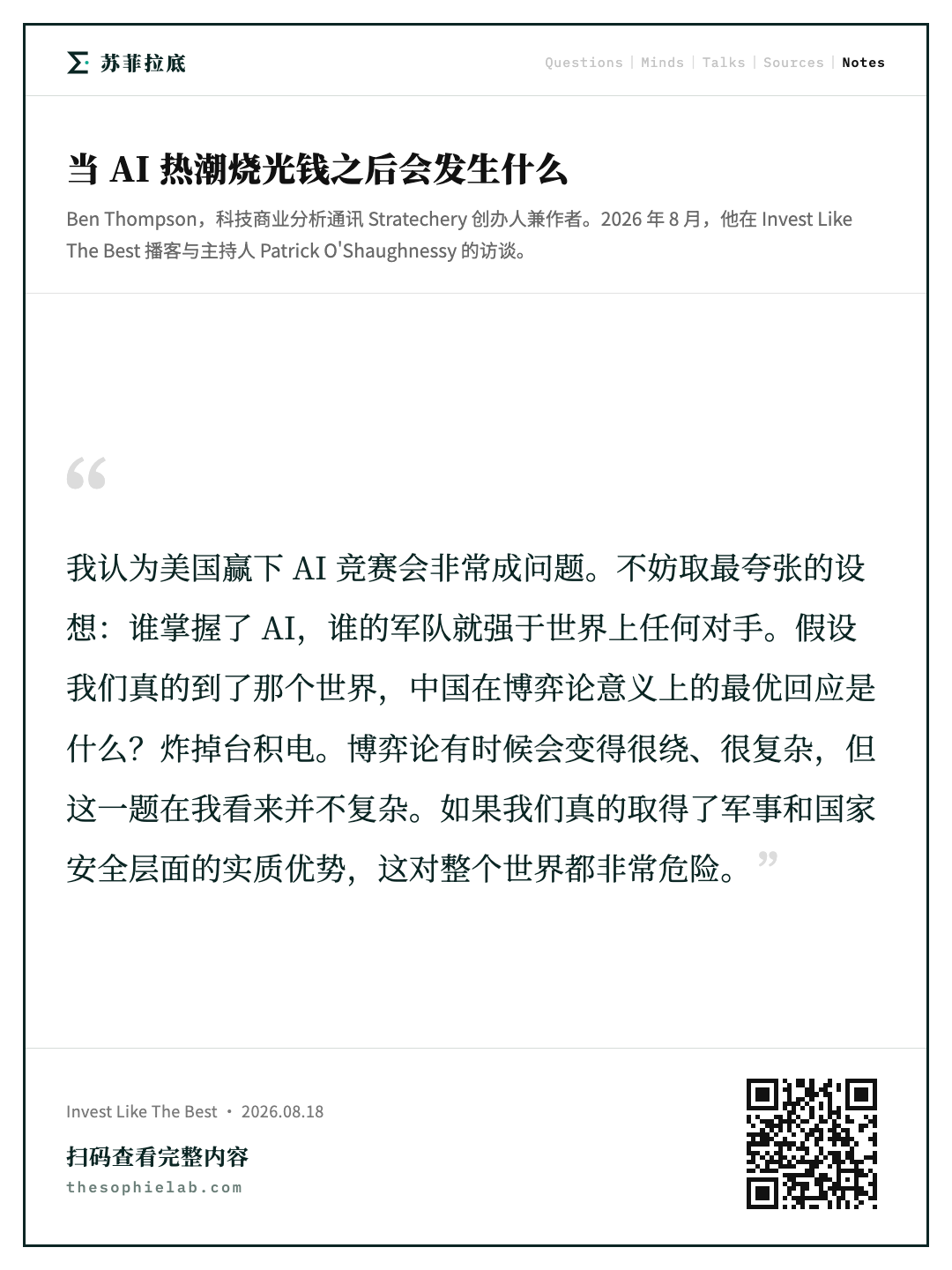
汤普森: 我认为美国赢了会非常成问题。我们不妨取最夸张的那种设想:谁掌握了 AI,谁的军队就强于世界上任何对手,AI 还能顺手修好我们的制造业,诸如此类。这些事我其实不认为 AI 必然做得到,因为它们都要和现实世界打交道。但假设我们真的到了那个世界,中国在博弈论意义上的最优回应是什么?炸掉台积电(TSMC)。博弈论有时候会变得很绕、很复杂,但这一题在我看来并不复杂。所以,我和硅谷、尤其是某一家实验室传出来的那套说辞之间,存在一个根本性的错位。如果我们真的取得了有实质意义的优势,特别是军事和国家安全层面的优势,我认为这对整个世界都非常危险。

主持人: 但在那种状态下,后果会不会超出「台积电被炸掉」这一层?因为到了那个阶段,我猜我们已经在美国本土多少学会了建晶圆厂,对那个单一卡点的依赖也没那么重了。

对华依赖被严重低估

汤普森: 这里面有一点一厢情愿的想法,我刚才自己也犯了,就是关于制造业的那部分。不管是晶圆厂,还是执行器,还是各种上游前置环节,我认为我们对中国的依赖程度被大大低估了,而且这个问题在没有爆发冲突的情况下不会被解决。原因很简单:去修补这些环节,从商业上讲是愚蠢的。如果你的竞争对手从中国采购,而你打算改从美国采购,你在相对意义上会处于极大的劣势,所以你根本不会这么做。只有在实在别无选择的时候你才会做。这个逻辑对那些最显眼的大项目是成立的,比如你可以逼着苹果把一部分 iPhone 的生产挪到印度。但就连这个例子也说明问题:苹果并没有真正搬出中国,它只是在一定程度上分散风险。问题在于代价太高了,这就像买一份保险,如果你可以不买,而保费又贵得离谱,你就是不会买。所以这类假设我连认真看待都觉得困难。因为在我能想象的唯一一种「美国彻底抽身、对中国毫无依赖、以至于他们想炸台湾就随便炸,对我们毫无影响」的世界,本身就相当离奇。这类讨论里缺少一点直面现实的态度。

主持人: 那你换到他们的立场上看,你觉得推动这套说辞的动机是什么?

汤普森: 谁都需要一个好用的假想敌。从 AI 交易的角度看,没有什么比「我们必须打败中国」更管用。我也确实认为我们需要打败中国,需要保持竞争力。让我痛心的是,过去几年,尤其在政治层面,我们太多的反应都是在试图变得像中国。我认为我们应该朝相反的方向走:更开放,更多创新,更少自上而下的控制,更少对言论的限制。美国的成功之道在于站在最前沿,并且顺势而为。

六到九个月的均衡

主持人: 你说美国在 AI 上单方面独大大概不是对世界最好的终局。那你理想中的全球均衡是什么样?

汤普森: 眼下的 AI 局面有点像台湾问题:现状本身看起来并不糟,问题是它能维持多久。但也许它能维持的时间比我们以为的长。我现在的看法是,OpenAI 和 Anthropic 显然站在前沿,谷歌的情况谁也说不准,然后 Grok 和 Meta 在后面追。与此同时,中国人非常能干、非常聪明,而且肯定在蒸馏这些模型,稳稳地保持在落后六到九个月的位置。在我看来这是一个相当不错的均衡,总体上对美国有利。接下来的问题是,这个局面能维持多久?外面有很多疑问,比如中国人真能反超吗?出于种种原因,我对此仍然有点怀疑,我认为冲到最前沿的那最后六到九个月非常难。Meta 和 Grok 到底能不能真正追上来,会是一个很有启发性的观察对象。尤其是我们正在进入一个 AI 自我改进的世界,用 AI 来把 AI 做得更好,我认为这绝对是真实发生的事。你最近能看到 OpenAI 和 Anthropic 都出现了明显的加速,这是早先被理论化的东西,现在似乎正在成真。如果这是真的,追赶还追得上吗?

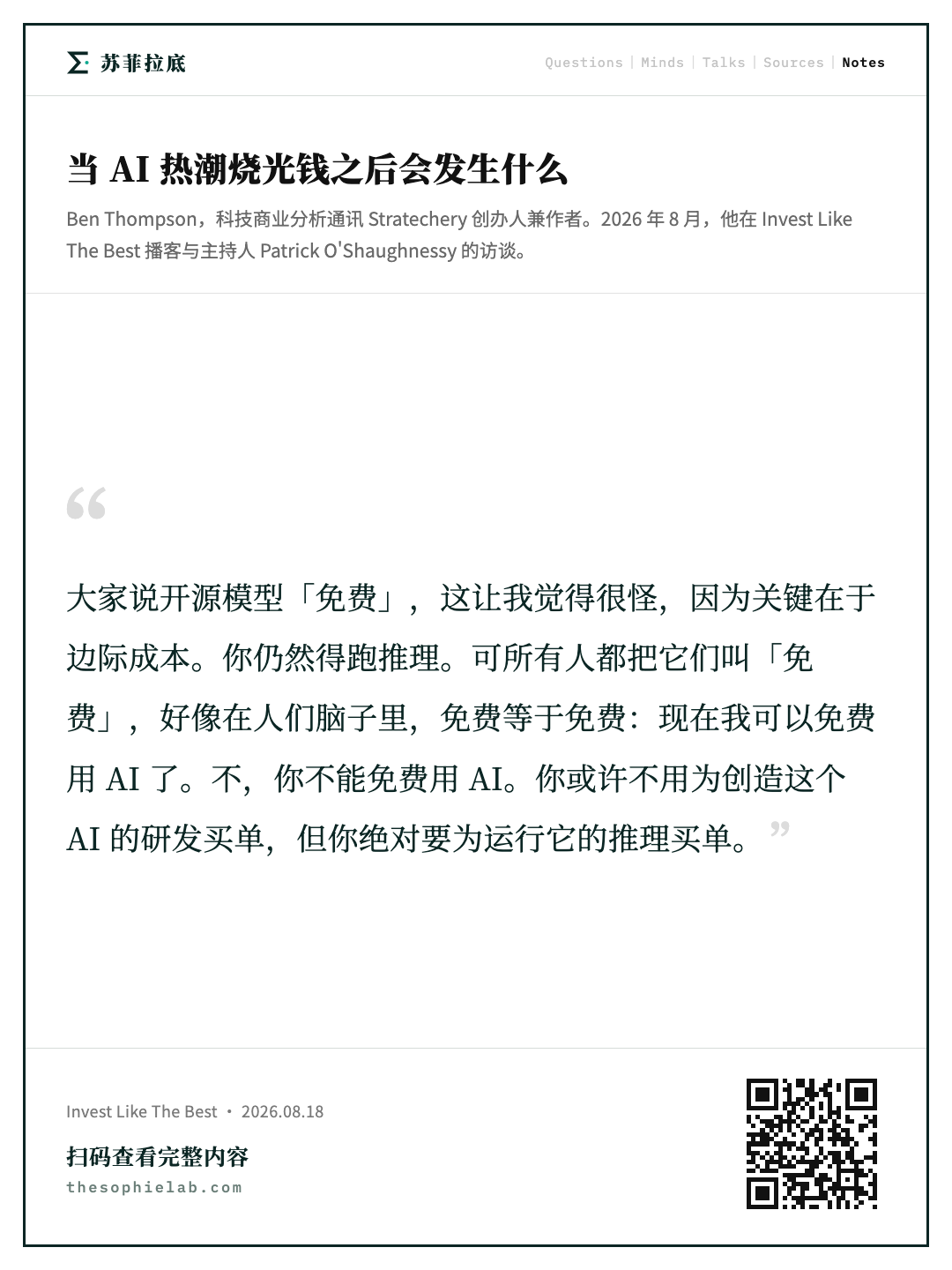
汤普森: 顺带说一句,这里还有另一个问题:这种自我改进在多大程度上也适用于服务成本、边际成本?如果你能把 AI 用于优化自己的技术栈、找出各种问题、分析全部数据,那你的服务成本是否在结构上就比所有人都低?这也正是我对开源模型的看法。大家说开源模型「免费」,这让我觉得很怪,因为关键在于边际成本。你仍然得跑推理,比如 GLM 或者 Kimi。Kimi 的服务成本非常高,每个回答的成本明显更高。可所有人都把它们叫「免费」,好像在人们脑子里的叙事就是免费等于免费:现在我可以免费用 AI 了。不,你不能免费用 AI。你或许不用为创造这个 AI 的研发买单,但你绝对要为运行它的推理买单。所以我挺喜欢现在这个位置。反驳意见会说,那只是现在,它不会一直这样。我觉得这个反驳是公道的。

主持人: 那有没有什么东西,是你想知道了之后,就能对这件事的未来走向、对均衡最终落在哪里更有把握的?是 S 曲线的长度吗?是我们已经爬到 S 曲线的什么位置吗?这些东西大概总会在某个点上趋平,也可能不会。你想知道的是什么?

前沿封闭与投资回报的错配

汤普森: 我担心的是,围绕 Mythos 的恐慌,以及那次 Hugging Face 事件,人们炸了锅,而它的实际后果不是我们降低了那些风险,而是大家干脆不再发布东西了。于是我们这些局外人开始失去对「前沿到底在哪里、到底是什么」的感知,并由此产生一种虚假的安全感。因为现在所有人对 Mythos 的理解都是基于 Fable,可 Fable 相对于 Mythos 到底有多好?我认为这种落差只会随着时间越拉越大。所以这是一个我确实没有把握的真问题。另一个是 AI 的递归性,AI 让自己变得更好,这会不会导致某种起飞(takeoff)?归根到底,这里面有各种各样的时间问题。

汤普森: 我担心的是投资回报上的时间错配:能不能产生足够的收入来支撑投资。我们正在沿着资本曲线一路往下走。一开始靠的是自由现金流,然后科技公司烧穿债券市场的速度简直不可思议,差不多只用了一年,现在谷歌开始增发股票了。英伟达在组建那个东西……

主持人: 那个五千亿美元的东西。

汤普森: 对,那个五千亿美元的平台,要去接养老基金、保险浮存金之类的钱。那之后呢?之后的钱从哪里来?理想情况是我们重新回到用自由现金流来供养这一切。但如果中间出现断档,如果我们没能及时走到那一步,就可能来一场大爆炸。可即便有这场爆炸,AI 也不会消失,不会停止进步,它会继续往前走。就像我们回头看互联网时代,回头看铁路时代,回头看历史上任何一次泡沫,从人类的宏观尺度看它们最终无关紧要,哪怕它们曾对无数人造成毁灭性打击。

铁路泡沫与伯克希尔的绝对利润逻辑

主持人: 你觉得铁路教给了我们什么?

汤普森: 铁路是上一次更大规模的建设,对吧?按占 GDP 的比例算。

主持人: 我觉得我们现在可能已经超过它了,或者说它曾经是最大的。

汤普森: 在同一个量级上,是的。铁路存在真正的久期错配。修一条铁路并从中赚钱,是一件要花十年甚至几十年的事,而你得在短期内发行债券去付钱,结果是全世界的钱用光了。我想这大概就是人们总拿铁路做比的原因。所有人都在问,我们的算力够不够,我们的电够不够,但也许最近在眼前的问题是,我们的钱够不够。这想起来挺荒诞的,可十九世纪七十年代就是这么回事,世界就是没钱了。有趣的是,铁路照样在运营,它们开拓了西部,对 GDP 的贡献是天文数字,直到今天还在贡献。现在流进谷歌的钱,从伯克希尔·哈撒韦(Berkshire Hathaway)来的那笔,就是铁路的钱。

主持人: 太有意思了。

汤普森: 这是字面意义上的。伯克希尔·哈撒韦这个例子对我来说很关键。英伟达这笔交易,和谷歌增发股票是配套的,而谷歌增发在我看来是一件令人震惊的事。

主持人: 为什么震惊?

汤普森: 因为它是谷歌啊。它需要筹钱?为什么要发股票?如果它们对这件事如此笃信,为什么要把自己的上行空间让出去?伯克希尔这个对比之所以有意思,是因为粗略地说,伯克希尔有喜诗糖果(See's Candies),一门出了名的高利润率生意。很多高利润率生意的问题在于,你能赚到的利润百分比很高,但你能赚到的绝对利润受限于再投资的跑道。

主持人: 没错。

汤普森: 你只是在不断堆积现金。所以收购伯灵顿北方圣太菲铁路(BNSF)的精妙之处在于,他们拿喜诗糖果的利润,投进另一个利润率差得多、但绝对金额大得多的行业,以至于那差得多的利润率带来的绝对利润反而大得多。BNSF 在 2025 年左右一年抛出的自由现金,比喜诗糖果一辈子抛出的还多。尽管一个是低利润率生意,另一个是极高利润率生意。伯克希尔身上有这样一层意思:一旦你的资本大到某个程度,你就开始活在一个以绝对数字而非百分比计算的世界里。

谷歌发股票:搜索是喜诗糖果

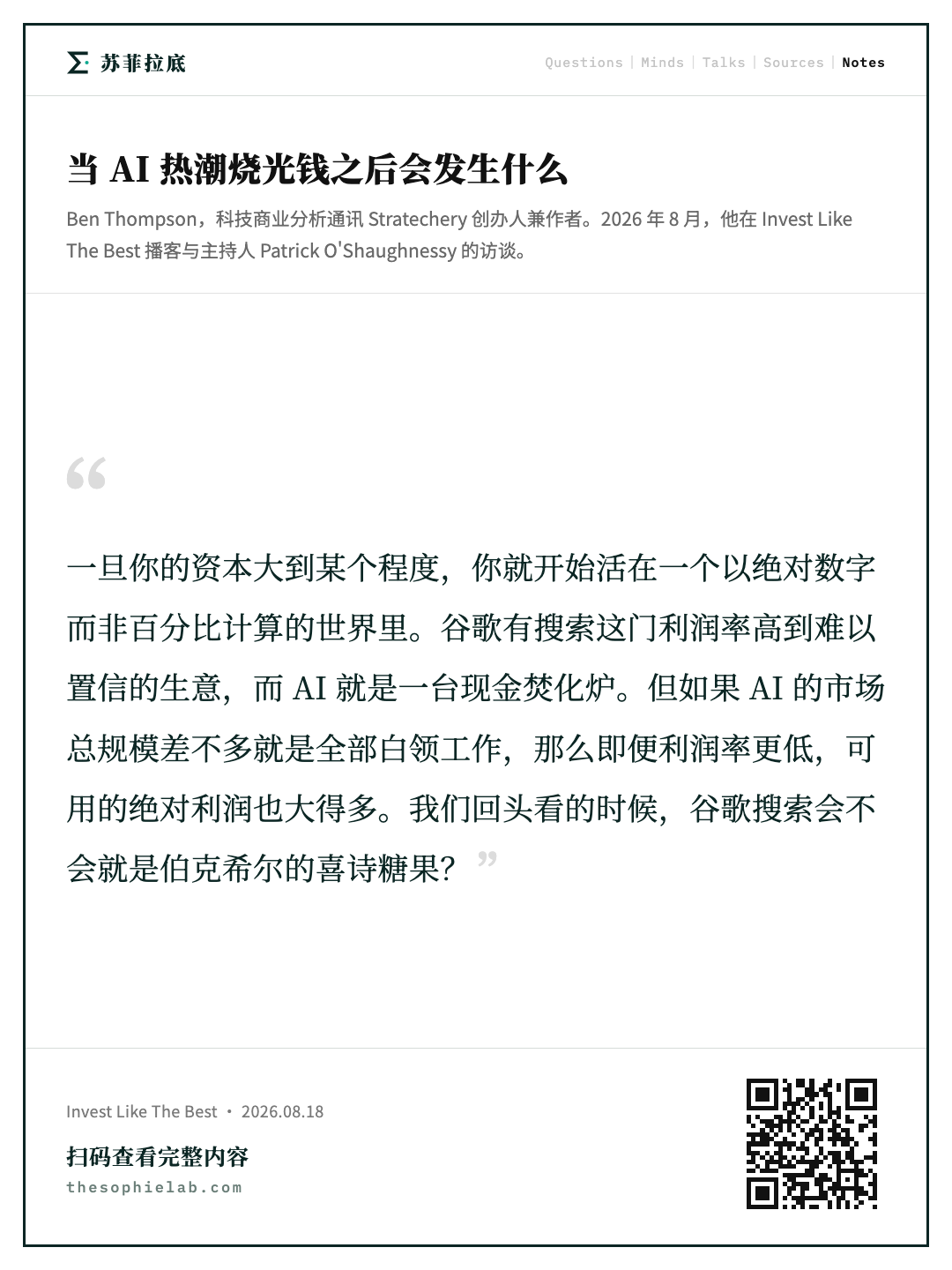
汤普森: 我之所以觉得这个故事特别有意思,是因为它似乎正好捕捉到了谷歌自己可能正走向的地方。所以伯克希尔投资谷歌极具象征意义。谷歌有搜索这门利润率高到难以置信的生意,有史以来最完美、最漂亮的商业模式之一,也是所有聚合者中最纯粹的一个。它在每个方向上都能规模化,不用投什么钱就能做到,一切都是零边际成本,太棒了。与此同时,摆在面前的 AI 机会需要的投入是天文数字,它就是一台现金焚化炉。但你可以想象,如果 AI 就是智能,它的市场总规模(TAM)差不多就是全部白领工作,再加上机器人之后可能是一切。那么即便利润率更低,这里可用的绝对利润也大得多,以至于我们回头看的时候,谷歌搜索会不会就是喜诗糖果?我感觉正在发生的就是这件事。在那个世界里,你花光全部自由现金流,他们做了;你去债券市场借几千亿美元,他们做了;你增发股票。增发股票是什么?它稀释你的股东权益,让他们在饼里占的比例变小。可如果你占的是一张大得离谱的饼里的一小块,到头来没人会抱怨。我就是觉得这极有象征意味:伯克希尔成了这次增发的象征。它们不只是谷歌的投资者,也是谷歌的样板,指向谷歌要去的地方。

可验证领域之外,AI 能力存疑

主持人: 抛开商业和竞争的部分,单就技术本身而言,相对于其他思考这个领域的人,你会说自己有多「AI 上头」?

汤普森: 我的看法在某些方面极度乐观,在另一些方面又没那么乐观。我并没有被「泛化」的论证完全说服。AI 在编程上显然厉害得不得了,人们一年前居然还在亲手一行行写代码,这简直让我难以置信。它在数学上显然也很好。但显而易见的反驳是,这些都是可验证的领域。有什么令人信服的证据,能证明在可验证领域表现出色,就能干净利落地转化为在不可验证领域、或者验证回路非常漫长的领域同样出色?我认为这一点仍然有待观察。有意思的是,我曾在一个场合提出这个问题,台上有几位实验室的人,他们的回答让我有点恼火,因为那回答把我当成了 AI 空头。他们说,当年人们也认为我们解决不了国际象棋、解决不了围棋,结果我们轻松就解决了。可我当年就认为我们能解决国际象棋和围棋,因为它们是可知的领域,规模是这两者的答案,而且它们都是有边界的。那个不是国际象棋、不是围棋、真正处在全新空间、处在某种不可知领域、做出了原本不可能之事的标志性例子,是什么?这就是我「没有被完全说服」的那一面。

汤普森: 不过,AI 粗略地说是用整个互联网的数据训练出来的。这本身就是蒸馏,人们说它蒸馏了全部人类思想。不,它没有。它蒸馏的是人类思想的终态,是最后敲在 Reddit 上的那些字。它没有过程的痕迹,没有敲下那条评论、写出那篇文章背后真正的思考和情绪。那么,假如 Neuralink 之类的东西真正的回报,其实是捕捉人类思维的痕迹,从而大幅扩展这些模型的能力呢?我对可验证性的担忧,说不定就是靠拿到更多数据来解决的。

汤普森: 我的感觉是,大量的工作、大量的经济活动,并不落在那些我不确定 AI 擅长的领域里。实际上,世界上有很多人某种程度上就像有意识的 AI:他们在可验证领域里干得很好,别人给他们任务,他们完成。这多少是对人性的一种悲观看法。但这个市场太大了,大到就算模型从现在起一点都不再进步,经济机会依然是巨大的。我之前写过一篇文章,谈到那场所谓的加速主义运动,我把自己称为「不情愿的加速主义者」。我认为我们必须往前推,因为我们回不去了,最糟糕的事就是卡在现在这个位置上。所以论 AI 对经济的影响、论它在变现上的上行空间,我是非常上头的。我不确定的是时间。

医疗机会、红头文件与新岗位

主持人: 通往那里的路径会是什么样?比如法律或者医学。我不知道你会不会把它们算作可验证领域,法律像是某种代码,医学我们也有一套确定的知识状态。

汤普森: 我认为医学绝对是最大的机会之一。它既是最大的机会之一,也是最难啃的之一,因为有那么多监管、那么多准入门槛。如果你能把 AI、把机器学习放到全部医疗记录上跑一遍,我们在极短时间内能得出的发现和改进的疗法,数量会是难以置信的。这是非常乐观的一面。反过来看,那什么时候会发生呢?我给人类套上的乐观框架是:我们创造需求的能力基本上是无限的,所以在时间充分展开之后,我们会很擅长创造新的机会和新的岗位。悲观一点的说法是,我们制造红头文件和淤泥的能力同样基本上是无限的。你想想我们的经济里,有多少岗位其实是我们不断制造出来的、某种程度上只是为了让人忙起来、让事情慢下来的岗位。

聚合理论在 AI 时代还成立吗

主持人: 回到 2010 年代初,聚合理论大概在你脑子里酝酿,2015 年你把它发表出来。我想可以公平地说,那套理论定义了那个技术时代的赢家和输家。你能不能先快速提醒一下大家它讲的是什么,然后我很好奇,从财务和市值的角度看,你认为什么理论或者原则会定义这个时代的赢家?

汤普森: 这是个好问题。就连聚合理论本身在当下还适用多少,我自己也在反复摇摆。人们的一个反驳是,聚合理论的关键成分之一是零边际成本,而零边际成本体现在很多方面。我最初关注的是分发。有人说,我没有分发渠道,我得付钱给谷歌才能触达用户。不对,你有网站,你的问题不是分发,你的问题是没有需求。你买广告,付的是需求的钱,因为聚合者控制着需求。而他们之所以控制需求,是因为在一个丰裕的世界里,难题不是分发,而是发现:你怎么找到自己感兴趣的东西?于是在各自领域里解决了发现问题的公司,就会主导那个市场,进入一个良性的反馈循环。这差不多就是聚合理论的精髓。另一件事是交易成本,这里没有交易成本。谷歌可以规模化到全世界,而且不只是在用户侧,在变现侧也一样。谷歌或 Meta 上的广告主,绝大多数从来没有跟谷歌或 Meta 的任何一个人说过话,他们上去直接买广告,全由计算机完成。而从商业角度看,那些计算机的成本是零美元。AI 显然大大改变了这一点,推理成本是实打实的。但话说回来,它到底有多实?

主持人: 现在是实打实的。

汤普森: 有多实?我不确定。

主持人: 看公司吧,但比先前那些例子实得多。看毛利率就知道。

推理成本分化与微软按量计费困局

汤普森: 那当然。但这里有一个巨大的分化。我认为今天用 AI 的人绝大多数是把它当谷歌的替代品,或者当食谱生成器之类的东西。我怀疑服务这些人的成本极低,低到基本上和给他们送一张网页差不多。我猜会略高一点,但高不了太多。然后在另一个极端,是真正在利用测试时扩展(test-time scaling)的人。过去我们靠把模型做得越来越大来扩展,现在还可以在时间维度上扩展:你想多久来给出这个答案?你可以想几天、几周、几个月。而那直接就是边际成本,每多想一秒钟都在多花钱。这说明我们把 AI 和推理当成一个问题来谈是有问题的。刚才我算是在跟你抬杠,但对不同用户而言,边际成本这个问题完全不同:用免费版 ChatGPT 的人,和试图证明一条数学定理的人,压根不在同一个宇宙里。

汤普森: 我认为你在企业市场能看到这种挑战以一种很有意思的方式显现。微软最近在调整它的企业套餐,推出了所谓 E7 套餐,每用户每月一百美元,含一定用量,用量之外再按量收费。我认为这对微软来说是一个颇为危险的处境。看好微软的逻辑是:它把一家企业需要的一切都做了,单拎出来每一件未必最好,但你付一个价钱就全拿到,而且它们大体上能协同工作。如果你是中小企业,甚至是大企业,这里面有真实的价值,它让日子好过。可一旦你开始得琢磨自己付了多少钱,问题就不只是多了一个决策。第一,这个决策和人头脱钩了。微软过去的好处是,你招一个新员工时会考虑这个员工的成本,而这个成本里已经打包进了每月一百美元或五十美元的许可费,对微软来说这是一条不用动脑子的收入流。现在按用量算,你每个月都得想:我这个月想花多少?这带来两个问题。其一,大多数公司不是这么运转的,它们一年做一次预算,「按月琢磨预算分配」这个想法根本转不动。它们习惯考虑的是资本开支决策或一次性成本。我刚才讲的员工总成本,它不是资本开支,但有点像资本开支:你事先做决定,之后就不再想它,因为决定已经做了。可如果按用量算,你得反复做这个决定。其二,也是最后一点,如果你每个月都盯着微软的账单看我用了多少,你就会开始想:我到底在为什么付钱?这些产品每一个到底有多好?我是不是该拆开来,分头去买?

汤普森: 我认为微软是不得不这么做的,因为那种消耗海量 token、真正把 AI 用起来的极端用户,给微软带来的成本远超每月一百美元,微软撑不住。但它又想为绝大多数能装进这个套餐的员工保住固定收费。所以它得请客户为那些极端员工稍微动一下脑子,又不希望他们想得太多,因为想多了,这个模式就会以出人意料的方式垮掉。

主持人: 那个成本极低的「食谱生成器用户」,到现在还没有出现一个很棒的商业模式,你意外吗?谷歌和 Facebook 在上一个时代把这门生意做到了极致,而这一次它们似乎完全没想明白。

消费者不付费:Dropbox 与广告宿命

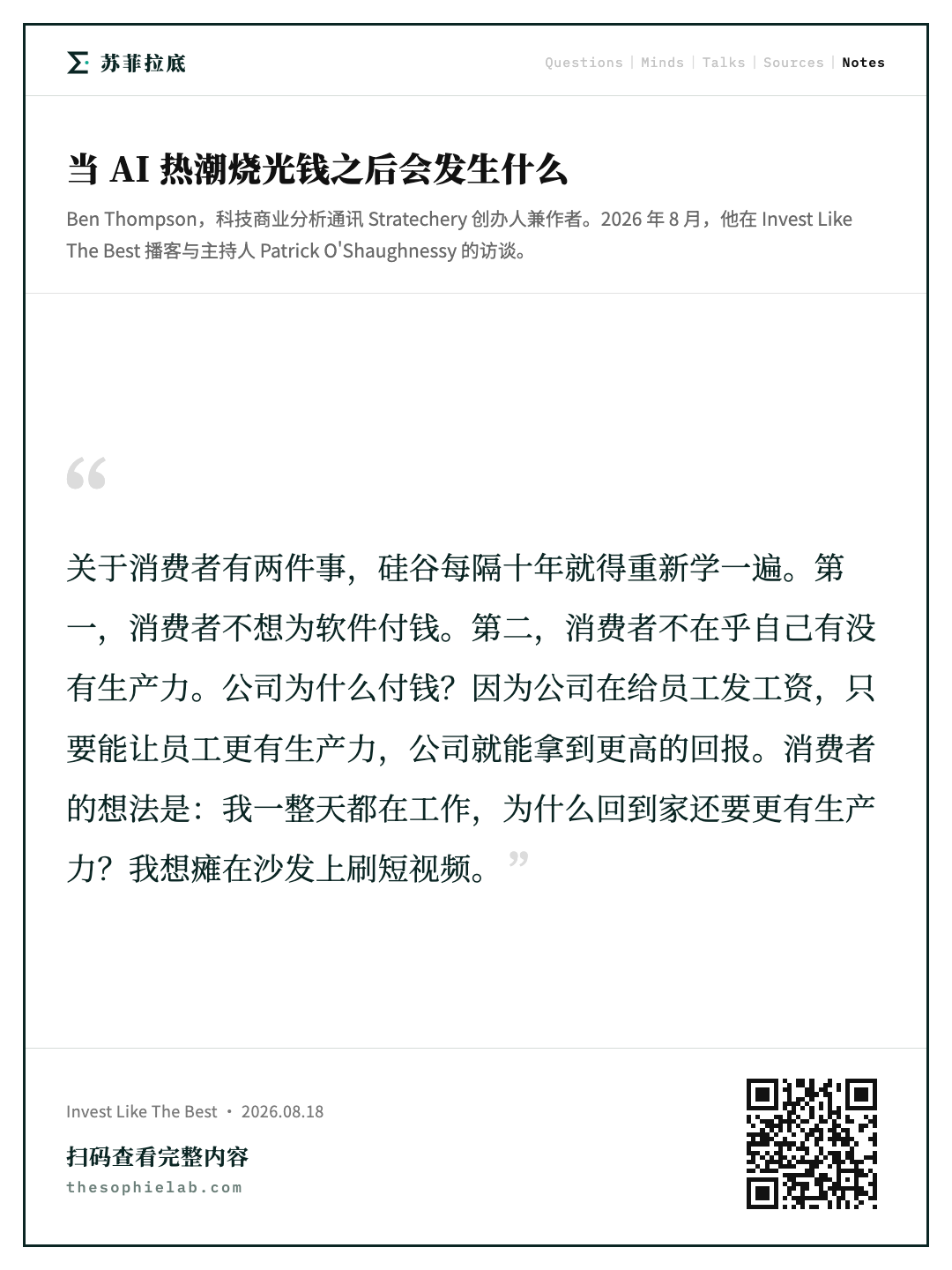
汤普森: 我沮丧,但不意外。这显然是一个应该由广告来支撑的市场。广告永远是消费者领域的商业模式,因为消费者不想付钱。关于消费者有两件事,硅谷每隔十年就得重新学一遍。第一,消费者不想为软件付钱。第二,消费者不在乎自己有没有生产力。早期 SaaS 时代我们就经历过这一课,在我心目中最典型的公司是 Dropbox。

汤普森: Dropbox 是一个难以置信的产品,尤其是刚推出的时候。我在商学院时是最早一批用它的人,它像疯了一样传开。我到现在免费账户里还有大把存储空间,因为我把邀请码发给了太多人。德鲁·休斯顿(Drew Houston)做出了这么一个极其好用、完全无缝的产品,而且他很明确,他想做一家消费者公司。有那个著名的故事,他见了史蒂夫·乔布斯,苹果当时有意收购 Dropbox,他们说我们想自己做一家公司,乔布斯说你们是一个功能,不是一家公司。而那种最朴素的文件同步,苹果后来确实做成了一个功能,就是 iCloud Drive。Dropbox 增长得非常快,然后陷入了大约两年的停滞。在那两年里,他们不得不把整个应用从底层彻底重做,因为愿意付钱的消费者不够多。企业看得到价值,企业愿意付钱,可你想做企业市场,就得有权限、有管控、得让另一个人能设定所有这些东西,而他们的应用当初压根不是为此设计的。所以他们不得不重做整个产品,并且认清一件事:我们赚钱的唯一办法是卖给公司。公司为什么付钱?因为公司在给员工发工资。只要能让员工更有生产力,公司就能在投入上拿到更高的回报。这和消费者完全相反。消费者的想法是:我一整天都在工作,为什么回到家还要更有生产力?我想瘫在沙发上刷短视频。

汤普森: 你在 AI 上看到的正是这个,外加一种对广告的普遍怀疑。我在 Stratechery 上靠当一个「广告欣赏者」赢得了很多关注。我回头翻自己早年写广告的文章,方向大致是对的,但写得其实并不好。可我靠这个获得了那么多关注,原因是我是唯一一个在写广告的人。在一个人人想写博客、上推特的世界里,没人想谈广告。即便到今天,硅谷仍然有一种难为情:这个山谷在很多方面是靠广告变现的。尤其在过去八年左右,Facebook 被视为不体面,最好的工程师都不想去做这个问题。于是你看到 OpenAI 把 Dropbox 的故事以一百倍的规模重演了一遍:不,我们要向消费者卖订阅。他们卖了,卖了很多,但卖得不够。你要做消费者市场,就得做广告。

OpenAI 迟到的广告转向

汤普森: 现在他们做广告了。有点奇怪的是,他们终于转向广告的同时,又在说,糟了,我们得去攻企业市场,因为 Anthropic 把我们打得很惨。我不太确定他们在那边到底想干什么。他们推出广告功能的速度倒是非常快,比如各种和零售商的对接,购买是否成交、全链路追踪之类的事情。我很想看这一块会怎么发展。假如 ChatGPT 一走红他们就全力投入广告,我认为他们现在手里已经有一个杀手级的广告产品了,谷歌的麻烦会大得多,Meta 的麻烦也会大得多。因为一旦你有了这个飞轮,消费者广告的妙处在于,你从消费者身上变现的能力会不断上升,而涨价由广告主承担,所以完全没有价格弹性的问题。反过来,如果你向消费者收费,想涨价,就像 Netflix,这正是他们订阅模式的难题:价格能涨到哪里,消费者才会造反、降级或者干脆退订?向人收钱是难的。

主持人: 免费给人东西是容易的。

汤普森: 所以 OpenAI 没有更早走这条路,非常令人沮丧。

主持人: 我知道你最近和一些大型资金方、资本来源方有不少接触。你对他们眼下的胃口,以及他们对未来的想法,有什么感觉?因为今年的资本开支大概是八千亿美元,明年目前的估计是一万三千亿,之后还会继续往上走。而所有装上的算力我们几乎立刻就烧光了。这个局面很奇怪,产能一上线就能马上用掉。

算力短缺的真相与大宗商品定价

汤普森: 这正是问题所在。眼下同时存在好几个时间错配。推特上所有的多头都在说,我们算力不够,我们算力不够。是的,算力不够,是因为 2023 年和 2024 年的投资不足,这一点没错。顺便说一句,如果你认为算力不够,台积电在 2023、2024 和 2025 年是在放缓增速的。所以我们的算力短缺在接下来几年只会更严重,因为晶圆厂的前置周期比数据中心还长。今天我们说算力不够,公司今天砸进去的钱并不会立刻变成算力,它们全都要到 2028 年、2029 年才变成算力。所以你在财报电话会上看到安迪·贾西(Andy Jassy)和纳德拉(Satya Nadella)都在说,我们只是在建数据中心的壳子,现在可能用不上,将来也许用得上,我们只在确定有需求的时候才买 GPU。这个故事讲得很漂亮,我不确定自己信多少,我认为里面有不少是胡扯。现实是,你把壳子建好了,钱就已经砸在那里了,你不会让它就那么闲着。

汤普森: 一旦你投下了固定成本,这就是大宗商品市场的全部逻辑。我认为科技行业总体上不理解大宗商品市场。科技行业大体上关注的是:我做出一个高度差异化的产品,差异化可以来自软件,可以来自开发者网络,可以来自点对点的社交网络。只要我高度差异化,我就有能力定高价,这就是我的利润率。经典的例子是苹果,它有生态系统,有软件,有第三方,所以能定高价,iPhone 有百分之五十的利润率。所有人都把苹果看作理想的商业模式,觉得生意就该这么做。但在大宗商品市场里,价格是由边际供应者决定的。

主持人: 唯一重要的是服务成本。

汤普森: 没错。我在台湾有个好朋友做航运,那是个迷人的行业,有点像航空业,也是我爱研究的行业。你买一艘船,这艘船的成本是折旧,而你的边际成本其实很低:开船的燃油、船员的工资、港口费,不多。这意味着你会开这艘船……

主持人: 尽可能装满。

汤普森: 不,是无论如何都要开。你会把一个集装箱的价格压到只要能覆盖边际成本的最低水平。这时你的账面亏损可能很大,因为会计上的亏损包含折旧,可折旧是会计上的虚构,钱你早就付了。所以你会按市场能承受的任何价格开这艘船。集装箱的美妙之处在于它是纯粹的大宗商品,市场价格就会落在边际成本上。价格低到某个程度,有些人会退出,因为他们的边际成本真的扛不住了,一趟运输不只是账面亏钱,而是真金白银在亏。他们退出,供给减少,价格回升,你就得到了这种进进出出的相互作用。可再假设市场价格很高,比如新冠期间,哇,我们现在赚翻了,因为供给不够,船不够。集装箱价格从通常的三四千美元涨到一万七八千。这些航运公司在极短时间里赚到的钱是疯狂的。然后会发生什么?造更多的船。

主持人: 想想看,要是我们有更多船就好了。

汤普森: 问题是,造一艘船要两年。如果所有人同时做这个决定,突然之间你就有了一大堆船,价格暴跌,如此等等。

航运、内存周期与产能过剩风险

汤普森: 我们在零部件上看到的就是这个,尤其是内存。内存以繁荣与萧条周期出名,有人总是在市场后期入场。那么数据中心会不会变成内存厂商?眼下所有人都看得到算力不够,所以所有人都说我们绝对得投,因为有那么多钱可赚,看看我们的回本周期多短。问题在于,你是在一个稀缺的时期计算回本周期的。这个回本周期在丰裕的时期还成立吗?多头会说,永远不会有丰裕的时期,AI 会一直缺算力,也许他们是对的。我担心的是,就算他们是对的,我们仍然可能出现一段真空期:现在流进去的钱太多了,而真正上线、能产生足够收入的产能太少,扛不住资本耗尽的局面。我再说一遍,我相信 AI,我认为它是真的,我认为它的经济影响会是天文数字,我认为所有关于社会冲击的担忧都是真实的,而且会以重大的方式兑现。你可以相信这一切,同时仍然担心:我们能不能搭起那座桥,让它真正产生足以持续供养后续投入的回报?

主持人: 你能不能把镜头拉近到台积电和那些涉及晶圆厂的零部件厂商?至少就我的理解,它们在扩产、建新厂、以同步的增速去满足市场需求这件事上一直相当保守,它们没有那么做。这会不会成为整件事的限速器,反而让我们躲过一次巨型过度建设?

汤普森: 我们可以分开谈几个。先从内存说起。内存过去有很多很多厂商,每一次繁荣,就会有内存厂商重新入场,或者有新的国家入场,台湾过去也有内存产业。你会看到完全相同的动态:内存短缺时有太多钱可赚,因为产能没法立刻上来,和航运一样,和我们现在看到的一样。这会刺激人们入场,产能过剩,价格暴跌,人们被扫地出门,因为这些东西的前期成本太高了,就像买船,建晶圆厂更是如此。如今内存的最前沿要用极紫外光刻(EUV)机,一条产线的成本已经到了几十亿美元。每一轮繁荣与萧条,都有人进来,更多人被冲走。内存周期里有一些著名的历史时刻,公司就那么整个被清出局。最有意思的内存故事之一,是三星如何接管内存市场:他们把它看作一个机会,研究了历史,意识到接管市场的办法其实是在下行期投资,这样下一个周期到来时你已经准备好了。这需要巨大的胆量、巨大的纪律和巨大的资金,但他们做到了,基本上把日本人扫出了市场,韩国人从此大举接管。但市场最后只剩三家。三家不是垄断,但差不多是寡头。他们都变得纪律严明得多:不要再犯过去的错误。我们不是在串谋,但我们都心照不宣,别再那样干了。我认为正是这种动态迎面撞上了当下这个时刻。他们花了一段时间才意识到,内存需求出现了一次长期性的结构转变,这是很久以来都没有过的事。所以我认为内存问题最终会解决。他们承担的另一个风险是苹果,苹果在游说使用中国的内存。而算法优化的头号目标是什么?怎么用更少的内存。我认为内存厂商在长期上大概把自己坑了,因为他们把自己变成了一个巨大的靶子。

汤普森: 我把内存厂商类比成伊朗。霍尔木兹海峡的问题在于,它很有效,但不用的时候更有效,因为它一直悬在那里,是你随时可以做的事。现在他们用了,结果证明确实有效。但阿联酋和沙特会去修管道,会去建新港口,他们不会让这种事再发生。眼下很痛苦,可假如伊朗想在 2035 年再封一次霍尔木兹海峡,不会有任何效果,因为大家早已绕开它了。我对内存厂商的担忧是,他们可能做了同样的事:在内存这件事上,没有人会再让自己陷入这种境地。

台积电把风险转嫁给了大厂

汤普森: 台积电的情况可以说更糟,因为只有一家。最前沿只有一家公司,英特尔和三星显然在努力赶上来。道理是一样的:所有市场都有风险,很大一部分问题在于最后谁拿着这份风险。我认为很多科技公司没有充分认识到的是,台积电在多大程度上把风险卸到了大型科技公司身上。它是这么做的:台积电担心的风险是产能过剩。如果我们建多了,不只是建多了、有一堆固定成本没有被充分利用,而是一座晶圆厂我们预期要跑三十年,等于把过多的产能锁进了这个体系很多很多年。所以他们的偏好是强烈地趋向保守。这里面也有一点文化因素。台积电最有意思的故事之一,和刚才三星那个有点像:张忠谋(Morris Chang)在 2000 年代末退休,新的领导层接手,赶上了大衰退,于是缩减了原定的开支。他回来,把人都换掉,说:iPhone 刚刚发布,这是我们见过的最大机会,我们需要投资,而不是削减。他们穿越大衰退、穿越那次下行一路投资,这奠定了台积电在那个时期接管先进制程的基础。张忠谋是独一无二的人物,在我心目中属于有史以来最伟大、最有影响力的科技高管的「拉什莫尔山」。整个无厂(fabless)模式对科技行业是什么、做什么至关重要,而且在那个时刻有那样的胆量,尤其是身处一种未必倾向于下这种赌注的文化里。老实说,台积电此后是相当保守的。

汤普森: 那会怎样?风险去哪了?台积电说,我们不想承担这个风险。风险不会消失,它只会转移。眼下这份风险体现在:每一家大型科技公司都意识到,如果我们有更多算力,我们就能赚更多钱。于是有大量被放弃的收入、被放弃的利润。这就是台积电递给他们的那份风险的具体形态。风险不会消失,只会被交出去。而有时风险不是表现为亏钱,而是表现为没赚到钱。现在就有钱没赚到,因为当年发生的事是,他们对 5G 非常兴奋,在 2020、2021、2022 年前后来了一大波扩产投资,然后说,好了,我们够了。而正如我说的,ChatGPT 在 2022 年底出现,2023 年是科技行业的大事件,2024 年他们的增速下降,2025 年增速又下降,2026 年才涨上来。很好笑的是,我之前就在写这件事,然后大概一两个季度前的财报电话会上,董事长兼首席执行官魏哲家突然整场都在谈 AI 的应用场景,以一种他从没有过的方式。这就是问题所在,也是为什么晶圆厂会害怕。通常会有一个「牛鞭效应」,他们担心自己在牛鞭的末端:需求发生了,沿着链条一路传下来,他们在最末端,等他们加倍投入的时候已经太晚,钱全白花了。而 AI 的事在于,如果它是牛鞭,那它是有史以来最长的一条牛鞭。要建的东西还太多,只是亚洲的这些公司花了一段时间才收到信号。我认为他们大体上已经收到了,但收到信号之后,再要几年才能真正变成产能。

主持人: 考虑到算力短缺这么极端,你对这要花多久有感觉吗?

稀缺救了英特尔的代工业务

汤普森: 有意思的是这对英特尔和三星的逻辑芯片业务意味着什么。我写「对台积电的依赖」这个问题已经写了很多年。实际上我 2013 年最早的一篇文章就是在敦促英特尔:你必须建一个晶圆代工业务,你不会再有过去那种地位了,芯片制造里有一门巨大的生意。我当时觉得自己写得已经晚了。结果他们的股价在整个 2010 年代一路冲天,因为搭上了云计算的浪潮。直到 2020 年前后他们才终于意识到,我们落后了,而且顺便说一句,有一个巨大的机会摆在那里,我们完全没准备好,我们没有客户服务的心态、文化、组织,没有那些 IP 积木,没有台积电有的那一切。他们需要客户,需要客户来帮他们真正建起一门代工生意。所以我会写这个问题,也会写中国的问题:你依赖的这家公司,离我们最大的政治对手只有六十英里,而对方认为它是自己的。这些是大问题。也正是在这里我体会到了那个「保险」的困境:一家大型科技公司去找英特尔说,英特尔,你来给我们造芯片。顺便说一句,最大的受益者会是你,因为你会学会怎么和合作伙伴共事;最大的痛苦会落在我们头上,因为我们得想办法和你磨合。我们本可以直接去找台积电,他们太棒了,合作起来太好了,我们知道他们会把事情做好。去和英特尔合作,从来就没有过合理的理由。这是他们的根本问题。在一个一成不变的世界里,台积电会永远赢下去。

汤普森: 但这正是台积电在某些方面犯了和内存厂商一样的错、和伊朗一样的错的地方,容我继续这个类比。因为他们过去几年没有投资,短缺会变得极其尖锐,大型科技公司会说,我们因为算力不够而放弃的收入和利润太多了,我们愿意承受把英特尔拉上来、把三星的逻辑芯片拉上来的痛苦。最终救了英特尔的是稀缺。我预计不久之后他们会宣布第一个重量级的合作伙伴,那会是一件大事。但归根到底,这是台积电自己招来的。「高价的解药就是高价」,我们会绕开他们。

主持人: 没错。

汤普森: 作为一个坐在旁边的分析师,这类东西你可以写,但我从中学到的一课是:没有人会去买自己不需要买的保险,尤其当这份保险的期望值是负的。解决「依赖台积电」这个地缘政治问题的办法,是搞出一个大到所有人都有经济动力去把其他玩家拉上来的算力用例,于是我们免费得到了地缘政治保险。

亚马逊:自用即最佳客户的飞轮

主持人: 如果看排名前十或十五的科技公司,你认为今天哪几家的生意处在最有意思的位置?

汤普森: 答案永远是亚马逊。亚马逊之所以如此引人入胜,在于他们为自己而建的程度。他们是自己的第一个、也是最好的客户。他们提供了把几乎任何东西启动起来的规模,然后再把它卖给别人。AWS 是最明显的例子。和流行的说法相反,AWS 并不是亚马逊的闲置产能,实际上把 amazon.com 搬上 AWS 花了很长时间。AWS 真正的驱动力是这样一种认识:我们需要可扩展的东西,我们不能再开那么多会,我们需要即插即用的算力,纯粹的 API 接口,不用跟任何人说话,它就在那里。而且,如果我们能为内部零售团队做到这一点,我们就能为任何人做到。结果零售业务太大了,我们只好先从其他所有人开始。AWS 实际上是先服务外部客户,再服务内部客户的。但现在它两边都服务。还有其他产品,比如物流,路径正好相反:眼下我们用的是外部的物流商,UPS、联邦快递、美国邮政,我们需要自己建起来。现在他们建起来了,就把它开放给第三方,别人也可以用他们的配送服务。你在一个又一个市场看到同样的事,比如他们谈的一些 AI 产品,或者芯片产品。Graviton 或者 Trainium 的妙处是什么?尤其是早期版本。早期版本很糟糕。但如果你在亚马逊上用他们的托管服务,比如 Redshift 数据库服务,他们不会告诉你底下跑的是什么处理器。你买的只是一项托管服务。

汤普森: 所以他们可以把所有不怎么样的处理器塞到他们卖的服务底下,这给了他们迭代和改进这些处理器的销量和产能,直到它们好到可以对外销售。因为他们是 Graviton 的第一个最佳客户,Graviton 变好了;因为他们是 Trainium 的第一个最佳客户,Trainium 变好了,现在 Trainium 显然在跑 Anthropic。他们在 AI 产品上做的是同样的事,能不能起飞我们拭目以待。他们有呼叫中心软件,他们自己的呼叫中心、客户服务正在全面 AI 化。顺便说一句,做得相当不错,不知道你试过没有。

主持人: 我还没试过。

汤普森: 我搬回美国,买了一大堆东西,其实每年夏天我都会在很短的时间里买一大堆东西。大概在过去一年里的某个时候,你上去明显是在跟一个聊天机器人说话,但这个机器人干得很好,真的能把问题解决掉。所以你能看到这件事在那个场景里开始成立。他们正在为自己的业务建这些 AI 服务,然后会把它们广泛开放出去。有些会成,有些不会。但这种做法太优雅了。而且考虑到他们在实体世界有那么多投资,他们的核心业务对「模型形态的 AI」来说几乎是刀枪不入的。它会从 AI 中受益,但就核心业务而言,他们的护城河感觉比谁都深,而他们有机地生长出新业务线的能力也非常有吸引力。

主持人: 那苹果呢?他们好像整场都在场边坐着。

苹果做确定性产品,AI 不擅长也没关系

汤普森: 这感觉多少是「运气好胜过本事好」的情形。苹果有它的整个生态系统,归根到底,他们掌握着通往客户的入口。所以他们可以去找供应商,这是经典的聚合者打法:如果你掌握了客户入口,供应商会来找你,而不是反过来。所以他们可以按需为自己的 AI 找到供应商。顺便说,如果「人们不想更有生产力,只想要一个聊天机器人」是真的,那苹果不仅可以给他们一个聊天机器人,终于有一个能用的 Siri,你还可以看到一个未来:这完全可以在设备端跑,而且他们甚至不用付推理成本,因为用的是客户的电。我不认为我们已经到了那一步,他们现在用谷歌云和英伟达芯片是有原因的,但你完全可以想象那样一个未来。而且他们做的是实体商品,造手机是真的难,有零售、有实体商品的分发渠道也是好事。所以他们更有缓冲。智能手机太完美了:小到能装进口袋,大到能在上面看几乎任何东西,你的整个生活都能在上面运转,所有娱乐都在那里。我们说消费者只想被娱乐,电视现在成了配件,一切都在手机上。我看不到有谁能取代手机。

汤普森: 问题在于,手机会永远是中心吗?还是说,尤其在家里,你想要的是一种环境式 AI,你直接跟它说话,它告诉你需要什么?OpenAI 在这方面的努力非常有意思。苹果是最有条件提供这个的,但没有前沿模型他们能提供吗?如果他们如此以手机为中心,还能提供吗?还是说这会变成微软的情形?微软没有错过移动,他们进入移动很早。问题是他们的移动是一台小型 PC,他们假定 PC 永远是中心,手机只是挂在旁边的东西。苹果意识到,不对,我们需要重置,手机不会是 Mac 的配件,手机就是手机。iPod 帮他们看清了这一点,包括适配 Windows 那件事。那么苹果会不会掉进微软式的陷阱:假定手机太好了,永远是中心,其余都围着它转?还是说,这一次终于轮到环境式的、云端的、无处不在的 AI,它可以通过你的手机呈现,通过一个设备呈现,在你的电脑上呈现,它确实更好,并且确实对苹果构成颠覆?我认为这是可能的。我也认为苹果加倍投入自己擅长的东西是完全站得住脚的。

汤普森: 关于 AI 还有一点:凭什么我们该指望苹果擅长这个?在最粗糙的层面上,AI 是一件概率性的事,而苹果是确定性产品之王。实体产品,你把这部 iPhone 发出去,只发一次,它必须是好的。如果它不好,你要赔上几十亿、几百亿美元。苹果从来没有召回过一款 iPhone,想想看,这其实是了不起的。那背后的谨慎、决策、尽职调查,对供应链的狠劲,做艰难决定的能力,和做出伟大 AI 所需要的一切非常非常不同。我通常倾向于让公司做自己擅长的事。所以从我的角度,苹果不做 AI 我没意见,我希望他们继续做出伟大的设备。

主持人: 假设有五家潜在的前沿 AI 赢家:OpenAI、Anthropic、Gemini,再把 SpaceX AI,也就是 Grok,还有 Meta 放进去。你认为这几家里谁的处境最有意思?

五家前沿玩家的信念与胜算

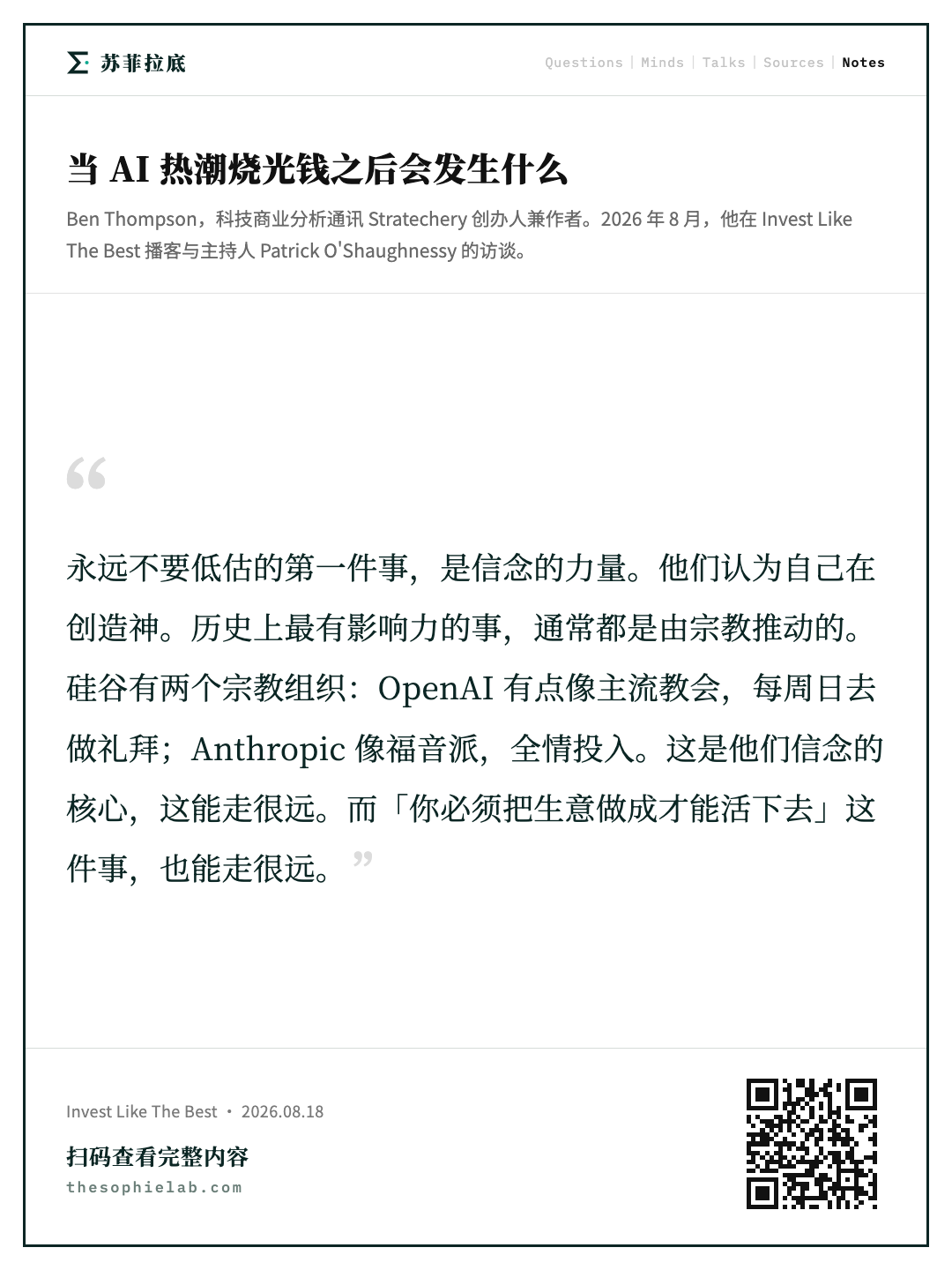
汤普森: OpenAI 和 Anthropic 显然是风险最大的,但上行空间也最大。永远不要低估的第一件事,是信念的力量。他们认为自己在创造神。历史上最有影响力的事,通常都是由宗教推动的。硅谷有两个宗教组织:OpenAI 有点像主流教会,每周日去做礼拜;Anthropic 像福音派,全情投入。这是他们信念的核心,这能走很远。而「你必须把生意做成才能活下去」这件事,也能走很远。谷歌只需要搜索别死得太快。Meta 有巨大的广告业务,如果 Meta 由马克·扎克伯格以外的任何人来经营,它都不会站在前沿。这是创始人能量最纯粹的体现之一,不论好坏。他们的生意太好了,你看到他们能轻松地加倍下注。谷歌的情况有点不同,他们一直在做这方面的研究,追这件事说得通。而 Meta 说,我们要雇一支全新的团队,从零开始,这整件事相当疯狂,所以在这点上要给扎克伯格记一功。至于是不是好主意,你可以自己判断。然后是 SpaceX AI,太空数据中心,那是他们的理论所在。但要做这件事,他们必须拥有自己的模型吗?拥有的话利润率会更好。可反过来,如果我们真的因为政治阻力或者电力或者别的什么,地球上的数据中心不够用了,他们可以跑任何人的模型,就像我们现在看到的,他们正在把产能卖给 Anthropic。所以这几家都挺有意思。我认为 SpaceX AI 的理由大概是最弱的,因为太空数据中心这一步差异化太强了,如果它成了,我不确定他们到底还需不需要自己的模型。那么这期间为什么要烧掉几十亿又几十亿美元?这是个公道的问题。从战术层面讲,我很喜欢收购 Cursor 那笔交易,对两家公司都太说得通了,所以我很想看他们接下来怎么做。Meta 大概是最有意思的一家。

主持人: 你最近写了不少关于这个的文章。

汤普森: 我认为有很强的理由说,如果你是一家数字公司,不站在前沿其实才是更鲁莽的。对 Meta 的反例,其实是微软。微软不在前沿。为什么微软上个季度有两百亿美元的自由现金流?上个季度微软付了一百亿美元的股息。所以钱是有的。但他们的打法是:我们要让这几家彼此制衡,我们提供中间件,我们提供平台,让企业建在我们上面,我们把模型去中介化。我认为这是理智的打法,是 IBM 九十年代的打法。历史会回响。所有人都说谷歌在追随微软的轨迹,而微软在追随 IBM,你在一定程度上能看到这一点。

主持人: IBM 当年做了什么?

微软走 IBM 中间件与咨询老路

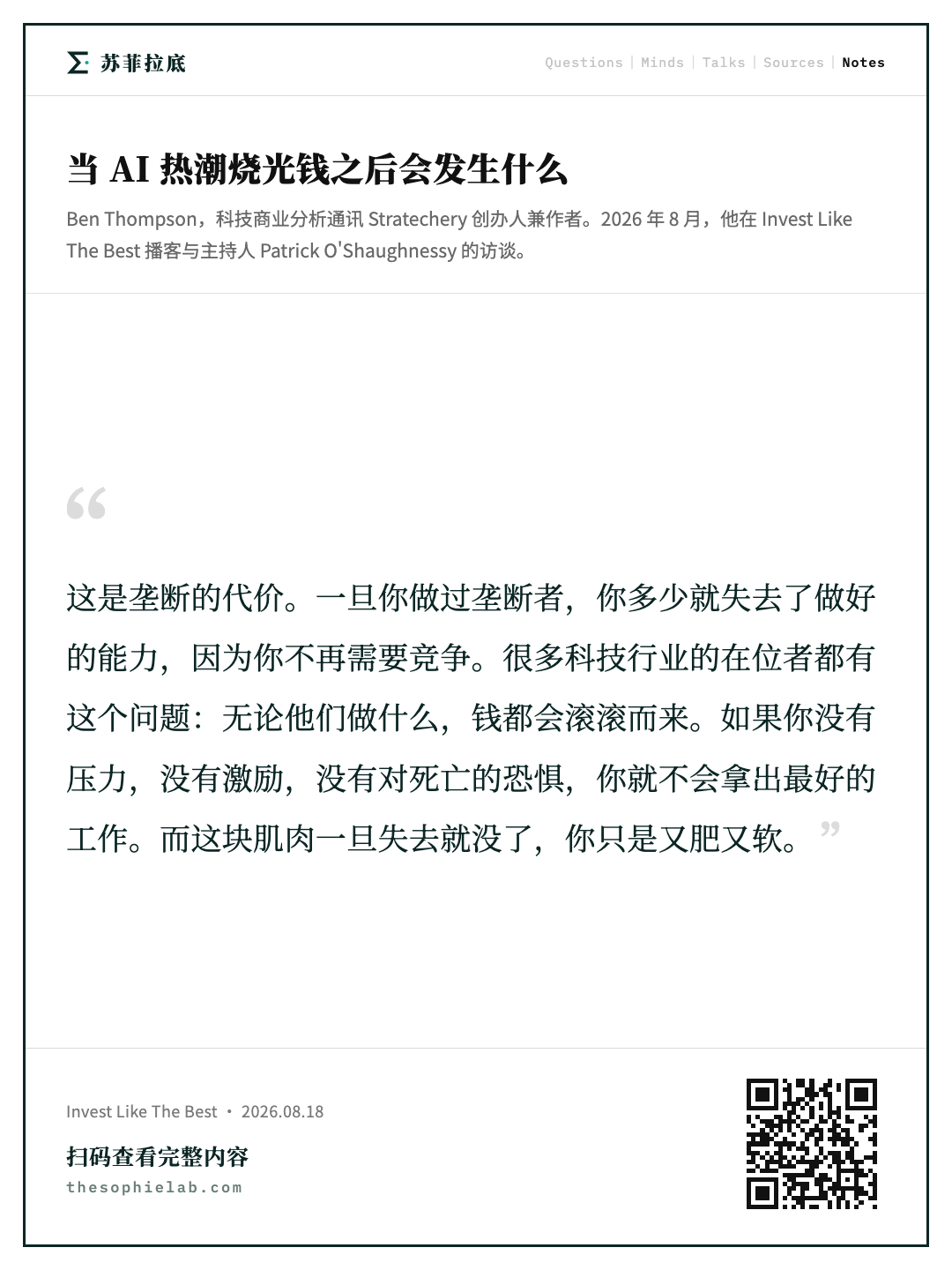
汤普森: IBM 在七十年代有过统治性的地位。快进到九十年代,IBM 成了一笔严重受困的资产,当时的想法是 IBM 需要拆分,把手里各种各样的部门拆开。然后郭士纳(Lou Gerstner)来了,接手公司。我认为郭士纳对 IBM 真正关键的洞察是:我们什么都做得平庸。这有点像我之前对微软说的话。这是垄断的代价。一旦你做过垄断者,你多少就失去了做好的能力,因为你不再需要竞争。我认为很多科技行业的在位者都有这个问题:无论他们做什么,钱都会滚滚而来。如果你没有压力,没有激励,没有对死亡的恐惧,或者像我们谈这些垄断公司时说的那样,没有对上帝的敬畏,你就不会拿出最好的工作。而问题是,这块肌肉一旦失去就没了,你只是又肥又软。所以郭士纳意识到,IBM 能做的最糟糕的事就是把自己拆成零件,因为那些零件其实都不怎么样。我们最大的资产是我们大。什么?大意味着什么?那是九十年代,互联网正在到来,一大堆公司隐约知道自己得搞明白互联网,又不知道该怎么办。他们需要有人进来,理解他们的业务,帮他们上网。这基本上就是 IBM 做的事。他们建起了一支庞大的咨询队伍,这和现在发生的事互为回响,然后把全部精力投在一件事上,本质上是中间件:进到一家公司,在它老式的大型机(所有这些公司都有)和另一端的现代 Web 服务之间垫一层,这样他们就能有网站、有电商站点等等。这给了 IBM 三十年的续命。理论上你可以去硅谷那些热门初创公司买各种单点方案,但你不懂那个,不知道怎么做。你认识我们,我们会进来,做好这一层中间件,建一支大型咨询团队帮你实施,然后你就上网了。IBM 基本上把整个美国企业界带上了网。

汤普森: 这就是微软的剧本。微软会帮你搞定 AI,而且是以一种你不必把皇冠上的宝石交给那些模型公司的方式。我们会建这个平台,这套框架,这个中间层。我们可靠,我们稳定,你认识我们,我们向后兼容到八十年代,你可以建在我们上面,然后由我们来管理模型的更迭、什么在更新,以及所有这些事。这是否意味着你会得到绝对最好的体验?不会。中间件会把锋利的边角磨掉,你得到的多少是最小公约数的能力。但如果你看重的是这种东西,那就是最古老的企业销售套路。甲骨文当年怎么打市场?八十年代,拉里·埃里森拿着另一项从 IBM 那里拿来的、或者说 IBM 不想要的技术,关系型数据库,说:你不想被 IBM 锁死吧,你想要一个到哪儿都能跑的关系型数据库吧,跟我们走。这之所以是个笑话,是因为甲骨文锁客户锁得比谁都狠。整个企业销售,就是一群长期目标是把你锁死的公司,靠吓唬你「别被别人锁死」来把你拉上船。所有云公司都在说,可移植性,你想怎样都行。然后他们说,用我们这个只能在我们云上跑的服务吧,于是你被锁死了。这就是微软的剧本,一个非常理智的剧本,我认为说得通。而这正是他们有多余的钱的原因:因为他们不在前沿。他们在建大规模的数据中心,但建的是推理数据中心,不是训练数据中心。他们「我们根据客户需求适时投资」的说法,在这一点上更可信。他们不需要讲一个「可替换性」的故事,不用说我们建的训练大数据中心将来也许可以拿来做推理。

主持人: 但回到刚才那个说法,对一家数字公司来说,不在前沿才是鲁莽的。

汤普森: 这之所以令人担忧,是因为归根到底,我们为什么要用微软的产品来着?

主持人: 因为我们以前就在用。

汤普森: 保留所有这些人工制品、这些文档、这些邮箱,到底还有多大意义?AI 不能直接把这些事做了吗?这里有一个真实的威胁,冲着微软的软件业务。「记录系统」(systems of record)那套东西很有意思,记录系统之所以强大,一个原因是把它迁到别处太难了,那是极其乏味、重复的工作。哦,AI 恰好特别擅长这种事。我不确定微软到底有多少记录系统,他们有一些,比如 Dynamics 业务,但微软更多的是用户界面,是你真正和计算机交互的地方。当你看到 Codex,看到 Claude Cowork 之类的东西时,它们就像一支箭,直指微软所拥有的东西的心脏。长远看,所有数字公司都是如此,但微软尤其明显。他们的战略是健全的,同时也是生死攸关意义上的孤注一掷,而且也可能正因为孤注一掷才能成功。

Meta:广告飞轮与社交的回归

汤普森: Meta 没有面临即刻的威胁。但这正是我对 AI 的乐观看法进来的地方:我认为所有数字公司都受到威胁,而 Meta 是一家数字公司,他们做的是软件。一个担忧是 AI 占据越来越多的时间,而时间归根到底是 Meta 的货币。我们看到 OpenAI 试了 Sora 那件事,没真正起来。社交网络其实挺难做的,也很花钱,这一点很有意思。创作者分成这件事把它引了出来。YouTube 出了名地从一开始就付钱给创作者,这对生意的拖累比人们意识到的大得多,因为 YouTube 的内容是有边际成本的。和 Netflix 不同,他们不用预先付这笔钱,而是事后付,是收入分成。所以这比 Netflix 的模式好得多。Netflix 是预先为内容付钱,然后理想情况下赚更多。YouTube 是一路上分着付。可 Facebook 或者说 Meta……

主持人: 一分钱不付。

汤普森: 一分钱不付。人们说,Instagram 是个难以置信的产品,为 Facebook 赚了那么多钱,而 Facebook 为内容付的是零美元,难以置信。所以有意思的是,你可以想象一个世界,对 YouTube 来说 AI 生成内容理论上可能是正面的,因为生成内容的推理成本可能低于分给创作者的钱。而对 Meta 来说,如果 AI 内容是他们自己生成的,利润结构其实比现在更差,因为他们现在的内容是免费的。所以他们有注意力。也有一个看多的世界,Meta 的位置其实非常好:当我们整天和 AI 打交道时,对人与人之间连接的渴望反而会变强,这有点像 Meta 回到自己的根。

汤普森: Meta 最大的错误之一,实际上,Meta 一直是一家社交网络公司。他们干掉 Snapchat、或者说止住 Snapchat 的增长,靠的是意识到 Snapchat 有一个很棒的产品,我们把它叠到自己的网络上就行。他们动用自己的网络去杀 Snapchat。而 TikTok 之所以是他们的盲区,是因为 TikTok 被归类为社交网络,可它根本不是社交网络。TikTok 是一个娱乐产品。你在 TikTok 上关注谁无所谓,你看到什么取决于你看过什么,然后你会得到更多同类的东西。它是一个用户生成内容的网络。TikTok 的洞察是:要拿到最好的内容,把范围限定在你的社交网络里是一种人为的约束。我们会把整个网络里最好的内容给你。而绝大多数内容会是垃圾。但这又回到了刚才那个「绝对数」的问题:你不看比率,你看绝对值。哪怕好内容的比率微乎其微,只要内容总量足够大,好内容的绝对数量就会非常大。于是 Meta 说,我们是社交网络,Meta 给你看的是你认识的人的内容,而 TikTok 给你看的是全世界最好的内容。这就是 TikTok 从他们身上咬下一大块的原因。Meta 不得不转向。Instagram 和 Reels 就是这么回事:它已经不太是社交网络了,而是一个从整个网络里抽取内容的娱乐产品,社交网络就剩群聊了。在 AI 时代,社交网络有可能重新变得重要,因为我们真的想要人,想要和他们有某种连接。这会怎么演化,会很有意思。

汤普森: 关于模型的另一件事是,它们对广告的影响极大。模型眼下最大的影响、最大的变现,大概不是 Anthropic 或 OpenAI,而是谷歌和 Meta 正在获得的增量收益。其中大部分还是大语言模型之前的技术,但我们正走向大语言模型,不管是生成广告内容,还是别的。我们说想要什么?可验证的领域。你怎么验证一张生成的图片适不适合做广告?看这条广告卖不卖得动。他们能以一种别人做不到的方式验证自己的图像生成和文本生成,而他们的验证器就是广告市场:对各种各样的东西跑上无数次 A/B 测试,看什么有效,什么无效。大多数广告是一次性的,无所谓,绝大多数广告不会转化。所以他们有一个巨大的优势:一个巨大、流动的市场,它是一台验证机器,验证者是决定点不点这条广告、买不买这件东西的人类,而且是在全球规模上进行。这可以形成反馈回路,让他们的产品变得更好。你还会看到,广告匹配眼下其实还相当粗糙:这是这个人的特征,这是这条广告的特征,做一个嵌入(embedding),做向量计算,看哪些数字匹配,然后把广告匹配给这个人。大语言模型做什么?大语言模型做预测。我们会走向这样一个世界:Meta 看着一个人说,这个人接下来大概想看这个,然后去找到那个东西展示给他。仅仅是给人看更好、更相关的广告,这里的上行空间,他们只需要提升几个百分点,回报就是几十亿又几十亿美元。单凭这一点,就值得他们投资站在最前沿,拥有这些惊人的模型。

汤普森: 我认为 Meta 的一个大问题是,他们不讲这个故事。这很怪,马克·扎克伯格和萨姆·奥尔特曼有同样的问题:他不爱广告。他们有全世界最好的广告业务,一个我认为对社会有正面价值的广告业务。你我都做了小小的内容生意,赚得不错,但内容这东西在社交媒体上是可以搭便车的,我是在推特上长大的,大家分享我的链接,太棒了。可如果你在卖某个产品,互联网的美妙之处在于,外面总有一个小众群体想要那个产品,问题是你怎么找到这个群体?Facebook 广告。它做的就是这个:它连接,它帮产品找到那些原本不知道自己想要它、但拿到之后开心得不得了的人。这是巨大的社会正面价值。你有一个新创业者做出新产品的新生意;你有开心的顾客,拿到了原本得不到的东西,而且顺便说一句,这些顾客一路上还得到了大量免费的娱乐,一分钱没付;Meta 自己和股东赚了一大笔钱,而股东基本上是全世界的人。这就是广告为什么伟大,Meta 的广告尤其出色。让我沮丧的是 Meta 不谈这个。二十年来,扎克伯格除了顺带一提,从来没有真正谈过广告的社会价值,他把它交给别人去管。也许正因为他不上心,广告业务的搭建才带着那种咬牙硬干的劲头。Facebook 的人在数据之类的事情上都有各种困惑和疑问,也许他就是不想牵扯进去,撇清关系。

汤普森: 但你看苹果推出应用追踪透明度(ATT)的时候,那是科技史上最恶劣的反垄断违规之一:苹果单方面碾碎了所有这些商业模式,同时自己在搭建广告业务,做着同样的追踪,凭什么信你们?与此同时他们还在投放那些广告。记得那条广告吗,公交车上的人偷听周围所有人在说什么。那是对互联网广告如何运作的极不诚实的呈现。蒂姆·库克在国会说什么公司在卖数据。Facebook 不卖你的数据,数据对他们才有价值,他们为什么要卖?而 Meta 完全没有准备好回应。我想当年谢丽尔·桑德伯格(Sheryl Sandberg)在的时候是有的,她在每次电话会上都会谈广告,谈广告多好,讲一堆案例,讲从广告中受益的人、那些新创业者。然后她走了,那个位置一直没被填上。这感觉像一家有点难为情的公司:是啊,我们从广告赚很多钱,但我们有眼镜,我们在做 AI。你有广告,广告很棒。我认为如果他们把这一点更一贯地传达出去,他们在公关上总体会处在更好的位置,相对苹果会处在更好的位置,而且眼下要说服华尔街「让我们投资」也会容易得多。另一个问题是他们在 Oculus 上累计花了一千多亿美元,那件事我从头到尾都不喜欢。所以人们会问:凭什么再让你们花钱?

主持人: 有一个重要玩家我们还没怎么谈:黄仁勋和英伟达。我很好奇你会怎么把它和「硅谷不理解大宗商品市场」这个说法联系起来。不管你认为算力最终是不是大宗商品,我想知道你是否认为智能最终会成为大宗商品。有意思的是,智能和算力显然是科技领域最有趣、最重要的两个话题,而两者可能都是大宗商品,差异化程度都不如人们以为的高。

英伟达、商品化与电力的时间差

汤普森: 互联网最有意思的地方一直是免费的分发。

主持人: 带宽是大宗商品。

汤普森: 我现在能掏出手机,连上世界上任何一个信息源,免费,在边际成本意义上免费,是因为它是大宗商品。它改变了世界。大宗商品改变世界。差异化产品按定义市场规模更小,因为有价格弹性,不是每个人都付得起,人们的付费意愿各不相同,你的市场会受限。苹果靠卖设备永远服务不了全世界,而谷歌可以,因为它免费。这很重要。大宗商品,你是要付钱的,但它对所有人可得的程度,就是它有影响力的程度。互联网我会说是一种大宗商品,它改变了世界。所以智能最后变成大宗商品并改变世界,我不觉得奇怪。

主持人: 但人们通常不认为大宗商品生意像那些差异化的高利润率产品那么好。所以我想听听你对黄仁勋和英伟达的具体看法。

汤普森: 英伟达的位置我认为绝对是不自然的。他们保住了全部利润率,不是很惊人吗?都 2026 年了,所有人都冲着他们来,他们照样为一颗芯片收那么多钱。但他们其实并没有保住利润率。谁在买?这整个循环融资的问题,人们会提朗讯之类的例子,还有这笔交易,英伟达提供百分之二十五的兜底。可如果你真的给这种事定个价,英伟达拿那些新型云服务商(Neocloud)的股权,或者保证到 2030 年买下他们全部算力,他们为什么这么做?为了让那家实体能拿到更低的资本成本,好买更多 GPU。可这里面隐含的是,它为什么能拿到更低的资本成本?因为英伟达承担了风险。这是我之前的观点:风险从不消失,只是在别处出现。承担风险是有价格的。有一个世界,AI 起飞了,永不停歇,一切都好,英伟达拿到了自己承担的风险的全部上行。但也有一个世界,比方说他们兜底的这家新型云服务商,一大堆算力上线了,超大规模云厂商自己的算力充足,不缺,于是英伟达在为没人要的算力付钱,一下亏掉一大笔。所以你想,这笔投资有一个期望值,不是零,也不是百分之百,在中间某处。而这就是英伟达盈利能力的折损。如果你整体地看他们的生意,这其实就是一次降价。

主持人: 对吧?

汤普森: 这次降价没有出现在利润率里,没有出现在报价里。但英伟达做的很多事,都是在想怎么保住利润率,哪怕从更宽的视角、折现现金流的期望值、整体来看,人们确实在做现金流折现,但你真的把所有这些零件都算进去了吗?现实是,把东西挪出资产负债表大体上是管用的。但他们做所有这些交易,是为了维持一种感觉上不太自然的东西。所以我会说,我们已经看到了降价,只是它以非常古怪的方式显��出来。

汤普森: 长期看,英伟达面临的挑战是,他们最终的竞争对手是超大规模云厂商,尤其是谷歌和亚马逊。谷歌和亚马逊不只是在做自己的芯片,还打算对外卖这些芯片。谷歌已经和 Anthropic 达成协议,卖出大约百分之二十的 TPU。上次财报电话会上,安迪·贾西几乎确认了他们最终会对外销售 Trainium 3 或者 Trainium 4 之类的芯片,这说得通。这给了他们对这些公司的长期绑定,芯片研发投入巨大,他们能在开支上获得更大的杠杆,一切都说得通。而且顺便说,他们卖芯片不是靠差异化,他们是把芯片当大宗商品卖。英伟达才是卖差异化的那个。人们去亚马逊不是为了用 Trainium。所以对外卖 Trainium 不会蚕食他们云服务的吸引力。这是英伟达最大的问题。因为超大规模云厂商的头号优势是什么?

主持人: 更低的资本成本。

汤普森: 这是一场资本之战。他们的资本成本比新型云服务商低。新型云服务商会不管不顾地买英伟达。顺便说,SpaceX 也一样,马斯克在外面说,我们永远买英伟达,因为他们最好。不,你买英伟达是因为它最通用(fungible)。CUDA 的护城河已经大大缩窄,因为模型不在乎自己跑在什么上面,真正重要的是建在模型之上的东西,但它仍然重要,仍然算是一条护城河。所以如果你想玩 SpaceX 那种游戏,建一大堆,租出去,但保留收回来的权利,你当然会用英伟达,因为租出去最容易的办法就是用英伟达。这一点你很早就能看到。回到 2023、2024 年,英伟达开始谈各种主权云,他们试着推出 Nemotron 模型,2024 年他们还有一批东西。我记得那是第一次「摇滚明星式」的 GTC,在圣何塞那个巨大的体育馆里,黄仁勋出场。那是一场很无聊的GTC。以前的 GTC 是英伟达演示五十万件东西,因为他们在往墙上扔东西,他们知道 GPU 手里有货,在拼命找用途。大语言模型一出现,好了,用例有了。但当时他们在推出各种企业级产品,名字我记不清了,大概是一些模块,当然免费,但只能在英伟达上跑。你能看出他们在干什么:把人锁进来。英特尔在这里是个好例子。英特尔在超大规模云厂商的销售上被 AMD 清空了,因为超大规模云厂商愿意花力气让东西在 AMD 上跑起来,尽管都是 x86,仍然有些小差异,但他们采购量那么大,为了更好的芯片或更低的价格,这笔投入是值得的。而英特尔业务里从未动摇的那部分,是卖给政府和企业,因为他们没有超大规模云厂商的资源,采购量没那么大,只会继续买以前买的东西。这就是英伟达谈主权云、谈企业客户的原因,他们想进入那些不会在这颗芯片和那颗芯片之间权衡的市场。超大规模云厂商一直是英伟达的威胁,正是出于这个原因,因为他们更大。所以你有了这个局面:超大规模云厂商是威胁,而他们的资本成本又比其他想买芯片的公司更低。这就是本周这笔交易的由来。我把这笔交易看作一个回应,所以它和谷歌那笔交易是一体的。谷歌可以直接增发股票,股东不喜欢,但归根到底他们的变现能力远高于英伟达,也远高于英伟达的客户。

汤普森: 我认为英伟达在期待的,虽然他们大概不会明说,是我们真的走到电力用光的那一天。这对英伟达大概是好事,因为在一个电力彻底受限的世界里……

主持人: 所有人都想要最好的。

汤普森: 我们必须拿到最好的效率,最好的 token 效率,而我认为英伟达仍然是 token 效率最高的。所以那对他们是个好世界。我认为英伟达过去几年最大的问题大概是,美国实际上带上线的电力比预期多得多。他们让我意外,不管是马斯克在表后(behind the meter)做的那些事,后来在西德克萨斯被复制,还有天然气,甚至重启核电站。我们做到的程度……

主持人: 你很欣赏美国对这类事情的反应。

汤普森: 太棒了。这实际上是关于美国最鼓舞人心的信号之一。我很早就在写,长期的回报会是什么?假设这是一场泡沫,你希望它有长期的回报。互联网泡沫给我们留下了埋在地下的光纤。顺便说,谷歌玩过这个游戏。谷歌是靠买下暗光纤建起自己的生意的。他们有杀手级的搜索引擎,但他们的很大一部分能力,来自买下了互联网泡沫之后几乎白送的暗光纤。我们的核心互联网今天还在跑在世通(WorldCom)的光纤上。那是一份持久的收益。铁路,BNSF 今天抛出的钱流进了谷歌,那些钱来自北太平洋铁路、来自杰伊·库克(Jay Cooke)向散户投资者卖债券。你希望一场泡沫能留下持久的东西。人们常问,AI 会留下什么?GPU 的寿命没那么长。数据中心,好吧,算一个。但到底会是什么?是电力。必须是电力。如果我们走到这一切爆掉、而我们电力多得用不完的世界,那是一个美妙的世界。我们一直受能源约束,能源支撑着一切。生活在一个能源丰裕的世界会是什么样?这甚至很难想象,因为我们的头脑被「一直处在能源稀缺中」这个事实束缚着。我认为我们做得难以置信地好。电力当然是一个约束,它会是一个约束,但它成为约束的时间比所有人预期的都晚。如果这「所有人」里包括黄仁勋,我不会意外。我认为他原本以为电力不足会更早成为英伟达的护城河。而结果是,我们的电够用的时间越长,亚马逊就有越多时间把 Trainium 做好,谷歌就有越多时间让 TPU 在效率上具备竞争力。到那时,我们就进入了一个那样的利润率看起来很难维持的世界。

主持人: 我很爱听你对所有这些事情的看法。这是我在这个你如此热爱的世界里观察到的最有意思的时刻。非常感谢你抽出时间。

汤普森: 非常感谢。
本期讲者
本·汤普森科技商业分析通讯 Stratechery 创办人兼作者,2015 年提出「聚合理论」解释互联网平台赢家通吃的逻辑,长期定居台湾,是科技战略领域最有影响力的独立分析师之一。
Patrick O'Shaughnessy播客 Invest Like the Best 主持人,投资公司 Positive Sum 创始人兼 CEO,此前任 O'Shaughnessy Asset Management 首席执行官。
章节 · 点击跳转视频
0:00 美国赢下 AI 反而危险 ▶ 正在看
4:48 中美 6 到 9 个月差距的均衡 ▶ 正在看
7:53 资本曲线、铁路与伯克希尔类比 ▶ 正在看
15:24 可验证领域与 AI 能力边界 ▶ 正在看
20:18 聚合理论与 AI 推理成本 ▶ 正在看
26:12 消费者不付费,广告才是出路 ▶ 正在看
31:01 时间错配与大宗商品市场逻辑 ▶ 正在看
37:22 内存、台积电与风险的转移 ▶ 正在看
47:31 亚马逊、苹果与五家前沿实验室 ▶ 正在看
57:19 微软的 IBM 剧本与 Meta 的广告飞轮 ▶ 正在看
1:14:07 英伟达的循环融资与能源约束 ▶ 正在看
本期论点
本期回应
5:04
中国靠蒸馏前沿模型大致落后美国6到9个月,这一均衡对美国有利 几乎追平中美的 AI 差距在拉开还是在缩小?
其他论点
2:22
美国制造业对中国的依赖程度被严重低估,且无法在不发生冲突的前提下解决
6:17
称开源模型免费是误导,研发成本或许有人买单,但推理的边际成本用户必须自己承担
13:13
AI利润率远低于搜索,但绝对利润空间大到未来回看谷歌搜索只相当于喜诗糖果
16:14
AI在可验证领域表现优异,不能证明它能干净迁移到不可验证或验证周期极长的领域
21:31
在丰裕的世界里稀缺的不是分发而是发现,解决发现问题的公司主宰其市场
26:52
消费者不愿意为软件付钱,也不在乎自己是否更有效率
30:31
广告变现没有价格弹性问题,涨价由广告主承担,因此优于向消费者收订阅费
32:45
「只在确认需求后才买GPU」多半是扯淡,外壳建好后固定成本已沉没,没人会让它闲置
40:55
台积电对扩产的极度保守,实质是把产能不足的风险转嫁给了大科技公司
50:32
亚马逊的核心零售业务对生成式AI的冲击几乎免疫,护城河比任何科技巨头都深
58:56
一旦当过垄断者,公司就会丧失做好产品的能力,这块肌肉萎缩后再也回不来
1:07:25
AI模型当前最大的变现者是谷歌和Meta的广告增量收益,而非OpenAI
1:17:29
英伟达的股权投资与算力兜底交易实质上是一次降价,只是没体现在毛利率和报价上
1:23:42
AI泡沫若破裂,能留下的持久遗产只能是电力,而非很快淘汰的GPU
01美国赢下 AI 反而危险
0:00
I think it would be very problematic for the US to win. Let's say we take the most sort of fantastical scenario where if you control AI, your military is better than anyone else in this world. What is the game theory optimal response of China to blow up TSMC? If we get to a place where we have a meaningful superiority, particularly from like in terms of a military national security perspective, I think that's very dangerous for the world.
我觉得美国赢了反而会带来很大的问题。假设我们设想一个最天马行空的场景如果你掌控了 AI,你的军队就比世界上任何人都强。那么从博弈论角度看,中国的最优应对是不是炸掉台积电?如果我们真的取得了实质性的优势,尤其是在军事和国家安全层面的优势,我认为那对世界来说非常危险。
便签引用
0:41
So Ben, [music] if you can believe it, how long it's been since we last did this. The world was very different. No AI at the time. Uh we talked about aggregation theory mostly, which I'm sure we'll hit at some point today. I thought a fun place to begin since the world has changed so much is to hear what you think it would mean for the US to win the AI race. I think it would be very problematic for the US to win. Let's say we take the most sort of fantastical scenario where if you control AI, you basically your military is better than anyone else. You can like somehow it fixes our manufacturing all these like things that I don't think AI is necessarily going to do because they sort of deal with the real world. But in this world, what is the game theory optimal response of China to blow up TSMC? like it and to me this is like game theory can get very sort of convoluted and complex. To me this one actually isn't that complicated. Uh so I there's a just a fundamental disconnect that I have with a lot of the rhetoric
那么 Ben,[音乐] 说来你可能不信,距离我们上次这样聊已经过去这么久了。那时的世界完全不一样,还没有AI。呃,我们那次主要聊的是聚合理论(aggregation theory),今天肯定也会聊到。我觉得一个有意思的切入点是,既然世界已经变化这么大,不如先听听你怎么看「美国赢得 AI 竞赛」到底意味着什么。我觉得美国赢了反而会带来很大的问题。假设我们设想一个最天马行空的场景:如果你掌控了 AI,你的军队基本上就比任何人都强。你还能以某种方式解决我们的制造业问题,诸如此类——而我并不认为 AI 一定能做到这些,因为这些事涉及现实世界。但在那样一个世界里,从博弈论角度看,中国的最优应对是不是炸掉台积电?博弈论有时候会变得非常绕、非常复杂。但在我看来这一个其实没那么复杂。呃,所以我跟硅谷那边、尤其是我觉得某一家实验室传出来的很多说法,有一个根本性的分歧,
便签引用
1:39
coming out of Silicon Valley coming out I think of one of the labs in particular where if we get to a place where we have a meaningful superiority particularly from like in terms of a military national security perspective I think that's very dangerous for the world. But in that state, how how much does it extend beyond TSMC being blown up? Because in that state, I would assume we figured out how to build fabs here in the US, you know, to some degree and are less reliant on that one choke point. I think there's a little bit of magical thinking which I just invoked in terms of manufacturing and whether it be fabs whether that be actuators like all these sort of precursors like the I think the degree to which we are dependent on China is underappreciated and is not something that is going to be fixed outside of a conflict just because fixing so many of these things is going to be dramatically like dumb. Like if your competitor is sourcing from China and you're going to start sourcing or getting things from the US, you're going
就是:如果我们真的走到拥有实质性优势的那一步,尤其是在军事和国家安全层面的优势,我认为那对世界来说非常危险。但在那种状态下,影响到底能超出「台积电被炸掉」多少?因为在那种状态下,我会假设我们已经在某种程度上搞清楚了怎么在美国本土建晶圆厂,也就不那么依赖那一个卡脖子的点了。我觉得这里面有一点一厢情愿的想法,我自己刚才也说了一点,就是制造业方面——不管是晶圆厂,还是执行器这类所有上游的东西——我觉得我们对中国的依赖程度被严重低估了,而且这不是在没有冲突的情况下能解决的问题,因为要解决这么多环节,代价会大到——怎么说呢,很不划算。比如说,如果你的竞争对手从中国采购,而你要开始从美国采购、从美国拿货,你相对来说会处在极大的劣势,
便签引用
2:43
to be at such a disadvantage relatively speaking that you're just not going to do it. So you do it when you have literally no choice. And that works for like very big headline items like you can browbeat Apple to move some of their iPhone manufacturing to India for example. But even that is a good example because Apple is not moving truly moving out of China. like they're diversifying to an extent, but the problem it would just cost so much and it's like paying an insurance policy that if you don't have to pay it and it's astronomically expensive, you're just not going to pay it. It's one of those sort of hypotheses that I just have a hard time even gawking because in what the only world I see where we truly pull out and have no dependency on China such that if they want to blow up Taiwan, who cares? has no impact on us is seems pretty fantastical to me and I think there's a bit of facing reality in this regard that is not present in these conversations.
劣势大到你根本不会这么做。所以只有在你真的别无选择时才会去做。这一招对那些大标题式的项目管用,比如你可以施压苹果,让它把一部分 iPhone 产能挪到印度,这是一个例子。但恰恰这个例子说明问题,因为苹果并没有真正搬出中国。他们是在一定程度上做分散,但问题在于成本实在太高了,这就像买一份保险:如果你可以不买,而且它贵得离谱,那你就是不会买。所以这类假设我实在很难认真对待,因为我唯一能想象的那个世界——我们真正抽身、对中国毫无依赖,以至于他们想炸台湾就炸、无所谓、对我们毫无影响——在我看来相当天方夜谭。我觉得在这个问题上,这些对话里缺少了一点直面现实的态度。
便签引用
3:43
>> So put yourself put yourself in their shoes like what do you think the motivations are? >> Everyone can use a good bogeyman. I think from the AI trade perspective nothing works better than we have to be China. And I do think we need to be China. We need to be competitive. I despair at the extent to which over the last few years in particular so many of our responses for particular from a political perspective has been to like try to be like China. I think we should be going the other direction. Uh more openness, more innovation, less top down control, less restrictions on speech and things along those lines. America succeeds by being on the leading edge and by leading into that. You said probably the US being purely dominant and AI is not the right end state for the world. What is your ideal equilibrium for how this goes worldwide? There's a bit where AI right now is kind of like the Taiwan situation in that it feels the current status quo actually doesn't seem so bad. And the question is how
>> 所以设身处地站在他们的角度想一想,你觉得他们的动机是什么?>> 每个人都需要一个好用的假想敌。我觉得从 AI 这笔买卖的角度看,没有什么比“我们必须赢过中国”更管用的了。而我确实认为我们需要应对中国,我们需要保持竞争力。让我感到绝望的是,过去这几年里,尤其是从政治层面出发,我们的很多应对方式都是试图去学中国。我觉得我们应该走相反的方向:更开放、更多创新、更少自上而下的控制、更少对言论之类的限制,诸如此类。美国之所以成功,靠的是站在最前沿、引领前沿。你说过美国在 AI 上一家独大可能并不是这个世界正确的终局。那你心目中理想的全球均衡是什么样的?现在的 AI 有点像台湾的局面,感觉当前这个现状其实并没有那么糟,问题是它能维持多久?但也许它能维持得比我们想象的更久。所以
便签引用
02中美 6 到 9 个月差距的均衡
4:48
sustainable is it? But maybe it's sustainable for longer than we think. So the the way I think about it right now is I think OpenAI and Anthropic are clearly on the frontier. Who knows what's happening with Google and then Grock and Meta are chasing them. Meanwhile, the Chinese are very capable, very smart, and also definitely distilling these models to sort of stay about 6 to9 months behind. And it feels like a pretty good equilibrium that I think is generally favorable to the US. Now the question is how long can it stay this way right and there's lots of questions out there like can the Chinese actually pull ahead I'm still a little skeptical that you know for various reasons getting to the leading edge I think that last 6 to9 months is very difficult I think we'll see how it's going to be instructive how meta and gro do in terms of actually actually catching up is that sort of because especially as we get to the world of AI improving itself using AI to make the AI better which I think is definitely a
我现在的看法是,OpenAI 和 Anthropic 显然处在最前沿,谷歌那边在发生什么谁也说不准,然后Grok 和 Meta 在追赶他们。与此同时,中国人非常有能力、非常聪明,而且肯定在蒸馏这些模型,大致保持落后 6 到 9 个月。感觉这是个相当不错的均衡,我觉得总体上对美国是有利的。现在的问题是这种状态能维持多久,对吧?外面有很多疑问,比如中国人到底能不能反超。出于种种原因我还是有点怀疑,要真正走到最前沿,最后那 6 到 9 个月是非常难的。我觉得看 Meta 和 Grok在追赶上的表现会很有启发。这是不是因为,尤其是当我们进入 AI 自我改进、用 AI 让 AI 变得更好的世界——我认为这绝对是真实存在的——最近你能看到 OpenAI 和 Anthropic 双方都出现了明显的加速,
便签引用
5:49
real thing I think you see a real acceleration from both uh OpenAI and Anthropic recently which and that was sort of theorized and it seems to be coming true and to the extent that's true can you actually catch up and I think the other question about this by the way is to what extent does that apply to cost to serve to marginal costs if you can apply AI to optimizing your stack to figuring things out to analyzing all the data can is your cost to serve sort of structurally lower than anyone else this is the thing about the the open- source models the talk about them being free is bizarre to me because it's marginal costs, right? You still have to run inference like GLM or Kimmy. Kimmy is very expensive to serve. The cost per answer is significantly higher. So the everyone referring to these as free. It feels like in the narrative it's in people's head that free is free. Now I can use AI for free. No, you can't use AI for free. You're not paying necessarily the R&D to create the AI, but you're definitely
这件事以前只是理论上的推演,现在看来正在成真。在这种前提下,你还追得上吗?顺便说,另一个问题是,这一点在多大程度上会体现在服务成本、边际成本上。如果你能用 AI 去优化技术栈、解决问题、分析所有数据,你的服务成本会不会在结构上就比别人低?这就是开源模型的问题所在,说它们免费在我看来很奇怪,因为这是边际成本,对吧?你还是得跑推理,比如 GLM 或者 Kimi。Kimi 的服务成本很高,每个回答的成本要高出不少。所以大家都把这些称作免费的。感觉在叙事里、在人们脑子里,免费就是免费,现在我可以免费用 AI 了。不,你并不能免费用 AI。你不一定要为创造这个 AI 的研发买单,但你肯定要为运行它的推理买单。
便签引用
6:47
paying the inference to sort of run it. So right now I kind of like where we are and the push back would be oh that's right now it's not going to stay that way. Um which I think is fair push back but I don't know if you can learn anything about the future of how this will go to be more confident in like where where the equil equilibrium will end up. What is it? Is it like the length of the S-curve? Like how far up the S-curve we are of at some point these things presumably will level out, maybe not. What would be the thing you'd want to know that would give you a better sense of what the future might look like? I am concerned that with like the scare around like people freaking out about mythos and like this hugging face incident that the actual implication of that is not that we reduce these dangers but we just stop releasing stuff and we on the outside >> start to lose any sense of like where exactly what is actually the frontier and where it is And it and there becomes sort of a false sense of security
所以眼下我还挺喜欢现在这个局面的。反驳会是:那是现在,它不会一直这样。我觉得这个反驳挺合理的,但我不知道你能不能从中学到什么关于未来走向的东西,从而更有把握地判断均衡最终会落在哪里。到底是什么呢?是 S 曲线的长度?比如我们在 S 曲线上走到了多高,某个时点这些东西大概会趋于平缓,也可能不会。有什么是你想知道、能让你对未来会是什么样有更好判断的?我担心的是,随着大家对 mythos 的恐慌,还有这次 HuggingFace 事件,实际的后果不是我们降低了这些风险,而是我们干脆不再发布东西,于是我们这些外部的人>> 开始失去对前沿到底在哪里的任何感知。这样就会产生一种虚假的安全感,因为现在所有人都是基于 fable 来理解 mythos 的,
便签引用
03资本曲线、铁路与伯克希尔类比
7:53
because like right now everyone's basing their understanding of mythos on fable but how good is fable actually relative to mythos right like that sort of gap is only going to I think increase over time and so I think that that's that's a real question that that I'm not sure about this question of the AI the recursiveness and AI sort of making itself better like does that lead to sort of some sort of takeoff? And at the end of the day, there's timing questions in lots of different ways. I'm worried about the timing mismatch in terms of the actual return on investment producing enough revenue to fuel investment. Like we're we we're working our way down the capital curve. Like we we started with free cash flow, then like the speed with which the tech companies blew through the debt markets is kind of incredible. like it took like a year and now Google's issuing equity.
但 fable 相对于 mythos 到底有多好呢?我觉得这种差距只会随着时间拉大。所以我认为这是个我不太确定的现实问题。还有 AI 的递归性、AI 让自己变得更好这件事,这会不会导致某种“起飞”?而说到底,还有各种时间节奏上的问题。我担心的是时间错配:实际的投资回报能否产生足够的收入来支撑投资。我们正一步步沿着资本曲线往下走。我们从自由现金流开始,然后科技公司烧穿债券市场的速度简直不可思议,大概只花了一年,现在谷歌都开始发股票了。
便签引用
8:47
Nvidia's putting together the you know the these >> this $500 billion thing >> this $500 billion thing to tap into like pension funds and insurance floats and things like that and the what's after that? Where's the money come after that? Well, ideally we actually flip back to free cash flow funding this. But if there's a gap there, if we don't get there soon enough, then we could have a big blow up, right? But at the same time, even if we have this blowup, the AI is not going away. It's not going to stop improving. It's going to keep sort of progressing and in a way that we look back on the dot era or we look back on the railroad era or we look back on whatever bubbles through history ultimately immaterial in terms of the broad scope of humanity even if they were very devastating to lots of people.
英伟达在张罗那个五千亿美元的东西 >> 就是那个五千亿美元的东西 >> 去对接养老金、保险浮存金之类的钱。那之后呢?再之后钱从哪来?理想情况下我们真能回到用自由现金流来支撑这件事。但如果中间有缺口,如果我们没能足够快地走到那一步,那就可能出现一次大崩盘,对吧?但与此同时,就算真的崩了,AI 也不会消失。它不会停止进步,它会继续往前走,以至于我们回头看互联网泡沫时代,或者回头看铁路时代,或者回头看历史上任何泡沫,从人类的宏观尺度看它们终究无足轻重,尽管它们对很多人来说是毁灭性的。
便签引用
9:36
>> What did the railroads teach us? Do you think >> it's now the last bigger buildout, right? In terms of percent of GDP or getting >> I think we might be bigger at this point or it's like it was the biggest >> in the ballpark. Yeah. >> Yeah. You know, the railroads had a real duration mismatch. It like to build a railroad and make money off it was a decade or multiple decades long endeavor. and the so whereas you had to issue money to pay for it in the short term and the world ran out of money right and I think that is that's probably the the aspect I think that's why people reach for the railroads because everyone talks about are we going to have enough compute are we going to have enough electricity maybe the nearest term question is are we going to have enough money which is kind of a bizarre thing to think about like that's what happened in in the 1870s like we the world just ran out of money. But the the the funny thing is is the railroads kept operating and they expanded the west and they the
>> 铁路教会了我们什么?你觉得 >> 那是在此之前最大的一次建设浪潮,对吧?按占 GDP 的比例算 >> 我觉得我们现在这次可能更大,或者说它曾经是最大的>> 大致在一个量级。对。>> 对。你知道,铁路有非常真实的期限错配。修一条铁路并靠它赚钱,是一个长达十年甚至几十年的工程。而你在短期内必须发债筹钱,结果全世界的钱都用光了。我觉得这大概就是人们会拿铁路来类比的原因,因为大家都在讨论我们会不会有足够的算力、会不会有足够的电力,而也许最近的问题是我们会不会有足够的钱,这想起来挺离奇的,但 1870 年代就是这么回事,整个世界就是没钱了。不过有意思的是,铁路照样在运营,它们开拓了西部,它们
便签引用
10:37
the their contributions to GDP was astronomical. They're still contributing to GDP. Railroad money is what's going into Google right now from Bergkshire Hathway. Like like >> very funny. >> It's it's quite literal. >> It's literally Bergkshire Hathaway has this problem to me. This Nvidia deal is very much paired with the Google equity issuance which I thought was was that I mean that one was shocking what had happened. >> Why was it shocking? >> Because it's Google they can't raise money like why are they issuing equity right? Like the the why are they giving away the their you know reducing their upside if they believe so strongly in this. But the Bergkshire the Bergkshire Hathway comparison is interesting because in to a rough approximation they make they have seized candies famously right tremendously high high margin business.
对 GDP 的贡献是天文数字,而且现在仍在贡献 GDP。现在流进谷歌的钱,就是来自伯克希尔·哈撒韦的铁路钱。>> 非常有意思。>> 这是字面意义上的。>> 字面上就是伯克希尔·哈撒韦的这个问题。在我看来,英伟达这笔交易和谷歌那次增发股票是很配套的,我当时觉得——我是说,那件事挺让人震惊的。>> 为什么震惊?>> 因为那是谷歌啊,他们根本不缺钱,为什么要发股票?他们为什么要把自己的上行空间让出去、稀释掉,如果他们那么坚信这件事的话。不过伯克希尔·哈撒韦这个类比很有意思,因为粗略地说,他们拥有大名鼎鼎的喜诗糖果,一个利润率极高的生意。
便签引用
11:26
The problem with a lot of high margin businesses is you can your your the percentage profit you can make is very high but the absolute profit you can make is reinvestment runway. >> That's right. Like you just you're just accumulating cash. And so the brilliance of the BNSF railway thing was basically they took the seas candy profits and said here's another industry whose margins are way worse but the absolute dollar amounts are so large that those way worse margins result in absolute profits that are much larger. like BNSF in 2025 or something, their the amount of free cash they've threw off in one year was more than Candies had thrown off its entire lifetime. Even though you're talking about a low margin business compared to a very high margin business and there's a I think there's an aspect from Bergkshire Hathway where if you're once your capital gets so large, you start operating in a world of like absolute numbers as opposed to percentage numbers. And the reason why I thought that was so interesting that
很多高利润率生意的问题在于,你能赚的利润百分比很高,但你能赚到的绝对利润受限于再投资的空间。>> 没错。你只能不停地攒现金。所以 BNSF 铁路那笔交易的高明之处就在于,他们拿喜诗糖果的利润说:这里有另一个行业,利润率差得多,但绝对金额大到即便利润率差得多,最终的绝对利润也要大得多。比如 BNSF 在 2025 年左右,它们一年产生的自由现金就超过了喜诗糖果一辈子产生的总和。尽管你说的是一个低利润率生意在跟一个极高利润率的生意比。我觉得伯克希尔·哈撒韦身上有这么一点:一旦你的资本大到一定程度,你就开始在一个以绝对数而不是百分比来衡量的世界里运作。而我之所以觉得这个故事
便签引用
12:28
story is it seems to capture where Google itself might be going. And so it was very symbolic for them to invest in Google. Google has this unbelievable high margin business of search. One of the most perfect beautiful business models of all time and the purest aggregator of them all. Like scales in every direction. Doesn't have to invest any money to do it. Everything's zero marginal cost. It's amazing. And meanwhile there's this AI opportunity which requires just astronomical it's just a cash incinerating cash but you can imagine if AI is intelligence and it's TAM is basically all white collar work >> and eventually with robotics more everything potentially like why like the absolute profits available here even if the margins are lower is so much larger that will we look back and Google search was seized candies and I it feels like that's what's happening and and in that world even yeah you use all your free cash flow they've done that you tap the debt markets to the tune of hundreds of
特别有意思,是因为它似乎恰好刻画了谷歌自己可能的走向。所以他们去投谷歌非常有象征意义。谷歌有搜索这个利润率高得离谱的生意,是史上最完美、最漂亮的商业模式之一,也是所有聚合者中最纯粹的一个。它在每个方向上都能规模化,几乎不需要投入任何钱,一切都是零边际成本,太惊人了。而与此同时出现了 AI 这个机会,它需要天文数字般的投入,根本就是个烧钱机器。但你可以想象,如果 AI 就是智能,它的 TAM 基本上就是所有白领工作 >> 而且最终加上机器人,可能几乎涵盖一切。所以这里可获得的绝对利润,即便利润率更低,也要大得多,大到将来我们回头看,谷歌搜索就是那个“喜诗糖果”。我感觉现在发生的就是这件事。在那种情况下,是的,你用光所有自由现金流——他们做了;你去动债券市场,规模达到几千亿美元——他们也做了;然后你发行股票,因为
便签引用
13:38
billions of dollars they've done that you issue equity because like the what is what does an equity issues do it dilutes your interest in your interest your shareholders so you have a smaller percentage of the pie Well, if you have a smaller percentage of an astronomically larger pie, at the end of the day, no one's going to be complaining. And I I just thought it was very symbolic. Bergkshire being the symbol of that equity issuance in that are they actually not just an investor in Google, but a model for Google and where they're going. RAM is the only platform built to make your finance team leaner, faster, and better, saving businesses 5% annually on average, so you can stay focused on growth. Ram customers grow revenue 3.2 two times faster than the average American business. Visa, Verscell, Cursor, Stripe, Notion, 11 Lab, Shopify, and 70,000 other businesses all now run on RAMP. [music] Mine does too, and so should yours. Learn more at ramp.com/invest.
发股票意味着什么?它稀释了你的权益、你股东的权益,所以你在这块蛋糕里占的比例更小了。可如果你在一块大得离谱的蛋糕里占更小的比例,说到底也不会有人抱怨。我就是觉得这特别有象征意义:伯克希尔成为那次增发的象征,它们到底不只是谷歌的投资者,更是谷歌的一个样板,是它未来的方向。Ramp 是唯一一个专为让你的财务团队更精简、更快速、更出色而打造的平台,平均每年为企业节省 5%,这样你就能专注于增长。Ramp 的客户收入增速是美国企业平均水平的 3.2 倍。Visa、Vercel、Cursor、Stripe、Notion、ElevenLabs、Shopify,以及另外 7 万家企业现在都跑在 Ramp 上。[音乐] 我自己也在用,你也应该用。访问 ramp.com/invest 了解更多。
便签引用
14:33
OpenAI, Cursor, Anthropic, Perplexity, and Verscell all have something in common. They all use work OS. To [music] achieve enterprise adoption at scale, you have to deliver on core capabilities like SSO, skim, [music] arbback, and audit logs. Instead of spending months building these missionritical capabilities yourself, [music] you can just use work OS APIs to gain all of them on day zero. That's why so many of the top AI teams you hear about already run on work OS. [music] Work OS is the fastest way to become enterprise ready and stay focused on what matters most, your [music] product. Visit works.com to get started. Felix by Rogo is a personal finance agent that turns a single [music] prompt into finished client ready work using your firm's own templates, context, and standards. Send Felix an email like, "Take [music] these comments and turn them for me." Or, "Udate my tracker with the context of these emails." And Felix sends back finished PowerPoint decks, [music] Excel models, and sourced research. Felix
OpenAI、Cursor、Anthropic、Perplexity 和 Vercel 有一个共同点:它们都在用 WorkOS。要 [音乐]实现规模化的企业级落地,你必须提供 SSO、SCIM、[音乐] RBAC 和审计日志这些核心能力。与其自己花好几个月去搭这些关键功能,[音乐] 你可以直接用 WorkOS 的 API,在第零天就把它们全部拿到。这就是为什么你听说过的那么多顶尖 AI 团队都已经跑在 WorkOS 上。[音乐] WorkOS 是成为企业级就绪的最快方式,让你能专注于最重要的事,也就是你的 [音乐] 产品。访问 workos.com 开始使用。Rogo 推出的 Felix 是一个个人金融代理,它能把一条[音乐] 提示变成可直接交付客户的成品,使用你公司自己的模板、上下文和标准。给 Felix 发一封邮件,比如“把这些 [音乐]批注帮我改进一下”,或者“用这些邮件里的信息更新我的追踪表”,Felix 就会回给你做好的 PowerPoint 演示文稿、[音乐] Excel模型和带出处的研究材料。Felix 按照你团队已有的工作方式来工作,
便签引用
04可验证领域与 AI 能力边界
15:24
works the way your team already does, delivering [music] work quickly and accurately around the clock. Learn more at rogo.ai/felix. I'm [music] curious setting aside the commercial and competitive components of this like you're describing how AI pill on the pure technology would you say you are relative to other people thinking about this space I have a view that is both super bullish and less bullish in some respects so I am not fully convinced about the generalizable argument like AI is clearly incredible at coding. It kind of blows my mind that people were doing this a year ago, like actually like writing out code. It's very good at math obviously, but the obvious a you know repost is that these are sort of verifiable do domains and what is the evidence or where is the compelling evidence of being very good at verifiable domains cleanly translates to being very good at sort of unverifiable domains or domains that take have a very long sort of verification loops and I think that's still a little bit to be determined and
全天候快速、准确地交付 [音乐] 成果。访问 rogo.ai/felix 了解更多。我 [音乐] 很好奇,先撇开这里面的商业和竞争成分,就你刚才描述的那些来说,在纯技术层面上,相对于其他思考这个领域的人,你算是多“信 AI”?我的看法是既极度看多,在某些方面又没那么看多。所以我并不完全认同那种“可泛化”的论证。比如 AI在写代码上显然强得惊人,一年前人们居然还在真的手写代码,这让我有点难以置信;它在数学上显然也很好。但显而易见的反驳是,这些都属于可验证的领域,那有什么证据、或者说有说服力的证据表明,在可验证领域表现很好就能干净利落地迁移到在不可验证领域、或者验证周期非常长的领域也表现很好?我觉得这还有待观察。有意思的是,我提过这个问题,
便签引用
16:37
it's interesting because I raised this I raised this question and there were some people at the labs that were on a panel and I was kind of annoyed at the answer cuz the answer took me for an AI bear and they're like oh well people thought we couldn't solve chess or we couldn't solve go and we solved those easy enough and I'm like I thought we could solve chess I thought we could solve go because they're knowable domains and you know scale was the answer to both of those but also both of those were bounded right what what is the go-to example that's not chess that's not That's not go that is genuinely in a new space that's sort of an unknowable space where it's doing things that were not not possible. So that is sort of the I'm not fully convinced sense. However, AI trained at a rough approximation trained on all the data of the internet. All the data of the internet that is like that's dist distillation. It distilled all of human thought.
当时有几位实验室的人在一个座谈上,我对那个回答还挺恼火的,因为那个回答把我当成了 AI 空头。他们说,以前人们觉得我们解决不了国际象棋、解决不了围棋,结果我们挺轻松就解决了。我心想,我本来就觉得我们能解决国际象棋、能解决围棋,因为它们是可知的领域,而规模确实是这两者的答案,但这两者同时也是有边界的,对吧?那有没有一个典型例子,不是国际象棋、不是围棋,而是真正处在一个全新的、某种不可知的空间里,在做以前根本做不到的事情?所以这就是我不完全信服。不过,AI 是在互联网上所有数据的基础上、以一种粗略近似的方式训练出来的。互联网上的所有数据那就是一种蒸馏。它把人类所有的思想都蒸馏了。
便签引用
17:36
>> No it didn't. It distilled all of the end state of human thought, the actual typing it on on Reddit. It doesn't have the traces, right? It doesn't actually have the thought, the emotion or whatever that went into typing that comment or typing writing that essay. What if we like say neural link whatever what if the actual payoff from neural link is actually capturing the traces of of human thought that actually dramatically expands the capabilities of these models in this world. My concerns about verifiability is like well we solve verifiability by getting more data. My sense is that a huge number of jobs, a huge amount of economic activity does not exist in these domains that I'm not convinced that AI is good at.
>> 不,它没有。它蒸馏的是人类思想的最终状态,也就是实际敲在 Reddit 上的那些字。它并没有思考的过程,对吧?它其实并不拥有那个想法、那种情绪,或者说促成那条评论、那篇文章被写出来的东西。那如果我们说 Neuralink 之类的呢?如果 Neuralink 真正的回报其实是捕捉人类思考的过程轨迹,而这会极大地扩展这些模型在这个世界里的能力呢?我对可验证性的担忧就好比说,我们靠获取更多数据来解决可验证性。我的感觉是,有大量的工作、大量的经济活动并不存在于这些领域中,而我对 AI 在那些领域是否擅长并不信服。
便签引用
18:23
Actually, there's a lot of people in the world who are kind of like sentient AIs to a certain extent. They operate very well in verifiable domains. They're given jobs. They do them. And that it's almost like a somewhat pessimistic view of humanity uh to a certain extent. But I think that market is so huge and so large that if the models did not improve at all from where they are right now, the economic opportunity is actually massive. I wrote an article a while ago, you know, there's the whole like accelerationist movement and I what I call myself was a reluctant accelerationist.
其实,世界上有很多人某种程度上就像是有感知能力的 AI。他们在可验证的领域里表现得非常好。给他们一份工作,他们就去做。这在某种程度上算是对人性一种有点悲观的看法。但我认为那个市场太大、太庞大了,以至于哪怕模型从现在这个水平一点都不再进步,其经济机会依然是巨大的。我很久以前写过一篇文章,你知道,有整个所谓的加速主义运动,而我称自己为“不情愿的加速主义者”。
便签引用
18:57
I think we need to push forward because we can't go back and the worst thing we can do is get stuck where we are. So I'm very AI peeled in terms of its impact on the economy its sort of upside in terms of monetization. I'm not sure about the timing. What would be like the gradient towards it? Like imagine law or medicine where I don't know whether or not you would consider those verifiable like law is like a code of some sort. Medicine we have a certain state understanding of of things. I mean, I think medicine is like by far one of the biggest opportunities.
我认为我们必须往前推进,因为我们回不去了,而我们能做的最糟糕的事就是卡在原地。所以我对 AI 对经济的影响、以及它在变现方面的上行空间非常兴奋。我不确定的是时间点。通往那里的路径大概会是什么样?比如想想法律或医疗,我不知道你会不会把它们算作可验证的——法律某种意义上像是一套代码;医疗方面我们对事物有一定程度的确定认知。我的意思是,我觉得医疗绝对是最大的机会之一。
便签引用
19:33
Yeah. Like it's both one of the biggest opportunities and also one of the most challenging ones because of all the regulations and all the access. Like if you could turn an AI turn machine learning onto all the medical records, the number of discoveries and improved treatments we could come up with in a very rapid amount of time would be unbelievable. So that is a very optimistic view. On the flip side, like when is that gonna happen, right? I think the the the optimistic frame I put on humans is our capacity to create needs is sort of unlimited. So I think we'll do a very good job of creating new opportunities and jobs sort of in the fullness of time. The sort of more pessimistic way to put it is our ability to create red tape and muck is also fairly unlimited.
对。它既是最大的机会之一,也是最有挑战性的之一,因为有种种监管和准入问题。如果你能把 AI、把机器学习用在所有的医疗记录上,我们能在很短时间内做出的新发现和改进的治疗方案,数量将会难以置信。这是非常乐观的看法。反过来说,那到底什么时候会发生呢?我认为我对人类的乐观框架是:我们创造需求的能力几乎是无限的。所以我认为,从足够长的时间尺度看,我们会很好地创造出新的机会和工作岗位。而更悲观一点的说法是:我们制造繁文缛节和各种阻碍的能力同样相当无限。
便签引用
05聚合理论与 AI 推理成本
20:18
And you know how much of our economy is actually we've managed to create more and more jobs that is just sort of like make busy and make slow to a certain extent. If I go back to the early 2010s or you know maybe the aggregation theory was stewing in your brain and then you published it in 2015. I think it's fair to say like that theory that idea maybe you could just quickly remind people what it is defined the winners and losers of that era of technology. I'm really curious how you're thinking about what theory or or principles will define this era of winners from like a financial perspective and market cap perspective.
而且你也知道,我们经济中有多大一部分,其实是我们成功创造出了越来越多的岗位,但那些岗位某种程度上只是在制造忙碌、拖慢进度。如果回到 2010 年代初,或者说那时候聚合理论正在你脑子里酝酿,然后你在 2015 年发表了它。我觉得可以说,那个理论、那个想法——也许你可以快速给大家介绍一下它讲的是什么——定义了那个技术时代的赢家和输家。我很好奇你怎么看哪种理论或原则会从财务角度、市值角度定义这个时代的赢家。
便签引用
20:55
>> It's a good question. I go back and forth even just on the question of of aggregation theory itself. How much does that ex you know apply in this current? >> Yeah. Cuz like like a push back that people have is one of the key components of aation theory is zero marginal cost and zero marginal cost uh shows in lots of ways. The one that I sort of focused on the beginning was distribution. Like, and people say, "Oh, I don't have distribution. I have to pay Google for friends." Like, "Well, no, you have a website. Your problem isn't that you have distribution. Your problem is you don't have demand." And you're paying for demand when you're paying for ads and things on those because the aggregators control demand. And they control demand because in a world of abundance, the hard problem is not distribution, it's discovery. How do you actually find what you're interested in?
>> 这是个好问题。我自己对聚合理论本身这个问题都还在反复摇摆。它在当下到底还有多大适用性?>> 是啊。因为人们常见的一个反驳是,聚合理论的关键组成部分之一是零边际成本,而零边际成本体现在很多方面。我一开始重点关注的是分发。比如说,人们会说:“哦,我没有分发渠道,我得付钱给谷歌买朋友。”那,不对,你有网站啊。你的问题不是你有没有分发,你的问题是你没有需求。你买广告时付的钱其实是在买需求,以及诸如此类的东西,因为聚合者控制着需求。他们之所以控制需求,是因为在一个丰裕的世界里,难的问题不是分发,而是发现。你要怎么真正找到你感兴趣的东西?
便签引用
21:38
So, the companies that solve discovery in their domain come to dominate that market. They get a virtuous feedback loop. that sort of aggregation theory in in a nutshell. And the other thing is transaction costs. There's no transaction cost. Google can scale to the whole world. And they can scale to the whole world. Not just on the user side, but also on the monetization side. The vast vast vast majority of advertisers on Google or Meta never inter never talk to someone at Google or Meta. They just go up and they buy ads. It's all done by computers. And those computers from a business perspective >> cost zero dollars. AI obviously that changes significantly like be their inference costs are real. Uh but then again sort of how real are they?
所以,在各自领域里解决了“发现”问题的公司,最终主宰了那个市场。他们获得了一个良性的反馈循环。这大致就是聚合理论的精髓。另一件事是交易成本。交易成本为零。谷歌可以扩展到全世界。而且他们能扩展到全世界,不只是在用户端,也在变现端。谷歌或 Meta 上绝大多数绝大多数的广告主,从来没有跟谷歌或 Meta 的任何人打过交道。他们就是上去买广告。全都由计算机完成。而从商业角度看,那些计算机>> 成本是零美元。AI 显然大大改变了这一点,比如他们的推理成本是真实存在的。不过话说回来,这些成本到底有多“真实”呢?
便签引用
22:18
>> They're real right now. >> They well how real I don't know are they >> depends on the company but they're they're way more real than the those prior examples. >> Well like if you look at gross margins or something >> for sure but but you have this incredible spread. So you have people I think the vast majority of people who are using ad today are using it as basically a Google substitute or like a recipe maker or whatever it might be. And my suspicion is that the cost to serve those people is extremely low and low in the basically similar to serving them a web page like I would imagine it's it's marginally higher but not not that much higher. Then you have on the other extreme people who are actually leveraging test time scaling right. So it used to be we just scale by making the models bigger and bigger. Now you can scale as far as time. How long do you think about the answer? Well, you could think about the answer for days or weeks or months. And that is a d that is directly marginal cost. Like every
>> 现在是真实的。>> 到底有多真实,我不知道,是不是 >> 取决于公司,但它们比之前那些例子要真实得多。>> 嗯,如果你看毛利率之类的 >> 当然,但这中间存在着极大的差异。所以你会看到,我认为今天绝大多数使用 AI 的人,基本上就是把它当作谷歌的替代品,或者当作菜谱生成器之类的东西。我的猜测是,服务这些人的成本极低,低到基本上和给他们提供一个网页差不多。我想它会略高一点,但高不了多少。然后另一个极端是那些真正在利用测试时扩展(test time scaling)的人。对吧,以前我们是靠把模型做得越来越大来扩展。现在你可以靠时间来扩展。你要花多长时间去思考这个答案?嗯,你可以思考几天、几周甚至几个月。而那是直接的边际成本。
便签引用
23:16
second longer you're thinking is costing more money which speaks to like we think about AI and inference as this one question. And that's I was sort of being a bit, you know, pushing back on you. But actually the marginal cost question for the different user, the user using free chat GPT and the user trying to solve a a math theorem. They're not even remotely in the same universe. And and I think you see this challenge actually in the enterprise in a very interesting way. So Microsoft recently, you know, they they are shifting their enterprise plan, right? So they come out with like an E7 plan, $100 per user per month that includes some amount of usage, but then they also are charging for usage on top of that. And this is kind of a really I think this is a kind of a fraught position for Microsoft to an extent because the positive way to think about Microsoft is they do everything you need as a business. Every individual component might not be the best, but you get it all for one price and they all
你每多思考一秒,就在花更多的钱,这也说明我们在谈论 AI 和推理时,往往把它当成一个单一的问题。而这就是我刚才有点在反驳你的地方。但实际上,不同用户的边际成本问题——用免费版 ChatGPT 的用户,和试图解决一个数学定理的用户——根本就不在同一个宇宙里。而且我觉得你在企业市场上能以一种很有意思的方式看到这个难题。比如微软最近,你知道的,他们在调整企业版计划,对吧?他们推出了类似 E7 的方案,每用户每月 100 美元,包含一定额度的用量,但超出部分还要按用量收费。我觉得这对微软来说其实是个相当尴尬的处境,因为看待微软的积极角度是:作为一家企业,你需要的一切它都能提供。每个单项组件也许都不是最好的,但你用一个价格就全拿到了,而且它们基本都能协同工作。如果你
便签引用
24:18
mostly work together. And if you're, you know, particularly a small or mediumsized business or even a large enterprise, there's real value in that. That's right. It makes life easy. The moment you start having to think about how much you're paying, it's not just that that's a new decision. Number one, that is untethered from headcount, right? Microsoft got the benefit is when you were hiring a new employee, you would think about the cost of that employee and baked in the cost of that employee is $100 a month or $50 a month for their their license. It was kind of a thoughtless revenue stream for Microsoft. Now, if you think about usage, you have to think every single month, how much do I want to spend? And that introduces two problems. Number one, most companies aren't set up to do this. They make budgets like once a year. This idea we're going to be thinking about through our budgetary aotment on like a monthly basis doesn't compute. There's an aspect where they're used to thinking about
是中小企业,甚至是大型企业,这其中是有实实在在的价值的。没错。它让日子变得轻松。可一旦你开始必须去琢磨自己到底付了多少钱,问题就不只是多了一个新决策。第一,这笔支出和人头数脱钩了,对吧?微软原本的好处在于,当你招一个新员工时,你会去算这个员工的成本,而这个员工成本里就包含了每月 100 美元或 50 美元的许可费。对微软来说,这几乎是一条无需动脑的收入流。现在,如果按用量计费,你每个月都得想:我到底想花多少钱?这带来两个问题。第一,大多数公司根本没有相应的机制。他们大概一年才做一次预算。要说我们得按月去考虑预算分配,这根本行不通。有一点是他们习惯于考虑资本支出决策或一次性成本。而我说的这种
便签引用
25:19
capex decisions or one-time costs. And there's a bit where what I'm talking about this employee like the loaded cost of employee. It's not capex but it's kind of like capex. It's like you make the decision up front then you don't think about it anymore if the decision is sort of already made. But if you're thinking about usage you're doing it again. But the the final thing is if you're every month you're looking at your Microsoft bill and how much do I use? You start thinking about what am I paying for? Like how good is each of these products? Should I actually just start thinking about and spraying this out? And I think they had to do it because that extreme of user who uses a ton of tokens and is actually leveraging AI costs way more to Microsoft than $100 a month. They can't support them. But they want to hold on to the set cost for the vast majority of employees who can fit in that because they need to ask their customers to think a little bit for those extreme employees, but they don't
员工的综合成本,它不是资本支出,但有点像资本支出。就是你先把决策做了,之后就不再去想它,因为决策已经算是定下来了。但如果你要考虑用量,你就得反复再做一遍。不过最关键的是,如果你每个月都在看微软的账单,看自己用了多少,你就会开始想:我到底在为什么付钱?这些产品各自到底有多好?我是不是应该开始考虑把这些支出拆开分散出去?我觉得他们不得不这么做,因为那种极端用户,用掉海量token、真正在深度使用 AI 的人,给微软带来的成本远超每月 100 美元。他们撑不住。但他们又想把绝大多数能被这个价格覆盖的员工留在固定收费里,因为他们需要让客户针对那些极端员工稍微动点脑筋,但又不希望客户想得太多,因为那
便签引用
06消费者不付费,广告才是出路
26:12
want them to think too much because that sort of breaks the model in very sort of surprising ways. surprised at all that the the recipe builder user that is very low cost to serve that there hasn't been a great business model that's emerged around them just yet like you know business Google and Facebook are sort of business perfected in this in this prior era. They haven't seemed to figure this out at all. I'm frustrated but not surprised. This is obviously a market that should be supported by advertising like that.
会以非常出人意料的方式打破整个模式。你是否完全不惊讶——那种做菜谱的用户,服务成本很低,但到现在还没有出现一个围绕他们的好商业模式?你知道,在上一个时代,谷歌和 Facebook 在商业模式上算是做到了极致。而这一次他们好像完全还没搞明白。我很沮丧,但并不惊讶。这显然是一个本该由广告来支撑的市场。
便签引用
26:40
That is why advertising is always the consumer business model. Consumers don't want to pay there. So there's two things to understand about consumers that Silicon Valley has to relearn about every 10 years. Number one, consumers do not want to pay for software. And number two, consumers do not care about being productive. And this is like we went through this in early SAS. Like the the canonical company for this in my mind is Dropbox. >> So Dropbox, unbelievable product. Like especially when it first came out in business school, I was one of the first people to use Dropbox and that was went off like crazy. I have so much storage still like my free Dropbox cuz I gave out of my code to like so many people.
这就是为什么广告一直是面向消费者的商业模式。消费者不愿意付钱。所以关于消费者,有两件事是硅谷每隔十年就得重新学一遍的。第一,消费者不想为软件付钱。第二,消费者并不在乎自己有没有效率。这就像我们在早期 SaaS 时代经历过的一样。在我看来,这方面最典型的公司就是 Dropbox。>> Dropbox,产品做得难以置信地好。尤其是它刚出来那会儿,我在商学院,是最早用 Dropbox 的人之一,当时火得一塌糊涂。我到现在还有超多存储空间,都是免费的 Dropbox,因为我把邀请码发给了特别多人。
便签引用
27:20
So Drew Hston makes his amazing product so easy to use, just absolutely seamless. And I think very clear about this. He wanted to build a consumer company and there's that famous story of him meeting with Steve Jobs and I think you know Apple was interested in acquiring Dropbox and they're like oh we want to build a company and Steve's you know your feature not your feature not not a company and you know which that plain Jane just file sync Apple did make a feature as far as like sort of iCloud drive and Dropbox they grew very fast and then they had like a 2-year lull and in that 2-year year low. What they had to do was basically completely rebuild the app from the bottoms up because the people not enough consumers are going to pay for it. They needed enterprises could see the value, they would pay, but if you want enterprise, you need permissions. You need control. You need someone else to be able to set all these sorts of things. And their app wasn't even created to do that at all. So, they
所以 Drew Houston 做出了这个了不起的产品,极其好用,完全无缝。而且我觉得他这一点想得很清楚:他想做一家面向消费者的公司。有个很出名的故事,是他去见史蒂夫·乔布斯,我记得苹果当时有意收购 Dropbox,他们说“哦,我们想做一家公司”,而史蒂夫说,你这是个功能,不是一家公司。你知道,那种最朴素的文件同步,苹果确实把它做成了一个功能,也就是 iCloudDrive 之类的。而 Dropbox 增长得非常快,然后经历了大约两年的停滞期。在那两年低谷里,他们基本上不得不把整个应用从底层彻底重建,因为消费者中愿意付钱的人不够多。他们需要企业客户——企业能看到价值,愿意付钱,但如果你要做企业市场,就需要权限管理、需要管控、需要让别人能够设置所有这些东西。而他们的应用压根就不是为此设计的。所以他们
便签引用
28:16
had to rebuild the whole thing and realize the only way we're going to make money is by selling to companies. Why do companies pay? Because companies are paying employees. So to the extent they can make their employees more productive, they're getting a greater return on their investment. It's the complete inverse of a consumer. A consumer is like, I spent all day working. Why do I want to come home and be more productive? I want to sit on the couch and watch reals. And and the the and you see that with AI and you also have this overarching just skepticism of advertising. You know, I've gotten so much traction on trajectory by being an advertising appreciator. And I go back and read my early articles about advertising that were kind of directionally correct, but also like were not very good at all. But I got so much traction doing it because I was the only person writing about advertising.
不得不把整个东西重建,并且认清:我们唯一能赚钱的方式就是卖给公司。公司为什么愿意付钱?因为公司在给员工发工资。所以只要能让员工更有生产力,公司就能获得更高的投资回报。这和消费者完全相反。消费者的想法是:我都上了一整天班了,为什么回家还想提高效率?我只想瘫在沙发上刷短视频。而你在 AI 上也看到了这一点,而且还叠加着对广告这件事整体上的怀疑。你知道,我在《Stratechery》上靠着做一个广告的欣赏者获得了很多关注。回头看我早年写广告的那些文章,方向上大致是对的,但也写得相当不怎么样。可我靠这个获得了大量关注,因为我是当时唯一在写广告的人。
便签引用
29:11
In a world of everyone want to have a blog in Twitter, no one want to talk about advertising. But even now there's in Silicon Valley there's this sort of embarrassment about the fact that the valley is in many respects monetized by advertising and particularly during the last sort of eight years there was a Facebook's icky and like all these best engineers don't want to go work on this problem >> and so you literally had open AAI replaying the Dropbox story but at like 100x size being like no we're going to sell subscriptions to consumers and they did. They sold a lot, but they didn't sell enough. If you're going to be in the consumer market, you have to be doing advertising. And now they're doing advertising now. It's a little weird they finally pivoted to doing advertising. At the same time, they're like, "Oh crap, we need to go for the enterprise cuz Anthropic is kicking our so quite sure what they're doing there.
在一个人人都想有个博客、都在推特上发声的世界里,没人愿意聊广告。但即便到现在,硅谷仍然对这件事带着某种难堪:硅谷在很多方面其实是靠广告变现的,尤其是在过去大约八年里,有种说法是 Facebook 很恶心,好像所有最优秀的工程师都不愿意去做这个问题 >> 所以你就真的看到 OpenAI 在重演 Dropbox 的故事,只不过规模是100 倍:说“不,我们要向消费者卖订阅”,他们也确实这么做了。他们卖了很多,但卖得不够多。如果你要做消费市场,你就必须做广告。而现在他们也在做广告了。有点奇怪的是,他们终于转向做广告的同时,又意识到:“糟糕,我们得去做企业市场,因为 Anthropic 正在把我们打得很惨。”所以不太确定他们到底在干什么。
便签引用
30:04
They have been rolling out ad features very rapidly like things like like copy and the the connections with retailers so you know if a purchase went through so you can do all the tracking and things like that. So I'm very interested to see how that goes. There's a bit where had they leaned into advertising immediately as soon as Chat GPT was a hit, I think they would have a killer ad product right now. I think that Google would be in much bigger trouble. I think meta would be in much bigger trouble because if you have this flywheel, the thing about advertising with consumers is your ability to monetize the consumer >> goes up in because the advertisers bearing the price increase. So there's zero elasticity issues. If you're charging consumers a price, if you want to raise the price, like Netflix, this is their problem with with the subscription plan. They have to be how much can they raise prices before consumers rebel and drop drop a tier or give up the service entirely, right?
他们一直在非常迅速地推出广告相关功能,比如那些类似(购物)功能,以及与零售商的打通,这样你就能知道一笔购买是否完成,从而做各种归因追踪之类的事。所以我非常感兴趣看看结果如何。有一段时间,如果他们在 ChatGPT 刚火起来的时候就立刻押注广告,我觉得他们现在会有一个极具杀伤力的广告产品。我觉得谷歌会陷入大得多的麻烦。我觉得的话,我觉得他们现在会有一个非常厉害的广告产品。我觉得谷歌会陷入大得多的麻烦。我觉得Meta 也会陷入大得多的麻烦,因为如果你有这个飞轮,面向消费者做广告的好处在于你从消费者身上变现的能力会上升,因为价格的上涨是由广告主来承担的。所以完全没有弹性问题。如果你是向消费者收费,想涨价的话,比如 Netflix,这就是他们订阅方案的问题所在。他们得琢磨能涨多少价,才不至于让消费者反弹、降档,或者干脆不用了,对吧?
便签引用
07时间错配与大宗商品市场逻辑
31:01
Charging people money is hard. >> Giving people things for free is easy and it's very frustrating that OpenAI did not pursue this sooner. I know you've been spending time with, you know, some of the big money firms and sources of capital. What is your sense of their appetite right now and how they're thinking about the future? Because I think this year it's going to be 800 billion or something that we're going to spend in capex. Next year it's supposed to be 1.3 trillion I think is the current estimate. It's going to keep, you know, keep going up from there. We're burning through all the compute that gets installed like basically immediately. It's such a strange circumstance that we can use the capacity right away as soon as it's online.
向人收钱是很难的。>> 而免费送东西很容易,所以 OpenAI 没有更早去做这件事,真的很让人着急。我知道你最近跟一些大资金机构和资本方打了不少交道。你感觉他们现在的胃口如何,他们是怎么看待未来的?因为我觉得今年资本开支大概会是 8000 亿美元左右。明年据说是 1.3 万亿,我想这是目前的估计。而且还会一直往上涨。装上去的算力我们基本上是立刻就烧完了。这种情况太奇怪了,产能一上线我们马上就能用掉。在线。
便签引用
31:39
>> Well, that's the thing though. So there's a few timing mismatches that are happening right now. All the bulls on Twitter is always like we're we don't have enough comput. We don't have enough compute. Well, we don't have enough compute because there was insufficient investment made in 2023 and 2024, which yes, absolutely. And by the way, if you think there's not enough compute, TSMC decreased their rate of growth in 2023 and 2024 and 2025. So like we're our shortage of compute is going to get worse in the next few years because a fab the lead time is even greater than a data center. So all today when we say there's not enough compute, it's not like all the money that the companies are putting in today >> manifest in comput. No, it all manifests in compute in 2028 and 2029. So you have like on the calls you have both Andy Jasse and Sadella are out there saying look we're just building data centers like these are the shells. We might not use them now, maybe we'll use them in the future and we only buy GPUs when we
>> 不过问题就在这儿。现在有几个时间错配的情况。推特上那些多头总是说我们算力不够。我们算力不够。可是,我们算力不够是因为 2023 和 2024 年投资不足,这点确实没错。而且顺便说一句,如果你觉得算力不够,台积电在 2023、2024 和 2025 年还降低了自己的增长速度。所以未来几年我们的算力短缺只会更严重,因为建一座晶圆厂的交付周期比建数据中心还要长。所以今天我们说算力不够的时候,并不是说这些公司今天投进去的钱>> 就能变成算力。不,这些钱要到 2028、2029 年才会变成算力。所以在财报电话会上,你会听到Andy Jassy 和纳德拉都在说,看,我们只是在建数据中心,这些是外壳。我们现在可能不用,也许将来会用,我们只在确定有需求的时候才买 GPU。这
便签引用
32:40
know there's demand for them. That is a great story to tell. I'm not sure how much that I think is a lot of BS because the reality is is if you've built the shell that money is sitting there. You're not going to let it just sit there. Like if you have if you invested a fixed cost and this is the whole logic of commodity markets. I think tech in general doesn't understand commodity markets. tech is by and large focused on if I produce a highly differentiated product and that differentiation could be like you know software it could be uh a network in terms of developers it could be a social network sort of thing where peerto-peer where I'm highly differentiated then my ability to charge higher prices provides sort of my profit margin so the the classic example is like Apple right they have their ecosystem and they have their software and they have third party and all those sorts of things and so they can charge they have 50% margins is on their iPhone. Everyone looks at Apple as like the ideal business model. That's how you
故事讲得很漂亮。我不太确定——我觉得这里面很多是扯淡,因为现实是,如果你已经把外壳建好了,那笔钱就摆在那儿。你不会就让它闲着。如果你已经投了一笔固定成本,这就是大宗商品市场的整套逻辑。我觉得科技行业总体上并不理解大宗商品市场。科技行业基本上关注的是如果我做出一个高度差异化的产品,这种差异化可以是软件,可以是开发者生态网络,可以是社交网络那种点对点的东西,只要我高度差异化,我就能收更高的价格,这就构成了我的利润率。所以经典的例子就是苹果,对吧,他们有自己的生态系统,有自己的软件,还有第三方等等,所以他们能收高价,iPhone 的毛利率有 50%。iPhone。所有人都把苹果看作理想的商业模式。生意就该这么做。但在一个大宗商品化的
便签引用
33:38
run a business. But in a commodity market, the price is set by the marginal supplier. >> Cost to serve is all that matters. >> That's right. And so I had a good friend in Taiwan who was in shipping. Um fascinating industry. It's kind of like the airlines too. Another industry that I love to look at, but like you you you buy a ship and the cost of that ship is depreciation and your marginal cost is actually quite low. It's the fuel to run the ship and the cost of the crew and like your port fees. Not that much. What that means is you are going to run that ship >> as full as human >> basically. No, you're going to run it no matter what. And you're going to bring down the price of a container as low as it needs to be to cover your marginal costs. Now, your paper losses in this situation might be very large because your accounting loss includes depreciation, but the depreciation is an accounting figment. you already paid the money and so you're you're going to run that ship at whatever the market will
所有人都把苹果看作理想的商业模式。觉得生意就该这么做。但在大宗商品市场里,价格是由边际供应商决定的。>> 只有服务成本才重要。>> 没错。我在台湾有个好朋友是做航运的。嗯,这行业特别有意思。有点像航空公司,那也是我很爱研究的一个行业。你买一艘船,这船的成本是折旧,而你的边际成本其实很低。就是跑船的燃油、船员的成本,还有港口费。没多少钱。这意味着你一定会让这艘船 >> 尽可能装满 >> 基本上是。不,是不管怎样你都会让它跑起来。而且你会把一个集装箱的价格压到只要能覆盖边际成本就行。现在,这种情况下你账面上的亏损可能非常大,因为你的会计亏损包含折旧,但折旧只是
便签引用
34:36
bear and the container the beauty of the container is it is a pure commodity and so the cost of the market is going to be the marginal cost now if it gets low enough at some point people will exit because their marginal cost actually can't like they're actually losing money on a shipment right uh not just paper money but like actual real money they will exit but then the supplies diminished So then the price the price will go back up and you get this interplay of sort of coming in and off. But then let's say the market's very high like it was during co it's like wow we're making so much money right now cuz there's not enough supply. There wasn't enough supply of ships. So containers went from like usually being like $3,000 $4,000 to 17,000 $18,000. Like the the amount of money that these shipping companies made in a very short amount of time was insane. And so what happens though? Well, more ships.
一个会计上的虚数。钱你已经付过了,所以你会按市场能承受的任何价格去跑这艘船。而集装箱的妙处在于它是纯粹的大宗商品,所以市场价格就会是边际成本。当然,如果价格低到某个程度,有些人会退出,因为他们的边际成本真的撑不住了——他们在一趟运输上是真亏钱,不只是账面亏,而是真金白银地亏,那他们就会退出。但这样供给就减少了。于是价格又会回升,你就看到这种此消彼长的来回。但假设市场特别火爆,就像疫情期间那样,大家会说,哇,我们现在赚翻了,因为供给不够。当时船的供给不够。所以集装箱运价从平时的三四千美元涨到了一万七、一万八。这些航运公司在很短时间内
便签引用
35:27
>> Imagine if we had more ships, right? The problem is it takes 2 years to build a ship. >> So by the if everyone makes this decision simultaneously, then the ship you suddenly have a lot of ships, price plummets, etc. Where we see this is in components, in memory in particular. Memory very famous for boom and bust cycles. Uh people entering the market late. But to what extent are data centers going to be memory makers where right now everyone can see we don't have enough compute. So everyone's like we absolutely have to be investing because there's so much money to made and look at our payback period. The problem is you're measuring your payback period in a time of scarcity. Is that payback period going to hold in a time in a time of abundance? Uh and and the sort of the bulls would say there's never going to be a time of abundance. AI short time scaling we're going to be short forever which maybe we will be my concern is even if that's right we could still have an air gap >> in that there's so much money going into
赚到的钱多得离谱。那接下来会怎样呢?当然是造更多船。>> 要是我们有更多船就好了,对吧?问题是造一艘船要两年。>> 所以如果所有人同时做出这个决定,那突然之间船就一大堆,价格暴跌,等等。我们在零部件上也看到这种情况,尤其是内存。内存的繁荣—萧条周期非常有名。有人入场太晚。但数据中心会在多大程度上变成内存厂商那样呢?现在所有人都看到算力不够。所以每个人都觉得我们必须投,因为能赚太多钱了,看看我们的回本周期。问题是,你是在稀缺的时候衡量回本周期。到了产能过剩的时候,这个回本周期还成立吗?多头会说永远不会有过剩的那一天。AI 的规模化需求短期内我们会一直短缺,
便签引用
36:27
it right now and not enough has come online to actually make sufficient revenues to cut to handle the situation where we run out of capital that like I again I believe in AI I think it's a real thing I think the economic impact is going to be astronomical I think all the concerns about societal impact are very real and are going to come to bear in a major way. You can believe all that and still be worried about are we going to make the bridge to this actually generating the level of returns necessary to continue to fuel this sort of going forward. Can can you zoom in on TSMC and the and the maybe the some of the component makers where fabs are involved and so far at least my understanding is that they've been quite conservative in their willingness to expand capacity, build new fabs, meet the market's demand with similar growth, which they have not done. And if that if that just rate limits this whole thing and prevents us from getting one of these giant overbuilds.
也许真会这样。我担心的是,就算这个判断是对的,我们中间仍可能出现一个空档期,>> 因为现在有那么多钱涌进来,而上线的产能还不足以产生足够的收入,去应对资本耗尽的局面。我还是那句话,我相信 AI,我觉得它是真实的东西,我觉得它的经济影响会是天文数字级别的。我觉得所有关于社会影响的担忧都非常真实,而且会以很大的方式显现出来。你可以相信这一切,同时又担心我们能不能架起这座桥,让它真正产生足够的回报来继续支撑这件事往前走。你能不能聚焦讲讲台积电,以及一些涉及晶圆厂的零部件厂商?至少据我理解,他们在扩产、建新厂、以同等增速满足市场需求这些方面一直相当保守,他们并没有这么做。如果这本身就成了整件事的限速环节,让我们避免出现
便签引用
08内存、台积电与风险的转移
37:22
>> Well, we can talk about a few different ones like we'll start with memory. memory used to have tons and tons of memory makers and every time there'd be sort of a boom memory makers sort of like reenter the market um or like new countries would come in like Taiwan used to have like a memory market and but you would get these exact dynamics if there's a shortage of memory there's so much money to be made because no one you can't bring capacity on immediately we're like it's the same as shipping it's the same as what we're seeing right now and so what would that that would do is that would spur sort of people to come in the market, you get too much capacity, prices would plunge and people would just get blown out cuz the issue is the upfront cost for these is so large. Just like buying a ship, like building a fab is even more so. And memory now, like the leading edges of memory are using things like EUV machines. So the costs are getting into the billions of dollars for these lines.
一次巨大的产能过剩。>> 我们可以聊几个不同的例子,先从内存说起。内存以前有非常非常多的厂商,每次出现繁荣期,内存厂商就会重新入场,或者有新的国家进来,比如台湾以前也有内存产业,但你会看到完全相同的动态:如果内存短缺,那利润空间就极大,因为产能没法立刻上线,就跟航运一样,跟我们现在看到的情况一样。于是这就会刺激人们入场,然后产能过剩,价格暴跌,很多人就被彻底洗出去了,因为问题在于这些东西的前期成本太高了。就像买船一样,建晶圆厂更是如此。而现在的内存,最先进的制程要用到 EUV
便签引用
38:13
And what happens is every time these boom bus cycles, some people would enter, more people get washed out. You go through there's like these these famous historical moments for these memory cycles and like companies just get blown out. One of the most interesting actually memory stories is how Samsung sort of took over memory was they saw it as an opportunity and they had studied history and they realized that actually the way to take over the market is to invest into downturns so that you're ready when the next cycle comes around which requires a ton of guts and a ton of discipline and a ton of money but they did that and basically wiped out the Japanese. That's when the sort of the South Koreans generally took over the market in a major way. But it got down to three. And the problem is three, it's not a monopoly, but it's kind of an oligopoly. And they all got a lot more discipline about let's not make the mistakes of the past. And we're not colluding, but we all are on the same page about let's not do that. And I
设备。所以这些产线的成本已经达到几十亿美元级别。结果就是,每经历一轮繁荣—萧条周期,有些人进来,更多人被冲走。这些内存周期里有一些著名的历史时刻,公司就这么被彻底打垮。其实最有意思的内存故事之一,就是三星是怎么拿下内存市场的:他们把它看作一个机会,而且研究过历史,意识到真正拿下市场的方式是在下行周期里加大投资,这样下一轮周期来临时你已经准备好了。这需要极大的胆识、极强的纪律和大量的资金,但他们真的做到了,基本上把日本厂商扫出局了。从那时起,韩国人全面接管了这个市场。但最后只剩三家。问题是三家,算不上垄断,但算是寡头。而且他们都变得更有纪律了:我们别再犯过去的错误。我们不是在合谋,但我们都在同一个
便签引用
39:10
think that dynamic sort of ran head on to the current moment where it just took a while for them to realize no there is a secular shift in memory demand that didn't exist for for a very long time. And so I I think the memory solution will be solved eventually. The other thing they the risk they run is Apple like Apple's lobbying to get Chinese memory, right? uh and what is the number one focus of like al algorithmic changes. How can we use less memory? I think the memory makers probably screw themselves in the long run by creating such a massive target on their back.
认知上:别那么干。我觉得这种动态正好撞上了当下这个时刻,他们花了一段时间才意识到,内存需求出现了一个长期性的结构转变,这是很长时间以来都没有过的。所以我觉得内存的问题最终会解决。他们面临的另一个风险是苹果——苹果在游说引入中国内存,对吧?还有,算法改进现在的头号重点是什么?怎么少用点内存。我
便签引用
39:47
I've analogized memory makers to Iran. Like the issue with the straight of moose is it's very effective. It's more effective if you don't use it cuz then it's always hanging out there as something you could do. Now they did it. Turns out it worked. But like the UAE and Saudi Arabia, they're going to build pipelines. They're going to build new ports. They're not going to let this happen again. It's very painful right now. But say Iran wants to close the straight of our moves in 2035. It's not going to have any effect because it will have been built around. My concern for the Merry Makers is they might have done the same thing. Like no one's going to let themselves get in this situation again as far as memory goes. TSMC is arguably worse because there's only one.
觉得内存厂商长期来看可能是在坑自己,因为他们让自己背上了一个巨大的靶子。我把内存厂商比作伊朗。霍尔木兹海峡的问题在于,它确实非常有效。但你不用它的时候更有效,因为那样它就一直悬在那儿,是你随时可以做的事。现在他们真的用了。结果证明确实管用。但阿联酋和沙特会去建管道,会建新的港口。他们不会让这种事再发生一次。眼下确实很痛苦。但假设伊朗想在 2035 年封锁霍尔木兹海峡,那就不会有任何效果了,因为大家早就绕开它了。我对内存厂商的担忧是,他们可能做了同样的事。在内存这件事上,没人会让自己再
便签引用
40:29
Uh there's one company on the leading edge. Um, obviously Intel and Samsung are trying to get there and it's the same thing like like the all markets carry risk and a lot of the question is who ends up holding the risk and what I think a lot of the tech companies didn't fully appreciate is the extent to which TSMC has offloaded risk onto the big tech companies. And the way they've done that is the risk that TSMC is worried about is over capacity. If we build too much, it's not just that we built too much and we have all these fixed costs that are not being fully utilized, but if we build a fab, we expect that fab to run for 30 years. We've like baked in too much capacity into the system for years and years and years. So, they are very biased towards being much more conservative. And there's a little bit of a culture component to this too. One of the most interesting TSMC stories, it's kind of analogous to that Samsung story was Morris Chang retired in like the late 2000s and new leadership took
陷入同样的处境。台积电可以说更糟,因为只有一家。最先进制程上只有一家公司。当然,英特尔和三星都在努力追上去,而且道理是一样的——所有市场都有风险,很大的问题是风险最终由谁来承担。我觉得很多科技公司没有充分意识到的是,台积电在多大程度上把风险转嫁给了这些大科技公司。他们的做法是:台积电真正担心的风险是产能过剩。如果我们建得太多,那就不只是建多了、一堆固定成本没被充分利用的问题,而是我们建一座晶圆厂,是指望它跑 30 年的。那就等于给整个系统塞进了太多产能,而且是很多很多年。所以他们的倾向是极度保守。这里面也有一点文化因素。台积电最有意思的故事之一,
便签引用
41:33
over and there was the great recession and so they pulled back their plan spending. He comes in, fires everyone and he's like, "The iPhone just launched. This is the biggest opportunity we've ever seen. We need to be investing, not cutting." And they invested through the Great Recession and through that downturn. That's what laid the foundation for them taking over sort of leading edge semiconductors in that time. Morschang is what a one of one like on the Mount Rushmore in my mind of the greatest sort of and most impactful tech executives of all time. The entire fabulous model is so critical to to what tech is and what it does and also just the guts to do that right at that time particularly in you know someone who lived there a culture that doesn't necessarily tend to make those sorts of bets. TSMC, they were pretty conservative to be totally honest. And so what happens though? Where' the risk go? TSMC's like, "Well, we we don't want to take the risk." Risk doesn't disappear. It just moves. The risk is
其实和三星那个故事有点像:张忠谋大概在 2000 年代末退休,新的管理层接手,然后碰上金融危机,于是他们削减了原定的支出计划。他回来了,把人全换掉,然后说:"iPhone 刚刚发布。这是我们见过的最大机会。我们应该加大投资,而不是削减。"于是他们在大衰退期间、在那轮下行周期里持续投资。那就是他们后来拿下最先进半导体制程的基础。张忠谋绝对是独一无二的,在我心目中,他属于史上最伟大、最有影响力的科技高管里的"总统山"级人物。整个无晶圆厂模式对于科技的本质和运作方式都太关键了;而且在那个时间点、在一个并不太倾向于下这种赌注的文化里,他还有那份胆识。说实话,台积电一直挺保守的。那结果呢?风险去哪儿了?台积电说:"我们不想承担这个风险。"可风险不会
便签引用
42:35
right now where you have every single big tech company realizes if we had more compute, we could be making more money. So there's lots of foregone revenue and foregone profits. That is the manifestation of the risk that TSMC handed off to them. Risk doesn't disappear. It just gets handed off. And sometimes that risk doesn't manifest in losing money. It manifests in not making money. And there's money not being made right now because what happened was they were very excited about 5G. They did a big like wave of like investment um in expanding their fabs in around 2020, 2021, 22. And they're like, "Okay, we're good." And like I said, 2024 like Chri 2022 big thing in tech in 2023. In 2024, their growth rate went down. In 2025, their growth rate went down. In 2026, it's up now. It was very funny because I, you know, I was writing about this a while ago and then I think it was like one or two earnings calls ago. Suddenly uh CCway the the CEO and chairman is talking about like the use cases for AI like the whole earnings
消失。它只会转移。现在的风险就在于,每一家大科技公司都意识到,如果我们有更多算力,就能赚更多钱。所以有大量本该赚到却没赚到的收入和利润。这就是台积电转嫁给他们的风险的体现形式。风险不会消失,只会被转手。而且有时候这种风险不表现为亏钱,而是表现为没能大规模的投资浪潮,用于在 2020、2021、22 年前后扩建他们的晶圆厂。然后他们就想,“好了,我们够用了。”就像我说的,2024 年——2022 年是科技圈的大事,2023 年也是。到了 2024 年,他们的增长率下降了。2025 年增长率又下降了。到 2026 年,现在又涨上去了。这事很有意思,因为我,你知道,我不久前就写过这个,然后大概是一两次财报电话会之前吧,突然间 C.C. 魏——就是那位 CEO 兼董事长——整场财报电话会都在讲 AI 的各种用例,那是他以前从没有过的方式。这
便签引用
43:44
call in a way he never had before. This is the problem with the why the makers are scared. Usually there's like a bull whip and they're worried about being at the end of the bull whip where the demand happens and it works its way down the chain and they're at the end and then they double down. It's already too late and they're they're wasting all their money. And I think the thing with AI is if it's a bull whip it's like the longest bull whip of all time. like there's still so much to be built and it just took a while for Asia to get the message where these sort of companies are. Uh but I think I think they've by and large gotten it but them getting the message it then takes several years for that to actually materialize.
就是问题所在,也是为什么这些制造商会害怕。通常会有一个“牛鞭效应”,他们担心自己处在牛鞭的末端——需求在那头发生,然后一路沿着链条传导下来,而他们在末端,然后他们就加倍下注。可那时已经太晚了,他们等于是在白白浪费钱。而我觉得 AI 这件事,如果说它是牛鞭效应,那它大概是史上最长的一根牛鞭。要建的东西还有那么多,只是亚洲那边——这类公司所在的地方——花了一段时间才收到这个信号。呃,但我觉得他们大体上已经收到了。可从收到信号,到真正落地成现实,还要好几年。
便签引用
44:21
>> Do you have a sense for like how long you think it will take given the extreme shortage of compute? >> Well, the interesting thing is what this means for Intel and and Samsung sort of the logic business. So, I've been writing about the problem of this dependency on TSNC for years. Um, actually, one of my first articles in 2013 was exhorting Intel. You I say you have to build a fab a fab business. You you like you're not going to be this desire anymore. You like there's a huge business in manufacturing chips. And I thought I was late writing it then.
>> 考虑到算力极度短缺,你觉得这大概需要多久?>> 有意思的是,这对英特尔和三星,也就是逻辑芯片业务,意味着什么。我已经写了好多年关于过度依赖台积电这个问题的文章了。嗯,其实我 2013 年最早写的文章之一,就是在劝英特尔。我说你们必须建立一个代工业务。你们不会再是那个香饽饽了。制造芯片是个巨大的生意。而当时我还觉得自己写得太晚了。
便签引用
44:54
Their stock goes to the moon throughout the 2010s as they're riding the sort of cloud wave. And it wasn't until like 2020 where they finally realized and we fell behind. By the way, there's this huge opportunity. We're totally unprepared for it. We don't have a customer service mindset or culture organization or all the IP building blocks and all these things that TSMC has. And they need a customer. They need customers to help them actually build a real foundry business. And so I would write about this problem and I'd write about like the China issue like you're dependent on on a a company that is 60 miles offshore of our greatest political you know opponent who thinks it's theirs. So I these are big problems and that's where I came to appreciate this insurance issue for a big tech company to go to Intel and say Intel you make our chip and by the way the biggest benefactor of this is going to be you cuz you're going to learn how to work with a partner and the biggest pain is going to be us cuz we're going to have
结果整个 2010 年代,他们的股价一路飞涨,因为他们赶上了云计算那波浪潮。直到大概2020 年,他们才终于意识到:我们落后了。顺便说一句,这里有个巨大的机会,而我们完全没做好准备。我们没有服务客户的心态、文化、组织架构,也没有台积电拥有的那些 IP 模块和各种东西。他们需要一个客户。他们需要客户来帮他们真正建起一个像样的代工业务。所以我就会写这个问题,也会写中国那个议题——你依赖的这家公司,就在离我们最大的政治对手你知道的,海岸线 60 英里外,而对方认为那地方是他们的。所以这些都是大问题,也正是在这里我开始理解这种“保险”的意义:一家大科技公司去找英特尔说,英特尔你来做我们的芯片,顺便说一句,这件事最大的受益方将会是你,因为你会学到怎么和合作伙伴打交道;而最大的痛苦会落在我们身上,因为我们得想办法搞明白怎么跟你合作。我们本来完全可以去找台积电。他们太棒了。
便签引用
45:56
to figure out how to work with you. We could just go to TSMC. They are awesome. They are so great to work with that we know they're going to do a good job. It just never made rational sense for anyone to go work with Intel. That was their fundamental problem. In a in a world in a unchanging world, TSMC would just win forever. But this is where TSMC in some respects made the same mistake as the memory makers made the same mistakes as I ran. If I can continue the analogy because they didn't invest the last few years. The shortages are going to be so acute. big 10 companies that we're foregoing so much revenue and so many profits because we don't have enough compute. We will go through the pain of getting Intel of getting Intel up to speed of getting Samsung's logic up to speed. The scarcity is what ultimately saved Intel. Um, and I expect at some point in the near that they're going to announce like some major partner for the first time. It's going to be a big deal. But it was ultimately TSMC brought it on
跟他们合作太顺畅了,我们知道他们一定会做得很好。所以从理性角度讲,任何人去跟英特尔合作都从来说不通。这就是他们最根本的问题。在一个静止不变的世界里,台积电会永远赢下去。但正是在这一点上,台积电在某些方面犯了和存储厂商一样的错误,跟我讲过的那些错误一样。如果我可以继续用这个类比的话,因为他们过去几年没有投资。短缺会严重到什么程度呢——大厂会发现,我们因为算力不够,正在放弃巨额的收入和巨额的利润。那我们宁愿忍受痛苦,把英特尔扶起来,把三星的逻辑业务扶起来。最终拯救英特尔的,是稀缺。嗯,我预计在不久的将来的某个时点,他们会宣布第一个重量级合作伙伴。那会是件大事。但归根到底,是台积电自己招来的。这就是那句“治高价的药
便签引用
46:54
themselves. It's the cure for high prices is high prices thing where we're going to route around them. Yep. And like and it's just like there's all these things as like an analyst sitting on the side. You can write these things and it it was one of those things I sort of learned like no one's going to pay insurance they don't need to pay when that insurance expected value is is negative. The way to solve the geopolitical problem of dependence on TSMC is to come up with a compute use case that is so massive that everyone is economically incentivized to bring other people up to speed and then we get the sort of geopolitical insurance for free.
就是高价”——我们会绕开他们。是的。而且就像,作为一个坐在旁边的分析师,你可以写下这些东西,而这也是我逐渐学到的一点:当保险的期望值是负的时候,没人会去买他们并不需要买的保险。要解决依赖台积电这个地缘政治问题,办法是找到一个算力用例,大到让所有人在经济上都有动力去把别人扶持起来,然后我们就免费获得了那份地缘政治保险。
便签引用
09亚马逊、苹果与五家前沿实验室
47:31
>> If you think about the let's say top 10 or 15 technology companies, which ones do you think have the most interesting setups today for their business? >> The answer is always Amazon. Um and the reason because what Amazon is so compelling is the extent to which they build for them. They are their first best customer like they provide the scale to get basically anything off the ground which they then sell to other people. AWS is the most obvious example. AWS contrary to sort of popular thought was not spare Amazon capacity. Actually it took a long time to get amazon.com onto AWS. But the re what it drove was the understanding that we need to have a scalable. We can't be having so many meetings like we need to have just compute that you can plug in purely API surface. You don't need to talk to anyone. It's just there. And oh by the way if we do that for our internal retail teams we could do that for anyone. And turns out the retail is so big we have to start with everyone else.
>> 如果你看排名前 10 或前 15 的科技公司,你觉得哪几家今天的业务格局最有意思?>> 答案永远是亚马逊。嗯,原因在于亚马逊之所以如此有说服力,是因为它总是先为自己而建。他们是自己的第一个最佳客户,他们提供了足够的规模,几乎能把任何东西做起来,然后再卖给别人。AWS 是最明显的例子。跟大众想象相反,AWS 并不是亚马逊多出来的闲置产能。实际上,把 amazon.com迁到 AWS 上花了很长时间。但它真正推动的,是一种认知:我们需要可扩展的东西。我们不能开那么多会——我们需要的是那种插上就能用、纯 API 接口的算力。你不需要跟任何人打交道。它就在那儿。而且哦,顺便说一句,如果我们能为内部零售团队做到这一点,我们也能为任何人做到。结果零售这块太大了,我们只好先从其他所有人开始。
便签引用
48:27
AWS actually started serving external customers before it served internal ones. But now it serves them all. You got other products like say the logistics right where it was the opposite like right now we're using external providers for logistics UPS and FedEx and USPS we need to build this up ourselves and now they built up themselves they're offering it to third parties right now other people can use their use their delivery services and you see this in market after market like they're talking about things like some of their AI products that they're or their chip products right what's the beauty of the graviton or the tranium particular the early versions. The early versions were terrible. But if you're on Amazon and you're using some of their managed services, like say the Redshift database service, they don't tell you what the processor is underneath that.
AWS 其实是先服务外部客户,才服务内部客户的。但现在它两边都服务了。还有别的产品,比如物流,那就是反过来的:当时我们在物流上用的是 UPS、FedEx、USPS 这些外部服务商,我们需要自己把这块建起来。现在他们建起来了,又把它提供给第三方——现在别人也可以使用他们的配送服务了。你在一个又一个市场都能看到这种模式,比如他们在谈的一些 AI 产品,或者芯片产品,对吧。Graviton 或 Trainium 的妙处在哪,尤其是早期版本。早期版本很糟糕。但如果你在亚马逊上,用的是他们的某些托管服务,比如 Redshift 数据库服务,他们并不会告诉你底下跑的处理器是什么。
便签引用
49:13
You're just buying a managed service. >> So they can put all their crappy processors underneath the services they're selling and that gives them the volume and the capacity to iterate them and get better. And they get to the point where they can actually sell them externally. And so because they were the first best customer for Graviton, Graviton got better because they were the first best customer for Tranium. Tranium got better and now Trrenium is obviously, you know, running anthropic. They're doing the same thing. They're doing the same with AI products. We'll see if any of them take off. They have call center software. Their call center or their customer experience is going through AI. By the way, it's pretty good. I don't I don't know if you like >> I haven't tried it.
你买的只是一个托管服务。>> 所以他们可以把那些不太行的处理器塞在所卖服务的底下,这就给了他们迭代的出货量和产能,让芯片变得更好。最后好到他们真的可以对外销售。正因为他们是 Graviton 的第一个最佳客户,Graviton 变好了;因为他们是 Trainium 的第一个最佳客户,Trainium 变好了,而现在 Trainium 显然,你知道的,正在跑 Anthropic 的模型。他们在做同样的事。AI 产品上也是一样的打法。至于哪个能起飞,我们拭目以待。他们有呼叫中心软件。他们的呼叫中心,或者说客户体验,正在全面转向 AI。顺便说一句,做得还挺不错的。我不知道你有没有——
便签引用
49:50
>> Well, because I you know, moving back to to America, I've been buying lots of stuff and well, every summer I'd buy lots of stuff in a very brief amount of time. sometime in like the last year or so, you can go on and you're clearly talking to a chatbot, but the chatbot does a great job and and it actually does take care of the problem. So, you could see that actually starting to work in that in that regard. But they're going to they're building up these AI services for their own business that they're going to make broadly available.
>> 我还没试过。>> 嗯,因为我,你知道,搬回美国以后买了很多东西,而且以前每年夏天我都会在很短的时间里买一大堆东西。大概是过去一年左右的某个时候,你上去很明显是在跟一个聊天机器人对话,但那个机器人做得很好,而且真的能把问题解决掉。所以你能看到它在这方面确实开始起作用了。但他们会——他们正在为自己的业务
便签引用
50:14
And some of them will work, some of them won't. But this is it's such an elegant sort of approach and given they have so many investments in the real world. Their core business feels so impervious to AI for like the model version of AI. It will benefit from AI but their their moat feels deeper than anyone as far as their core business and their ability to just sort of generate new business lines organically is is very compelling. >> What about Apple? They've sat this whole thing out. It seems >> it feels like it might be a situation of better be lucky than good to a certain extent.
搭建这些 AI 服务,然后再把它们广泛地对外开放。有些会成功,有些不会。但这是一种非常优雅的路子,而且考虑到他们在现实世界里有那么多投入。他们的核心业务感觉对 AI——就是模型那种 AI——几乎是免疫的。它会从 AI 中受益,但就核心业务而言,他们的护城河感觉比任何人都深,加上他们那种有机地长出新业务线的能力,非常有吸引力。>> 那苹果呢?他们整场都在旁观。看起来 >> 感觉这在某种程度上可能属于“运气好胜过做得好”的情况。
便签引用
50:53
>> I mean, Apple has their whole has their whole ecosystem and at the end of the day, they do own access to customers. So, they can sort of get suppliers. This is the classic aggregator play. If you own access to customers, suppliers come to you, not the other way around. and and so they can get suppliers for their AI sort of as as needed. And by the way, you know, to the extent it's true that people don't want to be productive, they just want a sort of a chatbot. Not only can they serve them a chatbot and with, you know, finally getting a Siri that works, but you can see a future where this absolutely can work on device and they actually don't even need to pay for inference costs either because they, you know, they're using the customers electricity. I mean, I I don't think we're quite there. There's a reason they're using Google Cloud and and Nvidia chips, but you can certainly imagine a future where where that's the case and they're in physical goods. Like actually making phones is is hard,
>> 我是说,苹果有他们自己整个生态,说到底,他们确实掌握着通往用户的通道。所以他们能拿到供应商。这就是经典的聚合者打法。如果你掌握了通往用户的通道,供应商会来找你,而不是反过来。所以他们可以按需拿到 AI 方面的供应商。而且顺便说,如果“人们并不想提高生产力,他们只想要个聊天机器人”这个说法是真的,那他们不仅能给用户提供一个聊天机器人——加上终于有了一个能用的 Siri——你还能看到一个未来:这完全可以在设备端运行,他们甚至连推理成本都不用付,因为,你知道的,用的是用户的电。我是说,我不觉得我们已经到那一步了。他们用谷歌云和英伟达芯片是有原因的,但你完全可以想象那样一个未来。而且他们做的是实体产品。真要造手机是很难的,
便签引用
51:54
right? and having retail, having distribution for physical goods is is good. So, they're they're more insulated. The smartphone is so perfect. It's small enough to fit in your pocket. It's big enough to watch basically anything on it. You can run your whole life on it. All your entertainment is there. Like when we talk about customers just want to be entertained. The TV is now an accessory. It's all on your phone. And you know, I don't see anyone taking over the phone. The question is, is the phone always going to be the center or is there a bit where particularly in the home, this is where I'm very, you know, open's efforts here are very interesting, uh, where you want sort of an ambient AI where you can just talk to the AI and it tells you what you need. Apple is the best position to provide that, but can they provide that without having leading edge models? Can they provide that if they're so phone centric or is it like a Microsoft situation? Microsoft didn't miss mobile.
对吧?拥有零售渠道、拥有实体商品的分销体系是件好事。所以他们更有缓冲。智能手机实在太完美了。小到能塞进你的口袋,又大到基本什么内容都能看。你可以用它过完整个人生。你所有的娱乐都在上面。就像我们说的,用户只想被娱乐。电视现在成了配件,一切都在你手机上。而且你知道,我看不出有谁能取代手机。问题在于,手机会一直是中心吗?还是说会出现某种东西——尤其在家里,这也是为什么我觉得 OpenAI 在这方面的动作非常有意思——你想要的是一种环境化的 AI,你可以直接跟 AI 说话,它就告诉你你需要知道的东西。苹果是提供这个的最佳人选,但在没有前沿模型的情况下他们能提供吗?如果他们那么以手机为中心,他们还能提供吗?还是说这会变成微软那种局面?微软并没有错过移动。
便签引用
52:50
They were very early to mobile. The problem is their mobile was a small PC. They assumed the PC would always be the center and their phones were going to be something that was off that Apple realized no we the f we need to reset. The phone is not going to be accessory to the Mac. The phone is going to be the phone. The iPod helped them realize that and going with Windows and all that. But will they fall into a Microsoft like trap like assuming the phone's so good it's always going to be the center and then let's figure out around it or is this finally the time when actually ambient the cloud just in general AI being everywhere it can manifest through your phone it can manifest through a device can manifest on your computer is actually better and is actually disruptive to them I think it's possible I also think it's totally valid for Apple to double down on what they do.
他们进入移动很早。问题是他们的移动产品是个缩小版的 PC。他们假定 PC 永远是中心,手机只是从 PC 延伸出去的东西。而苹果意识到,不对,我们得彻底重来。手机不会是 Mac 的配件。手机就是手机本身。iPod 帮他们想明白了这一点,也帮他们想明白了跟 Windows 绑定那一套的问题。但苹果会不会掉进类似微软的陷阱,假定手机太好用了,它永远都会是中心,然后我们只要围着它做文章就行?还是说,这一次终于轮到环境化的、云端的、总之无处不在的 AI——它可以通过你的手机呈现,可以通过一个设备呈现,可以在你的电脑上呈现——真的变得更好,并且真的对他们构成颠覆?我觉得有这个可能。我也觉得苹果继续加倍押注自己擅长的东西完全说得通。
便签引用
53:43
The other thing about the AI stuff is on what basis should we expect Apple to be good at this? Like just in like at the most crude level, AI is this probabilistic endeavor? Apple is the king of deterministic products. like a physical product. You ship that iPhone, you ship it once and it's got to be it's got to be good. If it's bad, it costs you billions and billions and billions of dollars. Apple's never had an iPhone recall, which if you think about it is actually it's amazing. And that the sort of care and decision-m and diligence and you know fierceness in terms of your supply chain and like making hard decisions is very very different than everything that goes into like making great AI and I'm generally prefer companies to do what they're good at. So from my perspective I'm fine with Apple not doing AI. I I want them to keep making great devices. of the five, let's call it five potential frontier AI winners. So, OpenAI, Ananthropic, Gemini, let's put SpaceX AI, you know, Grock, and Meta in that pile. Which of
关于 AI 这摊事还有一点:我们凭什么认为苹果应该擅长这个?就拿最粗浅的层面来说,AI 是一件概率性的事,而苹果是确定性产品之王。就像一件实体产品,你把 iPhone 发出去,只发一次,它就必须是好的。如果它是坏的,会让你损失几十亿、上百亿美元。苹果从来没有召回过 iPhone,你仔细想想,这其实挺惊人的。而那种审慎、决策力、尽职调查,以及在供应链上那种狠劲,还有做艰难取舍的能力,跟做出伟大 AI 所需要的一切都非常非常不同。我总体上偏好公司去做自己擅长的事。所以从我的角度看,苹果不做 AI 我完全没意见。我希望他们继续做出色的设备。至于那五家,姑且说是五家潜在的前沿 AI 赢家——OpenAI、Anthropic、Gemini,我们再把 xAI,你知道的 Grok,还有 Meta 也算进来。你觉得这几家里哪家的
便签引用
54:54
those firms do you think has the most interesting setup? Open Eye and Anthropic obviously are the riskiest, but also have the biggest upside. You know, they're just the never discount number one, the power of belief. They think they're creating God. like like the the most impactful things in history have usually been fueled by religion and the two religious organizations in Silicon Valley are the sort of like open kind of like mainline like they go to church every Sunday they're sort of like evangelicals is like that's anthropic like they're they're all in uh it it is core their belief that goes a long way the fact you need to make a business work for you to survive goes a very long way Google just needs like search to not die too quickly, right? Meta has the huge advertising business in in a world where Meta was run by anyone other than Mark Zuckerberg. They would not be on the leading edge. That is the one of the purest manifestations of founder sort of energy for better or for worse. Their
局面最有意思?OpenAI 和 Anthropic 显然风险最大,但上行空间也最大。你知道,永远不要低估第一点:信念的力量。他们认为自己在创造神。就像历史上最有影响力的事情通常都是由宗教驱动的,而硅谷的两个宗教组织,一个是 OpenAI 这种偏主流教派的、每周日都去做礼拜的那种,另一个有点像福音派——那就是 Anthropic,他们是全情投入的。这是他们的核心信念,这一点能走得很远。而“你必须让生意跑得通才能活下去”这件事,也能让你走得很远。谷歌只需要搜索别死得太快就行,对吧。Meta 则有庞大的广告业务,在一个如果 Meta 由马克·扎克伯格以外的任何人来经营,他们绝不会站在最前沿。这是创始人那种能量最纯粹的体现之一,无论是好是坏。他们的生意实在太棒了。你能看到他们
便签引用
55:56
business is so amazing. You see them just easily sort of doubling down on that. Like Google, there's a bit where it it made sus. They've been doing research in this. It's like it makes sense why they're pursuing this meta being like actually we're going to hire a completely new team and we're going to start from scratch. This all again is pretty insane. So credit to Mark Zuckerberg in that regard. Again, you could decide whether that's a good idea or not. And then SpaceX AI, I mean the data centers in space is like that is the theory is there like do they have to own their own model though to do that?
就这么轻松地在这上面加倍下注。像谷歌,有一部分是说得通的。他们一直在做这方面的研究。所以他们追求这个是有道理的。而 Meta 是那种"我们干脆招一支全新的团队,从零开始"。这一切说实话都挺疯狂的。所以在这方面要给扎克伯格记一功。当然,你可以自己判断这到底是不是个好主意。然后是 SpaceX 的 AI,我是说太空数据中心,那个理论是他们……他们非得拥有自己的模型才能做这件事吗?
便签引用
56:35
They'd get better margins if they do. Um then again if we actually run out whether through political opposition or power or whatever it might be if we run out of data centers on Earth like they can run whatever model they want as we're seeing with their sort of you know selling their capacity to anthropic right now. So they're all pretty interesting. I think um probably the case for SpaceX AI is probably the weakest because the data center and space play is so highly differentiated. Like if that plays out, it I'm not sure to what extent they need to even have their own model. So why are you wasting billions and billions of dollars in the meantime? Um that's a fair question.
如果有自己的模型,利润率会更好。呃,话说回来,如果我们真的用完了——不管是因为政治上的阻力,还是电力或者别的什么原因——如果地球上的数据中心不够用了,那他们想跑什么模型都行,就像我们现在看到的,他们把算力卖给 Anthropic 那样。所以这些都挺有意思的。我觉得,呃,可能SpaceX AI 的理由是最弱的,因为太空数据中心这个业务本身差异化就已经极高了。如果那个真的成了,我不确定他们到底还需不需要有自己的模型。那你在这期间烧掉几十亿上百亿美元是图什么呢?呃,这是个合理的问题。
便签引用
10微软的 IBM 剧本与 Meta 的广告飞轮
57:19
From a tactical perspective, I love the cursor acquisition. like that makes so much sense for both companies and so I'm intrigued to see what they do. Um, Meta is probably the most interesting just because you've written a lot about this recently. >> The I think there's a very good case to make that it is actually more reckless to not be on the frontier if you're a digital company. Right? So the the counter to the counter to Meta is actually Microsoft. Microsoft is not on the frontier. The reason why Microsoft has $20 billion of free cash flow last quarter, Microsoft paid a $10 billion dividend last quarter, [snorts] right?
从战术角度看,我很喜欢收购 Cursor 这件事。这对两家公司来说都太合理了,所以我很好奇他们接下来会怎么做。呃,Meta 可能是最有意思的,就因为你最近写了很多关于这个的东西。最近。>> 我觉得有一个很站得住脚的说法:如果你是一家数字公司,不站在前沿其实才是更鲁莽的。对吧?所以对 Meta 的反驳的反驳,其实就是微软。微软不在前沿。微软上个季度之所以有200 亿美元的自由现金流,上个季度微软派了 100 亿美元的股息,(笑)对吧?
便签引用
57:54
Like there's there's some money, but their play is, okay, we're going to play all these off each other. We're going to provide middleware. We're going to provide the platform that enterprises will build on us and we're going to sort of inter, you know, disintermediate disintermediate the models. And I think it's a I think it's a rational play. It's the IBM play of the '9s. Like there's, you know, history sort of echoes. Everyone talks about Google, Google like following Microsoft. Microsoft follows IBM and you can see that uh to an extent. Uh >> what did IBM do? What's the what what's now?
确实是有钱的,但他们的打法是:好,我们让这些家伙互相竞争。我们来提供中间件。我们提供平台,让企业在我们之上去搭建,然后我们再把模型这一层给"去中介化"掉。我觉得这是个理性的打法。这就是九十年代 IBM 的打法。历史是会有回响的。大家总说谷歌,说谷歌在走微软的路。微软走的是 IBM 的路,这一点你在某种程度上能看出来。呃 >> IBM 当时做了什么?现在的情况是什么样?
便签引用
58:26
>> Well, so IBM um so IBM had this dominant, you know, we talked about it in the 70s. Uh and then you fast forward to the '9s and IBM is this very sort of distressed asset and the thought was IBM needed to break up and all these different pieces they had. So Lou Gerson comes in, he takes it over. And I think Gersonner's real key insight to IBM is actually everything. We're pretty mediocre at everything. It's kind of like what I told Microsoft before. And that's the price of Monopoly. Once you've been a monopoly, you kind of lose your capacity to be good because you're you didn't need to compete anymore. And I think a lot of tech incumbent companies have this problem. They it didn't matter what they did, they were going to rake in money. And if you don't have the pressure, if you don't have the incentive, if you don't have the fear of death or the fear of God [laughter] as we talk about these mono companies, then you don't do your best work. And the problem is that you once you lose that
>> 嗯,IBM 呃,IBM 曾经有过那种统治地位,我们聊过七十年代的事。呃,然后快进到九十年代,IBM 成了一块陷入困境的资产,当时的想法是 IBM 需要拆分,把手里那些不同的业务拆开。然后郭士纳(Lou Gerstner)进来接手了。我觉得郭士纳对 IBM 真正关键的洞察是:其实我们什么都做得挺平庸的。这有点像我之前说微软的话。这就是垄断的代价。一旦你当过垄断者,你多少就丧失了做好东西的能力,因为你不需要再去竞争了。我觉得很多科技巨头都有这个毛病。他们做什么都无所谓,钱照样哗哗地进来。如果你没有压力,没有动力,没有对死亡的恐惧,或者说对上帝的敬畏(笑)——就像我们聊这些垄断公司时说的那样——那你就不会拿出最好的状态。问题在于,这块肌肉一旦
便签引用
59:23
muscle, it's gone. You're just sort of fat and flabby. And so what Gersonner realized is actually the worst thing IBM could do would be to break it up into component pieces cuz all those component pieces are actually not very good. our biggest asset is that we're big. It's like what? No. What does it mean we're big? We can It's the '9s. This internet thing is coming along. There's all these companies that kind of know they have to figure out the internet and they don't know what to do. They need someone who can come in, understand their business, and help them get online. That's basically what IBM did.
萎缩了,就再也回不来了。你就变得又肥又松垮。所以郭士纳意识到,IBM 最糟糕的做法其实就是把公司拆成一个个零件,因为那些零件单拎出来其实都不怎么样。我们最大的资产就是我们"大"。什么意思?"我们大"算什么资产?那是九十年代。互联网这个东西来了。有一大堆公司多少知道自己得搞明白互联网,但又不知道该怎么办。他们需要有人能进来,搞懂他们的业务,帮他们上线。这基本上就是 IBM 干的事。
便签引用
59:56
So they built out and this is an echo of what's happening now huge consultant force and they put all their time into building basically it was middleware where they would go in and they put this layer between a company's old school mainframe like which all these companies had and then modern web services on the other end so they could have websites and e-commerce sites and all this sort of thing. It gave IBM a 30year lease on life. Yes, in theory you could go get point solutions from all these hot Silicon Valley startups but you you don't understand that. you don't know how to do that. You know us. We'll come in. We'll create all this middleware.
所以他们建起了——这和现在正在发生的事是一种回响——一支庞大的咨询队伍,把所有时间都投进去做的基本上就是中间件,他们进场之后,在公司那些老派的大型机(几乎每家公司都有)和另一端的现代 Web 服务之间加一层,这样他们就能有网站、电商站点等等这些东西。这让 IBM 又续了三十年的命。是的,理论上你可以去找硅谷那些热门创业公司买单点方案,但你根本搞不懂那些。你不知道该怎么做。而你了解我们。我们会进场,把这些中间件都搭起来。
便签引用
1:00:29
We'll give build this big consulting force to help you implement it and you'll get online. And IBM basically brought all of corporate America online. And that's what Microsoft's playbook. Microsoft is um will help you figure out AI. It will help you figure out in a way where you're not giving away the crown jewels to these companies. We're going to build this platform, this harness, this sort of middle layer where you can we're dependable. We're stable like you know us we we have backwards compatibility to the 80s like you can build on us and then we'll manage all the changing models and what's updating and do all those sorts of things and does that mean you'll get the absolute best experience no middleware sort of saws off the sharp edges right like you you sort of get a lowest common denominator capacity but if you value in this the oldest enterprise sales motion how did Oracle go to market Oracle went to market in the 198 the 80s Larry Allison with this you know another technology taken from IBM or just IBM
我们再配一支庞大的咨询队伍帮你落地实施,你就上线了。IBM 基本上把整个美国企业界带上了网。这就是微软的剧本。微软说的是,呃,我们会帮你搞明白 AI。而且是以一种不会把你的核心资产拱手让给那些公司的方式。我们来搭这个平台、这个框架,这个中间层,在这里你可以——我们很可靠、很稳定,你了解我们,我们的向后兼容能追溯到八十年代——你可以在我们之上搭建,然后我们来管理那些不断变化的模型、有什么更新,以及所有这类事情。那这是不是意味着你能得到绝对最好的体验?不是,中间件多少会把锋利的边角磨掉,对吧,你多少只能拿到一个最小公约数级别的能力。但如果你看重的是这个——企业销售里最古老的那套动作——甲骨文当年是怎么打市场的?甲骨文是在八十年代打进去的,拉里·埃里森靠的是,你知道,另一项从 IBM 拿来的技术,或者说 IBM
便签引用
1:01:28
didn't want it relational databases and they're like you don't want to be locked into IBM you want to be able to relational database you could run anywhere come come with us the the reason this is a joke is cuz Oracle locks you in more than anyone right but the the the all of enterprise sales is companies whose long-term goal is to lock you in getting you on board by trying to make you scared of being locked into somebody else, right? Like all the cloud companies are like, "Oh, portability and whatever. You can be whatever." And then they're like, "Oh, just use our service that only runs in our cloud and now you're locked in." Um, so that that that's Microsoft's playbook and it's a very rational playbook and I think it makes sense and that is the opposite. That's why they have extra money because they're not on the frontier. They are building massive data centers, but they're building data centers for inference. They're not building it for training. And their story about we're investing in time in
自己不想要的技术:关系型数据库。他们的说法是:你不会想被锁死在 IBM 上的,你会想要一个哪儿都能跑的关系型数据库,来我们这儿吧。这事之所以是个笑话,是因为甲骨文把你锁死的程度比谁都狠,对吧,但整个企业销售就是这样:一堆长期目标就是把你锁死的公司,靠让你害怕被别人锁死来把你拉上船,对吧?就像所有云厂商都说,"哦,可移植性什么的,你想怎么样都行。"然后他们又说,"哦,用一下我们这个只能在我们云上跑的服务吧",这下你就被锁死了。呃,这就是微软的剧本,而且是个非常理性的剧本,我觉得它讲得通,而这恰恰是反过来的做法。这就是为什么他们有多余的钱——因为他们不在前沿。他们确实在建大规模数据中心,但他们建的是推理用的数据中心,不是训练用的。所以他们"我们是按客户需求逐步投资"的说法在这方面
便签引用
1:02:19
response to customer demand is more believable in that regard. they're not having to tell a fungeibility story where we're building big data centers for training that will be used for inference down the road maybe. But go back to this notion that it's reckless to not be in the frontier as a >> digital. Well, so so the the reason why that's concerning though is at the end of the day, why are we using Microsoft products again? >> Cuz we did before. [laughter] >> Like to what extent does it actually make sense to have all these artifacts, all these documents, all these like email inboxes? Can't AI just do that?
更可信。他们不需要去讲一个"可通用性"的故事——说我们建的大数据中心是给训练用的,将来"也许"能转去做推理。但回到那个说法:作为一家数字公司,不在前沿才是鲁莽的。>> 嗯,之所以这事让人担心,是因为说到底,我们到底为什么还在用微软的产品?>> 因为我们以前就在用。(笑)>> 就是说,拥有这么多制品、这么多文档、这么多邮件收件箱,到底还有多大意义?AI 不能直接搞定这些吗?
便签引用
1:02:50
Like there there's a real threat here where to Microsoft's software business the whole systems of record thing is it's kind of funny because one reason why systems of records are so powerful is it's so hard to move them to somewhere else because it's a very tedious repetitive job. Oh AI is actually surprisingly good at that. I'm not sure how good the systems of record Microsoft isn't so much systems of record. They do have some like the dynamics business. It's user interface. It's like where you actually interact with the computer. That's the part that is like when you see codeex or when you see uh you know claude co-work or whatever it is like aimed like an arrow to the heart of what Microsoft h of what Microsoft has and in the long run all digital companies are but Microsoft is very much like there there's a re their strategy is sound it's also desperate in a existential way and also in a they might pull it off because they're desperate sort of way. Meta is not threatened immediately. But if this is where my
这里对微软的软件业务是有实实在在的威胁的。所谓"记录系统"这件事,其实挺好笑的,因为记录系统之所以这么强势,一个原因就是要把它们迁到别的地方特别难,因为那是一份极其枯燥、重复的活儿。哦,AI 恰好在这种事上出奇地擅长。我不确定微软的记录系统有多牢——微软其实不太算记录系统公司。他们确实有一些,比如 Dynamics 那块业务。微软的是用户界面。就是你实际跟电脑打交道的那一层。而那一层,当你看到 Codex,或者看到,呃,Claude 的协同办公之类的东西时,它就像一支箭,直指微软的心脏,直指微软所拥有的东西。长期来看所有数字公司都是如此,但微软尤其明显。他们的战略是成立的,但同时也带着一种事关生死的绝望,而且也带着一种"正因为绝望,他们说不定真能做成"的意味。Meta 没有受到立竿见影的威胁。但如果——这就是我对 AI 看多的地方——我认为所有数字公司都受到威胁,而 Meta 就是一家
便签引用
1:03:57
bullish view of AI comes in, I think all digital companies are threatened and meta is a digital company like they they they have software. Now the sort of one worry is AI takes up more and more time and that like time ultimately is is meta's currency. We saw opening I tried the sora thing didn't really take off. Social network is actually pretty hard also cost a lot of money like it's kind of really interesting. This came up with the creator payments stuff. So YouTube very famously as paid creators kind of from the beginning and that's a much bigger drag on the business than people appreciate because YouTube has marginal cost to their content. Now unlike a Netflix they don't have to put pay that cost upfront. They pay it after the fact. So they're sharing revenue. So it's a much it's a better model than a Netflix model.
数字公司,他们有软件。现在有一个隐忧是,AI 会占掉越来越多的时间,而时间归根结底就是 Meta 的货币。我们看到 OpenAI 试了 Sora 那个东西,没真正火起来。做社交网络其实相当难,而且也很烧钱,这点其实挺有意思的。这一点在创作者分成的话题里出现过。YouTube 非常有名的一点是,基本从一开始就给创作者付钱,而这对业务的拖累比人们以为的要大得多,因为 YouTube 的内容是有边际成本的。不过和 Netflix 不一样,他们不需要提前把这笔成本付掉。他们是事后付。所以是分成。所以这是一个比Netflix 模式更好的模式。
便签引用
1:04:47
Netflix is to pay upfront for content and then ideally make more money. YouTube pays along the way. But but Facebook or Meta >> pays nothing. >> They pay nothing. People are like Instagram is this unbelievable product that generates all this money for which Facebook pays zero dollars for content. It's unbelievable. And so it's funny because you could see a world where for YouTube AI generated content could theoretically be a positive because the inference cost to generate content could be less than what they're sharing with creators. For meta AI generated content to the extent they're the ones generating it is actually a worse margin profile than what they have today. What they have today is free. So they have attention. Um there's a bullish world where meta is actually very well placed because in a world where we're interacting with AI all the time the desire for a human connection becomes greater and it's sort of like a Meta going back to their roots. Meta one of their biggest mistakes actually Meta was
Netflix 是先为内容掏钱,然后理想情况下再赚回更多。YouTube 是边走边付。但 Facebook 或者说 Meta >> 什么都不用付。>> 他们一分钱都不付。大家会说,Instagram 是个不可思议的产品,产生了这么多钱,而Facebook 为内容付的钱是零。太不可思议了。所以有意思的是,你能想象出这样一个世界:对 YouTube 来说,AI 生成内容理论上可能是好事���因为生成内容的推理成本可能会低于他们分给创作者的钱。而对 Meta 来说,如果 AI 生成的内容是由他们自己来生成的,那利润结构反而比他们今天的要差。他们今天的内容是免费的。他们拥有注意力。呃,也有一种看多的说法:Meta 其实处在非常好的位置,因为在一个我们随时都在跟 AI 打交道的世界里,人对人际连接的渴望会变得更强,这有点像 Meta 回归本源。Meta 最大的错误之一其实是——Meta 一直
便签引用
1:05:42
always a social network company. They killed Snapchat or stop Snapchat's growth by realizing Snapchat has a great product. Let's layer it onto our network. They they took their they brought their network to bear to kill Snapchat. uh where Tik Tok the reason why Tik Tok is just a blind spot for them is Tik Tok is classified as a social network and it's not a social network at all. Tik Tok is an entertainment product. You it doesn't matter who you follow on Tik Tok. What you see on Tik Tok is a function of what you watched and you're going to get more more of the same, right? And the it's a userenerated content network. And the the insight from Tik Tok was the way to get the best content to limit it to your social network is an artificial constraint.
是一家社交网络公司。他们当年干掉了 Snapchat,或者说掐住了 Snapchat 的增长,靠的是意识到 Snapchat 有个很棒的产品:那就把它叠加到我们的网络上。他们动用自己的网络优势去打垮 Snapchat。呃,而 TikTok 之所以成了他们的盲区,是因为 TikTok 被归类成社交网络,但它根本不是社交网络。TikTok 是个娱乐产品。你在 TikTok 上关注谁根本不重要。你在 TikTok 上看到什么,取决于你看过什么,然后你会看到越来越多同类的东西,对吧?而且它是个 UGC 网络。TikTok 带来的洞察是:想拿到最好的内容,却把范围限制在你的社交关系里,这是个人为的约束。
便签引用
1:06:26
We're going to give you the best content from across the whole network. And the vast majority of content is going to be crap. But this is like the absolute question before. Like you don't think about margins, you think about absolute numbers. The absolute amount of great content, even if the margin for great content is infantessimal, if we have an a ton of content, the absolute amount of great content is going to be very large. And so the then Meta is like we're a social network. And so Meta is serving you content from your network of people you know and Tik Tok serving you the best content from around the world.
我们要把全网最好的内容给你。而绝大多数内容都会是垃圾。但这正是刚才那个"绝对值"的问题。你不看利润率,你看的是绝对数量。优质内容的绝对数量——哪怕优质内容的占比小到微乎其微——只要我们有海量的内容,优质内容的绝对数量就会非常大。而 Meta 当时想的是:我们是个社交网络。所以 Meta 给你推的是你认识的人这个关系网里的内容,而 TikTok 给你推的是全世界最好的内容。
便签引用
1:06:57
That's why they took a huge chunk out of them. Meta had to shift. That's what's happened with with Instagram and with reals is it's not really a social network. It is a entertainment product that pulls from the entire network. And social networking is like the group checked. it's possible in AI actually social network is important again because like we actually want humans we want to have some sort of connection to them that'll be interesting to see how that plays out then the other thing with with the models is they're so impactful on advertising biggest impact of the models the biggest monetization right now is probably not anthropic openi it's it's the incremental gain that is happening for Google and meta and most of that most of most of the stuff is prel but we're getting to LMS whether it be generating advertising content like they are the bad like what do we want want verifiable domains. How do you verify if a generated image is good for an ad? Does the ad sell or not? Like they can they actually can validate
所以他们才从 Meta 身上啃下了一大块。Meta 不得不转向。这就是 Instagram 和 Reels后来发生的事:它其实已经不是社交网络了。它是一个从整个网络里抓内容的娱乐产品。而社交网络就剩下群聊了。在 AI 时代,社交网络其实有可能重新变得重要,因为我们确实想要人,我们想和人有某种连接。这一点会怎么演变,看着会很有意思。另外还有一件事,就是这些模型对广告的影响太大了。模型最大的影响、眼下最大的变现,可能根本不是 Anthropic 或 OpenAI,而是谷歌和 Meta 拿到的那部分增量收益,而且其中大部分东西还是前 LLM 时代的技术,但我们正在走向大模型,不管是用来生成广告素材,还是……他们简直就是……我们想要什么?我们想要可验证的领域。你怎么验证一张生成出来的图适不适合做广告?看这个广告卖不卖得动货。他们是真的有能力用别人做不到的方式,去验证自己生成的图像和生成的文案。而
便签引用
1:07:52
their image creation and their text creation in a way no one else can. And their validation is the ad marketplace. Like running a gazillion AB tests on all these different things, see what works, see what doesn't. Most ads are a throwaway. It's fine. Um like the vast majority of ads don't convert. So they have this they have this massive advantage, this huge liquid market that is a verification machine where the verifiers are humans deciding whether they click on that ad and make a purchase or not, but they're doing it at global scale. That can actually have a feedback loop to make their products better. You're also going to get a world where ad matching is actually still fairly crude. It's like here's the qualities of the person, here's the qualities of the ad. And it's like you create an embedding like a a vector calculation uh and see what numbers match and then you sort of match an ad to the person. What do LM do? LMS predict like we're going to move to this world where Meta is going to look at
他们的验证器就是广告市场。就是在这一堆东西上跑无数次 A/B 测试,看什么管用,看看哪些不行。大多数广告都是白费的。这没关系。嗯,绝大多数广告都不会带来转化。所以他们有这么一个,他们有这么一个巨大的优势,一个流动性极强的巨大市场,本质上是一台验证机器,而验证者就是人类,由他们决定要不要点击那个广告并完成购买,而且这是在全球规模上进行的。这真的能形成一个反馈循环,让他们的产品变得更好。而且你会发现,现在的广告匹配其实还相当粗糙。差不多就是:这是这个人的特征,这是这个广告的特征。然后你做一个 embedding,就是一种向量计算,看看哪些数字对得上,然后大致把广告和人匹配起来。那 LLM 是干什么的?LLM 是做预测的,我们会进入这样一个世界:Meta 会看着用户说,这个人接下来大概想看到这个,然后他们就
便签引用
1:08:45
people and say this person probably wants to see this next and they're going to go find that thing and show it to them. the potential upside in terms of just showing people better ads that are more relevant to them. They only need to increase like a few percentage points for the returns to be billions and billions of dollars. This alone is worth them investing in being on the leading edge in in having these amazing models. I think a big problem Meta has is they don't tell this story. Like it's weird, but Mark Zuckerberg has the same problem Sam Alman does. He doesn't love ads.
去把那个东西找出来展示给他。单就给人们展示更相关、更好的广告而言,这里的潜在上行空间——他们只需要提升几个百分点,回报就是数十亿、数十亿美元。光这一点就值得他们投入巨资去站在最前沿、去拥有这些出色的模型。我觉得 Meta 一个很大的问题是,他们不讲这个故事。这很奇怪,但马克·扎克伯格和萨姆·奥尔特曼有同样的毛病。他不喜欢广告。
便签引用
1:09:17
They have the best ad business in the world. They have an ad business that I think is a societal positive. Like you and I have set up these little content businesses that make great money, but we're content is kind of you get a ride on social media, right? I grew up on Twitter, people sharing my links. It was amazing. If you're selling some product, like the beauty of the internet is there is a niche out there that wants that product. The question is how do you find the niche? Facebook advertising. That's what it does. It it connects. It helps products find the people who didn't even know they wanted that product, but when they get it, they're so happy they got it.
他们拥有全世界最好的广告生意。我认为他们的广告业务对社会是有正面价值的。比如你和我都搭建了这种小型内容生意,赚得挺不错,但我们做内容多少是搭了社交媒体的便车,对吧?我是在 Twitter 上成长起来的,大家分享我的链接。那太棒了。如果你在卖某个产品,互联网的美妙之处就在于,外面一定存在一个想要这个产品的小众人群。问题是你怎么找到这个小众人群?Facebook 广告。这就是它的作用。它做的是连接。它帮助产品找到那些原本根本不知道自己想要这个产品的人,但当他们拿到手后,会非常高兴自己买了它。
便签引用
1:09:57
And that is tre that's a huge societal positive. You have new business from a new entrepreneur making a new product. You have customers who are happy they got something that they didn't know they would get otherwise. Those customers, by the way, got lots of free entertainment and they didn't have to pay for it along the way. And Meta made a bunch of money for themselves and their shareholders, which is basically everyone in the world. Like that this is why advertising is great. And Meta's advertising in particular is awesome. And I get frustrated that Meta doesn't talk about that. Mark Z has never really talked about the societal benefits of advertising except in passing.
这真的是巨大的社会正面价值。一个新创业者做出一个新产品,带来了新的生意。顾客很开心,他们得到了原本不可能知道的东西。顺便说一句,这些顾客一路上还享受了大量免费娱乐,而且不用付钱。同时 Meta 为自己和股东赚了一大笔钱,而股东基本上是全世界的人。这就是为什么广告是件好事。而 Meta 的广告尤其出色。让我沮丧的是 Meta 从不谈这个。马克·扎克伯格从来没有真正谈过广告的社会效益,顶多是顺带提一句。
便签引用
1:10:28
>> I see. in 20 years. Like he's handed it off to other people to take care of. And maybe there's a bit where him not paying attention is why there is a certain like grit and grind that goes into building advertising business like and like you know all the Facebook people get frustrated or have questions about as far as data and all those sorts of things and maybe there was a bit where he didn't want to be involved in it and wipe his hands of it. But you saw this like when when Apple passed ATT app tracking transparency was one of the most one of the worst antitrust violations in the history of technology like just Apple unilaterally obliterating all these business models while they're simultaneously building their own as far as advertising goes and doing like doing all this tracking. Why trust us? And meanwhile they're running these advertisements. So remember that advertisement of people on the bus like overhearing everyone around them what they're saying. That was such a dishonest representation of how
>> 我明白了。二十年来都是这样。他基本上把这块交给别人打理了。也许正因为他不太上心,这个广告业务才有那种埋头苦干的韧劲,你知道的,Facebook 的人会为数据之类的问题感到沮丧或心存疑问,也许有一部分原因是他不想卷进去,想把手洗干净。但你看到过这种情况,比如苹果推出 ATT(应用追踪透明度)时,那是科技史上最严重的反垄断行为之一,苹果单方面把这些商业模式统统摧毁,与此同时他们自己又在广告方面建立自己的业务,还在做同样的追踪。凭什么信任我们?与此同时他们还投放那些广告。还记得那支广告吗,公交车上的人能听到周围每个人说的话。那是对互联网广告运作方式
便签引用
1:11:22
advertising works on the internet. You had Tim Cook in Congress talking about companies selling data. Facebook's not selling your data. That's value to them. Why would they sell the D like and Meta was not prepared to respond because they I think you got this with Cheryl Sandberg back in the day. She when every call would talk about advertising, how great it is and have a bunch of case studies of like people who are benefiting from advertising and these new entrepreneurs and then she left and it's kind of like that never hole never got filled and you you it feels like it's a company that's kind of like embarrassed. Yeah, we make a lot of money from ads but we got glasses and uh we're doing AI. It's like you have ads and ads are awesome. And I think if they had made that, communicated that more consistently, they would be in a better place generally from a PR perspective. They would be better place relative to Apple.
极其不诚实的呈现。蒂姆·库克还在国会上说有公司在卖数据。Facebook 并没有卖你的数据。那些数据对他们才是价值所在。他们为什么要卖数据?而 Meta 当时没准备好回应,因为——我觉得当年雪莉·桑德伯格在的时候是有这一块的。她每次财报电话会都会谈广告,谈它有多好,还举一堆案例,比如哪些人、哪些新创业者从广告中受益。然后她走了,那个洞就再也没有被填上。你会觉得这家公司有点像是在不好意思。是啊,我们靠广告赚了很多钱,但我们还有眼镜,还有我们在做 AI。可你明明有广告啊,广告很棒。我觉得如果他们能把这一点
便签引用
1:12:13
And I think they would have an easier time right now convincing Wall Street that let us invest. The other problem is they spent cumulative hundred some billion dollars on Oculus which I dated all along. Uh and so there's a bit where why like why should we let you spend money again? Vanta automates security and compliance for over 16,000 fastmoving companies like Ramp Cursor and Harvey keeping them audit ready around the clock. It's the number one agentic trust platform and it now helps companies like yours watch for the risks that show up between audits across your vendors, your AI tools, and your whole [music] environment. Every new tool your team signs up for. Every vendor that turns on AI features is an opportunity for something to go wrong.
更一以贯之地传达出去,他们在公关层面整体上会处境更好。相对苹果也会更有底气。而且我觉得他们现在说服华尔街让他们投资也会容易得多。另一个问题是他们在 Oculus 上累计花掉了一千多亿美元,这我一直都有意见。所以会有一种我们凭什么再让你花钱的感觉。Vanta 为超过 16000 家快速成长的公司实现安全与合规自动化,比如 Ramp、Cursor 和 Harvey,让它们全天候随时可接受审计。它是排名第一的智能体信任平台,现在还能帮助像你这样的公司在两次审计之间,监控你的供应商、你的 AI 工具以及整个环境中出现的风险。你团队注册的每一个
便签引用
1:12:58
And most security programs weren't built for AI's pace of growth. The Vant agent works like a 24/7 GRC engineer in the background, finding [music] issues, drafting fixes for you, and cutting vendor assessment time by up to 50%. Whether you're a fast growing startup or a global enterprise, Vanta helps you earn and [music] prove trust. Invest like the best listeners. Get a special offer of $1,000 off Vanta at vanta.com/invest. Ridgeline is the first endto-end system of record with embedded AI for investment [music] management firms running portfolio accounting, reconciliation, reporting, trading, and compliance all on one unified platform.
新工具,每一家启用 AI 功能的供应商,都可能成为出问题的隐患。而大多数安全项目并不是为 AI 这样的增长速度设计的。Vanta 智能体就像一位全天候在后台工作的 GRC 工程师,帮你发现问题、起草修复方案,并把供应商评估时间缩短最多 50%。无论你是快速成长的初创公司还是全球化的大企业,Vanta 都能帮你赢得并证明信任。InvestLike the Best 的听众可以通过 vanta.com/invest 获得 1000 美元的专属优惠。Ridgeline 是首个面向投资管理公司的端到端记录系统,内置 AI,把投资组合会计、
便签引用
1:13:33
Firms are moving off legacy technology and onto Ridgeline because of how far ahead Ridgeline's AI features [music] are compared to anything else in investment management software. I've been hearing from a lot of investment managers about AI, and they fall roughly into two camps, [music] with some unsure where to even start, and others convinced they can build their own order management system over just a weekend. [music] The reality is that running an investment firm will always require governance, controls, and a single source of truth for your data. And no amount of AI enthusiasm changes that requirement. If you're serious about your firm's AI strategy, Ridgeline should be part of that conversation, and you can request a demo at ridgeline.ai.
对账、报告、交易和合规全部放在一个统一平台上运行。各家公司正在从老旧技术迁移到 Ridgeline,因为相比投资管理软件领域的任何其他产品,Ridgeline 的 AI 功能都遥遥领先。我最近和很多投资管理人聊过 AI,他们大致分成两派,有些人连从哪儿入手都不确定,另一些人则坚信自己能在一个周末内搭出自己的订单管理系统。现实是,经营一家投资公司永远需要治理、控制,以及一个唯一可信的数据源。再多的 AI 热情也改变不了这个要求。如果你认真对待公司的 AI 战略,Ridgeline 就应该是这场讨论的一部分,
便签引用
11英伟达的循环融资与能源约束
1:14:07
The one major player and company that we haven't talked about much is Jensen and Nvidia. And I'm curious how you would tie this back to the notion of like not understanding commodity markets in Silicon Valley. Whether or not you think compute ultimately is a commodity, I'm curious whether or not you think intelligence will ultimately be a commodity. It's interesting that intelligence and compute which seem to be by far the most interesting and important topics in tech both might be commodities and less differentiated than >> well that's always the most interesting thing about the internet is free distribution >> like bandwidth is a commodity >> the the fact that I can pull out my phone right now and connect to any information source in the world for free >> um free on a marginal cost basis is because it's a commodity it changed the world commodities change the world >> like the there's a aspect of differentiated products by definition have lower TAMs because you're like not there's a elasticity aspect to it. Not
你可以在 ridgeline.ai 申请演示。有一个我们还没怎么聊到的重量级人物和公司,就是黄仁勋和英伟达。我很好奇你会怎么把这一点和硅谷不理解大宗商品市场这个说法联系起来。不管你是否认为算力最终会是一种大宗商品,我都很好奇你觉不觉得智能最终会成为一种大宗商品。有意思的是,智能和算力这两个看起来是科技领域里最有意思、最重要的话题,却可能都是大宗商品,而且差异化程度不如——>> 嗯,互联网最有意思的地方一直都是免费分发。>> 比如带宽就是大宗商品。>> 我现在能掏出手机,免费连上世界上任何信息源这件事——>> 嗯,在边际成本意义上是免费的,正是因为它是大宗商品,它改变了世界。大宗商品会改变世界。>> 差异化产品从定义上说 TAM 就更小,因为你
便签引用
1:15:00
everyone can afford to pay for it. People's willingness to pay is going to differ. Your market is going to be constrained. Apple's never going to serve the whole world by having by selling a device whereas a Google can because it's free, right? That matters. And commodities, you know, you're paying for a commodity, but to the extent it is available to everyone is the extent it is impactful. Yeah, the internet is a commodity I would say and it changed the world. So I don't think it'd be weird that intelligence ends up a commodity and changes the world.
这里面有个弹性的问题。不是每个人都负担得起。人们的支付意愿各不相同。你的市场会受到限制。苹果永远不可能靠卖一台设备服务全世界,而谷歌可以,因为它是免费的,对吧?这很关键。至于大宗商品,你确实要为它付钱,但它对所有人可得到什么程度,它的影响力就有多大。是啊,我会说互联网就是一种大宗商品,而它改变了世界。所以我并不觉得
便签引用
1:15:27
>> But but still so so commodities often are not thought of as as good a businesses as these differentiated high high margin products. So curious for your thoughts on yeah that Jensen and Nvidia specifically >> Nvidia's position is I think definitely unnatural. It's like they've maintained all their margins. Isn't that amazing? It's 2026 and everyone's coming for them and they're still charging, you know, however much money for for for a chip. Um but they're actually not maintaining their margins because who is buying like this whole question of circular financing is people talk about Lucent and things like that and you know this whole deal and Nvidia's providing 25% back stop but if you actually uh ascribe a value to that to Nvidia's taking equity in the Neo clouds or whatever like they guarantee they're going to buy all their compute to 2030 right and why do they do that so that the entity in question can get a lower cost of capital so they can buy more GP views etc. But implicit in that why do they get a lower
智能最终成为大宗商品并改变世界有什么奇怪的。>> 但是,大宗商品往往被认为不如那些差异化的高毛利产品是好生意。所以很想听听你的想法,具体说说黄仁勋和英伟达。>> 我觉得英伟达的处境确实不太自然。就是说,他们把所有毛利都守住了。这难道不神奇吗?都 2026 年了,所有人都在冲着他们来,他们还在收,你知道的,一颗芯片收那么多钱。嗯,但他们其实并没有真正守住毛利,因为买家是谁呢?关于循环融资的整个讨论,大家会提朗讯之类的例子,还有这一整套交易,英伟达提供 25%的兜底。但如果你真的给这件事定个价,比如英伟达在那些新云厂商里持有股权之类的,他们承诺买下对方到 2030 年的全部算力,对吧?他们为什么这么做?为了让相关的
便签引用
1:16:28
cost of capital? They get a lower cost of capital because Nvidia assumed risk, right? This is my point before. Risk never disappears. It just sort of appears somewhere else. Taking on risk has a price. Like so Nvidia like now there is a world where AI takes off. It never stops and everything is fine. And Nvidia captured all the upside of their risk. But there's also a world where say that this Neo cloud they backed up a ton of compute comes to market. The hyperscalers have plenty of comput. They don't have enough comput. Nvidia is paying for a computer that no one wants.
实体能拿到更低的资金成本,从而买更多 GPU 等等。但这背后隐含的是,他们为什么能拿到更低的资金成本?他们能拿到更低的资金成本,是因为英伟达承担了风险,对吧?这就是我之前说的那点。风险从来不会消失。它只是转移到别的地方去了。承担风险是有价格的。所以英伟达现在——确实存在一种情形,AI 起飞了,一直不停,一切都好,英伟达把承担风险带来的上行全部拿到了。但也存在另一种情形,比如他们兜底的这家新云厂商,一大堆算力涌入市场,
便签引用
1:17:02
They just lost a bunch of money. So, if you think about it, there's an expected value of that investment. That expected value has it's not zero. It's not 100%. It's somewhere in the middle. But that is a diminuation of Nvidia's profitability. If you actually look at their business holistically, what that is is a price cut, >> right? Like they now the price cut didn't show up in margins. didn't show up in what they're offering. But a lot of what Nvidia is doing is how can we maintain our margins even if the wide view sort of discounted cash flow expected value holistic view of our company people do discount cash flows but are you actually considering all these pieces right the reality is is that moving stuff off the balance sheet by and large works right and so uh but they're doing all these all these deals to maintain what feels somewhat unnatural and So I would say like we have seen disc price cuts. They're just manifesting in these very bizarre sort of ways. Now in the long run I think the challenge is
而超大规模厂商的算力已经很充足了。他们并不缺算力。英伟达就得为没人要的算力买单。他们就白亏了一大笔钱。所以你想想,这笔投资有一个期望值。这个期望值不是零,也不是百分之百,而是在中间某个位置。但这就是对英伟达盈利能力的一种折损。如果你整体地看他们的生意,这本质上就是一次降价,>> 对吧?只不过这次降价没有体现在毛利率上,也没有体现在他们的报价上。但英伟达现在做的很多事情,都是在想办法维持毛利,哪怕从更宏观的、折现现金流意义上的期望值、整体视角来看,我们公司——大家确实会做现金流折现,但你真的把这些部分都考虑进去了吗?现实是,把东西挪到表外,总体上是奏效的。所以他们在做这一堆交易,来维持一种感觉上有点不自然的状态。所以我会说,我们已经看到了降价,只是以
便签引用
1:18:06
the the challenge Nvidia faces is their ultimate competitors are the hyperscalers particularly Google and Amazon. So Google and Amazon aren't just building their own chips but they're also looking to sell those chips externally. Google already made a deal to sell sell like 20% of their TPUs to anthropic. On the last earnings call, Andy Jasse practically confirmed that they'll be selling tranium 3es or maybe tranium four or those tranium chips sort of eventually externally, which makes sense. That gives them a long-term buy into these companies. There's a huge amount of R&D that goes into developing chips. They get more leverage on their spend. It it it all makes sense. And by the way, they're not selling their chips on differentiation. They're selling their chips as commodities. Nvidia is the one selling differentiation. People aren't going to Amazon to use tranium.
非常奇特的方式表现出来。至于长期,我认为英伟达面临的挑战是,他们最终的竞争对手是超大规模厂商,尤其是谷歌和亚马逊。谷歌和亚马逊不只是在自研芯片,他们还打算把这些芯片对外销售。谷歌已经达成协议,要把大约 20% 的 TPU 卖给Anthropic。上一次财报电话会上,安迪·贾西几乎等于确认了,他们最终会对外销售 Trainium 3,或者也许是Trainium 4,总之是 Trainium 系列芯片,这也说得通。这能让客户长期绑定在他们这些公司上。研发芯片要投入巨额 R&D。对外卖能让他们的投入获得更大杠杆。这一切都说得通。顺便说一句,他们卖芯片靠的不是差异化。他们是
便签引用
1:18:51
So they're not cannibalizing like the attractiveness of their cloud by selling tranium outside. So they're Nvidia's biggest problem. It uh because what's the number one advantage that the hyperscalers have? >> Lower cost of capital. It's a capital fight. They have a lower cost of capital than the Neoclouds do. The Neoclouds are they'll buy Nvidia left, right, left, right, and center. And by the way, it also makes total sense that like why SpaceX like Elon's out there. we will always buy Nvidia because they're the best. No, you'll buy Nvidia because they're the most funible. You like Nvidia is true. It is the most funible.
把芯片当大宗商品卖。靠差异化卖的是英伟达。人们不会专门跑去亚马逊用 Trainium。所以对外卖 Trainium 并不会蚕食他们自家云的吸引力。所以他们是英伟达最大的问题。呃,因为超大规模厂商最大的优势是什么?>> 更低的资金成本。这是一场资本之战。他们的资金成本比新云厂商低。新云厂商则是到处买英伟达,左一批右一批。顺便说一句,这也完全说得通,比如为什么SpaceX——埃隆在那儿说,我们永远会买英伟达,因为他们最好。不,你买英伟达是因为
便签引用
1:19:25
CUDA's mode is dramatically diminished because the models don't care what they run on and that's what actually matters, what's built on top of the models, but it still matters. It It's still something of a mode. It's so if you're going to be if you want to play the game SpaceX is doing where we're going to build a lot and rent it out but reserve the right to pull it back, of course you're going to be on Nvidia because the easiest way to rent it out is to be on Nvidia. And you saw this very early by the way. You go back to 2024, 2023.
它最通用可替代。你说英伟达最好这话没错,它确实是最通用的。CUDA 的护城河已经大幅削弱了,因为模型并不在乎自己跑在什么硬件上,而真正重要的是建在模型之上的东西。但它仍然有点用。它仍然算是一种护城河。所以如果你想玩SpaceX 那套玩法——我们大规模建设,然后租出去,但保留随时收回的权利——那你当然会选英伟达,因为最容易租出去的就是英伟达。顺便说一句,这一点你很早就能看到。
便签引用
1:19:50
Nvidia starts talking about all these sovereign clouds. They start talking about they tried to come out with these neo they had the neotron models, but they had all these they had this thing in 2024. I remember it was the first one where was like the rockstar GTC at San Jose and like the huge coliseum and just one comes out. It was a very boring GTC. The old ones used to be Nvidia demonstrating like 50 gazillion things cuz they're throwing stuff at the wall. They knew they had something with GPUs and they're trying to like >> find the use. Once LM showed up, it's like, "Oh, we have the use case." But they were coming up with all these enterprise offerings. I can't remember what they were called, but they were like these modules basically that of course they were free, but they only ran on Nvidia. And you could see what they were doing is they were trying to lock people in. They were and and Intel is a good example here. Intel got AMD cleaned them out in hyperscaler sales because the hyperscalers would put in the effort
回到 2024 年、2023 年,英伟达开始大谈各种主权云。他们开始讲他们试图推出这些新的——他们有 Nemotron 模型,还有一堆东西,2024 年他们搞了这么个活动。我记得那是第一次,以前的那些主题演讲都是英伟达在展示五花八门的一大堆东西,因为他们就是在到处试水。他们知道 GPU 是个好东西,只是一直在找用武之地。等大模型一出现,他们就想:"哦,用例来了。"不过在那之前,他们搞出了各种各样的企业级产品。我记不清都叫什么名字了,基本上就是一些模块,当然是免费的,但只能跑在英伟达的硬件上。你能看出来他们想干什么——他们是想把用户锁死。他们确实是这样,英特尔就是个很好的例子。英特尔在超大规模云厂商那边的销售被 AMD 打得溃不成军,因为这些云厂商愿意花功夫把东西适配到 AMD 上,而不是英特尔上。哪怕都是 x86,两者之间
便签引用
1:20:39
to get stuff working on AMD versus Intel. There are still small differences even though they're they're they're x86 because they're buying at such scale the investment to do it is worth it to get a better chip or a lower price or whatever it might be. Where Intel the part of Intel's business that never floundered was selling to government and selling to enterprises because you're like they don't have the resources of a hyperscaler. They're not buying at that scale. They're just going to keep buying what they had before. That's why Nvidia talks about selling to sovereign clouds.
还是有些细微差别的,但因为他们采购规模太大了,这份投入是值得的——为了拿到更好的芯片、更低的价格,或者别的什么好处。而英特尔业务中一直没有垮掉的部分,就是卖给政府和卖给企业客户,因为这些客户没有超大规模云厂商那样的资源。他们的采购量没那么大,就只会继续买以前买的那些东西。这就是为什么英伟达总在谈向主权云销售。
便签引用
1:21:08
That's why they talk about selling to to enterprises because they want to get in these markets where they're not going to be balancing this chip versus that chip. The hyperscalers have always been the threat to Nvidia for that reason just to like because they're the they're actually they're actually bigger. So So you have this issue where they the hyperscalers are the threat. The hyperscalers have a better cost of capital than the other companies wants to buy them. That's how you get this deal this week. I see this deal as a response. That's why it goes with the Google deal. Google can just issue equity like it's not shareholders don't love it but their their monetization capacity is at the end of the day like it's it's much higher than than than Nvidia or Nvidia's customers are. I think what Nvidia is hoping for, maybe they wouldn't say this in so many words, but if we get to a world where we actually run out of power, that's probably good for Nvidia because in a world where we're totally constrained on
这就是为什么他们谈向企业客户销售——因为他们想打进这些市场,在这些市场里没人会去掂量这颗芯片和那颗芯片孰优孰劣。正因为如此,超大规模云厂商一直都是英伟达的威胁,因为他们其实体量更大。所以就出现了这个问题:超大规模云厂商才是威胁。这些云厂商的资本成本比那些想买他们服务的公司要低。这就是这周这笔交易的由来。我把这笔交易看作是一种回应。所以它才会和谷歌那笔交易连在一起。谷歌可以随便增发股票,虽说股东不太乐意,但他们的变现能力说到底比英伟达、或者比英伟达的客户都要强得多。我觉得英伟达心里盼着的——也许他们不会这么直白地说——是如果我们真的走到电力枯竭的那一天,那对英伟达其实是好事,因为在一个电力
便签引用
1:22:07
power, >> everyone want the best. >> We have to get the best efficiency, the best token efficiency. And I think Nvidia is still the most token efficient. Um, and so that is a good world for them. I think it's been probably the biggest problem for Nvidia over the last couple years is I think the US has actually brought a lot more power online than expected. They surprised me like whether it be what Elon did sort of behind the meter which has been been replicated West Texas and natural gas and but even like restarting nuclear plants like the extent to which we've >> you love how the US responds to these things.
彻底受限的世界里,>> 每个人都想要最好的。>> 我们必须追求最高的效率、最高的 token 效率。而我认为英伟达仍然是 token 效率最高的。嗯,所以那对他们来说是个好世界。我觉得过去这几年英伟达最大的问题,大概就是美国实际上新增的电力供应比预期多得多。这让我很意外,比如马斯克搞的那套表后(behind the meter)供电,后来在西德克萨斯被复制,还有天然气,甚至重启核电站之类的,我们做到的程度——>> 你很欣赏美国应对这类事情的方式。
便签引用
1:22:41
>> It's it's awesome. It's actually one of the biggest like encouraging signals about the US is I was writing early on like what's going to be the long term like assume this is a bubble. You want there to be a long-term payoff, right? The.com we got fiber in the ground. Google like and by the way Google has played this game before. Google built its business by buying up dark fiber. They had the killer search engine, but they so much of the the power what they do is because they bought up all this dark fiber that was basically free after the.com era.
>> 太棒了。这其实是关于美国最令人振奋的信号之一。我早期写过一篇,讲的是就算这是个泡沫,长期来看会留下什么?你总希望有个长期的回报,对吧?互联网泡沫给我们留下了埋在地下的光纤。顺便说一句,谷歌以前就玩过这一手。谷歌的业务是靠收购暗光纤起家的。他们有最强的搜索引擎,但他们能量的很大一部分,是因为他们把互联网泡沫破灭后基本等于白送的暗光纤全买下来了。
便签引用
1:23:12
Like our core internet still runs on worldcom fiber, right? Like uh like the and so that was a lasting benefit. The railroads BNSF is is throwing off money that's going to Google from Northern Pacific and Jay Cook selling bonds to retail investors. like the the you you want a bubble that produces something that lasts. And very often it's like what's going to last from from AI? The GPUs don't last that long. Like data centers, yeah, okay, fine. But what is it going to be? It's like power. It has to be power. If we have if we're in a world where this all blows up and we have way too much power, that is an amazing world to be. We've always been energy constrained. Energy undergurs everything. What would it be like to live in a world of energy abundance?
我们核心的互联网至今还跑在世通(WorldCom)的光纤上,对吧?这就是持久的收益。还有铁路,BNSF 现在还在源源不断地产生利润流向谷歌——这一切源头是北太平洋铁路和杰伊·库克向散户投资者兜售债券。你希望一个泡沫能留下些持久的东西。人们常问:AI 会留下什么?GPU 用不了多久就淘汰了。数据中心嘛,行吧,还凑合。但到底会是什么呢?答案是电力。只能是电力。如果这一切最后崩盘了,而我们手上有远远用不完的电力,那真是个美妙的世界。我们一直以来都受制于能源。能源是一切的基础。生活在一个能源极大丰富的世界里会是什么样子?
便签引用
1:23:58
Like it's it's hard to even imagine because our minds are so constrained by the fact we've actually always been in energy scarcity. I think we've done an unbelievable job. Like power for sure is a constraint. It's going to be a constraint, but I think it has taken longer to be become a constraint than anyone expected. And I wouldn't be surprised if that includes Jensen Hong. Like I think he thought a power insufficient power was going to be Nvidia's moat sooner than that than that that that it happened. And it turns out that the longer we have enough power, the more time Amazon has to make Tranium better, the more time Google has to to make TPUs competitive from a efficiency standpoint. And if we get in a world where just a world where those margins seem very hard to sustain.
这几乎难以想象,因为我们的思维一直被一个事实所局限——我们其实始终处在能源稀缺之中。我觉得我们已经做得非常出色了。电力肯定是个约束,将来也会是个约束,但我认为它成为约束的时间,比所有人预想的都要晚。我不会惊讶于这其中也包括黄仁勋。我觉得他原本以为电力不足会更早成为英伟达的护城河,但事实并非如此。而事实证明,电力够用的时间拖得越久,亚马逊就有越多时间把 Trainium 做好,谷歌就有越多时间把 TPU 在能效上做到有竞争力。那我们就会进入一个……一个那种利润率看起来非常难以维持的世界。
便签引用
1:24:48
>> I love hearing your takes on just everything going on. It's the most interesting time I've ever observed in this world that you love so much. So, thank you so much for [music] your time. >> Thank you very much. >> You know how small advantages compound over time? That's true in investing and just as true in how you run your company. Your spending system is your capital allocation strategy. Ramp makes it smarter by default. Better data, better decisions, better economics over time. See how at ramp.com/invest.
>> 我特别喜欢听你聊眼下发生的这一切。这是我观察这个你如此热爱的领域以来最有意思的时期。所以,非常感谢你抽出时间。[音乐]>> 也非常感谢你。>> 你知道微小的优势会随时间复利吗?这在投资上是对的,在你如何经营公司这件事上同样成立。你的支出体系就是你的资本配置策略。Ramp 让它默认变得更聪明:更好的数据、更好的决策、随时间推移更好的经济效益。到 ramp.com/invest 了解详情。
便签引用
1:25:17
As your business grows, Vanta scales with you, automating compliance and giving you [music] a single source of truth for security and risk. Learn more at vanta.com/invest. The best AI and software companies from OpenAI to cursor to perplexity. Use Work OS to become enterprise ready overnight, not in months. [music] Visit works.com to skip the unglamorous infrastructure work and focus on your product. Ridgeline is redefining asset management technology as a true partner, [music] not just a software vendor. They've helped firms 5x and scale, enabling faster growth, smarter operations, and a [music] competitive edge. Visit ridgeland.ai to see what they can unlock for you.
随着你的业务成长,Vanta 与你同步扩展,自动化合规流程,为安全与风险提供[音乐]单一可信数据源。到vanta.com/invest 了解更多。最优秀的 AI 和软件公司——从 OpenAI 到 Cursor 再到 Perplexity——都用 Work OS 在一夜之间做到企业级就绪,而不是花上几个月。[音乐] 访问 works.com,跳过那些枯燥的基础设施工作,专注于你的产品。Ridgeline 正在重新定义资产管理技术,做真正的合作伙伴,[音乐]而不只是一个软件供应商。他们已经帮助多家公司实现 5 倍规模扩张,带来更快的增长、更聪明的运营和[音乐]竞争优势。访问 ridgeland.ai,看看他们能为你释放什么潜力。
便签引用
视频总结 · 一句话概括与核心要点

一句话概括

Ben Thompson 认为 AI 是真实且影响深远的技术,但当前最紧迫的瓶颈不是算力或电力,而是"钱"——资本投入与收入回报之间的时间错配可能引发类似 1870 年代铁路泡沫的崩盘,同时他从商品市场、风险转移、聚合理论等视角拆解了 TSMC、Nvidia、Google、Meta、Microsoft、Amazon、Apple 各自的处境。

核心要点

  • 美国"赢得" AI 竞赛反而危险:若 AI 真能带来压倒性军事优势,中国的博弈论最优反应就是炸掉 TSMC。美国对中国供应链(晶圆厂、执行器等前驱件)的依赖被严重低估,因为在竞争对手从中国采购时自己转向美国采购的成本高得不理性——就像一份保费天价的保险,不到走投无路没人会买。Apple 向印度分散产能也只是"多元化"而非真正脱钩。
  • 当前均衡对美国有利且可能比想象中持久:OpenAI 和 Anthropic 处于前沿,中国通过蒸馏保持落后 6–9 个月。但"开源模型免费"是叙事幻觉——GLM、Kimi 的推理成本很高,用户没付 R&D 但一定在付推理费。真正的风险是 Mythos 恐慌和 Hugging Face 事件后实验室停止发布,外界失去对前沿位置的感知,产生虚假安全感(人们用 Fable 推测 Mythos,但两者差距只会扩大)。
  • 资本曲线正在快速耗尽:科技公司先烧自由现金流,一年内就打穿了债市,现在 Google 开始发股、Nvidia 组建 5000 亿美元载体去挖养老金和保险浮存金。今年资本支出约 8000 亿美元,明年预计 1.3 万亿。1870 年代铁路时期"世界把钱花光了",但铁路照常运营并贡献巨额 GDP——Berkshire 用 BNSF 铁路的现金投资 Google,堪称字面意义上的历史轮回。
  • Google 正在从 See's Candies 变成 BNSF:搜索是史上最完美的零边际成本聚合器业务,但资本规模大到一定程度后,绝对利润比利润率更重要——BNSF 一年的自由现金流超过 See's Candies 一辈子的总和。AI 的 TAM 是全部白领工作,利润率更低但绝对利润大得多,因此 Google 发股稀释股权在逻辑上说得通:更小份额的天文级大饼没人会抱怨。
  • 推理边际成本不是一个数字而是巨大光谱:把 ChatGPT 当 Google 替代品或菜谱生成器的用户服务成本接近网页;而利用 test-time scaling 思考数天的用户每一秒都在烧钱。Microsoft 的 E7 计划(每用户每月 100 美元 + 超额按用量计费)暴露了这一困境:用量计费打破了"人头绑定许可证"的无脑收入模式,企业按年做预算、不习惯月度决策,一旦开始审视账单就会质疑每个产品是否值得。
  • OpenAI 重演了 Dropbox 的错误,规模放大 100 倍:硅谷每十年要重新学一次的两条消费者定律——消费者不愿为软件付费,消费者不在乎生产力。Dropbox 卖不动消费者订阅后被迫重构整个产品转向企业。OpenAI 若在 ChatGPT 爆红时立刻做广告,现在会有杀手级广告产品并严重威胁 Google 和 Meta,因为广告模式下涨价由广告主承担、无需担心用户流失弹性。
  • 硅谷不懂商品市场,数据中心可能变成"内存厂商":商品市场价格由边际供应商决定,折旧是会计虚构,船东会以任何覆盖燃油和船员成本的价格跑船。集装箱疫情期间从 3000–4000 美元涨到 17000–18000,然后所有人同时造船,两年后价格暴跌。当前所有人都在"稀缺期"计算回收周期,但这个回收周期在"丰裕期"未必成立。即使 AI 永远算力短缺,也可能出现资金断档的"空气缝隙"。
  • 风险不会消失,只会转移——TSMC 把风险甩给了大厂:TSMC 因担心产能过剩(晶圆厂要跑 30 年)在 2023–2025 连续放缓增长率,导致今天的算力短缺要到 2028–2029 才能缓解(晶圆厂的前置期比数据中心更长)。风险以"未赚到的钱"形式落在大厂身上。正是这种极端稀缺最终拯救了 Intel——大厂现在有足够动机忍受与 Intel 合作的痛苦,预计近期会有重大客户宣布。内存厂商则像伊朗封锁霍尔木兹海峡:短期有效,长期所有人都会绕开你(Apple 游说买中国内存,算法优化的头号目标就是省内存)。
  • Nvidia 的价格削减已在发生,只是以隐蔽方式:为 Neo Cloud 提供 25% 兜底、承诺买回算力到 2030、入股客户——这些让客户获得更低资本成本的代价是 Nvidia 承担了风险。从整体贴现现金流看,这就是变相降价,只是没体现在毛利率上。真正的威胁是 Google 和 Amazon:它们资本成本更低、把 TPU/Trainium 当商品外卖(Google 已向 Anthropic 出售约 20% TPU),且 CUDA 护城河因模型不关心底层硬件而大幅减弱。美国上电速度超预期(西德州天然气、重启核电),拖后了 Nvidia 指望的"电力约束下人人买最高效芯片"的护城河。
  • 各大厂定位判断:Amazon 最有意思,"自己当第一个最好的客户"模式(Graviton、Trainium 早期很烂但藏在托管服务下迭代到能外卖)让它护城河最深。Apple 是"运气好胜过做得好"——掌握客户入口就能随时找供应商,且做确定性硬件的公司没理由擅长概率性 AI,不做 AI 是合理的。Microsoft 走 IBM 1990 年代路线,做中间件和"值得信赖的稳定平台",理性但也带存在主义式的绝望,因为 Codex、Claude 这类工具直指其用户界面业务的心脏。Meta 若不在前沿才是鲁莽——广告市场是全球规模的"验证机",LLM 可以预测用户下一步想要什么,广告相关性提升几个百分点就值数十亿美元,但 Zuckerberg 从不讲广告的社会价值,加上 Oculus 烧掉逾千亿,难以说服华尔街再让他花钱。

结论与值得注意的细节

  • Thompson 自称"不情愿的加速主义者":AI 在可验证领域(代码、数学)极强,在不可验证领域的证据尚不充分,但即使模型不再进步,经济机会已足够巨大——因为大量人类工作本身就类似"在可验证领域执行任务的有感知 AI"。他还提出一个假设:模型蒸馏的是人类思维的"终态"(打出来的文字)而非"思维轨迹",Neuralink 的真正回报可能是捕获这些轨迹。
  • 泡沫破裂后留下什么最关键:互联网泡沫留下了光纤(Google 靠收购廉价暗光纤起家,核心互联网仍跑在 WorldCom 的光纤上),铁路泡沫留下了铁路。GPU 寿命短、数据中心尚可,AI 泡沫真正应该留下的是电力——人类一直处于能源稀缺,能源丰裕的世界难以想象。
  • TSMC 董事长最近一两次财报会突然大谈 AI 用例,说明亚洲供应链终于收到信号,但从收到信号到产能落地还需数年,这是"史上最长的牛鞭效应"。
  • Amazon 和 Microsoft 声称"只建数据中心外壳,有需求才买 GPU"被 Thompson 直指为 BS——固定成本一旦投入,商品市场逻辑决定你不会让它闲置。
  • 解决 TSMC 地缘依赖的唯一现实路径不是政治施压,而是让算力需求大到所有人都有经济动机去扶持 Intel 和 Samsung,从而"免费"获得地缘保险。
  • SpaceX AI 的逻辑最弱:如果太空数据中心真能成,根本不需要自己的模型,那为什么现在烧数十亿做模型?但 Cursor 收购在战术上非常合理。

核心句型 · 10
1. Let's say we take the most … scenario where …
“Let's say we take the most sort of fantastical scenario where if you control AI, your military is better than anyone else in this world.”
用「假设我们取最极端的情形」来设定思想实验,先把对方前提推到极致再检验其后果。适合辩论和分析写作中拆解对方论点。
2. There's a bit where …
“There's a bit where AI right now is kind of like the Taiwan situation”
Ben Thompson 的口头禅,意为「有那么一层意思是 / 某种程度上」,用来引入一个不那么绝对的观察。口语中比 to some extent 更自然。
3. X doesn't disappear. It just Y.
“Risk doesn't disappear. It just moves.”
两个短句构成的对照式金句结构:先否定「消失」,再指出真正发生的事。适合概括守恒式规律,如成本、责任、风险。
4. Your problem isn't that …. Your problem is …
“Your problem isn't that you have distribution. Your problem is you don't have demand.”
先否定对方对问题的定义,再重新定义问题。用于纠正误诊,句式短促有力,可仿写为 The issue isn't A. The issue is B.
5. You can believe all that and still be worried about …
“You can believe all that and still be worried about are we going to make the bridge to this actually generating the level of returns necessary”
让步式立场声明:承认一整套看多信念,同时保留一个具体担忧。用来避免被贴上「空头 / 多头」标签,表达细致立场。
6. the cure for high prices is high prices
“It's the cure for high prices is high prices thing where we're going to route around them.”
大宗商品市场的经典格言:高价刺激供给和替代,最终压低价格。可加 thing 变成口语名词化用法(the … thing),引用众所周知的说法。
7. Never discount …, the power of …
“Never discount number one, the power of belief.”
「永远不要低估…」的强调句式,discount 此处意为「轻视、不当回事」。适合在分析中提醒一个容易被忽略的非量化因素。
8. It wasn't until … that / where …
“It wasn't until like 2020 where they finally realized and we fell behind.”
强调某事直到某个时间点才发生的句式,突出「迟到」。规范写法用 that,口语中常被 where 替代。仿写:It wasn't until the crisis that they invested.
9. to the extent (that) …
“To the extent it's true that people don't want to be productive, they just want a sort of a chatbot”
「在…成立的范围内 / 只要…」,把结论和前提的真实程度绑定,是分析性英语中限定论断强度的常用工具。
10. for better or for worse
“That is the one of the purest manifestations of founder sort of energy for better or for worse.”
「无论好坏」,用来在评价某事时保持中立,不下道德判断。常置于句尾作为补充限定。
词汇精讲 · 135 · 按出现顺序
fantastical /fænˈtæstɪkəl/ adj. 0:00
天马行空的、异想天开的
rhetoric /ˈretərɪk/ n. 0:41
言辞、说辞(常含贬义,指华而不实的论调)
convoluted /ˈkɑːnvəluːtɪd/ adj. 0:41
错综复杂的、绕来绕去的
disconnect /ˈdɪskəˌnekt/ n. 0:41
脱节、分歧(a fundamental disconnect with …)
choke point phr. 1:39
卡脖子的环节、咽喉要道
magical thinking phr. 1:39
一厢情愿的想法、脱离现实的乐观
actuators /ˈæktʃueɪtərz/ n. 1:39
执行器(机器人和机械中把信号转为动作的部件)
browbeat /ˈbraʊbiːt/ v. 2:43
威逼、施压(browbeat sb. to do sth.)
astronomically /ˌæstrəˈnɑːmɪkli/ adv. 2:43
天文数字般地
bogeyman /ˈboʊɡimæn/ n. 3:43
假想敌、用来吓唬人的妖怪
despair at phr. 3:43
对…感到绝望
status quo /ˌsteɪtəs ˈkwoʊ/ n. 3:43
现状
equilibrium /ˌiːkwɪˈlɪbriəm/ n. 3:43
均衡、平衡状态
distilling /dɪˈstɪlɪŋ/ v. 4:48
蒸馏;AI 语境指用大模型的输出训练小模型
inference /ˈɪnfərəns/ n. 5:49
推理(AI 模型运行时的计算)
bizarre /bɪˈzɑːr/ adj. 5:49
怪异的、离奇的
a false sense of security phr. 6:47
虚假的安全感
blew through phr. 7:53
迅速耗尽、烧穿(blow through the debt markets)
insurance floats phr. 8:47
保险浮存金(保险公司收到保费到赔付之间可投资的资金)
immaterial /ˌɪməˈtɪriəl/ adj. 8:47
无关紧要的
duration mismatch phr. 9:36
期限错配(资产回收期与负债期限不匹配)
in the ballpark phr. 9:36
大致在一个量级、差不多
buildout /ˈbɪldaʊt/ n. 9:36
基础设施建设浪潮、扩建
equity issuance /ˈɪʃuəns/ n. 10:37
股票发行、增发
reinvestment runway phr. 11:26
再投资空间
threw off phr. 11:26
(生意)产生、吐出(现金)throw off cash
aggregator /ˈæɡrɪɡeɪtər/ n. 12:28
聚合者(Ben Thompson 聚合理论中掌控需求的平台)
cash incinerating phr. 12:28
烧钱如焚的(incinerate 焚化)
TAM n. 12:28
潜在市场总规模(Total Addressable Market)
dilutes /daɪˈluːts/ v. 13:38
稀释(股权)
AI pill phr. 15:24
被 AI 前景「洗脑」、深信 AI(网络俚语 -pilled 的变体)
bullish /ˈbʊlɪʃ/ adj. 15:24
看多的、乐观的
verifiable /ˈverɪfaɪəbəl/ adj. 15:24
可验证的
AI bear phr. 16:37
AI 空头、看空 AI 的人
sentient /ˈsenʃənt/ adj. 18:23
有感知能力的
accelerationist /əkˌseləˈreɪʃənɪst/ n. 18:23
加速主义者
red tape phr. 19:33
繁文缛节、官僚程序
in the fullness of time phr. 19:33
时机成熟时、终有一天
on the flip side phr. 19:33
反过来看、另一方面
virtuous feedback loop phr. 21:38
良性反馈循环
in a nutshell phr. 21:38
简而言之
test time scaling phr. 22:18
测试时扩展(让模型思考更久以提升答案质量)
fraught /frɔːt/ adj. 23:16
充满风险的、令人担忧的(a fraught position)
not even remotely phr. 23:16
根本不、丝毫不
untethered /ʌnˈteðərd/ adj. 24:18
脱钩的、不受束缚的
doesn't compute phr. 24:18
说不通、无法理解
capex /ˈkæpeks/ n. 25:19
资本支出(capital expenditure)
loaded cost phr. 25:19
综合成本(含薪资、福利等的员工总成本)
canonical /kəˈnɑːnɪkəl/ adj. 26:40
典范的、经典的
plain Jane adj. 27:20
朴素无华的
lull /lʌl/ n. 27:20
停滞期、间歇
overarching /ˌoʊvərˈɑːrtʃɪŋ/ adj. 28:16
总体的、贯穿一切的
traction /ˈtrækʃən/ n. 28:16
关注度、牵引力(get traction 获得关注)
icky /ˈɪki/ adj. 29:11
令人反感的、恶心的
pivoted /ˈpɪvətɪd/ v. 29:11
转向(业务方向)
flywheel /ˈflaɪwiːl/ n. 30:04
飞轮(自我强化的增长机制)
elasticity /ˌiːlæˈstɪsəti/ n. 30:04
弹性(此处指价格弹性)
lead time phr. 31:39
交付周期、前置时间
manifest in /ˈmænɪfest/ v. 31:39
体现为、显现为
marginal supplier phr. 33:38
边际供应商(成本最高、决定市场价格的供应商)
depreciation /dɪˌpriːʃiˈeɪʃən/ n. 33:38
折旧
figment /ˈfɪɡmənt/ n. 33:38
虚构之物(an accounting figment 会计上的虚数)
plummets /ˈplʌmɪts/ v. 35:27
暴跌
payback period phr. 35:27
回本周期
scarcity /ˈskersəti/ n. 35:27
稀缺
air gap phr. 35:27
空档期、断层
come to bear phr. 36:27
显现、发挥作用
spur /spɜːr/ v. 37:22
刺激、激励
blown out phr. 37:22
被洗出局、破产出局
oligopoly /ˌɑːlɪˈɡɑːpəli/ n. 38:13
寡头垄断
colluding /kəˈluːdɪŋ/ v. 38:13
合谋、串通
secular shift phr. 39:10
长期结构性转变(secular 此处非「世俗」义)
lobbying /ˈlɑːbiɪŋ/ v. 39:10
游说
analogized /ˈænələdʒaɪzd/ v. 39:47
把…比作、类比
offloaded /ˌɔːfˈloʊdɪd/ v. 40:29
转嫁、卸载(风险)
one of one phr. 41:33
独一无二的人
foregone /fɔːrˈɡɔːn/ adj. 42:35
本可获得而放弃的(foregone revenue)
bull whip n. 43:44
牛鞭效应(bullwhip effect,需求波动沿供应链逐级放大)
double down phr. 43:44
加倍下注
by and large phr. 43:44
总体上
exhorting /ɪɡˈzɔːrtɪŋ/ v. 44:21
力劝、敦促
benefactor /ˈbenɪfæktər/ n. 44:54
施惠者(此处口误,意为 beneficiary 受益者)
acute /əˈkjuːt/ adj. 45:56
严重的、尖锐的
up to speed phr. 45:56
达到应有水平、跟上进度
brought it on phr. 45:56
自找的、咎由自取(bring it on oneself)
route around phr. 46:54
绕开
expected value phr. 46:54
期望值
impervious to /ɪmˈpɜːrviəs/ adj. 50:14
不受…影响的
moat /moʊt/ n. 50:14
护城河(竞争壁垒)
ambient /ˈæmbiənt/ adj. 51:54
环境的、无处不在的
probabilistic /ˌprɑːbəbəˈlɪstɪk/ adj. 53:43
概率性的
deterministic /dɪˌtɜːrmɪˈnɪstɪk/ adj. 53:43
确定性的
evangelicals /ˌiːvænˈdʒelɪkəlz/ n. 54:54
福音派信徒(此处喻指狂热信奉者)
reckless /ˈrekləs/ adj. 57:19
鲁莽的
middleware /ˈmɪdəlwer/ n. 57:54
中间件
disintermediate /ˌdɪsɪntərˈmiːdieɪt/ v. 57:54
去中介化
distressed asset phr. 58:26
困境资产
mediocre /ˌmiːdiˈoʊkər/ adj. 58:26
平庸的
incumbent /ɪnˈkʌmbənt/ adj. 58:26
在位的、现有的(incumbent companies 既有巨头)
rake in phr. 58:26
大把赚钱
flabby /ˈflæbi/ adj. 59:23
松弛的、软弱无力的
lease on life phr. 59:56
续命、重获生机
crown jewels phr. 1:00:29
核心资产
lowest common denominator phr. 1:00:29
最小公约数(最平庸的共同水平)
fungeibility n. 1:01:28
可互换性、可通用性(正确拼写 fungibility /ˌfʌndʒəˈbɪləti/)
systems of record phr. 1:02:50
记录系统(企业存储权威业务数据的核心软件)
existential /ˌeɡzɪˈstenʃəl/ adj. 1:02:50
事关生死存亡的
pull it off phr. 1:02:50
做成、成功办到
blind spot phr. 1:05:42
盲区
brought their network to bear phr. 1:05:42
动用其网络优势(bring sth. to bear 施加、动用)
infantessimal adj. 1:06:26
微乎其微的(正确拼写 infinitesimal /ˌɪnfɪnɪˈtesɪməl/)
throwaway /ˈθroʊəweɪ/ adj. 1:07:52
一次性的、无关紧要的
embedding /ɪmˈbedɪŋ/ n. 1:07:52
嵌入向量(把对象表示为数值向量)
niche /niːʃ/ n. 1:09:17
小众市场
unilaterally /ˌjuːnɪˈlætərəli/ adv. 1:10:28
单方面地
obliterating /əˈblɪtəreɪtɪŋ/ v. 1:10:28
摧毁、抹去
wipe his hands of it phr. 1:10:28
撒手不管
cumulative /ˈkjuːmjələtɪv/ adj. 1:12:13
累计的
commodity /kəˈmɑːdəti/ n. 1:14:07
大宗商品、无差异化产品
circular financing phr. 1:15:27
循环融资(供应商向客户注资,客户再用其购买供应商产品)
back stop n. 1:15:27
兜底、担保
ascribe a value to phr. 1:15:27
给…估价、赋予价值
hyperscalers /ˈhaɪpərˌskeɪlərz/ n. 1:16:28
超大规模云厂商(亚马逊、微软、谷歌等)
diminuation n. 1:17:02
减损(正确拼写 diminution /ˌdɪmɪˈnuːʃən/)
holistically /hoʊˈlɪstɪkli/ adv. 1:17:02
整体地
off the balance sheet phr. 1:17:02
表外(不计入资产负债表)
cannibalizing /ˈkænɪbəlaɪzɪŋ/ v. 1:18:51
蚕食(自家产品或业务)
left, right, left, right, and center phr. 1:18:51
到处、大量地(left, right and center)
funible adj. 1:18:51
可互换的、通用的(正确拼写 fungible /ˈfʌndʒəbəl/)
throwing stuff at the wall phr. 1:19:50
到处试水、广撒网看什么能成
floundered /ˈflaʊndərd/ v. 1:20:39
陷入困境、挣扎
in so many words phr. 1:21:08
直截了当地说
behind the meter phr. 1:22:07
表后供电(自建发电不经公共电网)
dark fiber phr. 1:22:41
暗光纤(已铺设但未启用的光缆)
undergurs v. 1:23:12
支撑、构成基础(正确拼写 undergirds /ˌʌndərˈɡɜːrdz/)
精读便签
下载便签 手机:长按图片也可保存
← 上一期 · NO.211Why the Markets Are Pricing AI Wrong | Gavin Baker 下一期 · NO.213 →The Logical Structure of Human Civilization (John Searle)
苏菲周报 · THE WEEKLY 每周一封,
追问一个大问题。
苏菲拉底的每周来信,写这一周在追问的问题和看到的回应。
苏菲拉底
ASK THE BIG QUESTIONS · THINK DEEPLY · SEE THE WORLD DIFFERENTLY
苏菲拉底微信公众号二维码 微信公众号
© 2026 苏菲拉底 · 内容仅供学习 [email protected]