How Graham Weaver Turns Recent Grads Into CEOs · 苏菲拉底
字幕 字幕位置
--:--
点击播放,这里会跟随视频显示当前句的中英字幕。

How Graham Weaver Turns Recent Grads Into CEOs

节目发布 2025-05-27 · Invest Like The Best
格雷厄姆·韦弗 帕帕特里克·奥肖内西
EDITED TRANSCRIPT · 依据现场录音编译整理,可划线生成便签
格雷厄姆·韦弗是私募股权机构 Alpine Investors 的创始人,在这一行做了三十一年。他同时是斯坦福商学院的讲师,每年把一批二十多岁的 MBA 送进美国中西部的水暖公司、空调公司,让他们直接出任 CEO。这场对谈从他十二岁在俄亥俄割草坪、戴着随身听听励志磁带讲起,一路谈到摔跤减重、划船、用信用卡凑钱买下第一批公司、老虎机生意的惨败,以及他如何把“人”这件事做成了一门可以赢的生意。本文依据现场录音编译整理。

三颗北极星

主持人: 我想我们该从最基本的地方开始:你到底想建一个什么东西,为什么要建它?

韦弗: Alpine 有三颗北极星。第一,成为全世界业绩最好的私募股权基金,衡量标准是 MOIC(投入资本回报倍数),具体目标是每一期基金做到五倍。第二,成为顶尖人才最向往的工作场所,我们希望最优秀的人能到这里来,拥有一段了不起的职业生涯。第三,把这个平台用作一股向善的力量。

我们做的每一件事,基本都能归进这三条里的某一条,通常是三条都占。

主持人: 说到五倍,你为什么在意这个数字?它是从哪儿来的?

韦弗: 我们在经济衰退期熬过了一段非常难的日子,有好几年都没有新基金。这等于给了我们三年时间来打磨自己的生意,做一些很深的思考。我请了几位高管教练,这个我们待会儿可以细聊。那段时间被追问的正是你现在问的问题:你为什么要做这件事?你的目标是什么?你每天早上起床到底是为了什么?

我们想做出一个能让自己一睁眼就想跳下床的东西。于是我们说,好,我们要成为有史以来业绩最好的基金。我们把公开的数据都翻了一遍,养老基金网站上披露的那些信息,然后判断:如果每一期基金都能稳定交出三倍,那我们就算进入这个对话了。后来我们的表现超过了这个水平,所以我们把目标往上调了一点。

主持人: 你大概是那种能做起很多种生意的人。为什么偏偏是高业绩的私募股权?

韦弗: 我大学毕业之前根本不知道什么叫私募股权。我没有这个背景,一开始也从没把它当成目标。但我毕业时被招进了这一行,而我对做生意本身有一种真正烧起来的兴趣。等我弄明白私募股权是什么之后,我想:哇,这是“建公司”这件事最完整的表达形式。你可以在一堆公司身上一遍一遍地做这件事。

至于为什么要做到最好,大概从很小的时候起,我就没想过做一件事却不去争世界第一。丹尼尔·伯纳姆有句很棒的话:不要制定渺小的计划,因为它们没有激动人血液的力量。

割草坪上的四盘磁带

主持人: 你记忆里最早一次有这种感觉,是什么时候?

韦弗: 我十二岁。我父母经历了一场非常难看、非常苦涩的离婚。我们转了学,到了一所新学校,所以我没什么朋友,脚底下的地面是晃的。我在俄亥俄的一个小镇长大,就在托莱多外面,典型的铁锈带。我靠割草坪挣钱,一个周末割六个小时,那是当时报酬最高的活儿。

我有一个索尼随身听,开始听有声书。不知道什么原因,我们镇上的图书馆有一个成功学专区。所以我手里就有了拿破仑·希尔的《思考致富》、厄尔·南丁格尔的《引领潮流》、博恩·崔西讲成功与成就的普遍法则。总共就三四盘。接下来好几年,我每个周末推着割草机来回走六个小时,就在俄亥俄的大太阳底下,一遍遍给自己洗脑。

谢天谢地,这几位作者的内容真的好,也正是我当时急需的。我是个很容易被影响的孩子,生活里一堆麻烦,而这些书给了我几个框架,让我的人生有地方可挂。

从里面主要出来了三件事。第一,你不能当受害者。是,有些事情发生在你身上,未必是你的错,但你天天走来走去怪别人,觉得“我好惨”,这对谁都没有好处。你得把自己的人生抓回手里。现在听起来这对你我都是废话,可在当时,这对我是一个全新的概念。

第二,他们特别强调要决定你想要什么,并把目标写下来。我在这上面走火入魔了,整个高中阶段,我一天写三四遍自己的目标。

第三,你必须做取舍。你可以有任何目标,但你不能同时有二十个。你挑出一两个你真正兴奋的,然后划一条清晰的线,允许自己不去做第三到第三十号目标。

这三条,就是我用几千个小时割草坪换来的总结。

主持人: 你说“它奏效了”,具体是什么奏效了?只是写下来加努力,还是有更具体的东西?

韦弗: 我这辈子第一件真正试着去做的大事,就在我开始听这些磁带的那个夏天之后,而且直到今天,它仍然是我做过的最难的一件事。

我练摔跤,高二就进了校队,体重级别是一百五十五磅。结果队长降级降到了我这一级,而那本来是我的首发位置。我把整个阵容从上到下看了一遍,发现我唯一能打赢的人在一百二十五磅级。我身高六英尺,硬生生减掉了三十磅,去打一百二十五磅。我一天只吃九百卡路里,早上还要出去跑步,外面只有零下十几度。我就这么扛过去了。

然后我忽然意识到:如果这件事我都能做到,那我定的其他目标,至少我还能吃饭。那一刻我尝到了一种难以置信的力量:你可以仅仅因为“决定要这样”,就真的改变自己人生的轨迹。那种感觉太酷了。

主持人: 我刚读完丹·盖博的故事,那位伟大的摔跤手。摔跤到底有什么特别?还有划船,我知道你后来也练了很多。这两项运动的极端属性,好像比别的运动能教给人更多东西。

韦弗: 丹·盖博是我最喜欢的人之一。他有句名言:你摔过跤之后,人生里其他一切都变容易了。这话一点不假。

我觉得摔跤是最原始的运动,也是人类最早的运动。在我们那所高中,在俄亥俄,在中西部,摔跤是大项目。他们会打开垫子上方的那盏灯,体育馆里挤满人,所有人都在喊在叫,整个场馆的灯都关着,只有垫子上那束光,场上只有你和另一个人,你要做的就是把对方打败。这太疯狂了,是一项非常激烈的运动。再加上减重、训练,所有这些加起来,它就是我做过的最难的事。所以我想,关键还是那种原始性。

你可以直接选择

主持人: 能不能再往下说一层?“你可以直接选择”这个想法,听起来简单得过分。我自己也体验过同样的事,每一次都惊讶于它有多大威力,但我想从你的角度弄清楚它的轮廓。选择意味着什么?它是什么感觉?过程是怎样的?

韦弗: 如果你观察大多数人,他们基本处于睡着或者无意识的状态,我自己有时候也一样。你想象一下:早上起床,不管你的习惯是什么,刷牙,收拾好去上班,路上堵一会儿,到公司,开几个会,打几个 Zoom,吃个饭,回几封邮件,再开几个会,回到家,再回几封邮件,看点 Netflix,睡觉。就是这样。一堆忙碌,今天做的是昨天做过的,明天做的是今天做过的,然后你把这些串起来,管它叫人生。这里面有一种很实在的无意识。

所以第一步是退后一步,给自己腾出空间。我是通过高管教练来做的,你也可以用日记,或者找个朋友。退后一步,腾出空间,然后在那段时间里问一些真正有力量的问题。

我这辈子最喜欢的问题是:如果你知道自己不会失败,你会去做什么?

我听过的一盘磁带把这个问题铺垫得更好。那个人说:想象有一盏神灯,里面出来一个精灵,对你说,我在灯里才待了一千年,还不够资格给你传统的三个愿望,但我能给你的是,不管你在事业上、人生里、志业上全力投入什么,它都会以极好的方式成真。你会有起有落,会花很长时间,但我会一直在这儿祝福你。那么,你想许什么愿?

然后是那句点睛的话:去做那件事。那就是你的人生道路,因为那是你的灵魂真正想做的事,是你跳出脑子、跳出对失败的恐惧之后会做的事。

另一个好问题是:如果你不用操心“怎么做”呢?把“怎么做”这件事松开。教练圈有句话:“怎么做”是一切伟大梦想的杀手。

所以,腾出空间,问这些挑衅性的问题。你不会当场就答出来,但你可能两天后在淋浴时想通,那时候你是真的知道了,你会感觉到。然后,真正去做它,那才是难的部分,需要很大的勇气,而且路往往不清楚。但我觉得人生真正的乐趣,恰恰就在于努力去接近这些问题的答案。

普林斯顿的三个目标

主持人: 你能不能再挑一件高中或者更早的事,讲讲你想要什么,以及你走的那些步骤?我脑子里一直是你推着割草机走来走去的画面,我想把这一点讲透。

韦弗: 因为很幸运地早早接触了那些磁带,我高中念得很好,最后去了普林斯顿。我大概是我们学校历史上第一个申请那所学校的孩子,更别说被录取了。

到了普林斯顿,我忽然感觉自己像《阿甘正传》里那一幕,腿上的支架崩开了,他开始跑。因为我不用再按表在妈妈家待到几点、再去爸爸那儿、再去学校。我一下子有了一大片空间。我心想:哇,现在我可以真正放开手去追这些目标了。

我给自己定了三个目标:拿毕业生致辞代表,成为全美第一的赛艇选手(虽然我之前从没划过船,甚至不知道船是倒着走的),第三是创办一门生意来支付学费。先把结局说了:这三个目标我一个都没真正达成,但三个都非常接近。

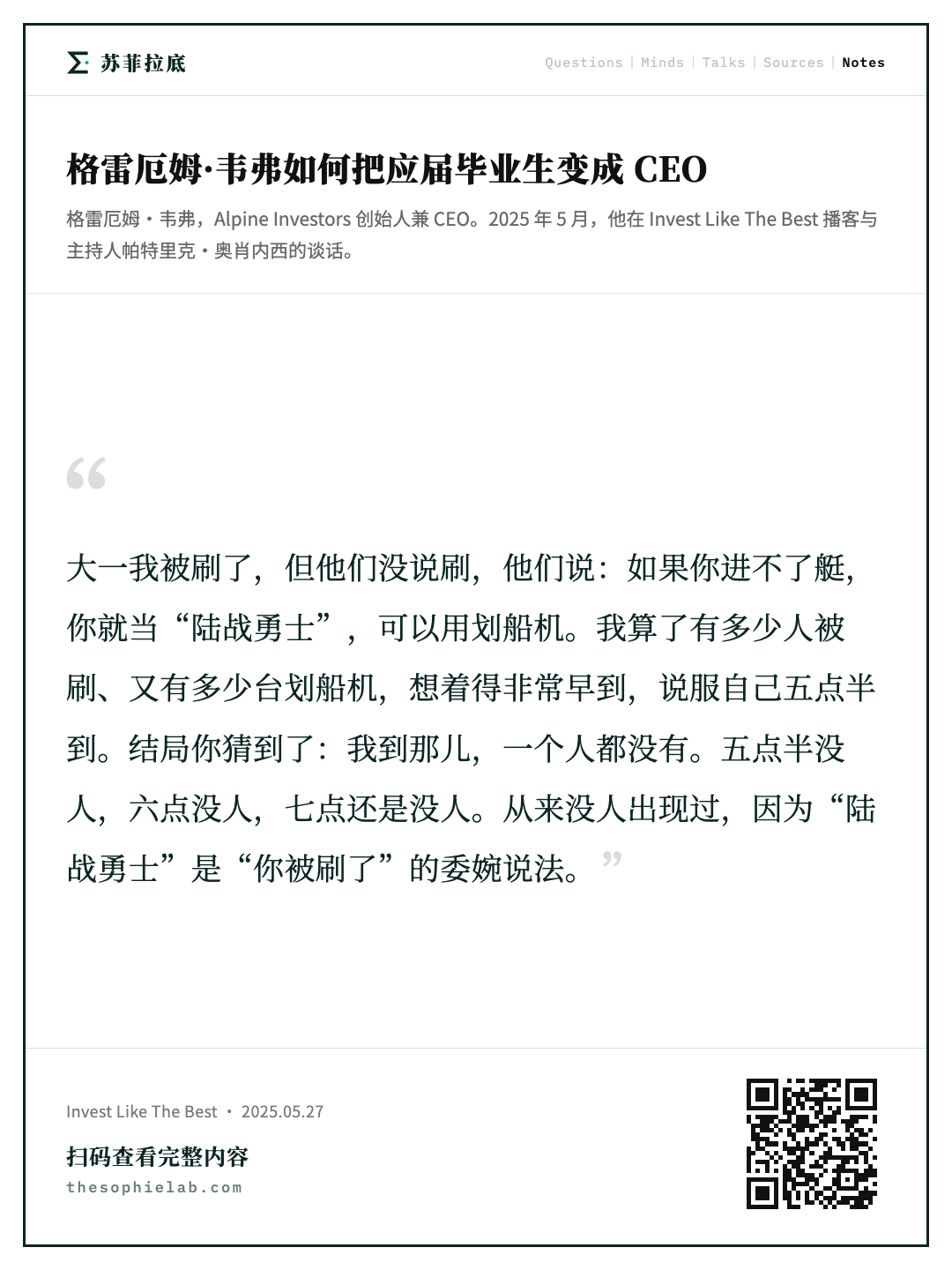
划船这条线最容易讲。我去报到,是个新手,因为摔跤减重只有一百三十磅。我被打得很惨,因为队里有些孩子已经划了六年,什么都门儿清。大一我被刷了,但他们没说刷,他们说:如果你进不了艇,你就当“陆战勇士”,可以用划船机。

我还记得他们贴出分艇名单,上面没有我的名字。我当场算了一笔账:女子队、重量级、轻量级(我是轻量级),我算了有多少人被刷、又有多少台划船机。我想,那我得非常早到,因为这么多人都要抢机器。

第二天早上我去了,我一路往前推算时间,说服自己五点半到。结局你猜到了:我到那儿,一个人都没有。五点半没人,六点没人,七点还是没人。从来没人出现过,因为“陆战勇士”是“你被刷了”的委婉说法。

主持人: 就是被刷了。

韦弗: 对,就是被刷了。但我留下来继续划,然后我遇到一个正在备战国家队的人,迈克·泰蒂。整个普林斯顿船屋,早上就我们两个人。他起初完全不理我。他是个传奇人物,后来带美国奥运队拿了金牌,只是当时我什么都不知道,我只看到一个又高又瘦的家伙在死命拉划船机。

在我连着三个星期五点半出现之后,他大概觉得这孩子是认真的,于是慢慢开始带我,教了我一些东西。往后推,大一我进步了一点,大二又好一点,到大三,我在队里的两千米划船机成绩已经是最好的之一,或许就是最好的。到大四,我当了队长,我们拿了全国冠军。所有东西在那一刻都拼上了。

但这真的就是一个非常线性的表达:你投入多少小时,就得到多少。迈克·泰蒂当时告诉我的公式简单到不行。他说:坐上这台机器,以略低于你有氧阈值的强度,能划多久划多久,你就会达成目标。我说:就这样?他说:对,就这样。他是个非常简单的人。我就照做了,它真的奏效,只是需要大量的时间。

父亲的兽医诊所

主持人: 十二岁到二十二岁之间,还有什么是没有它你就会变成完全不同的人?

韦弗: 我简单说说我父亲。我出生前后,他开了一家兽医诊所,他和他父亲一起,我祖父也是兽医。他们在我们镇上开了一家叫“韦弗动物医院”的诊所,后来两人闹翻了。我不知道究竟发生了什么,从来没听过完整的故事,但我爸就那样摔门走了。

问题是,他背着房贷,有三个孩子,家里没钱。我们唯一的收入来源,是他接凌晨两点的急诊电话。他的小传呼机一响,他就爬起来,开车去诊所,给一条狗接好腿,再开回来。这件事他做了二十五年。

坏消息是他几乎从不在家,我小时候和他的关系并不亲近。但这件事对我影响巨大,因为你如果去问他他的诊所,他最后建起了一家极其成功的兽医诊所,而那是一通急诊电话、一通急诊电话地攒出来的,攒了很久。

这一点真的留在我心里了。我当时不觉得,但 Alpine 的样子和那个非常像。他会说,这件事花的时间比他以为的长得多,而他建起来的东西也比他以为的大得多。我对自己的生意,会说几乎一模一样的话。我是很多很多年之后才把这两件事联系起来,才意识到我小时候看着的就是这个。

华尔街的两年

主持人: 从毕业到 Alpine 之间发生了什么?你为什么对这个行业产生兴趣?

韦弗: 我大学毕业,此前一次都没想过找工作的事,也从没实习过,因为每个暑假都在划船。后来我被摩根士丹利招走了,他们有一个内部的投行部门。据我所知,一九九四年,他们是唯一一家直接从本科招人进私募股权的机构。

招我的人叫大卫·拉姆齐,他给我解释了什么是私募股权。听他那个讲法,你会觉得世界上再没有别的事情值得去做,他认为这是最棒的生意,而且他的理由相当有说服力。

我真的被迷住了:你可以买下这些公司,把它们建起来,参与到这么多生意里去。我觉得这是我听过最酷的工作。我简直不敢相信,投资人会给你一张白纸,让你拿去买东西。

不过,我大学毕业时那股劲头是准备撞穿墙的。我在大学有过那么了不起的经历,然后我到了华尔街,我看过那些电影,我以为这会是一段不得了的体验。结果,我用三个星期学会了搭财务模型,然后就这么干了两年。我做的就只有这个,所有本科进来的人做的也都只有这个。而且,我们是一周八十到一百个小时干这件事,文化也不怎么样。

我当时反复在想:工作原来就是这样吗?这就是毕业之后要做的事?我读了十六年书,这是我的高光时刻,结果它令人无比失望。

这后来成了 Alpine 一个特别根本的底色:那种“我对这个地方还有这么多可以给,为什么我只用上了自己百分之三的能力”的感觉。

可赢的游戏

主持人: 我朋友杰里米·吉丰有个很有意思的说法,他把成功分成两种模式:彼得·蒂尔模式和阿诺·施瓦辛格模式。蒂尔模式像我认识的很多公开市场投资人,坐着想,不常出手,凭一个特殊的洞见做出决定,然后拿到很好的回报。施瓦辛格模式就是蛮力:更多次数,更用力推。我对你属于哪一派已经有猜测了,但你怎么看?私募股权是不是那块可以让人尽情用力、几乎为表现本身而表现的画布,而不是靠洞见换回报?

韦弗: 私募股权里确实有蒂尔模式的投资人,他们做很少的几笔大投资,坐着想,就是那个样子。那不太是我们,我们的接线方式不是那样。

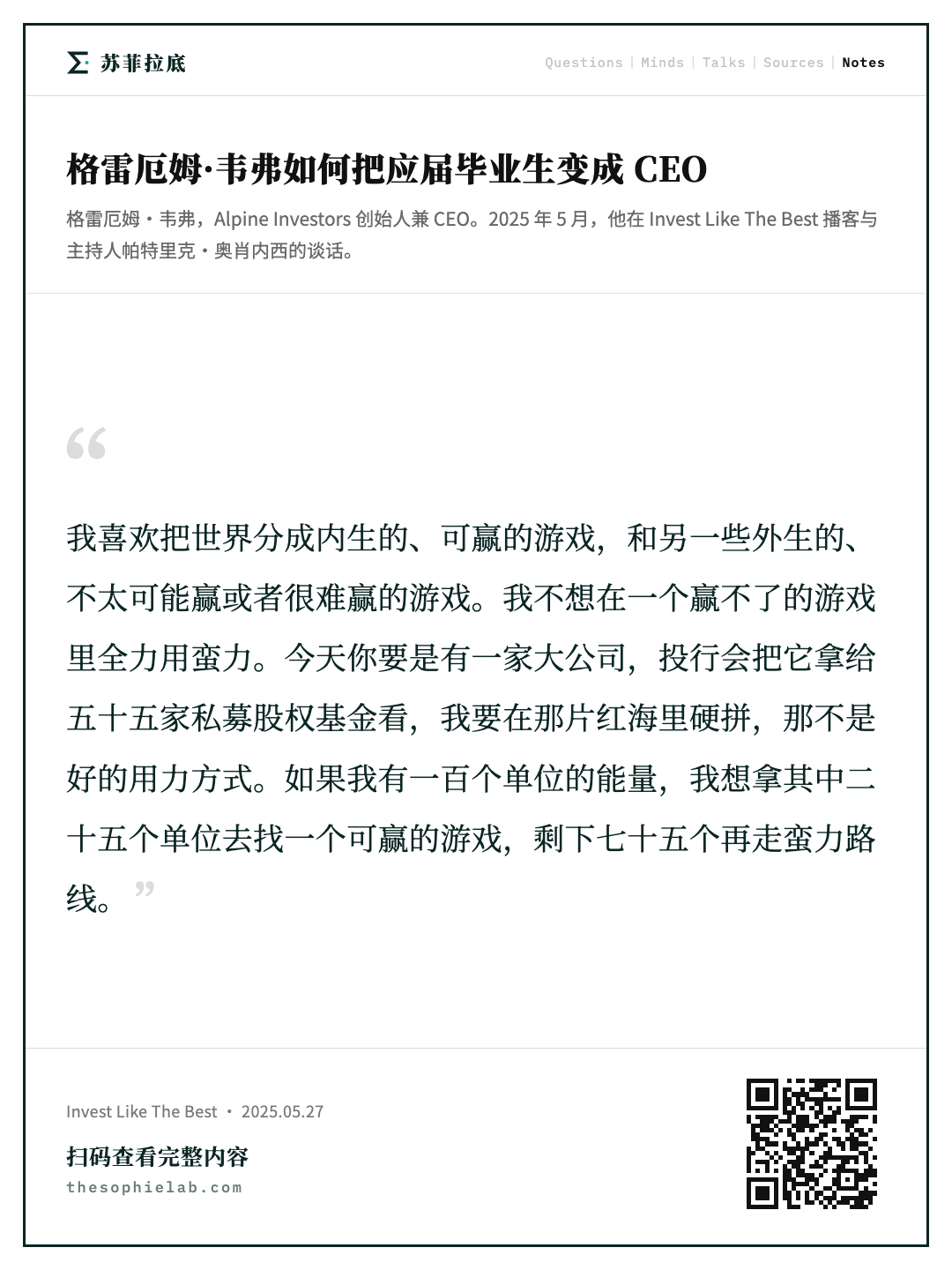
我喜欢把世界分成内生的、可赢的游戏,和另一些外生的、不太可能赢或者很难赢的游戏。我不想在一个赢不了的游戏里全力用蛮力。

举个例子。今天的私募股权,一九八四年不是这样,但今天你要是有一家大公司,你会雇一家投行,你懂这个套路,他们会把它拿给五十五家私募股权基金看。我要在那片红海里硬拼,有本很棒的书叫《蓝海战略》,那种就是红海,我觉得那不是好的用力方式。

如果我有一百个单位的能量,我想拿其中二十五个单位去找一个可赢的游戏,剩下七十五个单位再走内生的蛮力路线。

主持人: 那用这个框架看今天的私募股权市场:有大量基金管着巨额资产,我的理解是,一个好资产往往就是一场拍卖,一场竞价战,里面全是高度专业、极有才华的投资人和机构。你怎么描述今天的市场状态,以及在这个大市场里,可赢的游戏具备什么特征?

韦弗: 我认为现在有五千五百家私募股权基金。你说的那种优质公司,随便挑一个极端的例子,比如一家做 ERP 订阅制软件的公司,没有比这更高质量的资产了,能买它的人非常多,能看清它值多少钱、算出一个估值的人也非常多。而且顺便说一句,它未必卖给最聪明的人,它卖给出价最高的人。所以赢下它的人不一定就是最聪明的。这是一个非常非常难的游戏。

反过来,我们在玩的那个可赢的游戏,是我们在 Alpine 前十年亲手把公司管起来时学会的:我们去路易斯安那州鲍尔镇,找一家两千万美元营收的水暖公司,老板要退休了,他们需要一个全新的管理团队。愿意报名玩这个游戏的人不多。这活儿很重。我们要往一家小公司里塞一个新 CEO,要换掉全套 IT 系统,要落地一整本我们自己的剧本。你要是想玩这个游戏,尤其想规模化地玩,祝你好运。

那是一个内生的、可赢的游戏,活儿极多,但投资决策反而变得相当容易。有人把一笔交易拿到你面前说:这家公司,你付八倍 EBITDA,用你手上的剧本,你可以把它摊薄到五倍,你的借贷成本是五点五,而你的平台在市场上按十八倍交易。投资委员会那一关根本不是难点,难点是把 CEO 和 IT 系统这些东西弄对。

在宿舍里买公司

主持人: 带我们回到 Alpine 成立前后那段时间。当时在发生什么?你日记里写的目标是什么?

韦弗: 我在华尔街干了两年,然后考进了斯坦福商学院,先延期了一年再去。到了那儿,我又一次有了那种镣铐被解开的感觉,因为读商学院时没人规定你几点该在哪儿。于是我决定:我要在宿舍里开始买公司。那就是真正的起点。

我父亲一直想给公司起一个 A 开头的名字,因为黄页是按字母排的。我也想要 A 开头,而且要排在“American”这个词前面。Alpine 我觉得是个好名字,而且我当时就住在 Alpine 路上。有个好笑的事:有一次我给一位银行家寄信,信上有我的地址,他说,哇,他们用你的名字命名了一条街。而实际上那就是一个没钱的家伙。

斯坦福周三不上课,所以我周二晚上坐红眼航班飞走,去中西部看那些很小很小的制造企业,再去见银行谈融资,然后飞回来考试。我在斯坦福的两年大致就是这么过的。

主持人: 然后呢?你真的买下了吗?

韦弗: 买了,一共三家。我当时二十五岁,完全不知道自己在干什么。这不是自谦。

主持人: 钱从哪儿来的?

韦弗: 这些都是五十万美元 EBITDA 的公司,我用两百万买。卖方融资一百万,公司有设备,可以做设备融资,这样我要拿出的股本就压到了大概十万美元,而这十万我也没有。一部分是华尔街的朋友凑的,这儿一万,那儿五千。

还有就是,那时候 Capital One 刚起步,会往你信箱里塞信封,上面写着:给自己开一张两万五千美元的支票,两年免息。我就照做了。我说,太好了。那就是我出的股本。

后来谢天谢地,又会收到另一封,说:把余额转过来,再免息十二个月。我当时走的是一根很高的钢丝,我不建议任何人这么干。

主持人: 这三家公司成了吗?

韦弗: 没有。三家加起来最后是一倍。商学院毕业后我在同一个行业又做了一笔,那一笔非常成功,也谢天谢地地资助了 Alpine 早期的很多事情。但头三笔,我把所有能做错的事都做错了。

主持人: 你从那三笔,以及紧接着成功的那一笔里,学到最多的是什么?

韦弗: 它们都在标签印刷行业。这本来是个好生意,因为一瓶五美元的洗发水,上面那张标签可能只值一美分,但产品的全部信息都在这张标签上。没有哪个采购经理会因为在标签上省了不到一美分就成为英雄。所以它的收入非常可预测。

我漏掉了两件事。第一,你其实是在为它背后的客户做承销,你必须往下再看一层,看他们抗衰退的能力。中西部那些公司,二〇〇一年衰退一来,他们的客户被打垮了,营收因此大幅下滑。这是我漏掉的第一件事。

第二件事是,我完全没搞懂管理层有多重要。这后来成了我们理念中极重要的一块。创始人要退休了,二把手在那儿,我就直接支持了他,而那个人是绝对不该被支持的。我严重低估了管理团队的分量,而且我把这个错误连犯了三次才意识到自己在犯错。

到了下一笔,还是标签生意,但底层客户不一样:我们最大的客户是 Trader Joe's,在二〇〇〇年代初,那简直是史上最好的客户。他们每年增长百分之十五,五天之内付款,而且允许供应商有很好的毛利。那就是一个本垒打。这家公司我持有了二十二年,几年前才卖掉,中间一直在分红,这对我帮助非常大。

辞职那天

主持人: 所以商学院毕业时你已经有一笔成功交易了。听起来到这个时候你应该会说,这就是我想做的事。是这样吗,还是仍在摸索?

韦弗: 天哪,这百分之百是我想做的事,可我还是怂了。

那两年里你随时问我,我都会说我很清楚这辈子要干什么。可等到毕业临近,同学一个个拿到私募股权的工作,我有点 FOMO,也害怕。于是我去面试了一家机构化的私募股权基金,拿到了工作。我灵魂深处知道这不是我想做的事。我去上班,报到那天,我身上有一小部分死了。

我在那儿干了一段时间。那前后,我一个和我年纪相仿的好朋友去世了。我大概休息了一阵子,然后我意识到:如果不是现在,我要什么时候才去做我真正想做的事?几天之后我走进办公室,辞职了。

我没有任何落脚点。我没有基金,没有投资人,什么都没有,但我想,我得试一次。

主持人: 这类故事往往都是从小处、从朴素处开始的:SPV,单笔交易。你在 Alpine 基金之前,也是这么一笔一笔串起来的?

韦弗: 对,一堆单项目的 SPV,一个 SPV 买一家公司。

主持人: 有人听了会说:对,这就是我想做的,我要找一家公司,凑一笔钱,把它做成,开始积累业绩记录。你会给他们什么建议?

韦弗: 几点。

第一,挑一个行业,别在三个不同行业各做一笔,那样你对什么都不会真懂。我的第四笔之所以成,是因为我做过三笔,学会了什么才是真正重要的。所以尽量待在同一个行业,并且挑一个好行业。

第二,给自己发工资。这听着像废话,但我当年没做。这正是我迟迟不敢全职去做的压力来源。你要留出足够的钱让自己活得还算舒服,哪怕这会削减你的总上行空间,因为从长期看,能撑多久比上行更重要。

第三,我喜欢这种模式的一点是,我犯了所有你能想象到的错误,但我二十五岁就下场了。我没有坐在那儿空想、过度分析。你得进到竞技场里去。这就是我的第三条建议:进场。

主持人: 在你二十五岁、几乎没有业绩记录的时候,你关于募资学到了什么?

韦弗: 我一开始是去卖我的业绩记录,那是一场灾难。我没意识到的是,这些人每天都在看极其漂亮的业绩记录,他们会拿我跟那些去比。

有一次我在丹佛机场的飞机上,要飞旧金山去见后来成为我最大投资人的那个人。我在飞机上读了一本小册子,那本书别的我一个字都不记得了,叫《销售小书》之类,但里面有一句话:人们买的是销售员,不是产品。

在从丹佛飞旧金山的那段航程里,我把我的演示文稿彻底改了。我想:好,我要把自己卖出去,卖成一个会把这件事想明白的人,一个值得信任、靠得住、会拼了命让它成的人。这个说法的效果,比“来看看我这三笔标签生意”好太多了。

Alpine 的三条信念

主持人: 快进到 Alpine 已经成形,你开始募集越来越大的基金。这门生意最根本、也最区别于同类机构的核心信念是什么?

韦弗: 有好几条。

第一条我会说是:你的目标函数是什么。我们的目标函数有一个具体数字,一期基金做五倍。

主持人: 历史上你们做到了吗?

韦弗: 最近四期基金我们都做到了五倍,准确说是最近三期已经标记在五倍,第四期也在路上。

有了一个具体的目标函数之后,很多东西会顺着它级联下来:你想持有一家公司多久,你打算怎么投它,你要怎么把它建起来。所以“你的目标函数是什么”这件事非常重要,你的球门柱在哪儿。我觉得很多人用的是 IRR,或者他们真正的目标是募下一期基金。这会把事情搅浑:你是不是为了快点募下一期、把 IRR 做高,就把最好的公司早早卖掉了?你到底在干什么?

第二条信念是,我们认为创造超额收益的方式主要来自人才,这大概是 Alpine 的地基:了不起的领导者、CEO、管理团队,会带来了不起的结果。所以我们会去看别人不太看的 B+ 行业,但把它和一个 A+ 的团队配起来。我们发现这是个极好的组合。我们不会为 A+ 行业付过高的价钱,宁可在行业质量上往下走一点。

第三条是,我极其推崇思考,或者说使用想象力。我们会把时间安排在办公室之外。大衰退期间,我们会整整一天待在办公室外面,认真地想:我们想建什么,我们想具备什么能力。用时间去“经营这门生意本身”。我常用的说法是:我们在种橡树的种子,五年以后它会为我们遮阴。如果你能持续这么做,你基本上总能造出护城河。但这需要极强的纪律,在一堆火烧眉毛的事情中间,硬是抽时间去做重要但不紧急的事。这就是想象力和创新。

换掉管理层,把船烧了

主持人: 我到处打听的时候,总喜欢问一句:Alpine 最为人所知的是什么?只能说一件。我听到最多的是年轻人才培养,是让二十多岁的 CEO 去掌管有时相当大的公司,以及为此建立的搜寻与培养体系。这个能不能展开讲?你什么时候种下的这颗橡子?它怎么长起来的?这似乎是配方里最基本的一味。

韦弗: 没错,这是核心。

它是这么来的。早期我们什么都做,手上有不少公司经营得不好。于是我们中的某个人就出去,亲自去管那家公司。今天我的合伙人之一丹·桑德,当年搬到底特律待了差不多一年。威尔·亚当斯搬到缅因州待了两年,去救一家糟透了的公司。还有一个叫迈克·杜兰的人在芝加哥。我自己管过我们一家做老虎机的公司。

到了衰退期,我们有大把时间回头复盘自己的业绩记录,发现最好的那些交易,全都是我们派了自己人,或者一个跟我们一模一样的人,去经营一家他完全不懂的行业里的公司。这些人有极强的原始才干,同时可被指导:我不是什么都懂,那我该向谁学?我不是那种已经在行业里摸爬滚打几十年、自认为无所不知的老兵,我会用全新的、不一样的眼光看问题,而且,我会撞穿墙。

这三笔就是我们最好的交易:迈克·杜兰管了一家,一个叫乔什·格林伯格的人管了一家,马克·斯托特管了一家。全是本垒打。

而且顺带一提,那也是最有意思的董事会。你就坐在那儿,和你的朋友聊你们要怎么把这件事干爆,你知道他走出这个会议室就真的会去做。这跟那种创始人完全相反:“哦,好主意,太棒了”,然后他记在本子上,你就知道这事永远不会发生。这太有意思了。

所以某一刻我们就说:那我们干脆每次都这么干。我到现在还记得开那次会时我人在哪儿。从这一刻起,百分之百的交易都放我们自己的团队进去。我们把船烧了。

烧船非常残酷,因为投行不会去卖一家没有管理团队的公司。我们必须重新搭一整套项目来源引擎,还要改变我们在市场上的品牌:现在 Alpine 的品牌是,如果你不想继续干了,你就打给 Alpine,而不是那些会继续支持创始人的私募股权基金。这个转变做起来真的极其痛苦,但我们还是在二〇一〇年前后做了。

主持人: 那今天是不是可以说,如果不能放自己的团队进去,你们就不做这笔交易?

韦弗: 在平台公司层面,我们基本百分之百放自己的团队。当然任何规则都可以有例外,如果对方特别出色,可被指导、愿意撞穿墙、满足我们其他所有标准,那反而更省事。但历史上最近大概四期基金,我们百分之百更换了管理层,而且我们在谈的时候就把话挑明:你想套现,想去船上晒太阳,太好了。至于补强收购,大概百分之八十的情况下我们也会换管理层。

平台是怎么造出来的

主持人: 能不能给我们上一堂平台搭建的入门课?“平台”在私募股权里是个高频词,它是不是就是并购整合?平台到底是什么,怎么建,步骤有哪些?

韦弗: 对我们来说,它就是并购整合。我用我们最好的例子来讲。

我们从水暖和空调(HVAC)起步。空调这个行业似乎总是块好地方。有个叫 AJ·布朗的人,他是我们“储备 CEO”项目里的人,我们先让他去我们一家公司做 CFO,他干得非常好,后来公司卖掉,我们把他收回来,说:你可以打主力了,你要去当一个平台的 CEO。然后我们给他配了另一个刚进来的储备 CEO,叫威尔·马特森。他们两个一开始就是 CEO 和 CFO 的组合。

我们选了空调,因为我们在这个领域有一点经验,他们俩也对这个领域感兴趣。接着我们就开始大量地去拜访公司。你去一个行业里拜访二十家公司,一次三小时的管理层拜访,学到的东西比在会议室里坐三个星期还多。

你在这些会面里要捕捉的是:什么叫“做得好”。有意思的是,几乎每家公司都至少有一件事做得特别好。这家的招聘做得好,那家的采购做得好,还有培训、市场、他们用的 IT 系统以及使用的成熟度。但如果你把二十家公司加总起来,把每一块最好的东西都抓出来,你手上就有了全世界最好的一本剧本。

所以在你还没买任何一家公司之前,你就已经在设计这个平台的样子了:先把 CEO 招好,把行业选对,把管理团队里管理的那部分弄对,再把剧本弄对。然后才开始去买公司。

头几家我们尽量买小的。我们在这个领域的第一笔大概是八百万美元 EBITDA,我们学到了一大堆,然后又买了一家两百万 EBITDA 的。一边买一边建。同时我们也在搭控股公司本身:CEO、CFO、首席人才官。

主持人: 控股公司就是平台。

韦弗: 对,控股公司就是平台。我们最好的那些公司,早期在平台上的投入都是过度投入的。这非常贵,我们有一些很年轻的平台,控股公司的开支就有一千五百万美元,但那是你未来的地基。

主持人: 这一千五百万从哪儿来?

韦弗: 从基金来,就是出资把一家新公司资本化。不过也没有听上去那么糟,因为我们很快就会买进有 EBITDA 的公司,用它来养控股公司,所以很快就现金流为正了。

回到这笔交易。我们早期搞明白的一件关键事情是:空调行业里每一个竞争对手做的事都一样,他们都在买那种五百万到一千万美元 EBITDA、管理团队很好的公司,所有人抢的是同一家公司。可事实是,百分之九十的市场在这条线以下,而且那些公司的管理层想走人、想套现。

所以我们说:我们为什么不建一套系统,专门去买这类公司?而这里面,人才是一个巨大的杠杆。这一点我要给 AJ 和威尔记很大一功,他们打进了退伍军人这个人才池,还建了自己的储备 CEO 项目。他们自己就是从 Alpine 的项目里出来的,觉得这套东西太棒了,于是在他们自己的公司 Apex 里又建了一套。

早期通过这个项目进来的人里有一个叫布拉德·施瓦茨,履历是西点军校、绿色贝雷帽、沃顿商学院,他进来经营的是一家营收大概八百万美元的公司。快进到今天,他管着一个五亿美元的事业部。

我们最初买的那家公司营收大概四千万美元。他们就这样一家一家地把小公司攒起来。我们投进去五千万美元股本,今年这家公司的 EBITDA 会做到五亿美元,而我们没有再追加过一分钱股本。

这完全是一场把顶级人才塞进每一家被收购公司的练习。我们会把他们的 IT 系统全部拆掉,装上我们的财务软件包、ERP 系统、商业智能系统,而且我们买的每一家公司,都必须用完全相同的方式录入他们做的每一个工单,这样我们才能横向比较所有公司的数据。我们现在还有一所面向退伍军人的培训学校,我记得这家公司有八十名退伍军人在担任总经理,他们表现得极其出色。

这就是一个从一张白纸开始的例子,我们每件事都是这么做的:组建一个小组去评估若干行业,设计剧本,招人,最好是从我们自己的体系里把人调回来组成领导团队。在我们必须电汇任何一笔钱之前,很多关键决策都已经做完、评估完了,而且我们有充足的时间和耐心。

换人之后的头六十天

主持人: 如果我退到最远处看 Alpine 在市场上提供的服务,我脑子里的画面是:几十年里,婴儿潮和 X 世代建起了无数小企业,数量多到不可思议,光空调行业就不知道有多少家,其他行业也一样。问题是当这些人想退休时,这些公司无处可去。而你的解法基本上是:用人才来解。这是不是就是那个独特的洞见?

韦弗: 标题层面是这样:用人才来解。但在这行字底下,是一大堆关于“怎么让那个第一天走进公司的人真正成功”的知识产权。因为如果你只是把管理层换掉,这件事非常难,而且可能会非常糟。这一点我们是吃过苦头学会的。

所以我们积累了大量的内部方法论:那位 CEO 在第零天、头三十天、六十天、九十天到底该做什么;系统怎么装、指标怎么量;他们具体该怎么招人。你说的那个是对的,但底下还压着很多关于“如何真正做到”的东西。

主持人: 在不泄露全部秘方的前提下,能不能给我们尝一点这些方法论的味道?

韦弗: 我举两个例子。

第一,我们的生态里有大约三十位教练,他们都精通这套剧本,会和第一次当 CEO 的人配对。他们已经陪着别人走过很多遍,而且做的就是 Alpine 这套剧本。这些教练是全职投入的独立顾问,大概百分之七十的时间花在 Alpine 上。他们会像搭档一样,陪着这位第一次当 CEO 的人,几乎是按图施工地走完头六个月。

再举个具体的。CEO 第零天走进公司,宣布消息,大家会不高兴。因为这是“老乔的水暖公司”,老乔要退休了,员工跟着他干了十五年,现在来了一个二十八岁、不懂这行的人。他们第一天肯定不会兴高采烈,这完全可以理解。

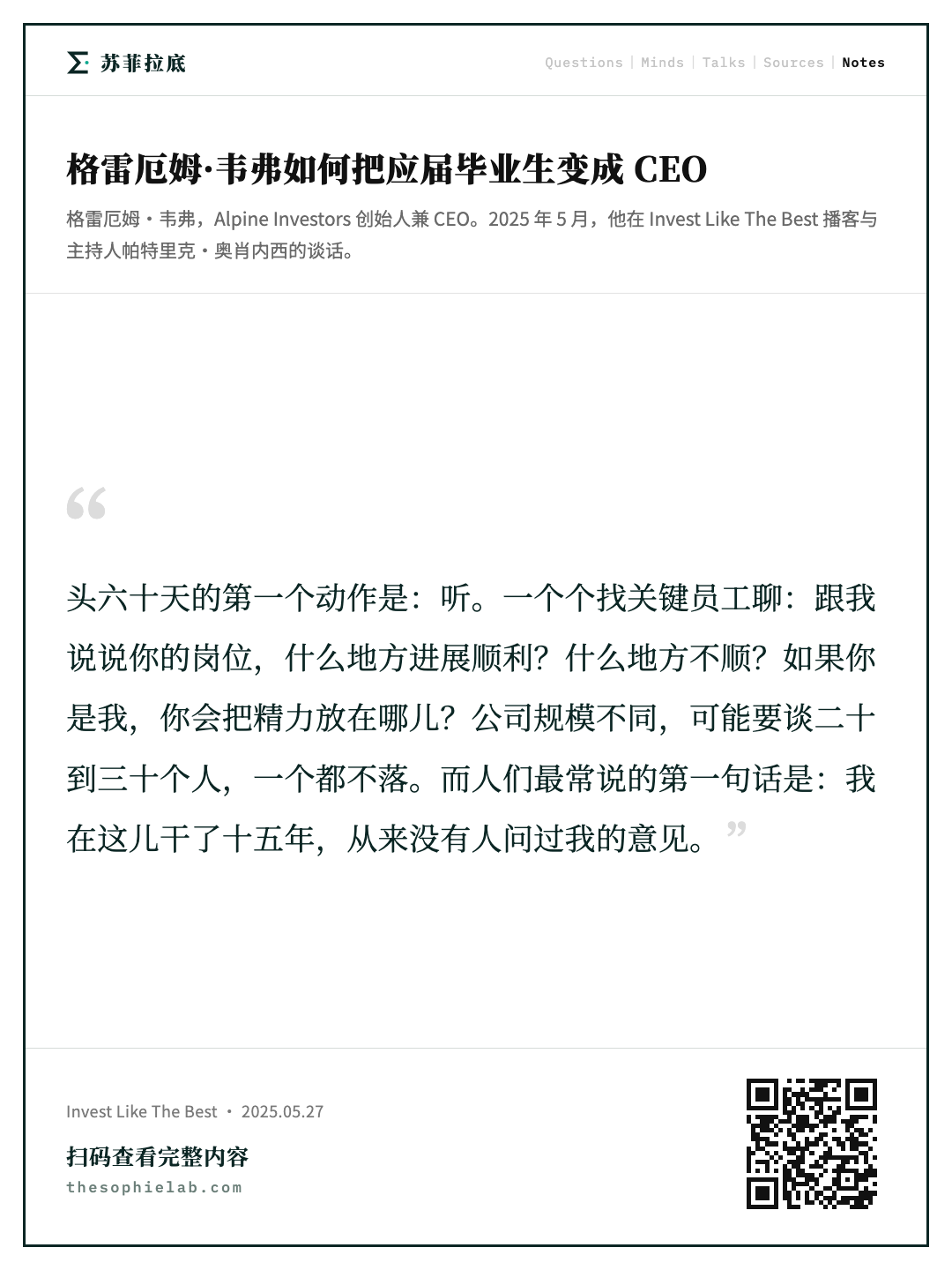
所以头六十天的第一个动作是:听。他们会坐下来,一个个找关键员工聊:跟我说说你的岗位,你在这儿做什么?什么地方进展顺利?还有呢?还有呢?还有呢?什么地方不顺?还有呢?还有呢?如果你是我,你会把精力放在哪儿?最重要的优先事项应该是什么?我们现在做的哪些事是在浪费时间?我该担心什么?我们眼下最大的机会是什么,最大的问题是什么?

他们会这么做,公司规模不同,可能要谈二十到三十个人,一个都不落。而人们最常说的第一句话是:我在这儿干了十五年,从来没有人问过我的意见。

主持人: 包括老乔。

韦弗: 一点没错。所以在很短的时间里,我们就建立了真正的信任。然后我们会用这些信息,可能会说:我听到你的想法了,你最喜欢的那个主意是往国际扩张,这个季度我们不做,但我们确实听到了。你不必照单全收他们说的每一件事,但他们必须感到被听见了。

对员工这么做,对客户也这么做。然后从这里出发,把最核心的那批人拉进来一起设计计划:这是我们必须做的,这是低垂的果子。而通常,走完这一轮之后,那些果子低到、明显到让人吃惊。我知道,因为我自己接管过一家公司,我当时就在想:他们怎么会这些都没做?他们只要跟自己的员工聊一聊就知道了。

我的一位高管教练有句很棒的话:答案永远在这个房间里。你不需要去雇麦肯锡。你要是雇了麦肯锡,他们去做的就是我刚才说的那些:访谈你的员工,然后把你本来就能听到的话复述给你。对客户也是一样,客户会告诉你产品或服务的问题在哪儿。

主持人: 我正想说,这套做法的受益方之一应该是终端客户。如果客户不满意,你不可能从五千万做到五亿的 EBITDA。

韦弗: 百分之百。你倒过来推就明白了。我认为两个最被低估的成功领先指标,是客户的净推荐值和员工的净推荐值。

我们买下一家公司的时候,会立刻测一次员工净推荐值,也就是在我们介入之前,员工的投入度和满意度是什么水平。然后每六个月测一次,并且在整个 Alpine 内部公开。我们让 CEO 为这个指标负责,原因有两个。

第一,我认为它大概是这门生意最重要的领先指标,如果不是唯一最重要的话。第二,回到“向善的力量”这一条,这大概是我最自豪的影响:四万名员工在我们买下公司之后,明显地更愿意来上班了。

我会这么想:假设你是一位单亲妈妈,在我们某家公司的呼叫中心上班。在我们进来之前,你可能就是打卡上班、打卡下班,谈不上兴奋,而你醒着的一半时间都花在这里,也许连同事都叫不出你的名字。那你回到社区里会是什么状态?

在美国,百分之七十的人讨厌自己的工作,或者对工作毫无投入,这在任何行业都成立,你自己也可以重复这个调查。如果我们能把它翻过来,让百分之七十的人真正有投入感,这不只是对生意好,我认为它会实实在在地改变这些员工的生活。所以我们非常认真地对待这件事,这也大概是我们做过的所有事情里我最自豪的一件。

回报是怎么来的

主持人: 我还想花很多时间聊那个被挑选、培训、然后接手公司的二十七岁年轻人。但在那之前,我想先把这套平台战略的财务结果收个尾。回到你五倍的目标函数,这意味着你需要从这些平台里拿到什么?回报来自哪里?是估值倍数扩张,还是基本面增长?

韦弗: 我们的想法是,单笔交易通常按三倍来承销,而且通常不假设倍数扩张。你买下这家公司,按它能承受的债务倍数加杠杆,然后把它做大,五年做到三倍或者三点五倍的毛回报,这是我们典型的标准承销。

五倍从哪儿来?来自那些事情走对了之后的非对称结果:有机增长比你想的更强,公司可以持有得比你原先设想的更久。你可以通过组合管理,靠一堆“先上垒”再叠加好事,一路走到五倍。但如果我们按五倍去承销单笔交易,我们一笔都成交不了。

主持人: 现在你手上有这么多数据、这么多期基金,是不是大多数基金的回报都由一两个平台主导?

韦弗: 确实存在明显的非对称性。我以前把巴菲特年报里的每个字都读过,我记得,可能会记错一点,但方向是对的:大概在一九八八年前后,他一半的钱来自两只股票,政府雇员保险公司和《华盛顿邮报》。他买卖过无数生意,但一半的钱来自那两只。

我们确实倾向于每期基金至少有一笔真正的异常值。而随着我们越来越清楚异常值的配方,我们希望每一颗种下去的种子,至少都具备成为异常值的潜力。不是每一颗都会命中,但我们在识别配方上越来越好。这个配方是:建一家真正的公司,建一个有一流团队的真正控股公司,在一个足够大的行业里,花足够的时间把剧本做对,然后给自己留出喘息的空间。

如果我们一次又一次这么做,我们就会越来越稳定地做出这些异常值。所以在我们近几期基金里,它不再只是一家公司。事实上在我们最近这一期基金里,虽然我有偏见,但我认为几乎每一家公司在今天都有成为真正异常值的潜力。

一家自养的搜寻基金

主持人: 回到人才。听下来你建的几乎就是一家自养的搜寻基金(search fund)。

韦弗: 对,这个类比很好,本质是一回事,个人特质、人生阶段都一样。

主持人: 那我的问题是激励。在搜寻基金里,激励结构非常紧、非常干净:你买下一家公司,如果它做得极好,你这位搜寻者兼 CEO 也会获得极好的回报。关于如何激励那些被派去经营公司的人,你学到了什么?

韦弗: 用你的搜寻基金类比:假设你是那种很早就想拿球的人,这就是典型的搜寻基金选手,他们想早早当 CEO。我喜欢这种人,我二十五岁时就想拿球,我欣赏这个特质。

可是你想想,他们拿球是为了做什么?是为了经营一家公司,这才是他们想要的。但在搜寻基金的世界里,他们必须先建一家私募股权公司来完成搜寻和交割。而如果你去看数据,我投过搜寻基金,大概投过七十家甚至更多,他们通常在前半段就出岔子。投资是一门模式识别的生意,而他们没有模式可识别。投行也不太愿意把项目卖给他们,因为跟这个人一辈子只能做成一笔交易。他们头上还有倒计时的钟在走。前半段有太多问题。

另一件不太成立的事是,他们几乎得不到支持。好消息是你拿到球了,坏消息是你不知道拿球该干什么。

所以我们说:我们有我认为是私募股权行业里最好的项目来源引擎之一,我们会去找到极好的公司;此外我们有一整个团队帮你评估行业,确保行业选对了。我们要你玩一个可赢的游戏。我们要给你一个平台,让你靠自己的才干、靠招人和换人这些事赢,而不是在行业判断上失手,因为你二十八岁的时候是不可能把行业想明白的。所以前半段我们替你顶上,那部分我们很擅长。

等他们买下公司之后,就进入培训。我们要说的是:我们有二十五年积累的知识产权,不只是关于如何当 CEO,而是关于如何当一个三十岁的 CEO,走进一家非常成熟的公司,把那个团队变成你的团队,站到你身边,一起往前走。这是我们独有的东西。它其实并不复杂,但我们不如让你从第二十六年开始,而不是从第零年开始。

主持人: 这些人你是从哪儿找到的?这套东西最开始是怎么起来的?我猜现在容易多了,你有了名声,人人知道这是个可以来做这件事的地方。

韦弗: 开头惨不忍睹。

我们启动储备 CEO 项目那会儿,我在斯坦福商学院当客座讲师,会和学生喝咖啡聊天。我参与的那门课是创业课,学生们想当 CEO,会问我:我该怎么做到?搜寻基金是个选项,但他们不喜欢我刚才说的那几个部分,而我也拿不出更好的答案。

最后我对一个学生说:要不你来我们这儿?我们教你怎么当 CEO,然后把你放到我们一家公司里去。这听上去很棒。我们就把这个人招了,不过不是直接让他当 CEO,而是打算让他去某家公司当 CFO 或者 COO。

结果我们在自己的投资组合里找不到任何一家愿意用他的公司。他们说:格雷厄姆,我捋一捋啊,你手上有一个没有经验、还有点自视甚高、而且特别贵的人。要不还是算了吧。

我们没能把第一个人安置出去,他走了。第二年来了一位女士,叫劳拉·沃尔什,情况一样,但这一次我对那位 CEO 说:你先用她,如果一年之内她做不出来,我从管理公司这边把她的薪水赔给你。等于是无条件退款保证。

结果她做得漂亮极了,那位 CEO 说:我还要三个。事情从那儿开始起飞。所谓起飞也就是,第二年两个人,第三年三个人。这花了很长时间,我们也花了很久才真正搞清楚他们在什么样的生意里会成功、他们的盲区在哪儿、什么能干什么不能干。能犯的错我们全犯了,但幸好是在人数比较少的那几届上犯的。现在我们调得比较准了,但我们仍在学,我完全没有宣布胜利的意思。

主持人: 让这些年轻人成功的特质里,有哪些是让人意外的?我喜欢意外的那种。

韦弗: 聪明、肯干这些就不说了。我列几条,不确定哪几条算意外。

第一位的特质是求胜欲,是那种白热化的求胜欲。就是“我要把这个项目、这门生意扛到自己肩上,抱着它冲过一栋着火的楼”。你会在他们过往的人生里反复看到这一点,那种主人翁意识和驱动力。这是第一。

第二,或者说“第一点五”,是韧性。他们被打倒过,又爬起来了;再被打倒,再爬起来。因为当 CEO 一定会被打倒,我们想要的是那种人。被打倒又爬起来的好处在于,到了某个时刻,你会相信自己一定会爬起来,同时也会预期自己隔一段时间就会被打倒一次。而这一条,在我们招人的那些学校里,比你想象的要稀缺得多。韧性并不常见,我们在这上面犯过很多次错。

第三条我把一堆东西揉在一起:情商、自我认知,以及和人相处的能力。我们几次大的失败,漏掉的都是这一条。

要说意外的,大概是行动偏好:下场去试,失败了再试,而不是分析瘫痪。

主持人: 从市场营销的角度看,你显然想垄断具备这些特质的人来经营你的公司,这会是一个很好的正向循环。你怎么做到的?是纯口碑,还是你有更主动的做法?

韦弗: 答案是口碑。一个学生去经营一家公司,体验极好。他的朋友听说了 Alpine,打电话问:这是真的吗?他会说:我这辈子玩得最开心的就是现在,我都不知道世上还有这种事,简直难以置信,而且它比宣传的还要好。

这种口碑就是一切。所以我们能做的最好的事,就是把体验真正交付出来:先给他们一个可赢的游戏,再给足支持。去年,这一点可能会让你意外,Alpine 的储备 CEO 项目是哈佛商学院、斯坦福商学院和凯洛格商学院申请人数最多的工作。

主持人: 你等于是把搜寻基金前半段那个最烦人的部分短路掉了。

韦弗: 完全正确,而且那部分确实很烦人。另一件很有意思的事是,用你的说法,他们得先建一家私募股权公司,然后把它抛弃掉。他们建立起来的那套能力没法复用,建它只为做成一笔交易。而且在我们这儿,他们能做的规模要大得多,他们会经营大得多的东西,而且希望能更快地到那儿。

斯坦福的那门课

主持人: 我们能不能聊聊你在斯坦福的课?你是从欧文·格劳斯贝克手里接下这门课的,他被称作搜寻基金之父。先说说他,你从他身上学到了什么,这门课是什么性质,然后我还有很多关于你怎么上课的问题。

韦弗: 我会说欧文是我人生中最有影响力的人之一,同时我也相信,毫不夸张地说,大概有一千个人会说同样的话。我不知道还有谁能做到这一点。

你坐在欧文对面,在那段时间里你就是全世界最重要的人。他记得你们上次谈话的每一个细节。他后来告诉我,他会在见完人之后做笔记,下次见你之前再复习一遍。但这不只是技巧,是他真的在意。

他永远是那个说“你可以的”的声音。他会说:你可以的,我见过这么多学生,我做过这么多事,我告诉你,会没事的。就像是年长版本的你自己回来给你建议,他就是那个人。我职业生涯里无数次落到谷底,去见他,他就在最需要的时刻给我一针强心剂,而且是从一个你会相信他的人嘴里说出来的。他真的了不起。

我和他的交集是,我当过他课上的案例嘉宾,案例讲的就是我在宿舍里买公司以及一切出错的过程。我不会这么说,但我觉得我基本是那个学期的“反面失败案例”:其他都是祈祷成真的冠军故事,而我是一个二十八岁、一次又一次被揍得满地找牙的人。他大概不会这么讲,但现在我自己教这门课了,我觉得那就是我在课程设计里扮演的角色。

还有个好笑的事。我第一次开始讲我自己那个案例时才二十九岁,很年轻,班上不少人我都认识,因为我们差不多同龄。有个学生告诉我,在我那个案例的总结环节,其中一条收获是:“从格雷厄姆身上你可以看到,要当 CEO,其实不需要有魅力,也不需要口齿伶俐。”当时我紧张得直结巴。

我当了十二年案例嘉宾,后来欧文要去开一门新课,有一天他打电话给我说:格雷厄姆,你愿意来教我的课吗?我几乎当场就要说不,因为我已经有一份全职工作了。幸好我说,我想一想。我想了一个星期,然后意识到:我每次站在那间教室里整个人都会发光,而且我这辈子不会再有这个机会了。于是我就去教了。

主持人: 我知道现在它是那里最受欢迎的课之一,甚至就是最受欢迎的。你是怎么把它建起来的?跟问 Alpine 一样的问题:你希望这门课为学生做到什么,你怎么设计它来达成这个目标?

韦弗: 头四年我只是想学会怎么当一个老师、怎么讲课。我有一大堆自我设限的念头,觉得我不是教授,我从没教过书。所以前四年我基本上只是想在这件事上拿个 B+。

课程内容主要围绕怎么当 CEO:招人、辞退人、进行困难的对话。它不讲宏大的战略,它在离地一英尺的高度:你要和一个员工谈降职这件事,那我们就把这场对话真的演一遍。所以它是非常具体的和人打交道的东西,而那才是 CEO 真正重要的部分。这是门好课。

但我这么教了四年之后意识到:学生很爱这门课,可他们并没有去做。他们说,这课真棒,谢谢你。然后他们的梦想是去经营点什么,而他们并没有去经营什么。

所以我说,我得往课里加点别的东西:我想帮学生弄清楚他们真正的梦想是什么,并且花大量时间在这件事上。现在课程很大一部分是给学生腾出空间、向他们提问,让他们做练习、做可视化冥想,去真正弄清楚让他们兴奋的到底是什么。如果接下来十年他们可以做任何事,那会是什么?这需要时间,我们花了很多课时在这上面,他们要写日记,我们有一系列的课和可视化练习。

然后,一旦他们大致想清楚了,紧接着就会冒出各种怀疑、恐惧和自我设限,他们的脑子会把他们劝退。于是我们直接对着这一块打:障碍是什么?怎么跨过去?怎么设计一条路径去做成它?这部分现在大概占整门课的百分之二十五,我觉得也是学生记得最牢的部分。

九次人生

主持人: 你以前跟我讲过几个特别厉害的提问框架,能把人的思维从增量思考撑开到白纸思考。我最喜欢、事后想得最多的一个是:想象你有九次人生,你只会过这一次,那么第二次人生你想做什么?第三次呢?它让一切变得更大、更开阔。还有别的问题是你觉得特别有效、能让人说出心里那个真正在燃烧的东西的吗?

韦弗: 九次人生这个练习妙在,人们一被要求“找到你的热情所在”就会非常紧张,觉得只有一个正确答案,然后就钻进脑子里出不来了。而我说,假设你有九次,他们立刻就能一口气说出来:我会做这个,我会当教授,我会写书,我会做这门生意,我会做非营利。他们马上就能列出来。然后我说:好消息,那我们就去做这些吧。好消息是,你要找的那个东西,肯定就在这九个里面。

接着我们拿这九个来谈:你对哪几个最有能量?在这条路上你会遇到什么人?你会怎么成长?举个很好的例子,我有个学生,他其中一次人生是他读书前做的事,做可转债销售,而第三次人生是经营一家公司。当他开始去想“我会怎么成长、会学到什么”的时候,可转债那条路就没那么有意思了,尽管一开始那条路能挣更多钱。

所以你可以深挖这九次人生,这是一种低风险的方式,把人引向他们真正有热情的东西。而这里的秘密是:这九件事你人生中都可以有,只是不能同时都有。

另一类问题是可视化练习。我们会往后走二十年,认真花时间去做,你去见二十年后的自己,那个自己极其成功,一切都成了。你要花真功夫去想:那是什么样子?然后你回来问:那个未来的自己给现在的你什么建议?而建议永远是“去做那件事”,或者“放松点,会成的”,或者“别为这些事焦虑”。

主持人: “如果你知道自己不会失败你会做什么”、“松开怎么做”、“九次人生”,这些问题都威力惊人。我好奇的是你怎么学会施用它们的。是你必须亲自和学生一对一做,还是它比这更可规模化?

韦弗: 两者都有。很多可以在课堂上做,然后他们分成小组做一对一的部分。学期比较早的时候,我有一整堂课专门讲教练技术,让他们学会当彼此“足够好”的高管教练。这样在整个学期里当他们要互相辅导时,就已经有了基本功。这部分我可以对整个班级来做。

另外我也做大量的一对一。我的一对一几乎都是同一个模板:学生进来,问同一个问题,也就是我被问得最多的问题:我这辈子该做什么?非常好的问题。然后他们会说,我有 A 路和 B 路,我很纠结。我花几分钟问一些问题,十分钟之内就很清楚:他们的心想做 B,但脑子在把他们劝退,而 A 是那个安全的选项。剩下的时间我们就一起拆解,怎么用风险更低的方式去做 B。我在课堂上用的也是同一个框架。

主持人: 当老师这件事,个人层面上怎么改变了你?因为这些学生,你作为一个思考者、作为一个人,有什么不同了?

韦弗: 我尽量让每一堂课、每一个学期都是我当下能拿出的最好的东西。今年是我教书的第十二年,我今年备课花的时间比第一年还多。我几乎是把它当成一个渠道,去分享我最新、最好的框架和思考,涵盖从经营公司到个人成长再到灵性的一切。我想把我能拿出的所有东西都带进去。

所以它是一个倒逼机制,让我把整整一年的反思压缩进十九堂课里,并且拿出我最好的东西。光是这个反思和编码成型的过程,就让我学得更透。

另一件事是,我必须去践行它。我不可能站在讲台上说,你要是在经营一家公司,你的高管团队的关键岗位上不能留 B+ 的人,然后回头照镜子,心想:好家伙,我这儿就有两个 B+。所以我会去处理。我有个原则:我不能在讲台上说我自己没有在做、或者我不相信的事。有时候这面镜子挺好用的,能让我检查自己的生活是不是真的按这个样子在过。

主持人: 你和学生之后的关系是什么样的?很多人来你这儿工作吗?这在哈佛、斯坦福还有其他学校是很常见的故事:有人出于正当的理由去教书,结果它成了他们生意的巨大人才燃料。你身上发生了吗?

韦弗: 它成为人才燃料,不是因为我去招募我的学生。而是因为我见了足够多的学生,知道了他们真正在意什么、对什么有热情,这帮助我在 Alpine 设计出一个岗位,精准地对准学生想要的东西,并且对准他们所处的阶段,因为我把这件事理解得很透。

所以帮助在于我能看出:哇,这么多 MBA 想当 CEO,他们有这套能力但没有那套能力。而这恰好跟我们的策略配得极好,我们手上都是一千两百万到两千万美元营收的公司,你找不到比这更好的练兵场了。

机制上也很顺,因为 Alpine 所有的招聘都在秋季完成,而我的课在冬季,到那时学生要么已经有工作,要么没有,反正不会在 Alpine。所以我的课不是一场面试,这对我非常重要。我划了一条线:我从不面试学生,我甚至从不对学生给出评价反馈。我在教书的时候,我就只是他们的教授。日程安排也正好允许我这样做。

教练与个人成长

主持人: 你整套气质、这些故事和设置,都特别像体育。你也说到个人成长。在体育世界里,勒布朗有二十五个教练、在身体上花掉巨额金钱、做各种事情让自己变强,这一切看起来天经地义而且很酷。可在职业世界里,个人成长和高管教练似乎仍带着某种污名。你觉得为什么?

韦弗: 我二〇〇九年请的第一位教练叫 JP·弗洛姆,我坐在他对面,他向我推销当我的高管教练。我记得我当时想:高管教练是个什么鬼东西?你打算做什么?直到今天我也不知道我为什么签了,我想是因为他这个人很有说服力。

主持人: 你买的是那个销售员。

韦弗: 对,说得好,我买的是那个销售员。

我觉得,那些对这件事有负面评价的人,多半从来没有真正做过。我好像从没见过任何一个真正请了高水平教练、之后还对这个过程有负面评价的人。他们大概只是不知道从这样一段体验里能得到什么。

主持人: 那么你为什么要做,甚至把这么多教练放进你的生意里?还有,你能不能定义一下什么叫个人成长?它到底是什么意思?

韦弗: 我有好几位教练,用途不同,我举两个真实的例子。

我有一位教练叫曼迪·舒梅克。光是为了和她通一次电话,我就必须填一张表:你今年的目标是什么?你上周说你要做什么?你实际做了什么?这周你要做什么?这次通话想得到什么结果?就算我从来不和她通话,每周填这张表本身就是极好的问责机制。当然她本人也是位了不起的教练,她是从托尼·罗宾斯那套体系里出来的。

对她来说,这就像是为你的目标和人生配一个私人教练。还有什么投资比这更值?我不需要私人教练才能去健身房,但我确实需要一个人抓着我问:你的目标是什么?你在坚持吗?你在轨道上吗?我觉得这非常有价值。没有教练,我靠自己做不到。

我还有另一位教练,我们会专门留出四个小时,做那种彻底放开的、很乱的思考。有时候什么也出不来。我们问的是大问题:十年后我们希望 Alpine 是什么样?十年后你希望自己的生活是什么样?你在哪些地方在轨道上,哪些地方偏了?如果你要在六个月内完成你的十年目标,那什么必须成立?有时候会冒出了不起的东西,有时候那东西三天后在淋浴时才冒出来。但我喜欢腾出这样的空间,我本身也享受这件事。

你说话时激活的大脑区域,和你思考或阅读时是不一样的。所以仅仅是多一位教练在场,你就点亮了更多的大脑。

我还有一位教练叫瑞秋·洛基特,帮我处理 Alpine 的组织架构。在每一个阶段,我经营的都是一家比我此前经营过的任何东西都更大的公司。而她在非常大的公司当过首席人才官,所以她能指点我:这个组织架构说不通,你可以从这几个角度重新想。

主持人: 我还想回到那个定义问题。个人成长。它到底是什么意思?我猜是“变得更好”。更好又是什么意思?

韦弗: 我往深里说一点。我认为归根到底,我们每个人的内在、我们的直觉里,已经装着大部分答案。我们有一个罗盘,你可以叫它直觉,叫它灵魂,随便什么,那个东西的力量惊人。它就像是我们自己的大语言模型:它把我们经历过的每一段体验、接收过的每一个输入都存了起来,它知道所有答案。

所以我认为个人成长很大一部分,是去理解你的直觉在告诉你什么,花出空间和时间去真正听懂它在说什么,并且跳出你的脑子,因为脑子常常把事情搅乱。然后,是拿出勇气去照它说的做。

这大概是我个人成长的最高层级,因为如果你能一次又一次做到这件事,你就会成为你自己,会自我实现,成为最好版本的你。在这之下还有一堆事情去支撑它。

主持人: 比如?

韦弗: 对自己的人生非常刻意。弄清楚在你生活的各个方面,什么叫成功的人生,真正花时间去想、去设计它,然后建立一种日常的实践,几乎每天都往那个方向推进。

主持人: 你刚才那个定义的第二部分,勇气,像是个关键词。在实践中它对你意味着什么?有没有哪一次,是你的直觉告诉了你什么,而去做它需要勇气?

韦弗: 我讲一个很早的,也是你刚问我时第一个跳出来的。

我在俄亥俄的托莱多,当时要当“受欢迎的酷孩子”,就意味着完全不在乎学业。他们中很多人喝酒、嗑药,有些人真的不是好孩子,很多情况下就是霸凌者,是那帮运动员小团体。我清楚地感觉到那不对。对我来说,把自己从那群人里摘出来需要很大的勇气,因为我本来是可以进那个受欢迎的圈子的,但我选了另一条路。在十二三岁,这对我需要巨大的勇气,而且很快就让我变得孤立。

但很短时间之后我就明白那是对的决定,而这给��我极大的信心,从那以后一直去听那个直觉。我到现在仍然在努力接通它。我想我在很小的年纪就体会到了,听那个声音是多么有力量。

提对问题

主持人: 如果我们每个人都自带这个了不起的直觉模型,勇气也可以随时间习得,那关键的另一步似乎是向直觉提对问题。你在这方面学到了什么?以及,你今天在问自己什么问题?

韦弗: 你的脑子是个非常强大的工具,它会把你从很多事情上劝退。

首先,要进入直觉,往往要靠冥想、呼吸练习,让自己真正安静下来,跳出头脑。这些东西人类已经谈了几千几万年。所以这是一部分:让自己进入那种状态,让头脑安静,或者尽可能把自己和头脑分开,这基本上是冥想的核心原理。

如果直接跳到问题,问题本身也是一种方法。有几个我们已经谈过:如果我不害怕,我会做什么?我在怕什么?恐惧现在在我的生活里扮演什么角色?

卡尔·荣格有句很棒的话:你的恐惧在哪里,你的任务就在哪里。所以通常你要去看哪里有东西在拖住你、让你害怕,然后走进去、走向它,你的功课就在那儿,而不是掉头逃开。

还有一个好问题是借用未来的自己。我要做一个决定,向左还是向右,而此刻我在战争迷雾里,很吓人,两边看起来都很难走。这时跳出来问:如果比你现在老十岁的你,此刻要给你建议,他希望你怎么做?你就从眼前的迷雾里出来了,而很多时候答案会变得极其清楚。

这只是一些问题和工具,也许能帮到人。

最糟的一笔交易

主持人: 说到恐惧,我意识到我们聊了一笔很棒的交易,还没聊糟糕的。早期最糟的一笔是什么?

韦弗: 不顺的交易我们有很多,但最糟的大概是我们持有的那家老虎机公司。它在经济上不是最糟的一笔,但它太消耗人了。

我们投了这家老虎机公司,他们做的是进入老虎机的软件,机器在别处组装,然后放进赌场。放置模式是分成:我们把机器“免费”给他们,然后拿走赢额的百分之二十。所以它有经常性收入的成分,纸面上是门好生意。

我们卖给美洲原住民部落,那时候这一块正在爆发,大概是二〇〇〇年代初,部落在快速扩张他们的博彩业务。这些基本面就是我们做这笔交易的原因。

但这个行业里有某种东西,我这么说可能会冒犯很多人,总之那里有一股暗流,有些人是不按规矩来的。

有几件事很难办。第一,我们在里面投的钱实在太多了。我们在这笔交易上做了跟投,当时我们是一期六千八百万美元的基金,而这家公司里放了一亿七千万美元,包括跟投。它变得“大到不能倒”,我们必须让它成。我出任了 CEO,我的一位合伙人基本上就是 CFO。这门生意有技术、有客户集中度、有资本开支,还有产品过时的问题,非常难经营。

再加上那种“你在和一些不守规矩甚至不守法的人竞争”的成分,那股暗流,很多时候就是让人感觉不对。

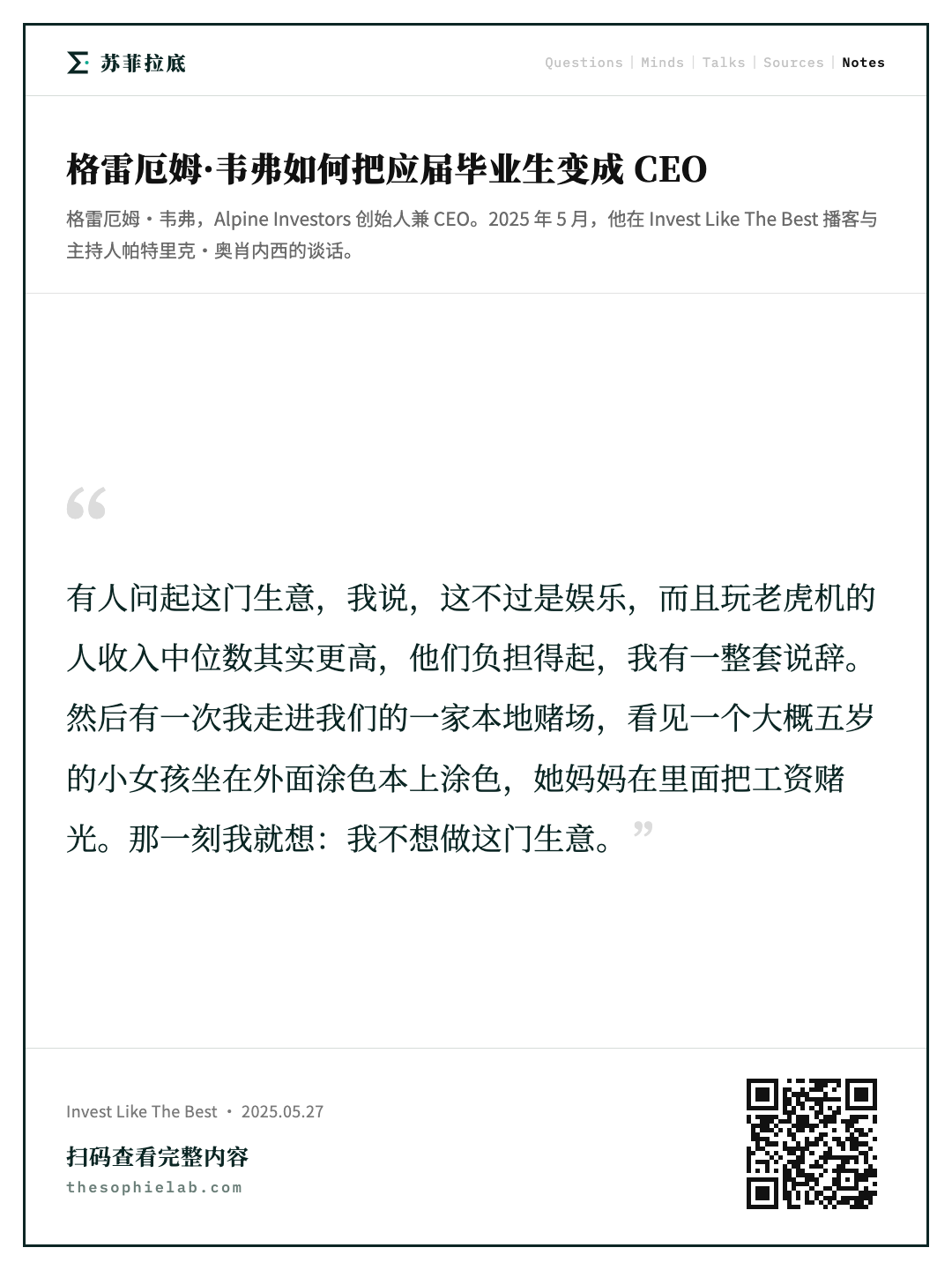
我还记得有一次,有人问起这门生意,我说,这不过是娱乐,而且玩老虎机的人收入中位数其实更高,他们负担得起,我有一整套说辞。然后有一次我走进我们的一家本地赌场,看见一个大概五岁的小女孩坐在外面涂色本上涂色,她妈妈在里面把工资赌光。那一刻我就想:我不想做这门生意。

所以除了它耗掉我们大量时间之外,它大概就是我们做过最糟的一笔交易,让我们倒退了不少。

主持人: 你们后来是怎么脱身的?结局是什么?

韦弗: 我们靠一个消息把这笔交易救了回来:我们读到伊利诺伊州要开放,允许在酒吧里放老虎机,而伊利诺伊是全美人口第五或第六多的州。我们当时想,天哪,这事要成了。本来说一年内就会通过,后来变成两年、三年。但在这段时间里,我们跑遍伊利诺伊,和所有酒吧签了协议。这些酒吧当时没有任何收入进来,根本不赚钱,所以我们付给他们一笔钱,换取未来在他们店里放老虎机的权利。我们比别人提前了三年。

所以当法律终于通过、机器可以上线的时候,我们已经是那个市场里最大或第二大的供应商,然后我们就靠这个把公司卖掉了。

主持人: 那一亿七千万的股本,最后赚到回报了吗?

韦弗: 最初那笔股本大概是三倍,后期投进去的那部分大概是一倍。总之银行全部拿回了本金,我们每一位投资人都拿回了钱,加上我们还有优先股,也都兑付了。所以我们算是逃出来了。但我永远不想再把整个公司押在一家企业上。

主持人: 除了集中度这一课,另一个关键教训是不是:不要投你自己不喜欢它的产品或服务的生意?

韦弗: 我想是的。至少对我们来说,我希望我们是在产生正面影响,这话听起来有点肉麻,但我希望因为我们在建这家公司,世界变好了一点。老实说,我不觉得那门生意里这句话是成立的。

今天最怕的事

主持人: 你今天最怕什么?

韦弗: 我前几天跟你说过,我两个儿子去上大学了,那像是一个篇章的结束,也是我第一次真切地觉得需要面对自己的必死性。

我想这就是我最怕的事:我还有多少时间?我能不能做完这辈子想做的所有事?这是我知道的唯一一次人生。我现在是在做那些事吗?还是说,等我回头看的时候,会有某种遗憾?这大概就是我最害怕的。

主持人: 你为此做了什么?

韦弗: 我尽量在我此刻所处的任何情境里做到百分之百在场、百分之百投入,用一千个百分点的能量扑在当下的每一件事上。而且,讽刺的是,不去过度琢磨它。这是让我在面对必死性时感觉最好的做法。

主持人: 如果把“日复一日做到这件事”想成有支柱支撑,作为一个能量有限的生物体,你的支柱是什么?吃什么、做什么,任何东西。

韦弗: 一个支柱是,你已经花时间去刻意生活、花时间接通了自己的直觉,所以你知道你正在做的事就是那件事,你完全不需要对冲。你不会把时间花在“我是不是在对的工作里”“我是不是在对的关系里”“我是不是住在对的地方”上,因为这些问题你已经回答过了。你可以放松地待在这些事情里。我在这方面做的功课,让我能在这些事上松弛下来。

我认为身体那部分极其重要。跟“今天过得好不好”相关性最高的东西,就是我身体感觉如何,而这从睡好觉开始。为了睡好觉,还要往回倒推一大堆事。我不喝酒,不喝含咖啡因的东西,不吃安眠药,我有一套睡前流程,我尽量不在清早安排会让我紧张的事。我觉得这一点被严重低估了:你身体的感觉,影响真的非常大。

主持人: 回到蒂尔和施瓦辛格那个类比,我接触过的“施瓦辛格型”的人,一天的结构对他们的重要性通常远高于“蒂尔型”。能不能给我们讲讲一天的样子?就说一个普通的工作日,比如星期二,细一点。

韦弗: 我不用闹钟醒,希望能睡够八小时,所以可能九点半或十点上床,五点半或六点起。

早上会比较从容,至少包括十五分钟冥想,然后是锻炼。我会尽量练得很狠。我会让自己慢慢进入状态、充分热身,但不管练什么,在那段锻炼里总有一段我是全力以赴的,因为这对我有某种我很享受的作用。

如果安排得好,我的工作日会晚一点开始,九点或十点,这样早上能有一点时间整理自己、把事情理顺。

然后我有一个从十二岁保持到现在的习惯:我会写下今年最重要的三件事,以及今天要做的、推动这三件事的三件事。

主持人: 每天都写?周末也写?

韦弗: 每天写,周末大概不写,工作日写。都记在同一个笔记里。写完之后我会拿它和我的日程表对照,看看日历上都有什么,希望我对那些事都准备好了。然后,一整天尽量保持在场。

做 CEO,还是做交易

主持人: 说到一天的构成,我想到另一组原型。经营投资机构的人里,有一类是投资导向的,另一类更像“一位恰好在做投资的公司 CEO”,而不是做交易的人。比如施瓦茨曼或者 KKR 的那几位创始人,他们从第一天起基本就是 CEO,当然也参与,但重点是造机器,而不是执行单笔交易。你两样都做过,今天你的会议表分解下来是什么样?是“我们要做一笔巨额股权投资,来聊聊这家公司”,还是聊 Alpine 本身?

韦弗: 在创办 Alpine 之前,我在四家私募股权公司工作过。这四家的老板,每一位都把自己的工作看成做交易的人,看成去完成交易。很多时候他们几乎在和我竞争:我的项目更好,我要把你的分析师抢过来,诸如此类。而他们几乎没有花任何时间去想:我怎么让这里成为最优秀的人愿意留下来的地方?

我记得在我工作的最后一家,如果他们把百分之二十五的时间花在这件事上,他们的回报大概会是全行业最好的。我当时就把这个念头收进了脑子里,心想:这太可惜了。

所以回答你的问题:我认为这才是我工作中最重要的部分,让 Alpine 成为最优秀的人愿意来、愿意把职业生涯和人生放在这里的地方。这是我工作里最重要的一块。同样地,我们的被投公司其实是我们的延伸,因为我们是把自己的团队放进去的,所以我也要问:那些地方能不能吸引到最顶尖的人?

我在这上面花了很多时间:我们的交易团队怎么组织?职业发展是什么样的?我们怎么招人?还有和团队里那些世界级的人坐下来聊:最近怎么样?什么运转得好?什么不好?这占了我一天里很大一块。

具体到比例,我经历过不同阶段。Alpine 头十年我只做交易,后来也有一段时间我完全不碰交易、不进董事会。对我来说,比较对的平衡大概是百分之二十五的时间待在战场里,因为我觉得留一只手在实战中是好的,这样我知道建一家这样的公司是什么感觉、他们面对的是什么问题,我不想完全脱离。剩下百分之七十五的时间,我花在 Alpine 本身上。

这个行业往哪儿去

主持人: 你觉得私募股权会走向哪里?现在是个很有意思的时点,耶鲁和其他一些机构刚刚卖掉了大量二级权益,出清了一大批私募股权和创投敞口。这已经是一个庞大、成熟、专业化的产业,有巨型上市公司在做这件事。你创办 Alpine 的时候,它还处在很早的局数。今天它给你什么感觉?它可能往哪儿去?

韦弗: 回到我入行的时候,我是一九九四年开始的,但就算从一九九〇年算起,当时十年期美国国债收益率大约是百分之八。接下来从一九九〇到二〇二〇的三十年,利率稳步下行,中间有过几次跳升,但基本上是从八一路走到零,而且是相当平稳的过程。

这带来两个巨大的影响。

第一,养老基金几乎都是按百分之八或九来做精算的,我不知道他们为什么选这个数字,但他们都这么选了。突然之间你的无风险利率变成了零,你就必须去找另类资产。所以在同一个三十年里,配置比例一路稳步上升,这是最大的一股顺风。这期间,加州公务员退休基金大概从百分之零的配置涨到了百分之二十,那是巨额的钱。再把基金会、捐赠基金和所有人都乘进去,你就得到一股极其强劲的顺风。

第二个影响更显而易见:债非常便宜。而借贷是私募股权模型的重要一环。所以在整个这段时间里,你还有估值倍数扩张。不管谁怎么说,倍数扩张是真实存在的:一九九四年我们买同样的公司出五倍,现在出十三倍,而且还很兴奋地去买。所以那段时间有这样一股趋势在,总体上回报自然不错。

快进到今天,有五千五百家私募股权基金,市场非常有效,利率在往另一个方向走。这是第一个变量。

第二个变量是,现在个人投资者开始能够通过财富管理渠道进入私募股权,这在过去是不存在的。当然这件事还非常早期,金额也很小。

我认为这一切加起来的结果是:那些交出中位数回报、却觉得自己天赋神权般有资格募下一期、而且一期比一期大的机构,在未来十来年大概不会太好过。你必须相当有差异化,否则就得是那种超级庞大、能够从个人投资者那里收钱的机构,那是新进来的顺风,他们会继续聚拢大量资产。

但总体上我觉得难。我入行三十一年,它每一年都比前一年更难,而且考虑到利率这类潜在逆风,我认为还会更难。

看见人身上最好的东西

主持人: 贯穿这一切的一个主题是,无论是你的课、Alpine 还是人才项目,都要求你看见人身上最好的一面。做好这件事的关键是什么?

韦弗: 我最喜欢的事情之一,回到我前面说的欧文·格劳斯贝克。人生中某些时刻我走进他的办公室求教,他会告诉我:我见过很多学生,见过很多人,你可以的。从他嘴里说出来,我就会相信,而且这句话是有分量的。

很大一部分在于,我们现在可以对这些进来的 MBA 扮演同样的角色:看,我知道你的履历,我们做过很多次了,你会做得非常好,你已经准备好了,我们会帮你去做成。

这会变成某种程度上的自我实现。学生相信了,他们开始按照“这是真的”去行动,然后它就真的成真了。所以看见人身上最好的东西,是我最喜欢 Alpine 的地方之一。

我们在 Alpine 的宗旨表述是“释放英雄”。我们相信,来到 Alpine 和我们公司里的人,真的是英雄,只是他们还没有得到那个竞技场,还没能完整地成为他们能成为的那个英雄。

主持人: 作为行业里的一个重量级参与者,这个行业有没有哪些部分是真的让你不舒服的?私募股权的投资方式、格局、生态里,有没有你觉得是坏掉的地方?

韦弗: 有很多。

这门生意里钱太多了,多到很难不被它分心。如果你认真去想我前面说的目标函数有多重要,然后你去看各家机构实际做什么,不是看他们说什么,你会发现他们的目标函数就是:去募下一期基金,去募一期更大的基金。

这说得通,这是他们赖以生存的方式。但我觉得它会导向错误的行为。具体来说,就是你把花剪掉,去浇你的草:你把最漂亮的已实现回报拿出来展示,而让那些不怎么样的东西继续复利。

它也会把一批人吸引进这个行业,这些人也许是为了赚钱而来,而不是为了建东西,而他们的行事方式有时并不好看。

二十一年

主持人: 有没有什么我们没聊到,但你觉得是你的故事、Alpine 的故事、或者这种投资风格里不可或缺的一部分?

韦弗: 我想最大的一件事是:它花了很长很长的时间。

Alpine 的头十四年,再加上此前我做了七年私募股权,也就是入行二十一年的时候,我们管理的资金大概是四亿美元,团队已经很大了,而我们基本没有给自己发像样的薪水。入行第二十一年,我的薪水是十万美元,这是事实。而且我们那时还没有拿到过一次附带权益的分配,因为我们用的是欧式瀑布结构,得等到最后一家公司退出,而那家恰好是我们最好的一家。这件事就是花了很久。

我认为 Alpine 之所以是个成功故事,很大一部分原因就是我们在很长的时间里坚持了下来,并且在这段时间里持续成长、持续学习。

这是我的学生、也是很多人容易忽略的一点。他们大概会在你这类节目里听到一些听起来非常成功的人,他们确实成功,但听众未必真正理解,那不是自然而然发生的,它需要很长时间。我觉得,在一个人开始创业之前,让他知道这会花很久、让他为这趟旅程做好准备,是很重要的。所以要挑一件你真正兴奋、愿意长期待在里面的事情,因为如果你是为了赚钱然后退出,你大概率会失望。

主持人: 这跟你给学生的那些关于一生的问题配得太好了。你二十一年只拿十万美元,显然你是爱其中某些东西的,不然你早就不干了。

韦弗: 完全正确。不要说得太玄,但真正的旅程、你人生真正的那部分,就是这段路:建造的过程,不知道结局会怎样的过程,你遇到的那些困难。等你回头看,全部好玩的东西都在那里。

所以你甚至不会希望第一年就一帆风顺,因为那样你反而会消沉。你会希望它花一段时间,希望自己在这个过程里学到东西,因为这一路上真正发生的事是:你在成长,你在弄明白自己是谁,你在建立自己的信心和自己的定力。我觉得,那个不太有人说破的秘密是,这才是真正的重点,这才是我们来这一趟的原因。

主持人: 我今早正好在翻我以前记的阿兰·瓦茨的哲学笔记,看到一句特别好的话:跳舞的意义,不在于抵达舞池里某个特定的位置。

韦弗: 我太喜欢那段了。他讲跳舞讲得极妙。他在那段里就说:你不会去奖励跳得最快的那个人。

最后一问

主持人: 做这个节目,我最后总问同一个传统问题:别人为你做过的最善意的一件事是什么?

韦弗: 第一个跳进我脑子里的是去年的事。我太太出差,家里只有我、我的二儿子布莱克和女儿莉莉,就我们三个。那阵子风暴很厉害,到处停电。我一早起来开车去斯坦福,路上布莱克打电话给我,我心想:糟了,出什么事了?

他说,爸,学校停课了,因为没电。我说,好,没问题,你出门之前记得把妹妹送到某个地方,她不会开车,你确保她没事就行。

他说:不用,爸,我和莉莉想开车下来看你上课。

我当时就想:哇,这两个十几岁的孩子,放假那天他们想做什么都可以,却要开一个半小时的车,来斯坦福陪我。我说不清为什么,但这件事让我非常非常触动,对我意义重大。

主持人: 太好了,这是个绝妙的收尾。你用一些简单的想法,只是把它们非常非常认真地对待了很长的时间,就建起了这样的东西,我觉得这一课特别有力量。谢谢你把整个故事讲给我们听。

韦弗: 谢谢你做这件事。我很爱你的播客,听过非常多期,学到了很多,能来这里我真的很荣幸。

主持人: 荣幸是我的。
本期讲者
格雷厄姆·韦弗Alpine Investors 创始人兼 CEO,1994 年从普林斯顿毕业后进入摩根士丹利做私募股权,2001 年在斯坦福商学院读书期间创办 Alpine,专注收购中小型服务与软件企业并空降自培的年轻 CEO。同时在斯坦福商学院任教 12 年,接手了「搜寻基金之父」欧文·格鲁斯贝克的课程。
帕特里克·奥肖内西投资播客《Invest Like the Best》主持人、内容与研究公司 Colossus 创始人,曾任 O'Shaughnessy Asset Management 首席执行官。
章节 · 点击跳转视频
0:00 片头:求胜意志与不会失败之问 ▶ 正在看
0:27 三颗北极星与 5 倍回报目标 ▶ 正在看
2:40 割草机上的有声书与三条信条 ▶ 正在看
5:21 减重 30 磅与普林斯顿的三个目标 ▶ 正在看
15:06 华尔街两年与两种成功模式 ▶ 正在看
17:26 可赢的游戏:避开红海去找脏活 ▶ 正在看
21:33 宿舍创业、走钢丝与三次失败 ▶ 正在看
29:18 人才创造超额收益与平台打法 ▶ 正在看
45:24 员工净推荐值与承销纪律 ▶ 正在看
50:37 CEO 培养项目与斯坦福课堂 ▶ 正在看
1:10:11 教练、直觉与老虎机之败 ▶ 正在看
1:29:21 行业顺风终结与 21 年的耐心 ▶ 正在看
本期论点
本期回应
其他论点
0:00
创业者最重要的特质是炽热的求胜意志,愿意扛着自己的事业穿过一栋着火的大楼
4:38
目标必须取舍:只保留一两个让自己真正兴奋的,并明确允许自己放弃第三到第三十个 做法
9:47
「怎么做」是一切伟大梦想的杀手,设定目标的阶段应该先把它放在一边 做法
20:56
收购那些需要换掉CEO、换掉IT系统的小公司又累又难,愿意入场的人少,因此是可赢的游戏
28:05
创业早期应该给自己发够生活的工资,哪怕削减上行空间,因为能坚持多久比回报倍数更重要 做法
31:05
用A+级团队搭配无人问津的B+级行业,比高价买入A+级行业更划算
33:36
对行业一无所知但虚心受教、拼劲十足的人,比身经百战的行业老将更能带来最好的交易结果
45:37
客户净推荐值和员工净推荐值是最被低估的两个企业成功领先指标
48:43
私募股权单笔项目应按不假设倍数扩张的3倍回报来承销,按5倍承销就永远成不了交易 做法
51:30
搜寻基金模式最容易垮在第一步:投行不愿把项目卖给一辈子只做一单、头上还压着倒计时的买家
1:01:57
当CEO最重要的部分不是宏大战略,而是招人、裁人、开口谈降职这类具体的带人问题
1:17:56
恐惧所指向的地方正是一个人该做的功课,应该朝它走过去而不是绕开 做法
1:28:08
投资机构负责人最重要的工作是让顶尖人才愿意长期留下,而不是亲自谈成交易
1:32:04
只能做出中位数回报的私募股权基金,未来十来年会越来越难靠惯性募到更大的新基金
1:37:20
创业第一年就一帆风顺反而是坏事,漫长而受挫的过程才带来真正的成长和自我认识
01片头:求胜意志与不会失败之问
0:00
number one attribute is white hot will to win. I'm gonna take this project or business or whatever and I'm going to put it on my shoulders and run it through this burning building. How did you work it out? I was playing a very highwire act, which I do not recommend. What advice would you give people that hear that and they're like, "Yep, that's what I want to do." What would you do if you knew you wouldn't fail?
第一位的特质是炽热的求胜意志。我要把这个项目、这门生意或者不管什么东西扛在肩上,穿过这栋燃烧的大楼。你是怎么做到的?我当时是在走钢丝,这种做法我并不推荐。如果有人听了这些之后说"对,这就是我想做的事",你会给他们什么建议?如果你知道自己不会失败,你会去做什么?
便签引用
02三颗北极星与 5 倍回报目标
0:27
[Music] I think the place to begin would be to just understand what you are trying to build and why. We have three northstars at Alpine. Uh one is to be the number one performing private equity fund in the world as measured by MOIC. Our specific goal is 5X on every fund. Number two is we want to be the best place to work for the top talent. So we want it to be a place where the very best people can come and have just an amazing career. And three is we want to use this platform as a force for good.
[音乐] 我觉得起点应该是先搞清楚你想建立的是什么,以及为什么。在 Alpine,我们有三颗北极星。第一,成为全世界业绩第一的私募股权基金,以 MOIC 衡量。我们的具体目标是每支基金做到 5 倍回报。第二,我们希望成为顶尖人才最想去的地方。我们希望这里能让最优秀的人来到这儿,拥有一段精彩的职业生涯。第三,我们希望把这个平台用作一股向善的力量。
便签引用
1:02
And really everything that we do fits under one of those three and usually all three. When you think about 5x, why do you care about that? Why that number? Where did that come from? We went through a really tough period in the recession and uh we didn't have a fund for a number of years. And so we had three years to kind of work on our business and really do some deep thinking. I hired some executive coaches. We can talk more about that. But part of that was kind of the questions you're asking like why are you doing this? What's your goal? What what are you waking up every day to do? And I think we wanted to create something that was going to get us just jumping out of bed in the morning. And so we said, hey, we want to be the number one performing fund of all time. So we looked at all the data that was public um on some of the pension funds websites and information and we said, "Hey, if we could deliver 3x consistently on every fund, you know, that would that would be, you know, put us in the
我们做的每一件事,其实都能归到这三条里的某一条,而且通常三条都沾。当你想到 5 倍的时候,你为什么在意这个?为什么是这个数字?它是从哪来的?我们在经济衰退期经历了一段非常艰难的时期,有好几年我们都没有募到基金。所以我们有三年时间可以好好打磨自己的业务,做一些深入的思考。我请了几位高管教练,这个我们可以再细聊。但其中一部分就是你现在问的这类问题,比如你为什么要做这件事?你的目标是什么?你每天早上起床是为了什么?我想我们是希望创造出一种让我们每天早上迫不及待跳下床的东西。所以我们说,嘿,我们要成为有史以来业绩最好的基金。于是我们把养老金基金网站上所有公开的数据和资料都翻了一遍,然后我们说:"嘿,如果我们能在每支基金上都稳定做到 3 倍,那这就足以让我们进入那个讨论范围了。"结果我们的表现超过了这个水平。所以我们把目标又往上
便签引用
1:50
conversation." We've been outperforming that. So, we increased our goal a little bit. You're probably a person that could build a whole variety of different kinds of businesses. Yeah. Why is high-erforming private equity one that's interesting to you? I never knew what private equity was until I graduated from college. So, I didn't have this uh background or think that that this was never a goal of mine when I started. But, when I got recruited out of college to go into private equity, I just thought it was I I I had a real um burning interest in business. And I thought once I learned what private equity was, I I was thinking, "Wow, this is the best expression of just building businesses." Um, you know, we get to do it over and over and over across a bunch of businesses. In terms of why try to be the best, I guess, ever since I was, you know, pretty young, I just I've never I've never thought about doing anything other than trying to be the best in the world at it. It's like I want to There's
提了一点。你大概是那种能做起各种各样生意的人。是的。为什么高业绩的私募股权是你感兴趣的方向?在大学毕业之前,我根本不知道私募股权是什么。所以我并没有这样的背景,刚开始的时候这也从来不是我的目标。但当我大学毕业被招进私募股权时,我只是觉得,我对做生意有一种真正的、炽热的兴趣。等我搞明白私募股权是什么之后,我心想:"哇,这是把建设企业这件事表达得最充分的一种方式。"而且我们可以在一大堆企业上反反复复地做这件事。至于为什么要努力做到最好,我想大概从我很小的时候起,我就从来没有想过要做别的事情,除了在这件事上做到世界第一。就像我想……丹尼尔·伯纳姆有一句很棒的话,
便签引用
03割草机上的有声书与三条信条
2:40
a great quote by Daniel Burnham who says, "Make no little plans for they have no power to stir one's blood." What's the earliest that you can remember having that sensation or feeling? So, I was 12 years old. My parents went through a really bitter kind of ugly divorce. Um, we changed schools to a new school, so I didn't really have friends, so the ground beneath me was pretty unsettled. I I mo I was in I grew up in a small town in Ohio, like in the rust belt, uh, outside of Toledo, and I mowed lawns. And I mowed lawns about six hours a weekend to make money. that was the best paying job. I had a Sony Walkman and I started to listen to books on tape and our for whatever reason our library had this self-help section. So I had these books like Think and Grow Rich by Napoleon Hill and Lead the Field by Earl Nightingale. Um universal laws of success and achievement by Brian Tracy.
他说:"不要做小的计划,因为它们没有激荡人心的力量。"你最早是在什么时候有这种感觉的?我当时 12 岁。我父母经历了一场非常痛苦、非常难看的离婚。我们转学去了一所新学校,所以我基本上没有朋友,脚下的地面很不稳。我我在俄亥俄州的一个小镇长大,就在铁锈地带,托莱多城外,我那时给人割草。我一个周末大概割六个小时的草来赚钱。那是当时报酬最高的活儿。我有一台索尼随身听,然后我开始听有声书,不知道为什么,我们那个图书馆有个励志自助类的专区。所以我就有了这些书比如拿破仑·希尔的《思考致富》,还有厄尔·南丁格尔的《引领潮流》。嗯,还有博恩·崔西的《成功与成就的普遍法则》。
便签引用
3:34
So I there were only like three of them, three or four. So for the next years, I just would six hours a weekend walk back and forth. Literally brainwashed myself walking back and forth in the hot Ohio sun. And and these authors, thank God, just had incredible content that I really needed at that I was this young impressionable kid that was having a lot of trouble in my life and I had these frameworks to just hang my, you know, life on for lack of a better word. And and and there were really kind of three big ones that came from that. was, "Hey, you don't get to be a victim." Like, yes, you have things that have happened to you and they're not necessarily your fault, but you know, you walking around blaming people and thinking, "Woe is me." You know, that's not going to serve anyone. You know, you got to take control of your life. Now, that sounds probably really obvious to you and me right now, but back then, like that was a new concept for me. Um, and so kind of like grabbing control of your life. And
总共也就三本,三四本吧。所以接下来那几年,我每个周末花六个小时来来回回地走,来来回回。字面意义上在俄亥俄的大太阳底下来回走着给自己洗脑。而且谢天谢地,这些作者讲的内容真的太棒了,正是我那时候特别需要的。我当时就是个特别容易受影响的小孩,生活里有一堆麻烦,而这些框架给了我一个可以安放自己人生的东西,不知道该怎么形容更好。从中主要得出了三个大的收获。第一个是,嘿,你没资格当受害者。是的,你身上发生过一些事,那些事不一定是你的错,但你要是整天到处埋怨别人,觉得自己好惨,这对谁都没好处。你得掌控自己的人生。现在听起来,对你我来说这可能是显而易见的道理,但在当时,这对我来说是个全新的概念。嗯,所以就是那种抓住自己人生的主动权。第二个是,他们特别强调要决定你想要什么,
便签引用
4:28
then they were huge about deciding what you want and writing down your goals. And I got really into that. And I I would write my goals down three or four times a day um literally all through uh high school. And then the third one was you got to make some choices. So you can you can have kind of any goal you want, but you can't have 20. So you pick the one or two that you're really excited about. And then you have to kind of draw a bright line and give yourself permission to not do, you know, goals three through 30. Those are really the three concepts. I'm summarizing thousands of hours of lawnmowing. But that that that was when I just was So then what happened to answer your question why I felt the first time I started feeling like this. I started applying this to really small things like getting an A on a test or uh running a faster mile or something like this. And and it just worked like exactly like all the authors said. And I I just kept pushing the boundaries of what I thought I could do. and and I
并且把目标写下来。我特别投入这件事。整个高中我几乎每天都要把目标写下来三四遍。第三个是,你必须做出取舍。你可以有任何你想要的目标,但你不能有二十个。所以你挑出一两个真正让你兴奋的,然后你得划出一条清晰的界线,允许自己不去做第三到第三十个目标。这真的就是那三个核心概念。我这是在总结成千上万个小时的割草时光。但那就是我当时……回到你的问题,我第一次有那种感觉是怎么来的。我开始把这些用在一些很小的事情上,比如考试拿A,或者跑一英里跑得更快之类的。结果它真的管用,跟那些作者说的一模一样。然后我就不断地推着自己往外拓展我以为自己能做到的边界。我从来没真的碰到过,到现在可能都还没碰到过那种
便签引用
04减重 30 磅与普林斯顿的三个目标
5:21
never really ran into and I still probably have yet to run into boundaries uh that you could you couldn't blow through. So you said it worked like what specifically worked just writing it down and working hard or something more tactical? The very very first major thing that I ever tried to do was right after the summer when I started listening to these tapes and it was to this day the hardest thing I ever did. So, I I wrestled um I I was on the varsity team my sophomore year and the I I wrestled at 155. The captain dropped down to my I had a starting position.
你冲不破的边界。你说它管用,具体是什么管用了?就是把目标写下来然后努力干活,还是有什么更具体的方法?我这辈子尝试的第一件真正意义上的大事,就是在我开始听这些磁带的那个夏天之后,而且直到今天,那还是我做过最难的一件事。我练摔跤,嗯,高二那年我进了校队,我打155磅级。队长掉体重掉到了我这个级别,我本来是首发。
便签引用
5:54
The captain dropped down to my weight class. I looked up and down the lineup and the only guy I could beat was at 125. So, I'm 6 feet tall and I dropped 30 lbs and I wrestled 125. I was eating 900 calories a day. I was going on runs in the morning. It's like 9 degrees outside and I just powered through that and all of a sudden I was like, "Wow, if I could do that, you know, at least other goals I set, I got to I was able to eat." And so, uh, but but I got I just got to feel this like um this incredible power of being really change the trajectory of your life by just deciding you wanted to. It was really cool. I just got done reading uh the story. Is it Dan Gable? Is that the guy's name? The great wrestler. He's incredible. What What is it about wrestling? like it seems um we'll talk about rowing too which I know you did you did a lot of as well. What is it about maybe those two are similar this like the extreme nature of those sports.
队长降到了我的重量级。我把整个阵容从头看到尾,唯一我能赢的人是在125磅级。我身高六英尺,我减了30磅,去打125磅级。我那时候一天只吃900卡路里。我早上还要去跑步,外面才9华氏度,我就那么硬扛了过来,然后突然之间我就想,哇,如果我能做到这个,那至少我定的其他目标,我也能……我也可以做到。所以,呃,但我真的体会到了那种,嗯,那种难以置信的力量感——只要你决定要改变,你就真的能改变自己人生的轨迹。这感觉真的很棒。我刚读完一个故事,是叫丹·盖博吗?是这个名字吗?那个伟大的摔跤手。他太厉害了。摔跤到底有什么特别之处?好像……我们也会聊到赛艇,我知道你也划了很多年。到底是什么……也许这两项有相似之处,就是这类运动的那种极端性。
便签引用
6:43
It seems like uh can teach you it has a lot to teach maybe even more so than other sports. Dan Gable is one of my favorites. He has a great quote. He says once you've wrestled everything in life is easy. I think that's dead on. It's dead on. Um so I think that wrestling is just the most primal sport. It's the first sport you're sitting in our in our high school. Wrestling was a big sport in the Midwest in Ohio. They would turn a mat light on. The gym would be packed. People are yelling and screaming.
感觉它能教给你的东西,可能比其他运动教给你的还要多。丹·盖博是我最喜欢的人之一。他有句很棒的话。他说,一旦你练过摔跤,人生中其他一切都变得容易了。我觉得这话说得太准了。太准了。嗯,我觉得摔跤就是最原始的一项运动。它是最早的运动。你坐在我们那个高中里——摔跤在中西部、在俄亥俄是项大运动。他们会把场地灯打开,体育馆里挤满人。人们又喊又叫。
便签引用
7:09
There's a mat light on. The lights are off in the whole uh arena and it's just you and one other person and you're trying to, you know, defeat the other person. I mean, it's a it's crazy. I mean, it it's a it's a pretty intense sport. And then the weight loss and the training and everything. I mean, it it was just it was the hardest thing hardest thing I ever did. And um yeah and so and and so I think I think it's something about just the kind of primal nature of that. Can you say maybe one degree more about this idea that you can just choose like you sort of just choose. Yeah. It sounds so simple. Uh but I've experienced that that same thing and every time I do it I'm amazed how powerful it can be but I want to understand the contours of it from your perspective. Like what is what does that mean? What does it feel like to choose?
场地灯亮着,整个场馆其他的灯全都关了,就只有你和另一个人,你要想办法打败对方。我是说,这真的很疯狂。这是一项相当激烈的运动。再加上减重、训练那一整套。我是说,那真的是我做过最难的最难的一件事。嗯,是的,所以我觉得,这里面有某种很原始的东西。你能不能再多讲一点,关于这个“你可以选择”的想法,就是你某种程度上就是选了。是的。这听起来太简单了。呃,但我也经历过同样的事,每次我这么做的时候我都很惊讶它能有多大的力量,但我想从你的角度理解它的具体轮廓。就是说,这到底意味着什么?做出选择是什么感觉?
便签引用
7:54
What what did you choose? What was the process? whatever whatever else you can say about this. If you watch most people, they're kind of asleep or unconscious, you know, and and I am too sometimes. So, it's like, you know, imagine you get up, you whatever your routine is, you brush your teeth, you get ready for work, you commute to work, you have a tough commute, you get to work, you have a couple meetings, uh, you know, some Zoom calls, then you eat, you know, then you return some emails, you have a few more meetings, you get home, return some emails, watch some Netflix, go to bed, right? That's kind of like, you know, there's all this busyness and all this just you're just kind of doing today what you did yesterday, you're doing tomorrow what you did today and you're stringing together that and calling it sort of a life like and so there's this real level of like unconsciousness about it. So the first part is step back and just make space. Um and I do this with an executive coach, you can do this with a
你选了什么?过程是怎样的?关于这个你能说的其他任何东西都行。如果你观察大多数人,他们某种程度上是睡着的,或者说无意识的,我有时候也是。所以就像是,你知道,想象你起床,不管你的日常是什么,你刷牙,你准备去上班,你通勤,通勤很难受,你到了公司,开几个会,嗯,打几个Zoom电话,然后你吃饭,然后回几封邮件,再开几个会,然后回家,再回几封邮件,看点Netflix,睡觉,对吧?大概就是这样,你知道,全是这种忙碌,全是这种……你今天做的就是你昨天做的,你明天做的就是你今天做的,然后你把这些串起来,管它叫人生。所以这里面有一种真实的无意识状态。所以第一步是退后一步,给自己腾出空间。嗯,我是跟一位高管教练一起做这件事的,你也可以用
便签引用
8:45
journal, you can do it with a friend. Um, but just step back and just make space and then ask really powerful questions in that time, you know. And so my favorite question of all time is what would you do if you knew you wouldn't fail? Um, and this is one of the uh there I actually build it up a little bit better on one of the audio tapes I I heard. This guy said, "Okay, imagine there's this genie that comes out of this magic lamp and he says to you, "Hey, Patrick, you know, I um I I've only been in here like a thousand years, so I can't give you the traditional three wishes. But what I can give you is that whatever you throw yourself into with your career, your life, vocation, like it's going to work out amazingly well. And you'll have ups and downs.
日记做,也可以和朋友一起做。嗯,但就是退后一步,腾出空间,然后在那段时间里问一些真正有力量的问题。所以我最喜欢的一个问题是:如果你知道自己不会失败,你会去做什么?嗯,这是我听过的一盘音频磁带里的内容,我把它铺垫得更完整一点。那个人说,好,想象有个精灵从一盏神灯里出来,他对你说,嘿,帕特里克,我,嗯,我在里面才待了大概一千年,所以我没法给你传统的那三个愿望。但我能给你的是,不管你在事业、人生、天职上全身心投入什么,它都会有非常好的结果。你会有起有落,
便签引用
9:25
It'll take a long time, but I'll I'll be here to bless you with that. you know, what would you wish for? And and then and then and then the punchline is go do that thing. You know, that's your life path because that's that's what your soul really wants to do and that's what you would do if you get out of your head and get out of your fear of failure. So, that's one great question. Um, another one would be like if you didn't have to worry about the how. So, relax the how you're going to do it. You know, the the coaching quote is the how is the killer of all great dreams. So, kind of get make space, ask these really provocative questions. And it's not like you're going to answer them right away, but you might two days later in the shower, you might answer that question, and then you'll really know and it's going to, you know, you're going to feel it when you when you really know it. And then, and then it's really really tough to go do it. You know, it you it takes a lot of courage. Um, and and sometimes the
会花很长时间,但我会一直在这儿祝福你。那么你会许什么愿?然后,然后重点来了——去做那件事。那就是你的人生道路,因为那才是你的灵魂真正想做的事,那才是你跳出自己的脑子、跳出对失败的恐惧之后会去做的事。这是一个很棒的问题。嗯,另一个问题是:如果你不需要操心“怎么做”。所以把“怎么做”放下。你知道,教练界有句话叫,“怎么做”是一切伟大梦想的杀手。所以,腾出空间,问这些真正有挑战性的问题。倒不是说你会马上答出来,但可能两天后在洗澡的时候,你就答出来了,然后你会真的知道,你会……当你真的知道的时候,你是能感觉到的。然后,然后真正去做它是非常非常难的。你知道,这需要很大的
便签引用
10:13
path isn't clear. But I think that's where the real fun of life is is really trying to get in touch with what your answer is to some of those questions. So maybe pick another thing in your high school or or early years and something you wanted and then like the steps you I want to make sure these t just picture you walking around with this lawn mower like I want to make sure we drive home the I go I go to college I I was because I thank thankfully turned on to these tapes early. I I did really well in high school and I got I got to go to Princeton. So I I was I think the first kid in my school to ever even apply there let alone go. So, I go to Princeton and then all of a sudden I felt like I literally felt like Forest Gump in that scene where his braces come off and he's running because I didn't have to be like at this, you know, my mom's house from this time and my dad's here and, you know, in high school at this time and all this. I had like all this space. And so, I literally was like, "Oh, wow. Now I can really like
勇气。嗯,而且有时候路并不清晰。但我觉得人生真正有意思的地方就在这儿,就是努力去触碰你对这些问题的答案是什么。所以也许再挑一件你高中或者更早时候的事,一件你想要的东西,然后讲讲你的步骤——我想确保这些……我一直在脑补你推着割草机走来走去的画面,我想确保我们把这个讲透……我上了大学,我因为,谢天谢地,很早就接触到了这些磁带,我高中念得很好,我得以去了普林斯顿。我大概是我们学校第一个申请那儿的人,更别说去了。所以我去了普林斯顿,然后突然之间我感觉,我真的就感觉自己像《阿甘正传》里阿甘腿箍脱落然后开始奔跑的那个场景,因为我不用再像以前那样,这个时间在我妈家,那个时间在我爸这儿,这个时间在高中,诸如此类。我一下子有了这么多空间。所以我真的就想,哦,哇,现在我可以真正地放开手脚去追这些目标了。所以我进普林斯顿的时候定了
便签引用
11:04
let go with these goals." So, I I set three goals going into Princeton. I was going to be the valictorian. I was going to be the number one rower in the United States, even though I'd never rode before. or I didn't even know that the boats went backwards. And uh and third, I was going to start a business to pay for school. Uh to skip the end of the story, I didn't actually achieve any of those goals, but I came really close on all three. And uh and so rowing is probably got the simplest one to explain. So I show up. I'm a I'm a novice. I'm 130 pounds from the wrestling. You know, I got my my ass kicked because there's kids who'd rode for six years and you know, they knew how it worked and everything. And I was so I got cut my freshman year, but they didn't cut anyone. Instead, they said, "Okay, if you don't make a boat, you're going to be a land warrior and you can use the rowing machines." I still remember when they when they kind of posted the boats and my name wasn't on there. I did the math and I said, "Okay,
三个目标。我要当毕业生致辞代表。我要成为全美排名第一的赛艇运动员,尽管我之前从来没划过。我甚至都不知道艇是往后划的。第三,我要创业来付学费。跳到故事的结尾,这些目标我其实一个都没实现,但三个我都非常接近了。呃,赛艇大概是最容易讲清楚的一个。所以我到了那儿。我是个新手。我因为摔跤减重只有130磅。你知道,我被虐得很惨,因为有些孩子已经划了六年,他们知道该怎么划,什么都懂。所以我大一那年被刷了,但他们其实没刷掉任何人。他们说,好,如果你没进艇,你就当个“陆战勇士”,你可以用划船机。我还记得他们公布分艇名单的时候,上面没有我的名字。我算了一下,我说,好,
便签引用
11:54
women's, heavyweight, light, I was a lightweight, lightweight, and I did the math on how many people got cut and how many rowing machines there were." And so I was like, "Okay, I got to get here really early because all these people are going to be using the rowing machines." I show up the next morning. I did I worked all the way back. I talked myself into getting there at like 5:30 in the morning. You know the punch line. I get there, there's nobody there. There was no one there at 5:36 77. No one ever showed up because because Land Warrior was a euphemism for you just got cut.
女队、重量级、轻量级——我是轻量级的——轻量级,然后我算了算有多少人被刷下来,还有多少台划船机。所以我就想,好,我得非常早到那儿,因为这么多人都要用划船机。第二天早上我去了。我一路往前倒推时间,我说服自己早上五点半就到那儿。你知道结局是什么。我到了,那儿一个人都没有。五点半、六点、七点,都没人。从来没人出现过,因为“陆战勇士”其实就是“你被刷了”的委婉说法。
便签引用
12:17
Yeah, you got cut. But I I stayed and and rode and I met this guy who was training for the national team, uh Mike Taty, and he were he and I were the only two guys in the morning at the Princeton Boat House. And he ignored me. He's a legend. He coached the US Olympic team. He went on to coach the US Olympic team to a gold. And I didn't know any of this at the time. I just saw this tall, skinny guy just hammering this urg. And eventually he kind of took me under the wing a little bit and was just, you know, a after I showed up at 5:30 in the morning for like three weeks in a row, he's like, "Okay, this kid's, you know, really means he really is going to do this." And he taught me a little bit. So anyway, progress forward, I get better a little bit better my freshman year, better my sophomore year. By by my junior year, I had um one of the top times or maybe the top time on or on the 2K rowing machine on the team. And then by senior year, I I was captain. We won nationals. And so it was just like it
是啊,你被刷了。但我留了下来,坚持划,然后我遇到一个正在为国家队训练的人,嗯,迈克·泰蒂,早上普林斯顿船库里就只有我们两个人。他一开始不理我。他是个传奇人物。他执教过美国奥运队。他后来带着美国奥运队拿了金牌。当时我完全不知道这些。我只看到一个又高又瘦的家伙在那儿拼命拉测功仪。最后他开始有点照顾我,就,你知道,在我连续三周每天早上五点半都出现之后,他就想,好吧,这孩子是真的,他是真的想做成这件事。然后他教了我一点东西。所以总之,往前推进,我大一有了一点进步,大二更好了。到了大三,我在队里2000米划船机上有了排名靠前的成绩,也许是最好的成绩。然后到了大四,我当上了队长。我们赢了全国赛。所以就是,
便签引用
13:06
was kind of everything kind of came together. But it was just a really linear expression of like if I put in a certain number of hours like this is what Mike Taty said. He said here's the formula. It's really simple. Sit on this machine and row as long as you can slightly below your aerobic threshold and you will you know and basically you'll hit your goals. I was like that's it? He's like yeah that that's it. He was a very simple and and I just did that and it and it worked. Um it just required a lot of hours. Is there anything else between ages 12 and 22 without which you would be a wildly different person? I'll just say a couple things about about my dad real quick. Um so my dad started a um veterary practice about the time I was born and he he and his father went his my grandfather was a vetinarian too. They started this practice called Weaver Animal Hospital in our hometown and uh they they had a falling out of some kind. I don't know what happened. And I never heard the whole story, but my dad like stormed
一切都水到渠成了。但这就是一种非常线性的表达,就是如果我投入一定的小时数,就会得到这样的结果。这就是迈克·泰蒂说的。他说,公式在这儿,特别简单。坐在这台机器上,在略低于你有氧阈值的强度下尽可能久地划,然后你就会,你知道,基本上你就会达成目标。我说,就这样?他说,对,就这样。他是个非常简单的人,然后我就那么做了,结果真的管用。嗯,它只是需要投入大量的时间。在12岁到22岁之间,还有什么别的事,如果没有它你会变成一个完全不同的人?我就简单说几件关于我爸的事。嗯,我爸大概在我出生的时候开了一家兽医诊所,他和他父亲,我爷爷也是兽医。他们在我们家乡开了这家诊所,叫韦弗动物医院,呃,他们后来闹翻了。我不知道发生了什么。我从来没听过完整的故事,但我爸就那么摔门走了。可他有房贷,有三个孩子,而我们没钱。所以他,呃,
便签引用
14:02
out. Well, he has a mortgage and three kids and we have no money. And so he uh the only money we had coming in was he would take emergency calls at like 2 in the morning. So his little beeper would go off and he would get up, drive to the office, fix a dog's leg, and go back. And he did that for 25 years. And I think the the the you know, the bad news was he was really never around. And I didn't really have a great, you know, we didn't have a great um a really close relationship at when I was growing up.
我们唯一的收入来源就是他接急诊电话,经常是凌晨两点。他的小传呼机一响,他就得起床,开车去诊所,给一只狗接好腿,然后再回来。他这么干了25年。我觉得,你知道,坏消息是他几乎从来没在家过。我跟他,你知道,我们之间并没有特别,嗯,特别亲密的关系,在我成长的那些年里。
便签引用
14:30
But I think that ended up having a big impression on me because it took, if you were to ask him about his practice, he ended up building this really, really successful veterary practice, but he just did it one emergency call at a time over a long period of time. And I think that really stuck with me. I don't I don't think I realized that at the time, but that that was a lot of what Alpine looks like, you I was like it took if you he would say it took way longer than he thought and he built something much bigger than he thought and I would say almost the exact same thing about my business. I never really put that together until you know many many years later that I was watching that as a kid.
但我觉得这件事最终给我留下了很深的印象,因为这需要——如果你去问他他的诊所,他最后建起了一家非常非常成功的兽医诊所,但他就是一通急诊电话一通急诊电话地做出来的在很长一段时间里。我觉得这件事对我影响很深。我当时并没有意识到这一点,但阿尔派(Alpine)的经历很大程度上就是这样。他会说,这花的时间比他预想的长得多,而他最后建起来的东西也比他预想的大得多。我对自己的公司几乎会说出一模一样的话。直到很多很多年以后,我才把这两件事联系起来——原来我小时候就看着这一切发生。
便签引用
05华尔街两年与两种成功模式
15:06
What was the story for between graduation and you know kind of starting to tell the story that leads to Alpine like why did you get interested in in this field? What was it about investing or business that called called you? I um graduate from college. I never once thought about my job. I never had an internship because I was always rowing during the summers. And um I got recruited from um Morgan Stanley, which had an in in-house investment bank. And to my knowledge, they were the only ones that recruited in 1994 directly into private equity. Um I I I the the the guy who recruited me was um this guy, David Ramsey, and he kind of explained to me what private equity was. And the way he described it, he couldn't see any reason to do anything else ever. You know, he thought it was the greatest business.
从毕业到开始做后来引出阿尔派的那段故事,中间是怎样的经历?你为什么会对这个领域产生兴趣?投资或者做生意,是什么打动了你?我……大学毕业,我从没想过工作的事。我从来没实习过,因为每年暑假我都在划船。后来我被摩根士丹利招走了,他们有一个内部的投资银行部门。据我所知,1994年他们是唯一一家直接招人进私募股权的公司。招我的那个人叫大卫·拉姆齐,他跟我大致讲了私募股权是做什么的。按他的说法,你根本找不到任何理由去做别的事。你知道,他觉得这是世界上最棒的生意。
便签引用
15:50
and he had a pretty compelling case. So, um, I I was really just fascinated by how you could buy these companies and and build them and be a part of so many businesses. I just thought it was the I thought it was the the coolest job I'd ever heard. I couldn't believe that you got like a blank piece of paper from investors to to go buy things. So, I was fascinated. However, you know, I come out of college and I'm just ready to run through walls, Patrick. you know, I've just had this incredible experience in college and I show up, I get this job on Wall Street. You know, I've seen the movies and everything and I think it's going to be this incredible experience and then, you know, I I learn how to build a financial model in the first three weeks and then I do that for two years. That was all I did. And that's all that anyone at undergrad ever did.
而且他讲得相当有说服力。所以我真的被吸引住了——你居然可以买下这些公司,把它们做起来,参与到这么多企业里去。我当时觉得这是我听过的最酷的工作。我简直不敢相信,投资人会给你一张白纸,让你去买东西。所以我特别着迷。不过你知道,我刚出大学,整个人干劲十足,恨不得撞穿墙,帕特里克。我在大学有过那么了不起的经历,然后我去上班,在华尔街找到这份工作。你知道,我看过那些电影什么的,我以为这会是一段无比精彩的经历,结果呢,我在头三个星期学会了怎么搭财务模型,然后接下来两年就一直干这个。我就只干了这个。所有本科毕业进来的人干的也都是这个。
便签引用
16:33
But I just remember thinking and and then we did it, by the way, 80 to 100 hours a week. The culture wasn't great. Um, and I just remember thinking like, is this what work is like? like that is this what you do when you graduate? Like it was you know I've been in school 16 years and this is my big moment and it was just uh it was incredibly disappointing. Um and and that would end up being a really really foundational part of Alpine was just like that that kind of feeling of like wow I have so much more to give to this place. Um you know why why am I only doing like using like 3% of my capacity? It seems like there's my friend Jeremy Gifon has this really funny idea for two models of success that he dubs like the Peter Teal model and the Arnold Schwarzenegger model. The Peter Teal model being like a lot of maybe public and market investors that I know who kind of sit around and think and then make infrequent decisions on the back of like a special insight that leads to great returns. And then
但我一直记得当时的想法——顺便说一句,我们干这些活儿一周要八十到一百个小时。文化也不怎么样。我就记得自己在想:工作就是这样吗?毕业以后就是干这个吗?你知道,我读了十六年书,这本该是我的高光时刻,结果却……太让人失望了。而这后来成了阿尔派非常非常重要的一个根源——就是那种感觉:哇,我明明还有那么多可以贡献给这个地方。为什么我只用上了自己百分之三的能力?感觉就像……我朋友杰瑞米·吉丰有个特别有意思的说法,他把成功分成两种模式,一种叫彼得·蒂尔模式,一种叫阿诺·施瓦辛格模式。彼得·蒂尔模式就像我认识的很多二级市场投资人,他们坐在那儿思考,然后偶尔做一个决策,靠的是某个独特的洞见,由此带来很高的回报。而施瓦辛格模式就是纯粹的蛮力——多做几组,再使把劲。
便签引用
06可赢的游戏:避开红海去找脏活
17:26
the Schwarzenegger model is just like brute force, like more reps, more push. Um I have I have I have an early guess as to which camp you might fall into. Um, but maybe react to that. Like how do you think of private equity as like the ultimate like open tapestry to just for performance like for its almost for its own sake like like the ability to push and drive outcomes versus have insights that lead to good returns which might be the other paradigm. I mean I think you can have investors in private equity that have the Peter Teal model. you know, they make few large investments and they sit around and think and it looks like that. Um, that's not really us. That's not how how we're wired. I like to think about the world in like kind of endogenous winnable games and and then ones that might be a little less ex a little more exogenous andor unwinable or hard to win. And and so I don't want to just go full-on brute force in a non-winable game. Um so so for example, um in private equity today,
我心里已经有个初步猜测,你大概属于哪一派。不过你可以聊聊你的看法。你怎么看私募股权这种像是一张完全敞开的画布,可以让你尽情去为了表现而表现,就好像表现本身就是目的,比如说那种推动并实现结果的能力,而不是拥有洞见而洞见带来好回报,那可能是另一种范式。我是说,我觉得私募股权里确实有一些投资人走的是彼得·蒂尔那套模式。你知道,他们做少数几笔大额投资,然后坐下来思考,大概就是那个样子。嗯,那不太是我们的风格。我们不是那样的人。我喜欢把这个世界看成那种内生的、可以赢的游戏,以及另一些可能稍微更外生一些、或者赢不了、很难赢的游戏。所以我不想在一个赢不了的游戏里一味地蛮力硬拼。嗯,举个例子,比如说今天的私募股权行业,
便签引用
18:37
you know, it wasn't like this in 1984, but today if you have a big business, you're going to hire an investment bank, you get the game, you're going to show it to, you know, 55 private equity funds. you know that for me to just go brute force in that um you know red ocean as uh as as um there's a great book called blue ocean strategy so they would call that a red ocean for me to go brute force in that I think is um isn't a good exercise if I have a 100 units of energy I want to use 25 of those units to go try to find a winnable game to play and then the other 75 would be like the you know brute force endogenous path. So maybe using that frame I like that framework. If we think about today's private equity landscape where there are many many funds that command huge sums of assets. My understanding, it's not the style of investing I'm in, but my understanding is if there's a good high quality asset, like it's an auction process in many cases, like it's it's a bidding war and there are lots of
你知道,1984年可不是这样的,但今天如果你有一家大公司,你会去请一家投资银行,你懂这套玩法,你会把这个项目拿给差不多55家私募股权基金看。你知道,对我来说,在那样一片红海里一味蛮力硬拼——有一本很棒的书叫《蓝海战略》,所以他们会把那个叫做红海——对我来说在那里面硬拼,我觉得不是一件划算的事。如果我有100个单位的能量,我想拿其中25个单位去找一个能赢的游戏来玩,然后剩下的75个就用在那种,你知道,蛮力的内生路径上。那也许就用这个框架吧,我喜欢这个框架。如果我们看今天的私募股权格局,有非常非常多的基金掌管着巨额资产。据我了解——这不是我自己做的那种投资风格——但据我了解,如果有一项优质的好资产,很多情况下就是一个拍卖流程,就是一场竞价大战,而且有很多很棒的、极其专业、非常有才华的投资人和机构都能
便签引用
19:39
great, highly highly professional, super talented investors and firms that can buy a private business. Maybe describe like the state of the market and and what the characteristics might be of like winnable games within that broader market. I mean, I think there's 5,500 private equity funds, you know, at any any given great high quality business like you're describing. Um, particularly like take take just extreme high quality business ERP subscription software business. I mean, it doesn't get any higher quality than that. There's a lot of people that can buy that. Um, there's a lot of people that can see what that's worth and do some calculation and come up with a value for that. And by the way, it doesn't necessarily go to the smartest person. It goes to the highest bidder, you know. So it's a little bit different where it it you know it's not that doesn't mean that they were the smartest person necessarily. So that's a really it's just a really really tough game. Um, and the conversely like the
买下一家私营企业。也许你可以描述一下市场现在的状态,以及在这个更大的市场里那些能赢的游戏会有什么样的特征?我是说,我觉得大概有5500家私募股权基金,你知道,在任何任何一家你所描述的那种优质好企业上都是如此。嗯,尤其是像那种极致优质的企业,比如ERP订阅软件公司。我是说,质量再高也就到那个程度了。有很多人都能买下它。嗯,有很多人都能看出它值多少钱,做一番计算,然后给出一个估值。而且顺带说一句,它不一定会归最聪明的人所有。它归出价最高的人所有,你知道的。所以那有点不一样,这并不意味着他们就一定是最聪明的那个人。所以那真的是一个非常非常难的游戏。嗯,相反地,我们所从事的
便签引用
20:35
winnable game that we're engaged in is and we and we learned this over the first, you know, 10 years of Alpine when we were really hands-on with these businesses is we're going and finding a $20 million revenue plumbing company in Ball, Louisiana that uh where the owner's retiring and they need a new management team. So, like there's just not a lot of people that want to sign up for that game. Uh, it's a lot of work. I mean, we're putting in a new CEO in a small company. We're putting in new IT systems. You know, we have a whole new playbook we're putting in. Godspeed if you if you want to play that game, you know, particularly at scale. So, we we that that's what I you know, that's an endogenous winnable game where it's just a ton of work. But then the investment decision ends up being pretty easy when you're when you know when someone brings a deal to you and they say okay here's a here's a business you're paying eight times EBIDA uh with the playbook that you have you can blend that down to five
那种能赢的游戏——这是我们在Alpine头十年里真正亲力亲为、扑在这些企业上时学到的——就是我们去找一家在路易斯安那州Ball镇、年收入2000万美元的管道工程公司,那里的老板要退休了,他们需要一个新的管理团队。所以,愿意报名玩这个游戏的人并不多。呃,那活儿很累。我是说,我们要给一家小公司安排一位新CEO。我们要上新的IT系统。你知道,我们有一整套新的打法要落地。你要是想玩这个游戏,祝你好运,你懂的,尤其是要做到规模化。所以我们——那就是我所说的,那是一个内生的、可以赢的游戏,只不过工作量巨大。但接下来投资决策反而变得相当容易,当有人给你带来一个项目,他们说,好,这里有一家企业,你按8倍EBITDA的价格买入,凭着你手里那套打法,你可以把它摊薄到5倍EBITDA,你能以5.5%的利率借钱,而你的平台估值会是
便签引用
07宿舍创业、走钢丝与三次失败
21:33
times EBIDA you can borrow at five and a half and your platform is going to trade at 18 like the the investment committee decision there is not the hard part is getting the CEO in place and IT systems and all that. So maybe walk us through the the earliest days kind of right before and right after the start of Alpine. Like what was going on? What what what was your goal in your in your in your journal like give us give us the sort of window into that period of time? I was at Wall Street and then I got into Stanford Business School. I deferred for a year and then um I eventually went I show up and I I once again I had that feeling of being unshackled again where someone wasn't telling me where to be when when I was at business school. So, I decided I was going to start buying companies uh out of my dorm room. And uh that was the that was really the beginning. And my my dad um he always wanted to name his company something that started with an a because of the yellow pages. And I wanted it to be and
18倍——投资委员会那个决策不是难点,难的是把CEO安排到位、把IT系统等等都搞定。那你能不能带我们回顾一下最早期,也就是Alpine创立前后那段时间。当时是什么情况?你当时的目标是什么?你日记里写了什么?给我们讲讲那段时间的情况吧。我当时在华尔街,后来考上了斯坦福商学院。我延期了一年,然后最终我去了。我到了那儿,又一次有了那种解脱束缚的感觉,没人告诉我该在什么时候待在什么地方。当时我在读商学院。于是我决定,我要在宿舍里开始收购公司。呃,那真的就是一切的开端。我父亲,嗯,他一直想给自己的公司起一个字母A开头的名字,因为黄页的缘故。而我希望它以A开头,并且排在"American"这个词前面。所以Alpine是一个很棒的——我
便签引用
22:28
start with an A and come before the word American. And so Alpine was a great I thought a great name. And I lived on Alpine Road. Funny story about that. One time I sent a letter to a banker and it had my address and he said, "Oh wow, they named the street after you." Meanwhile, it's like one guy, you know, with no money. Um, but uh anyway, so I I I we didn't have class on Wednesdays at Stanford, so I'd take a redeye flight Tuesday night and uh and then go visit these little tiny little manufacturing businesses in the Midwest and then, you know, go to bank meetings and try to get them financed and then fly back and then try to take my exams and stuff. So that was kind of how I spent, you know, the two years at at at Stanford. So come what? Keep keep the story going. So you come out of that. Did you buy anyone?
觉得是个很棒的名字。而且我当时就住在Alpine路上。说起这个还有个趣事。有一次我给一位银行家写信,信上有我的地址,他说:"哇,他们拿你的名字给这条街命名了。"可实际上就我一个人,你知道,兜里没钱。嗯,但呃总之,所以我们在斯坦福星期三没有课,所以我会在周二晚上坐红眼航班,呃,然后去中西部拜访那些小小的、非常小的制造企业,然后,你知道,去参加银行会议,想办法给它们搞到融资,然后再飞回来,再想办法去考试什么的。所以那差不多就是我在斯坦福那两年的生活方式。那么后来怎么样?接着讲下去吧。所以你从那儿毕业了。你买下什么公司了吗?
便签引用
23:14
Yeah, I bought I bought um a total of three companies. I was 25. So I had no idea what I was doing. And that's not falsely. Did you get Where did you get the money to buy them? So uh you know these were like half a million of EBA businesses that I bought for 2 million. The seller would finance 1 million. Then I they had some equipment. So I get the equity literally get the equity down to like a h 100red grand which I also didn't have. So part of it was I had some people on Wall Street who put in 10,000 here, 5,000 there. And then at this time, Capital One was just starting and they would send I would get these, you know, you get a envelope in your mailbox. It'd say, "Write yourself a check for $25,000 and pay no interest for two years." And I did that. I was like, "Okay, great." And then that was where I contributed my equity. Yeah. To th those deals. And then later on, thank God, that you would get another one that said, "Roll your balance and pay no interest for another 12 months." So, I I
是的,我买了,我一共买了三家公司。我那时25岁。所以我完全不知道自己在干什么。这可不是假谦虚。你——你从哪儿弄到的钱去买它们?呃,你知道,这些都是EBITDA五十万美元左右的企业,我用200万美元买下来。卖方会提供100万的卖方融资。然后他们有一些设备。所以我把所需的股权部分实实在在压到差不多十万美元,而这笔钱我也没有。所以其中一部分是,我在华尔街认识一些人,他们这里投一万,那里投五千。然后在那个时候,Capital One刚刚起步,他们会寄——我会收到那种,你知道,你邮箱里收到一个信封。上面写着:"给自己开一张2.5万美元的支票,两年内免息。"我就这么干了。我当时想:"好啊,太棒了。"然后那就是我出资的股权部分。是的,用在那几笔交易上。后来,谢天谢地,你还会收到另一封信说:"把你的余额转过来,再享受12个月免息。"所以我当时是在走一场非常惊险的钢丝。呃,
便签引用
24:05
was playing a very highwire act. Uh, which I do not recommend. Do Did those three businesses work? No, they didn't. I mean, they they they those three collectively ended up at a at a 1x. Um, I had one deal I did right after business school in the same industry that worked out really well and thankfully helped fund a bunch of the early part of Alpine. But the first three um were I did literally everything wrong. Yeah. So, what did you most learn from those three and and then the one that worked right after? They were in the label printing business, which was a good business because no supp label might cost a penny on a $5 bottle of shampoo, but it contains all the product information. So, no one's going to wake, no purchasing manager is going to be a hero by saving a fraction of a penny on the label. So, it was a had very good um predictable revenue. What I missed two things. One is you were really underwriting the underlying customers.
这我可不推荐。那——那三家企业做成了吗?没有,没做成。我是说,那三家加起来最后就是1倍回报。嗯,我在商学院毕业后马上做了一笔同行业的交易,结果做得非常好,多亏了它才资助了Alpine早期的很多开销。但前三笔,嗯,我几乎每件事都做错了。是的。那你从那三笔以及紧接着那笔成功的交易里,最大的收获是什么?它们都在标签印刷行业,这是个好生意,因为一瓶5美元的洗发水上的标签可能只值一美分,但它承载了所有产品信息。所以没有哪个采购经理会因为在标签上省了不到一美分而成为英雄。所以这门生意的收入非常可预测。我忽略了两件事。第一,你其实是在为底层客户做承保。
便签引用
24:56
You had to go a level deeper and look at like how recession. So, so the companies in the Midwest when a recession hit in 01, they just got destroy their clients got destroyed. So, they they um the revenue went down significantly. That was the first thing I missed. The second thing was I didn't understand how important management was. And this would become a huge part of our philosophy later on. And so, you know, the the founder would retire and then, you know, the the number two person was there. I just backed them. And they were absolutely not backable. Um, and so I I I I wildly underappreciated how m how much the management team mattered and I made that mistake three times before realizing I I had made it. So in the next one, uh, the next label business, um, the underlying customer, the biggest customer we had was Trader Joe's, which was just like the best customer ever in the early 2000s. They just grew 15%.
你得往下再看一层,看看比如衰退会怎样。所以中西部那些公司,01年衰退来袭时,它们的客户被彻底打垮了。于是它们的收入大幅下滑。这是我忽略的第一件事。第二件事是,我没意识到管理层有多重要。而这后来成了我们理念中非常重要的一部分。你知道,创始人要退休了,然后二把手在那儿。我就直接支持了他们。但他们根本不值得支持。嗯,所以我严重低估了管理团队的重要性,而且我犯了三次这个错误才意识到自己在犯错。所以在下一笔,呃,下一家标签公司里,嗯,底层客户,我们最大的客户是Trader Joe's,在2000年代初,那简直是最好的客户。他们每年增长15%。
便签引用
25:45
Yeah. 15% a year every year. They paid in five days. They they didn't, you know, they allowed their vendors to have great margins. So it was just, it was a home run deal. I owned it for 22 years and it paid Yeah, I just sold it a couple years ago actually and it um it paid dividends along the way which was thank god because that that helped me. So now you've got a successful deal under your belt um coming out of business school. Um sounds like obviously at this point you would have said this is the thing I want to do. Is that right? Or was there still like searching to be done? Oh gosh, it was 100% what I wanted to do and I still chickenened out. So I uh I I I would if you'd asked me anytime in the two years I was like I know exactly what I want to do with my life. And then uh as as as graduation starts approaching and all my classmates are getting jobs in private equity. I'm I'm getting a little FOMO and I'm al also scared, you know. U I'm so I I take an interview which turns into a job at an institutional, you
是的。每年15%。他们五天内付款。他们,你知道,他们让供应商拥有很好的利润率。所以那就是一笔全垒打交易。我持有了22年,它一直是的,其实我几年前刚把它卖掉,而且它一路上都在分红,谢天谢地,那真的帮了我大忙。那么现在你商学院毕业后已经有了一笔成功的交易。嗯,听起来在这个时候你显然会说这就是我想做的事。对吗?还是说仍然处在探索阶段?哦天哪,那100%就是我想做的事,但我还是退缩了。所以我,呃,如果你在那两年里任何时候问我,我都会说我很清楚这辈子想做什么。然后,呃,随着毕业临近,我所有的同学都拿到了私募股权的工作。我有点FOMO,同时也有点害怕,你知道的。所以我去面试了,最后进了一家机构化的私募股权基金工作。而我内心深处知道
便签引用
26:42
know, private equity fund. And I knew in my soul it was not what I wanted to do. and I showed up and a little bit of me died the day I started. And I did that for a little bit of time. Um, and then I actually had a a close friend of mine uh uh around that time who was who's around my age had passed away. And I think I just took a little time off and I just realized, hey, you know what? When am I going to do the thing I really want to do if not now? And so I walked in, you know, a couple days later and and and quit. I didn't have anything to land on.
这不是我想做的事。我去上班了,入职那天我心里有一部分就死掉了。我干了一小段时间。嗯,然后那段时间我有个关系很近的朋友,跟我年纪差不多,去世了。我想我就休息了一段时间,然后我意识到,嘿,你知道吗?如果现在不去做我真正想做的事,那要等到什么时候?所以几天后我走进办公室就辞职了。我没有任何退路。
便签引用
27:13
I didn't have a fund. I didn't have investors. I didn't have anything, but I was like, I got to give this a shot. So, it seems like so many of these stories, uh, when they go this way, they start small and modest, you know, SPVS or single deals or whatever. So, is that how yours was chained together before Alpine funds? A bunch of a bunch of single um SPVS to buy one company. Exactly. What What What advice would you give people that hear that and they're like, "Yep, that's what I want to do. I want to find a company, put together money, make it happen, start to build a track record." I' I'd say a few things.
我没有基金。我没有投资人。我什么都没有,但我心想,我必须试一试。看起来这类故事走到这一步时,往往都是从小而朴素开始的,你知道,SPV或者单笔交易之类的。你的经历也是这样串起来的吗?在Alpine的基金之前,一堆单个的SPV,每个买一家公司。没错。你会给那些听了这些、心想"对,这就是我想做的事,我想找一家公司,凑钱把它做成,开始积累业绩记录"的人什么建议?我会说几点。
便签引用
27:45
First is I' I'd say pick one industry. Don't go do three deals in three different industries because you're not really going to know that much. Like in my case, I I had that fourth deal was successful because I had done three and learn what really mattered, what really mattered. So I'd say try to stay in the same industry if you can. Pick a good industry. Um secondly, I'd say um pay yourself. You know, that was sounds really obvious, but I didn't do that. So when I that was part of the pressure that I had about why I didn't go do that full-time. So, you know, carve out enough that you can live, you know, reasonably comfortably, even if that cuts into your total upside or something. Um, because duration is more important, you know, over over the long period of time. Um, but I I like the model, you know, like one thing I I made so many mistakes, Patrick, like everything you could imagine, but I also got in the game when I was 25. So, I didn't I didn't sit around thinking about it, overthinking it, you know? I I
第一,我会说选定一个行业。别在三个不同的行业里做三笔交易,因为你不会真正懂得多少东西。就像我的情况,第四笔交易之所以成功,是因为我做了前三笔,学到了什么才是真正重要的。所以我会说,如果可以的话尽量待在同一个行业。选一个好行业。嗯,第二,我会说给自己发工资。你知道,这听起来很显然,但我当时没这么做。所以这也是我当时感受到的压力的一部分,也是我为什么没去全职做这件事的原因。所以,你知道,留出足够的钱让你能过得相对舒服,哪怕这会削减你的总体上行空间。嗯,因为长期来看,持续时间更重要。嗯,不过我喜欢这个模式,你知道,Patrick,我犯过太多错误了,你能想到的错我都犯过,但我也在25岁时就入场了。所以我没有坐在那儿
便签引用
28:38
got to get in the arena and and that that would be my third piece of advice is like, you know, go get in the go get in the arena. What did you learn about raising money for deals when you really didn't have a track record and you were 25? I started off trying to sell my track record, which was a catastrophe because what I didn't realize is these people are seeing phenomenal track records, and then they're comparing me to that. So, I I was in the I was on the plane uh in in d the Denver airport going to San Francisco to visit what would turn out to be my largest investor. And I read this little book, and I don't remember anything else this book said. It was a little book of selling it was called, but they had this line that said, "People buy the salesperson, not the product."
空想、过度思考,你知道吗?我得进入竞技场——这就是我的第三条建议,就是,你知道,去进入竞技场。在你还没有业绩记录、只有25岁的时候,关于为交易募资你学到了什么?我一开始试图推销我的业绩记录,那是场灾难,因为我没意识到这些人看到的都是非常出色的业绩记录,然后他们会拿我跟那些比。所以我当时在丹佛机场的飞机上,要去旧金山见一个后来成为我最大投资人的人。我读了一本小书,这本书讲的别的内容我都不记得了。书名好像叫《销售小书》,但里面有句话说:"人们买的是销售员,而不是产品。"
便签引用
08人才创造超额收益与平台打法
29:18
And on the plane ride from Denver to San Francisco, I completely changed my presentation and was like, "Okay, I'm going to I'm going to sell myself as someone that will figure this out and is going to be trustworthy, reliable, work, you know, kill myself to make this work." And that pitch landed a lot better than, hey, here's my three label deals. Yeah. Yeah. So then we fast forward to the chapter where now you have Alpine, you have a private equity firm, you're starting to raise bigger and bigger funds. What are like the foundational core beliefs of the business that are most distinctive from other firms of its type, would you say?
在从丹佛飞往旧金山的航班上,我彻底改了我的演示内容,心想:"好,我要把自己推销成一个能把这件事搞明白的人,一个值得信赖、可靠、会拼命把这件事做成的人。"那个说法比"嘿,这是我做过的三笔标签交易"效果好太多了。是的。是的。那我们快进到你已经有了Alpine、有了一家私募股权公司、开始募集越来越大的基金的阶段。你觉得这门生意最与众不同、区别于同类公司的核心信念是什么?
便签引用
29:50
There there's a number of them. The first one I would say is like what's your objective function? Um our objective function is we have a specific number we put on that. You we're trying to do 5x on a on a on a fund. Have you done that historically? We've done 5x uh in our last four funds or we we have we have it marked at 5x in our last three and the fourth one is well on its way. Yeah. Um and and so we have a a objective function that is specifically and I think cascading from that is how long you want to hold businesses, how you're going to invest in them, how you're going to build them.
有好几条。第一条我会说是,你的目标函数是什么?嗯,我们的目标函数是我们给它设了一个具体的数字。我们的目标是一只基金做到5倍。你们历史上做到过吗?我们在最近四只基金里做到了5倍,或者说最近三只基金标记为5倍,第四只也正走在这条路上。是的。嗯,所以我们有一个非常具体的目标函数,我认为从这个目标函数往下延伸出来的是,你要持有多久一家企业,你要如何投资它们,你要如何建设它们。
便签引用
30:27
Um so just like what's your objective function I think matters a lot. You know what's your goalpost? Um, and I think a lot of people use irr maybe or they're trying to raise their next fund or something like that. And I think it can muddy up, you know, are you selling your best companies quickly so you can raise the next fund and have higher RS or what, you know, what are you doing? And I think so I think the objective function matters. Um, I think the other another belief that we have is we think the most the way that we're really going to create alpha is through talent. Um that that's probably the foundation of Alpine is just um uh is we think that you know incredible leaders, CEOs, management teams are going to create amazing results. So we we'll we'll look at B+ industries that other people really don't look at as much, but we've compared that with an A+ team. We found that to be just a great combination. Um we won't overpay for the A+ industry.
嗯,所以你的目标函数是什么,我觉得这一点非常重要。你知道,你的标杆是什么?嗯,我觉得很多人可能用 IRR,或者他们想募下一期基金之类的。我觉得这会把事情搞混,你知道,你是不是为了能募下一期基金、让 IRR 更高,就把最好的公司很快卖掉,还是说,你到底在干什么?所以我觉得目标函数很重要。嗯,我觉得另外我们还有一个信念,就是我们认为真正创造超额收益(alpha)的方式是靠人才。嗯这大概就是 Alpine 的根基,就是我们认为,你知道,了不起的领导者、CEO、管理团队会创造出惊人的结果。所以我们会去看别人不太关注的 B+ 级行业,但我们把它和一个 A+ 级的团队搭配起来。我们发现这是一个非常棒的组合。嗯,我们不会为 A+ 级行业付过高的价。
便签引用
31:19
We'll will go down a little bit and I can talk more about that. That's number two. And then number three would be just I'm a huge fan in thinking slash using your imagination. So um we schedule time outside of the office. When we were at in the great recession, we were spending a full day outside the office just really kind of thinking, mapping out what do we want to build, what are the capabilities we want to have. So using time to work on the business and the the expression I use is we're planting seeds of oak trees that will yield us shade five years from now. And if you can do that consistently, you can always kind of create moes effectively. But it's it takes a lot of discipline, you know, um to in in the middle of all the crazy stuff you're working on to actually take time out um to work on something that's important but not urgent. And that's the kind of imagination and innovation. When when I do my like asking around, I'm always curious like if you condense everything down to asking someone what
我们会往下走一点,这个我可以再多讲讲。这是第二点。然后第三点就是我特别推崇思考,或者说运用你的想象力。所以嗯我们会安排在办公室之外的时间。当我们在大衰退期间,我们会花一整天待在办公室之外,就是认真地思考、勾画我们想建立什么,我们想拥有哪些能力。所以是用时间去经营这家企业,我常用的说法是,我们在种橡树的种子,五年之后它会为我们遮阴。如果你能持续这么做,你基本上总能有效地建立起护城河。但这需要很强的自律,你知道,嗯在你手头一堆疯狂的事情当中,还要真的抽出时间来,去做那些重要但不紧急的事情。这就是那种想象力和创新。当我到处打听的时候,我总是很好奇,如果把所有东西浓缩成一个问题,去问别人 Alpine 以什么闻名?就是那个
便签引用
32:22
is Alpine known for? Like what is like the thing? You only get one thing. What you hear a lot is young talent development and um relying on 20some CEOs to run sometimes very large companies and the search and development process of those young of that young talent, those young CEOs. So maybe you can like explain when did you plant that acorn seed? Like what why how is it grown? Like we could spend as much time as you want on this thing because it does seem to be like a elemental part of the sauce. Yeah, that's right Patrick.
最关键的东西是什么?只能说一个。你听到最多的就是年轻人才的培养,嗯,以及靠二十几岁的 CEO 去经营有时规模很大的公司,还有对这些年轻人才、这些年轻 CEO 的寻找和培养流程。所以也许你可以讲讲,你是什么时候种下那颗橡实的?为什么、又是怎么长起来的?这个话题我们可以聊多久都行,因为它看起来确实是这套配方里最根本的部分。是的,没错,Patrick。
便签引用
32:56
That is core. So the way it came about was in the early days we were doing all kinds of things. We got a lot of a number of businesses we weren't weren't going well. So one of us um would go out and run the company. So Dan Sander, one of my partners today, moved to Detroit uh for like a year. Will Adams moved to um Maine for two years to run this horrible business. And a guy named Mike Duran was in Chicago, you know, and I I ran one of our companies um a slot machine business for a while. When we were in the recession and we had all this time to kind of look back at our track record, the best deals that we did were always ones where we put in either us or someone just like us to go run this business who knew nothing about the industry, but had these raw raw talent, raw talent and also coachability to like say, "Hey, I don't know everything, so who do I learn from?" Um, you know, I'm not this grizz grizzled veteran that's already, you know, knows everything about the industry, but I'm going to
这是核心。事情的由来是这样:早期我们什么都干。我们手上有不少公司经营得不好。所以我们当中就会有人亲自出去经营那家公司。比如 Dan Sander,我现在的一位合伙人,搬到底特律待了大概一年。Will Adams 搬到缅因州待了两年,去经营一家很糟糕的公司。还有一个叫 Mike Duran 的,在芝加哥,你知道,我自己也经营过我们的一家公司,嗯,一家做老虎机的公司,干了一段时间。当我们处在衰退期,有大把时间回头审视我们的业绩记录时,我们做过最好的几笔交易,无一例外都是我们派了自己人、或者派了一个跟我们很像的人去经营那家公司,这个人对那个行业一无所知,但是有那种原始的天赋,原始的天赋,同时也很虚心受教,会说:"嘿,我并不什么都懂,那我该向谁学习?"嗯,你知道,我不是那种已经身经百战、什么都懂的行业老将,但我会
便签引用
33:52
look at things differently and fresh and and by the way, I'm going to just run through walls. Um, and those were our three those were our very very best deals. Um, just Mike Duran ran one, a guy named Josh Greenberg ran one run, and then Mark Stout ran one. And you know, those were just homes. So at at one point I just I can still remember where I was when we had this conversation. Those are also, by the way, the most fun most fun board meetings. So you're sitting literally with your friend talking about how you're just going to just, you know, crush this crank and and you know when you walk out of that meeting, they're going to do it. Yeah. You know, it's not like the founder who says, "Oh, yeah.
用不一样的、全新的眼光去看问题,而且顺带一提,我会拼了命地往前冲。嗯,那些就是我们三笔,那就是我们最最好的交易。嗯,Mike Duran 管了一家,一个叫 Josh Greenberg 的管了一家,然后 Mark Stout 管了一家。你知道,那几笔都是全垒打。所以在某个时刻,我到现在还记得我们进行那次对话时我人在哪里。顺带一提,那也是最有意思、最有意思的董事会。你就是坐在那儿,跟你的朋友聊你们要怎么把这件事彻底做成,而且你知道,当你走出那个会议室,他们真的会去做。对。你知道,这不像那种创始人说:"哦,是啊。"
便签引用
34:27
Oh, great idea, Patrick." And they're writing it down. You just know it's never going to happen. It's the opposite of that. And it was so much fun. And so at one point we just said, "Let's just do that every time." Like from this point forward, let's just do let's put our own team in a 100% of the time. And we and we we burn the boats. Brutal to burn those boats because bankers don't sell companies that don't have management teams. Uh so we had to build rebuild an entire sourcing engine to do that. Um we had to change our brand in the market. Um you know, we're the brand now. If you don't want to continue, you call Alpine as opposed to um you know, the other private equity firms that'll back the founders. So it was really really brutal to change to make that change but um but yeah we made that change uh around 2010. So is it true now today that you will not do a deal where you're not installing your own team in a platform company we install our own team pretty much 100% of the time. I mean
"哦,好主意,Patrick。"然后他们记在本子上。你心里清楚这永远不会发生。这跟那种情况完全相反。而且那太有意思了。所以在某个时刻我们就说:"那我们干脆每次都这么干。"就是从那时起,我们就每一次都派我们自己的团队进去,百分之百。然后我们就破釜沉舟了。破釜沉舟是很痛苦的,因为投行家不会去卖那些没有管理团队的公司。呃,所以我们必须重新搭建一整套项目来源体系来做这件事。嗯,我们得改变我们在市场上的品牌形象。嗯,你知道,现在我们就是那个品牌。如果你不想继续干了,你就打给 Alpine,而不是打给那些会支持创始人继续留任的其他私募股权机构。所以做出这个转变真的真的非常痛苦,但是嗯,是的,我们在 2010 年前后做了这个转变。那么现在是不是真的,在平台公司上,如果不派自己的团队进去,你们就不会做这笔交易?我们基本上百分之百都会派自己的团队。我是说,任何规则都会有例外。可能有人特别出色。
便签引用
35:20
we'll always every rule can have an exception. So someone could be amazing. Yeah. Exactly. So if they're if they're coachable and and they want to run through walls and meet our criteria that we would have otherwise, you know, we're certainly that would even be easier. But but historically we've last I don't know four funds we've replaced the management 100% time and we're super upfront going in. We're saying hey you want to cash out and you know go hang out on your boat and whatever great you know um so so and then probably 80% of the time in the add-on investments we're changing management. Can can you give us like a a a platform architecture or a platform building class like 101 or 2011 like does platform mean roll up like like what what is a plat that's a word you hear a lot in private equity like what is a platform how do you build one what are the steps what are the so for us it means roll up and I'll use our best example so we started off in uh in plumbing and HVAC and we had this a guy
对,没错。所以如果他们虚心受教,愿意拼命往前冲,并且符合我们本来就会有的标准,你知道,那我们当然会做,那反而更省事。但是历史上,最近我记不清了,四期基金里我们百分之百都换掉了管理层,而且我们一开始就非常坦诚。我们会说,嘿,你想套现退出、然后去你的船上待着什么的,太好了,你知道,嗯,所以然后大概 80% 的情况下,在补强收购里我们也会换管理层。你能不能给我们讲讲平台的架构,或者上一堂平台搭建课,101 入门或者 201 那种,平台是不是就是指整合并购(roll up)?就是说,什么叫平台,这个词你在私募股权里经常听到,什么是平台,怎么搭建一个,有哪些步骤,对我们来说它就是指整合并购,我用我们最好的例子来讲。我们最早是从管道和暖通空调(HVAC)起步的,我们有个人叫,总是 HVAC
便签引用
36:10
named it's always HVAC seems to be a good place to be AJ Brown was a CEO in training he he we put him to be CFO of one of our companies. He did great there. We sold the business. We repatriated him. We said, "Okay, you're ready for prime time. They're going to be the CEO of a platform." Um, and then we paired him with another CEO in training that was just coming in, this guy, Will Matson. So, they become kind of president and CEO or CEO and CFO initially. We picked HFAC. We had a little experience in that space. So, they they they were excited about that space. And then we started just going and visiting tons of companies. And when you go visit a, you know, you go visit 20 companies in the space, you learn more in one three-hour management visit than you do in three weeks in a conference room. So, and and then what you're picking up in those meetings is what does great look like? And what's cool about it, each company probably does one thing great. Um, so this one company does recruiting great, this
好像总是个好赛道,叫 AJ Brown,他当时是一个储备 CEO,我们让他去当我们一家公司的 CFO。他在那儿干得非常好。我们把那家公司卖掉了。我们把他调了回来。我们说:"好,你准备好登上大舞台了。你要去当一个平台公司的 CEO。"嗯,然后我们给他配了另一个刚进来的储备 CEO,这个人叫 Will Matson。所以他们一开始有点像总裁和 CEO,或者说 CEO 和 CFO。我们选了 HVAC。我们在这个领域有一点经验。所以他们对这个赛道很兴奋。然后我们就开始去拜访大量的公司。当你去拜访,你知道,你在这个行业里拜访 20 家公司,你学到的东西,一次三小时的管理层拜访,比你在会议室里待三周还多。所以,然后你在那些会面里捕捉到的是优秀到底长什么样。有意思的是,每家公司大概都有一件事做得特别好。嗯,比如这家公司招聘做得特别好,那家公司采购做得好,或者培训、
便签引用
37:02
company does uh purchasing, training, marketing, IT systems they use, and how sophisticated they are with them. But if you add that up across 20 companies and you you grab every single piece of that playbook, you have the best playbook in the world. And then so you're starting to architect what does that look like before you even have bought a company. So you're we're hiring the CEO and we're getting the industry right. We're getting this the management part of the management team right. And then we're getting the playbook right before we've ever even written a check. Then we start going and buying companies. And and the first couple we try to buy pretty small.
市场营销、他们用的 IT 系统,以及他们用得有多精细。但如果你把 20 家公司的这些都加起来,把那套打法里的每一块都拿过来,你就有了全世界最好的打法手册。然后你就开始设计这套东西该是什么样子,而这时候你连一家公司都还没买。所以我们是先招到 CEO,把行业选对。把管理团队这部分搞对。然后在还没开出第一张支票之前,就把打法手册做对。然后我们才开始去买公司。而且头几家我们会尽量买小一点的。
便签引用
37:35
I think our first deal here was like $8 million of ibida and we learned a ton and we bought another one that was like two of ibida you know and we're kind of building along the way and after and then we're also building our hold co so we're building out the CEO CFO uh chief people officer that's the platform that's the platform yeah the hold co is the platform right and and we've our best companies we've really overinvested early in those platforms it's really expensive to do that and we have platforms that are pretty young that have a $15 million hold co expense, but that that's really your foundation going forward. And where does that $15 million come from? That comes from the fund. Yeah. Yeah. It's a capital putting the money in capitalizing a new company. That's the But but it's not it's not quite that bad because we're um you know, we're pretty quickly buying companies that have EBITDA that we're you know, using to fund the um businesses. So they're they're cash flow positive pretty
我记得我们在这块的第一笔交易大概是 800 万美元的 EBITDA,我们从中学到了一大堆,然后我们又买了一家大概两百万 EBITDA 的,你知道,我们是一边走一边搭建,然后我们同时也在搭建我们的控股公司,所以我们在搭建 CEO、CFO、呃首席人力官,那就是平台,那就是平台,对,控股公司就是平台,对。而且我们最好的那些公司,我们在早期对这些平台投入得非常多,这么做真的很费钱,我们有一些还很年轻的平台,控股公司层面的开支就有 1500 万美元,但那真的是你往后发展的根基。那 1500 万美元是从哪来的?来自基金。对。对。这是投入资本,给一家新公司注资。就是这样。但其实没那么夸张,因为我们,嗯,你知道,我们很快就会买入有 EBITDA 的公司,用那些现金流来支撑这些业务。所以它们很快就能
便签引用
38:27
quickly. Um so you know this particular deal um one of the early things we figured out is that the real um that you know you've heard you said there's a lot of HVAC companies and but we figured out that every every competitor in HVAC was doing the same thing. They were buying the 5 to10 million EBITDA business that had a great management team. They were all they were all buying that same company. It turns out 90% of the market is below that and management wants to leave and cash out. And so we said why don't we build uh a system to go buy that company and that included talent was a huge lever. So I give AJ and Will a ton of credit but they tapped into the veteran market. They built their own CEO and training program because they came through with Alpine's program and they said this is amazing. So they built their own at at the companyy's called Apex. They built their own at Apex. One of the early people people they brought through was this guy named Brad Schwarz.
现金流为正。嗯,所以你知道这笔交易,嗯,我们早期搞明白的一件事是,真正的,嗯,你知道你也说过市场上有很多 HVAC 公司,但我们发现 HVAC 领域的每一个竞争对手都在做同一件事。他们都在买那种 EBITDA 五百万到一千万、有很好管理团队的公司。他们全都在买同一类公司。结果是市场上 90% 的公司都在这个规模以下,而且管理层想退出、想套现。所以我们说,那我们为什么不建一套体系专门去买这类公司呢,而这其中人才是一个巨大的杠杆。所以我要给 AJ 和 Will 记一大功,他们打开了退伍军人这个人才市场。他们自己建了一套 CEO培养项目,因为他们自己就是从 Alpine 的项目里走出来的,他们说这套东西太棒了。所以他们在那家叫 Apex 的公司里自己建了一套。他们在 Apex 自己建了一套。早期他们培养出来的人里有一个叫 Brad Schwarz。
便签引用
39:22
So his his resume is West Point Green Beret Wharton Business School and he comes in to run this like I think $8 million revenue business. And fast forward he's running a $500 million division today. Uh the the business we initially bought was 40 million I think of of revenue and adv. they've just been accumulating these small little uh businesses. So, the business has gone from we put in 50 million of equity. This year it'll do 500 million of EBA and we put in no additional equity. And it's just been a an exercise in just um really uh having each business we we that we acquire putting in incredible talent. We we put in uh we rip out their IT systems and we put in you know a financial package, an ERP system, a uh business intelligence um system and then every every single company we buy has to literally input every job they do exactly the same so we can compare you know all the data across all the companies and then we have a training school now for the the military veterans. I think that we have 80 80
他的履历是西点军校、绿色贝雷帽特种部队、沃顿商学院,然后他进来经营一家我记得大概 800 万美元营收的公司。快进到今天,他管着一个 5 亿美元的事业部。呃,我们最初买的那家公司我记得大概是 4000 万的营收,他们就是不断地把这些小公司一家家累加起来。所以,这家公司已经从我们投入 5000 万美元的股本,发展到今年会做到 5 亿美元的 EBITDA,而且我们没有再投入任何额外的股本。这整件事就是一个实践:真的,我们每收购一家公司,就往里面放极其优秀的人才。我们会把他们的 IT 系统整个拆掉,换上,你知道,一套财务系统、一套ERP 系统、一套商业智能系统,然后我们买的每一家公司都必须把他们做的每一个工单都用完全一样的方式录入,这样我们才能比较,你知道,所有公司之间的所有数据,然后我们现在还有一所专门面向退伍军人的培训学校。我记得我们有 80 位、80 位退伍军人在那家公司担任总经理,
便签引用
40:35
military veterans as general managers of that company and they're phen they've been phenomenal and um so that's you know that's an example of starting literally with a blank piece of paper which is how we do each thing we we form a pod of people to go assess a bunch of different industries. we design the playbook um and hire and and then re hopefully repatriate someone from our our system into be the the leadership team and we have a lot of the key decisions already made um and evaluated where we have plenty of time and patience before we ever have to wire money. So if I think about if I step all the way back on like what service Alpine has and will render in the market, it's I I have this visualization of like decades of small businesses being built by the baby boom and Gen X generations or whatever. And there's tons of them. I don't know how many there are, probably a gazillion HVACs alone, but true for like every industry. And the problem is that there's nothing to do with them when those people want to retire. And
他们真的非常出色,嗯,所以这就是,你知道,这就是一个真正从一张白纸开始的例子,我们每件事都是这么做的:我们组建一个小组去评估一批不同的行业。我们设计打法手册,嗯,然后招人,然后最好是从我们自己的体系里调一个人回来,组成领导团队,而且在我们真的需要打款之前,很多关键决策都已经做完、评估过了,我们有充足的时间和耐心。所以如果我彻底退后一步来看 Alpine 现在和将来会为市场提供什么服务,那就是我脑子里有这样一幅画面:几十年来婴儿潮一代和 X 世代建立了大量的小企业,数量非常多。我不知道到底有多少家,光 HVAC 可能就有无数家,但其实每个行业都是这样。问题在于,当这些人想退休的时候,这些企业没有去处。而
便签引用
41:35
basically your solution is like solve that with talent. And that was the unique that was like the unique insight and thing that you've built up relative to to other private equity firms or something like that. And and I would say at a headline it's solve it with talent. And underneath that is a whole bunch of um intellectual property about how to make that person who goes into that company on day one be really successful. because if you just change management, it's really hard and it can go really badly. We've learned that the hard way.
你们的解法基本上就是用人才来解决这个问题。那就是那个独特的、那个独特的洞察,也是你们相对于其他私募股权机构所建立起来的东西。我会说,从大标题上看,就是用人才来解决。而在这之下,是一大堆知识产权,关于怎么让那个在第一天走进那家公司的人真的成功。因为如果你只是换掉管理层,那其实非常难,而且可能会搞得非常糟。我们是吃过苦头学到这一点的。
便签引用
42:06
So, there's a a like um we have a we have a lot of intellectual property on like what what does that CEO actually do on day zero and the first 30 days and 60 days and 90 days. We have intellectual property on the systems and how we're measuring it and literally how they're hiring. And so there's it it is what you said, Patrick, but then underneath that there's a lot of like um yeah, intellectual property about how to actually do that. Without giving away all the secret sauce, can you give us like a flavor of that IP and like some of the things that they that you've learned or I I'll give you a couple things. So um first is we have about 30 coaches in our ecosystem that are versed in this playbook. And so they get paired up with this firsttime CEO and they've been through it a lot of times and they're doing this specifically the Alpine playbook. Those coaches are full-time employees 1099s, but they're probably Yeah. They're probably spending 70% of their time on Alpine and they they have um so they have that
所以我们有一大堆知识产权,关于那个 CEO 到底要做什么,在第零天、头 30 天、60 天、90 天。我们在系统上、在我们怎么衡量这些事情上、乃至他们具体怎么招人上,都有知识产权。所以这确实像你说的那样,Patrick,但在那之下还有一大堆,嗯,是的,关于到底怎么做到这件事的知识产权。在不泄露全部秘方的前提下,你能不能给我们讲讲这套知识产权的味道,还有你们学到的一些东西?我可以讲几点。嗯,第一,我们的生态里大概有 30 位教练,他们都熟悉这套打法手册。他们会和这些第一次当 CEO 的人结对,而且他们已经经历过很多次了,做的就是 Alpine 这一套。这些教练是全职的,以 1099 独立合同工的形式,但他们大概,对。他们大概把 70% 的时间花在 Alpine 上,他们,嗯,所以他们掌握着这套知识产权。他们真的是
便签引用
42:59
intellectual property. They're they're literally partnering with this C first-time CEO and and going through this kind of first six months of exactly what like paint by numbers what they're going to do. But I'll give you an example. Um CEO walks in day zero found you know they make their big announcement that people are upset you know because Joe's plumbing Joe's retiring they've been working with Joe for 15 years here's this you know 28-year-old that doesn't know the industry so they're they're not you know they're not thrilled on day zero which understandable the first move for the first 60 days is listen so they you know they sit down with the key employees and say, "Hey, you know, um, tell me about your your role. What do you do here? Uh, what's going well? What else? What else?
在跟这位第一次当 CEO 的人并肩作战,把最初这六个月,像照着数字填色一样,一步步走完他们要做的事。不过我给你举个例子。嗯,CEO 第零天走进公司,你知道,他们发布那个重大公告,大家都很不高兴,你知道嘛,因为乔的水管公司,乔要退休了,他们跟乔合作了 15 年,现在来了个 28 岁的年轻人,对这行还不懂所以他们在第一天肯定不是那么兴奋,这也可以理解。头 60 天要做的第一件事就是倾听。所以他们会坐下来跟核心员工谈,说:“嘿,跟我讲讲你的岗位。你在这儿具体做什么?哪些事情做得顺?还有呢?还有呢?
便签引用
43:47
What else? What's not going well? What else? What else? Hey, if you were me, what would you be focused on? What should the top priorities be?" Um, what what are we working on that's a waste of time? What should I be worried about? Um, you know, what are the biggest opportunities we have right now, biggest problems? they're going and doing that and they're meeting with, you know, depending on how big big the business is, they might be meeting with 20 30 people in the business without a doubt without fail.
还有呢?哪些地方不顺?还有呢?还有呢?嘿,如果你是我,你会重点关注什么?最重要的优先事项应该是什么?”还有,我们现在做的哪些事是在浪费时间?我应该担心什么?还有,我们现在最大的机会是什么?最大的问题是什么?他们就去做这些事,然后去见人,视情况而定,公司规模大的话,可能要见 20、30 个人。毫无疑问,无一例外。
便签引用
44:12
The one of the first the biggest things people say is, "I've worked here for 15 years and no one's ever asked me my opinion before." And so over, you know, in a very short period of time, we're really Joe. Yeah. Exactly. We're really engendering, you know, trust. And then we're you, you know, we're using that and we might say, hey, you know, I heard that your number one, uh, you know, hey Patrick, I heard your idea, your your your your favorite idea was that we're going to expand internationally. We're not going to do that this quarter, but we did hear, you know, you they don't you don't have to do everything they say, but they they have to feel heard. So they do that with the employees. They do that with the customers. And then from that, they're kind of enrolling the top people in designing the plan. Here's what we got to do. Here's here's what the lowhanging fruit is. And usually the fruit is so low and it's so obvious when you get through that. And I I know because I did this I took over a business at one point
人们最先、也最常说的一句话就是:“我在这儿干了 15 年,从来没人问过我的意见。”所以在很短的时间里,我们就真正地——是乔吧。对,没错——我们就真正建立起了信任。然后我们会用上这些反馈,可能会说:嘿,我听说你最看重的那个……嘿 Patrick,我听到你的想法了,你最想做的是我们去做国际扩张。这个季度我们不会做那件事,但我们确实听到了——不是说他们提的每件事你都得做,但他们必须感觉到被听见了。所以他们对员工这么做,对客户也这么做。然后在此基础上,把核心骨干拉进来一起制定计划。这是我们要做的事,这是那些唾手可得的果实。而且通常这些果实低到你做完这一轮之后会觉得太明显了。我知道,因为我自己干过——我有一次接手了一家企业,我记得当时心想:他们怎么会没做这些事?我是说,
便签引用
45:01
and I I remember thinking how how did they not do all this stuff? Like I mean if they just talk to their own people, there's a one of my executive coaches had this great quote. The answer is always in the room. You don't have to go hire Mackenzie. If you go hire Mackenzie, they're going to go do what I just said. They're going to go interview your people and then repeat back what what you just heard. And you do that with the customers as well. And then the customers will tell you about the product or the service or whatever.
只要跟自己的员工聊一聊就行了。我的一位高管教练有句很棒的话:答案永远就在这个房间里。你不用去请麦肯锡。你要是请了麦肯锡,他们做的也就是我刚才说的那些事。他们会去访谈你的员工,然后把你本来就能听到的话再复述给你。对客户也是一样。然后客户会告诉你产品、服务或者别的什么问题。
便签引用
09员工净推荐值与承销纪律
45:24
Yeah. So I was going to say like one beneficiary presumably of this is the end customer. You're not going from 50 to 500 of IBIDA if someone's not happy at the at at the end. Yeah. 100%. If you work just work backwards. I think the two biggest under appreciated leading indicators of success are the net promoter score of the customers and the net promoter score of the employees. So we we we go in and we measure the net promoter score of employees right when we buy the business. In other words, before we came in the business, what's the how how engaged and happy are employees? And then we measure every six months going forward. And we publish that across all of Alpine. And we hold CEOs accountable for two reasons. One is I think it is probably one of, if not the most important leading indicator of success for the business. And two, going back to being a force for good, it's probably the thing I'm the proudest of in terms of the impact that we have is, you know, 40,000 employees are having an
对。我本来想说,这么做的受益方之一应该是终端客户。如果最终客户不满意,你的 EBITDA不可能从 5000 万做到 5 亿。对,百分之百。你只要倒推就行。我认为两个最被低估的成功领先指标,就是客户的净推荐值,以及员工的净推荐值。所以我们进去之后,会在刚买下这家企业的时候就测量员工净推荐值。换句话说,在我们进来之前,员工的投入度和满意度是什么水平?然后往后每六个月测一次。我们会在整个 Alpine 内部公布结果。我们让 CEO 对此负责,原因有两个。一是我认为这可能是——如果不是最重要的话——企业最重要的成功领先指标之一。二是,回到“做一股向善的力量”这一点,从我们产生的影响来看,这可能是我最自豪的事:有 4 万名员工在我们收购之后,工作体验变得更好了,他们更愿意来上班,而且是显著更愿意。
便签引用
46:21
experience that they enjoy coming to work more, significantly more after we buy the business. And I just think about, you know, I think about, okay, you're a single mom and you're you're working at a call center in one of our companies or something and before we come in, you know, maybe you're clocking in, you're clocking out, you're not that excited, you're spending half your waking hours doing this, maybe the people don't know your name or whatever. And and uh and then how would you show up, you know, in your community? And 70% of people and this is true across any industries and in the US you can replicate this study but 70% of people dislike their job or they're disengaged from their job right now today. And if we can flip that, you know, and have 70% of people feel really engaged. It's not just that it's good for business, but I think it makes a big difference in these employees lives. And so we take that really seriously. Um, and it's something that, uh, it's probably one of the things I'm the I'm the proudest of of,
我就会想,好吧,假如你是一位单亲妈妈,在我们旗下某家公司的呼叫中心上班,在我们进来之前,可能你就是打卡上班、打卡下班,没什么热情,你醒着的时间有一半都花在这上面,也许身边的人连你的名字都不知道。那你回到社区里又会是什么状态呢?有 70% 的人——这一点在任何行业都成立,在美国你也可以复现这个研究——有 70% 的人讨厌自己的工作,或者对工作毫无投入,就在今天。如果我们能把这个翻转过来,让 70% 的人真正投入工作,那不仅仅是对生意有好处,我认为它对这些员工的生活影响很大。所以我们非常认真地对待这件事。而且这大概是我们做过的所有事情里
便签引用
47:14
you know, of all the things that we've done. I want to come back and spend a lot of time on the searching, selection, training of this young talented 27-year-old that takes one of these things over like what that whole system looks like. But before we do that, I just want to kind of close the thinking on the financial outcome associated with these with this strategy of building one of these platforms. So if you again going all the way back to your 5x target objective function or whatever for the funds, what does that mean you need out of these platforms like the sort of multiple where does the return come from? Is it multiple expansion? Is it fundamental growth? Like, you know, simply those are the two simplest areas it can come from. How do you think about like what you need to get for one of these things to be a success? So, the way we think about it is we're underwriting typically um an individual deal to a uh let's say a a 3x outcome. Um and that will typically not have multiple expansion. it'll have you're buying the
我最自豪的之一。我想回过头来花不少时间聊聊这些年轻有才的 27 岁年轻人的寻找、筛选和培养,聊聊接手这些企业的整套体系是什么样的。但在那之前,我想先把这个话题收个尾,谈谈打造这类平台型企业的战略在财务结果上意味着什么。回到你说的基金 5 倍的目标或者说目标函数,这意味着你需要从这些平台拿到什么?比如倍数层面,回报从哪里来?是倍数扩张吗?还是基本面增长?最简单地说就这两个来源。你是怎么看待一家公司要做到什么程度才算成功的?我们的想法是,我们给单个项目的承销目标通常是,比如说 3 倍的回报。而且通常不假设倍数扩张。你买下这家
便签引用
48:12
business, you're leveraging it with whatever the debt multiple the company is and then you're growing it and you know that that we should be able to get to kind of a 3x you know 35 gross in five years. So that's kind of our typical standard underwriting. Where the 5x comes into play is you have these asymmetric outcomes where things go right. Organic growth kicks in better than you thought and you can hold the business longer than you thought and so you you can kind of portfolio your manage your way to you know to a 5x through a bunch of you know getting on base and then good things happening. Um but if we if we underwrote an individual deal to 5x we would never close a deal.
企业,按公司能承受的债务倍数加杠杆,然后把它做大,这样五年做到 3 倍左右、也就是 35% 左右的毛回报率是可以实现的。这是我们典型的标准承销口径。5 倍出现的地方在于那些非对称的结果,事情走得特别顺的时候。有机增长比你预想的更强劲,而且你能把这家企业持有得比原计划更久,于是你可以通过组合管理的方式做到 5 倍——靠不断上垒,再加上一些好事发生。但如果我们按 5 倍去承销单个项目,那我们永远成不了一单。
便签引用
48:47
So that's kind of how we think about it. Now that you have all this data and all these funds, is it true in most of the funds that it's one platform or deal that dominates the returns? Yeah, there's definitely an a an asymmetry for sure. I my one of my favorite things I remember I used to read every word that Buffett ever wrote in his annual reports and I'm going to get this a little bit wrong, but it'll be directionally correct. I want to say in like 1988 or something, he'd made half of all of his money on two stocks, Geico and the Washington Post. So like he had tons of businesses he bought and sold and everything but 50% there's like asymmetry and um yeah we t we tend to have at least uh one real outlier deal per fund as we're learning we're figuring out the ingredients of that outlier better and better and better so that we're hoping that each you know seed that we're planting at least has the potential to be that outlier. And if we could, you know, we want we want every shot on goal to at least have have
所以这就是我们的思路。现在你们有了这么多数据、这么多期基金,是不是大多数基金的回报都由某一个平台或项目主导?对,肯定存在非对称性。我最喜欢的一件事是,我记得我以前会把巴菲特年报里写的每一个字都读一遍,我可能记得不太准确,但方向是对的。我印象中大概是 1988 年左右,他一半的钱是靠两只股票赚的:GEICO 和《华盛顿邮报》。他买卖过那么多生意,但 50% 来自那两笔,就是这种非对称性。是的,我们每期基金往往至少会有一个真正的超额赢家项目。随着我们不断学习,我们对造就这种超额赢家的要素理解得越来越透,所以我们希望自己种下的每一颗种子至少都有成为超额赢家的潜力。如果可以的话,我们希望每一次出手至少都具备
便签引用
49:50
that upside. They won't all hit that, but we're getting better at identifying the ingredients of that outlier. Um, which is which is, hey, build a real company, you know, build a real hold co with a phenomenal team in a large industry. Really spend the time to get the playbook right and and and then give, you know, give yourself some breathing room. And if we're doing that again and again and again, you know, we're now starting to have a lot more consistent businesses that are are are these these outliers. So, it's not it's not in our more recent funds, it's it's not one company, it's you know, mo in fact in our in our most recent fund, I I I mean, I'm biased, but I think just about every company has that potential as of now to be a real outlier. So, let's go back to the talent. So, it almost sounds like what you've built is like a captive search fund business.
那样的上行空间。不会每一个都能达到,但我们在识别超额赢家的要素上越来越在行。那就是:嘿,做一家真正的公司,建一个真正的控股平台,配上一支非常出色的团队,在一个足够大的行业里。花足够的时间把打法打磨对,然后给自己留出一些喘息的空间。如果我们一次又一次这样做,我们现在就开始拥有更多稳定地成为超额赢家的企业。所以在我们比较近的几期基金里,已经不是只有一家公司了——事实上在我们最新一期基金里,我承认我有偏见,但我觉得到目前为止几乎每一家公司都有潜力成为真正的超额赢家。那我们回到人才这一块。听起来你建的几乎就是一个内部化的搜寻基金(search fund)业务。
便签引用
10CEO 培养项目与斯坦福课堂
50:37
That's right. No, that's a good analogy. It's all the same. really good analogy, personal attributes, time of their life. So, one question I have is on incentives. How do you incentivize like in a search fund, it's really tight and clean, like you're buying a business, you're going to do if it does phenomenally well, you as the searcher CEO are going to do phenomenally well. How do you what have you learned about incentivizing the people that get installed to run these businesses? You know, using your search fund analogy, you know, let's say that you're you're the kind of person that wants the ball, you know, early. That's the search fund, you know, person. They they want to be CEO early. I love that. You know, that that was I was 25. I wanted the ball, you know, like I I appreciate that characteristic. So, they want the ball early. And if you think about what they want the ball to do, it's to go run a business. That's what they want. But they in the search fund world, they first have to go build a private equity
没错。这个类比很好。本质上是一样的,非常好的类比:个人特质、所处的人生阶段。那我有个问题是关于激励的。你怎么做激励?在搜寻基金里,这件事非常清晰干净:你买下一家企业,如果它做得极好,你作为搜寻者兼 CEO 也会得到极大的回报。那么关于如何激励这些被派去经营企业的人,你学到了什么?沿用你说的搜寻基金的类比,假设你是那种很早就想拿球在手的人,那就是搜寻基金那类人。他们想早点当 CEO。我很欣赏这一点。我25 岁时就是这样,我想拿球,我很欣赏这种特质。所以他们想早点拿到球。而你想想他们拿到球是要干什么——是去经营一家企业。这才是他们想要的。但在搜寻基金的世界里,他们首先得自己搭一个私募股权公司去找项目、做交割。而如果你真去看数据,我以前
便签引用
51:26
firm to find and close. And if you actually look at the data, I I used to invest in search I don't know, I've invested in 70 search funds or more. um they usually mess up that first part. Like they I mean they investing is a pattern recognition business. They you know bankers don't want to sell to them because they're only going to ever do one deal with that banker. Um they have a clock ticking. So there's a lot of stuff wrong with that first part. And then the other thing that's kind of doesn't really work is they don't have really any support. They're like throw yeah you get the ball good news but you don't you don't know what to do with the ball you know. So, we're trying to say, "Hey, we we have, I think, one of the greatest sourcing engines in private equity. We're going to find phenomenal businesses, plus we're going to have a whole team that's going to help you evaluate the industry and get make sure we're getting those right. We want you to play a winnable game." You know, we want we want to give you a platform
投过搜寻基金,我大概投过 70 家甚至更多,他们通常在第一步就会出问题。我是说,投资是一门模式识别的生意。投行的人不愿意把项目卖给他们,因为跟这个搜寻者这辈子就只能做成一单。而且他们头上还有个倒计时。所以第一步有很多不对劲的地方。另一个不太行得通的地方是,他们几乎得不到任何支持。就好比说:好消息,球给你了,但你根本不知道拿这个球该怎么办。所以我们想说:“嘿,我认为我们拥有私募股权界最强的项目获取引擎之一。我们会找到极好的企业,而且我们还有一整支团队来帮你评估行业,确保我们选对了行业。我们希望你打的是一场能赢的比赛。”我们希望给你一个平台,让你靠自己的才能去赢——靠用人、辞人
便签引用
52:18
where you're you're going to win based on your talents and hiring and firing and all those things, not missing on the industry because because you're you're not going to figure that out when you're 28. Um, so we we try to we try to front it, you know, we're very good at at that part of the of the business. And then once they buy the business, we want to have and we'll get into this the the training. So, we want we want we want to say, hey, look, we have 25 years of intellectual property of how to be a CEO, but not just how to be a CEO, how to be a 30-year-old CEO going into a really established business and and getting that team on your team, you know, alongside you and going forward, you know, that's the specific intellectual property that we have. And um and it's not super complicated, but um but but we might as well start you off 25 years, you know, in your 26 rather than in year zero. So where do you find these people?
这些事,而不是在行业选择上踩坑,因为你 28 岁的时候是搞不清楚那件事的。所以我们尽量把这部分前置,我们在这一块非常擅长。然后等他们买下企业之后,我们希望有——我们等下会聊到——培训体系。所以我们想说:嘿,我们有 25 年关于如何当 CEO 的知识积累,而且不只是怎么当 CEO,而是怎么当一个30 岁的 CEO,走进一家非常成熟的企业,让那支团队站到你这边、和你并肩往前走。这才是我们真正独有的知识积累。而且它并不特别复杂,但我们不如让你从第 25 年、第 26 年起步,而不是从第 0 年起步。那你在哪儿找到这些人?
便签引用
53:10
Like where do they come from? How did that start? I'm I'm sure it's much easier now. You've got a reputation like this could be a place you go do this thing. It was a very inospicious start, Patrick. like we uh so I I um at the time we started the uh the CEO and training process I was I was a guest lecturer at Stanford business school and I would meet with students you know for coffee and stuff and they the class I was a lecturer for um they uh it was an entrepreneurship class and and so the students wanted to be a CEO and they'd say hey what how do I go do this and search fund was an option and but they they didn't like some of the elements I I mentioned earlier and so I didn't really have a good answer so finally one student. I said, "Hey, why don't you join us? We'll teach you how to be a CEO and we'll put you in one of our companies." And that that sounded great.
他们从哪儿来?这事最初是怎么开始的?我相信现在容易多了,你们已经有了名声,大家知道来这儿可以做成这件事。Patrick,最初的起步真的很不起眼。当时我们刚开始做 CEO 培养这套流程,我在斯坦福商学院做客座讲师,我会跟学生们喝喝咖啡什么的,我教的那门课是创业课,所以学生们都想当 CEO,他们会问:我该怎么做到这一点?搜寻基金是一个选项,但他们不喜欢我前面提到的其中一些环节,所以我也没有什么好答案。最后有一个学生,我说:“嘿,不如你来加入我们?我们教你怎么当 CEO,然后把你放进我们的一家公司。”这听起来挺不错。
便签引用
53:56
And we so we hired this guy and we weren't going to put him in a CEO. We're going to put him in like CFO or COO in in one of our companies. We couldn't get anyone to hire him in our portfolio because they said, "Okay, let let me let me let me get this straight, Graham. You've got someone who's got no experience, is a little bit entitled, and super expensive. Like like how about no." So we couldn't get that first person place. He left. The next year we had this woman Laura Walsh and uh and and same thing but although this time I said to the this particular CEO I said listen hire her and if she doesn't work out in a year I'll reimburse you her salary from the management company and uh so like a money back guarantee. And she knocked it out of the park and he's like I want three more. And then it kind of took off from there. And when I say took off then the next year we had two and then the next year we had three. And so it it took a long time and it also took us a while to really figure out
于是我们就招了这个人,我们本来不打算让他直接当 CEO,而是打算让他去我们某家公司当CFO 或者 COO。结果我们在投资组合里找不到任何一家愿意要他的公司,因为他们说:“好,让我捋一捋,Graham。你给我一个没有任何经验、还有点自视甚高、而且贵得要命的人。要不还是算了吧。”所以第一个人我们没安排出去,他走了。第二年我们招了一位叫 Laura Walsh 的女生,情况也一样,不过这次我跟那位 CEO 说:听着,你把她招进来,如果一年之后她不合适,我从管理公司这边把她的薪水补给你。相当于无理由退款保证。结果她干得非常出色,那位 CEO 说:我还要三个。然后事情就从那儿开始起来了。说是“起来了”,其实第二年我们有两个,再下一年有三个。所以这花了很长时间,我们也花了不少时间才真正搞清楚他们在什么类型的企业里能成功、
便签引用
54:47
what kind of business they would be successful in and where their whole you know where their blind spots were and what they could do and not do. We I mean we we made every mistake you could make but um but thankfully we made that on smaller you know classes of of CEOs and and now we you know we have it a little bit more dialed in and we're still learning. I mean I'm not declaring victory at all. What what are some of the attri any especially extra points for surprising attributes that have made these young people successful? I like the surprising one. Um obviously hard working smart. I'll say some and then I I'm not sure how many of these are surprising. So number the the number one attribute is just the will to white hot will to win. Um just this you know I'm gonna take this project or business or whatever and I'm going to put it on my shoulders and run it through this burning building. and you just see that show up in their life historically they've done that just this ownership and drive and that's number one. Number
他们的盲点在哪里、什么能做什么不能做。我们真的是把所有能犯的错都犯了一遍,但幸好我们是在规模比较小的几届 CEO 身上犯的,现在我们已经打磨得更到位一些了,而且还在持续学习。我完全没有宣告胜利的意思。那有哪些特质——尤其是那种出人意料的、让这些年轻人成功的特质?我喜欢“出人意料”这个说法。显然要能吃苦、要聪明。我说几个,我也不确定其中有多少算意外。第一个,最重要的一点是特质就是那种白热化的求胜欲。就是那种,你懂的,我要把这个项目、这门生意,或者不管是什么,扛在自己肩上,穿过这栋着火的大楼跑出去。你就是能看到这种东西在他们的人生里出现过,从过往看他们就是这么做的,就是这种主人翁意识和驱动力,这是第一点。第
便签引用
55:43
two, which is probably one a is grit. So they've been knocked down, they got up. They've been knocked down, they got up because that's going to happen as a CEO and we want to see people who and and I think the great thing about getting knocked down and and getting up is at some point you just have the belief that you're going to get up and you have the expectation you're going to get knocked down every now and then. and and and that one that one is actually more rare than you would think at at some of the schools that we're recruiting from. That grit isn't as common as and we've made that mistake many times. Um third is I'm going to mash a whole bunch of stuff together, but it's like emotional intelligence, um self-awareness, uh just kind of like um emot Yeah. ability to get along with people. Uh we've also got that, you know, when when we've had big failures, we missed that one. So those are probably the three the three big ones.
二点,其实差不多算第一点的另一面,是坚韧。就是他们被击倒过,然后又爬起来了。他们被击倒过,又爬起来了,因为当CEO一定会遇到这种事,我们想找的是那种人,而且我觉得被击倒又爬起来最棒的地方在于,到了某个时候你就是会相信自己一定能爬起来,同时你也预料到自己每隔一段时间就会被打趴下。而且这一点其实比你想象的要稀缺得多,在我们招人的那几所学校里也是如此。那种坚韧并不像大家以为的那么普遍,我们在这上面也犯过很多次错。第三点我要把一堆东西揉在一起讲,大概就是情商、自我认知,呃,就是那种……对,跟人相处的能力。我们也遇到过这种情况,就是每次出现重大失败的时候,我们就是漏掉了这一点。所以这大概就是三个最重要的点。
便签引用
56:34
Surprising one would be probably just a bias for action. So getting in the arena trying stuff it fails try again versus this analysis paralysis. If you think about the marketing to these people like how you get obviously you would want to monopolize like people that have that trait to come run one of your companies. That would be a great virtuous cycle. How do you do that? Is it just word of mouth? Like do you are you more deliberate about it? The answer is it's word of mouth and that so you know um one of the students goes and has a great experience running a business. Their friend hears about Alpine, calls them and says, "Hey, is this real?" And the friend says, "I am having the absolute time of my life." Like I didn't even know this exists. I could can't believe this even exists. And it is as or better than advertised. Um, and that word of mouth is um that I mean that that's so the best thing we can do is just deliver on the experience starting with giving them a winnable game and and a lot of
比较出人意料的一点可能就是行动偏好。就是敢下场去试,失败了再来一次,而不是陷入分析瘫痪。如果从怎么去吸引这些人的角度想,你显然会希望垄断那些具备这种特质、能来经营你旗下公司的人。那会是一个很棒的良性循环。你们是怎么做到的?只是靠口碑吗?还是说你们有更刻意的做法?答案是靠口碑,所以你知道,某个学生去经营一家企业,体验特别好。他的朋友听说了Alpine,就打电话问他,说:“嘿,这是真的吗?”那个朋友就说:“我现在过得是这辈子最爽的日子。”就是那种我以前根本不知道有这种东西存在,简直不敢相信真有这种机会。而且实际体验和宣传的一样好,甚至更好。而这种口碑,我是说,所以我们能做的最好的事,就是把体验真正做扎实,首先是给他们一个有机会赢的局,再加上大量的支持。我想去年,这一点你听了可能会挺意外的,但Alpine
便签引用
57:33
support and um you know I think last year uh this might this would be surprising probably to you but Alpine was the number one most applied to job at Harvard Business School, Stanford Business School, Kellogg Business School, the Alpine CEO and training program. Yeah. Yeah. I mean, you've literally like shortcircuited the front part of that search fund process and Exactly. Which is a pain in the butt. It is a pain. Yeah. Yeah. It's also so interesting that in that process, like you said, you said it as they have to build a private equity firm and then abandon it. Exactly. They don't get to reuse the skill that they built build it to do one deal. And and you know, the other thing is they can just do something on a way bigger scale. You know, they're going to run something much bigger in this and they're going to hopefully get there a lot faster. Can we spend a while talking about your class at Stanford? So I think you took Irv GBC's class over who was the father of search funds and maybe first talk about
是哈佛商学院、斯坦福商学院、凯洛格商学院申请人数最多的工作,就是Alpine的CEO培养项目。是啊。是啊。我的意思是,你等于是把search fund(搜寻基金)流程前半段直接短路掉了,没错。而那一段是真的很折磨人。确实很折磨。是啊。还有一点很有意思,就像你说的,你形容成他们得先搭起一家私募股权公司,然后再把它扔掉。没错。他们没机会复用自己建立起来的那套能力,搭起来就只为做成一单。另外一点是,他们可以直接在大得多的量级上做事。你懂的,他们会去经营规模大得多的东西,而且希望能更快地到达那个位置。我们能不能花点时间聊聊你在斯坦福开的那门课?我记得你是从Irv Grousbeck手里接过了那门课,他是search fund之父。或许先聊聊他,比如你从他身上学到了什么、这门课的性质,然后我
便签引用
58:22
him um any anything you learned from him the nature of this class and then I have lots of questions about how you run it. I would say Irv is one of the most influential people in my life and I would also say there's probably a literally without hyperbole probably a thousand people that would say that same thing. So I don't I don't know anyone else that that's true of. You sit down with Irv uh and you are the most important person in the world for that period of time. He remembers everything from your last conversation. He later told me he takes notes afterwards and then reviews them before he meets you again. So it's not just but he just cares, right? He So he remembers everything from your last conversation. He's always the voice of you've got this. Like yeah, you've got this. I'm I'm s you know I've had seen all these students. I've done all this.
还有很多关于你怎么上这门课的问题。我会说Irv是对我人生影响最大的人之一,而且我还要说,毫不夸张地讲,大概有一千个人会说出同样的话。我不知道还有谁能做到这一点。你坐下来跟Irv聊,在那段时间里你就是全世界最重要的人。他记得你们上次谈话的每一个细节。他后来告诉我,他每次聊完都会做笔记,下次见你之前再翻一遍。所以不只是记性好,而是他是真的在乎,对吧?所以他记得你们上次谈话的一切。他永远是那个说“你没问题的”的声音。就是那种,对,你能行。你知道,我见过这么多学生,我经历过这么多。
便签引用
59:09
Let me just tell you, it's going to be okay. You've It's like It's like your older version of yourself could come back and give you advice. He's He's that person. And I can't tell you how many times in my career where I've been, you know, down and out and gone and met with him and just he just gives me a the shot in the arm that I needed at the right time and from someone that you believe it when he says it. So, uh yeah, he's just he's just incredible. And so my experience was I was a case guest in his class and the case was about buying companies in my dorm room and all the stuff that went wrong. And I don't think I would say this but I think I was like the token failure case in the quarter where it was like you know all these people this pray to champions and I'm this like 28-year-old that just gets my teeth kicked in again and again. So he would he probably wouldn't say that but that that's I think now that I I teach there I think that's the role I played in the curriculum and uh one funny story
我就直说吧,一切都会好起来的。就好像,就好像更年长版本的你自己能回来给你建议。他就是那样的人。我都说不清在我职业生涯里有多少次,我落魄到不行,去找他聊一聊,他就是能在最需要的时候给我一针强心剂,而且是从一个你真的会相信他说的话的人嘴里说出来。所以,对,他就是太了不起了。我的经历是,我当时是他课上的案例嘉宾,那个案例讲的是我在宿舍里收购公司,以及各种出岔子的事。我本来不该这么说,但我觉得我大概就是那个��季里的“典型失败案例”,就是说其他人都是那种教科书级别的冠军,而我是个28岁的、被人反复往死里揍的家伙。他大概不会这么说,但我觉得现在我自己在那儿教课了,回头看这就是我在整个课程里扮演的角色。还有个好玩的事,我最早去讲他那个案例的时候我很年轻,才29岁,
便签引用
1:00:07
too when I first started uh teaching his case I was young I was 29 and so I I knew a lot of people in the class because I'm basically the same age and uh one of the students told me like in the wrapup of my case one of the takeaways was as you can see from Graham you don't really need to have charisma or be articulate to be a CEO. So that was one of the takeaways. So I I was so nervous and stumbling over my words and stuff. But anyway, so yeah, I mean Irv is just uh um yeah, the class was amazing. And then um I I was a case guest in his class for 12 years and then he was going to go start a new class and he called me one day and was like, "Hey Graham, do you want to teach my class?"
所以班上很多人我都认识,因为我基本跟他们同龄。有个学生跟我说,在我那个案例的总结环节,其中一条收获是:从Graham身上你们可以看到,当CEO其实不需要有什么魅力,也不需要口才多好。这就是其中一条收获。因为我当时太紧张了,说话磕磕巴巴的,就那样。不过总之,是啊,Irv真的就是,呃,对,那门课太棒了。然后我在他课上当了12年的案例嘉宾,后来他打算去开一门新课,有一天他给我打电话说:“嘿Graham,你想不想来教我这门课?”
便签引用
1:00:50
And uh I was almost immediately going to say no because I'm like, "Yeah, I already have a full-time job." But I thankfully said, "I'll think about it." I thought about it for a week and I was like, you know, I just I light up every time I'm in in that classroom and I don't think I'll ever have this chance again. And so, yeah, I ended up teaching. I I know it's like one of the or the most popular classes there now. How did you build it? Like same same set of questions kind of as for Alpine as for as for the class like what what do you hope the class does for the students and how do you architect it to achieve that goal? the first four years I just wanted to learn how to be a professor and teach and uh and I was I was so um I had so many limiting beliefs like thinking I'm not I'm not a professor I've never taught and so I just was probably the first four years I was just trying to you know be like a B+ in that and and I and the curriculum is largely around how to be a CEO things like hiring firing having difficult
我当时几乎马上就要说不,因为我心想,我已经有一份全职工作了。但还好我说的是:“我考虑一下。”我想了一个星期,然后我就想,你知道吗,我每次站在那个教室里都整个人发亮,而且我觉得我这辈子不会再有这样的机会了。所以,对,我最后就去教了。我知道它现在算是那里最受欢迎的课之一,甚至就是最受欢迎的。你是怎么把它做起来的?跟问Alpine差不多的一组问题,对这门课也想问:你希望这门课为学生带来什么,以及你怎么设计它来实现那个目标?头四年我只是想学会怎么当一个教授、怎么教课。当时我有特别多的自我设限,比如觉得我不是搞教学的,我没教过书。所以头四年我大概就是在努力做到一个B+的水平。而课程内容主要是围绕怎么当一个CEO,比如招人、裁人、进行那些难开口的对话——不是什么宏大的战略问题,而是非常贴地的东西,比如你要跟一个员工谈
便签引用
1:01:44
conversations it's not big strategic things it's kind of like at the one foot level like you're going to have a conversation with an employee about getting demoted or whatever it is and we're going to roleplay that actual conversation. So, it's really like granular people stuff which is the is the important stuff as a CEO. So, it's a great class. Uh but but so I did that for four years and then what I realized is students love the class but they weren't doing it, you know. So, they were they were like, "Oh, that was a great class. Thanks for that." And then their dream was to go run something and they didn't go run something. So I said I need to add something else to this class which is like I want to help students figure out what their dream really is and spend a bunch of time on that. A big part of the class is like really giving the students some space and asking questions and having them do exercises, visualizations and some other exercises to tr really tr truly figure out what the thing is that they're excited about.
降职之类的事,我们就把这段对话真的演一遍。所以真的就是特别具体的带人问题,而这恰恰是当 CEO 最重要的部分。所以这是门很棒的课。呃,但是我这么教了四年,然后我发现,学生们很喜欢这门课,但他们并没有真的去做,你懂吧。他们就会说:“哦,这课真棒,谢谢。”然后他们的梦想是去经营点什么,结果他们并没有去经营什么。所以我说,我得给这门课再加点东西,就是我想帮学生弄清楚他们真正的梦想到底是什么,并且在这件事上花大量时间。这门课很大一部分就是真的给学生一些空间,向他们提问,让他们做一些练习、做冥想式的想象和其他练习,真正真正搞清楚让他们兴奋的到底是什么。
便签引用
1:02:38
Like if if they if they could do anything over the next 10 years, what would that be? And that takes some time. We spend a bunch of time on that. They have to keep a journal and we have a bunch of, you know, classes and visualizations and then when they get kind of clear on that immediately they're going to have all these doubts and fears and limiting beliefs and all these, you know, their head's going to talk them out of it. And so we go right at that, you know, hey, what are the obstacles? How do we how do we overcome that? How do we design a path to go do that? So that's probably 25% of the class now. And I think that's probably the students what they remember the most. Yeah. Yeah. You you've told me before some of these incredible framing questions to like really like like expand the mind beyond like incremental thinking into more like blank sheet thinking. Yeah. One of the ones you told me that I liked best that I've thought about a lot since is imagine you have nine lives like you're you're just going
比如说,如果他们在未来十年可以做任何事,那会是什么?这是需要时间的。我们在这上面花了很多时间。他们必须写日志,我们有一堆课和想象练习,然后当他们大致想清楚之后,他们马上就会冒出各种怀疑、恐惧和自我设限的信念,各种各样的,你懂的,他们的脑子会劝他们别干。所以我们就直接面对这些,比如说,有哪些障碍?我们怎么去克服?我们怎么设计一条路径去做成这件事?所以这部分现在大概占这门课的25%。而我觉得这可能是学生们记得最牢的部分。是啊。是啊。你以前跟我讲过一些特别厉害的提问框架,能真正把思维从那种渐进式的想法拓展到白纸式的思考。是的。你跟我说过的里面我最喜欢、后来也一直在琢磨的一个是:想象你有九条命,你现在过的只是其中一条。那你在第二条命里想做什么?
便签引用
1:03:25
to do this life. What do you want to do in the second life and the third life and like really like make it feel bigger, you know, and more expansive. Are there other questions like that one that you found to be the most effective to get people to like give you the real answer to what you're trying to help them find which is like the thing that's burning inside them? Yeah. What's cool about the nine lives exercises I think people get really intimidated by saying you got to find your passion and I got one thing and they get in their head and I'm like okay let's say you had nine they can rattle them off like right away. Okay, I'd do this and I you know I'd be a professor and I'd be a law author and I'd you know I'd start this business. I do a nonprofit and I you know they they could come up with them like right away and then I'm like okay well good good news let's do those yeah good good news your thing is in there somewhere you know I bet and then we try to take those nine and talk about which
第三条命呢?就是真的让它感觉更大、更开阔。还有没有别的类似的问题,是你觉得最有效的、能让人把真实答案讲出来的——也就是你想帮他们找到的那个东西,那个在他们心里燃烧的东西?有啊。九条命这个练习妙的地方在于,我觉得人一听“你得找到你的热情所在”“我只有一个答案”就会特别紧张,钻进自己脑子里出不来。而我说,好,假设你有九条,他们马上就能一口气数出来。“好,我会做这个,我会当教授,我会当作家,我会创办这个公司,我会做一个非营利组织”——他们马上就能想出来,然后我就说,好,好消息,那我们就去做这些吧。对,好消息是,你要找的那个东西肯定就藏在这九条里面,我敢打赌。然后我们就试着拿这九条来聊:哪几条让他们最有能量?在这条路上他们会遇到什么人?他们会
便签引用
1:04:09
ones they have the most energy for who are they going to meet along the way how are they going to grow how are they I mean a great example is a student of mine one of their lives is the thing they did before school they're going to be a convertible bond salesperson and the one one you know life number three was like run a run a business and as they started learning you know how are they going to grow and learn the convertible bond one wasn't as interesting even though they were going to make more money doing that initially.
怎么成长?举个很好的例子,我有个学生,他的其中一条命就是他上学之前做的那件事——去做可转债销售,而第三条命是去经营一家公司。当他们开始去了解、去想自己怎么成长和学习时,可转债那条就没那么有意思了,尽管一开始做那个能赚更多钱。
便签引用
1:04:31
And so yeah, you can dig into those nine lives and then they can kind of like it's just a lower um stakes way to kind of get them to their their something they're passionate about. And the and the secret is you can have all nine at some point in your life just not all at the same time. And then other questions are like um we we do visualizations which is like you go out 20 years and we and we spend some real time on this and you're you're meeting your future self 20 years from now and your future self has just been incredibly successful and everything's you know worked out and and you really spend some time on like what does that look like? And then you come back and say well what advice did that future self have for you now? And you know the advice is always like go do this thing or hey relax it's going to work out or you know don't stress about these things. So we we do exercises like that. Some of the key questions are you know what would you do if you knew you wouldn't fail. Um relaxing the how not
所以是的,你可以深挖这九条命,然后他们就能慢慢地……这只是一种压力更小的方式,把他们引到他们真正热爱的东西上。而秘诀在于,这九条你这辈子其实都能拥有,只是没法同时拥有。然后还有别的问题,比如说,我们会做想象练习,就是让你穿越到 20 年后,我们会认真花一些时间在这上面,你要去见 20 年后的自己,那个未来的你已经非常非常成功,一切都顺利成真了,你要真的花点时间去想:那是什么样子?然后你回到现在,问问:那个未来的自己会给现在的你什么建议?你知道,那个建议往往是“去做那件事吧”,或者“嘿,放轻松,都会好起来的”,或者“别为这些事焦虑”。我们就做这类练习。一些关键问题比如说,如果你知道自己不会失败,你会去做什么?呃,先放下“怎么做”,不去纠结怎么到达那里。还有
便签引用
1:05:23
worrying about how to get there. The nine lives you know there's a whole bunch of those incredibly powerful. Like and I'm curious how you've learned to administer them. Like do you personally have to do it like one-on-one with the student or is it more scalable than that? It's both. So, there's a lot we can do in the class and then they can break out into groups and do some one-on-one stuff. Earlier in the quarter, I have a class just on coaching where they learn how to be like a good enough executive coach for each other.
九条命,诸如此类的问题特别有力量。我很好奇你是怎么学会引导这些练习的。是必须你本人跟学生一对一做,还是说有更可规模化的办法?两者都有。课堂上能做的事很多,然后他们可以分成小组做一些一对一的练习。在学期早些时候,我会专门上一节讲教练技术的课,让他们学会怎么给彼此当一个够格的高管教练。
便签引用
1:05:49
That's a we have a whole class on that. So, then throughout the quarter when they have to coach each other, they have some core skills. So, they they so I can do that in for an entire group. And then I do tons of one-on-one meetings. And uh my one-on-one meetings are typically they're almost always the same. The student comes in and says they ask the same question which is like what should I do with my life number one question I get asked great question and then and then they say okay I have path A and I have path B and I'm torn and then as we I spend a few minutes with them asking some questions and in 10 minutes it's clear that that their heart wants to do B but their head's talking them out of it and you know A is the kind of safe thing and then we just spend the rest of the time trying to un unpack how they can do A in a lower risk and that sort of thing. So it's and and that's the framework I use in the in the class as well. How has being a teacher changed you personally? Like what what are the
这个我们有一整节课。这样在整个学期里,当他们要给彼此做教练时,就已经具备一些核心技能了。所以我可以对着一整个班来做这件事。另外我还做大量的一对一会面。呃,我的一对一会面通常几乎都是一个模式。学生进来,问的都是同一个问题,就是:我这辈子到底该做什么?这是我被问得最多的问题。很好的问题。然后他们会说,好,我有 A 路径,也有B 路径,我很纠结。然后我花几分钟问他们一些问题,十分钟内就很清楚了——他们的心想选 B,但脑子在劝他们别选,而 A 是那种比较稳妥的选项。然后我们剩下的时间就是拆解:他们怎么能以风险更低的方式去做 A,诸如此类的事。所以,这也是我在课堂上用的那套框架。当老师这件事让你个人发生了什么改变?就是说,你有哪些收获,或者行为上……你作为一个思考者、
便签引用
1:06:42
takeaways that you have or the behav like how are you different as a thinker as a person because of this experience that you've had with all these students. So I mean hundreds of I'm sure students thousands. I try to make each class and each quarter be a reflection of like the the best I've got. Like this LA this is my 12th year teaching this year. I spent more time preparing than I did in year one. Like so I'm I'm trying to like use it as a as a way for me almost like to personally share my latest and greatest frameworks and thinking on really everything from everything from running a company to personal growth to spirituality. you know, I'm I'm trying to bring everything I can. So, it's a forcing function that almost like makes me download an entire year of of reflection into into, you know, 19 classes and and and bring, you know, bring the best that I can. Um, so just the process of of that reflection and having to codify it is has made me learn it better. And and and then the other thing is I have to practice it. I
作为一个人,因为和这么多学生打交道的经历,变得有什么不同?我是说,几百个学生,肯定有上千个了。我努力让每一堂课、每一个学期都体现出我能拿出来的最好的东西。今年是我教这门课的第 12 年,我准备的时间比第一年还多。所以我是想把它当成一个途径,让我把自己最新最好的框架和思考亲自分享出来,内容真的涵盖一切——从怎么经营一家公司,到个人成长,再到心灵层面。你懂的,我想把我能拿出来的一切都带进去。所以它是一种倒逼机制,几乎就是逼着我把整个……一年的反思,融入到那 19 堂课里,尽我所能把最好的东西带过去。嗯,所以说,光是这个反思、并且必须把它整理成体系的过程,就让我学得更透了。然后另一件事是,我还得身体力行。我没法站在讲台上说,你知道的,如果你在
便签引用
1:07:49
can't stand up in front of class and say um you know what's keep you if you're running this business you can't have B+ people in your key roles in your executive team and then I I look in the mirror and I'm thinking okay I got two B+ you know and so I got to go you know I just adise yeah I I do I do fall I I I have this thing where I really can't stand up in front of the class and say something that I'm I either I'm not doing or don't believe and then and then sometimes it's a good mirror to look at my own life and make sure I'm living that way. What is your relationship with the students like after the fact? Like do lots of them come work for you? Do like it this is a very common story you hear especially at Harvard and Stanford it seems and and and other schools too of someone teaching and that they're doing it usually for a good the right reason but it ends up being tremendous fuel for their business because of the talent. Is have you had that happened to you? The way it became a fuel for talent
经营这家公司,你的关键岗位、你的高管团队里不能留 B+ 的人,然后我照镜子一想,好吧,我自己就有两个 B+,所以我得去处理。是啊,我确实会这样,我确实会有这么个毛病——我真的没办法站在讲台上讲一些我自己没在做、或者自己都不相信的东西。所以有时候这就是一面很好的镜子,让我审视自己的生活,确保我真的是这么活的。课程结束之后,你和学生的关系是怎样的?比如很多人后来会来你这儿工作吗?这好像是个很常见的故事,尤其在哈佛、斯坦福,其他学校好像也一样——有人去教书,出发点通常是好的、是对的,但最后却变成了自己生意的巨大助力,因为能招到人才。你有遇到过这种情况吗?它之所以成为人才方面的助力,
便签引用
1:08:41
isn't because I was going out and recruiting my students. It was because I was meeting with enough students to learn what they really care about, what they're passionate about, and then that helped me design a role at Alpine that was directly catering to the things that students wanted at the level that the students were because I understood that really well. So that's how it was helpful is that I could say, "Wow, there's all these MBAs who want to be CEOs. They have this skill set, but not this skill set." And it just happened to marry up really great with our strategy which has like all these um you know 12 to20 million revenue business. I you couldn't ask for a better training ground you know so it it that's how it was helpful. Uh mechanically it works out really well because we do all of our recruiting at Alpine in the fall. So by the time my class comes around in the winter students either have a job or they don't. So they're not at Alpine. So they're not inter it's my class is not a
并不是因为我跑去招募我的学生。而是因为我和足够多的学生聊过,了解了他们真正在乎什么、对什么充满热情,然后这帮助我在 Alpine 设计出一个岗位,精准地满足学生们想要的东西,而且是在他们所处的那个阶段上——因为我对这点理解得很透。所以它的帮助在于,我能说:“哇,有这么多 MBA 想当 CEO。他们有这套技能,但没有那套技能。”而这恰好和我们的战略特别契合,我们手上都是那种,你知道的,一两千万美元营收的企业。你找不到比这更好的练兵场了。所以这就是它有帮助的地方。呃,从操作层面上讲也特别顺,因为 Alpine 所有的招聘都在秋天完成。所以等到冬天我的课开的时候,学生要么已经有工作了,要么没有。反正他们不在 Alpine。所以他们不是——我的课不是一场
便签引用
1:09:34
job interview which is really important to me. So I I draw a line. you know, I I I never interview students. I I don't even ever give feedback on students. Um, you know, so so I'm when I'm when I'm teaching, I'm really just their their to be their professor and um and and the calendar works out that I can do it that way. Your whole um a effect and and the story and the setup, it it just so rings of like athletics and um you said personal growth. Somehow in the world of sports, it seems obvious and cool that LeBron would have like 25 coaches and spend all this money on his body and like do all this stuff to get better.
求职面试,这一点对我来说非常重要。所以我划了一条线,你知道的,我从不面试学生。我甚至从来不对学生做任何评价反馈。嗯,所以当我在教书的时候,我真的就只是他们的教授而已。而且日程安排上刚好也允许我这么做。你整个的那种气质、还有这个故事和做法,特别像体育那一套。嗯,你刚说到个人成长。不知怎么的,在体育的世界里,勒布朗有二十五个教练、花大把钱在身体上、做各种各样的事情让自己变得更强,这看起来既理所当然又很酷。
便签引用
11教练、直觉与老虎机之败
1:10:11
Like not our heads. Like it sounds obvious. And then somehow in the professional world, there still seems to be like a stigma of sorts associated with like personal growth and executive coaching. And what why do you think that is? like it's the two aren't fundamentally that different but there doesn't seem to be the same appreciation for the potential value of something like coaching or the first coach I had in 2009 I sat across the table from him his name is JP Flom and he pitched me on being an executive coach and I remember thinking what the hell is an executive coach you know what are you going to do and he um and I and to this day I don't even know why I signed up I think he was just really compel he was a compelling person but I think he bought the sales salesman. Not I bought the salesman.
但对我们的脑子就不是这样。这听起来本该是显而易见的。然而在职场世界里,个人成长和高管教练似乎还是多少带着点污名。你觉得这是为什么?这两者本质上没那么不同,但人们好像并不同样认可教练这类东西的潜在价值。我请的第一个教练是在 2009 年,我坐在他对面,他叫 JP Flom,他向我推销他要当我的高管教练,我记得当时心想,高管教练到底是个什么鬼东西,你要做什么?然后他……直到今天我都不知道自己为什么签了。我觉得他就是特别有说服力,他是个很有感染力的人。不过我觉得,是他买了那个推销——推销员。不对,是我买了那个推销员。
便签引用
1:10:53
Yeah, good one. Yeah, I bought this salesperson. And uh I I think most of the people that probably have negative things to say have actually never done it. You know, it's uh I I I I don't I don't think I've ever met anyone who actually hired a very high quality coach and had anything negative to say about the process. So, and they probably just don't really know what they can get out of an experience like that. So, if you think about the the reason you do it or have done it and and have all these coaches that are part of your business or whatever, can you define personal growth? Like what what does that actually mean? I have a number of different coaches I use for different things, but I'll I'll give you a couple of real examples. So, I have a coach um named Mandy Shoemaker, and just to have a call with her, I have to fill out a form that says, "What are your one-year goals? What did you say you were going to do last week? What did you do? and what are you gonna do this week and what's the outcome of the call? And just
是啊,说得好。是我买了这个推销员。呃,我觉得大多数对这事有负面看法的人,其实根本没试过。你知道的,我……我不觉得我见过任何一个真正请过非常优秀的教练、然后对这个过程有负面评价的人。所以,他们大概只是真的不知道从这样的经历里能得到什么。那么,如果你想想你做这件事的原因,或者你做过这些事、请了这么多教练参与到你的生意里之类的,你能定义一下什么是个人成长吗?这到底意味着什么?我有好几个不同的教练,针对不同的事情,我给你举几个真实的例子。我有一个教练,嗯,叫 Mandy Shoemaker,光是要和她通一次电话,我就得填一份表格,上面写着:“你的一年目标是什么?你上周说你要做什么?你实际做了什么?这周你打算做什么?这次通话的产出是什么?”光是每周填这个表,哪怕我根本
便签引用
1:11:51
filling that out every week if I never even talked to her would be a great accountability. And then obviously she's an amazing coach. She came up through the Tony Robbins system. So for her it's like it's like a personal trainer for your goals and your life and like I what better investment is there than that, you know, to have someone who like like I don't need a personal trainer to go to the gym, but I actually do need a personal trainer to like grab me and say, "What are your goals? Are you sticking to them? are you on track? I I think that's really valuable. I I'm not able to get there by myself without a coach. Um then I have another coach I use and and we will set aside four hours and this will be like really blue sky, messy thinking. Sometimes nothing comes out of it. Uh we ask big questions like what do we want Alpine to be 10 years from now? Um what do you want your life to look like 10 years from now? Where are you getting on track, off track? you know, if you were going to achieve your
没跟她聊过,都已经是很好的问责机制了。当然她本身也是个特别棒的教练。她是从托尼·罗宾斯(Tony Robbins)那套体系里出来的。所以对她来说,这就像是给你的目标和人生配一个私人教练。还有什么投资比这更划算呢?你知道的,有这么一个人,就像——我不需要私人教练才肯去健身房,但我确实需要一个私人教练来抓住我说:“你的目标是什么?你在坚持吗?你在正轨上吗?”我觉得这非常有价值。没有教练,我自己是做不到的。嗯,然后我还有另一个教练,我们会专门空出四个小时,做那种天马行空、很混乱的思考。有时候什么结果都没有。呃,我们会问一些大问题,比如我们希望 Alpine 十年后变成什么样?嗯,你希望自己的人生十年后是什么样?你在哪些地方走在正轨上,哪些地方偏了?你知道的,如果你要在六个月内实现你的十年目标,那得是什么情况?就是这些特别宏大的
便签引用
1:12:44
tenure goals in six months, what would be true? You know, just these really big questions. Sometimes amazing things come out of that. Sometimes amazing things come out of that 3 days later in the shower. But I like making space to have that. And I just enjoy that, too. Um, so it's like that's more like just a way to put space on my calendar. You activate different parts of your brain when you talk than when you think or read. So just the act of having another coach, you're actually lighting up more of your of your brain. So th those are just a couple example. And then I have another coach, uh, Rachel Lockett, who helps with the org chart of Alpine. You know, I haven't every at every step of the way I'm running a business that's bigger than I've ever run before. She's run she's been the chief people officer at really large companies. So she can kind of help guide me through like, hey, this, you know, this org chart makes no sense and here's some ways you could be thinking about it. So I want to come
问题。有时候会从中冒出特别棒的东西。有时候那些特别棒的东西是三天后在洗澡的时候冒出来的。但我喜欢腾出这样的空间。而且我自己也挺享受的。嗯,所以这更像是一种在日历上给自己留白的方式。你说话时激活的大脑区域,和你思考或阅读时是不一样的。所以光是多请一个教练这个动作,你其实就在点亮大脑更多的部分。所以这只是几个例子。然后我还有另一个教练,呃,Rachel Lockett,她帮我处理 Alpine 的组织架构。你知道,一路走来每一步,我经营的都是我从未经营过的、更大规模的生意。她曾经管理过——她在一些非常大的公司当过首席人力官。所以她能引导我,比如说,嘿,你这个组织架构说不通,这里有几种你可以换个角度思考的方式。所以我想再回到
便签引用
1:13:34
back to that definition question again. Personal growth. Yeah. Like what what what does that mean? I'm assuming it's get better. What does better mean? I'll go like a little bit deep here, but um you know I I think that ultimately each of us has uh most of the answers in our in our inside of us in our intuition. Like I think we have this we have this compass um and you could call it your intuition, your soul, whatever that is that's incredibly powerful. It's like our own LLM, right? It's it's taken every experience and every every um input we've ever had and it's storing all this and it has all the answers. And so I think a lot of personal growth is understanding what that intuition is telling you and um and and spending the space and time to to to really understand what it's saying and getting out of your your head which is a lot of times confusing things and then having the courage to go do what it says. Um, that's probably my highest level of personal growth because I think if you can do that over and
刚才那个定义的问题。个人成长。对。它到底是什么意思?我猜是变得更好。那“更好”又意味着什么?我来可能会聊得稍微深一点,不过,嗯,我觉得归根到底,我们每个人其实大部分答案都在自己的内心里,在我们的直觉里。我觉得我们都有这么一个指南针,嗯,你可以叫它直觉,叫它灵魂,不管那是什么,它的力量都强大得不可思议。它就像我们自己的 LLM,对吧?它把我们经历过的每一段体验、接收过的每一个输入都吸收进来,全部存下来,答案都在里面。所以我觉得,个人成长很大一部分就是去理解你的直觉在告诉你什么,嗯,然后给自己留出空间和时间,真正去弄明白它在说什么,同时跳出你的大脑——大脑很多时候只会把事情搞乱——然后鼓起勇气去做它说的事。嗯,这大概是我个人成长里层次最高的一件事,因为我觉得如果你能一遍又一遍地
便签引用
1:14:37
over, you'll you'll become you, you know, you'll sort of self-actualize and become the best, you know, version of yourself, for lack of a better word. And then there's a whole bunch of things underneath that um to to try to make that happen. What are some of those things? being really intentional about your life. Um figuring out what does a successful life look for you look like for you in all your different areas and like and really spending time on that and designing it and then and then li you know and then and then having a practice where you're you're working toward that you know almost on a daily basis. Is there an episode of the second part of the description courage it's a key word it seems like that stands out in your memory like what does that mean in practice for you? What's a time that you felt like a thing you your intuition told you and then it required courage which is a big a big I mean I'll tell you like a really early one um this is the first one that came to mind when you
做到这一点,你就会成为你自己,你会慢慢自我实现,成为最好的,嗯,那个版本的自己,找不到更好的说法了。当然,在这之下还有一大堆具体的事情,嗯,是为了让这件事真正发生。有哪些具体的事情呢?非常有意识地去过你的人生。嗯,想清楚对你来说什么才算成功的人生,在你生活的各个不同领域里都想清楚,真的花时间在这件事上,去设计它,然后,嗯,然后建立一套日常的实践,让自己几乎每天都在朝那个方向努力。说到你描述的第二部分,「勇气」,这是个关键词,感觉它在你记忆里特别突出——对你来说,这在实践中意味着什么?有没有哪一次,你感觉到直觉告诉了你什么,而去做它需要很大的勇气?我跟你说一个很早很早的例子,嗯,这是你刚问的时候第一个冒出来的。作为一个早期的例子——我当时在俄亥俄州的托莱多,你知道,
便签引用
1:15:30
just asked the question but as an early one so I'm in Toledo Ohio and the you know to be to be the you know popular and be the cool kids they you know they didn't care at all about school you know a lot of them were drinking you know doing drugs you know they were um some of them just really weren't nice kids, you know, they were they they were bullies in in many cases. they were like the athlete group and I just remember that just didn't feel n you know that that wasn't that took a lot of courage for me to separate myself because I could I could have been in that popular group but it just I chose a different path and at you know 12 or 13 that took for me that took a tremendous amount of courage and um and isolated me in a very short period of time realized that that was the right call and that that gave me just so much um confidence in listening to that gut from then on. I still try to tap into that, but but I think I think at a pretty early age I I just got a sense of like how how how powerful it
要想当那种受欢迎的、很酷的孩子,那群人根本一点都不在乎学习,他们很多人喝酒、嗑药,还有,嗯,他们中有些人真的不是什么好孩子,很多时候他们就是校园霸凌者。他们差不多就是运动员那一伙,我就记得那让我感觉很不对劲,你知道,那不是我想要的。要把自己和他们分开,对我来说需要很大的勇气,因为我本来是可以进那个受欢迎的圈子的,但我选择了另一条路。在十二三岁的年纪,那对我来说需要非常非常大的勇气,嗯,而且一下子就让我被孤立了。但很短的时间之后我就意识到,那是对的选择,这件事从那以后给了我巨大的,嗯,信心去听从那个直觉。我现在还在努力跟它连接,但我觉得在相当早的年纪,我就有了一种感受,知道听从那个声音
便签引用
1:16:32
was to just listen to that voice. If if we have this amazing onboard intuition LLM and then you know courage we can learn or something over time. It it seems like the other key step here is asking the right question of the intuition. I'm curious about two things. what you've learned about that part like how to get to good questions and then I'm also curious like zoom into today what those questions are for you today. Your head is a really powerful tool. It'll it'll talk you out of a lot of things. um three really simple ones that I think you know so so first off to get into your intuition a lot of times it's meditating uh breath work um you really being still and quiet and getting out of your mind and and you know a lot of things that people have talked about for thousands and thousands of years so I think that's that's a part of it is to try to get yourself in that state where you're you're silencing your mind or or separating yourself from your mind as much as you can, which is kind of the
有多么强大。如果我们体内都自带这么一个了不起的直觉 LLM,而勇气这种东西又是可以慢慢学会的,那另一个关键步骤好像就是:向直觉提出正确的问题。我好奇两件事。一是你在这方面学到了什么,比如怎么问出好问题;二是我也好奇,聚焦到今天,现在对你来说,那些问题是什么。你的大脑是个非常强大的工具。它会说服你放弃很多事情。嗯,我想讲三个特别简单的方法。首先,要进入自己的直觉,很多时候靠的是冥想,呃,呼吸练习,嗯,真正让自己安静下来、跳出自己的头脑,还有很多人类讨论了几千年的方法。所以我觉得这是其中一部分:让自己进入那种状态,让脑子安静下来,或者尽可能把自己和自己的思绪分开,这差不多就是冥想的核心原则。嗯,但如果直接跳到问题上——问题
便签引用
1:17:32
core principle of meditating. Um, but if you had to jump to just questions, which is a form as well, it's some of the ones we talked about like um what what would I do if I if I wasn't afraid? What am I afraid of? What's you know, how is fear um playing into my life right now? You know, there's a great um Carl Jung quote, where your fear is, there is your task. usually look at where you're where something is is holding you back that you're afraid of and go into that and toward that thing and then there's there's your your work going to be in there versus running away from it. A good question, you know, just kind of uh using using kind of your future self. Uh okay, I I I have this decision to make going left or right and right now I'm in the fog of war and it's scary and gosh, it's going to be really hard to go either direction. but stepping out and saying, "Okay, if you if your if your 10 year 10 year old 10 years older version of yourself were to give you advice right now, like what what would they
其实也是一种方式——就是我们聊过的那几个,比如,嗯,如果我不害怕,我会怎么做?我在怕什么?现在恐惧在我的生活里,嗯,扮演了什么角色?你知道,卡尔·荣格有句很棒的话,大意是:你的恐惧在哪里,你的功课就在哪里。通常就是看看是什么东西在拖住你、让你害怕,然后走进去、朝那个东西走过去,你要做的功课就在那里面,而不是从它身边逃开。还有一个好问题,就是,呃,借用一下未来的自己。比如,我现在有个决定要做,往左还是往右,此刻我身处迷雾之中,很害怕,天哪,不管往哪个方向走都会很难。但这时候跳出来问自己:「好,如果你那个比现在年长十岁的自己,此刻要给你一个建议,他会
便签引用
1:18:32
want you to do?" And so you're getting out of like the immediate fog of war. And a lot of times the answer is super clear. So those are all just a few uh a few questions or tools that might help. The point on fear and being afraid or whatever makes me realize I didn't we talked about an amazing deal. What was like a terrible early deal? You know, we we had a lot of deals that just didn't go well, but probably the worst deal we did was this slot machine business that we owned. It wasn't economically the worst deal, but it just was so consuming. So, we we we put money in the slot machine business. They made them manufacture. They they made basically software that went into slot machines and then they assembled the slot machines somewhere else and, you know, put them in casinos. They put them in in a rev share. So, we give away the machine for quote free and then we get 20% of the win. So, it had a recurring revenue element to it. It was it was, you know, on paper a good business. Um, and and we we we sold to Native American
希望你怎么做?」这样你就跳出了眼前的那团迷雾。很多时候答案会变得无比清晰。所以这些只是几个,呃,可能有帮助的问题或者工具。说到恐惧、害怕这些,让我意识到——我们刚才聊了一笔很棒的交易。那有没有一笔很糟糕的早期交易?你知道,我们做过很多结果不太好的交易,但大概最糟的一笔是我们持有的那家老虎机公司。它在经济上不是最糟的,但它实在太消耗人了。所以我们把钱投进了那家老虎机公司。他们做机器制造,基本上是做装在老虎机里的软件,然后在别的地方把老虎机组装起来,然后,你知道,把机器放进赌场。他们用分成的方式来放。也就是说,我们把机器所谓「免费」送出去,然后拿走20% 的盈利分成。所以它有经常性收入的成分。这在纸面上是个好生意。嗯,而且我们卖给印第安部落,那块市场当时正在爆发式增长。
便签引用
1:19:25
tribes, which was exploding at the time. This was probably the early 2000s. So, there they Native American tribes were just growing their their gaming presence. So, all those fundamentals are the reason we did it. But there was just something, and I'm sorry I'm going to probably offend a lot of people here, but there's just something about that industry where there was still an undercurrent of like some people that weren't playing by the rules. And um so two things were tough, a few things were tough about that. Number one is we just had way too much money in it. We had co-invest in the deal. It it got to be we we were in a $68 million fund at the time and we had $170 million in the business. including co-invest. So it was just like too big to fail. So we had to make it work. I became CEO of the business. One of my partners was basically the CFO. Um we had technology, we had customer concentration, we had capex. So it was a very hard we had uh product obsolescence. It was a very hard business to run. And then there was just
那大概是 2000 年代初。当时印第安部落正在不断扩大他们的博彩业务。所以这些基本面就是我们做这笔投资的原因。但就是有那么一点东西——很抱歉,我接下来这话可能会得罪很多人——那个行业里就是有那么一种东西,底下始终有一股暗流,有些人并不按规则出牌。嗯,所以有两件事很难办,其实有好几件。第一,我们投进去的钱实在太多了。我们还有跟投。最后变成——我们当时管的是一只 6800 万美元的基金,而我们在这家公司里放了 1.7 亿美元,包括跟投在内。所以它就成了「大到不能倒」。我们只能把它做成。我后来成了这家公司的 CEO,我的一个合伙人基本上当了 CFO。嗯,我们要面对技术问题,要面对客户集中度问题,还有资本开支。所以这非常难——还有,呃,产品过时的问题。这是一门非常难做的的生意要打理。然后又一次出现了这种情况——你在跟一些不
便签引用
1:20:26
again this element of like you're competing with some people that don't follow the rules or the law. And there was I don't know just it was just this undercurrent that it just didn't feel right a lot of the time. And I and I still remember this one time uh I you know someone would ask me about it and I'd say oh you know it's just entertainment and the median income of people who play slots is actually higher and they can afford it and I'd have all those things. And then I remember this one time I walked we had these like local casinos. I remember one time walking in and there was this like five-year-old girl sitting um outside with a coloring book and her mom was in there blowing her paycheck, you know, and I just I just was like, I don't want to be in this business, you know, and um so that aside from it consumed a lot of our time, it just that was probably the worst deal we ever did. It set us back quite a bit. How did you work it out?
守规矩、不守法的人竞争。而且那里有一种,我说不好,就是有一种暗流,让人很多时候觉得不太对劲。我到现在还记得有一次,呃,有人会来问我这个事,我就说,哦,你知道,这就是娱乐而已,而且玩老虎机的人收入中位数其实更高,他们负担得起,我会拿出所有这些说法。然后我记得有一次我走进——我们有那种社区赌场。我记得有一次走进去,看到有个大概五岁的小女孩,嗯,坐在外面涂涂画画,她妈妈在里面把工资挥霍光,你知道吧,我当时就想,我不想做这门生意。嗯,所以除了它占用了我们大量的时间之外,那大概是我们做过最糟糕的一笔交易。它让我们倒退了不少。你们后来是怎么解决的?
便签引用
1:21:17
What was the end of the story? We saved the deal because we read that Illinois was going to open up and put slot machines in bars and Illinois is like the fifth or sixth most populous state in the US. And so we were we were like, "Oh my god, this is going to happen. It was going to happen in like a year. Then it was two years and three years. But in the meantime, we went around Illinois and made deals with all the bars." You know, they had no money coming in. These bars weren't making any money. So we'd pay them X dollars to have the rights to put slots in their bars. And we we were like three years ahead of time. ahead of people. So then when the game thankfully the uh law finally passed and the games came out, we were you know the largest or second largest supplier in that in that market and then we were able to sell the business on the back of that.
最后结局是什么?我们救回了这笔交易,因为我们看到伊利诺伊州要放开,允许在酒吧里放老虎机,而伊利诺伊是全美人口第五还是第六多的州。所以我们当时就想,“天哪,这事要成了。”本来以为一年就会发生,结果变成两年、三年。但在这期间,我们跑遍了伊利诺伊,跟所有的酒吧都签了协议。你知道,他们那时没有收入。这些酒吧根本不赚钱。所以我们付给他们一笔钱,换取在他们店里放老虎机的权利。我们等于是提前了三年,走在别人前面。所以后来当法律,谢天谢地,终于通过了,机器上市的时候,我们已经是那个市场上最大或第二大的供应商,然后我们就得以借着这个把生意卖掉了。
便签引用
1:22:01
But did you earn a return on the equity on the 170? The initial equity was about a 3x and then some of the late equity was like a 1x. But yeah, we didn't everyone everybody the banks got paid back. Every one of our investors made their money plus we had some preferred equity. They got all paid. So it was like we did escape. Uh but yeah, I would never want to bet our business on one company. So in addition to the concentration lesson, is is the other key lesson just like don't back businesses where you're not a fan of the core product or service? Yeah, I I think so. I think you want to at least for for for us, you know, I want to think that we're having a I mean, it sounds cheesy, but we're we're having a positive impact. You know, the world's a little better because we're building this company. And I just if I'm being honest, like I I don't think that was true in that in that business. What are you most afraid of today? I told you this when we talked the other day, but um my two boys went off to college and it was it was
但那 1.7 亿的股权你们赚到回报了吗?最初投入的股权大概是 3 倍,后期追加的一些股权大概是 1 倍。不过是的,我们没有——所有人、银行都拿回了钱。我们每一位投资人都收回了本金,另外我们还有一部分优先股,也全都兑付了。所以算是我们成功脱身了。呃,但是没错,我再也不想把我们整个生意押在一家公司上。那么除了集中度这个教训之外,另一个关键教训是不是就是:不要投你自己都不认可其核心产品或服务的生意?是的,我想是的。我觉得你得——至少对我们来说,我希望能够认为我们在产生,我是说这听起来有点俗气,但我们在产生正面的影响。你知道,因为我们在建这家公司,这个世界会变好一点点。而说实话,我不认为那门生意做到了这一点。你今天最害怕的是什么?我们前几天聊的时候我跟你说过,嗯,我的两个儿子都上大学去了,那感觉像是一个篇章的结束,那
便签引用
1:22:52
like the end of a a chapter that was really one of the first times I I kind of felt like I needed to start facing my mortality. And I think that's the thing I'm the most afraid of is like, hey, how long do I have? And like, am I going to be able to do all the things that I want to do in this lifetime? And this is the only one that I know that we have. and like am I doing that right now? Am I um you know or or am I going to look back and have any kind of regrets? So I'm Yeah, that's probably the thing I'm the most afraid of. What do you What have you done about that? I try to whatever I'm I'm I'm in at the at the moment just be 100% fully on and fully present and just just be all in with, you know, a thousand% of of my energy at in kind of each thing. and like and actually ironically not overthink it. That's been the thing that I guess has has allowed me to feel the feel the best about about the mortality. If I think of like pillars supporting the ability to do that day in day out as like a human
真的是我第一次觉得自己需要开始直面死亡这件事。我想这就是我最害怕的东西:嘿,我还有多少时间?我这辈子还能不能做完所有我想做的事?而且这是我所知道的唯一一辈子。我现在做的对吗?我是不是你知道,或者说我回头看的时候会不会有什么遗憾?所以我——是的,这大概就是我最害怕的事。那你为此做了些什么?我尽量做到,不管当下我在做什么,都百分之百地投入、完全专注,就是全身心地扑进去,拿出千分之千的精力去对待每一件事。而且很讽刺地,别想太多。我想正是这一点让我在面对死亡这件事上感觉最好。如果我把支撑你日复一日做到这一点的东西看成一根根支柱——毕竟人是有生物属性的、精力有限的——那可能是任何东西,
便签引用
1:23:54
biological thing that has limited energy or whatever this could be anything you know what you eat, what you do, whatever the pillars are. What what are those pillars for you that let you do that? I think one of the pillars is that you have spent the time being intentional and spent the time getting in touch with your intuition so that you just know the things you're working on are the things and you just you don't have to be hedged at all. Like you're not spending your time am I in the right job? Am I in the right relationship? Is this am I living in the right place? You know, like you already you've already answered those questions. So you can just kind of relax into those things. Um, so a lot of the work that you know I do on that has allowed me to relax in in those things.
你吃什么、做什么,不管这些支柱是什么。对你来说,让你能做到这点的支柱是什么?我觉得其中一根支柱是,你花了时间去有意识地思考,花了时间去接通自己的直觉,所以你很清楚你在做的事就是对的事,你完全不需要给自己留后手。比如你不会把时间花在想:我在对的工作里吗?我在对的关系里吗?我住在对的地方吗?你知道,这些问题你已经回答过了。所以你可以在这些事情上松弛下来。嗯,所以我在这方面做的很多功课,让我能够在这些事情上放松下来。
便签引用
1:24:34
I think the physical part is massive. I think the most highly correlated thing to having a good day is if I feel good physically like and that starts with sleeping well and then there's a whole lot of things you back up from sleeping well. So I don't I don't drink alcohol. I don't drink caffeine. I don't take sleeping pills. You know, I I have a kind of nighttime routine. I try not to schedule stuff early in the morning that's going to stress me out. You know, I think I think that is so underrated, right? How how you feel physically like matters a ton. Um, so those would be two that I think if I go back to our uh our Teal versus Schwarzenegger analogy, my experience with the Schwarzenegger of the world is that the structure of their days matters a tremendous amount, typically a lot more than the Teals. Um, so maybe could you give us like a day in the life like in like a let's say a normal day of work or something, a Tuesday? Yeah. What what does like a in some detail what does like a day in the
我觉得身体这部分极其重要。我觉得跟“今天过得好不好”相关性最高的一件事,就是我身体感觉好不好,而这要从睡好觉开始,然后围绕“睡好觉”往回推,还有一大堆事情要做。所以我不喝酒。我不喝含咖啡因的东西。我不吃安眠药。你知道,我有一套睡前的固定流程。我尽量不把会让我紧张的事情安排在一大早。你知道,我觉得这一点太被低估了,对吧?你身体感觉如何,真的关系重大。嗯,所以这算是两根支柱吧。我想回到我们刚才那个 Thiel 对比施瓦辛格的类比,我接触过的“施瓦辛格型”的人,他们的日程结构非常非常重要,通常比 Thiel 型的人重要得多。嗯,所以也许你能给我们讲讲一天的生活,比如说一个普通的工作日,比如星期二?好。具体一点说,你一天的
便签引用
1:25:29
life look like? I'm waking up with no alarm. Hopefully sleep in 8 hours. So, you know, maybe I go to bed at 10 or 9:30, getting up at 5:30 or 6. Um, I'm having a a somewhat relaxed morning that's going to include like at least 15 minutes of meditating and then a workout. And I try to work out really hard. Like I try to I try to shocked. Yeah. I try to like put like kind of ease into my workout enough and warm up that at some point in that workout, no matter what it is, I'm going hard for at least something because it just I don't know, it has some kind of impact on me that I enjoy. Um, and then I'm trying to have my day if I if I'm successful, I have my day start, you know, a little later, like 9 or 10, so that I have a little time in the morning to just kind of gather myself and kind of get organized. And then like I have this habit I've done since I was 12. I write out, you know, what are the three most important things you're doing this year and what are the three things you're doing today to move toward those things.
生活是什么样的?我醒来不用闹钟。希望能睡够 8 小时。所以,你知道,可能我十点或九点半睡,五点半或六点起。嗯,我会有一个相对放松的早晨,里面会包括至少 15 分钟的冥想,然后是锻炼。而且我尽量练得很狠。就是我会——我会练到很累。是的。我会先慢慢进入状态、充分热身,然后在锻炼过程中的某个时刻,不管练的是什么,我至少会有一段是全力冲的,因为那——我说不好,它对我有某种我很享受的影响。嗯,然后我尽量让我的一天,如果安排顺利的话,我会让工作日开始得稍微晚一点,大概九点或十点,这样早上有一点时间可以收拾一下自己、把事情理一理。然后我还有一个从 12 岁起就保持的习惯。我会写下:今年你在做的三件最重要的事是什么,以及今天你要做哪三件事来推进这些目标。
便签引用
1:26:29
So I I write that list every day. Every day. Weekends. I check that uh probably not weekends. Yeah. Weekdays. And then um I have it Yeah. all on one note. And then I try to just compare my schedule to that. I look at the things I have on my calendar. Hopefully I'm prepared for those things. And then I try to just be present, you know, until throughout the day. And and in that day, if I think about the archetypes, a second like pairing of archetypes for people running investment firms, you have a category of like investor focused people and more like what I would call CEO running a business that happens to do investing as its thing versus people that are like doing the deals. So like very famously like Schwarzman or the KKR founders like they were kind of CEOs from day one.
所以我每天都写这个清单。每天。周末呢?我查一下——周末大概不写。对,工作日写。然后嗯,我把它全都记在同一个笔记里。然后我会拿我的日程跟它对照。我看看日历上都有什么事。希望我对这些事都准备好了。然后我就尽量保持临在,你知道,贯穿一整天。那么在这一天里,如果我想到那些原型——对于经营投资机构的人,还有第二组原型的对照:一类是聚焦投资的人,另一类更像是我说的那种 CEO,经营一家恰好以投资为业的企业,而不是那种亲自做交易的人。比如非常著名的像 Schwarzman,或者 KKR 的创始人,他们从第一天起就有点像 CEO。
便签引用
1:27:11
They weren't really like deal people. They were of course involved, but like it was more about building the machine than executing the individual deals. And I know you've done both, but if you think about the day in the life today, like if I looked at your meetings, how does it break down between like, wow, we're making this huge equity investment, like let's talk about the company versus talking about Alpine. I worked at four private equity firms before I started Alpine. The leader of every single one of those firms looked at their job as being a deal person, you know, trying to close deals. And in many ways they almost were competitive with me and like my deal is better and I'm gonna have I'm gonna grab your analyst because you know whatever. And um and they spent virtually no time if any time saying how do I make this the place where the best people want to stay? And I remember the last place I worked if they had spent 25% of their time doing that you know they'd probably have the best returns. And so I remember thinking
他们并不真的是做交易的人。他们当然也参与,但他们更多是在搭建这台机器,而不是执行一笔笔具体的交易。我知道你两者都做过,但如果说今天你一天的生活,比如我看你的会议安排,它们是怎么分配的——是“哇,我们要做这笔巨额股权投资,来聊聊这家公司”,还是聊 Alpine 本身?在创办 Alpine 之前,我在四家私募股权机构工作过。那四家机构的领导者,每一个都把自己的工作看成是做交易的人,就是想着怎么把交易谈成。而且在很多方面他们几乎是在跟我竞争,比如“我的项目更好,我要把你的分析师抢走”,因为什么什么原因。嗯,而且他们几乎没花任何时间去想:我怎么把这里变成最优秀的人愿意留下来的地方?我记得我待的最后一家公司,如果他们把 25% 的时间花在这件事上,你知道,他们的回报大概会是最好的。所以我记得当时就想,
便签引用
1:28:03
that like tucking that away in my head and thinking gosh that's so to answer your question I think that's the most important part of my job is is Alpine the place where the best people want to come and work and spend their lives and their careers that that's the most important part of my job. Um and then similarly with our portfolio companies which are really an extension of us as you know because we're putting our own teams in there you know are those a place where we can attract the very very best people. So that's I I spend a lot of my time on that and you know how are we structuring the deal teams? What is you know what does career advancement look like? How are we recruiting? Um you know meeting with the worldass people on our team and trying to say hey how are things going? What's what's working well? What's not? And then you know that that that's a big part of my of my day.
把这个记在脑子里,心想天哪,这太——所以回答你的问题,我觉得我工作中最重要的部分就是:Alpine 是不是那个最优秀的人愿意来工作、愿意把人生和职业生涯投进去的地方?这是我工作中最重要的部分。嗯,然后对我们的被投公司也一样,它们其实是我们的延伸,因为你知道我们会把自己的团队派进去,那些公司是不是我们能吸引到最最顶尖人才的地方?所以这方面我花了很多时间,还有比如我们怎么组建交易团队?职业发展路径是什么样的?我们怎么招人?嗯,还有跟团队里那些世界级的人见面,问问:嘿,最近怎么样?什么做得好?什么不好?然后你知道,这就是我一天中很大的一部分。
便签引用
1:28:48
But to answer your question specifically, I have gone through periods where I'm doing, you know, I mean the first 10 years at Alpine, I just did deals and then I've gone through periods where I did I wasn't working on deals and wasn't on boards. I think for me the right balance is to probably spend around 25% of my time in the action because I think it it's good for me to keep one hand or, you know, in in the action so I can know what it's like building one of these companies and what problems they're facing. I don't want to be totally out of that and then I'm spending probably 75% of my time, you know, working on Alpine itself.
但具体回答你的问题,我经历过不同的阶段,我是说在 Alpine 的头十年,我就只做交易,然后也经历过一些阶段,我不做交易也不进董事会。我觉得对我来说合适的平衡大概是把 25% 左右的时间放在一线,因为我觉得保持一只手在实战里对我有好处,这样我能知道打造这样一家公司是什么感觉,他们面对的是什么问题。我不想完全脱离这些。然后我大概把 75% 的时间花在经营 Alpine 本身上。
便签引用
12行业顺风终结与 21 年的耐心
1:29:21
Where do you think private equity is going? Like it it is it's a very interesting time in the news because Yale and others have just sold these, you know, big secondary interests and whole bunch of their private equity exposure, venture exposure. Um it's a mass, it is an industry. I mean it is professionalized, mature, huge. There's huge public companies that do this. Um, when you started Alpine, it was it was very much still in its in its absolutely, you know, whatever earlier innings, let's say. Where do how would you describe it today? What does it kind of feel like to you having been in it a while? Where do you think it might go?
你觉得私募股权行业会走向何方?这是一个非常有意思的时点,因为新闻里耶鲁和其他一些机构刚刚卖掉了很大的二级份额,还有一大堆私募股权和风投的敞口。嗯,这是一个庞大的行业。我是说它已经专业化、成熟、体量巨大。有非常大的上市公司在做这件事。嗯,你创办 Alpine 的时候,它还完全处在——你知道,姑且说是很早的阶段。你会怎么形容今天的它?在这行待了这么久,你的感受是什么?你觉得它可能会往哪走?
便签引用
1:29:57
Well, if you go back to when I started, like, let's just say 1990. I started 94, but let's say 1990, I think the 10-year Treasury was around 8%. And then you watched over the subsequent 30 years from 90 to 2020 interest rates steadily went down. I mean they had a little few spikes but they went basically from eight to zero over a very steady period of time throughout that and that had two massive impacts. One is the pension funds pretty much all underwrote their pensions at eight or nine%. I don't know why they picked that number but they all did. And all of a sudden your your risk-free rates at zero. you have to find alternatives and so over that same period of time that last 30 years you had allocations just steadily increasing like it was a biggest tailwind right I mean over that time Kalpers probably went from a 0% allocation to I don't know 20% allocation that's a lot of money and then multiply that by foundations endowments and everybody and so you had this just massive tailwind and then the
这么说吧,如果回到我入行的时候,姑且就说 1990 年吧。我是 94 年入行的,但就说 1990 年,我记得当时十年期美债收益率大概是 8%。然后你看接下来的 30 年,从 90 年到 2020 年,利率一路稳步下行。我是说中间有过几次小的上冲,但基本上是在很长一段时间里从 8 降到了 0,这带来了两个巨大的影响。第一是养老金基金基本上都是按 8% 或 9% 来做精算假设的。我不知道他们为什么选这个数字,但他们都这么选了。然后突然之间无风险利率变成零了。你就必须去找另类资产,所以在同一段时期、也就是过去这 30 年里,配置比例一直在稳步上升,这是最大的顺风,对吧?我是说在那段时间里,CalPERS 大概从 0% 的配置涨到了,我不知道,20% 的配置,那是很大一笔钱,再乘上各种基金会、捐赠基金和所有人,所以你就有了这么一股巨大的顺风。然后第二点,也是很显而易见的一点,就是债务
便签引用
1:30:57
second one the obvious one is debt was really cheap and so that's a big part of the private equity model and borrowing was cheap and so you had multiple expansion over that entire period of time. I don't care what anyone says, there was multiple expansion, you know, I mean, we were buying the same companies in 1994 at five times that we're paying 13 times for now and excited about to do so. So, it's um you had that trend going on over that same period of time and therefore, you know, returns were good generally speaking. Um today, you fast forward, there's 5,500 private equity funds. It's very efficient. Interest rates are going the other way and um I That's dynamic one.
非常便宜,而这正是私募股权模式里很重要的一部分,借钱很便宜,所以在整个这段时间里出现了估值倍数扩张。不管谁怎么说,倍数扩张就是发生了,你知道,我是说我们 1994 年买同样的公司是 5 倍,现在同样的公司要付 13 倍,而且还很兴奋地去买。所以,嗯,在同一段时期里有这个趋势在,因此,你知道,总体来说回报是不错的。嗯,快进到今天,市面上有 5500 家私募股权基金。竞争非常充分。利率在往反方向走,嗯,这是第一个动态。
便签引用
1:31:36
And then and and dynamic two is there's a lot of um there there there's a dynamic. It's very early and it's tiny dollars, but p um individuals are starting to be able to go into private equity through um their wealth management um which they didn't used to be a thing. I think the impact of all that is that the people kind of who were putting up, you know, median returns um and and felt like they had this, you know, god-given right to raise their next fund and it was going to be bigger. I think that's not going to work out very well in the next, you know, decade or so. I think you're going to have to be pretty differentiated or the really, really massive firms that are able to collect the money from the individuals, which is the new tailwind coming in. I think they're going to do really, you know, they're going to be able to mass amass assets. But I think it's hard. I mean, it's it's gotten harder every single year. I've been in it for 31 years, and um I think it's going to get even harder just given some of the
然后第二个动态是,有很多——有这么一个趋势。现在还非常早期,金额也很小,但是,嗯,个人投资者开始能够通过财富管理渠道进入私募股权,嗯,这在以前是没有的。我认为所有这些带来的影响是:那些做出来只是中位数回报、嗯,却觉得自己天经地义就该募下一只基金、而且规模还得更大的人,我觉得在接下来的十来年里,他们不会过得太好。我觉得你必须要相当有差异化;或者是那些真正超大型的机构,能够从个人投资者那里募到钱,这是新进来的顺风。我觉得他们会做得很好,你知道,他们能够大规模聚集资产。但我觉得这行很难。我是说它每一年都在变得更难。我做了 31 年了,嗯,我觉得考虑到利率这些潜在的逆风,它只会变得更难。
便签引用
1:32:28
potential headwinds of interest rates. One of the themes here has been between your class and Alpine and the talent program all these things kind of requires that you see the best in people. Yeah. What have you found are the keys to doing that specific thing? Well, I think one of my probably favorite things is when I went back when I was tell telling about you earlier about Irv Geck and how at certain times in my life, I would walk in and ask for his advice and he would tell me, "Hey, you know, I've seen a lot of students, I've seen a lot of people, you know, you got this." And coming from him, like I would believe it and I would it would matter that he said that. And I think a big part of it, Patrick, is we get to be that force now for these these MBAs who are coming in and saying, "Hey, look, look, I know I know you've here's been your track record. Like, we've done this a lot. You're going to you're going to be awesome at this. Like, you're you're you're ready and we're going to help you
这里有一个贯穿始终的主题,无论是你的课程、Alpine,还是人才项目,这些事情都需要你能看到别人身上最好的一面。是的。那你觉得做到这一点的关键是什么?嗯,我想我最喜欢的一件事,就是回想我之前跟你讲过的 Irv Geck,在我人生的某些时刻,我会走进他的办公室向他请教,他会对我说:"嘿,你知道吗,我见过很多学生,我见过很多人,你没问题的。"从他嘴里说出来,我就真的会相信,他说这话对我来说很重要。我觉得很重要的一点是,Patrick,我们现在也能成为那样的力量,对这些进来的 MBA 学生说:"嘿,听着,我知道你过往的经历是什么样的。这种事我们做过很多次了。你会,你会做得非常出色。你已经准备好了,我们会帮你去实现它。"这某种程度上会变成
便签引用
1:33:30
go do that." It becomes somewhat self-fulfilling like the the students uh believe it and they start behaving as though it it's true and that it kind of becomes true. So, I think I think seeing the best in people is um it's really one of my favorite things about Alpine. Our passion statement at Alpine is unleashing heroes. And so, we we think that the people we're bringing on at Alpine and our companies really are heroes. And they they just haven't had the arena yet to really like fully, you know, be the hero that they that they can be. If you think about the industry as a big participant in it, are there any parts of it that really bother you?
自我实现的预言,学生们真的相信了,他们就开始按照这是真的来行事,然后它就慢慢变成真的了。所以我觉得,看到别人身上最好的一面,真的是我最喜欢 Alpine 的地方之一。我们Alpine 的使命宣言是"释放英雄"。我们真的认为,我们招进 Alpine 以及我们旗下公司的这些人,本身就是英雄。他们只是还没有一个舞台,能让他们真正完全成为他们本可以成为的那个英雄。如果把你当作这个行业里一个很重要的参与者来看,这个行业有没有哪些部分让你特别不舒服?
便签引用
1:34:08
Like are there features of the private equity investing style, landscape industry, whatever that you think are messed up? Yeah, there's a lot. I mean, there's so much money in the business that it's it's just very very hard to not get distracted by that. If you really think about, you know, I was talking about before about the objective statement and how much that matters. If you watch what firms do, maybe not what they say, but what they actually do, their objective statement is go raise the next fund, go raise a bigger fund.
比如私募股权投资的风格、生态、行业里,有没有你觉得是扭曲的地方?有,很多。我是说,这行里钱太多了,多到你很难不被它带偏。如果你认真想想,我之前提到过目标宣言以及它有多重要。如果你观察各家机构真正在做什么,而不是他们嘴上说什么,他们的目标宣言其实是:去募下一期基金,去募一期更大的基金。
便签引用
1:34:40
And I think that that makes sense, right? That's how they stay in business. But I think it can lead to the wrong behaviors. You know, specifically, you cut your flowers and water your weeds. You know, you you have you show these great realized returns and you're compounding your stuff that's not great. It it leads to a lot of people that come in the industry and and you know maybe maybe are in it to you know to make money as opposed to build things or and they don't always show up the best way sometimes. anything we haven't talked about that you feel like is an essential part of your story, Alpine's story, ingredients of success as this in as this style of investor that that we haven't I mean I think probably the biggest thing is um it just took a long time through the first um 14 years at Alpine and and then I had seven years of private equity before that. So I'm 21 years into the industry.
我觉得这也说得通,对吧?他们靠这个活下去。但我认为这会导致错误的行为。具体来说,就是你把花剪掉,去给杂草浇水。你知道,你把漂亮的已实现回报拿出来展示,而把那些不怎么样的资产一直持有复利。这会吸引很多人进入这个行业,他们可能只是为了赚钱而来,而不是为了建造什么东西,而且他们有时候表现得并不太好。有没有什么我们还没聊到,但你觉得是你自己的故事、Alpine 的故事,或者你这种投资风格成功要素中很关键的东西?我想最大的一点大概是,它真的花了很长时间。在 Alpine 的头 14 年,加上之前我做了七年私募股权。所以我在这行已经 21 年了。我们当时管理大概四亿美元,团队规模很大,我们几乎不给自己发钱。干了 21 年,21 年之后,
便签引用
1:35:36
I think we managed $400 million or something like that and we had a huge team and we weren't really paying ourselves and uh 21 years in 21 years in I mean 21 year 21 years in my salary was $100,000 that's a fact and we hadn't yet had a carry check uh because our we had a a European waterfall and so you know we're waiting for the last company which was our best one and it just took a long time and I think I think Alpine is a success story. A lot of it is because we just stayed with it for a long period of time and were kind of constantly growing and learning through that entire time. I think that's something that at least my students and I think a lot of people miss is, you know, they probably hear people on your show who sound really successful and because they are, but they may not really understand that it didn't just it doesn't just happen. Like it takes it takes a long time. And I think giving people the un the the perspective going into starting a company that it's going to take a long
我是说,入行 21 年,我的年薪是 10 万美元,这是事实,而且我们还没拿到过一分 carry,因为我们用的是欧式瀑布分配(European waterfall),所以我们得一直等最后一家公司退出——那也是我们最好的一家——这真的花了很长时间。我觉得 Alpine 是个成功的故事,很大程度上是因为我们就是在这件事上坚持了很长时间,而且在整个过程中一直在成长和学习。我觉得这一点,至少我的学生,还有很多人,都没意识到。你知道,他们听你节目上的那些人,觉得他们听起来特别成功——他们确实成功了——但他们可能并不真正理解,这不是凭空发生的。这需要很长时间。我觉得,让人们在创业之前就有这个心理准备,知道这会花很长时间,做好这趟旅程的准备,这很重要。所以要选一件你真正有热情、愿意长期投入的事,因为如果你入行只是
便签引用
1:36:43
time and and like be ready for that ride. So pick something you're excited about that you want to stay with for a long time because if you're in it, you know, to to to make money and exit like you're you're probably going to be disappointed. Doesn't that pair beautifully with your questions for your class though? like the the lifetime questions or whatever that I mean to for you to go 21 years and be making 100 grand like obviously you've you've loved part of it like you wouldn't have kept going otherwise. It seems like there's quite a nice pairing there. Absolutely.
为了赚钱然后退出,那你多半会失望。不过这跟你给学生上课时提的那些问题是不是配合得特别好?就是那些关于人生的问题什么的。我是说,你干了 21 年、年薪才 10 万美元,显然你是真心喜欢其中某些部分,否则你不可能坚持下来。感觉这两者之间有很好的呼应。完全正确。不想说得太哲学,但真正的旅程、你人生真正的部分,就是这个过程本身——
便签引用
1:37:11
Not to get too philosophical, but like the real journey, the the real part of your life is the journey and and like the building and the not knowing how it's going to turn out and the, you know, the challenges you face and like that's when you look back that's all the fun stuff. And so you wouldn't even want it to go great in the first year even because I think you'd be you'd be depressed, you know? I think you want it to you want it to take a while and you want to learn because what's happening along the way is you're growing and you're learning who you are and you're building your own confidence and your own resolve. And I think the dirty secret is that's actually what it's really about. You know, that's really why we're here. I was reading uh some of my old Allan Watts notes this morning around philosophy and I I found this quote which was so good which is the point of dancing is not to get to a particular spot on the dance floor. I love I I love that story. He talks about dancing is so awesome. And he says,
建造的过程,不知道结果会怎样的过程,你面对的那些挑战,当你回头看,这些才是所有有意思的东西。所以你甚至不会希望第一年就一帆风顺,因为我觉得那样你反而会很沮丧,你懂吗?你会希望它花上一段时间,你会希望自己在学习,因为这一路上发生的事情是:你在成长,你在认识自己,你在建立自己的信心和自己的意志。我觉得这个不为人知的秘密是,这才是真正重要的东西。你知道,这才是我们为什么在这里。我今天早上在翻我以前记的 Alan Watts 的哲学笔记,我看到这么一句话,特别棒——跳舞的意义不在于到达舞池上某个特定的位置。我太喜欢这个说法了。他讲跳舞有多美妙。他说:"是啊,你不会去奖励跳得最快的那个舞者,对吧?"他在那段话里就是这么说的。我每次做节目,最后都会问同一个固定的问题。别人对你做过的最善良的一件事
便签引用
1:38:06
"Yeah, you know, you're not rewarding the fastest dancer, right?" He says that in that quote. When I do these, I always ask the same traditional closing question. What is the kindest thing that anyone's ever done for you? First thing that comes to mind was last year, uh, we're um I my my wife's out of town and I have my middle son Blake and Lily were at home, so it's just the three of us. We had these crazy power storm uh storms going on. I get up in the morning early. I drive down to Stanford and Blake calls me and I'm like, "Oh no, what's happening?" And he says, "Hey, school's canceled, you know, cuz there's no power." And I said, "Okay, no problem.
是什么?我第一个想到的是去年,我太太出差不在家,家里只有我、我的二儿子 Blake 和 Lily,就我们三个人。当时有场特别猛的暴风把电给刮断了。我一早起来,开车去斯坦福,Blake 给我打电话,我心想:"糟了,出什么事了?"他说:"嘿,停电了,学校停课了。"我说:"好,没问题。你就把你妹妹送到哪儿去,她不会开车,你去忙你的事之前
便签引用
1:38:43
Just, you know, make sure you drop your sister off somewhere. She couldn't drive, you know, before you you you go wherever you're going to do. Just make sure she's okay." And he's like, "No, Dad. Um, Lily and I want to come down and watch your class, you know." And uh I just remember thinking, "Wow, you know, these these two teenagers uh who could have done whatever they wanted on their day off, like they're going to drive an hour and a half and come hang out with me at Stanford." And I don't know, it just really really moved me and it meant the world to me.
先安顿好她,确保她没事就行。"他说:"不用,爸。嗯,Lily 和我想一起下去听你的课。"我就记得当时想:"哇,这两个青少年,他们放假本来可以做任何想做的事,结果他们要开一个半小时的车,跑去斯坦福陪我。"我说不上来,这件事真的特别打动我,对我来说意义重大。
便签引用
1:39:11
Amazing. Amazing place to close. It's so cool how you've built what you've built with um some simple ideas just taken very very seriously over long periods of time. I think that lesson is especially powerful. So, thank you for telling us the entire story and and so cool what you've built. Thanks for doing this, Patrick. I love your podcast. I've listened to so many episodes. I learned so much. So, I'm really honored to be here. Thanks so much. Pleasure is mine. [Music]
太棒了。用这个来收尾太合适了。你用一些很简单的理念,只是非常非常认真地长期坚持,就建成了今天这一切,这太酷了。我觉得这个教训尤其有力量。所以,谢谢你跟我们讲了整个故事,你建成的东西真的很酷。谢谢你来做这期节目,Patrick。我很喜欢你的播客,我听过特别多集,学到了很多。所以能来这里我真的很荣幸。非常感谢。是我的荣幸。[音乐]
便签引用
视频总结 · 一句话概括与核心要点

一句话概括

Alpine 创始人 Graham Weaver 讲述他如何从俄亥俄割草少年成长为私募基金掌门人,并把"给刚毕业的年轻人一家公司去当 CEO"这件反直觉的事,做成了一套可复制的人才引擎——核心洞见是:在竞价激烈的红海里拼估值不可能赢,但在没人愿意干的脏活里配上 A+ 的人,可以拿到 5 倍回报。

核心要点

  • 目标函数决定一切行为,Alpine 把它量化成"每期基金 5X MOIC"。 三个北极星是:做全球回报第一的 PE(按 MOIC 计)、成为顶尖人才最好的去处、把平台做成向善的力量。5X 这个数字来自衰退期无基金可投的三年里翻公开养老金数据推算——3X 就能进入"历史最佳"对话,他们跑赢了就往上调。他明确点名行业普遍用 IRR 做标尺的坏处:为了快速募下一期基金而"剪掉花朵、浇灌杂草",把最好的公司先卖掉。
  • 12 岁那年的割草机 + Walkman 是全部人生操作系统的来源。 父母离婚、转学、俄亥俄小镇,每周末割草六小时,听图书馆自助区仅有的三四盘磁带(《思考致富》《Lead the Field》等),提炼出三条:不做受害者、每天写下目标(他一天写三四遍,持续整个高中)、只选一两个目标并允许自己放弃第 3 到第 30 个。第一次验证是高中摔跤——1.83 米身高为抢首发从 155 磅降到 125 磅,每天只吃 900 卡路里。
  • "被选中"往往是自己站到没人站的地方。 普林斯顿新生赛艇被刷,学校用"陆地战士"这个委婉说法安置被淘汰者。他算了划船机和被刷人数的比例,推断早上 5:30 才抢得到机器——结果去了发现空无一人,因为"陆地战士"就是被淘汰的意思。他还是连去三周,遇到同样在训练的 Mike Taty(后来率美国队拿奥运金牌),被收为徒。大四当队长、拿全国冠军。
  • 前三笔自己的交易全砸了,教训直接写进了 Alpine 的投资哲学。 25 岁时买的是 EBITDA 50 万美元、作价 200 万的标签印刷厂,卖方融资 100 万,设备再垫一部分,自有股本压到 10 万——这 10 万来自华尔街朋友的 5000、1 万,以及 Capital One "开 25000 美元支票、两年免息"的信用卡邮件,到期再滚一次。三笔合计 1X。两个致命疏忽:没穿透看客户(2001 年衰退时中西部客户被打垮)、严重低估管理层重要性(创始人退休后随手支持二把手,而那人完全不可靠,同样的错犯了三次)。第四笔同行业的交易因为最大客户是 2000 年代初的 Trader Joe's(年增 15%、五天付款、允许供应商留足毛利)成了本垒打,持有 22 年,中途分红养活了早期 Alpine。
  • 2010 年"烧船":从此 100% 换上自己的管理团队。 衰退期复盘发现最好的几笔交易都有同一特征——派自己人或"跟自己一样的人"去当 CEO,对行业一无所知但有原始天赋和可教性。转型代价极大:投行不卖"没有管理团队"的公司,他们不得不重建整套获取项目的引擎并重塑市场品牌("想继续干的找别家,想套现走人的找 Alpine")。最近四期基金平台公司管理层 100% 更换,补强收购中约 80% 更换。
  • 可赢的游戏 vs. 不可赢的游戏,决定了 100 单位精力怎么分配。 他拒绝"暴力打法用在不可赢的游戏上":一家优质 ERP 订阅软件公司会被投行拿去给 55 家 PE 看,最后成交的不是最聪明的人而是出价最高的人。他的可赢游戏是路易斯安那州 Ball 镇一家 2000 万美元营收、老板要退休的水暖公司——没人愿意干这种活。一旦入场,投资决策反而简单:8 倍 EBITDA 买入,靠 playbook 摊到 5 倍,借款成本 5.5%,平台整体按 18 倍交易;难的不是过投委会,是把 CEO 和 IT 系统装进去。
  • Apex(HVAC 平台)是全套方法论的样本:50→500。 洞察在于所有竞争对手都在抢 500–1000 万美元 EBITDA、管理团队完好的标的,而 90% 的市场在这条线以下且老板想套现离场。做法是先回收内部培养的 CEO(AJ Brown)、配 CFO、拜访 20 家公司——每家总有一件事做得最好(招聘、采购、培训、营销、IT),全部摘出来拼成"世界上最好的 playbook",这一切发生在开出第一张支票之前。首笔收购约 800 万美元 EBITDA,第二笔约 200 万。他们还复制了 Alpine 的 CEO 培养项目,其中 Brad Schwarz(西点—绿色贝雷帽—沃顿)从约 800 万美元营收的业务起步,如今管理 5 亿美元规模的部门;目前约 80 名退伍军人任总经理。结果:投入 5000 万股本,今年做到 5 亿美元 EBITDA,未追加一分钱股本。
  • 单笔按 3X 承销,5X 靠不对称性凑出来。 典型模型是买入+加杠杆+增长,五年做到约 3–3.5 倍毛回报且不依赖倍数扩张;5X 来自有机增长超预期、持有期拉长的少数赢家。他直言:"如果我们按 5X 去承销单笔交易,我们永远做不成一笔。"他引巴菲特 1988 年前后一半的钱来自 Geico 和《华盛顿邮报》两只股票来说明不对称性——但他们现在的目标是让每颗种子都具备成为异常值的成分(真正的控股平台、一流团队、大行业、打磨好的 playbook、留足喘息空间)。
  • 新任 CEO 的前 60 天只做一件事:听。 28 岁的外行接手 Joe 干了 15 年的水暖公司,员工天然抵触。IP 化的动作是逐一约谈 20–30 名关键员工("什么做得好?还有呢?还有呢?""如果你是我,你会抓什么?""什么在浪费时间?"),最高频的反馈是"我在这干了 15 年,从没人问过我的意见"。执行教练团(约 30 人、1099 身份、约 70% 时间投在 Alpine)陪跑这套 paint-by-numbers 流程。他引用教练的话:"答案永远在房间里"——请麦肯锡也是去访谈你自己的员工,再复述给你听。
  • 员工 NPS 和客户 NPS 是他认为最被低估的领先指标,也是"向善"那条北极星的抓手。 收购当天先测一次员工 NPS 作为基线,之后每半年测一次,在全 Alpine 范围内公示并让 CEO 对此负责。理由有二:它极可能是业务成功最强的领先指标;以及美国约 70% 的人厌恶或对工作无感,而 Alpine 覆盖约 4 万名员工——翻转这个比例,影响的是一个在呼叫中心打卡的单亲妈妈把什么状态带回社区。
  • 他把斯坦福课堂从"怎么当 CEO"改造成"你到底想干什么"。 前四年教的是招人、开人、降职谈话这类"一英尺高度"的具体技能并现场角色扮演;但他发现学生喜欢课程却不去做梦想的事,于是加入约占 25% 课时的自我探索:日记、可视化练习、以及那几个问题——"如果你知道不会失败,你会做什么"、"先别管怎么做"(教练界的说法是"How 是一切伟大梦想的杀手")、"九条命"(一说九个人就能立刻报出来,然后按能量和成长路径排序,秘密是九个都能有,只是不能同时)、"想象 20 年后功成名就的自己回来给你什么建议"。他一对一时几乎每次都是同一个剧本:学生带着 A 路径和 B 路径来,十分钟内就能看出心选 B、脑选 A,剩下的时间用来把 B 的风险降下来。
  • 教学与招聘刻意隔离,人才却因此涌入。 Alpine 的招聘全部在秋季完成,他的课在冬季——学生进教室时结局已定,所以"我的课不是面试";他从不面试学生、也不给学生评价反馈。课堂的真正价值是让他摸清 MBA 们真正想要什么、擅长什么,从而设计出精准匹配的岗位。起步极不体面:第一个招进来的人在投资组合公司里安排不出去("没经验、有点自命不凡、还特别贵——不如算了"),最后离职;第二年 Laura Walsh 是靠他向 CEO 承诺"一年内不行我从管理公司报销她的工资"才塞进去的,结果大获成功,那位 CEO 反过来说"再给我三个"。去年 Alpine CEO-in-training 是哈佛、斯坦福、凯洛格三所商学院申请人数第一的岗位。

结论与值得注意的细节

Alpine 本质上是"内部化的 search fund",且专门补掉了 search fund 最破的那一环。 Weaver 投过 70 多支 search fund,判断问题在于:想当 CEO 的人被迫先建一家小型 PE 公司去找项目、谈判、融资,而投行不愿意跟只做一笔交易的人打交道,加上倒计时压力,第一环最容易翻车;拿到球之后又没有任何支持体系。Alpine 的主张是"前端我们来,你只赌你的天赋,不赌行业选择——28 岁的你判断不了行业",并把 25 年的方法论直接前置给对方。

筛人的四条标准,顺序很明确: 第一是"白热化的求胜意志"——把事情扛在肩上冲过着火的房子,且历史行为里看得见;第二(几乎并列第一)是 grit,被打倒后爬起来的经历,他特别指出在他们招聘的那些名校里 grit 比想象中稀缺,而且他们在这点上吃过多次亏;第三是情商与自我认知(重大失败的复盘里往往漏掉了这一项);意外的一条是 bias for action,宁可下场试错也不要分析瘫痪。

最糟的交易不是亏得最多的,而是最消耗人的。 2000 年代初的老虎机业务:6800 万美元规模的基金里连同跟投压进 1.7 亿美元,"大到不能倒",他本人下场当 CEO,还叠加技术风险、客户集中、资本开支、产品过时。真正让他决心退出的不是财务模型,而是走进地方赌场时看见一个五岁女孩坐在外面涂色书前、妈妈在里面输光工资。救场靠的是提前三年预判伊利诺伊州将允许酒吧放老虎机,逐家酒吧买断投放权(这些酒吧当时没有任何收入来源),法案通过后成为该市场第一或第二大供应商并借此出售。最终早期股本约 3X、后期股本约 1X,银行全额还款,投资人连优先股收益全部拿回——"我们确实逃出来了"。两条教训:永远不要把公司押在一家标的上;不要投自己不认同其产品或服务的生意。

"要很久"是他最想传递给学生的那句话,而且他用数字说了。 入行 21 年时(Alpine 14 年 + 之前 7 年 PE),管理约 4 亿美元,团队很大,他本人年薪 10 万美元,且因为欧洲式瀑布分配一分 carry 都还没拿到——要等最后一家公司(恰好是最好的那家)退出。他的推论是:既然一定要熬很久,就挑一件你愿意陪它很久的事;如果是为了赚钱退出而来,多半会失望。配合他引用的 Alan Watts——跳舞的目的不是到达舞池上某个特定的位置,也不会给跳得最快的人发奖。

他对行业未来的判断相当冷峻。 1990–2020 年十年期美债收益率从约 8% 一路降到 0,带来两股巨大顺风:养老金按 8–9% 承诺回报,无风险利率归零后被迫加大另类配置(加州公务员退休金从 0% 配置升到约 20%,再乘以所有基金会和捐赠基金);以及债务极其便宜带来的普遍倍数扩张——"不管谁怎么说,倍数确实扩张了,1994 年 5 倍买的同类公司,现在 13 倍还抢着买"。如今 5500 支基金、市场高效、利率反向;唯一的新顺风是财富管理渠道让个人投资者开始进入私募股权,但目前规模仍很小。结论:靠"中位数回报 + 天生有权募更大一期基金"活着的机构,未来十年会很难受;能活好的要么高度差异化,要么是能从个人渠道大规模吸金的超大型机构。

几个值得单独记住的说法: Dan Gable 的"摔过跤之后,人生里的一切都变容易";Daniel Burnham 的"不做小计划,因为小计划无力让人热血沸腾";荣格的"你的恐惧所在,就是你的任务所在";以及他自己的实践——PE 同行的一把手几乎都把自己定位成"做交易的人",甚至跟下属抢项目、抢分析师,几乎零时间投在"如何让最好的人愿意留下来"上;他判断如果那些人把 25% 的时间花在这件事上,回报会是全行业最好的。他今天的时间分配大约是 25% 在一线交易(为了不脱离建公司的真实手感)、75% 在 Alpine 本身。个人层面:不喝酒、不喝咖啡因、不吃安眠药,不设闹钟、睡满八小时,每天冥想至少 15 分钟并保证一次高强度训练,尽量把工作日推迟到 9–10 点开始;自 12 岁起坚持每天写下"今年最重要的三件事"和"今天为此做的三件事",然后拿它对照日历。他同时用多位教练:一位做目标问责(每周填表——去年目标、上周说要做什么、实际做了什么、本周做什么、本次通话的预期结果,他说光填表本身就有价值),一位陪他做四小时的蓝天思考,还有一位前大公司首席人才官帮他梳理组织架构,因为"每一步我管的公司都比我管过的任何东西更大"。

核心句型 · 9
1. What would you do if you knew you wouldn't …?
“What would you do if you knew you wouldn't fail?”
与现在事实相反的虚拟条件句:if 从句用过去式 knew,主句用 would。适合把风险从假设里拿掉、逼出真实意愿。仿写:What would you say if you knew you wouldn't be judged?
2. It wasn't like this in …, but today …
“You know, it wasn't like this in 1984, but today if you have a big business, you're going to hire an investment bank”
先否定过去、再陈述现在,用于说明行业格局的结构性变化。比 "Things have changed" 具体得多,因为给出了时间锚点。
3. It doesn't (necessarily) go to …; it goes to …
“It doesn't necessarily go to the smartest person. It goes to the highest bidder”
否定+肯定的对照句式,用一句话推翻常识归因。necessarily 让否定更克制,留有余地。仿写:It doesn't go to the loudest; it goes to the most prepared.
4. Once you've …, everything … is …
“Once you've wrestled everything in life is easy”
以完成体从句设定门槛经验,主句给出全称结论,是英语格言的常见骨架。仿写:Once you've run a company, every meeting feels short.
5. X is the killer of all …
“The how is the killer of all great dreams”
把抽象名词拟人化为「杀手」,短促有力。注意 the how 这种「冠词+疑问词」的名词化用法,中文里没有直接对应。
6. we're planting seeds of … that will yield us … years from now
“We're planting seeds of oak trees that will yield us shade five years from now”
用具体自然意象承载长期主义,定语从句 that will yield 把回报明确推到未来。仿写时保持「种什么/几年后收什么」的结构对称。
7. I wildly underappreciated how much … mattered
“I wildly underappreciated how m how much the management team mattered”
承认判断失误的高级说法:underappreciate+how much…mattered 的宾语从句。比 I was wrong 更精确地指出错在哪一维度。
8. we might as well start you off … rather than …
“But we might as well start you off 25 years, you know, in your 26 rather than in year zero”
might as well 表示「既然如此,不如就……」,语气轻松而实际;rather than 引出被放弃的选项。适合提出一个显然更优的安排。
9. The point of … is not to …
“The point of dancing is not to get to a particular spot on the dance floor”
先否定人们默认的目的,再留白让听者自行补出真正的意义,是收尾金句的经典造法。仿写:The point of reading is not to finish the book.
词汇精讲 · 162 · 按出现顺序
white hot /ˌwaɪt ˈhɑːt/ adj. phr. 0:00
白热化的;炽烈的(形容欲望、意志强烈到极点)
northstars /ˈnɔːrθstɑːrz/ n. 0:27
北极星(引申为组织的核心指标或终极目标)
MOIC /ˈmoʊɪk/ n. 0:27
投入资本倍数(multiple on invested capital),私募基金常用回报口径
executive coaches n. phr. 1:02
高管教练(为管理者提供一对一成长辅导的专业人士)
stir one's blood v. phr. 2:40
激荡人心;令人热血沸腾
rust belt /ˈrʌst belt/ n. phr. 2:40
铁锈地带(美国中西部制造业衰退区)
mowed lawns /moʊd lɔːnz/ v. phr. 2:40
割草(打理草坪,美国青少年常见零工)
impressionable /ɪmˈpreʃənəbl/ adj. 3:34
易受影响的;心智尚未定型的
Woe is me phr. 3:34
我好惨啊(自怜的旧式说法,常带调侃)
for lack of a better word phr. 3:34
姑且这么说;找不到更合适的词
draw a bright line v. phr. 4:28
划出一条明确界线(在可为与不可为之间做清晰切分)
blow through /bloʊ θruː/ v. phr. 5:21
冲破;一举突破(限制、边界)
varsity /ˈvɑːrsəti/ n. 5:21
(美国中学或大学的)校代表队
powered through v. phr. 5:54
硬撑过去;强行扛完
trajectory /trəˈdʒektəri/ n. 5:54
轨迹;(人生、事业的)走向
dead on /ˌded ˈɑːn/ adj. phr. 6:43
完全正确;说到点子上(口语强调)
primal /ˈpraɪml/ adj. 6:43
原始的;最本源的
contours /ˈkɑːntʊrz/ n. 7:09
轮廓;(事物的)具体形状与边界
stringing together v. phr. 7:54
把……串接起来(连成一串)
busyness /ˈbɪzinəs/ n. 7:54
忙碌状态(注意与 business 拼写、含义均不同)
genie /ˈdʒiːni/ n. 8:45
神灯精灵
vocation /voʊˈkeɪʃn/ n. 8:45
天职;使命性的职业
punchline /ˈpʌntʃlaɪn/ n. 9:25
(笑话的)包袱;引申为关键的那句话
provocative /prəˈvɑːkətɪv/ adj. 9:25
具有挑动性的;引人反思的
drive home v. phr. 10:13
把(要点)讲透;使人真正领会
turned on to v. phr. 10:13
使接触到并喜欢上(某事物)
valictorian /ˌvælɪdɪkˈtɔːriən/ n. 11:04
毕业生致辞代表(正确拼写为 valedictorian,指成绩第一名)
novice /ˈnɑːvɪs/ n. 11:04
新手;初学者
got my ass kicked v. phr. 11:04
被彻底击败;被虐得很惨(粗俗口语)
euphemism /ˈjuːfəmɪzəm/ n. 11:54
委婉语
took me under the wing v. phr. 12:17
把我护在羽翼下;提携、照顾新人
aerobic threshold /eˈroʊbɪk ˈθreʃhoʊld/ n. phr. 13:06
有氧阈值(可长时间维持的运动强度上限)
falling out n. phr. 13:06
闹翻;决裂
stormed /stɔːrmd/ v. 13:06
气冲冲地(离开、闯入)
beeper /ˈbiːpər/ n. 14:02
传呼机(BP 机)
mortgage /ˈmɔːrɡɪdʒ/ n. 14:02
按揭;房贷(注意 t 不发音)
stuck with me v. phr. 14:30
一直留在我心里;对我影响至深
in-house /ˌɪn ˈhaʊs/ adj. 15:06
机构内部自设的(相对于外包)
compelling /kəmˈpelɪŋ/ adj. 15:50
有说服力的;引人入胜的
run through walls v. phr. 15:50
拼了命往前冲;不惜一切达成目标
dubs /dʌbz/ v. 16:33
给……起名为;称之为
brute force /ˌbruːt ˈfɔːrs/ n. phr. 17:26
蛮力;不讲技巧的硬拼
endogenous /enˈdɑːdʒənəs/ adj. 17:26
内生的(结果主要由自身努力决定)
exogenous /ekˈsɑːdʒənəs/ adj. 17:26
外生的(结果主要由外部因素决定)
wired /ˈwaɪərd/ adj. 17:26
(人的)天生性情、思维方式如此
red ocean n. phr. 18:37
红海(竞争充分、利润被摊薄的存量市场)
highest bidder n. phr. 19:39
出价最高者(拍卖成交方)
Godspeed /ˈɡɑːdspiːd/ n./interj. 20:35
祝你一路顺利(此处带反讽:那活儿有你受的)
playbook /ˈpleɪbʊk/ n. 20:35
战术手册;可复用的标准打法
EBIDA /ˈiːbɪtdɑː/ n. 20:35
EBITDA,息税折旧摊销前利润(此处为口语转写)
unshackled /ʌnˈʃækld/ adj. 21:33
解除桎梏的;不受束缚的
redeye flight /ˈredaɪ flaɪt/ n. phr. 22:28
红眼航班(深夜起飞、清晨抵达)
grand /ɡrænd/ n. 23:14
一千美元(口语,复数不加 s)
highwire act /ˈhaɪwaɪər ækt/ n. phr. 24:05
走钢丝表演;引申为极度冒险的操作
underwriting /ˈʌndərraɪtɪŋ/ v./n. 24:05
承销、承保;投资中指按某一回报假设对项目定价
backable /ˈbækəbl/ adj. 24:56
值得支持/押注的(多用于人或团队)
underappreciated /ˌʌndərəˈpriːʃieɪtɪd/ adj. 24:56
被低估的;未获应有重视的
home run /ˌhoʊm ˈrʌn/ n. phr. 25:45
全垒打;引申为大获成功的一笔
under your belt phr. 25:45
已经到手;已积累下(经验、战绩)
chickenened out /ˈtʃɪkənd aʊt/ v. phr. 25:45
临阵退缩(标准拼写 chickened out)
FOMO /ˈfoʊmoʊ/ n. 25:45
错失恐惧(fear of missing out)
SPVS n. 27:13
特殊目的载体(SPV,为单笔交易设立的独立主体)
track record n. phr. 27:13
过往业绩记录
carve out /kɑːrv aʊt/ v. phr. 27:45
划出、留出(一部分资金或空间)
upside /ˈʌpsaɪd/ n. 27:45
上行空间;潜在收益
get in the arena v. phr. 28:38
下场参战(典出老罗斯福「竞技场中的人」演说)
catastrophe /kəˈtæstrəfi/ n. 28:38
灾难;彻底的失败
phenomenal /fəˈnɑːmɪnl/ adj. 28:38
非凡的;出类拔萃的
muddy up v. phr. 30:27
把(事情)搅浑;使模糊不清
alpha /ˈælfə/ n. 30:27
超额收益(相对于基准的主动收益)
moes /moʊts/ n. 31:19
护城河(moats,指可持续的竞争壁垒)
acorn /ˈeɪkɔːrn/ n. 32:22
橡实(橡树种子,喻长期布局的起点)
elemental /ˌelɪˈmentl/ adj. 32:22
最根本的;构成要素级别的
grizzled /ˈɡrɪzld/ adj. 32:56
(头发)花白的;引申为身经百战的
coachability /ˌkoʊtʃəˈbɪləti/ n. 32:56
可教性;愿意听取指导并调整的特质
burn the boats v. phr. 34:27
破釜沉舟(自断退路)
sourcing engine n. phr. 34:27
项目获取体系(自主发掘并购标的的机制)
add-on investments n. phr. 35:20
补强收购(并入既有平台的后续收购)
cash out v. phr. 35:20
套现退出
roll up n./v. phr. 35:20
整合并购(把同行业多家小公司并入一个平台)
repatriated /riːˈpeɪtrieɪtɪd/ v. 36:10
原义遣返回国;此处指把外派人员调回总部体系
ready for prime time phr. 36:10
够格登上大舞台了(可以挑大梁)
hold co /ˈhoʊld koʊ/ n. 37:35
控股公司(holding company),并购平台的母体
capitalizing /ˈkæpɪtəlaɪzɪŋ/ v. 37:35
为(公司)注入资本
tapped into v. phr. 38:27
发掘并利用(此前未被开发的资源或人群)
rip out v. phr. 39:22
整个拆除、连根拔掉(旧系统)
render /ˈrendər/ v. 40:35
提供(服务);给予
gazillion /ɡəˈzɪljən/ n. 40:35
数不清的一大堆(夸张口语)
the hard way phr. 41:35
通过吃苦头才学会(而非听人劝告)
secret sauce n. phr. 42:06
独门秘方;核心竞争力
versed in /vɜːrst ɪn/ adj. phr. 42:06
精通于;对……很在行
paint by numbers phr. 42:59
照数字填色;按既定步骤一板一眼地做
engendering /ɪnˈdʒendərɪŋ/ v. 44:12
引发;培育出(信任、情感)
lowhanging fruit n. phr. 44:12
低垂的果实;唾手可得的改进机会
net promoter score n. phr. 45:24
净推荐值(NPS,衡量推荐意愿的指标)
leading indicator n. phr. 45:24
领先指标(先于结果变化的信号)
clocking in v. phr. 46:21
打卡上班
disengaged /ˌdɪsɪnˈɡeɪdʒd/ adj. 46:21
心不在焉的;对工作毫无投入的
asymmetric /ˌeɪsɪˈmetrɪk/ adj. 48:12
非对称的(上行远大于下行)
getting on base v. phr. 48:12
上垒(棒球术语,喻稳扎稳打地积累小胜)
outlier /ˈaʊtlaɪər/ n. 48:47
离群值;远超平均水平的个例
directionally correct adj. phr. 48:47
方向上正确(细节或有出入)
breathing room n. phr. 49:50
喘息空间;回旋余地
captive /ˈkæptɪv/ adj. 49:50
内部专属的;隶属于某机构的
pattern recognition n. phr. 51:26
模式识别(靠大量样本形成判断)
inospicious /ˌɪnɔːˈspɪʃəs/ adj. 53:10
不起眼的、不吉利的开端(标准拼写 inauspicious)
entitled /ɪnˈtaɪtld/ adj. 53:56
自认理应受特殊待遇的;自视甚高的
knocked it out of the park v. phr. 53:56
表现极为出色(源自棒球本垒打)
reimburse /ˌriːɪmˈbɜːrs/ v. 53:56
补偿;报销
blind spots n. phr. 54:47
盲点;自己看不见的短板
dialed in adj. phr. 54:47
调校到位的;已经摸索成熟的
grit /ɡrɪt/ n. 55:43
坚韧(长期坚持并从挫折中恢复的品格)
analysis paralysis n. phr. 56:34
分析瘫痪(想得太多以致无法行动)
virtuous cycle /ˈvɜːrtʃuəs ˈsaɪkl/ n. phr. 56:34
良性循环
word of mouth n. phr. 56:34
口碑传播
shortcircuited /ˌʃɔːrtˈsɜːrkɪtɪd/ v. 57:33
使短路;绕开(繁琐的中间环节)
pain in the butt n. phr. 57:33
极其麻烦的事(口语)
hyperbole /haɪˈpɜːrbəli/ n. 58:22
夸张修辞(注意读音不是 hyper-bowl)
shot in the arm n. phr. 59:09
一针强心剂;及时的鼓舞
charisma /kəˈrɪzmə/ n. 1:00:07
个人魅力;感召力
articulate /ɑːrˈtɪkjələt/ adj. 1:00:07
口齿清晰、表达力强的(作动词时读 /-leɪt/)
limiting beliefs n. phr. 1:00:50
自我设限的信念
granular /ˈɡrænjələr/ adj. 1:01:44
颗粒度很细的;具体到细节的
visualizations /ˌvɪʒuələˈzeɪʃnz/ n. 1:02:38
观想/可视化练习(在脑中具体描绘未来场景)
rattle them off v. phr. 1:03:25
一口气流利地说出一串
blue sky adj. 1:04:31
天马行空的;不设边界的(思考)
forcing function n. phr. 1:06:42
倒逼机制(迫使某事非做不可的安排)
codify /ˈkoʊdɪfaɪ/ v. 1:06:42
系统化整理;编纂成体系
catering to /ˈkeɪtərɪŋ tuː/ v. phr. 1:08:41
迎合;满足(某群体的需求)
marry up v. phr. 1:08:41
(与……)匹配契合
stigma /ˈstɪɡmə/ n. 1:10:11
污名;负面标签
accountability /əˌkaʊntəˈbɪləti/ n. 1:11:51
问责;对承诺负责的机制
org chart n. phr. 1:12:44
组织架构图
intuition /ˌɪntuˈɪʃn/ n. 1:13:34
直觉
self-actualize /ˌselfˈæktʃuəlaɪz/ v. 1:14:37
自我实现(马斯洛需求层次的顶层)
intentional /ɪnˈtenʃənl/ adj. 1:14:37
有意为之的;刻意设计的(生活方式)
fog of war n. phr. 1:17:32
战争迷雾;信息不全时的混沌状态
consuming /kənˈsuːmɪŋ/ adj. 1:18:32
极其耗神的;占据全部心力的
rev share n. phr. 1:18:32
收入分成(revenue share)
undercurrent /ˈʌndərkʌrənt/ n. 1:19:25
暗流;表面之下的潜在倾向
co-invest /ˌkoʊɪnˈvest/ n./v. 1:19:25
跟投(基金之外由出资人追加的投资)
capex /ˈkæpeks/ n. 1:19:25
资本性支出(capital expenditure)
obsolescence /ˌɑːbsəˈlesns/ n. 1:19:25
过时;被淘汰
blowing her paycheck v. phr. 1:20:26
把工资挥霍一空
set us back v. phr. 1:20:26
使我们倒退;拖慢进程
mortality /mɔːrˈtæləti/ n. 1:22:52
人终有一死这件事;死亡率
hedged /hedʒd/ adj. 1:23:54
留有后手的;两边下注的
underrated /ˌʌndərˈreɪtɪd/ adj. 1:24:34
被低估的
underwrote /ˌʌndərˈroʊt/ v. 1:29:57
按某一假设定价/精算(underwrite 的过去式)
tailwind /ˈteɪlwɪnd/ n. 1:29:57
顺风;有利的外部趋势
allocations /ˌæləˈkeɪʃnz/ n. 1:29:57
(资产)配置比例
multiple expansion n. phr. 1:30:57
估值倍数扩张(买入与卖出倍数之差带来的收益)
amass /əˈmæs/ v. 1:31:36
大量聚集(资产、财富)
headwinds /ˈhedwɪndz/ n. 1:32:28
逆风;不利的外部因素
self-fulfilling /ˌselffʊlˈfɪlɪŋ/ adj. 1:33:30
自我实现的(预言因被相信而成真)
unleashing /ʌnˈliːʃɪŋ/ v. 1:33:30
释放(原被束缚的力量)
cut your flowers and water your weeds phr. 1:34:40
剪掉鲜花却给杂草浇水(喻卖掉好资产、留着差资产)
realized returns n. phr. 1:34:40
已实现回报(已退出兑现的收益)
European waterfall n. phr. 1:35:36
欧式瀑布分配(全部本金与门槛收益返还后才分收益分成)
carry /ˈkæri/ n. 1:35:36
附带权益(carried interest),基金管理人的业绩分成
resolve /rɪˈzɑːlv/ n. 1:37:11
决心;意志(作名词时重音在后)
meant the world to me phr. 1:38:43
对我意义重大
精读便签
下载便签 手机:长按图片也可保存
← 上一期 · NO.183How Apollo Built an $800 Billion Capital Markets Giant | John Zito Interview 下一期 · NO.185 →How AI Is Rewriting Software From First Principles
苏菲周报 · THE WEEKLY 每周一封,
追问一个大问题。
苏菲拉底的每周来信,写这一周在追问的问题和看到的回应。
苏菲拉底
ASK THE BIG QUESTIONS · THINK DEEPLY · SEE THE WORLD DIFFERENTLY
苏菲拉底微信公众号二维码 微信公众号
© 2026 苏菲拉底 · 内容仅供学习 [email protected]