DigHum2026 • Economies of AI: Where is the value? • Keynote · 苏菲拉底
字幕 字幕位置
--:--
点击播放,这里会跟随视频显示当前句的中英字幕。

DigHum2026 • Economies of AI: Where is the value? • Keynote

节目发布 2026-08-18 · Verein zur Förderung des digitalen Humanismus

塞西莉亚·里卡普 主主持人
EDITED TRANSCRIPT · 依据现场录音编译整理,可划线生成便签
编者按:2026 年「数字人文主义」大会(DigHum2026)设有一场主旨演讲,题为「AI 的经济:价值在哪里」。经济学者塞西莉亚·里卡普(Cecilia Rikap)先作简短陈述,随后与会议主持人对谈,并回答现场听众提问。里卡普现任伦敦大学学院创新与公共目标研究所经济学副教授兼研究主任,曾任维也纳大学保罗·拉扎斯菲尔德客座教授,长期研究智识垄断、数字依附与基础设施权力,新书《统治者》(The Rulers)即将出版。本文依据现场录音编译整理。

价值悖论

主持人: 欢迎各位来到「AI 的经济:价值在哪里」这一场。能办成这一场,我个人格外高兴,因为我想我们当中很多人一直都在寻求澄清。AI 被各种非凡的承诺环绕:生产率、竞争力、创新,甚至是一种全新的发明方法。可与此同时,公众的信任却很脆弱。许多人对 AI 的体验并非获得赋能,而是工作压力、靠不住的自动化、环境负担和被迫的依附。我列了一份研究清单,以备有人问起证据,而这份清单每天都在变长。

所以我们确实需要理解这个悖论:一样东西怎么能一边被市场如此看重,一边又被这么多公众质疑、不信任,干脆就是不想要。这正是今天这个问题的意义所在:价值在哪里?到底生产了什么?在哪里被攫取?谁在承担成本?我们又能做些什么?各位注意,题目里的「经济」用了复数,或许「AI」也该用复数。我们拭目以待。

接下来我非常荣幸地介绍塞西莉亚·里卡普。她是伦敦大学学院创新与公共目标研究所(Institute for Innovation and Public Purpose)的经济学副教授兼研究主任,在布宜诺斯艾利斯大学获得经济学博士学位,是阿根廷国家科学与技术研究理事会(CONICET)的终身研究员,还有许多我来不及一一列举的职务和角色。让我特别自豪的是,她曾经是、也仍然是维也纳大学的保罗·拉扎斯菲尔德客座教授。她的研究考察科学、技术与创新的政治经济学,尤其关注智识垄断(intellectual monopolies)、数字依附以及知识与基础设施权力的集中。她有一本新书即将面世,今天谈到的很多内容都能在书里读到。

里卡普: 大概一个月后就出。

主持人: 太好了。书名是《统治者》(The Rulers)。那我们就从这儿开始,看看统治者们都在做什么。

谁在统治

里卡普: 大家好,很高兴来到这里。我会直接切入统治者是如何运作的。我只做一个很短的陈述,十分钟,希望还能更短,因为我们的打算是留出讨论时间,也和在座各位讨论。我相信关于这个话题,尤其是关于企业权力和它与政治权力的相互作用,各位会有很多问题和想法。今天我讲的只是这种相互作用的一面。我们当然也可以谈中国,谈中国的科技巨头与中国政府之间那种紧密、有时也充满冲突的关系。而在整个故事里,我们还得问:欧洲在哪里?世界其余部分在哪里?那些同样在为前沿科学技术做贡献的其他组织又怎么样?为什么正如我今天要论证的,当今资本主义的统治者最终是云巨头,亚马逊、微软和谷歌,以及与它们紧密结盟的美国政府?

先看几幅当今世界的图景。这张图其实已经旧了,大概一年前的,所以上面没有 SpaceX,也没有它那过山车一样的股价。但图上的大多数公司如今仍然待在差不多的位置。当我们试着思考一家大公司凭什么大,市值是一种看法。我会把这些大公司粗略分成两组。一小部分公司的优势来自对自然的攫取,比如沙特阿美就在那里。伊朗被入侵之后,石油和化石燃料在我们社会里依旧扮演着多么重要的角色,这一点也变得很清楚,尽管我们比任何时候都更应该把精力放在生态转型上。

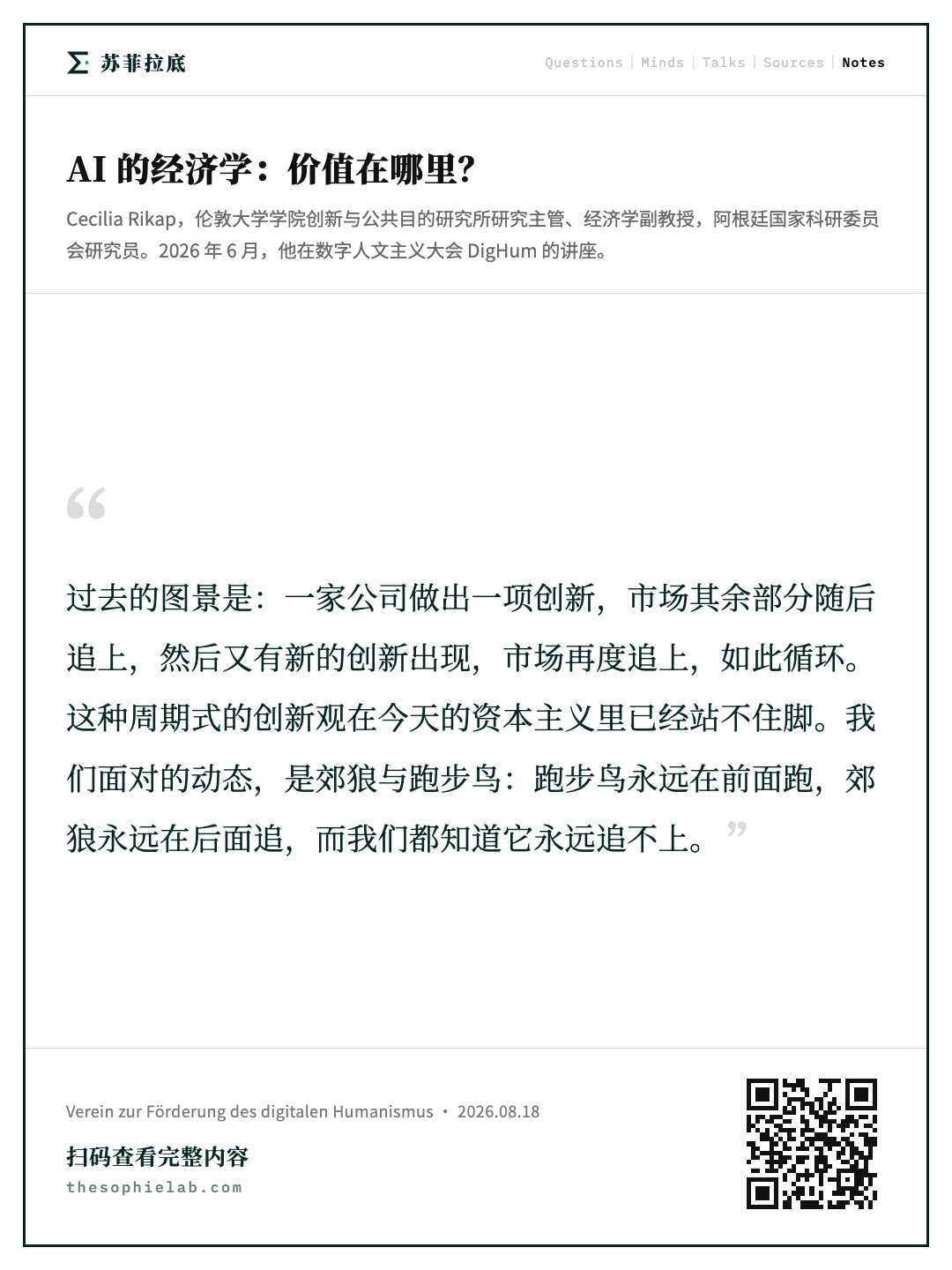
而这一小群大公司里的另一部分,我称之为智识垄断者(intellectual monopolies)。首先要说明,它们不只是科技公司。科技公司是智识垄断的典型,也许是最极端的例子,但不是唯一的例子,大型制药公司是另一类典型。我的论点是,图上所有那些不靠攫取自然获得优势的大公司,其优势都来自系统性地攫取社会的知识,攫取各种形态的知识,再把它们变成自己的无形资产。所以这些公司不是历史意义上的典型创新者。以经济学的眼光来看,过去的图景是:一家公司做出一项创新,市场其余部分随后追上,然后又有新的创新出现,可能来自同一家公司,也可能来自另一家,市场再度追上,如此循环,有些公司被甩在后面。这种周期式的创新观在今天的资本主义里已经站不住脚。我们面对的动态,用在座年纪稍长的朋友熟悉的说法,就是郊狼与跑步鸟(coyote and roadrunner):跑步鸟永远在前面跑,郊狼永远在后面追,而我们都知道它永远追不上。

控制技术

里卡普: 在这个故事里,大型科技公司格外重要,因为它们所攫取的那类无形资产对我们的社会具有结构性意义。当然有人会说,药品对社会也至关重要,可它总体上只影响经济的一个部门,再由这个部门向外扩散。而科技从一开始就无处不在。无论此刻你脑子里想到什么,它都受到科技的影响。数字技术是控制技术(control technologies),也就是说,它们既让我们得以安排日常生活,也让我们得以组织和管理各种机构,从企业到政府。随着时间推移,这些机构越来越多地采用人工智能,而 AI 是作为黑箱,通过这些大公司的云市场卖出去的。我这里说的不是所有大型科技公司,而是专指亚马逊、微软和谷歌。采用得越多,这些机构就越丧失独立组织、独立决定如何管理和规划自身的能力。

有人会说,大公司又不是新鲜事。你可以做这样的比较:把英伟达的市值和英国的国内生产总值放在一起,有人会觉得不可思议,也有人会说,这就是资本主义嘛。回溯历史,甚至回到资本主义的史前时代,东印度公司那样握有政治权力的大公司早就存在。大公司有政治权力,这不新鲜。我认为真正新的东西,一种在过去几十年里慢慢烹制出来的东西,是这些领军企业「超越所有权的控制能力」(control beyond ownership)。它们控制的不只是全球价值链,不只是平台上的其他组织,不只是加盟店(想想麦当劳在全世界的加盟店,实际上是数以万计),还包括对新知识生产的控制,同样超越所有权。我马上会集中谈这一点。

但在此之前,先说说在领军企业拥有这种能力的背景下,我如何理解资本主义。这些企业有能力决定那些在形式上并不属于它们的组织如何生产:不只是如何生产新的价值、新的产品和服务拿到市场上去卖,还包括如何生产知识,因而也就是我们如何生产和再生产自身的存在。请允许我用几个要点把主要论点归纳一下。

等级网络

里卡普: 第一,全球资本主义并不只是各国经济之间的交换,不是一个由许多国民经济彼此互动构成的统一世界。我们经济学家在思考宏观经济学时,得出的其实是对资本主义极具误导性的结论,因为我们的分析单位是国家。可看看国家内部。我刚才说美国云巨头和美国政府处于资本主义的核心,是全球资本主义的统治联盟,我说的是这个联盟,而不是「美国」。因为在美国内部,还有住在数据中心周围的所有人,他们打开水龙头想喝水,却喝不了,因为水是褐色的。美国还是一个预期寿命在下降的国家,这样的例子还可以一直列下去。显然,在美国内部也有大量公民站在输家一边。所以全球资本主义是以网络的方式运作的,而这个网络是等级化的。不同的组织彼此关联,但这些关系不是平等者之间的关系。

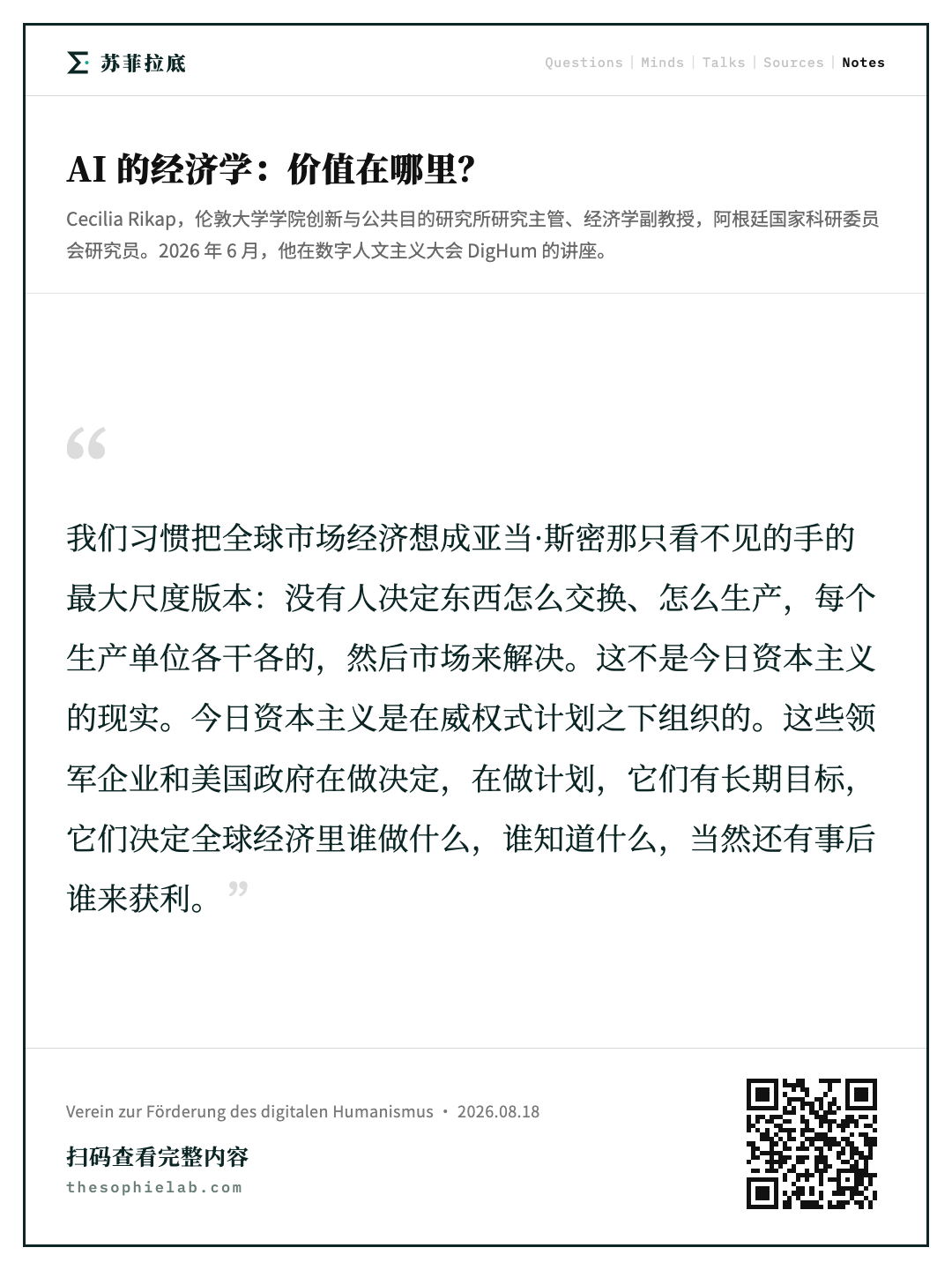
我们习惯把全球市场经济想成亚当·斯密那只看不见的手的最大尺度版本:没有人决定东西怎么交换、怎么生产,每个生产单位各干各的,然后市场来解决,告诉我们什么卖得出去,什么卖不出去。这不是今日资本主义的现实。今日资本主义是在威权式计划(authoritarian planning)之下组织的。这些领军企业和美国政府在行使超越所有权的控制时,是在做决定,在做计划,它们有长期目标,它们决定全球经济里谁做什么,谁知道什么,当然还有事后谁来获利。

第二,要让这套东西运转,并不是说世界上只有几个行动者控制一切,其余所有人都同样无能为力。有许多共谋者(complicit actors),处在全球资本主义边缘地带的共谋者。我们当然可以想到极右翼政府,比如我的国家阿根廷,它执政是为了美国政府、为了美国的大型科技公司和其他大公司服务,有时也为欧洲的大公司服务。但共谋者不只是政治行动者,企业,尤其是大企业,同样是这套策略的共谋者。这一点我稍后还会回来谈。

企业创新体系

里卡普: 现在来说前面提到的那种能力:超越所有权地控制知识生产。通常在这里我会给各位看大量经验数据,各位可以在我的论文里查到。今天我给一个非常简单的版本,用我极其有限的设计能力画的。这张图不是 AI 设计的,是一个经济学家设计的。「企业创新体系」(corporate innovation systems)是我和一些同行用的术语,指的是作为智识垄断者的领军企业如何控制众多参与者对新知识的共同生产。图上就是这样:许多组织和个人共同生产各种形态的新知识,也包括叙事的编织,比如一家制药公司的品牌塑造,或者谷歌这个品牌。然后,这些知识被少数几家占有,有时这少数几家还能靠占有这些集体创造的知识来赚钱。

所以我们在这里看到的过程,我称之为无形资产攫取主义(intangibles extractivism),因为知识由众人生产,却被少数人抽取、占有并变现。但它同时也是一种认知极权主义(epistemic totalitarianism),因为把共同创造的研究成果变现的那几家公司,也正是决定研究要做什么的那几家。比如 AI 正在变成一种发明方法,这件事就是大型科技公司一直在推动的。原因很清楚:如果它们控制了我们用来提出问题的方法,无论作为学者、研究者,还是作为个人,控制了我们用来思考的方法,它们就控制了我们怎样思考和思考什么。

云才是瓶颈

里卡普: 正是在这个背景下,对我来说云格外关键。各位也许会说,这场不是谈 AI 吗,你怎么转到云上去了?因为 AI 实际上是在云里出生、长大、被使用的。它在工作场所被用来控制人,被用作自动武器,被用于社交媒体上让人上瘾的算法。这一切都通过云发生。而且不只是因为云是「基础设施即服务」。云的确把英伟达和其他半导体,有时还包括云巨头自己设计的芯片,当作服务提供出来,也给我们每个人、每一种组织提供存储数据的机会。但云远不止于此。我通常先用一个比喻:云是数字技术的超级市场。你想要什么数字技术,都可以在云上按服务租用。但它实际上又不止是超市,因为这些数字技术不只是在云上交易,它们还是在云里开发、生产,再在云里部署、消费的。各位可能有过这样的经历:坐飞机,或者身处没有网络的地方,如果你的电脑一直连着云,你大概会发现打不开自己的全部文件。正是在这样的时刻,我们意识到,自己以为一直发生在设备里的事,其实并不发生在那里。

但这不只是关于个人的故事,不只是我们所有人如何依赖这些建立在大量知识集中之上的基础设施。这不是旧意义上的基础设施,不是修一条高速公路或一座桥,修完就完了。当然它们也能控制一座桥,但控制知识、集中知识并把这些知识变成社会的基础设施,其影响和后果远远超出一座连接两个城镇的私有化桥梁。我们可以建立相似性,可以作类比,但不能把这种圈地和我们以往见过的其他圈地等量齐观。

回到超市这个比喻。在任何一家超市里,货架上不只有超市老板自己的商品。亚马逊、微软和谷歌在云上都设有平台,开发者和较小的公司可以把自己的服务作为云服务放上去。我们作为组织或个人每消费一次这些服务都要付费,而付的钱有一部分会流向云巨头,这和亚马逊网站的情形类似。区别在于,这不只是一个集市,而是所有技术、包括 AI 模型都在此生产的地方。而当 AI 模型不是在那里生产的,比如深度求索(DeepSeek)或 Meta 的模型,它们最终也不可避免地要进到云里,在这几家公司的云上把自己的模型作为服务提供出去,因为它们承担不起置身这个虚拟空间或市场之外的代价。

特洛伊木马

里卡普: 在这个故事里,具体到 AI,我会把 AI 定义为一匹特洛伊木马,一种营销策略,因为 AI 满载承诺。请相信我,AI 大概确实会带来一些好处,但它解决不了我们社会的全部医疗问题,解决不了生态危机,甚至连一件小事都无法单靠自己解决,因为技术从来不会单靠自己带来解决方案。要实现那些关键的解决方案,我们首先需要的显然是政治意愿,是改变现状的政治决定,然后技术才能以某种方式被发展出来,为之出力。

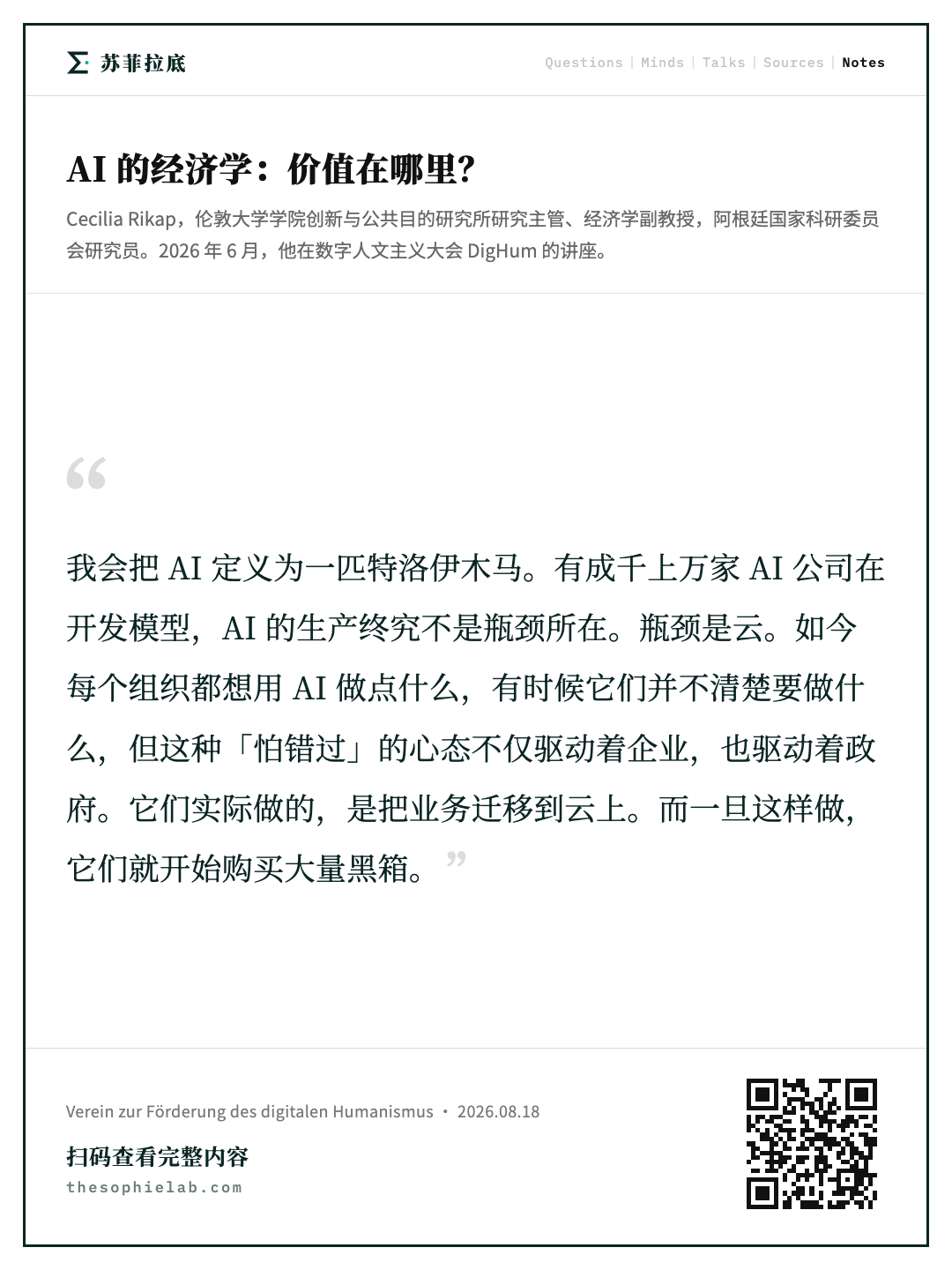
为什么说 AI 是特洛伊木马?微软首席执行官萨提亚·纳德拉在领英上的一篇帖子里说得很清楚,他把 AI 称作大宗商品(commodities)。想一想就明白:有许多家,即便不是成千上万家,AI 初创公司在开发模型;许多早已不算初创的 AI 公司也在开发模型;云巨头还开发自己的模型。AI 的生产终究不是瓶颈所在。瓶颈是云。因为无论你在哪里、用什么方式生产你的 AI 模型,连 SpaceX 的 AI 模型也要放到微软和其他公司的云上去提供。为什么说 AI 是特洛伊木马?因为如今每个组织都想用 AI 做点什么,有时候它们并不清楚要做什么,但这种「怕错过」的心态不仅驱动着企业,也驱动着政府。它们实际做的,是把业务迁移到云上,以此开始把 AI 当作服务来使用。

而一旦这样做,它们就开始购买大量黑箱。它们不知道这些模型是怎么训练的、用了什么数据、如何运作、如何做出决定。这不仅发生在 AI 模型上,云上提供的大多数服务都是如此。这就同时制造出企业的依附和公共部门的依附。

战略性从属

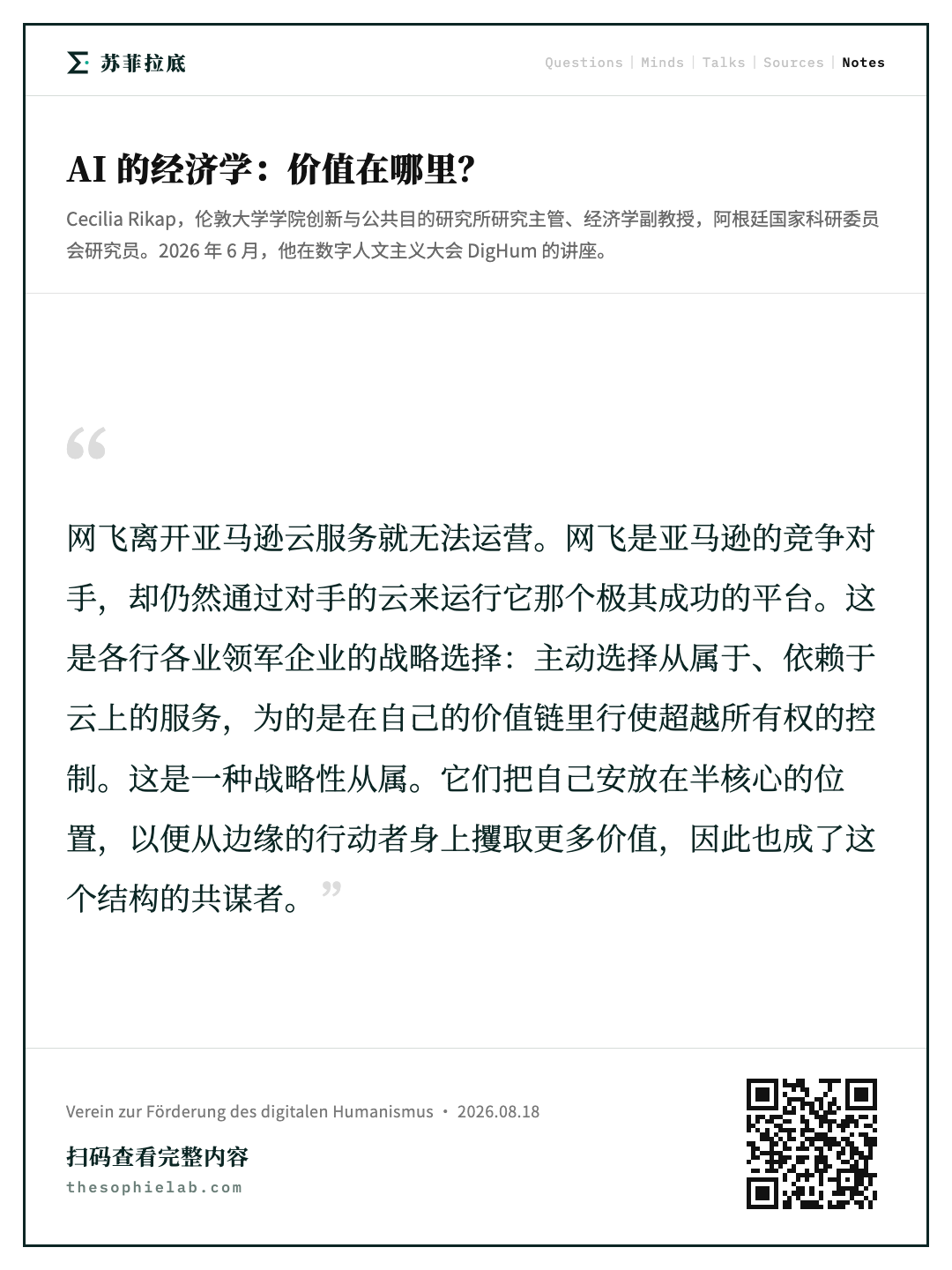
里卡普: 举个例子,网飞离开亚马逊云服务(AWS)就无法运营。网飞是亚马逊的竞争对手,却仍然通过对手的云来运行它那个极其复杂、也可以说极其成功的平台。我并不是说网飞待在云上是在牺牲自己。这是各行各业领军企业的战略选择,制药业、汽车业,随便你举哪一行:它们主动选择从属于、依赖于云上提供的服务,为的是在自己的全球价值链里(如果它们有的话)、在自己的企业创新体系里、在其他平台上(网飞就是如此),行使自己那份超越所有权的控制。所以这是一种战略性从属(strategic subordination)。它们把自己安放在一个「半核心」的位置,以便从处于边缘的那些行动者身上攫取更多价值,因此它们也成了这个结构的共谋者。政府也是一样,无论是否清楚后果,一旦决定把国家的运作迁上云,同样如此。

我就讲到这里。还有许许多多问题可以继续讨论,但这就算是我对这本书的一个预告。谢谢。

泡沫还是黑帮

主持人: 谢谢塞西莉亚。冒出来很多话题。我作为一个非经济学者,特别有共鸣的是「超越所有权的控制」这个观念,我想您阐释得非常清楚。但我想回到价值这个话题本身。您刚才谈了很多依附关系。可另一方面,这些公司似乎也在另一个层面上驾驭着依附。我们看到 AI 热潮,看到那些不可思议的估值、首次公开募股、拜见教皇、巨额投资和生产率承诺,还有新出现的「万亿富翁」,可我们仍然不知道那里面到底有什么价值。现在我们明白了,价值在云里。但它们似乎在以一种循环的方式驾驭彼此之间的依附,在我这个外行看来,这像一个泡沫,或者像一种黑帮式的策略。这到底是什么?它们在做什么?它们在互相抬高对方的估值。这是怎么回事?

里卡普: 简单说,金融市场也在押注 AI,而且对于集中化的金融资本来说,这大概是它们如今唯一的赌注。智识垄断在一个社会里造成的实际效果很清楚,就是更多的不平等,因为是同一批行动者在集中越来越多的收入和财富。想想这些公司,尤其是云巨头,它们年复一年赚到的钱让它们手握大量流动性。不只是公司内部的流动性,还因为它们的股价在一个历史过程中不断上涨,那些替养老基金和一整套其他金融机构管理资金的资产管理公司也在积累巨额财富。贝莱德、先锋领航这样的公司,一直在收割从我们社会攫取价值所带来的收入,而这种价值攫取建立在对数据、知识的占有和叙事的编织之上。

所以我们需要一层一层地往下看,到最底层,我们看到的是所有人在集体创造数据、集体创造知识。我的很多研究就是在展示公共研究机构、大学、初创公司如何成千上万地参与到大型科技公司、尤其是云巨头周边的外围地带。我用了多种指标来做这件事,考察风险资本的流向,考察科学论文的合著关系。所以我们确实看到大量的共同创造。至于无形资产的创造能否从经济理论的角度被称为「价值」,这可以再讨论,但它无疑是一种使用价值,无疑对我们的社会是重要而必需的。我们在集体创造这一切文化共同财富,然后它被从我们手中剥走,被这些公司通过我刚才解释的机制完全攫取,也通过那些半共谋或共谋的行动者:他们为这些公司的利益制定规则,或者为它们的利益不制定规则,在更大的生态系统里替它们运作,等等。金融市场反映的,一部分就是这个过程。

另一部分是这样。面对这些公司积累的财富,有人会说,现在云巨头正在投资资本支出,投资有形资本,因为数据中心集中在它们手里。我的回答是,它们至少在过去十年里一直在投资数据中心,只不过大多数人以前没有留意它们财务报表上的这个变量。不过我要说,正因为有金融市场对 AI 的押注,加上大量流动性集中在少数人手里,我们才会感受到泡沫的可能性。再加上 AI 将会产出什么,说得最轻也是完全不确定的。所以是的,这种风险存在。

但我认为最重要的是:泡沫会不会爆?我认为早在它爆之前,唐纳德·特朗普就会出手救这些公司。而且我们要区分 Anthropic 或 OpenAI 这类公司和云巨头的角色。为什么?因为云巨头有别的生意。它虽然在 AI 上投入巨大,但它已经在赚钱,有多种商业模式,这些公司早已盈利。而那些处在半边缘、依赖云巨头投资、依赖集中在云里的云巨头知识的行动者,比如 OpenAI、Anthropic,随你举,这些公司才是那群看似在收割 AI 利润或潜在利润的行动者当中最脆弱的一环。所以这是一个非常不稳定的局面。但我不认为会有一次大崩盘,因为我看到许多迹象表明美国政府在直接购买股权,比如英特尔百分之十的股份,这会阻止崩盘发生。与此同时,代价是美国政府对生产什么样的 AI、如何生产施加更大的影响。所以这是公司想要的和美国政府想要的两者的结合,以及它能否与世界其余部分分享,正如我们在 Anthropic 一案中所看到的。

主权三难

主持人: 在把话筒交给现场听众之前,我还有最后一个提示,或者说问题。面对您刚才描绘的这些依附,我们欧洲多少也在努力应对。欧盟刚刚发布了一组措施,所谓的「主权包」(sovereignty package)。听完您刚才讲的,再把「主权」这个词放在旁边,实在很有意思。它能不能奏效还有疑问,但我们已经推出了这个主权包,一套关于云和 AI 的立法或者说方案,芯片法案、开源战略、AI 与能源,一整套「AI 大陆」战略。我自己还没有通读,但之前问过您有没有看过。有了这个主权包,我们在应对这种局面上准备得怎么样?

里卡普: 我会说,欧盟面对的处境可以描述为一个三难困境(trilemma)。欧盟想通过这个方案、更广泛地说通过它的数字政策、乃至越来越多的所有政策,达成三件事。第一是经济增长和竞争力。第二是应对生态危机。这个技术主权包里实际上有一份小文件,是一份路线图,讲如何把 AI 嵌入整条能源价值链,也讲如何找出让数据中心运营得更可持续一点的办法,能不能做到我稍后再说。第三是主权。所以欧盟想要竞争力、想要解决生态危机、想要主权。我认为这三者无法同时实现。整个技术方案讲的都是竞争力。它在做白日梦,梦想一个欧洲从现在到二〇三〇年把数据中心数量增加两倍的世界,还希望电网表现出色。我真不知道是谁做的这些计算。爱尔兰、还有如今西班牙大规模兴建数据中心的后果已经摆在眼前,告诉我们这不是出路。可欧洲仍然觉得自己落后太多,把 AI 等同于数据中心,以为只要数据中心建在欧洲就会发生两件事:一是欧洲能拉近、至少缩短与美国的差距,二是欧洲能更好地治理和监管这些数字技术,哪怕只好一点。我会说,这两个目标都不会实现。

外国军事基地

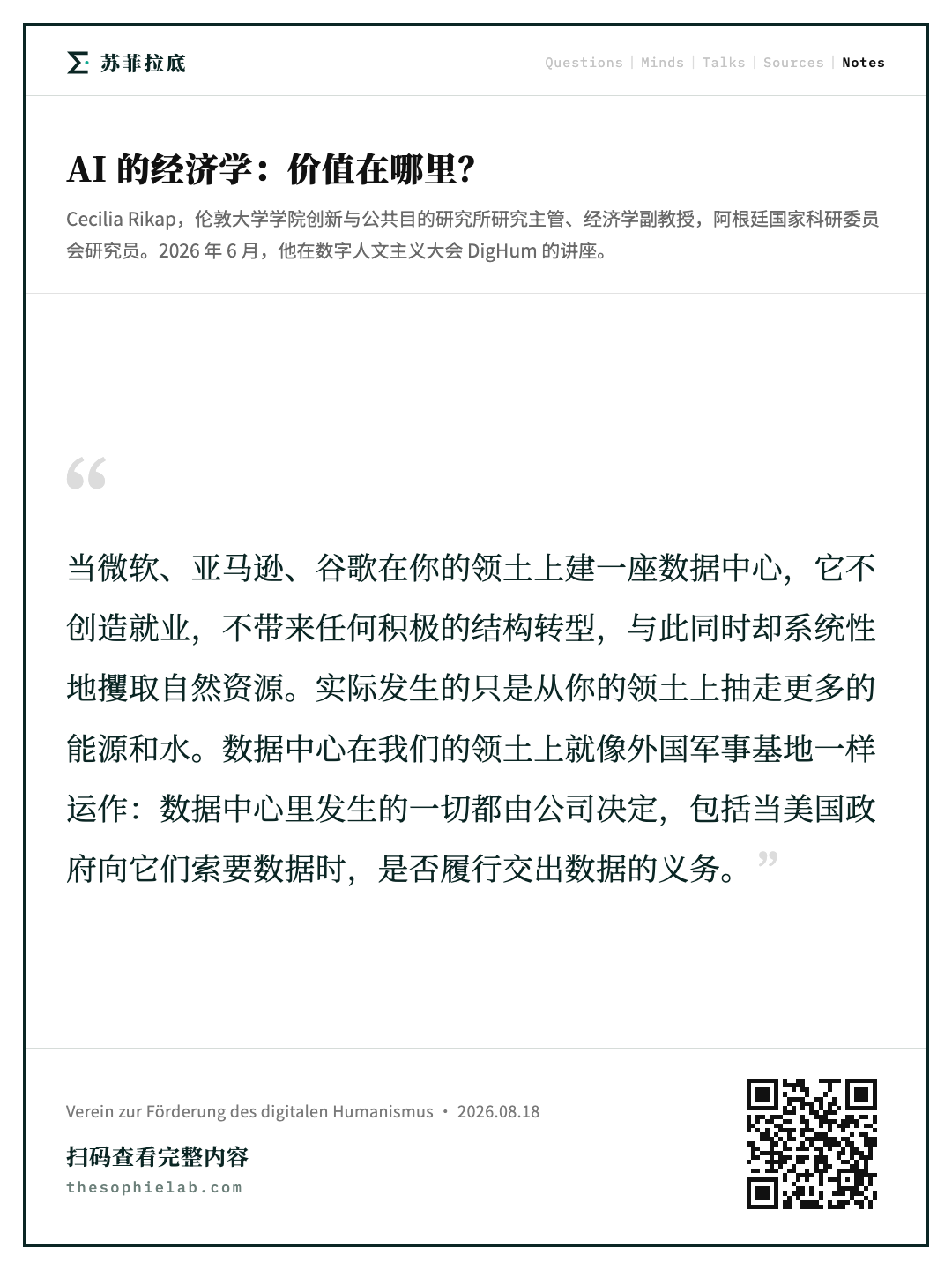
里卡普: 首先,当微软、亚马逊、谷歌这样的公司在你的领土上建一座数据中心,它不创造就业,不给经济带来任何积极的结构转型,与此同时却系统性地攫取自然资源。所以我们在这里看到的是自然攫取主义与无形资产攫取主义的共同演化,我称之为双重攫取主义(twin extractivism)。你有了数据中心,但实际发生的只是从你的领土上抽走更多的能源和水,而这座数据中心并不意味着你就更有机会发展出任何东西。因为如果你有一个活跃的技术社区,他们想训练什么,在世界任何地方的数据中心都可以训练,并不需要坐在数据中心旁边才能用上那些处理器。与此同时,你也没有任何机会真正监管这座数据中心,或者治理你领土上那些数据。因为数据中心在我们的领土上就像外国军事基地一样运作:数据中心里发生的一切都由公司决定,包括当唐纳德·特朗普或者不论谁在美国政府当政向它们索要数据时,它们是否履行交出数据的义务。

所以很清楚,数据中心对解决生态危机起的是反作用。即便数据中心可以完全用可再生能源来建,我们难道不应该优先把这些可再生能源用在别处,而不是继续建更多的数据中心?数据中心正是从我们的社会中抽取数据、抽取知识的物质基础。我并不抽象地反对建数据中心。问题在于:谁在建,建在哪里,存谁的数据,为了什么目的,我们要拿这些数据做什么。如果所有这些都交到公司手里,然后你在宏观经济数据里显示出对科技的投资增加了,觉得心满意足,打了个勾。

主持人: 是在打勾,但这没有让大多数人的生活变好,也谈不上主权。

里卡普: 这就是其中的诡计,也是复杂之处,因为数字经济也在挑战我们思考主权的方式。主权不再只是关于领土。我用外国军事基地作例子,也是为了把它和历史连起来,因为在别国领土上设军事基地已经存在很多很多年了。但无论如何,我认为今天比任何时候都更清楚,只要看看技术是如何被共同生产出来的,就会明白共同生产是全球性的,而被集中起来的,是获利,以及决定我们得到什么技术的权力。

有用与被宣传

主持人: 现场有很多专家,我已经看到很多手举起来了。我想说明一点,出席这次会议的有些人正在参与建设欧洲的基础设施,投资欧洲的超级计算、AI 工厂等等,所以您的反应会很有意思。请第一位。

提问者一: 如果我们问一个 AI 的价值是什么,就会遇到一个问题:价值本身在不同人之间是有差异的。是的,我们的资本主义有问题,但那是冷战、奥地利学派、新古典主义等许多因素发展到顶点的结果。但也有人看重 AI,因为他们想要一个智能家居,或者别的什么,他们认为对自己很好,不是因为哪家公司告诉他们,而是比如说,AI 在医院或其他机构里可能更有帮助。所以我们必须区分:个人认为 AI 有什么价值,和公司通过广告或其他途径宣传的 AI 应该有什么价值。

主持人: 我想我们需要把问题集中起来,或者您想先回应?

里卡普: 可以集中,不过我建议问题简短一些,因为时间快不够了。

主持人: 好,那下一位,约安娜,然后是前排那位,我没忘记您。

提问者二: 我的问题很短,但其实是三个相互关联的短问题。首先,我非常喜欢您讲的智识垄断对文化的攫取,我一直在找这个概念,谢谢。我想请您简单说说,保险公司、您提到的贝莱德那样的投资者,还有咨询公司,在您的框架里处于什么位置。第二,很快问一句,您那张五十大经济体的图,我理解经济体是按货币划分的,那欧元区在图上在哪里?最后,这里一直在讨论投资,您也提到了特朗普的入股。欧盟,或者更广泛地说,一个由遵守法治的国家组成的联盟,是否应该像美国那样投资,从而作为投资者形成一种反制力量?为什么不干脆征税呢?投资和征税有什么区别?这暴露了我在经济学上的无知。

主持人: 您想把两组问题合起来答吗?

使用价值不等于正当

里卡普: 先说价值。我要强调一点前面说过的:我们需要区分经济价值,以及我们的社会如何决定什么东西在经济上有价值,与使用价值,也就是一样东西满足某种需要的可能性。我举一个例子。对世界上某些人来说,拿自动武器去实施一场种族灭绝,像以色列在加沙实施的那种,是非常有用的。而其中一部分是在这些公司的帮助下完成的。在「宁布斯计划」(Project Nimbus)这样的项目里,还有另一个项目,微软为以色列政府提供基础设施,用来处理从每一个巴勒斯坦人的手机上截取的数据。所以这些公司是共谋者,而对以色列政府来说,它们当然非常有用。它们确实能给某些人提供大量使用价值,也提供经济价值。

关于价值,以及我们想要怎样框定这个讨论,我们想摆到桌面上的重点,并不在于 AI 的用途。我认为一个民主的社会很容易就能认定 AI 的某些用途应当被禁止。这不是那个关键的讨论,尽管不幸的是,照世界目前的状况,它恐怕还会继续被讨论下去。关键的讨论是要下到更深的层次,戳破那个神话:说我们不得不迁就这些公司,因为它们是创新者。它们不是。我全部研究要展示的是,我们所有人在集体创造的不只是原始数据,还有这些公司拿去变现的全部知识。我认为这才是我们需要看清的区别,也是我们需要更加珍视自己能力的地方。

欧洲有人才

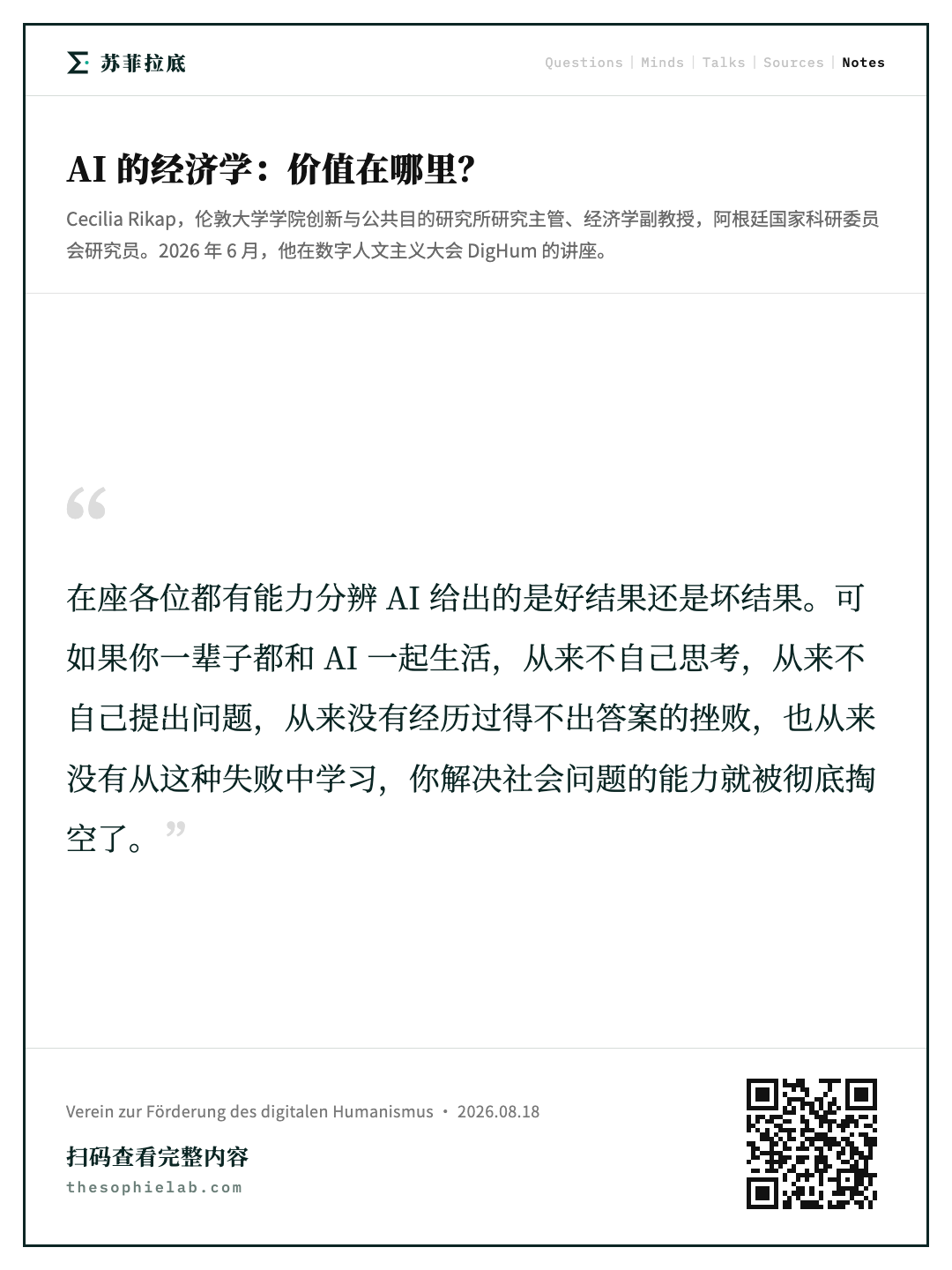
里卡普: 在我绘制的那些描绘价值链如何组织的图上,有成千上万家欧洲组织。所以说到最后那个问题,什么样的联盟。那种「欧洲自己做不到,因为没有人才,没有钱」之类的说法,我认为面对这些问题,我们需要用政治想象力来思考解决方案,要认清并承认我们确实有人才,只是今天这些人才被放在了为这些掠夺性生态系统服务的位置上。我们可以设想另一种技术发展路径,不必把一切都投到一个大语言模型上,一个最终会削弱人的思考能力的模型。再想想另一个所谓「美好」的例子:在学校使用生成式 AI,而不是让孩子学会自己思考。在座各位都有能力分辨 AI 给出的是好结果还是坏结果。可如果你一辈子都和 AI 一起生活,从来不自己思考,从来不自己提出问题,从来没有经历过得不出答案的挫败,也从来没有从这种失败中学习,你解决社会问题的能力就被彻底掏空了。

麦肯锡们

里卡普: 关于保险公司,我想说一句,其实不是关于保险公司,而是关于世界上的那些麦肯锡。它们是这个故事里最明显的共谋者之一。它们是营销机构,把每一个政府、尤其是每一家大公司往云里推,告诉它们这就是前进的方向,用这些服务不仅能让它们有机会治理、有机会解决公民的问题,还在塑造和改变国家的本质,把国家改造成一个服务供应商,而不再是我们进行治理和决策的关键机构。所以它们无疑是在削弱我们的民主。至于欧元区,经济学里一般是在国家层面看国内生产总值,所以你通常不会看到欧盟作为一个整体出现。欧盟本身也有它的复杂性,但即便合在一起,和那些公司相比仍然很小。

主持人: 很遗憾时间快到了。再接一个问题,然后我必须打住。不过塞西莉亚会留在这里,各位可以在茶歇时找她。请务必简短。

我们都是共谋者?

提问者三: 您谈到共谋者,可事实上我们每一个个人都是共谋者。这套系统训练了我们如何为它服务,如何提供数据等等。连教皇在通谕里都没有勇气提出那个唯一彻底的结论:不做共谋者,干脆不加入这套系统。因为教会不想显得反现代。

里卡普: 这确实是一种看法。但我要挑战这个观点。我会说,我们社会中的大多数行动者别无选择,只能成为这些掠夺性生态系统的一部分。而像 SAP、西门子、大众这样的公司,随便你举哪一家,它们本来有别的选择,却选择了依附于这些技术,因为正是通过这些技术,它们才更善于从位置更低的那些人身上攫取价值。这就是为什么我认为等级网络这个概念,核心、半核心、边缘、超级边缘这套划分,能帮我们看清作为行动者各自不同程度的议价能力,也更加凸显了两件事的必要:第一,联合起来发展替代方案;第二,让国家承担起责任。国家可能有一大堆问题,我们可以批评很多东西,但它终究是唯一还握有一定财政余地、能为建设一个真正民主的替代方案出力的民主机构。

主持人: 我们拭目以待,看事情会怎样发展,尤其是在欧洲,在这个新方案落地之后。明天我们有一场关于数字主权的讨论,接下来还有一场关于地缘政治的,都会接着您提出的这些问题往下谈。很遗憾我们现在必须结束。非常感谢塞西莉亚的到来。作为结语,我想我们现在明白了,这绝不只是一个技术问题,而是一个我们必须解决的社会问题。有很多东西值得思考和讨论。谢谢。

里卡普: 谢谢大家。
本期讲者
塞西莉亚·里卡普伦敦大学学院创新与公共目的研究所研究主管、经济学副教授,阿根廷国家科研委员会研究员。研究知识垄断与数字依赖,著有《资本主义、权力与创新》,新书《The Rulers》即将出版。
主持人DigHum2026 数字人文主义会议本场主持,自称非经济学者,负责引入价值悖论议题并组织观众提问。
章节 · 点击跳转视频
0:03 开场:AI 高估值与低信任的悖论 ▶ 正在看
2:53 谁是今日资本主义的统治者 ▶ 正在看
5:01 攫取自然与攫取知识的两类巨头 ▶ 正在看
7:43 超越所有权的控制:新在何处 ▶ 正在看
9:39 全球资本主义是有等级的网络 ▶ 正在看
12:38 企业创新体系与认知极权 ▶ 正在看
14:24 云是数字技术的超市与工厂 ▶ 正在看
17:11 AI 是特洛伊木马,云才是瓶颈 ▶ 正在看
21:52 泡沫、金融资本与最脆弱的一环 ▶ 正在看
27:56 欧洲主权包的三难困境 ▶ 正在看
34:09 观众提问:价值、投资与共谋者 ▶ 正在看
42:16 结语:人人共谋与国家的责任 ▶ 正在看
本期论点
本期回应
4:05
当今资本主义的统治者是亚马逊、微软、谷歌这三家云巨头 在硬件层AI 里最赚钱的是哪一环?
9:12
领先科技企业能在所有权之外,决定名义上不属于它们的组织如何生产价值与知识 在硬件层AI 里最赚钱的是哪一环?
19:07
AI 的瓶颈不在模型生产,而在于模型最终都要放到少数几家云上才能提供 在硬件层AI 里最赚钱的是哪一环?
21:12
各行业领军企业依赖云是战略性从属:借半核心位置从边缘榨取价值,成为共谋者 在硬件层AI 里最赚钱的是哪一环?
27:28
依赖云巨头投资与知识的模型公司,是 AI 利润链条中最脆弱的一环 在硬件层AI 里最赚钱的是哪一环?
18:16
技术从来不会靠自身带来解决方案,真正的前提是改变现状的政治决断 政治决断技术带来的问题,该往哪里找出路?
43:56
国家是唯一具备财政回旋余地、能为建设民主技术替代方案作出贡献的民主机构 政治决断技术带来的问题,该往哪里找出路?
其他论点
5:50
科技巨头的优势不在攫取自然资源,而在系统性攫取社会积累的知识并变成自有无形资产
11:23
今天的资本主义不由「看不见的手」协调,而是在威权式的计划之下组织起来
13:58
大型科技公司把 AI 变成一种发明的方法,借此控制人们思考的方法
16:23
把知识中心化并使其成为社会基础设施,后果远超私有化桥梁这类传统圈地
23:21
对高度集中的金融资本而言,AI 几乎是当下唯一的押注 观察
26:58
AI 泡沫会不会破并非关键,因为在破裂之前政府就会出手救助这些公司
30:17
欧盟无法同时实现竞争力、解决生态危机与技术主权这三个目标
32:27
境内的数据中心运作起来像外国军事基地,里面发生的一切东道国无从监管
01开场:AI 高估值与低信任的悖论
0:03
For me it's an honor uh to welcome you to the session economies of AI where is the value and I'm really personally very happy that we could arrange this session because I think many of us are looking for clarifications all the time. AI is uh surrounded by extraordinary promises, productivity, competitiveness, innovation, even a new method of invention. But at the same time, public trust is fragile. Many people experience AI less as an empowerment, but then as a job pressure, unreliable automation, environmental burden, and forced dependencies. I have put a list of studies just uh to provide evidence if somebody asks about these studies and the list is growing every day.
对我来说,很荣幸能欢迎各位来到“AI 的经济:价值在哪里”这一场,我个人也非常高兴我们能促成这场对谈,因为我想我们很多人一直都在寻求把事情说清楚。AI被各种非凡的承诺所包围:生产力、竞争力、创新,甚至被称为一种全新的发明方法。但与此同时,公众的信任是脆弱的。很多人体验到的 AI 与其说是赋能,不如说是工作压力、不可靠的自动化、环境负担和被迫的依赖。我列了一份研究清单,就是为了在有人问起这些研究时能提供证据,而这份清单每天都在变长。
便签引用
0:57
So there is a real need to understand this paradox. How can something be so highly valued by markets and at the same time be so contested, distrusted and simply unwanted by many publics. This is why our question today matters. you know where is the value, what is actually produced, where is it captured and who pays the costs and what can we actually do about it and you see the the economies is in plural and maybe we should also put the AI in plural. We will see. So it is a tremendous pleasure for me to welcome Cecilia Reikap who is associate professor in economics and head of research at the institute for innovation and public purpose at the university college in London. uh you hold a PhD in economics from the Universat Buenosis and you are a tenure researcher at Koniset Argentina's national research council and you have a lot of other jobs and duties and roles that I cannot list here because uh time is short but also and that I'm particularly proud of you have been or you are still uh the uh Paul Latasfeld
所以我们确实需要理解这个悖论:为什么某种东西可以被市场如此高估,同时又被许多公众如此质疑、不信任,甚至干脆不想要。这就是我们今天这个问题重要的原因。你知道,价值在哪里,实际生产出了什么,价值被谁攫取,成本由谁承担,以及我们究竟能对此做些什么。而且你看,“经济”用的是复数,也许我们也该把 AI 变成复数。我们拭目以待。因此,我非常高兴地欢迎切奇莉亚·里卡普,她是经济学副教授,也是伦敦大学学院创新与公共目的研究所的研究主管。你拥有布宜诺斯艾利斯大学的经济学博士学位,并且是阿根廷国家科学研究委员会(CONICET)的终身研究员,你还有很多其他的工作、职务和身份,我在这里没法一一列举,因为时间有限,但还有一点我特别引以为豪的是,你曾经是——或者现在仍然是——维也纳大学的保罗·拉扎斯菲尔德客座教授。你的研究考察的是
便签引用
2:11
visiting professor at the University of Vienna so your work examines uh the political economy of science, technology and innovation in a broader sense with a particular focus on intellectual monopolies, digital dependency and the concentration of knowledge and infrastructural power and you have a book forthcoming and we'll talk about a lot of content that will be readable in the book that is coming out very soon. >> Yeah, like in a month. >> Okay, perfect. >> Uh the rulers and >> Yeah. Let us start already here uh and uh see what uh the rulers do.
更广义上的科学、技术与创新的政治经济学,尤其关注知识产权垄断、数字依赖,以及知识与基础设施权力的集中。你还有一本即将出版的书,我们会谈到很多能在那本即将面世的书里读到的内容。>> 是的,大概一个月后就出。>> 好,太棒了。>> 呃,《统治者》……>> 是啊。那我们就从这里开始,来看看这些“统治者”都在做什么。
便签引用
02谁是今日资本主义的统治者
2:53
>> Absolutely. Well, hi everyone. It's a pleasure for me to be here and I will go straight to how the rulers operate. Okay. Can you see this? Well, my question would be where shall I point to get the next slide? No, maybe there. Okay, now we can start. So, um, thanks a lot for having me here. I'm going to just give a very brief 10 minutes presentation, hopefully less because our idea is to have a discussion also to have a discussion with all of you. I'm sure like you will have a lot of questions, a lot of things to say about this topic and specifically about corporate power and its interplay with political power. And here you have only one side of this interplay because of course we could uh also be speaking about China, Chinese big tech and its tight relationship even if also sometimes conflicting relationship with the Chinese government. And in all this story we should also ask ourselves where where is Europe? Where is the rest of the world? What about all the other organizations that are also contributing
>> 当然。那么,大家好。很高兴能来到这里,我会直接进入这些“统治者”是如何运作的。好,你们能看到这个吗?呃,我想问一下,我该指向哪里才能翻到下一页?不对,也许是那边。好,现在可以开始了。非常感谢邀请我来。我只做一个很简短的十分钟演讲,希望能更短,因为我们的想法是留出讨论时间,也和在座各位一起讨论。我相信大家会有很多问题、很多想说的,关于这个话题,特别是关于企业权力及其与政治权力的相互作用。而这里你们看到的只是这种互动的一面,因为我们当然也可以谈关于中国、中国的科技巨头,以及它们与中国政府之间那种紧密、有时也充满张力的关系。在这整个故事里,我们也应该问问自己:欧洲在哪里?世界其他地方又在哪里?那些同样在为前沿科技和科学做贡献的其他组织呢?为什么今天资本主义的统治者,正如我
便签引用
4:02
to the production of frontier science and technology? Why is it that, as I will argue today, the rulers of today's capitalism are ultimately cloud giants, Amazon, Microsoft, and Google in a tight alliance with the United States government. So, let me let me go with straight to some uh illustrations of the world we live in. This is even old. Of course, this is uh is one year old more or less. So, there is no space X here and it's roller coaster of of uh stock value. But in any case uh most of the companies that we see on that map are still more or less pretty much in the same place. So when we try to think about what makes a big company big and this is one way of seeing it they are big in market capitalization. I would split these large companies in two groups broadly uh speaking. A small group are the companies that get their advantage from the extraction of nature.
今天要论证的,归根结底是这些云巨头——亚马逊、微软和谷歌,而且它们与美国政府结成了紧密同盟。那么,我先直接进入几张图,来说明我们生活的这个世界。这张图其实已经有点旧了。当然,大概是一年前的。所以这里还没有 SpaceX,也没有它股价那种过山车式的走势。但不管怎样,我们在这张图上看到的大多数公司至今基本上还待在差不多的位置上。所以当我们试着思考,是什么让一家大公司变得如此之大——这是一种看法——它们的“大”体现在市值上。我大致会把这些大公司分成两类。有一小部分公司,它们的优势来自对自然的攫取。
便签引用
03攫取自然与攫取知识的两类巨头
5:01
And you have Saudi Aramco for instance there. And with the invasion of invasion of Iran, it became also clear how uh oil fossil fuels still play a very important role in our society. Although more than ever we should be uh focusing on an ecological transformation. But the other part of this big group of comp of this small group of big companies are what I would describe as intellectual monopolies. And these companies are characterized are not only tech companies. This is one thing. So tech companies are a paradigmatic perhaps the most extreme example of an intellectual monopoly. But they're not the only intellectual monopolies. Big pharma are another typical example of intellectual monopoly. They would argue that all the big companies over there that don't uh get their advantage from the extraction of nature get their advantage from the systematic extraction of society's knowledge in its multiple forms turned into their intangible assets. So these are not typical innovators in the historical way of seeing this. For
比如那里有沙特阿美。而随着对伊朗的入侵,我们也看得很清楚,石油、化石燃料在我们的社会中仍然扮演着非常重要的角色。尽管我们比以往任何时候都更应该把重心放在生态转型上。但在这一小群大公司中,另一部分则是我会称之为“知识垄断者”的公司。而这些公司的特点是,它们并不只是科技公司。这是第一点。科技公司是一种典型的、也许是最极端的知识垄断形态。但它们并不是唯一的知识垄断者。大药厂是另一个典型的知识垄断例子。我会说,那里所有那些优势并非来自攫取自然的大公司,它们的优势来自于系统性地攫取社会以各种形式积累的知识,并把它们变成自己的无形资产。所以这些并不是历史意义上那种典型的创新者。比如从经济学的角度看,它们不是那种
便签引用
6:02
instance, from the economics uh standpoint, these are not companies that get one innovation and then the rest of the market catches up and then we have another innovation that in some cases may come from the same company or another one and then the market catches up and so on and so forth. Some companies are left behind. This cyclical way of thinking about innovation doesn't hold water in today's capitalism. And basically we have a a dynamic that for the older people in the room can be described as coyote and roadrunner where there is always the roadrunner moving ahead and the coyote trying to chase it but we know it will never do it.
做出一项创新、然后市场其余部分追赶上来、接着又出现另一项创新——有时来自同一家公司,有时来自别家——然后市场再追赶上来,如此循环往复的公司。有些公司会被甩在后面。这种周期性的创新思路,在今天的资本主义里已经站不住脚了。基本上,我们面对的是一种动态,对在座年纪大一点的人来说,可以形容为“大灰狼与哔哔鸟”:哔哔鸟永远在前面跑,大灰狼在后面追,但我们都知道它永远追不上。
便签引用
6:41
And in this story big tech companies are particularly relevant because the type of intangible assets that they are capturing are structural for our society. Of course, one can argue that uh medicine is also critical for our society, but it affects overall one sector of our economy that then has ramifications everywhere. Whereas tech from the very beginning is everywhere. It doesn't matter what you have in your mind right now, everything is impacted by tech. And digital technologies are control technologies, which means that they are the technologies that enable us to organize our everyday life, but also to organize and manage organizations from companies to governments. And the more time passes by and the more or these organizations adopt artificial intelligence that is sold as a blackbox by uh and through these big companies uh cloud marketplaces and I'm speaking here specifically not of all the big tech but of Amazon, Microsoft and Google the less organizations will have a capacity to
而在这个故事里,大科技公司格外重要,因为它们所攫取的那类无形资产对我们的社会来说是结构性的。当然,有人会说医药对我们的社会同样至关重要,但它影响的总体上是经济中的一个部门,然后再向各处产生连锁反应。而科技从一开始就无处不在。不管你此刻脑子里想的是什么,一切都受到科技的影响。而数字技术是控制技术,也就是说,它们是让我们得以组织日常生活的技术,同时也是组织和管理各类组织的技术——从公司到政府。而随着时间推移,随着这些组织越来越多地采用人工智能——一种被当作黑箱、通过这些大公司的云市场卖出去的人工智能,这里我具体指的不是所有科技巨头,而是亚马逊、微软和谷歌——这些组织就越来越没有能力独立地组织和决定,自己要如何组织、管理和规划
便签引用
04超越所有权的控制:新在何处
7:43
independently organize and decide how they organize manage and plan their uh institutions and organizations. these companies typically one would say it's not new that we have big companies and one can do this type of comparisons where we compare the market capitalization of a company like Nvidia with that of uh for instance in this case the the UK the GDP of the UK and for some this would be mind-blowing but for others it will be yeah capitalism go back in history you can even go back to the history the prehistory of capitalism with the East Indian companies having big companies with political power is not new. But what is new, what I would argue that is new and is something that has been cooked over the last decades is the capacity of these leading corporations to control beyond ownership. Now not only global value chains, not only other organizations in a platform, not only the franchises, if we are speaking for instance of a company like McDonald's that has thousands of franchises, tenth
自己的机构与组织。对这些公司,人们通常会说,大公司并不是什么新鲜事,而且可以做这类比较,比如把英伟达这样一家公司的市值,跟——以这里为例——英国的 GDP 相比,对某些人来说这会让人瞠目结舌,但对另一些人来说,会说:是啊,这就是资本主义,回头看看历史就知道了。你甚至可以一路回到资本主义的史前时期,看看东印度公司——拥有政治权力的大公司并不是新鲜事。但新的是什么?我要论证的、真正新的、并且是过去几十年里慢慢酝酿出来的,是这些领先企业在所有权之外进行控制的能力。如今它们控制的不只是全球价值链,不只是平台上的其他组织,也不只是那些加盟商——比如像麦当劳这样的公司,在全世界有成千上万家
便签引用
8:49
actually of thousands of franchises around the world, but also their capacity to control beyond ownership the production of new knowledge. And this is where I will focus on in a minute. But before just to give you a sense of how I would think of capitalism in this context in a context in which leading corporations have this capacity to control beyond ownership. So they have a capacity [snorts] to decide how uh we produce in organizations that are not formally their own and not only how we produce new value, how we produce new things that are then sold in a market or services but also how we produce knowledge and therefore how how we produce and reproduce our existence. But before we get into uh that, let me summarize the this these main arguments with the following bullet points.
加盟店,实际上是数以万计的加盟店——而且还包括它们在所有权之外控制新知识生产的能力。这正是我接下来要重点谈的。但在此之前,先让大家感受一下,在这样的语境下我会如何看待资本主义:在这样一种语境中,领先企业拥有在所有权之外进行控制的能力。也就是说,它们有能力〔吸鼻子〕决定,在那些名义上并不属于它们的组织里,我们如何生产——不只是如何生产新的价值,如何生产随后拿到市场上出售的新东西或新服务,还包括我们如何生产知识,因而也就是我们如何生产和再生产自身的存在。不过在进入那部分之前,让我先用下面几点来概括这些主要论点。
便签引用
05全球资本主义是有等级的网络
9:39
Capitalism, global capitalism doesn't operate just as in exchanges between national economies, a sort of uh unified world with multiple national economies that interact with each other. When us as economists think of macroeconomics, we actually arrive at a very misleading conclusion of capitalism because our unit of analysis is a country and inside the country. Think of the US when I was saying that US cloud giants and the US government are at the core of capitalism are the ruling coalition of global capitalism. I didn't say the US because inside the US we also have all the people living around uh the data centers that try to open their pipes and drink water and cannot because the water is brown. The US is also a country with a declining uh life expectancy rate and we can continue naming. So clearly also inside the US there are a lot of uh citizens a lot of people that are on the side of the losers but still global capitalism operates as a network and this network is hierarchical.
资本主义、全球资本主义,并不只是以各国经济体之间交换的方式运作,不是那种统一的世界里有多个彼此互动的国民经济体。当我们作为经济学家去思考宏观经济学时,我们其实会得出一个非常具有误导性的资本主义结论,因为我们的分析单位是国家,而在国家内部——想想美国。当我说美国的云巨头和美国政府处在资本主义的核心,是全球资本主义的统治联盟时,我说的并不是“美国”这个整体,因为在美国内部,也有那些住在数据中心周边的人,他们打开水管想喝水却喝不了,因为水是褐色的。美国也是一个预期寿命在下降的国家,这样的例子还可以继续举下去。所以显然,在美国内部也有很多公民、很多人站在输家那一边。但全球资本主义仍然是以网络的方式运作的,而这个网络是有等级的。
便签引用
10:50
Different organizations relate to each other but when they do so those relationships are not relations of equals. We are used to think of the global market economy as a sort of uh as the ma as the maximum scale of Adam Smith's invisible hand. Nobody deciding how things are exchanged, how things are produced. Every individual unit of production will be doing its own thing and then the market will solve it and tell us what can be sold, what isn't sold and so on. This is not the reality of today's capitalism. Today's capitalism is organized under authoritarian planning. These leading corporations, the US government, when they control beyond ownership, they decide, they plan, they have a long-term goals and they decide who will be doing what inside the global economy and who will know what also and of course who will profit afterwards. But for this to work, it's not that we just live in a world with uh a few actors that control everything and all the rest are equally powerless.
不同的组织彼此发生关系,但当它们这样做时,那些关系并不是平等者之间的关系。我们习惯于把全球市场经济想象成某种亚当·斯密“看不见的手”的最大规模版本。没有人决定东西如何交换、如何生产。每一个生产单元都在做自己的事情然后市场会解决这个问题,告诉我们什么能卖出去、什么卖不出去,等等。这并不是当今资本主义的现实。今天的资本主义是在威权式的计划之下组织起来的。这些头部企业、美国政府,当它们的控制超越了所有权,它们做决定、做计划,它们有长期目标,它们决定在全球经济内部由谁来做什么,也决定谁能知道什么,当然还有之后谁来获利。但要让这套运作起来,并不是说我们只是生活在一个由少数几个行为体控制一切、其余所有人都同样无能为力的世界里。
便签引用
11:58
There are many complicit actors, complicit actors in the peripheries of global capitalism. And of course, we can think of far-right governments in countries like mine, Argentina that operate and govern for the US government and for the big tech companies and other big companies from the US uh and sometimes also big companies from Europe. But these complicit actors are not only political actors also companies, big companies are complicit actors of this strategy. And I will come back to that later on. But before I do so, I want to go to what I mentioned before this capacity to control beyond ownership the production of knowledge.
有很多共谋者,共谋者存在于全球资本主义的边缘地带。当然,我们可以想到像我的祖国阿根廷这样的国家里的极右翼政府,它们为美国政府、为大型科技公司以及其他来自美国的大公司——有时也包括来自欧洲的大公司——运作和治理。但这些共谋者不只是政治行为体,公司、大公司也是这一战略的共谋者。这一点我稍后会再回来讲。但在此之前,我想回到我先前提到的这种超越所有权、对知识生产的控制能力。
便签引用
06企业创新体系与认知极权
12:38
And usually here I would show you a lot of empirics and you can check that uh in my publications. I want to give you a very simple version of this with my very limited capacities to design. This was not designed by AI was designed by an economist. So corporate innovation systems is the term that I use and others use to refer to how leading corporations that act as intellectual monopolies control the co-production of new knowledge among many and you have it there many organizations individuals co-produce new knowledge in all its forms. It can also be the crafting of narratives that then such as brand building for a pharma company or for the Google brand.
通常在这里我会给你们看大量实证数据,你们可以在我的论文里查到。我想用一个非常简单的版本来说明,用的是我非常有限的设计能力。这不是 AI 设计的,是一个经济学家设计的。所以,企业创新体系是我以及其他人使用的术语,用来指称那些作为知识产权垄断者的头部企业如何控制众多主体之间对新知识的共同生产——那里有很多组织和个人共同创造各种形式的新知识。它也可以是叙事的构建,比如为一家制药公司或者为谷歌这个品牌做品牌建设。谷歌品牌。
便签引用
13:21
But then this is appropriated by a few and sometimes these few manage to make money out of the appropriation of this collectively created knowledge. So basically here what we get is a process that is not only what I would describe as intangibles extractivism because this knowledge is produced by many but then extracted appropriated and monetized by a few but also of epistemic totalitarianism because the companies that are the ones that monetize the co-created research are also the ones that decide what that research will be about. The fact that AI is becoming a method of invention for instance is something that big tech companies have been pushing for because of course if they control the method that we use to even ask ourselves questions as as scholars as researchers but also as individuals is they control the methods that we use to think they control how and what we think.
但接着这些被少数人据为己有,有时候这少数人还能靠着侵占这些集体创造的知识赚到钱。这些集体创造的知识。所以基本上我们在这里看到的是一个过程,我会把它描述为无形资产的攫取主义,因为这些知识是由许多人生产的,但随后被少数人提取、占有并变现;同时它也是一种认知上的极权主义,因为那些把共同创造的研究变现的公司,同时也是决定那些研究要研究什么的公司。比如说,AI 正在成为一种发明的方法,这件事就是大型科技公司一直在推动的,因为当然,如果他们控制了我们——作为学者、作为研究者——用来向自己提问的方法,也包括作为个体的我们,如果他们控制了我们用来思考的方法,他们就控制了我们如何思考、思考什么。
便签引用
07云是数字技术的超市与工厂
14:24
So it is in this context that for me the cloud is particularly relevant. And you may say but this was about AI. Why are you switching to the cloud? And it is because AI actually is born raised and used to control people in the workplace as an automatic weapon as uh for addictive algorithms in social media. All this happens through the cloud. And it happens through the cloud. Not only because the cloud is infrastructure as a service. Indeed, the cloud offers uh Nvidia and other semiconductors sometimes also designed by the uh cloud giants themselves as a service. It offers all of us and and everyone every type of organization the chance to store our data. But it's much much more than that. I usually describe it as a as a first a proxy as a supermarket. is a supermarket of digital technologies.
所以正是在这个背景下,云对我来说尤其重要。你可能会说,刚才不是在讲 AI 吗?为什么突然转到云上去了?原因在于,AI 实际上是在云上诞生、成长,并被用来在职场中控制人的,被用作自动武器,被用于社交媒体里那些让人上瘾的算法。所有这一切都是通过云发生的。而它之所以通过云发生,不只是因为云是基础设施即服务。的确,云把英伟达和其他半导体——有时候还是云巨头自己设计的——当作一种服务提供出来。它为我们所有人、为每一个人、为每一种组织提供了存储数据的机会。但它远远不止于此那个。我通常首先把它比作一个超市,一个数字技术的超市。
便签引用
15:19
Whatever digital technology you want, you can rent it as a service on the cloud. But it's actually more than that because all these digital technologies are not only exchanged on the cloud. They are also developed, produced inside the cloud and then deployed, consumed inside the cloud. It may have happened to you if you had the opportunity to fly somewhere or to be in a place without internet connectivity. If your computer is always connected to the cloud, probably you were not able to open all your files. This is one of the moments in which we realize that what we think is always happening in our device actually is not happening there.
你想要什么数字技术,都可以在云上以服务的形式租用。但它其实还不止于此,因为所有这些数字技术不只是在云上交易。它们也是在云里被开发、被生产,然后在云里被部署、被使用。这种情况你可能遇到过,比如你有机会坐飞机去某个地方,或者身处没有网络的环境。如果你的电脑一直连着云,那你很可能就打不开自己所有的文件。这正是那种时刻,让我们意识到:我们以为一直在自己设备里发生的事情,其实并不发生在那里。
便签引用
16:06
But this is not only a story about individuals and how we all get dependent on these infrastructures that are based on the concentration of a lot of knowledge. It's not just infrastructure in the old sense of the term where uh we build a highway or a bridge and then that's it. Of course they can they can uh control it but the capacity to control knowledge and to centralize knowledge and make that knowledge the infrastructure of our society has ramifications and impacts that go way beyond the effect that it has a privatized bridge connecting two towns again. So we can establish the similarities, the analogies, but we cannot just think of this type of enclosure as the same as all of the others that we can think of the examples that I've given so far and so on. And as I was saying, this is a supermarket. So in every supermarket, we not only have the products offered directly by the owner of the supermarket. So Amazon, Microsoft and Google have platforms there where developers, smaller companies can offer their services as
但这不只是关于个体、关于我们如何全都依赖上这些基础设施的故事,这些基础设施建立在大量知识的集中之上。它不只是旧有意义上的基础设施——就是说,我们修一条高速公路或者一座桥,然后就完了。当然他们可以控制它,但是控制知识、把知识中心化,并让这种知识成为我们社会的基础设施,其影响和后果远远超出一座把两个镇子连起来的私有化桥梁所带来的效应。所以我们可以指出相似之处、类比之处,但我们不能就把这种圈地简单等同于其他所有类型——等同于我到目前为止举的那些例子,等等。就像我刚才说的,这是一个超市。而在任何一个超市里,我们看到的不只是超市老板自己直接提供的商品。所以亚马逊、微软和谷歌在那里都有平台,开发者、更小的公司可以把他们的服务作为
便签引用
08AI 是特洛伊木马,云才是瓶颈
17:11
cloud services and these services of course every time we consume them we will be paying for them as organizations as individuals but part of what we pay will go to the cloud giant in a similar way of what we see for Amazon.com but with the difference that in order but that again this is not just a marketplace but a place where all the technologies even the AI models are produced and when the AI models are not produced there as in the case of Deep Seek or Meta they inevitably then go to the cloud and offer in these companies clouds the possibility to again use as a service their AI models because they cannot afford to be outside of this virtual space or market. And in this story, precisely speaking about AI, I would define AI as a sort of Trojan horse, a marketing strategy because AI is full of promises. And believe me, I mean some things, yeah, well probably AI will deliver some good, but will not solve all the uh healthcare issues in our society, will not solve the ecological crisis, cannot solve not even
云服务提供出来;而这些服务,当然,每次我们使用时,无论作为机构还是作为个人,我们都要付费,但我们所付的一部分会流向云巨头,这跟我们在 Amazon.com 上看到的情形类似,区别在于——不过,还是那句话,这不只是一个交易市场,而是一个所有技术、甚至 AI 模型都在其中被生产出来的地方;而当 AI 模型不是在那里生产的时候,比如 DeepSeek 或者 Meta 的情况,它们最终也不可避免地要进入云端,在这些公司的云上提供出来,让人们同样能以服务的方式使用它们的 AI 模型,因为它们承受不起被排除在这个虚拟空间或市场之外的后果。而在这个故事里,具体谈到 AI,我会把 AI 定义为一种特洛伊木马,一种营销策略,因为 AI 充满了各种承诺。相信我,我的意思是,有些方面,是的,AI 大概确实会带来一些好处,但它不会解决我们社会里所有的医疗问题,不会解决生态危机,甚至连
便签引用
18:16
something small by itself because technology never by itself brings solutions. What we need for in clearly for achieving this this uh critical solutions above all is to have political will decision political decisions to change things and then technology can be developed in certain ways that contribute to delivering. Why do I say that AI is a Trojan horse? Well, clearly here Satya Nadada, Microsoft CEO says it um in in uh said it in on a LinkedIn post and he speaks of AI as commodities. And if you think about it, there are many even if not thousands, there are many AI startups uh developing models.
一件小事都无法靠它自己解决,因为技术从来不会靠自身带来解决方案。要实现这些关键的解决方案,我们最需要的,首先是政治意愿、政治决断,是做出改变现状的政治决定,然后技术才能以某些方式被开发出来,为实现这些目标做出贡献。我为什么说 AI 是特洛伊木马?嗯,很明显,这里微软 CEO 萨提亚·纳德拉就说过——他在一条 LinkedIn 帖子里说的——他把 AI 说成是大宗商品。如果你想一想,就会发现有很多、就算没有上千家,也有很多 AI 初创公司在开发模型。
便签引用
19:00
Many AI companies no longer consider as startups developing models. The cloud giants develop their own AI models. The production of AI is ultimately not where we see the bottleneck. The bottleneck is the cloud because no matter where or how you produce your AI model, even SpaceX uh AI models are also offered on Microsoft and and other clouds. So why do I say that AI is a Trojan horse? Because every organization these days wants to adopt AI for something. They don't know exactly sometimes for what. But this FOMO is driving not only companies but also governments. But what they do is they migrate to the cloud as a way to start using AI as a service.
很多开发模型的 AI 公司已经不再被视为初创公司了。而云巨头们也在开发自己的 AI 模型。AI 的生产,归根到底并不是我们看到的瓶颈所在。瓶颈是云。因为不管你在哪里、用什么方式生产你的 AI 模型,就连 SpaceX 呃 的 AI 模型,也一样是放在微软和其他云上提供的。那我为什么说 AI 是一匹特洛伊木马?因为如今每个机构都想把 AI 用在某件事上。有时候他们自己也说不清到底要用来干什么。但这种 FOMO(错失恐惧)不只在推动企业,也在推动政府。而他们做的事情就是迁移到云上,以此开始把 AI 当作一种服务来使用。
便签引用
19:50
And when they do so they start purchasing a lot of black boxes. They don't know how they were trained with what data, how they operate, how they make the decisions. And this not only happens with the AI models but with most of the services that are offered on the cloud. And this generates both corporate and um and public sector dependencies. Companies like Netflix cannot operate outside of Amazon Web Services for instance. So Netflix is rival of Amazon and still it operates its uh very uh complex and and successful one could say platform through the cloud. So I'm not saying that for a company like Netflix this is uh that she's she has been if you want uh she's sacrificing itself by being on the cloud. is a strategic choice of leading corporations from all the different industries, pharma industry, automo industry, you name it, to strategically subordinate and depend on the services offered on the cloud in order to then be able to uh exercise their own control beyond ownership in global in their
而一旦这么做,他们就开始大量采购黑箱。他们不知道这些东西是怎么训练的、用了什么数据、如何运作、如何做出决策。而且这不只发生在 AI 模型上,也发生在云上提供的大多数服务上。这就同时制造出了企业层面和呃公共部门层面的依赖。比如像 Netflix 这样的公司,离开亚马逊云服务(AWS)就没法运转。Netflix 是亚马逊的竞争对手,却依然通过云来运营它那个呃非常呃复杂、而且可以说相当成功的平台。所以我并不是说,对像 Netflix 这样的公司来说,这是呃……它一直在,如果你愿意这么说的话,呃它是在把自己牺牲掉才留在云上。这是各行各业的领军企业——制药业、汽车业,你随便说——一种战略选择:在战略上让自己从属于、依赖于云上提供的服务,以便随后能够呃在自己的全球价值链中(如果他们有的话)行使那种超越所有权的控制。
便签引用
21:04
global value chains if they have them. incorporate innovation systems again uh in other platforms as is the case of Netflix. So it's a strategic subordination. They put themselves in a sort of semicore space in order to extract more value from those that are at the periphery and therefore they become complicit actors of this structure as well. And the same can be said of governments when they knowing the effects or not decide that they are migrating the state operations to the cloud. So I leave you here. Uh there are many many questions to to uh continue discussing but uh but this would be my if you want my teaser of what this book is about. Thank you.
并且再一次把创新体系纳入其他平台之中,Netflix 就是这样的例子。所以这是一种战略性的从属。他们把自己放进一种半核心的位置,以便从处在边缘的那些人身上榨取更多价值,因此他们也成了这个结构的共谋者。政府也是一样——当他们无论是否清楚其后果,决定要把国家运作迁移到云上的时候。那我就先讲到这里。呃还有非常非常多的问题可以呃继续讨论,但是呃这大概就是我的,如果你愿意这么说,对这本书讲什么的一个预告。谢谢大家。
便签引用
09泡沫、金融资本与最脆弱的一环
21:52
[applause] Thank you. Thank you. [applause] >> Thank you uh Cecilia. Uh a lot of topics popped up. Uh I think uh what resonated deeply with also my understanding as a non-economist is this idea of control beyond ownership that you I I think illustrated very well. But I want to come back to the topic of the value actually because you were talking a lot now about the dependencies. But on the other hand all these companies they seem to be mastering dependencies also on another level. uh because when we look at the AI boom and all the extraordinary valuations and the IPOs and visits to the pope and the huge investment and productivity promises and also the new as we would say in German uh uh billionaire but trillionaires in English right uh uh but we still don't know what value is really there okay now we understand it's the cloud but somehow they are mastering their dependencies uh in a circular way themselves so it looks like a bubble or it looks like a mafia uh strategy to me, you know, as not
[掌声] 谢谢。谢谢。[掌声] >> 谢谢你,呃 Cecilia。呃 冒出来了很多话题。呃 我想呃 作为一个非经济学者,让我感触最深的,是你我觉得阐释得非常清楚的那个「超越所有权的控制」的概念。不过我想回到价值这个话题上,因为你刚才谈了很多关于依赖的问题。但另一方面,这些公司好像在另一个层面上也很善于驾驭依赖关系。呃 因为当我们看这波 AI 热潮,看那些惊人的估值、IPO、去拜访教皇、巨额投资和生产力承诺,还有那些新的——用德语我们会说呃亿万富翁,用英语大概是万亿富翁,对吧——呃 可我们仍然不知道真正的价值到底在哪里。好,现在我们明白了,价值在云。但他们好像在以一种循环的方式驾驭自己的依赖关系。所以在我这个不是经济学者的人看来,这看着像个泡沫,或者像某种黑手党式的
便签引用
23:05
being an economist. What what is it? What are they doing? They're building each they are pushing each other's values up. So, how is that? >> So, so basically the financial market is also betting on AI and is especially for uh the concentrated forms of uh financial capital is probably their only bet these days. And what we actually have is the effect of having intellectual monopolies in a society is clearly more inequality >> because you have the same actors concentrating more income and wealth. And if you think of these companies, the big tech uh in particular the cloud giants, all the money they make year after year, they have a lot of liquidity.
策略,你懂吧。这到底是什么?他们在做什么?他们在互相把对方的估值往上推。这是怎么回事?>> 那么,基本上金融市场也在押注 AI,而且尤其对呃那些高度集中的金融资本形式来说,这大概是他们如今唯一的赌注。而我们实际看到的是,一个社会里存在知识垄断的后果,显然就是更多的不平等 >> 因为是同一批行为者在集中更多的收入和财富。如果你想想这些公司,这些大科技公司,尤其是云巨头,他们年复一年赚到的所有钱,让他们手里有大量的流动性。
便签引用
23:49
and not only a lot of liquidity internally the company but also because of a historical process of the value of their stocks going up the uh asset managers that manage pension funds and and whole set of other financial institutions um funds on their behalf they have been accumulating also a lot of wealth so companies like Black Rockck Vanguard they have been harvesting part of the uh if you want the income associated with the capture >> of value from our societies that is based on the appropriation of data, knowledge, uh the crafting of of narratives and so on. So we need to go like layer after layer and at the bottom we see a process in which we are all collectively creating data, collectively creating knowledge. So a lot of my research has delved into showing how public research organizations, universities, startup companies, they all participate in the thousands in the peripheries around large tech companies in particular uh cloud giants and I've done this with multiple indicators looking at venture capital money looking
不只是公司内部有大量流动性,还因为一个历史过程——他们股票价值不断上涨——那些管理养老金基金以及一整套其他金融机构呃代管资金的资产管理公司,也积累了大量财富。所以像贝莱德(BlackRock)、先锋(Vanguard)这样的公司,一直在收割其中一部分呃,如果你愿意这么说,与从我们社会中攫取 >> 价值相关的收益,而这种攫取建立在对数据、知识的占有,呃对叙事的编织等等之上。所以我们需要一层一层往下看,而在最底层我们看到的是一个我们所有人都在集体创造数据、集体创造知识的过程。所以我的很多研究都在深入呈现,公共研究机构、大学、初创公司,是如何成千上万地参与在大型科技公司尤其是呃云巨头周边的外围地带的。我用了多种指标来做这件事:看风险投资的资金流向,看
便签引用
25:04
at uh co-authorships of scientific papers. So basically we see effectively that there is a lot of co-creation then we can discuss whether the creation of intangibles is uh can then be discuss like from a from a more like economic theory perspective if it can be described as value or not but it's certainly a use value it's certainly relevant and necessary for our society. So we are collectively creating all uh these cultural uh common that then is strived from us >> is completely captured by these companies through the mechanisms that I was explaining and through semicomplicit or complicit actors that u regulate on their favor that don't regulate on their favor that operate in broader ecosystems on their behalf and so on. So part of what the financial market reflects part is this process.
呃科学论文的合著关系。所以基本上我们确实看到存在大量的共同创造。至于无形资产的创造是不是呃……我们可以从更偏经济学理论的角度去讨论它能不能被称作价值,但它无疑是一种使用价值,无疑对我们的社会是相关且必要的。所以我们在集体创造所有这些呃文化上的呃共有物,而它随后被从我们手里夺走 >> 被这些公司彻底攫取,靠的就是我刚才解释的那些机制,以及那些半共谋或者完全共谋的行为者——他们做出对这些公司有利的监管、放弃对它们不利的监管、在更广阔的生态里替它们运作,等等。所以金融市场所反映的,一部分就是这个过程。
便签引用
26:05
>> But the other part is that with all this accumulation of wealth for companies that um some people will say well but now cloud giants are investing in capital expenditure in tangible capital because they concentrate the data centers. To that I will reply that actually they've been investing in data centers for at least the last decade. is just that most of the people were not paying attention at that variable from their um uh financial um accounts. However, I would say that because there is also this combination of a financial bet on AI and a lot of liquidity in a in a small number of hands, we perceive the effect the potentiality of a bubble.
>> 但另一部分是,随着这些公司积累了这么多财富,呃有人会说,可是现在云巨头正在把资本开支投到有形资本上啊,因为他们在集中建数据中心。对此我的回答是,其实他们至少过去十年一直在投资数据中心。只不过大多数人当时并没有留意他们呃财务呃报表里的那个科目。不过我会说,因为同时存在着对 AI 的金融押注,加上大量流动性集中在少数人手里,我们才会感知到那种效应——泡沫的可能性。
便签引用
26:47
adding adding to uh this story the fact that a lot of the things that I AI will be producing are completely uncertain to say the least. So yeah, there is uh this risk but what I think is the most important there is will the bubble exploit and I think that way before that Donald Trump will save the companies and it's different to try to think of the role of a company like Antropic or Open AI compared to a cloud giant. Why? Because a cloud giant has another business. Although it's investing a lot in AI, it is already making money. It has multiple business models and it these companies are already making money. Whereas those that are in the semi-p periphery of actors that depend on the cloud giants investment that depend on the cloud giants uh knowledge concentrated inside the cloud like open AI and tropic you name it. These companies are the weakest links in within those that seem to be harvesting the the profits associated or the potential profits associated with AI. So it's a very unstable context. Yes. Uh
再加上呃这样一个事实:AI 将会产出的很多东西,至少可以说是完全不确定的。所以是的,呃这个风险存在。但我认为最关键的问题在于泡沫会不会破,而我认为,早在那之前唐纳德·特朗普就会去救这些公司。而且,思考像 Anthropic 或者 OpenAI 这样的公司的角色,和思考一个云巨头是不一样的。为什么?因为云巨头还有别的生意。虽然它在 AI 上投了很多钱,但它已经在赚钱了。它有多种商业模式,这些公司已经在赚钱了。而那些处在半外围位置、依赖云巨头投资、依赖集中在云内部的云巨头呃知识的行为者,比如 OpenAI、Anthropic 之类的,这些公司才是那些看似在收割 AI 相关利润或者潜在利润的玩家当中最脆弱的一环。所以这是一个非常不稳定的局面。是的。呃但我不认为会发生大崩盘,因为
便签引用
10欧洲主权包的三难困境
27:56
but I don't see a massive crash because I do see and there are many signs of the this US government directly purchasing equity. For instance, 10% equity in Intel >> that will prevent that from happening. At the same time that comes at the cost of the US government uh influencing even more how and what type of AI is produced. So it's a combination of what the companies want and the US government wants >> and whether it can be shared with the rest of the world or not as we have seen in the entropic case. uh before I open up to to you to the audience to ask questions uh one last hint or maybe question with all these dependencies that you have just been illustrating. We in Europe uh somehow we try to you know uh grapple with that and uh there was just released a set of measures the so-called soen a serenity package. It's actually quite interesting to hear what you were just talking about and then put a term like soenity uh against it. Uh I'm still it's still questionable what this works but we have put in place a
我确实看到了——而且有很多迹象表明——美国政府在直接购买股权。比如说,买下英特尔10% 的股权 >> 这会阻止崩盘发生。但与此同时,代价是美国政府会更进一步呃影响 AI 以何种方式、什么类型被生产出来。所以这是公司想要的东西和美国政府想要的东西的结合 >> 以及它能不能与世界其他地方共享——就像我们在 Anthropic 那件事上看到的那样。呃在我把话筒交给在座各位提问之前,呃最后一个提示或者说问题:面对你刚刚描绘的所有这些依赖关系,我们在欧洲呃多少也在试着,你懂的,呃 应对这件事。呃 刚刚发布了一套措施,所谓的「主权包」(sovereignty package)。听完你刚才讲的那些,再把「主权」这样的词摆在旁边,其实挺有意思的。呃 我到现在还是不确定这套东西管不管用,但我们确实推出了一个
便签引用
29:00
soenity package a cloud and AI um legislation or package chips acts open-source strategy AI and energy the whole strategy for an AI continent you know all these things I I'm not through them but I have asked you before whether you have had a look at them how are we prepared to deal with this situation with this soenity package >> so basically the the context I would say that the European Union is facing is uh can be described as a trillemma. >> There are three things that the European Union wants to get uh with this package but not only more generally in its digital policies and and more and more with every policy. One is economic growth competitiveness.
主权包:云与 AI 呃立法或者说方案、芯片法案、开源战略、AI 与能源、整套「AI 大陆」战略,你懂的,就这些东西。我自己也没全看完,但我之前问过你,你有没有看过它们,我们准备得怎么样,能不能靠这个主权包应对眼下的局面 >> 那么,基本上,我会说欧盟面对的处境呃可以被描述为一个「三难困境」。>> 欧盟希望通过这套方案——其实不只是这套方案,而是更普遍地通过它的数字政策,而且越来越多地通过每一项政策——达成三件事。第一是经济增长、竞争力。
便签引用
29:43
>> The second one is to address the ecological crisis. This tech sovereignty package actually has a small uh document that is a road map for putting AI into energy systems across the energy value chain and also uh for identifying uh what like ways to uh operate data centers that are a bit more sustainable. Whether that can be done I will go get uh go back to that later on. But sec and this is the second part of the story. The third part is sovereignty. So the EU wants competitiveness, solving ecological crisis and sovereignty. And I think that the three cannot be achieved together. All the tech package is about competitiveness. It daydreams about a world in which we produce data centers.
>> 第二是应对生态危机。这个科技主权包里其实有一份小小的呃文件,是一张路线图,讲怎么把 AI 放进整条能源价值链的能源系统里,以及呃怎么去识别呃那些能让数据中心运转得更可持续一点的方式。这到底能不能做到,我呃待会儿再回来讲。这是故事的第二部分。第三部分是主权。所以欧盟想要竞争力、想解决生态危机、还想要主权。而我认为这三者没法同时实现。整个科技方案讲的都是竞争力。它在做白日梦,梦见一个我们自己生产数据中心的世界。
便签引用
30:27
Europe multiplies by three. Its number of data centers from here to 2030. And the energy grid hopes we did fantastically. I really don't know who did the calculations there but already seeing the effects of the massive uh buildups of data centers in places like Ireland show us or Spain these days show us uh that it is not the way forward but still Europe feels that it's lagging so much behind and associates AI with the data centers and thinks that if the data centers are built in Europe then there will be two things happening one Europe will be closer to um at least uh uh shorten the gap with the US and Europe will be capable of governing of regulating at least a little bit better these digital technologies. I would say that the two uh goals will not be fulfilled will not be delivered. First of all, when you build when a company like Microsoft, Amazon, Google builds a data center in your territory on top of not creating jobs, not creating any positive structural transformation in the economy, they do uh systematically
欧洲把数据中心数量翻三倍,从现在到 2030 年。而电网,我们希望它撑得住,太棒了。我真不知道是谁做的那些测算,但我们已经看到大规模呃兴建数据中心带来的后果了,比如在爱尔兰,或者眼下的西班牙,这些例子告诉我们呃这不是出路。可欧洲仍然觉得自己落后太多,把 AI 和数据中心画上等号,并且认为只要数据中心建在欧洲,就会发生两件事:一是欧洲会更接近,呃至少能缩小与美国的差距;二是欧洲将有能力治理、能稍微好一点地监管这些数字技术。我要说的是,这两个目标都不会实现、都不会兑现。首先,当微软、亚马逊、谷歌这样的公司在你的国土上建一个数据中心,它不仅不创造就业、不带来任何积极的经济结构转型,还会呃系统性地攫取自然资源。所以在这里我们
便签引用
31:36
capture natural resources. So here what we see is a sort of co-evolution of nature extractivism with intangibles extractivism that I describe as twin extractivism because you have the data centers but basically the only thing that happens is more extraction of energy and water from your territory without that data center representing that you have more chances of developing anything because actually if you have a vibrant tech community they can train whatever they want in data centers around the world. It's not that they need to be ne sitting next to the data center to be able to use uh the processors but at the same time there is no chance to ultimately regulate the data center or the or govern the data that is inside their territories because data centers operate like foreign military bases in uh our territories where everything that happens inside the data center is decided by the companies including whether they will uh fulfill their obligation to give Donald Trump or whoever is in uh in office in the US
看到的是自然掠夺主义与无形资产掠夺主义的一种协同演化,我把它称为「双重掠夺主义」,因为你有了数据中心,但基本上唯一发生的事,就是从你的国土上抽走更多能源和水,而那个数据中心并不意味着你就更有机会发展出什么东西。因为实际上,如果你有一个有活力的技术社群,他们想训练什么都可以放到世界各地的数据中心去训练。并不是说他们非得坐在数据中心旁边才能用上那些处理器。但与此同时,你终究没有机会去监管那个数据中心,或者治理存放在你国土之内的那些数据。因为数据中心在呃我们的国土上运作起来就像外国军事基地:数据中心里面发生的一切都由那些公司说了算,包括他们要不要呃履行义务,把唐纳德·特朗普或者任何一位在呃美国政府任职的人所索要的数据交出去,以及什么时候交。所以很清楚,数据
便签引用
32:42
government the data that they request when they do so. So clearly the data centers will uh be the opposite to contributing to solving the ecological crisis. And even if the data centers could be built on renewables, >> shouldn't we be prioritizing the use of that renewable energy for other purposes before continuing building more data centers that are the material basis of the extraction of data of the extraction of knowledge from our societies. I'm not against building data centers in abstract terms. The question here is who is building them, where they are built, who uh whose data will be stored, for what purposes, what are we going to do with the data? And if all this is left in the hands of the companies and then in your macroeconomics, you show that you had more investment in tech and you feel I don't know rewarding ticked.
中心呃只会与「有助于解决生态危机」背道而驰。而且就算数据中心可以靠可再生能源来建,>> 我们难道不应该先把那些可再生能源优先用在别的用途上吗?而不是继续建更多的数据中心——它们正是从我们社会中攫取数据、攫取知识的物质基础。我并不是抽象地反对建数据中心。这里的问题是:谁在建,建在哪里,呃谁的数据会被存进去,为了什么目的,我们打算拿这些数据做什么?如果这一切都被留在公司手里,然后在你的宏观经济数据里,你显示科技投资增加了,你就觉得,我也说不好,很有成就感、打了勾。
便签引用
33:32
>> It's ticking the box, but it's not making life of the majorities better. And it's not sovereign either. Yeah. >> And this is the this is the trick. This is the complexity because the digital economy also challenges our ways of thinking about sovereignty. >> Sovereignty is no longer just about territory. I mean one could and I use the foreign military base as an example to also connect it with history because foreign military bases in different territories have existed for many many years now. But anyway, I think that today and more than ever when we look at uh the co-production of technology, it's clear that the co-production is global.
>> 是把格子打了勾,但并没有让大多数人的生活变得更好。也谈不上主权。是的。>> 而这正是这个……这正是那个圈套所在。这就是复杂之处,因为数字经济也在挑战我们思考主权的方式。>> 主权不再只关乎领土。我是说,可以这么讲——我把外国军事基地当作一个例子也把它和历史联系起来,因为外国在不同领土上设立军事基地已经存在很多很多年了。但不管怎么说,我认为今天,比以往任何时候都更明显的是,当我们审视技术的共同生产时,很清楚这种共同生产是全球性的。
便签引用
11观众提问:价值、投资与共谋者
34:09
>> What what is centralized is the profiting and the decision making of what technology we get. >> Yeah. So, we have a lot of experts here in the room actually and I see already a lot of hands. Uh actually, you were the first one. I I there will be a microphone coming. I I've looked here first. So I've seen some hands here but I've also Yeah. Yeah. Yeah. Yeah. I'll see how many we can take. I just want to say that uh because we also have people here at the conference who are now involved in building infrastructure in European investing into European infrastructure, supercomputing but also AI factories you know all these ideas. So it will be yeah interesting how how you react. So please you you were the first one then >> um if we ask what the value of an AI is we have the problem that uh the that values per se are variate between different people. Yes, we have a problem with capitalism but that is a result from a development from the cold war Austin school neocclassic etc.
>> 被集中起来的是利润,以及决定我们能得到什么技术的决策权。>> 是的。其实在座有很多专家,我已经看到很多人举手了。呃,其实你是第一个举手的。会有麦克风递过去。我先看到这边。所以我看到这边有一些举手,不过我也 是的。是的。是的。是的。我看看我们能接多少个问题。我只想说,呃,因为我们这次会议上也有一些人现在正在参与建设基础设施,参与对欧洲基础设施的投资,超级计算,还有 AI 工厂,你知道这些构想。所以,是的,你们的反应会很有意思。那么请你,你是第一个,然后 >> 呃,如果我们问 AI 的价值是什么,我们就会遇到一个问题:呃,价值本身在不同的人之间是有差异的。是的,我们对资本主义有意见,但那是从冷战、奥地利学派、新古典主义等等一路发展下来的结果,
便签引用
35:25
uh a culmination uh of many factors. Um but uh the uh there are also people who value AI because they want a smart home or uh other things. um what they might consider consider um very good for themselves, not because some company told them um but because for example uh AI could be more helpful in hospitals or other institutions. So um we have to differ between uh the value what uh the individual uh considered as value value of the AI and that what is uh proper gandated by uh companies via advertisements or via other factor that the AI that the value of the AI should be >> very long. So, so we I think we need to collect because we or do you want to react?
呃,是很多因素累积的结果。呃,但是,呃,也有人重视 AI,是因为他们想要智能家居,或者其他一些他们可能认为对自己非常好的东西,不是因为哪家公司这么告诉他们,而是因为,举个例子,呃,AI 在医院或其他机构里可能会更有帮助。所以,呃,我们必须区分:呃,个人所认为的 AI 的价值,和那种由公司通过广告或其他手段所宣传出来的、呃、AI 应该具有的价值 >> 太长了。所以,所以我想我们需要先收集问题,因为我们 还是你想现在回应?
便签引用
36:37
>> No, no, no. I I can we can collect but I would suggest that the questions are short because we're running out of time. Yeah. So, we can collect. So, next one was Joanna >> then there was there is a hand that will be the next but first row please. Yeah. And then yeah, I don't I didn't forget you. Great. >> I'm sorry. >> Sorry. Uh no problem. I I I actually have a short question, but it's actually three short questions that are interrelated. So, very quickly, I loved what you talked about with this cultural extract of monopolies. I've been looking for this idea. Thank you. Um, and I I wondered if you could briefly say anything about how like insurance companies, the investors like Black Rockck that you mentioned and also consultancies fit into your framework.
>> 不不不。我 我们可以先收集,但我建议问题简短一些,因为我们时间不多了。好。那我们收集。下一个是 Joanna >> 然后还有一位举手的,那位排在下一个,不过先请第一排的。是的。然后,是的,我没忘了你。很好。>> 抱歉。>> 抱歉。呃,没关系。我 我其实有个简短的问题,不过实际上是三个互相关联的简短问题。那么,很快地说:我很喜欢你讲的关于垄断的文化榨取那部分。我一直在寻找这个思路。谢谢你。嗯,我想问你能不能简要说一下,像保险公司、像你提到的贝莱德(BlackRock)那样的投资者,还有咨询公司,在你的框架里处在什么位置。
便签引用
37:19
>> Um, secondly, just totally quick, uh, you had this list of 50, uh, largest economies. I understand economies defined by currency. So I was wondering where the Euro zone was on your graph. And then finally um there's been discussion here about uh investing and of course the Trump investing you brought mentioned up. Um should something like the EU or maybe even a wider coalition of uh the the abiders of the rule of law um uh invest as the US is investing and then therefore being a counterpower as an investor and why not just tax instead if we could come up with you know why how is investing and taxing different I'm showing my ignorance in economics.
>> 嗯,第二个问题,非常快:呃,你有一份全球 50 大经济体的名单。我理解经济体是按货币来界定的。所以我想知道,欧元区在你的图表里在哪儿。最后,嗯,这里一直在讨论,呃,投资的问题,当然还有你提到的特朗普的投资。嗯,像欧盟这样的主体,或者甚至是一个更广泛的、呃、遵守法治的国家联盟,呃,是否应该像美国那样去投资,从而作为投资者成为一股制衡力量?为什么不干脆征税呢?如果我们能想出你知道的——投资和征税到底有什么不同?我这是在暴露自己的经济学无知。
便签引用
38:05
>> Do you want to now combine the two? Yeah. So uh first about value I think we um I will emphasize something that I mentioned before. We need to differentiate between the economic value and how our society decides what's economically valuable from use value from the possibility of something to fulfill a need. I will give you one example. For some people in the world, it would be very useful to have automatic weapons to uh conduct a genocide like the one that Israel conducted in Gaza. And part of that and part of that was done with the help of these companies because these companies in projects like project Nimbus there is another project in which Microsoft provided the infrastructure for tap for the data from all the phones from every single Palestinian that uh was retrieved by the Israeli government.
>> 你想现在把这两组问题一起回答吗?好。那么,呃,先说价值。我想我们,嗯,我要强调一点我之前提过的东西。我们需要区分经济价值——以及我们的社会如何决定什么东西在经济上有价值——和使用价值,也就是某样东西满足某种需求的可能性。我给你举一个例子。对世界上某些人来说,拥有自动武器是非常有用的,呃,可以用来实施种族灭绝,就像以色列在加沙所做的那样。而其中一部分,其中一部分是在这些公司的帮助下完成的,因为这些公司在诸如“Nimbus项目”这样的项目里——还有另一个项目,微软为其提供了基础设施,用来处理来自每一个巴勒斯坦人的手机数据,呃,那些被以色列政府调取的数据。
便签引用
38:59
So these companies are complicit to that and of course for the Israeli government they are very useful. So certainly there the they can provide a lot of use value and also economic value to some. The question about value and the way we we discuss about framing it the importance what we wanted to bring to the table is not so much about the uses of AI because I think that um a democratic society would very easily identify that certain uses of AI should be forbidden. This is not the critical discussion although unfortunately it seems that it will continue being a discussion given the state of the world but the critical discussion is to go to the deeper layers and debunk the myth that says that we need to cope with these companies because they are the innovators. They are not. What all my research is about is to show that we are all collectively creating not only the raw data but also all the knowledge that then these companies monetize. So this I think there is where we need to see the difference and where we need to value
所以这些公司是同谋,而对以色列政府来说,它们当然非常有用。所以在那里,它们确实能提供大量使用价值,也能为某些人提供经济价值。关于价值的问题,以及我们讨论如何界定它的方式——我们想拿到桌面上来谈的重点,并不太在于 AI 的各种用途,因为我认为,嗯,一个民主的社会会很容易地判定,AI 的某些用途应该被禁止。这不是那个关键的讨论——尽管很不幸,鉴于世界的现状,这似乎还会继续被讨论下去——但真正关键的讨论,是要深入到更底层,去戳破那个神话:那个说我们必须与这些公司合作、因为它们是创新者的神话。它们不是。我全部研究要证明的,就是我们所有人都在集体地创造着——不只是原始数据,还有全部的知识——然后被这些公司拿去变现。所以我认为,这就是我们需要看清差别的地方,也是我们需要更加珍视自身能力的地方。在那些地图里,嗯,我在其中描述了
便签引用
40:04
more what we are capable of doing. In the maps that I um where I describe how all these uh value chains are organized, there are thousands of European organizations. So this idea that Europe cannot do it and I go to to the final question about what type of coalition. This idea that Europe cannot do it by itself because it doesn't have the talent, it doesn't have the money and so on and so forth. I think to these problems we need to think with political imagination about solutions identifying and recognizing that we do have talent that today is put at the service of these predatory ecosystems and that we can think of a development of technology that doesn't require to invest everything on an LLM that then undermines people's capacity to think.
所有这些价值链是如何组织起来的,里面有成千上万家欧洲机构。所以那种说欧洲做不到的说法——我这就接到最后一个关于什么样的联盟的问题。那种认为欧洲靠自己做不到的说法,理由是它没有人才、没有钱等等诸如此类。我认为,面对这些问题,我们需要用政治想象力去思考解决方案,要认清并承认:我们确实有人才,只是这些人才今天被放在这些掠夺性生态系统的服务之中;而我们可以设想一种技术发展路径,它不需要把一切都投到一个大语言模型上,而那个模型反过来又在削弱人们思考的能力。
便签引用
40:50
Imagine again another uh quote unquote beautiful example use of generative AI at schools instead of kids learning to think by themselves because all of us here in this room we have a capacity to distinguish when the AI gives a good result from a bad result but if you live all your life with the AI and you never think by yourself you never create the questions you never take the the you never experience the frustration of not arriving at a solution and learning from that failure as well >> your capacity to fail society's problems is completely undermined.
再想象一个所谓“美好”的例子,呃,生成式 AI 在学校里的使用:孩子们不再学会自己思考。因为在座我们所有人都有能力分辨 AI 给出的结果是好还是坏;可如果你一辈子都和 AI 一起生活,从来不自己思考,你就从来不会提出问题,你从来不会经历那种得不到答案的挫败,也不会从那种失败中学到东西 >> 你解决社会问题的能力就被彻底削弱了。
便签引用
41:22
>> We have >> insurance companies. I would say one word about or I want to say one word actually not about insurance companies about the mckinies of the world. They are playing a a one of the most uh obvious examples of complicit actors in this story. They are marketing agencies pushing every single government and big companies in particular inside the cloud telling them that this is the way forward that using these services will give them not only the chances to govern and solve citizens problems but also shaping and changing what the state is about transforming the state into a provider of services instead of our key critical institution for uh governance and decision making. So definitely undermining our democracies and the G usually in economics we look GDP at the country level. So in general you never see the EU all combined.
>> 我们还有 >> 保险公司。关于保险公司我想说一句,或者说,我其实想说一句的不是保险公司,而是麦肯锡这一类的公司。它们扮演的角色,是这个故事里最明显的同谋者之一。它们就是营销代理,推动着每一个政府、尤其是大公司走进云端,告诉它们这就是前进的方向,使用这些服务不仅会给它们带来治理和解决公民问题的机会,还会重塑和改变国家的定位——把国家变成一个服务提供商,而不是我们进行治理和决策的关键核心机构。所以这确实在侵蚀我们的民主。至于 G,在经济学里我们通常看国家层面的 GDP。所以一般来说你不会看到欧盟被合并起来算。
便签引用
12结语:人人共谋与国家的责任
42:16
>> The EU has this complexities anyway but still it would be small compared to >> we are unfortunately running out of time. We have one more question then I have to cut it but Cecilia will be here and maybe you can catch the break. So please short very short please. You you were talking about uh complicit actors but uh in fact we all as individuals are complicit actors. The system have trained us how to serve them and provide data and and so on. And not even the pope in his encyclical was brave enough to suggest the only radical consequence just to not to be complicit and just not to join this uh system because the church wanted to be not anti-modern.
>> 欧盟本来就有这些复杂性,不过即便如此,跟……相比它还是会显得很小 >> 很遗憾我们的时间不够了。我们还能再问一个问题,然后我就得打住了,不过 Cecilia 会留在这里,也许你可以趁休息时间找她。那么请简短,非常简短,拜托。你,你刚才在讲,呃,同谋的行动者,但其实我们每个人作为个体都是同谋者。这个系统已经把我们训练成为它们服务、提供数据等等。而且就连教皇在他的通谕里也没有勇气去提出那个唯一彻底的结论:就是不要做同谋,就是干脆不要加入这个,呃,系统。因为教会不想显得反现代。
便签引用
43:04
>> Well, one way of see effectively it's that one. But I would challenge that view and say that most of the actors in our society have no other choice but to be part of these predatory ecosystems. Whereas a company like SAP, like Seammens, Volkswagen, you name it, they could have other choices, but they choose to become uh dependent on these technologies because it's because it's through these technologies that they become more expert in capturing value from those that are further down. And this is why I think that this hierarchical networks, this idea of a core, a semi-core, periphery and a super periphery helps us see the different uh degrees of bargaining power that we have as actors and also reinforce the need to one work together to develop alternatives. Two, make states accountable. They may have a lot of problems. We may criticize a lot of things, but they are ultimately the only democratic institution that has some financial leeway to contribute to building a truly democratic alternative.
>> 嗯,从某种角度看,事实上确实是这样。但我要挑战这个看法,我会说,我们社会中大多数行动者别无选择,只能成为这些掠夺性生态系统的一部分。而像 SAP、像西门子、大众这样的公司,随你举例,它们本来是有别的选择的,但它们选择了让自己依赖于这些技术,因为正是通过这些技术,它们才变得更擅长从那些处在更下游的人那里攫取价值。这就是为什么我认为,这种层级化的网络,这种关于核心、半核心、边缘和超级边缘的构想,能帮助我们看清我们作为行动者所拥有的不同程度的议价能力,也再次凸显了一,共同合作、发展替代方案的必要性;二,让国家承担责任。它们可能有很多问题,我们可能会批评很多事情,但它们终究是唯一具有一定财政回旋余地、能为建设一个真正民主的替代方案作出贡献的民主机构。
便签引用
44:08
>> So, we will see how this will go uh especially in Europe with this new package being in place. We'll have a session tomorrow on digital soenity. We'll have a session just following up on geopolitics uh uh for for the questions that you have raised as well. So we need to close now unfortunately because we're running out of time. Thank you so much Cecilia for being here and I think as a last word I think uh it's we we now understand it's definitely not just a tech problem it's a societal problem that we have to solve and uh yeah we it's a lot to think to to discuss. Thank you very much for being here.
>> 那么,我们拭目以待事情会怎么发展,呃,尤其是在欧洲,随着这套新方案落地。明天我们会有一场关于数字主权的讨论。我们还会有一场紧接着讨论地缘政治的会议,呃,呃,也会回应你们提出的这些问题。所以很遗憾,我们现在必须结束了,因为时间不够了。非常感谢 Cecilia 来到这里。我想作为最后一句话,我想,呃,我们现在明白了,这绝对不只是一个技术问题,而是一个我们必须解决的社会问题,还有,是的,我们有很多东西要思考、要讨论。非常感谢你来到这里。
便签引用
44:45
>> Thank you. [applause]
>> 谢谢。[掌声]
便签引用
44:54
>> [applause]
>> [掌声]
便签引用
视频总结 · 一句话概括与核心要点

一句话概括

经济学家 Cecilia Rikap 在 DigHum2026 主旨演讲中提出:AI 的价值并不在模型本身,而在云基础设施——亚马逊、微软、谷歌三家云巨头联合美国政府,通过"超越所有权的控制"垄断集体创造的知识,AI 只是诱使企业和政府迁入云端、形成结构性依赖的"特洛伊木马"。

核心要点

  • 今日资本主义的统治者是云巨头而非 AI 公司。 Rikap 将市值最大的公司分为两类:一类靠榨取自然资源(如沙特阿美),另一类是"知识产权垄断者"(intellectual monopolies),靠系统性榨取社会知识并转化为无形资产。科技巨头是后者最极端的形态,但不是唯一的——大药厂同属此类。科技的特殊之处在于数字技术是"控制技术",渗透一切组织的运作方式。
  • "超越所有权的控制"是真正的新现象。 大公司拥有政治权力并不新鲜(可追溯至东印度公司),新的是领先企业能控制它们并不拥有的组织:不仅是全球价值链、平台、加盟店,还包括新知识的生产。全球资本主义因此不是亚当·斯密式的看不见的手,而是一个等级化网络下的"威权计划"——少数企业和美国政府决定谁生产什么、谁知道什么、谁获利。
  • 创新的周期理论已失效,取而代之的是"郊狼追不上走鹃"。 传统经济学假设一家公司创新、市场追赶、再有新创新的循环。而在"企业创新系统"中,成千上万的大学、公共研究机构、初创公司围绕云巨头共同生产知识,最终由少数人占有并变现——她称之为"无形资产榨取主义"(intangibles extractivism)。更进一步,变现者也决定研究方向,构成"认知极权主义"(epistemic totalitarianism):控制思考的方法即控制人们想什么、怎么想。
  • AI 是营销策略,云才是瓶颈。 微软 CEO 纳德拉曾在 LinkedIn 上把 AI 称为"商品"。现实是模型开发者众多(初创公司、大厂、DeepSeek、Meta 甚至 SpaceX),但所有模型最终都必须上云才能被消费。企业和政府出于 FOMO 想"用上 AI",实际做的是迁移上云,然后购买大量训练数据、决策逻辑均不透明的黑箱,形成企业与公共部门的双重依赖。
  • 依赖是主动选择的"战略性从属",因此存在大量共谋者。 Netflix 作为亚马逊的竞争对手,仍完全依赖 AWS 运营。SAP、西门子、大众等本可以有别的选择,却主动依赖云服务,因为借此它们能在自己的价值链中更有效地从下游榨取价值——即把自己置于"半核心"位置。共谋者还包括阿根廷等国的极右政府,以及麦肯锡之类的咨询公司——后者充当营销机构,推动政府上云,并把国家改造成"服务提供商"而非治理机构。
  • AI 泡沫存在,但不会大规模崩盘,因为美国政府会兜底。 金融资本对 AI 的押注几乎是其唯一赌注;贝莱德、先锋等资产管理公司通过持股分享了知识榨取的收益。云巨头投资数据中心已至少十年,只是过去无人关注。最脆弱的环节是 OpenAI、Anthropic 这类没有其他业务、依赖云巨头投资和知识的"半外围"公司。美国政府已入股英特尔 10%,此类直接持股会阻止崩盘,代价是政府对 AI 生产方向的影响力进一步加深。
  • 欧盟"科技主权包"面临不可兼得的三难。 竞争力、生态转型、主权三个目标无法同时实现,而整个政策包实质上只关乎竞争力,幻想到 2030 年将数据中心数量增至三倍、电网还能承受。爱尔兰和西班牙已显示数据中心建设对能源和水的压力。
  • 在本土建数据中心既不带来发展,也不带来主权。 云巨头建的数据中心不创造就业和结构性转型,只榨取本地能源与水——她称之为自然榨取与无形资产榨取并行的"双重榨取主义"。有活力的科技社区可以在世界任何地方的数据中心训练模型,无需就近。而数据中心的运作如同"境外军事基地",内部一切由公司决定,包括是否按美国政府要求交出数据。她并非反对数据中心,而是追问谁建、建在哪、存谁的数据、用于什么。
  • 必须区分经济价值与使用价值,并戳破"大厂即创新者"的神话。 她以 Project Nimbus 和微软为以色列政府存储全体巴勒斯坦人手机数据为例:AI 对某些人确有巨大"使用价值"和经济价值。但关键讨论不在 AI 的用途(民主社会容易识别哪些用途应被禁止),而在更深层:这些公司不是创新者,原始数据和知识都是集体创造的。她的价值链图谱中有数千家欧洲机构参与,所谓"欧洲缺人才缺资金"是伪命题,人才只是被投入了掠夺性生态系统。

结论与值得注意的细节

  • Rikap 的核心分析框架是"核心—半核心—外围—超外围"的等级网络:美国云巨头与美国政府构成核心;依赖云的大企业(Netflix、SAP、大众)和 AI 实验室处于半核心/半外围;大多数普通行动者别无选择,只能加入。这一框架用来区分不同主体的议价能力,并推导出两条出路:共同开发替代方案,以及让国家负责——尽管国家问题很多,它仍是唯一有财政余地推动民主替代方案的民主机构。
  • 她刻意强调"美国"不等于"美国政府+云巨头":美国境内数据中心周边居民打开水龙头流出褐色水,美国预期寿命在下降——核心国家内部同样有大量输家。
  • 主持人提出的"循环性互相抬升估值,像泡沫或黑手党策略"的观察,Rikap 未直接否认,而是将其拆解为三层:底层是集体创造数据与知识,中层是企业通过共谋者捕获价值,顶层是金融资本对 AI 的唯一押注加上少数人手中的巨额流动性。
  • 关于教育的警示:如果孩子从小依赖生成式 AI,从不经历自己提问、失败和从挫折中学习的过程,社会解决问题的能力会被整体削弱——在座者能分辨 AI 输出好坏,正是因为曾经独立思考过。
  • 对"投资 vs 征税"的听众提问,她没有正面回答,而是转向"政治想象力":技术发展不必把一切押在削弱人类思考能力的大语言模型上。
  • 演讲内容是她即将出版(约一个月后)的新书的预告,书名以"The Rulers"(统治者)开头。演讲中提到主权概念正在被数字经济改变:技术的共同生产是全球性的,被集中的只是利润和"我们得到何种技术"的决策权。

核心句型 · 9
1. X doesn't hold water
“This cyclical way of thinking about innovation doesn't hold water in today's capitalism.”
hold water 意为「站得住脚」,几乎只用于否定。适合在学术或评论语境中简洁否定一种理论或说法,比 is wrong 更地道。仿写:That explanation doesn't hold water anymore.
2. What is new, what I would argue is new, is …
“But what is new, what I would argue that is new and is something that has been cooked over the last decades is the capacity of these leading corporations to control beyond ownership.”
先让步(大公司不新鲜),再用 what 引导的强调句聚焦真正的新点。重复 what is new 是口头演讲的强调手法,书面可只保留一次。
3. Why do I say that …? Because …
“Why do I say that AI is a Trojan horse? Because every organization these days wants to adopt AI for something.”
自问自答式过渡,先抛出一个有冲击力的论断,再回头解释。适合演讲中引出论证,能牵住听众注意力。
4. It's not that …, (but) …
“It's not that they need to be sitting next to the data center to be able to use the processors, but at the same time there is no chance to ultimately regulate the data center.”
先排除一个可能的误解,再给出真正的观点。用于纠正听者的直觉预设,语气克制而精确。
5. on top of not V-ing, … they do …
“On top of not creating jobs, not creating any positive structural transformation in the economy, they do systematically capture natural resources.”
on top of 表「除此之外还」,叠加负面事实;助动词 do 用于强调后半句。适合列举某事「不仅没好处,还有坏处」。
6. I'm not against X in abstract terms. The question here is who…, where…, for what purposes
“I'm not against building data centers in abstract terms. The question here is who is building them, where they are built, whose data will be stored, for what purposes.”
先声明不做笼统反对,再用一串疑问词把问题具体化。这是把「要不要」转成「谁、在哪、为何」的辩论技巧,书面论证也常用。
7. no matter where or how you …, …
“No matter where or how you produce your AI model, even SpaceX AI models are also offered on Microsoft and other clouds.”
no matter + 疑问词,表示条件无关紧要,结论不变。可叠加两个疑问词(where or how)加强「无论如何」的语气。
8. X can be described as Y
“The context I would say that the European Union is facing is can be described as a trilemma.”
学术表达中给现象贴标签的常用句式,比 X is Y 更审慎,暗示这是一种描述方式而非唯一定义。
9. …, to say the least
“A lot of the things that AI will be producing are completely uncertain to say the least.”
句末附加语,意为「往轻了说也是如此」,实际暗示情况更严重。用于含蓄地加强负面判断。
词汇精讲 · 105 · 按出现顺序
empowerment /ɪmˈpaʊərmənt/ n. 0:03
赋能、赋权
burden /ˈbɜːrdən/ n. 0:03
负担;environmental burden 环境负担
dependencies /dɪˈpendənsiz/ n. 0:03
依赖关系;forced dependencies 被迫的依赖
paradox /ˈpærədɑːks/ n. 0:57
悖论
contested /kənˈtestɪd/ adj. 0:57
有争议的、受到质疑的
captured /ˈkæptʃərd/ v. 0:57
攫取、捕获(价值);value capture 是经济学术语
tenure /ˈtenjər/ n. 0:57
终身职位;tenure researcher 终身研究员
political economy phr. 2:11
政治经济学
intellectual monopolies phr. 2:11
知识垄断(讲者核心术语)
forthcoming /ˌfɔːrθˈkʌmɪŋ/ adj. 2:11
即将出版的、即将到来的
interplay /ˈɪntərpleɪ/ n. 2:53
相互作用、交互影响
frontier /frʌnˈtɪr/ adj. 4:02
前沿的;frontier science 前沿科学
market capitalization phr. 4:02
市值
roller coaster n. 4:02
过山车;喻剧烈起伏
paradigmatic /ˌpærədɪɡˈmætɪk/ adj. 5:01
典型的、范式性的
intangible assets phr. 5:01
无形资产(专利、数据、品牌等)
extraction /ɪkˈstrækʃən/ n. 5:01
攫取、开采、提取
hold water idiom 6:02
站得住脚、经得起推敲(常用于否定)
catches up phr. v. 6:02
追赶上
ramifications /ˌræməfəˈkeɪʃənz/ n. 6:41
连锁后果、衍生影响
blackbox /ˈblækbɑːks/ n. 6:41
黑箱;内部机制不透明的系统
mind-blowing /ˈmaɪndˌbloʊɪŋ/ adj. 7:43
令人震惊的、难以置信的
cooked /kʊkt/ v. 7:43
(此处喻)酝酿、逐步形成
franchises /ˈfræntʃaɪzɪz/ n. 7:43
加盟店、特许经营权
global value chains phr. 7:43
全球价值链
misleading /mɪsˈliːdɪŋ/ adj. 9:39
误导性的
unit of analysis phr. 9:39
分析单位(研究方法术语)
ruling coalition phr. 9:39
统治联盟
life expectancy phr. 9:39
预期寿命
hierarchical /ˌhaɪəˈrɑːrkɪkəl/ adj. 9:39
有等级的、层级式的
invisible hand phr. 10:50
看不见的手(亚当·斯密)
authoritarian /əˌθɔːrəˈteriən/ adj. 10:50
威权的、专制的
complicit /kəmˈplɪsɪt/ adj. 11:58
共谋的、同谋的
peripheries /pəˈrɪfəriz/ n. 11:58
边缘地带、外围
far-right /ˌfɑːrˈraɪt/ adj. 11:58
极右翼的
empirics /ɪmˈpɪrɪks/ n. 12:38
实证数据、经验证据
co-production /ˌkoʊprəˈdʌkʃən/ n. 12:38
共同生产
crafting of narratives phr. 12:38
叙事的编织、话语建构
appropriated /əˈproʊprieɪtɪd/ v. 13:21
据为己有、侵占
extractivism /ɪkˈstræktɪˌvɪzəm/ n. 13:21
攫取主义(原指资源开采型经济)
monetized /ˈmɑːnətaɪzd/ v. 13:21
变现、货币化
epistemic /ˌepɪˈstiːmɪk/ adj. 13:21
认知的、知识论的
totalitarianism /toʊˌtæləˈteriəˌnɪzəm/ n. 13:21
极权主义
proxy /ˈprɑːksi/ n. 14:24
近似替代、代理
addictive /əˈdɪktɪv/ adj. 14:24
使人上瘾的
infrastructure as a service phr. 14:24
基础设施即服务(IaaS)
deployed /dɪˈplɔɪd/ v. 15:19
部署
connectivity /ˌkɑːnekˈtɪvəti/ n. 15:19
网络连通性
enclosure /ɪnˈkloʊʒər/ n. 16:06
圈地(公共资源私有化)
analogies /əˈnælədʒiz/ n. 16:06
类比
Trojan horse phr. 17:11
特洛伊木马;表面诱人、内藏他图之物
cannot afford to phr. 17:11
承受不起(做某事的后果)
political will phr. 18:16
政治意愿
commodities /kəˈmɑːdətiz/ n. 18:16
大宗商品;无差异化的标准品
bottleneck /ˈbɑːtlnek/ n. 19:00
瓶颈
FOMO /ˈfoʊmoʊ/ n. 19:00
错失恐惧症(fear of missing out)
rival /ˈraɪvəl/ n. 19:50
竞争对手
subordinate /səˈbɔːrdəneɪt/ v. 19:50
使从属、使居于次要地位
you name it idiom 19:50
随便举例,不一而足
teaser /ˈtiːzər/ n. 21:04
预告、引子
resonated /ˈrezəneɪtɪd/ v. 21:52
引起共鸣
valuations /ˌvæljuˈeɪʃənz/ n. 21:52
估值
IPOs /ˌaɪpiːˈoʊz/ n. 21:52
首次公开募股
trillionaires /ˌtrɪljəˈnerz/ n. 21:52
万亿富翁
betting on phr. v. 23:05
押注于
liquidity /lɪˈkwɪdəti/ n. 23:05
流动性、可动用的现金
asset managers phr. 23:49
资产管理公司
pension funds phr. 23:49
养老基金
harvesting /ˈhɑːrvɪstɪŋ/ v. 23:49
收割(利益)
delved into phr. v. 23:49
深入研究
venture capital phr. 23:49
风险投资
co-authorships /ˌkoʊˈɔːθərʃɪps/ n. 25:04
合著关系
use value phr. 25:04
使用价值(与交换价值相对)
capital expenditure phr. 26:05
资本开支
tangible /ˈtændʒəbəl/ adj. 26:05
有形的
to say the least idiom 26:47
至少可以这么说;说得保守一点
weakest links phr. 26:47
最薄弱的环节
equity /ˈekwəti/ n. 27:56
股权
grapple with phr. v. 27:56
努力应对、设法解决
trilemma /traɪˈlemə/ n. 29:00
三难困境
competitiveness /kəmˈpetətɪvnəs/ n. 29:00
竞争力
daydreams /ˈdeɪdriːmz/ v. 29:43
做白日梦
energy grid phr. 30:27
电网
lagging /ˈlæɡɪŋ/ v. 30:27
落后;lag behind 落后于
co-evolution /ˌkoʊˌevəˈluːʃən/ n. 31:36
协同演化
vibrant /ˈvaɪbrənt/ adj. 31:36
有活力的
renewables /rɪˈnuːəbəlz/ n. 32:42
可再生能源
in abstract terms phr. 32:42
抽象地说、原则上
ticking the box idiom 33:32
走形式、打勾交差
culmination /ˌkʌlmɪˈneɪʃən/ n. 35:25
顶点、最终结果
interrelated /ˌɪntərɪˈleɪtɪd/ adj. 36:37
相互关联的
counterpower /ˈkaʊntərˌpaʊər/ n. 37:19
制衡力量
rule of law phr. 37:19
法治
fulfill a need phr. 38:05
满足需求
retrieved /rɪˈtriːvd/ v. 38:05
调取、检索
debunk /diːˈbʌŋk/ v. 38:59
揭穿、戳破(神话、谬论)
cope with phr. v. 38:59
应对、与……周旋
predatory /ˈpredətɔːri/ adj. 40:04
掠夺性的
undermines /ˌʌndərˈmaɪnz/ v. 40:04
削弱、侵蚀
quote unquote phr. 40:50
所谓的(口语中标示引号,含反讽)
encyclical /ɪnˈsɪklɪkəl/ n. 42:16
(教皇)通谕
bargaining power phr. 43:04
议价能力
accountable /əˈkaʊntəbəl/ adj. 43:04
负有责任的、可问责的
leeway /ˈliːweɪ/ n. 43:04
回旋余地
societal /səˈsaɪətəl/ adj. 44:08
社会的、社会层面的
精读便签
下载便签 手机:长按图片也可保存
← 上一期 · NO.131Understanding the inner thoughts of AI 下一期 · NO.133 →CCN 2026 | Keynote: Kenji Doya
苏菲周报 · THE WEEKLY 每周一封,
追问一个大问题。
苏菲拉底的每周来信,写这一周在追问的问题和看到的回应。
苏菲拉底
ASK THE BIG QUESTIONS · THINK DEEPLY · SEE THE WORLD DIFFERENTLY
苏菲拉底微信公众号二维码 微信公众号
© 2026 苏菲拉底 · 内容仅供学习 [email protected]