No.1 Performance Psychologist: The Secret to High Performance and Excellence · 苏菲拉底
字幕 字幕位置
--:--
点击播放,这里会跟随视频显示当前句的中英字幕。

No.1 Performance Psychologist: The Secret to High Performance and Excellence

节目发布 2026-07-07 · The Knowledge Project Podcast

吉奥·瓦利安特 SShane Parrish
EDITED TRANSCRIPT · 依据现场录音编译整理,可划线生成便签
这是一期关于「人为什么总是低于自己的上限」的长谈。做客的是表现心理学家乔·瓦连特(Gio Valiante),他长期为 PGA 巡回赛球员、对冲基金投资经理和企业高管做心理训练,研究方向是高绩效与人的潜能;提问的是本期播客主持人。两人从「中央调节器假说」谈起,一路谈到心流、环境、智力测验的骗局、信心的四个来源,最后落到弗洛伊德那句话:我们用成年后的一生,清理童年留下的残骸。本文依据现场录音编译整理,仅删去口语枝节、寒暄与重复,论点、例证与语气均照原样保留。

人天生低于潜能

主持人: 我想从你上次说过的一句话开始。你说,绝大多数人的表现,都低于他们的能力。

瓦连特: 是的。很多年前我读到一个概念,叫中央调节器假说(central governor hypothesis)。它讲的其实就是这件事:大多数人处在低于自身水平的状态。而任何一个观察过人类处境的人,从古到今,大概都会同意这个判断。问题是,为什么?

瓦连特: 你得钻到生物学和遗传学那一层去看:大脑的功能到底是什么?笼统地说,是让你活得足够久,久到能够繁衍下去。在最基础的生物层面上,我们不是为了超常发挥被设计出来的,我们是为了活下去被设计出来的。所以「超常发挥」,或者说把潜能兑现出来,必须靠一个认知层面的决定,你得主动把自己推到那儿去。

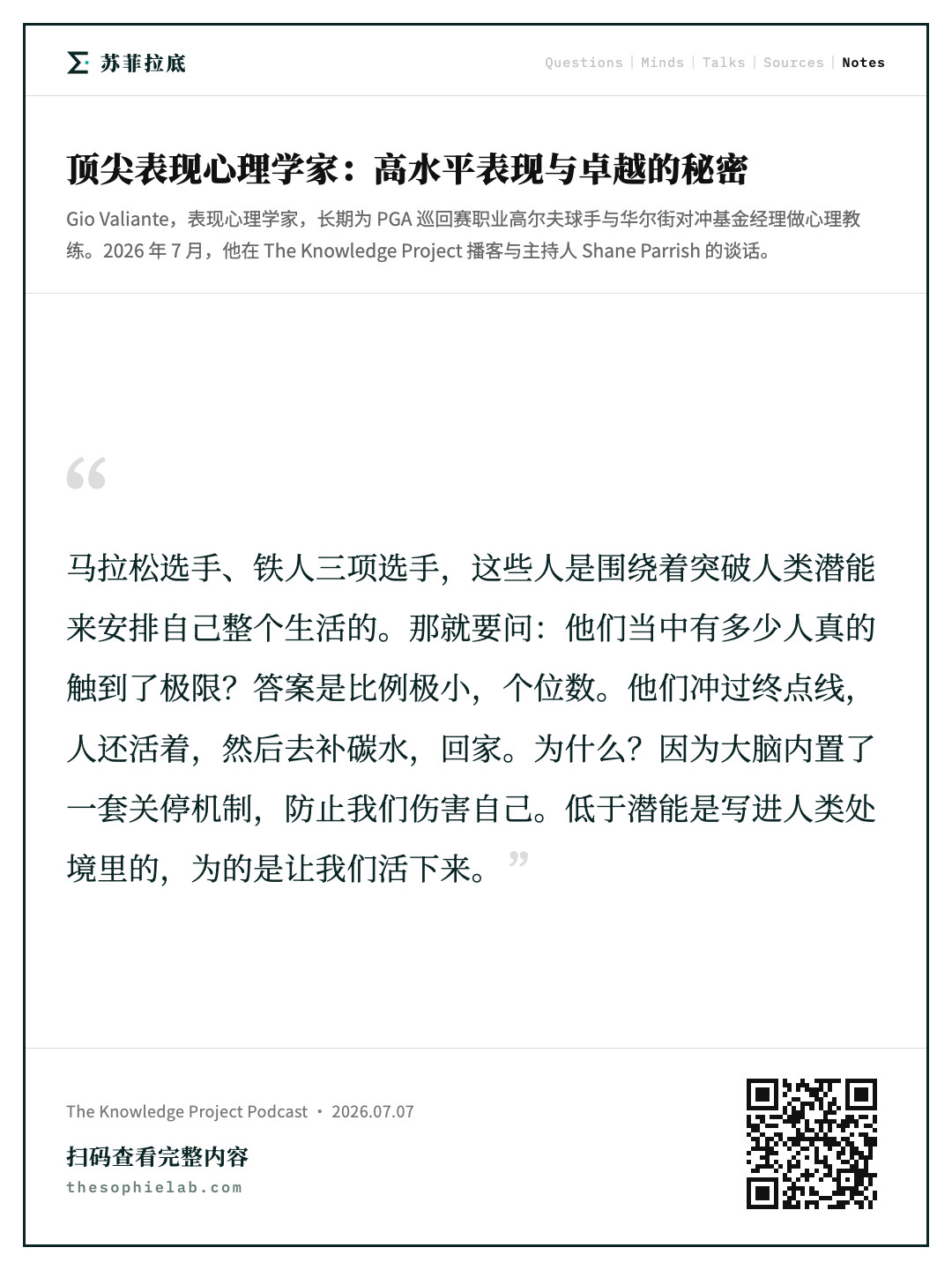
瓦连特: 举个常见的例子。看看马拉松选手,或者任何一种极限运动员。马拉松选手、铁人三项选手,这些人是围绕着「突破人类潜能」来安排自己整个生活的。那就要问了:既然连超级马拉松选手都在里面,就是那种五周之内跑五个马拉松、或者五天之内跑五个的人,那么他们当中,有多少人真的把自己推到死亡边缘?有多少人真的触到了极限?答案是,比例极小,个位数。取整算一下,假设有五百万个马拉松跑者,一年里也许死五个、十个,而且大部分还是被车撞了,或者本身有别的病症,不是因为把自己逼得太狠。他们冲过终点线,人还活着,然后去补碳水,回家。

瓦连特: 为什么?因为大脑内置了一套关停机制,防止我们伤害自己。在人的驱力层面上,管着我们行为的也正是这同一套机制。所以说,「低于潜能」是写进人类处境里的,为的是让我们活下来。生物学家做过一些很有意思的实验,用单细胞生物,把它们放进培养皿,然后把环境弄得不舒服。他们用各种不同的生物做,把培养皿一侧加热,生物就往舒服的那头挪;把一侧弄得太冷,它们还是往舒服的那头挪。

瓦连特: 所以在最根本的生物层面上,我们全都被编好了程序:寻求舒适与安全。可是舒适与安全,恰恰是超常发挥和兑现潜能的反面。这就是起点,是入场的底注。你要想在某件事上做到出色,老话说,你得让自己习惯不舒服,但这是需要训练出来的东西。

瓦连特: 所以中央调节器假说的意思是,人脑里确实坐着一个调节器,而这个调节器在结构上由几样东西搭起来。第一,生存本能。第二,对舒适的渴求。第三,在最根本的生物层面上,我们的 DNA 要求自我复制。遗传学家有这么一种看法,我们平时讲「人的能动性」(agency),能动性的定义是:我们对自己的生活拥有多大程度的自觉控制,也就是为自己行动。而根本问题是,人到底有没有自由意志?威廉·詹姆斯和实用主义者们问过这个问题。绝大多数观察者的结论是,我们对自己的控制力,比我们自以为的要小。

瓦连特: 那么詹姆斯最后怎么说的?他说:「我行使自由意志的第一个行动,就是选择相信自由意志。」你把这句话真的想进去,顺着这个洞口往下走,再去看那些研究,你会发现,人们以为自己在思考,其实多半只是在重新排列自己的偏见。所以我们真正拥有的那几次能动行为,其中之一就是:决定自己的道路,然后养成习惯,让习惯变成无意识的东西,把自己推到任何一个领域的分布曲线的尾端去。但默认状态永远是低于潜能。所以,要在某件事上变得非常非常好,先得有一个能动的行为:选择变得非常非常好。这是底注,是开局的第一手。从那儿开始,真正的功夫才刚要下。

先做,再想

主持人: 那么,我一旦选择要在某件事上做好,就真能做好吗?这里面有没有一件具体可操作的事,是人们可以拿走、放进自己生活里、帮他们兑现潜能的?

瓦连特: 看看新年决心的数据吧。百分之九十五的新年决心,到二月底就结束了,剩下的百分之四,三月底也结束了。所以「选择」只是开头。

瓦连特: 我认为首先要明白的是,我们都是习惯的造物。阿尔伯特·班杜拉说过,行为是行为的原因。行为是行为的原因。在概率意义上,你做某件事越多,你越可能继续做同一件事。所以你要是真想从眼下的处境里出来,想换一种活法,有几点要想清楚。

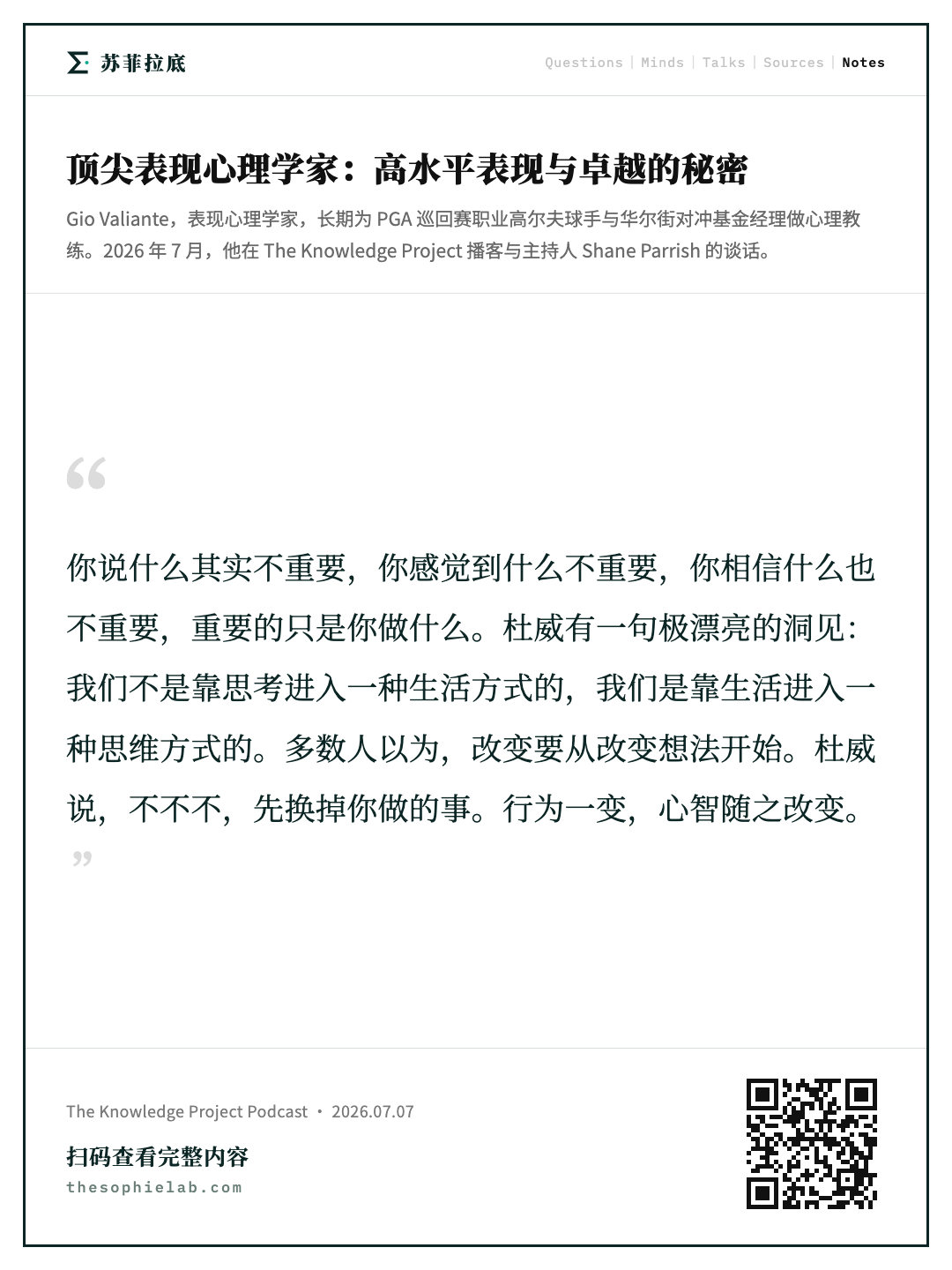
瓦连特: 第一,关键在做,不在想,也不在说。我常跟人讲,你说什么其实不重要,你感觉到什么不重要,你相信什么也不重要,重要的只是你做什么。迈出那一步,那个行动的一步,那个行为层面的一步,占了极大的比重。美国哲学家约翰·杜威有一句极漂亮的洞见,他说:「我们不是靠思考进入一种生活方式的,我们是靠生活进入一种思维方式的。」你好好想想这句话。我们不是靠想,想进一种生活;我们是靠活,活出一套想法。

瓦连特: 他的意思,回到你的问题,就是人怎么改变。多数人以为,改变要从改变想法开始。杜威说,不不不,改变念头只是通向改变的一条路而已。他真正说的是:我们不是靠思考进入行动,我们是靠行动进入思考。所以他实际上在建议的,也是我相信的,是先换掉你做的事。行为一变,心智随之改变。所以回到我刚才那句,你想什么、感觉什么、说什么都不重要,重要的是你做什么。

瓦连特: 那么回到你最初的问题,一个人想变好,可以改一件什么事?去找出那个拖住你的舒服习惯。可能是手机,可能是吃的,可能是你对自己讲的那套借口,随便哪一件。改掉那一件,然后在这一件事上,反复地、持续地要求自己交代。卓越里有一种「每日性」。它就是每天每天的事。

瓦连特: 常有人问我,吉奥博士,我想写一本书,书该怎么写?我说,你坐下来写。你想写一本书,你就写一本书。你不要等灵感。你每天坐下来。碰上什么都写不出来的日子,你就待在椅子上,把它写烂。因为你必须穿过那些糟糕的日子,才能抵达好的日子。我在罗林斯学院和埃默里大学给硕士生开过很多次写作工作坊,工作坊上讲的就是这个。你想写一本书,你想做一个写作者,写作者每天写。说得烂也行,写得烂也行,但别从椅子上站起来。这种每日性,是任何领域里卓越的标志。

主持人: 为什么有些人能抓住这些基本功,用它们,把它们一点点磨得更好,然后一直做下去,而另一些人不能?

瓦连特: 你问的时候用了「有些人」。我要说的是,所有人都这样。为什么?我不想把事情过度心理学化,但我确实觉得这里有一课,就是回到人类动机最根本的地方去:人为什么做他们做的事?

瓦连特: 其实我在运动心理学里最早做的一项研究,是访谈两百名高尔夫球手,有 PGA 巡回赛的,有 LPGA 巡回赛的,有很好的业余选手,也有普通业余爱好者。问题很简单:你为什么打高尔夫?你会觉得这问题很好答。可从里面浮出来的,大概是我见过的关于人类动机最深的一个洞见,高尔夫在这儿不过是人性的一个培养皿。

瓦连特: 你会发现,有些人打球是出于对这项运动的爱,我爱高尔夫。有些人打球是因为好胜,我要赢过那个人。有些人打球是为了钱。但他们是在拿高尔夫当工具,去解决生活里别的事情。你把这个推广开去,去问医生,你当初为什么学医?问律师,你为什么学法律?问老师,你为什么教书?你会发现,人基本上分岔成两个阵营。

精通与自我

瓦连特: 所以回到「人为什么做他们做的事」。有一类人抱着精通取向(mastery motivation)投入自己的手艺或任务,它由几样东西支配,核心是内在动机。他们做这件事,是为了这件事本身,不是拿它当工具去到某个地方、办某件事情。满足感就在做的过程里。

瓦连特: 另一条路径叫自我取向(ego orientation)。名字里就有答案:你为什么做你做的事?为了抬高自我。我做这个是为了钱,是为了让自己显得重要,我拿这件事当工具,让自己感觉好一点。所以,如果你学医是因为想挣很多钱,可你其实并不在乎医学,你一定会燃尽。如果你学法律是因为你想发财,可你并不爱法律,你会燃尽。所有运动都一样,生活里几乎所有事都一样。

瓦连特: 而你在分布曲线最尾端看到的,百分之一里的百分之一,那些伟大的源头,第一顺位的变量,倒下的第一块多米诺骨牌,是他们凭直觉走向了自己的天职。他们之所以这么做,是因为爱这门手艺本身。那是一种召唤,而他们护着那份纯粹。

瓦连特: 你也常看到有人在职业生涯里重生,或者说复兴,旁人会问,这是从哪儿冒出来的?他们自己的说法往往是:哦,我又爱上它了。凯利·斯莱特说,我又爱上冲浪了。高尔夫这边是布鲁克斯·科普卡,我最近又爱上高尔夫了。音乐家也一样,那些到晚年还在练手艺的人。

瓦连特: 所以这条发展路径是这样的:起点是精通取向,你做这件事是因为你爱做。接着你开始因为它得到奖赏。然后奖赏本身变得比这件事更有力量。然后你把自己弄丢了。然后你重新找回自己,回到精通,回到那份召唤本身。

主持人: 可是我们怎么才能爱上自己做的事?如果我进高尔夫是因为我爱它,中间起起落落,开始赢球,心态从精通滑向自我,然后开始输,这是一种情形。可另一种情形是一个办公室职员,或者公司里的高管,他有一份工作,他大致还喜欢,但他想做得更好,想触到自己的上限。我们怎么在一件自己并不全然热爱的事情上,切换到精通取向?

瓦连特: 这是个好问题,它又回到我们刚才碰过的东西:人的能动性和自由意志,我们究竟能控制什么。有一本书我相信你读过,叫《发现心流》,米哈里·契克森米哈伊写的。

心流的四个标志

瓦连特: 心流,或者说心流状态,是人类状态的最高形态。你要想看看人到底能做到什么,就去找那些曾经进入心流的人。关于心流的研究非常迷人,它显示了几件事。第一,我们几乎做任何事都能进入心流。园艺,做饭,人是可以在侍弄花园的时候进入心流的。好的谈话就是心流状态。运动,恋爱,读一本书。

瓦连特: 那么心流的特征、它的标志是什么?第一,时间被超越了。你读一本好书读进去,抬头一看,怎么已经三个小时了;一场好的谈话,两个小时、三个小时就过去了。运动员跟我说过,真正在心流里的时候,你一抬头,比赛结束了,它过得非常非常快。第二,努力的悖论:难的事情感觉很轻松。第三,知觉的悖论:你太沉进那一刻了,你太在场了,以至于忘了自己正被人看着,忘了有观众,忘了有一个结果在那儿等着。能够超越自身局限的人,通常都是在心流里把自己弄丢了。

瓦连特: 所以你要问我,对那些卡在分布中段、所谓「普通」但想变得出色的人,我有什么建议?有这么几条。第一,留心你的习惯。第二,让自己习惯不舒服。第三,把「完全在场」练到好。进入当下。杜威在《我们如何思维》里说,对有效思考而言,没有比分裂的注意力更大的敌人。注意力被切碎了,你把硬盘分了区,人在这儿,脑子在别处;人在这儿,想着别的,你从来没有完全在场。最好的那批人,任何时候对任何事都是完全在场的。

瓦连特: 这里有点佛家的味道,但在场这个习惯,确实是卓越的标志。所以人要想把工作做到出色,进心流。怎么进心流?进入当下,给自己挑战,爱上细节,爱上你工作里那些平淡无奇的部分。

主持人: 我想再回到心流一会儿。我猜「完全在场」是所有顶尖高手的共同点。可你怎么向一个人解释「完全在场」这件事?我在开会,脑子忽然跑去想买菜、想孩子,一下子就不在场了,我怎么把自己拉回来?

瓦连特: 和别的事情一样,在场是一个习惯,和任何习惯或技能一样,可以练。你不能平时不练在场,到了关键时刻就指望能召唤出深度的沉浸、在场或者心流。

瓦连特: 那就要问:什么把我们拽出当下?是分心,是执念、是黏附(attachment)。所以对任何想变好的人来说,好消息是,持续地练一点点,效果就很大。

每周一次的剥离

瓦连特: 举我自己的例子。以我对心理学的了解,我每周五下班前会花十到十五分钟,问自己一个简单的问题:有哪些东西黏到了我身上,正在打断我的思绪,而它们并不是我有意识选进来的?我脑子里想的哪些事,不是我选择去想的?我身上的哪些感受,不是我选择去感受的?

瓦连特: 你会慢慢发现,在人生这段旅程里,仅仅因为人脑的构造,我们默认就会黏到一些东西上,或者一些东西黏上我们。这其实回到尼采说过的话,尼采和荣格在这一点上是一致的:不是我们有想法,是想法占有我们。我们常常并没有选择要这样想、这样感觉,是有些事情发生在我们身上,然后它们支配了我们。这就是条件化,这是真的。

瓦连特: 所以我做的,就是主动练习从那些正在塑造我思想、情绪、行为的东西上剥离开。你会发现,填进那片空处的,是心理上的自由与在场。持续地练一点点这样的事,忽然有一天你会发现自己拥有了心理自由,从那里出发,你才能去探索自己最好的那个版本。

环境才是天花板

主持人: 塑造我们的环境有多重要?我说的不只是物理环境,还包括心理环境:我们消费的信息,我们放进生活里的人。

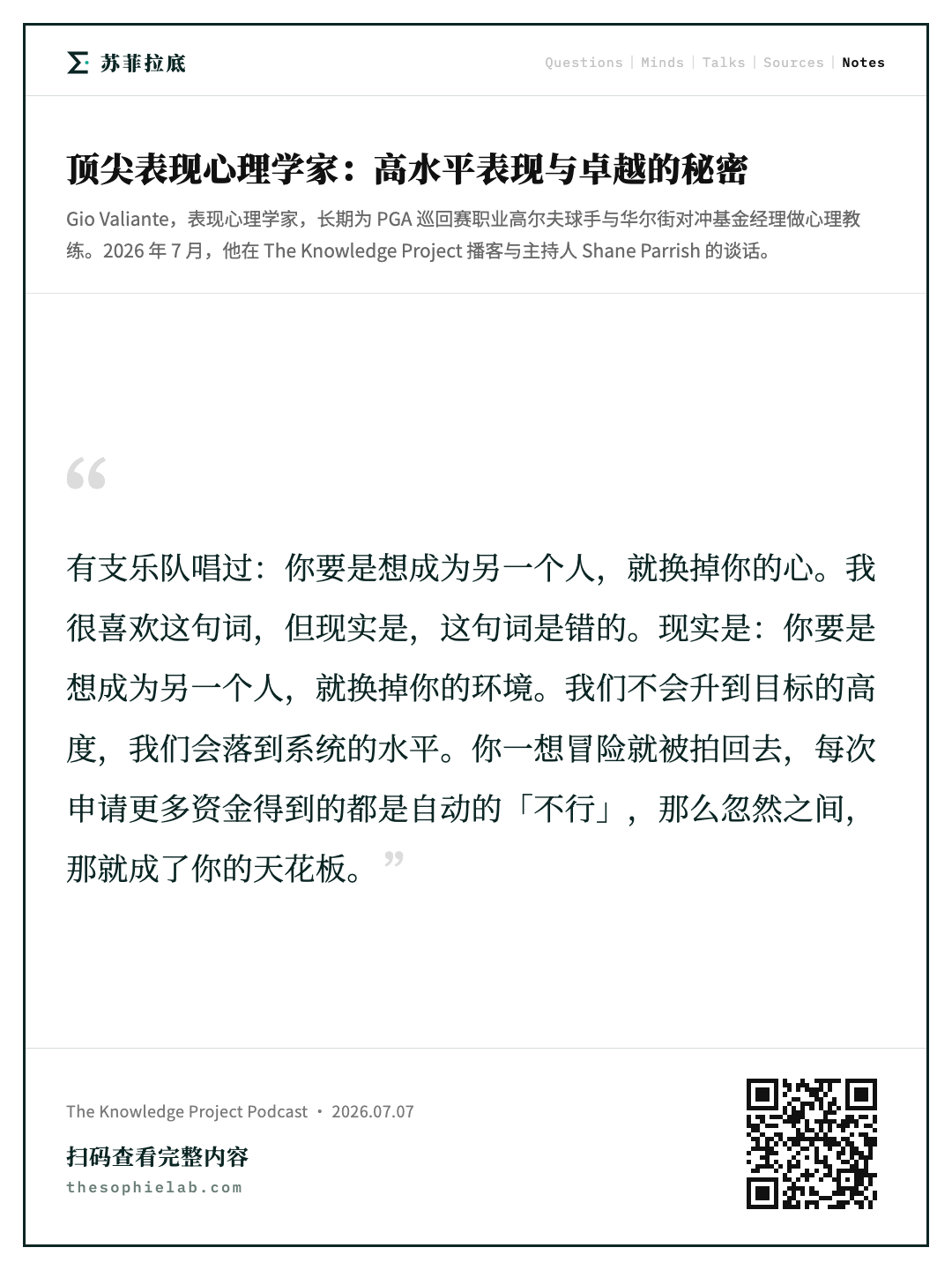
瓦连特: 好问题。有一支老乐队叫姐妹榛果(Sister Hazel),他们有首歌里唱:你要是想成为另一个人,就换掉你的心。我喜欢这支乐队,也很喜欢这句词。但现实是,这句词是错的。现实是:你要是想成为另一个人,就换掉你的环境。为什么?

瓦连特: 心理学里有个概念,叫情境认知(situated cognition)。情境认知讲的是,人脑一直在与周遭环境互动,既在意识层面,也在无意识层面,而且主要是在无意识层面。你这样想:热了我们会出汗,但我们不是选择要出汗;冷了我们会起鸡皮疙瘩,但我们不是选择要起鸡皮疙瘩。人脑是在无意识层面与环境互动的。事实上,与环境的无意识互动,才是人类行为的主要驱动装置。

瓦连特: 《原子习惯》里有一句现在流传很广的漂亮话:我们不会升到目标的高度,我们会落到系统的水平。他的意思是什么?假设你立志做到卓越,可你身处的学校、班级、公司或者团队并不支持你走向卓越,你一想冒险,就被拍回去。假设你是对冲基金的投资经理,你所在的地方极度厌恶风险,上面有个风控经理,他只想保住自己的饭碗,所以事事求稳。于是你每次申请更多资金,或者想突破风险上限,得到的都是自动的「不行」。那么忽然之间,那就成了你的天花板。

人与自己的差距

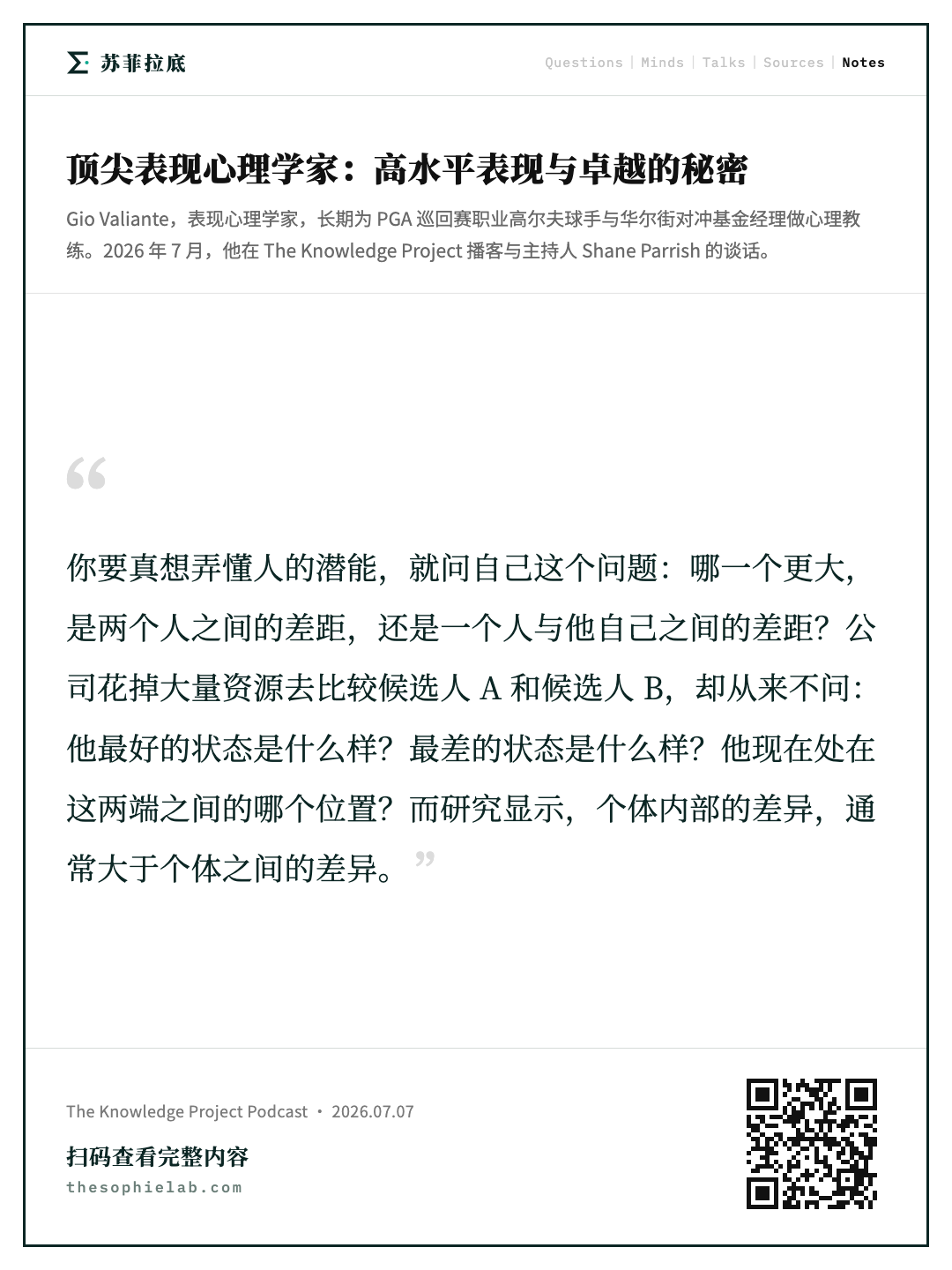
瓦连特: 你要真想弄懂人的潜能,就问自己这个问题:哪一个更大,是两个人之间的差距,还是一个人与他自己之间的差距?

瓦连特: 想想你和我。假设一家公司要招人,他们说,我们该招谢恩还是招吉奥?他们给我们俩做测评,比来比去发现,两个人的智商或者智力水平差不多,教育背景相近,很难选,好吧,就要谢恩。但他们从来不问:谢恩最好的状态是什么样?最差的状态是什么样?他现在处在这两端之间的哪个位置?他们花掉大量资源去给人做画像,就为了确保招对人。

主持人: 可人一旦入职,就没人再去看这个人最好与最差之间的落差了,也没人问怎么把他最好的一面调出来。

瓦连特: 而研究显示,个体内部的差异,通常大于个体之间的差异。今天的社会花了太多时间去比较候选人 A 和候选人 B。个体内部可挖的心理阿尔法,远多于个体之间。团队、机构、学校都花大量时间去比较学生 A 和学生 B,却没有意识到,而这正是我干活的地方,真正的问题是:这个人能成为什么?有人来找我说,你能帮我吗?好,那我们先看你现在在哪儿。

主持人: 对。

瓦连特: 然后看压制机制是什么。你刚才问,什么东西让人无法超常发挥?我们把它们叫做压制机制(mechanisms of suppression),它们导致低于潜能的表现和成就。这些机制基本上是已知的。你开始把它们一个个拆掉,帮人把它们认出来,忽然他就开始绽放了。个体内部的差距,往往就是比两个人之间的差距更大。

一起解决难题

主持人: 那是什么促成了这种绽放?

瓦连特: 一是一项对你有意义的使命。二是你身处一个集体解决问题的系统里,大家一起解决难题。

瓦连特: 我现在越来越多地在各个领域的领导层讲这件事,学校里也一样,老师也一样:所有人的岗位说明,最后都该收敛成一句话。我走到哪儿,这句话都一样:把和别人一起解决难题这件事做好。更准确地说,是学会如何做到极其擅长与别人一起解决难题。

瓦连特: 这句话说起来容易,做起来极难。因为自我在那儿。你把一个难题摆在两个人面前,十个人就更别提了,尤其是聪明人,他们习惯了自己是对的,可他们各自认定的解法不一样,于是有人是错的,可他们从来没错过,于是开始防守,于是变成争吵,人一个个把自己关上。但你要是真能置身于这样一个系统:人人称职而有能力,开放而愿意,并且他们的最高召唤就是把「一起解决难题」做到极好,那就是通往自成目的(autotelic)状态的路,是通往心流的路,是通往伟大与卓越的路。

瓦连特: 我举两个例子。第一个是爱因斯坦。他被一个问题卡了很久很久。有一天他和一位年轻同事散步,试着跟对方解释自己在做什么,就在拆解、剖析自己的思路,把它讲给别人听的过程中,那个顿悟来了。接下来三个月里,他写出了两篇论文,后来带来了诺贝尔奖。他卡住、卡住、卡住,然后是语言的合成功能起了作用,把思考说出来的过程,导向了顿悟。

瓦连特: 第二个是发现 DNA 结构的克里克和沃森,一模一样,是在互动的过程里发生的。那个团队一共有四位研究者。真正起作用的,是解决问题时的互动。

瓦连特: 所以,人如果想提升自己、想把才能与能力充分表达出来,第一个要看的地方,我前面说过是你的习惯和行为。但更真实的答案是,第一个要看的地方是你的系统和环境。它是不是一个具备卓越所有标志的地方:诚实与讲真话,挑战与技能成长,没有天花板。

瓦连特: 顺带一提,丹尼尔·科伊尔在一本很不错的小书里讲过这个,他把这类地方叫做「天才温床」,就是那些能不成比例地批量产出卓越的地方。伟大的歌手总是从达拉斯附近那所很小的学校出来。有一段时间,伟大的网球手都出自俄罗斯。伟大的棒球手出自多米尼加。伟大的女子高尔夫球手出自韩国。看高尔夫的历史,伟大的球手多出自得州和加州这些高尔夫大州。而天才温床的一个共同标志是:他们怎么对待错误。

瓦连特: 归根到底,人之所以做不到自己能做到的程度,最主要的压制机制,就跟他们被如何训练去对待错误与失败有关。你要是真想变得出色,就把自己放进这样一个环境:它给你自由,它有挑战、有问责、有严格与细致,但它不会对错误过度惩罚。

面试要问什么

主持人: 你面试一个人的时候,我想知道,什么是伟大的迹象,什么是「这人没他自以为的那么好」的迹象?史蒂夫·科恩说你是矿井里的金丝雀,但你同时还有一种本事,能在很短时间内识别出人才。你会问什么问题?你是怎么做到的?

瓦连特: 心理学能测量的所有变量里,我认为最重要的两个是信心和动机。信心和动机。人们以为是智力,其实不是。

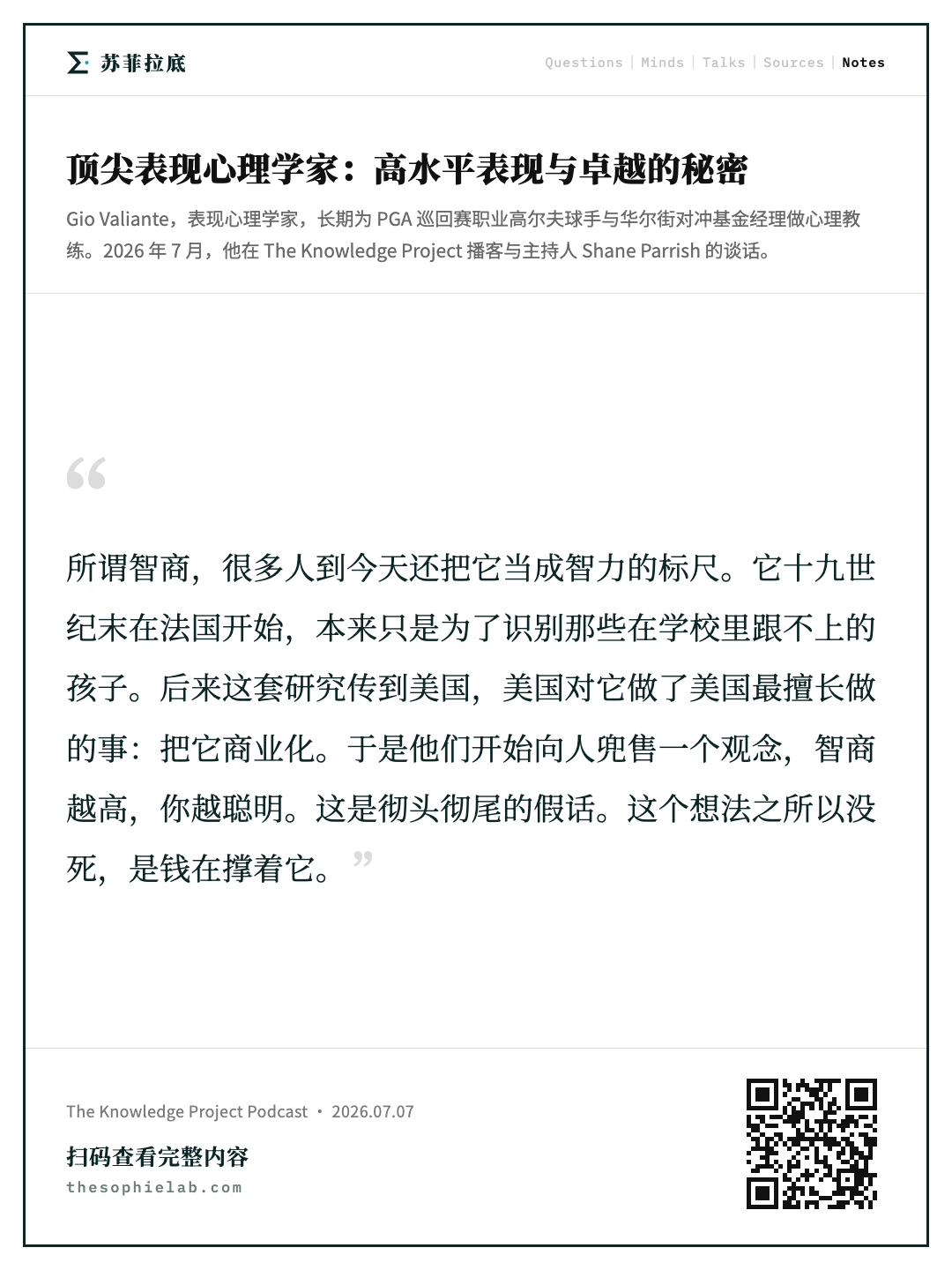
瓦连特: 智力这件事,我们对它的定义,是一笔糊涂账。所谓智商,很多人到今天还把它当成智力的标尺。IQ 这个东西,我记得是十九世纪末在法国开始的,阿尔弗雷德·比奈。当时法国政府说,我们需要识别出在学校里跟不上的孩子,如果能早点识别出来,就能早点干预。就这么回事。比奈去做了些研究,访谈了一批人,弄出了他的智力商数,说,我们按这个来测,这些就是会在学校里吃力的孩子。

瓦连特: 后来这套研究传到美国,美国对它做了美国最擅长做的事:把它商业化。于是他们开始向人兜售一个观念,智商越高,你越聪明。这是彻头彻尾的假话。智商高不等于你更聪明。然后人们对智力测验彻底疯魔了,那是一个几十亿美元的产业,这也正是这个观念活到今天的原因。SAT、ACT、各类教育测评体系,都是几十亿美元的生意。这个想法之所以没死,是钱在撑着它。它本身是个荒唐的想法。

瓦连特: 你当然可以主张存在一种叫 g 的东西,也就是一般智力。但哈佛有位研究者,霍华德·加德纳,先做发展心理学,后来做认知心理学,他提出人拥有他所说的「多元智能」,这直接挑战了智商的正统地位。他说,人拥有若干各自独立的智能。比如语言智能,数学智能,每一种智能都有自己的特征。还有人际智能,你在这方面是天才。什么是人际智能?就是能实时读懂另一个人,感知对方此刻在情绪上、认知上处在什么位置,并且把对方引导到别处去。优秀的政治家有很强的人际智能,优秀的中小学老师也是。

瓦连特: 第四种叫内省智能,就是了解自己的能力。如果你有过目不忘的记忆力,却毫无自我认知,你到底算多聪明?那不叫智力。

主持人: 对。

瓦连特: 加德纳还讲身体动觉智能,就是知道自己的身体在空间中的状态。迈克尔·乔丹,老虎伍兹,还有伟大的舞蹈家玛莎·葛兰姆,懂得自己的身体,拥有这种本体知觉。还有空间智能,伟大的建筑师必须具备,能立体地看见事物。

瓦连特: 回到你的问题,我筛选一个人的时候看什么。我想弄明白这个人完整的画像。他从哪里来?动机的源头是什么?他怎么处理失败?我想知道他在多大程度上讲真话。

瓦连特: 因为多数情况下,人在对话里,尤其在面试里,呈现的是一个他希望你看到的版本,而那不是将来出现在工位上的那个版本。所以最重要的问题之一是这个:跟我讲讲,你人生里有没有过这样一段时间,你不得不和一个你不喜欢的人共事。可以是小学,可以是初中,可以是大学里的某个项目,也可以是你上一家公司。一个你从根本上不认同、而且打心底里不喜欢,却又必须合作的人。你当时是怎么处理的?你把这个问题的某个版本抛出去,然后往后一靠,只管听,这会把这个人是什么样的人给暴露出来。

主持人: 也会暴露他在职场里遇到逆境时的反应。

瓦连特: 对,尤其是在艰难的行业里,在你要解决难题的地方。他怎么处理冲突?他在多大程度上责怪别人?在多大程度上把自己关闭起来?在多大程度上仍然投入?研究显示,把品牌管理或者形象管理置于解决问题之上的公司,衰败得相当快。所以必须是这样一种环境或者文化:聪明人被授权去解决难题,而他们在乎使命,在你的情况里就是那个使命,胜过在乎自己。

瓦连特: 所以这些我全都要看。而且这还取决于岗位,因为很多人是有能力、能胜任的,可你要是把对的人放进错的位置,他永远不会开花。它必须与这个岗位的具体要求严丝合缝。

主持人: 还有别的问题,你觉得特别能照出一个人吗?

瓦连特: 你这辈子必须克服的最大障碍是什么?紧接着的追问是:你借助了哪些资源去克服它?换句话说,你是怎么克服的?多数人问到「你克服了什么障碍」就停了。心理学上真正有意思的地方在「你是怎么克服的」。

瓦连特: 所以一个非常重要的面试问题就是:说说你这辈子克服过的最难的事,然后,你当时调动了什么?你去找别人了吗?你有没有一张人际网络?你动用了哪些信念?搞清楚一个人克服障碍的方法,非常重要。有些人得靠自己。老虎伍兹在有一段时期就非常擅长这个。他的自我对话是这样的:是你自己把自己弄进这摊烂事里的,现在你自己把自己弄出来。那是最好的老虎。我们当然也见过别的版本的老虎,但最好的那个老虎,是那个对自己说「是你把自己搞成这样的,现在自己收拾」的老虎。

先赚一百美元

主持人: 我最近才意识到自己在做一件事,以前从没察觉过,就是把「我在哪儿」和「我想达成什么」之间的差距缩小。不是盯着最终目标,而是盯着第一步。我们常常盯着自己想达成的那个东西,我要成为某某某,我要如何如何,可你当下的位置和那件事之间的距离,看上去大得吓人。我发现把这个差距缩小很有用。我之前和埃米莉·巴尔切蒂斯博士聊过,她举了马拉松选手的例子,我觉得非常贴切,想听听你怎么看。她说,当跑者的腿开始疼,跑到第十一英里的时候,他们不会去想终点线,他们把注意力切换到下一个停车标志、下一个红绿灯,然后一个接一个,忽然之间,你又回到心流里了,要么是不再感觉到痛,要么是已经跑穿了那阵痛。

瓦连特: 高尔夫里也常有这种时候。今天早上就有人来找我说,我职业生涯里第一次陷入低潮。我职业生涯里第一次进入回撤。我第一次不赚钱了。我收到的都是这类消息。

瓦连特: 那么,你怎么把一个人从回撤里领出来?假设你管着五亿美元,跌了,比方说你的止损线是五亿规模下亏百分之二十就走人,你已经亏了百分之十五,余地不多了,可你又必须上风险,因为怕钱的人赚不到钱。所以你得上风险。但你要是再错一次,饭碗就没了。

瓦连特: 走出回撤的第一步,是重新养成赚钱的习惯。人们犯错的地方在于,他们盯着回撤的幅度看,然后想一杆把它全打回来。他们开始慌。人一慌就失去理性,看见的是威胁,不是机会,处在回撤里的投资经理有一整套这样的特征。而我会说,我们不打算全打回来。我们赚一百美元。这周赚一百美元。把风险降下来,先把赚钱这个习惯捡回来。他会说,可我这样永远出不来。我说,我明白。但正如文斯·隆巴迪那句名言,赢是一种习惯,不幸的是,输也是。那么赚钱也是一种习惯,在高尔夫里打得好同样是。

瓦连特: 一个有信心的投资人看世界,看到的是一个丰盛的世界,处处是机会。他把市场看成一个丰盛之地,机会遍地,我的时间不够用,来不及把所有机会都抓住;我的资金不够,我需要更多钱,因为这个市场里能赚的钱太多了。而当我们失去信心,我们看到的市场是一个威胁之地。

主持人: 嗯。

瓦连特: 处处危险,遍地地雷。于是你丧失了承担任何风险的能力,因为你眼里只有危险。这就是为什么你必须护住你的信心。为什么?因为恐惧扭曲我们准确看清世界的能力。恐惧是一种扭曲。恐惧意味着危险无处不在,至少我们感知到危险无处不在。

瓦连特: 所以我对一个投资经理要做的第一件事,是让他养成赚小钱的习惯。为什么?因为信心最大的来源是成功。你养成了赚一百美元的习惯,接着就是,好,下一笔我们赚一千。这时你又有信心了,你重新看见机会。你看见机会,就开始把资金投向更好的机会,价格波动时你也更有耐心。

瓦连特: 信心与恐惧的一个区别就在这儿:假设你把钱投进一个想法,这个想法开始对你不利。你是砍掉仓位,还是加仓?如果你爱这个论点,爱你做过的功课,爱这个想法,你会加倍下注。你会往一个正在与你作对的想法里投钱。而你害怕的时候,你看见的是威胁和危险,你会在错误的时间退出,你会把一个想法交易得过于频繁。所以你必须不惜一切护住你的信心。信心与动机。

瓦连特: 人在害怕的时候,永远看不见那条路。所以任何身处危机中的人,第一步都是你刚才提到的那件事,无论他是高尔夫球手、投资经理、做私募的、做风投的,还是跑者:去找那些我们确定能拿下的小胜利,然后为它们庆祝。因为它改变了情绪的底色,你开始把一个个增量的小胜叠起来,而那通向卓越。

信心的四个来源

主持人: 信心也分种类吗?我们都见过那种出于傲慢的自信,也有一种几乎是出于谦逊的自信。信心是有不同类型的。

瓦连特: 信心确实有不同的风味。现代心理学谈「自我」,有三个自我构念:自尊、自我概念、自我效能。

瓦连特: 简单说,自尊的定义是:我对自己感觉如何。我的自尊高,或者低,它就是一种关于自身的情绪感受。拥有健康的自尊当然重要,但它跟卓越在经验数据上毫无关系。有些最顶尖的表现者,对自己的表现感觉并不好,世界最好的那批人从来不觉得自己做得好。而表现不佳的人反倒感觉很棒,这就是过度自信,他们无论如何都感觉良好。这是自尊。

瓦连特: 第二个变量是自我概念,即我如何看待自己,也就是身份认同。我照镜子的时候看见什么?这个跟表现有一点关系。

瓦连特: 然后是自我效能。自我效能本质上是被操作化了的信心。关于信心,已知的有这么些事。它有两种形态。一种是作为人格特质的信心。有些人生下来就是这样,你去问他爸妈,他们会说,对,他从小就有那股天不怕地不怕的劲儿,一直如此。不管那是什么东西,他或她一直都有。这是作为人格特质的信心。这种东西对人生其实没什么决定作用,有这种特质的人里,有失败者,有成功者,中间什么样的人都有。

瓦连特: 现代心理学定义信心,用的是自我效能。而被操作化的信心的美妙之处在于,我们能测量它,我们知道多米诺骨牌是怎么倒下的,我们知道是什么造就了它。

瓦连特: 举例来说,这是我几乎每场面试都会问的另一个问题:说一件你觉得自己做得好的事。任何一个在听这期节目、想把某件事做好的人都可以试试。我问你,说一件你相信自己做得好的事,你给出一个答案,然后我把它拆开,问你为什么这么相信。你会发现,而且这一点在人类处境里、在所有领域里都成立,答案归结为四类经验。

瓦连特: 第一类叫掌握经验(mastery experience),说白了就是成功与失败:这件事我做过多少次、失败过多少次,成功过多少次。但它不是算术。它是对成功与失败的诠释。就像关颖珊在奥运会上把金牌输给塔拉·利平斯基,媒体说,米歇尔,你刚刚失去了金牌,你一定很难受。她说,不不,我没有输掉金牌,我赢得了银牌。两句话在客观上都成立,关颖珊确实赢得了银牌,她也确实没拿到金牌。但她的那种诠释,护住了她的信心。你猜怎么着?那一年晚些时候她拿了世锦赛冠军。

瓦连特: 所以信心的第一来源,大脑问自己「我能不能做成这件事」时第一个去找的地方,是过往经验。但你要当心的是,失败带来的痛,比成功带来的快感更强烈。于是我们会向自己的失败倾斜。

主持人: 对。

瓦连特: 我们把过去失败的痛带到当下。这就是为什么绝大多数人是信心不足的。

主持人: 因为记忆和大脑的运作方式,让他们记住的是自己做错的事,那些失误。

瓦连特: 百分之百。高尔夫球手永远想跟我谈他们打坏的那几杆。投资经理永远想跟我谈他们亏掉的钱、他们没做成的事。

主持人: 那就像一只锚。

瓦连特: 它变成锚,变成他们的天花板。

瓦连特: 信心的第二个来源是言语说服,我们称之为言语与社会说服,就是别人给我们的反馈。你刚才也提到了:你为什么觉得自己擅长某件事?因为别人这么告诉过我。而偏差又在这儿:批评带来的痛,比表扬带来的快感更强烈。

瓦连特: 所以你把这两样合起来,掌握经验里失败比成功更有分量,言语说服里批评比夸奖更有分量,在整个生命周期里,人就会不断向过往的失败之痛和所受的批评倾斜,并且开始带着这种倾斜去预期自己的人生。

瓦连特: 第三类经验叫替代性经验:我跟别人比起来如何。我们是相对于他人来评判自己能力的。当我们看到有人毫不费力地把我们辛苦下功夫的事情做得更好,我们的信心就下去了,这叫替代性学习。

瓦连特: 第四个来源,在这门学问的「圣经」里,叫生理状态,就是胃里那阵蝴蝶乱飞的感觉。谢恩,你为什么觉得自己擅长做访谈?因为我能感觉到。那是一种感觉。但你会发现,你在采访一位重要人物时感受到的那阵悸动,你把它理解成兴奋、觉得很好的那阵悸动,和别人在关键时刻发挥失常时感受到的悸动,在生理上是同一种东西。区别在诠释。

瓦连特: 所以总体来看,信心是这四样东西的合成物:过往的成功与失败,别人如何评说我们的好坏,我们如何与他人比较,以及我们对正在做的事有什么感受。

过度自信的分寸

瓦连特: 你刚才说到那些自信得过头的人。关于信心,已知的是这样。假设这条线是你客观的技能与能力,是可测量的:你的语言智能、数学智能,你作为对冲基金经理赚钱的能力,你作为播客访谈者的能力。我知道怎么构造问题,我知道怎么听,我知道怎么追问,我懂这些。这是你的技能线。

瓦连特: 稍微一点点的过度自信,是非常好的东西。为什么?因为它把那些技能和能力抬起来了。你看见机会,你承担更多风险,你把自己放进更有挑战的处境。稍微过度自信是好事。那它什么时候变危险?

主持人: 过度自信过了头的时候。

瓦连特: 太过头。那会导致草率、傲慢、懒惰、自欺、欺人。所以你必须护住信心。

瓦连特: 还有一件事会发生。当我们失去信心,当信心低于我们的实际能力,我们会向那个低处倾斜。也就是说,你有多少技能和能力都不重要,它们最后都会想办法向那个信念靠拢。这种事每天都在发生。

主持人: 那么低于潜能这件事,最主要的机制是什么?

瓦连特: 人们向自己过往的失败倾斜,向批评倾斜,向别人会怎么看自己倾斜。这在哪里最明显?你去看金融从业者、投资从业者承担风险的数据,你会看到一条随时间递减的曲线,跟你以为的方向正好相反。我们上了年纪,风险偏好反而下降。为什么?通常的解释是,我钱已经赚够了,不想再拿它冒险。这不对。真实发生的是,我们的技能其实在变好,我们比任何时候都更懂自己在做什么,但与此同时我们也累积了足够多的失败,我们不想再体验那种滋味。于是我们失去了冒险的胃口。这在每一个成就领域里都在发生。

瓦连特: 所以又回到那些根本问题:你怎么才能活在分布曲线的尾端?你必须有一套关于「怎么对待错误与失败」的打法。因为信心的四个来源里,关于过往经验,大脑注定会觉得失败之痛强于成功之快,那你就必须动用你的能动性去覆盖它,把剧本反过来写。这就是为什么想象训练在有效的时候是有效的,为什么自我对话在有效的时候是有效的。第二,言语说服,你必须决定,你要在多大程度上在乎别人怎么看你,因为那会成为你的牢房。你要是一辈子过度在意别人怎么看你,那就是你的天花板。第三,生理状态,你要是永远不想感到不舒服,那就是你的天花板。第四,替代性经验,你要是准备把一生花在与他人比较上,而不是向自己的完整潜能靠拢,那就是你的天花板。

自我对话与祷告

主持人: 你提到自我对话。正向的自我肯定管用吗?

瓦连特: 管用。在它管用的时候管用,前提是它别变成妄想。为什么管用?人们误解了认知与语言之间的关系。人们以为,我用的词是我所想的反映,我先有一个想法,然后用词把它描述出来。实际过程不是这样。

瓦连特: 实际发生的,是一个发展过程,发生在生命早期。一开始,语言和思维是分开的。想想婴儿,他们还没有语言,然后在第二年、第三年、第四年开始用词,那些词一开始是随机的。接着词开始反映思想,再接着,两者开始融合,语言与认知变成同一样东西。这就是为什么某些词带着情绪的电荷,这就是一句好歌词的魅力所在,也是治疗中或者教练工作中一串好的措辞的魅力所在,你是在给人一套有力量的语言。

瓦连特: 在发展早期,别人使用的语言会变成我们内部的自我对话,通常是父母的语言。父母怎么跟我们说话,就变成我们怎么跟自己说话,老师、教练也一样。如果那套语言不健康、不管用、不朝着好的方向积累,它就成了我们的自我对话,然后我们又用同样的方式跟自己的孩子说话。这就是所谓的代际创伤,或者代际卓越。所以自我对话绝对重要,因为语言和认知之间存在这种相互作用。

瓦连特: 自我肯定管用吗?管用。这一点在哪里体现得最明显?在祷告里。

主持人: 对。

瓦连特: 你这样想,这真的很了不起。所有主要宗教,都有好几千年的试错时间来把这件事做对。所以不管你信不信神、信不信宗教,这些都是有好几千年时间来打磨自己的机构。它们共同拥有什么?它们全都把祷告作为自身实践的一部分。为什么?

瓦连特: 如果我每天晚上和孩子们坐下来吃饭,让他们围坐一圈,说一段类似餐前感恩的话,哪怕只是把「我为眼前这份食物心怀感激」这句话说出来,他们就是在练习感恩这个习惯。

瓦连特: 在宗教传统里也是这样:你把那些词说出来,一句信仰的宣告,把这些话说出来就行。我不在乎你信不信。你说得越多,经验的随机性总会在某一刻让你觉得,噢,原来是真的。然后我们开始相信自己说过的话。所以自我对话绝对重要。但它不是立刻见效的,它不会自动生效,它需要时间。把词说出口、把词用得审慎,这个过程会凝聚出某一类信念,而那些信念通向成功、失败、幸福或者痛苦。

部落、预见与焦虑

主持人: 你刚才说的另一件事我想回头再谈。我觉得很多人过日子的方式,是不想被别人讨厌,而这支配了他们做什么。某种意义上这是恐惧,他们让别人替自己决定行为和选择。我们怎么把这个放下?

瓦连特: 你知道这是为什么吗?

主持人: 为什么大多数人会这样?我猜里面有进化的成分。如果非要我答,我会说,我们是在部落里长大的,被逐出部落意味着死亡。我们带着这个前提演化了几千年。你不在部落里,就是被排除在外;被排除在外,你就死了。所以我们身上留着这套机制,它扎根在我们的生物构造里。

瓦连特: 完全正确。进化心理学,这是心理学的另一个分支,在拆解这件事上做了非常出色的研究:归属、成为共同体的一员意味着安全,被逐出意味着死亡。

瓦连特: 而问题在于,自然选择的速度赶不上社会变化的速度,大脑并没有跟着演化。所以我常跟高尔夫球手说:你的球技、你的大脑,并不是为了让你当 PGA 巡回赛球员而演化出来的。你的大脑演化的时候,并没打算让你成为一名职业投资人,自然选择不是那样运作的,它没有方向性。所以你是在用一件并不完美的仪器,也就是人脑,去做一件很难的事。

瓦连特: 而人类与地球上其他动物最根本的区别,是我们能进行抽象思维,这叫元认知,即思考自己的思考的能力。没有别的生物能做到这一点。你可以思考自己的思考,然后做出调整。抽象思维的美妙之处,在于它催生了「预见」(forethought)这个东西,我真的可以预先设想。

主持人: 我想十年后过得舒服,那我今天就存钱。

瓦连特: 我们预想一个可能的情形,而它支配着当下的行为。没有别的生物能做到。这是好的一面:我们能够预期和规划。坏的一面在这儿:预见容易让人过度倾向未来。于是我们开始问「如果……怎么办」。如果这架飞机掉下来怎么办?天哪。我们知道,焦虑的人活在未来,他们制造了自己的焦虑。如果飞机掉下来怎么办?做投资的,如果我把钱全亏了怎么办?如果我被开除了怎么办?高尔夫球手,如果我丢了……我们在未来安营扎寨,而且直奔最坏的情形。

瓦连特: 大脑这个特性很古怪。有个女孩给我打过电话,我永远忘不了,是在她婚礼当天早上。她婚礼当天的早上。她是我大学时代的朋友。她说,真不好意思打扰你。我说,没事,怎么了?我说,你今天不是该忙得团团转吗?她说,是啊。然后她说,如果我这是在犯错怎么办?如果他将来出轨怎么办?如果他不再爱我怎么办?如果……

瓦连特: 这是一个很好的判别方式:去问一个人,你会对自己问哪些「如果」的问题?你会发现,人几乎总是奔向最坏的情形。他们把那个未来的状态搬进当下,然后开始像它已经成真那样做出反应。我说不清有多少对冲基金投资经理经历过这个过程。他们一生里本可以赚到几千万、几亿,一开始亏一点点钱,就天哪,万一我被开除了怎么办?而且不知为什么,故事版本永远是同一个。

瓦连特: 所以我们讲大脑那些强大的功能,抽象思维、预见、假设推演,你必须学会把它们用在对自己有利的方向上。因为人类天然的默认反应,正是把我们推向分布中段、阻止我们超常发挥的东西之一。

我是谁

瓦连特: 我之所以在讲进化心理学和生存的时候要谈预见和抽象思维,是因为它们出现的时间窗口,和另一件事是重合的:青春期,初中那几年。

瓦连特: 青春期之后会发生什么?我们头一次能够用假设和抽象来思考,于是,这件事发生在地球上每一个人身上,是人类处境的普遍性之一:我们问出了人类存在中最重要的那个问题。我是谁?

主持人: 对。

瓦连特: 这个问题不会发生在更小的孩子身上,因为他们的身份认同基本上是家庭身份的一部分。但到了那时,我们开始有了「我是谁」的追问。

主持人: 嗯。

瓦连特: 这就是弗洛伊德所说的个体化(individuation)过程,我们从家庭身份里分离出来,叛逆就发生在那里。因为孩子需要回答那个问题。与此同时,你还会看到另一样东西冒出来:对归属的需要,从众。全世界的初中和高中里到处都是这个。我得成为这个群体的一员,我得穿对衣服,我得进啦啦队,或者进橄榄球队,什么都行。就是那种归属的需要。

瓦连特: 我这辈子遇到过的心理学洞见里,有两个我认为最重要,这是其中之一:我们不断试戴不同的面孔,直到找到一张属于自己的。

瓦连特: 而在人生中间那一大段里,初中、高中、大学,甚至现在所谓的「延长的青春期」,二十几岁、三十几岁,驱动这一切的,是「我在寻找自己」这个念头。过去它的形式是「年轻人,向西去」,是杰克·凯鲁亚克,是那条敞开的路。过去这是个健康的过程,自我发现的过程就是那场寻找、那趟旅行、那段暂缓期(moratorium)。

瓦连特: 电影《大河恋》里有一句很好的台词,其中一个儿子从大学回家,去见父亲,父亲是汤姆·斯凯里特演的。父亲说,儿子,你在大学待了四年,你想做什么?他说,我也不知道。父亲说,可你有四年时间可以弄明白啊。

瓦连特: 而这本该就是大学的意义。想想「大学」这个词,university 的词源是 universe,宇宙。大学最初被创造出来,是要做一个容纳已知宇宙里一切事物的贮藏所。所以它是一个你可以来的地方,这里有公民学,有数学,有戏剧,有天文学,有语言,你可以来到一个求学的地方,而求学的载体是批判性思考与对真理的追求。

瓦连特: 所以这种对归属的需要,源自进化和自然选择,在青春期、在初中阶段表现得最强烈。而在一条健康的身份认同道路上,你最终会抵达一个叫做「已获得的身份认同」(achieved identity)的位置:你试戴过不同的面孔,你寻找过,你探索过,你尝试过不同的东西,你冒过一些险,然后终于有那么一刻,你说,我知道我是谁了。

主持人: 嗯。

瓦连特: 我知道真正的我是什么样的。我知道那不是真正的我,那种事我不参加。我就是这样一个人。

瓞连特: 然后会发生什么呢?埃里克森说,谈到在人生中找到一个可爱的伴侣,我们叫它心理上的亲密。有那么多人在找伴侣。埃里克森说的是,如果你没有一个自我可以给出去,你就没法把自己交给另一个人。

主持人: 对。

瓦连特: 如果你还没有发展出一个完整的自我感,你到底在给对方什么?所以我们才会说,先修炼自己,先发展出一个健康的自我感。我是谁?先把这个解出来,然后再朝你人生的最终去处走。

清理童年的残骸

瓦连特: 第二个最重要的洞见,是我一直在想的东西。通常一个想法就像一首歌,你听一阵子,然后想,算了,我不喜欢,换下一首。但这个问题从来没有离开过我,因为我在工作里每天都看见它,它一直在冒出来。而且它甚至不是一个问题,它是一个观察,一个来自西格蒙德·弗洛伊德的极敏锐的观察:我们用成年后的一生,清理童年留下的残骸。

主持人: 在这儿停一下。

瓦连特: 停一分钟,想想你自己的人生。你问一个人,他为什么做他做的事,表面上他会给你一堆答案,噢,因为我爱它。不。你要是真跟他们深谈,你会发现,那个燃料本身,那个动机,是扎根在他们年轻时经历过的事情里的。

瓦连特: 兰斯·阿姆斯特朗,是什么给了他带着癌症还骑车的燃料?他想克服什么,想解决什么?去跟他聊,或者读他的书:童年的创伤。老虎伍兹,童年的创伤,当年人们不希望黑人孩子打高尔夫,他们嘲笑他。那就是燃料。

瓦连特: 我有时不得不对人说,你父母做得太好了,你太健全了。但多数人并非如此。多数人都在为那些形成期里发生的事寻求解决。

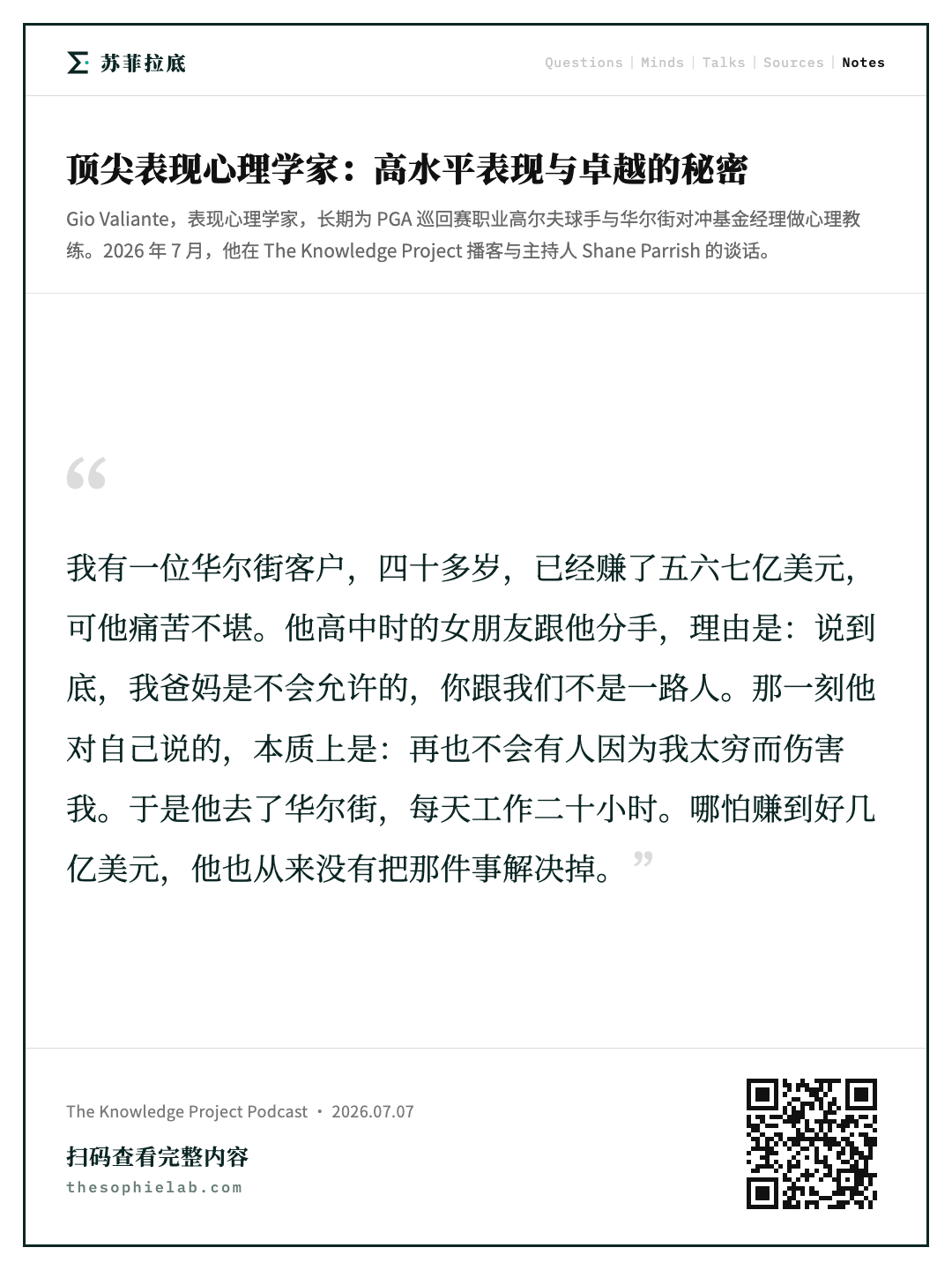
瓦连特: 危险的地方在这儿。我曾有一位华尔街的客户,当时他四十多岁,已经赚了五六七亿美元,可他痛苦不堪。他结了婚,有两个孩子。他每天凌晨四点起床,拼命工作。他的家庭在瓦解,各种关系都不好,巨大的不安全感。

瓦连特: 我永远忘不了,在我们合作的第二年,他跟我讲了他高中时一个女朋友的故事。我这位客户在一个非常贫困的家庭里长大,有个哥哥或者弟弟,是个瘾君子,家境极差,社会经济地位很低,父母功能失调,兄弟吸毒,然后是他。到了高中,他交了一个女朋友,是镇上的那位「风云女孩」。如果我没记错的话,她母亲开一辆白色的捷豹。她打网球,家里是乡村俱乐部的会员。你想象一下那个情形:一个底层出身的男孩,能跟这个女孩在一起。那会验证你作为一个人的价值,因为你生活里没有别的东西在验证你。

瓦连特: 然后那一天到了,几乎就像电影《恋恋笔记本》里的那种原型情节,她跟他分手了。

主持人: 他当然会问,为什么。

瓦连特: 答案是我们见过几百万次的那个故事:说到底,我爸妈是不会允许的。你跟我们不是一路人,我们不属于彼此。这让他心碎了。

主持人: 我们来自不同的世界。

瓦连特: 来自不同的世界。你能想象那是什么样的疼,因为它验证了他一直以来对自己的看法:我是个失败者,我永远爬不出这摊烂泥。那么在那个时刻,一个人会做什么?

瓦连特: 他对自己说的,本质上是:再也不会有人因为我太穷而伤害我。

主持人: 是。

瓦连特: 于是他去了华尔街,每天工作二十小时,拼到没有底线,连跟他共事的人都说,那家伙是头野兽,太拼了。我开始跟他合作,是因为他自己知道有什么东西坏掉了,而坏掉的是他的身份认同。

瓦连特: 所以,回到弗洛伊德那个观察,我们用成年后的一生清理童年的残骸。哪怕赚到了好几亿美元,他也从来没有把那件事解决掉。我们最后一起追溯回那个故事,那是一次宣泄。我记得我必须对他说,我说,你没有重来一次的机会。她不会回来了。而且顺便说一句,看看你现在的生活。

主持人: 对。

瓦连特: 从那天起,事情变了。我手机里存着他几年后发给我的一条短信,他的家庭完整了,他妻子重新爱他了,因为他不再试图去解决一个十八岁的自己的痛。

瓦连特: 但绝大多数人从来不做这个功课。绝大多数人从来不下到自己心理的地窖里去,弄明白是哪些形成期的经历把他们送上了这条路。而如果你不做,你就会用余生去补偿童年的不安全感。你让自己痛苦,让所有人都痛苦,你永远成不了最完整的那个自己。

瓦连特: 所以我希望每个人在人生的某个阶段问自己:我在多大程度上,正把一生耗在清理童年的残骸上?

两条路,同一种失败

瓦连特: 说到孩子,顺带一提,还有另一个层级的功能失调,那就是亿万富豪阶层。他们的孩子,我也见过很多,就是那些信托基金孩子、继承人和女继承人,从来不需要自己挣钱。你要说什么叫人生开局就是彻底的灾难,就是这个,因为他们从来没学会自立。财富强加给他们一个身份,于是他们从来没有真正成为自己,这叫做「身份提前锁定」(identity foreclosure):你是谁已经定好了,你就是某某家的人。然后忽然到了人生后半程,他们醒过来,陷入危机:我从来没有选过这种生活。

瓦连特: 所以贫穷那条路和财富那条路,通向同一种功能失调,因为身份认同里没有自我发现。最好的身份认同路径是:你自己做功课,你试戴不同的面孔,然后你做出选择,决定自己要成为谁。

瓦连特: 这两个观察最后是汇合的。第一,我们用成年后的一生清理童年的残骸,而那些残骸可以是极端的财富,可以是极端的贫穷,可以是创伤,也可以是在乡村俱乐部里长大、长成一个易碎的人,以及这中间的一切。第二,当你终于在某一刻醒来,问出「那么我是谁,我想成为谁」,一切就打开了。这几乎定义了绝大多数人,在每一个领域里。

什么是成功

主持人: 这是个很好的收尾。不过我们每期都用同一个问题结束:对你来说,什么是成功?

瓦连特: 我的答案可能有点不一样,因为我很年轻就成功了。有那么一段时间,我从埃默里大学毕业,是班里第一名。我在罗林斯学院当过很年轻的教授,当时是最年轻的一位,也是最早拿到终身教职的人之一。我出过一本畅销书,被体育界追捧,上过《体育画报》。我有两台水上摩托,有一套房子,还有一间公寓。从物质上、从生活的外观上看,我拥有了一种人生。

瓦连特: 有一次,我和佛罗里达大学本科时期的朋友们去一家爱尔兰酒吧,大家聊近况。其中一个朋友的女朋友,现在是他妻子,我们到今天都还是很好的朋友,她说,你太厉害了,我们都为你骄傲。她说,你一定特别幸福吧。谢恩,那就像电影里唱片针划过的那一声,我心里想,天哪,我其实并不幸福。

主持人: 是。

瓦连特: 我不幸福。我拥有这一切东西,拥有这一堆头衔,可我的生活,感觉起来并不像它看上去的样子。哪怕是别人写我的那些文章,年轻,各种人脉,坐着私人飞机飞来飞去,看上去很好。我并不幸福。

瓦连特: 所以我去找了罗林斯学院的院长,我说,我需要休一次学术假,那是我当时已经挣来的假期。然后我去了得州奥斯汀,租了一套一室一厅的空房子。我真的必须把这个案子解决掉。

瓦连特: 那段暂缓与自我探索的时间里,我做了什么?我去书店,开始买书。经历过这件事的还有迈克尔·克莱顿,那位伟大的作家和电影创作者。他写过一本很好的书叫《旅行》,讲的就是他自己的人生历程,讲他是怎么成为迈克尔·克莱顿的。他经历的和我经历的一样:好吧,物质上是成功了,可你并不幸福。

瓦连特: 所以我去了奥斯汀的一家书店,当时大概花了四五百美元买书,但我特意只买我专业领域之外的书。什么都买。我把那套公寓堆满了书。因为我是学者,得克萨斯大学给了我借阅和使用的权限,给了我一间小办公室。我在奥斯汀待了四个月,那还是奥斯汀「很怪」的年代,九十年代奥斯汀的口号是「让奥斯汀保持怪异」。所有艺术家、创作者、诗人、音乐家都去那儿,过一点嬉皮式的生活。我想把自己泡进那种文化里。我那时天天跟一群喜剧演员混在一起。你猜我当时最好的朋友是谁?是一帮单口喜剧演员。

瓦连特: 从那段时间里长出来的,是我对自己的理解:让我幸福的东西,本质上只有四样。第一是健身。我知道我看上去不像,但我每天都练。我就是喜欢健身和训练这个过程。第二是书。健身不花钱。还有什么不花钱?如果你有张借书证,书也不花钱。

主持人: 对。

瓦连特: 第三,是和聪明人进行真正好的谈话。这种事我可以每天做,一天做到晚。

主持人: 是。

瓦连特: 这让我幸福。第四样稍微有点放纵,我喜欢打高尔夫球,就是练球,不是下场比赛。那对我是一种疗愈,让我沉进去。

主持人: 明白。

瓦连特: 就那样一下一下地击球,反复地打。打完一个小时的球,那种感觉是宣泄的、疗愈的,它把我的脑子清空了。书、谈话、健身、打球,这四样都不花钱。

瓦连特: 所以我学到的是,对我而言,很遗憾,更多的钱并不带来更多的幸福。到了某个水平之后就不了。我当然想过得舒服,而且顺便说一句,我热爱丰盛,也乐见那些看重钱的人去赚钱,我希望每个人都能赚到他想赚的那么多,如果那对他重要的话。对我重要的是,我早上打开淋浴时有热水出来。对我来说,酒店就是一张床、四面墙。我不需要更多。多出来的东西,并不给我带来更多幸福。

瓦连特: 所以幸福对我而言基本上就是这些,后来我又加了第五样:养出有韧性、不易碎的孩子,他们愿意做世界公民,愿意终身学习,能在人生里充分表达自己的才能,并且去做我希望自己做的事,就是在某种程度上成为世界上的一点光,而不是黑暗,去托举别人。我知道这听上去有点俗、有点肉麻,但在某种程度上,就是把这个世界变好一点点,能减轻别人的痛苦就去减轻,让世界好一点。这就是我的定义。

主持人: 说得真好。谢谢你。

瓦连特: 谢谢,感谢你的时间,这次聊得非常过瘾。
本期讲者
吉奥·瓦利安特表现心理学家,长期为 PGA 巡回赛职业高尔夫球手与华尔街对冲基金经理做心理教练,曾任罗林斯学院教授并早早获得终身教职,著有关于恐惧与高尔夫表现的畅销书。
Shane Parrish播客 The Knowledge Project 主持人、Farnam Street 创办者,曾在加拿大情报机构任职,长期以决策与思维模型为主题做长访谈。
章节 · 点击跳转视频
0:00 人为什么默认表现不足 ▶ 正在看
4:22 改变始于做,而不是想 ▶ 正在看
8:00 精熟动机与自我导向的分岔 ▶ 正在看
12:10 心流:临在是可练的习惯 ▶ 正在看
17:56 情境认知:环境才是天花板 ▶ 正在看
20:15 人内的差距大于人际的差距 ▶ 正在看
26:44 智力测验的误区与识人问题 ▶ 正在看
33:47 回撤中如何重建赚钱的习惯 ▶ 正在看
38:48 自信的三个自我与四个来源 ▶ 正在看
50:21 部落本能、前瞻与我是谁 ▶ 正在看
57:23 用一生清理童年的废墟 ▶ 正在看
1:03:19 成功的定义:四件不花钱的事 ▶ 正在看
本期论点
本期回应
其他论点
2:11
表现不足内置于人类境况之中,因为大脑用停机机制保护我们不受伤害
4:09
人们以为自己在思考,其实多半只是在重新排列自己既有的偏见
5:39
改变的关键在于做,而不在于想、说或相信什么,真正起作用的只有行为
9:58
以金钱而非对专业本身的热爱为动机进入一个行业,最终必然走向倦怠
16:07
人并不拥有自己的想法,而是被想法所占有,多数思考与感受并非主动选择
18:41
想成为另一个人,靠改变想法没用,真正要改变的是环境
21:18
一个人在最好与最差状态之间的内部落差,通常大于人与人之间的差异 观察
26:01
人达不到应有成就的首要压制机制,来自从小被塑造的对错误和失败的态度
27:07
预测一个人表现的最重要心理变量是自信和动机,而不是智力
28:09
智力测验之所以延续至今,靠的是数十亿美元产业的利益驱动,而非科学上站得住脚
39:28
自尊只是对自己的情绪感受,和卓越表现之间没有实证关联
44:42
稍微过度自信是好事,它会把一个人实际的技能和能力往上抬
46:00
人随年龄失去冒险胃口,不是因为钱赚够了,而是积累的失败太多
1:01:27
不回去理解成长经历的人,会用余生补偿童年的不安全感,并让身边人一起痛苦
01人为什么默认表现不足
0:00
If you go through life overindexing and caring too much what people think about you, that's your ceiling. >> I want to start with something you said last time we talked, which is most people are underperforming relative to their ability. Yeah. >> Walk me through that. There's a term that I came across many years ago uh called the central governor hypothesis and essentially conveys the fact that most people underperform and and any observer of the human condition I think going back to forever agrees that that's probably true. Now why is that? Well, you have to sort of delve into sort of human biology and genetics and understand so what's what's the purpose of the of the brain?
如果你这辈子都过度在意、太在乎别人怎么看你,那就是你的天花板。>> 我想从我们上次聊天时你说的一句话开始,就是大多数人的表现都低于>> 他们的能力水平。是的。>> 跟我讲讲这个。很多年前我接触到一个术语,叫做「中枢调节器假说」,>> 它本质上说的是,大多数人的表现都低于自己的水平。我觉得任何观察过人类境况的人,>> 从古至今都会认同这大概是真的。那为什么会这样呢?你得深入到>> 人类的生物学和基因层面去理解——大脑的目的到底是什么?
便签引用
0:46
generally to keep you alive long enough to reproduce, right? You know, at a at a at a fundamental biological level, but we're not designed to overperform. We're designed to survive. And so overperformance or uh or achieving one's potential requires sort of a cognitive decision to push oneself there. Right? So to illustrate it, uh I think a common illustration is if you look at marathon runners or any extreme athlete, marathon runners, triathletes, these are people who design their lives around pushing human potential. And so it begs the question, well then then if these are people who are even even the ultramarathoners, right? People who do uh you know five marathons over the course of five weeks or 5 days, whatever they do, how many of them push themselves to the point of death? like how many people push their limits? The answer is is typically it's a very small percentage, single digits, you know, um if you have five, you know, rounding numbers, 5 million marathoners, maybe five or 10 die in a year, and most of
>> 总的来说,是让你活得足够久去繁衍后代,对吧?从最根本的生物学层面来说是这样。但>> 我们的设计目的不是超常发挥,而是生存。所以超常发挥,或者说实现自己的潜能,需要一种认知上的>> 决定,主动把自己推到那个位置。对吧?>> 举个例子说明一下,我觉得一个常见的例子是,你看马拉松选手或者任何极限运动员,>> 马拉松选手、铁人三项选手,这些人把自己的生活完全围绕着挑战人类潜能来安排。所以这就引出了>> 一个问题:如果这些人——哪怕是超级马拉松选手,就是那种在五周或者五天里跑五个马拉松的人,>> 不管他们具体怎么跑——这些人里有多少人把自己逼到了死亡的地步?有多少人真的触碰了自己的极限?>> 答案是,通常这个比例非常小,个位数百分比。你知道,取个整数,比如有五百万马拉松跑者,>> 一年里可能有五个或者十个人死亡,而且大多数时候是因为被车撞了
便签引用
1:46
the time it's cuz they get hit by a car or some other condition, but it's not because they push themselves too hard. They cross the finish line and they're still alive and they go and they they carbo load and so forth. Now, why is that? because the brain has built-in mechanisms to shut us down so that we don't do self harm, right? And so those are the same mechanisms that at a drive level for human beings, you know, govern our conduct. So, so underperformance is built into the human condition so that we can stay alive and that's why, you know, they they do these really interesting studies with sort of single cell organisms um where you put them in a petri dish and you make the conditions uncomfortable, right? So you put these these various they use various types of organisms and you make it hot on one side of the plate and they gravitate to comfort. You make it too cold, they gra.
>> 或者其他什么状况,而不是因为把自己逼得太狠。>> 他们冲过终点线,人还活着,然后去补充碳水什么的。那这是为什么呢?>> 因为大脑有内置的机制来让我们停下来,好让我们不会伤害自己,对吧?而这些>> 同样的机制,在人类的驱动力层面上,也管控着我们的行为。所以说,表现不足是>> 内置在人类境况里的,这样我们才能活下去。这也是为什么,他们做过一些非常有意思的研究,用单细胞生物,>> 把它们放在培养皿里,然后把环境弄得不舒服,对吧?他们用各种各样的>> 生物体,把培养皿的一边弄热,它们就会往>> 舒服的地方跑。你弄得太冷,它们也一样跑。
便签引用
2:38
So at a really at a fundamental biological level, you know, we are all programmed to seek comfort and safety. Well, comfort and safety are the exact opposite of overperformance or realizing one's potential. And so there in lies the starting point sort of table stakes you know if you want to be great at something you know the old adage is you have to get comfortable being uncomfortable but that's something you have to train yourself to do and so the central governor hypothesis suggests that yeah you know there's a governor in the human brain and that governor is built structurally by you know a couple things. Number one the survival instinct. Number two the desire for comfort.
>> 所以从最根本的生物学层面来说,我们所有人都被编程为去寻求舒适和安全。>> 而舒适和安全恰恰是超常发挥、实现潜能的反面。所以这就是>> 起点,是最基本的门槛。如果你想在某件事上做到卓越,有句老话说,你>> 必须习惯于不舒服。但这是你得训练自己去做到的事。所以中枢调节器假说认为,>> 是的,人脑里有一个调节器,而这个调节器的结构是由几样东西构成的:>> 第一,生存本能。第二,对舒适的渴望。
便签引用
3:22
Number three, the desire, you know, at a at a fundamental biological level to for our DNA to replicate itself. You know, there's this there's this view from geneticists that we as humans, you know, we talk about human agency. Human agency being defined as the degree to which we have conscious control over our lives, right? Agency being acting on your own behalf. The fundamental question is, do human beings have free will? Right? William James and and the pragmatists uh asked that question. And again, most observers of the human condition suggest that um we have less control over ourselves than we believe we do. And so what did William James conclude? He said, "My first act of free will is to choose to believe in free will." And if you really think about that and you go down that rabbit hole and then you look at the studies, um people think that they're thinking where they're generally rearranging their prejudices. And so the few acts of agency we really have, one of them is to decide our path and then
第三点,就是那种欲望——在最根本的生物学层面上,我们的 DNA 想要复制自己。遗传学家们有这样一种观点,认为我们人类,我们常谈论「人的能动性」,能动性被定义为我们对自己的人生拥有多大程度的自觉掌控,对吧?能动性就是为自己而行动。那么根本的问题是:人到底有没有自由意志?对吧?威廉·詹姆斯和实用主义者们就问过这个问题。同样,大多数观察人类处境的人都认为,我们对自己的掌控其实比我们以为的要少得多。那么威廉·詹姆斯的结论是什么呢?他说:「我自由意志的第一个行动,就是选择相信自由意志。」如果你真去琢磨这句话,顺着这条思路一路深挖,再去看那些研究,你会发现,人们以为自己在思考,其实多半只是在重新排列自己的偏见。所以说,我们真正拥有的少数几个能动行为,其中之一就是决定自己的道路,然后培养习惯,而这些习惯会变成
便签引用
02改变始于做,而不是想
4:22
cultivate the habits which then become unconscious to push us out to the tail end of the curve in any domain. But again we all default to underperformance. So so to become an uh really really good at something requires an act of agency to choose to become really really good at something. That's table stakes. That's the opening bid. And then from there, you know, that's where the work begins. So yeah. >> So if I choose to become good at something, I'm going to be good at something. Like what is one practical thing that people can take away from this to change in their life to help them realize their potential, >> right? So you know the the research on like uh you know what the data shows on New Year's resolutions, right? 95% of them are over by the end of February and then the other 4% are over by the end of March. So the choice is just the beginning, right? I think the first thing to understand is that we are all creatures of habit. As Albert Bentura said, behavior is a cause of behavior,
无意识的,把我们推向任何领域中曲线的尾端。但话说回来,我们所有人默认的状态都是表现不佳。所以,要想成为某件事上非常非常厉害的人,首先需要一个能动的行为——选择要在这件事上变得非常非常厉害。这只是入场费,只是起步价。从那之后,真正的功夫才开始。就是这样。>> 那么,如果我选择要在某件事上变得厉害,我就会变得厉害。有没有一件具体可行的事,是人们可以从这里带走、在生活中做出改变、帮助自己实现潜能的呢?>> 对。你知道吗,关于新年决心的研究数据显示,95%的人到二月底就放弃了,剩下的 4% 到三月底也放弃了。所以说,选择只是开始,对吧?我觉得首先要明白的是,我们都是习惯的产物。正如阿尔伯特·班杜拉所说:行为是行为的原因。对吧?行为是行为的原因。
便签引用
5:20
right? Behavior is a cause of behavior. That the more you do something on a probability scale, the more likely you are to do the same thing. And so, if you really want to get out of, you know, your situation or you want to do it differently, there's there's a couple things to think of. Number one, it's in the doing, not in the thinking or the saying. Right? One of the things I always say to people is it it really doesn't matter what you say. It doesn't matter what you feel. It doesn't matter what you believe. It just matters what you do. Right? And taking that step, that action step, that behavioral step is a huge part of it. John Dwey, the American philosopher, beautiful, beautiful insight. He said, "We don't think our way into a pattern of living.
从概率上讲,你越常做某件事,你就越有可能继续做同样的事。所以,如果你真的想摆脱现在的处境,或者想换种活法,有几件事要想清楚。第一,关键在于「做」,而不在于「想」或者「说」。对吧?我常跟人说的一句话是:你说什么其实并不重要,你感觉如何也不重要,你相信什么同样不重要。真正重要的是你做了什么。对吧?迈出那一步,那个行动的一步、行为上的一步,是极其关键的部分。美国哲学家约翰·杜威有一个非常非常漂亮的洞见。他说:我们不是靠思考走进一种生活方式的,
便签引用
6:05
We live our way into a pattern of thought. I mean, just really think about that. We don't think our way into a pattern of living. We live our way into a pattern of thought. And what he meant by that is, you know, going back to your question, how do people change? Most people think it think, you know, if I'm going to change my mind and what Dewey is saying is, no, no, no, changing your mind is one way toward change. What he's saying is we don't think our way into the into the living into the doing. We live our way into a pattern of thinking.
而是靠生活走进一种思维方式的。你真的好好想想这句话。我们不是靠思考进入一种生活方式,而是靠生活方式进入一种思维模式。他的意思是,回到你刚才的问题——人是怎么改变的?大多数人以为,如果我要改变,就得先改变我的想法。而杜威说的是:不不不,改变你的想法只是通往改变的一条路。他真正说的是,我们不是靠思考走进生活、走进行动,而是靠行动走进一种思维方式。
便签引用
6:32
So what he's essentially suggesting, what I believe is change what you do. And as you change your behavior, then you change your mind. So going back to what I said earlier, it doesn't matter what you think, what you feel, or what you say. It's just a matter of what you do. And so to your original question, [snorts] what is one thing someone can change if they want to be better? Find out the comfortable habit that's holding you back. Whether it's your phone, whether it's your food, whether it's the excuse you tell yourself or your just one thing. Change that and then hold yourself accountable on a repeated basis to that one thing. There's an everydayness to excellence. There's an everydayness to it. People often ask me, well, you know, I want to write a book, Dr. Gio. How do you write a book? And what I say is, you sit down and you write. You want to write a book, you write a book. You don't wait for inspiration.
所以他本质上在建议的,也是我所相信的,就是:改变你做的事。当你改变了行为,你的想法也会随之改变。所以回到我刚才说的,你想什么、你感觉什么、你说什么,都不重要。重要的只是你做了什么。所以回到你最初的问题,[吸鼻子] 一个人如果想变得更好,可以改变的那一件事是什么?找出那个让你舒服却拖住你后腿的习惯。不管是你的手机,还是你的饮食,还是你给自己找的借口,随便哪一件都行。改掉那一件事,然后反复不断地为这件事对自己负责。卓越是有「每日性」的,它有一种日复一日的属性。人们常问我:我想写一本书,吉奥博士,书要怎么写?我的回答是:你坐下来,然后写。你想写书,你就写书。别等灵感。
便签引用
7:22
You sit down every day. And on the days where nothing's coming, you stay in your seat and you write it badly because you have to write through the bad days to get to the good days. And I've conducted many writing workshops for master students at Rollins College and Emory University. And in writing workshops, I mean, that's what they talk about. If you want to write a book, if you want to be a writer, writers write every day. You know, say it badly, write it badly, but don't get up. And then so that everydayness is the hallmark of excellence in every domain. Why do some people grab on to these basics and use them and get better at them and slightly better at them and keep doing them and some people don't?
你每天坐下来。在什么都写不出来的日子里,你也留在座位上,把它写烂——因为你必须写过那些糟糕的日子,才能抵达好的日子。我在罗林斯学院和埃默里大学为硕士生办过很多写作工作坊。在写作工作坊里,大家谈的就是这个。如果你想写一本书,如果你想当一个作家,那就要每天写。说得烂就说得烂,写得烂就写得烂,但别从椅子上站起来。所以这种日复一日的坚持,是任何领域里卓越的标志。可为什么有些人能抓住这些基本功,反复练习,一点点变好,然后一直坚持下去,而有些人做不到呢?
便签引用
03精熟动机与自我导向的分岔
8:00
>> Yeah. You know, you're asking a question and you you use you say some people. I would say everybody. Now, why is that? Not to sort of over psychologize this, but I do think that there's there's a lesson in is that if you go back to fundamental human motivation, like why do people do what they do? And in fact, one of the earliest psychological studies I did in in sports psychology was I asked I interviewed uh 200 golfers, some on the PGA tour, LPJ tour, good amateurs, uh regular amateurs. And the the question was simple. It's why do you play golf? And you'd think it's an easy question. Why do you play golf? But what emerged from that was probably one of the most profound insights into really into human motivation and and golf just being sort of a petri dish for humanity. And what you realize is some people play for love of the game. I love golf. Some people play cuz they're competitive. I want to beat that other person. Some people play for money. But they use golf as a vehicle to solve other things in their
>> 是啊。你刚才问这个问题时说的是「有些人」,我会说是「所有人」。那这是为什么呢?我不想把这事过度心理学化,但我确实觉得这里有个道理:如果你回到人类最根本的动机——人为什么做他们所做的事?事实上,我在运动心理学领域做过的最早的研究之一,就是访谈了 200 名高尔夫球手,有些是 PGA 巡回赛的,有些是 LPGA 巡回赛的,有优秀业余选手,也有普通业余选手。问题很简单:你为什么打高尔夫?你会以为这是个很好答的问题——你为什么打高尔夫?但由此浮现出来的,大概是关于人类动机最深刻的洞见之一,高尔夫只不过是人性的一个培养皿。你会发现,有些人打球是出于对这项运动的热爱——我爱高尔夫。有些人打球是因为好胜心——我想赢过那个人。有些人打球是为了钱。但他们是把高尔夫当作解决人生其他问题的载体。如果你把这个推而广之,去问医生:你为什么
便签引用
8:58
life. Well, if you extrapolate that and you you ask doctors, you know, why'd you go into medicine? Lawyers, you know, why'd you go into law? us teachers, why'd you go into teaching? What you come to realize is people tend to bifurcate into two different camps. So, so going back to human motivation of why do people do what they do? People who have a mastery motivation, they engage in their craft or their task. It's governed by a few things like it's intrinsic motivation. They do the act for the sake of the act itself, right? It's they're not using it as a vehicle to get somewhere to do a thing.
学医?问律师:你为什么从事法律?问老师:你为什么去教书?你会发现,人们往往分成两大阵营。所以,回到「人为什么做他们所做的事」这个动机问题:拥有精熟型动机的人,他们投入自己的手艺或任务时,是受几样东西支配的,比如那是内在动机。他们做这件事是为了这件事本身,对吧?他们不是把它当成通往某个目标的工具。
便签引用
9:35
It's like the satisfaction's in the doing. Now, the alternative path of why people do what they do. It's called an ego orientation. And and and it's it in the name, the meaning of it, it's why do you do what you do? It's to enhance the ego. It's, you know, I do this for money. I do it to feel important. I use the thing as a vehicle to make myself feel better. So if you go into medicine because you want to make a lot of money, but you actually don't care about medicine, invariably you're going to burn out. If you go into law because you want to be rich, but you don't love law, you're going to burn out. Same with all sports. Same really everything in life.
满足感就在做这件事的过程里。那么,人们做事的另一条动因路径,叫做自我导向(ego orientation)。顾名思义,它的含义就是——你为什么做你所做的事?是为了抬高自我。就是那种,我做这个是为了钱,我做这个是为了让自己觉得重要,我把这件事当成工具来让自己感觉更好。所以如果你学医是因为你想赚很多钱,但你其实并不在乎医学本身,你注定会倦怠。如果你学法律是因为你想变有钱,但你并不热爱法律,你也会倦怠。所有运动项目都一样,人生中几乎所有事都一样。
便签引用
10:12
So what you find at the very tail end of the distribution, the top 1% of 1%, the Alzheimer's, the origin of the greatness, right? the the first order variable, the first domino to fall is they tend to gravitate toward their calling intuitively. And the reason why they do it is for the love of the craft itself. It's a calling and they protect that purity. And so what you'll often also often see is people who have a rebirth or a renaissance in their careers. It's like where did this come from? What they often say is oh I fell in love. It's Kelly Slater. I fell in love with surfing again. It's Brooks Kepka in golf recently. I'm I love golf again. Um it's musicians, right, who who are practicing their craft late in life.
所以你会发现,在分布曲线最末端,也就是顶尖的百分之一里的百分之一,那些真正的传奇,伟大的源头,对吧?那个第一序变量,那张最先倒下的多米诺骨牌,就是他们往往会凭直觉被自己的天职所吸引。而他们这么做的原因,是出于对这门手艺本身的热爱。这是一种召唤,而他们会守护那份纯粹。所以你也常常会看到有些人在职业生涯中获得重生或者复兴。你会想,这是从哪来的?他们常说的是:哦,我重新爱上了它。比如凯利·斯莱特(Kelly Slater),我又爱上冲浪了。比如高尔夫界的布鲁克斯·科普卡(Brooks Koepka),最近他说,我又热爱高尔夫了。再比如音乐家,对吧,那些到了晚年还在打磨技艺的人。
便签引用
11:03
And and so the journey, the developmental path is it starts with a mastery orientation. You do the thing cuz you love to do it. Then you start getting rewarded for it. And then the rewards itself become more more powerful than the thing. Then you lose yourself. Then you rediscover yourself and you find your way back to mastery, back to the calling itself. Yeah. >> How do we fall in love with what we do though? Like if I go into golf because I love it and maybe I I eb and flow through, oh, you know, I start winning and I switch from this mastery mindset to this ego mindset and I start losing.
所以这段旅程,这条成长路径,是从精熟导向开始的。你做这件事是因为你热爱做它。然后你开始因此得到奖赏。接着奖赏本身变得比这件事更有分量。然后你迷失了自己。然后你重新发现自己,找回通往精熟的路,回到那份召唤本身。是的。>> 可是我们要怎样才能爱上自己做的事呢?比如我去打高尔夫是因为我热爱它,也许我会起起伏伏,经历那种,你知道,我开始赢球,然后从精熟心态切换到自我心态,接着我开始输球。
便签引用
11:38
That's very different than an office worker or an executive in a company who has a job and they kind of like it but they want to get better at it and they want to reach their potential. >> Yeah. >> How do we switch into a mastery focused mindset and something that we might not fully love? >> Yeah. No, that's a great question and it goes back to what we touched upon already which is sort of the idea of human agency and free will. Like what do we actually have control over? So, uh there's a book that I'm I'm sure you've read. It's called finding flow >> by Mihi Chicken Mihi.
这跟一个办公室职员或者公司高管很不一样,他们有一份工作,还算喜欢,但他们想把它做得更好,想发挥自己的潜力。>> 是的。>> 对于我们可能并不完全热爱的事情,我们要怎么切换到以精熟为核心的心态?>> 嗯,这是个很好的问题,它又回到我们刚才提到的那个话题,也就是人的能动性和自由意志。我们到底能掌控什么?所以,有一本书我相信你读过,叫《发现心流》(Finding Flow),>> 作者是米哈里·契克森米哈赖。
便签引用
04心流:临在是可练的习惯
12:10
>> You know the idea of flow or a flow state. It's it's the highest form of the human condition. Right? If you want to look at what human beings are capable of, just just go find people who have ever been in flow. Now, the research in on flow is fascinating because it shows a couple things. Number one, we can get into flow doing almost anything. Gardening, people, you know, people can get into flow gardening or cooking. Great conversations are flow states. Playing sports, being in love, reading a book. Now, what are the characteristics of the hallmarks of flow? Uh, number one, time is transcendent, right? It's it's the idea that when you get lost in a great book and you look up, you're like, that was 3 hours or a great conversation that, you know, 2 hours went by 3 hours. You know, athletes have told me it's like when you're when you're really in a flow state, you look up the game is over. It went by very, very quickly. Um, there's a paradox of effort, like hard things feel easy.
>> 你知道心流或者心流状态这个概念吧。它是人类状态的最高形式,对吧?如果你想看看人类能达到什么样的高度,去找那些曾经进入过心流的人就好了。关于心流的研究非常迷人,因为它揭示了几件事。第一,我们几乎做任何事都能进入心流。园艺,你知道,有人做园艺或者做饭时就能进入心流。精彩的对话也是心流状态。打球、恋爱、读一本书。那么心流的特征、它的标志是什么呢?第一,时间感被超越了,对吧?就是那种你沉浸在一本好书里,抬起头来,你会想,都过去三小时了;或者一场精彩的对话,你知道,两小时、三小时就这么过去了。运动员告诉我,就像是当你真正处在心流状态时,一抬头比赛已经结束了。时间过得非常、非常快。嗯,还有一种努力的悖论,就是难的事情感觉很轻松。
便签引用
13:04
There's a paradox of perception. You're so lost in the moment, you're so present that you forget that you're being watched or there's an audience or there's an outcome. And so, human beings who are able to transcend their limitations typically get lost in a flow state. M so if you ask me what advice would I give to people who are sort of stuck in the middle part of the distribution or just quote unquote average but who want to be great I mean there's a few things number one be mindful of your habits uh number two get comfortable being uncomfortable but number three get good at being fully present get in the moment you know John Dwey uh John Dwey in in a book called how we think John Dwey [snorts] said there's no greater enemy me to effective thinking than a divided interest, right? A fragmented interest. You partition your hard drive where you're here, but you're thinking about something else. You're here, you're thinking about, you're never fully present. The best of the best are present for everything all the
还有一种感知的悖论。你完全沉浸在当下,如此专注于此刻,以至于你忘了自己正被注视,忘了有观众,也忘了有结果这回事。所以那些能够超越自身局限的人,通常都沉浸在心流状态中。嗯,所以如果你问我,对那些卡在分布中段、或者所谓“普通”但又想变得卓越的人,我会给什么建议——有这么几点。第一,留意你的习惯;第二,习惯于待在不舒服的状态里;但第三,练就全然临在的能力,活在当下。你知道约翰·杜威,约翰·杜威在一本叫《我们如何思维》的书里说过,对有效思考而言,没有比注意力分散更大的敌人了,对吧?一种碎片化的注意力。你把硬盘分区了,人在这里,心却想着别的事。你在这儿,却在想着别处,你从来没有全然投入。最顶尖的那批人,做任何事情、任何时候
便签引用
14:07
time. So again, it's a bit of a Buddhist tradition, but but the habit of being present is a hallmark of excellence. So if people want to be great at their jobs, you know, get into flow. Well, how do you get into flow? Get present, challenge yourself, fall in love with the details, and love the mundanity of your work. >> I want to come back to flow for a second. Is that I'm assuming that's common amongst all top performers that people are fully present. >> Mhm. >> How would you explain that to somebody like they're fully present? What do I do when I'm in a meeting and my mind starts thinking about picking up groceries or the kids or all of a sudden I'm not fully present? How do I bring myself back to fully present? Like everything else being present is a habit and like any other habit or skill you can practice it. So you can't just hope to call on you know on deep immersion or presence or flow if you're not in the active habit of being present. Okay. So it begs the question, what gets us out
都是全然临在的。所以这多少有点佛家的传统,但全然临在这个习惯确实是卓越的标志。所以如果人们想在工作上做到出色,你知道,就进入心流。那怎么进入心流呢?活在当下,挑战自己,爱上细节,也爱上工作中那些平淡琐碎的部分。>> 我想再回到心流这个话题。我猜全然临在是所有顶尖高手的共性,他们都完全活在当下。>> 嗯嗯。>> 你会怎么向别人解释“全然临在”这件事?比如我在开会,脑子却开始想着去买菜、想着孩子,突然间我就不在当下了,我该怎么办?我该怎么把自己拉回到当下?就像其他所有事一样,临在是一种习惯,和任何习惯或技能一样,你可以去练习。所以你不能只是指望在需要的时候就能调用深度沉浸、临在或者心流,如果你平时并没有在主动练习临在的习惯。好,那问题就来了:是什么把我们拉出当下?是分心,是执念。所以对
便签引用
15:12
of the present moment? Well, it's distraction. It's attachment. And so the good news for for you know, for anybody who wants to get better is a little bit of practice on a consistent basis goes a long way. So for example, what do I do in my own life? Knowing as much about psychology as I do, every Friday at the end of the day, I take 10 or 15 minutes and I ask myself a simple question. I say, "What are my attachments that have attached themselves to me that are interrupting my thoughts that I didn't put there by conscious choice? And what am I thinking about that that I didn't choose to think about? What am I feeling that I didn't choose to feel?" And you come to realize is is as we go through the journey of life just by default to the structure of the human brain we attach to things or things attached to us actually goes back to the to what Nichi said you know Nichi and Carl Jung both agree on this idea that we don't have ideas have us right we don't often choose to think or feel the way we feel
任何想要进步的人来说,好消息是,持之以恒地稍加练习就能走得很远。比如说,我自己生活中是怎么做的?以我对心理学的了解,每周五一天结束的时候,我会花十到十五分钟,问自己一个简单的问题。我会说:“有哪些执念缠上了我、在打断我的思绪,而它们并不是我有意识选择放进来的?还有我在想什么是我并没有主动选择去想的?我在感受什么是我并没有主动选择去感受的?'然后你会慢慢意识到,在人生这段旅程中,由于人脑结构的默认设置,我们会依附于某些东西,或者某些东西附着在我们身上,这其实又回到尼采说过的话,你知道,尼采和卡尔·荣格都认同这样一个观点:不是我们拥有想法,而是想法占有了我们,对吧,我们常常并不是自己选择去这样想、这样感受的
便签引用
16:14
things happen to us that govern you know it's conditioning it's really true and so what I do the active practice of detaching from things that are shaping my thoughts or feelings or behavior, I detach from them. And what you come to find is what fills in that space of psychological freedom and presence. >> So a little bit of practice of these things on a regular basis and all of a sudden you come to find you have psychological freedom and from there you can explore the best version of yourself. So yeah, every few years a new platform earns its place at the top of every smart advertiser's media plant. The people who find it early build advantages that are very hard to close. Apploven just had the most remarkable run in adtech history and now they've opened that engine to businesses like yours. Over a billion people play mobile games every day. Focused, not scrolling with no feed competing for their attention. Apploven puts your brand in front of the right customers and optimizes purely for your
是那些发生在我们身上的事在主导我们,你知道,这就是条件反射式的塑造,真的就是这样。所以我所做的,就是主动地练习从那些正在塑造我的思想、情绪或行为的东西中抽离出来,我与它们剥离开。然后你会发现,填补进那片空间的,是心理上的自由和当下的临在感。>> 所以只要经常做一点这样的练习,突然之间你就会发现自己拥有了心理上的自由,从那里出发,你就可以去探索最好的自己。所以,是的,每隔几年,就会有一个新平台在每个聪明广告主的媒体计划里占据头部位置。那些早早发现它的人,会建立起别人很难追平的优势。AppLovin 刚刚在广告科技领域跑出了最亮眼的一段成绩,而现在他们把这套引擎开放给了像你这样的企业。每天有超过十亿人玩手机游戏。他们是专注的,不是在刷信息流,没有信息流在争抢他们的注意力。AppLovin 让你的品牌出现在对的客户面前,并且纯粹为你的增长做优化。像 Wayfair、Kit、Ridge
便签引用
17:13
growth. Brands like Wayfair, Kit, Ridge, and Nectar are already scaling on it while most of their competitors don't even know it exists. Ready to find your next million customers? Go to apploven.com/shane and launch your first campaign today. Video is the most effective way to communicate, but it's always been too slow and expensive to produce. Hey Genen eliminates that. You go from idea to professional video in minutes. No camera, no crew. Their avatars are rated the most realistic on G2 and over 30 million people are already using Hey Genen, including 85% of the Fortune 100.
和 Nectar 这样的品牌已经在上面做规模化投放了,而他们的大多数竞争对手甚至还不知道有这么个平台。准备好找到你的下一百万名客户了吗?访问 applovin.com/shane,今天就上线你的第一个广告活动。视频是最有效的沟通方式,但制作视频一直太慢、太贵。HeyGen解决了这个问题。你可以在几分钟内把一个想法变成专业视频。不需要摄像机,不需要团队。他们的数字人在 G2 上被评为最逼真的,已经有超过三千万人在用 HeyGen,其中包括《财富》100 强中的 85%。
便签引用
05情境认知:环境才是天花板
17:56
You can even reach an audience in over 175 languages with AI lips sync and translation. Same voice, perfectly matched. If you're someone who communicates at scale, take a look. Your first three videos are free. Hey genen.com h e y gn.com how curated important is shaping our environment and I mean this in in the sense of not only our physical environment but our mental environment the information that we consume the people we let into our life incredible question you know there's this there's a song by a b an old band called Sister Hazel uh and the lyric goes if you want to be somebody else change your mind and I and I I I like the band But I loved that line. But but the reality is the line is wrong. The reality is if you want to be somebody else, change your environment. Now why is this true?
你甚至可以用 AI 口型同步和翻译功能触达 175 种以上语言的受众。同一个声音,口型完美匹配。如果你是需要大规模做沟通的人,不妨去看看。前三个视频免费。heygen.com,h-e-y-g-e-n.com。精心营造我们的环境有多重要,我说的不只是我们的物理环境,还包括我们的心理环境,我们摄入的信息,我们让哪些人进入我们的生活。这个问题问得太好了。你知道,有一支老乐队叫 SisterHazel,他们有首歌,歌词大意是:如果你想成为另一个人,就改变你的想法。我挺喜欢这支乐队,我也很喜欢那句歌词。但现实是,那句话是错的。现实是,如果你想成为另一个人,就改变你的环境。那为什么会这样呢?
便签引用
18:50
So there's this idea in psychology, it's called situated cognition. Situated cognition. And situ situated cognition conveys the idea that the human brain is constantly interacting with the environment around it on both conscious and unconscious levels, primarily unconscious. So think of it this way. When we're hot, we sweat, but we don't choose to sweat. When we're cold, we get goosebumps, but we don't choose to get goosebumps. Um, the human brain interacts with the environment on an unconscious level. In fact, the unconscious interaction the environment is the primary vehicle of human conduct.
心理学里有一个概念,叫情境认知(situated cognition)。情境认知。情境认知传达的意思是,人脑一直在与周围的环境互动,既有意识层面的也有无意识层面的,而且主要是无意识的。可以这样理解。我们热的时候会出汗,但我们并没有选择要出汗。我们冷的时候会起鸡皮疙瘩,但我们并没有选择要起鸡皮疙瘩。嗯,人脑是在无意识层面与环境互动的。事实上,与环境的无意识互动才是人类行为的主要载体。
便签引用
19:23
And so, you know, in the book atomic habits, the author has this really beautiful uh re really beautiful line that's getting a lot of traction in the world these days. Says, "We don't rise to the level of our goals, we shrink to the level uh of our systems." What does he mean by that? And what he means is let's say that you aspire to greatness, but you're in a in a school system or a classroom or a company or on a team that doesn't support your path to excellence, right? When you go to take risks, you get slapped back. If you're a hedge fund portfolio manager and you're in a place that is so riskaverse, right, that's governed by a risk manager or risk officer who's just trying to keep his or her job and so they're playing it safe. So every time you ask for more capital or you want to go outside of your risk limits, it's an automatic no.
所以你知道,在《原子习惯》那本书里,作者写了一句非常漂亮的话,这句话这些年在全世界被广泛引用。他说:'我们不会上升到目标的高度,而会下降到系统的水平。'这话是什么意思?他的意思是,假设你渴望做到卓越,但你所在的学校体系、课堂、公司或团队并不支持你走向卓越,对吧?当你想去冒险时,你就会被打回来。如果你是一个对冲基金的投资组合经理,而你所在的机构极度厌恶风险,对吧,由一个只想保住自己饭碗的风控经理或风控官说了算,所以他们只求稳妥。于是每次你申请更多资金,或者想突破自己的风险限额,答案都是自动的'不行'。
便签引用
06人内的差距大于人际的差距
20:15
[gasps] Well, all of a sudden that becomes right that becomes your ceiling. If you really want to understand human potential, ask yourself this question. What is greater? the difference between two individuals or the difference within an individual and himself or herself. So, think about just you and I. Let's say a company is looking to hire someone and they're like, "Oh, should we hire Shane or should we hire Gio?" And they profile us and they look at the differences and they come to realize, well, you know, they're pretty close to the same, you know, IQ or intelligence, you know, similar education, like a lot it's it's a hard choice, but like we'll go with Shane. But they never ask the question what what does Shane look like at his best or his worst and where is he in that regard. So they hire they spend all these resources profiling people to make sure they hire the right person.
[倒吸一口气] 那么突然之间,这就成了对吧,这就成了你的天花板。如果你真的想理解人的潜能,问问自己这个问题。哪一个更大?是两个人之间的差距,还是一个人与他自己之间的差距?就拿你我来说吧。假设一家公司要招人,他们会想:'哦,我们该招Shane 还是招 Gio?'然后他们给我们做测评,比较我们的差异,结果发现,嗯,你知道,两人的智商或者说智力水平差不多,教育背景也差不多,很多方面都很接近,很难选,但算了就选 Shane 吧。可他们从来不问这个问题:Shane 在最好的状态下是什么样,最差的状态下又是什么样,他现在处在什么位置。所以他们招人,花了所有这些资源去给人做测评,就为了确保招对人。
便签引用
21:11
>> But once the person gets onboarded they don't really look at the differential of the person at the best or at the worst or how do we get the best out of them. Now here's what research shows. Research shows that the differences within within individuals is typically greater than between individuals. In society today, we spend so much time comparing candidate A versus candidate B. >> There's more psychological alpha within [snorts] individuals than between individuals. And teams and organizations and schools spend so much time comparing student A and student B or not realizing and this is where I live. It's like, okay, what's what can this person be? A person comes to me, hey, can you help me? It's like, okay, well, let's look at where you're at right now.
>> 但一旦这个人入职了,他们其实并不会去关注这个人在最好状态和最差状态之间的落差,也不关注怎么把他最好的一面激发出来。研究显示的是这样:一个人内部的差异,通常大于人与人之间的差异。而在今天的社会里,我们花了太多时间去比较候选人 A 和候选人 B。>> 一个人内部的心理阿尔法,比人与人之间的差异更大。而团队、组织和学校花了太多时间去比较学生 A 和学生 B,却没有意识到——这就是我深耕的领域——就是说,好,这个人可以成为什么样?有人来找我说,嘿,你能帮我吗?我会说,好,那我们先看看你现在处在什么位置。
便签引用
21:57
>> Yes. >> What are the mechanisms of suppression? What are the things that you asked earlier, you know, what keeps people from overachieving? What are the we call them the mechanisms of suppression that lead to underperformance or underachievement? And they're known. They're largely known what these mechanisms of suppression are. You start removing them and helping people identify them and then all of a sudden they start to blossom and there in lies there's a greater difference within an individual than there often are between two individuals. And what contributes to that? It was a a mission that had meaning to you. And you were part of a system of collective problem solving, solving hard problems together.
>> 是的。>> 压制机制有哪些?你刚才问的那些,你知道,是什么让人无法超常发挥?我们把它们叫做压制机制,就是那些导致表现不佳或者成就不足的东西。而这些是已知的。这些压制机制大体上是已经被摸清的。你开始把它们一个个拿掉,帮助人们识别它们,然后突然之间他们就开始绽放了,这里面的关键就在于,一个人内部的差异往往比两个人之间的差异更大。那是什么促成了这种变化?是一个对你有意义的使命。以及你身处在一个集体解决问题的系统里,大家一起攻克难题。
便签引用
22:39
And whenever a company or an organization in in various fields um more and more that I'm that I'm speaking to uh in a leadership level and this is true in schools as well and teachers job description should converge and boil down to really it's one sentence your job description everywhere I go it's always the same be good at solving hard problems together or get good or learn actually if I really were to articulate it learn how to be great at solving hard problems together. Now, that's a easy thing to say and a really hard thing to do because ego, right? Put a hard problem in front of two people, never mind 10, especially smart people who are used to being right, but they think there's a different solution than the other person and then they're wrong, but they've never been wrong before and they get defensive and it leads to argument, people closing themselves up. But if you can actually participate in a system where people are competent and capable, open and willing and their highest calling is to be great at solving hard
每当一家公司或组织——在各个不同的领域,嗯,我现在越来越多地在跟领导层交流——在学校里也一样,老师的岗位职责最终都应该收敛、浓缩成一句话,我走到哪里,岗位职责其实都一样:擅长一起解决难题,或者说变得擅长,或者说学会——如果要我更准确地表达,就是学会如何出色地一起解决难题。这话说起来容易,做起来非常难,因为有自我(ego)在,对吧?把一个难题摆在两个人面前,更别说十个人了,尤其是那些习惯了自己永远正确的聪明人,他们觉得自己的方案和别人不一样,结果他们错了,可他们以前从没错过,于是就开始防御,接着就演变成争吵,人们把自己封闭起来。但如果你真的能身处一个系统,里面的人既有能力又有本事,开放且愿意投入,而他们最高的使命就是出色地一起解决
便签引用
23:49
problems together, that's the path to an autotellic state of being. It's the path to flow. It's the path to greatness and excellence. Two stories I'll illustrate that. Number one, Einstein, he was stuck on the problem for a very, very long time. and he was on the walk on a walk with a younger colleague trying to explain here's what I'm working on and in the process of deconstructing and dissecting his own thoughts and explaining it to someone that's when he had his aha moment it was an epiphany and then over the course of the next 3 months he wrote two papers that led to the Nobel Prize so he was stuck stuck stuck stuck the synthetic function of language the process of trying to articulate his thinking led to the epiphany cricket and Watson who discovered the structure of DNA. It's the same thing. It was through the interactive process. There were four research uh researchers on that team.
难题,那就是通往'自带目的'(autotelic)状态的路。那是通往心流的路,是通往伟大和卓越的路。我举两个故事来说明。第一个,爱因斯坦,他被一个问题卡住了很久很久。当时他正和一位更年轻的同事散步,试图解释'我现在在研究什么',而就在拆解、剖析自己的想法并讲给别人听的过程中,他有了那个恍然大悟的瞬间,那是一次顿悟,接下来的三个月里他写了两篇论文,后来为他赢得了诺贝尔奖。所以他一直卡着卡着卡着,是语言的综合功能,是试图把思考表达出来的这个过程,带来了顿悟。克里克和沃森发现 DNA 结构也是同样的道理。那是通过互动的过程实现的。那个团队里有四位研究人员。
便签引用
24:45
But it was it was the interaction of problem solving that happened. And so if people are trying to elevate and realize the full expression of their talents and abilities, the first place you have to look, I said earlier you have to look at your habits and your behavior. The reality is the first place you have to look is your systems and your environment. Whether it's a place that has all the hallmarks of leading to excellence, which is honesty and truthtelling, which is challenge and skill development, which is no ceiling.
但真正起作用的是那种解决问题时的互动。所以如果人们想要提升自己、完全释放自己的天赋和能力,你首先要看的地方——我前面说过要看你的习惯和行为。但现实是,你首先要看的是你的系统和你的环境。看它是不是一个具备通往卓越所有特征的地方:诚实和讲真话,挑战和技能成长,没有天花板。
便签引用
25:17
And one of the hallmarks, by the way, of these, you know, Daniel Coyle articulated this in really nice little book. Um, he calls them talent hotbeds, right? They're places that that tend to graduate disproportionate amount of excellence. So, you know, great singers tend tend tend to come out of this little little school in Dallas, Texas around Dallas, Texas. Great for a period of time, great tennis players came out of Russia. Great baseball players out of the Dominican Republic. Great [snorts] female golfers out of out of South Korea. If you look at the world of golf, you know, historically great golfers out of Texas and California, these great golf states, one of the hallmarks of talent hopets is what do people do with mistakes?
顺便说一句,这些特征之一,你知道,丹尼尔·科伊尔在一本很不错的小书里讲过。嗯,他把那些地方叫做'人才温床',对吧?那些地方总能培养出远超比例的卓越人才。比如说,优秀的歌手往往出自德州达拉斯那一带的一所小学校。有一段时期,优秀的网球选手都出自俄罗斯。优秀的棒球运动员出自多米尼加共和国。优秀的女子高尔夫球手出自韩国。如果你看高尔夫这个领域,你知道,历史上优秀的高尔夫球手出自德州和加州,这些高尔夫大州,人才温床的一个关键特征就是:人们怎么对待错误?
便签引用
26:01
And so by and large, the primary mechanism of suppression, why people don't achieve what they're capable of achieving, has to do with how they're conditioned with dealing with mistakes and failure. But if you really want to be great, put yourself in an environment that [snorts] allows you the freedom that's challenge and accountability and rigor and detail, but that's not overpunitive of mistakes. When you're interviewing somebody, I want to know the signs of greatness and the signs of this person isn't as good as they think they are.
所以总体上说,最主要的压制机制——也就是人们为什么达不到自己本可以达到的成就——跟他们从小被如何塑造去面对错误和失败有关。但如果你真的想变得卓越,就把自己放到一个既给你自由、又有挑战、有问责、有严格要求和细节把控,但不会对错误过度惩罚的环境里。当你面试一个人时,我想知道,哪些是卓越的迹象,哪些又是这个人其实没有他自以为的那么好的迹象。
便签引用
07智力测验的误区与识人问题
26:44
What are the markers of, you know, Steve Cohen called you a canary in a coal mine, but also you have an incredible ability to identify talent in very short period of time. >> Yeah. >> What are the questions you ask? How do you do that? >> Of all the variables that psychology measures, the two that I think are the most important are confidence and motivation. Right? Confidence and motivation. People think it's intelligence, but it's actually not. So the story of intelligence is um you know the way we define it is a very muddled story. So intelligence this idea of IQ >> which people still use as a marker of intelligence. IQ [snorts] meaning intellectual quotient started I think it was in the late 1800s in France and Alfred Benet the French government said hey listen we need to be able to identify kids who are struggling in school. If we can identify them early we could do an intervention. That's all it was. soft and bene went and did some studies interviewed a bunch of people and came with his intellectual quotion
有哪些标志?你知道,史蒂夫·科恩把你称作'煤矿里的金丝雀',而且你还有一种惊人的能力,能在很短时间内识别出人才。>> 是的。>> 你会问哪些问题?你是怎么做到的?>> 在心理学能测量的所有变量里,我认为最重要的两个是自信和动机。对吧?自信和动机。人们以为是智力,但其实不是。关于智力这件事,嗯,你知道,我们对它的定义是一笔非常糊涂的账。所以智力,也就是 IQ 这个概念——>> 人们至今仍把它当作智力的衡量标准。IQ,也就是智商,我记得是在 19 世纪末的法国开始的,阿尔弗雷德·比奈,当时法国政府说,嘿,听着,我们需要能识别出那些在学校里学习吃力的孩子。如果我们能早点识别出来,就能进行干预。当初就只是这个目的。于是比奈去做了一些研究,访谈了一批人,提出了他的智商概念,
便签引用
27:45
said you know if we measure here these are the kids who will struggle in school and when this research made its way to America America did with it what Americans do let's commercialize it so they started selling people on this idea that the higher IQ the smarter you are it's it's undeniably false higher IQ doesn't mean you're smarter and then if people went just maniacal and intelligence tests, which is a multi-billion dollar industry, and that's why it's stayed alive to this day. The SATs and the ACT and and educational testing systems, multi-billion dollar industry. That's the reason the idea hasn't died. It's financially driven. It's a nonsensical idea. Now, you can argue that there is a thing called G, which is general intelligence. But again, so so a Harvard researcher, a guy named Howard Gardner, who who started doing research in developmental psychology, then cognitive psychology, [snorts] and he posited the idea that humans have what he called multiple intelligences.
他说,你知道,如果我们在这里测量,这些就是在学校会学得吃力的孩子。而当这项研究传到美国后,美国人做了美国人最擅长的事:把它商业化。于是他们开始向人们兜售一个观念:IQ 越高就越聪明。这是无可辩驳的错误,IQ 高并不意味着你更聪明。然后人们就对智力测验着了魔,而这是一个数十亿美元的产业,这也是它能一直活到今天的原因。SAT、ACT还有各种教育测评体系,都是数十亿美元的产业。这才是这个观念没有消亡的原因。它是被金钱驱动的。这是个荒谬的概念。当然,你可以说确实存在一个叫 G 的东西,也就是一般智力。但话说回来,有一位哈佛的研究者,一个叫霍华德·加德纳的人,他先是研究发展心理学,后来做认知心理学,然后他提出了一个观点:人类拥有他所说的'多元智能'。
便签引用
28:42
And it challenged the status quo of of of IQ. And what he says is human beings have individual autonomous intelligences. For example, verbal intelligence, mathematical intelligence, and all these intelligences have their own characteristics equals interpersonal intelligence, which you're a genius at. What's inter interpersonal intelligence? Interpersonal intelligence is the ability to read someone else in real time and sort of sense where they're at emotionally, cognitively, and steer them. You know, great politicians have great interpersonal intelligence, great school teachers. The fourth kind of intelligence is called intrapersonal intelligence. It's the ability to know yourself. How smart are you actually if you have a perfect memory but have no self-awareness? Right? That's not intelligence.
这挑战了 IQ 的主流地位。他说的是,人类拥有一个个相互独立的智能。比如说,语言智能、数理智能,而这些智能各有各的特征,还有人际智能,这一项你是天才级别的。什么是人际智能?人际智能就是能够实时读懂另一个人,感知到对方此刻在情绪上、认知上处于什么状态,并加以引导的能力他们。你知道,伟大的政治家有很强的人际智能,优秀的中小学老师也是。第四种智能叫做内省智能,也就是了解自己的能力。如果你记忆力完美却毫无自我觉察,你到底算多聪明?对吧?那不叫智能。
便签引用
29:29
>> Gardner talks about uh uh bodily kinesthetic intelligence. The ability to know your body in space. Michael Jordan, Tiger Woods, >> Martha Graham, the great dancer. Knowing your body and to be able to have this proprio perception, spatial intelligence that great architects have to see things dimensionally. Anyway, your question is what do I look for when I'm screening people? Well, I want to understand what is the entire profile of this person? Where do they come from? What's their source of their motivation? How do they handle failure? I want to know the degree to which they tell the truth.
>> 加德纳还讲到身体动觉智能,就是感知自己身体在空间中位置的能力。迈克尔·乔丹、老虎·伍兹,>> 还有伟大的舞蹈家玛莎·葛兰姆。了解自己的身体,拥有这种本体感觉;还有空间智能,伟大的建筑师必须具备,能立体地看待事物。总之,你的问题是:我筛选人的时候看重什么?嗯,我想搞清楚这个人的整体画像是什么样的。他们从哪里来?动机的来源是什么?他们怎么面对失败?我想知道他们在多大程度上讲真话。
便签引用
30:04
Because in most cases when people are having a conversation, particularly in an interview, they're presenting a version of themselves that they want you to see. But that's not the version of themselves that's going to show up in the workplace. So, one of the most important questions is uh is this. It's uh tell me a time in your life where you had to work with somebody you didn't like. Could have been in elementary school, could have been middle school, been a project in college, your last company, somebody who you fundamentally disagreed with and then viscerally didn't like but had to work with. How'd you handle that? And if you ask a version of that question and you just sit back, that will reveal the kind of person they are.
因为大多数情况下,人们在对话中,尤其是在面试里,展现的是他们希望你看到的那个版本的自己。但那不是他们在职场里会呈现的那个版本。所以最重要的问题之一就是这个:跟我讲讲你人生中不得不和一个你不喜欢的人共事的经历。可以是小学、可以是初中,可以是大学的一个小组作业,或者上一家公司,某个你根本合不来、打心底里不喜欢、但又必须一起共事的人。你当时是怎么处理的?如果你问出这类问题,然后往后一靠不说话,那就会暴露出他们是什么样的人。
便签引用
30:52
>> And it will also reveal how they will how they will respond when faced with adversity in the workplace, particularly if you're in a hard industry where you're trying to solve hard problems. How do you handle conflict? To what degree do you blame others? To what degree do you shut down? To what degree are you engaged? Research shows that companies that put brand management or image management over problem solving tend to deteriorate pretty quickly. So it has to be an environment or a culture where smart people are empowered to solve hard problems but they care more in your case more about the mission than about the self. So I look for all of these things and again it depends on the role because a lot of people are capable or competent but if you put the right person in the wrong role they're never going to flourish. So it has to be a fit for for the exactness of the role itself.
>> 而且这也会揭示他们在职场遇到逆境时会怎么反应,尤其是如果你身处一个难做的行业,要解决很难的问题。你怎么处理冲突?你在多大程度上责怪别人?在多大程度上直接封闭自己?在多大程度上是投入的?研究表明,把品牌管理或形象管理置于解决问题之上的公司,往往衰败得很快。所以必须是这样一种环境或文化:聪明人被赋予权力去解决难题,而且他们——在你们的情况下——更在乎使命而不是自我。所以我会看所有这些方面,而且这还得看岗位,因为很多人是有能力、能胜任的,但如果你把对的人放在错的岗位上,他们永远没法绽放。所以必须和岗位本身的具体要求精准匹配。
便签引用
31:47
>> Are there any other questions that come to mind that you think are particularly revealing about people? >> What is the biggest obstacle you've ever had to overcome in your life? The followup there is what resources did you lean on to overcome that obstacle? In other words, how did you overcome it? So people stop at what obstacle did you overcome? Where it becomes interesting psychologically is how did you overcome that? So going back to a really important interview question is yeah tell me the hardest thing you've ever ever overcome and then what did you enlist? Did you go to other people? Do you have a network? What beliefs did you engage? It's really important to understand the method by which people overcome their obstacles. They have to rely on themselves. And this is what Tiger Woods was great at for a period of time. It's like, hey, here's here's what his selft talk was. You got yourself into the into this mess. Now get yourself out of it. And that's the best version of Tiger. Obviously, we've seen
>> 还有别的什么问题,是你觉得特别能看出一个人的?>> 你人生中克服过的最大障碍是什么?接下来追问的是:你借助了哪些资源去克服那个障碍?换句话说,你是怎么克服的?很多人只问到「你克服了什么障碍」就停了。心理学上真正有意思的是你是怎么克服的。所以回到那个非常重要的面试问题:跟我讲讲你克服过的最难的事,然后你调动了什么?你去找别人了吗?你有没有人脉网络?你调用了哪些信念?理解人们克服障碍的方式非常重要。他们得靠自己。这也正是老虎·伍兹曾经有一段时间特别擅长的。就像,他的自我对话是:是你自己把自己搞进这个烂摊子的,现在自己想办法出来。那是最好的老虎。当然我们也见过
便签引用
32:48
some other versions of Tiger, but the best version of Tiger is Tiger telling himself, you got yourself into this mess. Now get yourself out of it. One thing I find uh you know with myself that I catch myself doing now that I never was even aware of until recently is shrinking the gap between where I am and what do I want to accomplish. So not the ultimate goal but like the first step. So we often look at like the thing that we want to accomplish. I want to be XYZ. I want to and that the gap between where you are >> and [clears throat] accomplishing that thing just seems really big. And I find that shrinking the gap and I was talking with um Dr. I think it was Dr. Emily Balattis on the show and she gave the example of a marathoner and I thought this was like really apt and I'm curious to hear your thoughts on this but she said you know when their legs start hurting and it's mile 11 like they're not thinking about the finish line. They switch their their focus to the next stop sign, the next red light and then
老虎的其他版本,但最好的那个版本,就是他对自己说:是你自己把自己弄进这个烂摊子的,现在自己走出来。我最近发现自己身上有件事,是我以前完全没意识到的,就是缩小「我现在的位置」和「我想达成的目标」之间的差距。不是那个终极目标,而是第一步。我们常常盯着自己想达成的那件事,我想成为某某某,我想……然后你现在的位置和 >> 【清嗓】完成那件事之间的差距看起来大得吓人。而我发现缩小这个差距——我之前在节目里和艾米丽·巴拉蒂斯博士聊过,她举了一个马拉松跑者的例子,我觉得特别贴切,也很想听听你的看法——她说,当跑到第 11 英里、腿开始疼的时候,他们不会去想终点线。他们把注意力切换到下一个停车标志、下一个红灯,然后一个接一个地做,
便签引用
08回撤中如何重建赚钱的习惯
33:47
you do that and then you do it and you do it and all of a sudden you're back in your flow state. where you're either not feeling it or you've worked through the pain. >> So often times people like in golf when things are going well that came in this morning for the first time in my career I'm in a slump. You know first time in my career I'm in a draw. First time at I'm not making money. I'm So these are the messages I get. How do you walk someone out of a draw? Let's say you're running $500 million and you're down I don't know let's call it you know let's say your limits of $500 million. you know, the company's going to fire you, you know, if you're down 20 and you're down 15 and you don't have a lot of room to go, but like you need to put on risk cuz scared money don't make money. So, you need to put on risk. But, you know, if you're wrong again, you're out of a job. And the path to getting out of a draw, the step one is to get in the habit of making money again. But like you don't see where
做着做着,忽然间你就又回到心流状态了。那时候你要么感觉不到痛,要么已经熬过了那段痛。>> 所以常常有人——比如打高尔夫的——今天早上就有人发消息说,我职业生涯第一次陷入低潮。你知道,我职业生涯第一次出现回撤,第一次赚不到钱。我收到的就是这类消息。你怎么把一个人从回撤里带出来?比如说你管着 5 亿美元,然后你亏了,我不知道,就说你的额度是 5 亿美元吧。你知道,公司会炒掉你,如果你亏到 20% 的话,而你已经亏了 15%,剩下的空间不多了,但你又必须上风险,因为怂的钱赚不到钱。所以你得上风险。但你知道,如果再错一次,你就丢工作了。而走出回撤的路径,第一步是重新养成赚钱的习惯。但问题是你看不到——
便签引用
34:46
where people make mistakes is they look at the size of the draw and they start trying to make it all back in one swing. They they just start panicking. And what people do in panic is they they lose their rationality. Uh they see threat instead of opportunity. All sorts of characteristics of a PM in a draw. And what I say is, you know, we're not going to make it all back. Let's let's make $100. Let's make $100 this week. So bring down your risk and let's get in the habit of making money. And then it's like but I'll never get out of this if I'm it's like no I understand that. But what happens is you know as Vince Lombardi famously said winning is a habit and so unfortunately is losing. Well so is making money. So is doing well in golf.
人们犯错的地方在于,他们盯着回撤的幅度,然后想一杆就全部捞回来。他们就开始恐慌。而人在恐慌时会失去理性。他们看到的是威胁而不是机会。处在回撤中的基金经理有各种各样这样的特征。我会说,我们不打算一次全捞回来。我们先赚 100 美元。这周就赚 100 美元。所以把风险降下来,先重新养成赚钱的习惯。然后对方会说,可是这样我永远出不了坑啊。我说,我理解。但事情是这样的,就像文斯·隆巴迪那句名言:赢是一种习惯,不幸的是,输也是。那么赚钱也是一种习惯,高尔夫打得好也是。
便签引用
35:29
A confident investor when he looks out in the world sees the world as a place of abundance. Sees opportunity. Sees the market as a place of abundance. Sees opportunity everywhere. I don't have enough time to get to all the opportunity. I don't have enough capital. I need more money cuz there's so much money to be made in this market. When we lose our confidence, we see the market as a place of threat. >> Mhm. >> Everything is dangerous. Landmines everywhere. And so you you come off your ability to take any risk cuz all you see is danger. And that's why you have to protect your confidence. Why is that?
一个有信心的投资者看这个世界,看到的是一个丰盛的世界。看到的是机会。看到的市场是一个充满丰盛的地方,到处都是机会。我时间不够,抓不完所有机会;我资金不够。我需要更多钱,因为这个市场里有太多钱可以赚。而当我们失去信心时,我们看到的市场是一个充满威胁的地方。>> 嗯。>> 一切都很危险。到处是地雷。于是你完全丧失了承担任何风险的能力,因为你眼里只有危险。这就是为什么你必须保护好自己的信心。为什么呢?
便签引用
36:00
Because fear distorts our ability to see the world accurately. Fear is distortive. [snorts] Fear means danger is everywhere. At least we perceive danger everywhere. So the first thing I have to do with a PM is get them in a habit of making small dollars. Why? Because the biggest source of confidence is success. So if you get in the habit of making $100, it's like, well, the next we make $1,000. Now you're confident again. Now you see opportunity. See opportunity. You start deploying capital into better opportunities. You're more patient when a move. So, one of the characteristics of confidence versus fear is, you know, let's say you deploy money into an idea and that idea moves against you. Do you cut the position or do you put more money into it? Well, if you love the thesis and you love the work and you love the idea, you double down. You invest in an idea that's going against you. When you're scared, you see threat and danger. You pull out at the wrong time. You overtrade an idea. So, you
因为恐惧会扭曲我们准确看待世界的能力。恐惧是扭曲性的。【轻哼】恐惧意味着危险无处不在,至少我们感知到处处是危险。所以我面对一个基金经理,第一件要做的事就是让他养成赚小钱的习惯。为什么?因为信心最大的来源是成功。所以如果你养成赚 100 美元的习惯,就会变成,好,下次我们赚 1000 美元。现在你又有信心了。现在你看到的是机会。看到机会,你就开始把资金投向更好的机会。行情波动时你也更有耐心。所以信心和恐惧的区别之一在于,比如说你把钱投进一个想法,而这个想法开始往反方向走。你是砍仓,还是继续加钱?如果你真心认同这个逻辑、认同这份研究、认同这个想法,你就会加倍下注。你会在一个正在逆着你走的想法上继续投入。而当你害怕时,你看到的是威胁和危险。你会在错误的时机退出,会对一个想法过度交易。所以你
便签引用
36:56
have to protect your confidence at all costs. Confidence and motivation. But when you're scared, you never see that path. And so step one for anybody in crisis honestly whether it's a golfer PM people in private markets venture capital firms and it's what you said uh alluded to earlier runners it's like let's start finding small wins things that we know we can and then celebrate them because it changes the emotional profile and you start smacking stacking incremental small wins and and that leads to greatness. So yeah, let me tell you about the best new product that I've used in the past 5 years. It's the Madic vacuum. This thing vacuums, it mops. Maddic does everything. Other robots bump into things, but the Madic sees things. It actually avoids the problems. And the Madic automatically adjusts between my carpeted surfaces and my hardwood floors. It's also super easy to schedule. I have it run every night while I'm in bed and every morning I wake up to clean floors. Messes happen and when they do, Madic rolls into
必须不惜一切代价保护你的信心,以及动力。但当你害怕时,你永远看不到那条路。所以说真的,任何身处危机中的人——不管是高尔夫球手、基金经理、做私募的人、风投机构,还有你刚才提到的跑者——第一步都是:开始去找那些小胜利,那些我们知道自己能做到的事,然后为它们庆祝,因为这会改变情绪状态;你开始一点一点堆叠小的胜利,而这最终会通向卓越。好的,接下来我想跟你们聊聊我过去 5 年用过的最好的新产品。就是 Matic 扫地机器人。它能吸尘,也能拖地,Matic 什么都能干。别的机器人会撞到东西,但 Matic 看得见东西,它是真的能避开问题。而且 Matic 会在地毯和实木地板之间自动切换。设定日程也超级简单。我让它每天晚上在我睡觉时运行,每天早上醒来地板都是干净的。家里难免弄脏,一旦弄脏,Matic 就出动。今天就去 maticrobots.com,让 Matic 为你干活。
便签引用
38:02
action. Go to madroot.com today and put Madak to work for you. Ever hit 3 p.m. and feel like your brain just quit? For a lot of people, that's not caffeine or sleep. It's electrolytes. And water alone won't fix it. That's why I drink Element every day after lunch. Zero sugar, no dodgy ingredients, just a real dose of sodium, potassium, and magnesium. I know you're all thinking electrolytes are for athletes, but you don't have to be an athlete to benefit from it. And it tastes great. Stay sharp in the afternoon and grab a free 8count sample pack with any purchase at drinklement.com/tkp.
有没有遇到过下午三点,感觉大脑直接罢工了?对很多人来说,那不是咖啡因或睡眠的问题,是电解质。而且光喝水解决不了问题。所以我每天午饭后都会喝 Element。零糖,没有乱七八糟的成分,只有实打实剂量的钠、钾和镁。我知道你们都觉得电解质是运动员才需要的,但你不必是运动员也能从中受益。而且很好喝。让你下午保持清醒,在 drinklmnt.com/tkp 下单还能免费拿到一份 8 包装的试用装。
便签引用
09自信的三个自我与四个来源
38:48
That's drinklmnt.comtkp. Is there a difference that between types of confidence? Like we all know the person who's confident from arrogance y >> and then there's like a almost a confidence from humility. There's different types of confidence. >> There are different flavors of confidence. So when we talk about the research on the self in modern times, there's three self constructs. self-esteem, self-concept, and self-efficacy, right? And in in simple terms, self-esteem is defined as how do I feel about myself, right? Self-esteem is my self-esteem is high or low, right?
网址是 drinklmnt.com/tkp。不同类型的信心之间有区别吗?比如我们都见过那种从傲慢中来的自信,>> 然后还有一种几乎是从谦逊中来的自信。信心是有不同类型的。>> 信心确实有不同的「口味」。我们谈到现代关于「自我」的研究时,有三个关于自我的构念。自尊、自我概念,还有自我效能,对吧?简单来说,自尊的定义是「我对自己感觉如何」,对吧?自尊就是我的自尊高还是低,对吧?
便签引用
39:25
It's just an emotional feeling about oneself. And while it's important to have a healthy self-esteem, it's not empirically related to excellence in any way, shape, or form. Some of the highest performers don't feel good about their performance and the best in the world never feel good about it. And then underachievers feel great about themselves, right? This is overconfidence. They feel great about themselves no matter what. So there's self-esteem. The second variable is self-concept. And self-concept is how do I view myself? So it's identity. When I look in the mirror, what do I see?
它只是一种关于自己的情绪感受。虽然拥有健康的自尊很重要,但从实证上看,它和卓越没有任何关系。一些最顶尖的表现者对自己的表现并不满意,而世界上最好的那批人从来不觉得自己做得好。反倒是表现平平的人自我感觉特别良好,对吧?这就是过度自信。他们无论如何都对自己感觉超好。这是自尊。第二个变量是自我概念。自我概念是「我怎么看待自己」,也就是身份认同。当我照镜子时,我看到的是什么?
便签引用
39:53
That's somewhat related to performance. But then there's self-efficacy. And self-efficacy is essentially operationalized confidence. So here's what's known about confidence. There's two forms of it. Confidence as a personality trait. Some people are born and if you talk to mom or dad, they're like, "Yeah, he's been that swashbuckling confidence. He's been that way his whole life. Whatever that thing is, he or she has always had it. So that's confidence as a personality trait. That doesn't necessarily do much in life. You have people who are failures who have it, people who are successful, and everyone in the middle.
这和表现有一定关系。然后还有自我效能。自我效能本质上就是可操作化的信心。关于信心,我们已知的是:它有两种形式。一种是作为人格特质的信心。有些人天生就是这样,你去问他爸妈,他们会说:「对啊,他一直就是那种大摇大摆的自信,他这辈子一直都是这样。」不管那东西是什么,他或她从小就有。这就是作为人格特质的信心。这种东西在人生中未必有多大作用。有这种特质的人里有失败者,也有成功者,还有各种处在中间的人。
便签引用
40:27
The way that modern psychology defines confidence is is is self-efficacy. Now, the beautiful thing about operationalized confidence is we can measure it. M >> we know how the dominoes fall and we know what creates it. So for example, this is another question I ask in almost every interview. Tell me something you think you're good at. So you know any listener uh who's listening to this who's trying to be good at something. If I ask you tell me something that you believe yourself to be good at and they give an answer and then if I deconstruct it and I say tell me why you believe that what you come to find and this is true categorically across the human condition in every domain it boils down to four kinds of experiences that that person has had the number one experience is is what's called a mastery experience it's simply success and failure here's how many times I've done this and failed here's how many times I've done it and succeeded did, but it's not arithmetical. It's the interpretation of
现代心理学定义信心的方式,就是自我效能。而可操作化的信心最妙的地方在于,我们可以测量它。>> 我们知道多米诺骨牌是怎么倒的,也知道是什么造就了它。举个例子,这是我几乎每次面试都会问的另一个问题:跟我说一件你认为自己擅长的事。所以任何正在听这期节目、想在某件事上做好的听众,如果我问你,说一件你相信自己擅长的事,对方给出一个答案,然后我把它拆解开,问你为什么这么相信——你会发现,而且这在人类的各个领域都是普遍成立的——最终归结为这个人经历过的四类体验。第一类体验叫做「掌控体验」,其实就是成功与失败:我做这件事失败了多少次,成功了多少次。但它不是算术式的,关键是你对成功和失败的诠释。就像当年
便签引用
41:28
success and failure. It's like when Michelle Quan uh in the Olympics lost the gold medal to Terra Leinsky, the media said, "Michelle, you just lost the gold medal. You must feel terrible." She's like, "No, no, I didn't lose the gold. I won the silver." Both are objectively true. Michelle Quan won the silver, but she did lose the gold. But the interpretation of it allowed her to protect her confidence. And guess what? Later that year she won the world championships. So right the number one source of confidence the first place the brain goes when it asks itself hey can I do this thing it goes to prior experience but what you have to be mindful of is the is the pain of failure hurts more than success feels good. So what happens is we tend to index toward our failures, >> right? We we bring the pain of the past failures to the moment. That's why most people are underconfident, >> right? Because because the way the memory and the bra >> because they're remembering all of the the things that they've done wrong, all
关颖珊在奥运会上把金牌输给了塔拉·利平斯基,媒体说:「关颖珊,你刚刚丢掉了金牌,你一定很难受吧。」她说:「不不,我没有输掉金牌,我赢得了银牌。」两种说法客观上都成立。关颖珊赢了银牌,但她确实丢了金牌。可是这种诠释方式让她保护住了自己的信心。你猜怎么着?那年晚些时候她就拿了世界冠军。所以,信心最重要的来源——大脑问自己“嘿,我能做成这件事吗”时,第一个去找的地方,就是过往经验。但你必须留意的是,失败带来的痛苦,远比成功带来的愉悦更强烈。所以结果就是,我们往往会偏向去记住自己的失败,>> 对吧?我们把过去失败的痛苦带到了当下。这就是为什么大多数人是不自信的,>> 对吧?因为记忆和大脑的运作方式 >> 因为他们记住的全是自己做错的事,所有
便签引用
42:25
the mistakes they've >> 100%. Golfers always want to talk to me about their bad shots. Portfolio managers always want to talk to me about the money they've lost and and what they didn't do. >> And it's like an anchor. >> It becomes an anchor. Becomes their ceiling. Right? The second source of confidence is verbal persuasions. We call verbal and social persuasions. It's the feedback we get from other people. You allude to that. Why do you think you're good at something? Because people have told me that. Here and again lies the bias.
犯过的错 >> 百分之百。打高尔夫的人总想跟我聊他们打砸的那几杆。基金经理总想跟我聊他们亏掉的钱,以及他们没做成的事。>> 这就像一个锚一样。>> 它会变成一个锚,变成他们的天花板,对吧?信心的第二个来源是言语说服。我们称之为言语与社会说服,也就是我们从别人那里得到的反馈。你刚才也提到了。你为什么觉得自己擅长某件事?因为别人这么告诉过我。而偏差同样出现在这里。
便签引用
42:51
Criticism hurts more than praise feels good. So if you just combine mastery experiences where failure hurts more than success feels good, verbal persuasions, criticism hurt more than compliments, over the course of the life cycle, people index toward the pain of their past failures and their criticisms and they index toward that and they start living their life in anticipation >> of indexing toward that. Third experience is uh called vicarious experiences. How do I compare to other people? We judge our abilities relative to other people. But when we see someone Yeah.
批评带来的伤害,胜过表扬带来的愉悦。所以如果你把这些叠加起来——掌握性经验里,失败的痛大于成功的爽;言语说服里,批评的痛大于赞美的爽——在整个人生周期中,人们就会不断偏向于过往失败和批评带来的痛苦,一直往那个方向偏,然后开始带着这种预期过日子,>> 不断朝那个方向倾斜。第三种是所谓的替代性经验。我和别人比起来怎么样?我们是相对于他人来判断自己的能力的。但当我们看到有人 是啊。
便签引用
43:29
>> effortlessly do better at something we work at, that lowers our confidence called vicarious learning. And the fourth source of confidence in the Bible, it's called uh physiological states. It's the butterflies in the stomach. Shane, why do you think you're great at interviewing? Cuz I can feel it. It's a feeling. It's But what you come to realize is that the butterflies that you feel when you're interviewing an important person that you feel great about that gets you excited, those are the same butterflies that people feel when they choke physiologically. It's the interpretation.
>> 毫不费力就把我们辛苦钻研的事做得更好,那会削弱我们的信心,这叫替代性学习。而信心的第四个来源,在这套理论的“圣经”里叫做生理状态,就是胃里那种小鹿乱撞的感觉。Shane,你为什么觉得自己很擅长做访谈?因为我能感觉到。那是一种感觉。但你慢慢会意识到,你在采访一位重要人物、感觉特别好、特别兴奋时体会到的那种紧张感,其实和别人在关键时刻发挥失常时的生理感受是一模一样的。区别在于解读。
便签引用
44:00
>> So in aggregate, confidence is is is an amalgamation of prior success and failure. what people communicate to us and whether we're good or bad, how we compare ourselves to others, and then how we feel about what we're doing. So, if you want to become great at something, you have to understand if you're So, you talked about people who are way overconfident. Here's what here's what's known about confidence. If this is your objective skill and ability, measurable, your verbal intelligence, your mathematical intelligence, your skills as a as a hedge fund man, money maker, as a podcast interviewer, here's what I do.
>> 所以总体来说,信心是这些东西的合成体:过往的成功与失败、别人告诉我们我们行还是不行、我们如何与他人比较,以及我们对正在做的事有什么感受。所以,如果你想在某件事上做到顶尖,你就必须搞清楚自己是不是 你刚才提到了那些极度过度自信的人。关于信心,我们已经知道这些。假设这是你客观的、可衡量的技能和能力——你的言语智力、数理智力,你作为对冲基金经理、赚钱的人、播客访谈者的能力。比如我,我知道自己会什么。
便签引用
44:35
Well, I know how to construct questions. I know how to listen. I know how to follow up. I know this. Here's your skills. A little bit of overconfidence >> is really is a really good thing. Why? Cuz that takes those skills and abilities and it elevates them. You see opportunity. You take more risks. You put yourself in more challenging situations. When you're a little bit overconfident, where does it get dangerous? >> A lot overconfident. >> Too overconfident. That leads to sloppiness, arrogance, laziness, self-d delusion, deception. Right? So you have to protect confidence. Now here's what else happens. When we lose our confidence, when our confidence is below our ability, we index toward that. So it doesn't matter how many skills and abilities you have, they're going to find a way to that belief.
我知道怎么构建问题。我知道怎么倾听,知道怎么追问。我知道这些。这就是你的技能水平。稍微有一点过度自信 >> 其实是件非常好的事。为什么?因为它能把你的技能和能力往上抬。你会看到机会,你敢于冒更多风险,把自己放到更有挑战性的处境里。当你只是稍微过度自信的时候。那什么时候会变得危险?>> 过度自信过了头的时候。>> 太过自信。那会导致粗心、傲慢、懒惰,自欺、欺人,对吧?所以你必须保护好你的信心。接下来还有一件事:当我们失去信心,当我们的信心低于我们的实际能力时,我们会向这个信念靠拢。所以不管你拥有多少技能和能力,它们最终都会想办法向那个信念看齐。
便签引用
45:27
Happens all the time. [snorts] >> And what's the primary mechanism of underachievement? People index toward their past failures. They index toward criticism what other people are going to think about them because we could. Now, where does this show up? If you look at the data on on on risk takingaking in financial professionals, investment professionals, what you'll see is a curve that that diminishes over time. It does the opposite of going. We lose our risk appetite as we get older. Why is that? The simple answer is, well, I've already made my money, so I don't want to put it at risk. That's not true. What actually happens is we accumulate even though we our skills get better when we're better than ever at what we've done, we've also accumulated enough failure >> that we [clears throat] don't want to feel that way again. So we lose our appetite for risk. This happens across every achievement domain. And so it goes back to the fundamental questions. How do you live at the tail end of the
这种情况经常发生。[嗤笑] >> 那么表现不及格的首要机制是什么?人们不断偏向于自己过去的失败,偏向于批评,偏向于别人会怎么看自己,因为我们做得到。那么,这在哪里最明显?如果你看看金融从业者、投资专业人士的风险承担数据,你会看到一条随时间逐渐下降的曲线,方向正好相反。我们随着年龄增长反而失去了风险偏好。为什么?简单的答案是:我钱已经赚够了,不想再拿去冒险。但这不是真的。真实情况是,尽管我们的技能越来越好,在自己做的事情上比以往任何时候都强,但我们同时也积累了足够多的失败 >> 以至于我们 [清嗓子] 不想再体会那种感觉了。于是我们失去了冒险的胃口。这在每一个成就领域都会发生。所以这又回到那个根本问题:你要怎样活在曲线的尾端?你必须有一套剧本,知道
便签引用
46:20
curve? You have to have a playbook for what you're going to do with mistakes and failure because the four sources of confidence, your prior experiences, the brain is going to experience failure more painful than success feels good. Well, you have to use and override, use your agency to flip the script on that. That's why visualization works when it works. That's why selft talk works when it works. Number two, verbal persuasions. You have to decide the degree to which you're going to care what other people think about you because that becomes your prison. If you go through life overindexing and caring too much what people think about you, that's your ceiling.
自己该如何处理错误和失败。因为在信心的四个来源里,关于你的过往经验,大脑对失败的痛感永远强于对成功的快感。所以你必须动用并覆盖它,用你的主观能动性去改写这个剧本。这就是为什么可视化在有效的时候是有效的,自我对话在有效的时候是有效的。第二,言语说服。你必须决定自己要在多大程度上在意别人怎么看你,因为那会变成你的牢笼。如果你一辈子都过度在意别人对你的看法,那就是你的天花板。
便签引用
46:57
Physiological states, if you never want to feel uncomfortable, that's your ceiling. Vicarious experiences. If you are going to spend your life comparing yourself to others and instead of indexing toward your own full potential, that's your ceiling. >> You mentioned selft talk. Do positive affirmations work? >> They do. They work when they work so long as they're not delusional. Now, why do they work? You know, people misunderstand the dynamic between cognition and language. People think that the words I use are a reflection of what I think. That I have a thought and I use words and that word describes my thought. That's not what actually happens. What actually happens and it's a developmental thing. It happens early in life. Language and thought are separate, right? Like like think of an infant, right? There's all this they don't even have language yet but then they start using words you know second third fourth year of life and words are just random but then words start to reflect thoughts and then what happens
生理状态:如果你永远不愿意让自己感到不舒服,那就是你的天花板。替代性经验:如果你打算把一生都花在和别人比较上,而不是朝着自己的全部潜能去努力,那就是你的天花板。>> 你提到了自我对话。正向自我肯定(affirmations)真的有用吗?>> 有用。只要不脱离现实,它在起作用的时候确实起作用。那它为什么有用呢?其实人们误解了认知和语言之间的关系。人们以为我用的词是我所想的东西的映射:我先有一个想法,然后我用词把这个想法描述出来。但实际上不是这样的。真实情况是,这是个发展过程,发生在生命的早期。语言和思维原本是分开的,对吧?比如想想婴儿,他们连语言都还没有,但后来到了两三岁、四岁,他们开始用词,一开始那些词是随机的,但慢慢地词开始反映思维,然后就发生了一种融合,语言和认知变成了同一件事。这就是
便签引用
47:56
is there's a blending where language and cognition become the same thing that's why certain words are charged with emotion that's the beauty of a great lyric in music or a great sequence of words in therapy or even in coaching you're trying to give people language that's empowering when we're young developmentally the language that others use becomes our own internal dialogue typically the parents. So how our parents talk to us becomes how we talk to ourselves or our teachers or our coaches and if that's not functional and healthy and and directionally accreative to success that becomes our selft talk and then we talk to our kids that way and then all is generational trauma or generational excellence. So selft talk absolutely matters because of this interaction between language and cognition. Do affirmations work? Yeah. Where do we see this most prominently? In prayer, >> right?
为什么某些词是带情绪能量的,这就是一句好歌词、一段好的心理治疗语言、甚至一段好的教练对话之所以动人的原因——你是在给人一种赋能的语言。在我们成长发育的早期,别人使用的语言会变成我们自己的内心对白,通常来自父母。所以父母跟我们说话的方式,会变成我们跟自己说话的方式,老师、教练也一样。如果这种语言不健康、不实用,不是朝着有利于成功的方向累积,它就会变成我们的自我对话,然后我们又用同样的方式跟自己的孩子说话,于是就有了代际创伤或者代际卓越。所以自我对话绝对重要,正是因为语言和认知之间的这种互动。自我肯定有用吗?有用。这在哪里体现得最明显?在祷告里,>> 对吧?
便签引用
48:52
>> So think of it this way. This is incredible. So if you think of all the major religions, they've had several thousand years of trial and error to get it right. So whether you believe in God or not or believe in religion or not, these are institutions that have had several thousand years to get it right. And what do they all have? They all have prayer as some component of what they do. Why is that? If I sit down to dinner with my children and every night I make them sit around and say something approximating grace where they simply articulate the words I, you know, I'm thankful for the food before me. They're practicing the habit of gratitude.
>> 你可以这么想。这特别了不起:想想所有主要宗教,它们都经历了几千年的试错来打磨这套东西。所以不管你信不信上帝、信不信宗教,这些都是经过几千年时间来打磨完善的机构。那它们共同有什么?它们都把祷告作为实践的一部分。为什么?如果我和孩子们一起吃晚饭,每天晚上都让他们坐下来说一段类似餐前祷告的话,他们只是把那些话说出来——比如“我感谢面前的这些食物”——他们就是在练习感恩这个习惯。
便签引用
49:29
>> Yeah. >> And so what happens in religious tradition is if you articulate the words, a profession of faith, say these words. Just say them. I don't care if you believe it. >> The more you say it, invariably the randomness of experience is going to be like, oh, it is true. Then we start to believe the things we say. So self-t talk absolutely matters. But not immediately. It doesn't work automatically. It's over the course of time. The process of articulating and using words carefully galvanizes the kinds of beliefs that lead to success, failure, happiness, or misery. Yeah. One of the other things you said that I want to come back to cuz I think a lot of people live their life in a way that um they don't want to be disliked by other people and it governs what they do and so it's fear in a way you know but they're letting other people dictate their behavior and their choices.
>> 对。>> 所以宗教传统里发生的事情就是:你把那些话说出来,做一次信仰宣告。就说这些话,说出来就行。我不在乎你信不信。>> 你说得越多,经验的随机性总会在某个时刻让你觉得:哦,这是真的。然后我们就开始相信自己说过的话。所以自我对话绝对重要,但不是立竿见影的,它不会自动生效,它需要时间。把话说出来、谨慎地使用语言,这个过程会不断强化那些通向成功、失败、幸福或痛苦的信念。是啊。你刚才还说了一点我想回头聊聊,因为我觉得很多人过日子的方式是,他们不想被别人讨厌,这支配了他们的行为,某种意义上这是一种恐惧,他们等于让别人来决定自己的行为和选择。
便签引用
10部落本能、前瞻与我是谁
50:21
>> How do we let go of that? >> Well, do you know why that is? >> Why >> why do you think this why do you think most people [sighs] >> I think there's an evolutionary component to it? So, if I have to answer this, I mean, my guess would be that, you know, we grew up in tribes. >> Being excommunicated from the tribe meant death. >> Uh, we evolved over thousands of years with this in mind. If you're not part of the tribe, you're out of the tribe. And if you're out of the tribe, you're dead. >> And so, we have this mechanism that we we hold on to that's rooted in our biology.
>> 我们怎么才能放下这一点?>> 那你知道为什么会这样吗?>> 为什么 >> 你觉得为什么大多数人 [叹气] >> 我觉得这里面有进化的成分?如果非要我回答的话,我猜是因为我们是在部落里成长起来的。>> 被逐出部落就意味着死亡。>> 呃,我们带着这套机制进化了几千年。如果你不属于这个部落,你就被排除在外。而一旦被排除在外,你就死定了。>> 所以我们身上一直保留着这套机制,它根植于我们的生物本能。
便签引用
50:50
>> Absolutely. And and and evolutionary psychology, which is another branch of of psychology, has done really wonderful research in unpackaging this, right? that belonging part of a community is safety to be excommunicated as death. Now what happens is through natural selection the brain does not evolve natural selection doesn't work as fast as changes in society. So I always say this to golfers your game your your brain did not evolve for you to be a PJ to golfer headed hedge fun manager. Your brain did not evolve with the intention of you being a professional investor like that. That's not how natural selection worked. It wasn't directional.
>> 完全正确。而且进化心理学,也就是心理学的另一个分支,在拆解这个问题上做了非常出色的研究,对吧?归属于一个共同体意味着安全,被驱逐则意味着死亡。但问题在于,自然选择下大脑的进化速度,跟不上社会变化的速度。所以我常常对高尔夫球手说:你的大脑并不是为了让你成为PGA球员或对冲基金经理而进化的。你的大脑当初进化时,可没打算让你去当职业投资人。自然选择不是那样运作的,它没有方向性。
便签引用
51:19
So you're trying to do a hard thing with an imperfect instrument which is the human brain. And this is the one thing that separates humans from every other animal on earth is we get to engage in in abstract thinking. It's called metacognition, right? The ability to think about your own thinking. No, no other creature can do that. You get to think about your thinking and then make adjustments. So the beautiful thing about about abstract thinking is it gave birth to this idea of forethought. It's I can actually anticipate.
所以你是在用一件不完美的工具——人类大脑——去做一件很难的事。而人类和地球上其他所有动物的唯一区别,就是我们能够进行抽象思考。这叫做元认知,对吧?也就是思考自己思维的能力。没有任何其他生物能做到这一点。你可以审视自己的思考,然后做出调整。抽象思考最美妙的地方在于,它催生了“预见”这个概念,也就是我真的能够做出预期。
便签引用
51:48
>> If I want to be comfortable in 10 years, I save my money today. We anticipate a a a potential thing and it governs current behavior. >> No other creature can do that. >> That's the good thing is we get to anticipate and plan. Here's the bad thing. >> Fore tends to lead to people overindexing to the future. So essentially what we start asking is what if questions. What if I what if this plane crashes? Oh my god. We know that people who are anxious are are live in the future. They create their own anxiety. What if the plane crashes?
>> 如果我希望十年后过得安稳,我今天就开始存钱。我们预见某种可能发生的事,而这会支配当下的行为。>> 没有其他生物能做到这一点。>> 好处是我们能够预见和规划。但坏处是这样的。>> 预见往往会让人过度偏向未来。本质上我们开始不停地问“万一”。万一 万一这架飞机掉下来怎么办?天哪。我们知道,焦虑的人是活在未来的。他们制造了自己的焦虑。万一飞机掉下来怎么办?
便签引用
52:21
portfolio. What if I lose all my money? What if I get fired? Golfers, what if, you know, what if I lose my We camp out in the future and we go to worst case scenario. This is one of the weird features about the brain is I had a girl call me actually, I'll never forget it. The morning of her wedding, the morning of her wedding. She's a friend of mine in college. And she's like, I'm so sorry to bother you. I said, no, no, what's going I said, shouldn't aren't you busy today? And she said, yeah. She goes, she goes, "What if I'm making a mistake?
投资组合。万一我把钱全亏光了怎么办?万一我被炒了怎么办?高尔夫球手会想,万一我失去了我的 我们扎营在未来,而且总是往最坏的情况去想。大脑有个很奇怪的特点。我记得有个女孩给我打电话,我永远忘不了。那是在她婚礼当天早上,就是婚礼那天早上。她是我大学时的朋友。她说,真不好意思打扰你。我说,没事没事,怎么了?我说你今天不是该忙翻了吗?她说是啊。然后她说:“万一我这是在犯错呢?
便签引用
52:47
What if he cheats on me? What if he stops loving me? What if? What if all these and this is one of the tells ask people like what are the what if questions you ask yourself and what you come to find is people almost always go to worst case scenario. They bring that future state into the present moment. Then they start reacting as if it's real. Can't tell you how many uh hedge fund portfolio managers go through this. They could have made tens or hundreds of millions of dollars in their life. They start losing a little money like oh my god what if I get fired? And for some reason the story is always the same. And so when we talk about the powerful things about the brain, abstract thinking, forethought, hypotheticals, you have to learn how to leverage that to your advantage because the natural human default reactions, it's another one of the things that pushes us to the middle part of the distribution and and presents us from from overachieving. And so when we talk about evolutionary psychology and and uh and and survival,
万一他出轨呢?万一他不再爱我了呢?万一……万一……”这些。这其实是个很好的识别标志:去问别人,你会问自己哪些“万一”问题。你会发现,人们几乎总是往到最坏的情况。他们把那个未来的状态拉到了当下这一刻。然后他们就开始像那是真的一样做出反应。我都说不清有多少对冲基金的投资组合经理经历过这个。他们这辈子可能已经赚了几千万甚至上亿美元。结果稍微亏了一点钱,就开始想:天哪,要是我被炒了怎么办?而且不知为什么,故事总是一模一样的。所以当我们谈到大脑那些强大的能力时——抽象思维、前瞻性思考、假设推演——你必须学会把它们转化为自己的优势,因为人类天生的默认反应,也是把我们推向分布中段、阻止我们脱颖而出的因素之一。所以当我们谈进化心理学、谈生存的时候,
便签引用
53:41
the reason that I I talk about forethought and and and abstract thinking is because it emerges at the same window of time which is adolescence and middle school. So what you see out of adolescence so we get to think in hypotheticals and abstracts and for the first time in our lives this happens every human being everywhere on earth. It's a universality of the human condition is we ask the most important question uh in human existence. Who am I? >> That question doesn't happen with young people because their identity is largely a part of their family. You know they don't but we start having these who am I?
我之所以要讲前瞻性思考和抽象思维,是因为它们出现在同一个时间窗口,也就是青春期和初中阶段。所以青春期之后你会看到,我们开始能用假设和抽象来思考,而且是人生中头一次。这发生在地球上每一个人身上。这是人类境况的普遍性——我们会问出人类存在中最重要的那个问题:我是谁?>> 这个问题在小孩子身上不会出现,因为他们的身份认同在很大程度上是家庭的一部分。你知道,他们不会问,但我们开始有了这种“我是谁”的疑问。
便签引用
54:20
>> Yeah. >> And that's where this process Freud identified this process called individuation which is where we separate from a family identity and that's where the rebellion occurs. Right. Cuz kids need to answer that question. And then what you also start to see is this need to belong. Conformity. You see it all over middle schools and high schools everywhere in the world. I need to be part of this group. I need to wear the right clothes. I need to make the cheerleading team or the football team or whatever. It's that need for belonging. There's two psychological insights that I think are probably the two most important uh that I've ever come across. And here's one of them.
>> 是的。>> 而这正是弗洛伊德所说的那个过程——他把它称为“个体化”,就是我们从家庭身份中分离出来,叛逆也就是在这个时候发生的。对吧。因为孩子需要回答那个问题。然后你还会开始看到这种归属的需求。从众。全世界的初中和高中里到处都是这种现象。我得成为这个群体的一员。我得穿对的衣服。我得进啦啦队或者橄榄球队,或者别的什么。就是那种归属的需求。有两个心理学洞见,我觉得大概是我接触过的最重要的两个。这是其中之一。
便签引用
54:57
We try on different faces until we find a face of our own. But what drives that for yeah for a large middle period of life, middle school, high school, college, even it's called this extended adolescence, even in the 20s and the 30s. Uh is this idea of I'm trying to find myself, right? And this used to be these, you know, go west young man, you know, and uh Jack Carowak, you know, the open road. This used to be a healthy process where you go the process of self-discovery was the search, the travel, the moratorum. There's this great line in the movie a river runs through it where uh where the one of the sons >> comes home from college and goes to his father who's a played by Tom Scar. It's like so son you've had four years at college. What do you want to do? He's like it's like oh I don't know. It's like but you've had four years to know.
我们不断试戴不同的面孔,直到找到属于自己的那张。而在人生中很长的一段时期里,驱动这一切的——初中、高中、甚至大学,还有所谓的“延长的青春期”,甚至到二三十岁——就是这种想法:我在试图找到自己,对吧?以前这叫做“年轻人,向西去”,还有杰克·凯鲁亚克,你知道的,那种在路上的感觉。以前这是个健康的过程,你出去闯荡,自我发现的过程就是这种寻找、这种远行、这种延缓期。电影《大河恋》里有一句很棒的台词,其中一个儿子从大学回家,去找他父亲,父亲是汤姆·斯凯里特演的。父亲说:儿子,你上了四年大学,你想做什么?他说:呃,我不知道。父亲说:可你都有四年时间去弄明白啊。
便签引用
55:44
And that's what college is supposed to be. colleges. If you think about the the university, the etmology of the university is the word universe. The university was first born to be a repository of everything in the known universe. So it was a place you could come and there was civics, there was mathematics, there was theater, there was astronomy, there was there was language and you can come to a place of learning and the vehicle of that learning was critical thought and the pursuit of truth. And so this need for belonging is born out of evolution, natural selection manifests most most pronounced in adolescence in middle school. And then in a healthy identity, you get to this place called an achieved identity where you've tried on different faces, >> you've done a search, you've done exploration, you've tried different things, you've taken some risks, and then you finally come to this moment where it's like, [sighs] >> I know who I am. I know the real me. I like that's not the real me. I I won't
而这正是大学本该起的作用。大学。如果你想想“大学”这个词,university 的词源就是 universe(宇宙)。大学最初诞生时,是作为已知宇宙中一切知识的储藏库。所以它是一个你可以来的地方,这里有公民学、有数学、有戏剧、有天文学、有语言,你可以来到一个学习的场所,而学习的载体就是批判性思考和对真理的追求。所以这种归属的需求源于进化,自然选择让它在青春期、在初中阶段表现得最为明显。然后在健康的身份发展中,你会到达一个叫做“已确立的身份认同”的阶段,你试戴过不同的面孔,>> 你做过寻找,做过探索,尝试过不同的事情,冒过一些险,然后你终于迎来这样一个时刻,就像是,[叹气] >> 我知道我是谁了。我知道真正的我是什么样。我知道那不是真正的我。我不会参与那种事。这才是我。
便签引用
56:47
participate in that. This is who I am. And then what happens is is you can then you know what what Eric Ericson says is uh when we talk about about finding a partner to love in life we call psychological intimacy. You have all these people trying to find a partner. What says is you can't give yourself to someone if you don't have self to give. >> Yeah. >> If you haven't developed a full sense of yourself, what are you giving to the person? Right. So that's what we talk about like work on yourself, develop a healthy sense of self. Who am I? Like sell for that and then go forth, you know, to your ultimate destiny in life.
然后接下来会发生什么呢?埃里克·埃里克森说过,当我们谈到在人生中找一个可以去爱的伴侣时,我们称之为心理上的亲密。有那么多人在努力寻找伴侣。而他说的是:如果你都没有一个“自我”,你拿什么给别人?>> 是啊。>> 如果你还没有发展出完整的自我意识,你能给对方什么呢?对吧。所以这就是我们常说的要打磨自己,培养健康的自我意识。我是谁?先解决这个问题,然后再出发,去迎接你人生的终极归宿。
便签引用
11用一生清理童年的废墟
57:23
The second most important question, it it's something I think about. Usually you have an idea. It's like a song and you listen to it for a little while and then yeah, I don't like it. I'm on to a new song. This is a question that has never left me because I see it every day in my work. It shows up all the time and it's not even a question. It's an observation. A very keen observation by segment Freud. We spend our adult lives undoing the debris of childhood. >> So just pause there for a minute and think about your life. When you ask somebody why do you do what they do? On a surface level, they're going to give all these answers. It's like, oh, cuz I love it. Oh, no. If you actually have deep conversations with them, what you come to realize is the fuel itself, the motivation is rooted in experiences that they had in their youth. Lance Armstrong, why what gave it Lance Armstrong the fuel to ride his bike while he had cancer? What was he trying to overcome or solve for?
第二重要的问题,是我一直在思考的东西。通常你会有个想法,就像一首歌,你听一阵子,然后想,嗯,我不喜欢了,我去听新歌了。但这个问题从来没有离开过我,因为我每天在工作中都能看到它。它不停地出现,而且它甚至不是一个问题。它是一个观察。西格蒙德·弗洛伊德一个非常敏锐的观察:我们用成年后的一生,来清理童年留下的残骸。>> 所以先停在这里想一分钟,想想你自己的人生。当你问一个人为什么做他们所做的事,表面上,他们会给出各种各样的答案。比如,哦,因为我热爱它。但其实不是。如果你真的跟他们深入交谈,你会意识到,那个燃料本身、那个动机,其实根植于他们年少时的经历。兰斯·阿姆斯特朗,是什么给了他在患癌期间还骑车的动力?他到底想要克服或者化解什么?
便签引用
58:27
Talk to him or read his book. The trauma of his youth. >> Tiger Woods. Trauma in youth. They didn't want black kids playing golf. They made fun of them. That's the fuel. Now, >> one of the things I often have to say, your parents did too good of a job. You're too well adjusted, right? >> But if but that's not the case for most of us. Most of us are trying to solve for things that happened during those formative years. Here's where it gets dangerous. I had a um a Wall Street guy who I was working with. He was at the time he was late 40s had made five six 700 million, but he was miserable. He was married with two kids. He was up at 4:00 a.m. every day. Worked relentlessly.
去跟他聊聊,或者读读他的书。是他年少时的创伤。>> 老虎伍兹。年少时的创伤。他们不想让黑人孩子打高尔夫。他们取笑他们。这就是燃料。那么,>> 我常常得说的一句话是:你父母做得太好了。你太健全了,对吧?>> 但是——但对我们大多数人来说并非如此。我们大多数人都在试图化解那些成长的关键时期发生的事情。而危险之处在这里。我有一个华尔街的客户,我当时在跟他合作。他当时在那时他快五十岁了,赚了五六亿、七亿美元,但他很痛苦。他结了婚,有两个孩子。他每天凌晨四点就起床。拼命工作。
便签引用
59:07
Um, his family was falling apart. Relationships weren't great. Massive insecurity. And I'll never forget this through our work together. It was in in our second year. He told me the story about a girlfriend he had in high school. He grew up, my client grew up really poor with a brother. It's like a drug addict >> in a in a in a very sort of lowincome, low SCES family, dysfunctional parents, drug addict brother. And then there was him. High school. He had a girlfriend. She was the it girl of the town. Her mother, if I remember correctly, the mother drove a white Jaguar. She was on the tennis team, country club. So imagine a scenario where, you know, lower, you know, lower SCS class gets to date the girl. That validates you as a person, right? Because nothing else in your life is validating you. Then the time comes, it's almost like the the archetypal movie The Notebook, and she breaks up with him.
呃,他的家庭正在分崩离析。各种关系都不太好。极度的不安全感。我们一起工作的那段时间里,有件事我永远忘不了。那是在第二年。他跟我讲了他高中时一个女朋友的故事。他成长——我这位客户成长于一个非常贫穷的家庭,还有个哥哥。哥哥是个瘾君子 >> 在那种非常低收入、低社会经济地位的家庭里,父母也失能,哥哥吸毒。然后就是他。高中时,他有个女朋友。她是全镇最耀眼的女孩。她妈妈,如果我没记错的话,开一辆白色捷豹。她是网球队的,出入乡村俱乐部。所以你想象一下这个场景,你知道,一个来自底层、社会经济地位很低的男孩,能和这样的女孩谈恋爱。这会让你觉得自己有价值,对吧?因为你生活里没有任何别的东西能给你这种认可。然后那一天到了,几乎就像电影《恋恋笔记本》里的那种经典桥段,她跟他分手了。
便签引用
59:58
>> And of course, he's like, "But why?" Yeah. >> And the answer is a story we've seen in millions. It's like, you know, at the end of the day, like mom and dad are never going to let this happen. You don't fit. Like we don't belong together. That broke his heart. >> We come from different worlds. >> Come from different worlds. You can imagine the kind of pain cuz that that validates what he always thought about himself like, "I'm a loser. I'm never going to get out of this mess." So what do you do at that point?
>> 当然,他就问:“可是为什么呢?”是啊。>> 而答案是我们见过几百万次的那种故事。就是那句,你知道的,说到底,我爸妈永远不会让这事成的。你跟我们不是一路人。我们不属于彼此。这让他心碎了。>> 我们来自不同的世界。>> 来自不同的世界。你可以想象那种痛苦,因为这恰恰印证了他一直以来对自己的看法:“我就是个失败者。我永远走不出这个烂摊子。”那么在那个节点上,你会怎么做?
便签引用
1:00:24
>> Essentially, what he told himself is no one's ever going to hurt me again because I'm too poor. >> Yeah. and he went to Wall Street and he worked 20 hours a day and he was relentless and even people who worked with him was like that guy's animal relentless and I start working with him because he knew something was broken and it was his identity by the way that so what happened was going back to Freud's observation we spend our adult lives undoing the debris of our childhood he had never solved for that even after the hundreds of millions of dollars and we finally traced back that story it was katharsis and I remember having to say to him I said hey >> you don't get a doover. She's never coming back. And oh, by the way, look at your life.
>> 说到底,他对自己说的是:再也不会有人能伤害我了,因为我太穷了。>> 是啊。然后他去了华尔街,每天工作二十个小时,拼命三郎,连跟他共事的人都说,那家伙就是头野兽,玩命干。我开始跟他合作,是因为他知道有什么东西坏掉了,而那正是他的身份认同。顺带一提,后来发生的事情又回到弗洛伊德的那个观察:我们用成年后的一生来清理童年的废墟。即便赚了几亿美元,他从来没有解决那件事。我们最终追溯回那个故事,那是一次宣泄。我记得我不得不对他说,我说,嘿 >> 你没有重来一次的机会。她永远不会回来了。另外,你也看看你现在的人生吧。
便签引用
1:01:01
>> Yeah. >> And from that day forward, I have a text on my phone he had sent to me a couple years later. He's like his family was intact. His wife loved him again because he stopped trying to solve for the pain of an of of an 18-year-old self. But most people never do the work to do that. Most people never do the work to go into their, you know, their psychological sellers and try to understand the formative experiences that put them on their path. And what happens is if you don't do that, you spend the rest of your life compensating for childhood insecurity. You make yourself miserable. You make everyone else miserable and you never become, you know, the fullest version of yourself.
>> 是啊。>> 从那天起——我手机里还存着他几年后发给我的一条短信。他说他的家庭完整了。他妻子又爱他了,因为他不再试图去解决一个十八岁少年的痛苦。但是大多数人从来不做这份功课。大多数人从来不愿意走进自己的,你知道的,心理地窖里,去理解那些塑造了他们、把他们推上某条路的成长经历。结果就是,如果你不去做这件事,你就会用余生去补偿童年的不安全感。你让自己痛苦。你让身边所有人都痛苦,而且你永远成不了,你知道的,最完整的那个自己。
便签引用
1:01:41
So what I would ask everyone to do at a certain point in their life is, you know, to what degree do you spend your life undoing the degree of childhood? As you look at kids, and this is, by the way, there's a whole another level of dysfunction and that's the billionaire class. And those kids, which I've also met a lot of them, uh, sort of the trust fund kids, the heirs and aeryses who've never had to earn money. You want to talk about an absolute disaster setup for life, it's because they never learned self-reliance. It imposes an identity. So, they never actually become themselves. They have this what's called identity foreclosure. It's like this is who you are. You're a thirsten. And and all of a sudden, they have crisis later in life when they finally wake up like I never chose this life. So the poverty path or the wealth path lead to the same kind of dysfunction because there's no self-discovery in the identity. The best identity path is you do your own work.
所以我想请每个人在人生的某个阶段问问自己,你知道的,你在多大程度上是在用这辈子清理童年的废墟?当你看那些孩子——顺带说一句,还有另一个层级的失能,那就是亿万富豪阶层。他们的孩子,我也见过不少,呃,就是那种信托基金的孩子,那些从来不用自己挣钱的继承人。要说什么是彻头彻尾的人生灾难配置,那就是因为他们从来没学会自立。这会强加给他们一种身份。所以他们从来没真正成为自己。他们有一种叫做“身份闭合”的东西。就是说,你就是这样一个人,你是某某家的人。然后突然之间,他们在人生后期陷入危机,因为他们终于醒过来了,觉得我从来没选择过这种生活。所以无论是贫穷这条路,还是财富这条路,最终都通向同一种失能,因为身份里没有自我探索。最好的身份之路,是你自己去做这份功课。
便签引用
1:02:37
Uh you try on different faces and then you make a choice to who you want to become. But the convergence of those two observations, number one, we spend our adult lives undoing the debris of childhood. And that that debris can come in the for form of extreme wealth. It could come in the form of extreme poverty. It could come in the form of trauma. It could be come in the form of of of living in a country club and and beingcoming fragile and everywhere in between. And then the secondary thing is when you finally come to that awakening in that moment. Yes. Well, who am I and who do I want to be? That opens everything up and and that defines most of most of humanity almost uh in every domain.
呃,你去尝试不同的面孔,然后做出选择,决定你想成为谁。但这两个观察的交汇点在于:第一,我们用成年后的一生来清理童年的废墟。而那些废墟可能以极端财富的形式出现。也可能以极端贫穷的形式出现。可能以创伤的形式出现。也可能以在乡村俱乐部里长大、变得脆弱的形式出现,以及介于两者之间的一切。然后第二件事是,当你终于在某个时刻觉醒。是的。那么,我是谁,我想成为谁?这会打开一切,而这几乎定义了绝大多数人,呃,在每一个领域里都是如此。
便签引用
12成功的定义:四件不花钱的事
1:03:19
>> That's a beautiful way to end this. We always end with the same question though which is what is success for you? >> Success for me is I think a little bit different because I was successful pretty young in life. You know uh I had a a real period of time. I graduated from Emory University first in my classroom top of my class. I was a young professor at Rollins College the youngest professor at the time. I was one of the youngest to ever get tenure. I had a best-selling book. I was being celebrated by the the sports world, Sports Illustrated. I had two jet skis.
>> 这是个很美的收尾。不过我们每次都用同一个问题结束,那就是:对你来说,什么是成功?>> 对我来说,成功可能有点不一样,因为我很年轻的时候就成功了。你知道,呃,我有过一段真实的经历。我从埃默里大学毕业,是班上第一名,全班最优秀的。我是罗林斯学院一名年轻的教授,当时最年轻的教授。我也是有史以来最年轻拿到终身教职的人之一。我出过一本畅销书。我受到体育界的追捧,《体育画报》报道过我。我有两辆水上摩托。
便签引用
1:03:52
I had a house and an apartment materially in the veneers of my life. I had one life, right? And I went to I had my friends from from undergrad from the University of Florida. We had all gone to an Irish pub and just catching up with each other in life. And one of my friends girlfriends, who's now his wife and we're all still really really close, she's like, "You're killing it. I want you there." She's like, "We're so proud of you." She goes, "You must be so happy." And Shane, it was like one of those moments in the movie where you hear the record scratch and oh my god, I'm not that happy.
我有一栋房子和一套公寓,从物质层面、从我人生的表象上看,我拥有了一种生活,对吧?然后我去——我有一群从佛罗里达大学本科时期的朋友。我们一起去了一家爱尔兰酒吧,就是互相聊聊彼此的近况。其中一个朋友的女朋友,现在是他妻子了,我们到现在都还非常非常要好,她说:“你太厉害了。我真希望自己也能到你那个位置。”她说:“我们都为你骄傲。”她说:“你一定特别幸福吧。”然后,Shane,那就像电影里的那种瞬间,你听到唱片被划到的刺耳声响,我心想,天哪,我并不那么幸福。
便签引用
1:04:23
>> Yeah, >> I'm not. I have all of this stuff >> and I have all this superlatives, >> but my life doesn't feel the way that people the way that it looks. And even even, you know, the articles people were writing about me, young, you know, you know, all these relationships, flying in jets, it looked great. I wasn't happy. So what I did is I I went to the dean at Rollins College. I said, "Hey, I need to take a sabatical which I had earned at the time." And so I went out to Austin, Texas, and I got a 1-1 unfernished. And I and I really needed to solve for this case. And and what came out of that period of moratorium and self-exloration. What I did is I went to a bookstore and I started buying books.
>> 是啊,>> 我不快乐。我拥有这一切东西,我有这么多耀眼的头衔,>> 但我的生活感觉起来,并不像别人看到的那个样子。甚至连那些关于我的文章,人们写的那些,说我年轻有为,你知道,各种感情关系,坐着私人飞机飞来飞去,看起来棒极了。但我并不快乐。所以我做的事情是,我去找了罗林斯学院的院长。我说:"嘿,我需要休一个学术假,那是我当时已经挣来的。"于是我去了德州奥斯汀,租了一套一室一卫的毛坯房。我真的很需要解决这个问题。而从那段空档期和自我探索中出来的东西是这样的。我去了一家书店,开始买书。
便签引用
1:05:02
You know who went through this was actually Michael Kryton, the great author and the great movie creator. Michael Kiteon. He wrote a great book called Travels, which which he articulated his own life journey. How do how you become Michael Kiteon? So he went through what I went through. It's like, yeah, well, it's material success, uh, but you're not happy. So, I went to a bookstore in Austin, Texas. I spent, I think at the time, it's like $400 or $500 on books, but I made it a point to buy books in everything outside of my area of expertise. I bought books, just anything. And I loaded the apartment up with books and I I got uh privileges at the Tech University of Texas because I was an academic. They gave me a little office and I spent four months in Austin, Texas, back when Austin was weird, right? the the catchphrase uh of Austin, Texas in the 90s was keep Austin weird. It's where all the artists and creatives and poets and musicians went [snorts] to uh to have a little bit of a hippie journey. And I wanted to immerse
你知道谁也经历过这种阶段吗?其实就是迈克尔·克莱顿,那位伟大的作家和伟大的电影创作者。迈克尔·克莱顿。他写过一本很棒的书叫《Travels》(《旅行》),在里面他讲述了自己的人生历程。你是怎么成为迈克尔·克莱顿的?所以他经历了我经历过的事。就是那种,是啊,物质上是成功了,呃,但你并不快乐。所以我去了德州奥斯汀的一家书店。我记得当时大概花了四百还是五百美元买书,但我特意去买那些完全在我专业领域之外的书。我买书,就是什么都买。我把公寓塞满了书。我还在德州大学拿到了一些使用权限,因为我是学术界的人。他们给了我一间小办公室,我在德州奥斯汀待了四个月,那还是奥斯汀很"怪"的年代,对吧?九十年代德州奥斯汀的那句口号就是"保持奥斯汀的怪"。所有的艺术家、创意人、诗人、音乐人都去那儿,[哼笑] 去体验一点嬉皮士式的旅程。而我想让自己沉浸在那种文化里。我那时整天
便签引用
1:05:52
myself in that culture. I was hanging out with a bunch of comedians. You wonder who my best friends were at the time. They were standup comics. And what came out of that was my self understanding that there are essentially four things that make me happy. Number one is working out. I know I don't look like it, but I work out every day. I just love the process of working out and fitness. Number two is books. Working out doesn't cost money. You know what else doesn't cost money? If you have a library card or books.
跟一帮喜剧演员混在一起。你可能好奇我当时最好的朋友是谁。他们都是单口喜剧演员。而从那段经历中我得到的,是我对自己的理解:本质上有四件事让我快乐。第一是健身。我知道我看起来不像,但我每天都健身。我就是喜欢健身和锻炼的这个过程。第二是书。健身不花钱。你知道还有什么不花钱吗?如果你有一张图书馆借书证,书也不花钱。
便签引用
1:06:16
>> Yeah. >> Uh number three is having really good uh conversations with smart people. This >> like I could do this all day every day. >> Yeah. >> Right. That makes me happy. And then the fourth one is a little bit indulgent. It's I love hitting golf balls. [snorts] >> But like not playing on like like the the it's therapeutic for me getting lost. >> Yeah. just hitting a ball at the repetition almost like you know uh at the end of of hitting balls for an hour it's cathartic and therapeutic and it clears my brain those books conversations working out and golf balls costs no money >> so what [snorts] I learned is unfortunately for me more money doesn't lead to more happiness a certain level like I want to be comfortable and by the way I love abundance for people who love money so I want everyone to make as much money as they can if that's important to you what's important to me is if I have those four things if hot water comes out of the shower when I turn it on in the morning for me a hotel is you know night
>> 对。>> 呃,第三件事是跟聪明人进行非常棒的对话。这种事 >> 我可以每天都做,做一整天。>> 对。>> 是吧。那让我很开心。然后第四件事就有点放纵了。就是我特别喜欢打高尔夫球。[笑出声] >> 但不是那种打比赛,而是……那对我来说是一种疗愈,让人完全沉浸进去。>> 对。就是一下一下地击球,那种重复的动作,你知道,打完一个小时的球之后那是一种宣泄和疗愈,能让我的大脑清空。这些书、对话、健身还有打高尔夫球,都不花钱。>> 所以我 [笑出声] 学到的是,对我来说很不幸,更多的钱并不会带来更多的快乐。到了某个程度之后比如我想过得舒适,顺便说一句,我很希望爱钱的人都能富足,所以我希望每个人都能尽可能多赚尽可能多地赚钱 如果那对你来说很重要 对我来说重要的是 如果我拥有那四样东西 如果热水出来了早上我打开淋浴的时候有热水 对我来说 酒店就是 你知道 晚上 就是一张床 四面墙 我
便签引用
1:07:17
it's it's a bed it's four walls like I don't need more incrementally more stuff >> doesn't lead to more happiness for me so happiness for me is essentially those things and then I added a fifth it's raising raising kids >> who are resilient who are not fragile who want to be global citizens who are lifelong learners and who uh the expression they're going to have the full expression of their talents in life and do what I hope to do which is on some level be a light in the world rather than darkness elevate others uh and I know it sounds corny and cheesy but on some level you know make make the world you know a little bit better place ease others suffering because you can uh and make the world a better place that's and and that's my definition >> that's beautiful thank you >> thank you I appreciate the time man this is awesome
不需要更多 多出来的东西 >> 并不会带给我更多的快乐 所以对我来说 幸福基本上就是这些东西 然后我加了第五样 就是养育 养育孩子 >> 让他们坚韧 不脆弱 愿意成为世界公民终身学习 而且 呃 用那个说法就是 他们能在人生中充分发挥自己的天赋并做我希望做的事 那就是在某种程度上 成为世界上的一束光 而不是黑暗 提升他人 呃 我知道这听起来很俗很肉麻但在某种程度上 你知道 让这个世界 你知道 变得好那么一点点 减轻他人的痛苦 因为你有能力 呃让世界变得更好 这就是 这就是我的定义 >> 这真美好 谢谢你 >> 谢谢 感谢你抽出时间 老兄 这太棒了
便签引用
视频总结 · 一句话概括与核心要点

一句话概括

运动与金融领域的表现心理学家 Dr. Gio Valiante 指出:人类大脑天生为求生和舒适而设计,因此"低于潜能发挥"是默认状态;突破它靠的不是意志力或天赋,而是重塑习惯、环境、自信来源,以及解决童年遗留的身份问题。

核心要点

  • 人类的默认设置是"低于潜能",这是生物学结果而非道德缺陷。 他引用"中央调节器假说":大脑的首要任务是让你活到繁殖,不是让你超常发挥。证据是马拉松/超马运动员——全世界数百万跑者中,每年真正因为把自己逼到极限而死的只有个位数,绝大多数人冲过终点后还能去补碳水。单细胞生物在温度不适的培养皿里会本能游向舒适区,人类在驱力层面同样如此。舒适与安全,正是卓越的反面。
  • 改变发生在"做"里,不在"想"里。 新年决心 95% 活不过二月底,剩下 4% 撑不过三月。他引用杜威:"我们不是靠思考进入一种生活方式,而是靠生活进入一种思维方式",以及班杜拉的"行为是行为的原因"——做得越多,再做的概率越高。可操作的最小动作:找出那一个拖住你的舒适习惯(手机、食物、某个自我辩解),只改这一个,每天问责。写书的方法就是坐下来写,灵感不来的日子把它写烂,也别离开椅子——"卓越有一种日常性"。
  • 动机分两类,决定了你会不会烧尽。 他访谈过 200 名高尔夫球手(PGA/LPGA 职业到普通业余)问"你为什么打球",答案分裂成掌握取向(为事情本身的满足)和自我取向(把事情当成赚钱、获得重要感的工具)。为了钱进医学院却不爱医学,必然 burnout;法律、体育、一切领域同理。顶尖的 1% 之 1% 第一块倒下的多米诺骨牌是:他们凭直觉走向自己的天职,并保护那份纯粹。典型轨迹是掌握 → 被奖励 → 奖励盖过热爱 → 迷失 → 重新"爱上"它(如凯利·斯莱特之于冲浪、布鲁克斯·科普卡之于高尔夫)。
  • 心流可发生在任何事情上,其门槛是"完全在场"。 心流的标志:时间感消失(三小时像一瞬)、努力悖论(难事变轻松)、知觉悖论(忘记有人在看、有结果在等)。杜威:"对有效思考最大的敌人是分裂的注意力"。在场是可练习的习惯,不是临场可以召唤的状态。他自己的做法:每周五花 10–15 分钟自问"哪些念头、情绪、执着是我没有主动选择却附着上来的?",然后主动脱钩——腾出的空间会被心理自由填满。
  • 环境优先于意志:先看系统,再看习惯。 心理学称之为"情境认知"——大脑持续与环境在无意识层面互动(热了会出汗、冷了起鸡皮疙瘩,都不是你选的),而无意识互动才是人类行为的主要载体。《原子习惯》的话是"我们不会升到目标的高度,只会跌到系统的水平"。一个被风控官死守饭碗、每次加仓申请都被自动否决的基金经理,那个"否"就是他的天花板。丹尼尔·科伊尔所说的"人才温床"(俄罗斯网球、多米尼加棒球、韩国女子高尔夫、德州加州的高尔夫)共同标志是:如何对待错误——严格、有挑战、有问责,但不过度惩罚失误。
  • 个体内部的差距大于个体之间的差距。 研究显示 within-individual 的波动通常大于 between-individual 的差异,但公司花大量资源比较候选人 A 和 B,入职后却从不问"这个人最好和最差时是什么样,怎么把最好的一面拿出来"。他的工作是识别并拆除"压抑机制"——这些机制是已知的。相应地,他认为所有岗位的职位描述最终都可以浓缩为一句话:学会一起出色地解决难题。爱因斯坦是在向年轻同事口头拆解自己思路的散步中顿悟(随后三个月写出通向诺奖的两篇论文),DNA 结构同样出自四人团队的互动式求解。
  • 智商是被商业化的伪指标,真正该测的是自信与动机。 IQ 起源于 19 世纪末法国比奈受政府委托识别学习困难儿童以便早期干预,仅此而已;传到美国后被包装成"分数越高越聪明"——这是站不住脚的,它之所以不死是因为 SAT/ACT 及测评产业规模达数十亿美元。加德纳的多元智能提出言语、数理、人际(实时读懂他人并引导)、内省(了解自己)、身体动觉(乔丹、老虎伍兹、玛莎·葛兰姆)、空间等自主智能——"记忆力完美却毫无自我觉察,算什么聪明"。
  • 两个面试问题能穿透人的自我包装。 一是"说说你不得不和一个你根本不喜欢的人共事的经历,你怎么处理的",然后闭嘴听——它同时暴露此人面对冲突、逆境时会不会甩锅、封闭还是投入。二是"你克服过的最大障碍是什么",关键在追问"你调用了什么资源"——有没有人脉、动用了什么信念、能否自救。他补充:把品牌与形象管理置于解决问题之上的公司衰败得很快;而能力再强,放错岗位也无法绽放。
  • 自信的四个来源都带有系统性的负向偏差,这正是普遍不自信的机制。 自信应被理解为"自我效能"(可测量、可操作),区别于自尊(对自己的感觉,与卓越无实证关联——顶尖者往往对表现不满意,庸才却自我感觉良好)和自我概念(身份)。四个来源:①掌握经验——不是算术,而是解释,关键在于失败的痛远大于成功的甜(高尔夫球手总想聊打坏的那杆,基金经理总想聊亏掉的钱,它变成锚,变成天花板);②言语/社会说服——批评的伤害大于赞美的愉悦;③替代经验——看别人毫不费力做成你苦练的事会削弱自信;④生理状态——兴奋的蝴蝶和窒息时的蝴蝶在生理上是同一批,区别只在解释。他举米歇尔·关的例子:输掉奥运金牌后她说"我不是丢了金牌,我是赢了银牌",两者客观上都成立,但这个解释保住了自信,她当年晚些赢了世锦赛。
  • 稍微过度自信是好事,严重过度自信才危险;而自信低于能力时,能力会向下对齐。 略高于实际能力的自信会让人看见机会、承担更多风险、进入更有挑战的处境;过头则导致草率、傲慢、懒惰和自欺。反过来,一旦自信跌到能力线以下,再多技能也会"找路"向那个信念靠拢。这解释了投资从业者风险偏好随年龄下降的曲线——不是"钱已经赚够了",而是积累了足够多的失败,不想再体验那种感觉。
  • 走出低谷靠积累微小胜利,而不是一杆打平。 对陷入回撤的基金经理(比如上限 500 万美元亏损、已亏 1500 万),他的处方是先把风险降下来,"这周先赚 100 美元",重建赚钱的习惯——因为自信最大的来源是成功。恐惧会扭曲对世界的感知:自信的投资者看到的市场是丰裕的,机会多到时间和资本都不够;恐惧的人看到的处处是雷区,于是在错误的时点砍仓、过度交易。爱自己的论点时,逆势会加仓;害怕时,就会在最不该走的时候走。
  • 恐惧他人评价、比较、不适感,每一项都直接成为你的天花板。 他把这条讲得很直白:如果你过度在意别人怎么看你,那就是你的上限;如果你永远不想感到不舒服,那也是你的上限;如果你一生都在和别人比较而不是指向自己的潜能,同样是上限。归因是进化的——被部落逐出等于死亡,而自然选择的速度远慢于社会变化,"你的大脑并不是为了让你成为职业投资人而进化的"。
  • 前瞻能力是人类独有的礼物,也是焦虑的制造机。 元认知让人能思考自己的思考,由此产生"前瞻"——为十年后的舒适而今天存钱,没有其他生物能做到。代价是人们过度索引未来,而且几乎总是奔向最坏情形("如果飞机掉下来呢""如果我被炒了呢")。他讲了一个朋友在自己婚礼当天早上打电话问"如果我搞错了呢?如果他出轨呢?"——人们把想象的未来状态搬进当下,然后当真去反应。
  • 成年人的大半辈子在清理童年的残骸。 他称这是弗洛伊德最让他念念不忘的观察。表层问"你为什么做这件事"会得到"我热爱它",深挖下去动力往往扎根于少年经历:兰斯·阿姆斯特朗、老虎伍兹皆是如此。他的案例是一位四十多岁、身家五六七亿美元却极度痛苦的华尔街客户——出身贫困、兄长吸毒,高中时被镇上的"名媛"女友以"我们来自不同的世界"为由甩掉,那印证了他"我是个失败者"的自我判断,于是他发誓"再也没人能因为我穷而伤害我",此后每天四点起床、一天工作二十小时,家庭濒临破碎。合作第二年追溯出这个故事后,他对客户说:"你没有重来一次的机会,她不会回来了——看看你现在的人生。"几年后客户发来短信,家庭完好,妻子重新爱他,因为他不再替十八岁的自己疗伤。
  • 极端财富与极端贫困导致同一种功能失调:没有自我发现。 信托基金子女从未学会自力更生,身份是被强加的("身份过早闭合"——这就是你,你是某某家的人),中年觉醒时才发现"我从没选择过这种生活"。健康的路径是青春期后的探索与试错,抵达"达成的身份"。埃里克森的话:你无法把自己交给另一个人,如果你还没有一个自我可给。

结论与值得注意的细节

  • 自我肯定与祈祷之所以有效,是因为语言与认知在发育中合并了。 常见误解是"词语反映想法";实际上婴儿先有思维后有语言,词语起初随机,随后与思维融合,这正是歌词、治疗用语、教练用语能带电的原因。童年时他人(父母、老师、教练)说话的方式会变成我们的内部独白,再传给下一代——"代际创伤,或代际卓越"。他因此认为所有主要宗教经过数千年试错都保留了祈祷并非偶然:让孩子每晚说一句感恩的话,是在练习感恩的习惯。前提是肯定语不能是妄想,且见效需要时间。
  • "缩小差距"是可迁移的通用技巧。 主持人提到的马拉松比喻(第 11 英里腿开始痛时,不看终点,只看下一个停车牌、下一个红灯)与 Valiante 给交易员的"先赚 100 美元"是同一个机制:把不可及的目标换成可赢的下一步,改变情绪剖面,再逐级叠加。隆巴迪的话被他扩展了——赢是习惯,输也是,赚钱同样是。
  • 自由意志的问题他给了一个务实答案。 詹姆斯:"我自由意志的第一个行动,就是选择相信自由意志。" 他补充:人们以为自己在思考,多半只是在重新排列偏见;我们真正拥有的少数能动性之一,就是选定方向,然后培养出会变成无意识的习惯,把自己推到分布的尾端。
  • 他自己的成功定义,来自一次"唱片跳针"式的醒悟。 他早年极顺——埃默里大学班级第一、罗林斯学院当时最年轻的教授之一、极早拿到终身教职、畅销书、《体育画报》报道、两台摩托艇、一栋房加一间公寓。在爱尔兰酒吧里朋友的女友说"你一定特别幸福吧",他才意识到自己并不幸福。于是休学术假去奥斯汀租了一室一厅,花四五百美元买书——刻意只买自己专业之外的书,拿到德州大学的借阅权限和一间小办公室,在"Keep Austin Weird"年代的奥斯汀住了四个月,最好的朋友是一群脱口秀演员(他提到迈克尔·克莱顿在《旅行》里写过同样的历程)。结论是让他快乐的四件事都不花钱:健身、读书(有图书馆卡就行)、和聪明人深聊、以及打高尔夫练习球(不是下场比赛,是重复击球带来的净空与疗愈)。后来加了第五件:养出有韧性、不脆弱、终身学习的孩子。他明确说他希望每个在意钱的人都尽可能多赚钱,只是就他自己而言,超过"早上打开淋浴有热水"这个水平后,更多的东西不带来更多快乐。

核心句型 · 9
1. We don't A our way into X. We B our way into Y.
“We don't think our way into a pattern of living. We live our way into a pattern of thought.”
「动词 + one's way into」表示通过某种方式进入某状态。两句对称倒置,先否定常识路径再给出真实路径,是英文里制造金句的高效结构,仿写如 We don't plan our way into clarity; we act our way into it.
2. It doesn't matter what … It just matters what …
“It doesn't matter what you feel. It doesn't matter what you believe. It just matters what you do.”
三连否定后用 just 收口,把重心一次性压到最后一项。适合在演讲或说理中排除干扰项、突出唯一标准,注意 matter 在此为不及物动词。
3. The more you …, the more likely you are to …
“The more you do something on a probability scale, the more likely you are to do the same thing”
典型的「the 比较级 … the 比较级」结构,后半用 be likely to 把因果说成概率而非必然,学术与商业写作里比直接断言更稳妥。
4. X hurts more than Y feels good.
“Criticism hurts more than praise feels good.”
两个不同动词(hurt / feel good)跨结构比较,用来表达心理上的不对称。仿写时保持两侧都是「主语 + 感受动词」,如 Losing stings more than winning satisfies。
5. So it begs the question, …
“So it begs the question, what gets us out of the present moment?”
口语中用来自然引出下一个问题、推进论证。后面直接跟疑问句,不加 that。注意逻辑学里 beg the question 原指循环论证,正式写作慎用。
6. get comfortable being uncomfortable
“You have to get comfortable being uncomfortable”
「get + 形容词 + doing」表示逐渐适应某种状态。同词根反义并置制造张力,是英文励志语的常见做法,可仿写 get confident being wrong。
7. If you go through life doing X, that's your ceiling.
“If you go through life overindexing and caring too much what people think about you, that's your ceiling.”
go through life doing 表示「一辈子都这样过」,后半用 that's your ceiling 把行为直接判定为上限。适合在劝诫式论述中下结论,语气重而不说教。
8. They work … so long as they're not …
“They do. They work when they work so long as they're not delusional.”
so long as 引导必要条件,比 if 更强调「以……为限」。讲者用它给自己的主张加边界,是英文里既肯定又设限的稳妥说法。
9. What you come to realize is …
“What you come to realize is people tend to bifurcate into two different camps.”
what 引导的主语从句,把结论放在句末形成悬念;come to realize 强调这是逐步得出而非一开始就知道,适合叙述长期观察得来的判断。
词汇精讲 · 173 · 按出现顺序
overindexing /ˌoʊvərˈɪndeksɪŋ/ v. 0:00
过度倚重、过分看重(某一因素);index toward 的名动化用法,本期高频
central governor hypothesis phr. 0:00
中枢调节器假说:大脑在肌体真正衰竭前先限速的理论
delve into /delv ˈɪntuː/ phr. v. 0:00
深入钻研、探究(比 study 更强调往深处挖)
the human condition phr. 0:00
人类境况:人之为人的普遍处境,学术与文学常用
begs the question /beɡz ðə ˈkwestʃən/ phr. 0:46
引出一个问题(口语用法);逻辑学上原指循环论证
ultramarathoners /ˌʌltrəˈmærəθɑːnərz/ n. 0:46
超级马拉松选手(距离超过 42 公里)
triathletes /traɪˈæθliːts/ n. 0:46
铁人三项运动员
carbo load /ˈkɑːrboʊ loʊd/ phr. v. 1:46
赛前或赛后大量补充碳水化合物
petri dish /ˈpiːtri dɪʃ/ n. 1:46
培养皿;引申为观察某现象的微型样本环境
gravitate to /ˈɡrævɪteɪt tuː/ phr. v. 1:46
被吸引而趋向、自然靠拢(也作 gravitate toward)
table stakes /ˈteɪbl steɪks/ n. 2:38
入场门槛、最低标配(源自扑克术语,商业语境常用)
adage /ˈædɪdʒ/ n. 2:38
格言、老话(常搭配 the old adage)
agency /ˈeɪdʒənsi/ n. 3:22
能动性:对自己人生的自觉掌控与主动行动的能力
pragmatists /ˈpræɡmətɪsts/ n. 3:22
实用主义者(哲学流派,代表人物詹姆斯、杜威)
rabbit hole /ˈræbɪt hoʊl/ n. 3:22
越钻越深的话题或思路;go down the rabbit hole 一路深挖
prejudices /ˈpredʒədɪsɪz/ n. 3:22
偏见、成见(复数)
cultivate /ˈkʌltɪveɪt/ v. 4:22
培养(习惯、关系、能力);比 develop 更强调持续经营
default to /dɪˈfɔːlt tuː/ phr. v. 4:22
默认落入、缺省状态下变成
creatures of habit phr. 4:22
习惯的产物、按老习惯生活的人
the opening bid phr. 4:22
起步价、第一次报价;此处指「只是开始」
hold yourself accountable phr. 6:32
对自己问责、为自己负责(管理与自律语境高频)
everydayness /ˈevrideɪnəs/ n. 6:32
日常性、日复一日的属性(讲者自造的强调说法)
hallmark /ˈhɔːlmɑːrk/ n. 7:22
标志、典型特征(源自贵金属纯度印记)
extrapolate /ɪkˈstræpəleɪt/ v. 8:58
由已知推及未知、外推(学术与商业常用)
bifurcate /ˈbaɪfərkeɪt/ v. 8:58
一分为二、分岔
intrinsic motivation /ɪnˈtrɪnzɪk/ n. 8:58
内在动机:为行为本身而非外部回报去做
ego orientation /ˈiːɡoʊ/ n. 9:35
自我导向:以抬高自我、胜过他人为动机
invariably /ɪnˈveriəbli/ adv. 9:35
无一例外地、必然(书面语,强于 always)
burn out /bɜːrn aʊt/ phr. v. 9:35
(因长期高压)耗竭、倦怠;名词形式 burnout
the first domino to fall phr. 10:12
最先倒下的多米诺骨牌,指引发连锁反应的第一因
renaissance /ˈrenəsɑːns/ n. 10:12
复兴、重生(小写时指个人或行业的再度繁荣)
transcendent /trænˈsendənt/ adj. 12:10
超越的、超脱常规的;time is transcendent 指时间感失效
paradox of effort /ˈpærədɑːks/ n. 12:10
努力的悖论:难事反而感觉轻松
partition /pɑːrˈtɪʃn/ v. 13:04
分区、分割(此处比喻把注意力像硬盘一样切开)
divided interest phr. 13:04
分散的注意力与兴趣(杜威语境中指有效思考的大敌)
mundanity /mʌnˈdænəti/ n. 14:07
平淡琐碎、日常性;形容词 mundane
deep immersion /ɪˈmɜːrʒn/ n. 14:07
深度沉浸
attachments /əˈtætʃmənts/ n. 15:12
执念、依附(心理学与佛学语境;非「附件」义)
detaching from /dɪˈtætʃɪŋ/ phr. v. 16:14
从……中抽离、脱钩
conditioning /kənˈdɪʃənɪŋ/ n. 16:14
条件作用、习得性塑造(行为主义术语)
curated /ˈkjʊreɪtɪd/ adj. 17:56
经精心挑选与编排的(原为策展用词,现泛用于信息与环境)
situated cognition /ˈsɪtʃueɪtɪd kɑːɡˈnɪʃn/ n. 18:50
情境认知:认知依赖身体与环境的互动而非只发生在脑内
goosebumps /ˈɡuːsbʌmps/ n. 18:50
鸡皮疙瘩
traction /ˈtrækʃn/ n. 19:23
(观点、产品的)受认可度与传播势头;get traction 火起来
aspire to /əˈspaɪər tuː/ phr. v. 19:23
渴望达到、立志追求
riskaverse /rɪsk əˈvɜːrs/ adj. 19:23
风险厌恶的(标准拼法 risk-averse)
profile /ˈproʊfaɪl/ v. 20:15
对(人)做画像式评估、建档分析
onboarded /ˈɑːnbɔːrdɪd/ v. 21:11
(新人)完成入职流程(HR 术语)
differential /ˌdɪfəˈrenʃl/ n. 21:11
差额、落差(此处指同一人最好与最差状态之差)
mechanisms of suppression /səˈpreʃn/ n. 21:57
压制机制:抑制个人发挥的可识别因素
blossom /ˈblɑːsəm/ v. 21:57
绽放、迅速成长起来
converge /kənˈvɜːrdʒ/ v. 22:39
收敛、汇聚于一点
boil down to phr. v. 22:39
归结为、说到底就是
articulate /ɑːrˈtɪkjuleɪt/ v. 22:39
清晰地表达出来(动词重音在 -late,与形容词读音不同)
autotellic /ˌɔːtoʊˈtelɪk/ adj. 23:49
自带目的的(标准拼法 autotelic,心流理论核心概念)
epiphany /ɪˈpɪfəni/ n. 23:49
顿悟、豁然开朗的瞬间
dissecting /dɪˈsektɪŋ/ v. 23:49
剖析、逐层解剖(原义解剖尸体)
truthtelling /ˈtruːθtelɪŋ/ n. 24:45
讲真话(作为组织文化特征时常连写)
hotbeds /ˈhɑːtbedz/ n. 25:17
温床、密集产出某类事物的地方
disproportionate /ˌdɪsprəˈpɔːrʃənət/ adj. 25:17
不成比例的、远超应有份额的
by and large phr. 26:01
总体而言、大体上
overpunitive /ˌoʊvərˈpjuːnətɪv/ adj. 26:01
过度惩罚的(punitive 惩罚性的)
rigor /ˈrɪɡər/ n. 26:01
严格、严谨(英式拼法 rigour)
canary in a coal mine /kəˈneri/ phr. 26:44
煤矿里的金丝雀:最早察觉危险的预警者
muddled /ˈmʌdld/ adj. 26:44
混乱的、理不清的
commercialize /kəˈmɜːrʃəlaɪz/ v. 27:45
商业化、拿来卖钱
maniacal /məˈnaɪəkl/ adj. 27:45
痴狂的、近乎疯魔的
nonsensical /nɑːnˈsensɪkl/ adj. 27:45
荒谬的、讲不通的
posited /ˈpɑːzɪtɪd/ v. 27:45
提出(假设、论点);学术写作常用
status quo /ˌsteɪtəs ˈkwoʊ/ n. 28:42
现状、既有格局(拉丁语借词)
interpersonal intelligence /ˌɪntərˈpɜːrsənl/ n. 28:42
人际智能:实时读懂并引导他人的能力
intrapersonal intelligence /ˌɪntrəˈpɜːrsənl/ n. 28:42
内省智能:认识自己的能力(注意与 inter- 只差一个字母)
kinesthetic /ˌkɪnəsˈθetɪk/ adj. 29:29
动觉的、与身体运动感知有关的
spatial intelligence /ˈspeɪʃl/ n. 29:29
空间智能:立体地想象与操作空间关系的能力
viscerally /ˈvɪsərəli/ adv. 30:04
发自内脏地、本能而强烈地(形容不经思考的强反应)
adversity /ədˈvɜːrsəti/ n. 30:52
逆境、困厄
deteriorate /dɪˈtɪriəreɪt/ v. 30:52
恶化、走下坡路
flourish /ˈflɜːrɪʃ/ v. 30:52
蓬勃发展、茁壮(心理学 flourishing 指人的繁盛)
lean on /liːn ɑːn/ phr. v. 31:47
依靠、借助(人或资源)
enlist /ɪnˈlɪst/ v. 31:47
调动、争取(支持或帮助);原义参军
slump /slʌmp/ n. 33:47
低潮期、状态下滑(运动与商业通用)
scared money don't make money phr. 33:47
怂的钱赚不到钱(交易圈俚语,语法上刻意非标准)
rationality /ˌræʃəˈnæləti/ n. 34:46
理性、合理判断力
abundance /əˈbʌndəns/ n. 35:29
丰盛、充裕;a place of abundance 机会遍地的处境
Landmines /ˈlændmaɪnz/ n. 35:29
地雷;比喻潜藏的危险
distortive /dɪˈstɔːrtɪv/ adj. 36:00
造成扭曲的(名词 distortion)
deploying capital /dɪˈplɔɪɪŋ/ phr. 36:00
部署资金、把资本投出去(投资行业固定搭配)
double down phr. v. 36:00
加倍投入、加码(源自二十一点赌局)
thesis /ˈθiːsɪs/ n. 36:00
投资逻辑、论点(投资语境指对一笔交易的判断依据)
overtrade /ˌoʊvərˈtreɪd/ v. 36:00
过度交易、频繁进出
alluded to /əˈluːdɪd tuː/ phr. v. 36:56
提及、间接说到(不点明地暗示)
incremental /ˌɪnkrəˈmentl/ adj. 36:56
渐进的、一点点累加的
arrogance /ˈærəɡəns/ n. 38:48
傲慢、自大
humility /hjuːˈmɪləti/ n. 38:48
谦逊
self-efficacy /ˌself ˈefɪkəsi/ n. 38:48
自我效能:对自己能否做成某事的信念(班杜拉术语)
empirically /ɪmˈpɪrɪkli/ adv. 39:25
在实证上、依据经验数据地
underachievers /ˌʌndərəˈtʃiːvərz/ n. 39:25
表现低于能力的人
operationalized /ˌɑːpəˈreɪʃənəlaɪzd/ v. 39:53
被操作化(把抽象概念变成可测量的指标)
swashbuckling /ˈswɑːʃbʌklɪŋ/ adj. 39:53
神气张扬的、爱冒险逞强的
categorically /ˌkætəˈɡɔːrɪkli/ adv. 40:27
无条件地、一概如此地
mastery experience /ˈmæstəri/ n. 40:27
掌控体验:亲身做成或失败的经历,自我效能的第一来源
index toward /ˈɪndeks/ phr. v. 41:28
向……倾斜、以……为参照定位(本期核心动词)
anchor /ˈæŋkər/ n. 42:25
锚;心理学中指固定参照点,会拖住后续判断
verbal persuasions /pərˈsweɪʒnz/ n. 42:25
言语说服:他人的评价与反馈,自我效能的第二来源
vicarious experiences /vaɪˈkeriəs/ n. 42:51
替代性经验:通过观察他人而获得的经验
physiological states /ˌfɪziəˈlɑːdʒɪkl/ n. 43:29
生理状态:心跳、紧张感等身体信号
butterflies in the stomach phr. 43:29
心里发慌、七上八下(紧张或兴奋时的胃部感受)
choke /tʃoʊk/ v. 43:29
(关键时刻)掉链子、发挥失常(体育术语)
in aggregate /ˈæɡrɪɡət/ phr. 44:00
总体而言、合计来看
amalgamation /əˌmælɡəˈmeɪʃn/ n. 44:00
合成体、融合物
sloppiness /ˈslɑːpinəs/ n. 44:35
马虎、粗心
risk appetite /ˈæpɪtaɪt/ n. 45:27
风险偏好、愿意承担风险的程度(金融术语)
diminishes /dɪˈmɪnɪʃɪz/ v. 45:27
递减、逐渐减弱
playbook /ˈpleɪbʊk/ n. 46:20
战术手册、预设的应对方案(源自橄榄球)
flip the script phr. 46:20
反转剧本、彻底改变既定套路
delusional /dɪˈluːʒənl/ adj. 46:57
妄想的、脱离现实的
affirmations /ˌæfərˈmeɪʃnz/ n. 46:57
(正向)自我肯定语
internal dialogue /ˈdaɪəlɔːɡ/ n. 47:56
内心对白、内部对话
generational trauma /ˈtrɔːmə/ n. 47:56
代际创伤:家族中代代传递的心理创伤
trial and error phr. 48:52
试错(法)
gratitude /ˈɡrætɪtuːd/ n. 48:52
感恩、感激之情
profession of faith phr. 49:29
信仰宣告(公开说出自己所信的仪式性表达)
galvanizes /ˈɡælvənaɪzɪz/ v. 49:29
激发、强力促成(原义电镀、通电)
excommunicated /ˌekskəˈmjuːnɪkeɪtɪd/ v. 50:21
被逐出(教会或群体)
natural selection n. 50:50
自然选择(达尔文进化论核心机制)
directional /dəˈrekʃənl/ adj. 50:50
有方向性的、朝某一目标的
metacognition /ˌmetəkɑːɡˈnɪʃn/ n. 51:19
元认知:对自身思维过程的觉察与调整
forethought /ˈfɔːrθɔːt/ n. 51:19
前瞻、预先考虑
camp out /kæmp aʊt/ phr. v. 52:21
长时间驻扎在某处;此处比喻心思一直停在未来
worst case scenario /səˈnerioʊ/ n. 52:21
最坏情况的设想
tells /telz/ n. 52:47
破绽、泄露内心状态的小信号(源自扑克)
hypotheticals /ˌhaɪpəˈθetɪklz/ n. 52:47
假设情形、假想问题
leverage /ˈlevərɪdʒ/ v. 52:47
善加利用、把……转化为优势
adolescence /ˌædəˈlesns/ n. 53:41
青春期
universality /ˌjuːnɪvərˈsæləti/ n. 53:41
普遍性、共通性
individuation /ˌɪndɪˌvɪdʒuˈeɪʃn/ n. 54:20
个体化:从家庭身份中分离、成为独立个体的过程
conformity /kənˈfɔːrməti/ n. 54:20
从众、随大流
extended adolescence phr. 54:57
延长的青春期:探索期延后至二三十岁的现象
repository /rɪˈpɑːzətɔːri/ n. 55:44
存储库、知识总汇
civics /ˈsɪvɪks/ n. 55:44
公民学、公民教育课程
achieved identity phr. 55:44
已确立的身份认同:经探索后主动选定的自我
intimacy /ˈɪntɪməsi/ n. 56:47
亲密(关系);心理学指能与他人交付自我的能力
keen /kiːn/ adj. 57:23
敏锐的、犀利的(a keen observation 一个洞察力很强的观察)
debris /dəˈbriː/ n. 57:23
残骸、废墟(注意词尾 s 不发音)
well adjusted /wel əˈdʒʌstɪd/ adj. 58:27
心理适应良好的、健全的
formative years /ˈfɔːrmətɪv/ n. 58:27
人格养成的关键时期(通常指童年与青少年期)
relentlessly /rɪˈlentləsli/ adv. 58:27
不停歇地、毫不松懈地
dysfunctional /dɪsˈfʌŋkʃənl/ adj. 59:07
功能失调的(常形容家庭或组织)
archetypal /ˌɑːrkiˈtaɪpl/ adj. 59:07
原型式的、典型到成为范本的
relentless /rɪˈlentləs/ adj. 1:00:24
不间断的、往死里拼的(褒贬皆可)
intact /ɪnˈtækt/ adj. 1:01:01
完好无损的、没有破裂的
compensating for /ˈkɑːmpenseɪtɪŋ/ phr. v. 1:01:01
补偿、代偿(心理学指用别的成就填补缺失)
trust fund kids phr. 1:01:41
信托基金的孩子:靠家族信托生活、无需谋生的年轻人
heirs /erz/ n. 1:01:41
继承人(h 不发音)
self-reliance /ˌself rɪˈlaɪəns/ n. 1:01:41
自立、依靠自己
identity foreclosure /fɔːrˈkloʊʒər/ n. 1:01:41
身份闭合:未经探索便接受被给定的身份
convergence /kənˈvɜːrdʒəns/ n. 1:02:37
汇合、交汇点
fragile /ˈfrædʒl/ adj. 1:02:37
脆弱的、经不起打击的
tenure /ˈtenjər/ n. 1:03:19
(大学的)终身教职
veneers /vəˈnɪrz/ n. 1:03:52
表层饰面;比喻表象、门面
killing it phr. 1:03:52
做得非常漂亮、势头正猛(口语赞语)
superlatives /suːˈpɜːrlətɪvz/ n. 1:04:23
最高级的赞誉与头衔
sabatical /səˈbætɪkl/ n. 1:04:23
学术休假(标准拼法 sabbatical)
moratorium /ˌmɔːrəˈtɔːriəm/ n. 1:04:23
暂停期;发展心理学中指身份探索的延缓期
made it a point to phr. 1:05:02
特意去做、把某事当作必须做的一件事
catchphrase /ˈkætʃfreɪz/ n. 1:05:02
流行口号、招牌用语
immerse /ɪˈmɜːrs/ v. 1:05:02
使沉浸、浸入(immerse myself in 投身于)
standup comics /ˈstændʌp ˈkɑːmɪks/ n. 1:05:52
单口喜剧演员
indulgent /ɪnˈdʌldʒənt/ adj. 1:06:16
放纵的、纵容自己的
cathartic /kəˈθɑːrtɪk/ adj. 1:06:16
有宣泄作用的、令人释放情绪的(名词 catharsis)
resilient /rɪˈzɪliənt/ adj. 1:07:17
有韧性的、能从打击中恢复的
corny /ˈkɔːrni/ adj. 1:07:17
老套的、肉麻的
cheesy /ˈtʃiːzi/ adj. 1:07:17
俗气的、廉价煽情的
精读便签
下载便签 手机:长按图片也可保存
← 上一期 · NO.174Richard Feynman debunks NASA 下一期 · NO.176 →The Investor Behind Google, PayPal, and Stripe on What He Learned From Studying Exceptional People
苏菲周报 · THE WEEKLY 每周一封,
追问一个大问题。
苏菲拉底的每周来信,写这一周在追问的问题和看到的回应。
苏菲拉底
ASK THE BIG QUESTIONS · THINK DEEPLY · SEE THE WORLD DIFFERENTLY
苏菲拉底微信公众号二维码 微信公众号
© 2026 苏菲拉底 · 内容仅供学习 [email protected]