How AI Is Rewriting Software From First Principles · 苏菲拉底
字幕 字幕位置
--:--
点击播放,这里会跟随视频显示当前句的中英字幕。

How AI Is Rewriting Software From First Principles

节目发布 2026-09-16 · a16z


基思·佩里斯 JJoe Schmidt 亚历克斯·兰佩尔
EDITED TRANSCRIPT · 依据现场录音编译整理,可划线生成便签
编者按:本文是 a16z 播客一期对谈的现场实录,主题是《AI 正在从第一性原理重写软件》。受访者基思·佩里斯(Keith Peiris)是 Lightfield 创始人兼 CEO,此前联合创办了 AI 演示文稿产品 Tome;Lightfield 刚刚完成由 a16z 领投的 4700 万美元 A 轮融资,做的是「商业世界模型」,把客户邮件、通话与会议变成 AI 智能体可以直接调用的记录。提问方为 a16z 的两位主持人乔·施密特与亚历克斯·兰佩尔,为便于阅读,文中统一标注为「主持人」。全文依据现场录音编译整理,仅删去口语枝节、寒暄与重复,论点、例子与语气一概保留。

从 Tome 到 Lightfield

主持人: 欢迎回到 a16z 播客。我是乔·施密特,和我一起的是我的合伙人亚历克斯·兰佩尔,以及 Lightfield 的 CEO 基思·佩里斯。Lightfield 刚刚完成由我们领投的 4700 万美元 A 轮融资,他们在做的事情叫商业世界模型:把客户的邮件、通话、会议变成一份记录,让 AI 智能体拿着这份记录去干活。今天我们会聊基思那次很有意思的转型,聊他们怎么做出最初的产品,也聊客户拿它能做什么。基思,谢谢你来。

佩里斯: 很高兴来。

主持人: 要不我们先回到 Tome,说说你是怎么走到 Lightfield 的。这条路很不典型,你已经把两个产品都做到了相当的规模。讲讲那段经历吧。

佩里斯: 我们做 Tome,主要是因为我们几个都是消费产品出身,我们当时相信大模型会改变人和人沟通的方式。我们之前在 Instagram 和 Messenger 做的是自拍类的设计,后来决定进入「把想法讲成故事」这件事。产品上线的时间点,差不多是 GPT‑3 那会儿。

主持人: 也给大家说说产品本身。

佩里斯: 它是一个演示文稿产品,你可以用 GPT 生成整份演示、生成页面等等。我们上线的时间和 ChatGPT 几乎同时,然后就是爆发式增长,月活到了两百万。有一阵子我们的推理资源不够,用户是排着队在等的。

主持人: 天哪。所以你把它做到了很惊人的规模,然后你决定停掉,彻底掉头。那是个什么样的决定?你是怎么做出这个选择的,为什么?

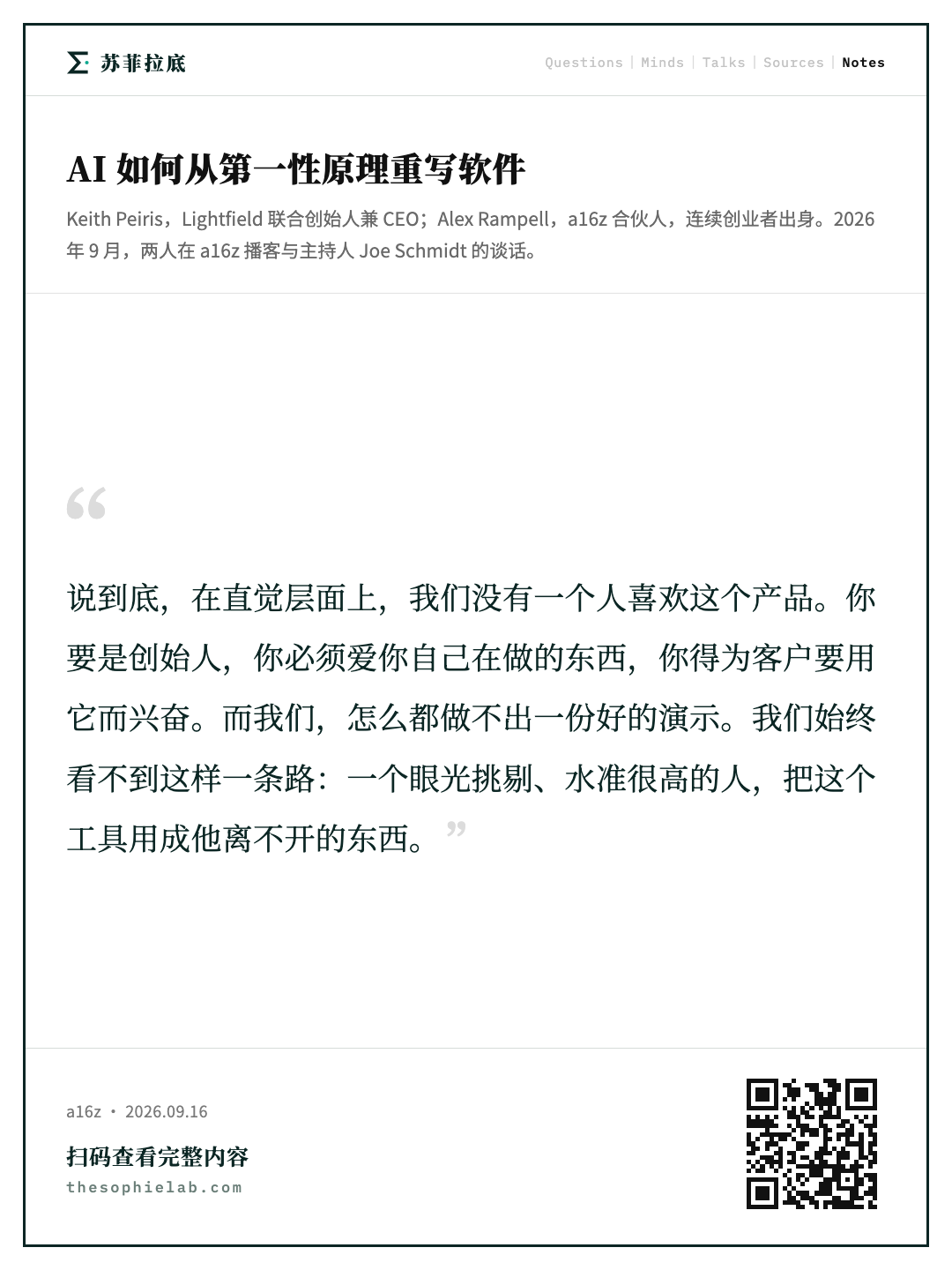
佩里斯: 背后当然有一堆指标,但说到底,在直觉层面上,我们没有一个人喜欢这个产品。

主持人: 哇。

佩里斯: 这话说出来有点好笑。但我觉得,你要是创始人,你必须爱你自己在做的东西,你得为客户要用它而兴奋。而我们,怎么都做不出一份好的演示。

主持人: 真的?

佩里斯: 我的意思是,我们始终看不到这样一条路:一个眼光挑剔、水准很高的人,把这个工具用成他离不开的东西。我们想象不出你们这样的人拿它写投资备忘录,也想象不出投行或者咨询公司的人用它。我们觉得技术本身把我们限制住了,它只能是个给个人用户和学生用的工具。

为什么不等技术变好

主持人: 太有意思了。所以你从 AI 演示文稿直接变成了什么都没有。那你是怎么决定下一个要做什么的?

主持人: 我想往回倒一点。有时候人走到这一步会想,技术反正在往前走,等它再好一点就够用了。可这也有点危险,业内有个说法叫「希望鸦片」(hopium)。你当时是怎么判断的?毕竟从 GPT‑3 到今天的 GPT‑6,这中间的跨度是惊人的。当然,如果你在烧钱,你也没有等下去的余裕。但你怎么看那条曲线的形状,为什么不干脆等它长上来?

佩里斯: 这问题问得好。我们确实认真想过:把团队缩小,等下去。因为我们亲眼看到了 3.5 到 4 的跳跃。但最大的问题是,模型根本拿不到足够的上下文,它不了解演讲者,不了解听众,更不了解演讲者和听众之间是什么关系。而这一点,靠再强的通用推理也补不上。所以我们的结论是:它最多能成为一个「一次性、天马行空」的演示工具,我们没办法把它变成一个让自己兴奋的东西。

主持人: 那你怎么去找下一个要攻的问题?你刚才那句话里最难、最疼的是「我们没有一个人喜欢这个产品」。如果它是你的全部生活,这话很重。你是怎么决定真正想做的产品是什么的?那个过程是什么样的?

佩里斯: 我们内部反复谈了很多次:等一下,我们当初为什么要办这家公司?我们办它,是想帮专业人士把专业的、难讲的故事讲出来。那我们就去找 B2B 的用例。我们翻自己的用户盘子,当时有两千五百万用户,发现里面的 B2B 用户集中在销售和市场。

主持人: 对。

佩里斯: 于是我们去联系他们,在湾区拿到 12 家试点客户,都是五百到一千人规模的公司,我们说这个免费,我们就替你们把演示做好,看看能走到哪儿。最后有几支销售团队真的用起来了。一开始我们的切入点是「我们帮你做新业务的提案和标书」,做着做着他们说:等等,既然你们在这儿,能不能顺手做点别的?能不能帮我们做调研?能不能帮我们判断线索的质量?能不能帮我们摸清一家公司有没有扩容的空间?我们就说,行啊,哪儿热我们往哪儿走,看看会发生什么。

我觉得早期创始人在这件事上的优势,就是他没有成见,他愿意无视自己已经建好的东西。我们当时就是:顺着这条线索走,看它通到哪里。我们提的第一个要求是,把你们的「联系人库」给我们看看。当时我以为那就是 Salesforce。于是我们说,太好了,把 CRM、通话录音工具、数据仓库都开给我们,剩下的我们来想办法。

结果我们发现,这活儿里最难的部分,恰恰是把散落在各个系统里的数据理出个头绪。数据是残缺的,是互相打架的。通话记录里的现实,常常和 CRM 里的现实对不上。真正重要的工作,是把这些东西重新组织一遍。顺着这个发现,我们开始意识到:等等,也许这才是更值得解的问题。如果你能把一家公司的现实重新组织成机器能理解、人也能理解的样子,那会是一家比我们眼下这家有意思得多、也长久得多的公司。

没人肯为它付钱

主持人: 你什么时候知道新产品这条路是对的?

佩里斯: 中间还是断了一截。我们一开始并不知道自己要做 CRM。我们先做了一个「上市助手」,大家挺喜欢,但没有人肯为它掏钱。

主持人: 这很难受。

佩里斯: 一堆客户经理天天在用,可我们完全没有定价权,因为数据不是我们的。而且外面还有另外十家公司在抢同一块地。所以我们决定缩小团队,从零开始,按第一性原理把 CRM 重新想一遍。

然后我们闷头做了大概四个月。做完得找人来用我们的 CRM,结果发现,没有人愿意用一个只有四个月大的 CRM。

主持人: (笑)

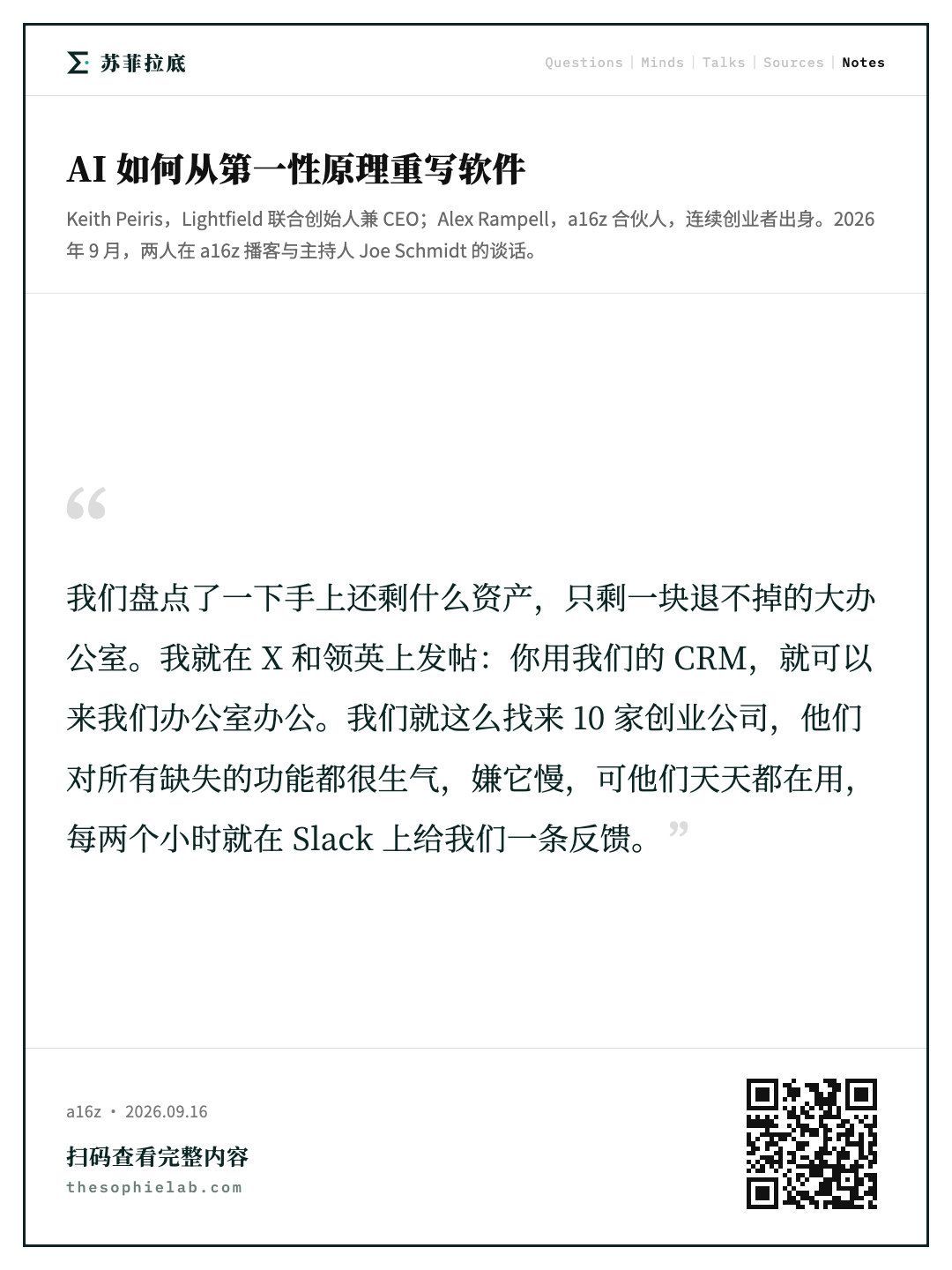
佩里斯: 于是我们盘点了一下手上还剩什么资产,只剩一块退不掉的大办公室。我就在 X 和领英上发帖:你用我们的 CRM,就可以来我们办公室办公。

主持人: 这叫负定价。

佩里斯: 对,负定价。我们就这么找来 10 家创业公司,而不知道为什么,他们每天都泡在里面。他们对所有缺失的功能都很生气,嫌它慢,可他们天天都在用,每两个小时就在 Slack 上给我们一条反馈。

主持人: 有意思。

佩里斯: 那一刻的感觉和 Tome 完全不一样:一个勉强能跑、远没做完的产品,人们却一直待在里面,在乎到愿意按小时给你提意见。

最重要的是建模

主持人: 那你一开始是不是就想好了,我用过 Salesforce、HubSpot,这些地方我要改?还是说你是怎么锁定「要解决的活儿」的?一方面 CRM 不过是个仓库,客户关系管理嘛,所有客户信息都堆在这里。可另一方面,你只要跟带过销售团队的人聊过就知道,他们最头疼的事之一就是「我那些销售就是不更新 CRM」,于是它常常是个陈年旧库。你当时的基本判断是什么?今天这个世界哪里坏掉了?你打算怎么做得不一样?还是说,就是先用负定价把人弄进办公室,听他们抱怨什么,再照着建?

佩里斯: 我觉得帮了我们大忙的,恰恰是我们在这个行业里有多外行。在一家成长期公司眼里,CRM 是销售代表用来「别忘事」的工具,是驱动低层次自动化的工具,也是做预测的工具。

主持人: 对。

佩里斯: 我们这个外行的看法是,最重要的其实是最后一项。如果我们能帮你把你的生意、把你的客户现实完整地建出模型来,剩下的事就都容易了。

主持人: 嗯。

佩里斯: 剩下的无非是提示词和工具调用。也正因为这样,业界很多人冲的是「CRM 替你干活」。

主持人: 对。

佩里斯: 我们冲的是高保真的业务建模。于是我们要问:什么东西挡在这件事前面?是销售代表的手工录入,是模式的僵硬,是 API 的质量。当别人在发邮件的时候,我们在自己的孤岛上做世界模型。

先把关系日志建起来

主持人: 能不能说说你们在架构上那些非常有意图的选择,你们是怎么把底层原语搭出来的?现在这个体验好得惊人,但它之所以成立,是因为早期做对了选择。讲讲你们怎么从第一性原理出发,这些选择今天又让你们能做什么。

佩里斯: 我们五位创始成员里有三位来自 Facebook,我们有一个很朴素的看法:CRM 里最重要的东西是给「关系」建模。所以我们其实是去看 Facebook 的时间线,我们想,我们要做的,就是把你的公司和这家公司之间按时间顺序的关系建出来。

主持人: 哦。

佩里斯: 所以我们最先做的是活动日志:你第一次联系他们是什么时候?你跟他们说了什么?他们回了什么?你们开过哪些会?来回发过哪些文件?再往后,他们在你的产品里做了什么?他们怎么付钱给你?我们认为,在这份活动日志上干活,才是正确的原语。

主持人: 有意思。

佩里斯: 所以我们的系统会先把你们之间的关系日志建起来,再用它去触发你熟悉的那些传统 CRM 动作:更新字段、推进阶段等等。但底下永远压着一份规范的关系日志,一切都长在它上面。

主持人: 那除了这条时间线,还有大量在任何别的 CRM 里都不存在的元数据。我记得最早跟你聊的时候,这正是我们反复在推的一件事:上下文实在太多了,你怎么把这些也变成这份记录的一部分?这块是什么时候进来的?是不是有某个想实现的工作流逼出来的?

佩里斯: 我们真的试过彻底走非结构化。

主持人: 嗯。

佩里斯: 结果发现查询太慢了。

主持人: 对,延迟是个问题。

佩里斯: 就是大海捞针。所以我们最后落在一个半结构化的做法上:把海量非结构化数据存进活动日志。

主持人: 妙。

佩里斯: 然后系统可以用这份日志去推断因果,从那里往下推。这就是它为什么比一个数据湖好用得多。而且你什么都能往里放,你可以把 Snowflake 的记录放进去,可以把活动记录放进去。

主持人: 要不举个例子?这一点挺关键的,实际用起来到底是什么样?

佩里斯: 好。Lightfield 上有很多做客户成功的人,他们的任务常常是:这个客户可以扩容了吗?如果你在 Lightfield 里问一个开放式问题,比如我们该向他们卖什么、什么时候卖,它现在可以把这个客户做过的所有事情过一遍。先是人和人的互动:他们跟你说过什么?他们的工单长什么样?然后还有产品使用数据,这些也就是一条条活动日志:他们已经一个月没登录了,那你也许不该急着再卖东西给他们。

主持人: 对。

佩里斯: 而且最常见的问题是「这些客户里我该先做哪家的扩容」,现在它可以沿着 CRM 的模式横向遍历,再深挖每个客户的日志,给你一个像样的答案。

智能大于模式

主持人: 太有意思了。那你怎么让最初的体验、最初的配置对一家小公司、中型公司甚至大公司都足够直观?

佩里斯: 有意思的是,我们跟很多 CRM 顾问聊过,我们把「你到底在替客户做什么」一条条记下来。我们发现,他们帮你做的最重大、后果最严重的决定,就是你的数据模型。

主持人: 对。这个搞砸了,就完了。

佩里斯: 就完了。阶段设错了,字段设错了,你没法让销售回到过去把它们补上,就是完了。所以我们想:我们能不能干脆做到实际上没有模式?

主持人: 嗯。

佩里斯: 换句话说,我们接上你的邮件,给你一个通话录音工具,接上你的数据仓库,替你把关系装配出来,字段你以后再填。你要是改主意了,字段换了,那就重新遍历一遍活动日志,再填一次。于是我们做成了一个无模式的设置:你登录,接上邮箱,接上其他源。

主持人: 对。

佩里斯: 我们内置了数据增补的来源,它就实时替你装配好了。

主持人: 太妙了。

佩里斯: 所以它用起来像个消费产品,你点一下同步,等五分钟,东西就在那儿了。

主持人: 你要是回到很早的年代,做模式是为了省空间。那些都是关系型数据库,为了省下一张表里的空间,每一列都得抠。不知道你对 SQL 熟不熟,比如 varchar,可变字符,你得事先定好这一列最多几个字符。

佩里斯: 是。

主持人: 你会写 name 是 varchar 25。然后就是「糟糕,这个人的名字太长了」。想想真有意思,我们走了这么远。当年是要一个比特一个字节地抠,你得手动规定一列最多多少字符。今天大家说的是「模式?」这事挺好玩的。

佩里斯: 是啊。

主持人: 时代变了。

佩里斯: 对,对。智能大于模式。

一位阿尔茨海默病患者

主持人: 顺着智能这个话头说。现在有意思的事情很多,本质上是你给了一个人一副底盘,让他把智能投向真正难的问题。你刚才举的是客户成功的人问「这个客户怎么增购」。那今天有没有谁在 Lightfield 上做了什么最让你兴奋、最离奇、最有意思的事,是在 varchar 那个世界里、或者在此之前的世界里根本做不到的?

佩里斯: 有一件让我很自豪的事:我们一开始就做了完全任意的模式,自定义对象、自定义关系。因为在 Lightfield 里这些东西的成本,和在别的系统里根本不是一回事。所以我特别喜欢那些商业模式很怪、必须建模出不一样的东西的客户。有一家公司叫 Power,他们一边跟制药公司合作,帮它们找临床试验的参与者;另一边他们有一个市集,把各种身患疾病和并发症、正在寻找前沿疗法的人聚到一起。这两边他们都在 Lightfield 里建了模型,B2C 的一侧和 B2B 的一侧。他们还搭了自动化去抓取 FDA 和 clinicaltrials.gov 的数据,给自己做出一个「全世界正在进行的每一项试验」的世界模型,然后在 B2C 这边做匹配,也跟合适的制药公司做匹配。两边会撞到一起。

主持人: 哇。

佩里斯: Lightfield 实实在在地帮一位阿尔茨海默病患者在几天之内找到了前沿疗法。

主持人: 这太了不起了。

绿地还是棕地

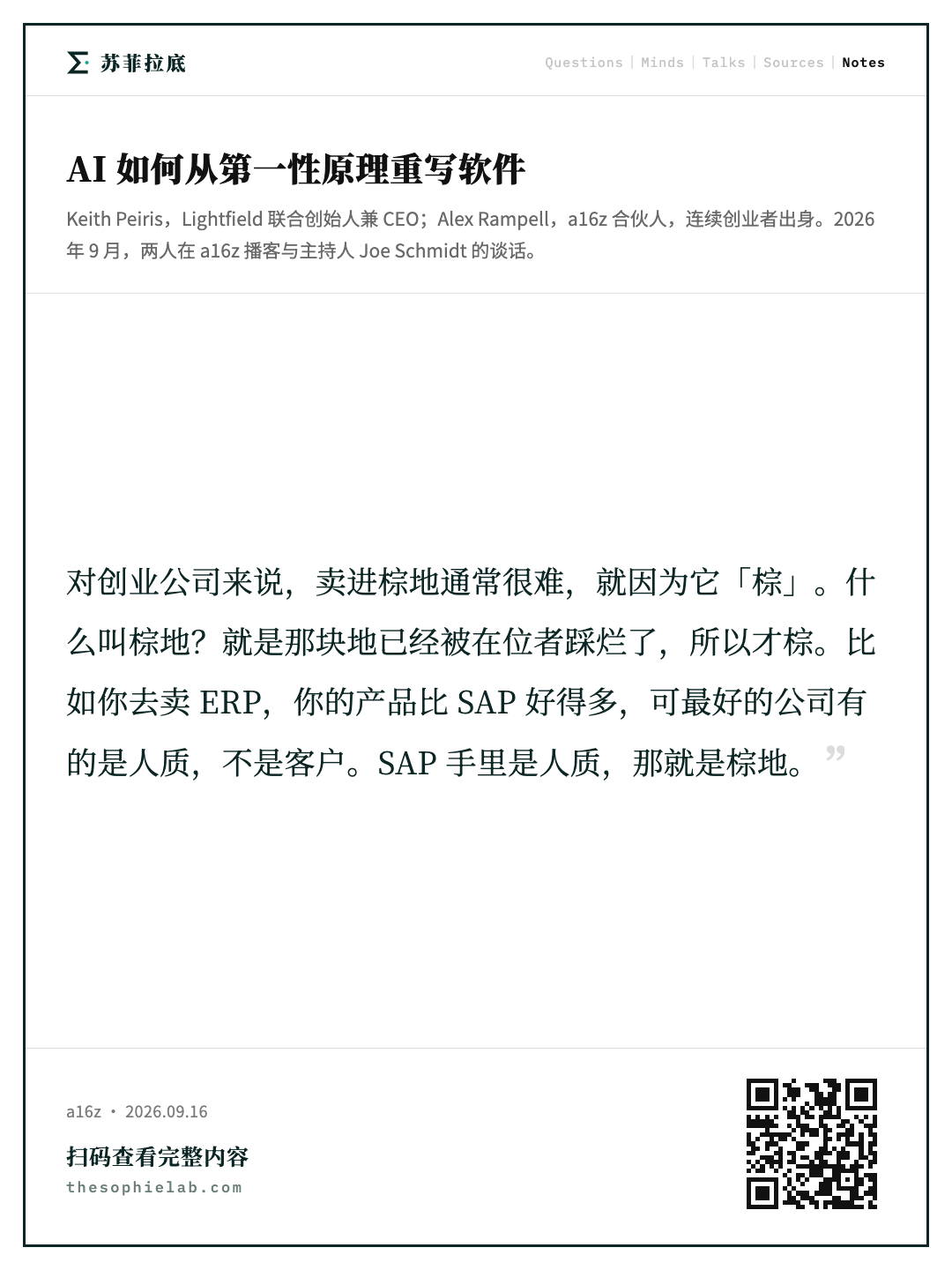
主持人: 我们内部经常讨论一个话题,绿地和棕地。对创业公司来说,卖进棕地通常很难,就因为它「棕」。什么叫棕地?就是那块地已经被在位者踩烂了,所以才棕。比如你去卖 ERP,你的产品比 SAP 好得多,可我有句话乔已经听我说过一百万遍:最好的公司有的是人质,不是客户。SAP 手里是人质,那就是棕地。有时候你能撬开。比如云对本地部署。云做了什么?那也是棕地,但它把问题重新定义了一遍:回到 CRM 的旧时代,你用的是 Siebel 系统,跑在你办公室里那台 IBM AS/400 主机上。你已经受够了,因为维护它的那位老兄辞职了,他 92 岁了。也许你现在该换一家云厂商。棕地从本地走到云,一部分就是这么撬开的。另一条路是走绿地:我不跟人质较劲,我就是把世界上最好的产品做出来,那些没有任何存量软件包袱的新公司自然会用我。

佩里斯: 嗯。

主持人: 回到你们负定价那阵子,免费办公室就是那个负价格。当时你怎么想「谁才是对的客户」?你是怎么摸到你们的 ICP,也就是理想客户画像的?

佩里斯: 说实话,公司刚起步的时候,我们对怎么打进棕地并没有足够锋利的判断。

主持人: 嗯。

佩里斯: 我们的出发点是:搭建一支营收团队,本身就是个特别丰富的问题群。所有人都在乎这件事,它永远可以做得更好。所以我们相信这里头一定有东西,只是不确定具体是什么。于是我们想,先赢下一家新公司再说。那怎么赢下一家新公司?我和我的幕僚长就在领英上做陌拜,给 YC 的公司发邮件,就是那种「嘿,我们能不能拿下这里的一家创业公司」。

我们就是这么起步的,我们认定只要听得足够深,早晚能找到打进棕地需要的那个楔子。这几个月里,我觉得我们大致找到了。首先是迭代次数够多。眼下服务早期创业公司有个好处:从 pre‑seed 到种子轮、种子到 A 轮、A 轮到 B 轮,从来没有这么快过。我们有些客户刚来的时候一个销售都没有,现在已经有一百个销售了。

我们因此能钻进去看,你真正在乎的、我们替你解决的,到底是哪些问题。结果发现它比我们预想的还要更上一层。你看过去两年硅谷路边那些 AI CRM 的广告牌,讲的永远是「干活、干活、干活」:线索打分、发陌生开发信等等。我们团队一直觉得那不是打进棕地的楔子。Salesforce 自己就会发邮件,我猜他们从今天起也确实会发了。我们的判断是,棕地的楔子必须跟「更好地理解你的公司」有关。

这样你才能在公司建设的混乱年代里掌好舵。但老实说,这件事是我们盯着这类客户看了足足六个月,才慢慢浮出来的。

免费给全公司用

主持人: 还有一件事也会浮出来。如果你做出了更好的产品,产品当然有一堆使用者,但就拿绿地和棕地这个分野来说:你那家绿地公司招来的销售副总裁,是被训练成使用旧东西的。我记得我自己创办第一家公司的时候,死活不肯每月付 85 美元给 Salesforce,用了个免费的东西叫 Sugar CRM。最后我还是投降了,开始付钱给 Salesforce。为什么?不是因为功能差距什么的,而是我招了一位销售副总裁,他说「我才不用那个破玩意」。我说这个更省事、更好用,但那事真的很难办。这不是说一家新公司非得去做培训生意,可这中间就是有个落差。绿地对棕地里最少被人讲明白的一点就是:绿地公司雇的是棕地出身的销售副总,而做采购决定的正是他们。你自己笃信这是好太多太多的产品,那你怎么克服那种「我用着一个没那么好用的东西,我挺满意」的反对意见?

佩里斯: 好问题。我们早期定下的一条原则是:我们大概能很好地说服创始人、工程负责人、产品负责人去用前沿技术理解和服务客户,但要说服后来加入的销售副总裁「这才是正道」,多半要费很大力气。所以我们有个想法:所有销售驱动的套餐里,这东西对公司里的任何人都免费。

一来这对 Lightfield 有好处,我们能看见工程在干什么、客服在干什么、财务在干什么。二来它会造出一种真正的公司级网络效应,让别人更难把我们拔掉换掉。我们已经在好几家公司里碰到过:一位资深销售副总裁进来,说这东西挺酷,但我只会用 Salesforce,我就是这么被训练出来的。然后公司里其他人说,等一下。

主持人: (笑)

佩里斯: 工程师是靠这个理解客户的,财务是靠这个做收入确认的,客户成功是靠这个给客户打分的。你能不能再努力一点学一学?到这个份上,我们就有了关系,我们跳进去,告诉他我们会怎么让他的日子更好过,我们就有了一战之力。

旋钮还是自然语言

主持人: 现在做那些过去只是一张表格的事情,有太多种方式了。你是想把那些表格还给用户,做得很拟物,「这就是你熟悉的那个 CRM,连蓝色都一样」,还是说,现在你可以用自然语言做掉大部分事,你根本不用盯着一堆仪表盘,有事系统会告诉你?这类产品取舍你怎么想?我觉得所有做记录系统的公司现在都在琢磨,怎么把人带到那个已经到来的真正的未来。

佩里斯: 我们在这件事上是彻底务实的。

主持人: 嗯。

佩里斯: 比如现在我其实是公司事实上的销售经理,我开所有的会,用的还是我自己搭的那个表格视图。我们的看法是,如果真想做一个像样的企业级 CRM,就不能在「人该怎么工作」上讲教条。所以我们两头都做:我们有很好的仪表盘,有很好的表格视图。

你想用就用;你要是站在前沿,你也可以全部自己来。

主持人: 比如想用命令行什么的。

佩里斯: 对,那也可以。

主持人: 说到这个。我刚买了辆新车,之前开的是宝马,那车上有九百万个按钮。你走进飞机驾驶舱也一样,你看着那个座舱会想,飞行员怎么知道这些都是干嘛的,那得有九千个开关。

佩里斯: 像飞行员一样。

主持人: 最酷、其实也有点吓人的是,不知道你知不知道,最新的特斯拉连换挡杆都没有了。

佩里斯: 对。

主持人: 根本就没有那个东西。最「实体」的实体按钮,彻底消失了。可它偏偏简单直观到一个五岁小孩都能用。当然我们不希望五岁小孩开车,但你明白我的意思。这其实也是另一种看待「有模式还是无模式」的方式:你有一堆旋钮和开关,看着很厉害很高级,销售副总裁很吃这一套,你去问财务的人,他们对彭博终端上每一个按钮都门儿清。可你能做出伟大产品的方式之一,恰恰是把它做到连五岁小孩都会用。

佩里斯: 是。

主持人: Reddit 上有整整一个版块叫 ELI5,「像我五岁一样解释给我听」。所以感觉上,当然你是老板我不是,但感觉你手里就是这么个局面:一边是旋钮开关一大堆的旧时代,可用大白话驱动智能的好处之一,就是那些东西你一个都不需要了。

佩里斯: 对,对。

主持人: 几乎显得过时了。

佩里斯: 确实。我们在不同的地方都撞上过这件事。比如「确定性的仪表盘」这一仗我们并没有打赢。我觉得每个人早上端着咖啡的时候,都想看同一张仪表盘,我自己也一样。

主持人: 但愿上面的营收是涨的。

佩里斯: 那条线永远向上。不过有一些老工作流,我们是彻底重做过的。销售里最经典的工作流之一是「序列」:你对一个可能表达过兴趣的人,在不同时间、按不同触发条件发五封邮件。过去你得用箭头、条件和变量把这件事画出来。

主持人: 对。

佩里斯: 在 Lightfield 里,你只要跟智能体聊天。智能体替你写出一份「配方」,这份配方会把你世界模型里的东西考虑进去,然后自己跑起来。一开始有些销售主管说,我不信任这玩意儿,我要我的旋钮,我要我的开关。可后来他们会转过弯来:等一下,这个更省事、更好,而且我要学的东西还更少。我觉得在带一支上市团队的几乎每一个方面,我们都在撞上同一件事。

自己搭还是买

主持人: 现在还有一股风潮,所有人都觉得自己基本什么都能搭出来,软件已死,什么该我自己做、什么不该。对那些想自己搭出其中一部分、甚至想把全部都自己搭出来的客户,你怎么跟他们谈?也说说这股风潮,以及 Lightfield 是怎么应对的。

佩里斯: 首先,既然我们是记录系统,我们就必须开放。这是你的数据,不是我们的。我们跟客户说,我们对建模和对你业务的还原精度非常自豪。我们自己写了邮件同步,自己写了 Slack 同步,自己写了数据仓库同步,我们为自己数据库的性能感到骄傲。然后这些东西你想拿去哪儿就拿去哪儿。

主持人: 对。

佩里斯: 所以我们确实有几家客户,把 Lightfield 当成核心记录系统,然后想在上面自己搭一套外壳。也许他们本来就有一套公司自己的外壳。我们支持这么做,你可以全部通过 MCP 或者命令行走出去。但过几个星期,他们几乎总会发现:等一下,你们那套外壳其实干了不少活。

主持人: 对。

佩里斯: 它的实体识别更好,精确率和召回率更高,速度更快。我们说,对,那本来就是我们的工作。所以我们的态度是:数据是你的,你想怎样都行,我们每天都会努力,去挣得你把生产力交给我们的那个资格。

定价的两次极端

主持人: 顺着这个说。定价现在是个特别疯狂的问题。有按席位定价,可席位这件事已经讲不通了。你想想,如果一家公司把活儿都丢给智能体,它需要几个席位?可能是零,挺吓人的。然后是所谓按结果定价,可什么算结果?我把东西卖掉了算吗?如果我只是有一个一直很开心的客户呢?我照样在用 CRM 支撑这件事。所以结果很不好界定。再往外一层,还有我显然不同意的那种说法:软件已死、SaaS 末日。照这个逻辑,超市也死了,你自己种粮食去;汽车厂也死了,你自己焊铝合金去。你可以一路推到极端。我想问的是,你们的定价是怎么定出来的?这算第一个问题。第二,你怎么看这个领域里的按结果定价?客服还比较说得通,那是降成本,软件可以回答问题,那是个知识库,答案数量有限,我把问题和答案匹配上就行。而销售不一样。

佩里斯: 几乎让人觉得,人类最后一份工作会是销售。

主持人: 总之,定价、结果、竞争,我很好奇你是怎么从负定价一路走到今天的定价的。当然负定价我不建议你一直用下去。

佩里斯: (笑)

主持人: 你是怎么定出价格的?这个三角里的事情你怎么看?

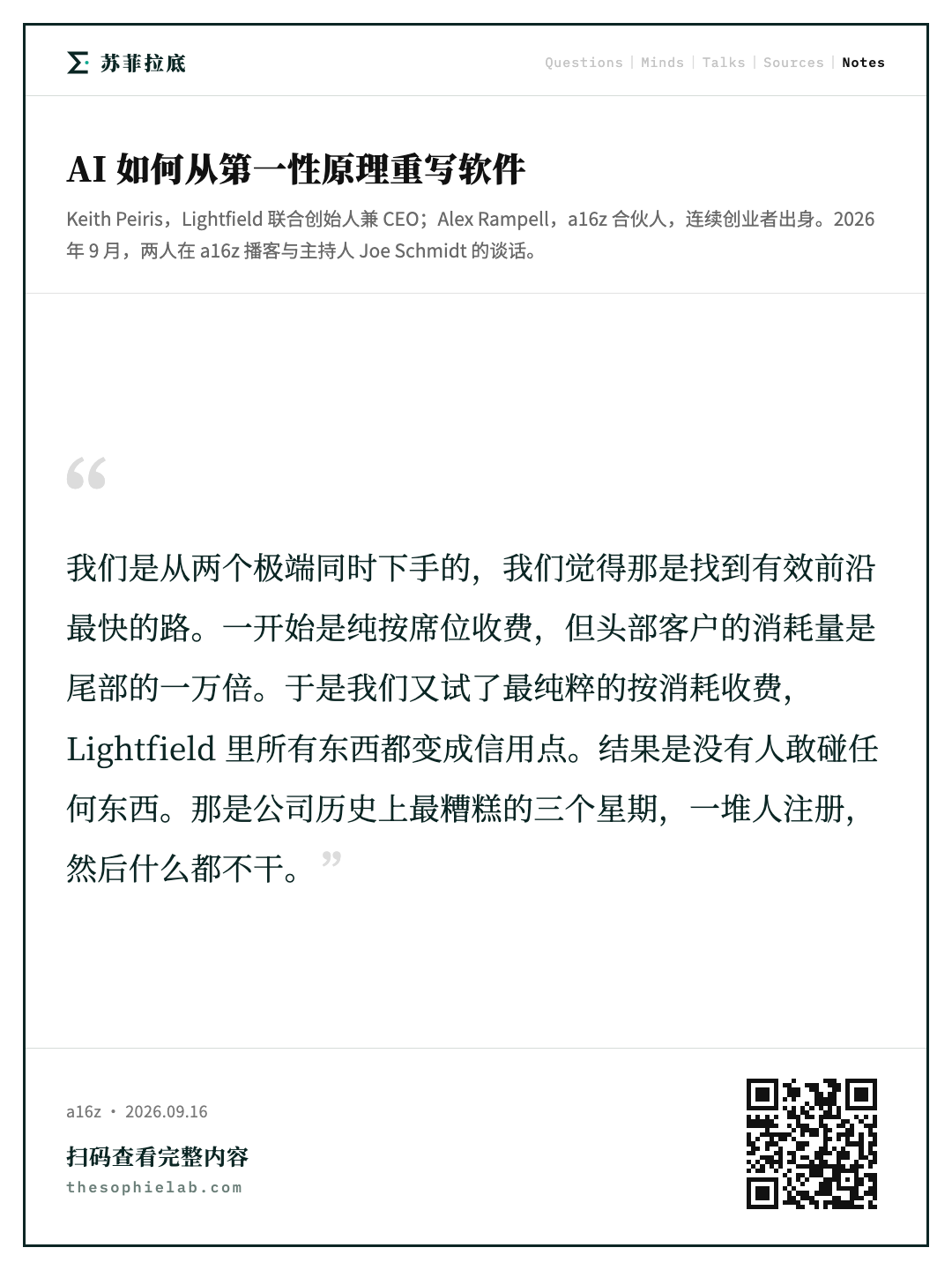
佩里斯: 好问题。我们是从两个极端同时下手的,我们觉得那是找到有效前沿最快的路。一开始是纯按席位收费,因为那跟 Salesforce、HubSpot 的世界对得上。客户的接受度我觉得相当好。但头部客户的消耗量是尾部的一万倍。

主持人: 消耗是指用量?

佩里斯: 对,用量。我们意识到,靠按席位收费,我们撑不了多久。于是我们又试了最纯粹的按消耗收费,Lightfield 里所有东西都变成信用点。结果是没有人敢碰任何东西。

主持人: 太贵了。

佩里斯: 那是公司历史上最糟糕的三个星期。一堆人注册,然后什么都不干。

主持人: 什么都不干,这可不行。

佩里斯: 于是我们开始跟客户聊。乔当时也一起参与了,我们发现 Lightfield 做的活儿可以分成四类,而且我们能把它们区分开。第一类是日常的 CRM 工作:记录一场会议、填好记录、更新任务。我们大部分客户就是希望这一块被平台费或者席位费覆盖掉。他们说,我看未来一年的预算时,不想还得琢磨我核心 CRM 的误差范围有多大,你把它做成固定的。

另外两类是这样:一类是管道生成,在这一块上客户是相当愿意按消耗付费的,因为里面有数据增补,对他们来说是有超额收益的,能多拿会议,会议能转成营收。还有一类是工作流自动化,大家默认这是要付钱的。

主持人: 顺便举个例子?

佩里斯: 比如有人在我们官网上约演示,Lightfield 做一点调研,判断出这条线索该给亨利,因为这是家硬科技公司;或者该给马特,因为这是家健康科技公司。

主持人: 对。

佩里斯: 这就是在实实在在干活,投资回报你算得出来,所以你会为它付钱。

最后一块,说实话是智能和预测,这可能是 Lightfield 里最少被人发现的部分。如果你手上有这么一个关于自己公司的小水晶球、小雪景球,你现在要把前沿智能投进去,开始做情景推演,想清楚下一步是什么。在这种场景下,你一定会为那份超额收益买单。

主持人: 是。

佩里斯: 我自己就是个例子,有个周末我放手让 GPT‑6 在 Lightfield 上跑了几个小时,之后我改掉了我们的销售流程。所以我们最后落在这样一套结构上:核心 CRM 是平台费加席位费,其他一切按消耗付费。目前效果相当好。

至于你问的按结果收费。做一家销售类公司最难的一点是,我们的结果取决于你的产品与市场的契合度有多强。

主持人: 当然。

佩里斯: 我们替 OpenAI 做陌生开发,效率会高得惊人。

主持人: 哈哈。

佩里斯: 他们的结果会好到不像话。

主持人: 他们有兴趣的话,打这个电话。

佩里斯: 而我要替一家连网站都没有的种子轮公司做陌生开发,效率会低得惊人。所以我们眼下的结论是:我们只能为「工作」收费,在这个领域里,目前还没法为「结果」收费。

没有人有自己的赛道

主持人: 从 Tome 到今天,工作方式本身发生了什么变化?一年多前我们第一次见面时,我就觉得你们出货的速度惊人,而现在这个速度好像直接冲上天了。我很好奇你是怎么围绕「速度」来设计公司文化、工具和决策机制的,前后的那个阶跃是怎么发生的。

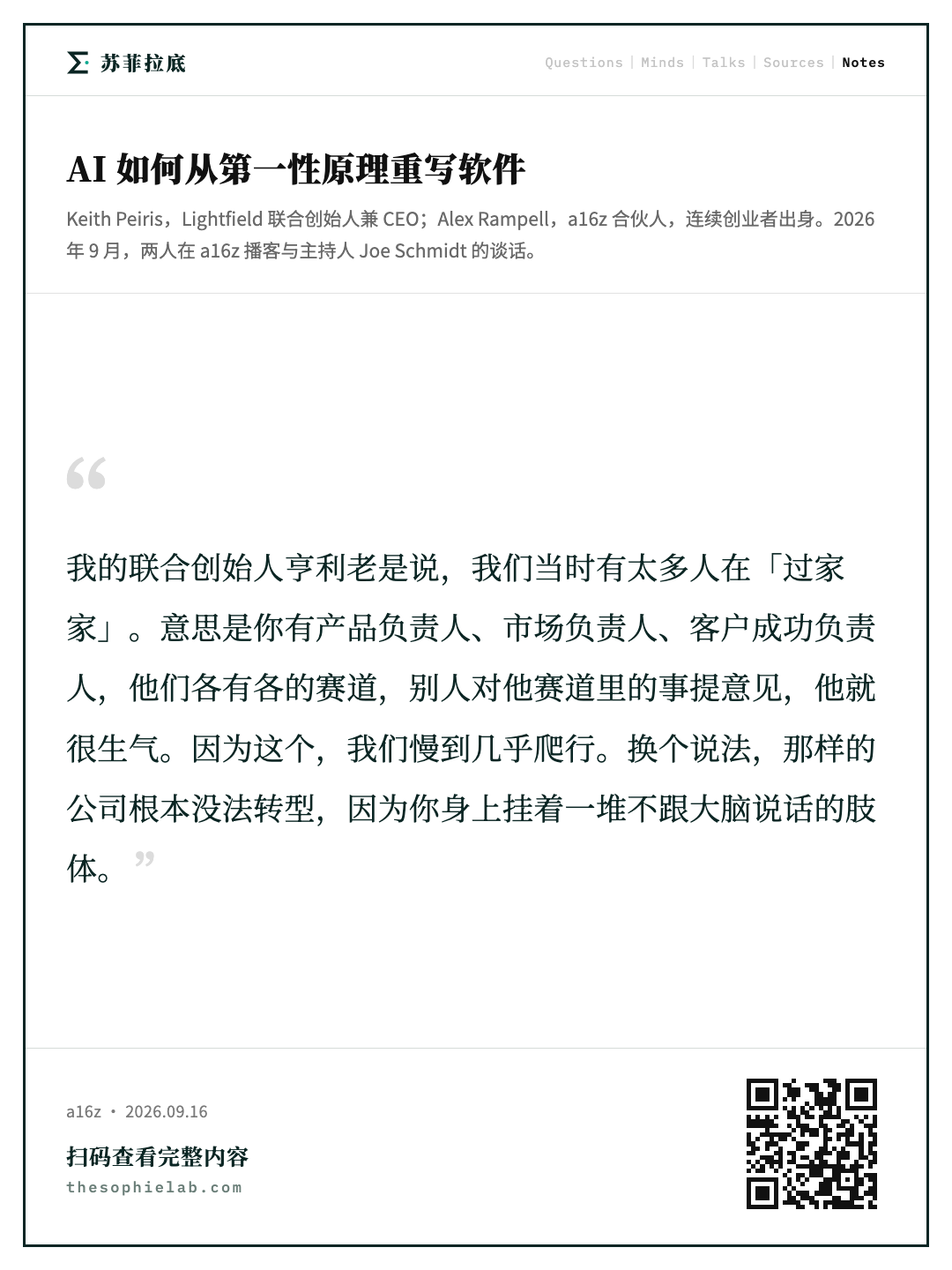
佩里斯: Tome 有一件事我很后悔,在 Lightfield 我们彻底改掉了。我的联合创始人亨利老是说这句话:我们当时有太多人在「过家家」。意思是你有产品负责人、市场负责人、客户成功负责人,他们各有各的赛道,别人对他赛道里的事提意见,他就很生气。

主持人: 对。

佩里斯: 因为这个,我们慢到几乎爬行。换个说法,那样的公司根本没法转型,因为你身上挂着一堆不跟大脑说话的肢体。

主持人: 是。

佩里斯: 另外我们当时还想把计划排得太远,我觉得在今天这个建公司的年代里,这件事很要命。所以我们说,这些全部不要,没有人有自己的赛道。

主持人: 你知道那句老话吧,「人在计划,上帝发笑」。现在是人在计划,OpenAI 发笑。

佩里斯: 对,正是。所以现在有意思的是,所有人都拥有产品,所有人都拥有客户成功,这个安排挺特别。公司四十个人,每天早上开同一个站会。我们把最重要的问题按优先级排好,有的是交付,有的是工程,有的是客户成功,谁手上空了谁就拿走。

主持人: 有意思。

佩里斯: 我们做连续规划。清单每天都可能变,每周我们重新评估一次清单,谁空了谁就接下一个问题。而这之所以成立,是因为我们身处的这个年代:任何人都能通过 Lightfield 迅速熟悉一个客户;任何人都能迅速上手我们的设计系统库,因为大模型能操作 Figma;任何人都能自动在 Linear 里建任务,因为 Lightfield 和 Linear 是打通的。于是我们造出了一个环境,本质上每个人都是通才。

主持人: 嗯。

佩里斯: 工程师带项目,设计师带项目,客户成功经理也带项目。如果你是某方面的专家,你自然会多做一些同类的项目。

主持人: 那你怎么让「人人都是通才、人人都在不停冒想法、人人都去做最重要的事」这件事,和一个非常连贯的未来图景对齐?这个过程你到底怎么管?

佩里斯: 我会说,这是一种持续的拉扯。我们每周开路线图和上市策略的会,然后就是不停地编辑它。

主持人: 对。

佩里斯: 我们会说,有个客户提了这个需求,它跟我们的使命怎么对上?对不上。所以我觉得就是不停地编辑,确保公司产出的东西是连贯的。另外我想说,在 Lightfield,开一个项目的门槛很低,但把项目发出去的门槛相当高。

主持人: 嗯。

佩里斯: 我们现在还在做全公司的集体查错,这是我在 Instagram 学到的做法:在东西交给客户之前,全公司得先喜欢它。

主持人: 对。

佩里斯: 这几件事合在一起,让我们跑得挺快。

最怕的是速度

主持人: 太棒了。那你最担心的是什么?

佩里斯: 我会说是速度。我们处在一个非常特别的环境里。也许我可以讲一件旧事。做 Lightfield 之前,我读了一大堆 Tegus 的访谈报告,讲的都是有人从「当月网红 CRM」搬回 Salesforce。我记得其中一篇讲的是你们的一家被投公司 ElevenLabs,他们当时用的是这类创业公司的 CRM,后来他们要仪表盘,那家公司做不出来,拖了四个月。ElevenLabs 的人问烦了,于是搬去了 Salesforce。

这正是让我最偏执的事情。我觉得我们手上握着一个极好的楔子,我们是新公司最好的 CRM。那我们就必须把一切都建出来,让这些人永远不会生出回到旧世界的念头。

优先级怎么排

主持人: 说到这个,你到底怎么排优先级?这正是新世界疯狂的地方,也接回你说的人人都是通才。从前你会有一个十人的产品、设计、工程小组,数字随你定,反正不是一百也不是两个。你有一位产品经理,一位设计师,还有九个工程师。然后你的排期会一直排到 2028 年。而现在任何人都能把一个产品提示出来。所以一方面,如果大家都清楚我们要做什么,你可以快得多地把东西建出来。可另一方面你还是得取舍:我是不是该优先做这个客户?我知道有家很棒的公司,不做这个功能他们就会流失,这是个很好的理由。但这可能也不是好事,因为还有十五个客户,不做另外那个功能他们就签不下来。这个问题从公元前就存在了。但在这个「谁都能建任何东西、你理论上可以拥有无限多产品经理和工程师」的 AI 年代,你有没有学到什么、做得不一样的地方?

佩里斯: 说来有趣,我们在 Lightfield 里练出了一种能力,去看一个客户的扩容潜力。我觉得作为一家身处红海的 CRM 公司,我们必须是一家靠扩容成长的公司。

主持人: 对。

佩里斯: 在竞争激烈的领域里,你常常拿不到你本来期待的那个初始落地规模,因为赢下每一家公司都太重要了。但你会想,到第三年、第五年,这些都不重要了,因为那时候他们会是一家大公司,而我们会是他们身上重要的一部分。所以我们的视角是:这个客户在三年期里的扩容价值是多少?我们照着这个排优先级。因为这样,我们更多是在为增长最快的客户建东西,而不是为平均客户建东西。但同时我也得说,我们什么都得建,这是个需要比平时更「极大主义」一点的时期。

硅谷过热,外面过冷

主持人: 还有一件有意思的事。我常开个玩笑,说 AI 在硅谷几乎是被过度炒作的。我其实不认为它被过度炒作,但在这个小小的区域之外,它是被严重低估的。

佩里斯: 嗯。

主持人: 原因之一是很多人好几年没再试过了。他们说,我 2022 年 11 月试过 ChatGPT,它瞎编了点东西,哦,这玩意儿不行,然后就把这事扔下了。现在他们又觉得它某种意义上会要了自己的命。

佩里斯: (笑)

主持人: 这跟绿地棕地也有关系:你可以拿下硅谷,但怎么跨过鸿沟,进到这个国家的其他地方、世界的其他地方?那是非常不一样的。其实是同一类客户,他们有产品,有员工,有销售,他们卖东西,他们要报表,只是他们没那么在圈子里,你没法在 101 公路边上打个广告就够到他们。硅谷的过热和外部的过冷,你怎么看?

佩里斯: 我觉得对大多数记录系统公司来说,营收规模最终还是来自这里之外五十英里乃至更远的地方。我一直把公司建设的这个阶段,看成一个拿到标杆客户 logo 的窍门。我们有客户融了两亿美元,上市团队只有三个人,他们有一天会变得很大。我们只要为他们做出漂亮的活儿,等我们走向外面的世界时,就能把他们的 logo 拿出来说,好,医疗这一块我们有了。

主持人: 对。

佩里斯: 或者金融科技我们有了,等等。所以我看待「聚焦硅谷」这件事,不是把它当成高效的营收捕获,而是高效的营销捕获:拿着这些出去说,我们很想进制造业,其实我们这边已经在服务一批很好的制造业公司了,现在我们也能为你做同样的事。

主持人: 客户的心思真是有意思。你用的是一模一样的软件,可要是乔跟我不在一个行业,他是个超级满意的客户,我却会想,我要的是一模一样的东西。我拿字段来打比方,请你担待,我存的是一模一样的东西,但我不确定能不能信你,因为他卖的是牙刷,我卖的是可口可乐。

佩里斯: 是。

主持人: 可要是他卖牙刷,那我就想,我一定要用另一个卖牙刷的人在用的东西。这非常古怪。我一直觉得这事有意思,它最后又回到可参考性上。客户就是想知道这东西真的能用,尤其是记录系统这种东西。这就是那句老话,没人会因为买了 IBM 而被开除。在我愿意往下跳之前,我想知道一个跟我竞争的人、一个我的朋友、一个同一个垂直行业里的人已经在用它了。你是不是也发现这是真的,就像你说的制造业对某某行业?说到底客户就是客户。

佩里斯: 是。

主持人: 上下文、联系人信息,这些东西都一样。你觉得他们为什么在乎?只是因为这种产品牵扯的信任太重了吗?

佩里斯: 我想是的。在很多方面,你的 CRM 可能比你的银行更难更换。

主持人: 对。

佩里斯: 而我觉得。

主持人: 直到被我们干掉。

佩里斯: 对,正是。

主持人: 我们让它变容易了。

佩里斯: 我们确实让它容易多了。但就心理负担而言,你就是绝对不想选错那一个。

主持人: 没错。

佩里斯: 正因为这样,可参考性的作用非常大。来的路上我跟乔说,我们在医疗和健康科技这块做得特别好。一部分原因是,我们在那种有五十个不同干系人或联系人的复杂交易里做得非常好,工程那边也做得很好。另外我们从一开始就对安全极其较真,我们签 BAA,做渗透测试,做了好几年。

现在我们要赢一单健康科技的生意,已经很容易了。我觉得就是因为我们有了这样一张可以互相引用、一路推进的网络。这本来就是游戏的一部分。换成我自己也一样,我也不想选错 ERP。

主持人: 对。

佩里斯: 所以我大概率会去选那些「跟我长得像」的公司选的那个 ERP,这样我买完之后就再也不用想这件事了。

我自己搭一个

主持人: 回到前面那个问题,在这个疯狂的年代,你会不会碰到有人说「我什么都不用,我自己搭」?这才是最疯的。我还会不会在?那个决定要氛围编程出一个 CRM 的员工,软件是免费的,可支持不是免费的,我付给他的工资也不是免费的。你会碰到想自己动手的人吗?还是说这件事被谈论得过头了?

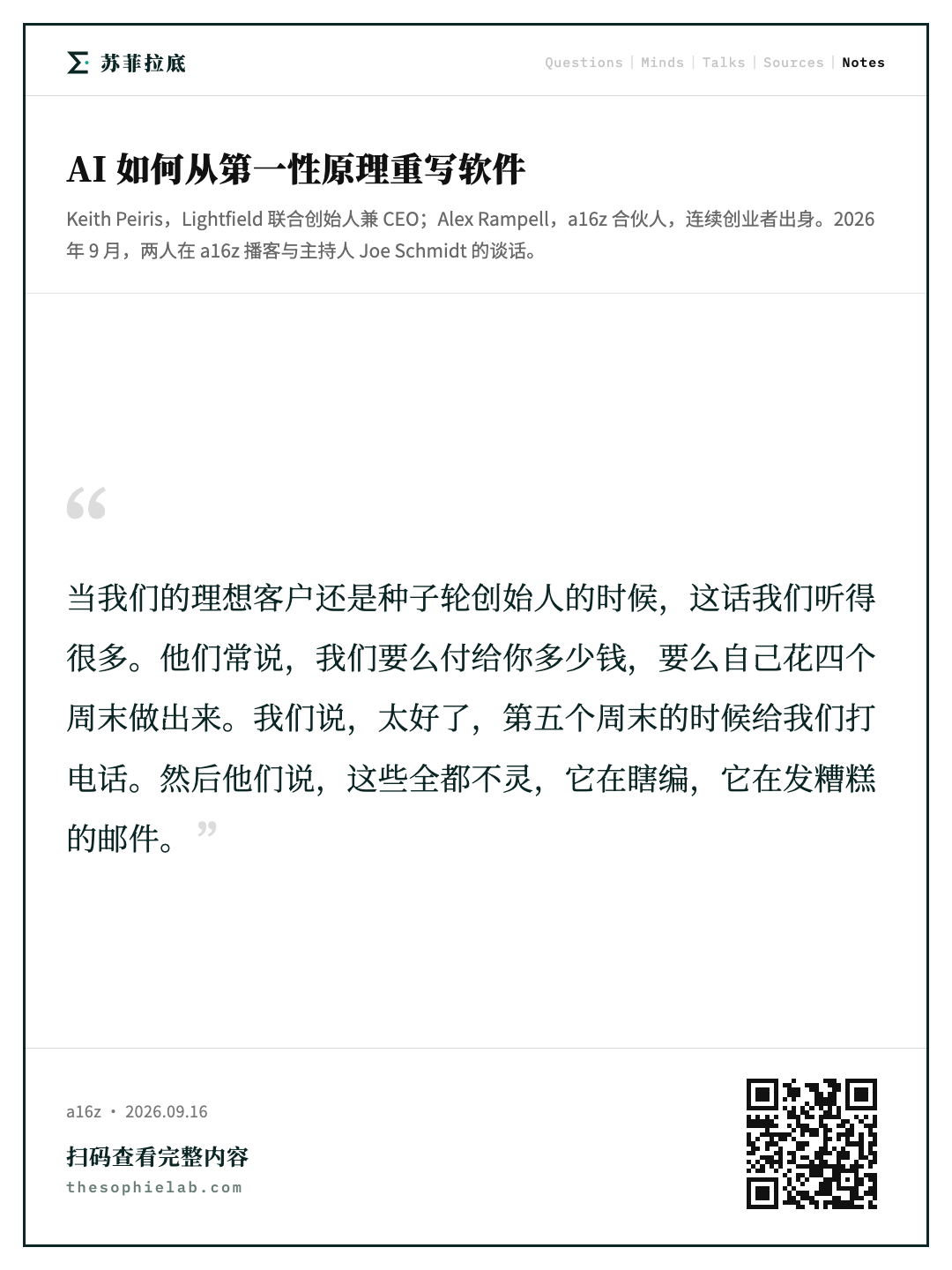
佩里斯: 我觉得被谈论得有点过头。当我们的理想客户还是种子轮创始人的时候,这话我们听得很多。

主持人: 对。

佩里斯: 他们常说,我们要么付给你多少钱,要么自己花四个周末做出来。我们说,太好了。

主持人: 祝你好运,你真该试试。

佩里斯: 第五个周末的时候给我们打电话。然后他们说,这些全都不灵,它在瞎编,它在发糟糕的邮件。至于大一点的公司,我们听到的不是「我要自己搭一个记录系统」,而是「我要自己搭一个公司大脑」。

主持人: 对,对。

佩里斯: 这话听得很多,然后这些人里有很多又回来说,其实搭一个公司大脑、搭一个商业世界模型真的很难。

主持人: 是。

佩里斯: 而最难的那部分,我觉得是给客户建模。他们说,我们试过了,我们不喜欢自己做出来的结果,所以还是来找你们。

公司的水晶球

主持人: 那你对未来最兴奋的是什么?

佩里斯: 说来好笑,我最兴奋的是 Lightfield 变成你做情景推演的那个水晶球。真正让我每天早上爬起来的,是看到有人用 Lightfield 去想:我该招多少个销售?我下一个该做什么产品?我该往哪里走?我们有一位做企业级市场的客户,通过 Lightfield 发现自己需要做一个面向中端市场的产品。

主持人: 嗯。

佩里斯: 他因为在里面发现的这件事,做出了一整条新产品线。我特别兴奋的是,我们能成为那样一面镜子。

主持人: 对。

佩里斯: 让一家公司照着它,做出最难、后果最重的决定。

主持人: 这又回到亚历克斯刚才说的那点:在一个极大主义、你可以为任何人建东西的世界里,答案其实就是要有 Lightfield 这样的工具。如果你手上有全部数据、全部上下文,你就真的可以用数据说话,而这正是把前沿智能砸向一个极复杂决策的绝佳机会。这件事在过去需要一群非常聪明的人、一大堆运营人员、SQL 以及别的一堆东西。现在你只要跟 Lightfield 聊一个下午或者一个周末,就能拿出一个相当理智的推进方案。我想这也是你能用今天这种方式经营公司的原因之一,非常酷。

别听周围的噪音

主持人: 最后一个问题。看这期节目的人里,肯定有一些正处在某个转型时刻,他们在想象未来自己成为基思,在这里谈论自己了不起的新公司。如果让你带着今天的后见之明,回到刚要开始那段转型旅程的自己面前,你会给他哪一条建议?

佩里斯: 我觉得最重要的一件事是记住:当你身处转型之中时,周围几乎所有的噪音都不重要。你要做的就是找到痛点,被一个能解决这个痛点的产品或服务点燃,然后近乎偏执地盯着你的客户。

主持人: 对。

佩里斯: 剩下的全是噪音。我记得我们正在经历那一段时,有人在说办公室让他们想起从前的好日子,有人在说食堂的东西不够有灵气,还有人在说,我的期权会怎么重新定价?说实话,这些统统不重要。你完全可以戴上眼罩,专注在核心上。

主持人: 说得好。你做出来的东西、你建起来的这门生意,我们再佩服不过了。产品实在了不起,还没试过的人真该去试试,太厉害了,去 lightfield.app 看看。基思,和你共事是莫大的荣幸,我们对未来无比期待。

佩里斯: 这是我的荣幸,谢谢你们请我来。

主持人: 谢谢你,基思。
本期讲者
基思·佩里斯Lightfield 联合创始人兼 CEO,公司刚完成由 a16z 领投的 4700 万美元 A 轮融资。此前与人共同创办 AI 演示工具 Tome,做到每月约 200 万活跃用户后主动关停转型;更早在 Facebook 的 Instagram 与 Messenger 做产品。
Joe Schmidta16z 投资合伙人,本期播客主持人,Lightfield 本轮融资的对接方,长期关注企业软件与保险科技。
亚历克斯·兰佩尔a16z 合伙人,连续创业者出身,长期投资金融科技与企业软件,在节目中提供关于绿地/棕地市场、定价模式与在位者护城河的行业框架。
章节 · 点击跳转视频
0:00 开场:世界模型与 4700 万融资 ▶ 正在看
1:21 Tome 的爆发与不被喜欢的产品 ▶ 正在看
3:20 为什么不等模型自己变好 ▶ 正在看
4:48 顺着销售的热度找 B2B 场景 ▶ 正在看
7:30 免费工位换来的十家试用客户 ▶ 正在看
11:18 活动日志:先给关系建模 ▶ 正在看
15:08 无预设结构:智能大于字段 ▶ 正在看
17:39 绿地与棕地:巨头手里的人质 ▶ 正在看
24:01 全员免费用,制造内部网络效应 ▶ 正在看
30:55 定价三段:席位、消耗与结果 ▶ 正在看
36:22 四十人全通才公司的运作方式 ▶ 正在看
43:14 硅谷之外,与转型时刻的建议 ▶ 正在看
本期论点
本期回应
其他论点
3:44
把希望寄托在模型早晚会足够好上,是一种危险的「希望瘾」 亚历克斯·兰佩尔
4:21
通用推理再强,也补不上模型拿不到的人与关系的上下文 基思·佩里斯
10:30
CRM 最重要的价值不是记事和自动化,而是驱动业绩预测 基思·佩里斯
10:37
只要能高保真建模业务与客户现实,其余不过是提示词和工具调用 基思·佩里斯
12:26
CRM 的正确基础组件是关系的活动日志,字段和阶段应由它触发更新 做法基思·佩里斯
15:47
保留完整活动日志,字段定义改变后可重新遍历回填,无需一开始定死 schema 做法基思·佩里斯
19:16
最好的公司拥有的是人质,不是客户 亚历克斯·兰佩尔
22:08
自动外呼、线索评分这类干活型功能,撬不开在位巨头占据的存量市场 基思·佩里斯
23:36
从存量软件里调教出来的销售副总裁,会把新公司的产品拉回旧形态 亚历克斯·兰佩尔
31:03
AI 干活几乎不占席位,按席位定价的逻辑已经说不通 亚历克斯·兰佩尔
33:10
产品里一切都按 credit 计费,用户会因怕花钱而不敢动手 基思·佩里斯
35:48
销售结果取决于客户自身的产品市场契合度,所以只能对工作收费,不能按结果收费 做法基思·佩里斯
39:40
启动一个项目的门槛应该很低,把项目发布出去的门槛应该很高 做法基思·佩里斯
43:21
AI 在硅谷被过度炒作,在硅谷之外被严重低估 亚历克斯·兰佩尔
46:20
对企业来说,换掉 CRM 比换掉银行还难 观察基思·佩里斯
01开场:世界模型与 4700 万融资
0:00
Three out of our five founding members came from Facebook. Building a revenue team is a very rich problem set. It's something that everyone cares about. It can always be done better. >> What's the most exciting thing someone's doing with Light field today? >> This company Power. They have this marketplace where they're aggregating folks that have various illnesses and complications that are looking for frontier treatment. So, they've modeled all of this in Light field and Light field actually helped someone with Alzheimer's find frontier treatment within days.
我们五位创始成员里有三位来自 Facebook。搭建一支营收团队是一个非常丰富的问题集。这是每个人都关心的事情,而且永远都有可以做得更好的空间。>> 现在有人用 Light field 做的最让你兴奋的事情是什么?>> 有一家公司叫 Power。他们做了一个市场平台,把患有各种疾病和并发症、正在寻找前沿疗法的人聚集起来。他们把这一切都在 Light field 里建了模型,而 Lightfield 实际上帮助一位阿尔茨海默症患者在几天之内就找到了前沿疗法。
便签引用
0:29
>> Is there anything that you've done differently in this kind of AI era? >> As a CRM company in a red ocean space, we have to be an expansion company. If we can help you completely model your business and your customer reality, then the rest will be easy. >> What would be the one piece of advice that you'd go back and give yourself if you were just starting again? >> Um >> Welcome back to the a16z podcast. I'm Joe Schmidt. I'm joined by my partner Alex Rampell and Keith Paris. Keith is the CEO at Light field. Light field just raised a $47 million Series A led by us and they're building a business world model. A business world model turns customer emails, calls, and meetings into a record that AI agents can use to get work done. We'll explore how Keith pivoted, which is very interesting, to Light field, how they built the initial product, and what customers can do with it. Keith, thanks for joining us.
>> 在这个 AI 时代,有什么是你做得不一样的吗?>> 作为一家身处红海市场的 CRM 公司,我们必须是一家做「扩张」的公司。如果我们能帮你完整地建模你的业务和你的客户现实,那剩下的事就都好办了。>> 如果能回到过去,你会给刚起步的自己什么样的一条建议?>> 嗯 >> 欢迎回到 a16z 播客。我是 Joe Schmidt,和我一起的是我的合伙人 Alex Rampell 以及 Keith Paris。Keith 是Light field 的 CEO。Light field 刚刚完成了由我们领投的 4700 万美元 A 轮融资,他们正在构建一个商业世界模型。商业世界模型把客户的邮件、通话和会议转化成 AI agent 可以用来完成工作的记录。我们会聊聊 Keith 是如何转型到 Light field 的——这个过程非常有意思——他们是如何做出最初的产品的,以及客户能用它做什么。Keith,谢谢你来。
便签引用
02Tome 的爆发与不被喜欢的产品
1:21
>> Excited to be here. >> Yeah. Maybe we'll start just going back to the Tome journey and how you got to Light field. Very atypical journey. You got two products now to exclusive scale. Um tell us a little bit about uh that ex- that experience and how you ended up at Light field. >> We started Tome uh you know, mostly because we were consumer people and we thought like LLMs were going to change the way people communicate. And we were working on like selfie design, you know, at Instagram and Messenger and we decided to to go into the the storytelling of ideas. We got this product out to launch around the time of GPT-3.
>> 很高兴来到这里。>> 是啊。也许我们可以从 Tome 的历程讲起,聊聊你是怎么走到 Light field 的。这是一段非常不典型的历程。你已经把两款产品都做到了相当的规模。嗯,跟我们讲讲那段经历,以及你最后是怎么做出 Light field 的。>> 我们做 Tome,你知道,主要是因为我们都是做消费产品出身的,我们觉得大语言模型会改变人们沟通的方式。当时我们在 Instagram 和 Messenger 做的是自拍设计之类的东西,后来我们决定投身到把想法讲成故事这件事上。我们这个产品上线的时间差不多是 GPT-3 那会儿。
便签引用
1:54
>> Yeah. And what was the And tell us a little bit about the product too. >> So, it was a It was a presentation product where you could use uh GPT uh to generate presentations and generate pages and uh and so forth. And we launched it around the same time as ChatGPT. And uh we just got explosive growth. Um we got, you know, 2 million users a month. Um you know, uh people were uh lining up when we didn't have enough inference to uh you know, to to support them. >> Wow. Oh my gosh. And so, you got that to amazing scale. You then decided to stop and completely hard pivot. What was that decision like? How'd you make that choice? Why?
>> 是的。那当时……也跟我们讲讲这个产品吧。>> 那是一个演示文稿产品,你可以用 GPT 来生成演示文稿、生成页面等等。而且我们上线的时间跟 ChatGPT 差不多同期。然后我们就迎来了爆炸式增长。嗯,我们做到了每个月200 万用户。嗯,你知道,在我们的推理算力不够、没法支撑他们的时候,用户都在排队等着用。>> 哇。天哪。所以你把它做到了很惊人的规模。然后你决定停下来,彻底地硬转型。那个决定是什么感觉?你是怎么做出这个选择的?为什么?
便签引用
2:35
>> So, I'd say there are a lot of metrics behind it, but, you know, deep down, I think at an instinctual level, um none of us liked the product. >> Ooh. >> You know, which is which is kind of a funny thing to say. Like, I think at the end of the day, if you're a a founder, you have to like love the product that you're building, and you have to be excited for your customers to use it. And um we just couldn't for the life of us make good presentations. >> Wow. >> You know, uh and what what I mean by that is, you know, we could never we could not see the path of like a high-quality, discerning presentation maker using this tool in an indispensable way. We couldn't see, you know, people like yourselves using it for memos. We couldn't see people using it in in like investment banking or consulting.
>> 我会说背后有很多指标上的原因,但你知道,在内心深处,我觉得从直觉层面上讲,嗯,我们没有一个人喜欢这个产品。>> 哦。>> 你知道,说这话其实挺好笑的。我觉得说到底,如果你是个创始人,你必须热爱自己正在做的产品,而且你得对客户使用它感到兴奋。可我们怎么都做不出好的演示文稿。>> 哇。>> 你知道,我的意思是,我们始终看不到那种路径——一个高水准、有品位的演示文稿制作者把这个工具当成不可或缺的东西来用。我们看不到像你们这样的人用它来写备忘录。我们看不到有人在投行或者咨询行业里用它。
便签引用
03为什么不等模型自己变好
3:20
Um we just thought that the technology constrained us to being a tool for individuals and students. >> So interesting. Okay, so you go from AI presentations to nothing. Right. And it's So, how did you make the choice of what to build >> if if I can rewind a little bit. I mean, sometimes you get to this point and you're like, "Oh, well, if the technology kind of continues advancing, then it will be good enough." But that's also a little bit of a danger that I think the uh it's called hopium is is the But how did you decide I mean, this is probably the question that you were getting at but like why not just wait it out for the technology to get better? Because I mean the leap between GPT-3 and GPT-6 with Astra is extraordinary but obviously if you're burning money and everything you don't have the luxury of waiting but I guess how did you think about like just the shape of the curve and why not wait out the curve?
嗯,我们当时就觉得,这项技术把我们局限成了一个面向个人和学生的工具。>> 太有意思了。好,所以你们从 AI 演示文稿转向了一无所有,对吧。那么你们是怎么决定要做什么的呢?>> 我稍微倒回去一点。我是说,有时候你走到这一步会想:“哦,如果技术继续往前发展,那它总会足够好的。”但这其实也有点危险,我觉得这叫“希望瘾”(hopium)。不过你们是怎么决定的,这大概就是你想问的问题——为什么不干脆等技术变好呢?我是说,从 GPT-3 到带 Astra 的 GPT-6,这个飞跃是非同寻常的,但显然,如果你在烧钱什么的,你没有等待的余裕。不过我想问的是,你们当时怎么看这条曲线的形状,为什么不等这条曲线走完?
便签引用
4:11
>> Yeah, it's a good question. So we we definitely thought about let's shrink the team and wait it out you know because we were seeing 3.5 to 4 and and seeing the leaps being made but I think the biggest issue was that the model just didn't have enough context to to really understand the presenter, the audience, the relationship between the presenter and the audience and like no amount of general reasoning gets you past that. So we were like this is a going to be a best a great tool for a one-shot pie-in-the-sky presentation and we just couldn't figure out how to turn that into something that we were excited about.
>> 嗯,这是个好问题。我们确实想过,要不缩减团队,然后等下去,你知道,因为我们看到了 3.5 到 4 的进步,看到了那些飞跃。但我觉得最大的问题是,模型根本没有足够的上下文,去真正理解演讲者、听众,以及演讲者和听众之间的关系。而且再强的通用推理能力也跨不过这一关。所以我们就觉得,这顶多是个做一次性、天马行空演示文稿的好工具,我们实在想不出怎么把它变成一个能让我们兴奋的东西。
便签引用
04顺着销售的热度找 B2B 场景
4:48
>> Yeah. How did you think about the problems that you wanted to attack next? I think the you know the hardest part of what you just said and the most painful part is none of us liked the product. Like that's hard if that's your entire life. >> [laughter] >> How did you decide what was the product you actually wanted to build? What was that process like? >> So I think we we had a lot of conversations internally about how wait a minute why did we even build this company? We built this company because we wanted to help you know professionals tell expert stories you know hard stories. So we were like let's see if we can find the B2B use case. So we we sort of looked at our user base we had 25 million users or something and we found that the the the the B2B users were sales and marketing.
>> 是啊。那你们是怎么考虑下一步要攻克哪些问题的?我觉得你刚才说的那句话里,最难也最痛的部分是:我们没有一个人喜欢这个产品。如果这就是你的全部生活,那真的很难受。>> [笑] >> 你们是怎么确定真正想做的产品是什么的?那个过程是怎样的?>> 我觉得我们内部有过很多次对话:等一下,我们当初到底为什么要创办这家公司?我们创办这家公司,是因为我们想帮助专业人士讲好专业的故事,那些不好讲的故事。所以我们就想,看看能不能找到 B2B 的使用场景。于是我们大致梳理了一下用户群,我们有大概两千五百万用户,然后我们发现,B2B 用户主要是销售和市场营销。
便签引用
5:31
>> Yep. >> So we reached out to them we went and got 12 pilots from call it like 500 to 1000 person companies around here and we're like hey we'll we'll do this for free. We'll just we'll we'll we'll do great presentations for you and let's see where it goes. So we ended up being used by a couple of sales teams. And um at first we came in with we'll make your new business decks or we'll make your proposals. Then we're like, "Wait a minute, while you're here, can can you do other things? Can you guys do some research? Can you help us qualify leads?
>> 对。>> 于是我们联系了他们,去这附近谈下了 12 家试点客户,大概是 500 到 1000 人规模的公司,我们说,嘿,我们免费给你们做,我们就给你们做出色的演示文稿,看看能发展成什么样。结果我们就被几个销售团队用起来了。嗯,一开始我们是带着“我们帮你做新业务的演示稿”或者“我们帮你做提案”进去的。然后他们说:“等等,既然你们都在这儿了,能不能做点别的?你们能不能做点调研?能不能帮我们筛选线索?
便签引用
6:03
Can you help us like understand companies for expansion?" And um at that point we were like, "Sure, you know, let's just follow the heat, see what happens." I I think I think what makes early-stage founders good at this is that you you sort of have no priors. You're you're willing to ignore the thing you built and we're like, "Let's just follow this trail and see where it goes." Um and then the the first thing we asked was like, "Oh, just give us access to your contacts box." Which at the time I thought was Salesforce. So, we're like, "Great, give us access to your CRM, your call recorder, your data warehouse, more, and then we'll figure out how to do this work for you."
能不能帮我们了解一下可以拓展的公司?”嗯,那时候我们就想:“行啊,咱们就顺着热度走,看看会发生什么。”我觉得早期创始人擅长这个,是因为你基本没有成见。你愿意无视自己已经做出来的东西,我们就想:“顺着这条线索走,看看会走到哪儿。”嗯,然后我们提的第一个要求是:“哦,把你们的联系人库权限给我们吧。”当时我以为那就是 Salesforce。所以我们说:“太好了,把你们的 CRM、通话录音工具、数据仓库的权限都给我们,还有更多,然后我们来想办法替你们干这些活。”
便签引用
6:40
Then we realized actually the hardest part of doing this work was actually um making sense of all of the data across all of these disparate systems. You know, and it was sort of uh it was incomplete, it was um conflicting. You know, what what the the call recorder often had a different view of reality than the CRM. Actually, the the work required to reorganize it felt like the most important work. Um and I I think through that we we started to realize, "Wait a minute, maybe this is the more interesting problem to solve." Which is that if you can reorganize reality for a company in a way that machines can understand and also so for humans to understand, um that feels like a way more interesting and enduring company than the one that we're on right now.
接着我们意识到,干这些活最难的部分,其实是要把散落在这些各不相同的系统里的所有数据理顺。你知道,那些数据有点……它是不完整的,是相互矛盾的。你知道,通话录音工具对现实的呈现,往往跟 CRM 里的不一样。实际上,重新组织这些数据所需要的工作,感觉才是最重要的工作。嗯,我觉得通过这件事,我们开始意识到:“等一下,也许这才是更有意思的待解问题。”也就是说,如果你能把一家公司的现实重新组织成机器能理解、同时人也能理解的样子,嗯,那感觉是一家比我们现在做的这家有意思得多、也更长久的公司。
便签引用
05免费工位换来的十家试用客户
7:30
>> When did you know that you were onto something with the new product? >> So, there there's a a little bit of discontinuity. We didn't know we wanted a CRM first. First we built like a a go-to-market assistant. Um we got people to like it and then uh we couldn't get anyone to pay for it. >> [laughter] >> That's tough. >> So to say that uh you know, we had all of these AEs using it every day, but we had no pricing power because it wasn't our data. >> Yeah. >> Um, you know, and there were 10 other companies and all of these companies competing for it. So, we decided to shrink the team, um start from scratch and go and like reimagine the CRM from first principles.
>> 你们是什么时候意识到新产品做对了方向的?>> 其实中间有点断层。我们一开始并不知道自己想做 CRM。我们最先做的是一个go-to-market(市场进入)助手。嗯,我们让用户喜欢上了它,然后呢,我们没法让任何人为它付钱。>> [笑] >> 那挺难受的。>> 也就是说,我们有一大堆客户经理每天都在用它,但我们完全没有定价权,因为那不是我们的数据。>> 是啊。>> 嗯,而且还有另外 10 家公司,所有这些公司都在抢这块市场。所以我们决定缩减团队,嗯,从零开始,回到第一性原理去重新构想 CRM。
便签引用
8:08
Then I think we we built in in the dark for about 4 months. Uh and then uh we needed to find people to use our CRM. And it turns out no one wants to use your 4-month-old CRM. So, we >> [laughter] >> So, uh we we sort of looked at the only asset we had left, which was this giant office space we couldn't get rid of. Uh and we were like, "I'm going to post on X and LinkedIn, you can sit in our office space if you use our CRM." >> Hm. >> Um, and then we found 10 >> Negative pricing. >> Yeah, negative pricing. Yeah, yeah, exactly. Um, so we found 10 startups to come use the product and for some reason they were in it every day.
然后我觉得我们闭门做了大概 4 个月。呃,然后我们得找人来用我们的 CRM。结果发现,没人愿意用你那个才做了 4 个月的 CRM。所以我们 >> [笑] >> 所以,呃,我们就盘了盘手上仅剩的资产,也就是那块我们甩不掉的巨大办公空间。呃,我们就想:“我要在 X 和领英上发帖——你用我们的 CRM,就可以来我们办公室办公。”>> 嗯。>> 嗯,然后我们找到了 10 家 >> 负定价。>> 对,负定价。是的是的,正是这样。嗯,所以我们找来了 10 家初创公司用这个产品,不知怎么的,他们每天都泡在里面。
便签引用
8:49
Um, and they were mad about everything missing. They were mad about how slow it was, but they were in it every day and they were giving us Slack feedback about it like every 2 hours. >> Hm. >> And it's like, "Oh, this is so different than Tome in the sense that we have this this barely working, barely finished product that people are in all the time, where they care about it so much, they're going to give us feedback about it on an hourly basis." >> Yeah. And when you think about see I mean, did you did you start off saying, you know, I've used Salesforce and HubSpot and other things and like here's what I want changed? Or I guess how did you triangulate on like the job to be done?
嗯,而且他们对各种缺失的功能都很恼火。他们抱怨它太慢,但他们每天都在用,而且大概每两个小时就在 Slack 上给我们一次反馈。>> 嗯。>> 那感觉就是:“哦,这跟 Tome 太不一样了”——我们这个产品勉强能跑、勉强算完成,可人们却一直在用,而且他们那么在乎它,愿意每小时都给我们反馈。”>> 是啊。那你们考虑的时候——我是说,你们一开始是不是就说,我用过 Salesforce、HubSpot 之类的东西,这些是我想改的地方?还是说,你们是怎么定位出那个“待完成的任务”的?
便签引用
9:28
Cuz on on one hand, like a CRM is just a repository, right? It's like customer relationship management. Well, the here here is the repository of all the information, all the customer information. Um but on the other hand, it's also like this, you know, if you've talked to anybody who's run a sales team, one of their biggest pain points is like, "My stupid sales people don't update the CRM." Um and it's often like a stale uh you know, repository. But I guess like what what were the what were the governing principles, if you will, around like what was broken with the world today?
因为一方面,CRM 不过是个存储库,对吧?它叫客户关系管理嘛。那么这里就是所有信息、所有客户信息的存储库。嗯,但另一方面,它又是这样一个东西:如果你跟任何带过销售团队的人聊过,他们最头疼的问题之一就是:“我那些蠢销售根本不更新 CRM。”嗯,而且它常常就是个过时的存储库。不过我想问的是,你们当时的指导原则是什么?就是说,今天这个世界哪里出了问题?
便签引用
10:02
What were you going to do differently? Or was it like, "Let's just have people with negative pricing uh in my office, and I'll figure out what they're complaining about and build around that." >> I think uh one of the things that benefited us was was honestly how naive we were in the space, because if you're in sort of a growth stage company, the CRM is the tool that reps use to not forget things. >> Right. >> It's the tool that powers low-level automation. Um and it's also the tool that powers forecasts.
你们要做哪些不一样的事?还是说就是:“先用负定价把人弄到我办公室来,我再琢磨他们在抱怨什么,然后围绕那个去做。”>> 我觉得,帮到我们的一点,说实话是我们在这个领域有多天真。因为如果你是一家成长期的公司,CRM 就是销售代表用来不忘事的工具。>> 对。>> 它是驱动低层次自动化的工具。嗯,它也是驱动业绩预测的工具。
便签引用
10:30
>> Yeah. >> And I think um I think our naive view was actually the most important thing here is the latter. You know, if we can help you completely model your business and your customer reality, then the rest will be easy. >> Mhm. >> You know, the rest should just be prompts and tool calls. Um and and because of that, I think a lot of the world ran towards CRM for work. >> Yeah. >> We ran towards uh uh like like high-fidelity business modeling. Uh and because of that, we were like, "What gets in the way of of this, you know?" It's the the reps' manual entry, it's the like rigidity of the schema, you know, it's the API quality. And and we were sort of on our uh you know, on our island trying to to to to world model in instead of sending emails.
>> 是啊。>> 我觉得,嗯,我们天真的看法恰恰是:这里面最重要的其实是后者。你知道,如果我们能帮你把你的业务和客户现实完整地建模出来,那剩下的就都容易了。>> 嗯哼。>> 你知道,剩下的应该就只是提示词和工具调用而已。嗯,也正因为这样,我觉得世上很多人都冲向了“把 CRM 用起来干活”。>> 是啊。>> 而我们冲向的是,呃,高保真的业务建模。呃,正因为如此,我们就在想:“什么东西挡在了这件事前面?”是销售代表的手动录入,是那种,你知道,schema(数据结构)的僵化,是 API 的质量。而我们某种程度上就待在自己的孤岛上,努力去做世界建模,而不是去发邮件。
便签引用
06活动日志:先给关系建模
11:18
>> Yeah. Can you talk a little bit about the very intentional decisions you made on the architecture and just like how you kind of built the primitives that allow this to happen? Cuz it's It's now, it's like a beautiful and the experience is incredible, but like it only works because you made the right choices early on. So, talk a little bit about the way you kind of did that from first principles and what it now enables. >> Yeah. Uh so, actually three out of our five uh founding members came from Facebook or and we had this very naive view that actually the most important thing in the CRM is modeling the relationship.
>> 是啊。你能不能稍微讲讲,你们在架构上做的那些非常刻意的决定,以及你们是怎么搭出那些让这一切成为可能的基础组件的?因为现在它真的很漂亮,体验也非常棒,但它之所以能成,是因为你们早期做对了选择。所以讲讲你们当时是怎么从第一性原理出发做这些的,以及它现在能带来什么。>> 好。呃,其实我们五位创始成员里有三位来自 Facebook,我们当时有个非常天真的看法,觉得CRM 里最重要的其实是给关系建模。
便签引用
11:57
Uh so, we actually looked at, you know, the the sort of the Facebook timeline. And we're like, we just need to model the chronological relationship between your business and this business. >> Huh. >> Uh so, we actually built out the activity log first you know, when did you first reach out? What did you say to them? What did they say to you? What meetings did you have? What documents were sent back and forth? You know, and then eventually like what are they doing in your product? How are they paying you? And we thought like working off of this activity log is sort of the right primitive.
呃,所以我们其实是看了,你知道,Facebook 的时间线那种东西。我们就想,我们只需要把你的公司和这家公司之间按时间顺序的关系建模出来。>> 哈。>> 呃,所以我们其实先做的是活动日志——你知道,你第一次联系对方是什么时候?你跟他们说了什么?他们跟你说了什么?你们开过哪些会?来回发过哪些文档?你知道,然后最终是:他们在你的产品里在做什么?他们是怎么付钱给你的?我们当时觉得,基于这个活动日志来开展工作,大概就是正确的基础组件。
便签引用
12:31
>> Interesting. >> So, we have the system where it sort of builds the activity log between your relationship and then it uses that to trigger sort of the traditional CRM updates that you'd expect, right? Of like updating fields, updating stages, and so on and so forth. But you you you always have this like canonical log of relationship that everything's built on top of. >> And then how did you think about there's there's that chronological view, but then there's all of this other metadata that's never existed in any other CRM, right? I mean like this was one of the things I remember initially really, you know, driving with you on, which is there's there's so much other context and like how do you then think about that as a part of this record? And I don't know when that came in or or was there like a certain workflow that you were trying to enable that triggered that?
>> 有意思。>> 所以我们做了这么一个系统,它会构建出你们关系之间的活动日志,然后用它来触发那些你预期中的传统 CRM 更新,对吧?比如更新字段、更新阶段,诸如此类。但你始终有这样一份关于关系的权威日志,一切都建立在它之上。>> 那你是怎么看待——有这个时间顺序的视图,但还有其他所有这些元数据,这些在任何其他 CRM 里都从来不存在,对吧?我是说,这是我记得最初真的很想跟你一起推动的事情之一,就是还有那么多其他的上下文,那你怎么把它作为这条记录的一部分来考虑?我不知道那是什么时候进来的,或者是不是有某个你想要实现的特定工作流触发了这一点?
便签引用
13:20
>> Yeah. So, we we actually tried going fully unstructured. >> Mhm. >> Um and we found that uh, the queries just took too long. >> Yeah, latency is a problem. >> Right. You sort of have the like needle in the haystack problem. So, we ended up finding this like semi-structured approach where we store gobs of unstructured data in this activity log. >> Cool. >> Um, and then the system can use the activity log to sort of infer causality and work from there. And that's why it like works so much better than a data lake.
>> 是的。所以我们其实尝试过完全非结构化。>> 嗯。>> 呃,然后我们发现,查询耗时太长了。>> 是啊,延迟是个问题。>> 对。你会遇到那种大海捞针的问题。所以我们最后找到了这种半结构化的方法,我们把海量的非结构化数据存在这个活动日志里。>> 酷。>> 嗯,然后系统可以用这个活动日志去推断因果关系,并在此基础上工作。这也是为什么它比数据湖好用得多。
便签引用
13:49
>> Yeah, yeah. >> Um, and of course you can put anything in it. You can put your snowflake records in it. You can put your activity >> Maybe give an example I think I think this is a good point. Like maybe give an example of like what does that mean? How how is it actually used at the end state? >> Yeah. So, uh, you know, a good example would be, uh, we have a lot of customer success folks on Lightfield, and um, they might be tasked with, "Hey, is this account ready for expansion?" You know, um, and if you ask Lightfield this open question like, you know, "What should we sell to them? What, you know, when should we sell to them?" It can now go through everything that this account has done. First, it's sort of the people interactions. What did they say to you? What What do their tickets look like? And then it can also go to the product usage, which is just stored as like activity log entries. You're like, "Well, they haven't logged in in a month. Maybe you shouldn't try to sell them more stuff."
>> 是啊,是啊。>> 嗯,当然你可以往里面放任何东西。你可以把你的 Snowflake 记录放进去。你可以把你的活动>> 也许举个例子吧,我觉得这是个很好的点。比如举个例子说明这是什么意思?它在最终状态下实际是怎么被用的?>> 好的。呃,你知道,一个好例子是,呃,Lightfield 上有很多做客户成功的人,嗯,他们的任务可能是:"嘿,这个客户准备好扩容了吗?"你知道,嗯,如果你问 Lightfield 这样一个开放性问题,比如"我们该向他们卖什么?什么时候该卖?"它现在就可以遍历这个客户做过的所有事情。首先是人际互动那部分。他们对你说了什么?他们的工单是什么样的?然后它还可以去看产品使用情况,那些就是以活动日志条目的形式存储的。你会说:"嗯,他们一个月没登录了。也许你不该试着再卖他们更多东西。"
便签引用
14:37
>> Yeah. >> Um, and then if you want to like compare, uh, cuz you know, the most common question is like, "Which of these accounts should I work on expansion?" Now it can like traverse the sort of CRM schema and then dive deep into, uh, you know, into the the log of each customer to to give you a good answer. >> So interesting. How do you think How did you think about making the initial experience and like the initial configuration of all of this hm intuitive for a small, mid-size, even large company?
>> 是啊。>> 嗯,然后如果你想比较一下,呃,因为你知道,最常见的问题就是:"这些客户里我该在哪些身上做扩容?"现在它可以遍历整个 CRM 的 schema,然后深入到,呃,每个客户的日志里去,给你一个好答案。>> 太有意思了。你是怎么想的——你当时是怎么考虑让初次体验、以及这一切的初始配置对小型、中型甚至大型公司来说都很直观的?
便签引用
07无预设结构:智能大于字段
15:08
>> We had this view that, uh, it's funny, we spoke to a lot of CRM consultants, and you know, we started to write down like, "What is it that you do?" Right? And we found that, uh, the biggest, most consequential decision they help you with is your your data model. >> Yeah. You screw that up >> it's over. >> It's over, right? If you get the wrong stages, the wrong fields, you can't get the reps to go back in time and fill it out. It's over. We're like, "Can we be, you know, effectively schema-less?"
>> 我们有这样一个看法,呃,有意思的是,我们跟很多 CRM 顾问聊过,你知道,我们开始记录下来:"你们到底在做什么?"对吧?然后我们发现,呃,他们帮你做的最大、最有影响的决定,就是你的数据模型。>> 是啊。你要是搞砸了 >> 就完了。>> 就完了,对吧?如果你设错了阶段、设错了字段,你没法让销售代表回到过去把它们填上。那就完了。我们就想:"我们能不能做到,你知道,实际上无 schema?"
便签引用
15:34
>> Mhm. >> Or just to say that like, you know, we'll connect you to we'll connect to your emails, we'll give you a call recorder, we'll connect to your data warehouse, and then just assemble your relationships for you, and then you can fill out the fields later. You know, um if you change your minds about the fields, you can just traverse the activity log and refill them. So, we ended up with this like schema-less setup >> Mhm. >> where you log in, you connect your email and more. >> Yeah. >> Uh and then uh we we have it built-in enrichment sources, and then it just assembles for you in real time.
>> 嗯。>> 或者换句话说,你知道,我们会帮你连上邮箱,给你一个通话录音工具,连上你的数据仓库,然后直接替你把你的关系组装起来,之后你可以再把字段填上。你知道,嗯,如果你改变了对字段的想法,你可以直接遍历活动日志然后重新填充。所以我们最后就做成了这种无 schema 的设置 >> 嗯。>> 你登录进来,连上你的邮箱等等。>> 是啊。>> 呃,然后呃,我们内置了数据丰富化的数据源,接着它就实时替你组装好了。
便签引用
16:06
>> So cool. >> Um and >> Basically, like intelligence is greater than schema. That's the >> Yeah, exactly. Yeah. Um so, then it feels like a consumer product. You just press sync, you wait 5 minutes, and it's there. >> Well, if you go back to the really old days, it's like to save space because, you know, you don't only have These were all just relational databases, right? And then to save space in a given table, like each column, it's like, "Oh, it's a I don't know how much you know SQL, but like, you know, varchar." That's variable character, and you would actually predefine how many characters that particular column could be in the table.
>> 太酷了。>> 嗯,而且 >> 基本上就是,智能大于 schema。这就是 >> 对,正是如此。是的。嗯,所以它感觉起来就像个消费级产品。你只要按下同步,等 5 分钟,它就好了。>> 嗯,如果你回到真正的老年代,那是为了节省空间,因为,你知道,你不只是有——那些全都只是关系型数据库,对吧?然后为了在某张表里省空间,比如每一列,就会说:"哦,这是个——我不知道你懂多少 SQL,但比如说,你知道,varchar。"那是可变字符,你实际上要预先定义表里那一列可以有多少个字符。
便签引用
16:42
Right? So, like you'd say like name would be varchar 25. >> Yeah. >> Right? It's like, "Oh, shoot, this person has too long of a name." It's just funny how far this has gotten. Because back then, when you were really, really managing every every bit and every byte, um you would literally predefine the maximum number of characters for for a column in a table. And now it's like, "Oh, schema." It's just It's just fun. >> Yeah, so. >> The times have changed. >> Yes, yes. Intelligence is greater than than schema.
对吧?所以你会说,name 是 varchar 25。>> 是啊。>> 对吧?就会出现"哦糟了,这个人的名字太长了"。想想这一路走到今天,真是挺好笑的。因为在那个年代,当你真的要精打细算每一个比特、每一个字节时,嗯,你真的会预先定义表里某一列的最大字符数。而现在是"哦,schema"。这就是——就是挺有意思的。>> 是啊,所以。>> 时代变了。>> 是的,是的。智能大于 schema。
便签引用
17:09
>> Um I I maybe drafting off of that intelligence, you know, thought. So So So much of the interesting things I think that are happening right now is you're giving someone the kind of chassis to commit intelligence at really hard problems. That example you gave on a C on a CSM saying, "How do I upsell this customer?" What's the most exciting or most random or interesting thing someone's doing with Light field today that they couldn't have done in the VAR car world or or another world before this one?
>> 嗯,我也许顺着智能这个想法接下去,你知道。所以现在正在发生的很多有意思的事情,我觉得,是你在给人一个底盘,让他们能把智能投向真正难的问题。你刚才举的那个例子,一个 CSM 说:"我怎么向这个客户做增购?"今天有人用 Lightfield 做的最让你兴奋、最随机或最有意思的事情是什么——那种在 varchar的世界里、或者在这之前的另一个世界里做不到的事?
便签引用
08绿地与棕地:巨头手里的人质
17:39
>> So, one of the things that I'm really proud of is we started with fully arbitrary schema, like custom object, custom relation. Yeah, cuz it just doesn't matter, you know, in Light field the way that it does. Other one, so I love the our customers that have strange business models where they just need to model different things. Um we have this company Power and they uh they work with pharmaceutical companies that um uh help them find clinical trial participants. And on the other side, they have this marketplace where they're aggregating folks that have various illnesses and complications that are looking for frontier treatment. So, they've modeled all of this in Light field, you know, the the B2C side and the B2B side, and they're they've built automations to go and scrape the FDA and clinicaltrials.gov to give them a a world model of every trial going on in the world and then do matching on the B2C side as well as with the the right pharmaceutical company. So, there's sort of like collisions happening.
>> 所以,我特别自豪的一点是,我们一开始就做了完全任意的 schema,比如自定义对象、自定义关系。是的,因为在 Lightfield 里这根本不像在别处那样是个事儿。还有一点,所以我喜欢那些商业模式很特别、需要建模不同东西的客户。嗯,我们有家客户叫 Power,他们呃跟制药公司合作,嗯,呃帮他们寻找临床试验的参与者。而在另一边,他们有一个市场平台,聚集了各种患有不同疾病和并发症、在寻找前沿治疗方案的人。所以,他们把这一切都在 Lightfield 里建了模,你知道,B2C 这一侧和 B2B 这一侧,他们还搭建了自动化流程去抓取 FDA 和 clinicaltrials.gov,给他们一个关于全世界正在进行的每一项试验的世界模型,然后在 B2C 侧做匹配,同时也跟合适的制药公司做匹配。所以就有点像是在撮合碰撞。
便签引用
18:39
>> Wow. >> Um and uh Light field actually helped someone with Alzheimer's find frontier treatment within days. >> That's incredible. >> So, I mean, one one question that we talk about a lot here is this uh kind of green field versus brown field thing. So, if you think about like startups, normally um selling into the brown field is hard just because it's brown. Um meaning what does brown field mean? It means that like it's been trampled by an incumbent. All right, like hence brown. So, like try selling ERP and you have a product that's much, much better than SAP, but like there's a saying that Joe's heard me use a million times, like the best companies have hostages, not customers. Like SAP has hostages. That's a brownfield. Sometimes you can break in. I mean, like kind of cloud versus on-prem. What did cloud do? It's like it was brownfield, but I kind of just redefined the problem and said, "You know what? You're using If you go back to like the CRM days, it's like you're using Siebel systems
>> 哇。>> 嗯,而且呃 Lightfield 实际上帮一位阿尔茨海默病患者在几天之内找到了前沿治疗方案。>> 那太了不起了。>> 那么,我们在这里经常讨论的一个问题是,呃,所谓的绿地和棕地之争。所以如果你想想创业公司,通常嗯卖进棕地市场很难,就因为它是"棕"的。嗯意思是,棕地是什么意思?意思是它已经被一个在位巨头踩踏过了。对吧,所以才"棕"。所以比如你去卖 ERP,你的产品比 SAP 好得多得多,但是,有句话Joe 已经听我说过一百万遍了,最好的公司拥有的是人质,不是客户。SAP 拥有的就是人质。那就是棕地。有时候你能攻进去。我是说,比如云和本地部署之争。云做了什么?就像它本来是棕地,但我算是重新定义了问题,说:"你知道吗?你在用的——如果你回到 CRM 那个年代,就是你在用 Siebel 系统 >> 嗯。
便签引用
19:38
>> Mhm. >> that's running on your IBM AS/400 mainframe in your office. You're tired Like the guy that maintained it quit. He was 92 years old. Maybe now you should use a cloud-based vendor." And that's kind of like that's that's partially how that brownfield was done from on-prem to cloud. Um but the other strategy is going greenfield. Is saying, "I'm not going to bother with the hostages. I'm just going to build the best product in the world, and then brand new companies that are untethered from any existing software solution, they'll just use me."
>> 跑在你办公室里的 IBM AS/400 大型机上。你已经烦了——比如维护它的那个人辞职了。他92 岁了。也许现在你该用个基于云的供应商了。"那多少就是,那部分就是那片棕地如何从本地部署走向云端的过程。嗯,但另一种策略是走绿地。就是说:"我不打算去费劲对付那些人质。我就去做出世界上最好的产品,然后那些全新的公司,那些没有被任何现有软件方案绑住的公司,他们自然会用我的。"
便签引用
20:08
>> Mhm. >> And I guess like when you were thinking through, I mean, going back to the the the early days of negative pricing with the free office space being the the negative price, I mean, how did you think about like, you know, where who are the right customers? How did you get to your, you know, what we call an, you know, ICP, ideal customer profile? Like, maybe talk about that a little bit. >> And just to be totally real, you know, when we were starting the company, we didn't have a sharp enough thesis on how to get into brownfield.
>> 嗯。>> 我想,比如当你在思考——我是说,回到早期那个负定价的时候,用免费办公场地当作那个负价格,我是说,你当时是怎么考虑,你知道,谁才是合适的客户?你是怎么得出你们的,你知道,我们所说的 ICP,理想客户画像的?比如,稍微聊聊这个吧。>> 说句完全实在的,你知道,我们创办公司的时候,我们对于如何进入棕地市场并没有一个足够锋利的论点。
便签引用
20:31
>> Mhm. >> Um so I think we had this perspective that, you know, building a revenue team is a very rich problem set. It's someone that It's something that everyone cares about. It could always be done better. So we like we believe there's something in here. But we weren't sure exactly what it was. So we we sort of figured, "Let's just try to win a new company Yeah. first." Um and we're like, "How how do we win a new company?" So actually, uh my my chief of staff and I doing LinkedIn prospecting, emailing YC companies. You know what I mean? Like, "Hey, can we can we beat one of these startups here?"
>> 嗯。>> 嗯,所以我想我们有这样一个视角,你知道,搭建一支营收团队是一个非常丰富的问题集。它是每个人都在乎的事情。它永远可以做得更好。所以我们相信这里面有东西。但我们不确定具体是什么。所以我们大致就想,"我们先试着拿下一家新公司吧。"是啊。嗯,然后我们就想:"我们怎么拿下一家新公司?"所以实际上,呃我和我的幕僚长在 LinkedIn 上做客户开发,给 YC 公司发邮件。你懂我意思吧?就像,"嘿,我们能不能拿下这里的某一家创业公司?"
便签引用
21:06
Um and and that was sort of how we got started and we figured by listening really deeply we would find, you know, the sort of wedge required to go brownfield eventually. And um I think we sort of found it over the past few months, which is to say you get lots of iteration. So we got um one of the nice things about serving an early stage startup right now is it's never been faster to go from pre-seed to seed, seed to A, A to B. And we we've we now have customers that had like Yeah, zero reps when they joined us now who have, you know, 100 reps.
嗯,那大概就是我们起步的方式,我们想着通过非常深入地倾听,我们最终会找到那个进入棕地市场所需要的楔子。嗯,我觉得过去几个月我们算是找到了它,也就是说你能得到大量的迭代。所以我们嗯——现在服务早期创业公司的好处之一是,从 pre-seed 到种子轮、种子轮到 A 轮、A 轮到 B 轮,从来没有这么快过。而我们现在有些客户,加入我们时销售代表是零,现在已经有一百个销售代表了。
便签引用
21:39
Um, so we've been start been able to like look inside and figure out like what problems are we solving for you that you actually care about. Um, and it seemed like it was it was actually a little higher level than we had even anticipated. You know, if you like looked at all of the AI CRM billboards around Silicon Valley in the past couple of years, they've always been about like do the work, do the work, do the work, right? Of like lead scoring, sending out outbound emails and more. And I think our team always had this perspective that that wasn't really the wedge to to do brownfield. Like like Salesforce is going to send emails. I mean, I guess they have as of as of today, right? Um, and we were like I think the wedge in brownfield has to do with like, you know, better understanding your company.
嗯,所以我们一直能够,比如说,往里看,弄清楚我们到底在帮你解决哪些你真正在乎的问题。嗯,而且看起来这个层次其实比我们原本预想的还要更高一些。你知道,如果你看看过去几年硅谷各处那些 AI CRM的广告牌,它们讲的永远都是干活、干活、干活,对吧?比如线索评分、发送外呼邮件之类的。而我觉得我们团队一直有这样一个观点:那并不是真正能撬开棕地市场的楔子。比如说,Salesforce 也会发邮件。我是说,我猜他们截至今天也做了,对吧?嗯,而我们觉得,我认为棕地市场的楔子跟,你知道,更好地理解你的公司有关。
便签引用
22:26
Um, so you can steer your company in the sort of like chaotic era of company building. But it took us honestly like six months of having customers like that, staring at them to sort of for that to emerge. >> Yeah. >> Right. >> Well, one of the things that also emerges is um if you're creating a better product and you have all of these people that are consumers of the product, of course, but like let's just take the greenfield versus brownfield distinction, the VP of sales that you hire at your greenfield company has been acclimated and trained to use this thing. I actually remember when I when I started one of my first companies, I was so adamant about not paying $85 a month for Salesforce that I used this thing called Sugar CRM, which was free.
嗯,这样你就能在公司建设那种混沌期里掌舵。但老实说,我们花了大概六个月,一直有那样的客户,盯着他们看,这个东西才慢慢浮现出来。>> 是啊。>> 没错。>> 那还有一件事也会随之出现,就是如果你在做一个更好的产品,而你有这么多产品的使用者,当然了,但比如说我们就拿全新场景(greenfield)和存量场景(brownfield)的区别来说,你在自己这家全新场景公司里招来的销售副总裁,是被别的东西调教和训练出来的。我其实还记得,我创办第一批公司里的某一家时,我特别死心眼,不愿意为 Salesforce 每月付 85 美元,就用了一个叫 Sugar CRM 的东西,那玩意儿是免费的。
便签引用
23:12
And finally I gave up. Like I finally started paying for Salesforce. Why? Not because of like product gaps or anything like but like I hired this VP of sales and he was like I'm not using that F and it's like I was like it's easier, it's better but like that was also challenging. So it's also like this I mean it's not like a new company needs to be in the business of like training people per se but like there's also that gap like it's one of the things that is seldom understood about like greenfield versus brownfield is that like the greenfield people hire brownfield like VPs that actually like make product or sorry make purchasing decisions. So how did you like you know I feel adamantly this is a much much much better product but like how do you overcome some of the objections if you will from people who are like you know what I'm just perfectly fine using something that doesn't work as well.
最后我放弃了。我终于开始给 Salesforce 掏钱了。为什么?不是因为什么功能缺口之类的原因,而是我招了这个销售副总裁,他说:我才不用那个破玩意儿。我当时就想,这个更容易上手、更好用啊,但那确实挺难办的。所以这也是……我是说,倒不是说一家新公司非得去干那种培训人的活儿,但确实存在这个落差。这是关于全新场景和存量场景很少有人理解的一点:做全新场景的人,招的是存量场景出身的那种副总裁,而这些人恰恰是做产品,或者抱歉,是做采购决策的人。所以你们是怎么……你知道,我坚定地认为这是个好太多太多的产品,但你们怎么克服那些人的异议呢?那些人会说,你知道吗,我用着一个没那么好用的东西也完全没问题。
便签引用
09全员免费用,制造内部网络效应
24:01
>> Um it's a good question. One of our desired principles early on was that we figured we were going to be great at convincing the founder, the engineering leader, the product leader to use sort of frontier tech to understand and serve customers but you know it was probably going to be a lot of work to convince that VP of sales that joins. This is the way. So we had this idea where for all of our sales led plans were we're like we're going to give this thing away for free to anyone in the company.
>> 嗯,这问题问得好。我们早期定下的一条原则是,我们判断自己会很擅长说服创始人、工程负责人、产品负责人去用前沿技术来理解和服务客户,但你知道,要说服后来加入的那位销售副总裁相信这才是正道,大概得费很大力气。所以我们有了这么个想法:所有走销售驱动的套餐里,我们都把这东西免费给公司里的任何人用。
便签引用
24:31
Um and one it helps the it helps Lightfield, you know, to just understand what engineering's doing, what customer support's doing, what finance is doing. The other thing is it it'll create sort of real company network effects that make it harder to rip and replace us. Um so we've been at a few companies now where you know, the season VP of sales comes in and they're like you know, this is cool but I only know how to use Salesforce cuz I've been trained that way. And the rest of the company is like, well, hold on.
嗯,一方面这有助于……这有助于 Lightfield,你知道,去理解工程团队在做什么、客户支持在做什么、财务在做什么。另一方面,这会形成一种真正的公司内部网络效应,让别人更难把我们连根拔掉换掉。嗯,所以我们现在已经在好几家公司遇到过这种情况:那位资深销售副总裁进来了,他说,你知道,这挺酷的,但我只会用 Salesforce,因为我一直是这么被训练出来的。然后公司里其他人就说,等一下。
便签引用
25:03
>> Yeah. >> [laughter] >> This is like how the engineers understand customers. This is how finance does revenue recognition. This is how customer success does account scoring. Um, can you try harder to figure this [laughter] out? In which case, then, you know, we have the relationship, we jump in, we show them how we're going to make their lives easier, and uh and we've got a fighting chance. >> You know, there's so many different ways to now do those tasks that were just a table in the past. And so, do you want to try to bring, you know, give those tables to people and try to make it very skeuomorphic, like, here's the CRM that you're used to, and it it's also blue, and blah blah blah, or is it, you know, hey, actually, you can now use natural language to do a lot of this.
>> 是啊。>> [笑] >> 这可是工程师理解客户的方式。这是财务做收入确认的方式。这是客户成功做账户评分的方式。嗯,你能不能再努力一点把这个搞明白?[笑]那样的话,你知道,我们已经有了这层关系,我们就切进去,向他们展示我们要怎么让他们的工作更轻松,然后呃我们就有一搏之力了。>> 你知道,现在做那些过去只是一张表格的事情,有太多种不同的方式了。所以说,你是想把,你知道,把那些表格端给用户,做得非常拟物化,比如说,这就是你熟悉的那个 CRM,颜色也是蓝色的,等等等等;还是说,嘿,其实你现在可以用自然语言来完成其中很多事情。
便签引用
25:47
You don't actually have to look at all these dashboards. Like, people just tell you when something happens. Like, how how how do you think about those kind of product trade-offs, which I think a lot of systems of record are actually trying to figure out, how do we bring people to the real future, which is now here? >> Yeah. Yeah. I think we've we've actually erred on the side of pragmatism here. >> Mhm. >> Um, which is to say that like, right now I'm the the de facto sales manager of the company, and I still run all of our meetings from the spreadsheet view that I built. Um, I think we had this view of if we really want to be like a real enterprise CRM, we can't be religious about the way people work. Um, so, we've leaned into we have great dashboards, we have great table views.
你根本不用去看这一堆仪表盘。比如说,有事情发生时系统直接告诉你就行。那你你你是怎么看待这类产品取舍的?我觉得很多记录系统(system of record)其实都在琢磨这个问题:我们怎么把用户带到真正的未来——而这个未来现在已经来了。>> 是的,是的。我觉得我们其实是偏向了实用主义这一边。>> 嗯哼。>> 呃,也就是说,现在我算是公司事实上的销售负责人,而我开所有的会议时用的还是我自己搭的那个表格视图。嗯,我觉得我们的想法是,如果我们真的想做一个真正的企业级 CRM,我们就不能对别人的工作方式有宗教式的执念。嗯,所以我们的做法是:我们有很棒的仪表盘,也有很棒的表格视图。
便签引用
26:30
Um, you can use those things if you want, and then if you're sort of at the frontier, you can do it all yourself. >> want like CLI or whatever. >> Yeah, exactly. You can also do that. >> Yeah, yeah, totally. Well, I find it like, you know, so it's fine. I just bought a new car. I came from a BMW, which had like nine million buttons. Like, you know, if you go in an airplane, right? It's like, you look at the cockpit, and it's like, how does the pilot know like what these There were like 9,000 switches.
嗯,你想用就可以用;然后如果你算是走在前沿的那类人,你也可以全部自己来。>> 比如用 CLI 之类的。>> 对,没错。那样也完全可以。>> 对对,完全同意。其实我觉得,你知道,这样挺好的。我刚买了辆新车。我之前开的是宝马,那车上大概有九百万个按钮。就像,你知道,你上飞机的时候,对吧?你看驾驶舱,你会想,飞行员到底怎么知道这些……那里大概有九千个开关。
便签引用
26:53
>> Straight out of a pilot >> And like the really cool thing it's actually even scary like you know I don't know if you know this like the newest Teslas they don't even have they don't even have like a stock to change gears. >> Yeah. >> There isn't one. >> Yeah. >> Like the most physical of physical buttons it just completely gone but actually it's so simple and so intuitive that like a 5-year-old can use it. I mean hopefully a 5-year-old isn't driving a car but you get where I'm going it's like I mean it it also it's like another way of kind of thinking about like schema versus schema-less right? It's like if you have all these knobs and switches it's great it's so advanced like the VP of sales like part of like or if you talk to finance people they know all their buttons in Bloomberg but like one of the ways that you're able to build something great is just make it so intuitive that like even a 5-year-old can do it.
>> 简直就是飞行员的那一套 >> 还有特别酷的一点,其实还有点吓人,我不知道你知不知道,就是最新款的特斯拉连……连换挡的拨杆都没有了。>> 是啊。>> 根本就没有。>> 是啊。>> 就是那种最实体的实体按键,彻底消失了,但实际上它变得如此简单、如此直观,连五岁小孩都会用。我是说,希望五岁小孩别真去开车,但你懂我的意思。这其实也是另一种思考 schema 与无 schema(schema-less)的方式,对吧?就是说,如果你有这么多旋钮和开关,那很棒,非常高级,比如销售副总裁——或者你去跟做金融的人聊,他们对彭博终端上的每个按键都了如指掌——但你能做出伟大产品的方式之一,就是把它做得足够直观,直观到连五岁小孩都会用。
便签引用
27:36
>> Yeah. >> Um There's a whole category on Reddit called Eli5 explain like I'm 5 right? Like uh so it it kind of feels like the cool thing I mean I don't know if you're the you're the boss not me but like it feels like that's kind of what you have right? It's like you have this old era which is like lots of knobs and switches and everything else but again part of the benefit of plain language intelligence is that you don't need any of those things. >> Yeah. Yeah. >> It's almost rendered anachronistic.
>> 对。>> 嗯,Reddit 上有一整个版块叫 ELI5,就是“像解释给五岁小孩那样解释”,对吧?所以呃感觉这才是酷的地方。我是说,我不知道,你才是老板,不是我,但感觉这差不多就是你们在做的事,对吧?就是说,有一个旧时代,充满了各种旋钮、开关和别的东西;但同样,自然语言智能带来的好处之一,就是你不再需要那些东西了。>> 对,是的。>> 它几乎已经变成一种时代错位的东西了。
便签引用
28:02
>> Yeah. This is true. And we I feel like we we run into this in different ways right? Which is to say that uh we haven't won the war on uh you know deterministic dashboards. I think everyone wants to look at the same dashboard every morning when they're drinking get their coffee me too. Um but they're all >> Hopefully it's revenue going up. >> The line is always up. Um but I I think for for some of these like old workflows we've completely reimagined them. Um one of the most classic sales workflows is the idea of a sequence. Right? Of um you know you send out five emails at different times on different triggers to someone that you know might have expressed interest in your product. And uh you used to have to express these things with arrows >> Yeah.
>> 确实是这样。而且我觉得我们在不同的地方都会碰到这个问题。也就是说,呃我们并没有在确定性仪表盘这场仗上取胜。我觉得大家每天早上喝咖啡的时候,还是想看同一个仪表盘,我自己也是。嗯,但它们都是 >> 希望看到的是营收在涨。>> 那条线永远是往上走的。嗯,但我觉得对于其中一些老的工作流,我们已经彻底重新设想过了。嗯,销售里最经典的工作流之一就是序列(sequence)的概念,对吧?就是你在不同时间、基于不同触发条件,给某个可能对你产品表示过兴趣的人发五封邮件。呃以前你必须用箭头>> 对。
便签引用
28:45
>> and conditions and variables. Whereas in Lightfield, we're like, "No, you just chat with the agent." The agent writes out a recipe for you. The recipe takes into account what's in your world model, and it sort of runs with it. And you know, at first, we had some sales leaders that were like, "I don't trust this thing. I need my knobs. I need my switches." But then they sort of come around to, "Wait a minute, this is actually efficient, better, and I have to learn less." And I think we're like running into this in in sort of every aspect of of of running a go-to-market team.
>> 还有条件和变量来表达这些东西。而在 Lightfield 里,我们说:“不用,你直接跟 agent 聊就行。” agent 会给你写出一份“配方”。这份配方会把你的世界模型里的信息都考虑进去,然后就自己跑起来了。你知道,一开始有些销售负责人会说:“我不信任这个东西。我需要我的旋钮,我需要我的开关。”但后来他们慢慢转变成:“等等,这其实更高效、更好用,而且我要学的东西更少。”我觉得我们在经营一个 go-to-market 团队的方方面面都会碰到这种情况。
便签引用
29:19
>> Yeah. There's there's of course this whole movement right now of everyone thinks they can build basically everything themselves, and you know, software is dead, and what can I do myself versus not. How do you talk to customers that want to try to build elements of this or trying to build all the elements of this, and just say a little bit more about that movement and and and how you're responding at Lightfield. >> First of all, I think just being a system of record, we have to be open-minded. You know, it's our it's your data. It's not ours, right?
>> 是的。当然,现在还有一整股潮流,所有人都觉得自己基本上什么都能自己做,觉得软件已死,觉得什么该我自己做、什么不该。对于那些想自己搭建其中一部分、甚至想把全部都自己搭出来的客户,你是怎么跟他们沟通的?也多讲讲这股潮流,以及你们在 Lightfield 是怎么应对的。>> 首先,我觉得既然我们是记录系统,我们就必须保持开放。你知道,这是你的数据,不是我们的,对吧?
便签引用
29:49
And we we we tell our customers that we take a lot of pride in the modeling and the accuracy of your business. We built our own email sync, we built our own Slack sync, we built our own data warehouse sync, and we are proud of how high-performance our our database is. And then you can take that wherever you want. >> Yeah. >> So, we've actually had a couple of customers that would, you know, use Lightfield as the core system of record, and then they'll try to build their own harness on top. Maybe they've got a company harness, right?
而且我们会告诉客户,我们对你业务的建模和准确度非常引以为傲。我们自己做了邮件同步,自己做了 Slack 同步,自己做了数据仓库同步,我们也为自己数据库的高性能感到骄傲。然后这些东西你想带到哪儿去都行。>> 对。>> 所以我们确实遇到过几个客户,他们会用 Lightfield 作为核心的记录系统,然后在上面自己搭一层 harness。也许他们公司本来就有自己的 harness,对吧?
便签引用
30:24
And you know, we we're supportive of that. You can push it all through MCP or CLI. But after a few weeks, they almost always realize, "Wait a minute, your harness was actually doing quite a bit." >> Yeah. >> It It had better entity recognition. It had a precision and recall, it was faster. Uh and we're like, "Yeah, that's that's our job." You know? [laughter] Uh so we're I I think our take is, you know, it's your data do what you want and then we're going to work hard to earn the right to your productivity every day.
你知道,我们是支持这种做法的。你可以全部通过 MCP 或 CLI 推出去。但几周之后,他们几乎总会意识到:“等一下,你们那个 harness 其实做了不少事。”>> 对。>> 它的实体识别更好,它的准确率和召回率更高,速度也更快。呃我们就说:“是啊,那本来就是我们的活儿。”你懂吧?[笑] 呃所以我觉得我们的态度是:这是你的数据,你想怎么用就怎么用,然后我们会每天努力去赢得服务你生产力的资格。
便签引用
10定价三段:席位、消耗与结果
30:55
>> Yeah. Where do you think I mean kind of on that topic? I mean pricing is such a crazy question right now because there's seat-based pricing where the seats don't make sense anymore. Like imagine running like thank god you run like Field the Nuts and Dask, right? It's like what are they like how many seats you need? Maybe zero, right? That's pretty scary. Then there's kind of like outcome-based pricing, but like what is an outcome? It's like am I selling the thing? What if I just have like a happy customer forever? Like, you know, I'm still using CRM for that. So outcomes are kind of tricky. And then against all of that, you have this idea which I don't agree with, obviously, but like people like the software is dead, the whole SaaS-pocalypse, like, you know, you're also going to supermarkets are dead, you're going to grow your own food, car manufacturers were dead, you're going to weld your own aluminum. Like, you know, there there's you could take this to the extreme, but like I guess where do you
>> 对。那你觉得——我是说就沿着这个话题——定价现在真是个特别疯狂的问题,因为有按席位(seat)定价,可席位这件事已经说不通了。想象一下,你运营的是……谢天谢地你做的是像 Field theNuts 和 Dask 这种,对吧?就是说,他们需要多少个席位?可能是零,对吧?这挺吓人的。然后还有所谓的按结果(outcome)定价,但什么算是一个结果呢?是说我卖掉了东西吗?如果我只是有一个永远开心的客户呢?你知道,我还是在用CRM 管这件事。所以结果这事儿挺棘手的。然后在这一切之外,还有一种我显然并不认同的观点,就是有人说软件已死、什么 SaaS 末日,就好像说,超市也已死,你以后要自己种粮食;汽车厂商也已死,你以后要自己焊铝。你知道,这个逻辑可以推到极端,但我想问的是,你们当初是怎么
便签引用
31:45
think about how did you come up with pricing? Maybe is kind of question number one. And then what do you think about outcome-based pricing in this space? Because it's not as like support almost makes sense where it's like it's a cost kind of bring down the cost. And of course like, you know, you can have software answer questions. Like it's a knowledge base. There's a fixed number of of answers. I kind of match it up with the question. Whereas like >> almost feels like the last job standing for humans will be sales, right? Um but anyway, like kind of pricing, outcomes, competition, just curious how you thought about like how did you get to your pricing from negative pricing, which I would not recommend you keep in perpetuity.
想出定价的?这大概算第一个问题。然后你怎么看这个领域里的按结果定价?因为它不像客服那样几乎说得通——客服是一项成本,你是在把成本降下来。当然,你知道,你可以让软件来回答问题,那就是个知识库,答案的数量是固定的,我把问题跟答案匹配上就行。而相比之下 >> 感觉人类最后剩下的一份工作可能就是销售,对吧?嗯不过总之,定价、结果、竞争,我就是好奇你们是怎么想的——你们是怎么从“负定价”走到现在的定价的,我可不建议你们一直那么定下去。
便签引用
32:24
>> [laughter] >> But kind of how did you get to pricing and how do you think about everything that's going on in that triangle? >> Yeah. Uh it's good question. We we started with both extremes and we figured that that is the fastest path to to to to to find the efficient frontier. We started with pure seat pricing um because it just matched the sort of salesforce hubspot world. Uh it was I think it was received really well by our customers. But then the the head just the head was using 10,000 x more than the tail.
>> [笑] >> 但你们到底是怎么定出价格的,以及你怎么看这个三角里正在发生的一切?>> 嗯,这问题很好。我们是从两个极端同时开始的,我们觉得那是最快能找到有效前沿的路径。我们一开始用的是纯席位定价,嗯因为这跟 Salesforce、HubSpot 那套世界是吻合的。呃我觉得客户接受得挺好的。但后来,头部客户的用量是尾部客户的一万倍。
便签引用
32:53
>> Yeah. >> Uh and we realized that >> Using in terms of consumption? >> Yeah, in terms of consumption. And we weren't going to be in business for a long time with with per seat pricing. So then we tried purest consumption pricing where everything is a credit um in in Light field and then we found that nobody touched anything. >> Yeah. >> [laughter] >> You can imagine >> Too expensive. Yeah. >> It was it was the worst 3 weeks of the company's life. >> [laughter] >> We have all of these sign-ups but they're not doing >> Doing anything. Yeah, this is not good.
>> 是啊。>> 呃然后我们意识到 >> 你说的用量是指消耗量吗?>> 对,是消耗量。而靠按席位定价,我们撑不了多久。所以接着我们试了最纯粹的消耗定价,Lightfield 里的一切都按 credit 计费,然后我们发现没人敢动任何东西。>> 是啊。>> [笑] >> 可以想象 >> 太贵了,是吧。>> 那是公司历史上最糟糕的三个星期。>> [笑] >> 我们有一堆注册用户,但他们什么都不 >> 什么都不做。是啊,这可不行。
便签引用
33:25
>> Yeah, um so then we started talking to customers. We realized they're sort of like um and Joe actually we we did it find it like sort of four buckets of work that Light field does and and we're able to distinguish between them. The first was sort of your like everyday CRM work of capture a meeting, fill out records, update tasks. Um I think most of our customers just expect that to be covered in a platform fee or expect that to be covered in per seat pricing. They're like I don't want to think about the like error bounds of my core CRM when I look at my budget, you know, over the next year. So they're they're like make that fixed. Um and then we found there were two other buckets. One was sort of pipeline generation where you're you're pretty down to pay consumption pricing in pipeline generation. You realize there's enrichment, there's actually alpha for you. You'll get more meetings, you know, that that can convert to revenue. Um and then there's this other bucket of workflow automations.
>> 对,嗯,所以后来我们开始跟客户聊。我们发现他们大概是……嗯,其实 Joe 我们当时发现,Lightfield 做的工作大致可以分成四类,而我们是能把它们区分开的。第一类是那种日常的 CRM 工作:记录会议、填写记录、更新任务。嗯我觉得大多数客户就是期望这些包含在平台费里,或者包含在按席位的定价里。他们会说,我做明年预算的时候,不想还要去琢磨我核心 CRM 的误差区间。所以他们希望这部分是固定的。嗯然后我们发现还有另外两类。一类是pipeline 生成,在这块上你其实很愿意按消耗付费。你会意识到这里有数据补全(enrichment),对你来说是真有超额收益的。你会拿到更多会议,你知道,而这些是能转化成营收的。嗯然后还有另外一类,是工作流自动化。
便签引用
34:29
Where I think there's just an expectation that you pay for those. >> Yeah. >> Um >> What's a good example of that by the way, maybe? >> It would be like uh someone signs up on our website for a demo and then Light field does a little bit of research and realizes, oh, this should go to Henry because uh you know, it's a it's a deep tech company or it should go to Matt because it's a health tech company. >> Yeah. >> Um And I think that's doing real work, right? You can imagine the ROI on that. So you So you'll you'll pay for that.
我觉得大家本来就预期这部分是要付费的。>> 对。>> 嗯 >> 顺便问一句,这方面有什么好例子吗?>> 比如说,呃有人在我们网站上注册申请演示,然后 Lightfield 会做一点调研,发现,哦,这个应该分给 Henry,因为呃你知道,这是家硬科技公司;或者应该分给 Matt,因为这是家健康科技公司。>> 是的。>> 嗯,而且我觉得这确实是在干实事,对吧?你能想象得到那样的投资回报率。所以你你会愿意为此付费。
便签引用
34:55
And then the last piece is honestly intelligence and forecasting, um which is you know, maybe the most undiscovered part of Light field. If you've got this you know, little like crystal ball or snow globe of your company and now you're going to deploy frontier intelligence to it and start scenario planning and figuring out what's next and um I think in that world, you'll definitely pay for the you know, you'll you'll pay for the alpha there. >> Yeah. >> I mean, of um I changed my sales process after letting GPT-6 rip on Light field for for a couple of hours on the weekend. So uh all of that is to say we sort of landed in this platform fee plus seat for um core CRM and we do consumption for everything else and it's landed pretty well.
然后最后一块,说实话,是智能和预测,嗯,这可能是 Lightfield 里最没被发掘的部分。如果你手上有这么一个,你懂的,像小小的水晶球或者说公司的雪花球,现在你要把前沿智能部署上去,开始做情景规划、推演接下来会发生什么,嗯,我觉得在那种情况下,你肯定会为此付费,你会为那里的超额收益付费。>> 是啊。>> 我是说,嗯,我在周末让 GPT-6 在 Lightfield 上跑了几个小时之后,就改掉了我的销售流程。所以呃,说这些是想讲,我们最后落到了这样一个模式:平台费加席位费用于嗯核心 CRM,其他所有东西我们按用量计费,效果还挺不错的。
便签引用
35:40
Uh to your other question about outcomes, um I think the hardest thing about being uh a sales company is that our outcomes are sort of dependent on the strength of your product market fit. >> Right. Of course. >> Um it would be incredibly efficient efficient for us to do outbound prospecting for OpenAI. >> Yeah. [laughter] >> And they'd be they'd have incredible outcomes and >> They are interested. >> Uh and it would be >> Call here. >> uh incredibly uh uh inefficient, you know, for me to uh do outbound prospecting for a seed stage startup with no website. Right? Um so I think where where we've landed at the moment is we have to charge for the work. Uh we can't quite charge for the outcome in this space uh for now.
呃,关于你另一个问题,按结果收费,嗯,我觉得做一家销售公司最难的一点是,我们的结果在某种程度上取决于你的产品市场契合度有多强。>> 对,那当然。>> 嗯,如果让我们去给 OpenAI 做外呼开发客户,那效率会高得离谱。>> 是啊。[笑] >> 而且他们会他们会拿到非常好的结果,而且 >> 他们是有兴趣的。>> 呃,那会是 >> 打这个电话吧。>> 呃,而如果让我去给一个连网站都没有的种子轮创业公司做外呼开发客户,那效率会呃呃低得离谱,对吧?嗯,所以我觉得我们目前的结论是,我们只能对工作本身收费。呃,在这个领域我们暂时还没法按结果收费。
便签引用
11四十人全通才公司的运作方式
36:22
>> Yeah. >> Maybe from when you started Tome to today, how is the actual like work changed? Something that I found amazing and just really fascinating about the company when we first met over a year ago was just how fast you guys were already shipping. And it feels like the velocity has just gone through the roof. So, I'd be curious how you've designed company culture and tooling and all the decision-making around basically velocity. And just the the the step function change from before and after. Talk a little bit about that.
>> 是啊。>> 也许聊聊从你创办 Tome 到今天,实际的工作方式发生了什么变化?我们一年多前第一次见面时,我觉得这家公司有件事特别了不起、特别让我着迷,就是你们当时出活的速度已经非常快了。而现在这个速度感觉更是一飞冲天。所以我很好奇,你是怎么围绕速度去设计公司文化、工具链以及所有决策机制的。还有前后那种阶跃式的变化。稍微讲讲这个吧。
便签引用
36:53
>> Yeah. So, I think Well, I mean one of the things I regret about Tome that we definitely fixed with Light field is uh Henry, my co-founder, says this all the time. It's like we had a lot of people playing house. You know, just to say that you have the product per leader and the marketing leader and the CS leader and they all have their swim lanes and they get really mad if someone gives them feedback about something in their swim lane. >> Yeah. >> Um and I I think because of that it just, you know, we were sort of slowed to a crawl and, you know, maybe put another way, it was impossible to pivot, right? Cuz you had all of these like appendages that weren't talking to the >> Yeah.
>> 好。我想,嗯,我是说,我对 Tome 有一件后悔的事,在 Lightfield 我们肯定是把它修正了,呃,我的联合创始人 Henry 总是这么说时间。就好像我们有很多人在'过家家'。你懂的,就是为了能说我们有产品负责人、有营销负责人、有客户成功负责人,他们各自有自己的分工赛道,如果有人对他们赛道里的事情提出反馈,他们就会特别生气。>> 是啊。>> 嗯,我觉得正因为这样,我们的节奏就慢得像爬一样。换个说法,转型基本上是不可能的,对吧?因为你有一堆这样的'肢体',它们根本不跟>> 是啊。
便签引用
37:26
>> the the brains. So, so we were like Uh and then we also tried to plan too far in advance, um which I think is sort of challenging in, you know, in this era of company building. Um so, we're like, "None of that. Uh no one has a swim lane." >> You know, you know the expression, "Man plans and God laughs." Now it's man plans and OpenAI laughs. >> Yeah. Yeah. >> [laughter] >> Yeah, exactly. Um so, now we um It's funny. Everyone owns product and everyone owns customer success. Uh which is kind of a an interesting setup.
>> 跟大脑沟通。所以我们就……呃,而且我们当时还试图把计划做得太超前,我觉得在如今这个建设公司的时代,这挺有挑战的。嗯,所以我们就说:'这些统统不要。呃,没有人有自己的赛道。'>> 你知道那句老话吧,'人类一思考,上帝就发笑。'现在是人类一思考,OpenAI 就发笑。>> 是啊。是啊。>> [笑声] >> 是啊,正是如此。嗯,所以现在我们……挺有意思的。每个人都负责产品,每个人都负责客户成功。呃,这算是一种挺有趣的架构。
便签引用
37:58
If we do with 40 people at the company, everyone shows up to the same stand-up every morning. Um we stack rank the most important problems. Some of them are delivery, some of them are engineering, some of them are CS, and then whoever's free just takes the >> Interesting. >> Um and we're and we do continuous planning. So, every day the list can change. Every week we we we reassess the list. Um and then whoever's free just picks up the problem. Um, but it's, you know, because of that, uh, sorry, because of the age that we're in, you know, anyone can ramp up on a customer through Light Field, right? Uh, anyone can ramp up on our design system library because the LLM can touch Figma, and then, you know, anyone can auto-create tasks in Linear because of Light Field's connectivity to Linear. So, you we sort of have this this this environment where basically everyone is a generalist.
我们公司 40 个人,每天早上所有人都参加同一个站会。嗯,我们把最重要的问题做优先级排序。有些是交付的问题,有些是工程的问题,有些是客户成功的问题,然后谁有空谁就接过去 >> 有意思。>> 嗯,而且我们做的是持续规划。所以这个清单每天都可能变。每周我们会重新评估这个清单。嗯,然后谁有空谁就把问题接过来。嗯,但这是因为……呃,抱歉,是因为我们所处的这个时代,你知道,任何人都可以通过 Light Field 快速上手一个客户,对吧?呃,任何人都可以快速上手我们的设计系统库,因为 LLM 能直接操作 Figma,然后,你知道,任何人都可以在 Linear 里自动创建任务,因为 Light Field 和 Linear 是打通的。所以我们大体上有了这样一种环境,基本上每个人都是通才。
便签引用
38:49
>> Mhm. >> Um, and engineers run projects, designers run projects, CSMs run projects. Um, and then if you're the specialist, you sort of like work on uh, more of the similar projects than not. >> Yeah. How do you keep that everyone's a generalist and everyone's, you know, kind of constantly coming up with something and working on the most important thing? Like, how do you keep that aligned with this very coherent, you know, view of the future? I I just don't know how you How do you How do you manage that process?
>> 嗯哼。>> 嗯,工程师带项目,设计师带项目,客户成功经理也带项目。嗯,然后如果你是某个领域的专家,你大概会更多地去做跟你专长相近的项目。>> 是啊。你们是怎么做到让每个人都是通才,让每个人不断地想出新点子、并且都在做最重要的事情的?就是,你们怎么保持这种与这个非常连贯的未来愿景保持一致?我我就是不知道你怎么你怎么管理这个过程?
便签引用
39:19
>> Yeah. I would say that it's um, it's always this push and pull of, you know, each week we like meet about road map mapping and GTM, and we just edit it. >> Yeah. >> And then we're like, "Yes, we had this customer that asked for this. Like, how does it fit into the mission? It doesn't, you know." Um, so I think it's just this like constant editing >> Yeah. >> to make sure that what's coming out of the company is coherent. Um, we also I would say that the bar to start a project is very low at Light Field, but the bar to ship the project is pretty high.
>> 是的。我会说这个嗯,这始终是一种拉扯,你知道的,我们每周都会开会讨论路线图规划和 GTM,然后我们就不断地做取舍。>> 是的。>> 然后我们会说:"对,我们有个客户提了这个需求。它怎么契合我们的使命?它其实不契合,你知道的。"嗯,所以我觉得这就是一种持续不断的取舍 >> 是的。>> 来确保公司产出的东西是连贯的。嗯,我还想说,在 Light Field,启动一个项目的门槛非常低,但把项目发布出去的门槛相当高。
便签引用
39:47
>> Mhm. >> Um, so we we still do company bug bashes. Uh, it was something I learned at Instagram when I was there. Uh, the company needed to like this before it goes to customers. >> Yeah. >> Um, and I feel like those things combined keep us moving pretty fast. >> So cool. What's the thing that worries you the most? >> I would say speed. Um, which is to say, we're in this really interesting uh, environment. And uh, maybe I'll I'll I'll I'll share something from the past. Before we started Light Field, I read all of these like Teegus reports about people moving off of, you know, flavor-of-the-month CRM to Salesforce. And um I remember reading this one about uh one of your portfolio companies, 11 Labs, where they were on, you know, one of these startup CRMs. And um then uh the they couldn't get that company to build dashboards fast enough.
>> 嗯哼。>> 嗯,所以我们现在还会做全公司的 bug bash。呃,这是我在 Instagram 时学到的东西。呃,在产品交付给客户之前,公司内部得先喜欢它。>> 是的。>> 嗯,我觉得这些东西结合起来,让我们保持了相当快的速度。>> 太酷了。什么事情最让你担心?>> 我会说是速度。嗯,也就是说,我们处在一个非常有意思的环境中。呃,也许我可以分享一些过去的事。在我们创办 Light Field 之前,我读过所有那些 Tegus 的报告,讲人们如何从各种"当月流行款"的CRM 迁移到 Salesforce。嗯,我记得读到过一份关于你们投资组合里的一家公司 11 Labs 的报告,他们当时用的是某个初创公司的 CRM。嗯,然后呃他们没法让那家公司足够快地做出仪表盘。
便签引用
40:38
And it was like 4 months, you know, and uh you know, the the the folks at 11 Labs were tired of asking for dashboards and moved to Salesforce. Um and that's actually the thing that makes me the most paranoid of I think we've got this incredible wedge of being just like the best CRM for new companies, and we just have to build everything so that uh you know, those folks never feel the desire to go to the old world. >> Yeah. How do you actually on that? How do you prioritize? I mean, this is like the craziness about the new world, and it actually goes back to like your point on everybody being a generalist, is that once upon a time you would have like a 10-person product design and engineering pod, or pick your number, but not not 100, not two.
那拖了大概 4 个月,你知道的,呃,你知道,11 Labs 的那些人受够了一直催仪表盘,于是就换到了Salesforce。嗯,这其实是最让我偏执的事情——我觉得我们抓住了一个绝佳的切入点,就是做新兴公司最好用的 CRM,而我们必须把所有东西都做出来,这样呃你知道的,那些人才永远不会产生回到旧世界的念头。>> 是的。那你实际上是怎么做的?你怎么排优先级?我是说,这就是新世界疯狂的地方,而且这其实又回到了你说的每个人都是通才那一点——曾几何时,你会有一个10 人的产品、设计和工程小组,人数你随便定,但不会是 100 人,也不会是 2 人。
便签引用
41:22
Uh you'd have a product manager, you'd have the designer, and then you'd have like nine engineers. And you would have things that would be like booked out until like 2028. Um and now anybody can just prompt their way into a product. Right? So like if everybody actually is understanding like what we need to do, but so on the one hand, it's like you could build everything much more quickly. Um but you still have to make trade-offs of like am I prioritizing this customer that I know like shoot, I have this amazing company, they're going to churn unless I build this. That's a really good reason to build that thing.
呃你会有一个产品经理,有一个设计师,然后有大概九个工程师。而且你的排期会一直排到 2028 年。嗯,而现在任何人都可以直接 prompt 出一个产品。对吧?所以如果每个人其实都理解我们需要做什么,那么一方面,你可以更快地把所有东西都做出来。嗯,但你仍然得做取舍,比如我是不是该优先考虑这个客户——我知道,糟了,我有这么一家很棒的公司,除非我做这个功能,否则他们就要流失了。这是个非常好的理由去做那个功能。
便签引用
41:56
But actually, that might not be a good thing because you have like 15 other customers that you're not going to sign up unless you build the other thing. And this is a time this has been a problem since like, you know, BC era. But I guess how have you Is there anything that you've learned and done differently in this kind of AI era around anybody can build anything and therefore you can theoretically have like unlimited product managers and engineers in your company? >> It's funny. We in Light field we sort of uh built this um this skill where we we we like look at the expansion potential of an account and I think as a CRM company in a red ocean space, we have to be an expansion company.
但实际上那可能并不是件好事,因为你还有另外 15 个客户,除非你做另一个功能,否则他们不会签约。而这个问题从公元前时代就存在了。但我想问的是,你有没有在这个 AI 时代学到什么、做得不一样的地方,围绕着任何人都能做出任何东西、因此理论上你的公司里可以有无限多的产品经理和工程师这件事?>> 挺有意思的。我们在 Light Field 算是嗯培养出了这样一种能力——我们我们会去看一个客户的扩张潜力,我觉得作为一家处在红海领域的 CRM 公司,我们必须成为一家靠扩张取胜的公司。
便签引用
42:33
>> Yeah. >> Right? Um you know, uh I think in a competitive space you often um don't get the initial land that you would have expected cuz it's just important to win every company, but you're like by year three, by year five, this is not going to matter because you'll be a huge company, we'll be an important part of you. Right? So I think we take this perspective of like what's sort of the expansion value of this account over a three-year time horizon and and how do we prioritize? I think because of that we've like leaned more towards building for our fastest growing customers than um you know, our average customer, but uh but I would say at the same time we have to build everything and you know, it's sort of a time of being a little more maximalist than usual.
>> 是的。>> 对吧?嗯,你知道的,呃我觉得在竞争激烈的领域,你往往嗯拿不到你原本期望的初始单子,因为赢下每一家公司都太重要了,但你会想,到第三年、到第五年,这个就不重要了,因为你会成为一家巨头公司,而我们会成为你很重要的一部分。对吧?所以我觉得我们的视角是,这个客户在三年时间维度上的扩张价值大概是多少?我们据此如何排优先级?我觉得正因为这样,我们更倾向于为增长最快的客户做开发,而不是嗯你知道的,为平均水平的客户,但呃但我同时也要说,我们必须把所有东西都做出来,你知道的,这算是一个需要比平常更"极繁主义"一点的时期。
便签引用
12硅谷之外,与转型时刻的建议
43:14
>> But the other thing that's kind of interesting is that my observation is uh I I kind of like to joke that's that AI is almost overhyped in Silicon Valley. I don't think it is, but and it's like massively underhyped outside of this little region of the world. >> Mhm. >> Um and part of it is like people haven't tried things in years. They like, "Oh, I tried chat GPT in November of 2022 and it hallucinated something. Oh, that doesn't work." and then they just kind of put it to bed. Now they think it's going to kill them somehow.
>> 但另一件挺有意思的事是,我的观察是呃我我有点喜欢开玩笑说,AI在硅谷几乎是被过度炒作了。我并不真觉得是这样,但,而且在这个小小的地区之外,它又被严重低估了。>> 嗯哼。>> 嗯,部分原因是人们已经好多年没试过这些东西了。他们会说:"哦,我 2022 年 11 月试过 ChatGPT,它胡编了点东西。哦,这不管用。"然后就把这事撂下了。现在他们又觉得这东西会以某种方式要了他们的命。
便签引用
43:40
>> [laughter] >> Um but I mean, how do you think about like long like you know, kind of it's it's related to greenfield versus brownfield, but like you can get Silicon Valley, but it's kind of crossing the chasm into like the rest of the country, the rest of the world where that's a very very I mean, it's the same type of customers. They have products, they have employees, they have sales people, they sell things, they want reports, but they're not as plugged in to like that you can't just like advertise on 101 uh and and reach them. How do you think about Silicon Valley overhype versus kind of rest of world underhype?
>> [笑] >> 嗯,但我是说,你怎么看待那种长期的,你知道的,这有点跟绿地和棕地项目相关,但就是说你能拿下硅谷,但要跨越鸿沟进入这个国家的其他地方、世界的其他地方,那是非常非常我是说,是同一类客户。他们有产品,他们有员工,他们有销售人员,他们卖东西,他们想要报表,但他们没那么深度接入那一套你没法就在 101 公路上打个广告就能触达他们。你怎么看硅谷的过度炒作和世界其他地方的关注不足?这种反差?
便签引用
44:12
>> Yeah. Uh I think for most of these system of record companies, you end up getting most of your revenue scale off of actually, you know, the the the 50 miles out of here and and more. Um I've always thought about this moment in company building as a trick to get reference logos, which is that you know, we have customers that have raised like $200 million that have three go-to-market people. And they're going to be huge one day. Uh so, we just need to do amazing work for them so we can take their logos when we go to the rest of the world and be like, all right, we've got we've got health care.
>> 是啊。呃,我觉得对大多数这类系统记录(system of record)公司来说,你最终大部分收入规模其实来自于,你知道的,离这儿 50英里以外,甚至更远的地方。嗯,我一直把公司发展的这个阶段看作是一个拿下标杆客户 logo 的技巧,就是说,你知道,我们有些客户融了两亿美元,但只有三个做市场推广的人。而他们有一天会变得非常大。所以呢,我们只需要为他们把活干得漂亮,这样当我们走向世界其他地方时就可以拿他们的 logo 说,好了,我们拿下了医疗健康行业。
便签引用
44:47
>> Yeah. >> or we've got uh you know, fintech or or or whatever it is. So, I I just see the focus on Silicon Valley not as a not as efficient revenue capture, but actually just like efficient marketing capture to go out there and be like, all right, we're excited to get into manufacturing. We're actually working with a bunch of great manufacturing companies here, and now we can do that for you. >> Yeah. >> What is funny how customers think, right? It's like, all right, you're using the exact same software, but like somehow, like if Joe is in a different industry than me, and he's a super happy customer, and like I want the exact same I'm I'm going to use the Fields example, so just bear with me, but like I'm storing the exact same stuff, but I don't know if I can trust you because he sells, you know, toothbrushes, and I sell, you know, Coca-Cola.
>> 是啊。>> 或者我们拿下了,你知道的,金融科技或者别的什么。所以我看待专注硅谷这件事,不是把它当作高效的收入获取,而其实就是高效的市场营销素材获取,好出去跟人说,好了,我们很想进军制造业。我们其实已经在和这边一堆很棒的制造业公司合作了,现在我们也能为你们做同样的事。>> 是啊。>> 客户的想法真的挺有意思的,对吧?就是,好吧,你用的是一模一样的软件,但不知怎么的,如果 Joe 在跟我不同的行业,而他是个超级满意的客户,而我想要的是一模一样的我要拿字段(Fields)举例了,你们先忍我一下,但就像我存的是一模一样的东西,但我不知道能不能信任你,因为他卖的是,你知道的,牙刷,而我卖的是,你知道的,可口可乐。
便签引用
45:30
>> Yeah. >> But it's like, if he sells toothbrush, oh, I must have the thing that the other toothbrush seller sells. It's it's really peculiar. I always found that where it's like it's the But like somehow that goes back to referenceability. It's like, customers, like they just want to know like it's like the old nobody gets fired for buying IBM. It's like, I want to know that this works, especially for something that is a system of record, and I want to know that somebody that is a competitor to me or a friend of mine or like somebody in like the same, you know, kind of vertical is using the product before I'm willing to make the jump. So, do you do you find that that's true almost because it's like you mentioned manufacturing versus X? It's like at the end of the day, a customer is a customer.
>> 是啊。>> 但就好像,如果他卖牙刷,哦,那我肯定得用另一个卖牙刷的人在用的那套东西。这真的很奇怪。我一直觉得这就是那种 但不知怎么的这又回到了可参考性上。就是说,客户他们就是想确认,就像那句老话说的,没人会因为采购 IBM 而被开除。就是,我想确认这东西真的管用,尤其是对于这种属于系统记录的东西,我想知道我的竞争对手,或者我的某个朋友,或者同一个,你知道的,垂直领域里的某个人已经在用这个产品了,然后我才愿意跨出那一步。那你有没有发现情况确实如此,几乎就是因为,你刚提到制造业对比某某行业?就好像说归根结底,客户就是客户。
便签引用
46:09
>> Yeah. >> Right? Like the context and the the the contact info like all that stuff is the same, but like why why do you is it is it just like they care because they there's just so much trust associated with the product? >> I think so. I think in in many ways your your CRM is maybe harder to move off of than your bank. >> Yeah. >> Right? Um and I >> Until I killed. >> Yeah. >> Yeah, exactly. And then >> We make it easy. >> We yeah, we've made it a lot easier. Um but I I I think in in terms of like the the mental overhead, you just do not want to choose the wrong one.
>> 是啊。>> 对吧?就像上下文信息、联系人信息这些东西都是一样的,但为什么呢,是不是就是因为他们在意,是因为对产品有那么多的信任成分在里面?>> 我觉得是的。我觉得在很多方面,你的 CRM 可能比你的银行还难迁走。>> 是啊。>> 对吧?嗯,而我 >> 直到我把它干掉。>> 是啊。>> 是的,没错。然后 >> 我们让这件事变简单了。>> 我们 是啊,我们确实让它简单多了。嗯,但我觉得就心理负担而言,你就是不想选错。
便签引用
46:40
>> Yes. >> Um and and because of that, I I think that the reference ability goes a long way. Um on on the way in, I was telling Joe that we um you know, we we do great with um health care and health tech. Uh I think part of it is you know, that we do really well in these complex deals where there's like 50 different stakeholders or contacts >> engineering >> did really well. And also, we we were hardcore about security at the start. So, we signed BAAs, you know, and we did penetration testing um for for years.
>> 没错。>> 嗯,正因为如此,我觉得可参考性作用非常大。嗯,来的路上我还跟Joe 说,我们,你知道的,我们在医疗健康和健康科技领域做得特别好。呃,我觉得部分原因是,你知道,我们在这类有五十个不同利益相关方或联系人的复杂交易里做得特别好 >> 工程 >> 做得非常好。而且我们一开始就对安全这件事非常较真。所以我们签了 BAA(业务伙伴协议),你知道的,而且我们做渗透测试做了好多年。
便签引用
47:09
And um now it's so easy, you know, for us to win a health tech deal. Uh and I think it's because we sort of have this like network that that we can reference and move on. I think that's just part of the game. You know, um if I imagine even myself, like you know, I don't want to choose the wrong ERP. >> Yeah. >> You know. Uh uh so, I probably want to choose the ERP that companies who look like me chose. >> Right. >> Uh so, that I never have to think about this after I buy it. >> Yeah. Do you do you run into kind of going back to an earlier question, do you run into people in this crazy era of saying, "No, I'm not going to use anything. I'm just going to build it myself"? Because that's the craziest, right? It's like like am I going to be around like is the guy that is working at my company who's decided to vibe code a CRM like the sub- free, right? But like the support isn't free, like the salary that I'm paying him or her isn't free. But do you run into people that are trying to DIY, or
而现在,你知道,我们拿下一个健康科技的单子太容易了。呃,我觉得这是因为我们某种程度上有了这样一个可以引用、可以借力往前走的网络。我觉得这就是这场游戏的一部分。你知道,嗯,就算我设想我自己,比如说,你知道,我也不想选错 ERP。>> 是啊。>> 你知道的。呃,所以我大概会想选那些跟我类似的公司选的 ERP。>> 对。>> 这样在我买了之后,我就再也不用去想这件事了。>> 是啊。那你有没有,回到前面一个问题,你有没有碰到过在这个疯狂的时代里有人说:“不,我什么都不用,我自己造一个就行”?因为那才是最疯狂的,对吧?就像 我还能不能在?就像那个在我公司上班、决定用 vibe coding 搞个 CRM 的家伙,看着像是免费的,对吧?但支持不是免费的,我付给他或她的工资也不是免费的。但你有没有碰到想自己动手 DIY 的人,还是说这个话题其实被过度讨论了?
便签引用
48:05
is that uh is that kind of over over talked about? >> I think it's a little over talked about. Um we we heard it a lot when our ICP was like the the seed stage founder. >> Yeah. >> Um where we when we would often hear a look, we can either pay you X or we can do this over like four weekends, and we're like great. >> Good luck. Good luck. You should you should try it out. >> Call us in five weekends. Yeah, exactly. Uh and then they're like, ah like none of this works, right? It's hallucinating, it's sending out bad emails. I I think on the like larger company side, um we don't hear I'm going to build my own system of record. We hear I'm going to build my own company brain.
>> 我觉得是有点被过度讨论了。嗯,当我们的 ICP 还是种子轮阶段的创始人时,我们经常听到这种说法。>> 是啊。>> 我们经常听到的是:听着,我们要么付你 X 的钱,要么我们自己花四个周末做出来,然后我们就说,太好了。>> 祝你好运。祝你好运。你确实应该试试看。>> 五个周末后再打给我们。对,就是这样。然后他们就会说,啊,这些根本不管用,对吧?它会出现幻觉,会发出糟糕的邮件。我觉得在那些规模更大的公司那边,我们听不到有人说我要自己搭一个记录系统。我们听到的是我要自己搭一个「公司大脑」。
便签引用
48:44
>> Yeah. Yeah. >> Um a lot, and then we we we've had so many of these folks come back and be like, actually, building a company brain or building a building a business world model is really hard. >> Yeah. >> Uh and I would say the maybe the hardest part of it is modeling the customers. So, we tried and we don't like our results, so we'll come to you now. >> Yeah. What are you most excited about for the future? >> I mean, I think the thing I'm most excited about it's it's funny. I am I'm stoked about Lightfield becoming your sort of crystal ball for scenario planning. Um and the the the thing that gets me up in the morning is actually having folks use Lightfield to think about um how many reps should I hire, uh what product should I build next, where do I go?
>> 是啊。是啊。>> 嗯,这种情况很多,然后我们有好多这样的人回过头来跟我们说,其实,搭一个公司大脑,或者搭一个商业世界模型,真的很难。>> 是啊。>> 我想说最难的部分可能是对客户建模。所以他们说,我们试过了,但对结果不满意,那现在我们来找你们吧。>> 是啊。你对未来最期待的是什么?>> 我是说,我觉得我最期待的事情,说来有意思。我特别兴奋的是 Lightfield 能成为你做情景规划时的那个「水晶球」。嗯,真正让我每天早上起床有动力的,是看到大家用 Lightfield 去思考,比如我该招多少个销售代表、我下一个该做什么产品、我该往哪个方向走。
便签引用
49:28
Um and uh you know, one of our customers uh who sells to enterprise discovered through Lightfield he needs to build a mid-market product. >> Mhm. >> Uh and built this whole new product line because of this thing he found, and I'm I'm just excited about us being that sort of like mirror >> Yes. >> for a company to make their their hardest, most consequential decisions. >> this is this goes back to the point Alex was making on like, okay, in this world of like maximalist, and you can you can build for anyone. Actually, the answer is having a tool like Lightfield. Like, if you just have all of this data and all of this context, you can actually be data-driven, and this is the exact opportunity to throw frontier intelligence at a really complicated decision, right? And and it's something that historically would have required like really smart people and a lot of ops folks and SQL and a bunch of other stuff. And instead, now you can just talk to Lightfield, you know, for an afternoon or a weekend and come up with
嗯,还有,你知道吗,我们有一位做企业级客户的客户,通过 Lightfield 发现他需要做一款面向中端市场的产品。>> 嗯哼。>> 然后就因为这个发现,他做出了一条全新的产品线。而我特别兴奋的是,我们能成为那样的一面镜子 >> 没错。>> 让一家公司做出他们最艰难、最关键的决策。>> 这就回到了 Alex 刚才说的那一点,就是说,好吧,在这个极致化的世界里,你可以为任何人打造。其实,答案就是拥有像 Lightfield 这样的工具。就是说,如果你手里有这些数据、这些上下文,你就真的可以做到数据驱动,而这正是把前沿智能用在一个非常复杂的决策上的绝佳机会,对吧?而且这是那种放在过去需要非常聪明的人、一大堆运营人员、SQL 和其他一堆东西才能搞定的事。而现在,你只需要跟 Lightfield 聊上一个下午或者一个周末,就能拿出一份非常靠谱的推进方案,我觉得这也是
便签引用
50:21
a really intelligent plan to move forward, and I think that's one of the reasons that you can run your company the way you run it, which is really, really cool. Um Maybe my last question for you is there's a lot of people that may I think they're at least there'll be a handful of people that are going through some pivot moment that are watching this and, you know, thinking about the future where they're Keith and they're talking about their new amazing company. What would be the one piece of advice that you'd go back and give yourself if you were just starting the pivot journey again with the benefit of hindsight?
你能用现在这种方式运营公司的原因之一,这真的、真的很酷。嗯,我最后一个问题可能是:会有很多人——我想至少会有一部分人——正处在某种转型(pivot)时刻,他们在看这期节目,并且在设想未来某天他们就是 Keith,在聊自己那家了不起的新公司。那么如果让你带着事后之明,回到刚开始走上转型这条路的时候,你会给自己的那一条建议会是什么?
便签引用
50:49
>> I think the the most important thing to to remember is that uh almost none of the noise around you matters when you're in a pivot. Um you just need to find pain, you need to be inspired to build a product or service that solves that pain, and you need to be like maniacally focused on your customers. >> Yeah. >> Um and then the rest is total noise. I remember when we were going through this, people were talking about how their office reminded their office reminded them of the good old days. They were talking about how like the food wasn't inspiring. They were talking about like, well, how are my options going to get repriced? And um honestly, like none of that matters.
>> 我觉得最重要的一点是要记住:当你在做转型的时候,你周围几乎所有的噪音都无关紧要。嗯,你只需要找到痛点,你得被激发去打造一个能解决这个痛点的产品或服务,并且你需要近乎偏执地专注于你的客户。>> 对。>> 嗯,剩下的全是噪音。我记得我们经历这段的时候,有人在聊他们的办公室让他们想起从前的好时光。他们在聊食物多么没劲。他们在聊,那我的期权会怎么重新定价?嗯,说实话,这些统统都不重要。
便签引用
51:25
I think you can just put the blinders on and uh you know, and and fo- focus on the core. >> Yeah. Well, I we could not be more impressed with what you've done, the business you've built. The product is absolutely incredible. If you haven't tried it, you need to try it. It's incredible. Go check it out at lightfield.app. Keith, it's an absolute pleasure to work with you, and we're so excited for the future. Thanks for the honor. >> Yeah. >> Thanks for having me. >> Yeah, thanks Keith.
我觉得你完全可以戴上眼罩,嗯,专注于核心。>> 对。嗯,我们对你所做的事、你打造的这家公司佩服得五体投地。产品绝对是出类拔萃。如果你还没试过,你一定要试试,真的很棒。去 lightfield.app 看看吧。Keith,能和你合作真的非常荣幸,我们对未来无比期待。谢谢你赏光。>> 好的。>> 谢谢你们的邀请。>> 好,谢谢你,Keith。
便签引用
视频总结 · 一句话概括与核心要点

一句话概括

Lightfield 创始人 Keith 讲述如何从 2500 万用户的 AI 演示工具 Tome 彻底转身、重做 CRM:核心赌注是把邮件、通话、会议、产品使用汇成一条"活动日志"式的关系记录,做出机器和人都能读懂的"业务世界模型"——刚由 a16z 领投完成 4700 万美元 A 轮。

核心要点

  • 放弃 Tome 的理由不是数据,是创始团队自己不用:GPT-3 时期上线、月活 200 万、总用户约 2500 万、推理额度不够用户还排队等,但团队"死活做不出好的演示",看不到投行、咨询、写备忘录的挑剔用户把它当成不可替代的工具,只能服务个人和学生。
  • 没有选择"等模型变好"这条路:3.5 到 4 的跃迁确实在眼前,但判断问题不在推理能力——模型缺的是关于演讲者、听众、以及两者关系的上下文,"再多通用推理也补不上"。这是把等待曲线和补上下文两件事区分开的判断。
  • 转型路径是跟着热度走出来的,不是想出来的:从 2500 万用户里筛出 B2B 用户集中在销售和市场,找 500–1000 人规模公司要了 12 家免费试点,进去做提案和新业务 deck,客户顺手追加需求(做调研、给线索评级、判断扩张机会),团队才发现真正难的不是干活,是把 CRM、通话录音、数据仓库里互相冲突、彼此残缺的数据重新整理成一份现实。
  • 中间还失败过一次,代价是重建团队:先做的是 go-to-market 助手,AE 天天用但没人付钱——因为数据不是自己的,没有定价权,还有十家公司在抢同一块。于是缩编、清零,从第一性原理重做 CRM,闭门开发四个月。
  • 冷启动靠"负定价":没人愿意用一个四个月大的 CRM,团队把唯一剩下的资产——退不掉的办公室——发到 X 和 LinkedIn 上:用我们的 CRM 就免费坐工位。招来 10 家创业公司,每天都在用,每两小时就在 Slack 上骂产品慢、骂功能缺——这种高频愤怒正是 Tome 从未有过的信号。
  • 架构选择:先建活动日志,再生成字段:五个创始成员里三个来自 Facebook,直接把 Facebook timeline 的思路搬过来,先建你和对方公司之间的时间序关系记录——何时首次接触、说了什么、开了哪些会、往来什么文档、在产品里做了什么、怎么付的钱——再用这条日志去驱动字段和阶段更新。全非结构化试过,查询延迟高、大海捞针,最终落在半结构化:日志里塞海量非结构化内容,系统据此推断因果,所以比数据湖好用。
  • 无 schema 是为了绕开 CRM 咨询的头号死结:咨询顾问最关键的产出是数据模型,阶段和字段一旦设错就没救了——你没法让销售回头去补历史。Lightfield 的解法是接邮件、通话录音、数据仓库后自动装配关系,字段以后再填,改主意就重新遍历日志重填。体验被压到"点同步、等五分钟"的消费级水平。"智能大于 schema"。
  • 绕过 VP of Sales 这道闸门的办法是全公司免费:新公司雇来的销售负责人往往只会用 Salesforce。Lightfield 在销售驱动方案里对公司全员免费开放,于是工程理解客户、财务做收入确认、CS 做账户评分都跑在上面,等 VP 提出要换回 Salesforce 时,是公司其他人反过来要求他适应——网络效应换来了留住的机会。
  • 定价从两个极端逼近中间值:纯按席位收,头部客户消耗量是尾部的一万倍,做不下去;纯按额度收,"三周里没人敢动任何东西",注册了却不用。最终按四类工作分开:日常 CRM 录入归平台费加席位(客户不想让核心 CRM 有预算波动),线索生成和工作流自动化按消耗计费(有明确 ROI,比如自动判断 demo 申请该派给哪位同事),智能与预测也按消耗。按结果收费被否决——销售结果高度依赖客户自身的 PMF,给 OpenAI 做外呼和给一家没网站的种子公司做外呼,效率天差地别。
  • 组织上取消了 swim lane:Tome 时期"大家在玩过家家",各条线各管一摊、别人插嘴就生气,结果是慢到爬、也根本没法转型。现在 40 人全员参加同一个早会,问题按重要性排序、谁有空谁接,每天可改、每周重评;工程、设计、CSM 都能带项目。配套是"开项目门槛极低、发版门槛很高",保留了从 Instagram 学来的全公司 bug bash。
  • 最怕的不是对手,是自己太慢:创业前读 Tegus 访谈时看到 11 Labs 的例子——从一家初创 CRM 迁去 Salesforce,就因为等了四个月要不到仪表盘。所以增速最快的客户优先级高于平均客户,按三年期的扩张价值排序,"在红海里做 CRM 就必须是一家靠扩张赢的公司"。

结论与值得注意的细节

  • 最有说服力的用例来自一家叫 Power 的公司:一边对接药企找临床试验参与者,一边聚合寻求前沿疗法的患者,B2C 和 B2B 两侧都建在 Lightfield 里,靠自动化抓取 FDA 和 clinicaltrials.gov 形成全球试验的世界模型再做匹配——Keith 说曾在几天内帮一位阿尔茨海默病患者找到前沿治疗。
  • 产品形态上刻意不当纯粹主义者:Keith 自己仍用表格视图开销售会议,仪表盘和表格都保留,"想做真正的企业级 CRM,就不能对别人的工作方式有宗教信仰"。但老式的 sequence(带箭头、条件、变量的邮件序列)被彻底重做成对话生成配方——销售负责人起初不信任、要旋钮,用过之后接受了。
  • 对"自己搭"的现实观察分两层:种子期创始人常说"四个周末就能自己做",团队的回应是"祝好运,第五个周末再打给我们";大公司不会说要自建 system of record,而是说要自建 company brain——不少人试过之后回来,卡住的地方恰恰是"给客户建模"这一段。
  • 拿 Lightfield 当系统底座、上面套自家 harness 的客户也有,MCP 和 CLI 都开放,但几周后往往发现自建的实体识别、准召率和速度都不如原生——Keith 的态度是数据是你的,我们每天去挣你的使用时间。
  • 关于地域:硅谷客户不是高效的收入来源,而是高效的营销素材。有客户融了 2 亿美元却只有三个 go-to-market 的人,把他们服务好就能拿着 logo 去打 50 英里以外的市场。医疗健康是已跑通的垂直——早期就签 BAA、连续多年做渗透测试,加上复杂交易里动辄 50 个干系人的场景做得好,现在拿健康科技的单子很容易。
  • Keith 的观察:AI 在硅谷被略微高估,在硅谷之外被严重低估——很多人 2022 年 11 月试过一次 ChatGPT、撞上幻觉就搁置至今,现在却觉得它会要了自己的命。
  • 最兴奋的方向是把 Lightfield 变成公司的"水晶球":该招多少销售、下一个该做什么产品。有位做企业级的客户正是通过 Lightfield 发现自己需要一条中端市场产品线,据此开出了新品类。
  • 给正在转型的人的唯一建议:转型时周围的噪音几乎都不重要——有人怀念旧日的办公室,有人抱怨伙食,有人只关心期权怎么重新定价。只需要找到痛点、被解决它的产品激励、对客户偏执般专注,其余全是噪音。

核心句型 · 8
1. couldn't for the life of us + 动词原形
“We just couldn't for the life of us make good presentations”
用于 can't/couldn't 后加强否定,意为「怎么也做不到」。比 simply couldn't 更口语、更有挫败感。仿写:I couldn't for the life of me remember his name.
2. no amount of X gets you past Y
“No amount of general reasoning gets you past that”
表示「再多的 X 也跨不过 Y」,一句话否定一整条改进路径。适合论证「问题不在量,而在种类」。仿写:No amount of extra funding gets you past a broken business model.
3. it turns out no one wants to …
“It turns out no one wants to use your 4-month-old CRM”
用 it turns out 引出与预期相反的事实,自嘲效果强。写复盘、讲失败经历时极好用。仿写:It turns out no one wants to read a 40-page memo.
4. X is greater than Y
“Intelligence is greater than schema”
用数学式的极简对比压缩一整个论点,便于记忆与传播。适合给自己的核心主张造口号。仿写:Distribution is greater than product.
5. we've erred on the side of + 名词
“I think we've actually erred on the side of pragmatism here”
意为「宁可偏向某一边」,承认这是取舍而非最优解,语气谦抑而专业。最常见搭配是 err on the side of caution。
6. we can't be religious about …
“We can't be religious about the way people work”
be religious about sth 指对某事有教条式执念。否定式用来表明「不强求纯粹」。仿写:Don't be religious about your tech stack.
7. the bar to X is low, but the bar to Y is high
“The bar to start a project is very low at Light Field, but the bar to ship the project is pretty high”
用同一名词 bar 的两次对照说明制度设计:入口放开、出口收紧。适合描述任何「鼓励尝试但严控交付」的规则。
8. we're going to work hard to earn the right to …
“We're going to work hard to earn the right to your productivity every day”
earn the right to sth 强调资格需要挣得、不可默认。用于表达服务姿态时既有力又不谄媚。仿写:We have to earn the right to their attention.
词汇精讲 · 138 · 按出现顺序
aggregating /ˈæɡrɪˌɡeɪtɪŋ/ v. 0:00
聚合、汇集(分散的人或数据);aggregate 作动词,商业语境常指把供需两端汇到一个平台上
complications /ˌkɑmpləˈkeɪʃnz/ n. 0:00
并发症(医学);日常义为「复杂情况」,此处是医学专义
frontier treatment phr. 0:00
前沿疗法,指尚在试验阶段、未普遍可及的治疗方案
red ocean space phr. 0:29
红海市场,竞争充分、靠抢份额存活的领域;与 blue ocean 相对
atypical /eɪˈtɪpɪkl/ adj. 1:21
非典型的、不循常规的;比 unusual 更书面
inference /ˈɪnfərəns/ n. 1:54
(AI)推理,指模型运行时的计算;也指逻辑上的「推断」
lining up phr. v. 1:54
排队等候;也可指「安排妥当」(line up a meeting)
instinctual /ɪnˈstɪŋktʃuəl/ adj. 2:35
出于本能的、直觉层面的;at an instinctual level 是常见搭配
for the life of us phr. 2:35
怎么也……不(用于 can't/couldn't 后加强否定)
discerning /dɪˈsɜrnɪŋ/ adj. 2:35
有鉴别力的、有品位的;a discerning reader 眼光挑剔的读者
indispensable /ˌɪndɪˈspensəbl/ adj. 2:35
不可或缺的;in an indispensable way 指被当成离不开的工具使用
constrained /kənˈstreɪnd/ v. 3:20
限制、束缚;constrain sb to sth 把某人局限在某处
hopium /ˈhoʊpiəm/ n. 3:20
网络生造词,hope + opium,指靠一厢情愿的期待自我麻醉
wait it out phr. v. 3:20
熬过去、等到情况改变为止
the luxury of waiting phr. 3:20
等待的余裕;the luxury of + n./v-ing 表示「奢侈到可以……」
leaps /lips/ n. 4:11
飞跃、跨越式进步;a leap in capability 能力上的跃升
pie-in-the-sky /ˌpaɪ ɪn ðə ˈskaɪ/ adj. 4:11
不切实际的、空中楼阁式的;作定语时常连字符化
qualify leads phr. 5:31
(销售)筛选线索,判断潜在客户是否值得跟进
no priors phr. 6:03
没有先入之见;prior 在统计与机器学习中指「先验」,此处借用
data warehouse n. 6:03
数据仓库,企业集中存放分析型数据的系统
disparate /ˈdɪspərət/ adj. 6:40
迥然不同的、互不相干的;disparate systems 指彼此割裂的系统
enduring /ɪnˈdʊrɪŋ/ adj. 6:40
持久的、经得起时间的;an enduring company 长青公司
discontinuity /ˌdɪskɑntəˈnuəti/ n. 7:30
断层、不连续;叙事中指中间有跳跃
pricing power n. 7:30
定价权,指不流失客户也能提价的能力
from scratch phr. 7:30
从零开始;start/build from scratch
first principles phr. 7:30
第一性原理,抛开类比与惯例,从最基本事实重新推导
triangulate /traɪˈæŋɡjəleɪt/ v. 8:49
三角定位;引申为从多个信息源交叉确定一个结论
repository /rɪˈpɑzəˌtɔri/ n. 9:28
存储库、资料库;技术语境也指代码仓库
stale /steɪl/ adj. 9:28
过时的、不新鲜的;stale data 指久未更新的数据
naive /nɑˈiv/ adj. 10:02
天真的、缺乏经验的;此处是自嘲,指没有行业包袱
high-fidelity /ˌhaɪ fəˈdeləti/ adj. 10:30
高保真的,指对现实的还原度高
rigidity /rɪˈdʒɪdəti/ n. 10:30
僵化、刚性;the rigidity of the schema 数据结构的僵硬
gets in the way of phr. 10:30
妨碍、挡在……前面
chronological /ˌkrɑnəˈlɑdʒɪkl/ adj. 11:57
按时间顺序的;in chronological order 按时序排列
back and forth phr. 11:57
来回地;sent back and forth 指双方往返传送
canonical /kəˈnɑnɪkl/ adj. 12:31
权威的、标准的、唯一正本的;canonical log 指作为唯一真相来源的日志
latency /ˈleɪtnsi/ n. 13:20
延迟,指请求发出到得到响应的时间
needle in the haystack phr. 13:20
大海捞针;AI 领域也专指长上下文中的信息检索测试
gobs of /ɡɑbz/ phr. 13:20
大量的、成堆的(口语,后接不可数或复数名词)
traverse /trəˈvɜrs/ v. 14:37
遍历、穿行;计算机中指按结构逐个访问节点
intuitive /ɪnˈtuətɪv/ adj. 14:37
符合直觉的、无需学习就会用的
consequential /ˌkɑnsəˈkwenʃl/ adj. 15:08
影响重大的、后果深远的;注意不等于「随之而来的」
schema-less /ˈskimə ləs/ adj. 15:08
无预设数据结构的;schema 指数据库的表结构定义
assemble /əˈsembl/ v. 15:34
组装、汇集成形;此处指自动把零散数据拼成关系
enrichment sources phr. 15:34
数据丰富化源,用第三方数据自动补全客户信息的渠道
relational databases n. 16:06
关系型数据库,按表、行、列组织数据的经典模型
varchar /ˈvɑrˌtʃɑr/ n. 16:06
SQL 中的可变长度字符类型,建表时需指定最大长度
predefine /ˌpridɪˈfaɪn/ v. 16:06
预先定义、事先设定
chassis /ˈʃæsi/ n. 17:09
底盘、机架(单复数同形);比喻承载其他部件的基础结构
upsell /ˈʌpˌsel/ v. / n. 17:09
向现有客户销售更高价值的产品,增购
arbitrary /ˈɑrbəˌtreri/ adj. 17:39
任意的;技术语境指不受预设限制的(arbitrary schema)
pharmaceutical /ˌfɑrməˈsutɪkl/ adj. 17:39
制药的;pharmaceutical companies 制药公司
scrape /skreɪp/ v. 17:39
抓取(网页数据);原义为刮、擦
trampled /ˈtræmpld/ v. 18:39
被踩踏、被践踏;此处比喻市场已被巨头碾过一遍
incumbent /ɪnˈkʌmbənt/ n. 18:39
在位者、现有主导厂商;政治语境指现任者
hostages /ˈhɑstɪdʒɪz/ n. 18:39
人质;此处比喻因迁移成本过高而被迫留下的客户
on-prem /ˌɑn ˈprem/ n. / adj. 18:39
on-premises 的缩写,指部署在客户自有机房而非云端
mainframe /ˈmeɪnˌfreɪm/ n. 19:38
大型主机,早期企业级计算的核心设备
untethered /ʌnˈteðərd/ adj. 19:38
未被拴住的、不受既有方案绑定的;tether 原义为拴绳
thesis /ˈθisɪs/ n. 20:08
(投资/创业语境)论点、判断依据;不限于「论文」
prospecting /ˈprɑspektɪŋ/ n. 20:31
客户开发,主动寻找潜在客户;原义为勘探矿藏
wedge /wedʒ/ n. 21:06
楔子;商业上指切入市场的窄而锋利的突破口
billboards /ˈbɪlˌbɔrdz/ n. 21:39
户外广告牌;硅谷 101 公路沿线的广告牌是科技营销的标志
lead scoring phr. 21:39
线索评分,按成交概率给潜在客户打分
acclimated /ˈækləˌmeɪtɪd/ adj. 22:26
已适应的、被调教惯了的;英式多用 acclimatised
adamant /ˈædəmənt/ adj. 22:26
坚决不让步的;be adamant about (not) doing sth
seldom /ˈseldəm/ adv. 23:12
很少、难得;比 rarely 更书面
per se /ˌpɜr ˈseɪ/ phr. 23:12
就其本身而言(拉丁语),常用于限定前面的说法
objections /əbˈdʒekʃnz/ n. 23:12
异议;销售术语 handle objections 指化解客户的反对意见
rip and replace phr. 24:31
连根拔除并整体替换(旧系统),企业软件常用说法
network effects n. 24:31
网络效应,使用者越多产品价值越高,从而抬高更换成本
revenue recognition n. 25:03
收入确认,会计上判定营收何时可计入的准则
skeuomorphic /ˌskjuəˈmɔrfɪk/ adj. 25:03
拟物化的,新界面模仿旧实物外观以降低学习成本
fighting chance phr. 25:03
尚有一搏的机会(需努力才可能赢)
erred on the side of /ɜrd/ phr. 25:47
宁可偏向……一边(以求稳妥);err on the side of caution 最常见
de facto /diˈfæktoʊ/ adj. 25:47
事实上的(虽无正式名分);与 de jure 相对
pragmatism /ˈpræɡməˌtɪzəm/ n. 25:47
实用主义,以可行性而非原则纯度为准
religious /rɪˈlɪdʒəs/ adj. 25:47
此处引申为「有教条式执念的」;be religious about sth 对某事极度讲究
cockpit /ˈkɑkˌpɪt/ n. 26:30
驾驶舱;比喻布满控件的复杂界面
anachronistic /əˌnækrəˈnɪstɪk/ adj. 27:36
时代错位的、不合时宜的;render sth anachronistic 使某物显得过时
deterministic /dɪˌtɜrməˈnɪstɪk/ adj. 28:02
确定性的,同样输入必得同样输出;与概率性的模型输出相对
come around to phr. v. 28:45
(态度)转变过来、最终接受某观点
take a lot of pride in phr. 29:49
对……非常自豪;take pride in sth 的加强说法
harness /ˈhɑrnəs/ n. 30:24
此处指包裹模型的那层工程框架(检索、调度、识别);原义为马具
precision and recall phr. 30:24
准确率与召回率,衡量信息抽取质量的一对标准指标
earn the right to phr. 30:24
赢得做某事的资格;强调不能理所当然
seat-based pricing phr. 30:55
按席位定价,按使用人数收费的 SaaS 传统模式
weld /weld/ v. 30:55
焊接;此处用作归谬法的极端例子
in perpetuity /ˌɪn pərpəˈtuəti/ phr. 31:45
永久地、无限期地(正式用语,常见于合同)
efficient frontier phr. 32:24
有效前沿,源自投资组合理论,指风险与收益的最优边界
consumption /kənˈsʌmpʃn/ n. 32:53
(定价语境)用量、消耗量;consumption pricing 按量计费
error bounds phr. 33:25
误差区间;此处指预算里必须预留的浮动范围
alpha /ˈælfə/ n. 33:25
超额收益(投资术语),指跑赢基准的那部分回报
enrichment /ɪnˈrɪtʃmənt/ n. 33:25
数据补全、丰富化;用外部数据源填充已有记录
scenario planning phr. 34:55
情景规划,针对多种可能未来分别推演对策
letting GPT-6 rip phr. 34:55
let sth rip 放手让它全力跑;口语,含不加约束之意
product market fit n. 35:40
产品市场契合度,指产品切中了真实且足够大的需求
outbound prospecting phr. 35:40
主动外呼/外联开发客户,与客户主动上门的 inbound 相对
velocity /vəˈlɑsəti/ n. 36:22
(团队)出活速度;比 speed 更强调方向性与持续性
gone through the roof phr. 36:22
暴涨、一飞冲天
step function change phr. 36:22
阶跃式变化,指非渐进的突然跳升
playing house phr. 36:53
过家家;讽刺只做出正规公司的样子而无实质
swim lanes phr. 36:53
泳道,指各职能互不越界的分工边界;源自流程图画法
slowed to a crawl phr. 36:53
慢到像爬行一样;crawl 名词指极慢的速度
appendages /əˈpendɪdʒɪz/ n. 36:53
附肢、附属物;此处比喻与大脑失联的各个部门
stack rank v. 37:58
强制排序,把事项或人按重要性排成一条唯一序列
ramp up on phr. v. 37:58
快速熟悉、上手(某客户或某领域)
generalist /ˈdʒenrələst/ n. 37:58
通才,与 specialist(专才)相对
coherent /koʊˈhɪrənt/ adj. 38:49
连贯一致的、自洽的;a coherent view 前后不打架的判断
push and pull phr. 39:19
拉扯、反复权衡的动态过程
bug bashes n. 39:47
集中除虫,发布前全员一起试用并上报问题的活动
flavor-of-the-month adj. 39:47
当月流行款,指一时风头很盛但未必长久的东西
paranoid /ˈperəˌnɔɪd/ adj. 40:38
过度警觉的、疑神疑鬼的;商业语境常为褒义的「保持警惕」
churn /tʃɜrn/ v. / n. 41:22
客户流失;churn rate 流失率
booked out phr. 41:22
排期已满、档期排到某时间点
time horizon phr. 42:33
时间维度、考察期;a three-year time horizon 三年视角
maximalist /ˈmæksəmələst/ adj. / n. 42:33
极繁主义的、什么都要做的;与 minimalist 相对
overhyped /ˌoʊvərˈhaɪpt/ adj. 43:14
被过度炒作的;反义 underhyped 被严重低估的
hallucinated /həˈlusəˌneɪtɪd/ v. 43:14
(AI)产生幻觉,生成看似合理却不实的内容
put it to bed phr. 43:14
把某事了结、搁下不再理会
crossing the chasm phr. 43:40
跨越鸿沟,指技术产品从早期采用者走向主流市场的断层
plugged in phr. 43:40
消息灵通的、深度接入某个圈子的
reference logos phr. 44:12
标杆客户 logo,可公开引用作为信誉背书的客户名单
bear with me phr. 44:47
请耐心听我说完、容我啰嗦一下
peculiar /pɪˈkjuljər/ adj. 45:30
古怪的、奇特的;也可表「特有的」(peculiar to sth)
referenceability /ˌrefrənsəˈbɪləti/ n. 45:30
可参考性,指客户愿意为你背书、可被引用的程度
vertical /ˈvɜrtɪkl/ n. 45:30
垂直行业、细分领域;如医疗、制造各为一个 vertical
mental overhead phr. 46:09
心理负担、认知开销;overhead 原指额外成本
stakeholders /ˈsteɪkˌhoʊldərz/ n. 46:40
利益相关方;企业交易中指所有影响采购决定的人
hardcore /ˈhɑrdˌkɔr/ adj. 46:40
极其较真的、毫不妥协的;be hardcore about sth
penetration testing n. 46:40
渗透测试,受权模拟攻击以检验系统安全性
vibe code v. 47:09
凭感觉让 AI 代写代码,不细读实现;2025 年起流行的说法
stoked /stoʊkt/ adj. 48:44
非常兴奋的(美式口语);be stoked about sth
mid-market adj. 49:28
中端市场的,介于中小企业与大型企业之间的客户层
with the benefit of hindsight phr. 50:21
事后看来、带着事后之明;hindsight 后见之明
maniacally /məˈnaɪəkli/ adv. 50:49
近乎偏执地、疯狂地;maniacally focused 强调专注到极端
repriced /ˌriˈpraɪst/ v. 50:49
重新定价;期权语境指下调行权价以挽留员工
put the blinders on /ˈblaɪndərz/ phr. 51:25
戴上眼罩、屏蔽干扰;blinders 原为马眼罩,英式作 blinkers
精读便签
下载便签 手机:长按图片也可保存
← 上一期 · NO.184How Graham Weaver Turns Recent Grads Into CEOs 下一期 · NO.186 →A Process for Finding & Achieving Your Unique Purpose | Robert Greene
苏菲周报 · THE WEEKLY 每周一封,
追问一个大问题。
苏菲拉底的每周来信,写这一周在追问的问题和看到的回应。
苏菲拉底
ASK THE BIG QUESTIONS · THINK DEEPLY · SEE THE WORLD DIFFERENTLY
苏菲拉底微信公众号二维码 微信公众号
© 2026 苏菲拉底 · 内容仅供学习 [email protected]