视频库 / NO.085ASK THE BEST MINDS THE BIG QUESTIONS
视频库 / NO.085
字幕 字幕位置
--:--
点击播放,这里会跟随视频显示当前句的中英字幕。

The Little Book that Beats the Market | Joel Greenblatt | Talks at Google

节目发布 2017-04-04 · Talks at Google
这期还没有生成章节与讲者信息。

0:06
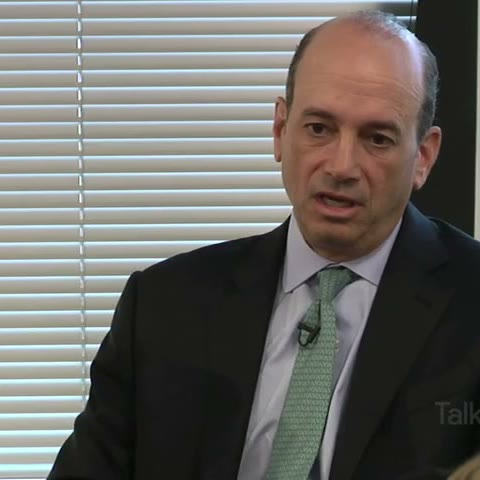
[Music] Joel greenlot Our Guest for today is the co-founder managing principal and co-cio of Gotham Asset Management we could not be more thrilled and more grateful than to have him accept our invitation and be here thank you so much y over to you thanks so much thanks for coming out today I really uh appreciate it very much uh never been here before so I'm looking forward to my tour right after so thank you uh so even Warren Buffett says uh the vast majority of people should index and I agree with him so are there any questions or do I have any time then again I get well I have time so uh then again you know Warren Buffett doesn't index and neither do I so I thought I'd tell you why uh and then maybe you'll have some more information to decide for yourself what makes make sense for you and in a sense it shouldn't be that
[音乐] 乔尔·格林布拉特。我们今天的嘉宾是 Gotham Asset Management 的联合创始人、管理合伙人兼联席首席投资官。他能接受我们的邀请来到这里,我们感到无比激动和感激。非常感谢你,下面交给你。非常感谢,也谢谢大家今天过来,我真的非常感激。我以前从没来过这儿,所以很期待待会儿的参观。谢谢。那么,连沃伦·巴菲特都说,绝大多数人应该买指数,我也同意他的看法。所以,大家有什么问题吗?还是说我还有时间?看来我还有时间。不过话说回来,巴菲特自己并不买指数,我也不买。所以我想跟大家讲讲原因,也许你们就能多掌握一些信息,自己判断什么方式对自己更合适。从某种意义上说,这事儿本不该那么
便签笔记
1:20
hard I actually I had a friend uh who's an orthopedic surgeon and is in charge of a a group of orthopedic surgeons and he asked me to uh speak to them at a dinner uh about the stock market and I said okay these are smart educated guys they can understand this stuff and I uh spoke for about 35 minutes explaining how the stock market worked and everything else and then I started getting questions uh along the lines of oil went down $2 yesterday what should I do or Market was up 2% yesterday uh what do I do about that so my interpretation to those questions was I had just crashed and burned so uh last year uh I was lucky enough to be asked to teach a nth grade class uh a bunch of uh kids uh mostly from Harlem and I had just sort of Crash and burned with the orthopedic surgeons and I didn't want to do that with the kids uh and so I started to try to think of what could I do uh to explain the stock market a little bit better uh and so I walked into class the first day uh and I handed out a bunch of 3x5 cards and I asked uh I brought in this jar of jelly beans right here and uh I asked uh the students uh you know passed around the jar jelly beans asked them to count the rows do whatever they wanted to do and write down their best guess
难。我其实有个朋友,是骨科医生,管着一个骨科医生团队。他请我在一次晚宴上跟他们聊聊股市。我说好啊,这些都是聪明有学识的人,肯定能听懂这些东西。我讲了大概35分钟,解释股市是怎么运作的等等,然后开始有人提问,问题大概是这样的:昨天油价跌了2美元,我该怎么办?或者昨天市场涨了2%,我该怎么应对?我对这些问题的解读是——我刚刚彻底搞砸了。所以去年,我很幸运受邀去给一个中学班级上课,一群孩子,大多来自哈莱姆区。我刚在骨科医生那儿搞砸过,不想在孩子身上重蹈覆辙。于是我开始琢磨,我能怎么把股市解释得更清楚一点。所以第一天走进教室,我发下去一堆3x5的卡片,还带来了这罐软糖豆,就是这个。我让学生们把罐子传下去,数数有几排,随便他们怎么弄,然后写下他们的最佳猜测
便签笔记
2:42
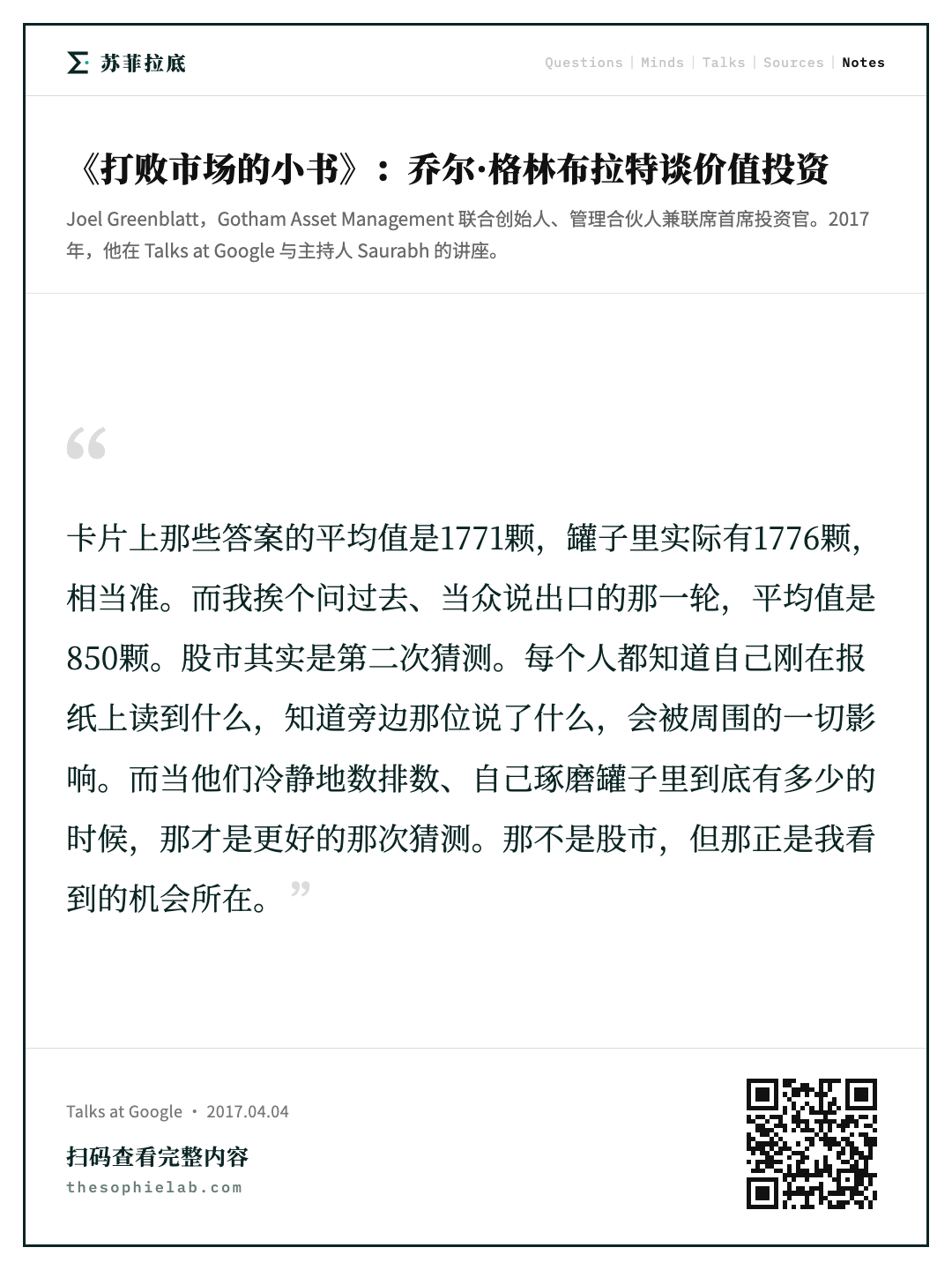
for how many jelly beans were in the jar collected the three by5 cards then I went around the room one by one to each one of the kids in the room uh and I said listen you can keep your guess you can change your guess that's up to you and I went one by one around the room asked people how many and wrote down the the very ious guesses so it turned out the uh guess uh the average of the guesses for the 3x5 cards was 1771 jelly beans uh there are 1776 jelly beans in the jar so that was pretty good uh the guests when I went around the room uh that was 850 jelly beans uh and I explained to them that the stock market's actually the second guest okay because everyone knows what they just read in the paper what the guy next to them said what they saw in the news and uh are influenced by everything around them uh and that was the second guess and that's the stock market the cold calculating guess when they were counting rows and trying to figure out what was going on uh that's actually was the better guess that's not the stock market but that's where I see our opportunity you know once a year in my class at Columbia I uh at least for the last five six years somebody raises their hand and asked a question that
,猜罐子里有多少颗软糖豆。我收回那些卡片,然后在教室里一个一个地问每个孩子,我说:听着,你可以坚持原来的猜测,也可以改,这由你决定。我就这样一个个问过去,问他们是多少,并把各种各样的猜测记下来。结果是,卡片上那些猜测的平均值是1771颗软糖豆,而罐子里实际有1776颗,所以相当接近。而我绕着教室一个个问出来的猜测,平均是850颗。我跟他们解释说,股市其实就是第二种猜测。因为每个人都知道自己刚在报纸上读到了什么、旁边那个人说了什么、在新闻里看到了什么,都会受周围一切的影响,那就是第二次猜测,那就是股市。而当他们冷静地计算、数着排数、努力搞清楚状况时给出的那个猜测,才是更好的猜测,那不是股市,但那正是我看到机会的地方。在我哥伦比亚大学的课上,至少最近五六年,每年都会有人举手问一个问题
便签笔记
3:59
goes something along the lines uh something like this hey Joel congratulations you've been doing this for 35 years uh and you've had a nice record but now there are more computers there's more data there's more ability to crunch numbers and uh kind of isn't the party over for us isn't it just more hedge funds there's just a lot more competition isn't the party over for us so my students are generally second year mbas I'd say average age 27 or so uh so I just answer it this way I I tell them let's go back to when you learn how to read uh let's take a look at the most followed Market in the world that would be the United States let's take a look at the most followed stocks within the most followed Market in the world those would be the S&P 500 stocks let's take a look at what's happened since you learned how to read so I tell them from 1997 uh when they were nine or 10 uh to 2000 the S&P 500 doubled from 2000 to 2002 it haved from 200 to 2007 it doubled from 2007 to 2009 it haved and from 2009 to today it's roughly tripled which is my way of uh telling them that people are still crazy that was just the last 17 years uh and I'm way understating the case uh because the S&P 500 is an average of 500 stocks if you lift up the covers and look underneath
,大意是这样的:嘿,乔尔,恭喜你,你干这行35年了,业绩也很漂亮,但现在计算机更多了、数据更多了、处理数字的能力更强了,我们的好日子是不是已经到头了?对冲基金不是也越来越多吗?竞争激烈多了,我们的好日子是不是结束了?我的学生一般是MBA二年级,平均年龄大概27岁左右。我就这样回答他们:我们回到你学会认字的时候。我们来看看全世界被关注最多的市场,那就是美国。再看看这个最受关注的市场里最受关注的股票,那就是标普500的成分股。我们看看从你学会认字以来发生了什么。我告诉他们:从1997年,那时他们大概九岁十岁,到2000年,标普500翻了一倍;从2000年到2002年,腰斩了一半;从2002年到2007年,又翻了一倍;从2007年到2009年,又腰斩;从2009年到今天,大约涨了三倍。我这么讲,是想告诉他们,人们还是一样疯狂。而这只是过去17年,而且我还大大低估了实际情况,因为标普500是500只股票的平均数。如果你掀开盖子往下看
便签笔记
5:20
what's going on there's huge dispersion of those 500 stocks between those at any particular time that are in favor and those that are out of favor and so there's a wild ride going underneath the covers if you look under the covers a wild ride of those 500 stocks at any particular time and that doubling and having doubling and having with the average of 500 stocks really smoothing the ride so there should be uh an opportunity and uh if you understand what stocks are and I uh guarantee my students first day of class uh I make a guarantee every year they walk in and I guarantee them this if they do good valuation work I of a company I guarantee them the market will agree with them I just never tell them when could be a couple weeks could be two or three years but if they do good valuation work the market will agree with them stocks are not pieces of paper that uh bounce up and down you put uh complicated ratios on like sharp ratios or Cino ratios stocks or ownership shares of businesses that you are valuing and if some inclined tried to buy at a discount so if you believe what Ben Graham said that this horizontal line is fair value and this wavy line around that horizontal line are stock prices and you have a disciplined process to buy perhaps more than your
,看看里面在发生什么,你会发现那500只股票之间存在巨大的分化:在任何特定时点,有些股票受追捧,有些则被冷落。所以掀开盖子往里看,那500只股票在任何时点都在经历剧烈的颠簸。翻倍、腰斩、翻倍、腰斩,而500只股票的平均值把这段旅程抚平了很多。所以这里应该是有机会的。如果你理解股票到底是什么——我每年开学第一天都会向学生做一个保证,他们一走进教室,我就向他们保证:如果他们对一家公司做出了扎实的估值工作,我保证市场最终会认同他们。我只是从来不告诉他们是什么时候,可能几个星期,也可能两三年。但只要估值工作做得好,市场终会认同。股票不是那种上蹿下跳、让你去套上夏普比率或索提诺比率之类复杂比率的纸片。股票是企业的所有权份额,你要做的是给它估值,然后如果条件允许,试着以折价买入。所以如果你相信本·格雷厄姆说的:这条水平线是内在价值,而围绕这条水平线上下起伏的波浪线是股价,同时你有一套有纪律的流程,在价格低于这条线时买入超过你应得的
便签笔记
6:36
fair share when they're below the line and if someone cined sell or short more than your fair share when they're above the line the market is throwing us pitches all of the time uh the reason people don't outperform the market there are behavioral problem there are Agency problems but it's not because we're not getting those uh opportunities uh I will show you uh briefly let me tell you how we value stocks uh it's not very tough and I think most of you will understand it uh and I think the best example that resonates seems to resonate with most people is uh thinking about buying a house and to keep the number simple let's say that someone is asking a million dollars for the house they want to sell and your job is to figure out whether that's a good deal or not so there's certain questions you would ask first one of the first questions I'd ask ask is well how much rent could I get for that thing okay so in other words if I rented out that million doll house how much rent would I collect if I uh were going to collect 70 80 $90,000 a year 78 9% yield on that house that's one way I might go about valuing it and what's the next question you would ask I'm pretty sure I know what it would be uh what are the other houses on the Block going for
份额,在价格高于这条线时尽可能卖出或做空超过你应得的份额——市场一直在不停地给我们投好球。人们跑不赢市场的原因,有行为上的问题,也有代理人的问题,但绝不是因为我们没有得到这些机会。我简单跟大家讲讲我们怎么给股票估值,其实并不难,我想在座大多数人都能听懂。我觉得最能让人产生共鸣的例子,是买房子。为了让数字简单点,假设有人要卖房子,开价100万美元,而你的任务是判断这笔买卖划不划算。你会问一些问题,我首先会问的问题之一是:这房子能收多少租金?换句话说,如果我把这套100万美元的房子租出去,能收到多少租金?如果一年能收7万、8万、9万美元,也就是7%、8%、9%的收益率,这就是我给它估值的一种方式。那你接下来会问什么?我很确定我知道是什么:同一条街上其他房子卖多少钱
便签笔记
7:55
in the block next door in the town next door how does this compare how relatively cheap is this relative to all my current choices so that's what we do we look at how relatively cheap is this business relative to other similar businesses relative to a whole universe of choices that I have we do that we also go back in history look at how this company or uh this house has traditionally been valued versus other ones in the neighborhood or versus uh other communities and how is it being valued now so measures of absolute and relative value absolutely cheap you know on a rental basis absolutely cheap or relatively cheap on all different kinds of measures that that make sense to you now you wouldn't use any of these measures all by themselves if you just use relative cheapness uh if some of you remember the internet bubble and you bought the cheapest internet stock that wasn't cheap it was just cheap relative to all the other crazy priced uh stocks at the time but we use our we use our measures of absolute relative values checks and balances against each other to try to zero in on Fair Value so when you do this uh just want to show you a simple chart uh this is actually a study we did
,隔壁街区呢?隔壁镇呢?这套房子相比之下如何?相对于我现有的所有选择,它有多便宜?我们做的就是这个:我们看这家企业相对于其他类似企业、相对于我拥有的全部选择范围,到底有多便宜。我们做这件事,同时也回顾历史,看看这家公司——或者说这套房子——历来相对于同一街区的其他房子、或者相对于其他社区是怎么被定价的,而现在又是怎么被定价的。所以这就是绝对价值和相对价值的衡量:从租金回报的角度看它是不是绝对便宜,或者按各种对你有意义的指标看它是不是相对便宜。当然,你不会单独使用其中任何一个指标。如果你只看相对便宜——你们有些人可能还记得互联网泡沫——你买了最便宜的互联网股票,那并不便宜,只是相对当时其他疯狂定价的股票便宜而已。但我们用绝对价值和相对价值的各种指标互相制衡、互相印证,来努力锁定内在价值。所以当你这么做的时候……我想给大家看一张简单的图表,这其实是我们做的一项研究
便签笔记
9:04
of our valuation methodology very very similar to the way I just said we value uh a house this is how we we looked at the 2,000 largest companies in the US over a 20-year period this was 1992 to 2012 and we ranked them on a daily basis from 1 to 2000 based on their discount to our assessment of value using these metrics the x-axis here you probably can't see it uh is just evalu percentile all this means is if you in the bottom left hand corner and you're in the first percentile you're the 20 companies at any particular time out of those 2,000 that measured cheapest according to our measures of absolute and relative value uh go to the 99th percentile uh you would be the 20 companies that measure most expensive out of those 2,000 the Y AIS is uh the year forward return on average during those 20 years what this chart simply says is on average stocks that fell in our first percentile the cheapest 20 uh averaged a one-ear forward return during those 20 years of 38% stocks that ranked in our second percentile averaged a one-ear forward return of about 37% and then we drop down to this best fit line which we always say we don't mind missing when we're making extra money and then as we measure something more
,关于我们的估值方法,和我刚才讲的给房子估值的方式非常非常相似。我们考察了美国最大的2000家公司,时间跨度20年,从1992年到2012年。我们每天用这些指标,按它们相对于我们评估价值的折价程度,从1排到2000。这里的横轴你们大概看不太清,就是估值百分位。意思是,如果你在左下角、处于第1个百分位,你就是那2000家公司中、在任何特定时点按我们绝对价值和相对价值指标衡量最便宜的那20家;到了第99个百分位,你就是这2000家中衡量下来最贵的那20家。纵轴是这20年间平均的未来一年回报率。这张图简单说就是:平均而言,落在我们第1个百分位的股票,也就是最便宜的那20只,在这20年里未来一年的平均回报是38%;排在第2个百分位的股票,未来一年平均回报大约37%;然后就掉到这条最佳拟合线上——我们总说,如果偏离拟合线是因为多赚了钱,我们并不介意。然后随着我们衡量出来的估值越来越
便签笔记
10:14
expensive the year forward return drops and if you were sitting in my class at Colombia and I said hey does anyone see a long short strategy you might pursue if you could predict ahead of time which stocks would do best second best third best in order and you did not say I guess I'd buy these guys up here in the upper leftand corner and short these guys in the bottom right hand corner if you didn't say that I'd probably throw you out of class because it's very straightforward that's what you should do and by the way that's what we do the important thing to understand is that stocks are ownership shares of businesses okay now uh by the way that beautiful chart I showed you with the 90% fit you know why doesn't everyone do this uh well unfortunately it doesn't look like that when you're living through that that's an average over 20 years if I showed you snippet of three or 4 years uh the fit would be nice it might be 0556 something like that but uh it's uh not going to be very Cooperative right if what we did worked every day and every month and every year uh everyone would do it it would stop working but but it uh it it doesn't unfortunately uh but the reason that we stick to what we're doing even when it's not working is that chart meaning the
贵,未来一年的回报就越来越低。如果你坐在我哥伦比亚大学的课堂上,我问:如果你能提前预测出哪些股票表现最好、第二好、第三好,按顺序排出来,有人能看出可以采用什么样的多空策略吗?如果你没有回答“我猜我会买左上角这些,做空右下角那些”,如果你没这么说,我大概会把你赶出教室,因为这实在太直白了,你就该这么做。顺便说一句,这正是我们在做的事。要理解的关键是:股票是企业的所有权份额。好,另外顺便说一下,我给你们看的那张拟合度90%的漂亮图表——你知道为什么不是人人都这么做吗?很不幸,当你身处其中真实经历时,它看起来不是那样的。那是20年的平均结果。如果我给你看其中三四年的片段,拟合度也许还不错,可能是0.5、0.6之类的,但它不会那么“配合”。对吧?如果我们做的事情每天、每个月、每年都奏效,那所有人都会这么做,它也就失效了。但很遗憾,它并不是那样。不过,即使在不奏效的时候我们仍然坚持自己的做法,原因就是那张图表,也就是说
便签笔记
11:25
way we value companies our measures of absolute and relative value or approximately how the market values the over time if we were for instance momentum investors okay and I will tell you that uh for those of you who know what that means uh momentum has been studied uh across the globe over the last 30 40 years in the US it's worked pretty much everywhere uh not all the time but on average it's worked very well over 30 40 years and not just in this country but here's the problem what if it didn't work over the next 2 or 3 years it could be uh that we just have to be patient you know it's it works over time and it's cyclical and so it's out of favor and we just have to stick to our guns because it's something that's worked or it could be if it didn't work in the next 2 three years that the explanation is hey it's not so hard to figure out a stock used to be down here and now it's up here it's got good momentum and with all the data and the ability to crunch numbers and computers and studies that have come out it's a crowded trade it's degraded it's not as is not as uh good as it used to be and if that's what happened over the next 2 3 years I would know the answer to that question I didn't know which one it was should I just be
,我们给公司估值的方式、我们对绝对价值和相对价值的衡量,大致就是市场长期给公司定价的方式。举个例子,假如我们是动量投资者——在座知道这是什么意思的人,我可以告诉你,过去三四十年里,全球都研究过动量,在美国基本上到处都奏效,不是所有时候,但平均而言在三四十年里表现非常好,而且不只是在美国。但问题来了:万一它在接下来的两三年不管用了呢?可能是我们只需要耐心一点,你知道,它长期有效、有周期性,只是暂时不受待见,我们只要坚持立场,因为这是被验证过有效的东西。也可能是,如果接下来两三年它不管用,解释是:嘿,这事儿并不难搞明白,一只股票原来在这里,现在到了那里,它有很好的动量——而随着数据、算力、计算机和各种研究的出现,这已经变成一个拥挤的交易,它退化了,不像以前那么好用了。如果接下来两三年真的发生这种情况,我不会知道答案到底是哪一个,我不知道究竟是该
便签笔记
12:39
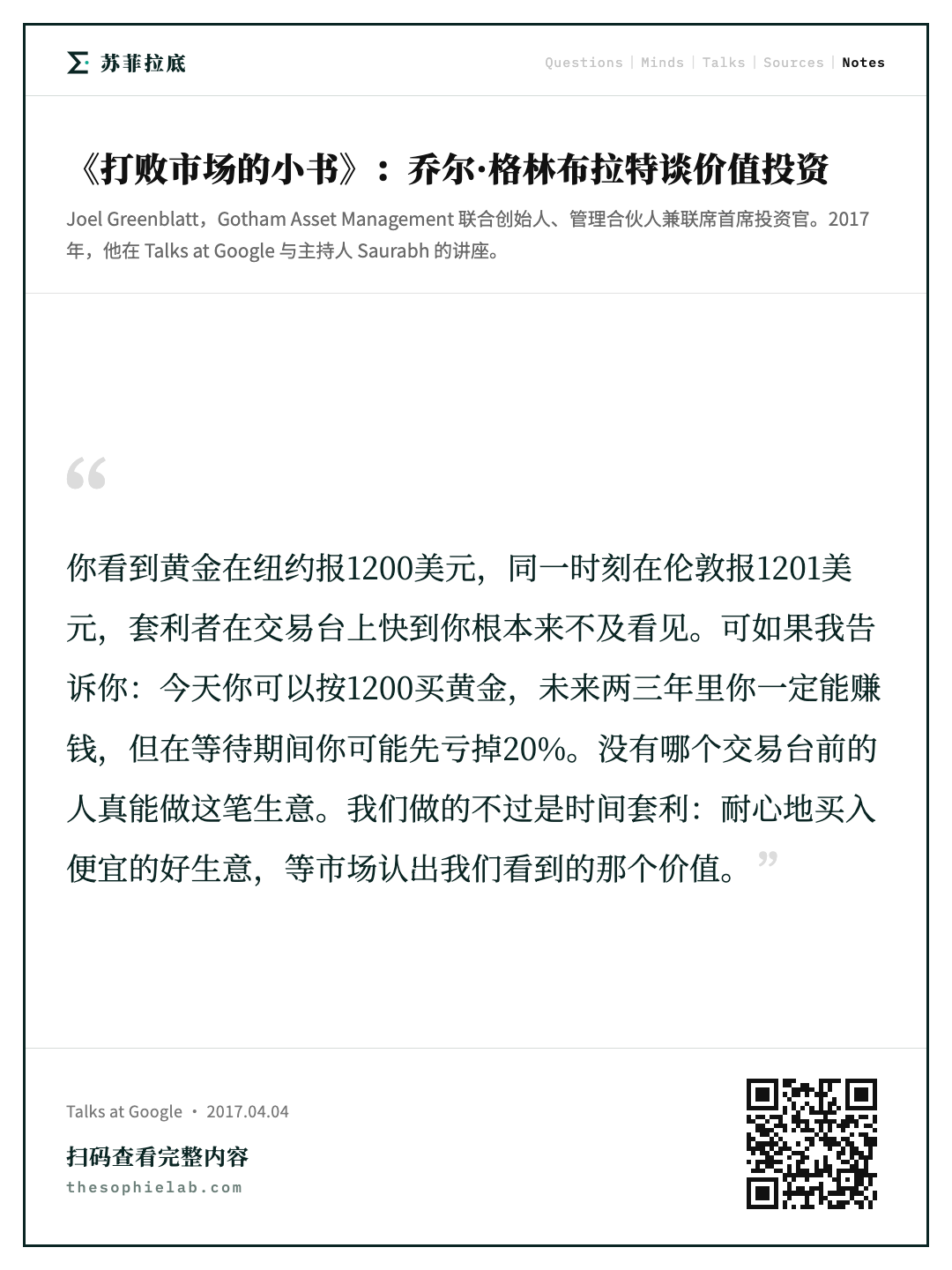
patient or has the trade degraded but if you view stocks as ownership shares of businesses that you value and try to buy a discount and that doesn't work for a couple years I'm not going to change what I'm do I'm not going to buy the bottom uh right hand corner you know buy all the money losers and the companies uh that don't earn anything or trading it 100 times free cash flow I'm not going to buy those even if it works in one particular year and then sell the ones that uh are cheap relative to everything get me high rents and everything else I'm not I'm not going to change my strategy uh and I believe that uh stocks will eventually not right now but eventually uh people will get it right and I may have to be patient that's really what I have to do what that chart tells me is I'm on the right track meaning that's sort of our true north and we just have to be patient to get there uh the reason that these simple metrics don't get arbitraged away is the example I uh usually used for Arbitrage is uh oh you see gold in New York at $1,200 and and it's selling at London simultaneously at 1201 well an arbiture sitting on a trading desk someplace will see that and buy up gold in New York at 1,200 and push the price
耐心等待,还是这个交易已经退化了。但如果你把股票看作企业的所有权份额,去给它估值并试图折价买入,那即使这套方法有两年不奏效,我也不会改变我的做法。我不会去买右下角那些,你知道,去买那些亏钱的公司、那些根本不赚钱或者按自由现金流100倍在交易的公司——即使那种做法在某一年管用,我也不会买。我也不会去卖掉那些相对于其他一切都很便宜、能给我带来高“租金”的公司。我不会改变我的策略。而且我相信,股票最终——不是现在,但最终——人们会把价格定对,我可能得有耐心,这才是我真正要做的事。那张图告诉我的是:我走在正确的路上,那算是我们的“真北”,我们只需要有耐心走到那儿。至于这些简单指标为什么不会被套利抹平,我通常用来说明套利的例子是:你看到纽约的黄金是1200美元,而同一时刻伦敦卖1201美元。那么坐在某个交易台前的套利者会看到这一点,在纽约以1200买入黄金,把价格推
便签笔记
13:48
up a little bit he'll simultaneously sell gold in London at 1201 push the price down and they'll convert someone somewhere in the middle and it'll happen so fast on a trading desk that you don't really even get to see that but what if I told you you could buy gold in New York today at 1,200 sometime in the next 2 three years you're going to make money but you could lose 20% of your money while you're waiting there's no guy sitting on a desk anywhere that really uh can do that and and frankly uh time Horizons are getting shorter uh it used to be when I was uh younger I used to get quarterly statements and most people would throw them in the garbage now you can check your stock price 30 times a minute on the internet maybe some of you do uh and time Horizons are shrinking and we're just playing time Arbitrage we're being uh patient buying cheap good businesses and waiting for the market to recognize the value we see uh but it takes some work to Value companies and let's say you don't want to do that you know you have a day job I guess everyone here has a day job so you don't want to do that so one thing you could do is try to find someone good to do it for you right I'm showing you
高一点;同时在伦敦以1201卖出黄金,把价格压下去,最后在中间某个价位成交。这在交易台上发生得太快,你根本来不及看见。但如果我告诉你,你今天可以在纽约以1200买入黄金,在未来两三年的某个时候你会赚钱,但在等待期间你可能会亏掉20%呢?没有哪个坐在交易台前的人真的能做这种事。而且坦白讲,投资的时间视野正变得越来越短。以前我年轻的时候,收到的是季度对账单,大多数人看都不看就扔进垃圾桶;现在你可以在网上一分钟查30次股价,也许在座就有人这么干。时间视野在缩短,而我们玩的就是时间套利:保持耐心,买入便宜的好生意,然后等市场认识到我们看到的价值。但给公司估值是需要下功夫的。假设你不想做这些,你有本职工作——我猜在座每个人都有本职工作——所以你不想干这活儿。那么你可以做的一件事,是找一个靠谱的人替你做,对吧?我是在告诉你
便签笔记
14:52
there's this opportunity maybe someone can do it for you and what you should probably look for when you're looking for that person person is someone who has a good investment process okay that makes sense to you the problem is uh for most active managers uh if you think of their challenge when they're picking an individual stock they must think that they have a variant uh hypothesis as to why that stock is priced differently than the way it should be and I can tell you I've been doing this over 35 years years and it's very rare almost never have I bottom ticked a stock bought bought it at the absolute bottom so 99.9 plus per of the time a stock is down after I bought it and there are really only two reasons why one is I was wrong the other is I just need more time for my thesis to play out okay now as an outside allocator you don't really know what the thesis for the individual stock was even the allocator himself the manager I mean I'm sorry the manager himself sometimes doesn't know when things are going against you there are
,这里存在这样一个机会,也许有人能替你去做。而当你去找这个人的时候,你大概应该看重的是:他有没有一套你能理解、也说得通的投资流程。问题在于,对大多数主动型管理人来说,想想他们挑选个股时面临的挑战:他们必须认为自己有一个与众不同的假设,来解释为什么这只股票的定价偏离了它应有的水平。我可以告诉你,我干这行35年多了,极其罕见、几乎从来没有一次是抄到绝对底部买入一只股票的。所以99.9%以上的时间里,我买入之后股票都会继续下跌。原因其实只有两个:一是我错了,二是我的判断需要更多时间来兑现。而作为一个外部的资金配置者,你其实并不知道某只个股背后的逻辑是什么;甚至连配置者自己——不好意思,我是说管理人自己——有时候在事情不顺的时候也说不清楚。这种时候,就会有
便签笔记
16:11
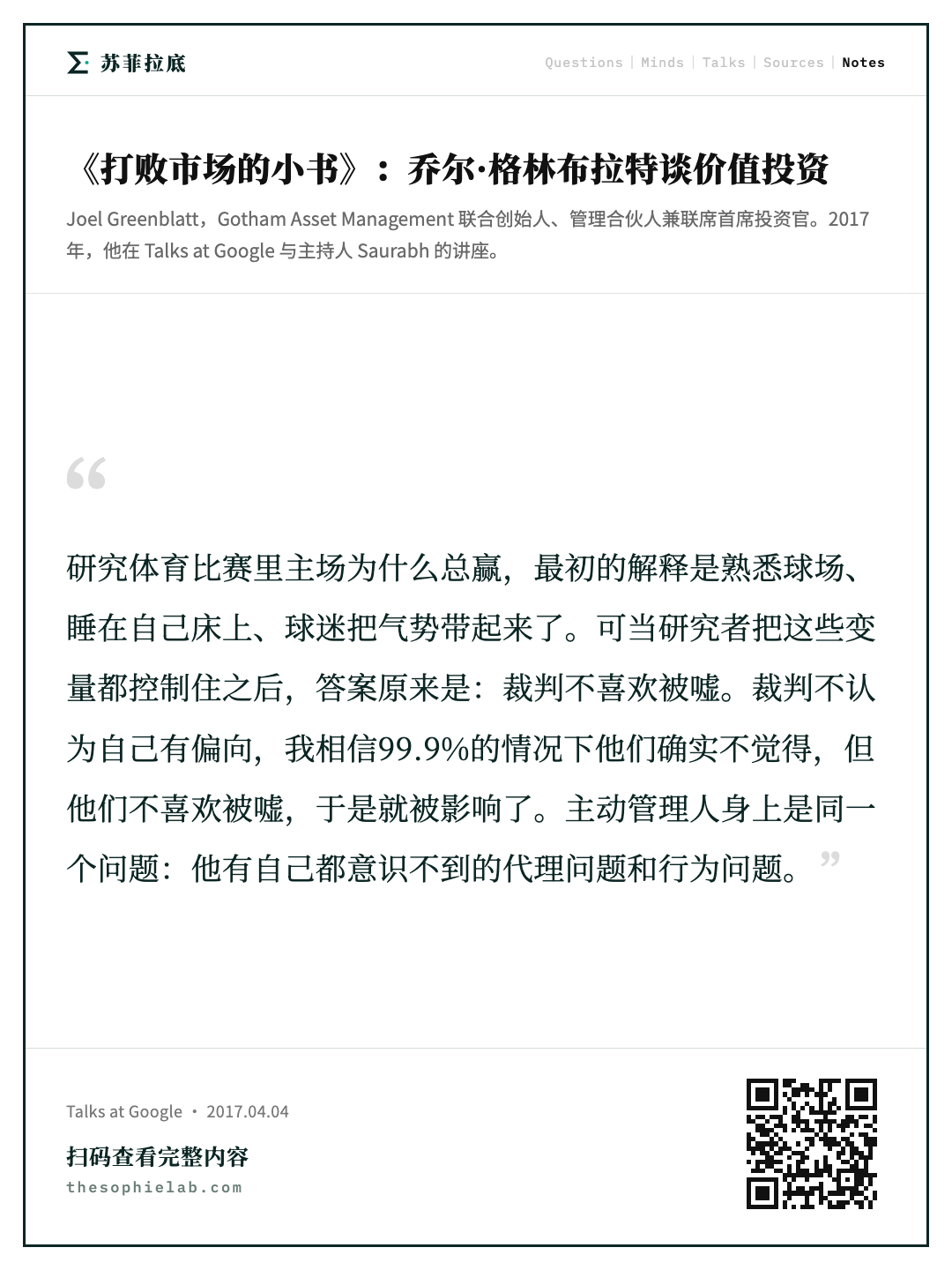
all kinds of Agency problems you know you got people to answer to you have behavioral issues just naturally start to doubt yourself it's very unclear sometimes even to them what their biases are and what they're doing you know they did studies that you guys are familiar with probably of why why the home team always wins in sports okay or at least wins more than it should and the original thesis was generally oh they're used to the court they slept in their own bed you know the fans you know they they jazzed them up whatever it might be and when they controlled for all these variables uh the answer turned out to be that the refs don't like to get booed okay so they don't think that they're being biased but uh I'm sure in 99.9% of the cases they don't but they don't like to get food and so they're being influenced by and so this same problem with an active manager he's got agency and behavioral issues uh that he's not uh sure of so the allocator doesn't really understand the thesis behind each pick it's not clear that the manager uh is totally unbiased when he has a variant thesis that's going against him um and so since you don't need know the thesis is an allocator most people uh all they have are the returns and that's what they used so in an
各种各样的代理人问题——你得向别人交代,你会有行为上的问题,很自然就开始怀疑自己。有时候连他们自己都搞不清楚自己的偏见是什么、自己到底在做什么。你们大概都熟悉那些研究,就是研究为什么体育比赛里主场球队总是赢,或者至少赢得比应该的多。最初的说法一般是:哦,他们熟悉自己的球场,睡在自己的床上,还有球迷给他们打气,诸如此类。但当他们把这些变量都控制住之后,答案原来是——裁判不喜欢被嘘。他们并不觉得自己有偏见,我相信99.9%的情况下他们确实没有,但他们不喜欢被嘘,所以就受到了影响。主动型管理人也有同样的问题,他身上有代理人问题和行为问题,而且他自己也没把握。所以资金配置者并不真正理解每一笔选股背后的逻辑,当管理人持有一个与市场相反、而且正在亏钱的观点时,你也说不清他是不是完全没有偏见。既然作为配置者你不知道背后的逻辑,大多数人手里就只有收益率数据,那他们用的就是这个。所以在一项……
便签笔记
17:29
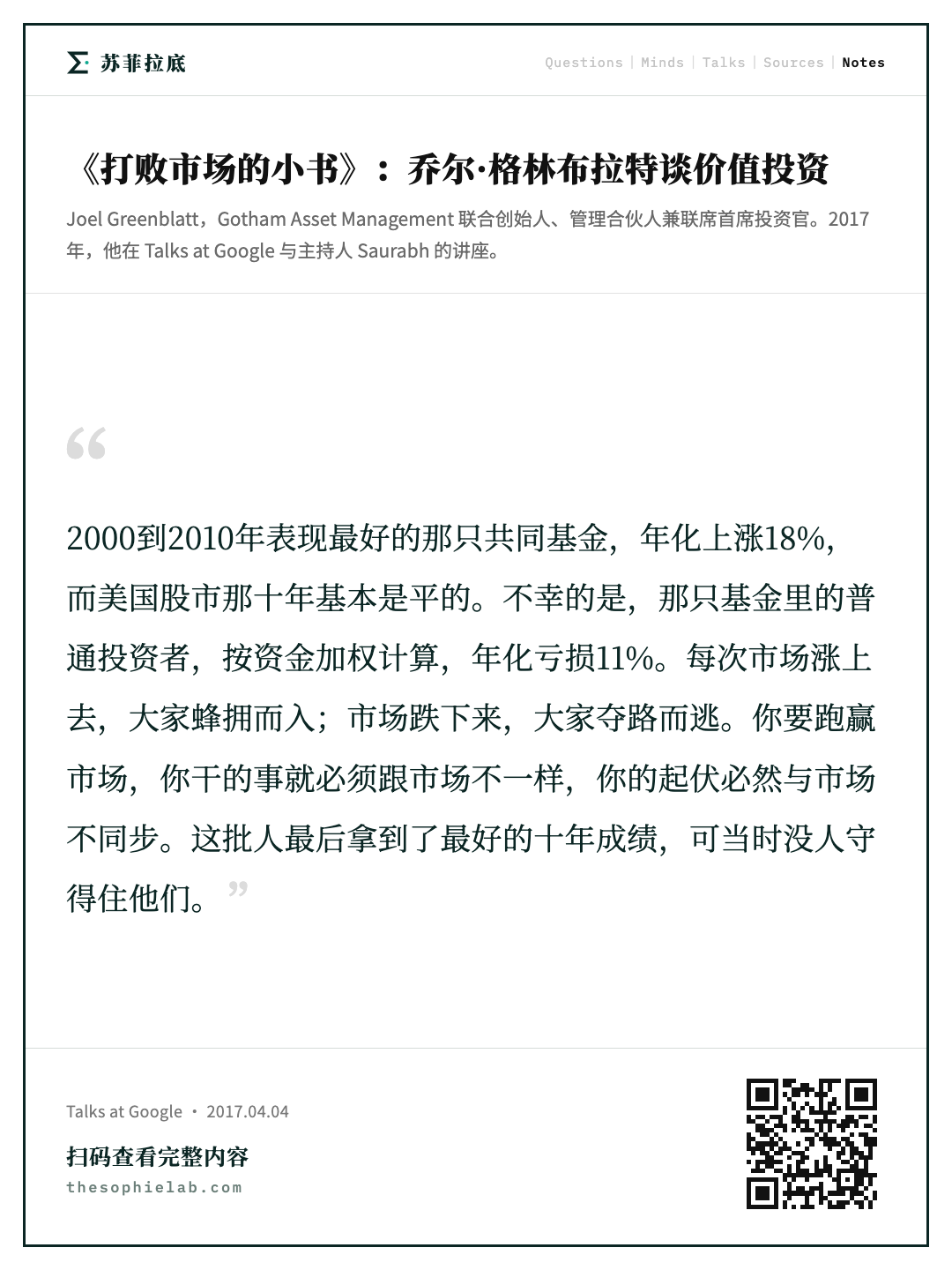
interesting study uh that came out the day after Thanksgiving so it was interesting to me probably not interesting to the guys who did the study uh Morning Star put out a study of their star system and my interpretation uh and their star system is based on past returns letting you know who's done the best over the last one three and five years of course the study my interpretation of their study was that our star system doesn't work uh we can't discern uh the last 1 three5 years of returns has not much to do with the next 135 but that's what everyone uses I wrote a book uh I hold it up here uh it's called the big secret and I always say it's still a big secret because uh no one read it uh and in that book um I talked about a few studies number one uh it talked about the best performing uh manager I wrote In 2011 so talked about the decade 2000 to 2010 looked at the best performing mutual fund a study of the best performing mutual fund for that decade uh that fund was up 18% per year 100% long the US equities Market was flat during those 10 years so 18% up a year is pretty good unfortunately the average
……很有意思的研究里,那是感恩节后第二天发布的,所以对我来说挺有意思,对做这个研究的人可能就没那么有意思了。晨星发布了一份关于他们星级评级体系的研究。他们的星级体系是基于过去的收益率,告诉你过去一年、三年、五年谁表现最好。当然,我对这份研究的解读是:我们的星级体系不管用,我们分辨不出来,过去1年、3年、5年的收益跟接下来的1年、3年、5年没有太大关系。但大家用的就是这个。我写过一本书,我这儿拿着呢,叫《大秘密》。我总说它到今天还是个大秘密,因为没人读过。在那本书里我讲了几个研究。第一个讲的是表现最好的基金经理——我是2011年写的,所以讲的是2000到2010这十年——研究了那十年里表现最好的共同基金。那只基金每年上涨18%,100%做多。美国股市在那十年基本是平的,所以一年涨18%相当不错了。可惜的是,那只基金的普通……
便签笔记
18:47
investor in that fund on a dollar weighted basis managed to lose 11% a year because every time the fund uh the market went up people piled in when the market went down they piled out when the fund outperformed they piled in when the fund underperformed they piled out and they took an 18% annual gain and turned it into an 11% annual dollar weighted loss why well to beat the market if you're beating by 18 points you're doing something different than the market you're going to Zig and zag differently you can't do the same as the market you have to do something different you're going to Zig and zag differently uh institutional managers are no different here are the stats on the uh if you just took a look at the top institutional managers for that decade the ones who 2000 to 2010 the top cortile managers the ones who ended up with the best 10-year record here are the stats on them 97% of those who ended up with the best 10year record Top Court tile spent at least three of the 10 years in the bottom half of performance not shocking but everyone right to beat the market you have to do something different you're going to Zig and zag differently 79% of those who ended up with the best
……投资者,按美元加权计算,居然每年亏11%。因为每次市场涨的时候大家就一窝蜂进来,市场跌的时候就一窝蜂出去;基金跑赢的时候他们涌进来,基金跑输的时候他们就撤出去。他们硬是把每年18%的收益变成了每年11%的美元加权亏损。为什么?因为要跑赢市场,如果你要超出18个百分点,你做的事情肯定跟市场不一样,你起伏的节奏也会不一样,你不可能跟市场一样,必须做点不同的事,那节奏就会不同。机构投资经理也一样。这是那十年里顶尖机构管理人的数据——2000到2010年,最终排进前四分之一、十年业绩最好的那批人,数据是这样的:在最终十年业绩排进前四分之一的人里,97%至少有三年业绩落在后一半。这并不奇怪,对吧,要跑赢市场你就得做点不一样的事,节奏必然不同。而79%最终业绩最好的人……
便签笔记
19:48
10-year record spent at least three of the 10 years in the bottom cortile performance and here's the stunner 47% roughly half of those who they ended up with the best record but they spent at least three of those 10 years in the bottom desis the bottom 10% of performers so you know no one stayed with them but they ended up with the best record uh so it's very hard uh very hard to pick an allocator because you don't know the thesis so you're using past returns but when you do that all you're doing is chasing your tail going in and out at all the wrong times uh so it's it's very hard uh what a good allocator usually an Institutional allocator and there a few of them should be looking at process and do you stay with your process but of course there's Agency problems on the side of uh those people allocating because even if you're on a really good investment board uh and you're an allocator and you're head of us equities or you're head of uh uh Alternatives or or uh bonds or whatever it might be you have a benchmark and if you haven't beaten your bench Benchmark for the last 3 years I'm not saying you know with the good places they throw you out but I am saying they don't throw you a parade okay so it's very very hard on that so one thing you could do is do it yourself and and I wrote this other book
……在十年业绩最好的同时,至少有三年落在业绩最差的四分之一里。还有一个更惊人的数字:47%,差不多一半最终业绩最好的人,至少有三年落在最差的十分之一里。所以你想想,没人能一直跟着他们,但他们最后业绩最好。所以挑选一个管理人非常非常难,因为你不知道背后的逻辑,于是你只能看过去的收益率,但那样做,你只是在追着自己的尾巴转,总是在最错的时点进进出出。所以真的很难。一个好的配置者——通常是机构配置者,这样的人不多——应该看的是流程,以及你有没有坚持自己的流程。当然,配置方那边也有代理人问题,因为哪怕你在一个非常好的投资委员会里,你是配置者,你负责美股,或者负责另类资产、债券,不管是什么,你都有一个业绩基准。如果你过去三年没跑赢基准,我不是说好的机构会把你赶走,但我可以说他们不会给你办庆功游行。所以这方面真的非常非常难。所以你可以做的一件事就是自己来。我还写了另一本书……
便签笔记
21:12
that you have the little book that beats the market and I just did a simple uh formula that sort of was like the jelly beans counting the rows going across and just picking the cheap companies to buy uh very simple and uh I wasn't running outside money at that time that I wrote the book in 2005 just wrote up the very first study we did of doing some uh something cheap and uh cheap and good businesses just uh made it pretty easy for you to buy a handful of those and uh I kept getting phone calls hey could you just do this for us and so what I did is I set up a website uh that listed the top stocks that's still going around magic formula investing.com uh and people said yeah that's fine but could you still do this for us so I set up something called formula investing and uh I gave people two choices I said uh well I I sort of viewed it as a benevolent brokerage firm I said listen we'll let you do this yourself but you have to choose from this uh top list of 30 or 50 stocks and you have to choose at least 20 of them okay stay out of trouble and you you're supposed to invest every quarter update your portfolio and just you know mechanically do this uh you don't have to buy everything but you have toy buy at least
……就是你手上那本《股市稳赚》。我用了一个很简单的公式,有点像数糖豆时一排一排数过去那样,就是挑便宜的公司来买,非常简单。我写那本书是2005年,当时我并没有管理外部资金,只是把我们做的第一个研究写了出来——买便宜的、而且是好生意的公司,让你很容易就能买上一小把这样的股票。后来我不断接到电话,说,你能不能干脆帮我们做这件事?于是我做了一个网站,列出排名靠前的股票,现在还在运行,叫 magicformulainvesting.com。然后大家说,行是行,但你能不能还是帮我们做?于是我又搞了一个叫 Formula Investing 的东西,给了大家两个选择。我当时有点把它看成一家善意的经纪公司。我说,听着,你可以自己来做,但你必须从这个排名前30或前50的股票名单里选,而且至少要选20只,这样不容易出事。你应该每个季度投一次,更新你的组合,机械地照做就行。你不用全买,但至少要买……
便签笔记
22:29
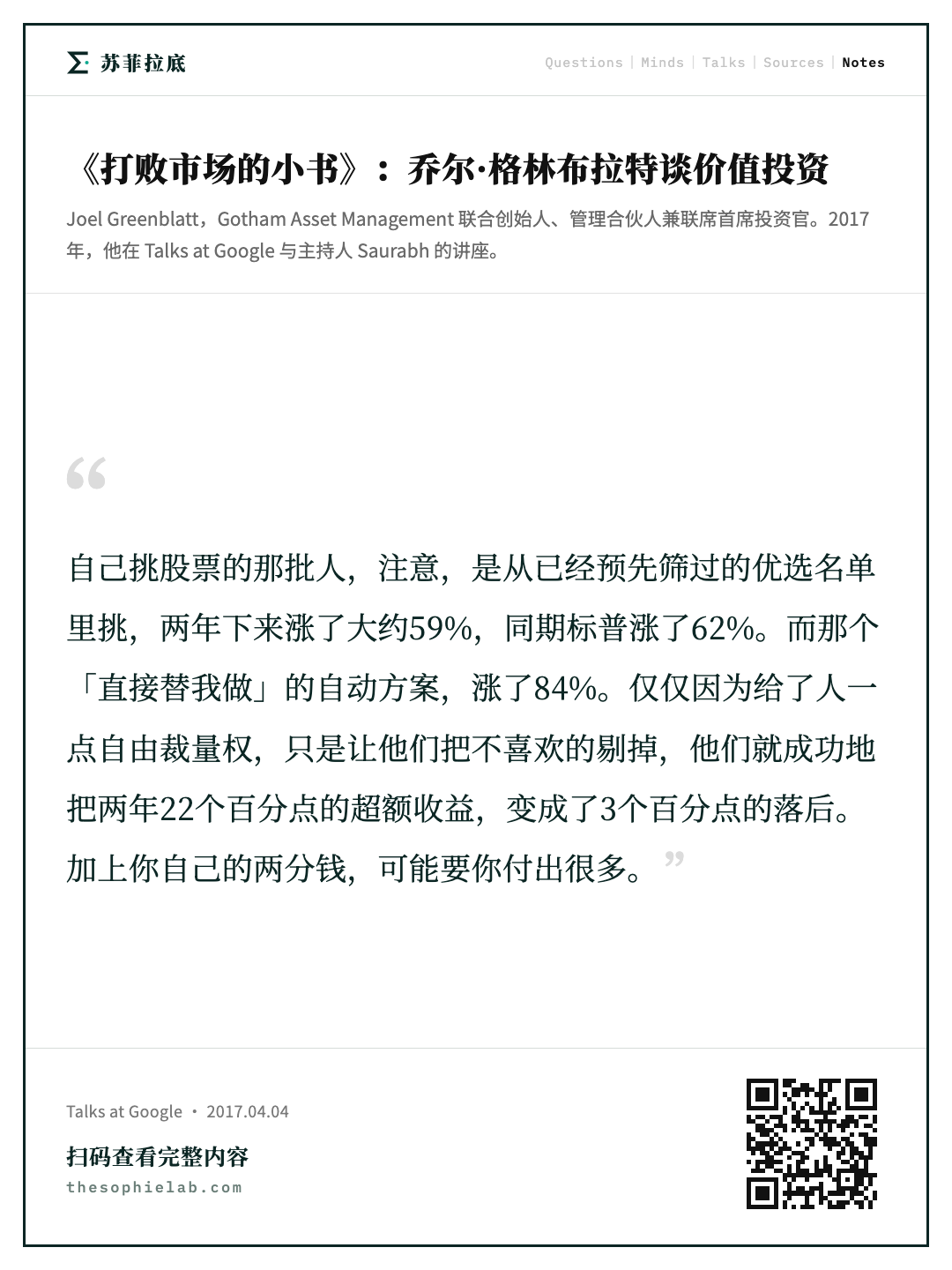
20 uh and then the uh person uh who was running this for me said you know what how about you just add a check box which said just do this for me just automatically buy so as as an afterthought I said fine we'll do that too so we ran this for a couple years and let me tell you the results uh the people who chose their own stocks you know from the pre-approved list of the top stocks uh they did pretty well for the two years they were up uh 59% roughly unfortunately uh the S&P was up 62% uh during those uh two years uh the automatic you know just do it for me that was up 84% so uh the automatic uh had beaten the uh in other words just buying the list uh had beaten the market by 22 points but by giving people any discretion even though the list was pre-approved just by picking and choosing the ones that uh they didn't like but they had to buy at least 20 they managed to take a 22% outperformance in a couple years which is pretty good and turn it into a a 3% underperformance so do it yourself uh I wrote a I wrote a piece for morning star
……20只。然后帮我打理这件事的人说,你干脆加一个勾选框吧,写着:帮我做就行,自动买入。于是我顺手一想,行吧,那也加上。我们就这么运行了几年。我告诉你结果:那些自己选股的人——从预先筛选好的优质股票名单里挑——两年下来表现还不错,大概涨了59%。可惜的是,同期标普500涨了62%。而那个自动的、帮我做就行的选项,涨了84%。所以自动的,换句话说就是直接买下整个名单,跑赢市场22个百分点。但只要给人一点自主权,哪怕名单是预先筛好的,他们只是挑挑拣拣,把不喜欢的剔掉,而且至少还得买20只,他们就硬是把两年22%的超额收益——这已经相当不错了——变成了3%的跑输。所以自己动手……我给晨星写过一篇文章……
便签笔记
23:45
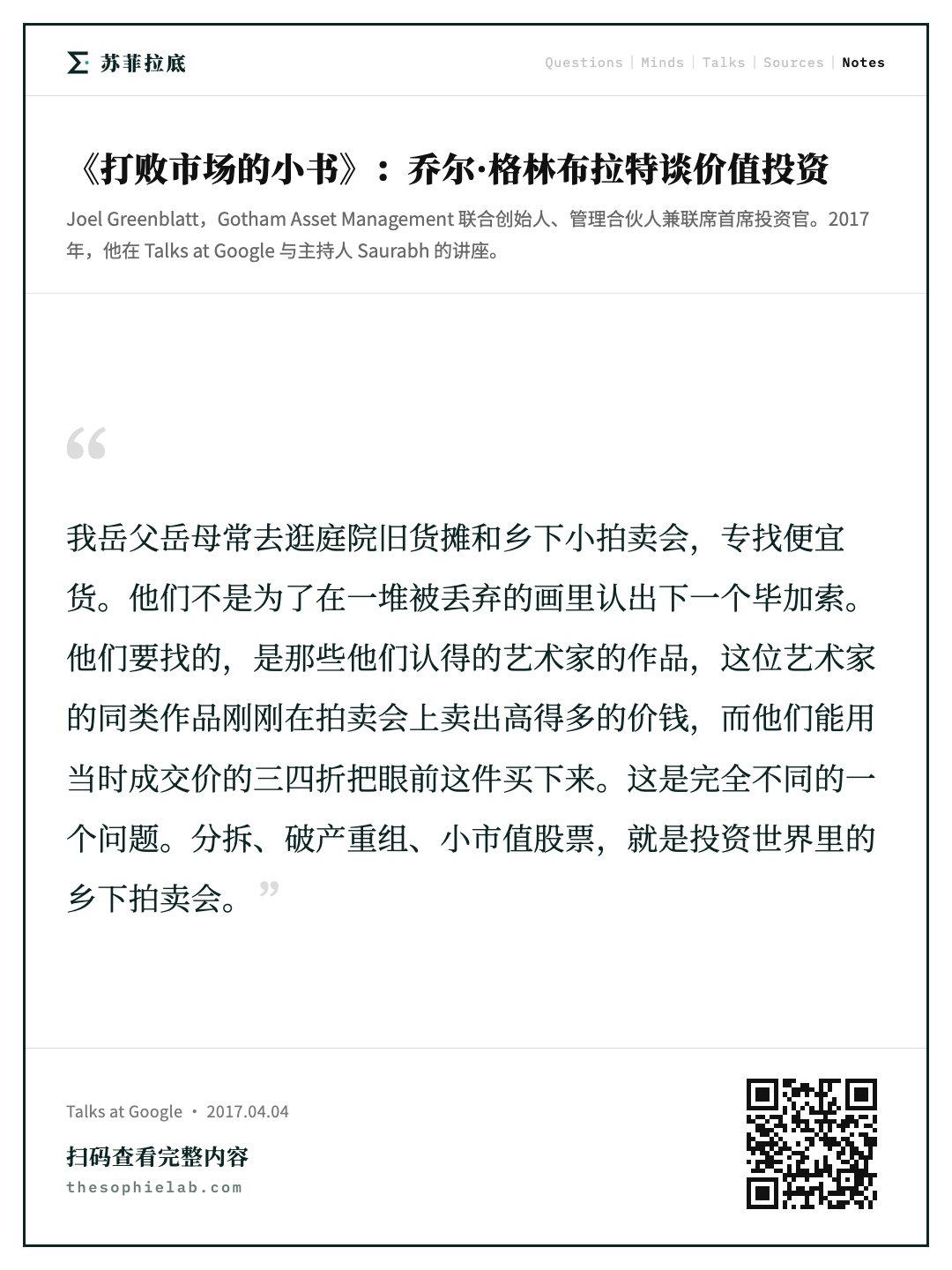
called adding your two cents May cost you a lot and uh and uh so I just wanted a caveat that so uh so another way uh let's see I'll do this fast uh I I wrote a book uh s Rob mentioned called you can be a stock market genius world's worst title of all time but uh in it it said sort of what Warren Buffett calls why don't we look for one foot hurdles okay and I opened the book with a story about my in-laws uh who uh used to spend uh they they had a house in Connecticut and they used to spend the weekends going to yard sales and Country auctions uh looking for bargains okay paintings are sculptures they they were uh art collectors uh and uh I described what they were actually doing and they were not going to these yard sales and Country auctions looking for to you know seeing a painting that was discarded saying this guy's the next Picasso that's not what they were doing what they were looking for are uh pieces of art or sculpture that they uh know uh the artist some of his similar work had just gone for auction for a lot more than they could buy it for right they can buy it for 30 or 40 cents on the dollar of what it just went to auction for that's a lot different question and so what you can be a stock market genius
……叫《加上你的两分钱,可能让你损失惨重》。所以我只是想提个醒。那么另一个办法……让我讲快一点。我还写过一本书,刚才 Rob 提到的,叫《你也可以成为股市天才》,史上最烂的书名,但书里讲的其实就是巴菲特说的那种——我们为什么不去找那些一英尺高的栏杆呢?我在书的开头讲了一个关于我岳父母的故事。他们在康涅狄格有栋房子,周末常常去逛庭院旧货甩卖和乡下的拍卖会,找便宜货,找画和雕塑,他们是艺术收藏家。我描述了他们实际在做的事:他们去这些甩卖会和乡下拍卖会,并不是想着看到一幅被丢在角落的画,然后说这人是下一个毕加索,他们不是在干这个。他们要找的是那种艺术品或雕塑——他们知道这位艺术家的某些类似作品刚刚在拍卖会上以高得多的价格成交,而他们现在能用那个价格的三四折买下来。这是完全不同的一个问题。所以《你也可以成为股市天才》这本书……
便签笔记
25:11
was was showing you these areas that are ignored these are the country auctions and the yard sales of the investment world and these were uh you know I talked about different areas spin-offs bankruptcies uh um you know uh small cap stocks uh you know uh companies going through Rec capitalizations anything weird complicated situations uh so that's another way but you guys have a full-time job that is a full-time job let me tell you that's a full-time job so right now we run mutual funds uh I can just tell you some of the struggles that we have with investors uh we do uh follow that chart uh choose from the 2000 largest companies but the and uh we've had a nice record but there are years like 20 5 where uh there's a benchmarking issue meaning the S&P 500 in 2015 was up roughly 1.3% the equally equally weighted Russell 2000 was down 10 the equally weighted uh weighted Russell 1000 was down four so if you're picking from roughly the 2,000 largest stocks you know uh an even performance would be down six or seven not up 1.3 so there's a benchmarking issue but to beat the market you have to do something
……讲的就是这些被忽视的领域,它们就是投资世界里的乡下拍卖会和庭院甩卖。我在书里讲了不同的领域:分拆、破产重组、小市值股票、正在做资本重组的公司,任何奇怪的、复杂的情形。所以这是另一个办法,但你们都有全职工作,而这件事本身就是一份全职工作,我跟你说,这是全职的活儿。现在我们管理的是共同基金,我可以跟你们讲讲我们和投资者之间遇到的一些困难。我们确实按那张图来做,从最大的2000家公司里挑。我们的业绩记录不错,但有些年份,比如2015年,会有一个基准的问题——2015年标普500大概涨了1.3%,等权重的罗素2000跌了10%,等权重的罗素1000跌了4%。所以如果你是从大约2000只最大的股票里挑,持平的表现应该是跌6%或7%,而不是涨1.3%。所以确实存在基准的问题。但要跑赢市场,你就得做点不一样的事……
便签笔记
26:24
different you're going to Zig and zag everyone knows that uh we're now working on something we've had something open a couple years where we sort of say okay we'll start with the Benchmark and then we'll value ad and we'll make some compromises so that we don't it's called index plus and so that we don't vary uh Too Much from the index so you can stay with us and the thesis was basically the best strategy for you which is how I'll end before I take questions is not only one that makes sense but one you can stick with okay so you have to understand what you're doing number one if you give it to someone else you have to understand what they're doing and you have to be able to stick with it so you have to understand it well enough to stick with it so that's I guess before I take questions what I I uh will leave you at and uh maybe so yeah thank you so much this is great so let me set up some chairs so thanks again in reading your uh magic formula book the little book that still beats the market um I noticed that you mentioned that there were questions about whether one should short stocks the most expensive ones through the same metrics and you had I guess not explicitly said that that's that's the
……你的节奏就会跟市场不同,这个大家都知道。我们现在在做一个东西,其实已经开放几年了,大致的想法是:我们先从基准出发,然后在上面做增值,同时做一些妥协,这样我们就不会……它叫 Index Plus,这样我们就不会偏离指数太多,你也就能一直跟着我们。这个思路基本上是:对你来说最好的策略——这也是我在回答提问前要说的结尾——不仅得是一个有道理的策略,还得是一个你能坚持下来的策略。所以第一,你必须理解自己在做什么;如果你把钱交给别人,你必须理解他们在做什么,而且你得能坚持下去。所以你得理解得足够透彻,才坚持得下去。这大概就是我在回答提问前想留给大家的话。好,非常感谢,讲得太好了,我来摆几把椅子。再次感谢。在读你那本魔法公式的书《股市稳赚》的时候,我注意到你提到过一个问题:是不是应该用同样的指标去做空那些最贵的股票,你好像并没有明确说那就是……
便签笔记
27:38
way you'd want to go and correct me if I'm mistaken and then you started the formula investing funds as well which you uh alluded to in your talk however uh what has happened to them are they still continuing and and what's your vision for that going forward sure we open long only funds called formula investing and we just merge them with our long short funds so we have long short funds that run 100% net long but when we looked at their performance we did better in up markets with the the 100% long long short funds mean we had a long short overlay in up markets and down markets uh pretty much we never did better uh the other way and so we just merged our our simple 100% long into the 100% long that also did long short uh so it was just a matter of trying to put our best foot forward uh and and uh managing the things we we we actually uh we had just been rated the number one fund uh gotten five stars from Morning Star uh for our formula investing fund and we closed it and we merged it with our long short funds uh wasn't really a business decision it was really a a decision that we want to put our best foot forward and uh so that's why that why we did that so when you talk of long
……你会推荐的做法,如果我理解错了请纠正我。然后你还成立了 Formula Investing 基金,你在演讲里也提到了。不过它们后来怎么样了?还在继续吗?你对它未来的设想是什么?当然。我们开的是只做多的基金,叫 Formula Investing,后来我们把它们和我们的多空基金合并了。我们的多空基金是100%净多头,但当我们看业绩时发现,在上涨的市场里,那种100%净多头、带多空叠加的基金表现更好;而在下跌的市场里,反过来的情况几乎从来没有更好过。所以我们就把简单的100%做多基金并入了同样做多空的100%净多头基金。这只是为了拿出我们最好的一面,管好我们手上的东西。我们那只 Formula Investing 基金当时刚刚被评为第一名,拿了晨星五星,然后我们把它关掉,并入了多空基金。这其实不是一个商业决定,而是我们想拿出最好的产品,所以才这么做。那说到多空……
便签笔记
28:51
short how do you decide between you know 17070 distribution or 140 40 distribution you know when you're saying you're net 100% long how do you um come at what the ratios should be uh sure so what s Rob is mentioning is that we'll uh what he means is let's say you give us a dollar we'll go buy a dollar of our favorite stocks then we'll go out and uh buy 70 cents more of our favorite stocks but this time we'll pair them with 70 cents of our least favored stocks we'll short them so we'll be 70 long and 70 short uh and so uh so another bucket to add to to add return uh and you know why isn't that 4040 uh we picked uh ratios for most of our funds that we thought made sense given uh how much uh volatility you added by you know the amount of Leverage you're adding and the amount that you're shorting uh there's not a a big magic to it I mean something that worked well at uh dollar long with 7070 or 4040 they both uh work well in our large cap Universe we we give people choices so Joel there are a bunch of questions around the same theme I guess we can sort of package them into one people are curious to know what do you think of the Market's valuation today where do you see value areas today well the benefit of having we have a big research team and and we have a lot of
……你们怎么决定是70/70这样的配置还是40/40这样的配置?当你说净多头100%的时候,你们是怎么定这个比例的?好的,Rob 的意思是这样:比如你给我们一美元,我们会用这一美元买我们最看好的股票,然后我们再多买70美分我们最看好的股票,但这次我们会同时配上70美分我们最不看好的股票,把它们做空。所以我们是70%做多、70%做空,这就是另一个增加收益的来源。你可能会问为什么不是40/40。我们给大部分基金选的比例,是我们觉得合理的——要考虑你加了多少杠杆、做空多少,会额外增加多少波动。这里面没什么神奇的东西。在我们的大盘股范围里,一美元做多再加70/70,或者加40/40,效果都不错,我们给客户提供选择。Joel,有一堆问题都围绕同一个主题,我想可以打包成一个:大家很好奇,你怎么看今天市场的估值?你今天在哪些地方看到价值?嗯,我们有一个很大的研究团队,好处是我们有很多……
便签笔记
30:11
history on the you know if you want to think of the S&P 500 those 500 companies so we actually go back 25 years and look at each individual company every day for the last uh 25 years and aggregate them in the weights of the S&P 500 so what that allows us to do is go look at today where's the valuation of the S&P 500 today contextualized versus the last 25 years and so what I can tell you is we're in the 17th it's not a prediction I'm just giving you some facts uh we're uh the way we value companies we're in the 17th percentile towards expensive over the last 25 years that means the Market's been cheaper 83% of the time more expensive 177% of the time when it's been here in the past uh year forward returns haven't been negative during that 25 years the Market's been up about 10% a year so uh uh right now from these valuation levels what's happened in the past over the next year Up 3 to 5% on average over the next two up 8 to 10 uh so like I said not a prediction but if you want to know what has happened to stock prices from similar valuation levels over the last 25 years that's what's happened 3 to five uh percent positive return on average over the next year and 8 to 10
……历史数据。比如你想想标普500那500家公司,我们实际上回溯了25年,看过去25年里每一天每一家公司的情况,然后按标普500的权重加总起来。这样我们就能看今天标普500的估值放在过去25年的背景下处于什么位置。我能告诉你的是,我们现在处在第17……这不是预测,我只是给你一些事实。按我们给公司估值的方法,在过去25年里,我们现在处于向贵的一端的第17个百分位,也就是说市场有83%的时间比现在便宜,17%的时间比现在贵。历史上处在这个位置时,往后一年的回报没有出现过负值;这25年里市场平均每年涨大约10%。所以从现在这样的估值水平出发,历史上接下来一年平均涨3%到5%,接下来两年涨8%到10%。就像我说的,这不是预测,但如果你想知道过去25年里从类似估值水平出发股价后来发生了什么,那就是:接下来一年平均3%到5%的正回报,两年8%到10%。
便签笔记
31:20
over the next two so there's one question around what you were doing in in the first 10 years of investing when I think you average 40 to 50% annual uh gains after fees if if correct me if I'm wrong uh what what was the strategy that you and Rob Ste Goldstein were following in those days and what parts of that are actionable for for the individual investor compared to the index plus strategy you know sure so Stock Investing is figuring out what a business is worth and and paying less and so that hasn't changed what makes a company uh worth something and what makes it cheap relative to that it's pretty straightforward uh we're sort of you know that's sort of Ben Graham figure out what it's worth pay a lot less leave a large margin of safety between those two uh Warren Buffett added a a little twist that made him one of the richest people in the world uh he simply said if you can buy a good business cheap even better um if you read through Buffett's letters it's very clear what he's looking for uh first thing he's looking for anyway is uh businesses that ear in high returns we call it un tangible capital and that just means every business needs working capital every business needs fixed
接下来的两个问题——有一个是关于你投资生涯头十年在做什么的。我记得那段时间你扣除费用后的年化收益大概是40%到50%,如果我说错了请纠正我。那时候你和罗伯·戈德斯坦(Rob Goldstein)采用的是什么策略?和现在的指数增强策略相比,其中有哪些部分是个人投资者可以实际操作的?当然可以。股票投资就是搞清楚一家企业值多少钱,然后用更低的价格买入,这一点从来没变过。是什么让一家公司有价值,又是什么让它相对于这个价值显得便宜,其实很直接。这基本上就是本·格雷厄姆那一套:算出它值多少钱,用便宜得多的价格买,在两者之间留出很大的安全边际。沃伦·巴菲特加了一点小改动,而这点改动让他成了世界上最富有的人之一。他说得很简单:如果你能便宜地买到一家好公司,那就更好了。如果你读过巴菲特的信,就会很清楚他在找什么。他首先要找的,是那些能在有形资本上赚取高回报的企业。所谓有形资本,意思是每家企业都需要营运资金,每家企业都需要固定
便签笔记
32:32
assets how well does it convert its working capital fixed assets into earnings so the example I used in the little book which I really wrote to explain these kind of Concepts to my kids I said imagine you're building a store and you have to buy the land build the store set up the display stock it with inventory and all that cost your $400,000 and every year the store spends out 200,000 in profit that's a 50% return on tangible Capital maybe I should open more stores not so many places I can reinvest my money at those rates uh then I compared it to another store remember I wrote this for my kids and I called that store just broccoli it's a store that just sells broccoli and it's not a very good idea uh unfortunately stuff to buy the land build the store set up the display stock it with inventory that's still going to cost you roughly $400,000 uh but because it's kind of a stupid idea just to sell broccoli in your store maybe it only earns $10,000 a year that's a two and a half% return on tangible capital and all I'd simply say is I'd much prefer to own the business that could reinvest its money all things being equal much prefer to own the business it can reinvest its money at high rates of return than much lower rates of return um and so that's sort of
资产。关键是它把营运资金和固定资产转化为利润的效率有多高。我在那本小书里用过一个例子——那本书其实是我写来给我孩子解释这些概念的。我说,想象你要开一家店,你得买地、盖楼、做陈列、进货,所有这些花了你40万美元,而这家店每年能吐出20万美元的利润,那就是50%的有形资本回报率。也许我该多开几家店,只是能让我按这个回报率再投钱的地方并不多。然后我拿它跟另一家店做对比——记住这是写给孩子看的——我把那家店叫做“只卖西兰花”,一家只卖西兰花的店,这显然不是个好主意。可惜的是,买地、盖楼、做陈列、进货,这些还是要花你大约40万美元,但因为店里只卖西兰花这个想法有点蠢,也许它一年只能赚1万美元,那就是2.5%的有形资本回报率。我想说的很简单:在其他条件都相同的情况下,我更愿意拥有那种能把钱按高回报率再投出去的企业,而不是回报率低得多的那种。这基本上就是
便签笔记
33:37
the buffet twist that uh we incorporate uh in the companies that we invest in by being very tough on the way companies uh earn and spend their money uh so we tend to get a a a group of companies that are not only cheap but also uh deploy Capital we and and that's really what we're uh looking for so we've always done that uh the little book with more of a way to systematize that but and you can be a stock market genius which uh you know what did we do in the first 10 years I wrote a book about it it was uh you can be a stock market gen was looking for off the beaten path more complicated uh things that other people weren't looking at something strange or different was going on I showed people nooks and crannies in the market where they could look for those the issue there uh and there is no issue it's a it's a it's a great business but our portfolios were six or eight names were 80% of our portfolio uh we returned half our Capital uh outside Capital after 5 years returned all our outside Capital after 10 years between uh 85 and 94 we were lucky enough to uh have enough money to keep our staff and continue to run our money uh thereafter uh you know Warren Buffett said the um uh a fat wallet's the enemy of uh High investment returns uh and so when you have a very concentrated portfolio
巴菲特加的那点改动,我们把它融入到我们投资的公司里,方式就是对公司怎么赚钱、怎么花钱要求非常严格。所以我们最后拿到的往往是一组既便宜、又能好好配置资本的公司,这确实就是我们要找的东西。我们一直是这么做的。那本小书更多是把这套方法系统化,而《你也可以成为股市天才》——我们头十年做的是什么?我为此写了一本书,就是《你也可以成为股市天才》,讲的是去找那些偏门的、更复杂的、别人不看的东西,那些正在发生某些奇怪或不寻常变化的地方。我给大家指出了市场里那些可以去挖的犄角旮旯。那里的问题——其实也不算问题,那是门很好的生意——是我们组合里六到八只股票就占了80%的仓位。我们在5年后把一半外部资金还给了投资人,10年后把全部外部资金都还了回去。在1985年到1994年之间,我们很幸运,赚到的钱足够养活团队,之后就继续管理我们自己的钱。你知道巴菲特说过,鼓鼓的钱包是高投资回报的敌人。所以当你有一个非常集中的组合,
便签笔记
34:53
and you're looking off the beaten path where there are kind of smaller situations and things that are more obscure you're very liquidity constrained that's why we kept uh returning money uh but that's not why we're doing what we're doing now uh if you're going to run other people's money uh this is what I'll tell you with a portfolio that has six or eight names that are 80% of your portfolio every two to three years usually within two uh Rob and I uh my partner Rob goldsteen and I would wake up and uh we'd find out we just lost 20 or 30% of our net worth uh and happened like clockwork every two three years just always happened it has to happen with a concentrated portfolio either because we were wrong on one or two of our picks or uh you know Market they were out of favor for some period of time and maybe it bothered us maybe it didn't if we just had to be patient uh but I would say for outside uh you know when I was talking about people going in and out of funds and and losing the return that is not conducive for other people especially if they're not doing the work it was okay for us uh and I think it was it was it was good for us because we knew what we owned and so as
而且你还在偏门的地方寻找那些规模更小、更冷门的机会时,你会受到很强的流动性约束,这就是我们不断退还资金的原因。但这不是我们现在这么做的原因。如果你要管别人的钱,我可以这样告诉你:当一个组合里六到八只股票占了80%的仓位,每隔两三年——通常两年之内——我和我的合伙人罗伯·戈德斯坦一觉醒来,就会发现我们刚刚亏掉了净值的20%或30%。这像钟表一样准时,每两三年就来一次,总是会发生。集中持仓必然会这样,要么是因为我们有一两个选股看错了,要么是市场有一段时间不待见它们。也许这让我们难受,也许没有,只要我们能耐心等着就行。但我要说的是,对外部投资人来说——我之前讲过人们进出基金反而把收益亏掉——这种方式对别人并不合适,尤其是当他们自己没做功课的时候。对我们来说没问题,我觉得这对我们其实是好事,因为我们知道自己持有的是什么,所以只要
便签笔记
36:02
long as the facts hadn't changed and as long as we uh believed in our thesis we we could take that I wouldn't say it was easy but we could take that now our bad days we have hundreds of stocks on the long side and hundreds of stocks on the short side we're trying to be right on average we're buying cheap good companies we're shorting uh companies that are either destroying capital or losing money or whatever it is and over time that pays off and but are bad days with hundreds of stocks on a are 20 or 30 basis points of underperformance not 20 30% of our net worth uh and so I think for most people it's a smoother ride and um one of the great lessons that uh young investors a lot of you guys are still very young uh can learn are the compound interest tables you know if you can make mid teen returns we wouldn't make 40 or 50% annualized returns but in mid- teens returns uh if you know compound interest tables you could do very well over uh you know with a smoother ride over long period of time uh one of the uh uh the best examples when I when I taught those ninth graders I actually put on the outside of their notebooks I handed them notebooks and on the outside I had a compound interest table and it had the example of uh
事实没有改变,只要我们还相信自己的判断逻辑,我们就承受得住。我不能说这很轻松,但我们承受得住。而现在,我们糟糕的日子是这样的:多头持有几百只股票,空头也有几百只,我们追求的是平均正确。我们买入便宜的好公司,做空那些在毁灭资本、或者在亏钱、或者有别的什么问题的公司,长期下来这是有回报的。而当你持有几百只股票时,糟糕的日子只是跑输20到30个基点,而不是净值亏掉20%、30%。所以我觉得对大多数人来说,这是一段更平稳的旅程。年轻投资者能学到的最重要的一课之一——你们很多人还很年轻——就是复利表。如果你能做到十几个点的年化回报,我们不会有40%、50%的年化,但十几个点的回报,如果你懂复利表,你在很长的时间里就能做得非常好,而且过程平稳得多。最好的例子之一是,我给那些九年级学生上课的时候,我发给他们笔记本,在笔记本封面上印了一张复利表,上面举的例子是:
便签笔记
37:12
starting investing uh $2,000 a year when you're 19 uh you know in your IRA until you're 26 uh so seven years of putting away 2000 and never putting another nickel in again or starting when you're 26 and putting in 2,000 a year for 40 years until you're 65 so uh the people who put in 2,000 a year from age 19 to 26 and never put in another nickel ended up with more money if you earned 10% a year on that money uh they ended up with more money with those seven payments than the people who started 26 and put in 40 payments till they were 65 you end up with more money uh the the 19th to 26 just a very important lesson to learn about starting early I know all of you are over 19 so I'm sorry I didn't tell you this but but these kids these kids weren't and so uh compound interest uh tables are important so uh you're young uh if you if you stay with a very methodical investment strategy that makes sense over time uh you can all still do very very well so Joel thanks you've talked about the size effect right you know going into hidden places and obscure areas as well uh you also talked about the temperamental Edge that you can bring to the process of investing uh and then there's something you know something to say about the analytical
从19岁开始,每年往你的IRA账户里投2000美元,一直投到26岁,也就是投七年,然后再也不多投一分钱;另一种是从26岁开始,每年投2000美元,一直投到65岁,投40次。结果是,从19岁投到26岁、之后再没投过一分钱的人,如果这笔钱每年赚10%,最后拿到的钱更多——只靠那七次投入,就超过了26岁才开始、一直投到65岁投了40次的人。19岁到26岁那组最后钱更多。这是关于尽早开始的非常重要的一课。我知道你们都超过19岁了,抱歉我没早点告诉你们,但那些孩子还没到那个年纪。所以复利表很重要。你们还年轻,如果你能坚持一套长期看合理的、有条理的投资策略,你们仍然都能做得非常非常好。乔尔,谢谢。你刚才谈到了规模效应,去那些隐蔽和冷门的地方找机会;你也谈到了你能带进投资过程中的性情优势;另外还有分析
便签笔记
38:37
and the informational Edge and there used to be a lot of you know investing in you know net Nets uh payback and do you think some of these edges have become less relevant versus more relevant over time uh with information becoming almost universally accessible now well uh information I mean people have information on the S&P 500 stocks uh there's still a lot of group think going on uh some of these situ you know what I tell my students is some of these smaller cap you know what happens if you're very good at doing things like you read you can be a stock market genius and and buy some of these things in these obscure places and what I would call it is taking unfair bets you know not because uh you're so smart but because you found it in a place that other people aren't looking uh what happens to people who get good at that is they a lot of money and then they can't do that anymore uh because they have too much money uh so it opens a whole new uh area for young people to keep coming into to that so certainly some of the smaller situations will always be there uh the things may be a little more efficient but there have been plenty of studies you know one of the big chapters I wrote was on spin-offs which are companies that are sort of separated from and those still work very well but
优势和信息优势,过去还有像“净流动资产股”这类打法。你觉得随着信息现在几乎人人都能获取,这些优势里有些是变得不那么重要了,还是反而更重要了?信息方面,我是说大家都能拿到标普500公司的信息,但市场上仍然有很多从众思维。我跟我的学生们说,有些小市值的情况——如果你很擅长做那些事,比如你读了《你也可以成为股市天才》,然后在那些冷门角落里买了一些东西,我把这叫做“下不公平的注”,不是因为你多聪明,而是因为你是在别人不看的地方找到的。那些擅长这么做的人后来会怎样呢?他们赚了很多钱,然后就没法再这么做了,因为钱太多了。所以这就给年轻人不断进来做这件事留出了全新的空间。那些更小的机会肯定会一直存在。有些东西也许变得更有效了一点,但已经有很多研究——我书里很重要的一章写的是分拆(spin-off),也就是从母公司里分离出来的公司,那些到现在依然很管用。但
便签笔记
39:52
it sort of Misses uh you know they've studied like if you bought all the spin-offs how would you do and they they continue to outperform that's not really the question the question is is this an area ripe for mispriced Securities I mean if the average spin-off did average that wouldn't mean anything to me you're looking for the opportunity where people are discarding things or just not interested in things for reasons that don't have to do with the investment merits they may be too small it may not be the company that the people who owned the original stock invested in uh usually uh you discard companies that uh are out of favor at that time so even though on average they've continued to outperform pretty much as well as when I wrote the book so that's not discouraging but even if they did average it they still are ripe for mispricing really what I'm looking for so you're looking in these areas that are ripe for mispricing it's you don't have to run a statistical model to decide whether on average they do well or they don't if you know what you're looking for you're looking for opportunities to find things that are misprice and I don't think those uh will go away um but as I said you know there are higher higher and better uses for most people's
这有点没抓住重点。他们研究的是:如果你买下所有的分拆公司,回报会怎样?结果它们仍然持续跑赢。但这其实不是问题的关键。关键是:这是不是一个容易出现错误定价的领域?我是说,如果分拆的平均表现只是平平,那对我来说也没什么意义。你要找的是那些人们因为跟投资价值无关的原因而抛弃、或者干脆不感兴趣的机会。它可能规模太小,可能不是原来持股的人当初想投的那类公司。通常你会抛掉那些当时不受待见的公司。所以尽管平均来看它们的表现依然像我写书时那样持续跑赢,这当然不让人失望,但即便它们只是表现平平,它们依然是容易出现错误定价的地方,而这才是我真正要找的。所以你是在这些容易出现错误定价的领域里找机会,你不需要跑一个统计模型去判断它们平均表现好不好。如果你知道自己在找什么,你找的就是那些能发现错误定价的机会,我不认为这些会消失。但正如我说的,对大多数人来说,他们的时间
便签笔记
41:00
time um so I had a ball doing that I have a ball doing what I'm doing if you don't want to do it fine with me in one of your recent interviews you know you I think you mentioned Apple you know one of the big companies and you think group think and mispricings can happen even in big companies so maybe you know apple or some other company I was wondering if you could like take our audience through an example of what are the metrics one should be looking at if they were looking at a company well I'll pick apple is just big big picture you guys have heard of that yeah so uh you know you know at least I'm old enough to have had a Blackberry and and uh you know used to have 50% of the market now it doesn't really exist it wasn't that long ago uh and some people uh and the vast majority of uh Apple's profits come from their phone uh so that's the negative netive story on Apple it's a hardware company it's going to crash and burn like all of them do okay uh on the other hand uh some people might say oh it has an ecosystem of products that play off one another uh they interact with one another it has a brand you know I always say hey Coca-Cola doesn't make sugar water and they you know have kept their brand pretty well people tend to like apple
有更高、更好的用途。我做那件事做得很过瘾,我做现在这件事也很过瘾。你不想做,我完全没意见。在你最近的一次访谈里,我记得你提到了苹果这样的大公司,你认为从众思维和错误定价即使在大公司身上也会发生。也许你能拿苹果或者别的公司为例,带我们的听众过一遍:如果要看一家公司,应该关注哪些指标?好,我就挑苹果,讲个大概。你们都听说过这家公司吧?至少我年纪够大,用过黑莓,黑莓当年有50%的市场份额,现在基本上不存在了,而且那也没过去多久。绝大部分苹果的利润来自它的手机,所以这就是关于苹果的负面故事:它是一家硬件公司,最终会像所有硬件公司一样崩掉。好。另一方面,也有人会说,它有一整套互相配合、互相联动的产品生态,它有品牌。我总是说,可口可乐生产的不就是糖水吗,但他们把品牌维护得相当好。人们通常喜欢苹果,
便签笔记
42:20
has a brand and uh and so the question is which is it you know is it a hardware Apple a hard W company or is it a ecosystem of products with a great brand name I'd say the answer is probably gray somewhere in between it's not either one it's probably somewhere in between those two uh but you know the if you if you took a look at the market uh you know I can look at where the S&P is trading I can look where Apple's trading uh and uh you know you know a few months ago it's still very cheap but a few months ago was trading at less than half of the valuation of the S&P so at a price my answer is if it's somewhere in between I'd say it's probably better than average and I'm getting it at half price I don't know if that's right I have a large margin of safety I own hundreds of bet you know what I say is what we do now is I don't know the answer to your question it's gray I don't know the answer I don't know if it's closer to hardware company I don't know if it's a if it's a ecosystem with a brand attached and you know so so it's it's much much better but you know with uh interest rates are 2% it's got a 10% free cash flow yield earns High Returns on Capital it's got a great Niche what I would say is uh I don't know if Apple's going to work but
它有品牌。所以问题就是:它到底是哪一种?苹果是一家硬件公司,还是一个带着强大品牌的产品生态?我会说答案大概是灰色的,介于两者之间,不是非此即彼,大概就在这两者中间的某个位置。但你看市场——我可以看标普现在的估值,也可以看苹果的估值。几个月前它依然很便宜,而几个月前它的估值还不到标普的一半。所以在那个价格上,我的回答是:如果它介于两者之间,我会说它大概比平均水平要好,而我用半价买到了它。我不知道这判断对不对,但我有很大的安全边际。我持有几百只股票。我们现在做的事情是——你这个问题我不知道答案,它是灰色的,我不知道它更接近硬件公司,还是更接近一个带品牌的生态。但你知道,在利率2%的情况下,它有10%的自由现金流收益率,赚取着高资本回报率,有很好的立足点。我要说的是:我不知道苹果这一笔会不会成,但
便签笔记
43:41
I don't own just Apple I own a bucket of apples I own a bucket of companies with metrics like that trading really cheap uh with uh deploys Capital well with uh nice potential Pro uh prospects uh and so I don't know if Apple's going to work I know bucket of apples is going to work that was the chart I showed you and so we own the bucket of apples uh but if you ask my bet on Apple I think it's cheap relative to um to other choices right now fantastic I just have a couple of questions Joel quickly uh you mentioned Index Fund in the beginning of your talk with all the money flowing into passive funds ETFs and index funds what would be your contrarian moves during a period like that what should in are there things investors should be cous about for example um well I I told you where I thought the market in general you know it's a market cap weighted index the S&P uh 500 uh was expensive but still expecting positive returns going forward it's a world of Alternatives so the question is uh you know how should I invest my money um you know the move to passive uh can C you know with all the ETFs and everything else can cause dislocations uh in the short term because uh people are not Discerning uh each company remember I said uh stocks
我不是只持有苹果一家,我持有的是“一篮子苹果”。我持有的是一批指标类似、估值真的很便宜、资本配置做得好、前景也不错的公司。所以我不知道苹果这一家会不会成,但我知道这一篮子会成。这就是我给你们看的那张图,所以我们持有的是一整篮子。不过如果你问我对苹果的判断,我认为相对于现在其他的选择,它是便宜的。太好了。乔尔,我还有几个问题,快速问一下。你在演讲开头提到了指数基金,在这么多钱涌入被动基金、ETF和指数基金的情况下,在这样一个时期你会做哪些逆向的动作?投资者有什么需要警惕的地方吗?嗯,我已经告诉过你们我对市场整体的看法:标普500是市值加权指数,它是贵的,但往前看预期回报仍然是正的,这是一个比较各种备选方案的世界。所以问题是我该怎么配置我的钱。转向被动投资——加上所有这些ETF之类的——短期内确实可能造成价格错位,因为人们不去分辨每一家公司。记住我说过,股票
便签笔记
45:05
are not piece of paper that bounce around that you put sharp ratios and stinos on their ownership shares of businesses and businesses uh there's a dispersion in their uh fundamentals uh you know how one's doing versus another when you just uh take an ETF and don't discern between the differences in the fundamentals uh that can cause dislocations in the short term uh that just makes me smile more uh because those dislocations mean hey I can find Bargains because people stop thinking uh but I don't think they're at such an extent that other than in the short term I think you're familiar when the market Falls and everyone gets depressed all at once uh they say correlations go to one that just means everyone throws the baby out with the bath or they to make no discernment but that really just happens for the first month maybe two at the most and then there starts to be discernment that's actually the best opportunity time for us um when people start Discerning again and you just had everything move together which it shouldn't they all have different prospects um and so the same with ETFs if there's flows into them or you know the indexes uh that could cause short-term dislocations over a month or two but those get corrected over time uh like I said the market eventually gets
不是那种上下跳动、可以往上套夏普比率和标准差的纸片,它们是企业的所有权份额,而企业的基本面是有分化的——这家做得怎么样、那家做得怎么样。当你只是买一只ETF,完全不去分辨基本面之间的差异时,短期内就可能造成价格错位。这只会让我笑得更开心,因为这些错位意味着我能找到便宜货,因为人们不再思考了。但我不认为这种情况会严重到超出短期的程度。你们应该都熟悉,当市场下跌、所有人同时陷入沮丧时,人们会说相关性趋近于1,意思就是大家把洗澡水连孩子一起倒掉,完全不做分辨。但这种情况其实只持续第一个月,最多两个月,之后市场就开始重新分辨了。那实际上是我们最好的机会时期——当人们重新开始分辨,而在那之前所有东西都被一起打下去了,可它们本不该这样,它们的前景各不相同。ETF也是一样,资金流入流出,或者指数本身,可能造成一两个月的短期错位,但这些随时间会被修正。就像我说的,市场最终会
便签笔记
46:18
it right uh you know uh there's a lot of uh if you just think of the jelly beans you really get it it's it's uh the Jelly Bean effect of when everyone hears what everyone else is thinking that happens most of the time that's what the stock market is your job is to be cold and calculating uh and unemotional unfortunately people are human uh it's good news for us uh but uh people I mean the the stats are against you uh that's why uh I think the indexers uh get it right for the wrong reasons they mostly are saying the Market's efficient uh and have other explanations of why you can't beat it I think the market often gives you opportunities but it's very difficult to take advantage of them for Behavioral en Agency problems uh and those are much more powerful than you would think by just saying oh behavioral en Agency problems uh the People Are People and uh it's been happening forever I don't think it's getting better I think time Horizons are shortening uh there's so much all that data all you know look when I started my first firm in 1985 I used to write quarterly letters and they read something like this uh we were up 3% last quarter thanks a lot that's what it sort of said uh now you know we have 10 and2 billion do endowments that uh need
定价正确。你想想那罐软糖的例子就明白了,就是那个“软糖效应”——当每个人都听到别人在想什么的时候会发生什么。大部分时间就是这样,股市就是这么回事。你的工作是保持冷静、精于计算、不带情绪。可惜人们是人,这对我们来说是好消息。但统计数据是不利于你的,所以我认为指数投资者是“因为错误的理由得到了正确的结论”。他们大多说市场是有效的,还有其他各种解释说明你为什么打不赢市场。我认为市场常常会给你机会,但由于行为问题和代理问题,要利用这些机会非常困难。而这些问题比你只是嘴上说一句“哦,行为和代理问题”所想象的要强大得多。人就是人,这种事一直都在发生。我不觉得情况在变好,我认为时间维度在变短,数据太多了。你看,我1985年创办第一家公司的时候,我写的是季度信,内容大概是这样:我们上季度涨了3%,多谢关照。基本上就是这么写的。而现在,我们有规模105亿美元的捐赠基金,需要
便签笔记
47:43
to get our uh results weekly I don't know what they do with them uh but we now have to do that uh and you know these are they most of them do do a good job with it but uh that's just the way of the world so if you keep measuring things in shorter periods and you can measure them and there's more data it doesn't make it better uh it makes you more susceptible to emotional uh influence uh so that world's getting better The Last Man Standing is patience uh uh you know we call it time Arbitrage other people call it time Arbitrage just being patient that's in really short supply uh it's not getting better it's it's uh things are moving to faster and less patience um so that's really the secret uh so now you don't have to even read the big secret I I think one fantastic gift you've given to the value investing Community is the value investors club I'm sure most people here have already visited the website if you have not please check it out uh it's an amazing resource Jo if you could maybe just just say a word about the value investing uh investors Club what what's your vision with it going forward and how does it compare or contrast it with other investing platforms that are emerging these days sure well originally started in 1999 and uh you know the whole big thing with the
每周拿到我们的业绩数据。我不知道他们拿这些数据干什么,但我们现在必须提供。他们大多数其实处理得不错,但这就是这个世界的样子。所以如果你不断用更短的周期去衡量,而且你能衡量、数据也更多,这并不会让结果变好,反而让你更容易受情绪影响。所以从这个角度说,这个世界对我们越来越有利。最后还站着的那个人靠的是耐心。我们把它叫做时间套利,别人也这么叫,其实就是有耐心,而耐心真的极其稀缺。这种情况没有在改善,节奏在变快,耐心在变少。所以这才是真正的秘密。这下你连那本讲“大秘密”的书都不用读了。我觉得你送给价值投资圈的一份了不起的礼物,是价值投资者俱乐部(Value Investors Club)。我相信在座大多数人已经访问过那个网站,如果还没有,请一定去看看,那是个非常棒的资源。乔尔,你能不能讲讲价值投资者俱乐部?你对它未来的设想是什么?跟现在冒出来的其他投资平台相比,它有什么异同?当然。它最早是1999年创办的。那时候关于
便签笔记
49:05
internet back then was getting millions of eyeballs to to look and and I viewed it more as a wow you know I always wanted to be an investment club and you know I thought hey I could form an investment Club where you can meet any time at your convenience wherever you are were and share ideas uh and back and forth about it and I'm always grading papers at Columbia for my students and uh you know at the time there were Yahoo message boards where 99.9% of the stuff was not worth reading so uh there's um I sort of said hey why don't we uh along with my partner John Petri I said why don't we vet the people who can join the value investors club and if you would have gotten you know maybe two or three people in the class each year would get an A+ and if you could write up an investment thesis that I would have given an A+ to in my class you can join the club and it's free um uh the only thing uh that you have to do is uh share your best ideas you have to share a couple of your best ideas during the course of the Year and that entitles you to see everybody else's uh good ideas and so it's just Merit based uh and you know still only one out of 20 applicants get in uh so I think it's a little harder than Harvard I don't know um uh
互联网最热门的事情就是吸引几百万人的眼球来看,但我更多是把它看成——我一直想有一个投资俱乐部,我想,嘿,我可以组建一个投资俱乐部,你随时随地都能按自己方便的时间参加,交流想法、来回讨论。而我在哥伦比亚大学总是在给学生批作业。当时有雅虎的留言板,上面99.9%的内容都不值得读。所以我就想,我跟我的合伙人约翰·佩特里(John Petry)说,我们为什么不筛选一下能加入价值投资者俱乐部的人呢?在我课上,每年大概只有两三个人能拿到A+,如果你能写出一份我会在课上给A+的投资分析报告,你就可以加入这个俱乐部,而且是免费的。你唯一需要做的是分享你最好的想法——你必须在一年当中分享几个你最好的想法,作为回报,你就能看到其他所有人的好想法。所以它完全是凭本事说话的。到现在仍然只有二十分之一的申请者能进来,所以我觉得它可能比进哈佛还难,我也不确定。
便签笔记
50:18
but uh you know it's been going now for 16 years we we do have a uh I think it's a 45 or 90 days delay that if you're not a member but to get the live stuff you have to be a member so learn how to uh value a business and uh apply uh if you like there are instructions on the website it's called the value investors Club but as a learning tool I always refer people there because these are very smart investors they beat each other up you know there's a Q&A after they post something and say what about this what about that a great rating out of 10 is like five because everyone's mean and and uh you know very they're value investors they're very tough and stingy and so they don't you know so if you if you if you look at the ratings and see anything a five or above uh that's good these guys and uh you can look at that it's just a learning exercise right it's it's teacher man to fish that's really how to to uh be good at investing it's not anything else you got to understand what you're doing it's a great way to learn so I think you know for the Next Generation uh it's a nice way to teach them to look at what smart investors are doing now doesn't mean I agree with everything on the site uh uh and and that's this is a good point I'm probably wrong more than I'm
不过它现在已经运行16年了。我们确实有一个延迟机制,我记得是45天还是90天,如果你不是会员就要等这个时间;要看实时的内容就必须是会员。所以去学会怎么给企业估值,然后如果你愿意就去申请,网站上有说明,网站叫做Value Investors Club。作为一个学习工具,我总是把人往那儿引,因为那上面都是非常聪明的投资者,他们会互相“挑刺”。有人发帖之后会有问答环节,别人会说这个怎么办、那个怎么办。满分10分里,能拿5分就算很高的评分了,因为所有人都很刻薄。他们是价值投资者嘛,非常严苛、非常吝啬。所以如果你去看评分,看到5分或以上的,那就是好东西。你可以去看看,这就是一种学习练习,是“授人以渔”。这真的就是把投资做好的方法,没有别的,你必须理解自己在做什么,这是很好的学习途径。所以我觉得对下一代来说,这是让他们看看聪明的投资者在做什么的好方式。这不代表我同意网站上的每一个观点。这里有个很好的点:在“放过”某些机会这件事上,我大概错的比
便签笔记
51:36
right about passing on things uh but you know Warren Buffett calls uh it you know no called strikes on Wall Street uh you know you could let a 100 pitches go by and you should have swung at 30 of them but if you only pick one and you make sure that's a good one uh that's really the way that we go about investing I just have to uh my partner Rob Goldstein and I are very tough on each other so we both have to like it uh we both have to argue our points and and uh if we both like it you I you know we think it's pretty good so we're really really pick you know picking our pitches doesn't mean we don't miss a lot of good ones it doesn't matter if we miss them it just matters the one we pick are good and uh that's sort of the way to think about uh you can be a stock market genius type of uh investing uh what we're doing next now in our long short portfolios is more being right on average I showed you that chart where we're pretty good at valuing businesses so we buy a group of businesses where we have a bucket of apples you know and uh we're short of bucket of high price companies we're going to be short uh some things that lose money but uh you know are the Teslas and Amazon of the world or you know selling at 100 times free cash flow uh and people get
对的还多。但巴菲特说过,华尔街是“不判罚好球”的地方。你可以放过一百个球,事后看你本该挥棒打其中30个,但如果你只挑一个,并且确保那一个是好球,这才是我们投资的方式。而且我必须说,我和我的合伙人罗伯·戈德斯坦对彼此要求非常严格,所以必须我们两个都喜欢才行,我们都得把自己的论点讲出来辩一辩。如果我们两个都喜欢,那我们就觉得它相当不错。所以我们真的是在非常仔细地挑球。这不代表我们不会错过很多好机会,但错过不要紧,要紧的是我们挑中的那些是好的。这大概就是《你也可以成为股市天才》那类投资方式的思路。而我们现在在多空组合里做的事,更多是追求平均正确。我给你们看过那张图,我们在给企业估值上做得相当不错,所以我们买入一组企业,也就是“一篮子苹果”,同时做空一篮子高价公司。我们会做空一些亏钱的公司,还有那些世界上的特斯拉、亚马逊之类的,或者按100倍自由现金流交易的公司。人们会
便签笔记
52:51
confused because I I call that the tyranny of the anecdote in other words we will short some wrong ones we won't short much of them but we'll we'll short some and we'll be wrong and you'll know their names because those were the winners but if you're short hundreds uh take my word it's not a good idea to eat through cash or lose money or sell it a 100 times free cash flow uh and usually if you're generating lots of cash and you can buy that cheap and they're deploying their Capital well that's a good thing to do and so we're just trying to be right on average two different ways to do it doesn't make one better than the other uh uh their their different ways to uh to make money uh I love them both would do both again uh they're just both full-time jobs great and Joel our final question goes maybe you know one step ahead into valuation in your books uh you've spoken about different kinds of multiples that are used to Value companies you've spoken about Enterprise Value to free cash for example ev2 abeda is one of those multiples and lots of such multiples you say have been proven effective for long-term investing as you're buying a bucket or a basket however the question is due to the lack of a single source of accurate Benchmark
感到困惑,我把这叫做“个案的暴政”。换句话说,我们肯定会做空一些错的标的,我们在每一个上面的仓位都不大,但我们会做空一些,而且会做错,你们还会知道它们的名字,因为那些正是大赢家。但如果你做空的是几百只股票,请相信我:不断烧钱、亏损、或者按100倍自由现金流交易,都不是好事。而通常来说,如果一家公司能产生大量现金,你又能便宜地买到,而且它的资本配置也做得好,那就是件好事。所以我们只是在努力做到平均正确。这是两种不同的做法,并不是说哪一种更好,它们只是赚钱的不同方式,我两种都很喜欢,两种我都愿意再做一遍,只不过它们都是全职工作。很好。乔尔,我们最后一个问题往估值那边再深入一步。在你的书里你谈到了给公司估值用的各种倍数,比如企业价值对自由现金流,EV/EBITDA也是其中之一,还有很多类似的倍数。你说这些倍数已经被证明对长期投资是有效的,因为你买的是一篮子。不过问题是,由于缺乏一个统一、准确的基准来源,
便签笔记
54:05
markets because they're oneoff charges and things you have to clean up for there are many sites on the web claiming a wide range of numbers some good not some not so much have you thought of having a standardized maybe open-source implementation to Benchmark these metrics over the long term you know In The Same Spirit of magic formula Investing For examp okay uh I think I'm a nice guy but not that nice so uh we we have a team of analysts we go through every balance sheet income statement cash flow statement in the companies we look at what's that deferred tax asset or pension liability or off balance sheet plant in Taiwan how should we handle that uh you know how efficient are they at using and spending money we do all that work uh when I wrote the little book I called that the not trying very hard method it worked incredibly well uh using rough metrics uh you know type you're talking about rough metrics uh and it worked incredibly well uh my partner Rob and I looked at each other and said you know this not only worked well it worked much better with those you know not trying very hard than we even thought can we improve on that you know uh can we we actually know how to Value businesses can we just go do that and we put together a research team and we do that um it would be really nice if I shared
因为有一次性费用之类需要调整、清理的东西,网上有很多网站给出的数字差异很大,有些不错,有些就不怎么样。你有没有想过做一个标准化的、也许是开源的实现,来长期基准化这些指标?就像“神奇公式投资”那种精神一样。好吧,我觉得我是个好人,但没那么好。我们有一个分析师团队,我们会把我们研究的公司的每一份资产负债表、利润表、现金流量表都过一遍:这个递延所得税资产是什么?这个养老金负债呢?这个在台湾的表外工厂又该怎么处理?他们在使用和花费资金上效率如何?这些工作我们全都做。我写那本小书的时候,我把那套方法叫做“不太费力法”,它的效果好得惊人,用的都是粗略的指标——你说的就是这种粗略指标——而它的效果好得惊人。我和我的合伙人罗伯对视了一眼说:这套东西不仅有效,而且用这种“不太费力”的方式,效果比我们原本预想的还要好得多。我们能不能在这基础上做得更好?我们其实是懂怎么给企业估值的,能不能就直接去做?于是我们组建了一个研究团队去做这件事。如果我能把
便签笔记
55:26
that with everyone but it's a lot of work and uh the other way works incredibly you're a nice guy I am a nice guy and so we're trying to treat our clients really well on that happy note thank you so much Jo it's been a pleasure thank you very much thank [Applause] you for
这些成果分享给所有人当然很好,但那工作量太大了,而且另一种方法效果已经好得不得了。你是个好人。我是个好人,所以我们努力把客户服务好。就在这个愉快的气氛中,非常感谢你,乔尔,很荣幸。非常感谢,谢谢大家。(掌声)
便签笔记

这期还没有生成总结。

这期还没有生成核心句型(制作精读 PDF 时会一并生成)。

这期还没有生成词汇表(制作精读 PDF 时会一并生成)。

这期还没有生成自测题(制作精读 PDF 时会一并生成)。

精读便签
下载便签 手机:长按图片也可保存
← 上一期 · NO.084The surprising truth about AI’s limits and potential | Geoffrey Hinton | Strange Loop 下一期 · NO.086 →"Godfather of AI" Geoffrey Hinton: The 60 Minutes Interview
订阅苏菲周报 每周一封:本周入库的精读、一个值得带走的问题、一条苏菲按。免费,随时退订。
免费 · 每周一封 · 一键退订
苏菲拉底 THE SOPHIE LAB · ASK THE BEST MINDS THE BIG QUESTIONS 内容仅供学习 · thesophielab.com