视频库 / NO.124
字幕 字幕位置
--:--
点击播放,这里会跟随视频显示当前句的中英字幕。

Chelsea Finn: This is the State of the Art in Robotics

节目发布 2026-08-12 · Y Combinator
切尔西·芬恩
本期追问 · 点击跳到视频对应位置
4:27 机器人为何必须比推荐系统和聊天机器人可靠得多?30:15 用不着微调的单一模型,真能赶上专门训练的机器人吗?39:44 机器人只看人做事的视频,能学会自己动手吗?30:15 低质量的示范数据,靠什么反而能提升机器人?
归入 Ⅱ·02 怎样才算真正学会? →
EDITED TRANSCRIPT · 依据现场录音编译整理,可划线生成便签
编者按:本文是斯坦福大学计算机科学副教授、Physical Intelligence 联合创始人 Chelsea Finn 的一场公开演讲。她以元学习算法 MAML 与机器人模仿学习方面的研究闻名,两年前创办 Physical Intelligence,致力于让任何机器人都能在真实世界里完成任何任务。演讲回顾了公司一年来的进展,从高可靠性的强化学习配方、多尺度记忆,一路讲到通用模型 π0.7 的开箱即用能力与组合泛化证据,并在问答环节回应了机器人的「ChatGPT 时刻」、开源前景、动作表示、速度瓶颈与入行路径等问题。本文依据现场录音编译整理,仅删去口语枝节。

一年来的进展与真正的问题

今天我要讲的是物理智能(physical intelligence)的最新进展。两年前我创办了一家公司,就叫 Physical Intelligence,我们真正关心的问题是:怎样让任何一台机器人,在真实世界里完成任何一项任务。

一年前我在这个活动上也讲过一次,分享了公司当时的进展:机器人能做一些相当复杂的事,比如从洗衣机里取出衣物并叠好。我还讲到,我们第一次让机器人在从未去过的房间里完成有用的工作。

从那以后,机器人又学会了很多很酷的事情。比如,它可以刷干净一口油腻的平底锅,可以削胡萝卜,可以做烤芝士三明治,可以切西葫芦,诸如此类。但我今天真正想聚焦的,不是机器人做各种事情的炫酷视频,而是:要让机器人在真实世界里真正有用,到底需要什么?

具体说,就是怎样开发出在真实世界里有用的通用机器人。这里有两层意思。第一层是「通用」,我们怎样开发通用模型;第二层是把这些模型真正带进真实世界,让它们产生影响,对人有用。前半部分,我先讲「在真实世界里有用」。

AI 落地史:人做最后决定

要把一项技术真正带进真实世界,我觉得回顾一下前人是怎样把 AI 落地的,会很有帮助。如果把那些依托机器学习技术的重大产品发布排成一条时间线,大致是这样的。

最早把机器学习真正用到现实里的例子,是商品推荐和广告排序这类应用。五年之后,同样的应用场景开始用上深度学习。这是一个令人振奋的进步,因为深度学习这种算法差不多可以开箱即用,能直接套到输入输出都很复杂的场景上,也更容易迁移到其他应用。

再往后,机器学习与 AI 走进生产环境的更激动人心的一刻,是 2022 年 ChatGPT 的发布。这是我们第一次看到一个通用模型真正被现实世界里各式各样的人使用。ChatGPT 在五天之内就达到了一百万用户。当然,最近我们又看到 Claude Code 这类编程智能体,希望它对在座各位也确实有用。

回顾 AI 在现实世界里的应用史,我觉得可以得出几点结论。第一,通用模型(generalist models)正越来越多地用于解决现实问题。我们确实看到,能做很多很多不同事情的通用 AI 模型,正在真实世界里被使用,这就是时间线从左到右的转变。

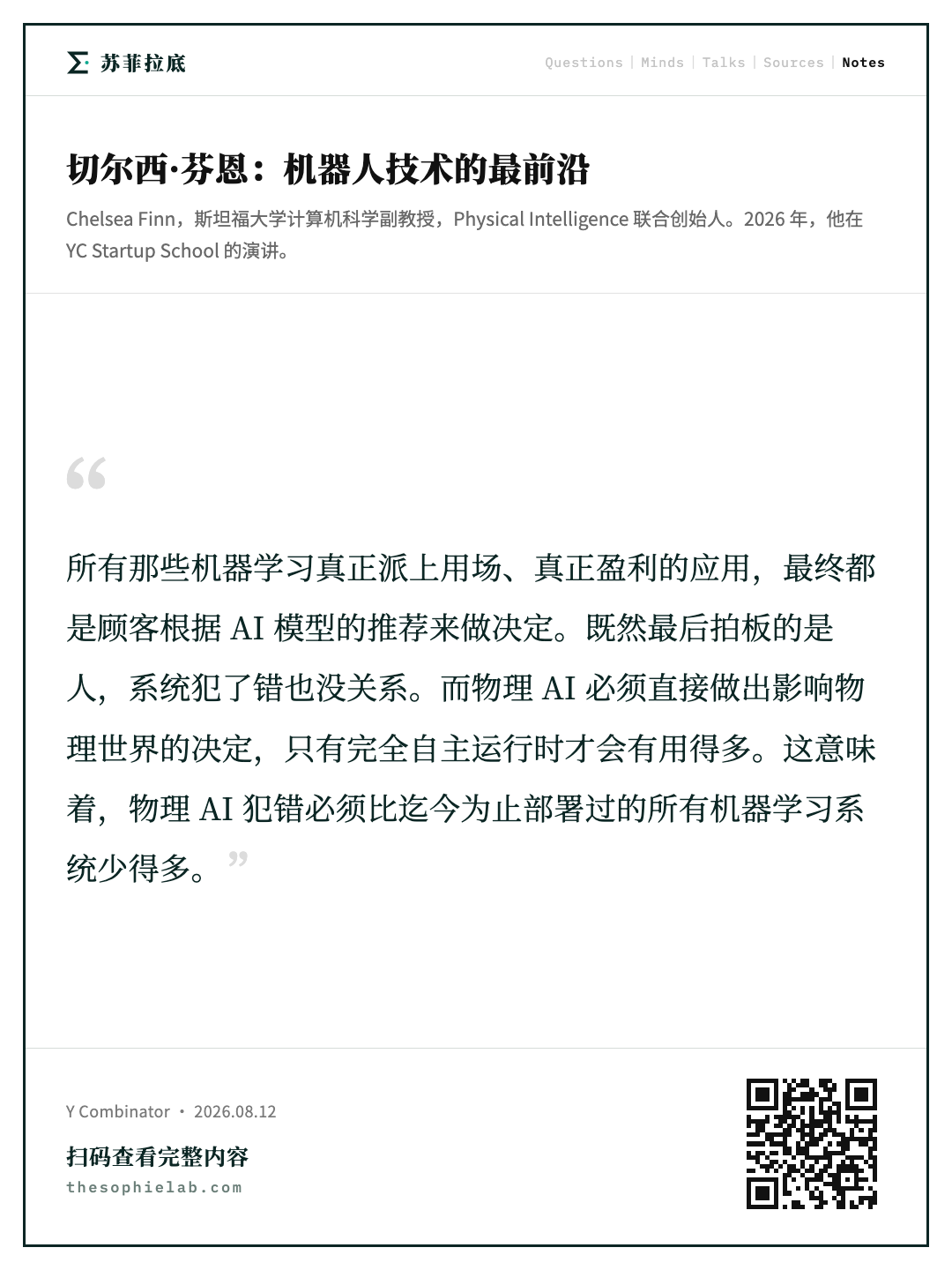
但我认为还有一个更细微的观察。看看这些应用,所有那些机器学习真正派上用场、真正盈利的应用,在每一个里面,最终都是顾客根据 AI 模型的推荐来做决定。这意味着,既然最后拍板的是人,那么系统犯了错也没关系,人通常能看出来,或者即便有这个错误也能决定该怎么做。所以这些系统即便不完美,对不同的人依然极其有用,它们也没有那么大的压力非要做到完美。

而我认为,物理 AI 和机器人学与此截然不同。真正在物理世界里运行的物理 AI,必须直接做出影响物理世界的决定。这意味着,只有完全自主运行时,它们才会有用得多。

物理 AI 必须完全自主

由此带来的要求是:我们开发的物理 AI 系统,犯错必须比迄今为止部署过的所有机器学习系统少得多。

最近有一件特别值得一提的振奋人心的事:一年前,Waymo 的每周自动驾驶乘车次数突破了二十五万。这说明,开发一个基于机器学习、能在物理世界里直接以可信赖的方式自主运行的系统,是确实可能的。我觉得这给「把 AI 的其余部分也带进物理世界」带来了很多希望和乐观。

所以,如果我们想在真实世界里开发通用机器人,就必须思考怎样让它们长时间自主运行,这样它们才真正有用,而不是靠人根据模型的预测来做决定。

以做咖啡为例谈高可靠性

要谈长时段自主,我想落到一个具体例子上。假设我们想让机器人做意式浓缩咖啡。它要真对我们有用,就得可靠地做出咖啡,我们不必老是盯着它,它才能帮忙出饮品。

这个任务本身就已经很难了。操作手柄(portafilter)需要非常精确而有力的控制,才能把它正确地插进去。它还得平稳地拿起装有液体的杯子而不洒出来。它还需要准确的时间感,而这在机器学习的其他领域通常都不是问题。我们不仅要完成这个颇具挑战的任务,还要以 90% 以上的可靠性完成。怎么做到?

机器学习的第一步永远是:收集一个数据集,训练一个模型,评估模型有多好。遗憾的是,第一次尝试很少能可靠地成功。

实践中,更好的做法是在已有模型的基础上迭代:收集更多数据,或提高数据集里标注的质量,或让标注更详细,针对边缘情况和表现不佳的场景多收集数据,调整数据集的配比,等等。这通常能提升模型的可靠性,但人终究会累,靠人工调参很难达到非常高的可靠性。

更好的办法是,让 AI 系统自己针对你希望它更可靠的场景进行迭代:它自己主动去寻找需要更多数据、需要更多监督的地方。因为这是自动的,不需要人手动做,我们就可以迭代多得多的轮次。这也许就是让物理 AI 系统达到 99% 以上可靠性的路径。这就是我们采取的方法。它看起来很像一个强化学习算法:尝试任务,从失败中学习,自己越做越好。

把语言模型 RL 搬到机器人

那么,怎样为机器人开发一套可扩展的强化学习配方?在语言模型那边,有 PPO、GRPO 这类算法,它们已经扩展到了大语言模型上,带来了非常复杂的推理能力。

但要把它们用到机器人上,有一个难题。这些算法训练时用了数百万次、有时甚至数千万次尝试,靠的是堆算力,因为每一次尝试不过是在数据中心里跑一遍语言模型,只消耗算力。如果我们非常粗略地把这换算到机器人上,假设不是数百万或数千万次,就只是一百万条轨迹,每条是一分钟的机器人任务(这比我刚才说的浓缩咖啡任务还短),那么要让这个任务达到高可靠性,相当于 700 个机器人工作日。这或许不是完全做不到,但会相当困难,因为这里的账算法不一样:我们不只是烧算力去优化一个用例,而是真的在真实世界里跑机器人,用硬件,在真实世界里尝试任务。所以我们希望有一个迭代效率高得多的算法。

事实上,确实有办法让这些算法高效得多。语言模型的强化学习算法里有几处很大的低效之处。

两处改进:人工介入与价值函数

第一处低效是,它们把大量时间花在了死胡同轨迹上。如果你只是消耗算力,这或许没关系,但在物理世界里代价就很高了。举个具体例子:假设我们想让机器人组装纸箱并把它们摞起来。在这条轨迹里,机器人不小心抓起了两个紧贴在一起的纸箱。如果任由它继续,它会一直试图折那个纸箱,而不是把两个纸箱分开。把两个纸箱一起折,这不是能教模型把任务做得更好的有用数据。于是机器人会在错误的解题路线上浪费大量时间。

所以,与其让它花大量时间干这个,我们会让人介入,向机器人演示该怎么做、怎样从这种局面里恢复。你可以看到,一个人在遥操作介入,向机器人演示:要从这种局面恢复,本质上要把两个纸箱分开。然后它把夹爪伸进去,看机器人能不能自主恢复。它没能自主恢复,于是人再次介入,帮它回到正轨。这样我们就高效地利用了机器人上的数据。

这是我们能做的第一件事:向机器人演示怎样恢复,或者尽早演示怎样恢复,这样就不会在死胡同轨迹上浪费时间;至少也要提前终止这一回合。

第二件能做的事与 PPO、GRPO 这类算法的另一个特点有关:它们对同一个提示词做很多次尝试。取决于具体算法,它们本质上是在为这些不同的回应估计哪个好、哪个坏。所以即便是单个提示词,它们也要跑上十次、五十次。这样做是为了估计这些不同尝试的价值,然后提高好的做法的概率、降低坏的做法的概率。但我们其实可以把这个成本摊薄:不必为单个提示词收集大量尝试,而是把它摊到不同的提示词上,学出一个更通用的价值估计,判断什么好、什么坏,再用它来从自主经验中改进。

具体说,我们可以在大量机器人经验的视频上训练一个通用价值函数。它能学到这样的东西:如果机器人本想叠衬衫却不小心把它抖开了,那是坏的,是负向进展,用红色标出;如果在向前推进,它也能识别出来。同一个价值函数还能在完全不同的场景里估计好坏,比如从冰箱里取东西。这种通用价值模型本质上是在预测「距离成功还需要多长时间」,它能大幅减少从经验中学习改进所需的尝试次数。

有了这两处对强化学习系统的改进,我们就有了一套通用的改进算法:在多样化数据上训练一个基础模型;用它收集经验,必要时由人介入以防止死胡同轨迹;训练一个判断好坏的通用估计器,也就是价值函数;再用它改进模型。有了这种改进,我们就能把一个基础模型微调到更高的性能水平。

拿铁、纸箱、叠衣的实测结果

拿做拿铁这个任务来说。这里是机器人和人协作做拿铁:机器人负责做浓缩咖啡,人负责打奶泡。模型的样子是这样的:它以机器人摄像头的图像为输入,直接控制机器人的关节。可以看到,模型能够完成相当有挑战的动作:插入手柄,等待恰当的时间让咖啡萃取出来,再把打好的奶泡倒进杯子。

这个任务的最后一步其实最难:它需要端起一杯满满的拿铁,转移到杯垫上。这里是机器人直接看到的画面,你能看到策略极其细腻,能恰当而平稳地端住杯子,拿铁不会洒出来。这大概能让你感受到这类任务的难度。

回到可靠性的问题。我们拿这个策略,不是只跑一次,而是连续跑了 13 个小时。我们想评估的是:这个策略不只是做一次拿铁做得好,而是能否可靠到在真实世界里真正有用的程度。这里是那个过程的延时视频。我们确实发现,机器人的可靠性足以支撑长时间的有用工作,不会频繁出错。

同一个算法当然不是只针对做拿铁的,我们也把它用到了别的应用上。Dandelion 巧克力工厂离我们办公室只有几个街区。我们拿了他们通常由人来做的一道工序:组装纸箱、贴标签、摞起来。我们训练机器人完全照他们真实的工作流程去做,用我刚才讲的强化学习算法训练,得到了一个在组装、贴标、码放纸箱上可靠得多的策略。

我们还把这个算法用到了叠衣服上。这一次我们不只想测试模型在一个环境里做一个任务做得多好,而是要在很多环境里做。所以视频里是机器人从未见过的衣物,在一个从未去过的家里。它能够做到,并且长时间自主工作。

视频不总能说明一切,所以我们也定量测了这些模型的可靠性。我们既关心可靠性,也关心速度,比如每小时能组装多少个纸箱。所以我们测的是吞吐量(throughput),它把成功率和速度结合在一起。我们发现,从预训练,到类似 SFT 的阶段,再到类似 RL 后训练的阶段,成功率乃至吞吐量都大幅上升,单是 RL 阶段就带来了大约 2 倍的吞吐量提升,这说明强化学习能带来高得多的可靠性。至于浓缩咖啡任务,单看成功率,我们达到了 90% 以上。

这部分的结论是:我们可以为复杂的机器人操作任务开发一套可扩展的高可靠性配方。利用经验与人工介入,我们看到吞吐量提高了 2 倍。但最重要的是,我们看到了怎样在人们真正关心的真实工作流程中实现长时段自主。我认为,这正是机器人要在真实世界里有用所必须具备的。

当然还有很多工作要做,也有很多机会。这个算法我们其实只跑了几轮改进,再多迭代几轮,应该能看到更大的提升、更高的可靠性。而且即便有了这些改进,机器人仍然会犯错,仍然比人慢。所以要开发更强大的配方,还有巨大的空间。

缺失的要素:多尺度记忆

我们已经看到了不同工作流程里的长时段自主。但要让机器人长时间自主而有用,我还想谈一个要素:记忆。

你可能会惊讶:大多数最先进的机器人基础模型没有记忆,也没有上下文。它们只根据当前的传感器观测、当前的摄像头画面来预测动作。没有记忆,你确实可以做短的运动技能,可以做重复性任务;我前面放的那些视频也都没有上下文。但如果你想做一个由多个步骤按顺序组成的长任务,记忆就至关重要,因为你得追踪已经完成了哪些步骤。

既然它对这类长程任务如此关键,为什么这些模型没有上下文、没有记忆?原因有几个技术上的,我讲其中一个。如果你天真地处理记忆,直接把上下文(比如视频)喂给机器人基础模型,假设只喂 10 秒视频,采样率 50 赫兹(这是机器人学里常见的控制频率),四路摄像头全部喂进去,每张图大约 256 个 token,这相当于往模型里塞了 50 万个 token,太多了。要实时把这些喂进模型,眼下相当困难。即便降采样到每秒一帧,你仍然要塞进 1 万个 token,至少现在对这些模型来说代价高得难以承受,而这才只有 10 秒的记忆。

我没有时间细讲技术细节,但我们也为这个上下文问题开发了一套解决方案,具体说是一个具有多时间尺度记忆的系统。

第一层是短期视频记忆,大约 10 秒的视频,但计算方式比直接喂给模型高效得多。对于更长的记忆,跨越几分钟、几小时的记忆,我们并不一定需要过去到底发生了什么的视频。于是这部分记忆我们用文本表示:把发生过的事用文本总结,再把过去十到十五分钟的这份压缩得多的文字摘要也纳入模型。有了这种多时间尺度的记忆,机器人就能完全自主地连续工作 10 到 15 分钟。

和我前面展示的不同之处在于,这个任务不是重复性的。这是一个 10 到 15 分钟的清理厨房任务,机器人不是一遍又一遍地做浓缩咖啡。它要用海绵擦台面,然后用纸巾擦干台面,把纸巾扔掉;接着把芥末酱放回冰箱;然后把餐具收进橱柜,在水槽里洗几件脏餐具,等等。有了记忆,它就能完成这样一个需要追踪所有这些清理步骤的任务,完全自主地成功运行 10 到 15 分钟。

通用 AI 十五年与机器人的位置

以上是长时段自主的几个要素。接下来我想在此基础上更进一步,把这些要素放进一个通用模型里,它能做我前面展示的一切,而且是在单个模型里完成,此外还能做别的事。

要思考怎样开发这样的通用模型,我觉得把机器人学放到通用 AI 其他领域发展的时间线上来定位,会非常有帮助。回顾过去大约十五年通用 AI 系统的演进,我认为第一个重大里程碑是 2012 年:一个从零训练的深度学习系统第一次登顶了一个外部基准测试,而此前该基准上的所有方法都是专为这项应用设计的。具体说是 ImageNet 基准,之前所有方法都是专为图像分类设计的,而这是深度学习系统第一次胜过那些专用系统。它是一种通用得多的算法,并非专为图像识别设计。

仅仅两年之后,我们发现不只是从零训练算法,还可以得到预训练模型,用于微调到下游任务。于是「拿一个在 ImageNet 上预训练的模型,再在下游任务上微调」成了惯例,用 BERT 或 ImageNet 预训练模型,性能确实更好。

再往后,通用 AI 模型的下一个重大转变不是使用预训练模型,而是从「预训练加微调」的范式转向直接开箱即用通用模型。这从 GPT-2 之类的模型开始,当然,今天我们打交道的几乎所有模型都是开箱即用、无需微调的,至少大多数面向消费者的模型如此,也有些模型仍然大量依赖微调。

我还想强调 2021 年的另一个里程碑:我们第一次看到这些模型出现组合泛化(compositional generalization)的迹象,一个具体的例子是 DALL·E,后面我会再多讲一点。

这就是通用 AI 过去十五年的演进。与此同时,看看物理 AI,哪怕就在三年前,2023 年,做机器人的人为单个项目从零收集一个专属数据集、再在上面从零训练,还是极其普遍的做法。这相当于从零收集 ImageNet 再在上面训练,或者在你刚收集的数据集上从零训练。如果你想开发通用模型,却每个项目都得从零收集数据集,那你多半不会有多大进展。

所以直到几年前,我认为我们还处在这条时间线相当靠左的位置。而直到最近,我觉得我们大致处在 2014 年那个阶段:有了一些不错的预训练模型,但还没有真正进入右边那个范式。怎样才能到达右边?具体说,怎样开发一个开箱即用、同时表现出组合泛化的单一通用模型?

这里有两个目标。第一是开箱即用的模型,相当于从 BERT 走到 GPT。眼下,要让模型在某个任务上发挥最佳表现,最好的机器人性能总是需要微调。我开头放的一些视频,比如开锁,就是微调过的模型;我们在衡量人到机器人迁移方面做的其他工作,也需要微调才能得到最佳性能;当然,我展示的所有 RL 后训练的视频,也都是针对单个任务微调的,才在做浓缩咖啡之类的事上达到最佳性能。但如果你必须微调模型,你就并没有得到一个针对你想做的事的通用模型,因为每件事都得单独微调。所以我们的第一个目标,是走向一个真正能做你想做的所有事情的单一通用模型。

第二个目标是组合泛化。这受 2021 年 DALL·E 结果的启发。我认为那是一个非常重要、非常令人兴奋的里程碑,正是因为它实现了组合泛化。具体说,当你拥有组合泛化,当你能把「牛油果」和「椅子」两个概念连起来、展示二者可以结合时,就意味着模型至少对牛油果是什么、椅子是什么有了某种概念性的理解,以至于能把它们合成一个同时体现两种概念的东西。其次,这意味着你有了某种程度的数据效率:你的数据不需要覆盖数据中所有概念的全部可能组合。你的数据集里不需要有牛油果椅子的图片,就能生成这样的东西;同样,模型部署时你可能要求它做的其他组合,也不需要在数据里出现过。即便在 2021 年它也并不完美,但这些组合泛化的迹象展示了模型的这两种属性,非常令人振奋。

π0.7:异质数据加详细提示

于是我们有了两个目标:开箱即用的模型,以及组合泛化。开发这种模型的成熟配方是:第一,拿一个足够大、足够多样的数据集;第二,训练一个容量足够的模型。我们要做的就是这个。

我们要用上手头所有的数据。这包括非常多样的机器人演示数据,也包括质量非常低的演示数据。还包括策略执行数据,也就是机器人尝试完成任务的记录,前面那些任务的强化学习所用的全部训练数据都会纳入训练配方。我们还会加入人类的视频,还有来自网络的数据。基本上是我们拥有的一切数据。

至于训练容量足够的模型,我们当然会把模型做得足够大,但要拟合如此异质的数据,我们还发现一件事特别重要:用它预测动作所需的全部上下文来提示(prompt)模型。我们发现这个想法正是用好这种数据、这种程度的异质数据的关键突破口。

具体来说,我们要训练一个基础模型,它的输入包括我前面提到的记忆、一条「做什么」的指令,还包括一条子任务指令,说明下一步要立即做的事。它还会以元数据(metadata)为输入,标明数据的质量、回合的长度等等。这些元数据给了它多得多的信息,告诉它该如何预测下一个动作。

此外,我们还可以选择用一张子目标图像(subgoal image)作为提示来训练模型,意思大致是「几秒钟之后,你应当努力达到看起来像这张图的状态」。有了这种详细的提示,我们发现模型确实能利用异质得多的数据,稍后我会给出对比,说明这有多重要。

要真正部署这个模型,我们就得提供子任务指令和子目标图像这些东西。于是我们可以训练一个高层策略,预测子任务指令,也就是接下来做什么、清理厨房任务的下一个子任务是什么。我们还会额外训练一个世界模型,生成机器人下一步该做什么的图像,作为子目标图像条件。

这样,我们就在所有可用的多样化数据上,训练出一个具备这些属性的单一模型。这里是这个单一模型能做的一些例子。所有这些视频都出自同一个模型,我们叫它 π0.7。左边是它在叠一件有领衬衫;右上是一个非常精细的装配步骤,需要把一颗螺丝插进机器人手臂并拧紧;右下是机器人在给垃圾桶换垃圾袋。

开箱即用与组合泛化的证据

我们一开始有两个目标。第一个是走向开箱即用的模型,刚才的视频已经表明,模型开箱即用就能做不少事。但真正关键的问题是:这个预训练模型,和前面专门为做咖啡、专门为装纸箱训练的专用模型相比如何?我们测了单一 π0.7 模型和微调过的 π0.6 模型的吞吐量与成功率,发现单一的预训练 π0.7 模型全面持平或超过了那些为下游任务用强化学习后训练开发的微调专用模型。也就是说,它能追平专用模型的表现。对 SFT 专用模型也同样成立,不只是 RL 后训练的模型。这说明我们确实有了一个单一模型,能开箱即用地以非常高的水准完成许多不同任务。

这是第一个目标。第二个目标是组合泛化。衡量它的方式有好几种,机器人学里可以尝试组合概念的方式也有很多。

我们想做的第一个测试,是看机器人能否操作一件相当罕见的电器,比如空气炸锅。我们想看它能不能打开空气炸锅,把一个红薯放进去,再关上。选它是因为我们以为数据集里没有空气炸锅,我们从未有意收集过带空气炸锅的训练数据。后来对数据集做了分析,发现我们的数据太多样了,居然有三个回合里出现了空气炸锅。我们估计它们大概没什么影响,就算去掉这三个回合,多半照样能成。总的来说我们发现,机器人能够操作一件在训练数据里几乎没有出现过的电器,把「和它互动」的技能(打开、关闭等等)与这个没见过的物体组合起来。在像 Lucy 那样给出指令之后,我们还可以训练一个高层策略,完全自主地完成这项任务,视频里就是机器人在做这件事。这是组合泛化的第一种形式。

第二个组合泛化测试,是看能否在任务与机器人平台之间做组合泛化。我们拿了一个叫 Barm 的机器人平台,它其实是一个非常大的工业机器人平台。我们想看它能不能叠衣服,尽管我们在这个平台上没收集过任何叠衣数据。具体说,我们有在左边这个平台上叠衣服、叠衬衫的数据;我们想看,不在右边这个截然不同的平台上收集任何叠衣数据,开箱即用,机器人能否成功完成任务。

视频里可以看到,它确实以这种方式做到了组合泛化。第一次看到机器人做这件事时,我们都惊呆了,因为这个任务完全没有训练数据。而且这台机器人和另一台差别很大,不只是尺寸,连杆的长度、关节的配置等等都不同。这是 1 倍速视频,所以不算快。显然,如果没见过任何相关训练数据,如果这真的是机器人第一次叠衬衫,它可能要多试几次,但最终会叠好。你还能在左上角看到生成的子目标图像,那是模型在尝试生成能推进叠衣任务的图像,然后把它们作为输入传给模型。然后我们看到了叠好的衬衫。它最后大概还会做几处小修正,让衬衫更平整些。

结论是:无论是语言与物体的组合,还是任务与机器人的组合,我们都在这个模型里看到了组合泛化的强烈迹象。定量上我们也看到,随着模型进步到 π0.7 这样更先进的版本,在这个没见过的平台上叠毛巾、叠衬衫的性能急剧上升,甚至逼近人类遥操作的水平,尽管我们没有任何针对该机器人的叠衣训练数据。

最后一个实验,我觉得或许是最有意思的。我们想测试我提到的两个要素究竟有多重要:多样化数据有多重要,容量或者说详细提示有多重要。如果我们从模型训练中去掉最多样的那部分数据(灰色所示),发现在留出任务上的性能急剧下降;而如果只是随机去掉 20% 不那么多样的数据,性能只下降一点点。这说明真正多样的数据在泛化到新任务上确实扮演着重要角色。

我们还做了元数据提示的消融。这个实验对比了用元数据提示和不用:用提示的是黄色,不用的是灰色。用提示带来了显著的帮助。但最有意思的是,这张图展示的是随着加入越来越多数据、尤其是越来越多低质量数据,性能如何变化。不用元数据提示时,当你把低质量数据从 80% 加到 100%,性能反而下降,这或许不太意外,因为你在往数据配比里加低质量数据;而用元数据提示时,加入这些低质量数据后性能反而上升。这说明有了这种提示,模型连低质量数据也能榨出多得多的价值。

这部分的结论是:我们能训练一个控制机器人的单一模型,持平或超过专门后训练的专用模型,就像从 BERT 那样的预训练模型走到 GPT 那样真正开箱即用的模型。我们还看到了 DALL·E 式组合泛化的强烈迹象,比如把技能组合到电器上、组合到新机器人上,这些组合在训练数据里都没出现过。我展示的所有视频和实验,都只是对模型开箱即用的评估,没有任何后训练。线上的论文与技术报告有更多实验和细节。

现状总结与真实部署

我们谈了长时段自主,又展示了怎样把它做进一个单一通用模型。那我们现在到了哪里?

第一,回到通用 AI 的时间线,我认为物理智能现在已经稳稳地站到了这条线的右侧。就机器人学和物理智能而言,我们已经进入了 GPT 与 DALL·E 那样的时代,这非常令人振奋,而且我们只用了几年就走到了这里。

最后,这些模型也已经真正部署在现实场景中。上面两个视频是两家 YC 公司,Ultra 和 Weave,它们拿 PI 的模型做后训练,部署去做叠衣服和仓库打包这样的任务。左下是我前面放过的视频。这种模型适用于非常多样的机器人形态:上面和左边是比较标准的双臂平台,但它也能适配无人机、四旋翼、手术机器人,以及右下的拖拉机。这真正表明,物理智能不只是在演示和研究里产生影响,而是在真实部署中产生影响。

我认为随着这几年的种种进展,我们会看到越来越多的机器人真正在物理世界里投入使用。

最后厚着脸皮说一句:Physical Intelligence 正在招人。如果你对我讲的东西感到兴奋,欢迎看看我们开放的职位来申请。接下来是提问时间。

问答:ChatGPT 时刻与开源

第一个问题是:我们离机器人的 ChatGPT 时刻还有多远?它会是什么样子?

我先答后半个问题。我不确定它真的会像我们在语言模型上看到的 ChatGPT 时刻那样。ChatGPT 五天就突破了一百万新用户,而物理模型的分发渠道会慢一些,很遗憾,因为你得真的有一台机器人在那里。看看 Waymo,它的推广确实令人惊叹,但把东西部署到物理设备上仍然需要时间。所以我不知道会不会有一个像 ChatGPT 那样传播的单一时刻。与此同时,就模型能力而言,我认为这些模型确实已经开始在真实世界里有用了,达到 ChatGPT 那种程度的能力,我认为在未来几年内是很有希望的。

第二个问题:小团队什么时候该从扩展单点模型转向通用策略?这个转变实际是什么样?什么信号说明时机到了?

这是个好问题。至少我认为,一开始就直接用通用策略然后微调,甚至从第一天就这么做,会非常有效。幸运的是,有很多非常强大的通用策略是开源的,比如 π0 和 π0.5 模型就是开源的,我们已经看到很多人从这些模型里获益。我们也在和很多合作伙伴合作,比如那家拖拉机公司、Ultra、Weave,拿我们最新的模型为他们自己的应用榨出更多价值、开发更强的模型。所以我认为从一开始就可以用。

我唯一不会用它们的场景,是环境真的极为受限。我和一些做手术机器人的人聊过,他们的手术室在地下室,没有网络,GPU 也很差,有时候用大模型就是很难。不过你仍然可以在工作站上对这些模型做本地推理。所以我认为,直接拿 π0.5 或你喜欢的模型来微调就是正路。我相信会出现很多这样的小公司,要让这些机器人凭这项技术在真实世界里跑起来,还有太多事可做。

下一个问题:鉴于工业界的机器人进展如此之快,今天读博士的真实好处与坏处是什么,尤其是对之后想去工业界的人?

我原本没打算读博士,一直打算直接去工业界。我父母都是工程师,在工业界工作,我当时觉得产生影响的方式就是进公司。我父亲甚至跟我说,他不会雇有博士学位的人。于是我想,要是找不到工作,也许就不该读博。当然他在另一个领域,土木工程。

但与此同时,我认为博士是一个绝佳的机会,我很喜欢我的博士阶段。显然这很大程度上取决于导师,取决于你会做什么等等。但我认为博士是一个绝佳的机会,首先让你学会怎样应对不确定性,怎样挑选值得做的问题。做研究时没有人会把问题交给你,你得自己选问题,而对你选的问题,你并不知道六个月、两年还是十年之内能不能取得进展。你就在这个过程里学会应对这种不确定性。这非常有用。其次,它也是做出色研究的机会,很多情况下你有很大的自由,去做你觉得最令人兴奋的研究。所以我认为,今天它仍然是一个绝佳的机会,去做研究、去学习面对不确定性。我认为学会应对不确定性在创业环境里、在 AI 前沿都非常有用,因为现在没有人知道让这些模型越来越强的最佳路线是什么。

与此同时,工业界也有大量绝佳的机会。首先,我展示的一切,背后不只是研究:有一整套软件栈要在机器人上跑,而且要跑得可靠;硬件那边的一切当然也在其中;还有机器学习基础设施、数据基础设施等等。做这些工程工作,你不一定需要博士学位。研究那边也常常有参与的机会,而且如今很多研究本身就是工程。所以这很大程度上是个非常个人的决定,取决于你想要什么。即便是今天,回头看,我大概仍然会想读博士,就为了学会应对不确定性、学会做研究,因为我真的热爱站在前沿思考困难的问题。但两条路上都有非常出色的机会。

下一个问题:大语言模型从互联网学习,但机器人并没有互联网规模的物理经验数据集。机器人学的对应物是什么?怎么得到它?

先从语言模型说起。网络上的数据是语言数据,并非全部高质量,但其中一些信息量很大、很有用,而且这些数据大体反映了你想让模型做的事:你想让它预测文本、补全文本、回答问题等等,而互联网上有大量正在被回答的问题、正在被补全的文本。机器学习的一般原则是训练要匹配测试,你训练模型用的东西,应当反映你之后要求它做的事。所以我认为机器人学的对应物,就是机器人在真实世界环境里工作的数据。

Physical Intelligence 的做法是收集机器人经验,机器人做各种各样任务的经验。你可以用遥操作收集,作为机器人做有用事情的初始数据。但长远来看,我认为它也会包含大量部署中的机器人自主尝试的经验。就像我们在语言模型里看到的,现在很多时间其实花在生成数据上,通过跑模型、让它思考来生成合成数据。我认为机器人学未来的很多数据,将是机器人在大量真实场景里尝试大量任务。这大概就是它的样子。

我也认为还有其他对模型训练非常有用的信息来源,比如人做事的视频,像 YouTube,还有网络数据和带说明的图片,它们会告诉你「这是一个厨房,冰箱在水槽右边」之类的事。所有这些数据,我认为都能用来开发一个前沿的多模态模型,它既能控制机器人做事,能推理怎样完成一个长任务,也能控制机器人去执行。

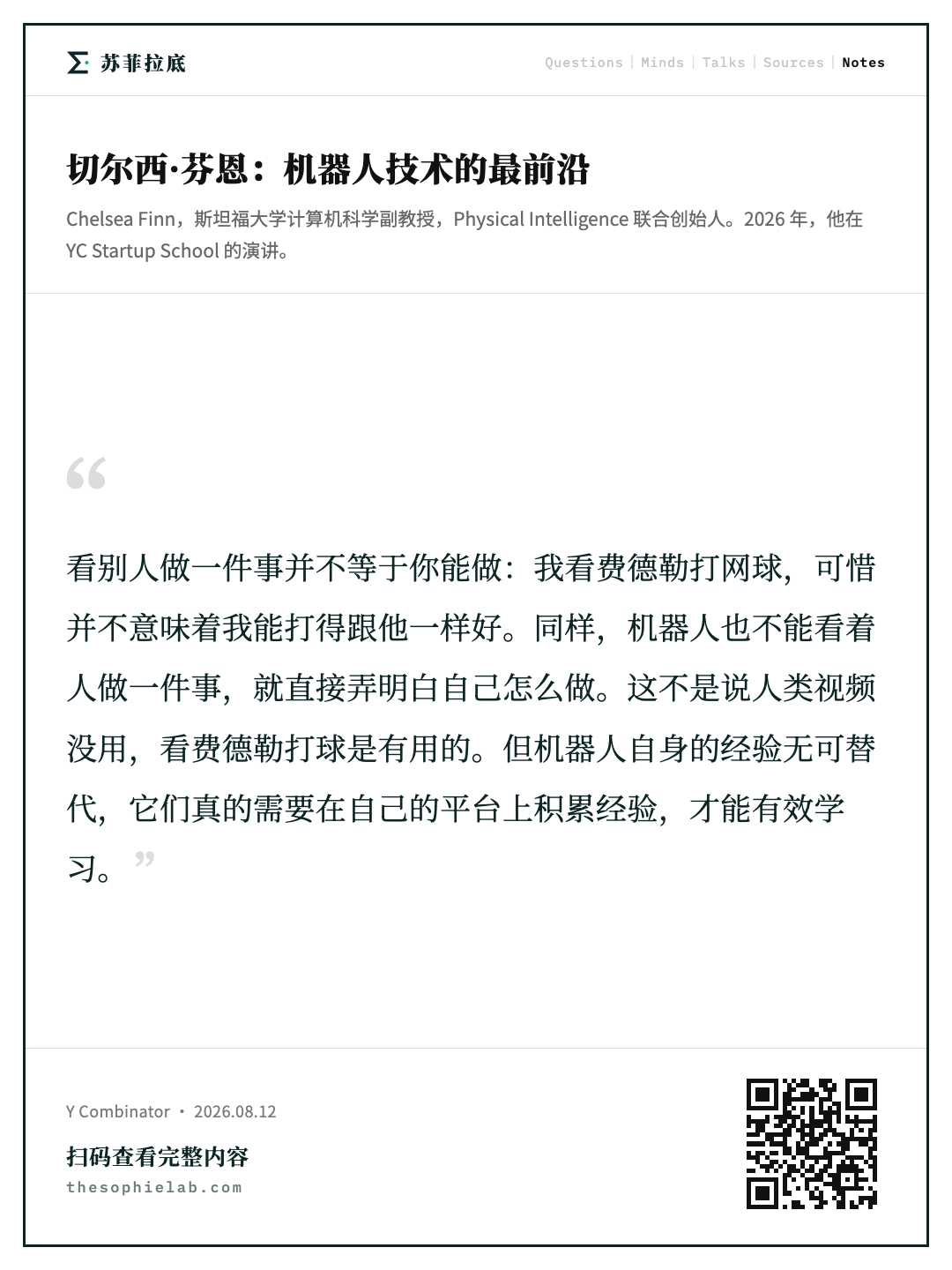
但我认为机器人自身的经验无可替代。看别人做一件事并不等于你能做:我看费德勒打网球,可惜并不意味着我能打得跟他一样好。同样,机器人也不能看着人做一件事,就直接弄明白自己怎么做。它们真的需要在自己的平台上积累经验,才能有效学习。我认为我们会需要大数据集。这不是说人类视频没用,看费德勒打球是有用的。但机器人平台上的真实经验,将是构建机器人学对应数据集的关键组成部分。

下一个问题:通用机器人模型有可能像大语言模型那样通过开源实现普及吗?还是说具身数据和硬件的成本会让最好的模型集中在少数资源雄厚的实验室手里?

这是个好问题。我确实认为具身数据和硬件的成本很可能让局面看起来不同,因为数据更难获取,比如不能像在互联网上那样轻易拿到数据去蒸馏一个模型。我也认为我们已经看到相当大的数据集被开源,相当强的模型也被开源。究竟会怎样,真的很难说,所以我不知道。

我想说的一点是,语言模型那边,先不说 DeepSeek、Kimi 这些真正做到最先进水平的开源模型,就连主要做闭源模型的公司也在做大量开源,比如 Gemma,比如 GPT 的开源权重版本。这些公司愿意支持开源,是因为这确实有助于围绕它们的产品建立生态。所以我想象,无论如何都会有一个强大的开源社区,我对此是乐观的。但我不知道它是否会完全按语言模型的剧本上演。

问答:动作表示、想象与速度

下一个问题:模型是直接输出原始电机指令,还是输出目标手部位置、再让控制器求解关节角度?为什么那是合适的学习层级?

我展示的所有模型输出的都是目标关节位置:这个关节的角度是多少,那个关节的角度是多少,你想达到的目标是什么。然后有一个控制器,比如 PD 控制器,去努力让这些关节达到目标位置。模型其实也被训练来预测目标夹爪位置,也就是我的夹爪应该在三维空间的什么地方。你也可以用这个,再反推出关节位置。另一种做法是直接输出电机力矩,或者电压、出力。不同选项各有利弊。我们发现控制关节和在夹爪的三维空间里控制都很好用。

直接输出电压有一个好处:你还能得到更硬或更软的输出。而如果你用一个固定的控制器,就没让模型控制这方面。所以确实各有利弊。我觉得我们现在的做法似乎是管用的,它看起来不是瓶颈。我通常喜欢把精力放在看起来是瓶颈的事上,而不是那些看起来不是瓶颈的事。

下一个问题:机器人需要某种想象力吗?就是在真正有用之前,先能设想接下来该发生什么?

我展示的 π0.7 模型就有类似的东西,它可以想象未来的图像应该是什么样,然后努力去实现。我们发现这带来了提升,在叠衬衫的例子里,用这种想象比不用有一个定量的提升。与此同时,我认为模型不用它也表现得出奇地好。

我们本来打算就这项能力写一整篇论文、一整份技术报告。但没有它的模型太好了,我们觉得需要让「没有它也很强」这一点在故事里占更大的分量,因为那才是真正带来强结果的东西。所以它看起来是一种设计选择。它会不会成为关键组成部分,我觉得很难说。这类模型的好消息是,如果你建了一个好的数据集,你就可以用手头的数据集跑实验、持续测试各种东西,效率相当高。

我也认为,相比预测未来的动作,预测未来看起来是一个非常相关的目标,所以我猜想它有助于从你手头的全部数据中学习。所以,它是否必然成为关键组成部分,很难说。从经验上看,目前它似乎有帮助,尽管也许没有你预期的那么大;而且即便没有这种想象,机器人也能做出相当了不起的事。

下一个问题:现在机器人似乎能完成惊人的任务,但速度非常慢。要提升速度需要什么?

我对提升速度非常兴奋。我们确实从强化学习中看到了速度提升。我们还有另一项发布,叫 RL token,展示了更快的速度,甚至快过人类遥操作。我认为瓶颈之一在于,遥操作机器人做事是教机器人最简单的方式,可人遥操作机器人时是比较慢的。我们有几个项目在推进中,在获得快速策略方面已经有非常有前景的结果,后续还会有更多。总之,要么想办法让数据更快,要么想办法比数据更快。我们已经看到了能比数据稍快一点的证据。至于下一步,要么在这个方向上走得更远,要么让数据更快。

问答:涌现的左右手迁移与入行建议

下一个问题:你最近见过机器人完成的最令人惊讶的任务是什么?接下来想看到它做什么?

最令人惊讶的其实不是一项任务。做 π0.7 的时候,我亲自训练了一个策略,用于组装风车的一些初步测试。在训练它组装风车时,有一件事真的让我很惊讶。所有数据里,我们都仔细控制了组装风车的策略:拿起预先裁好的纸片,拿一根小别针,把别针插进纸上的孔里。所有数据里都是右手拿别针、左手拿纸再插进去。机器人一开始也这么做,然后它犯了一个错,纸跑到了右边,别针跑到了左边。机器人接下来做的是:它用左手夹爪拿起别针,用右手拿起纸,用左手把别针插进了右手的纸里。它从来没见过用左手夹爪插别针的数据。这说明,即便这不在后训练数据里,甚至也不在预训练数据里,机器人本质上学到了左手和右手之间的某种等变性(equivariance),从而能把行为从一只手迁移到另一只手,尽管数据里从未出现过。那是一个非常酷的时刻。我把它分享给一些人的时候,感觉别人好像没有我这么兴奋。但它展示了这些模型里一种我以前没见过的涌现能力。

至于我想看到什么,我不知道。我喜欢看机器人做任何事。我觉得在可靠性上还有很长的路要走,让机器人能真正长时间地完成任务。我不太去想单个任务,更多是想能力,想怎样从这些模型里拿到下一项能力。所以任何事都行,机器人做任何事都让我兴奋,尤其是以前没做过的事。我们最近在做的一件事是让机器人用刀切蔬菜。一旦真正能安全地用刀,能做的事就很多了,这是我们最近做到的一件事。

最后一个问题:软件工程背景的人怎样进入机器人领域?

首先,机器人学里有大量软件工程工作,所以你可以试着以软件工程师的身份加入一家机器人公司。另外我想说一条路,我确实见过有人这样走。现在在 Physical Intelligence 工作的一位同事,名叫 Jenny。她做过一阵算法交易,然后在 Harvey 做法律方面的工作。她对机器人非常感兴趣,于是买了一台便宜的机器人,在自己卧室里摆弄,试着微调一个开源模型,让它做点什么。然后她把自己做的东西分享出来,给我发了一封陌生邮件,说「我想到你的实验室工作」。她的履历看起来很有希望,因为她真的动手去做了,而且对此真的很热情。现在她就在 Physical Intelligence 工作。

所以我认为,先下水,动手试,从这些经历中学习,再用这些经历去和人交流、写进简历等等,是一条很好的路。幸运的是,外面有大量开源的东西,能让你在这类事情上起步。

这是最后一个问题了。感谢大家。
排版 + 横图 + 来源,粘贴即成稿
章节 · 点击跳转视频
0:06 开场:一年来的进展与真正的问题 ▶ 正在看
1:36 AI 落地史:人做最后决定 ▶ 正在看
4:27 物理 AI 必须完全自主 ▶ 正在看
5:37 以做咖啡为例谈高可靠性 ▶ 正在看
7:28 把语言模型 RL 搬到机器人 ▶ 正在看
9:22 两处改进:人工介入与价值函数 ▶ 正在看
13:14 拿铁、纸箱、叠衣的实测结果 ▶ 正在看
17:04 缺失的要素:多尺度记忆 ▶ 正在看
21:18 通用 AI 十五年与机器人的位置 ▶ 正在看
27:01 π0.7:异质数据加详细提示 ▶ 正在看
30:15 开箱即用与组合泛化的证据 ▶ 正在看
37:22 现状总结与真实部署 ▶ 正在看
39:44 问答:ChatGPT 时刻与开源 ▶ 正在看
49:23 问答:动作表示、想象与速度 ▶ 正在看
54:09 问答:涌现的左右手迁移与入行建议 ▶ 正在看
本期小问 · 档案清单
4:27 机器人为何必须比推荐系统和聊天机器人可靠得多? ▶ 正在看
30:15 用不着微调的单一模型,真能赶上专门训练的机器人吗? ▶ 正在看
39:44 机器人只看人做事的视频,能学会自己动手吗? ▶ 正在看
30:15 低质量的示范数据,靠什么反而能提升机器人? ▶ 正在看
本期讲者
切尔西·芬恩斯坦福大学计算机科学副教授,Physical Intelligence 联合创始人。以元学习算法 MAML 和机器人模仿学习研究著称,其公司发布了 π0、π0.5、π0.6、π0.7 系列机器人基础模型。
01开场:一年来的进展与真正的问题
0:06
Everyone, today I'm going to be talking about the state-of-the-art of physical intelligence. And in particular, two years ago, I founded a company called physical intelligence. And uh we're really interested in how we can basically uh develop any robot allow any robot to do any task in the real world. Uh and I was actually spoke at this event a year ago uh last year and at the event last year I shared some of our progress in uh at the company at physical intelligence where we could do things really complicated tasks like uh folding unloading and folding laundry. Uh, and we I also talked about how for the first time we showed how robots can do useful tasks in environments in rooms they've never been in before.
各位,今天我要讲的是物理智能(physical intelligence)的最新进展。具体来说,两年前我创办了一家叫 Physical Intelligence 的公司。我们真正感兴趣的是,怎样才能开发出任意机器人、让任意机器人在真实世界中完成任意任务。其实我一年前也在这个活动上做过分享,就是去年。在去年的活动上,我分享了我们公司 Physical Intelligence 的一些进展,比如我们能完成一些非常复杂的任务,像是取出并叠好洗好的衣物。我当时还讲到,我们第一次展示了机器人可以在从未去过的环境、从未进过的房间里完成有用的任务。
便签笔记
1:00
Now, since then, since one year ago, we have gotten robots to do a lot of other really cool things. So, for example, we've gotten robots to be able to wash a greasy pan in the top right or peel a carrot uh in the video below that or make a grilled cheese sandwich uh in the video below that or slice a zucchini uh and so forth. But what I'd really like to focus on today isn't cool videos of robots doing lots of different things, but how what it actually takes to get robots to be useful in the real world.
从那之后,也就是从一年前到现在,我们又让机器人做成了很多非常酷的事情。举个例子,我们让机器人能够洗干净右上角那口油腻的锅,或者削下面那段视频里的胡萝卜,或者做下面那段视频里的烤芝士三明治,或者切西葫芦,等等。但今天我真正想聚焦的,并不是机器人做各种事情的酷炫视频,而是要让机器人在真实世界中真正有用,究竟需要什么。
便签笔记
02AI 落地史:人做最后决定
1:36
And specifically how can we develop generalpurpose robots that are useful in the real world. Now there are two aspects of this. The first is general purpose. How we can develop general purpose models and the second is actually bringing those models to the real world so that they can actually have an impact and be useful to people. And in the first part I'll talk about being useful in the real world. So to actually bring a technology to the real world, I think we need to figure out it's helpful to actually look at what people have done in the past uh to bring AI into the real world. And if we look at a timeline of major production launches that are leveraging technology like machine learning, we um can see a timeline like this. So I think the the really the first early examples of machine learning being used for real in the real world were for things like product recommendations and ad ranking.
具体来说,我们该如何开发出在真实世界中有用的通用机器人。这里面有两个方面。第一是通用性,也就是我们如何开发通用模型;第二是把这些模型真正带到真实世界中,让它们能够产生影响、对人们真正有用。在第一部分,我会讲在真实世界中做到有用这件事。所以,要真正把一项技术带到现实世界中,我认为我们需要弄清楚——去看看过去人们是怎么把 AI 带进现实世界的,这会很有帮助。如果我们看一下利用机器学习这类技术的重大产品发布时间线,我们可以看到大致是这样的。所以我认为,机器学习在现实世界中真正被使用的最早的一批例子,是像商品推荐和广告排序这样的场景。
便签笔记
2:28
uh and then five years later we started to see uh not just machine learning uh being used but deep learning being used for the same sorts of applications. Uh this was a really exciting advance because deep learning is an algorithm that actually isn't like you can kind of really apply it out of the box um to scenarios that involve really complex uh like inputs and outputs and so forth and it makes it easier to translate to other applications. But from there, I think that even more exciting um kind of uh moment in time that we saw in terms of machine learning and AI in production was in 2022 uh with the launch of Chhat GBT. Uh and this was the first time where we saw a general purpose model truly being used by many different people in the real world. Uh within five days, Chhat GBT had reached a million users. And then of course more recently we've seen things uh like cloud code uh also be incredibly useful uh hopefully to many of us uh in the real world and other coding agents. Now if we look at how AI has been used in the real
然后五年之后,我们开始看到不只是机器学习被使用,而是深度学习被用在同样的这类应用上。这是一个非常令人兴奋的进展,因为深度学习是一种算法,它其实不太一样——你几乎可以开箱即用地把它应用到那些涉及非常复杂的输入输出等等的场景中,这让它更容易迁移到其他应用上。但从那时起,我认为在机器学习方面,我们看到了一个更加令人兴奋的时刻,以及AI在生产环境中的应用,那就是2022年ChatGPT的发布。这是我们第一次看到一个通用模型真正被现实世界中许许多多不同的人所使用。在五天之内,ChatGPT就达到了一百万用户。当然,最近我们又看到了像Claude Code这样的东西,它也非常有用,希望对我们很多人在现实世界中都有帮助,还有其他的编程智能体。那么如果我们看看AI在现实
便签笔记
3:30
world uh and and kind of look at this I think there's a few different takeaways we could make. Uh the first is that generalist models are increasingly being used for real world problems. And so we're actually seeing uh general purpose like generalist AI models that can do many many different things actually be used in the real world and we see that transition from the left to the right. But I also think that there's a more nuanced observation that we can make uh from looking at these applications and in particular if we look at all of these different applications that are used uh where machine learning has like actually been useful in the real world and actually uh been profitable and so forth. And in all of these applications, the customer is making a decision based off of the recommendation of the AI model more or less. Uh, and this means that if the customer is ultimately like kind of making the decision, this means that if the system makes a mistake, um, that's okay because usually the person
世界中是如何被使用的,来看看这个,我认为我们可以得出几点结论。第一点是,通才模型正越来越多地被用于解决现实世界的问题。所以我们实际上正在看到通用比如那些能做很多很多不同事情的通用型 AI 模型,真的能在现实世界中被用起来,我们看到了这样的从左边到右边的转变。不过我也认为,从这些应用里我们还能得出一个更细致的观察,具体来说,如果我们看看所有这些真正被使用的应用,也就是机器学习真正在现实世界中发挥了作用、真正带来了盈利等等的那些应用。在所有这些应用里,基本上都是客户根据 AI 模型的推荐来做决定。这就意味着,如果最终是客户在做决定,那也就意味着,即便系统出了错,那也没关系,因为人通常能识别出这个错误,或者即使有这个错误,也能自己判断该怎么做。
便签笔记
03物理 AI 必须完全自主
4:27
can kind of recognize that or or decide what to do even despite that mistake. Uh, and so even when these sorts of systems aren't perfect, they're still incredibly useful to different people. and there's less pressure on them to be completely perfect. And I think that actually physical AI and robotics is pretty different from this where if we think about physical AI that are actually operating in the physical world, they have to be directly making decisions that affect the physical world. Uh and this means that they're going to be far more useful when they're operating fully autonomously.
所以,即便这类系统并不完美,它们对不同的人来说仍然极其有用,而且对它们「必须做到完美」的压力也小得多。而我认为,具身 AI(physical AI)和机器人其实和这很不一样。如果我们想想那些真正在物理世界中运行的具身 AI,它们必须直接做出影响物理世界的决策。这就意味着,只有当它们能完全自主运行时,它们才会有用得多。
便签笔记
4:59
And as a result, this requires us to develop physical AI systems that make far fewer mistakes than the machine learning systems that have been deployed thus far. Now, one really exciting thing to kind of highlight um that has happened recently is uh a year ago Whimo passed the uh quarter of a million weekly autonomous rides suggesting that it is really possible to develop a machine learning based system that can uh operate in a trustworthy and autonomous way uh directly in the physical world. Um and I think that brings a lot of hope and optimism for actually um doing the same with the rest of AI in the physical world.
因此,这就要求我们开发出的具身 AI 系统,出错率要远远低于迄今为止已部署的那些机器学习系统。有一件最近发生的、非常令人振奋的事值得强调:一年前,Waymo的每周自动驾驶载客量突破了 25 万次,这说明真的有可能开发出一个基于机器学习的系统,能够在物理世界中直接以值得信赖的、自主的方式运行。我觉得这给我们带来了很大的希望和乐观,让我们相信在物理世界中的其他 AI 领域也能做到同样的事。
便签笔记
04以做咖啡为例谈高可靠性
5:37
So um if we want to develop general purpose robots in the real world, I think we need to think about how we're going to make them autonomous for long periods of time uh so that they're actually useful uh rather than having them uh rather than something where a human is basing decisions on the predictions of the model. So um to think about long-term autonomy, I want to ground this in a specific example and say that we wanted a robot to make espresso. If we wanted it to be actually be useful for us, we needed to make espresso reliably uh so that we don't have to babysit the robot uh very frequently uh in order uh for it to help serve drinks. Now even on its own this task is really difficult. So actually operating the porter filter requires very precise and forceful control to insert it um appropriately.
所以,如果我们想在现实世界中开发通用机器人,我认为我们需要思考如何让它们在很长的时间里保持自主运行,这样它们才真正有用,而不是让人类去基于模型的预测来做决定。那么,为了讨论长期自主性,我想用一个具体的例子来说明:假设我们希望一个机器人去做浓缩咖啡。如果我们想让它对我们真正有用,就需要它可靠地做出浓缩咖啡,这样我们就不必频繁地盯着这个机器人,它才能帮忙上饮品。而这个任务本身就已经非常困难了。实际操作手柄(porta filter)需要非常精确且有力度的控制,才能把它恰当地装进去。
便签笔记
6:23
It also needs to smoothly handle cups with liquid in it and not spill those cups. And it also needs to have an accurate sense of timing, which often isn't actually an issue in other areas of machine learning. And not only do we want to do this pretty challenging task, we want to do it with over 90% reliability. So how can we do this? So the first step in machine learning is always to collect some data set, train a model, and evaluate how good your model is. And unfortunately, this rarely works reliably on the very first try.
它还需要平稳地拿住装有液体的杯子,不能把杯子里的东西洒出来。它还需要有准确的时间感,而这在机器学习的其他领域里通常并不是个问题。而且我们不仅想完成这个相当有挑战的任务,还想让它的可靠性超过 90%。那我们该怎么做呢?机器学习的第一步永远是先采集一个数据集、训练一个模型,然后评估你的模型有多好。不幸的是,这在第一次尝试时很少能可靠地奏效。
便签笔记
6:59
Now, in practice, then it's a bit better to then iterate on the model that you've developed where you will try to um collect more data or improve the quality of the labels in your data set or make the labels more detailed, collect more data of the edge cases, the scenarios where it's not working well, adjust the balancing of the data set and so forth. Um, and while this generally improves the reliability of the model, uh, people eventually get tired and it's hard to get really, really high reliability with a person that's manually tuning this.
所以在实践中,更好的做法是对你已经开发出的模型进行迭代,比如你会尝试采集更多数据,或者提升数据集中标注的质量、让标注更详细,采集更多边缘情况的数据,也就是那些表现不好的场景,调整数据集的配比等等。虽然这通常能提升模型的可靠性,但人最终会累,而且靠一个人手动调优,很难做到非常非常高的可靠性。
便签笔记
05把语言模型 RL 搬到机器人
7:28
And so what would be even better is if the AI system itself can iterate on the scenario in which you want it to have higher reliability where it on its own automatically seeks out places where it needs more data, where it needs more supervision. uh and if we can do this for many many more iterations because it's automatic rather than a person doing it then this might be the way to get really really high like 99 plus percent reliability from physical AI systems and so this is the approach that we'll take and this looks a lot like a reinforcement learning algorithm that's trying to attempt the task learn from its failures and get better and better on its own so then how do we develop a scalable reinforcement learning recipe for robotics well In language models, we have algorithms like PO and GRPO and these have scaled to large language models and have enabled really complex reasoning.
所以更好的做法是:让 AI 系统自己在你希望它更可靠的场景上进行迭代,由它自己自动去寻找那些需要更多数据、需要更多监督信号的地方。如果因为这是自动的而不是靠人来做,我们就能做非常非常多轮迭代,那这可能就是让具身 AI 系统达到极高可靠性、比如 99% 以上的途径。所以这就是我们要采取的方法,而这看起来很像一个强化学习算法:不断尝试任务、从失败中学习,并自己变得越来越好。那么,我们该如何为机器人开发一套可扩展的强化学习方案呢?在语言模型里,我们有 PPO、GRPO 这类算法,它们已经扩展到了大语言模型上,并让非常复杂的推理成为可能。
便签笔记
8:19
Um, but there's a bit of a challenge in applying this to robotics, which is that these these algorithms have been trained with uh millions of attempts or sometimes even tens of millions of attempts uh by scaling up the compute because each attempt is simply running the language model uh in a data center um just by using compute. And if we were to translate this very very approximately to robotics um say we had maybe not millions or tens of millions but just one million trajectories of a one minute robot task.
但把这套东西用到机器人上有个不小的挑战:这些算法的训练用到了数百万次、有时甚至数千万次的尝试,靠的是把算力堆上去,因为每一次尝试无非就是在数据中心里跑一遍语言模型,纯粹是用算力换来的。如果我们把这个非常粗略地换算到机器人上,假设我们需要的不是数百万或数千万次,而只是 100 万条一分钟长的机器人任务轨迹。
便签笔记
8:49
This is even shorter than the espresso task that I talked about. This would correspond to 700 robot days um to get high reliability for that task. Now maybe this isn't completely out of the question but this would be quite challenging uh to do and that's because the calculus is a little bit different. We're not just running compute to optimize for a use case. We're actually running the robot in the real world and using the hardware and attempting the task in the real world. And so we'd like to have an algorithm that can iterate much more efficiently.
这比我刚才说的浓缩咖啡任务还要短。那也相当于 700 个机器人日,才能在那个任务上获得高可靠性。也许这并非完全不可能,但做起来会相当有挑战,原因在于这里的账算法不太一样。我们不只是在消耗算力去优化某个用例,我们是在现实世界里真的让机器人跑起来、用到硬件、在真实世界中去尝试这个任务。所以我们希望有一种能高效得多地进行迭代的算法。
便签笔记
06两处改进:人工介入与价值函数
9:22
And there are actually ways that we can make these algorithms a lot more efficient. So um there's a couple inefficiencies like large inefficiencies in these reinforcement learning algorithms for language models. The first is that they spend a lot of time on deadend trajectories. And maybe this is okay if you're just spending compute on it. But this would cost a lot in the physical world. So we can look at a concrete example. Say that we want a robot to construct cardboard boxes and stack them uh on the right. And in this trajectory right here, the robot accidentally grabbed two boxes that are flush against each other. And if we let it continue, it would just continue to try to fold that box rather than separate out the two boxes. and trying to fold two boxes together isn't useful data that will teach the model how to get better at the task. And so that would be kind of wasting a lot of time on the robot attempting to go down the wrong path for solving the problem. And so instead of spending a lot of time
实际上我们确实有办法让这些算法效率高很多。语言模型的这些强化学习算法里,存在几处效率低下的地方,而且是很大的浪费。第一点是它们会在死胡同轨迹上花费大量时间。如果你只是在烧算力,这也许还行。但在物理世界里这代价就很大了。我们可以看一个具体的例子。假设我们想让机器人组装纸箱,并把它们堆放在右边。在这条轨迹里,机器人不小心抓起了两个紧贴在一起的箱子。如果我们让它继续下去,它只会继续去折那个箱子,而不是把两个箱子分开。而试图把两个箱子一起折起来,并不是能教会模型如何把任务做得更好的有用数据。所以那就等于浪费了大量时间,让机器人沿着错误的路径去尝试解决问题。因此,与其花大量时间
便签笔记
10:17
trying to do that task, what we'll do is we'll actually have a human intervene and show the robot what to do and how to recover from that situation. And so what you can see here is a human is teleoperating and intervening uh with the robot and showing it um that to recover from this situation, it needs to essentially try to separate out the two boxes. Um it then kind of puts its gripper in, sees it if the then if the robot could autonomously recover, it doesn't autonomously recover. And so the person then intervenes again um to help uh help it get back on the right track so that we're efficiently using the data on the robot.
去做那件事,我们要做的是让人来介入,向机器人演示该怎么做、以及如何从那种情况中恢复过来。所以你在这里看到的是,一个人在遥操作并介入机器人,向它演示:要从这种情况中恢复,本质上需要试着把两个箱子分开。然后它把夹爪伸进去,看看机器人能不能自主恢复,结果它没能自主恢复。于是人再次介入,帮它回到正轨,这样我们就能高效地利用机器人上采集到的数据。
便签笔记
10:54
Okay, so this is the first thing that we can do which is we can show the robot how to recover early or how to recover so that we're not spending time on dead end trajectories or at the very least just terminate the episode early. Now the second thing that we can do is uh PBO and GRPO and these kinds of algorithms they make many attempts at a single prompt. Uh and depending on the algorithm they're they're essentially trying to estimate for these different responses what is a good response and what's a bad response. Uh and so even for an individual prompt they're actually going to kind of roll out like 10 or 50 times uh for that individual prompt. And they're doing this because they're trying to estimate the value of these different um attempts uh to then kind of upweight or kind of increase the likelihood of good things and decrease the likelihood of bad things. But we can actually amortize this cost uh rather than trying to collect a lot of attempts for a single prompt. We can amortize
好,这是我们能做的第一件事:我们可以尽早向机器人演示如何恢复、或者说如何恢复过来,这样我们就不会把时间花在死胡同轨迹上;或者至少提前终止这一回合。我们能做的第二件事是:PPO、GRPO 这类算法会对同一个 prompt做很多次尝试。根据具体算法的不同,它们本质上是在为这些不同的回复估计哪个是好回复、哪个是坏回复。所以哪怕只是一个 prompt,它们实际上也会 rollout10 次或 50 次。它们这么做,是因为要估计这些不同尝试的价值,然后提高好结果的权重、增大它们出现的概率,并降低坏结果出现的概率。但其实我们可以把这个成本摊薄:与其为单个 prompt采集大量尝试,我们可以把它摊到不同的 prompt 上,学出一个通用得多的价值估计,
便签笔记
11:47
this across different prompts and learn a much more general value estimate of what's good and what's bad and use this to improve with our autonomous experience. And so what this looks like is um we can train a general purpose value function on lots of uh kind of videos of the robot experience. And this can learn things like if it accidentally unfolds a shirt when it's trying to fold that that's bad and that's making negative progress. It's shown in red. Or if it's making kind of forward progress, it recognizes that as well. Um and the same value function can also estimate what's good and bad for a completely different scenario. uh in this case for retrieving an item from a fridge. And so this sort of kind of general purpose value model that's kind of predicting basically the time to success can um basically significantly reduce the amount of attempts needed to learn how to improve from experience.
判断什么是好、什么是坏,并用它来结合自主经验去改进。具体来说就是,我们可以在大量机器人经验的视频上训练一个通用的价值函数。它能学到诸如:如果机器人在试着叠衣服时不小心把衬衫展开了,那就是不好的、是在往负方向走,图中用红色表示。或者如果它在向前推进,它也能识别出来。而同一个价值函数还能在一个完全不同的场景中估计好坏,这里的例子是从冰箱里取东西。所以这种通用的价值模型,本质上是在预测「距离成功还有多久」,它能大幅减少从经验中学习改进所需的尝试次数。
便签笔记
12:41
Um so with these two um kind of improvements to a reinforcement learning system, we kind of have a a general improvement algorithm that trains a foundation model on diverse data, then collects experience from that with a human intervening as necessary to help prevent dead end trajectories and then train a general purpose estimate of what's good and bad the value function and then use that to improve the model. And with this sort of improvement um we're able to uh kind of fine-tune a foundation model to higher degrees of performance.
所以,有了对强化学习系统的这两点改进,我们就有了一个通用的改进算法:先在多样化数据上训练一个基础模型,然后用它去采集经验,期间人在必要时介入,帮助避免死胡同轨迹;接着训练一个通用的好坏估计,也就是价值函数,再用它来改进模型。通过这样的改进,我们就能把一个基础模型微调到更高的性能水平。
便签笔记
07拿铁、纸箱、叠衣的实测结果
13:14
So um in the task of making a latte in this case we'll be making a latte in collaboration with a person where the robot is in charge of making the espresso uh and the person is in charge of steaming the milk. Um this is what the uh what the kind of model looks like. The model is directly controlling the joints of the robot using uh the images from the robot's cameras as input. And we can see that the model um is able to do the pretty challenging task of inserting the PA filter um uh waiting the appropriate amount of time for the espresso to dispense, pouring the steamed milk into the cup.
比如在做拿铁这个任务里,我们是和人协作完成一杯拿铁:机器人负责做浓缩咖啡,人负责打奶泡。这就是模型的样子——模型以机器人摄像头的图像作为输入,直接控制机器人的关节。我们可以看到,模型能够完成相当有挑战的任务:装上手柄(portafilter)、等待合适的时间让浓缩咖啡萃取完成、把打好的奶泡倒进杯子里。
便签笔记
13:51
And then the last part of this task is actually the most challenging uh where it needs to take a very full latte uh cup of latte and transfer that over to the coaster. And so here's actually the observation that the robot sees directly. And you can see that the policy is super delicate and able to balance the cup appropriately and smoothly so that the latte doesn't spill. So this is kind of gives you a sense of the difficulty of this kind of task. Uh and kind of going back to this reliability question, we took this policy and we ran it not just once, but we ran it for 13 hours straight. Uh and we basically wanted to evaluate is this policy not only good at making a latte once, but can it do so reliably to the extent that it would be needed to be useful in the real world? Um and so here's a time lapse um of that process. Uh and indeed we found that the robot was reliable enough to be useful for long stretches of time without making mistakes uh frequently.
而这个任务的最后一部分其实是最难的:它需要端起一杯装得很满的拿铁,把它移到杯垫上。这里就是机器人直接看到的画面。你可以看到这个策略非常细腻,能把杯子稳稳地、平顺地端住,让拿铁不洒出来。这大概能让你感受到这类任务的难度。回到可靠性这个问题上:我们拿这个策略不只是跑了一次,而是连续跑了 13 个小时。我们基本上是想评估:这个策略不仅仅是能做好一次拿铁,而是能不能可靠到在现实世界中真正有用的程度?这里是那个过程的延时录像。事实上,我们发现这个机器人足够可靠,能在很长一段时间里发挥作用,而不会频繁出错。
便签笔记
14:58
Now the same algorithm isn't specific for making lattes of course and so um we also applied this to other applications as well. Um, Dandelion Chocolate Factory is a few blocks from our office. And so we took a workflow that they typically have a person do, which is to construct these cardboard boxes, label them, and stack them. And we trained our robot to basically do exactly their real workflow, uh, and trained it with the reinforcement learning algorithm that I talked about to get a policy that is far more reliable at constructing, labeling, and stacking these boxes.
当然,同样的算法并不是专门为做拿铁设计的,所以我们也把它应用到了其他场景上。比如 Dandelion 巧克力工厂就在离我们办公室几个街区的地方。我们拿了一个他们通常由人来做的工作流程:组装这些纸箱、贴标签、然后堆叠起来。我们训练机器人完全按照他们真实的工作流程来做,并用我刚才讲的强化学习算法进行训练,得到一个在组装、贴标和堆叠这些箱子上可靠得多的策略。
便签笔记
15:31
And then we also applied this algorithm to fold and close as well. And we wanted in this case to not just test how well the model could do one task in one environment, but to do it in many environments. And so these are clothing items that the robot has never seen before in a home that's never seen before. Um, and it's able to do so and act autonomously for an extended period of time. Now, um, videos aren't uh don't always kind of show everything. And so we also quantitatively measured the reliability of these models. And we care both about the reliability as well as the speed like how how many boxes can it build per hour. And so we're going to measure throughput which kind of couples both uh success rate and speed. And we find that over the phases of training from pre-training to like an SFT- like stage to an RL post training like stage we see a drastic increase in um in success rate indeed in throughput uh and specifically um around a 2x throughput just from the RL stage itself showing how we can get
我们还把这个算法应用到了叠衣服上。这次我们想测试的不只是模型在单一环境里做单一任务的表现,而是要在很多环境中都能做。这些是机器人从没见过的衣物,而且是在一个从没见过的家里。它同样能完成,并且能长时间自主地工作。当然,视频并不总能反映全部情况。所以我们也对可靠性做了定量测量。这些模型的表现。我们既关心可靠性,也关心速度,比如它每小时能搭多少个箱子。所以我们要衡量吞吐量,它某种程度上把成功率和速度结合在了一起。我们发现,在训练的各个阶段中,从预训练到类似 SFT 的阶段,再到类似 RL 后训练的阶段,我们看到成功率确实大幅提升,吞吐量也是如此,具体来说,仅仅来自 RL 阶段就带来了大约 2 倍的吞吐量提升,这说明我们能通过强化学习获得高得多的可靠性。而对于做浓缩咖啡这个任务,如果专门看成功率,
便签笔记
16:30
much greater reliability from reinforcement learning. And for the espresso task, if you look specifically at the success rate, we achieved a 90% or over 90% success rate um on making espresso. So the takeaways for this part is that we we can develop a scalable recipe for high reliability of complex robotic manipulation tasks. Uh and we saw in this case a 2x higher throughput from using experience and interventions. But most importantly, we saw how we can achieve long-term autonomy in real workflows that people um that people actually care about in the real world.
我们做浓缩咖啡的成功率达到了 90%,甚至超过 90%。所以这一部分的收获是:我们可以为复杂机器人操作任务的高可靠性打造一套可扩展的方案。在这个案例中,我们看到通过利用经验和人工介入,吞吐量提高了 2 倍。但最重要的是,我们看到了如何在人们真正关心的、现实世界的实际工作流程中实现长期自主运行。
便签笔记
08缺失的要素:多尺度记忆
17:04
And this is what it's going to take, I think, for robots to be useful in the real world. Now, there's also a lot more work and a lot more opportunities. Uh the we actually only ran a few iterations of improvement of this algorithm and with more iterations, we should be able to see even greater improvement or even greater reliability. Uh, and even with this improvement, the robot still makes mistakes. It's also still slower than people. And so, uh, there's many like a ton of room for improvement for developing even more powerful recipes. So, we've seen long-term autonomy, uh, for these different workflows. But there's actually one more ingredient that I'd like to talk about for enabling robots to be autonomous and useful for long periods of time. And that ingredient is memory. So, you might be surprised to hear that most state-of-the-art foundation models for robotics have no memory or no context. They're just operating on the current sensor observations, the current camera readings, uh, and predicting actions
我认为,这正是让机器人在现实世界中真正有用所需要的东西。当然,还有很多工作要做,也还有很多机会。其实我们只跑了几轮这个算法的迭代改进,如果迭代次数更多,我们应该能看到更大的提升,或者说更高的可靠性。而且即便有了这些改进,机器人仍然会犯错,速度也仍然比人慢。所以,要开发出更强大的方案,还有大量的改进空间。我们已经看到了这些不同工作流程中的长期自主运行。但其实还有一个要素我想谈一谈,它关系到如何让机器人能够长时间自主运行并发挥作用段时间。而这个要素就是记忆。所以,你可能会惊讶地发现,目前大多数最先进的机器人基础模型都没有记忆,也没有上下文。它们只是根据当前的传感器观测、当前的摄像头读数,来
便签笔记
18:04
based off of that. And you actually can, um, do short motor skills, you can do repetitive tasks without memory. The videos that I showed before didn't have any context either. But if you want to do a long task that involves multiple different steps in sequence, then memory is critical for tracking progress of the steps that you've completed so far. So if it's critical for doing these kinds of long horizon tasks, then why don't these models have any context or memory? Uh there's a couple reasons for this that are technical and and I'll talk through one of them um which is that if you naively approach memory uh and try to feed in context uh like pass video to a robot foundation model. Um say that you would just pass in 10 seconds of video. Uh maybe this 10 seconds of video is sampled at 50 hertz which is a a common control frequency in robotics and you feed in all four camera streams on the robot and you use around kind of 256 tokens per image. Uh this corresponds to passing in half a million
预测动作。而实际上,没有记忆也可以完成一些短的运动技能,可以完成重复性的任务。我之前展示的那些视频也都没有上下文。但如果你想完成一个包含多个不同步骤、按顺序执行的长任务,那么记忆对于追踪你目前已完成步骤的进度就至关重要了。那么,既然它对完成这类长时程(long horizon)任务如此关键,为什么这些模型没有任何上下文或记忆呢?这背后有几个技术上的原因,我会讲其中一个,那就是如果你用很朴素的方式来处理记忆,试着把上下文喂进去,比如把视频传给机器人基础模型。比如说你只传入 10 秒的视频。假设这 10 秒视频以 50 赫兹采样,这在机器人领域是很常见的控制频率,然后你把机器人上全部四路摄像头的画面都传进去,每张图像大约用 256 个 token。这相当于往模型里传入 50 万个 token,这个量非常大。而且想要实时
便签笔记
19:02
tokens into your model which is a lot of tokens. Uh and trying to do that in real time um into your model right now uh is quite challenging. Even if you subsample to one frame per second, you're still going to be passing in 10,000 tokens into your model which at least right now is prohibitively expensive for these models and that's still only 10 seconds of memory. So um I don't have time to go into the technical details of uh exactly what we did here but um we also developed a solution for this context problem and specifically uh we developed a system that has memory at multiple time scales.
把这些喂进模型,目前来说是相当有挑战性的。就算你降采样到每秒一帧,你仍然要往模型里传入 1 万个 token,至少在现阶段,这对这些模型来说成本高得难以承受,而且那还只是 10 秒的记忆。所以,我没有时间详细讲我们在这方面具体做了什么技术细节,但我们还开发了一个解决这个上下文问题的方案,具体来说,呃,我们开发了一个在多个时间尺度上都具备记忆的系统。
便签笔记
19:38
The first is a short-term video memory that has about 10 seconds of video memory um but is done so and computed much more efficiently than naively passing it into the model. And then for longer memory, for memory that spans multiple minutes or multiple hours, we don't necessarily need video of exactly what happened in that past uh in that past history. And so instead, we represent memory for those [snorts] parts in text where we summarize what happened uh in text space and then incorporate that much more compressed textual summary of what happened over the past 1015 minutes uh into the model uh as well. And with this sort of kind of memory at multiple different time scales, we're able to enable robots to do tasks that can operate for 10 or 15 minutes at a time completely autonomously. And what's different from the previous slide or the kind of what I showed previously is that this task isn't repetitive. Um, so this is going to be a 10 to 15 minute task that's involved cleaning a kitchen. And the
第一种是短期视频记忆,大约能保留10秒钟的视频记忆,但它的实现和计算比直接把这些内容朴素地喂给模型要高效得多。然后是更长期的记忆,也就是跨越好几分钟甚至好几个小时的记忆,我们并不一定需要过去那段历史中到底发生了什么的完整视频。所以对于那些部分,我们改用文本来表示记忆,也就是在文本空间里总结发生了什么,然后把过去10到15分钟内发生的事情的这份压缩得多的文字摘要,也一并融入模型中。有了这种在多个不同时间尺度上的记忆,我们就能让机器人完成那些需要连续自主运行10到15分钟的任务。而这跟上一页幻灯片、跟我之前展示的内容不同的地方在于,这个任务不是重复性的。嗯,这是一个耗时10到15分钟的任务,内容是打扫厨房。而这个
便签笔记
20:39
robot isn't just repeatedly making espresso over and over again. Um, what it involves is wiping the counter with a sponge. Uh, kind of then drying the counter with a paper towel, throwing away the paper towel. Next, it's going to put away the mustard uh into the fridge. Then, it will put the dishes away uh into the uh into the cabinet, wash some of the dirty dishes in the sink, and so on. And so, um, by incorporating memory, it's able to do a task that requires keeping track of all of these different steps, um, that is done to, uh, clean the kitchen and successfully operate for, uh, 10 to 15 minutes, uh, completely autonomously.
机器人并不是在一遍又一遍地反复做浓缩咖啡。嗯,这个任务包括用海绵擦拭台面,呃,然后用纸巾把台面擦干,再把纸巾扔掉。接下来,它要把芥末酱,呃,放进冰箱。然后它会把餐具,呃,收进,呃,收进柜子里,洗掉水槽里的一些脏盘子,等等。所以,嗯,通过引入记忆,它就能完成一个需要记住所有这些不同步骤的任务,嗯,也就是打扫厨房,并成功地连续自主运行,呃,10到15分钟,呃,完全自主。
便签笔记
09通用 AI 十五年与机器人的位置
21:18
Great. Um, so those were a couple ingredients for long-term autonomy. Now, I'd like to build on that and actually take those ingredients and put it into a general purpose model uh that can do everything that I showed before, but also can do that in a single model um and can do some other things as well. And to think about developing such a general purpose model, I think it's really helpful to contextualize like where robotics is at uh within the timeline of other developments in generalist AI. And if we think about how kind of generalist AI systems have evolved over the past like 15 years, I think the first major milestone was in 2012 when we saw that a deep learning system trained from scratch. This was the first time that it topped an external benchmark and all of the previous methods for that benchmark were specifically designed for that application. So all of the previous methods um specifically this was the imageet benchmark were designed specifically for image classification.
很好。嗯,以上就是实现长期自主性的几个要素。现在,我想在此基础上更进一步,把这些要素真正整合进一个通用模型里,呃,让它能做我前面展示的所有事情,而且是在单个模型里完成,嗯,还能做一些别的事情。要思考如何开发这样一个通用模型,我觉得把机器人技术放到通用人工智能其他进展的时间线里来定位,会非常有帮助。如果我们回顾过去大约15年里通用AI系统是如何演进的,我认为第一个重大里程碑是在2012年,当时我们看到一个从零开始训练的深度学习系统。那是它第一次在一个外部基准测试上登顶,而此前该基准上所有的方法都是专门为那个应用场景设计的。所以此前所有的方法,嗯,具体来说这是ImageNet基准,都是专门为图像分类而设计的。
便签笔记
22:20
um whereas this was the first time that a deep learning based system actually outperformed those more specialist systems. And this is a kind of a much more general algorithm um that wasn't specifically designed for image recognition. And then just a couple years later, we found that we weren't just training algorithms from scratch, but we were able to get models like pre-trained models that are useful for fine-tuning to downstream tasks. And so became the norm to take a model that was pre-trained on imageet and then fine-tune it on a downstream task. we actually saw better performance from using that pre-trained model like BERT or like an imageet pre-trained model.
嗯,而那是基于深度学习的系统第一次真正超越了那些更专门化的系统。而且这是一种通用得多的算法,嗯,并不是专门为图像识别设计的。然后仅仅几年之后,我们发现我们不再只是从零开始训练算法,而是能够得到像预训练模型这样的东西,可以用来在下游任务上做微调。于是就形成了一种惯例:拿一个在ImageNet上预训练好的模型,然后在下游任务上对它进行微调。我们实际上看到了更好的表现,来自使用像 BERT 那样的预训练模型,或者像 ImageNet 预训练模型这样的东西。
便签笔记
22:56
And then from there the the I think the next big phase and the next big transition in generalist AI models wasn't um using pre-trained models but kind of moving from a pre-training fine-tuning regime to a regime where we're just using generalist models out of the box. Um this was like with models like the start of like GPT2 and of course all like almost all the models that we interact with today worked just out of the box without um without fine-tuning or at least most of the consumer models. There's actually other other models that that still use a lot of fine-tuning.
然后从那里开始,我觉得通用 AI 模型的下一个大阶段、下一次大转变并不是使用预训练模型,而是从「预训练加微调」的范式,转向直接开箱即用通用模型的范式。这大概是从GPT-2 这类模型开始的,当然今天我们接触到的几乎所有模型都是开箱即用的,不需要微调,至少大部分面向消费者的模型是这样。其实还有一些别的模型仍然大量使用微调。
便签笔记
23:27
And then I think one other um kind of milestone that I want to highlight was a milestone in 2021 where we think I saw the first signs of compositional generalization in these models. um and kind of one specific instance of that was with Dolly and I'll talk a little bit more about that uh in a later slide. So this is how kind of generalist AI has advanced um over the past 15 years. Uh and then meanwhile if we kind of think about physical AI even just three years ago uh in 2023 it was extremely common for people working on robotics to collect a bespoke data set from scratch or an individual project and train from scratch on that data set. And this is analogous to say collecting imageet from scratch and training on imageet uh or training on the data set that you just collected from scratch on that data set. And so if you want to develop a general purpose model, if you have to collect the the data set from scratch for every single project, you're probably not going to make a lot of progress.
然后我想强调的另一个里程碑,是 2021 年的一个里程碑,我觉得在那时我们看到了这些模型出现组合泛化的最初迹象。其中一个具体的例子就是 DALL·E,我后面的幻灯片里会再多讲一点。所以这就是过去 15 年里通用 AI 的发展历程。与此同时,如果我们再来看物理 AI,哪怕只是三年前,也就是 2023 年,做机器人的人还非常普遍地会为某个单独的项目从零开始采集一套定制数据集,并在这个数据集上从零开始训练。这就好比从零开始采集 ImageNet 然后在 ImageNet 上训练,或者说在你刚采集的数据集上从零开始训练。所以如果你想做出一个通用模型,却必须为每一个项目都从零采集数据集,那你多半不会取得多大进展。
便签笔记
24:28
Um and so um until just a few years ago, I think we were kind of pretty far on the left of um of this timeline. Uh and until recently, I think that more recently, I think that we've been kind of in the 2014 phase where we have some good pre-trained models. Um but we haven't really been truly in the regime on the right. So how do we get to that regime on the right? Specifically, how do we develop a single general purpose model that works out of the box and also shows compositional generalization? Um, so this has two goals. The first is out of the box models. This is analogous to going from like BERT to GPT.
所以直到几年前,我觉得我们基本上还处在这条时间线相当靠左的位置。而直到最近,我认为我们大概处在 2014 年那个阶段,也就是有了一些不错的预训练模型,但还没有真正进入右边那个范式。那我们要怎么走到右边那个范式呢?具体来说,我们怎样做出一个开箱即用、同时还展现出组合泛化能力的通用模型?这里有两个目标。第一个是开箱即用的模型,这类似于从 BERT 走向 GPT。
便签笔记
25:04
And right now the best robot performance, if you want to get like the your model to perform um the best that it can on a given task, it always requires fine-tuning. So some of the videos that I showed at the beginning, they were fine-tuned models um to do things like unlocking a lock. Um other work that we've done on measuring human to robot transfer also needed fine-tuning to get the best performance. Uh and of course all of the videos that I showed with RL post training, we're also fine-tuning on an individual task uh to get the best performance on something like making espresso.
而目前最好的机器人性能——如果你想让模型在某个给定任务上发挥出最佳水平——总是需要微调。所以我一开始展示的一些视频,那些都是微调过的模型,用来完成开锁之类的事情。我们做的另外一些关于衡量人到机器人迁移的工作,也需要微调才能拿到最好的性能。当然,我展示的所有强化学习后训练的视频,也都是在单个任务上做微调,才能在做浓缩咖啡这类事情上取得最好的表现。
便签笔记
25:35
But if you have to fine-tune a model, you actually aren't getting a general purpose model um for the things that you want it to do because you have to fine-tune it for each individual thing. And so our first goal is to move towards a single general purpose model that can actually do all of the things that you want it to do. Um then the second goal that I mentioned is compositional generalization. Uh and this is inspired by uh the Dolly result from 2021. And I think that this was a really important and exciting milestone because of the compositional generalization that it achieved. Uh and specifically when you have compositional generalization, when you can basically bridge the concept of an avocado and a chair and show that you kind of can combine those two, it means that the model has at least some kind of conceptual understanding of what an avocado is and what a chair is to the point that it can combine them into something that exhibits both concepts at the same time.
但如果你必须微调模型,那你其实并没有得到一个能做你想让它做的各种事情的通用模型,因为你得为每一件事单独微调一次。所以我们的第一个目标,是走向单个通用模型,让它真的能做你想让它做的所有事情。然后我提到的第二个目标是组合泛化。这受到了 2021 年那个 DALL·E 结果的启发。我觉得那是一个非常重要、非常令人兴奋的里程碑,正是因为它实现了组合泛化。具体来说,当你具备组合泛化能力,当你能够把牛油果和椅子这两个概念连接起来,并展示出你可以把它们结合在一起,这就意味着模型至少对牛油果是什么、椅子是什么有了某种概念层面的理解,以至于它能把两者组合成同时体现这两个概念的东西。
便签笔记
26:29
And then second, it means that you have some degree of data efficiency where your data doesn't need to cover all of the possible combinations of concepts represented in your data. You don't need pictures of avocado chairs in your data set in order to generate something like this. Um or you don't need combinations of other things that you might ask the model to do at uh when it's deployed. Now, even back in 2021, it wasn't perfect, but these signs of compositional generalization were really exciting for uh demonstrating these two attributes of the model.
第二,这意味着你具备了一定程度的数据效率,也就是你的数据不需要覆盖数据中所表示的概念的所有可能组合。你的数据集里不需要有牛油果椅子的图片,也能生成这样的东西。或者说,你不需要包含模型在部署时你可能要求它做的其他各种事情的组合。当然,即便在 2021 年,它也并不完美,但这些组合泛化的迹象在展示模型这两个特性上真的非常令人兴奋。
便签笔记
10π0.7:异质数据加详细提示
27:01
So, we have these two goals um that we'd like to do. We like an out-of-the-box model and compositional generalization. Now the tried and tested recipe for developing this kind of model is to first take a sufficiently large and diverse data set and to second um train a model with sufficient capacity. And so what we're going to do is we're going to do that. We're going to try to use all of the data that we have available. This includes really diverse robot demonstration data including really lowquality demonstration data.
所以我们有这两个目标想要实现:一个开箱即用的模型,以及组合泛化。而开发这类模型久经检验的配方是:第一,拿到一个足够大、足够多样的数据集;第二,训练一个容量足够大的模型。所以我们要做的就是这件事。我们会尽量用上我们手头所有可用的数据。这包括非常多样的机器人演示数据,甚至包括质量很低的演示数据。
便签笔记
27:31
Uh, it's also going to include policy rollout data. Basically, attempts from the robot of doing the task. Basically, all of the training data that was used for reinforcement learning for the previous tasks will be included in the training recipe. We're also going to include videos of humans. Uh, and we're also going to include data from the web. Basically, all of the data that we have. And then to train a model with sufficient capacity, of course we'll train a model that's large enough, but to fit data that's so heterogeneous, we also find it um particularly important to prompt the model with all of the context that it needs in order to predict actions. And we found that this idea was really the key unlock to using this kind of data and is data of this kind of degree of heterogeneity.
还会包括策略 rollout 数据,基本上就是机器人尝试完成任务的过程。基本上,之前那些任务里用于强化学习的所有训练数据,都会被纳入训练配方。我们还会加入人类的视频,以及来自网络的数据。基本上,就是我们拥有的所有数据。然后要训练一个容量足够大的模型,当然我们会训练一个足够大的模型,但为了拟合如此异质的数据,我们还发现有一点特别重要,就是要给模型提供它预测动作所需的全部上下文作为提示。我们发现这个想法才是用好这类数据、用好这种异质程度的数据的关键突破口。
便签笔记
28:20
And specifically what this looks like is we're going to train uh a foundation model that takes as input uh the memory like that that I mentioned before an instruction of what to do, but it's also going to take as input a subtask instruction um of kind of what the next immediate thing it should do is. It'll also take as input metadata that kind of indicates the quality of the data, the length of the episodes and so forth. And this metadata gives it a lot more information about how it should predict the next action.
具体来说,它的样子是:我们要训练一个基础模型,它的输入包括我前面提到的那种记忆、一条要做什么的指令,同时它还会接收一条子任务指令,也就是它接下来该立刻做的事情是什么。它还会接收元数据,用来指示数据的质量、回合的长度等等。这些元数据给了它更多信息,让它知道该如何预测下一个动作。
便签笔记
28:47
And then optionally we'll also uh train the model with a sub goal image as a prompt to the model that's essentially saying like a few seconds from now you should try to reach something that looks like this image. Um with this detailed prompting we find that the model can really make use of much more heterogeneous data and I'll show some compar comparisons later that really um kind of show how important it is. And now to actually deploy this model we need to then provide things like this subtask construction and sub goal images. And so with that we can train um a high level policy that predicts the subtask instruction like what to do next. What is the next like subtask for the task of uh cleaning the kitchen. Um and we'll additionally train a world model to generate images for what the robot should do next um as sub goal image conditioning.
然后可选地,我们还会用一张子目标图像作为提示来训练模型,本质上就是就是说,比如几秒钟之后,你应该努力达到类似这张图片所展示的状态。嗯,通过这种详细的提示,我们发现模型真的能利用起异构程度高得多的数据,我稍后会展示一些对比,真的能体现出这一点有多重要。那么现在,要真正部署这个模型,我们就需要提供诸如子任务的构建和子目标图像这些东西。有了这些,我们就可以训练一个高层策略,来预测子任务指令,也就是接下来该做什么。比如对于「打扫厨房」这个任务,下一个子任务是什么。嗯,我们还会额外训练一个世界模型,来生成机器人接下来该做什么的图像,作为子目标图像的条件输入。
便签笔记
29:36
And so with this um we'll train a single model on with those attributes on all of the diverse data that we had available. And here are some examples of what that single model can do. So all of these videos are from a single model. Uh specifically a model that we called the PIO7 model. Uh and on left you can see it doing things like uh folding uh a collared shirt. On the top right it's doing a really precise uh assembly step where it needs to insert a screw and drill that screw into a robot arm. And on the bottom right, the robot is uh replacing a trash bag in a trash can.
于是有了这些,嗯,我们会在所有可获得的多样化数据上,带着这些属性训练出单一的一个模型。这里有一些例子,展示这个单一模型能做什么。所有这些视频都来自同一个模型。呃,具体来说是我们称之为 π0.7 的模型。呃,左边你可以看到它在做一些事情,比如叠一件有领的衬衫。右上角它在做一个非常精细的装配步骤,需要把一颗螺丝插进去,然后把螺丝拧进机械臂里。右下角,机器人在给垃圾桶更换垃圾袋。
便签笔记
11开箱即用与组合泛化的证据
30:15
And so we had two goals at the start of this. The first was to move towards an out-of-the-box model. And even those videos showed that out of the box, the model is able to do quite a bit. Um, but really the key question here is how does this pre-trained model compare to the specialists that were trained specifically for coffee making, specifically for box building that I talked about previously. And if we measure the throughput and the success rate of this single PIO7 model versus the fine-tuned PIO6 model, we see that the across the board the single PIO like pre-trained PIO7 model matches or outperforms the fine-tuned specialists that were developed with reinforcement learning post-training for those downstream tasks. And so we see that it's able to match the performance of specialists. It also holds for SFT specialists, not just RL post-trained models as well. um suggesting that we do indeed have a single model that can do a lot of different tasks with a really high degree of performance out of the
我们在一开始设定了两个目标。第一个是朝着「开箱即用」的模型迈进。即便是那些视频也显示,开箱即用状态下模型已经能做不少事了。嗯,但真正关键的问题是,这个预训练模型跟那些专门针对煮咖啡训练的专家模型相比如何,也就是我之前讲过的专门针对组装纸箱训练的模型。如果我们测量这个单一 π0.7 模型与经过微调的 π0.6 模型的吞吐率和成功率,我们会看到全面来看,这个单一的、预训练的 π0.7 模型能够匹配甚至超过那些微调过的专家模型,而后者是针对这些下游任务通过强化学习后训练开发出来的。所以我们看到,它能够匹配专家模型的表现。这一点对 SFT 训练的专家模型同样成立,不只是 RL 后训练的模型。嗯,这说明我们确实拥有了一个单一模型,能够开箱即用地以相当高的水准完成很多不同的
便签笔记
31:14
box. Okay, so that was the first goal of out of the box models. And the second goal is compositional generalization. Um and there's a few different ways to measure this. Uh and there's many different ways you might try to combine concepts in robotics. Um the first test that we wanted to do was to see if a robot could um interact with an appliance that's quite rare like an air fryer. Um and uh this is kind of an example. We basically wanted to see if it could um open an air fryer, put an air a sweet potato in the air fryer and close the air fryer. Uh and we picked this because we thought that the data set didn't have any air fryers in it. We didn't intentionally collect any training data with air fryers. Um, after we did some analysis on the data set, we actually found that our data set was so diverse that it did actually have three episodes with air fryers in it. We expect that they likely weren't having an impact um on and that even if we didn't include those exact three episodes, it is likely would still work.
任务。好,那是第一个目标,开箱即用的模型。第二个目标是组合泛化。嗯,衡量这一点有几种不同的方式。呃,在机器人领域,你也可以有很多不同的方式去组合各种概念。嗯,我们想做的第一个测试,是看机器人能不能跟一种相当罕见的电器互动,比如空气炸锅。嗯,呃,这算是个例子。我们基本上就是想看看它能不能打开空气炸锅,把一个红薯放进空气炸锅里,然后把它关上。呃,我们之所以挑这个,是因为我们以为数据集里没有任何空气炸锅。我们并没有刻意采集任何带空气炸锅的训练数据。嗯,在我们对数据集做了一些分析之后,我们其实发现我们的数据集实在太多样了,里面确实有三段带空气炸锅的数据。我们估计它们很可能并没有产生什么影响,而且即便我们没有包含那恰好三段数据,它很可能也照样能行。
便签笔记
32:08
Um but what we found generally is that the um the robot was able to interact with appliance that was basically hardly represented at all in the training data set um and combine the skill of um interacting with it like opening it, closing it and so forth um with this object that it hasn't seen before. Um and then after instructing it uh like Lucy did, we can train a high level policy to do this task fully autonomously. um and you can see um the robot doing that in this video. So that's the first form of compositional generalization. Um the second compositional generalization test that we wanted to look at is we wanted to see if we could compositionally generalize between tasks and robot platforms. And so we wanted to take a um a robot platform called a barm robot.
嗯,但总体上我们发现的是,机器人能够跟一个在训练数据集中几乎完全没有出现过的电器互动,嗯,并且把与之互动的技能——比如打开它、关上它等等——和这个它从没见过的物体组合起来。嗯,然后在像 Lucy 那样给它下指令之后,我们可以训练一个高层策略来全自主地完成这个任务。嗯,你可以在这个视频里看到机器人这样做。这就是组合泛化的第一种形式。嗯,我们想考察的第二个组合泛化测试是,我们想看看能不能在任务和机器人平台之间做组合泛化。所以我们想拿一个,嗯,叫做 barm 的机器人平台。
便签笔记
32:55
It's actually a very large um kind of industrial robot platform. And we wanted to see if it could fold close. um despite the fact that we didn't collect any folding data on uh this robot platform. So specifically we had data of uh folding clothes like folding a shirt on the robot platform that's pictured here on the left. And then we wanted to see like out of the box without collecting any folding data on this very different robot platform on the right uh could the robot successfully do the task.
它其实是个非常大的、嗯,偏工业级的机器人平台。我们想看看它能不能叠衣服,嗯,尽管���们在这个机器人平台上根本没有采集过任何叠衣服的数据。具体来说,我们有呃在左边这张图里的机器人平台上叠衣服的数据,比如叠衬衫。然后我们想看看,在完全没有在右边这个截然不同的机器人平台上采集任何叠衣服数据的情况下,开箱即用地,呃,机器人能不能成功完成这个任务。
便签笔记
33:24
And what we see in this video is uh the we indeed did see that it kind of compositionally generalized in this manner. The first time we saw the robot do this we were like like floored uh because we like there was no training data um for this uh for this task. And the robot here is quite different from the other robot not just in size but also in the lengths of the linkages of the robot in the configuration of the joints of the robot and so forth. Okay. we can. And the this is a 1x speed video, so it's not the the fastest thing. And obviously, if you haven't seen any training data on something, you might not uh if it's literally the robot's first time folding a shirt. Um it might take uh a few attempts, but eventually it will get to the folded shirt. You can also see the generated subgoal images on the top left. Um so those those are basically um the models trying to generate images that will make progress on the folding task. And then those are passes input to the model. Uh, and we see uh the the folded shirt here.
我们在这个视频里看到的是,呃,我们确实看到它以这种方式实现了组合泛化。第一次看到机器人做到这件事的时候,我们简直惊呆了,呃,因为这个任务嗯根本就没有训练数据。而且这里的机器人跟另一个机器人差别很大,不只是尺寸,还包括连杆的长度、关节的构型等等。好,我们可以。这是一段 1 倍速的视频,所以并不算特别快。而且显然,如果你在某件事上完全没见过训练数据,你可能就不会——呃,如果这真的是机器人第一次叠衬衫。嗯,它可能要试上几次,但最终它会把衬衫叠好。你还能看到左上角生成的子目标图像。嗯,那些基本上就是模型在尝试生成一些能推动叠衣任务进展的图像。然后这些图像会作为输入传给模型。呃,然后我们看到,呃,这里衬衫叠好了。
便签笔记
34:23
I think it's going to make a couple small corrections at the end uh to try to make it a little bit smoother. Cool. So, the takeaway here is that um both in terms of like language object interactions and in terms of task robot interactions, we see strong signs of compositional generalization in this model. Okay. Um and then quantitatively we also see that uh as we kind of get to these more advanced models like the PIO7 model the per performance of folding uh towels and folding shirts on this platform that hasn't seen before increases dramatically uh and it even approaches the performance of human teleop uh despite the fact that we didn't have any robot specific training data uh for folding clothes.
我觉得它最后还会做几个小的修正,呃,想让它更平整一点。很好。所以这里的结论是,嗯,无论是在语言与物体的交互方面,还是在任务与机器人的结合方面,我们都在这个模型里看到了组合泛化的明显迹象。好。嗯,然后从定量上我们也看到,呃,当我们逐步用上这些更先进的模型,比如 π0.7 模型,在这个从没见过的平台上叠毛巾和叠衬衫的性能大幅提升,呃,甚至接近人类遥操作的水平,呃,尽管我们根本没有针对这个机器人的、呃叠衣服的训练数据。
便签笔记
35:09
And then for the last experiment that we did here, um I think this is maybe perhaps the most interesting experiment is we wanted to test, how important are the two ingredients that I mentioned. How important is diverse data and how important is this sort of like capacity or detailed prompting for the kinds of results that I showed? And so if we remove the diver most diverse data um from the model training uh shown in like the grayish color, we find that the performance on held out tasks decreases dramatically. Whereas if we um just take out a random 20% of the data that's less diverse than the most diverse subset, the performance um only decreases a little bit. And so this suggests that actually having really diverse data plays an important role in enabling it to generalize to new tasks. Um and then we tried to also ablate the fact that we are prompting the model with metadata.
然后是我们做的最后一个实验,嗯,我觉得这可能是最有意思的一个实验,我们想测试的是,我提到的那两个要素到底有多重要。多样化的数据有多重要?这种「容量」或者说详细提示,对我展示的那些结果又有多重要?于是,如果我们把最多样的数据从模型训练中去掉,呃,也就是灰色那条,我们发现在留出任务上的性能大幅下降。而如果我们只是随机去掉 20% 的数据——这部分数据的多样性低于那个最多样的子集——性能嗯只下降了一点点。所以这说明,拥有真正多样化的数据,对于让模型能够泛化到新任务起着重要作用。嗯,然后我们还试着对「用元数据提示模型」这件事做了消融。
便签笔记
36:00
And for this experiment we looked at um with and without prompting with metadata. Um so with prompting is shown in yellow and without prompting is shown in the gray color. And um with prompting it helps uh kind of significantly. Um but the most interesting thing is if you look at um when you add so this plot is showing as you add more and more data and specifically as you add more and more lowquality data what is the performance and without metadata prompting when you add lower quality data from 80% data to 100% data the performance actually decreases which is perhaps not too surprising because you're adding lowquality data to your data mixture whereas with the metadata prompting the performance actually increases when you add that lowquality data um sug suggesting that's actually able to make get get a lot more juice out of even lowquality data um when you include this kind of prompting.
在这个实验里我们对比了嗯有元数据提示和没有元数据提示的情况。嗯,有提示的用黄色表示,没有提示的用灰色表示。嗯,有提示的话帮助呃相当显著。嗯,但最有意思的是,如果你看嗯当你加入——这张图展示的是随着你加入越来越多的数据,具体来说是随着你加入越来越多的低质量数据,性能会怎样。在没有元数据提示的情况下,当你把低质量数据从 80% 加到 100% 时,性能其实是下降的,这也许并不太意外,因为你是在往数据配比里掺低质量数据;而有元数据提示的情况下,当你加入那些低质量数据时,性能反而上升了,嗯,这说明当你加入这类提示时,模型其实能从哪怕是低质量的数据里,嗯,榨出更多的价值。
便签笔记
36:51
Cool. Um so the takeways here are that um we found that we're able to train a single model to control the robots that matches or exceeds the performance of specialized post-trained models. Kind of like going from a BERT-like pre-trained model to a model that really works out of the box like GPT. We also saw strong signs of compositional generalization in a dolly like way. Um, for example, in compositionally generalizing skills applied to appliances and skills applied to new robots in ways that weren't seen in the training data.
很好。嗯,所以这里的结论是,嗯,我们发现能够训练出一个单一模型来控制这些机器人,其性能匹配甚至超过专门做过后训练的模型。有点像是从一个类 BERT 的预训练模型,走向像 GPT 那样真正开箱即用的模型。我们也看到了组合泛化的明显迹象,一种类似 DALL·E 的方式。嗯,比如说,把技能组合泛化到各种电器上,把技能组合泛化到新的机器人上,而这些组合在训练数据里是没出现过的。
便签笔记
12现状总结与真实部署
37:22
Um, cool. And then all the like videos and experiments that I showed were just evaluating the model out of the box without any post- trainining. Um, and the paper and the technical report online have a lot more experiments and a lot more details. Okay, so we've talked about long-term autonomy. We then showed how we can kind of develop that in a single general purpose model. Um, where are we at now? Um, the first thing that I'll mention is if we go back to the timeline of generalist AI, I think that we now kind of firmly have physical intelligence in the right side of this timeline. we're kind of firmly more in like a GBT and Dolly like era uh for robotics and physical intelligence which is really exciting and I think that um and we've kind of went there in in in just a few years. Uh and lastly uh we also have these models that are actually deployed um in real world circumstances. So the two videos on the top are actually two YC companies Ultra and Weave uh that have taken find uh PI models and
嗯,很好。另外我展示的所有视频和实验,都只是在评估模型开箱即用的表现,没有做任何后训练。嗯,网上的论文和技术报告里有更多实验和更多细节。好,我们讲了长时程自主性。然后我们展示了如何把它做进一个单一的通用模型里。嗯,那我们现在处在什么位置?嗯,我要说的第一件事是,如果我们回到通用人工智能的时间线,我觉得我们现在已经相当稳固地把物理智能推到了这条时间线的右侧。对于机器人和物理智能来说,我们已经比较确定地进入了类似 GPT和 DALL·E 的时代,这真的很令人兴奋,我觉得,嗯,而且我们差不多是在短短几年里走到这一步的。呃,最后,呃,我们还有这些真正被部署在真实世界场景中的模型。上面这两个视频其实来自两家 YC 公司,Ultra 和 Weave,呃,它们拿了 π 模型做后训练,呃,用于实际部署,去完成叠衣服,嗯,
便签笔记
38:23
post-trained them to do uh in deployment to do tasks like folding laundry and um and packaging in a warehouse. Uh the kind of video on the bottom uh bottom left is uh the video that I showed previously and this kind of model works for a really diverse set of robot embodiment. Um the ones on on kind of the top and the left are kind of a more standard by manual platform. Um but it also can be adapted to things like drones, uh quadcopters, surgical robots, and on the bottom right um for things like tractors. And so this is really kind of truly showing how physical intelligence can make an impact uh not just in demos and research and so forth, but actually in real world deployment.
以及在仓库里打包这类任务。呃,下面,呃左下角那个视频是我之前展示过的那段,这类模型适用于非常多样的机器人本体。嗯,上面和左边那些是比较标准的双臂平台。嗯,但它也可以适配到无人机、呃四旋翼、手术机器人这类东西上,右下角,嗯,是拖拉机之类的。所以这真的实实在在地展示了物理智能能产生影响,呃,不只是在演示、研究之类的场景里,而是在真实世界的部署中。
便签笔记
39:06
And I think that we'll um as we go we'll start to see robots that are more and more robots actually re deployed for real in the physical world with all the advances that we've been seeing over the past few years. Awesome. Um so the last thing that I'll mention shamelessly is that we are hiring at physical intelligence. So if you're excited about some of the stuff that I talked about um we encourage you to u to take a look at some of the open roles and apply and um yeah definitely have time for for questions and and happy to u happy to get all your thoughts. Thanks.
我觉得随着时间推移,我们会开始看到越来越多的机器人真正被部署到现实物理世界中,配合我们过去几年看到的所有进展。太好了。嗯,最后我要厚着脸皮提一句,Physical Intelligence 正在招人。所以如果你对我讲的这些内容感兴趣,嗯,我们鼓励你去看看开放的职位并投递简历,嗯,好,我们肯定有时间回答问题,也很乐意,呃,很乐意听听大家的想法。谢谢。
便签笔记
13问答:ChatGPT 时刻与开源
39:44
Okay, so the first question is how far away are we from a chat GBT moment for robotics and what will that look like? So I'll start with the f the second part actually which is that I I'm not sure it will really look like the chat GBT moment that we saw in language models which is that with something like chat GBT we saw like what like um it passed like what a million new users in five days uh I think that the distribution channel for physical models is going to be slower uh unfortunately because you actually need a physical robot there and I think that we've seen for something like Whimo um it like the rollout um it's actually been like incredible to see the rollout that they've had but it still takes time um to actually deploy things on physical devices. Um so I don't know if we'll have a single moment that has the distribution that chatgpt had. Um at the same time in terms of the capabilities of these models I think that we are really starting to get to the point where these models are
好,第一个问题是:我们离机器人的 ChatGPT 时刻还有多远,那会是什么样子?我先从第二部分讲起吧,那就是——我不太确定它真的会像我们在语言模型里看到的那种 ChatGPT时刻。因为像 ChatGPT 那样,我们看到的是,嗯,它在五天内就突破了大概一百万新用户吧。呃,我觉得物理模型的分发渠道会更慢,呃,很遗憾,因为你确实需要那儿有一台实体机器人。而且我觉得,我们看到像Waymo 这样的例子,嗯,它的推广,嗯,看到他们做到的推广规模其实非常了不起,但要把东西真正部署到实体设备上,嗯,仍然需要时间。嗯,所以我不知道我们会不会有一个单一时刻能达到 ChatGPT 那样的分发规模。嗯,与此同时,就这些模型的能力而言,我觉得我们真的开始走到了这些模型在现实世界中确实有用的阶段,而我觉得,要达到
便签笔记
40:37
actually useful in the real world and I think that getting to the kind of the capabilities of chat GBT I think is um yeah very much on the horizon in the next few years. Cool. Well, the second question is when should a small team switch from scaling per site models to a generalist policy and what does that transition actually look like? What signals tell you it's time? So, this is a good question. I think that the I mean at the very least I actually think that just starting with a generalist policy and then fine-tuning it even like right off the bat uh can be really effective. And we've um and like fortunately a lot of generalist policies like they're actually really powerful generalist policies that are open source. Um and so the PI zero and PIO5 models are are open source uh for example. And we've seen a lot of people um get a lot of use out of those models already. Uh, and we're also working with a lot of partners like the tractor company, like Ultra, like weave um to actually develop to take our most recent
ChatGPT 那种程度的能力,我觉得,嗯,是的,在接下来几年里非常有希望实现。好。那么第二个问题是:一个小团队什么时候该从堆叠单场景专用模型转向通用策略,这个转变实际上是什么样子?有哪些信号告诉你时机到了?嗯,这是个好问题。我觉得——我的意思是,至少我其实认为,一上来就直接用一个通用策略然后再去微调,呃,都可能非常有效。而且我们,嗯,而且很幸运的是,有很多通用策略——其实是相当强大的通用策略——是开源的。嗯,比如 π0 和 π0.5 模型就是开源的,呃,举个例子。而且我们已经看到很多人,嗯,从这些模型中获得了大量价值。呃,我们也在和很多合作伙伴一起工作,比如那家拖拉机公司、比如 Ultra、比如 Weave,嗯,去把我们最新的
便签笔记
41:37
models and um and get even more juice out of them, even more powerful models for their own applications. Um, so even right off the bat, I think that you can use them. Um, the only scenario in which I actually wouldn't use them is if if you're really in a really constrained environment. I' I've talked to um some folks working on surgical robots that are like in an operating room in the basement with no internet connection and a really bad GPU. Uh, and so sometimes like it's just really hard to use a larger model. Um, but you still can do local inference with um on a workstation with these models. And so, um, I think that yeah, right away I just taking like PIO5 or or or your favorite model and and fine-tuning it is, uh, is the way to go. And I think that we'll see lots of these small companies. And I think there's like, yeah, so much work to do in terms of actually getting these robots to work with this technology in the real world.
模型,呃,从中榨取更多价值,为自己的应用打造更强大的模型。嗯,所以就算是一开始,我觉得你就可以用它们。嗯,唯一让我不会用它们的场景是,如果你真的处在一个非常受限的环境里。我跟一些做手术机器人的人聊过,他们是在地下室的手术室里,没有网络连接,GPU 也很差。呃,所以有时候确实很难用更大的模型。嗯,但你依然可以用这些模型在工作站上做本地推理。所以,嗯,我觉得是的,直接拿比如 π0.5 或者你最喜欢的模型来做微调,呃,就是最好的路子。而且我觉得我们会看到很多这样的小公司。我觉得真的还有太多工作要做,才能让这些机器人在现实世界里真正用上这项技术。很好。下一个问题是:鉴于机器人行业发展得这么快,今天读博士到底有什么真正的好处和坏处,
便签笔记
42:24
Great. The next question is given how fast robotics is moving in industry what are the real advantages and drawbacks of doing a PhD today especially for someone who wants to go into industry afterwards. So I was not planning to do a PhD. I was always planning to go straight to industry. My parents uh are engineers uh and worked in industry and I kind of thought that the way to have impact was to go to a company and so forth. and the and my dad even told me that he wouldn't hire someone with a PhD. Uh and so I was like maybe I shouldn't get a PhD if I uh wouldn't be able to get a job. Uh but well there's also he's in a different field as well um in civil engineering.
尤其是对于之后想进工业界的人来说。我原本没打算读博士。我一直打算直接进工业界。我父母呃是工程师,在工业界工作,我一直觉得要产生影响就该去公司之类的。而且我爸甚至跟我说过,他不会雇有博士学位的人。呃,所以我当时想,也许我不该读博士,如果我连工作都找不到的话。呃,不过他也是在不同的领域,嗯,在土木工程。呃,所以但与此同时,我觉得博士是一个非常难得的机会,我很喜欢我的博士生涯,当然这
便签笔记
43:06
Uh and so the but at the same time I I think that like a PhD is an incredible opportunity and I I I love my PhD and obviously it depends a lot on the adviser. It depends a lot on um like what you would be doing and so forth. But I think the PhD is an incredible opportunity to first learn a lot about how to handle uncertainty, how to pick good problems to work on. And I think that um basically like in in research you don't no one kind of even gives you the problem to work on. You have to pick the problem. uh and you don't know for the problem that you picked if it is achievable to make progress on that problem in a six-month time span, two-year time span, 10 year time span. Um and so you learn about how to deal with that uncertainty. And then the so that's really useful. Uh and then it also um it also is an opportunity to like do amazing research uh and do whatever in many cases do like have a lot of freedom to work on the research that you find most exciting. And so I think that today it's still uh yeah an
很大程度上取决于导师,也很大程度上取决于嗯你会做什么之类的。但我觉得博士是一个非常难得的机会,首先能学到很多关于如何应对不确定性、如何挑选值得做的问题。我觉得,嗯,基本上在科研里,没人会给你一个问题让你做。你得自己挑问题。呃,而且对于你挑的这个问题,你并不知道在六个月、两年还是十年的时间里能不能取得进展。嗯,所以你会学到怎么应对这种不确定性。然后这真的很有用。呃,然后它也嗯也是一个机会去做很棒的研究,去做在很多情况下随心所欲的事,有很大的自由去做你觉得最激动人心的研究。所以我觉得今天读博士依然是呃一个很棒的机会,可以做研究、学习应对不确定性。我觉得学会应对不确定性在创业环境里、在处于 AI 前沿的时候特别有用,因为我们
便签笔记
44:04
amazing opportunity to do do work to learn about uncertainty. I think that learning about uncertainty is really useful in the startup environments in being at the frontier of AI because we don't know now like no one knows what the best route is to make these models more and more powerful. Um at the same time there's also a lot of incredible opportunities in industry. Uh I think that the uh first in terms of what goes into developing like everything that I showed it's not just the research there is a whole like software stack that needs to run on the robot needs to run reliably there's obviously everything on the hardware side uh and then there's also even the machine learning infrastructure the data infrastructure um and all that and so um even with like and you don't need a PhD necessarily to do a lot of that engineering work um and then on the research side there's often opportunities to get involved um as well and a lot of research is engineering these days as well. Uh and so I think it kind of depends on um yeah
现在并不知道,没人知道让这些模型越来越强大的最佳路线是什么。嗯,与此同时,工业界也有很多非常好的机会。呃,我觉得,呃,首先就开发所需要的东西而言,我展示的这一切不只是研究,还有一整套软件栈,需要在机器人上跑,需要跑得可靠,当然还有硬件那边的所有事情,呃,然后还有机器学习基础设施、数据基础设施,嗯,所有这些,所以嗯,即使是,而且你不一定需要博士学位才能做很多这类工程工作,嗯,然后在研究那边,也常常有机会参与进来,嗯,而且如今很多研究本身也是工程。呃,所以我觉得这取决于,嗯,这是一个非常个人化的决定,呃,取决于你想要什么。呃,即便到今天,我回过头看,嗯,我大概还是会想读个博士,就为了学会
便签笔记
45:02
it's a very personal decision uh and what you want uh I I even today I think I probably like kind of retrospectively um would want to do a PhD just to learn about how to handle uncertainty to do research because I really love being at the frontier and thinking about challenging problems. Um but there's also a lot of uh really amazing opportunities in in both paths. Okay. Um the next question is large language models learn from the internet but robots don't really have an internet scale data set a physical experience.
如何应对不确定性、如何做研究,因为我真的很喜欢待在前沿、思考有挑战性的问题。嗯,但两条路上都有很多呃非常棒的机会。好的。嗯,下一个问题是:大语言模型从互联网上学习,但机器人并没有一个互联网规模的物理经验数据集。机器人领域的等价物是什么,我们又该怎么获得它?
便签笔记
45:33
What's the robotics equivalent and how do we get it? So in robotics, well, so maybe in language models to start off, uh the data on the web is language data and not all of it's high quality. Uh but some of it is like really informative and useful. Uh and it is data that is in kind of the that that kind of reflects a lot of what the like what you want a model to do. Like you want it to be able to predict uh text uh and be able to complete text uh answer questions and so forth. And there's a lot of questions being answered on the internet and a lot of text that's being completed on the internet. Uh and so in general with machine learning, you want train to match test. And so you want the thing that you're going to be training your model on to be reflective of the thing that you want you're going to be asking it to do later on. Uh and so I think the equivalent uh in robotics is data of robots operating in real world circumstances. Uh and the way that we approach it at physical intelligence um is to collect data like
那么在机器人领域,嗯,也许先从语言模型说起,呃,网上的数据是语言数据,并不是全都高质量。呃,但其中一些是真的很有信息量、很有用。呃,而且这些数据在某种程度上反映了很多你希望模型去做的事。比如你希望它能够预测文本,呃,能够补全文本,呃,回答问题之类的。而互联网上有大量问题被回答,大量文本被补全。呃,所以总体上在机器学习里,你希望训练和测试相匹配。所以你希望你用来训练模型的东西能反映你之后会要求它做的事情。呃,所以我觉得机器人领域的等价物就是机器人在真实世界情境中操作的数据。呃,我们在 PhysicalIntelligence 的做法,嗯,就是去采集数据,采集机器人的经验。呃,机器人做各种各样任务的经验。呃,你可以通过遥操作来采集,作为获取机器人做有用事情的初始数据的一种方式。呃,但长
便签笔记
46:32
collect robot experience. uh of robots doing all sorts of tasks. Uh you can collect this with teleyoperation as a kind of to get initial data of robots doing useful things. Uh but in the long run I think it will also contain a lot of autonomous experience of robots deployed attempting things. Uh and just like how we see in language models how now a lot of time is spent actually generating data, generating synthetic data by actually running the model and having it think through things. I think a lot of the data in the future in robotics is going to be the robot attempting to do lots of tasks in lots of real world circumstances. And so, um, yeah, I think that that's kind of what it looks like. I also think that there are other possible sources of information that's really useful for model training, like videos of people doing things, uh, like YouTube, uh, like web data and captioned images, uh, that tell you like this is a kitchen that has a fridge on the right of the sink and so forth. Uh and all of that data I think
远来看,我觉得它还会包含大量部署中的机器人自主尝试的经验。呃,就像我们在语言模型里看到的那样,现在很多时间其实花在生成数据上,生成合成数据,就是实际运行模型、让它把事情想一遍。我觉得未来机器人领域的大部分数据会是机器人在大量真实世界情境中尝试大量任务。所以,嗯,是的,我觉得大概就是这个样子。我也觉得还有其他可能的信息来源对模型训练很有用,比如人做事情的视频,呃,比如 YouTube,呃,比如网页数据和带描述的图片,呃,这些会告诉你,这是一个厨房,水槽右边有个冰箱之类的。呃,我觉得所有这些数据对于开发一个能控制机器人做事、能推理
便签笔记
47:26
can be really useful for developing a kind of frontier multimodal model that can control robots to do things, reason through how to do a long task, uh and also control the robot to do those tasks. Um I think that there's no substitute for the robot experience itself. Uh you can't just like if you watch a human do something like if I watch Roger Federer play tennis doesn't mean I can't I can play tennis as well as him unfortunately. Uh and likewise um robots can't like watch a person doing something and then figure out how to do it themselves directly. They really need their experience on their own platform um to learn effectively. And I think that uh we will need large data sets. I think that doesn't mean the human video isn't useful. It's useful to watch Roger Federer play tennis. But the um but the actual experience on robot platforms will be a critical component of developing an analogous data set for robotics.
如何完成长任务、并且也能控制机器人去执行这些任务的前沿多模态模型,都会非常有用。嗯,我觉得机器人自身的经验是无可替代的。呃,你不能只是看着人做某件事,比如我看罗杰·费德勒打网球并不意味着我能打得跟他一样好,很遗憾。呃,同样地,嗯,机器人也不能看着人做某件事,然后就直接学会自己怎么做。它们真的需要在自己的平台上积累经验,嗯,才能有效地学习。而且我觉得,呃,我们会需要大规模数据集。我觉得这并不意味着人类视频没用。看费德勒打网球是有用的。嗯,但真正在机器人平台上的经验,会是构建机器人领域类似数据集的关键组成部分。下一个问题是:通用机器人模型有没有可能像大语言模型那样通过开源实现民主化,
便签笔记
48:16
The next question is, is it possible that general purpose robotics models get democratized via open source the way that large language models did or will the cost of embodied data and hardware keep the best models concentrated in a few well-resourced labs? So, I think this is a good question. Um, so I do think the cost of embodied data and hardware will like could very much make this look different. uh because I think that it's harder to get data even to like distill a model for example um just like readily on the internet. Uh I also think that we've seen uh kind of pretty large data sets get open source as well uh and pretty powerful models get open sourced. The I think it's really hard to say exactly what will happen. Um and so yeah I I don't know. Uh the one thing that I will say is that I like with language models even aside from like doc de docuation like Kimmy and and like really getting models that like perform at the state-of-the-art even then companies that are focusing a lot on closed source models are also doing a
还是说具身数据和硬件的成本会让最好的模型集中在少数资源雄厚的实验室手里?嗯,我觉得这是个好问题。嗯,我确实觉得具身数据和硬件的成本可能会让情况很不一样。呃,因为我觉得获取数据更难,比如哪怕只是想蒸馏一个模型,嗯,也没法在互联网上随手拿到。呃,我也觉得我们已经看到呃相当大的数据集被开源,呃,也有相当强的模型被开源。呃,我觉得很难说到底会发生什么。嗯,所以,是的,我不知道。呃,我唯一想说的是,我觉得,呃,就语言模型而言,先撇开像 Kimi 那种真正做到最前沿水平的模型不谈,就算那些非常专注闭源模型的公司也在做大量开源,所以嗯,有像 Gemma,还有嗯 GPT 的开源版本之类的。我觉得这些公司愿意支持
便签笔记
14问答:动作表示、想象与速度
49:23
lot of open sourcing and so um there are like like Gemma for example and um the GBT open source and so forth. I think these these companies like to support open source because it actually helps build the ecosystem around the things that they're building and so I imagine there being I guess I'm optimistic of that there will be a strong open source community regardless but I don't know if it will exactly play out exactly the way that language models played out. Okay, the next question is does the model output raw motor commands directly or does it output a target hand position and let a controller solve for the joint angles and what makes that the right level to learn at? So the mo all the models that I showed were outputting um target joint positions. So like what is the angle of this joint? What is the angle of this joint and so forth that you want to hit? And then there's a controller like a PD controller um that is trying to then hit that target position for those joints. Um the model
开源,因为这其实有助于围绕他们正在做的东西建立生态。所以我想会有,我想我是乐观的,不管怎样都会有一个强大的开源社区,但我不知道它是否会完全按照语言模型那样的方式发展。好的,下一个问题是:模型是直接输出原始电机指令,还是输出一个目标手部位置,让控制器去求解关节角度?是什么让这一层成为合适的学习层级?嗯,我展示的所有模型输出的都是嗯目标关节位置。就是这个关节的角度是多少?那个关节的角度是多少,等等,你想达到的值。然后有一个控制器,比如 PD 控制器,嗯,会去努力让这些关节达到那个目标位置。嗯,这个模型实际上也被训练来预测目标呃夹爪,比如是的,夹爪的位置,比如我的夹爪应该在三维空间的什么位置?嗯,你也可以用这个,然后反解出关节
便签笔记
50:17
actually is also trained to predict target uh gripper like like yeah gripper positions like where in 3D space should my gripper be? The um and you could also use that as well and back out the joint positions. Um you could also like another thing you could do is you could go directly to like motor torqus or to uh like voltages or efforts. Uh there are pros and cons of different options. Uh we have found controlling joints uh and controlling um in like the the 3D space of the gripper uh to be to both work well. Um and so there yeah there's pros and cons.
位置。嗯,你还可以,另一件能做的事是直接输出电机力矩,或者呃电压或者力度之类的。呃,不同选项各有利弊。呃,我们发现控制关节,呃,以及在夹爪的三维空间里控制,呃,两者都效果不错。嗯,所以,是的,各有利弊。我觉得直接输出电压的一个好处是,你还可以得到
便签笔记
50:53
I think that one thing that would be nice about going directly to the like the voltages is that you could also get a more stiff uh kind of output or a less stiff output. Uh whereas the controller if you have a fixed controller then you you're not letting your model control that um that aspect and so yeah there's different pros and cons. Um the yeah I think that the it see like what we're working seems to work. It doesn't seem to be a bottleneck. Um and and I often like to focus on the things that seem to be bottlenecks uh versus um versus things that don't seem to be bottlenecks.
更硬的呃那种输出或者更软的输出。呃,而如果用控制器,一旦控制器是固定的,你就没让模型去控制嗯那一方面。所以,是的,各有利弊。嗯,是的,我觉得,看起来我们现在做的方式是有效的。它似乎不是瓶颈。嗯,而且我通常喜欢关注那些看起来是瓶颈的东西,呃,而不是嗯那些看起来不是瓶颈的东西。好的。嗯,下一个问题是:机器人是不是需要某种类似想象力的东西,呃,那种在行动前
便签笔记
51:30
Okay. Um next question is do robots need something like imagination uh the ability to picture what should happen next before they can become truly useful? So the pio7 model that I showed has something like this where it can kind of imagine what a future image should look like and then try to accomplish that. uh the we found that that leads to improvement and we saw in the shirt folding example we saw like a quantitative bump from using that sort of imagination compared to not using it. At the same time I think that the model actually performed surprisingly well without that as well.
预想接下来该发生什么的能力,才能真正变得有用?嗯,我展示的 π0.7 模型里就有类似的东西,它能想象未来的画面应该是什么样子,然后试着去实现它。呃,我们发现这确实带来了提升,在叠衬衫那个例子里我们看到,用这种想象比不用,在指标上有明显的提升。与此同时,我觉得这个模型在没有这个能力时表现得也出奇地好。我们其实本来还希望,本来在考虑写一整篇论文、一整份技术报告,就讲
便签笔记
52:04
And we were actually hoping we were thinking about writing an entire paper an entire technical report just about that capability in that model. Um, but the the model without that was so good that we felt like we needed to actually have that play a bigger part of the story because it it that seemed like that was really delivering uh in terms of actually getting really strong results. And so I mean seems like one design choice. I think that the uh I I don't I think it's hard to say if it's going to be a critical component or not. I um the I guess the good news with with these kinds of models is that the if you develop a good data set, you can kind of run experiments and you can continue to test things uh with the data set that you have uh quite effectively.
那个模型的这个能力。嗯,但没有这个能力的模型本身就已经很好了,所以我们觉得得让别的部分在故事里占更大比重,因为看起来那才是在真正拿到很强结果方面起作用的东西。所以,我是说,这看起来是一个设计选择。我觉得,呃,我不,我觉得很难说它会不会是一个关键组成部分。我,嗯,我想这类模型的好消息是,如果你搞出一个好的数据集,你就可以跑各种实验,可以用你手上的数据集持续地、呃相当有效地去验证各种想法。嗯,我也觉得,相比预测未来的动作,能够预测未来本身似乎是一个非常
便签笔记
52:45
Um I also think that being able to predict the future seems like a very relevant objective compared to predicting future actions and the um so that should I would imagine kind of help in terms of learning uh from as all the data that you have available to you. So, um, yeah, hard to say if it'll necessarily be a critical component or not. It seems like empirically so far it seems to help. Um, although perhaps not as much as you might expect and even without that imagination, the robot can do pretty incredible things.
相关的目标,嗯,所以这应该,我想应该会有助于从你能拿到的所有数据中学习。所以,嗯,是的,很难说它是否一定会是关键组成部分。从经验上看目前它似乎是有帮助的。嗯,虽然可能没有你预期的那么多,而且即使没有那种想象力,机器人也能做到相当惊人的事情。
便签笔记
53:14
Okay. Um, next is right now it seems that robots are doing amazing tasks, but in a very slow manner. What is needed to improve the speed? Uh, I'm really excited about improving the speed. The and we we did see speed improvements from reinforcement learning. We also have another release uh called the RL token that where we showed actually even faster speed and actually faster speed than human teleop. Um I think one of the bottlenecks is that when you telly operate robots to do things which is the easiest way to teach a robot to do something people are kind of slow at telly operating the robot. Um we have a couple projects in the pipeline that I think have really promising results in terms of getting fast policies. Uh and so I think more to come there. Uh, and yeah, I think it's either you need to figure out how to make the data faster or you need to figure out how to be faster than the data. We've seen the evidence of being able to be a little bit faster than the data. And um, in terms of the next steps, it's either
好的。嗯,接下来是:现在看起来机器人能完成很惊人的任务,但速度非常慢。要提升速度需要什么?呃,我对提速这件事非常兴奋。我们确实从强化学习里看到了速度提升。我们还有另一个发布,呃,叫 RL token,我们在那里展示了更快的速度,实际上比人类遥操作还快。嗯,我觉得一个瓶颈是,当你遥操作机器人去做事情——这是教机器人做事最简单的方式——人遥操作机器人时是比较慢的。嗯,我们有几个正在推进的项目,我觉得在获得快速策略方面有很有希望的结果。呃,所以那边还会有更多进展。呃,还有,是的,我觉得要么你得想办法让数据更快,要么你得想办法比数据更快。我们已经看到了能比数据稍微快一点的证据。嗯,就下一步而言,要么是在这个基础上走得更远,要么就是让数据本身更快。
便签笔记
15问答:涌现的左右手迁移与入行建议
54:09
either to kind of get go even further than that or or make the data faster. Cool. What's the most surprising task you've seen a robot complete recently? What do you want to see it do next? Um so the most surprising thing was not really a task but uh when we were working on PIO7 I was I personally trained one of the policies for um what like some of the initial tests for assembling this uh pin wheel and when I was working on train that training it to uh to construct the pin wheel. One thing that really surprised me was um in all the data we kind of carefully control controlled the strategy for how to assemble the pin wheel where you um basically will take the the kind of pre-cut piece of paper and take a little pin and insert the pin into a hole in the paper. And in all of the data we picked up the pin with the right hand and picked up the paper with the left hand and inserted it and the robot kind of started doing that and then it actually made a mistake and the paper ended up on the right side and the pin
酷。你最近见过机器人完成的最令人惊讶的任务是什么?你接下来最想看到它做什么?嗯,最令人惊讶的其实不太算是一个任务,而是呃我们在做 π0.7 的时候,我个人训练了其中一个策略,用于嗯一些初步测试,去组装这个呃风车,当我当时正在训练它去组装那个风车。有一件事真的让我很惊讶,就是在所有数据里,我们其实很仔细地控制了组装风车的策略,就是你基本上会拿起那张预先裁好的纸,再拿一根小针,把针插进纸上的孔里。而在所有数据里,我们都是用右手拿针,用左手拿纸,然后插进去。机器人一开始也是这么做的,但后来它真的犯了个错,纸落到了右边,针落到了左边。结果这个
便签笔记
55:08
ended up on the left side. And what the robot did is it picked up the paper and it picked up the pin with its left gripper and it put the pin with it left gripper and inserted it into the paper with its right. And it had never seen data of inserting the pin with its left gripper. And it kind of showed that even that wasn't in the post- training data at all like it was only like and it wasn't even in pre-training either. Um the robot essentially had learned this sort of equivariance between his left hand and his right hand so that it could actually transfer uh behaviors from one hand to another. uh despite the fact that that was never in the data. Uh and so that was like a really cool moment. I feel like I don't know if other people were as excited about it as I was uh when I shared it with some people. Um but it kind of shows this kind of emergent capability in these models that I hadn't seen before. Um and then yeah, in terms of what I'd love to see, I don't know. Um I I love seeing robots do anything. And
机器人做的是:它把纸拿起来,用左边的夹爪拿起针,然后用左边的夹爪拿着针,用右手把纸凑过去插进去。而它从来没见过用左边夹爪插针的数据。这其实说明,即便后训练数据里完全没有这种情况——只有那一种——而且预训练里也没有。嗯,机器人本质上学会了左手和右手之间的某种等变性(equivariance),所以它其实可以把行为从一只手迁移到另一只手上。尽管数据里从来没出现过这种情况。所以那真的是一个很酷的时刻。我不知道其他人是不是跟我一样兴奋,我把这个分享给一些人的时候。但它多少体现出这些模型身上那种涌现能力,是我之前没见过的。然后,说到我希望看到什么,我也说不好。我喜欢看机器人做任何事情。而且
便签笔记
56:04
the I guess I think that there's still a lot of a long way to push in terms of reliability for robots being able to do tasks for really long periods of time. I don't necessarily think that much about individual tasks, but more so about capabilities and how to get the next capability from these models. The um yeah, and so I yeah, anything um I guess the yeah, a robot doing anything always gets me excited even if it's something that hasn't been done before. I guess one thing that we've been doing recently is um having robots uh use knives to slice vegetables. I think that there's a lot that you can do there once you actually can use knives safely, which is one thing that we've done recently.
我想,在可靠性方面还有很长的路要走,让机器人能够在很长的时间跨度里持续完成任务。我其实不太会去想某一个具体的任务,而更多是想能力,以及怎么从这些模型里获得下一项能力。嗯,所以任何事情吧,我想机器人做任何事情总能让我兴奋,哪怕是以前没做过的事。我想我们最近在做的一件事是,让机器人用刀切菜。我觉得一旦你真的能安全地使用刀具,可以做的事情就非常多了,而这正是我们最近做到的一件事。
便签笔记
56:43
Okay. And then the last question uh is how can someone break into robotics from a software engineering background? Great. Um so I think that the I guess first there's a lot of software engineering in robotics and so uh there's I think you could try joining a a robotics company as a software engineer. Uh and then another thing that I would mention and I've actually seen someone take this path uh so someone um who actually now works at physical intelligence her name is Jenny. she uh worked in trading, algorithmic trading for a while. Um then she worked at Harvey and was doing legal stuff and um she was really excited about robots and so she bought a cheap robot uh and basically in her bedroom um like played around with it uh and tried like fine-tuning an open source model and trying to get it to do something. And then she shared what she had done and um she sent me a cold email and was like, "Hey, can I like I'm interested in working in your lab." And it seemed like her profile was promising and that she
好的。那么最后一个问题是:软件工程背景的人怎么进入机器人领域?好的。我想,首先机器人里有大量的软件工程工作,所以我觉得你可以试试以软件工程师的身份加入一家机器人公司。另外我还想提一点,我其实见过有人走这条路——现在在 Physical Intelligence 工作的一个人,她叫 Jenny。她做过一段时间交易,算法交易。然后她去了 Harvey,做法律相关的东西。她当时对机器人特别感兴趣,于是买了一个便宜的机器人,基本上就在自己卧室里捣鼓,试着微调一个开源模型,想让它做点什么。然后她把自己做的东西分享了出来,还给我发了一封陌生邮件,说:“嘿,我能不能……我很想来你的实验室工作。”当时感觉她的背景挺有潜力的,而且她是真的动手去尝试、去做了,也确实
便签笔记
57:42
actually like actually got out there and like tried it and done it and that she really was really excited about that. Uh and so the and now now she works at physical intelligence the but yeah I think just like getting your uh getting your feet wet trying stuff out uh and learning from that experience uh and then yeah using that experience to uh kind of yeah share with people have it on your resume and so forth I think is a great way to do stuff and fortunately there's a lot of open source stuff out there uh that can allow you to get started on those kinds of things.
对这件事非常有热情。所以现在她就在 Physical Intelligence 工作了。总之我觉得,就是先上手试试、把手弄脏,从那段经历里学东西,然后用这些经历去跟别人分享、写进简历之类的,我觉得这是个很好的路径。而且幸运的是,现在有很多开源的东西,可以让你在这些方面入门起步。
便签笔记
58:12
Great. Um, that was the last uh question. Uh, thanks everyone for listening.
好的。这就是最后一个问题了。谢谢大家收听。
便签笔记
视频总结 · 一句话概括与核心要点

一句话概括

Physical Intelligence 创始人 Chelsea Finn 阐述让通用机器人在真实世界可用的两大支柱——通过 RL 后训练与多时间尺度记忆实现长时自主,以及用 π0.7 单一通用模型实现"开箱即用"和组合泛化——并指出机器人领域已从"从头训练"时代跃入类似 GPT/DALL·E 的时代。

核心要点

  • 物理 AI 的容错要求远高于以往落地的 AI:回顾推荐/广告排序→ChatGPT→编码智能体的时间线,过去所有成功落地的 ML 都是"模型建议、人做决策",出错可被人兜底;而机器人直接作用于物理世界,只有完全自主才真正有用,因此必须把错误率压到远低于现有系统。Waymo 每周 25 万次自动驾驶行程证明这条路可行。
  • 高可靠性靠"机器自己迭代"而非人手动调数据:以 espresso 为例(需精准插入手柄、端液体不洒、掌握时间),人工循环"收数据→训练→补边角案例→调配比"最终会疲劳,难达 99%+;解法是让系统自动找出需要更多数据/监督的场景,本质是 RL。
  • 直接照搬 LLM 的 PPO/GRPO 在机器人上不可行:LLM 靠数百万至数千万次纯算力采样;换算到机器人,仅 100 万条 1 分钟轨迹就需约 700 个机器人日。两处改造:①人类在死胡同轨迹(如同时抓起两个纸箱)出现时立即介入示范恢复或提前终止,避免浪费真机时间;②不为单一 prompt 采样 10~50 次,而是跨任务训练一个通用价值函数(预测"距成功还需多久"),能识别"叠衣时误把衣服展开是负进展",并迁移到从冰箱取物等完全不同场景。
  • RL 后训练带来约 2 倍吞吐、90%+ 成功率、13 小时连续运行:拿铁任务中机器人直接以相机图像控制关节,完成插手柄、等待出液、倒奶泡、端满杯拿铁到杯垫;连续运行 13 小时验证可靠性。同一算法应用于 Dandelion 巧克力厂真实工作流(组装、贴标、码放纸箱)和陌生家庭中叠陌生衣物;预训练→SFT→RL 各阶段吞吐显著提升,其中 RL 阶段独立贡献约 2 倍。
  • 多时间尺度记忆解锁 10~15 分钟非重复长任务:多数 SOTA 机器人基础模型完全无记忆,只看当前帧。原因是直接喂视频代价过高:10 秒视频 × 50Hz × 4 路相机 × 256 token/图 ≈ 50 万 token;即使降采样到 1 fps 仍需 1 万 token。解法:短期用高效计算的约 10 秒视频记忆,长期(数分钟到数小时)用文本摘要压缩过去 10~15 分钟的经历。由此实现清理厨房的多步骤任务:擦台面、纸巾擦干并丢弃、芥末放回冰箱、餐具入柜、洗碗等。
  • 机器人已从"2012 前"跃入"GPT/DALL·E 时代":对照通用 AI 时间线(2012 ImageNet 从头训练→2014 预训练微调→GPT-2 开箱即用→2021 DALL·E 组合泛化),2023 年的机器人研究仍在为每个项目从零收数据;此前 PI 处于"BERT 阶段"(最佳性能总需微调),π0.7 的目标就是跨越到开箱即用 + 组合泛化。
  • π0.7 的关键解锁是"用详尽的上下文提示吃下极异质数据":训练数据包含低质量演示、所有 RL 的策略 rollout、人类视频、网页数据;模型输入除记忆与指令外,还包含子任务指令、数据元信息(质量、片段长度等)以及可选的子目标图像(由世界模型生成)。部署时由高层策略预测下一子任务,世界模型生成子目标图像。
  • 单一预训练模型持平或超越 RL 微调的专家模型:在咖啡制作、装箱等任务上,未经任何后训练的 π0.7 在吞吐和成功率上匹配或超过 RL/SFT 后训练的 π0.6 专家。
  • 组合泛化的两项证据:①空气炸锅任务——数据集里仅有 3 条含空气炸锅的片段,机器人仍能完成开盖、放红薯、关盖;②跨本体迁移——大型工业双臂 ARM 机器人从未采集过叠衣数据,却开箱即用叠好衬衫,且连杆长度、关节配置与源平台完全不同,性能逼近人类遥操作水平。
  • 消融实验揭示数据多样性与元信息提示的作用:去掉最多样的数据子集,留出任务性能大幅下降;随机去掉 20% 普通数据仅小幅下降。无元信息提示时,从 80% 加到 100% 数据(新增的是低质量数据)性能反而下降;有元信息提示时性能上升,说明该机制能从低质量数据中榨出价值。

结论与值得注意的细节

  • 结论:可扩展的 RL + 人类干预 + 通用价值函数配方能在真实工作流中实现长时自主;多尺度记忆是非重复长任务的必要成分;π0.7 证明单一通用模型可开箱即用并展现组合泛化。PI 模型已经在 YC 公司 Ultra(叠衣)和 Weave(仓库打包)落地,并适配无人机、手术机器人、拖拉机等本体。
  • 局限:RL 只跑了少数几轮迭代,机器人仍会犯错、仍比人慢。速度瓶颈之一是遥操作数据本身慢;"RL token"工作已展示超越遥操作速度,思路是"让数据更快"或"比数据更快"。
  • 关于"机器人 ChatGPT 时刻":Finn 认为分发渠道受物理硬件限制,不会有 5 天百万用户式的爆发,但能力上几年内可达。
  • 小团队建议:直接从开源通用策略(π0、π0.5)微调起步,除非是无网络、弱 GPU 的极端受限环境(如手术室)。
  • 数据来源观点:不可替代的是机器人在自身平台上的真实经验("看费德勒打球不等于会打球");人类视频、网页图文有辅助价值;未来大量数据将来自部署机器人的自主尝试,类似 LLM 的合成数据。
  • 动作输出层级:模型输出目标关节角(由 PD 控制器跟踪)和末端 3D 位置均可用;直接输出力矩/电压可让模型控制刚度,但当前不是瓶颈。
  • 想象/世界模型:子目标图像带来可量化提升(叠衣任务),但无此组件的模型也异常强,是否是关键成分尚无定论。
  • 最令人惊讶的涌现:组装风车任务中,训练数据全是右手拿针、左手拿纸,机器人失误后自发换手完成插入——数据中从未出现,显示模型学到了左右手的等变性。
  • 近期新能力:安全使用刀具切菜。入行建议引用员工 Jenny 案例——买便宜机器人在卧室微调开源模型,冷邮件展示成果后入职。

核心句型 · 10
1. What I'd really like to focus on isn't A, but B
“What I'd really like to focus on today isn't cool videos of robots doing lots of different things, but how what it actually takes to get robots to be useful”
先否定听众预期,再引出真正主题。适合演讲开头或段落转折,强调重点。仿写:What I want to stress isn't the tool, but the workflow.
2. This means that if …, then … ; and so even when …, they're still …
“This means that if the system makes a mistake, that's okay … And so even when these sorts of systems aren't perfect, they're still incredibly useful”
层层推导的因果链:条件→结论→让步再肯定。写论证段落时可用来把观察推到结论。
3. I want to ground this in a specific example and say that …
“I want to ground this in a specific example and say that we wanted a robot to make espresso.”
从抽象转入具体案例的标准过渡语。ground … in 表示「把……落到实处」,学术与演讲通用。
4. Not only do we want to …, we want to do it with …
“Not only do we want to do this pretty challenging task, we want to do it with over 90% reliability.”
Not only 置于句首需倒装(do we)。用于叠加更高要求,第二分句省略 but also 更口语。
5. This is even shorter than … . This would correspond to …
“This is even shorter than the espresso task that I talked about. This would correspond to 700 robot days”
用具体换算把抽象数字变得可感。correspond to 表「相当于」,适合解释数据含义。
6. rather than …, we can amortize this across …
“Rather than trying to collect a lot of attempts for a single prompt. We can amortize this across different prompts”
rather than 引出被替代的做法,再给出新方案。amortize … across 是把成本分摊的地道搭配。
7. You might be surprised to hear that …
“You might be surprised to hear that most state-of-the-art foundation models for robotics have no memory”
引出反直觉事实的固定开场,先预告惊讶再抛事实,能有效抓住注意力。
8. there's no substitute for …; that doesn't mean … isn't useful
“I think that there's no substitute for the robot experience itself … that doesn't mean the human video isn't useful.”
先断言不可替代,再用双重否定让步,避免绝对化。适合表达「主次分明但不否定次要」。
9. it's either you need to figure out how to A or … how to B
“It's either you need to figure out how to make the data faster or you need to figure out how to be faster than the data.”
把复杂问题归约为二选一的对称表述,两支平行、押韵式对照,便于记忆。
10. seems to help, although perhaps not as much as you might expect
“It seems like empirically so far it seems to help. although perhaps not as much as you might expect”
给出谨慎的经验判断并附上限定,是研究者常用的克制表达,避免过度声称。
词汇精讲 · 125 · 按出现顺序
state-of-the-art /ˌsteɪt əv ði ˈɑːrt/ n. / adj. 0:06
最先进水平;(作定语)最先进的
leveraging /ˈlevərɪdʒɪŋ/ v. 1:36
利用、借助(某种资源或技术)
ad ranking phr. 1:36
广告排序(决定哪些广告优先展示的算法)
out of the box phr. 2:28
开箱即用,无需额外调整
takeaways /ˈteɪkəˌweɪz/ n. 3:30
要点、收获、结论
nuanced /ˈnuːɑːnst/ adj. 3:30
细致入微的、有微妙差别的
profitable /ˈprɑːfɪtəbl/ adj. 3:30
盈利的、有利可图的
autonomously /ɔːˈtɑːnəməsli/ adv. 4:27
自主地、无需人工干预地
trustworthy /ˈtrʌstˌwɜːrði/ adj. 4:59
值得信赖的、可靠的
ground this in phr. 5:37
把(抽象讨论)落实到(具体例子)上
babysit /ˈbeɪbisɪt/ v. 5:37
(引申)盯着、看管(某个系统或过程)
porter filter n. 5:37
意式咖啡机手柄(portafilter 的口误拼写)
spill /spɪl/ v. 6:23
洒出、溢出
iterate on phr. 6:59
对……进行迭代改进
edge cases n. 6:59
边缘情况、极端案例
seeks out phr. 7:28
主动寻找、搜寻
supervision /ˌsuːpərˈvɪʒn/ n. 7:28
(机器学习)监督信号、标注
reinforcement learning n. 7:28
强化学习
trajectories /trəˈdʒektəriz/ n. 8:19
轨迹(RL 中一次完整的状态-动作序列)
out of the question phr. 8:49
不可能的、不必考虑的
the calculus is a little bit different phr. 8:49
(引申)算账的方式不一样、权衡逻辑不同
deadend /ˈdedˌend/ adj. 9:22
死胡同的、没有出路的(dead-end)
flush against phr. 9:22
紧贴着、齐平地靠着
intervene /ˌɪntərˈviːn/ v. 10:17
介入、干预
teleoperating /ˌteliˈɑːpəreɪtɪŋ/ v. 10:17
遥操作(远程操控机器人)
gripper /ˈɡrɪpər/ n. 10:17
(机器人)夹爪
get back on the right track phr. 10:17
回到正轨
terminate the episode phr. 10:54
(RL)终止本回合
roll out phr. 10:54
(RL)执行一次采样/推演
upweight /ˈʌpweɪt/ v. 10:54
提高权重
amortize /ˈæmərtaɪz/ v. 10:54
分摊、摊销(成本)
value function n. 11:47
(RL)价值函数,估计状态好坏
fine-tune /ˌfaɪn ˈtuːn/ v. 12:41
微调
steaming the milk phr. 13:14
用蒸汽打奶泡
dispense /dɪˈspens/ v. 13:14
(液体)流出、分配
coaster /ˈkoʊstər/ n. 13:51
杯垫
delicate /ˈdelɪkət/ adj. 13:51
精细的、轻巧谨慎的
time lapse n. 13:51
延时摄影
long stretches of time phr. 13:51
很长的一段时间
quantitatively /ˈkwɑːntəˌteɪtɪvli/ adv. 15:31
定量地
throughput /ˈθruːpʊt/ n. 15:31
吞吐量(单位时间完成量)
couples /ˈkʌplz/ v. 15:31
把……结合/耦合在一起
drastic /ˈdræstɪk/ adj. 15:31
急剧的、显著的
scalable recipe phr. 16:30
可扩展的方案/配方
robotic manipulation n. 16:30
机器人操作(抓取、装配等)
ingredient /ɪnˈɡriːdiənt/ n. 17:04
(引申)要素、组成部分
long horizon adj. 18:04
长时程的(任务跨度长)
naively /naɪˈiːvli/ adv. 18:04
朴素地、不加改进地
hertz /hɜːrts/ n. 18:04
赫兹(每秒次数)
subsample /ˈsʌbˌsæmpl/ v. 19:02
降采样、抽样
prohibitively expensive phr. 19:02
贵得令人却步
spans /spænz/ v. 19:38
跨越、横跨
compressed /kəmˈprest/ adj. 19:38
压缩的
contextualize /kənˈtekstʃuəlaɪz/ v. 21:18
置于背景中考察
from scratch phr. 21:18
从零开始
benchmark /ˈbentʃmɑːrk/ n. 21:18
基准测试
downstream tasks n. 22:20
下游任务
the norm n. 22:20
常规、惯例
regime /reɪˈʒiːm/ n. 22:56
(技术语境)范式、体制
compositional generalization n. 23:27
组合泛化(把已学概念组合到未见过的情形)
bespoke /bɪˈspoʊk/ adj. 23:27
定制的、专门的
analogous to /əˈnæləɡəs/ adj. 23:27
与……类似的
transfer /ˈtrænsfɜːr/ n. 25:04
(学习)迁移
bridge /brɪdʒ/ v. 25:35
连接、跨接(两个概念)
data efficiency n. 26:29
数据效率
attributes /ˈætrɪbjuːts/ n. 26:29
属性、特性
tried and tested phr. 27:01
久经检验的
capacity /kəˈpæsəti/ n. 27:01
(模型)容量
rollout /ˈroʊlaʊt/ n. 27:31
策略执行采样记录
heterogeneous /ˌhetərəˈdʒiːniəs/ adj. 27:31
异质的、混杂的
key unlock phr. 27:31
关键突破口
metadata /ˈmetədeɪtə/ n. 28:20
元数据
sub goal n. 28:47
子目标
world model n. 28:47
世界模型(预测环境未来状态的模型)
conditioning /kənˈdɪʃənɪŋ/ n. 28:47
(模型)条件输入
collared shirt n. 29:36
有领衬衫
across the board phr. 30:15
全面地、无一例外地
specialists /ˈspeʃəlɪsts/ n. 30:15
专用模型、专家模型
appliance /əˈplaɪəns/ n. 31:14
家用电器
episodes /ˈepɪsoʊdz/ n. 31:14
(数据)回合、片段
hardly represented phr. 32:08
几乎没有出现在(数据中)
floored /flɔːrd/ adj. 33:24
惊呆的、震惊的
linkages /ˈlɪŋkɪdʒɪz/ n. 33:24
(机械)连杆
teleop /ˈteliɑːp/ n. 34:23
遥操作(teleoperation 缩写)
held out tasks n. 35:09
留出任务(训练时未见、用于测试)
ablate /əˈbleɪt/ v. 35:09
(实验)消融,移除某组件以测其作用
data mixture n. 36:00
数据配比
get a lot more juice out of phr. 36:00
从……榨出更多价值
firmly /ˈfɜːrmli/ adv. 37:22
稳固地、确定地
embodiment /ɪmˈbɑːdimənt/ n. 38:23
(机器人)本体、具身形态
quadcopters /ˈkwɑːdkɑːptərz/ n. 38:23
四旋翼无人机
shamelessly /ˈʃeɪmləsli/ adv. 39:06
厚着脸皮地
distribution channel n. 39:44
分发渠道
on the horizon phr. 40:37
即将到来、可以预见
right off the bat phr. 40:37
一开始就、立刻
constrained /kənˈstreɪnd/ adj. 41:37
受限的
local inference n. 41:37
本地推理
adviser /ədˈvaɪzər/ n. 43:06
(博士)导师
software stack n. 44:04
软件栈
retrospectively /ˌretrəˈspektɪvli/ adv. 45:02
回顾地、事后看来
informative /ɪnˈfɔːrmətɪv/ adj. 45:33
有信息量的
synthetic data n. 46:32
合成数据
captioned images n. 46:32
带文字说明的图片
no substitute for phr. 47:26
无可替代
multimodal /ˌmʌltiˈmoʊdl/ adj. 47:26
多模态的
democratized /dɪˈmɑːkrətaɪzd/ v. 48:16
使大众化、使普及
embodied data n. 48:16
具身数据(真实机器人交互数据)
distill /dɪˈstɪl/ v. 48:16
(模型)蒸馏
ecosystem /ˈiːkoʊsɪstəm/ n. 49:23
生态系统
play out phr. 49:23
发展、演变(的结果)
joint angles n. 49:23
关节角度
back out phr. 50:17
反推出、倒推出
torqus n. 50:17
力矩(torques 的听写误拼)
stiff /stɪf/ adj. 50:53
(控制)刚性的、硬的
bottlenecks /ˈbɑːtlneks/ n. 50:53
瓶颈
quantitative bump phr. 51:30
指标上的提升
empirically /ɪmˈpɪrɪkli/ adv. 52:45
从经验/实验上看
in the pipeline phr. 53:14
正在进行中、即将推出
pin wheel n. 54:09
纸风车
equivariance /ˌiːkwɪˈveriəns/ n. 55:08
等变性(变换输入则输出相应变换)
emergent capability n. 55:08
涌现能力
break into phr. 56:43
进入(某行业)
algorithmic trading n. 56:43
算法交易
cold email n. 56:43
陌生邮件(未经引荐主动发送)
getting your feet wet phr. 57:42
初步尝试、开始动手
理解自测 · 11 题
1. 讲者用哪个具体任务来说明「高可靠性」的要求?这个任务难在哪几点?

讲者用「让机器人做浓缩咖啡」作为样板案例(第 7~8 段)。她列出三点难度:一是操作咖啡机手柄需要既精确又有力的控制才能装进卡口;二是要平稳端起装有液体的杯子而不洒出;三是需要准确的时间感,要等待固定时长让咖啡萃取完成,而这在其他机器学习领域几乎不成问题。她还设定了「成功率超过 90%」的目标,最终在第 22 段报告达成了这一目标。

2. 讲者对语言模型强化学习算法指出了哪两处「低效」,分别用什么办法解决?

第一处是死胡同轨迹:机器人走错路后继续尝试产生的数据无助于学习(纸箱案例,第 13 段);解决办法是让人通过遥操作介入,演示如何恢复,或至少提前终止回合(第 14~15 段)。第二处是 PPO/GRPO 对同一 prompt 采样 10~50 次以估计相对好坏(第 15 段);解决办法是训练一个跨任务的通用价值函数,预测「距离成功还需多久」,把估值成本摊到不同任务上,从而单条轨迹就能给出学习信号(第 16 段)。

3. 讲者说的「多时间尺度记忆」具体由哪两部分组成?

第一部分是约 10 秒的短期视频记忆,但用比直接喂入模型高效得多的方式编码(第 26 段)。第二部分是长期记忆,覆盖数分钟到数小时,不保留原始视频,而是用文本总结过去 10~15 分钟发生了什么,再把这份压缩得多的文字摘要输入模型。她给出的动机是:若朴素地输入 10 秒视频,按 50Hz、4 路摄像头、每帧 256 token 计算要 50 万 token,即便降到每秒一帧也要 1 万 token,实时推理难以承受(第 24~25 段)。

4. π0.7 的训练数据包括哪些来源?讲者认为利用这些数据的「关键突破口」是什么?

数据来源包括:非常多样的机器人遥操作演示数据(包括低质量演示)、策略 rollout 数据(即之前所有 RL 任务的训练经验)、人类视频,以及网络数据(第 36~37 段)。讲者认为关键突破口不只是模型够大,而是给模型提供预测动作所需的全部上下文作为提示:任务指令、子任务指令、指示数据质量和回合长度的元数据,以及可选的子目标图像(第 37~39 段)。这种详细提示让模型能消化高度异质的数据。

5. 为什么讲者认为机器人不能像推荐系统或 ChatGPT 那样容忍出错?这一论点如何支撑后面的方法设计?

她的推理链是:回顾所有盈利的 AI 应用(推荐、广告、聊天、编程助手),共同结构是「人根据模型建议做最后决定」,所以模型出错由人兜底(第 4 段);而具身 AI 直接作用于物理世界,没有人做过滤,只有完全自主运行才真正有用,因此出错率必须远低于已部署的机器学习系统(第 5~6 段)。这直接导出后面的设计:需要一种能自动迭代、逼近 99% 以上可靠性的方法,也就是改进后的强化学习配方,以及能连续运行 13 小时的验证方式(第 10、19 段)。

6. 讲者为什么说直接照搬语言模型的 RL 配方到机器人上「不太可行」?她如何论证?

她做了一个数量换算:语言模型 RL 常需数百万甚至数千万次尝试,因为每次尝试只是数据中心里的一次推理,靠算力堆出来(第 11 段)。若机器人只需 100 万条 1 分钟的轨迹,也相当于约 700 个机器人日,而且每次尝试都要真实硬件在真实时间里运行、会磨损、可能出错(第 12 段)。她的结论是「这里算账的方式不同」,不是完全不可能,但必须设计效率高得多的算法,于是引出人工介入和通用价值函数两项改进。

7. 消融实验中「有元数据提示时加入低质量数据反而提升性能」为什么值得注意?讲者如何解释?

这与常识相反:通常往训练集掺入低质数据会拖累模型,实验中无提示的对照组也确实如此,从 80% 加到 100% 数据时性能下降(第 48 段)。而加上元数据提示后,同样的低质数据反而带来提升。讲者的解释是,元数据(数据质量、回合长度)让模型知道「这条示范是什么水平」,因此能从中学到有用信息而不把它当作应模仿的目标,部署时又可要求它按高质量模式行动。这说明数据本身没有「无用」,关键在于模型是否被告知数据的语境(第 37~38 段)。

8. 讲者用哪些证据支持「机器人已进入 GPT/DALL·E 时代」这一判断?这一类比的两个维度分别是什么?

类比有两个维度(第 32 段):一是「开箱即用」,对应从 BERT 到 GPT;二是「组合泛化」,对应 2021 年 DALL·E 的牛油果椅子。证据分别是:未经微调的 π0.7 在咖啡和纸箱任务上吞吐量与成功率全面持平或超过专门 RL/SFT 后训练的 π0.6 专家模型(第 41 段);机器人能操作训练集中几乎没有的空气炸锅,并在从未采集过叠衣数据的大型工业平台上叠衬衫,表现接近人类遥操作(第 43~46 段)。她据此在第 50 段说机器人已「稳固地」处于时间线右侧。

9. 问答中讲者说「机器人的 ChatGPT 时刻」可能不会以同样形式出现,她的理由是什么?你能推断她对「能力」与「分发」的区分吗?

她把问题拆成两层(第 53~54 段)。能力层面,她认为几年内很有希望接近 ChatGPT 那种「真正有用」的程度。分发层面,她认为不会出现 5 天百万用户式的爆发,因为物理模型需要实体机器人在场,硬件部署天然慢;她引用 Waymo 的推广作为参照,即便被称为「了不起」也花了数年。由此可推断她的判断框架是:模型能力的进步速度可以很快,但影响力落地受硬件生产与部署周期约束,两者不应混为一谈。

10. 如果有人反驳:「既然人类视频和网络数据那么多,机器人为什么不能主要靠看视频学会?」讲者会如何回应?

讲者已在第 60~62 段回应过这类观点。她先援引「训练要匹配测试」原则:网络文本之所以对语言模型有用,是因为文本本身就是模型要执行的任务样本;机器人的等价物则是机器人在真实环境中操作的数据。然后用费德勒类比:看他打网球不会让人打得同样好,机器人同样不能只看人做事就直接学会,它需要在自己的平台上积累经验。她并不否认人类视频的价值(第 47 段消融实验也显示多样数据重要),但把它定位为辅助信息,核心仍是机器人自身经验,长期看将主要来自部署中的自主尝试(第 61 段)。

11. 把「先动手做出东西再发陌生邮件」的入行路径(Jenny 案例)放到没有开源机器人模型的时代,还成立吗?这揭示了讲者论证的什么前提?

大概率不成立。Jenny 的路径依赖三个条件:买得到便宜机器人、有开源模型(π0/π0.5 等)可微调、能在卧室里跑通并展示成果(第 74~75 段)。讲者在第 75 段明确说「幸运的是现在有很多开源的东西可以让你入门」,可见她把开源生态视为这条路径的前提。这与第 63~64 段她对开源前景「乐观但不确定」的态度相呼应:若具身数据和硬件成本导致最好的模型集中于少数实验室,个人自学入行的门槛会重新抬高。所以她的建议隐含了对开源社区持续存在的假设。

精读便签
下载便签 手机:长按图片也可保存
← 上一期 · NO.123The Creativity Code - Marcus du Sautoy 下一期 · NO.125 →Dylan Patel – Two labs will soon control most of the world's workforce
订阅苏菲周报 每周一封:本周入库的精读、一个值得带走的问题、一条苏菲按。免费,随时退订。
免费 · 每周一封 · 一键退订
苏菲拉底 THE SOPHIE LAB · ASK THE BIG QUESTIONS · THINK DEEPLY · SEE THE WORLD DIFFERENTLY 内容仅供学习 · thesophielab.com