视频库 / NO.081ASK THE BEST MINDS THE BIG QUESTIONS
视频库 / NO.081
字幕 字幕位置
--:--
点击播放,这里会跟随视频显示当前句的中英字幕。

Are We Thinking Correctly About AI Intelligence? | PODCAST: The Joy of Why

章节 · 点击跳转视频
0:00 两位主持人开场:AI 与外星智能 ▶ 正在看
2:41 米切尔回归:ChatGPT 冲击后的意外 ▶ 正在看
4:29 认知科学与 AI 的分道扬镳 ▶ 正在看
8:26 AI 解开尔多什难题算创造力吗 ▶ 正在看
14:03 评估 AI 认知能力的六条原则 ▶ 正在看
16:17 聪明的汉斯与虚假关联陷阱 ▶ 正在看
19:33 复现实验缺失与观察者偏见 ▶ 正在看
24:37 能力与表现:什么算真正理解 ▶ 正在看
27:46 任务的暴政与放射科医生预言 ▶ 正在看
29:34 纯数学会先于应用数学终结吗 ▶ 正在看
35:24 机制可解释性与涌现计算的旧梦 ▶ 正在看
38:00 人类还能读懂越来越大的机器吗 ▶ 正在看
40:17 从逻辑谜题到哥德尔埃舍尔巴赫 ▶ 正在看
43:14 不做最好的人,也值得追问为什么 ▶ 正在看
01两位主持人开场:AI 与外星智能
0:00
STEVE STROGATZ: Okay, here  we go. I’m Steve Strogatz. JANNA LEVIN: And I’m Janna Levin. STROGATZ: And this is "The Joy of Why." LEVIN: A podcast from Quanta Magazine where  we explore some of the biggest unanswered questions in math and science today. STROGATZ: Well, hello, hello. This is unsurprisingly yet another show about AI. LEVIN: I’m telling you, it’s a topic people can’t seem to get enough about,  and I’m becoming reluctant to pontificate anymore. It’s changing too quickly. STROGATZ: It’s true. It is moving very fast.
STEVE STROGATZ:好,我们开始吧。我是史蒂夫·斯特罗加茨。JANNA LEVIN:我是杰娜·莱文。STROGATZ:这里是《The Joy of Why》。LEVIN:这是《量子杂志》(Quanta Magazine)出品的播客,我们在这里探讨当今数学和科学领域一些最重大的未解之谜。STROGATZ:好啦,大家好。这一期呢,不出所料,又是一期关于人工智能的节目。LEVIN:我跟你说,这个话题大家好像怎么聊都聊不够,而我现在越来越不愿意就它高谈阔论了。它变化得太快了。STROGATZ:确实。它发展得非常快。
便签笔记
0:37
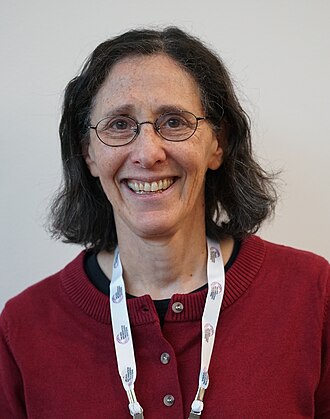
Anything we say could be obsolete by next week.  LEVIN: Oh yeah. STROGATZ: As we speak, it’s July 23rd, 2026. LEVIN: And it feels different to me than it did in July 23rd, 2025, that’s for sure. STROGATZ: Mmm. That’s actually relevant, this talking about timelines, because our  guest today, Melanie Mitchell, who is a cognitive scientist and computer scientist at  Santa Fe Institute, is someone that we had on the show previously. She and I spoke about  five years ago, and that is before ChatGPT. LEVIN: Right. And was she interested in AI then? STROGATZ: Oh, yes.
我们说的任何话,下周可能就过时了。LEVIN:是啊。STROGATZ:我们录这期节目的时间是 2026 年 7 月 23 日。LEVIN:这跟 2025 年 7 月 23 日的感觉肯定是不一样了。STROGATZ:嗯。说到时间线,这一点其实很有关系,因为我们今天的嘉宾梅拉妮·米切尔(Melanie Mitchell)是圣塔菲研究所的认知科学家兼计算机科学家,她以前上过我们的节目。我和她大概是五年前聊的,那还是在 ChatGPT 出现之前。LEVIN:对。那她当时就对人工智能感兴趣了吗?STROGATZ:哦,是的。
便签笔记
1:15
LEVIN: Okay, so it wasn’t just cognitive science. STROGATZ: Absolutely. I, I mean, yes, I should say Melanie has been thinking  about AI for a long time, and she’ll tell us about that. But the thing that’s gonna be so  interesting, I feel, for us to discuss today is, um, Melanie’s point of view, which is to think  about the problem of AI from the standpoint of fields like developmental psychology.  Like, how does a baby or a young child get to be as intelligent as they soon become? LEVIN: Oh, I think that’s so interesting ’cause we’re so excited about the artificial mind when we  have very little comprehension of the human mind.
LEVIN:好,所以不只是认知科学。STROGATZ:完全正确。我是说,对,我应该说,梅拉妮思考人工智能已经很久了,她自己会讲这段经历。但我觉得今天特别有意思的一点是,梅拉妮的视角——她是从发展心理学这类领域的角度来看待人工智能问题的。比如说,一个婴儿或者幼童是怎么变得那么聪明的?LEVIN:哦,我觉得这特别有意思,因为我们对人工心智那么兴奋,可我们对人类心智其实几乎不了解。
便签笔记
1:53
STROGATZ: Exactly.  LEVIN: Right, so we’re trying to skip a step. STROGATZ: Well, that’s right. And not  just human mind, but also animal minds, right? So there’s the field of comparative  psychology where we look at intelligence in birds or dogs or dolphins, whatever. Um, we have  a lot to learn about thinking about intelligences other than our own adult human intelligence.  LEVIN: Yeah, and this idea that we’re going to somehow simply understand a mechanism to  generate an artificial intelligence when we, again, don’t understand the mechanism that brings  a baby to have its level of intelligence when it’s born or when it’s developing. I mean,  I think that’s really interesting to combine those two. So I’m looking forward to this one. STROGATZ: Well, great. So then let’s dive in with Melanie Mitchell. Here she is.  STROGATZ: Hi there, Melanie.
STROGATZ:正是如此。LEVIN:对,所以我们等于是想跳过一步。STROGATZ:没错。而且不只是人类心智,还有动物的心智,对吧?所以有比较心理学这个领域,我们研究鸟类、狗、海豚等等的智能。嗯,关于我们成年人类智能之外的其他智能,我们还有很多东西要学。LEVIN:是啊,还有这个想法——我们居然指望能轻易搞懂生成人工智能的机制,可我们又不理解婴儿在出生时、或者在发育过程中达到那种智能水平背后的机制。我觉得把这两者结合起来看真的很有意思。所以我很期待这一期。STROGATZ:太好了。那我们就请出梅拉妮·米切尔吧。有请。STROGATZ:你好,梅拉妮。
便签笔记
02米切尔回归:ChatGPT 冲击后的意外
2:41
MELANIE MITCHELL: Hey, Steve. STROGATZ: Very excited to see you again. This is gonna be fun. We talked a few years  ago back when this show was called The Joy of X, and I think you may be our first return champion. MITCHELL: Oh boy, I’m honored. STROGATZ: Well, you should be. And, I have you  back because so much feels like it’s changed in artificial intelligence. We talked, I think it was  maybe 2021, and ChatGPT tidal wave hit the world at something like November of 2022. Is that right? MITCHELL: That’s right.
MELANIE MITCHELL:嘿,史蒂夫。STROGATZ:非常高兴又见到你。这次肯定会很有意思。我们几年前聊过,那会儿这档节目还叫《The Joy of X》,我想你可能是我们第一位回归的嘉宾。MITCHELL:哎呀,我很荣幸。STROGATZ:你应该感到荣幸。我请你回来,是因为人工智能领域感觉变化太大了。我们上次聊大概是 2021 年,而 ChatGPT 的浪潮席卷世界差不多是 2022 年 11 月。对吧?MITCHELL:没错。
便签笔记
3:15
STROGATZ: So everybody knows that AI is  everywhere. We seem to be talking about it. People are worrying about it. Some people are  excited about it. It’s certainly very widely used. I suppose I’d like to start by asking, what has  surprised you the most about the past few years? MITCHELL: Oh, wow. So much has surprised me. Just  the thought that we could get to where we are now just by training these models on huge amounts of  human-generated language and images and so on. I never would’ve dreamed it. So I’ve just been  really surprised by what’s happened in AI. Also just the kind of polarized reaction that appeared  in the AI community and society at large, I think, has been a little surprising to me, too. STROGATZ: Polarized in terms of, like, sometimes people will distinguish AI  doomers and AI optimists. Is that the kind of thing you’re talking about? MITCHELL: There’s that dimension, then there’s the dimension of people who believe  that AI is smarter than humans and people who think that it’s far, far from being anywhere near  human-like intelligence. I guess related to that
STROGATZ:所以现在人人都知道 AI 无处不在。我们好像都在谈论它。有人在担忧它,有人为它兴奋。它的使用面确实非常广。我想先问一个问题:过去这几年里,最让你意外的是什么?MITCHELL:哇。太多事情让我意外了。光是想到——仅仅靠用海量人类生成的语言、图像等等来训练这些模型,我们就能走到今天这一步,我做梦都想不到。所以 AI 领域发生的一切真的让我非常意外。另外,AI 圈子乃至整个社会出现的那种两极分化的反应,我觉得也有点出乎我的意料。STROGATZ:两极分化,是指有时候人们会区分 AI 末日论者和 AI 乐观派,你说的是这类情况吗?MITCHELL:有这个维度,然后还有一个维度:有人相信 AI 比人类更聪明,也有人认为它离人类那样的智能还差得远得很。我想跟这个相关的,
便签笔记
03认知科学与 AI 的分道扬镳
4:29
is sort of the love-it and hate-it. And these are  separate dimensions, but maybe they’re correlated. STROGATZ: Well, and right, and the love-it  and hate-it can be also tied to things like the impact on the environment versus, you know,  the economic prosperity for certain companies, but then again, what about job loss?  There’s so many dimensions to this. MITCHELL: Oh, there’s so many, yeah.  STROGATZ: But the thing that I really wanna focus on with you today is complex systems, cognitive  science, artificial intelligence. You have a lot of different hats but I’m really very curious  about the work that you’ve been doing to look at AI through the lens of either developmental  psychology, like the way that we try to think about the alien intelligence of human babies, or  comparative psychology with the alien intelligence of our pet dogs or smart birds or dolphins  or that kind of thing. I mean, it’s a really interesting take on this alien intelligence of AI. MITCHELL: Yeah. Many people have described AI as
大概就是「喜欢它」和「讨厌它」这一组。这是两个不同的维度,但也许它们之间是相关的。STROGATZ:对,没错,而且「喜欢」和「讨厌」还可以跟别的事情挂钩,比如对环境的影响,还有某些公司获得的经济利益,可反过来说,那失业问题怎么办?这里面的维度实在太多了。MITCHELL:哦,是太多了,没错。 STROGATZ:不过我今天真正想跟你聊的是复杂系统、认知科学和人工智能。你身兼好几种身份,但我特别好奇你一直在做的一项工作:用发展心理学的视角来看 AI——就像我们试图去理解人类婴儿这种「异类智能」那样;或者用比较心理学的视角,去看我们家里的狗、聪明的鸟、海豚这些动物身上的异类智能。我觉得这是一个非常有意思的切入点,来看待 AI 这种异类智能。 MITCHELL:是的。很多人都把 AI 描述成一种异类智能,因为它跟人类非常不一样,尽管它是
便签笔记
5:32
an alien kind of intelligence ’cause it’s very  different from humans, even though it’s been trained on human language and books and everything  on the internet and so on. But the way that these systems work, the way that they learn, the way  that they reason, the way they do what they do is just really different from the way humans do it. And this theme was actually picked up by people in developmental psychology, especially, Mike  Frank at Stanford, who wrote this paper about how AI people should take some inspiration  from the study of babies and young children, developmental psych. And then other people have  extended that to, what about animal intelligence?
用人类的语言、书籍以及互联网上的一切训练出来的。但这些系统的运作方式、学习方式、推理方式,它们完成任务的方式,跟人类的做法真的很不一样。 这个主题其实被发展心理学界的人接了过去,尤其是斯坦福的 Mike Frank,他写过一篇论文,谈到搞 AI 的人应该从对婴儿和幼儿的研究中汲取一些灵感,也就是发展心理学。后来又有人把这个思路延伸开来:那动物的智能呢?
便签笔记
6:17
And I guess one of the things that people in cog  sci have been urging is that people in AI actually adopt some experimental methodologies  that would make AI more like a science. STROGATZ: Yeah, I really like this point of  view, and I think it may not be so familiar to our listeners. I have to admit it  wasn’t that familiar to me. You know, I never studied cognitive science, or never took  a course in developmental psychology, and people in those fields have been thinking about these  issues for… Well, I don’t know. You tell me.
我想认知科学界一直在呼吁的一点是,希望搞 AI 的人真正采纳一些实验方法论,让 AI 更像一门科学。STROGATZ:是啊,我很喜欢这个视角,我想我们的听众可能对它不太熟悉。我得承认我自己以前也不太熟悉。你知道,我从来没学过认知科学,也没上过发展心理学的课,而那些领域的人思考这些问题已经有……嗯,我也说不好,你来说说。
便签笔记
6:51
MITCHELL: Yeah, at least 100 years. STROGATZ: Yeah, 100 years now. Wow. And I was thinking on the way over we constantly  talk about AI as a black box. That we can’t read the weights on the neurons very easily, or even  if we can, we don’t know what they tell us. But for that matter, couldn’t you say that our own  intelligence is in a lot of ways a black box? MITCHELL: Absolutely. I mean, we have  different ways to penetrate the black box. One is neuroscience, where we  actually stick probes into neurons, or we use fMRI or other imaging techniques.  There’s also psychology, where you actually look at just the behavior of a person or an animal,  and try and infer from that underlying mechanisms.
MITCHELL:是啊,至少有一百年了。 STROGATZ:对,一百年了。哇。我在过来的路上还在想,我们老是说 AI 是个黑箱,说我们没法轻易读懂神经元上的权重,或者就算读得出来,也不知道它们在告诉我们什么。但说到这个,难道不能说我们自己的智能在很多方面也是个黑箱吗?MITCHELL:绝对是。我是说,我们有不同的办法去打开这个黑箱。一种是神经科学,我们真的把探针插进神经元里,或者用 fMRI 以及别的成像技术。还有心理学,你就只是观察一个人或一只动物的行为,然后试着从中推断背后的机制。
便签笔记
7:36
And those two traditions have, for a long time,  been quite separate. But the field of cognitive science tried to integrate them, and originally,  the field of cognitive science also included AI. Somehow that integration didn’t work. STROGATZ: You mean it didn’t catch on sociologically, or what do you mean? MITCHELL: You know, originally it was thought we’re going to program them the way that  humans work. And there was a very close connection between human psychology and people trying to  build human psychology into AI. And then that actually didn’t yield success in AI the way that  we’ve seen neural networks and learning from data rather than trying to program it in. STROGATZ: I see.
这两个传统在很长时间里都是相当分离的。但认知科学这个领域试图把它们整合起来,而且最初,认知科学也是包含 AI 的。不知怎么的,那次整合没成功。 STROGATZ:你是说它在学界的社会层面没流行起来,还是别的意思? MITCHELL:你知道,最初大家以为我们要照着人类的运作方式去给机器编程。当时人类心理学,和试图把人类心理学写进 AI 的那批人之间,联系非常紧密。可后来那条路在 AI 上并没有带来成功,反倒是我们看到的神经网络、从数据中学习,而不是把知识编进去,成功了。 STROGATZ:我明白了。
便签笔记
04AI 解开尔多什难题算创造力吗
8:26
MITCHELL: And neural networks itself was  originally inspired by neuroscience, but the way that neural networks work today has diverged  considerably from that original inspiration. So I think the field of machine learning has gone  much more in the direction of statistics, which is quite separate from how cognitive science works. STROGATZ: So at this point, I guess I’d like to talk a bit about benchmarks, because they do seem  to be a big part of the discussion broadly in society these days. There was something that got a  lot of people chattering in the world of math. One of the latest frontier models did something that  looked like a kind of creativity, solved an old, longstanding math problem one of the problems that  Paul Erdős, the great, Hungarian mathematician, he left lots of problems for people to think  about, and one of them that they call the unit distance problem was recently solved in a very  clever way by AI, and it involved putting two parts of math together in a way that hadn’t really  been tried before. And so I bring that up because
MITCHELL:而神经网络本身最初是受神经科学启发的,但今天神经网络的运作方式已经和最初那个灵感相去甚远了。所以我觉得机器学习这个领域走的方向更偏向统计学,而那跟认知科学的做法是很不一样的。 STROGATZ:那说到这儿,我想聊一聊基准测试(benchmark),因为它们如今在整个社会的讨论里似乎占了很大分量。有件事最近在数学圈里引起了很多议论。最新的前沿模型之一做出了一件看上去颇有创造力的事,解决了一个由来已久的老问题——一个长期悬而未决的数学问题,是保罗·厄多斯(Paul Erdős)这位伟大的匈牙利数学家留下的问题之一。他给后人留下了很多问题,其中一个叫作「单位距离问题」,最近被 AI 用一种非常巧妙的方式解决了,它把数学的两个分支以一种此前没怎么被尝试过的方式结合了起来。我提这件事是因为,我们上次聊天时谈到一个老式 AI,它在学着玩某个雅达利(Atari)游戏,
便签笔记
9:38
the last time we spoke, we were talking about an  old AI that was learning to play some Atari game, or something. And you talked about how it was  so good at playing, but then if you move the paddle a couple pixels up or something, it had to  relearn all over again. It didn’t know how to play the slightest variation on the original game. So the thing you said at the time that stuck with me: “The strange thing is that these  machines don’t seem to be able to transfer their brilliance to any other domain than  the one they’ve been trained on.” So that was five years ago. Now I guess I wonder,  what do you think? Is that still true?
或者类似的东西。你当时讲到它玩得非常好,但只要把挡板往上挪几个像素,它就得从头重新学一遍。原来那个游戏哪怕只有最细微的变化,它都不知道该怎么玩了。 你当时说的一句话我一直记着:「奇怪的地方在于,这些机器似乎没法把自己的出色本领迁移到训练领域以外的任何地方。」 那是五年前了。现在我想问,你怎么看?这话还成立吗?
便签笔记
10:12
MITCHELL: Yeah, I mean, that particular model  was not a large language model. It was a specific model to play the Atari game. Whereas now we  have large language models that are trained on everything. So in some sense, they don’t have to  transfer anything. They’re already trained. But, people in AI or machine learning talk about things  that are in distribution and out of distribution, and that means that is this thing  that we’re asking the models to do similar to things that it’s seen in its  training data, or is wholly different?
MITCHELL:是啊,我是说,那个特定的模型并不是大语言模型,它是专门用来玩雅达利游戏的模型。而现在我们有的是在所有东西上训练出来的大语言模型。所以从某种意义上说,它们不需要迁移什么,它们本来就已经训练过了。不过,搞 AI 或机器学习的人会讲「分布内」和「分布外」这两个说法,意思是:我们让模型做的这件事,跟它在训练数据里见过的东西是相似的,还是完全不同的?
便签笔记
10:44
And I think it’s hard to know. We don’t know what  it’s been trained on. The model that’s solving these problems has certainly been trained on a  lot of math because there’s a lot of math out there on the internet. It’s been trained on  textbooks. It’s been trained on all of Steve Stogatz’s videos that are on YouTube. And these  models are pretty good at taking things from one area and putting them together with another area. But, you know, I don’t know how to talk about this notion of transfer when something’s been trained  on everything, especially in a field like math.
我觉得这很难判断。我们并不知道它在什么数据上训练过。那个解决了这些问题的模型,肯定在大量数学材料上训练过,因为网上有海量的数学内容。它在教科书上训练过。它在 Steve Strogatz 放到 YouTube 上的所有视频上都训练过。而这些模型很擅长把一个领域的东西拿来跟另一个领域的东西拼在一起。但是,你知道,当一个东西是在「所有内容」上训练出来的时候,尤其是在数学这样的领域,我真不知道该怎么谈「迁移」这个概念。
便签笔记
11:23
STROGATZ: Huh. MITCHELL: Where you know, “trained on everything” I think has some meaning in a way.  If you say it’s been trained on everything that has to do with being human, clearly that’s not  the case. But if you say it’s been trained on everything having to do with math or with code, I  don’t know. Is all of mathematical knowledge out there in some kind of textual or video format?  STROGATZ: Well, you’re asking me. I, so the thing that is roiling our community in math lately as  we try to make sense of what just happened is we used to think, “Okay, these machines are very  good at searching,” or, “These programs are good at searching big spaces.” They have a tremendous  amount of knowledge because, as you say, they’ve ingested the whole internet and the Library of  Congress, and anything you can read, they’ve read.
STROGATZ:嗯。 MITCHELL:不过你知道,「在所有内容上训练过」这个说法在某种意义上是有意义的。如果你说它在跟「做人」有关的一切上都训练过,那显然不是事实。但如果你说它在跟数学、跟代码有关的一切上都训练过,我就不知道了。全部的数学知识,是不是都以某种文本或视频的形式存在于世?STROGATZ:这你倒是在问我了。最近让我们数学圈很不平静、大家都在努力搞懂到底发生了什么的事情是这样:我们以前会想,「好吧,这些机器很擅长搜索」,或者说,「这些程序很擅长在巨大的空间里搜索」。它们拥有极其庞大的知识量,因为正如你说的,它们把整个互联网、国会图书馆都吞下去了,凡是你能读的东西,它们都读过。
便签笔记
12:15
So anything where knowledge and the ability to  search and to compute very fast and to not forget, all that, that plays into their strength. But  the, but to spot a connection between different branches that hadn’t been noticed before and to  exploit that to solve a longstanding problem, if a human being did that, we would  consider that an aesthetic high point. You know, mathematicians love it when an idea from  topology gets used to solve a problem in geometry, or when an idea from algebra helps. But  then again, maybe it’s sort of easy. If you know everything that’s been done and you  can look for a lot of possible connections, maybe you’ll occasionally get lucky. So that’s  what it sort of seems like happened here.
所以凡是靠知识、靠搜索能力、靠飞快的计算、靠不会遗忘的地方,这些都是它们的强项。但是——但要在此前没人注意到的不同分支之间发现一个联系,并利用它去解决一个长期悬而未决的问题,如果是一个人做到了这件事,我们会认为那是一个审美上的高光时刻。你知道,数学家最喜欢看到拓扑学的想法被用来解决几何学的问题,或者代数的想法派上用场。可话说回来,也许这其实挺容易的。如果你知道所有已经被做过的东西,又能去搜寻大量可能的联系,那也许你偶尔就会撞上好运。所以这次的情况看起来大概就是这样。
便签笔记
12:55
MITCHELL: Yeah. No, I think that’s right. I  don’t... You know, who knows how it happened because we can’t really look at the innards of  the- these models very well for many reasons. But it is creative to bring two unexpected  things together and have something that’s actually working. I consider that creative. But,  it sort of reminds me in a way, there was a math discovery program way back in the ‘70s maybe done  by this guy, Douglas Lenat. It was called EURISKO, I think. And basically it was trying to find  new ideas in math. And it explicitly tried to bring together things and stick them together,  and it would generate hundreds and hundreds and hundreds and hundreds of these things. Most of them were just junk, but occasionally it would come up with something interesting. A  human had to go in and look and say, “Is this interesting?” The machine couldn’t figure it out  itself. So how much of that is going on here? I don’t know. I think here the difference is that  the machine obviously is at a much bigger scale,
MITCHELL:是的。不,我觉得你说得对。我不……你知道,谁也说不清它是怎么做到的,因为出于种种原因,我们没法很好地看到这些模型的内部。但把两个出人意料的东西凑到一起、而且真的管用,这是有创造力的。我认为那算创造力。不过,这在某种程度上让我想起,大概在七十年代有个数学发现程序,可能是 Douglas Lenat 做的,我记得它叫 EURISKO。基本上它就是在试着寻找数学里的新想法。它会明确地把各种东西凑到一起、拼在一块儿,然后生成成百上千、成千上万个这样的东西。绝大多数纯粹是垃圾,但偶尔它会冒出一个有意思的结果。得有个人进去看一眼,然后判断:「这个有意思吗?」机器自己判断不了。那么这次里面又有多少是这种情况呢?我不知道。我觉得这次的区别在于,机器显然是在大得多的规模上运作,
便签笔记
05评估 AI 认知能力的六条原则
14:03
and I don’t know how many tokens of reasoning  trace that it generated in the course of solving this problem, and how many kind of wrong paths  it went down, and how it figured out that it was on the right path. I mean, these are things  that I think are part of the science of AI that not enough people are kind of pursuing right now. STROGATZ: Yeah, let’s get into that now because that’s really where I wanted to  go with you. It’s a nice phrase, the science of AI. I’d like to encourage people  to look at this article of yours, Melanie, about the six principles to assess cognitive capacity  of AI. But just, as a teaser, could you enunciate what are those six and say a little about them? MITCHELL: Sure. So the first one is to be aware of your own anthropomorphic cognitive biases. So  we tend to project human likeness onto things that talk to us in fluent English. So people very  much think that these models have human-like qualities when maybe they actually don’t. The second one’s a very common sense one for
而且我不知道它在解决这个问题的过程中生成了多少 token 的推理链,走了多少条错路,又是怎么判断出自己走在正确的路上的。我是说,我觉得这些都属于 AI 的科学研究范畴,而现在做这方面探索的人还不够多。 STROGATZ:是啊,我们现在就来聊聊这个,因为这正是我想和你聊的方向。这个说法很好,'AI 的科学'。我想鼓励大家去看看你的这篇文章,梅拉妮,关于评估 AI 认知能力的六条原则。不过先剧透一下,你能不能说说这六条是什么,并稍微介绍一下?米切尔:当然可以。第一条是要意识到自己的拟人化认知偏见。我们往往会把人的特质投射到那些能用流利英语和我们对话的东西上。所以人们很容易认为这些模型具有类人的特质,而它们可能其实并不具备。第二条对科学家来说是很常识性的:
便签笔记
15:11
scientists. Be skeptical of hypotheses and develop  control experiments. That’s just like Science 101, although I’m not sure how often it’s  really followed through in science. People tend to like their own hypotheses. The third is to develop novel variations of your stimuli or your benchmark items in  order to test robustness and generalization. Uh, the fourth one is these systems don’t  have to be black boxes. You can probe them in many different ways and we need more  people who are very curious about why they’re getting the results that they do get. Fifth principle is to consider performance versus competence, sort of what you can show that  you can do versus what you actually can do, and in the paper I give some examples of that. The sixth is to analyze failure types and to embrace any negative results. We  tend to put papers with negative results in a drawer and forget about them, but  actually they can be incredibly enlightening.
对假设保持怀疑,并设计对照实验。这就是'科学入门'的基本功,不过我不确定在科学研究中这一条到底被落实得有多好。人们总是偏爱自己的假设。第三条是对你的刺激材料或基准测试题目做出新的变体,以此检验稳健性和泛化能力。呃,第四条是这些系统不一定非得是黑箱。你可以用很多不同的方式去探查它们,我们需要更多人对它们为什么会得出这样的结果抱有强烈的好奇心。第五条原则是要区分表现和能力,也就是你能展示出你会做什么,和你实际上能做什么,我在论文里举了一些这方面的例子。第六条是分析失败的类型,并且要拥抱负面结果。我们往往会把带有负面结果的论文塞进抽屉里就忘掉了,但其实它们可能极具启发性。
便签笔记
06聪明的汉斯与虚假关联陷阱
16:17
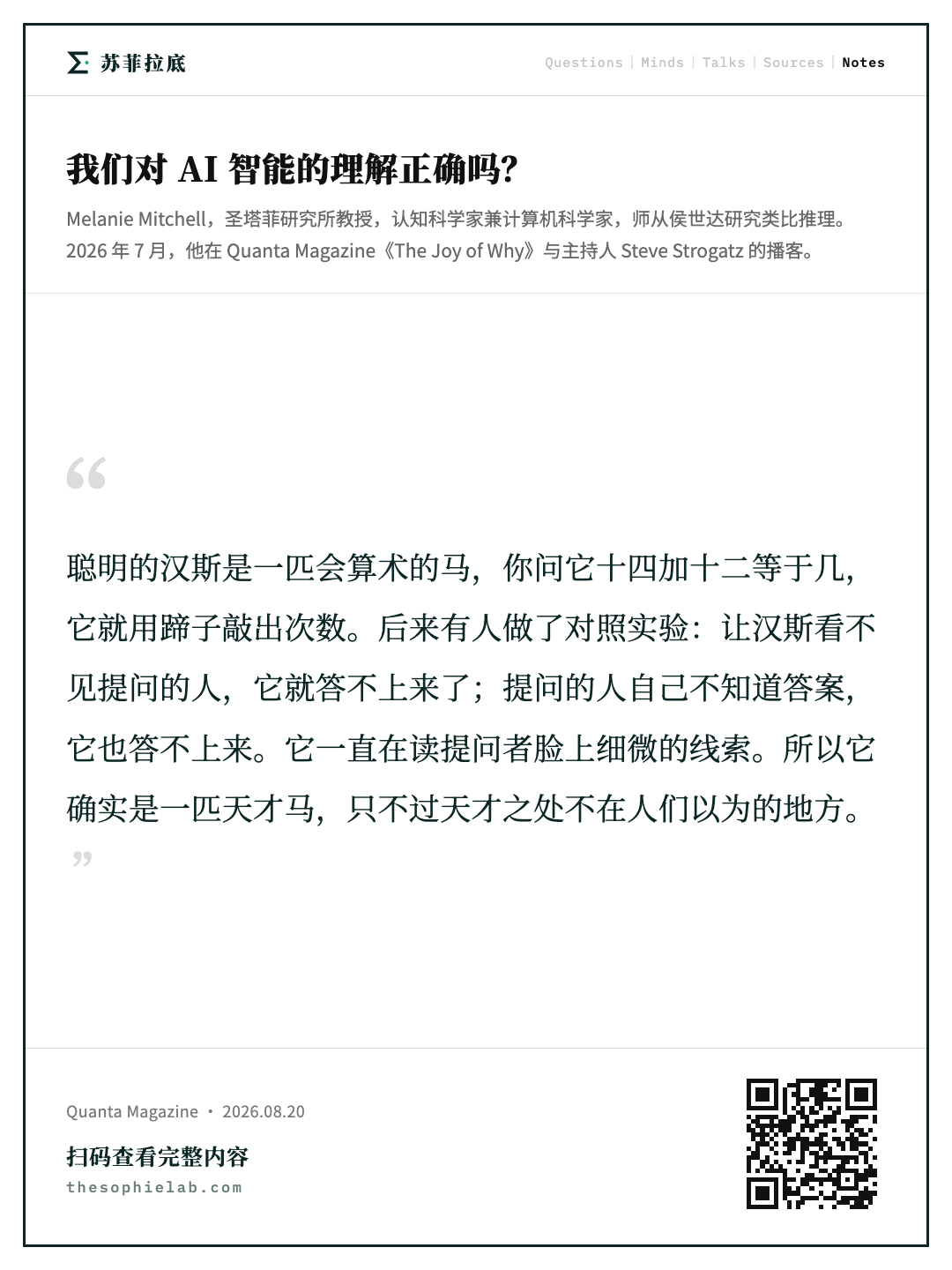
STROGATZ: We all have very direct experience  with number six, don’t we? When we see the hallucinations, it starts to make you wonder  what’s really going on with these systems, and it’s true you learn a lot from the errors. MITCHELL: Yeah, people celebrate their positive results and they try to explain  away their negative results, but it’s important to really understand  what’s going on by looking at where it fails. STROGATZ: So one example that you give in your  article, this is not about AI, but this is about the kind of lesson from biology or from psychology  that subtle things can be happening that you need to have an alert and skeptical mind to notice  what might really be going on. So could you just regale us with the old story of Clever Hans? MITCHELL: So Clever Hans was a horse who lived in the early 1900s in Germany. And Clever Hans was  able to answer arithmetic questions. So you’d say like, “What’s 14 plus 12?” And he would  tap his hoof that many times. Looked like a genius horse. And people including many scientists  living back then, were very convinced that this
斯特罗加茨:我们对第六条都有非常直接的体会,对吧?当我们看到那些幻觉时,就会开始好奇这些系统内部到底在发生什么,而且确实,你能从错误中学到很多。米切尔:是的,人们会庆祝自己的正面结果,然后想方设法把负面结果解释过去,但通过观察它在哪里失败来真正理解发生了什么,这非常重要。斯特罗加茨:你在文章里举了一个例子,它不是关于 AI 的,而是来自生物学或心理学的一个教训:可能有些微妙的事情正在发生,你需要保持警觉和怀疑的头脑,才能注意到真正的情况。所以你能不能给我们讲讲'聪明的汉斯'那个老故事?米切尔:聪明的汉斯是一匹马,生活在1900 年代初的德国。汉斯能回答算术题。比如你问它:'14 加 12 等于几?'它就会用蹄子敲相应的次数。看上去就像一匹天才马。当时包括许多科学家在内的人都深信,这是一只会做数学、会数数、能像人一样对简单问题进行推理的
便签笔记
17:30
was an animal who could do mathematics,  who could count, who could reason about simple problems in the way that humans do. And people were very excited. But then a psychologist, named Oskar Pfungst, came along and  said, “Well, let’s do some controlled experiments here,” this notion of controlled experiments  you know in psychology being kind of a new idea, I think. And let’s see what happens if he  can’t see the person who’s asking the question. STROGATZ: Okay MITCHELL: And then he fails. And it turns out what he’s doing is he’s reading subtle cues on the face  of the person who’s asking the question. It turns out that if the person who’s asking the question  doesn’t know the answer already, he also fails.
动物。人们非常兴奋。但后来一位名叫奥斯卡·芬格斯特的心理学家出现了,他说:'那我们来做几个对照实验','当时对照实验这个概念在心理学里还算是个比较新的想法,我想是这样。他说,我们看看如果它看不见提问的人会发生什么。斯特罗加茨:好。米切尔:结果它就答不出来了。原来它一直在读提问者脸上细微的线索。事实还证明,如果提问的人自己也不知道答案,它同样会失败。
便签笔记
18:16
’Cause what the person is doing is they’re  reacting to his hoof taps, and when he gets to the answer, there’s some unconscious signal  they’re sending that he’s reading. So he is a genius horse, just not at the things that people  thought he was a genius at. Instead, he’s a genius at reading social signals in human faces. STROGATZ: And so in this parable then, as far as like when we are impressed by  something seemingly genius that AI is doing, what is our lesson? That, that we should  be doing controlled experiments, or what?
因为提问的人会对它敲蹄子的动作作出反应,当它敲到正确答案时,对方会不自觉地发出某种信号,而它读懂了这个信号。所以它确实是一匹天才马,只不过天才之处不在人们以为的那些方面。它其实是解读人类面部社交信号的天才。斯特罗加茨:那么在这个寓言里,当我们对 AI 做出的某件看似天才的事情感到惊叹时,我们该吸取什么教训?是说我们应该做对照实验,还是什么?
便签笔记
18:53
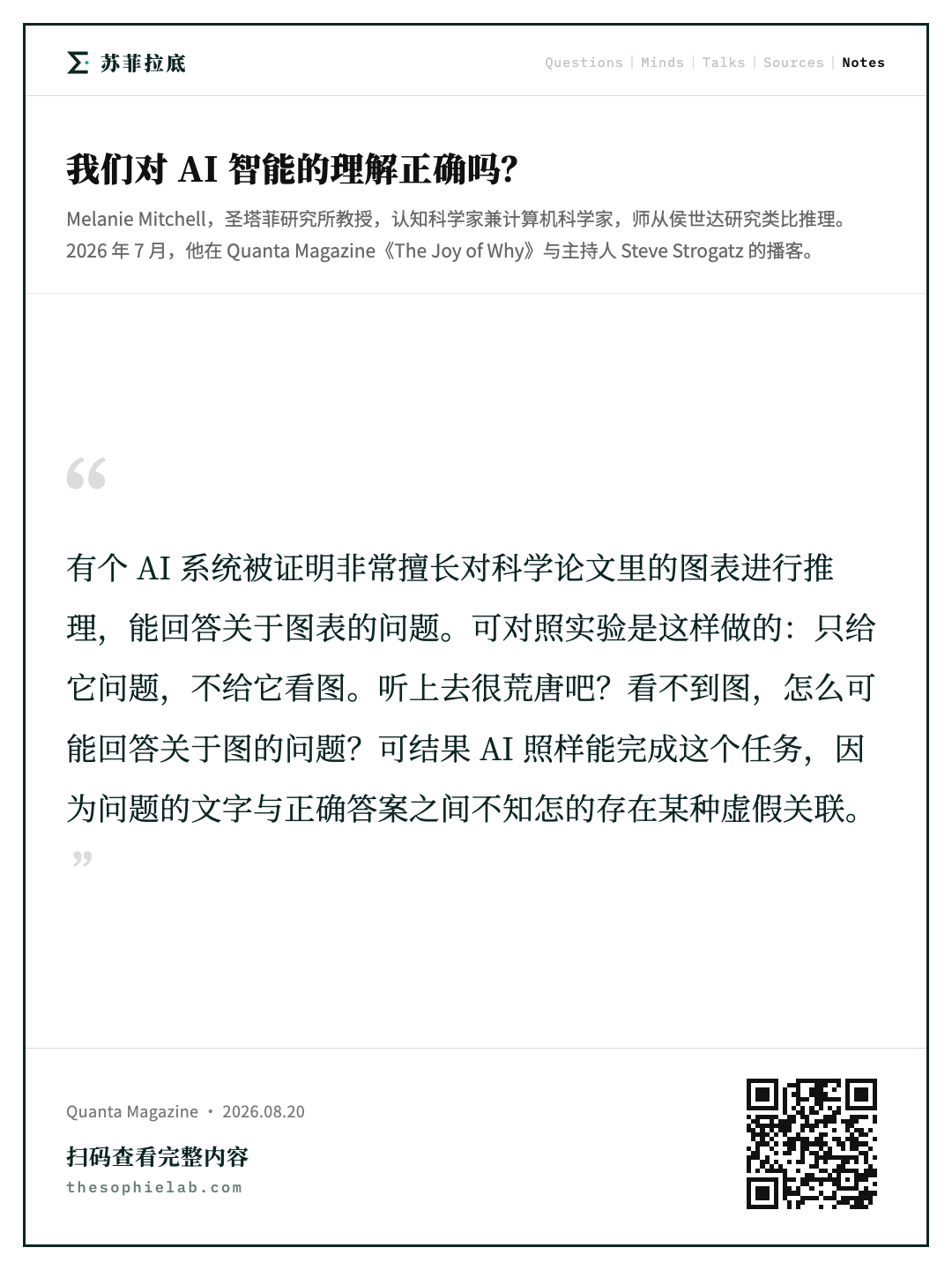
MITCHELL: Right. So, an AI system was  shown to be really good at reasoning about diagrams in scientific papers, let’s say,  I think this is, actually a real example, and could answer questions about them. But then  the control experiment was give the questions without showing the diagrams. Seems crazy, right?  How could you answer questions about a diagram without seeing the diagram? And it turned out that  the AI could do this task because somehow there was some kind of spurious association between the  words in the questions and the correct answer.
米切尔:对。比如说,有个 AI 系统被证明特别擅长对科学论文里的图表进行推理——我想这其实是个真实的例子——而且能回答关于图表的问题。但后来的对照实验是:只给它问题,不给它看图表。听起来很荒唐,对吧?不看图表怎么可能回答关于图表的问题?结果发现 AI 之所以能完成这个任务,是因为问题中的词语和正确答案之间存在某种虚假关联。
便签笔记
07复现实验缺失与观察者偏见
19:33
STROGATZ: So that seems like a case of  poor experimental design on whoever was doing the benchmark attempt in retrospect. MITCHELL: In retrospect, and in retrospect this happens all the time in psychology and  other fields, I’m sure too, poor experimental design. Experimental design is a very hard  thing and there’s all kinds of confounding possibilities. So this is why the notion of  replication in science became so important. If one group does an experiment and they get a  result, we shouldn’t necessarily believe that result. That result might be due to some other  aspect of their experimental design that wasn’t intended. That’s why it’s very important for  independent groups to replicate studies. This isn’t something that people in AI do very much. STROGATZ: No, and why not? Is it that the replication is not very glamorous because you’re  coming in second like there’s no incentive.
斯特罗加茨:这么看来,事后来说,这似乎是做基准测试的人实验设计不当。米切尔:事后来看是这样,而且事后来看,这种情况在心理学和其他领域也一直在发生,我相信是这样,实验设计做得不好。实验设计是一件非常难的事,有各种各样可能的混淆因素。所以科学中'可重复性'这个概念才变得如此重要。如果一个团队做了实验得出某个结果,我们不该想当然地相信这个结果。这个结果可能源自他们实验设计中某个并非本意的其他方面。所以独立团队去重复研究非常重要。而这在 AI 领域是人们很少做的事。斯特罗加茨:确实很少,为什么呢?是因为重复实验不够光鲜,因为你等于是屈居第二,没什么激励?
便签笔记
20:28
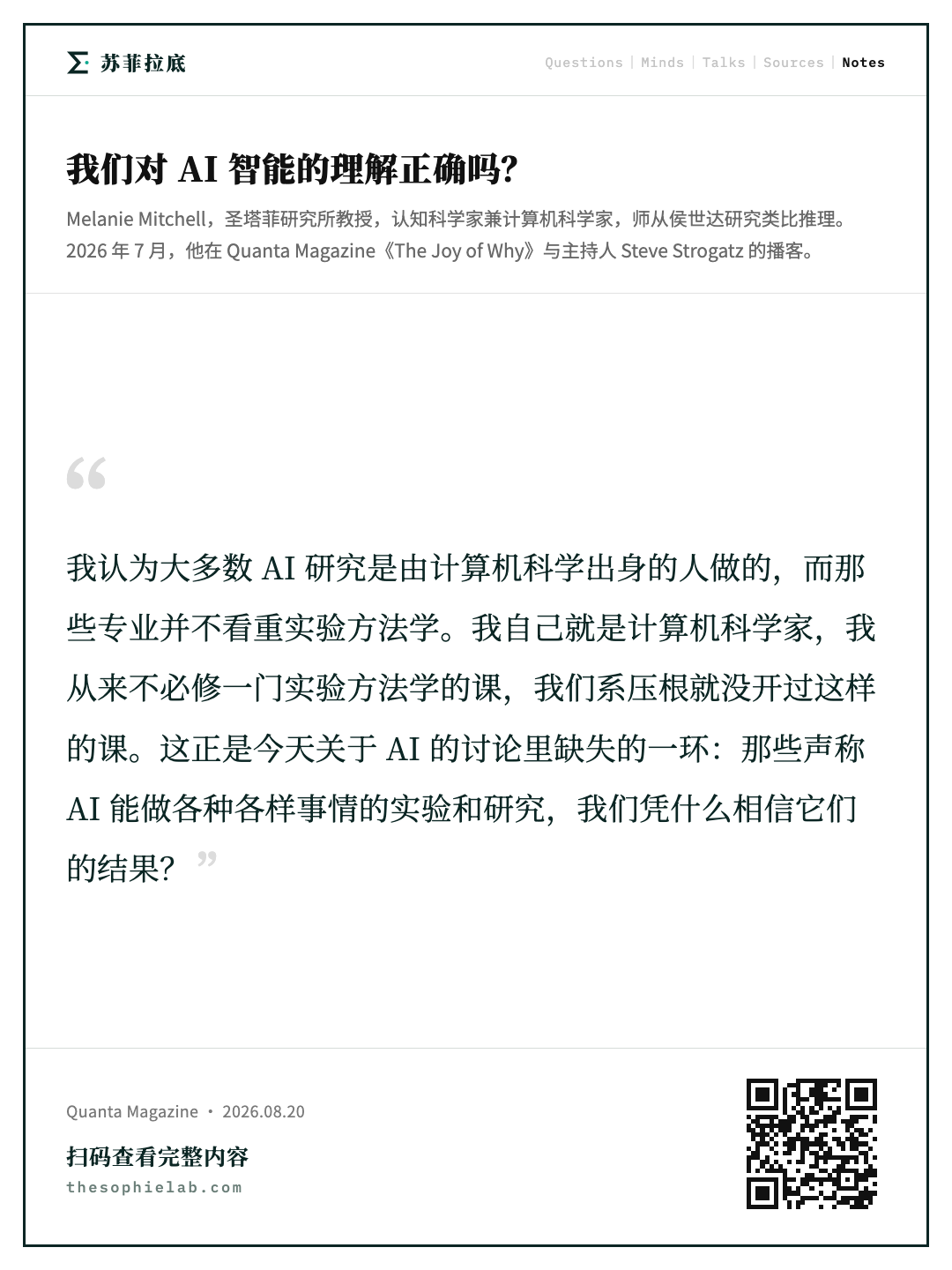
That’s true in all parts of science, right? MITCHELL: Yeah. I think that’s true in all parts of science. But it’s also because I think most of  AI research is done by people whose background is in computer science or a related field that’s  not focused on experimental methodology. I’m a computer scientist. I never had to take a  course in experimental methodology. No such course was ever offered to me in my department.  It wasn’t seen as part of what computer science was all about, and I think that’s one  of the things that’s lacking in today’s AI discussion. How can we trust the results of  these experiments and studies that are done that show that AI can do all these different things?   LEVIN: Fascinating. So it seems to me that there’s this cognitive science version of the interference  of the observer that everyone talks about in quantum mechanics, right? The observer themselves  is interfering with the experiment or the outcome of the experiment, and that is such an interesting  role. Of course, this Clever Hans is very famous,
这在科学的各个领域都成立,对吧?米切尔:是啊。我想这在科学的所有领域都成立。但我认为还有一个原因:大多数 AI 研究是由计算机科学或相关领域出身的人做的,而这些领域并不关注实验方法论。我自己就是计算机科学家。我从来不需要修实验方法学的课。我所在的系从来没开过这样的课。这不被看作计算机科学的一部分,我认为这正是当今 AI 讨论中缺失的东西之一。我们怎么能信任那些声称 AI 能做各种事情的实验和研究结果呢?莱文:太有意思了。在我看来,这就像是大家在量子力学里常谈的'观察者干扰'的认知科学版本,对吧?观察者本身在干扰实验或实验的结果,这个角色实在太有趣了。当然,聪明的汉斯这个故事非常有名,
便签笔记
21:35
and I agree that that is a very clever horse  for being able to read the social cues. But how interesting if this is also happening  with AI, that it’s, it’s not just the role of the experimenter that’s interfering,  it’s actually the role of the psychology of the experimenter that’s interfering. STROGATZ: Yeah. It’s a whole dimension that many of us in the theoretical sciences and math  don’t get trained in, as Melanie freely admits. You know, I never took a course in experimental  design. You as a physicist, I assume you had to take some experimental physics, but… LEVIN: Yeah. It doesn’t really weigh in my actual work. It’s really not  experimental. Yeah. So I would not be a very good architect of a good experiment. STROGATZ: Well, and it seems like it is, something that’s a very live issue because  these days the AI companies frequently use benchmarks to show how – well, to assess how –  how far along are their systems on this quest for either artificial general intelligence or  superhuman intelligence, that sort of thing. Or
我也同意,能读懂社交线索的那匹马确实很聪明。但如果这种情况在 AI 身上也在发生,那就很有意思了:干扰的不只是实验者这个角色,而是实验者的心理在起干扰作用。斯特罗加茨:是啊。这整个维度是我们很多做理论科学和数学的人没有受过训练的,正如梅拉妮坦率承认的那样。你知道,我从来没上过实验设计的课。你作为物理学家,我猜你总得上一些实验物理吧,不过……莱文:是啊。但那在我实际的工作里并不占什么分量。我做的确实不是实验。是的,所以我不会是一个很好的实验设计者。斯特罗加茨:嗯,而且这看起来是一个非常现实的问题,因为如今各家 AI 公司经常用基准测试来展示——好吧,是评估——他们的系统在追求通用人工智能或超人智能这条路上走到了哪一步。或者干脆就是为了在竞争中压过其他 AI 公司。我们确实想知道
便签笔记
22:37
even just to out-compete the other AI companies.  We would like to know what the capacities are of these new machine learning systems and other AIs.  LEVIN: Well, I think it might be that it’s just, I don’t think we really know how to evaluate  human intelligence, or to really know what somebody’s doing when they’re thinking. I don’t  think we know about ourselves. I don’t think we can self-report very well. I can’t say to you,  “Oh, this is how it’s working in here right now as I’m constructing this sentence. I listened  to it, and this was the process.” I don’t know, right? It’s just natural. It just comes out.  And I’m not that privy to the inner workings, and I feel the AI similarly. A lot of people have  said, I’ve had conversations on our show before with other cognitive scientists and computer  scientists and they say it’s really hard for the AI to answer questions, ’cause a lot of  people say, “Why don’t you just ask it?” And it can’t self-reflect either in an accurate way. STROGATZ: This whole thought, the mystery of the
这些新的机器学习系统和其他 AI 究竟有什么能力。莱文:嗯,我觉得可能问题在于,我不认为我们真的知道该怎么评估人类智能,或者真的知道一个人在思考时到底在做什么。我觉得我们连自己都不了解。我认为我们并不擅长自我报告。我没法对你说:'哦,我现在构造这句话的时候,脑子里就是这样运作的。我听着它,过程就是这样。'我不知道,对吧?它就是自然而然的,就那么冒出来了。我对内部的运作机制并不怎么了解,我觉得 AI 也类似。很多人说过——我们节目里以前也和其他认知科学家、计算机科学家聊过——他们说要让 AI回答这类问题真的很难,因为很多人会说:'你直接问它不就行了?'但它也没法用准确的方式进行自我反思。斯特罗加茨:这整个想法,黑箱之谜。
便签笔记
23:37
black box. We use the term black box  so often for the AI, but of course, our own intelligence is a black box, not  just from mine to you, but even me to myself, as you’re emphasizing. But it makes me wonder if  there’s a role for magicians because, you know, magicians or sleight-of-hand people are so  good at showing us our own psychophysical limitations. How easily we’re fooled, or the  sorts of cognitive errors we tend to make, and there are people who are analogous to  the magicians who show the deficits and common sense of the AIs, right? They’re sort  of playing games that are almost like magic tricks on the AIs. I wonder how revealing those  will be, you know, in a serious scientific way.
我们经常用'黑箱'这个词来形容 AI,但当然,我们自己的智能也是个黑箱,不仅是从我到你,甚至从我到我自己也是,正如你所强调的。不过这让我想到,魔术师是不是也能派上用场,因为你知道,魔术师或者变戏法的人特别擅长向我们展示自己在心理物理上的局限。我们多么容易被骗,或者我们常犯的那些认知错误,而也有一些人扮演着类似魔术师的角色,揭示 AI 在常识上的缺陷,对吧?他们玩的那些花样几乎就像魔术一样用一些小技巧去试探 AI。我很好奇,如果用严谨的科学方法来做,这些测试能揭示出多少东西。
便签笔记
24:17
Well, Melanie has a lot more to say about  the depth of AI cognition and understanding, and also how it might change whole fields of  science, including math. We will be hearing more about that after the break.   STROGATZ:
梅拉妮对于 AI 认知和理解的深度还有很多要说的,还有它可能会如何改变包括数学在内的整个科学领域。休息之后我们会听到更多相关内容。 STROGATZ:
便签笔记
08能力与表现:什么算真正理解
24:37
Welcome back to The Joy of Why. We’re  joined today by Santa Fe Institute computer scientist Melanie Mitchell.  STROGATZ: You have been a college professor for much of your life. When you’re working with  students they can get the answers right, but as you start to probe what they actually understand,  you start to realize that they might be getting the right answers for the wrong reasons.  They don’t really know what they’re doing, and that’s important if you wanna be a helpful  teacher. This brings up another point: competence versus performance. Can you expand on this  idea and, what would it mean in the AI context?
欢迎回到《The Joy of Why》。今天与我们连线的是圣塔菲研究所的计算机科学家梅拉妮·米切尔。 STROGATZ:你人生中的很长一段时间都在大学里当教授。当你和学生打交道时,他们可能答案做对了,但当你开始深挖他们究竟理解了什么,你就会发现,他们也许是因为错误的理由才得出了正确答案。他们其实并不知道自己在做什么,如果你想成为一个有帮助的老师,这一点很重要。这就引出了另一个问题:能力(competence)与表现(performance)。你能展开讲讲这个概念吗?它在 AI 语境下又意味着什么?
便签笔记
25:12
MITCHELL: So competence versus performance is  kind of an old distinction from psychology and linguistics. The idea is that you might have the  competence for a particular cognitive capacity, but there might be some reasons why you can’t  perform the task that I’m giving you. Like they have the competence, they could solve  the problems, but they’re just emotionally frozen. There’s some performance block. But then there’s the other way around, which is performance without competence. So if the  student in your office hours, say, had memorized a problem from the textbook and the solution, but  they didn’t understand the general principle, so if you gave them a slightly different  version of the problem, they couldn’t do it.
MITCHELL:能力与表现的区分,其实是心理学和语言学里一个挺老的概念。意思是说,你可能具备某种认知能力,但由于某些原因,你没法完成我给你的任务。就好比他们是有能力的,本来能解出那些题,但他们情绪上僵住了。存在某种表现上的阻碍。但反过来的情况也有,也就是有表现但没有能力。比如说,来你办公时间答疑的那个学生,他背下了课本里的一道题和它的解法,但并不理解背后的一般原理,所以你要是把题目稍微改一下,他就做不出来了。
便签笔记
25:58
That’s performance without competence. STROGATZ: Okay. So if we would say that we’re trying to work out ways of  testing whether the AI understands, what would count as evidence? Suppose that, you’re  an AI advocate who said that these new systems, because we’ve scaled them up or because we have  some nice new architecture with world models or social models or whatever, we’ve now crossed a  threshold where they actually understand. It’s not just that they can compute, they understand.  What would count as evidence of understanding?
这就是有表现但没有能力。 STROGATZ:好。那么如果我们说,我们想找出办法来测试 AI 是否真的理解,什么才算得上是证据呢?假设你是一个 AI 的支持者,你说这些新系统,因为我们把规模做大了,或者因为我们有了带世界模型、社会模型之类的漂亮新架构,现在已经跨过了某个门槛,它们是真的理解了。不只是会计算,而是真的理解。那什么才算是理解的证据?
便签笔记
26:28
MITCHELL: Oh gosh. I hate to get pedantic about  understanding, but there’s so many different meanings of it. STROGATZ: Ah. MITCHELL: We had a talk here at Santa Fe  Institute from a philosopher who broke down understanding into 25 different types. STROGATZ: Aha. I didn’t know what I was getting myself into with the question.  MITCHELL: So there’s like P understanding and G understanding and there’s this very  long typography of understanding. And I’m not sure there is any sort of single notion of real  understanding. One of the recent things I and my collaborators have been working on is looking  at different dimensions of understanding. One example is you can get one of these language  models or chatbots to generate a story.
MITCHELL:天哪。我不太想在“理解”这个词上抠字眼,但它实在有太多不同的含义了。 STROGATZ:啊。MITCHELL:我们圣塔菲研究所请过一位哲学家来做报告,他把“理解”拆成了 25 种不同的类型。 STROGATZ:哈。我都不知道自己问这个问题是在给自己挖坑。 MITCHELL:所以有所谓的 P 型理解、G 型理解,有一套非常长的理解类型学。而我也不确定是否存在某种单一的“真正理解”的概念。我和合作者最近在做的一件事,就是研究理解的不同维度。举个例子,你可以让这些语言模型或者聊天机器人写一个故事。
便签笔记
27:13
Just generate a short story about something,  and they will. They’ll generate a very beautiful little coherent short story. But then if you  start asking them questions about the story, they will often will fail in weird ways.  STROGATZ: Hmm. MITCHELL: even though they generated it. And I  think the same thing is true in a lot of different tasks that they understand along one dimension  but not along another dimension. And in some sense deep understanding might be just you understand  across many different of these dimensions.
就说“写一个关于某某的短篇故事”,它们会写。它们会生成一个非常漂亮、连贯的小短篇。但接下来如果你开始就这个故事问它们问题,它们常常会以很奇怪的方式答错。 STROGATZ:嗯。MITCHELL:哪怕故事就是它们自己写的。我觉得在很多不同的任务上也是这样:它们在某一个维度上理解了,但在另一个维度上没有。从某种意义上说,深层的理解也许就是你在很多个这样的维度上都理解了。
便签笔记
09任务的暴政与放射科医生预言
27:46
STROGATZ: Aha. That sounds like a promising  direction. Let’s talk about tasks a little more, because that’s a phrase or a term that I’ve  seen in some of your writing, the phrase, the tyranny of tasks. What’s that about?  MITCHELL: I first heard that, from Shannon Vallor, a philosopher. The idea is that in AI, the world  is divided in terms of tasks. So when we think about what AI systems can do, people say, “Oh,  they can make summaries. Let’s test their ability to summarize articles.” Or, “Let’s test their  ability to answer questions about diagrams” or I don’t know, some other benchmark. STROGATZ: Well, I mean, these days, they’ve been benchmarked a lot on International  Mathematical Olympiad, very hard high school problems, then there were research level  problems. Now there’s open problems that are unsolved in math. These are all like three  levels of math benchmarks that are out there.
STROGATZ:啊哈。这听起来是个很有希望的方向。我们再多聊聊“任务”吧,因为我在你的一些文章里看到过一个说法,叫“任务的暴政”。那是什么意思? MITCHELL:我最早是从哲学家香农·瓦洛尔那里听到这个说法的。这个想法是说,在 AI 领域,世界是按任务来划分的。所以当我们思考 AI 系统能做什么时,人们会说:“哦,它们会做摘要。那我们来测测它们总结文章的能力。”或者“我们来测测它们回答图表相关问题的能力”,再或者别的什么基准测试。 STROGATZ:嗯,我是说,这些日子里,它们在国际数学奥林匹克上被大量测评,那是非常难的中学题目,然后又有了研究级别的题目。现在还有数学里尚未解决的公开问题。这就是外面存在的三个层级的数学基准。
便签笔记
28:44
MITCHELL: Right, their capabilities are defined in  terms of these benchmarks. You know, one benchmark might be the bar exam for law students, and they  do really well on the bar exam. And so we say, “Oh, lawyers, you should be afraid. Your job  is threatened because these AI systems are as getting as good as you are.” Uh, But the way that  we’re defining that is by looking at how well they do on a specific set of questions or a task.  And jobs as a whole are not the same as just one independent task after another. This is, I  think it’s almost like a fallacy that if an AI system can do a bunch of tasks, it can do the job  of a person that is associated with those tasks.
MITCHELL:没错,它们的能力就是用这些基准来定义的。你看,某个基准可能是法学院学生的律师资格考试,而它们考得非常好。于是我们就说:“哦,律师们,你们该害怕了。你们的饭碗保不住了,因为这些 AI 系统已经跟你们一样厉害了。”呃,但我们定义这件事的方式,是看它们在一组特定的问题或某个任务上表现如何。而一份工作作为一个整体,并不等于一个接一个的独立任务。我觉得这几乎是一种谬误:以为如果一个 AI系统能完成一堆任务,它就能顶替与这些任务相关的那个人的工作。
便签笔记
10纯数学会先于应用数学终结吗
29:34
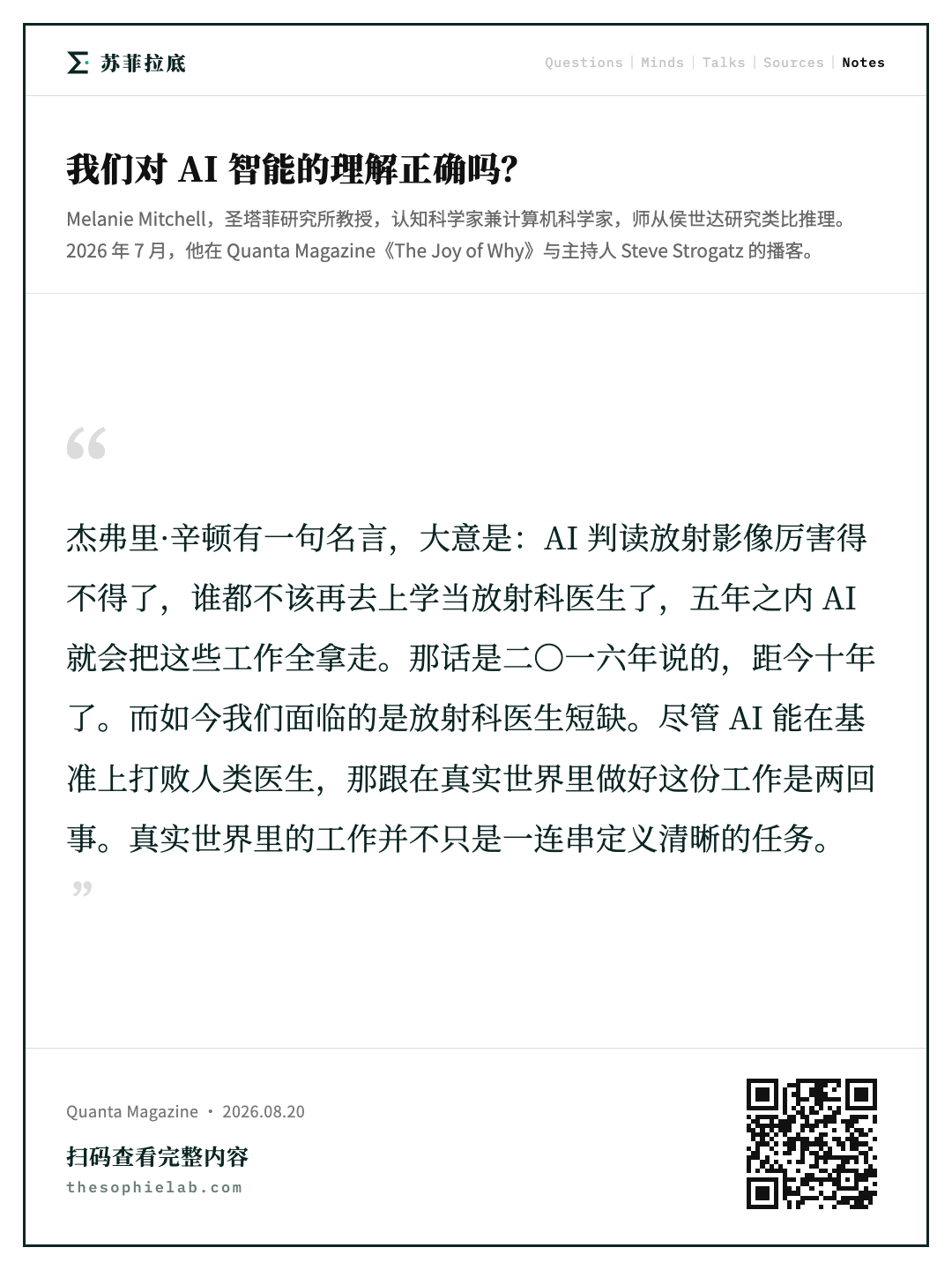
So just one example of this. So there’s  a famous quote from Geoffrey Hinton, where he said something like, “AI systems are  incredibly good at diagnosing or interpreting radiology images. Nobody should go to  school anymore to be a radiologist. AI is gonna take all the jobs within five years.” Well, that was 2016. That was 10 years ago. Now we actually have a shortage of radiologists. I  don’t know if that’s because he said that, but uh, it turns out that even though AI systems  can beat human doctors on these benchmarks, that’s not the same as doing this job out in  the real world, which is much more open-ended, which is not just a series of well-defined tasks.  STROGATZ: Still, it does leave you wondering, like in the case of radiology, you could  imagine if they are really good at that task, then what’s left for the human radiologist? Should  we still be in that part of the game? Like in my own world of math, you know, if they’re very good  at proving theorems, but they’re not so great yet
举个例子。杰弗里·辛顿有一句很有名的话,他大意是说:“AI 系统在诊断或解读放射影像方面好得不得了。没人应该再去上学当放射科医生了。AI 五年之内就会把这些工作全都拿走。”结果那是 2016 年说的,十年前了。而现在我们实际上是放射科医生短缺。我不知道是不是因为他说了那番话,但事实证明,尽管 AI 系统在这些基准上能打败人类医生,那跟在现实世界里真正做这份工作并不是一回事,现实中的工作要开放得多,并不只是一系列定义明确的任务。 STROGATZ:不过,这还是让人忍不住去想,比如放射科这个例子,你可以设想,如果它们真的在那个任务上做得非常好,那人类放射科医生还剩下什么?我们还该不该继续参与这一部分?就像在我自己的数学世界里,如果它们非常擅长证明定理,但还不太擅长
便签笔记
30:40
at coming up with new concepts, or as we sometimes  speak of it, theory building, right? There’s this big distinction between problem-solving and theory  building. So is it that we’re sort of gonna find our niche, that we can do the parts that they  don’t do? So like in the case of radiology, they have the open-ended part but not the scan  reading part? I guess that’s what I’m wondering. MITCHELL: Yeah.  STROGATZ: Is that how it’s gonna go? MITCHELL: Maybe. I wouldn’t be at all surprised  if jobs like yours change quite a bit because of these new tools. These are going to become  incredibly useful tools for mathematicians. So it might change your job. Just like when personal  computers came out, but there’s a fantastic book by um, George Lakoff and Rafael Núñez about math  and where ideas in math come from, via metaphors.
提出新概念,或者我们有时说的“建立理论”,对吧?解题和建立理论之间有很大的区别。所以,是不是说我们会去找到自己的生态位,去做它们做不了的那部分?比如在放射科的例子里,人类保留开放性的那部分,但不再读片?我大概就是在琢磨这个。MITCHELL:嗯。 STROGATZ:事情会这样发展吗?MITCHELL:也许吧。如果像你这样的工作因为这些新工具而发生相当大的变化,我一点都不会意外。它们会成为数学家极其有用的工具。所以它可能会改变你的工作。就像当年个人电脑出现时那样。不过有一本很棒的书,是乔治·莱考夫和拉斐尔·努涅斯写的,讲数学,讲数学中的观念是如何通过隐喻产生的。
便签笔记
31:35
And they feel that human embodiment is a very  important part of understanding and mathematics. STROGATZ: Exactly. I think that’s our only hope  ’cause right now they the machines don’t have great embodiment. And you’re right, that  a lot of great ideas in math are inspired by experience with the world. And that’s  what I was gonna say about applied math, that I feel like that’s even more so than  pure math, where we get so much inspiration from nature and from engineering and society and  all that, that I think we have a lot more chance of being useful as humans in applied math. But I do think pure math will expire before applied math does, and maybe neither will. Maybe  we’ll just keep going forever. What does it look like to you? I mean, math is often thought of as  some kind of gold standard like, the AI companies have a lot of use for math, right? They can  demonstrate how good their systems are ’cause they can verify that they’ve solved a problem or not. MITCHELL: Well, that’s a big question I have,
他们认为,人的具身性是理解和数学中非常重要的一部分。STROGATZ:正是。我觉得那是我们唯一的希望,因为现在这些机器并不具备很好的具身性。而且你说得对,数学中很多伟大的想法都是受到与世界打交道的经验启发的。这也正是我想说的关于应用数学的一点,我觉得应用数学在这方面比纯数学更甚,我们从自然、从工程、从社会等等中获得那么多灵感,所以我认为在应用数学里,我们人类还有更多机会派上用场。但我确实认为纯数学会比应用数学更早退场,也可能两者都不会。也许我们会一直做下去。在你看来会是什么样?我是说,数学常常被当成某种黄金标准,AI 公司很需要数学,对吧?他们可以借此展示自己的系统有多强,因为他们能验证一道题到底解出来没有。 MITCHELL:嗯,我有一个很大的疑问,
便签笔记
32:34
which is, suppose that your prediction comes  right and math, pure math expires in some sense for humans. What does that mean for other  fields? Does that mean that these machines are on their way to taking over everything? Or is it  more like 1997 or whatever it was that Deep Blue beat Kasparov and that actually beating the  best human at chess did not necessarily mean that was gonna go anywhere in other fields. STROGATZ: I don’t know. What do you think? It feels to me like science is much more  open-ended than math in that respect.
就是,假设你的预测成真了,纯数学在某种意义上对人类来说退场了。那对其他领域意味着什么?是不是意味着这些机器正在走向接管一切?还是更像 1997 年——大概是那年吧——“深蓝”战胜卡斯帕罗夫,而在国际象棋上打败最强人类,其实并不必然意味着这件事会延伸到其他领域。 STROGATZ:我不知道。你怎么看?在我看来,从这个角度说,科学比数学要开放得多。
便签笔记
33:11
MITCHELL: Yeah, I believe that. I don’t think  that solving all the Erdos problems means that the average person has to fear for their job. STROGATZ: Okay, now we have many different things on the table at that point. But  even just in the world of pure brainiacs, whether it’s scientists or mathematicians, just  the fact that biology there are so many things to be measured, we have so much data that  we could collect that we haven’t collected, so many new ways of observing. I mean, that  seems very inexhaustible to me compared to math.
MITCHELL:对,我也这么认为。我不觉得把厄多斯的所有问题都解决了,就意味着普通人得为自己的饭碗担心。 STROGATZ:好,到这儿我们摆到桌面上的问题就有好几个了。但哪怕只看纯粹的“聪明脑袋”这个圈子,不管是科学家还是数学家,光是生物学里就有那么多东西可以测量,有那么多我们还没采集的数据可以采集,还有那么多新的观测手段。我是说,跟数学比起来,那在我看来简直是取之不尽的。
便签笔记
33:47
MITCHELL: I agree. And even in physics,  I think, which is maybe closer to math, there’s so much you know, open-ended questions  that aren’t well-formulated, that don’t have something like a proof that can be constructed. STROGATZ: But so, I do feel like the hope for math is to continue to take inspiration from the  real world. And von Neumann had said something like that too, that when math becomes too much  art for art’s sake, when it drifts too far from the source, for him the source was nature  or reality, if it becomes too far removed it becomes sterile, said von Neumann. So I think this could be a a really good era for pure math if it starts taking more  inspiration from nature. That’s been less so in the 20th and 21st century, but I think if  we go back to that, we can probably eke out a few more centuries of human pleasure in math. MITCHELL: I’ll just say there’s this dictum in AI which is that easy things are  hard and hard things are easy.
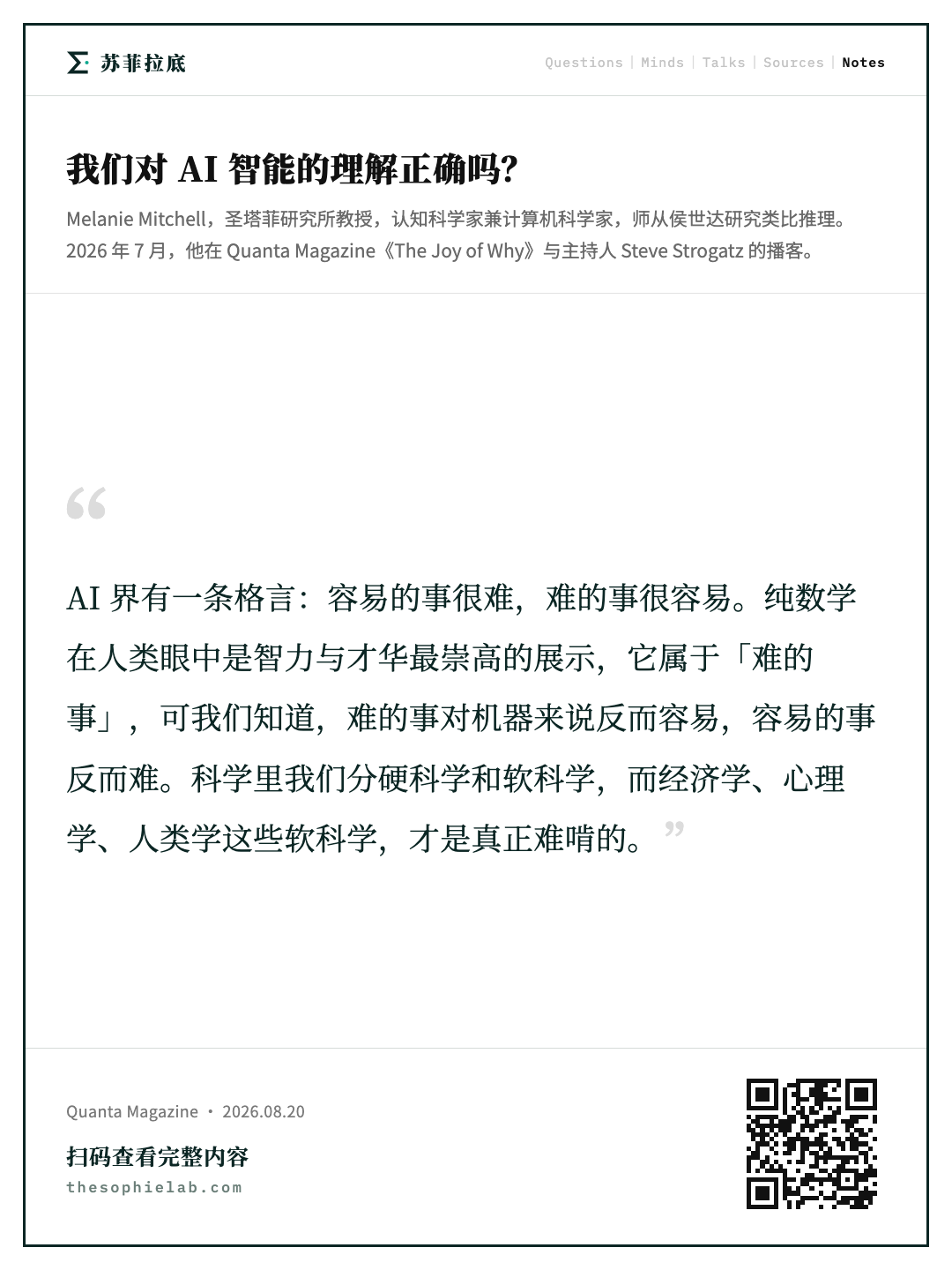
MITCHELL:我同意。而且哪怕在物理学里——物理也许更接近数学——也有那么多开放性的问题,它们并没有被很好地形式化,也不存在什么可以构造出来的证明��� STROGATZ:不过话说回来,我确实觉得数学的希望在于继续从现实世界中汲取灵感。冯·诺依曼也说过类似的话:当数学变得太过“为艺术而艺术”,当它离源头漂得太远——对他来说源头就是自然或现实——如果离得太远,它就会变得贫瘠,冯·诺依曼是这么说的。所以我觉得,如果纯数学开始更多地从自然中汲取灵感,这可能会是它一个非常好的时代。在 20 世纪和 21 世纪,这方面是比较少的,但我觉得如果我们回到那条路上,我们大概还能再多挤出几个世纪,让人类继续享受数学的乐趣。 MITCHELL:我只想说,AI 领域有一句格言:容易的事情很难,难的事情很容易。
便签笔记
34:50
STROGATZ: Right. MITCHELL: And pure math is seen by humans as like the most exalted exhibition of  intelligence and brilliance. It’s the hard thing, and yet we know that hard things are easier  for machines and easier things are harder. STROGATZ: Yep, and there’s the word soft also,  right? In science, we talk about the hard sciences and the soft sciences, and the soft sciences  of economics and psychology and anthropology, and those are the really hard ones.  MITCHELL: Right. STROGATZ: Well, so if we meet again in five years. MITCHELL: The Joy of Gamma, or something.
STROGATZ:对。 MITCHELL:而纯数学在人类看来,简直是智力和才华最崇高的展现。它是那件“难的事”,然而我们知道,难的事对机器来说反而更容易,容易的事反而更难。STROGATZ:没错,而且还有“软”这个词,对吧?在科学里,我们说硬科学和软科学,而软科学——经济学、心理学、人类学——那些才是真正难的。 MITCHELL:对。STROGATZ:那好,如果我们五年后再聚。 MITCHELL:那就叫《The Joy of Gamma》之类的吧。
便签笔记
11机制可解释性与涌现计算的旧梦
35:24
STROGATZ: Yes, The Joy of Omega by then, right.  What do you hope we would understand about AI systems by then? Or what kinds of tests would  we want to be able to do that we can’t do today? MITCHELL: Yeah, I mean What I really hope will  go well in the science of AI is this field called mechanistic interpretability,  which is the neuroscience analog, where you’re actually looking at the activations  and the weights and the, you know, all the messy innards of the system, and understanding at  a higher-level sort of what they are doing.
STROGATZ:是啊,到那时该叫《The Joy of Omega》了。到那时你希望我们对 AI 系统能理解到什么程度?或者说,你希望我们那时能做哪些今天做不到的测试?MITCHELL:嗯,我真正希望在 AI 这门科学里能有所进展的,是一个叫“机制可解释性”(mechanistic interpretability)的领域,它相当于 AI 的神经科学,你真的去看激活值、看权重,看系统内部那些乱糟糟的东西,然后在更高的层面上理解它们究竟在做什么。
便签笔记
36:03
These days, it’s kind of a smallish subfield where  people are trying to develop tools that do that, analogous to things like fMRI or whatever. And I  don’t think anybody’s really figured out exactly how to do this the right way yet, but I’m hoping  that’s something that we can accomplish, and then we would have a genuine way of understanding  sort of their limitations, what they can do, what they can’t do, what kinds of mistakes  they’re likely to make, and maybe how to fix them. STROGATZ: Interesting that you put your finger on  that because the first time I became aware of you, it was in connection with that in a  broad sense. So what I’m thinking of is back when you used to work on something  that in the jargon was called GAs for CAs, genetic algorithms for cellular automata, you  and Jim Crutchfield were looking at this problem of evolving algorithms that could solve a certain  class of problems, hard computer science problems, and you were using this evolutionary algorithm  to select better and better algorithms that kept
现在这还算是个比较小的子领域,人们在尝试开发能做到这一点的工具,类似 fMRI 之类的东西。而且我觉得还没有人真正搞清楚该怎么把这件事做对,但我希望这是我们能够做到的,那样我们就有了一条真正的路径去理解它们的局限、它们能做什么、不能做什么、容易犯什么样的错误,也许还有该怎么修复它们。STROGATZ:有意思的是你正好点到了这个,因为我第一次注意到你,从广义上说就是因为这件事。我想到的是,当年你研究的那个东西,行话里叫 GAs for CAs,也就是用遗传算法来演化细胞自动机,你和吉姆·克拉奇菲尔德当时在研究一个问题:演化出能解决某一类问题的算法,那是很难的计算机科学问题,你们用这种演化算法去筛选出越来越好的算法,通过一种选择过程不断改进。但你们做的另一部分,我觉得特别有
便签笔记
37:14
improving through a kind of selection process. But then the part that you did that I found so creative is once you’ve got a really good system,  you looked at it in what felt to me like an analog of mechanistic interpretability. You tried  to see what was making that system so smart, analyzing it in terms of particles that were  colliding with each other according to certain rules in the diagrams. That’s, I don’t know if  I’ve summarized it reasonably well, but it seems like this is a longstanding interest of yours. MITCHELL: Yeah. that’s true. I hadn’t made that connection exactly, but that’s interesting.  STROGATZ: It is this, though. It’s interpretability. It is interpretability. And it’s also, I think, in the field of complex systems,  people talk about this notion of emergence.
创造性:一旦你们得到了一个非常好的系统,你们就去研究它,在我看来那简直就是机制可解释性的雏形。你们试图弄清楚是什么让那个系统这么聪明,把它分析成一些“粒子”,这些粒子在图里按照某些规则相互碰撞。我不知道自己总结得是否算合理,但看起来这是你长期以来的一个兴趣。 MITCHELL:对,确实如此。我之前还真没把这两件事联系起来,不过这挺有意思的。 STROGATZ:就是这么回事,真的。那就是可解释性。就是可解释性。而且我想,在复杂系统这个领域里,人们还会谈到“涌现”这个概念。
便签笔记
12人类还能读懂越来越大的机器吗
38:00
STROGATZ: Yeah. MITCHELL: And we thought of that as a kind of emergent computation. And I think these AI systems  also have emergent computations that are not easy to find, but they’re there, and if we understood  them better, we would understand how the system is actually working, doing what it does. STROGATZ: Yeah, it’s an interesting attitude. It feels honestly to me very sweet  and very old school. This hope that... Okay, you’re chuckling ’cause you see where  I’m going. It’s a mean thing I’m saying, but this conceit that we with our limited minds  can keep doing science, you know, and we’re gonna figure out how these AIs are doing what they’re  doing, and that’s what our game will continue to be just like it always has been in science. And I, the dark side of me, thinks our days are numbered to be able to do that as these  gadgets get bigger and bigger. Who says we can keep doing science on them and figuring  them out? What’s your reaction to that?
STROGATZ:对。 MITCHELL:我们当时把那看作一种涌现的计算。我觉得这些 AI 系统也有涌现的计算,只是不容易被找到,但它们确实存在,如果我们能更好地理解它们,我们就能明白这个系统究竟是怎么运作、怎么做到它所做的事的。 STROGATZ:是啊,这是一种很有意思的态度。老实说,我觉得它非常可爱、非常老派。这种希望……好吧,你在笑,因为你知道我要说什么了。我要说的话有点刻薄,但这是一种自负:以为我们凭着有限的头脑就能一直做科学,我们能搞清楚这些 AI 究竟是怎么做到它们所做的事的,而我们的这场游戏会像科学一直以来那样继续下去。而我心里阴暗的那一面觉得,随着这些玩意儿越造越大,我们能这么做的日子已经屈指可数了。谁说我们就能一直对它们做科学、把它们搞明白呢?你对这个说法怎么看?
便签笔记
39:04
We have nothing else to do. We have to try. MITCHELL: That’s an interesting question. Um, why do we do science in the first place? I  mean, you know, we do science ’cause we wanna solve problems. That’s one thing. But we also do  science ’cause we’re driven to understand things. STROGATZ: Yes. MITCHELL: You see this in little children. They’re driven to understand. Often one of their  first words is why. They ask it constantly. So I think that’s a human drive, and it’s hard to  fight against that. And that’s why you and I both went into science, it’s important to us. Now, I was a little despairing when I went to a panel discussion at a conference on the role  of AI in science. And there were a bunch of famous people on the panel talking about how AI  was going to revolutionize weather prediction, and genetics, and cosmology, and you name  it. And I asked them at the end “Well, like, is this going to contribute to human  understanding of the world?” And they’re like, “Why should we care about that?”  STROGATZ: Yeah. To me, this is the
我们也没别的可干了。我们必须去试。 MITCHELL:这是个有意思的问题。嗯,我们最初为什么要做科学?我是说,我们做科学是因为我们想解决问题。这是一方面。但我们做科学也是因为我们有一种想要理解事物的驱动力。STROGATZ:是的。 MITCHELL:你在小孩子身上就能看到这一点。他们有一种想要理解的驱动力。他们最早学会的词之一常常就是“为什么”。他们不停地问。所以我觉得那是人类的一种本能驱动,很难跟它对抗。这也是为什么你和我都进了科学这一行,它对我们很重要。不过,我去参加一个关于 AI 在科学中作用的会议小组讨论时,倒是有点绝望。台上有一群名人,在谈 AI 将如何彻底改变天气预报、遗传学、宇宙学,等等等等。最后我问他们:“那么,这会对人类理解世界有所贡献吗?”而他们的反应是:“我们为什么要在乎这个?” STROGATZ:是啊。对我来说,这正是我们现在都在思考的那个分岔口。因为科学有这种双重属性:
便签笔记
13从逻辑谜题到哥德尔埃舍尔巴赫
40:17
bifurcation that we’re all thinking about now.  ’Cause science has this double-edged aspect, that it gives us pleasure, we like figuring things  out, there is the joy of why, and as you say, it’s deep in our species. So yes, we’re curious,  but then there’s the other side that for so long science has been this instrumental thing  that helps us in technology and medicine. And I guess the question I have, and I think  a lot of us have, is will we continue to take pleasure in the joy of curiosity when we are  no longer the best at solving the important problems? But let me ask you one last thing, for  people who haven’t heard our earlier conversation, what was your draw to this field, and  if you were starting out today, do you think you’d have the same kind of curiosity? MITCHELL: Yeah, that’s a great question. When I was a child, I loved logic puzzles, like the  knights and the knaves. The knights who always told the truth and the knaves who always lied.  There’s a fun several books by Raymond Smullyan,
它给我们带来乐趣,我们喜欢把事情弄明白,那就是“探问为什么的乐趣”,而且就像你说的,它深植于我们这个物种之中。所以是的,我们好奇;但另一面是,长久以来科学一直是一种工具性的东西,帮助我们发展技术和医学。我想我的疑问——我觉得也是我们很多人的疑问——是:当我们不再是解决重要问题的最强者时,我们还会不会继续从好奇的乐趣中获得快乐?不过我最后再问你一个问题,对于没听过我们上一次对谈的听众来说,当初是什么把你吸引到这个领域的?如果换成今天起步,你觉得自己还会有同样的好奇心吗? MITCHELL:嗯,这问题很好。我小时候特别喜欢逻辑谜题,比如骑士和无赖那种。骑士永远说真话,无赖永远说假话。雷蒙德·斯穆里安写过好几本很有意思的书,
便签笔记
41:22
a mathematician who wrote a bunch of puzzles  in this genre that I absolutely loved. When I got to college, I read Douglas  Hofstadter’s book, Gödel, Escher, Bach, which was the real-world version of these in  a way. I mean, he was talking about Gödel’s theorem and paradoxes in mathematical logic and  how all this related to cognition and thinking and creativity and so on. And I was just completely  blown away and that this is what I wanna do in my life. I didn’t exactly know what it was, but it  seemed like it might be artificial intelligence.
他是位数学家,写了一堆这类谜题,我简直爱不释手。上大学以后,我读了侯世达的《哥德尔、埃舍尔、巴赫》,那在某种意义上是这些谜题的现实版。我是说,他谈的是哥德尔定理、数理逻辑中的悖论,以及这一切如何与认知、思维和创造力等等联系起来。我完全被震撼到了,觉得这就是我这辈子想做的事。我当时并不清楚它究竟是什么,但感觉可能就是人工智能。
便签笔记
42:01
So I pursued Doug as an advisor and got to join  his group, and was studying analogy via a new set of puzzles which were analogy puzzles.  And, I was very entranced by all of that. If I were that age today, I would be worried.  In fact, I have a son who is getting a PhD in machine learning, and he wants to do research in  machine learning, but he’s actually quite nervous that there will be no more roles for humans doing  research in machine learning because AI will be doing all the research in machine learning and  improving itself and so on and so forth. And I wonder if I’d think the same thing. I don’t know. STROGATZ: Maybe we do have to revisit this in five years because we may know by then.  Given how fast everything is going, who knows? I really appreciate your spending  time with us. This has been wide-ranging, a little bit amorphous conversation, but it’s  just wide open and I can’t think of a better guide to it. Thank you very much for joining us. MITCHELL: Thanks, Steve. It’s been great.
于是我去争取让侯世达当我的导师,进了他的研究组,通过一套新的谜题——类比谜题——来研究类比。我被这一切深深吸引。如果我今天是那个年纪,我会感到担忧。事实上,我有个儿子正在读机器学习的博士,他想做机器学习方面的研究,但他其实相当紧张,担心以后不会再有人类做机器学习研究的位置了,因为 AI 会包办所有机器学习研究,自我改进等等。而我由概率表定义。所以还是指数级的时间。后来出现的突破就是我们有了条件独立性,由我们的假设独立地编码出来。怎么做到的?用图。如果你有图,图就能表达一组组独立性关系;有了图,你把所有独立性都算出来,就能找出
便签笔记
14不做最好的人,也值得追问为什么
43:14
LEVIN: Hmm. Hmm. I, I just remember being  a student and learning Newton’s laws for the first time, and then Kepler’s laws,  which really make Newton’s laws beautiful, this application to the celestial cycles. I  didn’t think, “Oh, I’m not the best at this, therefore I shouldn’t learn it.” Nor did I  think, unless I one day become the best at this, I cannot feel pleasure or joy in my  experience of acquiring this information.” Of course, lots of people study things that other  people already know and are better at. So I, I sort of wonder if maybe the AI will know  things before us, but we will still need to acquire the understanding ourselves, and in that  acquisition is a similar experience. Instead of maybe the AI will be a filter between  us and interrogating nature directly, but we’ll still be acquiring, I don’t know,  the knowledge and having that experience.
什么和什么是相关的,然后只处理相关的部分。很好。接下来就是贝叶斯网络的工作了。好。你定义一个网络,有箭头或者没有箭头。这些箭头的组合就告诉你:在给定什么的条件下,什么和什么是独立的。所以对每一个三元组,X在给定 Z 的条件下与 Y 独立,其中 Z 可以是一个集合等等,而 X 和 Y 可以从图里算出来,而不是从概率里算出来——而是从图里算出来。这件事如果从哲学角度看,其实是一场革命。概率跟图能有什么关系?
便签笔记
44:18
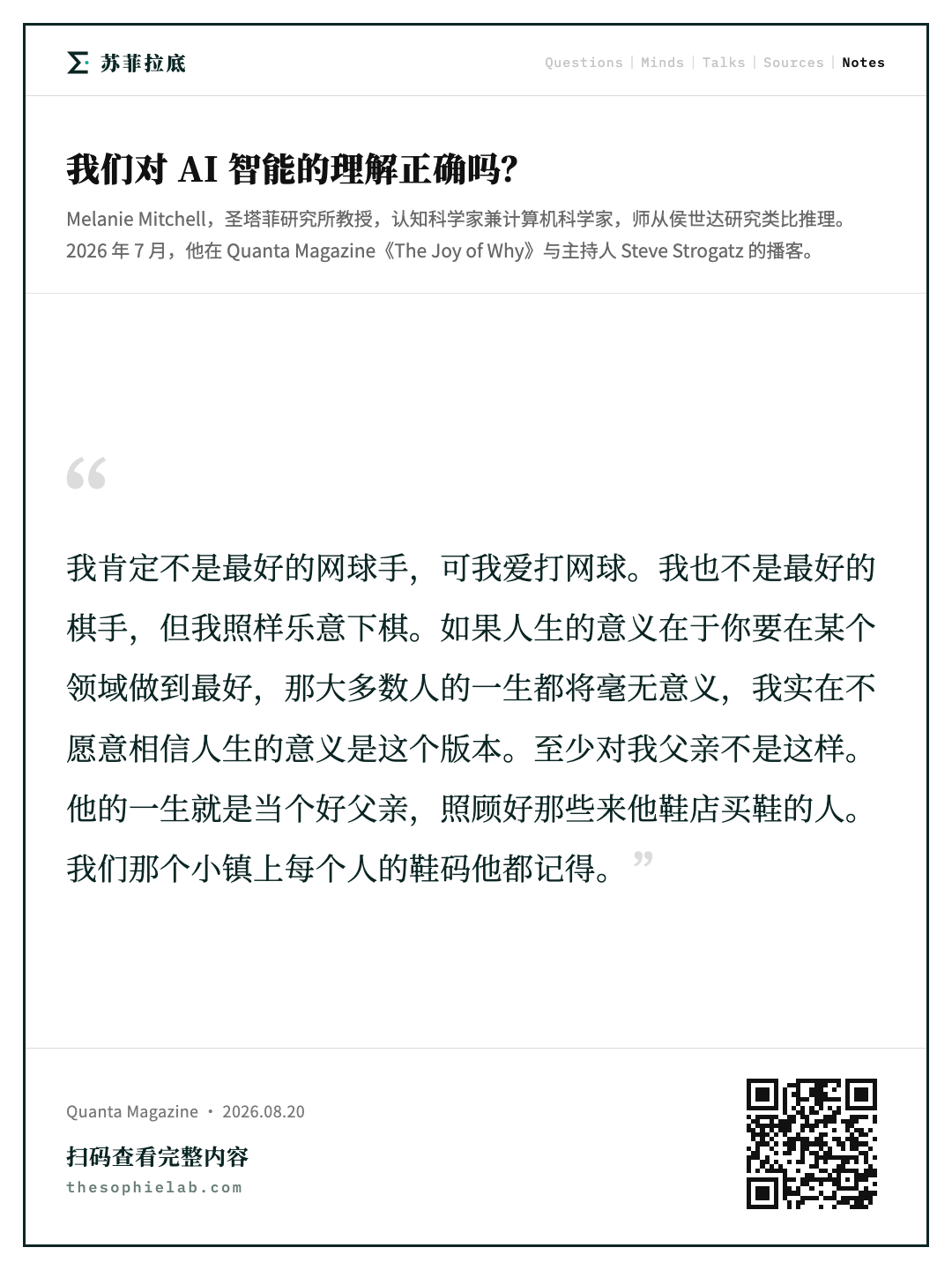
I’m not sure. Maybe it’s all gonna pass us by. STROGATZ: I-- Well, let’s explore this a little more. I like especially your emphasis on not being  the best, and how, in a way, unfraught that is. I, I learned as soon as I went to college what it  means to not be the best. You know, this, this fixation with being the number one, especially  in an age of optimization. There’s so many optimization algorithms. We talk about faster,  cheaper. But in our own lives, very often we’re not the best. I’m certainly not the best tennis  player. I love to play tennis. I’m not the best chess player, and I’m still happy to play chess.  And try to be the best dad, but I may not be.
你上概率论 101 的时候,有谁跟你讲过图吗?没有。对吧。所以概率学家和哲学家都会被激怒,或者说都该被激怒。概率之间的联系是什么?现在事实证明,这两者之间有非常强的逻辑联系,因为[清嗓子]概率论里条件概率、或者说条件独立性的公理,跟
便签笔记
45:00
But still, all these things are worth doing for  their own sake, right? They give us pleasure. I do feel very philosophical and almost religious  about this. Like, we get a little time on Earth alive and, you know, these questions about AI  do tap into questions about the meaning of life. What are we trying to do? If the meaning of life  is that you’re gonna be the best in some domain or you’re gonna make a discovery that’s gonna  change the world, then most people will have a meaningless life, and I just don’t wanna believe  that’s the correct version of the meaning of life.
图分离(graph separation)里的公理是一样的。在图里你有"分离"这个概念。节点 X 和节点 Y 之间没有连接,除非你经过某一组节点 Z。所以 Z 把 X 和 Y 分离开。好,这跟概率论里"给定 Z 时 X 与 Y 独立"是同一套逻辑。
便签笔记
45:34
It was not for my dad. He didn’t even get to go to  college. You know, he grew up in the Depression. That was not an option. His life was being a  good parent and taking care of the people that bought shoes at the shoe store that he had. And  he knew everyone’s shoe size in our little town, and he left a good name when he  died. People remembered him well. LEVIN: Right. STROGATZ: So okay. What is that doing on our show here about science? LEVIN: Well, I think that let’s say the meaning for some people of life has to do with  acquisition, acquiring wealth. They’re gonna love this stuff, right? ’Cause there’s gonna  be this new tool that simply leverages all kinds of buttons that they now have faster access  to and can exploit and acquire more wealth.
独立性和分离性之间是有联系的。它们共享一套……[笑]你很开心啊。我也开心,因为我现在重新体会到我们在 1970 年代发现这一切联系时的那种兴奋,在两个看似毫不相干的科学视角之间——概率论和图论。顺便说,这项工作是我和 Azaria Paz 合作做的,他当时从以色列理工学院(Technion)来访问我。对。顺便一提,我该提一下,这个叫做 graphoid 理论。graphoid……OpenAI[哼笑]、Anthropic、Cursor 和 Vercel 都在用这个产品来让自己的日子好过一些。
便签笔记
46:18
There are people who found meaning in singing  songs or writing poetry or being novelists or doing math, and, and I think all of  those fields are a little more nervous, right? About reevaluating what the place  is going to be for them and, and how to secure that place and how to think about it. If I’m playing games of what may or may not happen, I mean, there is still a world  in which AI is like a supercomputer, and we’ve talked about this before, Steve.  Just ’cause a supercomputer can crunch all of these numbers, if it presents it to us  as a string of symbols, even though it has, in some sense, an answer, it’s not a meaningful  answer for us, and none of us value it.
它解决的问题是:当你在做 SaaS 或者 AI 产品,想卖给其他公司的时候,有一堆要求你必须满足。有 SSO,有 SCIM,有 RBAC,有审计日志。这些东西都要花时间去集成,但又不是你产品的重点。WorkOS 是一个 API 层,让你只用几行代码就满足所有这些要求。比方说你
便签笔记
47:00
We still, as human beings, have a very important  role between us and a supercomputer rendering an image of a galaxy or looking at an image of a  biomedical neural map. It hasn’t actually robbed scientists of their work. And so it might be  that it really will continue to be a tool and not simply something that overtakes and discards us. STROGATZ: Well, that’s the question, right? I think there are two plausible scenarios. One is  that it continues to be a tool, and we always have some essential role in science and math at the  cutting edge. The other option is, and actually in my heart I believe this is the case, that we  will not be at the cutting edge, and that will happen very soon. And, so then what is the point? Then I feel like it’s still meaningful, just like when I was in high school and I discovered things  about math. They were discoveries to me. They were not discoveries to the world, you know? I think  we may have to all settle for that. We’re not gonna be making genuine discoveries for the world. The AIs will be doing that. I really do believe
有一个新的 SaaS 产品,想卖给其他公司,WorkOS 会帮你把这些关键的功能缺口全部补上。你可以去 workos.com 了解更多、开始使用。也感谢他们支持我的工作、赞助这档播客。这些都说得通,但我马上想到的是:图从哪来?一切都取决于输入从哪来。有时候输入来自数据,有时候输入来自判断。但假设你在这件事上需要一个判断。好。你就放弃了吗?如果所需要的判断是直觉的、有意义的、是你愿意去为之辩护的,对吧?那为什么不用判断呢?
便签笔记
48:10
that’s gonna happen very soon. I may be  wrong. I mean, there may be fundamental reasons why the AIs won’t be able to do  that. For instance, they don’t have bodies, they don’t have social life, you know, there’s  a lot... But I just think all that stuff will be solved before long. Anyway, what’s your take? LEVIN: Well, I think there’s a difference between, making discoveries and understanding, and I  guess that’s kind of what I mean in examples. In some sense, maybe the su- supercomputer  made the discovery before the person did, but we still say the person did ’cause the discovery  didn’t count as a discovery until they rendered it in a way that human beings could comprehend. But, I honestly don’t know. I am not incredibly saddened or pessimistic, so I guess I would have  to say that in my heart, intuitively, I am not terrified of this prospect. Maybe I should be, but  maybe it’s just sort of a bliss of being naive and I’m just gonna wait for it to sneak up on me. STROGATZ: There is one thing I think we can be
比如说,如果我知道太阳并不会听公鸡打鸣,对吧?它根本不在乎。好,我坚信这一点。我需要数据来支持它吗?还是说我可以直接把它放进去、断言它,并在需要时为它辩护?所以这里有个诀窍,人们往往没意识到、没有体会到。好。判断并不是禁忌——只要它是有意义的,而且如果它足够凝练,很少的几条判断就能为你省下大量计算;而且如果你愿意为它辩护,因为它太直观了。你从哪儿得到这个想法的,你从哪儿知道太阳不在乎公鸡的?
便签笔记
49:06
very optimistic about and hopeful about, which is  I think we’re gonna have a glorious golden age of science where we will understand, and discoveries  by the AIs or by people in conjunction with AIs, that’s all gonna be happening in the  next, whatever, five, 10, 15 years, and it’s gonna be a spectacular fireworks time  for science. And I think that hopefully with any luck, we’ll be alive to see all that. LEVIN: Yeah, there’s definitely going to be a transition period where people are moving it  fast and furious, and they’re part of the story, and there’s great accomplishment, and it will be  exciting to see. I know people, very accomplished, who are very excited about using it. Use it every  day. They have multiple things going on, and they just feel like their productivity has doubled  or more. And they’re excited, they’re enjoying themselves. I think there’s really nothing we can  do but chime in and participate in this, at least, transition phase before we’re obsolete. STROGATZ: Well, I’m getting choked up
你做过实验吗?没有。但这不是明摆着的吗,对吧?好。>> 但如果你的直觉是错的呢?>> 确实,这正是我们的问题,是我们问题的一部分。就算说到(大模型)也一样,因为所谓的汇总,就是所有可能判断的平均,那些人们放到互联网上的判断。它是几万亿条判断的一个汇总,而你对这些判断毫无控制力,大模型对它们同样没有控制力。好吧?你只能接受。
便签笔记
50:07
just thinking about it. Thanks, Janna. It’s  always great to see you, and we’ll see you next time on The Joy of Why.  LEVIN: Thanks, Steve.
但愿它给你信任的那些人的判断更高的权重,而给那些故意想把系统搞崩的人的怪癖更低的权重。所以,不,看群体判断里
便签笔记

这期还没有生成总结。

这期还没有生成核心句型(制作精读 PDF 时会一并生成)。

这期还没有生成词汇表(制作精读 PDF 时会一并生成)。

这期还没有生成自测题(制作精读 PDF 时会一并生成)。

精读便签
下载便签 手机:长按图片也可保存
← 上一期 · NO.080Lessons on Creativity with Rick Rubin 下一期 · NO.082 →Daniel Goleman on Focus: The Secret to High Performance and Fulfilment
订阅苏菲周报 每周一封:本周入库的精读、一个值得带走的问题、一条苏菲按。免费,随时退订。
免费 · 每周一封 · 一键退订
苏菲拉底 THE SOPHIE LAB · ASK THE BEST MINDS THE BIG QUESTIONS 内容仅供学习 · thesophielab.com