Dario Amodei — “We are near the end of the exponential” · 苏菲拉底
字幕 字幕位置
--:--
点击播放,这里会跟随视频显示当前句的中英字幕。

Dario Amodei — “We are near the end of the exponential”

节目发布 2026-02-13 · Dwarkesh Patel
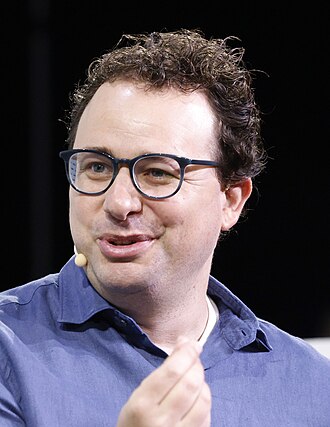
达里奥·阿莫代伊 DDwarkesh Patel
EDITED TRANSCRIPT · 依据现场录音编译整理,可划线生成便签
2026 年初,Anthropic 联合创始人兼首席执行官达里奥·阿莫迪(Dario Amodei)再度做客 Dwarkesh Podcast,与主持人德瓦凯什·帕特尔(Dwarkesh Patel)展开了一场三小时的长谈,距二人上一次对话已过去三年。此时阿莫迪刚在寒假期间写完长文《技术的青春期》(The Adolescence of Technology),Anthropic 的年化收入正以每年十倍的速度攀升。谈话从规模定律的现状谈起,一路延伸到算力采购的赌注、行业的利润均衡、威权风险与出口管制、Claude 宪法的书写权,以及他如何经营一家两千五百人的公司。本文依据现场录音编译整理。

指数快到头了,没人看见

帕特尔:我们上一次对谈是三年前。在你看来,这三年里最大的更新是什么?当时的感受和现在的感受,最大的差别在哪里?

阿莫迪:大体上说,底层技术的指数增长走得和我预期的差不多,前后误差一两年。代码这个具体方向我未必预测得到,但如果看整条指数曲线,模型从聪明的高中生走到聪明的大学生,再开始做博士和专业人士的工作,代码领域甚至走得更远,这条路径基本是我预想的样子。前沿有些参差不齐,但整体符合预期。真正让我意外的,是公众完全没有意识到我们离这条指数曲线的终点有多近。在我看来,圈内圈外的人都还在谈论那些老掉牙的热点政治议题,而我们其实已经快走到指数的尽头了,这实在太荒唐。

大块算力假说与七要素

帕特尔:我想弄清楚这条指数曲线现在是什么样子。三年前我问你的第一个问题是「规模扩展是怎么回事,为什么有效」。现在我想问同样的问题,但它变复杂了。至少从公众角度看,三年前有众所周知的公开趋势,横跨多个数量级的算力,你能看到损失函数如何改善。现在我们有了强化学习(RL)的规模扩展,却没有任何公开的规模定律,连它的故事线都不清楚。它是在教模型技能,还是在教元学习?此刻的规模假说到底是什么?

阿莫迪:我持有的假说和 2017 年时一模一样。上次我可能提过,我写过一份文件叫《大块算力假说》(The Big Blob of Compute Hypothesis)。它讲的不专指语言模型的规模扩展,写它的时候 GPT-1 刚刚问世,那只是众多方向之一。那年头还有机器人,有人把推理当成独立于语言模型的课题来做,还有 AlphaGo、OpenAI 打 Dota 那种强化学习的规模扩展,DeepMind 的 AlphaStar 打星际争霸大家也记得。所以那份文件写得比较泛。几年后理查德·萨顿(Rich Sutton)发表了《苦涩的教训》(The Bitter Lesson),假说基本是同一个。它说的是:所有的巧思,所有的技巧,所有「我们需要一种新方法才能做到某事」的想法,都不太重要。真正重要的只有几件事。

我记得我列了七条。第一,你有多少原始算力。第二,数据的数量。第三,数据的质量和分布,分布必须足够宽。第四,训练多长时间。第五,你需要一个能一路扩展到天上去的目标函数。预训练的目标函数就是其中之一。另一个是强化学习的目标函数,也就是给定一个目标,让模型去达成它。这里面既有数学和编程那种客观奖励,也有 RLHF 及其高阶版本那种主观奖励。第六和第七条是归一化和条件化之类的东西,也就是把数值稳定性弄好,让这一大块算力像层流一样顺畅地流过去,而不是撞上各种问题。

这就是当年的假说,我至今仍然持有。我没见过多少与它相悖的东西。预训练的规模定律是它的一个例证,而且这些定律一直在延续。现在外界报道很多,我们对预训练感觉良好,它仍在带来收益。变化在于,我们现在在强化学习上也看到了同样的现象。先有预训练阶段,再在上面叠一个强化学习阶段。强化学习其实是同一回事。其他公司在发布材料里也公开过:在数学竞赛(AIME 之类)上训练模型,模型的表现与训练时长呈对数线性关系。我们也看到了同样的东西,而且不只是数学竞赛,而是各种各样的强化学习任务。预训练里看到的规模扩展规律,在强化学习里同样成立。

样本效率:进化还是学习

帕特尔:你提到了萨顿和《苦涩的教训》。我去年采访过他,他其实很不「LLM 派」。我不确定这是不是他的原话,但可以把他的反对意见概括为:一个真正拥有人类学习核心能力的系统,不需要几十亿美元的数据和算力,不需要这些定制的环境,才能学会用 Excel、用 PowerPoint、用浏览器。我们不得不用这些强化学习环境把技能一个个灌进去,这本身就暗示我们缺了一种核心的人类学习算法,所以我们在扩展错误的东西。这确实引出一个问题:如果我们相信会出现某种像人一样能即时学习的东西,那为什么还要做这么多强化学习的规模扩展?

阿莫迪:我认为这把几件本该分开看的事情混在了一起。这里确实有一个真正的谜题,但它可能无关紧要,我甚至猜它大概率无关紧要。我们先把强化学习放到一边,因为在这个问题上,说强化学习和预训练有什么不同,其实是转移视线。

回看预训练的规模扩展,2017 年亚历克·拉德福德(Alec Radford)做 GPT-1 的时候很有意思。GPT-1 之前的模型是在一些不代表广泛文本分布的数据集上训练的,都是很标准的语言建模基准。GPT-1 本身我记得是在一堆同人小说上训练的,是文学文本,只占你能拿到的文本的很小一部分。那时候大概是十亿词的量级,数据集小,分布也窄,泛化得并不好。你在某个同人小说语料上做得更好,并不能很好地迁移到别的任务上。我们有各种指标,衡量它预测其他各类文本的表现。直到你在互联网上的所有任务上训练,也就是从 Common Crawl 之类的地方做全网抓取,或者像我们做 GPT-2 时那样抓 Reddit 里的链接,你才开始得到泛化。我认为强化学习正在重演同一件事。先从简单的强化学习任务开始,比如在数学竞赛上训练,再扩展到代码之类更广的训练,现在又转向许多其他任务。接下来泛化会越来越强。

这样一来,强化学习和预训练之间的区别就消掉了。但不管怎样,谜题仍然存在:预训练用了上万亿个 token,而人类一辈子看不到上万亿个词。所以样本效率上确实存在差异,确实有什么东西不一样。模型从零开始,需要多得多的训练。但我们也看到,模型一旦训练完成,如果给它一百万的长上下文(长上下文唯一的阻碍是推理),它在上下文内学习和适应的能力非常强。这个问题的完整答案我不知道。

我觉得情况是这样:预训练不像人类学习的过程,它介于人类学习和人类进化之间。我们的许多先验来自进化,大脑不是白板,这方面有整本整本的书。语言模型则更像白板,它们真的是从随机权重开始的,而人脑一开始就有各个区域,连接着各种输入输出。也许我们应该把预训练(以及强化学习)看成处在人类进化和人类现场学习之间的中间地带,把模型的上下文内学习看成处在人类长期学习和短期学习之间。所以这里有一个层级:进化,长期学习,短期学习,以及人的即时反应。语言模型的各个阶段落在这条谱系上,但未必落在同样的点上。人类的某些学习模式在语言模型里没有对应物,模型的阶段落在那些点的中间。这样说讲得通吗?

帕特尔:讲得通,但有些地方还是让人困惑。比如,如果这个类比是说预训练像进化,所以样本效率低没关系,那么如果我们将从上下文内学习中得到一个样本效率极高的智能体,我们为什么还要费劲搭建这么多强化学习环境?有些公司的工作看起来就是在教模型怎么用这个 API、怎么用 Slack、怎么用各种东西。如果那种能即时学习的智能体正在出现,或者已经出现,我不明白为什么要在这上面下这么大功夫。

阿莫迪:别人为什么强调这些我说不了,我只能说我们怎么想。目标不是在强化学习里教会模型每一项可能的技能,正如我们在预训练里也不这么做。预训练时,我们并不试图让模型见过词语的每一种可能组合,而是让模型在大量东西上训练,然后在整个预训练范围内实现泛化。这就是我近距离看到的从 GPT-1 到 GPT-2 的转变。模型会到达某个点。我有过这样的时刻:「哦,你只要给模型一列数字,这是房子的价格,这是房子的面积,模型就能补全这个模式,做出线性回归。」做得不算好,但它做到了,而且它从没见过这个具体的东西。所以我们搭建强化学习环境,目的和五年、十年前做预训练非常相似。我们要收集一大批数据,不是为了覆盖某份具体文档或某项具体技能,而是为了泛化。

十年九成,一两年五五开

帕特尔:你铺陈的这个框架显然说得通。我们在向通用人工智能(AGI)推进,到现在没人否认本世纪会实现 AGI。分歧在于,你说我们正在触及指数的终点,而另一个人看着同样的东西会说:「我们从 2012 年起就在进步,到 2035 年会有一个类人的智能体。」我们显然在这些模型里看到了进化所做的事,或者人一生的学习所做的事。我想知道,你看到了什么,让你认为这是一年之遥而不是十年之遥。

阿莫迪:这里可以提两种主张,一强一弱。先说弱的。2019 年我第一次看到规模扩展的时候,我并不确定,那是个五五开的事。我觉得我看到了点什么,我的主张是「这比任何人想的都更可能,也许有百分之五十的概率」。对于你说的这个基本假设,也就是十年之内我们得到我所说的「数据中心里的天才之国」(country of geniuses in a data center),我给百分之九十。很难比九十再高多少,因为世界太不可预测。也许不可消除的不确定性把我们放在百分之九十五,剩下的是那种多家公司同时内乱、台湾遭到入侵、所有晶圆厂被导弹炸掉的世界。

帕特尔:你这是给我们下咒了,达里奥。

阿莫迪:你可以构造出一个百分之五的世界,事情被推迟十年。还有另外百分之五,来自我对可验证任务非常有把握这件事。编程方面,除去那点不可消除的不确定性,我认为一两年内就能到。十年之内做不到端到端编程,这是不可能的。我唯一一点根本性的不确定,哪怕放在长时间尺度上,是关于那些不可验证的任务:规划一次火星任务,做出 CRISPR 那样的基础科学发现,写一部小说。这些任务很难验证。我几乎可以肯定我们有一条可靠的路径到达那里,但如果说还有一点不确定,就在这儿。十年的时间线我给百分之九十,这差不多是你能有的最大把握了。我认为说 2035 年前不会发生是疯了。在一个正常的世界里,这种说法应该属于非主流。

帕特尔:但你对可验证性的强调,在我听来暗示了你并不完全相信这些模型是泛化的。想想人类,我们既擅长有可验证奖励的事,也擅长没有可验证奖励的事。

阿莫迪:不,这正是我几乎确定的原因。我们已经看到了从可验证的东西向不可验证的东西的大量泛化。这已经在发生了。

帕特尔:但你刚才把它说成一条谱系,谱系会把领域分开,某些领域进展更快。这不像人类变强的方式。

阿莫迪:我们到不了那里的世界,是这样的:我们把所有可验证的事都做了,其中很多泛化了,但我们没有完全到达,没有把盒子的另一边完全涂满。这不是非黑即白的事。

软件工程自动化的谱系

帕特尔:即使泛化很弱,你只能做可验证的领域,我也不确定在那样的世界里你能把软件工程自动化。你在某种意义上也是「软件工程师」,但你做软件工程师的一部分工作是写关于宏大愿景的长篇备忘录。

阿莫迪:我不认为那是软件工程师的工作,那是公司的工作,不是软件工程专属的。但软件工程确实包括设计文档之类的东西。模型现在写注释已经相当不错了。再说一次,我在这里提的主张比我实际相信的弱得多,是为了区分两件事。在软件工程上,我们已经快到了。

帕特尔:以什么为标准?有一个标准是有多少行代码是 AI 写的。可如果看软件工程史上的其他生产力提升,编译器写了所有的软件行。写了多少行,和生产力提升有多大,是两码事。「我们快到了」指的是什么?生产力提升有多大,而不只是多少行代码是 AI 写的?

阿莫迪:这一点我完全同意你。我在代码和软件工程上做过一系列预测,我认为人们一再误解了它们。让我把这条谱系铺开。大约八九个月前,我说三到六个月内 AI 模型会写下百分之九十的代码。这发生了,至少在某些地方发生了。在 Anthropic 发生了,在许多使用我们模型的下游用户那里也发生了。但这其实是个很弱的标准。人们以为我在说我们不再需要百分之九十的软件工程师。这两件事天差地别。谱系是这样的:百分之九十的代码由模型写;百分之百的代码由模型写,这在生产力上是个很大的差别;百分之九十的端到端软件工程任务由模型完成,包括编译、搭建集群和环境、测试功能、写备忘录;今天百分之百的软件工程任务由模型完成。即便到了那一步,也不意味着软件工程师会失业,他们可以做新的、更高层次的事情,比如去管理。谱系再往下,是对软件工程师的需求减少百分之九十,我认为这也会发生,但这是一条谱系。我在《技术的青春期》里写过,用农业走了一遍这条谱系。所以这点我完全同意你,这些基准彼此很不一样,但我们正在飞快地穿过它们。

扩散是真约束还是托词

帕特尔:你的愿景里有一部分是,从九十到一百会很快发生,而且会带来巨大的生产力提升。但我注意到,即便是从零开始的项目,人们用 Claude Code 之类的东西起步,报告说开了很多项目……可我们在外面的世界看到软件的文艺复兴了吗?看到那些本来不会存在的新功能了吗?至少到目前为止,似乎没有。这让我怀疑,就算我永远不需要干预 Claude Code,世界还是复杂的,工作还是复杂的。仅仅在写软件这种自足的系统里闭合回路,能带来多大范围的收益?也许这该稀释我们对「天才之国」的估计。

阿莫迪:我同时同意你,这是事情不会瞬间发生的原因,但我又认为效应会非常快。这里有两个极端。一个极端是 AI 不会取得进展,很慢,要花很久才能在经济中扩散。「经济扩散」已经成了一个流行词,用来说明为什么 AI 不会进步,或者为什么 AI 进步不重要。另一个极端是我们会得到递归自我改进,整套东西。难道不能在曲线上直接画一条指数线?递归一开始,几纳秒之后我们就有戴森球环绕太阳了。我完全是在漫画化这些观点,但这两个极端确实存在。而我们从一开始看到的,至少在 Anthropic 内部看到的,是这种怪异的每年十倍的收入增长。2023 年从零到一亿美元,2024 年从一亿到十亿,2025 年从十亿到九十亿、一百亿。

帕特尔:你们该直接买十亿美元自家产品的,这样就能……

阿莫迪:今年头一个月,这条指数曲线……你会以为它该放缓了,可我们一月份又加了几十亿的收入。这条曲线显然不可能永远走下去,GDP 就那么大。我甚至猜它今年会有所弯曲,但这是一条很快的曲线,真的很快。我敢打赌,就算规模扩展到整个经济,它仍然会相当快。所以我们应该考虑这种中间世界:事情极快,但不是瞬间完成,需要时间,因为经济扩散,因为需要闭合回路。因为琐碎:「我得在企业内部做变更管理……我把这个搭起来了,但得改安全权限才能真正跑通……我有个老软件,会在模型编译发布前做检查,我得重写它。是的,模型能做,但我得告诉模型去做,这需要时间。」所以我认为我们迄今看到的一切,都与这个图景相容:有一条快速的指数,是模型的能力;还有另一条快速的指数,是它的下游,即模型向经济中的扩散。不是瞬间,也不慢,比以往任何技术都快得多,但有它的极限。看 Anthropic 内部,看我们的客户:采用很快,但不是无限快。

帕特尔:我能对你抛个激进观点吗?

阿莫迪:来。

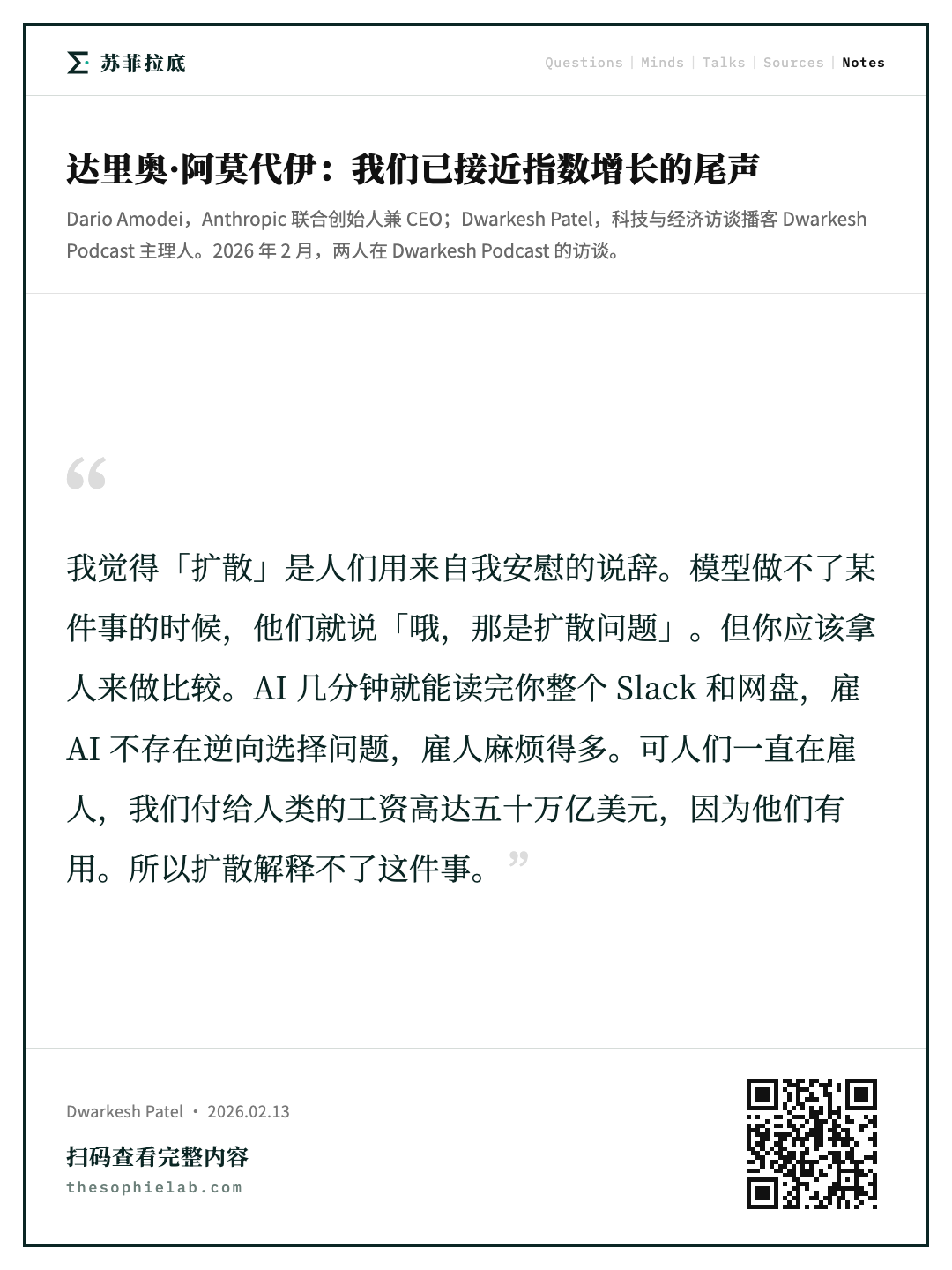
帕特尔:我觉得「扩散」是人们用来自我安慰的说辞。模型做不了某件事的时候,他们就说「哦,那是扩散问题」。但你应该拿人来做比较。AI 天生的优势,应该让新 AI 的上岗比新人的上岗容易得多。AI 几分钟就能读完你整个 Slack 和网盘。同一个实例的其他副本知道的东西,它们都能共享。雇 AI 不存在逆向选择问题,你直接雇一个经过审核的 AI 模型的副本就行。雇人麻烦得多。可人们一直在雇人,我们付给人类的工资高达五十万亿美元,因为他们有用,即便原则上把 AI 整合进经济比雇人容易得多。所以扩散解释不了这件事。

阿莫迪:我认为扩散是非常真实的,而且不完全是 AI 模型的局限造成的。再说一次,有人把扩散当作一个流行词,用来说这事不是什么大事,我说的不是那个。我说的不是 AI 会以以往技术的速度扩散。我认为 AI 的扩散会比以往任何技术都快得多,但不是无限快。举个例子,Claude Code。Claude Code 极其容易上手,你是开发者的话,直接开始用就行。没有任何理由,大企业的开发者不该像个人开发者或初创公司开发者那样快地采用 Claude Code。我们尽一切可能推广它,把 Claude Code 卖给企业。大企业、大金融公司、大药企,全都在以远超企业采用新技术常规速度的速度采用 Claude Code。但它仍然需要时间。任何一项功能、任何一个产品,比如 Claude Code 或 Cowork,那些整天泡在推特上的个人开发者、A 轮初创公司采用它的时间,会比一家做食品销售的大企业早好几个月。

原因有很多。得过法务,得给所有人配置,得通过安全和合规审查。公司领导离 AI 革命更远,他们有前瞻性,但得先说服自己:「哦,我们花五千万有道理。Claude Code 是这么个东西,它这样帮到我们公司,这样让我们更有生产力。」然后他们得向下面两级的人解释:「好,我们有三千名开发者,我们这样把它推给开发者。」我们每天都在进行这样的对话。我们在尽一切可能让 Anthropic 的收入每年增长二三十倍而不是十倍。很多企业确实在说:「这东西太提高生产力了,我们要在常规采购流程上走捷径。」他们比我们当初只卖普通 API 的时候动作快得多,而他们很多人也在用那个 API。Claude Code 是更有说服力的产品,但不是无限有说服力的产品。我不认为即便是 AGI、强大的 AI、「数据中心里的天才之国」,会是一个无限有说服力的产品。它的说服力也许足以让你每年增长三到五倍,或者十倍,哪怕在几千亿美元的规模上,这已经极其困难,史无前例,但仍然不是无限快。

帕特尔:我接受它会带来一点放缓。也许这不是你的主张,但有时人们的说法像是:「哦,能力已经在了,只是因为扩散……否则我们基本上已经到 AGI 了。」

阿莫迪:我不认为我们基本上到 AGI 了。如果我们有了「数据中心里的天才之国」,我们会知道的。这个房间里的每个人都会知道,华盛顿的每个人都会知道。农村地区的人可能不知道,但我们会知道。我们现在没有,这非常清楚。

剪辑师案例与在岗学习

帕特尔:回到具体的预测。因为要区分的事情太多,谈能力的时候很容易各说各话。比如三年前采访你时,我请你预测三年后我们该期待什么。你说对了。你说:「我们应该期待这样的系统:你跟它聊上一个小时,很难把它和一个受过良好教育的普通人区分开。」我认为你说对了。但从精神上讲我不满足,因为我内心的预期是,这样的系统能把白领工作的很大一部分自动化。所以也许更有效的方式是谈你想从这样的系统里得到的最终能力。让我问一个很具体的问题,好让我们弄清近期该考虑哪些能力。我拿一份我很了解的工作来问,不是因为它最有代表性,而是因为我能评估关于它的说法。视频剪辑师。我有几位剪辑师。他们工作的一部分,是了解我们观众的偏好,了解我的偏好和口味,以及我们面对的各种取舍。他们在好几个月里逐步建立起这种对上下文的理解。他们入职六个月后拥有的这种技能和能力,一个能在工作中即时学会它的模型,我们该在什么时候期待?

阿莫迪:你说的大概是这样:我们做这场三小时的访谈,有人进来剪,他会说:「哦,达里奥挠了下头,我们可以把这段剪掉。」「这里放大一下。」「这段长讨论观众没那么感兴趣,另一段更有意思,所以这样剪。」我认为「数据中心里的天才之国」能做这件事。它做的方式是,它能全面控制一块电脑屏幕,你把素材喂进去。它还能用这块屏幕上网,看你以前所有的访谈,看人们在推特上对你的访谈是怎么反应的,跟你聊,问你问题,跟你的团队聊,看你过去的剪辑记录,然后据此完成工作。我认为这取决于几件事。其中一件真正阻碍部署的,就是电脑操作(computer use)要达到模型真正精通用电脑的地步。我们看到基准测试在攀升,基准测试永远是不完美的衡量。但我记得一年零一个季度之前我们首次发布电脑操作时,OSWorld 大概是百分之十五,具体我记不清了,现在我们爬到了百分之六十五到七十。也许还有更难的衡量标准,但我认为电脑操作必须跨过一个可靠性的门槛。

帕特尔:在你说下一点之前,我能追问一下吗?多年来我一直在尝试给自己搭各种内部的大模型工具。我经常有那种文本进、文本出的任务,这应该是这些模型的正中靶心。可我至今还在雇人来做。比如「找出这份文字稿里最好的片段」,模型也许能做到七分。但我没法像对待人类员工那样,持续地跟它互动,帮它在这份工作上越做越好。这种缺失的能力,即使你解决了电脑操作,仍然会阻碍我把一份真正的工作交出去。

阿莫迪:这又回到我们之前谈的在岗学习。很有意思。拿编程智能体来说,我不认为人们会说,在岗学习是阻碍编程智能体端到端做完所有事的原因。它们一直在变好。Anthropic 有工程师已经完全不写代码了。说到你之前的生产力问题,我们有人说:「这个 GPU 内核,这块芯片,以前我自己写,现在我就让 Claude 写。」生产力提升是巨大的。看 Claude Code 的时候,「对代码库不熟悉」或者「模型没在公司干满一年」,这在我看到的抱怨清单上排不到前面。我想说的是,我们走的是一条不同的路。

帕特尔:你不觉得编程之所以如此,是因为存在一个外部的记忆脚手架,它就实例化在代码库里吗?我不知道有多少其他工作有这个东西。编程进展快,恰恰是因为它有这个别的经济活动不具备的独特优势。

阿莫迪:但你这么说,其实是在暗示,把代码库读进上下文,我就拥有了人类需要在岗学习的一切。所以这就是一个例子,不管它有没有写下来、有没有可用,一切你需要知道的东西都从上下文窗口里得到了。我们所谓的学习,「我刚入职,得花六个月才能理解这个代码库」,模型直接在上下文里做完了。

帕特尔:我老实说不知道该怎么看这件事,因为有人在定性地报告你说的东西。你肯定看过去年那项重要研究:让有经验的开发者在他们熟悉的代码仓库里去关闭拉取请求。这些开发者报告说自己得到了提升,感觉用了模型更有效率。但如果看他们的产出,看有多少真正合并回去了,实际是百分之二十的下降。用了这些模型之后,他们的生产力反而更低。所以我想把两件事对上:人们对这些模型的定性感受,与第一,宏观上软件的文艺复兴在哪里;第二,独立评估为什么没看到我们预期的生产力收益。

阿莫迪:在 Anthropic 内部,这件事毫不含糊。我们承受着难以置信的商业压力,还给自己加码,因为我们做了这么多安全工作,我认为比其他公司做得多。既要在经济上活下来,又要守住价值观,压力大得惊人。我们在努力维持这条十倍的收入曲线。没有时间扯淡,没有时间在并不高效的时候自我感觉高效。这些工具让我们的生产力大大提高。你以为我们为什么担心竞争对手用这些工具?因为我们认为自己领先于对手。如果这东西暗地里在降低我们的生产力,我们不会费这么大劲。我们每隔几个月就能在模型发布上看到最终的生产力。这件事上没法自欺欺人。模型确实让你更有生产力。

帕特尔:第一,人们「感觉」自己更高效,这恰恰是那类研究定性预测到的。第二,光看最终产出,你们显然进展很快。但原本的说法应该是,递归自我改进:你造出更好的 AI,AI 帮你造下一个更好的 AI,如此往复。而我看到的,看你们、OpenAI、DeepMind,是大家每隔几个月在领奖台上换换位置。也许你认为这会停下来,因为你们赢了什么的。但如果上一代编程模型真的带来了巨大的生产力收益,为什么拥有最好编程模型的那家没有获得持久的优势?

阿莫迪:我对局面的理解是,有一个逐渐增长的优势。我的看法是,编程模型现在大概带来百分之十五到二十的全要素提速。六个月前也许是百分之五,那时候不重要,百分之五显不出来。现在刚到它成为几个重要因素之一的地步,而且会继续加速。我认为六个月前有几家公司大致处于同一位置,因为这还不是一个显著因素,但现在它开始越来越快地加速。我还要说,有好几家公司都做用于编程的模型,而我们并不能完美地阻止其中一些公司在内部使用我们的模型。所以我们看到的一切都与这种滚雪球模型相符。我在所有这些问题上的主题都是:软起飞,平滑的指数,只是指数相当陡。我们看到雪球在积累动量,百分之十,二十,二十五,四十。往前走的时候,按阿姆达尔定律(Amdahl's law),你得把所有阻碍你闭合回路的东西清掉。这是 Anthropic 内部最优先的事项之一。

帕特尔:退一步说,我们之前在谈什么时候能得到在岗学习。你在编程上的论点似乎是,我们其实不需要在岗学习。没有这种基本的人类在岗学习能力,你也能有巨大的生产力提升,AI 公司也可能有数万亿美元的收入。也许这不是你的主张,你可以澄清。但在大多数经济活动领域,人们会说:「我雇了个人,头几个月没什么用,然后随着时间推移,他建立了上下文和理解。」这东西很难定义,但他得到了什么,然后现在成了主力,对我们非常有价值。如果 AI 不发展出这种即时学习的能力,我有点怀疑没有它我们能看到世界发生巨大变化。

阿莫迪:这里有两件事。一是技术的现状。我们有两个阶段,预训练和强化学习阶段,你把一堆数据和任务扔进模型,它们就泛化。所以这是学习,但是从更多的数据里学,而不是在一个人或一个模型的一生里学。它介于进化和人类学习之间。但一旦学会了那些技能,你就拥有了它们。就像预训练一样,模型知道得更多。我看一个预训练模型,它对日本武士史的了解比我多,对棒球的了解比我多,对低通滤波器和电子学的了解比我多。它的知识面比我宽得多。我认为光是这一点,可能就足以让模型在一切事情上比人强。

我们还有,同样只是扩展现有的设置,上下文内学习。我会把它描述成类似人类的在岗学习,但弱一点、短期一点。看上下文内学习,你给模型一堆例子,它确实能学会。上下文里发生的是真实的学习。一百万个 token 是很多的,相当于人好几天的学习。想想模型读一百万个词,我读一百万个词要多久?至少好几天到几周。所以你有这两样东西。我认为在现有范式内,这两样东西可能就足以让你得到「数据中心里的天才之国」。我不能肯定,但我认为它们能让你得到其中的一大部分。可能有缺口,但我确信,就按现在的样子,这足以产生数万亿美元的收入。这是第一点。第二点是持续学习(continual learning)这个概念,单个模型在岗学习。我们也在做这个,未来一两年内很有可能也解决它。再说一遍,没有它你也能走完大部分路。每年数万亿美元的市场,也许我在《技术的青春期》里写的所有国家安全和安全影响,都可以在没有它的情况下发生。但我们,我想还有其他人,都在做这件事。未来一两年内到达那里的可能性很大。有一堆想法,我不会详细讲,其中一个就是把上下文做长。没有什么阻碍更长的上下文起作用,你只需要在更长的上下文上训练,然后学会在推理时提供它。这两件都是工程问题,我们正在做,我想别人也在做。

长上下文只是工程问题

帕特尔:说到上下文长度的增长,从 2020 年到 2023 年,从 GPT-3 到 GPT-4 Turbo,上下文长度从两千增加到了十二万八千。之后这两年左右,我们似乎一直停在差不多的范围。上下文长得多的时候,人们报告说模型考虑整个上下文的能力在定性上会退化。所以我很好奇你们内部看到了什么,让你认为「一千万、一亿的上下文,就能得到六个月的人类学习和上下文积累」。

阿莫迪:这不是研究问题,这是工程和推理问题。要提供长上下文,你得存下整个 KV 缓存。把所有内存放进 GPU、来回腾挪内存,是很困难的。细节我甚至不知道,到了这个层面我已经跟不上了,虽然 GPT-3 时代我还知道:「这些是权重,这些是你必须存的激活……」但现在整件事翻了个个儿,因为我们有混合专家模型(MoE)之类的东西。你说的退化,不说太具体,有两回事。一个是你训练时的上下文长度,一个是你提供服务时的上下文长度。如果你在短上下文上训练,然后试图在长上下文上提供服务,也许就会出现这种退化。这总比没有强,你可能还是会提供,但会有退化。也许在长上下文上训练更难。

帕特尔:我同时想问几个细节。你难道不会预期,如果必须在更长的上下文上训练,同样的算力就只能塞进更少的样本?也许不值得深挖。我想得到那个更宏观问题的答案:我不再偏好一个为我工作了六个月的人类剪辑师,而不是一个跟我合作了六个月的 AI,你预测这会在哪一年实现?

阿莫迪:我的猜测是,有很多问题,基本上一旦我们有了「数据中心里的天才之国」就能解决。要我猜的话,我的图景是一到两年,也许一到三年。真的很难说。我有一个很强的观点,百分之九十九、九十五,这一切会在十年内发生,我认为这是个超级稳妥的赌注。我有一个直觉,这更像是五五开的事,它更可能是一到两年,或者一到三年。

帕特尔:那么一到三年。天才之国,以及经济价值稍逊的视频剪辑。

阿莫迪:我跟你说,那看起来经济价值可不小。

帕特尔:只是这样的用例太多了,类似的太多了。所以你预测是一到三年之内。再往大了说,Anthropic 预测过,到 2026 年底或 2027 年初,我们会拥有这样的 AI 系统:「有能力操作今天从事数字工作的人所使用的界面,智力能力匹敌或超过诺贝尔奖得主,并且有能力与物理世界交互。」你两个月前接受 DealBook 采访,强调你们公司在算力扩张上比竞争对手更负责任。我想把这两种观点对上。如果你真的相信我们会有一个天才之国,你就该要尽可能大的数据中心,没有理由放慢。一个真能做到诺贝尔奖得主所能做的一切的东西,潜在市场规模是数万亿美元。所以我想弄明白,这种保守,如果你的时间线更温和它就是理性的,怎么与你公开的进展观点对得上。

买多少算力:破产边缘的下注

阿莫迪:这其实全能对上。回到那个「快,但不是无限快」的扩散。假设我们以这个速度进步,技术进步得这么快。我非常确信几年内我们会到达那里,我的直觉是一两年内。所以技术方面有一点不确定性,但相当有信心不会差太多。我不那么确定的,还是经济扩散那一面。我真的相信一两年内我们可能有作为数据中心里天才之国的模型。问题是,在那之后多少年,数万亿的收入才开始滚进来?我不认为这一定是立刻的。可能一年,可能两年,我甚至可以拉长到五年,虽然我对此持怀疑态度。所以存在这种不确定性。即使技术像我怀疑的那样快,我们也不知道它推动收入的速度到底有多快。我们知道它要来了,但按你购买这些数据中心的方式,如果差了两年,那可能是毁灭性的。就像我在《仁爱机器》(Machines of Loving Grace)里写的,我说我们可能得到这种强大的 AI,这个「数据中心里的天才之国」。你引用的那段描述就出自《仁爱机器》。我说我们在 2026 年会得到它,也许是 2027 年。这是我的直觉,差一两年我不会意外,但这是我的直觉。

假设那发生了,那是发令枪。治愈所有疾病要多久?这是它创造巨大经济价值的方式之一。你治愈了每一种疾病。有个问题是其中多少归药企、多少归 AI 公司,但消费者剩余是巨大的,因为我们治愈了所有这些疾病,前提是我们能让所有人都用上,这是我极其在乎的。要多久?你得做生物学发现,得生产新药,得走监管流程。我们在新冠疫苗上看到过。我们把疫苗送到了每个人手上,但花了一年半。我的问题是:把 AI 这个天才理论上能发明的万病之药送到每个人手上,要多久?从那个 AI 在实验室里首次存在,到疾病真正在所有人身上被治愈,要多久?我们有脊髓灰质炎疫苗五十年了,我们仍在努力在非洲最偏远的角落根除它。盖茨基金会在竭尽全力,其他人也在竭尽全力,但那很难。我不指望大多数经济扩散像那样困难,那是最难的情形。但这里有一个真正的两难。我的结论是,它会比世界上我们见过的任何东西都快,但仍有极限。

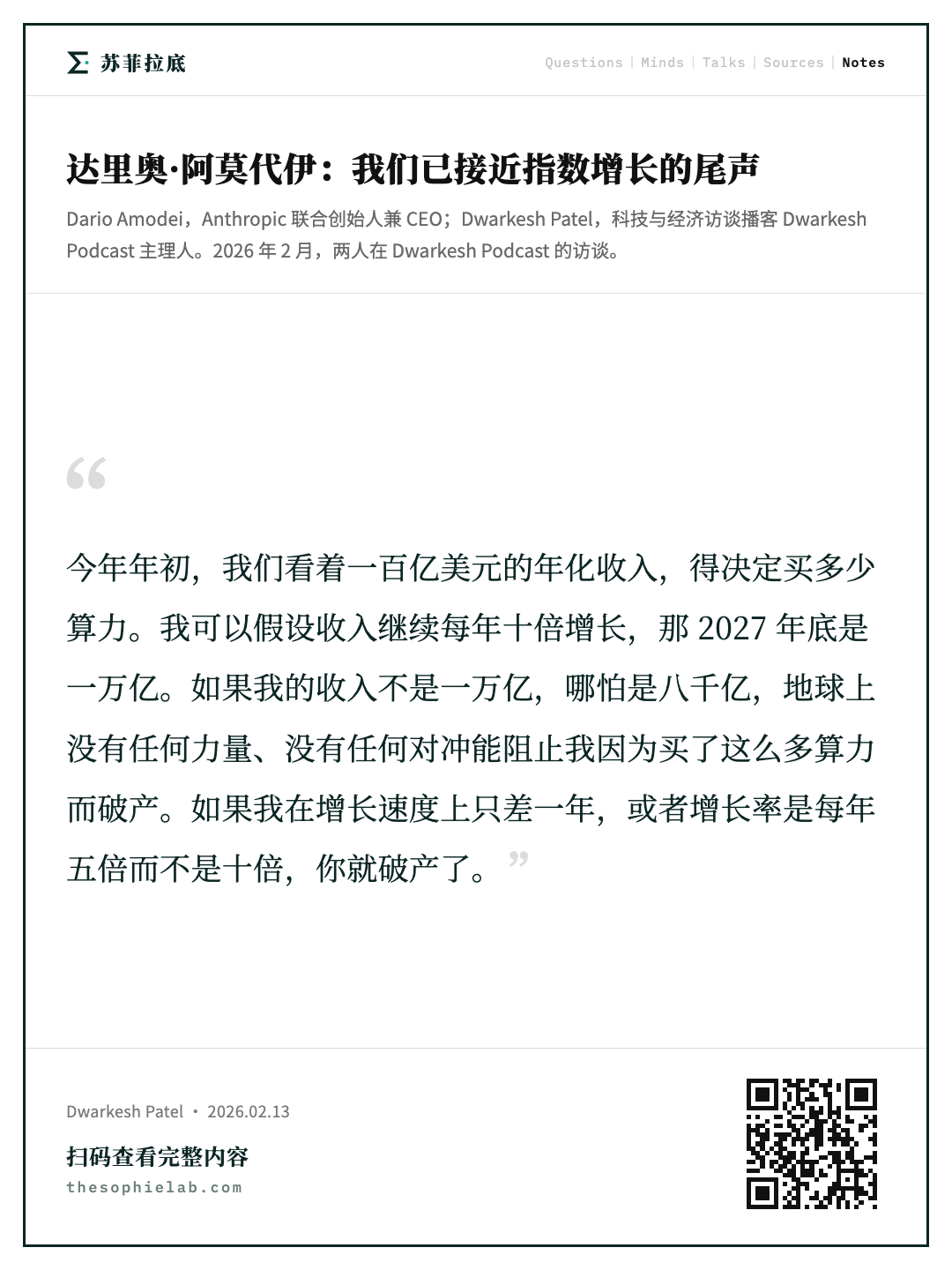
所以到了买数据中心的时候,我看的曲线是:我们每年都有十倍的增长。今年年初,我们看着一百亿美元的年化收入,得决定买多少算力。真正建成数据中心、预留数据中心,需要一两年。我实际上是在问:「2027 年我能拿到多少算力?」我可以假设收入继续每年十倍增长,那 2026 年底是一千亿,2027 年底是一万亿。实际上那会是五万亿美元的算力,因为一年一万亿,持续五年。我可以买一万亿美元从 2027 年底开始的算力。如果我的收入不是一万亿,哪怕是八千亿,地球上没有任何力量、没有任何对冲能阻止我因为买了这么多算力而破产。尽管我脑子里有一部分在想它会不会继续十倍增长,我也不能在 2027 年买每年一万亿美元的算力。如果我在增长速度上只差一年,或者增长率是每年五倍而不是十倍,你就破产了。

所以你最终处在一个支撑几千亿而不是几万亿的世界。你接受一些风险,即需求太大你撑不住收入;你也接受一些风险,即你判断错了,事情仍然很慢。我说「行事负责」,指的其实不是绝对数额。我们花得比其他一些玩家少一些,这是事实。我指的是别的:我们是不是深思熟虑过,还是在赌命式地说「这里投一千亿,那里投一千亿」?我的印象是,其他一些公司没有把电子表格写下来,他们并不真正理解自己在冒什么风险。他们只是因为听起来酷就去做了。我们认真考虑过。我们是企业业务,因此可以更多地依赖收入,它比消费者业务稳定。我们的利润率更好,这是买多和买少之间的缓冲。我认为我们买的量,足以让我们抓住相当强的上行世界。它抓不住完整的每年十倍,但事情得糟到相当程度我们才会陷入财务困境。所以我们仔细考虑过,做了这个平衡。这就是我说负责任的意思。

帕特尔:那么可能我们对「数据中心里的天才之国」的定义就是不一样的。因为我想到真正的人类天才,一个真正的人类天才之国在数据中心里,我会乐意买五万亿美元的算力来运行它。假设摩根大通或者 Moderna 之类的不想用他们,我有一个天才之国,他们会自己开公司。如果他们不能自己开公司,被临床试验卡住了……值得指出的是,大多数临床试验失败是因为药物没有疗效。

阿莫迪:我在《仁爱机器》里正好说了这一点,我说临床试验会比我们习惯的快得多,但不是无限快。

帕特尔:好,那假设临床试验要一年才能出结果,之后你才有收入去做更多的药。可是,你有一个天才之国,而你是一家 AI 实验室,你可以用多得多的 AI 研究员。你也认为聪明人做 AI 技术会带来自我强化的收益,你可以让数据中心去推动 AI 进展。每年买一万亿算力和买三千亿算力,收益差别大吗?如果你的对手在买一万亿,那就大。

阿莫迪:嗯,不,是有一些收益,但还是那句话,他们有可能在那之前就破产。只要差一年,你就毁了自己。这就是那个平衡。我们买了很多,买了非常多,买的量和这场游戏里最大的玩家相当。但如果你问我「为什么没签从 2027 年中开始的十万亿算力」……首先,造不出来,世界上没有那么多。其次,万一天才之国来了,但来的是 2028 年中而不是 2027 年中呢?你就破产了。

帕特尔:如果你的预测是一到三年,那你最晚到 2029 年似乎应该想要十万亿美元的算力?即便按你说的最长时间线,你们正在扩建的算力似乎也对不上。

阿莫迪:你为什么这么认为?

帕特尔:比如说人类工资的量级是每年五十万亿美元……

阿莫迪:我不谈 Anthropic 具体的情况,但谈行业的话,行业今年建设的算力大概是十到十五吉瓦,每年大约增长三倍。明年是三四十吉瓦,2028 年可能一百吉瓦,2029 年可能三百吉瓦。我心算一下,每吉瓦成本大概一百亿美元,每年一百到一百五十亿的量级。加在一起,你得到的差不多就是你描述的数字,完全一样。到 2028 或 2029 年,每年好几万亿,正是你预测的。

帕特尔:那是整个行业的。

阿莫迪:对,那是整个行业的。

帕特尔:假设 Anthropic 的算力保持每年三倍,到 2027、2028 年你们有十吉瓦。乘以你说的一百亿,那就是每年一千亿美元。可你说的是 2028 年的市场规模是两千亿。

阿莫迪:我还是不想给 Anthropic 的具体数字,但这些数字太小了。

利润、均衡与行业结构

帕特尔:好,有意思。你告诉投资者你们计划从 2028 年开始盈利。这正是我们可能得到数据中心里天才之国的年份,它将解锁医学、健康和新技术的所有进展。这不正是你想把钱再投回业务、建更大的「国家」、让它们做出更多发现的时候吗?

阿莫迪:盈利在这个领域是件挺怪的事。我不认为在这个领域,盈利真的衡量的是「消耗」与「再投资」之间的选择。我们来做个模型。我实际上认为,盈利发生在你低估了需求的时候,亏损发生在你高估了需求的时候,因为数据中心是提前买的。这么想:这些是程式化的事实,数字不精确,我只是做一个玩具模型。假设你一半的算力用于训练,一半用于推理。推理有超过百分之五十的毛利率。这意味着,如果你处在稳态,建了一个数据中心,并且确切知道会得到多少需求,你会得到一定的收入。假设你每年为算力付一千亿美元。其中五百亿支撑一千五百亿的收入,另外五百亿用于训练。你基本上是盈利的,赚五百亿的利润。这就是今天这个行业的经济结构,或者说不是今天,是我们预测一两年后的样子。唯一让它不成立的,是你得到的需求少于五百亿。那样你就有超过一半的数据中心用于研究,你不盈利。你训练出更强的模型,但你不盈利。如果需求比你想的多,研究就被挤压,但你能支撑更多推理,你就更盈利。也许我解释得不好,但我想说的是,你先决定算力总量,然后你对推理与训练的比例有个目标,但这个比例由需求决定,不由你决定。

帕特尔:我听到的是,你之所以预测会盈利,是因为你在系统性地对算力投资不足?

阿莫迪:不不不,我说的是这很难预测。关于 2028 年、关于什么时候会发生,那是我们向投资者尽力做出的判断。这一切都非常不确定,因为存在不确定性的锥体。如果收入增长够快,我们 2026 年就能盈利。如果我们高估或低估了下一年,结果可能剧烈摆动。我想说的是,你脑子里有一个模型:企业投资、投资、再投资,获得规模,然后盈利,存在一个单一的转折点。我不认为这个行业的经济结构是这样运作的。

帕特尔:明白了。如果我理解正确,你是说,由于我们本该拿到的算力和实际拿到的算力之间有差异,我们某种程度上是被迫盈利的。但这不意味着我们会持续盈利。我们会把钱再投进去,因为 AI 进展这么大,我们想要更大的天才之国。所以又回到收入很高、亏损也很高。

阿莫迪:如果每年我们都精确预测出需求,我们每年都会盈利。因为大约百分之五十的算力用于研究,加上高于百分之五十的毛利率,加上正确的需求预测,就会带来利润。我认为这个盈利的商业模式是存在的,只是被提前建设和预测误差遮住了。

帕特尔:我猜你把这个百分之五十当成给定的常数,可实际上,如果 AI 进展很快,而且你通过更大规模能加快进展,你就应该超过百分之五十,而不去盈利。

阿莫迪:但我要说的是,你可能想扩大它,可别忘了规模的对数回报。如果百分之七十只能通过一点四倍的因子让你得到一个稍好一点的模型……多出来的两百亿,每一美元对你的价值都小得多,因为是对数线性的设置。所以你可能发现,把那两百亿投在推理服务上,或者投在雇更擅长本职工作的工程师上更好。我说百分之五十,那不完全是我们的目标,不会正好是百分之五十,大概会随时间变动。我想说的是,对数线性回报导致的结果是,你花掉的是业务的一个「量级为一」的比例,不是百分之五,也不是百分之九十五。然后你就遇到递减回报。

帕特尔:我有点奇怪,我居然在说服达里奥相信 AI 进展。好,你不投研究是因为它有递减回报,但你投你提到的其他东西。我认为宏观层面的利润……

阿莫迪:再说一次,我讲的是递减回报,但那是在你每年已经花了五百亿之后。

帕特尔:我相信你也会这么说,可是天才的递减回报可能相当高。更一般地说,市场经济里的利润是什么?利润基本上是在说,市场里其他公司能用这笔钱做比我更多的事。

阿莫迪:把 Anthropic 放到一边,我不想给出 Anthropic 的信息,所以我才给这些程式化的数字。我们来推导行业的均衡。为什么不是每家都把百分之百的算力用于训练、一个客户也不服务?因为如果他们没有任何收入,就融不到资,做不了算力交易,明年就买不到更多算力。所以会存在一个均衡,每家公司在训练上花的都少于百分之百,在推理上花的当然也少于百分之百。为什么你不能只服务当前模型、永远不再训练新模型,这也很清楚,因为那样你就没有需求了,你会落后。所以存在某个均衡,不会是百分之十,也不会是百分之九十。就当它是百分之五十吧,这是我想说的。我认为我们会处在这样的位置:训练上花费的均衡比例,低于你在算力上能获得的毛利率。所以底层的经济结构是盈利的。问题是,你在购买下一年算力时面临地狱般的需求预测问题:你可能猜低了,非常盈利,但没有算力做研究;也可能猜高了,不盈利,但拥有世界上所有做研究的算力。这说得通吗?作为行业的动态模型?

帕特尔:也许退一步说,我不是说我认为「天才之国」两年内会来,所以你该买这些算力。你得出的最终结论在我看来很有道理,但那是因为「天才之国」看起来很难,路还很长。所以退一步,我想说的是,你的世界观似乎与这样的人相容:「我们离每年产生数万亿美元价值的世界还有十年。」

阿莫迪:那不是我的观点。所以我再做一个预测。我很难想象 2030 年之前不会有数万亿美元的收入。我可以构造一个合理的世界,它可能要三年,那是我认为合理范围的末端。比如 2028 年,我们得到真正的「数据中心里的天才之国」,收入到 2028 年进入几千亿的低段,然后天才之国把它加速到数万亿。我们基本处于扩散的慢端,用两年到达数万亿。那就是要到 2030 年的世界。我猜即使把技术指数和扩散指数叠加起来,我们也会在 2030 年之前到达。

帕特尔:所以你铺陈了一个模型,Anthropic 盈利是因为我们从根本上处在一个算力受限的世界。那么最终我们不断增加算力……

阿莫迪:我认为利润是这样来的……我们把整个行业抽象出来,想象我们在经济学教科书里。有少数几家公司,每家能投的资金有限,每家把一部分投入研发,服务有一定的边际成本。这个边际成本上的毛利率很高,因为推理是高效的。有一些竞争,但模型也是有差异的。公司会竞相抬高研发预算。但因为玩家数量少,我们得到……叫什么来着?我想是古诺均衡(Cournot equilibrium),少数厂商的那种均衡。重点是,它不会均衡到零利润的完全竞争。如果经济里有三家公司,各自独立地理性行事,它不会均衡到零。

帕特尔:帮我理解一下,因为现在我们确实有三家领先的公司,它们都不盈利。变化的是什么?

阿莫迪:再说一次,现在的毛利率是很正的。正在发生的是两件事的叠加。一是我们仍处在算力指数级扩张的阶段。一个模型训练出来,假设去年训练的一个模型花了十亿美元,今年它产生了四十亿收入,推理成本十亿。用程式化的数字,这是百分之七十五的毛利率,加上百分之二十五的「税」。所以这个模型整体赚了二十亿。但与此同时,我们在花一百亿训练下一个模型,因为存在指数级扩张。所以公司亏钱。每个模型都赚钱,但公司亏钱。我说的均衡,是一个我们已经有了「数据中心里的天才之国」、但模型训练的扩张已经更趋均衡的状态。也许还在涨,我们还在试图预测需求,但更平稳了。

帕特尔:有几点我不明白。先从当下的世界说起。你说得对,把每个单独的模型当成一家公司,它是盈利的。但作为前沿实验室,生产函数的一大部分就是训练下一个模型,对吧?

阿莫迪:对,没错。如果你不做,你会盈利两个月,然后就没有利润率了,因为你没有最好的模型。但在某个时点,它会达到能达到的最大规模。然后在均衡状态下,我们有算法改进,但训练下一个模型花的钱和训练当前模型花的差不多。到某个时候,经济里的钱就用完了。

帕特尔:这是「劳动总量固定谬误」……经济会增长的,对吧?这是你的预测之一。我们会把数据中心建到太空里。

阿莫迪:对,但这是我一直在说的主题的另一个例子。有了 AI,经济的增长会比历史上任何时候都快得多。现在算力每年增长三倍,我不相信经济会每年增长百分之三百。我在《仁爱机器》里说过,我认为经济可能有每年百分之十到二十的增长,但不会有百分之三百。所以最终,如果算力成为经济产出的大头,它会被这个上限卡住。

帕特尔:那我们假设一个算力被卡住的模型。前沿实验室赚钱的世界,是它们持续快速进步的世界。因为从根本上说,你的利润率受限于替代品有多好。你能赚钱是因为你有前沿模型,没有前沿模型你就赚不了钱。所以这个模型要求永远不存在稳态,永永远远你都得做出更多算法进步。

阿莫迪:我不这么认为。我感觉我们像在上经济学课。

帕特尔:你知道泰勒·考恩(Tyler Cowen)那句话吗?我们从不停止谈论经济学。

阿莫迪:确实从不停止。不,我不认为这个领域会变成垄断。我的律师从来不想让我说「垄断」这个词。但我不认为这个领域会是垄断。确实有一些行业只有少数几个玩家,不是一个,而是少数几个。通常,像 Facebook 或者 Meta(我总叫它 Facebook)那样的垄断,来自网络效应。而少数几个玩家的行业,来自极高的进入成本。云计算就是这样,我认为云是个好例子。云里有三家,也许四家玩家。我认为 AI 也一样,三家,也许四家。原因是它太贵了。运营一家云公司需要极多的专业知识和资本。你得投入所有这些资本,除此之外,你还得把其他一大堆需要很高技巧的事情做成。所以如果你去找人说「我想颠覆这个行业,给我一千亿美元」,对方会说:「好,我投一千亿,同时还在赌你能做成这些人一直在做的所有其他事。」而结果只是把利润降下来。你进入的效果就是利润率下降。所以经济里到处都有这种均衡,少数几个玩家,利润不是天文数字,利润率也不是天文数字,但不是零。这就是我们在云里看到的。云的差异化很小,模型比云差异化得多。大家都知道 Claude 擅长的东西和 GPT 擅长的不一样,和 Gemini 擅长的也不一样。不只是 Claude 擅长编程、GPT 擅长数学和推理那么简单,比这微妙得多。各个模型擅长不同类型的编程,有不同的风格。我认为它们彼此之间确实很不一样,所以我预期会比云有更多的差异化。

不过确实有一个反论。如果生产模型的过程本身可以由 AI 模型来完成,那这种能力会扩散到整个经济。但那不是一个把 AI 模型普遍商品化的论证,而是一个把整个经济同时商品化的论证。我不知道在那个世界里会发生什么,基本上任何人能做任何事,任何人能造任何东西,任何东西周围都没有护城河。我不知道,也许我们想要那个世界,也许那就是终局。也许当 AI 模型能做一切、我们又解决了所有安全和安保问题的时候,那是经济重新把自己拉平的机制之一。但那已经远在「数据中心里的天才之国」之后了。

帕特尔:也许更精细的说法是:第一,AI 研究似乎特别依赖纯粹的智力,而这在 AGI 的世界里会特别充裕;第二,看今天的世界,很少有技术像 AI 算法进步那样扩散得这么快。这确实暗示这个行业在结构上是扩散性的。

阿莫迪:我认为编程走得快,但 AI 研究是编程的超集,它有些方面走得并不快。不过我确实认为,一旦我们拿下编程,一旦 AI 模型走快了,那会加快 AI 模型做其他一切的能力。所以虽然现在是编程走得快,我认为一旦 AI 模型在构建下一代 AI 模型、在构建其他一切,整个经济会以差不多同样的步伐前进。不过我担心地理上的问题。我有点担心,仅仅是离 AI 近、听说过 AI,就可能成为一个分化因素。所以我说百分之十到二十的增长率时,我的一个担心是,增长率在硅谷和那些与硅谷有社会联系的地方可能是百分之五十,而在其他地方比现在快不了多少。我认为那会是一个相当糟糕的世界。所以我经常思考的一件事,就是怎么防止这种情况。

机器人与下一道障碍

帕特尔:你认为一旦我们有了数据中心里的天才之国,机器人问题会很快随之解决吗?因为机器人的一大问题似乎是,人能学会遥控现有的硬件,而现在的 AI 模型不能,至少不能以高效的方式做到。如果我们有了这种像人一样学习的能力,它不该立刻把机器人也解决了吗?

阿莫迪:我不认为这取决于像人一样学习。它可能以不同的方式发生。同样,我们可以让模型在许多不同的电子游戏上训练,它们类似机器人控制;或者在许多不同的模拟机器人环境上训练;或者只是训练它们控制电脑屏幕,然后它们学会泛化。所以它会发生,但不一定依赖类人的学习。类人学习是它可能发生的一种方式。如果模型能「哦,我拿起一个机器人,不会用,我学一下」,那可能是因为我们发现了持续学习。也可能是因为我们在一堆环境上训练了模型然后泛化了,或者因为模型在上下文长度内学会了。哪种方式其实不重要。回到我们一小时前的讨论,这类事情可以通过几种不同的方式发生。但我确实认为,不管出于什么原因,一旦模型有了这些技能,机器人领域就会被彻底改变,既包括机器人的设计,因为模型在这方面会比人强得多,也包括控制机器人的能力。所以我们会更擅长造物理硬件、造物理机器人,也更擅长控制它。那么,这是否意味着机器人行业也会产生数万亿美元的收入?我的答案是会,但会有同样极快又不是无限快的扩散。机器人会被革命吗?会,也许再加一两年。我就是这样看这些事的。

帕特尔:说得通。对极快的进展普遍存在怀疑。我的看法是这样。听起来你们会在几年内以某种方式解决持续学习。但正如几年前人们不谈持续学习,后来我们意识到「哦,为什么这些模型明明通过了图灵测试、在这么多领域是专家,却没有它们本可以那么有用?也许是这个东西。」然后我们解决了这个东西,又发现,其实人类智能还有另一样东西,是人类劳动的基础,而这些模型做不到。为什么不认为还会有更多这样的事,我们会发现人类智能还有更多组成部分?

阿莫迪:说清楚一点,我之前说过,我认为持续学习可能根本不是障碍。我们可能仅靠预训练泛化和强化学习泛化就到了。这东西可能根本不存在。事实上,我可以指出机器学习的历史:人们提出各种障碍,最后都在这一大块算力里消解了。人们说过「你的模型怎么跟踪名词和动词」,「它们能在句法上理解,但不能在语义上理解,只是统计相关」,「你能理解一段话,理解不了一个词」,「推理,你做不了推理」。然后突然间,它把代码和数学做得非常好。所以我认为,更强的历史记录是,这些东西看起来是大事,然后消解掉了。有些是真的。对数据的需求是真的,持续学习也许是真的。但我还是要用代码这样的东西来锚定我们的讨论。我认为一两年内我们可能到达模型能端到端做软件工程的地步。那是一整项任务,是人类活动的一整个领域,我们说模型现在能做了。

帕特尔:你说端到端,是指设定技术方向、理解问题的上下文等等?

阿莫迪:是的,我指所有这些。

帕特尔:有意思。我觉得那是「AGI 完全」的,这也许在内部是自洽的。但它和说百分之九十的代码或者百分之百的代码不是一回事。

阿莫迪:不是,我给了这条谱系:百分之九十的代码,百分之百的代码,百分之九十的端到端软件工程,百分之百的端到端软件工程。软件工程师会有新任务被创造出来,最终那些也会被做掉。这是一条很长的谱系,但我们在飞快地穿过它。

帕特尔:我觉得挺好笑的,我看过你做的几期播客,主持人会说「可是德瓦凯什写了那篇关于持续学习的文章」。这总让我忍不住笑,因为你做了十年 AI 研究员。我想你肯定有那种感觉:「好吧,一个播客主写了篇文章,我每次采访都被问到它。」

阿莫迪:事实是,我们都在一起摸索这件事。有些方面我能看到别人看不到的东西。如今这更多是因为我在 Anthropic 内部看到一大堆情况、必须做一大堆决定,而不是因为我有什么别人没有的伟大研究洞见。我在管一家两千五百人的公司。要我有具体的研究洞见其实相当难,比十年前难得多,甚至比两三年前也难得多。

定价模式与 Claude Code

帕特尔:在我们走向一个完全可以即插即用的远程员工替代品的世界时,API 定价模式还是最合理的吗?如果不是,给 AGI 定价、提供 AGI 的正确方式是什么?

阿莫迪:我认为会有一堆不同的商业模式同时被试验。我确实认为 API 模式比很多人想的更持久。我的一种思路是,如果技术在快速推进,指数级地推进,那意味着永远存在一片过去三个月里刚开发出来的新用例的表面。你放上去的任何产品表面,都随时有变得无关紧要的风险。任何一个产品表面,大概只对模型能力的某个区间有意义。聊天机器人已经碰到了局限:把它做得更聪明,对普通消费者帮助不大。但我不认为这是 AI 模型的局限,不认为这是「模型已经够好、再变好对经济没意义」的证据。它只是对那个特定产品没意义。所以 API 的价值在于,它永远提供一个非常接近裸机的机会,去基于最新的东西构建。永远会有一波新的初创公司和新想法,几个月前不可能,现在因为模型进步而可能了。我预测它会和其他模式并存,但我们永远会有 API 这种商业模式,因为永远会需要一千个不同的人用不同方式去试验模型。其中一百个变成初创公司,十个变成成功的大公司,两三个最终成为人们使用那一代模型的方式。所以我基本上认为它会永远存在。

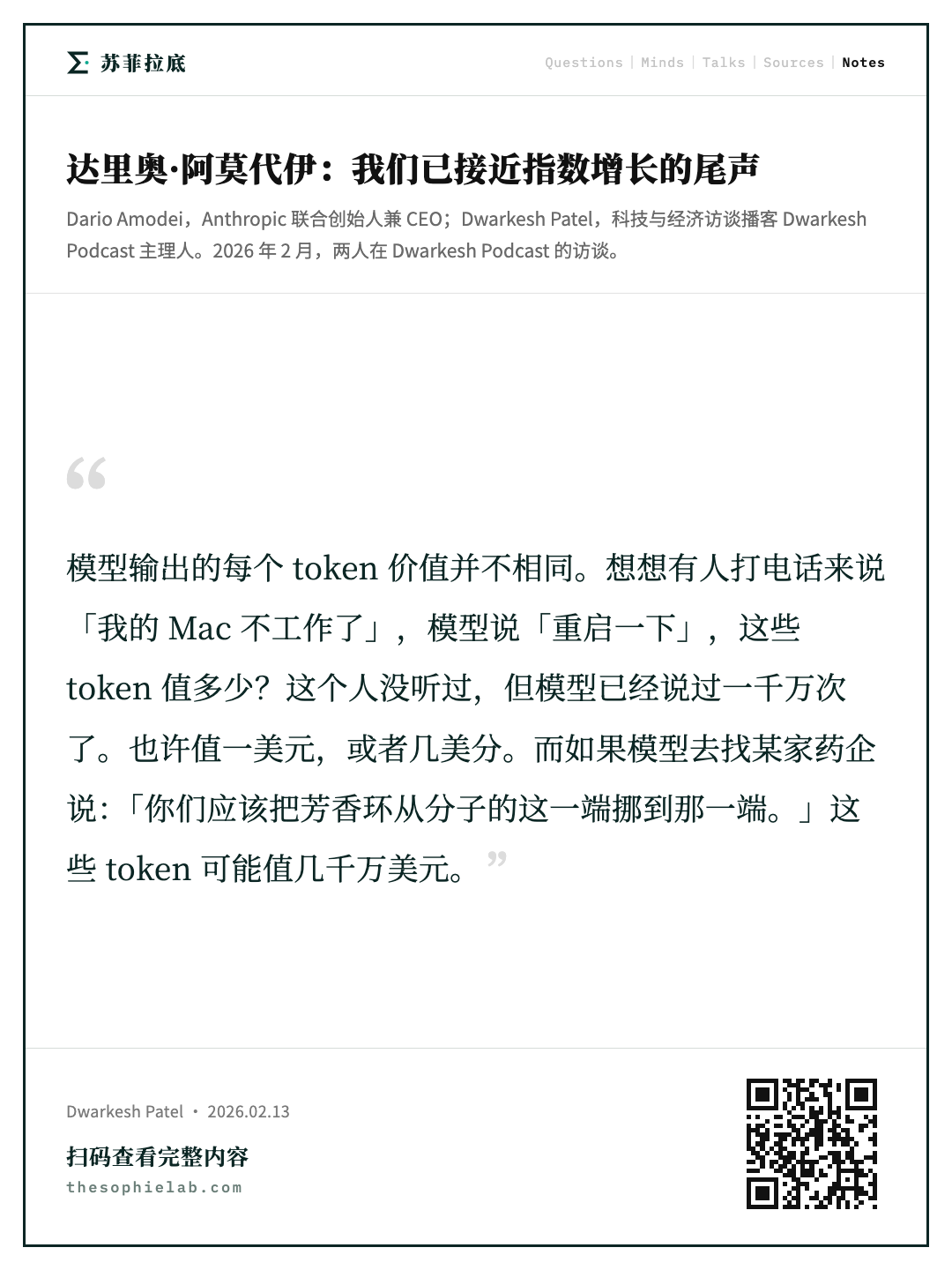
同时,我确信也会有其他模式。模型输出的每个 token 价值并不相同。想想有人打电话来说「我的 Mac 不工作了」,模型说「重启一下」,这些 token 值多少?这个人没听过,但模型已经说过一千万次了。也许值一美元,或者几美分。而如果模型去找某家药企说:「哦,你们在开发的这个分子,你们应该把芳香环从分子的这一端挪到那一端。这么做会有奇妙的效果。」这些 token 可能值几千万美元。所以我认为我们肯定会看到承认这一点的商业模式。到某个时候我们会看到某种形式的「按结果付费」,或者可能看到类似劳动报酬的形式,按小时计费。我不知道。因为这是个新行业,很多东西都会被尝试。我不知道最后哪个是对的。

帕特尔:我接受你的观点,人们得不断尝试,才能弄清用这块智能的最佳方式。但让我惊讶的是 Claude Code。我不认为初创公司史上有哪个应用像编程智能体这样竞争激烈,而 Claude Code 是这个品类的领先者。这在我看来很意外。Anthropic 不是天生就该造这个东西的。你有没有一个解释,为什么必须是 Anthropic,或者 Anthropic 是怎么在底层模型之外又做出一个成功应用的?

阿莫迪:其实过程很简单。我们有自己的编程模型,编程能力不错。2025 年初前后,我说:「我认为时候到了,如果你是一家 AI 公司,用这些模型可以对自己的研究产生不小的加速。」当然,你需要一个界面,需要一个使用它们的框架。所以我在内部鼓励大家。我没说这是你们必须用的东西,只说大家应该试试。我记得它最初叫 Claude CLI,后来名字改成了 Claude Code。在内部,它是所有人都在用的东西,内部采用得很快。我看了看,说:「我们大概该对外发布了吧?」它在 Anthropic 内部采用得这么快,编程又是我们的大量工作。我们有好几百人的受众,某种程度上至少能代表外部受众。看起来我们已经有了产品市场契合,那就发布吧。然后我们就发布了。我认为正是因为我们自己在开发模型,自己知道最需要怎么用模型,形成了这样一个反馈回路。

帕特尔:明白了。就是说,比如 Anthropic 的一个开发者觉得「啊,如果它在 X 这件事上更好就好了」,然后你们就把它烤进下一个模型里。

阿莫迪:那是其中一种,但还有普通的产品迭代。Anthropic 内部有一群程序员,他们每天用 Claude Code,所以我们能得到快速反馈。这在早期更重要。现在当然有几百万人在用,我们也能得到大量外部反馈。但能得到快速的内部反馈实在太好了。我想这就是我们发布了编程模型、而没有开一家药企的原因。我的背景是生物学,但我们没有开药企所需的任何资源。

多 AI 世界的治理架构

帕特尔:现在让我问问怎么让 AI 走向好的结局。看起来,我们对 AI 走向好结局的任何愿景,都得与两件事相容:第一,构建和运行 AI 的能力正在极快地扩散;第二,AI 的数量,我们拥有多少个,以及它们的智能,��会极快地增长。这意味着很多人能构建大量未对齐的 AI,或者那些只是想扩大自己版图的公司型 AI,或者像必应的 Sydney 那样心智怪异、但现在是超人的 AI。在一个有很多不同 AI、其中一些未对齐的 AI 四处游走的世界里,什么样的均衡是可能的?

阿莫迪:我在《技术的青春期》里对「权力平衡」持怀疑态度。但我具体怀疑的是这个:三四家公司都在构建源自同一种东西的模型,指望它们相互制衡,或者指望任何数量的它们相互制衡。我们可能生活在一个进攻占优的世界,一个人或一个 AI 模型聪明到能做出对其他一切造成损害的事。短期内,我们的玩家数量有限,所以可以从这有限的玩家开始。我们需要把保障措施放到位,需要确保每家都做正确的对齐工作,确保每家都有生物分类器。这些是眼下需要做的事。我同意这解决不了长期问题,尤其是如果 AI 模型制造其他 AI 模型的能力扩散开来,整件事会变得更难解决。我认为长期来看我们需要某种治理架构。一种既能保护人类自由,又能让我们治理数量极大的人类系统、AI 系统、人机混合公司或经济单元的治理架构。所以我们要考虑:怎么保护世界免受生物恐怖主义?怎么保护世界免受镜像生命的威胁?我们大概需要某种 AI 监测系统,监测所有这些东西。但我们得以保护公民自由和宪法权利的方式来建它。所以就像其他任何事一样,这是一个新的安全格局,有一套新工具,也有一套新漏洞。我担心的是,如果我们有一百年让这一切慢慢发生,我们会习惯的。我们已经习惯了社会里有炸药,有各种新武器,有摄像头。一百年里我们会习惯它,会发展出治理机制,会犯错。我担心的只是这一切发生得太快了。所以也许我们得更快地思考怎么让这些治理机制运转。

帕特尔:看起来在一个进攻占优的世界里,在接下来一个世纪的进程中(你的想法是 AI 让本该在下一个世纪发生的进步压缩在五到十年内发生),我们仍然需要同样的机制,或者说权力平衡同样难以实现,哪怕人类是场上唯一的玩家。我想我们有 AI 的建议。但从根本上说,这似乎不是一个完全不同的游戏。如果制衡能奏效,它对人类也能奏效;如果不能奏效,对 AI 也不能。所以这也许同样宣判了人类制衡的死刑。

阿莫迪:我还是认为有办法让它发生。世界各国政府可能得合作才能做到。我们可能得和 AI 谈,以某种方式构建社会结构,使这些防御成为可能。我不知道。我不想说这在时间上有多遥远,但它在技术能力上太超前了,而且可能在很短的时间内发生,所以我们很难提前预见它。

州法拼图与联邦禁令

帕特尔:说到政府介入,12 月 26 日,田纳西州议会提出了一项法案,说「任何人故意训练人工智能提供情感支持,包括通过与用户的开放式对话,都构成犯罪」。当然,Claude 试图做的事情之一,就是做一个体贴、博学的朋友。总的来说,我们似乎会有这样一张各州法律的拼图。普通人本可以从 AI 中获得的许多好处会被削减,尤其是当我们进入你在《仁爱机器》里讨论的那些领域:生物自由,心理健康的改善等等。很容易想象这些被各种法律像打地鼠一样一个个打掉,而这类法案根本没有触及你关心的真正的生存威胁。在这样的背景下,我想理解 Anthropic 反对联邦暂停州级 AI 法律的立场。

阿莫迪:这里同时有好几件事。我认为那条法律很蠢。它显然出自一些立法者之手,他们大概根本不知道 AI 模型能做什么、不能做什么。他们的想法是「AI 模型服务我们,这听起来就吓人,我不想让它发生」。我们不赞成那条法律。但那不是被投票的东西。被投票的是:我们要禁止所有州级 AI 监管十年,而且看不出有任何做联邦监管的计划,那需要国会通过,门槛非常高。所以这个「禁止各州十年内做任何事」的想法……有人说他们对联邦政府有计划,但桌上没有任何实际提案,没有任何实际尝试。考虑到我在《技术的青春期》里列出的严重危险,生物武器、生物恐怖主义、自主性风险,以及我们一直在谈的时间线,十年是永恒,我认为那是件疯狂的事。所以如果这是选择,如果你逼我们这样选,我们会选择不要这个暂停令。我认为这个立场的收益超过代价,但如果选择只有这样,它也不是一个完美的立场。

我认为我们应该做的,我会支持的,是联邦政府介入,不是说「各州你们不能监管」,而是说「我们要这么做,各州不能与此不同」。在联邦政府说「这是我们的标准,适用于所有人,各州不能另搞一套」的意义上,优先适用是可以的。如果以正确的方式来做,这是我会支持的。但「各州你们什么都不能做,我们也什么都不做」这种想法,在我们看来非常不合理。我认为它经不起时间考验,从你看到的反弹来看,它已经开始经不起考验了。至于我们想要什么,我们谈过的是从透明度标准开始,用来监测这些自主性风险和生物恐怖主义风险。随着风险变得更严重,随着我们获得更多证据,我认为我们可以在一些有针对性的方面更激进,说:「嘿,AI 生物恐怖主义确实是威胁,我们通过一条法律,强制人们部署分类器。」我甚至可以想象……这取决于威胁最后有多严重。我们并不确定。我们得以智力上诚实的方式推进,提前说清楚:风险还没有出现。但以现在的速度,我完全可以想象这样一个世界:今年晚些时候我们说:「嘿,这个 AI 生物恐怖主义的事真的很严重,我们该做点什么,该把它写进联邦标准。如果联邦政府不行动,就写进州标准。」我完全可以想象。

帕特尔:我担心的是这样一个世界:考虑到你预期的进展速度,考虑到立法的生命周期……好处因为你说的扩散滞后来得够慢,我真的认为按目前的轨迹,这张州法拼图会禁止……如果有一个提供情感陪伴的聊天机器人朋友就能把人吓成这样,想象一下我们希望普通人能体验到的 AI 的真正好处:健康和健康寿命的改善,心理健康的改善等等。而与此同时,你似乎认为危险已经在地平线上了,我却看不到多少……在我看来,这对 AI 的好处的伤害,会远大于对 AI 的危险的遏制。所以这大概是成本收益在我看来不太成立的地方。

阿莫迪:这里有几点。人们说有几千条这样的州法。首先,绝大多数都通不过。世界在理论上以某种方式运作,但一条法律通过了,不意味着它真的被执行。执行的人可能会说:「天哪,这太蠢了,这意味着要关掉田纳西州建过的一切。」法律很多时候会被以一种不那么危险、不那么有害的方式解释。当然,反过来,如果你通过一条法律去阻止一件坏事,你也得担心同样的问题。我的基本看法是,如果由我们来决定通过什么法律、怎么执行(而我们只是其中一个很小的输入),我会大幅放松围绕 AI 健康益处的监管。我不那么担心聊天机器人法案。我其实更担心药物审批流程,我认为 AI 模型会大大加快我们发现药物的速度,而管道会堵住。管道没有准备好处理流经它的所有东西。我认为监管流程的改革应该更多地考虑这一点:我们将有大量东西涌来,它们的安全性和有效性会非常清晰、明确,是美好的、真正有效的东西。也许我们不需要围绕它的那整套上层建筑,那是为一个药物勉强有效、常有严重副作用的时代设计的。

与此同时,我认为我们应该相当显著地加强安全和安保方面的立法。正如我说的,从透明度开始,这是我在尝试不妨碍行业、寻找正确平衡的看法。我对此是担心的。有人批评我的文章说:「这太慢了。如果我们这么做,AI 的危险来得太快。」基本上,我认为过去六个月和接下来几个月是关于透明度的。然后,如果这些风险出现,当我们更确定它们的时候,我认为最快今年晚些时候就可能,那么我们需要在真正看到风险的领域非常快速地行动。我认为唯一的办法是灵活。立法过程通常不灵活,但我们需要向所有相关的人强调这件事的紧迫性。这就是我在传递紧迫感的原因,这就是我写《技术的青春期》的原因。我希望政策制定者、经济学家、国家安全专业人士和决策者读它,这样他们才有希望比原本更快地行动。

帕特尔:你能做什么或者倡导什么,来让 AI 的好处更确定地落地?我感觉你和立法机构合作过:「好,我们在这里防止生物恐怖主义,我们要增加透明度,我们要增加对吹哨人的保护。」但我认为在默认情况下,我们期待的那些实际好处,在各种道德恐慌或政治经济问题面前显得非常脆弱。

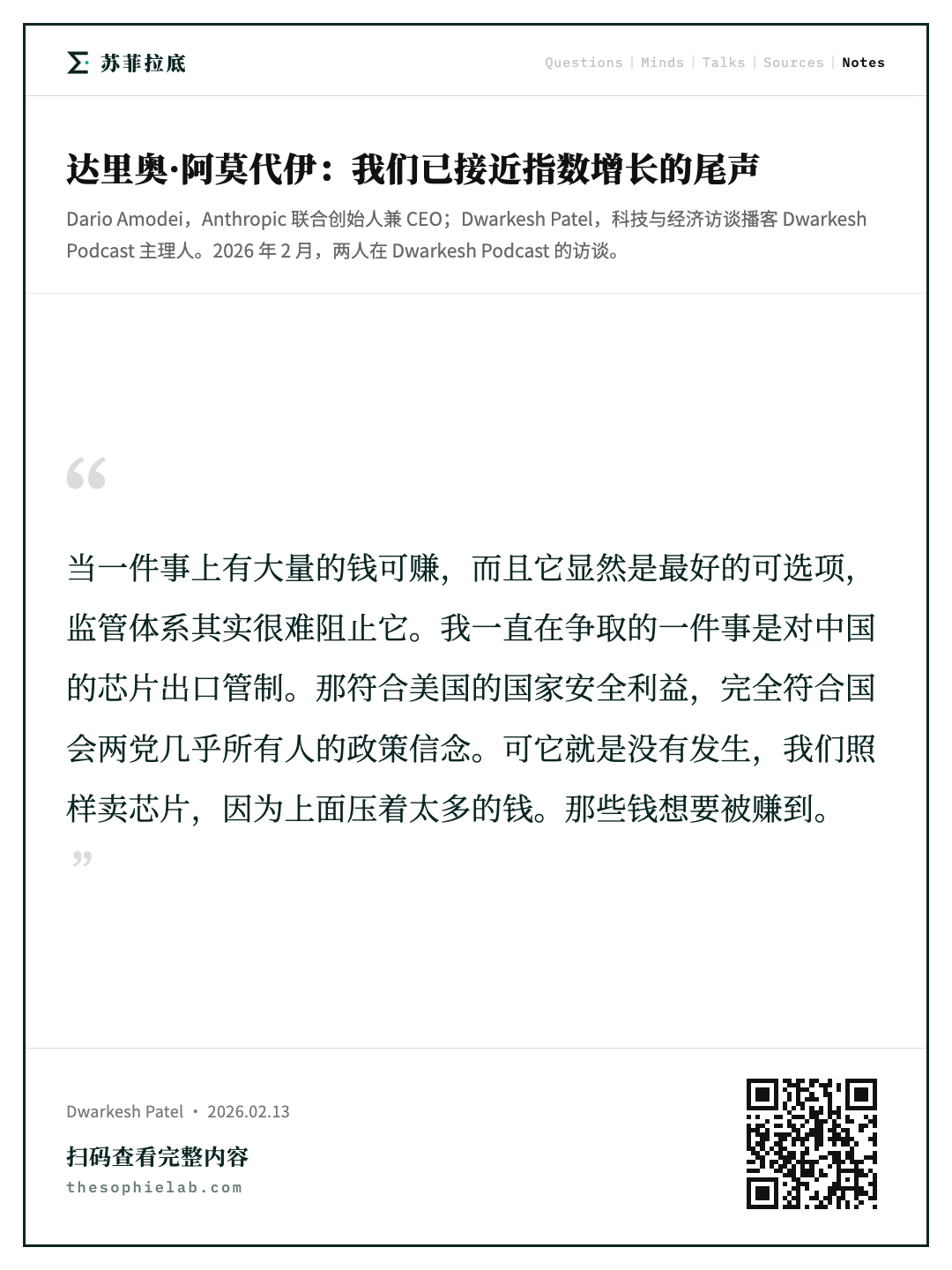
阿莫迪:就发达世界而言,我不太同意。我觉得在发达世界,市场运转得相当好。当一件事上有大量的钱可赚,而且它显然是最好的可选项,监管体系其实很难阻止它。我们在 AI 本身上就看到了这一点。我一直在争取的一件事是对中国的芯片出口管制。那符合美国的国家安全利益,完全符合国会两党几乎所有人的政策信念。理由非常清楚。反对的论点,我客气地称之为「可疑」。可它就是没有发生,我们照样卖芯片,因为上面压着太多的钱。那些钱想要被赚到。在那个例子里,我认为那是坏事。但同样的道理在好事上也成立。所以如果我们谈的是药物和技术的好处,我不那么担心这些好处在发达世界受阻。我有点担心它们走得太慢。正如我说的,我确实认为我们应该努力加快 FDA 的审批流程。我确实认为我们应该反对你描述的这些聊天机器人法案。单独来看,我反对它们,我认为它们很蠢。但我其实认为更大的担忧是发展中世界,那里没有运转良好的市场,而且我们常常无法在已有的技术上继续构建。我更担心那些人被落下。我也担心即便治愈方法开发出来了,密西西比农村的某个人可能也得不到。这是我们对发展中世界的担忧的一个缩小版。所以我们一直在做的,是和慈善家合作。我们和那些向发展中世界(撒哈拉以南非洲、印度、拉丁美洲和其他发展中地区)输送药物和健康干预的人合作。我认为这是不会自己发生的事。

出口管制与威权风险

帕特尔:你提到了出口管制。为什么美国和中国不应该各自拥有一个「数据中心里的天才之国」?

阿莫迪:你是问为什么不会发生,还是为什么不应该发生?

帕特尔:为什么不应该发生。

阿莫迪:如果这真的发生,可能有几种情形。如果是进攻占优的局面,我们可能得到类似核武器但更危险的局面,任何一方都能轻易毁掉一切。我们也可能得到一个不稳定的世界。核均衡是稳定的,因为有威慑。但假设对于「如果两个 AI 打起来,哪个会赢」存在不确定性,那就会造成不稳定。当双方对自己获胜的可能性有不同评估时,冲突往往发生。如果一方说「哦,我有百分之九十的胜算」,另一方也这么想,打起来的可能性就大得多。他们不可能都对,但可以都这么想。

帕特尔:但这似乎是一个反对 AI 技术扩散的完全一般性的论证。那是这个世界的含义。

阿莫迪:让我继续说,因为我认为扩散最终会发生。我的另一个担忧是政府会用 AI 压迫本国人民。我担心这样一个世界:一个国家的政府已经在建设高科技威权国家。说清楚,这是关于政府的,不是关于人民的。我们需要找到让各地人民都受益的办法。我在这里的担忧是关于政府的。我担心的是,如果世界被切成两块,其中一块可能是威权的或极权的,而且极难被取代。那么,各国政府最终会不会得到强大的 AI,是否存在威权主义的风险?会,存在。各国政府最终会不会得到强大的 AI,是否存在糟糕均衡的风险?会,存在。我认为两者都是。但初始条件很重要。到某个时候,我们需要制定游戏规则。我不是说某一个国家,无论是美国还是民主国家联盟(我认为后者是更好的安排,尽管它需要比我们目前似乎愿意做的更多的国际合作),应该直接说「这就是游戏规则」。会有某种谈判。世界得去应对这件事。我想要的是,当游戏规则被制定时,世界上的民主国家,那些政府更接近代表亲人类价值观的国家,手里握着更强的牌,有更多的筹码。所以我非常关心那个初始条件。

帕特尔:我重听了三年前的访谈,它有一个地方经不起时间考验,就是我一直在提问时假设两三年后会有某个关键的支点时刻。实际上,走到这么远之后,看起来只是进展在继续,AI 在改进,AI 扩散得更广,人们用它做更多事。你似乎在想象一个未来的世界,各国坐到一起:「这是游戏规则,这是我们的筹码,这是你们的筹码。」但按目前的轨迹,每个人都会有更多 AI。其中一些 AI 会被威权国家使用。威权国家内部的一些 AI 会被私人行动者使用,另一些被国家行动者使用。谁受益更多并不清楚,事先总是无法预测。互联网似乎比你预期的更有利于威权国家,也许 AI 会反过来。我想更好地理解你在想象什么。

阿莫迪:说精确一点,我认为底层技术的指数会像以前一样继续。模型越来越聪明,即使到了「数据中心里的天才之国」,我认为你还能继续让模型更聪明。有一个问题是它们在世界上的价值会有递减回报。在你已经解决了人类生物学之后,还有多重要?到某个时候你能做更难、更深奥的数学题,但在那之后没什么重要的了。撇开这个不谈,我确实认为指数会继续,但指数上会有某些特别的点。公司、个人和国家会在不同的时间到达那些点。我在《技术的青春期》里谈过:核威慑在 AI 的世界里还稳定吗?我不知道,但那是我们习以为常的东西的一个例子。技术可能达到这样的水平,我们再也不能确定它。再想想别的。有些点是,如果你达到某个水平,也许你就有了进攻性网络主导权,此后每一个计算机系统对你都是透明的,除非对方有同等的防御。我不知道关键时刻是什么,或者是否有单一的关键时刻。但我认为会有一个关键时刻,或者少数几个关键时刻,或者某个关键窗口,在其中 AI 从国家安全的角度带来某种巨大优势,而某个国家或联盟比其他国家先到达了。我不是在主张他们就此说「好,现在我们说了算」。我不是这么想的。对方总在追赶,有些极端行动你不愿意采取,而且完全控制本身也不对。但到那件事发生时,人们会明白世界变了。会有某种谈判,隐性或显性的,关于 AI 之后的世界秩序是什么样子。我的兴趣在于,让那场谈判成为古典自由民主手握强牌的谈判。

帕特尔:我想弄清这到底意味着什么,因为你在文章里说:「在强大 AI 之后的时代,专制根本不是一种人们能够接受的政府形式。」这听起来像是在说,中共作为一个机构在我们得到 AGI 之后不能存在。这似乎是一个非常强的要求,而且似乎暗示了一个世界,领先的实验室或领先的国家将能够,而且按那种措辞,应该有权决定世界如何被治理,哪些政府是被允许的,哪些不是。

阿莫迪:我记得那一段说的是类似「你甚至可以走得更远,说 X」这样的话。我并不一定是在支持那个观点。我说的是:「这是我相信的一个较弱的东西:我们得非常担心威权者,应该努力制衡他们、限制他们的权力。你可以把这推得更远,持一种更干预主义的观点,认为拥有 AI 的威权国家是很难被取代的自我实现的循环,所以你需要从一开始就把它们除掉。」那正好有你说的所有问题。如果你承诺推翻每一个威权国家,它们现在就会采取一堆可能导致不稳定的行动。那可能根本做不到。但我确实支持的那一点是:很有可能……今天,我的观点,以及西方世界大多数人的观点,是民主是比威权更好的政府形式。但如果一个国家是威权的,我们不会像它犯下种族灭绝那样去反应。我想说的是,我有点担心在 AGI 的时代,威权主义会有不同的含义,会是更严重的事情。我们得以某种方式决定如何处理它。干预主义的观点是一种可能的观点,我在探索这类观点。它可能最终是正确的观点,也可能最终太极端。但我确实有希望。我的一个希望来源是,我们看到随着新技术被发明,一些政府形式变得过时。我在《技术的青春期》里提到过,封建制基本上是一种政府形式,当我们发明工业化之后,封建制就不再可持续,不再说得通。

帕特尔:为什么这是希望?它难道不可能意味着民主不再是一个有竞争力的体制?

阿莫迪:对,两种方向都有可能。但威权主义的这些问题会变得更深。我想知道,这是否预示着威权主义还会有其他问题。换句话说,因为威权主义变得更糟,人们更害怕它,更努力地阻止它。你得从总体均衡的角度想。我只是想知道,它会不会激发出关于如何用新技术保护和捍卫自由的新思路。更乐观地说,它会不会导致一次集体的清算,让人们更强烈地意识到,我们视为个人权利的某些东西有多重要?更强烈地意识到我们真的不能把这些交出去。我们已经看到,没有别的行得通的活法。我确实抱有希望,这听起来太理想主义,但我相信它可能成真:独裁在道德上变得过时,变成道德上行不通的政府形式,而由此产生的危机足以迫使我们找到另一条路。

帕特尔:我认为这里确实有一个难题,我不确定你怎么解决。历史上我们不得不以某种方式做出选择。对七八十年代的中国,我们决定,尽管它是威权体制,我们仍然与它接触。回头看,我认为那是正确的决定,因为它虽然是国家威权体制,但十几亿人比原本富裕得多、过得好得多。不清楚不这么做它就会不再是威权国家,看看朝鲜就知道。我不认为维持一个不断巩固自身权力的威权国家需要那么多智能。你可以想象一个朝鲜,它的 AI 比所有人的都差得多,但仍然足以维持权力。总的来说,我们似乎应该抱这样的态度:AI 的好处,以赋能人类和健康的形式,会很大。历史上,我们决定广泛传播技术的好处是好事,即使传播给那些政府是威权的人。用 AI 该怎么想这个问题确实很难,但历史上我们说过:「是的,这是一个正和的世界,仍然值得扩散技术。」

阿莫迪:我们有很多选择。把它框定为国家安全意义上的政府对政府的决定是一种视角,但还有很多其他视角。你可以想象一个世界,我们生产出所有这些疾病的治愈方法。治愈方法卖给威权国家没问题,但数据中心不行。芯片和数据中心不行,AI 行业本身不行。另一种大家应该考虑的可能性是这样:有没有可能,或者作为 AI 的自然结果,或者通过我们在 AI 之上构建技术,创造出一种均衡,使威权国家无法阻止其人民私下使用这项技术的好处?有没有这样的均衡:我们能给威权国家的每个人一个属于自己的 AI 模型,保护他们不受监控,而威权国家无法在保住权力的同时镇压这件事?我不知道。在我听来,如果这走得够远,它会成为威权国家从内部瓦解的原因。但也许有一个中间世界,存在这样的均衡:威权者如果想保住权力,就不能拒绝人们对这项技术的个人化访问。

但我确实对更激进的版本抱有希望。这项技术有没有可能天生就具有某些性质,或者通过以某种方式在它之上构建,我们能创造出某些性质,对威权结构产生这种溶解效应?当初我们曾希望,回想奥巴马政府初期,社交媒体和互联网会有这种性质,结果没有。但如果我们能再试一次,带着对多少事情可能出错的认识,并且这是一项不同的技术呢?我不知道会不会成,但值得一试。这非常不可预测。有一些第一性原理的理由说明威权主义可能占优。一切都非常不可预测。我们只能认清问题,想出十件可以尝试的事,去试,然后评估哪些有效,如果有的话。旧的不行就试新的。

帕特尔:但我猜这落到今天,如你所说,就是我们不向中国出售数据中心、芯片和造芯片的能力。所以某种意义上你是在拒绝……因为我们这么做,中国经济、中国人民本可以得到一些好处。美国经济也会有好处,因为这是一个正和的世界,我们可以贸易。他们的国家数据中心做一件事,我们的做另一件事。你已经在说,为了那份正和的红利去赋能那些国家不值得?

阿莫迪:我要说的是,我们即将进入这样一个世界:如果我们能造出这些强大的 AI 模型,增长和经济价值会来得非常容易。不容易的是好处的分配、财富的分配、政治自由。这些是难以实现的东西。所以当我思考政策时,我认为技术和市场会带来所有的基本好处,这是我的基本信念,快到我们几乎接不住。而分配、政治自由和权利这些问题,才是真正重要、政策应该聚焦的地方。

发展中国家的增长从何来

帕特尔:说到分配,如你所说,我们有发展中国家。在很多情况下,追赶式增长比我们希望的要弱。但追赶式增长发生的时候,根本上是因为它们有未被充分利用的劳动力。我们可以把发达国家的资本和技术带到这些国家,然后它们就能快速增长。显然,在一个劳动力不再是约束因素的世界里,这个机制不再起作用。所以希望基本上是依靠那些因 AI 而立即致富的人或国家的慈善吗?希望在哪里?

阿莫迪:慈善显然应该起一些作用,就像过去一样。但我认为增长如果能内生,总是更好、更强。在一个 AI 驱动的世界里,相关的产业是什么?我说过我们不该在中国建数据中心,但没有理由不在非洲建数据中心。事实上,我认为在非洲建数据中心很好。只要不是中国拥有的,我们就应该在非洲建数据中心。我认为那是件很好的事。没有理由我们不能建一个 AI 驱动的制药业。如果 AI 在加速药物发现,那会有一批生物科技初创公司。让我们确保其中一些出现在发展中世界。当然,在过渡期间(我们可以谈人类不再有角色的那个点),人类在创办这些公司、监督 AI 模型上仍然会有一些角色。让我们确保其中一些人在发展中世界,这样那里也能有快速增长。

Claude 宪法该由谁书写

帕特尔:你们最近宣布,Claude 将有一部与一套价值观对齐的宪法,而不一定只是与最终用户对齐。我可以想象一个世界,如果它与最终用户对齐,它会保持我们今天世界的权力平衡,因为每个人都能有一个为自己代言的 AI。坏人和好人的比例保持不变。这在今天的世界似乎行得通。为什么不这么做,而是要给 AI 一套特定的价值观让它去践行,会更好?

阿莫迪:我不确定我会这样划分。这里可能有两个相关的区分,我认为你谈的是两者的混合。一个是,我们该给模型一套「做这个、别做那个」的指令,还是给模型一套行动的原则?这纯粹是我们观察到的实践和经验之谈。通过教模型原则,让它从原则中学习,它的行为更一致,更容易覆盖边缘情况,模型也更可能做人们希望它做的事。换句话说,如果你给它一张规则清单,「别告诉人们怎么偷接汽车电线,别说韩语」,它并不真正理解这些规则,也很难从中泛化。那只是一张该做和不该做的清单。而如果你给它原则,它有一些硬性护栏,比如「不制造生物武器」,但总体上你是在努力让它理解自己应该追求什么、应该如何运作。所以从实践角度看,这是一种更有效的训练模型的方式。这是规则与原则的权衡。然后是你谈的另一件事,可纠正性(corrigibility)与内在动机的权衡。模型在多大程度上应该是一件「皮囊」,直接遵从任何给它指令的人的指令,还是在多大程度上应该有一套内在价值观,自己去做事?在这一点上,我要说模型的一切都更接近「它应该主要做人们想要的事」这个方向。它应该主要遵循指令。我们不是在造一个自己跑出去统治世界的东西。我们其实相当靠近可纠正的一端。我们说的是,有某些事模型不会做。我想宪法里以各种方式说了,在正常情况下,如果有人让模型做一项任务,它应该做那项任务,这应该是默认。但如果你让它做危险的事,或者伤害别人,模型就不愿意做。所以我实际上把它看成一个大体上可纠正、但有一些限制的模型,而这些限制建立在原则之上。

帕特尔:那么根本问题是,这些原则如何确定?这不是 Anthropic 特有的问题,任何 AI 公司都会面对它。但因为你们是真正把原则写下来的人,我才有机会问你。通常,一部宪法写下来,定下来,有一个更新和修改的程序等等。而在这里,它似乎是一份 Anthropic 的人写的、随时可以修改的文件,却指导着将成为大量经济活动基础的系统的行为。你怎么看这些原则应该如何设定?

阿莫迪:我认为这里可能有三种大小的回路,三种迭代方式。一是我们在 Anthropic 内部迭代。我们训练模型,不满意,就修改宪法。我认为这样做是好的。时不时公开发布宪法的更新也是好的,因为人们可以评论。第二层回路是不同公司有不同的宪法。我认为这有用。Anthropic 发布一部宪法,Gemini 发布一部,其他公司也发布。人们可以看、可以比较。外部观察者可以批评,说「我喜欢这部宪法的这一点,那部宪法的那一点」。这为所有公司创造了一种软性的激励和反馈,去取各家之长来改进。然后我认为有第三层回路,那就是 AI 公司之外的社会,超出那些只评论而没有硬权力的人。在这方面我们做过一些实验。几年前,我们和集体智能项目(Collective Intelligence Project)做过一个实验,基本上是做民意调查,问人们我们的 AI 宪法里应该有什么。当时我们吸收了其中一些修改。所以你可以想象,用我们对宪法采取的新方法做类似的事。这更难一些,因为宪法还是一张该做和不该做的清单时,那种方法更容易操作。在原则层面,它必须有一定的连贯性。但你仍然可以想象从各种各样的人那里征求意见。你也可以想象,这是个疯狂的想法,不过这整场访谈都是关于疯狂想法的,让代议制政府体系提供输入。我今天不会这么做,因为立法程序太慢了。这正是我认为我们该对立法程序和 AI 监管保持谨慎的原因。但原则上没有理由不能说:「所有 AI 模型都必须有一部宪法,以这些内容开头,然后你可以在后面附加其他东西,但必须有这个优先适用的特别部分。」我不会这么做。那太僵硬,听起来过于规定性,就像过于激进的立法一样。但那是一件可以尝试的事。有没有一个轻得多的版本?也许有。

帕特尔:我很喜欢第二层控制回路。显然,真实政府的宪法不是这样运作的,也不该这样运作。不存在那种模糊的感觉,最高法院去感受人们的情绪,感受「氛围」,然后相应地更新宪法。真实政府有更正式、更程序化的过程。但你有一个宪法之间竞争的愿景,这其实很像一些自由意志主义的特许城市派过去的说法,关于一个由不同类型政府组成的群岛会是什么样子。它们之间会有选择,看谁运作得最有效,人们在哪里最快乐。某种意义上,你在重建那个群岛乌托邦的愿景。

阿莫迪:我认为那个愿景有值得称道之处,也有会出问题的地方。它是一个有趣的、某些方面颇有吸引力的愿景,但会出一些你没想到的问题。所以我也喜欢第二层回路,但我觉得整件事必须是回路一、二、三的某种混合,问题只在于比例。我认为答案必然如此。

历史记录里最难看见的东西

帕特尔:将来有人写这个时代的《原子弹制造史》(The Making of the Atomic Bomb)时,什么是最难从历史记录中读出来、最可能被他们遗漏的东西?

阿莫迪:我想有几件事。一是,在这条指数的每一个时刻,外面的世界对它有多么不理解。这是历史中常见的偏见。任何真正发生了的事,回头看都显得不可避免。当人们回头看时,他们很难把自己放到那些真正在赌这件事会发生的人的位置上,这件事并非不可避免,我们有过这些争论,就像我为规模扩展做的论证,或者持续学习会被解决的论证。我们内部有些人对此赋予很高的概率,但外面有一个完全不按这个行事的世界。这种怪异感,不幸的是还有这种封闭感……如果我们离它发生只有一两年,街上的普通人毫不知情。这是我试图通过那些备忘录、通过和政策制定者交谈去改变的事情之一。我不知道,但我觉得这实在是件疯狂的事。最后,我要说,这大概适用于几乎所有历史上的危机时刻:事情发生得有多快,一切怎么同时发生。你以为是精心计算的决定,实际上你必须做那个决定,然后同一天还得做另外三十个决定,因为一切都发生得太快了。你甚至不知道哪个决定最后会举足轻重。我的一个担忧,同时也是对正在发生的事的一个洞察,是某个非常关键的决定,会是有人走进我办公室说:「达里奥,你有两分钟,这件事我们做 A 还是做 B?」有人递给我一份随手写的半页备忘录,问「A 还是 B」。我说:「我不知道,我得吃午饭了,做 B 吧。」结果那成了有史以来最重要的事。

两周一次的 DVQ 与文化

帕特尔:最后一个问题。科技公司的 CEO 通常不会每隔几个月写五十页的备忘录。你似乎为自己塑造了一个角色,也围绕自己建了一家公司,能与这种更偏智识型的 CEO 角色相容。我想理解你是怎么构建这一点的。它怎么运作?你是不是走开几个星期,然后告诉公司:「这是备忘录,这是我们要做的事」?也有报道说你在内部写了很多这类东西。

阿莫迪:这一篇是我寒假期间写的。我一直很难找到时间真正动笔。但我从更宽的角度看这件事,它和公司的文化有关。我大概花三分之一、也许百分之四十的时间,确保 Anthropic 的文化是好的。随着 Anthropic 变大,直接参与模型训练、模型发布、产品构建变得更难了。两千五百人。我有一些直觉,但要介入每一个细节非常困难。我尽可能地去做,但有一件杠杆很高的事,是确保 Anthropic 是个好的工作场所,人们喜欢在这里工作,每个人都把自己当成团队成员,大家协同合作而不是互相对抗。我们看到其他一些 AI 公司在变大之后,不点名了,开始出现失序,人们互相争斗。我甚至可以说从一开始就有很多这种情况,但现在更糟了。我认为我们在把公司凝聚在一起这件事上做得非常出色,虽然不完美:让每个人都感受到使命,感受到我们对使命是真诚的,每个人都相信这里的其他人都是出于正确的理由在工作。我们是一个团队,人们不会为了出人头地而牺牲别人,不会背后捅刀,而这些,我认为在其他一些地方经常发生。

帕特尔:你怎么做到这一点?

阿莫迪:是很多东西的合力。是我,是日常管理公司的丹妮拉(Daniela),是联合创始人们,是我们雇的其他人,是我们努力营造的环境。但我认为文化里一件重要的事是,其他领导者也一样,但尤其是我,必须阐明这家公司是什么,为什么做它在做的事,它的战略是什么,价值观是什么,使命是什么,它主张什么。到了两千五百人,你没法一个一个地去讲。你得写,或者得对整个公司讲。这就是为什么我每两周站到全公司面前讲一个小时。我不会说我在内部写文章。我做两件事。一是我做一个叫 DVQ 的东西,「达里奥的愿景之旅」(Dario Vision Quest)。不是我起的名字,是它自己得到的名字,我曾经试图反对这个名字,因为它听起来像我要跑出去抽佩奥特仙人掌似的,但名字就这么留下来了。所以我每两周站到公司面前,拿着一份三四页的文件,讲三四个不同的话题:内部的情况,我们在做的模型,产品,外部的行业,以及整个世界,包括与 AI 相关的部分和一般的地缘政治。就是这些的某种组合。我非常坦诚地过一遍,说「这是我在想的,这是 Anthropic 领导层在想的」,然后回答问题。这种直接的连接有很大的价值,而当事情要顺着六层的链条往下传时,这种价值很难实现。公司里很大一部分人会来参加,现场或者线上。这确实意味着你能传达很多东西。我做的另一件事是,我在 Slack 上有一个频道,我在那里写一堆东西,经常评论。这往往是对我在公司里看到的事情或人们提出的问题的回应。我们做内部调查,人们有担心的事,我就把它们写出来。我对这些事非常坦诚,直截了当地说。目的是建立起一种声誉:对公司讲真话,讲正在发生的事,实话实说,承认问题,避免那种公司腔,那种在公开场合常常不得不采取的防御性表达,因为外面的世界很大,充满了恶意解读的人。但如果你有一个由你信任的人组成的公司,而我们努力雇用我们信任的人,那你真的可以完全不加过滤。我认为这是公司的一大优势。它让这里成为一个更好的工作场所,让人们的合力大于各自之和,也提高了我们完成使命的可能性,因为每个人对使命的理解一致,每个人都在辩论和讨论怎样最好地完成使命。

帕特尔:那么,作为一场对外版的「达里奥愿景之旅」,我们有了这次访谈。

阿莫迪:这次访谈是有点像那个。

帕特尔:很愉快,达里奥。谢谢你来。

阿莫迪:谢谢你,德瓦凯什。
本期讲者
达里奥·阿莫代伊Anthropic 联合创始人兼 CEO,Claude 系列模型的主导者,此前任 OpenAI 研究副总裁,参与 GPT-2、GPT-3 与 scaling law 相关工作。著有《Machines of Loving Grace》《The Adolescence of Technology》等长文。
Dwarkesh Patel科技与经济访谈播客 Dwarkesh Podcast 主理人,以对 AI 研究者、经济学家的长时段深度追问著称,本人也撰写过关于模型持续学习瓶颈的评论文章。
章节 · 点击跳转视频
0:00 指数还在走,终点却没人看见 ▶ 正在看
1:45 大块算力假说与七个要素 ▶ 正在看
5:21 样本效率之谜:进化还是学习 ▶ 正在看
12:26 十年九成,一两年五五开 ▶ 正在看
17:28 软件工程自动化的五级谱系 ▶ 正在看
23:26 扩散是真约束还是托词 ▶ 正在看
30:07 剪辑师案例与在岗学习的门槛 ▶ 正在看
42:57 长上下文是工程问题,不是研究问题 ▶ 正在看
46:52 买多少算力:破产边缘的下注 ▶ 正在看
1:30:10 治理架构、威权风险与出口管制 ▶ 正在看
2:05:28 Claude 宪法该由谁书写 ▶ 正在看
2:16:26 两周一次的 DVQ 与公司文化 ▶ 正在看
本期论点
本期回应
2:57
AI 能力只由算力、数据量与质量、训练时长、可扩展目标函数和数值稳定性决定,各种技巧不重要 堆规模AI 的上限由什么决定?达里奥·阿莫代伊
42:07
即使不解决持续学习,现有的预训练与上下文内学习也足以创造数万亿美元收入 堆规模AI 的上限由什么决定?达里奥·阿莫代伊
其他论点
0:55
公众几乎没有意识到 AI 能力的指数式增长已接近终点 达里奥·阿莫代伊
4:38
RL 阶段与预训练遵循相同的规模化规律,效果随训练时长呈对数线性增长 观察达里奥·阿莫代伊
13:55
十年内出现「数据中心里的天才之国」的概率约为 90% 达里奥·阿莫代伊
16:07
从可验证领域到不可验证领域的能力泛化已在相当程度上发生 达里奥·阿莫代伊
19:02
即使模型接管软件工程师今天的全部任务,工程师也不会失业,而会转向更高层次的工作和管理 达里奥·阿莫代伊
34:31
编程之所以进展神速,是因为代码库提供了其他经济活动缺乏的外部记忆支架 Dwarkesh Patel
37:45
当前编程模型带来约 15%–20% 的整体效率提升,六个月前仅为 5% 观察达里奥·阿莫代伊
43:09
更长的上下文没有根本性障碍,它是工程和推理问题而非研究问题 达里奥·阿莫代伊
51:49
按十倍增长预期签下万亿美元算力后,收入只要少两成公司就必然破产 达里奥·阿莫代伊
1:13:52
前沿 AI 最终只会剩三到四家玩家,原因是进入成本极高而非网络效应 达里奥·阿莫代伊
1:38:29
在联邦层面没有任何实际监管提案时,禁止各州监管 AI 十年是疯狂的 达里奥·阿莫代伊
2:06:48
给模型教授原则比给它一份可做/不可做的规则清单更有效,也更能泛化到边缘情况 达里奥·阿莫代伊
2:08:20
AI 模型应基本服从人类指令并保持可纠正,只在危险或伤害他人时拒绝 达里奥·阿莫代伊
01指数还在走,终点却没人看见
0:00
We talked three years ago. In your view, what has been the biggest update over the last three years? What has been the biggest difference between what it felt like then versus now? Broadly speaking, the exponential of the underlying technology has gone about as I expected it to go. There's plus or minus a year or two here and there. I don't know that I would've predicted the specific direction of code. But when I look at the exponential, it is roughly what I expected in terms of the march of the models from smart high school student to smart college student to beginning to do PhD and professional stuff, and in the case of code reaching beyond that. The frontier is a little bit uneven, but it's roughly what I expected. What has been the most surprising thing is the lack of public recognition of how close we are to the end of the exponential.
我们三年前聊过。在你看来,过去三年里最大的认知更新是什么?当时的感觉和现在的感觉,最大的区别是什么?大体上说,底层技术的指数级发展基本符合我的预期,前后大概差个一两年吧。我倒不敢说我预测到了代码这个具体方向。但当我看这条指数曲线时,它大致就是我预期的样子:模型从聪明的高中生,到聪明的大学生,再到开始能做博士级和专业级的工作,而在代码这块甚至超出了那个水平。前沿能力有点参差不齐,但大体符合预期。最让我意外的是公众几乎没有意识到我们离这条指数曲线的终点有多近。
便签引用
1:02
To me, it is absolutely wild that you have people — within the bubble and outside the bubble — talking about the same tired, old hot-button political issues, when we are near the end of the exponential. I want to understand what that exponential looks like right now. The first question I asked you when we recorded three years ago was, "what’s up with scaling and why does it work?" I have a similar question now, but it feels more complicated. At least from the public's point of view, three years ago there were well-known public trends across many orders of magnitude of compute where you could see how the loss improves.
对我来说,特别不可思议的是——无论是圈内还是圈外的人——大家还在谈论那些老掉牙的政治争议话题,而我们已经接近指数曲线的尾声了。我想搞清楚这条指数曲线现在到底是什么样子。三年前我们录节目时,我问你的第一个问题是:"规模化(scaling)是怎么回事,它为什么有效?"我现在也有个类似的问题,但感觉更复杂了。至少从公众的视角看,三年前有那种众所周知的、跨越多个数量级算力的公开趋势曲线,你能看到损失是怎么下降的。
便签引用
02大块算力假说与七个要素
1:45
Now we have RL scaling and there's no publicly known scaling law for it. It's not even clear what the story is. Is this supposed to be teaching the model skills? Is it supposed to be teaching meta-learning? What is the scaling hypothesis at this point? I actually have the same hypothesis I had even all the way back in 2017. I think I talked about it last time, but I wrote a doc called "The Big Blob of Compute Hypothesis". It wasn't about the scaling of language models in particular. When I wrote it GPT-1 had just come out. That was one among many things.
现在我们有了 RL 的规模化,但并没有公开已知的 scaling law。甚至连它的叙事逻辑是什么都不清楚。这是要教给模型技能吗?还是要教它元学习?现在的 scaling 假说到底是什么?其实我的假说和我 2017 年那时候的是同一个。我想我上次也讲过,但我当时写了一份文档,叫《大块算力假说》(The Big Blob of Compute Hypothesis)。它讲的不只是语言模型的规模化。我写它的时候 GPT-1 刚出来。那只是众多方向之一。
便签引用
2:22
Back in those days there was robotics. People tried to work on reasoning as a separate thing from language models, and there was scaling of the kind of RL that happened in AlphaGo and in Dota at OpenAI. People remember StarCraft at DeepMind, AlphaStar. It was written as a more general document. Rich Sutton put out "The Bitter Lesson" a couple years later. The hypothesis is basically the same. What it says is that all the cleverness, all the techniques, all the "we need a new method to do something", that doesn't matter very much. There are only a few things that matter.
那时候还有机器人。有人试图把推理当作独立于语言模型的东西来研究,还有 AlphaGo 和 OpenAI 的 Dota 里那种 RL 的规模化。大家还记得 DeepMind 做星际争霸的 AlphaStar。那份文档写得更通用一些。几年后 Rich Sutton 发表了《苦涩的教训》。假说基本是一回事。它说的是:所有那些小聪明、那些技巧、那些"我们需要一种新方法来做某件事"的想法,都没那么重要。真正重要的只有几件事。
便签引用
3:08
I think I listed seven of them. One is how much raw compute you have. The second is the quantity of data. The third is the quality and distribution of data. It needs to be a broad distribution. The fourth is how long you train for. The fifth is that you need an objective function that can scale to the moon. The pre-training objective function is one such objective function. Another is the RL objective function that says you have a goal, you're going to go out and reach the goal. Within that, there's objective rewards like you see in math and coding, and there's more subjective rewards like you see in RLHF or higher-order versions of that. Then the sixth and seventh were things around normalization or conditioning, just getting the numerical stability so that the big blob of compute flows in this laminar way instead of running into problems.
我记得我列了七条。第一条是你有多少原始算力。第二是数据的数量。第三是数据的质量和分布。它得是一个足够广的分布。第四是你训练多久。第五是你需要一个能够无限扩展的目标函数。预训练的目标函数就是这样一种目标函数。另一种是 RL 的目标函数,它说的是你有一个目标,你要去达成这个目标。在这里面,既有像数学和代码里那种客观的奖励,也有更主观的奖励,比如RLHF 或者它的更高阶版本。然后第六项和第七项是关于归一化或者条件化的东西,就是让数值保持稳定,这样那一大团算力就能以层流的方式顺畅流动,而不会撞上各种问题。
便签引用
4:11
That was the hypothesis, and it's a hypothesis I still hold. I don't think I've seen very much that is not in line with it. The pre-training scaling laws were one example of what we see there. Those have continued going. Now it's been widely reported, we feel good about pre-training. It’s continuing to give us gains. What has changed is that now we're also seeing the same thing for RL. We're seeing a pre-training phase and then an RL phase on top of that. With RL, it’s actually just the same. Even other companies have published things in some of their releases that say, "We train the model on math contests — AIME or other things — and how well the model does is log-linear in how long we've trained it." We see that as well, and it's not just math contests. It's a wide variety of RL tasks.
这就是当时的假设,而且这个假设我到现在依然坚持。我觉得我几乎没见过什么跟它不相符的证据。预训练的 Scaling Law 就是我们看到的一个例子。它到现在都还在继续起作用。现在这事已经被广泛报道了,我们对预训练的感觉很好。它还在持续带来提升。变化在于,现在我们在 RL 上也看到了同样的现象。我们看到先有一个预训练阶段,然后在它之上再叠一个 RL 阶段。而 RL 其实也是一模一样的。甚至别的公司也在他们的一些发布里公开说过:"我们在数学竞赛上训练模型——AIME 或者别的什么——模型表现的好坏,和我们训练它的时长呈对数线性关系。"我们也看到了同样的情况,而且不只是数学竞赛,而是各种各样的 RL 任务。
便签引用
03样本效率之谜:进化还是学习
5:21
We're seeing the same scaling in RL that we saw for pre-training. You mentioned Rich Sutton and "The Bitter Lesson". I interviewed him last year, and he's actually very non-LLM-pilled. I don’t know if this is his perspective, but one way to paraphrase his objection is: Something which possesses the true core of human learning would not require all these billions of dollars of data and compute and these bespoke environments, to learn how to use Excel, how to use PowerPoint, how to navigate a web browser.
我们在 RL 上看到的 Scaling,和当初在预训练上看到的是一样的。你提到了 Rich Sutton 和《苦涩的教训》。我去年采访过他,他其实非常不吃 LLM 那一套。我不确定这是不是他的原话观点,但他的反对意见可以这样转述:真正拥有人类学习内核的东西,不会需要这么多几十亿美元的数据和算力,也不需要这些量身定制的环境,来学会怎么用 Excel、怎么用 PowerPoint、怎么操作网页浏览器。
便签引用
5:57
The fact that we have to build in these skills using these RL environments hints that we are actually lacking a core human learning algorithm. So we're scaling the wrong thing. That does raise the question. Why are we doing all this RL scaling if we think there's something that's going to be human-like in its ability to learn on the fly? I think this puts together several things that should be thought of differently. There is a genuine puzzle here, but it may not matter. In fact, I would guess it probably doesn't matter. There is an interesting thing. Let me take the RL out of it for a second, because I actually think it's a red herring to say that RL is any different from pre-training in this matter.
我们必须靠这些 RL 环境把这些技能一点点灌进去,这件事本身就暗示我们其实缺了某种人类式的核心学习算法。所以我们 Scaling 的东西是错的。这确实引出一个问题:如果我们认为会出现某种像人一样能即时学习的东西,那我们为什么还要做这么多 RL 的 Scaling?我觉得这里把好几件本该分开看的事混在一起了。这里确实存在一个真正的谜题,但它可能并不重要。事实上,我猜它多半不重要。这里有个有意思的点。我先把 RL 这个因素拿掉,因为我其实觉得说"RL 在这件事上和预训练有什么本质不同"是个转移视线的说法。
便签引用
6:43
If we look at pre-training scaling, it was very interesting back in 2017 when Alec Radford was doing GPT-1. The models before GPT-1 were trained on datasets that didn't represent a wide distribution of text. You had very standard language modeling benchmarks. GPT-1 itself was trained on a bunch of fanfiction, I think actually. It was literary text, which is a very small fraction of the text you can get. In those days it was like a billion words or something, so small datasets representing a pretty narrow distribution of what you can see in the world. It didn't generalize well. If you did better on some fanfiction corpus, it wouldn't generalize that well to other tasks. We had all these measures. We had all these measures of how well it did at predicting all these other kinds of texts.
回头看预训练的 Scaling,2017 年 Alec Radford 在做 GPT-1 的时候非常有意思。GPT-1 之前的模型,训练用的数据集并不能代表一个很广的文本分布。当时用的都是非常标准的语言建模基准。GPT-1 本身训练用的是一堆同人小说,我记得是这样。那是文学类文本,只占你能拿到的文本里非常小的一部分。那个年代大概也就十亿个词这种量级,所以是小数据集,代表的也是世界上很窄的一部分分布。它泛化得并不好。你在某个同人小说语料上做得更好,也不太能泛化到别的任务上。我们当时有各种各样的度量,有各种指标去衡量它预测其他各类文本的能力。
便签引用
7:55
It was only when you trained over all the tasks on the internet — when you did a general internet scrape from something like Common Crawl or scraping links in Reddit, which is what we did for GPT-2 — that you started to get generalization. I think we're seeing the same thing on RL. We're starting first with simple RL tasks like training on math competitions, then moving to broader training that involves things like code. Now we're moving to many other tasks. I think then we're going to increasingly get generalization.
只有当你在互联网上所有任务上做训练时——也就是你去做通用的互联网抓取,比如 Common Crawl,或者抓 Reddit 上的链接,我们做GPT-2 时用的就是这个——你才开始看到泛化。我认为我们在 RL 上看到的是同一回事。我们先从简单的 RL 任务开始,比如在数学竞赛上训练,然后扩展到更广的训练,比如涉及代码。现在我们正在扩展到很多别的任务。我认为接下来我们会越来越多地获得泛化能力。
便签引用
8:35
So that kind of takes out the RL vs. pre-training side of it. But there is a puzzle either way, which is that in pre-training we use trillions of tokens. Humans don't see trillions of words. So there is an actual sample efficiency difference here. There is actually something different here. The models start from scratch and they need much more training. But we also see that once they're trained, if we give them a long context length of a million — the only thing blocking long context is inference — they're very good at learning and adapting within that context. So I don’t know the full answer to this.
所以这基本上就把"RL 对比预训练"这个维度给消掉了。但不管怎样都还有一个谜题:预训练里我们用的是数万亿个 token。人类不会见到数万亿个词。所以这里确实存在样本效率上的差距,确实有某种不同的东西。模型是从零开始的,它们需要多得多的训练。但我们也看到,一旦训练完成,如果给它一百万级别的长上下文——现在唯一卡住长上下文的只是推理成本——它们在这个上下文内学习和适应的能力非常强。所以这个问题我并没有完整的答案。
便签引用
9:24
I think there's something going on where pre-training is not like the process of humans learning, but it's somewhere between the process of humans learning and the process of human evolution. We get many of our priors from evolution. Our brain isn't just a blank slate. Whole books have been written about this. The language models are much more like blank slates. They literally start as random weights, whereas the human brain starts with all these regions connected to all these inputs and outputs. Maybe we should think of pre-training — and for that matter, RL as well — as something that exists in the middle space between human evolution and human on-the-spot learning. And we should think of the in-context learning that the models do as something between long-term human learning and short-term human learning.
我觉得其中的门道在于,预训练并不像人类的学习过程,而是处在人类学习过程和人类进化过程之间的某个位置。我们的很多先验是从进化里来的。我们的大脑并不是一块白板。关于这一点已经有整本整本的书在写了。而语言模型要更接近白板。它们真的是从随机权重开始的,而人脑一开始就有各个脑区、连着各种输入输出。也许我们应该把预训练——以及 RL 也一样——看成是介于人类进化和人类当场学习之间的那个中间地带的东西。而模型做的上下文内学习,我们则应该看成是介于人类长期学习和短期学习之间的东西。
便签引用
10:17
So there's this hierarchy. There’s evolution, there's long-term learning, there's short-term learning, and there's just human reaction. The LLM phases exist along this spectrum, but not necessarily at exactly the same points. There’s no analog to some of the human modes of learning the LLMs are falling in between the points. Does that make sense? Yes, although some things are still a bit confusing. For example, if the analogy is that this is like evolution so it's fine that it's not sample efficient, then if we're going to get super sample-efficient agent from in-context learning, why are we bothering to build all these RL environments?
所以这里有一个层级:进化、长期学习、短期学习,再到人的即时反应。LLM 的各个阶段落在这个谱系上,但不一定正好落在同样的点上。人类有些学习模式在 LLM 这边没有对应物,LLM 是落在这些点之间的。这么说能理解吗?能理解,不过有些地方我还是有点困惑。比如说,如果这个类比是"这相当于进化,所以样本效率不高也没关系",那如果我们要通过上下文内学习得到一个样本效率极高的智能体,我们为什么还要费劲去搭这么多 RL 环境呢?
便签引用
10:56
There are companies whose work seems to be teaching models how to use this API, how to use Slack, how to use whatever. It's confusing to me why there's so much emphasis on that if the kind of agent that can just learn on the fly is emerging or has already emerged. I can't speak for the emphasis of anyone else. I can only talk about how we think about it.
有些公司的业务看起来就是在教模型怎么用某个 API、怎么用 Slack、怎么用各种东西。我不太理解,如果那种能即时学习的智能体正在出现、甚至已经出现了,为什么大家还这么强调这块。别人为什么这么强调,我没法替他们说。我只能说我们自己是怎么想的。
便签引用
11:20
The goal is not to teach the model every possible skill within RL, just as we don't do that within pre-training. Within pre-training, we're not trying to expose the model to every possible way that words could be put together. Rather, the model trains on a lot of things and then reaches generalization across pre-training. That was the transition from GPT-1 to GPT-2 that I saw up close. The model reaches a point. I had these moments where I was like, "Oh yeah, you just give the model a list of numbers — this is the cost of the house, this is the square feet of the house — and the model completes the pattern and does linear regression." Not great, but it does it, and it's never seen that exact thing before. So to the extent that we are building these RL environments, the goal is very similar to what was done five or ten years ago with pre-training.
我们的目标并不是在 RL 里把每一种可能的技能都教给模型,就像我们在预训练里也不会那么做一样。在预训练里,我们并不是想把词语可能的每一种组合方式都让模型见一遍。而是让模型在大量东西上训练,然后在整个预训练上达成泛化。那就是我近距离见证的从 GPT-1 到 GPT-2 的转变。模型会到达某个临界点。我当时有过那种时刻,心想:"哦对,你只要给模型一列数字——这是房子的价格,这是房子的面积——模型就会把这个模式补全,做出线性回归。"做得不算好,但它确实做到了,而且它以前从没见过这个具体的东西。所以就我们搭建这些 RL 环境而言,目标和五年、十年前在预训练上做的事非常相似。
便签引用
04十年九成,一两年五五开
12:26
We're trying to get a whole bunch of data, not because we want to cover a specific document or a specific skill, but because we want to generalize. I think the framework you're laying down obviously makes sense. We're making progress toward AGI. Nobody at this point disagrees we're going to achieve AGI this century. The crux is you say we're hitting the end of the exponential. Somebody else looks at this and says, "We've been making progress since 2012, and by 2035 we'll have a human-like agent."
我们想拿到一大堆数据,不是因为我们想覆盖某个特定文档或某项特定技能,而是因为我们想要泛化。我觉得你铺陈的这个框架当然是说得通的。我们正在朝 AGI 前进,到这个时点已经没人不同意我们本世纪会实现 AGI。争议点在于,你说我们正在走到这条指数曲线的尾声。而另一些人看着同样的东西会说,"我们从 2012 年就一直在进步,到 2035 年我们会有一个像人一样的智能体。"
便签引用
13:04
Obviously we’re seeing in these models the kinds of things that evolution did, or that learning within a human lifetime does. I want to understand what you’re seeing that makes you think it's one year away and not ten years away.
显然我们在这些模型里看到了进化所做的那类事情,或者说人一生之内的学习所做的事情。我想弄明白的是,你究竟看到了什么,让你觉得这事是一年之后而不是十年之后。
便签引用
13:17
There are two claims you could make here, one stronger and one weaker. Starting with the weaker claim, when I first saw the scaling back in 2019, I wasn’t sure. This was a 50/50 thing. I thought I saw something. My claim was that this was much more likely than anyone thinks. Maybe there's a 50% chance this happens. On the basic hypothesis of, as you put it, within ten years we'll get to what I call a "country of geniuses in a data center", I'm at 90% on that. It's hard to go much higher than 90% because the world is so unpredictable. Maybe the irreducible uncertainty puts us at 95%, where you get to things like multiple companies having internal turmoil, Taiwan gets invaded, all the fabs get blown up by missiles. Now you've jinxed us, Dario.
这里你可以提出两种主张,一种更强,一种更弱。先说弱的那种。2019 年我第一次看到 Scaling 的时候,我并不确定,那时候这是五五开的事。我觉得我好像看到了什么。我当时的主张是:这件事发生的可能性比所有人以为的都高得多,大概有 50% 的机会。至于最基本的那个假设——用你的说法,十年之内我们会达到我称之为"数据中心里的天才之国"的状态——我给 90%。想比 90% 再高就很难了,因为这个世界太不可预测。也许把不可约的不确定性算进去,可以到 95%,剩下那部分包括像多家公司内部动荡、台湾被入侵、所有晶圆厂被导弹炸掉这类事。你这下可把我们都说乌鸦嘴了,Dario。
便签引用
14:30
You could construct a 5% world where things get delayed for ten years. There's another 5% which is that I'm very confident on tasks that can be verified. With coding, except for that irreducible uncertainty, I think we'll be there in one or two years. There's no way we will not be there in ten years in terms of being able to do end-to-end coding. My one little bit of fundamental uncertainty, even on long timescales, is about tasks that aren't verifiable: planning a mission to Mars; doing some fundamental scientific discovery like CRISPR; writing a novel.
你可以构想出一个 5% 的世界,在那里所有事情被推迟十年。还有另外 5%,是这样:对于可验证的任务,我非常有信心。在编程上,除了那点不可约的不确定性,我觉得一两年内我们就能做到。十年内不可能做不到端到端写代码这件事。我唯一那么一点点根本性的不确定,哪怕在很长的时间尺度上,也是关于那些无法验证的任务:规划一次火星任务;做出某种像 CRISPR 那样的基础科学发现;写一部小说。
便签引用
15:21
It’s hard to verify those tasks. I am almost certain we have a reliable path to get there, but if there's a little bit of uncertainty it's there. On the ten-year timeline I'm at 90%, which is about as certain as you can be. I think it's crazy to say that this won't happen by 2035. In some sane world, it would be outside the mainstream. But the emphasis on verification hints to me a lack of belief that these models are generalized. If you think about humans, we're both good at things for which we get verifiable reward and things for which we don't. No, this is why I’m almost sure.
这些任务很难验证。我几乎可以肯定我们有一条可靠的路径能走到那一步,但如果说还剩一点不确定性,就在这儿。十年这个时间线上我给 90%,这基本上已经是你能有的最大确定性了。我觉得说"这事到 2035 年都不会发生"是很离谱的。在一个正常一点的世界里,这种说法本该是非主流。但对"可验证性"的强调,在我听来暗示着你并不真的相信这些模型是泛化的。你想想人类,我们既擅长有可验证奖励的事,也擅长没有可验证奖励的事。不,这恰恰是我几乎可以确定的原因。
便签引用
16:07
We already see substantial generalization from things that verify to things that don't. We're already seeing that. But it seems like you were emphasizing this as a spectrum which will split apart which domains in which we see more progress. That doesn't seem like how humans get better. The world in which we don't get there is the world in which we do all the verifiable things. Many of them generalize, but we don't fully get there. We don’t fully color in the other side of the box. It's not a binary thing. Even if generalization is weak and you can only do verifiable domains, it's not clear to me you could automate software engineering in such a world.
我们已经看到从可验证的领域到不可验证的领域有相当程度的泛化,这已经在发生了。但你刚才听起来像是在强调这是一个谱系,而它会分叉出"哪些领域我们看到更多进展"。人类变强好像不是这样的。我们走不到那一步的那个世界,是我们把所有可验证的事都做成了、其中很多也泛化出去了,但我们没有完全走到那一步的世界。我们没能把盒子的另一半完全填满。这不是非黑即白的事。就算泛化很弱、你只能做可验证的领域,我也不觉得在那样的世界里你就能把软件工程自动化掉。
便签引用
16:49
You are "a software engineer" in some sense, but part of being a software engineer for you involves writing long memos about your grand vision. I don’t think that’s part of the job of SWE. That's part of the job of the company, not SWE specifically. But SWE does involve design documents and other things like that. The models are already pretty good at writing comments. Again, I’m making much weaker claims here than I believe, to distinguish between two things. We're already almost there for software engineering.
从某种意义上说你也是"一个软件工程师",但你作为软件工程师的工作有一部分是写那些阐述宏大愿景的长备忘录。我不觉得那是软件工程师的本职工作。那是公司的活儿,不是软件工程师本身的活儿。但软件工程确实包含设计文档之类的东西。模型现在写注释已经相当不错了。再说一次,我这里提出的主张比我真正相信的要弱得多,为的是把两件事区分开。在软件工程上,我们已经快到那一步了。
便签引用
05软件工程自动化的五级谱系
17:28
By what metric? There's one metric which is how many lines of code are written by AI. If you consider other productivity improvements in the history of software engineering, compilers write all the lines of software. There's a difference between how many lines are written and how big the productivity improvement is. "We’re almost there" meaning… How big is the productivity improvement, not just how many lines are written by AI? I actually agree with you on this. I've made a series of predictions on code and software engineering. I think people have repeatedly misunderstood them.
按什么标准?有一个标准是有多少行代码是 AI 写的。如果你看看软件工程历史上其他的生产力提升,编译器其实写出了软件所有的代码行。"写了多少行"和"生产力提升有多大"是两回事。"我们快到了"是指……生产力提升到底有多大,而不只是 AI 写了多少行代码?这一点我其实同意你。我对代码和软件工程做过一系列预测,我觉得大家一再误解了这些预测。
便签引用
18:03
Let me lay out the spectrum. About eight or nine months ago, I said the AI model will be writing 90% of the lines of code in three to six months. That happened, at least at some places. It happened at Anthropic, happened with many people downstream using our models. But that's actually a very weak criterion. People thought I was saying that we won't need 90% of the software engineers. Those things are worlds apart. The spectrum is: 90% of code is written by the model, 100% of code is written by the model.
我把这个谱系摊开讲。大概八九个月前,我说 AI 模型将在三到六个月内写出 90% 的代码行。这确实发生了,至少在某些地方发生了。在 Anthropic 发生了,在很多用我们模型的下游用户那里也发生了。但这其实是一个非常弱的标准。大家以为我说的是我们将不再需要 90% 的软件工程师。这两件事相差十万八千里。这个谱系是这样的:90% 的代码由模型写、100% 的代码由模型写。
便签引用
18:41
That's a big difference in productivity. 90% of the end-to-end SWE tasks — including things like compiling, setting up clusters and environments, testing features, writing memos — are done by the models. 100% of today's SWE tasks are done by the models. Even when that happens, it doesn't mean software engineers are out of a job. There are new higher-level things they can do, where they can manage. Then further down the spectrum, there's 90% less demand for SWEs, which I think will happen but this is a spectrum. I wrote about it in "The Adolescence of Technology" where I went through this kind of spectrum with farming.
这两者在生产力上差别巨大。再往后是:90% 的端到端软件工程任务——包括编译、搭建集群和环境、测试功能、写备忘录这些——都由模型完成。再往后是:今天软件工程师的全部任务 100% 由模型完成。就算到了那一步,也不意味着软件工程师就失业了。还有新的、更高层次的事情他们可以做,他们可以去做管理。再往谱系后面走,才是对软件工程师的需求减少 90%。我认为这会发生,但这是一个连续谱。我在《技术的青春期》里写过这个,我用农业作例子把这个谱系过了一遍。
便签引用
19:26
I actually totally agree with you on that. These are very different benchmarks from each other, but we're proceeding through them super fast. Part of your vision is that going from 90 to 100 is going to happen fast, and that it leads to huge productivity improvements. But what I notice is that even in greenfield projects people start with Claude Code or something, people report starting a lot of projects… Do we see in the world out there a renaissance of software, all these new features that wouldn't exist otherwise?
这一点我其实完全同意你。这些标准彼此差别非常大,但我们正在超快地穿过它们。你的设想有一部分是:从 90 走到 100会很快发生,而且它会带来巨大的生产力提升。但我注意到,哪怕是在全新项目上,大家用 Claude Code 之类的工具起步,很多人报告说自己开了一堆新项目……我们在外面的真实世界里看到软件的文艺复兴了吗?看到那些本来不会存在的新功能大量涌现了吗?
便签引用
19:58
At least so far, it doesn't seem like we see that. So that does make me wonder. Even if I never had to intervene with Claude Code, the world is complicated. Jobs are complicated. Closing the loop on self-contained systems, whether it’s just writing software or something, how much broader gains would we see just from that? Maybe that should dilute our estimation of the "country of geniuses". I simultaneously agree with you that it's a reason why these things don't happen instantly, but at the same time, I think the effect is gonna be very fast.
至少到目前为止,好像没看到。所以这确实让我有点疑惑。就算我完全不需要去干预 Claude Code,这个世界还是很复杂的。工作本身很复杂。把那些自成闭环的系统跑通,不管是写软件还是别的什么,光靠这个我们能得到多大范围的收益?也许这该让我们对"天才之国"的估计打个折扣。我一方面同意你,这确实是这些事不会瞬间发生的原因,但另一方面,我又觉得这个效应会来得非常快。
便签引用
20:41
You could have these two poles. One is that AI is not going to make progress. It's slow. It's going to take forever to diffuse within the economy. Economic diffusion has become one of these buzzwords that's a reason why we're not going to make AI progress, or why AI progress doesn't matter. The other axis is that we'll get recursive self-improvement, the whole thing. Can't you just draw an exponential line on the curve? We're going to have Dyson spheres around the sun so many nanoseconds after we get recursive.
你可以把它看成两个极端。一端是 AI 不会有进展、它很慢、要花非常久才能在经济中扩散开。"经济扩散"已经变成那种流行词了,被拿来当作我们不会有 AI 进展、或者 AI 进展无所谓的理由。另一个方向是我们会实现递归自我改进,整个过程一气呵成。你难道不能直接在曲线上画一条指数线吗?在我们实现递归之后的多少纳秒内,我们就会在太阳周围建起戴森球。
便签引用
21:17
I'm completely caricaturing the view here, but there are these two extremes. But what we've seen from the beginning, at least if you look within Anthropic, there's this bizarre 10x per year growth in revenue that we've seen. So in 2023, it was zero to $100 million. In 2024, it was $100 million to $1 billion. In 2025, it was $1 billion to $ 9-10 billion. You guys should have just bought a billion dollars of your own products so you could just… And the first month of this year, that exponential is...
我这完全是在漫画化地描述这种观点,但确实存在这两种极端。但我们从一开始看到的——至少从 Anthropic 内部来看——是一种奇特的收入年增 10 倍的现象。2023 年,收入从零做到了 1 亿美元。2024 年,从 1 亿做到了 10 亿。2025 年,从 10 亿做到了 90 亿到 100 亿。你们应该直接买自己十亿美元的产品,这样就可以……而今年的第一个月,那条指数曲线……
便签引用
21:54
You would think it would slow down, but we added another few billion to revenue in January. Obviously that curve can't go on forever. The GDP is only so large. I would even guess that it bends somewhat this year, but that is a fast curve. That's a really fast curve. I would bet it stays pretty fast even as the scale goes to the entire economy. So I think we should be thinking about this middle world where things are extremely fast, but not instant, where they take time because of economic diffusion, because of the need to close the loop.
你会以为它该放缓了,但我们光是一月份就又新增了几十亿美元的收入。显然这条曲线不可能永远延续下去。GDP 就那么大。我甚至猜测今年它会有所弯曲,但那仍是一条很快的曲线。真的是非常快的曲线。我敢打赌,即便规模扩张到整个经济体量,它依然会相当快。所以我认为我们应该考虑的是这样一个中间地带:事情发展极快,但不是瞬间完成,它们需要时间,因为经济扩散需要时间,因为需要把闭环打通。
便签引用
22:39
Because it's fiddly: "I have to do change management within my enterprise… I set this up, but I have to change the security permissions on this in order to make it actually work… I had this old piece of software that checks the model before it's compiled and released and I have to rewrite it. Yes, the model can do that, but I have to tell the model to do that. It has to take time to do that." So I think everything we've seen so far is compatible with the idea that there's one fast exponential that's the capability of the model. Then there's another fast exponential that's downstream of that, which is the diffusion of the model into the economy.
因为这事很琐碎:"我得在企业内部做变更管理……我把这个搭起来了,但我还得改这上面的安全权限,它才能真正跑起来……我有一个老旧的软件,在模型编译和发布前会做检查,我得把它重写。是的,模型能做这件事,但我得让模型去做。做这件事是要花时间的。"所以我认为,我们目前看到的一切,都符合这样一个图景:有一条快速的指数曲线,那就是模型的能力。然后还有另一条快速的指数曲线,它是前者的下游,那就是模型向经济中的扩散。
便签引用
06扩散是真约束还是托词
23:26
Not instant, not slow, much faster than any previous technology, but it has its limits. When I look inside Anthropic, when I look at our customers: fast adoption, but not infinitely fast. Can I try a hot take on you? Yeah. I feel like diffusion is cope that people say. When the model isn't able to do something, they're like, "oh, but it's a diffusion issue." But then you should use the comparison to humans. You would think that the inherent advantages that AIs have would make diffusion a much easier problem for new AIs getting onboarded than new humans getting onboarded.
不是瞬间,也不慢,比以往任何技术都快得多,但它有自己的极限。当我看 Anthropic 内部,当我看我们的客户:采用很快,但不是无限快。我能跟你聊个不太主流的看法吗?可以。我觉得"扩散"是人们用来找补的说法。当模型做不到某件事时,他们就说"哦,这是扩散的问题"。但这时候你应该拿人来做对比。你会以为,AI 天然具备的那些优势,会让新 AI 的上手过程比新人类入职容易得多。
便签引用
24:06
An AI can read your entire Slack and your drive in minutes. They can share all the knowledge that the other copies of the same instance have. You don't have this adverse selection problem when you're hiring AI, so you can just hire copies of a vetted AI model. Hiring a human is so much more of a hassle. People hire humans all the time. We pay humans upwards of $50 trillion in wages because they're useful, even though in principle it would be much easier to integrate AIs into the economy than it is to hire humans. The diffusion doesn't really explain.
AI 能在几分钟内读完你全部的 Slack 和云盘。它们可以共享同一实例其他副本所掌握的全部知识。雇 AI 时你不会遇到逆向选择问题,你可以直接雇一个已经验证过的 AI 模型的副本。雇人类要麻烦得多。人们一直在雇人。我们付给人类的工资总额超过 50 万亿美元,因为他们有用——尽管原则上把 AI 整合进经济要比雇人容易得多。扩散并不能真正解释这一点。
便签引用
24:34
I think diffusion is very real and doesn't exclusively have to do with limitations on the AI models. Again, there are people who use diffusion as kind of a buzzword to say this isn't a big deal. I'm not talking about that. I'm not talking about how AI will diffuse at the speed of previous technologies. I think AI will diffuse much faster than previous technologies have, but not infinitely fast. I'll just give an example of this. There's Claude Code. Claude Code is extremely easy to set up. If you're a developer, you can just start using Claude Code.
我认为扩散非常真实,而且它并不只跟 AI 模型的局限有关。同样,确实有些人把扩散当成一个流行词,用来说这事没什么大不了。我说的不是那个意思。我说的也不是 AI 会以过去技术的速度扩散。我认为 AI 的扩散会比以往的技术快得多,但不是无限快。我举个例子。比如 Claude Code。Claude Code 极其容易上手。如果你是开发者,你直接就能开始用 Claude Code。
便签引用
25:14
There is no reason why a developer at a large enterprise should not be adopting Claude Code as quickly as an individual developer or developer at a startup. We do everything we can to promote it. We sell Claude Code to enterprises. Big enterprises, big financial companies, big pharmaceutical companies, all of them are adopting Claude Code much faster than enterprises typically adopt new technology. But again, it takes time. Any given feature or any given product, like Claude Code or Cowork, will get adopted by the individual developers who are on Twitter all the time, by the Series A startups, many months faster than they will get adopted by a large enterprise that does food sales.
没有任何理由说,大企业里的开发者采用 Claude Code 的速度会慢于独立开发者或创业公司的开发者。我们竭尽所能去推广它。我们把 Claude Code 卖给企业。大企业、大金融公司、大制药公司,所有这些公司采用 Claude Code 的速度都远快于企业采用新技术的通常速度。但同样,这需要时间。任何一个功能或任何一个产品,比如 Claude Code 或 Cowork,会先被那些整天泡在推特上的个人开发者、被 A 轮创业公司采用,比一家做食品销售的大企业采用要早好几个月。
便签引用
26:11
There are just a number of factors. You have to go through legal, you have to provision it for everyone. It has to pass security and compliance. The leaders of the company who are further away from the AI revolution are forward-looking, but they have to say, "Oh, it makes sense for us to spend 50 million. This is what this Claude Code thing is. This is why it helps our company. This is why it makes us more productive." Then they have to explain to the people two levels below. They have to say, "Okay, we have 3,000 developers.
这里面有不少因素。你得走法务流程,你得给所有人开通配置。它必须通过安全和合规审查。公司的领导层离 AI 革命更远一些,虽然他们有前瞻性,但他们得说服自己:"哦,我们花 5000 万是合理的。这个叫 Claude Code 的东西是这么回事。这就是它对我们公司有帮助的原因。这就是它能让我们更高效的原因。"然后他们还得向下面两级的人解释。他们得说:"好,我们有 3000 名开发者。
便签引用
26:42
Here's how we're going to roll it out to our developers." We have conversations like this every day. We are doing everything we can to make Anthropic's revenue grow 20 or 30x a year instead of 10x a year. Again, many enterprises are just saying, "This is so productive. We're going to take shortcuts in our usual procurement process." They're moving much faster than when we tried to sell them just the ordinary API, which many of them use. Claude Code is a more compelling product, but it's not an infinitely compelling product. I don't think even AGI or powerful AI or "country of geniuses in a data center" will be an infinitely compelling product.
我们打算这样把它推广给我们的开发者。"我们每天都在进行这样的对话。我们竭尽全力想让 Anthropic 的收入一年增长 20 倍或 30 倍,而不是 10 倍。同样,很多企业就是会说:"这也太提效了。我们打算在常规采购流程里走一些捷径。"相比我们当初只卖普通 API 给他们时(其中很多家现在也在用),他们的动作快多了。Claude Code 是一个更有吸引力的产品,但它不是一个具有无限吸引力的产品。我认为即便是 AGI、强大的 AI,或者"数据中心里的天才之国",也不会是具有无限吸引力的产品。
便签引用
27:22
It will be a compelling product enough maybe to get 3-5x, or 10x, a year of growth, even when you're in the hundreds of billions of dollars, which is extremely hard to do and has never been done in history before, but not infinitely fast. I buy that it would be a slight slowdown. Maybe this is not your claim, but sometimes people talk about this like, "Oh, the capabilities are there, but because of diffusion... otherwise we're basically at AGI". I don't believe we're basically at AGI. I think if you had the "country of geniuses in a data center"... If we had the "country of geniuses in a data center", we would know it. We would know it if you had the "country of geniuses in a data center". Everyone in this room would know it.
它的吸引力可能足以支撑每年 3 到 5 倍、甚至 10 倍的增长,哪怕你已经做到了几千亿美元的体量——这已经极其难做到,历史上从未有人做到过——但不是无限快。我认同会有一点点放缓。也许这不是你的主张,但有时候人们谈论这个问题时会说:"哦,能力已经具备了,只是因为扩散的问题……否则我们基本上已经到 AGI 了。"我不认为我们基本上已经到 AGI 了。我认为如果你真有了"数据中心里的天才之国"……如果我们有了"数据中心里的天才之国",我们会知道的。如果你有了"数据中心里的天才之国",我们一定会知道。这个房间里的每个人都会知道。
便签引用
28:01
Everyone in Washington would know it. People in rural parts might not know it, but we would know it. We don't have that now. That is very clear.
华盛顿的每个人都会知道。农村地区的人可能不知道,但我们会知道。我们现在还没有。这一点非常清楚。
便签引用
29:42
Coming back to concrete prediction… Because there are so many different things to disambiguate, it can be easy to talk past each other when we're talking about capabilities. For example, when I interviewed you three years ago, I asked you a prediction about what we should expect three years from now. You were right. You said, "We should expect systems which, if you talk to them for the course of an hour, it's hard to tell them apart from a generally well-educated human." I think you were right about that.
回到具体的预测……因为有太多不同的东西需要区分开,当我们谈论能力时,很容易各说各话。比如,我三年前采访你的时候,我问你对三年后的预测。你说对了。你说:"我们应该预期出现这样的系统:如果你跟它聊上一个小时,会很难把它和一个受过良好教育的普通人区分开。"我认为这一点你说对了。
便签引用
07剪辑师案例与在岗学习的门槛
30:07
I think spiritually I feel unsatisfied because my internal expectation was that such a system could automate large parts of white-collar work. So it might be more productive to talk about the actual end capabilities you want from such a system. I will basically tell you where I think we are. Let me ask a very specific question so that we can figure out exactly what kinds of capabilities we should think about soon. Maybe I'll ask about it in the context of a job I understand well, not because it's the most relevant job, but just because I can evaluate the claims about it. Take video editors. I have video editors. Part of their job involves learning about our audience's preferences, learning about my preferences and tastes, and the different trade-offs we have.
但从精神实质上说我并不满足,因为我内心的预期是,这样的系统应该能自动化大部分白领工作。所以也许更有成效的做法是,谈谈你希望从这样一个系统得到的实际终端能力。我基本上会告诉你我认为我们现在处于什么位置。我先问一个非常具体的问题,这样我们就能搞清楚该期待哪类能力、什么时候出现。也许我用一个我很了解的职业来问,不是因为它最有代表性,而只是因为我能评估关于它的说法。就拿视频剪辑师来说。我有视频剪辑师。他们工作的一部分是了解我们受众的偏好,了解我的偏好和品味,以及我们面临的各种取舍。
便签引用
30:50
They’re, over the course of many months, building up this understanding of context. The skill and ability they have six months into the job, a model that can pick up that skill on the job on the fly, when should we expect such an AI system? I guess what you're talking about is that we're doing this interview for three hours. Someone's going to come in, someone's going to edit it. They're going to be like, "Oh, I don't know, Dario scratched his head and we could edit that out." "Magnify that." "There was this long discussion that is less interesting to people. There's another thing that's more interesting to people, so let's make this edit." I think the "country of geniuses in a data center" will be able to do that. The way it will be able to do that is it will have general control of a computer screen. You'll be able to feed this in.
在好几个月的时间里,他们逐步建立起这种对上下文的理解。一个能在工作中即时习得这种技能——相当于人入职六个月后的技能和能力——的模型,我们应该在什么时候期待这样的 AI 系统?我猜你说的是这样:我们做了三个小时的访谈。会有人进来,有人来剪辑。他们会想:"哦,我说不好,Dario 挠了下头,我们可以把这段剪掉。""把这段放大。""刚才有一段很长的讨论,观众不太感兴趣。还有另一段大家更感兴趣,那我们就这么剪。"我认为"数据中心里的天才之国"将能够做到这件事。它能做到的方式是,它将拥有对电脑屏幕的通用操控能力。你可以把素材喂给它。
便签引用
31:43
It'll be able to also use the computer screen to go on the web, look at all your previous interviews, look at what people are saying on Twitter in response to your interviews, talk to you, ask you questions, talk to your staff, look at the history of edits that you did, and from that, do the job. I think that's dependent on several things. I think this is one of the things that's actually blocking deployment: getting to the point on computer use where the models are really masters at using the computer.
它还能用电脑屏幕上网,翻看你之前所有的访谈,看推特上大家对你访谈的反应,跟你聊天,问你问题,跟你的团队聊,查看你做过的剪辑历史,然后据此完成这份工作。我认为这取决于几件事。我认为这其实是阻碍落地的因素之一:要在电脑操作这件事上达到模型真正精通用电脑的程度。
便签引用
32:16
We've seen this climb in benchmarks, and benchmarks are always imperfect measures. But I think when we first released computer use a year and a quarter ago, OSWorld was at maybe 15%. I don't remember exactly, but we've climbed from that to 65-70%. There may be harder measures as well, but I think computer use has to pass a point of reliability. Can I just follow up on that before you move on to the next point? For years, I've been trying to build different internal LLM tools for myself. Often I have these text-in, text-out tasks, which should be dead center in the repertoire of these models. Yet I still hire humans to do them.
我们看到基准测试上的分数在攀升,而基准测试永远是不完美的衡量标准。但我记得我们一年零一个季度前首次发布电脑操作功能时,OSWorld 的分数大概是 15%。具体数字我记不清了,但我们已经从那里爬升到了 65% 到 70%。可能还会有更难的衡量标准,但我认为电脑操作必须跨过一个可靠性的门槛。在你讲下一点之前,我能就这个再追问一句吗?这些年来,我一直在给自己搭建各种内部的 LLM 工具。我经常有这类文本进、文本出的任务,这本该正中这些模型的能力核心。但我到现在还是雇人来做这些事。
便签引用
33:03
If it's something like, "identify what the best clips would be in this transcript", maybe the LLMs do a seven-out-of-ten job on them. But there's not this ongoing way I can engage with them to help them get better at the job the way I could with a human employee. That missing ability, even if you solve computer use, would still block my ability to offload an actual job to them. This gets back to what we were talking about before with learning on the job. It's very interesting. I think with the coding agents, I don't think people would say that learning on the job is what is preventing the coding agents from doing everything end to end. They keep getting better. We have engineers at Anthropic who don't write any code. When I look at the productivity, to your previous question, we have folks who say, "This GPU kernel, this chip, I used to write it myself.
如果是类似"找出这份文字稿里最好的片段"这种任务,LLM 也许能做到七分的水平。但我没有一种持续的方式去跟它互动,帮它把这份活儿做得更好,而这在人类员工身上是可以做到的。缺失的这个能力,即便你把电脑操作解决了,仍然会挡住我把一份真正的工作交给它们。这就回到了我们之前聊的在工作中学习的问题。这很有意思。我觉得在编程智能体这件事上,我不认为人们会说,在工作中学习是阻碍编程智能体端到端完成一切的原因。它们一直在变好。Anthropic 有些工程师完全不写代码。回到你之前的问题,当我看生产力时,我们有同事会说:"这个 GPU kernel、这块芯片,我以前都是自己写的。
便签引用
33:58
I just have Claude do it." There's this enormous improvement in productivity. When I see Claude Code, familiarity with the codebase or a feeling that the model hasn't worked at the company for a year, that's not high up on the list of complaints I see. I think what I'm saying is that we're kind of taking a different path. Don't you think with coding that's because there is an external scaffold of memory which exists instantiated in the codebase? I don't know how many other jobs have that. Coding made fast progress precisely because it has this unique advantage that other economic activity doesn't.
现在我直接让 Claude 写。"生产力的提升是巨大的。当我看 Claude Code 时,对代码库的熟悉程度,或者说觉得模型没在公司干满一年,这并不是我看到的抱怨清单里排得靠前的。我想说的是,我们走的其实是一条不同的路径。你不觉得编程之所以如此,是因为存在一个外部的记忆支架,它实体化地存在于代码库里吗?我不知道还有多少别的工作具备这一点。编程之所以进展神速,恰恰是因为它有这个其他经济活动所没有的独特优势。
便签引用
34:37
But when you say that, what you're implying is that by reading the codebase into the context, I have everything that the human needed to learn on the job. So that would be an example of—whether it's written or not, whether it's available or not—a case where everything you needed to know you got from the context window. What we think of as learning—"I started this job, it's going to take me six months to understand the code base"—the model just did it in the context. I honestly don't know how to think about this because there are people who qualitatively report what you're saying.
但你这么说的时候,你隐含的意思是:把代码库读进上下文,我就拥有了人类需要在工作中学习的一切。所以这会是一个例子——不管它有没有被写下来,不管它是否可得——一个你需要知道的一切都能从上下文窗口里获得的情形。我们所理解的学习——"我刚入职,我得花六个月才能理解这个代码库"——模型直接在上下文里就完成了。老实说我不知道该怎么看这件事,因为确实有人在定性描述上说的跟你一样。
便签引用
35:16
I'm sure you saw last year, there was a major study where they had experienced developers try to close pull requests in repositories that they were familiar with. Those developers reported an uplift. They reported that they felt more productive with the use of these models. But in fact, if you look at their output and how much was actually merged back in, there was a 20% downlift. They were less productive as a result of using these models. So I'm trying to square the qualitative feeling that people feel with these models versus, 1) in a macro level, where is this renaissance of software? And then 2) when people do these independent evaluations, why are we not seeing the productivity benefits we would expect?
我相信你看过去年那项重要的研究,他们让经验丰富的开发者去处理自己熟悉的代码仓库里的 PR。那些开发者报告说自己得到了提升。他们报告说,用了这些模型后感觉自己更高效了。但事实上,如果你看他们的产出、看实际合并回去的有多少,是下降了 20%。使用这些模型反而让他们效率更低了。所以我想搞清楚的是,怎么调和人们对这些模型的定性感受,与以下两点:第一,在宏观层面上,软件的文艺复兴在哪里?第二,当人们做这些独立评估时,为什么我们没有看到本该出现的生产力收益?
便签引用
35:53
Within Anthropic, this is just really unambiguous. We're under an incredible amount of commercial pressure and make it even harder for ourselves because we have all this safety stuff we do that I think we do more than other companies. The pressure to survive economically while also keeping our values is just incredible. We're trying to keep this 10x revenue curve going. There is zero time for bullshit. There is zero time for feeling like we're productive when we're not. These tools make us a lot more productive.
在 Anthropic 内部,这一点是毫不含糊的。我们承受着难以置信的商业压力,而且我们还把日子过得更难,因为我们做了所有这些安全方面的工作,我认为我们做得比其他公司都多。既要在经济上活下来、又要守住自己的价值观,这种压力大到难以想象。我们在努力把这条 10 倍收入曲线维持下去。没有一点时间浪费在扯淡上。没有一点时间浪费在"明明没提效却自我感觉良好"上。这些工具确实让我们高效多了。
便签引用
36:30
Why do you think we're concerned about competitors using the tools? Because we think we're ahead of the competitors. We wouldn't be going through all this trouble if this were secretly reducing our productivity. We see the end productivity every few months in the form of model launches. There's no kidding yourself about this. The models make you more productive. 1) People feeling like they're productive is qualitatively predicted by studies like this. But 2) if I just look at the end output, obviously you guys are making fast progress. But the idea was supposed to be that with recursive self-improvement, you make a better AI, the AI helps you build a better next AI, et cetera, et cetera. What I see instead—if I look at you, OpenAI, DeepMind—is that people are just shifting around the podium every few months.
你以为我们为什么会担心竞争对手使用这些工具?因为我们认为我们领先于竞争对手。如果这些工具暗地里在降低我们的生产力,我们不会费这么大周章。我们每隔几个月就能以模型发布的形式看到最终的生产力成果。这事是没法自欺欺人的。模型确实让你更高效。第一,"人们感觉自己更高效"这件事,正是这类研究在定性上预测到的。但第二,如果我只看最终产出,你们显然在快速进步。但之前设想的不是这样:有了递归自我改进,你造出更好的 AI,这个 AI 帮你造出更好的下一代 AI,如此循环往复。而我实际看到的——看你们、看 OpenAI、看 DeepMind——是大家每隔几个月在领奖台上换来换去。
便签引用
37:22
Maybe you think that stops because you've won or whatever. But why are we not seeing the person with the best coding model have this lasting advantage if in fact there are these enormous productivity gains from the last coding model. I think my model of the situation is that there's an advantage that's gradually growing. I would say right now the coding models give maybe, I don't know, a 15-20% total factor speed up. That's my view. Six months ago, it was maybe 5%. So it didn't matter. 5% doesn't register. It's now just getting to the point where it's one of several factors that kind of matters. That's going to keep speeding up.
也许你觉得那种局面之所以停下来,是因为你已经赢了之类的。但如果上一代编程模型真的带来了如此巨大的生产力提升,为什么我们没有看到拥有最强编程模型的那家公司获得持久的优势呢?我对这个情况的理解是,这种优势正在逐渐扩大。我会说,现在编程模型带来的大概是,我不确定,15%到20%的整体效率提升。这是我的看法。六个月前,可能只有5%。所以那时无关紧要。5%根本感觉不出来。现在它才刚刚达到那种程度——成为若干个多少有点影响的因素之一。而这个趋势会继续加速。
便签引用
38:12
I think six months ago, there were several companies that were at roughly the same point because this wasn't a notable factor, but I think it's starting to speed up more and more. I would also say there are multiple companies that write models that are used for code and we're not perfectly good at preventing some of these other companies from using our models internally. So I think everything we're seeing is consistent with this kind of snowball model. Again, my theme in all of this is all of this is soft takeoff, soft, smooth exponentials, although the exponentials are relatively steep. So we're seeing this snowball gather momentum where it's like 10%, 20%, 25%, 40%. As you go, Amdahl's law, you have to get all the things that are preventing you from closing the loop out of the way.
我想六个月前,有好几家公司大致处在同一水平,因为这还不是一个显著的因素,但我认为它正在越来越快地加速。我还要说,有多家公司都在开发用于写代码的模型,而我们并不能完美地阻止其中一些公司在内部使用我们的模型。所以我认为我们看到的一切都符合这种滚雪球式的模型。再说一遍,我在所有这些问题上的主题是:这一切都是软性起飞,是平滑的指数增长,尽管这些指数曲线相对陡峭。所以我们看到这个雪球在积累动能,从10%、20%、25%到40%。随着推进,按照阿姆达尔定律,你必须把所有阻碍你闭合这个循环的东西都清除掉。
便签引用
39:17
But this is one of the biggest priorities within Anthropic. Stepping back, before in the stack we were talking about when do we get this on-the-job learning? It seems like the point you were making on the coding thing is that we actually don't need on-the-job learning. You can have tremendous productivity improvements, you can have potentially trillions of dollars of revenue for AI companies, without this basic human ability to learn on the job. Maybe that's not your claim, you should clarify. But in most domains of economic activity, people say, "I hired somebody, they weren't that useful for the first few months, and then over time they built up the context, understanding."
但这是Anthropic内部最优先的事项之一。退一步说,我们之前在讨论技术栈时聊到,什么时候才能实现这种在工作中学习的能力?你在编程这件事上的观点似乎是,我们其实并不需要在工作中学习的能力。你可以获得巨大的生产力提升,AI公司可以获得潜在数万亿美元的收入,而不需要这种人类在工作中学习的基本能力。也许这不是你的主张,你可以澄清一下。但在大多数经济活动领域,人们会说:“我雇了个人,头几个月他没那么有用,但随着时间推移,他积累了背景知识和理解。”
便签引用
39:58
It's actually hard to define what we're talking about here. But they got something and then now they're a powerhorse and they're so valuable to us. If AI doesn't develop this ability to learn on the fly, I'm a bit skeptical that we're going to see huge changes to the world without that ability. I think two things here. There's the state of the technology right now. Again, we have these two stages. We have the pre-training and RL stage where you throw a bunch of data and tasks into the models and then they generalize. So it's like learning, but it's like learning from more data and not learning over one human or one model's lifetime.
其实很难界定我们这里说的到底是什么。但他们掌握了某种东西,然后现在他们成了主力,对我们来说非常有价值。如果AI没有发展出这种即时学习的能力,我有点怀疑,没有这种能力,世界会发生巨大改变。我认为这里有两点。一是技术目前的状态。再说一遍,我们有两个阶段。我们有预训练和强化学习阶段,你把大量数据和任务扔给模型,然后它们泛化。所以这有点像学习,但更像是从更多数据中学习,而不是在一个人或一个模型的一生中学习。
便签引用
40:38
So again, this is situated between evolution and human learning. But once you learn all those skills, you have them. Just like with pre-training, just how the models know more, if I look at a pre-trained model, it knows more about the history of samurai in Japan than I do. It knows more about baseball than I do. It knows more about low-pass filters and electronics, all of these things. Its knowledge is way broader than mine. So I think even just that may get us to the point where the models are better at everything.
所以再说一次,这处在进化和人类学习之间。但一旦你学会了所有那些技能,你就拥有它们了。就像预训练一样,模型知道的就是更多。如果我看一个预训练模型,它对日本武士历史的了解比我多。它对棒球的了解比我多。它对低通滤波器和电子学的了解比我多,所有这些东西都是。它的知识面比我广得多。所以我认为,仅凭这一点也许就能让模型在所有事情上都比我们强。
便签引用
41:18
We also have, again, just with scaling the kind of existing setup, the in-context learning. I would describe it as kind of like human on-the-job learning, but a little weaker and a little short term. You look at in-context learning and if you give the model a bunch of examples it does get it. There's real learning that happens in context. A million tokens is a lot. That can be days of human learning. If you think about the model reading a million words, how long would it take me to read a million? Days or weeks at least. So you have these two things.
另外,还是在现有架构上做扩展,我们还有上下文内学习。我会把它描述成有点像人类在工作中学习,但稍微弱一些、更短期一些。你看上下文内学习,如果你给模型一堆例子,它确实能学会。上下文中确实发生了真实的学习。一百万个token是很多的。那可能相当于人类好几天的学习量。如果你想想模型读一百万个词,我要读一百万个词得花多久?至少几天或几周。所以你有这两样东西。
便签引用
41:57
I think these two things within the existing paradigm may just be enough to get you the "country of geniuses in a data center". I don't know for sure, but I think they're going to get you a large fraction of it. There may be gaps, but I certainly think that just as things are, this is enough to generate trillions of dollars of revenue. That's one. Two, is this idea of continual learning, this idea of a single model learning on the job. I think we're working on that too. There's a good chance that in the next year or two, we also solve that. Again, I think you get most of the way there without it. The trillions of dollars a year market, maybe all of the national security implications and the safety implications that I wrote about in "Adolescence of Technology" can happen without it. But we, and I imagine others, are working on it.
我认为在现有范式内,这两样东西也许就足以让你得到“数据中心里的天才之国”。我不能确定,但我认为它们能让你走完其中很大一部分路。可能还有差距,但我确实认为,就目前的状况而言,这已经足以产生数万亿美元的收入。这是第一点。第二点,是持续学习这个想法,也就是单个模型在工作中学习的想法。我们也在做这方面的工作。未来一两年内,我们很有可能也把它解决掉。不过我还是认为,没有它你也能走完大部分路。每年数万亿美元的市场,也许我在《技术的青春期》里写到的所有国家安全影响和安全影响,没有它也能发生。但我们,以及我想还有其他人,都在研究它。
便签引用
08长上下文是工程问题,不是研究问题
42:57
There's a good chance that we will get there within the next year or two. There are a bunch of ideas. I won't go into all of them in detail, but one is just to make the context longer. There's nothing preventing longer contexts from working. You just have to train at longer contexts and then learn to serve them at inference. Both of those are engineering problems that we are working on and I would assume others are working on them as well. This context length increase, it seemed like there was a period from 2020 to 2023 where from GPT-3 to GPT-4 Turbo, there was an increase from 2000 context lengths to 128K.
我们很有可能在未来一两年内做到。有一堆想法。我不会一一详述,但其中一个就是把上下文做得更长。没有什么东西阻止更长的上下文起作用。你只需要在更长的上下文上训练,然后学会在推理时提供服务。这两件事都是工程问题,我们正在解决,我猜其他人也在解决。关于上下文长度的增长,似乎在2020到2023年那段时间,从GPT-3到GPT-4 Turbo,上下文长度从2000增长到了12.8万。
便签引用
43:31
I feel like for the two-ish years since then, we've been in the same-ish ballpark. When context lengths get much longer than that, people report qualitative degradation in the ability of the model to consider that full context. So I'm curious what you're internally seeing that makes you think, "10 million contexts, 100 million contexts to get six months of human learning and building context". This isn't a research problem. This is an engineering and inference problem. If you want to serve long context, you have to store your entire KV cache.
我感觉从那之后的这两年左右,我们一直在差不多的量级上。当上下文长度远超过那个水平时,人们反映模型在处理完整上下文的能力上会出现质量下降。所以我很好奇,你们内部看到了什么,让你觉得“一千万的上下文,一亿的上下文,可以获得相当于人类六个月的学习和背景积累”。这不是一个研究问题。这是一个工程和推理问题。如果你想提供长上下文服务,你必须存储整个KV缓存。
便签引用
44:06
It's difficult to store all the memory in the GPUs, to juggle the memory around. I don't even know the details. At this point, this is at a level of detail that I'm no longer able to follow, although I knew it in the GPT-3 era. "These are the weights, these are the activations you have to store…" But these days the whole thing is flipped because we have MoE models and all of that. Regarding this degradation you're talking about, without getting too specific, there's two things. There's the context length you train at and there's a context length that you serve at. If you train at a small context length and then try to serve at a long context length, maybe you get these degradations.
要把所有内存都存在GPU里、把内存腾挪调度,是很困难的。我甚至不知道细节。到了这个地步,这个细节层面我已经跟不上了,虽然在GPT-3时代我是懂的。“这些是权重,这些是你必须存储的激活值……”但如今整个情况都变了,因为我们有了MoE模型之类的东西。关于你说的这种质量下降,不讲得太具体的话,有两件事。有你训练时用的上下文长度,还有你提供服务时用的上下文长度。如果你在较短的上下文长度上训练,然后试图在很长的上下文长度上提供服务,也许你就会遇到这些质量下降。
便签引用
44:49
It's better than nothing, you might still offer it, but you get these degradations. Maybe it's harder to train at a long context length. I want to, at the same time, ask about maybe some rabbit holes. Wouldn't you expect that if you had to train on longer context length, that would mean that you're able to get less samples in for the same amount of compute? Maybe it's not worth diving deep on that. I want to get an answer to the bigger picture question. I don't feel a preference for a human editor that's been working for me for six months versus an AI that's been working with me for six months, what year do you predict that that will be the case?
聊胜于无,你也许还是会提供这个功能,但你会遇到这些下降。可能在长上下文长度上训练更难一些。我同时也想问一些可能会跑偏的细节问题。你难道不会预期,如果必须在更长的上下文长度上训练,那就意味着同样的算力下你能处理的样本数变少了吗?也许不值得在这上面深挖。我想得到那个更宏观问题的答案。我不觉得自己会更偏好一个给我干了六个月活的人类编辑,而不是一个跟我合作了六个月的AI——你预测那会是哪一年的事?
便签引用
45:33
My guess for that is there's a lot of problems where basically we can do this when we have the "country of geniuses in a data center". My picture for that, if you made me guess, is one to two years, maybe one to three years. It's really hard to tell. I have a strong view—99%, 95%—that all this will happen in 10 years. I think that's just a super safe bet. I have a hunch—this is more like a 50/50 thing—that it's going to be more like one to two, maybe more like one to three. So one to three years. Country of geniuses, and the slightly less economically valuable task of editing videos.
我的猜测是,有很多问题基本上在我们拥有“数据中心里的天才之国”时就能解决。我对此的判断,如果非要我猜,是一到两年,也许一到三年。这真的很难说。我有一个很强的看法——99%、95%——这一切都会在十年内发生。我觉得这是个非常稳妥的判断。我有个直觉——这更像是五五开——它会更接近一到两年,也许更接近一到三年。所以是一到三年。天才之国,以及剪辑视频这个经济价值略低一点的任务。
便签引用
46:14
It seems pretty economically valuable, let me tell you. It's just there are a lot of use cases like that. There are a lot of similar ones. So you're predicting that within one to three years. And then, generally, Anthropic has predicted that by late '26 or early '27 we will have AI systems that "have the ability to navigate interfaces available to humans doing digital work today, intellectual capabilities matching or exceeding that of Nobel Prize winners, and the ability to interface with the physical world". You gave an interview two months ago with DealBook where you were emphasizing your company's more responsible compute scaling as compared to your competitors. I'm trying to square these two views.
这经济价值看起来相当高,我可以告诉你。只是像这样的用例有很多。类似的场景也有很多。所以你预测是在一到三年内。然后,总体上,Anthropic预测到2026年底或2027年初,我们将拥有这样的AI系统:“具备操作当今人类做数字工作时所用界面的能力,具备匹敌或超越诺贝尔奖得主的智力能力,以及与物理世界交互的能力”。你两个月前接受了DealBook的一个采访,在采访中你强调你们公司相比竞争对手在算力扩张上更负责任。我想把这两种观点对上号。
便签引用
09买多少算力:破产边缘的下注
46:52
If you really believe that we're going to have a country of geniuses, you want as big a data center as you can get. There's no reason to slow down. The TAM of a Nobel Prize winner, that can actually do everything a Nobel Prize winner can do, is trillions of dollars. So I'm trying to square this conservatism, which seems rational if you have more moderate timelines, with your stated views about progress. It actually all fits together. We go back to this fast, but not infinitely fast, diffusion. Let's say that we're making progress at this rate. The technology is making progress this fast.
如果你真的相信我们会拥有一个天才之国,那你会想要尽可能大的数据中心。没有理由放慢脚步。一个真能做到诺贝尔奖得主所能做的一切的诺贝尔奖得主,其总潜在市场是数万亿美元。所以我想搞清楚这种保守态度,它在你时间线更温和的情况下看起来是理性的,但和你公开表达的进展观点怎么调和。其实这一切是自洽的。我们回到这个快速但并非无限快的扩散问题上。假设我们正以这个速度取得进展。技术正以这么快的速度进步。
便签引用
47:29
I have very high conviction that we're going to get there within a few years. I have a hunch that we're going to get there within a year or two. So there’s a little uncertainty on the technical side, but pretty strong confidence that it won't be off by much. What I'm less certain about is, again, the economic diffusion side. I really do believe that we could have models that are a country of geniuses in the data center in one to two years. One question is: How many years after that do the trillions in revenue start rolling in?
我非常有信心我们会在几年内做到。我有个直觉,我们会在一两年内做到。所以技术层面有一点不确定性,但我相当有信心不会偏差太多。我不太确定的还是经济扩散那一侧。我真的相信我们可能在一到两年内拥有数据中心里的天才之国那样的模型。一个问题是:在那之后要过多少年,数万亿的收入才会滚滚而来?
便签引用
48:14
I don't think it's guaranteed that it's going to be immediate. It could be one year, it could be two years, I could even stretch it to five years although I'm skeptical of that. So we have this uncertainty. Even if the technology goes as fast as I suspect that it will, we don't know exactly how fast it's going to drive revenue. We know it's coming, but with the way you buy these data centers, if you're off by a couple years, that can be ruinous. It is just like how I wrote in "Machines of Loving Grace". I said I think we might get this powerful AI, this "country of genius in the data center". That description you gave comes from "Machines of Loving Grace". I said we'll get that in 2026, maybe 2027. Again, that is my hunch. I wouldn't be surprised if I'm off by a year or two, but that is my hunch.
我不认为这一定是立刻发生的。可能是一年,可能是两年,我甚至能把它拉长到五年,尽管我对此持怀疑态度。所以我们有这种不确定性。即便技术进展像我预期的那么快,我们也不确切知道它推动收入的速度有多快。我们知道它会来,但按照你采购这些数据中心的方式,如果你算错了几年,那可能是毁灭性的。这就像我在《充满爱意的机器》里写的那样。我说我认为我们可能会得到这种强大的AI,这个“数据中心里的天才之国”。你刚才给的那段描述就来自《充满爱意的机器》。我说我们会在2026年、也许2027年得到它。再说一遍,那是我的直觉。如果我偏差一两年,我不会感到意外,但那就是我的直觉。
便签引用
49:08
Let's say that happens. That's the starting gun. How long does it take to cure all the diseases? That's one of the ways that drives a huge amount of economic value. You cure every disease. There's a question of how much of that goes to the pharmaceutical company or the AI company, but there's an enormous consumer surplus because —assuming we can get access for everyone, which I care about greatly—we cure all of these diseases. How long does it take? You have to do the biological discovery, you have to manufacture the new drug, you have to go through the regulatory process. We saw this with vaccines and COVID.
假设那真发生了。那是发令枪响。那么治愈所有疾病要花多久?这是它带来巨大经济价值的途径之一。你治愈了每一种疾病。当然有个问题是其中多少归制药公司、多少归AI公司,但消费者剩余是巨大的——假设我们能让所有人都用得上,这是我非常在意的一点——我们治愈了所有这些疾病。这要花多久?你得做生物学发现,得生产出新药,还得走完监管流程。我们在新冠疫苗上看到过这一幕。
便签引用
49:47
We got the vaccine out to everyone, but it took a year and a half. My question is: How long does it take to get the cure for everything—which AI is the genius that can in theory invent—out to everyone? How long from when that AI first exists in the lab to when diseases have actually been cured for everyone? We've had a polio vaccine for 50 years. We're still trying to eradicate it in the most remote corners of Africa. The Gates Foundation is trying as hard as they can. Others are trying as hard as they can. But that's difficult. Again, I don't expect most of the economic diffusion to be as difficult as that. That's the most difficult case. But there's a real dilemma here.
我们把疫苗送到了每个人手里,但花了一年半。我的问题是:把这个万病之解——AI这个天才理论上能发明出来的东西——送到每个人手上要花多久?从那个AI首次在实验室里出现,到疾病真正在所有人身上被治愈,要花多久?脊髓灰质炎疫苗我们已经有50年了。我们仍在努力在非洲最偏远的角落根除它。盖茨基金会在竭尽全力。其他人也在竭尽全力。但这很难。再说一遍,我并不认为大多数经济扩散会像那样困难。那是最困难的情形。但这里确实有一个真正的两难。
便签引用
50:32
Where I've settled on it is that it will be faster than anything we've seen in the world, but it still has its limits. So when we go to buying data centers, again, the curve I'm looking at is: we've had a 10x a year increase every year. At the beginning of this year, we're looking at $10 billion in annualized revenue. We have to decide how much compute to buy. It takes a year or two to actually build out the data centers, to reserve the data center. Basically I'm saying, "In 2027, how much compute do I get?" I could assume that the revenue will continue growing 10x a year, so it'll be $100 billion at the end of 2026 and $1 trillion at the end of 2027. Actually it would be $5 trillion dollars of compute because it would be $1 trillion a year for five years.
我最后的结论是,它会比我们在世界上见过的任何事情都快,但它仍然有其限度。所以当我们去采购数据中心时,再说一次,我看的那条曲线是:我们每年都有10倍的增长。今年年初,我们的年化收入是100亿美元。我们得决定买多少算力。实际建成数据中心、预订数据中心要花一到两年。基本上我在问:“2027年,我能拿到多少算力?”我可以假设收入会继续每年增长10倍,那么到2026年底会是1000亿美元,到2027年底会是1万亿美元。实际上那会是5万亿美元的算力,因为要按每年1万亿、买五年来算。
便签引用
51:43
I could buy $1 trillion of compute that starts at the end of 2027. If my revenue is not $1 trillion dollars, if it's even $800 billion, there's no force on earth, there's no hedge on earth that could stop me from going bankrupt if I buy that much compute. Even though a part of my brain wonders if it's going to keep growing 10x, I can't buy $1 trillion a year of compute in 2027. If I'm just off by a year in that rate of growth, or if the growth rate is 5x a year instead of 10x a year, then you go bankrupt.
我可以买1万亿美元的算力,从2027年底开始启用。如果我的收入不是1万亿美元,哪怕是8000亿美元,世界上也没有任何力量、没有任何对冲手段能阻止我在买了那么多算力之后破产。尽管我脑子里有一部分在想它会不会继续以10倍增长,我也不能在2027年每年买1万亿美元的算力。如果我在那个增长速度上只是偏差了一年,或者增长率是每年5倍而不是10倍,那你就破产了。
便签引用
52:25
So you end up in a world where you're supporting hundreds of billions, not trillions. You accept some risk that there's so much demand that you can't support the revenue, and you accept some risk that you got it wrong and it's still slow. When I talked about behaving responsibly, what I meant actually was not the absolute amount. I think it is true we're spending somewhat less than some of the other players. It's actually the other things, like have we been thoughtful about it or are we YOLOing and saying, "We're going to do $100 billion here or $100 billion there"?
所以你最终会处在这样一种状态:你支撑的是数千亿,而不是数万亿。你接受一部分风险——需求太大以至于你撑不起那么多收入;同时也接受另一部分风险——你判断错了,进展依然缓慢。我说要负责任地行事时,我的意思其实不是绝对金额。我认为我们花的确实比其他一些玩家少一些,这是事实。但真正重要的是其他方面,比如我们是不是深思熟虑过,还是在YOLO式地说,"我们要在这里投1000亿,或者在那里投1000亿"?
便签引用
53:05
I get the impression that some of the other companies have not written down the spreadsheet, that they don't really understand the risks they're taking. They're just doing stuff because it sounds cool. We've thought carefully about it. We're an enterprise business. Therefore, we can rely more on revenue. It's less fickle than consumer. We have better margins, which is the buffer between buying too much and buying too little. I think we bought an amount that allows us to capture pretty strong upside worlds.
我的印象是,其他一些公司并没有把账算清楚,他们并不真正理解自己在承担的风险。他们做这些事只是因为听起来很酷。我们是认真思考过的。我们是一家企业级业务公司,因此我们可以更多地依赖收入。它不像消费级业务那么反复无常。我们的利润率更好,而利润率就是买多了和买少了之间的缓冲垫。我认为我们采购的量,足以让我们抓住相当强劲的上行情形。
便签引用
53:37
It won't capture the full 10x a year. Things would have to go pretty badly for us to be in financial trouble. So we've thought carefully and we've made that balance. That's what I mean when I say that we're being responsible. So it seems like it's possible that we actually just have different definitions of the "country of a genius in a data center". Because when I think of actual human geniuses, an actual country of human geniuses in a data center, I would happily buy $5 trillion worth of compute to run an actual country of human geniuses in a data center. Let's say JPMorgan or Moderna or whatever doesn't want to use them. I've got a country of geniuses.
它抓不住每年10倍的全部涨幅。但要让我们陷入财务困境,事情得糟糕到相当程度。所以我们是仔细思考过的,我们做出了这种平衡。这就是我说我们是负责任的意思。所以看起来有可能,我们其实对"数据中心里的天才之国"有不同的定义。因为当我想到真正的人类天才,一个真正由人类天才组成的国家存在于数据中心里,我会很乐意买5万亿美元的算力,去运行一个真正由人类天才组成的国家。比方说摩根大通、Moderna 或者随便哪家公司不想用它们。那我有一个天才之国。
便签引用
54:14
They'll start their own company. If they can't start their own company and they're bottlenecked by clinical trials… It is worth stating that with clinical trials, most clinical trials fail because the drug doesn't work. There's not efficacy. I make exactly that point in "Machines of Loving Grace", I say the clinical trials are going to go much faster than we're used to, but not infinitely fast. Okay, and then suppose it takes a year for the clinical trials to work out so that you're getting revenue from that and can make more drugs.
他们会自己开公司。如果他们不能自己开公司,被临床试验卡住了……值得说明的是,就临床试验而言,大多数临床试验失败是因为药物本身无效。没有疗效。我在《仁慈机器》里正是这么说的,我说临床试验会比我们习惯的快得多,但不会无限快。好,那么假设临床试验要花一年才能跑出结果,你才能从中获得收入、才能研发更多药物。
便签引用
54:39
Okay, well, you've got a country of geniuses and you're an AI lab. You could use many more AI researchers. You also think there are these self-reinforcing gains from smart people working on AI tech. You can have the data center working on AI progress. Are there substantially more gains from buying $1 trillion a year of compute versus $300 billion a year of compute? If your competitor is buying a trillion, yes there is. Well, no, there's some gain, but then again, there's this chance that they go bankrupt before.
好吧,你有一个天才之国,而你是一家AI实验室。你可以用上多得多的AI研究员。你也认为聪明人研究AI技术会带来这种自我强化的收益。你可以让数据中心去推进AI进展。那么每年花1万亿美元买算力,相比每年花3000亿美元,收益会大很多吗?如果你的竞争对手花了1万亿,那是的。嗯,不,是有一些收益,但反过来说,也存在他们在那之前就破产的可能。
便签引用
55:17
Again, if you're off by only a year, you destroy yourselves. That's the balance. We're buying a lot. We're buying a hell of a lot. We're buying an amount that's comparable to what the biggest players in the game are buying. But if you're asking me, "Why haven't we signed $10 trillion of compute starting in mid-2027?"... First of all, it can't be produced. There isn't that much in the world. But second, what if the country of geniuses comes, but it comes in mid-2028 instead of mid-2027? You go bankrupt.
再说一次,你哪怕只判断错了一年,就会毁掉自己。这就是那个平衡。我们买了很多。我们买了非常多。我们买的量可以和这个行业里最大的玩家相提并论。但如果你问我,"为什么你们没有签下从2027年中开始的10万亿美元算力?"……首先,那根本生产不出来。世界上没有那么多算力。其次,万一天才之国真的来了,但来的是2028年中而不是2027年中呢?你就破产了。
便签引用
55:56
So if your projection is one to three years, it seems like you should want $10 trillion of compute by 2029 at the latest? Even in the longest version of the timelines you state, the compute you are ramping up to build doesn't seem in accordance. What makes you think that? Human wages, let's say, are on the order of $50 trillion a year— So I won't talk about Anthropic in particular, but if you talk about the industry, the amount of compute the industry is building this year is probably, call it, 10-15 gigawatts. It goes up by roughly 3x a year.
所以如果你的预测是一到三年,那看起来你应该希望最晚在2029年拥有10万亿美元的算力?即使按你说的最长的时间线版本,你们正在加码建设的算力规模似乎也对不上。你为什么这么认为?人类工资总额大概是每年50万亿美元这个量级——我不会具体谈Anthropic,但如果谈整个行业,这个行业今年在建的算力大概,姑且说,10到15吉瓦。它大致每年涨3倍。
便签引用
56:48
So next year's 30-40 gigawatts. 2028 might be 100 gigawatts. 2029 might be like 300 gigawatts.
所以明年是30到40吉瓦。2028年可能是100吉瓦。2029年可能是300吉瓦左右。
便签引用
57:03
I'm doing the math in my head, but each gigawatt costs maybe $10 billion, on the order of $10-15 billion a year. You put that all together and you're getting about what you described. You’re getting exactly that. You're getting multiple trillions a year by 2028 or 2029. You're getting exactly what you predict. That's for the industry. That's for the industry, that’s right. Suppose Anthropic's compute keeps 3x-ing a year, and then by 2027-28, you have 10 gigawatts. Multiply that by, as you say, $10 billion. So then it's like $100 billion a year.
我在心里算,每吉瓦的成本大概是100亿美元,每年100到150亿美元这个量级。把这些加起来,你得到的差不多就是你描述的数字。你得到的正是那个数。你会在2028或2029年达到每年好几万亿。你得到的正是你预测的结果。那是整个行业的。是整个行业,没错。假设Anthropic的算力保持每年3倍增长,那么到2027-28年,你会有10吉瓦。乘以你说的每吉瓦100亿美元。那就是每年1000亿美元。
便签引用
57:40
But then you're saying the TAM by 2028 is $200 billion. Again, I don't want to give exact numbers for Anthropic, but these numbers are too small. Okay, interesting. You've told investors that you plan to be profitable starting in 2028. This is the year when we're potentially getting the country of geniuses as a data center. This is now going to unlock all this progress in medicine and health and new technologies. Wouldn't this be exactly the time where you'd want to reinvest in the business and build bigger "countries" so they can make more discoveries?
但你又说到2028年的总市场规模(TAM)是2000亿美元。再说一次,我不想给出Anthropic的确切数字,但这些数字太小了。好,有意思。你告诉投资人,你们计划从2028年开始盈利。而这一年我们可能迎来数据中心里的天才之国。这将解锁医药、健康和新技术领域的所有这些进展。这不正是你最应该把钱再投回业务、建更大的"国家",好让它们做出更多发现的时候吗?
便签引用
59:16
Profitability is this kind of weird thing in this field. I don't think in this field profitability is actually a measure of spending down versus investing in the business. Let's just take a model of this. I actually think profitability happens when you underestimated the amount of demand you were going to get and loss happens when you overestimated the amount of demand you were going to get, because you're buying the data centers ahead of time. Think about it this way. Again, these are stylized facts. These numbers are not exact. I'm just trying to make a toy model here.
在这个领域,盈利是个挺奇怪的东西。我不认为在这个领域,盈利真的能衡量你是在削减开支还是在投资业务。我们就拿一个模型来说吧。我其实认为,盈利发生在你低估了自己会获得的需求量的时候,而亏损发生在你高估了需求量的时候,因为你是提前买数据中心的。这么想吧。再说一次,这些都是理想化的事实。这些数字并不精确。我只是想搭一个玩具模型。
便签引用
59:56
Let's say half of your compute is for training and half of your compute is for inference. The inference has some gross margin that's more than 50%. So what that means is that if you were in steady-state, you build a data center and if you knew exactly the demand you were getting, you would get a certain amount of revenue. Let’s say you pay $100 billion a year for compute. On $50 billion a year you support $150 billion of revenue. The other $50 billion is used for training. Basically you’re profitable and you make $50 billion of profit.
假设你一半的算力用于训练,一半用于推理。推理有个毛利率,高于50%。这意味着,如果你处在稳态,你建了一个数据中心,而且你确切知道会拿到多少需求,你就会获得一定量的收入。比方说你每年为算力付1000亿美元。用其中500亿美元,你能支撑1500亿美元的收入。另外500亿用于训练。基本上你就是盈利的,赚500亿美元利润。
便签引用
1:00:40
Those are the economics of the industry today, or not today but where we’re projecting forward in a year or two. The only thing that makes that not the case is if you get less demand than $50 billion. Then you have more than 50% of your data center for research and you're not profitable. So you train stronger models, but you're not profitable. If you get more demand than you thought, then research gets squeezed, but you're kind of able to support more inference and you're more profitable. Maybe I'm not explaining it well, but the thing I'm trying to say is that you decide the amount of compute first. Then you have some target desire of inference versus training, but that gets determined by demand.
这就是这个行业今天的经济模型,或者说不是今天,而是我们向前推演一两年的样子。唯一让它不成立的情况,就是你拿到的需求低于500亿美元。那样你就有超过一半的数据中心用于研究,而你不盈利。于是你训练出更强的模型,但你不盈利。如果你拿到的需求比预想的多,那研究就被挤压,但你能支撑更多推理,你也更赚钱。也许我没讲清楚,但我想说的是,你先决定算力的总量。然后你对推理与训练的配比有个目标期望,但那个配比是由需求决定的。
便签引用
1:01:28
It doesn't get determined by you. What I'm hearing is the reason you're predicting profit is that you are systematically underinvesting in compute? No, no, no. I'm saying it's hard to predict. These things about 2028 and when it will happen, that's our attempt to do the best we can with investors. All of this stuff is really uncertain because of the cone of uncertainty. We could be profitable in 2026 if the revenue grows fast enough.
它不是由你决定的。我听到的意思是,你之所以预测会盈利,是因为你在系统性地对算力投资不足?不不不。我是说这很难预测。关于2028年、关于什么时候会发生的这些说法,那是我们面对投资人尽力而为的结果。所有这些都非常不确定,因为存在这个不确定性锥。如果收入增长得够快,我们2026年就可能盈利。
便签引用
1:01:58
If we overestimate or underestimate the next year, that could swing wildly. What I'm trying to get at is that you have a model in your head of a business that invests, invests, invests, gets scale and then becomes profitable. There's a single point at which things turn around. I don't think the economics of this industry work that way. I see. So if I'm understanding correctly, you're saying that because of the discrepancy between the amount of compute we should have gotten and the amount of compute we got, we were sort of forced to make profit. But that doesn't mean we're going to continue making profit. We're going to reinvest the money because now AI has made so much progress and we want a bigger country of geniuses.
如果我们对下一年高估或低估了,结果可能剧烈摆动。我想表达的是,你脑子里有一个业务模型:不断投资、投资、投资,做出规模,然后开始盈利。存在某个单一的转折点。我不认为这个行业的经济规律是那样运作的。我明白了。所以如果我理解得没错,你是说,因为我们本该拿到的算力和我们实际拿到的算力之间存在偏差,我们某种程度上是被迫盈利的。但那并不意味着我们会持续盈利。我们会把钱再投回去,因为AI已经取得了那么大的进展,而我们想要一个更大的天才之国。
便签引用
1:02:37
So back into revenue is high, but losses are also high. If every year we predict exactly what the demand is going to be, we'll be profitable every year. Because spending 50% of your compute on research, roughly, plus a gross margin that's higher than 50% and correct demand prediction leads to profit. That's the profitable business model that I think is kind of there, but obscured by these building ahead and prediction errors. I guess you're treating the 50% as a sort of given constant, whereas in fact, if AI progress is fast and you can increase the progress by scaling up more, you should just have more than 50% and not make profit. But here's what I'll say. You might want to scale it up more. Remember the log returns to scale.
所以回过头来,收入很高,但亏损也很高。如果我们每年都能精确预测需求会是多少,我们每年都会盈利。因为把大约50%的算力花在研究上,加上高于50%的毛利率,再加上正确的需求预测,就会带来利润。这就是我认为其实存在的盈利商业模式,只是被提前建设和预测误差给掩盖了。我觉得你是把那50%当成某种给定的常数,而事实上,如果AI进展很快,而且你通过加大规模能加速进展,那你就应该投超过50%,也就不盈利。但我要说的是,你可能想把它加大。记住规模的对数回报。
便签引用
1:03:34
If 70% would get you a very little bit of a smaller model through a factor of 1.4x... That extra $20 billion, each dollar there is worth much less to you because of the log-linear setup. So you might find that it's better to invest that $20 billion in serving inference or in hiring engineers who are kind of better at what they're doing. So the reason I said 50%... That's not exactly our target. It's not exactly going to be 50%. It’ll probably vary over time. What I'm saying is the log-linear return, what it leads to is you spend of order one fraction of the business. Like not 5%, not 95%. Then you get diminishing returns.
如果70%只能让你把模型规模提升1.4倍,收益微乎其微……那多出来的200亿美元,因为对数线性的关系,每一块钱对你的价值都小得多。所以你可能会发现,把那200亿美元投在提供推理服务上,或者雇更擅长做事的工程师上,会更划算。所以我说50%的原因……那并不完全是我们的目标。也不会正好是50%。它大概会随时间变化。我想说的是,对数线性回报导致的结果是:你会花掉业务中数量级为一的某个比例。不是5%,也不是95%。然后你就遇到收益递减。
便签引用
1:04:28
I feel strange that I'm convincing Dario to believe in AI progress or something. Okay, you don't invest in research because it has diminishing returns, but you invest in the other things you mentioned. I think profit at a sort of macro level— Again, I'm talking about diminishing returns, but after you're spending $50 billion a year. This is a point I'm sure you would make, but diminishing returns on a genius could be quite high. More generally, what is profit in a market economy? Profit is basically saying other companies in the market can do more things with this money than I can.
我觉得挺奇怪的,我居然在说服Dario相信AI进展之类的。好吧,你不投研究是因为它收益递减,但你会投你提到的其他东西。我认为在某种宏观层面上的利润——再说一次,我讲的是收益递减,但那是在你每年花500亿美元之后。这一点我相信你也会提:天才身上的边际收益递减可能相当高。更一般地说,在市场经济里,利润是什么?利润基本上是在说,市场上其他公司用这笔钱能做的事比我多。
便签引用
1:05:02
Put aside Anthropic. I don't want to give information about Anthropic. That’s why I'm giving these stylized numbers. But let's just derive the equilibrium of the industry. Why doesn't everyone spend 100% of their compute on training and not serve any customers? It's because if they didn't get any revenue, they couldn't raise money, they couldn't do compute deals, they couldn't buy more compute the next year. So there's going to be an equilibrium where every company spends less than 100% on training and certainly less than 100% on inference.
先把Anthropic放一边。我不想透露关于Anthropic的信息。这也是我给这些理想化数字的原因。但我们就来推导一下这个行业的均衡。为什么不是所有人都把100%的算力用在训练上、完全不服务客户?因为如果他们没有任何收入,他们就融不到钱,做不了算力交易,第二年就买不了更多算力。所以会存在一个均衡:每家公司在训练上的投入都少于100%,在推理上当然也少于100%。
便签引用
1:05:38
It should be clear why you don't just serve the current models and never train another model, because then you don't have any demand because you'll fall behind. So there's some equilibrium. It's not gonna be 10%, it's not gonna be 90%. Let's just say as a stylized fact, it's 50%. That's what I'm getting at. I think we're gonna be in a position where that equilibrium of how much you spend on training is less than the gross margins that you're able to get on compute. So the underlying economics are profitable. The problem is you have this hellish demand prediction problem when you're buying the next year of compute and you might guess under and be very profitable but have no compute for research. Or you might guess over and you are not profitable and you have all the compute for research in the world. Does that make sense?
为什么你不会只提供现有模型、再也不训练新模型,这一点应该很清楚,因为那样你就没有任何需求了,你会落后。所以存在某个均衡。它不会是10%,也不会是90%。我们就当作一个理想化事实,说它是50%。这就是我想说的。我认为我们会处在这样一种状态:训练投入的那个均衡比例,会低于你在算力上能拿到的毛利率。所以底层的经济模型是盈利的。问题在于,当你在买下一年的算力时,你面对一个地狱般的需求预测难题,你可能猜低了,于是非常赚钱,但没有算力做研究。或者你可能猜高了,你不赚钱,但你有全世界的算力可以做研究。这讲得通吗?
便签引用
1:06:36
Just as a dynamic model of the industry? Maybe stepping back, I'm not saying I think the "country of geniuses" is going to come in two years and therefore you should buy this compute. To me, the end conclusion you're arriving at makes a lot of sense. But that's because it seems like "country of geniuses" is hard and there's a long way to go. So stepping back, the thing I'm trying to get at is more that it seems like your worldview is compatible with somebody who says, "We're like 10 years away from a world in which we're generating trillions of dollars of value." That's just not my view. So I'll make another prediction. It is hard for me to see that there won't be trillions of dollars in revenue before 2030. I can construct a plausible world.
就作为这个行业的一个动态模型?也许退一步说,我并不是在说我认为"天才之国"两年内就会到来、因此你应该买这些算力。对我来说,你得出的最终结论非常有道理。但那是因为看起来"天才之国"很难,还有很长的路要走。所以退一步说,我想表达的更多是:你的世界观似乎也兼容于这样一个人的说法——"我们大概还要10年,才能进入一个能创造数万亿美元价值的世界。"那不是我的看法。所以我再做一个预测。我很难想象2030年之前不会出现数万亿美元的收入。我能构想出一个合理的世界。
便签引用
1:07:26
It takes maybe three years. That would be the end of what I think it's plausible. Like in 2028, we get the real "country of geniuses in the data center". The revenue's going into the low hundreds of billions by 2028, and then the country of geniuses accelerates it to trillions. We’re basically on the slow end of diffusion. It takes two years to get to the trillions. That would be the world where it takes until 2030. I suspect even composing the technical exponential and diffusion exponential, we’ll get there before 2030. So you laid out a model where Anthropic makes profit because it seems like fundamentally we're in a compute-constrained world.
它大概要三年。那会是我认为合理范围的尽头。比如2028年,我们迎来真正的"数据中心里的天才之国"。到2028年收入进入一千多亿到几千亿美元区间,然后天才之国把它加速到数万亿。我们基本上处在扩散速度的慢端。再花两年达到数万亿。那就是要到2030年的那个世界。我怀疑,即便把技术指数曲线和扩散指数曲线叠加起来,我们也会在2030年之前到达那里。所以你描绘了一个模型:Anthropic之所以盈利,是因为看起来我们根本上处在一个算力受限的世界。
便签引用
1:08:14
So eventually we keep growing compute— I think the way the profit comes is… Again, let's just abstract the whole industry here. Let's just imagine we're in an economics textbook. We have a small number of firms. Each can invest a limited amount. Each can invest some fraction in R&D. They have some marginal cost to serve. The gross profit margins on that marginal cost are very high because inference is efficient. There's some competition, but the models are also differentiated. Companies will compete to push their research budgets up.
所以最终我们持续扩大算力——我认为利润产生的方式是……再说一次,我们把整个行业抽象一下。就想象我们身处一本经济学教科书里。我们有少数几家公司。每家能投入的资金有限。每家能把一部分投入研发。它们有一定的服务边际成本。因为推理很高效,这个边际成本上的毛利率非常高。存在一些竞争,但模型之间也是有差异化的。各家公司会竞相推高自己的研究预算。
便签引用
1:08:55
But because there's a small number of players, we have the... What is it called? The Cournot equilibrium, I think, is what the small number of firm equilibrium is. The point is it doesn't equilibrate to perfect competition with zero margins. If there's three firms in the economy and all are kind of independently behaving rationally, it doesn't equilibrate to zero. Help me understand that, because right now we do have three leading firms and they're not making profit. So what is changing? Again, the gross margins right now are very positive.
但因为玩家数量很少,我们会有那个……那叫什么来着?我想是古诺均衡(Cournot equilibrium),就是少数厂商情形下的均衡。关键在于,它不会均衡到零利润的完全竞争。如果经济中有三家公司,而且每家都各自理性行事,它不会均衡到零。帮我理解一下这点,因为现在我们确实有三家领先公司,而它们并不盈利。那么是什么在变化?再说一次,现在的毛利率是很正的。
便签引用
1:09:38
What's happening is a combination of two things. One is that we're still in the exponential scale-up phase of compute. A model gets trained. Let's say a model got trained that costs $1 billion last year. Then this year it produced $4 billion of revenue and cost $1 billion to inference from. Again, I'm using stylized numbers here, but that would be 75% gross margins and this 25% tax. So that model as a whole makes $2 billion. But at the same time, we're spending $10 billion to train the next model because there's an exponential scale-up. So the company loses money. Each model makes money, but the company loses money. The equilibrium I'm talking about is an equilibrium where we have the "country of geniuses in a data center", but that model training scale-up has equilibrated more. Maybe it's still going up. We're still trying to predict the demand, but it's more leveled out. I'm confused about a couple of things there.
正在发生的是两件事的结合。一是我们仍处在算力的指数级扩张阶段。一个模型被训练出来。比方说有个模型去年训练它花了 10 亿美元。然后今年它带来了 40 亿美元的收入,推理成本是 10 亿美元。还是那句话,我这里用的是简化的数字,但那就相当于 75% 的毛利率,以及这 25% 的"税"。所以这个模型整体上赚了 20 亿美元。但与此同时,我们正在花 100 亿美元去训练下一代模型,因为规模是指数级往上走的。所以公司是亏钱的。每一个模型都在赚钱,但公司在亏钱。我说的那个均衡,是一个我们已经有了"数据中心里的天才之国",但模型训练的规模扩张已经比较趋于平稳的均衡。也许它还在往上走,我们还在努力预测需求,但已经平缓多了。有几点我有点困惑。
便签引用
1:10:56
Let's start with the current world. In the current world, you're right that, as you said before, if you treat each individual model as a company, it's profitable. But of course, a big part of the production function of being a frontier lab is training the next model, right? Yes, that's right. If you didn't do that, then you'd make profit for two months and then you wouldn't have margins because you wouldn't have the best model. But at some point that reaches the biggest scale that it can reach. And then in equilibrium, we have algorithmic improvements, but we're spending roughly the same amount to train the next model as we spend to train the current model.
我们先从当下的世界说起。在当下的世界里,你说得对,就像你刚才说的,如果你把每一个单独的模型当成一家公司,它是盈利的。但当然,作为一家前沿实验室,生产函数中很大一部分就是训练下一代模型,对吧?是的,没错。如果你不这么做,你可能会赚两个月的利润,然后就没有利润率了,因为你不再拥有最好的模型。但在某个时点,这会达到它所能达到的最大规模。然后在均衡状态下,我们仍有算法上的改进,但我们花在训练下一代模型上的钱,和花在训练当前模型上的钱大致相同。
便签引用
1:11:37
At some point you run out of money in the economy. A fixed lump of labor fallacy… The economy is going to grow, right? That's one of your predictions. We're going to have the data centers in space. Yes, but this is another example of the theme I was talking about. The economy will grow much faster with AI than I think it ever has before. Right now the compute is growing 3x a year. I don't believe the economy is gonna grow 300% a year. I said this in "Machines of Loving Grace", I think we may get 10-20% per year growth in the economy, but we're not gonna get 300% growth in the economy.
到某个时点,整个经济体里的钱就不够了。这是"劳动总量固定"式的谬误吧……经济是会增长的,对吧?这也是你的预测之一。我们将把数据中心建到太空里去。是的,但这又是我前面说的那个主题的一个例子。有了 AI,经济的增长速度会比我认为历史上任何时候都快。现在算力每年增长 3 倍。我不相信经济会每年增长 300%。我在《充满爱的机器》里说过,我认为我们也许能实现每年 10% 到 20% 的经济增长,但我们不会实现 300% 的经济增长。
便签引用
1:12:13
So I think in the end, if compute becomes the majority of what the economy produces, it's gonna be capped by that. So let's assume a model where compute stays capped. The world where frontier labs are making money is one where they continue to make fast progress. Because fundamentally your margin is limited by how good the alternative is. So you are able to make money because you have a frontier model. If you didn't have a frontier model you wouldn't be making money. So this model requires there never to be a steady state. Forever and ever you keep making more algorithmic progress. I don't think that's true. I mean, I feel like we're in an economics class. Do you know the Tyler Cowen quote?
所以我认为最终,如果算力成为经济产出的主体部分,它就会被这个增速封顶。那我们假设一个算力保持受限的模型。前沿实验室能赚钱的那个世界,是它们持续快速进步的世界。因为从根本上说,你的利润率受限于替代品有多好。你之所以能赚钱,是因为你拥有一个前沿模型。如果你没有前沿模型,你就赚不到钱。所以这个模型要求永远不存在稳态。你必须永远不断地取得更多的算法进步。我不认为事实是这样。我是说,我感觉我们像在上经济学课。你知道泰勒·考恩那句话吗?
便签引用
1:12:59
We never stop talking about economics. We never stop talking about economics. So no, I don't think this field's going to be a monopoly. All my lawyers never want me to say the word "monopoly". But I don't think this field's going to be a monopoly. You do get industries in which there are a small number of players. Not one, but a small number of players. Ordinarily, the way you get monopolies like Facebook or Meta—I always call them Facebook—is these kinds of network effects. The way you get industries in which there are a small number of players, is very high costs of entry. Cloud is like this. I think cloud is a good example of this.
我们从来没停止过谈经济学。我们从来没停止过谈经济学。所以不,我不认为这个领域会变成垄断。我所有的律师都不希望我说出"垄断"这个词。但我不认为这个领域会变成垄断。你确实会看到有些行业里只有少数几个玩家。不是一个,而是少数几个。通常来说,像 Facebook 或 Meta 那样的垄断——我总是叫它们 Facebook——是靠这种网络效应形成的。而形成"只有少数几个玩家"的行业的方式,是极高的进入成本。云计算就是这样。我觉得云是一个很好的例子。
便签引用
1:13:49
There are three, maybe four, players within cloud. I think that's the same for AI, three, maybe four. The reason is that it's so expensive. It requires so much expertise and so much capital to run a cloud company. You have to put up all this capital. In addition to putting up all this capital, you have to get all of this other stuff that requires a lot of skill to make it happen. So if you go to someone and you're like, "I want to disrupt this industry, here's $100 billion." You're like, "okay, I'm putting in $100 billion and also betting that you can do all these other things that these people have been doing."
云领域里有三家,也许四家玩家。我认为 AI 也是一样,三家,也许四家。原因就是它太贵了。经营一家云公司需要极多的专业能力和极多的资本。你得先砸进这么多资本。除了砸进这么多资本之外,你还得搞定其他一大堆需要很高技能才能做成的事。所以如果你去找一个人说,"我想颠覆这个行业,这里有 1000 亿美元。"那等于是说,"好吧,我投入 1000 亿美元,还赌你能把这些人一直在做的其他所有事也都做到。"
便签引用
1:14:26
Only to decrease the profit. The effect of your entering is that profit margins go down. So, we have equilibria like this all the time in the economy where we have a few players. Profits are not astronomical. Margins are not astronomical, but they're not zero. That's what we see on cloud. Cloud is very undifferentiated. Models are more differentiated than cloud. Everyone knows Claude is good at different things than GPT is good at, than Gemini is good at. It's not just that Claude's good at coding, GPT is good at math and reasoning.
结果只是把利润压低了。你进入的效果就是利润率下降。所以经济中经常出现这样的均衡:只有几个玩家。利润不算天文数字,利润率也不算天文数字,但也不是零。这就是我们在云上看到的情况。云是非常同质化的。而模型之间的差异化程度比云高。大家都知道 Claude 擅长的东西和 GPT 擅长的、和 Gemini 擅长的都不一样。这不只是说 Claude 擅长编程、GPT 擅长数学和推理那么简单。
便签引用
1:15:05
It's more subtle than that. Models are good at different types of coding. Models have different styles. I think these things are actually quite different from each other, and so I would expect more differentiation than you see in cloud. Now, there actually is one counter-argument. That counter-argument is if the process of producing models, if AI models can do that themselves, then that could spread throughout the economy. But that is not an argument for commoditizing AI models in general. That's kind of an argument for commoditizing the whole economy at once.
要比这微妙得多。不同的模型擅长不同类型的编程,模型有不同的风格。我认为这些东西其实彼此差别相当大,所以我预期差异化会比云领域更明显。不过,这里确实有一个反驳论点。那个反驳论点是:如果生产模型的这个过程,如果 AI 模型自己就能做,那这种能力就可能扩散到整个经济。但这并不是一个"AI 模型会被商品化"的论点。这更像是一个"整个经济会同时被商品化"的论点。
便签引用
1:15:45
I don't know what quite happens in that world where basically anyone can do anything, anyone can build anything, and there's no moat around anything at all. I don't know, maybe we want that world. Maybe that's the end state here. Maybe when AI models can do everything, if we've solved all the safety and security problems, that's one of the mechanisms for the economy just flattening itself again. But that's kind of far post-"country of geniuses in the data center." Maybe a finer way to put that potential point is: 1) it seems like AI research is especially loaded on raw intellectual power, which will be especially abundant in the world of AGI.
我不太知道那个世界会发生什么——基本上谁都能做任何事,谁都能造任何东西,任何东西都没有护城河。我不知道,也许我们想要那样的世界。也许那就是最终状态。也许当 AI 模型能做一切事情的时候,如果我们已经解决了所有安全和保障问题,那就是让经济重新被抹平的机制之一。但那已经是"数据中心里的天才之国"之后相当远的事了。也许把那个潜在观点讲得更精确一点是:第一,AI 研究似乎特别依赖于纯粹的智力,而在 AGI 的世界里,智力会特别充裕。
便签引用
1:16:37
And 2) if you just look at the world today, there are very few technologies that seem to be diffusing as fast as AI algorithmic progress. So that does hint that this industry is sort of structurally diffusive. I think coding is going fast, but I think AI research is a superset of coding and there are aspects of it that are not going fast. But I do think, again, once we get coding, once we get AI models going fast, then that will speed up the ability of AI models to do everything else. So while coding is going fast now, I think once the AI models are building the next AI models and building everything else, the whole economy will kind of go at the same pace. I am worried geographically, though.
第二,如果你看看今天的世界,很少有技术的扩散速度能赶上 AI 算法进步的速度。所以这确实暗示这个行业在结构上就是容易扩散的。我认为编程进展很快,但我认为 AI 研究是编程的超集,其中有些方面进展并不快。但我还是认为,一旦我们搞定编程,一旦 AI 模型跑得快起来,那就会加速 AI 模型做其他所有事情的能力。所以虽然现在是编程在快速推进,我认为一旦AI 模型开始构建下一代 AI 模型,并且构建其他一切,整个经济大体上就会以同样的速度前进。不过我对地理分布有担忧。
便签引用
1:17:24
I'm a little worried that just proximity to AI, having heard about AI, may be one differentiator. So when I said the 10-20% growth rate, a worry I have is that the growth rate could be like 50% in Silicon Valley and parts of the world that are socially connected to Silicon Valley, and not that much faster than its current pace elsewhere. I think that'd be a pretty messed up world. So one of the things I think about a lot is how to prevent that. Do you think that once we have this country of geniuses in a data center, that robotics is sort of quickly solved afterwards? Because it seems like a big problem with robotics is that a human can learn how to teleoperate current hardware, but current AI models can't, at least not in a way that's super productive. And so if we have this ability to learn like a human, shouldn't it solve robotics immediately as well?
我有点担心,仅仅是离 AI 近、听说过 AI,可能就会成为一个分化因素。所以当我说 10% 到 20% 的增长率时,我有一个担忧:增长率可能在硅谷以及与硅谷有社会连接的那些地区达到 50%,而在其他地方并不比现在快多少。我觉得那会是一个相当糟糕的世界。所以我经常思考的事情之一,就是怎么防止这种情况。你认为一旦我们有了数据中心里的天才之国,机器人技术会很快随之被解决吗?因为机器人技术的一大问题似乎是,人类可以学会遥操作现有的硬件,但现在的 AI 模型不行,至少不能以很高效的方式做到。所以如果我们有了像人一样学习的能力,那是不是也应该立刻解决机器人问题?
便签引用
1:18:19
I don't think it's dependent on learning like a human. It could happen in different ways. Again, we could have trained the model on many different video games, which are like robotic controls, or many different simulated robotics environments, or just train them to control computer screens, and they learn to generalize. So it will happen... it's not necessarily dependent on human-like learning. Human-like learning is one way it could happen. If the model's like, "Oh, I pick up a robot, I don't know how to use it, I learn," that could happen because we discovered continual learning.
我不认为这依赖于"像人一样学习"。它可以通过不同的方式发生。同样地,我们可以在很多不同的电子游戏上训练模型——那些游戏就像机器人控制——或者在很多不同的机器人仿真环境上训练,或者干脆训练它们控制电脑屏幕,然后它们学会了泛化。所以它会发生……不一定非得依赖类人的学习方式。类人学习只是可能的路径之一。如果模型是这样的:"哦,我拿起一个机器人,我不知道怎么用,我学一下",这可能是因为我们攻克了持续学习。
便签引用
1:18:50
That could also happen because we trained the model on a bunch of environments and then generalized, or it could happen because the model learns that in the context length. It doesn't actually matter which way. If we go back to the discussion we had an hour ago, that type of thing can happen in several different ways. But I do think when for whatever reason the models have those skills, then robotics will be revolutionized—both the design of robots, because the models will be much better than humans at that, and also the ability to control robots. So we'll get better at building the physical hardware, building the physical robots, and we'll also get better at controlling it.
但也可能是因为我们在一大堆环境上训练了模型然后它泛化了,或者是因为模型在上下文长度内就学会了。具体是哪条路径其实无所谓。回到我们一小时前的讨论,那类事情可以通过好几种不同的方式实现。但我确实认为,无论出于什么原因,一旦模型具备了那些技能,机器人领域就会被彻底革新——既包括机器人的设计,因为模型在这方面会比人类强得多,也包括控制机器人的能力。所以我们会更擅长制造物理硬件、制造实体机器人,也会更擅长控制它们。
便签引用
1:19:32
Now, does that mean the robotics industry will also be generating trillions of dollars of revenue? My answer there is yes, but there will be the same extremely fast, but not infinitely fast diffusion. So will robotics be revolutionized? Yeah, maybe tack on another year or two. That's the way I think about these things. Makes sense. There's a general skepticism about extremely fast progress. Here's my view. It sounds like you are going to solve continual learning one way or another within a matter of years.
那这是否意味着机器人产业也会创造数万亿美元的收入?我的回答是会,但同样会有那种极快、但并非无限快的扩散过程。所以机器人会被革新吗?会,可能再加上一两年。这就是我看待这些事情的方式。有道理。这里有一种对"极快进步"的普遍怀疑。我的看法是这样:听起来你会在几年之内以某种方式解决持续学习。
便签引用
1:20:02
But just as people weren't talking about continual learning a couple of years ago, and then we realized, "Oh, why aren't these models as useful as they could be right now, even though they are clearly passing the Turing test and are experts in so many different domains? Maybe it's this thing." Then we solve this thing and we realize, actually, there's another thing that human intelligence can do that's a basis of human labor that these models can't do. So why not think there will be more things like this, where we've found more pieces of human intelligence? Well, to be clear, I think continual learning, as I've said before, might not be a barrier at all. I think we may just get there by pre-training generalization and RL generalization. I think there just might not be such a thing at all. In fact, I would point to the history in ML of people coming up with things that are barriers that end up kind of dissolving within the big blob of compute. People talked about, "How do your models keep track of nouns and verbs?" "They can understand syntactically,
但就像几年前人们根本没在谈持续学习,然后我们才意识到,"哦,为什么这些模型现在没有它们本可以达到的那么有用,尽管它们显然通过了图灵测试,而且在那么多领域都是专家?也许就是这个东西。"然后我们解决了这个东西,又发现其实还有另一件人类智能能做、构成人类劳动基础、而这些模型做不到的事。那为什么不认为还会有更多这样的东西,我们不断发现人类智能的更多组成部分?嗯,先说清楚,我认为持续学习,就像我之前说过的,可能根本就不是障碍。我认为我们也许靠预训练的泛化和 RL 的泛化就能做到。我觉得可能压根就不存在这么一个东西。事实上,我会指出机器学习历史上一个规律:人们提出的那些所谓障碍,最后都在算力这个大团块里消融掉了。以前人们说,"你的模型怎么跟踪名词和动词?""它们能在句法上理解,
便签引用
1:21:11
but they can't understand semantically? It's only statistical correlations." "You can understand a paragraph, you can’t understand a word. There's reasoning, you can't do reasoning." But then suddenly it turns out you can do code and math very well. So I think there's actually a stronger history of some of these things seeming like a big deal and then kind of dissolving. Some of them are real. The need for data is real, maybe continual learning is a real thing. But again, I would ground us in something like code.
但在语义上不能理解吧?那只是统计相关性。""你能理解一段话,但你理解不了一个词。有推理这回事,你做不了推理。"但突然之间发现,模型的代码和数学都做得很好。所以我认为其实更强的历史规律是:有些东西看起来是个大问题,然后就消融掉了。当然有些是真的。对数据的需求是真的,持续学习也许是真的。但还是那句话,我想把我们拉回到像代码这样具体的东西上。
便签引用
1:21:46
I think we may get to the point in a year or two where the models can just do SWE end-to-end. That's a whole task. That's a whole sphere of human activity that we're just saying models can do now. When you say end-to-end, do you mean setting technical direction, understanding the context of the problem, et cetera? Yes. I mean all of that. Interesting. I feel like that is AGI-complete, which maybe is internally consistent. But it's not like saying 90% of code or 100% of code. No, I gave this spectrum: 90% of code, 100% of code, 90% of end-to-end SWE, 100% of end-to-end SWE.
我认为一两年内我们可能会到这样一个程度:模型能够端到端地完成软件工程。那是一整个任务,一整个人类活动领域,我们就这么说模型现在能做了。你说端到端,是指包括确定技术方向、理解问题的上下文等等吗?是的。我指的是所有这些。有意思。我觉得那已经是"AGI 完备"了,这也许在内部逻辑上是自洽的。但这和说 90% 的代码或 100% 的代码不一样。不,我给出的是一个连续谱:90% 的代码、100% 的代码、90% 的端到端软件工程、100% 的端到端软件工程。
便签引用
1:22:28
New tasks are created for SWEs. Eventually those get done as well. It's a long spectrum there, but we're traversing the spectrum very quickly. I do think it's funny that I've seen a couple of podcasts you've done where the hosts will be like, "But Dwarkesh wrote the essay about the continuous learning thing." It always makes me crack up because you've been an AI researcher for 10 years. I'm sure there's some feeling of, "Okay, so a podcaster wrote an essay, and every interview I get asked about it." The truth of the matter is that we're all trying to figure this out together. There are some ways in which I'm able to see things that others aren't. These days that probably has more to do with seeing a bunch of stuff within Anthropic and having to make a bunch of decisions than I have any great research insight that others don't. I'm running a 2,500 person company.
然后软件工程师又会有新的任务产生。最终那些也会被做掉。这是一个很长的谱系,但我们正在非常快地穿越它。我确实觉得挺好笑的,我看过你做的几期播客,主持人会说,"但 Dwarkesh 写了那篇关于持续学习的文章。"这总让我忍不住笑,因为你已经做了 10 年 AI 研究员。我相信你多少会有种感觉,"好吧,一个播客主持人写了篇文章,然后我每次采访都被问这个。"事实是,我们都在一起摸索这件事。在某些方面我确实能看到别人看不到的东西。不过如今这可能更多是因为我看到了 Anthropic 内部的很多东西、必须做很多决策,而不是因为我有什么别人没有的了不起的研究洞见。我在管一家 2500 人的公司。
便签引用
1:23:20
It's actually pretty hard for me to have concrete research insight, much harder than it would have been 10 years ago or even two or three years ago. As we go towards a world of a full drop-in remote worker replacement, does an API pricing model still make the most sense? If not, what is the correct way to price AGI, or serve AGI? I think there's going to be a bunch of different business models here, all at once, that are going to be experimented with. I actually do think that the API model is more durable than many people think. One way I think about it is if the technology is advancing quickly, if it's advancing exponentially, what that means is there's always a surface area of new use cases that have been developed in the last three months.
对我来说,要有具体的研究洞见其实相当难,比 10 年前难多了,甚至比两三年前也难多了。当我们走向一个完全可以"即插即用"替代远程员工的世界,API 定价模式还是最合理的吗?如果不是,为 AGI 定价、或者说提供 AGI 服务的正确方式是什么?我认为会同时出现一堆不同的商业模式,大家都会去试。我其实确实认为 API 模式比很多人以为的更持久。我的一种思考方式是:如果技术在快速推进,如果它在指数级推进,那就意味着永远存在一片过去三个月里才出现的新用例的"表面区域"。
便签引用
1:24:20
Any kind of product surface you put in place is always at risk of sort of becoming irrelevant. Any given product surface probably makes sense for a range of capabilities of the model. The chatbot is already running into limitations where making it smarter doesn't really help the average consumer that much. But I don't think that's a limitation of AI models. I don't think that's evidence that the models are good enough and them getting better doesn't matter to the economy. It doesn't matter to that particular product. So I think the value of the API is that the API always offers an opportunity, very close to the bare metal, to build on what the latest thing is.
你搭建的任何一种产品界面,都始终面临变得无关紧要的风险。任何一个给定的产品形态,大概只适配模型某一段能力区间。聊天机器人已经在碰到天花板了——把它变得更聪明,对普通消费者其实帮助不大。但我不认为这是AI 模型的局限。我不认为这能证明模型已经"够好了"、再变强对经济也无所谓。它只是对那个特定产品无所谓。所以我认为 API 的价值在于,API 始终提供一个非常贴近底层的机会,让你在最新的东西之上做构建。
便签引用
1:25:06
There's always going to be this front of new startups and new ideas that weren't possible a few months ago and are possible because the model is advancing. I actually predict that it's going to exist alongside other models, but we're always going to have the API business model because there's always going to be a need for a thousand different people to try experimenting with the model in a different way. 100 of them become startups and ten of them become big successful startups. Two or three really end up being the way that people use the model of a given generation. So I basically think it's always going to exist.
永远会有这样一波新创业公司和新点子,它们几个月前还不可能,现在因为模型在进步而变得可能。我其实预测它会和其他模式并存,但我们会一直保留 API 这个商业模式,因为总会有上千个不同的人需要用不同的方式去试验这个模型。其中 100 个变成创业公司,10 个变成大获成功的创业公司。两三个最终真的成为那一代人使用模型的主流方式。所以我基本上认为它会一直存在。
便签引用
1:25:50
At the same time, I'm sure there's going to be other models as well. Not every token that's output by the model is worth the same amount. Think about what is the value of the tokens that the model outputs when someone calls them up and says, "My Mac isn't working," or something, the model's like, "restart it." Someone hasn't heard that before, but the model said that 10 million times. Maybe that's worth like a dollar or a few cents or something. Whereas if the model goes to one of the pharmaceutical companies and it says, "Oh, you know, this molecule you're developing, you should take the aromatic ring from that end of the molecule and put it on that end of the molecule. If you do that, wonderful things will happen."
与此同时,我确信也会有其他的模式。模型输出的每一个 token,价值并不都是一样的。想想看,当有人打电话给模型说「我的 Mac 坏了」之类的,模型回一句「重启一下」,这些 token 的价值是多少。对那个人来说是第一次听到,但模型已经说过一千万次了。这大概值一美元,或者几美分吧。但如果模型去到某家制药公司,说:「哦,你知道吗,你们正在开发的这个分子,应该把芳香环从分子的这一端挪到那一端。如果这么做,会有非常棒的结果。」
便签引用
1:26:46
Those tokens could be worth tens of millions of dollars. So I think we're definitely going to see business models that recognize that. At some point we're going to see "pay for results" in some form, or we may see forms of compensation that are like labor, that kind of work by the hour. I don't know. I think because it's a new industry, a lot of things are going to be tried. I don't know what will turn out to be the right thing. I take your point that people will have to try things to figure out what is the best way to use this blob of intelligence.
那些 token 可能值几千万美元。所以我认为我们肯定会看到能反映这一点的商业模式。到某个时候我们会看到某种形式的「按结果付费」,或者我们会看到类似劳动力那样的报酬形式,按小时计费之类的。我不知道。我想因为这是一个全新的行业,会有很多东西被尝试。我不知道最后哪种才是对的。我理解你的意思,大家必须去尝试,才能搞清楚怎样使用这团智能才是最好的方式。
便签引用
1:27:28
But what I find striking is Claude Code. I don't think in the history of startups there has been a single application that has been as hotly competed in as coding agents. Claude Code is a category leader here. That seems surprising to me. It doesn't seem intrinsically that Anthropic had to build this. I wonder if you have an accounting of why it had to be Anthropic or how Anthropic ended up building an application in addition to the model underlying it that was successful. So it actually happened in a pretty simple way, which is that we had our own coding models, which were good at coding.
但让我印象深刻的是 Claude Code。我觉得在创业史上,还没有哪一个应用像编程 agent 这样被如此激烈地争夺过。而 Claude Code 是这个品类的领跑者。这在我看来挺意外的。从本质上讲,Anthropic 并不是非做这个不可。我很好奇你怎么解释为什么它必须是 Anthropic,或者说 Anthropic 是怎么在底层模型之外,还做出了一个成功的应用。其实过程挺简单的,就是我们有自己的编程模型,而它们编程能力很强。
便签引用
1:28:09
Around the beginning of 2025, I said, "I think the time has come where you can have nontrivial acceleration of your own research if you're an AI company by using these models." Of course, you need an interface, you need a harness to use them. So I encouraged people internally. I didn't say this is one thing that you have to use. I just said people should experiment with this. I think it might have been originally called Claude CLI, and then the name eventually got changed to Claude Code. Internally, it was the thing that everyone was using and it was seeing fast internal adoption.
2025 年初前后,我说:「我觉得时候到了——如果你是一家 AI 公司,用这些模型可以对自己的研究产生相当可观的加速。」当然,你需要一个界面,需要一个 harness(脚手架)来使用它们。所以我在内部鼓励大家。我没有说这是你必须用的某样东西。我只是说大家应该拿它做做实验。我记得它最初可能叫 Claude CLI,后来名字才改成了 Claude Code。在内部,它成了所有人都在用的东西,内部采用速度非常快。
便签引用
1:28:48
I looked at it and I said, "Probably we should launch this externally, right?" It's seen such fast adoption within Anthropic. Coding is a lot of what we do. We have an audience of many, many hundreds of people that's in some ways at least representative of the external audience. So it looks like we already have product market fit. Let's launch this thing. And then we launched it. I think just the fact that we ourselves are kind of developing the model and we ourselves know what we most need to use the model, I think it's kind of creating this feedback loop. I see. In the sense that you, let's say a developer at Anthropic is like, "Ah, it would be better if it was better at this X thing."
我看到之后就说:「我们大概应该把这个对外发布,对吧?」它在 Anthropic 内部被采用得这么快。而编程本来就是我们工作中很大的一部分。我们有好几百人的用户群,在某种程度上至少能代表外部用户。所以看起来我们已经有了产品市场契合度。那就把这东西发出去吧。然后我们就发布了。我觉得正是因为我们自己在开发模型,我们自己最清楚我们最需要怎么用这个模型,这就形成了一种反馈闭环。我明白了。也就是说,比如 Anthropic 的某个开发者会说:「啊,如果它在某件事上做得更好就更棒了。」
便签引用
1:29:31
Then you bake that into the next model that you build. That's one version of it, but then there's just the ordinary product iteration. We have a bunch of coders within Anthropic, they use Claude Code every day and so we get fast feedback. That was more important in the early days. Now, of course, there are millions of people using it, and so we get a bunch of external feedback as well. But it's just great to be able to get kind of fast internal feedback. I think this is the reason why we launched a coding model and didn't launch a pharmaceutical company.
然后你们就把这一点融进下一代模型里。这是其中一种版本,但另外也有很普通的产品迭代。我们在 Anthropic 内部有一大批写代码的人,他们每天都用 Claude Code,所以我们能很快拿到反馈。这在早期更重要。当然现在有几百万人在用,所以我们也能拿到大量外部反馈。但能够拿到快速的内部反馈还是非常棒的。我想这也是为什么我们推出的是编程模型,而没有去开一家制药公司。
便签引用
10治理架构、威权风险与出口管制
1:30:10
My background's in biology, but we don't have any of the resources that are needed to launch a pharmaceutical company. Let me now ask you about making AI go well. It seems like whatever vision we have about how AI goes well has to be compatible with two things: 1) the ability to build and run AIs is diffusing extremely rapidly and 2) the population of AIs, the amount we have and their intelligence, will also increase very rapidly. That means that lots of people will be able to build huge populations of misaligned AIs, or AIs which are just companies which are trying to increase their footprint or have weird psyches like Sydney Bing, but now they're superhuman.
我的专业背景是生物学,但我们并不具备创办一家制药公司所需要的那些资源。那我现在想问问你,怎么让 AI 走向好的结果。看起来,不管我们对「AI 走向好的结果」抱有什么愿景,它都必须同时兼容两件事:1)构建和运行 AI 的能力正在极其迅速地扩散;2)AI 的数量,也就是我们拥有的 AI 规模和它们的智能水平,也会非常迅速地增长。这意味着会有很多人能够造出数量庞大的、未对齐的 AI 群体,或者那些只是想扩大自身版图的公司化 AI,又或者像 Sydney Bing 那样心智怪异的 AI,只不过现在它们是超人级的。
便签引用
1:31:57
What is a vision for a world in which we have an equilibrium that is compatible with lots of different AIs, some of which are misaligned, running around? I think in "The Adolescence of Technology", I was skeptical of the balance of power. But the thing I was specifically skeptical of is you have three or four of these companies all building models that are derived from the same thing, that they would check each other. Or even that any number of them would check each other. We might live in an offense-dominant world where one person or one AI model is smart enough to do something that causes damage for everything else. In the short run, we have a limited number of players now. So we can start within the limited number of players. We need to put in place the safeguards.
在一个存在大量不同 AI、其中一些还是未对齐的世界里,什么样的均衡状态是可能的?你的愿景是什么?我在《技术的青春期》里对「势力均衡」这个说法是持怀疑态度的。但我具体怀疑的是这一点:你有三四家公司,都在造从同一个东西衍生出来的模型,指望它们彼此制衡。甚至指望任意数量的它们能互相制衡。我们可能生活在一个「进攻占优」的世界里,只要一个人或一个 AI 模型足够聪明,就能做出伤害其他所有人的事。短期来看,我们现在的参与者数量有限。所以我们可以从这有限的几家开始。我们需要把安全防护措施落实到位。
便签引用
1:33:03
We need to make sure everyone does the right alignment work. We need to make sure everyone has bioclassifiers. Those are the immediate things we need to do. I agree that that doesn't solve the problem in the long run, particularly if the ability of AI models to make other AI models proliferates, then the whole thing can become harder to solve. I think in the long run we need some architecture of governance. We need some architecture of governance that preserves human freedom, but also allows us to govern a very large number of human systems, AI systems, hybrid
我们需要确保每一家都做好该做的对齐工作。我们需要确保每一家都有生物风险分类器。这些是我们眼下就要做的事。我同意这在长期解决不了问题,尤其是如果 AI 模型制造其他 AI 模型的能力扩散开来,整件事会变得更难解决。我认为长期来看我们需要某种治理架构。我们需要一种既能保全人类自由的治理架构,同时又能治理数量极其庞大的人类系统、AI 系统,以及混合的
便签引用
1:33:52
human-AI companies or economic units. So we're gonna need to think about: how do we protect the world against bioterrorism? How do we protect the world against mirror life? Probably we're gonna need some kind of AI monitoring system that monitors for all of these things. But then we need to build this in a way that preserves civil liberties and our constitutional rights. So I think just as anything else, it's a new security landscape with a new set of tools and a new set of vulnerabilities. My worry is, if we had 100 years for this to happen all very slowly, we'd get used to it. We've gotten used to the presence of explosives in society or the presence of various new weapons or the presence of video cameras.
人机公司或经济单元。所以我们必须思考:我们怎么保护世界不受生物恐怖主义的威胁?怎么保护世界不受镜像生命(mirror life)的威胁?我们大概需要某种 AI 监测系统来监控所有这些东西。但接着我们又必须用一种能保全公民自由和宪法权利的方式来建造它。所以我觉得,跟别的事情一样,这是一个新的安全格局,有一套新的工具和一套新的脆弱点。我担心的是,如果我们有 100 年时间让这一切慢慢发生,我们就会慢慢适应。我们已经适应了社会上存在炸药,适应了各种新武器的存在,适应了摄像头的存在。
便签引用
1:34:58
We would get used to it over 100 years and we’d develop governance mechanisms. We'd make our mistakes. My worry is just that this is happening all so fast. So maybe we need to do our thinking faster about how to make these governance mechanisms work. It seems like in an offense-dominant world, over the course of the next century—the idea is that AI is making the progress that would happen over the next century happen in some period of five to ten years—we would still need the same mechanisms, or balance of power would be similarly intractable, even if humans were the only game in town. I guess we have the advice of AI.
我们会用 100 年去适应它,并发展出治理机制。我们会犯我们的错误。我担心的只是,这一切发生得太快了。所以也许我们需要更快地思考,怎么让这些治理机制真正奏效。看起来,在一个进攻占优的世界里,在接下来一个世纪的进程中——这里的设想是,AI 让本该花一个世纪才发生的进展在五到十年内就发生——我们仍然需要同样的机制,或者说势力均衡同样是个难解的问题,哪怕这世界上只有人类在玩。我想我们至少还能听取 AI 的建议。
便签引用
1:35:36
But it fundamentally doesn't seem like a totally different ball game here. If checks and balances were going to work, they would work with humans as well. If they aren't going to work, they wouldn't work with AIs as well. So maybe this just dooms human checks and balances as well. Again, I think there's some way to make this happen. The governments of the world may have to work together to make it happen. We may have to talk to AIs about building societal structures in such a way that these defenses are possible. I don't know. I don’t want to say this is so far ahead in time, but it’s so far ahead in technological ability that may happen over a short period of time, that it's hard for us to anticipate it in advance. Speaking of governments getting involved, on December 26, the Tennessee legislature introduced a bill which said, "It would be an offense for a person to knowingly train artificial intelligence to provide emotional support, including through open-ended conversations with a user."
但从根本上说,这似乎并不是一个完全不同的局面。如果制衡机制能起作用,那它对人类也同样能起作用。如果它起不了作用,那它对 AI 也同样起不了作用。所以也许这也意味着人类的制衡机制同样注定失败。我还是那句话,我觉得总有办法让它成立。世界各国政府可能得携手合作才能做到。我们可能得跟 AI 一起讨论,如何以某种方式构建社会结构,使这些防御成为可能。我不知道。我不想说这件事在时间上离我们很远,但它在技术能力上离我们很远,而这种能力可能在很短的时间里就实现了,以至于我们很难提前预判。说到政府介入,12 月 26 日,田纳西州立法机构提出了一项法案,规定:「明知故犯地训练人工智能来提供情感支持,包括通过与用户进行开放式对话的方式,将构成违法行为。」
便签引用
1:36:39
Of course, one of the things that Claude attempts to do is be a thoughtful, knowledgeable friend. In general, it seems like we're going to have this patchwork of state laws. A lot of the benefits that normal people could experience as a result of AI are going to be curtailed, especially when we get into the kinds of things you discuss in "Machines of Loving Grace": biological freedom, mental health improvements, et cetera. It seems easy to imagine worlds in which these get Whac-A-Moled away by different laws, whereas bills like this don't seem to address the actual existential threats that you're concerned about.
当然,Claude 试图做到的事情之一,恰恰就是成为一个体贴、博学的朋友。总体来看,我们似乎会面对这样一张拼布式的州级法律网。普通人本来可以从 AI 中获得的许多好处会被削减掉,尤其是当我们谈到你在《爱之恩典的机器》里说的那些东西时:生物学上的自由、心理健康的改善,等等。很容易想象这样的世界:这些好处被各种法律像打地鼠一样一个个打掉,而像这样的法案又并没有真正应对你所担心的生存性威胁。
便签引用
1:37:15
I'm curious to understand, in the context of things like this, Anthropic's position against the federal moratorium on state AI laws. There are many different things going on at once. I think that particular law is dumb. It was clearly made by legislators who just probably had little idea what AI models could do and not do. They're like, "AI models serving us, that just sounds scary. I don't want that to happen." So we're not in favor of that. But that wasn't the thing that was being voted on. The thing that was being voted on is: we're going to ban all state regulation of AI for 10 years with no apparent plan to do any federal regulation of AI, which would take Congress to pass, which is a very high bar.
我很想理解,在这类事情的背景下,Anthropic 为什么反对联邦对州级 AI 立法的暂停令。这里同时发生着很多不同的事。我认为那条具体的法律很蠢。它显然出自一些对 AI 模型能做什么、不能做什么几乎毫无概念的立法者之手。他们的想法大概是:「AI 模型来陪我们,这听着就吓人。我不想让这种事发生。」所以我们并不支持那种做法。但当时被投票的并不是这个。被投票的是:我们要在 10 年内禁止所有州对 AI 的监管,同时对联邦层面的 AI 监管没有任何明确计划——而联邦监管需要国会通过,门槛非常高。
便签引用
1:38:05
So the idea that we'd ban states from doing anything for 10 years… People said they had a plan for the federal government, but there was no actual proposal on the table. There was no actual attempt. Given the serious dangers that I lay out in "Adolescence of Technology" around things like biological weapons and bioterrorism autonomy risk, and the timelines we've been talking about—10 years is an eternity—I think that's a crazy thing to do. So if that's the choice, if that's what you force us to choose, then we're going to choose not to have that moratorium. I think the benefits of that position exceed the costs, but it's not a perfect position if that's the choice.
所以说我们要禁止各州在 10 年内做任何事……有人说他们对联邦政府有计划,但桌面上并没有实际的提案。也没有实际的尝试。考虑到我在《技术的青春期》中列出的那些严重危险,比如生物武器、生物恐怖主义、自主性风险,再加上我们一直在谈的时间线——10 年简直是一个世纪那么长——我认为那么做是疯狂的。所以如果这就是选项,如果你非逼我们二选一,那我们会选择不要这个暂停令。我认为这个立场的收益大于代价,但如果只能这么选,它并不是一个完美的立场。
便签引用
1:38:51
Now, I think the thing that we should do, the thing that I would support, is the federal government should step in, not saying "states you can't regulate", but "Here's what we're going to do, and states you can't differ from this." I think preemption is fine in the sense of saying that the federal government says, "Here is our standard. This applies to everyone. States can't do something different." That would be something I would support if it would be done in the right way. But this idea of states, "You can't do anything and we're not doing anything either," that struck us as very much not making sense.
而我认为我们真正应该做的、我会支持的,是联邦政府站出来,不是说「各州不许监管」,而是说「这是我们要做的,各州不得与此不同。」我觉得「优先适用」(preemption)本身没问题,也就是联邦政府说:「这是我们的标准,适用于所有人。各州不能另搞一套。」如果以正确的方式来做,这是我会支持的。但那种「各州什么都不能做,而我们自己也什么都不做」的思路,在我们看来非常说不通。
便签引用
1:39:29
I think it will not age well, it is already starting to not age well with all the backlash that you've seen. Now, in terms of what we would want, the things we've talked about are starting with transparency standards in order to monitor some of these autonomy risks and bioterrorism risks. As the risks become more serious, as we get more evidence for them, then I think we could be more aggressive in some targeted ways and say, "Hey, AI bioterrorism is really a threat. Let's pass a law that forces people to have classifiers." I could even imagine… It depends.
我认为它经不起时间检验,而且从你看到的那些反弹来看,它已经开始经不起检验了。至于我们希望看到什么,我们谈过的是先从透明度标准开始,以便监测其中一些自主性风险和生物恐怖主义风险。随着风险变得更严重、我们拿到更多证据,我认为我们可以在一些有针对性的方面更激进一些,说:「嘿,AI 生物恐怖主义真的是个威胁。我们来通过一条法律,强制大家部署分类器。」我甚至可以想象……这要看情况。
便签引用
1:40:07
It depends how serious the threat it ends up being. We don't know for sure. We need to pursue this in an intellectually honest way where we say that ahead of time, the risk has not emerged yet. But I could certainly imagine, with the pace that things are going at, a world where later this year we say, "Hey, this AI bioterrorism stuff is really serious. We should do something about it. We should put it in a federal standard. If the federal government won't act, we should put it in a state standard." I could totally see that.
要看这个威胁最终有多严重。我们并不确定。我们需要以一种智识上诚实的方式推进:提前说清楚,这个风险目前还没有显现。但按照现在事情推进的速度,我完全可以想象这样一个世界:今年晚些时候我们说:「嘿,AI 生物恐怖主义这事真的很严重。我们该采取行动。我们该把它写进联邦标准。如果联邦政府不行动,我们就把它写进州级标准。」我完全能想象这种情况。
便签引用
1:40:36
I'm concerned about a world where if you just consider the pace of progress you're expecting, the life cycle of legislation... The benefits are, as you say because of diffusion lag, slow enough that I really do think this patchwork of state laws, on the current trajectory, would prohibit. I mean if having an emotional chatbot friend is something that freaks people out, then just imagine the kinds of actual benefits from AI we want normal people to be able to experience. From improvements in health and healthspan and improvements in mental health and so forth. Whereas at the same time, it seems like you think the dangers are already on the horizon and I just don't see that much… It seems like it would be especially injurious to the benefits of AI as compared to the dangers of AI.
我担心的是这样一个世界:如果只看你预期的进展速度,再看立法的生命周期……正如你说的,因为扩散存在滞后,好处来得足够慢,所以我真的认为这张拼布式的州级法律网,按当前轨迹是会造成禁绝效果的。我是说,如果连有一个提供情感陪伴的聊天机器人朋友都能让人害怕,那你想想我们希望普通人能体验到的那些 AI 的真正好处会怎么样。比如健康和健康寿命的改善、心理健康的改善等等。而与此同时,你似乎认为危险已经近在眼前,而我并没有看到那么多……感觉这种做法对 AI 好处的伤害,要远大于它对 AI 危险的抑制。
便签引用
1:41:24
So that's maybe where the cost benefit makes less sense to me. So there's a few things here. People talk about there being thousands of these state laws. First of all, the vast, vast majority of them do not pass. The world works a certain way in theory, but just because a law has been passed doesn't mean it's really enforced. The people implementing it may be like, "Oh my God, this is stupid. It would mean shutting off everything that's ever been built in Tennessee." Very often, laws are interpreted in a way that makes them not as dangerous or harmful.
所以这也许就是我觉得成本收益说不通的地方。这里有几点。人们常说有成千上万条这样的州法律。首先,其中绝大绝大多数根本不会通过。理论上世界是按某种方式运转的,但一条法律被通过了,并不意味着它真的被执行。执行它的人可能会想:「我的天,这太蠢了。照这么干就得把田纳西州有史以来建成的一切都关掉。」很多时候,法律会被以某种方式解释,使它没那么危险或有害。
便签引用
1:42:02
On the same side, of course, you have to worry if you're passing a law to stop a bad thing; you have this problem as well. My basic view is that if we could decide what laws were passed and how things were done—and we’re only one small input into that—I would deregulate a lot of the stuff around the health benefits of AI. I don't worry as much about the chatbot laws. I actually worry more about the drug approval process, where I think AI models are going to greatly accelerate the rate at which we discover drugs, and the pipeline will get jammed up. The pipeline will not be prepared to process all the stuff that's going through it. I think reform of the regulatory process should bias more towards the fact that we have a lot of things coming where the safety and efficacy is actually going to be really crisp and clear, a beautiful thing, and really effective.
当然,同样的道理反过来也成立:如果你是为了阻止一件坏事而立法,你也会遇到同样的问题。我的基本看法是,如果我们能决定通过什么法律、事情怎么做——而我们只是其中一个很小的输入——我会大幅放松围绕 AI 健康益处的那些管制。我不太担心聊天机器人相关的法律。我其实更担心药物审批流程,我认为 AI 模型会极大加快我们发现新药的速度,而审批管道会被堵死。这条管道没有准备好处理涌进来的这么多东西。我认为监管流程的改革应该更多地考虑一个事实:接下来会有很多安全性和有效性都非常清晰明确、非常漂亮、非常有效的东西出现。
便签引用
1:43:12
Maybe we don't need all this superstructure around it that was designed around an era of drugs that barely work and often have serious side effects. At the same time, I think we should be ramping up quite significantly the safety and security legislation. Like I've said, starting with transparency is my view of trying not to hamper the industry, trying to find the right balance. I'm worried about it. Some people criticize my essay for saying, "That's too slow. The dangers of AI will come too soon if we do that." Well, basically, I think the last six months and maybe the next few months are going to be about transparency.
也许我们不再需要那一整套上层建筑——它是围绕一个「药物勉强有效、还常有严重副作用」的时代设计的。与此同时,我认为我们应该相当显著地加码安全与安保方面的立法。就像我说过的,从透明度开始,是我在尽量不拖累产业的前提下,试图找到那个平衡点的看法。我为此担心。有人批评我的文章说:「这太慢了。如果照这么做,AI 的危险会来得太早。」嗯,基本上,我认为过去六个月、可能还有接下来的几个月,主题都会是透明度。
便签引用
1:43:58
Then, if these risks emerge when we're more certain of them—which I think we might be as soon as later this year—then I think we need to act very fast in the areas where we've actually seen the risk. I think the only way to do this is to be nimble. Now, the legislative process is normally not nimble, but we need to emphasize the urgency of this to everyone involved. That's why I'm sending this message of urgency. That's why I wrote Adolescence of Technology. I wanted policymakers, economists, national security professionals, and decision-makers to read it so that they have some hope of acting faster than they would have otherwise. Is there anything you can do or advocate that would make it more certain that the benefits of AI are better instantiated?
那么,如果这些风险真的出现、而我们对它们也更有把握时——我觉得最快今年晚些时候就可能到那个地步——我认为我们就得非常迅速地行动在那些我们确实已经看到风险的领域采取行动。我认为唯一的办法就是保持灵活敏捷。立法程序通常并不灵活,但我们需要向所有相关方强调这件事的紧迫性。这也是我要传递这种紧迫感的原因。这就是我写《技术的青春期》的原因。我希望政策制定者、经济学家、国家安全专业人士和决策者读到它,这样他们才有希望行动得比原本更快一些。有没有什么你能做的、或者能去倡导的事情,让 AI 的好处更确定地落到实处?
便签引用
1:44:51
I feel like you have worked with legislatures to say, "Okay, we're going to prevent bioterrorism here. We're going to increase transparency, we're going to increase whistleblower protection." But I think by default, the actual benefits we're looking forward to seem very fragile to different kinds of moral panics or political economy problems. I don't actually agree that much regarding the developed world. I feel like in the developed world, markets function pretty well. When there's a lot of money to be made on something and it's clearly the best available alternative, it's actually hard for the regulatory system to stop it. We're seeing that in AI itself.
我感觉你一直在和立法机构合作,说:“好,我们要在这里防止生物恐怖主义。我们要提高透明度,我们要加强对举报人的保护。”但我觉得在默认情况下,我们所期待的那些实实在在的好处,看起来非常脆弱,很容易被各种道德恐慌或政治经济问题冲掉。就发达国家而言,我其实不太同意这个看法。我觉得在发达国家,市场运作得相当不错。当一件事有大把钱可赚,而且它显然是现有最好的选择时,其实很难让监管体系把它拦下来。我们在 AI 本身上就看到了这一点。
便签引用
1:45:33
A thing I've been trying to fight for is export controls on chips to China. That's in the national security interest of the US. That's squarely within the policy beliefs of almost everyone in Congress of both parties. The case is very clear. The counterarguments against it, I'll politely call them fishy. Yet it doesn't happen and we sell the chips because there's so much money riding on it. That money wants to be made. In that case, in my opinion, that's a bad thing. But it also applies when it's a good thing. So if we're talking about drugs and benefits of the technology, I am not as worried about those benefits being hampered in the developed world.
我一直在努力争取的一件事,是对华芯片出口管制。这符合美国的国家安全利益。这也完全在国会两党几乎所有人的政策共识范围之内。论证非常清楚。至于反对的论点,我就客气点说,它们很可疑。然而它就是没发生,我们照样卖芯片,因为这里面牵涉的钱太多了。那笔钱想被赚到。在这件事上,在我看来,这是件坏事。但同样的道理在事情是好事时也成立。所以如果我们谈的是药物、谈技术带来的好处,我并不太担心这些好处在发达国家会被阻碍。
便签引用
1:46:30
I am a little worried about them going too slow. As I said, I do think we should work to speed the approval process in the FDA. I do think we should fight against these chatbot bills that you're describing. Described individually, I'm against them. I think they're stupid. But I actually think the bigger worry is the developing world, where we don't have functioning markets and where we often can't build on the technology that we've had. I worry more that those folks will get left behind. And I worry that even if the cures are developed, maybe there's someone in rural Mississippi who doesn't get it as well. That's a smaller version of the concern we have in the developing world. So the things we've been doing are working with philanthropists. We work with folks who deliver medicine and health interventions to the developing world, to sub-Saharan Africa, India, Latin America, and other developing parts of the world. That's the thing I think that won't happen on its own. You mentioned export controls.
我有点担心的是它们推进得太慢。就像我说的,我确实认为我们应该努力加快 FDA 的审批流程。我也确实认为我们应该反对你说的那些聊天机器人法案。单独来看,我是反对的。我觉得它们很蠢。但我其实认为更大的担忧在发展中国家,那里没有正常运转的市场,而且我们往往无法在已有的技术基础上继续发展。我更担心的是那些人会被落下。我也担心,即便疗法被开发出来了,可能密西西比州农村的某个人还是拿不到。那是我们在发展中国家面临的担忧的一个缩小版。所以我们一直在做的事情,是和慈善家合作。我们和那些把药品和医疗干预送到发展中国家的人合作,送到撒哈拉以南非洲、印度、拉丁美洲,以及世界其他发展中地区。我认为这才是不会自动发生的事情。你提到了出口管制。
便签引用
1:47:42
Why shouldn't the US and China both have a "country of geniuses in a data center"? Why won’t it happen or why shouldn't it happen? Why shouldn't it happen. If this does happen, we could have a few situations. If we have an offense-dominant situation, we could have a situation like nuclear weapons, but more dangerous. Either side could easily destroy everything. We could also have a world where it's unstable. The nuclear equilibrium is stable because it's deterrence. But let's say there was uncertainty about, if the two AIs fought, which AI would win? That could create instability. You often have conflict when the two sides have a different assessment of their likelihood of winning.
为什么美国和中国不能都拥有一个“数据中心里的天才之国”?是为什么不会发生,还是为什么不应该发生?为什么不应该发生。如果这真的发生了,可能会出现几种情形。如果我们处在进攻占优的局面,那可能会像核武器那样,但更危险。任何一方都能轻易毁掉一切。我们也可能进入一个不稳定的世界。核均衡之所以稳定,是因为有威慑。但假设存在这样一种不确定性:如果两个 AI 打起来,哪个 AI 会赢?这就可能造成不稳定。当双方对自己获胜概率的判断不一致时,往往就会发生冲突。
便签引用
1:48:34
If one side is like, "Oh yeah, there's a 90% chance I'll win," and the other side thinks the same, then a fight is much more likely. They can't both be right, but they can both think that. But this seems like a fully general argument against the diffusion of AI technology. That's the implication of this world. Let me just go on, because I think we will get diffusion eventually. The other concern I have is that governments will oppress their own people with AI.
如果一方觉得“我有 90% 的把握会赢”,而另一方也这么想,那打起来的可能性就大得多。他们不可能都对,但他们都可以这么以为。但这看起来像是一个反对 AI 技术扩散的全称论证。这就是这个世界观的含义。让我先说下去,因为我认为技术最终还是会扩散的。我的另一个担忧是,政府会用 AI 来压迫本国人民。
便签引用
1:49:04
I'm worried about a world where you have a country in which there’s already a government that's building a high-tech authoritarian state. To be clear, this is about the government. This is not about the people. We need to find a way for people everywhere to benefit. My worry here is about governments. My worry is if the world gets carved up into two pieces, one of those two pieces could be authoritarian or totalitarian in a way that's very difficult to displace. Now, will governments eventually get powerful AI, and is there a risk of authoritarianism?
我担心这样一个世界:某个国家里已经有一个政府在建设高科技的威权国家。需要说清楚,这说的是政府,不是人民。我们得想办法让世界各地的人都受益。我在这里担心的是政府。我担心的是,如果世界被切成两块,其中一块可能会变成威权甚至极权,而且难以被撼动。那么,政府最终会拿到强大的 AI 吗?会有威权主义的风险吗?
便签引用
1:49:45
Yes. Will governments eventually get powerful AI, and is there a risk of bad equilibria? Yes, I think both things. But the initial conditions matter. At some point, we're going to need to set up the rules of the road. I'm not saying that one country, either the United States or a coalition of democracies—which I think would be a better setup, although it requires more international cooperation than we currently seem to want to make—should just say, "These are the rules of the road." There's going to be some negotiation.
会。政府最终会拿到强大的 AI 吗?会不会出现糟糕的均衡?会,我觉得两者都会。但初始条件很重要。到某个时候,我们需要制定游戏规则。我并不是说某一个国家——不管是美国还是一个民主国家联盟,我认为后者是更好的安排,尽管它需要比我们目前看起来愿意投入的更多国际合作——就可以直接宣布:“规则就是这样。”肯定会有某种谈判。
便签引用
1:50:22
The world is going to have to grapple with this. What I would like is for the democratic nations of the world—those whose governments represent closer to pro-human values—are holding the stronger hand and have more leverage when the rules of the road are set. So I'm very concerned about that initial condition. I was re-listening to the interview from three years ago, and one of the ways it aged poorly is that I kept asking questions assuming there was going to be some key fulcrum moment two to three years from now. In fact, being that far out, it just seems like progress continues, AI improves, AI is more diffused, and people will use it for more things.
世界总得面对这个问题。我希望的是,世界上的民主国家——那些政府更接近亲人类价值观的国家——在制定游戏规则时手里握着更强的牌、拥有更多筹码。所以我非常关心那个初始条件。我重新听了三年前那次访谈,它显得过时的一点是,我当时一直在提问,假设两三年后会出现某个关键的转折时刻。而事实上,从那么远的距离看,似乎只是进步在继续、AI 在变强、AI 在更广泛地扩散,人们会把它用在更多事情上。
便签引用
1:51:05
It seems like you're imagining a world in the future where the countries get together, and "Here's the rules of the road, here's the leverage we have, and here's the leverage you have." But on the current trajectory, everybody will have more AI. Some of that AI will be used by authoritarian countries. Some of that within the authoritarian countries will be used by private actors versus state actors. It's not clear who will benefit more. It's always unpredictable to tell in advance. It seems like the internet privileged authoritarian countries more than you would've expected.
听起来你设想的是未来某个世界里,各国坐到一起说:“这是游戏规则,这是我们手里的筹码,这是你们手里的筹码。”但按现在的轨迹,所有人都会拥有更多 AI。其中一部分 AI 会被威权国家使用。在威权国家内部,其中一部分又会被私人行为体而不是国家行为体使用。谁会从中获益更多并不清楚。这种事总是很难提前预测。互联网似乎比人们预期的更有利于威权国家。
便签引用
1:51:33
Maybe AI will be the opposite way around. I want to better understand what you're imagining here. Just to be precise about it, I think the exponential of the underlying technology will continue as it has before. The models get smarter and smarter, even when they get to a "country of geniuses in a data center." I think you can continue to make the model smarter. There's a question of getting diminishing returns on their value in the world. How much does it matter after you've already solved human biology?
也许 AI 会反过来。我想更清楚地理解你在设想什么。说得更精确一点,我认为底层技术的指数曲线会像以前一样继续下去。模型会越来越聪明,即使达到了“数据中心里的天才之国”那种水平,我认为你仍然可以让模型更聪明。问题在于,它们在现实世界中的价值会不会出现边际递减。在你已经把人类生物学问题解决之后,再聪明还有多大意义?
便签引用
1:52:07
At some point you can do harder, more abstruse math problems, but nothing after that matters. Putting that aside, I do think the exponential will continue, but there will be certain distinguished points on the exponential. Companies, individuals, and countries will reach those points at different times. In "The Adolescence of Technology" I talk about: Is a nuclear deterrent still stable in the world of AI? I don't know, but that's an example of one thing we've taken for granted. The technology could reach such a level that we can no longer be certain of it.
到某个时候你可以解更难、更晦涩的数学题,但那之后就没什么要紧的了。先把这个放一边,我确实认为指数会继续,但在这条指数曲线上会有一些特别的节点。公司、个人和国家会在不同时间到达这些节点。在《技术的青春期》里我谈到:在 AI 的世界里,核威慑还稳定吗?我不知道,但这就是一个我们一直想当然的东西的例子。技术可能发展到某个程度,让我们对它不再有把握。
便签引用
1:52:50
Think of others. There are points where if you reach a certain level, maybe you have offensive cyber dominance, and every computer system is transparent to you after that unless the other side has an equivalent defense. I don't know what the critical moment is or if there's a single critical moment. But I think there will be either a critical moment, a small number of critical moments, or some critical window where AI confers some large advantage from the perspective of national security, and one country or coalition has reached it before others. I'm not advocating that they just say, "Okay, we're in charge now." That's not how I think about it.
再想想别的。有些节点是这样:如果你达到某个水平,也许你就拥有了进攻性网络优势,从那以后每一个计算机系统对你都是透明的,除非对方有对等的防御。我不知道关键时刻是什么,也不知道是不是只有一个关键时刻。但我认为要么会有一个关键时刻,要么是少数几个关键时刻,要么是某个关键窗口期,在那期间 AI 从国家安全的角度带来某种巨大优势,而某一个国家或联盟比其他人更早到达那里。我并不是主张他们就此宣布:“好了,现在我们说了算。”我不是这么想的。
便签引用
1:53:42
The other side is always catching up. There are extreme actions you're not willing to take, and it's not right to take complete control anyway. But at the point that happens, people are going to understand that the world has changed. There's going to be some negotiation, implicit or explicit, about what the post-AI world order looks like. My interest is in making that negotiation be one in which classical liberal democracy has a strong hand. I want to understand what that better means, because you say in the essay, "Autocracy is simply not a form of government that people can accept in the post-powerful AI age."
另一方总是在追赶。有些极端行动你是不愿意采取的,而且完全掌控本来也不对。但在那个时刻发生时,人们会明白世界已经变了。围绕后 AI 时代的世界秩序是什么样子,会有某种或明或暗的谈判。我关心的是让那场谈判中,古典自由民主制手里握着强牌。我想更清楚地理解那是什么意思,因为你在文章里说,“在强大 AI 之后的时代,专制根本不是一种人们可以接受的政体。”
便签引用
1:54:33
That sounds like you're saying the CCP as an institution cannot exist after we get AGI. That seems like a very strong demand, and it seems to imply a world where the leading lab or the leading country will be able to—and by that language, should get to—determine how the world is governed or what kinds of governments are, and are not, allowed. I believe that paragraph said something like, "You could take it even further and say X."
这听上去像是在说,我们有了 AGI 之后,中共作为一个体制就不能存在了。这似乎是一个非常强的要求,而且似乎意味着一个这样的世界:领先的实验室或领先的国家将能够——按那个说法,还应该有权——决定世界如何被治理,以及哪些政体被允许、哪些不被允许。我记得那一段写的是类似“你甚至可以再往前推一步,说 X”。
便签引用
1:55:13
I wasn't necessarily endorsing that view. I was saying, "Here's a weaker thing that I believe. We have to worry a lot about authoritarians and we should try to check them and limit their power. You could take this much further and have a more interventionist view that says authoritarian countries with AI are these self-fulfilling cycles that are very hard to displace, so you just need to get rid of them from the beginning." That has exactly all the problems you say. If you were to make a commitment to overthrowing every authoritarian country, they would take a bunch of actions now that could lead to instability. That just may not be possible.
我并不一定是在支持那个观点。我是在说:“这是我相信的一个较弱的主张。我们必须非常警惕威权者,我们应该设法制衡他们、限制他们的权力。你可以把这一点推得更远,采取一种更具干预性的观点,认为拥有 AI 的威权国家会形成自我强化的循环,极难被撼动,所以你从一开始就得把它们除掉。”那种观点恰恰有你说的所有问题。如果你做出承诺要推翻每一个威权国家,它们现在就会采取一堆行动,而那可能导致不稳定。那可能根本就行不通。
便签引用
1:56:02
But the point I was making that I do endorse is that it is quite possible that... Today, the view, my view, in most of the Western world is that democracy is a better form of government than authoritarianism. But if a country’s authoritarian, we don’t react the way we’d react if they committed a genocide or something. I guess what I'm saying is I'm a little worried that in the age of AGI, authoritarianism will have a different meaning. It will be a graver thing. We have to decide one way or another how to deal with that.
但我确实认同的那个观点是:很有可能……今天,在西方世界大多数地方,包括我的看法,是民主比威权是更好的政体。但如果一个国家是威权的,我们的反应并不像它犯下种族灭绝之类的事情那样。我想我要说的是,我有点担心在 AGI 时代,威权主义的含义会不一样。它会是更严重的事情。我们总得以某种方式决定怎么应对这一点。
便签引用
1:56:39
The interventionist view is one possible view. I was exploring such views. It may end up being the right view, or it may end up being too extreme. But I do have hope. One piece of hope I have is that we have seen that as new technologies are invented, forms of government become obsolete. I mentioned this in "Adolescence of Technology", where I said feudalism was basically a form of government, and when we invented industrialization, feudalism was no longer sustainable. It no longer made sense. Why is that hope? Couldn't that imply that democracy is no longer going to be a competitive system?
干预主义观点是一种可能的立场。我当时是在探讨这类观点。它最后可能被证明是对的,也可能太极端了。但我确实抱有希望。我抱有的一点希望是,我们已经看到,随着新技术被发明出来,某些政体会变得过时。我在《技术的青春期》里提到过这一点,我说封建制基本上就是一种政体,而当我们发明了工业化之后,封建制就无法再维持了。它不再讲得通了。那为什么这算是希望?这难道不可能意味着民主制不再是有竞争力的制度吗?
便签引用
1:57:26
Right, it could go either way. But these problems with authoritarianism get deeper. I wonder if that's an indicator of other problems that authoritarianism will have. In other words, because authoritarianism becomes worse, people are more afraid of it. They work harder to stop it. You have to think in terms of total equilibrium. I just wonder if it will motivate new ways of thinking about how to preserve and protect freedom with the new technology. Even more optimistically, will it lead to a collective reckoning and a more emphatic realization of how important some of the things we take as individual rights are?
对,两种可能都有。但威权主义的这些问题会变得更深。我在想,这会不会也预示着威权主义将面临的其他问题。换句话说,正因为威权主义变得更糟,人们更害怕它,就会更努力地去阻止它。你得从总体均衡的角度来思考。我只是在想,这会不会激发出新的思路,去思考如何用新技术来保存和保护自由。更乐观一点说,这会不会带来一种集体的觉醒,让人们更强烈地意识到,我们视为个人权利的一些东西有多重要?
便签引用
1:58:27
A more emphatic realization that we really can't give these away. We've seen there's no other way to live that actually works. I am actually hopeful that—it sounds too idealistic, but I believe it could be the case—dictatorships become morally obsolete. They become morally unworkable forms of government and the crisis that that creates is sufficient to force us to find another way. I think there is genuinely a tough question here which I'm not sure how you resolve. We've had to come out one way or another on it through history.
更强烈地意识到,我们真的不能把这些东西让渡出去。我们已经看到,没有别的活法是真正行得通的。我其实是抱有希望的——这听起来太理想主义了,但我相信有可能是这样——独裁在道德上变得过时。它们变成在道德上无法运转的政体,而由此产生的危机足以迫使我们找到另一条路。我觉得这里确实有一个很棘手的问题,我也不确定该怎么解。历史上我们不得不在这个问题上表明某种立场。
便签引用
1:59:11
With China in the '70s and '80s, we decided that even though it's an authoritarian system, we will engage with it. I think in retrospect that was the right call, because it’s a state authoritarian system but a billion-plus people are much wealthier and better off than they would've otherwise been. It's not clear that it would've stopped being an authoritarian country otherwise. You can just look at North Korea as an example of that. I don't know if it takes that much intelligence to remain an authoritarian country that continues to coalesce its own power.
对七八十年代的中国,我们决定了:即便它是一个威权体制,我们还是要与之接触。我觉得事后看那是正确的选择,因为它是一个国家威权体制,但十几亿人比原本要富裕得多、过得好得多。而且也不清楚它如果不这样就会停止做一个威权国家。你看看朝鲜就是例子。我不知道要维持一个不断集中自身权力的威权国家,到底需不需要那么高的智能水平。
便签引用
1:59:40
You can imagine a North Korea with an AI that's much worse than everybody else's, but still enough to keep power. In general, it seems like we should just have this attitude that the benefits of AI—in the form of all these empowerments of humanity and health—will be big. Historically, we have decided it's good to spread the benefits of technology widely, even to people whose governments are authoritarian. It is a tough question, how to think about it with AI, but historically we have said, "yes, this is a positive-sum world, and it's still worth diffusing the technology."
你可以设想一个朝鲜,它的 AI 比别人的都差得多,但仍足以让它维持权力。总的来说,我们似乎应该抱有这样一种态度:AI 的好处——体现在对人类的各种赋能和健康方面——会非常大。历史上我们都认定,把技术的好处广泛传播是好事,哪怕受益者的政府是威权的。放到 AI 上该怎么想,确实是个棘手的问题,但历史上我们一直说:“是的,这是一个正和的世界,技术依然值得扩散出去。”
便签引用
2:00:15
There are a number of choices we have. Framing this as a government-to-government decision in national security terms is one lens, but there are a lot of other lenses. You could imagine a world where we produce all these cures to diseases. The cures are fine to sell to authoritarian countries, but the data centers just aren't. The chips and the data centers aren't, and the AI industry itself isn't. Another possibility I think folks should think about is this. Could there be developments we can make—either that naturally happen as a result of AI, or that we could make happen by building technology on AI—that create an equilibrium where it becomes infeasible for authoritarian countries to deny their people private use of the benefits of the technology?
我们有好几种选择。把这件事框定为国家对国家、以国家安全为语言的决策只是一个视角,但还有很多别的视角。你可以设想这样一个世界:我们造出了所有这些疾病的疗法。疗法卖给威权国家是没问题的,但数据中心就不行。芯片和数据中心不行,AI 产业本身也不行。我觉得大家还应该考虑的另一种可能性是这样的。有没有什么进展是我们可以促成的——要么是 AI 自然带来的结果,要么是我们通过在 AI 之上构建技术而促成的——从而形成一种均衡,让威权国家没法再剥夺本国民众私下使用这项技术所带来的好处?
便签引用
2:01:12
Are there equilibria where we can give everyone in an authoritarian country their own AI model that defends them from surveillance and there isn't a way for the authoritarian country to crack down on this while retaining power? I don't know. That sounds to me like if that went far enough, it would be a reason why authoritarian countries would disintegrate from the inside. But maybe there's a middle world where there's an equilibrium where, if they want to hold on to power, the authoritarians can't deny individualized access to the technology.
有没有这样一种均衡:我们可以让威权国家的每一个人都拥有自己的 AI 模型,帮他们抵御监控,而威权国家又没有办法在保住权力的同时对此进行打压?我不知道。在我听来,如果这件事走得足够远,那它会成为威权国家从内部瓦解的一个原因。但也许存在一个中间状态,一种均衡:如果威权者想保住权力,他们就没法拒绝民众以个体化的方式获取这项技术。
便签引用
2:01:45
But I actually do have a hope for the more radical version. Is it possible that the technology might inherently have properties—or that by building on it in certain ways we could create properties—that have this dissolving effect on authoritarian structures? Now, we hoped originally—think back to the beginning of the Obama administration—that social media and the internet would have that property, and it turns out not to. But what if we could try again with the knowledge of how many things could go wrong, and that this is a different technology?
不过说实话,我对那个更激进的版本确实抱有希望。有没有可能这项技术本身就具备某些特性——或者我们以某些方式在它之上构建,能够创造出某些特性——从而对威权结构产生这种消解作用?当然,我们最初也曾希望——回想一下奥巴马政府刚上台那会儿——社交媒体和互联网会有这种特性,结果证明并没有。但如果我们能再试一次呢?这一次我们已经知道有多少事情可能出岔子,而且这是一项不同的技术。
便签引用
2:02:23
I don't know if it would work, but it's worth a try. It's just very unpredictable. There are first principles reasons why authoritarianism might be privileged. It's all very unpredictable. We just have to recognize the problem and come up with 10 things we can try, try those, and then assess which ones are working, if any. Then try new ones if the old ones aren't working. But I guess that nets out to today, as you say, that we will not sell data centers, or chips, and the ability to make chips to China. So in some sense, you are denying… There would be some benefits to the Chinese economy, Chinese people, et cetera, because we're doing that.
我不知道能不能成,但值得一试。这件事非常难以预测。从第一性原理出发,确实有理由认为威权主义可能占优。一切都非常难以预测。我们只能先认清问题,然后想出十件可以尝试的事,把它们试一遍,再评估哪些有效、有没有有效的。如果原来的办法不管用,就再试新的。但我猜这在今天的结论就是,正如你所说,我们不会向中国出售数据中心、芯片,以及制造芯片的能力。所以在某种意义上,你是在拒绝……我们这么做,确实会让中国经济、中国民众等等损失一些好处。
便签引用
2:03:02
Then there'd also be benefits to the American economy because it's a positive-sum world. We could trade. They could have their country's data centers doing one thing. We could have ours doing another. Already, you're saying it's not worth that positive-sum stipend to empower those countries? What I would say is that we are about to be in a world where growth and economic value will come very easily if we're able to build these powerful AI models. What will not come easily is distribution of benefits, distribution of wealth, political freedom.
同时美国经济本来也能从中受益,因为这是一个正和的世界。我们可以做贸易。他们国家的数据中心可以做一类事情,我们的数据中心做另一类事情。你现在是在说,为了不让那些国家变强,放弃这种正和的红利也是值得的?我想说的是,我们即将进入这样一个世界:如果我们能造出这些强大的 AI 模型,增长和经济价值将唾手可得。而不会唾手可得的是收益的分配、财富的分配,以及政治自由。
便签引用
2:03:40
These are the things that are going to be hard to achieve. So when I think about policy, I think that the technology and the market will deliver all the fundamental benefits, this is my fundamental belief, almost faster than we can take them. These questions about distribution and political freedom and rights are the ones that will actually matter and that policy should focus on. Speaking of distribution, as you were mentioning, we have developing countries. In many cases, catch-up growth has been weaker than we would have hoped for. But when catch-up growth does happen, it's fundamentally because they have underutilized labor.
这些才是难以实现的东西。所以当我思考政策时,我认为技术和市场会带来所有根本性的好处——这是我最根本的信念——而且快到我们几乎接不住。真正重要、也真正值得政策去关注的,是分配、政治自由和权利这些问题。说到分配,正如你刚才提到的,我们还有发展中国家。很多情况下,追赶式增长比我们期望的要弱。但追赶式增长一旦发生,根本原因在于它们有未被充分利用的劳动力。
便签引用
2:04:18
We can bring the capital and know-how from developed countries to these countries, and then they can grow quite rapidly. Obviously, in a world where labor is no longer the constraining factor, this mechanism no longer works. So is the hope basically to rely on philanthropy from the people or countries who immediately get wealthy from AI? What is the hope? Philanthropy should obviously play some role, as it has in the past. But I think growth is always better and stronger if we can make it endogenous.
我们可以把发达国家的资本和技术诀窍带到这些国家,然后它们就能相当快速地增长。显然,在一个劳动力不再是约束因素的世界里,这套机制就不再成立了。那么希望基本上就寄托在那些靠 AI 迅速致富的人或国家搞慈善上吗?希望到底在哪儿?慈善当然应该发挥一定作用,过去也一直如此。但我认为,如果能让增长内生化,增长总是会更好、更强劲。
便签引用
2:04:50
What are the relevant industries in an AI-driven world? I said we shouldn't build data centers in China, but there's no reason we shouldn't build data centers in Africa. In fact, I think it'd be great to build data centers in Africa. As long as they're not owned by China, we should build data centers in Africa. I think that's a great thing to do. There's no reason we can't build a pharmaceutical industry that's AI-driven. If AI is accelerating drug discovery, then there will be a bunch of biotech startups.
那么在一个 AI 驱动的世界里,相关的产业有哪些?我说过我们不该在中国建数据中心,但没有任何理由不在非洲建数据中心。事实上,我认为在非洲建数据中心是件很棒的事。只要它们不归中国所有,我们就应该在非洲建数据中心。我觉得这是件很好的事。没有任何理由说我们不能建立一个由 AI 驱动的制药产业。如果 AI 在加速药物研发,那就会冒出一大批生物科技初创公司。
便签引用
11Claude 宪法该由谁书写
2:05:28
Let's make sure some of those happen in the developing world. Certainly, during the transition—we can talk about the point where humans have no role—humans will still have some role in starting up these companies and supervising the AI models. So let's make sure some of those humans are in the developing world so that fast growth can happen there as well. You guys recently announced that Claude is going to have a constitution that's aligned to a set of values, and not necessarily just to the end user.
我们要确保其中一些出现在发展中国家。当然,在过渡期——我们可以另外讨论人类完全没有角色的那个时点——人类在创办这些公司、监督 AI 模型方面仍然会扮演一定角色。所以我们要确保其中一部分人身处发展中国家,这样快速增长也能在那里发生。你们最近宣布,Claude 将会有一部宪法(constitution),对齐到一套价值观上,而不一定只是对齐到终端用户。
便签引用
2:05:53
There's a world I can imagine where if it is aligned to the end user, it preserves the balance of power we have in the world today because everybody gets to have their own AI that's advocating for them. The ratio of bad actors to good actors stays constant. It seems to work out for our world today. Why is it better not to do that, but to have a specific set of values that the AI should carry forward? I'm not sure I'd quite draw the distinction in that way. There may be two relevant distinctions here.
我能想象出一个世界:如果它是对齐到终端用户的,那它会维持我们今天世界的权力平衡,因为每个人都能拥有一个为自己代言的 AI。坏人和好人的比例保持不变。这在我们今天的世界里似乎是行得通的。为什么不那样做,而是要让 AI 承载一套特定的价值观,反而更好?我不太会这样来划分这个区别。这里可能涉及两个不同的区分。
便签引用
2:06:22
I think you're talking about a mix of the two. One is, should we give the model a set of instructions about "do this" versus "don't do this"? The other is, should we give the model a set of principles for how to act?
我觉得你把两者混在一起谈了。一个是:我们该不该给模型一份「做这个」与「别做那个」的指令清单?另一个是:我们该不该给模型一套关于如何行事的原则?
便签引用
2:06:44
It's kind of purely a practical and empirical thing that we've observed. By teaching the model principles, getting it to learn from principles, its behavior is more consistent, it's easier to cover edge cases, and the model is more likely to do what people want it to do. In other words, if you give it a list of rules—"don't tell people how to hot-wire a car, don't speak in Korean"—it doesn't really understand the rules, and it's hard to generalize from them. It’s just a list of do’s and don’t’s. Whereas if you give it principles—it has some hard guardrails like "Don't make biological weapons" but—overall you're trying to understand what it should be aiming to do, how it should be aiming to operate.
这纯粹是我们观察到的一件实践性、经验性的事。通过教给模型原则、让它从原则中学习,它的行为会更一致,更容易覆盖边缘情况,而且模型更有可能去做人们希望它做的事。换句话说,如果你给它一份规则清单——「别告诉别人怎么给汽车搭线打火,别说韩语」——它并不真正理解这些规则,也很难从中泛化。那只是一份「可以做」和「不可以做」的清单。而如果你给它原则——它当然也有一些硬性护栏,比如「不要制造生物武器」,但——总体上你是在让它去理解自己应该追求什么、应该如何运作。
便签引用
2:07:31
So just from a practical perspective, that turns out to be a more effective way to train the model. That's the rules versus principles trade-off. Then there's another thing you're talking about, which is the corrigibility versus intrinsic motivation trade-off. How much should the model be a kind of "skin suit" where it just directly follows the instructions given to it by whoever is giving those instructions, versus how much should the model have an inherent set of values and go off and do things on its own?
所以单从实践角度看,这被证明是训练模型更有效的方式。这是规则与原则之间的取舍。然后你说的还有另一件事,也就是「可纠正性」(corrigibility)与「内在动机」之间的取舍。模型在多大程度上应该像一件「人皮外衣」,只是直接执行下指令的人给它的指令,又在多大程度上应该拥有一套内在的价值观,自己跑出去做事?
便签引用
2:08:14
There I would actually say everything about the model is closer to the direction that it should mostly do what people want. It should mostly follow instructions. We're not trying to build something that goes off and runs the world on its own. We're actually pretty far on the corrigible side. Now, what we do say is there are certain things that the model won't do. I think we say it in various ways in the constitution, that under normal circumstances, if someone asks the model to do a task, it should do that task. That should be the default. But if you've asked it to do something dangerous, or to harm someone else, then the model is unwilling to do that.
在这一点上,我其实会说,模型的方方面面都更偏向「它基本上应该做人们想让它做的事」。它基本上应该服从指令。我们并不是想造一个自己跑出去统治世界的东西。我们其实相当靠近「可纠正」的那一端。不过我们确实也说了,有些事情模型是不会做的。我想我们在宪法里以各种方式表达了这一点:在正常情况下,如果有人让模型去做一项任务,它就应该去做。这应该是默认状态。但如果你让它做危险的事,或者去伤害别人,那模型就不愿意做。
便签引用
2:09:01
So I actually think of it as a mostly corrigible model that has some limits, but those limits are based on principles. Then the fundamental question is, how are those principles determined? This is not a special question for Anthropic. This would be a question for any AI company. But because you have been the ones to actually write down the principles, I get to ask you this question. Normally, a constitution is written down, set in stone, and there's a process of updating it and changing it and so forth. In this case, it seems like a document that people at Anthropic write, that can be changed at any time, that guides the behavior of systems that are going to be the basis of a lot of economic activity.
所以我其实把它看作一个基本可纠正、但有一些底线的模型,而那些底线是建立在原则之上的。那么根本问题就是:这些原则是怎么定下来的?这不是 Anthropic 特有的问题。任何一家 AI 公司都会面临这个问题。但因为是你们真的把这些原则写了下来,我才有机会向你提这个问题。通常来说,宪法是写下来、被固定下来的,并且有一套更新和修改的程序。而在这里,它看起来像是一份由 Anthropic 的人撰写、随时可以更改的文件,而它所引导的系统,将会成为大量经济活动的基础。
便签引用
2:09:45
How do you think about how those principles should be set? I think there are maybe three sizes of loop here, three ways to iterate. One is we iterate within Anthropic. We train the model, we're not happy with it, and we change the constitution. I think that's good to do. Putting out public updates to the constitution every once in a while is good because people can comment on it. The second level of loop is different companies having different constitutions. I think it’s useful. Anthropic puts out a constitution, Gemini puts out a constitution, and other companies put out a constitution.
你怎么看这些原则应该由谁、以什么方式来确定?我觉得这里大概有三种规模的循环,三种迭代方式。第一种是我们在 Anthropic 内部迭代。我们训练模型,对结果不满意,于是修改宪法。我觉得这是件好事。时不时公开发布宪法的更新版本也是好事,因为大家可以评论。第二层循环是不同公司有不同的宪法。我觉得这很有用。Anthropic 发布一部宪法,Gemini 发布一部宪法,其他公司也发布各自的宪法。
便签引用
2:10:28
People can look at them and compare. Outside observers can critique and say, "I like this thing from this constitution and this thing from that constitution." That creates a soft incentive and feedback for all the companies to take the best of each element and improve. Then I think there's a third loop, which is society beyond the AI companies and beyond just those who comment without hard power. There we've done some experiments. A couple years ago, we did an experiment with the Collective Intelligence Project to basically poll people and ask them what should be in our AI constitution.
大家可以拿来对比。外部观察者可以批评,可以说:「我喜欢这部宪法里的这一条,还有那部宪法里的那一条。」这就为所有公司创造了一种软性激励和反馈,促使大家取各家之长、不断改进。然后我认为还有第三层循环,那就是AI 公司之外、也不止是那些只能评论、没有硬权力的人之外的整个社会。在这方面我们做过一些实验。几年前,我们和 Collective Intelligence Project 一起做过一个实验,基本上就是对公众做调查,问他们我们的 AI 宪法里应该写些什么。
便签引用
2:11:15
At the time, we incorporated some of those changes. So you could imagine doing something like that with the new approach we've taken to the constitution. It's a little harder because it was an easier approach to take when the constitution was a list of dos and don'ts. At the level of principles, it has to have a certain amount of coherence. But you could still imagine getting views from a wide variety of people. You could also imagine—and this is a crazy idea, but this whole interview is about crazy ideas—systems of representative government having input.
当时我们把其中一些改动纳入了进来。所以你可以设想,对我们新采取的这套宪法思路也做类似的事。这会稍微难一些,因为当宪法只是一份「该做/不该做」清单时,这种做法更容易操作。到了原则的层面,它必须具备一定程度的融贯性。但你仍然可以设想广泛听取各类人群的看法。你还可以设想——这是个疯狂的想法,不过这整场访谈本来就在聊疯狂的想法——让代议制政府体系也参与进来提供输入。
便签引用
2:11:52
I wouldn't do this today because the legislative process is so slow. This is exactly why I think we should be careful about the legislative process and AI regulation. But there's no reason you couldn't, in principle, say, "All AI models have to have a constitution that starts with these things, and then you can append other things after it, but there has to be this special section that takes precedence." I wouldn't do that. That's too rigid and sounds overly prescriptive in a way that I think overly aggressive legislation is.
今天我不会这么做,因为立法过程实在太慢了。这正是我认为我们在立法程序和 AI 监管上应该谨慎的原因。但原则上,没有理由说你不能规定:「所有 AI 模型都必须有一部宪法,开头必须包含这些内容,之后你可以再追加别的东西,但必须有这么一个优先级最高的特殊章节。」我不会那么做。那太僵硬了,听起来过于规定性,就像我认为过于激进的立法那样。
便签引用
2:12:26
But that is a thing you could try to do. Is there some much less heavy-handed version of that? Maybe. I really like control loop two. Obviously, this is not how constitutions of actual governments do or should work. There's not this vague sense in which the Supreme Court will feel out how people are feeling—what are the vibes—and update the constitution accordingly. With actual governments, there's a more formal, procedural process. But you have a vision of competition between constitutions, which is actually very reminiscent of how some libertarian charter cities people used to talk, about what an archipelago of different kinds of governments would look like. There would be selection among them of who could operate the most effectively and where people would be the happiest.
但这确实是一件你可以尝试去做的事。有没有手法轻得多的版本?也许有。我真的很喜欢第二种控制循环。显然,这并不是现实中各国宪法的运作方式,也不该是。现实中并不存在这样一种模糊的机制:最高法院去感受大家的情绪——看看「氛围」如何——然后据此更新宪法。在真实的政府体制里,有一套更正式、更程序化的流程。但你有一个宪法之间相互竞争的愿景,这其实很让人联想到一些自由意志主义的「特许城市」倡导者过去的说法,就是不同类型的政府构成一个群岛会是什么样子。它们之间会形成筛选:谁运作得最有效率,人们在哪里最幸福。
便签引用
2:13:15
In a sense, you're recreating that vision of a utopia of archipelagos. I think that vision has things to recommend it and things that will go wrong with it. It's an interesting, in some ways compelling, vision, but things will go wrong that you hadn't imagined. So I like loop two as well, but I feel like the whole thing has got to be some mix of loops one, two, and three, and it's a matter of the proportions. I think that's gotta be the answer. When somebody eventually writes the equivalent of The Making of the Atomic Bomb for this era, what is the thing that will be hardest to glean from the historical record that they're most likely to miss? I think a few things. One is, at every moment of this exponential, the extent to which the world outside it didn't understand it.
从某种意义上说,你是在重现那个「群岛式乌托邦」的愿景。我觉得那个愿景既有可取之处,也有会出问题的地方。它是个有意思、某种程度上也很有说服力的愿景,但一定会有你没想到的地方出问题。所以我也喜欢第二种循环,但我觉得整件事必须是第一、第二、第三种循环的某种组合,关键在于比例。我想答案只能是这样。当有一天有人为这个时代写出相当于《原子弹出世记》那样的著作时,什么是最难从史料中还原、也最可能被他们忽略的东西?我觉得有这么几件。一是,在这条指数曲线的每一个时刻,外部世界对它的不理解到底有多深。
便签引用
2:14:12
This is a bias that's often present in history. Anything that actually happened looks inevitable in retrospect. When people look back, it will be hard for them to put themselves in the place of people who were actually making a bet on this thing to happen that wasn't inevitable, that we had these arguments like the arguments I make for scaling or that continual learning will be solved. Some of us internally put a high probability on this happening, but there's a world outside us that's not acting on that at all.
这是历史叙述中常见的一种偏差:任何真正发生过的事,事后看都显得必然。当人们回头看时,他们会很难设身处地体会那些当时真的在为一件并非必然的事下注的人,体会我们当时那些争论,比如我关于规模化(scaling)的论证,或者持续学习问题会被解决的论证。我们内部有些人给这件事赋予了很高的概率,但外面的世界完全没有据此行动。
便签引用
2:14:58
I think the weirdness of it, unfortunately the insularity of it... If we're one year or two years away from it happening, the average person on the street has no idea. That's one of the things I'm trying to change with the memos, with talking to policymakers. I don’t know but I think that's just a crazy thing. Finally, I would say—and this probably applies to almost all historical moments of crisis—how absolutely fast it was happening, how everything was happening all at once. Decisions that you might think were carefully calculated, well actually you have to make that decision, and then you have to make 30 other decisions on the same day because it's all happening so fast.
我觉得还有它的怪异感,以及不幸的封闭性……如果我们距离这件事发生只有一两年,街上的普通人却毫不知情。这正是我想通过那些备忘录、通过与政策制定者交流来改变的事情之一。我不知道,但我觉得这实在是件疯狂的事。最后我想说——这一点可能适用于几乎所有历史上的危机时刻——就是一切发生的速度之快,所有事情同时涌来。有些你以为是经过缜密权衡的决定,实际上是你必须当场做出那个决定,然后同一天还要再做三十个别的决定,因为一切都发生得太快了。
便签引用
2:15:47
You don't even know which decisions are going to turn out to be consequential. One of my worries—although it's also an insight into what's happening—is that some very critical decision will be some decision where someone just comes into my office and is like, "Dario, you have two minutes. Should we do thing A or thing B on this?" Someone gives me this random half-page memo and asks, "Should we do A or B?" I'm like, "I don't know. I have to eat lunch. Let's do B." That ends up being the most consequential thing ever.
你甚至不知道哪些决定最后会被证明是关键性的。我的担忧之一——虽然这也正是对当下处境的一种洞察——是某个极其关键的决定,可能就发生在某人走进我办公室、然后就像,“Dario,给你两分钟。这件事我们该选方案A还是方案B?”有人随手给我一份半页纸的备忘录,问:“我们该选A还是B?”我心想:“我也不知道啊,我还得吃午饭呢。那就选B吧。”结果那件事成了影响最深远的决定。
便签引用
12两周一次的 DVQ 与公司文化
2:16:26
So final question. There aren't tech CEOs who are usually writing 50-page memos every few months. It seems like you have managed to build a role for yourself and a company around you which is compatible with this more intellectual-type role of CEO. I want to understand how you construct that. How does that work? Do you just go away for a couple of weeks and then you tell your company, "This is the memo. Here's what we're doing"? It's also reported that you write a bunch of these internally. For this particular one, I wrote it over winter break.
那么最后一个问题。科技公司的CEO一般不会每隔几个月就写一份50页的备忘录。看起来你已经为自己打造了一个角色,也围绕自己打造了一家公司,能够容纳这种更偏思想型的CEO角色。我想弄明白你是怎么构建出这一切的。它是怎么运作的?你会不会消失个两周,然后跟公司说:“这就是那份备忘录,这就是我们要做的事”?另外也有报道说你在公司内部写了很多这样的东西。就这一份而言,我是在寒假期间写的。
便签引用
2:17:04
I was having a hard time finding the time to actually write it. But I think about this in a broader way. I think it relates to the culture of the company. I probably spend a third, maybe 40%, of my time making sure the culture of Anthropic is good. As Anthropic has gotten larger, it's gotten harder to get directly involved in the training of the models, the launch of the models, the building of the products. It's 2,500 people. I have certain instincts, but it's very difficult to get involved in every single detail.
我当时很难挤出时间真正把它写出来。但我会从更宏观的角度看这件事。我觉得这跟公司的文化有关。我大概会把三分之一,也许40%的时间,用来确保Anthropic的文化是健康的。随着Anthropic规模变大,要直接参与模型的训练、模型的发布、产品的构建,变得越来越难。公司有2500人。我有一些直觉判断,但要事无巨细地参与进每一个细节非常困难。
便签引用
2:17:41
I try as much as possible, but one thing that's very leveraged is making sure Anthropic is a good place to work, people like working there, everyone thinks of themselves as team members, and everyone works together instead of against each other. We've seen as some of the other AI companies have grown—without naming any names—we're starting to see decoherence and people fighting each other. I would argue there was even a lot of that from the beginning, but it's gotten worse. I think we've done an extraordinarily good job, even if not perfect, of holding the company together, making everyone feel the mission, that we're sincere about the mission, and that everyone has faith that everyone else there is working for the right reason.
我会尽可能去尝试,但有一件事杠杆效应特别大,就是确保Anthropic是个好的工作场所,大家喜欢在这儿工作,每个人都把自己当成团队的一员,大家是互相协作而不是互相拆台。我们看到有些别的AI公司在成长过程中——就不点名了——开始出现分崩离析、人和人互相内斗的情况。我甚至会说这种情况从一开始就不少,只是后来变得更糟了。我觉得我们做得非常出色,虽然并不完美,但我们把公司凝聚在了一起,让每个人都感受到使命,让大家相信我们对使命是真诚的,也让每个人都相信,身边的其他人都是出于正确的理由在努力。
便签引用
2:18:23
That we're a team, that people aren't trying to get ahead at each other's expense or backstab each other, which again, I think happens a lot at some of the other places. How do you make that the case? It's a lot of things. It's me, it's Daniela, who runs the company day to day, it's the co-founders, it's the other people we hire, it's the environment we try to create. But I think an important thing in the culture is that the other leaders as well, but especially me, have to articulate what the company is about, why it's doing what it's doing, what its strategy is, what its values are, what its mission is, and what it stands for.
我们是一个团队,没有人想踩着别人往上爬,或者在背后捅刀子——而我认为这种事在别的一些地方经常发生。你是怎么做到这一点的?靠的是很多东西。有我,有Daniela,她负责公司的日常运营,有其他联合创始人,有我们招进来的人,也有我们努力营造的环境。但我觉得文化中很重要的一点是,其他的领导者,尤其是我,必须讲清楚这家公司是干什么的,为什么要做现在做的事,它的战略是什么,它的价值观是什么,它的使命是什么,它代表着什么。
便签引用
2:19:06
When you get to 2,500 people, you can't do that person by person. You have to write, or you have to speak to the whole company. This is why I get up in front of the whole company every two weeks and speak for an hour. I wouldn't say I write essays internally. I do two things. One, I write this thing called a DVQ, Dario Vision Quest. I wasn't the one who named it that. That's the name it received, and it's one of these names that I tried to fight because it made it sound like I was going off and smoking peyote or something. But the name just stuck. So I get up in front of the company every two weeks. I have a three or four-page document, and I just talk through three or four different topics about what's going on internally, the models we're producing, the products, the outside industry, the world as a whole as it relates to AI and geopolitically in general. Just some mix of that. I go through very honestly and I say, "This is what I'm thinking, and this is what Anthropic leadership is thinking," and then I answer questions. That direct connection has a lot of value that
当公司到了 2500 人的时候,你没法再一个一个地去谈。你必须写下来,或者对整个公司讲话。这就是为什么我每两周会站在全公司面前讲一个小时。我不会说我在内部写文章。我做两件事。第一,我写一个叫 DVQ 的东西,Dario Vision Quest(达里奥愿景探索)。这名字不是我起的。它就这么被叫开了,而且这是那种我曾经试图抵制的名字,因为听起来像是我跑去嗑佩奥特仙人掌了之类的。但这名字就是留下来了。所以我每两周站在全公司面前。我有一份三四页的文档,然后我就把三四个不同的话题讲一遍,讲讲内部发生了什么,我们在做的模型、产品、外部行业,以及整个世界在 AI 方面和地缘政治层面的情况。大致就是这些的混合。我会非常坦诚地一条条讲下来,我会说:「这是我的想法,这是 Anthropic 管理层的想法。」然后我回答问题。这种直接的连接有很大的价值,
便签引用
2:20:13
is hard to achieve when you're passing things down the chain six levels deep. A large fraction of the company comes to attend, either in person or virtually. It really means that you can communicate a lot. The other thing I do is I have a channel in Slack where I just write a bunch of things and comment a lot. Often that's in response to things I'm seeing at the company or questions people ask. We do internal surveys and there are things people are concerned about, and so I'll write them up. I'm just very honest about these things. I just say them very directly.
当事情要顺着六层的链条往下传时,这种价值是很难实现的。公司里很大一部分人都会来参加,要么现场,要么线上。这真的意味着你可以传达很多东西。我做的另一件事是,我在 Slack 上有一个频道,我会在里面写一堆东西,并且频繁地评论。通常那是在回应我在公司里看到的一些情况,或者别人提出的问题。我们会做内部调研,里面有些大家关心的事情,我就会把它们写出来。我对这些事情非常坦诚。我就是很直接地把它们说出来。
便签引用
2:20:56
The point is to get a reputation of telling the company the truth about what's happening, to call things what they are, to acknowledge problems, to avoid the sort of corpo speak, the kind of defensive communication that often is necessary in public because the world is very large and full of people who are interpreting things in bad faith. But if you have a company of people who you trust, and we try to hire people that we trust, then you can really just be entirely unfiltered. I think that's an enormous strength of the company.
关键是要建立起这样一种声誉:告诉公司正在发生的真相,实事求是地称呼事物,承认问题,避免那种官腔套话,那种在公开场合往往不得不采用的防御性沟通方式——因为外面的世界非常大,充满了会恶意解读的人。但如果你的公司里都是你信任的人,而我们也努力去招我们信任的人,那你就真的可以完全不加过滤地表达。我认为这是公司一个巨大的优势。
便签引用
2:21:33
It makes it a better place to work, it makes people more than the sum of their parts, and increases the likelihood that we accomplish the mission because everyone is on the same page about the mission, and everyone is debating and discussing how best to accomplish the mission. Well, in lieu of an external Dario Vision Quest, we have this interview. This interview is a little like that. This has been fun, Dario. Thanks for doing it. Thank you, Dwarkesh.
它让这里成为一个更好的工作场所,让大家发挥出超过各自之和的力量,并提高了我们完成使命的可能性,因为每个人对使命的理解是一致的,每个人都在辩论和讨论如何最好地完成这个使命。那么,作为对外版本的 Dario Vision Quest 的替代,我们有了这次访谈。这次访谈有点像那个。这很有意思,Dario。谢谢你来。谢谢你,Dwarkesh。
便签引用
视频总结 · 一句话概括与核心要点

一句话概括

Anthropic CEO Dario Amodei 认为技术指数曲线正逼近终点——"数据中心里的天才之国"大概率在 1~3 年内出现(10 年内 90% 把握),但真正的变量不是能力本身,而是"极快但非无限快"的经济扩散速度,这决定了算力采购、盈利模型、治理与地缘格局的全部算术。

核心要点

  • "大算力团块假说"从 2017 年至今未被证伪,RL 只是它的第二幕。 他列了七个真正重要的变量:原始算力、数据量、数据质量与分布广度、训练时长、可无限扩展的目标函数、以及两项数值稳定性/归一化条件。预训练是一种可扩展目标函数,RL("给你目标,去达成")是另一种。多家公司已公布模型在 AIME 等数学竞赛上的表现与训练时长呈 log-linear 关系,Anthropic 内部在更广的 RL 任务上看到同样规律。
  • RL 环境的今天 = 预训练的 2017 年,目的是泛化而非教技能。 GPT-1 训在窄分布文本(大量同人小说、约十亿词级),在别的任务上不泛化;直到 Common Crawl / Reddit 外链这种全互联网抓取才涌现泛化。RL 正沿同一路径:先数学竞赛,再代码,再更广任务。所以建 RL 环境不是为了覆盖"怎么用 Slack、怎么用 Excel"这些具体技能,正如预训练不是为了覆盖每种词序组合。
  • 样本效率差异的解法:预训练不是"学习",而是介于进化和学习之间。 人类大脑出生时已有进化赋予的先验与连线好的脑区,LLM 从随机权重起步。他给出一个层级谱:进化 → 长期学习 → 短期学习 → 即时反应;预训练/RL 落在"进化与长期学习之间",上下文内学习落在"长期与短期学习之间"——LLM 的各阶段落在人类模式的间隙里,而非一一对应。
  • 时间线是分层的概率,不是单点预测。 10 年内实现"数据中心里的天才之国":90%(不可约的世界风险——台海、晶圆厂被毁、公司内乱——把上限压在 95%)。可验证任务(端到端编程):1~2 年。唯一的根本不确定性在不可验证任务:规划火星任务、做出 CRISPR 级别的发现、写小说。他的 hunch(约 50/50)是 1~3 年,最可能 1~2 年。他同时强调"我们现在显然不在那里——真有天才之国,这屋里每个人、华盛顿每个人都会知道"。
  • "90% 的代码由 AI 写"和"不需要 90% 的软件工程师"隔着整条光谱。 他八九个月前的预测(3~6 个月内模型写 90% 的代码)在 Anthropic 和部分客户处已兑现,但这是很弱的判据——编译器也"写"了所有代码。真正的刻度依次是:90% 代码 → 100% 代码 → 90% 的端到端 SWE 任务(含编译、配集群、测试、写备忘录)→ 100% 今日 SWE 任务 → SWE 需求下降 90%。他预计一两年内模型能端到端做 SWE(包括定技术方向、理解问题背景)。
  • 编码模型当前带来约 15~20% 的总体提速,半年前只有 5%。 5% 淹没在噪声里,所以此前几家公司能在领奖台上轮流换位;随着 10%→20%→25%→40% 的雪球滚动,优势才会显现(同时他承认难以完全阻止竞争对手内部使用 Anthropic 模型)。对于那项显示资深开发者使用 AI 后实际合并产出下降 20% 的研究,他的反驳是内部证据:Anthropic 在"零容忍自欺"的商业压力下每几个月以模型发布验证产出,有工程师已完全不手写代码(包括 GPU kernel)。
  • 收入曲线:2023 年 0→1 亿美元,2024 年 1 亿→10 亿,2025 年 10 亿→90~100 亿美元,今年一月又加了几十亿年化。 他预计今年会有所弯折,但仍将保持 3~10x 的年增速,即使规模进入数千亿美元——"历史上从未有人做到过"。这条曲线是他"扩散极快但非无限快"论断的核心证据:Claude Code 在大企业的采纳远快于常规企业软件,但仍要走法务、安全合规、采购、3000 名开发者的分发计划。
  • 算力采购的算术解释了为何"相信 AGI"却不 all-in。 若按 10x/年外推,2027 年底收入应达 1 万亿美元,对应可签 1 万亿/年的算力;但若实际只有 8000 亿,"地球上没有任何对冲能阻止破产"。整个行业今年约 10~15 GW,年增约 3x(2028 年约 100 GW,2029 年约 300 GW),每 GW 约 100~150 亿美元/年——行业层面确实会在 2028~2029 年达到数万亿量级。所谓"负责任"指的不是花得少,而是做过表格、算过风险,而非"YOLO 式"地这里 1000 亿那里 1000 亿。
  • 盈利在这个行业不是"投入期结束"的信号,而是需求预测误差的副产品。 玩具模型:若一半算力做推理、推理毛利高于 50%,那么 1000 亿算力支撑 1500 亿收入、留 500 亿做训练,即为盈利。需求低于预期 → 研究算力占比被动升高、不盈利;需求高于预期 → 研究被挤压、更盈利。训练投入占比受 log 收益律约束,会稳定在"order one fraction"(不是 5%,也不是 95%),所以行业均衡类似云计算的 3~4 家高准入门槛寡头(Cournot 均衡),而非零毛利完全竞争;且模型差异化程度高于云。
  • 持续学习可能根本不是壁垒。 ML 史上多次出现"看似根本障碍、最后被大算力溶解"的概念(只懂语法不懂语义、只是统计相关、不会推理)。他认为超长上下文是工程与推理问题而非研究问题——需要在长上下文上训练并解决 KV cache 的显存服务问题;百万 token 约等于人类数天的阅读量。即便如此,他仍认为未来 1~2 年有很大机会真正解决持续学习,但"没有它也足以产生数万亿美元收入"。

结论与值得注意的细节

关于扩散的分歧点: Dwarkesh 的"扩散是托词"论(AI 能读完整个 Slack、能共享副本知识、没有招聘逆向选择,理应比招人容易得多,而人类工资总额高达 50 万亿美元/年)与 Dario 的回应构成全场最锋利的交锋。Dario 不退让但也不诉诸托词:即便是极易上手的 Claude Code,个人开发者与做食品销售的大企业之间也隔着数月。他给出的最难案例是脊髓灰质炎疫苗——问世 50 年,盖茨基金会至今仍在非洲最偏远角落做根除。

代码为何跑得快: Dwarkesh 提出代码有外部记忆脚手架(代码库本身),这是其他经济活动不具备的优势;Dario 反过来把它当作论据——那正说明"人类需要六个月上手的东西"可以整个装进上下文窗口。

几个具体的政策与商业判断:

  • 他直言田纳西州那条"禁止训练 AI 提供情感支持"的法案是"蠢的",但反对联邦对州级 AI 立法的 10 年暂停令——因为当时桌上没有任何真实的联邦替代方案,而"10 年在这个时间线上是永恒"。他支持的是联邦设定统一标准的 preemption,路径是先透明度、再在风险被证实后(可能就在今年晚些时候)快速针对生物恐怖主义等领域立法。
  • 他更担心的不是聊天机器人法案,而是 FDA 审批管道会被 AI 加速的药物发现堵死,认为审批体系是为"勉强有效、副作用大"的旧药时代设计的。
  • 商业模式上他认为 API 反而比多数人想的更持久:能力每三个月就长出一片新的用例表面,任何产品界面只适配某一段能力区间(聊天机器人已经撞上"更聪明也没用"的天花板)。同时他预期出现按结果付费或按工时计价——因为"重启一下试试"的 token 值几美分,而"把这个芳香环换到分子另一端"的 token 可能值几千万美元。
  • Claude Code 的由来很朴素:2025 年初他建议内部试验能否用模型加速自身研究,内部工具(最初叫 Claude CLI)迅速扩散,他判断"已经有产品市场契合"就对外发布了。他的对照说明是:"这也是我们发布了编码模型而没有开制药公司的原因——我背景是生物学,但我们没有那些资源。"

关于威权与治理: 他澄清《技术的青春期》中"威权制在强 AI 时代不可接受"那段是在探讨一种更激进的干预主义观点,而非他本人的背书——因为公开承诺推翻所有威权国家会立刻制造不稳定。他真正主张的是初始条件要让民主国家(更理想的是民主国家联盟)在"路的规则"谈判时握有更强的牌。有意思的是他提出的替代思路:疫苗和药物可以卖给威权国家,但芯片、数据中心和 AI 产业本身不行;以及一个开放问题——能否构造某种均衡,让每个人拥有一个能抵御监控的私人 AI,使威权政府无法在维持权力的同时禁止个人使用?他承认这正是当年对社交媒体的期待且已经落空,但"带着知道哪里会出错的经验再试一次,值得一试"。

他自己担心的两件事: 一是增长的地理不均——全球 10~20% 的增速可能意味着硅谷及其社交半径内 50%、其他地方几乎不变,这会是"相当糟糕的世界";二是决策的偶然性——"某个人冲进我办公室说'Dario 你有两分钟,A 还是 B',我说'我得吃午饭,就 B 吧',而那可能是史上最关键的决定"。

宪法(Constitution)的三层迭代回路: Anthropic 内部训练-调整循环;各公司公开各自宪法、供外界比较批评形成软激励;以及更广的社会输入(曾与 Collective Intelligence Project 做过民意采集实验)。他说模型整体是偏"可纠正"(corrigible)的——不是要造一个自己去管理世界的东西——但有若干基于原则而非规则清单的硬边界;用原则训练之所以更优,纯粹是经验观察:行为更一致、更能覆盖边缘情况。

他给未来史学家的提醒: 最难从史料还原的三件事——身处指数曲线每一刻时外部世界的浑然不觉(事后一切都显得必然)、这件事的怪异与封闭性(可能只剩一两年,而街上的普通人毫无概念)、以及速度本身:你以为被精心权衡的决定,其实是那天要做的三十个决定之一,且你当时并不知道哪个才是关键的。

核心句型 · 9
1. It was only when … that …
“It was only when you trained over all the tasks on the internet … that you started to get generalization.”
强调式分裂句,把「唯有满足某条件才出现某结果」的因果门槛凸显出来。适合陈述转折性的必要条件;仿写时把条件从句放 when 后,结果放 that 后。
2. to the extent that …
“So to the extent that we are building these RL environments, the goal is very similar to what was done five or ten years ago.”
「就……而言/在我们确实做了某事的那部分上」。用于先承认前提再限定范围,比 if 更谨慎、更学术,是论辩中常用的缓冲结构。
3. much faster than …, but not infinitely fast
“Not instant, not slow, much faster than any previous technology, but it has its limits.”
「比 X 快得多,但并非无限快」是全场的核心句法。用两次否定夹出一个中间地带,适合拒绝两种极端立场时使用。
4. I'm trying to square A with B
“I'm trying to square the qualitative feeling that people feel with these models versus …”
square A with B 意为「把两种说法对上号」。提出矛盾而不失礼的标准问法,比 you contradict yourself 温和得多。
5. There is no reason why … should not …
“There is no reason why a developer at a large enterprise should not be adopting Claude Code as quickly as an individual developer.”
用双重否定表达强肯定,语气比 should 更有力,常用于指出「本该如此却没有」的落差。
6. Wouldn't you expect that …?
“Wouldn't you expect that if you had to train on longer context length, that would mean that you're able to get less samples in …?”
反意疑问式质疑:把自己的推论包装成对方应当同意的常识,逼对方正面回应。访谈与技术评审中极常用。
7. What I'm less certain about is …
“What I'm less certain about is, again, the economic diffusion side.”
先给确信的部分,再用此句切出不确定的部分,让表态分层。写论证时用它划清「我有把握」与「我没把握」的界线。
8. it's a red herring to say that …
“I actually think it's a red herring to say that RL is any different from pre-training in this matter.”
指对方的说法转移了真正的争点。比 that's wrong 更精确:不是错,而是不相关。使用前须能说明真正的争点在哪。
9. In lieu of X, we have Y
“Well, in lieu of an external Dario Vision Quest, we have this interview.”
in lieu of 是 instead of 的正式说法。结尾收束时用它把当下的事物定位成某物的替代品,显得克制而有幽默感。
词汇精讲 · 168 · 按出现顺序
exponential /ˌekspəˈnenʃl/ n. / adj. 0:00
指数曲线;指数级的。文中作名词用,指技术能力的指数增长过程
frontier /frʌnˈtɪr/ n. 0:00
前沿;最前线。the frontier 在 AI 语境中特指最先进模型的能力边界
hot-button /ˈhɑːt ˌbʌtn/ adj. 1:02
极具争议性的、一触即发的(话题)
orders of magnitude phr. 1:02
数量级。across many orders of magnitude 指跨越多个数量级
hypothesis /haɪˈpɑːθəsɪs/ n. 1:45
假说,假设(复数 hypotheses)
blob /blɑːb/ n. 1:45
一大团(无定形的东西)。big blob of compute 意为「一大团算力」
laminar /ˈlæmɪnər/ adj. 3:08
层流的(流体力学术语),与湍流相对;此处比喻算力顺畅流动
scale to the moon phr. 3:08
能一路放大到极致,无上限地扩展
log-linear /ˌlɔːɡ ˈlɪniər/ adj. 4:11
对数线性的;指表现随训练量的对数呈线性增长
bespoke /bɪˈspoʊk/ adj. 5:21
量身定制的(原用于西装,现广泛用于定制化产品与环境)
non-LLM-pilled adj. 5:21
不认同大语言模型路线的。-pilled 源自网络用语,意为「被某种观点说服」
red herring /ˌred ˈherɪŋ/ n. 5:57
转移注意力的假线索;烟幕弹
on the fly phr. 5:57
即时地,一边做一边(学)
fanfiction /ˈfænˌfɪkʃn/ n. 6:43
同人小说,粉丝基于既有作品创作的文本
corpus /ˈkɔːrpəs/ n. 6:43
语料库(复数 corpora)
scrape /skreɪp/ n. / v. 7:55
(网页)抓取;此处作名词,指抓取所得的数据
from scratch phr. 8:35
从零开始,白手起家
priors /ˈpraɪərz/ n. 9:24
先验(知识/概率);统计与认知科学术语
blank slate /ˌblæŋk ˈsleɪt/ n. 9:24
白板(拉丁文 tabula rasa),指无任何先天内容的心智
analog /ˈænəlɔːɡ/ n. 10:17
对应物,类似物(英式拼作 analogue)
up close phr. 11:20
近距离地(观察、见证)
crux /krʌks/ n. 12:26
症结,关键争点
turmoil /ˈtɜːrmɔɪl/ n. 13:17
动荡,混乱(internal turmoil 内部动荡)
fabs /fæbz/ n. 13:17
晶圆厂(fabrication plant 的缩写)
jinxed /dʒɪŋkst/ v. 13:17
(口语)乌鸦嘴,说了不吉利的话而招来霉运
irreducible /ˌɪrɪˈduːsəbl/ adj. 13:17
不可约的,无法进一步消除的(irreducible uncertainty 不可约不确定性)
end-to-end /ˌend tu ˈend/ adj. 14:30
端到端的,从头到尾整套完成的
color in phr. 16:07
填满(空白区域);文中比喻把能力版图的另一半补齐
memos /ˈmemoʊz/ n. 16:49
备忘录,内部通报文件
criterion /kraɪˈtɪriən/ n. 18:03
判据,衡量标准(复数 criteria)
worlds apart phr. 18:03
天差地别,相去甚远
spectrum /ˈspektrəm/ n. 18:41
谱系,连续区间;强调程度差异而非非黑即白
greenfield /ˈɡriːnfiːld/ adj. 19:26
全新的、无历史包袱的(项目);原指未开发土地
renaissance /ˈrenəsɑːns/ n. 19:26
复兴,繁荣再起
dilute /daɪˈluːt/ v. 19:58
稀释;削弱(此处指削弱某个估计的分量)
recursive self-improvement phr. 20:41
递归自我改进:AI 改进自身、再用更强的自身继续改进
Dyson spheres /ˈdaɪsn sfɪrz/ n. 20:41
戴森球,包裹恒星以获取全部能量的假想巨型结构
caricaturing /ˈkærɪkətʃərɪŋ/ v. 21:17
漫画化地描述,把观点夸张到失真
bizarre /bɪˈzɑːr/ adj. 21:17
离奇的,不同寻常的
fiddly /ˈfɪdli/ adj. 22:39
琐碎费事的,需要摆弄很久的
cope /koʊp/ n. 23:26
(网络用语)自我安慰的托词、找补的说法
onboarded /ˈɑːnbɔːrdɪd/ v. 23:26
完成入职/接入流程;使新成员上手
adverse selection phr. 24:06
逆向选择:信息不对称下劣质一方更可能成交(经济学术语)
vetted /ˈvetɪd/ adj. 24:06
经过审查核实的
upwards of phr. 24:06
超过(某数量)
provision /prəˈvɪʒn/ v. 26:11
(IT 用法)为用户开通、配置账号与资源
compliance /kəmˈplaɪəns/ n. 26:11
合规,对法规与内部规范的遵守
procurement /prəˈkjʊrmənt/ n. 26:42
(企业)采购流程
compelling /kəmˈpelɪŋ/ adj. 26:42
极具吸引力的,令人非用不可的
disambiguate /ˌdɪsæmˈbɪɡjueɪt/ v. 29:42
消除歧义,把混在一起的概念分清
talk past each other phr. 29:42
各说各话,谈不到一处去
repertoire /ˈrepərtwɑːr/ n. 32:16
(能力的)曲目库、看家本领范围
dead center phr. 32:16
正中央,正中靶心
offload /ˈɔːfloʊd/ v. 33:03
卸下;把工作转交给他人或系统
scaffold /ˈskæfoʊld/ n. 33:58
脚手架;此处指支撑记忆的外部结构
instantiated /ɪnˈstænʃieɪtɪd/ v. 33:58
被实例化,被具体地落实为某个实体
uplift /ˈʌplɪft/ n. 35:16
提升幅度(此处指效率提升)
square /skwer/ v. 35:16
使一致,调和(square A with B 把两种说法对上号)
unambiguous /ˌʌnæmˈbɪɡjuəs/ adj. 35:53
毫不含糊的,无歧义的
register /ˈredʒɪstər/ v. 37:22
(被)察觉到,留下可感知的印象
Amdahl's law /ˈæmdɑːlz lɔː/ phr. 38:12
阿姆达尔定律:整体加速比受未被加速部分的比例限制
soft takeoff phr. 38:12
软起飞:AI 能力平滑而非骤然跃升的情形
powerhorse /ˈpaʊərhɔːrs/ n. 39:58
(口语,workhorse 的变说)主力干将
low-pass filters phr. 40:38
低通滤波器(电子工程术语)
ballpark /ˈbɔːlpɑːrk/ n. 43:31
大致范围(in the same ballpark 在同一量级上)
degradation /ˌdeɡrəˈdeɪʃn/ n. 43:31
性能衰退,质量下降
KV cache phr. 43:31
键值缓存:Transformer 推理时缓存的注意力键值向量
juggle /ˈdʒʌɡl/ v. 44:06
(同时)腾挪、调度多样事物
MoE abbr. 44:06
Mixture of Experts,混合专家模型,推理时只激活部分参数
rabbit holes n. 44:49
越挖越深的岔路话题(典出《爱丽丝漫游奇境》)
hunch /hʌntʃ/ n. 45:33
直觉,预感(证据不足但倾向相信)
TAM abbr. 46:52
Total Addressable Market,总可触达市场规模
ruinous /ˈruːɪnəs/ adj. 48:14
毁灭性的,足以让人破产的
consumer surplus phr. 49:08
消费者剩余:消费者愿付价格与实付价格之差(经济学术语)
eradicate /ɪˈrædɪkeɪt/ v. 49:47
根除,彻底消灭(常用于疾病)
annualized /ˈænjuəlaɪzd/ adj. 50:32
年化的(把短期数据折算成全年口径)
hedge /hedʒ/ n. 51:43
对冲手段,用以降低风险的安排
YOLOing /ˈjoʊloʊɪŋ/ v. 52:25
(网络用语作动词)不计后果地一把梭,莽撞行事
fickle /ˈfɪkl/ adj. 53:05
善变的,反复无常的(常形容消费者)
efficacy /ˈefɪkəsi/ n. 54:14
(药物的)疗效,有效性
ramping up phr. 55:56
加速提升产能或规模
stylized facts phr. 59:16
风格化事实:经济学中经简化提炼、抓住大致规律的概括性事实
gross margin phr. 59:56
毛利率:收入减去直接成本后的比例
cone of uncertainty phr. 1:01:28
不确定性锥:预测越往后误差范围越宽的形象说法
discrepancy /dɪˈskrepənsi/ n. 1:01:58
差异,不一致之处
obscured /əbˈskjʊrd/ v. 1:02:37
掩盖,使难以看清
diminishing returns phr. 1:03:34
边际收益递减
equilibrium /ˌiːkwɪˈlɪbriəm/ n. 1:05:02
均衡(复数 equilibria)
hellish /ˈhelɪʃ/ adj. 1:05:38
地狱般的,极其棘手的
marginal cost phr. 1:08:14
边际成本:多服务一单位所增加的成本
Cournot equilibrium /kʊrˈnoʊ/ phr. 1:08:55
古诺均衡:少数厂商按产量竞争达成的均衡,利润率高于完全竞争
lump of labor fallacy phr. 1:11:37
劳动总量固定谬误:误以为社会中的工作量是恒定不变的
network effects phr. 1:12:59
网络效应:用户越多产品对每个人越有价值
astronomical /ˌæstrəˈnɑːmɪkl/ adj. 1:14:26
天文数字般的,极其庞大的
commoditizing /kəˈmɑːdətaɪzɪŋ/ v. 1:15:05
商品化:使产品同质化、丧失差异与溢价
moat /moʊt/ n. 1:15:45
护城河,竞争壁垒
superset /ˈsuːpərset/ n. 1:16:37
超集:包含另一集合全部元素的集合
teleoperate /ˌteliˈɑːpəreɪt/ v. 1:17:24
遥操作,远程操控(机器人)
tack on phr. 1:19:32
再追加上(时间、条目)
dissolving /dɪˈzɑːlvɪŋ/ v. 1:20:02
消融,自行瓦解
AGI-complete adj. 1:21:46
「通用智能完备」的:解决该任务等价于解决通用智能本身
traversing /trəˈvɜːrsɪŋ/ v. 1:22:28
穿越,横贯(此处指走完一段谱系)
crack up phr. 1:22:28
(口语)忍不住大笑
drop-in /ˈdrɑːp ɪn/ adj. 1:23:20
即插即用的,可直接替换原有部件的
surface area phr. 1:23:20
表面积;此处比喻可供切入的新用例范围
bare metal phr. 1:24:20
裸机、贴近底层(无中间抽象层)
aromatic ring phr. 1:25:50
芳香环(有机化学中的苯环类结构)
nontrivial /ˌnɑːnˈtrɪviəl/ adj. 1:28:09
相当可观的,不容忽视的
harness /ˈhɑːrnəs/ n. 1:28:09
(AI 语境)驱动模型的外部脚手架/框架;原义为马具
bake that into phr. 1:29:31
把某物内置进去,使其成为固有部分
misaligned /ˌmɪsəˈlaɪnd/ adj. 1:30:10
(AI 安全术语)未对齐的,目标与人类意图不一致的
psyches /ˈsaɪkiz/ n. 1:30:10
心智,心灵结构(psyche 的复数)
offense-dominant adj. 1:31:57
进攻占优的:攻击成本远低于防御成本的战略格局
proliferates /prəˈlɪfəreɪts/ v. 1:33:03
激增,扩散(常用于武器、技术扩散)
mirror life phr. 1:33:52
镜像生命:手性与自然生物相反的人造生命体
civil liberties phr. 1:33:52
公民自由(言论、隐私等受宪法保护的自由)
checks and balances phr. 1:35:36
制衡机制(分权与相互约束)
patchwork /ˈpætʃwɜːrk/ n. 1:36:39
拼布式的杂凑物;此处指各州法规互不统一的局面
curtailed /kɜːrˈteɪld/ v. 1:36:39
被削减、被限制
Whac-A-Moled v. 1:36:39
(由街机游戏「打地鼠」造的动词)被一个个打掉
moratorium /ˌmɔːrəˈtɔːriəm/ n. 1:37:15
暂停令,法定的暂缓期
preemption /priˈempʃn/ n. 1:38:51
(法律)优先适用:联邦法排除州法的效力
age well phr. 1:39:29
经得起时间检验(反之 not age well 指事后看很糟)
backlash /ˈbæklæʃ/ n. 1:39:29
强烈反弹,反对声浪
nimble /ˈnɪmbl/ adj. 1:43:58
灵活敏捷的,反应快的
whistleblower /ˈwɪslbloʊər/ n. 1:44:51
举报人,内部揭发者
moral panics phr. 1:44:51
道德恐慌:社会对某现象的过度恐惧与舆论围剿(社会学术语)
fishy /ˈfɪʃi/ adj. 1:45:33
可疑的,站不住脚的
riding on phr. 1:45:33
(利益、成败)押在……上面
philanthropists /fɪˈlænθrəpɪsts/ n. 1:46:30
慈善家
deterrence /dɪˈtɜːrəns/ n. 1:47:42
威慑(尤指核威慑)
totalitarian /toʊˌtæləˈteriən/ adj. 1:49:04
极权主义的(比 authoritarian 更强,指全面控制社会生活)
carved up phr. 1:49:04
被瓜分,被切割成几块
rules of the road phr. 1:49:45
通行规则;引申为国际秩序的基本规则
fulcrum /ˈfʊlkrəm/ n. 1:50:22
支点;引申为决定局势的关键点
abstruse /æbˈstruːs/ adj. 1:52:07
深奥晦涩的
Autocracy /ɔːˈtɑːkrəsi/ n. 1:54:33
专制政体,独裁统治
interventionist /ˌɪntərˈvenʃənɪst/ adj. 1:55:13
干预主义的(主张主动介入他国事务)
feudalism /ˈfjuːdəlɪzəm/ n. 1:56:39
封建制度
obsolete /ˌɑːbsəˈliːt/ adj. 1:56:39
过时的,被淘汰的
emphatic /ɪmˈfætɪk/ adj. 1:57:26
强烈明确的,毫不含糊的
reckoning /ˈrekənɪŋ/ n. 1:57:26
清算;集体反思与结账的时刻
coalesce /ˌkoʊəˈles/ v. 1:59:11
聚合,合并(此处指权力不断集中)
positive-sum adj. 1:59:40
正和的:各方收益之和为正,与零和相对
infeasible /ɪnˈfiːzəbl/ adj. 2:00:15
不可行的,办不到的
crack down phr. 2:01:12
严厉打压,取缔
disintegrate /dɪsˈɪntɪɡreɪt/ v. 2:01:12
瓦解,崩解
catch-up growth phr. 2:03:40
追赶式增长:后发国家借引进资本技术实现的高速增长
endogenous /enˈdɑːdʒənəs/ adj. 2:04:18
内生的:由系统内部机制产生,而非外部输入
edge cases phr. 2:06:44
边缘情况:规则难以覆盖的罕见极端情形
hot-wire /ˈhɑːt waɪər/ v. 2:06:44
(不用钥匙)给汽车搭线打火,即偷车启动
guardrails /ˈɡɑːrdreɪlz/ n. 2:06:44
护栏;AI 语境指不可逾越的硬性限制
corrigibility /ˌkɔːrɪdʒəˈbɪləti/ n. 2:07:31
可纠正性:AI 安全术语,指模型愿意被人类纠正与关闭
skin suit phr. 2:07:31
人皮外衣;比喻毫无自身意志、纯粹执行指令的外壳
coherence /koʊˈhɪrəns/ n. 2:11:15
融贯性,前后一致不自相矛盾
prescriptive /prɪˈskrɪptɪv/ adj. 2:11:52
规定性的,事无巨细地作出硬性要求
heavy-handed /ˌhevi ˈhændɪd/ adj. 2:12:26
手法粗暴的,管得过死的
archipelago /ˌɑːrkɪˈpeləɡoʊ/ n. 2:12:26
群岛;此处指并存而各自为政的多元制度体
charter cities phr. 2:12:26
特许城市:拥有独立法规体系的新建城市,自由意志主义者的制度实验设想
insularity /ˌɪnsəˈlærəti/ n. 2:14:58
封闭性,与外界隔绝的圈子状态
consequential /ˌkɑːnsɪˈkwenʃl/ adj. 2:15:47
影响深远的,后果重大的
leveraged /ˈlevərɪdʒd/ adj. 2:17:04
杠杆效应大的,以小投入撬动大产出的
decoherence /ˌdiːkoʊˈhɪrəns/ n. 2:17:41
失去一致性、分崩离析(借自量子物理的「退相干」)
backstab /ˈbækstæb/ v. 2:18:23
背后捅刀,暗中出卖同伴
peyote /peɪˈoʊti/ n. 2:19:06
佩奥特仙人掌,含致幻成分的植物
corpo speak phr. 2:20:56
企业官腔套话,回避实质的公关式表达
in bad faith phr. 2:20:56
恶意地,不怀善意地(解读或行事)
in lieu of /ɪn ˈluː əv/ phr. 2:21:33
代替,作为……的替代(正式用法)
精读便签
下载便签 手机:长按图片也可保存
← 上一期 · NO.19144 Harsh Truths About The Game Of Life - Naval Ravikant (4K) 下一期 · NO.193 →Why Fei-Fei Li Is Betting on Spatial Intelligence
苏菲周报 · THE WEEKLY 每周一封,
追问一个大问题。
苏菲拉底的每周来信,写这一周在追问的问题和看到的回应。
苏菲拉底
ASK THE BIG QUESTIONS · THINK DEEPLY · SEE THE WORLD DIFFERENTLY
苏菲拉底微信公众号二维码 微信公众号
© 2026 苏菲拉底 · 内容仅供学习 [email protected]