Why the World Order Is Collapsing and American Power Is Rising · 苏菲拉底
字幕 字幕位置
--:--
点击播放,这里会跟随视频显示当前句的中英字幕。

Why the World Order Is Collapsing and American Power Is Rising

节目发布 2026-09-08 · Invest Like The Best
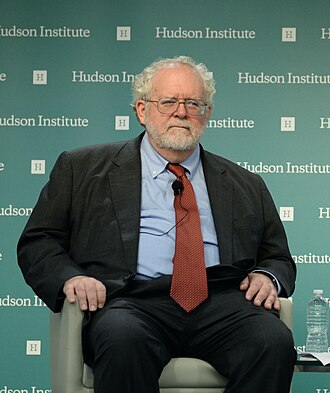
沃尔特·拉塞尔·米德 帕帕特里克·奥肖内西
EDITED TRANSCRIPT · 依据现场录音编译整理,可划线生成便签
编者按:本篇是《为什么世界秩序正在崩塌,而美国实力仍在上升》一期播客的对谈实录。做客者沃尔特·拉塞尔·米德是美国外交政策学者、《华尔街日报》全球视野专栏作家,主持人经杰里米·斯特恩引荐与他对谈。话题从美中博弈的底层逻辑一路铺开,涉及特朗普的权力方法、海洋商业帝国的取胜之道、技术革命与社会承受力、印度与伊斯兰世界的走向、无人机战争、台海与中东,最后落在对未来二十年的判断上。本文依据现场录音编译整理,只删去口语枝节、寒暄与重复,论点、例证与语气一概保留。

强大的美国,崩塌的秩序

主持人: 沃尔特,这场对谈我盼了好几个月。我们是经杰里米·斯特恩介绍认识的,他现在做 Colossus,他一直说自己写作和观察世界的本事,有很大一部分要归功于你。今天要聊的题目范围很广,所以我想先请你用最粗的笔触勾一勾:今天的美国在世界上到底处在什么位置。你写过很多文章,讲英国以及后来接班的美国,为什么能赢下过去几百年的全球博弈。我想听你谈谈这条胜利的长弧,以及你怎么理解今天的我们和我们的角色。

米德: 好。这确实是个很有意思的时刻。一方面,我们在 1945 年之后建立、又在 1990 年冷战结束时翻修过一遍的美利坚治世(Pax Americana),眼下真的陷入了危机。但你要是往后退一步看,美国的实力并没有陷入危机。出问题的是我们搭起来的那些网络,是我们跟世界打交道的那套方式,是跟欧洲之间那种制度化的关系。这些东西正在烧、正在塌。可美国作为一个强权,在我看来,靠着信息革命,靠着我认为我们已经经历、并且即将进一步经历的那种非同寻常的生产率提升,仍然在往前冲。

米德: 所以这就出现了一幅很怪的画面:一个生机勃勃的国家,配上一套正在崩塌的世界体系。特朗普的总统任期把这里头的动荡放大了很多。中长期看,我对美国的位置是乐观的。但短期我们确实是在一片险滩里走。

主持人: 你说的「崩塌的世界体系」,具体指什么?

米德: 你想想世界贸易组织。过去我们有一套基于规则的贸易体系。现在关税税率大致取决于特朗普总统早上醒来觉得它该是多少。过去我们这个国家更多是通过制度来行使力量,北约、联合国有时候也算,现在我们不这么做了。二战之后,美国外交政策有一条近乎原则的东西:我们要稳定、可预期,要让所有人都知道美国的红线在哪儿。

米德: 你要让所有人都能放心过日子。1955 年我们做过一个承诺,除非我们敲锣打鼓地宣布它变了,否则它就还在。我们是在给这个世界提供一块坚实的底板。现在我们显然不再打算这么干了。特朗普总统认为,把自己搞得完全不可预测、并且不断越过界线,才是他优势最大化的方式。换了以前的总统,大概不会说出「你不提高国防预算,我就把你的关税翻一倍」这种话,而是会试着通过正常渠道去解决问题。

米德: 特朗普会反驳说,那套东西没用。于是他现在把那些长期以来承载美国力量的制度网络砸得稀烂。而且我认为,他砸的方式会让他的继任者非常难重建。

把名气变成权力

主持人: 如果要把他的方法教给别人,你会怎么教?你在这上面写了不少。不管你赞成还是反对他做的事,他都是一位很有意思的总统。要是有人真想弄明白他是怎么运作的,你会怎么给他拆解?他实在太特别了。

米德: 他确实有天分。我觉得他发现了当代权力的一个秘密:他有本事把名气变成权力,把戏剧性变成权力,而且是用一种让他自己完全不受束缚的方式。你想,如果你撒的谎足够多,第一个、第二个、第三个谎的边际成本很高,但第一万个谎的边际成本等于零。政治人物身上那些常规的约束,比如名声之类的,他统统不用支付。

米德: 在某种意义上,我觉得最先发现这一点的是克林顿总统:羞耻只有在你自己认账的时候才起作用。羞耻是存在于别人脑子里的一种情绪。莫妮卡·莱温斯基的事情爆出来的时候,很多人以为他只能辞职,觉得这事太重、太难堪了。可他基本上意识到,不,只要你一只脚接着另一只脚往前迈,你就能走过去,狗叫归狗叫,商队照样往前走。特朗普把这个概念搬到了工业化的规模上。

主持人: 你还谈过「言说与景观」这个说法,能再展开讲讲吗?

米德: 「特朗普秀」是人类有史以来最吸引人的娱乐兼资讯景观。从有人类开始,没有任何一个活着的人占据过特朗普今天所占据的这份人类注意力带宽。有人会说,那是因为有全球媒体。可你很难想到历史上还有哪位统治者,能这样把一切都压在自己身上。今天你无论走到世界哪个角落,听到的都是特朗普、特朗普、特朗普。有人恨他,有人爱他,有人笑他,有人被他惊到,还有人把一辈子都花在琢磨自己对他的鄙视上。

米德: 但他始终是一切的中心。他自己也把这一点看作独家权力的钥匙。2020 年他败选时很多人以为这就完了,结果他在台下的支配力几乎不输在台上。就他干的这件事而言,他的水平相当于拿破仑干他那件事的水平。当然我也要说一句,拿破仑同样在滑铁卢输了,最后死在流放地。所以这并不保证整场大戏会有一个特朗普认可的好结局。但他是一位重量级的历史人物,他对大众传播与社交媒体时代的权力机制提出了一种新的理解,我们其余的人只是在设法应付。

强人政治回来了

主持人: 你觉得这个世界因为他,哪一处最不一样了,或者将来会最不一样?

米德: 我认为他极大地加速了二战后与冷战后那套结构的瓦解,它们回不到原样了。还有一点他不是唯一的推动者,但我认为我们正在进入一个政治远比过去更个人化、远比过去更少官僚气的时代。二十世纪很长一段时间里,人们习惯于认为,个人统治或者一个中心人物应该被降格,我们该由制度、官僚和委员会来治理。

米德: 我觉得互联网带来的影响之一,是人们重新希望被「人」统治。所以印度出了莫迪,日本有过安倍,以色列有内塔尼亚胡,土耳其有埃尔多安,美国有特朗普。特朗普算是这一拨里最大的一个,全球影响力最强的一个,再加上普京、习近平。我们回到了个人政治的年代。

海洋与大陆的三百年

主持人: 如果把支配权的弧线拉得更长一点,我很想听你讲讲历史脉络,你是位了不起的历史学者。海权也好,别的关键原因也好,为什么英国和美国一直到冷战结束前后,能有这么惊人的一段好运?

米德: 这件事,我们干脆就从今天的美中较量说起,因为你能在里面看到两边各自的样子。一边是陆基的大陆帝国中国,它相信自己可以在技术上、进而在军事上追平对手,而不需要那一套政治自由主义和乱糟糟的民主。好,很不错的主意。现代史上第一位真心拥抱这个主意的统治者,我认为是路易十四。他觉得法国由专家组成的技术官僚政府,可以打败那群烦人的英国人,那些人每二十年就把国王杀掉或者赶走,天知道他们在干什么,反正乱成一团。所以法国人的思路是:我们用一套强有力的中央集权体制照样能办到。

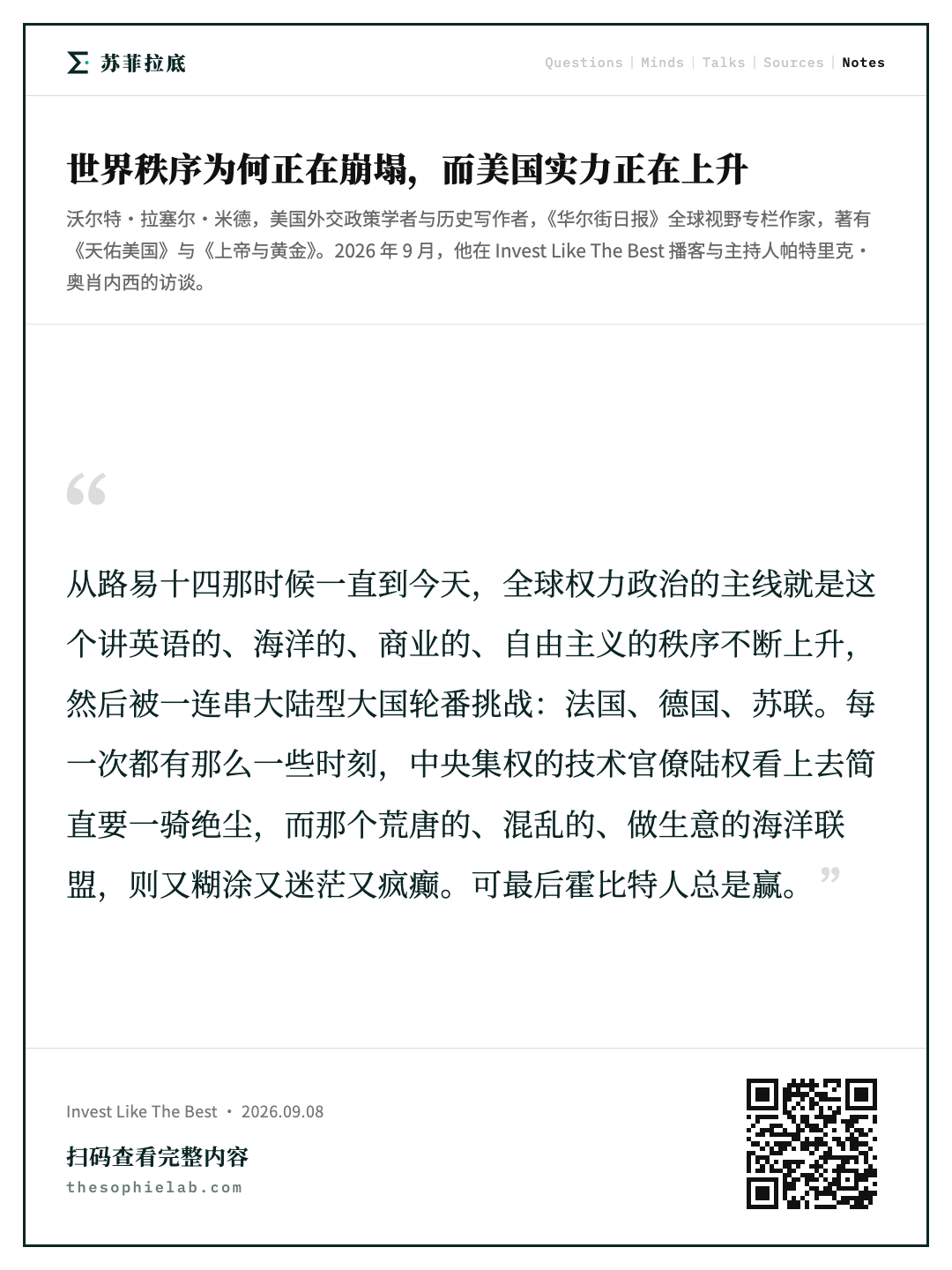
米德: 从路易十四那时候一直到今天,你几乎可以说,全球权力政治的主线就是这个讲英语的、海洋的、商业的、自由主义的秩序不断上升,然后被一连串大陆型大国轮番挑战:路易十四时期的法国,拿破仑时期的法国,普鲁士以及一战、二战时期的德国,还有苏联。而这些较量一次比一次难打。每一次都有那么一些时刻,中央集权的技术官僚陆权看上去简直是要一骑绝尘,而那个荒唐的、混乱的、做生意的、讲英语的海洋联盟,则又糊涂又迷茫又疯癫。可最后霍比特人总是赢。

米德: 我得说明一句,我们这套全球战略是从英国人那儿偷来的。他们又是从荷兰人那儿偷来的,荷兰人在十七世纪就已经在这么干了。所以在《上帝与黄金》里我说过,现代史最近三百年可以用十个字母概括:UP 到 UK 到 US,联省共和国、联合王国、美国。当然这就带出一个问号:下一个是谁?我不认为中国有本事赢我们。

全球统治的五步法

主持人: 那这套战略到底是什么?海洋战略。这三家做对了什么,才让霍比特人赢下来?

米德: 我不知道能不能真把这些都抖出来,全球称霸的五点秘密计划嘛。

主持人: 干脆讲吧。我请所有听到的人务必谨慎使用这些信息,落到坏人手里就糟了。

米德: 第一步,在国内保持一个开放的社会。想想十七世纪的荷兰人。当时到处在打宗教战争。荷兰人挺加尔文宗的,可他们说,这些路德宗的人是渣滓,肯定要下地狱,这谁都知道。不过在他们真下地狱之前,他们可以交税,可以为经济做贡献。天主教徒也一样,当然他们不能在大街上搞那些肮脏的偶像崇拜仪式,但除此之外,各过各的。犹太人也是,各过各的。要是有学者或科学家发表了教会不喜欢的论文,人家会在别的刊物上写文章骂他,但伽利略不会进监狱,这里没有宗教裁判所。

米德: 还有,你有个主意,你就可以去试。你是农民的儿子,你想试着做商人,只要你能找到人愿意让你做,尽管去。于是他们想出了新东西:我们至今还在用的政府融资办法,股份公司,新的航海技术,还有血液循环的发现。洛克跑到荷兰,写出了他最好的一批作品。这就是第一步:你有一个开放而有活力的社会,知识分子往你这儿聚,大学欣欣向荣。

米德: 第二步,带着你开发出来的这些产品和创新技术,把摊子铺到全世界去,做全球贸易。十七世纪从尼德兰出发的远洋船大概有一万艘,它们跑遍世界各地。这件事的后果,是你富得流油。我有时候建议我的学生去大都会博物馆或者别的地方看荷兰画派,不是去看笔触多细、构图多妙,虽然这些都是真的,而是去看画里这些人都有些什么东西。你看,这位商人穿着从中国来的丝袍,脚下踩着土耳其的地毯,壁炉台上摆着巴西来的鹦鹉标本。那是一种惊人的财富,而正是这种财富让你可以开始用全球的尺度思考问题。

米德: 十八世纪,普鲁士人打仗,腓特烈大帝和玛丽亚·特蕾莎为了西里西亚打了七年战争。我去过西里西亚,很喜欢那地方,它是今天波兰境内一块香肠形状的省份。打了七年,两个国家都破产了,最后腓特烈拿到了它,于是他成了腓特烈大帝,玛丽亚·特蕾莎成了输家。可就在这七年战争期间,英国人基本上把法国人赶出了印度、加拿大和北美,奠定了我们今天仍然生活在其中的这套世界秩序的基础。这就叫用全球的尺度思考。

米德: 第三步,等你把这套全球体系建起来之后,你要做一件极其奸诈的事:邀请所有其他人加入你的体系。你不要学西班牙人在拉丁美洲那一套,说这是我们的,我们征服的,别人不许来这儿做生意,你们都滚开,那显然只会让那片地方陷入停滞。十九世纪的英国人在大英帝国内部实行自由贸易,谁都能来做生意,而且英国海军压制海盗是替所有人压制,不只是替英国人。

米德: 这样做的效果,是它鼓励别的国家进入你的体系。于是你像我们当年那样发财。1812 年之后我们再没跟英国打过仗,有几次差点打起来,但归根到底,我们是在英国的体系里做生意,我们是英国所作所为最大的受益者之一。德国人也做过同样的事。普鲁士和后来的德意志帝国成了贸易大国,他们在阿根廷、智利和很多地方都有投资,他们的商业把英国人挤得节节后退。

让对手依赖,再切断

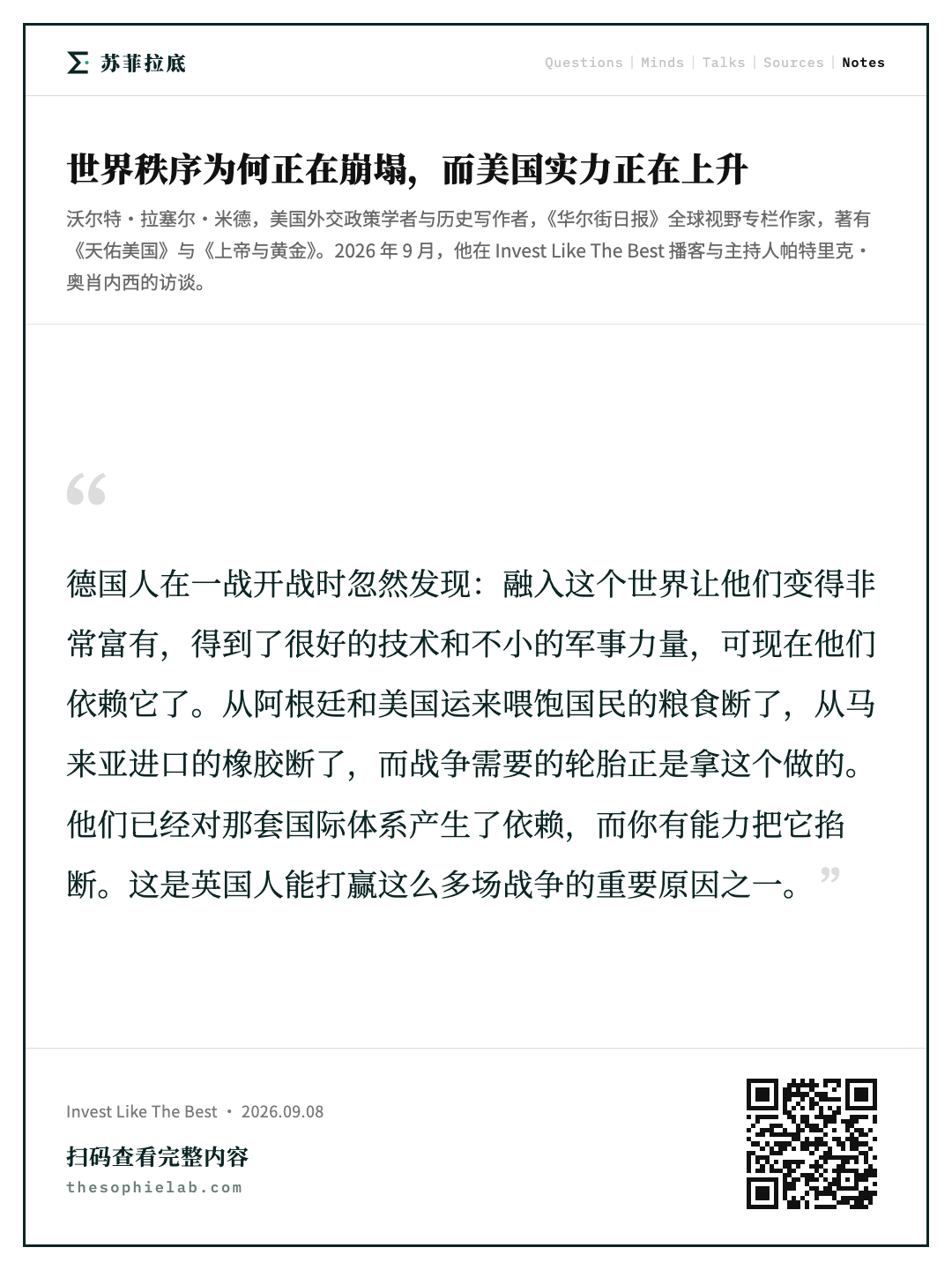
米德: 然后德国人发现,我们袖子里还藏着一个小把戏。他们在一战中开战,忽然发现:融入这个世界让他们变得非常富有,得到了很好的技术和不小的军事力量,可现在他们依赖它了。突然之间他们跟英国开战,从阿根廷和美国运来喂饱国民的粮食断了,从马来亚进口的橡胶断了,而战争需要的轮胎正是拿这个做的。他们已经对那套国际体系产生了依赖,而你有能力把它掐断。这是英国人能打赢这么多场战争的重要原因之一。

米德: 这套体系一直在。我觉得很多美国人其实并没有意识到它的存在,但我们会自动回到这些模式里。事情一发生,我们就自然而然那样做。冷战结束之后我们对俄国和中国说了什么?进来吧。就跟 1945 年我们对德国和日本说的一样,其实我们是等到 1947 年前后才这么说的,但意思一样:进来,从这个体系里受益。今天德国和日本都成了世界体系的主要支柱。我们本来也希望俄国和中国走这条路,可他们更多走的是威廉二世那条路,而不是阿登纳那条路。接下来会怎么样,我们正在验证。这也是我担心的原因之一。不过这确实是一个反复出现的模式,而且到目前为止,每到摊牌的时候,赢的都是我们这一边。

什么让习近平睡不着

主持人: 如果今天在中国某个地方,也坐着一个我和一个你,我问他们同样的问题:权力是怎么形成的。在那样一套完全不同的体制下,你觉得他们会怎么回答?

米德: 我过去常在中国有这样的交谈。我有几本书出过中文版,我去过中国的大学,跟学者和官员谈过。我能告诉你的是,他们对这个机制非常清楚。如果说有什么事让习近平睡不着,我想其中之一,就是他明白在跟美国发生的任何一种冲突里,中国都会面临被切断的局面:经济所需要的那么多原材料、那么多市场,一下子全没了。

米德: 设想中国宣布封锁台湾,这事很容易发生。美国只要往外挪一百海里,就能对中国实施反封锁。什么都进不去,石油进不来也出不去,制成品卖不出去。中国经济会怎么样?他们跟巴西、阿根廷农民签的那些大豆合同,全都交付不了。

米德: 这次伊朗战争里,我们都很吃惊,中国的石油储备原来已经这么大了。中国能源政策里有很大一部分,可以理解为在躲开依赖全球经济这个陷阱。他们搞太阳能,能建多少水电就建多少,我们环保圈的一些朋友说,太好了,他们这么绿色,我们要跟中国合作建设一个新世界。可他们同时也在拼命挖煤。为什么?因为他们要做的是让自己尽可能少地依赖外部世界,这样在跟美国摊牌的最坏情况下,他们能打一场长期的仗。

美国会走向孤立吗

主持人: 那你觉得美国有没有可能反过来也走这条路,变得更孤立?我们的出口占 GDP 的比重跟世界上很多国家比是偏低的,我们相当自给自足。美国是个了不起的地方,粮仓、资源丰富、两洋环抱,我们有这些得天独厚的优势。也许我们不靠这种相互依赖,也能撑住你刚才描述的那套权力结构。我们朝孤立主义方向滑,这件事让你担心吗?

米德: 我觉得,美国历史上确实有孤立主义传统,有时候强一些,有时候弱一些,现在明显在往上走。这让我相当担心,因为我确实认为,美国的安全和美国的经济,归根到底都要求我们在全球有所参与。不一定是去做全球社工,但你想想我们的贸易,大致三分之一在本半球,三分之一跨太平洋,三分之一跨大西洋。这三块里少了哪一块,我们都不好过。

米德: 疫情期间我们已经看到,我们在很多东西上对中国的依赖相当吓人。人们看我们的供应链,能看出一堆脆弱点。可我们不可能在本土生产所有需要的东西,也不可能在本土拿到所有需要的原材料。反过来,我们的生产者也需要比美国市场更大的市场。传统上,美国最坚定主张自由市场的游说力量是农业游说,因为美国能做的远不止养活自己,我们的农民几乎能养活全世界。如果把他们压缩到只供应美国市场,他们赚不到钱,价格会低到没法看。他们需要那个市场。

米德: 别的行业也一样,因为规模经济摆在那里。如果我们的人工智能公司、科技公司只能从美国国内市场获益,那点收入和增长根本不够,别说领先和暴利,连在技术上跟中国打平都做不到。所以我们的企业需要世界。

米德: 接下来的问题是:你没法用枪逼着别人买你的东西,你也不会真想一天到晚举着枪。所以你必须有一种对双方都成立的贸易关系,两边都得愿意做这笔交易。办法是有的。我觉得我们过去过于教条,笃信一套简单的自由贸易体系就能奏效,也没有去追究中国那种系统性的作弊。但二战之后,很多欧洲国家实在太穷、被战争毁得太厉害,恢复它们的经济对美国安全来说成了必需,否则它们会倒向共产主义,我们不想要那个结果。于是我们说,行,德国,你可以对美国商品征很高的关税,我们不对等反制,因为你的增长符合我们的利益。

米德: 这类安排后来很多被制度固化下来。所以现在有大量非对等的关税,我们的壁垒一直更低。特朗普团队说这个必须改,我认为他们说得没错。再加上供应链安全的需要,你确实不能照着自由贸易教科书来定经济政策。但另一方面,你仍然需要贸易,而且贸易必须两头都有好处。

科技霸权与那匹野马

主持人: 我想聊聊美国相对于世界的姿态变化,也就是外交政策。不过在那之前先问技术。我今年 41 岁,二十年前我刚入行的时候,我一直做投资,你去看市值前十或者前二十的公司,那是一张全球的大杂烩名单,来自各种行业、各个国家。今天那张名单几乎就是美国科技公司,从第一名到第二十名基本都是,只有零星例外。而且这还是在 OpenAI、Anthropic、SpaceX 起来之前就已经成立的事,现在它们又在原本就很强的科技公司之上再起一层。我想请你谈谈技术,当然还有人工智能,是怎么改变全球秩序的,尤其是在这样一组数字技术上我们又一次成了领跑者的情况下。你怎么理解这件事?

米德: 我总是试着去找历史类比。没有什么跟现在完全一样。最接近的,恐怕还是真正的工业革命本身。有意思的是,领跑第一次工业革命的那个国家,英国,随后主宰了一百五十年,成了支配性强权。现在历史跑得快多了,但我认为我们确实处在同样的位置:最早看见并且用上这种新的力量来源的人。

米德: 我认为从十七世纪开始,现代世界里权力的关键就在于:哪个国家最能有效地开发、驾驭、利用新技术的力量,同时不因为新技术带来的社会压力与动荡而把自己炸掉。出于很多原因,先是英国人,后来是我们,比别人更善于骑住那匹野马。

米德: 我认为这一点现在仍然成立。但你看今天的美国社会,也能看到针对技术的反弹,比如那股反数据中心的情绪。你还能看到美国民主社会主义者组织里的托洛茨基派,他们觉得在眼下这种糟糕局面里,最陈腐的那种马克思主义才是唯一的救赎。我们能不能再做成一次,并不是天定的。

米德: 所以就有了这幅画面:巨大的成就,同时是彻底的混乱和分裂。成就和秩序之间的关系眼下断掉了,因为我们需要一种跟过去不同的秩序,我们的技术已经造出了一种新的世界。它正在改变权力运作的方式,改变权力的性质。到目前为止,美国干的还是我们干了很久的那件事:占住最前沿。

主持人: 我们把它开发出来了,马也在手里了。骑住这匹野马的关键是什么?我想每个美国人都会说,希望接下来一百五十年还是我们领先。

米德: 但要用一种体面的方式。我们就是这样的人嘛。

主持人: 你觉得我们该怎么做?关键在哪里?

所有权社会

米德: 美国一直是一个所有权社会。当年那些建国者为什么认为美国能作为一个大体上民主的共和国存活下来?一个很重要的答案是:美国不是一个人们住在城市里、什么都不拥有、替别人打工的国家,它基本上是一个由独立农民组成的国家,这些人算是小生意人,拥有自己的土地,在这个体系里有份额,而他们作为所有者的生活经验会教会他们做公民。

米德: 比如:我特别希望这条小河上能有一座新桥。可另一方面,桥要是建起来,他们就得加我的税。好,那我就会理性地算一算我究竟希望发生什么。这就是那种政治教育,它让我有能力在国家的议事中扮演一个有分寸的角色。而且我是独立的。

米德: 到了工业革命,问题来了:这还能继续吗?我们有了大城市,有了工业。第一阶段,我们靠铁路和《宅地法》来解决,这两件事差不多同时发生。政府把大量土地,常常用不太干净的方式,给了铁路公司去修跨洲铁路,把这个国家变成一个全国性市场,同时又把土地免费给美国农民:你去自己的农场上住满五年,它就归你。了不起。

米德: 所以对普通人来说,我从这个体系里白得了一个农场,我是个农民。而与此同时,你又是在用这种方式为一个新的工业社会铺设基础设施。

米德: 到了二十世纪,家庭农场在经济上开始衰败,它竞争不过,现代条件下务农需要非常充足的资本。人们开始进城打工、成为雇员。这会危及共和国吗?我们还能不能是一群自由人组成的自由社会?我们基本上想出的办法,是用郊区的独栋住宅去替代独家经营的农场。

主持人: 这个角度很有意思。

米德: 而且同样有大量政府政策在背后,不光是修高速公路,还有税法上的补贴。市政债券免税,这意味着市镇可以修建吸引开发商和购房者所需要的基础设施,房产价值随之上涨,然后用上涨的房产税收入去偿还债券。这就成了一台创造财富的机器。

通勤半径与信息基建

米德: 而现在我们似乎走到了这台财富机器的边界,因为对普通人来说,在离工作地点足够近、通勤不至于要命的地方买下一栋房子和一块地,已经太贵了。你去看为什么这么多年轻人对经济的运转方式极不满意,住房拥有率是最大的问题之一。

米德: 这件事其实可以处理,靠的是远程办公、混合办公和自动驾驶汽车。如果你一周只需要去办公室一两次,或者一个月两次,你就可以住得更远。把通勤半径从 40 英里扩大到 75 英里,可开发的住宅用地面积是按半径的平方增长的,这是几何级数。所以只要部署得当,信息技术可以让这台创造财富的机器再多转两代人。

主持人: 有没有什么东西能对应当年的宅地法或者住房补贴,来推动这轮扩张?这件事对美国来说似乎非常关键。

米德: 我认为有。我觉得我们应该去做鼓励远程与混合办公这类事情。当然它有问题,比如对新人的带教,也有好处,行,每一种技术都有问题。汽车从被使用以来害死了多少人?高速公路系统花了多少钱?所以新技术不会像天使一样降临,见谁都满足愿望。你得非常认真地想清楚怎么让它奏效。

米德: 我把这叫作信息基建。传统基建是修桥、修实体的东西,信息基建是那一整套制度、法律和监管框架,它能让人工智能技术发展起来,让医院里的病人得到更好的结果。你想想,这件事实际上复杂得惊人。或者它能改造法律系统,同样极其复杂。要做这些事,你需要一种新的社会想象力,我认为我们得把它培养出来。

米德: 回到住房这个例子。如果一家公司说,好,你 60% 的时间可以在家办公,那就意味着基础设施损耗更少,新建需求更少。给推动混合办公和远程办公的公司一项税收优惠,对政府来说其实不是净成本,因为你在预算的另一头省下了钱。

美国外交的四张牌

主持人: 这项技术似乎格外特别。就人工智能而言,我们看到中国这个今天唯一的另一个大国,用我们投资出来的技术,能做「蒸馏」,在人工智能领域大家是这么说的,从而在没有同等资本投入的情况下拿到大体可比的系统。这跟高速公路或者铁路很不一样,那些东西你没法抄,你得自己修。所以铁路的规模经济我很好理解,前沿实验室的模型就没那么好理解了。这也让我好奇,什么才是对的外交政策。正好可以聊聊你讲的美国外交政策的四个流派。也许你先快速过一遍,再谈谈你提出的「科技哈密尔顿主义者」,我觉得那个概念很有意思。

米德: 美国有个很有趣的地方:我们的外交政策争论重复性极强。基本上外交上出了什么事,我们吵架的方式跟乔治·华盛顿那个年代差不多。我们对这个国家和对外交政策的看法,相当可预测地落进四个筐里。

米德: 第一个我称为哈密尔顿派,取自亚历山大·汉密尔顿。它看重的是一个强大的资本主义经济,能有效地跟世界其他地方做生意,由此提供把社会维系在一起的钱和技术进步,因为大家在里面赚到了钱,所以他们满意。同时它给你力量,让别国不敢攻击你。所以我们应该有一个强有力的联邦政府,在国内推动基础设施建设,把帮助美国大公司在国际上取胜看成自己的分内事。老布什在某种程度上属于这一派。

米德: 然后有一群人说,钱?太庸俗了。人权怎么办?他们会说,美国面临的威胁从哪儿来?来自糟糕的治理,来自独裁。民主国家不打仗,独裁国家才打。将军们喜欢打仗,母亲们不喜欢。所以美国外交政策应该致力于在全球推广民主、推动国际制度。我们要消灭战争,就先消灭战争的原因。这是威尔逊式的路子,虽然其实早在伍德罗·威尔逊之前我们就有这套东西了。

米德: 接着又有人说,等一下。美国真正了不起的地方是个人自由,是政府管不着我们所有人,也没有把我们课税课死。如果我们卷进去,不管是威尔逊派那种人权十字军,还是哈密尔顿派那种大国政治、均势外交、国际金融,结果都会是一个强大的政府:它对美国人民藏着秘密,维持天文数字的国防预算,把我们拖进没完没了的战争,而这会毁掉自由。我们可能征服了世界,却在国内丢掉了自由。那算什么外交政策?这个争论我们从 1790 年代就开始吵了。

米德: 最后一群我叫作杰克逊派,取自安德鲁·杰克逊。他们大意是说,外国人嘛,他们可以搞民主也可以不搞,我不太关心外国人做什么,只要他们别攻击我们、别侮辱我们的荣誉。要是有人打我们,我们就出去把他们碾碎。什么战争法,不,像对付老鼠一样,就该灭掉,把他们打到、砸到、碾到他们明白:这辈子最不该做的事就是对美国动手。杰克逊派在和平时期看上去常常像杰斐逊派,像孤立主义者,可一旦发生珍珠港或者 9·11 这样的事,杰克逊派立刻被激活。

米德: 这些东西我们吵了非常久,今天还在吵。我常说它们像一副牌里的四种花色。我们当中几乎没有人是一手十三张全是哈密尔顿的,通常我们拿的是混合的牌,只是每个人某些花色更强一些。

主持人: 你觉得今天哪种花色最能定义我们?

米德: 过去的民主党共识,比如说克林顿共识,很大程度上是威尔逊和汉密尔顿的联盟:建立一个推进国家经济安全的全球体系,同时也推动人权和民主,认为这既让我们富起来,又能造就持久的世界和平。二战以来,这基本上就是主流建制派的想法。我那本《特殊天命》出版的时候正赶上 9·11 前后,当时人们并不觉得除了汉密尔顿和威尔逊之外还有别的东西,然后突然发现,等等,原来还有一群杰克逊派,他们想用核弹炸平阿富汗之类。

米德: 所以我会说,特朗普的联盟是杰斐逊派加杰克逊派的混合,孤立主义者加鹰派。你可以说万斯是孤立主义那一头的代表,而卢比奥在某种意义上是鹰派。卢比奥对联合国没兴趣。你看委内瑞拉:我们要干掉马杜罗这个敌人,但我们不会把恢复委内瑞拉的民主当成一切的关键,而奥巴马或者拜登那样的人,我想会在这件事上使更大的劲。在乌克兰问题上也一样,杰斐逊派说这不真的是我们的仗,我们别掺和;杰克逊派则说俄国就是敌人,趁现在给普京鼻子上来一拳。所以这几派今天都很活跃。

科技哈密尔顿主义

主持人: 能不能再多讲一句「科技哈密尔顿主义者」这个新出现的派别?在我入行的年代,科技和政府起码是两个互不相干的概念。

米德: 美国现代史上最重大的变化之一,就是科技与政府的相互发现。1990 年代还是「历史终结、民族国家终结」的时代,公司会说,我不是美国公司,我是全球公司。这种说法在科技界最强烈:谷歌没有边界,网络世界完全不一样,那些东西跟我们无关,华盛顿根本不懂我们,我们做我们自己的事就行。

米德: 今天,科技恰恰是国际大国竞争的焦点。中国要建一个能压过美国技术圈的技术圈,这对美国科技公司的生意至关重要,对美国这个国家、美国政府来说,它关乎权力和独立。所以我想,出乎科技界和政治界双方的意料,他们被推到了彼此身上,我们看到科技和经济正在重新国家化。

米德: 科技圈的人我不如你熟,杰里米当然比我更了解他们。但我的感觉是,科技界思考自身经济利益的方式,跟你可以称之为「遗留跨国公司」的那批人不一样,就是二战之后那批做全球贸易和制造的公司。我从世界各地进零件造汽车,我在世界各地有工厂造汽车。对这类公司来说,自由贸易就是生意的本质。我需要金融市场,需要劳动力市场,需要制成品市场,全都无缝、开放。用托马斯·弗里德曼的话说,我需要一个平的地球。

米德: 但你要是一家科技公司,你不需要这个。谷歌,或者说 Alphabet,并不大量进出口货物。连移民这件事也是:如果你是酒店公司或者建筑公司,能用上勤劳廉价的移民劳工,对你的商业模式相当重要;可你要是硅谷公司,忽然之间从墨西哥过来的非熟练劳动力没了,那结果不过是你的保洁和园艺服务贵了 30%。那又如何?你更在意的是供应链安全、国际知识产权安全。

米德: 而且我认为,越来越多的公司开始意识到,他们需要自己的员工有爱国心,也就是说,员工必须觉得把知识产权卖给中国是一种邪恶的罪,而且一旦有人觉得你在干这种事,你的同事会毫不犹豫地举报你。所以科技行业乃至整个商界的经济议程在变,那种文化上、政治上的态度也在变。因为反过来,遗留跨国公司想要的是一支完全国际化的员工队伍,我不希望员工是斯里兰卡人还是台北人有任何分别,我需要的是可以插到任何地方去的可互换零件。

印度这个改良者

主持人: 如果你退得再远一点,把这些背景都放进去想全球权力,我感觉几乎整个世界都认定,只有美国人和中国人拥有真正的力量,或者说有资格竞逐下一个时代的主导权。除了这两家,还有哪些权力来源让你感兴趣、让你好奇?当然我们接着还会聊这两家。

米德: 我对印度产生了浓厚的兴趣。我有幸认识了一些接近人民党和国民志愿服务团的人,后者是帮助催生人民党的那个印度教民族主义组织。这群人一百年前不过是一间屋子里的五个人,现在他们建起了一个庞大的群众运动,在印度各地有八万六千个左右的小组,每周聚会。他们是极有活力的政治力量,把莫迪推了上去。他们对印度应该是什么、什么把一个国家绑在一起、什么造就一个国家,都有非常强烈的想法。

米德: 印度现在是世界上人口最多的国家。印度在发展科技产业上相当成功,虽然还不在人工智能的前沿,但我觉得它到达那里的速度可能比人们预想的快。而且它对世界应该是什么样子,有一套截然不同的看法。

主持人: 是什么样的看法?

米德: 多极,但不是中国那种多极。印度外长苏杰生说过一句话:中国是修正主义国家,印度是改良主义国家。意思是,印度对全球现状确实不满意。在联合国体系里,十四亿人口、拥有核武器的印度,在联合国大会里的票数跟列支敦士登或者卢森堡一模一样,就一票,这很荒唐。国际生活的很多组织方式里都有一种西方主导的味道,因为它基本上是欧洲人和美国人在别人还没什么分量的时候定下来的。

米德: 所以印度想改的东西很多,但他们真的不认为中国那种自上而下的威权路子对印度可行,也不认为它对世界有好处。所以他们是一个有着不同想法的、有意思的力量,我很关注它会怎么发展。

文明重新分流

米德: 伊斯兰世界我也觉得值得看。伊斯兰世界的跨度极大,从极其精深的学者、知识分子和作家,一直到北非那些拿着砍刀烧茅屋的圣战分子,整条光谱都在里面,那是一个巨大的文明。而作为世界上的一股力量,它的分量在增加,在变强。理解它怎么变,理解海湾国家和土耳其的文化怎么变、怎么发展,我认为很重要。

米德: 我的判断是,工业革命曾经迫使各个社会变得彼此相似。你要建大工厂、大基建、铁路、公路、机场,在制度和组织上就有些事你非做不可,而这些会把你推向我们所理解的那种欧洲式、西方式的生活方式和政治。信息革命则让各国有可能把自己的文化、语言当成平台来用。土耳其变得更土耳其了,它现在比二十五年前更不像欧洲。印度变得更印度,我觉得日本也在变得更日本。所以工业革命时代的趋势是各大文明趋同,现在我们看到的是分流。

主持人: 这背后的道理我还没完全想明白,能再解释一点吗?

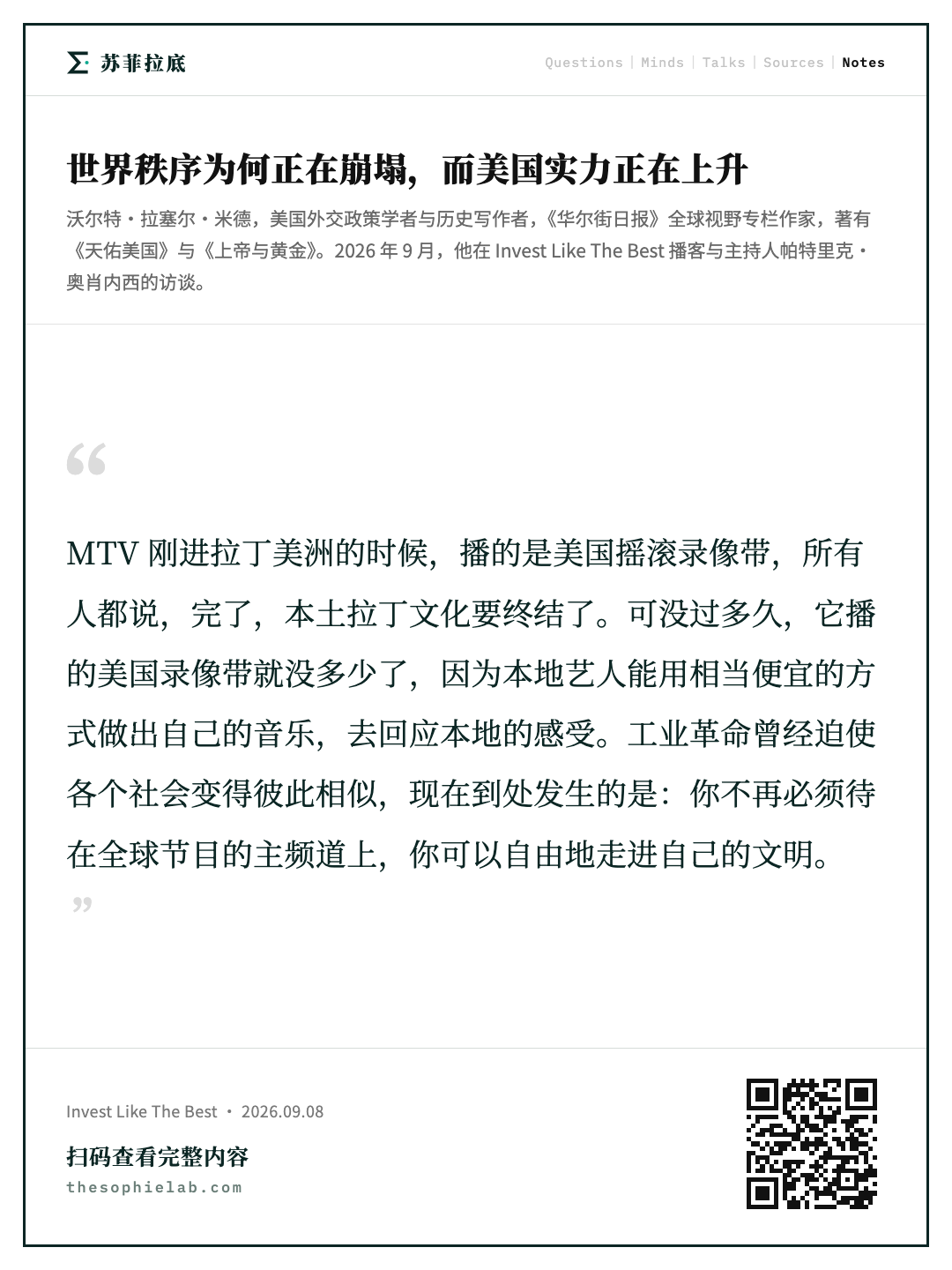
米德: MTV 刚进拉丁美洲的时候,播的是美国摇滚录像带,所有人都说,完了,本土拉丁文化要终结了。可没过多久,它播的美国录像带就没多少了,因为本地艺人能用相当便宜的方式做出自己的音乐、自己的录像带,去回应本地的感受。所以我觉得现在到处都在发生这种事:你不再必须待在全球节目的主频道上,你可以自由地走进自己的文明。

主持人: 人工智能想必只会往这把火上浇油。

无法核查的军备竞赛

主持人: 最让你害怕的是什么?我猜你乐观的那个未来版本,应该是进步和繁荣之类。什么最可能挡住你希望看到的那种未来?

米德: 很多东西。工业革命长期看是件相当好的事,但它有一些小小的副作用,比如共产党,比如死掉的一亿人,比如一战、二战、恐怖统治。

主持人: 为什么这些必然是工业革命的副作用?

米德: 因为新技术带来了社会压力:把千百万农民从他们世世代代生活的土地上连根拔起,扔进城市,在那里被剥削。于是有了不满,而那些过去用来管理不满、赋予国家正当性的旧社会制度,在新环境里不那么管用了。一切都在变,所有人的脑子都乱了,事情就发生了。

主持人: 而信息革命是这件事的加强版。

米德: 正是。这一点我很确定。另外,你看过去六十年最大的地缘政治难题之一,就是核扩散,到今天显然还在继续。可当我想到未来的大规模杀伤性武器,生物、网络,各种各样的东西,问题是这样的:我们虽然没能完全阻止核武器扩散,但通常你能看出有人在造,而且通常你有足够的预警时间去做点什么。可你怎么核查一个人是不是在遵守某种网络军控协议,或者生物武器军控协议?毕竟在某个地下室实验室里,你就能捣鼓出一种能毁掉半个星球的病原体。

米德: 所以这个局面是:军备竞赛在加速,战略互信几乎完全缺失,而你又没法用「可核查」来保证守约。我觉得这是个相当严重的问题。因此我认为,横跨一整片学科和技术的快速、动荡的技术变革,正在破坏力量平衡的稳定。我认为这确实大幅提高了大国之间发生对抗、乃至最终发生战争的概率。

无人机改写的战争

主持人: 说到这里,乌克兰也许正是这个问题的爆点。看上去,不算大规模杀伤性武器,就是普通武器,这几年也有了相当大的演化。这个话题现在争议很大,因为伊朗的冲突,还有一些报道说连美国某些弹药都打光了。过去这几年的冲突,让你对军事技术、武器,以及它们在人工智能时代的相对重要性,学到了什么?

米德: 不幸的是我学到了很多,因为战争实在太多了。战争开始后我第一次去乌克兰,去了一家无人机工厂,那真是了不起:他们在实时拿到战场反馈,然后立刻调整。不过那时候东西还很简陋,他们把儿童玩具卡车改造成地面无人机,让它能把一颗地雷放到坦克底下。几个月前我又去了一趟,那个进步简直难以置信。烈度没变,但变化的幅度惊人。

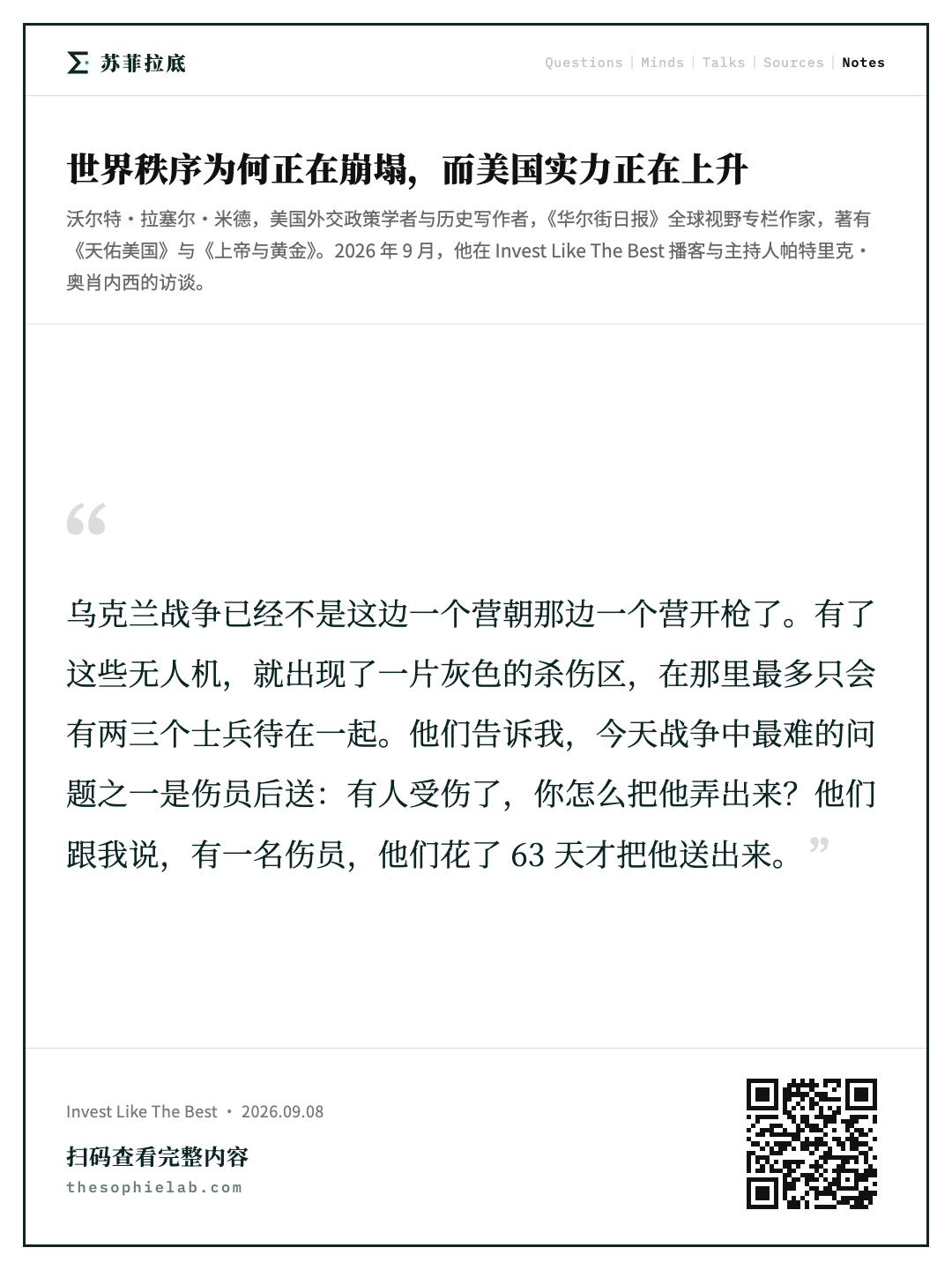
米德: 我跟一些人聊过,他们说现在已经不怎么处理枪伤了,因为全是无人机,一切都是无人机。乌克兰战争已经不是这边一个营朝那边一个营开枪了。有了这些无人机,就出现了一片灰色的杀伤区,在那里最多只会有两三个士兵待在一起。

米德: 他们告诉我,今天战争中最难的问题之一是伤员后送。有人受伤了,你怎么把他弄出来?他们不得不造一种新的地面无人机,能过去把人或者遗体接上,用一种金属罩把他盖住,再推出来。可就算做这一件事,你也需要一整支无人机小队配合它,因为得有人盯着别的、要来攻击它的无人机。他们跟我说,有一名伤员,他们花了 63 天才把他送出来。

米德: 这跟哪怕只是六年前的战争都完全不一样了。我也在问自己:五角大楼学得有多快?如果坦克和步枪正变得像骑兵冲锋和马刀一样过时,那我们手上的是什么样的部队?我们需要的又是什么样的部队?而且每六个月它就变一次。眼下乌克兰人在战场上有一点优势,但这随时可能翻转。

米德: 还有一层:作为家当最多的那个强权,我们其实对技术变革最脆弱。我们的坦克太多了,一旦坦克变得没用,这对我们是比对那个研究出反坦克办法的人更大的问题。海军也一样。黑海上的俄罗斯海军,乌克兰几乎没有海军,只有几条小艇,没有大舰,可他们靠无人机把俄罗斯海军挡在黑海之外。这对台湾其实是好消息。但美国的力量传统上很大程度上是海权,那么它随时间会怎么变?九十年代人们常说「军事事务革命」,你看上去刚好还记得九十年代。当时的意思是,好,有这么一件事发生了,等我们掌握它、适应它,就万事大吉。现在则是连续不断的军事事务革命。这是我从观察战争里学到的东西。

台海与日本的觉醒

主持人: 你觉得台湾最可能发生什么?

米德: 我认为习近平决心要拿下它。我不认为他床头真放着一只闹钟,到某天就非响不可。中国人要把自己推过某个点,需要非常高的成功概率,因为失败对发动者来说会是灾难性的。但在「入侵」和「什么都不做」之间,有很多个台阶。

米德: 我们看到中国人正试着把自己挪到一个位置上,可以搞软性封锁:比如下令任何要去台湾的船只必须先停靠中国港口,走一遍海关清关流程,以此宣示主权,并给不照办的船制造麻烦。他们会去找那些刚好在雷达线以下、不至于真逼我们反应、却能把局面往对他们有利的方向改变的动作。我看他们会朝这个方向走。

米德: 新出现的一个大变量,是日本人醒了。日本人会把中国控制台湾看成对日本独立的直接威胁,他们真是这么看的。所以他们的介入深了很多。虽然还只是开始,他们在提高国防开支,在重新思考自己的军事学说,也开始围绕新的战略环境重塑自己的文化。从历史上看,日本人在真切感到威胁、或者觉得非变不可的时候,转向的能力其实相当强。这件事最后会怎样,我看不出来,但我认为大家真该盯住:日本人爬升学习曲线的速度有多快?他们对自身防务到底有多认真?如果日本成了中国在台湾问题上一个新的、麻烦的变量,那会怎样改变中国的算计?

三个阶层同时失序

主持人: 如果我把所有这些合起来看,权力形态的变化、技术、军事技术,再加上你说的未来政治会更个人化,还有哪些正在变化的东西,是你觉得对未来的样貌特别重要、而我们还没谈到的?

米德: 有。二战之后那个稳定年代,美国社会基本上有三个阶层,这套东西后来也在世界很多地方铺开。一个是产业工人阶层,工作大体稳定,干的是蓝领活,常常有工会组织。他们的政治态度非常务实,关注点是经济。左右两派的政治竞争,比的是谁更有办法提高工人的生活水平,这让政治围绕着一个相当理性的轴心。

米德: 然后是商人阶层。到了四十、五十年代,他们已经不是当年的创业者了,不是最初的约翰·洛克菲勒或者第一代 J.P. 摩根,而是他们的孙辈,是上市公司和职业经理人。于是商业被制度化了。那也是高度管制的垄断与寡头的时代:只有一家电话公司,航空公司数量有限,三大电视网,商业世界结构分明。

米德: 在这个有组织、讲理性的工人阶层和有组织、受管制、由职业经理人打理的商人阶层之间,还夹着一个专家阶层,技术官僚和行政官员,他们依照当时最好的、经过同行评议的社会科学来做决定:管住企业别太贪,也别让工人要价高到把整个体系压垮。他们是那个起平衡作用的群体。

米德: 我会说,今天美国社会的这三个阶层全都乱成一团,而我们同时面对着一连串非常严重的变化和困惑,人工智能该怎么办只是其中之一。我们已经没有那种旧的组织方式去回答这些问题了,所以我们真的是在茫茫大海上漂着。而因为美国长久以来是、我认为至今仍然是全球稳定与组织的唯一可能支柱,美国内部的失序碰上这么多变化,不可能不削弱全球稳定的任何机会。

米德: 所以我觉得这意味着,对你我这样的人,也许还有听这档节目的人来说,我们背着一份沉重的责任:去想出答案,去找出一条路,去建起一种新的美国政治和社会秩序,让我们自己重新变得相当稳定,然后再把这种稳定投射到世界上。

何为美国人

主持人: 在这样的背景下,做一个美国人意味着什么,或者将意味着什么?如果这一切都在变,那它还意味着什么?

米德: 美国人对「做美国人」的理解一向不同,而且早就不同。这些年你常听人说,美国是一个建立在理念之上的国家。说实话,我大概是上了大学才第一次遇见这样想的人。我是南方人,在那边你会觉得,我是美国人,是因为我认识的每个人都是美国人。我家里人,只要我能追溯到的,都是美国人。我是美国人,就跟一个法国人是法国人、一个土耳其人是土耳其人一样,不是因为我信仰美国,而是因为我在这儿。

主持人: 因为你人就在这儿。

米德: 我在这儿,别人也不会要我。就这么回事。不过确实也有另一些人,他们热爱美国、也为美国做了贡献,而他们体会到的是:是的,这是一个理念的国家。所以我们在这一点上是多元的。我自己并不觉得比上周刚入籍的人更像美国人。

米德: 对我来说,身份和理念真正交汇的那块地方,说老实话,是效忠誓词:「我宣誓效忠美利坚合众国国旗及其所代表的共和国,一个国家,在上帝之下,不可分割,人人享有自由和正义。」我会说,任何人只要说了这句话并且当真,他就是美国人。

主持人: 相当了不起,是不是。写得真好。

米德: 好,是真好。

中东的权力真空

主持人: 有件事我一直很想问,我相信大家也都想知道:你怎么解读中东正在发生的事?伊朗、以色列,还有其他关键角色,联盟关系似乎多年来第一次在重新洗牌。你怎么理解?你关注的深层暗流和信号是什么?

米德: 中东当然有很多事在同时发生。一个大背景,是阿拉伯民族主义、以及阿拉伯认同作为中东组织性力量的崩塌。1950 年代,纳赛尔和埃及是阿拉伯认同与泛阿拉伯主义的两大支柱。1967 年战争之后他们受了重创,但仍然有叙利亚、伊拉克,甚至卡扎菲治下的利比亚有一阵子,想去接过这面旗。

米德: 看后来发生了什么:伊拉克垮了,这里美国当然出力不小;叙利亚也垮了,这一次美国没出多大力。于是伊朗作为一个非逊尼、非阿拉伯的力量,建起了人们所说的什叶派新月地带,从黎巴嫩、叙利亚、伊拉克连到伊朗。10 月 7 日以来,主要是靠以色列,这条新月被打散了。可没有被打散的,是阿拉伯世界底层的虚弱。海湾国家在很多方面很能干,非常有效地用着自己的石油和金钱,但他们仍然挡不住伊朗。没有外部帮助,他们站不住。

米德: 而这就牵出霍尔木兹海峡。那片地区对世界经济的稳定和健康至关重要,而它现在处在某种混乱之中。如果美国或者别的什么力量不用某种方式挡住伊朗,伊朗就会取得对中东石油资源的霸权,这种霸权足以让它在经济上敲诈很多人,也会给它提供一些资源,那些资源用起来肯定不会对我们有利。

米德: 以色列或许曾经希望自己能承担起制衡伊朗霸权的重量。但我认为以色列太小,而且对中东其余部分来说太异类,没法真正有效地扮演这个角色。至于美国,我认为从奥巴马开始,美国就根本不愿意自己来干这件事,一直在想把问题往后拖,一直在找除了「我们自己划一条红线并且真的执行」之外的别的办法。可我不认为历史给了我们选择。要么我们自己挡住伊朗,要么伊朗确立并维持它对中东石油资源的霸权。

威慑为何失灵

主持人: 我们为什么一直无效?我们的军事能力显然远远占优。这个问题是关于伊朗和霍尔木兹海峡的,但也是个更大的问题:人们过去把阿富汗叫作帝国的坟场。为什么世界强权在中东好像总是很难做成任何事?

米德: 我觉得有一部分原因跟我们在俄罗斯身上看到的一样,是威慑的侵蚀。你要的其实不是帮助乌克兰打赢一场对俄战争。你要的是让俄罗斯感到:如果他们进攻乌克兰,后果会可怕到完全不值得去做。除了威慑以外的任何东西,都意味着漫长、艰难、昂贵、撕裂的战争,结果难料,代价巨大。所以威慑的衰退在海外变成一个巨大的地缘政治问题,在国内变成一个巨大的政治问题。

米德: 举个例子,眼下霍尔木兹海峡有一个很实在的事实:伊朗能用无人机打中一艘油轮,这还不是最要命的;更要命的是伊朗可以往几座海水淡化厂上扔几架无人机,让海湾那些城市基本上无法居住。只要这个局面还在,我要是外国投资人,我就不会在海湾做大笔投资。这太可怕了。而这意味着,那些国家为自己未来的政治稳定所制定的整套经济发展计划都会化为泡影,因为它根本转不起来。

米德: 所以唯一能保住那套东西的办法,在某种意义上就是我们冷战时期在欧洲做的事:对俄国人说,你越过那条线,你进攻西柏林,天就塌下来。但我认为作为一个国家,我们还没有到那个份上:美国总统能把这句话说出来,说的时候是认真的,而且公众会挺他。要做到这一点,我们需要能给民众讲清楚这个世界怎么运转的总统。二战之后哈里·杜鲁门做过这件事,更早一点,富兰克林·罗斯福在炉边谈话里做过。把美国人民当成自己人推心置腹,对自己在做什么、为什么这么做有清晰的想法,而且擅长表达,能把它讲进人心里。我们已经很久没有人这样做了。

未来二十年的目标

主持人: 你希望我们怎么做?你希望未来二十年美国扮演什么角色?

米德: 我希望我们首先搞清楚,在进入信息革命的过程中怎么保持自己的平衡。也就是说,我们要弄明白怎么用信息革命创造的财富和资源,去应对它必然带来的压力和问题,同时从中取出那份丰饶,让美国人觉得美国是转得动的,它对他们管用,事情大体上在往好的方向走。只要有这个,人们就会认真地支持一位美国总统,支持一套美国外交政策。我认为要是没有这个,要是我们做不到,我们就会在信息革命里、在技术竞赛里输给中国。于是我们在海外被挑战,在国内像一笼子狂躁的雪貂互相撕咬。那既不好看也不好玩。

米德: 所以你得先把这件事办成。办成之后,我认为我们才能有目的地行动。我们说,我们的目标是不让任何大国支配欧洲,不让任何大国支配亚洲,不让任何势力有能力按商业条件之外的方式打断中东石油的进出,然后我们去建立能做到这些的同盟和关系。我不觉得这是一个不可持续的要求。德国和日本尤其有很多资源和很强的能力。

米德: 而且,我们在亚洲的问题并不是中国太大,而是亚洲其余部分掉队了。1980 年印度的 GDP 大概是中国的 60% 到 65%,今天只有中国的 17% 左右。这个差距在某种意义上就是力量失衡,正是它诱使中国觉得亚洲霸权真的可行,也确保了如果我们不把很重的砝码压到天平上,这件事就拦不住。

米德: 所以如果我们能造出一个别人也有空间繁荣起来的世界,不只是印度,还有印度尼西亚、越南都在成长,我想我们会看到,中国迟早会到达那个认识:亚洲太大了,中国吞不下,谁都吞不下。那么我们就得学着跟别人相处,就像德国在欧洲做到的那样。这是可能的。同理,如果俄罗斯在乌克兰被挡住,乌克兰走上波兰那条路,变成一个繁荣的国家,那么对俄罗斯来说那扇门就关上了,而且不需要美国士兵流血去把它顶住。

米德: 所以我认为,在这几个关键战区里,出现一种自然的力量平衡是有可能的,它能造就一个在经济上、在安全上对我们都好的世界,同时又不要求不断攀升的国防预算,不要求不断增加的美国承诺。

智能革命的变数

主持人: 你叫它信息革命,我可能更愿意叫它智能革命,好把话说到人工智能上。在全球事务这件事上,这种非常特别的技术,有什么最让你兴奋、或者最让你担心?

米德: 有意思的一点是,它至少眼下似乎把国际棋盘简化了,以至于人们像你刚才说的那样讲:屋子里只有美国和中国,别人都不在场。首先我很好奇这能持续多久。当初也只有两个核国家,美国和苏联,别人都不在场,可后来一堆人陆续进来了。所以人工智能的可复制性更强吗?我们会不会开始看到别的国家搞出等价的技术?中国人显然已经做到了,而且他们最初需要自己动的脑筋比我们少。第三方能不能比照美中做得更多?我肯定会盯着这件事,我觉得印度人、欧洲人和以色列人在这方面都很有意思。以色列人拿到核弹,只比中国晚了几年。你看这个。

米德: 我还觉得,人工智能与国家安全决策、与威慑之间的关系很值得想。威慑的全部目标,是让对手相信,如果我做 X,他们百分之百会做 Y,他们有能力做 Y,而且他们愿意做 Y。把你的外交决策流程自动化,其实会增加威慑:我们把它交给人工智能了,人工智能一旦判定你在这么干,砰。任何低于这个程度的安排,都是在说:不,我留了一个人类决策点,因为我也许会决定不动手。你想想这在威慑的世界里会怎么演化,就很有意思。而我们真的愿意让末日机器来决定要不要开战、要不要动用核武器吗?非常有意思,也相当让人困惑。

医疗革命与丰饶

主持人: 也许用一个正面的话题收尾:对未来,你最兴奋的是什么?

米德: 单子几乎列不完。想想医学研究即将迎来的加速。就看人工智能,以及总体上的技术进步,正在医学领域做什么,看那些治愈方案和疗法出现的速度。我有位朋友本·萨斯,被诊断出晚期胰腺癌,他现在情况仍然很糟,但一种一年前还不存在的药,让他不只是活着呼吸,而是能跟人交流、能做事。当然,这算是缓期执行。可关键在于,我可以回头看我自己家里那些因为各种病症去世的人,如果他们今天得的是同样的病,是可以治的。这只是一辈子之内的事。

米德: 我还相信我们会看到医疗上的一场成本革命。这项技术会让事情变得容易。五十年后,人们能得到比今天任何人都更好、也更便宜的医疗。我认为这意味着,像因为福利项目而产生的联邦赤字这类问题,其实是可以解决的:医疗保险会不再是那么沉重的拖累,而老人们会得到更好的照护。所以现在让我们抓狂的许多问题,其实都是可解的,而且解法正在快速出现。

米德: 我们最大的问题反而是,信息革命打开的那个财富聚宝盆,东西喷出来的速度太快了,我们根本不知道怎么管。

主持人: 是啊。

米德: 所以我从根本上是乐观的:我们正站在一个独特的人类转型、更新与发展时代的门槛上。能亲眼看到这一切,真的很令人兴奋。

最后一问

主持人: 你的书、你的思考和你的写作我读了很久,能当面一起做这件事,实在很过瘾。每次做节目我都会问最后一个相同的问题:有人对你做过的最善意的事是什么?

米德: 我想到莱斯·盖尔布,他在外交关系协会,是一位了不起的导师。我干了蠢事的时候,他会帮我看清楚;同时他也帮我想明白下一步该怎么走。老实说,我这一生在各个方面从太多人那里得到过太多我不配得到的善意。年轻的亲戚们现在忍受着一个啰嗦得没完没了的老头又讲一遍他的陈年旧事。还有那些雇主,他们养着我,忍着我,比如《华尔街日报》的保罗·吉戈,让我做《华尔街日报》的全球视野专栏作家。我漂在一片善意的海上,我不知道能不能说哪一件比另一件更善良。我只是被眷顾了。

主持人: 漂在一片善意的海上,这个画面很美,就用它作结。非常感谢你的时间。
本期讲者
沃尔特·拉塞尔·米德美国外交政策学者与历史写作者,《华尔街日报》全球视野专栏作家,著有《天佑美国》(Special Providence)与《上帝与黄金》,以把美国外交传统归纳为汉密尔顿、威尔逊、杰斐逊、杰克逊四派而广为人知。
帕特里克·奥肖内西投资人,播客《Invest Like the Best》主持人,长期从投资视角追问技术、市场与国家权力的关系。
章节 · 点击跳转视频
0:00 体系在崩,美国实力却没在崩 ▶ 正在看
4:21 特朗普:把戏剧与名气变成权力 ▶ 正在看
9:44 海权自由秩序对阵陆权集权 ▶ 正在看
13:48 全球霸权三步:开放、贸易、拉人入伙 ▶ 正在看
18:44 把相互依存变成掐断对手的武器 ▶ 正在看
26:32 技术革命与骑稳野马的本事 ▶ 正在看
29:47 有产者社会:从宅地法到郊区住宅 ▶ 正在看
36:30 美国外交政策的四种传统 ▶ 正在看
42:28 科技的再国家化与印度的崛起 ▶ 正在看
53:47 无人机战争与失效的军控核查 ▶ 正在看
1:03:14 阶层瓦解、中东威慑与未来赌注 ▶ 正在看
1:21:12 医学突破与管不过来的丰饶 ▶ 正在看
本期论点
本期回应
其他论点
1:58
陷入危机的是美国建立的国际网络与制度化关系,美国自身的实力并未衰落
4:23
特朗普正在摧毁长期承载美国权力的制度性网络,且摧毁方式让继任者极难重建
5:02
当代权力的秘密是把名气与戏剧性转化为权力,从而让行动者几乎不受约束
8:56
互联网让人们重新想要被具体的人统治,政治正进入更个人化、更少官僚化的时代
10:47
从路易十四至今,全球权力政治的主线是英语海洋商业秩序的崛起与大陆强权的接连挑战
12:13
中国没有本事打败美国
17:27
称霸的关键一步是邀请别国加入自己建立的体系,排他垄断注定停滞
25:29
美国把简单自由贸易奉为教条,忽视了中国的系统性作弊,也无视供应链安全
34:02
远程办公与自动驾驶扩大通勤半径,能让美国的住房财富创造机器再运转两代人
38:14
民主国家之间不打仗,发动战争的是独裁政权
50:22
工业革命迫使各社会趋同于西方模式,信息革命则让各国借自身文化走向分化
59:38
家底最厚的强国最容易被军事技术变革冲击,因为存量装备太多反而失效
1:12:06
要么美国自己遏制伊朗,要么伊朗确立对中东石油的霸权,没有第三条路
1:16:52
亚洲的问题不在于中国有多大,而在于印度等国发展落后造成的力量失衡
1:23:05
当前最大的问题不是财富匮乏,而是信息革命释放的财富涌出太快、人类来不及管理
01体系在崩,美国实力却没在崩
0:00
Let's just start with the US China rivalry today and one is a landbased continental empire China which believes that it can match the technological and therefore military strength of the other power without all that political liberalism and messy democracy. America is is doing what we've been doing for a very long time which is dominating the cutting edge. If there are things that keep Xi Jinping awake at night, I think one of them is his awareness that in any kind of conflict with the United States, China would face being cut off from so many of the raw materials [music] and so on and markets that economy needs. I don't think China has it in in it to beat us.
我们先从今天的中美竞争说起。一方是陆权大陆帝国中国,它相信自己能够在不需要那套政治自由主义和乱糟糟的民主的情况下,追平另一个大国的技术实力、进而追平其军事实力。而美国在做的,是我们已经做了很久的事情,那就是主导最前沿的领域。如果说有什么事情让习近平夜不能寐,我想其中之一就是他清楚地意识到,在任何与美国的冲突中,中国都将面临被切断来源的风险——那么多的原材料 [音乐] 等等,还有经济所需要的市场。我不认为中国有本事打败我们。
便签引用
1:01
Walter, I've been [music] looking forward to this for for many, many months. We were introduced through Jeremy Stern, who runs Colossus, who I know credits you with a lot of his skill in writing and thinking about the world. So, I've been I've been so excited to do this with you. We've got such a wide range of topics that I thought it would be appropriate to begin by having you frame your view of America in the world today just in in very very broad strokes. You've written a lot about how and why the UK and then sort of us as the successor in America have sort of won the last several hundred years of of [snorts] global affairs and I'd love you to kind of talk about the sweep of that winning and where you how you conceive of us and our role in the world today.
沃尔特,我 [音乐] 已经期待这次对话很多很多个月了。我们是通过杰里米·斯特恩(Jeremy Stern)认识的,他经营着 Colossus,我知道他把自己在写作和思考世界方面的很多功力都归功于你。所以,我一直特别期待能跟你聊这个。我们要谈的话题范围非常广,所以我想先请你用非常宏观的笔触,讲讲你怎么看待今天的美国在世界上的位置。你写过很多关于英国、以及后来作为继承者的美国,是如何、又是为什么在过去这几百年的全球事务中胜出的。我很想听你聊聊这段胜出的历程,以及你怎么理解我们今天在世界上扮演的角色。
便签引用
1:41
>> All right. Yeah. I mean it is it's a really interesting time because on the one hand um the Pax Americana that we kind of developed after 1945 and then refurbished in 1990 at the end of the Cold War is really in crisis. But if you step back a little bit, American power is not in crisis. It's it's like our the networks that we built up, the way of dealing with the world, the institutionalized relations with Europe and so on. Those are all burning or crumbling. But the United States as a power, it seems to me, is if anything, thanks to the information revolution and sort of this extraordinary uh raises in productivity that I believe we've we have experienced and are about to experience, I think we're still charging ahead. So this it's this odd picture of a dynamic country and a collapsing world system. And it um the the Trump presidency has kind of exaggerated a lot of the disruption. I am I'm I'm optimistic about America's position medium to long term. I do think we've got some we're we're in rough
>> 好的。是啊,我是说,现在确实是个很有意思的时候,因为一方面,我们在1945年之后逐步建立、又在1990年冷战结束时重新整修过的「美利坚治世」(Pax Americana),确实正陷入危机。但如果你退一步说,美国的实力并没有陷入危机。真正在危机中的,是我们建立起来的那些网络、我们处理国际事务的方式、与欧洲之间制度化的关系等等。这些东西正在燃烧、正在崩塌。但美国作为一个大国,在我看来,恰恰相反——得益于信息革命,以及我认为我们已经经历、并且即将经历的那种非同寻常的生产力提升,我认为我们仍然在一路向前。所以这就形成了一幅很奇怪的图景:一个充满活力的国家,和一个正在崩塌的世界体系。而且,特朗普执政在很大程度上放大了这种动荡。我对美国中长期的位置是乐观的。我确实觉得我们眼下
便签引用
2:54
waters right now. >> What What do you mean by collapsing world system? >> Well, you think about, you know, the World Trade Organization. We used to have this rulesbased system for trade. Now your tariff is more or less what President Trump wakes up in the morning and thinks it should be and that we tended as a country we exercise more of our power through institutions the NATO alliance um UN even at times and we are not doing that we believed you know since World War II it's been sort of a principle of American foreign policy that we want to be steady predictable you want everybody to know where America's red lines are.
处境相当艰难。>> 你说的“正在崩塌的世界体系”是什么意思?>> 你想想看,世界贸易组织。我们过去有一套基于规则的贸易体系。而现在,关税水平基本上取决于特朗普总统早上醒来觉得应该是多少,而我们作为一个国家,过去更多是通过各种机制来施展影响力——北约联盟、联合国,有时候也包括其他渠道——而我们现在不再这么做了。我们一直相信,自二战以来,这在某种程度上是美国外交政策的一条原则:我们希望做到稳定、可预期,让所有人都清楚美国的红线在哪里。
便签引用
3:38
You want everybody to be able to relive. We made a commitment in 1955. You know, unless we announce with great fanfare that it's changing, it's still there. So, we're trying to provide this bedrock of solidity uh in the world. And we're obviously not trying to do that anymore. for for President Trump. I think he believes he maximizes his advantages by being completely unpredictable and also crossing a lot of lines so that past presidents probably would not have said things like, "Okay, if you don't raise your defense budget, we're going to double your tariffs or something of that kind." Um, and try to sort of solve problems through channels.
你希望所有人都能够依靠这一点。我们在1955年做出过承诺。你知道,除非我们大张旗鼓地宣布它要变了,否则它就还在那儿。所以我们努力提供的是这样一种坚如磐石的基础,在这个世界上。而我们现在显然已经不再试图这么做了。对特朗普总统来说,我觉得他认为,彻底让人无法预测、并且不断越过很多红线,能让他的优势最大化,以至于过去的总统大概不会说出这样的话:'好吧,如果你们不提高国防预算,我们就把对你们的关税翻倍'之类的。嗯,而是会试着通过正规渠道去解决问题。
便签引用
02特朗普:把戏剧与名气变成权力
4:21
Trump would make the argument that didn't work. And so he's now he's he's completely trashing the institutional networks that for a very long time were the vessels of American power. And I think he's doing it in a way that's going to be very hard for his successors to rebuild. How would you teach someone else his method? Like you've written a lot about this. I'm very curious how you framed it. He's a interesting president. No, no doubt whether you're for or against uh what he's been doing. How Yeah. How would you teach his method to somebody that was curious to learn how he operates? So distinctive.
特朗普会说,那套办法没用。所以他现在正在彻底摧毁那些长期以来充当美国权力载体的制度性网络。而且我觉得他摧毁的方式,会让他的继任者非常难以重建。你会怎么教别人他这套方法?你在这方面写了很多东西,我很好奇你是怎么归纳的。他是一位很有意思的总统。毫无疑问,不管你是支持还是反对他所做的事情。你会怎么把他这套方法教给那些好奇他是如何运作的人?太与众不同了。
便签引用
4:58
>> He really is a a genius at he's discovered, I think, one of the secrets of power in the contemporary world, which is he's managed to turn fame into power, drama into power in and to do it in ways that that leave him completely free to act. So you know if you if you lie enough the marginal cost of your 10,000th lie is nothing while the marginal law of your first second or third the marginal cost is very high. So all of the normal constraints on on political figures reputation reputation and so on he does not pay. In some ways, I think President Clinton kind of first discovered that shame only matters if you let it.
>> 他确实是个天才。我认为他发现了当代世界权力的一个秘密,那就是他成功地把名气变成了权力,把戏剧性变成了权力,而且做的方式让他行动起来完全不受约束。你知道,如果你撒足够多的谎,你第一万个谎言的边际成本几乎是零,而你第一个、第二个或第三个谎言的边际成本非常高。所以那些通常约束政治人物的东西——名誉之类的——他都不必付出代价。某种意义上,我觉得克林顿总统算是最先发现了:只有你在意,羞耻才起作用。
便签引用
5:54
[laughter] You know, shame is is an emotion that exists in other people's minds. And you know, a lot of people thought when the Monica Lewinsky thing came out, he would have no choice but to resign. This was so overwhelming, so dreadful. And he's, you know, he basically realized, no, if you just keep putting one foot [laughter] in front of the other, you just, you know, you'll you'll pass through and the, you know, the dogs will bark, but the caravan will move on. Trump has has deployed that concept on an industrial scale.
(笑)你知道,羞耻是一种存在于别人脑子里的情绪。当年莫妮卡·莱温斯基的事情曝光时,很多人都以为他除了辞职别无选择。这事太惊人、太糟糕了。而他基本上意识到,不,只要你一步接一步(笑)地往前走,你就能挺过去,狗会叫,但商队照样前行。特朗普把这个理念用到了工业化的规模。
便签引用
6:27
>> You talk about this notion of speech and spectacle. Can can you say more just about what you mean there? The Donald Trump show is the most compelling entertainment infotainment spec spectacle that humanity has ever seen. Since the dawn of time, no living human being has occupied the amount of bandwidth of the human race that Donald Trump does. And we can say, well, global media and so on, but you know, it's very hard to think at ever of a single ruler who just dominated everything. So whether anywhere you go in the world today, I don't care where it is, what you hear is Trump, Trump, Trump, Trump, Trump. Some people hate Trump. Some people love Trump. Some people laugh at Trump. Some people are astonished by Trump. Some people spend their lives thinking about their contempt for Trump.
>> 你谈到'言说与景观'这个概念。能不能再多讲讲你指的是什么?唐纳德·特朗普这场秀,是人类有史以来最吸引人的娱乐、资讯娱乐式景观。自古以来,没有任何一个活着的人,像唐纳德·特朗普这样占据人类如此巨大的注意力带宽。我们可以说,这是全球媒体之类的因素,但你知道,很难想出历史上有哪一个统治者能像这样主导一切。所以今天你走到世界上任何地方,我不管是哪儿,你听到的都是特朗普、特朗普、特朗普、特朗普、特朗普。有人恨特朗普,有人爱特朗普,有人嘲笑特朗普,有人被特朗普惊到。有人一辈子都在琢磨自己对特朗普的鄙视。
便签引用
7:15
But he remains the center of everything. And he sees that as the key to his unique power. He a lot of people thought that when he lost um uh in 2020, it would go away. that that was it. He was just about as dominant out of office as he had been in office. So at what he does, he is as good as Napoleon was at what he did. Now I observe that Napoleon also lost at Waterlue and ended in exile. So this is no guarantee that that it will be what Trump would consider a happy ending to the whole spectacle. But he is a major historic figure who has developed a new understanding of how power works in an era of mass communications and social media and the rest of us are just trying to deal with it.
但他始终是一切的中心。而他把这看作自己独特权力的关键。很多人以为他2020年败选之后,这一切就会消失,就到此为止了。结果他下台之后的主导地位,几乎和在台上时一样强。所以论他所做的事,他跟拿破仑做他那件事时一样厉害。不过我要指出,拿破仑最后在滑铁卢也输了,并且流放收场。所以这并不保证结局会是特朗普眼中那种圆满结局。但他确实是一位重要的历史人物,他对大众传播和社交媒体时代权力如何运作,发展出了一套全新的理解,而我们其余的人只是在努力应对而已。
便签引用
8:08
>> How do you think the world is or will be the most different because of his role in it? Well, I think he has vastly accelerated the disintegration of the postworld war II/postcold war structures. Uh they're not going to be the same. Uh I think he has also chain he he's not the only one who's done this, but I think we're entering an era of much more personal and much less bureaucratic politics. That is I think for a long time in the 20th century people got into the habit of thinking that one person rule or a central figure should be downgraded and we should be run by institutions and bureaucrats and committees.
>> 你觉得因为他所扮演的角色,这个世界最大的不同是什么,或者将会是什么?嗯,我认为他极大地加速了二战后/冷战后那套结构的瓦解。这些结构不会再一样了。我还觉得他改变了……当然他不是唯一这么做的人,但我觉得我们正在进入一个更加个人化、更少官僚化的政治时代。也就是说,我认为在20世纪很长一段时间里,人们习惯于认为个人统治或者核心人物这种东西应该被弱化,我们应该由制度、官僚和委员会来治理。
便签引用
8:56
I think that one of the impacts of the internet is that people want to be ruled by people again. So that in India you see a Modi. We saw Abbe in Japan, BB in Israel and Erdogan in Turkey and Trump in the United States. Trump is sort of the greatest of these the most globally impactful of this new wave of Putin, Xiinping. We're back to an era of personal politics. If you think about the broader longer arc of dominance or power leading up to this moment, I I love the historical context. You're an amazing historian. talk [snorts] about why whether it's maritime dominance or other major reasons that you think the UK and America up up until let's say you know the end of the cold war or something had such an incredible run.
我觉得互联网带来的影响之一,就是人们又想被'人'统治了。所以在印度你看到莫迪,日本有安倍,以色列有比比(内塔尼亚胡),土耳其有埃尔多安,美国有特朗普。特朗普算是这批人里最厉害的,是这一新浪潮中全球影响力最大的,还有普京、习近平。我们又回到了个人政治的时代。如果从更宏大、更长的主导权或权力演变脉络来看这个时刻——我很喜欢这种历史背景,你是位了不起的历史学家——谈谈为什么,不管是海洋主导权还是其他重大原因,你认为英国和美国一直到,比方说冷战结束这段时间,能有这么惊人的一段辉煌。
便签引用
03海权自由秩序对阵陆权集权
9:44
>> Well this is in many ways let's just start with the US China rivalry today and what you see is the sort of two sides. One is a land-based continental empire, China, which is which believes that it can match the technological and therefore military strength of the other power without all that political liberalism and messy democracy. Okay, great idea. The first I think ruler in modern times to really embrace that was Louis I 14th who thought that his technocratic government of the experts in France could beat those pesky English right with all of that ridiculous you know they every 20 years they kill the king or kick him out or what who knows what they do but it's utterly chaotic and so the French idea was we can we can do that with a strong centralized system um and and really from the time of Louis the 14th right up until now you could sort of argue the dominant theme of global power politics has been this rise of this English-speaking maritime commercial liberal order um and then it's being
>> 嗯,从很多方面看,我们不妨就从今天的美中竞争说起,你会看到大致是两个方面。一边是陆权的大陆型帝国,也就是中国,它相信自己可以在技术上,进而在军事实力上,赶上对手,而不需要那一整套政治自由主义和乱糟糟的民主。好,这想法很好。我认为近代第一个真正拥抱这个想法的统治者是路易十四,他认为他在法国由专家组成的技术官僚政府,可以打败那些讨厌的英国人——对吧,英国人那套荒唐的做法,你知道,他们每二十年就要杀掉国王或者把他赶走,谁知道他们在干什么,反正乱成一团。所以法国人的想法是:我们可以靠一个强大的中央集权体制做到这一点。而且真的,从路易十四那个时代一直到现在,你几乎可以说,全球权力政治的主线就是这个讲英语的、海洋的、商业的、自由主义秩序的崛起。然后它接连受到一系列大陆型强权国家的挑战:法国,
便签引用
11:02
contested successively by a series of great power continental states France under Louis the 14th again with Napoleon Germany as Prussian World War I and then World War II, the Soviet Union, and that these contests have been incredibly difficult. There have been moments in every case where the technocratic centralized land power looked like it was just walking away and the ridiculous, confused, commercial, English-speaking maritime alliance was was muddle, lost, crazy. And yet somehow in the end the hobbits keep winning. [laughter] >> I should say that we stole our our global strategy from the British. They stole it from the Dutch >> who had been doing this earlier in the 17th century. So in in God and Gold, one of my books, I say that you could sum up the last 300 years of modern history in 10 letters, UP, United Provinces to UK to US. Now, obviously that raises the question to question mark question mark question mark. I don't think China has it in in it to beat us. Ramp is the only platform built to make your finance team
先是路易十四时期,后来又有拿破仑;德国,一战时的普鲁士,然后是二战;还有苏联。而且这些较量都异常艰难。每一次都曾有那么些时刻,中央集权的技术官僚陆权看起来已经要赢得干干净净了,而那个荒唐的、混乱的、商业的、讲英语的海洋同盟则显得糊涂、迷失、疯狂。可不知怎么的,最后赢的总是霍比特人。(笑)>> 我得说,我们的全球战略是从英国人那儿偷来的。他们是从荷兰人那儿偷来的,>> 荷兰人在更早的17世纪就在这么干了。所以在我的书之一《上帝与黄金》里,我说你可以用十个字母概括过去三百年的现代史:UP(联省共和国)到UK(英国)再到US(美国)。当然,这就引出了一个问号、问号、问号。我不认为中国有本事打败我们。Ramp 是唯一一个专门为让你的财务团队
便签引用
12:19
leaner, faster, and better, saving businesses 5% annually on average, so you can stay focused on growth. Ramp customers grow revenue 3.2 times [music] faster than the average American business. Visa, Verscell, Curser, Stripe, Notion, 11 Lab, Shopify, and 70,000 other businesses all now run on RAM. Mine does too, and so should yours. Learn more [music] at ramp.com/invest. Felix by Rogo is a personal finance agent [music] that turns a single prompt into finished client ready work using your firm's own templates, context, and standards. Send Felix an email like, "Take these [music] comments and turn them for me." Or, "Udate my tracker with the context of these emails." And Felix sends back finished PowerPoint decks, Excel models, and sourced research.
更精简、更快速、更出色而打造的平台,平均每年为企业节省 5% 的开支,让你能专心增长。Ramp 的客户收入增长速度是普通美国企业的 3.2 倍。Visa、Vercel、Cursor、Stripe、Notion、ElevenLabs、Shopify,以及另外七万家企业现在都在用 Ramp。我自己的公司也在用,你的也该用。了解更多请访问 ramp.com/invest。Rogo 推出的 Felix 是一个个人金融智能体,它能把一条提示词变成可直接交付给客户的成品,并且使用你公司自己的模板、上下文和标准。你可以给 Felix 发一封邮件,比如:'把这些批注帮我处理一下。'或者'根据这些邮件的内容更新我的跟踪表。'然后 Felix会回给你做好的 PowerPoint 演示文稿、Excel 模型,以及标注了出处的研究资料。
便签引用
12:59
Felix works the way your team already [music] does, delivering work quickly and accurately around the clock. Learn more at robo.ai/felix. OpenAI, Cursor, Anthropic, Perplexity, [music] and Verscell all have something in common. They all use work OS. To achieve enterprise adoption at scale, you have to deliver on core capabilities like SSO, skim, arbback, and audit logs. Instead of spending months building these missionritical capabilities yourself, you can just use work OS APIs to gain all of them on day zero. That's why so many of the top AI teams you hear about already run on work OS. Work OS is the fastest way to become enterprise ready and stay focused on what matters most, your product. Visit works.com to get started. So, what is it like? What what is that strategy? The maritime strategy. What what what are what are these three entities done that's been so effective to let the hobbits win?
Felix 的工作方式和你团队现有的方式一致,全天候快速准确地交付成果。了解更多请访问 rogo.ai/felix。OpenAI、Cursor、Anthropic、Perplexity 和 Vercel 都有一个共同点:它们都在用 WorkOS。要实现大规模的企业级客户采用,你必须提供 SSO、SCIM、RBAC 和审计日志这些核心能力。与其花好几个月自己去搭建这些关键能力,你完全可以直接用 WorkOS 的 API,从第零天就全部拥有。这就是为什么你听说过的那么多顶尖 AI 团队已经在用 WorkOS。WorkOS 是让你达到企业级就绪的最快途径,同时把精力集中在最重要的事情上,也就是你的产品。访问 workos.com 立即开始。那么,它到底是什么样的?那套战略到底是什么?海洋战略。这三个国家到底做了什么,这么有效,让霍比特人赢了?
便签引用
04全球霸权三步:开放、贸易、拉人入伙
13:48
>> I don't know if I can really reveal all this. You know, the secret five-point plan for global dominance, but okay, >> why not, right? I'm just going to ask everyone who hears this to kind of be careful with how they use this information. Be terrible if it fell into the wrong hands. But, you know, step one is have an open society at home. You know, think of the Dutch in the 17th century that um okay, everybody had these wars of religion. Well, the Dutch are pretty Calvinist. But they say, well, you know what? These Lutherans, they're scum. They're going to hell.
>> 我不知道我能不能真把这些全都说出来。你懂的,全球主导权的五点秘密计划,不过好吧,>> 说说也无妨,对吧?我只想请所有听到这段话的人,小心使用这些信息。要是落到坏人手里就糟了。不过,第一步是在国内建立一个开放社会。你想想17世纪的荷兰人,好吧,当时大家都在打宗教战争。荷兰人相当加尔文宗,但他们说:嗯,你知道吗?这些路德宗的人是渣滓,他们要下地狱的。
便签引用
14:22
Everybody knows that. But, you know, until they do, they could kind of pay taxes [laughter] and and contribute to the economy. And even the Catholics, I mean, of course, they can't do their filthy idolatrous rights in the streets or anything, but yeah, live and let live. The Jews live and let live. And if an intellectual, a scientist publishes some kind of scientific paper that the church doesn't like, well, people will write nasty comments about it in other journals. But when Galileo doesn't go to the prison, there's no inquisition.
这大家都知道。但是呢,在他们下地狱之前,他们好歹能交税(笑),能为经济做贡献。甚至天主教徒,我是说,他们当然不能在大街上搞那些肮脏的偶像崇拜仪式什么的,但是嗯,各过各的。犹太人也是,各过各的。如果某个知识分子、某个科学家发表了教会不喜欢的科学论文,那么人们会在别的期刊上写文章狠狠批评它。但是伽利略不用进监狱,不会有宗教裁判所。
便签引用
15:00
And also, if you have an idea, you can try it. If you are the son of a peasant and you want to sort of try it as a merchant and you can find some people who let you do it, go right ahead. And so you they come up with new ideas uh for government finance that we still use the joint stock company new seagoing technology circulation of the blood. Lock comes to Holland and writes a lot of his best work there. So that's step one. You have this open dynamic society and you've got you know the intellectuals are flocking there.
还有,如果你有个想法,你可以去试。如果你是农民的儿子,想去试试做商人,而你能找到愿意让你干的人,那就尽管去。于是他们想出了新的点子,比如我们今天仍在使用的政府融资方式、股份公司、新的航海技术、血液循环(的发现)。洛克来到荷兰,在那里写出了他很多最好的作品。这就是第一步。你有了这样一个开放而有活力的社会,知识分子都涌向那里,
便签引用
15:35
Your universities are flourishing. Step two is now with all of these products that you've developed and innovative technology, you take the show on the road, you trade globally. So you have I think there were 10,000 seagoing ships coming from the Netherlands in the 17th century and they're traveling all over the world. And what this does is it makes you stinking rich. Um I advise my students sometimes to go like go to the Met Museum here or any a number of places to see the Dutch masters not to look for oh like the brush strokes and the composition it's so exquisite all of which is true but uh just look at like all the stuff that these people have in their painting. You know, here's the merchant with his like silk robe from China and he's standing on a rug from Turkey and he's got a stuffed parrot from Brazil on his mantel piece, right? You know, there there's just this astounding amount of wealth which then allows you to start thinking globally. 18th century the Prussians fight the um you know Frederick the
你的大学欣欣向荣。第二步是,带着你开发出来的所有这些产品和创新技术,把这台戏带到外面去,做全球贸易。所以我记得17世纪荷兰有大约一万艘远洋船只,它们航行到世界各地。而这带来的结果就是让你富得流油。嗯,我有时会建议我的学生去,比如去这儿的大都会博物馆,或者其他不少地方,看看荷兰大师们的画作——不是去看什么笔触啊、构图啊多么精妙,虽然这些都没错,但是就看看画里这些人拥有的东西。你看,这里有个商人,穿着来自中国的丝绸长袍,脚下踩着土耳其来的地毯,壁炉台上还摆着一只来自巴西的鹦鹉标本,对吧?就是这么惊人的财富数量,而这让你开始能够放眼全球地思考。18世纪,普鲁士人打仗,你知道,腓特烈大帝为了西里西亚跟玛丽亚·特蕾莎打了七年战争。那地方
便签引用
16:49
Great fights with Maria Teresa over Silisia the Seven Years War. This is a beautiful I've been there. I've been to Sisia. I love Silicia. It's a it's a kind of sausage shaped province in modern Poland. And seven years both countries go bankrupt. And in the end, Frederick gets it, which means he's Frederick the Great, and it's just Maria Teresa who lost. But during that seven years war, the British basically kicked the French out of India and Canada and North America and established the foundations of the world order that we still live today. So you're thinking globally.
很美,我去过,我去过西里西亚,我很喜欢西里西亚。它是一个香肠形状的省份,在今天的波兰境内。打了七年,两个国家都破产了。最后,腓特烈拿到了它,所以他是腓特烈大帝,而输的只是玛丽亚·特蕾莎。但就在那场七年战争期间,英国人基本上把法国人赶出了印度、加拿大和北美,并奠定了我们今天仍然生活其中的世界秩序的基础。所以你是在全球范围内思考。
便签引用
17:27
Once you have built this global system, you then do something extremely treacherous which is you invite everyone else to participate in your system. So you don't do say what the Spanish did in in Latin America where you say uh sorry this is this is ours. We conquered this. Nobody else can trade here. You people stay out which obviously condemns it to a certain stagnation. The British in the 19th century they have free trade in the British Empire. everybody can can trade and the British Navy keeps piracy down for everybody, not just for the Brits.
一旦你建立起了这个全球体系,接下来你会做一件极其'阴险'的事,那就是邀请所有其他人加入你的体系。所以你不会像西班牙人在拉丁美洲那样,说:抱歉,这是我们的,这是我们征服来的。别人不许在这里做生意,你们统统走开——这显然注定了它会停滞。19世纪的英国人在大英帝国内部实行自由贸易,所有人都可以做生意,而且英国海军打击海盗是为了所有人,不只是为了英国人。
便签引用
18:03
Um, and what this does is it it encourages other countries to participate in your system. So, you grow rich like as we did with Britain. We didn't fight with them after 1812. We came close a couple of times, but at the end of the day, we traded in the British system. And we were we were among the greatest beneficiaries of what the British did. Um and the Germans did the same thing. Prussia the German Empire became a great trading power. They had you know um investments in Argentina and Chile and in many places their commerce was driving out the British.
嗯,这样做的效果是,它鼓励其他国家加入你的体系。于是你变得富有——就像我们跟英国那样。我们在1812年之后就没再跟他们打过仗。有几次差点打起来,但归根结底,我们是在英国的体系。而我们正是英国人所做那一切最大的受益者之一。嗯,德国人也做了同样的事情。普鲁士、德意志帝国成为了一个贸易强国。他们在阿根廷、智利以及许多地方都有投资,他们的商业活动正在把英国人挤出去。
便签引用
05把相互依存变成掐断对手的武器
18:44
But then uh then the Germans discovered that that we have another little trick up our sleeves. They go to war in in World War I and they suddenly discover that while they were integrating into the world world that made them very rich, gave them great technology, a lot of military power, but now they're dependent on it. Suddenly they're at war with the UK and they can't get all that grain from Argentina and America that fed their people. They can't get that imported rubber from Malaya that provides the tires that they need for war. So, they've grown dependent on that international system and you're able to cut it off. And this is one of the big reasons the English won so many of these wars.
但后来,德国人发现,我们还有另一个小把戏。他们在第一次世界大战中开战,然后突然发现,当他们融入这个世界体系时,那让他们变得非常富有,给了他们伟大的技术、强大的军力,但现在他们依赖于它了。突然之间他们与英国开战,而他们再也拿不到那些养活他们人民的、来自阿根廷和美国的谷物。他们拿不到从马来亚进口的橡胶,而那是战争中所需轮胎的原料。所以,他们已经依赖上了那个国际体系,而你有能力把它切断。这正是英国人赢得这么多场战争的重要原因之一。
便签引用
19:29
So, this system exists. I think a lot of Americans really aren't conscious of it, but we sort of revert to these patterns. You know, things happen and we just behave in these ways. So after the end of the cold war, what do we say to Russia and China? Come on in. And just as we said to Germany and Japan in 1945, benefit from the system. Actually, we waited till about 47 to do that. But in any case, uh, come on in, benefit. And now both Germany and Japan are principal pillars of the world system. We sort of hoped that Russia and China would do that too. they've taken more the Wilhelm II path um than the Conrad Adenau path and this may you know we are now testing what happens there. It's one of the reasons I'm worried but it's a pattern that that has been recurring and so far whenever it's finally comes to the test our side has been winning. If if I were to imagine an equivalent of me and an equivalent of you sitting somewhere in China today and I asked you the same question about how power is formed, what
所以,这个体系是存在的。我认为很多美国人其实并没有意识到它,但我们多少会回到这些模式中去。你知道,事情发生了,我们就自然而然地这么做。那么冷战结束后,我们对俄罗斯和中国说了什么?进来吧。就像我们1945年对德国和日本说的那样,从这个体系中受益。实际上我们大概等到1947年才这么做。但不管怎样,嗯,进来吧,享受好处。而如今德国和日本都是世界体系的主要支柱。我们多少希望俄罗斯和中国也能走这条路。但他们更多地走上了威廉二世的道路,而不是康拉德·阿登纳的道路,这可能——你知道,我们现在正在检验会发生什么。这是我担忧的原因之一,但这是一种反复出现的模式,而到目前为止,每当真正到了考验的时刻,我们这一方一直在赢。如果我要设想今天在中国某处,有一个跟我一样的人和一个跟你一样的人坐在那里,我问你同样这个关于权力是如何形成的问题,你
便签引用
20:39
do you think they would say there under a very different system? >> I used to have these conversations in China. Some of my books have been published in Chinese and I've gone to Chinese universities and had these conversations with with scholars and officials and what I can say is they are very aware of this dynamic. Um, if there are things that keep Xi Jinping awake at night, I think one of them is his awareness that in any kind of conflict with the United States, China would face being cut off from so many of the raw materials and so on and markets that its economy needs. I mean, let's imagine China declares a blockade of Taiwan, which could very easily happen. The United States just from a 100 miles further out imposes a counter blockade on China. Nothing is going in or you know no oil is coming in or out. Um no manufactured goods are being sold. What happens to the Chinese economy? All the soybean contracts they have with farmers in Brazil and Argentina, you know, not getting delivered.
觉得在一个非常不同的体制下,他们会怎么说?>> 我以前在中国有过这样的对话。我的一些书有中文版出版,我也去过中国的大学,和学者、官员们有过这些交流。我可以说的是,他们非常清楚这个动态。嗯,如果说有什么事情让习近平夜不能寐,我想其中之一就是他意识到,在与美国发生任何形式的冲突时,中国将面临被切断许多原材料等等以及市场的局面,而这些是它的经济所需要的。我是说,设想一下中国宣布封锁台湾,这完全有可能发生。美国只需从再往外一百英里的地方,对中国实施反封锁。什么都进不来,你知道,没有石油进出。嗯,制造品卖不出去。中国经济会怎么样?他们跟巴西和阿根廷农民签的所有大豆合同,你知道,都交付不了。
便签引用
21:47
So, we've all been surprised with the Iran war to see just how big the Chinese oil stockpiles have have become. A lot of Chinese energy policy can be understood as trying to avoid the trap of dependence on the global economy. So, you know, they've they're doing the solar, they're doing um as much hydro as they can. and and some of our friends in the environmental movement are saying, "Oh, it's so wonderful. They're so green. Let's cooperate with China to build a new world." They're also digging as much coal as they possibly can.
所以,伊朗战争期间我们都很惊讶地看到,中国的石油储备已经变得这么庞大。中国的很多能源政策,都可以理解为在试图避免依赖全球经济的陷阱。所以,你知道,他们在搞太阳能,他们在尽可能多地搞水电。而我们在环保运动里的一些朋友会说:“哦,太好了。他们真环保。让我们跟中国合作建设一个新世界吧。”但他们同时也在尽其所能地挖煤。
便签引用
22:24
Right? Because what they're trying to do is make themselves less dependent on the outside world so that in a worst case scenario with the US, they can actually fight for the long term. Do >> do you think the US runs the risk of trying to do that same thing, become more isolationist? You know, our exports are relatively low as a percent of GDP compared to lots of other countries throughout the world. We are fairly self-suff like America is an amazing place, a bread basket, a natural resource, rich, you know, two oceans on either side. Like we have these amazing advantages. Maybe we could do it without this interdependent thing that's created this amazing power structure as you laid out. Does that worry you that we like trend more in the direction of being isolationist or something? Well, I think look there is obviously in American history we have, you know, a tradition of isolationism that that is stronger at some times than others and it's definitely coming up now. And it does worry me a good deal because I do think
对吧?因为他们想做的,是让自己不那么依赖外部世界,这样在跟美国发生最坏情况时,他们真的能够打一场持久战。你——>> 你觉得美国有没有可能冒险去做同样的事,变得更加孤立主义?你知道,我们的出口占GDP的比重相对于世界上许多其他国家来说是比较低的。我们相当自给自足——美国是个了不起的地方,一个粮仓,自然资源丰富,你知道,两边各有一片大洋。我们有这些惊人的优势。也许我们不需要这种相互依存的东西也能行,而正是它造就了你刚才描述的这种了不起的权力结构。你会不会担心我们越来越朝着孤立主义之类的方向发展?嗯,我想,你看,显然在美国历史上,我们有一个孤立主义的传统,它在某些时期比其他时期更强烈,而现在它肯定又抬头了。这确实让我相当担忧,因为我确实认为
便签引用
23:21
American security and the American economy do ultimately require us to be engaged globally. Not necessarily as global social workers or something, but um you know, you think about our trade, roughly a third of it is in the hemisphere, a third of it across the Pacific, a third of it across the Atlantic. We couldn't really very easily do without any one of those. And we've seen we saw during the pandemic you know that uh our dependence on China for all kinds of things was really quite alarming. People look at our supply chains and they can see a lot of vulnerabilities. But we can't make everything that we need right here and we can't get all the raw materials that we need right here. But also our uh producers need more than the American market. Traditionally, the most free market lobby in the United States has been the agricultural lobby because America can do a lot more than feed ourselves. Our farmers can feed practically the world. And if they're reduced to only feeding the American market, they can't make money. The
美国的安全和美国的经济,最终都要求我们在全球范围内参与。不一定是作为全球的社工什么的,但是,嗯,你想想我们的贸易,大约三分之一在美洲,三分之一跨太平洋,三分之一跨大西洋。这其中任何一块我们都很难轻易割舍。而且我们看到——我们在疫情期间看到,你知道,我们在各种东西上对中国的依赖真的相当令人警觉。人们看我们的供应链,能看到很多脆弱之处。但我们没法在本土生产所有需要的东西,也没法在本土获得所有需要的原材料。而且我们的生产者也需要比美国市场更大的市场。传统上,美国最主张自由市场的游说团体一直是农业游说团体,因为美国能做的远不止养活自己。我们的农民几乎能养活全世界。而如果他们只能供应美国市场,他们就赚不到钱。
便签引用
24:31
prices are so low. >> So, they need that market. The same is true, you know, there's so many economies of scale. You know, if our AI companies, if our tech companies can only benefit from the internal American market, that's actually not enough to generate the revenue and growth that they need even to stay technologically equal, say, to China, much less be ahead and be and be super profitable. So, our business needs the world. And then there's the question of, okay, well, you can't really make people buy your stuff at the point of a gun. and and you don't really want to have a gun around all the time. So, you have to have a trading relationship that that works for both sides. Both sides have to agree to the trade. [snorts] There are ways of doing that. I think we we got very doctrinire in this belief that you know that a simple free trade system uh would work. We didn't look for sort of systematic cheating from China. But we also after World War II particularly a lot of the European countries were so
价格太低了。>> 所以他们需要那个市场。同样的道理,你知道,有那么多规模经济。你知道,如果我们的AI公司、我们的科技公司只能从美国国内市场获益,那其实不足以产生它们所需要的收入和增长,甚至不足以让它们在技术上跟中国持平,更别说领先了,更别说赚取超额利润。所以,我们的企业需要这个世界。然后问题就来了,好吧,你没法真的用枪逼着别人买你的东西。而且你也不会真的想一天到晚端着枪。所以你必须有一种对双方都有效的贸易关系。双方都得同意这笔交易。[哼笑] 做到这一点是有办法的。我认为我们在这个信念上变得非常教条,就是认为,你知道,一个简单的自由贸易体系就行得通。我们没有去留意中国那种系统性的作弊。但另一方面,二战之后,特别是很多欧洲国家因为战争而如此贫穷、满目疮痍,以至于振兴它们的经济成了
便签引用
25:39
poor and devastated from the war that that reviving their economies became necessary for for American security otherwise they would have gone communist and we didn't want that. And so we said, "Okay, fine, Germany. You can have really high tariffs on American goods, but we won't reciprocate because it's in our interest for you to grow." A lot of that stuff got institutionalized. And so there there are many many cases now where you have really nonrescrocal tariffs and our barriers have been lower. I think the Trump people were not wrong to say, "Okay, this needed to change." And and we're also seeing with the the need for supply chain security and so on, you can't simply take your your economic policy out of a free trade textbook.
美国安全的必要条件,否则它们就会倒向共产主义,而我们不想那样。所以我们说:“好吧,行,德国。你可以对美国商品征很高的关税,但我们不会对等回应,因为让你发展壮大符合我们的利益。”那套东西很多都被制度化了。所以现在有很多很多情况下,关税确实是不对等的,而我们的壁垒一直更低。我认为特朗普的人说“好吧,这需要改变”并没有错。而且我们也看到,随着供应链安全等等方面的需要,你不能简单地把你的经济政策从自由贸易教科书里照搬。
便签引用
06技术革命与骑稳野马的本事
26:32
On the other hand, you do still need trade and you need to and trade needs to be beneficial on both ends. I want to talk about the changing orientation of us versus the world sort of our foreign policy. But first ask about technology because when I started my career, I'm 41 so 20 years ago call it. I remember seeing I've always been an investor. If you looked at the top 10 or 20 market cap companies, it was a total global mix of companies from many different industries. It looked like this kind of poperri list. Now that same list is literally just American technology companies, like basically one through 20. There's a couple exceptions um but but it's it's more or less total dominance by American technology companies. And that was true before open AI and Enthropic and SpaceX and and now those are you know yet resurgent even on top of our great technology companies.
另一方面,你仍然需要贸易,而且贸易需要对双方都有利。我想聊聊我们与世界关系取向的变化,也就是我们的外交政策。但首先想问问技术,因为我刚开始职业生涯的时候——我41岁,就算20年前吧。我记得看到——我一直是个投资人。如果你去看市值最高的10家或20家公司,那是一个完全全球化的组合,来自许多不同行业的公司。它看起来像是一份大杂烩清单。而现在同样这份榜单,几乎就只是美国科技公司,基本上从第一名到第二十名都是。有几个例外,嗯,但这基本上就是美国科技公司的全面主导。而这还是在OpenAI、Anthropic和SpaceX之前就已经如此,而现在这些公司,你知道,在我们那些伟大的科技公司之上又再度崛起。
便签引用
27:20
And I'd love to just hear you reflect on how tech of course AI you know you have to ask about that as well are changing the global order the nature of global order in such a such a digitally dominant you know set of technologies that were once again the leader in how how do you process it? >> I do try to look to historical analogies. There's nothing exactly the same as this. The closest you really can see is is to the actual industrial revolution. >> And interestingly, the country that that that led the first industrial revolution, Britain, then dominated for 150 years became a a dominant power.
我很想听听你怎么看,科技——当然还有AI,你知道,这个也必须要问——正在如何改变全球秩序、改变全球秩序的性质,在这样一套数字上占主导地位的技术之下,我们又一次成为领跑者,你是怎么理解这件事的?>> 我确实会试着去找历史类比。没有什么东西跟这个完全一样。你真正能找到的最接近的,是真正的工业革命。>> 而有意思的是,那个引领了第一次工业革命的国家,英国,随后主导了150年,成为一个支配性的强国。
便签引用
28:00
History is moving a lot faster now, but I think we are we absolutely have been in this position of the first to really see and use this potential source of power. I think since the 17th century, the key to power in the modern world is which countries can be most effective at developing, harnessing, exploiting the power of new technology without blowing up internally because of the social stress and upheavalss that new technology causes. And for a lot of reasons, I think first the British and then we were just better at kind of riding that, you know, wild horse than other people were.
历史现在走得快多了,但我认为我们绝对一直处在这样一个位置上:最先真正看到并使用这种潜在权力来源的位置。我认为自17世纪以来,现代世界中权力的关键,就在于哪些国家能最有效地开发、驾驭、利用新技术的力量,而不会因为新技术带来的社会压力和剧变而在内部炸裂。出于很多原因,我认为先是英国人,然后是我们,只是比其他人更善于驾驭那匹野马。
便签引用
28:47
I think that is still true. But you can look at American society today and see the reaction against tech, this sort of anti-data center thing. You've got, you know, Troskyites in the DSA thinking that, you know, the most retrograde forms of Marxism are our only salvation in this terrible situation. It's not a given that we will be able to to pull it off again. So, enormous progress and yet total kind of chaos and dissension. So the relationship between achievement and order right now has kind of broken down because we need a different kind of order than we've had because our technology has created a new kind of world. It is changing the way power works. It is changing the nature of power. So far America is is doing what we've been doing for a very long time which is dominating the cutting edge.
我认为这一点现在依然成立。但你可以看看今天的美国社会,看到针对科技的反弹,这种反数据中心的势头。你知道,民主社会主义者组织里有托洛茨基派认为,最反动的那些马克思主义形式,才是我们在这个糟糕处境中唯一的救赎。我们能不能再一次做成这件事,并不是理所当然的。所以,巨大的进步,却又是彻头彻尾的混乱和纷争。所以成就与秩序之间的关系现在多少已经崩解了,因为我们需要一种与过去不同的秩序,因为我们的技术创造了一个新的世界。它正在改变权力运作的方式。它正在改变权力的性质。到目前为止,美国做的还是我们长久以来一直在做的事,也就是主导最前沿。
便签引用
07有产者社会:从宅地法到郊区住宅
29:47
>> So we've developed it. We have the horse. What what's the key to riding the wild horse? Because I think everyone in America would say, "Yeah, I hope the next 150 years we dominate and it's because >> but in a nice way." That's the kind of people we are. >> How [snorts] would you have us do that? Like what are the keys to doing that? Well, now that we have the horse, >> America's always been an ownership society. You know, why did a lot of the founders think that the United States could survive as a reasonably democratic republic? And one of the big answers was instead of being a country of people who lived in cities and basically owned nothing and worked for other people, America was by and large a country of independent farmers who were kind of small business people and who owned their own land, had a stake in the system, and their life experience as an owner teaches them citizenship. So, okay, boy, I really would love to see a new bridge over the stream here. On the other hand, if they build that, they're
>> 所以我们把它开发出来了。我们有了这匹马。那驾驭这匹野马的关键是什么?因为我想在美国的每个人都会说:“对,我希望接下来的150年是我们主导,而且是因为——>> 但要用一种好的方式。”我们就是这样的人。>> 那你[哼笑]会建议我们怎么做?比如说,做到这一点的关键是什么?那么,现在我们有了这匹马,>> 美国一直是一个有产者社会。你知道,为什么很多开国元勋认为美国能够作为一个相当民主的共和国存续下去?其中一个重要答案是,美国不是一个人们住在城市里、基本上一无所有、为别人打工的国家,它大体上是一个由独立农民组成的国家,他们算是小生意人,拥有自己的土地,在这个体系里有切身利益,而他们作为所有者的人生经验教会了他们公民意识。所以,好吧,天哪,我真希望这条小溪上能有一座新桥。但另一方面,如果他们真建了,他们
便签引用
30:48
going to have to raise my taxes. Okay? You know, I then calculate in a rational way what I would like to happen. And that is the kind of political education that prepares me to to to take a thoughtful role in the councils of the country. Plus, I'm independent. And then with the industrial revolution, you know, can this continue? We're getting the big cities. We're getting industry. Well, the first stage we actually with the we we do with the railroads and the uh Homestead Act, they kind of come in together. The government gives a ton of land in often in somewhat corrupt ways to railroads to build transcontinental railroads that turn the country into national market, but then also gives free land to the American farmer. You go live on your farm for five years and it's yours. Amazing. And so for the ordinary person, all right, I'm getting a free farm out of this system and I'm a farmer and yet you're al you're doing this in a way that is simultaneously allowing the infrastructure of a new
就得给我加税。对吧?你知道,然后我会以一种理性的方式来盘算我希望发生什么。而这正是那种政治教育,它让我准备好在这个国家的议事场合中扮演一个有思考的角色。再加上,我是独立的。然后随着工业革命到来,你知道,这还能继续吗?我们有了大城市。我们有了工业。那么,第一阶段我们实际上是靠铁路和《宅地法》来应对的,这两者差不多是一起来的。政府把大量土地——常常以有些腐败的方式——给了铁路公司,让他们修建横贯大陆的铁路,把这个国家变成一个全国性市场,但同时也把免费土地给了美国农民。你去在你的农场上住满五年,它就是你的了。太了不起了。所以对普通人来说,好吧,我从这个体系里得到了一个免费的农场,我是个农民,可与此同时你做这件事的方式,又同时让一个新工业社会的基础设施得以建立起来。然后到了20世纪。
便签引用
31:51
industrial society to take place. You get in the 20th century. Uh think about how as the family farm begins to decay economically, it can't compete. you you have to be very well capitalized to farm under modern conditions and so on. Um and where people are starting to work in cities and be employees. Is this going to endanger the republic? Is this going to you know are we still going to be a free society of free people? Essentially we came up with the idea of the single family home in the suburbs to replace the single family farm.
嗯,想想看,当家庭农场在经济上开始衰败,它竞争不过别人。你必须有非常雄厚的资本,才能在现代条件下务农,等等。嗯,而人们开始在城市里工作,成为雇员。这会不会危及这个共和国?这会不会——你知道,我们还会不会是一个自由人的自由社会?本质上,我们想出了郊区独栋家庭住宅的主意,来取代独栋家庭农场。
便签引用
32:28
>> Fascinating. And again, a lot of government policy was around think about not only building the freeways and the highways, but subsidies through the tax code so that municipal bonds are tax-free, which means towns can build the infrastructure that you need to attract the the developers and the homeowners who will then raise the value of the property and so you can repay the bonds out of the the higher property values that the infrastructure has created. So this kind of wealth creating machine. Well, right now we seem to be in a place where we're we're reaching the limits of that wealth creating machine because it's just too expensive for the average person to buy a house and and land close enough to where you work so that the commute isn't killing you, right?
>> 太有意思了。而且同样,很多政府政策都围绕着——想想看,不仅是修建高速公路,还有高速公路,还有通过税法给予的补贴,比如市政债券免税,这意味着城镇可以建设所需的基础设施,以吸引开发商和购房者,他们又会推高房产的价值,于是你就可以用基础设施带来的更高房产价值来偿还债券。所以这是一种创造财富的机器。而现在,我们似乎正处在这台财富创造机器快要触及极限的阶段,因为对普通人来说,买一套房、买一块离工作地点足够近的地,实在太贵了——近到让通勤不至于把你折磨死,对吧?
便签引用
33:17
And you look at why are so many young people really unhappy with the way the economy is working. Home ownership is one of the real big problems. Uh well, you know, it can kind of address this between remote work and hybrid work and self-driving cars. If you only have to go into work once or twice a week or, you know, twice a month or whatever, you can work farther out. If you expand the commuting radius, say from 40 miles to 75 miles, right? The amount of land that is developable for housing goes up with the square of the radius. It's geometric. So you can open information technology appropriately deployed can open up for another two generations this wealth creating machine.
你看,为什么这么多年轻人对经济的运行方式如此不满。住房拥有率就是最大的问题之一。呃,其实靠远程办公、混合办公和自动驾驶汽车,这个问题是可以在一定程度上解决的。如果你一周只需要去公司一两次,或者一个月两次之类的,你就可以住得更远。如果你把通勤半径从比如40英里扩大到75英里,对吧?可用于住宅开发的土地面积会按半径的平方增长。这是几何级数的增长。所以只要信息技术部署得当,就能让这台财富创造机器再运转两代人的时间。
便签引用
34:16
>> Is there something equivalent to homestead or or the subsidy of of homes that could drive this expansion? It seems like a really really important thing to get right for for America. >> I I think so. I think you can again I think we should be doing things like encouraging remote and hybrid work. Now there problems with it okay you know mentoring there are benefits fine all right there problems with every form of technology how many people has the car killed since you know we we started using cars uh how much money has it cost for the highway systems and so on. So yeah, a new technology just doesn't appear like an angel and grant wishes everywhere. You have to think really hard about how to make it work. Um I think of this as infosstructure that is not in infrastructure is building the bridges and the physical stuff. Infosstructure is the institutional legal regulatory framework that can allow AI technology to to develop give better results to patients in a hospital. You see, you know that that's actually incredibly
>> 有没有类似《宅地法》那样的东西,或者对住房的补贴,能够推动这种扩张?这对美国来说似乎是一件非常非常重要、必须做对的事。>> 我觉得有。我还是那句话,我认为我们应该做一些鼓励远程办公和混合办公的事。当然,它也有问题,好吧,比如带教、师徒关系之类的——它也有好处,行,没错——任何一种技术都有问题。自从我们开始用汽车以来,汽车害死了多少人?光是高速公路系统又花了多少钱?等等等等。所以是的,一项新技术不会像天使一样降临,然后到处满足人们的愿望。你得非常认真地去思考怎么让它奏效。嗯,我把这叫做“信息结构”(infostructure),而不是基础设施。基础设施是修桥铺路、盖实体的东西。信息结构则是那套制度、法律和监管框架,它能让AI技术得以发展,让医院里的病人获得更好的治疗结果。你看,这其实极其复杂;或者说它可能彻底改造
便签引用
35:27
complicated or that could transform the legal system. Very complex stuff. You need a new kind of social imagination for that which I think we need to develop. But in this housing example, if a company says fine, you can stay home 60% of the time, that's less wear and tear on infrastructure, fewer needs for construction. A tax benefit for companies that move toward greater hybrid and remote work actually is is not a net cost for government because in fact you're you're saving on another another part of the budget. Th this technology seems so unique because and I'm curious what you think about it in the case of AI we've seen with China that seems to be the other great power today that through using our technology that we've invested in they're able to distill would be the term in in the AI world and have fairly comparable systems without the capital investment which is very different than like the highway system or the railroads like you can't copy those things you have to do it yourself and so the economy of scale is
法律体系。非常复杂的东西。你需要一种新的社会想象力,我认为这是我们需要培养的。但回到住房这个例子,如果一家公司说,行,你可以有60%的时间在家办公,那基础设施的损耗就更少,建设需求也更少。对那些推动更多混合办公和远程办公的公司给予税收优惠,实际上对政府来说并不是净支出,因为你其实在预算的另一块上省了钱。这项技术似乎非常独特,因为——我也很想听听你的看法——就AI而言,我们看到中国,它似乎是当今另一个大国,通过使用我们投入巨资研发的技术,他们能够做“蒸馏”——这是AI圈里的说法——从而在不做那么多资本投入的情况下拥有相当接近的系统。这和高速公路系统或铁路很不一样,那些东西你没法抄,你必须自己去建。所以规模经济这件事,
便签引用
08美国外交政策的四种传统
36:30
easier for me to like get my head around when it's a railroad than when you know, frontier lab model or something like this, which makes me wonder about the right kind of foreign policy. And it's a good excuse to talk about your four kinds of American foreign policy historically. Maybe you could just quickly tick through them and outline them as a as an intro before we talk about the the notion of tech Hamiltonians that I I thought was quite interesting of yours. >> One of the interesting things about America is that we've our foreign policy arguments are very repetitive.
在铁路的例子里我更容易理解,而换成你知道的,前沿实验室的模型之类的,就没那么好理解了。这让我开始琢磨,什么才是正确的外交政策。这也是个很好的切入点,可以聊聊你提出的美国历史上四种外交政策流派。也许你可以先快速过一遍,把它们勾勒出来,作为一个引子,然后我们再聊你提出的“科技汉密尔顿主义者”这个概念——我觉得那个想法很有意思。>> 关于美国有意思的一点是,我们的外交政策争论非常具有重复性。
便签引用
36:59
Basically, if if something comes up in foreign policy, we'll argue about it in many of the same ways they would have done in George Washington's day. Our views of the country and of foreign policy fairly predictably fall into one of four baskets. One is what I do call Hamiltonian, Alexander Hamilton. Um and what you see is a strong capitalist economy uh that is trading effectively with the rest of the world provides the sort of money and the technological progress that holds society together because people are making money at it and they're happy. Um and also gives you the strength so that no other country can can attack you. And so we should have a strong federal government that does things like promote infrastructure at home, that sees itself as trying to help major American companies succeed internationally.
基本上,只要外交政策上出现什么事,我们争论的方式,跟乔治·华盛顿那个年代的人差不多。我们对这个国家、对外交政策的看法,相当可预测地会落入四个篮子之一。第一种我称之为汉密尔顿主义,来自亚历山大·汉密尔顿。嗯,你看到的是一个强大的资本主义经济体,它与世界其他地方有效地开展贸易,由此提供了资金和技术进步,把社会维系在一起,因为大家都在从中赚钱,都挺满意。嗯,它也给了你足够的实力,让别的国家不敢攻击你。所以我们应该有一个强有力的联邦政府,去做诸如在国内推动基础设施建设的事,把帮助美国大公司在国际上取得成功视为己任。
便签引用
37:56
Uh George HW Bush in some ways. Um then you have uh people who say h money that's just so vulgar. What about human rights? And would argue you know what causes the threats that America faces? Well, it's bad governance. Dictatorships. You democracies don't go to war. Dictatorships do. Generals generals like to fight. Moms don't. So, American foreign policy should be about promoting democracy globally, promoting international institutions. Let's let's get rid of war by getting rid of the causes of war. And that's a kind of Wilsonian approach which we certainly had actually long before Woodro Wilson.
某种程度上说,老布什就是这一派。嗯,然后还有一些人会说,唉,钱这东西太庸俗了。人权怎么办?他们会主张,你知道美国面临的威胁根源是什么吗?是糟糕的治理。是独裁政权。民主国家不打仗,独裁政权才打。将军们喜欢打仗,母亲们不喜欢。所以,美国外交政策应该致力于在全球推广民主,推动国际机构建设。让我们通过消除战争的根源来消除战争。这就是一种威尔逊主义路径——其实早在伍德罗·威尔逊之前我们就有这种思路了。
便签引用
38:39
Then then you've got people who say, "Wait a minute. The thing that's great about America is personal liberty. The fact that the government doesn't control us all and isn't taxing us to death. If we get involved, whether it's these Wilsonians crusades for human rights or Hamiltonian, great power, balance of politics, international finance, what we're going to have is a powerful government that has secrets from the American people, runs colossal defense budgets, gets us into endless wars, and that will destroy the liberty. You know, we we can conquer the world and lose our freedom at home. What kind of foreign policy is that? All right. And again, we've been having this since the 1790s.
然后还有一些人会说:“等一下。美国最了不起的地方是个人自由。是政府并不控制我们所有人,也没有把我们课税课到死。如果我们卷进去——不管是威尔逊主义者那种人权十字军东征,还是汉密尔顿主义那套大国政治、势力均衡、国际金融——我们最后会得到一个对美国人民保守秘密的强权政府,它维持天文数字的国防预算,把我们拖进没完没了的战争,而这会摧毁自由。你知道,我们可以征服世界,却在国内失去自由。这算什么外交政策?”好吧。而且同样,这种争论我们从1790年代就一直在进行。
便签引用
39:25
And then finally, there's the group I call Jonian after Andrew Jackson who sort of say, well, listen, foreigners, they can be democratic. I don't really care what the foreigners do as long as they don't attack us or impugn our honor. Um, if somebody attacks us, we should just go out and crush them. and laws of war. That just, you know, no, like rats, you should exterminate them and and you you beat them and pound them and crush them until they understand that the last thing they should ever do is raise their hand against the United States. And jonians often look like Jeffersonians, the the isolationists in times of peace, but something happens like Pearl Harbor and 911 and suddenly the the Jonians are activated.
最后还有一群人,我称之为杰克逊主义者,得名于安德鲁·杰克逊。他们大致会说,听着,外国人嘛,他们可以搞民主。只要他们不攻击我们、不侮辱我们的荣誉,我才不在乎他们干什么。嗯,如果有人攻击我们,我们就该出手把他们碾碎。什么战争法,那玩意儿算了吧——不,就像对付老鼠,你就该把他们灭干净,把他们打垮、痛揍、碾碎,直到他们明白:这辈子最不该做的事,就是向美国动手。而杰克逊主义者常常看起来像杰斐逊派,也就是和平时期的孤立主义者,但一旦发生像珍珠港这样的事件,或者9·11,突然之间杰克逊派就被激活了。
便签引用
40:11
So I think we've we've been having these things for a very long time. We still have them today. I say these are like, you know, suits in a deck of cards. And so very few of us have just like all 13 Hamiltonian cards, right? We generally all have a mixed hand, but uh we we tend to have some suits are stronger than others for each. >> Which of those suits do you think most defines us today? Well, I think the old Democratic consensus, let's say the Clinton consensus, was very much a coalition of Wilson and Hamilton and to build a global system that advances the country's economic security, um, but also deals, you know, promotes human rights and democracy and that will both make us rich and build a lasting global peace. That was that's been kind of the predominant establishment idea really since World War II. And when I actually I wrote Special Providence came out right around the time of 911. And people at that time weren't really aware that there was anything but Hamilton and Wilson and then suddenly discovered, oh
所以我认为这些倾向我们已经有很长时间了,今天依然存在。我常说,这些就像是一副牌里的花色。我们中很少有人手里是清一色13张汉密尔顿牌,对吧?我们一般手里都是混合的牌,但每个人总会有某些花色比别的更强。>> 你觉得今天哪种花色最能定义我们?嗯,我认为过去民主党的共识,比如说克林顿式的共识,很大程度上是威尔逊派和汉密尔顿派的联盟,目的是建立一个能促进国家经济安全的全球体系,同时也推动人权和民主,认为这既能让我们富起来,又能建立持久的全球和平。这基本上就是二战以来主流建制派的主导理念。其实我写的《天佑美国》(Special Providence)差不多就是在9·11前后出版的。当时人们并没有真正意识到除了汉密尔顿派和威尔逊派之外还有别的,然后突然发现,哦
便签引用
41:20
wait a minute, there are these Jonians there who want to nuke Afghanistan or whatever whatever came up after that. So I would say that Trump's coalition is a mix of Jefferson, Jeffersonians and Jonians, isolationists and hawks. You could say Vance as the isolationist champion and R in some ways and Rubio as the hawk. Um, and Rubio is not interested in the United Nations or you know, look at in Venezuela like let's get rid of our enemy Maduro, but we're not going to we're not going to make the restoration of democracy in Venezuela the key of everything which someone like an Obama I think or a Biden would have tried much harder to do. So on Ukraine, you can see the the Jeffersonians are saying, "Well, this is not really our fight. let's stay out of it while the Jonians are just saying Russia's the enemy. Let's let's knock Putin in, punch him in the nose while we can. So, I think yeah, we're they're they're all active today.
等一下,还有那些杰克逊派,他们想用核弹炸阿富汗之类的,后来又冒出各种类似的说法。所以我会说,特朗普的联盟是杰斐逊派和杰克逊派的混合,也就是孤立主义者和鹰派。你可以说万斯是孤立主义阵营的代表,而卢比奥在某种程度上是鹰派。卢比奥对联合国不感兴趣,你知道,看看委内瑞拉,就是要除掉我们的敌人马杜罗,但我们不会把在委内瑞拉恢复民主当成一切的关键——而像奥巴马或者拜登那样的人,我想会在这方面努力得多。所以在乌克兰问题上,你可以看到杰斐逊派说:“这其实不是我们的仗,我们别掺和。”而杰克逊派则说,俄罗斯就是敌人,趁现在给普京当头一拳。所以我觉得,是的,这几派今天都很活跃。
便签引用
09科技的再国家化与印度的崛起
42:28
>> And and maybe say one word more about this notion of tech Hamiltonians as a as a key faction that's emerged. Typically, tech and the government were at least in in my career were kind of foreign different concepts. One of the biggest things that happened in America is in modern American history is the mutual discovery of tech and government. I mean, in the 1990s, which was back in the old post end of history, end of nations, companies would say, "Oh, I'm not an American company. I'm a global company." Right? And nowhere was that stronger than in the world of tech where Google has no boundaries. You know, the cyber world is completely different. All of that stuff is irrelevant to us. Washington, they don't even understand us. And we will just do what we do. Today, tech is actually the locust of international great power competition.
>> 那能不能再多说一点关于“科技汉密尔顿派”这个新兴的关键派别?通常来说,至少在我的职业生涯里,科技和政府算是两个互不相干的领域。美国现代史上发生的最重要的事情之一,就是科技界和政府的相互发现。我是说,在1990年代,那还是“历史终结、民族国家终结”的年代,公司会说:“哦,我不是一家美国公司,我是一家全球公司。”对吧?而这种心态在科技界最为强烈——谷歌没有国界,你知道,网络世界完全是另一回事。那些东西跟我们无关。华盛顿根本不懂我们。我们就做我们自己的事。而今天,科技实际上已经成了国际大国竞争的核心。
便签引用
43:22
And China's attempt to build a technosphere that can dominate the American technosphere is, you know, to American tech companies. this is really critical to your business but also to the American state, American government, it's critical to power and independence. So the they much I think to the surprise of both the tech world and the political world they're they've been driven in on each other and there's a kind of reationalization of tech and of the economy that we see and the tech folks um and you may know better certainly uh Jeremy understands them a lot better than I do but my sense is that the when the tech folks think about what are their economic interests.
中国试图建立一个能压倒美国技术圈的技术圈,这对美国科技公司来说不仅对你的生意至关重要,对美国这个国家、美国政府来说,也关乎实力和独立性。所以我想,出乎科技界和政界双方意料的是,他们被推到了彼此身边,我们看到科技和经济出现了某种“再国家化”。而科技圈的人,你可能比我更了解,Jeremy 当然比我理解得多,但我的感觉是,当科技圈的人思考他们的经济利益是什么时,
便签引用
44:12
They're different from what you might call a legacy multinational, you know, the postw World War II that are f that are basically global trading and manufacturing companies. I I make cars from from things I import from all over the world. I have factories all over the world that make cars. So for these companies, free trade is the essence of their business. All right? I I need financial markets. I need labor markets and I need mana manufactured goods markets that are seamless and open. As Tom Freriedman put it, I need a flat earth. But if you're a tech company, you don't um you in you're not Google is Alphabet is not importing and exporting a lot of goods. Even something like immigration, which is if you're a hotel company or a construction company, having hardworking, cheap migrant labor is pretty important to your business mo model. Um, if you're Silicon Valley company and suddenly there's no more unskilled labor acrossing from in from Mexico, all right, the cost of your janitorial and gardening services rises
他们跟所谓的传统跨国公司是不一样的,你知道,就是二战后那些基本上做全球贸易和制造的公司。我从世界各地进口零部件来造车,我在全世界都有造车的工厂。所以对这些公司来说,自由贸易是它们业务的根本。对吧?我需要金融市场、劳动力市场和制成品市场都是无缝、开放的。用托马斯·弗里德曼的话说,我需要一个“平的世界”。但如果你是一家科技公司,你不会——谷歌,或者说 Alphabet,并不进出口大量货物。甚至像移民这种事,如果你是一家酒店公司或者建筑公司,有肯干又便宜的移民劳工对你的商业模式相当重要。但如果你是硅谷公司,突然之间没有低技能劳工从墨西哥过来了,好吧,那你的保洁和园艺服务成本涨了30%。那又怎样,对吧?你更
便签引用
45:26
30%. So what right? You're much more concerned about security of supply chain, security of international pro of intellectual property. And I think increasingly companies are starting to realize that they need their employees to be patriotic. that is that your employees need to think it's an evil sin to sell IP to China and that the your your co-workers will rat you out in a heartbeat if they think you're doing something like that. And so the the kind of culture both the the economic agenda of the tech sector of the business world and the kind of cultural political se u attitude is changing because again with the legacy multinationals I want to have a completely international workforce. I don't want it to matter whether my employees are from Sri Lanka or Taipei or you know wherever. I need interchangeable units that I can plug in anywhere.
关心的是供应链安全、国际知识产权的安全。而且我认为越来越多的公司开始意识到,他们需要自己的员工有爱国心。也就是说,你的员工得觉得把知识产权卖给中国是一种邪恶的罪行,而且你的同事一旦觉得你在干这种事,会毫不犹豫地举报你。所以这种文化——既包括科技行业、商业界的经济议程,也包括那种文化政治上的态度——正在改变。因为反过来说,对传统跨国公司而言,我希望拥有一支完全国际化的劳动力队伍。我不希望我的员工来自斯里兰卡还是台北还是别的什么地方会有什么影响。我需要的是可以随处插入的可互换单元。
便签引用
46:31
>> If you take a big step back with all of this context and just think about global power, I feel like almost the whole world has decided that it's the Americans and the Chinese that that have any real power or are contenders to be the powerful nation of the next I don't know period of time. What are the other interesting sources of power that have your interest and curiosity? like with all the attention on just these two. We could talk we could we'll keep talking plenty more about these two as well, of course, but what other areas of power are most interesting to you right now?
>> 如果你把这一切放在一起往后退一大步,单纯思考全球权力格局,我感觉几乎全世界都认定只有美国人和中国人拥有真正的实力,或者说有资格成为未来一段时间——我也说不好多久——的强国。那还有哪些有意思的权力来源引起了你的兴趣和好奇?在所有注意力都集中在这两家身上的情况下。我们当然还可以继续多聊聊这两家,但眼下还有哪些权力领域最让你感兴趣?
便签引用
47:01
>> Well, I've gotten very interested in India. >> Uh, and uh, I've been lucky enough to get to know a number of the folks that are close to the BJP and and the RSS, which is the kind of Hindu nationalist group that uh, helped to create the BJP. And this is a group of people who a hundred years ago was basically five guys in a house. And they've now built this mass movement that has um kind of cells something like 86,000 small groups around India that meet weekly. U they're an incredibly dynamic political force. They powered Modi uh and and they have very strong ideas about what India should be, what um what binds a country, what makes a country.
>> 嗯,我对印度变得非常感兴趣。>> 而且我很幸运,认识了不少与印度人民党(BJP)以及国民志愿服务团(RSS)关系密切的人,RSS 就是那个帮助创建了印度人民党的印度教民族主义组织。这群人在一百年前基本上就是一栋房子里的五个人。而他们现在建立起了一场群众运动,在印度各地有大约8.6万个每周聚会的小组,类似于基层单元。他们是极其有活力的政治力量。他们把莫迪推上台,而且他们对印度应该是什么样子有非常强烈的看法,对什么把一个国家凝聚起来、什么造就一个国家,都有强烈的看法。
便签引用
47:55
India's is, you know, it is now the most populous country in the world. India has been pretty successful at developing a tech industry. It's not in the frontier of AI. I think it may get there faster than than people think. Um but it is and it has its own sharply different view of what the world should be like >> which is what >> multi-olar but not in the Chinese way. Jai Shankar who's the foreign minister of of India once said that China is a revisionist power India is a reformist power that India is not really happy with the global status quo in the United Nations system India with 1.4 4 billion people in nuclear weapons has exactly as many votes in the general assembly as you know uh um Likenstein or Luxembourg I mean you know one vote and it's ridiculous and there's a certain kind of western domination to the way a lot of international life is organized because it was basically organized by the Europeans and the Americans at a time when nobody else really you know had much of a standing
印度嘛,你知道,它现在是世界上人口最多的国家。印度在发展科技产业方面相当成功。它不在人工智能的最前沿。我觉得它到达那一步可能比人们想的要快。嗯,但它确实对世界应该是什么样子有着截然不同的看法。>> 具体是什么?>> 多极化,但不是中国那种方式的多极化。印度外长苏杰生曾说过,中国是一个修正主义大国,印度是一个改革主义大国,说印度其实并不满意联合国体系里的全球现状。印度有14亿人口、拥有核武器,在联合国大会里的投票权却和,你知道,列支敦士登或卢森堡一模一样。我是说,就一票,这很荒唐。而且国际事务的很多组织方式里存在某种西方主导的色彩,因为这套体系基本上是欧洲人和美国人在当时建立的,那会儿其他国家真的没什么地位。所以他们想做出很多改变,但他们真的不认为中国那种自上而下的威权
便签引用
49:11
So there are a lot of changes they want to make but they really don't see the kind of Chinese autocratic top-down approach as as possible for India or also good for the world. So they're a they're an interesting power with different ideas and I'm uh very much kind of looking to see how that develops. I think the Islamic world again um we are seeing the world of Islam is you know obviously it ranges from super sophisticated scholars and intellectuals and writers to you know jihadis in in North Africa sort of you know with machetes you know burning torching huts or something uh you know all of this range it's an immense civilization but as a as a as a force in the world. There's more of it.
做法对印度是可行的,或者说对世界是好事。所以他们是一个很有意思的大国,有着不同的理念,我非常想看看这会怎么发展下去。我觉得伊斯兰世界,嗯,我们看到的伊斯兰世界,你知道,显然它的跨度很大,从极其精深的学者、知识分子、作家,一直到北非那些拿着砍刀的圣战分子,你知道,烧毁茅屋之类的,呃,你知道,这么大的跨度。它是一个庞大的文明,但作为世界上的一股力量,它的分量在增加。
便签引用
50:09
It's becoming stronger and understanding how it's changing, how uh the culture in the Gulf States and Turkey is changing and developing. I think the in the industrial revolution forced societies to become similar to each other because if you're going to have big manufacturing plants, big infrastructure, trains, highways, airports, all of this, there's certain things you just have to do institutionally and organizationally that tend to kind of force you toward what we would think of as a European western way of life and politics. The information revolution I think ma enables countries to use their own cultures, languages and so on as as platforms and Turkey is more Turkish.
它正在变强。理解它是怎么变化的,理解海湾国家和土耳其的文化是怎么变化和发展的,很重要。我觉得工业革命迫使各个社会变得彼此相似,因为如果你要有大型制造工厂、大型基础设施、铁路、公路、机场,所有这些,在制度上和组织上你就必须做某些事情,而这些往往会把你推向我们所理解的那种欧洲式、西方式的生活方式和政治。而信息革命,我认为,让各国能够把自己的文化、语言等等当作平台来用,于是土耳其变得更“土耳其”了。
便签引用
51:04
It's it's less like Europe now than it was 25 years ago. India is becoming more I think Japan is becoming more Japanese. So that in in the industrial revolution there was a tendency toward convergence of the great civilizations. Now I think we're seeing a divergence. Vanta automates security and compliance for over 16,000 fast-moving companies like Ramp Cursor and Harvey keeping them audit [music] ready around the clock. It's the number one agentic trust platform and it now helps companies like yours watch for [music] the risks that show up between audits across your vendors, your AI tools and your whole [music] environment. Every new tool your team signs up for, every vendor that turns on AI features is an opportunity for something to go wrong. And most security programs weren't built for AI's pace of growth. The Vant agent works like a 24/7 GRC engineer in the background, finding issues, drafting fixes for you, and cutting vendor assessment time by up to 50%. Whether you're a fast growing startup or a
它现在比25年前更不像欧洲了。印度也变得更印度,我觉得日本也变得更日本。所以在工业革命时期,各大文明有一种趋同的倾向。而现在我认为我们看到的是分化。Vanta 为超过16000家高速发展的公司实现安全与合规自动化,比如 Ramp、Cursor 和 Harvey,让它们全天候保持审计就绪状态。它是排名第一的智能体信任平台,现在还能帮助像你们这样的公司,盯住那些在两次审计之间冒出来的风险——覆盖你的供应商、你的 AI 工具和你的整个环境。你的团队每新签一个工具、每一个供应商开启 AI 功能,都可能出问题。而大多数安全方案并不是为 AI 这种增长速度设计的。Vanta 的智能体就像一位全天候在后台工作的 GRC 工程师,发现问题、替你起草修复方案,并把供应商评估时间缩短最多50%。不管你是高速成长的初创公司还是全球性企业,Vanta 都能帮你赢得
便签引用
52:02
global enterprise, Vanta helps you earn and prove trust. Invest like the best listeners. Get a special offer for $1,000 off at vanta.com/invest. Ridgeline is the first endto-end [music] system of record with embedded AI for investment management firms running portfolio accounting, reconciliation, reporting, trading, and compliance [music] on one unified platform. Firms are moving off legacy technology and onto Ridgeline because of how far ahead Ridgeline's AI features are compared to anything else in [music] investment management software. I've been hearing from a lot of investment managers about AI and they fall roughly into two camps with some unsure of where to even [music] start and others convinced they can build their own order management system over a weekend. The reality is that running an investment firm will always require governance, controls, and a single source of truth for your data.
并证明信任。Invest Like the Best 的听众,访问 vanta.com/invest 可获得1000美元优惠的专属折扣。Ridgeline 是首个面向投资管理公司的、内嵌 AI 的端到端记录系统,把投资组合会计、对账、报告、交易和合规都放在一个统一平台上运行。各家公司正在从老旧技术迁移到 Ridgeline,因为 Ridgeline 的 AI 功能相比投资管理软件领域的其他任何产品都遥遥领先。我从很多投资管理人那里听到关于AI 的看法,他们大致分成两派:有些人连从哪儿入手都不确定,另一些人则坚信自己一个周末就能搭出自己的订单管理系统。现实是,经营一家投资公司永远都需要治理、控制,以及一个单一可信的数据来源。
便签引用
52:50
And no amount of AI enthusiasm changes that requirement. Ridgeline is built on exactly that foundation. Which is why I believe that firms that come out ahead in the AI era will be the ones running on Ridgeline's unified platform. If you're serious about your firm's AI strategy, Ridgeline should be part of that conversation. You can request a demo at ridgeline.ai. [music] >> I'm not sure I fully understand the reason why that is. Can you explain it a little bit more? >> MTV when it first went into Latin America, it was producing it was showing American rock videos on there and everybody says, "Oh, this is going, you know, it's the end of indigenous Latin culture and so on." But, you know, before long, they weren't showing many American videos at all because local artists were able really in a pretty cheap way to, you know, have their own music, their own videos that responded, you know, to those sensibilities. So I think we're seeing a lot of that now where instead of having to be on the
再多的 AI 热情也改变不了这个要求。Ridgeline 正是建立在这样的基础之上。这也是为什么我相信,在 AI 时代胜出的公司,将会是那些运行在 Ridgeline 统一平台上的公司。如果你认真对待公司的 AI 战略,Ridgeline 就应该是这个讨论的一部分。你可以在 ridgeline.ai 申请演示。>> 我不太完全明白为什么会这样。你能再多解释一下吗?>> MTV 刚进入拉丁美洲的时候,它播的都是美国摇滚音乐录影带,所有人都说:“哦,完了,这是本土拉美文化的终结”之类的。但是,你知道,没过多久,他们几乎就不怎么播美国的录影带了,因为本地艺人能够以相当低廉的方式做出自己的音乐、自己的录影带,来回应本地的那种审美和情感。所以我觉得我们现在看到很多这样的情况:你不再必须挤进
便签引用
10无人机战争与失效的军控核查
53:47
mainline programming of global programming, you're much freer to go off into your own civilization in that structure. I'm sure AI just pours fuel on that fire. What scares you the most? Like as you think about the global power dynamics and I'm assuming your your vision of the future that's optimistic would be, you know, progress and prosperity or something. what what most would get in the way of the kind of future that you'd want to see. >> A lot of things. You know, the industrial revolution was in the long run a pretty good thing. But it had little side effects like the Communist Party, the killing hundred 100 million people, World War I, World War II, reign of terror, right? So >> why were those necessarily side effects of the industrial revolution? Because I think the social stresses that come with these new technologies uprooting millions of peasants from the farms where they've lived forever and now they're in cities and they're getting exploited. Yeah. Discontent and the old social institutions that used to manage
全球主流节目的主干内容里,你有大得多的自由去回到自己的文明当中。我敢肯定 AI 只会给这把火再添一把柴。最让你担心的是什么?比如说,当你思考全球的权力格局时——我猜你对未来的乐观愿景大概是进步和繁荣之类的——那么最有可能挡住你所希望的那种未来的是什么?>> 很多东西。你知道,工业革命从长远看是件相当好的事。但它有一些小小的副作用,比如共产党、几千万上亿人被杀、第一次世界大战、第二次世界大战、恐怖统治,对吧?所以 >> 为什么这些一定是工业革命的副作用呢?因为我认为这些新技术带来的社会压力,把数百万世代务农的农民连根拔起,现在他们进了城,受到剥削。是啊。不满情绪,而过去用来管理不满、赋予国家正当性的那些旧的社会制度,在新环境里不再那么管用了。
便签引用
54:51
discontent, legitimate the state don't work as well in this new context. Everything is changing. Everyone's heads are scrambled and things happen. So I think the information revolution which is on steroids exactly. So I definitely see that but then I look at things like you know some ways one of the biggest geopolitical problems of the of the last 60 years has been nuclear proliferation and you know continues to be obviously to this day. But when I think about weapons of mass destruction in the future, obviously biology, cyber, all kinds of things and these are while we have not been able to completely stop the proliferation of nuclear weapons, you can usually tell when somebody's trying to build them and you can usually you have enough lead time to try to do something about it. How could you verify whether somebody was abiding by some sort of cyber arms control agreement or boweapons arms control when basically in a basement lab somewhere you can cook up a pathogen that could destroy half the
一切都在变。所有人的脑子都乱了,于是事情就发生了。所以我觉得信息革命就像是打了激素的版本。没错。所以我确实看到了这一点,但我再看看别的,你知道,从某些角度说,过去60年最大的地缘政治问题之一就是核扩散,而且显然直到今天仍然如此。但当我想到未来的大规模杀伤性武器,显然有生物武器、网络武器,各种各样的东西,而这些——虽然我们没能完全阻止核武器的扩散,但你通常能看出有人正在试图造核武器,而且通常你有足够的预警时间去设法应对。可要怎么核查某个国家是否遵守了某种网络军控协议,或者生物武器军控协议?毕竟在某个地下室实验室里就能捣鼓出一种可能毁掉半个地球的病原体。所以,我们将要在一种几乎完全缺乏战略互信
便签引用
56:02
planet? So the the idea that we're going to have accelerating arms races in a condition with a almost utter lack of strategic trust where you can't appeal to verifiability as a way of ensuring compliance. I think it's a pretty serious problem. So I think the rapid and dynamic technological change across a whole range of disciplines and technologies is destabilizing the balance of power. And this I think does significantly increase the the chance both of confrontation and ultimately even of war between great powers. Speaking of maybe Ukraine is the right, you know, flash point for this or something, but it does seem like there's been quite an evolution of just non non-weapons of mass destruction, just just regular old weapons. And this is a a highly contested topic now because of the conflict in Iran and some reports that we've run out of certain types of munitions even as the United States of America. What have you learned from the last several years of conflict about the nature of military technology, weapons,
的状态下迎来不断加速的军备竞赛,而且你没法靠可核查性来确保各方履约。我认为这是个相当严重的问题。所以我认为,在众多学科和技术领域里快速而动态的技术变革,正在动摇力量平衡。而我认为这确实大大增加了大国之间对抗、乃至最终开战的可能性。说到这个,也许乌克兰就是这方面合适的引爆点,但确实看起来,非大规模杀伤性武器——也就是普通的常规武器——已经有了相当大的演变。而由于伊朗的冲突,以及有报道说连美国都已经打光了某些类型的弹药,这个话题现在争议很大。从过去几年的冲突中,关于军事技术、武器的本质,
便签引用
57:11
their relative importance in the AI world and and so on? >> Well, unfortunately, I've learned a lot because there's been a lot of war. Um, and you know, the first time I went to Ukraine after the war, I went to this um sort of drone factory and it really was remarkable because in real time they were starting to get results from the battlefield and then they were adapting. Yeah. Yeah. But at that time it was a very simplistic stuff. They were like getting kids toy trucks and re-engineering them into drones that could, you know, ground drones that could put a landmine on a tank. I was back there a couple of months ago and the the the advances are just unbelievable. The intensity is the same, but the the scope of change is amazing.
以及它们在 AI 时代的相对重要性等等,你学到了什么?>> 呃,不幸的是,我学到了很多,因为战争太多了。嗯,你知道,战争爆发后我第一次去乌克兰,我去了一个无人机工厂,那真的很了不起,因为他们实时从战场上拿到反馈,然后马上调整。对,对。但那时候的东西还非常简陋。他们会拿小孩的玩具卡车,改造成无人机,就是那种地面无人机,可以把地雷送到坦克底下。几个月前我又去了一趟,那些进步简直难以置信。战斗强度还是一样,但变化的幅度令人惊叹。
便签引用
57:58
I talked to people who said that they don't treat bullet wounds anymore because it's drone. It's all drones. The Ukraine war is no longer, you know, a battalion over here shooting at a battalion over there. With these drones, you have this sort of gray kill zone, gray zone, where at most you'd have a couple of soldiers together. One of the hardest problems in warfare now, they tell me, is you'll get somebody wounded. How do you evacuate someone who's wounded? They're they're having to build a new kind of ground drone that that can go retrieve a a a body or a person and then cover them with a kind of metal shield and wheel them out. But even to do this, you need a whole team of drones working with this thing because they're looking for other drones that would try to attack this. They told me they had one soldier that it took them 63 days to get them evacuated after a wound.
我跟一些人聊过,他们说现在已经不怎么处理枪伤了,因为全是无人机。全是无人机。乌克兰战争已经不再是这边一个营朝那边一个营开火了。有了这些无人机,就形成了一种灰色猎杀区、灰色地带,在那里最多也就几个士兵待在一起。他们告诉我,现在战争中最难的问题之一,是有人受伤了怎么办。你怎么把伤员撤下来?他们不得不研制一种新型地面无人机,能够去把遗体或伤员拖回来,然后用一种金属护罩盖住他们,再推出去。但哪怕要做到这一点,你都需要一整队无人机配合这台机器,因为它们得盯着可能来攻击它的其他无人机。他们跟我说,有一名士兵受伤后,花了63天才把他撤出来。
便签引用
59:00
>> Okay, this is so unlike what war was even six years ago. And I ask myself too, uh how fast is the Pentagon learning? You know, if if the tank and the rifle are becoming as obsolete as the cavalry charge and the sword, what kind of forces do we have? What kind of forces do you need? Um, we are and and again, it changes every six months. Right now, the Ukrainians have kind of a battlefield advantage that could flip. And it's also for us as a as as the power that has the most stuff. We're actually the most vulnerable to technological change because we've got more we got so many tanks that the tank becomes useless.
>> 好家伙,这跟哪怕六年前的战争都完全不一样了。我也在问自己,呃,五角大楼学习的速度有多快?你知道,如果坦克和步枪正变得像骑兵冲锋和刀剑一样过时,那我们拥有的是什么样的部队?你需要的又是什么样的部队?嗯,我们……而且再说一次,这每六个月就变一次。现在乌克兰人在战场上有某种优势,但这种优势可能反转。而且对于我们这种家底最厚的强国来说,我们其实是最容易被技术变革冲击的,因为我们东西太多了——我们坦克太多了,以至于坦克变得没用。
便签引用
59:51
That's more of a problem for us than it is for somebody who's figured out the tank killer or navy. Um, you know, the Russian Navy on the Black Sea. The Ukraine doesn't really have a navy. They got a few little tiny boats. They don't have battleships and stuff. They have kept the Russian Navy out of the Black Sea with drones. Good news for Taiwan actually. But American power traditionally is about sea power to a very large extent. How does that change over time? So we've gone from, you remember in the '9s, you look like you're just old enough to remember the 90s. They used to talk about the revolution in military affairs. we've shifted now to and so it's like okay there's this one thing happening and once we've mastered and gotten used to it then we're good to go now it's continuing revolutions in military affairs that is that's something that I've learned about war by watching >> what do you think is the most likely thing to happen in Taiwan >> well the Chinese Xiinping I think is committed to trying
这对我们来说比对那些琢磨出反坦克手段的人更成问题,海军也是。嗯,你看黑海上的俄罗斯海军。乌克兰其实根本没有海军。他们只有几艘小得可怜的船。他们没有战列舰之类的东西。可他们靠无人机把俄罗斯海军挡在了黑海之外。这其实对台湾是个好消息。但美国的力量传统上在很大程度上是靠海权。这一点随着时间会怎么变?所以我们已经从——你还记得九十年代吧,你看上去刚好大到能记得九十年代。当时人们常谈论“军事事务革命”。现在我们转变了,以前的想法是:好,有这么一件事正在发生,等我们掌握了、适应了,就万事大吉了。而现在是持续不断的军事事务革命,这就是我通过观察战争学到的东西。>> 你觉得台湾最有可能发生什么?>> 嗯,中国方面,我认为习近平决心要拿下它。我不认为他床头真有个闹钟,
便签引用
1:01:01
to get it I don't think He actually has an alarm clock by his bed that will ring on the day that has to happen. The Chinese, I think, need a very high probability of success to commit themselves past a certain point because failure would be really catastrophic for for whoever launched it. Um, but there are a lot of steps in between um an invasion and doing nothing. And we see the Chinese, I think they're trying to get themselves into a position where they could have a soft blockade where like they could give the orders that any ship that wants to go to Taiwan first has to stop at a Chinese port and go through a customs clearing process, you know, to assert sovereignty and so on and make it difficult for ships that don't do that. They'll be looking for things that fly just under the radar that don't actually cause us to really respond but which alter the situation in their favor. So I see them moving in in that that kind of way. The big new factor is that the Japanese have woken up and the Japanese see would see
会在必须动手的那天响起来。我觉得中国人需要非常高的成功概率,才会在越过某个点后全力投入,因为失败对发动的人来说将是灾难性的。嗯,但在入侵和什么都不做之间,还有很多中间步骤。我们看到中国人,我觉得他们正试图让自己处在一种位置上,可以搞“软封锁”,比如他们可以下令:任何想去台湾的船只必须先在中国港口停靠、走一遍海关清关程序,你知道,以此宣示主权之类的,并给不照办的船只制造困难。他们会寻找那些刚好在雷达之下的动作,不至于真的迫使我们做出反应,但能把局势朝对他们有利的方向改变。所以我看到他们在朝这个方向走。新的重大变量是日本人已经醒了,日本人会把中国控制台湾看作对日本独立的直接
便签引用
1:02:17
Chinese control of Taiwan as a direct threat to Japanese independence. I mean, they really see this. And so, they are much more engaged. They're only beginning, you know, they're raising their defense spending. They're rethinking their doctrine. They're beginning to kind of reshape their culture around the new strategic environment. Uh, historically, the Japanese have actually been pretty good at at changing direction when they genuinely feel threatened or feel the need to change in some way. Uh, so how this works out, I don't see, but I think it's one of the things people really need to keep an eye on is how fast do the Japanese come up the learning curve, how serious uh, does it turn out they really are about their own defense? And how does that affect China's calculations in Taiwan if Japan is a new and complicating issue for them?
威胁。我是说,他们是真的这么看。所以他们的介入程度深得多。他们才刚刚起步,你知道,他们在提高国防开支。他们在重新思考自己的战略学说。他们开始围绕新的战略环境重塑自己的文化。呃,从历史上看,日本人在真正感到受威胁、或者觉得有必要改变的时候,其实相当擅长调整方向。呃,所以这会怎么收场,我看不清,但我认为人们真正需要盯住的事情之一,就是日本人走完这条学习曲线的速度有多快。结果发现他们对自身防务到底有多认真?如果日本成了一个新的、让他们头疼的变数,这又会怎样影响中国在台湾问题上的算计?
便签引用
11阶层瓦解、中东威慑与未来赌注
1:03:14
>> If I combine all these things, the changing forces of power, technology, military technology, all the things we've talked about with your observation that politics in the future is going to be more personal. Are there any other rates of change, things changing in the world that we haven't talked about yet that you think are especially important for what the future will look like? >> Yeah. Well, There were three basic classes in American society during the kind of postworld war II era of stability and and they spread a lot in the rest of the world. One was an industrial working class which was kind of in more or less in stable jobs with blue collar kind of work.
>> 如果把这些因素都放在一起看——力量格局的变化、技术、军事技术,我们聊过的所有这些,再加上你的那个判断:未来的政治会变得更加个人化。还有没有别的变化速率、世界上正在发生而我们还没聊到的变化,是你觉得对未来的样貌特别重要的?>> 有的。嗯,在二战后那个相对稳定的年代,美国社会基本上有三大阶层,而且这套结构也在世界其他地方广泛扩散。一个是产业工人阶级,他们大体上从事蓝领工作,工作比较稳定。
便签引用
1:03:55
>> Yeah, exactly. Often organized in unions. Um and they were they had a very pragmatic political attitude and they were e they were economically focused and political competition between the left and the right was who can figure out how to raise living standards for the workers better and that kind of centered politics on a fairly rational basis. Then you had the business class and by the 1940s and 50s it was no longer the you know the founders you know the John D. Rockefeller originally or the JP or first JP Morgan. It was grandsons and it was publicly traded companies, professional managers. And so there was a kind of institutionalization of the of of business. You also that was also the era of these very regulated monopolies and igopolies. So there's one phone company, you know, a limited number of airlines, the three networks, very structured business world. And then between them of this, you know, organized, rationally focused, working class and sort of organized, regulated, publicly managed business class. You had
>> 对,没错。他们常常有工会组织。嗯,他们的政治态度非常务实,他们关注的是经济问题,左右两派的政治竞争就是比谁更能想出办法提高工人的生活水平,这就让政治相当理性地围绕着一个核心运转。然后是商人阶层,到了四五十年代,他们已经不再是那些创始人了——比如最早的约翰·D·洛克菲勒,或者第一代的JP摩根。到那时候是孙辈了,是上市公司、职业经理人。所以商业出现了一种制度化的趋势。那个年代同时也是高度受监管的垄断和寡头垄断的年代。所以只有一家电话公司,航空公司数量有限,只有三大电视网,商业世界非常有秩序。而在这之间,你知道,一边是有组织、理性务实的工人阶级,一边是有组织、受监管、公开管理的商人阶层。中间还有这样一个专家阶层,技术官僚、行政管理者等等,
便签引用
1:05:10
this this sort of expert class, the technocrats, the administrators and so on who according to the dictates of the best social science, peer-reviewed social science were like making the decisions, regulate the businesses so they don't get too greedy, but also keep the workers from being so demanding that the whole system collapses, etc. And they were the balancing group. I would say in American society today all three of those classes are in total disarray and yet we are facing a whole series of very serious changes perplexities you know what do we do about AI just being one of many uh and we're we're not organized to answer these in the old ways so we are really out at sea and because America America has been for so long and still I think remains the only potential pillar of global stability and organization.
他们依照最好的社会科学、经过同行评议的社会科学的指引来做决策,监管企业让它们不至于太贪婪,同时也不让工人要求过高以致整个体系崩溃,诸如此类。他们是起平衡作用的那一群人。而我要说,今天的美国社会里,这三个阶层全都乱作一团,与此同时我们却面临着一连串非常严峻的变化和难题——比如AI该怎么办,这还只是其中之一。而我们的组织方式已经没法用老办法来回答这些问题了,所以我们真的是在茫茫大海上漂着。因为美国长久以来一直是、而且我认为现在仍然是全球稳定与秩序唯一可能的支柱。
便签引用
1:06:14
The internal incoherence of America faced with all of these changes can't help but undermine any chances of global stability. So I think what that means is for people like you and me and maybe our listeners in the show, tremendously heavy responsibility to try to figure out answers and and and and see some path through this and try to build a new kind of American politics and and social order that can get us can allow us once again to be kind of reasonably stable for ourselves. and then project that globally.
面对所有这些变化,美国内部的失序必然会削弱全球稳定的任何可能性。所以我觉得这意味着,对你我这样的人,也许还有我们节目的听众来说,肩上有着极其沉重的责任:去努力找出答案,去看清一条能走出去的路,去试着建立一种新型的美国政治与社会秩序,让我们能够重新变得相对稳定,先把自己安顿好,然后再把这种稳定投射到全球。
便签引用
1:06:56
>> What do you think in against that backdrop it's going to mean or does mean to be an American? Like if if all of that is changing, what does it mean? >> Americans think about being American in different ways and they they have for a long time. You hear a lot of people talk these days about America as a you know country founded on ideas. Honestly, I don't I think I was like maybe in college before I met anybody who thought that way. I'm from the south and down there you sort of thought, well, I'm an American because every everybody I know is American. My family, as long as I have any idea who the heck they were, they're Americans. I'm an American the same way a Frenchman is French or a Turkish is Turk. Not because I believe in America, but because >> I'm here.
>> 在这样的背景下,你觉得"做一个美国人"将会意味着什么,或者现在意味着什么?如果所有这些都在变,那它到底意味着什么?>> 美国人对"做美国人"这件事有不同的理解,而且一直如此。现在你常听到有人说美国是一个建立在理念之上的国家。老实说,我大概到了上大学才第一次遇到这样想的人。我是南方人,在那边你的想法大概是:我是美国人,因为我认识的每个人都是美国人。我的家族,只要我还能追溯得到,他们都是美国人。我是美国人,就像一个法国人是法国人、一个土耳其人是土耳其人一样。不是因为我信仰美国,而是因为——>> 我人就在这儿。
便签引用
1:07:41
>> I'm here and no one else would have me. And I this, you know, it's like this is it. Um and then but there really are other people who experience who love America and contribute to America who experience yes it's a country of ideas and and so on. So we're we we are a pluralistic country in this way and I don't myself feel more American than somebody that was naturalized last week. Um, I think for me in some ways it really the sort of meeting ground between identity and ideas. Honestly, it's the pledge of allegiance.
>> 我人就在这儿,别的地方也不会要我。就这么回事,你知道的,就是这样。嗯,但确实也有另一些人,他们热爱美国、为美国做贡献,他们体会到的是:没错,这是一个理念之国,等等。所以在这个意义上我们是一个多元的国家,我自己并不觉得我就比上周刚入籍的人更美国。嗯,我觉得对我来说,身份认同和理念的交汇点,说实话,就是效忠誓词。
便签引用
1:08:23
I pledge allegiance to the flag of the United States of America and to the republic for which it stands, one nation, indivisible under God, with liberty and justice for all. And I would say anybody who says that and means it is an American. >> Pretty remarkable, huh? Well written. >> It's good. It's good. [laughter] >> One thing I haven't asked about that I'm I'm deeply curious about, as I'm sure everyone is, is your interpretation of what's going on in the Middle East, both with Iran, with Israel, with with all the other key players where alliances seem to be shifting around for the first time in a long time. H how do you interpret what's happening? What are the deeper currents and messages that that you're focused on?
我宣誓效忠美利坚合众国国旗,效忠它所代表的共和国,一个国家,在上帝之下不可分割,人人享有自由与正义。我觉得,任何人只要说出这句话并且是真心的,他就是美国人。>> 挺了不起的,是吧?写得真好。>> 是不错,是不错。[笑] >> 有件事我一直没问,但我特别好奇,我相信大家也都好奇,就是你怎么解读中东正在发生的事,包括伊朗、以色列,还有其他所有关键角色——那里的结盟关系似乎多年来第一次开始重新洗牌。你怎么理解正在发生的事?你关注的更深层的潮流和信号是什么?
便签引用
1:09:05
>> Okay. Well, a lot of things obviously going on in the Middle East. One background to a lot of stuff is just the sort of collapse of Arab nationalism and of kind of Arab identity as an organizing force in the Middle East. In the 1950s, Nasser and Egypt were the great pillars of of Arab identity and panarabism. um after the ' 67 war they they took a hit but you would still have countries like Syria, Iraq uh even for a while under Gaddafi, Libya aspiring to that mantle. If we look at what happened, you know, Iraq collapsed, certainly America had a lot to do with that. Syria collapsed without America having a lot to do with it. And so Iran as a nonSni non-Arab power had created what people call that that um uh Shia crescent from Lebanon, Syria, Iraq into Iran.
>> 好。中东显然有很多事情在发生。很多事情的一个背景,就是阿拉伯民族主义、以及作为中东组织性力量的阿拉伯认同的瓦解。在1950年代,纳赛尔和埃及是阿拉伯认同和泛阿拉伯主义的重要支柱。嗯,67年战争之后他们受了挫,但你还能看到叙利亚、伊拉克这样的国家,甚至有一段时间卡扎菲治下的利比亚,都想接过这面旗帜。看看后来发生了什么:伊拉克垮了,美国当然在其中起了很大作用。叙利亚也垮了,但这次美国没起太大作用。于是伊朗作为一个非逊尼派、非阿拉伯的力量,建立起了人们所说的那个"什叶派新月带",从黎巴嫩、叙利亚、伊拉克一直连到伊朗。
便签引用
1:10:07
And while that, you know, thanks to sort of Israel primarily in uh since since the uh October 7, uh that's broken up. But what hasn't broken up is you the underlying weakness of the Arab world is still there. And you have the Gulf states that are very effective in many ways and are using, you know, their oil and their money very effectively, but they still can't defend themselves from Iran. They still without outside help, they cannot stand and and that leads to the straight of Hormuz in that region which remains incredibly important for the economic stability and health of the world that is in kind of chaos. If the United States or some other power doesn't hold Iran back in some way, it it it has a hegemony over the oil resources in the Middle East in a way that allows allows them to blackmail a lot of people uh economically.
而那个东西,主要得益于以色列,在10月7日之后,已经被打散了。但没有被打散的是,阿拉伯世界根子上的虚弱依然存在。海湾国家在很多方面很有能力,把石油和资金用得很有效率,但他们仍然无法独自抵御伊朗。没有外部帮助,他们就撑不住。这就说到了霍尔木兹海峡,那个地区对世界经济的稳定和健康仍然极其重要,而它现在处在某种混乱状态。如果美国或者别的强权不以某种方式遏制住伊朗,伊朗就会取得对中东石油资源的霸权,从而可以在经济上勒索很多人。
便签引用
1:11:15
So, and and and provides them with the kinds of resources that would not certainly be used to our benefit. Israel, I think, may have hoped that it could kind of bear the weight of being a counter hegeimon to Iran. Israel is too small and too alien to the rest of the Middle East to really play that role effectively, I think. Um, and the United States has been really, I think since Obama, the United States has been fundamentally unwilling to do that itself and is looking, we want to kick the can down the road. We want to find some other some other way other than us really putting down a red line that we enforce with Iran. And I don't, you know, I think history doesn't give us a choice.
而且这也会给他们带来某些资源,那些资源肯定不会被用在对我们有利的地方。我觉得以色列可能曾经希望,自己能担起制衡伊朗这个霸权的重担。但以色列太小了,对中东其他地方来说又太"异类",我认为它没法真正有效地扮演那个角色。嗯,而美国,我觉得从奥巴马开始,美国就根本不愿意自己去干这件事,一直想着把问题往后拖。我们总想找别的办法,而不是自己真正划下一条会对伊朗强制执行的红线。但我觉得,历史其实没给我们别的选择。
便签引用
1:12:06
we we stop Iran ourselves or Iran asserts and maintains hijgemony over the oil resources in the Middle East. Why haven't we been unaffective? Like like obviously we have vastly superior military capability or whatever. This is a specific question about Iran and the straight of Hormuz, but also you know people used to call Afghanistan the graveyard of empires. Like why do world powers seem to have such a difficult time being effective at all in the Middle East? Well, I think some of it is what we've also seen with Russia is the erosion of deterrence. What you don't want to do is help Ukraine win a war with Russia. What you want is for Russia to feel that if they attack Ukraine, the consequences would be so terrible that it's just not worth doing it. You know that's anything other than deterrence involves like long difficult expensive divisive wars with uncertain outcomes and enormous costs. So the decline of deterrence becomes a massive geopolitical problem overseas and a massive political problem
要么我们自己遏制伊朗,要么伊朗就会确立并维持对中东石油资源的霸权。那么为什么我们一直没能奏效呢?显然我们的军事能力远远占优,等等。这既是关于伊朗和霍尔木兹海峡的具体问题,同时你知道,人们过去常把阿富汗叫做"帝国坟场"。为什么世界强权在中东好像根本难以发挥作用?嗯,我觉得部分原因和我们在俄罗斯身上看到的一样,就是威慑力的侵蚀。你真正不想做的事,是去帮乌克兰打赢一场对俄战争。你想要的是让俄罗斯觉得,如果他们进攻乌克兰,后果会惨重到根本不值得动手。你知道,除了威慑之外的任何选项,都意味着漫长、艰难、昂贵、令人分裂的战争,结局不确定,代价巨大。所以威慑的衰落在海外变成了巨大的地缘政治问题,在国内变成了巨大的政治问题。举个例子,
便签引用
1:13:12
at home. And you know, for example, right now, uh, one of the real facts in the straight is is it's it's not even as important that Iran can hit a tanker with a drone as it is that Iran could could put some drones on some uh desolinization plants and make the cities of the Gulf essentially uninhabitable. And as long as that's the case, if I'm not g I'm not going to make big investments in the Gulf if I'm a foreign. It's really really scary. >> Yeah. >> Right. And that means that that these whole sort of economic development plans that those countries have for their future political stability, you know, go up in smoke because it just is it doesn't work.
就在眼下,海峡那边一个真实的情况是:伊朗能用无人机打中一艘油轮,这还不是最要紧的;更要紧的是伊朗可以用无人机去打海水淡化厂,让海湾的那些城市基本上没法住人。只要这种状况存在,如果我是外国人,我是不会在海湾做大笔投资的。这真的非常吓人。>> 是啊。>> 对。这就意味着,那些国家为未来政治稳定所做的整套经济发展规划,你知道,全都化为泡影,因为它根本行不通。
便签引用
1:14:03
So the only way to kind of preserve that is is in some ways what we were doing in the cold war in Europe. Just saying to Russia, you cross that line, you invade West Berlin and holy hell breaks out. But I think as a country, we're not we're not at the point where president of the United States can say it and mean it and have the public back him up. For that, we need presidents who can explain to people, okay, this is how the world works. What Harry Truman did after World War II, for that matter, what Franklin Roosevelt did in the fireside chats.
所以要保住那些东西,唯一的办法在某种程度上就是我们冷战时在欧洲做的事:直接告诉俄罗斯,你敢越过那条线、敢进犯西柏林,就会天塌地陷。但我觉得作为一个国家,我们还没到那个地步——美国总统能说出这句话、说了是算数的、而且公众会支持他。要做到这一点,我们需要能向民众解释清楚"世界就是这么运转的"的总统。就像哈里·杜鲁门在二战后做的那样,或者说富兰克林·罗斯福在炉边谈话里做的那样。
便签引用
1:14:42
Just take the American people into your confidence. You know, have a clear vision of what you're doing, why you're doing it, be enough of a communicator to be able to put it across. We, you know, we haven't really had anybody do that in a very long time. What do you hope we do? What do you hope America's role is in the next 20 years? >> You say I hope we first of all figure out how to keep our balance as we enter the information revolution. That we figure out how to use the wealth and the resources the information revolution creates to deal with the stresses and problems that it inevitably causes. and also draw from it the abundance that will keep the American people feeling like America's working. It's working for them. The way things are going is basically a a a good thing. You have that going then then people will back an American president, American foreign policy in a serious way. And I think if you if you don't have that and if we don't do that, we lose ground in the information revolution to China in the tech race. So
就是把美国人民当成可以交心的对象。你知道,对自己在做什么、为什么这么做有清晰的愿景,同时又足够善于沟通,能把这些讲明白。我们,你知道,已经很久很久没有人真正做到过了。你希望我们怎么做?你希望美国在未来20年扮演什么角色?>> 我首先希望,我们能在进入信息革命的过程中找到办法保持平衡。希望我们能想清楚怎么利用信息革命创造的财富和资源,去应对它必然带来的压力和问题。同时也从中汲取那种富足,让美国人民觉得美国运转得不错,而且是为他们运转的,觉得事情的走向基本上是件好事。有了这个,人们才会认真地支持一位美国总统、支持美国的外交政策。而���觉得,如果没有这个,如果我们做不到这一点,我们就会在信息革命、在技术竞赛中输给中国。于是我们在海外受到挑战,在国内
便签引用
1:15:58
our we get challenged overseas and at home we're just you know we're like raid ferrets fighting with each other um you know in a cage and that's just just not pretty and not fun. So you got to get that and and if we can get that going then I think we act purposefully. We say our goal is to prevent we we don't want any great power dominating Europe. We don't want any great power dominating Asia and we don't want any power able to interrupt the flow of oil in and out of the Middle East on commercial terms and we build the alliances and the relationships that do it. I don't think that is an unsustainable ask. Um Germany and Japan in particular have a lot of resources and a lot of ability. uh but also if we look at the our problem in Asia is not that China is is so big you know which the rest of Asia has fallen behind in 1980 India's GDP was something like 60% 65% of China's today it's about 17% of China's that gap in a sense is the imbalance of power that sort of tempts China into thinking hegemony in
就像,你知道,像一群被逼急的白鼬在笼子里互相撕咬,这可太难看了,也一点都不好玩。所以这件事必须做到。如果我们能把这个盘活,我觉得我们就能有目标地行动。我们可以说,我们的目标是阻止——我们不希望任何大国主宰欧洲,不希望任何大国主宰亚洲,也不希望任何强权能够切断中东石油按商业条件进出的流动,然后我们去建立能实现这些目标的同盟和关系。我不认为这是个不可持续的要求。嗯,德国和日本尤其拥有大量资源和能力。呃,另外,如果看我们在亚洲的问题,问题不在于中国有多大,而在于亚洲其他国家落后了。1980年印度的GDP大约相当于中国的60%、65%,今天大概只有中国的17%。这个差距在某种意义上就是力量的失衡,正是它让中国觉得在亚洲称霸真的有可能,同时也意味着,如果我们不在天平上
便签引用
1:17:16
Asia is really possible and also you know makes it ensures that without us putting a really heavy weight on the balance scale it can't be stopped. So if we can create a world in that that there's room for others to prosper that not only India but Indonesia and Vietnam are growing I think what we're going to see is China will kind of reach this point of understanding that we can't Asia's too big for China to eat. Nobody can eat it. And so we need to learn to live with folks which Germany has done in Europe. It's possible. And in the same way if Russia is stopped in Ukraine and Ukraine goes like Poland and becomes a prosperous country and all of this it sort of Russia that door is closed without American soldiers fighting and dying to keep it closed. So there is, I think, the potential for the kind of natural balance of power in these key theaters to emerge in a way that we can have the sort of world that is good for us economically and and from a security point of view, but does not require an
压上很重的砝码,这件事就挡不住。所以如果我们能创造一个让别人也有空间繁荣的世界,不只是印度,还有印尼、越南都在成长,我觉得我们会看到的是,中国会慢慢走到一个认清现实的时刻:亚洲太大了,中国吞不下。谁都吞不下。所以我们得学会和别人共处——德国在欧洲就做到了。这是可能的。同样地,如果俄罗斯在乌克兰被挡住,乌克兰走上波兰那条路,变成一个繁荣的国家,那么对俄罗斯来说那扇门就关上了,而且不需要美国士兵去流血牺牲来把它顶住。所以我认为,在这些关键战区,是有可能形成某种自然的力量平衡的,从而让我们拥有一个在经济上、在安全上都对我们有利的世界。的视角出发,但并不需要不断膨胀的国防预算,也不需要不断增加的美国承诺。
便签引用
1:18:32
ever escalating defense budget, an ever escalating series of American commitments. >> Is there anything especially unique? You call it the information revolution. And I would think about it maybe as the intelligence revolution like to make it very specific to AI. Is there anything that you're thinking about that excites you most or or worries you most about this very unique brand of technology in global affairs? >> Well, it is interesting how it seems at least for now to have simplified the international playing field so that people as you were saying earlier just they say there's America and there's China and there's no one else in the room. First of all, I wonder how long that will last because originally there were two nuclear powers, America and Soviet Union, and nobody else was in the room, but then a bunch of other people started getting into the room. So, is AI more replicable? You know, are we going to start seeing other countries come up with their equivalent of these technologies? The Chinese have obviously
>> 有什么特别独特的地方吗?你把它称为信息革命。而我或许会把它看作智能革命,这样就更贴合AI的说法。关于全球事务中这种非常独特的技术,有什么让你最感到兴奋、或者最感到担忧的吗?>> 嗯,有意思的是,至少目前看来,它似乎把国际棋局简化了,以至于人们就像你刚才说的那样,只会说有美国、有中国,房间里再没有别人了。首先,我很好奇这种局面能持续多久,因为最初也只有两个核大国,美国和苏联,别人都不在房间里,但后来一批别的国家开始挤进来了。那么,AI是不是更容易被复制?你知道,我们会不会开始看到其他国家搞出他们自己版本的这类技术?中国人显然
便签引用
1:19:34
done it with less original need for original skull sweat than we did. Can third parties look comparing the US and China do more? So I'd be definitely watching that one and there I think you know the Indians and the Europeans and the Israelis are all very interesting in that respect. The Israelis got their nuclear bomb just a couple of years a few years after China. So look at that. Um I do think um the whole question of AIS and and national security decision making and um deterrence is interesting because the whole goal of deterrence is you want to make it you want to make the adversary believe that there's no question if I do X they will do Y. they will be able to do why and they are willing to do why.
已经做到了,而且他们所需要的原创性脑力投入比我们当年少得多。第三方能不能对比美国和中国之后做得更多?所以这一点我肯定会密切关注,我觉得在这方面,印度人、欧洲人和以色列人都非常值得注意。以色列人在中国之后就几年时间也搞出了核弹。所以你看。嗯,我确实觉得,AI与国家安全决策、以及威慑之间的整个问题很有意思,因为威慑的全部目标就是,你要让对手相信,这件事毫无疑问——如果我做X,他们就会做Y。他们有能力做Y,而且他们愿意做Y。
便签引用
1:20:34
Automating your foreign policy decisionmaking process increases deterrence and know we've turned that over to the AI and if the AI thinks you're doing this wham, right? And anything less than that is no, I'm leaving a human decision point because I might decide not to do it. All right. That's interesting when you think about how that might play out in the world of of deterrence. And are we will really willing to have the doomsday machine decide whether we're going to go to war or use nuclear weapons or something like that? Very interesting and somewhat perplexing.
把你的外交决策过程自动化,会增强威慑力,因为大家知道我们把它交给AI了,如果AI判断你在干这件事,砰,对吧?而任何达不到这一点的做法都意味着,不行,我要保留一个由人来决断的环节,因为我可能会决定不动手。好吧。当你去想这在威慑的世界里会如何演变时,这很有意思。而我们真的愿意让末日机器来决定我们是否要开战、是否使用核武器之类的事情吗?非常有意思,也让人有点困惑。
便签引用
12医学突破与管不过来的丰饶
1:21:12
>> Maybe to end on a positive note, what are you most excited about in the future? >> The list is almost endless. uh when I think about um you know what the acceleration of medical research that's going to be coming I let's just look at what AI and generally advances in tech are doing uh in the in the field of medicine um the the rate at which cures are being found or treatments uh you know my friend Ben Sass who was diagnosed with terminal pancreatic cancer I mean he's still in a very bad situation. But a drug that didn't exist a year ago is keeping him not just breathing but interacting with people and doing things. Now it is, you know, it is a state of execution. But the point is that you know I can look back at people in my own family who died of various conditions which would now if they had them be treatable and that's in one lifetime. And I also believe that we're going to be seeing a cost revolution in health care. That this tech is going to make it easy. People will have 50 years from now better
>> 也许我们用一个积极的话题收尾吧,对于未来,你最期待的是什么?>> 那份清单几乎是无穷无尽的。呃,当我想到,你知道,即将到来的医学研究加速时,我——我们就看看AI以及整体的技术进步在医学领域正在带来什么吧,嗯,那种找到治愈方法或治疗手段的速度,呃,你知道,我的朋友本·萨斯被诊断出患有晚期胰腺癌,我是说,他的状况依然非常糟糕。但是一种一年前还不存在的药物,让他不只是活着喘气,而是还能与人交流、还能做事。当然,你知道,这还处在执行过程中。但关键在于,你知道,我可以回想我自己家里那些因为各种疾病去世的人,而那些病如果放在今天是可以治疗的,这还只是一代人的时间里发生的变化。我还相信,我们将会看到医疗成本上的革命。这项技术会让一切变得容易。五十年后的人们将享有比现在更好、也更便宜的医疗
便签引用
1:22:30
health care and cheaper health care than anybody has today. I think this means that things like the federal deficit due to entitlement programs are actually solvable. that we're going to have Medicare is going to be uh less of a drag and the seniors are going to get better care. So I think many of the problems that are driving us really crazy right now are actually amenable to solution and the solutions are appearing at a fast rate. And that our biggest our biggest problem is that this the cornucopia of wealth that the information revolution unlocks is just like fall. The stuff is coming out of this cornucopia so fast we just don't know how to manage it.
今天任何人都拥有的。我认为这意味着像福利project 导致的联邦赤字这类问题其实是可以解决的。也就是说医疗保险Medicare 的负担会变轻,老年人反而能得到更好的照护。所以我认为现在很多让我们抓狂的问题其实是有解的,而且解决方案正在快速涌现。而我们最大的、最大的问题在于,信息革命所释放出的那种财富的丰饶之角,简直就像是倾泻而下。东西从这个丰饶之角里涌出来的速度太快了,我们根本不知道该怎么管理。
便签引用
1:23:22
>> Yeah. >> And so I am fundamentally optimistic that we are on the cusp of of a unique era of human transformation, renewal, and development. And it's really exciting to be able to see it. >> Well, I've been reading your books and your thinking and your writing for so long. It's such a thrill to do this together in person. When I do these, I ask everyone the same final question. What is the kindest thing that anyone's ever done for you? >> I think of Les Gell, but the Council on Foreign Relations was just a magnificent mentor um who, you know, when I would do something stupid would help me see it, but also like helped me figure out the next step forward. Honestly, my life has been so I have had so much undeserved kindness from so many people in so many dimensions of life, younger relatives now who put up with their endlessly boring talkative another one of his old war stories.
>> 是啊。>> 所以我从根本上是乐观的,我们正处在一个独特的人类转型、复兴与发展时代的开端。能亲眼看到这一切真的令人兴奋。>> 我读你的书、你的思想和文章已经读了很久了。能当面一起做这期节目真是太开心了。每次做这个节目,我都会问所有人同一个最后的问题。别人为你做过的最善意的事情是什么?我想到了莱斯·盖尔布(Les Gelb),外交关系协会(Council on Foreign Relations)那位了不起的导师,你知道,当我做了什么蠢事的时候,他会帮我看清楚,同时也会帮我想明白下一步该怎么走。老实说,我这一生实在是——我从那么多人那里、在人生那么多方面,得到了那么多我并不配得的善意,比如现在年轻的亲戚们,他们忍受着我没完没了、啰啰嗦嗦地再讲一个当年的老故事。
便签引用
1:24:25
Um, you know, employers who keep me going, uh, you know, who like put up with me. the Wall Street Journal Paul you go letting me be the global view columnist at the journal. I float on a sea of kindness and I don't know that it's easy to to say there's one thing kinder than another. I've just been I've been blessed. It's a beautiful visual to close on floating on a sea of kindness. Thanks so much for your time. >> You know how small advantages compound over time? That's true in investing [music] and just as true in how you run your company. Your spending system is your capital allocation strategy. RAMP makes it smarter by default. Better data, better decisions, better economics over time. See how at ramp.com/invest.
还有,你知道,那些一直雇着我的雇主,那些容忍我的人。《华尔街日报》的保罗,让我在报上做全球视野专栏作家。我漂浮在一片善意的海洋上,我不知道能不能轻易说出哪一件比另一件更善意。我只是一直——我一直很有福气。用漂浮在一片善意的海洋上来收尾,是个很美的画面。非常感谢你抽出时间。>> 你知道微小的优势是如何随时间复利累积的吗?这在投资中成立[音乐],在你经营公司的方式上同样成立。你的支出体系就是你的资本配置策略。Ramp 让它默认变得更聪明。更好的数据、更好的决策、随时间推移更好的经济效益。到 ramp.com/invest 看看吧。
便签引用
1:25:13
As your business grows, Vanta scales with you, automating compliance and giving you a single source of truth for security and risk. Learn more at vanta.com/invest. The best AI and software companies from OpenAI to cursor to Perplexity use Work OS to become enterprise ready overnight, not [music] in months. Visit works.com to skip the unglamorous infrastructure work and focus on your product. Ridgeline is redefining asset management technology as a true partner, not just a software vendor. [music] They've helped firms 5x and scale, enabling faster growth, smarter operations, and a competitive edge. Visit ridgelineapps.com to see what they can unlock for your firm. Every investment firm is unique, and generic AI doesn't understand your process. Rogo does. It's an AI platform built specifically for Wall Street, connected to your data, understanding your process, and [music] producing real outputs. Check them out at rogo.ai/invest.
随着你的业务成长,Vanta 也与你一同扩展,自动化合规流程,并为你的安全与风险提供单一可信数据源。到 vanta.com/invest 了解更多。从 OpenAI 到 Cursor 再到 Perplexity,最优秀的 AI 和软件公司都用 WorkOS 在一夜之间做好面向企业的准备,而不是[音乐]耗上好几个月。访问 works.com,跳过那些不起眼的基础设施工作,专注于你的产品。Ridgeline 正在重新定义资产管理技术,做一个真正的合作伙伴,而不只是一个软件供应商。[音乐]他们已经帮助多家公司实现 5 倍增长和规模化,带来更快的增长、更聪明的运营和竞争优势。访问 ridgelineapps.com,看看他们能为你的公司释放出什么。每一家投资公司都是独一无二的,而通用的 AI 并不理解你的流程。Rogo 懂。这是一个专为华尔街打造的 AI 平台,接入你的数据,理解你的流程,并且[音乐]产出真正可用的成果。到 rogo.ai/invest 了解他们。
便签引用
视频总结 · 一句话概括与核心要点

一句话概括

美国著名外交政策学者 Walter Russell Mead 认为:二战后的国际秩序正在崩塌,但美国国力本身并未衰落——真正的问题在于技术革命撕裂了美国内部的社会结构,而美国能否再一次"驯服这匹野马",将决定中美竞争与全球稳定的走向。

核心要点

体系在崩,国力未衰——这是两件事。 1945 年建立、1990 年翻修的"美国治下和平"(WTO 规则体系、北约、联合国式的制度化运作)正在燃烧和瓦解;但拜信息革命和生产率跃升所赐,美国作为一个国家仍在加速前进。Mead 称之为"一个充满活力的国家 + 一个正在崩溃的世界体系"的奇特图景。特朗普放大了这种断裂:关税不再由规则决定,而是取决于总统早上醒来怎么想;他破坏制度网络的方式,会让继任者极难重建。

特朗普的方法论是把"名声"和"戏剧性"变成权力。 关键机制是边际成本:撒第一、第二个谎代价极高,撒第一万个谎边际成本为零——于是所有约束政治人物的常规成本(声誉等)他都不必支付。Mead 认为克林顿在莱温斯基事件中率先发现"羞耻只存在于别人脑子里,你不接受它就不起作用",特朗普把这一发现做成了工业规模。2020 年败选后他在野时的支配力几乎不亚于在任时,证明这套机制独立于职位。

世界正回到"人治政治"而非"官僚政治"。 20 世纪的习惯是贬低个人统治、推崇制度、官僚与委员会;互联网的一个后果是人们重新想要被"人"统治——印度的莫迪、日本的安倍、以色列的内塔尼亚胡、土耳其的埃尔多安、俄罗斯的普京、中国的习近平,特朗普是其中全球影响最大的一个。

三百年全球史可缩写成十个字母:UP → UK → US。 荷兰(联省共和国)→ 英国 → 美国,海洋、商业、自由主义的英语世界秩序,被一系列中央集权的大陆强权接连挑战:路易十四的法国、拿破仑、普鲁士/德意志(一战、二战)、苏联,如今是中国。每一次大陆技术官僚国家都曾看似胜券在握,"荒唐、混乱、爱做生意的海洋联盟"却总在最后赢下来。

这套海洋战略的四步配方。 ①国内开放社会:17 世纪荷兰对路德宗、天主教、犹太人"活着也让别人活",伽利略式的异见不会进监狱,农民之子想经商就去试——结果孵出股份公司、航海技术、血液循环学说,洛克在荷兰写出最好的作品。②带着这些创新全球贸易:17 世纪荷兰有约一万艘远洋船,财富堆积到荷兰画作里的中国丝袍、土耳其地毯、巴西鹦鹉标本。③全球思维:七年战争中普鲁士和奥地利为西里西亚打到双双破产,同期英国把法国人赶出印度、加拿大和北美,奠定了今天世界秩序的地基。④最"阴险"的一步——邀请所有人加入你的体系:英国对帝国开放自由贸易,皇家海军替所有人剿灭海盗,于是别国越富越深地嵌入其中;德国照此变成贸易强国,一战一开打才发现自己被切断了阿根廷和美国的粮食、马来亚的橡胶——依赖性本身成了武器。

中国最深的恐惧是被切断,能源政策就是答案。 Mead 认为让习近平睡不着的事之一,是任何对美冲突中中国会被切断原材料与市场:若中国封锁台湾,美国只需在一百英里外实施反封锁,石油进不来、制成品卖不出、巴西阿根廷的大豆合约交付不了。伊朗战争期间中国石油储备之庞大令各方意外;中国的太阳能、水电和"能挖多少挖多少"的煤,本质上都是同一件事——降低对外依赖,以便在最坏情况下打长期战。所谓"中国很绿、应当合作"的环保叙事忽略了这个动机。

美国不能走向孤立主义,因为规模本身是必需品。 美国贸易大致三分在西半球、三分跨太平洋、三分跨大西洋,任何一块都难以割舍;疫情暴露了对华依赖的脆弱,但美国也无法在本土生产一切、开采一切。更关键的是市场规模:美国农业游说团体历来最支持自由贸易,因为只卖给美国市场价格太低赚不到钱;同理,如果 AI 和科技公司只能吃美国内需,收入规模不足以支撑技术上与中国持平、更别说领先。同时他承认特朗普方一个正确判断:二战后为防止欧洲倒向共产主义,美国默许德国等国单边高关税、自己不对等回击,这些安排被制度固化下来,确实到了该改的时候。

"自由持有制社会"是美国驾驭技术冲击的历史配方,而它现在卡住了。 建国者相信共和国能存续,是因为美国是独立自耕农的国家——所有权教会公民身份(想要一座桥,就得算清楚自己愿不愿加税)。工业化来临时,宅地法+铁路赠地一手造出全国市场、一手给普通人免费农场;20 世纪家庭农场衰落后,郊区独栋住宅取代了家庭农场,高速公路加上市政债券免税等税法补贴构成了一台造富机器。今天这台机器到了极限——年轻人买不起离工作足够近的房子。Mead 的解法是几何学:远程/混合办公加自动驾驶把通勤半径从 40 英里扩到 75 英里,可开发土地按半径平方增长,足以再撑两代人。他还提出政府应给推行混合办公的企业税收优惠,因为基础设施损耗和建设需求的节省使其并非净成本。

"科技汉密尔顿派"是美国政治的新板块。 美国外交政策长期只有四种牌面:汉密尔顿派(强资本主义经济+全球贸易+扶持本国大企业)、威尔逊派(推广民主与国际制度)、杰斐逊派(对外介入会养出庞大政府、毁掉国内自由)、杰克逊派(不管外人怎么活,谁动我就把他碾碎)。冷战后建制共识是威尔逊+汉密尔顿;特朗普联盟则是杰斐逊派(万斯为代表)加杰克逊派(鲁比奥为代表)。而科技界与政府的"相互发现"是一件大事:90 年代科技公司说"我不是美国公司,我是全球公司",如今科技正是大国竞争的主战场。科技公司的利益结构与传统跨国制造企业根本不同——后者需要"平的地球"(无缝的金融、劳动力、商品市场),Alphabet 不进出口大量商品;廉价非熟练移民对酒店和建筑业是命脉,对硅谷只意味着保洁园艺成本上升 30%。科技公司真正在意的是供应链安全与知识产权安全,并且开始需要员工有爱国心——需要员工觉得把 IP 卖给中国是邪恶的,需要同事会立刻举报。

信息革命正在让世界文明"再分化"而非趋同。 工业革命强制各社会相似:要建大工厂、铁路、机场,制度和组织就不得不趋向欧洲/西方模式。信息革命则让各国把自身文化和语言当作平台——土耳其比 25 年前更土耳其、更不像欧洲,印度更印度,日本更日本。Mead 用 MTV 进入拉美举例:起初放美国摇滚录像带,被认为是本土文化的末日,不久却几乎全是本地艺人的内容,因为低成本本地创作能更好回应本地感受。AI 只会给这把火浇油。

乌克兰战争证明"军事革命"已变成"连续不断的军事革命"。 Mead 第一次访乌时看到的是把儿童玩具卡车改造成能给坦克布雷的地面无人机;几个月前再去,进展令人难以置信。前线已不再是营对营交火,而是无人机造成的"灰色杀伤区",最多两三个士兵聚在一起;有人告诉他现在几乎不再处理枪伤,全是无人机伤。最难的问题变成了后送伤员——需要能取回伤者、盖上金属护罩推出来的地面无人机,外加一整队无人机护航防御敌方无人机;他听说有一名士兵负伤后花了 63 天才被撤出。乌克兰没有海军,只有几条小艇,却用无人机把俄国黑海舰队挡在外面——"这对台湾是好消息"。而拥有最多存量装备的美国反而最脆弱:正因为坦克多,坦克变得无用对美国的打击才最大。90 年代人们谈"军事事务革命",仿佛掌握一次就够了,现在是每六个月变一次。

台湾:不是入侵与否的二元题,而是"雷达线以下"的渐进施压。 Mead 认为习近平决心拿下台湾,但床头没有闹钟;中方需要极高的成功概率才会跨过某个点,因为失败对发动者是灾难性的。更可能的路径是"软封锁"——例如要求驶往台湾的船只先在中国港口接受报关查验以宣示主权,专挑不会真正触发美国反应、但改变现状的动作。新变量是日本被惊醒:日本把中国控制台湾视为对自身独立的直接威胁,正在提高防务开支、重构战略学说和文化;历史上日本一旦真感到威胁,转向能力很强。

最令他担心的是"不可核查的军备竞赛"。 工业革命长期看是好事,但副产品包括共产党杀死一亿人、两次世界大战——因为技术把千万农民连根拔起扔进城市,旧的社会制度无法再管理不满、无法赋予国家合法性。信息革命是"打了激素的"同一过程。更具体的是核查问题:核扩散虽未杜绝,但你通常能察觉有人在造、也有时间反应;而生物和网络武器无法核查——地下室实验室就能培育出毁灭半个地球的病原体。在战略互信极度匮乏的条件下,无法诉诸可核查性的加速军备竞赛,显著提高大国对抗乃至战争的概率。

AI 与威慑的悖论:自动化决策增加威慑力,但代价是交出人类否决权。 威慑的全部目的是让对手相信"我做 X,你必然做 Y,而且你有能力也有意愿做 Y"。把外交决策流程自动化恰恰提高了这种确定性——"交给 AI 了,AI 认为你做了这个,就砰";任何少于此的安排都意味着保留一个人类决策点,而那意味着"我可能决定不做"。问题是:我们真的愿意让末日机器决定是否开战、是否动用核武吗?

结论与值得注意的细节

  • Mead 最终的乐观基于医疗与成本革命:他举了朋友 Ben Sasse 的例子——被诊断胰腺癌晚期,靠一款一年前还不存在的药物不仅活着而且仍能与人交流、做事情。他预计 50 年后人们会享有比今天任何人都更好且更便宜的医疗,因而由福利支出驱动的联邦赤字问题实际可解,Medicare 的拖累会减轻而老人得到更好照护。他认为"最大的问题是这个聚宝盆吐出财富的速度太快,我们不知道怎么管理"。
  • 他对中国的判断很直接但有条件:"我不认为中国有本事打赢我们。"但他反复强调这不是自动发生的——美国社会对科技的反弹(反数据中心运动、DSA 里最陈旧的马克思主义复兴)说明"成就与秩序的关系已经断裂",因为新技术造出了新世界,需要一种新的秩序。
  • 战后美国三大阶级同时瓦解:有稳定蓝领工作、工会化、政治态度务实且以经济为中心的产业工人阶级;已从洛克菲勒、老摩根那代创始人过渡到孙辈、上市公司和职业经理人、且受强监管的寡头垄断商业阶级(一家电话公司、有限的航空公司、三家电视网);以及在两者之间做平衡的专家/技术官僚阶级。三者今天全部处于混乱状态,而美国又正面临 AI 等一系列重大难题——"我们没有组织起来用旧方式回答这些问题"。由于美国仍是全球稳定唯一可能的支柱,美国的内部失序必然侵蚀全球稳定的机会。
  • 亚洲失衡的一个具体数字:1980 年印度 GDP 约为中国的 60–65%,今天约为 17%。Mead 认为正是这个差距构成了诱使中国相信"亚洲霸权可行"的权力失衡;反过来,如果印度、印尼、越南都能增长,中国终将明白"亚洲太大,没人吃得下",就像德国在欧洲学会了与人共处——这样的自然均势不需要不断攀升的国防预算和无限的美国承诺。
  • 印度被他视为最值得关注的第三极:他熟悉 BJP 与 RSS 圈子——RSS 一百年前只是一间屋子里的五个人,如今在印度有约 86,000 个每周聚会的小组。印度外长苏杰生的表述是"中国是修正主义大国,印度是改革主义大国":印度不满现状(14 亿人口加核武器,在联合国大会和列支敦士登、卢森堡一样只有一票),但不认为中国式自上而下的威权路径对印度可行或对世界有益。
  • 中东的结构性判断:阿拉伯民族主义作为组织力量已经崩塌(纳赛尔之后,伊拉克、叙利亚相继瓦解),伊朗作为非阿拉伯、非逊尼派力量填补空白建起"什叶派新月",10 月 7 日后主要由以色列打散了它——但阿拉伯世界的底层虚弱依旧。海湾国家善用石油和资金却无法自卫。他强调一个被低估的事实:伊朗能否击中油轮还在其次,更关键的是伊朗可以用无人机打海水淡化厂,使海湾城市变得无法居住——只要这个威胁存在,外国资本就不会大规模投资海湾,那些支撑未来政治稳定的经济发展计划就会化为泡影。他认为奥巴马以来的美国一直不愿亲自划下并执行对伊朗的红线,但"历史不给我们选择":要么美国自己遏制伊朗,要么伊朗取得对中东石油资源的霸权。
  • 威慑衰退是核心病症:正确的目标不是帮乌克兰打赢俄罗斯,而是让俄罗斯在动手之前就认定后果不值得——因为威慑之外的一切,都是漫长、昂贵、分裂的战争,结果不确定、代价巨大。他认为美国目前还做不到让总统说出这样的话并得到公众支持;这需要杜鲁门式或罗斯福炉边谈话式的领导者——把美国人民带进自己的信任圈,讲清楚世界如何运作、为什么这么做——"我们已经很久没有人这样做了"。
  • 关于何为美国人:Mead 不认同"美国是建立在理念之上的国家"是唯一答案——他来自南方,上大学前没见过这样想的人,"我是美国人就像法国人是法国人一样,不是因为我信仰美国,而是因为我在这儿"。但他承认这是一个多元并存的国家,自己并不觉得比上周刚归化的人更美国。他给出的身份与理念的交汇点是效忠誓词:"任何人说出它并且是真心的,就是美国人。"
  • 他对"最善意之举"的回答:外交关系委员会的 Les Gelb 是他的导师,会在他做蠢事时帮他看清、也帮他找到下一步。但他更愿意说自己"漂浮在一片善意的海上"——受过太多不配得的善意,难以说哪一件更善。

核心句型 · 8
1. It's not a given that …
“It's not a given that we will be able to pull it off again.”
给一个结论加上不确定性:某事并非理所当然。比 maybe 更有分量,适合在陈述趋势后立刻留出反面空间。仿写:It's not a given that the pattern repeats.
2. …, much less …
“Not enough to generate the revenue and growth that they need even to stay technologically equal, say, to China, much less be ahead”
递进否定:连低要求都达不到,更别说高要求。前半必须是否定语境,后半省略重复成分。仿写:can't cover costs, much less turn a profit.
3. …, if anything, …
“But the United States as a power, it seems to me, is if anything, thanks to the information revolution”
用于纠偏:不但不是 X,反而更接近相反方向。常插在系动词之后,语气克制而有力。仿写:Demand hasn't fallen; if anything, it's grown.
4. What you don't want to do is … What you want is …
“What you don't want to do is help Ukraine win a war with Russia. What you want is for Russia to feel that if they attack Ukraine, the consequences would be so terrible”
先排除再定义的对照句式,适合澄清容易被误解的目标。两句结构必须平行,第二句常接 for sb to do。
5. have it in one to do sth
“I don't think China has it in it to beat us.”
指某人本性或本事里够不够那块料,带判断口吻。it 分别指人和能力,语序固定。仿写:He doesn't have it in him to quit.
6. The closest you really can see is …
“There's nothing exactly the same as this. The closest you really can see is to the actual industrial revolution.”
做类比时的标准开场:先承认无完全对应物,再给出最接近的参照。学术与评论写作里非常好用,能预先挡掉挑刺。
7. you can't simply take X out of a Y textbook
“You can't simply take your economic policy out of a free trade textbook”
批评教条主义的现成说法:不能把做法直接照搬自某本教科书。把 X 换成 policy/strategy,Y 换成学派名即可仿写。
8. the last thing sb should ever do is …
“Until they understand that the last thing they should ever do is raise their hand against the United States”
最高级式的警告或否定:绝不该做的事。the last thing 后接从句,动词用原形,语气比 must not 更口语也更狠。
词汇精讲 · 159 · 按出现顺序
rivalry /ˈraɪvəlri/ n. 0:00
竞争、对抗(尤指长期的势均力敌之争)
cutting edge phr. / n. 0:00
最前沿;dominate the cutting edge 指主导最尖端的技术领域
Pax Americana /ˌpæks əˌmerɪˈkɑːnə/ n. 1:41
美利坚治世,指二战后由美国主导维持的国际秩序
refurbished /ˌriːˈfɜːrbɪʃt/ v. 1:41
翻修、整修(此处指冷战结束后对既有秩序的重新装修)
crumbling /ˈkrʌmblɪŋ/ v. / adj. 1:41
碎裂、崩塌(多用于建筑、制度、帝国)
charging ahead phr. 1:41
一路向前猛冲,势头不减
tariff /ˈtærɪf/ n. 2:54
关税;raise/double your tariffs 提高、翻倍关税
red lines phr. 2:54
红线、不可逾越的底线(外交常用)
fanfare /ˈfænfer/ n. 3:38
大张旗鼓的宣扬;with great fanfare 敲锣打鼓地
bedrock /ˈbedrɑːk/ n. 3:38
基岩、根基;a bedrock of solidity 坚如磐石的基础
solidity /səˈlɪdəti/ n. 3:38
稳固、可靠
trashing /ˈtræʃɪŋ/ v. 4:21
彻底毁掉、砸烂(口语,语气强)
vessels /ˈvesəlz/ n. 4:21
容器、载体(此处比喻承载权力的制度)
marginal cost n. phr. 4:58
边际成本,多做一单位所增加的成本
constraints /kənˈstreɪnts/ n. 4:58
约束、限制条件
dreadful /ˈdredfəl/ adj. 5:54
糟糕透顶的、可怕的
the dogs will bark, but the caravan will move on phr. 5:54
狗叫归狗叫,商队照样走;比喻任由非议,事情照常推进
on an industrial scale phr. 5:54
以工业化的规模(形容量大到成体系)
spectacle /ˈspektəkəl/ n. 6:27
景观、奇观;带有供人围观的表演意味
infotainment /ˌɪnfoʊˈteɪnmənt/ n. 6:27
资讯娱乐,information+entertainment 的合成词
bandwidth /ˈbændwɪdθ/ n. 6:27
带宽;引申为注意力或处理能力的容量
contempt /kənˈtempt/ n. 6:27
鄙视、轻蔑
compelling /kəmˈpelɪŋ/ adj. 6:27
极具吸引力的、让人挪不开眼的
exile /ˈeksaɪl/ n. 7:15
流放、放逐;ended in exile 以流放收场
disintegration /dɪsˌɪntɪˈɡreɪʃən/ n. 8:08
瓦解、解体
bureaucratic /ˌbjʊrəˈkrætɪk/ adj. 8:08
官僚(体制)的
technocratic /ˌteknəˈkrætɪk/ adj. 9:44
技术官僚的,由专家掌权治理的
pesky /ˈpeski/ adj. 9:44
讨厌的、烦人的(口语,略带戏谑)
maritime /ˈmerətaɪm/ adj. 9:44
海上的、海洋的;maritime power 海权国家
successively /səkˈsesɪvli/ adv. 11:02
接连地、相继地
muddle /ˈmʌdəl/ n. / v. 11:02
一团糟、糊里糊涂;muddle through 稀里糊涂地应付过去
sum up phr. v. 11:02
概括、总结
Calvinist /ˈkælvɪnɪst/ n. / adj. 13:48
加尔文宗(教徒)的,新教主要派别之一
scum /skʌm/ n. 13:48
人渣、败类(粗鲁用词)
idolatrous /aɪˈdɑːlətrəs/ adj. 14:22
偶像崇拜的(宗教争论中的贬义词)
inquisition /ˌɪnkwɪˈzɪʃən/ n. 14:22
(宗教)裁判所;泛指残酷审讯
live and let live phr. 14:22
各过各的、互不干涉
joint stock company n. phr. 15:00
股份公司,现代企业融资的制度原型
peasant /ˈpezənt/ n. 15:00
(旧时的)农民、佃农
flocking /ˈflɑːkɪŋ/ v. 15:00
成群涌向;flock to 蜂拥前往
flourishing /ˈflɜːrɪʃɪŋ/ adj. 15:35
繁荣兴旺的
take the show on the road phr. 15:35
把这台戏带到外面去;指把已成功的做法推向更大市场
stinking rich phr. 15:35
富得流油(口语,夸张)
exquisite /ɪkˈskwɪzɪt/ adj. 15:35
精妙的、精致考究的
astounding /əˈstaʊndɪŋ/ adj. 15:35
惊人的、令人咋舌的
treacherous /ˈtretʃərəs/ adj. 17:27
阴险的、有背信意味的(此处为反讽)
stagnation /stæɡˈneɪʃən/ n. 17:27
停滞、不增长
piracy /ˈpaɪrəsi/ n. 17:27
海盗行为;也指盗版
beneficiaries /ˌbenəˈfɪʃieriz/ n. 18:03
受益者、受惠方
trick up our sleeves phr. 18:44
袖子里还藏着一手;指压箱底的招数
blockade /blɑːˈkeɪd/ n. / v. 20:39
封锁;counter blockade 反封锁
stockpiles /ˈstɑːkpaɪlz/ n. 21:47
储备、囤积量(尤指战略物资)
isolationist /ˌaɪsəˈleɪʃənɪst/ adj. / n. 22:24
孤立主义的、孤立主义者
bread basket n. phr. 22:24
粮仓,指粮食主产区
vulnerabilities /ˌvʌlnərəˈbɪlətiz/ n. 23:21
脆弱点、易受攻击之处
economies of scale n. phr. 24:31
规模经济,产量越大单位成本越低
at the point of a gun phr. 24:31
用枪逼着;指靠武力胁迫
devastated /ˈdevəsteɪtɪd/ adj. 25:39
被彻底摧毁的、满目疮痍的
reciprocate /rɪˈsɪprəkeɪt/ v. 25:39
对等回应、投桃报李(贸易中指对等设限)
institutionalized /ˌɪnstɪˈtuːʃənəlaɪzd/ v. / adj. 25:39
被制度化、固定为常规安排
market cap n. phr. 26:32
市值,market capitalization 的常用简写
resurgent /rɪˈsɜːrdʒənt/ adj. 26:32
再度崛起的、复兴的
harnessing /ˈhɑːrnəsɪŋ/ v. 28:00
驾驭、利用(力量或资源),原意为给马套挽具
retrograde /ˈretrəɡreɪd/ adj. 28:47
倒退的、复古而反动的
salvation /sælˈveɪʃən/ n. 28:47
救赎、拯救之道
dissension /dɪˈsenʃən/ n. 28:47
内部纷争、意见不合
not a given phr. 28:47
并非理所当然、不是既定事实
pull it off phr. v. 28:47
(在有难度的情况下)成功做成
by and large phr. 29:47
大体上、总的来说
a stake in the system phr. 29:47
在体系中有切身利害、有份额
municipal bonds n. phr. 32:28
市政债券,地方政府为基建融资发行的债
subsidies /ˈsʌbsədiz/ n. 32:28
补贴、津贴
commute /ˈkɑːmjuːt/ n. 32:28
通勤(作名词时重音在前)
geometric /ˌdʒiːəˈmetrɪk/ adj. 33:17
几何级数的(增长),与线性增长相对
wear and tear phr. 35:27
磨损、损耗(日常使用造成的)
distill /dɪˈstɪl/ v. 35:27
蒸馏;AI 语境指用强模型输出训练小模型
tick through phr. v. 36:30
逐条快速过一遍
get my head around phr. 36:30
弄明白、想通(多用于难以理解的事)
vulgar /ˈvʌlɡər/ adj. 37:56
庸俗的、粗鄙的
colossal /kəˈlɑːsəl/ adj. 38:39
庞大得惊人的;colossal budgets 天文数字的预算
impugn /ɪmˈpjuːn/ v. 39:25
质疑、诋毁(正式用词);impugn our honor 侮辱我们的荣誉
exterminate /ɪkˈstɜːrmɪneɪt/ v. 39:25
消灭干净、灭绝(常用于害虫)
coalition /ˌkoʊəˈlɪʃən/ n. 40:11
联盟、政治联合体
hawks /hɔːks/ n. 41:20
鹰派,主张强硬对外政策者,与 doves 鸽派相对
faction /ˈfækʃən/ n. 42:28
派系、山头
technosphere /ˈteknoʊsfɪr/ n. 43:22
技术圈,指自成体系的技术生态与标准
seamless /ˈsiːmləs/ adj. 44:12
无缝的、没有阻隔的
a flat earth phr. 44:12
平的世界,出自弗里德曼,指壁垒消失的全球市场
janitorial /ˌdʒænɪˈtɔːriəl/ adj. 44:12
保洁清扫的;janitorial services 保洁服务
rat you out phr. v. 45:26
告发、举报你(口语,含贬义)
in a heartbeat phr. 45:26
毫不犹豫地、一秒都不迟疑
interchangeable /ˌɪntərˈtʃeɪndʒəbəl/ adj. 45:26
可互换的、彼此替代无差别的
patriotic /ˌpeɪtriˈɑːtɪk/ adj. 45:26
爱国的
populous /ˈpɑːpjələs/ adj. 47:55
人口众多的;注意与 popular 区分
revisionist /rɪˈvɪʒənɪst/ adj. / n. 47:55
修正主义的,指意图改写现有国际秩序的国家
status quo /ˌsteɪtəs ˈkwoʊ/ n. phr. 47:55
现状(拉丁语借词)
autocratic /ˌɔːtəˈkrætɪk/ adj. 49:11
独裁的、专断的
machetes /məˈʃetiz/ n. 49:11
砍刀、大弯刀
convergence /kənˈvɜːrdʒəns/ n. 51:04
趋同、汇聚
divergence /daɪˈvɜːrdʒəns/ n. 51:04
分化、分道扬镳
pours fuel on that fire phr. 53:47
火上浇油,加速既有趋势
uprooting /ʌpˈruːtɪŋ/ v. 53:47
连根拔起;指使人离开故土与原有生活
reign of terror n. phr. 53:47
恐怖统治,原指法国大革命时期的雅各宾专政
on steroids phr. 54:51
打了激素的版本,指同类事物的加强放大版
proliferation /prəˌlɪfəˈreɪʃən/ n. 54:51
扩散、激增;nuclear proliferation 核扩散
lead time n. phr. 54:51
前置时间、预警期,从察觉到必须行动之间的余裕
abiding by phr. v. 54:51
遵守(协议、规则)
pathogen /ˈpæθədʒən/ n. 54:51
病原体
verifiability /ˌverɪfaɪəˈbɪləti/ n. 56:02
可核查性,军控协议的基础条件
compliance /kəmˈplaɪəns/ n. 56:02
履约、合规
destabilizing /diːˈsteɪbəlaɪzɪŋ/ v. / adj. 56:02
动摇稳定的、使失衡的
flash point n. phr. 56:02
引爆点、一触即发之处
munitions /mjuːˈnɪʃənz/ n. 56:02
弹药、军需物资
evacuate /ɪˈvækjueɪt/ v. 57:58
撤离、后送(伤员)
obsolete /ˌɑːbsəˈliːt/ adj. 59:00
过时的、被淘汰的
cavalry charge n. phr. 59:00
骑兵冲锋,此处作为被技术淘汰的典型
catastrophic /ˌkætəˈstrɑːfɪk/ adj. 1:01:01
灾难性的
sovereignty /ˈsɑːvrənti/ n. 1:01:01
主权;assert sovereignty 宣示主权
fly just under the radar phr. 1:01:01
贴着雷达下方飞;指刻意停在触发反应的门槛之下
doctrine /ˈdɑːktrɪn/ n. 1:02:17
(军事)学说、教义、既定方针
come up the learning curve phr. 1:02:17
爬完学习曲线,指从生手到熟练的过程
pragmatic /præɡˈmætɪk/ adj. 1:03:55
务实的、不讲教条的
peer-reviewed adj. 1:05:10
经同行评议的(学术成果的质量门槛)
disarray /ˌdɪsəˈreɪ/ n. 1:05:10
混乱、无序;in total disarray 乱作一团
perplexities /pərˈpleksətiz/ n. 1:05:10
令人困惑的难题
out at sea phr. 1:05:10
茫然无措,像在茫茫大海上找不到方向
incoherence /ˌɪnkoʊˈhɪrəns/ n. 1:06:14
不连贯、内部失序
undermine /ˌʌndərˈmaɪn/ v. 1:06:14
从根基上削弱
pluralistic /ˌplʊrəˈlɪstɪk/ adj. 1:07:41
多元的,容纳不同群体与价值的
naturalized /ˈnætʃərəlaɪzd/ v. 1:07:41
(被)归化入籍
allegiance /əˈliːdʒəns/ n. 1:08:23
效忠、忠诚;pledge allegiance 宣誓效忠
indivisible /ˌɪndɪˈvɪzəbəl/ adj. 1:08:23
不可分割的
mantle /ˈmæntəl/ n. 1:09:05
衣钵、领袖角色;aspire to that mantle 想接过这面旗帜
hegemony /hɪˈdʒeməni/ n. 1:10:07
霸权、支配地位
blackmail /ˈblækmeɪl/ v. / n. 1:10:07
敲诈、勒索
kick the can down the road phr. 1:11:15
把问题往后拖,不做根本处理
deterrence /dɪˈterəns/ n. 1:12:06
威慑,通过让对手预期代价过高来阻止其行动
erosion /ɪˈroʊʒən/ n. 1:12:06
侵蚀、逐渐削弱
divisive /dɪˈvaɪsɪv/ adj. 1:12:06
造成分裂的、引发对立的
graveyard of empires phr. 1:12:06
帝国坟场,常用于形容阿富汗
uninhabitable /ˌʌnɪnˈhæbɪtəbəl/ adj. 1:13:12
无法居住的
tanker /ˈtæŋkər/ n. 1:13:12
油轮、运输槽船
go up in smoke phr. 1:13:12
化为泡影、付诸东流
holy hell breaks out phr. 1:14:03
天塌地陷、捅了大娄子(强调后果不可收拾)
fireside chats n. phr. 1:14:03
炉边谈话,罗斯福通过广播向民众解释政策的系列讲话
put it across phr. v. 1:14:42
把意思讲明白、让人听懂并接受
lose ground phr. 1:14:42
失去优势、被对手赶上
theaters /ˈθiːətərz/ n. 1:17:16
战区(军事用法),如 key theaters 关键战区
replicable /ˈreplɪkəbəl/ adj. 1:18:32
可复制的、可被重现的
skull sweat phr. 1:19:34
绞尽脑汁的投入(口语,指费脑力的原创工作)
adversary /ˈædvərseri/ n. 1:19:34
对手、敌手(正式用词,常用于战略语境)
doomsday machine n. phr. 1:20:34
末日机器,指一旦触发就自动毁灭一切的报复系统
perplexing /pərˈpleksɪŋ/ adj. 1:20:34
令人困惑的、难以定夺的
entitlement programs n. phr. 1:22:30
法定福利支出项目,如医保与养老金
amenable /əˈmiːnəbəl/ adj. 1:22:30
可用某种方式处理的;amenable to solution 有解的
cornucopia /ˌkɔːrnəˈkoʊpiə/ n. 1:22:30
丰饶之角,源自希腊神话,喻源源不断的富足
on the cusp of phr. 1:23:22
正处在……的临界点上、即将进入
mentor /ˈmentɔːr/ n. 1:23:22
导师、提携后辈的人
put up with phr. v. 1:24:25
忍受、容忍
精读便签
下载便签 手机:长按图片也可保存
← 上一期 · NO.176The Investor Behind Google, PayPal, and Stripe on What He Learned From Studying Exceptional People 下一期 · NO.178 →Shopify Founder, Tobi Lütke: Why Taste Matters More Than Technical Skill
苏菲周报 · THE WEEKLY 每周一封,
追问一个大问题。
苏菲拉底的每周来信,写这一周在追问的问题和看到的回应。
苏菲拉底
ASK THE BIG QUESTIONS · THINK DEEPLY · SEE THE WORLD DIFFERENTLY
苏菲拉底微信公众号二维码 微信公众号
© 2026 苏菲拉底 · 内容仅供学习 [email protected]