CRITICAL THINKING - Fundamentals: Introduction to Critical Thinking [HD] · 苏菲拉底
字幕 字幕位置
--:--
点击播放,这里会跟随视频显示当前句的中英字幕。

CRITICAL THINKING - Fundamentals: Introduction to Critical Thinking [HD]

节目发布 2014-08-01 · Wireless Philosophy

杰夫·平恩
EDITED TRANSCRIPT · 依据现场录音编译整理,可划线生成便签
编者按:本文是杰夫·派恩(Geoff Pynn)为 Wireless Philosophy(Wi-Phi)「批判性思维基础」系列录制的第一讲。派恩任教于北伊利诺伊大学哲学系,研究方向为知识论。本讲围绕三个问题展开:什么是批判性思维,什么是论证,演绎论证与扩展性论证有何区别。本文依据现场录音编译整理。

本课概览与批判性思维的定义

我是杰夫·派恩,在北伊利诺伊大学任教。这是一堂批判性思维入门课。

这一讲我们要谈三件事。第一,什么是批判性思维?第二,什么是论证?第三,演绎论证(deductive argument)和扩展性论证(ampliative argument)有什么区别?

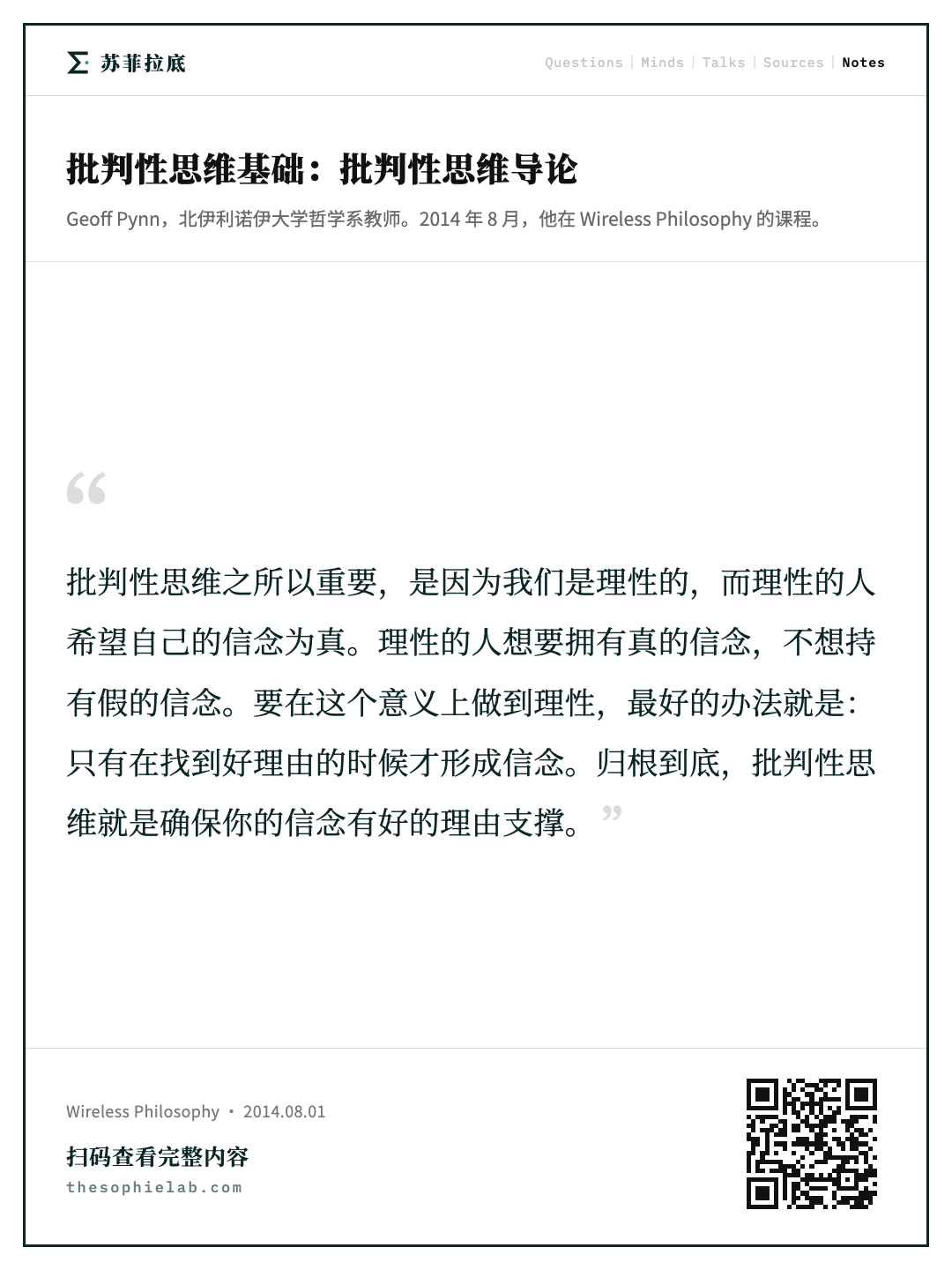
先说第一个问题:什么是批判性思维?归根到底,批判性思维就是确保你的信念有好的理由支撑。这话是什么意思?我们用一个例子来说明。

派对案例:三种理由的优劣

假设你和一位朋友在聊今晚的派对上会有谁。她十分笃定地对你说:「蒙提不会来派对。」你拿不准该不该信她,于是很自然地追问一句:「你为什么这么想?」她可以给出许多不同的回答,我们来看其中三种。

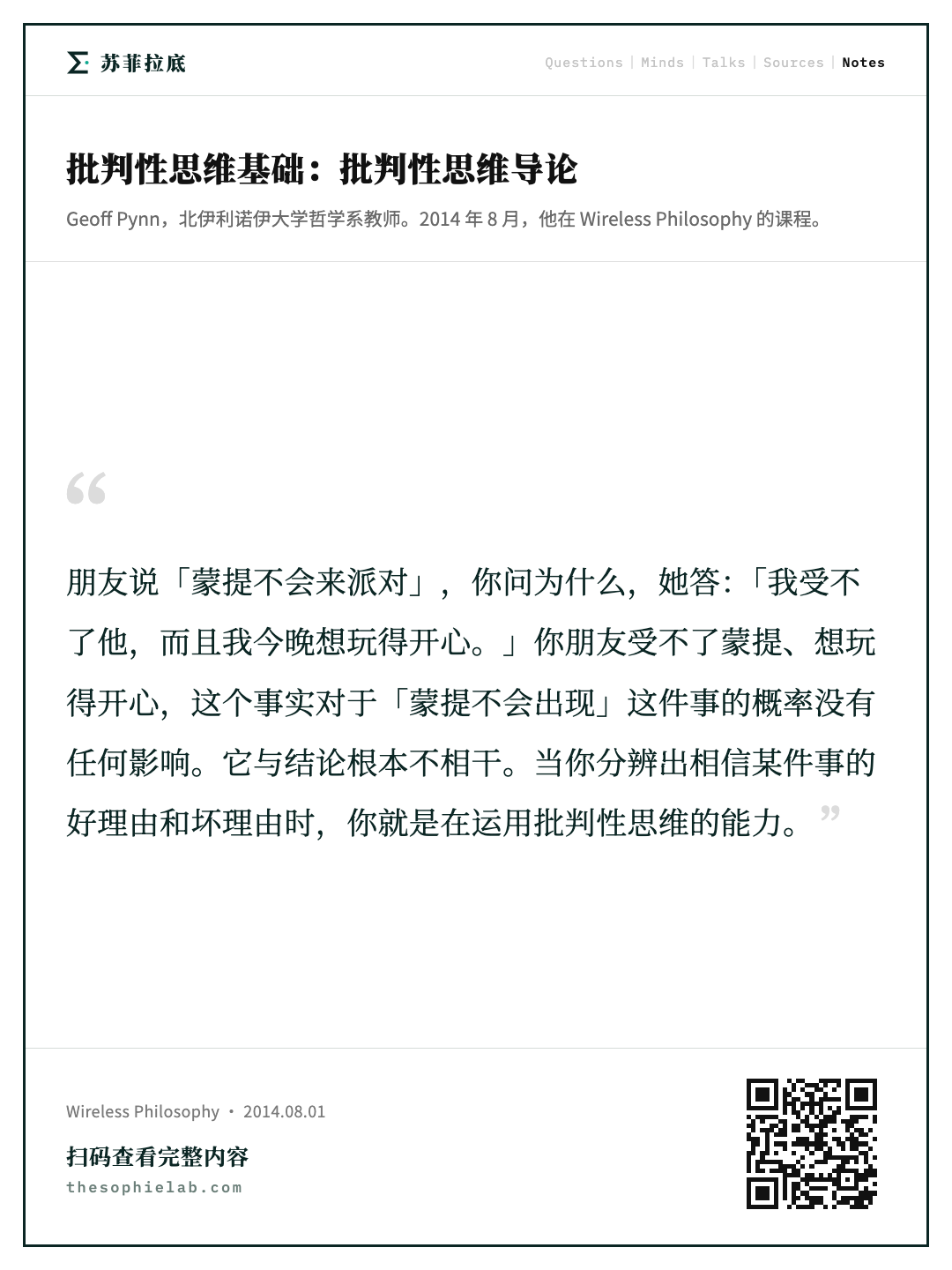
第一种,她可能说:「我受不了他,而且我今晚想玩得开心。」

第二种,她可能说:「他特别害羞,很少参加派对。」

第三种,她可能说:「他人在北京,一个下午之内根本不可能从北京赶到这里。」

第一种回答,并没有给你一个相信蒙提不会来的好理由。第二种回答则是个好理由:如果他非常害羞,又很少参加派对,那么他今晚多半不会出现。第三种回答同样给了你一个好理由:如果他人在北京,而一个下午之内不可能从北京赶到,那么他肯定不会出现在派对上。

当你注意到这类差别,也就是当你分辨出相信某件事的好理由和坏理由时,你就是在运用批判性思维的能力。所以说,批判性思维就是确保我们的信念有好理由。而学习批判性思维要掌握的一项核心技能,正是分辨相信某事的好理由与坏理由。

「好理由」的含义:与道德无关,与真相关

这里有必要说明一下,我是在什么意义上使用「好」这个词的。

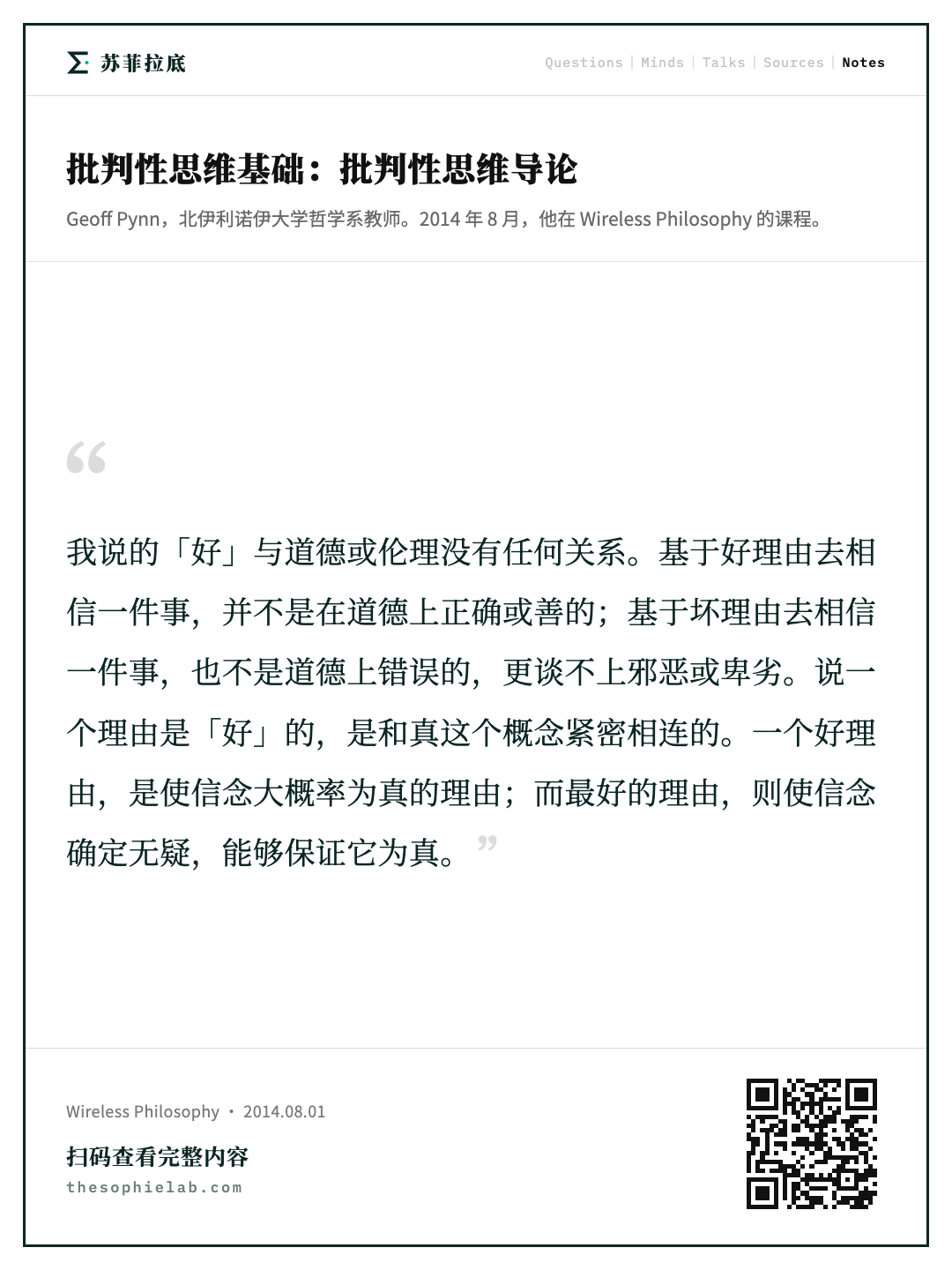
我说的「好」与道德或伦理没有任何关系。基于好理由去相信一件事,并不是在道德上正确或道德上善的;同样,基于坏理由去相信一件事,也不是道德上错误的,更谈不上邪恶或卑劣。在这里,说一个理由是「好」的,是和真(truth)这个概念紧密相连的。一个好理由,是一个使信念成为大概率为真的理由,也就是说,它让这个信念很可能是真的。而最好的理由,则使信念确定无疑,也就是能够保证它为真。

理性人为何需要批判性思维

那么这一切为什么重要?批判性思维之所以重要,是因为我们是理性的,而理性的人希望自己的信念为真。理性的人想要拥有真的信念,不想持有假的信念。要在这个意义上做到理性,最好的办法就是:只有在找到好理由的时候才形成信念。

什么是论证:前提与结论

这就引出了第二个问题:什么是论证?

论证是一组陈述,这些陈述合在一起构成支持另一个陈述的理由。举例来说,前面你朋友的一个回答就可以看成一个论证。她给出了两个陈述:「蒙提特别害羞」和「蒙提很少参加派对」,这两句合起来构成了相信「蒙提不会来派对」的理由。

充当理由的那些陈述,我们称之为论证的前提(premise)。「蒙提特别害羞」是前提一,「蒙提很少参加派对」是前提二。这些前提给你理由去相信的那个陈述,我们称之为论证的结论(conclusion)。

一个好的论证,是前提为结论提供了好理由的论证,也就是说,前提使结论很可能为真。在这种情况下,我们说这个论证支持(support)它的结论。好论证支持自己的结论,坏论证则不支持。因此,批判性思维的一个关键部分,就是学会评估论证,判断它是好是坏,即判断它的前提是否支持结论。

红色与紫色论证:相关性决定好坏

现在我们把她的第一种回答写成论证,用红色标出。它有两个前提:「我受不了蒙提」和「我想玩得开心」,结论是「蒙提不会来派对」。她的第三种回答我们用紫色标出,同样有两个前提:「蒙提在北京」和「他无法从北京及时赶到派对」,结论是「所以他不会来派对」。

前面我已经说过,红色论证不好,紫色论证好。现在我可以多解释几句原因。

看看红色论证的前提说了什么:你朋友受不了蒙提,而且她想玩得开心。再想想这两句话与结论之间的关系,你会发现,这些陈述丝毫没有让结论变得更可能为真。你朋友受不了蒙提、想玩得开心,这个事实对于「蒙提不会出现」这件事的概率没有任何影响。它与结论根本不相干。

而在紫色论证里,如果前提为真,它们就保证了结论为真。所以前提使结论极有可能成立。前提的真保证了结论的真,因此在紫色论证中,前提确实支持结论。

背景前提如何改写论证的评价

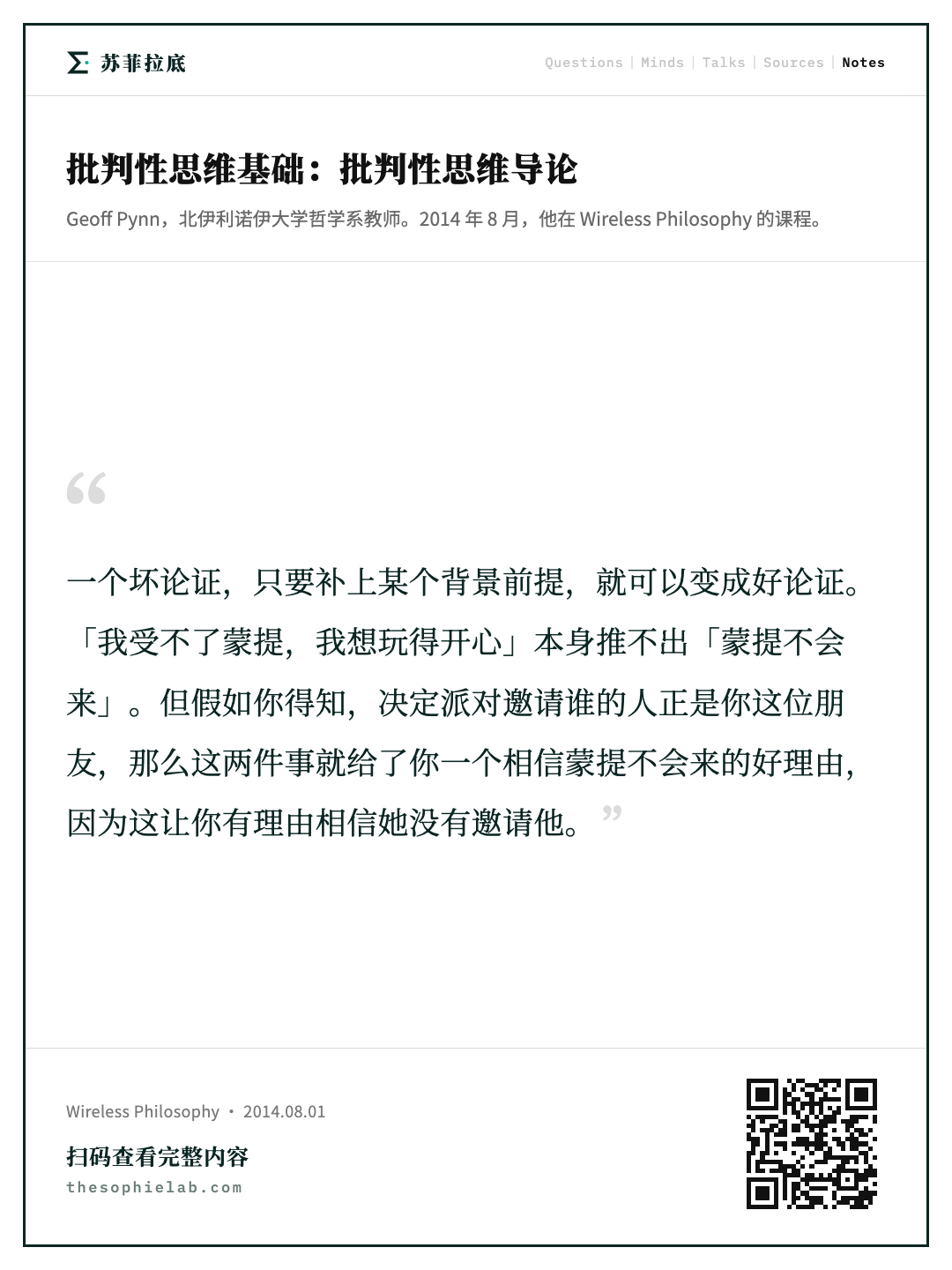
值得指出的是,红色论证虽然就目前而言是坏的,但只要补上某个背景前提,它就可以变成一个好论证。比如说,假如你得知,决定派对邀请谁的人正是你这位朋友,那么她受不了蒙提、又想玩得开心这两件事,就给了你一个相信蒙提不会来的好理由,因为这让你有理由相信她没有邀请他。

但就目前的样子来看,这个论证并不好。单看那两个前提本身,它们没有给你任何理由去相信蒙提不会来派对。

演绎论证:前提保证结论

最后一个话题,是区分两种不同类型的论证。

我在左边放上橙色论证,也就是你朋友的第二种回答:「蒙提特别害羞」和「他很少参加派对」。右边放上紫色论证:「蒙提在北京」和「他无法从北京及时赶到派对」。两者的结论相同,都是「蒙提不会来派对」。

我前面说过,这两个都是好论证,都给了你相信结论的理由,也就是说,它们的前提都支持结论。但两者之间有一个重要区别,我想特别指出来。

看紫色论证,想想那些前提说了什么。你会注意到,如果这些前提为真,即蒙提在北京,而且无法从北京及时赶到派对,那么「蒙提不会来派对」就必然为真。这些前提保证了结论。像这样前提保证结论为真的论证,我们称之为演绎论证。在演绎论证中,给定前提,结论必定为真。仅仅思考演绎论证前提中的信息,就足以让你推出结论。

扩展性论证:前提使结论很可能

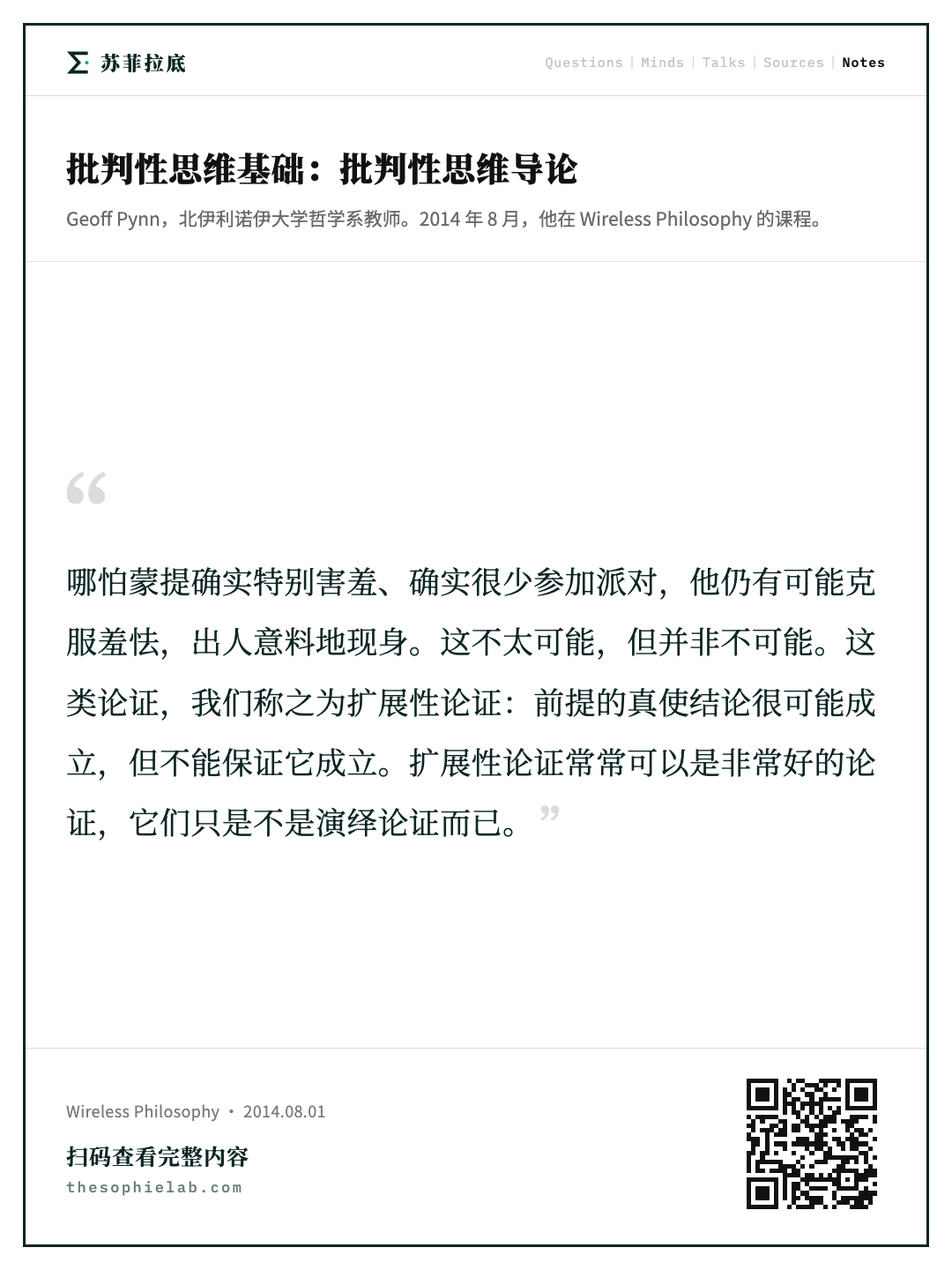
再看橙色论证,你会发现情况并非如此。在橙色论证中,即便前提都为真,结论仍然可能为假。哪怕蒙提确实特别害羞、确实很少参加派对,他仍有可能克服羞怯,暂时放下「很少参加派对」的习惯,出人意料地现身。这不太可能,但并非不可能。所以橙色论证中前提的真,并不保证结论的真。

这类论证,我们称之为扩展性论证。在扩展性论证中,前提的真使结论很可能成立,但不能保证它成立。

正如我说过的,这两个论证都是好论证。扩展性论证常常可以是非常好的论证,它们只是不是演绎论证而已:前提不保证结论为真。

先判断论证类型,再选择评估工具

在评估一个论证时,弄清楚这个论证究竟是打算作为演绎论证,还是仅仅作为扩展性论证,可能非常重要。

如果一个论证本应是演绎的,而仔细考察之后发现,前提事实上并不能保证结论为真,即前提为真时结论仍可能为假,那么这往往就是把它当作坏论证予以拒斥的好理由。

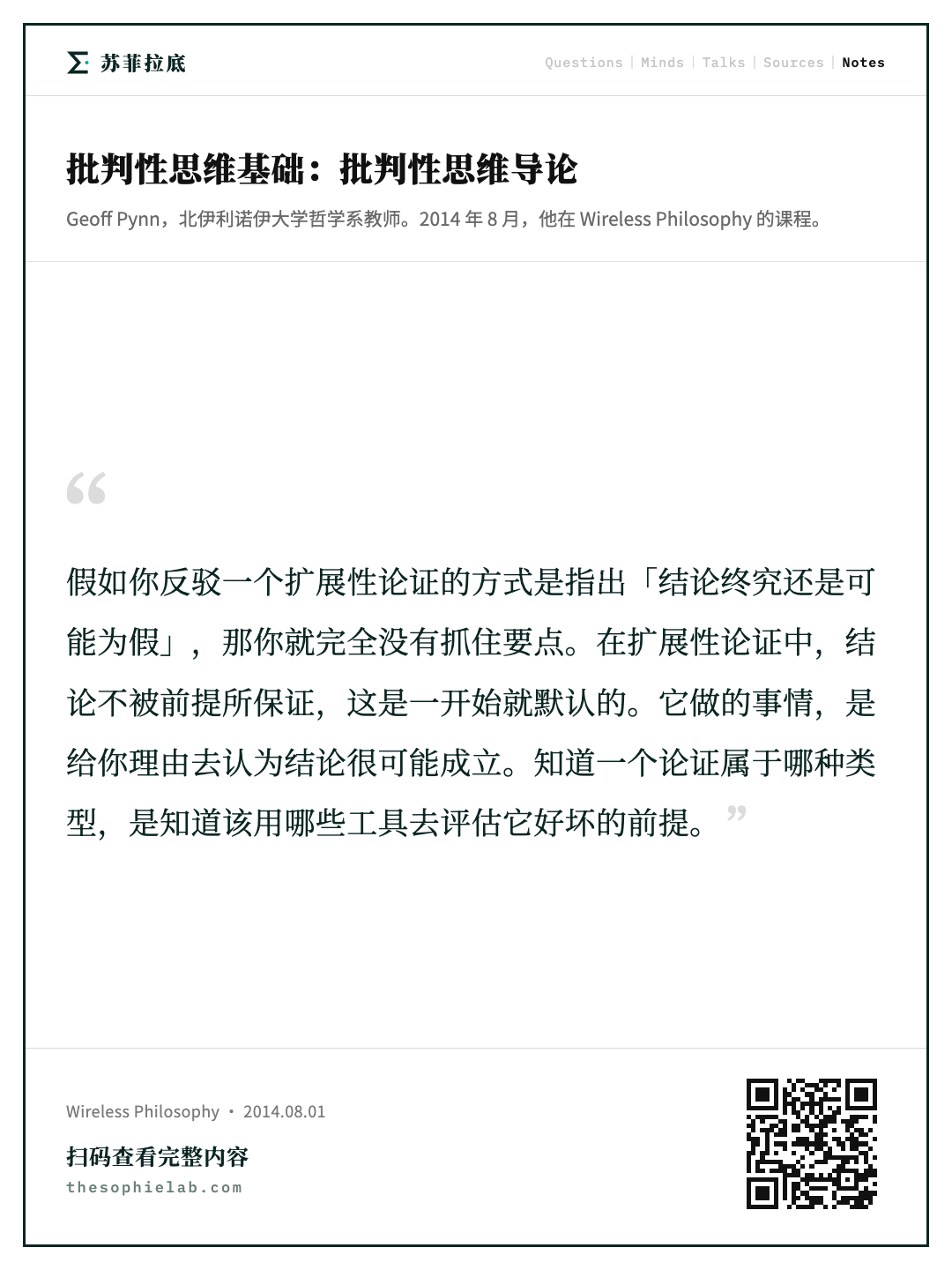
而对于扩展性论证,注意到前提的真不保证结论的真,无非是注意到了它是一个扩展性论证。假如你反驳橙色论证的方式是指出「结论终究还是可能为假」,那你就完全没有抓住要点。在扩展性论证中,结论不被前提所保证,这是一开始就默认的。扩展性论证做的事情,是给你理由去认为结论很可能成立。

所以,知道一个论证属于哪种类型,是知道该用哪些工具去评估它好坏的前提。在后续几讲中,我们会花相当多的篇幅,分别讨论评估扩展性论证和演绎论证的各种工具。

本课总结

最后总结一下这一讲的内容。

批判性思维,就是确保我们的信念有好理由。所谓好理由,是指使信念很可能为真的理由。

论证是一组陈述,我们称之为前提,它们合在一起构成支持另一个陈述的理由,而那个陈述我们称之为论证的结论。在好的论证中,前提支持结论,也就是说,前提为相信结论提供了好理由,因为它们使结论很可能为真。

演绎论证,是结论被前提所保证的论证:如果前提为真,结论就必定为真。扩展性论证,是前提不保证结论、但使结论很可能成立的论证,因此它们同样可以为相信结论提供好理由。

这一讲的入门课程就到这里。
本期讲者
杰夫·平恩北伊利诺伊大学哲学系教师,研究方向为知识论。他是 Wireless Philosophy(Wi-Phi)「批判性思维基础」系列课程的主讲人之一,本视频为该系列第一讲。
章节 · 点击跳转视频
0:00 课程概览与批判性思维的定义 ▶ 正在看
0:41 派对案例:三种理由的优劣 ▶ 正在看
1:42 「好理由」的含义:与道德无关,与真相关 ▶ 正在看
2:40 理性人为何需要批判性思维 ▶ 正在看
2:40 什么是论证:前提与结论 ▶ 正在看
4:09 红色与紫色论证:相关性决定好坏 ▶ 正在看
5:08 背景前提如何改写论证的评价 ▶ 正在看
5:41 演绎论证:前提保证结论 ▶ 正在看
7:06 扩展性论证:前提使结论很可能 ▶ 正在看
7:35 先判断论证类型,再选择评估工具 ▶ 正在看
8:33 本课总结 ▶ 正在看
本期论点
本期回应
0:29
批判性思维的根本,是确保自己的信念有充分的理由支撑 都要理由信念最终都能被理性检验吗?
2:52
要在信念上保持理性,最好的办法是只在有好理由时才形成信念 都要理由信念最终都能被理性检验吗?
其他论点
1:21
某人害羞且极少参加派对,是相信他今晚不会出席派对的好理由
2:08
说一个相信的理由「好」,与道德或伦理无关
2:23
支持一个信念的好理由,就是让这个信念很可能为真的理由
3:40
好论证就是前提使结论很可能为真的论证
5:03
论证的好坏取决于前提与结论的相关性,即前提为真能否提高结论为真的可能
5:18
一个就目前形态而言是坏的论证,加入某个背景前提后可以变成好论证
6:49
演绎论证只需要前提中已包含的信息,就足以推出结论
7:01
非演绎的好论证即使前提全为真,结论仍可能是假的
7:50
若一个论证本应是演绎的,却做不到前提真则结论必真,这就足以拒斥它
8:15
以「结论仍可能为假」去反驳扩展性论证,是没抓住重点
01课程概览与批判性思维的定义
0:00
(intro music) I'm Geoff Pynn. I teach at Northern Illinois University, and this is an introduction[br]to critical thinking. In this lesson, we're gonna[br]talk about three things. First, what is critical thinking? Second, what is an argument? And third, what's the difference between deductive and ampliative arguments? Okay, so what is critical thinking? Well, fundamentally, critical thinking is about making sure that you have good reasons for your beliefs. What does that mean? So suppose that you and your friend are talking about who's[br]gonna be at tonight's party.
(片头音乐)我是 Geoff Pynn,任教于北伊利诺伊大学,这是一门批判性思维入门课。这节课我们要讲三件事。第一,什么是批判性思维?第二,什么是论证?第三,演绎论证和扩展性论证(ampliative arguments)有什么区别?好,那么什么是批判性思维呢?从根本上说,批判性思维就是要确保你的信念有充分的理由。这是什么意思呢?假设你和朋友在聊今晚的派对上会有谁来。
便签引用
02派对案例:三种理由的优劣
0:41
And she says to you, quite confidently, "Monty won't be at the party." You're not sure whether[br]or not to believe her, so it would be natural[br]for you to follow up by asking, "Why do you think so?" And there are a lot of different things that she might say in response. We're gonna talk about three possible answers she could give. First, she might say, "I can't stand him, and I want to have a good time." Second, she might say,[br]"Well, he's really shy, and he rarely goes to parties." And third, she might say, "He's in Beijing, and it's impossible to get here from[br]Beijing in an afternoon."
她非常肯定地对你说:“Monty 不会来这个派对。”你不确定该不该相信她,所以你很自然地会追问一句:“你为什么这么认为?”她可能会给出很多种不同的回答。我们来讨论她可能给出的三种回答。第一种,她可能说:“我受不了他,我想玩得开心点。”第二种,她可能说:“他非常害羞,很少去参加派对。”第三种,她可能说:“他在北京,而一个下午之内根本不可能从北京赶到这里。”
便签引用
1:14
The first response that she gives you does not give you a good reason to believe that Monty won't be at the party. The second reason,[br]though, is a good reason to believe that Monty[br]won't be at the party. If he's really shy and[br]rarely goes to parties, then it's probable that he[br]won't be at tonight's party. Similarly, the third reason[br]also gives you a good reason to believe that[br]Monty won't be at the party. If he's in Beijing, and[br]it's impossible to get here from Beijing in an afternoon,[br]then it's guaranteed that he won't be at the party.
她给出的第一个回答,并没有给你一个好理由去相信 Monty 不会来派对。不过第二个理由,确实是一个相信 Monty 不会来派对的好理由。如果他非常害羞、很少去参加派对,那么他很可能不会出现在今晚的派对上。同样,第三个理由也给了你一个好理由,去相信 Monty 不会来派对。如果他人在北京,而一个下午之内不可能从北京赶到这里,那就可以肯定他不会出现在派对上。
便签引用
03「好理由」的含义:与道德无关,与真相关
1:42
And when you notice things like that, when you distinguish between good and bad reasons for believing something, you're exercising your[br]critical thinking skills. So critical thinking is making sure we have good reasons for our beliefs, and so one of the essential[br]skills that you learn when you're studying[br]critical thinking is how to distinguish good reasons[br]for believing something from bad reasons for believing something. Now, it's worth saying something about how I'm using the term "good" here.
当你注意到这类差别,当你能区分相信某件事的好理由和坏理由时,你就是在运用你的批判性思维能力。所以,批判性思维就是确保我们的信念有充分的理由,因此,学习批判性思维时你要掌握的一项核心技能,就是如何把相信某事的好理由和相信某事的坏理由区分开来。另外,有必要说明一下我在这里是怎么使用“好”这个词的。
便签引用
2:08
I'm not using it to indicate anything having to do with morality or ethics. So it's not morally right or morally good to believe something on[br]the basis of good reasons. Similarly, it's not morally[br]wrong, or evil, or wicked to believe something on[br]the basis of a bad reason. Rather, here, what it is to[br]say that a reason is good is closely tied to the notion of truth. So a good reason for a belief is one that makes it probable, that is, it's one that makes the belief likely to be true. The very best reasons for a belief make it certain, they guarantee it.
我用它并不是指任何跟道德或伦理有关的东西。所以,基于好理由去相信某件事,并不是说这在道德上是正确的或道德上是好的。同样地,基于一个糟糕的理由去相信某件事,在道德上并不算错误、邪恶或恶劣。更确切地说,在这里,说一个理由是好理由,是与'真'这个概念密切相关的。所以,一个支持某个信念的好理由,就是能让这个信念变得可能成立的理由,也就是说,它让这个信念很可能为真。支持一个信念的最好的理由能让它变得确定无疑,能够保证它为真。
便签引用
05什么是论证:前提与结论
2:40
So why does this matter? Well, the reason that critical thinking is important is because,[br]since we're rational, we want our beliefs to be true. Rational people want to have true beliefs, and they want not to have false beliefs. And the best way to be[br]rational in this way is to form beliefs only when you find good reasons for them. Okay, that leads us to[br]our second question: What is an argument? Well, an argument is a set[br]of statements that together comprise a reason for a further statement.
那么这为什么重要呢?嗯,批判性思维之所以重要,是因为既然我们是理性的,我们就希望自己的信念是真的。理性的人希望持有真信念,并且不希望持有假信念。而要在这方面做到理性,最好的办法就是:只在你找到好理由的时候才形成信念。好,这就引出了我们的第二个问题:什么是论证?论证是一组陈述,它们合在一起构成了支持另一个陈述的理由。
便签引用
3:09
So, for example, we can consider one of your friend's responses[br]before as an argument. She's given you two statements, "Monty's really shy" and[br]"Monty rarely goes to parties," which together comprise[br]a reason for believing that Monty won't be at the party. The statements that are the reason, we call the argument's premises. So "Monty's really shy" is premise one, "Monty rarely goes to[br]parties" is premise two, and the statement that[br]those premises give you reason to believe, we call[br]the argument's conclusion.
举个例子,我们可以把你朋友之前的一个回答看作一个论证。她给了你两个陈述:'Monty 真的很害羞'和'Monty 很少去参加聚会',这两句话合起来构成了相信'Monty 不会来聚会'的理由。作为理由的那些陈述,我们称之为论证的前提。所以'Monty 真的很害羞'是前提一,'Monty 很少去参加聚会'是前提二,而这些前提让你有理由去相信的那个陈述,我们称之为论证的结论。
便签引用
3:40
A good argument is one[br]in which the premises give you a good reason for[br]the conclusion, that is, the premises make the[br]conclusion likely to be true. In that case, we say that the argument supports the conclusion. Good arguments support their conclusions, and bad arguments don't[br]support their conclusions. So a key part of critical[br]thinking is learning to evaluate arguments to determine whether or not they're good or bad, that is, whether or not their premises support their conclusions.
好论证就是前提为结论提供了好理由的论证,也就是说,前提使得结论很可能为真。在这种情况下,我们就说这个论证支持该结论。好论证支持它们的结论,坏论证则不支持它们的结论。所以批判性思维的一个关键部分,就是学会评估论证,判断它们是好是坏,也就是说,判断它们的前提是否支持其结论。
便签引用
06红色与紫色论证:相关性决定好坏
4:09
The red argument is the first response that she gave, two premises, "I can't stand Monty" and "I[br]want to have a good time." And the conclusion is "Monty[br]won't be at the party." And the third argument,[br]which we'll put in purple, consisted also of two premises, "Monty's in Beijing" and[br]"He can't get from Beijing to the party in time, so[br]he won't be at the party." Now, as I indicated[br]before, the first argument is not good, while the[br]purple argument is good. And here I can explain a[br]little bit more about why.
红色的这个论证是她给出的第一个回答,有两个前提:'我受不了 Monty'和'我想玩得开心'。而结论是'Monty 不会来聚会'。第三个论证,我们用紫色标出,同样包含两个前提:'Monty 在北京'和'他没法从北京及时赶到聚会,所以他不会出现在聚会上'。正如我之前指出的,第一个论证不是好论证,而紫色的论证是好论证。在这里我可以更详细地解释一下原因。
便签引用
4:40
If you consider what the[br]red argument's premises say, that your friend can't stand Monty, and she wants to have a good time, and think about their relationship to the conclusion of the argument, you'll see that those[br]statements don't make that conclusion any[br]more likely to be true. The fact that your[br]friend can't stand Monty and wants to have a good[br]time doesn't do anything to make it more likely[br]that Monty won't be there. It's simply unrelated to the conclusion. In the purple argument,[br]though, the premises, if they're true, they guarantee[br]the conclusion is true.
如果你想想红色论证的前提说了什么——你朋友受不了 Monty,而且她想玩得开心——再想想它们与该论证结论之间的关系,你就会发现,这些陈述并没有让那个结论变得更有可能为真。你朋友受不了 Monty 并且想玩得开心,这个事实丝毫没有让'Monty 不会去'这件事变得更有可能。它跟结论根本毫无关系。而在紫色论证里,前提如果为真,就保证了结论为真。
便签引用
07背景前提如何改写论证的评价
5:08
So they make it very probable. The truth of the premises[br]guarantees the truth of the conclusion, and so[br]in the purple argument, the premises do support the conclusion. Now, it's worth pointing[br]out that the red argument, though it's bad as it[br]stands, could be made a good argument with the addition of some background premise. So, for example, if you found out that your friend was[br]the person who decided who was going to be invited to the party, then the fact that she can't stand Monty and wants to have a good time would give you a good reason to believe that Monty won't be at the party, because it would give you reason to believe that she didn't invite him.
所以它们让结论的可能性非常高。前提为真就保证了结论为真,因此在紫色论证中,前提确实支持结论。不过值得指出的是,红色论证虽然就目前这个样子来说是坏论证,但如果加上某个背景前提,它是可以变成好论证的。比如说,如果你发现你朋友正是决定邀请谁来聚会的那个人,那么她受不了 Monty 又想玩得开心这个事实,就会给你一个相信 Monty 不会来聚会的好理由,因为这会让你有理由相信她没有邀请他。
便签引用
08演绎论证:前提保证结论
5:41
But as it stands, the[br]argument is not good. Those two premises[br]considered in themselves give you no reason to believe that Monty won't be at the party. Okay, our last topic is to distinguish two different types of arguments. So I'm gonna put up here, on the left, the orange argument, which is the second response that your friend gave, "Monty's really shy" and[br]"He rarely goes to parties." On the right we'll put[br]the purple argument, "Monty's in Beijing" and "He can't get from Beijing[br]to the party in time."
但就目前这个样子来说,这个论证不是好论证。单就这两个前提本身而言,它们并没有给你任何理由去相信 Monty 不会来聚会。好,我们最后一个话题是区分两种不同类型的论证。我在左边放上橙色的论证,也就是你朋友给出的第二个回答:'Monty 真的很害羞'和'他很少去参加聚会'。右边我们放紫色的论证:'Monty 在北京'和'他没法从北京及时赶到聚会'。
便签引用
6:06
Both of them have the same conclusion, "Monty won't be at the party." Now, as I said before, both of these are good arguments, they both do give you reason to believe the conclusion, i.e., both of them have premises which support the conclusion, but there's an important difference between the two arguments[br]that I want to point out. If you consider the purple argument, and think about what those premises say, you'll notice that if[br]those premises are true, if Monty's in Beijing,[br]and can't get from Beijing to the party in time, then it must be true that Monty won't be at the party.
两者的结论是一样的:'Monty 不会来聚会'。正如我之前所说,这两个都是好论证,它们都确实给了你相信该结论的理由,也就是说,两者的前提都支持结论,但这两个论证之间有一个重要的区别,我想指出来。如果你思考一下紫色论证,想想那些前提说了什么,你会注意到,如果这些前提为真,如果 Monty 在北京,而且没法从北京及时赶到聚会,那么就必然为真:Monty 不会来聚会。
便签引用
6:34
Those premises guarantee the conclusion. In such an argument, where the premises guarantee the truth of the conclusion, we call the argument deductive. In a deductive argument,[br]given the premises, the conclusion must be true. Just thinking about the information in the premises in a deductive argument gives you all you need[br]to deduce the conclusion. If you look at the[br]orange argument, though, you'll notice that that's not the case. In the orange argument,[br]even if those premises are true, the conclusion[br]might still be false.
这些前提保证了结论成立。在这样一种前提保证结论为真的论证中,我们称该论证为演绎论证。在演绎论证中,只要给定前提,结论就必然为真。在演绎论证里,只要思考前提中包含的信息,就足以让你推演出结论。但如果你看看橙色的论证,你会注意到情况并非如此。在橙色论证中,即使那些前提为真,结论仍然可能是假的。
便签引用
09扩展性论证:前提使结论很可能
7:06
Even given that Monty is really shy and rarely goes to parties,[br]it's still possible that he'll get over[br]his shyness and suspend his policy of rarely going to parties, and unexpectedly show up. It's unlikely, but it's possible. So the truth of the premises[br]in the orange argument does not guarantee the[br]truth of the conclusion. Arguments like this, we call ampliative. In an ampliative argument,[br]the truth of the premises makes the conclusion probable[br]but doesn't guarantee it. Now, as I said, both of[br]the arguments are good.
即便 Monty 确实很害羞而且很少去参加聚会,他仍然有可能克服自己的害羞,暂时打破他很少去聚会的惯例,出人意料地出现。这不太可能,但确实有可能。所以在橙色论证中,前提为真并不保证结论为真。这样的论证,我们称之为扩展性论证(ampliative)。在扩展性论证中,前提为真使结论变得很可能,但并不保证结论成立。如我所说,这两个论证都是好论证。
便签引用
10先判断论证类型,再选择评估工具
7:35
Ampliative arguments can often be very good arguments,[br]they're just not deductive. The premises don't guarantee[br]the truth of the conclusion. Now, when you're evaluating an argument, it can be important to know whether or not the argument is supposed to be deductive or supposed to be merely ampliative. If an argument is[br]supposed to be deductive, but careful consideration of the argument reveals that in fact the premises don't guarantee the[br]truth of the conclusion, if the conclusion could[br]be false even though the premises are true,[br]that's often a good reason to reject the argument as a bad argument.
扩展性论证往往可以是非常好的论证,只不过它们不是演绎的。前提并不保证结论为真。那么,当你在评估一个论证时,弄清楚这个论证是打算作为演绎论证,还是仅仅打算作为扩展性论证,可能是很重要的。如果一个论证本应是演绎的,但仔细审视后发现,实际上前提并不保证结论为真,如果前提为真而结论仍可能为假,那这通常就是一个好理由,让你把这个论证判定为坏论证而加以拒斥。
便签引用
8:06
Whereas in an ampliative argument, to notice that the truth of the premises doesn't guarantee the[br]truth of the conclusion, is simply to notice that[br]it's an ampliative argument. If you were to object[br]to the orange argument by pointing out that,[br]still, the conclusion could be false, you'd[br]really be missing the point. In an ampliative argument,[br]it's taken for granted that the conclusion is not[br]guaranteed by the premises. Rather, what an ampliative[br]argument is doing is giving you reasons to think that the conclusion is probable.
而在扩展性论证中,注意到前提为真并不保证结论为真,不过是注意到它是一个扩展性论证罢了。如果你反驳橙色论证的方式是指出:结论毕竟还是可能为假,那你其实就没抓住重点。在扩展性论证中,'结论并不由前提所保证'本来就是被默认接受的前提。扩展性论证所做的事情,是给你一些理由去认为结论很可能成立。
便签引用
11本课总结
8:33
So knowing what type of[br]argument an argument is is essential to knowing which tools to use to evaluate whether or[br]not it's a good argument. And we'll talk quite a bit more about different tools for[br]evaluating both ampliative and deductive arguments in future lessons. Okay, so summing up this lesson. Critical thinking is making sure that we have good reasons for our beliefs, where we understand a good reason as one that makes the belief[br]probable, or likely to be true. An argument is a set of statements, which we call premises,[br]that together comprise a reason for another statement, which we call the argument's conclusion.
所以,知道一个论证属于哪种类型,对于知道该用哪些工具来评估它是不是好论证,是至关重要的。在以后的课程中,我们会更多地讨论评估扩展性论证和演绎论证的各种不同工具。好,我们来总结一下这节课。批判性思维就是确保我们对自己的信念持有好理由,而我们把好理由理解为:使该信念变得很可能、或很可能为真的理由。论证是一组陈述——我们称之为前提——它们合起来构成了支持另一个陈述的理由,那个陈述我们称之为论证的结论。
便签引用
9:08
And in a good argument, the premises support their conclusions, that is, the premises give you a[br]good reason for believing the conclusion, because[br]they make it probable. A deductive argument is[br]one where the conclusion is guaranteed by the premises.[br]If the premises are true, then the conclusion must be true. An ampliative argument[br]is one where the premises don't guarantee the conclusion, but they do make it probable. So they can still provide you with good reason for[br]believing the conclusion.
而在一个好论证中,前提支持其结论,也就是说,前提给了你相信该结论的好理由,因为它们使该结论变得很可能。演绎论证是结论由前提所保证的论证。如果前提为真,那么结论就必然为真。扩展性论证则是前提并不保证结论的论证,但它们确实使结论变得很可能。所以它们仍然能为你提供相信该结论的好理由。
便签引用
9:37
Okay, so that ends this[br]introductory lesson.
好,这节入门课就到这里。
便签引用
9:47
Subtitles by the Amara.org community
字幕由 Amara.org 社区提供
便签引用
视频总结 · 一句话概括与核心要点

一句话概括

北伊利诺伊大学的 Geoff Pynn 用"Monty 会不会来派对"这一个例子,讲清了批判性思维的核心(为信念找好理由)、论证的结构(前提→结论)以及演绎论证与扩充论证的本质区别(前提是否保证结论)。

核心要点

  • 批判性思维的本质是"确保自己的信念有好理由"。 视频用一个场景展开:朋友断言"Monty 不会来派对",你追问"为什么",她给出三种回答——(1) 我受不了他,我想玩得开心;(2) 他很害羞,很少参加派对;(3) 他在北京,一下午不可能赶回来。分辨出第一个是坏理由、后两个是好理由,就是在运用批判性思维。
  • "好"理由与道德无关,只与真值相关。 Pynn 特别澄清:基于好理由相信某事不是"道德上正确",基于坏理由相信也不是"邪恶"。"好理由"的定义是让信念大概率为真;最好的理由则让信念确定为真(提供保证)。
  • 批判性思维之所以重要,源于理性的目标。 理性的人想拥有真信念、避免假信念,而实现这一点最可靠的方式是:只在找到好理由时才形成信念。
  • 论证 = 一组共同构成"支持另一陈述之理由"的陈述。 提供理由的陈述叫前提(premises),被支持的陈述叫结论(conclusion)。例如:前提一"Monty 很害羞"、前提二"Monty 很少参加派对",结论"Monty 不会来派对"。
  • 好论证的标准是"前提支持结论",即前提使结论大概率为真。 "我受不了他 + 我想玩得开心"这组前提与结论毫无关联,不会提高结论为真的概率,因此是坏论证;"他在北京 + 赶不回来"这组前提一旦为真则结论必然为真,因此是好论证。
  • 坏论证可以通过补充背景前提变成好论证。 若额外得知"这位朋友正是决定派对邀请名单的人",那么"她讨厌 Monty 且想玩得开心"就成了相信"她没邀请他 → 他不会来"的好理由。评价论证时要注意隐含前提的存在与否。
  • 演绎论证(deductive):前提为真则结论必然为真。 "在北京 + 赶不回来 → 不会来"是典型例子,仅凭前提中的信息就足以推导出结论。
  • 扩充论证(ampliative):前提使结论大概率为真,但不保证。 "害羞 + 很少去派对 → 不会来"是典型例子:即便前提全真,Monty 仍有可能克服害羞、破例出席——不太可能,但可能。扩充论证也可以是很好的论证,只是不具备演绎性质。
  • 评价论证前必须先判断它"意图"属于哪一类,否则会用错工具。 若一个论证声称是演绎的,却被发现前提为真时结论仍可能为假,这通常是拒绝该论证的充分理由;但若对扩充论证提出同样的反驳("结论还是可能为假啊"),那就是抓错了重点——扩充论证本来就默认结论不被前提保证,它的任务只是证明结论可能性高。

结论与值得注意的细节

  • 全课总结成三个定义:批判性思维 = 确保信念有好理由(好 = 使信念大概率为真);论证 = 前提 + 结论,好论证的前提支持结论;演绎论证保证结论,扩充论证只让结论大概率成立但仍可提供好理由。
  • 值得注意的细节:Pynn 用颜色区分三个论证——红色(讨厌他,坏论证)、橙色(害羞,好的扩充论证)、紫色(在北京,好的演绎论证),三者共享同一个结论,便于直观对比"同一结论、不同支持强度"。
  • 这是系列课程的第一讲,Pynn 预告后续课程将分别讲解评价演绎论证和扩充论证的具体工具。

核心句型 · 9
1. It would be natural for sb. to do …
“It would be natural for you to follow up by asking, "Why do you think so?"”
用 it would be natural for + 人 + to do 表示「某人自然会……」,语气委婉,适合描述合理的反应或预期行为。仿写:It would be natural for readers to wonder why.
2. X gives you a good reason to believe that …
“The third reason also gives you a good reason to believe that Monty won't be at the party.”
论证类写作的核心表达,说明某证据支持某结论。可替换为 provides / offers grounds to believe。否定形式:does not give you any reason to believe。
3. It's worth saying / pointing out something about …
“It's worth saying something about how I'm using the term "good" here.”
用于插入说明或补充澄清,常见于讲课和学术写作。后接名词或 how/why 从句。类似表达:It's worth noting that…
4. Rather, what X is doing is …
“Rather, what an ampliative argument is doing is giving you reasons to think that the conclusion is probable.”
先否定一种理解,再用 rather + what … is doing is 引出正确理解。强调句结构,突出「真正在做的事」。适合纠正误解。
5. If A, then it must be true that B.
“If Monty's in Beijing, and can't get from Beijing to the party in time, then it must be true that Monty won't be at the party.”
表达必然推论的条件句。must be true that 强调逻辑必然性,比 will 更强。用于说明演绎关系或不可避免的后果。
6. as it stands
“The red argument, though it's bad as it stands, could be made a good argument with the addition of …”
「就目前的状况来说」,常与 though / but 搭配,先承认现状再提出改进可能。仿写:The draft, as it stands, needs more evidence.
7. It's unlikely, but it's possible.
“It's unlikely, but it's possible.”
短句对比结构,先让步再强调可能性。适合在论证中承认小概率反例。也可写作 Improbable, yes—but not impossible.
8. If you were to object to X by …, you'd really be missing the point.
“If you were to object to the orange argument by pointing out that, still, the conclusion could be false, you'd really be missing the point.”
虚拟语气 if you were to … you'd … 用于假设某种反驳并指出其不当。missing the point 是地道说法,指没抓住要害。
9. Knowing X is essential to knowing Y.
“Knowing what type of argument an argument is essential to knowing which tools to use”
动名词作主语,表达「知道 X 是知道 Y 的前提」。注意原文 is is 是动名词短语主语后接系动词的正常现象。
词汇精讲 · 51 · 按出现顺序
ampliative /ˈæmplɪˌeɪtɪv/ adj. 0:00
扩展性的(逻辑学术语,指结论内容超出前提的论证,约等于归纳论证)
deductive /dɪˈdʌktɪv/ adj. 0:00
演绎的(前提为真则结论必然为真)
fundamentally /ˌfʌndəˈmentəli/ adv. 0:00
从根本上说;本质上
quite confidently phr. 0:41
相当肯定地、很有把握地(说)
follow up phr. v. 0:41
追问;接着进一步询问或采取行动
can't stand phr. 0:41
受不了、极其讨厌(某人/某事)
probable /ˈprɑːbəbəl/ adj. 1:14
很可能的;有较大概率的(比 possible 程度高)
guaranteed /ˌɡærənˈtiːd/ adj. 1:14
有保证的、确定无疑的
distinguish between phr. 1:42
区分、辨别(A 与 B)
exercising /ˈeksərsaɪzɪŋ/ v. 1:42
运用、行使(能力、权利);此处非「锻炼」义
it's worth saying something about phr. 1:42
有必要说明一下……;值得谈谈……
morality /məˈræləti/ n. 2:08
道德;道德准则
ethics /ˈeθɪks/ n. 2:08
伦理学;伦理
on the basis of phr. 2:08
基于、根据……
wicked /ˈwɪkɪd/ adj. 2:08
邪恶的、恶劣的
closely tied to phr. 2:08
与……密切相关、紧密联系
the notion of phr. 2:08
……的概念、观念
rational /ˈræʃənəl/ adj. 2:40
理性的;合乎理性的
comprise /kəmˈpraɪz/ v. 2:40
构成、组成(此处 comprise a reason 指「合起来构成一个理由」)
a set of statements phr. 2:40
一组陈述(statement 指有真假的陈述句)
premises /ˈpremɪsɪz/ n. 3:09
前提(逻辑学术语,premise 的复数;注意与「房产」义区分)
conclusion /kənˈkluːʒən/ n. 3:09
结论(论证中被前提支持的陈述)
support the conclusion phr. 3:40
支持结论(指前提使结论更可能为真)
evaluate /ɪˈvæljueɪt/ v. 3:40
评估、评价
consisted of phr. v. 4:09
由……组成
as I indicated before phr. 4:09
正如我之前指出的(indicate 此处=point out)
unrelated to phr. 4:40
与……无关的
doesn't do anything to make it more likely phr. 4:40
丝毫没有让……更有可能(强调完全无贡献)
as it stands phr. 5:08
就目前的样子而言、按现状来看
background premise phr. 5:08
背景前提(隐含的、未明说的前提)
with the addition of phr. 5:08
在加上……之后
considered in themselves phr. 5:41
单就其本身而论
i.e. abbr. 6:06
也就是说(拉丁 id est,用于解释说明,区别于 e.g. 举例)
point out phr. v. 6:06
指出
deduce /dɪˈduːs/ v. 6:34
推演、推断出(由已知前提得出必然结论)
given the premises phr. 6:34
在给定前提的条件下
get over phr. v. 7:06
克服(害羞、困难);从……中恢复
suspend /səˈspend/ v. 7:06
暂停、暂时中止(此处 suspend his policy 指暂时打破惯例)
unexpectedly /ˌʌnɪkˈspektɪdli/ adv. 7:06
出人意料地
show up phr. v. 7:06
露面、出现
merely /ˈmɪrli/ adv. 7:35
仅仅、只不过
careful consideration phr. 7:35
仔细审视、审慎考量
reveals /rɪˈviːlz/ v. 7:35
揭示、显示出
reject /rɪˈdʒekt/ v. 7:35
拒斥、否定(一个论证)
whereas /werˈæz/ conj. 8:06
而、然而(用于对比两种情况)
object to phr. v. 8:06
反对、反驳
missing the point phr. 8:06
没抓住要点、误解了重点
taken for granted phr. 8:06
被视为理所当然、默认接受
essential to phr. 8:33
对……至关重要
summing up phr. v. 8:33
总结、概括
introductory /ˌɪntrəˈdʌktəri/ adj. 9:37
入门的、导论性的
精读便签
下载便签 手机:长按图片也可保存
← 上一期 · NO.002The next 50 years: humanity, AI, power | Yuval Noah Harari 下一期 · NO.004 →Philosopher David Chalmers asks: When we talk to AI, what are we talking to?
苏菲周报 · THE WEEKLY 每周一封,
追问一个大问题。
苏菲拉底的每周来信,写这一周在追问的问题和看到的回应。
苏菲拉底
ASK THE BIG QUESTIONS · THINK DEEPLY · SEE THE WORLD DIFFERENTLY
苏菲拉底微信公众号二维码 微信公众号
© 2026 苏菲拉底 · 内容仅供学习 [email protected]