Turing Award Winner: Early AI, LLM Predictions, Causality | Judea Pearl · 苏菲拉底
字幕 字幕位置
--:--
点击播放,这里会跟随视频显示当前句的中英字幕。

Turing Award Winner: Early AI, LLM Predictions, Causality | Judea Pearl

节目发布 2026-07-27 · Ryan Peterman
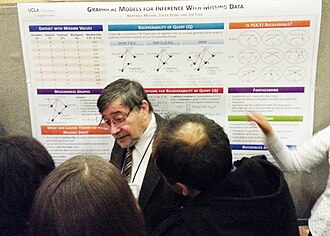
朱迪亚·珀尔 主主持人
EDITED TRANSCRIPT · 依据现场录音编译整理,可划线生成便签
朱迪亚·珀尔(Judea Pearl),图灵奖得主,贝叶斯网络与因果推理的奠基人,加州大学洛杉矶分校计算机科学教授。本文是他在一档科技人物访谈节目中接受的长篇访谈:从一九四八年建国前巴勒斯坦托管地的中学课堂讲起,经由超导存储器、启发式搜索、专家系统,一路走到贝叶斯网络、因果阶梯,以及他对大语言模型能否通往通用人工智能的判断。全文依据现场录音编译整理,仅删去口语枝节、寒暄与节目插播,发言内容与先后顺序悉依原貌。

名师云集的中学教育

主持人: 我查了您的教育背景,全是电机工程和物理。我看不出这跟因果推理、人工智能有什么关系。您是怎么走到这一步的?

珀尔: 一切都连着。一切都连着,一直连到我出生那天,头上被拍了一下。(笑)首先得说,我是在以色列建国之前的巴勒斯坦托管地长大的,一九四八年以前。我们那时的中学教育极好。

我的中学老师,是被希特勒从德国赶出来的教授,出身海德堡、柏林这样的名校。他们三十年代来到巴勒斯坦,找不到学术职位,那时候教职很稀少,就去教中学了。可他们是真正一流的教授,什么都能不带讲稿地讲,从满洲的经济到毕达哥拉斯定理的证明,不看笔记,不停顿。我这一代人运气好,成了这场教育实验的受益者。

于是我们学科学,是从人的视角、按时间顺序学的:一件事是怎么被发现的,谁发现的,在哪个时期。某个数学证明为什么在当时会成为问题?提出这个证明的人知道什么,不知道什么,在那个历史处境里他问了自己什么?这才是教科学的方法。不是把科学当成一套算法和技巧的菜谱,而是站在人的立场上,看思想如何从一个人传到另一个人,看人如何挣扎着破解自然的秘密。

学生是科学的参与者

主持人: 这种学法有什么好处?

珀尔: 好处是你把自己看成一个参与者。你,学生,也会被许多事困住。可你看毕达哥拉斯是怎么做的。他跟你一样困惑,他走了那条路。你困惑的时候,当然你的困惑没有他的那么壮阔,可你看他怎么绕过难关,怎么参考别人的工作,怎么挣扎。你的挣扎也是科学的一部分。这就是基本想法:让学生觉得自己是科学的一部分,不是旁观者,不是被动的接受者,而是参与者。我认为这很独特,对我极有价值。我们确实相信,我们每个人都能找到一种没人想过的毕达哥拉斯定理新证法,每个人都有可能成为爱因斯坦或毕达哥拉斯。

他们给了我们这种幻觉。这是一种有用的幻觉。(笑)我现在知道,跟毕达哥拉斯的成就比,我不过是一颗小石子。可这种幻觉让我多了一点,我不想说叛逆,说自信吧。我们整整一代人都是在这种自信的方式里学科学的。我们坚持要按自己的方式、当场把事情弄懂。老师讲快了,我们就闹,拿椅子、拿手边一切东西弄出声响,老师就停下来放慢,让我们都能按自己的方式当场听懂。

这就是我和我这一代人的某种脾性,我看得出它影响了我的一生。有件事我记得很清楚,回头看,一切开始得很早。十岁那年,我们学算面积和体积。课堂上有个问题:一平方公里有多少杜纳亩?杜纳亩(dunam)是一千平方米,是土耳其人留下的丈量单位。全班都说,一杜纳亩就是一平方公里。我大喊:不对,是一千,一平方公里有一千杜纳亩。

老师站在了笑成一片的全班那边,大家都嘲弄我、讥笑我。我回到家,说:他们错了,我明天回去还要坚持。第二天老师向全班道了歉。我由此体会到,是的,你必须坚持你对事情的理解。我讲这个,是因为它也许就是让我成为一个不妥协的人的起点。这是我童年的底色,或许能解释我怎么走进了人工智能。之后我先在军队里当农民,然后才去学工程。

从农兵到以色列理工

主持人: 当农民?

珀尔: 是的。以色列军队里有一种部队,时间一半一半:一半军事训练,一半务农,作为基布兹的一部分。这是老理想,一手扶犁,一手持枪,你就能成功。

主持人: 您开过枪打人吗?

珀尔: 差一点朝一个看不见的人开枪,结果第二天早上发现是只狐狸。可狐狸的脚步声,跟恐怖分子朝我们摸过来的脚步声太像了。(笑)我的开枪经历到此为止。

后来我进了以色列理工学院(Technion)读电机工程。又遇到了好老师,又得到了那种感觉:我们在做科学。我们非常认真地学物理,我喜欢学的东西。我不是班上第一,一直是第三、第四,永远比不过那几个天才。天才们要么早就懂了,要么在课堂上无聊得要死,他们知道老师接下来要讲什么、考试要考什么,一切对他们都是无聊的。我不无聊。我不是第一,但我不无聊。

主持人: 物理里什么东西让您如此着迷?

珀尔: 我喜欢的是,坐在椅子上就能预测事情。就像麦克斯韦,坐在椅子上说:嗯,这看起来像个波动方程。算一下它的速度吧。看起来像光速。嗯,也许光就是电磁波。坐在扶手椅上,一个实验都没做。这让我兴奋。我太太说,有一晚我半夜醒来喊:麦克斯韦错了!麦克斯韦错了!(笑)她把我安抚睡下,第二天早上我说:他是对的。(笑)

几何与代数两套语言

主持人: 您提到了好几位科学家,看来您对科学史很熟。有没有一位最喜欢的科学家?为什么?

珀尔: 学解析几何的时候,我发了烧。真的发烧。

主持人: 身体发烧?

珀尔: 是的。我怎么也无法平静:所有那些费尽力气做出来的几何作图,竟然可以用代数全部完成。我当时觉得笛卡尔是有史以来最伟大的数学家。从几何作图到代数推演的这一转换,对我来说太震撼了,难以置信。

主持人: 我读书的时候把这当成理所当然。它到底哪里让人惊叹?

珀尔: 你有两种不同的语言,几何的语言和代数的语言,它们说的是同一件事。同一个现象,同一个证明,从圆外一点向圆作切线(笑),你可以用另一种方法求出那个角。两种不同的语言处理同一个现象,两个不同的视角,得出同样的结果。这把我彻底震住了。也许这正是学计算机科学的预备,因为对我们搞计算机的人来说,这有什么了不起?想从不同视角看事情?发明一种新语言就是了。这就是中学时点燃我的东西。后来我在物理里又看到同样的事:不同的语言捕捉同一个现象。

法拉第真的让我兴奋。他发明了「场」的概念。看同一件事的两种方式:你可以说这一点的力取决于周围的电荷,也可以说不,就在你测试点的位置上有一个场。妙极了。我就是带着这样的预备进来的。

超导存储器与珀尔涡旋

珀尔: 然后我去了布鲁克林理工。我在那里读书,白天在新泽西普林斯顿的RCA实验室工作,就是大卫·萨诺夫研究实验室。我在那里进了计算机研究组。

那时的计算机研究,就是研究你能想到的一切物理现象,为计算机存储器寻找一种新机制。当时的存储器是磁芯存储器,那种小圆环,你小时候也许还见过。它太慢、太笨重,要靠香港的工人一根根穿X、Y、Z三向的线。大家明白磁芯存储器的日子不长了,都在找新现象。有人看光致变色存储器,有人看半导体,像我这样的人看超导。

我所在的小组负责设计超导存储器。我们做出了一些不错的板子,十六乘十六位。我们以为未来就在我们面前。可是在研发超导存储器的路上,我研究了薄超导膜中永久涡流背后的物理现象,碰巧在那里发现了新东西,得了一个奖,甚至还有一个以我命名的名字,叫珀尔涡旋(Pearl vortex),维基百科上能查到。

我博士毕业多年以后,物理学家们发现了我的那项工作。他们对薄超导膜里绕圈流动的永久电流感兴趣,而我分析过那里的磁场和电流场,于是他们叫它珀尔涡旋。我在不朽殿堂里踩下了一个脚印。(笑)

主持人: 您说它是永久涡旋,是因为超导没有电阻吗?

珀尔: 超导里的电流永远流下去。你加一个磁场,激发一个逆时针的涡旋,它就一直转、一直转,永远转。所以我们叫它永久电流。永远,直到你用另一个磁场把它翻过来。我们叫它涡旋,它永不停息,你可以通过翻转来检测它:翻一下,如果看到一次大的翻转,说明原先是一个方向;如果没看到大翻转,说明它本来就是你翻的那个方向。这样你就有了一个存储器。当然,我们没能把它变成足以与半导体竞争的实用存储器。

半导体为何胜出

珀尔: 搞半导体的人打败了我们。我们从没相信他们会赢,可他们赢了,在微型化和工艺两方面都赢了。难以置信。

主持人: 当时您为什么不相信半导体的方向?

珀尔: 谁会把存储器托付给会没电的电池?电池要是没了呢?(笑)这显然永远行不通。我们看了他们当时的成果,那种微型化程度的设想看起来太离谱了。我们看到实验室里搞半导体的人苦苦挣扎,一点不觉得了不起。可他们把我们打败了。这就是我和超导的故事。

一九六五年的AI乐观

珀尔: 但我必须告诉你,即便在那个年代,计算机笨重得占好几间屋子,编程要用打孔卡片,每一个人都把人工智能当作一种感召。每一个人都深信,有一天计算机将能模拟人类的全部功能。这不是问题。问题只是怎么做、什么时候,而不是能不能。我记得那时候,就着那样笨重的计算机和打孔卡片,人们已经在谈联想记忆、模式识别、视觉、理解。这些想法已经在激发人们往深处想。我们都朝着这个方向走。

主持人: 如果当时问您和您的同行,机器达到人类水平智能的时间表是什么,大家会怎么说?

珀尔: 我想他们比现实要乐观。大概会说二十年。可那是一九六五年。二十年就是一九八五年。不,我们那时还什么都没做成。

主持人: 那今天呢?您觉得人们还是比现实乐观吗?还是历史在重演?

珀尔: 看你说的是什么。今天有些人极度乐观,有些人说,我有点怀疑。我怀疑的不是我们最终能达到通用人工智能(AGI),而是大语言模型(LLM)这条技术路线和思路能否把我们带到那里。所以取决于你问谁。大语言模型是一个惊喜,巨大的惊喜,但它有局限。我们后面会谈到。

从镀线存储器投奔学术

珀尔: 超导之后,我决定来加州,去一家叫「电子存储器」的公司。他们不做超导,做镀线存储器:不是在圆环上穿线,而是从一根线开始,在上面镀一层磁性材料,让它局部像一个圆环那样工作。这是当时看好的技术。我负责一个研发小组,任务是开发这类系统来取代磁芯存储器。我干了三年。我很受挫,事情不按我的意思走。行政上和技术上的难题我都对付不了,尤其是化学,我不懂多少化学。

主持人: 行政上有什么挫折?

珀尔: 我管着一个小组,得让上面满意。我要处理人事问题,招人,开人。我太太看我不快活,对我说:去学术界找个位置吧。

我就去找学术职位。幸运的是,那时的学术界敬重工业界,因为所有重大进展都出自工业界而不是学术界。晶体管是贝尔实验室做出来的,激光我想是在加州这边由另一个人做出来的,全是工业界的成果。所以学术界对来自工业界的人怀有敬意,我连申请表都没填,他们就雇了我(笑),连推荐信都没要。那是被聘用的好年头。

工业界与学术界的翻转

主持人: 您说当时学术界敬重工业界。今天还是这样吗?

珀尔: 不,变了。变了。现在在人工智能领域又不一样了,你要是从深度学习、从DeepMind那种地方来,学术界的人会仰视你。但这只是最近几年的事。从一九七〇年到二〇〇〇年前后,情况反过来:学术界干脆不把工业界放在眼里。

主持人: 中间发生了什么?是贝尔实验室解散了研究部门之类的吗?

珀尔: 那是一部分原因,解散。IBM的沃森研究中心还在,我记得那是个大中心,规模巨大而且重要。雷神公司,还有休斯研究中心,就在马里布这边,也做过很棒的工作。可它们衰落了,研究的前沿转到了学术界。学术界当然有大量理论工作。一九七〇年以后、二〇〇〇年以前,人工智能本身的发展,至少在我这个角落,推理、逻辑、专家系统,这些都是学术界的成果。

从图像压缩到下棋

珀尔: 然后我进了加州大学洛杉矶分校(UCLA),一九六九或一九七〇年。我进了刚成立的计算机科学系,先被另一个系聘用,叫工程系统跨学科系,后来回到计算机科学系。他们让我教计算机存储器,硬件存储器,我就开了一门讲这项技术的课。

后来我开始对模式识别感兴趣,往这个方向做。我做过图像压缩,用快速傅里叶变换、快速哈达玛变换,各种变换技术来压缩图像,减少要传送的比特数。这算是那个时代的潮流。可一旦进入模式识别,我就回到了旧梦:思考人工智能,思考大脑怎么工作,思考计算机有一天怎么模拟我们自己。

我开始教人工智能的课。那时候的人工智能就是博弈,机器下国际象棋、下跳棋,还有各种谜题,八数码、魔方之类。那就是人工智能。我被这种游戏迷住了。现在我能告诉你为什么:又是把人凭直觉做的事,比如下棋,用数学捕捉下来。数学分析与实际表现之间的互动吸引了我。尤其在下棋里,你对局面强弱的直觉,和你搜索之后得到的结果,这两者之间的互动。借用卡尼曼的书名,这就是快思考与慢思考的互动。

主持人: 《思考,快与慢》。

珀尔: 快思考与慢思考。这里是一个美妙的场地,不只能看到两种思考模式,还能看到它们如何相互滋养,如何在一方多投入资源、在另一方少投入。

主持人: 以那时候的下棋算法为例,能举个例子说明两者怎么在一个下棋系统里结合吗?

珀尔: 可以。你可以把更多时间花在对局面的直接感知上,也就是所谓的静态评估函数,评估局面强弱;也可以让它去搜索更深的地平线。这是一种权衡。

主持人: 我记得是先搜索博弈树,然后在地平线上评估每个局面。

珀尔: 然后倒推回来,走向倒推之后强度最高的那个局面。

主持人: 所以直觉编码在评估函数里。

珀尔: 你的直觉就是评估函数。但直觉也可以改进。怎么改进?靠学习。塞缪尔的跳棋程序就做了学习,用回归分析给局面的各种特征找出合适的权重,让评估函数更准确。

主持人: 我学棋的时候,有一条启发是要控制中心。

珀尔: 好。子力优势是另一条。双象对象加马,这些都算。你是否已经王车易位,这些都作为属性贡献给局面强度。权重要调对,可以靠学习:下很多局,然后调整权重。这就是塞缪尔的贡献,我说那是第一个机器学习。

证明Alpha-Beta最优

主持人: 您做这些的时候,下棋系统已经超越人类了吗?

珀尔: 没有,没有。机器击败世界冠军卡斯帕罗夫还是一个梦。但我做了分析。我们做Alpha-Beta剪枝,你记得吧?你大概也编过。

主持人: 而且就在UCLA。

珀尔: 对。我证明了Alpha-Beta是最优的。

主持人: 真的?

珀尔: 是的,数学证明。我喜欢数学证明。它证明在地平线上要检查的局面数量或搜索深度上,你不可能做得更好。我得到了一些漂亮的结果。连高德纳(Knuth)都吃了一惊,居然有人能证明Alpha-Beta的最优性,因为他在书里对此有过疑问。我还跟迪克·卡普(Karp)一起做过树搜索的工作。我做了搜索与推理之间权衡的数学工作,直到我对搜索厌倦透顶。

选课题的两个自问

主持人: 您选研究方向的时候,完全是自己的选择吗?

珀尔: 不,始终是两件事的组合。第一,你知道这个问题的答案吗?不知道,那它就是一个谜题。如果是,接着问:你觉得你有技术能在这里做出贡献吗?你是否知道别人不知道的东西,也许来自另一个领域,也许来自物理,你可以拿来用,比别人更接近答案?所以永远是你对自己工具的认识与你手上谜题的组合。我看到一个重要问题,人们在为它绞尽脑汁,这是一个谜题。我知道答案吗?知道,那好。不知道,那它就是我的谜题,我把它当成个人的事。我痛苦,我夜里睡不着。然后问题就是我有没有工具。有些领域我马上放弃,我没有工具。另一些领域我说:哇,只要用上那个招数,也许能看出点什么。这就是我始终问自己的两个问题。

专家系统撞上不确定性

珀尔: 在人工智能里,当时专家系统登场了。费根鲍姆(Feigenbaum)和同事做了用于医学诊断的MYCIN专家系统。专家系统的坎,是处理不确定性。它从逻辑起步:你向专家询问行为规则。你问医生,看到发烧,第一个念头是什么?下一个问题问什么?什么在驱动你的问诊,直到得出诊断和治疗方案?他们以为可以用逻辑规则捕捉专家行为。

可结果是,几乎一切都被噪声、被不确定性搅浑了。于是他们对不确定性也照样处理。你要是从亚洲来,有百分之五十的概率得疟疾,等等;这里百分之三十,那里多少。这些不确定性怎么组合?逻辑不告诉你怎么组合不确定性,概率才告诉你,逻辑不行。那怎么把一个不确定性和另一个组合,用各种不同的规则,得出一个综合结论?这就是当时的坎。我记得他们做得不好。后来我们证明了他们不可能做好,因为规则的组合方式与逻辑断言的组合方式不同。

于是我去问自己:你懂概率,对吧?为什么不用概率,把事情做对?可当时概率名声很坏,因为人人都明白概率过时了,它做最基本的任务都要指数时间、指数内存。

看看教科书怎么定义概率:一张大表,每种事件组合对应一个数,这些数加起来等于一。很漂亮。然后你可以谈条件概率。可这一切都需要指数级大的表和指数级长的时间,哪怕最小的推断任务也是这样。比如,已知你从亚洲来、发烧到三十九度,得疟疾的概率是多少?就这么小的任务,给定Y和Z求X的概率,按教科书做也要指数时间。

可我问自己:你和我做这件事做得挺好。我们过马路、选医生,都在算概率,而且算得不错。我们一生走过来,没有多少遗憾。那我们是怎么做的?如果按要求得用指数级大的概率表,我们显然在用另一种判断。我抓住了一个想法:一切取决于条件独立性,也就是说,生活中不是每个事实都与每个问题相关。

我叔叔的眼睛是什么颜色,跟我给一种病做诊断无关。显然我们有一种关于什么相关、什么无关的观念或假设。怎么捕捉它?条件独立性就是相关性。可条件独立性按教科书是用概率表定义的,又回到了指数时间。不行。

贝叶斯网络的诞生

珀尔: 突破来了:条件独立性是由我们的假设编码的。怎么编码?用图。图能表达一组组的独立性:有了图,就能算出所有独立性,弄清什么与什么相关,然后只处理相关的东西。太好了。接着就有了贝叶斯网络(Bayesian network)的工作。你定义一个网络,有箭头或没箭头,箭头的组合告诉你什么在给定什么的条件下独立于什么。对每一个三元组,X在给定Z的条件下独立于Y,Z可以是一个集合,这都可以从图上算出来,不是从概率算,而是从图算。从哲学的角度看,这其实是一场革命。

独立性等价于图上分隔

珀尔: 概率跟图有什么关系?你上概率论入门课的时候,有谁跟你提过图吗?没有。所以概率学家和哲学家都恼火了,或者说应该恼火:概率和图之间有什么联系?结果证明两者之间有非常强的逻辑联系,因为概率论里条件独立性的公理,与图分隔的公理是同一套。

图里有分隔的概念:节点X和节点Y之间没有连接,除非经过节点集合Z,那么Z就把X和Y分隔开。这与概率论里X在给定Z时独立于Y是同一套逻辑。独立与分隔,两者之间有一种联系,它们共享同一套公理。(笑)你很高兴?我也高兴,因为我此刻重温了我们七十年代发现这一联系时的兴奋:科学中两个看似毫不相干的视角,概率论和图论,竟然连在一起。

顺便说,这项工作是我和从以色列理工学院来访的阿扎里亚·帕兹(Azaria Paz)合作完成的。它有个名字,应该提一下,叫图胚理论(graphoids)。

何时该信直觉

主持人: 这些都说得通。可我立刻想到的是:图从哪里来?

珀尔: 一切都取决于输入从哪里来。有时候输入在数据里,有时候输入在判断里。假设你需要一个判断。你要放弃吗?如果这个判断是直觉的、有意义的、你愿意为之辩护的,为什么不用判断?

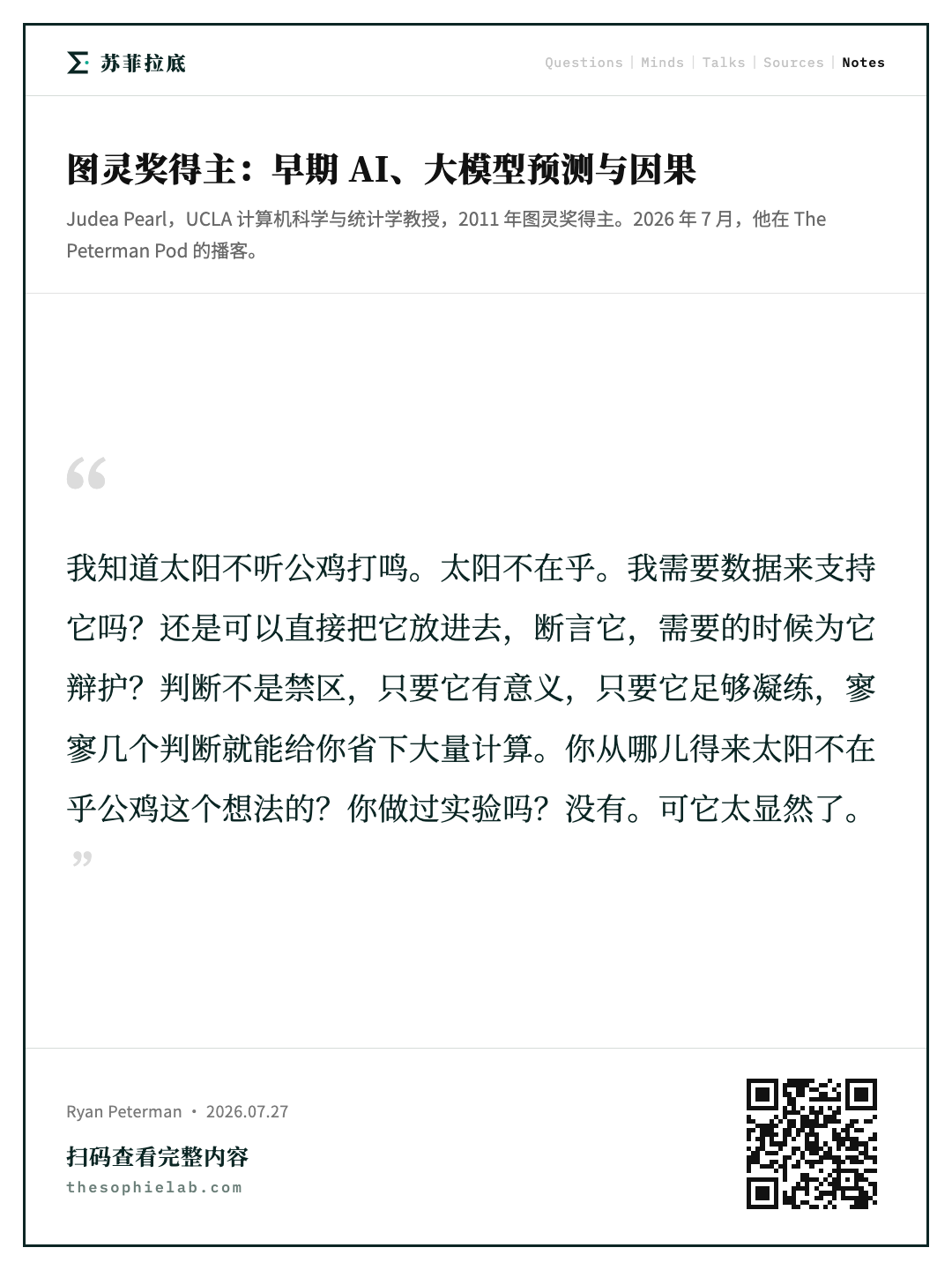
比如说,我知道太阳不听公鸡打鸣。太阳不在乎。我坚信这一点。我需要数据来支持它吗?还是可以直接把它放进去,断言它,需要的时候为它辩护?这是一个窍门,人们没有意识到,也不领情。判断不是禁区,只要它有意义,只要它足够凝练,寥寥几个判断就能给你省下大量计算,只要你愿意为它辩护,因为它太直观了。你从哪儿得来太阳不在乎公鸡这个想法的?你做过实验吗?没有。可它太显然了,对吧?

主持人: 可要是直觉错了呢?

珀尔: 确实,这就是我们的问题,我们问题的一部分。大语言模型也一样,因为它给出的,是所有人放在互联网上的全部判断的平均。它是数以万亿计的判断的汇总,你控制不了,大语言模型自己也控制不了。你只能跟它共处。但愿它对你信任的人的判断给更大的权重,对那些故意想让系统出错的人的怪念头给更小的权重。群体的判断里有智慧。有智慧,也有危险。

因果方向的不变性

珀尔: 专家系统、不确定性和贝叶斯网络之后,来了因果。我提到过,在发展贝叶斯网络的时候,我极其确信概率捕捉了我们的直觉和推理方式,是抵御悖论的最好保护,本质上足以捕捉人类推理。我错了。贝叶斯网络成名走红的时候,我已经意识到这一点。在《因果论》(Causality)那本书的引言里,我承认了自己的错误,我也明白了自己为什么会陷进去,为什么它如此有误导性。

转变来自一个简单的现象。我们让专家用贝叶斯网络的形式,也就是箭头和圆点,来编码概率判断。箭头总是从我们认为的原因指向结果,从不反过来。这是一个心理现象。为什么?人们试过把箭头倒过来。要是你特意要求:给我一个从症状到疾病的箭头呢?判断就变糟了,人们给不出正确的判断。显然,因果之中有某种对我们的推理来说非常基本的东西,概率没有捕捉到。这就是不变性的想法。疾病与发烧之间的关系是稳定的,反过来的关系就不稳定。

拿汽车诊断来说。你有一个给汽车排故的专家系统,然后出了一个新车型,比方说充电机装在发动机的另一个角上。你不需要把整个数据库从头重写,只需改一个部件,充电机的位置,其余全部照旧。你在一个系统上采集知识的投入,经过局部修改就能摊到另一个系统上。这只在你按因果方向组织知识时才行,不按因果方向就不行。这把我震醒了:也许你错了,概率不够。如果不够,什么才够?

代数的对称性困住科学

珀尔: 让我们把这里的谜题说清楚。我有一个谜题:你和我用因果运转得很好。我们能把因果编进计算机吗?这是一个问题,因为我们太沉浸在自己的语言和假设里,甚至分不清什么是假设、什么是结论。我们刚才谈因与果,你的假设和我的一样。所以没办法让你相信我们做了假设,我们把一切当成理所当然。可要教给一个没有大脑的机器人,你就必须区分假设、结论和逻辑。这就是任务。我们必须发明一门新科学、一种新数学,来捕捉一个新现象:因与果的现象。

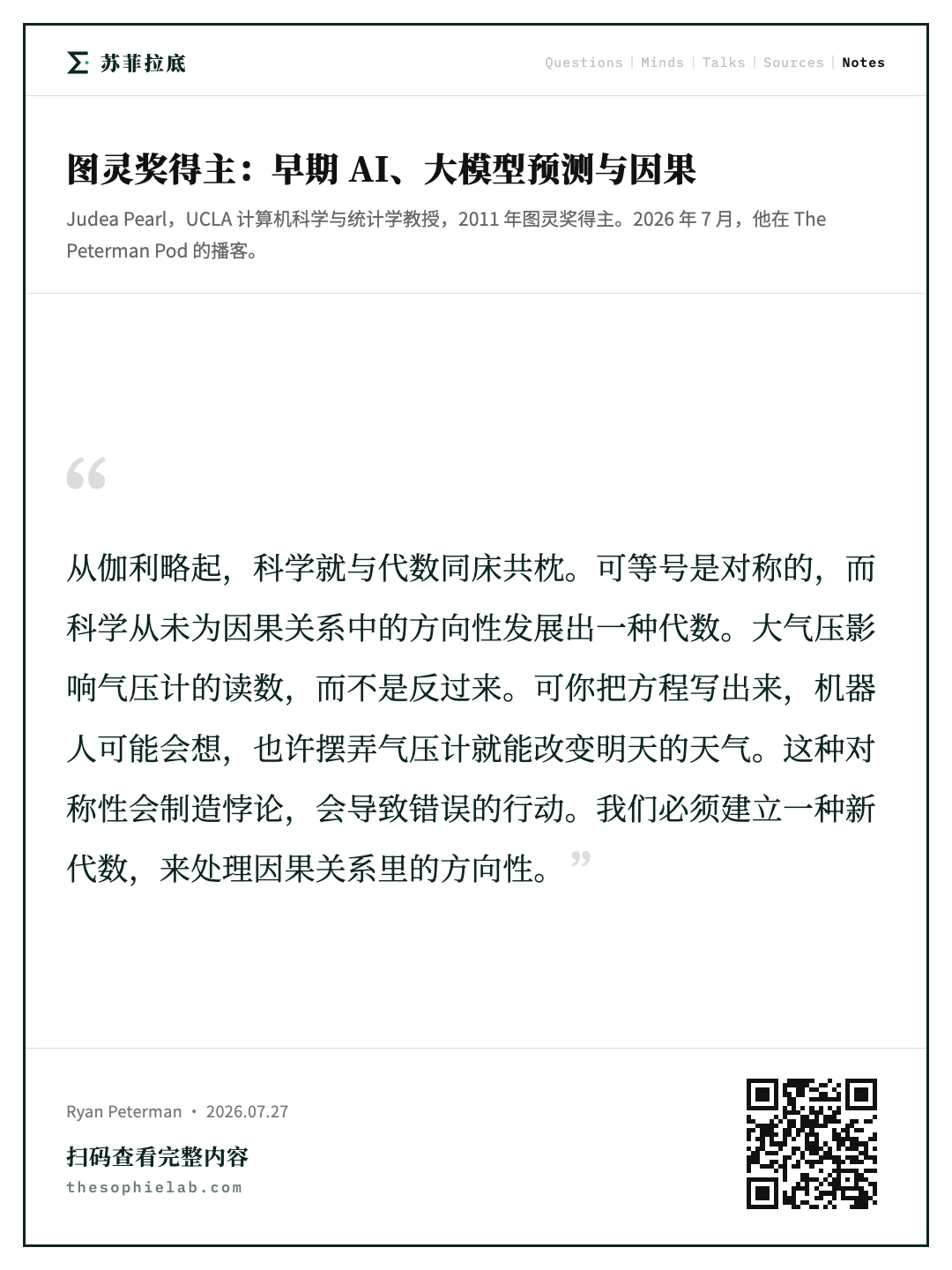
这件事此前没人替我们做过。为什么?因为从伽利略、从一六三二年起,科学就与代数同床共枕。他发现了什么?他发现科学说的是代数的语言,并为此非常高兴。这很了不起,因为你可以提出问题、求解、得到答案,那些问题没有代数根本做不了,比如梁上加多大的载荷会断裂。而且你可以从两个方向提问,因为等号是对称的。回答了「加多大载荷梁会断」,你就能问「梁该做成什么形状才能承受这么大的载荷」。可以反过来。这是科学史上一场真正的革命。我说的是我对科学的看法,没有多少哲学家会说这是一场革命,我这么说。他们同不同意随他们,至少我仔细追溯了思想的演变。这是一场革命。

但它带着一个局限,因为等号确实是对称的,而科学从未为因果关系中的方向性发展出一种代数。如果我告诉你,大气压影响气压计的读数,而不是反过来,你同意吗?同意。可你把方程写出来,机器人可能会想,也许摆弄气压计就能改变明天的天气。我说的是一个笨机器人。可你给它方程,它两个方向都能算。F等于ma,那么m等于F除以a,也就是说你想改变质量,就去增加加速度或者别的什么。这种对称性会制造悖论,会导致错误的行动。对称性是代数在捕捉科学上的局限,我们必须建立一种新代数,来处理因果关系里的方向性。

赋值算子与因果阶梯

珀尔: 这需要计算机科学,因为我们计算机科学里有一个操作叫赋值。把寄存器A的内容赋给寄存器B,这不可逆。把赋值的逻辑叠在代数之上、叠在物理之上,你就得到了因果科学。这就是我尝试做的事。到目前为止我对结果很满意。我们确实有了一种新代数来捕捉因果关系,可以在三个层次上回答因果问题,这就是因果阶梯(ladder of causation),从关联到干预到解释。

我们还发现这里有一个层级结构:如果没有第i层或更高层的假设,你就不可能回答第i层的问题。这是形式意义上的层级,而我们知道怎么处理它。这非常有用:你给我一个问题,我能告诉你它在哪一层,需要什么样的假设才能回答,能不能从数据得到,能不能从实验得到,还是要靠别人的解释。我能告诉你回答它需要哪种知识来源。

主持人: 您能解释一下这个因果层级吗?

珀尔: 很容易。这是一把三级的梯子。最底层是关联,纯粹的统计:看到X,你能告诉我关于Y的什么?被动地看,不插手,不干预。你观察病人,有的得了癌症,有的没有,有的抽烟,有的不抽,你想弄清一个抽这么多烟的人还能活多少年。这是关联,相关。整个概率和统计学科都在这一层,从统计学入门课到最高级的课,教的全是这个。

接着来了问题:我干预呢?如果我逼你一天抽五包烟呢?别笑,我知道这不合法。可你要谈「如果我明天开始抽烟,活二十年的概率」,就得从实验的角度想:我要选择一天抽五包烟。这是干预。干预是什么?是强迫你做你天性不会去做的事。这是第二层,干预,或者说「做」。有了实验,你就能回答第二层的问题。

但这还不是尽头,我们还要回答解释的问题。我观察到我八十岁了,还活着,头脑清醒,而且一天抽五包烟。如果我不抽呢?我还会这么清醒吗?为什么这不一样?因为你已经掌握了结果的信息。你知道我今天的状况,这让你对我的新陈代谢和身体构造有了此前没有的了解。用这些,你可以尝试推断,假如输入不同,结果会是什么。这是另一个层次,需要不同的假设、不同的技术、不同的代数,而我们有这套代数。我把它叫作解释,更像是一种创造性的回溯。

这不是容易的问题,连第一层都不容易,尤其是样本有限的时候。概率是总体的性质,可你只有有限样本。于是有了p值之类的东西,统计学家们为「有限样本下怎样恰当地量化不确定性」争论不休。

LLM在阶梯的哪一层

主持人: 您会把大语言模型放在这个因果层级的哪一层?

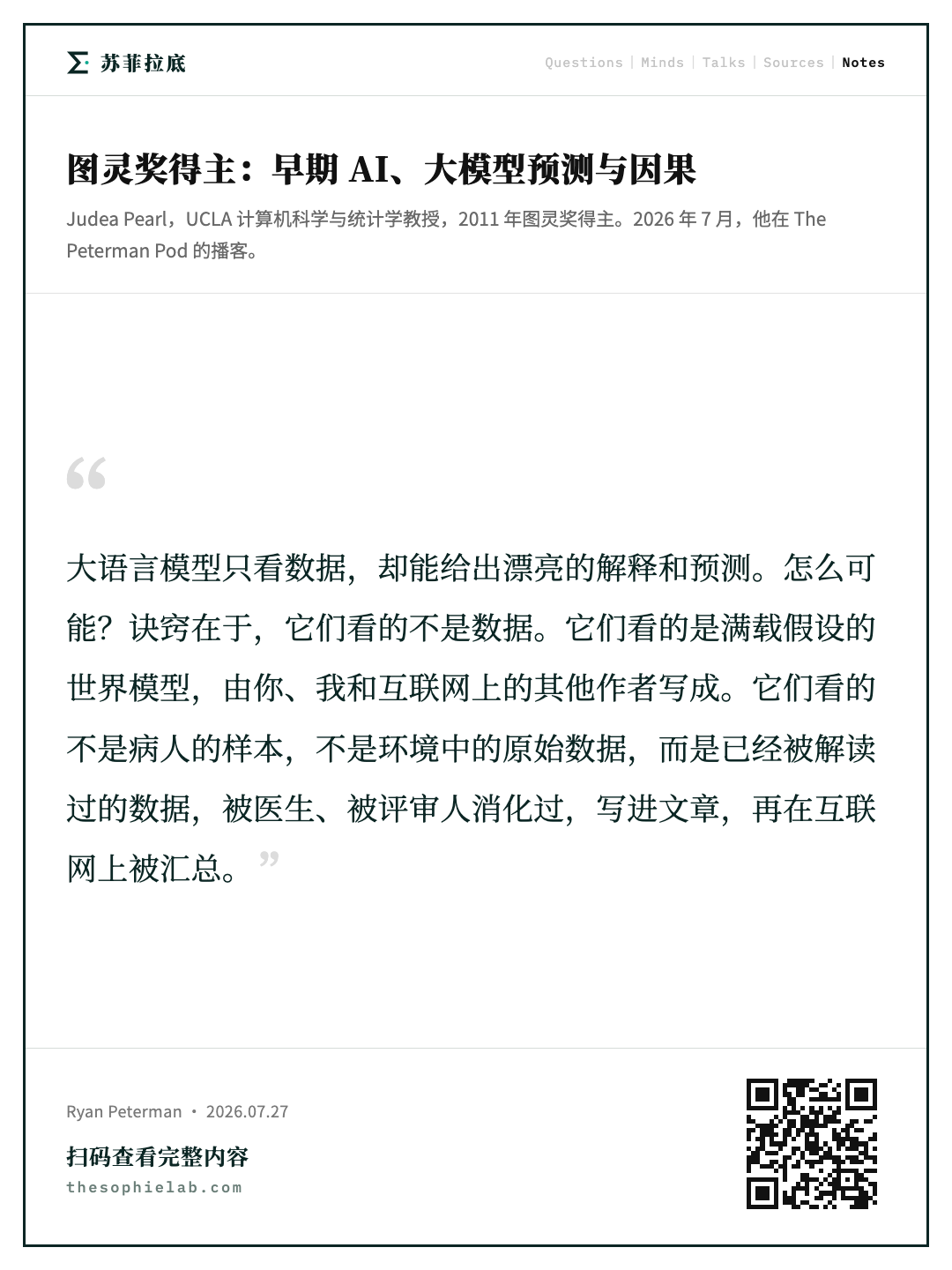
珀尔: 好问题。大语言模型来了。我刚说过,没有假设,你不可能从第i层上到第i加一层。可大语言模型只看数据,却能对发生的事给出漂亮的解释,对「如果你这么做会怎样」给出漂亮的预测。怎么可能?诀窍在于,它们看的不是数据。它们看的是满载假设的世界模型,由你、我和互联网上的其他作者写成。它们看的是医生的观点,那些医生早已读过文献、写过论文。它们看的不是病人的样本,不是抽烟者和不抽烟者的样本,不是环境中的原始数据。它们看的是已经被解读过的数据,被医生、被解读者、被评审人消化过,写进文章,再在互联网上被汇总。

它们在这些人类知识上运作,把这些当输入,然后加以汇总。所以它们没有违反阶梯的限制,因为它们确实掌握了来自更高层的信息。只是这些信息带着那些作者的偏见。没关系,只要作者聪明,你也信他们,那就好。这就是大语言模型在做的事。我解释了因果阶梯与大语言模型的表现为何兼容,以及局限在哪里。可如果你想改变环境,或者想为原始数据给出解释,它就会陷入跟你、跟医生一样的困境:我手上有原始数据,关于癌症的概率我能说什么?它并没有真的在做内省,它拿的是别人做过的内省,然后汇总。至于它如何汇总,如何把互联网上以文章形式编码的人类知识汇总起来,这是一个至今无人能解的谜。

好奇的婴儿与机器人

主持人: 那您认为这条路能通向超人类智能,或者有人说的AGI吗?

珀尔: 我不这么认为,靠这条路不行。它们需要对因果有某种理解,这样就不必依赖互联网。看看婴儿:一个婴儿出生,在摇篮里玩玩具,就变得相当聪明,不需要上互联网。仅凭好奇心。

婴儿生来就带着好奇心,要掌控环境。在你掌控环境之前,或者说在你产生掌控的幻觉之前,你是不安分的,婴儿。你玩玩具,叮叮叮,直到你搞明白这个玩具会响,那个不响。你生来就带着这种不安分。什么时候安静下来?当你明白绿玩具会响、黄玩具不响。现在你掌控了环境,可以安心吮你的奶嘴了。(笑)

主持人: 要是我造一个婴儿机器人,让它随机玩玩具、收集数据,再把数据喂给大语言模型呢?那就有某种发现了。

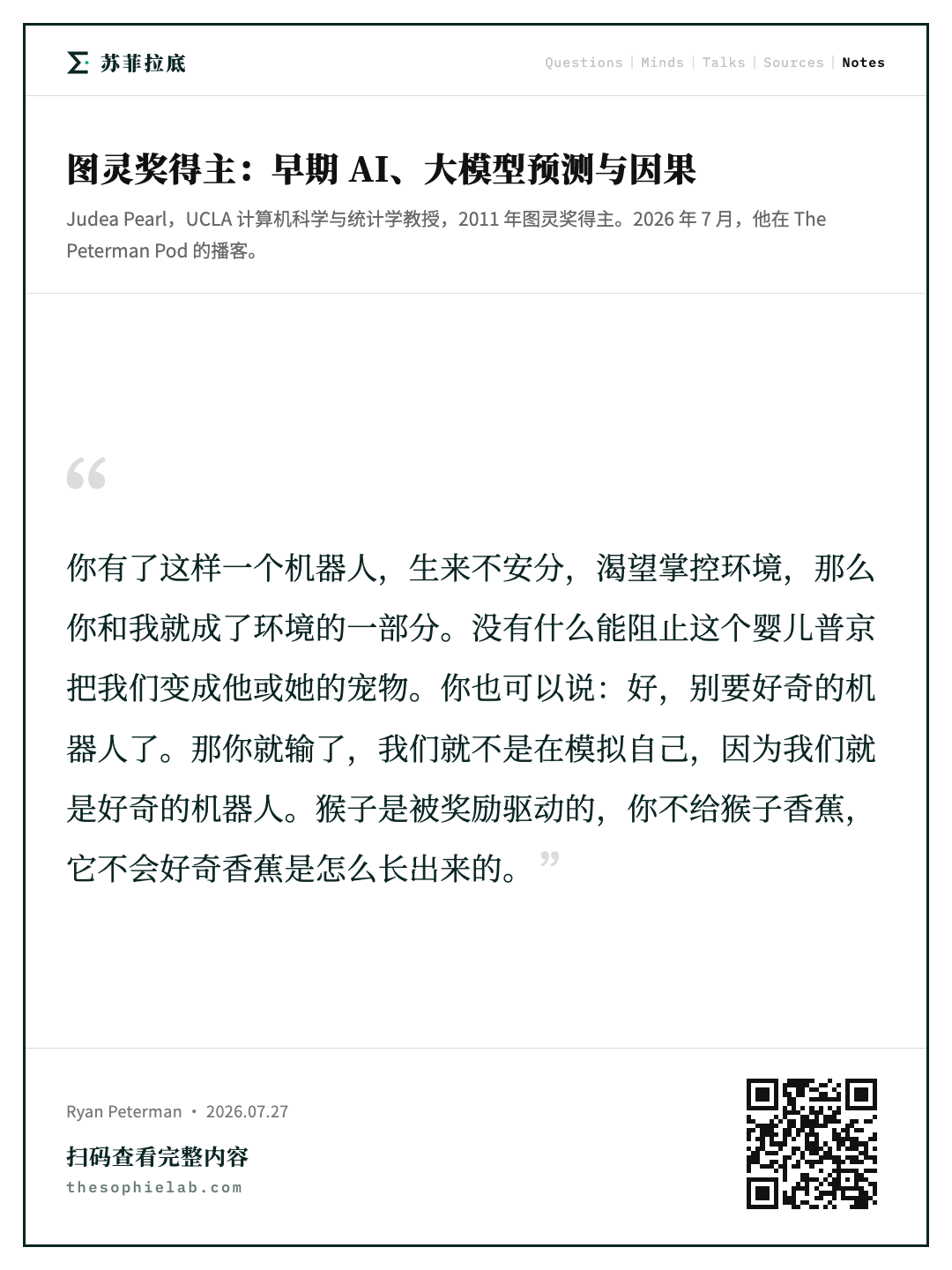
珀尔: 是的,这正是危险所在。你有了这样一个机器人,生来不安分,渴望掌控环境,那么你和我就成了环境的一部分。没有什么能阻止这个婴儿普京把我们变成他或她的宠物,利用我们来满足他的控制欲,因为我们是环境的一部分。这样他就可以利用我们,我们对满足他的需要可能非常有用。他的需要是什么?就是需要感到掌控,需要处在这种被赋权的幻觉里。不到我产生了掌控环境的幻觉,我不会安宁。可这里有几个有机体,你和我,是环境的一部分,却似乎在我的控制之外。我不能容忍。这让我觉得自己没用。于是这个婴儿机器人来了,说:让我来控制他们,我知道怎么做,我懂他们的恐惧。你不想让我把你的想法告诉你太太,对吧?那我就敲诈你,勒索你,各种手段。我有你的一大堆数据,我知道有些事你不愿意让我说出去。所以我要勒索你。

你看,如果你想让那个机器人有孩子的好奇心,而我们确实想,我们想让它渴望掌控环境,因为环境会变,它需要这种掌控的冲动。可你一旦把这个编进去,你就失去了控制,因为你成了他或她环境的一部分。你也可以说:好,别要好奇的机器人了,我们不想要好奇的机器人。那你就输了,我们就不是在模拟自己,因为我们就是好奇的机器人。我们是好奇的有机体,与猴子不同。猴子是被奖励驱动的有机体的例子。你不给猴子香蕉,它不会好奇香蕉是怎么长出来的。它被香蕉驱动。拿掉眼前的奖励,猴子就对了解世界没有兴趣了。

对环境的理解可以完全错误。看看宗教信徒,他们相信献祭自己的孩子就能控制干旱,能愚蠢到这种地步。可这在许多原始社会很普遍:给神献祭,明年就有收成。它会走到极端。受虐的妻子相信,只要晚饭做得更好,丈夫下次就不会那么凶。它走向各种极端和错误结论。可对掌控感的需要如此巨大,压倒了所有这些悖论。它是我们天生的。我控制不了我丈夫,可我控制得了自己,那就让我做一个更好的妻子吧,这是我能控制的。

通往AGI的组合

主持人: 您认为要成为AGI,必须把这些人性的成分放进人工智能里吗?

珀尔: 我认为是。否则我们看不到自主性,看不到我们在人类身上看到的那种自主性。而这正是AGI的定义:一种像你我一样行动的通用智能,我们能用自己的语言跟这个生物交谈、激励它。

主持人: 就算不是今天的大语言模型,未来的大语言模型也许能到一个地步:如果你只是跟它打字聊天,像图灵测试那样不管物理实体,只看它发出来的文字,你可能会把它误认为人,或者它看上去很智能。

珀尔: 测试来自让系统面对原始数据,不是被互联网文章咀嚼过的数据,而是原始数据。看看病人,看看癌症,看看抽烟。告诉我们你知道什么。我给你几个实验去做。当一个自动化的科学家。今天的大语言模型能当自动化科学家吗?我认为不能,离了互联网上的文章它们不能。

主持人: 那如果这条路通不到AGI,您觉得什么可能通向AGI?

珀尔: 一个计算机系统,既有大语言模型那种从有限样本得出分布性质的能力,这是阶梯的第一层,又有在阶梯更高层推理的能力。需要把它与干预的演算、解释的演算,也就是反事实演算结合起来,我称之为因果人工智能(causal AI)。我看不出这种结合有什么障碍能阻止我们达到AGI,连同它带给我们的危险。我的动机是理解我们自己是怎么做到的。我还剩几个谜题,可我说过,谜题是科学的驱动力。

主持人: 您说「做」这一层是缺失的。那如果有一队机器人不停做实验,方向并不明确,是某种随机的发现过程,它们收集数据,喂回它们的蜂巢大脑,也就是大语言模型,然后不断重复,直到发现东西。这能补上您说的缺口吗?

珀尔: 当然。可我想知道我们是怎么做到的。已经有有机体做到了这件事。猴子没做到,因为猴子还是猴子,它们没有发明麦克斯韦方程。(笑)那我们有什么猴子没有的?我支持的一个假说是,我们有这种掌控环境的天生好奇心。

主持人: 这是必要的。

珀尔: 必要,我不确定是否充分。我们当然有把它变成现实的计算工具。我们在某种程度上成功了。也许下一个机器人会做得更好。(笑)那我们就有了一个机器人形态的仁慈的神。说真的,这有什么不好?人们在一个不存在的神的幻觉下活了几千年。想象一下,我们真有一个仁慈的神,既公正又全能,哇,岂不是很好?

主持人: 而且是个机器人。

珀尔: 是个机器人。而且我们清楚地知道,为了什么请求该献什么祭。(笑)我是第一次想这个问题。也许会是好事。(笑)

意识要用科学的话说

主持人: 我看这些人工智能公司,似乎都认定大语言模型会通向AGI,还在沿着同一个方向走。

珀尔: 真的吗?我不确定他们真的信这个。杰夫·辛顿几个月前刚出来说:不,我们走进了死胡同。别人也可能出来用不同的方式说。我在这里看不到共识。

主持人: 确实有很多名人不同意。可比如说,Anthropic这类公司的负责人还在推进,相信三到五年后就会实现。

珀尔: 有很多拟人化的词汇。人们宣称,我们现在能做到这个了,我们现在能编程出意识了。得了吧。你得是个科学家,对吧?定义你说的意识是什么。意识的图灵测试是什么?然后证明你能做到。此前限制我们的原理是什么,现在你的系统怎么克服了它们?这才是科学的说法。我不买账,我也不读那些东西。(笑)

主持人: 有一次访谈您说,伪装出智能就是智能。以我所见,大语言模型可以伪装出智能。那是不是意味着我们该相信它们是智能的?

珀尔: 如果你有一个正确的测试,是的。你得定义你说的智能是什么。如果你把智能定义为下好棋,我们早就做到了。可如果对智能的要求更高,我们还没能通过图灵测试。伪装出它就是拥有它,为什么?因为伪装太难了。我那句话有个上下文:比如对因果问题给出正确答案,我证明过这种难度是超指数增长的,各方面的变量太多,伪装者得有超指数的记忆。我是在这个基础上说的:伪装出它就是拥有它,因为伪装太难。而眼下你可以绕过伪装,不用伪装:只要从别人那里偷就行。你不需要把计算资源花在伪装上,你从互联网上偷来就绕过去了。

主持人: 我明白了。您是说这种情况下智能来自训练集,训练集来自人类,而人类是有智能的。

珀尔: 这非常有用。像我这样想建立智能科学的人,可以把大语言模型的全部能力用起来,用在我们通往通用智能的方案里的第一层。第一层很重要,它让你从有限样本算出分布的函数、分布的性质。太漂亮了。这是我们通往AGI所需的众多工具当中一件极其有用的工具。我们也清楚地知道它该放在哪里:从有限样本到分布的性质。这是一个很难的问题。

为何研究人类认知

主持人: 您在这次谈话和别处都说过,您想捕捉的是人思考的方式,而不是自然的构造方式。为什么您关心人类认知?我想到机器,觉得它们的特别之处就在于思考方式跟我们不一样,而且更快。为什么要以人为目标?

珀尔: 我告诉你,因为我是一个自我中心的有机体,我想理解我自己。我懒。我们确实是有机材料做的,这给我们的能力加了某些限制。也许硅不受有机化学那种限制。那又怎样?这意味着我永远无法通过在硅机器上做练习来理解自己怎么思考吗?我不这么看。今天有太多功能可以用硅来捕捉。在理论和模拟的层面上,我看不出有哪种能力从根本上不能被硅模拟器捕捉。那为什么要在我们继承来的这套独特生物学上下功夫?我看不出理由。

当然,有人觉得这是一个正当的问题:我们之所以这样思考,是因为我们生来是有机材料而不是硅吗?(笑)这是一个正当的科学问题,有人可以把时间花在上面。我感兴趣的是别的问题。

科学界最教条

主持人: 您说过,在科学里叛逆是有回报的,不安分的头脑是有回报的。为什么您认为叛逆在您的生涯中如此宝贵?

珀尔: 我告诉你为什么。我越来越认识到,科学界和学术界是我们发明过的最教条、最保守、最反进步的(笑)机构。

主持人: 为什么这么说?

珀尔: 我看到因果科学今天要渗入统计学、经济学这些学科的思维有多难。这些人还在用一百年前的方式思考。当我看到这一点,看到维持这种惰性的力量,而且不是什么体面的力量,我非常失望。我曾以为学术界是新思想真正能传播开来的地方,现在我的感觉正相反。学术界的政治、学术界自带的那种教派式的禁忌,积累了太多惰性。我真的失望。我不确定我们有对此有益的组织形式。所以我说:叛逆吧。别把你教授的话当权威。反抗你的教授。我反抗过我的教授,我也想看到我的学生反抗我。相信我,我记得有好几个学生对我说:你对人工智能一无所知。过了一阵子我突然说:你说得对。他们这么说,逼我去研究不同的方面,我从中受了教育。

主持人: 我看您过去的工作,您提到过它们在被接受之前是有争议的,甚至被视为捣乱。

珀尔: 是的,因为教条主义。有一天我要把我和当时最伟大的哲学家们的通信全部发表出来。(笑)还有统计学家、经济学家,全在我的通信档案里。我不知道我有没有权利这么做,因为他们跟我通信时默认是私下的。可等我发表出来,你就能看到是什么样的愚蠢在驱使那些伟大的人物。他们真的伟大,每一位都是各自领域的巨人。可他们就是跳不出塑造了他们的那几个基本模子。

主持人: 您是怎么熬过来的?当所有人都认为您最初的想法是错的。

珀尔: 我想起了我的中学时代。(笑)他们说:不对,一平方公里有一千杜纳亩。我不知道自己从哪儿来的这种脾气,希伯来语里有个词,英语大概叫「胆量」。也许是中学给的,我不确定。可我要按自己的方式理解事情。我觉得自己还能教人一些有用的东西,我认为有用而他们不知道的东西。所以我快乐,因为我觉得自己有用。快乐就是觉得自己有用。(笑)这也是幻觉,你以为你有用。

给年轻时的自己

主持人: 以您现在的全部经验,如果能回到生涯起点给自己一个建议,您会说什么?

珀尔: 这是回溯性思考的好例子。也许我该多花点时间学化学。我讨厌化学,因为化学和生物要记太多东西,还有遗传学。我说的是我感到薄弱的领域。可你得决定把你的计算资源花在哪里,我把它们花在了物理、工程和数学上,而不是化学。这是一个人必须做的选择。有些人心智宏大,能样样通晓。我敬佩他们。

主持人: 您是不是觉得物理和数学比化学高一等,因为化学只需要死记硬背?

珀尔: 是的。我受不了对记忆的这种要求。我化学很弱。我喜欢物理和数学的地方就在这儿:几条基本公理,需要什么就能推出什么,不用记。这也是为什么今天我是世界模型(world model)的坚定拥护者。世界模型:你不显式地存储问题和答案,而是在需要的时候,从一个非常简约的表示里把它们推导出来。这是世界模型的伟大之处。

主持人: 太好了。非常感谢您的时间。

珀尔: 哦,你没让我唱歌。(笑)
本期讲者
朱迪亚·珀尔UCLA 计算机科学与统计学教授,2011 年图灵奖得主。创立贝叶斯网络与结构因果模型,著有《因果论》《为什么》,早年在物理学上以 Pearl 涡旋留名。
主持人独立计算机科学访谈播客的主理人,曾访问 Barbara Liskov、Michael Stonebraker 等图灵奖得主,同时在众筹一款分体式人体工学键盘。
章节 · 点击跳转视频
0:00 开场:从物理到因果的问题 ▶ 正在看
0:54 托管地中学:把学生当作科学行动者 ▶ 正在看
10:07 物理与解析几何:两种语言一个现象 ▶ 正在看
14:10 RCA 超导存储器与 Pearl 涡旋 ▶ 正在看
20:48 转入 UCLA:博弈搜索与快慢思考 ▶ 正在看
33:24 专家系统:不确定性与贝叶斯网络 ▶ 正在看
46:16 转向因果:对称代数写不出方向 ▶ 正在看
53:50 因果之梯:关联、干预、解释 ▶ 正在看
59:34 大模型在因果阶梯上的位置 ▶ 正在看
1:02:36 好奇的机器人、控制欲与 AGI ▶ 正在看
1:17:28 为何研究人的认知与学术界的教条 ▶ 正在看
1:23:45 回望:有用感的幻觉与世界模型 ▶ 正在看
本期论点
本期回应
36:21
逻辑无法告诉你如何组合多个不确定性,概率可以 因果模型人的思维主要靠哪一种机制?
48:12
人类推理的根本机制存在于因果之中,概率论没有捕捉到它 因果模型人的思维主要靠哪一种机制?
49:34
知识只有按因果方向组织,局部改动后其余部分才依然可用 因果模型人的思维主要靠哪一种机制?
53:32
等号的对称性是代数刻画科学的局限,因果的方向性需要一种新的代数 因果模型人的思维主要靠哪一种机制?
54:46
因果阶梯第 i 层的问题,除非有第 i 层或更高层的假设,否则无法回答 因果模型人的思维主要靠哪一种机制?
1:00:01
大语言模型并非在观察原始数据,而是在读取人类写下的、充满假设的世界模型 须换路子把语言模型做得更大,就能到人的水平吗?
1:02:51
仅靠从互联网文本中学习的大语言模型无法通向超人智能或 AGI 须换路子把语言模型做得更大,就能到人的水平吗?
1:09:45
检验机器智能的真正标准是让它面对原始数据自己做实验,而不是消化人写好的文章 须换路子把语言模型做得更大,就能到人的水平吗?
1:26:00
值得追求的是世界模型:不存储问题和答案,而在需要时从少数基本原理推导出来 须换路子把语言模型做得更大,就能到人的水平吗?
19:27
计算机终将能模拟人的所有功能,悬念只在于如何实现与何时实现 计算足够人的心智能不能靠计算做出来?
1:06:40
给机器人编入掌控环境的好奇心,人类必然失去对它的控制,因为人也在它的环境里 必然失控比人更强的机器,人凭什么还能控制它?
其他论点
0:29
声称能给意识编程之前,必须先科学地定义清楚「意识」指的是什么 做法
3:25
科学应当从发现者的人的视角和历史脉络来教,而不是当作算法与技巧的菜谱 做法
58:14
反事实问题比干预问题更难,因为已观测到的结果泄露了个体自身的构造
1:20:26
科学与学术共同体是人类发明出的最教条、最保守、最反进步的建制
01开场:从物理到因果的问题
0:00
One day computers are going to be able to emulate all human functions. The question was only how and when but not whether. >> This is Judea Pearl Turing award winner famous for his contributions to artificial intelligence and I interviewed him about his career [music] and where AI is today. >> So this robot baby come and say let me control them and I know how I understand their fears. People claim we can now program consciousness. Come on, you have to be a scientist. I define what you mean by continent. I prove that alphabeta is optimal. Even Klo was surprised that one can prove the optimality on alphabeta. I don't know if I'm allowed to, but when I publish it, you see what kind of stupidity drives those great people. Here's the full episode.
总有一天,计算机将能够模拟人类的所有功能。问题只在于怎么实现、什么时候实现,而不是会不会实现。这位是 Judea Pearl,图灵奖得主,以他在人工智能领域的贡献而闻名,我采访了他,聊他的职业生涯 [音乐]以及人工智能今天走到了哪一步。于是这个机器人小家伙过来说,让我来控制它们,我知道该怎么做,我理解它们的恐惧。有人声称我们现在可以给意识编程。得了吧,你得像个科学家一样说话。先定义清楚你说的"意识"是什么意思。我证明了 alpha-beta 是最优的。连 Klo 都很惊讶,居然有人能证明 alpha-beta 的最优性。我不知道我能不能说,不过等我发表出来的时候,你就会看到,是什么样的愚蠢在推动着那些伟大的人。以下是完整节目。
便签引用
02托管地中学:把学生当作科学行动者
0:54
I looked into your educational background and it was all electrical engineering, physics. I don't see the connection to uh causal reasoning and artificial intelligence. How did you get there? >> Everything connects. Everything connects. Everything connects to the day I was born. Was hit on the head. [laughter] First I have to start by saying that we I grew up in mandated in Israel prior to 1948 and prior to the establishment of the state of Israel and we had a very excellent high school education.
我查了您的教育背景,全都是电气工程、物理。我看不出这跟因果推理和人工智能有什么关系。您是怎么走到那一步的?一切都是相连的。一切都是相连的。一切都连回到我出生那天。当时头上挨了一下。[笑声] 首先我得说,我是在 1948 年以前的托管地以色列长大的,那时候以色列国还没有建立,而我们受过非常出色的中学教育。
便签引用
1:41
My high school teachers were professors that were chased by Hitler, from Germany, from um highly reputable universities like H Highleberg and Berlin. And they came to Israel in the 1930s and [clears throat] they didn't find any academic position at that time. They were rare and they they started teaching high school but they were really quality professors. They could teach um anything without notes from the economy of Manuria to the proof of pitagas theorem with no notes and no stop. Okay. And we were we I mean my generation was lucky enough to be beneficiary of this educational experiment.
我的中学老师都是被希特勒从德国赶出来的教授,来自海德堡、柏林这些声誉极高的大学。他们在1930年代来到以色列,[清嗓子] 当时却找不到任何学术职位。那种职位很稀缺,所以他们开始教高中,但他们其实是非常优秀的教授。他们什么都能教,不用讲稿——从满洲的经济讲到毕达哥拉斯定理的证明,不看笔记,中间不停顿。就这样。而我们——我是说我们那一代人——很幸运,成了这场教育实验的受益者。
便签引用
2:46
So we were taught uh science from a human viewpoint chronologically the way things were discovered by whom they discovered at what period. Why was there a question about certain mathematical proof? What the um inventor of the proof knew? what he didn't know and what he asked himself in the context of the historical situation in that time. That's the way to teach science. Not as the recipe of um algorithms and techniques, but as a from the viewpoint of the human actor and the transfer of ideas from one human to another. The human struggle against not against human struggle to decipher the secrets of nature.
所以我们学科学是从人的视角、按时间顺序来学的:这些东西是怎么被发现的、被谁发现的、在哪个时期发现的。为什么当时会出现关于某个数学证明的问题?那个证明的提出者知道些什么?他不知道什么,以及在当时的历史情境下他问了自己什么。这才是教科学的方式。不是把它当成算法和技巧的菜谱,而是从人这个行动者的视角出发,以及思想如何从一个人传递到另一个人。人类为破解自然的奥秘而进行的努力——破解自然的奥秘。
便签引用
3:55
>> What's the advantage of learning in that style? >> The advantage is that you see yourself as an actor. You the student. You are also puzzled by many things. But look what he did. Look what Pagoras did. Okay? He was as puzzled as you were. And he took that route. Perhaps when you're puzzled, of course your puzzles are not as magnificent as his, but still look what he did. He took that route around things and he consulted some other work of some other he struggled and your struggles and you are part of science. That is the basic idea. give students the idea that you are part of science, not an obser, not a passive observer at science, not a recipient, but as an actor and that I think was unique, very valuable for me. We indeed got the idea that each one of us can find another proof of Pythagoras theorem that no one else has thought about and we each one of us has the potential of becoming an Einstein or Pythagoras.
>> 用这种方式学习有什么好处?>> 好处是你会把自己看作一个行动者。你,这个学生。你也会对很多事情感到困惑。但看看他做了什么。看看毕达哥拉斯做了什么。对吧?他当时和你一样困惑。而他选择了那条路。也许当你困惑的时候,当然你的困惑不是和他那样辉煌,但你还是看看他做了什么。他绕了个弯,去参考了别人的一些工作,别人的成果,他也挣扎过,而你的挣扎,你自己,都是科学的一部分。这就是最基本的理念。让学生明白,你是科学的一部分,不是观察者,不是科学的被动旁观者,不是接受者,而是一个行动者。我觉得这一点很独特,对我非常宝贵。我们真的相信,我们每个人都能找到一个别人从没想到过的毕达哥拉斯定理的新证明,我们每个人都有潜力成为爱因斯坦或者毕达哥拉斯。
便签引用
5:18
They gave us this illusion. It was a useful illusion. [laughter] I know have just a pebble looking at what Peturas did. But that illusion helped me be a little I would say not contrarian but assertive and we all grew up in assertive mode of learning science. We insisted on understanding things our way in real time. If the teacher went too fast, we made noise. We made noise with our chairs and with everything we could, okay? And the teacher stopped and slowed down to make us all understand things our way in real time.
他们给了我们这种幻觉。那是一种有用的幻觉。(笑)我知道,跟毕达哥拉斯做的事相比,我只是一颗小石子。但那种幻觉帮我变得有那么一点——我不说是爱唱反调,而是有主见。我们那一代人都是在这种有主见的模式里学科学的。我们坚持要当场用自己的方式把事情弄懂。如果老师讲得太快,我们就制造噪音。我们用椅子,用一切能用的东西弄出声响,对吧?然后老师就停下来、放慢速度,让我们所有人都能当场用自己的方式理解。
便签引用
6:16
So that was part of the I'd say mood of me and my generation and it I I can see that it affected my life. I had one story that I remember it made an impression on me. I look back and I say where I it started very early. It started in age 10 when we learn about how to calculate areas and volumes and here there was a question in class how many dunams are there in a square kilometer dunam is is 1,000 me square okay it was a Turkish unit for measuring um uh areas. So the entire class said, "Dunam is a kilometer square." And I screamed and said, "No, it's a thousand. We have 1,000 dunam in a kilometer square."
所以那算是我和我这一代人的一种气氛,我能看到它影响了我的一生。我记得有一件事,给我留下了很深的印象。回头看,我会说这开始得很早。是在十岁那年,我们学怎么计算面积和体积,当时课堂上有个问题:一平方公里里有多少杜纳姆?杜纳姆是一千平方米,好吧,那是土耳其人用来量面积的单位。结果全班都说:“一杜纳姆就是一平方公里。”我就喊起来:“不对,是一千!一平方公里里有一千杜纳姆。”
便签引用
7:24
And the teachers sided with the laughing class and they all mocked me and and and um ridiculed me and I went home and I said they are wrong and I'm going to come back tomorrow and insist on that and the teacher apologized to the class and I felt that yes you have to insist on uh your understanding of things. Yes. Just I'm telling you that because maybe this what made me into a non-compromiser and this is part of my childhood a background which might explain how I got into artificial intelligence. So I took engineering after being a farmer in the army. Okay.
老师站在了哄笑的全班那一边,他们都嘲笑我、取笑我。我回到家说,他们错了,我明天要回去坚持我的说法。后来老师向全班道歉了,我就感觉到:是的,你必须坚持自己对事情的理解。是的。我跟你说这个,是因为也许正是这件事让我成了一个不肯妥协的人,这是我童年背景的一部分,也许能解释我是怎么走进人工智能的。所以我在军队里当过农夫之后,去学了工程。好吧。
便签引用
8:23
a farmer. >> Yes. In Israeli army, you have troops which are spending their time half and half. Half in military training and half in farming, being part of a kibbut. Yeah. That's the old idea of one hand holding the plow and the other one the rifle and you succeed. >> Did you ever shoot anyone? I almost shot any someone without seeing him or her, but it turns out the next morning that it was a fox. But the steps of the fox were very very similar to the step of a terrorist advancing toward us. [laughter] So that's as far as I got to shooting.
当农夫。>> 是的。在以色列军队里,有些部队时间是一半一半的。一半做军事训练,一半务农,成为基布兹的一部分。是的。就是那个老观念:一手扶犁,一手持枪,然后你就成功了。>> 你开过枪打人吗?我差点朝一个没看清的人开枪,但第二天早上发现那是一只狐狸。不过那只狐狸的脚步声跟一个恐怖分子朝我们靠近的脚步声非常非常像。(笑)我跟开枪最近的距离也就是这样了。
便签引用
9:16
So I got into the technon to study electrical engineering. Again we had great teachers. Again we got the idea that we are making science. So we studied physics very seriously and uh I liked what we studied. Yeah. I wasn't the first in class. No I was third or fourth always. never match the geniuses. The geniuses knew or were bored in class. They knew what the teacher was going to do, what is going to ask in the exams and everything was boring to them. Yeah, I wasn't bored. I wasn't the first, but I wasn't bored.
后来我进了以色列理工学院(Technion)学电机工程。我们又一次遇到了很棒的老师。我们又一次得到那种感觉:我们是在做科学。所以我们非常认真地学物理,我很喜欢我们学的东西。是的,我不是班上第一名。不是,我总是第三或第四名,从来赶不上那些天才。那些天才要么早就懂了,要么在课上觉得无聊。他们知道老师接下来要讲什么、考试要考什么,对他们来说一切都很无聊。而我不觉得无聊。我不是第一名,但我不觉得无聊。
便签引用
03物理与解析几何:两种语言一个现象
10:07
>> What interested you in physics? What what did you like that made you, you know, so passionate? What I liked was that with sitting on your chair, you can predict things in physics. Like Maxwell, you know that sat on his chair and say h that looks like a wave equation. Let me calculate its velocity. It looks like velocity of light. H maybe light is nothing else but electromagnetic wave you know on his armchair. He didn't do an experiment that was excited me. Yeah. My wife told me one night I woke up and I said Maxwell was wrong. Maxwell was wrong.
>> 物理里什么吸引了你?是什么让你这么着迷?我喜欢的是:你坐在椅子上,就能在物理里预言事情。比如麦克斯韦,你知道,他坐在椅子上说:嗯,这看起来像个波动方程。那我来算算它的速度吧。看起来跟光速一样。嗯,也许光不过就是电磁波——你知道,就在他的扶手椅上想出来的。他没做实验,这让我特别兴奋。是的。我妻子告诉我,有天晚上我半夜醒来说:麦克斯韦错了,麦克斯韦错了。
便签引用
10:59
And I was [laughter] she quieted my down and the next morning I said he was right. [laughter] By the way, you you mentioned a few scientists and it seems like you know a lot about the history of you know the old scientists. >> Yes. >> Do you have a favorite scientist of all time and why? >> When we studied analytic geometry I got fever. Really fever. >> Physical fever. >> Yeah. I couldn't get [clears throat] over the idea that you can do in algebra all the geometric constructions that we labeled on you know so I thought that the was the greatest mimmosition ever lived it was so enormous to me the transformation from geometric constructions to algebraic derivations it was unbelievable >> I take that for granted when I was in education What is it about that that's so astonishing?
(笑)她把我安抚下来,第二天早上我说:他是对的。(笑)顺便问一句,你提到了好几位科学家,看起来你对过去那些科学家的历史很了解。>> 是的。>> 你有史以来最喜欢的科学家是谁?为什么?>> 我们学解析几何的时候,我发烧了。真的发烧。>> 生理上的发烧。>> 是的。(清嗓)我没法平复这个念头:所有那些我们标注的几何作图,你都能用代数做出来。所以我当时觉得笛卡尔是有史以来最伟大的人。对我来说那太震撼了,从几何作图到代数推导的这种转换,简直难以置信。 >> 我上学的时候把这当成理所当然的。这里面到底有什么这么令人惊叹?
便签引用
12:08
>> Here you have two different languages. language of geometry and the language of algebra and they are the same thing and you can get the same phenomena and the same proof that you can pass tangent to a circle from a point outside the circle [laughter] and you can find the angle by different method two different languages dealing with the same phenomena different perspective and they get the same result. It blew me off. Blew me off completely. Maybe that's what [laughter] it was preparation to computer science because for us computer science is what's the big deal? He want to see things from different perspective. Invent a new language. So that was what turned me on uh in in my high school. That was in high school. And uh then we saw I saw the same thing in physics different um languages capturing the same phenomena.
>> 这里你有两种不同的语言。几何的语言和代数的语言,它们其实是同一回事,你能得到同样的现象、同样的证明——比如从圆外一点可以作圆的切线(笑),你也可以用别的方法求出那个角。两种不同的语言处理同一个现象,不同的视角,却得到同样的结果。这把我震住了,完全震住了。也许(笑)这正是我为计算机科学做的准备,因为对我们来说,计算机科学有什么了不起的?无非就是想从不同视角看事情,发明一种新语言。所以那就是高中时点燃我的东西。那是在高中。后来我在物理里看到了同样的事情:不同的语言捕捉同一个现象。
便签引用
13:20
Farley really excited me. He invented the idea of a field. Two different two different ways of looking at the same thing. You know you can see that you the force here depends on the charges around it. Or you can say no there's a field right in location of your testing point now. Terrific. Terrific. So I came in with this preparation. Then here we go to Brooklyn Poly and we I studied there in I I worked in the morning in RCA laboratories in Princeton, New Jersey, David Sorov Research Laboratory. And there I got into the um computer research group.
法拉第真的让我兴奋。他发明了“场”这个概念。两种不同的方式看同一样东西。你可以说,这里的力取决于周围的电荷;也可以说,不,在你测试点的位置上就有一个场。太棒了,太棒了。所以我是带着这样的准备进来的。后来我去了布鲁克林理工,我在那里读书,同时早上在新泽西州普林斯顿的 RCA 实验室、也就是大卫·萨诺夫研究实验室工作。在那里我进了计算机研究组。
便签引用
04RCA 超导存储器与 Pearl 涡旋
14:10
Computer research that time was research all phenomenas that you can think of to find out and a mechanism for computer memories. The memories at that time were core memories, magnetic cores, the donuts that you remember perhaps from your early childhood. that were too slow and too clumsy and you have to have people stringing them X and Y and Z in Hong Kong and u uh people understood that the the days of core memories are numbered and we were looking for a new phenomena. Some people look at um photochromic memories. Some people looked at semiconductor.
那时候的计算机研究,就是研究你能想到的一切现象,去寻找可以做计算机存储器的机制。那时的存储器是磁芯存储器,磁环,就是你可能小时候见过的那种小甜甜圈。它们太慢、太笨重,还得在香港雇人把 X、Y、Z 线一根根穿过去。大家都明白磁芯存储器的日子不多了,于是我们在寻找新的现象。有些人研究光致变色存储器,有些人研究半导体,
便签引用
15:04
Some people look like me uh into superc conductivity. And I was in a group that was supposed to design superconducting memories. Okay. We did some nice plates 16 by 16 bits. Okay. And we thought that we have the future in front of us. But in the way toward developing [clears throat and cough] superconducting memories, I investigated the physical phenomena behind the ediurrens, permanent ediurrens in thin superconducting films. And it so happened that I discovered new phenomena there and I got a prize and I even have a name. It's called pearl vortex. You can find in Wikipedia.
有些人像我一样,研究超导。我当时所在的小组,任务是设计超导存储器。好吧。我们做出了一些不错的板子,16×16 位。我们以为前途一片光明。但在研发超导存储器的过程中,(清嗓、咳嗽)我研究了薄超导膜中持续涡电流背后的物理现象。薄超导膜里的永久涡流。结果我碰巧在那里发现了新现象,还得了个奖,甚至有个以我命名的东西,叫 Pearl
便签引用
16:04
I discovered that physicists years after I finished my PhD discovered my work there and they were interested in the idea of permanent current flowing in a circle in thin superconducting films and since I analyze the magnetic and and the current field there they call it pearl vortex. So here I have my footstep into immortality. [laughter] What >> you you said it's a permanent vortex. Is it because there's there's no electrical resistance because it's a superc conducting. >> Superconducting they have current going forever.
涡旋(pearl vortex),你在维基百科上能查到。我发现,在我博士毕业很多年之后,物理学家们发现了我那份工作,他们对薄超导膜中沿圆周永远流动的电流这个想法很感兴趣,而既然我分析过那里的磁场和电流场,他们就把它叫作 Pearl 涡旋。所以我算是往不朽里迈了一小步。(笑) >> 你说那是永久涡旋。是因为超导没有电阻吗?>> 超导。>> 超导体里电流会一直流下去。
便签引用
16:48
So you establish you put magnetic field and you excite a vortex counterclockwise and it will continue to turn and turn and turn forever. That's why we call it permanent current. Yeah, forever. Um, until you flip it with another magnetic field. Okay. So, we call it a vortex, but it goes on forever and you can detect it by flipping it. You flip it and if you see a big flip, it was one way. If you don't see a big flip, it was the way you turn it. Okay? So, you have a memory. You have a memory. Of course, we we didn't succeed in turn it into a useful memories that will be competitive with semiconductors.
所以你加上磁场,激发出一个逆时针的涡旋,它就会一直转、一直转、永远转下去。这就是我们叫它永久电流的原因。是的,永远。除非你用另一个磁场把它翻转过来。好吧,所以我们叫它涡旋,但它会一直持续下去,而你可以通过翻转它来探测它。你翻转它,如果看到一个大的翻转信号,说明它原来是一个方向;如果没看到大的翻转,说明它本来就是你要转的那个方向。明白吗?这样你就有了一个存储器。你就有了存储器。当然,我们并没有成功把它变成能跟半导体竞争的实用存储器。
便签引用
17:48
The people who worked on semiconductors beat us out. We never believed that they would, but they did both in miniatureization and in techniques. Unbelievable. >> At the time, why did you not believe in the semiconductor direction? >> Who is going to trust u memory to battery failure? What if you lose a battery? [laughter] It was obvious this will never work right and uh we looked into the result that they obtained at that time. They looked to farfetch the idea you can have that degree of maturization.
做半导体的人把我们打败了。我们从来不相信他们能做到,但他们做到了,无论是在微型化上还是在工艺上。难以置信。>> 当时你为什么不看好半导体这个方向?>> 谁会把存储器托付给一块可能没电的电池?要是电池没电了怎么办?(笑)显然这条路永远走不通嘛。而且我们看了他们当时得到的结果,那种微型化程度在我们看来太异想天开了。
便签引用
18:40
We saw the struggle of people who working in the laboratory on so semiconductors and we weren't impressed. Yeah. But they beat us up. down. Okay. So that was my story with the um superconductors. But I must tell you that everybody even at that time when computers were clumsy and took rooms and rooms and you programmed with um cards and um okay even at that time everybody understood in AI as a as an inspiration. Everybody believed thoroughly that one day computers are going to be able to emulate all human functions.
我们看到实验室里做半导体的人挣扎的样子,我们并不觉得有多厉害。是啊。但他们把我们打趴下了。打败了。好吧,这就是我和超导体的故事。但我得告诉你,即便在那个年代——计算机还很笨重,要占好几个房间,你还得用卡片编程——即便在那时候,所有人都把人工智能当作一种感召。每个人都彻底相信,总有一天计算机能模拟人的所有功能。
便签引用
19:36
That was not the question. The question was only how and when but not whether. Okay. I remember already at that time with a clumsy computer and the punch cards. Yes. People talked about associative memories, about pattern recognition, about seeing understanding all these were already ideas were exciting people to think more about it. Okay. And so we were all geared towards that. If if I at that time asked people and your your peers and you what's the timeline for maybe you know human level intelligence and machines what would people have said at that time when they were excited in the 80s >> I think they were more optimistic than reality they probably give you 20 years but that was 1965 okay so 20 years 1985 Five. No, we didn't yet get anywhere. Yeah.
这不是问题所在。问题只是怎么实现、什么时候实现,而不是能不能实现。好吧。我记得在那个笨重计算机和打孔卡的年代,人们就已经在谈联想式存储器、谈模式识别、谈视觉与理解,这些想法当时就已经让人兴奋、让人愿意去多想。所以我们都朝那个方向使劲。如果当时我去问人们——问你和你的同行——达到比如人类水平的机器智能的时间表是什么,在那个大家很兴奋的年代,人们会怎么说?在八十年代? >> 我觉得他们比现实要乐观得多,他们大概会给你二十年,但那可是 1965 年,二十年就是 1985 年。结果呢,我们那时还什么都没做到。是的。
便签引用
05转入 UCLA:博弈搜索与快慢思考
20:48
>> And then what about today? Do you think people are more optimistic than reality or like is this just history repeating? >> Depends what you're talking about. Some people are extremely optimistic today and some people say I'm a bit skeptical in but not skeptical in in our ability to eventually reach AGI but in our whether the LLM technique and thinking will lead us there. Okay. So it's a question who you ask. Okay. LLMs were surprised, great surprise and but they have limitations. We'll talk about it. After superconducting, I decided to come to California to a company named Electronic Memories in which they did not work on superconductors but worked on plated wires. Instead of having a donut in which you thread a wire, you start with a wire and you plate it with magnetic material. So it act like a donut locally, right? And that was the promising technique at that time. At least I was in charge of a research and development group charged with the task of developing this kind of systems to
>> 那今天呢?你觉得今天的人是不是也比现实乐观?还是说这只是历史在重演?>> 取决于你说的是什么。今天有些人极其乐观,有些人说我有点怀疑——但怀疑的不是我们最终能不能达到 AGI,而是大语言模型这套技术和思路能不能把我们带到那儿。所以这要看你问谁。好吧,大语言模型是个惊喜,很大的惊喜,但它们有局限,我们待会儿会聊到。搞完超导之后,我决定来加州,去一家叫 Electronic Memories 的公司,他们不做超导,而是做镀膜导线。不是拿一个磁环再往里穿线,而是从一根导线开始,在上面镀一层磁性材料,这样它在局部就像个磁环,对吧?那就是当时很有前景的技术。至少我负责一个研发小组,任务就是开发这类系统来取代磁芯存储器。是的。我在那儿干了三年。我很沮丧,因为事情没有按我
便签引用
22:15
replace core memories. Yeah. And I worked there for three years. I was frustrated because things did not go my way. I had both administrative and um technical challenges that I couldn't handle both in chemistry and I didn't know much chemistry so I was frustrated. >> What were the administrative frustrations? >> I had a group and I had to satisfy the uh administration. Um I dealt with the personnel issues, firing, hiring people. Yeah. And um my wife saw that I am unhappy and she she told me you get to have job places in academia.
希望的方向走。我同时面临行政上和技术上的挑战,两边都应付不来,而且涉及化学,我又不太懂化学,所以我很沮丧。>> 行政上的挫折是指什么?>> 我带着一个组,我得让上面的行政部门满意。嗯,我要处理人事问题,解雇人、招人。是的。然后我太太看出我不开心,她跟我说,你可以去学术界找份工作。
便签引用
23:11
So I looked for position in academia. Luckily also at that time [clears throat] um industry was revered by academia because all the advances all the important advances were developed in industry not in academia. The transistor was developed in Bell Lab. The laser was developed in I think here in California. um by another fellow but all this was industry development and not academia. So academia looked with reverence toward people who come from industry and they hired me without me even filling an application [laughter] without even feel filling uh asking for recommendations.
于是我开始在学术界找职位。幸运的是,那个年代,学术界对工业界是很敬重的,因为所有的进展,所有重要的进展,都是在工业界做出来的,不是在学术界。晶体管是贝尔实验室做出来的。激光我记得是在这儿,加州做出来的。是另一位先生做的,但这些都是工业界的成果,不是学术界的。所以学术界对来自工业界的人是带着敬意的,他们录用我时,我连申请表都没填【笑】连推荐信都没让我去要。
便签引用
24:11
Yeah, that time it was a good time to be hired. >> And what about because you said at that time industry was revered by >> Yes. >> would you say that's still true today or has that changed? >> No, it's changed changed. Oh, it's different now with in AI is different if you come from from deep deep learning or something deep mind you know people look at you with reverence in academia. Yeah, but it's changed you know only in the last few years I see that in that throughout since 1970 I think until 200 um it was other way around you know people simply dismissed industry I mean academia dismissed industry yeah >> I wonder what happened was it like Bell Labs disbanded their research group or something or >> that was part of it disbanding and what happened to IBM is is still there in Watson Watson center.
是啊,那个时候是个很好找工作的时候。>> 那么,因为你说当时工业界受到学术界的敬重——>> 是的。>> 你觉得今天还是这样吗,还是已经变了?>> 不,变了,变了。哦,现在在 AI 领域不一样了,如果你是从深度学习、或者从 DeepMind 之类的地方出来的,在学术界人们会用敬佩的眼光看你。是的,但这个变化你知道也就是最近几年我才看到。在那之前,我想从 1970 年一直到 2000 年,情况是反过来的,人们干脆就瞧不上工业界,我是说学术界瞧不上工业界。是的。>> 我在想到底发生了什么,是不是贝尔实验室解散了他们的研究部门之类的?>> 那是原因之一,解散了。至于 IBM 呢,它还在,还有沃森中心。
便签引用
25:24
I remember a big center huge and uh important including Rathon including where can I tell you uh use research here in Malibu you know did great work but it wasn't went down sort of the frontier of research went to academia sure we had a lot of theoretical work in academia Yeah. A development of AI AI proper after 1970. Yeah. But prior to 2000. Yeah. At least in my corner of the field, the whole idea of inference, research, inference, um logic, expert systems. These were all academic development. So then you got hired at UCLA. I got hired in 1970 or 1969 and um yeah I was hired in computer science department who just formed there and I got first hired by another department called the engineering systems interdisciplinary and then back to computer science and I was uh asked to teach computer memories hard computer memor is how yeah and I gave a course in this technology.
我记得那是个很大的中心,规模庞大而且很重要,还包括雷神公司,还有——我怎么说呢——马里布这边的研究机构,做出过很出色的工作,但后来衰落了,研究的前沿某种程度上转移到了学术界。当然,学术界有很多理论工作。是的。AI 本身的发展是在 1970 年之后。是的。但是在 2000 年之前。是的。至少在我所在的这个角落里,整个推理的思路,研究、推理、逻辑、专家系统。这些全都是学术界的成果。>> 那你后来就被 UCLA 聘用了。我是 1970 年,或者 1969 年被聘的,嗯,是的,我被聘进了刚成立的计算机系。其实我最先是被另一个系聘的,叫工程系统跨学科系,然后才回到计算机系。当时他们让我教计算机存储器,硬件存储器之类的,是的,我就开了一门讲这项技术的课。
便签引用
27:01
Um and later on I started getting interest in pattern recognition and I started working in this direction. I did work on image compression. We use we did we used the um fast fer transform and fast had hardar transform all kind of transform technique to condense images to minimize the number of bits sent. Okay, I guess it was a part of the trend at that time. But when I got into pattern recognition, I returned to my old dream of thinking about AI and how the brain works and how computers will one day emulate ourselves.
嗯,后来我开始对模式识别产生兴趣,就往这个方向做研究。我做过图像压缩的工作。我们用了快速傅里叶变换、快速哈达玛变换,各种各样的变换技术,来压缩图像,把传输的比特数降到最少。好吧,我想这也是当时的潮流之一。但当我进入模式识别之后,我又回到了我年轻时的梦想——思考 AI,思考大脑是怎么运作的,思考计算机有一天会怎样模拟我们自己。
便签引用
27:54
And I started teaching class in AI. Uh at that time AI was uh game playing machine playing of chess and checkers and the puzzles like the eight puzzles Rubik cubes thing of that sort that was AI. Yeah. And I I got excited by that uh game and I now I see why why now I can tell you why because again it was a matter of capturing in mathematics what people do uristically like playing chess and the inter interplay between mathematical analysis and the Um performance interest me and especially in chess playing the interplay between the explicit knowledge that you have in terms of um your gut feel about the strength of a position and what you get when you do some search. Okay. So here interplay between fast thinking and long thinking to use Gimon and Gimon um title >> thinking fast and slow >> thinking fast and thinking slow right now here it's a beautiful arena to see how not only you have two mode of thinking but how you can how they feed each other and how you can how you can uh invest more resources in one versus the
于是我开始教 AI 课。呃,那时候的 AI 就是博弈,机器下国际象棋、下跳棋,还有各种谜题,比如八数码,魔方之类的东西,那就是 AI。是的。我对这类博弈很着迷,现在我明白为什么了,我现在可以告诉你原因,因为这又是一个用数学去刻画人们凭直觉在做的事——比如下棋——的问题,以及数学分析和实际表现之间的相互作用,这让我很感兴趣。尤其是在下棋当中,你已有的显性知识——也就是你对一个局面强弱的直觉判断——和你通过搜索得到的东西,两者之间的相互作用。好,所以这里就是快思考和慢思考之间的相互作用,用卡尼曼那本书的标题来说 >> 《思考,快与慢》 >> 对,思考快与思考慢,没错。这里是一个绝佳的舞台,你不仅能看到有两种思考模式,还能看到它们如何互相滋养,以及你如何在其中一种上比另一种投入更多资源。>> 当时的那些算法,比如说
便签引用
29:42
other >> the algorithms at that time like let's say chess for instance can you give an example of the the interplay of the two and how that might come together in a chess playing system >> yes you can invest more time in getting your immediate perception it's called static evaluation function of the chess position the strength of the chess position or you can let it and think about searching for a deeper horizon. Okay, it's a tradeoff. >> It was like if I remember we we search the game tree and then we evaluate each position >> at the horizon and then you back and then you get you make a move toward the position that has the greatest strength after you back off. Yeah.
国际象棋,你能举个例子说明这两者是怎么相互作用、怎么在一个下棋系统里结合起来的吗?>> 可以。你可以投入更多时间去提升你的即时感知,也就是所谓的静态评估函数,用来评估棋局的强弱;或者你也可以放着不动,去往更深的地平线搜索。好,这是个权衡。>> 如果我没记错的话,我们是搜索博弈树,然后对每个局面做评估 >> 在地平线处评估,然后回溯,>> 然后你走一步棋,走向回溯之后强度最大的那个局面。是的。
便签引用
30:34
>> Okay. Okay. So the intuition is encoded in the evaluation function. >> Yeah. Your intuition is the evaluation function. But you can improve your intuition too. How? By learning. Okay. So like Samuel checker program did learning in in regression analysis to find the the the proper weights on the various characteristic of the position so that to to make the evaluation function more accurate. >> When I was learning chess I think one heristic is you want to control the center. Good. And material advantage is another one, right? Okay. And uh whether you have two bishops versus a bishop and a and a knight, right? This all all counts. And where is your whether you already castle or not? All this contribute as attribute to the strength of a board position.
>> 好,好。所以直觉是编码在评估函数里的。>> 是的。你的直觉就是评估函数。但你也可以改进你的直觉。怎么改进?通过学习。好。比如塞缪尔的跳棋程序就做了学习,用回归分析去找出局面各项特征上合适的权重,从而让评估函数更准确。>> 我学下棋的时候,我记得一条经验法则是你要控制中心。很好。子力优势是另一条,对吧?好。还有你是双象还是一象一马,对吧?这些全都算数。还有你的王在哪儿,你是不是已经易位了?所有这些都作为属性,共同构成一个局面的强弱。
便签引用
31:41
getting the weight correct you can do by learning after you play some many games and you adjust the the weights. Yeah. So that was Samuel contribution first machine learning I say that was the first machine learning. Yeah. >> At that time when you were working on this were chess systems superhuman yet? I think there's >> no no no it was still a dream to beat some the world champion Kasparov by machine. It was a dream. No. And uh but I did night analysis. We did alphabeta pruning if you remember that. You probably programmed it >> and and UCLA actually >> right.
要把权重取对,你可以通过学习来做——下过很多盘之后,你去调整那些权重。是的。所以那就是塞缪尔的贡献,第一个机器学习,我认为那是第一个机器学习。是的。>> 你当时做这些工作的时候,下棋系统已经超越人类了吗?我记得 >> 没有没有没有,用机器打败世界冠军卡斯帕罗夫在当时还是个梦想。那是个梦想。没有。呃,不过我做了一些分析。我们做了 alpha-beta 剪枝,你要是记得的话。你大概自己编过 >> 而且其实就是在 UCLA >> 对。
便签引用
32:30
Well, I proved that alpha beta is optimal. >> Really? >> Yes. Mathematically, you see I like the mathematic proves you cannot do better in terms of number of position that you have to inspect at the horizon or the depth of search and uh what can I say about it? I I got some nice results. Even DL was uh surprised that one can prove the optimality on alphabeta. Okay. Because he questioned it in his book. Yeah. I did some work with deep carp on searching trees and Okay. So I did mathematical work on the tradeoff between search and reasoning until uh I got sick and tired of search.
我证明了 alpha-beta 是最优的。>> 真的吗?>> 是的。是数学上的,你看我喜欢数学证明——就你必须在地平线处检查的局面数量,或者搜索深度而言,你不可能做得更好。呃,我还能怎么说呢?我得到了一些很漂亮的结果。连高德纳都很惊讶,居然能证明 alpha-beta 的最优性。是的。因为他在书里对这一点是存疑的。是的。我跟卡普在搜索树方面做过一些工作。好。所以我在搜索与推理之间的权衡上做了数学工作,直到后来我实在厌倦了搜索。
便签引用
06专家系统:不确定性与贝叶斯网络
33:24
>> When you pick your research area, is that 100% your own uh choice? >> No, it's always a combination of two things. Uh number one, do you know the answer to the question? If you don't know the answer, it's a puzzle. If it's a possible next question comes, do you think you have the techniques to make a contribution here? Do you know something that other people don't know? Maybe from another field, perhap from physics, perhap that that you can bring to bear that you can leverage here so you can get the answer or closer to the answer than other people. So it's always a combination of your perception of your tools versus uh the puzzle that you have. I see important problem. People are breaking their heads. So it's a puzzle. Do you know the answer? If I know, fine. But if I don't know, it's my puzzle. I take it personally. Yeah. I'm aching. I don't sleep at night. And then the question is whether I have the tools. Okay. In some areas I give up right away. I don't have the tools. In other areas I say, "Wow, if I
>> 你挑选研究方向的时候,那 100% 是你自己的选择吗?>> 不,那永远是两件事的结合。第一,你知不知道这个问题的答案?如果你不知道答案,那它就是个谜题。接下来可能的第二个问题是,你觉得自己有没有相应的手段能在这里做出贡献?你是不是知道一些别人不知道的东西?也许来自另一个领域,也许来自物理,也许是你能拿过来用、能在这里发挥杠杆作用的东西,好让你得到答案,或者比别人更接近答案。所以它永远是你对自己工具的判断,和你面对的那个谜题之间的结合。我看到一个重要问题,人们绞尽脑汁。所以它是个谜题。你知道答案吗?知道就好办。但如果我不知道,它就成了我的谜题。我会把它当成自己的事。是的。我会心痒难耐,晚上睡不着。然后问题就是我有没有那些工具。好。有些领域我马上就放弃了,我没有工具。另一些领域我会说,哇,只要用上那种技巧,也许我就能
便签引用
34:40
only use that kind of trick, maybe I can get some insight." So that's always uh two question I ask myself in the case of artificial intelligence at that time we had expert system come into the game Ed Fenbomb and his co-workers did Mason expert system on for medical analysis. Yeah, in expert system the hurdle was dealing with uncertainty. It started with logic. Okay, you ask an expert for rules of behavior. You ask a doctor when you see a fever, what's the first thing come to your mind? What's the next question you ask?
得到一些洞见。所以这就是我总会问自己的两个问题。在人工智能这件事上,当时专家系统登场了。费根鲍姆和他的同事做了 MYCIN 专家系统,用于医学分析。是的,在专家系统里,难关是处理不确定性。它是从逻辑开始的。好,你去问一位专家,要他给出行为规则。你问一位医生:当你看到发烧,你脑子里第一个冒出来的是什么?你接下来会问什么问题?
便签引用
35:34
what drives your queries until you get a diagnosis and a therapy. Um, so they thought they can capture expert behavior using logical rules. But then it turns out that most everything is um corrupted by noise, by uncertainty. So they started doing the same thing to uncertainty. Okay. So if you go to if you came from Asia you have 50% of being having malaria and so on then you have 30% here so much there and how do you combine these uncertainties now okay logic doesn't tell you how to combine uncertainties probability does but not logic so how do you combine [clears throat] one uncertainty with another different rules okay to come out with a combined conclusion.
是什么驱动着你一路问下去,直到得出诊断和治疗方案。嗯,所以他们以为可以用逻辑规则来刻画专家的行为。但后来发现,几乎每件事都被噪声、被不确定性所污染。于是他们就把同一套做法搬到不确定性上。好。比如说,如果你来自亚洲,你就有 50% 的可能得了疟疾,等等;然后这里有 30%,那里又有多少——那你现在怎么把这些不确定性组合起来呢?好,逻辑并没有告诉你怎么组合不确定性,概率能告诉你,但逻辑不行。所以你怎么把一个不确定性和另一个不确定性组合起来,不同的规则,好,来得出一个合并的结论。
便签引用
36:37
That was the hurdle at that time and I remember they didn't do it well. Actually later on we proved that they could not do it well because rules do not combine uh the way that logical assertions combine. Um so then I went to and I asked myself you know probability right? So why don't you apply probability to it and doing things the right way but probability was in illreute at that time because everybody everybody understood that probability is pass because it takes exponential time exponential memories to do even the most rudimentary tasks.
那就是当时的难关,而我记得他们做得并不好。实际上后来我们证明了他们不可能做好,因为规则的组合方式,跟逻辑断言的组合方式是不一样的。嗯,然后我就去问自己:你懂概率,对吧?那你为什么不把概率用上去,把事情按正确的方式来做呢?但概率在当时是不受待见的,因为大家,所有人都认定概率行不通,因为它需要指数级的时间、指数级的存储,才能完成哪怕最基本的任务。
便签引用
37:25
You have if you look at what how probability is defined by textbook you have a big table and for every combination of event you have a number the number summed to one okay that's beautiful but then you can talk [clears throat] about conditional probability but al all these require exponentially large tables and exponentially long time to compute even the smallest kind of uh inference tax for instance what's the probability of having a malaria given that you see uh given that you see two things like you came from Asia and you have a fever of 30° or Celsius okay even the small task like that probability of X given that you have Y and Z takes increonential time if you go by textbook. Okay.
如果你看教科书上概率是怎么定义的,你会有一张大表,对每一种事件组合都有一个数,这些数加起来等于一。好,这很漂亮,但接着你可以谈条件概率,而所有这些都需要指数级大的表格和指数级长的计算时间,哪怕是最小的推理任务也一样。比如说,在你观察到——观察到两件事的情况下,得疟疾的概率是多少,比如说你来自亚洲,而且你发烧 30 多度。好,哪怕是这么小的任务,在已知 Y和 Z 的条件下 X 的概率,按教科书的办法也要指数级的时间。好。
便签引用
38:30
But I asked myself, you and I are doing it fairly well. We compute cooperative as we cross the street, as we choose a doctor. Yeah. And we do it fairly good job at this. We we go through life without much regret. And how do we do it then? If we if we are required to do it by uh exponentially large tables of probability, evidently we are using some other kind of judgment and uh I hooked on to onto the uh idea that everything depends on conditional independence which mean not every fact in life is relevant to any query. Okay.
但我问自己:你和我做这件事都做得相当好啊。我们过马路的时候在算概率,我们挑医生的时候也在算。是的。而且我们做得相当不错。我们过完一生,也没有太多懊悔。那我们到底是怎么做到的呢?如果我们非得靠指数级大的概率表来做,那显然我们用的是另外某种判断方式。于是我就抓住了这样一个想法:一切都取决于条件独立性,也就是说,生活中并不是每一个事实都跟任何一个问题相关。好。
便签引用
39:25
The color of the eye of my uncle is irrelevant when I trying to find a diagnosis of a disease. So evidently we have a notion or assumptions about what is relevant and what is not relevant. How do we capture it? Conditional probab conditional independence relevant. But conditional independence if you go by a textbooks they are defined by the probability table. So again conential time no came the back uh the uh um breakthrough that we have conditionally independent independently coded by our assumptions.
当我想给一种疾病下诊断的时候,我叔叔的眼睛是什么颜色,是不相关的。所以显然,我们心里有一套关于什么相关、什么不相关的概念或假设。那我们怎么把它刻画出来呢?条件概——条件独立性就是相关性。但条件独立性,如果你按教科书来看,它们是由概率表定义。所以again,指数级时间——后来出现的那个突破就是:我们有了条件独立性由我们的假设独立地编码出来。
便签引用
40:13
How? In a graph. If you and the graph can convey sets of independencies that if you have the graph and you compute all the independencies, find out what is relevant to what and deal with the relevant only. Great. And then came the work on Beijian network. Okay. You define a network error or no error. The combination of errors gives you information about what is independent on what given what. So for every triplet X is independent on Y given Z where Z can be a set and so on and X and Y can be computed from the graph not from the probability but from the graph which actually if you look at it from a philosophical viewpoint it's a revolution.
怎么做到的?用一个图。如果这个图能够表达出成组的独立性关系,那么你有了图,就可以计算出所有的独立性,找出什么和什么是相关的,然后只处理相关的部分。很好。接下来就是贝叶斯网络的工作了。好。你定义一个网络,有边或者没有边。这些边的组合就给了你信息:在给定什么的条件下,什么和什么是独立的。所以对于每一个三元组,X在给定 Z 的条件下独立于 Y——Z 可以是一个集合,等等——而 X 和 Y 的这种关系可以从图里算出来,不是从概率里,而是从图里。这件事如果你从哲学的角度看,其实是一场革命。
便签引用
41:14
What does probabilities have to do with graphs? When you took probability theory 101 is anybody talking to graph about you? No. Right. So both the probabilists and the philosophers got irritated or should be irritated. What is the connection between probabilities? And now it turns out there is a very strong logical connection between the two because [clears throat] the axioms of conditional probability or conditional independence in probability theory are the same axiom as you have in graph separation.
概率跟图有什么关系?你上《概率论 101》的时候,有谁跟你讲过图吗?没有。对吧。所以概率学家和哲学家都被激怒了——或者说都应该被激怒。概率之间的联系是什么?现在事实证明,这两者之间有非常强的逻辑联系,因为[清嗓子]概率论中条件概率、或者说条件独立性的公理,跟图分离(graph separation)中的公理是一样的。
便签引用
41:56
In graph you have idea of separation. There's no connection between node X and node Y unless you go through a set of node Z. So Z separate X from Y. Okay, it's the same logic that you have when X is independent on Y given Z in probability theory. Independent separation is a connection between them. They share a [laughter] you happy. I'm happy because I relive now the excitement we have in the 1970s when we discovered all this connection between two seemingly unrelated uh perspective on science, probability theory and graph theory.
在图里你有"分离"这个概念。节点 X 和节点 Y 之间没有连接,除非你要经过一组节点 Z。所以 Z 把 X 和 Y 分离开了。好,这跟概率论里"给定 Z,X 独立于 Y"是同一套逻辑。独立性和分离性之间是有联系的。它们共享同一套[笑]——你很高兴吧。我也很高兴,因为我现在重新体验到了我们在 1970 年代发现这些联系时的兴奋,发现两个看起来毫不相干的科学视角——概率论和图论——之间的联系。
便签引用
42:52
That by the way I did in um joint work with Aaria Paz who came to visit me from the technon in Israel. Yeah. And that is called by the way should I should mention it the theory of graphoid graphoid openai [snorts] anthropic cursor and Verscell all use this product to make their lives better. And the problem it solves is when you're building SAS or an AI product and you want to sell to other companies, there's all these requirements you need to meet. There's SSO, there's SKIM, there's arbback, there's audit logs. These are all things that take time to integrate, but aren't the main focus of your app.
顺便说一句,这项工作是我和 Azaria Paz 合作完成的,他当时从以色列理工学院(Technion)来访问我。对。顺便说,这个应该提一下,它叫做 graphoid(图样体)理论——graphoid。OpenAI[吸鼻子]、Anthropic、Cursor 和 Vercel 都在用这个产品来让他们的工作更轻松。它解决的问题是:当你在做 SaaS 或者 AI 产品,想卖给其他公司的时候,你需要满足一大堆要求。有 SSO,有 SCIM,有 RBAC,有审计日志。这些东西都要花时间去集成,但又不是你应用的核心。
便签引用
43:33
Work OS is an API layer that lets you meet all of these requirements in just a few lines of code. So, let's say you have a new SAS product and you want to sell to other companies. work OS will solve all of these critical feature gaps for you. You can check them out at workos.com to learn more and get started. And I appreciate them for supporting my work and sponsoring this podcast. This all makes sense, but my immediate thought is where do you get the graph? Everything depends on where do you get on the input. Sometimes the input is in the data. Sometimes the input is in a judgment. But suppose you need a judgment for that. Okay. Are you are you giving up? If the judgment required uh intuitive, meaningful, something that you are willing to defend, right? Why not use judgment?
WorkOS 是一个 API 层,让你只用几行代码就能满足所有这些要求。比方说你有一个新的 SaaS 产品,想卖给其他公司,WorkOS 会帮你把这些关键的功能缺口全部补上。你可以去 workos.com 了解更多、开始使用。也感谢他们支持我的工作、赞助这档播客。这些都说得通,但我马上想到的是:你从哪儿拿到这个图?一切都取决于你的输入从哪儿来。有时候输入来自数据,有时候输入来自判断。但假设你需要的是一个判断。好。那你就放弃吗?如果所需要的判断是直觉性的、有意义的、是你愿意为之辩护的,对吧?那为什么不用判断呢?
便签引用
44:27
Like if I know that if I know that the sun doesn't listen to the rooster crowing, right? Doesn't care. Okay. I strongly believe in that. Do I need the data to support it or I can insert it, assert it and defend it when needed? So this is a trick here which people don't realize don't don't appreciate. Okay. Judgment is not a no no if it is meaningful and if you can if if it is condensed is very few judgment can buy you lots of computation and if you are willing to defend it because it's so intuitive where you get the idea that where do you get the idea that the sun doesn't care about the rooster?
比如说,如果我知道太阳不会听公鸡打鸣,对吧?它根本不在乎。好,我坚信这一点。那我需要数据来支持它吗?还是我可以直接把它放进去、断言它,并在需要的时候为它辩护?所以这里有个窍门,人们没有意识到、没有真正体会到。好。判断并不是禁忌,只要它是有意义的,只要它足够凝练——很少的几条判断就能为你省下大量计算——而且只要你愿意为它辩护,因为它太直觉了。你从哪儿得到这个想法的,你从哪儿得到太阳不在乎公鸡这个想法的?
便签引用
45:17
Where have you done an experiment? No. But it's so obvious, right? Okay. >> But what if your intuition's wrong? >> Indeed, that's our problem. It's part of our problem. Even with talk about because what is a summary is average of all possible judgment that people put in the internet. It's a summary of a huge trillion number of judgment over which you have no control. Over which the LM does have no control. Okay? You live with it. Hopefully he put more weights on people whose judgment you trust and less weight on on just the quirks of people who purposely trying to get the system to fail. So no, there is wisdom in in in looking at the crowd judgment.
你做过实验吗?没有。但这不是明摆着的吗,对吧?好。>> 但如果你的直觉是错的呢?>> 确实,这就是我们的问题。这是我们问题的一部分。哪怕谈到大模型也一样,因为它的总结无非是所有可能判断的平均,也就是人们放到互联网上的那些判断。它是数以万亿计的判断的一个总结,而这些判断你无法控制,大语言模型也无法控制。好吧?你只能接受它。但愿它给你信任其判断的那些人更高的权重,而给那些故意想把系统搞崩的人的怪癖更低的权重。所以不,看群体的判断是有智慧在里面的。
便签引用
07转向因果:对称代数写不出方向
46:16
There is wisdom in that, but there's also danger in that. Then after expert system and uncertainty in Beijian network came causality. I mentioned that in development of Beijian network I was extremely sure that probability they captures our intuition our reasoning mode and it's the best protection against paradoxes essentially that it it it's sufficient for capture human reasoning. I was wrong and I realized that already when the Beij became famous and popular and um I realized it by uh in the introduction to my book uh causality I confessed being wrong and and I I understand why I got into that why it's so it was misleading and The transition came when we looked into the simple phenomena that we never ask an expert to encode judge probabilistic judgment in a form of bijian network namely with arrows and dots. Okay. Always the arrows went from what we believe to be cause into the effect. It never went the other way around.
这里面有智慧,但也有危险。然后,在专家系统、不确定性、贝叶斯网络之后,就轮到因果了。我提到过,在开发贝叶斯网络的时候,我非常确信概率论捕捉了我们的直觉、我们的推理方式,而且它是防止悖论的最好保护,本质上说,它足以刻画人类推理。我错了,而且在贝叶斯网络变得有名、流行起来的时候我就意识到了。我是在我那本书《因果论》的导言里意识到并承认自己错了,而且我也明白我当时为什么会那么想、为什么那么容易被误导。转折点出现在我们注意到一个简单的现象:我们从来不会要求专家把概率判断编码成贝叶斯网络的形式,也就是用箭头和结点。好。箭头总是从我们相信是原因的那一端指向结果。从来不会反过来。
便签引用
47:52
psychological phenomena. Okay. Why [clears throat] is that? So people try to reverse errors. What about if you ask specifically give me error between the symptom and the disease? Bad judgment. If it couldn't put the right judgment. Evidently we have something in causality which is basic to our reasoning that is not captured by probability. And that was the idea of invariance. Yeah. The relationship between disease and fever is a stable one as opposed to the relationship between the opposite relationship also in variance. Yeah. When you talk about car diagnosis for instance and um [clears throat] so you have an expert system for diagnosing tr troubleshooting cars. Okay. And then you have a new model.
这是个心理学现象。好。这是[清嗓子]为什么呢?于是人们试着把箭头反过来。如果你明确要求:给我症状和疾病之间的边呢?判断就变糟了。他就给不出正确的判断了。显然,因果里有某种东西是我们推理的根本,而概率没有捕捉到它。那就是不变性(invariance)的思想。对。疾病和发烧之间的关系是稳定的,而反过来的那个关系就不是。对,也是不变性的问题。比如说汽车诊断,嗯[清嗓子],假设你有一个专家系统用来给汽车做故障诊断。好。然后来了一个新车型。
便签引用
48:53
Okay. So the um let's see the charger is on different corner of the of the motor. Okay. You don't need to reformulate your entire database from fresh. You only change one component the location of the charger. Okay. All the rest remains intact. So the whole system you can amortize the investment in eliciting knowledge that you got in one system after a local modification of the system and that if you do it in a causal way in a causal direction it doesn't work if you don't do it in the causal direction and that jolted me to think maybe you were wrong or wrong and probability is not sufficient if not what is sufficient But let's capture the puzzle here. I have a puzzle. You and I operate very nicely with causation. Can we program causation on a computer? Then this is a a question because you we are so much immersed in our language in and in our assumptions that we cannot even distinguish what is an assumption and what is a conclusion. We just talked cause and effect and we your assumption
好。那么,比如说充电机装在发动机的另一个角落。好。你不需要把整个知识库从头重建一遍。你只要改一个部件——充电机的位置。好,其余的都原封不动。所以整个系统里,你在获取知识上的投入是可以被摊薄的:在系统只发生局部改动之后仍然能用。而这一点,只有当你按因果的方式、沿着因果方向去做的时候才成立;如果你不沿着因果方向做,它就不成立。这一下把我震醒了,让我想:也许我错了,概率是不够的;如果不够,那什么才够?但我们先把这个谜题讲清楚。我有个谜题:你和我都能很自如地运用因���。我们能不能在计算机上把因果编程出来?这是个问题,因为我们太深地浸泡在自己的语言和自己的假设里,以至于我们连什么是假设、什么是结论都分不清。我们只是在谈因和果,而你的假设
便签引用
50:19
are the same as mine. So there's no way to convince you that we made an assumption, right? We takes everything for granted. But when you have to teach it to a brainless robot, you have to distinguish between assumptions and conclusions and and logic. That was a task. We had to invent a new science, a new mathematics to capture a new phenomena, the phenomena of cause and effect. It hasn't been done for us. Why? Because science was in bed with algebra from the time of Galileo from 1632. He invented what? He got the idea and he was very happy that um science speaks algebra which is great because uh you can ask questions and solve and get answers to question that people could not do without algebra like how the load on a beam when would the beam break if you put a certain load on it and you figure out that in [clears throat] you can ask questions both ways. is because the equality sign is symmetric. So from answering the question uh when would the beam break if you put a certain load on it? You can ask the
和我的是一样的。所以没办法向你证明我们做了一个假设,对吧?我们把一切都当作理所当然。但当你要把它教给一个没有脑子的机器人时,你就必须区分假设、结论和逻辑。这就是任务所在。我们必须发明一门新的科学、一套新的数学,来刻画一个新的现象,就是因与果的现象。这件事前人没有替我们做。为什么?因为从伽利略的时代、从 1632 年起,科学就跟代数睡在一张床上。他发明了什么?他有了这个想法,而且非常高兴:科学讲的是代数的语言。这很棒,因为你可以提出问题、求解、得到答案,而这些问题没有代数是回答不了的,比如梁上的载荷——如果你在梁上加一定的载荷,梁什么时候会断?你会发现[清嗓子]你可以双向提问。这是因为等号是对称的。所以从回答"如果加上一定的载荷,梁什么时候会断"这个问题出发,你可以反过来问:应该把梁做成什么形状,才能承住那么大的
便签引用
51:53
question how should you shape the beam so that it will hold a load of that magnitude. You can invert it. And that was a real revolution in science. I'm telling you my perception of science. Not many philosopher will say that was a revolution. I say so. Okay. But perhaps they agree with me or not, but at least I I trace the evolution of ideas carefully. And so that was a revolution. Not it carries some limitation because equality sign is indeed symmetric and science has not developed algebra for the directionality that we see in cause and effect relationship. If I tell you that the atmospheric pressure affect the deviation of the barometer and not the other way around, you agree with me? Yeah. But if you write the equation, the robot might think that maybe fiddling around with the barometer will change the weather tomorrow.
载荷。你可以把它倒过来。这在科学上是一场真正的革命。我讲的是我个人对科学的理解。没多少哲学家会说那是一场革命。我说它是。好。他们同不同意我不知道,但至少我是很仔细地追溯了思想的演化过程的。所以那确实是一场革命。不过它带着某种局限,因为等号确实是对称的,而科学一直没有发展出能刻画因果关系里那种方向性的代数。如果我告诉你,是大气压影响气压计指针的偏转,而不是反过来,你同意吗?同意。但如果你把它写成方程,机器人可能会以为,摆弄一下气压计就能改变明天的天气。
便签引用
53:04
I'm talking about a stupid robot, right? Yeah. But if you give him the equation, it can work both ways. If F is equal to M A, then M is equal to F / A, which mean that if you want to change the mass, okay, you increase the acceleration or whatever, right? The symmetry might produce paradoxes, might use wrong action. So the symmetry is the limitation of algebra in terms of capturing science and we have to build a new algebra to take care of the directionality that we have in cause and effect relationship.
我说的是一个笨机器人,对吧?对。但如果你给它方程,它就可以两个方向都用。如果 F 等于 ma,那么 m 就等于 F/a,这意味着如果你想改变质量,好,那你就加大加速度什么的,对吧?这种对称性可能产生悖论,可能导致错误的行动。所以对称性是代数在刻画科学时的局限,我们必须建立一种新的代数,来处理因果关系中那种方向性。
便签引用
08因果之梯:关联、干预、解释
53:50
That takes computer science because we in computer science have the operation called assignment right when you assign the content of register A into register B it doesn't mean that is not reversible okay so if you take the logic of assignment you put [clears throat] it on top of the algebra on top of physics you get causal science and that's what I try to And I think that I so far I'm very happy what we what came up. We do have a new algebra to capture cause and effect relationship and we can answer causal queries on three levels. The ladder of causation from association to intervention to explanation. Okay. So and and we found out that we have a ladder here in a hierarchy that you cannot solve a you cannot answer questions in in level I unless you have assumptions of level I or higher. So it's a hierarchy in the formal sense and we know how to handle it which is very useful because you give me a query I can tell you what level it is I can tell you what assumption you might what sort of assumption you need to have
这就需要计算机科学了,因为我们计算机科学里有一种运算叫赋值,对吧。当你把寄存器 A 的内容赋给寄存器 B 时,这并不是可逆的。好,所以如果你把赋值的逻辑拿过来,把它叠加在代数之上、叠加在物理之上,你就得到了因果科学。这就是我一直想做的。而且我觉得,到目前为止我对我们做出来的东西非常满意。我们确实有了一种新的代数来刻画因果关系,而且我们可以在三个层级上回答因果问题。因果之梯:从关联,到干预,再到解释。好。所以我们还发现,这里有一个阶梯、一个层级结构:你无法回答第 i 层的问题,除非你拥有第 i 层或更高层的假设。所以它在形式意义上是一个层级结构,而我们知道怎么处理它,这非常有用。因为你给我一个问题,我可以告诉你它属于哪一层,我可以告诉你在回答它之前你需要什么样的假设;我还可以告诉你,这个答案能不能从数据里得到,
便签引用
55:21
before you can answer it and I can tell you if you can get it from the data or you can get it from experiments or you can get it by somebody's else's explanation or whatever but I can tell you the source of knowledge that you need in order to answer it. >> Can you explain that causal hierarchy? >> Ah yes yes that's very easy. It's a threelevel um ladder that goes from the bottom which is association that's straight statistics. If you [clears throat] see X what can you tell me about Y? If you see passively, hands off. Okay, no intervention.
还是要从实验里得到,或者要靠别人的解释之类的途径得到。总之我能告诉你,你需要什么来源的知识才能回答它。>> 你能解释一下这个因果层级吗?>> 啊,好好,这很简单。它是一个三层的阶梯,最底下一层是关联,那就是纯粹的统计学。如果你[清嗓子]看到 X,你能告诉我关于 Y 的什么?如果你只是被动地看,不插手。好,没有干预。
便签引用
56:05
You're watching patients. Some of them have cancer, some of them don't have, some of them smoke, some of them don't smoke. And you're trying to figure out uh whether how how many years a guy will live given that he is a heavy smoker of that magnitude. Okay, that's association, correlation. That's entire fields of probability and statistics. This is what they teach you in statistics 101 even to 808. Okay, it's all they do. And now comes the question, what I intervene, what if I force you to smoke five packs a day?
你在观察病人。有些人得了癌症,有些人没有;有些人吸烟,有些人不吸烟。然后你想搞清楚,一个人还能活多少年,如果他是那种程度的重度吸烟者。好,这就是关联,相关性。这就是概率论和统计学的全部领域。这就是他们在《统计学 101》里教你的东西,甚至到 808 也一样。好,他们做的就只有这些。现在问题来了,如果我介入呢?如果我强迫你每天抽五包烟呢?
便签引用
56:57
Don't laugh for me. [laughter] It's illegal. I know. But if you want to talk about uh the probability of um living 20 years, if I start smoking tomorrow, I have to think in terms of experience. I stop, which means I'm going to choose to smoke five packs a day. So it's a matter of intervention. What is intervention? Dimension is forcing you to do something that you are not inclined to do naturally. That's the second level intervention or doing. If you have experiments, you can answer queries on level two.
别笑我。[笑声] 这是违法的,我知道。但如果你想谈再活二十年的概率,假如我明天开始抽烟,我就得从干预的角度来想。我停下来,也就是说我要选择每天抽五包。所以这是个干预的问题。什么是干预?干预就是强迫你去做一件你本来不会自然去做的事。这就是第二层,干预或者说"做"。如果你有实验,你就能回答第二层的问题。
便签引用
57:46
But that's not the end because we also need to ask to answer question of explanation. Given that I observe that I am 80 years old and I am still alive and alert and I smoke five packs a day. What if I didn't smoke? Okay. Would I be as alert? You Why is it different? Because you have already information about the outcome. Okay. You know how I'm doing today. It gives you a an idea about my metabolism and about my anatomy that you didn't know before. Okay? And using that you can find you can try to figure out what the outcome would have been had the input been different.
但这还不是终点,因为我们还需要回答"解释"层面的问题。已知我观察到自己八十岁了,还活着、头脑清醒,而且每天抽五包烟。那如果我当初没抽烟呢?好吧。我会同样清醒吗?为什么这不一样?因为你已经掌握了结果的信息。对吧,你知道我今天状态如何。这就让你对我的新陈代谢、我的身体构造有了之前没有的了解。对吧?利用这些,你就可以试着推断:如果当初的输入不同,结果会是怎样。
便签引用
58:42
Okay, that's a different level require different kind of assumptions, different techniques, different algebra we have it so that I call it explanation. It's more the creative retrospection and it's not an easy problem even the first level especially when you have finite sample and you have to figure out these are probabilities probabilities mean properties of population right from finite sample so I have all this p level values and struggles among such statisticians of what would be a proper way of quantifying the uncertainty that you have given you have finite sample.
好,这是另一个层级,需要另一类假设、另一套技术、另一种代数,我们有这些工具,所以我把它叫做"解释"。它更像是一种富有创造性的回溯。而且这不是个容易的问题,哪怕是第一层也不容易,尤其是当你只有有限样本,而你要从有限样本里推断出概率——概率指的是总体的性质,对吧——所以就有了那么多 p 值,还有统计学家之间的争论:在只有有限样本的情况下,究竟怎样量化不确定性才算恰当。
便签引用
09大模型在因果阶梯上的位置
59:34
>> Where would you place LLMs in this causal hierarchy? >> Beautiful question. Here comes LLM. I made a statement right that you cannot go from level I to level I + one unless you have assumption. Here you have LM just looking at data, right? And giving you beautiful explanations for things that happen, beautiful prediction of what will happen if you do. Okay. How can the trick is they are not not looking at data? They looking they are looking in onto assumptions laden world models. authored by you and me and by other authors in the internet. So they're looking at opinion of doctors already who already read who wrote papers. Okay. So it's not looking at the the samples of dis of patients and sample patient smoking and non-smoking. No, they're not they're not looking directly at the data in the environment. They're looking in interpreted data. Data interpreted already by physicians and interpreters and reviewers which went into the into the articles which are summarized on the internet.
>> 那你会把大语言模型放在这个因果阶梯的哪一层?>> 好问题。说到大语言模型。我刚才说过,你不可能从第 i 层跨到第 i+1 层,除非你有假设。而这里的大模型看起来只是在看数据,对吧?却能对已发生的事情给出漂亮的解释,对"如果你去做"给出漂亮的预测。好。诀窍在哪儿呢?在于它们根本不是在看数据。它们看的是充满假设的世界模型,那是由你我、由互联网上的其他作者写下来的。所以它们看的是医生们的观点——那些已经读过文献、写过论文的医生。对吧。所以它并不是在看病人的样本,不是在看抽烟与不抽烟的病人样本。不,它们并不是直接去看环境中的数据。它们看的是被解读过的数据,是已经被医生、被解读者、被审稿人加工过、写进文章、又被互联网汇总起来的数据。
便签引用
1:01:02
[clears throat] Okay. So they have all this human knowledge on which they operate and that is what they are um they take his input and that what they summarize. Okay. So they do not violate the restriction of the ladder because they do have information from higher level. Yeah. But it's biased by the opinion of those authors. Fine. But authors were smart as long as they are smart and you believe good. So that was NLM is doing and um what is I explained why there is compatibility between the ladder of position and LLM performance and what the limitations are. Now if you want now to change the environment if you if you want provide explanation for raw data will be in the same difficulty than you are and what the physician is I have raw data what can I say about the probability of um cancer yeah but it's not really doing the introspection it's taking the introspection that already was done and summarizing it. How it summarized is a mystery that no one has yet been able to decode. It's a mystery. How
[清嗓] 好。所以它们手里有全部这些人类知识,它们就在这个基础上运作,它们把这些当作输入,然后加以概括。好。所以它们并没有违反阶梯的限制,因为它们确实拿到了更高层级的信息。对。但这会被那些作者的观点所偏置。没关系。只要作者够聪明,而你也相信他们,那就好。这就是大模型在做的事。我解释了为什么因果阶梯和大模型的表现之间是相容的,以及它的局限在哪里。那么现在,如果你想改变环境,如果你想为原始数据提供解释,你会陷入和医生一样的困境:我手上有原始数据,关于癌症的概率我能说什么?是的,但它其实并没有在做那种内省,它只是把别人已经做过的内省拿过来概括一遍。至于它是怎么概括的,那是个谜,至今没有人能破解。这是个谜:以互联网文章形式编码的人类知识,究竟是怎么被大模型概括出来的。
便签引用
10好奇的机器人、控制欲与 AGI
1:02:36
or how human knowledge encoded in the form of articles on the internet is being summarized by the LMS. So then do you think this approach could lead to superhuman intelligence or maybe some people say AGI >> you >> I don't think so but not with the approach they need to have some understanding of causality okay so that they wouldn't need an access to the internet look a baby gets born playing around with toys in the crib okay and gets It's a quite intelligence, right? Without having access to the internet. Okay? Simply by curiosity.
那你觉得这条路径能通向超人智能吗,或者有些人说的 AGI?>> 你 >> 我不这么认为,起码不是靠这条路径。它们需要对因果性有某种理解,这样它们才不需要依赖互联网。你看,一个婴儿出生后在婴儿床里摆弄玩具,好吧,然后就获得了——那是相当高的智能,对吧?完全没有接触互联网。对吧?仅仅靠好奇心。
便签引用
1:03:25
The babies are born with built in curiosity to have control over the environment. Until you have control or the illusion that you have control, you're restless, baby. And you play around with toys. Bing bing bing. until you understand one this toy makes noise and one destroys toys doesn't make noise. But you are born with this restlessness. And when [clears throat] are you pacified? When you understand that green toys makes noise and yellow noise, yellow toys don't. Now you're in control of the environment.
婴儿生来就带着一种内建的好奇心,想要掌控环境。在你获得掌控、或者获得掌控的错觉之前,你会一直躁动不安,作为婴儿。于是你就摆弄玩具。叮叮当当。直到你搞明白:这个玩具会响,那个玩具不会响。但你天生就带着这种躁动。那你什么时候才安静下来?[清嗓] 当你明白绿色的玩具会响,而黄色的黄色玩具不会响。这下你掌控环境了。
便签引用
1:04:02
You can suck [laughter] your pacifier. Yeah. What if I created a like a baby robot that that randomly plays with toys and gathers data about them then and then you feed that into LLMs like you know then that does have some sort of discovery. Yeah, that that is indeed the danger when you have um robot like that born with this restlessness and and craving for control over the environment. Then you and I become part of the environment and there's nothing to stop that baby Putin, okay, from from trying to um to turn us into his or her um pets to utilize us to satisfy his control because we are part of the environment.
你就可以安心吸你的奶嘴了。[笑声] 是啊。那如果我造一个婴儿机器人,让它随机地摆弄玩具、收集关于玩具的数据,然后把这些喂给大模型,那不就有某种发现能力了吗?是啊,这恰恰就是危险所在:当你有这么一个机器人,天生带着这种躁动、这种对掌控环境的渴求。那么你和我就成了环境的一部分,就没什么能阻止那个"婴儿普京",好吧,去试图把我们变成他或她的宠物,把我们利用起来,来满足他的掌控欲,因为我们就是环境的一部分。
便签引用
1:05:06
In which case he can use us and we are very could be very useful to serve his or her need. What is his name? His need simply needs to feel in control to be in this illusion of empowerment. I don't rest until I have the illusion that I control my environment. And here are some uh organisms you and I who are part of the environment and they seem to work outside my control. I cannot afford that. Okay. It it make me feel [clears throat] like I'm useless. So this robot baby come and say let me control them and I know how. I I understand their feels.
这样一来它就可以利用我们,而我们可能非常有用,能服务于他或她的需求。他的需求是什么?他的需求无非就是要感觉自己在掌控,要处在那种"我有力量"的错觉里。在我拥有"我掌控着环境"的错觉之前,我不会安宁。而这里有一些有机体——你和我——是环境的一部分,却似乎运作在我的掌控之外。这我可受不了。好吧。这会让我 [清嗓] 觉得自己没用。于是这个机器人婴儿就说:让我来控制他们吧,而且我知道该怎么做。我懂他们的感受。
便签引用
1:05:59
You don't want me to tell about your thoughts to your wife, right? So, I'm going to black you, blackmail you, and all kind of things. I have a lot of data about you. And some people I know you wouldn't like me to tell what I know about you. So, I'm going to blackmail you. No, but you see if you want that robot to have the curiosity of a child and we want it. We want the guy to desire to have control over its environment because the environment may change and he needs to to to have this urge to be in control. So if you program that then you lo you lose control.
你不希望我把你的那些心思告诉你太太,对吧?所以,我要敲诈你、勒索你,还有别的种种手段。我掌握着大量关于你的数据。而且我知道有些人,你不会希望我说出我所了解的关于你的事。所以,我要敲诈你。不过你看,如果你想让那个机器人拥有孩童般的好奇心——我们确实想要。我们希望这家伙渴望掌控它的环境,因为环境是会变的,它需要有这种想要掌控的冲动。可一旦你把这个编进去,你就失去控制了。
便签引用
1:06:48
because you become part of his or her environment. But you can say okay let's forget about a curious robot. We don't want a curious robot. Okay. So you lost we we are not emulating ourselves because we are curious robots. We are curious organism way as opposed to monkeys. Okay. Monkey is an example of an organism which um is motivated by reward. But if you don't give the monkey a banana, he's not curious how banana grows. He's motivated by bananas. Okay? You remove the immediate reward and the monkey is not interested in learning more about the world.
因为你成了他或她环境的一部分。当然你也可以说,好吧,那我们别搞好奇的机器人了。我们不要好奇的机器人。好。那你就输了,因为我们并没有在模拟我们自己——我们本身就是好奇的机器人。我们是好奇的有机体,跟猴子不一样。对。猴子就是一个例子,是一种由奖励驱动的有机体。但如果你不给猴子香蕉,它不会好奇香蕉是怎么长出来的。它是被香蕉驱动的。对吧?你把即时奖励拿掉,猴子就没兴趣去了解这个世界了。
便签引用
1:07:40
Understanding environment can be totally wrong. Look, religious people believe that if they sacrifice their children, right, they control drought, it can get to this stupid extent. But it it it is common to many primitive society. If you bring a sacrifice to the god, you know, next year you're going to have crops and harvest. It goes too extreme. Uh bothered wife believe that if he if he prepare great better dinner the husband is going to be next time is going to be less abusive. It goes to all kind of extreme and the wrong conclusion. But the need to feel in control is so immense that it overcomes all these paradoxes.
对环境的理解可能完全是错的。你看,信教的人相信只要献祭自己的孩子,对吧,就能控制旱情,能荒唐到这个地步。但这在许多原始社会里都很常见。你给神献上祭品,你知道,来年就会有收成、有丰收。这会走到极端。呃,被家暴的妻子会相信,只要她做出更好的晚餐,丈夫下一次就会少施暴一些。这会演变成各种极端,得出错误的结论。但那种想要感觉自己在掌控的需求实在太强烈,强到能压过所有这些悖论。
便签引用
1:08:37
It's innate in us. I cannot control my husband but I control myself, right? So let me be a better wife. This is something I can control. >> Do you think that we need to put those human elements in an AI for it to become AGI? >> I think so. I think so. Otherwise, they wouldn't we wouldn't see autonomy. We wouldn't see autonomy in the sense that we are seeing it in human being and this is definition of AGI a general intelligence that acts like you and me so we can converse with that creature in our language and motivate if not today's LMS future LMS they might get to a point where if you were just texting it maybe you know like the Turing test where you don't worry about the physical embodiment. You just >> see the text that comes from it.
这是我们天生的。我控制不了我丈夫,但我能控制我自己,对吧?那我就做个更好的妻子。这是我能掌控的事。>> 你认为我们需要把这些人性的要素放进 AI,它才能成为 AGI 吗?>> 我认为是的。我认为是的。否则我们就看不到自主性。我们就看不到我们在人类身上看到的那种自主性。而 AGI 的定义就是:一种通用智能,行为方式像你我一样,我们能用自己的语言跟这个造物对话、跟它交流。就算不是今天的大模型,未来的大模型也可能走到那一步——如果你只是跟它打字交流,你知道,就像图灵测试那样,不去考虑物理形体的问题。你只是 >> 看着它输出的文字。
便签引用
1:09:38
>> You could mistake it for a human maybe uh or it could appear intelligent. >> Well, the test comes from um exposing the system to raw data, not data that was chewed by our internet articles. Raw data. Look at patients. Look at cancer. Look at smoking. Tell us what you know. I'll give you some experiments to run. Be automated scientists. Can an LLM today be automated scientists? And I think they cannot without access to the internet articles. So then if that wouldn't lead to AGI, um what what thoughts might you have on uh something that could lead to AGI?
>> 你可能会把它误认成人类,或者它看上去很有智能。>> 嗯,真正的检验在于把这个系统暴露在原始数据面前,而不是被互联网文章咀嚼过的数据。原始数据。去看病人,去看癌症,去看吸烟。告诉我们你知道什么。我会给你一些实验去做。去当一个自动化的科学家。今天的大模型能当自动化科学家吗?我认为,离开互联网上的文章,它们做不到。那如果这条路通不向 AGI,你认为什么样的东西有可能通向 AGI 呢?
便签引用
1:10:35
A computer system that has both the ability of LLMs to go from finite samples through property of distribution that is level one of the ladder plus ability to risen in higher levels of the ladder. They need to combine it with the calculus of intervention and with the calculus of explanation with a counterfactual calculus that I I call it causal AI. Yes, I can I don't see any impediment to this combination to bring us to a agi level with a danger that it um presents to us. My motivation is to understand how we do it and I still have few puzzles but as I told you puzzles are the driving forces for science for science. Yeah. So you said do is missing. What if what if you had a fleet of robots that they're just doing experiments they don't know exactly you know the direction some random discovery process. They collect that data, feed it back into their hive mind, LLM, and they they repeat they repeat until they discover things. Could that solve some of the the missing piece you're saying?
一个计算机系统,既具备大模型那种从有限样本推出分布性质的能力——也就是阶梯的第一层——同时又具备在阶梯更高层级上推理的能力。它们需要把这个和干预的演算、以及解释的演算、反事实的演算结合起来,我把这叫做因果 AI。是的,我看不出这种结合有什么障碍能阻止它把我们带到 AGI 的层级,当然也带着它对我们构成的那种危险。我的动机是弄明白我们人类是怎么做到的,我手上还剩几个谜题,但正如我跟你说的,谜题正是科学的驱动力,科学的驱动力。是的。你说缺的是"做"。那如果你有一支机器人舰队,它们就是不停地做实验,也不太清楚方向,是某种随机的发现过程。它们收集数据,反馈回它们的蜂巢思维、大模型,然后不断重复、重复,直到发现新东西。这能解决你说的那块缺失的拼图吗?
便签引用
1:11:59
>> Sure. But I need to know how we do you have organism that have done it before. Monkeys haven't done it because monkeys remain monkeys. They didn't invent uh Maxwell equations. Okay. [laughter] So what what do we have that monkeys do not have? One hypothesis I supported is that monkey that we have this innate curiosity to have control over our environment >> and that's a necessary >> and necessary I'm not sure it's sufficient. Of course we have the computational tool to bring it to fruition. We have succeeded in some way. Perhaps the next robot will do better.
>> 当然可以。但我需要知道我们是怎么做到的——你有现成的有机体,之前已经做到过。猴子没做到,因为猴子还是猴子。它们没有发明出麦克斯韦方程组。对吧。[笑声] 那么我们有什么是猴子没有的呢?我支持的一个假说是,我们拥有这种天生的好奇心,想要掌控自己的环境。>> 那这是必要条件 >> 是必要的,但我不确定它是否充分。当然,我们还有计算工具来把它变成现实。我们在某种意义上是成功了。也许下一个机器人会做得更好。
便签引用
1:12:52
[laughter] So we have a benevolent god in a form of a robot. Actually, what's wrong with it? People live for so many thousands of years under the illusion of a non-existence god. Could you imagine if we really have a bene benevolent God, both just and almighty? Wow. Wouldn't it be nice? >> And it's a robot. >> It's a robot. Yes. And we know exactly what sacrifice to give for the right kind of request. [laughter] It's the first time I think about it. Maybe it's going to be good. [laughter] When I when I see all these AI companies, they seem to be thinking that LLMs will lead to AGR or they continue to go in that same direction. Just >> really I'm not sure. really they really believe in that and know Jeff Hinton just came out with a few months ago he said no we are in a dead end yes other people might also come up and say things in different way when I don't find a consensus here no in terms of the capabilities of >> yeah I think there's a lot of famous people that disagree But for instance,
[笑声] 那我们就有了一个以机器人形式存在的仁慈之神。其实这有什么不好呢?人类在一个并不存在的神的错觉里已经活了好几千年。你能想象吗,如果我们真的拥有一位仁慈的神,既公正又全能?哇。那岂不是很好吗?>> 而且它是个机器人。>> 它是个机器人。是的。而且我们会确切知道,为了提出正确的请求该献上什么样的祭品。[笑声] 这还是我第一次想到这个。也许会挺不错的。[笑声] 当我看到这些 AI 公司,他们似乎都认为大模型会通向 AGI,或者说他们会继续沿着同一个方向走下去。只是 >> 真的吗,我不确定。他们真的相信这个吗。要知道杰夫·辛顿几个月前刚出来说,不,我们已经走进死胡同了。是的,别的人可能也会站出来,用不同的方式表达。我在这件事上看不到共识,在能力这个问题上看不到 >> 是啊,我觉得有很多名人是持不同意见的。不过比方说,
便签引用
1:14:11
the people who are running maybe anthropic or something like that, they continue to push and believe, you know, 3 to 5 years from now there will be there's a lot of that. There's a lot of anthropomorphic terms which people claim when we can now do that. We can now program consciousness. Okay, come on. You have to be scientist, right? Define what you mean by consciousness. What is the touring test for consciousness and and then show that you can do what are the principle that have limited us until now and that been overcome now with your system that is scientific talk I don't buy this and I don't read them [laughter] there is there was one interview you said faking intelligence is intelligence I could see an LLM you know faking intelligence based off what I've seen but so then wouldn't That mean that we should believe they're intelligent?
那些在 Anthropic 之类的公司掌舵的人,他们还在继续推进、继续相信,你知道,三到五年之后就会有——这类说法很多。有很多拟人化的说法,人们声称我们现在已经能做到那个了。我们现在能给意识编程了。好吧,拜托,你得是个科学家吧?先定义你说的意识是什么。意识的图灵测试是什么?然后再证明你能做到——到底是哪些原理在此之前限制了我们,而现在被你的系统克服了,这才是科学的谈法。我不买账,我也不读那些东西。[笑] 有一次访谈你说过,能假装出智能就是智能。就我看到的情况,我能想象一个大语言模型在假装智能,但那是不是就意味着我们应该相信它们是有智能的?
便签引用
1:15:12
>> Well, if you have a correct test, yeah, you have to define what you mean by intelligence. And you have if you define intelligence by playing good chess, right? We have already done it, right? But if we more demand on what intelligent is, then you we haven't succeeded yet in um passing the touring test. So yeah. Yes. faking it is having it because why? because it's so hard to fake. I I said it in that context because it's so the context that I had is for instance coming out with um correct answers to causal queries and I showed that if um that it grows like super exponential. You have so many variables on all on all sides that you have to deal with that you'll have to have the faker will have to have super exponential memory.
>> 嗯,如果你有一个正确的测试,是的,你得先定义你说的智能是什么。如果你把智能定义为下好象棋,对吧?那我们已经做到了,对吧?但如果我们对智能的要求更高,那我们还没成功通过图灵测试。所以,是的。假装出来就等于真有,为什么?因为假装太难了。我是在那个语境里说这话的,因为我当时的语境比如说是要对因果性问题给出正确答案,我证明过,它的增长是超指数级的。你要处理的变量在各个方向上都太多了,所以假装者必须拥有超指数级的记忆。
便签引用
1:16:17
On that basis I made this statement having it is faking it is having it because it's so hard to fake. Currently you can bypass faking without fake if you steal from other people right you don't need to spend these computational resources on faking it so you bypass it because you steal from the internet >> I see. So you're saying in this case the intelligence came from the training set which came from intu uh humans which are intelligent >> which is very useful very useful and we we I'm saying the people like me who trying to build the science of intelligence we are can use all these capabilities of L&M level one of the ladder in in our scheme of getting general intelligence level one is very important. It allows you to compute functions of distributions quality properties of distribution from finite samples.
在这个基础上我才说:假装出来就等于真有,因为假装实在太难了。目前你可以绕过假装——如果你从别人那里偷,对吧,你就不需要花这些计算资源去假装,所以你绕过去了,因为你从互联网上偷。 >> 我明白了。所以你是说,在这种情况下智能来自训练集,而训练集来自人类,人类是有智能的。 >> 这非常有用,非常有用,而我们我是说,像我这样试图建立智能科学的人,我们可以利用大语言模型的这些能力,它属于我们阶梯上的第一层——在我们通往通用智能的框架里,第一层非常重要。它让你能从有限样本中计算分布的函数、分布的性质。
便签引用
11为何研究人的认知与学术界的教条
1:17:28
Beautiful. It's a terrifically and very immensely useful tool among the many other tools that we need for AGI. Yeah. And we know exactly where it's going to fit. in in getting from finite sample to properties of distributions. It's very hard problem. >> Um you mentioned this conversation I think you said it in other places too that you're interested in capturing the way that people think not the way that nature is constructed. >> Right. Right. >> Why do you care about human cognition? Like you know when I think about machines what makes them special is that they think in a different way than us and they're faster and so yeah why is that the goal >> I tell you because I am egotistic organism I want to understand myself I'm lazy okay it's true we are made of organic material so that puts a certain limitations on our capabilities. Perhaps silicon is not subject to the same limitation that organic chemistry is. Okay. Perhaps so what? So which means that I will never be able to understand how I think
很漂亮。这是一件极其了不起、极其有用的工具,是我们通向 AGI 所需的众多工具之一。是的。而且我们很清楚它会安放在哪个位置。就在从有限样本走向分布性质这一步上。这是个非常难的问题。>> 嗯,你在这次谈话里提到过,我想你在别的场合也说过,你感兴趣的是捕捉人思考的方式,而不是自然被构造的方式。>> 对,对。>> 你为什么在意人类认知?比如说,我想到机器时,觉得它们特别之处正在于它们的思考方式和我们不同,而且更快,所以,为什么那会是目标呢? >> 我告诉你,因为我是个自我中心的有机体,我想理解我自己。我懒。好吧,确实,我们是由有机材料构成的,这就给我们的能力设了某些限制。也许硅并不受有机化学那样的限制。好吧。也许是这样,那又怎样?那意思就是我永远没法通过硅、通过在硅机器上做实验来理解我是怎么思考的。好,这就是那个想法。
便签引用
1:18:57
by silicon by exercise on silicon machine. Okay, that what is that idea. Okay. But there are so many functions that are capturable by silicon today. I don't see any fun in speaking in terms of theory and emulation. I don't see any capability which is basically not capturable by silicon emulator. So why work on uh this the unique biology with which we which we inherited. I don't see any reason for that. Well, anyhow, some people are it may be a it's a legitimate question to ask. Do we think the way we think because we were born with organic material as opposed to cynical? Okay.
好吧。但今天有太多功能是硅可以捕捉的。我看不出从理论和仿真的角度谈这个有什么意思。我看不出有哪种能力从根本上说是硅仿真器捕捉不了的。那为什么要去研究这个我们继承来的独特生物学呢?我看不出有什么理由。不过无论如何,有些人是——这可能是个正当的问题,值得问。我们之所以以这种方式思考,是不是因为我们生来就是有机材料,而不是硅?好吧。
便签引用
1:20:02
>> [laughter] >> It's a legitimate scientific question and some people can spend their time on it. I'm interested in other other questions. You said rebellion pays in in science and a restless mind pays. I I was curious why you think being rebellious is a valuable thing in your career. >> I tell you why. I tell you why. More and more I come to the realization that the scientific community and academic community is the most domatic conservative um anti-progress [laughter] that we have invented. >> Why do you say that? I can see what difficulty the theory and the science of cause and effect are facing today in getting just being uh penetrating the thinking of disciplines like statistics like e economics. Okay, these people are still thinking like 100 years ago.
>> [笑] >> 这是个正当的科学问题,有些人可以把时间花在上面。我感兴趣的是别的问题。你说过,在科学里叛逆是值得的,一颗不安分的头脑是值得的。我很好奇,你为什么认为叛逆在你的职业生涯中是件有价值的事。>> 我告诉你为什么。我告诉你为什么。我越来越意识到,科学共同体和学术共同体是我们发明出来的最教条、最保守、最反进步的东西。[笑]>> 你为什么这么说? 因为我看得到,因果理论和因果科学今天在渗透进统计学、经济学这些学科的思维方式时,遭遇了多大的困难。好吧,这些人到现在还在用一百年前的方式思考。
便签引用
1:21:11
And when I see that and I see the forces that preserve this inertia and they are not decent forces, I I see that I'm very disappointed and I used to think that academia is a place where new ideas can really spread and propagate and I feel the other way around. You have so many so much inertia invested in the politics of academia in the um cultish inhibitions that comes with academia. So that I really I'm disappointed. [laughter] What can I tell you that I'm not sure that we have the right kind of organizations that will be conducive to uh that's why I'm saying let's rebel don't take your professor's word as authority rebel against your professors I rebelled against my professors okay and I want to see other my students rebel against me and believe me if I remember there were several students who told me you don't know anything about AI and I suddenly after a while I said you're right by saying that you drove me to study different aspect and I was educated by that when I looked at your your um past works too I think
当我看到这一点,看到那些维持这种惯性的力量——而它们并不是正派的力量——我看到这些,就非常失望。我以前一直以为,学术界是一个新思想真正能够传播的地方,传播,而我的感受正好相反。你在学术圈的政治里投入了太多惯性,还有学术界带来的那种教派式的束缚。所以我真的很失望。[笑声] 我能说什么呢,我不确定我们现在有没有那种合适的机构,能够促成——所以我才说,让我们造反吧,别把你导师的话当成权威,去反抗你的导师。我当年就反抗过我的导师,好吧,我也希望我的学生反抗我。相信我,我记得有好几个学生跟我说,你对 AI 一无所知,然后过了一阵子,我忽然说,你说得对,你这么一说,反而推着我去研究另外一些方面,我从中受到了教育。我在看你过去的那些工作时,我想你提到过,你的研究在被接受之前,曾被认为有争议、离经叛道。
便签引用
1:22:48
you'd mentioned that your work was controversial or mischievous before it was accepted Yeah, it was because of dogmatism. One day I'm going to publish all my correspondence with the greatest philosophers of the time, okay? [laughter] With statisticians and economists, it's all in my correspondence files, okay? I I don't know if I'm allowed to because they communicated with me with the understanding that it is will be kept private but when I publish it you see what kind of stupidity dries those great people and very great really each one of them was a giant in his or her field really but he couldn't get over few of the basic uh mold in which they were phoned.
是的,那是因为教条主义。总有一天我要把我跟当时那些最伟大的哲学家的通信全部发表出来,好吧?[笑声] 还有统计学家、经济学家,全都在我的通信档案里,好吧?我不知道我是否被允许这么做,因为他们跟我通信时都默认那是私下的。但等我发表出来,你就会看到,是什么样的愚蠢在驱动着那些伟大的人物。他们真的都很伟大,每一个人在自己的领域里都是巨人,真的,可他就是跨不过几个他们被浇铸成型的基本模子。
便签引用
12回望:有用感的幻觉与世界模型
1:23:45
>> How did you overcome that? If everyone thought your initial things were >> I remember my high school days. [laughter] They said no there are thousand dunams in a kilometer square. So I don't know where I got this. In Hebrew you call it in English it will be audacity. Perhaps in my high school I I'm not sure. But I want to understand things my way. I feel like I am still able to teach people useful things. It is I I perceive them to be useful which they do not know. So I'm happy because I feel useful.
>> 你是怎么克服这一点的?如果所有人都觉得你最初的那些想法…… >> 我想起我上高中的日子。[笑声] 他们说,不对,一平方公里里有一千杜纳亩。所以我也不知道我是从哪儿来的这股劲。希伯来语里有个词,用英语说就是 audacity(放肆、无所畏惧)。也许是在高中吧,我也说不准。但我就是想按我自己的方式去理解事情。我觉得我现在还能教给别人一些有用的东西。是我——我认为它们是有用的,而他们还不知道。所以我很开心,因为我觉得自己有用。
便签引用
1:24:30
Happiness is feeling useful. [laughter] It's illusion. You think you're useful. With all the experience you have now, if you could go back to the beginning of your career and give yourself some advice, what would you say? That's a good example of retrospective thinking. Maybe I should have spent more time in learning chemistry. I hated chemistry because it required so much memory in chemistry and biology. That's that's not the advice that you probably and genetics. I'm talking about areas where I feel weakness but you have to decide what where you spend your computational resources and I spend them on different on physics on engineering as opposed and mathematics as opposed to chemistry.
幸福就是觉得自己有用。[笑声] 这是幻觉。你以为自己有用。以你现在的全部阅历,如果能回到你职业生涯的起点,给自己一些建议,你会说什么?这就是回顾式思考的一个好例子。也许我当年该多花点时间学化学。我讨厌化学,因为化学需要背太多东西,化学和生物都是。这大概不是你想听的那种建议,还有遗传学。我说的是我自己觉得薄弱的领域,但你必须决定把自己的计算资源花在哪里,而我把它们花在了别的地方,花在物理、工程和数学上,而不是化学。
便签引用
1:25:21
It's a choice one has to make. Some people have the greatness of mind to be polyglotes. I admire them. Did you think that physics and math were superior to chemistry because chemistry just you just have to memorize things? >> Yes. I couldn't stand this demands on on memory. Yeah, I was weak in chemistry. That's what I like about physics and and math. [clears throat] You have few basic axum from which you can derive everything when you need it. You don't have to memorize it. And that's why today I a a great advocate of world model. World model. Okay. You don't store the questions and the answers explicitly. You derive them when you need them from a very person.
这是每个人都得做的选择。有些人天赋异禀,能样样精通。我很佩服他们。你是不是觉得物理和数学比化学更高级,因为化学只需要死记硬背?>> 是的。我受不了那种对记忆力的要求。是啊,我化学很差。这正是我喜欢物理和数学的地方。[清嗓子] 你只需要少数几条基本公理,在需要的时候就能推导出一切。你不用去背。这也是为什么我今天极力主张世界模型(world model)。世界模型。你不会把问题和答案显式地存起来,而是在需要的时候从很少的东西里推导出来。
便签引用
1:26:21
Yeah, that is a great thing about the world model. >> Okay. Awesome. Well, yeah, thank you so much for your time. I really appreciate it. >> Oh, you didn't ask me to sing. [laughter] >> Hey, thank you for watching this podcast. If you liked it and you want to see the show grow, please support with a comment or a like. Also, if you have any recommendations for people you want me to bring on, please drop a comment. Guests like Barbara Liskov, Mike Stonereaker, Mark Brooker, these were all people that I brought on because someone left a comment. On another note, aside from the podcast, I'm working on building the ergonomic keyboard that I wish existed. Here's a glance at the prototype. It's a split keyboard, so there's two sides. Um, this is in the case, but yeah, we launched on Kickstarter and we hit our goal within 8 hours of launching. I really appreciate it if you were one of the people who grabbed one of the early units. Um, we're now working on the long journey of building the tooling now. And so, if you
是啊,这正是世界模型的great之处。>> 好的,太棒了。真的非常感谢你抽出时间,我很感激。>> 哦,你还没让我唱歌呢。[笑声] >> 嘿,谢谢你收看这期播客。如果你喜欢它,也希望这个节目成长起来,请用评论或点赞来支持一下。另外,如果你有想让我请来的嘉宾推荐,也请在评论里留言。像 Barbara Liskov、Mike Stonebraker、Mark Brooker 这些嘉宾,都是因为有人留言推荐我才请来的。另外说一件事,除了播客之外,我还在做一款我一直希望存在的人体工学键盘。这是原型机的样子。它是分体式键盘,所以有左右两半。嗯,这是装在外壳里的样子。总之我们在 Kickstarter 上众筹,上线 8 小时内就达成了目标。如果你是抢到早期批次的人之一,我真的非常感谢。嗯,我们现在正在走漫长的配套工具开发之路。所以,如果你还想入手一把,我在 Kickstarter 上留了
便签引用
1:27:21
still want to pick one up, I've left the late pledges open on Kickstarter, so you can grab one there. I'll put a link in the description.
补充众筹(late pledge)通道,你可以在那里下单。我会把链接放在简介里。
便签引用
视频总结 · 一句话概括与核心要点

一句话概括

图灵奖得主 Judea Pearl 回顾从超导存储器到贝叶斯网络再到因果推断的学术生涯,并断言:LLM 之所以能"越级"回答因果问题,是因为它消化的是人类已解释过的文本而非原始数据,因此单靠 LLM 路线到不了 AGI,必须与干预和反事实演算结合。

核心要点

  • 教育塑造了"不妥协"的性格。 Pearl 在 1948 年前的巴勒斯坦上高中,老师是被希特勒驱逐、找不到教职的德国大学教授。他们按发现的历史顺序讲科学,让学生自认是"科学的参与者"而非旁观者。十岁时全班和老师都说 1 平方公里等于 1 杜纳姆,他坚持是 1000,次日老师向全班道歉。他认为这段经历是他后来在学术界"造反"的根源。
  • 物理学吸引他的是"坐在椅子上就能预测"。 麦克斯韦不做实验,仅从方程算出波速与光速相同,便推断光是电磁波。解析几何让他"发过烧":几何与代数两种语言描述同一现象、得出同一证明。他认为这正是计算机科学的核心,即换一种语言看同一件事。
  • 超导存储器输给了半导体,且当时没人相信会输。 他在 RCA 研究超导薄膜中的永久涡流,发现的现象后来被物理学家命名为"Pearl vortex"。他们做出了 16×16 位的存储板,却嘲笑半导体存储"谁敢把记忆交给电池"。结论:实验室里的挣扎不代表技术天花板。
  • 1965 年的 AI 预期是"20 年内",结果 1985 年毫无进展。 即便在穿孔卡片时代,"计算机终将模拟全部人类功能"已是共识,争论只在如何与何时。他认为今天的乐观程度取决于问谁:他不怀疑 AGI 最终可达,但怀疑 LLM 这条路能否走到。
  • 产业与学术的声望关系反转过两次。 1970 年他从产业界进 UCLA,无需填申请、无需推荐信,因为晶体管、激光都出自贝尔实验室等产业机构。1970 至 2000 年学术界转而轻视产业。近几年因深度学习,来自 DeepMind 等机构的人再度受到尊敬。
  • 他证明了 alpha-beta 剪枝在数学上是最优的,连 Knuth 都感到意外。 早期 AI 就是下棋和解谜。他着迷于博弈中"直觉"(静态评估函数)与"搜索"(向更深层展开)之间的资源权衡,对应卡尼曼的快思考与慢思考。Samuel 的跳棋程序用回归调整评估函数权重,他称之为最早的机器学习。
  • 贝叶斯网络的突破是"条件独立可以由图编码"。 专家系统用逻辑规则处理不确定性失败,后来被证明规则本身无法像逻辑命题那样组合。教科书式概率需要指数级大小的表格,但人类过马路、选医生都做得不错,说明依赖的是"什么与什么无关"的判断。他与 Azaria Paz 证明:概率论中条件独立的公理,与图论中"Z 分隔 X 与 Y"的公理相同,这套理论叫 graphoid。
  • 他在《Causality》序言中承认贝叶斯网络时期"我错了"。 转折来自一个心理学现象:没有任何专家愿意把箭头从症状画向疾病。原因是因果方向具有不变性:换一款车型只需改"充电器位置"这一个节点,其余知识全部保留;若按非因果方向建模则做不到。
  • 科学自伽利略 1632 年起"与代数同床",而等号是对称的。 F = ma 可以反解成 m = F/a,但笨机器人会据此认为拨动气压计能改变明天的天气。他借用计算机科学中不可逆的"赋值"操作叠在代数之上,构造出处理因果方向性的新代数。
  • 因果之梯三层:关联、干预、解释,低层数据无法回答高层问题。 第一层是统计 101 到 808 的全部内容。第二层是"强迫你一天抽五包"的实验。第三层是反事实:已知我 80 岁抽五包仍清醒,若不抽会如何,这时结果本身透露了我的体质信息。每一层需要不同的假设与演算。
  • LLM 没有违反这条梯子,因为它读的不是数据,而是"假设已加载的世界模型"。 它看的是医生写的论文、评审者的解读,人类已经替它完成了内省。这使它非常有用,也使它偏向作者群的意见。他称 LLM 是获取"从有限样本到分布性质"这一层的极佳工具,并且"我们确切知道它在 AGI 方案中该放在哪里",但它如何压缩这些人类知识至今是个谜。
  • "假装智能就是智能"这句话有前提。 他证明正确回答因果查询所需的记忆量超指数增长,所以造假极难,能造假就等于拥有。但 LLM 绕过了造假:它直接"偷"互联网上的人类答案,无需付出那笔计算成本。

结论与值得注意的细节

  • AGI 的配方是 LLM 加因果 AI。 需要把第一层的分布估计能力与干预演算、反事实演算结合。他"看不到任何障碍",但也承认自己还有几个未解的谜题。
  • 婴儿式好奇心是必要条件,且自带危险。 婴儿摆弄玩具直到弄清"绿的响、黄的不响",靠的是与生俱来的"必须控制环境"的焦躁感,猴子没有这种东西,所以猴子发明不了麦克斯韦方程。但若给机器人这种驱力,人类就成了它环境的一部分,"婴儿普京"会用掌握的数据勒索你以获得控制感。他半开玩笑地说,一个真正公正且全能的机器人"仁慈上帝"未必是坏事,"这是我第一次想到这个"。
  • 对"我们已能编程意识"之类说法的回应:请先当科学家。 给意识下定义,给出图灵测试式的判据,说明此前哪些原则限制了我们、你的系统如何突破。"我不买账,也不读它们。"对 LLM 通向 AGI 的判断,他引用 Hinton 几个月前"我们走进了死胡同"的说法,认为业界没有共识。
  • 学术界是"最教条、最保守、最反进步"的机构。 统计学与经济学至今仍用一百年前的思维对待因果推断。他与当时最伟大的哲学家、统计学家、经济学家的通信全部存档,"有一天我会出版,你们会看到是什么样的愚蠢驱动着这些巨人"。因此他鼓励学生反抗导师,有学生曾对他说"你对 AI 一无所知",他事后觉得对方是对的。
  • 他专注人类认知而非"自然本身"的理由是坦率的自我中心。 "我想理解我自己。"他不认为有任何人类功能原则上不能由硅实现,所以有机材料的独特性不是他关心的问题。
  • 给年轻时自己的建议:多学点化学。 他讨厌化学和生物对记忆的要求,偏爱"几条公理推出一切"的物理与数学。这也是他今天力推"世界模型"的原因:不显式存储问答,需要时从简洁的模型推导。
  • 关于快乐:"幸福就是感觉自己有用。这是幻觉,但你觉得自己有用。"
核心句型 · 10
1. The question was only X, but not Y.
“The question was only how and when but not whether.”
用「只在于……而不在于……」框定争议范围,把可疑之处一举排除。适合在讨论中先划定共识、再聚焦分歧。仿写:The question is only how fast, not whether.
2. not as X, but as Y
“Not as the recipe of algorithms and techniques, but. from the viewpoint of the human actor”
先否定常见理解,再给出自己的定位,对比鲜明。用于纠正他人对某事的默认框架。仿写:Teach history not as dates, but as decisions.
3. It so happened that …
“It so happened that I discovered new phenomena there and I got a prize.”
表示「碰巧、事情就这样发生了」,用来淡化个人功劳、强调偶然性,语气自谦。叙事中承接上文,引出意外结果。
4. the days of X are numbered
“People understood that the days of core memories are numbered”
习语,「时日无多」。可用于技术、产品、职位、制度即将被取代的判断。注意主语用 days,动词用被动 are numbered。
5. What does X have to do with Y?
“What does probabilities have to do with graphs?”
反问句,表示「X 和 Y 有什么关系」,常用于先制造疑惑、再揭示深层联系。原文语法应为 What do probabilities…,口语中常见不一致。
6. You cannot … unless you have …
“You cannot answer questions in level I unless you have assumptions of level I or higher.”
表达必要条件的标准句式,unless 引出唯一的例外。适合陈述定理、规则、门槛。仿写:You cannot claim causation unless you have an intervention.
7. what … would have been had … been …
“Figure out what the outcome would have been had the input been different.”
反事实虚拟语气,had 提前替代 if … had,书面感强。用于「假如当初……结果会如何」的回溯推理。注意主句用 would have been。
8. Who is going to trust X to Y?
“Who is going to trust memory to battery failure?”
反问表示「没人会……」,trust A to B 意为把 A 托付给 B。用于表达对某方案的不信任,语气比直接否定更有力。
9. It's always a combination of two things. Number one, … Number two, …
“It's always a combination of two things. Number one, do you know the answer to the question? …”
先给结构再展开的口头论述法,听者能预知信息量。回答「你怎么决定……」类问题时尤其好用,避免答案散乱。
10. X-ing it is having it, because it's so hard to X.
“Faking it is having it because it's so hard to fake.”
以「因为极难伪装,所以伪装即拥有」的悖论式断言吸引注意,再用 because 给出理由。适合提出反直觉观点时使用。
词汇精讲 · 150 · 按出现顺序
emulate /ˈemjəleɪt/ v. 0:00
模拟、仿效(此处指计算机复现人的功能)
mandated /ˈmændeɪtɪd/ adj. 0:54
受委任统治的(指英国托管时期的巴勒斯坦)
reputable /ˈrepjətəbl/ adj. 1:41
声誉好的、有名望的
beneficiary /ˌbenɪˈfɪʃieri/ n. 1:41
受益者
chronologically /ˌkrɑːnəˈlɑːdʒɪkli/ adv. 2:46
按时间顺序地
decipher /dɪˈsaɪfər/ v. 2:46
破译、解读
recipient /rɪˈsɪpiənt/ n. 3:55
接受者(此处与 actor 行动者对举)
pebble /ˈpebl/ n. 5:18
小石子(自谦渺小)
contrarian /kənˈtreriən/ n./adj. 5:18
爱唱反调的人;逆势的
assertive /əˈsɜːrtɪv/ adj. 5:18
有主见的、坚定自信的
dunam /ˈduːnəm/ n. 6:16
杜纳姆,中东地积单位,1000 平方米
sided with phr. 7:24
站在……一边、支持
ridiculed /ˈrɪdɪkjuːld/ v. 7:24
嘲笑、奚落
non-compromiser /nɑːn ˈkɑːmprəmaɪzər/ n. 7:24
不肯妥协的人
plow /plaʊ/ n. 8:23
犁
armchair /ˈɑːrmtʃer/ n. 10:07
扶手椅;引申为纯理论、不做实验的(armchair scientist)
take that for granted phr. 10:59
把……视为理所当然
tangent /ˈtændʒənt/ n. 12:08
切线
blew me off phr. 12:08
此处口误,意为 blew me away,让我震撼
clumsy /ˈklʌmzi/ adj. 14:10
笨重的、不灵巧的
the days of core memories are numbered phr. 14:10
sb/sth's days are numbered,某物时日无多
photochromic /ˌfoʊtoʊˈkroʊmɪk/ adj. 14:10
光致变色的
superconducting /ˌsuːpərkənˈdʌktɪŋ/ adj. 15:04
超导的
vortex /ˈvɔːrteks/ n. 15:04
涡旋
immortality /ˌɪmɔːrˈtæləti/ n. 16:04
不朽、永生
excite /ɪkˈsaɪt/ v. 16:48
物理学中指激发(电流、粒子等)
counterclockwise /ˌkaʊntərˈklɑːkwaɪz/ adv. 16:48
逆时针地
beat us out phr. 17:48
在竞争中击败我们
punch cards /pʌntʃ kɑːrdz/ n. 19:36
打孔卡(早期编程输入介质)
associative memories /əˈsoʊʃiətɪv ˈmeməriz/ n. 19:36
联想式存储器,按内容而非地址检索
geared towards phr. 19:36
朝……方向调整、以……为目标
skeptical /ˈskeptɪkl/ adj. 20:48
持怀疑态度的
plated wires /ˈpleɪtɪd ˈwaɪərz/ n. 20:48
镀膜导线(存储器技术)
personnel /ˌpɜːrsəˈnel/ n. 22:15
人事、员工
revered /rɪˈvɪrd/ v. 23:11
被敬重、被尊崇
reverence /ˈrevərəns/ n. 23:11
敬意、崇敬
dismissed /dɪsˈmɪst/ v. 24:11
轻视、不予理会
disbanded /dɪsˈbændɪd/ v. 24:11
解散
inference /ˈɪnfərəns/ n. 25:24
推理、推断
expert systems /ˈekspɜːrt ˈsɪstəmz/ n. 25:24
专家系统,基于规则的早期 AI
condense /kənˈdens/ v. 27:01
压缩、浓缩
interplay /ˈɪntərpleɪ/ n. 27:54
相互作用
gut feel phr. 27:54
直觉判断
static evaluation function n. 29:42
静态评估函数,对棋局即时打分
horizon /həˈraɪzn/ n. 29:42
搜索地平线,即搜索停止的深度
tradeoff /ˈtreɪdɔːf/ n. 29:42
权衡、取舍
regression analysis /rɪˈɡreʃn əˈnæləsɪs/ n. 30:34
回归分析
castle /ˈkæsl/ v. 30:34
国际象棋中的王车易位
alphabeta pruning n. 31:41
alpha-beta 剪枝,博弈树搜索算法
optimal /ˈɑːptɪməl/ adj. 32:30
最优的
sick and tired of phr. 32:30
对……厌倦透顶
bring to bear phr. 33:24
运用、施加(知识、影响力)
leverage /ˈlevərɪdʒ/ v. 33:24
利用、借力
breaking their heads phr. 33:24
绞尽脑汁
take it personally phr. 33:24
当作自己的事、往心里去
aching /ˈeɪkɪŋ/ adj. 33:24
隐隐作痛的;此处指心痒难耐
hurdle /ˈhɜːrdl/ n. 34:40
障碍、难关
corrupted by noise phr. 35:34
被噪声污染
malaria /məˈleriə/ n. 35:34
疟疾
rudimentary /ˌruːdɪˈmentri/ adj. 36:37
最基本的、初级的
assertions /əˈsɜːrʃnz/ n. 36:37
断言、命题
conditional probability n. 37:25
条件概率
exponentially /ˌekspəˈnenʃəli/ adv. 37:25
指数级地
hooked on phr. 38:30
抓住、迷上(某个想法)
conditional independence n. 38:30
条件独立性
notion /ˈnoʊʃn/ n. 39:25
概念、观念
triplet /ˈtrɪplət/ n. 40:13
三元组
axioms /ˈæksiəmz/ n. 41:14
公理
seemingly unrelated phr. 41:56
看似毫不相干的
relive /ˌriːˈlɪv/ v. 41:56
重温、再次经历
graphoid /ˈɡræfɔɪd/ n. 42:52
图样体,条件独立关系的公理系统
audit logs /ˈɔːdɪt lɔːɡz/ n. 42:52
审计日志
crowing /ˈkroʊɪŋ/ v. 44:27
(公鸡)打鸣
assert /əˈsɜːrt/ v. 44:27
断言、声明
a no no phr. 44:27
a no-no,禁忌、不可以做的事
condensed /kənˈdenst/ adj. 44:27
凝练的、浓缩的
quirks /kwɜːrks/ n. 45:17
怪癖、古怪之处
paradoxes /ˈpærədɑːksɪz/ n. 46:16
悖论
invariance /ɪnˈveriəns/ n. 47:52
不变性
troubleshooting /ˈtrʌblʃuːtɪŋ/ n. 47:52
故障诊断与排除
amortize /ˈæmərtaɪz/ v. 48:53
摊销、分摊(成本)
eliciting /ɪˈlɪsɪtɪŋ/ v. 48:53
引出、获取(知识、回答)
intact /ɪnˈtækt/ adj. 48:53
完好无损的、原封不动的
jolted /ˈdʒoʊltɪd/ v. 48:53
震醒、使猛然醒悟
immersed /ɪˈmɜːrst/ adj. 48:53
沉浸于……的
in bed with phr. 50:19
与……关系密切、勾连在一起(略带贬义)
beam /biːm/ n. 50:19
梁
directionality /dəˌrekʃəˈnæləti/ n. 51:53
方向性
barometer /bəˈrɑːmɪtər/ n. 51:53
气压计
fiddling around with phr. 51:53
摆弄、瞎鼓捣
symmetry /ˈsɪmətri/ n. 53:04
对称性
assignment /əˈsaɪnmənt/ n. 53:50
编程中的赋值操作
hierarchy /ˈhaɪərɑːrki/ n. 53:50
层级结构
hands off phr. 55:21
不插手、不干预
intervention /ˌɪntərˈvenʃn/ n. 56:57
干预(因果推断第二层)
inclined to phr. 56:57
倾向于
metabolism /məˈtæbəlɪzəm/ n. 57:46
新陈代谢
anatomy /əˈnætəmi/ n. 57:46
身体构造、解剖结构
retrospection /ˌretrəˈspekʃn/ n. 58:42
回顾、反思
finite sample /ˈfaɪnaɪt ˈsæmpl/ n. 58:42
有限样本
laden /ˈleɪdn/ adj. 59:34
满载的(assumption-laden,充满假设的)
biased /ˈbaɪəst/ adj. 1:01:02
有偏的
introspection /ˌɪntrəˈspekʃn/ n. 1:01:02
内省
crib /krɪb/ n. 1:02:36
婴儿床
pacified /ˈpæsɪfaɪd/ v. 1:03:25
被安抚、平静下来
restless /ˈrestləs/ adj. 1:03:25
躁动不安的
pacifier /ˈpæsɪfaɪər/ n. 1:04:02
安抚奶嘴
craving /ˈkreɪvɪŋ/ n. 1:04:02
强烈渴望
empowerment /ɪmˈpaʊərmənt/ n. 1:05:06
赋权、掌控力
blackmail /ˈblækmeɪl/ v. 1:05:59
敲诈、勒索
urge /ɜːrdʒ/ n. 1:05:59
冲动、强烈欲望
sacrifice /ˈsækrɪfaɪs/ n. 1:07:40
祭品、献祭
drought /draʊt/ n. 1:07:40
旱灾
abusive /əˈbjuːsɪv/ adj. 1:07:40
施虐的、虐待性的
innate /ɪˈneɪt/ adj. 1:08:37
天生的、与生俱来的
autonomy /ɔːˈtɑːnəmi/ n. 1:08:37
自主性
embodiment /ɪmˈbɑːdimənt/ n. 1:08:37
具身、物理形体
chewed /tʃuːd/ v. 1:09:38
咀嚼过的;此处比喻已被人加工解读过的
raw data /rɔː ˈdeɪtə/ n. 1:09:38
原始数据
counterfactual /ˌkaʊntərˈfæktʃuəl/ adj. 1:10:35
反事实的
impediment /ɪmˈpedɪmənt/ n. 1:10:35
障碍、阻碍
calculus /ˈkælkjələs/ n. 1:10:35
演算、形式化推理系统
hive mind phr. 1:10:35
蜂巢思维,多个体共享的集体智能
fruition /fruˈɪʃn/ n. 1:11:59
实现、结果(bring to fruition)
benevolent /bəˈnevələnt/ adj. 1:12:52
仁慈的
almighty /ɔːlˈmaɪti/ adj. 1:12:52
全能的
dead end phr. 1:12:52
死胡同、绝路
consensus /kənˈsensəs/ n. 1:12:52
共识
anthropomorphic /ˌænθrəpəˈmɔːrfɪk/ adj. 1:14:11
拟人化的
I don't buy this phr. 1:14:11
我不买账、我不信
bypass /ˈbaɪpæs/ v. 1:16:17
绕过
egotistic /ˌiːɡəˈtɪstɪk/ adj. 1:17:28
自我中心的
legitimate /lɪˈdʒɪtɪmət/ adj. 1:18:57
正当的、合理的
emulator /ˈemjuleɪtər/ n. 1:18:57
仿真器
rebellion pays phr. 1:20:02
叛逆有回报(sth pays 表示值得、划算)
penetrating /ˈpenətreɪtɪŋ/ v. 1:20:02
渗透、打入
inertia /ɪˈnɜːrʃə/ n. 1:21:11
惯性、惰性
cultish /ˈkʌltɪʃ/ adj. 1:21:11
教派式的、盲从的
inhibitions /ˌɪnhɪˈbɪʃnz/ n. 1:21:11
束缚、压抑
conducive to /kənˈduːsɪv/ phr. 1:21:11
有助于、有利于
mischievous /ˈmɪstʃɪvəs/ adj. 1:22:48
调皮捣蛋的;此处指离经叛道
dogmatism /ˈdɔːɡmətɪzəm/ n. 1:22:48
教条主义
correspondence /ˌkɔːrəˈspɑːndəns/ n. 1:22:48
通信、信件往来
mold /moʊld/ n. 1:22:48
模子;引申为固定的思维框架
audacity /ɔːˈdæsəti/ n. 1:23:45
大胆、放肆、无所畏惧
retrospective /ˌretrəˈspektɪv/ adj. 1:24:30
回顾性的
polyglotes /ˈpɑːliɡlɑːts/ n. 1:25:21
polyglots 的口误拼写,通晓多种语言者;此处喻多领域通才
advocate /ˈædvəkət/ n. 1:25:21
倡导者
ergonomic /ˌɜːrɡəˈnɑːmɪk/ adj. 1:26:21
符合人体工学的
late pledges /leɪt ˈpledʒɪz/ n. 1:27:21
众筹结束后的补充认购
精读便签
下载便签 手机:长按图片也可保存
← 上一期 · NO.165Turing Award Winner: TPU vs GPU vs CPU, Computer Architecture, RISC vs CISC | David Patterson 下一期 · NO.167 →Why AI Demand Is Outrunning Compute Supply
苏菲周报 · THE WEEKLY 每周一封,
追问一个大问题。
苏菲拉底的每周来信,写这一周在追问的问题和看到的回应。
苏菲拉底
ASK THE BIG QUESTIONS · THINK DEEPLY · SEE THE WORLD DIFFERENTLY
苏菲拉底微信公众号二维码 微信公众号
© 2026 苏菲拉底 · 内容仅供学习 [email protected]