
Conversations With History - Francis Fukuyama · 苏菲拉底
字幕 字幕位置
--:--
点击播放,这里会跟随视频显示当前句的中英字幕。

Conversations With History - Francis Fukuyama

节目发布 2011-06-02 · UC Berkeley Events
弗朗西斯·福山 哈哈里·克莱斯勒
EDITED TRANSCRIPT · 依据现场录音编译整理,可划线生成便签
编者按:二〇一一年春,政治学家弗朗西斯·福山携新著《政治秩序的起源》到访加州大学伯克利分校,接受国际研究所《与历史对话》节目主持人哈里·克莱斯勒的访谈。谈话从家世与师承讲起,经《历史的终结》一文的写作背景,进入新书的核心:国家、法治与问责如何在历史中生成,人性的生物学根基与观念的力量又如何塑造制度。本文依据现场录音编译整理。

家学与师承

主持人: 欢迎来到《与历史对话》。今天的嘉宾是弗朗西斯·福山,斯坦福大学高级研究员,新著是《政治秩序的起源》。弗朗西斯,欢迎来到伯克利。你在哪里出生、长大?

福山: 我生在芝加哥,但基本上是在纽约市长大的。

主持人: 回头看,父母怎样塑造了你看世界的方式?

福山: 我之所以走上学术道路,大概就是因为他们。我父亲是教授,祖父在日本是相当有名的经济学家,还当过大学校长。所以在我看来,读博士、进大学,几乎是命中注定的事。

主持人: 你父亲研究的是宗教?

福山: 是的,不过他受的是经验社会学的训练。我继承了他那套马克斯·韦伯和埃米尔·涂尔干的藏书,这个传统就这样延续下来了。

主持人: 家里会讨论时事、政治和国际事务吗?

福山: 当然会。我的政治观点和他不同,他一直比我自由派得多,所以我上了大学以后,我们在一大堆问题上争论不休。

主持人: 你在哪里读的本科?

福山: 康奈尔。

主持人: 在康奈尔有哪些老师影响了你?

福山: 最重要的大概是政治理论家艾伦·布鲁姆(Allan Bloom)。我之所以选古典学专业,就是为了学希腊文,读柏拉图和亚里士多德。他很深地塑造了我对西方哲学的兴趣,这份底子我至今庆幸自己有过。

主持人: 之后你去哈佛读研究生。从古典学和哲学转到政治学,是什么促成的?

福山: 中间绕了一个弯。七十年代初我念大学时,后现代主义大举登陆美国,我于是去巴黎待了一年,跟雅克·德里达(Jacques Derrida)、罗兰·巴特(Roland Barthes)这些人读书。跟他们学过、读过他们的书之后,我断定这条路不适合我。于是有了一种反弹,转向了实际得多的方向,最后在哈佛政府系做起国际关系。

主持人: 在哈佛,谁对你的学术教育影响最大?

福山: 我的论文导师是纳达夫·萨夫兰(Nadav Safran)和亚当·乌拉姆(Adam Ulam),分别研究中东和苏联。也是在那里,我认识了塞缪尔·亨廷顿。我在哈佛的大部分时间,他都在卡特政府任职,后来回到学校,我们有了交集。布鲁姆之后,他大概是对我思想成长第二重要的人。

亨廷顿的遗产

主持人: 亨廷顿的特别之处在哪里?是他头脑的力量,还是他所处理的问题?

福山: 我想两者都有。很多学者的毛病是钻研极窄的问题,用一大堆行话,很难和任何真实问题挂上钩。亨廷顿正好相反,他总挑大问题。另一点是他的视野。他在政治学内部写了一整套题目:比较政治与发展、国家安全、军政关系,后来还有宗教。他兴趣之广,实在令人惊叹。

主持人: 他不仅著述,还参与政策事务,也就是说他在理论上关注的都是有政策含义的问题。这一点有多重要?

福山: 相当重要。这意味着他的理论始终扎根于对现实政治问题的体察。研究政策,很大一部分工作就是认清自己的局限。作为纯理论家,你可以想象出各种美好的可能世界,但你到不了那里。有这种现实感,我认为非常重要。

主持人: 你的博士论文写的是国际关系,具体是什么?

福山: 我当时专攻苏联外交政策,聚焦苏联在中东的外交。这个题目如今已彻底消失,所以我后来不得不另找出路。

主持人: 在哈佛拿到学位之后,你去了哪里?

福山: 来回折腾。我两度进国务院政策规划司,第一份工作是在圣莫尼卡的智库兰德公司,做的基本上也是苏联外交政策分析。

《历史的终结》

主持人: 你写下《历史的终结》那篇影响巨大的文章,正是在兰德公司和国务院之间。谈谈当时的情境,以及促使你写它的历史背景。那篇文章后来成了一个国际现象。

福山: 我当时在兰德做几个项目,研究苏联内部的变化,不是外交,而是戈尔巴乔夫、改革(perestroika)与公开性(glasnost),八十年代末的那些大事。有一次,我读到戈尔巴乔夫的一篇讲话,他说社会主义的本质是竞争。我立刻打电话给一位搞政治理论的朋友,说:看,这就是历史的终结。如果戈尔巴乔夫都说社会主义就是竞争,那我们和他们之间就没有任何实质区别了。「历史的终结」当然是黑格尔和马克思意义上的说法,「终结」指的是目标和方向,而不是停止。就是在那个当口,我打算写这篇文章,当时我正要离开兰德,进入老布什政府的国务院做政策规划。

主持人: 这时你二十六岁?

福山: 不,那时我已经三十多岁了。

主持人: 对文章引起的反响,你意外吗?

福山: 当然意外。我以为只有几个做专业研究的朋友会读,完全没有为那样的反应做准备。那是个非同寻常的时刻,一九八九年,整个世界剧变。我想是两件事凑在一起:一是提前几个月预见了那场变化,二是把它放进了一个更大的框架里。这才引发了那么大的讨论。

主持人: 回头看,是什么让你能有这些洞见?是理论和哲学的底子让你看到了更大的图景?

福山: 文章里引黑格尔,引亚历山大·科耶夫(Alexandre Kojève),那位在三四十年代的法国极有分量的法籍俄裔哲学家,这些确实让我能从更理论的角度去看历史本身这个问题。但我想真正起作用的,是我一直在留意当下的政治。苏联那时的变化非常快。我记得当时去参加各种苏联问题专家的会议,他们对那套政治体制怎么运作有一种根深蒂固的看法,以致看到情况在变,也不相信真的在变,接受不了这个新现实。所以说到底,就是愿意看事实在地面上怎样展开,愿意据此调整自己原有的前提和成见。我想这是关键。

第三波之后

主持人: 那篇文章之后,世界发生了很多事。文章当然也被误读,人们说:他是说历史结束了,不会再有历史事件了。那完全不是你的意思。从那些反应,也从此后世界的变化,你学到了什么?

福山: 从反应里学到的,大概只是公共讨论有一个限度,严肃的哲学观念能带进去多少,是有天花板的。更重要的问题是世界的变化。此后发生的事太多了,也就是亨廷顿所说的第三波民主化。这一时期始于七十年代的南欧,经过拉丁美洲,然后是柏林墙倒塌,世界很大一部分实现了民主。我从整个这段时期得到的最大体会,也就是新书《政治秩序的起源》所反映的,是制度的重要性。最初向民主的转型,如果没有制度支撑,并不会产生稳定的民主。没有一个能切实执行规则的国家和政府,没有真正扎根于一整套法律机构的法治,民主实践很难维持。而走到这一步有多难,我最初大概是低估了。

学者的本领

主持人: 谈书之前先问一个问题。你认为一个学者、一个思考者,需要什么样的本领,才能直面世界上这些巨大的变化,并用严谨、系统的方式去思考它们?

福山: 这很复杂。我的底子基本上是人文学科,而不是社会科学,早年没花多少时间在定量方法之类的东西上。人文学科在今天的大学里处境不佳,我觉得很可惜。因为我确实认为,直面过去的伟大思想家,透过他们的视角去理解世界,能把事情放进一个宽广得多的背景里,这是大学那种预备职业式的、条块分割的教法所给不了的。所以我真的很庆幸本科受的是广博的通识教育。

主持人: 这一点的好例子,似乎是「承认」(recognition)这个概念。它出自黑格尔,在《历史的终结》和新书里都有,而且在当下显得格外关键。请谈谈它,因为这个观念在公共政策的文献里很少见到。

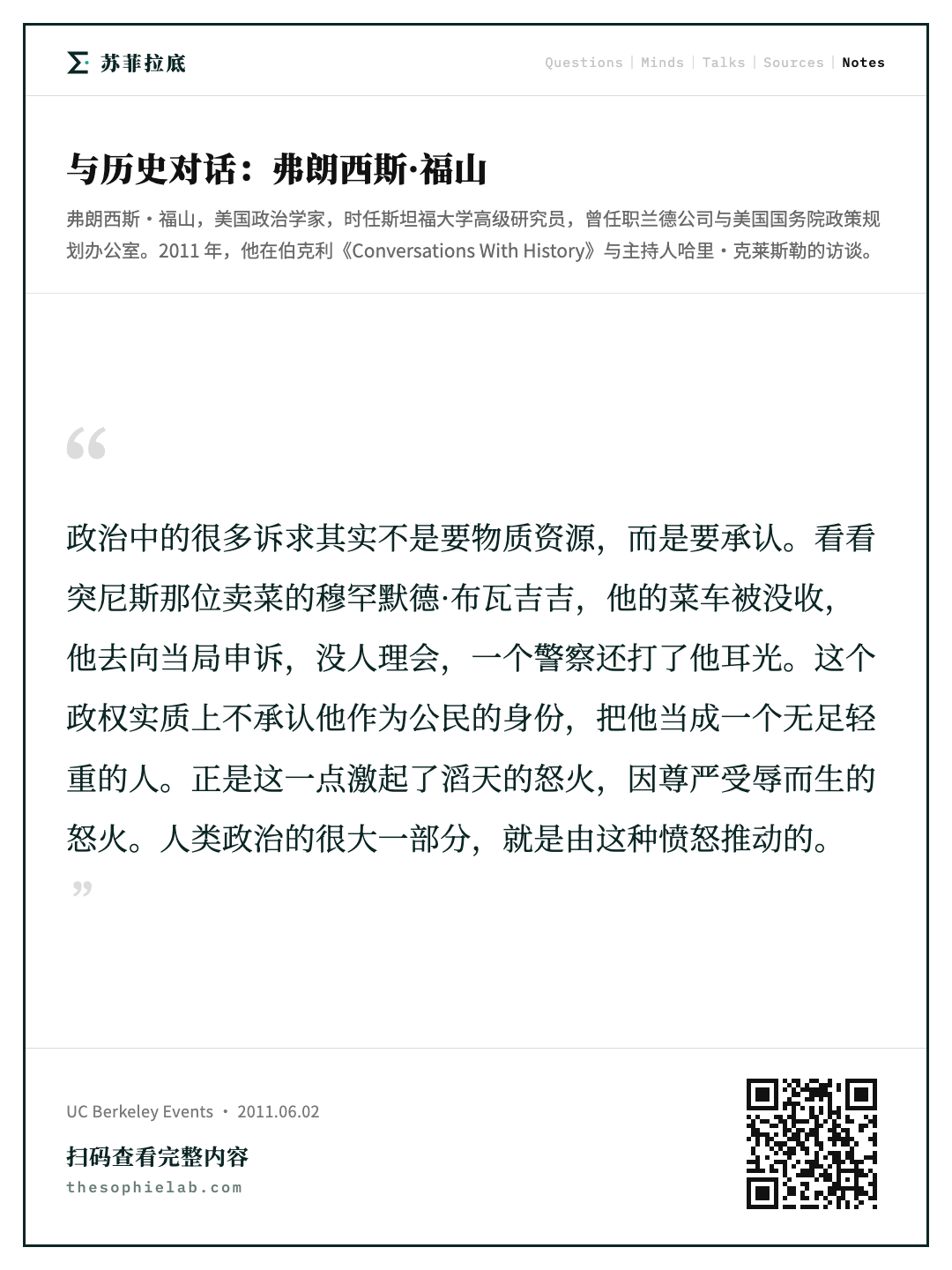
福山: 经济学家认为人基本上受物质自利驱动,但承认是另一回事。承认发生在你和另一个人之间,是对方承认你的地位,承认你作为人的尊严。想一想就会发现,现代政治很大一部分是承认的政治。我是女性,我是同性恋,我是乌克兰民族主义者,所有这些身份在过去都被贬低:乌克兰当年不是独立国家,女性处于从属地位。政治中的很多诉求其实不是要物质资源,而是要承认。看看突尼斯那位卖菜的穆罕默德·布瓦吉吉(Mohamed Bouazizi),他的菜车被没收,他去向当局申诉,没人理会,一个警察还打了他耳光,羞辱他。这个政权实质上不承认他作为公民的身份,把他当成一个无足轻重的人。我认为正是这一点激起了滔天的怒火,因尊严受辱而生的怒火。人类政治的很大一部分,就是由这种愤怒推动的,人们渴望政治体制承认自己作为人的基本地位和价值。

政治发展的问题

主持人: 承接亨廷顿的传统,也承接你自己的工作和此后的事态,你想用这本新书回答的政治发展问题是什么?

福山: 尤其是生活在美国,我们把政治和政治制度视为理所当然。美国有一种反国家的传统,我们不喜欢政府,不信任它,巴不得它消失或缩小。我们不懂得拥有一个国家有多重要,也不是每个国家都有。去索马里、阿富汗、海地看看,那些地方之所以混乱无序,就是因为没有一个能执行法律的基本国家。我做发展问题已有些年头,如今大家普遍承认,世界上多数穷国之所以穷,未必是缺资源,而是缺好的制度:没有产权,没有能维持秩序的国家。比如尼日利亚,过去一代人里拿到了几千亿美元的石油收入,收入水平却在下降,原因就是腐败,尼日利亚国家没能给民众提供像样的公共服务。想着这一切,我就问自己:那国家是从哪儿来的?这些基本的东西是从哪儿来的?按理说,作为政治学家,你会以为有一本教科书可以翻开来把这些讲清楚,但我不认为存在那样一种直截了当的说明。这也是我决定自己写一本的部分原因。

主持人: 重要的是,你把政治和政治发展看作自主的东西,然后追问:自由民主赖以确立的三种制度,该如何解释它们的由来?这又回到了《历史的终结》,你在那里说自由民主这套世界观终将胜出。

福山: 对。三种制度是国家本身、法治和政治问责。现代政治的奇迹之一,就是你能得到一个真正握有权力、行使权力的国家,而它同时又受法律和政治问责的约束。问题是,如何解释这三样东西作为一个整体出现?亨廷顿的第一本书《变化社会中的政治秩序》写于一九六八年,我从中汲取的最重要一课是:政治制度有自己的内在逻辑。它们可能与经济发展和社会变迁相关,但不是一回事。换句话说,现代化不是一个不可拆分的整体,其中政治的部分需要单独拎出来。所以问题就是:国家、法治、政治问责,各自的历史起源在哪里?

人性的生物学根基

主持人: 这本书不仅历史内容极其丰富,以比较的眼光看历史,还借用了生物学理论的洞见来理解政治制度。这很新,也很重要。你借助生物学帮我们理解亲属关系、家产制(patrimonialism)等等的重要性。请给观众解释一下,因为这是国家演化的关键。

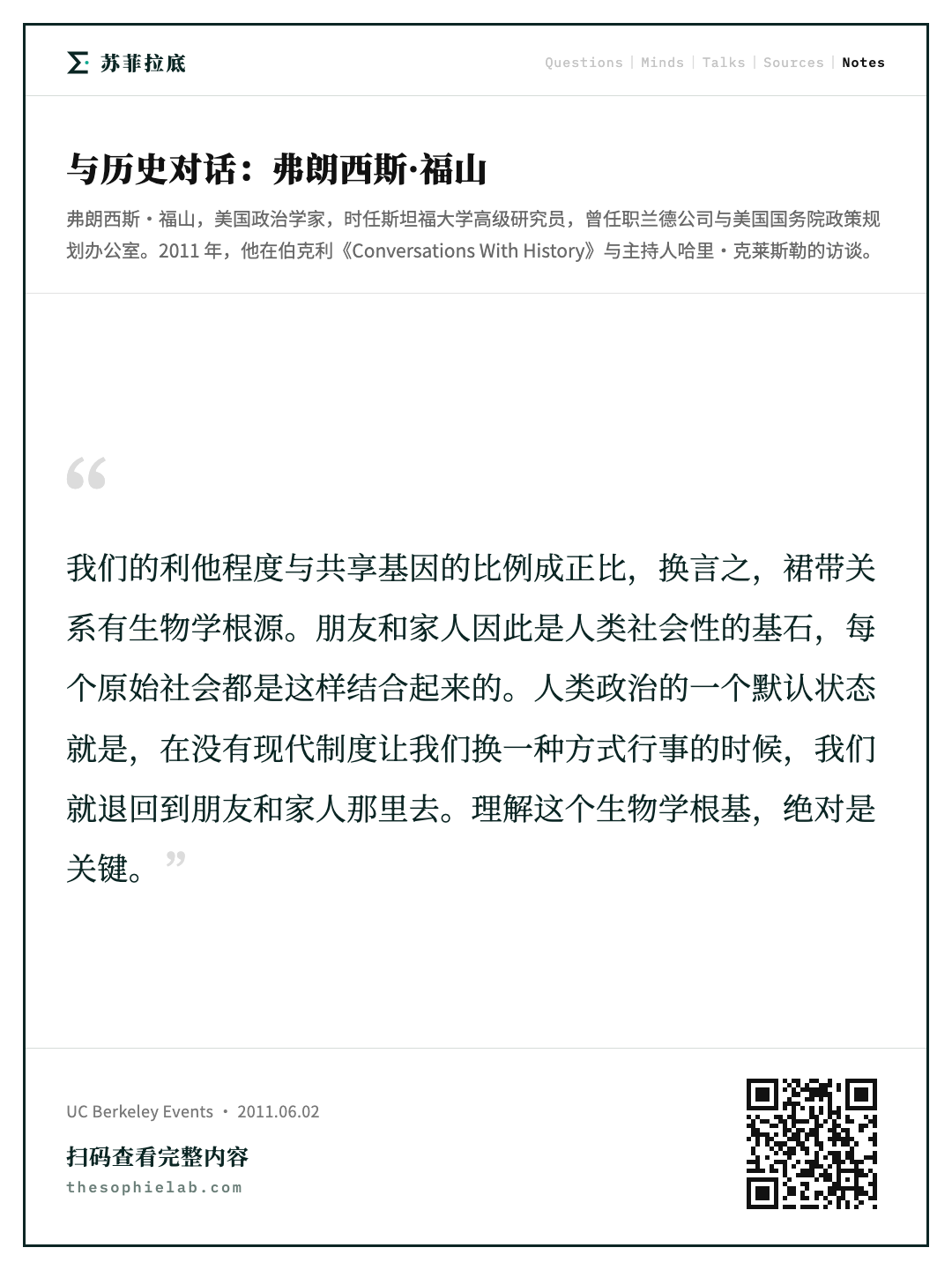
福山: 过去五十年生物学的一大革命,是重新确立了对人性的信念。回到二十世纪中叶,大多数社会科学家会说,人类行为完全是社会建构的,人几乎可以无限塑造,生物学不算数。遗传学革命和演化生物学的成果告诉我们,事实并非如此。所有人类都共有某些认知能力,比如语言能力。而在政治上最重要的两种,都与社会性有关。一是生物学家所说的亲缘选择(kin selection):我们的利他程度与共享基因的比例成正比,换言之,裙带关系有生物学根源。二是互惠利他(reciprocal altruism):我们和朋友之间面对面地直接交换好处。朋友和家人因此是人类社会性的基石,每个原始社会都是这样结合起来的。人类政治的一个默认状态就是,在没有现代制度让我们换一种方式行事的时候,我们就退回到朋友和家人那里去。理解这个生物学根基,绝对是关键。

主持人: 作为我们天性的产物,我们本质上还会寻求规则,对吧?

福山: 我们寻求规则,我们是遵守规则也创造规则的动物。规则关乎社会合作的能力,没有规则就无法合作。地球上如今有六十来亿人,人类相较其他物种的优势,就在于能够大规模合作,生存上的成功由此而来。所以规则的产生同样是不需要教的。规则的具体内容,比如不吃猪肉,或者敬奉祖先,是可变的,但创造规则的能力,以及伴随守规与破规而来的情感,是完全扎根于生物学的。

主持人: 最后还有暴力的倾向。

福山: 不幸的是,这大概是人类进步的一大动力。说到底,我们学会合作是为了与其他人类群体竞争。人类脑容量远超其他灵长类,部分原因就在于社会合作的要求,也就是与其他人群竞争的要求。社会复杂性演化的每一步都能看到这一点:正是安全上的竞争,也就是军事竞争,推动了越来越复杂的社会组织形式的演化。

主持人: 我们在逐一梳理你这本书的构件。历史中有人性的生物学基础,还有推动历史的观念的力量。

福山: 人类有一种巨大的抽象能力,这同样是天生的。我们不断想象出看不见的力量,来解释现实世界中的现象。今天这些看不见的力量是引力、物理定律;在过去,它们往往是关于神灵的宗教观念,用来解释太阳为什么早晨升起,你为什么打赢了一场仗。没有这种抽象能力,我们就不可能像今天这样驾驭世界。其他灵长类不会产生关于因果的抽象观念和理论,人类会。这就是宗教的基础。所有人类社会都有宗教观念,也许除了现代西欧人,他们自以为已经超越了这一步。但这确实是人类理解世界方式的一个鲜明特征。

偶然与不可复制

主持人: 把《历史的终结》和这本新书对照,我感觉在你的思想成长中,你更加意识到,或者说更明显地意识到制度演化的复杂性。这也许部分是做哲学和做历史社会学的区别。当你把这些碎片拼起来,读者会感到你已经得出结论:虽然可以指认哪些东西必须存在,但那种以为有一个神奇的套装,可以用联邦快递寄到某地、把这一切组装起来的想法,你已经不再相信了。这本书部分就是在讲这个。

福山: 我想是的。历史发展中有大量的偶然和机缘,它们解释了我们为何得到今天这种制度。这对发展中国家很重要,因为我们有时假定,既然英国或美国经历了如下几个成长阶段,其他人就会照样复制。而你会意识到,那些发展路径其实相当特殊,指望其他国家、其他社会去复制,是一种错误的期待。比如,我们今天为什么有现代民主?这其实要归因于一种封建制度,即等级会议或议会,存活到了现代。它在大多数欧洲国家没能存活,法国、西班牙、俄国都没有,但在英格兰活了下来。我们今天有议会民主,是因为一些非常具体、近乎偶然的条件,让英格兰议会得以存续并成为英国政治的主导力量。在其他社会,这是不能想当然的。

主持人: 对我这样在六七十年代读过大量比较政治文献的人来说,这本书的一个优点是给比较研究的骨架添了新的血肉,把中国和印度这样的案例推到了前台。过去当然有区域研究,但这两个例子并不在宏大理论工作的中心。

福山: 当代多元文化主义有一个大问题。我们必须是多元文化的,我们所有的社会事实上都是多元文化的,我们生活在一个和其他文化打交道的全球化世界里。但研究其他文明时,存在一种政治正确。一个世纪前教给美国学童的那种欧洲中心或英国中心的叙事,如今已被一种关注其他文明的叙事取代。但即便在今天,这些叙事也算不上真正的比较研究。它们并不追问那些硬问题:为什么某些制度在某些地方演化出来,在另一些地方却付之阙如;某一套宗教信仰对一种政治秩序的演化究竟有什么实际影响。

拱肩与教会

主持人: 在谈你对中国和印度的论述之前,我想再提一个你引入的概念,「拱肩」(spandrel)。它最初出自生物学。请解释它是什么,以及它如何帮我们理解中世纪天主教会的贡献。

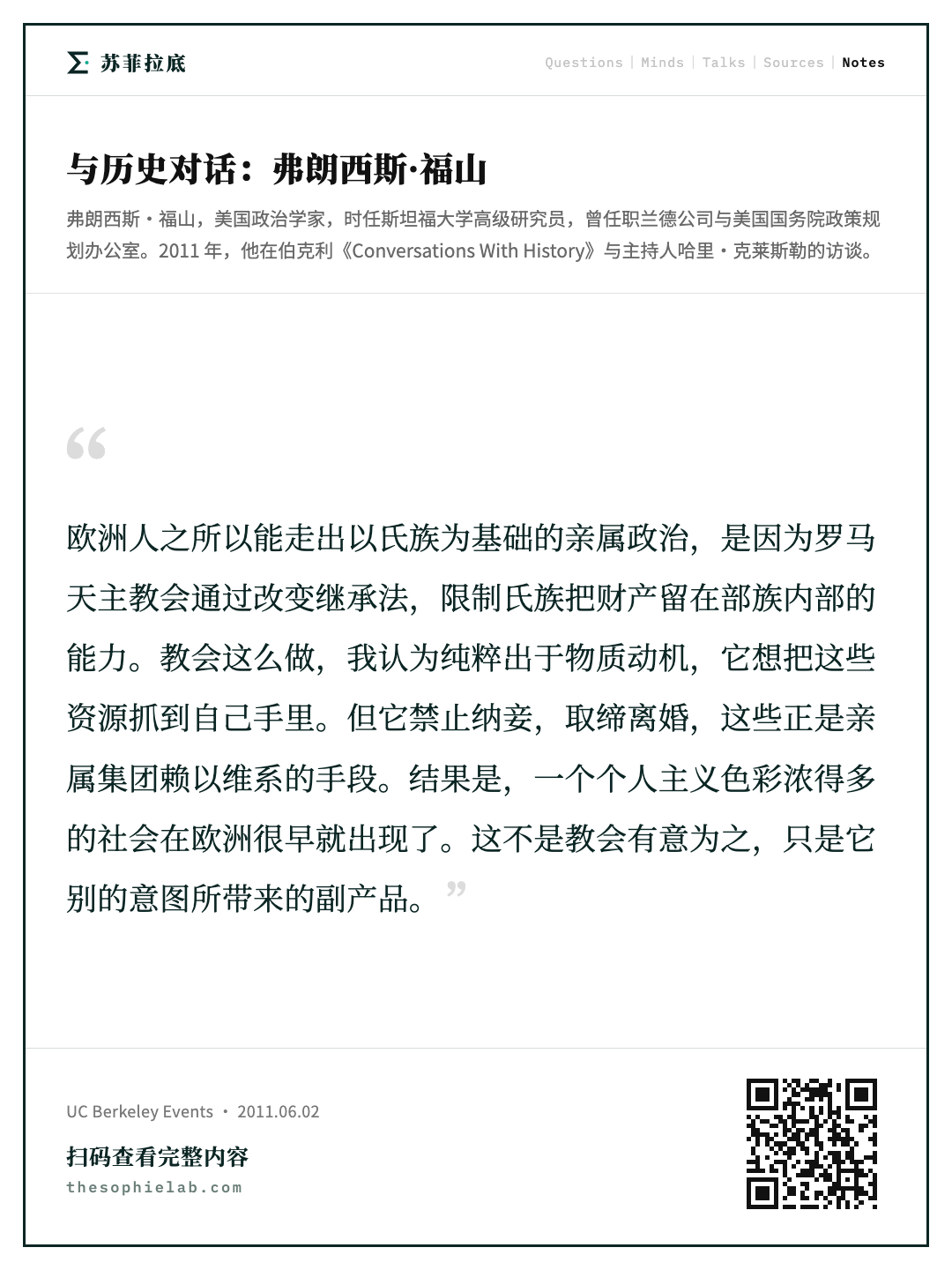
福山: 拱肩的说法来自斯蒂芬·杰伊·古尔德(Stephen Jay Gould)和理查德·列万廷(Richard Lewontin)一篇著名的文章,讲圣马可教堂的拱肩。拱肩是穹顶下几道拱相交而形成的建筑空间,它不是有意设计的,只是几何上的巧合。但后来它们被装饰起来,被视为自成一格的建筑母题。两位作者的论点是,生物演化中这种事很常见:某样东西为一个目的演化出来,却在另一件事上派上用场。我认为在人类制度发展史上,拱肩随处可见。比如,欧洲人之所以能走出以氏族为基础的亲属政治,是因为罗马天主教会看到了一个大机会:通过改变继承法,限制紧密的氏族把财产留在部族内部的能力。教会这么做,我认为纯粹出于物质动机,它想把这些资源抓到自己手里。但它禁止纳妾,取缔离婚,这些正是亲属集团赖以维系的手段。结果是,在欧洲,一个个人主义色彩浓得多的社会很早就出现了,远早于中国、印度或阿拉伯世界。这不是教会有意为之,它并没有打算摧毁扩展的亲属关系,就像拱肩一样,它只是教会别的意图所带来的副产品。

主持人: 这说到底是历史情境中的行动者为了在经济资源、权力或其他方面取得成功而选择策略。

福山: 对。他们的动机五花八门,有些还是理想主义的。教会确实在十一世纪确立了欧洲的法治传统,因为它想在欧洲行使道德权威。所以一切都是动机的混合。但没有哪个制度是完全被预见、被规划,然后照某人的计划出现的。这个过程偶然得多,也非线性得多。

中国:第一个现代国家

主持人: 你在书里主张,要看现代意义上的第一个国家的形成,必须看中国。谈谈这个。公元前三世纪的中国,是哪些因素催生了第一个,姑且加引号,「现代国家」?

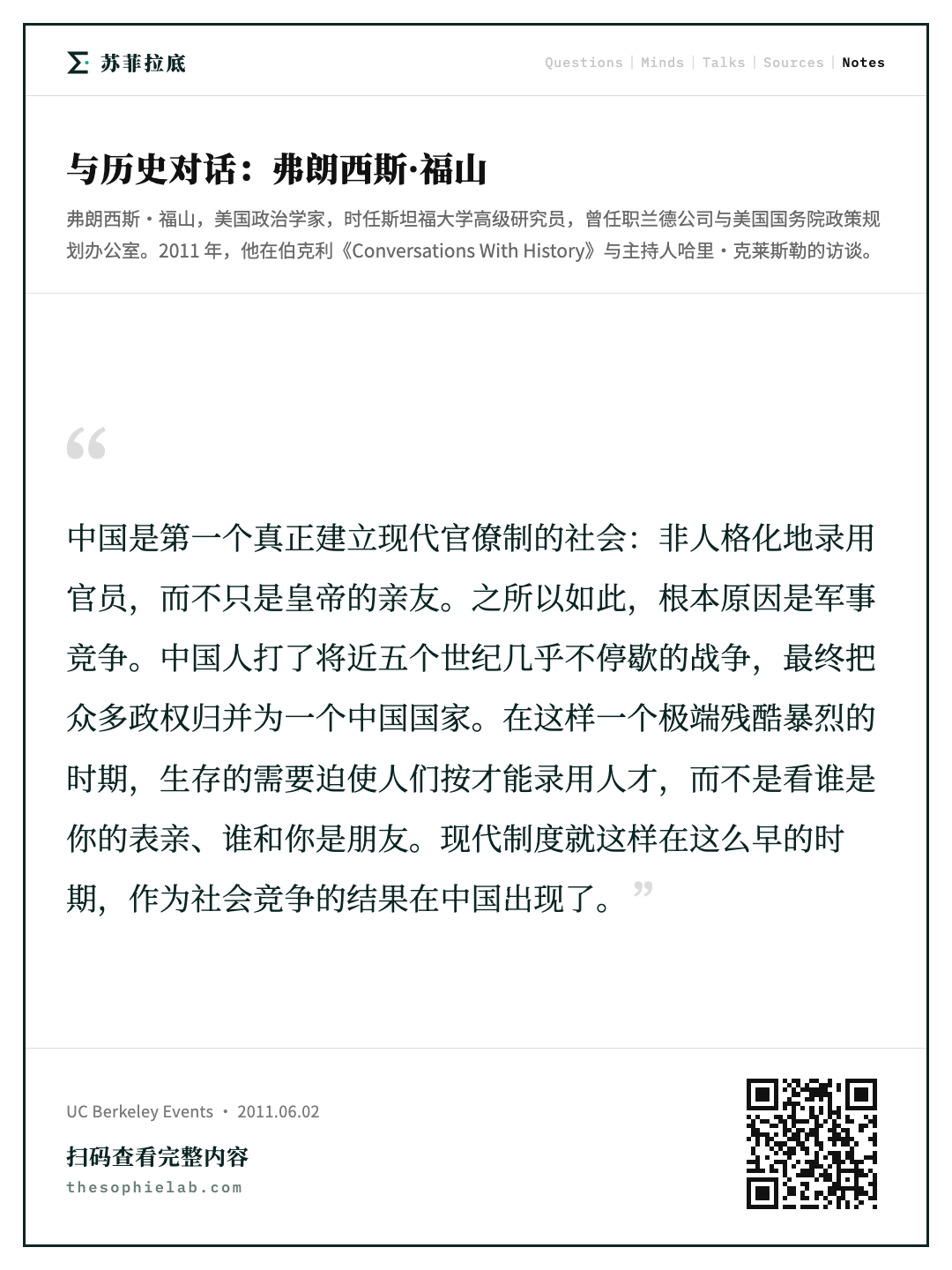
福山: 「现代」这个词很重要。巴比伦、埃及都有许多国家早于中国,但在我看来,中国是第一个真正建立现代官僚制的社会:非人格化地录用官员,而不只是皇帝的亲友。之所以如此,根本原因是军事竞争。中国人打了将近五个世纪几乎不停歇的战争,就是他们所说的春秋战国时期,最终把众多政权归并为一个中国国家,也就是公元前二二一年秦朝的开端。在这样一个极端残酷暴烈的时期,生存的需要迫使人们按才能录用人才,而不是看谁是你的表亲、谁和你沾亲带故、谁和你是朋友。现代制度就这样在这么早的时期,作为社会竞争的结果在中国出现了。

主持人: 由此产生的结果是超越了亲属纽带。我们最近请过阿纳托尔·利文(Anatol Lieven),他有一本关于巴基斯坦的新书;也请过约翰·坎贝尔(John Campbell)大使,他有一本关于尼日利亚的新书。无论看尼日利亚还是巴基斯坦,正是亲属关系及由此而来的家产制造成了我们面对的许多问题。请帮观众理解,为什么超越这些纽带如此重要?

福山: 所有社会都要经过一个以亲属关系组织社会的阶段,但亲属关系局限很大。你要打赢一场仗,要有最好的、组织得最好的官僚机构,很多时候能提供这些的并不是你的亲戚。亲属关系还只能造就小规模社会。现代国家的建立,在某种意义上就是为了确立一种普遍的公民标准:这片领土上的每个人都是这个更大共同体的成员,不论你属于哪个部落、哪个族群。在许多发展中国家,巴基斯坦是极好的例子,现代国家制度基本上是强加在一个仍按亲属关系和庇护关系组织起来的社会之上的,也就是社会科学家所说的庇护主义(clientelism):某个有权势的地主可以动员成千上万在他土地上劳作的农民,让他们按他的意愿投票。那不是现代民主,也不是现代国家。

印度的岔路

主持人: 中国那一章之后是与印度的比较。你说大约公元前六百年,印度出现了一次「绕道」,后果是印度没有走上强大国家的道路。差别在哪里?

福山: 我认为这是观念力量的明证。关键是公元前一千年间婆罗门教在印度的兴起。印度由此确立了一种等级制:最高一层的婆罗门是祭司,明确高于下一层的刹帝利,而刹帝利是武士,是政治权力的实际掌握者。有意思的是,在此之前,印度和中国其实相当相似,都是部落式组织。印度人放牧牛群,是迁徙的部落群体,还吃牛肉。然后随着这种宗教的兴起,突然出现了一种截然不同的社会组织形式:种姓制度。它把经济中的劳动分工神圣化,对政治权力形成了一套极其强大的社会约束。直到今天,任何印度国家向下渗透到村庄层面的能力都很有限,没有哪位印度统治者做到过这一点。所以我认为,印度是一个受法律约束的民主国家,而中国是威权国家,这不是过去一两百年发生的任何事情的产物,不是殖民主义的产物,这些格局要追溯到久远得多的过去。除了极短暂的时期,印度从没有哪个政府能行使中国政府在同样两千年里习以为常的那种独裁式的集中权威。

历史为何重要

主持人: 这正是所有这些历史之所以重要的关键,对吧?它确实帮助我们理解今天中国和印度的轨迹,它们同其他金砖国家一道,正在改变国际经济。

福山: 没错。我不想听起来像个历史决定论者,因为国家确实会改变这些根深蒂固的行为模式,创造新制度,然后转向不同的方向。但我确实认为,不了解那些更深层的历史模式,你就无法理解现在。以中国为例,他们发明的其实是一种高质量、集中化的官僚行政形式,这是他们的长项。两千年来他们一直擅长此道,今天仍然擅长,比一般的非洲、中东或拉美国家强得多。如果你不明白这背后有多深厚的历史,我认为你就理解不了当代中国的体制。

主持人: 看今天中东那场加引号的「革命」也是如此。如果不理解阿拉伯国家没有完成的那次突破,也就是超越亲属关系、政教分离的突破,你就理解不了它们的走向。

福山: 是的。就在我们说话的此刻,也门、利比亚、约旦、叙利亚都在发生起义。在所有这些国家,实际的社会组织仍然建立在部落、氏族、族群或教派之上。从某种意义上说,那里并没有经历现代的民族建构和国家建构的过程。当然有例外。埃及显然有很强的民族认同和独立的国家意识。这也意味着,埃及走向真正民主的道路,大概会比利比亚容易。利比亚在意大利人把奥斯曼帝国几个互不相干的省份拼在一起、宣布「你们是一个国家」之前,根本就不是一个国家。

政治衰败

主持人: 亨廷顿还提出了政治衰败(political decay)的概念,你今天也在处理它。导致政治衰败,也就是自由民主这些核心构件解体的两个因素是什么?

福山: 一个重要来源是制度的黏性。我们人类创造规则和制度,却通过宗教或深厚的历史传统赋予它们一种内在价值。外部环境变了,我们却不去修改它们,于是被功能失调的制度困住。书里有很多这样的历史例子。我实际上认为,今天的美国可能就有一点这种症状:我们的制衡体系太有效了,以致重要的决定根本做不出来。政治衰败的另一个来源是,每当一个社会处于压力之下,现代制度运转不灵时,重新抬头的就是朋友和家人,就是那种把亲友当作默认社会组织形式的生物学冲动。它导致政治腐败,导致国家被重新俘获,尤其是被富有的精英俘获。

全球化与经济增长

主持人: 这本新书是计划中两卷的第一卷,写到法国大革命为止。你在书的后半部分触及两个因素,它们在接下来的篇章里会真正改变方程:一个是国际关系的整体现象,一个是经济发展。谈谈这个,因为如今我们必须把国际干预的力量、世界贸易组织之类国际机构的作用加进这个混合体。

福山: 全球化不是新现象,已经持续了几百年,说到底就是通过贸易、投资、人员和观念的流动把世界编织在一起。今天没有哪个国家是孤立演化的。我们有外国的模式,有外国的资源,有顾问,有世界银行,有美国国际开发署。一个社会的发展,在很多方面都被周围的社会塑造着。现代世界与我描述的历史世界的另一个真正重要的区别,是工业革命之后的经济增长。看增长曲线,人类历史的头五万年它一直在低位徘徊,到一八〇〇年前后突然陡然上扬,我们从那以后就一直在这条轨道上,但愿能继续留在上面。它让最近几代人的经验变得不同,因为人们突然被经济增长动员起来了。想想今天的中国,几亿工人从农村出来,原本是农民,现在住在大城市,能看电视、上网,有各种各样的信息来源,生活彻底不同了。这对政治是一个重要的塑造因素。

干预的限度

主持人: 我们这个时代的一个问题是,苏联解体、美国成为世界最强国之后,如何干预别国内政,帮它们达成自由民主这个结果。我想经过最近这段时期,你的想法变了。书里反复出现的一个观点是,这真的取决于当地的具体情况,干预能做到的有限度。在美国,美国可以干预的想法正是新保守主义的议程。我们从那场实验中学到了什么?你自己学到了什么?你曾自认是新保守主义者,但已经和那个传统决裂了。

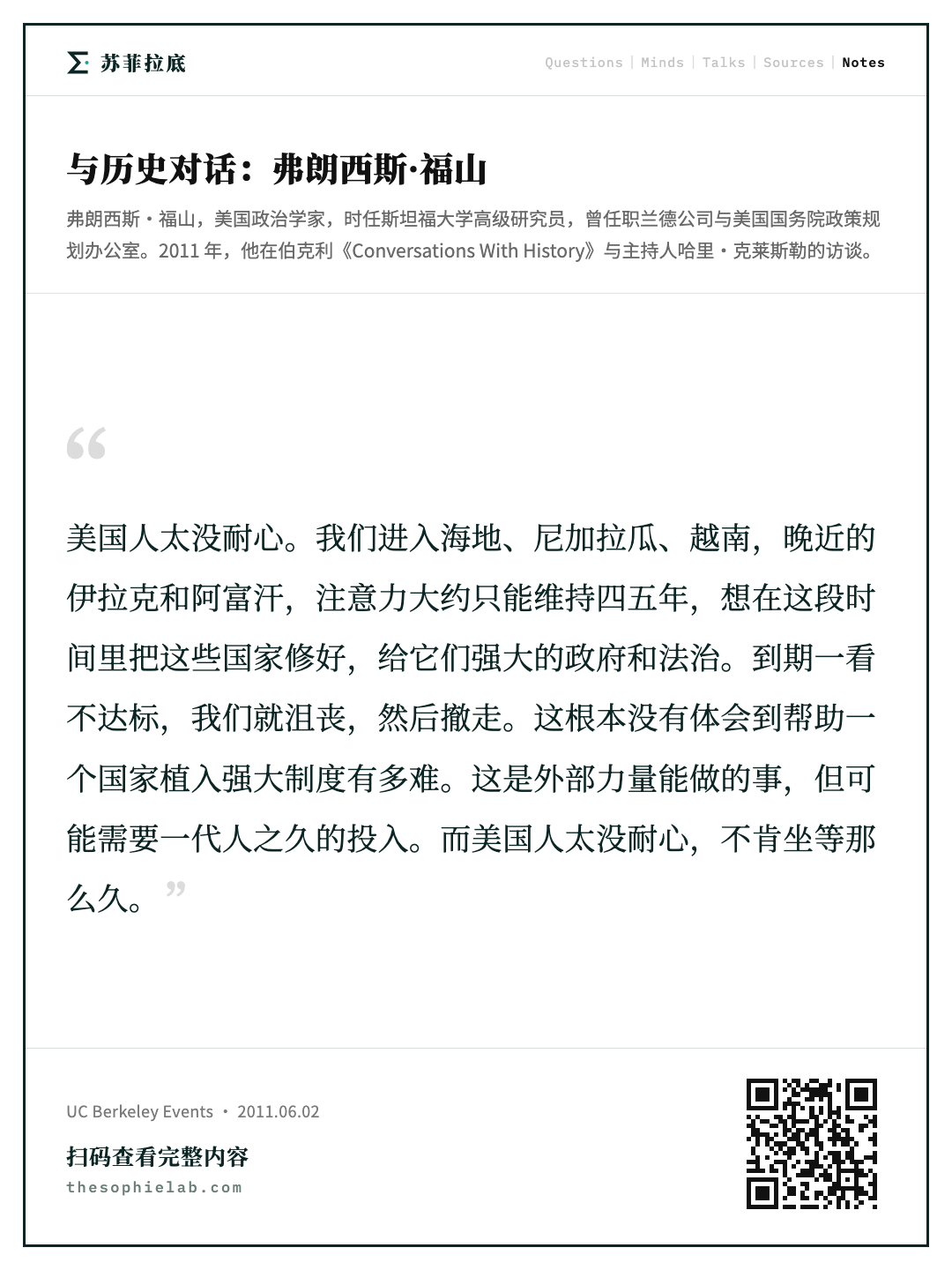
福山: 看看美国国家建构努力的历史,首先,我们其实并没有从自己的错误里学到多少,有一种历史失忆。但我想浮现出来的主要教训是:美国人太没耐心。我们进入海地、尼加拉瓜、越南,晚近的伊拉克和阿富汗,注意力大约只能维持四五年,想在这段时间里把这些国家修好,给它们强大的政府和法治。到期一看不达标,我们就沮丧,然后撤走。这根本没有体会到帮助一个国家植入强大制度有多难。这是外部力量能做的事,但可能需要一代人之久的投入。而美国人太没耐心,不肯坐等那么久。

主持人: 所以这本书的一个次要目的,是说:这是极其复杂的事,你要做就得明白这一点。如果把这本书交给决策者,他们也应该读,读完留下的印象大概是:你需要耐心,需要大图景,不仅是当下在发生什么,还有这些地方的历史,以及我们自己的历史。

福山: 对。美国人倾向于把自己的经验投射到其他社会上,而不去真正吸收这些事情发生的真实背景。这其实是我写这本书的原因之一。我一直关注失败国家和国家建构这个问题,关注我们对制度建设究竟知道些什么。历史之所以重要,部分是为了让人们明白,这是一个艰难的过程,同时也是一个由特定社会的具体轨迹引导的过程。不了解那个背景,你就帮不了它们多少。

主持人: 美国在国内和外交政策上,是否正处于你在书里借用相关文献所说的「认知失调」(cognitive dissonance)之中?我们是否有不能适应变化的危险,无论在国内,还是在没能吸取伊拉克干预教训这方面?

福山: 伊拉克的案例太负面了,那个教训我们大概会学到。更大的、我们可能学不到的教训是:我们已经习惯了做霸权国家。自一九八九年以来,我们当了二十年世界超级大国。世界在变,我们正在进入一个多极得多的世界,必须想清楚怎样与其他国家分享权力,我们的观念也未必会像过去一代人那样受欢迎、那样占主导。这种调整,我想对美国人来说会很难。

中国模式与坏皇帝

主持人: 《历史的终结》核心的那个大问题在今天非常切题,因为看到中国的成功,似乎出现了一种关于如何让最多的人获得经济收益的竞争性观念。中国这场实验能否成功并不清楚。关于中国和它所走轨道的限度,以及这与你关于自由民主胜利的看法如何对照,你怎么想?

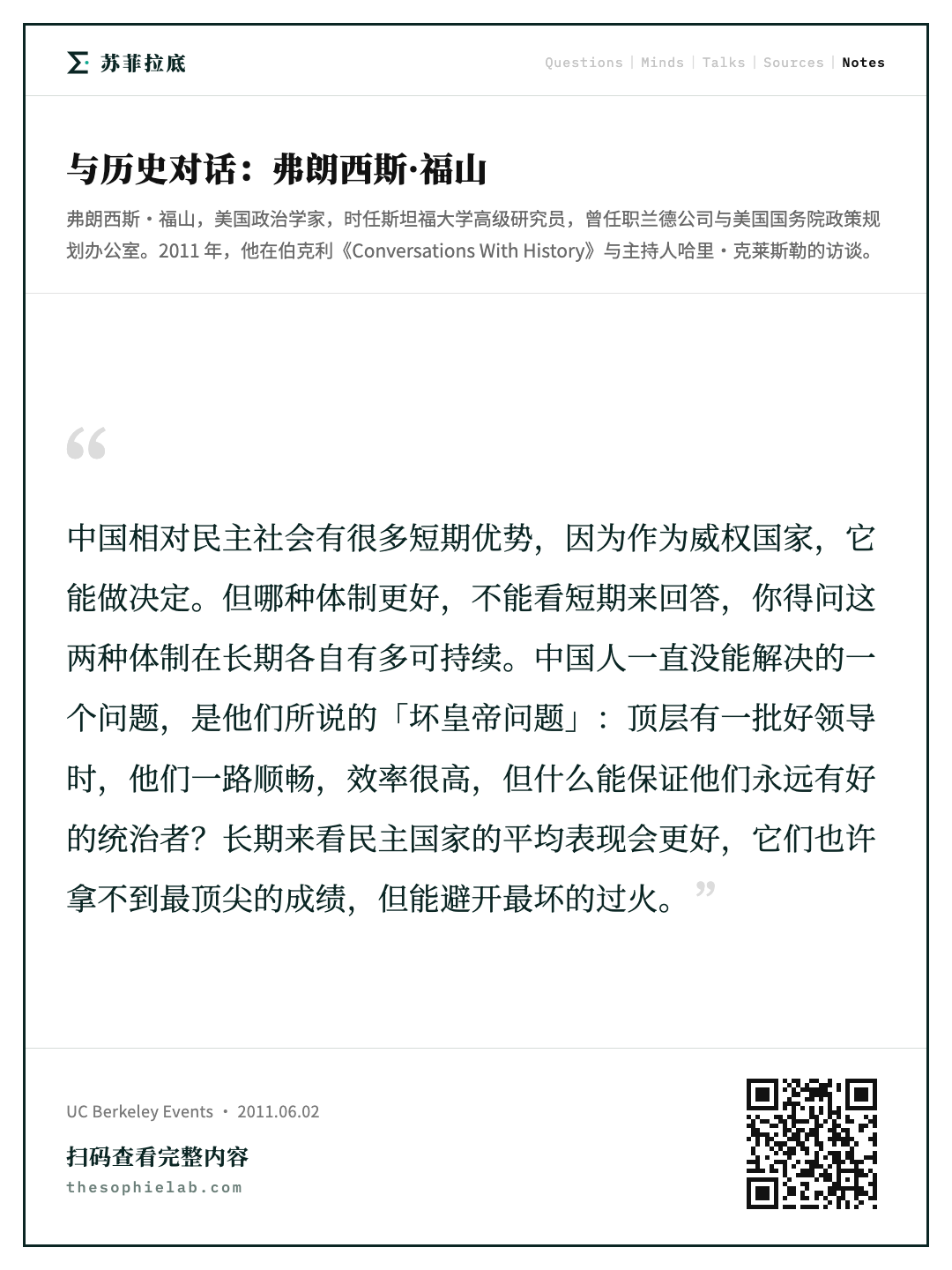
福山: 中国相对民主社会有很多短期优势,因为作为威权国家,它能做决定,宏观经济政策也做得不错。今天去中国,能看到那些了不起的基础设施,他们能投资高铁、大坝、水电等等。相比之下,美国在制衡体系之下,基本上困在华盛顿高度极化的气氛里,在长期财政问题、医疗以及一大堆问题上做不出大的决定。但我认为,哪种体制更好,不能看短期来回答,你得问这两种体制在长期各自有多可持续。在这一点上,我仍然认为我们的体制有很大优势,因为它终究更有弹性。中国人一直没能解决的一个问题,是他们所说的「坏皇帝问题」:顶层有一批好领导时,他们一路顺畅,效率很高,但什么能保证他们永远有好的统治者?历史上这一直是他们的败因。他们周期性地碰上可怕的皇帝,最近的一位是毛泽东,在没有制衡的情况下,这样的人能给一个社会造成巨大的破坏。所以我认为,长期来看民主国家的平均表现会更好,它们也许拿不到最顶尖的成绩,但能避开最坏的过火。

全球治理

主持人: 全球治理的问题呢?你在《历史的终结》最新版里谈到了它。这本书显然聚焦于国家层面,讲国家会发生什么。这些洞见是否适用于全球治理的问题?我们显然不会有世界政府,但我们在设法驾驭国际机构,让它们接手霸权国处理不了的一部分事情。而你关于民族国家的一些说法,比如问责问题、规则问题,其实也适用于全球治理。

福山: 全球治理还有很长的路要走。在全球治理上,我们基本处在部落式的发展阶段:没有能执行规则的主权者,没有第三方执法,基本上人人自助。我认为我们不会走到世界政府,我们将不得不采取某种中间方案,在特定问题上建立某种程度的问责。我们正走向一个有多重相互重叠的国际组织和合作形式的世界,因为我确实认为,单一的、集中的世界政府将是一个极其难以企及的目标。

主持人: 你在《历史的终结》新版的结论里指出了恐怖主义、非政府行为者、核扩散等问题。在一个没有绝对性国际治理机构、美国又似乎正在丧失应对这些问题的决心的世界里,未来处理这些问题的最好办法是什么?

福山: 这很棘手,我想每个问题都要用不同的办法处理。拿国际毒品贸易来说,它部分是国家政策问题:如果美国人不消费那么多毒品,拉美就不会有这个麻烦,所以一部分是国内的需求问题。一部分是警察部门之间、情报机构之间的国际合作问题。还有一部分是某种道德问题,怎样动员公众去对抗毒品和洗钱之类的事。而这又不同于核扩散,不同于应对全球疾病。每一个问题都需要一个贴合其性质的解决方案。从某种意义上说,这也是国家层面制度的故事:没有一个适用于每个社会的全球模板,这些东西真的必须基于相关行动者的实际利益和历史演化出来。

给学生与决策者的话

主持人: 基于你的学术经历和你处理过的问题,如果学生想延续这本书所代表的研究领域,你会给他们什么关于为未来做准备的建议?

福山: 他们必须留意世界的本来面目,必须去旅行,必须打开心智。对我来说,最重要的一课是伟大的社会学家西摩·马丁·李普塞特(Seymour Martin Lipset)喜欢在课堂上引用的那句话:只懂一个国家的人,一个国家也不懂。除非走出狭隘的本土语境,否则你根本理解不了自己的社会,因为如果不能从社会之外的人的视角去看它,你就看不准它。这是学生在考虑怎样学习、去哪里旅行之类事情时,应该牢记的一点。

主持人: 最后一个问题。对华盛顿的决策者,你希望他们从这本书里带走什么?

福山: 首先是更深切地体会制度的必要,然后是植入制度的困难,以及在处理干预、国家建构、国家建设这类问题时,需要相当的耐心和历史眼光。

主持人: 让我再向观众展示一次你的书,并郑重推荐它,无论是它的覆盖面、洞见,还是文字的清晰与明快。弗兰克,非常感谢你来到我们的节目。

福山: 谢谢你,哈里。

主持人: 很高兴请到你,也感谢各位收看本期《与历史对话》。
本期讲者
弗朗西斯·福山美国政治学家,时任斯坦福大学高级研究员,曾任职兰德公司与美国国务院政策规划办公室。以 1989 年《历史的终结?》一文闻名,2011 年出版《政治秩序的起源》。
哈里·克莱斯勒加州大学伯克利分校国际研究所访谈节目《与历史对话》的创办人与主持人,自 1982 年起访谈数百位学者与政要。
章节 · 点击跳转视频
0:00 家世与求学:从古典学转向政治学 ▶ 正在看
5:05 《历史的终结》:缘起与误读 ▶ 正在看
10:22 第三波民主化的教训:制度为本 ▶ 正在看
14:38 新书之问:国家究竟从哪里来 ▶ 正在看
18:27 人性根基:亲缘、规则与暴力 ▶ 正在看
22:34 抽象能力与制度演化的偶然性 ▶ 正在看
28:08 拱肩:教会无意中瓦解了宗族 ▶ 正在看
30:57 中国与印度:强国家与种姓的绕道 ▶ 正在看
37:34 中东起义与政治衰败的两个来源 ▶ 正在看
40:22 全球化、经济增长与干预的限度 ▶ 正在看
45:42 多极世界与中国的坏皇帝问题 ▶ 正在看
49:44 全球治理与给学生、决策者的忠告 ▶ 正在看
本期论点
本期回应
30:26
没有任何制度是被预见和规划出来的,制度生成是偶然而非线性的过程 没人设计,自己长出来制度是设计出来的,还是自己长出来的?
31:14
中国最早建立按才能选官的非人格化官僚体系,根源是数百年几乎不断的军事竞争 没人设计,自己长出来制度是设计出来的,还是自己长出来的?
53:08
不存在适用于所有社会的全球制度模板,制度须依相关行为体的利益与历史演化 没人设计,自己长出来制度是设计出来的,还是自己长出来的?
39:43
美国的制衡体系过于有效,反而阻碍了重要决策的作出 牵制反而误事统治者的权力应该被牵制吗?
49:11
中国体制的致命弱点是无法保证高层永远出现好统治者,缺乏制衡时坏统治者破坏极大 权力必须被牵制统治者的权力应该被牵制吗?
其他论点
10:50
缺少国家机器与扎根的法治机构,最初的民主转型不会带来稳定的民主
13:44
政治中的很多诉求与其说是对物质资源的诉求,不如说是对承认的诉求
15:28
多数穷国之所以穷,主因不是缺乏资源,而是缺乏产权与能维持秩序的制度
17:48
政治制度有自身的内在逻辑,现代化不是整体打包的,政治部分必须单独拆出来分析
20:02
裙带关系有生物学根源:人的利他程度与彼此共享的基因成正比
28:49
欧洲摆脱以氏族为基础的亲缘政治,源于天主教会修改继承法以限制宗族留住财产
34:38
印度种姓制把祭司置于武士之上并将劳动分工神圣化,构成对政治权力的强大社会约束
35:45
印度是法治民主国家而中国是威权国家,源自远早于殖民时代的历史模式
37:34
中东起义的走向,取决于当地是否已超越血缘亲属纽带并实现政教分离
39:00
政治衰败的根源之一是制度被赋予内在价值后,环境变了也不再调整
01家世与求学:从古典学转向政治学
0:00
[Music] welcome to a conversation with history I'm Harry Chrysler of The Institute of international studies Our Guest today is Francis fukiyama who is a senior fellow at Stanford University his new book is the origins of political order Francis welcome to Berkeley thank you very much where were you born and raised uh I was born in Chicago but I basically grew up in New York City and looking back how did your parents shape you're thinking about the world uh well I think probably the reason I'm an academic is because of them my father was a professor and my grandfather on my father's side was actually a fairly prominent Economist and University
[音乐] 欢迎收看《与历史对话》,我是国际研究所的哈里·克莱斯勒。今天的嘉宾是弗朗西斯·福山,他是斯坦福大学的高级研究员,新书是《政治秩序的起源》。弗朗西斯,欢迎来到伯克利。非常感谢。你在哪里出生、在哪里长大?我出生在芝加哥,但基本上是在纽约市长大的。回过头看,你父母是怎么塑造你看世界的方式的?我想,我之所以成为一个学者,大概就是因为他们。我父亲是教授,而我父亲那边的祖父其实是一位相当有名的经济学家,还当过大学
便签引用
1:14
president uh uh in Japan and so it seemed to me it was almost for ordained that I'd end up uh you know getting a PhD and and going into a university and your father's work was in religious studies yes although he was trained as an empirical soci sociologist so I actually inherited his collection of Max vber and Amil durkheim books so that tradition lives on and it was a good start for you was was there discussion of of world events and and and politics and international Affairs at the yes uh well definitely I you know my political views were different from his he was always actually a lot more liberal than I was and so we'd have lots of arguments over you know a whole r of subjects uh uh after I got to after I got to University and where did you do your undergraduate work I went to Cornell and at Cornell were there any uh teachers that you had who influenced you probably the most important was Alan Bloom the political theorist uh that's why I became a Classics major so I could learn Greek and read Plato and Aristotle and uh uh you know he shaped my interest
校长,在日本。所以在我看来,我最后会去读博士、进大学,几乎像是命中注定的。你父亲做的是宗教研究?是的,不过他受的训练是实证社会学。所以我其实继承了他收藏的马克斯·韦伯和埃米尔·涂尔干的书,那个传统就这么延续下来了。这对你是个很好的起点。家里会讨论世界大事、政治和国际事务吗?会,肯定会。我的政治观点跟他不一样,他其实一直比我自由派得多,所以我们会为各种各样的话题争论——在我上了大学之后。你本科在哪里读的?我去了康奈尔。在康奈尔有没有哪位老师影响了你?可能最重要的是政治理论家艾伦·布鲁姆。就是因为他我才主修古典学,这样我能学希腊语,读柏拉图和亚里士多德。他很深地塑造了我对
便签引用
2:26
in in Western philosophy I think very deeply and a background that I I really you know I'm very happy I had and then go you went on to graduate school at Harvard and what led to the switch from classics philosophy to uh to political science well I took this detour uh in the early 70s when I was in college uh postmodernism hit the US in a big way uh and so I actually spent a year in Paris studying with jacqu DEA and romart and you know folks like like that uh and um actually having studied with them and and read their books I decided it wasn't for me and so I had this kind of reaction where I went uh you know in a much more practical Direction and uh ended up doing international relations in uh uh at Harvard in the Harvard government department and uh who there were influential uh uh in your education uh my dissertation advisers were nadav safron and Adam who did Middle East and and Soviet studies um um respectively and then uh that's also where I met Samuel Huntington who was in the Carter Administration for much of my period there but it come back and and so we
西方哲学的兴趣,我觉得影响非常深,而且这样的知识背景我真的很庆幸自己拥有。后来你去哈佛读研究生,是什么让你从古典学、哲学转向了政治学?我中间绕了一段路。七十年代初我还在上大学的时候,后现代主义在美国大行其道,所以我实际上在巴黎待了一年,跟雅克·德里达、罗兰·巴特这些人学习。但真的跟他们学过、读过他们的书之后,我认定这不适合我。于是我产生了某种反弹,转向了一个务实得多的方向,最后在哈佛的政府系做起了国际关系。在你的求学过程中,那里有哪些人影响比较大?我的论文导师是纳达夫·萨夫兰和亚当,他们分别研究中东和苏联问题。另外我也是在那里认识了塞缪尔·亨廷顿,我在校的大部分时间里他都在卡特政府任职,但后来他回来了,所以我们
便签引用
3:43
intersected and he was probably the second after bloom probably the second important influence over my intellectual development and and what was uh special about Huntington was it the power of the M of his mind uh and the problems that he grappled with well I think so I think that you know the trouble with a lot of academics is that they focus on really narrow issues and they use a lot of jargon and uh it's very hard to actually relate it to any real problems Huntington was just the opposite he always picked big issues uh the other thing was his scope because he wrote within political science on a whole range of topics so that included comparative politics and development National Security uh issues of uh civil military uh relations and then later on you know about religion and so I think the range of his interest was really quite quite astonishing how how important was the fact that he wrote and also was involved uh uh in policy issues that is that he theoretically he focused on issues that had uh policy implications well it was quite important uh I think that it meant that his theory was always grounded in a appreciation for real world political issues and you know I think a lot of what you do when you study policy is you realize what your
就有了交集。他大概是继布鲁姆之后,对我思想发展第二重要的影响。亨廷顿特别在哪里?是他思维的力量吗,还是他所处理的那些问题?我想都有。很多学者的问题在于,他们只盯着非常狭窄的议题,用一大堆行话,很难跟任何真实的问题挂上钩。亨廷顿正好相反,他总是挑大问题。另一点是他的涉猎范围,因为他在政治学内部写了非常多领域的东西,包括比较政治、发展、国家安全、军政关系的问题,后来还写宗教。所以我觉得他兴趣的广度真的相当惊人。他既做学术写作、又参与政策事务——也就是说他在理论上关注的是有政策含义的问题——这一点有多重要?相当重要。我觉得这意味着他的理论始终扎根于对现实政治问题的体认。而且我想,你研究政策的时候,做的很多事情其实是让你意识到自己作为一个纯理论家的
便签引用
02《历史的终结》:缘起与误读
5:05
limitations are as a you know as a pure theorist you can imagine all sorts of possible worlds that would be great to live in but you can't actually get there and I think you know having that realistic sense was was quite important now your dissertation was on uh international relations what in particular uh at that time I was a specialist in Soviet foreign policy and I focused on Soviet foreign policy in the Middle East it's a topic that's completely disappeared uh so I had to find something else to do in life after that uh and then after completing your degree at Harvard you uh went where well I U bounced back and forth I was in the state department a couple of times on the policy planning staff uh and then my first job was with the think tank the Rand Corporation in Santa Monica where I also did Soviet basically analyze Soviet foreign policy and uh it was in between uh Rand and the state department uh when you wrote the essay the the end of history that created such an impact and uh talk a little about the the circumstances uh and the the setting historically that that led you to write that uh piece which really became a uh uh an international phenomena MH well I was actually working on a couple of Rand projects on the changes going on inside
局限在哪里。你可以想象出各种各样美好的、值得生活其中的世界,但你实际上到不了那里。我觉得有这种现实感是相当重要的。你的博士论文写的是国际关系,具体是什么方向?当时我是苏联外交政策方面的专家,重点研究苏联在中东的外交政策。这个题目如今已经彻底消失了,所以之后我不得不在人生里另找事情做。在哈佛拿到学位之后你去了哪里?我来回折腾了几次。我两度在国务院的政策规划办公室工作过。我的第一份工作是在圣莫尼卡的兰德公司这家智库,在那里我做的基本上也是分析苏联外交政策。而正是在兰德和国务院之间的那段时间,你写下了那篇引起巨大反响的文章《历史的终结》。谈谈当时的情形,以及促使你写下那篇文章的历史背景吧,它后来真的成了一个国际性的现象。其实我当时在做兰德的几个项目,研究的是苏联内部正在发生的变化,
便签引用
6:30
the Soviet Union not in foreign policy but just gorbachov and per sta glasnov these big developments in the late 1980s and at one point um I read a speech of gorbachov's in which he said well the essence of socialism is competition and at that point I called up one of my political theorist friends and I said look this is the end of History if gorbachov is saying that socialism amounts to competition uh there's really no meaningful difference between uh Us and Them uh the end of History of course referring to the hegelian Marxist view that uh you know uh history or the end as a as a goal or a direction rather than a termination uh and that's the moment you know at some point uh you know I conceived of of writing this uh article as I was on my way out of Rand and into the uh the first Bush Administration as a you know as a as a uh State Department U policy planner now you were 26 years old at about this time well no when I the first time I was at that point I was I was in my 30s you you were you okay so so were you surprised by the the reaction or well of course I you know I expected a few of my specialist friends would would read it and yeah so I wasn't prepared at all for the reaction you know it was just a remarkable time because this was 1989 when the whole world changed so
研究的是苏联内部,不是外交政策,就是戈尔巴乔夫、改革(perestroika)和公开化(glasnost)这些八十年代末的大变动。有一次我读到戈尔巴乔夫的一篇讲话,他说社会主义的本质就是竞争。那一刻我给一位研究政治理论的朋友打电话,我说:你看,这就是历史的终结。如果戈尔巴乔夫都说社会主义无非就是竞争,那我们和他们之间就没有什么有意义的区别了。当然,“历史的终结”指的是黑格尔—马克思式的看法,也就是说历史的“终结”是一个目标、一个方向,而不是终止。就是在那个时候,我萌生了写这篇文章的想法,当时我正要离开兰德,进入第一任布什政府,做国务院的政策规划工作。那时候你二十六岁?不是。我第一次进去的时候,我已经三十多岁了。那么你对这篇文章引起的反响感到意外吗?当然。我原本以为只有几个研究同行会读,所以我完全没有准备好面对那样的反应。那真是一个非凡的时刻,因为那是一九八九年,整个世界发生了如此
便签引用
7:53
dramatically and I think uh it was a conjunction of having anticipated that change by a few months and and and being able to put it in a larger context that that really set off this big discussion and and looking back what what enabled you to to uh to have these insights what uh was it the background in theory and philosophy that you think put you in a position to see the larger well okay so the you know the the the references to Hegel and to this French Russian philosopher Alexandre Kev who was just extremely important in France during the 1930s and 40s I think allowed me to have a more theoretical view of you know the problem of History itself but I think actually uh what did it for me was just paying attention to contemporary politics because things were happening very very rapidly uh in the Soviet Union I remember at the time going to various conferences of Soviet specialist and in a sense they're so wetted to a certain view of you know the way that political system worked that when they saw things you know changing
剧烈的变化。我想,正是因为我提前几个月预判了那场变化,又能把它放进一个更大的脉络里,这两点结合起来,才引发了这么大的讨论。回过头看,是什么让你有了这些洞见?你觉得是理论和哲学的背景让你能看到更大的图景吗?好,那些对黑格尔、以及对亚历山大·科耶夫——一位在一九三十、四十年代的法国极其重要的法籍俄裔哲学家——的引用,我想让我对“历史”这个问题本身有了更理论化的视角。但我觉得真正起作用的,其实就是关注当代政治,因为苏联的事情发展得非常非常快。我记得当时去参加各种苏联问题专家的会议,某种意义上他们太固守某一套关于那个政治体制如何运作的看法,以至于当他们看到事情正在改变时,
便签引用
9:08
they just didn't believe that that was happening and they they couldn't uh take aboard um uh you know this new reality and so I think you know in a sense just this willingness to you know look at the facts as they UNR unra you know unfold on the ground uh and and being able to adjust that uh you know given your own priors and prejudices I think was was important now now looking back at that work uh uh events have happened uh uh after the writing of uh of uh that initial essay and and uh and of course the essay was misinterpreted people were saying oh he's saying history is over they not going to be any more historical events which wasn't what you were saying at all and and so what what have you learned learned uh from both the reaction and and uh the way the world has changed uh since well I guess from the reaction I I guess it's just you know there's a kind of limit in public discourse as to you know the degree to which you can bring in serious philosophical ideas uh I think the more important question is about the
他们就是不相信那真的在发生,也没法接受这个新的现实。所以我觉得,某种意义上,正是这种愿意去看地面上实际展开的事实、并据此调整自己既有预设和偏见的态度,是很重要的。现在回头看那篇作品,在那篇最初的文章写完之后又发生了很多事。当然,那篇文章也被误读了,有人说“他在说历史结束了,以后不会再有历史事件了”,而这根本不是你的意思。那么,从这些反应、以及从此后世界的变化里,你学到了什么?从反应来看,我想就是公共讨论里存在某种限度,你能引入多少严肃的哲学思想是有限的。我觉得更重要的问题是关于
便签引用
03第三波民主化的教训:制度为本
10:22
way the world has changed because obviously uh a lot has happened in terms of uh you know what Huntington called the third wave of democratization um this is a period that began in the 1970s with southern Europe and went on through Latin America then the fall of the brillian wall you know where a lot of the world became Democratic uh I think that the thing that I took away from that whole period that is reflected in my new book uh on political order is the importance of Institutions and the fact that you know these initial transitions to democracy actually don't yield stable democracy unless you have institutions and um without a state without a government that can actually enforce rules without uh you know rule of law that's really rooted in a in a u you know set of legal institutions uh uh it's very hard to sustain U democratic practice and I think the difficulty of getting to that point is is something that I probably uh initially underestimated uh before we talk about the book let let me ask you this question what what do you think is is the the skill set that uh enables a a scholar a thinker to to be able to confront these uh very great changes you know in the world and and think about them in a rigorous systematic way well it's it's complicated I you know
世界发生了怎样的变化。因为显然,在亨廷顿所说的“第三波民主化”方面发生了很多事情。这一波从七十年代的南欧开始,经过拉丁美洲,然后是柏林墙的倒塌,世界上很大一部分地区变成了民主国家。我想,我从那整段时期里带走的、并且体现在我这本关于政治秩序的新书里的东西,就是制度的重要性——最初的民主转型如果没有制度,其实并不会产生稳定的民主。没有一个国家机器,没有一个真能执行规则的政府,没有真正扎根于一整套法律制度的法治,民主实践是非常难以维系的。而要走到那一步有多难,这一点我最初大概是低估了。在我们谈这本书之前,我想先问一个问题:你觉得,一个学者、一个思想者,要能面对世界上这些巨大的变化、并且严谨系统地思考它们,需要具备怎样的能力组合?这很复杂。我
便签引用
11:51
had basically a humani background rather than a social science background I didn't spend a lot of time early on doing quantitative methods and so forth and I you know the the humanities is not in great shape in in modern Academia but I think that's too bad because I actually think that uh confronting you know great thinkers of the past uh and understanding the world you know through their perspectives actually allows you to put things into uh a much broader uh context that um than you get from um the kind of pre-professional uh compartmentalized ways that universities tend to teach uh uh subjects and so I think that you know I I'm really glad that I had a liberal arts uh you know a broad liberal arts education When I Was An undergraduate uh a good example of of that point seems to be in both in the end of history and then in this new book you you talk about the the concept of recognition which which had emerged out of Hegel which which actually seems critical in in these times that that one has to see that important talk a little about that I mean because that that is an idea that one uh uh doesn't find often uh in the literature on public policy issues well you know the economists think that everybody is
基本上是人文学科的背景,而不是社会科学的背景,早年我没花太多时间搞定量方法之类的东西。人文学科在今天的学院里处境并不好,我觉得这很可惜,因为我确实认为,去面对过去那些伟大的思想家、通过他们的视角来理解世界,能让你把事情放进一个远为宽广的脉络里——比大学通常那种预备职业化的、条块分割的教学方式所能给你的要宽广得多。所以我真的很庆幸自己本科时受的是宽口径的博雅教育。关于这一点,一个很好的例子似乎是:在《历史的终结》和这本新书里,你都谈到了源自黑格尔的“承认”这个概念,而它在今天这个时代显得非常关键。稍微谈谈这个吧,因为这是一个在公共政策文献里不太常见的概念。你知道,经济学家认为每个人
便签引用
13:12
basically motivated by material self-interest but recognition is something different recognition is between you and another person that person's recognition of your status and and your dignity as a human being and if you think about it a huge uh uh part of our modern politics is about the politics of recognition so I'm a you know a woman a gay uh uh you know a Ukrainian nationalist uh uh all of these uh identities uh are things that you know in the past were undervalued uh Ukraine wasn't an independent nation you know women were held in subordinate positions and a lot of the demands in politics are actually not so much demands for material resources as demands for recognition and I think you know you look at what what happened in Tunisia with this vegetable seller Muhammad bazizi uh who tried to you know he had his vegetable cart confiscated he complained uh to the authorities they didn't do anything he was slapped by a policeman uh insulted and you know essentially the regime was not recognizing his status as a as a citizen uh you know was treating him as a nobody and so I think that that's what provoked this enormous anger uh over offended dignity and I think you know much of human politics has been driven by by this kind of anger and the desire that political systems recognize our our
基本上都是被物质上的自利所驱动的,但“承认”是另一回事。承认发生在你和另一个人之间,是那个人对你的地位、对你作为人的尊严的承认。你想想看,我们现代政治中有极大一部分就是承认的政治。比如我是一个女性、一个同性恋者、一个乌克兰民族主义者——所有这些身份在过去都是被低估的:乌克兰不是一个独立国家,女性被置于从属地位。政治中很多诉求其实与其说是对物质资源的诉求,不如说是对承认的诉求。你看突尼斯发生的事,那个卖菜的小贩穆罕默德·布瓦吉吉,他的菜车被没收,他向当局申诉,当局什么也没做,他还被一个警察扇了耳光、受了侮辱。本质上,这个政权不承认他作为公民的地位,把他当成一个无足轻重的人。我想,正是这一点激起了那种巨大的愤怒——因尊严受辱而生的愤怒。而我认为,人类政治中很大一部分一直都是由这种愤怒、以及由“希望政治体制承认我们
便签引用
04新书之问:国家究竟从哪里来
14:38
basic status and and worth as as human beings now building on this tradition of Huntington uh and uh also on the tradition of your own work and then you know events what what is the the problem uh in political development that you wanted to answer uh with your new book which is let me show it again the origins of political order well you know in a sense U especially living here in the United States we take uh politics and political institutions for granted in fact we've got this anti-status tradition in the United States where we don't like the government we don't trust it we wish it would go away or get smaller or whatnot and we don't appreciate the fact that it's actually important to have a state and not every country has that so you go to a place like you know Somalia or Afghanistan or Haiti uh you know the reason that they are so disorganized and chaotic is that they don't have a basic state that can enforce uh uh laws and I think you know I've been working in in development issues uh you know for some time and I think there's a general
作为人的基本地位和价值”这种渴望所驱动的。那么,沿着亨廷顿的这个传统,也沿着你自己作品的传统,再加上现实发生的事件——在政治发展方面,你想用这本新书回答的问题是什么?我再把书举一下,《政治秩序的起源》。某种意义上,尤其是生活在美国,我们把政治和政治制度视作理所当然。事实上美国有一种反国家主义的传统:我们不喜欢政府、不信任政府,希望它消失或者变小之类的。我们没有意识到,拥有一个国家机器其实非常重要,而并不是每个国家都有。你去索马里、阿富汗或者海地这样的地方,它们之所以如此失序、如此混乱,就是因为没有一个能执行法律的基本国家机器。我做发展问题已经有一段时间了,我觉得现在有一种普遍的
便签引用
15:52
recognition now that the reason that most poor countries in the world are poor is not necessarily that they lack resources but that they don't have good institutions they don't have property rights they don't have a state that can maintain order you know Nigeria for example has had I don't know hundreds of billions of dollars in oil revenues over the past uh uh generation and it's had declining incomes uh because of the level of corruption and the failure of you know the Nigerian state to actually deliver good services to its population and so in thinking about all of this I said well okay so where does the state come from you know where do these basic you know things come from as a political scientist You' think that there would be a textbook that you could open up that would explain all of this and I you know I don't think that you know that kind of a straightforward account existed and so that's part of the reason I decided that you know I'd have to write one myself and importantly what you you're you're trying to see politics and political development as autonomous and then asking how do we account uh for three institutions that are Central to the establishment of of uh liberal democracy which hearkens back to your end of
共识:世界上大多数穷国之所以穷,不一定是因为缺资源,而是因为没有好的制度——没有产权,没有一个能维持秩序的国家机器。比如尼日利亚,过去一代人里石油收入大概有几千亿美元,但人均收入却在下降,原因就是腐败的程度,以及尼日利亚这个国家机器无法真正向民众提供良好的公共服务。所以在思考所有这些的时候,我就想,好吧,那国家是从哪儿来的?这些最基本的东西是从哪儿来的?作为一个政治学者,你会以为总该有一本教科书,翻开就能把这些讲清楚,可我觉得并不存在那样一部直截了当的论述。这也是我决定自己动手写一本的部分原因。而且很重要的是,你是想把政治和政治发展看作是自主的,然后追问:我们该如何解释那三种对确立自由民主至关重要的制度?这又回到了你那本《历史的
便签引用
17:08
history essay because there you were saying well th this is the the uh uh the world view that is liberal democracy that would Triumph that's right well so the three institutions are the state itself the rule of law and political accountability and I think part of the miracle of modern politics is that you can get state that are really about power and the the use of power but that are simultaneously limited by law and limited by political accountability and so the question is how do you account for the emergence of these three uh in a single package uh and I think that you know Huntington's original uh his first book uh political order and changing societies was written in 1968 and from that uh I drew this single important lesson that political instit tions you know have their own internal logic uh they may be related to Economic Development and to social change but they're not the same thing they're not so in other words modernization is not one total package uh and the political parts of it really need to be uh broken out and so that's really the the issue where does the state rule of law and political accountability what what was you know their their historical origin now now in addition to being rich very
历史论著,因为在那本书里你说的是,自由民主这套世界观将会取得胜利。没错。所以这三种制度分别是国家本身、法治和政治问责。我认为现代政治的奇迹之一,就在于你可以拥有真正关乎权力、关乎权力运用的国家,但它同时又受到法律的限制、受到政治问责的限制。所以问题就是,你如何解释这三者能够以一整套的方式同时出现。我想,亨廷顿最初那本书——他的第一本书《变化社会中的政治秩序》写于1968年——我从中得出了一个非常重要的教训:政治制度有它自身的内在逻辑,它们可能与经济发展、与社会变迁有关,但它们并不是一回事,并不是。换句话说,现代化并不是一个整体打包的东西,其中政治的部分确实需要被单独拆解出来看。所以真正的问题就是:国家、法治和政治问责,它们的历史起源到底在哪里。那么,除了内容极其丰富之外——
便签引用
05人性根基:亲缘、规则与暴力
18:27
rich in history and and and looking at history in comparative terms you you draw on uh biological insights the the the insights of of uh biological theory for understanding political institutions uh that's kind of new that's that's that's kind of very important and and what what uh it is through biology that you uh help us understand uh the importance of of uh kinship uh and patrimonialism and so on talk talk explain that to our audience because that is key to the evolution of the state well sure so uh I think that one of the big Revolutions in biology over the last 50 years is the restoration of a belief in human nature uh if you go back to the mid 20th century most social scientists would have said human behavior is completely socially constructed human beings are almost infinitely plastic you know uh biology counts for nothing and I think one of the consequences of the whole genetic Revolution and and what we've learned about evolutionary biology suggests that that's actually not true that all human beings actually share certain faculties cognitive faculties
在历史上非常丰富,而且是以比较的眼光来看历史——你还借助了生物学的洞见,用生物学理论的洞见来理解政治制度。这算是很新的做法,也非常重要。正是通过生物学,你帮助我们理解了亲缘关系、家产制等等的重要性。请给我们的观众讲讲这一点,因为这对国家的演化是关键。当然可以。我认为过去五十年生物学的重大革命之一,就是恢复了对“人性”的信念。如果回到20世纪中叶,大多数社会科学家会说,人的行为完全是社会建构的,人几乎是无限可塑的,生物学根本不重要。而我认为,整个基因革命以及我们对进化生物学的认识所带来的结果之一,就是表明事实并非如此——所有人类其实共享某些能力,某些认知能力,
便签引用
19:50
you know the faculty for language uh the two that are the most important I think in politics have to do with sociability and so one is the principle what biologists called kin selection where we're altruistic in proportion to the genes that we share so in other words nepotism is biologically rooted uh and then the other principle of reciprocal altruism which uh in which we exchange favors on a direct face-to-face basis with friends uh essentially uh so friends and family are a Bedrock of human sociability uh every primitive Society U social you know they're bonded in this fashion uh and part of the um default uh nature of human politics is we go back to friends and families in the absence of modern institutions that make us behave in you know in in in different ways and so I think understanding that biological Foundation is is absolutely critical and and also as as uh products uh uh uh of our nature we we essentially look for rules right that's we look for rules uh we are we are rule following and and Rule creating uh animals you know rules are related to the ability to cooperate socially if you don't have rules you can't cooperate and the reason that there now whatever it is six billion human beings on Earth uh uh
比如语言的能力。我认为在政治中最重要的两点,都与社会性有关。其一是生物学家所说的“亲缘选择”原则:我们的利他程度与我们共享的基因成正比。换句话说,裙带关系是有生物学根基的。其二是“互惠利他”原则,即我们在面对面的直接交往中与朋友互相帮忙、交换恩惠。所以,朋友和家人是人类社会性的基石。每一个原始社会都是以这种方式结合在一起的。而人类政治的某种默认状态就是:在缺少现代制度让我们以不同方式行事的时候,我们就会退回到朋友和家人那里。所以我认为,理解这一生物学基础是绝对关键的。另外,作为我们本性的产物,我们本质上还会去寻找规则,对吧?我们会寻找规则,我们是遵循规则、也创造规则的动物。规则与社会合作的能力有关,如果没有规则,你就无法合作。而如今地球上之所以有——不管是多少——六十亿人,
便签引用
21:13
compared to other species is that human beings are able to cooperate uh on a large scale uh and and you know that's where they derive their their survival uh success and so the generation of rules is something again that human beings don't need to T be taught the actual content of the rules you know like don't eat pork or or you know respect your ancestors those are variable but the faculty for creating rules and the emotions that are associated with rule following and Rule breaking are absolutely biologically grounded and and then finally the propensity for violence basically well um unfortunately uh that's I think been one of the big drivers of human um progress because uh in essence we learn to cooperate in order to compete with other uh human groups part of the reason that we've got these enormous you know uh brains uh compared to other primates is is I think the requirements of social cooperation uh in competition with other groups of human beings and you can see this at every step in the development of social complexity that it's the need to compete uh over security uh you know military competition that has driven uh the evolution of of more and more complex forms of social organization so so we're we're walking through the building blocks of of your book and and
相比其他物种,原因就在于人类能够大规模地合作。他们的生存优势正是由此而来。所以规则的生成同样是人类不需要被教就会的事情。规则的具体内容——比如不吃猪肉,或者敬奉祖先——是各不相同的,但创造规则的能力,以及与遵守规则、违反规则相关联的情感,绝对是有生物学根基的。那么最后,还有暴力的倾向。基本上是的。不幸的是,我认为这恰恰是人类进步的重大推动力之一,因为本质上,我们学会合作,是为了与其他人类群体竞争。我们之所以拥有比其他灵长类大得多的大脑,我认为部分原因就是社会合作的需要——在与其他人类群体竞争中进行合作的需要。你可以在社会复杂性发展的每一个阶段看到这一点:正是为了在安全上竞争的需要,是军事竞争,推动了越来越复杂的社会组织形式的演化。所以我们现在是在梳理你这本书的构成要素——
便签引用
06抽象能力与制度演化的偶然性
22:34
history is there uh the the the biological basis of human nature but also uh uh the the whole power of ideas in moving history uh human beings have this tremendous capacity again a natural capacity for abstraction so we are constantly imagining uh invisible forces that explain you know behavior in the real world so today these invisible forces or things like gravity or you know the laws of physics uh in the past they tended to be religious ideas about gods or spirits that uh explained you know why the sun came up in the morning why uh you know you want a battle uh and I think that without this ability to abstract we wouldn't be able to master the world uh in the way that uh uh that we do you know other primates don't generate abstract ideas about causation and theories about causation but but human beings do that and that's you know the basis of religion basically uh all human societies have religious ideas uh except for maybe modern Western Europeans that now think that they're beyond that but but it is a you know it is a clear characteristic of of the way human beings uh understand the world if if I compare uh uh the the end of History with this current book I I have a a sense that in your intellectual growth you are U
历史在那里,人性的生物学基础也在那里,但还有观念在推动历史方面的巨大力量。人类拥有一种巨大的能力,同样是一种自然的能力,就是抽象的能力。所以我们不断地想象出各种看不见的力量,用来解释现实世界中的现象。今天这些看不见的力量是诸如引力、物理定律之类的东西;在过去,它们往往是关于神灵或鬼魂的宗教观念,用来解释为什么太阳早上会升起,为什么你打赢了一场仗。我认为,如果没有这种抽象的能力,我们就无法以现在这样的方式驾驭这个世界。其他灵长类不会产生关于因果的抽象观念和关于因果的理论,但人类会,而这基本上就是宗教的基础。所有人类社会都有宗教观念——也许除了现代西欧人,他们现在觉得自己已经超越了这些。但这确实是人类理解世界的方式的一个明显特征。如果把《历史的终结》和你现在这本书作比较,我有一种感觉:在你思想的成长中,你——
便签引用
24:09
more aware or it's more obvious that you are aware of the complexity of the uh evolution of Institutions now partly this may be the difference between doing philosophy and and uh kind of doing uh historical uh sociology uh and and so so as you as you put these pieces together uh one one has the sense that uh you you've really come to the conclusion that there that although you can identify what needs to be there the notion that there's some magic uh uh package that could come via FedEx that would put all this together in a particular place you you you've you no longer believe that and that's partly what this is about yeah I think so I think that um there's a huge amount of accident and contingency in historical development that that explain why we get to the kind of Institutions we have it's it's important for developing countries because we sometimes assume well because Britain or the United States went through the following stages of growth and everybody else is going to Simply
更加清楚,或者说更明显地意识到制度演化的复杂性。这部分可能是做哲学与做某种历史社会学之间的差别。所以当你把这些拼图拼起来的时候,人们会感觉到,你其实已经得出了这样的结论:尽管你可以指出哪些东西必须具备,但那种以为存在某个神奇的成套方案、可以用联邦快递寄过去、在某个特定地方把这一切拼装起来的想法,你已经不再相信了。这本书在某种程度上说的就是这件事。是的,我想是这样。我认为,历史发展中存在大量的偶然与意外,正是它们解释了我们为什么会拥有今天这样的制度。这一点对发展中国家很重要,因为我们有时会假定:既然英国或美国经历了以下这些成长阶段,那么其他所有人也会简单地——
便签引用
25:22
replicate that and I think what you realize is that uh those patterns of development are are actually quite peculiar and the idea that other countries or other societies are going to replicate that is is is is really um a false expectation for example why do we have modern democracy today uh it really has to do with the survival of a feudal institution which was the estate or the parliament uh into modern times uh it didn't survive in most European countries in France or Spain or U Russia but it did survive in England and the reason we have parliamentary democ y today is the very specific accidental almost conditions by which the English Parliament managed to survive and and and and be a dominant force in English politics uh but you can't take that for granted in other societies one of the uh virtues of your book for somebody like me who uh read a lot of this uh comparative literature say in the 60s and the 70s is that that you've really uh uh uh added new flesh to the bones of comparative studies that you're bringing in cases like China and India uh to the front obviously there were area studies in the past but but uh they the these two examples were not uh in the middle of the work being done on
复制这一套,我觉得你会意识到的是,那些发展模式其实相当特殊,而认为其他国家或其他社会会复制这套模式,这真的是一种错误的预期。举个例子,我们今天为什么会有现代民主?它其实跟一个封建制度的遗存有关,也就是等级会议、或者说议会,一直存续到了近代。在大多数欧洲国家它并没有存续下来——法国、西班牙、俄国都没有——但在英格兰它存续下来了。我们今天之所以有议会民主,靠的是英格兰议会得以存续、并成为英国政治中主导力量的那些非常特定的、几乎可以说是偶然的条件。但你不能想当然地认为其他社会也会有这些条件。对我这样一个在六七十年代读过大量比较研究文献的人来说,你这本书的一个优点在于,你真的给比较研究这副骨架添上了新的血肉,你把中国、印度这样的案例摆到了前台。当然过去也有区域研究,但这两个例子并不处在当时那些研究工作的中心,也不在
便签引用
26:48
the grand theorizing I think that um there's a big problem with contemporary multiculturalism uh you know we have to be Multicultural I mean all of our societies are de facto Multicultural and we live in a globalized world where you deal with other cultures but there is a kind of political correctness uh involved in studying other uh civilizations and so the eurocentric or anglocentric narrative that would have been taught to American uh school children you know a century ago has now been displaced by one that you know that that looks at other civilizations but I think that uh even today uh they're not act adequately you know comparative I mean they really don't ask hard questions about why certain institutions evolved in certain places and their absent in others or what the real impact of a certain set of religious beliefs was in you know the Contemporary evolution of a of a political order uh before we talk a little about what you have to say about China and India I I want to bring up one other concept that you bring in uh the concept of spandrels which originally emerges in in biology explain what that is and and and how it helps us understand for ex for example the the contribution of the
宏大理论建构的中心。我觉得当代多元文化主义存在一个很大的问题。你知道,我们必须多元文化——我是说,我们所有社会事实上都是多元文化的,我们生活在一个全球化世界里,你得跟其他文化打交道。但在研究其他文明时,存在着某种政治正确。所以,一个世纪前教给美国学童的那种欧洲中心或英国中心的叙事,如今已经被一种会去看别的文明的叙事所取代。但我认为,即便到今天,这些叙事其实也算不上真正的比较研究——它们并没有真正去问那些困难的问题:为什么某些制度在某些地方演化出来,而在另一些地方却付之阙如?或者某一套宗教信仰,在一种政治秩序的当代演化中,真正的影响究竟是什么?在我们稍微聊一聊你对中国和印度的看法之前,我想先提出你引入的另一个概念——“拱肩”(spandrel),这个概念最初出自生物学。请解释一下它是什么,以及它如何帮助我们理解,比如说,中世纪天主教会的贡献。
便签引用
07拱肩:教会无意中瓦解了宗族
28:08
medieval Catholic Church that's right well so spanel this is there's a famous article by Stephen J gold and Richard Lenton uh that talked about the spangel of San Marco so a spangel is an architectural U uh space that's created by intersecting arches in a dome uh it actually isn't deliberately designed it's just the result of this you know geometrical you know um uh uh coincidence but then they came to be decorated and they came to be seen as architectural motifs in their own right and their argument was that in biological evolution uh that happens a lot of times things evolve for one purpose and are useful for another and I think in the history of human institutional development you get spandrels all the time so for example the reason that the Europeans were able to exit out of Clan based kinship politics was the fact that the Roman Catholic Church saw this big Opportunity by changing inheritance laws uh to limit the ability of of of tightly knit uh uh Clans to keep property within the the tribe uh uh you know and and they the the church did this I think for purely material reasons they wanted to get their own hands on these resources but they forbade concubinage and uh uh they outlawed divorce uh and all of these IES that that that these kinship groups used
对,没错。拱肩——这里有一篇很有名的文章,是斯蒂芬·杰·古尔德和理查德·列万廷写的,讲的是圣马可教堂的拱肩。所谓拱肩,是穹顶中拱券相交所形成的一块建筑空间。它其实并不是刻意设计出来的,只是几何上的一种巧合结果。但后来人们开始装饰它,它也就本身被看作一种建筑母题。他们的论点是,在生物演化中这种情况经常发生:很多东西是为了某个目的演化出来的,结果却对另一个目的有用。我认为在人类制度发展的历史中,你会不断看到拱肩。举个例子,欧洲人之所以能够摆脱以宗族为基础的亲缘政治,是因为罗马天主教会看到了一个巨大的机会:通过改变继承法,来限制那些紧密结合的宗族把财产留在部族内部的能力。教会这么做,我觉得纯粹是出于物质原因——他们想把这些资源弄到自己手里。但他们禁止纳妾,也把离婚定为非法,还有所有这些亲缘群体惯用的手段
便签引用
29:31
and the result was the emergence of a much more individualistic Society uh in Europe at a very very early point you know compared to China or uh India or uh the Arab world uh and so that was not an you know the church didn't set out to destroy uh extended kinship but like a spandrel it just happened as a result of other uh intentions that it had and and this is really about actors in historical context choosing a strategy so that they can see succeed uh in terms of economic resources power or whatever that's right I mean they they follow all sorts of different uh uh motives some of them are idealistic ones I mean the church uh really was responsible for establishing the European uh rule of law the tradition of the European rule of law in the 11th century uh because it wanted to exert you know moral Authority uh in in uh Europe but you know so everything is a mixture of motives but uh no institution you know is ever simply you know anticipated and planned and and just emerges as a result of somebody's plan it's really a much more accidental uh and and nonlinear process in your book you argue that that really we have to look to China to see the the formation of of the first uh state in in in the way we conceive of it today talk
结果就是,一个个人主义色彩浓得多的社会在欧洲非常非常早就出现了——相比于中国、印度或阿拉伯世界。所以这并不是——你知道,教会并没有打算去摧毁扩展亲缘关系,但就像拱肩一样,它只是作为教会其他意图的结果而发生了。而这其实说的是,历史情境中的行动者选择某种策略,好让自己在经济资源、权力或别的什么方面取得成功。没错。我是说,他们出于各种各样不同的动机,其中有些是理想主义的。教会在11世纪确实促成了欧洲法治的确立、欧洲法治传统的确立,因为它想在欧洲施加道德权威。所以一切都是动机的混合。但没有任何制度是被简单地预见、规划出来,然后作为某个人计划的结果而出现的——那是一个偶然性大得多、也非线性得多的过程。在你书里,你论证说我们其实得看向中国,才能看到今天我们所理解的那种意义上的第一个国家的形成。谈谈
便签引用
08中国与印度:强国家与种姓的绕道
30:57
about it what was it what what were the factors in China uh I think in the 3rd Century BC that that that leads to uh the first U I guess in quotes modern State modern State well so it's important the the word modern um there were many states in in Babylonia in in uh um Egypt uh that preceded China but China was the first Society in my view to actually create a modern bureaucracy that was impersonally recruited that wasn't just friends and family of the emperor um and the reason that that happened was essentially military competition the Chinese fought five centuries of almost unremitting Warfare uh in what they call the spring and Autumn and Waring States period that finally reduced the number of Chinese polies down to a single uh Chinese State the the the beginning of the Chin Dynasty in 221 BC uh and it was the need for survival in this extremely brutal violent period that required uh people to be recruited on the basis of Merit rather than just who was your cousin or you know who are you related to or who are your friends with uh and so modern
这个吧。是什么?公元前三世纪的中国,是哪些因素导致了第一个——我姑且加引号——现代国家的出现?“现代”这个词很重要。在巴比伦、在埃及,都有过许多早于中国的国家。但在我看来,中国是第一个真正创造出现代官僚制的社会:官员的录用是非人格化的,不只是皇帝的亲朋好友。而之所以会这样,本质上是军事竞争。中国人打了五个世纪几乎没有间断的战争,也就是他们所说的春秋和战国时期,最终把中国政权的数量减少到只剩一个——公元前221年秦朝的开端。正是在这个极其残酷、极其暴力的时期里求生存的需要,要求人们按才能来录用,而不只是看你是谁的堂表兄弟、你跟谁沾亲带故、你跟谁是朋友。所以现代
便签引用
32:09
institutions emerge in China at this very very early period uh as a result of that kind of uh social competition and uh what what results then is the transcending of kinship ties we we've recently had on our program anat Le who has a new book on Pakistan we had uh Ambassador uh John Campbell who has a new book on Nigeria and in both cases when you look at Nigeria you look at Pakistan it's kinship and the resulting patrimonialism that that creates many of the problems we're dealing with what help us help our audience understand why is that transcending of those ties so important well I think that you know know kin all all societies go through this period where social organization is based on kinship but kinship is very limiting uh if you want to win a war if you want you know the best U uh organized you know bureaucracy uh a lot of times it's not your relatives that that can provide that uh also kinship just leads to small scale societies uh and so the modern state was created in a way to to establish a universal criteria
制度在中国这么早的时期就出现了,正是那种社会竞争的结果。而随之而来的,是对亲缘纽带的超越。我们节目最近请过阿纳托尔·利文,他有一本关于巴基斯坦的新书;也请过约翰·坎贝尔大使,他有一本关于尼日利亚的新书。这两个例子里,你看尼日利亚、你看巴基斯坦,正是亲缘关系以及由此产生的家产制,制造了我们如今面对的许多问题。请帮我们的观众理解一下:为什么超越这些纽带如此重要?我想是这样,所有社会都会经历社会组织以亲缘为基础的阶段,但亲缘关系是很有局限的。如果你想打赢一场战争,如果你想要组织得最好的官僚机构,很多时候能提供这些的并不是你的亲戚。而且亲缘关系只会导向小规模社会。所以现代国家在某种意义上,是为了确立一套普遍标准而被创造出来的
便签引用
33:25
for uh citizenship everybody the territory is a is a member of this larger community and doesn't matter what your tribe or your ethnic group uh is and I think in many developing countries the problem you know Pakistan is a great example of this uh there has these modern State institutions are uh basically imposed on top of societies that are still basically organized according to kinship and and patronage and you know what the uh social scientists call clientalism where some powerful landlord you know can mobilize thousands of peasants that work on his lands and vote whatever way that that landlord wants and that's not you know that's not modern democracy and that's not a modern state it after the chapter on China comes a comparison with India and and you get uh I think you say around 600 you get a a detour you call it in India that that means uh the the consequences are that India does not go the route of a uh of a powerful State what were the differences there well I think this is a testimony to the power of ideas it's really the rise of this bonic religion uh in India in the Millennium before the birth of Christ uh you get uh a hierarchy established in India in which the the brahans the the top class are priests uh and they're distinctly
就公民身份而言,生活在这片领土上的每一个人都是这个更大共同体的成员,不管你属于哪个部落、哪个族群。我觉得在很多发展中国家,问题就在这儿,巴基斯坦就是个很典型的例子,那里的现代国家制度基本上是硬套在一个仍然按亲缘关系和庇护关系组织起来的社会之上的,也就是社会科学家所说的"侍从主义"(clientalism)——某个有权势的大地主可以动员成千上万在他土地上干活的农民,让他们按他的意思投票。这不是现代民主,这也不是一个现代国家。/关于中国那一章之后,是与印度的比较,我记得大概在六百页左右,你说印度出现了一次"绕道",其结果就是印度没有走上强国家的道路。这中间的差别是什么?/我觉得这印证了观念的力量。真正起作用的是婆罗门教在印度的兴起,就在公元前的那一千年里。印度形成了一种等级秩序,最高的一层是婆罗门,也就是祭司,他们明显
便签引用
34:54
superior to the next class down which is the class of shat trios who are warriors who were the actual holders of uh political power it's interesting you know prior to that point India and China actually looked fairly similar they're tribally organized the Indians raised cattle they were itinerant you know tribal groups that that had uh uh that ate uh beef uh and then all of a sudden with the rise of this religion you get a very very different form of social organization the cast system uh which basically sacralized the division of labor uh in in the economy uh creates a very powerful set of social constraints on political power so to this day the ability of any Indian state to penetrate down into a village level is is limited and no Indian ruler has been able to uh do this so I think that the fact that India is a democracy a rule a law governed democracy and China is an authoritarian state is not the product of anything that happened in the last 100 or 200 years it's not the product of colonialism these are patterns that go much further back no government in India has ever uh other than for a very brief period of time been able to exercise a sort of dictatorial uh centralized Authority that Chinese governments uh
高于下一个等级,也就是刹帝利——武士阶层,而实际掌握政治权力的恰恰是他们。有意思的是,在那之前,印度和中国其实看上去相当相似,都是按部落组织起来的,印度人放牛,是那种到处迁徙的部落群体,也吃牛肉。然后突然之间,随着这个宗教的兴起,出现了一种非常非常不同的社会组织形式,也就是种姓制度,它基本上把经济中的分工神圣化了,同时对政治权力构成了一整套极其强大的社会约束。所以直到今天,任何一个印度政权向下渗透到村一级的能力都是有限的,没有哪个印度统治者做到过这一点。所以我认为,印度是一个民主国家、一个法治的民主国家,而中国是一个威权国家,这并不是过去一百年或两百年里发生的任何事情的产物,也不是殖民主义的产物,这些模式的根要深得多。印度的任何政府——除了极短的一段时期之外——都没能行使那种独裁式的中央集权,而中国的历代政府在同样的两千年里
便签引用
36:14
have routinely been able to exercise over that same 2,000 year period and and this is the important point isn't it about why all this history matters because it it really informed our understanding of the trajectory of China and India today as they are are uh uh in the the company of the other bricks and are changing the international economy no that's right I think that you know I don't um want to sound like a historical determinist because in fact uh you know countries change uh these deeply rooted patterns of behavior they create new institutions and then they Veer off in different directions but do think that without an understanding of some of the deeper historical patterns that exist you're just not going to understand the present in in China for example you know what they invented really was a highquality centralized bureaucratic form of administration that's the thing that they're good at they've been good at this for the last 2,000 years they're still good at it they're much better at it than the average you know African or Middle Eastern or uh you know Latin American uh country and if you don't appreciate you know how much hisory stands behind that I don't think you're going to understand the you know the Contemporary Chinese system and and
却能例行地行使这种权力。/而这正是关键所在,对吧,这就是为什么这段历史很重要,因为它真正塑造了我们对今天中国和印度走向的理解——它们如今与其他金砖国家一道,正在改变国际经济格局。/没错。我不想让自己听起来像个历史决定论者,因为事实上国家是会变的,这些根深蒂固的行为模式会被改变,人们会创建新的制度,然后转向不同的方向。但我确实认为,如果不理解一些更深层的历史模式,你就根本理解不了现在。比如说中国,他们真正发明出来的,是一种高质量的、中央集权的官僚行政形式,这是他们擅长的东西,过去两千年他们一直擅长这个,现在依然擅长,而且比一般的非洲国家、中东国家或者拉美国家做得好得多。如果你不能体会这背后有多少历史积淀,我觉得你就理解不了当代的中国体制。/同样,
便签引用
09中东起义与政治衰败的两个来源
37:34
looking at the the revolution in quotes in in the Middle East today you're you're not going to be able to understand their trajectory which without understanding the Breakthrough that did not occur in in in the Arab countries uh the Breakthrough of moving beyond kinship and separating the the church and the state yeah well I think even as we speak uh you have these uprisings in in Yemen in Libya in Jordan you know in Syria uh and in all of those countries um uh the social the actual social organization is still based on tribe or Clan or you know ethnic group or or or sect uh and so in a sense there hasn't been this process of modern nation building and State Building that's you know that's taking place there's some exceptions so Egypt clearly has a very strong you know National identity and and sense of separate statehood uh but that also suggests that Egypt's path towards actually creating a real democracy is probably going to be easier than Libya which wasn't even a country until the Italians brought these you know disperate provinces of the Ottoman Empire together and said okay you're you're one country Huntington uh introduced also the idea of uh political Decay and and you uh uh uh address address that concept today what what
看今天中东那场加引号的"革命",如果不理解阿拉伯国家没有实现的那次突破——也就是超越亲缘关系、把宗教和国家分开的那次突破——你也就没法理解它们的走向。/是的。我想就在我们说话的这会儿,也门、利比亚、约旦、叙利亚都在发生起义,而在所有这些国家里,真实的社会组织仍然是建立在部落、家族、族群或者教派之上的。所以在某种意义上,那种现代民族建构和国家建构的过程并没有发生。当然也有例外,埃及显然有很强的民族认同和独立国家意识,但这也说明,埃及走向建立真正民主的道路,可能会比利比亚容易——利比亚在意大利人把奥斯曼帝国那些互不相干的行省凑到一起、宣布"好了,你们是一个国家"之前,甚至都算不上是个国家。/亨廷顿还提出了"政治衰败"这个概念,你今天也讨论了这个概念。那么
便签引用
39:00
what are the the two factors that lead to political Decay that is the the unraveling of these these Central components of liberal democracy well I think they there the sources um you know one important source is is just the stickiness of Institutions so we human beings create rules institutions but we invest them with a kind of intrinsic uh worth either through religion or through you know deep historical tradition uh and when external circumstances change we we don't modify them and so we're kind of stuck with dysfunctional institutions and in the book there are many historical examples of this I actually think that we may have in the United States today you know a little bit of a case of this because our system of checks and balances is so effective that it's actually preventing uh you know important decisions from being um uh being made the other source of political decay I think is anytime a society comes under uh stress and the modern institutions uh you know don't function as well uh what gets reasserted friends and family you know this this biological urge to uh you know as a kind of default form of social organization that leads to political corruption and the you know the recapture of the state by you know especially by wealthy uh
导致政治衰败、也就是导致自由民主这些核心要素瓦解的两个因素是什么?/我认为其中一个重要的来源,就是制度的黏性。我们人类创造规则和制度,但我们又通过宗教或者深厚的历史传统,赋予它们一种内在的价值。等到外部环境变了,我们却不去修改它们,于是就被功能失调的制度困住了。书里有很多这样的历史例子。我其实觉得,今天的美国可能也多少有点这个毛病,因为我们的制衡体系太有效了,以至于它实际上在阻止一些重要决策的做出。政治衰败的另一个来源,我认为是:每当一个社会承受压力、现代制度运转不灵的时候,重新冒出来的就是亲朋好友——那种生物性的冲动,会成为一种默认的社会组织形式,而这会导致政治腐败,导致国家被重新俘获,尤其是被有钱的
便签引用
10全球化、经济增长与干预的限度
40:22
Elites uh this book your new book is one of a projected two volumes it takes us up to the uh French Revolution and and one two two of the factors that you touch upon in in in the latter part of the book we which really Chang the equation you know in in the episodes to come are the the whole uh international relations phenomena but also uh Economic Development uh talk about that a little because now what we're seeing is into this mix we have to add you know the power of of international intervention processes like uh the uh uh the the international institutions the World Trade Organization and so on well globalization is not a new phenomenon it's been going on for several hundred years this is basically the knitting together of the world through trade investment you know the movement of people ideas so no country today evolves in isolation uh we have foreign models we have foreign resources we have advisors we have the World Bank we have you know usaid I mean there's a lot of um ways in which the development of an individual Society is shaped by uh uh
精英俘获。/你这本新书是计划中的两卷本的第一卷,写到法国大革命为止。你在书的后半部分提到的两个因素,其实真正改变了后续时代的等式,一个是整个国际关系现象,另一个是经济发展。谈谈这个吧,因为现在我们看到,还得往这锅里加上国际干预的力量,比如世界贸易组织这样的国际机构等等。/全球化不是什么新现象,它已经进行了好几百年,本质上就是通过贸易、投资、人员和观念的流动把世界编织在一起。所以今天没有哪个国家是在孤立中演化的。我们有外来的模式,有外来的资源,有顾问,有世界银行,有美国国际开发署——一个社会自身的发展会受到周边环境影响的渠道非常多。/
便签引用
41:41
the ones surrounding it U the other really important difference between the modern world and the historical world that I describe is economic growth after the Industrial Revolution basically if you look at the curve for growth it kind of bumps along for the first 50,000 years of human history and all of a sudden around the year 1800 it just it goes like this uh and we've been on that trajectory you know hopefully we'll stay on it but uh it it's made the you know the experience of the last few Generations different because all of a sudden people are mobilized by economic growth so you think about China today hundreds of millions of workers coming off of the countryside you know lived as peasants now they're living in big cities access to TV internet uh a lot of different uh um um sources of information and their lives are just completely different and so that really has an important shaping it's an important shaping factor for for politics one of the issues in in our times uh and with the the after the the fall of the Soviet Union the emergence of of uh the us as the most powerful country in the world is uh the whole question of how one can intervene in the internal affairs of countries to uh to uh uh help them uh achieve the end result of liberal democracy and and I
另一个真正重要的区别,是现代世界和我书里描述的那个历史世界之间的区别,那就是工业革命之后的经济增长。基本上你去看增长曲线,在人类历史的前五万年它就是贴着地面起起伏伏,然后突然之间,大概在1800年前后,它就这么直线上去了,我们一直在这条轨道上——但愿我们能一直待在上面。这让最近这几代人的经历变得不一样,因为人们突然之间被经济增长动员起来了。想想今天的中国,几亿工人从农村出来,他们本来是当农民的,现在住在大城市里,能看电视、能上网,有各种各样的信息来源,他们的生活完全变了。这对政治来说是一个非常重要的塑造性因素。/我们这个时代的一个问题是,苏联解体之后,美国成为世界上最强大的国家,于是就有了这样一个问题:一个国家能在多大程度上干预别国内政,帮助它们最终实现自由民主。我
便签引用
43:09
think uh as a result of this recent period uh you've you've changed your thinking an idea that reappears several times in the book is you know it really depend depends on the circumstances on the ground there are limits to what intervention can achieve now in in the United States the notion that the US could intervene was really the neoconservative agenda what what uh uh have we learned from that uh experiment what did you learn from that experiment because you you saw yourself as a neoconservative but but you've you've broken with that tradition yeah well I think that um if you just look at the history of American nation building efforts uh first of all we actually don't learn very much from our own you know mistakes there's a kind of historical Amnesia but I think that you know the main lesson that emerges is that Americans are too impatient you know we go into Haiti or uh Nicaragua or you know Vietnam or more recently Iraq and Afghanistan and we've got about a four or five year attention span and we want to fix these countries and give them strong governments rule of law in that length of time uh and if they don't measure up you know at the end of this period we get frustrated and
觉得,经历了最近这一段时期之后,你的想法有所改变。书里反复出现的一个观点是,这真的取决于当地的具体情况,干预所能达到的效果是有限的。在美国,认为美国可以进行干预,这其实是新保守主义的纲领。我们从那场实验里学到了什么?你自己从中学到了什么?因为你曾经把自己看作新保守主义者,但你和那个传统决裂了。/是的。我觉得,如果你只看美国国家建构努力的历史,首先,我们其实并没有从自己的错误里学到多少东西,存在一种历史健忘症。但我认为,最主要的教训是:美国人太没耐心了。我们进入海地、尼加拉瓜、越南,或者更近一些的伊拉克和阿富汗,我们的注意力大概只能维持四五年,我们想在这么短的时间里把这些国家修好,给它们强有力的政府和法治。如果到这段时间结束时它们还达不到标准,我们就会觉得受挫,
便签引用
44:29
then we you know we we leave uh and I think that this um you know simply doesn't appreciate the difficulty of helping countries to implant strong institutions uh it is something that other outside powers can do but it takes you know maybe a generation long uh commitment and I think that that's something that you know Americans are too impatient to to really sit around for so so uh uh a secondary purpose in a way of this book book is to to say hey this is really complex stuff if you're going to try to do this and uh it it would the if if one were to give uh the book to policy makers and and they should read it I think what you're left with is the notion you do need patience you need to have a a big picture that it's not not only in the sense of what's going on now but in kind of the the history of these places and actually our own history that's right yeah Americans tend to project their own experience on other societies and they tend not to really absorb you know the the real context in which these things are happening so in fact that's you know that's one of the reasons I wrote the
然后我们就走了。我觉得这完全没有认识到,帮助一个国家植入强有力的制度有多困难。这是外部力量可以做到的事情,但它需要的可能是长达一代人的投入,而这是美国人太没耐心去守着的。所以从某种意义上说,这本书的一个次要目的,就是想说:喂,如果你打算做这件事,这真的是非常复杂的事情。/如果把这本书交给决策者——他们也应该读——我想读完之后留下的印象是:你确实需要耐心,你需要有大图景,不只是看现在正在发生什么,还要看这些地方的历史,其实也包括我们自己的历史。/对,没错。美国人往往把自己的经验投射到别的社会上,而不太真正吸收这些事情发生时的真实语境。所以事实上,这也是我写这本
便签引用
11多极世界与中国的坏皇帝问题
45:42
book I I've been interested in this whole question of failed States and nation building and what do we know actually about building uh Institutions and and I think part of the reason that the history is important is to make people understand that this is a it's a difficult process but it's also one that you know is Guided by the you know the specific trajectory of particular societies and unless you understand that background uh you're you're really not going to be able to help them very much uh is are we in a situation in the United States both domestically and in foreign policy where uh what you call cognitive dissonance in in the book uh drawing on the the whole literature on that uh that that we're uh in danger of not adapting uh to the change circumstances both domestically and in terms of uh not learning for example the lessons of uh the intervention in in Iraq well I think that the Iraq uh case was so uh negative that we're we're probably are going to learn you know that lesson I think the bigger lesson that we may not learn you know we're just used to being a hegemonic power we've gone through this two decade long period perod since 1989 of being the world superpower uh the world is changing uh we're going into a much more multi-polar World in which we're going to have to figure out how to share power
书的原因之一。我一直对失败国家和国家建构这整个问题很感兴趣:关于建立制度,我们究竟知道些什么?我觉得历史之所以重要,一部分原因是要让人们明白,这是一个艰难的过程,同时它也是由特定社会各自的具体轨迹所引导的。除非你理解那个背景,否则你真的帮不上什么忙。/我们美国现在是不是处在这样一种境地——无论在国内还是在外交政策上——也就是你书里借用相关文献所说的"认知失调",我们有可能无法适应变化了的环境,无论是在国内,还是比如说没有吸取伊拉克干预的教训?/我觉得伊拉克这个案例太负面了,那个教训我们大概是会学到的。我认为我们可能学不到的更大的教训是:我们已经习惯了当霸权国家。从1989年以来,我们经历了长达二十年的世界超级大国时期。现在世界在变,我们正走向一个多极得多的世界,我们将不得不搞清楚怎么跟别的国家分享权力,
便签引用
47:08
with other uh countries and our ideas are not necessarily going to be uh as popular as dominant as they were in the past generation and that's a an adjustment that I think is going to be difficult for Americans to make uh the big question uh uh at the uh heart of the end of History uh is very relevant today because when we look at the success of China uh it appears that we have uh a a competing idea about how you bring uh economic benefit to the most people it's not clear that that Chinese experiment will work what what are your your thoughts about looking at China and the limits of of the trajectory that it's on and how that compares with your ideas about the Triumph of of liberal democracy well China has got a lot of short-term advantages over a Democratic Society because they can make decisions uh you know being an authoritarian country and they're pretty good at macroeconomic policy so you go to China today and you see all this wonderful infrastructure they've been able invest in highspeed Rail and dams and hydro and all of this
而我们的观念也未必还能像上一代人那样受欢迎、那样占主导地位。我觉得这个调整对美国人来说会很难。/《历史的终结》核心的那个大问题在今天非常有现实意义,因为当我们看到中国的成功,似乎出现了一种相互竞争的思路,关于如何把经济好处带给最多的人。中国那个实验会不会成功还不清楚。对于中国以及它所处轨道的局限,你怎么看?这和你关于自由民主的胜利的想法又如何比较?/中国相对于民主社会有很多短期优势,因为作为一个威权国家,他们能够做决定,而且他们在宏观经济政策上相当在行。所以你今天去中国,会看到所有这些了不起的基础设施,他们能投资高铁、水坝、水电以及所有这些
便签引用
48:31
stuff uh and we uh in the United States you know by contrast with our checks and balances uh political system are pretty much stuck uh in a highly polarized you know uh atmosphere in Washington we can't make big decisions about uh dealing with long-term you know fiscal issues Health Care uh whole raft of issues um I think however that the you can't answer the question which is the better system looking at the short run you have to ask how sustainable are either of these systems over the long run and there I still think that our system has got a lot of advantages because in the end it is going to be more flexible the one problem the Chinese have really not been able to solve is what they call the bad Emperor problem where if they've got a good group of leaders at the top they're Rolling Along along and and you know they're very efficient but what guarantees that they're always going to have a good ruler and and I think that's historically been their their downfall they periodically get these terrible Emperors the last one was Mau uh who can do so much damage to a society without checks and balances that you know I think democracies in the long run their average performance is is going to be better because they may not get the the
东西。相比之下,我们美国因为有制衡的政治体制,基本上被卡在华盛顿那种高度极化的气氛里,我们没法就长期的财政问题、医疗保健以及一大堆议题做出重大决定。不过我认为,你不能只看短期就回答哪种制度更好这个问题,你得问:这两种制度从长远看各自的可持续性如何?在这一点上,我仍然认为我们的制度有很多优势,因为归根到底它会更有弹性。中国人始终没能解决的一个问题,就是他们所说的"坏皇帝问题":如果高层是一群好的领导人,那他们就一路顺风顺水、非常高效,但有什么能保证他们永远都有一个好的统治者呢?我觉得这在历史上一直是他们的致命伤,他们会周期性地出现那种糟糕透顶的皇帝,最近的一个就是毛。在没有制衡的情况下,这种人能给社会造成极大的破坏。所以我认为从长期来看,民主国家的平均表现会更好,因为它们也许达不到
便签引用
12全球治理与给学生、决策者的忠告
49:44
the top level performance but they avoid the you know the worst excesses what about the the problem of of global governance you you talk about that in the the newest edition of the of History this book is obviously focused on the national level what what happens uh to States and so on but do do any of these insights uh apply to the problems of of global governments clearly we're not going to get Global government but but we're we're attempting to navigate International institutions that that pick up uh some of the slap uh that that can't be handled by the hedge of M and and actually some of what you're saying about National States apply to Global governments the question of accountability the the question of of rules and so on yeah well we have a long way to go in global governance I mean basically we're at a kind of tribal level of development with regard to Global governance where there's no Sovereign uh that can actually enforce rules there's no third party enforcement it's basically everybody's uh you know got self-help uh and I think that we're
最高水平的表现,但它们能避免最糟糕的那种过分。/那全球治理的问题呢?你在《历史的终结》新版里谈到了这个。这本书显然聚焦在国家层面,讲国家会怎么样等等,但这些洞见有没有适用于全球治理的问题?我们显然不会有一个世界政府,但我们正试图借助国际机构来接住霸权国家处理不了的那部分。而且你讲民族国家时说的一些东西其实也适用于全球治理,比如问责的问题、规则的问题等等。/是的,全球治理这方面我们还有很长的路要走。基本上,在全球治理上我们还处在一种部落式的发展阶段:没有一个主权者能真正强制执行规则,没有第三方执行,基本上大家都得自助。我认为我们
便签引用
51:02
not going to get to Global government uh what we're going to have to have is some in between solution that uh will create some degree of accountability on you know particular issues I think we're we're headed towards a world in which we're going to have multiple overlapping uh International organizations and and forms of of cooperation um because I do think that a single centralized Global government is going to be an awfully elusive goal so you identify in uh the concluding uh the conclusion to the end of History uh new is new addition of the book to the problem of of terrorism of non-governmental actors of proliferation what what will be the the the best way to deal with that uh in the future in this world uh where we we don't have absolute uh uh governmental uh International institutions and and America is seems to be losing its resolve uh in addressing these issues well you know it's it's it's messy and I think each problem is going to be addressed in a different way
不会走到世界政府那一步,我们将不得不有某种中间性的解决方案,在某些具体议题上创造出一定程度的问责。我觉得我们正走向这样一个世界:会有多个相互重叠的国际组织和各种合作形式。因为我确实认为,一个单一的、中央集权的世界政府会是一个极其遥不可及的目标。/你在《历史的终结》新版的结论里指出了恐怖主义、非政府行为体、核扩散这些问题。在未来这样一个世界里——我们没有绝对权威的国际机构,而美国在应对这些问题上似乎正在失去决心——处理这些问题最好的办法是什么?/这事儿很乱,我认为每个问题都得用不同的方式来应对。
便签引用
52:17
uh you take the problem of of inter the international drug trade um you know that's something that is partly a matter of national policy you know Latin America wouldn't have have this problem if Americans didn't consume so many drugs so part of it is a domestic you know uh issue with demand part of it is a matter of international cooperation between police departments between you know intelligence agencies uh and the like uh and uh you know part of it is a is a kind of moral question about you know uh uh mobilizing public to you know to to fight this and money laundering and the like but that's different in turn from proliferation or from dealing with you know Global diseases each of these I think needs a solution that's um um you know that's fitted to the to the nature of the problem and in a sense that's the story of Institutions on a national level too there isn't a a global template that that fits every society these things really have to uh evolve based on on the actual interests and and histories of of the actors involved uh given your uh intellectual a and and the problems you've grappled with what would be your advice to students about preparing for the future if if if they wanted to see a a continuation of of of the field of study
比如国际毒品贸易这个问题,它一部分是国内政策的事,如果美国人不消费那么多毒品,拉丁美洲就不会有这个问题,所以一部分是国内的需求问题;一部分是警方之间、情报机构之间的国际合作问题;还有一部分是某种道德问题,要把公众动员起来去打击它,去打击洗钱之类的。但这跟核扩散问题,或者跟应对全球性疾病,又完全不一样。我觉得这些问题各自都需要一个契合其自身性质的解决方案。从某种意义上说,这也正是制度在国家层面的故事:不存在一个适用于所有社会的全球模板,这些东西真的必须基于相关行为者的实际利益和历史来慢慢演化。/考虑到你的思想历程和你所处理过的问题,对于想为未来做准备的学生,你会给什么建议?如果他们希望这本书所代表的这个研究领域能延续下去。
便签引用
53:40
that that this book represents well I think um they got to pay attention to you know the world as it is they've got to travel uh they've got to open their minds I think that one of the most important you know lessons for me is uh the one that Seymour Martin lipet the great sociologist used to like to quote you know to his classes that person that knows only one country knows no countries basically unless you uh get out of that parochial context you're really not going to be able to understand your own Society because if you can't see it from the perspective of someone outside the society you're not going to see it uh correctly and so I think that's one you know very important U uh thing that students ought to keep in mind when when you know they think about how to study and where they're going to travel and and this sort of thing and then one final question what what would be the the takeaway uh from this book uh that uh you would have for policy makers in Washington uh I think that it should be a greater appreciation of the difficulty first of all of the need for institutions and then the difficulty of uh implanting them and the need for a certain amount of patience and and historical perspective when they uh approach questions of intervention and
/我觉得他们必须关注真实的世界,他们得去旅行,得打开自己的头脑。对我来说最重要的教训之一,是伟大的社会学家西摩·马丁·李普塞特常爱对他的学生引用的那句话:只了解一个国家的人,其实一个国家都不了解。基本上,除非你走出那种狭隘的语境,否则你根本没办法理解你自己的社会——因为如果你不能从这个社会之外的人的视角来看它,你就看不清它。所以我觉得,学生在考虑怎么学习、去哪里旅行之类的事情时,这是一件非常重要的、应该记在心里的事。/最后一个问题:这本书里你最想让华盛顿的决策者带走的东西是什么?/我想应该是更深地体会到两点:首先是制度的必要性,其次是植入制度的困难,以及在处理干预、
便签引用
54:59
nation building State Building and the like let me uh show your book again to our audience and and recommend it highly uh both for uh its coverage its insight and uh the clearness uh and lucidity of the writing so uh thank you uh very much uh Frank for coming on our program oh thank you Harry it was a great pleasure to have you and thank you very much for joining joining us for this conversation with history
国家建构、政权建设之类的问题时,需要一定的耐心和历史眼光。/让我再把你的书给我们的观众看一下,我强烈推荐它,无论是就它涵盖的范围、它的洞见,还是写作的清晰与晓畅。那么,弗兰克,非常感谢你来我们的节目。/谢谢你,哈里,非常荣幸。/也非常感谢各位收看这一期《与历史对话》。
便签引用
视频总结 · 一句话概括与核心要点

一句话概括

福山在这场访谈中回顾了从《历史的终结》到《政治秩序的起源》的思想演进,核心论点是:稳定的自由民主依赖国家、法治、问责三大制度的历史性结合,而这些制度的生成充满偶然、深植于各社会的具体历史,无法像快递包裹一样被外部移植。

核心要点

  • 《历史的终结》的灵感来自一句戈尔巴乔夫的讲话。 福山在兰德公司研究苏联内部变革时读到戈尔巴乔夫说"社会主义的本质是竞争",当即致电哲学界友人称"这就是历史的终结"——若苏联领导人也这么定义社会主义,东西方在意识形态上已无实质分歧。文章写于1989年巨变前数月,加上黑格尔和科耶夫的理论框架,才引发全球讨论。他强调真正的关键不是理论,而是"愿意直面正在发生的事实":当时的苏联专家因固守既有认知,反而看不到眼前的变化。
  • 转型不等于稳固,制度才是民主的根基。 从亨廷顿所称的"第三波民主化"(1970年代南欧起,经拉美到柏林墙倒塌)中,福山承认自己当初低估了一点:没有能执行规则的国家、没有扎根于法律机构的法治,民主实践难以持续。这是新书直接回应的问题。
  • 穷国之所以穷,主要不是缺资源而是缺制度。 他以尼日利亚为例:过去一代人获得了数千亿美元石油收入,人均收入却在下降,原因是腐败和国家无法提供公共服务。索马里、阿富汗、海地的混乱同样源于缺乏能执法的基本国家。美国人因反国家主义传统而习惯把国家视为理所当然,这是一种认知盲区。
  • 三大制度的分离考察,是继承亨廷顿1968年著作的方法论。 国家(权力)、法治(限制权力)、问责(限制权力)三者同时出现在一个体系里,是"现代政治的奇迹"。亨廷顿的核心教训是政治制度有自身内在逻辑,现代化不是一个整体包裹,政治部分必须单独拆出来分析。
  • 政治秩序有生物学地基:亲缘选择与互惠利他。 过去半个世纪生物学最大的转变是恢复了对"人性"的信念,推翻了20世纪中期"人类行为完全由社会建构"的社会科学共识。两条原则最关键:亲缘选择(按共享基因比例施予利他,即裙带主义有生物根源)和互惠利他(与朋友面对面交换恩惠)。当现代制度缺席或失灵时,人类会自动退回到"朋友与家族"这一默认组织形式。此外人类天生是"制定规则和遵守规则的动物",规则的具体内容可变,但立规和遵规的能力与情绪是生物性的;而暴力和群体间军事竞争则是推动社会复杂化的主要驱动力。
  • "承认"是被经济学忽视的政治动力。 经济学家假设人由物质利益驱动,但源自黑格尔的"承认"概念指他人对你地位与尊严的认可。现代政治的大量诉求——女性、同性恋者、乌克兰民族主义者——本质是要求承认而非资源。突尼斯小贩布瓦吉吉的自焚就是典型:菜车被没收、投诉无果、被警察扇耳光,政权把他当作"无名之辈",由此引爆的是对尊严受辱的愤怒。
  • "拱肩"概念解释制度的意外起源:天主教会无意中摧毁了欧洲的氏族政治。 借用古尔德与列万廷的生物学术语,拱肩指为某一目的演化出来却在另一用途上发挥作用的结构。中世纪教会出于攫取财产的物质动机修改继承法,禁止纳妾、禁止离婚,切断了氏族在内部保有财产的手段,副产品是欧洲极早地出现了个人主义社会,远早于中国、印度和阿拉伯世界。教会又在11世纪为确立道德权威而奠定了欧洲法治传统。制度从来不是按某人的计划线性生成的。
  • 中国在公元前221年建立了第一个"现代国家",动力是五百年战争。 巴比伦、埃及都有国家,但中国是第一个建立非人格化、择优录用的现代官僚制的社会。春秋战国近五个世纪几乎不间断的战争把众多政体压缩为秦一统,生存压力迫使统治者按才能而非亲属关系用人,由此超越了亲缘纽带。今天巴基斯坦、尼日利亚的问题正是现代国家机器被架在仍按亲缘和庇护关系组织的社会之上——地主可动员数千佃农按其意愿投票,这既不是现代民主也不是现代国家。
  • 印度的"绕道"是思想力量的证明,也解释了今天的中印差异。 公元前一千年内婆罗门教兴起,婆罗门(祭司)高于刹帝利(武士、实际掌权者),种姓制把经济分工神圣化,对政治权力形成强大的社会约束。在此之前印度与中国相似:部落组织、游牧食牛。此后两千年里,没有任何印度统治者能像中国政权那样例行地行使集中的专断权力,国家至今难以下渗到村庄层面。所以"印度是法治民主、中国是威权国家"不是最近一两百年殖民史的产物,而是更深的历史模式;中国擅长高质量的集中官僚行政已有两千年,这是理解当代中国体制的前提。
  • 阿拉伯世界的困境是没有完成超越亲缘与政教分离的突破。 也门、利比亚、约旦、叙利亚的起义都发生在仍以部落、氏族、教派组织的社会中,缺乏现代国族与国家建构。埃及有很强的国族认同,其民主之路会比利比亚容易——后者在意大利人把奥斯曼帝国的几个省拼在一起之前甚至不是一个国家。
  • 政治衰败有两个来源:制度黏性与向亲缘退化。 一是人类赋予制度以宗教或传统的内在价值,外部环境变化后不肯修改,被困在失灵的制度里——福山认为美国的制衡体系已"有效到阻止重大决策",可能正是一例。二是社会承压时现代制度失效,"朋友与家族"重新抬头,导致腐败和富裕精英对国家的重新俘获。
  • 对美国干预主义的反思:不是不能做,而是美国人太没耐心。 曾自认新保守派的福山与之决裂,教训是美国在海地、尼加拉瓜、越南、伊拉克、阿富汗的国家建构都只有四五年注意力,到期不达标就沮丧撤离,还存在"历史失忆"、不从自身错误中学习。外部力量可以帮助植入制度,但需要一代人的承诺,且必须理解对象社会的具体历史轨迹,而非投射美国自身经验。
  • 中国模式的短期优势与"坏皇帝问题"。 威权体制决策快、宏观经济政策好,高铁、水坝等基建令人瞩目,而美国在华盛顿的高度极化中无法处理长期财政和医疗议题。但评判体制优劣要看长期可持续性:中国两千年来始终未解决"坏皇帝问题",最近一位是毛泽东;缺乏制衡时一个坏统治者能造成巨大破坏。民主也许拿不到顶级表现,但避免了最坏的过度,长期平均表现更优。

结论与值得注意的细节

  • 本书是两卷本的上卷,写到法国大革命为止。 下卷将加入两个改变方程的变量:一是全球化和国际干预(世界银行、美国国际开发署、外国模式与顾问),二是工业革命后的经济增长——增长曲线在人类史前五万年几乎平直,1800年前后陡然上翘,数亿中国农民进城、接触电视和互联网,被增长动员起来的人口彻底改变了政治的塑造条件。
  • 现代议会民主是封建制度残存的偶然结果。 议会/等级会议在法国、西班牙、俄国都消亡了,只在英格兰因非常特殊的条件存活并成为主导力量。其他社会不能指望复制英美的发展阶段,那些路径其实相当"古怪"。
  • 对多元文化史学的批评。 福山认为当代教学已用多文明叙事取代了一个世纪前的欧洲/盎格鲁中心叙事,但仍不够"比较"——不敢追问为什么某些制度在某处演化而在他处缺席,或某种宗教信仰对政治秩序的真实影响是什么。
  • 全球治理仍处于"部落阶段"。 没有能执行规则的主权者,没有第三方执行,各自依靠自助。他预计不会出现全球政府,未来是多个相互重叠的国际组织,针对毒品贸易、核扩散、全球疾病等各自定制方案——这与国家层面的教训一致:没有适用于所有社会的全球模板。
  • 个人思想脉络。 父亲是宗教研究教授、受过实证社会学训练,福山继承了他的韦伯与涂尔干藏书;祖父是日本知名经济学家兼大学校长。康奈尔时期受艾伦·布鲁姆影响主修古典学以读柏拉图和亚里士多德;1970年代初赴巴黎随德里达、巴特学习后决定后现代主义"不适合我",转向实务的国际关系,在哈佛师从萨夫兰和乌拉姆,并结识亨廷顿——后者是继布鲁姆之后第二大影响,其特点是永远挑大问题、跨领域写作、理论扎根于现实政策。博士论文研究苏联在中东的外交政策,这个领域后来"完全消失了",他不得不另寻方向。
  • 给学生的忠告引用了李普塞特: "只了解一个国家的人不了解任何国家。"不走出本国语境,就无法从外部视角看清自己的社会。
  • 给华盛顿决策者的一句话: 更深地理解制度的必要性、植入制度的艰难,以及在干预与国家建构问题上保持耐心与历史视角。他同时警告,美国真正可能学不到的教训不是伊拉克(那太惨痛了,会学到),而是如何从1989年以来的霸权心态过渡到必须与他国分享权力、自身理念不再天然主导的多极世界。

核心句型 · 9
1. the reason (that) X is … is not (necessarily) that …, but that …
“The reason that most poor countries in the world are poor is not necessarily that they lack resources but that they don't have good institutions”
用「不是因为 A 而是因为 B」的框架纠正常见解释。not necessarily 留有余地,比 not 更稳妥,适合学术与评论写作中推翻直觉判断。
2. not so much A as B
“A lot of the demands in politics are actually not so much demands for material resources as demands for recognition”
「与其说是 A,不如说是 B」。A、B 须结构平行(此处都是 demands for …)。用于重新定性某件事的本质,比 not A but B 更委婉。
3. X is not the product of …; these are patterns that go much further back
“Is not the product of anything that happened in the last 100 or 200 years it's not the product of colonialism these are patterns that go much further back”
先否定一个流行解释,再用 go much further back 把根源推向更深历史。适合论证路径依赖、长时段因素,仿写时可替换为 go back centuries。
4. unless you …, you're (really) not going to be able to …
“Unless you understand that background you're really not going to be able to help them very much”
以 unless 引出必要条件,主句用 be going to 表笃定预测。really 加强语气,very much 收尾缓和。用于强调某种前提不可或缺。
5. X didn't set out to …, but like a …, it just happened as a result of …
“The church didn't set out to destroy extended kinship but like a spandrel it just happened as a result of other intentions”
讲「无心插柳」:set out to 表原本意图,as a result of 表实际因果。可用于解释制度、技术的非预期后果,比喻可换成 by-product。
6. you can't answer the question … looking at the short run; you have to ask how sustainable …
“You can't answer the question which is the better system looking at the short run you have to ask how sustainable are either of these systems over the long run”
先否定评价的时间尺度,再改写问题本身。「你不能只看…来回答,你得问…」是重构争论框架的常用句式。
7. if you don't appreciate how much X stands behind Y, I don't think you're going to understand Z
“If you don't appreciate you know how much hisory stands behind that I don't think you're going to understand the you know the Contemporary Chinese system”
appreciate 此处指「充分认识到」,stands behind 指「作为背景支撑」。适合强调历史纵深,I don't think 把判断软化为个人看法。
8. a person that knows only one country knows no countries
“That person that knows only one country knows no countries”
重复动词 knows、对照 one 与 no,形成警句式对仗。仿写:someone who reads only one author reads no authors。用于强调比较视角的必要。
9. what gets reasserted is …
“What gets reasserted friends and family”
what 引导的名词性从句作主语,把结果放到句尾以突出强调。get + 过去分词是口语被动。仿写:what gets lost is trust。
词汇精讲 · 157 · 按出现顺序
senior fellow n. phr. 0:00
高级研究员(大学或智库的资深研究职位)
prominent /ˈprɑːmɪnənt/ adj. 0:00
著名的,杰出的
for ordained /ˌfɔːrɔːrˈdeɪnd/ adj. 1:14
命中注定的(原词为 foreordained,字幕误拆为两词)
empirical /ɪmˈpɪrɪkəl/ adj. 1:14
实证的,以经验和数据为基础的
lives on phr. v. 1:14
延续下去,继续存在
detour /ˈdiːtʊr/ n. 2:26
绕道,弯路;此处喻指学术上的岔路
in a big way phr. 2:26
大规模地,声势浩大地
dissertation /ˌdɪsərˈteɪʃən/ n. 2:26
博士论文
intersected /ˌɪntərˈsektɪd/ v. 3:43
交叉,产生交集
grappled with phr. v. 3:43
努力处理、与(难题)搏斗
jargon /ˈdʒɑːrɡən/ n. 3:43
行话,术语(含贬义)
grounded in phr. 3:43
扎根于,以…为基础
bounced back and forth phr. 5:05
来回往返(于两处之间)
think tank n. 5:05
智库,政策研究机构
phenomena /fəˈnɑːmɪnə/ n. 5:05
现象(phenomenon 的复数,此处口语误用作单数)
hegelian /heɪˈɡeɪliən/ adj. 6:30
黑格尔式的
termination /ˌtɜːrmɪˈneɪʃən/ n. 6:30
终止,结束(与作为目标的「终结」相对)
conceived of phr. v. 6:30
构想出,萌生(某想法)
conjunction /kənˈdʒʌŋkʃən/ n. 7:53
结合,同时发生
set off phr. v. 7:53
引发,触发(讨论、连锁反应)
wetted to phr. 7:53
固守,执着于(原词为 wedded to,字幕误拼)
take aboard phr. v. 9:08
接受、消化(新信息);常作 take on board
unfold /ʌnˈfoʊld/ v. 9:08
(事态)展开,逐步显现
priors /ˈpraɪərz/ n. 9:08
先验信念,既有预设(源自统计学)
public discourse n. phr. 9:08
公共讨论,公共话语
third wave of democratization n. phr. 10:22
第三波民主化(亨廷顿术语)
yield /jiːld/ v. 10:22
产生,带来(结果)
rule of law n. phr. 10:22
法治
sustain /səˈsteɪn/ v. 10:22
维系,使持续
rigorous /ˈrɪɡərəs/ adj. 10:22
严谨的,严密的
quantitative methods n. phr. 11:51
定量方法(社会科学研究方法)
compartmentalized /kəmˌpɑːrtˈmentəlaɪzd/ adj. 11:51
条块分割的,划分为互不相通的部分
liberal arts n. phr. 11:51
博雅教育,文理通识教育
recognition /ˌrekəɡˈnɪʃən/ n. 11:51
承认(黑格尔政治哲学术语:对他人地位与尊严的承认)
self-interest /ˌselfˈɪntrəst/ n. 13:12
自身利益,自利
subordinate /səˈbɔːrdɪnət/ adj. 13:12
从属的,下级的
confiscated /ˈkɑːnfɪskeɪtɪd/ v. 13:12
没收,充公
provoked /prəˈvoʊkt/ v. 13:12
激起,引发(情绪)
offended dignity n. phr. 13:12
受辱的尊严
for granted phr. 14:38
take … for granted:视为理所当然
anti-status adj. 14:38
反国家主义的(原词为 anti-statist,字幕误拼)
whatnot /ˈwʌtnɑːt/ n. 14:38
诸如此类,等等(口语)
property rights n. phr. 15:52
产权
straightforward account n. phr. 15:52
直截了当的论述
autonomous /ɔːˈtɑːnəməs/ adj. 15:52
自主的,有自身逻辑的
hearkens back /ˈhɑːrkənz/ phr. v. 15:52
回溯到,呼应(早先的事物)
accountability /əˌkaʊntəˈbɪləti/ n. 17:08
问责,问责制
in a single package phr. 17:08
作为一整套同时出现
broken out phr. v. 17:08
单独拆分出来(分析)
draw on phr. v. 18:27
借助,利用(资源、理论)
kinship /ˈkɪnʃɪp/ n. 18:27
亲缘关系,血缘纽带
patrimonialism /ˌpætrɪˈmoʊniəlɪzəm/ n. 18:27
家产制(韦伯术语:把国家当作统治者私产的治理形式)
socially constructed adj. phr. 18:27
社会建构的
plastic /ˈplæstɪk/ adj. 18:27
可塑的(此处非「塑料」义)
faculties /ˈfækəltiz/ n. 18:27
(天生的)能力,官能
sociability /ˌsoʊʃəˈbɪləti/ n. 19:50
社会性,群居性
kin selection n. phr. 19:50
亲缘选择(进化生物学术语)
altruistic /ˌæltruˈɪstɪk/ adj. 19:50
利他的
in proportion to phr. 19:50
与…成正比
nepotism /ˈnepətɪzəm/ n. 19:50
裙带关系,任人唯亲
reciprocal altruism n. phr. 19:50
互惠利他
Bedrock /ˈbedrɑːk/ n. 19:50
基石,根基
in the absence of phr. 19:50
在缺乏…的情况下
propensity for violence /prəˈpensəti/ n. phr. 21:13
暴力倾向
primates /ˈpraɪmeɪts/ n. 21:13
灵长类动物
building blocks n. phr. 21:13
构成要素,基本组件
abstraction /æbˈstrækʃən/ n. 22:34
抽象(能力)
causation /kɔːˈzeɪʃən/ n. 22:34
因果关系
contingency /kənˈtɪndʒənsi/ n. 24:09
偶然性,不确定因素
replicate /ˈreplɪkeɪt/ v. 25:22
复制,重现
peculiar /pɪˈkjuːljər/ adj. 25:22
特殊的,独有的
feudal /ˈfjuːdəl/ adj. 25:22
封建的
estate /ɪˈsteɪt/ n. 25:22
等级会议(中世纪欧洲的身份等级代表机构)
added new flesh to the bones phr. 25:22
为骨架添上血肉,使论述充实
de facto /ˌdeɪ ˈfæktoʊ/ adv. 26:48
事实上(拉丁语)
political correctness n. phr. 26:48
政治正确
eurocentric /ˌjʊroʊˈsentrɪk/ adj. 26:48
欧洲中心的
displaced /dɪsˈpleɪst/ v. 26:48
取代,替换
spandrels /ˈspændrəlz/ n. 26:48
拱肩;喻指作为副产品出现却另有用途的特征
motifs /moʊˈtiːfs/ n. 28:08
(建筑、艺术的)母题,装饰主题
in their own right phr. 28:08
就其本身而言,独立地
tightly knit adj. phr. 28:08
紧密结合的
concubinage /kɑːnˈkjuːbɪnɪdʒ/ n. 28:08
纳妾制
outlawed /ˈaʊtlɔːd/ v. 28:08
宣布为非法,取缔
set out to phr. v. 29:31
着手,打算(做某事)
exert /ɪɡˈzɜːrt/ v. 29:31
施加(权威、影响)
mixture of motives n. phr. 29:31
动机的混合
nonlinear /ˌnɑːnˈlɪniər/ adj. 29:31
非线性的
bureaucracy /bjʊˈrɑːkrəsi/ n. 30:57
官僚制,官僚机构
impersonally recruited adj. phr. 30:57
非人格化录用的(不凭私人关系选拔)
unremitting /ˌʌnrɪˈmɪtɪŋ/ adj. 30:57
不间断的,持续不懈的
on the basis of Merit phr. 30:57
以才能为依据
transcending /trænˈsendɪŋ/ v. 32:09
超越
imposed on top of phr. 33:25
强加于…之上
patronage /ˈpeɪtrənɪdʒ/ n. 33:25
庇护关系,恩庇
clientalism /klaɪˈentəlɪzəm/ n. 33:25
侍从主义(规范拼写 clientelism)
testimony to /ˈtestɪmoʊni/ phr. 33:25
…的证明,印证
hierarchy /ˈhaɪərɑːrki/ n. 33:25
等级制度
itinerant /aɪˈtɪnərənt/ adj. 34:54
迁徙的,巡游的
sacralized /ˈseɪkrəlaɪzd/ v. 34:54
使神圣化
division of labor n. phr. 34:54
分工
penetrate /ˈpenɪtreɪt/ v. 34:54
渗透,深入
authoritarian /əˌθɔːrɪˈteriən/ adj. 34:54
威权的
dictatorial /ˌdɪktəˈtɔːriəl/ adj. 34:54
独裁的
routinely /ruːˈtiːnli/ adv. 36:14
例行地,常规地
trajectory /trəˈdʒektəri/ n. 36:14
轨迹,走向
determinist /dɪˈtɜːrmɪnɪst/ n. 36:14
决定论者
Veer off /vɪr/ phr. v. 36:14
转向,偏离原来方向
uprisings /ˈʌpraɪzɪŋz/ n. 37:34
起义,暴动
sect /sekt/ n. 37:34
教派
political Decay /dɪˈkeɪ/ n. phr. 37:34
政治衰败(亨廷顿术语)
unraveling /ʌnˈrævəlɪŋ/ n. 39:00
瓦解,解体
stickiness /ˈstɪkinəs/ n. 39:00
黏性;此处指制度难以改变的惯性
intrinsic /ɪnˈtrɪnzɪk/ adj. 39:00
内在的,固有的
dysfunctional /dɪsˈfʌŋkʃənəl/ adj. 39:00
功能失调的
checks and balances n. phr. 39:00
制衡(分权体制)
reasserted /ˌriːəˈsɜːrtɪd/ v. 39:00
重新占据主导,再度显现
recapture /riːˈkæptʃər/ n. 39:00
重新俘获(此处指国家被精英把持)
projected /prəˈdʒektɪd/ adj. 40:22
计划中的,预计的
knitting together phr. v. 40:22
编织在一起,联结
in isolation phr. 40:22
孤立地
bumps along phr. v. 41:41
(曲线、进程)起伏不定地缓慢推进
mobilized /ˈmoʊbəlaɪzd/ v. 41:41
(被)动员起来
intervene in the internal affairs phr. 41:41
干预内政
on the ground phr. 43:09
在当地,在实际现场
neoconservative /ˌniːoʊkənˈsɜːrvətɪv/ adj. / n. 43:09
新保守主义的;新保守主义者
broken with phr. v. 43:09
与…决裂
historical Amnesia /æmˈniːʒə/ n. phr. 43:09
历史健忘症
attention span n. phr. 43:09
注意力持续时间
measure up phr. v. 43:09
达到标准,符合要求
implant /ɪmˈplænt/ v. 44:29
植入(制度、观念)
sit around phr. v. 44:29
闲坐等待,耗着
project their own experience on phr. 44:29
把自身经验投射到…上
failed States n. phr. 45:42
失败国家(无法履行基本职能的国家)
cognitive dissonance /ˈkɑːɡnətɪv ˈdɪsənəns/ n. phr. 45:42
认知失调(心理学术语)
hegemonic /ˌhedʒəˈmɑːnɪk/ adj. 45:42
霸权的
multi-polar /ˌmʌltiˈpoʊlər/ adj. 45:42
多极的
macroeconomic policy /ˌmækroʊˌekəˈnɑːmɪk/ n. phr. 47:08
宏观经济政策
infrastructure /ˈɪnfrəstrʌktʃər/ n. 47:08
基础设施
polarized /ˈpoʊləraɪzd/ adj. 48:31
两极分化的
fiscal /ˈfɪskəl/ adj. 48:31
财政的
whole raft of issues /ræft/ n. phr. 48:31
一大堆问题(a raft of:大量)
downfall /ˈdaʊnfɔːl/ n. 48:31
垮台,覆灭的原因
worst excesses /ɪkˈsesɪz/ n. phr. 48:31
最严重的过度行为
Sovereign /ˈsɑːvrɪn/ n. 49:44
主权者,最高权力
third party enforcement n. phr. 49:44
第三方强制执行
self-help /ˌselfˈhelp/ n. 49:44
自助(国际关系术语:无上级权威时各国自保)
overlapping /ˌoʊvərˈlæpɪŋ/ adj. 51:02
相互重叠的
elusive /ɪˈluːsɪv/ adj. 51:02
难以实现的,难以捉摸的
proliferation /prəˌlɪfəˈreɪʃən/ n. 51:02
(核武器)扩散
resolve /rɪˈzɑːlv/ n. 51:02
决心(此处为名词)
money laundering /ˈlɔːndərɪŋ/ n. phr. 52:17
洗钱
fitted to phr. 52:17
契合于,量身适配
template /ˈtemplət/ n. 52:17
模板
parochial /pəˈroʊkiəl/ adj. 53:40
狭隘的,眼界局限于本地的
takeaway /ˈteɪkəweɪ/ n. 53:40
要点,收获
lucidity /luːˈsɪdəti/ n. 54:59
清晰,晓畅
精读便签
下载便签 手机:长按图片也可保存
← 上一期 · NO.154Capital and Ideology with Professor Thomas Piketty 下一期 · NO.156 →Feyerabend – Anything can go (1993)
苏菲周报 · THE WEEKLY 每周一封,
追问一个大问题。
苏菲拉底的每周来信,写这一周在追问的问题和看到的回应。
苏菲拉底
ASK THE BIG QUESTIONS · THINK DEEPLY · SEE THE WORLD DIFFERENTLY
苏菲拉底微信公众号二维码 微信公众号
© 2026 苏菲拉底 · 内容仅供学习 [email protected]