2. Behavioral Evolution · 苏菲拉底
字幕 字幕位置
--:--
点击播放,这里会跟随视频显示当前句的中英字幕。

2. Behavioral Evolution

节目发布 2011-02-01 · Stanford
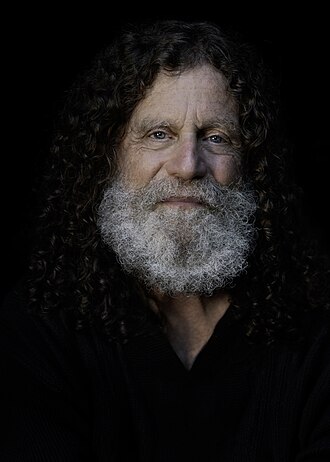
罗伯特·萨波斯基
EDITED TRANSCRIPT · 依据现场录音编译整理,可划线生成便签
编者按:本文是罗伯特·萨波斯基(Robert Sapolsky)在斯坦福大学「人类行为生物学」课程中的第二讲,主题为行为的演化。萨波斯基是斯坦福大学神经生物学教授,也是这门课的主讲人。这一讲从两颗头骨说起,逐步搭起理解社会行为的三块基石:个体选择、亲缘选择与互惠利他,再借博弈论与野外观察检验这套逻辑,最后回到人类自己的处境。本文依据现场录音编译整理。

问卷里的斯坦福

周一的问卷收回来了,人这么多,答案自然五花八门。「你为什么选这门课?」有人说,真正想了解的是动物行为,人类勉强也能接受;有人说是拿它顶替不想上的生物43;有人说父亲小时候罚他读人类行为与生物学方面的书;有人说认识一位助教,估计能稳拿A,那就看助教们怎么办了。我很喜欢的一条是:毕业后想当电影导演,跨学科万岁。还有人写:我一年级的老师逼我来的;汤姆·麦克法登叫我来的;我是个吸氧过量的半吊子。有人纠正得很对:「你为什么选了这门课?」我还没选呢。我最喜欢的回答是一个字:「是。」

「相关背景」一栏,答案是「我是人」,「我是人,而且经常有行为」,「我是人,还有生物」,「十九年来一直搞不懂人类行为」,「在新生宿舍当宿管,天天看疯狂行为」,「我在和一个生物学家谈恋爱」。

问卷上还有一道题,问黑板上那个图形更像A还是B。为了让大家答得顺利,我忘了把A和B写上去。这道题背后有个认知问题,以后也许会回头讲。电话号码那道题,让大家照着念,一旦「三位数、四位数」的节奏被打乱,准确率立刻大跌,节奏一恢复,准确率又略微回升。

还有一道题,年年都得出同样的性别差异:无论男女,绝大多数人都认为「独立」的反义词是「依赖」,只有少数人选「相互依赖」。但反复出现的一个结果是,对「和平」感兴趣的女生远多于男生,男生更关心「正义」。「修过生物核心课程吗?」有人答「门儿都没有」。有人指出得很对:「不要在和平与正义之间将就。」也有人写:「这些词只是符号,需要知道预设的含义。」还有一份问卷,署名用的是近乎书法的字体,漂亮极了,其余全是空白。

这门课开了这么多年,大家最想听又最不想听的题目,是宗教信仰的生物学。而连续二十二年,斯坦福学生对抑郁的兴趣都超过对性的兴趣。这件事我一直向校长亨尼西反映,至今没有任何动静。

从两颗头骨说起

我们从两颗头骨讲起。如果你受过某种训练,比如你是骨骼学家,别人把这两颗头骨摆在你面前,告诉你这颗是雌性,这颗是雄性,你就能推断出一大堆事情:这个个体有多重,身体多大,得过什么病,是否营养不良,生过很多次还是很少几次,是不是直立行走。光看头骨就能知道这么多。

今天和周五这两讲要说的是:只要手里有合适的工具,你看着这两颗头骨,还能知道另外一些信息。假设你是野外生物学家,刚发现了一个新物种,你看见这一只在哺乳,随即跳下树,只留下一颗头骨;那一只有阴茎,随即也跳下树,只留下一颗头骨。你知道的只有:这是成年雌性,这是成年雄性。可只要工具用对了,你就能推断出:谁更可能对另一方不忠,是雌性更爱乱来,还是雄性?攻击性有多高?雌性倾向于一胎生双胞胎,还是一次只生一个?雌性挑选雄性,看的是会不会带孩子,还是块头大不大?两性的寿命差多少,是一样长,还是差距悬殊?诸如此类,全都能推断出来。靠的只是一套逻辑,一套支配了这一切的逻辑。

自然并不神奇

回想一下小时候读的那套时代生活出版社的自然读物。它们总有一种套路:先描述某个物种做了一件极其惊人、极不可能的事,然后写道:「长颈鹿的脖子很长,显然需要一颗强大的心脏,才能把血液泵到那么高的地方。」于是把一群生物力学家关进屋里,让他们拿着计算尺算,算出长颈鹿的心脏应该多大,心壁应该多厚。有人跑去量一颗长颈鹿的心脏,结果和方程预测的分毫不差。于是你感叹:「大自然多么神奇!」或者你读到,某种沙漠啮齿动物三个月才喝一次水,另一群人算出它的肾小管必须有多少英里长,有人去研究,也正如预期。大自然多么美妙!

不,大自然一点也不美妙。如果长颈鹿的心脏不是那么大,根本就不会有长颈鹿。如果那种啮齿动物的肾脏不是那样工作,它们根本不可能活在沙漠里。生物体如何运作、如何构造、如何演化,背后有一种不可避免的逻辑:它们都在解决同一个问题,即找到最优解。接下来两讲要说的就是,你可以把同一套原理原封不动地拿来思考行为的演化。你可以坐在那里,凭逻辑推出「长颈鹿的心脏得这么大」;同样,你也可以循着另一套围绕演化原理建立的逻辑,推出社会行为的方方面面。

至于「最优化」是什么意思,我们其实早就明白了,不管是肾脏里某种结构的最优数量,还是最优的行为策略。我们每个人,只要家里有个弟弟妹妹,很快就学会了井字棋的最优策略,让自己永远不输。这游戏因此无聊透顶,但这就是一个找到行为最优解的例子,达到了所谓的纳什均衡(Nash equilibrium)。老实说我也不太清楚自己刚才说了什么,但我喜欢提纳什,这让我觉得自己挺有数学头脑。

整件事的要点在于:搞清楚井字棋最优策略的那套思路,可以建立在演化原理之上,用来推导各种领域里的最优社会行为。广义地讲,这个领域叫社会生物学(sociobiology),兴起于二十世纪七十年代中后期,到八十年代末又催生了另一门学科,演化心理学(evolutionary psychology)。其核心观念是:脱离演化这个塑造了行为与心理的背景,你既无法理解行为,也无法理解内在的心理状态。

达尔文的几块基石

先把达尔文的基本内容过一遍,确保大家都在同一起点上。首先要澄清几件事。达尔文并没有发现演化,人们早就知道演化这回事。达尔文提出的是演化的机制,也就是自然选择。而且严格说来,这也不是达尔文一个人的发明,还有一位阿尔弗雷德·拉塞尔·华莱士。他们两人共同提出了这个观念,不知为什么,华莱士在历史上吃了大亏,达尔文得到的关注要多得多。

达尔文式的演化观,第一条是:演化确实存在。种群中的性状会随时间改变,改变到一定程度,就会形成新的物种。达尔文演化论的逻辑,只建立在几个非常合理的步骤上。

第一,有些性状是可遗传的,可以从上一代传给下一代。用今天的话说,就是有遗传基础的性状。我们很快会看到,这么说其实并不准确,但姑且先说「可遗传的性状」。第二,这些性状存在变异,同一性状有不同的表现形式,而且都能遗传。第三,也是关键的一步:某些形式比其他形式更具适应性,对你更有用。比如,长颈鹿如果长了一颗西红柿大小的心脏,那就不是最优版本。在整个变异范围内,有些版本带来的适应度更高。

这就牵出另一句必须清除的口号。这一切说的不是「最适者生存」,而是「最适者繁殖」。我们会反复回到这一点:关键是你在下一代中留下多少基因拷贝。所以,性状要能遗传,性状要有变异,某些变体比其他变体更具适应性,也就是更能让该个体把自己的基因拷贝传给下一代。三条合在一起,你就得到了种群中的演化,即性状频率的改变。再加上一条,也就是偶尔会有一种全新的性状随机出现,用今天的话说叫突变,你就能得到种群面貌的真正巨变。

这就是达尔文的基本积木。把它用在长颈鹿的心脏、沙漠鼠的肾脏,以及生理学、解剖学范围内的一切演化问题上,都很容易。

把逻辑用到行为上

那么,怎么把它用到行为上?从达尔文传统走过来思考行为的人,做法完全一样。有些行为是可遗传的,某些类型、某些类别的行为,个体之间存在一定程度的差异,某些版本比其他版本更具适应性。随着时间推移,更具适应性的版本会越来越普遍,偶尔的突变又会引入新的变异。逻辑完全通顺,无懈可击。

而这门课要花大量时间纠缠的,是其中一个看似简单的假设:某些行为是可遗传的,某些行为有遗传成分。你们会看到,这个问题会贯穿每一讲。这是个极具争议、极易点燃的问题:行为在多大程度上是遗传的?而且这与「行为在多大程度上由基因决定」并不是一回事。我们会一次又一次回到这里。

在应用这些原理之前,先说一句提醒。为了把这些问题想得最有效率,你们会不由自主地拟人化,坐在那里说:「一只雌性黑猩猩此刻想做什么,才能让自己在下一代中的基因拷贝最多?一只卤虫想怎么应对这个环境压力?一棵樱桃树想怎么办?」它们不会计划,没有意识,没上过演化生物学课。「这个生物想做什么」只是一种简写,指的是被演化的严酷要求塑造出来、趋向最优的东西。「它们想这么做」,这种说法全程都只是简写。一旦越过类人猿,没有谁真的「想」做任何最优化的事。术语的问题就先说到这里。

角马与「为物种之善」

把达尔文原理用到行为上,第一块基石是什么?有一件事必须着重强调,因为我们首先得忘掉一样东西:小时候看的那些国家地理纪录片,一次又一次教给我们关于演化的某种观念,而且每次都教错了。

场景是这样的。你在看野生动物纪录片,黎明时分的稀树草原,一群狮子趴在一头死掉的大家伙身上,也许是水牛,正嚼得痛快。这时就出了个问题:它们要怎么分食物。

再举一个例子,也是这类影片里没完没了出现的桥段。还是在稀树草原上,这次不是黎明。你看到的是自然界最壮观的景象之一,东非的大迁徙:两百万头角马,追随着周期性的降雨环游,永远往草更绿的地方去。这两百万头角马遇上了麻烦:前面就是一片长满青草的好地方,可倒霉的是,中间隔着一条河,更倒霉的是,河里挤满了随时准备下嘴的鳄鱼。角马怎么办?

按照国家地理式的讲法,解决办法出场了。两百万头角马在河边焦躁不安地踌躇,突然,从队伍后面走出一头年迈的角马,挤到最前面,站在河边,说:「孩子们,我为你们牺牲自己。」然后一头扎进河里,鳄鱼立刻忙着吃它,其余两百万头角马就从另一边踮着脚过了河,皆大欢喜。然后你问:「它为什么要这么做?为什么把自己扔进河里?」我们得到的答案永远是那一个,那个渗透一切、堪称演化领域最恶劣都市传说的答案:因为动物的行为是为了物种的利益。

这个观念现在就必须彻底扔掉。「动物为了物种的利益而行动」,在六十年代初被一位叫温-爱德华兹的英国动物学家推到了前台,他的姓氏带连字符。他最卖力地宣扬这个观念,因此在每一本教科书里都遭到唾弃:温-爱德华兹与群体选择(group selection),这就是那个术语,为群体之善、为物种之善的选择。我相信这个人一定还做过许多有价值的事,任何有点深度的人都该去了解,但我只知道,他是提出群体选择的那个人。

动物的行为并不是为了物种的利益,根本不是。动物的行为是为了尽可能多地传递自己的基因拷贝。我们会看到,当你细究其中的微妙之处,有时看起来像是为物种之善,但其实不是。动物的行为,是为了让自己留在下一代中的基因拷贝最多。记住,不是最适者生存,而是最适者繁殖。

所以第一件事,是回到那个场景,问一句:角马到底怎么回事?那头跳河的老家伙怎么回事?当你观察得足够久,而不是摄制组来拍三分钟就走,你会看到起初没看出来的东西:那头老角马根本不是挤到前面去的,它是被后面推上去的。所有其他角马都在说:「对,把那老家伙推下河去。」还牺牲自己呢,它是被大家推下去的。它不是为了物种的利益牺牲自己,它一点也不喜欢这个主意。它被推下去,因为它又老又弱。没有什么群体选择。

到七十年代,取而代之的思路是:动物,包括我们,行为的目的不是群体或物种的利益,而是让自己留在下一代中的基因拷贝最多。实现这一点有三条途径,也就是三块基石。

个体选择与性选择

第一块叫个体选择(individual selection)。它的核心观念是:动物有时通过自己繁殖,来让自己留在下一代中的基因拷贝最多。繁殖的驱动力,留下更多基因拷贝的驱动力。有人曾把这一点概括得很简练:有时候,鸡不过是蛋制造另一个蛋的方式。所有这些行为,所有这些活生生的社会互动,只是把更多基因拷贝送进下一代的副产品。个体选择,其中一种思路就是「自私的基因」。行为的目的是让下一代中的基因拷贝最多,而有时最好的办法,就是自己繁殖,拿到尽可能多的拷贝。它和「自私的基因」并不完全等价,但就我们的目的而言,这就是个体选择。

这可以在许多领域展开,这里要引入一组思考演化压力时的大二分法。达尔文的自然选择,说的是种种过程造就更具适应性的生物体,也就是我们刚才讲过的。达尔文很快意识到还有第二个选择领域,他称之为性选择(sexual selection)。它选择的性状在生存方面毫无价值,不带任何适应意义,只是出于某种随机的、古怪的原因,异性喜欢长这样的个体。于是这些个体得以留下更多基因拷贝。

举例来说,自然选择可以让公驼鹿长出巨大而锋利的鹿角,用来对付捕食者或与其他雄性打斗,这是自然选择。而性选择可以解释为什么鹿角上会布满绿色的佩斯利花纹,因为不知为何,母驼鹿觉得那样很酷。性选择的机制是:只要个体偏好与具有某种完全任意的性状的对象交配,这些性状就会越来越普遍。所以就有了这组二分:自然选择,针对的是在单纯性偏好之外真正有助于留下基因拷贝的性状;性选择,针对的是性偏好本身。

有时两者的方向完全相反。某些鱼类的雌鱼偏好色彩鲜艳的雄鱼,鲜艳的体色就因性选择而占优;但鲜艳的体色也让你更容易被别的鱼吃掉,自然选择于是反过来压制雄鱼的鲜艳体色。很多时候,两者相互对抗,必须取得平衡。

这在个体选择的领域怎么体现?有时候,行为就是一个个体在努力让自己在下一代中的基因拷贝最多。自然选择的表现,是你擅长逃离捕食者:对速度的选择,对某类肌肉代谢的选择,对能告诉你附近有可怕东西的感觉系统的选择。性选择的表现,是让那些有吸引力的性状变得更多。所以,第一块基石不是群体选择,不是为物种之善,而是让自己在下一代中的基因拷贝最多,而最直截了当的办法,就是让自己繁殖的次数最多。

亲缘选择

第二块基石,是另一条实现同一目标的途径。人生中有一件事可以指望:你和你的亲属有亲缘关系。亲缘越近,共有的基因越多。从统计上说,同卵双胞胎共有百分之百的基因,全同胞百分之五十,半同胞百分之二十五。这周的补习课会专门讲这个,不熟悉的同学可以去那里听更详细的复习。

亲属离你越近,和你共有的基因就越多。于是就出现了这样一个问题:你是同卵双胞胎之一,你的同卵手足和你有完全相同的基因。按照个体选择,如果你放弃繁殖,好让你的同卵手足去繁殖,你在把基因拷贝传给下一代这件事上,成功程度分毫不减。因为单看下一代中基因拷贝的数目,两者完全等价。所以有时你会看到这样的行为:一个个体降低自己的繁殖成功,来提高亲属的繁殖成功。

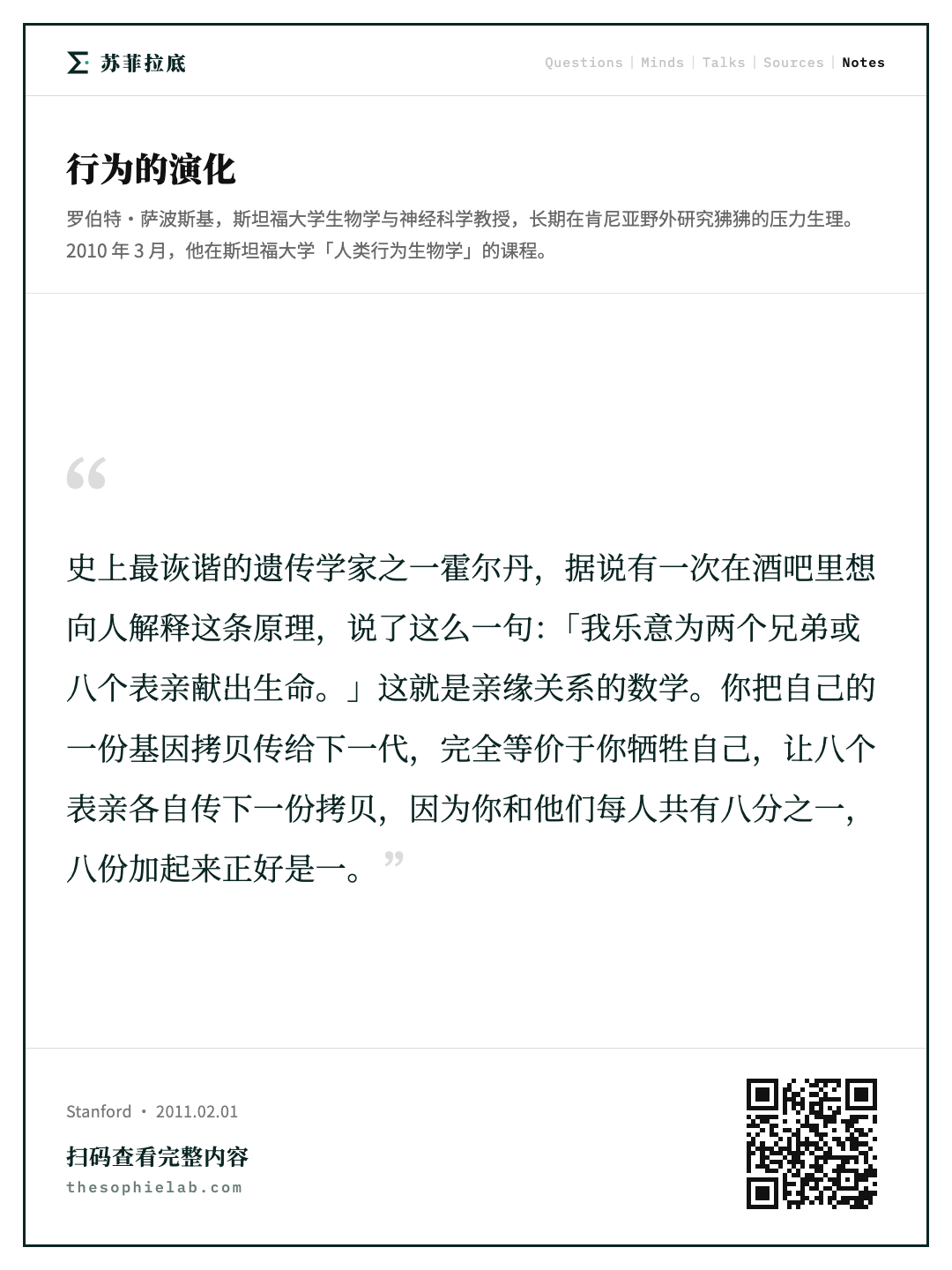
但这里有个约束:你的亲属并不都和你共有全部基因,亲缘程度各不相同。由此引出另一个因素。史上最诙谐的遗传学家之一霍尔丹,据说有一次在酒吧里想向人解释这条原理,说了这么一句:「我乐意为两个兄弟或八个表亲献出生命。」这就是亲缘关系的数学。你把自己的一份基因拷贝传给下一代,从演化在世代间展开的纯数学来看,完全等价于你牺牲自己,让八个表亲各自传下一份拷贝,因为你和他们每人共有八分之一,八份加起来正好是一,就是这么算的。

由此立刻得出一个再合理不过的结论:演化会选择与亲属合作的生物体。这就是第二块基石,亲缘选择(kin selection),也叫广义适合度(inclusive fitness)。第一块基石是个体选择,传递自己的基因拷贝;第二块是帮助亲属,提高亲属的繁殖成功,背后是那套冷酷的数学逻辑:一个同卵双胞胎,两个全同胞,八个表亲,依此类推,由亲缘程度决定。

这开始解释动物行为中一整个世界:动物对亲缘关系的痴迷。动物完全清楚谁和谁有亲缘,与亲属合作,但合作的程度取决于亲缘的远近。许多社会性动物处理亲缘关系的精细程度,足以让我们那套社会人类学的亲属称谓相形见绌,什么「你能不能娶叔叔第三任妻子的女儿」之类。

猴群里的亲属账本

这里有一个证据。多年前,宾夕法尼亚大学的塞法思和切尼夫妇做过一项很漂亮的研究,对象是长尾黑颚猴,我记得是在坦桑尼亚。研究者长期录下这群猴子各种叫声的高质量录音:每只猴子的警报叫声,友好的召唤声,等等。然后他们把麦克风藏进灌木丛,播放群里某只幼猴发出警报叫声的录音。幼猴的母亲会怎么做?她立刻紧张起来,盯着那丛灌木,那是她的孩子。那么,怎么知道群里其他猴子也懂亲缘选择?其他猴子都在做什么?它们全都看向那位母亲。那是谁谁谁的妈妈,她接下来会怎么办?它们理解亲缘关系,也理解她会有什么反应。这时候所有长尾黑颚猴都盯着那位母亲,心想:「幸好在灌木丛里叫的不是我的孩子。」它们懂亲缘。

这项研究还得出了另一个版本。两只雌猴各有一个孩子,比如都是女儿。有一天,雌猴甲对雌猴乙做了一件极其恶劣的事。当天晚些时候,雌猴乙的孩子对雌猴甲的孩子做出恶劣举动的概率高于随机水平。它们记的账不只是复仇,而且不是对伤害自己的个体复仇,而是错开一代去复仇。这是在追踪亲缘关系。动物能做到这一点,各种灵长类都能,我们会看到,许多其他物种也能。当然,又要提那句提醒了:并不是各种物种都「想」搞清楚谁是自己的表亲,而是演化在各种物种身上塑造出了沿亲缘关系优化行为的能力。

自然选择在亲缘选择领域怎么体现?「我乐意为八个表亲献出生命」,这一点现在应该很清楚了。性选择又怎么体现?我愿意耗费大量精力,说服所有人相信我的兄弟姐妹极有魅力,从而有机会传下更多基因拷贝。这两种情形都是广义适合度、亲缘选择:降低自己的繁殖潜力,无论是为了救八个表亲而被捕食者咬死,还是把大把时间花在替兄弟姐妹吹嘘上,目的都是提高亲属的繁殖成功,而你愿意付出多少精力和潜力,取决于对方与你的亲缘有多近。

把这两块合在一起,你已经可以解释大量的动物行为了。个体选择,不是为了物种之善,而是让自己的基因拷贝最多,最直接的办法是自己尽量多繁殖。第二块基石,亲缘选择,有时留下更多基因拷贝的最好办法,是消耗甚至放弃自己的繁殖潜力去帮助亲属,程度依亲缘远近而定。

石头剪刀布

现在到第三块,也是最后一块,在当代演化理论的框架下理解社会行为的基石。你观察动物,会发现它们并不是一直在和非亲属竞争。动物在某些时候会放弃竞争,它们本可以攻击别的动物,却选择不动手。有一种情形会出现这样的结果,叫做石头剪刀布局面。

有甲、乙、丙三种动物。甲有办法伤害乙,但要付出代价;乙有办法伤害丙,也要付出代价;丙能伤害甲,同样有代价。只要种群中携带这三种性状的个体分布恰当,就会达到石头剪刀布均衡:谁也不对谁下手。

有个特别精彩的例子,几年前由布伦丹·博汉南发表,他当时是本系的助理教授。他研究的是细菌,展示了一个石头剪刀布局面。他培育的菌落里有同一种细菌的三个变种。第一种能产生一种毒素,但要付出代价:得花力气制造毒素,还得保护自己不被毒素伤害。第二种对这种毒素敏感,它的细胞膜上恰好有一种转运蛋白会把毒素吸进来,这是坏消息,但它也有好处:平时这种转运蛋白能吸收更多养分。第三种没有毒素,也没有那种转运蛋白,坏处是没有武器,好处是不必把能量花在毒素上。每一种都有长处,每一种都有软肋,有点像各种宝可梦。把它们放在一起,就得到一个石头剪刀布局面,达到互不攻击的均衡。注意:如果我是甲,我消灭了乙,乙就不再去压制丙,而丙正是能伤害我的那一个。所以必然走向均衡状态。这种僵局的演化很常见。

请注意,这里演化出僵局的不是黑猩猩,不是鲸类,而是细菌。我们会看到,只要把「行为」当作一种隐喻,各种意想不到的物种的行为,都服从同一套传递基因拷贝的规则。这三株细菌是在相互竞争,没有哪一株是在为三者共同的「物种之善」而行动。

石头剪刀布很有意思,人类身上也有类似的版本,有人做过定量研究。但那不是真正的合作。那只是大家都意识到,必须收敛竞争,收敛攻击,因为我每伤害一个对手,就会在另一个领域变得更脆弱。那是僵局,是休战。可你观察动物,会发现在许多领域,它们达成的不只是石头剪刀布式的僵局,而是真正的相互合作。

互惠利他

仔细看,你会发现它们并不是亲属。不是亲属,却有各种各样的利他行为,出现在一大堆领域里。这就引出一个问题:如果你是社会性动物,为什么要和另一个个体合作?按理说,你应该抓住每一个机会背后捅刀子,自私到底。之所以不是这样,是因为在许多情形下,人多好办事,合作能产生协同效益。合作狩猎的物种就是例子,它们不一定是亲属,一只在后面追,另一只准备抄近路拦截,这种合作行为提高了捕获的概率。

另一个例子,哈佛的马克·豪泽研究恒河猴。他把猴子置于能取得食物的情境中。一种情形下,一只猴子伸手就能把食物拉进来,然后与另一只分享;另一种情形下,需要两只猴子合力才能把食物弄进来。他证明了清清楚楚的互惠:与某只猴子分享过的猴子,更可能得到对方的回报;而当任务需要两只合作才能取得食物时,合作更多。一只不够,人多好办事。在各种情形下,合作都有很强的演化回报,哪怕在非亲属之间。

但有一个条件:你付出的不能多于你得到的。也就是说,必须是互惠的。这就打开了第三块基石:互惠利他(reciprocal altruism)。非亲属之间的合作与利他行为,但受到非常严格的约束:必须得到回报,还有一整套类似的规则。

那么,互惠利他会出现在哪里?什么样的物种会在非亲属之间形成互惠合作的体系?直觉上的答案是:得是聪明的动物,得是社会性动物。为什么要聪明?因为它们得记住「这家伙上周四欠我一个人情」,得能辨认个体,还得活得足够久,才有机会再次遇到那个个体,建立起互惠关系。于是你会预测:互惠利他的体系只出现在长寿的社会性脊椎动物中。

可是在细菌身上,你能看到一模一样的东西;在真菌身上,也能看到;在其他许多领域,都能看到。有一些社会性细菌,能形成集落。你可能遇到两个克隆系聚在一起,也就是两个遗传系,每一系内部的所有细菌基因构成完全相同。可以把它们想成两个各自分散开来的个体,聚到一起形成一个叫子实体的结构,那是细菌的繁殖方式。子实体分两部分:一部分是柄,附着在什么东西上;另一部分才真正结实。你当然想待在结实的那部分,因为那部分才繁殖,柄只是在干苦力。于是你会看到作弊的企图:其中一个菌株试图让自己不成比例地挤进结实的部分。你还会看到,下一次,另一个菌株就不再跟它合作,不再一起形成社会性集落。这种博弈在单细胞生物形成大集落的层面上就已经展开。是的,我们会看到,互惠利他在大块头、聪明、长寿的社会性动物中运转得最顺畅,但它可以出现在各种各样的系统里。

作弊与警觉

互惠合作的内核里,还嵌着另一种动机:不只是与非亲属建立互惠关系、人多好办事那一套,还有,只要有可能,就作弊,就占对方的便宜。因此它的另一个关键侧面,是要非常擅长察觉别人对你作弊,在本可稳定的互惠关系中对作弊保持警惕。大量的社会行为,要么是动物在试图蒙混过关,要么是在盯着别人蒙混过关。

举个例子。演化心理学里有一种测试,给你讲一个很复杂的故事,或者另一个版本的复杂故事:某人承诺,你做这件事就有奖励,做那件事就受惩罚,规则极为繁复。在一种结局里,按规则那个人不该得到奖励,但当事人决定奖励他,这是一次自发的善举。在另一种结局里,那个人本该得到奖励,却受到了惩罚,这是作弊。在这些绕来绕去的故事里,人们察觉作弊的能力远远好于察觉善举的能力,大约是七十五比二十五。我们对作弊更敏感。而且令人惊讶的是,一些非常精细的黑猩猩研究表明,黑猩猩有同样的偏向:它们察觉涉及作弊的社会互动,远比察觉自发利他的互动要敏锐。

所以你看到的是这样一种平衡:合作,互惠,哪怕在非亲属之间,这很好;但只要能逃脱惩罚,你就该作弊;同时你还得防着作弊者。归根结底,这又回到了井字棋和长颈鹿心脏的问题:在某个特定的社会性物种里,对某个特定个体来说,最优策略是什么?什么时候合作,什么时候作弊?什么时候背叛一段已有的合作关系?

博弈论与囚徒困境

这就把我们引入了一整个数学世界,即所谓博弈论(game theory)。它的观念是,存在一些正式的博弈,具有数学上的最优策略,或者多个策略、多个均衡,围绕它们建立起了一整套关于何时合作、何时背叛的研究。博弈论最初出自研究经济学、谈判和外交的人,那是一个围绕「何时合作、何时作弊」建立起来的世界,产生了各种优化行为的模型。

其中的基本模块,博弈论里的「果蝇」,是一个叫囚徒困境(prisoner's dilemma)的博弈。直接讲细节:两个人是囚犯,一起越狱,双双被抓,分开审讯。如果两人都拒不开口,对他们俩最好;如果两人都招供,两人都受罚;如果一个人出卖了另一个,出卖者得到巨大的好处。形式上有四种结果:双方都合作;双方都作弊;甲合作而乙作弊;乙合作而甲作弊。囚徒困境给每种结果规定了正式的收益。

收益最大的是哪种?在对方背后捅刀子:你作弊,对方合作,你剥削了他,占了他的便宜。多美妙啊,这是囚徒困境里的最高收益。第二高,是双方都合作。第三,已经开始算不上收益,在许多博弈里被设定为惩罚的开始,是双方互相作弊。第四,也是最糟的结果,是你当了冤大头:你合作,对方在你背后捅了一刀。

囚徒困境所设定的情境,就是让个体们以不同的奖励和参数相互对局,我们会详细考察这些参数,看什么时候合作最优,什么时候作弊最优。这是整个领域的基本模块。任何人看到它都会说:这不是很明显吗?你要做的,就是以某种方式理性地让自己的收益最大化。这就是「经济人」的世界,认为人类是纯粹理性的决策者。而你在博弈论这个领域会看到,实际发生的完全不是那么回事。

这门课后面会讲到一件很有意思的事:让人躺在脑部扫描仪里玩囚徒困境,观察大脑中一个与愉悦高度相关的区域。你会发现,有些人在成功捅了对方一刀时,这个区域会被激活;另一些人则在双方合作时激活。而哪种情形对应哪类人,存在巨大的性别差异。你们不妨猜猜是哪边。后面我们会看到一系列这样的研究。

阿克塞尔罗德的锦标赛

于是问题变成:怎么优化囚徒困境的玩法?当时出现了各种理论模型。到七十年代,密歇根大学有一位经济学家,罗伯特·阿克塞尔罗德(Robert Axelrod),彻底改变了整个领域。他拿来一台旧石器时代的计算机,把囚徒困境的玩法编成程序,可以设定两名玩家,并给每一方设定策略。然后他写信给所有朋友,数学家、职业拳手、神学家、连环杀手、诺贝尔和平奖得主,向每个人说明情况,问:在囚徒困境里你会用什么策略?他把回收来的策略全部编进程序,跑一场循环赛:每一种策略在某个时刻都要和其他每一种策略对局,然后看收益,问哪一种策略最优。

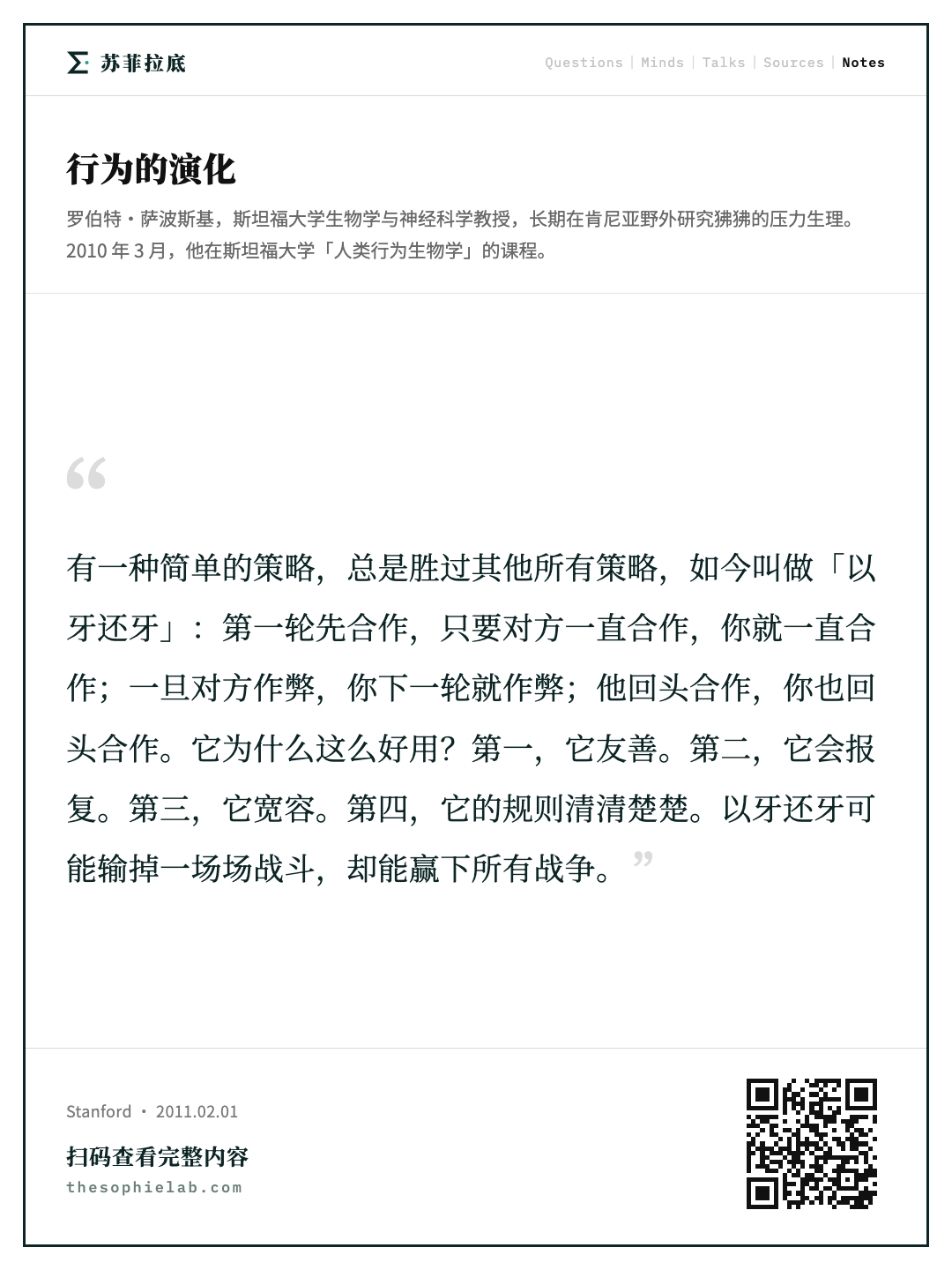
结果出人意料,毕竟这是一台计算机在教我们怎样优化人类行为:有一种简单的策略,总是胜过其他所有策略。别人提交的策略五花八门,有按概率决定何时合作的,有看月相行事的,而总是获胜的那一种,如今叫做「以牙还牙」(tit-for-tat)。第一轮,你先合作。如果对方在这一轮合作了,你下一轮继续合作。只要对方一直合作,你就一直合作。可一旦某一轮对方对你作弊,你下一轮就对他作弊。如果他那一轮又作弊,你下一轮再作弊。如果他回头合作,你下一轮也回头合作。这就是以牙还牙:只要没人在背后捅你,你永远合作。

他们跑了成千上万次这样的循环赛,以牙还牙始终最优。这里要开始用一个不再只是隐喻的词:以牙还牙总是把其他策略逼到灭绝。它为什么这么好用,原因很清楚。第一,它友善,一开始就合作。第二,它会报复,你做了坏事它就还击。第三,它宽容,你回头合作它也回头。第四,它的规则清清楚楚,不是什么概率把戏。

以牙还牙也有吃亏的时候。假设你和某人玩三轮,第一轮双方合作,第二轮双方合作,第三轮你按以牙还牙继续合作,对方却在背后捅了你一刀,而你没法报复,因为这已是最后一轮。在许多情形下,以牙还牙是吃亏的。但关于它有一句概括:以牙还牙可能输掉一场场战斗,却能赢下所有战争。友善、报复、宽容、规则清晰,这套模式把其他所有策略逼向灭绝。

以牙还牙的漏洞

到这里,我们已经有了三块基石,就像优化长颈鹿的心脏一样在优化行为的演化。第一块,不是为物种之善,而是个体选择,尽可能多地传递自己的基因拷贝,鸡不过是蛋制造另一个蛋的方式。第二块,亲缘选择,有时传递基因拷贝的最好办法是帮助亲属,由亲缘程度那套冷酷的数学驱动。第三块,有时最有利的是与非亲属合作,但规则是必须互惠,能作弊就作弊,还得防着作弊者。而博弈论与囚徒困境开始把这些最优策略形式化,虽然是在一个非常人为的领域里。囚徒困境是许多博弈中最基本的一种,阿克塞尔罗德的循环赛跑出了以牙还牙,它把其他策略逼向灭绝。

然而,以牙还牙有一个软肋。用标准的记法来表示囚徒困境:第一轮双方合作,第二轮双方合作,第三轮这一方作弊,露出獠牙,另一方合作;于是下一轮,这一方作弊,那一方回头合作。这是以牙还牙能解决的问题,很好。可要是你的系统并非百分之百完美呢?要是有可能出错,发出错误的信号呢?要是通信系统里有噪音,某一时刻,一个个体做出了合作行为,却因为系统故障,被对方读成了背叛呢?

结果会怎样?那个合作了的个体,信息在传递中出了岔子,对方收到的是「作弊」,而它自己毫不知情。对方说:「哇,他对我作弊,下一轮我要作弊。」下一轮对方作弊了,而这一方一直在合作,对错误一无所知,于是说:「哇,他刚刚对我作弊,下一轮我要作弊。」它作弊了,对方说:「哇,他又作弊了。」如此循环往复,你得到的是一个永无止境的跷跷板。合作一下子被抹掉了一半。以牙还牙策略对信号错误非常脆弱。这一点在阿克塞尔罗德的研究里很快就暴露出来了。

我小时候读过一本惊悚小说,讲系统出了故障,美国意外发射了一枚核导弹,可能是某只蟑螂咬断了哪根电线,导弹飞出去,把莫斯科毁了。天哪,我们本来有一套相互克制的合作体系,就因为一次信号错误,一个「作弊」信号被误发了出去。小说怎么结尾?为了避免热核荒原,采取了一个以牙还牙式的回应:让苏联把纽约摧毁。这恰恰说明,只要系统对信号错误有一点脆弱,你就可能陷入那种跷跷板局面。

宽容、信任与巴甫洛夫

所以,阿克塞尔罗德一引入信号错误的可能性,就很快发现以牙还牙不如另一种策略好用。那种策略迅速冒了出来,叫做「宽容的以牙还牙」(forgiving tit-for-tat)。它的常规规则与以牙还牙相同:对方合作,你就一直合作;对方作弊,你下一轮惩罚他。但如果系统里出了信号错误,你陷入了那种可怕的跷跷板呢?宽容的以牙还牙会有一条规则,比如:如果我们这样来回拉锯了五次,下一次我就放弃作弊,改为合作,让事情回到正轨。我愿意在某一轮宽容一次,好在信号错误之后重建合作。一旦引入信号错误的可能,这种策略就胜过以牙还牙。道理很简单,这是解决那个问题的好办法。

接下来自然有各种变体:拉锯几次之后才宽容?最优的次数是多少?围绕「多快宽容」形成了一整套优化研究。总的主题是:在可能出现信号错误的情况下,宽容的以牙还牙胜过以牙还牙。

但它也有软肋:你可能被剥削。比如你的对手是一个纯粹的以牙还牙者,或者其他那些在连续背叛后不会宽容的策略,而你会宽容,那么你会不断回头合作,对方就不断在你背后捅刀子。宽容的以牙还牙在面对不会宽容的玩家时,容易被利用。

于是很快又出现了一种更好的策略:一开始用以牙还牙,你会惩罚,会报复,同时保持初始的友善、宽容和清晰,你愿意惩罚,所以不会被这样利用。当且仅当你们对局了足够多轮,对方从未对你作弊,你才切换到宽容的以牙还牙。这是什么?这是决定信任某个人。你和他打了足够多的交道,愿意信任他了。这是从纯粹的理性优化转向另一种模式,宽容进来之后保护你免受信号错误的伤害,当然,切换之前要经过多少轮才算最优,又是一整套研究。这是一种过渡方式,既解决了信号错误的问题,又避免了宽容过早而被人占便宜。

不久,又出现了一种叫「巴甫洛夫」(Pavlov)的策略。懂巴甫洛夫心理学的人会发现,它与巴甫洛夫心理学毫无关系,不知道为什么取这个名字,大概是觉得挺酷。规则是这样的。回忆一下:在对方背后捅刀子,你得到一大笔分数;双方合作,你得分,但没那么多;双方作弊,你丢一些分;被人占了便宜,你丢很多分。两种结果得分,两种结果丢分。巴甫洛夫的规则很简单:我做了某件事,只要得到了分数,得到了某种程度的奖励,下一次就再做一次;只要落在前两种收益里,我就重复同样的做法。另一半规则是:如果我按自己的策略行事,却落在了底下两种结果里,下一次就切换到另一种做法。

你会发现,这能建立起很好的以牙还牙式合作。可如果你今晚花几个小时,拿一长卷厕纸把所有回合推演一遍,你会看到巴甫洛夫能做到的是:剥削那些会宽容的对手。巴甫洛夫和以牙还牙可以相安无事,但只要对方切换到宽容的以牙还牙,巴甫洛夫就会胜过它,因为巴甫洛夫会剥削。

再往后,就是无数人研究各种各样的博弈。还有别的,比如最后通牒博弈、信任博弈,核心思路相同:你选择合作或作弊,最优结果是什么?有数学上的最优解可用,把一切放进计算机里跑,最优策略就从另一头冒出来。

疯狂的好处

于是阿克塞尔罗德和他的伙伴们用起了这样的词:「这个策略会把另一个逼到灭绝」,「这个策略行得通,但如果编入偶尔出现故障的可能,出现突变的可能……」。他们显然是在隐喻地使用这些生物学术语。恰恰在这个时候,生物学家们看到了这一切。他们刚刚开始思考社会生物学,思考优化行为的形式化模式,于是说:「哇,这套东西适用于真实生物体的行为吗?」因为到那时为止,学习何时优化的还只是经济学家、计算机专家和外交官。

在此之前不久,还有一篇论文,作者的名字现在没人知道了,已被历史遗忘:丹尼尔·艾尔斯伯格(Daniel Ellsberg)。艾尔斯伯格大约在一九七零年前后出了大名,他在五角大楼工作,从那里偷出数千页机密文件交给《纽约时报》,揭露把美国拖进越南战争的幕后一切有多么腐败,引发轩然大波。而在职业生涯早期,他心安理得地在五角大楼为军方当博弈论专家,研究最优策略。他写过一篇论文,题为《被视作疯狂的最优收益》。什么时候你希望对手认为你彻底疯了,会干出各种疯狂的事,从而让对手选择合作,以阻止你那么干?这就是疯狂的好处。这是什么?这是「相互确保摧毁」之类的体系失灵的情形,因为你真的愿意按下按钮,这就是疯狂的优势。

数学家和战争战略家们在研究这一整套东西,动物学家们看着它说:「哇,太酷了,不知道动物是不是也这么干。」于是人们带着囚徒困境和以牙还牙这些新见解,去野外研究动物,看有没有这样的例子。有,出现在各种有趣的领域里。

吸血蝙蝠

第一个例子,吸血蝙蝠。我们都被预设成会被吸血蝙蝠吓到,可实际上,当你看到一只吸血蝙蝠在吸某头牛的血,你看到的是一位母亲在给孩子找吃的。吸血蝙蝠的母亲并不真的在喝血,她把血装进喉囊,回到巢里吐出来喂孩子。她只是在照顾孩子。

碰巧吸血蝙蝠有一套有趣的互惠利他体系:一群雌蝙蝠共用一个巢,所有孩子混在一起,而这些雌蝙蝠不一定是亲属,所以我们已经离开了亲缘选择的世界。她们不一定是亲属,却有互惠利他的体系。每只雌蝙蝠回来,吐出血,喂所有人的孩子,大家互相喂彼此的孩子,一切都很好,一个吸血公社,处于稳定的合作状态。

现在,让这群蝙蝠以为其中一只雌蝙蝠在作弊。她飞出去找血,你用网把她捉住,拿一支装满空气的注射器把她的喉囊打得鼓胀,看上去满满的,其实里面没有血,只有空气。然后把她放回巢里,她安安稳稳地待着。其他雌蝙蝠看着她说:「瞧她,瞧她装了多少血,真不敢相信,她居然不喂我们的孩子,她在作弊。」下一次出去觅食回来,其他雌蝙蝠就不喂她的孩子了。以牙还牙。你看到的正是一个引入信号错误的实例,这里的信号错误是某个研究生往一只吸血蝙蝠的喉咙里打气,而结果表明,蝙蝠在使用某种版本的以牙还牙策略。太惊人了,当时人们都惊呆了。

刺鱼与变性的鱼

另一个例子,鱼。刺鱼。在动物界里,蝙蝠大概算不上最聪明的,而刺鱼恐怕离蝙蝠还差着好几光年,可刺鱼也能玩以牙还牙。做法是这样的。鱼缸里有一条刺鱼,你让它相信自己受到了另一条鱼的攻击。怎么做?在鱼缸边上立一面镜子。我说过它们不太聪明,所以很快,它就冲着镜子里那个家伙猛扑,捍卫自己的领地,勉强撑着,而对面那家伙就是不知道累,谢天谢地我也不累,两条鱼就这么斗下去。

现在,让它以为自己有一个合作伙伴。再放一面镜子,与前一面垂直,它就能在那面镜子里看到自己的倒影。它每次向前冲,都看到那条鱼也向前冲,这很幸运,因为它同时也看到另一条鱼从那个方向过来。它心里想:「太好了,我不认识这家伙,可我们真是一对好搭档,双打,太棒了,他冲在最前面。那两个家伙动作怎么那么同步,真好笑。不过我们撑住了,我们做到了。」

现在,让它以为合作伙伴在作弊。把镜子往后斜一点,倒影就退后了一些。它现在看到的是,那条鱼在往前动,但没有一直冲到墙边,它在后面磨蹭,它在作弊。刺鱼在那里想的大概是:「这个混蛋,真不敢相信他这么对我,我们并肩作战这么多年了。他假装往前冲,可我看得出他其实没有。幸好对面那家伙也不往前冲了,呼。可我真不敢相信这家伙在作弊。」下一次再设置这个场景,有机会时,刺鱼不再去攻击自己的倒影了。它在对这家伙以牙还牙。我们成功地在一条鱼身上搭起了这样一套关系,并且让它永远进行下去,最后是一条嘴唇磨破了皮的鱼。又一次以牙还牙。

再一个例子,这是我能想到的最古怪的一个,它牵出许多要在很多讲之后才会谈到的话题:有些鱼类会变性。它们在各种策略性的情形下变性,而这些情形突然开始与我们刚学的东西对上号。有一种叫黑哈姆雷特鱼(black hamlet),能变换性别。一对异性的鱼待在一起,轮流来:这一阵这条是雌性,那一阵那条是雌性,来回切换。这很好,但其中有一种不平等:繁殖的代价,雌性远高于雄性。许多物种都是如此,雌性要负责卵子、输卵管、孕激素之类的一整套,雄性只要拿出一些精子。它们作为合作的一对繁殖,不是亲属,是互惠利他,各自都在让繁殖最大化,而在任何一轮里,扮演雌性的那一方付出更多。你看到的是鱼在用以牙还牙维持互惠关系:如果一条鱼开始作弊,当雄性的次数太多,另一条鱼就不再和它合作了。又是以牙还牙。

到这里,人们简直被震住了:「哇,别提什么理性的人类经济思维了。你走进野外,蝙蝠、刺鱼、变性的鱼,都在遵循一模一样的策略。大自然多么神奇!」不,大自然一点也不神奇。这和「长颈鹿必须有一颗足以把血泵到头顶的心脏,否则就不会有长颈鹿」是同一套逻辑。在这个领域里,同一种选择性优化的风洞,这一次作用于行为,作用于何时作弊、何时合作,雕琢出的东西,和长颈鹿心脏恰好是那个尺寸一样优化。这一切完全说得通,很好。

现实世界的例外

然后人们开始看得更细,令人不安的现实世界开始渗进来,出现了例外。第一个例外,是明尼苏达大学的克雷格·帕克研究东非狮子时发现的。狮群通常由一群亲属组成,多半是雌性,姐妹、侄女之类。但有时也会有并非近亲的狮群,它们照样会有互惠利他的事情。

帕克对狮子玩了和长尾黑颚猴同样的把戏:把扬声器藏进灌木丛,播放大约四百头狮子同时咆哮的声音。按理说,这时你该吓坏了,所有成员都得小心翼翼地靠近,看看灌木丛里是怎么回事。在互惠体系里,要么大家都去,要么谁作弊了一次,下次就把它推到前面去,诸如此类,这是你的预期。可他注意到,在不少狮群里,总有一只胆小的狮子,习惯性地落在其他狮子后面,却没有因此受到惩罚。这就产生了第一个难题:哦,有时动物并没有在优化以牙还牙,有时动物并没读过阿克塞尔罗德一九七二年那篇里程碑式的论文。你面对的突然是现实世界了。

可能的解释是什么?一种是,也许它们没有真的在注意,也许它们没那么聪明。等等,细菌都在玩某种版本的以牙还牙。还能是什么?哦,狮子在其他领域也有互动。也许这个个体在另一个行为领域里非常讲互惠,宽容得过了头,利他得过了头。也许这头狮子吃肉吃得少,退让得早,或者诸如此类。也许有另一场博弈在同时进行。这就把现实世界引了进来:不再是两个个体坐在那里玩囚徒困境、做优化,而是现实世界的复杂性开始涌进来。等我们讲到很后面关于攻击与合作的几讲,你们会看到,当个体同时在玩多场博弈,你在一场博弈里用的规则会在心理上渗到另一场里,事情会变得非常复杂。这是第一个提示:现实并不完全按那套逻辑运转。

再看另一个版本,一种真正古怪的物种,裸鼹鼠。哪天你闲着没事,开着谷歌图片,可以花一晚上看裸鼹鼠的特写照片,它们是世上最古怪的东西。就集群方式而言,它们是哺乳动物中最接近社会性昆虫的,完全匪夷所思。它们生活在非洲地下的大型合作群落里,我想是七十年代才被发现的。有一阵子,动物学家聚会时,如果你是研究裸鼹鼠的,你就是全场最酷的人,别人都会自惭形秽,因为你研究的是最棒的物种。

这些大型合作群落很快被证明不一定由亲属组成,有互惠,有各种规则。但人们很快注意到,每个群落里总有一两只什么活都不干。挖隧道、记账,我不知道裸鼹鼠都干什么活,反正有几只只是闲坐着,而且是块头很大的裸鼹鼠,比其他的大得多,狼吞虎咽地吃个不停。阿克塞尔罗德这下完蛋了,所有那些优化都完蛋了,因为没有谁去惩罚这些家伙。怎么回事?观察得足够久,才看出来:「哦,还有另一场博弈在进行,它们在那场博弈里扮演更重要的角色,而两场博弈之间是相通的。」雨季来临时,这些大块头裸鼹鼠爬上去,转过身,用身体堵住隧道的入口。它们干的是这个。那些整年闲坐、什么活都不干、吃了一大堆东西的家伙,突然得把屁股伸出去,暴露给郊狼或者不管什么捕食它们的东西。

这就是角色分化。真实的动物,真实的生物体,并不是同时只在和对方玩一场正式的囚徒困境。等我们讲到后面的攻击与合作,会看到事情复杂得多:你在和一个个体博弈的同时也在和另一个博弈,还有三角关系的情形;知道自己要和对方玩多少轮,与完全不知道,玩法会不同;即将和某人对局时,如果能得知他之前和其他人对局时的表现,也就是说,如果对方带着名声出场,玩法也会不同。这是一个复杂得多,也现实得多的博弈世界。

所以,我们刚才看到的,是这套优化思路的第一遍粗略过手,以及它有多漂亮。博弈论思考行为的世界里,最后还有一个有趣的补充,来自一个叫约翰·霍兰德的人,他的名字可能不是这个,但霍兰德在历史上有一席之地:他是史上第一个拿到计算机科学博士学位的人,我想是五十年代末,在密歇根大学。据说在程序员的圈子里,有些人对他顶礼膜拜。他和这一行的许多人一样,对博弈论、最优策略的演化产生了兴趣,设计了运行这一切的方法,并引入了一个新变量:策略可能突然改变,也就是突变的可能。于是他可以研究突变:突变多久有一次是适应性的,多久有一次会在对局个体的策略中扩散开来,多久有一次会把其他策略逼向灭绝,又有哪些自己很快被逼向灭绝。越来越多的例子表明,这些系统也许不只是在隐喻地借用生物学术语,也许它们建模的正是同一件事,我们会看到越来越多这样的证据。

三块基石回顾

互惠利他在自然选择的世界里怎么体现?合作狩猎。许多物种有合作狩猎,野狗、豺,还有别的物种。如果它们不是亲属,那就是合作狩猎、互惠利他的标准定义。性选择在互惠利他领域怎么体现?这一点不那么明显。那就是你和某个非亲属花费大量的时间精力,确保你们俩在去舞会之前都打扮得漂漂亮亮。这就是性选择作用于互惠利他体系。

现在我们有了三块基石。彻底扔掉「最适者生存」,扔掉「为物种之善」,扔掉「为群体之善」,取而代之的是三块基石,三种让自己在下一代中的基因拷贝最多的途径。第一,个体选择,某种版本的自私基因,鸡不过是蛋制造另一个蛋的方式,行为只是把基因拷贝送进下一代的手段。第二,广义适合度,亲缘选择,有时传递基因拷贝的最好办法是帮助亲属去传,程度依亲缘远近而定,亲属之间的合作多于非亲属之间。我们在很后面会看到,不同物种面临的一大难题是:怎么弄清谁是自己的亲属。人类用的办法非常独特,这使我们在许多情形下容易被利用,并开始解释为什么一种又一种文化里,人们对「他们」那么不友好。这些我们会详细讲。所以,亲缘程度,以及「怎么判断谁是亲属」,是以后的一讲,但第二块基石是亲缘选择。第三,互惠利他,你帮我挠背,我帮你挠背;而只要有可能,你想的是只让人家给你挠背,对方则要确保你没有偷懒,不管作弊算什么。试图作弊,警惕作弊,用正式的博弈来优化,非常复杂。而且你敢信吗,走进现实世界,你恰恰能找到这样的例子,以牙还牙式的优化,大自然多么美妙?它必须这样运转。然后你开始看到现实世界更复杂:多重角色,堵在管道里的裸鼹鼠,诸如此类。

这些就是原理。演化思想学派的人会说,掌握了这些原理,你就可以去看动物行为的各种有趣领域,用它们来理解行为会是什么样子。我们从第一个例子开始。

回到那两颗头骨

回到这两位。同一个物种,我们知道这位有阴茎,这位在哺乳,所以是一只成年雄性和一只成年雌性。在这个物种里你能得出什么结论?雄性比雌性大得多。我们把它记为:雄性与雌性的体型比很大。与此同时,在隔壁县你发现了另一个物种,也是一位有阴茎,一位在哺乳,可它们的头骨一样大。这是一个雌雄体型没有差别的物种。

现在,只用手头已有的原理,看看我们能预测出什么。一个物种里雄性比雌性大得多,另一个物种里雄性和雌性一样大。哪个物种里雄性的攻击性更高?第一个。为什么?因为它们的身体就是为此而造的。这开始说明一些事情:它们的身体为此而造,也许是因为雌性一直在选择这一点。在两性体型差异很大的物种里,攻击性水平高得多;在另一类物种里,低得多。

接下来问:雄性繁殖成功的变异有多大?一个物种里,所有雄性一生都有一两个孩子;另一个物种里,百分之九十五的繁殖由百分之五的雄性完成,雄性繁殖成功的偏斜极大。哪个物种是「每只雄性都有几个孩子,人人差不多」?第二个。为什么?因为第一类的雄性正在被选择攻击性。既然要打,就必然有个打的目标:不平等的繁殖机会。所以在长成第一种模样的物种里,你会看到更大的变异。

接下来,雌性进入方程。雌性想要什么?左边那个物种的雌性和右边那个物种的雌性,各想要什么?右边的,头骨一样大,体型一样大。先看左边,雌性想要什么?她对什么样的雄性感兴趣?大块头。正是如此,这正是驱动力。为什么?因为从这家伙身上她得不到别的了,他送的礼物只有一些精子。那不如是好的精子,遗传上优质的精子,能给她一个大而健康的后代,提高她把基因拷贝传给下一代的几率。

那么另一个物种,雌性找的是什么?先记住这个答案,跳几行往前看。其中一个物种,从没见过雄性对幼崽做出任何一点亲和的举动,它们只会烦躁,只会骚扰幼崽。另一个物种,雄性是「足球爸爸」,带孩子带得和雌性一样多。哪个物种里有大量的雄性亲代行为?右边。所以,大量雄性亲代行为,记在右边。

刚才有人说出了答案:雌性选择。在左边的物种里你想要什么?肌肉发达的大块头,那一季流行什么样的「猛男」你就要什么,因为你希望后代拥有那些性状。刚才又有人喊了,右边这一类的雌性想要什么?你说的是什么?好性格。好性格,对。能表达情感,也算。还有人喊出了更宽泛、更奥普拉式的版本。有人喊的是父亲的亲代行为。

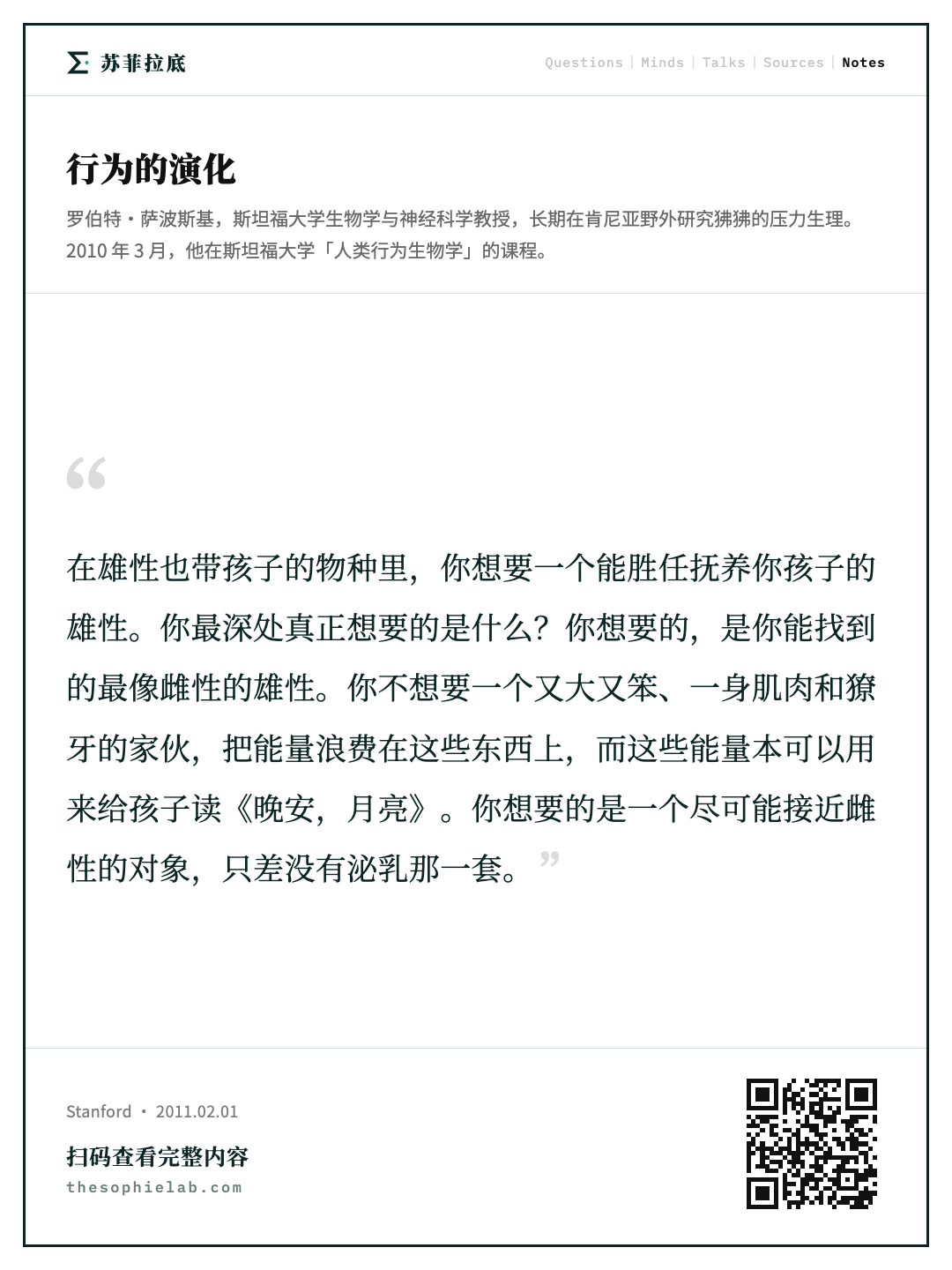
你想要一个能胜任抚养你孩子的雄性。你最深处真正想要的是什么?你想要的,是你能找到的最像雌性的雄性。你不想要一个又大又笨、一身肌肉和獠牙的家伙,把能量浪费在这些东西上,而这些能量本可以用来给孩子读《晚安,月亮》。你想要的是一个尽可能接近雌性的对象,只差没有泌乳那一套。所以被选中的雄性和雌性体型相同。这里用的术语是:为父亲行为、为亲代行为而选择。就写「亲代」吧。

这就开始解释第一行了。两性异形(sexual dimorphism)显著的物种,「morphism」是形态,两性异形就是体型随性别有很大差异。而在这类雄性有亲代行为、雄性繁殖成功变异小、攻击性低、雌性想要一个称职雄性的物种里,两性异形的程度很低。

雌性怎么判断这家伙会是一个称职的父亲?我们刚才已经推出来了:如果他长得有点像你,因为这说明他没有把健康和代谢浪费在愚蠢无用的肌肉上,而人生中还有更重要的事,比如确保孩子们有良好的价值观。雌性在初次考虑与雄性交配时,还想知道什么?他是好人吗?他体贴吗?他会表达感情吗?他会带孩子吗?你想让这个个体做什么?向你证明他能养活孩子。于是就有了一整个世界的鸟:雄鸟向雌鸟求偶时,给她带来虫子,带来他能成功觅食、能弄到食物的证据。雌性选择围绕外表和行为能力展开,看的是能否成为一个成功的父母,好把尽可能多的基因拷贝传给下一代。

寿命呢?哪个物种里两性寿命差距大?第一个。右边,雌性选择的是尽可能接近雌性的雄性,生理上也接近。左边,这些家伙耗费巨大的能量堆起一身肌肉,维持这些肌肉需要多得多的热量,饥荒时更脆弱;这些雄性睾酮水平高,而睾酮对循环系统有害;这些雄性因为攻击行为,受伤更多。在体型两性异形显著的物种里,寿命的两性异形也很显著。再看右边这些,两性之间基本没有差别。

接着看,考虑符合这两种模式之一的灵长类,在哪一种里你总是想生双胞胎?在哪一种里你永远不想生双胞胎?谁生双胞胎?当然是右边。为什么?因为有两位父母在场。你不是单亲妈妈。如果你是一只单亲的恒河猴妈妈,生了双胞胎,你根本没有一丁点可能有足够的能量、足够的热量把两个都养活。在这类物种里,双胞胎的出生率和人类一样,大约百分之一,而且几乎注定有一个活不下来。与此同时,有一整个世界的灵长类物种具有右边这种特征,雌性永远生双胞胎。

最后,你是雌性,正在盘算抛下孩子跑掉,因为那边有个特别迷人的家伙,你想和他交配,你在琢磨策略。你要离开,抛弃孩子。哪个物种里会出现这种行为?右边。因为你跑了,雄性还在那里照顾孩子。而在左边你跑了,就等于丢掉了你在下一代基因拷贝上的全部投资。「戴绿帽」(cuckoldry)这个绝妙的维多利亚时代词汇,在右边这个物种里你会看到雌性背叛孩子的父亲,在左边这类物种里则不会,因为父亲早就跑到三个县之外去了,而且根本无所谓,你从他那里得不到任何帮助。在右边这种特征的灵长类里,你总能看到双胞胎,而且两个都活下来。研究表明,在这些物种里,出生之后,雄性花在照顾后代上的热量实际上比雌性还多,雌性则去找另一个迷人的家伙,而在你们这个物种里,「迷人」的标准就是比现在这位长得更像你自己。

我们刚才做了什么?我们只是按逻辑应用这些原理,从第一步起,每个人都得出了正确的结果。而这些,正是你在某些物种身上找到的特征。在社会性哺乳动物里,左边这一类称为锦标赛物种(tournament species),右边这一类称为配对物种(pair-bonding species),或者说一夫一妻物种,因为在这类物种里,雄性和雌性待在一起,双方在照顾孩子上投入相当。这就是锦标赛物种与配对物种的对比。

锦标赛物种,就是所有雄性长着巨大鲜艳羽毛的物种,孔雀,所有雄性色彩鲜艳的鸟类和鱼类。雌性选的是什么?孔雀的羽毛可不能让谁成为一个好的孔雀妈妈。孔雀的羽毛是一个标志:健康到可以把大量能量浪费在这些又大又蠢又没用的羽毛上,这是健康的标志,标志着「我从这只孔雀那里得到的只有基因,那不如挑好的」。这是孔雀的世界,是有啄序、有支配关系、攻击频繁的鸡的世界,是稀树草原狒狒这类灵长类的世界,雄性比雌性大一倍。锦标赛物种,基因的传递大多由雄性之间的攻击、由锦标赛决定,造成繁殖成功的巨大变异,雄性被选择往这个方向长。

所以它们被选择长出大块头,而这出于种种原因意味着寿命缩短。雌性选的就是这个。这些家伙不把能量花在亲代行为上。因此,如果你是一只雌狒狒,你不想生双胞胎,也不想抛下孩子,因为没有别人会照顾它们。去看一个新的灵长类物种,看到头骨大小有这么大的差别,你就已经能推出它社会行为的其他一切。

与此同时,右边这些配对物种,见于南美洲的猴子,狨猴和柽柳猴。放一张它们的照片,等我哪天真正掌握了幻灯片软件再放。放一对狨猴的照片,你分不清谁是雄性谁是雌性。这不是山魈那种雄性脸上有怪异鲜艳色彩的世界,也不是雄性有鹿角而雌性没有的那种两性异形的世界。看外表,你分不清哪只是雄狨猴哪只是雌狨猴;看寿命,分不清;看谁照顾孩子照顾得多,分不清;看繁殖变异,也分不清。那是一个完全不同的选择世界。所有南美洲的柽柳猴和狨猴,雌性永远生双胞胎,雌性抛弃孩子的比率更高,雄性照顾孩子和雌性一样多,甚至更多,攻击性很低,体型相同,寿命相同,所有雄性的繁殖变异都很低。为什么?因为如果你是一只雄狨猴,你不会想让四十七只雌狨猴怀孕,因为你得照顾所有的孩子。我们在很后面讲亲代行为时会看到,它们的神经线路就是这样接的,会与后代建立依恋并照顾它们。难怪在这类物种里变异极低,所有雄性都繁殖一两次。而左边,是百分之五的雄性占据百分之九十五的交配的世界。

这实在了不起。回到起点:你看着这两颗头骨,能知道它们是否直立行走,是否生过病,是否营养不良;而只要应用个体选择、互惠这些原理,你看到一个新的灵长类物种,一只在哺乳,一只有阴茎,它们体型相同或者差异这么大,你就已经知道了它们的整个社会体系。鸟类、鱼类、灵长类,锦标赛物种与配对物种的这组二分非常一致。我们在很后面会看到,某些田鼠,因为配对关系、因为一夫一妻而在贺卡上出了名的啮齿动物,其实并不像你想的那么专一,但大体结构仍是如此。

人类在哪里

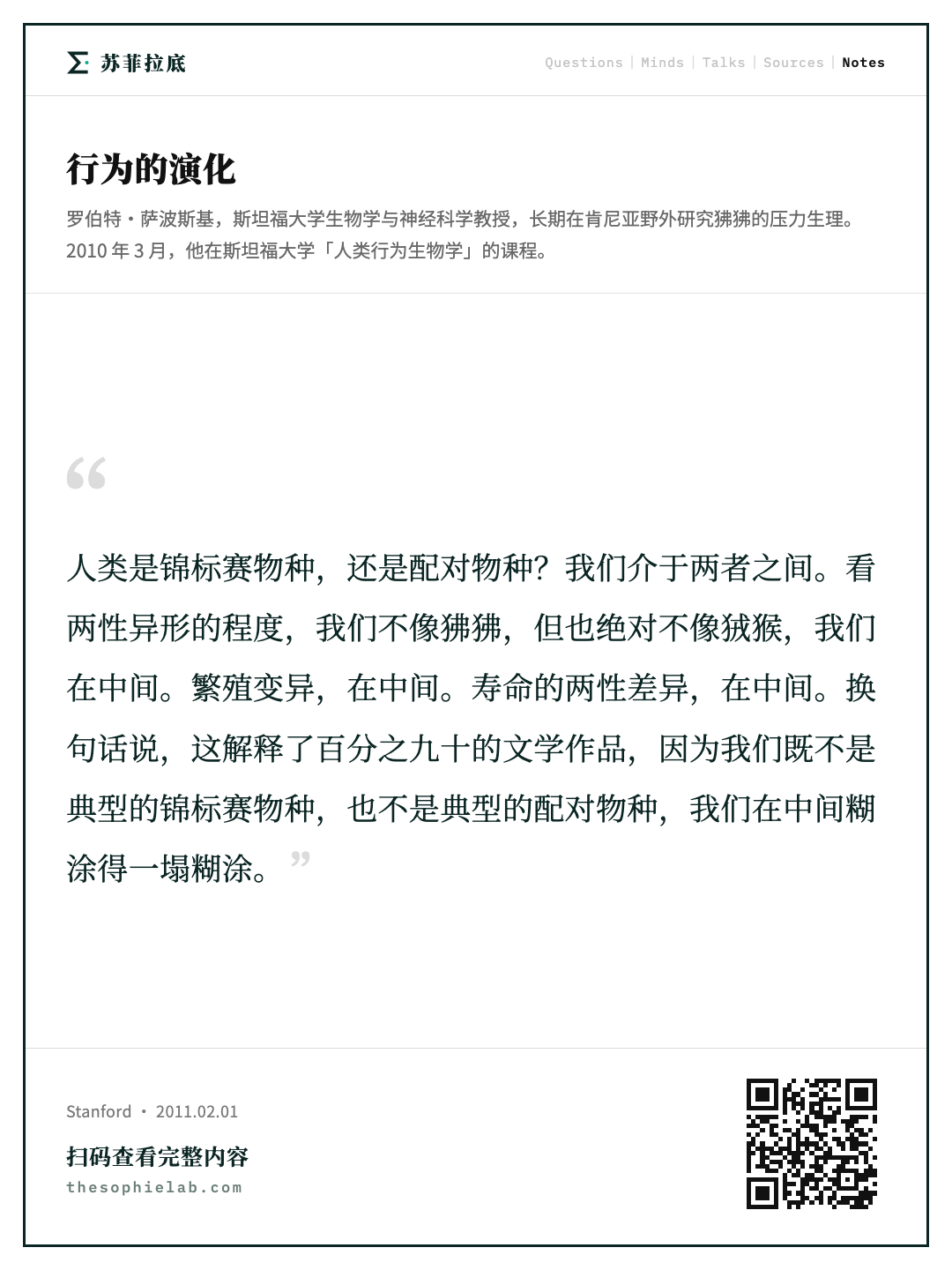
于是,自然有人会问:人类在这个图谱上处于什么位置?答案是:位置很复杂。我们是锦标赛物种,还是配对物种?我们会看到,我们介于两者之间。看两性异形的程度,我们不像狒狒,但也绝对不像狨猴,我们在中间。繁殖变异,也在中间,这一点我不打算细说。寿命的两性差异,往往在中间。亲代行为以及各项指标的可能性,看许多测度,我们都在中间。下一讲我们会看一看一夫一妻物种和锦标赛物种在遗传学上是什么样子,我们正好在中间。换句话说,这解释了百分之九十的文学作品,因为我们既不是典型的锦标赛物种,也不是典型的配对物种,我们在中间糊涂得一塌糊涂,而人类学的一切都支持这一点。

现在地球上的大多数人,处于某种形式的一夫一妻关系中,身处一种允许乃至要求一夫一妻的文化里。而在这些文化中处于一夫一妻关系的人,很多并不真的是一夫一妻。传统上,地球上的大多数文化允许一夫多妻。可是在大多数允许一夫多妻的文化里,多数个体仍是配对的、一夫一妻的。人类不同的社会体系里有两种一夫多妻。一种是经济型的一夫多妻:村里最富的人,就是能娶最多妻子的人,繁殖成功的巨大偏斜由经济驱动。另一种是人口型的。比如某种文化里有武士阶层,男人要当十年武士,最后总要考虑娶妻,可等他们当完武士,已经二十五岁上下,娶的是十三岁的姑娘,许多遵循这种模式的传统文化里都是如此。这时候问题来了:十年的高强度攻击行为,加上再往后十年寿命上的差距,很多男人已经死了,男性短缺。于是你看到由人口结构驱动的一夫多妻,也看到另一些社会里由经济驱动的一夫多妻。传统上,在传教士到来之前,地球上的大多数文化允许一夫多妻;然而在大多数一夫多妻的文���里,多数人并不一夫多妻。我们这个物种糊涂透了,一团糟,因为在所有这些测度上,我们都卡在中间。

那么,周五接着讲什么?我们刚刚开了个头,这是第一次把个体选择、亲缘选择、互惠利他这些原理用来理解行为的各个方面。接下来我们会看它们如何解释动物行为的其他方面,其中有一些,如果按一九六零年前后「为物种之善」的观念,根本无从解释,因为动物在做的事情是杀死自己的同类。最后,我们会看这一切如何适用于人类,以及某些贴切得令人发怵的情形。
本期讲者
罗伯特·萨波斯基斯坦福大学生物学与神经科学教授,长期在肯尼亚野外研究狒狒的压力生理,著有《斑马为什么不得胃溃疡》《行为》等。本讲为其 2010 年斯坦福「人类行为生物学」公开课第二讲。
章节 · 点击跳转视频
0:04 课程事务与问卷趣答 ▶ 正在看
3:20 从两个头骨推出社会行为 ▶ 正在看
9:00 达尔文逻辑与「最适者繁殖」 ▶ 正在看
14:10 角马桥段:推翻群体选择 ▶ 正在看
19:10 基石一二:个体选择与亲缘选择 ▶ 正在看
30:32 从细菌停战到互惠利他 ▶ 正在看
41:18 囚徒困境与以牙还牙 ▶ 正在看
50:49 信号错误:宽容策略与巴甫洛夫 ▶ 正在看
1:00:32 吸血蝠与三刺鱼的野外验证 ▶ 正在看
1:08:36 狮子与裸鼹鼠:现实的复杂性 ▶ 正在看
1:17:58 竞赛型与配对型物种的推演 ▶ 正在看
1:32:12 人类卡在两种模式中间 ▶ 正在看
本期论点
本期回应
25:53
演化会选择与亲属合作的个体,愿意付出的代价随亲缘度上升而增加 亲缘为本亲缘关系是合作的根本原因吗?
30:32
演化中的选择发生在个体层面,行为最大化的是自身基因的拷贝数,而非物种利益 亲缘为本亲缘关系是合作的根本原因吗?
34:07
各方因互相牵制而形成的稳定平衡只是休战,并不是真正的合作 亲缘为本亲缘关系是合作的根本原因吗?
47:44
一报还一报之所以最优,在于它友善、会报复、宽容且规则明确 以牙还牙该怎么对待背叛者?
55:49
当交流存在信号错误时,宽容的一报还一报优于严格的一报还一报 宽容更管用该怎么对待背叛者?
1:01:20
让对手相信自己疯狂到什么都干得出来,反而能迫使对方合作 以牙还牙该怎么对待背叛者?
1:09:19
非近亲个体之间同样会出现互惠利他,互惠合作并不以亲缘关系为前提 不止亲缘亲缘关系是合作的根本原因吗?
7:03
用演化原则可以像推导器官最优形态那样,推导出社会行为的最优形态 简单模型够用简单的博弈模型能解释真实行为吗?
1:13:37
真实生物同时参与多场彼此渗透的博弈并有角色分化,单一囚徒困境无法解释其合作 模型解释不了简单的博弈模型能解释真实行为吗?
1:30:28
从灵长类雌雄头骨大小的差异程度,就能推导出这个物种社会行为的其余一切 简单模型够用简单的博弈模型能解释真实行为吗?
其他论点
10:50
演化的核心不是适者生存,而是留在下一代中的基因拷贝数
12:44
行为在多大程度上与基因有关,和行为在多大程度上由基因决定,是两个问题
20:57
性选择能让毫无生存价值的任意性状变得普遍,只因异性偏好它 观察
36:56
互惠利他只能出现在聪明、能辨认同伴、记得住人情且足够长寿的社会性物种中
1:34:00
人类介于锦标赛型与配对结合型物种之间,这一居中状态解释了该领域约九成的文献分歧
01课程事务与问卷趣答
0:04
Stanford University Often asked question, what's the difference between bio 150, bio 250, and is it humbio 160? No difference. It's exactly the same. So, like the same requirements, same units. So, take whichever one makes your life easiest. Let's see, any other procedural stuff? Well, the answers are back from Monday's questionnaire. And a variety of interesting answers, not surprisingly given the size of a group. Why have you taken this course? Really want to know about animal behavior, but willing to deal with humans.
斯坦福大学。经常有人问,Bio 150、Bio 250 和 HumBio 160 有什么区别?没有区别,完全一样。要求一样,学分一样。所以哪个对你最方便就选哪个。还有别的流程性问题吗?周一那份问卷的答案回来了。答案五花八门,考虑到人数这么多,也不奇怪。你为什么选这门课?“真的很想了解动物行为,但也愿意忍受人类。”
便签引用
0:46
Because I'm substituting it for bio 43, which I don't want to take. My dad used to make me read books about human behavior and biology as punishment. That doesn't make any sense. I know one of the TAs, so I figure that guarantees me an A. Okay, guys, it's in your court. One I really liked because I want to be a filmmaker after college. Yay, interdisciplinary. What else? My first grade teacher is making me.
因为我拿它替掉 Bio 43,那门课我不想上。我爸以前罚我的方式就是让我读关于人类行为和生物学的书。这完全说不通。我认识一个助教,所以我觉得这能保证我拿 A。好吧各位,球在你们那边了。有一个我特别喜欢:因为我大学毕业后想当电影导演。太好了,跨学科。还有呢?我一年级的老师逼我来的。
便签引用
1:16
Tom McFadden told me to. I'm a hyper-oxygenated dilettante. Um I wanted to, somewhat correctly pointing out why have you taken this class? I haven't taken it yet. A number of people reporting that in fact, that was the correct answer. And my favorite, why have you taken this course? Yes. Okay. Relevant background, relevant background. I'm human, I'm human and I often behave. I'm human and I have biology.
Tom McFadden 让我来的。我是个过度充氧的半吊子。呃,我想……有人相当正确地指出:你为什么“选了”这门课?我还没上过呢。不少人这么答,而事实上这确实是正确答案。我最喜欢的一个是——你为什么选这门课?答:“是的。”好。相关背景,相关背景。我是人类;我是人类,而且我经常有行为;我是人类,而且我有生物学。
便签引用
1:50
19 years of being confused about human behavior. Not really, sort of. Seeing crazy behavior as an RA in an all frosh dorm. And I date a biologist. Let's see. There was also the question on there of did the thing on the board look more like an A or a B? And just to really facilitate that one, I forgot to put the A and the B up. Um, but that taps into a cognitive something or other which maybe I'll get back to it some point. Telephone numbers, reading them off, accuracy dramatically tanked as soon as the three number four number motif
被人类行为困惑了 19 年。也不完全是,算是吧。在全是新生的宿舍当住宿助理,见识了各种疯狂行为。还有:我在跟一个生物学家谈恋爱。再看看。问卷上还有一道题:黑板上那个东西看起来更像 A 还是 B?为了让这道题更好答,我忘了把 A 和 B 写上去。不过这触及了某种认知上的什么东西,也许我以后会讲回来。电话号码,念出来的时候,一旦过了那个“三位数、四位数”的节奏,准确率就急剧下滑,
便签引用
2:26
and when it came back briefly accuracy came back a little bit. Finally, uh, let's see. All of you guys conform to a standard frequent gender difference, which is everybody was roughly equally by gender, roughly equally likely to see dependent as the opposite of independent. A small minority went for interdependent. Um, however, one finding that has come up over and over is that far more females are interested in peace than males. Males are more interested in justice. Okay. Have you taken the bio core? Quote, "No way, Jose." Uh, somebody pointing out quite correctly, "Don't settle for peace or justice." Then of course there was the person who responded to that question by writing, "Those words are just symbols. Need to know assumed meaning." Okay.
而当那个节奏短暂恢复时,准确率又回升了一点。最后,你们所有人都符合一个常见的性别差异模式:不分性别,大家差不多同样倾向于认为“独立”的反义词是“依赖”。少数人选了“相互依赖”。不过,反复出现的一个发现是,对“和平”感兴趣的女性远多于男性,男性更关心“正义”。好。你上过生物核心课程吗?答:“没门儿,老兄。”还有人相当正确地指出:“别只满足于和平或正义。”当然也有人这样回答那道题:“这些词只是符号,得先知道预设的含义。”好。
便签引用
02从两个头骨推出社会行为
3:20
Uh, there was one questionnaire that was carefully signed and something approaching calligraphy. It was so beautiful and was otherwise blank. Uh, for years running the course the subject that most people really want to hear and most people really don't want to hear is about the biology of religiosity. And for 22 years running now, Stanford students are more interested in depression than sex. Okay. So, we start off. I keep telling Hennessy about this, but nothing gets done. Okay, we start off. We start off, if I can open this. Which is something you could do if you have a certain type of training, if you're some osteologist or whatever these folks are called. If you are presented those two skulls and told this one's a female, this one's a male, you
呃,有一份问卷签名签得极其工整,接近书法水准,特别漂亮,然后其余部分全是空白。这门课开了这么多年,大家最想听、同时又最不想听的题目,是宗教性的生物学。而且连续 22 年,斯坦福学生对抑郁症的兴趣超过对性的兴趣。好,我们开始。我一直跟 Hennessy 提这件事,但没人管。好,我们开始。我们开始——如果我能把这个打开的话。如果你受过某种训练,比如你是骨学家或者不管这类人叫什么,那么给你这两个头骨,告诉你这个是雌性、这个是雄性,你就
便签引用
4:19
can begin to figure out stuff like how heavy, how large the body was of that individual, what diseases they had, had they undergone malnutrition, had they given birth a lot of times, a few times, were they bipedal, all sorts of stuff you could figure out from just looking at these skulls. What today's lecture and Friday's is about is the fact that with the right tools under your belt, you could look at these two skulls and know that information. You're a field biologist and you've discovered this brand new species and you see that this one nurses an infant shortly before leaping out of the tree leaving only the skull and this one has a penis shortly before leaving leaping out of the tree and leaving leaving a skull. So, all you know is this is an adult female, an adult male. And if you've got the right tools there, you can figure out who's more likely to cheat on the other. Is the female more likely to mess around or is the male?
能开始推断出很多东西:这个个体体重多少、体型多大、得过什么病、有没有经历过营养不良、生育过很多次还是几次、是不是双足行走,光看这两个头骨就能推断出各种各样的信息。今天和周五这两节课要讲的是:只要掌握了合适的工具,你看着这两个头骨就能知道那些信息。假设你是野外生物学家,发现了一个全新的物种,你看到这一只在给幼崽哺乳,然后从树上跳下去,只留下一个头骨;那一只有阴茎,然后也从树上跳下去,只留下一个头骨。所以你只知道这是一只成年雌性、一只成年雄性。而如果你手里有合适的工具,你就能推断出谁更可能对对方不忠。是雌性更可能乱来,还是雄性?
便签引用
5:17
How high are the levels of aggression? Does the female tend to have twins or one kid at a time? Do females choose males because they have good parenting skills or because they're big hunky guys? What levels of differences in life expectancy? Do they live the same length of time? You would be able to tell whether they have the same life expectancy or if there's a big discrepancy between the two, all sorts of stuff like that. Merely by applying a certain piece of logic that dominates all of this. Okay, so you're back reading those Time-Life nature books back when, and there was always a style of thing you would go through, which is they describe some species doing something absolutely amazing and unlikely, and it go like this, "The giraffe The giraffe has a long neck, and it obviously has to have a big heart to pump all that blood up there, and you lock up a whole bunch of biomechanics people with, you know, slide rules, and out they come out with this prediction as to how big the giraffe heart should be, and how thick the walls, and you go and you measure a giraffe heart, and
攻击性水平有多高?雌性通常一胎生双胞胎,还是一次生一个?雌性选择雄性,是因为他育儿能力好,还是因为他是个高大威猛的家伙?寿命差异有多大?它们活得一样长吗?你能判断出它们寿命是否相同,还是两者之间存在很大差距,诸如此类的各种问题。而这一切靠的只是运用某一条贯穿始终的逻辑。好,回想你当年读的那些《时代-生活》自然丛书,里面总有一种固定套路:他们描述某个物种做出某件绝对惊人、看似不可能的事,然后是这样讲的:“长颈鹿脖子很长,显然它必须有一颗很大的心脏,才能把血泵到那么高的地方。”于是你把一群搞生物力学的人关起来,让他们拿着计算尺算,最后他们给出预测:长颈鹿的心脏该有多大、心壁该有多厚。然后你去测量长颈鹿的心脏,
便签引用
6:23
it's exactly what the equations predicted, and you say, 'Isn't nature amazing?' Or you read about some like desert rodents that drink once every 3 months, and another bunch of folks have done math and figured out like how many miles long the renal tubules have to be, and somebody goes and studies it, and it's exactly as you expected. Isn't nature wonderful? No, nature isn't wonderful. You couldn't have giraffes unless they had hearts that were that big. You couldn't have rodents living in the desert unless they had kidneys that worked in a certain way. There is an inevitable logic about how organisms function, how organisms are built, how organisms have evolved solving this problem of optimizing a solution. And what the next two lectures are about is you can take the same exact principles and apply them to thinking about the evolution of behavior. The same sort of logic where just as you could sit there and with logical principles come to the point of saying, "A giraffe's heart is going to be this big." You can go through a different realm of logic built around evolutionary principles and figure out all sorts of aspects of social behavior. And we already know what's involved in, say, optimizing, what's the optimal number of whatevers in your kidney, what's the optimal
结果跟方程预测的一模一样,于是你说:“大自然真神奇啊!”或者你读到某种沙漠啮齿动物三个月才喝一次水,另一群人做了数学计算,算出它的肾小管得有多少英里长,有人去研究,结果跟预期完全一致。大自然多美妙啊!不,大自然并不美妙。长颈鹿不可能存在,除非它们的心脏就是那么大。啮齿动物不可能在沙漠里生活,除非它们的肾脏以某种特定方式工作。生物体如何运作、如何构造、如何演化以解决“把方案最优化”这个问题,其中存在一种必然的逻辑。而接下来两节课要讲的是:你可以把完全相同的原理拿过来,用于思考行为的演化。同样的逻辑——正如你能坐在那儿,用逻辑原理推出“长颈鹿的心脏应该这么大”——你也可以走另一套建立在演化原理之上的逻辑,推导出社会行为的方方面面。而我们已经知道“最优化”涉及什么:比如你肾脏里某个结构的最优数量是多少,最优的
便签引用
7:44
behavior strategy or something. All of us, as soon as we got like some kid sibling, learned how to do the optimal strategy in Tic-Tac-Toe, and so that you could never lose, and it's totally boring, but that's a case of figuring out the optimal solution to behavior, reaching what is called the Nash equilibrium. And actually, I've no idea what I just said, but I like making reference to Nash because it makes me feel quantitative or something. So, that is called the Nash equilibrium. The Nash equilibrium, and what the entire point here is, the same sort of process of figuring out what are the rules of optimizing Tic-Tac-Toe behavior can be built upon the principles of evolution to figure out all sorts of realms of optimized social behavior. And broadly, this is a field that's known as sociobiology, emerging in the late 1970s, mid- 1970s or so, and by the late 1980s, giving birth to another discipline known as evolutionary psychology, the notion that you cannot understand behavior, and you cannot understand internal psychological states outside the context of evolution had something to do with sculpting those behaviors and those psyches.
行为策略是什么,等等。我们所有人,一有了弟弟妹妹,就学会了井字棋的最优策略,这样你永远不会输,虽然特别无聊,但那正是一个找出行为最优解的例子,达到了所谓的纳什均衡。其实我完全不知道自己刚才在说什么,但我喜欢提纳什,因为这让我觉得自己挺“量化”的。所以那叫纳什均衡。纳什均衡——而这里的全部要点在于:那种搞清楚井字棋最优规则的过程,可以建立在演化原理之上,用来推导出各个领域的最优化社会行为。宽泛地说,这个领域叫社会生物学,兴起于 20 世纪 70 年代中后期;到 80 年代末,它又催生出另一门学科——演化心理学,其核心观念是:脱离“演化参与塑造了这些行为和这些心智”这一背景,你就无法理解行为,也无法理解内在的心理状态。
便签引用
03达尔文逻辑与「最适者繁殖」
9:00
So, to start off with that basic song and dance about Darwin, just to make sure we're up to speed on this. Darwin, just to get some things out of the way, Darwin did not discover evolution. People knew about evolution long before that. Darwin came up with the notion of a mechanism for evolution, natural selection, and in fact, Darwin isn't the inventor of that. There was another guy, Alfred Russell Wallace. The two of them, and for some reason, Wallace has gotten screwed historically, and Darwin gets much more attention, but starting off with a Darwinian view of how evolution works. First thing being that there is evolution. Traits in populations change over time. Traits can change enough that in fact you will get speciation. New species will form. And the logic of Darwinian evolution is built on just a few couple of very reasonable steps.
那么,先把关于达尔文的那套基本说辞过一遍,确保大家跟得上。达尔文——先把几件事说清楚——达尔文并没有发现演化。在他之前人们早就知道演化了。达尔文提出的是演化的机制,也就是自然选择;而事实上,达尔文也不是这个想法的唯一提出者。还有另一个人,阿尔弗雷德·罗素·华莱士。他们两个人……不知为什么,华莱士在历史上被亏待了,达尔文得到的关注多得多。不过我们先从达尔文式的演化观讲起。第一点:演化是存在的。种群中的性状会随时间改变。性状改变得足够多,就会发生物种形成,新的物种会出现。而达尔文式演化的逻辑,只建立在寥寥几个非常合理的步骤之上。
便签引用
9:55
First one is that there are traits that are heritable. Traits that could be passed on one generation to the next. Traits that we now can translate in our modern parlance into traits that are genetic. And we will see soon how that's totally not correct to have said that, but traits that are heritable. The next thing is that there is variability among those traits. There's different ways in which this trait can occur. And they're all heritable. The next critical thing, some versions of those traits are more adaptive than others. Some versions work better for you. For example, giraffe who wind up with hearts the size of like a tomato, that's not an optimal version. Amid the range of variability, some will carry with them more fitness, more adaptiveness than others.
第一,存在可遗传的性状。可以从一代传到下一代的性状。用我们现代的说法,可以翻译成“基因性的”性状。稍后我们会看到,这么说其实完全不对,但总之是可遗传的性状。第二,这些性状之间存在变异。这个性状可以有不同的表现形式,而且它们都是可遗传的。第三点也是关键:这些性状的某些版本比其他版本更具适应性。某些版本对你更管用。比如说,心脏只有西红柿那么大的长颈鹿,那就不是最优版本。在整个变异范围里,有些会带来更高的适合度、更强的适应性。
便签引用
10:50
And that translates into another sound bite that's got to be gotten rid of. All of this is not about survival of the most adapted, it's about reproduction of something we will come to over and over again. It's about the number of copies of genes you leave in the next generation. So you've got to have traits that are heritable. There's got to be variability in them. Some of those traits are more adaptive than others. Some of those traits make it more likely that that organism passes on copies of its genes into the next generation. And throw those three pieces together, and what you will get is evolution in populations, changing frequencies of traits. And when you throw in one additional piece, which is every now and then the possibility to have a random introduction of a new type of trait in there, modern parlance, a mutation. From that, you could begin to get actual large changes in what a population looks like. Okay, so these are the basic building blocks of Darwin, and it is easy to apply it to giraffes hearts and kidneys of desert rats and everything we think about in the world of physiology, anatomy in the context of evolution.
而这引出另一个必须扔掉的流行说法:这一切并不是“最适者生存”,而是“最适者繁殖”——一个我们会反复回到的概念。关键在于你在下一代里留下多少份基因拷贝。所以,你得有可遗传的性状;这些性状必须存在变异;其中某些性状比其他的更具适应性;某些性状让那个生物体更有可能把自己的基因拷贝传给下一代。把这三块拼在一起,你得到的就是种群中的演化——性状频率的变化。再加上一个额外要素:时不时地,有可能随机引入一种新型性状,用现代说法就是突变。由此,你就能开始得到一个种群面貌上的重大变化。好,这些就是达尔文理论的基本构件;把它用在长颈鹿的心脏、沙漠鼠的肾脏,以及我们在演化框架下思考的所有生理学、解剖学问题上,都很容易。
便签引用
12:01
So, how do you apply it to behavior? And the basic notion for folks who've come from this Darwinian tradition into thinking about behavior is you do the exact same thing. There are behaviors that are heritable, types, traits, classes of behaviors. They come with a certain degree of variation among individuals. Some versions of them are more adaptive than others. Over time, the more adaptive versions will become more commonplace, and every now and then you can have mutations that introduce new variability. Totally logical, absolutely unassailable, and what we're going to spend an insane amount of time in this class on is one simple assumption in there, which is that certain behaviors are heritable. That certain behaviors have genetic components. And as you'll see, this one is just going to run through every lecture wrestling with that issue there. This is a big incendiary issue there as to how genetic and that's not the same thing as saying how genetically determined how genetic behavior is. Okay, so that's going to be a issue we come back to again and again.
那么,怎么把它用到行为上呢?对于从达尔文传统出发来思考行为的人来说,基本想法就是照搬同一套:存在可遗传的行为——行为的类型、特征、类别。它们在个体之间存在一定程度的变异。其中某些版本比其他版本更具适应性。随着时间推移,更具适应性的版本会变得更常见;而且时不时会有突变引入新的变异。完全合乎逻辑,无懈可击。而我们这门课要花上大量时间纠缠的,就是其中一个简单的假设:某些行为是可遗传的,某些行为有基因成分。你会看到,这个问题会贯穿每一节课。这是个极具争议的问题:行为在多大程度上是“基因性的”——注意这跟说“行为在多大程度上由基因决定”不是一回事。好,这是我们会一再回来的问题。
便签引用
13:11
So, now transitioning into how you would apply these Darwinian principles. First thing before starting a caveat. You're going to wind up in order to think about all of this most efficiently, hopefully do some personifying. Personifying as in you'll sit around and say, "Well, what would a female chimpanzee want to do at this point to optimize the number of copies of her genes in the next generation? What would this brine shrimp want to do to deal with this environmental stressor? What would this, you know, cherry tree do?" They're not planning. They're not conscious. They're not taking classes in evolutionary biology. "What would this organism want to do?" is just a shorthand for something sculpted by the sort of exigencies of of evolution and reducing the optimal. "They want to do this." This is just going to be a shorthand throughout. Once you get past the apes, nobody is wanting to do any of these optimization things. So, just getting that sort of terminology out of the way.
那么,现在转到怎么运用这些达尔文式原理。开始之前先提个醒。为了最高效地思考这一切,你多半会做一些拟人化的处理。所谓拟人化,就是你会坐在那儿说:“那么此刻这只雌黑猩猩会想怎么做,才能让她的基因在下一代中的拷贝数最大化?这只卤虫会想怎么应对这个环境压力源?这棵樱桃树会想怎么做?”它们并没有在谋划,它们没有意识,它们没在上演化生物学的课。“这个生物体会想怎么做”只是一个简写,指代那些被演化的种种迫切压力塑造出来、趋近最优的东西。“它们想这么做”——这在全课中只是个简写。一旦过了猿类这一层,没有谁是在“想”做这些最优化的事。所以先把这个用词问题说清楚。
便签引用
04角马桥段:推翻群体选择
14:10
Okay, so we start off with what's the first building block of applying Darwinian principles to behavior. Something that is absolutely critical to emphasize because the first thing we all need to do is unlearn something we all learned back when on all those National Geographic specials and that would consistently teach us something about this aspect of evolution and would always teach it to us wrong. Here's the scenario. So, you're watching and there's this wildlife documentary. It's It's dawn on the savanna and you see there's a whole bunch of lions on top of some big old dead thing, some buffalo or something and they're chewing away and having a fine time. So, something happens at that point, which is they have to deal with how they divvy up the food.
好,那我们从“把达尔文式原理应用于行为”的第一块基石开始。有件事必须特别强调,因为我们首先要做的,是把当年在那些《国家地理》特辑里学到的东西忘掉——它们总在教我们演化的这个方面,而且总是教错。场景是这样的:你在看一部野生动物纪录片。草原上的黎明,你看到一群狮子趴在某个死掉的大家伙身上,某头水牛之类的,它们正大嚼特嚼,吃得很开心。这时发生了一件事:它们得处理怎么分食物的问题。
便签引用
15:00
Or let me give you another example, another standard sort of endless vignette that comes up in these films. Once again now, you're back on the savanna. It's not dawn this time, but you are looking at one of the magnificent things of the natural world, which is the migration of zebras throughout East Africa, a herd of 2 million of them migrate around following a cyclical pattern of rains, so they're always going where the grass is greener. So, you've got this wonderful herd of 2 million wildebeest, and there's a problem, which is there's some great field right in front of them full of grass, and bummer, there's a river in between them and the next field. And especially a bummer, a river teeming with crocodiles just ready to grab them. So, what are the wildebeest going to do?
或者我给你另一个例子,这类片子里没完没了出现的另一个标准桥段。还是回到草原上,这次不是黎明,而是你正看着自然界最壮观的景象之一:斑马横跨东非的大迁徙,两百万头的兽群按照降雨的周期性规律迁移,所以它们总是往草更绿的地方去。于是你眼前有这么一大群两百万头的角马,问题来了:前面有一大片长满草的绝佳原野,可惜的是,它们和那片原野之间隔着一条河。更糟的是,河里挤满了鳄鱼,随时准备下嘴。那么,角马们要怎么办?
便签引用
15:46
And in according to the National Geographic type specials we would get, out would come a solution. There's all the wildebeest hemming and hawing in this agitated state by the end edge of the river, and suddenly from the back of the crowd comes this elderly wildebeest who pushes his way up to the front, stands on the edge of the river, and says, "I sacrifice myself for you, mine kinder." And throws himself into the river, where immediately the crocs get busy eating him up, and the other 2 million wildebeest can tiptoe around the other way across the river, and everybody's fine. And you're then saying, "Why'd this guy do this? Why did this guy fling himself into the river?" And we would always get the answer at that point. The answer that is permeated as like the worst urban myth of evolution, whatever. Why did he do that? Because animals behave for the good of the species. And this is the notion that has to be completely trashed right now. Animals behaving for the good of the species really came to the forefront a guy in the early '60s named Wynne Edwards, hyphenated Wynne Edwards, some
而按照我们看到的那类《国家地理》特辑,答案就出场了:所有角马在河边焦躁不安地磨蹭,忽然从队伍后面挤出来一头年老的角马,它一路推到最前面,站在河边说:“我为你们牺牲,我的孩子们。”然后纵身跳进河里,鳄鱼立刻忙着把它吃掉,另外两百万头角马就能绕道从别处蹑手蹑脚地过河,大家都平安无事。然后你会问:“这家伙为什么这么做?他为什么要把自己扔进河里?”而在那个时候我们总会得到一个答案,一个像最糟糕的都市传说一样渗透进演化认知里的答案。他为什么这么做?因为动物的行为是为了物种的利益。而这个观念现在必须被彻底扔掉。“动物为物种的利益而行动”这套说法在 60 年代初由一个叫 Wynne-Edwards 的人推到台前——带连字符的 Wynne-Edwards,一个
便签引用
16:53
hyphenated Brit zoologist who pushed most strongly this notion of that animals behave for the, you know, good of the species. He is reviled throughout every textbook, Wynne Edwards and group selection, that would be the term. Selection for the good of groups, for the selection for the good of the species, Wynne Edward and group selection. I'm sure the guy did all sorts of other useful things and anyone who really is has any depth to them would find out but all I know is that the guy is the one who came up with group selection. Animals behave for the good of the species. This isn't the case at all. Animals behave for passing on as many copies of their genes as possible. And what we'll see is when you start looking at the nuances of that, sometimes it may look like behaving for the good of the species but it really isn't the case. So animals behave in order to maximize the number of copies of genes they leave in the next generation. Remember, not survival of the fittest, reproduction of the fittest. So first thing you need to
姓氏带连字符的英国动物学家,他最卖力地鼓吹“动物为了物种的利益而行动”这个观念。他在每本教科书里都被口诛笔伐:Wynne-Edwards 与群体选择,这就是那个术语。为群体的利益而选择、为物种的利益而选择——Wynne-Edwards 与群体选择。我相信这人肯定还做过各种有用的工作,任何有点深度的人都会去了解,但我只知道他是提出群体选择的那个人。动物为物种的利益而行动。事实完全不是这样。动物的行为是为了尽可能多地传下自己基因的拷贝。我们会看到,当你开始琢磨其中的细微之处时,有时候它看起来像是在为物种的利益行动,但实际上并不是。所以,动物的行为是为了让自己留在下一代中的基因拷贝数最大化。记住,不是最适者生存,而是最适者繁殖。所以你首先要
便签引用
17:58
do is go back to that vignette and saying "Uh so what's up with the wildebeest there? And what's up with the elderly guy who jumps in the river?" And finally when you look at them long enough instead of the camera crew showing up for 3 minutes, when you study this closely enough, you see something that wasn't apparent at first, which is this elderly wildebeest is not fighting his way through the crowd. This guy is being pushed from behind. This guy is being pushed from behind because all the other ones are saying "Yeah, get the old guy in the river." Sacrificing himself my ass. This guy is getting pushed in by everybody else. He is not sacrificing himself for the good of the species. He does not like the idea of this whatsoever. So he gets pushed in because the old weak guy none of this group selection stuff. What came in by the 70s as a replacement way to think about this is this notion of animals including us behaving not for the good of the species of the group but to maximize number of copies of genes left in the next generation. And what do you see is three ways in which this could occur. Three building blocks. The first one being known as individual selection.
做的,就是回到那个桥段问:“那角马这边到底怎么回事?那头跳进河里的老家伙又是怎么回事?”最后,当你看得够久——而不是摄制组只来拍三分钟——当你足够仔细地研究,你会看到一开始并不明显的东西:这头年老的角马根本不是在人群中奋力挤到前面,这家伙是被后面推上去的。他是被推上去的,因为其他所有角马都在说:“对,把那老家伙弄河里去。”什么自我牺牲,扯淡。这家伙是被大家推下去的。他不是在为物种的利益牺牲自己,他一点都不喜欢这个主意。所以他被推下去,因为他又老又弱——跟群体选择毫无关系。到了 70 年代,取而代之的思考方式是:动物(包括我们)的行为不是为了物种或群体的利益,而是为了让留在下一代中的基因拷贝数最大化。而你会看到这有三条实现途径,三块基石。第一块叫做个体选择。
便签引用
05基石一二:个体选择与亲缘选择
19:10
The first one built around the notion that sometimes the behavior of an animal is meant to optimize the number of copies of its genes that it leaves in the next generation by itself reproducing. The drive to reproduce, the drive to leave more copies of one's genes. This was once summarized really sort of tersely as sometimes a chicken is an egg's way of making another chicken. No, that's backwards. Sometimes a chicken is an egg's way of making another egg. Okay, ignore that. Sometimes what the guy said is sometimes a chicken is an egg's way of making another egg. All this behavior stuff and all this animate sort of social interaction is just an epiphenomenon to get more copies of the genes into the next generation. Individual selection, a subset of way of thinking about this is selfish genes.
第一块基石的核心观念是:有时候,一只动物的行为是为了通过自己繁殖,来优化它留在下一代中的基因拷贝数。繁殖的驱动力,留下更多自身基因拷贝的驱动力。这一点曾被非常简洁地总结为:有时候,鸡不过是蛋制造另一只鸡的方式。不对,说反了。有时候,鸡不过是蛋制造另一个蛋的方式。好,忽略前面那句。那人说的是:有时候,鸡不过是蛋制造另一个蛋的方式。所有这些行为、所有这些鲜活的社会互动,都只是把更多基因拷贝送进下一代的副现象。个体选择——这种思路下的一个子集叫做“自私的基因”。
便签引用
20:09
What behavior is about is maximizing number of copies of genes in the next generation and sometimes the best way to do it, sometimes the way that animals maximize is to get as many copies by way of reproducing themselves. It's not quite equivalent to the selfish gene, but for our purposes individual selection. And this can play out in a number of realms and bringing in sort of a big dichotomy in thinking about evolutionary pressures, Darwin and the theory of natural selection. What natural selection is about is processes bringing about an organism who is more adaptive, what we just went through. Darwin soon recognized there was a second realm of selection which he called sexual selection. And what that one's about is this is selecting for traits that have no value whatsoever in terms of survival or anything like that, traits that carry no adaptive value, but for some random bizarro reason the opposite sex likes folks who look this way. So, they get to leave more copies of their genes, and suddenly, you could have natural selection bringing about big, sharp antlers in male moose, and they use that for fighting off predators or fighting with another male. That would be natural
行为的核心就是让下一代中的基因拷贝数最大化,而有时候最好的办法、有时候动物用来最大化的办法,就是通过自己繁殖来获得尽可能多的拷贝。这跟“自私的基因”并不完全等同,但就我们的目的而言,这叫个体选择。这可以在多个层面展开;这里要引入思考演化压力时的一个重要二分法。达尔文与自然选择理论——自然选择讲的是那些造就更具适应性的生物体的过程,也就是我们刚讲过的。达尔文很快意识到还有第二种选择,他称之为性选择。性选择讲的是:有些性状在生存等方面毫无价值,不带任何适应性优势,但出于某种随机古怪的原因,异性就是喜欢长这样的个体。于是这些个体能留下更多基因拷贝。突然之间,自然选择可以造就雄驼鹿又大又尖的鹿角,它们用来抵御捕食者或跟其他雄性搏斗,这就是自然
便签引用
21:24
selection. Sexual selection might account for the fact that, like, the antlers are green paisley patterns all over for that. And for some reason, that looks cool to female moose mooses. And what do you wind up getting as a mechanism for sexual selection is, as long as individuals prefer to mate with individuals with some completely arbitrary traits, those traits will also become more common. So, this dichotomy of natural selection for traits driven by traits that really do aid leaving copies of genes outside the realm of just sheer sexual preference, sexual selection. And sometimes, they can go in absolutely opposite directions. You can get some species where the female fish prefer male fish that have very bright coloration, and that's advantageous then to have the bright coloration by means of sexual selection. But, the bright coloration makes you more likely to get predated by some other fish, natural selection pushing against bright coloration in males. Very often, you've got the two going against each other, having to balance. So, how would that be applied in this realm of individual selection? This first building block, sometimes an egg Damn. Sometimes, a chicken isn't eggs way of making another egg. Sometimes, what behavior is about is one individual
选择。而性选择可能解释的是,比如鹿角上布满绿色的佩斯利花纹,出于某种原因雌驼鹿觉得那很酷。性选择的机制最终是这样:只要个体偏好跟带有某些完全任意性状的个体交配,那些性状也会变得更常见。所以这就是那个二分法:一边是自然选择,针对的是那些真正有助于留下基因拷贝、超出纯粹性偏好范畴的性状;另一边是性选择。有时候两者会走向完全相反的方向。有些物种里,雌鱼偏好体色非常鲜艳的雄鱼,那么通过性选择,鲜艳的体色就是有利的。但鲜艳的体色也让你更容易被别的鱼捕食,这时自然选择就在压制雄性的鲜艳体色。很多时候你会看到这两股力量彼此对抗,必须取得平衡。那么这在个体选择这个领域里是怎么体现的?这第一块基石——有时候蛋……糟了,是有时候鸡不过是蛋制造另一个蛋的方式。有时候,行为的实质就是一个个体
便签引用
22:47
trying to maximize the number of copies of their genes in the next generation, a natural selection manifestation of it being you're good at running away from predators. Selection for speed, for certain types of muscle metabolism, for certain sense- systems that will tell you there's somebody scary around. That would be the realm of that. Individual selection, selecting in the realm of sexual selection to have more of whatever those traits are that are attractive. So, this first building block, it's not group selection, it's not behaving for the good of the species, it's behaving to maximize the number of copies of one's genes in the next generation, and the most straightforward way is to behave in a way to maximize the number of times you reproduce yourself. Second building block, which is there's another way of accomplishing the same thing that you just did with individual selection. As follows, one of the things that could be relied upon in life is that you are related to your relatives.
试图让自己的基因在下一代中的拷贝数最大化。它在自然选择上的体现是:你很擅长逃离捕食者。这是在选择速度,选择某些类型的肌肉代谢,选择某些能告诉你附近有危险家伙的感觉系统。那就属于这个范畴。而个体选择在性选择层面的体现,则是让自己更多地拥有那些有吸引力的性状。所以这第一块基石:不是群体选择,不是为物种的利益而行动,而是为了让自己在下一代中的基因拷贝数最大化;而最直接的方式,就是让自己繁殖的次数最大化。第二块基石是:还有另一种方式,能达成你刚才用个体选择达成的同一件事。是这样的:生命中可以指望的一件事是,你和你的亲属之间有亲缘关系。
便签引用
23:45
And what you get is the more closely related you are, the more genes you share in common with them. On a statistical level, identical twins share 100% of their genes, full siblings 50%, half siblings 25%. This is exactly something that's going to be covered in the catch-up section this week. If you're not comfortable with this stuff, this sort of thing will be reviewed in more detail. Okay, so the closer a relative is to you, the more copies of the more genes they share in common with you. So, suddenly you've got this issue, you're an identical twin, and your identical sibling has the same genes that you do. Individual selection, you will be just as successful as passing on copies of your genes into the next generation if you forego reproducing to make it possible for your identical twin to do so. Because on a level of just sheer numbers of copies of genes in the next generation, they are equivalent. And sometimes you will thus get behavior which really decreases the reproductive success of an individual in order to enhance the success of a relative.
由此你会得到:亲缘关系越近,你们共有的基因就越多。从统计层面看,同卵双胞胎共有 100% 的基因,全同胞 50%,半同胞 25%。这正是本周补习讨论课要讲的内容。如果你对这些还不熟悉,这类内容会在那里更详细地复习。好,所以亲属跟你越近,他们跟你共有的基因就越多。于是突然出现一个问题:假设你是同卵双胞胎,你的双胞胎手足拥有和你一样的基因。从个体选择的角度看,如果你放弃自己繁殖,从而让你的同卵双胞胎得以繁殖,你在把自身基因拷贝传给下一代这件事上同样成功。因为单从下一代中基因拷贝的数量来看,两者是等价的。所以有时候你会看到某些行为实际上降低了个体自身的繁殖成功率,为的是提升某个亲属的成功率。
便签引用
24:56
But you've got a constraint there, which is all of your relatives don't share all your genes with you. They have differing degrees of relatedness. And what that winds up producing is another factor, another observation, one of the great like witty geneticists of all time, a guy named Haldane, who apparently once in a bar was trying to explain this principle to somebody, and came up and said, "I will gladly lay down my life for two brothers or eight cousins." And that's the math of the relatedness. You passing on one copy of your genes to the next generation is from the sheer mathematics of just how evolution is going to play out over the generations is exactly equivalent as giving up your life for eight cousins to be able to each pass on a copy of their genes, cuz you share 1/8 with each of them, and it winds up being a whole, or and it's that math. And out of that, you get something that makes perfect sense instantly, which is evolution selects for organisms cooperating with their relatives, something along those lines. And thus, we have the second building block known as kin selection, inclusive fitness, kin
但这里有个限制:你的亲属并不和你共享全部基因。他们跟你的亲缘程度各不相同。由此又引出了另一个因素、另一个观察,来自史上最风趣的遗传学家之一,一个叫霍尔丹(Haldane)的人。据说他有一次在酒吧里想跟人解释这个原理,就说:"我愿意为两个兄弟或八个表亲献出我的生命。"这就是亲缘关系的算术。单从进化在一代代之间如何展开的纯数学来看,你把自己基因的一份拷贝传给下一代,恰好等价于你舍命让八个表亲各自传下一份拷贝,因为你跟他们每个人共享八分之一,加起来正好凑成完整的一份——就是这个数学。由此你会立刻得到一个完全说得通的结论:进化会选择那些与亲属合作的生物,大致就是这个意思。于是我们就有了第二块基石,也就是所谓的亲缘选择、广义适合度、亲缘
便签引用
26:09
selection. First building block, individual selection, passing on copies of your own genes as a way to maximize future success. Second version, helping out relatives. Helping out relatives in terms of increasing their reproductive success with this vicious mathematical logic, which is you know, one identical twin, two half sibl- two full siblings, eight cousins, and so on, as a function of degree of relatedness. And what this begins to explain is a whole world in animal behavior of animals being obsessed with kinship. Animals being fully aware of who is related to who, and what sorts of ways animals being utterly aware of you cooperate with relatives but as a function of how closely related they are. Animals put us in social anthropology and kinship terms and could you marry the daughter of your uncle's third wife or whatever to shame in terms of how much a lot of social animals deal with relatedness. So, inclusive fitness, kin selection. Here would be evidence for it. Here's one example. Very cool study done some years back by a couple Seyfarth and Cheney, University of Pennsylvania, looking at
选择。第一块基石是个体选择:传递你自己基因的拷贝,以此最大化未来的成功。第二个版本是帮助亲属。帮助亲属提高他们的繁殖成功率,遵循的是这套冷酷的数学逻辑:一个同卵双胞胎、两个……两个亲兄弟姐妹、八个表亲,依此类推,取决于亲缘程度的远近。这就开始解释了动物行为中的一整片天地:动物对亲缘关系的痴迷。动物非常清楚谁和谁有亲缘关系、是哪种亲缘关系;动物也非常清楚要跟亲属合作,而且合作的程度取决于血缘有多近。在处理亲缘关系这件事上,很多社会性动物做得之细致,让我们社会人类学里那些亲属称谓——你能不能娶你叔叔第三任妻子的女儿之类——都相形见绌。所以,广义适合度、亲缘选择。下面是支持它的证据。举一个例子。几年前宾夕法尼亚大学的Seyfarth和Cheney做过一项非常棒的研究,研究对象是
便签引用
27:26
vervet monkeys and these were vervet monkeys out in Tanzania, I believe. And what they did was a whole bunch of these vervet monkeys were sitting around and they, the researchers, had made really high-quality recor- recordings of various vocalizations from the monkeys over time. So, they had the sound of each animal giving an alarm call, giving a friendly gesture call, giving a whatever. And what they would then do is hide a microphone inside some bushes and play the sound of one of the infants from the group giving an alarm call. So, what does the mother of that infant do? She instantly gets agitated and looks over at the bush. That's her child, all of that. How to know that everyone else in that vervet group understands kin selection? What does everybody else do? They all look at the mother. That's whoever's mother. What is she going to do next? They understand the relatedness and they understand what the response will be. All the other vervets look at the mother at that point. "Whoa,
长尾黑颚猴(vervet monkey),我记得是在坦桑尼亚的野外。他们的做法是这样的:一大群长尾黑颚猴待在那儿,而研究者事先长期录下了这些猴子各种叫声的高质量录音。所以他们手里有每只猴子发出警报叫声的声音、发出友好示意叫声的声音,等等。然后他们把一个扬声器藏在灌木丛里,播放群体中某只幼崽发出警报叫声的录音。那么,这只幼崽的母亲会怎么做?她会立刻紧张起来,朝那丛灌木望过去。那是她的孩子,就是这样。那怎么知道这个猴群里其他所有个体也都懂亲缘选择呢?其他所有猴子会怎么做?它们全都去看那位母亲。那是某某的妈妈。她接下来会怎么做?它们明白亲缘关系,也明白反应会是什么。那一刻其他所有长尾黑颚猴都盯着那位母亲看。"哇,
便签引用
28:29
I'm sure glad that's not my kid giving an alarm call from the bushes." They understand kinship. Another version of that that came out in these studies. So, you've got two females, each of whom has a kid, a daughter, or whatever, and female A and female B, and one day female A does something absolutely rotten to female B. And later that day, the child of female B is more likely than chance to do something rotten to the child of female A. You're keeping track of not only revenge, but not revenge on the individual who did something miserable to you, but displaced by one degree of reproduction, keeping track of kinship. Animals can do this. All sorts of primate species can do this. And as we'll see, all sorts of other species can do this also. There's that caveat again. All sorts of other species want to figure out who their cousins and they don't want to figure out. Evolution has sculpted an ability to optimize behavior along lines of relatedness in all sorts of species.
幸好在灌木丛里发警报叫声的不是我家孩子。"它们懂亲缘关系。这些研究里还得出了另一个版本的结果。假设有两只雌猴,各自有一个孩子,比如女儿,我们叫雌猴A和雌猴B。某一天,雌猴A对雌猴B做了件特别恶劣的事。当天晚些时候,雌猴B的孩子对雌猴A的孩子做出恶劣行为的概率,就高于随机水平。你不只是在记着要报复,而且报复的对象还不是那个欺负你的个体本人,而是隔了一代的亲属——你在追踪亲缘关系。动物能做到这一点。各种各样的灵长类物种都能做到。而我们接下来会看到,很多其他物种也能做到。这里又出现了那句提醒:各种各样的其他物种也想搞清楚谁是自己的表亲,而不是搞不清楚。进化在各种各样的物种身上都雕琢出了一种能力:沿着亲缘关系的线索来优化行为。
便签引用
29:33
So, how would natural selection play out in this realm of kin selection? I will lay down my life for eight cousins. And that's just sort of obvious there by now. How would sexual selection play out in this realm? I am willing to expend great amounts of energy to convince people that my sibling is incredibly hot. And with any chance then passing on more copies of genes. That would be inclusive fitness kin selection in both cases, decreasing your own reproductive potential by way of being killed by a predator to save the eight cousins or having to spend so much time haranguing about your sibling, doing that in order to increase the reproductive success of relatives where you were willing to give up more energy and potential on your part, the more closely related the individual is. So, you throw those two pieces together and you're suddenly off and running with explaining a lot of animal behavior.
那么在亲缘选择这个领域里,自然选择会怎么起作用?我愿意为八个表亲献出生命。到现在这一点已经算显而易见了。那性选择在这个领域里又会怎么起作用?我愿意花费大量精力去说服别人:我的兄弟姐妹超级有魅力。这样一来就有机会传下更多基因拷贝。这两种情况都属于广义适合度、亲缘选择:你降低自己的繁殖潜力——要么是被捕食者咬死以拯救八个表亲,要么是花掉大把时间到处替兄弟姐妹吹嘘——目的都是提高亲属的繁殖成功率;而对方跟你血缘越近,你就越愿意付出更多精力和潜在代价。所以,把这两块拼在一起,你就已经能解释大量的动物行为了。
便签引用
06从细菌停战到互惠利他
30:32
Individual selection, none of this for the good of the species, maximizing the number of copies of your own genes. And the easiest way, the most straightforward is you yourself maximizing reproduction. Foundation number two to the whole thing, kin selection. Sometimes the best way of leaving more copies of genes in the next generation is using up your own reproductive potential forgoing to help relatives as a function of degree of relatedness. Okay, that's great. So now the third piece, the third final building block of making sense of social behavior in the context of real contemporary evolutionary theory, the third block here, which is you look at animals and they're not all just competing with non-relatives and things. Animals like forego competition at certain points. Animals would have the potential to be aggressive to other animals and they will forego doing so. And there's one circumstance in which that can happen where you get what is called a rock, paper, scissors scenario. You've got
个体选择:这里面完全没有"为了物种的好处"这回事,而是最大化你自己基因的拷贝数。而最容易、最直截了当的方式,就是你自己尽量多繁殖。整件事的第二块基础是亲缘选择:有时候把更多基因拷贝留到下一代的最佳方式,是放弃自己的繁殖潜力去帮助亲属,帮助的程度取决于亲缘远近。好,这些都很好。那么第三块,也就是在真正的当代进化理论框架下理解社会行为的第三块、最后一块基石是什么?你看动物,会发现它们并不是一味地跟非亲属竞争之类。动物在某些时候会主动放弃竞争。动物本来有条件对别的动物发起攻击,却选择不这么做。有一种情形会导致这种局面,就是所谓的"石头剪刀布"情景。假设你有
便签引用
31:38
animals A, B, and C. A has a means of damaging B, but it costs A. B has a means of damaging C, but it costs B. C can damage A, but it costs A. And you get the right distribution of individuals with one of those traits in a population and you will reach a rock, scissors, paper equilibrium where nobody is doing anything rotten to each other. Great example, totally cool example that got published some years ago by a guy named Brendan Bohannan who was assistant professor in the department here at the time. He was studying something or other about bacteria showing a rock, paper, scissors circumstance. You had three different types, three different versions of this bacteria in this colony he had made. The first one could generate a poison, but it cost. It had to put the effort into making that poison and protecting itself from that poison, all of that. The second type was vulnerable to the poison. It happened to have some transporter on its membrane that took up the poison and that was bad news, but it had an advantage, which is the rest of
动物A、B、C。A有办法伤害B,但要付出代价;B有办法伤害C,但要付出代价;C能伤害A,但也要付出代价。只要种群中带有这些特性的个体分布比例合适,你就会达到一个石头剪刀布式的平衡,谁也不去害谁。有个很棒的例子,特别酷,是几年前一个叫Brendan Bohannan的人发表的,他当时是我们系的助理教授。他研究的是细菌里出现的石头剪刀布式局面。他培养的这个菌落里有三种不同类型、三个不同版本的这种细菌。第一种能产生一种毒素,但要付出代价:它必须投入能量来制造毒素,还要保护自己不被毒素伤到,诸如此类。第二种对这种毒素很脆弱:它的膜上恰好有某种转运蛋白会把毒素吸收进来,这是坏消息;但它也有个优势,那就是其余
便签引用
32:44
the time that transporter took up more food. The third one The third one The good thing going for it is that it didn't have The bad thing was it didn't have a poison. The good thing going for it was it didn't have to spend energy on a poison and it didn't have that transporter. So, each one of those has a strength. Each one of those has a vulnerability. They're like I don't know Pokemons or something and you put them all together there and you get a rock, paper, scissors scenario where you get equilibrium where they are not attacking each other because note, if I am A and I destroy B, B's no longer wiping out C, who's the one who could damage me? It's got to come to an equilibrium state. So, you can get the evolution of stalemates like that and that's quite frequently seen. And note here, this was the evolution of stalemates not in chimps, not in citations, but in bacteria. What we're going to see is bacterial behavior to the extent that this is sort of a metaphor for behavior. Behavior of
时间里那个转运蛋白能吸收更多养分。第三种呢,第三种,它的好处是它没有……坏处是它没有毒素;好处是它不用把能量花在制造毒素上,而且它也没有那个转运蛋白。所以这三种各有一个强项,也各有一个弱点。它们就像宝可梦之类的东西。你把它们放到一起,就得到一个石头剪刀布的局面,达成一种谁也不攻击谁的平衡。因为注意:如果我是A,我把B灭掉了,B就不再压制C了,而C正是能伤害我的那一方。所以最后必然进入一个平衡态。所以这种僵局是可以被进化出来的,而且相当常见。还要注意,这里僵局的演化不是发生在黑猩猩身上,不是发生在鲸类身上,而是发生在细菌身上。我们将会看到,细菌的"行为"——在这算是行为的一个隐喻的意义上——
便签引用
33:50
all sorts of unlikely species are subject to these same rules of passing on copies of your genes. These three different strains of bacteria are competing with each other. None of them are behaving for the good of the species there of the three of them. So, rock, paper, scissors is very cool and you get versions of that in humans and that's been sort of studied quantitatively, all of that, but that's not real cooperation. That's merely everybody realizing we have to cut back on the competition. We have to cut back on the aggression because every time I damage whoever, I am more vulnerable in another realm. That's a stalemate. That's a truce. But you look at animals and in all sorts of realms, it's not just rock, paper, scissors stalemates they're reaching, they actually cooperate with each other.
各种各样意想不到的物种的行为,都遵循同样这些传递基因拷贝的规则。这三种不同的细菌品系在彼此竞争,它们当中没有一个是"为了这三者所属物种的好处"而行动的。所以石头剪刀布很酷,人类身上也有类似的版本,而且已经有人做过定量研究等等。但那还不是真正的合作。那只不过是所有人都意识到:我们必须收敛竞争,必须收敛攻击性,因为我每伤害谁一次,我在另一个方面就更脆弱。那是僵局,是停战。但你去看动物,在各种各样的领域里,它们达成的不只是石头剪刀布式的僵局——它们是真的在互相合作。
便签引用
34:39
And you look close enough and you see they're not relatives. They're not relatives, yet you get all sorts of altruistic behavior and you've got it under a whole bunch of domains. Because this brings up the question, why should you ever be cooperative with another individual if you're a social animal? At every possibility, you should stab them in the back and be selfish. And the reason why that isn't a good idea is there's all sorts of circumstances where many hands make the task light or whatever that is, cooperation can have synergistic benefits. And you see that with species that are cooperative hunters where they are not necessarily relatives, they will chase one chasing an animal while the other is getting ready to cut a corner on it, cooperative behavior, and they increase the likelihood of them getting a kill.
而且你凑近一看,会发现它们并不是亲属。它们不是亲属,可你照样能看到各种各样的利他行为,在一大堆不同的领域里都有。这就带出一个问题:如果你是社会性动物,你为什么要跟另一个个体合作?按理说你应该一有机会就在背后捅刀子、就自私到底。而这不是个好主意的原因在于:在很多情形下,人多好办事,合作能带来协同效应的好处。你在那些合作狩猎的物种身上就能看到这一点,它们彼此未必是亲属,一个负责追赶猎物,另一个准备好抄近路拦截——这是合作行为,能提高它们捕获猎物的概率。
便签引用
35:30
Another example of this, research by a guy named Marc Hauser at Harvard looking at rhesus monkeys. And what he showed was he would put these monkeys in a situation where they had access to food. They had access to food under one circumstance where they could reach for it and take it in and share it with another monkey. Under the other circumstance, it required two monkeys to get the food in there. And what he showed was clear-cut reciprocity. Monkeys who were sharing with this guy were more likely to get shared back with and got more cooperation when it was a task where two of them had to work together to get the food. One alone wasn't enough, many hands make the task lighter. Under all sorts of circumstances, cooperation has a strong evolutionary payoff. Even among non-relatives.
另一个例子来自哈佛大学一位叫Marc Hauser的研究者,研究对象是恒河猴。他的实验是把这些猴子放到一种能拿到食物的情境中。有一种情境下,它们自己伸手就能把食物拿进来,然后跟另一只猴子分享;另一种情境下,必须两只猴子合作才能把食物弄进来。他的结果显示出明确的互惠:那些愿意跟某只猴子分享的猴子,更有可能得到对方的回赠;而且在需要两只猴子合力才能取到食物的任务里,它们得到的合作更多。一只猴子单干不够,人多好办事。在各种各样的情境下,合作在进化上都有很强的回报,哪怕是在非亲属之间。
便签引用
36:23
With a condition. Which is you're not putting more into it than you are getting. That is reciprocal. And this opens up the third building block of all of this, which is reciprocal altruism. Cooperation, altruistic behavior among non-relatives, but undergoing very strict sort of constraints of it's got to be reciprocated with all sorts of rules like that. So, what does that look like? So, you're going to see reciprocal altruism. When would you see that?
但有个条件:你付出的不能多于你得到的。也就是说,它必须是互惠的。这就引出了整件事的第三块基石:互惠利他。非亲属之间的合作和利他行为,但要受到非常严格的约束——必须得到回报,还有一大堆类似的规则。那这看起来是什么样子?你会看到互惠利他。什么时候会看到?
便签引用
36:56
What's the immediate thing? What sort of species would show systems of reciprocal cooperation among non-relatives? They got to be smart animals. They got to be social. They got to be smart. Why do they have to be smart? Because they have to remember this is the guy who like owes me a favor from last Thursday. They need to be able to recognize individuals. They have to be long-lived enough so that there's a chance of interacting with that individual again and establishing this reciprocity. You would thus predict you would see systems of reciprocal altruism only in long-lived social vertebrates. But you see the exact sorts of things in bacteria. You see the exact sort of things in fungi. You see that in all sorts of other realms. You get social bacteria, colonizing bacteria, and where what you might get are two clonal lines that are together. In other words, two genetically two lines, each of which is all the bacteria have the same genetic makeup. So, think of it as one individual who's just kind of dispersed, another one who's just kind of dispersed, and they've come together in something called a fruiting body, which is how bacteria reproduce or whatever, and
最直接的想法是什么?什么样的物种会表现出非亲属之间的互惠合作体系?它们���是聪明的动物。它们得是社会性的,得是聪明的。为什么必须聪明?因为它们必须记得住"这家伙上周四还欠我一个人情"。它们得能认出具体的个体。它们的寿命还得足够长,这样才有机会再次跟那个个体互动、建立起这种互惠关系。照这么推,你会预测只有在长寿的社会性脊椎动物身上才能看到互惠利他体系。可你在细菌身上就能看到一模一样的东西。你在真菌身上也能看到一模一样的东西。在各种各样别的领域里都能看到。有社会性细菌、会形成菌落的细菌,在那里你可能会看到两条克隆系凑在一起。换句话说,两条基因上……两条品系,每一条内部所有细菌的遗传构成都相同。你可以把它想成一个被分散开来的个体,再加上另一个被分散开来的个体,然后它们聚到一起形成一种叫"子实体"的结构,那是细菌繁殖之类的方式。而
便签引用
38:10
there's two parts to a fruiting body. There's one which is the stalk which attaches to something or other, and then there's the part that actually fruits. So, you want to be in the fruiting part because that's the part that actually reproduces and the stalk is doing all the work there and what you see is attempts at cheating. Attempts at one of these strains trying to disproportionately wind up in the fruiting part and what you also see is the next time around this other strain will not cooperate with it, will not form a social colony. So, that's getting played off at the level of single-cell organisms forming big social colonies getting played at that level. Yes, as we will see reciprocal altruism works most readily in big, smart, long-lived social beasts, but it can occur in all sorts of systems.
子实体分成两部分:一部分是柄,负责附着在某个东西上;另一部分才是真正结"果"的部分。你当然想待在结果实的那部分,因为那才是真正能繁殖的部分,而柄部则在干所有的苦活。你会看到的是各种作弊的企图:其中一条品系试图让自己不成比例地更多出现在结果实的部分。而你同时也会看到,下一次这另一条品系就不会再跟它合作,不会再跟它组成社会性菌落。所以这一切在单细胞生物形成大型社会性菌落这个层面上就已经在上演了。是的,我们会看到,互惠利他在体型大、聪明、长寿的社会性动物身上最容易出现,但它在各种各样的系统里都可能发生。
便签引用
39:03
So, what it's built around is reciprocal cooperation and intrinsic in that is another motivation going on there, not just to involve that reciprocal relationship with a non-relative and many hands and light tasks and all of that, but also whenever possible to cheat, to take advantage of the other individual. And thus, another key facet of it is to be very good at detecting when somebody is cheating against you, to be vigilant about cheating in what would otherwise be a stable reciprocal relationship. And an awful lot of social behavior is built around animals either trying to get away with something or spotting somebody else doing the same. An example of it, here is a test that's used in evolutionary psychology where you're given this very complicated story or another version of a complicated story where somebody promises if you do this, you'll get this reward, but if you do that, you're going to get this punishment and like really complex and in one outcome, the outcome of it is the person isn't supposed to get rewarded, but the individual decides to reward them.
所以它的核心是互惠合作,而这里面内在地还有另一种动机:不只是要跟非亲属维持那种互惠关系、"人多好办事"之类,而且只要有机会就想作弊、想占对方的便宜。因此它的另一个关键面向就是:要非常擅长察觉别人对你作弊,要对本来稳定的互惠关系中的作弊行为保持警惕。大量的社会行为都围绕着这两件事展开:动物要么想蒙混过关,要么在盯着别人有没有干同样的事。举个例子,这是进化心理学里用的一个测试:给你一个非常复杂的故事,或者复杂故事的另一个版本,里面有人承诺说,如果你做这个,你会得到这个奖励;但如果你做那个,你就会受到这个惩罚,情节相当复杂。在其中一种结局里,某人本来不该得到奖励,可那个人却决定奖励他。
便签引用
40:13
Spontaneous act of kindness. In another circumstance, the person is the individual is supposed to get rewarded, and instead they get punished. A cheater in that case, and amid these convoluted stories, people are much better, 75% to 25, are much better at detecting when cheating has gone on in the story than when a random act of kindness has gone on. We are more attuned to picking up cheating. And remarkably, some very subtle studies have been done with chimps showing that chimps have the same bias. They are much better at picking up social interactions involving cheating than ones that involve spontaneous altruism. So, you see here this balance between cooperation and reciprocal and even among non-relatives, and that's great, but you should cheat when you can get away with it, but you should be vigilant against cheaters. And what of course it comes down to then is tic-tac-toe and giraffe hearts and all of that. What is the optimal strategy in a particular social species, for a particular individual, what is the optimal
这是一次自发的善举。在另一种情形里,某人本来应该得到奖励,结果却受到了惩罚——这种情况就是作弊者。在这些绕来绕去的故事里,人们察觉故事中发生了作弊的能力,要比察觉发生了随机善举的能力强得多,大约是75%对25%。我们对捕捉作弊行为更敏感。而且值得注意的是,有一些非常精巧的研究在黑猩猩身上做过,显示黑猩猩也有同样的偏向:它们察觉涉及作弊的社会互动的能力,远强于察觉涉及自发利他的互动。所以你在这里看到的是合作与互惠之间的这种平衡,甚至在非亲属之间也是如此,这很好;但你应该在能蒙混过关的时候作弊,同时又要警惕作弊者。那么这最终归结到什么呢?还是那句井字棋和长颈鹿心脏的老话。对某个特定的社会性物种、对某个特定的个体来说,最优的
便签引用
07囚徒困境与以牙还牙
41:18
strategy? When do you cooperate and when do you cheat? When do you defect on the cooperative relationship you've had? And this introduces us to a whole world of mathematics built around what is called game theory. The notion that there are games, formal games, that have mathematically optimal strategies or multiple strategies, multiple equilibriums, and a whole world of research has been built around them in terms of when to cooperate and when to defect. So, game theory stuff. This was starting off in a world of like people studying economics and negotiation and diplomacy and all of that, and that was a whole world built around this logic of when do you cooperate, when do you cheat? And what came out of there were all sorts of models of how to optimize behavior in terms of that, and the building block, sort of the fruit fly of game theory, is
策略是什么?什么时候合作,什么时候作弊?什么时候在你一直维持的合作关系上背叛?这就把我们引入了一整片数学天地,叫做博弈论。它的思路是:存在一些博弈、一些形式化的游戏,它们有数学上的最优策略,或者有多个策略、多个均衡;围绕着什么时候合作、什么时候背叛,已经建立起一整片研究领域。所以是博弈论这套东西。这最早出现在研究经济学、谈判、外交之类的人当中,那是围绕着"什么时候合作、什么时候作弊"这一逻辑建立起来的一整个世界。从中产生了各种各样关于如何据此优化行为的模型。而它的基本单元,可以说是博弈论里的"果蝇",是
便签引用
42:19
a game called the prisoner's dilemma. Prisoner's dilemma, sort of cutting to sort of getting into the details, two individuals are prisoners, and they escape, and they're both captured, and they're interrogated separately, and if both of them refuse to talk, that's great for them. If they both squeal, they both get punished. If one of them is able to squeal on the other one, they get a great reward if the other one. What do you get formally are four possible outcomes. Both individuals cooperate. Both individuals cheat against each other.
一个叫囚徒困境的博弈。囚徒困境,简单说、说得具体一点:有两个人是囚犯,他们越狱了,两个都被抓回来,然后被分开审讯。如果两个人都拒不开口,对他们来说是最好的结果。如果两个人都招供,两个都会受到惩罚。如果其中一个人告发了另一个人,那他会得到很大的奖励,而另一个人……形式上你会得到四种可能的结局:两个人都合作;两个人互相作弊。
便签引用
42:57
Individual A cooperates and B cheats. Individual B cooperates and A cheats. And what you get in prisoner's dilemma is a formal payoff for each. What gives you the greatest payoff? Stab in the other guy in the back. You cheat and they cooperate. You have exploited them. You have taken advantage of them. Isn't that wonderful? That's the highest payoff in prisoner dilemma games. Second highest payoff, you both cooperate. Third highest payoff, which is beginning to not count as a payoff, but in a lot of the games is set up as the start of punishment, both of you cheat on each other. Fourth worst possible payoff is you're the sucker. You cooperate and the other individual stabs you in the back.
个体A合作而B作弊;个体B合作而A作弊。在囚徒困境里,每一种结局都有一个形式化的收益。哪一种给你的收益最高?在对方背后捅刀子。你作弊,而对方合作。你剥削了他们,你占了他们的便宜。这多美妙啊。那是囚徒困境博弈里最高的收益。第二高的收益是两个人都合作。第三高的收益——这已经开始算不上收益了,但在很多博弈设定里它被设成惩罚的起点——是你们互相作弊。第四种、也是最糟的收益,是你当了冤大头:你合作,而对方在你背后捅了刀子。
便签引用
43:44
So, what the prisoner's dilemma game is set up these circumstances where individuals will play versions of this against each other with varying rewards and that sort of thing and parameters that we will look at in a lot of detail, and seeing when is it optimal to cooperate, when is it optimal to cheat. When would you do this? So, you've got examples of this, and this was the building block. And what anyone would say looking at this is it's obvious. What you want to do is in some way rationally maximize your payoff. This is this whole world of homo economist, the notion of humans as being purely rational decision-makers. And what you begin to see in this world of game theory is there is anything but that going on. And later in the course we're going to see something very interesting people playing prisoners dilemma games inside a brain scanner looking at a part of the brain that has a lot to do with pleasure. And what you see is some individuals activate that part of the brain when they've successfully stabbed the other guy in the back. Some individuals activate it when they have
所以囚徒困境这个博弈就设置出这样一些情境,让个体们用各种版本互相对局,奖励设定各不相同,还有各种我们后面会详细讨论的参数,然后看什么时候合作是最优的、什么时候作弊是最优的。你什么时候会这么做?这类例子有很多,而这就是那块基本单元。任何人看到这个都会说,这不是明摆着吗:你要做的就是以某种方式理性地最大化自己的收益。这就是"经济人"(homo economicus)那一整套东西,把人看作纯粹理性的决策者。而你在博弈论这片天地里开始看到的是:实际发生的事情完全不是那样。课程后面我们会看到一件非常有意思的事:让人躺在脑扫描仪里玩囚徒困境,同时观察大脑中一个跟快感关系很大的区域。你会看到,有些人是在成功地把对方捅了一刀之后激活那个区域,有些人则是在双方都
便签引用
44:52
both cooperated and there's a big gender difference as to which circumstance. So, you just guess which one is going on there. We're going to see a number of studies like that coming down the line. So, the question becomes how do you optimize prisoner dilemma play? And what emerged at that time was the notion of all sorts of theoretical models and stuff. And then in the 1970s there was an economist at University of Michigan named Robert Axelrod who revolutionized the entire field. What he did was he took some Paleolithic computer and programmed in how the prisoners dilemma would be played and he could program in as if there were two players and he could program in what each one's strategy would be. And what he then did was he wrote to all of his buddies and all of his mathematician friends and prize fighters and theologians and serial murderers and Nobel Peace Prize winners and in each case explained what was up and saying what strategy would you use in a prisoners dilemma game. And he gets them all back and he programs all these different versions and he runs a round-robin tournament. Every strategy is paired against every other strategy
合作的时候激活它;而且在哪种情形下激活这一点上存在很大的性别差异。所以你不妨猜猜是怎么回事。接下来我们还会看到不少这样的研究。于是问题就变成:怎样才能把囚徒困境玩到最优?当时出现的是各种各样的理论模型之类的东西。然后到了1970年代,密歇根大学有位经济学家叫罗伯特·阿克塞尔罗德(Robert Axelrod),他彻底革新了整个领域。他的做法是:找来一台旧石器时代级别的计算机,把囚徒困境的玩法编进去,可以设定成两个玩家在对局,并且能给每一方编入各自的策略。然后他写信给他所有的哥们儿、所有搞数学的朋友,还有职业拳手、神学家、连环杀手、诺贝尔和平奖得主,每次都说明情况,问:你在囚徒困境博弈里会用什么策略?他把这些回复全部收集回来,把这些不同的版本都编成程序,然后跑一场循环赛。每一种策略都会在某个时候
便签引用
46:07
at one point or other, and you look at what the payoff is. You ask, which is the most optimal strategy? And out of it, shockingly to everyone, because this was a computer teaching us optimizing human behavior, out of it came one simple strategy that always outcompeted the others. This is people sitting there probabilistic ones as to when to cooperate and lunar cycles as to what to do. The one that always won is now called tit-for-tat. You start off cooperating in the very first round with the individual. You cooperate. If the individual has cooperated with you in that round, you cooperate in the next round. And you cooperate cooperate as long as the other individual cooperates, but as soon as there's a round where the individual cheats against you, you cheat against them the next time.
跟其他每一种策略对局,然后看收益是多少。你要问的是:哪一种策略最优?结果出来,所有人都大吃一惊——因为这相当于一台计算机在教我们如何优化人类行为——最后胜出的是一个简单的策略,它总能压过其他所有策略。要知道那些人交上来的有按概率决定何时合作的,有按月相周期决定怎么做的。而那个每次都赢的策略,现在被称为"以牙还牙"(tit-for-tat)。你在跟对方的第一轮以合作开局。你合作。如果对方那一轮也跟你合作,你下一轮继续合作。只要对方一直合作,你就一直合作;但一旦有哪一轮对方对你作弊,你下一轮就对他作弊。
便签引用
47:02
If they cheated at you that time also, you cheat against them the next time. If they go back to cooperating, you go back to cooperating the next time. You have this tit-for-tat strategy in the absence of somebody stabbing you in the back, you will always cooperate. And what they found was run these hundreds of thousands of versions of these round-robin tournaments, and tit-for-tat was the one that was most optimal. To begin to use a word that is not just going to be a metaphor, tit-for-tat always drove the other strategies into extinction. And what you wound up seeing is this optimized strategy. And it was very clear why tit-for-tat worked so well. Number one, it was nice. You start off cooperating. Number two, it retaliates if you do something crummy to it. Number three, it is forgiving. If you go back to cooperating, number four, it's clear cut in its play. It's not some probabilistic thing. And what you get then with tit-for-tat is suppose you're
如果那一轮他又对你作弊,你下一轮还是对他作弊。如果他回到合作,你下一轮也回到合作。你采取的就是这种以牙还牙的策略:只要没人在背后捅你刀子,你就永远合作。他们发现,把这种循环赛跑上几十万个版本,以牙还牙都是最优的那一个。用一个不只是比喻的词来说:以牙还牙总是把其他策略逼向灭绝。你最后看到的就是这样一个被优化出来的策略。而它为什么这么成功,原因很清楚。第一,它友善——一开局就合作。第二,如果你对它下作,它会报复。第三,它宽容——只要你回到合作它就回到合作。第四,它的打法清晰明了,不是什么概率性的东西。那么在以牙还牙下会发生什么呢?假设你
便签引用
48:05
playing three rounds with another individual, you both cooperate the first one, you both cooperate the next one, you're playing tit-for-tat strategy, so you cooperate on this one, and they stab you in the back, and you can't get back at them because this is the last round. What you'll see is under lots of circumstances, tit-for-tat is disadvantageous, but what the sound bite is about it is tit-for-tat may lose the battles, but it wins all the wars. This pattern of being nice, but being retaliatory, being forgiving, and being clear in the rules drives all the other strategies into extinction. Okay, at this point my alarm just went off, which was to remind me to ask somebody who is wearing a life vest. Is somebody wearing a life vest?
跟另一个人玩三轮:第一轮你们都合作,第二轮你们也都合作,你走的是以牙还牙策略,所以这一轮你还是合作,结果对方在背后捅了你一刀,而你没法反击,因为这是最后一轮。你会看到,在很多情况下以牙还牙是吃亏的;但关于它有一句概括:以牙还牙也许会输掉一场场战斗,但它赢下所有的战争。这种既友善、又会报复、又宽容、规则又清晰的模式,把其他所有策略都逼向了灭绝。好,说到这儿我的闹钟刚响了,它是提醒我去问一个穿着救生衣的人。有人穿着救生衣吗?
便签引用
48:53
Over there. Um, where are you? She left. Isn't that interesting? Somebody put me up to having to ask this person, "Why are you wearing a life vest?" And apparently the answer she would give was going to free all sorts of captives in some like rebel group in Colombia, and she fled. Okay, what that does is uh I don't know what that says about reciprocal altruism, but what that says also is after I do a summary, don't make a move, we will have a 5-minute break. So, what do we have at this point? We have the first building block of optimizing the evolution of behavior, like optimizing giraffe hearts. First piece, you don't believe behave for the good of the species, individual selection passing on as many copies of your own genes as possible. Sometime a chicken is an egg's way of making another egg, he says triumphantly.
在那边。呃,你在哪儿?她走了。这不是很有意思吗?有人怂恿我一定要问那个人:"你为什么穿着救生衣?"而据说她本来会给出的答案,是这样能解救哥伦比亚某个叛军组织手里的一大批人质,然后她就溜了。好吧,这件事说明……我不知道这对互惠利他意味着什么,但它同时也说明:等我做完总结之后,大家先别动,我们会有五分钟休息。那么到现在为止我们有了什么?我们有了优化行为演化——就像优化长颈鹿心脏那样——的第一块基石。第一块:你不是为了物种的好处而行动,而是个体选择,尽可能多地传递你自己基因的拷贝。有时候,鸡不过是蛋制造另一个蛋的方式,他洋洋得意地说。
便签引用
49:44
Building block number two, kin selection, some of the time the best way to pass on copies of your genes is by way of helping relatives, kin selection with the mathematical fierceness of degree of relatedness driving it. Piece three, sometimes what's most advantageous is to cooperate even with non-relatives, but with the rules of it has to be reciprocal, and you have to cheat when possible, you have to be on guard against cheaters, and as we've just seen game theory prisoners dilemma beginning to formalize optimal strategies for that. Okay, let's take a 5-minute break. But promise you will come back if you go out and everyone won't wander off. maximize that behavior in a very artificial realm, but stay tuned. Prisoner's dilemma as the building block of how to do this amid lots of other types of games that are used, but prisoner's dilemma is the most basic one, and that round robin tournament, that computer simulation, Axelrod asking
第二块基石,亲缘选择。有时候,传递自己基因副本的最佳方式就是帮助亲属,而亲缘选择背后是亲缘度那种数学上的冷酷驱动力。第三块,有时候最有利的做法是和非亲属也进行合作,但规则是必须互惠,而且你得在有机会时背叛,同时还得提防那些背叛者。就像我们刚刚看到的,博弈论里的囚徒困境开始把这方面的最优策略形式化了。好,我们休息五分钟。但你们出去以后一定要答应我回来,别都散了。在一个非常人为的框架里把那种行为最优化,但请继续听下去。囚徒困境是研究这类问题的基本模块,虽然还有很多其他类型的博弈被使用,但囚徒困境是最基础的那一个。还有那场循环赛,那场计算机模拟,阿克塞尔罗德去问
便签引用
08信号错误:宽容策略与巴甫洛夫
50:49
all his buddies to tell him what strategy would you use, run them against each other, and out comes tit-for-tat. Tit-for-tat drives all the others into extinction. However, there is a vulnerability in tit-for-tat, which is Okay, so we have the technical way of showing prisoner's dilemma play, and first round both individuals are cooperating. Second round both individuals are cooperating. Third round, this one cheats, those are fangs. This one cheats, and this one cooperates, so the next round, this one now cheats, and this one goes back to cooperating, and we've just gotten through a scary thing that tit-for-tat solves, and it's great. Wonderful. What if though your system is not 100% perfect? What if there's a possibility of a mistake being made of sending the wrong signal? What if there's the possibility of noise in the communication system and at some point
他所有的朋友:你会用什么策略?然后让这些策略互相对战,结果跑出来的是「一报还一报」。「一报还一报」把其他所有策略都逼到了灭绝。然而,「一报还一报」有一个脆弱之处,那就是——好,我们有了一套表示囚徒困境对局的技术性画法。第一轮,两个个体都合作。第二轮,两个个体都合作。第三轮,这一个背叛了,那些是獠牙。这一个背叛,而那一个合作。所以下一轮,这一个现在背叛,而那一个回到合作。我们刚刚闯过了一个挺吓人的局面,「一报还一报」把它解决了,非常棒,很棒。可如果你的系统并不是百分之百完美呢?如果有可能出错、发出错误的信号呢?如果通讯系统里可能有噪音,以至于在某个时刻
便签引用
52:04
an individual who does a cooperative behavior thanks to a glitch in the system, it is read as having been defected defection. So what happens as a result? This individual Forget it. Okay. What happens as a result? The individual who cooperated but somehow the message got through is cheating. They don't know. Something got lost in the wires between them in translation. The other individual was saying, "Whoa, that individual cheated against me. I'm going to cheat in the next round." So along comes the next round and that individual cheats against them, this one who's cooperating because they've cooperating all along. They don't know about this error and they say, "Whoa, that person just cheated against me. I'm going to cheat in the next round." So they cheat in the next round. This one says, "Whoa, they just cheated another time." Again and again and again and what you get is a seesaw pattern for the rest of time.
某个做出了合作行为的个体,因为系统故障,被读成了背叛。那结果会怎样?这个个体……算了。好,结果会怎样?那个明明合作了、但消息不知怎么传成了背叛的个体,他自己并不知道。有些东西在他们之间的线路里、在传递中丢失了。另一个个体心想:「哇,那家伙背叛我了。下一轮我要背叛他。」于是下一轮到了,那个个体背叛了他,而这位一直在合作的、并不知道出过错的个体就说:「哇,那家伙刚背叛我了。下一轮我要背叛他。」于是他下一轮背叛。这一个又说:「哇,他们又背叛了一次。」如此反复,一次又一次,你得到的就是从此以后永远的跷跷板式循环。
便签引用
53:02
You've just wiped out 50% of the cooperation. And what you've got is tit for tat strategies are vulnerable to signal error. That's something that soon came out in these studies of Axelrod's. And when I was a kid there was like one of these like thriller books I remember reading where there's a glitch in the system and at the time the mean scary Soviet Union launched a missile that no, it was the United States. The United States by accident launched a missile, a nuclear weapon where they didn't mean to. Some cockroach, you know, chewed through a wire someplace or other and the missile went off and wound up being destroying Moscow and oh my god, we had a cooperative system of mutually sort of restraint of aggression all of that and thanks to a signal error, a cheating signal was accidentally sent off and how did the book end? A tit-for-tat response in order to avoid sort of thermonuclear wasteland, the Soviet Union was allowed to destroy New York. All right, so that shows exactly how you could then get into a seesawing thing simply by way of if the system has any vulnerability to signal error. So it soon became clear as soon as Axelrod
你刚刚就抹掉了百分之五十的合作。你得到的结论是:「一报还一报」策略对信号错误是脆弱的。这是阿克塞尔罗德那些研究里很快浮现出来的东西。我小时候读过一本惊悚小说,里面就是系统出了故障,当时那个可怕的苏联发射了一枚导弹——不,是美国。美国不小心发射了一枚导弹、一件核武器,他们本来并不想发射。某只蟑螂在哪儿咬断了一根线,导弹就飞出去了,最后把莫斯科给毁了。天哪,我们本来有一套互相克制侵略的合作体系,就因为一次信号错误,一个背叛信号被意外发出去了。那本书结局如何呢?为了避免陷入热核废土,一次「一报还一报」式的回应:苏联被允许摧毁纽约。好,这就恰好说明,只要系统对信号错误有任何脆弱性,你就可能陷入那种跷跷板局面。所以,一旦阿克塞尔罗德
便签引用
54:18
began to introduce the possibility of signal errors that tit-for-tat didn't work as well as another strategy, one that quickly came to the forefront and that one for some strange reason, that's the way it's shown. That one was called forgiving tit-for-tat. What happens with forgiving tit-for-tat? The usual rule like tit-for-tat, if you cooperate if they cooperate, you always cooperate. If they cheat against you, you punish them in the next round. Exactly same thing as tit-for-tat, but oh no, what if there's a signal error in the system and you've gotten caught in one of these horrible seesawing things? What forgiving tit-for-tat does is we'll have a rule for example that if we seesaw like this five times in a row, I will forego cheating the next time and instead I'll cooperate and that will get
开始引入信号错误的可能性,很快就清楚了:「一报还一报」不如另一种策略好用,而那个策略很快脱颖而出。那个策略,不知为何就是这么写的,叫做「宽容的一报还一报」。「宽容的一报还一报」是怎么运作的?通常的规则和「一报还一报」一样:如果对方合作你就合作,你总是合作;如果对方背叛你,你在下一轮惩罚他。跟「一报还一报」完全一样。但糟糕,如果系统里出现了信号错误,你陷进了那种可怕的跷跷板循环怎么办?「宽容的一报还一报」的做法是,比如定一条规则:如果我们像这样连续跷跷板五次,那么下一次我就放弃背叛,改为合作,这样就能把
便签引用
55:12
things back on track. I am willing to be forgiving in one round in order to reestablish cooperation after the signal error came in. And that one as soon as you introduce the possibility of signal error, that one outcompetes tit-for-tat. Because it makes perfect sense. It's a great way of solving that problem. So that was terrific. Tit for tat with the ability to forgive, and what you would then see is variability. How many of these do you need to go through before you forgive? What's the optimal number of C songs? All of that. So, a whole world of optimizing how soon you are forgiving. Nonetheless, the general theme being forgiving tit for tat outcompetes tit for tat when you can have signal error. But, there was a vulnerability.
局面拉回正轨。我愿意在某一轮里宽容一次,以便在信号错误发生之后重建合作。而一旦你引入信号错误的可能性,这个策略就能胜过「一报还一报」。因为这完全说得通,是解决那个问题的绝妙办法。所以这很棒。带有宽容能力的「一报还一报」。接着你会看到各种变体:要经历多少次这种循环之后你才宽容?最优的次数是多少?诸如此类。于是就有了一整套关于「多快宽容才最优」的研究。不过总的主题是:当存在信号错误时,宽容的「一报还一报」胜过普通的「一报还一报」。但是,它也有一个脆弱之处。
便签引用
56:02
There was a vulnerability here to this one, which is you could be exploited. If you're playing against, for example, a tit for tatter, or all sorts of other strategies where they don't have forgiving strings of defection, and you do, what's going to happen is you're going to keep going back to cooperating, and they're going to keep stabbing you in your back. Forgiving tit for tat is vulnerable to exploitation playing against individual players that don't have forgiveness in them. So, what soon became apparent was an even better strategy, which is you start off with a tit for tat strategy, which is you are punitive, you are retaliatory, amid being forgiving, clear, nice initially. You are willing to punish, and you cannot be exploited in this way. If and only if you have gone whatever number of rounds without the other individual ever cheating on you, if you've gone long enough without that happening, you switch over to forgiving tit for tat. What is that? That's
这个策略的脆弱之处在于,你可能被利用。比如你面对的是一个纯粹的「一报还一报」玩家,或者其他各种没有宽容机制的策略:他们不会主动结束背叛链,而你会,那结果就是你不断回到合作,而他们不断在背后捅你刀子。宽容的「一报还一报」在面对没有宽容心的对手时,容易被剥削。于是很快出现了一个更好的策略:你一开始采用「一报还一报」——你是惩罚性的、报复性的,同时又清晰、最初是友善的;你愿意惩罚,所以不会被那样剥削。当且仅当你经历了若干轮而对方从未背叛过你,如果这样的轮数足够多,你就切换到宽容的「一报还一报」。那是什么?那就是
便签引用
57:14
deciding you trust somebody. You've had enough interactions with them that you are willing to trust them. This is the transition from pure rational optimizing to switching over, forgiveness coming in there protects you from signal error, and of course, now a whole world of how many rounds do you need to do this before you switch that as to what the optimal deal with that is. But again, this is a way of transitioning to solve the problem of signal error, but forgiving too readily and being taken advantage of. Soon, another strategy appeared, which was called Pavlov. And those of you who know Pavlovian psychology will see that this in fact has nothing whatsoever to do with Pavlovian psychology, and I don't know why they did that, but they thought it was kind of cool. But the rule was, remember, if you stab the other guy in the back, you get a bunch of points. If you both cooperate, you get points, not as many. If you both cheat, you lose some points. If you're taken advantage
决定信任某个人。你和他们有过足够多的互动,所以你愿意信任他们。这是从纯粹理性最优化向另一种模式的过渡,此时引入宽容能保护你免受信号错误之害。当然,现在又冒出一整套问题:切换之前你需要经历多少轮?最优值是多少?但同样,这是一种过渡方式,既解决信号错误的问题,又避免过早宽容而被人占便宜。很快又出现了另一个策略,叫做「巴甫洛夫」。懂巴甫洛夫心理学的人会发现,这其实和巴甫洛夫心理学毫无关系,我也不知道他们为什么这么起名,大概觉得挺酷吧。规则是这样的:记住,如果你在背后捅对方一刀,你得到一大堆分数;如果双方都合作,你得分,但没那么多;如果双方都背叛,你会扣一些分;如果你被人占了便宜,
便签引用
58:18
of, you lose a lot of points. So, two outcomes, you gain, two outcomes, you lose. In Pavlov, the simple rule is, when I do something, if I get points, if I get some degree of reward, I do it again the next time. If I get rewarded in either of the first two types of payoffs, I do the same thing again. And the other part, of course, is and if I have if I play my strategy and I lose one of the two bottom the two bottom outcomes, I switch to the other strategy the next time. And what you see is that can establish very good tit-for-tat stuff, but if you sit and spend hours tonight with, you know, a long roll of toilet paper and playing out all the rounds of it, you will see what Pavlov allows you to do is exploit somebody else who's forgiving. So, Pavlov goes along just fine with this, and as long as Pavlov continues, whenever they switch over to a forgiving tit-for-tat, Pavlov will outcompete them because Pavlov exploits.
你会扣很多分。所以,两种结果你得分,两种结果你失分。在「巴甫洛夫」里,规则很简单:我做了某件事,如果我得分了、得到了某种程度的奖励,下一次我还这么做。如果我在前两种收益中的任何一种里得到了奖励,我就重复同样的行为。当然另一半规则是:如果我用了某个策略,结果落到下面那两种结果之一,那我下一次就换成另一个策略。你会看到,这能建立起相当不错的「一报还一报」式互动。但如果你今晚坐下来花几个小时,拿一长卷卫生纸把所有轮次都推演一遍,你就会发现「巴甫洛夫」让你能够剥削那些宽容的对手。「巴甫洛夫」一路进行得好好的,只要它继续下去,一旦对方切换到宽容的「一报还一报」,「巴甫洛夫」就会胜过他们,因为「巴甫洛夫」会占便宜。
便签引用
59:22
What then emerged was just zillions of people studying all sorts of games like this. And there's other ones, ultimatum game, there's a trust game where it's the same notion of business there, which is you choose to cooperate, you choose to cheat, what's the optimal outcome? There are mathematically optimal outcomes that you can use, and you run all of it against the computer, and you get the optimization popping out the other end. Wonderful. So, there's Axelrod and his buddies using terms like, "Oh, this strategy will drive the other one into extinction." Or, "This strategy works, but if you program in that every now and then there could be a glitch, there can be a mutation." This will be They're using all this biology jargon obviously metaphorically, but right around this point, the biologists look at this, who are just beginning to think about the sociobiology stuff, formal patterns of optimizing behavior, and they say, "Whoa, does this apply to the behavior of real organisms?" Cuz at this point, it's just economists and computer types and diplomats learning when to optimize, all that sort
随后出现的,就是无数人研究各种各样这类博弈。还有别的,比如最后通牒博弈,还有信任博弈,本质上是同一套路:你选择合作,还是选择背叛,最优结果是什么?存在数学上的最优解,你可以把这些都拿去跑计算机模拟,然后从另一端得出最优化的结果。很棒。于是阿克塞尔罗德和他的伙伴们开始用这样的说法:「哦,这个策略会把另一个逼到灭绝。」或者「这个策略有效,但如果你在程序里设定偶尔会出故障、会出现突变……」他们显然是在隐喻地使用这些生物学行话。但恰恰在这个节点上,生物学家看到了这些——他们那时刚开始思考社会生物学,思考行为最优化的形式模式——他们说:「哇,这些能用在真实生物的行为上吗?」因为到那时为止,只有经济学家、搞计算机的人和外交官在学习什么时候该最优化之类的
便签引用
09吸血蝠与三刺鱼的野外验证
1:00:32
of thing. Around the time, there was a paper published somewhat before that. This is a name nobody is going to know, lost in history, a guy named Daniel Ellsberg. Daniel Ellsberg became very famous around 1970 by He was working in the Pentagon, and he stole thousands of pages of secret files there, and gave it to the New York Times showing how utterly corrupt everything that went on behind the scenes was in getting us into Vietnam, major blowout, all of that. He had spent the early part of his career perfectly happily working in the Pentagon for the military as a game theorist. As a game theorist, coming up with optimal patterns, and he wrote one paper called The Optimal Benefits of Perceived Madness. What What times do you want your opponent to think you are absolutely out of your mind and going to do all sorts of crazy stuff and where they wind up cooperating to keep you from doing that,
东西。大约在那个时候,还有一篇更早些发表的论文。这个名字大概没人知道,已经湮没在历史里了,一个叫丹尼尔·艾尔斯伯格的人。艾尔斯伯格在1970年前后变得非常出名:他当时在五角大楼工作,偷出了几千页机密文件交给《纽约时报》,揭露了把我们卷进越南战争的幕后有多么腐败,引发了轩然大波之类的。而他职业生涯早期是心安理得地在五角大楼为军方当博弈论专家的。作为博弈论专家,他研究最优模式,还写了一篇论文叫《被感知的疯狂的最优收益》。在什么情况下,你希望对手认为你彻底疯了、会干出各种疯狂的事,以至于他们为了阻止你而选择合作?
便签引用
1:01:31
the advantages of madness. What's that? That system's where things like mutually assured destruction doesn't work because you're willing to set it off that the advantages of madness. This whole world of people working on it, mathematicians and war strategist and there's the zoologist now looking at this saying, "Whoa, this is cool. I wonder if animals behave that way." And that's when people, now armed with their insights into prisoners dilemma and tit-for-tat and all this stuff, started to go and study animals out in the wild and see were there any examples where this happened. Yes, in all sorts of interesting realms. First example, vampire bats. Vampire bats, we are all set up to be creeped out by vampire bats, but in actuality, when you see a vampire bat drinking the blood of some cow or something, you are
疯狂的好处。那是什么意思?那就是在像「相互确保摧毁」这类机制失效的系统里——因为你真的愿意按下按钮——这就是疯狂的好处。这整个圈子里,数学家和战争战略家都在研究它。而现在动物学家看着这些说:「哇,这真酷。不知道动物是不是也这样行事。」于是人们带着对囚徒困境、「一报还一报」等等的洞见,开始到野外去研究动物,看看有没有类似的例子。有,而且出现在各种有意思的领域。第一个例子:吸血蝠。吸血蝠——我们天生就被设定成会对吸血蝠感到毛骨悚然。但实际上,当你看到一只吸血蝠在吸某头牛之类的血时,你看到的是
便签引用
1:02:25
watching a a mommy getting food for her babies because vampire bat mothers are not actually drinking the blood, they're filling up this throat sack thing and they go back to the nest and they disgorge the blood to feed their babies. She's just watching out for her kids. It happens that vampire bats have an interesting system of reciprocal altruism, which is a whole bunch of females will share the same nest, will have all their kids in there mixed in and these are not necessarily related, so we've just left the world of kin selection. They're not necessarily related, but they have reciprocal altruist system. Each female comes in, disgorge disgorges the blood and feeds everybody's babies and they'll all feed each others babies and everything is terrific and they have this blood vampire commune going there and they've reached a in state of stable cooperation. Now, make the bats think that one of the females is cheating on them.
一位妈妈在给孩子找吃的。因为吸血蝠妈妈其实并不是在喝血,它们是把血装进喉囊里,然后回到巢中反刍出来喂宝宝。它只是在照顾自己的孩子。碰巧的是,吸血蝠有一套有趣的互惠利他系统:一大群雌蝠共用同一个巢,把各自的幼崽混在一起,而它们之间未必有亲缘关系——所以我们已经离开了亲缘选择的世界。它们未必是亲戚,但拥有互惠利他系统。每只雌蝠回来后反刍出血,喂所有蝙蝠的宝宝,大家互相喂对方的孩子,一切都好得很,它们过着这种吸血蝠公社的生活,达到了稳定合作的状态。现在,让这些蝙蝠以为其中一只雌蝠在背叛它们。
便签引用
1:03:23
Outcomes that female flying off to find some blood, and instead you net her and get a hold of her and take some syringe full of air and pump up the throat sack, so the throat sack is really full and distended, but there's no blood in there. You've just pumped air into there and stick her back into the nest there, and she's just sitting there happily. And the other females are sitting saying, "Look at her. Look at how much blood she's got there. I can't believe it cuz she's not feeding our kids. She's cheating on us." And the next time they go out to feed, the other females don't feed her kids. A tit-for-tat. And what you saw here is an exact example of introducing signal error, signal error in this case being some grad student pumping up the throat of some vampire bat and showing that they're using a version of a tit-for-tat strategy. Totally amazing. People were blown away by this. Another example, fish. Stickleback fish, who in the world of animals, you know, bats are probably not some of the brightest folks around,
结果就是:那只雌蝠飞出去找血,你用网把它抓住,拿一注射器的空气把它的喉囊打满,让喉囊鼓鼓胀胀的,但里面根本没有血,你只是往里打了空气。然后你把它放回巢里,它就在那儿美滋滋地待着。其他雌蝠坐在那儿说:「看看它,看它带回来多少血。真不敢相信,因为它根本不喂我们的孩子。它在背叛我们。」等下一次出去觅食回来,其他雌蝠就不喂它的孩子了。这就是「一报还一报」。你在这里看到的正是引入信号错误的一个精确例子——在这个例子里,信号错误就是某个研究生把一只吸血蝠的喉囊打满了气——并且表明它们用的是「一报还一报」策略的某个版本。太惊人了。人们被这个结果震住了。另一个例子:鱼。三刺鱼。在动物界里,你知道,蝙蝠大概算不上最聪明的家伙,
便签引用
1:04:25
but I don't think sticklebacks are within light-years of them, but stickleback fish can do a tit-for-tat strategy. Here's what you do. You have a stickleback fish in your in your fish tank, and you make the fish you make him believe that he's being attacked by another fish. What do you do? You put a mirror up against the edge of the tank there. So, within a very short time, I told you they were not that smart, so within a very short time, he's lunging forward at this mirrored thing and maintaining his territory against this guy and barely holding on, and that other guy is just he doesn't get tired. Thank God I don't get tired. And they're just going at it and now make him think he has a cooperative partner. Put in a second mirror that's perpendicular here. In other words, he sees his reflection there. And every time he moves forward, he sees that one moving forward, and which is fortunate because he's also seeing another fish
但我觉得三刺鱼离蝙蝠的聪明程度还差着好几光年,可三刺鱼却能执行「一报还一报」策略。做法是这样的:你在鱼缸里养一条三刺鱼,然后让它以为自己正被另一条鱼攻击。怎么做?你在鱼缸边上立一面镜子。所以很快——我说过它们不太聪明——很快它就朝那个镜中的东西猛冲,捍卫自己的领地对抗那家伙,勉强顶住,而那家伙呢,就是不会累。谢天谢地我也不会累。它们就这么干上了。现在,让它以为自己有了一个合作伙伴:再放一面与之垂直的镜子。换句话说,它在那边看到了自己的倒影,每次它往前冲,就看到那一个也往前冲——这很走运,因为它同时也看到有另一条鱼
便签引用
1:05:24
coming from that way, and he's sitting there saying, "This is great. I don't know who this guy is, but wow, what a team we are. Doubles. This is great. He's in there in the thick. It's funny how those two guys are so synchronized. But wow, we're holding them off and we're doing it." Now, make him think his cooperating partner is in fact cheating on him. Take the mirror and angle it back a little bit, so the reflection is set back some, and what he now sees is the fish moving forward, but not all the way up to the wall there. The fish is hanging back there. The fish is cheating. And the stickleback is sitting there saying in effect, "That son of a I can't believe he's doing that to me. We've worked together for years. I can't believe he's doing it. Oh, he's pretending to go forward, but I see he's not really doing that. Fortunately, that guy isn't coming forward anymore either.
从那个方向过来。它就在那儿想:「太棒了。我不知道这家伙是谁,但哇,我们真是绝配。双打。太棒了。他冲在最前线。那两个家伙居然这么同步,真有意思。但哇,我们把他们挡住了,我们做到了。」现在,让它以为自己的合作伙伴其实在背叛它。把镜子往后倾斜一点,让倒影后退一些,于是它现在看到的是那条鱼往前游,但没有一路游到缸壁那儿,那条鱼落在后面。那条鱼在背叛。三刺鱼坐在那儿,实际上是在说:「那个混……我真不敢相信他这么对我。我们一起合作这么多年了。真不敢相信他这么干。哦,他假装往前冲,但我看得出他并没有真的冲。幸好,那家伙也不再往前冲了。
便签引用
1:06:12
Phew. But I can't believe that guy's cheating." And the next time you set up this scenario, the next time with the chance, the stickleback doesn't attack its own reflection there. It is tit-for-tatting against this guy. So, here we've managed to set up one of these deals within one fish and carrying it out forever. One fish ultimately with some very blistered lips. Tit-for-tat once again. Another example. This is the most bizarre one I can imagine and leads to all sorts of subjects that are going to come many lectures from now, but there are fish species that will change sex. And they do it under all sorts of strategic circumstances that suddenly begin to fit into this realm of what we've been learning about. And you've got one of these things called black hamlet fish, and they can change gender. So, you'll have a pair of them who hang out with each other of opposite genders, and they take turns. They flip back and forth for a while. This one's female, and for a while this one's female, and they go back and forth. And that's great, but there's an inequity there, which is that the price of reproduction is greater for the female than for the male.
呼。但我真不敢相信那家伙在背叛。」下一次你再布置这个场景,一有机会,三刺鱼就不再攻击自己在那边的倒影了。它是在对那家伙执行「一报还一报」。所以我们成功地在一条鱼身上设置出了这样一整套博弈,并且能永远进行下去——最终就是一条嘴唇磨出泡的鱼。又是「一报还一报」。再举一个例子。这是我能想到的最离奇的一个,而且会引出后面很多节课才会讲到的各种主题:有些鱼类会变性。它们在各种策略性情境下变性,而这些情境突然就能纳入我们正在学的这个框架。有一种叫黑加勒比鲈的鱼,它们能改变性别。会有一对性别相反的鱼待在一起,它们轮流来:这条当一阵子雌性,然后那条当一阵子雌性,来回交替。这很好,但其中存在不平等:繁殖的代价对雌性来说比对雄性大。
便签引用
1:07:21
As is the case in so many species, the female is doing all that egg and oviduct and progesterone stuff or whatever it is, and the male's just got to come up with some sperm there. Doing reproduction as a cooperating pair, they're not relatives, reciprocal altruism, maximizing each of their reproductions. Whoever's the female in any given round is the one who's paying more. And what you see are reciprocal relationships there of the fish using tit-for-tat. If you get one fish that begins to cheat and winds up being a male too much of the time, the other fish stops cooperating with them. Again, tit-for-tat stuff. So, people were just blown out of the water at this point, seeing, "Whoa, forget rational human economic thinking and all of that. You go out in the wild and bats and stickleback fish and gender-switching fish and all of that, they're following some of the exact same strategies. Isn't nature amazing?" No, nature isn't an amazing. It's the exact same logic as saying a giraffe has to have a heart that's strong enough to pump blood to the top of the head of a giraffe, or else there wouldn't be giraffe. And when you look at this realm, it's applying the same notion, the same sort of wind
就像很多物种一样,雌性要负责卵子、输卵管、孕酮之类的一切,而雄性只需要拿出点精子。作为一对合作伙伴进行繁殖——它们不是亲戚,这是互惠利他,各自最大化自己的繁殖——在任何一轮里当雌性的那一方付出更多。你在这里看到的是它们用「一报还一报」维持互惠关系。如果有一条鱼开始作弊,太多时候都当雄性,另一条鱼就不再和它合作。又是「一报还一报」。所以此时人们简直惊呆了:「哇,别管什么理性的人类经济学思维了。你到野外去,蝙蝠、三刺鱼、会变性的鱼,全都在遵循几乎完全相同的策略。大自然是不是太神奇了?」不,大自然并不神奇。这跟说长颈鹿必须有一颗强到能把血泵到头顶的心脏、否则就不会有长颈鹿,是完全一样的逻辑。当你看这个领域时,用的是同样的思路、同样的选择性最优化的风洞——只不过这次作用于行为:何时背叛、何时合作——把它雕琢得像长颈鹿心脏的大小一样恰到好处。
便签引用
10狮子与裸鼹鼠:现实的复杂性
1:08:36
tunnel of selective optimization for behavior in this case, when to cheat, when to cooperate, sculpt something that is as optimized as a giraffe's heart being the right size. So, this made perfect sense. Wonderful. But then people began to look a little bit closer and began to see sort of the very distressing real-world beginning to creep in there, which were exceptions. First exception, this was done by a guy named Craig Packer at University of Minnesota looking at lions in East Africa and what you get is typically prides are a whole bunch of relatives, usually females, sisters, nieces, all of that. But you will sometimes get prides that are not of close relatives. Nonetheless, they will get, you know, reciprocal altruistic things going on.
所以这完全说得通。很好。但接着人们开始看得更仔细一点,开始看到那个令人不安的真实世界慢慢渗进来,那就是例外。第一个例外,这项研究是明尼苏达大学一位叫克雷格·帕克的人做的,他研究东非的狮子。通常一个狮群是一大群亲戚,一般是雌性,姐妹、侄女之类的。但有时候你也会遇到并非近亲组成的狮群,尽管如此,它们之间照样会有互惠利他的行为。
便签引用
1:09:24
Lions in this case, having the same trick as was done on those vervet monkeys, researcher putting inside the bush there a speaker and playing the sound of like 400 menacing lions all at once. And you know, what you're supposed to do is freak out at that point and all of you need to very carefully approach and see what's going on in that bush. So what would happen in a reciprocal system and everybody who does this does this or if one time one of them cheats on you, you push that one forward the next time or some such thing. That's what you would expect, but what he would begin to notice is in a bunch of these groups, there'd be one scaredy cat lion, one who habitually stayed behind the others and who wasn't punished for it. So this produced this first puzzle that, oh, sometimes animals aren't optimizing tit for tat. Sometimes animals haven't read Robert Axelrod's landmark 1972 paper, that sort of thing. And what you suddenly have is the real world.
在狮子这个案例里,用的是和之前对长尾黑颚猴用过的同样的把戏:研究者在灌木丛里放一个喇叭,播放大概四百头狮子同时吼叫那种威胁性的声音。你知道,此时你应该被吓坏,然后你们所有狮子都得非常小心地靠近,看看那丛灌木里到底怎么回事。在一个互惠体系里,应该是所有参与者都同样出力;或者如果某次有谁作弊了,下一次你就把那一个推到前面去之类的。这是你预期会看到的。但他开始注意到的是,在好些狮群里,总有一头胆小的狮子,习惯性地落在其他狮子后面,却没有因此受到惩罚。于是就产生了第一个谜题:哦,有时候动物并不做「一报还一报」的最优化。有时候动物没读过罗伯特·阿克塞尔罗德1972年那篇里程碑式的论文,诸如此类。而你突然面对的,就是真实世界。
便签引用
1:10:24
What could be possible explanations? One thing being maybe they're not really paying attention. Maybe they're not quite that smart. Wait, bacteria are doing versions of tit for tat. What else could be going on? Oh, lions interact in other realms. Maybe this individual is doing very reciprocal stuff, forgiving overly altruistic stuff in some other realm of behavior. Maybe this lion is eats less of the meat and backs off earlier or something like that. Maybe there's another game going on simultaneously. And this introducing the real world in which it is not just two individuals sitting there playing prisoners dilemma and optimizing, you suddenly begin to get real world complexities coming in there. And by the time we get to the lectures way down the line on aggression and cooperation, what you will see is things get really complicated when you have individuals playing games simultaneously, the rules that you apply
可能的解释有哪些?一种是,也许它们其实没在注意,也许它们没那么聪明。等等,连细菌都在做某种版本的「一报还一报」。那还能是什么呢?哦,狮子在其他领域也有互动。也许这个个体在别的行为领域里做了很多互惠的事、很宽容甚至过度利他的事。也许这头狮子吃的肉更少,或者更早地退让之类的。也许同时还有另一场博弈在进行。这就把真实世界引进来了:不再只是两个个体坐在那儿玩囚徒困境、做最优化,你突然开始遇到现实世界的复杂性。等我们讲到后面关于攻击性与合作的课时,你会看到,当个体同时在玩多场博弈时,事情会变得非常复杂:你在心理上对某一场博弈采用的规则
便签引用
1:11:24
to one psychologically begin to dribble into the other one, all sorts of things like that. It will get very complicated. So, a first hint there that in fact everything doesn't work perfectly along those lines. Here's another version. Here's one of the truly weird species out there, something called the naked mole rat. If you ever have nothing to do and you've got Google image up there, go like spend the evening looking up close-up pictures of naked mole rats. These are like the weirdest things out there. They're the closest things among the mammals to social insects in terms of how their colonies work. They're totally bizarre, all of that, but they live in these big cooperative colonies that are predominantly underground in Africa and they were discovered, I think, only in the 1970s or so. And for a while when zoologists got together, if
会渗入另一场,诸如此类的各种情况。会变得非常复杂。所以这里第一次暗示了:事情其实并不完全按那套理论完美运转。再看另一个版本。这是世界上最古怪的物种之一,叫做裸鼹鼠。如果你哪天没事干、正好开着谷歌图片,去花一晚上看看裸鼹鼠的特写照片吧。这些真是世上最怪的东西。在群体运作方式上,它们是哺乳动物中最接近社会性昆虫的。它们完全稀奇古怪,但它们生活在非洲地下的大型合作性群落里,我记得大概到20世纪70年代才被发现。有一阵子动物学家聚会时,如果
便签引用
1:12:16
you were a naked mole rat person, you were just the coolest around and everybody else would feel intimidated cuz you were working on the best species out there and you would see these big cooperative colonies soon shown to not necessarily be a relatives and reciprocity, all sorts of rules, but people soon began to recognize there would be one or two animals in each colony that weren't doing any work. Work digging out tunnels, bookkeeping, I don't know what naked mole rats do in terms of work, but there would be a few individuals who would just be sitting around and they were these big old naked mole rats. They were much bigger than the other ones, and they were scarfing up food left and right. There goes Robert Axelrod down the drain. There goes all that optimization, because no one would be punishing these guys. What's the deal? And it took enough watching these animals long enough to see this notion of, "Oh, there's another game going on in which they play a more important role, and it is sort of dribbling across." When the rainy season comes, these big naked mole rats go up and turn around, and they plug the entry to the tunnels there.
你是研究裸鼹鼠的,那你就是全场最酷的人,其他人都会觉得自愧不如,因为你研究的是最棒的物种。你会看到这些大型合作群落,很快就被证明未必是靠亲缘和互惠,还有各种各样的规则。但人们很快开始发现,每个群落里都有一两只动物什么活都不干。挖隧道、记账——我也不知道裸鼹鼠所谓的「干活」是什么——但总有几个个体就那么闲坐着,而且它们是又大又老的裸鼹鼠,比其他的大得多,还左一口右一口地猛吃东西。罗伯特·阿克塞尔罗德就这么泡汤了,那一整套最优化也泡汤了,因为没有谁去惩罚这几位。这是怎么回事?后来人们观察这些动物观察得足够久,才明白了那个道理:「哦,还有另一场博弈在进行,而它们在那场博弈里扮演更重要的角色,效果会渗透过来。」到了雨季,这些大个头的裸鼹鼠会爬上去,转过身,用身体堵住隧道入口。
便签引用
1:13:27
That's what they do. And suddenly, these guys who have been sitting around doing no work whatsoever all year and eating tons of stuff, they suddenly have to now stick their rear ends out for the coyotes to be around or whatever it is that predates them. What we have is role diversification. Real animals, real organisms, are not just playing one formal prisoner's dilemma game against each other at the same time. And by the time we again get to the later lectures on aggression, cooperation, all of that, we will not only see that things get much more complicated when you're playing simultaneous games, when you're playing a game against one individual while you're playing against another one, and then against triangular circumstances, how play differs if you know how many rounds you are playing against the individual versus if you have no idea, how play differs if when you were about to play against someone, you get to find out what their behavior has been in the previous trials with other individuals. In other words, if somebody shows up with a reputation, we'll see this is a much more complicated world of playing out these games, a much more realistic one.
这就是它们干的活。突然之间,这些整年闲坐着什么活都不干、还吃掉一大堆食物的家伙,现在必须把屁股伸出去,面对郊狼或者别的什么捕食它们的动物。我们看到的是角色分化。真实的动物、真实的生物,并不是只在同一时间彼此玩一场正式的囚徒困境博弈。等我们再讲到后面关于攻击性、合作等等的课时,我们不仅会看到当你同时进行多场博弈时事情会复杂得多——你一边和一个个体博弈,一边又和另一个个体博弈,还有三角关系的情形;还会看到:如果你知道自己要和某个个体玩多少轮,玩法会有什么不同,而如果你完全不知道又如何;如果在你即将和某人对局之前,你能了解到他在之前和别人对局时的行为,玩法又会如何不同。换句话说,如果某人是带着名声出现的。我们会看到,这是一个复杂得多、也真实得多的博弈世界。
便签引用
1:14:35
So, we begin to see a first pass at all this optimization stuff and how great that all is. One final interesting addition to this game theory world of thinking about behavior like that, which came from a guy named James Holland, who apparently might have a different first name, but Holland apparently has an interesting piece in history. He's the first first person to ever get a PhD in computer sciences, which I think was in the late '50s, University of Michigan. Apparently, there are realms of computer programmers who worship this guy, and he, like a lot of other folks in that business, got interested in this game theory evolution of optimal strategies, and he designed ways of running all of this, and he introduced a new ripple, which is the possibility of a strategy suddenly changing. The possibility of a mutation. And what he could then study was mutations, how often they were adaptive, how often they spread throughout the strategy there of individuals playing, how often they drove the other strategies into extinction, versus ones that were quickly driven to extinction themselves.
所以,我们初步接触了这一整套最优化的东西,以及它有多了不起。关于用博弈论思考行为,最后再补充一个有意思的点,它来自一个叫詹姆斯·霍兰德的人——他的名字可能不是这个,但霍兰德在历史上似乎有个有趣的地位:他是有史以来第一个拿到计算机科学博士学位的人,我记得是在50年代末,密歇根大学。据说有一批计算机程序员把他奉若神明。和那个圈子里许多人一样,他也对博弈论、对最优策略的演化产生了兴趣,设计出了运行这一切的方法,并且引入了一个新的变量:策略突然改变的可能性,也就是突变的可能性。于是他能研究的就是突变:它们多久是适应性的,多久会在参与博弈的个体的策略中扩散开来,多久会把其他策略逼到灭绝,又有多少突变自己很快就被淘汰掉。
便签引用
1:15:42
More cases where we are getting these systems where maybe they're not just metaphorically using terms from biology, maybe they are exactly modeling the same thing, and we will see more and more evidence for that. Okay, so reciprocal altruism. How would that play out in the world of natural selection? Natural selection, cooperative hunting. And there's lots of species that have cooperative hunting, wild dogs, jackals, some other species as well. That's clearly that's like the definition of cooperative hunting, of cooperative reciprocal altruism if they're not relatives. How would sexual selection play out in the realm of reciprocal altruism? A little bit less obvious there. That would be if you and some non-relative spent an insane amount of energy and time making sure you both look really good before going to the prom. That would be sexual selection working on reciprocal altruistic system. So, what we have now are our three building blocks. This whole trashing of it's not survival of the fittest, it's not behaving for the good of the species,
还有更多这样的例子:这些系统也许不只是在隐喻性地借用生物学的术语,也许它们建模的恰恰就是同一件事,而我们会看到越来越多支持这一点的证据。好,那么互惠利他。它在自然选择的世界里会怎么表现出来?自然选择,合作狩猎。有很多物种会合作狩猎,野狗、豺,还有另外一些物种。如果它们之间没有血缘关系,那这显然就是合作狩猎、就是合作性互惠利他的定义。那性选择在互惠利他的领域里又会怎么体现?这个稍微没那么明显。那大概就是:你和某个跟你没有血缘关系的人,花掉大量精力和时间,确保你们俩去参加舞会之前都打扮得特别好看。这就是性选择作用在互惠利他系统上。所以我们现在有了三块基石。整个这一套推翻——不是适者生存,不是为了物种的好处而行动,
便签引用
1:16:46
it's not behaving for the good of the group, but instead these three building blocks, the ways to optimize as many copies of your genes in the next generation as possible. Way number one, individual selection, a version of selfish genes, sometimes a chicken is an egg's way of making another egg, behavior is just the way of getting copies of genes into the next generation. Piece number two, inclusive fitness, kin selection, that whole business that sometimes the best way of passing on copies is to help relatives do it, and it's as a function of how related they are, the whole world of cooperation more among related organisms than unrelated ones. And as we will see way down the line, what is very challenging in different species is how do you figure out who you're related to. And humans do it in a very unique way that sets them up for being exploited in all sorts of circumstances that begin to explain why culture after culture people are really not nice to thems, and it flows along those lines. This is something we will get to in a lot of detail. So, degree of relatedness, a lecture coming, how do you tell who you're related to, but that second piece, kin selection. Third
不是为了群体的好处而行动,而是这三块基石,也就是让尽可能多的基因拷贝进入下一代的那些优化方式。第一种方式,个体选择,自私基因的一个版本,有时候鸡不过是蛋制造另一个蛋的方式,行为不过是把基因拷贝送进下一代的手段。第二块,广义适合度、亲缘选择,就是那一整套说法:有时候传递拷贝的最佳方式是帮助亲属去传递,而且要看你们之间的亲缘程度有多近,也就是有亲缘关系的个体之间比没有亲缘关系的个体之间更多合作的那个世界。而正如我们后面会看到的,在不同物种里非常有挑战性的一点是:你怎么弄清楚谁跟你有亲缘关系。人类用一种非常独特的方式来做这件事,这也让他们在各种情况下容易被利用,而这开始解释了为什么一种文化接着一种文化,人们对彼此其实都不怎么友善,事情就是沿着这条线走的。这是我们后面会非常详细讲到的。所以,亲缘程度,后面有一讲专门讲你怎么判断谁跟你有亲缘关系,那是第二块,亲缘选择。第三块,
便签引用
11竞赛型与配对型物种的推演
1:17:58
piece, reciprocal altruism, you scratch my back and I'll scratch your back, and whenever possible, you want to instead scratch your back, and they want to make sure you're not scratching your back or whatever cheating counts as, but trying to cheat, being vigilant against it, formal games where you can optimize it, very complicated, and can you believe it, you go out into the real world and you find examples of precisely that, optimization with tit for tat, isn't nature wonderful? It's got to work that way, and then you begin to see how the real world is more complicated, multiple roles, naked mole rats stuck in plumbing, things of that sort. Okay, so these are the principles, and what people of the school of evolutionary thought would say armed with these sorts of principles, you could now look at all sorts of interesting domains of animal behavior and understand what the behavior is going to be like by using these. Okay, we start with the first example. Here we return to these guys and we have one species here and knowing this guy had a penis and this one
是互惠利他,你给我挠背,我就给你挠背;而且只要有可能,你其实更想的是让自己的背被挠、自己不出力,而对方则要盯着,确保你没有在占这个便宜,或者不管在那儿什么行为算作弊——总之就是想作弊,同时又要提防作弊,还有那些可以用来做优化的形式化博弈,非常复杂。而且你敢信吗,你走到真实世界里去,就能找到恰恰是这样的例子:用一报还一报(tit for tat)实现的优化,大自然是不是很奇妙?它必须这么运作。然后你会开始看到真实世界要更复杂:有多种角色,有卡在管道里的裸鼹鼠,诸如此类。好,这些就是那些原理。演化学派的人会说,有了这类原理武装起来,你现在就可以去看动物行为里各种有意思的领域,用它们来理解那些行为会是什么样子。好,我们从第一个例子开始。这里我们回到这两位身上,我们有一个物种,知道这位有阴茎,而这位
便签引用
1:19:02
nursed, we've got an adult male and adult female. What is it that you can conclude in this species? Males are a lot bigger than females. So let's state it here as there's a big ratio of males to females. Meanwhile, in the next county you've discovered another species where somebody's got a penis and somebody else is nursing and their skulls are the exact same size. Oh, here's the species where there's no difference in body size between males and females. Okay, so let's begin to see just using the principles we've got in hand already, what sort of stuff we can predict. Starting. Okay, which of those species in one case you have males being a lot bigger than females. In one case you've got males being the same size as females. In which of those species, the first one like this or the same size
在哺乳,于是我们有了一只成年雄性和一只成年雌性。在这个物种里你能得出什么结论?雄性比雌性大很多。所以我们在这里写下:雄性和雌性的体型比很大。与此同时,在隔壁县你发现了另一个物种,有一位有阴茎,另一位在哺乳,而它们的头骨大小完全一样。哦,这就是那个雄性和雌性体型没有差别的物种。好,我们就开始看看,仅仅用我们手上已有的这些原理,能预测出什么样的东西。开始。好,这两个物种,一个是雄性比雌性大很多,另一个是雄性和雌性一样大。在哪个物种里——是像这样的第一个,还是体型一样的
便签引用
1:19:52
ones, in which ones would you expect to see more male aggression? First one. Okay, how come? Their bodies are built for it, which begins to tell you something. Their bodies are built for it maybe because females have been selecting for that, you will see higher levels of aggression in species like this where there's a big body size difference and much less of it in these guys. Next, you now ask how much variability is there in male reproductive success. In one of these species all the males have one or two kids over their lifetime. In another species, 95% of the reproducing is carried out by 5% of the males, a huge variability skew in male reproductive success. Which species do you get the every male has a couple of kids and that's about it and all equally so. Which one?
那些——你会预期看到更多的雄性攻击行为?第一个。好,为什么?它们的身体就是为这个造的,这就开始告诉你一些东西了。它们的身体是为这个造的,也许是因为雌性一直在朝这个方向做选择。在体型差异很大的这类物种里,你会看到更高水平的攻击性,而在这些家伙里则少得多。接下来,你现在要问:雄性的繁殖成功率有多大的变异度。在其中一个物种里,所有雄性一生都只有一两个后代。在另一个物种里,95%的繁殖是由5%的雄性完成的,雄性繁殖成功率上有巨大的偏斜变异。哪个物种是每个雄性都有几个孩子、也就到此为止、而且大家都差不多?哪一个?
便签引用
1:20:50
Second one. How come? Cuz these guys are being selected for aggression. If they're fighting, there is going to have to be something they're fighting for, differential reproductive access. Okay, so you see more variability in species that look like this. Next, females come into the equation. What do females want? What do females want in the species on the left versus the one on the right? The one on the right, you know, again, skull's the same size, same body size. On the left, what does the female want?
第二个。为什么?因为这些家伙是被朝着攻击性选择的。如果它们要打斗,那就必须有个它们在争的东西,也就是繁殖机会上的差别。好,所以在长成这样的物种里,你会看到更大的变异度。接下来,雌性进入这个等式。雌性想要什么?左边这个物种里的雌性想要什么,右边那个又想要什么?右边那个,你知道,头骨大小一样,体型一样。左边这个,雌性想要什么?
便签引用
1:21:32
What sort of male is the female interested in? Big. Exactly. That's exactly the driving force on this. How come? Because she's not going to get anything else out of this guy. This guy is just going to like the present is going to be some sperm. It might as well be some good sperm, some genetically well-endowed sperm that makes her a big, healthy offspring, increasing the odds of her passing on copies of her genes in the next generation. What about in this species? What's females looking for? Okay.
雌性对什么样的雄性感兴趣?大的。完全正确。这正是这里的驱动力。为什么?因为她从这家伙身上得不到别的任何东西。这家伙能给的,这份礼物,就只是一些精子。那还不如是好一点的精子,遗传上条件不错的精子,能让她生出又大又健康的后代,提高她把基因拷贝传到下一代的几率。那这个物种呢?雌性在找的是什么?好。
便签引用
1:22:08
Good. Hold on to that for a second and let's jump ahead a few lines. One of the species, males have never been known to do the slightest affiliative thing with infants. They just get irritated and harass them and all of that. And the other, you have soccer dads who are doing as much raising of the kids as the females are. In which species do you get lots of male parental behavior? The one on the right. Okay. So, lots of male parental behavior here. So, somebody just gave the answer here, female choice. What would you see in this species? You want big muscular guys. You want whatever is selling that season for what counts as a hot male because you want your offspring to have
很好。先记住这一点,我们往下跳几行。在其中一个物种里,从来没人见过雄性对幼崽做出哪怕一丁点亲和性的举动。它们只会被幼崽惹烦、去骚扰它们,诸如此类。而在另一个物种里,你有那种带娃老爸,养孩子出的力跟雌性一样多。在哪个物种里你会看到大量的雄性育幼行为?右边那个。好。所以这边有大量的雄性育幼行为。所以刚才已经有人把答案说出来了:雌性选择。在这个物种里你会看到什么?你想要大块头、肌肉发达的家伙。你想要那一季流行的、被算作性感雄性的任何特征,因为你希望你的后代拥有
便签引用
1:22:56
those traits. And somebody else called out here, what do females want in this category? And what was it you said? Good personality. Good personality. Yes. Able to express emotions. That, too. Okay, somebody else shouted out something that gets at the broader, more globally Oprah version. Okay, somebody shouted out paternal parental behavior.
那些特征。还有人在这边喊了出来:在这一类里雌性想要什么?你刚才说的是什么?好性格。好性格。对。能表达情绪。这个也算。好,还有人喊出了一个更宽泛、更全球化的、奥普拉版本的东西。好,有人喊了父职行为、育幼行为。
便签引用
1:23:23
You want a male who's going to be competent at raising your children. What is it that you want really most deeply? You want to get the male who is the most like a female you can get a hold of. You don't want some big old stupid guy with a lot of muscle and canines who's wasting energy on stuff like that that he could be using instead on, you know, reading Goodnight Moon or some such thing. What you want instead is somebody who's as close to a female as you can get to without getting this lactation stuff. Males are chosen who are the same size as females. So, the term given here is you know, choosing for paternal behavior, parental behavior. Parental, let's just put that in there. And that begins to explain the top line, species in which there's a lot of sexual dimorphism, morphism shapes of things, sexual dimorphism big difference in body size as as function of gender. And in these sorts of species where you get male parental behavior, not much variability male reproductive success,
你想要一个能胜任养育你孩子的雄性。你真正最深层想要的是什么?你想要的是你能弄到手的、最像雌性的那个雄性。你不想要那种傻大个,一身肌肉、一口大犬齿,把精力浪费在那种事情上,而那些精力本来可以用来,比如说,念《晚安,月亮》之类的。你想要的是尽可能接近雌性、又不带泌乳那一套的家伙。被选中的雄性是那些和雌性体型一样的。所以这里给出的说法是,选择的是父职行为、育幼行为。就写育幼吧。而这就开始解释最上面那一行了:性双型很明显的物种——morphism 是形态、形状的意思——性双型就是体型上因性别而产生的巨大差异。而在这类会出现雄性育幼行为的物种里,雄性繁殖成功率的变异度不大,
便签引用
1:24:27
low levels of aggression, and what females want is a competent male, these are ones where you see low degrees of sexual dimorphism. So, how's a female going to figure out that this guy is going to be a competent parent? You know, once again, we just figured out if he looks kind of like you, because that suggests he hasn't wasted health and metabolism on stupid pointless muscles when there's more important things in life for making sure your kids have good values. What else would the female want to know when she's first considering mating with the male? Is he a nice guy? Is he sensitive? Does he express his feelings? Is he competent at being a parent? What do you want the individual to do? Prove to you that he can provide for the kids. And suddenly you have a world of bird male birds courting the females by bringing them worms, bringing them evidence that they are able to successfully forage, they are able to get food. Female choice is built around
攻击性水平低,而雌性想要的是一个称职的雄性,这些就是你看到性双型程度很低的物种。那么,雌性要怎么判断这家伙会是个称职的家长?你看,我们刚才已经想明白了一条:如果他长得有点像你,因为这说明他没有把健康和代谢浪费在没用的蠢肌肉上,而生活里还有更重要的事,比如确保你的孩子有好的价值观。当雌性刚开始考虑和某个雄性交配时,她还想知道什么?他是个好人吗?他体贴吗?他会表达自己的感受吗?他做家长称职吗?你想让这个个体做什么?向你证明他能养活孩子。于是突然之间,你就有了一整个鸟类的世界:雄鸟给雌鸟叼来虫子来求偶,给她带来证据,证明它们能成功觅食,能弄到食物。雌性选择是围绕着
便签引用
1:25:24
appearance and behavioral competence at being able to be a successful parent in order to pass on as many copies of genes to the next generation as possible. Okay, how about lifespan? In which species is there a big difference in life expectancy as a function of gender? First one. Here are you choosing for males to be as close to females as possible unless the physiology. Here you got these guys who are like using huge amounts of energy to build up all this muscle, which takes a lot more work to keep in calories, and you're more vulnerable in famines. You've got these males with high testosterone, which does bad stuff to your circulatory system. You've got males who, thanks to all this aggression, are getting more injuries, more likely to In species in which you have a lot of sexual dimorphism in body size, you You a lot of sexual dimorphism
外表以及作为一个成功家长的行为能力建立起来的,目的是把尽可能多的基因拷贝传到下一代。好,那寿命呢?在哪个物种里,预期寿命因性别产生的差异很大?第一个。在这边,除了生理构造之外,你选择的是让雄性尽可能接近雌性。而在这边,你有这些家伙,用巨大的能量堆起一身肌肉,维持这些肌肉要多得多的卡路里,遇上饥荒你也更脆弱。你有这些睾酮水平很高的雄性,而睾酮对循环系统有坏处。你有这些雄性,因为这一身攻击行为,受伤更多,更容易——在体型上有大量性双型的物种里,你也会有大量的性双型
便签引用
1:26:16
in lifespan. And then, you look at these guys and it's basically no difference by gender. Moving on, considering primates that are of one of these two patterns, in which one do you always want to give birth to twins? In which one do you never want to give birth to twins? Who gives birth to twins? The one on the right, of course. How come? Because you got two parents on the scene. You were not a single mother and you were a single mother rhesus monkey or something and you give birth to twins and you do not have the remotest chance of enough energy, enough calories on board to get both of them to survive. A twin that is born in a species like this has the same rate that it occurs in
体现在寿命上。然后你看这些家伙,基本上性别之间没有差别。继续往下,考虑属于这两种模式之一的灵长类,在哪一种里你会总想生双胞胎?在哪一种里你绝不想生双胞胎?谁会生双胞胎?当然是右边那个。为什么?因为现场有两个家长。假如你是个单亲妈妈,比如一只恒河猴之类的,然后你生了双胞胎,那你根本没有一丁点可能有足够的能量、足够的卡路里让两个都活下来。在这样的物种里出生的双胞胎,其发生率跟在人类里
便签引用
1:26:59
humans, about a 1% rate, and it is almost inevitable that one of them does not survive. Meanwhile, there's a whole world of primate species with this profile where the females always twin. Finally, you are the female and you are con- contemplating bailing out on your kids and disappearing because there's some really hot guy over there who you want to mate with and you are trying to figure out the strategy. So, you are going to leave and abandon your kids. In which species do you see that behavior? The one on the right. The one on the right because you bail out and the male is there taking care of them. You bail out in here and you've lost your investment in copies of your genes for the next generation. You see female cuckoldry, this great Victorian term. You see females cheating on the fathers in this species, but not in species like this because the father is long gone in, you know, three other counties there according somebody else and doesn't
是一样的,大约1%,而且几乎必然会有一个活不下来。与此同时,还有一整个世界的灵长类物种属于另一种模式,那里的雌性总是生双胞胎。最后,假设你是雌性,你正在考虑抛下孩子、一走了之,因为那边有个特别帅的家伙你想跟他交配,你正在盘算策略。所以你打算走人、抛弃孩子。在哪个物种里你会看到这种行为?右边那个。右边那个,因为你走了,雄性还在那儿照顾它们。你在这边走人,那你就损失了自己在下一代基因拷贝上的投资。你会看到雌性的不忠,这个了不起的维多利亚时代词汇。在这个物种里你会看到雌性背着父亲偷腥,但在像这样的物种里不会,因为那个父亲早就跑到隔着三个县的地方去追别人了,而且也无所谓,
便签引用
1:28:00
matter, you're not going to get any help from him. In primate species of this profile, you always see twinning. And they both survive. And what studies have shown in these species, and we'll get to them shortly, is after birth, in fact, the males are expending more calories taking care of the offspring than the females go bail out on him and go find some other hot guy, which in your species counts as some guy who looks even more like you than he does in terms of what you want out of the individual. So, that So, what have we done here? We've just gone through applying these principles in this logical way and everybody from the very first step was getting the right outcome. And go and these are exactly the profiles you find in certain species. Among social mammals, these would be referred to as a tournament species. A tournament species, whereas the one on the right is referred to as a pair-bonding, a monogamous species, because in this one males and females stay together because they both have equivalent investment in taking care of the kids, all of that. What you have here is this contrast between tournament species and pair-bonding species.
反正你从他那儿也得不到任何帮助。在这种模式的灵长类物种里,你总会看到产双胞胎。而且两个都能活下来。在这些物种里,研究显示——我们很快就会讲到——出生之后,事实上雄性花在照顾后代上的卡路里比雌性还多,所以你可以撇下他,去找别的帅哥,而在你这个物种里,所谓帅哥就是按照你对配偶的需求来说、比他还要更像你的那种家伙。所以,我们在这里做了什么?我们刚刚就是用这种合乎逻辑的方式把这些原理应用了一遍,而且从第一步开始,每个人给出的结论都是对的。而这些正是你在某些物种里能找到的模式。在社会性哺乳动物里,这一类会被称为竞赛型物种(tournament species)。竞赛型物种,而右边那个则被称为配对结合型物种、单配偶物种,因为在这个物种里雄性和雌性会待在一起,因为它们在照顾孩子上有对等的投入,诸如此类。你在这里看到的就是竞赛型物种和配对结合型物种之间的这种对比。
便签引用
1:29:10
Tournament species, these are all the species where you get males with big, bright plumage. These are peacocks. These are all those bird and fish species where the males are all brightly colored. What are the females choosing for? Peacock feathers does not make for a good peacock mother. Peacock feathers are signs of being healthy enough that you can waste lots of energy on these big, stupid, pointless feathers. That's a sign of health. That's a sign of all I'm getting from this peacock is genes. I might as well go for good ones. That's the world of peacocks. That's the world of chickens with pecking orders, dominating like that, lots of aggression. That's the world of primates where, as in savanna baboons, the male is twice as big as the female, tournament species. Where a lot of passing on of genes is decided by male-male aggression in the context of tournaments, producing massive amounts of variability in reproductive success where males are being selected for being good like this.
竞赛型物种,就是所有那些雄性长着又大又鲜艳羽毛的物种。就是孔雀。就是所有那些雄性颜色鲜艳的鸟类和鱼类。雌性在选择什么?孔雀尾羽并不会造就一个好的孔雀妈妈。孔雀尾羽是一种标志,表明你健康到可以把大量能量浪费在这些又大又蠢又没用的羽毛上。那是健康的标志。那是在说:我从这只孔雀身上能得到的只有基因,那我不如挑好的。这就是孔雀的世界。这就是有啄序的鸡的世界,那样去支配别人,大量的攻击行为。这就是灵长类的世界,比如草原狒狒,雄性是雌性的两倍大,竞赛型物种。在那里,基因的传递很大程度上由竞赛情境下的雄性之间的攻击决定,造成繁殖成功率上巨大的变异度,雄性被朝着擅长这类事情的方向选择。
便签引用
1:30:12
So, they sure being selected for having big bodies, which winds up meaning a shortened lifespan for a bunch of reasons. Females are choosing for that. These are guys who are not using their energy on parental behavior. Thus, you do not want to have twins if you were a female baboon, and you do not want to bail out on the kids cuz nobody else is going to take care of them. Go and look at a new primate species and see this much of a difference in skull size, and you've just be able to derive everything else about its social behavior. Meanwhile, these guys on the right, pair bonding species, these are found among South American monkeys, marmosets, tamarins. You put up a picture of them, which I will do if I ever master PowerPoint in some subsequent lecture. You put up a picture of a marmoset pair, and you can't tell who's the male and the female. This is not the world of mandrill baboons with males with big bright bizarre coloration on the face and with antlers when the females don't and that whole world of sexual dimorphism. You can't tell which one is the male and which one is the female marmoset by looking at them. You can't tell by seeing how long they live. You can't tell by how much they're taking
所以它们当然是被朝着大体型选择的,而这出于一堆原因最终意味着更短的寿命。雌性在选择这个。这些家伙不会把能量花在育幼行为上。因此,如果你是只雌狒狒,你不会想生双胞胎,你也不会想抛下孩子,因为没有别人会照顾它们。去看一个新的灵长类物种,看到头骨大小有这么大的差异,你就已经能推导出关于它社会行为的其余一切了。与此同时,右边这些家伙,配对结合型物种,可以在南美的猴子里找到,狨猴、绢毛猴。你放一张它们的照片——如果我以后哪一讲终于把 PowerPoint 学会了,我会放的。你放一张一对狨猴的照片,你分不出谁是雄的、谁是雌的。这不是山魈狒狒的那个世界:雄性脸上有又大又鲜艳的奇异颜色,头上还长着角状的东西,而雌性没有,以及那一整个性双型的世界。你光看是分不出哪只狨猴是雄的、哪只是雌的。你从它们活多久也分不出。你从它们照顾孩子出多少力
便签引用
1:31:17
care of the kids. You can't tell in terms of their reproductive variability. That's a whole different world of selection. All of the South American tamarins and marmosets, the females always twin. They have a higher rate of cuckoldry of abandoning the kids. The males take as much care if not more of the kids than the female does. Very low levels of aggression, same body size, same lifespan. All the males have low degree of variability. How come? Because if you're some marmoset male, you don't want to get 47 marmoset females pregnant because you are going to have to take care of all the kids because as we will see way down the line in lectures on parental behavior, the wiring there is such is bonding with the offspring and taking care of them. No wonder among species like these, you have very low variability. All the males reproduce once or twice. This is the world of 5% of the guys accounting for 95% of the matings.
也分不出。你从它们的繁殖变异度上也分不出。那是一个完全不同的选择世界。所有南美的绢毛猴和狨猴,雌性总是生双胞胎。它们抛下孩子、出轨的比例更高。雄性照顾孩子的投入和雌性一样多,甚至更多。攻击性水平很低,体型一样,寿命一样。所有雄性的变异度都很低。为什么?因为如果你是只雄狨猴,你不会想让47只雌狨猴怀孕,因为你将不得不照顾所有那些孩子——正如我们后面在讲育幼行为的课里会看到的,那里的神经回路就是让你和后代形成联结并去照顾它们。难怪在这类物种里,变异度非常低。所有雄性都只繁殖一两次。而另一边则是5%的家伙占了95%交配机会的那个世界。
便签引用
12人类卡在两种模式中间
1:32:12
This is totally remarkable because again, that starting point, you start off here and you look at these and oh, you can tell if they were bipedal and were they diseased and malnourished simply by applying these principles of individual selection, reciprocity, all of that. One factor you see a new primate species and you see one nursing and one with a penis and they're the same size or they're as different in the size and you already know all about their social system. Very consistent across birds, across fish, across primates, across all of those, this dichotomy between tournament species and pair-bonding species. As we will see way down the line, among some species, types of voles, rodents that are famous in Hallmark cards for their pair-bonding, for their monogamy, as we'll see, they're not quite as monogamous as you would think, but nonetheless, a general structure like this. So, one asks, expectedly, where do humans fit in on this one?
这真是太了不起了,因为再说一次,那个起点——你从这里开始,看着这些,哦,你能判断它们是不是双足行走、是不是有病、有没有营养不良,仅仅靠应用这些个体选择、互惠等等的原理。就一个因素:你看到一个新的灵长类物种,看到一个在哺乳、一个有阴茎,它们体型一样,或者体型差得很多,你就已经知道它们社会系统的一切了。在鸟类、鱼类、灵长类等等所有这些当中,竞赛型物种和配对结合型物种之间的这种二分都非常一致。正如我们后面会看到的,在某些物种里——某些田鼠,那些因为配对结合、因为一夫一妻而在贺卡上出名的啮齿动物——我们会看到,它们并不像你以为的那么一夫一妻,但尽管如此,大体上还是这样的结构。所以人们自然会问:人类在这上面处于什么位置?
便签引用
1:33:14
Where do humans fit? And the answer is complicatedly. Are we a tournament species? Are we a pair-bonding species? What's up with that? What we will see is we're kind of in between. When you look at the degree of sexual dimorphism, we are not like baboons, but we're sure not like marmosets, we're somewhere in the middle. Variability is somewhere in the middle there. I'm not going near that one. Lifespan, the dimorphism and lifespan tends to be in between and parental behavior and likelihood of all of those, you look at a number of measures and by next lecture, we'll be looking at some genetics of what monogamous species and tournament species look like and we're right in the middle. In other words, that explains like 90% of literature because we're not a classic tournament species and we're not a classic pair bonding one. We are terribly confused in the middle there and everything about anthropology
人类处在哪里?答案是:很复杂。我们是竞赛型物种吗?我们是配对结合型物种吗?这到底是怎么回事?我们会看到的是,我们大概处在中间。看性双型的程度,我们不像狒狒,但也肯定不像狨猴,我们在中间某个地方。变异度也在中间某个地方。那个我可不碰。寿命上的双型也倾向于处在中间,育幼行为以及所有这些的可能性也是。你看一堆指标——到下一讲我们会看看单配偶物种和竞赛型物种在遗传学上是什么样子——我们正好在中间。换句话说,这解释了大约90%的文学作品,因为我们既不是典型的竞赛型物种,也不是典型的配对结合型物种。我们乱七八糟地卡在中间,而人类学的一切都
便签引用
1:34:15
supports that. Most people on the planet right now are in a form of monogamous relationships in a culture that allows that demands monogamy. An awful lot of people who are in monogamous relationships in such cultures aren't really in monogamous relationships. Traditionally, most cultures on this planet allowed polygamy. Nonetheless, in most of those polygamous cultures, the majority of individuals were pair bonded and monogamous. You get two different versions of polygamy in different social systems of humans. One is economic polygamy, which is you're basically sitting around and the wealthiest guy in the village is the one who can have the largest number of wives. An enormous skew in reproductive success that's driven by economics. The other type is demographic. You have a culture where, for example, you have a warrior class. Guys spend 10 years as warriors warriors warriors New York City accent as warriors. They don't worry. There's no anxiety, but they eventually worry about getting a wife because by the time they're done being a warrior, they're
支持这一点。现在这个星球上大多数人处在某种一夫一妻的关系里,处在一种允许、乃至要求一夫一妻的文化中。而在这类文化里处于一夫一妻关系中的相当多的人,其实并不真的处在一夫一妻的关系里。传统上,这个星球上大多数文化是允许多偶制的。尽管如此,在大多数这些多偶制文化里,大多数个体仍然是配对结合、一夫一妻的。在人类不同的社会系统里,你会看到两种不同版本的多偶制。一种是经济型多偶制,基本上就是你坐在那儿,村里最富的那个人是能娶最多老婆的人。繁殖成功率上巨大的偏斜,由经济驱动。另一种是人口型的。比如说有这样一种文化,里面有一个武士阶层。这些人当上十年武士,武士、武士、武士——用纽约口音说 warriors。他们不 worry,没有焦虑,但他们最终会为娶老婆发愁,因为等他们做完武士的时候,已经
便签引用
1:35:22
like 25 and they marry someone who's 13, which is what you see in a lot of traditional cultures that follow that pattern. And at that point, you got a problem, which is an awful lot of those guys have been killed over the course of 10 years of being involved in high levels of aggression and 10 more years of life expectancy to catch up with you. There's a shortage of males. So, you see polygamy there driven by demographics and you see polygamy driven by economics and other types of society. So, most cultures on this planet allow traditionally before the missionaries got them, most cultures on this planet allow polygamy. Nonetheless, within most polygamous cultures, the majority of people are not polygamous. We have one really confused, screwed-up species here because we are halfway in between in all sorts of these measures. Okay. So, what do we have next, which we will pick up on on Friday? What we've just started with here is the first case of using all these principles, individual selection, kin selection, reciprocal altruism to understand all sorts of aspects of behavior. We will then move on to seeing how they explain other aspects of animal
大概25岁了,然后他们娶一个13岁的姑娘,这就是在很多遵循这种模式的传统文化里你会看到的。而到那个时候你就有个问题了:在十年高强度攻击行为的生涯里,有相当多那样的家伙已经被杀掉了,再加上还得追上多出来的十年预期寿命。男性短缺。所以在那里你看到的是由人口结构驱动的多偶制,而在另一些类型的社会里,你看到的是由经济驱动的多偶制。所以,这个星球上大多数文化——传统上,在传教士找上他们之前——大多数文化是允许多偶制的。尽管如此,在大多数多偶制文化内部,大多数人并不是多偶的。我们这个物种真是又混乱又拧巴,因为在所有这些指标上我们都卡在中间。好。那么接下来我们有什么,周五继续讲?我们刚刚在这里开的头,是运用所有这些原理——个体选择、亲缘选择、互惠利他——来理解行为方方面面的第一个案例。然后我们会接着看它们如何解释动物行为的其他方面,
便签引用
1:36:33
behavior, some ones which, if you are behaving for the good of the species circa 1960, there's no explanation at all because you're doing things like killing other members of your species. And then finally, we will see how this applies to humans and some of the witheringly appropriate
其中有些方面,如果按照1960年前后那种为了物种的好处而行动的说法,根本就无从解释,因为你在做的是杀死自己物种的其他成员这类事情。最后,我们会看到这如何适用于人类,以及一些辛辣得恰如其分的
便签引用
视频总结 · 一句话概括与核心要点

一句话概括

Sapolsky 用"长颈鹿的心脏必须这么大"的必然性逻辑,把达尔文原理搬到行为领域:动物不是为物种利益行事,而是为最大化下一代基因拷贝数,由此推出个体选择、亲缘选择、互惠利他三块基石,并借博弈论和"锦标赛物种 vs 配对物种"的对照,展示仅凭雌雄头骨大小差异就能推演出一个物种的攻击性、繁殖偏差、亲代行为、寿命、双胞胎率乃至出轨模式。

核心要点

  • "自然很神奇"是错误感叹,正确的说法是"不这样就不可能存在":长颈鹿心脏大小、沙漠鼠肾小管长度都能由方程事先算出,实测完全吻合;这不是奇迹,而是优化解的必然。行为演化沿用同一逻辑:可遗传、有变异、部分变体更适应,再加偶发突变,即得到行为性状的频率变化。整门课真正要反复缠斗的只有一个假设——"某些行为是可遗传的",且"有遗传成分"不等于"被遗传决定"。
  • "为物种利益而行动"是必须清除的头号迷思:这一群体选择观念由 1960 年代初的 Wynne-Edwards 推动,如今在每本教科书里被批判。纪录片里"老角马牺牲自己跳河喂鳄鱼"的桥段,观察够久就会发现他是被后面的角马推下去的。核心口号要改成"适者繁殖"而非"适者生存":衡量的是留在下一代的基因拷贝数。
  • 基石一,个体选择:自然选择与性选择可以背道而驰:最直接的路径是自己多繁殖。达尔文很快区分出性选择——对生存毫无价值、纯因异性偏好而被选中的性状。雌鱼偏好鲜艳雄鱼(性选择推高鲜艳度),但鲜艳更易被捕食(自然选择压低它),二者常需平衡。
  • 基石二,亲缘选择:Haldane 的"两个兄弟或八个表亲"就是它的数学:同卵双胞胎共享 100% 基因,全同胞 50%,半同胞 25%,表亲 1/8。为亲属放弃自身繁殖,只要按亲缘度折算的基因拷贝数持平,演化上就等价。证据来自 Seyfarth 与 Cheney 的长尾猴回放实验:藏在灌木里播放某只幼猴的警报叫声,母亲立刻紧张看向灌木,而群里其他猴子全都看向那位母亲——它们知道谁是谁的孩子。更进一步,雌猴 A 欺负雌猴 B 后,当天 B 的孩子对 A 的孩子出手的概率高于随机,即"错位一代的复仇"。
  • 石头剪刀布式僵局不是合作,只是休战:Bohannan 在细菌群落中展示三株互相克制的菌株:一株产毒但付出代价,一株因膜转运蛋白易中毒但摄食更快,一株既无毒也无转运蛋白。若 A 消灭 B,B 就不再压制能伤害 A 的 C,于是达到谁也不动手的均衡。这类稳态在细菌层面就已出现,说明这些规则并不需要大脑。
  • 基石三,互惠利他:非亲属间的合作必须以"不吃亏"为条件,而侦测作弊比察觉善意敏锐得多:Hauser 的恒河猴实验显示,当任务需要两只猴子协作才能拿到食物时,互惠明显更强。演化心理学的测验中,人们在复杂故事里识别"该奖却被罚"的作弊情形的准确率约 75%,识别"不该奖却被奖"的善意仅约 25%;黑猩猩表现出同样的偏差。即便在细菌的子实体里,试图挤进繁殖部位的克隆系下次也会被拒绝合作。理论上互惠需要聪明、社会性、长寿、能认个体,但细菌和真菌照样在做。
  • 囚徒困境的锦标赛冠军是"以牙还牙",因为它友善、报复、宽恕、规则清晰:四种结果的收益从高到低:我作弊你合作 > 双方合作 > 双方作弊 > 我合作你作弊。Axelrod 在 1970 年代向各路人士征集策略后做循环赛,最简单的 tit-for-tat 把其余策略全部"驱入灭绝"。它会输掉单场(最后一轮被背刺无法回击),但赢下所有战争。
  • 信号噪声暴露了以牙还牙的弱点,催生了策略演化链:一次误读的"合作被当成作弊"会引发永久的跷跷板式互相报复,合作率直接砍半(讲者用冷战小说中误射核弹、随后允许对方摧毁纽约作类比)。"宽恕型以牙还牙"设定例如连续跷跷板五次后主动合作一次,在有噪声时胜出;但它会被不宽恕者反复剥削。更优策略是先以牙还牙,连续若干轮无人作弊后再切换到宽恕型——这就是"信任"的形式化定义。随后出现的 Pavlov 策略(得分就重复、失分就切换)恰恰能剥削宽恕者。Ellsberg 早年在五角大楼做博弈论时写过"被感知的疯狂之最优收益",Holland 则引入策略突变,使模型愈发接近真实演化。
  • 野外动物真的在玩以牙还牙:吸血蝙蝠雌性共巢、互相反刍喂养非亲属幼崽,研究者用注射器往一只雌蝠喉囊里打空气使其看似饱食却不吐血,其他雌蝠下次便不喂她的孩子。刺鱼面对镜中"对手"时,第二面垂直镜子造出"同伴",把镜子后倾让同伴看似退缩,下一回刺鱼就不再冲锋。黑汉密尔顿鱼雌雄互换角色轮流承担代价更高的雌性身份,谁当雄性太久,伙伴就停止合作。
  • 现实世界的例外说明动物同时在玩多局游戏:Packer 在东非狮群回放 400 头狮子吼声,总有一只习惯性躲在后面的"胆小狮"却不受惩罚,可能它在分食等其他领域让步更多。裸鼹鼠群落里一两只不干活、猛吃、体型巨大的个体,雨季时负责用身体堵住洞口面对捕食者,即角色分化。轮数是否已知、对手是否带着声誉入场等变量,会让后续讲座里的博弈复杂得多。
  • 仅凭雌雄体型差就能推出整套社会系统:雄性远大于雌性的"锦标赛物种"(狒狒、孔雀、鸡群)里雄性攻击性高,5% 的雄性完成 95% 的交配,雌性只挑"好基因",雄性不育幼,高睾酮、高肌肉维护成本和打斗伤害使雄性寿命明显更短,双胞胎率约 1% 且几乎必死一个,雌性绝不弃子。体型相同的"配对物种"(南美狨猴、绢毛猴)里,雄性照顾幼崽不少于雌性,繁殖偏差小,雌性挑"最像雌性的雄性"和能带来食物证明抚养能力者,寿命无性别差异,雌性总生双胞胎且两只都活,雌性反而更常离巢另觅伴侣,因为父亲会接手。

结论与值得注意的细节

  • 人类卡在两类物种正中间:性二态、繁殖偏差、寿命差、亲代行为都介于狒狒与狨猴之间,讲者称这"解释了 90% 的文学作品"。传教士到来前多数文化允许一夫多妻,但在这些文化里大多数人仍是单偶配对;一夫多妻分为经济型(村里最富者妻子最多)和人口型(战士阶层 25 岁时娶 13 岁女孩,因男性大量战死导致性别失衡)。
  • 术语提醒:讲者反复声明"这只动物想要什么"只是简写,猿类以外没有任何生物在有意识地优化;行为"有遗传成分"与"被基因决定"是两回事,这一分歧将贯穿全课。
  • 课程调查趣闻:22 年来斯坦福学生对抑郁的兴趣一直高于性;学生对"宗教性的生物学"既最想听又最不想听;女生更倾向"和平",男生更倾向"正义"。
  • 下次预告:将用同样三块基石解释 1960 年代群体选择完全无法解释的行为,例如杀害同类,并进一步引入配对型与锦标赛型物种的遗传学,以及"如何判断谁是亲属"——人类独特的判断方式使其在各种文化中容易被利用。

核心句型 · 10
1. You couldn't have X unless Y.
“You couldn't have giraffes unless they had hearts that were that big.”
用「除非…否则不可能」表达必然性论证,把结果反推为前提条件。适合论述约束与结构的关系,仿写时把 X 换成现象、Y 换成它得以存在的条件。
2. It's not A, it's B. / Not A, B.
“Remember, not survival of the fittest, reproduction of the fittest.”
先否定流行说法再给出修正,是讲者纠偏的标志句式。省略动词的对仗版本更有金句感,适合在讲解中破除误解。
3. X is Y's way of doing Z.
“Sometimes a chicken is an egg's way of making another egg.”
把 X 降格为 Y 达成 Z 的手段,颠倒常识里的主次关系。适合表达「表象服务于更深层目的」,仿写时注意 Y 应是真正的主角。
4. What X is about is …
“What natural selection is about is processes bringing about an organism who is more adaptive.”
用伪分裂句把定义放到句末强调,口语讲解中常用来给术语下定义。比 X means 更自然,可替换成 What this comes down to is。
5. … as a function of …
“You cooperate with relatives but as a function of how closely related they are”
表示「随…而变、取决于」,是科学英语里描述变量依赖关系的标准搭配,比 depending on 更精确,可用于定量或半定量的陈述。
6. There goes X down the drain.
“There goes Robert Axelrod down the drain. There goes all that optimization”
倒装感叹句,表示某理论或努力当场泡汤。There goes 后接名词短语,语气戏谑,适合口头叙述中制造转折。
7. X may lose the battles, but it wins all the wars.
“Tit-for-tat may lose the battles, but it wins all the wars.”
用「输战斗赢战争」的对比概括短期吃亏、长期得利。这类 may … but … 让步结构先承认弱点再压倒性反转,是总结策略优劣的好句型。
8. If and only if …, you switch over to …
“If and only if you have gone whatever number of rounds without the other individual ever cheating on you, … you switch over to forgiving tit for tat.”
if and only if 是逻辑学里的「当且仅当」,用于给条件加严格边界;switch over to 表示切换到另一种模式。适合描述规则触发条件。
9. Isn't nature amazing? No, nature isn't amazing.
“Isn't nature amazing? No, nature isn't an amazing. It's the exact same logic as saying …”
先抛出听众预期的反问,再自己冷冷否定,用来打断廉价的惊叹并引回逻辑。这种自问自答适合演讲中制造节奏与观点反差。
10. drive … into extinction
“Tit-for-tat always drove the other strategies into extinction.”
本义「使物种灭绝」,讲者刻意把它从隐喻用回字面,暗示策略竞争与生物演化同构。写作中可用于形容某方案彻底淘汰对手。
词汇精讲 · 150 · 按出现顺序
dilettante /ˌdɪləˈtɑːnt/ n. 1:16
半吊子、浅尝辄止的业余爱好者(略带贬义)
tanked /tæŋkt/ v. 1:50
(口语)急剧下滑、暴跌
motif /moʊˈtiːf/ n. 1:50
反复出现的模式、母题;此处指电话号码「三位加四位」的节奏
conform to phr. 2:26
符合、遵从(某种模式或标准)
settle for phr. 2:26
勉强接受、将就
calligraphy /kəˈlɪɡrəfi/ n. 3:20
书法
religiosity /rɪˌlɪdʒiˈɑːsəti/ n. 3:20
宗教性、宗教虔诚程度
osteologist /ˌɑːstiˈɑːlədʒɪst/ n. 3:20
骨学家
bipedal /baɪˈpiːdl/ adj. 4:19
双足行走的
under your belt phr. 4:19
已掌握、已具备(技能或经验)
mess around phr. 4:19
(口语)胡来;此处指乱搞男女关系
discrepancy /dɪˈskrepənsi/ n. 5:17
差异、不一致
hunky /ˈhʌŋki/ adj. 5:17
(口语)高大健壮、性感的(形容男性)
slide rules /ˈslaɪd ruːlz/ n. 5:17
计算尺(电子计算器普及前的计算工具)
renal tubules /ˈriːnl ˈtuːbjuːlz/ n. 6:23
肾小管
realm /relm/ n. 6:23
领域、范畴;讲者高频用词
sociobiology /ˌsoʊsioʊbaɪˈɑːlədʒi/ n. 7:44
社会生物学
sculpting /ˈskʌlptɪŋ/ v. 7:44
雕塑、塑造;此处喻指演化对行为的塑造
song and dance phr. 9:00
(口语)老一套说辞、例行铺垫
speciation /ˌspiːʃiˈeɪʃn/ n. 9:00
物种形成
gotten screwed phr. 9:00
(俚语)被亏待、吃了亏
heritable /ˈherɪtəbl/ adj. 9:55
可遗传的
parlance /ˈpɑːrləns/ n. 9:55
说法、用语;in modern parlance 用现代的说法
sound bite /ˈsaʊnd baɪt/ n. 10:50
金句、便于传播的简短口号
unassailable /ˌʌnəˈseɪləbl/ adj. 12:01
无懈可击的
incendiary /ɪnˈsendieri/ adj. 12:01
煽动性的、极具争议的
wrestling with phr. 12:01
与(难题)苦苦纠缠、努力应对
caveat /ˈkæviæt/ n. 13:11
警告、附加说明
exigencies /ˈeksɪdʒənsiz/ n. 13:11
迫切需求、紧急情势
brine shrimp /ˈbraɪn ʃrɪmp/ n. 13:11
卤虫(一种耐盐小型甲壳动物)
shorthand /ˈʃɔːrthænd/ n. 13:11
速记;此处指简写说法
divvy up phr. 14:10
(口语)分配、瓜分
vignette /vɪnˈjet/ n. 15:00
小片段、小场景
teeming with phr. 15:00
充满、挤满
bummer /ˈbʌmər/ n. 15:00
(口语)糟心事、扫兴的事
wildebeest /ˈwɪldəbiːst/ n. 15:00
角马、牛羚
hemming and hawing phr. 15:46
支支吾吾、犹豫不决
permeated /ˈpɜːrmieɪtɪd/ v. 15:46
渗透、弥漫
reviled /rɪˈvaɪld/ v. 16:53
痛斥、辱骂
nuances /ˈnuːɑːnsɪz/ n. 16:53
细微差别
tersely /ˈtɜːrsli/ adv. 19:10
简洁地、言简意赅地
epiphenomenon /ˌepɪfəˈnɑːmɪnɑːn/ n. 19:10
副现象、伴随现象(本身不起因果作用)
dichotomy /daɪˈkɑːtəmi/ n. 20:09
二分法、两分对立
antlers /ˈæntlərz/ n. 20:09
鹿角
paisley /ˈpeɪzli/ n. 21:24
佩斯利花纹(涡旋状图案)
predated /ˈpredeɪtɪd/ v. 21:24
被捕食(predate 作「捕食」义,注意与「早于」义区分)
forego /fɔːrˈɡoʊ/ v. 23:45
放弃、不做
lay down my life phr. 24:56
献出生命
inclusive fitness n. 24:56
广义适合度(含亲属繁殖贡献的适合度)
vicious /ˈvɪʃəs/ adj. 26:09
冷酷的、狠辣的
obsessed with phr. 26:09
对……着迷、念念不忘
vocalizations /ˌvoʊkələˈzeɪʃnz/ n. 27:26
发声、叫声
alarm call n. 27:26
警报叫声
displaced /dɪsˈpleɪst/ adj. 28:29
转移的、错位的;此处指报复对象被转移到亲属
haranguing /həˈræŋɪŋ/ v. 29:33
喋喋不休地劝说、长篇大论
off and running phr. 29:33
顺利起步、开始进展
equilibrium /ˌiːkwɪˈlɪbriəm/ n. 31:38
平衡、均衡
stalemates /ˈsteɪlmeɪts/ n. 32:44
僵局、相持局面
strains /streɪnz/ n. 33:50
(微生物的)菌株、品系
cut back on phr. 33:50
减少、削减
truce /truːs/ n. 33:50
停战、休战
altruistic /ˌæltruˈɪstɪk/ adj. 34:39
利他的
stab them in the back phr. 34:39
背后捅刀、背叛
synergistic /ˌsɪnərˈdʒɪstɪk/ adj. 34:39
协同的、一加一大于二的
reciprocity /ˌresɪˈprɑːsəti/ n. 35:30
互惠
clear-cut /ˌklɪr ˈkʌt/ adj. 35:30
明确无误的
reciprocated /rɪˈsɪprəkeɪtɪd/ v. 36:23
回报、以同样方式回应
vertebrates /ˈvɜːrtɪbrəts/ n. 36:56
脊椎动物
clonal /ˈkloʊnl/ adj. 36:56
克隆的、遗传上完全相同的
fruiting body n. 36:56
子实体(真菌或社会性微生物的繁殖结构)
stalk /stɔːk/ n. 38:10
柄、茎
disproportionately /ˌdɪsprəˈpɔːrʃənətli/ adv. 38:10
不成比例地
vigilant /ˈvɪdʒɪlənt/ adj. 39:03
警觉的、时刻提防的
facet /ˈfæsɪt/ n. 39:03
方面、侧面
get away with phr. 39:03
做坏事而不受惩罚、蒙混过关
convoluted /ˈkɑːnvəluːtɪd/ adj. 40:13
错综复杂、绕来绕去的
attuned to phr. 40:13
对……敏感、协调一致
defect /dɪˈfekt/ v. 41:18
背叛、变节(博弈论术语,与 cooperate 相对)
squeal /skwiːl/ v. 42:19
(俚语)告密、招供
sucker /ˈsʌkər/ n. 42:57
(口语)冤大头、容易上当的人
Paleolithic /ˌpeɪliəˈlɪθɪk/ adj. 44:52
旧石器时代的;此处戏称电脑老旧
round-robin tournament n. 44:52
循环赛(每一方与其余各方都对局一次)
theologians /ˌθiːəˈloʊdʒənz/ n. 44:52
神学家
outcompeted /ˌaʊtkəmˈpiːtɪd/ v. 46:07
在竞争中胜过
retaliates /rɪˈtælieɪts/ v. 47:02
报复、回击
crummy /ˈkrʌmi/ adj. 47:02
(口语)差劲的、下作的
disadvantageous /ˌdɪsˌædvənˈteɪdʒəs/ adj. 48:05
不利的
put me up to phr. 48:53
怂恿我去做(某事)
on guard against phr. 49:44
提防、警惕
glitch /ɡlɪtʃ/ n. 52:04
小故障、小差错
seesaw /ˈsiːsɔː/ n. 52:04
跷跷板;此处喻指来回反复的报复循环
thermonuclear /ˌθɜːrmoʊˈnuːkliər/ adj. 53:02
热核的
wasteland /ˈweɪstlænd/ n. 53:02
荒原、废土
back on track phr. 55:12
回到正轨
punitive /ˈpjuːnətɪv/ adj. 56:02
惩罚性的
retaliatory /rɪˈtæliətɔːri/ adj. 56:02
报复性的
zillions /ˈzɪljənz/ n. 59:22
(口语)无数、海量
ultimatum game n. 59:22
最后通牒博弈(一方提议分钱,另一方可接受或全部否决)
jargon /ˈdʒɑːrɡən/ n. 59:22
行话、术语
blowout /ˈbloʊaʊt/ n. 1:00:32
(口语)大爆发、轩然大波
mutually assured destruction n. 1:01:31
相互确保摧毁(冷战核威慑理论)
creeped out phr. 1:01:31
(口语)感到毛骨悚然
disgorge /dɪsˈɡɔːrdʒ/ v. 1:02:25
吐出、反刍出
commune /ˈkɑːmjuːn/ n. 1:02:25
公社、共同生活的群体
syringe /səˈrɪndʒ/ n. 1:03:23
注射器
distended /dɪˈstendɪd/ adj. 1:03:23
鼓胀的、膨大的
blown away phr. 1:03:23
(口语)大为震撼、惊叹不已
lunging /ˈlʌndʒɪŋ/ v. 1:04:25
猛冲、猛扑
perpendicular /ˌpɜːrpənˈdɪkjələr/ adj. 1:04:25
垂直的
in the thick phr. 1:05:24
身处最激烈处、冲在前线
hanging back phr. 1:05:24
落在后面、不肯上前
inequity /ɪnˈekwəti/ n. 1:06:12
不公平、不对等
oviduct /ˈoʊvɪdʌkt/ n. 1:07:21
输卵管
blown out of the water phr. 1:07:21
(口语)大为震惊;也可指被彻底击溃
prides /praɪdz/ n. 1:08:36
狮群(pride 专指狮子的群体)
menacing /ˈmenəsɪŋ/ adj. 1:09:24
威胁性的、凶狠的
scaredy cat n. 1:09:24
(口语)胆小鬼
habitually /həˈbɪtʃuəli/ adv. 1:09:24
习惯性地
dribble into phr. 1:10:24
一点点渗入、慢慢流入
scarfing up phr. 1:12:16
(俚语)狼吞虎咽地吃
down the drain phr. 1:12:16
付诸东流、泡汤
role diversification n. 1:13:27
角色分化
ripple /ˈrɪpl/ n. 1:14:35
涟漪;此处指新增的一层变化
jackals /ˈdʒækəlz/ n. 1:15:42
豺
plumbing /ˈplʌmɪŋ/ n. 1:17:58
管道系统
skew /skjuː/ n. 1:19:52
偏斜、不对称分布
well-endowed /ˌwel ɪnˈdaʊd/ adj. 1:21:32
天赋优厚的、禀赋良好的
affiliative /əˈfɪliətɪv/ adj. 1:22:08
亲和的、表达亲近的(行为学术语)
harass /həˈræs/ v. 1:22:08
骚扰
canines /ˈkeɪnaɪnz/ n. 1:23:23
犬齿
lactation /lækˈteɪʃn/ n. 1:23:23
泌乳、哺乳期
sexual dimorphism n. 1:23:23
性二型(同一物种雌雄在体型外貌上的系统差异)
forage /ˈfɔːrɪdʒ/ v. 1:24:27
觅食
courting /ˈkɔːrtɪŋ/ v. 1:24:27
求偶
famines /ˈfæmɪnz/ n. 1:25:24
饥荒
bailing out on phr. 1:26:59
(口语)撂挑子、抛下不管
cuckoldry /ˈkʌkəldri/ n. 1:26:59
(配偶)不忠、给对方戴绿帽
pair-bonding /ˈper ˌbɑːndɪŋ/ n. 1:28:00
配对结合(雌雄长期结成伴侣)
monogamous /məˈnɑːɡəməs/ adj. 1:28:00
单配偶的、一夫一妻的
plumage /ˈpluːmɪdʒ/ n. 1:29:10
羽毛(整体)
pecking orders n. 1:29:10
啄序、等级序列
marmosets /ˈmɑːrməsets/ n. 1:30:12
狨猴
tamarins /ˈtæmərɪnz/ n. 1:30:12
绢毛猴
mandrill /ˈmændrɪl/ n. 1:30:12
山魈
voles /voʊlz/ n. 1:32:12
田鼠
polygamy /pəˈlɪɡəmi/ n. 1:34:15
多偶制、一夫多妻或一妻多夫
demographic /ˌdeməˈɡræfɪk/ adj. 1:34:15
人口结构的
missionaries /ˈmɪʃəneriz/ n. 1:35:22
传教士
witheringly /ˈwɪðərɪŋli/ adv. 1:36:33
尖刻地、让人无地自容地
circa /ˈsɜːrkə/ prep. 1:36:33
大约(用于年代)
精读便签
下载便签 手机:长按图片也可保存
← 上一期 · NO.152Dr Joseph Henrich | WEIRD Minds-Why the West is psychologically peculiar and particularly prosperous 下一期 · NO.154 →Capital and Ideology with Professor Thomas Piketty
苏菲周报 · THE WEEKLY 每周一封,
追问一个大问题。
苏菲拉底的每周来信,写这一周在追问的问题和看到的回应。
苏菲拉底
ASK THE BIG QUESTIONS · THINK DEEPLY · SEE THE WORLD DIFFERENTLY
苏菲拉底微信公众号二维码 微信公众号
© 2026 苏菲拉底 · 内容仅供学习 [email protected]