Shoshana Zuboff: Surveillance capitalism and democracy · 苏菲拉底
字幕 字幕位置
--:--
点击播放,这里会跟随视频显示当前句的中英字幕。

Shoshana Zuboff: Surveillance capitalism and democracy

节目发布 2019-11-11 · Alexander von Humboldt Institut for internet and society
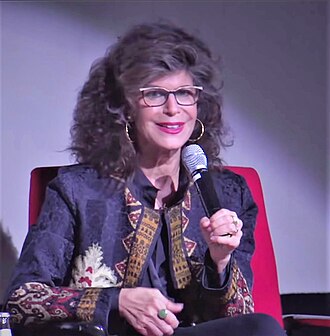
肖莎娜·祖博夫 主主持人托比 克克里斯蒂安·卡岑巴赫
EDITED TRANSCRIPT · 依据现场录音编译整理,可划线生成便签
二〇一九年十一月,柏林墙倒塌三十周年前夕,哈佛商学院荣休教授、《监控资本主义时代》作者肖莎娜·祖博夫应洪堡互联网与社会研究所(HIIG)与德国联邦公民教育署之邀,在「理解数字社会」讲座系列发表演讲,并与主持人托比亚斯·穆勒及现场观众对谈。这场讲座同时也是学术会议「网络社会中的传播自动化」的开幕场。本文依据现场录音编译整理。

开场致辞

致辞人: 欢迎各位来到「理解数字社会」讲座系列。看到今晚来了这么多人,我很高兴。我们已经决定明年继续举办这个系列,期待届时再见到大家。自二〇一七年十二月起,我们与洪堡互联网与社会研究所合作,考察数字技术如何改变我们的社会,以及欧洲人该如何看待这些转变。系列中已有多位讲者登台:曼纽尔·卡斯特讨论数字社会中的权力,伊娃·易洛思谈资本主义主体性与互联网,上一讲阿明·纳塞希问的是,数字化究竟是哪个问题的解答。

致辞人: 这些天我们正在纪念一九八九年东德的和平抗议与柏林墙的倒塌,而这个系列的几个核心问题依然紧要:数字社会中的权力如何表现,如何分配?我们见证的是民主借透明与参与而复兴,还是民主因公共领域碎片化、私人领域受挤压而衰落?三十年前,东德公民为了能自由表达意见、摆脱无处不在的监控而走上街头。今天,多数人明知持续监控潜藏危险,却心甘情愿地把自己交给各种数字平台的生态系统,成了数据的供应者,说得夸张一点,成了少数几家数字公司的产品。要共同塑造数字变革,我们就必须持续分析这些趋势,并在社会中展开辩论。正是在这个背景下,我很荣幸地欢迎肖莎娜·祖博夫。她的著作《监控资本主义时代》令人印象深刻,揭示了互联网公司的垄断权力对自主与民主构成的威胁。感谢您接受邀请。下面请洪堡研究所的克里斯蒂安·卡茨巴赫致辞,祝各位度过一个引人入胜的夜晚。

卡茨巴赫: 晚上好。我谨代表洪堡互联网与社会研究所和德国传播学会欢迎各位。今晚特别,有两个原因。首先当然是因为我们尊贵的客人肖莎娜·祖博夫,她无疑是当代最重要的批判性分析者之一。她审视当代资本主义的转型,而这一转型正在深刻改变我们组织和经营社会、经济、政治与私人生活的方式。以这样的主题和视野,她是「理解数字社会」系列最合适的讲者,也是最耀眼的一场。这个系列近两年前由卡斯特开讲,至今已邀请近十二位杰出而多产的学者。系列的宗旨是,既要直面关于新兴数字社会的宏观问题,又要立足严谨的实证研究。从我们这本书里可以看出,祖博夫在这方面做足了功课。这类讲座每场都座无虚席,说明它触到了时代的神经,而今晚显然创下了新高。我很高兴这个系列能延续到第三年,感谢联邦公民教育署的托马斯·克吕格与萨沙·沙伊尔的合作与支持。

卡茨巴赫: 今晚特别的第二个原因是,这也是系列中的第一次:今天的讲座不仅属于讲座系列,还揭开了接下来两天在柏林举行的学术会议「网络社会中的传播自动化:语境、后果与批判」。请允许我也向在座的会议与会者与讲者致以欢迎。今晚的酒会上,你们大概能进行比往常更有信息量的交谈。这是德国传播学会数字传播分会的年会,今年由魏岑鲍姆网络社会研究所与洪堡研究所联合主办。看到柏林这两家德国互联网研究所携手合作,我深感欣慰,我们正共同壮大这座城市研究数字转型的学术群体。会议以「自动化」为主题,是想让当下关于人工智能与算法的热烈争论多一些历史纵深与语境。既然资本主义与自动化关系如此紧密,还有谁比一位研究资本主义及其数字转型的专家更适合为会议开场?肖莎娜,我们非常荣幸您今天来到柏林。在您登台之前,我把话筒交给今晚的主持人托比亚斯·穆勒,他是介绍讲者的高手,各位的耐心会有回报。

主持人引言

主持人: 大家晚上好。大约一年前,今晚这位备受期待的嘉宾在电话里告诉我,她大概会出门三四个星期。结果远不止于此:由于《监控资本主义时代》的巨大成功,她已经在外奔波了十一个月,大部分时间不在家。「家」这个概念,与「流亡」相对,也贯穿在她的著作里:家是一个相对不受暴力、剥削与无力感侵扰的空间。三十一年前,她在第一本书《智能机器时代:未来的工作与权力》里就提出了家还是流亡的问题。今天她说,工作只是开篇一章,此后的一生她都在追问同一个问题:数字的未来,能成为我们的家吗?

主持人: 各位已经听到,今晚的活动也属于「理解数字社会」系列。我们在这个系列里谈了很多数字技术对社会的影响,也反复谈到一个众所周知难以界定的词:资本主义。晚期资本主义、新自由主义资本主义、平台资本主义,这个词像一块巨石,或者说好几块巨石,形状模糊、色泽黯淡、极难撼动,一条思路想绕过去都不容易,一场对话想成形更是困难。今晚,这两样东西终于汇合,一同站到台前:技术的冲击,与资本主义。因为我们的嘉宾几十年来研究的正是,不同形态的资本主义如何决定技术冲击的性质,又如何塑造它的后果。她日益急切的警告在德国也有人倾听,并得到了相应的版面:已故的《法兰克福汇报》发行人、副刊主编弗兰克·席尔马赫,曾两次组织翻译她的文章,把这些思想的论辩力量传递到报纸的读者中。

主持人: 她的著作令人钦佩,履历同样如此:她是哈佛商学院最早获得终身教职的女性之一。不过,在连续十一个月隔天就听人念一遍自己简历之后,她请我不要再念,随意一些。我觉得这很清爽。想必大家都查过维基百科,或者更好,已经读过她的书。说到清爽,今晚我们要试一样新东西,让观众参与更集中,性别与年龄也更多样。这个工具叫 Slido,大家可以在上面输入问题,并为别人的问题投票,这样能保证被选出的问题也是其他人关心的。问题将由洪堡研究所的同事读出。场内也有两支话筒,但今晚人太多,传递不便,用话筒提问的只能是少数,请尽量使用这个工具。我希望它不属于监控资本主义的复合体。时间有限,请不要借提问发表演讲,这一点当然对我自己也适用。

主持人: 在嘉宾登台之前,我让别人替我说几句对这本书的评价。《纽约时报》写道:「祖博夫不热衷于开处方,她提出以人道原则为基础的『庇护权』,类似于日益受到威胁的『避难权』;但她要的是更大的东西:搭起一套批判思考的脚手架,供我们审视数字时代的重大危机。通过她,我们明白了北方的朋友们说得对:脸书就是问题,谷歌、微软、亚马逊也是。这是一本罕见的、我们可以信赖的书,它将带我们走上漫长而艰难的理解之路。」伦敦《卫报》把这本书列入二十一世纪最重要的一百本书。伦敦作家扎迪·史密斯写道:「祖博夫关注的是有史以来最大规模的资本主义殖民行动,只不过这次被殖民的是我们的心灵、我们的行为、我们的自由意志、我们自身。这不是一本反技术的书,它反对的是不受约束、张牙舞爪的资本主义。这是这一代人的《资本论》。」最后是娜奥米·克莱因:「时间已晚,失去的已经很多,但正如这本不可或缺的书告诉我们的,解放仍有希望。」克莱因点到了书中的补救部分,我想这在今晚会占一定分量。不过大家听到的不会是《监控资本主义时代:在权力新前沿为人类未来而战》的摘要,而是她与剑桥大学出版社合作的下一本书的一些思路:监控资本主义制造的认知不平等,以及它为何威胁民主。请欢迎肖莎娜·祖博夫。

一九九七年的辩论

祖博夫: 谢谢托比亚斯,谢谢你对这部作品的欣赏。谢谢克里斯蒂安,谢谢托马斯。能来柏林谈这项工作,对我是美好的一夜。托比亚斯提到了我的朋友弗兰克·席尔马赫,我想把今晚的演讲献给弗兰克。是弗兰克把我引到柏林,让我爱上了这座城市。我觉得我的一部分心一直住在这里,永远如此。真希望他今晚能和我们在一起。

祖博夫: 今晚我想做几件事。我会谈书里的一些想法,但也想把它们往前推,推向它们的含义,推向对补救之道更仔细的思考。我们如何一起穿过并超越这个监控资本主义的时代?读过这本书,或者至少读过第一页和最后一页的人知道,我在最后一页写道:监控资本主义时代,愿它短暂。而这当然取决于我们。

祖博夫: 托比亚斯说到《纽约时报》,我也从《纽约时报》开始。先解释一下什么是联邦贸易委员会:这是美国如今对互联网商业拥有最多管辖权的机构,谈到监管监控资本主义者,说的就是它。一位《纽约时报》记者报道了联邦贸易委员会里一场关于隐私、个人权利与法律的辩论,他说辩论「异常激烈」。业界与公民社会都有代表出席。业界高管的主张是,「他们有能力自我监管,政府干预将代价高昂,并且,请记住这个词,我们后面还会回来,适得其反」。公民自由派则警告,这些公司的数据收集与分析能力「对个人自由构成前所未有的威胁」。还有一位公民社会组织的代表说:「我们必须决定,在电子时代人究竟是什么。我们是不是就要沦为商业的牲畜?」最后,一位委员提问:「我们该把界线画在哪里?」这一切听起来都很熟悉,是不是?熟悉的辩论,熟悉的立场。这篇文章有意思的地方在于,它发表于一九九七年。

祖博夫: 我想大家都知道这个故事的结局,知道谁赢了这场辩论。高管们赢了,他们要什么就得到了什么。在美国,比在德国和欧洲更甚,但即便相对而言,法律近乎空白,他们想做什么就能做什么。监控资本主义,就是这场胜利的果实。而战线早在一九九七年、互联网的黎明时分就已划定。

祖博夫: 那么什么是监控资本主义?它建立在一个发现之上:私人的人类经验,是最后一片可供开采、生产、商品化与出售的原始森林。人,也就是我们,真的成了商业的牲畜,事情就是这样发生的。后果正在动摇民主的根基,改变我们的日常生活,挑战我们从启蒙运动继承的社会契约,并且威胁到人类自由本身能否存续。民主虽然四面受敌,却是对这一切唯一可能的补救。这当然也是我们今晚在此的原因。

仙境里学到的事

祖博夫: 我常这样想这件事。大家都知道《爱丽丝梦游仙境》的故事,记得那只揣着表的白兔吗?他匆匆忙忙,「我要迟到了,有个非常重要的约会」,然后钻进兔子洞。我的理解是,二十年前我们都是爱丽丝,遇到了白兔,看到他往洞里冲,就像爱丽丝一样跟了进去,跟着白兔进了仙境。在仙境里我们学到了一些事,花了二十年才学会。

祖博夫: 首先,我们以为我们在搜索谷歌。二十年后的今天,一种脆弱的新意识正在浮现:与其说我们搜索谷歌,不如说谷歌在搜索我们。在仙境里,我们以为我们在使用社交媒体,现在开始明白,是社交媒体在使用我们。我们以为这些是很棒的免费服务,而这些公司想的是:这些人真棒,是我们新的分析、生产与销售业务的免费原材料。我们的电视机、我们的床垫居然附带隐私政策,我们几乎没有质疑过,现在才开始明白,隐私政策实际上是监控政策。我们把科技巨头当作创新企业来敬仰,这些创新企业偶尔犯些大错,侵犯了我们的隐私。现在的区别是,我们开始明白,那些错误就是创新本身。那些错误,就是创新。

祖博夫: 在仙境里,我们学会了相信隐私是私人的事。我们没有认真面对一个深刻的区别:一个珍视个人主权原则的社会,与一个靠单向镜(one-way mirror)的社会关系运转的社会。隐私不是私人的事。隐私是一个集体行动问题,是一个政治挑战,关乎我们生活在什么样的社会里。最后,也是我们最危险的幻觉:在仙境里,我们相信互联网让我们空前地接近专有知识。而在监控资本主义刺眼的光线下,我们终于明白,是专有知识空前地接近了我们。

认知不平等

祖博夫: 数字世纪本该是民主的黄金时代。然而我们步入二十一世纪的第三个十年时,伴随的却是一种极端的新型社会不平等,它威胁着重塑社会,同时瓦解民主。这种新不平等的基础,不是我们能挣到什么,而是我们能学到什么。它标志着一个焦点的转移:从生产手段的所有权,转向意义生产的所有权。这就是我所说的认知不平等(epistemic inequality):获取知识的机会不平等,而这种不平等如今由私人商业机制强加于人,这些机制捕获、生产、分析并出售信息。最典型的例证,是我们所知道的与他们能知道的关于我们的东西之间日益扩大的深渊。关于我们的不平等知识,产生了凌驾于我们之上的不平等权力。于是深渊进一步扩大,标示出我们能做什么与我们会被怎样对待之间的距离。这些不断扩大的不对称,注定使认知不平等成为我们时代的一场关键社会较量。

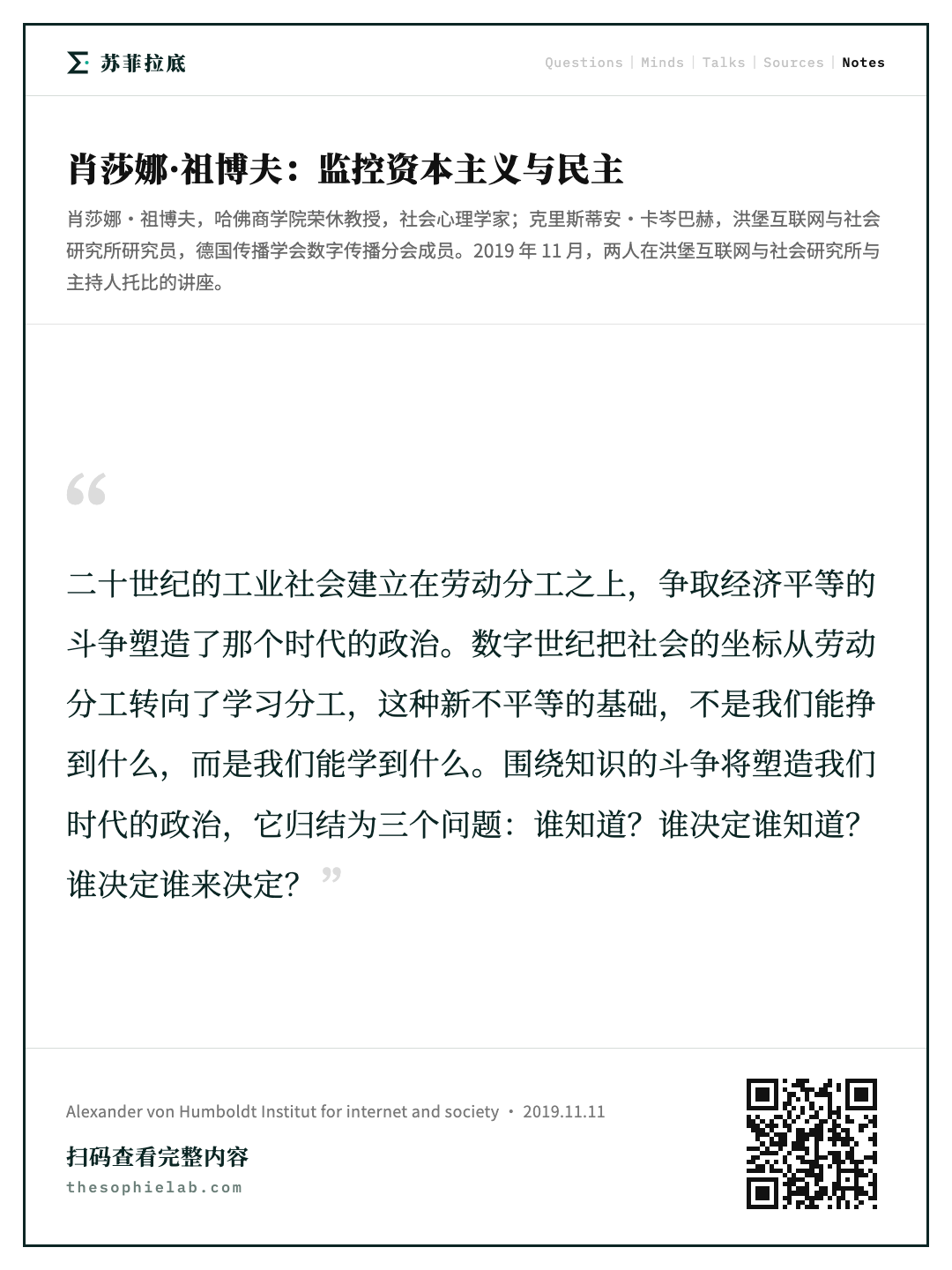
祖博夫: 二十世纪的工业社会建立在劳动分工之上,因此争取经济平等的斗争塑造了那个时代的政治。我们的数字世纪把社会的坐标从劳动分工转向了学习分工,因此,围绕知识的获取以及知识所赋予的权力的斗争,将塑造我们时代的政治。这些较量围绕关于知识、权威与权力的三个根本问题展开,它们框定了为认知权利与认知正义而进行的斗争。三个问题:谁知道?谁决定谁知道?谁决定谁来决定?这些问题的答案,将决定走出仙境之后平等的命运。

监控资本主义的运作

祖博夫: 我们来谈谈监控资本主义,因为这种不平等正是在它的后台运作中锻造出来的。这些单向镜式的运作,是为了让我们无知而设计的,包裹在一层由修辞误导、委婉语和谎言构成的迷雾里。监控资本主义在数字世纪之交发明于谷歌,起点是对私人人类经验的秘密窃取,并宣称这些经验是可以转译为行为数据的免费原材料。这些行为数据流经复杂的供应链,经由设备、应用程序和第三方,被送入一种新型工厂,即所谓人工智能或机器智能的计算工厂。和所有工厂一样,那里把数据制造成产品,但这是一种特殊的计算产品:行为预测,预测我们不久之后和更远的将来会做什么。

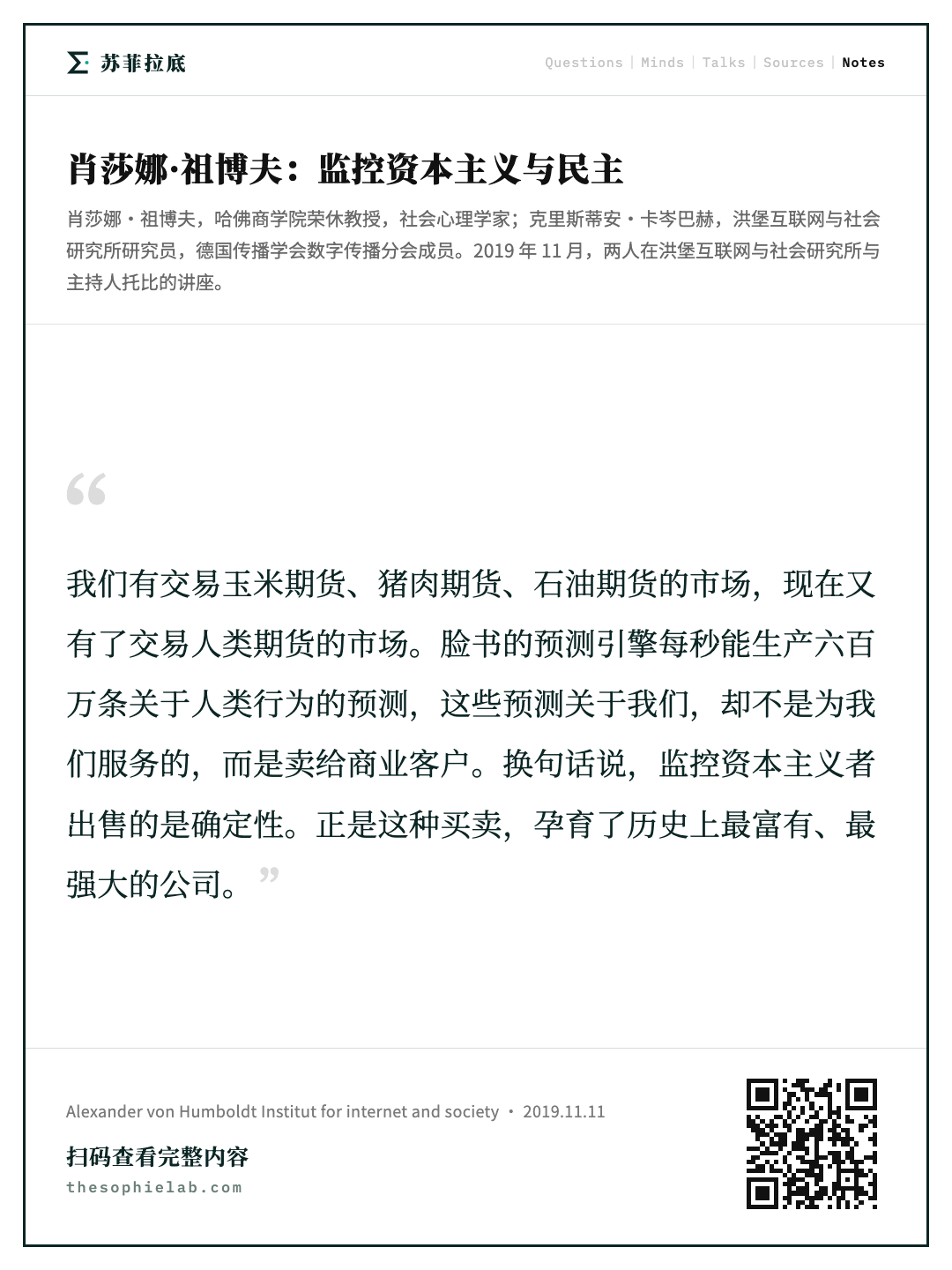
祖博夫: 如果各位觉得我夸大其词,请看一份泄露的脸书文件。我要强调「泄露」这个词:我们竟然要依赖泄露的文件和吹哨人才能了解这些后台里发生了什么,这太荒唐了。这份文件大约两年前流出,有些人也许读过,讲的是脸书的计算工厂,他们称之为「预测引擎」。他们描述自己的人工智能中枢如何运作,指出它每天能吸收数万亿个数据点,公司现在每秒能生产六百万条关于人类行为的预测。这就是工厂内部的情形。这些预测关于我们,却不是为我们服务的。它们去了哪里?卖给了商业客户。事实证明企业对我们将要做什么非常感兴趣,对我们的未来非常感兴趣。所以这些预测被卖给商业客户,在一种新型市场里交易,这种市场专门买卖人类期货(human futures),买卖我们的未来。我们有交易玉米期货、猪肉期货、石油期货的市场,现在又有了交易人类期货的市场。换句话说,监控资本主义者出售的是确定性。这意味着他们彼此竞争的,是预测的质量。正是这种买卖,孕育了历史上最富有、最强大的公司。

监控红利

祖博夫: 这一切发明于谷歌,发明过程始于二〇〇〇到二〇〇一年,而我们直到二〇〇四年公司上市、被迫公开首次公开募股文件时,才开始有所了解。先说一下背景:他们为什么要发明监控资本主义?大家还记得二〇〇〇年是什么年份吗?这个房间里很多人不记得,要么还没出生,要么太小。二〇〇〇年是所谓的互联网泡沫破裂之年,硅谷人人都在赔钱,人人恐慌。正是那时,谷歌宣布进入紧急状态,宣布了那个著名的「例外状态」,放弃他们此前所有的价值与原则,于是发明了监控资本主义。关键是,他们在二〇〇〇年陷入财务危机,因为找不到变现的办法,他们自己的风险投资人威胁要撤资。

祖博夫: 回到故事。二〇〇〇年到二〇〇四年,正是他们发明这套新逻辑并开始应用的那几年,营收增长了多少?三千五百九十个百分点。这是个惊人的数字,它代表了我所称的监控红利(surveillance dividend)。要不是我刚描述的这套监控资本主义的新逻辑,这个数字不会存在。监控红利做了什么?几乎一夜之间,它抬高了每一笔投资的门槛,先是在硅谷和科技行业,最终当然波及我们经济的所有部门。设想你是风险投资人,是投资者,是华尔街分析师:你可以投一家四五年内营收增长三千五百九十个百分点的公司,也可以投一家按老办法创新的公司,像亨利·福特那样,真的发明一件人人都想要的产品。你会投哪一家?答案显而易见。

祖博夫: 所以我们学到了什么?监控红利是核心。监控资本主义产生监控红利,而监控红利推动这套逻辑不仅穿透科技行业,也穿透了整个经济。监控资本主义不等于技术。监控资本主义不是数字技术的必然后果。监控资本主义不限于科技公司,它正在重新定义每个行业的企业。

祖博夫: 我给各位讲一个追逐监控红利的好故事,讲我们经济内部正在发生的事。为了让它完全对称,我们回到二十世纪初的福特汽车公司,我们所知的大规模生产的诞生地。记得福特T型车吗?亨利·福特,T型车,在 iPod 出现之前史上最畅销的产品。今天的福特汽车公司有一位新总裁,不是亨利·福特,叫吉姆·哈克特。有些人可能知道,他面对的是全球汽车销量下滑,而且不会回升。福特的总裁该怎么办?如果你是亨利·福特,你可能会说:我们来发明一款让人非买不可的车吧,一款完全买得起、不烧一点碳的车,怎么样?这是个好主意,但福特公司不是这么干的。哈克特先生说,我要像脸书和谷歌那样吸引投资,所以我得找到数据。等一下,我有个好主意,他说,有一亿人在开福特车,我们从这些人身上采集数据流,再和福特信贷业务里的数据合并,他说,在那里我们已经掌握了你的一切。这样我们就有了一个可与谷歌、脸书比肩的数据集、数据流,谁会不想投资我们?这是在追逐监控红利。他说,不再是汽车了,我们现在是一个交通运营系统。追逐监控红利。一位华尔街分析师是这样评论的,请听:这是个好主意,福特把这些数据流变现能赚大钱,他们不需要工程师,不需要工人,不需要工厂,不需要经销商。纯利润。他们能发大财。

从规模到行动

祖博夫: 现在大家有了图景。我们来顺着钱走,这就是全部要点:一种人造的经济逻辑,我们顺着钱走,看它把我们带到哪里。要顺着钱走,就得看这种市场内部的竞争动力。记住这是什么市场,它买卖人类期货。我知道这是柏林,各位不习惯和讲者互动,我是美国人,没办法,我得听到你们的声音,得知道你们跟着我。我们说了,监控资本主义者出售确定性,所以他们在预测上竞争。我们把这种竞争动力反向拆解,看看能发现什么。

祖博夫: 第一,大家都知道人工智能需要大量数据。所以第一条是规模经济,驱使他们追求信息的总体性,要有规模化的数据。这一条容易。在规模上竞争很好,但还不够好,因为他们最终意识到,我们需要大量数据,但也需要各种各样的数据。(顺便说一句,这里有几瓶很好的水,但没开过,我得当着各位的面来开,你们会看到我有多笨手笨脚。好,开了。请原谅,我有点感冒,喝水是好的。)我们不仅需要规模经济,还需要范围经济,不同种类的数据。

祖博夫: 即便各位不记得互联网泡沫,很多人总记得移动革命吧?这个想法是,我们给你一台小电脑,你把它放进口袋,走到哪儿带到哪儿,我们就叫它「手机」吧,管它叫什么。这样我们就能获得范围经济:你在哪里,你在谈什么,你和谁在一起,你在做什么交易,也许你在哪儿吃饭,吃了什么,给谁发邮件、发短信,你在公园或城里散步时浏览什么。我们能拿到你的声音,能拿到各种东西。别忘了,用这台新电脑我们能拿到的最重要的东西是什么?你的脸。我们能拿到你所有的脸。

祖博夫: 有了规模经济和范围经济,预测继续演进,竞争继续加剧,很快出现了新的认识:最有预测力的数据,来自对你的行为的干预。干预你的行为,干预局面,以便真正地推动、哄劝、调校、驱赶你的行为,朝着我们向商业客户担保的结果,朝着我们的营收,最终朝着我们的利润。这是新东西。这不只是我们熟悉的规模和范围,而是全新的东西。

从监测到操控

祖博夫: 这一过程与数据科学家谈论的一种转变相吻合,他们称之为从监测到操控(from monitoring to actuation)的转变。在系统管理中有这样一个节点:你对一个系统掌握的信息如此之多,多到越过了某个临界点,信息如瀑布般倾泻,于是你就可以开始远程控制这个系统了。你对它了解得如此透彻,以至于能远程控制它。这发生在机器系统的管理中。但现在的想法是,如何让它在人类系统的管理中奏效?人类系统,从监测到操控。这是从未有人做过的事,规模化地、自动化地做。这就是我所称的行动经济(economies of action)。规模经济、范围经济,我们熟悉;行动经济:如何在规模上自动化地远程控制人类行为。

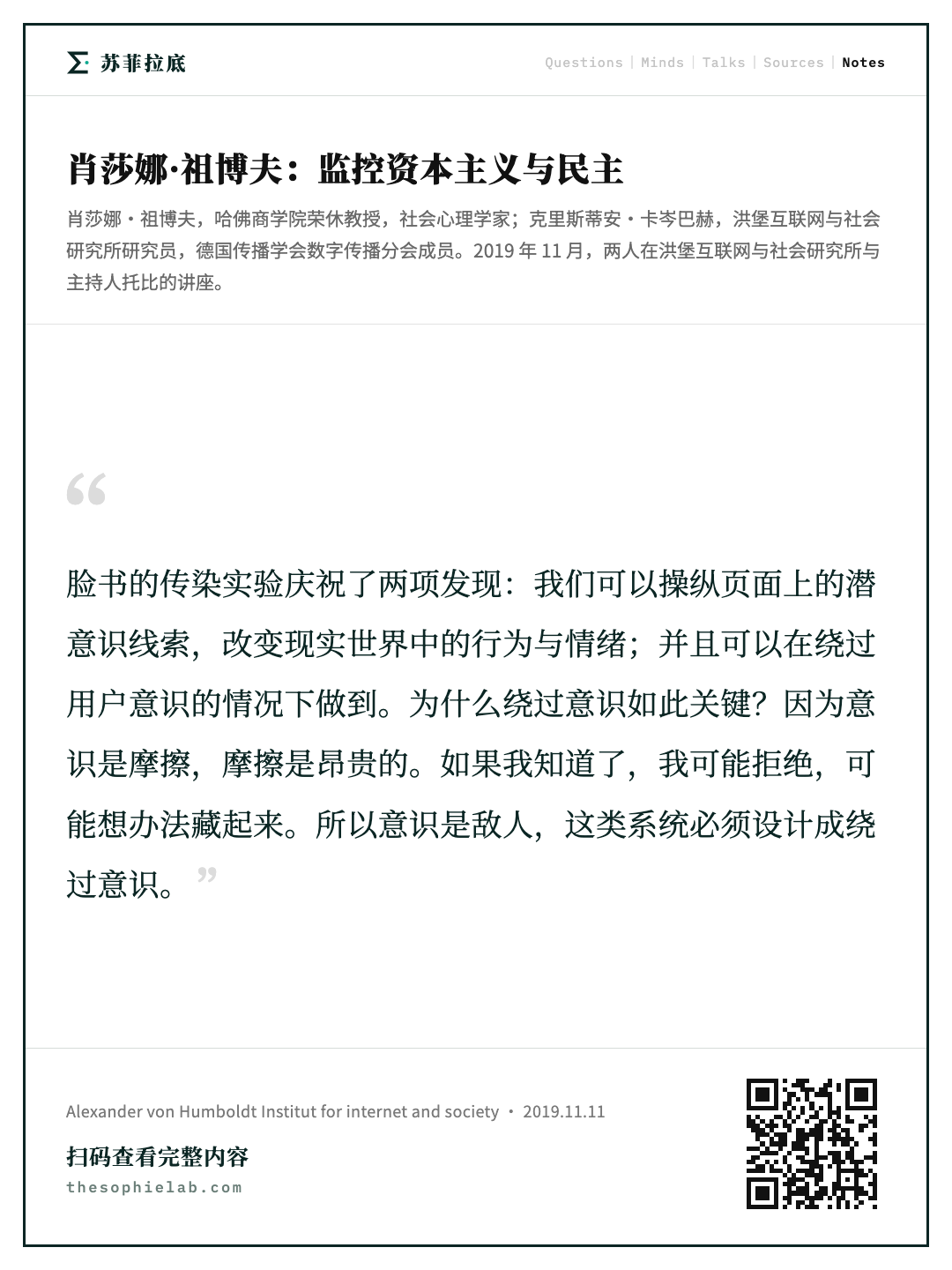
祖博夫: 这是一个全新的实验区,前所未有。正如我开头所说,这些是后台运作,很难了解。但事实证明,有些实验就藏在明处,我们能从中学到东西。有一件事你们大概读到过,年纪够大的人知道:脸书所谓的「大规模传染实验」。他们做了两次,一次二〇一二年发表,一次二〇一四年。第一次是看能否改变人们的投票行为,不一定是投给谁,而是让人去投票而不是不投。第二次是看能否改变人们的情绪,让他们更快乐或更悲伤。研究人员在二〇一二年和二〇一四年写这些实验时,庆祝了两项发现。第一,我们现在知道,我们可以操纵脸书页面上的潜意识线索和社会比较动态,从而改变现实世界中的行为与情绪。第二,我们现在知道,我们可以在绕过用户意识的情况下做到这一点。不会被察觉,他们永远不知道我们在做什么。

祖博夫: 这正是行动经济成功的关键。为什么?因为意识是摩擦,摩擦是昂贵的。如果我知道了,我可能拒绝,可能想办法藏起来,可能想办法伪装。所以意识是摩擦,意识是敌人,这类系统必须设计成绕过意识。

宝可梦与人类期货

祖博夫: 传染实验之后,我们来到一个更精巧的实验区,我肯定各位知道这件事。这个房间里有多少人曾经走上柏林街头,和朋友家人一起玩《宝可梦 GO》?来吧,观众参与,可以坦白,我们都是朋友。别害羞,我知道你们没说实话。那各位知道《宝可梦 GO》出自谷歌吗?知道,是因为读了我的书吗?《宝可梦 GO》是在谷歌内部孵化的。德国以第一个抵制街景(Street View)的国家而著名,而《宝可梦 GO》的发明者,正是当年街景的负责人,也是此前发明谷歌地球的人。谷歌地球以前叫「钥匙孔」(Keyhole),在被谷歌收购之前接受过中央情报局的投资。这个人叫约翰·汉克,他有一段长长的履历,专长就是如何填满通往新工厂的供应链。汉克在谷歌内部有个小作坊,叫 Niantic 实验室,那里孵化了这些新的增强现实游戏,包括《宝可梦 GO》。推向市场时,他们当然与谷歌拉开了距离,Niantic 成了一家独立的小公司,这样谁也不知道它出自谷歌。事实证明,你玩《宝可梦 GO》的时候,其实是在一个更大的游戏里玩一个小游戏。

祖博夫: 回到监控资本主义的第一轮。第一个真正成功的预测产品是什么?是点击率。我们把它想成点击率,但只要多想几秒钟就会明白,点击率是一个计算碎片,预测的是一小块人类行为。第一个人类期货市场是什么?就是出售这些点击率、这些预测的地方。那第一个极其赚钱的人类期货市场,叫在线定向广告,至今仍极其赚钱。而在《宝可梦 GO》里,我们看到同一结构被移植到了现实世界。Niantic 建立了自己的人类期货市场,它的商业客户不在线上,而在现实生活里:麦当劳、星巴克,真实的店铺,真实的场所,或者乔家披萨、哈利酒吧。这些企业付钱,买的不是有保障的点击,而是有保障的客流(footfall):真实的脚,落在真实地方的真实地板上。《宝可梦 GO》的构想就是,如何利用游戏化的奖惩机制,把人群驱赶着穿过城市,走到他们的脚被担保会出现的地方。这是行动经济的又一阶段。

抓住最脆弱的一刻

祖博夫: 再往后一点还有一个阶段,我们回到脸书。这来自另一份泄露文件,由脸书高管为其澳大利亚和新西兰客户所写。我一直以为写文件的高管是澳大利亚人,但并不确定。这份报告向商业客户推销这样一个想法:记住「从监测到操控」,我们现在掌握了澳大利亚和新西兰六百四十万年轻人的信息,高中生、大学生和青年,多到可以按天、按周预测他们的情绪状态。我们能看到他们一周七天的情绪周期,能预测他们在周期中的位置。我们能预测他们何时感到压力、挫败、不堪重负、焦虑、紧张、愚蠢、可笑、无用,或者觉得自己是个失败者。凭这些预测,我们能提醒你抓住他们最脆弱的确切时刻,此时你若发出一条带有「信心加持」的信息,就会成功。比方说,你有一件性感的黑皮夹克要卖,我们能告诉你何时卖、怎么卖、信息里说什么。顺便说一句,一定要在周四晚上卖,因为那是他们最焦虑的时候,周末即将来临。告诉他们第二天早上可以免费送到家门口,再加一点折扣,我们保证你成功。这是行动经济的又一阶段,从监测到操控。

祖博夫: 最后,就在我们说话的此刻,下一个阶段正在揭开面纱。关注智慧城市动态的人也许知道,前几天多伦多的官员对人行道实验室(Sidewalk Labs)做出了一些决定。人行道实验室是谷歌,或者说 Alphabet 旗下专攻智慧城市的子公司。他们以前把它叫「谷歌城」,现在不这么叫了,改叫智慧城市。他们想把多伦多滨水区重建为一座谷歌城,这件事已经争了两年多,许多市民参与进来,前几天多伦多的一些官员做出了一个很好的决定,大幅削减了这个计划。关键在于,当你去看人行道实验室提案背后的文件,就在上周《环球邮报》挖出了一批从未经公众审阅的秘密文件并将其公开,你会发现,带着我们刚谈的东西去读这些文件,它们无非是一份对认知支配的公开宣言,以及要利用这种支配进行规模化行为修正的意图。细节我不展开,但请相信我。

工具主义权力

祖博夫: 有时有人对我说:肖莎娜,你说的我明白,可是企业、广告商、商业,一直都在试图说服人,试图改变人的行为,让他们买本来不想买的东西,所以这没什么新鲜的。这当然是真的。我们想说服彼此去做本来不会做、甚至根本不想做的事,这一点毫不新鲜。人类的说服术并不新鲜。但我们不能失去方向感。这里新的是:历史上从未有哪个时刻,最富有的私人公司手里握有一套无处不在的全球性计算架构,能够积聚关于个人、群体与人口的空前集中的信息,足以推动从监测到操控的转向,远程地、规模化地操控行为。朋友们,这是前所未有的。

祖博夫: 这是一种什么样的新权力?它通过数字仪器的介质施行意志。它不派人夜里到我们家里把我们送去古拉格或集中营,不以谋杀或恐怖威胁我们。它不是极权主义权力。但它是一种全新的、前所未有的权力形式,正如极权主义在二十世纪以一种前所未有的新权力面目出现一样。我把这种新权力叫作工具主义权力(instrumentarian power)。它远程施行意志,悄悄地、秘密地来到我们身边,如果我们察觉到它,它也许还会端着一杯卡布奇诺、带着微笑迎接我们。然而它是一套全球性的行为修正手段,是监控资本主义的增长引擎。

祖博夫: 到这里,我们已经爬上了学习分工这座山,窥见了堡垒内部,看到了人工智能中枢,看到了这些后台运作。我们发现了什么?一片由天才运营、由巨额资本供养的前沿地带。他们在解决气候危机吗?在治愈癌症吗?在想办法清除那些连北极雪里都能检出的塑料微粒吗?没有,他们什么也没做。所有这些天才、所有这些资本,都用来知道关于我们的一切,并把这些知识转向为了利润而远程控制人。我不喜欢这样。监控资本主义时代,就是这样成为一个征服的时代。

剑桥分析只是寄生虫

祖博夫: 我们本该在这一切中梦游,本该无知,这是为我们的无知而设计的。马克·扎克伯格说:隐私就是未来。太让人困惑了。他们真的以为我们是傻子。正因为我们本该梦游,一旦有什么东西从雾里浮出来给我们送信,那就太疯狂了,会真正抓住我们的注意力。剑桥分析事件就是如此,不是吗?吹哨人克里斯·怀利说,这就是我们一直在做的事。我们花一分钟看看怀利说剑桥分析做了什么。他说:「我们利用脸书收割了数百万人的资料,然后建立模型,利用我们对他们的了解,瞄准他们内心的魔鬼。」听着熟悉吗?他说,目标是行为微定向,不是根据人口特征而是根据人格来影响选民。熟悉吗?他说,我觉得这比霸凌更糟,因为至少被霸凌的人知道自己遭遇了什么,还有某种能动性;而我们做的事,人们根本不知道自己遭遇了什么。他说,如果你不尊重人的能动性,那么此后你做的任何事都无益于民主。这倒是千真万确。

祖博夫: 他的结论是:剑桥分析就是信息战。他正确地承认,信息战源于认知不平等,没有信息支配、信息优势,信息战无从发动。但直到今天仍未被充分理解的是,剑桥分析只不过重复了每一个自命不凡的监控资本主义者的日常机制与方法。对于澳大利亚和新西兰那些社交焦虑被拿来牟利的年轻人所遭受的对待,还有什么比「我们建立模型,利用他们内心的魔鬼」更贴切的描述?这家政治咨询公司吸引了全世界的注意力,至今仍然如此,可它不过是一只寄生虫。寄生虫寄居在宿主身上,而宿主不只是脸书,宿主是监控资本主义本身。研究信息战的人说,信息战的成功需要三样东西:条件、武器和机会。这三样都是监控资本主义提供的。是监控资本主义通过对人类经验无所不在的数据化提供了条件。是监控资本主义提供了武器:数据、方法与机制,预测分析,对个人的贴身模拟,行为微定向,潜意识影响的技术,对社会比较动态的操纵,对隐蔽实时实验的娴熟掌握,全都是监控资本主义率先开创的。最后,是监控资本主义提供了机会,也就是这样一个事实:所有这些机制都可以在完全绕开人类意识的情况下运用,一切都可以秘密进行,这为成功的信息战提供了巨大的机会。结论只能是:我们未能认识到的,不是剑桥分析代表了信息战,也不是信息战仅仅是国家或者越来越多的非国家政治行动者的职能,而是监控资本主义及其对知识与权力的非法运用,最好被理解为信息战为了利润而被常态化、制度化。这就是我们今天生活的世界。

出路:切断供给与需求

祖博夫: 我想以几点思考结束,好让我们一会儿开灯时不至于人人沮丧。各位也许从我略显疲惫的声音里听不出来,但我对我们改变这一切的能力其实非常乐观。坦白说,我的一部分乐观来自你们的国家,来自看到你们国家、这座城市的几代人如何学会面对并内化极权主义的教训,彻底改变了你们的文化肌理、你们的制度和法律。我对此深怀敬意。这也提醒我们一个更大的规律:作为民主社会,我们过去面对过严重的问题,也克服了它们。我们终结了镀金时代,战胜了极权主义,并且动用民主的杠杆确保战后世界成为普通人富足的世界,成为中产阶级的时代,让市场资本主义既能促进民主,又能被民主强化。这是战后年代留下的遗产。

祖博夫: 如今我们明白隐私是一个集体行动问题,而补救之道只能来自一个源头:民主。这意味着法律,意味着新的监管范式。和托比亚斯对谈时可以谈更多细节,但我想请各位注意两件我认为迫在眉睫的事。一旦我们开始谈论它们,在想象中习惯它们,它们就不会像我现在说出来那样奇怪了。摆在我们面前的关键任务,是切断监控红利的激励。我们实质上需要把监控红利定为非法。做到这一点,我们就为成千上万、乃至数百万想要生产数字产品与服务的年轻人、创业者和公司打开了竞争空间,他们要应对气候问题,要满足我们的真实需求,要治愈折磨我们的癌症,要做所有我们曾经期待数字技术做的事,而不必再靠监控红利竞争。这才是我们需要的。

祖博夫: 所以我建议两件事:一是切断供给,二是切断需求。切断供给,我指的是,非法地、秘密地、单方面地攫取人类经验并转译为数据,应当被定为违法。监控资本主义者在打的这场仗,就是各位听到的一九九七年那场,至今每一天都在打。他们争的是随时随地夺取我们的脸的权利。他们在街上拿走我们的脸,在公园里拿走我们的脸,想在哪儿拿就在哪儿拿。我们的脸进入他们的面部识别系统,面部识别系统训练出数据集,而我们现在发现,这些数据集常常被卖给军方部门,包括那些把中国西部维吾尔少数族群关进露天监狱的部门,那座监狱唯一的围墙就是面部识别系统。这就是我说隐私不是私人之事的意思。

祖博夫: 切断需求,意思是消除出售人类行为预测的激励。怎么做?我们把交易人类期货的市场定为非法。别的市场也有非法的。交易人体器官的市场是非法的,为什么?因为它对人和民主有可以预见的破坏性后果。买卖奴隶的市场是非法的,因为它有可以预见的破坏性后果。买卖婴儿的市场是非法的,因为它有可以预见的破坏性后果。交易人类期货的市场也应当非法,第一,因为它们是人类自主的敌人,它们的竞争动力要求行动经济,而在行动经济里,人的能动性就是敌人;第二,因为它们必然产生极端的知识不对称以及依附于知识的权力,制造认知不平等与认知不义。

祖博夫: 现在到了结尾。我想对各位说什么?问题不再是你们年纪够不够大、知不知道这些,而是你们够不够年轻。格蕾塔·通贝里说,我们的房子着火了,一句话点出气候危机的灾难。我想说,全球变暖之于地球这座房子,正如监控资本主义之于社会这个家。不只是房子着火了,家也着火了。但这场火不是由气候危机那不可撼动的物理规律点燃的,而是由一种人造的逻辑,一种人造的经济逻辑点燃的。凡是人造的东西,都可以被拆除,我们只需做出决定。就像柏林墙,你们决定了,最终它就倒了。监控资本主义者富有而强大,但他们并非无懈可击。他们有阿喀琉斯之踵,知道是什么吗?他们怕法律。他们怕不糊涂、不被吓倒的立法者。而归根到底,他们怕的是你们,怕准备好站出来、要求一个可以称之为家的数字未来的公民。谢谢。

没有后台的一代

主持人: 非常感谢你对监控资本主义的这番梳理,以及结尾那声战斗的号角。我想从这座城市说起。各位可能意外,我不够老,没有亲眼见证柏林墙倒塌,因为我不是德国人,当时在另一个欧洲小国。但众所周知,东德这个国家严重依赖模拟时代的监控,据估计约有二十万人领国家安全部(史塔西)的薪水,而这个国家只有一千六百万人口。关于模拟监控如何改变行为,德国有过讨论,虽然至今仍是一个不好谈的话题,但讨论是存在的,涉及言论、公共活动、做了什么和没做什么。我想问的是,二〇一三年斯诺登泄密之后,全世界都在报道这件事,可是关于大规模监控如何改变我们的行为、如何把我们的行为痕迹变成商品,公共讨论真的很多吗?你认为监控资本主义至今已经在哪些方面改变了我们的行为?这方面我听到的不多。

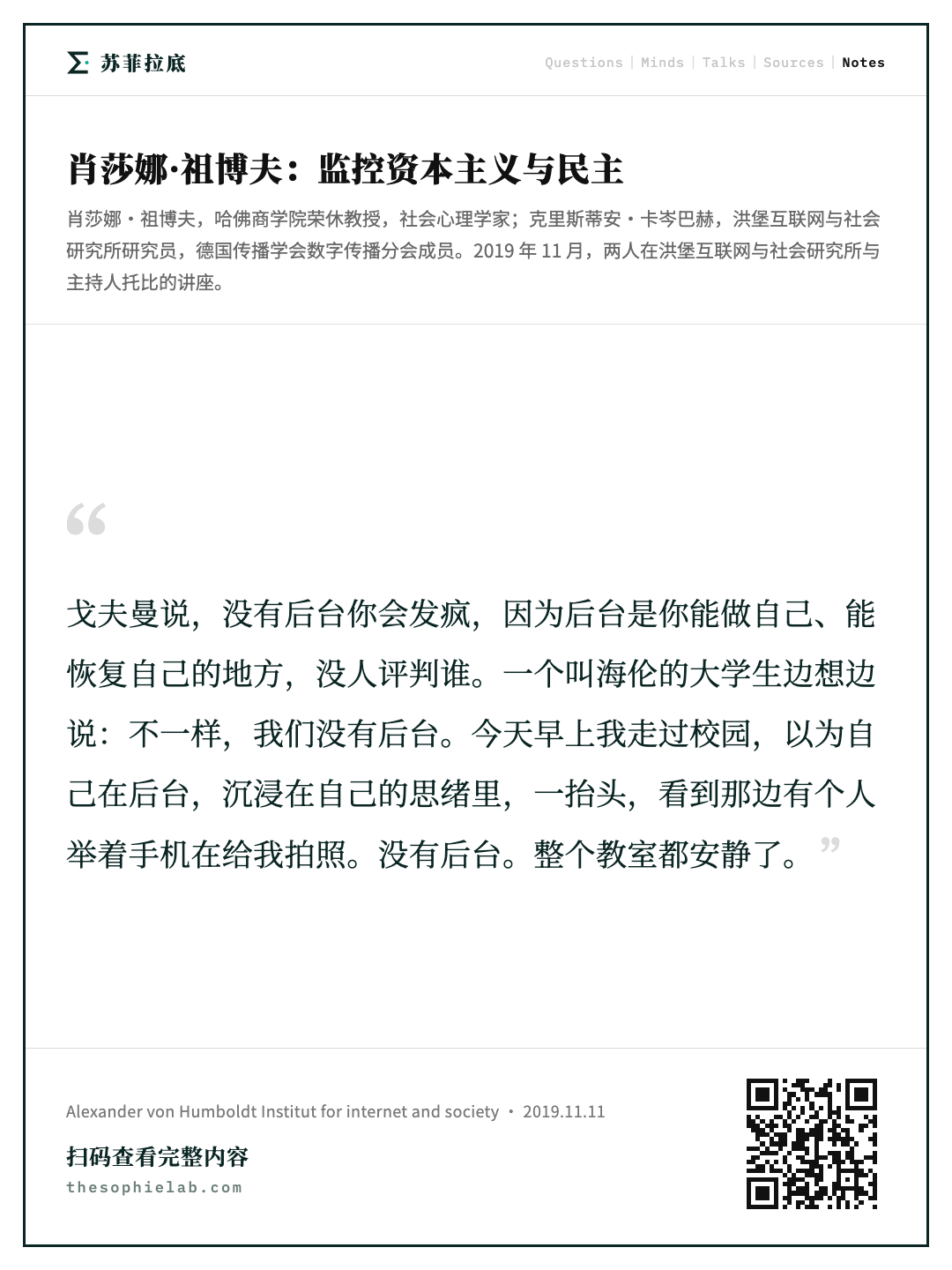
祖博夫: 它确实改变了我们的行为。而且我想,人越年轻,行为越可能已经被改变,也越不可能意识到这一点。我们能看到行为模式的变化,但一个年轻人未必会自觉地意识到,自己的行为正朝着不明的目标被改变。这种陷在青春期心理里的状态,蜂巢式的生活,一种彼此高度调谐的生存方式,年轻人似乎被极深地卷进了这种运作。不过有一个有趣的年龄段,我很喜欢和大学生交谈,这个房间里大概也有。二〇一七年底我有过一次很触动的经历,当时我去加拿大安大略省的金斯顿讲学,我最喜欢和本科生在一起。我们聊到了欧文·戈夫曼,二十世纪中叶伟大的社会理论家,《日常生活中的自我呈现》的作者。戈夫曼属于斯坦利·米尔格拉姆那一代,属于战争和战后环境催生的那批伟大研究。戈夫曼谈自我呈现,提出了「后台」的概念。他的意思基本上是,没有后台你会发疯,因为后台是你能做自己、能恢复自己的地方,大家只是待着,没人评判谁。没有后台,人就会崩掉。这个班很大,学生们一直在读戈夫曼这类理论家。我说,我们谈的这些你们在脸书上做的事,为不同的观众策划自己的人格,这不就是二十一世纪的戈夫曼吗?不就是数字世界里的自我呈现吗?于是有了一场辩论。然后一个年轻女生开始说话,她叫海伦,她是边感受边思考,实时地想。她说:「不一样。我刚刚意识到,不一样,因为我们没有后台。没有任何地方是我的后台。今天早上我走过校园,以为自己在后台,沉浸在自己的思绪里,一抬头,看到那边有个人举着手机在给我拍照。没有后台。」整个房间,一个很大的教室,虽然没今晚这么大,但也是大课,全都安静了。

隐私与心理麻木

主持人: 拍照是谈隐私的一个很有意思的切口。隐私这个概念对你的很多论点都很核心。你开场说「错误就是创新」,那些错误当时被理解为侵犯隐私。稍微回看历史,我想到十九世纪末的新闻摄影,它催生了隐私史上的一份经典文本:塞缪尔·沃伦和路易斯·布兰代斯一八九〇年在《哈佛法律评论》上发表的《隐私权》。剑桥大学荣休哲学教授雷蒙德·戈伊斯讲过这篇经典是怎么来的:沃伦的妻子是一位富有的社交名流,对记者闯入或报道他们举办的派对非常不满。所以是一件非常具体的事催生了这篇经典文本。而今天,人们自己把派对照片贴出去,没人逼他们。我想说的是,从历史上看,隐私是一个非常不稳定的概念,照片这件事就能看出来。那么今天呢?你认为我们能建立一个普遍的隐私概念吗?今天的隐私意味着什么?

祖博夫: 我今天翻自己的材料,又看到扎克伯格那句名言,大概是二〇一一年说的:我们决定不再有隐私,这将是新的社会规范,然后我们就这么干了。隐私原本有一个演化过程。隐私这个概念,只有在心理意义上的个人成长起来、个体化在历史中推进的过程中才有意义。这是一段艰难的演化,值得庆贺,因为有了个人的概念才有了权利的概念,有了权利的概念才有了民主与平等。所以隐私属于一整套价值与感受力,它们对我们民主的健康、民主的可能性至关重要。有意思的是,脸书就这么决定不再有隐私。最初发生了什么?世界爆发了愤怒。我们并没有就这么接受,全世界的人都非常愤怒。就像刚才说的街景,没人知道针对谷歌街景的诉讼到底有多少,但几乎来自地球上每个国家,德国从汉堡开始。有愤怒,有抗议。但这些界线还是被越过了,然后是习惯,是常态化,还有我所说的心理麻木(psychic numbing)。这和刚才海伦说的没有后台是一回事:没有后台,你会以某种方式开始发疯,而为了保护自己不被这种发疯的感觉压垮,你会变得麻木。现在有大量的心理麻木,因为我们越来越多地体验到这个无处可逃的世界,为了自保,我们变得麻木,不再去想它。或者我们用隐私浏览器、广告拦截器安慰自己,研究怎么加密,或者去买那种能罩在脸上、干扰面部识别摄像头的特殊材料。所以我不认为我们放弃了隐私,我们是渴望它,只是它变得不可得,这让我们觉得难受、发疯,我们在保护自己,直到找到一条穿越之路。

祖博夫: 说到这里,托比亚斯,你我之前聊过一点:我相信,如果我们能除掉监控红利,真正打开竞争的场地,那么在这个历史时刻,任何一家能按我们想要的方式提供我们真正想要的东西,而不附带监控红利那些反民主、反平等的外部性的企业,都有机会把地球上每一个人变成它的顾客。因为欧洲的每一份调查、美国的每一份调查都表明,没人想要这些东西,没人喜欢,只是几乎没有别的选择。

与资本主义历史的断裂

主持人: 你提到,二十年前我们以为互联网将赋权消费者,现在却走到了你书里所说的「消费者的终结」:消费者成了利润的原材料,有人称之为劳动,也有别的概念。我想问的是那个转折点:从管理资本主义到分布式资本主义,再到你说的以倡导为导向的资本主义,是什么力量让那场斗争落败,让监控资本主义靠摧毁消费者而胜出?这是延续还是断裂?换句话说,监控资本主义里有多少是一直存在的资本主义,又有多少是真正的断裂?

祖博夫: 我会说两者都是。监控资本主义复制了资本主义古老的演化路径:把市场之外的东西拿进市场,用于商品化、生产与销售。但这一轮的疯狂之处在于,它拿的不是自然,不像工业资本主义把自然拿来变成可买卖的商品,它拿的是人性,是私人的人类经验。这就启动了我们一直在谈的所有其他动力。话虽如此,我认为监控资本主义在一些非常关键的方面偏离了资本主义的历史。让我这样说:监控资本主义与资本主义历史的断裂在于,它不再需要与自己的社会、自己的人口维持有机的互惠。原因有两个。一是它不需要我们作为顾客的来源,我们不是它的顾客,这一点已经说过,不再重复。二是它不需要我们作为雇员的来源。说我们提供劳动并不准确,因为如果我们是劳动,我们就是劳动力,那是一种互惠的来源。别忘了民主:十九世纪末英国民主的扩展,直接源于精英对工人阶级的依赖。他们明白,如果不扩大选举权,为他们工作的人很可能烧掉他们的工厂。这些互惠不是抽象概念,是活生生的现实。消费也一样。有很精彩的史学研究把美国革命看作一场消费者革命:分散各处的殖民地居民最终被塑造成拥有共同政治利益的群体,是因为他们对自己作为消费者所受的对待感到愤怒。他们要抗议时说的是:我们不买你们的产品了,我宁可没有冬衣,宁可不喝茶。这些是民主史内在的真实的东西。所以,他们既不需要我们做消费者,也不需要我们做工人,这是一件大事,与资本主义的历史有天壤之别。我认为这也是一个关键原因:民主与资本主义曾经找到了共处之道,尤其从十九世纪末到二十世纪中叶,市场民主成为一种强大而富足的结构。但只要监控资本主义是主导的市场形态,这种共处就极难维持。

拆分巨头够不够

主持人: 我们切换到新工具。娜塔莉,有问题了吗?

观众提问(代读): 今晚是我们第一次试用这个工具。我们收到了一百五十多个问题,所以按主题做了归类。第一组关于监管和立法者。比如:科技巨头是否应当像伊丽莎白·沃伦提议的那样被拆分?这是一条可行的路吗?另一方面,欧盟应当推出什么政策来限制脸书和谷歌这类公司的权力?可以用哪些监管形式?

祖博夫: 好问题。一百五十个问题,我们得把睡袋拿出来了。谈到反垄断法,这一整套针对反竞争行为的法律,是一个非常丰饶、非常有创造力的立法时期的产物。它不是凭空出现的,大家都清楚:当时有卡特尔,有垄断,它们是社会的祸害,有巨大的冲突与暴力,而这些法律和监管构想是进步派与法律学者花了几十年发展出来的,是一次极富创造性的行动。关于监管史有很出色的著作,其中一个教训是:监管努力之所以失败,是因为它们无法在对所监管行业的理解之上,谨慎地构建监管策略。我认为这一点在更大的尺度上同样适用于监控资本主义。把这两点连起来:第一,不能简单地把二十世纪那些极具创造力的立法成果,套用到二十一世纪一套全新的机制、方法、问题与现象上。这些公司之间有反竞争行为吗?有。有垄断行为吗?有。解决垄断问题能否消解、切断、取缔监控资本主义?在我看来不能。所谓「拆分」更可能的结果是,我们冒着制造更多监控资本主义公司的风险,加剧监控资本主义者之间的竞争,从而加剧我刚描述的对确定性与可预测性的追逐。所以我的看法是,我们要站在二十世纪反垄断法、二十世纪乃至二十一世纪初隐私法的肩膀上,在此之上,结合对监控资本主义的逻辑、方法、机制与内在要求的具体理解,展开一次新的创造性努力,产出足以切断并取缔这里前所未有之物的洞见、立法与监管构想。

个人能做什么

观众提问(代读): 第二组问题关于个人能做什么来对抗这些威胁。比如一位匿名提问者问,我们可以采取哪些行动,确保自己不被谷歌、脸书这类公司完全左右?更个人层面的问题是,您自己采取了哪些行动,尽量少向科技公司提供数据?

祖博夫: 我一直主张隐私不是私人的事,所以这里有两层。一层是我个人的看法:从对这些系统的依赖和被它们度量的状态中退出来,会让你的生活更好,心理更健康。早在数字时代兴起之前,我就不是那种对他人的目光很敏感的人,而现在网络媒体把这种动态放大了,我当然会避开。所以我们可以为自己做一些事:退出,不那么依赖这些系统,不那么被中介。我相信目光的接触,相信真实的相认,相信置身于树木之间。但是,隐私不是私人的事,是否意味着我们作为个人毫无力量?不是。它意味着我们作为个人真正的挑战现在是政治性的。说隐私是一个集体行动问题,意思就是,朋友们,我们需要新的集体行动形式。在十九世纪,尤其是二十世纪前半叶,集体行动是关于组织工会的权利、集体谈判的权利、罢工的权利,是确保孩子不在七岁或十三岁就去工作,而是去上学,和家人在一起,因为这才符合一个民主社会的抱负。那么,定义我们时代挑战的集体行动形式是什么?集体行动意味着,我们需要重新发现自己,不是作为匿名的「用户」,那是他们给我们起的名字,而是作为民主社会的公民,拥有共同的利益,不仅是经济利益,还有政治、社会和心理利益。我们必须围绕这些利益聚集起来,创造新的形式,它们最终将成为向立法者施压的载体,把立法者推入下一个创造性的时代,推向新的监管构想。所以我们作为个人有工作要做,这项工作就是聚集起来,创造这些新的运动,而这些运动将由争取认知正义的斗争来定义。

谷歌的资助

主持人: 一个小通知。我知道我们有点超时。原计划是台上对谈二十分钟,然后观众提问二十分钟,我们就照这个来,还有大约十二分钟,今晚会稍微晚一点结束。但话题如此重大,讲者如此出色,我想大家都能接受。再从 Slido 上来一个问题,然后到两边的话筒。

观众提问(代读): 有一个得票远超其他的问题,更多是关于活动的组织方:本次活动由洪堡互联网与社会研究所联合主办,而该研究所接受了谷歌数百万的资助。您认为这是个问题吗?

祖博夫: 绝对是。多年前,我还是小女孩的时候,有一位了不起的思想家赫伯特·马尔库塞,写过《单向度的人》。现在读它的人不多了,但我推荐。这就是我们这个版本的单向度社会。谷歌在外面用一切可以想象的方式给自己洗白,包括,看看谷歌学者的名单,年复一年,都是来自公民社会机构的人,这些机构本该坚决反对谷歌,结果他们成了谷歌学者。谷歌资助会议,资助公民社会组织,这是洗白的一部分,目的是让我们糊涂。就像我之前说的,扎克伯格刚告诉我们未来就是隐私,马克,你刚说什么?他们以为我们是傻子,我们本该糊涂,本该觉得他们是好人。但我不这么认为,而且,坦白说,我希望他们不是这场活动的赞助方。这件事我几天前才知道。不过我也去过别的我为之自豪的活动,包括今年一月在布鲁塞尔的 CPDP 大会,我的书在那里首发,谷歌也是那里的赞助方。有些人因为谷歌赞助而拒绝出席。但这是一种计算,一种选择,一种成本收益的权衡:是来和你们在一起、传递信息更好,还是坚守原则不来、保持沉默更好?这就是我的算法。但我并不高兴。

主持人: 我得说一句。我不是研究所的雇员,但我为他们说几句,给一点背景信息。这家研究所是由柏林的几所大学创立的,不是谷歌。据我所知,董事会五六个人里有一位来自谷歌。研究所每年从谷歌获得大约一百五十万欧元,好年景里这大约占预算的一半,一百五十万是上限,其余来自他们能争取到的其他资助,有时更少。这是几个数字。现在到话筒。今晚场地这么满,没有过道,传话筒确实很难,这也是我们选用 Slido 的原因之一。

另一种商业模式

观众(斯托克曼): 感谢您的演讲。我是丹妮·斯托克曼,赫尔梯行政学院的教授。您能否谈谈,未来科技公司可以采用哪些监控资本主义之外的商业模式?

祖博夫: 我举个例子。人们所说的智能家居里的某些设备,可能确实很有用:管理能源效率,和家人保持联络,确保老人在家里安全地养老,等等。二〇〇〇年代初就有人在开发这类智能家居模型,他们画出的工作原理图是一个闭环:墙里的设备产生信息,所有信息都汇给住户,住户在一台小型可穿戴电脑上接收。这是一个闭环。快进到二〇一七年,有一份很有意思的法律分析,对象是一台 Nest 温控器。Nest 智能家居设备后来被谷歌收购,如今 Nest 已不复存在,都成了谷歌家居。这几位法律学者算出,哪怕你只是一个稍微留心的消费者,只装一台温控器,他们建议你至少审阅一千份隐私合同。所以我不认为商业模式要去很远的地方找。问题在于,没有监控红利,一台不会偷偷把数据发给我的医保公司的冰箱就很难变现。就像福特汽车公司,不从开它车的人身上采集数据流,就想不出怎么赚钱,数据成了营收和利润的基础。如果我们真能除掉这层阴影,商业模式是我们最不用担心的问题。我的收件箱每天收到几百封邮件,其中至少一百封来自正在做很棒的事的人:这样一件技术,这样一种产品,这样一种服务,不是监控资本主义,我该怎么做,怎么拿到资金?我们在商业模式上没有任何问题。问题在于,要在竞争格局中腾出空间,让这些商业模式能获得维持所需的资金与资本。

民主太慢?

观众(拉斐尔): 我叫拉斐尔,曾是丹妮的学生,也曾是谷歌学者,但我发誓不为任何一方辩护。我现在为公民社会工作,研究社交媒体对世界各地选举的影响,不只是欧洲,还有亚洲、非洲的许多国家。有趣的是,这些公司应对选举风险的决策基本上是一场公关行动:他们当然会在美国、巴西、印度投入大量资金,因为那是大型民主国家,任何负面公关都会反噬公司;但他们不管那些更小的国家或更小的市场。于是就有了这样一种不对称:一家美国公司在决定哪个民主国家比其他国家更值得。我的问题有两个方向。您提到那套生成行为预测的基础设施,这些公司内部大概百分之九十八的精力用于此,百分之二用于对抗其负面效应。第一,考虑到公司的全球规模,监管真的足以解决问题吗?第二,如何理解全球范围内民主标准上日益扩大的不平等?

祖博夫: 拉斐尔,我喜欢这个名字,是我儿子的中间名。听着,如果他们真的选择在印度和巴西看护民主,那他们干得可不怎么样。如果这就是他们努力时的成果,那我不买账。只要在巴西对 WhatsApp 加以干预,结果就会不同,至少有相当有力的证据表明结果会大不一样。所以我不确定他们真的在任何地方看护民主。你的另一个问题是什么?对,监管是否足够。这正是我说的,一个新时代需要新的监管构想与创造力。我们现在谈的是一场战争,计算治理与民主治理之间的战争。计算治理一方说:民主太慢,民主限制创新,民主永远跟不上。民主一方说:没错,民主是慢,慢是好事,慢意味着我们在审议,在形成某种共识。至于「民主对创新有害」,那是一件十足的垃圾宣传,实际上是十九世纪末摩根发明的。摩根爱说,资本主义不需要法律,我们有供求法则,有适者生存法则,不需要更多法律了。所以「法律对创新有害、对商业有害」不过是一件被回收再用的老宣传品。「市场行动者应当完全自由」这个想法,在亚当·斯密写作的年代或许有一定道理,因为那时那只手确实是看不见的,虽然没能看不见多久。可今天,那只手一点也不看不见。这些家伙什么都知道。他们知道得太多,已经没有资格享受那种自由了。这个论证已经不成立。所以,民主监管构想的一部分就是要说:明显虚假的政治广告,不行;明知造假的当选官员视频,不行;只有病毒没有疫苗,不行。这些东西与民主的运转方式根本不相容。我们能监管吗?能。能在不变成审查的前提下做到吗?我相信能。想象力要用在这里,这就是现在的前线。我们已经看到了另一种选择,它是不可接受的。

欧洲是前线

主持人: 还没结束。这个系列惯常在最后问一个关于欧洲视角的问题。德国有《网络执行法》,俗称「脸书法」,基本上是让平台更容易被强制删除仇恨言论之类的内容,是一套合规规则。欧洲层面有「被遗忘权」等等。同时也有一种惯常的欧洲式自负,近乎道德优越感,大家知道我指什么;还有一些人觉得算了吧,在这个新兴的世界秩序里我们反正没有足够的力量。从美国看,您如何看待欧洲在这件事上的能动性?

祖博夫: 我第一次见弗兰克·席尔马赫、开始为《法兰克福汇报》写作是二〇一三年,我告诉他,我想为他写,因为欧洲是前线。欧洲至今仍是前线。如果我们要在今晚谈的这些事情上取得进展,我相信进展会首先在这里发生。我不认为非要称之为道德优越感。我只是认为欧洲有过与美国不同的经历,第二次世界大战是其中重要的一部分,我们的社会从那场浩劫中学到的东西不同,在欧洲和美国的文明中也以不同的方式展开。我相信,欧洲在很多方面明白,民主必须在每一代人手中被捍卫、被争取。几个月前我在美国签售,队排得很长,我低着头,一位美丽的年轻女子走过来,我问她名字,她告诉了我,然后说:我很沮丧,你的演讲让我很难过。我说,我很担心,为什么难过,怎么了?她说,我对民主失去了信心。我们聊了一会儿,我对她说:你刚给了我一个我以前没有的洞见。对你这个年纪的人来说,尤其是在奥巴马的八年里长大,民主看起来就像一座山,像一块巨石,你出生时它在那儿,你死时它还在那儿,一模一样。但民主不是这样的。民主是人类想象力的产物,每一代人都得让它继续转下去。就像从前没有玩具的时候,孩子们滚铁环,你得追着铁环跑,不让它晃倒。民主就是那个铁环,你得追着它跑,不让它晃倒。这是每一代人、每一个人的责任。我想欧洲人学到了这一点,而美国人也许没有以同样的方式被迫去学。我父亲学过,但我不确定美国人一代又一代都不得不以同样的方式去学。所以我确实认为欧洲有独特的位置,欧洲一直是、也将继续是这项工作的先锋。这也是我如此投入在德国和欧洲的工作的一个重要原因。

主持人: 我并没有刻意钓这个答案,但听到它很高兴。感谢肖莎娜·祖博夫带病与我们在一起。谢谢大家。
本期讲者
肖莎娜·祖博夫哈佛商学院荣休教授,社会心理学家,2019 年出版《监控资本主义时代》,提出「监控资本主义」「行为期货市场」「工具主义权力」等概念,被《卫报》列入 21 世纪最重要的百本书。
主持人托比《理解数字社会》系列讲座的常驻主持人,来自欧洲另一小国的文化记者,长期在柏林从事媒体与公共讨论工作。
克里斯蒂安·卡岑巴赫洪堡互联网与社会研究所研究员,德国传播学会数字传播分会成员,负责主持该系列讲座并组织当年的「传播自动化」学术会议。
章节 · 点击跳转视频
0:03 开场:系列讲座与主持人引介 ▶ 正在看
14:01 1997 年的辩论与仙境里的误认 ▶ 正在看
23:26 认知不平等:从能挣到能学 ▶ 正在看
28:12 预测工厂、人类期货与监控红利 ▶ 正在看
35:02 福特追逐监控红利:不再造车 ▶ 正在看
39:26 规模、范围与行动三种经济 ▶ 正在看
45:39 传染实验、宝可梦与脆弱时刻 ▶ 正在看
56:18 工具主义权力与剑桥分析 ▶ 正在看
1:07:22 解方:打断供给与打断需求 ▶ 正在看
1:19:12 对谈:后台消失与心理麻木 ▶ 正在看
1:32:08 对谈:不再需要我们的资本主义 ▶ 正在看
1:38:36 观众提问:拆分、赞助与欧洲前线 ▶ 正在看
本期论点
本期回应
19:00
监控资本主义建立在把私人的人类经验当作可攫取、可商品化的最后一片处女林之上 这套做法本来就要它技术带来的伤害,源头在哪里?
22:40
科技巨头被称作错误的那些隐私侵犯,其实正是监控资本主义的创新本身 这套做法本来就要它技术带来的伤害,源头在哪里?
23:26
隐私不是私事,而是集体行动问题和政治挑战,关乎我们生活在什么样的社会里 政治决断技术带来的问题,该往哪里找出路?
42:58
最有预测力的数据来自干预行为本身,即推动、诱哄、微调人的行为以达成有保证的结果 这套做法本来就要它技术带来的伤害,源头在哪里?
47:01
绕过用户的觉察是监控系统的设计目标,因为觉察会带来摩擦、让人拒绝或躲避 这套做法本来就要它技术带来的伤害,源头在哪里?
1:04:01
剑桥分析不是例外,它使用的只是监控资本主义习以为常的机制与方法 这套做法本来就要它技术带来的伤害,源头在哪里?
1:14:09
交易人类行为期货的市场应像器官、奴隶、婴儿买卖一样被定为非法 政治决断技术带来的问题,该往哪里找出路?
35:21
监控资本主义不是数字技术的必然后果,也不限于科技公司,而是在重新定义每个行业的企业 不可预测技术的进展能被预测吗?
1:29:55
人们并未放弃隐私,而是因无处可逃转为心理麻木,以此抵御快要发疯的感觉 躲不掉只好麻木人为什么不拒绝被持续采集?
其他论点
26:18
社会坐标已从劳动分工转向学习的分工,围绕知识获取权的斗争将塑造这个时代的政治
30:52
已经存在一个交易人类未来行为的市场,在其中被出售的商品是确定性 观察
59:08
工具主义权力不靠恐怖与暴力,却是与极权主义分量相当的全新权力形态
1:34:49
监控资本主义不再需要与所处社会维持有机的互惠关系,因而与资本主义的历史决裂
1:37:37
只要监控资本主义仍是主导的市场形式,民主与资本主义的共存就极不可能
1:42:17
拆分大型科技公司只会制造更多监控资本主义公司,无法中断和取缔监控资本主义
01开场:系列讲座与主持人引介
0:03
miners effort damn one town perhaps this will come you know welcome to the Alania building to our lecture series making sense of the digital society I'm glad to see that you've turned out in such big numbers and have come to our event tonight we decided to continue this lecture series next year and I can tell you well we would look forward to seeing you again next year since December 2017 in cooperation with the home world Institute for Internet and Society we've been examining how digital technologies are transforming our society and what a European perspective on those transformation processes could look like we've had several lectures in the series with speakers like Manuel Castells who talked about power in the digital society we had Aoife alou's she talked about the capitalist subjectivity and the internet and last last lecture was Arminius ae4 what problem is digitalization a solution so after all these lectures I'm very happy to be announced that we will continue the lecture series with good speakers next year I hope you'll keep coming and
……(开场处语音不清)……欢迎大家来到这里,欢迎参加我们的系列讲座《理解数字社会》。很高兴看到今晚来了这么多人,参加我们的活动。我们决定明年继续办这个系列讲座,而且我可以告诉各位,我们非常期待明年再见到大家。自 2017 年 12 月起,我们与洪堡互联网与社会研究所合作,一直在研究数字技术如何改变我们的社会,以及从欧洲视角看这些转型过程会是什么样子。这个系列已经办过好几场讲座,演讲者包括曼纽尔·卡斯特,他谈的是数字社会中的权力;还有伊娃·伊洛思,她谈的是资本主义的主体性与互联网;上一场是阿明·纳赛希,主题是「数字化到底是哪个问题的解决方案」。在这么多场讲座之后,我非常高兴地宣布,明年我们会继续请到很好的演讲者,把这个系列做下去。希望大家继续来,
便签引用
1:24
contribute to exploring societal change to discuss it and to influence it with us in these days where we're remembering the peaceful protests in the GDR 1989 and the fall of the wall some of the key questions within this lecture series remain of big importance how does power in the digital society express itself and how is it distributed are we witnesses of a revival of democracy through increased transparency and participation or do we witness its downfall as a result of fragmented public's and the limitation of the private sphere thirty years ago citizens of the GDR for peacefully to be able to express their opinion freely and to rid themselves of omnipresent surveillance today a majority of people is aware of the potential danger of constant surveillance but they readily surrender to the ecosystems of digital different digital platforms and thereby become data suppliers and said in an exaggerated way they become products of some few digital companies we have to continue to analyze these developments and debate them in society in order to
和我们一起探索社会变迁、讨论它,并参与影响它。在这些日子里,我们正在纪念 1989 年民主德国的和平抗议和柏林墙的倒塌,而这个系列讲座里的一些核心问题依然极其重要:数字社会中的权力如何表现出来,又是如何分配的?我们是在见证民主因透明度和参与度提高而重生,还是在见证它因公共领域的碎片化和私人领域的萎缩而衰亡?三十年前,民主德国的公民和平抗争,为的是能够自由表达意见,摆脱无所不在的监视。今天,大多数人都意识到了持续监控的潜在危险,却又心甘情愿地投入各种数字平台的生态系统,从而变成了数据的供应者——说得夸张一点,他们变成了少数几家数字公司的产品。我们必须继续分析这些发展,并在社会中展开辩论,才能共同
便签引用
2:43
shape digital change together against this background it's a great honor for me to welcome Shoshanna Zubov as a speaker here she wrote an impressive book the age of surveillance capitalism which exposes the threat to autonomy and democracy posed by the monopoly power of the internet corporations thank you very much for agreeing to take part in our lecture series I'd now like to hand over to Christine katzenback from the home world Institute and it remains for me to wish you a fascinating evening enjoy [Applause] good evening it's my pleasure to welcome you all to this special evening I'd let in the name of both the Humboldt Institute for intensity and the German Communication Association this evening is special for two reasons the special of course because of our esteemed guest susanna Zubov who is without doubt one of the leading critical analysts of our time in the work she scrutinizes the contemporary transformations of capitalism that profoundly change how we organize and live our social economic political and private lives with that theme and scope
塑造数字变革。在这样的背景下,我非常荣幸能在这里欢迎肖莎娜·祖博夫作为演讲嘉宾。她写了一本了不起的书——《监控资本主义时代》,揭露了互联网巨头的垄断权力对自主性和民主构成的威胁。非常感谢您答应参加我们的系列讲座。现在我把话筒交给洪堡研究所的克里斯蒂安·卡岑巴赫。最后,祝各位度过一个精彩的夜晚,好好享受。(掌声)晚上好,很高兴欢迎各位来到今晚这个特别的夜晚。我谨代表洪堡互联网与社会研究所和德国传播学会向大家问好。今晚之所以特别,有两个原因。特别,当然是因为我们尊贵的客人肖莎娜·祖博夫,她无疑是我们这个时代最重要的批判性分析者之一。在她的工作中,她细致地审视了当代资本主义的转型,这些转型深刻地改变了我们如何组织和过我们的社会、经济、政治与私人生活。以这样的主题和视野,
便签引用
4:05
she's the perfect speaker and highlight for lecture series making sense of the digital society we started this serious almost two years ago with a lecture by manuel castells and that hosted since then exciting and almost a dozen exciting and prolific speakers the series aims to foreground readings of the emerging digital society that addressed the big picture questions but at the same time are based on rigorous empirical research and you can see from our book that such an assurance done our homework on that respect these kinds of lectures as we see today seem to hit a nerve given the turnout for each and every lecture although today definitely constitutes a new high in that respect but I'm happy and grateful for to see this series continue into the next year in the third year so thank you to the federal agency for civic education namely Thomas Krueger and Sasha Shia for this wonderful cooperation and your support but this evening is also special because it somehow also constitutes a first in this lecture series because this lecture today is not only part of the lecture series it also kicks off an academic conference that takes place the next two days in Berlin so I have the pleasure also to warmly welcome the
她是《理解数字社会》这个系列讲座最合适的演讲者,也是这个系列的高光时刻。我们大约在两年前以曼纽尔·卡斯特的讲座开启了这个系列,此后陆续邀请了近十几位令人兴奋、成果丰硕的演讲者。这个系列的目标,是把对新兴数字社会的各种解读放到前台——那些触及宏观图景的大问题,但同时又建立在扎实的经验研究之上。从我们的书里你们也能看出,我们在这方面确实做足了功课。像今天这样的讲座似乎切中了某种时代神经,因为每一场的到场人数都很可观——不过今天肯定创下了新高。我很高兴也很感激,这个系列能延续到明年,进入第三年。所以要感谢联邦公民教育中心,特别是托马斯·克鲁格和萨沙,感谢这份美好的合作与你们的支持。今晚特别,还因为它在这个系列里算是一个「第一次」:今天这场讲座不只属于这个系列,它同时也拉开了一场学术会议的序幕——接下来两天将在柏林举行。所以我也非常高兴地热烈欢迎
便签引用
5:21
participants and speakers of the conference automating communication in the networked society contexts consequences and critique who are all among the audience to most of most of you so you all have the chance to conduct probably even more informed conversations with your after so drinks then usually in this series this conference is the annual conference of the section digital communication in the German communication Association and that this year this jointly organised by the white tsubame Institute for networked society and the home world Institute and I'm profoundly happy to see this cooperation between the two berlin-based German internet institutes we jointly contribute to the city's remarkable growing research community addressing the digital transformation for the conference we chose automation as a theme in order to give the current heated debates about AI and algorithms more historical depth and context and given the tight connection between capitalism and automation who could be better prepared to kick off this conference than an expert in capitalism and its digital transformation so Shoshana and we all are more than happy and honored to have you here in Berlin today but before you enter the stage I need to hand over to
本次会议的与会者和演讲者。会议主题是「网络化社会中的传播自动化:语境、后果与批判」,他们大多也都在今天的观众席里。所以待会儿散场后大家一边喝酒一边聊天时,很可能会比这个系列平时的场次聊得更专业。这场会议是德国传播学会数字传播分会的年会,今年由魏岑鲍姆网络化社会研究所与洪堡研究所共同主办。看到柏林这两家德国互联网研究所之间的合作,我由衷高兴——我们共同为这座城市不断壮大的、研究数字转型的学术共同体做出贡献。这次会议我们选择「自动化」作为主题,是为了给当下关于人工智能和算法的热烈讨论增加一些历史纵深和语境。既然资本主义与自动化之间联系如此紧密,还有谁比一位研究资本主义及其数字转型的专家更适合为这场会议开场呢?所以肖莎娜,我们所有人都无比高兴、无比荣幸,今天能在柏林见到您。不过在您上台之前,我得先把话筒交给
便签引用
6:35
our wonderful moderator to be moolam who will guide us through the evening and I promise your patience will be patience will be rewarded tobey's a true master and probably introducing our speakers tobe the floor is yours [Applause] [Applause] don't get your hopes up too high now good evening everybody what it turned out much as I can see it we're all in my back and how I can see a little bit better so about a year ago tonight's much-anticipated guest shot thought she would be on the road for maybe three or four weeks as she told me on the phone it turned out to be much more it has been 11 months mostly away from home for her due to the great success of her book the age of surveillance capitalism but she will find the idea of home as opposed to exile in her writings too as a space that is relatively safe from violence exploitation or powerlessness she has asked that question of home or exile 31 years ago in her first book in the age of the smartmachine the future of work and power and today she says that work turned out to be the
我们出色的主持人托比,他将带我们走过今晚的时间。我保证,你们的耐心会得到回报——托比是位真正的高手,尤其在介绍嘉宾这件事上。托比,交给你了。(掌声)(掌声)先别把期待抬得太高。各位晚上好,来的人真不少,从我这儿看过去——现在我能看清楚一点了。大约一年前,今晚这位备受期待的嘉宾在电话里跟我说,她以为自己大概要在外面跑三四个星期。结果远远不止:因为《监控资本主义时代》这本书的巨大成功,她有整整十一个月大部分时间都不在家。不过在她的写作里,你也会看到「家」这个概念——与「流亡」相对,指的是一个相对免于暴力、剥削或无力感的空间。三十一年前,她在第一本书《智能机器时代:工作与权力的未来》里就问过这个关于家还是流亡的问题。而今天她说,那本书其实是
便签引用
7:58
opening chapter in what became a lifelong quest to answer the question can the digital future be our home as you have heard tonight's event is also part of the series making sense of the digital society and of course we have talked a lot about the impact of digital technologies on society but we have also talked about a notoriously hard to define term it's called capitalism late capitalism neoliberal capitalism platform capitalism this term is like a giant rock or several giant rocks actually rather amorphous dark and very hard to move for a train of thought to pass without difficulty for a conversation to take shape tonight is the night where those two come together the impact of Technology capitalism and take center stage because our guest has worked for several decades and how quite different forms of capitalism define the quality and shape the future consequences of set technological impact her increasingly warning voice was also hurt in this country and given space accordingly by the late Frank stria Martha Koch publisher of the Frankfurter Allgemeine Zeitung and head of its void tour as we irin a mix of French and German feature pages art section both turbid week translations to convey the discursive power share Martha's paper hat at the time her body of work is impressive as
一段终身追问的开篇——去回答这样一个问题:数字未来能不能成为我们的家?正如你们刚才听到的,今晚这场活动也是《理解数字社会》系列的一部分。当然,我们已经谈了很多关于数字技术对社会的影响,但我们也谈到过一个出了名难以定义的词,叫资本主义——晚期资本主义、新自由主义资本主义、平台资本主义。这个词就像一块巨石,或者说好几块巨石,形态含混、幽暗,而且非常难挪动,思路很难顺畅地绕过它,对话也很难就此展开。今晚,正是这两者交汇的时刻:技术的影响与资本主义走到了舞台中央。因为我们的嘉宾几十年来一直在研究,不同形态的资本主义如何界定这种技术影响的性质,又如何塑造它未来的后果。她那越来越带有警示意味的声音,在德国也被听见了,并且得到了相应的版面——这要归功于已故的弗兰克·希尔马赫,《法兰克福汇报》的发行人、其文艺副刊的负责人。当时他的报纸甚至用了一整周的译文来传达那种论述的力量。她的学术成就令人印象深刻,
便签引用
9:22
is her career was one of the first women to get to know her at Harvard Business School but after 11 months of hearing her CV read out to her every other night she asked me not to do that and be a bit less formal I find that very refreshing most of you have probably checked Wikipedia anyway or as I hope have read her book speaking of refreshing websites we're going to try out something new tonight in terms of audience participation we're trying to get a little bit more focused and a little bit more diversity in gender and age when we actually converse here after su Shawna's talk and is it is a tool called slide oh may you please show us the slide slide Oh calm you can type in your questions there you'll all have the chance to vote those questions up or down so we can guarantee that also other people are interested in your questions and those questions will be read out to us by somebody from the Humboldt Institute for Internet and Society we do have I think two microphones here on the floor but as you can see will be quite hard to pass around the microphone and we don't really like to give out the microphone so I think there two of them you get I mean if you don't feel comfortable with those devices you do get the chance to
她的职业生涯也是如此——她是最早进入哈佛商学院的女性之一。不过在被人一遍遍念了十一个月简历之后,她请我别再那样做了,稍微不那么正式一点。我觉得这挺让人耳目一新的。反正你们大多数人多半已经查过维基百科了,或者——我希望——已经读过她的书了。说到「让人耳目一新」的网站,今晚我们要在观众互动上试点新东西。我们希望在肖莎娜演讲之后的交流环节里更聚焦一些,也在性别和年龄上更多元一些。我们用的工具叫 Slido,麻烦把那页幻灯片放出来——sli.do。你们可以在上面输入自己的问题,所有人都可以给这些问题投赞成票或反对票,这样我们就能确保被提出来的问题也是其他人感兴趣的。这些问题会由洪堡互联网与社会研究所的同事替我们念出来。场内我想有两支话筒,但你们也看到了,把话筒传来传去会相当困难,而且我们也不太愿意把话筒交出去,所以大概就那么两支。如果你实在不习惯用这些电子工具,你还是有机会
便签引用
10:43
ask that question but it will be you know it will be a minority tonight so please try to use that tool it's not part of the surveillance capitalist complex I hope it's actually something made for something quite different and we are you know very many tonight so please you know time is limited no Co lectures or Coast beaches please that of course should apply to me too so before our guests will take the stage I will let others speak of her here's some praise about a book the New York Times wrote light on prescriptivists notions Zubov does propose a rights to sanctuary based on universe if ever more threatened humanitarian principles like the rights to asylum but she's after something bigger providing a scaffolding of critical thinking from which to examine the great crisis of the digital age through her we learned that our friends to the north were indeed correct Facebook is the problem along with Google Microsoft Amazon and others this is the rare book that we should trust to lead us down the long hard road of understanding quote n The Guardian in London lists the book is one of the hundred most important of the 21st century and london-based writer Sadie Smith wrote Zubov is concerned with the largest act of capitalist colonization
提问的,但今晚那会是少数情况。所以请尽量使用这个工具——它不属于监控资本主义那一套,我希望;它其实是为完全不同的目的做的。而且今晚人真的很多,所以请注意,时间有限,不要发表「附带讲座」或「顺带演讲」——当然,这条对我同样适用。在我们的嘉宾上台之前,我想让别人来评价她。以下是对这本书的一些赞誉。《纽约时报》写道:在具体的政策主张上着墨不多,祖博夫确实提出了一种基于「庇护权」的构想,依托的是那些愈发受到威胁的人道主义原则,比如庇护权本身;但她追求的是更宏大的东西——搭建一套批判性思考的脚手架,用来审视数字时代的巨大危机。通过她,我们明白,北边的朋友们说得没错:Facebook 确实是问题所在,还有谷歌、微软、亚马逊等等。这是那种罕见的、值得我们信任、能引领我们走完理解这条漫长艰难之路的书。伦敦的《卫报》把这本书列入 21 世纪最重要的一百本书之一。伦敦作家扎迪·史密斯写道:祖博夫关注的是有史以来规模最大的一次资本主义殖民行动——
便签引用
12:05
ever attempted but the colonization is of her minds our behavior our free will our very selves yes it's not an it's not an anti tech book its anti unregulated capitalism red in tooth and claw it's really this generations does copy time and not Naomi Klein last but not least that the hour is late and much has been lost already but as we learn in these indispensable pages there is still hope for emancipation plane therefore points out the remedy section so to speak which will play a certain role tonight I think but you're not going to hear an abstract of the age of surveillance capitalism the fight for a human future at the new frontier of power but actually are going to get a glimpse of ideas of next book with Cambridge that will focus on the epistemic inequality produced by surveillance capitalism and why this is a threat to democracy I'm extremely pleased with us tonight please welcome Shoshana Zubov [Applause] oh my goodness thank you so much for that beautiful introduction Toby your appreciation of that work I'm so grateful and Thank You Christian Thank You Thomas what a wonderful night this is for me to be here in Berlin to talk about this work Toby mentioned my friend Frank Schumacher and I do want to dedicate my
而这场殖民针对的是我们的心智、我们的行为、我们的自由意志,乃至我们本身。是的,这不是一本反技术的书,它反对的是无人监管、赤裸凶残的资本主义。它真的是这一代人的《资本论》。这是娜奥米·克莱因说的。最后但同样重要的:时候已经不早,很多东西已经失去了,但正如我们在这些不可或缺的篇章里读到的,解放仍有希望。所以克莱因也点出了所谓「解方」的那一部分,我想今晚这也会占一定分量。不过你们今晚听到的不会是《监控资本主义时代:在权力新疆域上为人类未来而战》的内容摘要,而是会瞥见她下一本书的想法——那本将由剑桥出版的书,聚焦于监控资本主义所制造的认知不平等,以及为什么这对民主构成威胁。今晚有她在场,我非常高兴。有请肖莎娜·祖博夫。(掌声)我的天,非常感谢托比这么美好的介绍,也谢谢你对这项工作的欣赏,我真的很感激。谢谢克里斯蒂安,谢谢托马斯。今晚对我来说太美好了,能来柏林谈这项工作。托比提到了我的朋友弗兰克·希尔马赫,我今晚这场
便签引用
021997 年的辩论与仙境里的误认
14:01
talk tonight to Frank it was through Franck that I became introduced to Berlin and fell in love with Berlin and I feel like there's a piece of my heart that lives in this city and always shall so I'm I'm so excited of course wish he could be with with us tonight but I'm so excited to finally be here and and being able to share this work with you so there are a few things that I want to do tonight I want to talk about some of the ideas that are in the book but also couldn't move that forward driving forward into implications driving forward into more careful thinking about remedies the word as using with Toby what are some of the things that we can start contemplating as the way that we come together to move through and beyond this age of surveillance capitalism which as you know if you if you've read the book or at least maybe read the first page in the last page on the last page I'd say the age of surveillance capitalism may it be a short one and that of course is is up to us so funnily enough Toby brought up the
演讲要献给弗兰克。正是通过弗兰克,我才认识了柏林,并爱上了柏林。我觉得我心里有一部分一直住在这座城市,而且永远都会。所以我非常激动——当然也希望他今晚能和我们在一起——但我很高兴终于来到这里,能和大家分享这项工作。今晚我想做几件事。我想谈谈书里的一些想法,但也想把它们往前推,推向其影响,推向对「解方」更审慎的思考——就是托比刚才用的那个词。有哪些东西是我们可以开始设想的,作为我们共同走过并越过这个监控资本主义时代的方式?正如你们知道的,如果你读过这本书——或者至少读过第一页和最后一页——我在最后一页写道:愿监控资本主义的时代是短暂的一个时代。而这当然取决于我们。说来也巧,托比刚才提到了
便签引用
15:39
New York Times and I'm going to start with the New York Times and this is a piece from the New York Times you know what the Federal Trade Commission is the Federal Trade Commission is the that's the agency in the United States that now has most of the jurisdiction over commerce on the internet so when we think about regulating the surveillance capitalist we're talking about the Federal Trade Commission so here's a New York Times reporter who's describing what he calls an unusually heated debate about privacy individual rights and law at the Federal Trade Commission and he says you know of course industry was represented there and civil society was represented there and the the industry executives were arguing quote they argued that they were capable of regulating themselves and that government intervention would be costly and remember this work because we're going to come back to it later counterproductive all right so that's the executives the civil libertarians were warning that the company's data collection and analysis capabilities
《纽约时报》,那我就从《纽约时报》说起。这是《纽约时报》的一篇报道。你们知道联邦贸易委员会是什么吗?联邦贸易委员会是美国的一个机构,如今对互联网上的商业活动拥有大部分管辖权。所以当我们谈论监管监控资本家时,谈的就是联邦贸易委员会。这里有一位《纽约时报》记者,他描述了他所说的联邦贸易委员会里一场「异常激烈的辩论」,议题是隐私、个人权利和法律。他说,当然,业界有代表在场,公民社会也有代表在场。业界高管们主张——原话是——他们有能力自我监管,而政府干预将是代价高昂的,而且——请记住这个词,我们后面还会回来——「适得其反」。好,这是高管们的说法。公民自由派人士则警告说,这些公司的数据收集与分析能力
便签引用
17:10
posed quote an unprecedented threat to individual freedom then there was another advocate there someone else from a civil society organization and this is what he said quote we have to decide what human beings are in the electronic age are we just going to be chattel for commerce finally one of the commissioners asks the following question where should we draw the line now all of this sounds familiar to you doesn't it does it sound familiar familiar debate familiar points of view what's so interesting about this article it was published in 1997 so I think we know the outcome of this story who won the argument so the executives won the argument and they got their way they got everything they asked for in the United States more than in Germany and more than in Europe but still relatively speaking a near
构成了——原话——「对个人自由前所未有的威胁」。现场还有另一位倡导者,来自另一家公民社会组织,他是这么说的——原话:我们必须决定,在电子时代,人到底是什么?我们难道只是商业活动中的动产吗?最后,一位委员提出了这样一个问题:我们应该把界线划在哪里?这一切听起来是不是很耳熟?是不是很熟悉的辩论、很熟悉的立场?这篇文章有意思的地方在于:它发表于 1997 年。所以这个故事的结局我们已经知道了——谁赢了这场争论?高管们赢了这场争论,他们如愿以偿,要什么得到了什么。在美国比在德国多,也比在欧洲多,但相对而言,仍然是几乎
便签引用
18:38
absence of law for them to be able to do what they wanted to do surveillance capitalism is the fruit of this victory of a battle that already those battle lines were drawn in 1997 at the dawn of the Internet so what is surveillance capitalism it rests on the discovery that private human experience was to be the last virgin wood available for extraction production commodification and sales people that means us we did become chattel for commerce that's exactly what happened and the results are shaking democracy to its core they're transforming our daily lives they're challenging the social contracts that we've inherited from the Enlightenment and indeed threatening the very viability of human freedom just as was predicted under siege though it may be the only possible remedy for all of this is democracy and that's why
无法可依,让他们可以为所欲为。监控资本主义正是这场胜利的果实——而那场战役的阵线,早在 1997 年、在互联网的黎明时刻就已经划下了。那么,什么是监控资本主义?它建立在这样一个发现之上:私人的人类经验,是可供攫取、生产、商品化和售卖的最后一片处女地。而人——也就是我们——我们确实变成了商业活动中的动产,事情就是这么发生的。其结果正在从根基上动摇民主,正在改变我们的日常生活,正在挑战我们从启蒙运动继承来的社会契约,确实也在威胁人类自由本身能否存续——正如当年所预言的那样。尽管它正被围攻,但唯一可能的解方仍然是民主,这也正是我们
便签引用
20:12
we're here tonight of course so I think about it this way a little bit you know the story of Alice in Wonderland yes everybody knows the story of Alice in Wonderland and you remember the white rabbit who had the clock and he was rushing and I'm late I'm late for a very important date and he goes down the rabbit hole well the way I think about it is two decades ago we were all Alice and we encountered the white rabbit and he was rushing down his hole and just like Alice we rushed after him we followed the white rabbit into Wonderland what happened in Wonderland in Wonderland there are various things that we learned and it took us two decades to learn them okay first of all we learned that we can search Google we search Google but now two decades later there is a fragile new awareness dawning and it's occurring to us that it's not so much that we search Google it's that Google searches us in Wonderland we assume that we use social media but now we've begun to understand that social
今晚聚在这里的原因。我有时会这样想这件事:《爱丽丝梦游仙境》的故事,大家都知道吧?你们记得那只带着怀表的白兔,他匆匆忙忙地喊「我要迟到了,有个很重要的约会」,然后钻进了兔子洞。我是这么想的:二十年前,我们都是爱丽丝,我们遇见了那只白兔,他急急忙忙钻进洞里,而我们就像爱丽丝一样追了上去。我们跟着白兔进了仙境。在仙境里发生了什么?在仙境里我们学到了很多东西,而这花了我们二十年。首先,我们学会了可以在谷歌上搜索。我们搜索谷歌。但二十年后的今天,一种脆弱的新意识正在浮现,我们开始意识到:与其说是我们搜索谷歌,不如说是谷歌在搜索我们。在仙境里,我们以为是我们在使用社交媒体,但现在我们开始明白,社交
便签引用
21:50
media uses us we thought that these are great free services while these companies were thinking these are great people who are free free raw material for our new operations of analysis produc and sales we barely questioned why our television sets or our mattresses came with privacy policies but now we're beginning to understand that privacy policies are actually surveillance policies we admired the tech giants as innovative companies but now innovative companies by the way who occasionally made some big mistakes and those mistakes violated our privacy the difference now is that we're beginning to understand that those mistakes actually are the innovations those mistakes are the innovations in wonderland' we learn to believe that privacy is private we fail to reckon with the profound distinction between a society that cherishes principles of
媒体在使用我们。我们以为这些是很棒的免费服务,而这些公司想的却是:这些是很棒的人,他们是免费的——是我们新的分析、生产与销售运作的免费原材料。我们几乎没有追问过,为什么我们的电视机或床垫会附带隐私政策;但现在我们开始明白,隐私政策其实是监控政策。我们曾把科技巨头视为创新型公司——顺便说一句,是那种偶尔会犯下重大错误、而这些错误侵犯了我们隐私的创新公司。现在的不同之处在于,我们开始明白,那些「错误」其实正是创新本身。那些错误就是创新。在仙境里,我们学会相信隐私是私人的事。我们没能认清一个深刻的区别:一个珍视
便签引用
03认知不平等:从能挣到能学
23:26
individual sovereignty and one that lives by the social relations of the one-way mirror privacy is not private privacy is a collective action problem privacy is a political challenge privacy is about the kind of society that we live in finally our most dangerous illusion of all in Wunderland we believe that the internet offered unprecedented access to proprietary knowledge but in the harsh glare of surveillance capitalism we have come to learn that for proprietary knowledge now has unprecedented access to us the digital century was to have been democracy's golden age instead we enter the third decade of the 21st century marked by an extreme new form of social inequality that threatens to remake society as it unmake democracy this new inequality is not based on what we can earn but on what we can learn it represents a focal shift from ownership
个体主权原则的社会,和一个按照单向镜的社会关系运转的社会,是完全不同的。隐私不是私事。隐私是一个集体行动问题。隐私是一项政治挑战。隐私关乎我们生活在什么样的社会里。最后,是我们在仙境里最危险的幻觉:我们以为互联网让我们得以前所未有地接触到专有知识;但在监控资本主义刺目的强光下,我们逐渐明白,是专有知识如今得以前所未有地接触到我们。数字世纪本该是民主的黄金时代。相反,我们步入 21 世纪的第三个十年,其标志是一种极端的新型社会不平等,它有可能重塑社会,同时瓦解民主。这种新的不平等不是基于我们能挣到什么,而是基于我们能知道什么。它代表着一次焦点的转移:从对生产资料的
便签引用
25:03
of the means of production to ownership of the production of meaning this is what I call epistemic inequality defined as unequal access to learning now imposed by private commercial mechanisms of information capture production analysis and sales best exemplified by the growing abyss between what we know and what can be known about us unequal knowledge about us produces unequal power over us and so the abyss widens further marking the distance now between what we can do and what can be done to us these growing asymmetries ensure that epistemic inequality will be a critical social contest of our time 20th century industrial society was based on the division of labor and it followed that the struggle for economic equality would shape the politics of that time our digital century shift societies coordinates from a division of labor to
所有权,转向对「意义之生产」的所有权。这就是我所说的认知不平等,我把它定义为:在学习机会上的不平等,而这种不平等如今是由私人商业化的信息捕获、生产、分析与销售机制强加的。最能体现它的,是一道不断扩大的鸿沟——我们所知道的,与关于我们可以被知道的,之间的鸿沟。关于我们的不平等的知识,会产生对我们的不平等的权力,于是这道鸿沟进一步扩大,标记出我们能做什么与别人能对我们做什么之间的距离。这些不断加剧的不对称,确保了认知不平等将成为我们这个时代关键的社会角力场。20 世纪的工业社会建立在劳动分工之上,因此争取经济平等的斗争塑造了那个时代的政治。而我们的数字世纪,把社会的坐标从劳动分工转向了
便签引用
26:37
a division of learning and it follows that the struggle over access to knowledge and the power that is conferred by such knowledge will shape the politics of our time these contests pivot on three essential questions about knowledge authority and power and these frame the fight for epistemic rights and epistemic justice three questions who knows who decides who knows who decides who decides the answers to these questions will determine the fate of equality after Wonderland all right let's talk a little bit about surveillance capitalism because this inequality is forged in the backstage operations of surveillance capitalism its one-way mirror operations engineered for our ignorance wrapped in a fog of rhetorical misdirection euphemism and mendacity invented at Google the turn of the digital century surveillance capitalism begins with the secret theft
学习的分工。由此可以推出,围绕知识获取权、以及这种知识所赋予的权力的斗争,将塑造我们这个时代的政治。这些角力围绕着三个关于知识、权威与权力的根本问题展开,它们框定了争取认知权利与认知正义的斗争。三个问题:谁知道?谁来决定?谁来决定「谁来决定」?这些问题的答案,将决定走出仙境之后,平等的命运。好,我们来稍微谈谈监控资本主义,因为这种不平等正是在监控资本主义的幕后运作中被锻造出来的——它那些单向镜式的运作,是为我们的无知而设计的,被包裹在一层修辞误导、委婉说法和欺瞒的迷雾里。监控资本主义诞生于谷歌,就在数字世纪之交。它始于对
便签引用
04预测工厂、人类期货与监控红利
28:12
of private human experience now declared as free raw material for translation into behavioral data these flows of behavioral data are conveyed now through complex supply chains devices apps third parties into a new kind of factory computational factories called artificial intelligence machine intelligence where the data are manufactured kurz in all factories manufactured into products but these now are specific kinds of computational products that are behavioral predictions predictions of what we will do soon and later mmm in case you think I'm exaggerating a leaked Facebook document and I draw your attention to the word leaked you know it's crazy how much we have to depend upon leaked documents and whistleblowers to understand what's going on in these backstage operations so there's a leaked
私人人类经验的秘密窃取——这些经验如今被宣布为免费原材料,可以转译成行为数据。这些行为数据流如今通过复杂的供应链——设备、应用、第三方——被输送进一种新型工厂,一种叫作人工智能、机器智能的计算工厂。在那里,数据像在所有工厂里一样被制造成产品,但这些是特定类型的计算产品,也就是行为预测:预测我们不久后和更远的将来会做什么。嗯,如果你觉得我在夸大其词——有一份泄露出来的 Facebook 内部文件。请注意「泄露」这个词。这其实很疯狂:我们竟然要如此依赖泄露的文件和吹哨人,才能了解这些幕后运作到底在发生什么。所以,大约两年前有一份泄露的
便签引用
29:30
Facebook document came out about two years ago and maybe some of you read about it it's a document about Facebook's computational Factory which they call their quote prediction engine all right so they're describing what happens in this artificial intelligence hub and they note that the their machine intelligence their AI hub is now capable of ingesting trillions of data points every day and that the company is now able to produce six million predictions of human behavior each second that's what's happening inside the factory so these predictions are about us but they're not for us where where do they go they're sold to business customers it turns out that businesses are very interested in what we're going to do they're very interested in our futures so they're sold to business customers in a new kind of market that trades
Facebook 文件曝光了,也许你们中有些人读到过。那是一份关于 Facebook 计算工厂的文件,他们称之为「预测引擎」。他们在文件里描述了这个人工智能中枢里发生的事情,并指出,他们的机器智能、他们的 AI 中枢,如今每天能够摄入数以万亿计的数据点,而公司如今每秒能生产六百万条关于人类行为的预测。这就是工厂里正在发生的事。这些预测是关于我们的,但不是为我们准备的。那它们去哪儿了?它们被卖给了商业客户。事实证明,企业非常关心我们将要做什么,他们对我们的未来非常感兴趣。所以这些预测被卖给商业客户,进入一种新型市场——这个市场专门交易
便签引用
30:52
exclusively in human futures our futures like we have markets that trade in to futures and pork belly futures and oil futures we now have markets that trade in human futures in other words surveillance capitalists sell certainty that means they're competing with each other on the quality of their predictions and this is a form of trade that has berths the richest and most powerful companies in history all right so this was invented at Google the invention process began 2000 2001 and we didn't start to learn anything about it really until a company went public which was 2004 and they had to make public their their initial public offering documents so here's what we learned from those documents and this is really crazy so listen to this number I'm about to say between 2000 and 2004 their revenue line now let me underscore something mm
人类的未来,我们的未来。就像我们有交易小麦期货、猪腩期货、石油期货的市场一样,我们现在有了交易「人类期货」的市场。换句话说,监控资本家出售的是确定性。这意味着他们彼此竞争的,是预测质量的高低。而正是这种交易形式,催生了历史上最富有、最强大的公司。这一切是在谷歌发明的。发明过程始于 2000 年、2001 年,而我们真正开始了解一点内情,要等到公司上市——那是 2004 年,他们必须公开首次公开募股的文件。我们从那些文件里了解到的东西,真的很疯狂。请听我接下来要说的这个数字:在 2000 年到 2004 年之间,他们的营收——先让我强调一点,
便签引用
32:11
why did they invent surveillance capitalism you remember what 2000 was I can't see you though now I can see a little bit better so a lot of people in this room don't remember 2000 because you either weren't born or you were too little 2000 was a time called the dot-com bust everybody in Silicon Valley was going broke and they were all panicked that's when Google announced a state of emergency they declared that famous state of exception where they were gonna let go of all of their previously held values and principles and that's how they invented surveillance capitalism but the point here is that they were in financial emergency in 2000 because they couldn't figure out a way to monetize and their own venture capitalists were threatening to pull out okay so that's the background here let's get back to the story so between 2000 and 2004 the revenue line and of course these are the years where they invented this new logic and started applying it okay so everybody clear on this between 2000 2004 now we're finally gonna get to the
他们为什么要发明监控资本主义?你们记得 2000 年是什么时候吧?我看不太清你们——不过现在稍微能看清一点了。这个房间里很多人不记得 2000 年,因为你们要么还没出生,要么太小了。2000 年是所谓「互联网泡沫破裂」的时候,硅谷所有人都在赔钱,所有人都陷入恐慌。就在那时,谷歌宣布进入紧急状态。他们宣布了那个著名的「例外状态」,决定放下他们此前坚持的一切价值观和原则——他们就是这样发明了监控资本主义。但这里的重点是,他们在 2000 年确实处于财务紧急状态,因为他们找不到变现的办法,而他们自己的风险投资人正威胁要撤资。好,这就是背景。我们回到故事本身。在 2000 到 2004 年之间——当然,正是在这几年里,他们发明了这套新逻辑并开始应用它,大家都清楚了吧——在 2000 到 2004 年之间,现在终于要说到
便签引用
33:33
punch line their revenues increased by three thousand five hundred and ninety percent that's a very big number okay so what is that this is a startling number and this number represents something that I call the surveillance dividend that number would not be there were it not for this new logic of surveillance capitalism that I've just described to the surveillance dividend and what did that do literally overnight it raised the bar for every investment first in Silicon Valley in the tech sector but eventually of course this has had effects through all economic sectors across our economies right but now imagine you're a venture capitalist you're an investor you're a Wall Street analyst you can invest in a company that it can increase its revenue in four or five years by three thousand five hundred ninety percent or you kidding you can invest in a company that's gonna do innovation the older way like Henry Ford and actually invent a product that everybody wants which one are you going to invest in right the answer is obvious
关键的数字了:他们的营收增长了百分之三千五百九十。这是一个非常大的数字。那么这是什么?这是一个惊人的数字,而这个数字代表着我称之为「监控红利」的东西。如果没有我刚才描述的这套监控资本主义的新逻辑,这个数字根本不会出现。监控红利。它带来了什么?几乎是一夜之间,它抬高了所有投资的标准——先是在硅谷,在科技行业,但最终当然波及了我们经济中的所有部门。现在想象一下,你是一个风险投资人、一个投资者、一个华尔街分析师。你可以投资一家能在四五年里把营收提高百分之三千五百九十的公司;或者,你也可以投资一家用老办法搞创新的公司,像亨利·福特那样,真的去发明一个人人都想要的产品。你会投哪一个?答案显而易见——
便签引用
05福特追逐监控红利:不再造车
35:02
the surveillance dividend all right so what do we learn here the surveillance dividend is the center of this surveillance capitalism produces the surveillance dividend which has driven this logic not only through the tech sector but through our economies surveillance capitalism is not the same as technology surveillance capitalism is not an inevitable consequence of digital technology surveillance capitalism is not restricted to technology companies it redefines businesses in every sector now so I'm going to tell you a great story about this this is a story about chasing the surveillance dividend and what's happening inside our economies alright and so just to make this perfectly symmetrical let's go back to the beginning of the 20th century and the Ford Motor Company the birthplace of mass production as we know it you remember the Model T Ford Henry Ford the Model T the most successful product ever sold until the iPod so today we have a Ford Motor Company and a new CEO not Henry Ford and this CEO Jim Hackett is
监控红利。好,我们从中学到了什么?监控红利是核心:监控资本主义产生了监控红利,而监控红利推动这套逻辑不只贯穿了科技行业,还贯穿了我们的整个经济。监控资本主义不等同于技术。监控资本主义不是数字技术不可避免的后果。监控资本主义也不局限于科技公司——它如今正在重新定义各个行业的企业。我要给你们讲一个很好的故事,讲的就是追逐监控红利,以及我们的经济内部正在发生什么。为了让对称更完美,我们回到 20 世纪初,回到福特汽车公司——我们所知的大规模生产的诞生地。你们记得福特 T 型车,亨利·福特,T 型车——在 iPod 出现之前,历史上最成功的产品。今天我们仍然有一家福特汽车公司,也有一位新的 CEO——不是亨利·福特,这位 CEO 叫吉姆·哈克特,他
便签引用
36:39
facing what some of you may know a global slump in Auto Sales auto sales are down and they're not coming back what is the CEO of Ford Motor Company to do well if you were Henry Ford you might say hey I know let's invent a car that will actually compel people to buy it how about a car that's completely affordable and doesn't burn any carbon that's a good idea that's not what Ford Motor Company is up to mr. Hackett says I want to attract investment the same way that Facebook and Google do so what I need to do is I need to find data wait a minute I've got a great idea he says there are a hundred million people driving for vehicles so let's stream data from all those people then we can combine it with the data we have in the Ford credit business where he says we already know everything about you now we have a data set we have data flows that are on a par with Google and Facebook who would not want to invest in us chasing the surveillance dividend no more cars he says now we
面对一场你们有些人可能知道的全球汽车销量下滑——汽车卖不动了,而且再也回不来了——福特汽车公司的 CEO 该怎么办呢?如果你是亨利·福特,你可能会说:嘿,我知道了,我们来发明一款真正让人非买不可的车吧。比如一款完全买得起、又不烧碳的车,这主意不错吧?但福特汽车公司干的不是这个。哈克特先生说:我想像 Facebook 和谷歌那样吸引投资,所以我要做的是去找到数据。等一下,他说,我有个绝妙的主意:有一亿人在开福特的车,那我们就把这些人的数据都流式采集回来,然后跟我们福特信贷业务里的数据结合起来——他说在那里我们已经对你了如指掌。现在我们就有了一个数据集,我们有了跟谷歌和 Facebook 不相上下的数据流,谁会不愿意投资我们呢?这就是在追逐监控红利。他说,我们不再是造车了,现在我们
便签引用
38:03
have a transportation operating system chasing the surveillance dividend and here's what a Wall Street analyst says about it listen this is a great idea he says Ford could make a fortune monetizing these data flows they won't need engineers they won't need workers they won't need factories and they won't need dealers pure profit it's pure profit they can make a fortune okay so you got the picture now we're following the money follow the money that is the whole point here an economic logic human made let's follow the money and see where it leads us you ready yes all right so to follow the money what do we have to do we have to look at the competitive dynamics inside this kind of marketplace remember what kind of marketplace it is it trades in human futures right what are the competitive dynamics in this
有的是一套交通操作系统。追逐监控红利。听听一位华尔街分析师是怎么评价的:他说这是个好主意,福特可以靠把这些数据流变现赚一大笔钱,他们不需要工程师,不需要工人,不需要工厂,也不需要经销商,纯利润,纯粹的利润,他们可以赚翻。好,你们大概看明白了。现在我们来追着钱走——追着钱走,这才是整件事的关键,一种由人制造出来的经济逻辑。让我们跟着钱,看看它把我们带到哪儿去。准备好了吗?好。那么要追着钱走,我们得做什么?我们得看看这类市场内部的竞争动态。记住这是什么样的市场:它交易的是人类期货,对吧?那么在这类市场里,竞争动态是什么?
便签引用
06规模、范围与行动三种经济
39:26
kind of marketplace I know this is Berlin and you're not used to audience interaction I'm an American what can I say I want to hear from you too I have to I have to know that you're hearing me I have to know that you're with me all right so we said surveillance capitalists self certainty so they're competing on their predictions so let's reverse engineer these competitive dynamics and see what we find well number one everybody knows an AI needs a lot of data right everybody knows that so the first thing is economies of scale drives them toward totalities of information we need de we need data at scale okay that's an easy one competing on scale is good but not good enough because eventually they realize hey you know what we need a lot of data but we also need varieties of data I just wanted to mention that I have some very nice bottles of water here but they're not open so so now I have to do this in front of all of you and you are gonna see how completely hopeless I am oh god I've got to do this
我知道这里是柏林,你们不太习惯跟台上互动,可我是美国人,我有什么办法呢?我也想听到你们的声音,我得知道你们在听我说,我得知道你们跟得上我。好,我们说过,监控资本家靠的是确定性,所以他们比拼的是自己的预测。那我们来反向拆解一下这些竞争动态,看看能发现什么。第一,人人都知道,人工智能需要大量数据,对吧?这个大家都知道。所以第一件事就是规模经济,它把他们推向对信息总体性的追求:我们需要规模化的数据。好,这个不难。靠规模竞争是好事,但还不够好,因为他们最终会意识到:嘿,我们不光需要大量数据,还需要各种各样的数据。我顺便说一句,我这儿有几瓶很不错的水,可是没开盖,所以现在我得当着你们所有人的面拧开它,你们就要看到我有多笨手笨脚了。天哪,我得把它拧开。
便签引用
40:56
well please please let me do this oh I did it well okay good all right excuse me one second I'm going to get a glass I guess I guess we ran out of glasses okay thank you all right as you can tell I kind of have a cold so yeah water is good all right okay so now we know that we need economies of scale but we also need varieties so we need economies of scope different kinds of data now even though you're not old enough to remember the dot-com bust many of you are old enough to remember the Mobility Revolution right so this is the idea that we give you a little computer you put it in your pocket and you go well well we'll call it a phone what the heck and it will go everywhere with you and now we can get economies of scope like where you are and what you're talking about who you're with and what transactions you're making and maybe
拜托,拜托让我拧开吧。哦,成了。好,很好。抱歉,稍等一下,我去拿个杯子——我猜杯子用完了吧。好的,谢谢。你们大概听得出来,我有点感冒,所以喝点水挺好。好,现在我们知道了,我们需要规模经济,但也需要多样性,所以我们需要范围经济,需要不同种类的数据。虽然你们年纪还没大到记得互联网泡沫破裂,但在座很多人还是记得移动革命的,对吧?那个想法就是:我们给你一台小电脑,你把它揣进兜里带着走。好吧,我们就管它叫“手机”吧,管它呢。它会跟着你去任何地方,于是我们就能获得范围经济:比如你在哪儿、你在聊什么、你跟谁在一起、你在做什么交易,或许还有
便签引用
42:26
where you're eating and what you're eating and who you're emailing or texting or what kind of browsing you're doing while you're walking in the park or walking through the city we can get your voice we can get all kinds of things now oh and don't forget what's the most important thing of all that we can get with this new computer and get your face we can get all your faces okay so we've got economies of scale and economies of scope prediction continues to evolve and competition continues to intensify and pretty soon there's a new realization the most predictive data comes from intervening intervening excuse me in your behavior intervening in your behavior intervening in the state of play in order to actually nudge coax tune heard your behavior in the direction of the outcomes that we are guaranteeing to our business customers hurting your behavior in a direction of our revenues and ultimately our profits okay so this is this is something new this isn't just scale and scope with which we're familiar with this is something new and this tracks a process that data scientists talk about they
你在哪儿吃饭、吃了什么、你在给谁发邮件或短信、你在公园散步或穿过城市时在浏览些什么。我们能拿到你的声音,我们能拿到各种各样的东西。哦,别忘了,用这台新电脑我们能拿到的最重要的东西是什么?是你的脸。我们能拿到你们所有人的脸。好,现在我们有了规模经济和范围经济。预测在不断演进,竞争在不断加剧,很快就出现了一个新的认识:最有预测力的数据来自于介入——介入你的行为,介入你的行为,介入事态本身,以便真正去推动、诱导、调校、驱赶你的行为,让它朝着我们向企业客户所担保的那些结果的方向走,把你的行为赶向我们收入、并最终是我们利润的方向。好,这就是新东西了。这不只是我们熟悉的规模与范围,这是新的东西。它跟数据科学家常说的一个过程是一致的,他们
便签引用
44:03
talk about the shift from monitoring to actuation and that shift is a point in systems management where you have so much information about that system that it the excuse me the information cascades over a tipping point and you have so much information that with that cascade you can begin to remotely control the system so you you now know so much about it that you can remotely control it that happens in the management of machine systems wait one second but now the idea is how do we make this work in the management of human systems human systems monitoring - actuation okay so the idea now is we've got to figure out how to do this this has never been done before at scale automate it at scale so this is what I call economies of action economies of scale economies of scope familiar economies of action how do we automate remote control human behavior at scale
讲的是从监测到执行(actuation)的转变。这个转变是系统管理中的一个临界点:当你掌握了关于这个系统足够多的信息,信息就会——不好意思——越过一个引爆点倾泻而下,多到让你可以开始远程控制这个系统。你对它了解得如此之多,以至于你能远程操控它。这在机器系统的管理中已经发生了。等一下,可现在的问题是:我们怎么把它用在人的系统管理上?人的系统,从监测到执行。好,现在的想法就是,我们得琢磨出怎么做到这一点。这在历史上从来没有大规模做过,还要把它自动化、规模化。所以这就是我所说的行动经济:规模经济、范围经济我们都熟悉了,行动经济——我们要怎样把对人类行为的远程操控自动化并规模化?
便签引用
07传染实验、宝可梦与脆弱时刻
45:39
all right it's out this is a whole new experimental zone this is something that has never been done before it's hard to learn about it because as I said at the beginning these are backstage operations but it turns out some of these experiments are hiding in plain sight and we can learn something about it so one of these something that you probably read about now I know you're old enough to do you know about this the face book what they call their massive scale contagion experiments so they did one and - one published one in 2012 another one in 2014 the first one was to see if they could change people's voting behavior not necessarily who they voted for but just to get them to go vote rather than not voting at all the second one was to see if they could change people's emotions make them happier or sadder so when the researchers wrote up these experiments both 2012 2014 they celebrated two findings number one we now know that we can manipulate subliminal cues and social comparison dynamics on Facebook pages to change real-world behavior and emotion we know we can do that number two we now know that we can do this while bypassing user awareness its undetected they never know that we're doing it that's what makes successful economies
好了,拧开了。这是一个全新的实验地带,是过去从未有过的事情。要了解它很难,因为正如我一开始说的,这些都是后台运作。但事实证明,有些实验其实就明晃晃地摆在那儿,我们能从中学到一些东西。其中一个你们大概读到过——我知道你们年纪够了——你们知道 Facebook 所谓的“大规模传染实验”吗?他们做了两次,一次发表在 2012 年,另一次在 2014 年。第一次是想看看能不能改变人们的投票行为,不一定是投给谁,而只是让他们去投票而不是干脆不投。第二次是想看看能不能改变人们的情绪,让他们更开心或更难过。研究者在写这两个实验的报告时——2012 年和 2014 年——都欢庆了两项发现:第一,我们现在知道,我们可以在 Facebook 页面上操纵潜意识提示和社会比较机制,从而改变现实世界中的行为和情绪,我们知道我们能做到;第二,我们现在知道,我们可以在绕过用户觉察的情况下做到这一点,它不会被发现,他们永远不知道我们在做。这正是成功的行动经济的要害
便签引用
47:21
of action why because awareness is friction friction is expensive if I know about it I might refuse I might look for a way to hide I might look for a way to camouflage so awareness is friction awareness is the enemy these kinds of systems have to be designed to bypass awareness okay great contagion experiments now we're on to an even more sophisticated zone of experimentation and this one I am certain that you know about how many people in this room went out in the streets of Berlin and played Pokemon go with your friends and family come on audience participation you can be honest we're all friends here oh don't be shy don't be I know this isn't true I know you're not telling the truth right all right well did you know did you know that bookie came from Google did you know so is that because you read my book so Pokemon go was incubated in Google now of course Germany was famous for being the first country to contest Street View right and Pokemon go was invented by the same guy who was the boss of Street View who was the same guy
所在。为什么?因为觉察就是摩擦,而摩擦是昂贵的。如果我知道了,我可能会拒绝,我可能会想办法躲起来,我可能会想办法伪装自己。所以觉察就是摩擦,觉察就是敌人。这类系统必须被设计成绕过觉察。好,传染实验说完了。现在我们进入一个更精妙的实验地带,这一个我敢肯定你们都知道。这屋里有多少人上过柏林的街头,跟朋友家人一起玩过《Pokémon GO》?来吧,互动一下,可以老实说,这里都是自己人。哦,别害羞,别这样,我知道不是这样的,我知道你们没说实话,好吧。那你们知道吗,你们知道它出自谷歌吗?知道?那是因为你读过我的书吧。《Pokémon GO》是在谷歌内部孵化出来的。当然,德国最出名的一点就是第一个对街景发起抗争的国家,对吧?而《Pokémon GO》的发明者,正��当年街景项目的负责人,也正是那个
便签引用
48:59
who invented Google Earth before that it was called keyhole and it was invested in by the CIA before Google bought it so this is a man John Hanke who has a long history how to fill the supply chains how to fill the supply chains on their way to the new factories so this man John Hanke had a little shop inside Google it's called Niantic labs and that's where they incubated these new augmented reality games including Pokemon go when they brought it to the market of course they distance themselves from Google Niantic labs became an independent little company and brought it to market that way so no one would know that this came out of Google turns out that when you were playing Pokemon go you were actually playing a little game within a bigger game all right so let's go back to the first round of surveillance capitalism what was the first really really successful prediction product ok that was the click-through rate because the click-through rate we think of it as a click-through rate but actually just you only have to think about it for
在此之前发明了谷歌地球的人。谷歌地球早先叫 Keyhole,在被谷歌收购之前是中情局投资的。所以约翰·汉克这个人有一段很长的历史:如何填满供应链,如何在通往新工厂的路上把供应链填满。于是这位约翰·汉克在谷歌内部有一家小作坊,叫 Niantic Labs,他们就是在那里孵化出这些新的增强现实游戏的,包括《Pokémon GO》。当他们把它推向市场时,当然要跟谷歌拉开距离:Niantic Labs 变成了一家独立的小公司,以这种方式把游戏推向市场,这样就没人知道它出自谷歌。事实证明,当你在玩《Pokémon GO》的时候,你其实是在一个更大的游戏里玩一个小游戏。好,我们回到监控资本主义的第一轮。第一个真正非常非常成功的预测产品是什么?是点击率。因为点击率——我们把它当成点击率,但其实你只要多想
便签引用
50:16
another couple of seconds and you realize that the click-through rate is a computational fragment that's predicting a piece of human behavior right and of course what were the first markets in human futures that's where these click-through rates were sold these predictions were sold so that first market insanely lucrative market in human futures was called online targeted advertising and it's still insanely lucrative however we now see that same structure now juxtaposed translated to the real world in Pokemon go Niantic labs had established its own human futures markets so they had business customers not online but in real life like McDonald's and Starbucks the real shops the real establishments or Joe's pizza and Harry's bar so they had these businesses paying them not for guaranteed click-through but for guaranteed footfall people's real feet falling on the real floor of real places guaranteed footfall and so the idea with Pokemon go was how to use gamification the rewards and punishments of gamification in order to herd people
几秒钟,就会意识到,点击率是一个用来预测某一小段人类行为的计算碎片,对吧?当然,最早的人类期货市场是什么?就是这些点击率被出售的地方,这些预测被出售的地方。所以第一个疯狂赚钱的人类期货市场,叫作在线定向广告,而它到今天仍然疯狂赚钱。不过,我们现在看到同样的结构被并置、被转译到了现实世界里,在《Pokémon GO》中,Niantic Labs 建立起了自己的人类期货市场。它的企业客户不在线上,而在现实生活里,比如麦当劳、星巴克,那些真实的店铺、真实的场所,或者乔家披萨、哈利酒吧。这些商家付钱给他们,买的不是保证的点击量,而是保证的“到店客流”——真实的人的脚,真真切切踩在真实场所的真实地板上,保证的客流。于是《Pokémon GO》的思路就是:怎样利用游戏化,利用游戏化的奖励与惩罚,把人们驱赶
便签引用
51:54
through the cities to the places where their feet were guaranteed to be right so that's another phase in the work of economies of action and figuring that out now here's another phase comes a little bit later and now we're back at Facebook and this comes from another leaked document this one written by Australian Facebook executives and well I don't know if they were they were Australian let me put it let me put that another way this was written by Facebook executives written for its Australian and New Zealand customers I've always kind of assumed assume that the executives were Australian but I don't know that for a fact okay so this is a report that is selling its business customers on the following idea we have so much information now remember monitoring to actuation we have so much information on 6.4 million young people high school students college students and young adults in Australia and New Zealand that we can now predict their emotional state on a daily and weekly basis we can see their emotional cycles across the seven days of the week and we
着穿过城市,去到那些他们的脚被保证会落下的地方。这就是行动经济这项工作的另一个阶段,是在摸索怎么做到这一点。再来看另一个阶段,时间上稍晚一点,我们又回到 Facebook。这来自另一份泄露的文件,是由澳大利亚的 Facebook 高管写的——嗯,我不确定他们是不是澳大利亚人,让我换个说法:这是 Facebook 高管写的,写给它在澳大利亚和新西兰的客户看的。我一直有点想当然地以为那些高管是澳大利亚人,但我并不确定。好,这是一份报告,向企业客户推销这样一个想法:我们现在掌握了如此之多的信息——记住,从监测到执行——我们掌握了澳大利亚和新西兰 640 万年轻人(中学生、大学生和年轻成年人)如此之多的信息,以至于我们现在可以按天、按周预测他们的情绪状态。我们能看到他们一周七天里的情绪周期,我们
便签引用
53:25
can predict where they are going to be in this emotional cycle we can predict things like if they feel stressed defeated overwhelmed anxious nervous stupid silly useless or a failure and with these predictions we can alert you to the exact moment of maximum vulnerability when if you send a message that contains a confidence boost you will be successful so for example let's imagine that you have a sexy black leather jacket to sell well we can tell you when to sell it how to sell it what to say in your message and by the way make sure they know you're gonna sell it on a Thursday night because that's when they're most anxious because the weekend is about to appear tell them that you can have it delivered for free to their door the next morning throw in a little price discount and we can guarantee you success alright so that's another phase
还能预测他们将处在这个情绪周期的哪个位置。我们能预测出诸如他们是否感到压力大、挫败、不堪重负、焦虑、紧张、愚蠢、傻气、无用或者失败。有了这些预测,我们就能在他们最脆弱的那个确切时刻提醒你——那时你只要发一条能带来信心提振的信息,就会成功。举个例子,假设你有一件性感的黑色皮夹克要卖,那我们可以告诉你什么时候卖、怎么卖、信息里该说什么。顺便说,记得让他们知道你会在周四晚上开卖,因为那正是他们最焦虑的时候,周末马上就要来了。告诉他们你可以第二天一早免费送货上门,再加上一点小折扣,我们就能保证你成功。好,这又是一个阶段:
便签引用
54:49
economies of action monitoring to actuation finally we're seeing the next phase on unveil itself now literally as we speak some of you who follow smart city smart city developments might know that just the other day the officials in Toronto made some decisions about how sidewalk lab sidewalk labs is the subsidiary of Google slashed alphabet that specializes in its smart city work you know that they used to call it the google city but they don't do that anymore they call the smart city smart city they're trying to get the waterfront area in Toronto to rebuild as a Google City and this the dynamic that's been going on for a couple of years become very contested with many citizens getting involved and just the other day some of these officials in Toronto actually made a very good decision and curtail the the development of this plan substantially but the the key point here is that when you look at the documents behind this sidewalk labs proposal and and in fact just last week The Globe and Mail found some secret documents documents that really hadn't been
行动经济,从监测到执行。最后,我们正在看到下一个阶段自我揭开——就在此刻,在我们说话的当下。你们中有些人关注智慧城市的发展,可能知道就在前几天,多伦多的官员就 Sidewalk Labs 做出了一些决定。Sidewalk Labs 是谷歌/Alphabet 旗下专门做智慧城市业务的子公司。你们知道,他们以前管它叫“谷歌城”,但现在不这么叫了,他们叫它智慧城市、智慧城市。他们想把多伦多的滨水区改造重建成一座谷歌城。这件事已经持续了好几年,争议非常大,很多市民参与进来。就在前几天,多伦多的一些官员其实做了一个相当不错的决定,大幅削减了这个计划的开发规模。但这里的关键点在于,当你去看 Sidewalk Labs 提案背后的那些文件——事实上就在上周,《环球邮报》发现了一些秘密文件,那些从未真正
便签引用
08工具主义权力与剑桥分析
56:18
reviewed by the public and and and finally made them public and it's fascinating what you see there because all of these documents if you read them with what we've just been talking about in mind these are documents that are a clear declaration of epistemic dominance and and the intention to use that dominance for behavioral modification at scale I'm not going to go into the into the details but you can trust me on that all right so you know sometimes I hear people saying to me you know Shoshanna I mean take your point but really businesses advertisers commerce always try to persuade people you know always try to change people's behavior and get them to buy something that they didn't want to buy so really Shoshanna there's nothing new about this and of course that's true there is nothing new about our desire to persuade each other to do things that we might not have otherwise done or maybe to do things that we don't even want to do there's nothing new about human persuasion but let's not lose our bearings because what is new
被公众审视过的文件,并最终把它们公开了出来——你会发现那里面的东西非常令人震惊。因为所有这些文件,如果你带着我们刚才谈的这些去读,它们就是一份对认知支配权的明确宣告,以及一种要把这种支配权用于大规模行为改造的意图。我不打算展开细节,但这一点你们可以相信我。好,你知道,有时候我会听到有人对我说:肖珊娜,我明白你的意思,可是说真的,商家、广告商、商业活动向来都在试图说服人们,向来都在试图改变人的行为,让他们买下本来不想买的东西。所以肖珊娜,这其实没什么新鲜的。当然,这话没错。我们想要说服彼此去做一些本来不会去做的事,甚至去做一些我们自己都不想做的事——这确实一点都不新鲜。人类的说服毫不新鲜。但我们别弄丢了方向,因为真正新的东西
便签引用
57:41
here is that at no other time in history have the wealthiest private corporations had at their disposal a pervasive global architecture of ubiquitous computation able to amass unparalleled concentrations of information about individuals groups and populations sufficient to mobilize the pivot from the monitoring to the actuation of behavior remotely and at scale this my friends is unprecedented what is this new power it works its will through the medium of digital instrumentation it's not sending anybody to our homes at night to take us to the Gulag or the camp it's not threatening us with murder or terror it is not totalitarian power but it is a new and unprecedented form of power just as totalitarian what totalitarianism totalitarianism presented itself as a new and unprecedented power in the 20th century this new power is what I call
在于:历史上从未有过任何一个时刻,最富有的私人公司手中握有一套无处不在的全球性泛在计算架构,能够聚集起关于个人、群体和人口的、无与伦比的信息集中度,足以支撑起从监测到远程、大规模执行行为的那一次转身。朋友们,这是史无前例的。这种新权力是什么?它通过数字装置这一媒介来实现自己的意志。它不会在夜里派人到我们家里把我们带去古拉格或集中营,它不会用谋杀或恐怖来威胁我们,它不是极权主义权力。但它是一种全新的、前所未有的权力形式,正如极权主义在二十世纪把自己呈现为一种全新的、前所未有的权力那样。这种新权力,我称之为
便签引用
59:08
instrument aryan power it works its will remotely it comes to us secretly quietly and if we ever know it's there it might actually greet us with a cappuccino and a smile nevertheless it represents a global means of behavioral modification and is the engine of growth for surveillance capitalism ok so here we we've now climbed a mountain we've climbed the mountain of the division of learning and we've peaked inside the fortress into the AI hub into these backstage operations and what have we found a frontier operation run by geniuses funded by immense amounts of capital are they solving the climate crisis are they curing cancers are they figuring out how to get rid of all those plastic particles that now even are detectable in the Arctic snow no they're not doing any of that instead all of that genius and all of that capital is dedicated to knowing
“工具主义权力”。它远程实现自己的意志,它悄无声息、隐秘地来到我们身边,而如果我们真的察觉到它在那儿,它甚至可能端着一杯卡布奇诺、带着微笑跟我们打招呼。尽管如此,它代表着一种全球性的行为改造手段,是监控资本主义的增长引擎。好,到这里我们已经爬上了一座山,我们爬上了“学习的分工”这座山,也窥见了那座堡垒的内部、那个人工智能中枢的内部、那些后台运作的内部。我们发现了什么?一项由天才们运作、由巨额资本供养的前沿事业。他们在解决气候危机吗?他们在攻克癌症吗?他们在琢磨怎么清除那些如今连北极积雪里都能检测到的塑料微粒吗?没有,他们什么都没做。相反,所有那些天才、所有那些资本,全都投入到了去知道
便签引用
1:00:42
everything about us and pivoting that knowledge to the remote control of people for profit I don't like that this is how the age of surveillance capitalism becomes an age of conquest so you know we're meant to sleepwalk through all of this we're meant to be ignorant this is engineered for our ignorance Mark Zuckerberg says privacy is the future very confusing they just really think that we're stupid and because we're meant to sleepwalk through this when something actually rises up out of the fog to send us a message well that's crazy I mean it really gets our attention this is what happened with Cambridge analytic isn't it Chris Wylie here's the whistleblower now Chris Wylie says this is what we've been doing that really got our attention let's just take a minute and look at what Chris said Cambridge analytical was doing he said quote we exploited
关于我们的一切,并把这种知识转化为对人的远程操控以牟利。我不喜欢这样。这就是监控资本主义的时代如何变成一个征服的时代。你知道,我们被设计成梦游着走过这一切,我们被设计成无知的,我们的无知是被工程制造出来的。马克·扎克伯格说“隐私就是未来”,非常令人困惑,他们真的觉得我们很蠢。而正因为我们注定要梦游着走过这一切,所以当某样东西真的从迷雾中冒出来,给我们递来一条讯息时,那就太惊人了——它真的会抓住我们的注意力。这就是剑桥分析发生的事,不是吗?克里斯·怀利,这位吹哨人,站出来说:这就是我们一直在做的事。这确实抓住了我们的注意力。我们花一分钟看看克里斯说剑桥分析在做什么。他说,我引用:我们利用了
便签引用
1:02:18
Facebook to harvest millions of people's profiles and then we built models to exploit what we knew about them and target their target their inner demons does that sound familiar does it he says mm-hm the objective was behavioural micro-targeting influencing voters based not on their demographics but on their personalities does that sound familiar he says I think it's worse than bullying because at least with bullying didn't people know what's being done to them they have some kind of agency with what we do he said people don't even know what's being done to them he says if you do not respect the agency of people then anything you're doing after that point is not conducive to a democracy well yeah that's for sure all right so then he concludes he says Cambridge analytic I was information warfare correctly acknowledging that information warfare originates in epistemic inequality information warfare is impossible to prosecute without that information dominance that information advantage but what remains poorly
Facebook 去收割数百万人的个人资料,然后我们建立模型,去利用我们对他们的了解,瞄准他们内心的魔鬼。这听着耳熟吗?耳熟吧?他说,我们的目标是行为微定向,影响选民靠的不是人口统计特征,而是他们的人格。这听着耳熟吗?他说,我认为这比霸凌更糟,因为至少在霸凌中,人们知道自己正在被怎样对待,他们还有某种能动性;而我们做的事,他说,人们根本不知道自己正在被怎样对待。他说,如果你不尊重人的能动性,那么从那一刻起你所做的一切都无益于民主。是啊,这话千真万确。好,然后他下了个结论,他说剑桥分析就是信息战——这个说法很准确,因为信息战源自认知不平等,没有那种信息支配、那种信息优势,信息战是打不起来的。但直到今天仍然没有被充分
便签引用
1:04:01
understood even today is that Cambridge analytic ah only repeated the mechanisms and methods that represent everyday life for every self-respecting surveillance capitalist I mean what more apt description of the treatment of those young people in Australia and New Zealand whose social anxieties were manipulated for profit then to say we built models to exploit their inner demons how apropos is that so here is a this political consultancy that got the world's attention and still has the world's attention when actually all it was was a parasite a parasite in the host and the host body was not just Facebook the host body was surveillance capitalism itself it's surveillance capitalism that provided the three things that the people who study information warfare say are essential for its success the conditions the weapons and the opportunity it was
理解的是:剑桥分析所做的,不过是重演了那套机制和方法,而那套机制和方法对每一个有自尊心的监控资本家来说,都是日常。我是说,还有什么比这更贴切的描述呢?对澳大利亚和新西兰那些年轻人的处置方式——他们的社交焦虑被拿来变现——除了说“我们建立模型去利用他们内心的魔鬼”,还能怎么说?这多么贴切啊。所以这里有一家吸引了全世界目光、至今仍吸引着全世界目光的政治咨询公司,可它其实只是一只寄生虫,寄生在宿主体内,而这个宿主并不只是 Facebook,这个宿主是监控资本主义本身。是监控资本主义提供了三样东西——研究信息战的人说,这三样是信息战成功的必要条件:条件、武器和机会。是
便签引用
1:05:36
surveillance capitalism that provided the conditions through the ubiquitous data fication of human experience it was surveillance capitalism that provided the weapons the data the methods and the mechanisms the predictive analyses the intimate simulations of individuals the behavioral mark micro-targeting the techniques for subliminal influence and manipulation of social comparison dynamics the mastery of hidden real time experimentation all of it pioneered in surveillance capitalism the weapons and finally it was surveillance capitalism that provided the opportunity the opportunity being the fact that all of these mechanisms can be applied while completely circumventing human awareness it can all be done in secret and that provides a massive opportunity for successful information warfare the conclusion can only be that what we have failed to recognize is that it's not that can 'bridge analytic ah represents information warfare and it's not that information warfare is strictly a function of the state or increasingly of even non-state but political actors it
监控资本主义提供了条件:通过对人类经验的无处不在的数据化。是监控资本主义提供了武器:数据、方法和机制,预测性分析,对个体的贴身模拟,行为微定向,潜意识影响的技术,对社会比较机制的操纵,对隐蔽的实时实验的驾驭——所有这些都是在监控资本主义中开创出来的,这就是武器。最后,是监控资本主义提供了机会,这个机会就在于:所有这些机制都可以在完全绕过人的觉察的情况下施行,一切都可以在暗中完成,而这为成功的信息战提供了巨大的机会。结论只能是:我们没能认清的,不是“剑桥分析代表着信息战”,也不是“信息战严格来说只是国家、或者越来越多的非国家但具政治性的行为者的事”。事实
便签引用
09解方:打断供给与打断需求
1:07:22
turns out that surveillance capitalism and its illegitimate use of knowledge to power is best understood as the normalization and the institutionalization of information warfare for profit that is the world that we are living in today okay so I want to conclude with just a couple of thoughts that will allow us to turn the lights on in a minute without everybody feeling really depressed because you may not be able to tell right now from my voice which is a little worked but I'm actually very optimistic about our ability to change this and in fact I'll be very candid with you some of my optimism comes from your country some of my optimism comes from seeing how the generations in your country and in this city learn to confront and internalize the lessons of totalitarianism and completely change the fabric of your culture and your institutions in your
证明,监控资本主义及其对“由知识转为权力”的非法运用,最恰当的理解方式是:它是把信息战常态化、制度化,并且是为了牟利。这就是我们今天所生活的世界。好,我想用几点想法来收尾,好让我们一会儿把灯打开的时候,大家不至于觉得特别沮丧。因为现在你从我的嗓音——它有点累了——也许听不出来,但其实我对我们改变这一切的能力非常乐观。而且说实话,我的乐观有一部分来自你们的国家,有一部分来自我看到你们国家、你们这座城市里的几代人如何学会直面并内化极权主义的教训,如何彻底改变了你们文化、制度和
便签引用
1:09:16
laws and I have so much respect for that and I think it reminds us of a larger a larger pattern here which is that as democratic societies we have confronted grave problems in the past and we have overcome them we ended the gilded age we overcame totalitarianism and in fact we have used the levers of our democracy in order to ensure that the post-war world became a prosperous world for ordinary people that the post-war world was the age of the middle class and that capitalism and market capitalism could actually promote and itself be strengthened by democracy and that was part of the legacy of the post-war years so now we're living in a time when we understand that privacy is a collective action problem and we have to look now to only one source for remedies here and that source is democracy that means law and that means
法律的肌理。我对此充满敬意。我想这也提醒我们一个更大的模式:作为民主社会,我们过去也曾直面严重的问题,并且战胜了它们。我们终结了镀金时代,我们战胜了极权主义。事实上,我们还动用民主的杠杆,确保了战后世界成为普通人可以富足生活的世界,确保了战后世界成为中产阶级的时代,确保了资本主义、市场资本主义真的可以促进民主,也可以被民主所强化——这也是战后年代留下的遗产的一部分。而如今我们生活在这样一个时代:我们明白隐私是一个集体行动问题,我们现在只能指望唯一一个来源去寻求救济,那个来源就是民主。这意味着法律,也意味着
便签引用
1:10:54
new regulatory paradigms and when we're talking with Toby we can get into more details on this but I want to call your attention to at least two things that I think are immediately important and once we start talking about them and begin to get used to them a little bit in our imaginations they won't sound as strange as they might sound when I say them right now the key thing that confronts us here is to interrupt the incentives for the surveillance dividend we essentially need to outlaw the surveillance dividend once we do that we open up the competitive space for the thousands and hundreds of thousands and indeed millions of young people entrepreneurs companies who want to produce digital products and services that will address climate that will address our real needs that will cure the cancers that plague us that will do all of the things that we once expected from the digital but they will be able to do them without having to compete on the surveillance dividend that's what we need so two things I want to suggest one is that we
新的监管范式。等一会儿跟托比对谈时我们可以谈得更细,但我想至少请你们注意两件我认为迫在眉睫的事。等我们开始谈论它们、开始让想象力对它们习惯起来一点,它们就不会像我此刻说出口时听上去那么怪了。摆在我们面前的关键,是要打断监控红利的激励机制。我们本质上需要把监控红利定为非法。一旦做到这一点,我们就为成千上万、成十万乃至上百万的年轻人、创业者和公司打开了竞争空间——他们想做的是能应对气候问题、能满足我们真实需求、能治愈折磨我们的癌症的数字产品和服务,是能做到我们当初对数字世界所期待的一切的产品和服务,而他们将可以不必靠监控红利来竞争。这正是我们需要的。所以我想提出两件事,一是我们要
便签引用
1:12:25
interrupt supply and the other is that we interrupt demand by interrupting supply I mean that the illegitimate secret unilateral taking of human experience for translation into data should be illegal [Music] the surveillance capitalists have fought this fight that you heard about in 1997 continues literally every day they have fought for the right to take our faces whenever and wherever they want to they take our faces on the street they take our faces in the park they take our faces when and wherever they want to our faces go into their facial recognition systems facial recognition systems train data sets data sets we now find out often sold to military operations military divisions including those military operations that are imprisoning members of the wig our minority in central China in an open-air prison
打断供给,二是我们要打断需求。所谓打断供给,我是指:那种非法的、秘密的、单方面攫取人类经验并将其转译为数据的做法,应当是违法的。〔音乐〕监控资本家们打的这场仗——你们听说过 1997 年那件事——实实在在每天都在继续。他们一直在争取随时随地拿走我们面孔的权利:他们在街上拿走我们的脸,在公园里拿走我们的脸,想在什么时候、什么地方拿就什么时候、什么地方拿。我们的脸进入他们的人脸识别系统,人脸识别系统训练出数据集,而我们现在发现,这些数据集常常被卖给军方,卖给军队部门,其中就包括那些正在把中国中部维吾尔少数民族关押在一座露天监狱里的军事行动——
便签引用
1:13:44
where the only walls are facial recognition systems that's what I mean by the way privacy is not private okay so we interrupt supply the next thing that we can do is interrupt demand and that means we eliminate the incentives to sell predictions of human behavior how do we do that we make markets that trade in human futures illegal other markets are illegal markets that trade in human organs are illegal why because they have predictably destructive consequences for people and for democracy markets that trade in human slaves are illegal because they have predictably destructive consequences markets that trade in human babies are illegal because they have predictably destructive consequences markets that trade in human futures should be illegal because first they are the enemies of human autonomy because their competitive
在那里,唯一的围墙就是人脸识别系统。这就是我说“隐私并非私事”的意思。好,我们打断供给。接下来我们能做的是打断需求,这意味着我们要消除出售人类行为预测的激励。怎么做到?我们让交易人类期货的市场成为非法。别的市场也是非法的:交易人体器官的市场是非法的,为什么?因为它们对人、对民主有着可预见的破坏性后果。交易人口奴隶的市场是非法的,因为它们有可预见的破坏性后果。交易婴儿的市场是非法的,因为它们有可预见的破坏性后果。交易人类期货的市场也应当是非法的,因为首先,它们是人的自主性的敌人,因为它们的竞争
便签引用
1:15:11
dynamics require economies of action for which human agency is the enemy and second because they inevitably produce the extreme asymmetries of knowledge and the power that accrues to knowledge the create epistemic inequality and epistemic injustice okay so now we're at the end what do I want to say to you and now the question is not are you are you old enough to know this but are you young enough to know this Greta Thornburg Greta Thornburg says our house is on fire succinctly framing the climate crisis Cataclysm our house is on fire so I'd like to suggest that global warming is to the planet our house what surveillance capitalism is to society our home not only is our house on fire but our home is on fire this fire though is not kindled in the implacable physics of the climate crisis it's kindled in a
这些动力机制需要'行动经济',而人的自主性正是它的敌人;第二,因为它们必然会产生极端的知识不对称,以及随知识而来的权力,由此制造出认知不平等和认知不公。好,现在我们到了尾声,我想对你们说什么呢?现在的问题不是'你是否年纪够大、经历过这些',而是'你是否年纪够轻、还来得及明白这些'。格蕾塔·通贝里说过,我们的房子着火了——一句话就点出了气候危机的灾难性。我们的房子着火了。所以我想说,全球变暖之于我们这颗星球——我们的房子,就相当于监控资本主义之于我们的社会——我们的家。不只是我们的房子在着火,我们的家也在着火。只不过这场火,不是由气候危机那种无可回避的物理规律点燃的,它是被点燃在一套
便签引用
1:17:01
human-made logic a human-made economic logic anything that humans make can be unmade all we have to do is decide like the Berlin Wall you decided and ultimately it came down surveillance capitalists are rich and powerful but they are not invulnerable they have an Achilles heel do you know that is they fear law they fear lawmakers who are not confused and and intimidated but ultimately they fear you they fear citizens who are ready to demand a digital future that we can call home thank you [Applause] [Applause] I just want to say I did have my watch up there it didn't do me much good though did it thank you so much for that that means the world to me it really does I'm doing a lot worse than you with the BOD layer actually Oh [Laughter] behold well done Thank You Jovi thank you so much Shoshanna for that very interesting
人造的逻辑里,一套人为设计的经济逻辑。凡是人造出来的东西,都可以被人拆掉,我们要做的只是下定决心。就像柏林墙,你们做出了决定,最终它就倒了。监控资本家们既有钱又有权,但他们并非无懈可击,他们有一个阿喀琉斯之踵——你们知道是什么吗?他们害怕法律,他们害怕那些不糊涂、也不被吓住的立法者;但归根结底,他们害怕的是你们,他们害怕那些准备好去要求一个可以称之为'家'的数字未来的公民。谢谢大家。[掌声][掌声] 我只想说,我确实把手表放在那儿了,不过好像也没帮上什么忙,是吧?非常感谢你说这些,这对我意义重大,真的。其实在时间把控这块儿我比你差远了。哦[笑声],瞧啊,干得漂亮。谢谢你,乔维。非常感谢你,肖莎娜,你刚才关于监控资本主义那番非常精彩的
便签引用
10对谈:后台消失与心理麻木
1:19:12
outline again on surveillance capitalism and for the call to arms so to speak at the very end and I would actually like to start this conversation by referring once again to the city wherein you know even I am NOT old enough not may come as a surprise to most of you to have witnessed to fall off the wall here in Berlin that's because I'm not German I was in another small European country but you know apparently everybody knows that obviously it was the GDR as a state that relied heavily and analog surveillance it was estimated that about roughly 200,000 people iver on the payroll of the secret police of the Stasi in a state in a nation that you know had how many 16 millions inhabitants so there's a conversation about how surveillance changes behavior there when it comes to analog surveillance I mean it's still a difficult conversation to have in Germany actually but the conversation is there you know we have talked about this for quite a while in terms of speech public movement action taken actually not taken things like that but I'm
梳理,以及最后可以说是'战斗号召'的呼吁。我其实想从这座城市说起,来开启我们的对话。可能让在座很多人意外的是,连我都没老到亲眼见过柏林墙倒塌——那是因为我不是德国人,当时我在欧洲另一个小国。不过大家显然都知道,民主德国这个国家高度依赖'模拟时代'的监控,据估计大约有二十万人在斯塔西(秘密警察)的花名册上,而这个国家的人口才多少——一千六百万左右?所以在那里,关于监控如何改变人的行为,是有讨论的,至少在模拟监控这个层面上。我是说,在德国这依然是个不容易谈的话题,但这个讨论是存在的,我们已经谈了很久了,谈言论、谈公共场合的行动、谈做过的事、其实更多是没敢去做的事,诸如此类。但我想问的是,
便签引用
1:20:26
wondering 2013 after the Snowden leaks after that story broke you know all over the world is there a much so much of a widespread discourse on how mass surveillance changes modify their behavior actually you know commodifies our traces of the behavior what you think in what ways has surveillance capital already changed our behavior so far because I don't hear a lot about that well I mean I I think it's um yeah it changed our behavior and probably you know I think maybe the younger we are the younger one is the more ones behavior is likely to have been changed and the less the less one has any possibility of even knowing that so we can see change behavioral patterns but it's you know it's not necessarily within the self-consciousness of a young person that their behavior as goals unknown is is is changed but you know this kind of entrapment in the
2013年斯诺登事件曝光之后,这个故事传遍全世界,那么关于大规模监控如何改变、如何修正我们的行为,甚至把我们的行为痕迹商品化,有没有形成广泛的讨论?你觉得到目前为止,监控资本已经以哪些方式改变了我们的行为?因为我很少听到有人谈这个。嗯,我想是的,它确实改变了我们的行为,而且很可能——我觉得越年轻的人,行为被改变的可能性越大,同时越没有机会意识到这一点。所以我们能看到行为模式的变化,但一个年轻人未必能自我觉察到,自己的行为在不知不觉中已经被改变了。不过这种被困住的状态,体现在
便签引用
1:21:57
psychology of adolescents right about the life of the hive you know the idea that we're we're living in a way that is so hyper attuned to one another and it appears to be that young people really have been drawn into this kind of this kind of operation so profoundly but there's that interesting age group I love talking to university students probably some some people in this room I had a really moving experience was late 2017 and I I went up to visit do some lecturing and teaching at King's College Ontario up in Canada and Kingston and my favorite thing is being with undergraduates you know college students and we had this wonderful conversation about Erving Goffman you remember Erving Goffman you know a great social theorist of the mid 20th century presentation of self in everyday life and golf man you know part of that group like Stanley
青少年心理里,就是那种'蜂巢式生活'——我们活在一种彼此高度敏感、时刻互相调频的状态里。年轻人似乎特别深地被卷进了这种运作方式。不过有个年龄段特别有意思,我很喜欢和大学生聊天,这个房间里可能就有一些。我有过一次特别触动我的经历,是2017年年底,我去加拿大安大略的国王学院(在金斯顿)做讲座和教学。我最喜欢的就是和本科生待在一起。我们聊到了欧文·戈夫曼——你们记得欧文·戈夫曼吧,二十世纪中叶了不起的社会理论家,写了《日常生活中的自我呈现》。戈夫曼属于那一批人,就像斯坦利·
便签引用
1:23:30
Milgram you know the great studies that came out of the war in the post-war environment and Goffman talked about presentation of self and he wrote about this idea backstage and as you know essentially he said like if you don't have a backstage you're gonna go crazy because backstage is where you get to be yourself and you get to replenish yourself and and that's where everyone's just hanging out no one's judging anybody and and so forth and without backstage you go nuts and so I I this group of this this group of students is a big class and they had been reading these theorists like Kaufman and I said well everything we're talking about that you do on Facebook and so on curating your persona for different audiences and so forth isn't that just 21st century golf man isn't that just presentation of self in the digital world so there was a debate about that and then this young woman begun began to speak her name was Helen and and she was feeling and thinking in real time and she began to speak and she said it's not the same and I've just I've just realized it's not the same
米尔格拉姆,战时和战后那个环境里产生的一批伟大研究。戈夫曼谈自我呈现,他写到'后台'这个概念。他基本上是说,如果你没有后台,你会疯掉,因为后台是你可以做自己的地方,是你可以恢复元气的地方,在那里大家就是随便待着,没人评判谁,等等。没有后台,人就会崩溃。所以我对这群学生——这是一个大班,他们一直在读戈夫曼这些理论家——我说,我们刚才谈的那些,你们在脸书上做的事,为不同受众精心打理自己的人设之类的,这不就是二十一世纪版的戈夫曼吗?不就是数字世界里的自我呈现吗?于是大家开始辩论。然后有个年轻女孩开始发言,她叫海伦,她是在当场一边感受一边思考,她开口说:这不一样。我刚刚才意识到,这不一样,
便签引用
1:24:53
because we have no backstage there is no place I can be that is backstage this morning I was walking across the campus and I thought I was backstage lost in my own thoughts and I looked up and I saw somebody over there with their phone taking my picture there's no backstage and the whole room was a big big room not quite as big as this but it was one of those big classes everybody went quiet photography is a very interesting executive to talk about privacy actually I think the notion of privacy you know that I think is so central to a lot of your arguments you're making you know the mistakes are the innovation you said the beginning of your talk and that's of course an invasion of privacy or meant at that time I think an invasion of privacy now if you look at that little historically that's what I mean with press photography in the late 19th century right which led to a canonical text of course you know you know it in the history of privacy lost a right to privacy by Samuel Warren and Louis Brandeis that when was the eighty nineteen actually in the Harvard Law
因为我们没有后台。没有任何一个地方是我的后台。今天早上我穿过校园,我以为我在后台,沉浸在自己的思绪里,然后我一抬头,看见那边有个人正拿手机在拍我。没有后台了。整个房间——那是个很大的房间,没这里这么大,但也是那种大教室——所有人都安静了。其实摄影是谈隐私时一个很有意思的切入点。我觉得隐私这个概念对你的很多论证都非常关键。你在演讲开头说'侵入即创新',那当然就是一种对隐私的侵入,或者说在当时被视为对隐私的侵入。如果稍微从历史角度看,我说的就是十九世纪末的新闻摄影,它催生了隐私史上那篇经典文本——你们都知道的,塞缪尔·沃伦和路易斯·布兰代斯的《论隐私权》,发表在1890年的《哈佛法律
便签引用
1:26:09
Review the philosopher Raymond Kois professor emeritus at Cambridge tells the story who won actually inspired this nowadays canonical text when it comes to the right destroy all my good stories of a story like this yeah the wife of I think it was Samuel Warren's wife it was a rich society lady was very upset about this he was very upset about this right that press reporters actually sort of invaded or reported on the parties he or his wife or the two of them threw together so it was a very concrete instance actually that led to this canonical text nowadays people post the pictures of their parties you know free of well I mean nobody forces him to do that so what I want to get at historically in other words privacy is a very unstable concept as we can see now when it comes to photos but what about today do you think we can frame a universal concept of what privacy is how would you describe that what would mean privacy today you know I mean I was I was reading some some of my materials today just reminding myself of that great quote from Mark Zuckerberg I think I think the quote was from 2011 when he said we just decided that there would be no privacy and that would be the new social norm and we went for it and so rather than you know so so what we've
评论》上。剑桥的荣休教授、哲学家雷蒙德·戈伊斯讲过一个故事,说到底是谁激发了这篇如今被奉为经典的隐私权文本——别毁了我讲得好好的故事啊——大概是沃伦的妻子,一位富有的社交界女士,对这件事非常不满,或者说他很不满:新闻记者跑去打探、报道他或他妻子、或他们夫妇一起办的宴会。所以其实是一个非常具体的事件,催生了这篇经典文本。而今天,人们主动把自己派对的照片发出去,免费奉送——嗯,毕竟没人逼他们这么做。所以我想说的历史层面的意思是,隐私是一个非常不稳定的概念,从照片这件事上就能看出来。但放到今天呢?你觉得我们能不能给隐私下一个普适的定义?你会怎么描述?今天的隐私意味着什么?你知道吗,我今天在翻自己的一些材料,正好重温了马克·扎克伯格那句名言,我记得是2011年说的,他说:我们就是认定不会再有隐私了,这将成为新的社会规范,于是我们就朝这个方向去做了。所以我们看到的不是
便签引用
1:27:53
seen is this this assault on you know there had been this sort of evolutionary process of privacy privacy of course is an idea that is only relevant to the growth of the evolution of of the the psychological individual and the the progress of individualization through history which is a arduous and an arduous evolution and one to be celebrated because with the concept of the individual came the concept of rights and with the concept of rights came the concept of democracy equality so privacy is part of this nest of values and sensibilities that are so essential to the the way of of life that that is associated with the the the growth and the you know that the the health of our democracies the possibility of our democracies so for so what's fascinating is that Facebook simply decided there would be no privacy and what happened initially what
渐进,而是一场突袭。隐私原本经历的是一个演化过程。隐私这个观念之所以有意义,完全依托于心理意义上的'个体'的成长与演化,以及个体化在历史中的推进,那是一段艰难的演化历程,而且值得庆贺——因为有了'个体'这个概念,才有了'权利'的概念;有了权利的概念,才有了民主、平等的概念。所以隐私属于这一整套价值与感受力的集合,而这套东西对我们这种生活方式至关重要,它关系到我们民主制度的成长、健康,关系到民主是否可能。所以让人震惊的是,脸书就这么单方面决定:不再有隐私了。而最初发生了什么呢?
便签引用
1:29:20
happened what happened was the world exploded in outrage you know we didn't just accept it people all over the world were really really angry it's like we talked about Street View before there were nobody actually knows how many lawsuits there were against Google because of street view but they were coming from almost every country on earth Germany started Homburg but you know there was outrage and protests so but these these lines were crossed and there's habituation and there's normalization and there's what I call psychic numbing so this goes with what we're just talking about a minute ago what Helen said there's no backstage if there's no backstage you start to go crazy in a certain kind of way and what do you do to protect yourself from that feeling of craziness you go numb and so there's a lot of psychic numbing right now because we are all increasingly experiencing this world of no escape and in order to protect ourselves from these feelings of going crazy we kind of get numb and we stop thinking about it you know or we console ourselves with
发生的是,全世界都愤怒地炸了。我们并不是就这么接受了,世界各地的人真的非常非常愤怒。就像我们前面讲街景那样,其实没人说得清到底有多少起针对谷歌街景的诉讼,但它们几乎来自地球上的每一个国家。德国是从汉堡开始的。总之当时是有愤怒、有抗议的。但这些界线还是被一条条越过了,然后就有了习惯化,有了正常化,还有我称之为'心理麻木'的东西。这就接上了我们刚才说的:海伦说没有后台了;如果没有后台,你就会以某种方式开始发疯。那你怎么保护自己不被这种发疯的感觉吞没?你就麻木掉。所以现在有大量的心理麻木,因为我们越来越普遍地体验到一个无处可逃的世界,为了保护自己不被那种快要疯掉的感觉压垮,我们就变得麻木,不再去想它。或者我们用一些东西来安慰自己,比如
便签引用
1:30:44
privacy browsers and ad blockers and things like that or you know how to increase encryption or or maybe you're into the camouflage you know those special materials that you can buy to put over your face and confound facial recognition cameras and so forth but so I don't know that we've given up on privacy so much is that we yearn for it it's become unavailable and that makes us feel kind of sick and crazy and so we're protecting ourselves from that until we can figure out a way through in which case something that you and I have talked about a little bit Toby you know I happen to believe that if we can get rid of the surveillance dividend and really open up the competitive playing field we're at a moment in history where any business that comes on stream giving us the things that we actually want the way we want them without the overhang of these externalities that come with the surveillance dividend these anti-democratic and anti-ag a latarian externalities that that company or those companies really have the opportunity to
隐私浏览器、广告拦截器之类的,或者研究怎么加强加密;又或者你迷上了那种'伪装'——你可以买那些特殊材料罩在脸上,去干扰人脸识别摄像头之类的。所以我不觉得我们是放弃了隐私,更多的是我们渴望隐私,只是它变得得不到了,这让我们感到某种病态和疯狂,于是我们只能先自我保护,直到我们找到一条出路。说到这里,托比,这也是我们私下聊过一点的:我个人相信,如果我们能除掉'监控红利',真正打开公平竞争的市场,那么我们正处在历史上这样一个时刻——任何一家新出现的公司,只要能以我们想要的方式提供我们真正想要的东西,而不附带监控红利带来的那些外部性,那些反民主、反平等的外部性,那么这家或这些公司真的有机会
便签引用
11对谈:不再需要我们的资本主义
1:32:08
have every person on earth as their customer because according to literally every survey in Europe every survey in the United States nobody wants this stuff nobody likes it nobody wants it there's just very little choice you mentioned that you know 20 years ago we thought that the internet was going to be about empowering the consumer now right and now we ended up as you know and we're in the era of the end of the consumer as you put it in the book I think the end of the consumer being the raw material for the profit other people call it labor even MIT should be you know another concept but what I'm interested is for now for the moment for we open this up to you in the tipping point what happened in the evolution of say managerial capitalism to distributed capitalism and then advocacy oriented capitalism and made you know that fight loose and so surveillance capitalism won by actually destroying to consumer what kind of forces are there is this about continuity or discontinuity or in other words how much capitalism is in surveillance capitalism that's always been there or is this really a break as did us in the discontinuity you know I would say it's both I mean surveillance capitalism you know replicates the age-old
把地球上每一个人都变成自己的顾客。因为根据欧洲的每一项调查、美国的每一项调查,没有人想要这些东西,没有人喜欢它,没有人要它,只是几乎没有别的选择。你刚才提到,二十年前我们以为互联网会让消费者变得更有力量,而现在我们的结局是——用你书里的说法——我们处在'消费者终结'的时代。所谓消费者的终结,就是人成了别人牟利的原材料,也有人称之为劳动,连麻省理工那边也提出过另一个概念。不过在我们把话筒交给观众之前,我想问的是那个转折点:在从管理型资本主义到分布式资本主义、再到所谓'倡导导向型资本主义'的演变中,到底发生了什么,让那条路走岔了,结果监控资本主义靠摧毁消费者赢了?这里面起作用的是什么力量?这是连续性还是断裂?换句话说,监控资本主义里有多少东西是资本主义一直以来就有的?还是说这真的是一次断裂?我会说两者都有。我是说,监控资本主义复制了资本主义由来已久的
便签引用
1:33:35
evolution of capitalism claiming things that live outside the market dynamic bringing them into the market for commodification for production and sales but what's crazy about this era of that pattern is that it's not it's not simply about taking you know nature as in the case of industrial capitalism to be reborn as commodities for sale and purchase but now it's it's about taking human nature it's about taking private human experience and that sets into motion all these other kinds of dynamics that we've been talking about but having said that there are also I think very very powerful ways in which surveillance capitalism diverges from the history of capitalism not only do surveillance capitalism not have okay let me put it this way surveillance capitalism breaks with a history of capitalism because it no longer has to sustain organic reciprocity with its own societies with its own populations right right for two reasons one is because it doesn't need us as its source of customers we are not its customers as has already been
演化模式:把原本活在市场之外的东西据为己有,把它们拽进市场,变成可生产、可销售的商品。但这个时代的疯狂之处在于,它不再只是像工业资本主义那样把'自然'拿来,让它作为可买卖的商品重生;现在它拿的是'人性',拿的是私人的人类经验,而这就启动了我们一直在谈的其他种种动力机制。话虽如此,我认为监控资本主义在一些非常非常关键的地方,也偏离了资本主义的历史。不只是监控资本主义没有——好,我换个说法。监控资本主义与资本主义历史决裂,是因为它不再需要与自己所处的社会、自己面对的人群维持有机的互惠关系。原因有二:一是它不需要我们充当它的顾客,我们不是它的顾客,这一点刚才已经
便签引用
1:35:11
pointed out I won't repeat but also because it doesn't need us as a source of employees it's not accurate to say we supply the labor because if we were Labor then we would be the workforce and that's a source of reciprocity don't forget democracy you know that the amplification of democracy in Great Britain in the late 19th century was directly linked to the dependence of the elites on the working-class they understood that if they did not expand the franchise the people who worked for them were likely to burn down their factories so that those reciprocity is that's that's not just like an abstraction that's that's real life the same with consumption I mean you know there's wonderful historiography really looking deeply at the American Revolution as a consumer revolution that the colonists actually you know were finally molded into a shared you know a sense of shared political interests across these disparate colonies because they were all outraged at how they were being treated as consumers and when they wanted to
讲过了,我不重复;二是它也不需要我们充当它的雇员。说'我们提供了劳动'其实并不准确,因为如果我们真是劳动力,我们就会是它的员工队伍,而那本身就是一种互惠关系的来源。别忘了民主是怎么来的:十九世纪末英国民主的扩大,直接源于精英对工人阶级的依赖。他们明白,如果不扩大选举权,那些替他们干活的人很可能会把他们的工厂烧掉。所以这种互惠不是什么抽象概念,而是活生生的现实。消费也一样。有非常精彩的史学研究,把美国革命深入地看作一场消费者革命:这些殖民地原本各不相同,而殖民者最终被塑造成拥有共同政治利益的整体,正是因为他们都对自己作为消费者所受的对待感到愤怒。当他们想要
便签引用
1:36:46
protest they said we will cease to buy your products I'll go without a winter coat I'll go without tea right so this is very real stuff that's intrinsic to the history of democracy so that they don't need us as consumers and they don't need us as workers is a really big deal and that is a tremendous difference from the history of democracy from the history of capitalism and and I think a key reason why you know cap democracy and capitalism have found a way to cohabitate especially you know from the late 19th and especially in the in the middle of the 20th century market democracy turned out to be a very powerful and prosperous kind of structure but is very unlikely as long as surveillance capitalism is is the dominant market form let us switch to the new tool slider Natalie do you have our questions have you for me yeah there's a reduction in the river trying this out this evening it's the first time we're trying it out I was not there with Cassell I'm sorry we are trying this out tonight okay [Music] they're still trying it out
抗议时,他们说:我们不再买你们的商品。我这个冬天可以不要大衣,我可以不喝茶。所以这些都是非常真实的东西,内在于民主的历史。因此,他们既不需要我们当消费者,也不需要我们当工人,这是件天大的事,是与民主史、与资本主义史的巨大差别。我认为这也是一个关键原因,能解释为什么民主和资本主义曾经找到过共处之道——尤其是从十九世纪末到二十世纪中叶,'市场民主'被证明是一种非常强大、非常繁荣的结构。但只要监控资本主义仍是主导的市场形态,这种共处就极不可能了。我们换到新工具Slido吧。娜塔莉,我们有问题了吗?给我了吗?好的,河里有个折扣——今晚是我们第一次试用这个工具,当时和卡斯特尔那次我不在,抱歉。我们今晚是在试用它。好的[音乐],他们还在调试。
便签引用
12观众提问:拆分、赞助与欧洲前线
1:38:36
I'm going to put the strident right there's nothing should be started with the questions from this tool we have received more than 150 questions so we kind of had to put thematic blocks on them and one of them all right this is like Berlin in the 90s right it's coming back resists but we're trying out this tool please respect that all right um so the first block is about regulation about law makers and can we go okay great so for example should big tech companies be broken up as Elizabeth Warren proposes is this a viable way forward and on the other side what policies should the you put in place to limit the power of companies like Facebook and Google
我就把它放这儿吧,反正没什么——我们从这个工具收上来的问题开始。我们收到了超过150个问题,所以只能按主题分块。其中一块——这场面简直像九十年代的柏林,又回来了,还挺抗拒的,但我们是在试新工具,请大家包涵。好,第一块是关于监管、关于立法者的。可以了吗?太好了。比如说:大型科技公司是否应该像伊丽莎白·沃伦主张的那样被拆分?这是一条可行的出路吗?另一方面,应该出台什么政策来限制脸书、谷歌这类公司的权力?
便签引用
1:39:52
so which yeah which regulation forms can be used for that okay well great questions so glad you asked 150 questions I think we're gonna have to get our sleeping bags out so you know when we talk about antitrust law this the whole body of anti-competitive behavior and legislation so that was a very fertile and creative legislative period to invent antitrust law I you know it didn't it didn't happen like that as I'm sure many of you realize there were cartels and there were monopolies and they were a scourge on society and there was tremendous contest and violence and these laws and regulatory visions were developed by progressives and by legal scholars over a period of decades it was a tremendously creative act so you know there's a there's wonderful histories of regulation and one of the lessons these histories of regulation is that regular regulatory
也就是说,可以用哪些监管形式来做到这一点?好,都是很棒的问题,很高兴有人问。150个问题啊,那我们大概得把睡袋拿出来了。当我们谈反垄断法时,谈的是关于反竞争行为的一整套法律体系。那是一个非常肥沃、非常有创造力的立法时期,反垄断法就是在那时被发明出来的。它并不是凭空冒出来的——相信在座很多人清楚,当时有卡特尔,有垄断,它们是社会的祸害,伴随着巨大的斗争和暴力,而这些法律和监管构想,是由进步派人士和法学学者花了几十年才发展出来的,那是极具创造性的成就。所以关于监管的历史,有很多精彩的著作,其中一个教训是:监管
便签引用
1:41:18
efforts fail when they are unable to frame regulatory strategies that are carefully based on an understanding of the industry that they're trying to regulate and I think the same can be said on the larger scale now for surveillance capitalism so let me connect those two points number one it simply can't be a question of taking that very creative legislative work that came out of the 20th century and applying it to a wholly new set of mechanisms and methods problems and phenomena in the 21st century do we have anti-competitive behavior among these companies yes do we have monopolies behavior yes will addressing those monopolies undo will it interrupt an outlaw surveillance capitalism no not in my view what it's more likely to do breaking them up quote-unquote we run the risk of creating more surveillance capitalist companies intensifying competition among surveillance capitalists and therefore intense intensifying the drive towards certainty and predictability that I've just been describing to you so what I believe is that we need to stand on the
努力之所以失败,往往是因为它无法制定出真正建立在对被监管行业的理解之上的监管策略。我认为今天面对监控资本主义,在更大的尺度上也是同样的道理。让我把这两点连起来。第一,我们不可能只是把二十世纪那套极具创造性的立法成果拿过来,直接套用到二十一世纪一整套全新的机制、方法、问题和现象上。这些公司有没有反竞争行为?有。有没有垄断行为?有。那处理这些垄断,能不能瓦解、能不能中断并取缔监控资本主义?在我看来不能。所谓'拆分'更可能带来的后果是:我们冒着制造出更多监控资本主义公司的风险,加剧监控资本家之间的竞争,从而进一步强化我刚才向大家描述的那种对确定性和可预测性的追逐。所以我认为,我们需要站在
便签引用
1:42:49
shoulders of twentieth-century antitrust law twentieth century and even early 21st century privacy law and we need to build on that with specific understanding of surveillance capitalism's logic its methods its mechanisms its imperatives and having a new creative effort that produces the insight the legislation the regulatory vision that will interrupt an outlaw what is unprecedented here okay thank you next question I can't see you can you raise your hand you're there okay there you are thank you you're welcome the second block is about more in the what can we personally do to combat these threats for example anonymous asked which actions we can take to make sure we are not entirely influenced by such companies as Google and Facebook and also the more personal level which actions do you personally take to minimize the data you provide to tech companies well you know I I've argued that privacy is not private so there are a couple things here one is my personal view is that withdrawing from such a dependency and a measurement in these
二十世纪反垄断法、二十世纪乃至二十一世纪初隐私法的肩膀上,并在此基础上,针对监控资本主义的逻辑、方法、机制和内在驱动力,建立起具体的理解,展开一次全新的创造性努力,产生出足以中断并取缔这些前所未有之物的洞见、立法和监管构想。好,谢谢。下一个问题——我看不见你,能举个手吗?你在那儿,好,谢谢。不客气。第二块更多是关于:我们个人能做什么来对抗这些威胁?比如有位匿名提问者问,我们可以采取哪些行动,确保自己不被谷歌、脸书这类公司完全影响?以及更私人一点:你个人会采取哪些做法,来减少自己提供给科技公司的数据?这个嘛,我一直主张隐私不是私事。这里有两层。第一,我个人的看法是,从对这些
便签引用
1:44:25
systems will give you a better life and better mental health even before the rise of the digital I was never the kind of person who was very attuned to the others and I certainly would avoid the amplification of that kind of dynamic that we see now in the online media so I think we can do things for ourselves by by withdrawing and by you know not being so dependent on these systems not being so mediated I do believe in eye contact and you know I do believe in actual recognition and I do believe in being in the presence of trees and things like that so but what does it mean privacy is not private does it mean that we have no power as individuals no it means that our real challenge as individuals now is political so to say that privacy is a collective action problem means that friends we need new forms of collective action so you know
系统的依赖和被计量中抽身出来,会让你的生活更好、心理更健康。其实早在数字时代兴起之前,我就不是那种时刻关注别人眼光的人,而现在网络媒体里被放大的那种动力,我当然更是要避开。所以我认为,我们可以为自己做一些事:抽身出来,不那么依赖这些系统,不让一切都被中介化。我确实相信眼神接触,我确实相信真实的相互看见,我确实相信要待在树木之间,诸如此类。但'隐私不是私事'是什么意思呢?意思是我们作为个人就无能为力吗?不。它的意思是,我们作为个人真正的挑战是政治性的。说隐私是一个集体行动问题,意思是:朋友们,我们需要新形式的集体行动。你们知道,
便签引用
1:46:01
in the in the 19th century and in the especially in the the first part of the 20th century this was about you know the right to have a union and the right to bargain collectively and the right to strike it was about making sure that children didn't work didn't go to work when they were 7 or 13 but they went to school or they were with their families because that was consistent with the aspirations of a Democratic Society so what are the forms of collective action that will define our challenges in our time so collective action means that we need to discover ourselves not as anonymous users which is their name for us but rather as citizens of democratic societies with shared not only economic but political and social and psychological interests and we have to come together in those interests and create these new forms that are going altom utley to be the vehicles that put pressure on our lawmakers that mobilize our lawmakers into this next era of creativity and a new regulatory vision
在十九世纪、尤其是二十世纪上半叶,那意味着组建工会的权利、集体谈判的权利、罢工的权利;意味着确保孩子不必在七岁或十三岁就去做工,而是能去上学、能和家人在一起,因为那才符合一个民主社会的期许。那么在我们这个时代,能界定我们所面临挑战的集体行动形式又是什么?集体行动意味着我们必须重新认识自己:不是作为'匿名用户'——那是他们给我们起的名字——而是作为民主社会的公民,拥有共同的经济利益,也拥有共同的政治、社会和心理利益。我们必须为这些共同利益走到一起,创造出新的形式,而这些形式最终将成为向立法者施压的载体,把他们动员起来,进入下一个具有创造力的时代和新的监管构想。
便签引用
1:47:40
so we have work as individuals and that work is coming together to create these new movements and these these will be movements defined by the fight for epistemic justice thank you okay it's just a small announcement I know we're running a little bit late I thought we had a conversation up here for 20 minutes and then it's your turn for 20 minutes and I think we're going to stick with that so we have another about 12 minutes maybe until this evening will end a little bit late but you know the subject is so huge and our speaker is great so I think we can all deal with that I can certainly so I think there'd be one more question for the moment from slider and then we'll go to the microphone on both sides please Natalie so we have a top voted question by far which is more about the organizational part of the event the event is co-organized by the Homewood Institute for Internet and Society which received millions of funding by Google do you think that this is a problem [Laughter] absolutely you know years ago when I was a little girl there was a wonderful thinker Herbert Marcuse a-- who wrote a book called the one-dimensional society people don't really read it that much these days but I recommend it so this is our version of the one-dimensional society you know Google's out there
所以我们个人是有事情可做的,而那件事就是走到一起,去创造这些新的运动,这些将是为认知正义而战所定义的运动。谢谢。好的,一个小通知:我知道我们稍微超时了。我原本设想我们在台上对谈二十分钟,然后二十分钟交给大家提问,我想我们还是照这个来。所以我们大概还有十二分钟,今晚可能会稍微晚一点结束,但这个话题太大了,而且我们的讲者这么棒,我想大家都能接受吧,我反正没问题。所以我想再从Slido拿一个问题,然后我们就到两边的话筒。娜塔莉,请。我们有一个票数遥遥领先的问题,更多是关于活动的组织方面:本场活动的合办方是洪堡互联网与社会研究所,该所接受了谷歌数百万的资助,你认为这是个问题吗?[笑声] 当然是问题。你们知道吗,很多年前我还是个小女孩的时候,有位了不起的思想家赫伯特·马尔库塞,他写了一本书叫《单向度的社会》,现在读的人不多了,但我很推荐。而我们现在这就是我们这个版本的单向度社会。谷歌在那边
便签引用
1:49:26
whitewashing itself in every way imaginable including if you look at the list of Google fellows year after year it's all kinds of people who are from civil society institutions that should be dead set against Google and instead their Google fellows and they're there they fund conferences and they fund civil society organizations and this is part of the whitewashing that is intended to keep us so confused you know it's like I said before Mark Zuckerberg just told us that the you know the future is privacy what what did you just say mark so you know they think we're stupid and we're supposed to be confused and we're supposed to think that they're really nice but I don't think that and I'm and I wish that they weren't a sponsor of this event to be honest perfectly honest I didn't know this until a little while ago a few days ago but I have been at other events other events that I was very proud of including the CP DP event in Brussels where we launched my book in January which is also you know Google is still the sponsor there and there there are some folks who refuse to go to that
用一切可以想象的方式给自己洗白,包括你去看历年'谷歌学者/研究员'的名单,里面全是来自公民社会机构的人——那些机构本该坚决反对谷歌,结果他们成了谷歌资助的研究员。他们赞助会议,他们资助公民社会组织,这都是洗白的一部分,目的就是让我们始终处于困惑之中。就像我前面说的,马克·扎克伯格刚刚告诉我们:未来属于隐私。你刚说什么,马克?所以他们觉得我们很蠢,我们就该被搞糊涂,我们就该以为他们其实是好人。但我不这么认为,老实说,我真希望他们不是本场活动的赞助方。说实话,我也是不久前、几天前才知道这件事。不过我确实参加过其他一些让我很自豪的活动,包括一月份在布鲁塞尔CPDP大会上发布我的新书,而谷歌在那里同样是赞助方,当时也确实有一些人拒绝参加那场
便签引用
1:50:56
meeting because it was sponsored by Google but you know it's a it's a calculation it's a choice cost benefit you know better to go be with you share a message or better to stand on my principles and not come here be silent so that's that's how I calculate the cost-benefit but I'm not happy about it I just maybe have to say something I'm not I'm not on the payroll after H III G so to speak but I vote for them and just to give a little bit back ground information the Institute was founded by different universities here in Berlin not by Google and I think in the Board of five people or six people there's one Google guy that's just to give you an impression I think it's 1.5 million euros a year that the Institute gets from Google that's about in good years that's about half of the budget 1.5 at the most is the other kind of treatment the other funding they're able to gather sometimes it's less just to give you a couple of numbers on that there's a microphone and this site is there one on the other side too you see that's the problem because this is so packed and we don't have aisles and everything it's really hard to handle the microphone this is one of the reasons we opted for slider like back in the day at-at Aquino
会议,就因为它由谷歌赞助。但你知道,这是一种权衡,一种选择,一种成本收益的计算:是去到场、把讯息传达给你们更好,还是坚守原则、不来、保持沉默更好?我就是这么算这笔账的。但我并不为此高兴。我大概得说一句,我不是——我可不是拿HIIG工资的,但我给他们投票。补充一点背景信息:这个研究所是由柏林这边几所不同的大学创办的,不是谷歌创办的;而且董事会五六个人里,只有一位来自谷歌,给大家一个大致印象。我记得研究所每年从谷歌拿到大约150万欧元,行情好的年份,这大约是预算的一半;150万是上限,其余的资金是他们自己另外筹措的,有时候还更少。给大家几个数字参考。这边有话筒,那边也有一支吗?你看,这就是问题所在:因为场子太满了,我们没有过道之类的,话筒真的很难传递。这也是我们选择用Slido的原因之一,就像当年在
便签引用
1:52:14
International with castells that's part of the reason ok how are we going to do this hi thank you so much for your talk I'm Danny Stockman and professor here at the heritage school of governance I'm wondering whether you could speak to alternative business models through the surveillance capitalism for tech companies to use in the future things well you know I think for example I think it could be you know possibly quite useful to have some of the devices that are characteristic of what people call a smart home manage energy efficiency and communicate with this and family and make sure old folks are safe aging in their homes and all these things so there were there were folks in the early 2000 who were developing these models of a smart home and when they did that they were drawing schematics of how it would
和卡斯特尔那场国际活动上一样,这也是原因之一。好,我们怎么进行呢?你好,非常感谢你的演讲。我是丹妮·斯托克曼,赫尔蒂治理学院的教授。我想请问,你能不能谈谈,科技公司未来可以采用哪些替代监控资本主义的商业模式?这个嘛,我举个例子:我觉得,人们所说的'智能家居'里的一些设备可能相当有用,比如管理能源效率、和家人保持联系、确保居家养老的老人安全等等。其实两千年代初就有人在开发这类智能家居模式,他们当时画的架构图是这样的:
便签引用
1:53:34
work and it was a closed loop it had a devices in the walls that were generating information and all that information was channeled to the occupants of the home who received it on a little wearable computer and it was a closed loop then you fast forward to 2017 a very interesting legal analysis of one nest thermostat nest smart home devices now it was bought by Google now there's no more nest it's all Google home one nest thermostat these legal scholars figured out if you're even just a casually vigilant consumer and you install one thermostat they recommend you review a minimum of 1,000 privacy contracts so I don't think we have to look that far for business models the problem is that without the surveillance dividend it's going to be very hard to monetize a refrigerator that's not secretly sending data to my health insurance company right just like Ford Motor can't figure out how to make money without streaming data from the folks driving his cars right and that becomes the basis for revenues and profit I think if if we could actually see our way to eliminating that
……运转,而且它是一个闭环。墙里装了各种设备,不断产生信息,所有这些信息都汇集到住在这个家里的人手上,他们通过一台小小的可穿戴计算机接收——这是一个闭环。然后快进到 2017 年,有一份非常有意思的法律分析,研究的是一台 Nest 恒温器,Nest 是做智能家居设备的,后来被谷歌收购了,现在已经没有 Nest 了,全都并进了 Google Home。就这么一台 Nest 恒温器,这些法律学者算出来:哪怕你只是一个稍微有点警惕心的消费者,你装了一台恒温器,他们建议你至少要读完 1000 份隐私合同。所以我不觉得我们得费多大劲才能找到商业模式,问题在于:没有了监视红利,一台不偷偷把数据发给我的医疗保险公司的冰箱,就很难变现,对吧?就像福特汽车想不明白,如果不从开他们车的人身上源源不断地抽取数据,还怎么赚钱,对吧?那些数据成了营收和利润的基础。我觉得,如果我们真能想办法把那多出来的一块……
便签引用
1:55:09
overhang that the business model is the least of our problems I have at least a hundred messages in my inbox out of several hundred every day that are people who are working on great ideas this piece of technology this kind of product this kind of service that's not surveillance capitalism how do I do it how do I get it funded I don't think we have any problem with business models the question is making space in the competitive landscape so that business models can get the funding and the capital that they that they need to sustain thank you I think we got one more question from before yes my name is Rafael I was actually Danny student and I used to be a Google fellow but I swear that I'm not defending any sides I worked for civil society nowadays and we look into the impact of social media around elections in the world so not only Europe but in Asia in Africa many countries and what it's interesting to see is that the decision to counter the risks of which each election is basically a PR campaign so you're gonna of course invest a lot of money in the u.s. in Brazil in India because there
……去掉,那商业模式反而是我们最不用操心的问题。我每天收到好几百封邮件,其中至少有一百封来自那些在做很棒的点子的人:这项技术、这类产品、这类服务,都不是监控资本主义,我该怎么做?我怎么才能拿到资金?我不觉得我们在商业模式上有任何问题,问题是要在竞争格局里腾出空间,让这些商业模式能拿到它们需要的资金和资本,撑下去。谢谢。我想之前还有一位要提问,请讲。我叫拉斐尔,我其实是丹尼的学生,以前还是谷歌的 fellow,但我发誓我不是在替哪一方辩护。我现在在公民社会组织工作,我们研究社交媒体对世界各地选举的影响,不只是欧洲,还有亚洲、非洲的很多国家。有意思的是,应对每一场选举风险的决策,基本上就是一场公关行动。所以你当然会在美国、在巴西、在印度砸很多钱,因为那些
便签引用
1:56:23
are big democracies and the effects of any bad PR will go to the company but they don't look into other countries that are smaller or smaller markets so basically you have this asymmetry of a very like an us-based company deciding which democracy values more than others basically so in that sense my question goes in two ways so you mentioned about the the this this infrastructure generating predictions about behavior so you have basically inside of those companies probably 98% of the efforts towards that in two percent towards countering the the effect the negative effects of that first of all regulation is enough to really solve this if you consider this global scale of companies and second of all how can you really make sense of this rising global inequalities in terms of democratic standards I wanted to ask more but it's fine thank you okay that last part got a little together the the idea that like some democracies value more than others and how do you make sense of well what's your name repeal what Rafael Rafael I love that name that's my son's middle name Sam look if they were choosing to look out for democracy and India and Brazil they didn't do a very good job so if that's what we get when they're actually trying to do something then you know I don't buy it I mean all they had to do was
是大的民主国家,任何负面舆论的后果都会落到公司头上。但他们不会去管那些更小的国家、更小的市场。所以基本上就形成了这样一种不对称:一家美国公司在决定哪个民主国家比别的更有价值。所以从这个意义上说,我的问题分两个方向。你提到这套基础设施在生成关于行为的预测,那么在这些公司内部,大概 98% 的力气花在这上面,只有 2% 用来对冲它带来的负面影响。第一,如果考虑到这些公司的全球规模,监管真的足以解决问题吗?第二,你怎么理解民主标准上这种不断扩大的全球不平等?我本来还想问更多,不过就这样吧,谢谢。好,最后那部分有点绕在一起了——就是有些民主国家比另一些更有价值这个说法,以及你怎么理解……你叫什么名字来着?拉斐尔?拉斐尔。我很喜欢这个名字,那是我儿子的中间名。听着,如果他们真的选择在印度和巴西守护民主,那他们干得可不怎么样。所以如果这就是他们真的想做点什么时我们得到的结果,那我可不买账。我是说,他们要做的不过是
便签引用
1:58:02
intervene in whatsapp in Brazil and it's clear that the outcome would have been different or at least I think there's compelling evidence to suggest that the outcome would have been very different so I'm not sure that they're really looking out for democracy anywhere on that part of your question what was the other part of your question oh yeah what was the other part of your question oh [Laughter] yeah yeah so look this is this is what we're I'm talking about regulatory vision and creativity for a new era so we're talking about a war now between computational governance and democratic governance the computational governance side says democracy's too slow democracy limits innovation democracy can never keep up and the democratic side says you bet democracy slow slow is good slow means we're deliberating and we're creating some kind of consensus and the idea that democracy is bad for innovation that's some kind of really crap piece of propaganda that was actually invented by JP Morgan in the
在巴西对 WhatsApp 做点干预,很明显结果就会不一样——至少我认为有相当有力的证据表明结果会大不相同。所以我不确定他们真的在哪个地方守护过民主。这是你问题的那一部分。你问题的另一部分是什么来着?哦对,另一部分是什么来着?(笑)对对。听着,这正是我说的:我们需要面向新时代的监管视野和创造力。我们现在谈的是一场战争,计算式治理与民主治理之间的战争。计算式治理那一方说:民主太慢了,民主限制创新,民主永远跟不上。民主这一方说:没错,民主是慢,慢是好事,慢意味着我们在审议,在形成某种共识。至于说民主不利于创新——那是一种彻头彻尾的垃圾宣传,而且最早是 J.P. 摩根在
便签引用
1:59:39
late 19th century JP Morgan loved to say capitalism doesn't need law we've got the law of supply and demand and we've got the law of survival of the fittest we don't need anymore loss so the idea that law is somehow you know bad for innovation bad for business that's just an old piece of propaganda that's just been recycled the idea that market actors should be completely free that maybe has had a certain amount of merit when Adam Smith was writing because when Adam Smith was writing the hand really was invisible not for long but today the hand is not invisible these cats know everything so they actually know too much to qualify for freedom so that argument is gone so the point is part of a democratic regulatory vision is to say it is not okay for example to have political advertising that is patently false it is not okay to
19 世纪末发明出来的。J.P. 摩根特别爱说:资本主义不需要法律,我们有供求规律,我们有适者生存的规律,我们不需要更多的法律了。所以说法律不知怎么就不利于创新、不利于生意——那不过是一段被翻出来循环利用的陈年宣传。说市场主体应该完全自由,这在亚当·斯密写作的年代或许还有几分道理,因为亚当·斯密写作的时候,那只手确实是看不见的——虽然没维持多久。但今天这只手一点也不隐形,这些家伙什么都知道。他们知道得太多了,已经不够资格享有那种自由。所以那个论点站不住了。所以重点是,民主的监管视野有一部分就是要说:比如,明显造假的政治广告是不可以的;
便签引用
2:01:06
have videos of elected officials that are known to be false it is not okay to have a virus without a vaccine these things are simply not compatible with how democracies have to run and so can we regulate that yes we can can we do that without that being turned into censorship I believe we can that's where the imagination now you know that's that that's the front line now but we see the alternative and it's unacceptable thank you Shoshanna what we usually do in this series please [Music] not quite done yet not quite done [Applause] what we usually do at the very end in this series is ask you know ask about the European perspective because you know probably in Germany there's the net sticky the network enforcement act that goes colloquial by the name of the Facebook law basically make it easier to
明知是伪造的民选官员视频也是不可以的;有病毒却没有疫苗,这也是不可以的。这些东西跟民主必须的运行方式根本不相容。那我们能不能对此进行监管?能。我们能不能做到既监管又不让它变成审查?我相信能。这就是需要想象力的地方,这就是现在的前线。而我们已经看到了另一种下场,那是不可接受的。谢谢。肖珊娜,我们这个系列通常会做的是……请稍等,还没完,还没完(掌声)。我们这个系列在最后通常会问一问欧洲视角,因为你知道,德国有《网络执行法》,俗称“脸书法”,基本上就是让
便签引用
2:02:25
force platforms to remove hate speech for instance there's a set of compliance rules more or less then there's the right to forget on a European level things like that now there is the usual European conceit you know that borders on feelings of moral superiority I'm sure we know what I mean and there's those who think I forget it we do not have enough power in this new emerging world order anyways now what's your take on the European perspective of agency in that matter from the US well you know when I when I first met Frank Schumacher and I began writing for the the Fox 2013 I told him van that I wanted to write for him because Europe was the front line and Europe still is the front line so if we are going to make progress on the things that we've been talking about this evening I do believe that that progress will be made here first and I don't know that we have to call it moral superiority I simply think that Europe has had a different experience than America and world war two is an important part of that and what our
平台更容易被迫删除仇恨言论之类的内容,大体上有一套合规规则;还有欧洲层面的被遗忘权,诸如此类。那么现在有一种典型的欧洲式自负,你知道,几乎接近某种道德优越感,我想我们都明白我指的是什么;也有人觉得,算了吧,反正在这个正在成形的新世界秩序里我们没有足够的力量。那么从美国的角度看,你怎么看欧洲在这件事上的能动性?嗯,你知道,我第一次见到弗兰克·希尔马赫、开始给《法兰克福汇报》写稿是在 2013 年,我跟他说,我想给他写文章,是因为欧洲是前线——而欧洲现在依然是前线。所以如果我们要在今晚谈的这些事情上取得进展,我确实相信这种进展会先在这里发生。我不觉得非得把它叫做道德优越感,我只是认为欧洲有过和美国不同的经历,二战是其中很重要的一部分,而我们各自的
便签引用
2:03:53
societies learned from the devastation of that time you know is different and has played out differently in our in our different European and American civilizations and I do believe that in many ways Europe understands that democracy has to be defended and fought for in every generation I was doing a book signing a few months ago in America and this you know long line and I'm kind of got my head down it a beautiful young woman comes and we sign it what's your name and tells me her name and she says I'm very depressed your talk really really made me sad and I said oh my I'm worried why are you depressed what what happened why did I make you sad and she said well I I've you know I've lost faith in democracy and and I I we talked about it a little bit and I said you know you've just given me an insight that I didn't have before therefore someone your age you know especially coming of age eight years of Obama or whatever it's like you're looking at democracy like it's a mountain like it's a boulder and it's there when you're born and it will be there when you die just exactly the same
社会从那场浩劫中学到的东西是不一样的,在欧洲文明和美国文明里的演化方式也不一样。我确实相信,在很多方面欧洲明白:民主必须在每一代人手里去捍卫、去争取。几个月前我在美国做签售,你知道,队排得很长,我基本上一直低着头签。一位很漂亮的年轻女性走过来,我一边签一边问她叫什么名字,她告诉了我,然后她说:我很沮丧,你的演讲真的让我特别难过。我说:哎呀,我有点担心,你为什么沮丧?发生了什么?我为什么让你难过了?她说:我……你知道,我对民主失去信心了。我们聊了一会儿,我说:你刚刚让我意识到一件我以前没想到的事——对你这个年纪的人来说,尤其是在奥巴马那八年里长大成人的,你看民主就像在看一座山、一块巨石,你出生时它就在那儿,你死的时候它还会在那儿,一模一样。
便签引用
2:05:21
but that's not what democracy is democracy is a creature of human imagination and well and every generation has to keep it going it's like this the kids before there were toys the kids would throw a hoop you know and then you had to run over the hoop and to make sure it didn't wobble and fall over well democracy is like that hoop and you've got to run after it and make sure it doesn't wobble and fall over it's everybody's responsibility in every generation and I think that Europeans have learned that in a way that perhaps Americans have not had to learn it in the same way I mean my father learned it but you know I'm not sure that we that Americans have had to learn it generation after generation in the same way so so I do think that Europe has a unique vantage point and that has been Europe has been and will continue to be the vanguard in this work and that's an important reason why I've been so committed to this work in Germany and and in Europe I didn't know I was fishing for this but it's sure
但民主不是那样的。民主是人类想象力的产物,每一代人都得让它继续转下去。就像以前还没有玩具的时候,孩子们会滚铁环,你知道吧,你得跟着铁环跑,确保它不晃、不倒。民主就像那个铁环,你得追着它跑,确保它不晃、不倒。这是每一代人里每一个人的责任。我认为欧洲人学到了这一点,而美国人也许没被迫用同样的方式学到。我是说我父亲那辈学到了,但你知道,我不确定我们美国人是不是也一代接一代地、以同样的方式被迫学过。所以我确实认为欧洲有一个独特的视角,欧洲一直是、也将继续是这项工作的先锋。这也是我这么投入地在德国、在欧洲做这件事的一个重要原因。我本来没想钓出这番话,不过听到真是
便签引用
2:06:43
nice to hear so thank you for sunnatullah' for being with us despite your illness the spokes are you're told thank you for being with us shoshanna's Duvall [Applause]
太好了。所以谢谢你,肖珊娜,谢谢你抱病还来跟我们在一起,真的谢谢你的到来。肖珊娜·祖博夫!(掌声)
便签引用
视频总结 · 一句话概括与核心要点

一句话概括

祖博夫在柏林洪堡互联网与社会研究所的演讲中论证:监控资本主义把私人经验当作免费原料,加工成行为预测并在"人类期货市场"上出售,由此制造出一种以"谁知道、谁决定"为核心的认知不平等,唯一的解药是通过民主立法切断"监控红利"的供给与需求。

核心要点

  • 1997年的辩论已经决定了今天的结局。 她以一篇1997年《纽约时报》关于美国联邦贸易委员会听证会的报道开场:行业高管声称能自我监管、政府干预"适得其反",公民自由派警告"前所未有的威胁",有人问"我们是否要沦为商业的动产"。二十多年后答案很清楚:高管赢了,美国几乎没有相关法律,监控资本主义正是这场胜利的果实。
  • 监控资本主义的定义是"私人人类经验成为最后一块可供攫取的处女地"。 其流程为:秘密攫取行为数据,经由设备、应用与第三方构成的供应链送入"计算工厂"(即人工智能),制成行为预测产品,再卖给企业客户。她举出一份泄露的 Facebook 文件:其"预测引擎"每天摄入数万亿数据点,每秒产出六百万条人类行为预测。这些预测"关于我们,但不为我们"。
  • "监控红利"是整个逻辑的发动机。 2000年互联网泡沫破裂时,谷歌无法变现、风投威胁撤资,遂宣布"例外状态"放弃原有原则并发明了这套逻辑。2004年上市文件显示,2000至2004年间其收入增长3590%。这一数字一夜之间抬高了所有投资的门槛:投资人会选择五年增收三十多倍的公司,而不是像亨利·福特那样发明人人想要的产品。
  • 监控资本主义不等于技术,也不限于科技公司。 福特汽车现任CEO面对全球汽车销量下滑,不是去造一辆便宜且零碳的车,而是提出从一亿辆福特车上流式采集数据,再与福特信贷"已经知道你一切"的数据合并,宣称要变成"交通操作系统"以吸引谷歌、Facebook式的投资。华尔街分析师称此为"纯利润":不需要工程师、工人、工厂和经销商。
  • 竞争动力沿着三种"经济"逐级升级,终点是远程操控行为。 规模经济(数据总量)、范围经济(数据种类,移动革命带来位置、交易、语音、尤其是人脸),最后是"行动经济":最具预测力的数据来自直接干预行为。她借用数据科学中"从监测到驱动"的概念,即信息多到某个临界点后可以远程控制系统,如今被套用到人类系统上。
  • 行动经济的实验证据"藏在显眼处"。 一是 Facebook 2012与2014年的"大规模传染实验",分别改变投票参与和情绪状态,研究者庆祝的两个发现是:能通过潜意识线索改变真实行为,且能完全绕过用户觉察。二是 Pokémon Go 出自谷歌内部的 Niantic Labs,创始人 John Hanke 曾主管街景,其早年公司 Keyhole 曾获中情局投资;该游戏把线上"点击率"翻译成线下"保证客流",向麦当劳、星巴克等收费,用游戏化奖惩把人群赶到付费商家门口。三是一份面向澳新客户的 Facebook 泄露文件:声称能对640万青少年及青年逐日预测"压力、挫败、焦虑、无用、失败"等情绪周期,并在"最脆弱的时刻"推送产品。
  • 觉察即摩擦,摩擦即成本,因此系统必须设计成绕过觉察。 这是行动经济成立的前提:一旦用户知道,就可能拒绝、隐藏或伪装。剑桥分析事件之所以震惊世界,只因为它偶然从雾中浮出。吹哨人 Chris Wylie 所说的"建模利用人们的内心恶魔",其实正是每个监控资本主义者的日常操作。剑桥分析只是寄生虫,宿主是整个监控资本主义,它提供了信息战所需的条件(经验数据化)、武器(预测分析、微定向、隐蔽实验)和机会(完全绕过觉察)。
  • 这是一种新的权力形态:工具主义权力,而非极权主义。 它不派人半夜上门,不以恐怖威胁,而是通过数字工具远程施加意志,"可能还端着一杯卡布奇诺微笑着迎接你"。她强调这与传统商业说服的差别在于:历史上从未有最富有的私人公司掌握遍布全球的计算架构,能把对个人、群体和人口的信息集中到足以从监测跃迁到远程规模化驱动的程度。
  • 认知不平等取代经济不平等成为本世纪的核心政治斗争。 20世纪的社会基于劳动分工,斗争围绕经济平等;数字世纪转向"学习分工",从占有生产资料转向占有意义的生产。三个问题决定平等的命运:谁知道?谁决定谁知道?谁决定谁来决定?隐私因此不是私事,而是集体行动问题和政治挑战。
  • 补救方案:同时切断供给与需求。 供给端:将单方面秘密攫取人类经验并转化为数据定为非法,她特别提到人脸数据被用于训练面部识别系统,部分被卖给军方,包括新疆对维吾尔族的"露天监狱"。需求端:像禁止人体器官、奴隶和婴儿市场一样禁止"人类期货市场",理由是其竞争逻辑必然以人的能动性为敌,并必然产生极端的知识与权力不对称。

结论与值得注意的细节

  • 反垄断拆分不够。 被问及沃伦的拆分方案时,她认为拆分只会制造更多监控资本主义公司、加剧对确定性的竞争。需要站在20世纪反垄断法和隐私法的肩膀上,针对这一逻辑的机制与命令设计全新的监管范式。历史教训是:监管失败通常因为不理解它要监管的行业。
  • "民主太慢"是回收的旧宣传。 她把这一说法追溯到19世纪末摩根的"资本主义只需要供需法则和适者生存"。她的回应是:慢意味着审议与共识;而且亚当·斯密时代的"看不见的手"如今已完全可见,"这些家伙知道得太多,不配享有自由"。
  • 商业模式不是瓶颈,融资空间才是。 她每天收到上百封邮件,都是在做非监控产品的人问如何拿到资金。智能家居早期设计是封闭回路,数据只回流给住户;而2017年的法律分析显示,安装一个 Nest 恒温器需审阅至少一千份隐私合同。
  • 主办方受谷歌资助的问题被现场投票顶到第一。 她坦言不满,称这是谷歌"漂白"策略的一部分,并引马尔库塞《单向度的人》。主持人补充:研究所由柏林多所大学创立,董事会中仅一人来自谷歌,每年最多150万欧元资助,约占预算一半。
  • "没有后台"。 她引述加拿大一名学生的话:戈夫曼说没有后台人会疯掉,而今天连在校园里走神都会被陌生人拍照。她认为人们并非放弃了隐私,而是渴望却得不到,因此产生"心理麻木"来自我保护。
  • 对欧洲的期待。 她认为欧洲是这场斗争的前线,二战和极权主义的教训让欧洲人懂得民主必须每一代人重新争取。她用滚铁环比喻民主:不是一块出生时就在、死时仍在的巨石,而是需要不断追着跑才不会倒下的东西。
  • 她对个人的建议。 个人层面退出这些系统能获得更好的生活和心理健康,但真正的挑战是政治性的:以公民而非"用户"的身份组织新的集体行动,就像19、20世纪争取工会、集体谈判和禁止童工那样,为"认知正义"而战。监控资本主义者的阿喀琉斯之踵是法律,他们最怕的是不再困惑、不再被吓倒的立法者和公民。

核心句型 · 9
1. It's not so much that A, it's that B
“It's not so much that we search Google it's that Google searches us”
先否定通常的理解,再给出被倒置的真相。适合表达「问题不在 A,而在 B」的重新定位,尤其配合主宾互换制造反转。
2. X is to A what Y is to B
“Global warming is to the planet our house what surveillance capitalism is to society our home”
经典的四项类比句式,用已知关系解释新关系。写论证段落时可用它把抽象概念锚定在读者熟悉的事物上。
3. At no other time in history have + 主语 + 过去分词
“At no other time in history have the wealthiest private corporations had at their disposal a pervasive global architecture”
否定状语前置引发倒装,语气强烈,用于强调「史无前例」。正式演讲与书面论证中常见,注意助动词提前。
4. …would not be there were it not for…
“That number would not be there were it not for this new logic of surveillance capitalism”
were it not for 是 if it were not for 的倒装虚拟,表示「若非……就不会……」,用于归因。比 without 更书面、更有力。
5. not based on what we can X but on what we can Y
“This new inequality is not based on what we can earn but on what we can learn”
not…but… 对比结构,加上押韵词对(earn / learn)形成记忆点。写观点句时可刻意选用音近或形近的词对。
6. X is best understood as Y
“Surveillance capitalism and its illegitimate use of knowledge to power is best understood as the normalization and the institutionalization of information warfare for profit”
学术写作中给概念重新定性的标准句式,语气比 X is Y 更审慎,暗示存在其他理解方式但本文取此种。
7. There's nothing new about X, but let's not lose our bearings, because what is new here is…
“There's nothing new about human persuasion but let's not lose our bearings because what is new here is that…”
让步加转折的辩论套路:先承认对方前提,再把争点重新定位。回应「这没什么新鲜」类反驳时非常好用。
8. Do we have X? Yes. Will Y do Z? No, not in my view.
“Do we have anti-competitive behavior among these companies yes do we have monopolies behavior yes will addressing those monopolies undo… surveillance capitalism no not in my view”
自问自答的排比,逐项清点后在最后一问处转向。用于拆分复杂问题、承认部分事实再否定推论。
9. Anything that humans make can be unmade
“Anything that humans make can be unmade all we have to do is decide”
make / unmake 的词根对偶,简洁有力,适合演讲结尾。可仿写为 anything that can be built can be rebuilt 之类的呼吁句。
词汇精讲 · 159 · 按出现顺序
omnipresent /ˌɑːmnɪˈprezənt/ adj. 1:24
无所不在的
readily surrender phr. 1:24
心甘情愿地屈服、交出(readily 表示毫不迟疑)
scrutinizes /ˈskruːtənaɪzɪz/ v. 2:43
细致审视、仔细检查
esteemed /ɪˈstiːmd/ adj. 2:43
受尊敬的、尊贵的(正式场合用语)
foreground /ˈfɔːrɡraʊnd/ v. 4:05
把……置于前景、突出强调
prolific /prəˈlɪfɪk/ adj. 4:05
多产的、成果丰硕的
hit a nerve phr. 4:05
触到痛处、切中时代神经
turnout /ˈtɜːrnaʊt/ n. 4:05
到场人数、出席率
amorphous /əˈmɔːrfəs/ adj. 7:58
无定形的、形态含混的
discursive /dɪˈskɜːrsɪv/ adj. 7:58
论述的、话语的(discursive power 论述的力量)
sanctuary /ˈsæŋktʃueri/ n. 10:43
庇护所、避难权
scaffolding /ˈskæfəldɪŋ/ n. 10:43
脚手架;引申为支撑性框架
red in tooth and claw phr. 12:05
赤裸凶残的、弱肉强食的(出自丁尼生诗句)
emancipation /ɪˌmænsɪˈpeɪʃn/ n. 12:05
解放(尤指从束缚或压迫中)
epistemic /ˌepɪˈstiːmɪk/ adj. 12:05
认知的、与知识相关的(本场核心术语)
jurisdiction /ˌdʒʊrɪsˈdɪkʃn/ n. 15:39
管辖权
counterproductive /ˌkaʊntərprəˈdʌktɪv/ adj. 15:39
适得其反的
chattel /ˈtʃætl/ n. 17:10
动产;历史上亦指被当作财产的奴隶
draw the line phr. 17:10
划定界线、定下底线
commodification /kəˌmɑːdɪfɪˈkeɪʃn/ n. 18:38
商品化
under siege phr. 18:38
遭受围攻、四面受敌
viability /ˌvaɪəˈbɪləti/ n. 18:38
可行性、存续能力
dawning /ˈdɔːnɪŋ/ v./n. 20:12
(意识)开始浮现、渐渐明白
reckon with phr. 21:50
正视、认真对待(某个问题)
sovereignty /ˈsɑːvrənti/ n. 23:26
主权;此处指个体的自主权
proprietary /prəˈpraɪəteri/ adj. 23:26
专有的、私有的
harsh glare phr. 23:26
刺目的强光;引申为无情的审视
abyss /əˈbɪs/ n. 25:03
深渊、鸿沟
asymmetries /eɪˈsɪmətriz/ n. 25:03
不对称(复数)
conferred /kənˈfɜːrd/ v. 25:03
授予、赋予(权力、荣誉)
pivot on phr. 26:37
以……为轴心、取决于
forged /fɔːrdʒd/ v. 26:37
锻造、打造出
misdirection /ˌmɪsdəˈrekʃn/ n. 26:37
误导、转移注意力
euphemism /ˈjuːfəmɪzəm/ n. 26:37
委婉语
mendacity /menˈdæsəti/ n. 26:37
撒谎、虚伪不实
whistleblowers /ˈwɪslbloʊərz/ n. 28:12
吹哨人、内部举报者
ingesting /ɪnˈdʒestɪŋ/ v. 29:30
摄入;技术语境指系统吸收数据
pork belly futures phr. 30:52
猪腩期货(商品期货的经典例子)
underscore /ˌʌndərˈskɔːr/ v. 30:52
强调、着重指出
dot-com bust phr. 32:11
互联网泡沫破裂(2000 年前后)
state of exception phr. 32:11
例外状态(以紧急为由悬置常规规则,政治哲学术语)
monetize /ˈmɑːnətaɪz/ v. 32:11
变现、使产生收入
pull out phr. 32:11
撤资、退出
punch line phr. 33:33
点睛之句、最关键的一句
raised the bar phr. 33:33
抬高了标准
dividend /ˈdɪvɪdend/ n. 33:33
红利、股息;引申为额外回报
slump /slʌmp/ n. 36:39
(销量、经济)骤降、低迷
compel /kəmˈpel/ v. 36:39
迫使;此处指让人非买不可
on a par with phr. 36:39
与……不相上下
make a fortune phr. 38:03
发大财
follow the money phr. 38:03
追踪资金流向(调查方法的惯用说法)
reverse engineer phr. 39:26
逆向工程、反向拆解
economies of scale phr. 39:26
规模经济
economies of scope phr. 40:56
范围经济(多样化带来的效益)
nudge /nʌdʒ/ v. 42:26
轻推;行为经济学中指不易察觉的引导
coax /koʊks/ v. 42:26
哄劝、诱导
herd /hɜːrd/ v. 42:26
驱赶(牲畜般地)
actuation /ˌæktʃuˈeɪʃn/ n. 44:03
执行、驱动(控制工程术语)
tipping point phr. 44:03
临界点、引爆点
contagion /kənˈteɪdʒən/ n. 45:39
传染;此处指情绪或行为的社会传染
subliminal cues phr. 45:39
潜意识提示
bypassing /ˈbaɪpæsɪŋ/ v. 45:39
绕过
friction /ˈfrɪkʃn/ n. 47:21
摩擦;产品设计中指使用阻力
camouflage /ˈkæməflɑːʒ/ n./v. 47:21
伪装
incubated /ˈɪŋkjubeɪtɪd/ v. 47:21
孵化(项目、公司)
contest /kənˈtest/ v. 47:21
抗争、质疑(注意动词重音在第二音节)
juxtaposed /ˌdʒʌkstəˈpoʊzd/ v. 50:16
并置、并列
insanely lucrative phr. 50:16
利润高得惊人
footfall /ˈfʊtfɔːl/ n. 50:16
客流量(商业用语)
gamification /ˌɡeɪmɪfɪˈkeɪʃn/ n. 50:16
游戏化
vulnerability /ˌvʌlnərəˈbɪləti/ n. 53:25
脆弱性、易受伤害
throw in phr. 53:25
额外附赠、附带加上
subsidiary /səbˈsɪdieri/ n. 54:49
子公司
curtail /kɜːrˈteɪl/ v. 54:49
削减、限制
lose our bearings phr. 56:18
迷失方向
take your point phr. 56:18
我明白你的意思(承认对方观点)
at their disposal phr. 57:41
可供其随意支配
pervasive /pərˈveɪsɪv/ adj. 57:41
无处不在的、渗透性的
ubiquitous /juːˈbɪkwɪtəs/ adj. 57:41
普遍存在的、泛在的
amass /əˈmæs/ v. 57:41
积聚、大量收集
totalitarian /toʊˌtæləˈteriən/ adj. 57:41
极权主义的
instrument aryan /ˌɪnstrəmenˈteriən/ adj. 59:08
工具主义的(祖博夫自创词 instrumentarian,转写有误)
sleepwalk /ˈsliːpwɔːk/ v. 1:00:42
梦游;引申为浑然不觉地走向
conquest /ˈkɑːŋkwest/ n. 1:00:42
征服
harvest /ˈhɑːrvɪst/ v. 1:02:18
收割;此处指批量抓取数据
inner demons phr. 1:02:18
内心的魔鬼、心理弱点
conducive to phr. 1:02:18
有助于、有益于
agency /ˈeɪdʒənsi/ n. 1:02:18
能动性、自主行动的能力
apt /æpt/ adj. 1:04:01
贴切的、恰当的
apropos /ˌæprəˈpoʊ/ adj. 1:04:01
恰当的、切题的
parasite /ˈpærəsaɪt/ n. 1:04:01
寄生虫
circumventing /ˌsɜːrkəmˈventɪŋ/ v. 1:05:36
规避、绕开
illegitimate /ˌɪlɪˈdʒɪtəmət/ adj. 1:07:22
不正当的、非法的
candid /ˈkændɪd/ adj. 1:07:22
坦率的
internalize /ɪnˈtɜːrnəlaɪz/ v. 1:07:22
内化
gilded age phr. 1:09:16
镀金时代(19 世纪末美国资本高度集中时期)
levers /ˈlevərz/ n. 1:09:16
杠杆;引申为手段、工具
regulatory paradigms phr. 1:10:54
监管范式
outlaw /ˈaʊtlɔː/ v. 1:10:54
宣布为非法、取缔
unilateral /ˌjuːnɪˈlætərəl/ adj. 1:12:25
单方面的
accrues /əˈkruːz/ v. 1:15:11
(利益、权力)累积、归于
succinctly /səkˈsɪŋktli/ adv. 1:15:11
简洁地
cataclysm /ˈkætəklɪzəm/ n. 1:15:11
大灾变
implacable /ɪmˈplækəbl/ adj. 1:15:11
无法平息的、不可动摇的
kindled /ˈkɪndld/ v. 1:15:11
点燃
invulnerable /ɪnˈvʌlnərəbl/ adj. 1:17:01
无懈可击的
Achilles heel phr. 1:17:01
阿喀琉斯之踵、致命弱点
call to arms phr. 1:19:12
战斗号召、行动呼吁
on the payroll phr. 1:19:12
在花名册上、受雇于
commodifies /kəˈmɑːdɪfaɪz/ v. 1:20:26
使商品化
entrapment /ɪnˈtræpmənt/ n. 1:20:26
诱陷、被困住的状态
hyper attuned phr. 1:21:57
高度敏感、时刻调频于(他人)
replenish /rɪˈplenɪʃ/ v. 1:23:30
补充、恢复(精力)
curating /ˈkjʊreɪtɪŋ/ v. 1:23:30
策划、精心打理(形象、内容)
canonical /kəˈnɑːnɪkl/ adj. 1:24:53
经典的、权威的
professor emeritus phr. 1:26:09
荣休教授
arduous /ˈɑːrdʒuəs/ adj. 1:27:53
艰辛的
sensibilities /ˌsensəˈbɪlətiz/ n. 1:27:53
感受力、情感敏感性
habituation /həˌbɪtʃuˈeɪʃn/ n. 1:29:20
习惯化(对刺激的反应逐渐减弱)
psychic numbing phr. 1:29:20
心理麻木(心理学术语)
confound /kənˈfaʊnd/ v. 1:30:44
使混乱、挫败(系统)
yearn for phr. 1:30:44
渴望
externalities /ˌekstɜːrˈnælətiz/ n. 1:30:44
外部性(经济学:交易对第三方的影响)
comes on stream phr. 1:30:44
投入运营、开始上线
discontinuity /ˌdɪskɑːntɪˈnuːəti/ n. 1:32:08
断裂、不连续
age-old /ˌeɪdʒˈoʊld/ adj. 1:32:08
由来已久的
diverges from phr. 1:33:35
偏离、与……分道扬镳
organic reciprocity phr. 1:33:35
有机互惠(相互依赖的关系)
franchise /ˈfræntʃaɪz/ n. 1:35:11
选举权(此处非「特许经营」)
historiography /hɪˌstɔːriˈɑːɡrəfi/ n. 1:35:11
史学、史学研究
disparate /ˈdɪspərət/ adj. 1:35:11
迥异的、彼此不同的
intrinsic to phr. 1:36:46
内在于、本质上属于
cohabitate /koʊˈhæbɪteɪt/ v. 1:36:46
共处、同居
viable /ˈvaɪəbl/ adj. 1:38:36
可行的
antitrust /ˌæntiˈtrʌst/ adj. 1:39:52
反垄断的
scourge /skɜːrdʒ/ n. 1:39:52
祸害、灾难
quote-unquote phr. 1:41:18
所谓的(口头表示引号,带保留态度)
imperatives /ɪmˈperətɪvz/ n. 1:42:49
必然要求、内在驱动
stand on the shoulders of phr. 1:42:49
站在……的肩膀上、以前人成果为基础
bargain collectively phr. 1:46:01
集体谈判
aspirations /ˌæspəˈreɪʃnz/ n. 1:46:01
抱负、期许
whitewashing /ˈwaɪtwɑːʃɪŋ/ n. 1:49:26
粉饰、洗白
dead set against phr. 1:49:26
坚决反对
closed loop phr. 1:53:34
闭环
vigilant /ˈvɪdʒɪlənt/ adj. 1:53:34
警惕的
overhang /ˈoʊvərhæŋ/ n. 1:55:09
悬挂物;金融中指悬而未决的负担
compelling evidence phr. 1:58:02
有说服力的证据
deliberating /dɪˈlɪbəreɪtɪŋ/ v. 1:58:02
审议、慎重讨论
survival of the fittest phr. 1:59:39
适者生存
merit /ˈmerɪt/ n. 1:59:39
价值、可取之处
patently false phr. 2:01:06
明显虚假的
censorship /ˈsensərʃɪp/ n. 2:01:06
审查制度
conceit /kənˈsiːt/ n. 2:02:25
自负;此处指欧洲的自我优越感
borders on phr. 2:02:25
接近于、几乎等于
devastation /ˌdevəˈsteɪʃn/ n. 2:03:53
浩劫、毁灭
coming of age phr. 2:03:53
成年、长大成人
wobble /ˈwɑːbl/ v. 2:05:21
摇晃、晃动
vantage point phr. 2:05:21
有利位置、独特视角
vanguard /ˈvænɡɑːrd/ n. 2:05:21
先锋、前卫
精读便签
下载便签 手机:长按图片也可保存
← 上一期 · NO.156Feyerabend – Anything can go (1993) 下一期 · NO.158 →Tim Wu discusses The Master Switch - Stanford Center for Internet and Society
苏菲周报 · THE WEEKLY 每周一封,
追问一个大问题。
苏菲拉底的每周来信,写这一周在追问的问题和看到的回应。
苏菲拉底
ASK THE BIG QUESTIONS · THINK DEEPLY · SEE THE WORLD DIFFERENTLY
苏菲拉底微信公众号二维码 微信公众号
© 2026 苏菲拉底 · 内容仅供学习 [email protected]