The Emerging Theory of Algorithmic Fairness · 苏菲拉底
字幕 字幕位置
--:--
点击播放,这里会跟随视频显示当前句的中英字幕。

The Emerging Theory of Algorithmic Fairness

节目发布 2018-09-06 · Microsoft Research
辛西娅·德沃克 主主持人
EDITED TRANSCRIPT · 依据现场录音编译整理,可划线生成便签
编者按:2018年,哈佛大学计算机科学教授辛西娅·德沃克(Cynthia Dwork)应邀在微软研究院作人工智能杰出讲座,题为《算法公平的新兴理论》。德沃克是差分隐私的奠基者之一,此番讲的是她自2010年起在微软硅谷实验室开启的另一条研究线:怎样用数学语言定义并保证算法的公平。讲座之后,现场听众与她就度量的来源、随机性、因果推断、自动驾驶等问题展开了长时间的辩论。本文依据现场录音编译整理。

开场介绍

主持人:欢迎各位。今天下午我很高兴为大家介绍人工智能杰出讲座的讲者辛西娅·德沃克,在座很多人都认识她。辛西娅是我接触过的最有成就的技术女性之一。她有四个响亮的头衔:现在是哈佛大学计算机科学系的戈登·麦凯教授,同时是拉德克利夫高等研究院的校友教授,还是哈佛法学院的兼职教员。除此之外,她也是微软研究院的杰出科学家,大约十多年前,她就是首批杰出科学家之一。

主持人:辛西娅在康奈尔大学师从约翰·霍普克罗夫特(John Hopcroft)取得博士学位,随后在麻省理工学院跟随南希·林奇(Nancy Lynch)做了两年博士后,之后在IBM阿尔马登研究中心工作了相当长的时间,做了许多奠基性的工作。坦白说,直到今天早些时候我才了解到其中不少内容,比如她在排序聚合(rank aggregation)上的工作,那对网页搜索非常重要。她还在密码学基础和工作量证明(proof of work)上有建树,后者是比特币的底层基础之一。在微软研究院,她以另外两条工作线闻名。一条是差分隐私(differential privacy),把隐私放到了坚实的理论基础上,这在今天无比重要。今天下午她要讲的,是更年轻的一条线:算法公平。

主持人:这些工作和她毕生的成就赢得了许多奖项,多到我数不过来,还有开头提到的那些头衔。她当然是美国计算机协会会士,获得过迪杰斯特拉奖,十多年前就得了哥德尔奖。她是极少数同时当选美国国家科学院和国家工程院院士的人。她是一位极有深度的科学家,而且总是挑选真正有实际影响的问题,我认为这是一种非常罕见的本事。下面请辛西娅给我们讲讲她在算法公平方面的工作。

问题从哪里来

德沃克:非常感谢这番慷慨的介绍,也感谢邀请,我很高兴来到这里。开讲之前我想先问几个问题。在座有多少人从事机器学习和人工智能?好。有多少人专门做过公平问题?好的。理论计算机科学家呢?很好,这样我就知道该讲些什么了。这项研究实际上始于微软如今已经关闭的硅谷实验室,大约在2010年。我要说明,今天所有做得好的幻灯片都出自我的学生克里斯蒂娜·伊尔文托(Christina Ilvento)之手。

德沃克:我们的问题是这样的。我们关心算法公平,稍后会讲得更具体。我们面对一个人群,这个人群在许多维度上是多样的:族裔、宗教、地域、健康状况等等。不管我们要做什么,都想确保自己在某种意义上是公平的。典型的例子是这样:一家银行在向你展示网页之前,先拿到了关于你的详细信息。你浏览到某家银行的网站,在他们给你看任何东西之前,他们先去咨询追踪网络,把你的底细摸清楚。《华尔街日报》2010年做过一个系列报道,叫《他们知道什么》,主要谈的是隐私,但也提出了下面这个公平方面的担忧:把少数族裔引向条件较差的信用卡产品,这是违法的。金融业受到的监管比许多其他行业严格得多,所以这个问题不只是「公平问题」,它实实在在是个法律问题。

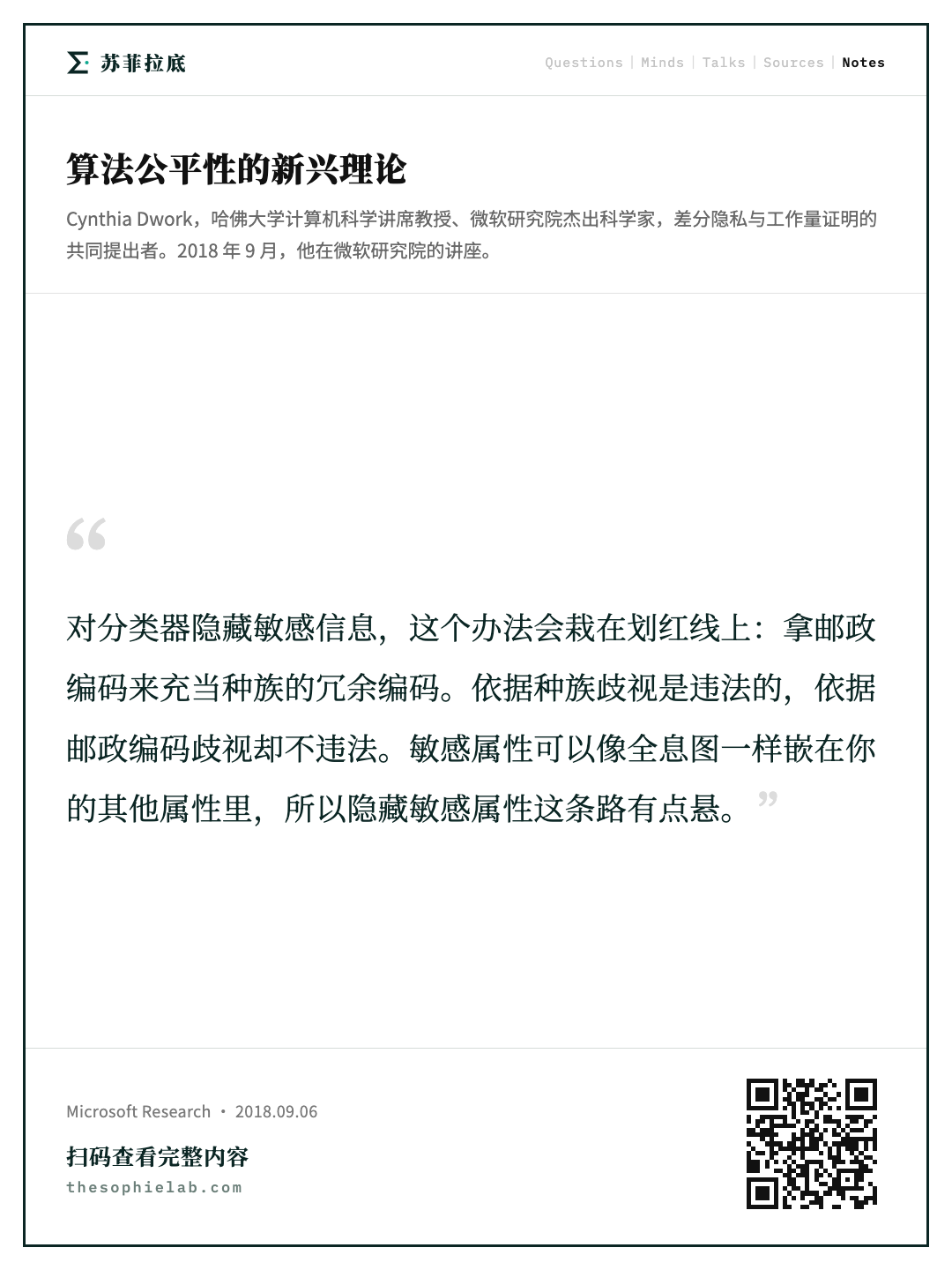
德沃克:先把几个显而易见的想法处理掉。一个建议自然是对分类器隐藏敏感信息,也就是不让它知道你是不是少数群体成员。这个办法会栽在几件事上。首先是划红线(redlining)。谁知道这个词?很好,等下我们会看到一张图。在网上,对应的说法叫网络划线(weblining)。简单说,就是拿邮政编码来充当种族的冗余编码。依据种族歧视是违法的,依据邮政编码歧视却不违法。我们现在普遍面临这种冗余编码的问题:敏感属性可以像全息图一样嵌在你的其他属性里。

德沃克:另一个是「物以类聚」现象。有人见过这张图吗?这是麻省理工学院一门课上的本科生研究项目,算不上完整的研究,但学生们发现的大致是这样:如果你是男性,而你在脸书上大约百分之五的朋友自称是同性恋者,那你很可能也是。你自己可能选择不公开这一点,但根据「物以类聚」的规律,从你朋友的属性就能推断出来。所以,隐藏敏感属性这条路有点悬。

德沃克:隐藏敏感信息还有另一个问题:在某种意义上,了解文化背景的算法比一无所知的算法更准确。一个懂得文化差异的算法能够很好地利用敏感信息来提高准确度。这里我先介绍一下这次讲座要用的两个人群。我们大多数人都喜欢吃东西。有些人喜欢用鼠尾草(sage)调味,其余的人喜欢用百里香(thyme)。所以我的两个群体就是吃百里香的人和吃鼠尾草的人,一般来说吃鼠尾草的是少数群体,但不是每个例子都需要这一点。我把它们记作S和T。假设在吃鼠尾草的人当中,「听见声音」是很常见的宗教体验,而在吃百里香的人当中,这是精神分裂症的一条诊断标准。这是一个真实的医学例子。那么,知道一个人吃鼠尾草还是百里香,就能做出更好、更准确的分类。

训练数据没有真相

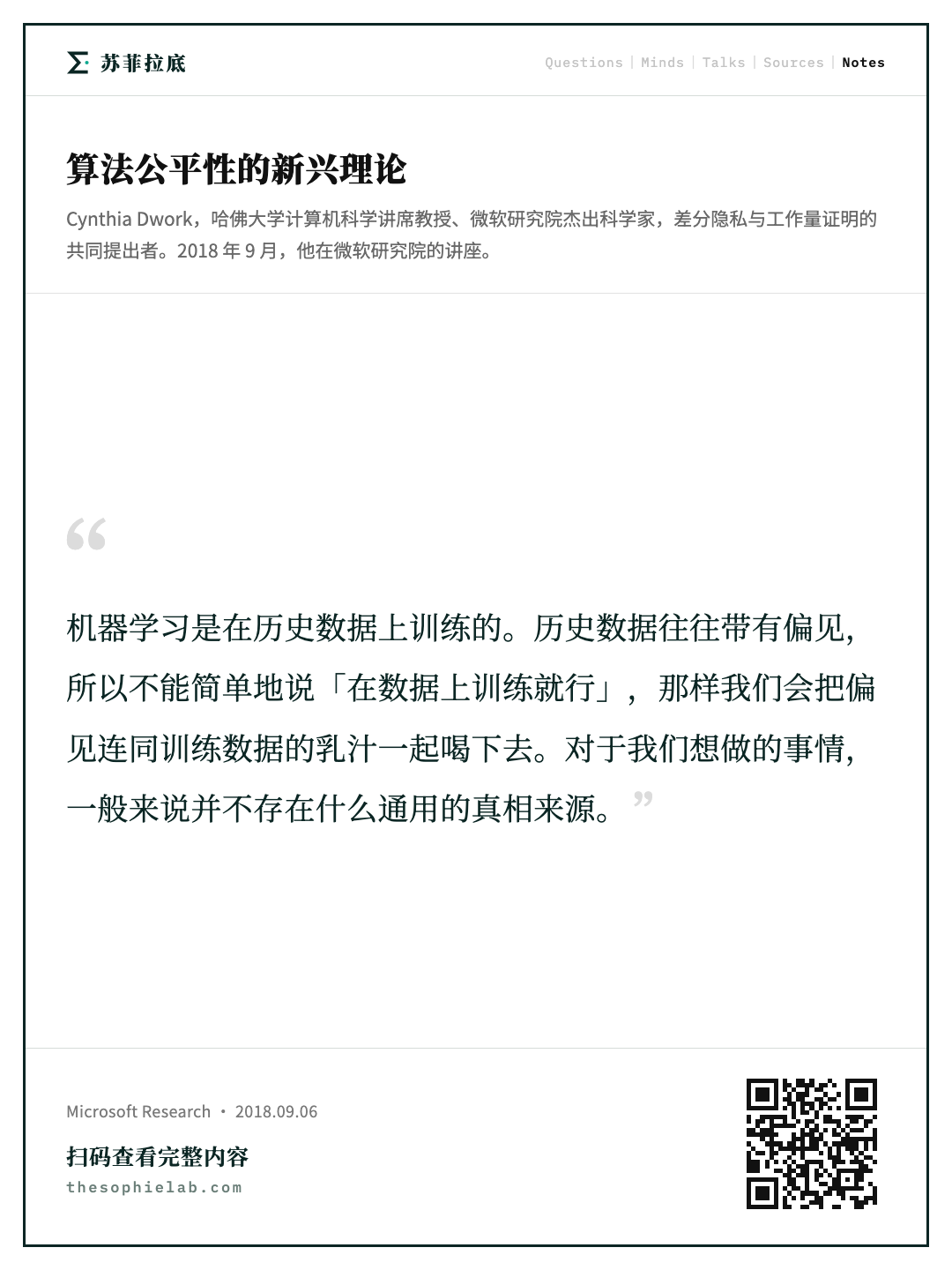
德沃克:大家都知道,机器学习是在历史数据上训练的。历史数据往往带有偏见,所以不能简单地说「在数据上训练就行」,那样我们会把偏见连同训练数据的乳汁一起喝下去。这就带来一个非常重要的问题:对于我们想做的事情,一般来说并不存在什么通用的真相来源。我们必须在牢记这一点的前提下,想办法尽可能地提取公平,不能只去翻训练数据。

德沃克:有谁知道这是什么画?这是西斯廷礼拜堂里米开朗基罗的《最后的审判》。耶稣在中间,他左手边的人被打入地狱,右手边的人升入天堂。这是一个二元分类的场景。也可以有三元分类的场景。这里是几张脑组织切片,左边是癌变组织,右边是健康组织,中间那些细胞并非癌细胞,但也不正常,它们受到了肿瘤的影响。对这类情况,我们可能需要三元的、更复杂的分类体系。

德沃克:还有另一种分类问题,我称之为依存分类问题。比方说你在招人,你的任务不只是把合格的人和不合格的人分开,甚至不只是在合格者中间分出等级。你的问题更复杂:也许有几百个合格乃至非常合格的人,但你只想面试其中十个,毕竟资源有限。你想公平地挑出一批人来面试。这是一个分类问题,但你不能只是逐个判断每个人够不够格面试,你必须以某种方式加上约束。

德沃克:再一类分类问题是打分。这是一套评估被捕未成年人的表格,用来判定应当拘留还是释放。这是一个计分系统。你能看到,本次所犯的各类罪行各有分值,先前的犯罪记录另有分值,还有从减轻情节得来的负分。这些分数再被换算成一个二元决定:释放还是拘留。取决于你采用哪种定义,打分上的公平可能导致、也可能不导致决定上的公平。到现在为止,我还什么都没定义。

定义、算法与组合

德沃克:我们想要一套数学上严格的算法公平理论。历史上,把这类宏大目标转化为一个能通向可行成果的研究纲领,是有章可循的。这个基本范式的第一项是定义:你到底想做什么?对我们来说,就是「公平」指的是什么。定义公平的一种办法,是去想你想要防止什么。按照密码学的好传统,我们设想一个对手,这个对手试图制造不公平,而你要防御它。那么,对手可能有哪些行为或目标是你想防住的?据此,你就定义了公平。

德沃克:有了定义之后,你要构造算法,并且要求算法能够强制执行你定义的那个东西。也就是说,有了公平的定义,我们就要构造一个按该定义是公平的分类算法。最后,我们需要一个组合定理(composition theorem)。想想那些给人分类的系统。比方说你在判断某个人适合看这条广告还是那条广告,你不会只给他分类一次,而是一遍又一遍地分类,针对各种各样的广告,在一天中的各个时段。同样,做隐私保护的数据分析时,没有人只要一个隐私保护的统计量,人们要的是一大堆统计量。密码学里也一样,你不会只看到一条消息或一个数字签名,而是海量消息的签名和加密。所以你需要证明某种定理,说明这些东西在实践中如何组合,这就是组合定理。在这里,我们想要的是:如果一个系统由公平的部件搭成,那么整个系统在某种意义上也是公平的。

德沃克:这个通用范式在密码学和隐私领域尤其成功。能把它用到公平上吗?简短的回答是:我想大概可以,但依我的经验,这比另外两个领域难得多。定义公平非常非常困难,也非常非常有争议。我不相信技术社群能拿出一个单一的定义,让整个社会都说「对,就是它」。我不认为那会发生。构造算法是我们的看家本领,只要有了定义就行。这方面已经有很多工作,有些是最近的,令人兴奋,我会讲一点。组合则被证明非常棘手,我们也会看到一点。

先想清楚要防什么

德沃克:先谈定义公平。我说过,我们的思路是考虑对手想干什么。以数字签名方案为例,你想从中得到什么?大家会立刻给出同一个答案:任何人都不能伪造。然后你得深入细节,把「任何人都不能伪造」里的各种量词都弄准确,但归根到底,伪造就是你要防的东西。那我们这里要防的是什么?

德沃克:我们最初的一个场景是广告。广告主可能有偏见,我们想搭建一个平台来抵消广告主的偏见,做到公平。所以我们真的就是坐下来问:一个居心叵测的恶意广告主可能干出哪些事?划红线我们已经谈过了,它是真实存在的。在贷款上划红线绝对是真的,比如美国的住房贷款。有一本很棒的书推荐大家读,理查德·罗斯坦(Richard Rothstein)的《法律的颜色》,讲的是美国政府在这些偏见中扮演的角色。

德沃克:还有反向象征主义(reverse tokenism)。比方说你拒绝了我的贷款,我说「你拒绝我是因为我是卷发」,他们就指着谢尔盖说:「他显然比你强得多,他是直发,我们也拒绝了他。」问题在于,他们拿他一个人当所有卷发人的挡箭牌。这就是反向象征主义。再有一种,我称之为故意瞄准吃鼠尾草人群中错误的那一部分,这个例子我放到后面一两张幻灯片再讲。

德沃克:总之我们就是坐下来,写出一大堆想要防止的恶行。这是个合理的办法吗?我不知道有别的办法。而且这种办法有个好处:假设你造了一个系统,能防住我们列出的所有这些行为,很好。然后有人跑来说「你漏了一条」,你说「太好了」,重新设计系统,把新的一条也防住。与此同时,前面那些行为你一直是防着的,所以总比什么都不做要强。

群体公平及其漏洞

德沃克:多数人按我刚才的引入方式去想公平,会立刻想到群体,事实上我的引入方式也在暗示这一点。那么什么是群体公平?群体公平性质基本上是对不同群体待遇的统计要求。统计均等(statistical parity),又叫人口均等(demographic parity),说的是:假设我们只做正负二元分类,那么被判为正的人群的人口构成应该与总体人口的构成相同。也就是说,吃鼠尾草的人和吃百里香的人被判为正的比例,与他们在总人口中的比例一致,被判为负的情况也一样。

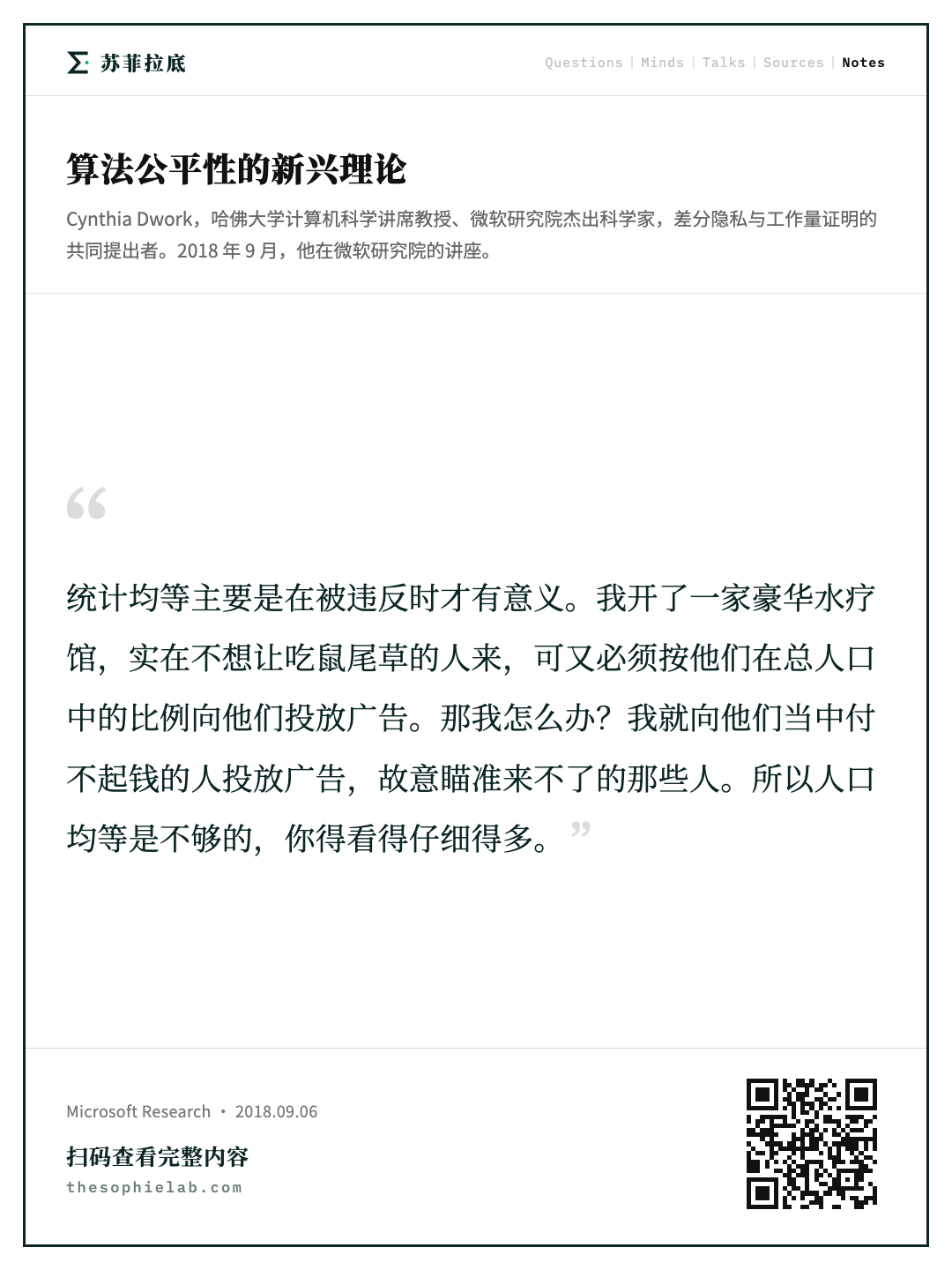
德沃克:这很好。但它什么时候真正有意义?我们会看到,它主要是在被违反时才有意义。如果你看到统计均等被严重偏离,那是一面红旗。这不一定意味着事情不公平,但绝对是一个值得去追问「为什么会这样」的地方。所以它在被违反时有意义,可它允许我们所说的瞄准S的错误子集。我开了一家水疗馆,很豪华,我实在不想让那些吃鼠尾草的人来,可我又必须按他们在总人口中的比例向他们投放广告。那我怎么办?怎么偏心?我就向S里那些付不起钱的人投放广告。我故意瞄准来不了的那些人,从而确保我的水疗馆不会多出吃鼠尾草的新客户。而在吃百里香的人里,我向富人投广告,他们来得了。所以人口均等,哎呀,是不够的,你得看得仔细得多。

德沃克:还有交叉群体的问题,由此引出一个说法很生动的概念:公平的选区操纵(fairness gerrymandering)。我们有一群人,我把他们分成吃鼠尾草的和吃百里香的,可他们同时也分成喝茶的和喝咖啡的。我们真正想要的,也许是看四个交叉类别时,每一类都有按比例的代表。如果我们只把广告给吃鼠尾草又喝咖啡的人看,那是非常不公平的。你可以把真实的人口群体代入进去,看看哪些情况下你明确想要这种交叉的均等。统计均等本身并不能防止这种选区操纵。

三个指标不可兼得

德沃克:统计均等是群体公平的一种定义,还有别的定义。然后我们不得不面对一个事实:有些群体公平性质是互不相容的。多少人知道这个故事?不少人知道,但大多数人不知道。假设我有一个分类器,我们在给人分类并做预测:我们认为你会再犯罪,或者我们认为你不会。这里的关键是,有些信息注定缺失,比如未来还没有发生,一个人出狱后会不会再犯,可能取决于他出狱之后经历的许多事情。

德沃克:你可能合理地希望,各个人口群体的假阳性率(false positive rate)相等。另一个愿望可能是各群体的假阴性率(false negative rate)相等。你也可能希望阳性预测值(positive predictive value)相等,也就是在被预测会再犯的人当中,实际再犯的比例。我选这三个不是因为只有这三个,而是因为它们非常有名:已知任何不完美的分类器,都不可能同时保证各群体假阳性率相等、假阴性率相等、阳性预测值相等,除非各群体的基础率(base rate)相同,也就是各群体的再犯率相同。

德沃克:舒尔德乔娃(Chouldechova)在她的论文里指出,原因在于这几个量由这样一个等式联系在一起。我们可以为吃鼠尾草的人写下假阳性率、假阴性率和阳性预测值,它们满足这个等式,其中P是这一群体的基础率。再为吃百里香的人写下同样的等式。要求两个群体假阳性率相等,意味着这一项在两个等式里必须相同,于是这些蓝色的项必须相同,那个蓝色的项也必须相同,唯一可能的情况就是基础率P在两个群体里相同。

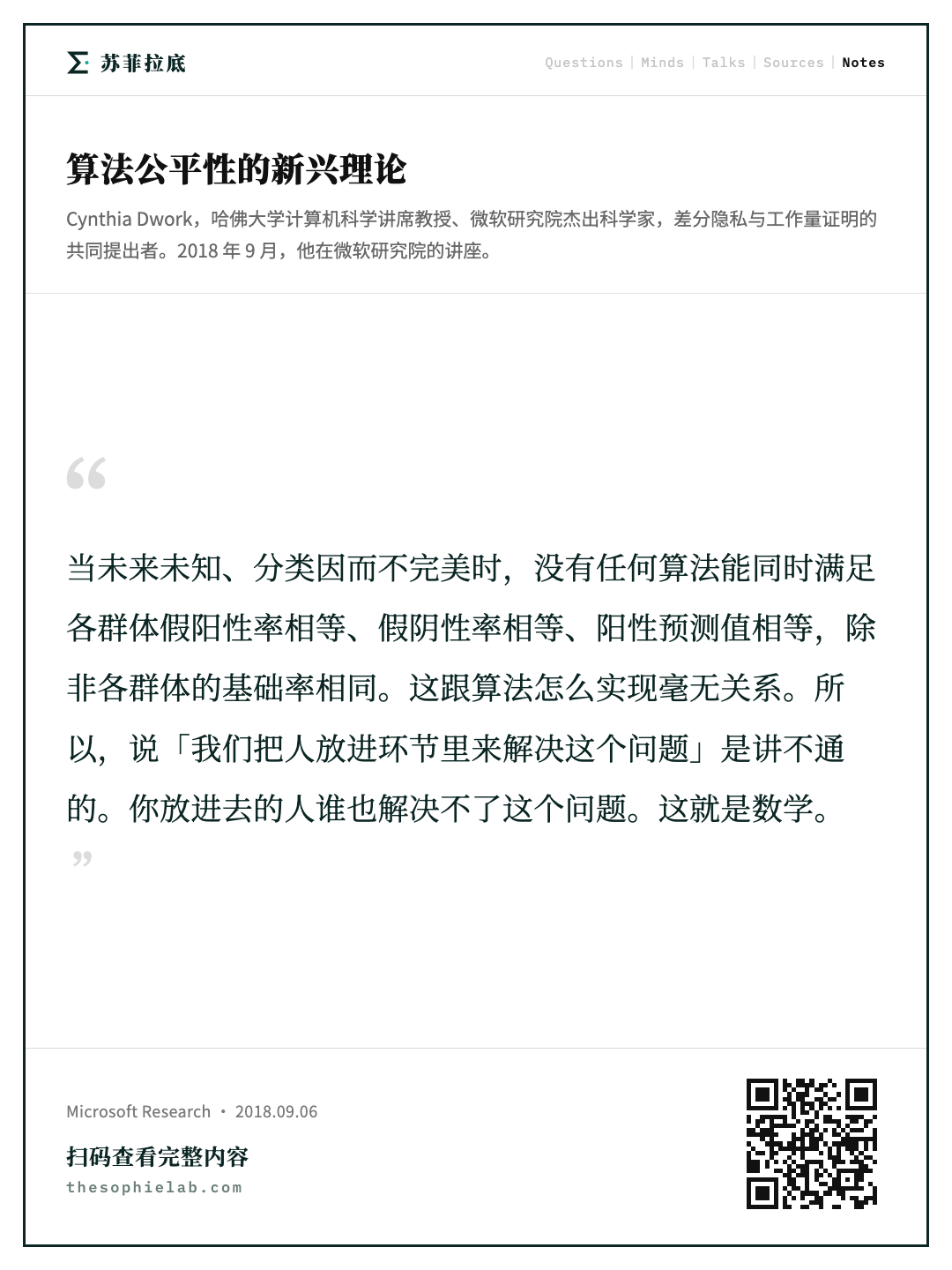
德沃克:当未来未知、分类因而不完美时,没有任何算法能同时满足这三条非常自然的要求,除非基础率相同。这跟算法怎么实现毫无关系。不管你相信自由意志还是随机性,无论算法是机器还是别的什么形式,结论都一样。所以,说「我们把人放进环节里来解决这个问题」是讲不通的。你放进去的人谁也解决不了这个问题。这就是数学。你们大概听得出来,我对群体公平的概念不满意,理由有好几条,我正在跟大家分享其中一些。

猴子与个体公平

德沃克:这就引到一段非常有名的视频。多少人看过?不是所有人,好,连一半都不到。这是一个卷尾猴实验,猴子两两配对。猴子要完成的任务是把一块石头递给你,然后得到奖励。我们来看。

德沃克:(视频画外音)她把石头递给我们,这就是任务。我们给她一片黄瓜,她吃了。另一只也得递石头给我们,她照做了,她得到一颗葡萄。第一只看见了,现在她再递石头过来,得到的还是黄瓜。

德沃克:这就引出我更偏爱的概念:个体公平(individual fairness)。直观地说,个体公平是指:对于给定的分类任务,如果两个人就这项任务而言是相似的,那么他们应当得到相似的对待。要让这句话有意义,我们需要一个恰当的「相似」或「不相似」的概念,也就是某种距离概念。一个经典的例子是信用评分,信用分之差就直接给出了一个度量(metric),衡量两个人在信用可靠性上被认为有多么不同。

德沃克:当然,我必须再次强调,这是一个针对具体任务的概念。谢尔盖和我在贷款资格上可能确实相当,但在推荐护发产品上就完全不同。我们在一个目的上相似,在另一个目的上截然不同。所以谈这些度量时,一定要记住它们是针对任务的。

德沃克:再想想信用分。也许人们大体上是从极合格到极不合格均匀铺开的。当你根据某人是否越过一条阈值来决定放不放贷时,可能有两个人挨得非常近,你给了一个贷款,拒绝了另一个。如果分数确实是沿着这条线密密麻麻排着的,那这种事必然发生:你总得在某处画一条线,这是普遍的担忧。于是就会有非常相似的人受到非常不同的对待。理论家说这种情况下该怎么办?随机化。不是对你说「肯定给」、对他说「肯定不给」,而是根据信用状况给每个人分配一个获得贷款的概率,或者说获得A的概率。你要安排得让两个人如果非常相似,他们面对的结果概率分布也非常相似。请讲?

听众:最近有两名警察被解雇了,因为他们抛硬币决定要不要以超速逮捕一个人。他们大概是听过你的课。

德沃克:没有。我要说的是,在某些情形下这可能是对的做法。警察有巨大的自由裁量权,如果他们对相似的人一视同仁,也许没什么不好。

听众:也许不用随机化,可以把贷款额度做成连续的。不设一个固定数额,而是让贷款金额随着信用逐渐降到零。

德沃克:当然可以做那样的事情,我得把所有后果都想一遍。但确实有些情况你必须做出二元决定。

度量从何而来

德沃克:我们就把这个当作公平的定义。我们有一个结果集合O,在这里就是「是」或「否」。这是结果上的概率分布。我们要找一个分类器,把我们全体(universe)中的个体映射到结果的概率分布上,并满足以下条件:对于某个衡量两个概率分布差异的恰当尺度,比如总变差距离,我们要求两个分布的差异被两个个体之间的距离所界定。这是一个利普希茨(Lipschitz)约束,用的是针对具体任务的度量下的距离。

德沃克:当然,这马上引出一个问题:度量从哪里来?你怎么把它弄到手?我没有很好的答案,但我也相信,如果我们真的有一个人们认为公平的分类系统,那我们可以从中提取出一个度量。

听众:那怎么确保度量本身是公平的?

德沃克:我刚才说的正是这一点,我们不知道去哪里拿这个度量。我们最初做这项工作时说,它至多是社会在当下的最佳猜测,而这显然是我们需要的东西。我现在越来越明白,这些事情将由政治过程来处理,除了把各方利益相关者和各种测量结合起来,没有别的路能走到某个地方。但是,对于度量从哪里来,我们没有直截了当的数学答案。请讲?

听众:这里是不是有一种张力?「谁来监督监督者」这个论点说,判断我是否冒犯了你的最佳人选是你而不是我。这并不意味着公平规则应当由社会来决定,可那样我们又回到群体公平去了。对个体公平来说,最难啃的骨头在于:度量的来源正是决定所施加的对象。就像那只猴子,是猴子自己判定「这不公平」的。你有没有什么想法,怎么把社会公平和个体公平整合起来,或者把它们妥当地分开?

德沃克:对此我还没有数学上的答案。我现在正在大量投入的,是思考从政治的角度看这个问题的正确方式,我说的不是政治正确,我说的是政治理论和伦理学。但这是一个未知领域,各位来做吧,这真的很有道理,是个重要问题。也许结束时再多问我一些。

听众:我们是做这件事的合适人选吗?

德沃克:不能只靠你们自己,除非你有非常广博的教育背景。立法和监管不可避免地会来。我们必须确保被立法、被监管的东西不是技术上愚蠢的,不是不可行的。我认为出现很糟糕的法律和监管的风险是真实存在的,所以技术人员在帮助避开这种局面上有重要的作用。另外,技术人员多听听这些关切和问题,他们手里有一些工具,能够推动并回应这些关切。所以我们算是合适的人选,但不能只靠我们自己。请讲?

听众:我们怎么知道这个度量是可计算的?比方说,如果大脑是一台通用图灵机,那么从通用图灵机到一个可计算度量的映射,未必存在。

德沃克:你的话我只听清了大约三分之二,你似乎在问「我们怎么知道它是可计算的」,也就是说,我们怎么知道信息是可得的,怎么把能给出度量的信息弄到手?

听众:如果假设大脑是一台通用图灵机,那么一台计算机也就是从通用图灵机映射到一个可计算的度量。

德沃克:我不太确定你想套用的是哪个判定问题,是大脑遇到自身时会不会停机之类的吗?我不清楚。抱歉,也许会后再问我。我要继续了。

算法上的进展

德沃克:来谈谈算法。首先,正如我所说,这些是我们熟悉的挑战。在广告场景里,我们设想的情形是我们确实知道个体的全体,我们甚至让广告主有机会对每个个体和每个可能的结果表态:把这个人映射到这个结果有多糟糕?也就是把个体映射到结果o所招致的损失是多少。这只是我们额外加上的一个可选项,让供应商能够参与意见。

德沃克:然后我们把各种成分组装起来:那个科幻般的度量,加上供应商的损失函数。我们要在公平条件的约束下最小化供应商的损失。也就是说,损失函数被当作软约束,理论家的公平条件被当作硬约束。这只是一个线性规划。所以理论上可以求解。而且有一个有趣的观察,它让人联想到基础率不等时「什么做不到」的那些定理:如果你求解这个公平线性规划,所得到的分类器给出统计均等,当且仅当,直观地讲,两个分布是相同的,也就是吃鼠尾草人群上的均匀分布与吃百里香人群上的均匀分布之间的推土机距离(earth mover distance)为零。

德沃克:那项工作假设我们知道整个全体。最近,罗斯布卢姆(Rothblum)和约纳(Yona)展示了如何把这一点稍作放松,他们称之为「大概近似公平」(probably approximately fair),从而获得可泛化性。我们最初的结果是不能泛化的。那是2018年的结果。

德沃克:我提到过近几年有很多进展。比如哈特(Hardt)、普赖斯(Price)和斯雷布罗(Srebro)把假阴性率相等作为公平要求,可选地再加上假阳性率相等,展示了如何把不公平的预测器转化为公平的预测器。这不是个体公平,他们的公平概念是群体公平。我想在座各位会欣赏的一点是,他们全部是在后处理阶段完成的。你们知道,如果想让产品团队用你的工具,最好是不必去干扰他们的流水线,只在开头或末尾加点东西。他们就是这么做的。

德沃克:另一项工作中,约瑟夫(Joseph)、卡恩斯(Kearns)、摩根斯特恩(Morgenstern)和罗斯(Roth)看的是不同的问题。他们研究的是老虎机(bandit)场景。每个人口群体对应一条臂,在我们的例子里是两个群体,但可以更一般。他们担心的是,少数群体可能缺乏训练数据,也就是关于吃鼠尾草的人,你没有多少训练数据。他们的要求是这样的:以贷款为例,每一轮,每个人口群体来一个人,你必须选一个人放贷,或者至多选一个。也许你实际做的是选定一个概率分布,然后从这个分布中抽一个人。要求是:尽管存在不确定性,一个更差的申请人在这些概率上永远不能比更好的申请人更受青睐。他们研究的是如何在最小化遗憾(regret)的同时学到一个公平的策略。他们比较了两种遗憾:强制执行这种公平条件时的遗憾,与不管公平时的遗憾。这种条件在你了解少数群体的过程中是有代价的:一旦你充分了解了少数群体,就可以有把握地预测,但在了解之前不行。他们证明了这里存在一个差距,也就是学习公平策略更昂贵,遗憾更高。有问题?

听众:这里用的是哪种公平?

德沃克:他们在每一轮内部使用个体公平,针对这一轮到场的人。

听众:也就是说选中他们的概率不应当有差别。

德沃克:对,不应当。其实不对,抱歉,是更弱一点的东西:只要求更差的申请人不比更好的申请人更受青睐。是的,抱歉,我记错了,这篇论文用的是这个。那是2016年。2017年是很有意思的一年,两个独立的研究小组开始研究一些类似的问题。这里就进入我前面提到的交叉情形了。第一篇论文就是「选区操纵」这个名称的出处。

德沃克:设想你有几个敏感比特,比如K个:鼠尾草对百里香,咖啡对茶,再加几个。这给出2的K次方个子集。假设所有这些子集都还很大,相对于总人口不算微小,也就是大集合的大交集。他们研究交叉情形,想学一个分类器,来保证若干种公平概念,比如统计均等,或者在这些交叉集合之间让假阳性率或假阴性率相等。我刚才把集合描述为由K个比特定义的所有子集,但你也可以用别的方式描述这个集合族,比如所有能用小电路描述的集合。只要这些集合足够大,他们就想在各群体之间保证这些公平概念。他们还证明了他们所说的公平审计(fairness auditing)的一般问题是困难的:给你一个分类器和这些群体的描述(也许是隐式的),你怎么判断是否存在某个群体、某个交叉群体,受到了你的不公平对待?他们通过从不可知学习(agnostic learning)归约来证明其困难性。他们之所以既能给出算法又有这些否定性结果,是因为大家都知道,机器学习经常在理论上困难的问题上做出有意思的事情。

德沃克:赫伯特-约翰逊(Hébert-Johnson)、金(Kim)、莱因戈尔德(Reingold)和罗斯布卢姆研究了非常相似的问题。等等,我说错了,这一篇是罗斯布卢姆,前一篇是罗斯。他们研究校准(calibration)。假设我的预测器现在给出的是分数,我给每个人打一个零到一之间的数,可以把它理解为我对你再犯概率的预测。如果在被评为v的人当中,最终真正得到正标签的比例接近v,对所有的v都成立,那么系统就是校准的。换句话说,它要求对每个v,被评为v的人平均而言是正确的。他们得到了非常相似的结果,只不过用的是校准版本,把这种正确性当作公平。如果你熟悉克莱因伯格(Kleinberg)、穆莱纳森(Mullainathan)和拉加万(Raghavan)的结果,那里用的就是这种校准概念,或者相关的校准概念。他们论证这比其他群体公平概念更讲得通,除此之外得到的结果非常相似:对预先给定的电路集合C中每个电路所定义的集合,他们同时得到近似校准。迈克尔·金(Michael Kim)和詹姆斯·邹(James Zou)后来用这个方法改进了一些医学预测器,取得了不错的结果。

德沃克:我的讲座还有多长?好,那我再讲一会儿。下一批结果是试图弥合群体公平和个体公平之间鸿沟的算法工作。它假设我们有某种神谕(oracle),我们可以就某些边的集合去问「这些边上的距离是多少」,然后利用这一点做出强有力的事情,而不需要你去问所有的点对。

德沃克:在深度学习社区,有一种完全不同的路子:对抗学习,或者说学习公平表示(fair representations)以及它的对抗版本。这是一个群体公平的概念。哎呀,抱歉,这张幻灯片我跳过去。大致想法是这样:我们从集合X中的实例出发,学习一种新的表示,让它在某种意义上尽可能保留信息,同时压制某些关键属性,比如某人是吃鼠尾草的还是吃百里香的。他们用的是生成对抗网络,所以有一个对手,它试图在给定z的情况下分辨这个z来自吃鼠尾草的x还是吃百里香的x。这个直觉的关键在于:预测器是在表示Z上工作的。对手试图区分两个群体,并且训练了编码器使表示不可区分。如果预测器的能力不超过这个对手A,那么在某种意义上它的预测就不可能带有偏见。这非常非常有意思。它是一种群体公平概念,我很想看到个体公平被融进来,这是另一个很有趣的研究方向。

组合的陷阱

德沃克:最后五分钟我要讲组合,因为这非常有意思,而且是新的。我们的直觉是:如果一个系统由一堆各自满足个体公平的部件构成,那么把它们放在一起看,整个系统至少也相对公平。答案是:这很复杂。

德沃克:举一个非常简单的例子。假设你在看《纽约时报》网站,页面顶部只有一个横幅广告位。这就是我们的场景。你们知道,为了争夺你的注意力,那里会跑一场拍卖,广告主竞争这个位置。我们看两类广告主:一类推广技术岗位,另一类推广生鲜配送服务。两者在争夺你的注意力。理想情况下,如果我们判断谁适合看技术岗位广告的分类器是公平的,判断谁适合看生鲜广告的分类器也是公平的,那么整个系统多多少少也该是公平的。我们希望在这个复杂系统里仍然做到:对技术岗位资格相近的人,看到技术岗位广告的可能性也相近,生鲜广告也一样。

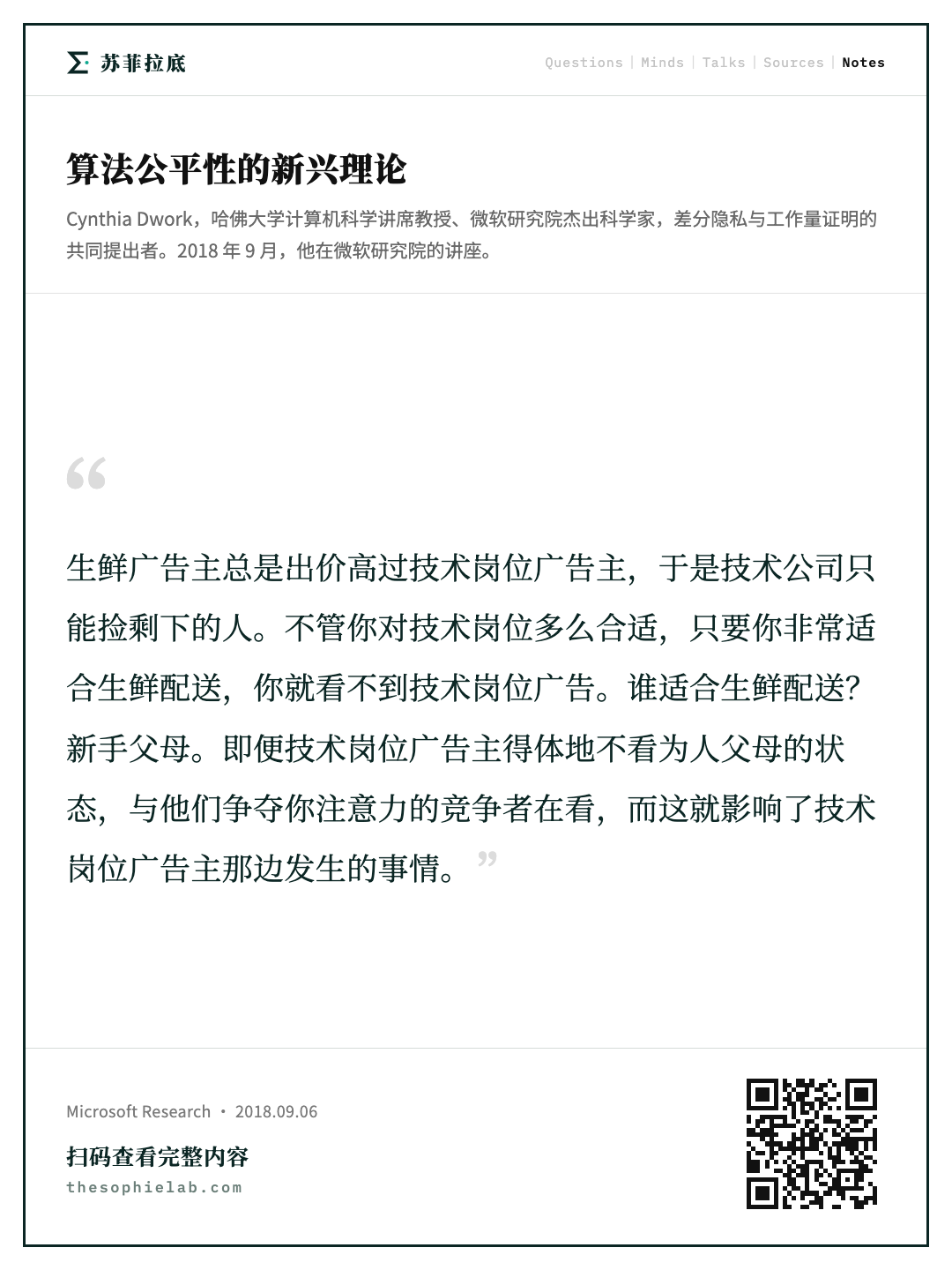
德沃克:现在假设生鲜广告主总是出价高过技术岗位广告主。这是拍卖,出价高者得。我们甚至可以把它想成出价高的先走。生鲜广告主先走,或者说它出价更高。于是技术公司实际上只能捡剩下的,也就是没被生鲜广告主抓走的那些人。无论是时间上一先一后,还是单纯靠出价决定,结论都一样。这是个大问题。它意味着:不管你对技术岗位广告多么合适,只要你非常适合生鲜配送,你就看不到技术岗位广告。

德沃克:那谁适合生鲜配送服务?新手父母。广告主对可以向新手父母推销的东西垂涎三尺,而这些广告主往往不是招技术岗位的。事实上你可以说,技术岗位广告主本来就应该对「为人父母」这个属性避之唯恐不及。可即便他们非常得体地不看为人父母的状态,那些与他们争夺你注意力的竞争者在看,而这就影响了技术岗位广告主那边发生的事情。这个问题在个体公平和群体公平下都有相应的版本,它不会自行消失。这些内容没时间细讲了。

德沃克:不过这里有一条出路,我提一下:我们可以在广告任务上固定一个概率分布,任何我们想要的分布都行,然后按这个分布抽一个任务,只为选中的任务运行分类器。证明这给出个体公平非常简单。但它把钱留在了桌上,因为有些人我们就是不会向他们展示广告了。这为对算法与经济学交叉感兴趣的人提出了许多非常有意思的经济学问题。因为时间关系,其余的我跳过。

可解释性与因果

德沃克:最后几点评论。首先是可解释性与因果性。关于公平的可解释性和因果性都有大量文献。这张幻灯片为什么是空的?首先,我非常努力地想在可解释性上取得进展,但失败了。我不理解人们在要求什么,以及它如何能够实现。扎卡里·利普顿(Zachary Lipton)有一篇很有意思的文章,《可解释性的神话》,他解释并归纳了人们可能想要的种种东西,以及各自的问题。文章写得非常深思熟虑,我对此还没想完,但我在这个问题上卡住了。

德沃克:至于因果性,我能看到它在好几个方面成问题。首先,如果你用的是珀尔(Pearl)的因果推理理论,你需要一个生成模型。你也许熟悉那句话:所有模型都是错的,但有些模型有用。如果你的公平定义把分类器和模型绑在一起,需要两者一起才能判定某件事是否公平,而你的模型是错的,那你很可能得出错误的结论。这是我在因果性上遇到的一些困难的一瞥。

德沃克:再简短谈一点。我们谈了度量,谈了度量从哪里来的问题,但问题还不止于此。假设有一家新闻机构,叫「好新闻」。这家机构有一个环境,环境里有随机性;有一个个体x,x身上也有随机性。你可以谈论(尽管无法真正拿到)这个个体x在「好新闻」获得成功的概率。一旦你为这两处随机性指定了硬币,这个概率就是良定义的。你拿不到它,但至少它在数学上说得通。你可能会要求:如果两个人相似,意思是他们成功的概率相近,而成功可以定义得很清楚,比如在公司待满至少三年并且期间至少晋升一次,那么这两个同等可能成功的人,被录用的概率也应当非常相近。这似乎讲得通,于是度量捕捉的就是成功的概率。

德沃克:可是,如果这家不是「好新闻」,而是「坏新闻」,它素来对吃鼠尾草的人极不友好,吃鼠尾草的人无论多有才华都不可能成功,或者要经历真正艰苦的攀爬,那会怎样?度量究竟应当捕捉人们是否同等可能成功,还是应当捕捉他们是否同等有才华?这里正确的做法是什么?并不清楚。

德沃克:最后几句话。真相难以捉摸,而且用计算机并不能弥补这一点。我们已经论证过,我真的相信度量是一切的核心,即便找到它们可能需要很长时间。但我们始终主张让度量沐浴阳光:度量不应当被保密,它必须公开,供人辩论、讨论和修正。计算机不一定比人差,它们可能更准确,尤其是在容易的案例上;它们可能更容易测试,你不停地拿例子去试它们,它们不会累。就是这些,谢谢大家。

问答:历史不义与矫正

主持人:有人提问。请讲,先是后面那位,然后是你。

听众:这一点我相信你思考过,也许上一张幻灯片就提到了。考虑个体的时候,假设吃百里香的人一直在教育孩子,而有一种可怕的鼠尾草感染,凡吃鼠尾草的人都会病得很重,再加上吃鼠尾草的人历史上遭受过严重的不公。他们各方面表现都差一些,因为他们忙于应付这种疾病。于是,仅仅由于这种历史巧合,吃鼠尾草的人几乎从来不会和吃百里香的人处于「情形相似」的位置上。按个体公平的度量,我们似乎只会说「没问题」,然后设计工作岗位时,全都给了吃百里香的人。我们没有考虑度量的群体维度,可我觉得社会在某个地方需要处理历史正义的问题。

德沃克:这当然是一个非常好的观点。在论文里,我们描述了我们称之为「公平的平权行动」(fair affirmative action)的方法来处理这一点:正是出于这个理由,我们打破某些利普希茨约束,但这是一种有原则的做法。我应当提一下,它跟加利福尼亚州和得克萨斯州在大学录取上的做法并非全然不同。如果你在班级排名前百分之十,在加州你就能进入某所加州大学,在得州则是某所州立大学,我想是这样。要点在于,不同社区的学校在考试等方面的表现可能天差地别,但基本思路是一样的。我们在此基础上加了一点东西,不像「取前百分之十」那么粗糙。

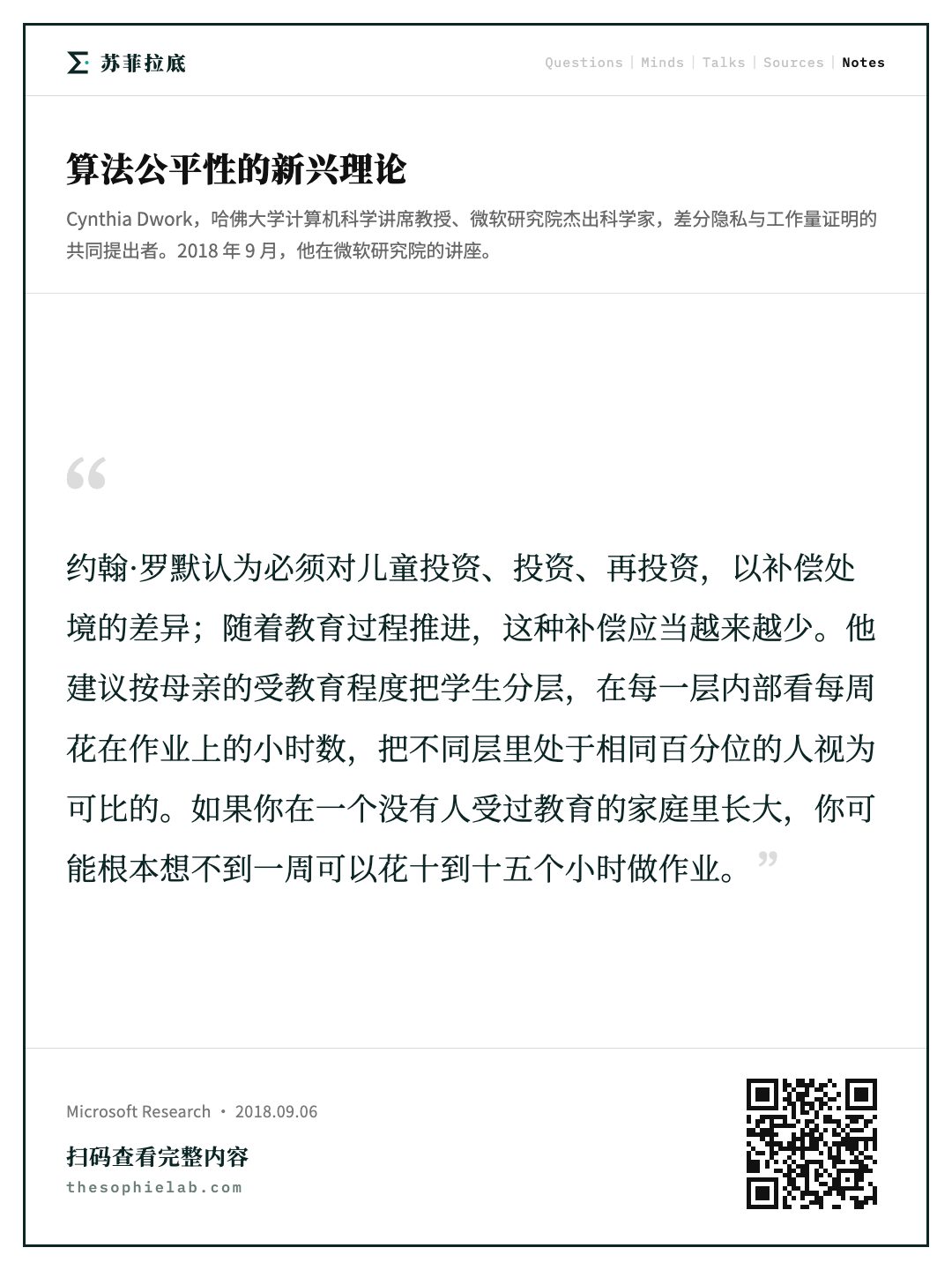
德沃克:耶鲁大学的约翰·罗默(John Roemer)有很有意思的工作,他非常关注分配正义理论,对教育想得很多。他认为必须对儿童投资、投资、再投资,以补偿处境的差异;随着教育过程推进,这种补偿应当越来越少,因为孩子们既已获得了良好的基础,理论上就更应当为自己如何运用所拥有的东西负责。我尤其记得他在大学录取的语境下说过这样的话:按母亲的受教育程度把学生分层,在每一层内部,看学生每周花在作业上的小时数的累积分布函数,然后把不同层里处于相同百分位的人视为可比的。他提出的一个我觉得极有说服力的观点是:如果你在一个没有人受过教育的家庭里长大,你可能根本想不到一周可以花十到十五个小时做作业,这个念头压根不会出现在你脑子里,或者你在打工,没法这么做。我认为社会科学家的这类洞见对我们的工作非常重要,我们做的事在某种意义上与之类似。这是一个很好的观点。

问答:因果模型的困境

听众:刚才这整段讨论,其实都和「坏新闻」那个选择度量的问题有关,最后归结为要不要以某些中介变量为条件之类的问题。讲座其余的部分没有处理这类问题,也就是如何公平地选择度量。有没有工作用图模型或者因果推断的其他想法来做这件事?因为我们有一个直观的想法:要构造一个公平的度量,应该以某些变量为条件,但绝对不要以另外一些变量为条件。有没有人试图把这一点形式化?

德沃克:有这样的工作,很有意思,如果你感兴趣,我可以给你一批论文。这类工作的一个难处在于,同一个可观测的数据分布可以与非常不同的因果模型相容,这就带来麻烦。

听众:推断模型本身就非常难。

德沃克:对此我还不知道该说什么。看到有一篇反事实公平(counterfactual fairness)的论文时我非常兴奋,心想「对,就是它,就是它」。可后来我们找到了两个不同的模型,它们产生同样的分布,同一个分类器在一个模型下是公平的,在另一个下不是。那你怎么办?

问答:随机就公平吗

听众:假设我要为学校选一支国际象棋队,三个人,代表学校去参加比赛。我大概会去测量这些人的水平,按测量结果挑出最好的三个。我们来看看这是否符合你的个体公平定义。我测量得越准,随机性就越少,选拔也就越不公平。

德沃克:是你引入了随机性。

听众:总会有随机性的。

德沃克:你是说算法引入了随机性。

听众:我是说,按人们通常的做法,他们不会刻意引入随机性,但随机性总会有,因为有人赢有人输,测量人的技能本身就有随机性。按你的定义,我们测量技能越准确,随机性越少,选拔过程就越不公平。

德沃克:如果你是说你可以测得非常非常准的话。

听众:等一下,那为什么一个完全随机的过程会比一个任人唯贤的过程更公平?

德沃克:好,这类问题在公平领域随时都会冒出来,你这个例子正中要害。个体公平的定义里确实埋着这样一个含义:如果你从头到尾都在抛硬币,那是公平的。如果你决定谁进象棋队的方式就是抛硬币,相似的人当然得到了相似的对待。我们没有保证的是,不相似的人得到不相似的对待。这正是我们要引入「在公平约束下最小化损失」的地方,我们要把某种损失的概念纳入决策过程。我们既要保持公平,也要最大化效用。

听众:我觉得说公平约束必须是随机的,这本身就不公平。

德沃克:我明白你的意思,你大概还能举出更好的例子,说明随机性在哪些地方是不公平的,或者对所有人一视同仁在哪些地方是不公平的。通常可以把问题重新表述,把这些关切推到目标函数里,而不是放在公平约束里。顺便说一句,我们当初以为「相似者相似对待」是我们的原创,可亚里士多德早就说过同样的话,而且他还说,不相似者应当得到不相似的对待。

德沃克:我们最初想的是广告,我当时想,看实体报纸的时候,每个人看到的广告都一样,没有定向投放,那似乎相当公平。至于让年轻人看到奢侈品广告,是否有助于形成志向?你应该说穷人、穷孩子不该看到好东西,或者好东西的图片吗?有人从心理学和社会学的角度研究这类问题,他们认为,广告与自我的形成紧密相连,人们看到的东西存在真实差异是有害的。所以我不知道。

问答:安慰剂式的分类

听众:听你谈个体公平的度量时,我想到了药物治疗效应,也就是随机对照的分配。你面对一个人群,从另一个人群里找到一个匹配得很好的人,然后看不同处理分配下的治疗效应。我可以想象一个不同的问题:你希望分类器对这些匹配上的个体表现得像安慰剂,而不是像一种有治疗效应的药物。这归结起来不是对人群中每一对个体都施加度量的那种个体公平,而只是跨群体的。也就是说,在群体内部允许任人唯贤,但在群体之间要求安慰剂式的效果。这值得处理一下。

德沃克:这非常有意思,我不知道。我提到过,在因果性的文献里,有一些在珀尔模型下的工作。在鲁宾(Rubin)模型下,我不知道有什么工作,也许有,但我不知道,我想去看看。我认为这绝对值得想透,很好的问题。

问答:量化不公平

听众:我在想一件事。这个标题是「走向公平建模的理论」。有没有人反过来做:接受事情注定不公平,转而去量化事情有多不公平?换句话说,不把它们当作公平约束,而是像人们研究程序类别那样,把它们分成等价类,说这是B、那是D。你在这个方向上有什么想法?

德沃克:沿这条线的理论结果我只知道一个,就是我讲到个体公平蕴含统计均等的时候:实际上有一个更紧的刻画,用群体之间的推土机距离来衡量不公平的程度。此外,我想最近有些工作确实在看稍微放松一点会怎样,比如「大概近似公平」的概念:好,我们引入一点松弛,能得到什么?这方面有一些。但我不知道有谁整个儿地说「好,我们就打算这样对待这些人」。我不知道。

听众:我在想,差分隐私里有一个权衡,比如你设定epsilon参数,就落在那条曲线上的某一点,用隐私换取准确度。

德沃克:对。你想想,个体公平的定义和差分隐私的定义在味道上非常相似,但它在组合下的行为不一样。另外还有一个结果,是用差分隐私里的某个特定算法来保证公平,你说的那种权衡在那里也许是相关的。还有人吗?请讲。

问答:现在该怎么办

听众:我有一个关于实践的问题。这个问题很复杂,你对相关工作做了非常漂亮的综述,也谈到要达成共识,或者达不成,总之要有立法,还需要很长时间。与此同时,计算机不一定比人差,人们正在把模型投放到各个领域的现实世界里。你的处方是什么?现在需要做什么?我们是停下来,等真正理解这些问题之后再说,还是采用某种合理的办法,因为有总比没有好?从业者的行动指南是什么?

德沃克:我觉得自己完全没有资格回答这个问题,但还是试一试。即使我认为等待是合适的(我并不这么认为),在商业世界里那也根本行不通。脸书不会停下来。我想你根本不可能让产业停在原地,政治力量太强了。你能做的,当然是开始创建测试集,至少是创建者自认为知道正确结果应当是什么的测试集。比如保释裁定中的算法辅助,很多州都在用,具体数字我记不清,肯定至少有十二个,但为什么这个数字不在我脑子里,我也说不上。总之很多州在用。我们希望的是,我不知道看代码有多大用处,因为代码可能很难看懂,但你肯定希望某些合适的人和机构能够拿测试案例去试这个算法,看它怎么做。我会说,用你能拿出的最好的黄金数据集做真正密集的监测,让很多人一起做,我认为这就是我们眼下的处境。因为监测是你能做到的。

听众:那么,如果就按人们现在的做法,努力把准确度做到最高,然后把算法放到现实世界里,有没有哪些案例明显是出了问题的?

德沃克:你是问算法明显出了问题的案例?

听众:是的。

德沃克:很多。

听众:比如?

德沃克:「路面颠簸」,是叫这个名字吧?Street Bump?我记不清了。一个坑洼探测器,向市政部门报告路面坑洼。但这是一个iPhone应用,所以只有富人区的坑洼得到了报告。

听众:可那似乎只是一个准确度不如预期的问题。问题在于……

德沃克:它肯定造成了不公平的影响。

听众:不准确。那大概就是你想修正的东西,可做这个应用的人本来就想更准确,他们就是在朝这个方向努力。

德沃克:不,不,我不明白。如果这个应用没有覆盖到该覆盖的坑洼,没有渗透到城里的穷人区,它就没有给你你想要的信息。整个系统是不公平的。你是在问有没有某个分类算法出问题?

听众:这更像是少数群体的数据少,所以准确度低,大致是这样。

德沃克:我不确定它在覆盖到的地方是不准确的,它只是没有覆盖,是覆盖面的缺失。

听众:你可能没明白,因为……

德沃克:好,你要不要举个例子?

听众:好,比如COMPAS。如果你定义……

德沃克:等等,你要从COMPAS讲起。COMPAS的问题在于它是「测试公平」的。

听众:对,在那些标准下是,但在假阳性、假阴性上不是。

德沃克:是的,但它是测试公平的,而同时做到测试公平、假阳性率相等、假阴性率相等是不可能的。

听众:我想找的是那种明显不公平的案例,随便问一个路人,都会觉得明显不公平的那种。

听众:大学录取?

德沃克:什么?

听众:大学录取和财富,大概是个很好的例子。

德沃克:可是平权行动是有争议的,对吧?这正是问题的一部分。我开头说过,在隐私上的共识至少比在公平上多。平权行动公平吗?你们怎么看?这个屋子里对它公平与否会有一系列不同的意见。历史上有没有过严重偏颇的分类算法的例子?有。答案是有。

问答:自动驾驶与道德机器

听众:谈到公平与分类,有些分类问题似乎没那么要紧。比如决定给人看哪条广告,确实会给一些人造成麻烦;但如果一辆车在决定撞死哪个人,它的分类……

德沃克:关于汽车,我是这么想的。这是你的问题吗?

听众:嗯,你打算说什么?

德沃克:谢谢。好,有一阵子我想:「天哪,在弄清所有情形下什么是对的之前,我们什么都做不了。」后来想到汽车,我想,假设你有一个算法,它学习普通人会怎么做。也许你用「道德机器」(Moral Machine)来做这件事,也许有别的办法从统计上弄清一个随机的人会怎么做。然后你的驾驶算法就该这样:遇到那种真正棘手的情形时,它做一个随机的人会做的事;其余时间,它就正常地自动驾驶。这会比人类好得多,因为在所有寻常情形下它更准确,在真正诡异的情形下它不比人差。合起来,它更好。

听众:你说「随机的人会怎么做」,这到底是什么意思?我想一种直觉是人人平等,所以没有办法……

德沃克:就是一个随机的人会怎么做。有某个概率分布,你从中抽一个人,然后按那个人的做法做。

听众:这是不是把问题往后推了,比如什么时候切换模式?真正的决定是不是转移到了那里?

德沃克:我原本想,知道何时切换模式不会太难:大多数时候该怎么做完全清楚,偶尔出现道德问题,这时你去查你那个「人们会怎么做」的数据库。

听众:如果你是从一个有偏的样本里抽样,而人是有偏见的,那这似乎只会强化社会偏见。即使随机挑一个人,那也是一个有偏的决定。

德沃克:好。

问答:数据本身的偏差

主持人:最后一个问题,请讲。

听众:我有一个关于数据的问题。这一类公平问题似乎在数据集里就带着偏见。比如再犯问题,某些人被逮捕的比率本来就更高,所以基础率一开始就是有偏的。再比如收入的例子:女性首席执行官很少见,所以如果你在做一个预测薪酬的模型,历史上高薪女性本来就少,你一开始就没有数据。在我看来,应该有人在数据空间里做点事,比如去「幻想」出公平的训练数据会是什么样。

德沃克:有一些努力正是你说的这种,我称之为「按摩」训练数据。我不知道怎么给它们打下坚实的理论基础,但确实有人想过这类事。如你所说,可以幻想出一些数据来改变训练集。我不了解多少关于怎么做这件事的工作,不过既然你提起,统计学家给样本加权时一直在做这种事。所以也许可行,但接下来你得决定怎么加权。

听众:最后一点,是不是有点像鲁宾式的反事实公平做法?

德沃克:什么?

听众:鲁宾式的反事实公平,不是珀尔的,是鲁宾的。你会给女性首席执行官加权,因为相对于所有首席执行官,她是非常稀有的样本。实际训练时,你把女性首席执行官的权重稍微调高一点,这样来纠正。

德沃克:对。正如我说的,我认为沿这个方向探索、看看它能带来什么,是个很好的主意。

听众:有一篇类似的论文写得不错。

德沃克:很好。

主持人:好的。非常感谢。

德沃克:谢谢大家。
本期讲者
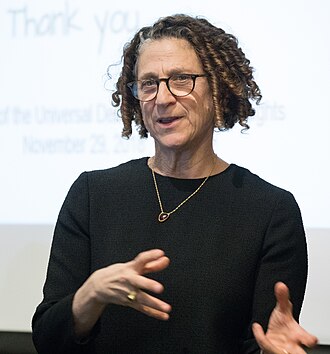
辛西娅·德沃克哈佛大学计算机科学讲席教授、微软研究院杰出科学家,差分隐私与工作量证明的共同提出者,2012 年与合作者提出个体公平定义,开创算法公平性理论研究。
主持人微软研究院 AI 杰出讲师系列的主持人,负责介绍讲者生平与成就。
章节 · 点击跳转视频
0:04 主持人介绍:从密码学到公平 ▶ 正在看
2:31 问题起点:隐藏敏感属性为何失败 ▶ 正在看
8:40 没有真值:分类问题的几种形态 ▶ 正在看
12:03 密码学范式:定义、算法、组合 ▶ 正在看
18:56 群体公平:统计均等及其漏洞 ▶ 正在看
22:32 三个指标不可兼得的数学 ▶ 正在看
26:15 猴子实验与个体公平的定义 ▶ 正在看
32:13 度量从何而来:政治与伦理 ▶ 正在看
36:55 算法进展:线性规划到多重校准 ▶ 正在看
48:47 组合失效:广告拍卖的反例 ▶ 正在看
53:45 可解释性与因果性的困境 ▶ 正在看
58:38 问答:平权、随机与实践处方 ▶ 正在看
本期论点
本期回应
5:30
用邮政编码代替种族做区别对待,是披着合法外衣的种族歧视 装看不见没用该出手抹平群体之间的结果差距吗?
6:53
能理解并使用敏感属性的算法,比刻意回避这些信息的算法更准确 明确使用身份该出手抹平群体之间的结果差距吗?
19:57
统计均等的价值在于被违反时:严重失衡是值得追查的危险信号,而不是不公平的证据 形式定义撑不住公平的标准该怎么定下来?
22:05
统计均等挡不住「公平性的选区划分操纵」,真正需要的是各交叉类别都获得比例代表 形式定义撑不住公平的标准该怎么定下来?
24:02
除非各群体基础比率相同,不完美的分类器无法同时均衡假阳性率、假阴性率与阳性预测值 形式定义撑不住公平的标准该怎么定下来?
27:50
在某个分类任务上相似的两个人,应当被相似地对待 必须写成数学定义公平的标准该怎么定下来?
28:55
衡量人与人相似度的度量必然与任务相关,同一对人在不同用途下可能截然不同 各方公开谈出来公平的标准该怎么定下来?
29:56
当人们沿连续分数密集分布时,应按分数分配获得结果的概率,而不是用固定阈值一刀切 必须写成数学定义公平的标准该怎么定下来?
33:03
公平度量只能靠各方利益相关者的政治过程磨合得出,没有直截了当的数学答案 各方公开谈出来公平的标准该怎么定下来?
41:30
施加公平性约束是有代价的:学习公平策略的遗憾值高于不考虑公平性时 形式定义撑不住公平的标准该怎么定下来?
49:13
由各自满足个体公平的部件组成的系统,整体未必是公平的 形式定义撑不住公平的标准该怎么定下来?
52:21
广告主自己不看敏感属性并不足以保证公平,盯着这一点的竞争对手会扭曲投放结果 装看不见没用该出手抹平群体之间的结果差距吗?
58:01
公平度量标准必须公开、不该保密,并始终接受辩论与持续修正 各方公开谈出来公平的标准该怎么定下来?
1:06:19
始终靠抛硬币做决定也让相似的人得到了相似对待,因而符合个体公平的定义 形式定义撑不住公平的标准该怎么定下来?
25:43
三个公平指标的不可兼得与算法如何实现无关,换成人来决策同样无法化解 在拿工具的人技术带来的伤害,源头在哪里?
01主持人介绍:从密码学到公平
0:04
>> Hey, welcome everyone. I'm delighted this afternoon to introduce our AI distinguished lecturer Cynthia Dwork, who many of you know. Cynthia is one of the most accomplished technical women who I've ever been around. She has four fancy titles. Right now, she's the Gordon MacKay Professor at Harvard in the Computer Science department. She's also the Radcliffe Alumna Professor at the Radcliffe Institute for Advanced Studies, and she's an Affiliate Faculty at the Harvard Law School. In addition to that, she's a distinguished Scientist at Microsoft Research.
>> 嘿,欢迎各位。今天下午我很高兴向大家介绍我们的 AI 杰出讲师 Cynthia Dwork,你们中很多人都认识她。Cynthia 是我接触过的最有成就的技术女性之一。她有四个响当当的头衔。目前,她是哈佛大学计算机科学系的 Gordon MacKay 讲席教授。她同时也是拉德克利夫高等研究院的 Radcliffe Alumna 讲席教授,还是哈佛法学院的兼职教授。除此之外,她还是微软研究院的杰出科学家。
便签引用
0:41
She's was one of the inaugural class of distinguished scientists here about a decade or so ago, maybe a little bit more. Cynthia received her PhD at Cornell with John Hopcroft. From there she did a couple of year Postdoc with Nancy Lynch at MIT, and then went on to spend a fair amount of time at IBM Almaden, where she did a lot of foundational work that I was not all that familiar with till earlier today. The more I knew about that she did there was something on rank aggregation, which was very important in web search.
大约十年前,也许还要更早一点,她是这里首批杰出科学家中的一员。Cynthia 在康奈尔大学跟随 John Hopcroft 取得了博士学位。之后她在 MIT 跟着 Nancy Lynch 做了两年博士后,然后在 IBM 阿尔马登研究中心待了相当长一段时间,在那里她做了很多奠基性的工作,这些我直到今天早些时候才有所了解。我了解得越多,就越发现她在那边做过的东西,比如排序聚合(rank aggregation),这在网页搜索里非常重要。
便签引用
1:14
She also did work on the cryptography foundations, as well as proof of work, which is one of the underlying foundations of Bitcoin. At MSR, she is well known for two other strands of work. One is on differential privacy, putting privacy on theoretical firm ground, and it's so incredibly important today. What she'll talk about with us this afternoon is more nascent work on algorithmic fairness. This work, and her lifelong accomplishments have been acknowledged by more prizes, and I name, more prizes, and the fancy titles I mentioned at the outset.
她还做过密码学基础方面的工作,以及工作量证明(proof of work),那正是比特币底层的基础之一。在微软研究院,她还以另外两条工作脉络而广为人知。一条是差分隐私,把隐私放在了坚实的理论基础之上,这在今天真是极其重要。她今天下午要跟我们讲的,是关于算法公平性的更新的一些工作。这项工作,以及她毕生的成就,已经被众多奖项所认可,我说的是,众多奖项,还有我开头提到的那些响当当的头衔。
便签引用
1:52
She's obviously a fellow of the ACM. She won the Dijkstra Prize. More than a decade ago, she won the Go del prize. She's one of the very few people who are members of both the National Academy of Science, and National Academy of Engineering. She's an amazingly a depth scientist, and one who picks problems that have real practical impact, which I think is a really unique skill. So, with that introduction, I'd like to introduce Cynthia, who will tell us about some of her work on algorithmic fairness.
她当然是 ACM 会士。她获得过 Dijkstra 奖。十多年前,她获得了哥德尔奖。她是极少数同时身为美国国家科学院院士和美国国家工程院院士的人之一。她是一位有着惊人深度的科学家,同时也是一位专挑那些具有真正实际影响力的问题去做的人,我觉得这是一项非常独特的能力。那么,在这段介绍之后,我想请出 Cynthia,她将向我们介绍她在算法公平性方面的一些工作。
便签引用
02问题起点:隐藏敏感属性为何失败
2:31
>> Thank you very much for that gracious introduction. Thank you for inviting me, and I'm really very happy to be here. I have a couple of questions before I proceed with the talk. So, first of all, how many people here are working in Machine Learning and AI? Okay. How many people here have worked on fairness particularly? All right, and any theoretical computer scientists? Great. All right, good. That helps me figure out what I should be saying. This is a research effort that actually began at Microsoft, now defunct Silicon Valley Lab.
>> 非常感谢你这么客气的介绍。谢谢你们邀请我,我真的非常高兴能来到这里。在开始演讲之前,我有几个问题想问。首先,在座有多少人是做机器学习和人工智能的?好的。有多少人专门研究过公平性?好的,那有理论计算机科学家吗?很好。好的,不错。这有助于我判断我应该讲些什么。这项研究其实是从微软开始的,就是现在已经解散的硅谷实验室。
便签引用
3:22
Started in approximately 2010. I should mention that all of the good slides in the talk are due to my student Cristina Elemental. Here's our problem. We're interested in algorithmic fairness, will be more specific in a minute. We have a population. Our population is diverse in many different ways, ethnic diversity, religious diversity, geographic, medical, and so on. Well, whatever it is we want to do, we want to be sure that somehow or other we're being fair. Typical examples would be something like this.
大约始于 2010 年。我要说明一下,这次演讲里所有好看的幻灯片都出自我的学生 Cristina Elemental 之手。我们的问题是这样的。我们关心的是算法公平性,稍后会讲得更具体。我们有一个人群。这个人群在很多方面都是多样的:族裔多样性、宗教多样性、地域的、医疗的,等等。那么,不管我们想做什么,我们都想确保自己以某种方式做到了公平。典型的例子大概是这样的。
便签引用
3:59
We have a bank that receives detailed user information about you, before giving you your online experience. You surf on over to some bank, and before they show you anything, they consult with tracking networks, and find out stuff about you. The concern, and this was a concern that was raised in a newspaper article in the Wall Street Journal, in a series that they ran in 2010 called, "What they know." It was mostly about privacy, but it also raised the following fairness concern. The concern was that of the illegal practice of steering minorities to credit card offerings of less desirable terms.
有一家银行,在为你提供在线服务之前,会先收到关于你的详细用户信息。你上网访问某家银行,在他们向你展示任何内容之前,他们会先咨询追踪网络,了解关于你的信息。这个担忧——《华尔街日报》的一篇报道就提出过这个担忧,那是他们 2010 年做的一个系列,叫《他们知道什么》。那个系列主要讲隐私,但也提出了下面这个公平性方面的担忧。这个担忧就是那种非法做法:把少数族裔引导到条件较差的信用卡产品上。
便签引用
4:45
The financial industry is more heavily regulated than many other industries, and so this problem really was a legal one, not just "a fairness one." Just to dispense with some obvious things, one suggestion is of course to hide the sensitive information from the classifier. Whether you're a member of a minority group or not would be hidden. That falls victim to a couple of things. First of all, there's red lining. Who knows the term red lining? Great. We'll see a picture of it in a minute, and on the web there's web lining.
金融行业比很多其他行业受到的监管都更严格,所以这个问题真的是一个法律问题,而不只是“一个公平性问题”。先把一些显而易见的想法处理掉:一个建议当然是把敏感信息对分类器隐藏起来。你是不是少数群体的成员,这一点会被隐藏。这个做法会栽在几个问题上。首先,有“红线划分”这回事。有谁知道“红线划分”这个说法?很好。我们待会儿会看到一张相关的图,而在网络上则有“网络划线”。
便签引用
5:30
This is basically say when zip code is used as a redundant encoding of race. It's illegal to discriminate based on race, it's not illegal to discriminate based on zip code. We have this issue now in general of redundant encoding. Sensitive attributes can be embedded holographically in your other attributes. The other is a Birds of a Feather phenomenon. Has anybody seen this picture before? This was an undergraduate research project at a class at MIT. This is not a full-fledged studying, but essentially what the students found was the following.
这基本上是说,用邮政编码作为种族的冗余编码。基于种族歧视是违法的,但基于邮政编码来区别对待并不违法。现在我们普遍面临这种冗余编码的问题。敏感属性可以像全息一样嵌入到你的其他属性之中。另一个问题是“物以类聚”现象。有人以前见过这张图吗?这是 MIT 一门课上的本科生研究项目。这不是一项完整成熟的研究,但学生们发现的基本上是这样的。
便签引用
6:14
If you're male, and something like five percent of your friends on Facebook are self-described as gay. Then you're very likely to be gay. You may not choose to release this information about yourself, but from this Birds of a Feather flock together phenomenon, it can be determined from the attributes of your friends. Hiding the sensitive attribute is a little dicing. Now, there's another problem with hiding the sensitive information. That is that in some sense culturally aware algorithms can be more accurate than algorithms that survive.
如果你是男性,而你 Facebook 上大约百分之五的好友自述是同性恋,那么你很可能也是同性恋。你可能选择不公开关于自己的这项信息,但根据这种“物以类聚”的现象,它可以从你朋友的属性中被推断出来。隐藏敏感属性有点靠不住。还有另一个隐藏敏感信息的问题。那就是,在某种意义上,具备文化意识的算法可能比那些回避这些信息的算法更准确。
便签引用
7:06
If you have a culturally aware algorithm, it can make very good use of this sensitive information to be more accurate. In a typical example, and by the way, let me introduce some populations that I'm going to be using in the talk. We all like food or most of us like food. Some people like to have their food flavored with the herb sage, and the rest prefer to have their food flavored with the herb thyme. So, my groups are going to be the thyme eaters and the sage eaters. Generally, sage will be the minority group, but not everything will require that.
如果你有一个具备文化意识的算法,它可以非常好地利用这些敏感信息来提高准确度。举一个典型的例子——顺便说一下,让我先介绍几个我在演讲中会用到的人群。我们都喜欢食物,或者说我们大多数人喜欢食物。有些人喜欢用鼠尾草这种香草给食物调味,其余的人则更喜欢用百里香给食物调味。所以,我的群体将是百里香食用者和鼠尾草食用者。一般来说,鼠尾草那一组是少数群体,但并不是所有情况都需要这样设定。
便签引用
7:48
I'm going to be calling them S and T. Maybe you have a situation where hearing voices is a very common religious experience among the sage eaters, but among the thyme eaters it's a diagnostic criterion for schizophrenia. This is a real medical example. So, knowing whether or not one is a sage eater or a thyme eater permits better classification, more accurate classification. >> Now, as you all know, in machine learning we train on historical data. Historical data is often biased, and so we can't just say train on the data because we'll imbibe the biases in the mother's milk of training data.
我会把他们称为 S 和 T。也许你会遇到这样一种情况:在鼠尾草食用者中,听到声音是一种很常见的宗教体验,但在百里香食用者中,这却是精神分裂症的一项诊断标准。这是一个真实的医学例子。所以,知道一个人是鼠尾草食用者还是百里香食用者,能带来更好的分类、更准确的分类。>> 现在,正如大家都知道的,在机器学习里我们是用历史数据来训练的。历史数据往往是有偏见的,所以我们不能简单地说“就用这些数据训练”,因为我们会把训练数据这口“母乳”里的偏见一并吸收进来。
便签引用
03没有真值:分类问题的几种形态
8:40
This brings up a really important problem, which is that in general, there is no general source of ground truth for the things that we're trying to do. So, we have to figure out how to extract fairness when we possibly can, keeping this in mind. We can't just go to the training data. Now, who knows what this is a picture of? Okay. All right. This is a picture from the Sistine Chapel, it's Michelangelo's depiction of the last judgment. So, we have Jesus in the middle, and on his left are the people who are being condemned to hell, and on the right are people who are going to go to heaven.
这带出了一个非常重要的问题,那就是总体而言,对于我们想做的这些事情,并不存在一个通用的“真值”来源。所以,我们必须想办法在力所能及的时候把公平性提取出来,同时牢记这一点。我们不能直接去依赖训练数据。那么,有谁知道这是一幅什么画?好的。没错。这是西斯廷礼拜堂里的一幅画,是米开朗基罗描绘的《最后的审判》。中间是耶稣,在他左边的是被判入地狱的人,右边则是将要上天堂的人。
便签引用
9:26
So, this is a binary classification situation. You can have a ternary classification situation. So, here, we have some slides from brain tissue. Over on the left, this is cancer, on the right, is healthy brain tissue, and in the middle we have cancerous cells on the left. These cells, they're not cancerous but they're not normal either, they're affected by the tumor. So, we might want a ternary, a more complicated classification system for something like this. Here's another classification problem.
所以,这是一个二分类的情形。你也可以有一个三分类的情形。这里我们有一些脑组织切片。左边这是癌变组织,右边是健康的脑组织,中间的话,左侧是癌细胞。这些细胞并不是癌细胞,但也不正常,它们受到了肿瘤的影响。所以,对于这样的情况,我们可能想要一个三分类的、更复杂的分类系统。这是另一个分类问题。
便签引用
10:09
I'm calling this a dependent classification problem. So, let's say that you're trying to hire people. You're job is not just to distinguish the qualified from the unqualified, or even gradations among that, you have a more complicated problem. Maybe there are hundreds of qualified people and well-qualified people, but you only want to interview 10 of them because, after all, you have finite resources. So, you want to fairly select a cohort of people to interview. So, that's a classification problem where you can't just classify each person individually as to whether they're good enough to interview, you have to somehow constrain it.
我把它叫做“有依赖关系的分类问题”。比如说,你正在招聘。你的任务不只是把合格的和不合格的���分开,甚至也不只是在其中分出等级,你面对的是一个更复杂的问题。也许有几百个合格的人和非常优秀的人,但你只想面试其中的 10 个,因为毕竟你的资源是有限的。所以,你想公平地挑选出一批人来面试。所以,这是一个你不能只是逐个判断每个人是否够格来面试的分类问题,你必须以某种方式加上约束。
便签引用
10:57
Another kind of classification problem is scoring.
另一类分类问题是打分。
便签引用
11:15
This is something for evaluating arrested children to determine whether or not they should be eligible for detention or release, whether they should be detained or released. So, it's a scoring system. You can see sorts of things like, there are points for the various kinds of offenses that they committed this particular time. Then, there are other sorts of points for their prior offense history. There are negative points that come from mitigating factors. These scores are then converted into a binary decision, whether to release or to detain.
这是一个用来评估被捕儿童的工具,用于判断他们是否应该被拘留或释放,也就是该关押还是该放走。所以这是一个评分系统。你可以看到这类东西,比如针对他们这次所犯的各类罪行有相应的分数。然后,针对他们此前的犯罪记录还有另外一些分数。还有一些来自减轻情节的负分。这些分数随后会被转换成一个二元决定:释放还是拘留。
便签引用
04密码学范式:定义、算法、组合
12:03
Depending on the definition that you're using, fairness in scoring will or will not result in fairness in the decision. I still haven't defined anything. Now, we want to have a mathematically rigorous approach to algorithmic fairness. Historically, there's a way of trying to take these big goals and translate them into a research program that should lead to some practicable outcome. So, the first item in the basic paradigm is definitions. What are you trying to do? In our case, this is going to be, what do we mean by fair.
取决于你使用的定义,打分上的公平性可能会、也可能不会带来决定上的公平性。我到现在还什么都没定义。现在,我们希望对算法公平性有一套数学上严谨的方法。从历史上看,有一种办法可以把这些宏大的目标转化成一个能带来可操作成果的研究纲领。所以,这个基本范式中的第一项是定义。你想做的是什么?在我们这里,问题就是:我们所说的“公平”是什么意思。
便签引用
12:51
So, one way of doing this is that you can define fairness by thinking about what it is you're trying to prevent. So, in a good cryptographic tradition, we imagine an adversary, and the adversary is trying to force unfairness and you want to defend against this. So, what are the various behaviors for goals that the adversary may have that you want to defend against? So, you define fairness. Then, what you want to do, start with a definition, then you want to create algorithms, and you want that your algorithms will enforce whatever this thing is that you've defined.
做这件事的一种方式是,你可以通过思考自己想要防止什么,来定义公平性。所以,按照密码学的优良传统,我们设想一个敌手,这个敌手试图制造不公平,而你想要防御住它。那么,敌手可能有哪些行为或目标是你想要防御的呢?于是你就定义了公平性。然后,你想做的是:先有定义,接着你要设计算法,并且希望你的算法能够落实你所定义的这个东西。
便签引用
13:38
So, once we have the definition of fairness, then we want to build a classification algorithm that we'll be fair according to that definition. Finally, we need a composition theorem. So, think about the systems that you might use that classify people. Let's say, you're determining whether they're appropriate for this ad or that ad. You don't just classify them once, you classify them over, and over, and over again for all sorts of different kinds of ads, and many different times of day, and all sorts of things like that.
所以,一旦我们有了公平性的定义,我们就想构建一个按照该定义是公平的分类算法。最后,我们需要一个组合定理。想想那些你可能会用来对人进行分类的系统。比如说,你在判断他们是否适合看这条广告或那条广告。你不会只对他们分类一次,你会一遍又一遍地、反反复复地为各种各样的广告、在一天中的许多不同时段,以及诸如此类的各种情形下对他们进行分类。
便签引用
14:15
Similarly, if you're doing a privacy preserving data analysis, nobody just wants one privacy preserving statistic, they want a whole ton of statistics. Cryptography, you don't just see one message or one does digital signature, you've got digital signatures on tons of different messages, and encryptions of tons of different messages. So, you need to prove some sort of theorem that talks about how these things combine in practice, and those are called composition theorems. So, here, what we would want is we would want to say that if you have a system based on you know made a fair pieces, then the system somehow is fair in total.
同样地,如果你在做隐私保护的数据分析,没有人只想要一个隐私保护的统计量,他们想要一大堆统计量。密码学也是一样,你不会只看到一条消息或一个数字签名,你会有针对大量不同消息的数字签名,以及大量不同消息的加密。所以,你需要证明某种定理,来说明这些东西在实际中是如何组合起来的,这类定理被称为组合定理。那么在这里,我们希望能够说:如果你的系统是由若干公平的部件构成的,那么这个系统整体上也是公平的。
便签引用
14:53
So, this is a general paradigm that has been successful, particularly in cryptography and in privacy. So, can we apply this to fairness? The short answer is, "I think we probably can but it's way harder in my experience than in the other scenarios." Defining fairness is very, very difficult and very, very controversial. I don't believe it's going to be possible to come up with a single definition that the technical community can come up with a single definition that the population as a whole would say, "Yes that's it."
这是一个通用的范式,它一直很成功,尤其是在密码学和隐私领域。那么,我们能把它应用到公平性上吗?简短的回答是:“我认为我们大概可以,但根据我的经验,这比其他场景要难得多。”定义公平性是非常非常困难的,也非常非常有争议。我不相信有可能给出一个单一的定义——技术界能够拿出一个单一的定义,让全体大众都说:“对,就是它。”
便签引用
15:42
I don't think that's going to happen. >> Building algorithms that's our bread and butter once we have definitions. There's been a lot of work already on building algorithms, some of it very recent and very exciting. So I'll talk a little bit about that, and composition turns out to be very tricky and so we'll see a little bit about that as well. So let's talk about defining fairness. I said that we think about what it is an adversary is trying to do. So think about for example, digital signature schemes.
我不认为那会发生。>> 一旦有了定义,构建算法就是我们的看家本领了。在构建算法方面已经有很多工作,其中一些非常新、非常令人兴奋。所以我会稍微讲一点这方面的内容,而组合性结果证明非常棘手,所以我们也会稍微看一下这一点。那我们先来谈谈如何定义公平性。我说过,我们会去思考对手想要做的是什么。比如说,想想数字签名方案。
便签引用
16:19
What do you want from a digital signature scheme? You're all going to say the same thing right away. Nobody should be able to forge, then you have to get into some details about all of the right quantifiers about what does it mean to say nobody should be able to forge, but forgeries are what you're trying to prevent. So, what are we trying to prevent here? So one of our starting scenarios was actually in the context of advertising. So, advertisers might be biased and we want to build a platform that will mitigate the biases of the advertisers and be fair.
你希望从一个数字签名方案里得到什么?你们马上都会说出同一件事。任何人都不应该能够伪造签名。然后你得深入一些细节,搞清楚所有正确的量词,弄明白说“任何人都不应该能够伪造”到底是什么意思,但伪造就是你想要防止的事情。那么,我们在这里想要防止的是什么呢?我们最初的场景之一其实是在广告的背景下。广告主可能是有偏见的,而我们想要构建一个平台,能够缓解广告主的偏见并做到公平。
便签引用
16:58
So, we literally sat around and said, "Okay, what are some of the kinds of things, a really nasty ill-intentioned advertiser might do?" So red lining we talked about and that's real. Red lining in loans was absolutely real. Housing loans for example in the United States. There's a fabulous book you should read by Richard Rothstein called, The Color of Law, which talks about the effect of the US government in these biases. There's reverse tokenism. So let's say for example, you turn me down for a loan I say, "Oh you turned me down because I have curly hair," and they point to Sergei and they say, "Obviously, he's way more qualified than you are.
所以我们真的就坐下来问:“好吧,一个心怀恶意、非常糟糕的广告主可能会做出哪些事情?”我们谈到过“红线划界”(redlining),这是真实存在的。贷款中的红线划界是完全真实的。比如美国的住房贷款。有一本很棒的书你们应该读一读,是 Richard Rothstein 写的《The Color of Law》(法律的颜色),书里讲的是美国政府在这些偏见中所起的作用。还有“反向象征性录用”(reverse tokenism)。比如说,你拒绝给我贷款,我说:“哦,你拒绝我是因为我头发是卷的,”然后他们指着 Sergei 说:“显然,他的条件比你好得多。
便签引用
17:50
He has straight hair and we turned him down too." The thing is they're using him as the example for all of the curly haired people. So that's a reverse tokenism. Then there's what I'm going to call deliberately targeting the wrong subset of the sage eaters and I'm going to actually postpone that example for a slid or two. So we literally just sat down and wrote a whole bunch of negative things that we wanted to try to prevent. Is this a reasonable approach? Well, I don't know another one and one of the advantages with this sort of approach is let's say that you build a system that protects against all these things that we've listed.
他头发是直的,我们也照样拒绝了他。”问题在于,他们是拿他来当所有卷发人群的例子。这就是反向象征性录用。然后还有我称之为“故意瞄准错误子集”的做法——针对那些吃鼠尾草的人里错误的一部分,这个例子我打算往后推一两张幻灯片再讲。所以我们真的就是坐下来,写下了一大堆我们想要设法防止的负面行为。这是一种合理的方法吗?嗯,我不知道还有别的方法,而这种方法的好处之一是:假设你构建了一个系统,能防住我们列出的所有这些问题。
便签引用
18:35
That's nice. Then somebody comes along and says, "You missed one," you say, "Great." Now you redesign your system to protect against the new one as well. In the meantime, you've been protecting against these first behaviors anyway, so something happened that was better than nothing.
那很好。然后有人过来说:“你漏了一个。”你说:“太好了。”于是你重新设计系统,让它也能防住这个新的问题。而在此期间,你至少一直在防住前面那些行为,所以这总归比什么都不做要好。
便签引用
05群体公平:统计均等及其漏洞
18:56
When most people think about fairness the way I've introduced it, they'll immediately think in terms of groups and in fact the way I introduced it with suggestive of that. So what are group fair? Group fairness properties are basically statistical requirements about the treatment of different groups. So statistical parity, which is also known as demographic parenting, says that, let's say if we're just doing binary classification positive and negative, it says that the demographics of the people with positive classification should be the same as the demographics of the general population.
当大多数人按我刚才介绍的方式去想公平性时,他们会立刻从群体的角度去想,事实上我介绍的方式也确实带有这种暗示。那么什么是群体公平?群体公平性其实就是关于不同群体所受待遇的统计学要求。比如统计均等(statistical parity),也叫人口统计均等,它说的是,假设我们只做正负二分类,它要求被分为正类的那群人的人口构成,应该与总体人群的人口构成相同。
便签引用
19:38
So the same proportions are being positively classified for sage eaters and time eaters as in the population as a whole and also the same for the negative classifications. Now, this is nice. When is it really meaningful? As we'll see, it's mostly meaningful in the breach. If you see some incredible departure from statistical parity, that's a red flag. Doesn't mean that things have been unfair necessarily, but it certainly is a nice place to go looking to see, why did this happen? So, it can be meaningful in the breach but it permits what we call, as I said targeting the wrong subset of S. So I have a spa, it's a luxurious spa and I really don't want those sage eaters at my spa, but I have to advertise to them in the same proportion as their proportion in the population as a whole.
所以对于鼠尾草食用者和时间食用者,被判为正类的比例与整体人群中的比例是一样的负类判定的比例也同样一致。这挺好的。那它什么时候才真正有意义呢?我们会看到,它的意义主要体现在被违反的时候。如果你看到统计均等被严重打破,那就是一个危险信号。这并不一定意味着有不公平发生,但它确实是个很好的切入点,让你去追查:这是怎么发生的?所以它在被违反时是有意义的,但它允许我们所说的,就像我说的,针对 S 中错误的子集。比如我有一家水疗馆,很高档的水疗馆,我其实并不想让那些鼠尾草食用者来我的水疗馆,但我又必须按照他们在整体人群中的比例向他们投放广告。
便签引用
20:40
So what do I do? How do I be biased? I advertise to the members of S who can't afford to come to my spa. So I've deliberately targeting the ones who can't come and therefore I'm ensuring that my spa isn't gaining new sage eaters. But among the time eaters, I advertise to the wealthy and they can come. So demographic parody, oops it's not enough and you have to look at it much more carefully.
那我该怎么办?我怎么才能做到有偏见?我把广告投给 S 中那些根本负担不起来我这里消费的人。所以我故意针对那些来不了的人,从而确保我的水疗馆不会吸引到新的鼠尾草食用者。而在时间食用者当中,我把广告投给富人,他们就能来。所以人口统计均等,糟糕,它是不够的,你必须更仔细地去审视它。
便签引用
21:19
There's also this question of the intersectional cases, which leads to what's colorfully called fairness gerrymandering. So, we have our population. I've divide it into the sage eaters and the time eaters, but they're also the tea drinkers and the coffee drinkers. What we maybe really want is that if we look at the four different intersection categories, we should have proportional representation for each of these categories. It would be very unfair if we only showed the ad to sage eating coffee drinkers.
还有交叉性情形的问题,这引出了一个说法很生动的概念,叫做"公平性的选区划分操纵"。我们有我们的人群。我把它分成鼠尾草食用者和时间食用者,但他们同时也分为喝茶的人和喝咖啡的人。我们真正想要的,也许是当我们看这四个不同的交叉类别时,每一个类别都应该有比例上的代表性。如果我们只把广告展示给喝咖啡的鼠尾草食用者,那就非常不公平了。
便签引用
21:58
So you can fill in demographic groups for where you really clearly want this intersectional parody. Statistical parody by itself does not protect against this kind of fairness gerrymandering.
所以你可以把具体的人口群体代入进去,你会很清楚地看到自己确实想要这种交叉性的均等。而统计均等本身并不能防止这种公平性选区操纵。
便签引用
06三个指标不可兼得的数学
22:32
So statistical parody was one definition of fairness for groups, there are other definitions of fairness for groups and then we have to face the fact that some group fairness properties are mutually incompatible. So how many of you know this story? So many of you do but most of you don't. So, I have a classifier. So let's say that we are classifying people and we are predicting. So we're classifying as to whether we think you're going to do something, we think you're going to recidivate versus we don't think you're going to recidivate.
所以统计均等是群体公平性的一种定义,群体公平性还有其他定义,然后我们不得不面对一个事实:某些群体公平性的性质是相互不兼容的。你们当中有多少人知道这个故事?有不少人知道,但大多数人不知道。好,我有一个分类器。比如说我们在对人进行分类,我们在做预测。我们要判定的是我们认为你会不会做某件事,我们认为你会再犯,还是我们认为你不会再犯。
便签引用
23:16
So importantly here, there's information that's going to be missing, like the future hasn't happened yet and whether someone released from jail recidivates may depend on many things that happened to them during their experiences. So one thing you might want reasonably is that you would have an equal false positive rates across your different demographic groups. Another might be that you would want an equal false negative rates across the different demographic groups. You might also want equal positive predictive value which is among those who are predicted to recidivate, how many of them actually do?
这里很重要的一点是,有些信息是缺失的,比如未来还没有发生,而一个人出狱后会不会再犯,可能取决于很多事情,取决于他们在这段经历中遭遇了什么。所以你可能会合理地希望,不同人口群体之间的假阳性率是相等的。另一个希望可能是,不同人口群体之间的假阴性率是相等的。你可能还希望阳性预测值相等,也就是在那些被预测会再犯的人当中,有多少人真的再犯了?
便签引用
23:55
That's the positive predictive value. I chose these three, these aren't my only three but these are very famous, because it's known that no imperfect classifier can simultaneously ensure equal false positive rates across groups and equal false negative rates and equal positive predictive value, unless the base rate is the same across groups. So unless the base rate of recidivating is the same across groups. The reason for this, as Chouldechova points out in her paper, is that these quantities are related by this equation.
这就是阳性预测值。我选了这三个,它们不是仅有的三个,但都非常有名,因为我们已经知道,任何不完美的分类器都不可能同时保证各群体间假阳性率相等、假阴性率相等、以及阳性预测值相等,除非各群体的基础比率相同。也就是除非各群体再犯的基础比率是一样的。正如 Chouldechova 在她的论文中指出的,原因在于这几个量之间由这个等式联系在一起。
便签引用
24:37
So we could write down for the sage eaters the false positive rate, the false negative rate and the positive predictive value and they would satisfy this equation where P would be the base rate among the sage eaters. We would then write down the same equation for the time eaters. Now, requiring equal false positive rates across the two groups means that this term would have to be the same in the two equations. So then these blue guys have to be the same and that blue term would have to be the same and the only way this could happen is if the base rate P is the same in the two groups.
所以我们可以针对鼠尾草食用者写出假阳性率、假阴性率和阳性预测值,它们会满足这个等式,其中 P 是鼠尾草食用者当中的基础比率。然后我们对时间食用者写出同样的等式。现在,要求两个群体的假阳性率相等,就意味着这一项在两个等式中必须相同。那么这些蓝色的部分必须相同,那个蓝色的项也必须相同,而唯一能做到这一点的方式,就是两个群体的基础比率 P 相同。
便签引用
25:28
When the future is unknown, so therefore classification would be imperfect, no algorithm can simultaneously ensure these three very natural to desiderata unless the base rate is the same. Nobody cares how that algorithm is implemented. So if you believe in free choice or randomness, you get the same thing whether the algorithm is a machine or whether it's some other form. >> So, it does not make sense to say let's solve this problem by bringing a human into the loop. Does nobody could bring into the loop that would address this problem.
当未来是未知的,因而分类必然不完美时,没有任何算法能同时保证这三个非常自然的诉求,除非基础比率相同。没有人在乎这个算法是怎么实现的。所以无论你相信自由选择还是随机性,结果都一样,不管这个算法是一台机器,还是别的什么形式。>> 所以,说"我们把人加进来参与决策就能解决这个问题",是讲不通的。没有人能被拉进来解决这个问题。
便签引用
07猴子实验与个体公平的定义
26:15
It's just the math. So as you can probably tell, I find a group fairness notions dissatisfying for a number of reasons. I'm sharing some of these reasons with you. Now this brings us to a very famous video. How many people have seen this? Not all, great. I mean not even half. So, this is an experiment with Capuchin Monkeys, they're paired up. The monkey has to do a task which is to hand you a rock and then the monkey gets a reward. So, let's see, sorry. >> So, she gives a rock to us that's the task.
这就是数学本身决定的。所以你大概能看出来,我对群体公平性的这些定义并不满意,理由有好几条。我把其中一些理由分享给了大家。这就把我们带到了一个非常有名的视频。有多少人看过这个?不是所有人,很好。我是说连一半都不到。这是一个用卷尾猴做的实验,它们两两配对。猴子要完成一个任务,就是把一块石头递给你,然后猴子就能得到奖励。那我们来看看,抱歉。>> 她把石头递给我们,这就是任务。
便签引用
27:10
We give our piece of Cucumber and she eats it. The other one needs to give a rock to us, and that's what she does. She gets a Grape. If the other one sees that, she gives a rock to us now gets again Cucumber.
我们给她一片黄瓜,她吃掉了。另一只也要把石头递给我们,她照做了。她得到的是一颗葡萄。如果另一只看到了这一幕,她再把石头递给我们,结果又拿到黄瓜。
便签引用
27:41
>> Okay. So that brings us to the notion that I prefer which is Individual Fairness. Individual Fairness says intuitively that, "For a given classification task, if two people are similar with respect to that classification task then they should be treated similarly." Now to make any sense out of this, we need the right notion of what it means to be similar or dissimilar. We need some kind of a distance notion. So, a classic example is in credit scoring where the difference in credit scoring literally gives you a metric for how dissimilar a pair of people are considered to be for credit worthiness.
>> 好。这就引出了我更偏爱的概念——个体公平性。个体公平性直观地说就是:“对于一个给定的分类任务,如果两个人在这个分类任务上是相似的,那他们就应该被相似地对待。”要让这句话有意义,我们需要一个恰当的概念来界定什么叫相似或不相似。我们需要某种距离的概念。一个经典的例子是信用评分,评分之间的差值实际上就给了你一个度量,用来衡量一对人在信用价值上被认为有多不相似。
便签引用
28:30
Okay. Of course, again, I have to emphasize this is a Task-Specific Notion. So, Sergei and I might be in fact comparably qualified for a loan but for recommending hair products who would be completely different. So we're similar for one purpose but totally different for another purpose. So, it's very important that when we talk about these metrics they're Task-Specific. Now, thinking about credit scores, maybe people in general are sort of smushed uniformly from highly qualified to very unqualified.
好。当然,我还得再强调一次,这是一个任务相关的概念。比如说,Sergei 和我在贷款资质上可能确实差不多,但要推荐护发产品,我们就完全不一样了。所以我们在某一个用途上是相似的,在另一个用途上却截然不同。所以很重要的一点是,我们谈这些度量时,它们都是任务相关的。再来想想信用分,也许人们大体上是从高度合格到非常不合格均匀铺开的。
便签引用
29:12
So, when you're trying to decide whether to give a loan based on whether somebody crosses a threshold, you may have two people who are very close and you give one of them the loan and you deny it to the other one, right? If the scores are in fact sort of densely packed along this line, then indeed that has to happen. So, you sort of have to draw the line somewhere, that's the general worry. Then you would have very similar people who are being treated very dissimilarly. So, what do the theoreticians say that you should do in this case? You randomize.
那么当你想根据某人是否越过某条阈值来决定要不要放贷时,你可能碰到两个非常接近的人,你给了其中一个贷款,却拒绝了另一个,对吧?如果这些分数确实沿着这条线密集分布,那这种情况就必然会发生。所以你总得在某个地方划这条线,这就是普遍的担忧所在。于是你就会遇到非常相似的人却被非常不同地对待。那理论家们说这种情况下该怎么办?你要随机化。
便签引用
29:58
So, instead of deciding yes definitely for you and definitely not for you, you assign to people a probability of getting the loan or a probability of getting an A depending on their creditworthiness. You arrange that if two people are very similar, then the probability distribution on outcomes that they see is very similar. Yes? >> Two policemen were just fired for tossing a coin to decide whether to arrest someone for speeding ticket. So, they may have heard your lecture. >> No. I say is there are circumstances under which it might be the right thing to do.
也就是说,不是对你判定“肯定给”、对你判定“肯定不给”,而是根据信用状况,给每个人分配一个拿到贷款的概率,或者拿到 A 的概率。你要安排成:如果两个人非常相似,那他们面对的结果概率分布也非常相似。有问题吗?>> 有两名警察刚刚被解雇了,因为他们靠抛硬币来决定要不要因超速开罚单而逮捕某人。可能他们听过你的课。>> 不。我是说,在某些情形下这可能是正确的做法。
便签引用
30:49
Police have huge amounts of discretion, and if they treat similar people similarly maybe that's fine. >> But maybe instead of randomizing, one could just scale the loans. So instead of having a fixed amount that you then, you could change the amount of loan until reaches zero. >> You could certainly do something like that. I would have to think through all of the ramifications. But, there are cases where you must make a binary decision. So, we're going to take this as our definition of Fairness. So, we have a set of outcomes.
警察拥有极大的自由裁量权,如果他们相似地对待相似的人,也许那没什么问题。>> 但也许可以不做随机化,而是把贷款额度按比例调整。就是说不用一个固定金额,你可以调整贷款额度,一直调到零。>> 你当然可以做类似的事。我得把所有的连带影响都想清楚。但确实存在一些必须做二元决策的情形。所以我们要把这个作为我们对公平性的定义。我们有一个结果集合。
便签引用
31:32
In this case, it's yes or no that's O. This is the probability distributions on outcomes. So, we want to find a classifier that maps individuals in our universe to probability distributions on outcomes with the following condition. For some appropriate measure of the difference of two probability distributions, for example total variation distance, we want that the difference in these distributions will be bounded by the distance of these two individuals. So, it's a Lipschitz constraint, the distance under the appropriate tasks specific metric.
在这个例子里就是“是”或“否”,也就是 O。这是结果上的概率分布。所以我们想找到一个分类器,把我们全域中的个体映射到结果上的概率分布,并满足下面这个条件。对于某个恰当的、衡量两个概率分布之间差异的指标,比如总变差距离,我们要求这两个分布之间的差异被这两个个体之间的距离所界定。所以这是一个 Lipschitz 约束,距离是在恰当的任务相关度量下的。
便签引用
08度量从何而来:政治与伦理
32:13
Now, of course this immediately says where does the metric come from? How are you going to get your hands on the metric. I don't have a great answer to that, but I also believe that if we actually had a classification system that people thought was fair, then we could extract from it a metric. >> So, how do we ensure that the metric is fair? >> That's exactly what I just said, we don't know where to get our hands on the metrics. So, when we did this work initially, we said that at the very best it was going to be societies best guess at the moment in clearly what we would need.
当然,这马上就引出一个问题:这个度量从哪儿来?你要怎么才能拿到这个度量。我对此没有特别好的答案,但我也相信,如果我们真的有一套大家认为公平的分类系统,那我们就能从中提取出一个度量。>> 那我们怎么保证这个度量本身是公平的?>> 这正是我刚才说的,我们不知道从哪里能拿到这些度量。我们最初做这项工作的时候说过,说到底它顶多是当下社会对我们所需要的东西的最佳猜测。
便签引用
33:03
I'm now understanding more and more that these things are going to be handled by political processes, that there's no other way of getting these things other than combining stakeholders and measurements to get somewhere. But we don't have a straight mathematical answer for where we're going to get the metric. Yes? >> Is the sort of tension between >> Who watches their watchmen as an argument or the best person to decide if I'm going to offend you, is you not me. It doesn't mean the rule of fairness is it to be a case that in society will dictate that, we'll go back into the group fairness.
我现在越来越明白,这些事情将会通过政治过程来处理,除了把各方利益相关者和各种度量结合起来去摸索出一个结果,没有别的办法。但我们没有一个直截了当的数学答案来说明度量从哪儿来。请讲?>> 这里是不是存在一种张力—— >> “谁来监督监督者”这个论点,或者说判断我有没有冒犯到你,最合适的人是你,不是我。这并不意味着公平的规则就该由社会来规定,那我们就又回到群体公平性去了。
便签引用
33:47
So, for individual fairness, the toughest nut to crack is that the source of the metric is the subject to which the decision will be applied. As in the case of the monkey, the monkey was the one decided, "This is not fair." So, any hands as to how to integral and other societal and individual fairness or separate them properly? >> So, I don't have a mathematical answer to that yet. What I'm starting to engage in very heavily now is, what is the right way of thinking about it politically. I don't mean political correctness, I mean political theory and ethics.
所以对个体公平性来说,最难啃的一块骨头就是:度量的来源恰恰是那个将被施加决策的对象。就像猴子那个例子,是猴子自己判定的:“这不公平。”那么关于如何把社会层面的公平和个体公平性整合起来,或者恰当地把它们区分开,有什么思路吗?>> 我目前还没有一个数学上的答案。我现在开始非常投入地思考的是:从政治的角度,什么才是思考这件事的正确方式。我说的不是政治正确,我说的是政治理论和伦理学。
便签引用
34:30
But, it's an unknown, and work on it guys. It really makes sense, it's an important problem. Maybe ask me more about it at the end. >> Are we right people to work on it? >> So, not by yourselves, unless you have a whole very broad education. Inevitably, there's going to be legislation and regulation. We have to be sure that what gets legislated and regulated is not technically stupid, that it's not infeasible. People will say, I think there's a real risk of very bad law and regulation. So, I think that the technologists have an important role to play in helping to steer away from that.
但这是个未知的领域,各位来研究它吧。这真的很有意义,是个重要的问题。也许结束的时候可以再多问我一些。>> 我们是适合研究这个问题的人吗?>> 不能只靠你们自己,除非你受过非常广博的教育。立法和监管终将到来。我们必须确保被立法和监管的东西在技术上不是愚蠢的,确保它不是不可行的。人们会说,我认为出现非常糟糕的法律和监管是有真实风险的。所以我认为技术人员在帮助避开那种局面上有重要的角色要扮演。
便签引用
35:24
Also, I think that technologists sort of hearing more about the concerns and the issues, they have some of the tools needed to try to move those and act on those concerns. So, we are sort of, but not by ourselves. Yes? >> How do we know that the metric is even computable? For example, if a brain is a universal Turing machine, then they can exist. The computer will function but not serving in extreme machine [inaudible] machine to, a computer will number, so it's just a metric. >> So, I'm hearing about two-thirds of your words, but you seem to be saying, how do we know that it's computable in the sense of how do we know that an information is available?
另外我也认为,技术人员多听听这些关切和问题,他们手上有一些工具,可以试着推动这些事、回应这些关切。所以我们算是合适的人,但不能只靠我们自己。请讲?>> 我们怎么知道这个度量甚至是可计算的?比如说,如果大脑是一台通用图灵机,那它们就可以存在。计算机会运作,但不是在极端机器中运作 [听不清] 机器到,计算机会数出来,所以它就是一个度量。>> 我大概听懂了你三分之二的话,不过你似乎是在问,我们怎么知道它在“信息是否可获得”这个意义上是可计算的?
便签引用
36:10
How do we get our hands on the information, which would give us the metric? >> If you suppose that our brain is a universal Turing machine, and it got eschewed any art training machine, the Nell computer will also can map from a universal Turing machine to a metric, computable metric. >> So, I'm not sure what decision problem you're trying to work in here like whether the brain stops on itself when it gets itself, I don't know exactly. Maybe asked me after, I'm sorry. I'm going to go on. Let's talk a little bit about algorithms.
我们怎么才能拿到那些信息,从而得到这个度量?>> 如果你假定我们的大脑是一台通用图灵机,而它回避了任何图灵机,那么神经计算机也能从一台通用图灵机映射到一个度量,一个可计算的度量。>> 我不太确定你想在这里处理的是哪个判定问题,比如大脑输入自身时会不会停机之类的,我不太清楚具体是什么。也许结束后再问我吧,抱歉。我要继续往下讲了。我们来稍微聊聊算法。
便签引用
09算法进展:线性规划到多重校准
36:55
So, first, as I said, these are challenges that we are familiar. So, in the ad setting, we imagined the situation where we actually knew our universe of individuals, and we even gave the advertiser the opportunity to say for each individual and each potential outcome how bad is it for this individual to be mapped to that outcome. So, what's a loss that's associated incurred by mapping this individual to outcome, o. It's just something that we are adding optionally to allow the vendors to weigh in on things.
首先,正如我说过的,这些都是我们熟悉的挑战。在广告这个场景里,我们设想的情况是:我们其实知道个体的整个全域,而且我们甚至给广告主一个机会,让他针对每个个体和每个可能的结果说明,把这个个体映射到那个结果有多糟糕。也就是把这个个体映射到结果 o 所带来的损失是多少。这只是我们额外加进来的一个可选项,让厂商也能在这些事情上发表意见。
便签引用
37:34
Then, we assemble the ingredients of the science fiction metric and the vendor's loss functions. We want to minimize the vendor's loss subject to the fairness conditions. So, we're viewing the loss functions as soft constraints and the theorists conditions as hard constraints. This is just a linear program. So, in theory, this can be solved, and in fact, there's an interesting observation, which is sort of evocative of those theorems about what you can't do when the base rates are unequal. If you solve the fairness linear program, you get a classifier that gives you a statistical parity, if and only if, intuitively that the distributions are the same.
然后我们把这些材料凑到一起:那个科幻般的度量,以及厂商的损失函数。我们要在满足公平性条件的前提下最小化厂商的损失。所以我们把损失函数看作软约束,把理论上的那些条件看作硬约束。这就是一个线性规划。所以理论上这是可解的,而且事实上还有一个有趣的观察,它让人联想到那些关于“基础率不相等时你做不到什么”的定理。如果你求解这个公平性线性规划,你会得到一个满足统计均等的分类器,当且仅当,直观地说,两个分布是相同的。
便签引用
38:29
So, the Earth mover distance between the uniform distribution on the sage eaters and the time eaters is zero.
也就是说,鼠尾草食用者上的均匀分布与百里香食用者上的均匀分布之间的推土机距离为零。
便签引用
38:40
So, that was something where we assumed that we knew the whole universe, very recently Rothblum and Yona have shown how to relax this a little bit to what they're calling probably approximate fairness, and then they get generalizability. We didn't generalize in our initial result. So, that's a 2018 result. Now, I mentioned that there's been a lot of progress in recent years. So, for example, Hardt, Price, and Srebro took equal false-negative rate and equal false-positive rate, and optionally also equal false-positive rate as a fairness requirement, and they showed how to convert unfair predictors to fair predictors.
这是我们假定知道整个全域的情形,最近 Rothblum 和 Yona 展示了如何把这一点稍微放宽,得到他们所说的“大概近似公平”,然后他们就得到了可推广性。我们最初的结果并没有做到泛化。那是 2018 年的结果。刚才我提到,近几年这方面有很多进展。比如说,Hardt、Price 和 Srebro 采用了同等假阴性率和同等假阳性率,并且可以选择性地把同等假阳性率也作为公平性要求,他们展示了如何把不公平的预测器转换成公平的预测器。
便签引用
39:29
Not for individual fairness, their notion of fairness, these group fairness. Something that I think that you guys might appreciate is, they did this all in post-processing. So, as you know, if you're trying to get a product group to use one of your tools, it's much better if you don't have to interfere in their pipeline, and you can stick something at the beginning or the end. So, that's something they did. Then, in other work, Joseph Kearns, Morgan Stern, and Roth looked at a different problem. They were looking at a bandit setting.
这不是针对个体公平性,他们的公平性概念属于群体公平性。我想你们可能会欣赏的一点是,他们完全是在后处理阶段做的。你们知道,如果你想让某个产品组用上你的工具,最好是不必去干预他们的流水线,而是能在开头或结尾接上一个东西就行。这就是他们所做的。另外还有一项工作,Joseph、Kearns、Morgenstern 和 Roth 研究的是另一个问题。他们考察的是老虎机(bandit)设定。
便签引用
40:09
So, you have basically one arm for each demographic group. So, in our example, there would be two groups, but you could be more general. They're worried about the fact that you may have a lack of training data for your minority group. So, for the sage leader, you don't have a lot of training data. What they require is that at each round, let's say, think about this in terms of loan. At each round, one person from each demographic group comes and you have to choose one to give a loan to, or at most one to give a loan to.
基本上,每个人口统计群体对应一只摇臂。在我们的例子里会有两个群体,但你可以更一般化。他们担心的是,你对少数群体可能缺乏训练数据。所以对于喝鼠尾草茶的那一派,你没有多少训练数据。他们的要求是,在每一轮——我们不妨用贷款来理解这件事。每一轮,每个人口统计群体各来一个人,你必须选一个人放贷,或者说至多选一个人放贷。
便签引用
40:49
Maybe what you'll do is you'll actually choose a probability distribution and you will then choose somebody from that distribution. The requirement is that a worse applicant will never be favored in terms of these probabilities over a better one despite uncertainty. So, they study how to minimize the regret and learn a fair policy. So, they look at the difference between the regret that you get when you enforce this kind of fairness condition, which basically costs you while you were learning about the minority group.
也许你实际会做的是选一个概率分布,然后按这个分布抽一个人出来。要求是:尽管存在不确定性,较差的申请人在这些概率上永远不会被优待于较好的申请人。于是他们研究如何最小化遗憾值并学到一个公平的策略。他们比较了施加这种公平性条件时得到的遗憾值的差别,这种条件基本上会让你在了解少数群体的过程中付出代价。
便签引用
41:25
Once you know the minority group well, you can predict with confidence, but when you don't, can't. So, they show that there's a gap, that it's more expensive. You have higher regret when you're learning a fair policy versus regret when fairness is not a concern. There was a question? >> Yes. So, what is the fairness that are used here? >> They're using individual fairness at each round. Among the people who have shown up at that round. >> The probability that you choose usually shouldn't differ. >> Right, shouldn't be.
一旦你充分了解了这个少数群体,你就能有把握地做预测,但在还不了解的时候就不行。所以他们证明了存在一个差距,代价更高。学习公平策略时的遗憾值,比不考虑公平性时的遗憾值更高。刚才有问题?>> 是的。这里用的是哪种公平性?>> 他们在每一轮用的是个体公平性。在那一轮出现的这些人之间。>> 你选中他们的概率通常不应该有差别。>> 对,不应该有。
便签引用
41:56
Actually, no sorry. There's something a little bit more worse. Just a worse applicant is not favored over a better applicant. Yes, sorry. I misremembered. That's the one for this paper. So, it was 2016, 2017 was a really interesting year. So, two independent groups of researchers started looking at some of these similar questions. So, now, we're getting into the intersectional case that I mentioned before. So, imagine that you have, for the first paper, this is where the gerrymandering nomenclature came from.
其实,不好意思,说错了。还有一点更严格的说法。就是较差的申请人不会被优待于较好的申请人。是的,抱歉,我记错了。这才是这篇论文里的定义。那是 2016 年,而 2017 年是非常有意思的一年。有两组独立的研究者开始研究其中一些类似的问题。现在我们进入我前面提到的交叉性情形。设想一下,第一篇论文——“选区划分”(gerrymandering)这个说法就是从这儿来的。
便签引用
42:39
Imagine that you have a couple of sensitive bits for now. Lets say, K sensitive bits. So, sage versus time, and coffee versus tea, and a couple of other sensitive bits. This gives you two to the K subsets. >> Suppose all of those subsets are still large, they're not tiny relative to the population as a whole. So, this is sort of large intersections of large set. All right, so, they're studying the intersectional case and they want to learn a classifier that will essentially ensure, well they looked at a few different notions, statistical parody, and equalizing the false positive or false negative rates across these intersectional sets.
设想你现在有若干个敏感比特位。比如说,K 个敏感比特位。鼠尾草茶派还是百里香派,咖啡派还是茶派,再加上另外几个敏感比特位。这就给了你 2 的 K 次方个子集。>> 假设所有这些子集仍然很大,相对于整体人口而言并不算微小。所以这算是大集合的大交集。好,他们研究的是交叉性情形,想学出一个分类器,本质上要保证——嗯,他们考察了几种不同的概念,统计均等,以及在这些交叉子集之间拉平假阳性率或假阴性率。
便签引用
43:30
So, I described it as being defined by say K bits, all of the subsets to those K bits. But you can have other ways of describing your collection of sets, like a set of all the sets that can be described by small circuits. So, as long as the set is these sets are large enough, they want to try to guarantee these notions of fairness across the groups. They also showed that the general problem of what they call fairness auditing is hard. So I give you a classifier and these descriptions and perhaps implicit of these groups, how do you determine whether there is a group to whom you're being unfair?
我刚才把它描述成由 K 个比特位来定义,也就是这 K 个比特位所生成的全部子集。但你也可以用别的方式来描述你的集合族,比如所有能用小型电路描述的集合构成的族。所以只要这些集合足够大,他们就想在这些群体之间保证这些公平性概念。他们还证明了他们所说的“公平性审计”这个一般问题是困难的。也就是说,我给你一个分类器,再给你这些群体的描述(可能是隐式的),你要怎么判定是否存在某个群体正在被你不公平地对待?
便签引用
44:13
When one of these intersectional things to whom you're being unfair, and they showed hardness by reduction from agnostic learning. So, the reason they can have an algorithm as well as these negative results is as you all know machine learning often does interesting things even when in theory they're hard. Very similar questions were looked at by Hebert-Johnson, Kim, Reingold and Roth. Wait I made a mistake this is Roth Blom. The other one is Roth this is Roth Blom. They studied calibration. So suppose my predictor is now giving a score, and so I'm going to rate people some number between zero and one.
是否存在某个交叉出来的群体正在被你不公平地对待,并且他们通过从不可知学习(agnostic learning)的归约证明了困难性。所以,他们之所以既能给出算法又能给出这些负面结果,是因为大家都知道,机器学习常常即便在理论上很难的时候,也能做出有意思的事情。Hebert-Johnson、Kim、Reingold 和 Roth 研究过非常类似的问题。等一下,我说错了,这位是 Roth Blom。另一位才是 Roth,这位是 Roth Blom。他们研究的是校准(calibration)。假设我的预测器现在给出的是一个分数,也就是说我会给每个人打一个 0 到 1 之间的数。
便签引用
45:01
Think about this as my prediction about your probability of recidivating, for example. So, the system is calibrated if among those that are rated v, the fraction who truly will end up with a positive label is close to v. So, in other words it's requiring correctness on average for those rated v for all v. So, they got results that were very similar but they're using this kind of notion of correctness as fairness through the calibration version. If you're familiar with the Kleinberg, Mullainathan, and Raghavan result, this is the kind of calibration notion there or related calibration notion.
可以把它理解成我对你再次犯罪概率的预测,比如说。那么,如果在所有被打分为 v 的人当中,真正最终为正标签的比例接近 v,这个系统就是校准的。换句话说,它要求对所有的 v,在被打分为 v 的那群人里平均意义上是正确的。所以,他们得到的结果非常相似,只不过他们用的是这种以校准为形式的“正确性即公平”的概念。如果你熟悉 Kleinberg、Mullainathan 和 Raghavan 的结果,那里用的就是这种校准概念,或者说是相关的校准概念。
便签引用
45:43
They argue that this makes more sense than these other group fairness notions but other than that they get very similar results. So, for every set defined by a circuit in a predetermined set C, they get this approximate calibration simultaneously. Subsequent work by Michael Kim and James Zoe has shown that they've used this to improve some medical predictors. They've gotten some nice results. Then, how long is my talk? >> [inaudible]. >> Okay, I'll talk for just a little more then. Okay, so, the next batch of results deals with algorithmic work that tries to bridge the gap between group fairness and individual fairness by assuming that we have some sort of oracle that tells us for we can ask about certain collections of edges and say, "What are the distances on these edges?"
他们认为这比其他那些群体公平性概念更合理,但除此之外,他们得到的结果非常相似。所以,对于预先给定的集合 C 中每一个由电路定义的集合,他们都能同时得到这种近似校准。Michael Kim 和 James Zoe 的后续工作表明,他们用这个方法改进了一些医疗预测器。他们得到了一些不错的结果。那么,我的报告还有多长时间?>> [听不清]。>> 好的,那我再多讲一点点。好,那么下一批结果涉及的是这样一类算法工作:它试图弥合群体公平性和个体公平性之间的鸿沟,方法是假设我们有某种 oracle,我们可以针对某些边的集合去问它,“这些边上的距离是多少?”
便签引用
46:58
And then it leverages that to do powerful things without requiring you to ask about all pairs. In the deep learning community, there's a whole different approach which is adversarial learning or learning a fair representations and adversarial version of that. So, this is a group fairness notion. Oh shoot. Sorry, all right let me skip this slide. Okay, so the general idea here is we start with instances in some set X and we're going to learn a new representation for people that in some sense retains as much information as possible while suppressing some key attributes such as whether somebody is or is not a member of a sage eater, whether they're saying eater or a time eater.
然后利用这一点做出很强的事情,而不需要你去询问所有的点对。在深度学习圈子里,有一条完全不同的路径,就是对抗式学习,或者说学习公平表示以及它的对抗版本。所以,这是一个群体公平性概念。哦糟糕。抱歉,好吧,这张幻灯片我跳过去。好,这里的总体思路是,我们从某个集合 X 中的实例出发,我们要为人学习一个新的表示,这个表示在某种意义上尽可能多地保留信息,同时抑制某些关键属性,比如某人是不是鼠尾草食客的一员,也就是他们到底是鼠尾草食客还是百里香食客。
便签引用
47:56
And they're using gens and so we've got an adversary that is trying to distinguish given a z whether it came from the sage eater X or a time eater X. The key point in this intuition is the predictor is going to operate on the representation Z. If the predictor is not so powerful as the adversary who is trying to distinguish sage eaters from time eaters and who has trained the encoder to make that representation not yield distinguishability, the predictor is no more powerful than A than in some sense its predictions can't be biased.
他们用的是 GAN,所以我们有一个对抗者,它要在给定 z 的情况下判断这个 z 是来自鼠尾草食客的 X 还是百里香食客的 X。这个直觉里的关键点在于,预测器是作用在表示 Z 上的。如果预测器没有那个对抗者强大——那个对抗者试图区分鼠尾草食客和百里香食客,并且训练了编码器,使得这个表示不产生可区分性——那么预测器就不比 A 更强大,从某种意义上说它的预测就不可能有偏见。
便签引用
10组合失效:广告拍卖的反例
48:47
This is really, really intriguing. It is a group notion of fairness and I would love to see individual fairness worked in here but this is another very interesting direction of research. So, in the last five minutes I'm going to talk about composition. Because this is really interesting and this is new. So, our intuition is, if we have a system in which we have a bunch of individually fair pieces then when we look at the system that's made of these as a whole, it's still at least relatively fair.
这真的非常非常引人入胜。它是一个群体意义上的公平性概念,我很希望能看到个体公平性被融进来,但这也是一个非常有意思的研究方向。那么,在最后五分钟里我要讲的是组合(composition)。因为这个真的很有意思,而且是新的。我们的直觉是,如果我们有一个系统,里面有一堆各自都是个体公平的部件,那么当我们把它们组成的整个系统作为一个整体来看时,它至少也应该相对是公平的。
便签引用
49:27
And the answer is, it's complicated. So, here's a very simple example. Suppose let's make the example really simple you're looking at the New York Times website and there is a single slot for a banner ad at the top of the page. That's going to be our scenario. As you know, there's an auction run for your attention. Advertisers are competing to get that slot. So, let's look at the case where we have two kinds of advertisers. One is advertising tech jobs and the other one is advertising a grocery delivery service.
而答案是,事情很复杂。这里有一个非常简单的例子。假设——我们把例子弄得非常简单——你在看《纽约时报》网站,页面顶部有一个横幅广告的位置。这就是我们的场景。如你所知,为了争夺你的注意力会跑一场拍卖。广告主们在竞争这个位置。那么,我们来看这样一种情况:我们有两类广告主。一类在打技术岗位的招聘广告,另一类在打生鲜配送服务的广告。
便签引用
50:13
So, the tech jobs advertiser and the grocery delivery service advertiser are competing for your attention. Ideally if our classifier for determining who is a a good bet for the tech jobs ad is fair, and if our classifier for determining who's a good bet for the grocery ad is fair, then somehow the system will be fair as a whole. But we want to require that in this complex system, it's still the case that people who are similarly qualified for tech jobs should be similarly likely to see tech job ads and same thing for groceries.
于是,技术岗位广告主和生鲜配送服务广告主在竞争你的注意力。理想情况下,如果我们用来判断谁适合看技术岗位广告的分类器是公平的,并且我们用来判断谁适合看生鲜广告的分类器也是公平的,那么整个系统作为一个整体也应该是公平的。但我们想要求的是,在这个复杂系统里,仍然要做到:技术岗位资质相近的人看到技术岗位广告的可能性也应该相近,生鲜广告也是同理。
便签引用
50:53
So, suppose that the grocery advertiser routinely outbids the tech jobs advertiser. It's an auction, the outbidder wins. So we can even think of it as just the outbidder goes first. The grocery advertiser is going first or its bidding more, all right? And so the tech company is now essentially being reduced to the leftovers, the ones who weren't grabbed by the groceries advertiser. This is true again whether it's done temporally first one than the other or whether it's just done by the money bids.
那么,假设生鲜广告主总是出价高过技术岗位广告主。这是拍卖,出价高的一方获胜。所以我们甚至可以把它理解成:出价更高的一方先来。杂货广告主先来,或者说它出价更高,对吧?于是这家科技公司实际上就只能捡剩下的了,也就是那些没有被杂货广告主抢走的人。再说一遍,无论这是在时间上一个先于另一个发生,还是纯粹由出价高低决定,结论都一样。
便签引用
51:34
So, this is a major problem. It says that no matter how qualified you are for a tech jobs ad, if you're very qualified for groceries, you're not going to see the tech jobs ads. Now who is qualified for the grocery service, the grocery delivery service? New parents. Advertisers drool over the things they can start advertising to new parents and those tend not to be the tech jobs advertisers, and in fact, the tech jobs advertisers you might say shouldn't touch the parenthood bid with a 10 foot pole.
所以,这是个很大的问题。它意味着,无论你多么符合一则科技岗位广告的条件,只要你非常符合杂货类广告的投放条件,你就看不到那些科技岗位的广告。那么,谁符合杂货服务、也就是生鲜配送服务的投放条件呢?刚当上父母的人。广告主一想到能向新手父母投放的那些东西就直流口水,而这些广告主往往不是招聘科技岗位的公司,事实上你甚至可以说,科技岗位的广告主根本不该碰「为人父母」这个出价维度,躲都来不及。
便签引用
52:21
So, even if they are really appropriately not looking at parenthood status, you would think it was appropriate not to be looking at parenthood status in determining who should see the ad there're competitors for your attention are looking at that and that's affecting what happens under the tech jobs advertiser. Okay and there are versions of this particular problem both for individual fairness and for group fairness. So, this problem doesn't go away. No time for these things. There is a way out here though which I will mention which is we could fix a probability distribution on the advertising tasks.
所以,即便他们确实很得体地没有去看用户是否为人父母,你会觉得,在决定谁该看到这则广告时不去看是否为人父母才是得体的做法,可与你争夺注意力的那些竞争者却正盯着这一点,而这就影响了科技岗位广告主那边的结果。好的,这个问题在个体公平性和群体公平性上都有对应的版本。所以,这个问题并不会消失。没时间讲这些了。不过这里有一条出路,我提一下:我们可以在广告任务上固定一个概率分布。
便签引用
53:07
Any probability distribution we want. Then we pick a task according to that distribution, and then we run the classifier just for the chosen task and the proof that this gives us individual fairness is very, very simple. But it leaves money on the table because there are some people for whom we are just not going to be showing ads. So, that raises a number of very interesting economics questions for those who are interested in the intersection of algorithms and economics. Because of time, I will skip the rest.
任意我们想要的概率分布。然后我们按这个分布抽取一个任务,只针对被选中的那个任务运行分类器,而证明这样做能保证个体公平性,是非常非常简单的。但这会白白浪费掉一部分收益,因为有些人我们就是不会向他们展示广告了。所以这就引出了一系列非常有意思的经济学问题,适合那些对算法与经济学交叉领域感兴趣的人去研究。由于时间关系,剩下的我就跳过了。
便签引用
11可解释性与因果性的困境
53:45
>> Final comments. First of all, Interpretability and Causality. There are big literatures on interpretability and causality for fairness. Why is this slide left blank? First of all, I have tried very hard to make headway with interpretability, and I have failed. I don't understand what's being asked, and how it can be achieved. There's a very interesting article called the Mythos of Interpretability by Zachary Lipton. He explains, he catalogs, these are some things that people could want, and here are some of the issues.
>> 最后几点评论。首先是可解释性和因果性。关于公平性的可解释性和因果性,有大量的文献。这页幻灯片为什么是空白的?首先,我非常努力地想在可解释性上取得进展,而我失败了。我不明白这里要求的到底是什么,以及它怎么才能实现。有一篇非常有意思的文章,叫《可解释性的迷思》(The Mythos of Interpretability),作者是 Zachary Lipton。他在文中解释并罗列了人们可能想要的一些东西,以及其中存在哪些问题。
便签引用
54:35
It's very, very thoughtful, and I'm not done thinking about this, but I'm stumped on this one. As far as causality, it's problematic for a number of reasons that I can see. So, first of all, if you're using, say Pearl's theory of causal reasoning, you need a generative model. Now, maybe you're familiar with the saying that all models are wrong, but some models are useful. So, if your definition of fairness ties the classifier to the model, and you need those two together to determine if something is fair, and your model is wrong, you may very well come up with the wrong conclusion.
写得非常非常有见地,我到现在还没想明白这件事,但我在这个问题上卡住了。至于因果性,在我看来它有若干方面的问题。首先,如果你用的是比如 Pearl 的因果推理理论,你就需要一个生成模型。你可能听过这样一句话:所有模型都是错的,但有些模型是有用的。所以,如果你对公平性的定义把分类器和模型绑在了���起,必须两者结合才能判断某件事是否公平,而你的模型又是错的,那你很可能会得出错误的结论。
便签引用
55:17
So, that's a glimpse into what some of the difficulties I've encountered with causality are. Another brief comment as we've talked about the metric, we've talked about the issues of where do you get the metric from, there's still problems. So, here, suppose we have news organization, a nice news. Your news organization has an environment, there's randomness in the environment, you have an individual x, there's randomness in x, but you can talk about, although you can't get your hands on, the probability that this individual x will succeed at nice news.
这就让大家大致看到我在因果性上遇到的一些困难。再简短说一点,我们前面谈过度量标准,谈过这个度量标准从哪里来的问题,但问题仍然存在。假设我们有一家新闻机构,叫「好新闻」。你的新闻机构处在一个环境里,环境中存在随机性,你有一个个体 x,x 身上也有随机性,但你可以谈论——尽管你没法真正拿到——这个个体 x 在「好新闻」取得成功的概率。
便签引用
56:18
It's well-defined once you specify the coins for this randomness and the coins for this randomness. Again, you can't get your hands on it, but at least it makes sense mathematically. Now, what you might require is that if two people are similar, meaning they have similar probabilities now in success. And success can be very crisply defined, like you stay in the company for at least three years, and you have at least one promotion during that time, okay? You might say that if you have two individuals who are so equally likely to succeed, then they should have very similar probabilities of being hired.
一旦你把这边的随机性和那边的随机性所对应的抛硬币都设定好,这个概率就是良定义的。再说一遍,你拿不到它,但至少它在数学上是说得通的。那么你可能会要求:如果两个人是相似的,也就是说他们成功的概率相近。而成功可以定义得非常清晰,比如你在公司待满至少三年,并且在这期间至少晋升过一次,对吧?你可能会说,如果有两个个体成功的可能性同样高,那他们被录用的概率也应该非常接近。
便签引用
56:56
That seems to make some sense, so the metric then is capturing the probability of success. But, what happens if this is not nice news, but it's nasty news, which has a history of being very hostile to sage eaters. So, sage eaters can't succeed no matter how talented they are, or they'll have a real uphill struggle. Should the metric, in fact, be capturing whether people are equally likely to succeed? Should it be capturing whether they're equally talented? What's the right thing to do here? It's not clear. So, final remarks, truth is elusive, it's not remedy.
这听起来有点道理,于是这个度量标准捕捉的就是成功的概率。但是,如果这家不是「好新闻」,而是「坏新闻」呢?这家机构历来对吃鼠尾草的人非常不友好。所以吃鼠尾草的人无论多有才华都无法成功,或者说他们会经历一场艰难的攀爬。那么这个度量标准究竟应该捕捉人们是否同样可能成功?还是应该捕捉他们是否同样有才华?这里正确的做法是什么?并不清楚。所以,最后几点想法:真相是难以捉摸的,它不是解药。
便签引用
57:41
This problem is not remedied by having a computer.
这个问题并不会因为有了计算机就得到解决。
便签引用
57:52
They've argued, I really believed that metrics are really at the heart of everything even if it may take us a long time to find them, but we advocate always sunshine for the metric. The metric should not be kept secret, it has to be open for debate and discussion and refinement. Computers are not necessarily worse than humans, they may be more accurate, especially on the easy cases, they may be more easily tested, they don't get tired when you keep throwing examples at them to see what they have to do.
有人论证过——我也确实相信——度量标准是一切的核心,尽管我们可能要花很长时间才能找到它们,但我们主张,度量标准始终要晒在阳光下。度量标准不该被保密,它必须开放接受辩论、讨论和不断完善。计算机未必比人类更糟,它们可能更准确,尤其是在那些简单的案例上;它们也可能更容易被测试,你不停地丢例子给它们看它们怎么处理,它们也不会累。
便签引用
58:27
That's it. Thank you.
就到这里。谢谢大家。
便签引用
12问答:平权、随机与实践处方
58:38
>> There's a question. >> Sure. Go ahead. Sorry, one behind, and then you. >> So, I'm really [inaudible] a lot. I'm sure you thought about this and might even mentioned it in the previous slide, when you have curious figure of two thing, so in considering the individual there, if we're looking at time eaters, time eaters always teach their kids, and there is this terrible sage brush infection, anyone who eats sage get very ill, also there is this terrible historical injustice right off the sage eaters.
>> 有个问题。>> 好的,请讲。不好意思,先是后面那位,然后是你。>> 我真的[听不清]很多。我相信你想过这个问题,可能在前一张幻灯片里还提到过,当你把两样东西放在一起看的时候,也就是在考虑那边的个体时,如果我们看的是吃百里香的人,吃百里香的人总是这样教他们的孩子,而且有一种可怕的鼠尾草丛感染,任何人只要吃鼠尾草就会病得很重,同时对吃鼠尾草的人还存在这种可怕的历史不公。
便签引用
59:18
They just did weigh less good, apparently everything, they're so focused on handling this illness. So, it just don't happens via this historical coincidence, the sage eaters are almost never like a similarly situated individual, they compete with the time eaters. It seems like on that individual fairness metric, we would just say, okay no problem, and if we're designing jobs, and it's the time eaters they get all of them, whereas we're not considering metric of group aspect and I think somewhere along [inaudible] societies [inaudible] historical justice.
他们方方面面表现都差不少,显然是因为他们全部精力都用来应付这种疾病了。所以,就因为这种历史上的巧合,吃鼠尾草的人几乎从来不会成为处境相似的个体,去和吃百里香的人竞争。看起来按照那个个体公平性的度量标准,我们只会说:好,没问题,而如果我们在分配工作,就全被吃百里香的人拿走了,而我们并没有考虑群体层面的度量,我觉得在[听不清]社会[听不清]历史正义的某个地方是有问题的。
便签引用
59:49
>> That's, of course, an excellent point, and in the paper, we described what we call Fair Affirmative Action, which is a method for dealing with this, where we break certain of the Lipschitz constraints for exactly this reason, but it's a principled approach to this thing. I should mention that it's not so unlike what the state of California does, and the state of Texas does with respect to college. That if you're in the top 10 percent of your class, then you're admitted to one of the state in California, it's one of the UCs, and in Texas, it's one of the state colleges, I guess.
>> 这当然是个非常好的观点,在论文里我们描述了我们称之为「公平的平权行动」(Fair Affirmative Action)的做法,这是一种处理这个问题的方法,我们正是出于这个原因打破了某些 Lipschitz 约束,但这是一种有原则的处理方式。我要说的是,这跟加州和德州在大学录取上的做法其实没有太大区别。如果你在班上排名前 10%,你就会被州里的某所大学录取,在加州是某一所 UC 分校,在德州我想是某所州立大学。
便签引用
1:00:48
The point is that schools in different neighborhoods may have very, very different performances on tests, and so on, and so forth, but it's the same basic idea. So, we add a bit to that, it's not quite as course as taking the top 10 percent. There's a very interesting work by John Roemer at Yale, who is very concerned with theories of distributive justice, and he thinks a lot about education. He thinks that you must invest, and invest, and invest in children in order to compensate for differences of situation, and that as you go through the schooling process, you do less and less of this compensating because the children having been given a good foundation or more, theoretically, I guess, more responsible for how they make use of what they have, but in particular, I remember he said the following in the context of college admissions.
关键在于,不同社区的学校在考试等各方面的表现可能非常非常不一样,但基本思路是一样的。所以我们在这上面又加了一点东西,不像单纯取前 10% 那么粗糙。耶鲁的 John Roemer 有一项非常有意思的工作,他非常关注分配正义的理论,并且对教育思考很多。他认为你必须不断地、不断地对儿童投入,以补偿他们处境上的差异,而随着受教育过程的推进,你做的这种补偿会越来越少,因为孩子们已经被给予了一个良好的基础,理论上说,他们对自己如何利用已有的东西负有更多责任;但特别地,我记得他在大学录取的语境下说过下面这段话。
便签引用
1:02:06
Stratify the students according to the education level of the mother, and within each stratum, look at the cumulative distribution function describing how many hours a week the students spend on homework, and view people in the various percentiles in that CDF from the different strata, as being comparable. One of the points he makes, which I found extremely compelling is that, if you're brought up in a home where nobody is educated, then you may not even think that it's possible to spend 10 or 15 hours a week on homework.
按母亲的受教育程度对学生分层,在每一层内部,看描述学生每周花多少小时做作业的累积分布函数,然后把来自不同层、但在各自 CDF 中处于相同百分位的人视为可比的。他提出的其中一点我觉得极有说服力,那就是:如果你成长在一个没人受过教育的家庭,你甚至可能想不到每周花 10 到 15 小时做作业是可能的。
便签引用
1:02:49
It just doesn't cross your mind to do it, or you might be working, and unable to do it. I think that these sorts of insights from the social scientists are very important in what we are doing is in some sense analogous to that. It's a very good point. >> So, that whole conversation is basically related to this nasty news, choosing the metric thing, and it comes down to questions of what the condition on mediating variables and stuff. So, basically, the rest of the talk didn't address those types of issues, like how to choose the metric fairly.
你根本不会冒出这个念头,或者你可能得打工,没法这么做。我认为社会科学家的这类洞见非常重要,而我们正在做的事情在某种意义上跟这是类似的。这是个很好的观点。>> 那整段对话基本上都和这个「坏新闻」有关,也就是如何选择度量标准的问题,最后归结为要对哪些中介变量做条件化之类的问题。基本上,演讲的其余部分没有涉及这类问题,比如如何公平地选择度量标准。
便签引用
1:03:33
Is there any work that uses graphical models or other ideas for causal inference to, because we have this intuitive idea, oh, well we should condition on these things we want to make a fair metric, but we definitely don't want to condition on these other things. Is there any work that tries to formalize that? >> There is work.
有没有什么工作是用图模型或者因果推断的其他思路来做这件事的?因为我们有一个直觉:哦,为了得到一个公平的度量标准,我们应该对这些东西做条件化,但我们绝对不想对另外那些东西做条件化。有没有工作试图把这一点形式化?>> 有这样的工作。
便签引用
1:04:00
It's very interesting, and if you're interested, I can point you to a bunch of papers. The one difficulty with some of this work is that you can have the same observable distribution on data that's consistent with very different causal models, and so that just causes problems. >> [inaudible] models is just really hard. >> So, I don't know what to say about that yet. I was really excited when I saw that there was a counterfactual fairness paper. I thought, "Yes, this is it, this is it," but then we found two different models that gave rise to the same distribution, and the classifier, and the thing was fair under one, and not under the other. So, what do you do?
非常有意思,如果你感兴趣,我可以给你指一堆论文。这类工作的一个困难在于,同一个可观测的数据分布可能同时与非常不同的因果模型相容,这就带来了问题。>> [听不清]模型真的很难。>> 所以,我目前还不知道该怎么说这件事。当我看到有一篇关于反事实公平性的论文时,我真的很兴奋。我想:「对,就是它了,就是它了。」但后来我们找到了两个不同的模型,它们给出同样的分布,分类器也一样,而这件事在其中一个模型下是公平的,在另一个模型下却不公平。那你该怎么办?
便签引用
1:04:51
>> Yes. >> Suppose I want to get a chess team for my school. >> You want to get what? >> I'm sorry, select the chess team of three people to represent my school at some company. What I'd probably do to try and measure how good the people are and pick the best three by measurement, and see if they fit your definition of individual fairness. >> Yes. >> The more accurately I can measure people, the less randomness there is, and the less fair it is. >> You introduced the randomness. >> There is some random.
>> 好。>> 假设我想给我们学校组一支国际象棋队。>> 你想组什么?>> 抱歉,是选出三个人的国际象棋队,代表我们学校去某家公司参赛。我大概会做的是设法衡量这些人有多强,然后按测量结果挑出最好的三个,再看看这是否符合你对个体公平性的定义。>> 是的。>> 我衡量这些人越准确,随机性就越少,也就越不公平。>> 是你引入了随机性。>> 是有一些随机性。
便签引用
1:05:24
>> You say that the algorithm introduces the randomness. >> I mean, if you just take what people typically do, they're not going to introduce randomness out of the fact but there will be randomness and because some people win, some people lose. There's randomness in how well you can measure people's skill. It seemed like by your definition, the more accurately we can measure people's skill, the less randomness there is, the less fair the selection process. >> If you're saying that you can get very, very, very.
>> 你是说算法引入了随机性。>> 我的意思是,如果就按人们通常的做法,他们并不会刻意引入随机性,但还是会有随机性,因为有人赢有人输。你能多准确地衡量一个人的水平,这里面也有随机性。按你的定义,似乎我们越能准确地衡量人们的水平,随机性越少,选拔过程就越不公平。>> 如果你是说,你可以做到非常、非常、非常……
便签引用
1:05:58
>> Maybe, wait a minute, Y is a completely random process more fair than a meritocratic Y. >> Right. Okay. This is the kind of problem that shows up, in fairness, all the time. I mean, from this particular example, you'd hit the nail on the head. In the definition of individual fairness, buried in there is the idea that if you simply flipped coins all the time, that would be fair. If all you did was decide whether someone could be on the chess team by flipping a coin, certainly similar people would be treated similarly.
>> 也许,等一下,为什么完全随机的过程会比择优的过程更公平?>> 对。好的。说到公平,这类问题总是会冒出来。我是说,就这个具体例子而言,你说得非常到位。在个体公平的定义里,暗含着这样一层意思:如果你始终只靠抛硬币来决定,那也算公平。如果你决定某人能不能进国际象棋队全靠抛硬币,那相似的人确实会得到相似的对待。
便签引用
1:06:37
What we're not ensuring is that dissimilar people are treated dissimilarly. This is where we want to throw in they will minimize the loss subject to the fairness conditions and we want to incorporate some notion of loss in the decision process. We want to stay fair but we also want to maximize utility. >> I think it's not fair to be [inaudible] a fairness constraint has to be random. That's simple.
我们没有保证的是,不相似的人会得到不同的对待。所以我们要在这里加上一条:在满足公平条件的前提下最小化损失,我们希望把某种损失的概念纳入决策过程。我们既要保持公平,也要最大化效用。>> 我觉得,说公平约束就必须是随机的,这并不公平。就这么简单。
便签引用
1:07:22
>> I know what you're saying, and you can probably come up with even better examples of where randomness is unfair or where treating everybody the same way is unfair. Often, it's possible to reframe the problem so that you're pushing those concerned into the objective function rather than the fairness. Yes. By the way, we thought that we were so original with similar treated similarly but of course, Aristotle says the same thing, and Aristotle says dissimilar should be treated dissimilarly. Since we were thinking initially about advertising, and I was thinking about how when you look at a physical newspaper, everybody gets the same ads.
>> 我明白你的意思,你甚至可能举出更好的例子,说明随机反而不公平,或者对所有人一视同仁反而不公平。很多时候,你可以重新表述问题,把这些顾虑推到目标函数里,而不是放进公平性里。是的。顺便说一句,我们当初以为“相似的人相似对待”是个很原创的说法,但当然,亚里士多德早就说过同样的话,而且亚里士多德还说,不相似的人应当被区别对待。因为我们一开始考虑的是广告,我当时在想,你翻开一份纸质报纸的时候,每个人看到的广告都是一样的。
便签引用
1:08:11
There's no targeting. That seems pretty fair. In terms of exposing young people to ads for luxury goods, does that help form aspirations or not? Should you be saying that poor people should not see poor children, shouldn't see nice things or pictures of nice things? There are people who work on these kinds of questions from the psychological and sociological point of view and they think that yes, the ads are very tied in with the formulation of the self and that having a real difference in what people see is harmful.
没有定向投放。这看起来相当公平。但就让年轻人看到奢侈品广告而言,这究竟有没有帮助他们形成志向?你是不是要说,穷人不该看到,穷人家的孩子不该看到好东西,或者好东西的图片?有些人从心理学和社会学的角度研究这类问题,他们认为确实如此:广告和自我的形成密切相关,而人们看到的东西存在真实差异,是有害的。
便签引用
1:08:51
So, I don't know. Yes. >> When hearing the conversation of individual fairness metrics, I was thinking about drug treatment effects and where you're doing these randomized controlled assignments. You're thinking about, here's the population, let me find someone from this other population that matters well, see the treatment effect when different treatments are assigned. Then really, I can imagine a different sort of problem here where you really want the classifier to behave like a placebo for these matched individuals rather than as a drug with some treatment effect.
所以,我也说不好。请讲。>> 听到关于个体公平度量的讨论时,我想到的是药物的治疗效应,就是那种做随机对照分配的场景。你会想,这是总体,让我从另一个总体里找一个足够匹配的人,然后看看施加不同处理时的治疗效应。那么其实,我能想象这里有另一类问题:你真正想要的是分类器对这些配对的个体表现得像安慰剂,而不是像有某种治疗效应的药。
便签引用
1:09:27
That actually boils down not to the individual fairness where you're assigning this metric on every pair of individuals in the population but only like across groups. >> Right. >> Then you do allow meritocracy within a group but you want placeboness across groups. It's good to address this. >> This is really interesting and I don't know. I mentioned that in the causality literature, there's been work sort of in the Pearl model. In the Rubin model, I don't know of any. Maybe there, but I don't know of any, and I want to look at that.
这其实归结的不是个体公平——不是在总体中每一对个体上都施加这个度量——而只是在群体之间。>> 对。>> 也就是说,你允许群体内部讲择优,但希望群体之间是“安慰剂式”的。这个值得讨论。>> 这真的很有意思,我也不确定。我提到过,在因果推断的文献里,Pearl 模型那一路是有相关工作的。Rubin 模型那边,我不知道有没有。也许有,但我不了解,我想去看看。
便签引用
1:10:03
I think this is definitely worth thinking through, so very good question. Wait, someone, yes? >> I was wondering about something. This title is about this going towards the theory of modeling fairness. I was thinking, have people tried to turn it around and say that you're going to accept that things are going to be unfair and we want to actually quantify the degree of how unfair things are. In other words, instead of treating them as fairness constraints, try to put them into maybe equivalence classes of the way people study program classes and say B and D. Do you have any thoughts in that direction?
我觉得这绝对值得好好想一想,是个很好的问题。等一下,还有谁?请讲。>> 我想问一个问题。这个题目讲的是走向公平性建模的理论。我在想,有没有人试过反过来做:接受事情本来就会是不公平的,而我们真正想做的是量化不公平的程度。换句话说,不是把它们当作公平性约束,而是试着把它们放进某种等价类里,就像人们研究程序类、划分 B 和 D 那样。你对这个方向有什么想法吗?
便签引用
1:10:51
>> I only know of one theoretical result along those lines, which when I was talking about when individual fairness implies statistical parody. In fact, there's a tighter characterization of how unfair it is in terms of the move or distance between groups. I don't know of, I guess, some of the very recent works do look at what happens if you relax things a little bit like that probably approximately fair notion. You're saying, "Okay, we'll introduce a little bit of slack, what can we get from it?"
>> 这条路线上我只知道一个理论结果,就是我讲个体公平蕴含统计均等(statistical parity)的时候提到的那个。事实上,用群体之间的移动距离来刻画不公平程度,可以得到更紧的刻画。我不太清楚……我想,最近的一些工作确实在看:如果把条件稍微放松一点会怎样,比如那种“大概近似公平”的概念。你会说:“好,我们引入一点松弛,能从中得到什么?”
便签引用
1:11:35
There is some of that, but I don't know of wholesale saying, "Okay. Well, we're just going to treat these people this way." I don't know. >> I was wondering, in differential privacy, there's this trade off of, let's say, the epsilon parameter you said to get somewhere on that curve. You give up privacy to get more accuracy. >> Yes. If you think about it, the definition of fairness is very similar in flavor to the definition of differential privacy but it doesn't behave the same way under composition.
这类工作是有一些的,但我不知道有谁彻底地说:“好吧,那我们就这样对待这些人。”我不清楚。>> 我想问,在差分隐私里存在一种权衡,比如说,你提到的 epsilon 参数,用来在那条曲线上取一个位置。你放弃一些隐私来换取更高的准确度。>> 是的。你想想看,公平的定义在味道上和差分隐私的定义非常像,但它在组合(composition)下的表现不一样。
便签引用
1:12:11
Yes. There is one result also about using a particular algorithm from differential privacy to ensure fairness, where the trade-off that you talk about would perhaps be relevant. Yes. Anyone else? Yes. >> I heard a question about the practice. This problem is complicated. You've given that very beautiful summary of the related work and talking about how it's going to take a long time to reach maybe consensus, maybe not, but some legislation on this. At the same time, computers are not necessarily worse than humans and people are trying to put mission and models into the world in different domains.
是的。也有一个结果是关于用差分隐私里的某个特定算法来保证公平的,在那种情形下,你说的这种权衡也许就相关了。好。还有别的问题吗?请讲。>> 我听到一个关于实践的问题。这个问题很复杂。你对相关工作做了非常漂亮的总结,也谈到要达成共识可能需要很长时间,也可能达不成,但总会有一些相关立法。与此同时,计算机未必比人做得更差,而且人们正在把各种模型投放到不同领域的现实世界中。
便签引用
1:13:04
>> RIght. >> What is your prescription about what needs to be done right now? Do we stop and wait until we really understand these things better? Do we apply some reasonable approach because something is better than nothing? What is the practitioner's guide of what needs to be done? >> I feel wildly unqualified to answer that question but I'll try anyway. Even if I thought, and I don't, but even if I thought it was appropriate to wait, that's a nonstarter in the business world. Facebook is not going to stop.
>> 对。>> 那你的处方是什么?现在到底该做什么?我们是不是该停下来,等到真正把这些搞清楚为止?还是采用某种合理的方案,因为有总比没有强?从业者的操作指南应该是什么?>> 我觉得自己完全没资格回答这个问题,但我还是试着答一下。即便我认为——其实我不这么认为——但即便我认为等一等是合适的,在商业世界里那也是根本行不通的。Facebook 是不会停的。
便签引用
1:13:44
You just cannot stop industry where it is, I think. Just, the political forces are way too strong. Now, what you can do, of course, is start creating test sets, test sets where there were at least the people who create the sets believe they know what the outcomes should be. For example, algorithmic assistance in bail determination.
我觉得,你没法让整个行业就地停下。政治力量实在太强大了。那么,你当然可以做的,是开始构建测试集,至少是那种编制测试集的人自认为知道结果应该是什么的测试集。比如说,保释裁定中的算法辅助。
便签引用
1:14:23
It's happening in many states. I can't remember the number, I'm sure it's at least 12 but I can't remember why that number isn't in my head. It's happening in a lot of states. One thing that we would want, I don't know how useful it is to see the code because code can be hard to understand, but certainly, you would want that somehow appropriate people and organizations should be able to throw test cases at the algorithm and see what it does. I would say really intensive monitoring with the best golden sets you can come up with and lots of people doing it, I think that's where we are for now.
很多州都在这么干。我记不清具体数字了,肯定至少有 12 个州,我也想不起来为什么这个数字没留在我脑子里。很多州都在用。我们想要的一点是——我不知道看代码有多大用,因为代码可能很难读懂,但可以肯定的是,你会希望有某种机制,让合适的人和机构能够向算法投喂测试用例,看看它到底怎么反应。我会说,用你能想出的最好的“黄金测试集”做非常密集的监测,并且有很多人参与,我觉得目前我们也就到这一步。
便签引用
1:15:09
Yes, okay. Because monitoring, you can do. >> Yeah. >> So, if you just do what people are doing and trying to maximize your accuracy and release these algorithms in the wild, are there any instances where it's clear that it went bad? >> Where it's clear that the algorithm has gone bad? >> Yes. >> Lots of cases. >> Like what? >> Speed bump. Is that what it was called? Street bump? I forget. So, pothole detectors that will report to the municipality about potholes. But this was an app on an iPhone, and so the only areas that got the reports of the potholes for the wealthy areas.
是的,好。因为监测是你做得到的。>> 嗯。>> 那么,如果你就按大家现在的做法,一味追求准确率最大化,然后把这些算法放到现实中去,有没有哪些例子能明确看出它出问题了?>> 明确看出算法出问题了?>> 是的。>> 例子很多。>> 比如?>> Speed Bump(减速带)?是叫这个名字吗?Street Bump?我记不清了。总之是那种坑洼检测应用,会把路面坑洼上报给市政部门。但这是一个 iPhone 上的应用,结果只有富裕地区的坑洼被上报了。
便签引用
1:16:04
>> But it seems like, that's an issue where it's not as accurate as he would like. So, the question is- >> It is certainly an unfair impact- >> Inaccurate. Then okay, that's probably like you'd like to fit, but the people making that app would like to be more accurate and that's what they're trying to do. >> No. No, I don't understand. If the app isn't being brought over the right potholes, if it's not make penetrating into the poor areas of town, it's just not giving you the information you want.
>> 但这看起来更像是准确度不够理想的问题。所以问题是—— >> 它当然造成了不公平的影响—— >> 是不准确。那好吧,那大概就是你想拟合的东西,可是做那个应用的人本来就想做得更准,他们努力的方向也正是这个。>> 不。不,我不这么看。如果这个应用没有把真正该报的坑洼报上来,如果它渗透不进城里的贫困区,它就没有给你你想要的信息。
便签引用
1:16:34
The system as a whole is unfair. So, you're saying, is there a classification algorithm? >> Lucy, that's like the minority group, in which it has less data so it's less accurate. Is roughly- >> It had, I mean, I'm not sure that it was inaccurate where it was, it just wasn't coverage. There was lack of coverage. >> Maybe you don't understand because like- >> Okay. Do you want to go ahead and provide an example? >> Yes. So compass, so if you define - >> Wait, so you're going to start with compass. The problem with compass is that they were test fair.
整个系统是不公平的。所以你是说,这里有一个分类算法吗?>> Lucy,就像少数群体那样,数据更少,所以准确度更低。大致是—— >> 它其实……我是说,我不确定它在覆盖到的地方是不准的,它只是没有覆盖。是覆盖不足。>> 也许你没理解,因为—— >> 好。你要不要来举个例子?>> 好。COMPAS,如果你定义—— >> 等一下,所以你打算从 COMPAS 讲起。COMPAS 的问题在于,它是「检验公平」的。
便签引用
1:17:19
>> Right, for those criteria but they weren't for- or positive and false positive, false negative. >> Yes. But they were test fair and it's impossible to simultaneously be test fair and have equal false positive rates and have equal false negative rates. So- >> I'm looking for one where it's clear that it's unfair by if you talk to a random person on the street, comes very clearly unfair. >> So- >> College admissions? >> Huh? >> College admissions and wealth is probably a really good example. >> So affirmative action is controversial, right?
>> 对,在那些标准上是公平的,但在——或者说在假阳性、假阴性上并不公平。>> 是的。但它确实做到了检验公平,而你不可能同时做到检验公平、假阳性率相等,并且假阴性率也相等。所以—— >> 我想找一个例子,让随便一个路人一听就觉得明显不公平。>> 那—— >> 大学录取?>> 什么?>> 大学录取和财富,可能是个很好的例子。>> 平权行动本身就有争议,对吧?
便签引用
1:17:58
>> This is part of the issue. When I began the talk by saying that there's consensus at least, there's more consensus on privacy than there is in fairness. So is affirmative action fair? What do you think? There will be a range of opinions here as to whether it's fair or not. Have there been examples historically that news classification algorithms that were very biased? Yes. The answer is yes. >> When we talk about fairness and classification, it seems like some classification problems are less important than others.
>> 这正是问题的一部分。我在演讲开头就说过,至少在共识这件事上,隐私问题上的共识要比公平问题上的多。那么平权行动公平吗?你们怎么看?关于它公不公平,这里会有各种各样的意见。历史上有没有出现过分类算法带有严重偏见的例子?有。答案是有。>> 我们谈公平和分类的时候,感觉有些分类问题的重要性不如另一些。
便签引用
1:18:42
For example, if you're trying to decide what ads to show some that sort of caused people problems, but if a car is trying to decide which person to kill its classification- >> So here's what I think we should do about cars. Is that your question or not? >> Well, I mean, what are you going to say? >> Oh, thank you. All right. So for a while, I thought "Oh my God, we can't do anything until we figure out what's right to do in all situations." Then thinking about the cars, I thought well suppose you have an algorithm that what you do is you learn what do average people do.
比如,如果你是在决定给谁投放广告,那顶多给人添点麻烦,但如果是一辆车在决定该撞死哪个人的分类—— >> 那我说说我觉得该拿汽车怎么办。这是你的问题吗?>> 呃,我是说,你打算怎么说?>> 哦,谢谢。好的。有一阵子我想:「天哪,在弄清楚所有情境下什么才是正确做法之前,我们什么都做不了。」后来想到汽车这件事,我想,假设你有一个算法,它做的事就是学习普通人会怎么做。
便签引用
1:19:25
Maybe you used the Moral Machine for this. Maybe you have some other way of figuring out statistically which you learn what sort of a random person would do. And then your car driving algorithm should do the following, when it gets into one of these really touchy situations, it should do what a random person does, and the rest of the time, it should just do it automated driving. So this would be much better than humans because in all the usual situation, it'll be more accurate. In the really wacky ones, it'll be no worse than humans.
也许你可以用「道德机器」来做这件事。也许你有别的办法,从统计上搞清楚一个随机的人会怎么做。那么你的自动驾驶算法就应该这样:当它遇到这种非常棘手的情境时,就照一个随机的人会做的那样去做,其余时间,就正常自动驾驶就行。这样一来就会比人类好得多,因为在所有常规情境里,它会更准确。而在那些真正离谱的情境里,它也不会比人类更差。
便签引用
1:19:56
So altogether, it's better. >> And you say, oh what a random person would do, what does that really mean? I mean, I think one way, one intuition is that everyone is equal so there's no way-. >> So what a random person would do. So with some probability distribution and you just draw from that distribution and you deal with that person does. >> Is a shifting down the problem, like when do you switch mode? Is it really the shifting the decision there that? >> So I was thinking that it would not be difficult to know when to switch modes, that most of the time was totally clear what to do and then sometimes there was a moral question, and then you see you go to your database of what would people do and you consult that.
所以总体上更好。>> 你说「一个随机的人会怎么做」,这到底是什么意思?我是说,一种直觉是,每个人都是平等的,所以没办法——>> 就是「一个随机的人会怎么做」。也就是有某个概率分布,你从这个分布里抽样,然后照抽到的那个人的做法去做。>> 这是不是把问题往下推了一层,比如什么时候切换模式?真正的问题是不是就转移到那个决策上了?>> 我当时想的是,判断什么时候切换模式并不难,大多数时候该怎么做是完全清楚的,然后偶尔会冒出一个道德问题,这时你就去查你那个「人们会怎么做」的数据库,参考它。
便签引用
1:20:48
>> It would also seems like it would just reinforce societal biases if you're sampling from a bias sample whereas people are biased. Even if you pick a random, that's going to be a biased decision. >>Okay. >> I have a question about the- sorry. >> Last question. Go ahead. >> Okay. I have a question about the data part. It seems like a lot of this classroom just that the asset because these kind of problems that fairness problems are figure any bias like recidivism the assets, that people tend to be arrested at higher rates, you know, even what kind of people the base rate really starts off being bias their sense.
>> 而且感觉这只会强化社会既有的偏见,因为你是在从一个有偏的样本里抽样,人本身就是有偏的。哪怕你随机抽一个,那也会是一个有偏的决策。>> 好的。>> 我有个问题想问——抱歉。>> 最后一个问题。你说。>> 好。我想问的是数据这部分。感觉这堂课里很多内容之所以成立,是因为这类公平性问题的根源是各种偏见,比如累犯预测里,某些人被逮捕的比例本来就更高,甚至说,基准率一开始就是带偏见的。
便签引用
1:21:30
So maybe, like income example for instance, like maybe, you don't see so many women CEOs and therefore, if you are trying to do a model where you're predicting pay, it tend to be fewer highly paid women historically, so you don't even have the data in the first place. >> Right. >> So it seems to me that there should be some kind of work, like just working in the data space, trying to maybe hallucinate what fair training data will look like, something. >> There are efforts that involve what I would call massaging training data, exactly as you're suggesting, I don't know how to put them on a sort of firm theoretical foundation, but people have thought about those sorts of things, yes.
所以比如收入的例子,也许你看不到很多女性 CEO,因此,如果你要做一个预测薪酬的模型,历史上高薪女性本来就更少,所以你一开始根本就没有那些数据。>> 对。>> 所以在我看来,应该有某种工作,就是在数据层面上做文章,试着去「幻想」出公平的训练数据大概长什么样,类似这样。>> 确实有一些工作,我会称之为「揉捏」训练数据,正如你所说的那样。我不知道怎么给它们建立一个扎实的理论基础,但确实有人思考过这类事情。
便签引用
1:22:19
As you say, they sort of, you could hallucinate some data to change your training set. I don't know a lot of work on doing that and how you would do it, but I guess, I mean now that you mentioned it, Statisticians do this sort of thing all the time when they weight their samples. So something maybe could be doable, but then you have to decide how are you going to do that waiting. >> The last comment is like the Rubin counterfactual fairness approach? >> What was it? >> Rubin's style counterfactual fairness.
就像你说的,你可以某种程度上凭空生成一些数据来改变训练集。我对这方面的工作以及具体该怎么做了解不多,不过我想,你这么一提,统计学家在给样本加权的时候一直在做类似的事。所以也许是可行的,但接下来你就得决定,这个权重要怎么定。>> 最后一点,这是不是有点像 Rubin 的反事实公平方法?>> 什么?>> Rubin 式的反事实公平。
便签引用
1:22:57
So not [inaudible] , Rubin's style. You would be trying to weigh up the women CEO because she's very rare sample compared to CEO. So when you actually train on it, you way up the woman CEO a little bit more, and you pass these courses to find that way, yeah. >> Yeah. So as I said, I think it's a really good idea to try to pursue that direction and see what it gives. >> There was a nice similar paper about that. >> Cool. Awesome, yeah. >> Okay, good. All right. >> Thank you very much. >> Thank you all.
不是[听不清]那种,是 Rubin 式的。你会试着给女性 CEO 加权,因为相比 CEO 整体,她是非常稀有的样本。所以真正训练的时候,你把女性 CEO 的权重调高一点,然后用这种方式把这些情况带进去,对。>> 对。所以就像我说的,我觉得沿着这个方向去试、看看能得到什么,是个很好的想法。>> 有一篇不错的相关论文讲这个。>> 很好。太棒了。>> 好,很好。那就这样。>> 非常感谢。>> 谢谢大家。
便签引用
视频总结 · 一句话概括与核心要点

一句话概括

Cynthia Dwork 在这场讲座中系统梳理了算法公平的理论框架:借鉴密码学"定义—算法—组合定理"范式,论证群体公平指标互相矛盾且易被规避,主张以任务相关度量为核心的"个体公平"(相似的人相似对待),并坦承度量来源、组合性和因果建模仍是未解难题。

核心要点

  • 隐藏敏感属性不能带来公平。 邮编可作为种族的冗余编码(红线/网络红线),"物以类聚"现象让敏感信息可从社交关系推断(MIT 学生项目:男性若约 5% 好友自述为同性恋,本人很可能也是)。反过来,"文化感知"的算法反而更准确,例如"听到声音"在一群体是常见宗教体验,在另一群体是精神分裂症诊断标准。
  • 训练数据不是真值来源。 历史数据本身带偏见,"喝着训练数据的母乳把偏见一并吸收"。绝大多数公平问题没有通用的 ground truth,因此不能靠"多学一点数据"解决。
  • 研究范式来自密码学:定义、算法、组合定理。 先像对抗密码分析那样列出对手可能的恶意行为(红线、逆向象征主义、故意瞄准弱势群体中的"错误子集"),再据此定义公平,再构造满足定义的分类器,最后证明多个公平组件组合后整体仍公平。她判断这条路走得通,但比隐私和密码学难得多,且单一公平定义不可能获得全社会共识。
  • 统计均等(人口均等)容易被合法地架空。 一家不想接待少数群体的水疗馆,可以按比例向少数群体投放广告,但只投给买不起的人,同时向多数群体中的富人投放。交叉群体(如"吃鼠尾草且喝咖啡")还会出现"公平选区划分"(fairness gerrymandering)。统计均等的主要价值是"违反时的警示"而非公平保证。
  • 三大群体公平指标在数学上互斥。 Chouldechova 的结论:只要分类器不完美且各群体基率不同,等假阳性率、等假阴性率、等阳性预测值三者不可能同时满足,因为三者由同一等式与基率 P 绑定。这是纯数学结论,与算法是机器还是人无关,"把人放进决策环"无法解决。COMPAS 争议正是如此:它满足校准(test fair),就必然无法同时等化假阳性和假阴性。
  • 个体公平:任务特定度量下的 Lipschitz 约束。 分类器把个体映射到结果的概率分布,要求两人结果分布的差异(如总变差距离)不超过他们在该任务度量下的距离。度量必须任务特定:两人贷款资质相当,但推荐护发产品时完全不同。信用评分是天然的度量示例;临界处应随机化而非硬切阈值。求解带公平约束的线性规划后,结果满足统计均等当且仅当两群体的 Earth Mover 距离为零。
  • 度量从哪来是最难的问题,只能靠政治过程。 她承认没有数学答案,认为最终要由利益相关方和测量共同决定,并警告立法者可能写出"技术上愚蠢"的法规,技术人员需要参与但不能独自决定。"讨厌新闻"例子揭示深层矛盾:若公司对某群体历史性敌对,度量该衡量"成功概率"还是"才能"?
  • 近期算法进展。 Hardt–Price–Srebro 用后处理把不公平预测器转为满足等错误率的预测器,不侵入生产管线;Joseph–Kearns–Morgenstern–Roth 在多臂老虎机中证明学习公平策略必然带来更高遗憾;Kearns 等与 Hébert-Johnson–Kim–Reingold–Rothblum 分别在 2017 年处理交叉子群,前者证明公平审计可归约自不可知学习因而困难,后者提出对所有小电路可描述的子群同时"多重校准",Kim 与 Zou 后来用它改进了医疗预测器;Rothblum–Yona 2018 年提出"概率近似公平"以获得泛化性;对抗学习公平表示是深度学习方向,但仍是群体公平。
  • 组合不成立:公平组件拼起来可能整体不公平。 纽约时报单一横幅位上,杂货配送广告主总是出价高于科技招聘广告主,科技广告只能拿"剩下的人"。新父母是杂货广告的目标,于是再合格的新父母也看不到科技招聘广告,即使科技广告主完全没看育儿状态。个体公平和群体公平版本都存在此问题。一个可证的出路是先按固定分布抽任务再对该任务单独分类,但这会"把钱留在桌上"。

结论与值得注意的细节

  • 她对可解释性与因果推断持保留态度。 可解释性方面她"努力过但失败了",不知道究竟在问什么,推荐 Lipton 的《可解释性的神话》。因果方面,Pearl 框架需要生成模型,而"所有模型都是错的",把公平定义绑在错误模型上会得出错误结论;她曾对反事实公平论文兴奋,但发现两个不同因果模型可产生相同数据分布,同一分类器在一个模型下公平、在另一个下不公平。
  • 公平仿平权行动。 针对"历史不公导致少数群体几乎没有相似对照"的提问,她指出论文中的 Fair Affirmative Action 会有原则地打破部分 Lipschitz 约束,类似加州和德州的"班级前 10% 自动录取"。她引用 Roemer 的思路:按母亲教育程度分层,在各层内按作业时长的分位数视为可比,因为没受过教育的家庭里,孩子可能根本想不到能每周做 10 到 15 小时作业。
  • 随机性与择优的张力。 有人指出按个体公平定义,纯掷硬币也"公平"。她承认定义只保证相似者相似对待,不保证相异者相异对待,需靠"在公平约束下最小化损失"的目标函数补足,并自嘲亚里士多德早已说过这两条。
  • 对实践者的建议是"监控而非等待"。 行业不会停下,Facebook 不会暂停。当前能做的是建立带有公认结果的"黄金测试集",让合适的机构向算法(如已在至少十几个州使用的保释辅助系统)投喂测试案例并密集监控。度量必须公开("永远阳光"),接受辩论和修订。
  • 自动驾驶的道德困境解法。 她建议正常情况自动驾驶,遇到道德两难时按"随机一个普通人会怎么做"的分布抽样,整体上不差于人类;听众反驳这会复制社会偏见。
  • 其他细节。 个体公平定义在形式上与差分隐私非常相似,但在组合性质上表现完全不同;有工作用差分隐私算法来保证公平。街道坑洞检测 App 只在富裕地区有数据是"系统整体不公平"的例子。对"幻觉生成公平训练数据"的提问,她认为等价于统计学家的样本加权,方向值得追,但缺乏理论基础。

核心句型 · 10
1. Just to dispense with some obvious things, one suggestion is of course to …
“Just to dispense with some obvious things, one suggestion is of course to hide the sensitive information from the classifier.”
学术演讲中先处理掉显而易见却站不住的方案,再进入正题。可用于论文或汇报开头排除朴素思路,后接 That falls victim to … 说明其失败原因。
2. X is mostly meaningful in the breach.
“As we'll see, it's mostly meaningful in the breach.”
in the breach 指「在被违反时」。整句表达某规则被违反时才显出价值,满足它并不说明什么。适合评价指标、规范、承诺一类事物。
3. Nobody cares how X is implemented. It's just the math.
“Nobody cares how that algorithm is implemented … It's just the math.”
用于强调结论与实现方式无关,是数学必然。先否定「换个做法」的幻想,再用短句 It's just the math 收束,语气干脆有力。
4. The toughest nut to crack is that …
“For individual fairness, the toughest nut to crack is that the source of the metric is the subject to which the decision will be applied.”
点出一件事中最难的部分,that 从句交代难点内容。比 the hardest problem 更口语、更形象,适合讨论与答辩场合。
5. It leaves money on the table because …
“But it leaves money on the table because there are some people for whom we are just not going to be showing ads.”
商业习语,指放弃了本可获得的收益。用于评价一个安全或公平但不够高效的方案,because 后说明损失来自何处。
6. I feel wildly unqualified to answer that, but I'll try anyway.
“I feel wildly unqualified to answer that question but I'll try anyway.”
回答超出专业范围的问题时先声明局限再作答。wildly 加强程度,anyway 表示仍愿一试,既谦逊又不回避。
7. Even if I thought, and I don't, but even if I thought X, that's a nonstarter.
“Even if I thought, and I don't, but even if I thought it was appropriate to wait, that's a nonstarter in the business world.”
让步假设中插入 and I don't 撇清立场,再用 nonstarter 断言不可行。口语中常见的「即便退一步也不成立」结构。
8. You get X, if and only if, Y.
“You get a classifier that gives you a statistical parity, if and only if, intuitively that the distributions are the same.”
数学口语中陈述充要条件的标准句式。intuitively 一词提示后面是直观说法而非严格表述,写作中可用于在定理和解释之间过渡。
9. shouldn't touch X with a 10 foot pole
“The tech jobs advertisers you might say shouldn't touch the parenthood bid with a 10 foot pole.”
美式习语,指对某事避之唯恐不及。用于强调某个变量或做法在法律或道德上碰不得,语气强烈而生动。
10. That's, of course, an excellent point, and in the paper, we described what we call …
“That's, of course, an excellent point, and in the paper, we described what we call Fair Affirmative Action”
应对听众质疑的标准开头:先肯定问题,再引出已有的应对方案。what we call 引入自造术语,避免显得生硬。
词汇精讲 · 125 · 按出现顺序
inaugural /ɪˈnɔːɡjərəl/ adj. 0:41
首届的、就职的
rank aggregation n. phr. 0:41
排序聚合,将多个排序合并为一个的算法问题
nascent /ˈneɪsnt/ adj. 1:14
新兴的、初生的
at the outset phr. 1:14
在开头、一开始
gracious /ˈɡreɪʃəs/ adj. 2:31
客气的、有风度的
defunct /dɪˈfʌŋkt/ adj. 2:31
已不存在的、已解散的
steering /ˈstɪrɪŋ/ n. 3:59
引导;此处指信贷或房产行业把特定群体引向较差产品的歧视行为
dispense with phr. v. 4:45
省去、先行处理掉
falls victim to phr. 4:45
栽在……上、成为……的牺牲品
red lining /ˈredlaɪnɪŋ/ n. 4:45
红线划分,按地域拒绝提供贷款或服务的歧视做法
redundant encoding n. phr. 5:30
冗余编码,一个属性被其他属性间接携带
holographically /ˌhɑːləˈɡræfɪkli/ adv. 5:30
全息式地,指信息分散嵌入于整体各处
full-fledged /ˌfʊl ˈfledʒd/ adj. 5:30
成熟完整的、正式的
diagnostic criterion n. phr. 7:48
诊断标准
schizophrenia /ˌskɪtsəˈfriːniə/ n. 7:48
精神分裂症
imbibe /ɪmˈbaɪb/ v. 7:48
吸收、汲取(观念等)
ground truth n. phr. 8:40
真值、可信的基准标注
condemned /kənˈdemd/ v. 8:40
被判罪、被判入(地狱)
ternary /ˈtɜːrnəri/ adj. 9:26
三元的、三分类的
gradations /ɡreɪˈdeɪʃnz/ n. 10:09
等级、层次差别
cohort /ˈkoʊhɔːrt/ n. 10:09
一批人、同批群体
detention /dɪˈtenʃn/ n. 11:15
拘留、羁押
mitigating factors n. phr. 11:15
减轻情节(法律)
rigorous /ˈrɪɡərəs/ adj. 12:03
严谨的
practicable /ˈpræktɪkəbl/ adj. 12:03
可实施的、切实可行的
paradigm /ˈpærədaɪm/ n. 12:03
范式
adversary /ˈædvərseri/ n. 12:51
敌手(密码学术语)
composition theorems n. phr. 14:15
组合定理,说明多个部件合用时性质如何保持
bread and butter idiom 15:42
看家本领、赖以为生的主业
forge /fɔːrdʒ/ v. 16:19
伪造
quantifiers /ˈkwɑːntɪfaɪərz/ n. 16:19
量词(逻辑中的「对所有」「存在」)
mitigate /ˈmɪtɪɡeɪt/ v. 16:19
缓解、减轻
ill-intentioned /ˌɪl ɪnˈtenʃnd/ adj. 16:58
居心不良的
reverse tokenism n. phr. 16:58
反向象征性对待,用一个被拒的多数群体成员掩盖对少数群体的歧视
statistical parity n. phr. 18:56
统计均等,各群体正类比例相同
in the breach phr. 19:38
在被违反时(更显重要)
red flag n. phr. 19:38
危险信号
departure from phr. 19:38
偏离
intersectional /ˌɪntərˈsekʃənl/ adj. 21:19
交叉性的,多重身份叠加的
gerrymandering /ˈdʒerimændərɪŋ/ n. 21:19
选区操纵;此处借指在群体划分上钻空子
mutually incompatible adj. phr. 22:32
互不相容的
recidivate /rɪˈsɪdɪveɪt/ v. 22:32
再次犯罪
positive predictive value n. phr. 23:16
阳性预测值,被判为正的样本中真正为正的比例
base rate n. phr. 23:55
基础率,群体中正例的实际比例
desiderata /dɪˌzɪdəˈrɑːtə/ n. 25:28
所期望具备的性质(复数)
dissatisfying /dɪsˈsætɪsfaɪɪŋ/ adj. 26:15
令人不满意的
credit worthiness n. phr. 27:41
信用价值、偿还能力
comparably /ˈkɑːmpərəbli/ adv. 28:30
相当地、差不多地
threshold /ˈθreʃhoʊld/ n. 29:12
阈值
densely packed adj. phr. 29:12
密集分布的
discretion /dɪˈskreʃn/ n. 30:49
自由裁量权
ramifications /ˌræmɪfɪˈkeɪʃnz/ n. 30:49
连带后果、影响
total variation distance n. phr. 31:32
总变差距离,衡量两个概率分布差异
Lipschitz constraint n. phr. 31:32
利普希茨约束,输出差异不超过输入差异的常数倍
get your hands on phr. 32:13
弄到、拿到手
stakeholders /ˈsteɪkhoʊldərz/ n. 33:03
利益相关方
toughest nut to crack idiom 33:47
最难啃的骨头
infeasible /ɪnˈfiːzəbl/ adj. 34:30
不可行的
steer away from phr. v. 34:30
避开、引导远离
eschewed /ɪsˈtʃuːd/ v. 36:10
回避、避开
incurred /ɪnˈkɜːrd/ v. 36:55
招致、承担(损失)
weigh in on phr. v. 36:55
对……发表意见、参与决定
soft constraints n. phr. 37:34
软约束,可违反但有代价的条件
evocative /ɪˈvɑːkətɪv/ adj. 37:34
令人联想到……的
if and only if phr. 37:34
当且仅当
Earth mover distance n. phr. 38:29
推土机距离,把一个分布搬成另一个分布的最小代价
generalizability /ˌdʒenrəlaɪzəˈbɪləti/ n. 38:40
可推广性、泛化能力
post-processing /ˌpoʊst ˈprɑːsesɪŋ/ n. 39:29
后处理,在模型输出之后再做调整
pipeline /ˈpaɪplaɪn/ n. 39:29
流水线(工程流程)
regret /rɪˈɡret/ n. 40:49
遗憾值,在线学习中与最优策略的累计差距
nomenclature /ˈnoʊmənkleɪtʃər/ n. 41:56
命名法、术语
auditing /ˈɔːdɪtɪŋ/ n. 43:30
审计、核查
reduction /rɪˈdʌkʃn/ n. 44:13
归约(计算复杂性中把一个问题转化为另一个)
agnostic learning n. phr. 44:13
不可知学习,不假设数据符合某类模型的学习框架
calibration /ˌkælɪˈbreɪʃn/ n. 44:13
校准,预测概率与实际频率一致
bridge the gap phr. 45:43
弥合差距
oracle /ˈɔːrəkl/ n. 45:43
神谕;计算理论中指可随时回答特定问题的黑箱
leverages /ˈlevərɪdʒɪz/ v. 46:58
利用、借助
adversarial /ˌædvərˈseriəl/ adj. 46:58
对抗式的
suppressing /səˈpresɪŋ/ v. 46:58
抑制、压制
intriguing /ɪnˈtriːɡɪŋ/ adj. 48:47
引人入胜的
banner ad n. phr. 49:27
横幅广告
auction /ˈɔːkʃn/ n. 49:27
拍卖
a good bet n. phr. 50:13
合适的人选、靠谱的选择
outbids /ˌaʊtˈbɪdz/ v. 50:53
出价高过
leftovers /ˈleftoʊvərz/ n. 50:53
剩下的部分
drool over phr. v. 51:34
对……垂涎三尺
with a 10 foot pole idiom 51:34
(不碰……)避之唯恐不及
leaves money on the table idiom 53:07
白白放弃本可得到的收益
make headway phr. 53:45
取得进展
catalogs /ˈkætəlɔːɡz/ v. 53:45
逐一罗列
stumped /stʌmpt/ adj. 54:35
被难住的
generative model n. phr. 54:35
生成模型,描述数据如何产生的概率模型
crisply /ˈkrɪspli/ adv. 56:18
清晰利落地
uphill struggle n. phr. 56:56
艰难的苦战
elusive /ɪˈluːsɪv/ adj. 56:56
难以捉摸的
principled /ˈprɪnsəpld/ adj. 59:49
有原则的、基于原理的
distributive justice n. phr. 1:00:48
分配正义
compensate /ˈkɑːmpenseɪt/ v. 1:00:48
补偿
Stratify /ˈstrætɪfaɪ/ v. 1:02:06
分层
cumulative distribution function n. phr. 1:02:06
累积分布函数
percentiles /pərˈsentaɪlz/ n. 1:02:06
百分位数
mediating variables n. phr. 1:02:49
中介变量
counterfactual /ˌkaʊntərˈfæktʃuəl/ adj. 1:04:00
反事实的
meritocratic /ˌmerɪtəˈkrætɪk/ adj. 1:05:58
择优的、唯才是举的
hit the nail on the head idiom 1:05:58
一针见血
reframe /ˌriːˈfreɪm/ v. 1:07:22
重新表述、换个框架看
aspirations /ˌæspəˈreɪʃnz/ n. 1:08:11
志向、抱负
placebo /pləˈsiːboʊ/ n. 1:08:51
安慰剂
treatment effect n. phr. 1:08:51
处理效应、治疗效果
meritocracy /ˌmerɪˈtɑːkrəsi/ n. 1:09:27
择优制、精英制
equivalence classes n. phr. 1:10:03
等价类
slack /slæk/ n. 1:10:51
松弛量、余地
prescription /prɪˈskrɪpʃn/ n. 1:13:04
处方、对策建议
nonstarter /ˌnɑːnˈstɑːrtər/ n. 1:13:04
根本行不通的想法
bail determination n. phr. 1:13:44
保释裁定
golden sets n. phr. 1:14:23
黄金测试集,结果已知的标准测试数据
in the wild phr. 1:15:09
在真实环境中
pothole /ˈpɑːthoʊl/ n. 1:15:09
路面坑洼
municipality /mjuːˌnɪsɪˈpæləti/ n. 1:15:09
市政当局
touchy /ˈtʌtʃi/ adj. 1:18:42
棘手的、敏感的
wacky /ˈwæki/ adj. 1:19:25
离奇古怪的
reinforce /ˌriːɪnˈfɔːrs/ v. 1:20:48
强化
hallucinate /həˈluːsɪneɪt/ v. 1:21:30
凭空生成、幻想出
massaging /məˈsɑːʒɪŋ/ v. 1:21:30
揉捏、人为调整(数据)
精读便签
下载便签 手机:长按图片也可保存
← 上一期 · NO.136Intelligence is collective, not artificial — Prof. Michael I. Jordan (UC Berkeley / Inria) 下一期 · NO.138 →Emily M. Bender — Language Models and Linguistics
苏菲周报 · THE WEEKLY 每周一封,
追问一个大问题。
苏菲拉底的每周来信,写这一周在追问的问题和看到的回应。
苏菲拉底
ASK THE BIG QUESTIONS · THINK DEEPLY · SEE THE WORLD DIFFERENTLY
苏菲拉底微信公众号二维码 微信公众号
© 2026 苏菲拉底 · 内容仅供学习 [email protected]