College Lecture Series - Neil Postman - "The Surrender of Culture to Technology" · 苏菲拉底
字幕 字幕位置
--:--
点击播放,这里会跟随视频显示当前句的中英字幕。

College Lecture Series - Neil Postman - "The Surrender of Culture to Technology"

节目发布 2013-06-03 · College of DuPage
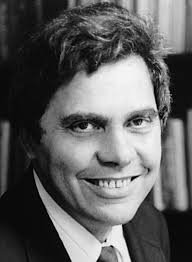
尼尔·波兹曼 主主持人
EDITED TRANSCRIPT · 依据现场录音编译整理,可划线生成便签
编者按:本文是尼尔·波兹曼(Neil Postman)在美国伊利诺伊州一所学院的系列讲座上所作的演讲,题为「文化向技术投降」,时在一九九六年,距新千年不到四年。波兹曼时任纽约大学文化与传播系主任,媒介生态学的奠基人,《娱乐至死》的作者;讲座由主持人塔基开场介绍,演讲后波兹曼回答了现场听众的提问。本文依据现场录音编译整理。

波兹曼其人与媒介生态学

塔基: 今晚我们请到了一位重量级的客人,尼尔·波兹曼博士。波兹曼在语义学和传播理论领域享有国际声誉。他是纽约大学教育学院文化与传播系主任,曾担任《ETC:普通语义学评论》的编辑长达十一年,也是《国民》杂志的特约编辑。他生于布鲁克林,从小学教师起步,后来教中学,再进入大学。作为纽约大学英语教育专业的教授,他在语言学和语义学界建立了极高的声望。

塔基: 在出任纽约大学系主任之前,他讲授技术史及其社会影响,并创办了纽约大学的媒介生态学(media ecology)研究生项目。西蒙博士曾获颁表彰语言清晰的乔治·奥威尔奖,以及纽约大学的杰出教授奖。他著有十八本书,其中包括上世纪八十年代的经典《娱乐至死》,他的新作《教育的终结》,以及今晚的主题所本的《技术垄断:文化向技术投降》。

塔基: 多年来,波兹曼花了无数时间研究电视的社会后果,他说正是这一点让他对技术进步抱持怀疑。在一九九六年春季号的《社会政策》上,波兹曼教授说:「二十年前,没有人会对这类讨论感兴趣。如今它真能吸引一大群人。外面有一批听众等着被组织起来,去施加压力,确保我们在这些事情上想得更清楚一点。人们开始感觉到,把自己的全部志向都寄托在更大更好的技术上,实在有些不对劲。」

塔基: 正如他所料,今晚就有一群听众迫不及待地想听听他要说什么。六周前门票就已售罄,只剩站票。我八月就买了票,好确保自己有个座位,现在我也等不及了。请大家热烈欢迎这位杰出而富于争议的尼尔·波兹曼博士。

新千年与古老智慧

波兹曼: 大约十分钟前,塔基问我:「要是我把你介绍成尼尔·西蒙,你会怎样?会不会气疯?」结果她真这么说了。你们注意到了吗?好,非常感谢各位到场。

波兹曼: 我相当有把握地推测,在座的伊利诺伊人和全美国人一样,都在为一件事深深忧虑:不到四年,我们就要进入新千年了。关于二十一世纪的谈论铺天盖地,都说它将给我们带来前所未有的难题,我们对这些难题几乎一无所知,却又必须为之精心准备。人人都在为此担心:商人、教育工作者、政治家、神学家,不一而足。

波兹曼: 所以我想先让各位宽宽心。我怀疑二十一世纪给我们带来的难题,未必会比本世纪,或者十九、十八、十七世纪,乃至更早许多个世纪里我们面对过的那些更惊人、更令人晕头转向、更复杂。不过,要是你对新千年紧张过了头,我一开头就可以给你一些应对它的好建议。这些建议来自我们信得过的人,他们的深思熟虑,可以稳妥地说,超过了克林顿总统、金里奇,甚至比尔·盖茨。

波兹曼: 梭罗是这样说的:「我们的一切发明,不过是把改良了的手段用于未曾改良的目的。」歌德是这样告诉我们的:「一个人每天都该设法听一支小曲,读一首好诗,看一幅佳画,如果可能,再说几句合乎理性的话。」苏格拉底告诉我们:「未经省察的人生不值得过。」拉比希勒尔告诉我们:「己所憎恶,勿施于人。」先知弥迦告诉我们:「耶和华向你所要的是什么呢?只要你行公义,好怜悯,存谦卑的心,与你的神同行。」如果有时间,我还可以告诉你们孔子、以赛亚、耶稣、穆罕默德、佛陀、斯宾诺莎和莎士比亚说过什么,不过你们本来就很熟悉。说的全是一回事:人无法逃离自身。人的困境一如既往。把自己裹进技术的荣光里,我们什么也解决不了。

波兹曼: 说得直白些,我猜想历代先贤的智慧在二十一世纪的适用程度,将与在任何其他世纪时一模一样。话虽如此,我也很清楚,由于我们如今生活在人人所称的「技术社会」里,我们确实有一些特殊的问题,是耶稣、希勒尔、苏格拉底和弥迦不曾也不可能谈到的。

波兹曼: 我打算用提问的方式来处理这些问题。我要提出关于技术的七个问题,这些问题的答案,可以让我们看清技术是以何种方式闯入一种文化,进而影响我们的社会制度的。答案是重要的,尽管它们会因答题人而异。但问题更重要。答案会随时间和处境而变,哪怕对同一个人也是如此;问题却经久不变。所以我把这些问题看成一种可以常备的武装,公民可以用它保护自己,免于被技术淹没。

技术与媒介之分

波兹曼: 在提出这些问题之前,我需要先说明两点。一点是为了让我接下来的话更清楚,另一点是解释我为什么要说这些话。第一点是,我对「技术」(technology)和「媒介」(medium)作出区分。

波兹曼: 在我看来,技术之于媒介,犹如大脑之于心智。技术像大脑一样,是一套物理装置;媒介像心智一样,是这套物理装置被拿来做的用途。当一项技术在特定的社会环境中获得位置,当它渗入经济和政治语境,它就变成了一种媒介。换句话说,技术只是一台机器,一堆硬件线路;媒介则是社会的造物。

波兹曼: 我认为作这个区分是有用的,因为记住了它,我们就更容易明白:一项技术在某个特定文化里的用法,未必是它唯一可能的用法。比如说,如果我们想回答「电视如何影响我们的政治」这个问题,就必须明白,我们谈的不是作为技术的电视,而是作为媒介的电视。世界上有许多地方,电视的技术与美国的电视一模一样,作为媒介却与我们所熟知的截然不同。我指的是那些多数人家里没有电视机的地方,或者只有一个频道的地方,或者电视不是全天候播出的地方,或者多数节目的目的是直接推行政府政策的地方,或者根本没有广告的地方。在那些地方,电视不会有它在美国的那种意义和力量。也就是说,一项技术的使用方式,完全可能让它的社会、经济和政治后果在不同文化之间大不相同。

波兹曼: 当然,正像大脑本身一样,每一项技术都有它内在的偏向,都有独特的技术局限和技术可能。也就是说,每一项技术的物理形态里,都嵌着一种倾向,倾向于被以某些方式使用,而不是另一些方式。只有对技术史一无所知的人,才会相信技术是完全中立、可以随意改造的。有个老笑话,专门取笑这种天真的想法。笑话说,托马斯·爱迪生本来可以早得多地公布他对电灯的发现,坏就坏在他每次打开电灯,都要把它举到嘴边,喊:「喂?喂?」你没法用电灯跟你在芝加哥的母亲说话,也没法用电话照亮书页。换句话说,每一项技术都有它自己的议程,可以说,它会指示我们如何去实现它的技术命运。

波兹曼: 我们必须明白这个事实,尤其不可低估它。当然,我们也不必受它的暴政。技术把我们往哪个方向引,我们并不总是非得往哪个方向走。我们对自己负有的义务,可以高于我们对任何技术负有的义务。

波兹曼: 说了这么多,今晚在讲话中我多半还是会把「技术」和「媒介」这两个词几乎当作同义词来用,因为我们这场聚会是在美国,面对的是美国人,我们对自己各种技术的用法都很熟悉。尽管如此,我希望各位记住这两个词的区别,因为在某些情况下,把它们当同义词用是欠考虑的,甚至会误导人。

自陈立场

波兹曼: 现在说第二点,关乎我本人对技术的态度。我想我得告诉各位:我没有电子邮件,没有语音信箱,也没有呼叫等待。我不用文字处理软件。我的十八本书都是用便签簿和黄色笔杆的笔写的。

波兹曼: 刚才那句是尼尔·西蒙说的。看来我得给你们看看。我不知道各位认不认识这个东西。它对用户很友好,也非常便宜。我就用它,配一本黄色便签簿。我对互联网没有兴趣。我也不认为比尔·盖茨是天才。

波兹曼: 这些「缺陷」,每一条我都有充分的理由。各位若有兴趣,等我讲完,我很乐意一一交代。但正因为这些缺陷,我落得一个反技术的名声,实际上被说成是个「新卢德派」(neo-Luddite)。给我贴这个标签的人,通常对卢德派一无所知,因为要是他们了解,就不会用这个词了,除非是想恭维我。

波兹曼: 无论如何,请各位放心,我认为反技术是愚蠢的,就像反食物一样愚蠢。我们靠技术活着,正如靠食物活着。不过,如果我们吃得过多,或者吃的东西毫无营养,或者吃了带病菌的食物,我们就把生存的手段变成了它的反面。技术的使用方式也是如此。它可以用来增进生命,也可以用来削弱生命。这就意味着,笼统地反技术是愚蠢的,但对技术深怀戒心绝不愚蠢。因为显而易见,技术以及它们所变成的媒介,会对我们的生活方式、社会制度、心理习惯和体验世界的方式产生最严重的影响。所以在我看来,只有傻瓜才会对任何一项技术盲目欢迎,而不认真想一想它会做成什么,同时又会拆掉什么。

问题一:解决什么问题

波兹曼: 开场白到此为止,我来讲我的问题。每当有人向我们介绍一项新技术,比如交互式电视、虚拟现实、信息高速公路,或随便什么,第一个问题就该提出来。这个问题是:这项技术是哪个问题的解决方案?

波兹曼: 之所以要问这个问题,是因为有些技术并不是任何一个正常人会视为要紧的问题的解决方案。副总统戈尔当然是个正常人,但即便是他给出的理由,也让我怀疑我们凭什么要花几十亿美元去建一条信息高速公路。他反复说,这条高速公路将让我们每个人都能收看五百个,甚至一千个电视频道。于是我不得不问:这是多数人渴望解决的问题吗?是我们真的需要解决的问题吗?我们许多人现在能收到四五十个频道,我们是不是认为这还不够,非得有一千个频道可选,人生才算圆满?这里究竟要解决的是什么问题?

波兹曼: 有人可能会说,根本的问题是如何把更多的信息,更快地、以更多样的形式,送到更多人手里。那么我们能不能说,这正是人类在十九世纪初面对的问题;从十九世纪四十年代起,随着电报和摄影术的发明,我们着手解决这个问题,此后一百四十年我们一直在解决它,而且我们已经解决了,解决得漂亮极了;假装我们还没解决,既是反动的,又是分散注意力的;而在二十一世纪花几十亿美元去解决一个我们早在十九世纪就解决了的问题,纯属浪费?

波兹曼: 这只是我的答案。你们的可以不同,没关系。要点在于,这个问题必须被提出来,而且我们完全有权带着几分怀疑去问它。

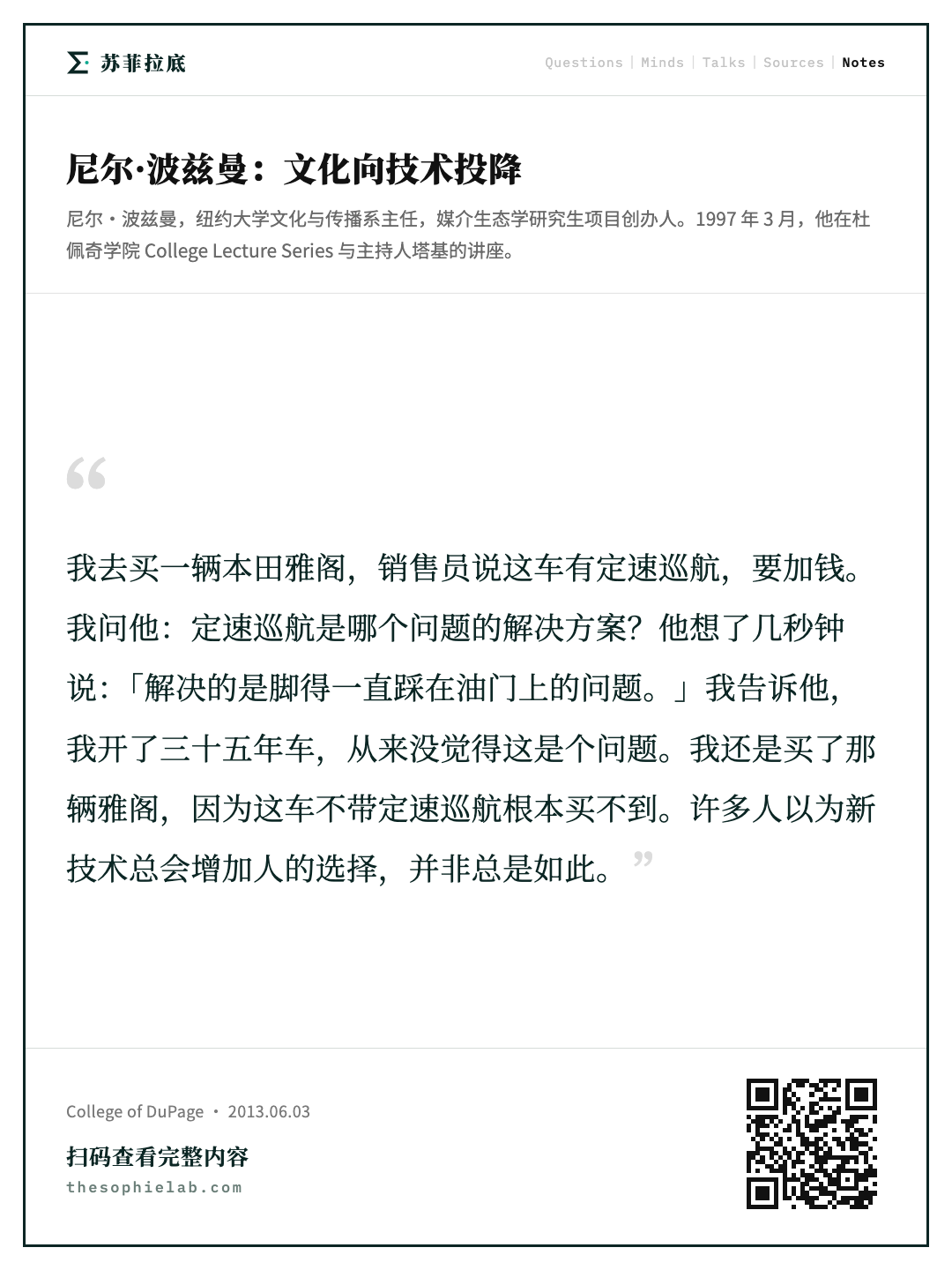
波兹曼: 几年前我去买一辆本田雅阁。销售员挺自豪地告诉我,这车有定速巡航,要加钱。于是我问他:定速巡航是哪个问题的解决方案?他说以前从没有人问过他这个。不过他想了几秒钟,然后说:「解决的是脚得一直踩在油门上的问题。」我告诉他,我开了三十五年车,从来没觉得这是个问题。他接着说:「这车有电动车窗。」你们知道我问了什么,对吧?这回他有准备了,他说:「解决的是您得这样摇来摇去的问题。」我说,我也从来没觉得这是个问题,何况我是个搞学问的,生活过得很安静,那么一点点运动量还是我仅有的锻炼呢。

波兹曼: 我还是买了那辆雅阁,带定速巡航和电动车窗,因为这车不带定速巡航和电动车窗根本买不到。这件事值得想一想,因为许多人以为新技术总会增加人的选择。有时确实如此,但并非总是如此。比如,你想要一辆没有定速巡航和电动车窗的车,就不行。

波兹曼: 另一个例子更带文化意味,说的是这种怀疑态度真正派上用场的一回。若干年前有人提出,我们的政府该不该资助制造超音速客机。英国人和法国人当时都已经造出了超音速客机,于是国会内外就美国人该不该也有一架自己的,展开了一场认真的辩论。这个问题真的被问了出来:超音速客机是哪个问题的解决方案?答案原来是:坐波音七四七从纽约到洛杉矶要六个小时,坐超音速客机只要三个小时。我很高兴地说,多数美国人并不认为这个问题严重到值得如此巨额的投资。此外,许多美国人还问:省下来的三个小时我们拿来干什么?他们自己的回答是:大概会看电视。于是有人建议,在七四七上装电视机,这就省下几十亿美元。

问题二三:谁的问题,新问题

波兹曼: 除此之外,当时还有人问了另一个问题,我现在把它作为我的第二个问题提出来。回答了「这项技术是哪个问题的解决方案」之后,还必须问:这是谁的问题?就超音速客机而言,比七四七更快地到达洛杉矶或伦敦,主要是电影明星、摇滚乐手和公司高管的问题。多数美国人如果要为此掏一大笔钱,几乎不会认为这个问题值得解决。

波兹曼: 「这是谁的问题」这个问题,需要用在任何技术上。多数技术确实解决了某个问题,但那个问题未必是所有人的问题,甚至未必是多数人的问题。我们必须非常仔细地弄清,谁会从一项技术中获益,谁又要为它付账。这两拨人并不总是同一拨。

波兹曼: 不过,假设我们为一个多数人确实有的问题找到了技术上的解决方案,这就到了第三个问题。它是这样的:假设我们解决了这个问题,而且解决得干净彻底,那么因为解决了这个问题,又会制造出哪些新问题?汽车替多数人解决了一些非常重要的问题,但同时也毒化了我们的空气,让我们的城市被车流堵塞,并且毁掉了一部分自然景观的美。抗生素无疑替几乎所有人解决了重大问题,但同时也导致了我们所说的免疫系统的弱化。电视解决了几个重要问题,但在解决它们的同时,改变了政治话语的性质,导致读写能力严重下滑,甚至让传统的儿童社会化过程变得困难,乃至不可能。你很难想出任何一项重要的技术,在解决旧问题的同时不曾制造新问题。

波兹曼: 当然,要预知一项技术方案会带来什么新问题,有时是非常困难的。本笃会修士在十三世纪发明机械钟,是为了更准确地履行他们的日课,他们每天要祈祷七次。倘若他们知道机械钟最终会被商人拿去确立标准工作日,进而确立标准化的产品,也就是说,钟会被用作赚钱的工具而不是侍奉上帝的工具,修士们恐怕会觉得他们的日晷已经够用了。倘若古登堡预见到他的活字印刷机会导致神圣罗马教廷的分裂,他肯定会拿他那台旧葡萄酒压榨机去榨酒,而不是印书。

波兹曼: 在十三世纪,人们缺乏技术上的远见,也许无关紧要;十五世纪也许还是无关紧要。可是在一个技术社会里,我认为我们再也承担不起紧闭双眼走向未来的代价了。我们需要睁着眼睛去推测种种负面的可能。

问题四:谁被伤害

波兹曼: 但正如我说过的,要知道一项新技术会生出什么样的问题,绝非易事。无论如何,只是泛泛地反思可能的代价是不够的。为了让反思有个焦点,我们必须问第四个问题:哪些人、哪些机构可能因这项技术方案而受到最严重的伤害?

波兹曼: 顺便说,正是这个问题催生了一八一一年到一八一八年间英格兰的卢德运动(Luddite movement)。我们所说的卢德派,是服装业里技艺娴熟的手工工人,当时机械化正在夺取主导权,工厂制度正在建立。他们很清楚机械化会给多数人带来什么好处,但他们同样清楚地看到,它会毁掉他们自己的生活方式,尤其会毁掉他们的孩子,那些孩子当时在工厂里做工,跟奴隶劳工没什么两样。于是他们用一种简单而无用的办法来抵抗技术变革:把工业机器砸个粉碎。他们一直这样干,直到被英国军队关进监狱或者杀掉。

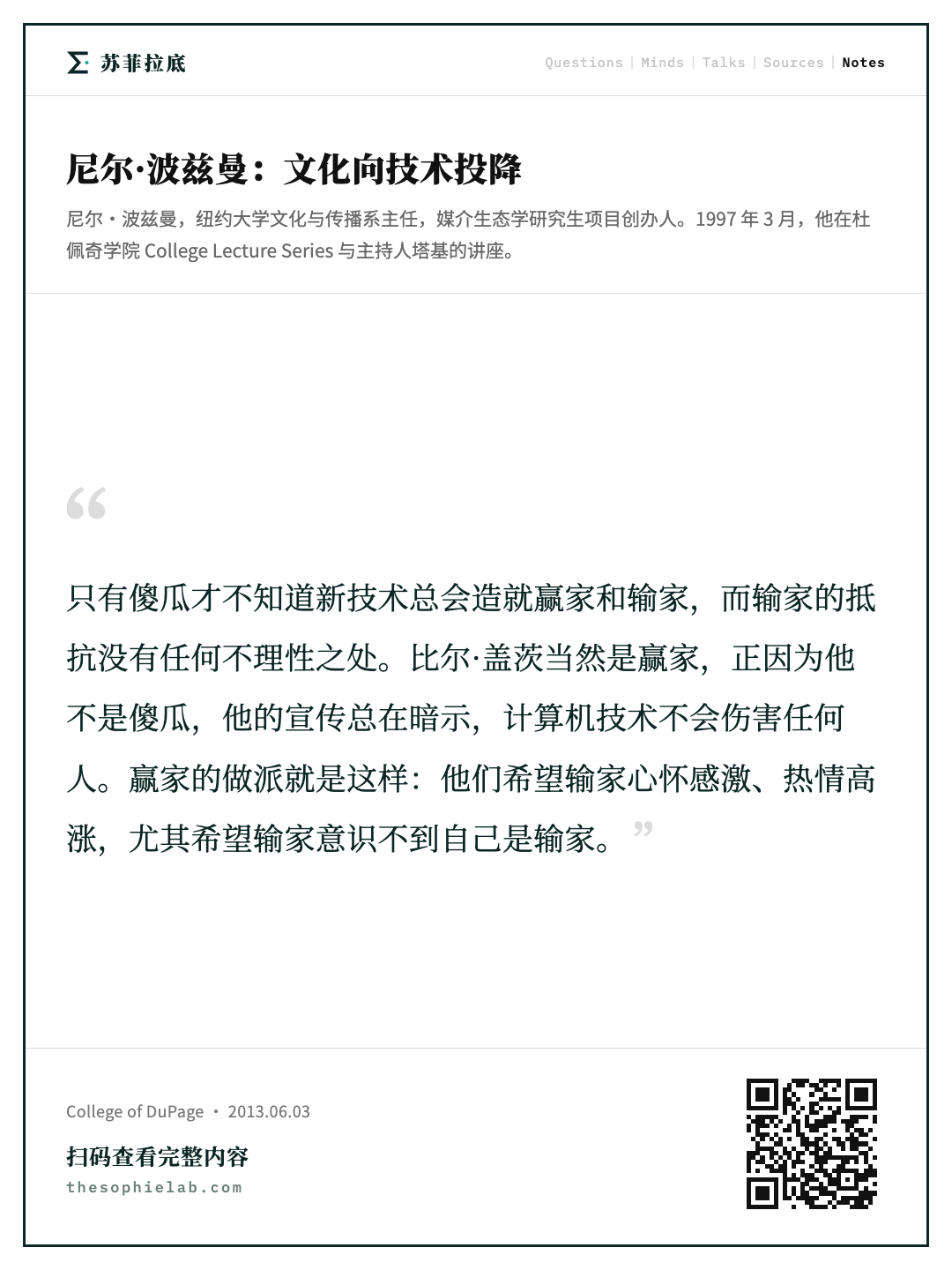
波兹曼: 没有人确切知道「卢德派」这个词从哪里来,但它如今的意思是「以任何方式抵制技术变革的人」,而且通常是当骂人话用的。为什么会这样,颇令人费解。因为我前面说过,只有傻瓜才不知道新技术总会造就赢家和输家,而输家的抵抗没有任何不理性之处。

波兹曼: 比尔·盖茨当然是赢家,他明白这一点。正因为他不是傻瓜,他的宣传总在暗示,计算机技术不会伤害任何人。赢家的做派就是这样:他们希望输家心怀感激、热情高涨,尤其希望输家意识不到自己是输家。

波兹曼: 我们拿学校教师作例子,他们是被哄得以为自己是赢家的输家。在座一定有中小学教师,请听听这个。我先停一下,说一个我讲稿里没写、却一直缠着我的事实。去年秋天,纽约市公立学校系统迎来了一百一十万名学生。没有座位。各位听清楚了吗?有九万一千个孩子没有座位。于是他们在厕所里上课,在盥洗室里上课,课就是在那儿上的。而纽约市学校的总监最关心的,是花一大笔钱给教室接上网线。我就说这些。请各位想想这件事。

波兹曼: 纽约不是唯一这样的地方。全国上下,我们正准备总共花几十亿美元给学校布线,好容纳计算机技术,而理由绝不清楚。没有任何令人信服的证据表明,个人电脑或者计算机技术的任何其他形态,能像优秀的、薪酬合理的、负担不重的教师那样,为孩子做点什么。

波兹曼: 那么,教师的抗议声在哪里?在这笔交易里,他们是输家,而且输得很惨。我给各位念一则近期对教师的侮辱,出自一九九六年六月十一日的《华盛顿邮报》。我引原文:「马里兰州州长帕里斯·格伦德宁昨日宣布,该州计划于今年将每一所公立学校接入互联网,这是一项耗资五千三百万美元的计划的一部分,旨在让学生通过计算机更多地获取来自远方的信息。」我接着引:「尽管研究学校计算机使用的全国分析人士评价不一,该计划仍要求马里兰州一千二百六十二所公立学校中的每一所在入冬前至少配备两台联网终端,并在五年内让每间教室配备三到五台这样的终端。」格伦德宁州长称这是一项「大胆而宏大的举措」,并预期私营企业将追加捐赠数千万美元,使今年的总支出接近一亿美元。

波兹曼: 州长的理由是这样的,我再引原文:「获取信息,是理解并最终改善我们所处世界的第一个关键步骤。」我们先不管这个说法往好里说是可疑的,往坏里说是彻头彻尾的胡话。我们也先不管,即便州长的话是真的,美国学生的信息来源也早已过剩:全美有一万七千种报纸,一万二千种期刊,两万七千个录像带出租点,五亿台电视机,六亿多台收音机,这还不算汽车里的;有一万座图书馆,每年出版四万种新书;美国每天拍摄四千一百万张照片。美国学生现在还需要再投一亿美元,才能确保成为消息灵通的公民吗?

波兹曼: 把这些统统放在一边,各位是否同意,下面这段我编出来的假想声明,对教师和学生来说都会是更让人高兴、也更合乎理性的消息?我编的是这样的:「马里兰州拟投入一亿美元,增加全州教师人数,提高在职教师薪酬,并减轻教学负担。格伦德宁州长表示,这是确保我们的学生获得更专注、更健全、更富创造力的教育的关键一步。」

波兹曼: 我想多数教师会支持这样的投资,可我们在这方面几乎听不到他们的声音。事实上,许多教师一想到一亿美元要投在电脑终端上,就兴奋不已。比尔·盖茨最爱这种愚蠢。

问题五:语义被改写

波兹曼: 第五个问题:新技术正在强加哪些语言上的变化?这些变化让我们得到了什么,又失去了什么?各位都会同意,无论什么新媒介进入我们的生活,语言始终是我们最不可或缺的媒介。新的意义产生、旧的意义消失,永远是一件严肃的事。

波兹曼: 想一想「社群」(community)和「对话」(conversation)这两个词,如今在互联网使用者口中是怎么用的。「社群」一词传统上指的是这样一群人:他们利益各异,甚至彼此对立,却为了政治或社会的和谐而寻找共同的立足点。互联网社群与这种观念毫不相干。它们一开始就是和谐的,对人的协商能力和宽容能力毫无要求,而协商与宽容,恰恰是社群得以形成和维系的精髓。至于「对话」,两个人互相敲打信息,在我看来并不是在对话,因为面对面交流中最要紧的那些东西,在那里根本不存在。会认为发电子邮件就是对话的人,多半也会认为,当着一位刚失去母亲的朋友的面向她诉说你的悲伤,和寄给她一张贺曼牌的慰问卡片,没有什么大的区别。

波兹曼: 想一想电视是怎样改变了「政治辩论」这个词的意思。亚伯拉罕·林肯或者斯蒂芬·道格拉斯会把电视上的那种活动认作辩论吗?林肯和道格拉斯当年在伊利诺伊州各地辩论,顺便说一句,不止七场。通常是林肯讲三个小时,道格拉斯讲三个小时,然后林肯有一个小时反驳。等他们到了渥太华、斯普林菲尔德或者下一个镇子,就换成道格拉斯讲三个小时,林肯讲三个小时,道格拉斯有一个小时反驳。

波兹曼: 今天的美国辩论是这样的。芭芭拉·沃尔特斯或者哪位女司仪说:「下面这个问题问布什总统。中东问题的症结何在,如何解决?您有两分钟作答,之后克林顿州长有一分钟回应。」说实话,我认为这是一种精神疾病。因为人们理应期待布什总统或者克林顿州长会抗议,会说:「你怎么敢问这样的问题,还让我们一个人用两分钟回答,另一个人用一分钟反驳?我们竞选的也许是全世界最重要的政治职位。你脑子出什么毛病了?」可他们当然不会这么说。他们也可以说:「你怎么敢问这样的问题?你以为美国人是什么样的人,会容忍这种事?」他们也不会这么说,因为我们知道自己是什么样的人。尽管如此,第二天人们照样会问:「你看辩论了吗?」我常常想象,要是林肯和道格拉斯能回来,听见我们这样用这个词,会作何反应。

波兹曼: 再想想「公众」这个词,或者「参与式民主」(participatory democracy)这个说法正在遭遇什么。不久前我为《洛杉矶时报》评了一本书,叫《电子共和国》。作者主张,新技术将使代议制民主过时,因为技术将使就每一个议题举行即时全民公决(plebiscite)成为可能。这样一来,选民可以直接决定我们是否加入北美自由贸易协定、是否向波斯尼亚派兵、是否弹劾总统,参议院和众议院基本上就没有必要了。作者说,这就是参与式民主,就像公元前五世纪的雅典一样。

波兹曼: 从一个更古老的媒介环境里借一个说法来理解一项新事物,我并不反对。我们一直这么干。但这样做有风险,做的时候必须留神。像我们从前那样把火车叫作「铁马」,也许很有画面感,却遮蔽了火车与马车之间最要紧的差别。用「电子市民大会」这个说法,同样遮蔽了十八世纪公民面对面集会与包装好的电视伪事件之间的差别。用「远程学习」(distance learning)来称呼学生和老师互发电子邮件,也许有点价值,却遮蔽了一个事实:读书才是有史以来最好的远程学习范例,因为阅读不仅克服了空间和同在的限制,还克服了时间的限制。至于「参与式民主」,五千名同质的、受过良好教育的、蓄奴的雅典人所实践的政治,和两亿五千万美国人每周搞一次全民公决,我们很难找出任何相似之处。任由语言引导我们相信二者相似,是危险的。

波兹曼: 顺便说明,我并不是说应当敦促公民抵制语言的变化,而只是说,他们需要知道这种变化是怎样发生的、为什么发生,以及语言的新用法在助长什么样的态度。

问题六:谁获得权力

波兹曼: 第六个问题,各位会看出它和前面几个有关,但由于它的重要性,我给它一个特殊的地位。问题是:什么样的人和机构,会因技术变革而获得特殊的经济和政治权力?

波兹曼: 之所以要问这个问题,是因为技术转变为媒介的过程,总会导致经济和政治权力的重新排列。我这么说不是批评谁,只是陈述一个事实。一种新媒介创造新的职业,让旧的职业过时;一种新媒介让某几类技能显要起来,让另一些技能退居次要。

波兹曼: 比如罗纳德·里根,没有电视,他不可能当上总统。这个人说话很少精确,从不雄辩,却被称为「伟大的沟通者」。为什么?因为他在电视上魔力十足。他的电视形象投射出真诚、传统、亲切和关怀的气息。至于公民是否同意他说的话,甚至是否听懂了他说的话,都无关紧要。电视把权力给了一些人,同时又从另一些人手里夺走。每一种重要的媒介都是如此。

波兹曼: 聪明的企业家一向明白这个事实,他们看得见新媒介的诞生里冒出来的机会。正因如此,媒介企业家是文化中最激进的力量。我不明白他们为什么被叫作保守派,也许因为他们穿深色西装、系灰色领带吧。这些企业家关心的是让新媒介的利润最大化,对大范围的文化后果不大费心。美国最伟大的激进分子,就是我们的企业家:莫尔斯、贝尔、爱迪生、萨尔诺夫、迪士尼。这些人创造了二十世纪,正如比尔·盖茨和其他人正在创造二十一世纪。我不知道对于媒介企业家将要强加给我们的文化变迁,还能做多少缓和的工作,但公民应当知道正在发生什么,并对这些人保持专注而挑剔的注视。

问题七:还有别的用法吗

波兹曼: 最后一个,第七个问题。为了这个问题,我要回到我那冗长的开场白里提过的一点。问题是:一项技术还可能有哪些别的用法?

波兹曼: 提出这个问题的前提是这样一个假定:我们在美国从某项技术里造出来的那种媒介,未必是我们能从这项技术里造出来的唯一媒介。比如,把电视交给商业产业,就并非不可避免。至于广播,一九二六年,当时的商务部长、两年后成为美国总统的赫伯特·胡佛发表过一次讲话,说把广播用作商业媒介是不可想象的。在他看来显而易见的一点是,广播是迄今为止发明出来的向大众提供通识教育的最伟大的媒介。而这一点在我们许多人眼里已不再显而易见。后来的事当然没有朝那个方向发展。但我想说的要点是:技术如何转变为某一种特定的媒介,是一个复杂的、甚至引人入胜的题目。这个题目里充满了政治、社会学、善意的心理学,当然还有大量的贪婪。

波兹曼: 我还可以提出许多别的问题,但眼下我只守着这七个。这项技术自称是哪个问题的解决方案?这是谁的问题?解决一个旧问题会制造哪些新问题?哪些人和机构会受到最严重的伤害?它在助长哪些语言上的变化?它可能导致经济和政治权力发生怎样的转移?最后,从这项技术里还能造出哪些别的媒介?

结语:把头脑解开线

波兹曼: 还剩下一个问题我该提一下,不过它不是关于媒介的,而是关于我们自己的。我指的是:我们的公民将在哪里、以何种方式,学会对媒介提出切中要害的问题。这当然得是另一场完全不同的讲话的主题。但我想在结束时说,我认为这项任务不可避免地要交给我们的学校。

波兹曼: 我们的学校对媒介如何改变我们的社会关系、心理习惯和政治过程这门学问,一直盲目地、我该说不负责任地漠不关心。多数学校管理者和政治家以为,给教室布线就是在回应技术变革。而真正需要的,当然是让我们的学生把头脑上的线解开。我有几分把握地说,这个过程可以从这七个问题开始。也许我像许多美国人一样,对教育的力量信心过头了。但我想不出还有哪个机构,比学校更能承担起为我们的年轻人预备将来的责任。如果我们把他们教育好了,我想我们就可以怀着信心和几分希望,去迎接新千年。谢谢各位。

问答:不合群者的自处

塔基: 非常感谢波兹曼博士。他慷慨地答应回答听众的一些问题。在此之前,我想先宣布本学年讲座系列的最后一场活动:四月二十九日,就在这里,将举行萨拉·韦丁顿博士与菲莉丝·施拉夫利之间的性别大辩论。请各位早些购票,时间地点不变。现在,有问题的听众请举手,声音大一些,尽量简短扼要。波兹曼博士答应一一回应。好,最后面那位。

观众: (提问声音微弱,波兹曼请其大声一些,随后复述题意。)像我这样,或者像您这样,跟不上新技术世界的人,会怎么样?

波兹曼: 我想他说的是他自己,出于礼貌,他说的是「像他和我这样的人」,也就是与新技术世界格格不入的人。好,问题是:我们这些融不进新技术精神的人,会怎么样?我不知道我们会怎么样。我可以说说我自己是怎么应付的。

波兹曼: 我在讲话里说过,我不认为自己反技术,但我认为自己有权提出这类问题,哪怕是在个人的处境里。首先,各位知道呼叫等待是什么吗?在座有没有人同意我的看法,这是最无礼、最令人恶心的发明?可以想见,有人做生意,发现非有它不可,尽管觉得它恶心,还是装了。可在我的生活里,既然我认为它是个恶心的东西,我就干脆不要它。

波兹曼: 我不用电子邮件,因为我用不着。顺便说说,我是这么应付的。我写完上一本书的时候,顺便说,我其实写了二十本书,这事我得跟塔基谈谈。我写完上一本书,就是《教育的终结》,打电话给克诺夫出版社的编辑,说:「乔纳森,好消息,书写完了。」他说:「太好了,把磁盘寄给我。」我说:「你说什么?」结果我只好雇了个人,把我写的东西录进文字处理软件,再发过去。所以,人得作些让步,得迁就那个世界。我确实买了那辆本田雅阁,但从没用过定速巡航。出于原则,我不用定速巡航。当然,电动车窗嘛,你有什么办法呢?所以这是一场谈判,你不得不同这个世界谈判。

波兹曼: 我刚为纽约大学的一份内部刊物写了一篇东西。我在纽约大学待了五个十年,各位信吗?我的第一堂课是一九五九年二月。所以五十年代、六十年代、七十年代、八十年代、九十年代我都在。那时候,我们的技术是打引号的「原始」。学生会读,会写,会说。他们写东西的方式,跟我写书差不多。有些人用打字机,但那不是硬性要求。当然,如今纽约大学是个高科技的地方。于是我在文章里讨论了一个问题:孩子们比从前更聪明了吗?教授们比从前更聪明了吗?

波兹曼: 我的回答是:没有。事实上,我认为我们甚至有一点点损失,因为教授们现在花大量时间谈论他们用来交流的技术。多年前,要是人人都用笔和便签簿写东西,你能说什么呢?关于这个,你能说的无非是「我的笔没墨了」。这有多大意思?我倒记得有过一场讨论,黄色便签簿和白色便签簿哪个更好用,但没讨论多久,也没有结论。就这样。人们所有的谈话都是关于思想的。现在我注意到,许多教授花大量时间谈论他们用来交流的媒介。所以我想是有一点损失。

波兹曼: 不过我笼统的回答是:你得跟这个新世界谈判,用那些对你真正有用的技术,不用那些你并不怎么需要的技术。我就是这么斗争的。这大概是一场必败的斗争,因为美国人爱技术,简直是对技术垂涎欲滴。我不知道这是为什么,但托克维尔在《论美国的民主》里说,美国人对新事物有一种渴望。这大概是真的。

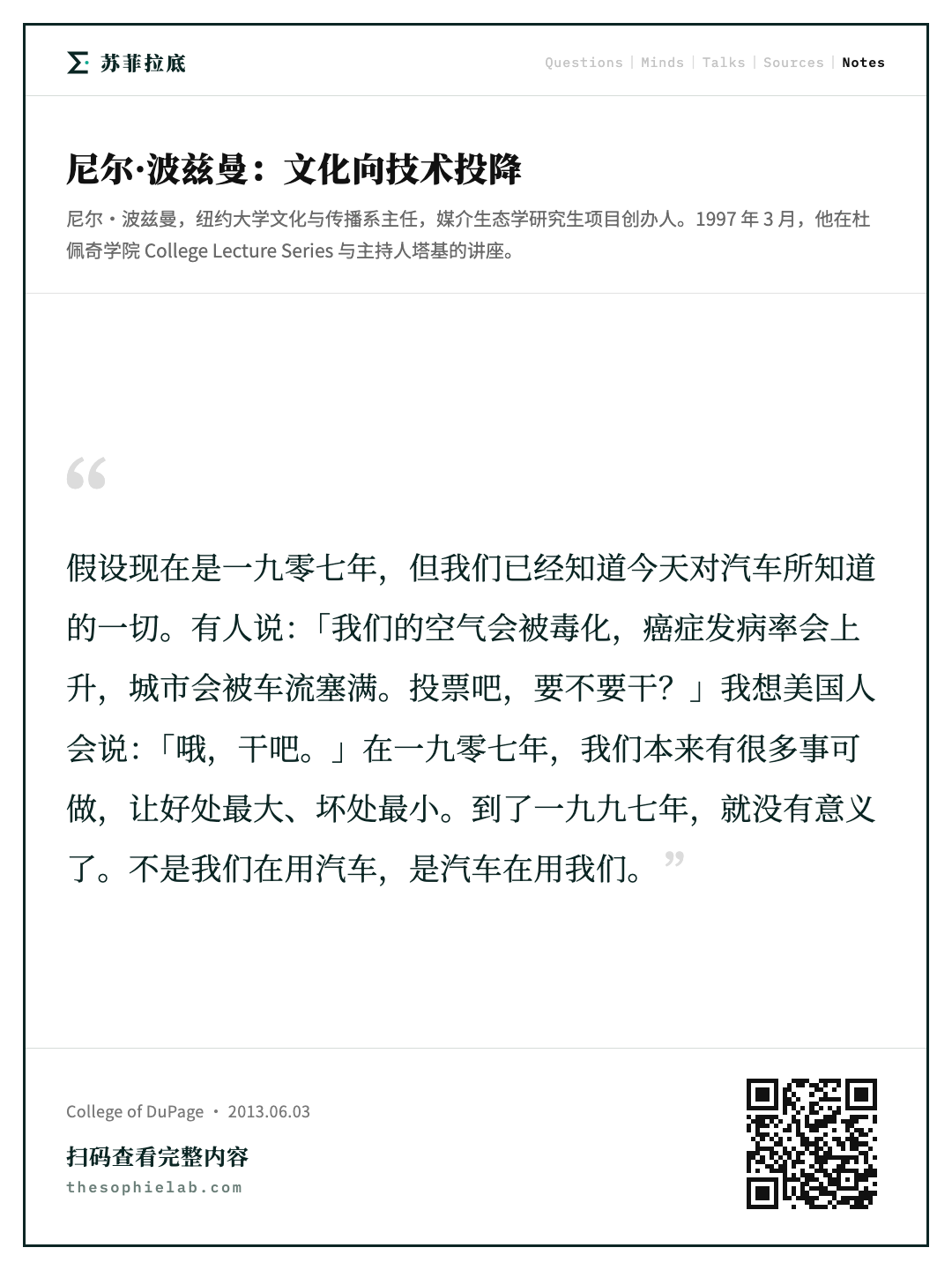
波兹曼: 事实上,我有时会想:假设现在是一九零七年,但我们已经知道我们今天对汽车所知道的一切。有人说:「我们来列一张单子,写下它会带来的所有好处,再列一张单子,写下所有坏处。」这边的单子会很长,那边的单子也会很长。「那我们来一次全民公决吧。要不要干?我们的空气会被毒化,癌症发病率会上升,城市会被车流塞满。投票吧。」我想美国人会说:「哦,干吧。」各位不觉得他们大概会说「干吧」吗?不过我想,一九零七年很可能会有人说:「好,干吧。但有没有什么办法,让好处最大、坏处最小?」好问题。在一九零七年,我们本来有很多事可做,一九二七年、一九四七年也许还有。到了一九九七年,就没有意义了。不是我们在用汽车,是汽车在用我们。

波兹曼: 我有多聪明呢?我说出来会让各位后悔来听我讲。我曾以为,电视会是美国人犯傻的最后一项伟大技术,是最后一项不问任何问题就照单全收的技术。假如一九四六年有人对美国人说:「瞧,这是台不错的机器。不过到一九九七年,事情会变成这样:普通美国孩子在上一年级之前,会在电视机前坐满五千个小时;到高中毕业,一万九千个小时;到二十一岁,看过六十五万条电视广告。美国政治在竞选期间会缩减成三十秒的广告,其余时间则是一句句的声音片段。」假如有人这么说了,我们会怎么回答?「哦,反正干吧。」

波兹曼: 我当时想,一九四六年我们不知道,我们不算真的有责任,但我们已经吸取了教训。于是我说:「好,到此为止。那么计算机现在是什么情形?」同样的盲目。没有人在问任何值得问的问题。我们排着队要花几十亿美元给教室布线。为什么?看在上帝的份上。我不是说我们不该这么做,可关于这件事,有过一场严肃的讨论吗?我有点激动过头了。你们觉得呢?下一个问题。请讲,这位先生。

问答:孩子该学读写说

观众: (据波兹曼复述)要让孩子跟上时代,家长应当着重培养他们哪些沟通能力?是不是该尽早让他们熟练掌握电脑?

波兹曼: 跟上什么呢?如果我们谈的是培养幼儿的沟通能力,那么我要说,头等大事,除了说话之外(说话我们其实用不着教,因为我们的基因就设定好了要学会它),头等大事是确保他们成为好的读者。

波兹曼: 我会这样对家长说:发明这些新技术的人,电视、激光、计算机,这些人怎么全都是只靠这个、一本便签簿和一本书教育出来的?这是怎么回事?那些人怎么就能只靠这个、一支笔和一本书,聪明到发明出这整个高科技世界?

波兹曼: 我有一个儿子,是天体物理学家,参加哈勃望远镜项目。顺便说,一九九九年他们要再送几个宇航员上去,到上面折腾一番。我儿子要给他们下指令。想知道什么叫恐怖吗?想想你的儿子六岁还不会系鞋带,如今在给外太空的宇航员下指令。总之,他告诉我,靠计算机技术,他们一天半就能解决的问题,没有计算机要花几个月,也许更久。我相信这是真的。我毫不怀疑,计算机技术对硬科学的高端研究大有好处,对大公司和大机构,比如国税局、五角大楼、通用汽车之类,也大有好处。这是实实在在的优势。

波兹曼: 但我看不出,对一个普通人来说,一手漂亮的电脑操作本领能有多大优势。这个理由至今没人说清楚。我向各位保证,要是有人把理由说清楚了,我会接受,但没人做到过。所以在养孩子这件事上,我并不急着确保他们电脑技术多么娴熟。何况,这根本不成问题。我们为什么还在谈这个?三千五百万美国人已经学会了用电脑,学校没帮上一点忙。就算学校在未来十年里什么也不做,人人也都会用电脑。

波兹曼: 假设我说得对,那么问题依然在:我们在学校里该拿孩子怎么办?我们应当推动和培养哪些沟通技能?就我自己而言,我有三个孩子,我们最想确保的,是他们会读、会写、会说。他们问我上大学该主修什么,我说:「无所谓。挑一个你特别感兴趣的。因为你已经会读、会写、会说了,在美国,之后你想干什么都会轻而易举,因为多数人不会读、不会写、不会说,对吧?你想进专业学院,他们转眼就录取你;你想进企业界,他们录取得更快。」于是,一个孩子主修了音乐;那位天体物理学家,当然主修了物理;我女儿现在是教师,她主修了戏剧文学,因为她感兴趣。

波兹曼: 所以,如果有人像您这样问我,帮助孩子培养沟通能力,最要紧的是什么,我的答案就是这个,虽然说来有些悲哀。事实上,我有时会怀疑,这只是顺带一说,各位得答应我别告诉别人,我有时怀疑是不是存在某种阴谋。阴谋是这样的:现在和可见的将来,掌管美国一切的,是那些会读、会写、会说的人。这些人进耶鲁、普林斯顿、哈佛,靠的不是证明自己有电脑技能,而是证明自己会读、会写、会说。其余的芸芸众生,则去摆弄影片。不光是电脑,还有多媒体,那些平头百姓将成为多媒体的专家。与此同时,掌管一切的先生女士们,将是那些证明了自己驾驭语言的人。这是我能给的最好的回答。

问答:苦难不因信息不足

观众: (据波兹曼复述)世界上有这么多严重的问题,饥饿、犯罪、环境破坏,我们该怎么解决?您的书能帮上忙吗?

波兹曼: 各位在买这些书吗?好。我没法回答这个问题本身,但这个问题里嵌着一件我感受极其强烈的事。它是这样的:让我们分心、无法去解决您提到的那些问题的,是一种世界观,如今尤其被计算机技术所鼓吹,那就是:我们这个世界之所以有问题,主要原因是信息不足。只要我们能得到更多的信息,更容易获取,更快到手,我们就能解决这个问题,或者您提到的任何其他问题。

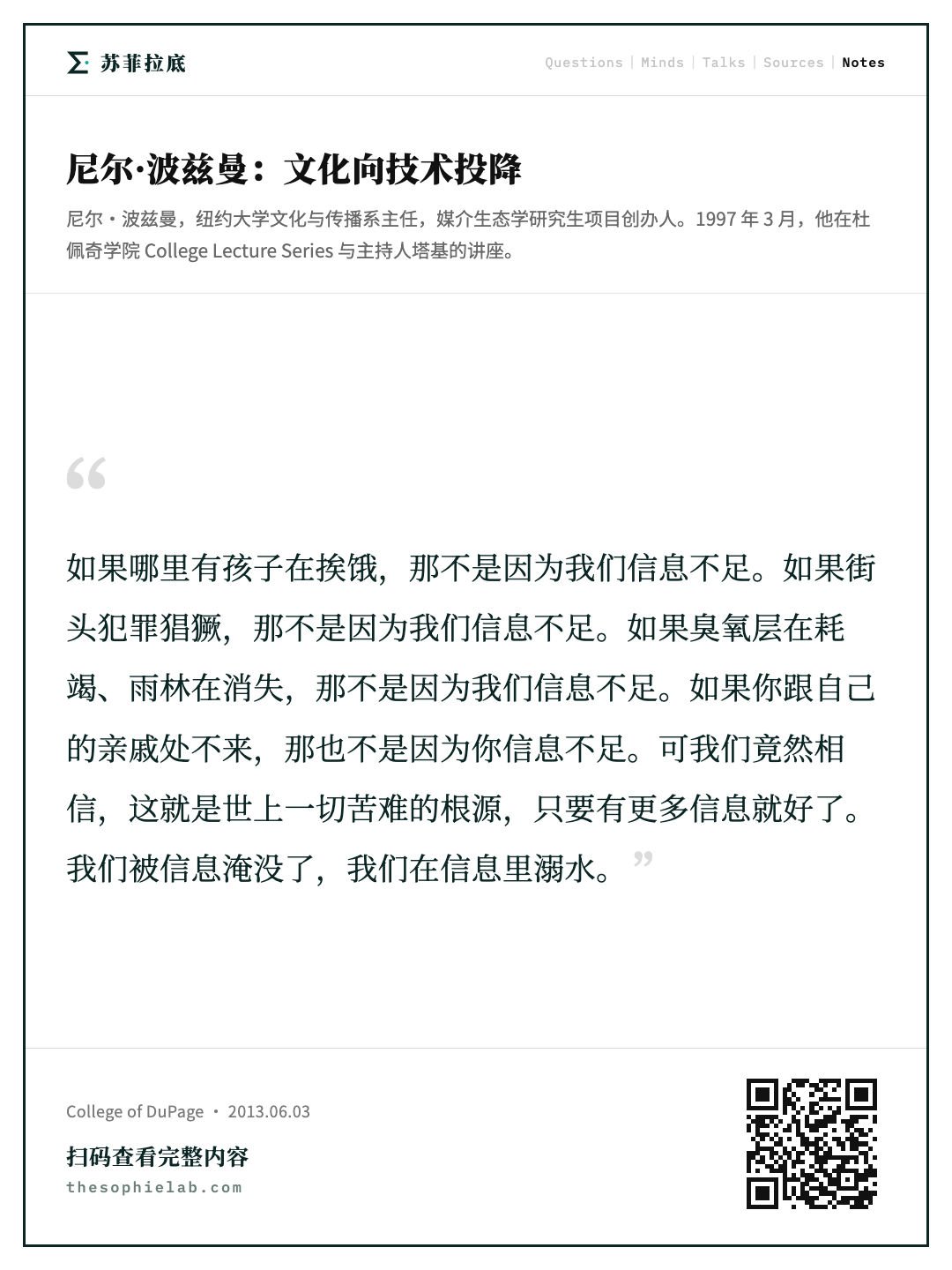
波兹曼: 我认为这是一种骇人的自负,一种可怕的误判。听着,如果哪里有孩子在挨饿,那不是因为我们信息不足。如果纽约、底特律、芝加哥的街头犯罪猖獗,那不是因为我们信息不足。如果臭氧层在耗竭、雨林在消失,那不是因为我们信息不足。如果你跟自己的亲戚处不来,那也不是因为你信息不足。可我们竟然相信,这就是世上一切苦难和痛苦的根源,只要有更多信息就好了。我认为这是彻头彻尾的分心。

波兹曼: 这正是比尔·盖茨希望我们相信的。显然,马里兰州的格伦德宁州长也这么想,据我所知,多数教师和学校管理者也是。只要我们能把每间教室接上互联网,就成了,这样就能造就消息灵通的公民。只要我们建成信息高速公路,能有五百个频道,就成了,这样就能办到。而我在讲话里表达的看法是,这是一种非常反动的观点。这个问题我们已经解决了:如何把更多信息,更快地、以多样的形式,送到更多人手里。我们解决了。恭喜。干得漂亮。可我们制造了另一个问题:信息过剩(information glut),信息的无意义,信息的支离破碎。我们被信息淹没了,我们在信息里溺水。可你去跟教育工作者谈,问学校该做什么,他们说:我知道问题在哪,孩子们信息不够。

波兹曼: 所以,在教育和社会生活里,我们面对的是一组新问题。在一个被信息浸透的文化里,我们该怎么学,或者说,我们得知道些什么才能学会该做什么?这以前从未发生过。这真的从未发生过,因为在十九世纪初以前,每一种文化都苦于信息匮乏。从十九世纪四十年代开始,顺便说,与电报的发明联系在一起的那位塞缪尔·芬利·布里斯·莫尔斯,就是纽约大学的教授。我们没给他终身教职。不对,那时候还没这回事。总之,从十九世纪初起,人类着手解决这个问题:如何把更多信息,更快地、以多样的形式,送到更多人手里。在十九世纪四十年代,一条消息传播的速度只能和人一样快,坐火车的话,大约每小时三十五英里。于是我们着手克服这个难题。从十九世纪四十年代一直到本世纪,顺便说,十九世纪的技术变革远比二十世纪多。我不知道各位对十九世纪了解多少,它真的很有意思。总之,从那时起直到我们自己的世纪,我们一直在解决这个问题:如何克服信息匮乏。我们做到了。而在做到的同时,我们制造了另一个问题:这么多信息拿来干什么?它们意味着什么?它们在哪里?我们要拿它们怎么办?

波兹曼: 没有人在处理这个问题。这是个真正严重的问题。可我们不去处理它,因为人人都迷上了格伦德宁州长那个愚蠢的想法:只要给马里兰的教室布上线,就能造就消息灵通的公民,让每间教室都连上互联网。为什么?难道这个州没有图书馆?没有报纸?人人都已被信息淹没。所以我们必须换一条轨道。我想,如果我们说:「不,这不是我们的问题。我们并不真的需要更多的获取渠道,现在已经够了。让我们冷静下来,看看还有什么别的问题。」

波兹曼: 克林顿发表国情咨文的时候,各位也许没看,那天大概是辛普森案什么的,所以可能错过了。但一位美国总统在那里说,请各位听着,这就是二十一世纪的教育目标,他的目标是:让每间教室都连上互联网。单凭这一条,这个人就该被弹劾。人们本以为,他会说,这是达成某个目的的手段。好,那说得通,把每间教室都接上线。可它是达成什么的手段?目的是什么?在我们所处的文化里,技术创新不需要理由,不需要解释。它本身就是目的,因为我们多数人相信技术创新和人类进步是同一回事。当然,事实并非如此。

波兹曼: 所以,我们有一些严重的问题。不过我要收尾了,因为我看见您在那边走动。我最后想说的是:把我称为技术的批评者,当然是准确的,但我不是卢德派。我做我所做的、说我所说的,是因为我的多数同胞对技术爱得发狂,而我认为这是个错误。所以这个文化需要有人指出他们的爱是错付的。因为,你知道,当你爱一个人爱得发狂的时候,几乎不可能看见对方的缺点。通常不都是这样吗?你需要一个稍微有点距离的人,对你说:「你没注意到吗,这家伙每次约会都踢你。」你说:「是啊,妈,可他说他爱我。」所以你需要有人说:「听着,技术对于一种文化,既是荣耀,也同样是麻烦。」我们必须留心它麻烦的那一面。

波兹曼: 最后我要说,信不信由你,对这一切我其实相当乐观。我被介绍成尼尔·西蒙的时候,各位还记得,塔基念了我写的一段话,说大约十五年前,这个题目根本吸引不来听众;讲怎么改进网球反手,都比讲这个题目来的人多。这一切都变了。我认为美国人开始在问我谈到的那些问题了。他们在想:孩子们电视看得太多了吧?电视到底把他们怎么了?甚至连《芝麻街》也被拿来质疑了。我一向认为《芝麻街》是一场全国性的灾难,我写的任何一本书,只要能找到机会对《芝麻街》说几句刻薄话,我都乐此不疲。总之,美国人在追问这些问题:电视把我们的家庭生活、社会关系、政治观念怎么了?他们也开始对计算机技术提出问题了。这让我深受鼓舞。美国文化里有那么多活力和才智,我真心乐观地相信,我们有可能给我们使用技术的方式带来一些秩序和理性。

波兹曼: 欧洲人隔着大西洋看我们过得怎么样。直到不久前,他们还认为美国是世界上最大的露天疯人院。如今他们的看法大不一样了,因为美国人正聚在一起,就这些事进行真正理智的谈话。好了,非常感谢各位,每一分钟我都很享受。

塔基: 波兹曼博士几分钟后将在大厅为他的书签名,书就在外面出售。非常感谢各位的光临。
本期讲者
尼尔·波兹曼纽约大学文化与传播系主任,媒介生态学研究生项目创办人。著有《娱乐至死》《童年的消逝》《技术垄断》等二十余部作品,是二十世纪后半叶最有影响的媒介批评家之一。
主持人该学院讲座系列的组织者与主持人,负责开场介绍与问答环节引导。
章节 · 点击跳转视频
0:00 主持人介绍:波兹曼其人与著作 ▶ 正在看
2:54 开场:千年焦虑与先贤的忠告 ▶ 正在看
7:42 前提一:技术与媒介之别 ▶ 正在看
13:27 前提二:怀疑不等于反技术 ▶ 正在看
16:12 第一二问:解决谁的什么问题 ▶ 正在看
25:24 第三四问:新问题与谁受伤害 ▶ 正在看
37:12 第五问:技术如何改写语言 ▶ 正在看
45:47 第六七问:权力重排与替代用法 ▶ 正在看
50:45 结语:学校应教人提问 ▶ 正在看
53:12 问答:不合技术风气的人怎么办 ▶ 正在看
1:04:54 问答:孩子该培养哪种能力 ▶ 正在看
1:12:27 问答:信息过剩才是新问题 ▶ 正在看
本期论点
本期回应
11:13
技术并非中立,每一项技术的物理形态里都嵌着特定的倾向 技术自身技术的后果由什么决定?
46:10
一项技术转变为媒介,必然带来经济与政治权力的重新分配 技术自身技术的后果由什么决定?
1:02:17
汽车深度嵌入生活之后,不再是人在使用汽车,而是汽车在使用人 技术自身技术的后果由什么决定?
33:00
没有可信证据表明计算机能替代好老师为孩子所做的事 答不了根本问题计算机能让人想得更好吗?
52:03
给教室拉上网线不算对技术变革的真正回应,真正需要的是拆掉学生脑袋里的线 学技术的社会影响面对技术冲击,人该学什么?
1:13:23
认为世界的问题主要源于信息不足,是一种自负而危险的误判 答不了根本问题计算机能让人想得更好吗?
其他论点
15:53
技术既能增益生命也能削弱生命,因此对技术抱有深深的怀疑一点也不愚蠢
24:59
从一项技术中受益的人,往往不是为它埋单的人
26:36
没有哪项重要技术在解决旧问题之后不制造出新问题
38:25
互联网上一开始就意见一致的群体不是社群,社群是利益对立者为和谐寻找共同立场
39:01
两个人互相打字发消息不算交谈,因为面对面交流中最重要的部分根本不存在
44:43
读书是有史以来最好的远程学习范例,因为阅读同时战胜了空间与时间的限制
47:42
媒介企业家是文化中最激进的力量,只追逐新媒介的利润,很少顾及文化后果
1:10:49
在美国掌管一切的始终是会读、会写、会说的人,而非有计算机技能的人
1:20:04
在当代文化里技术创新无需被辩护,因为多数人误把技术创新等同于人类进步
01主持人介绍:波兹曼其人与著作
0:00
We have a real treat for you this evening. Dr. Neil Postman. Neil Postman has achieved international recognition as an expert in semantics and communication theory. He's chair of the department of culture and communication at NYU School of Education and for 11 years served as editor of etc. He's a contributing editor to the nation. A native of Brooklyn, Professor Postman began his career as an elementary school teacher and then a high school teacher and he moved on to the university. As a professor at New York University in English education, he established an esteemed reputation in linguistics and semantics.
今晚我们为各位准备了一场真正的盛宴。有请尼尔·波兹曼博士。尼尔·波兹曼作为语义学与传播理论方面的专家,已获得国际声誉。他是纽约大学教育学院文化与传播系的系主任,并曾担任《etc.》杂志编辑长达十一年。他还是《国家》杂志的特约编辑。波兹曼教授是布鲁克林人,他的职业生涯始于小学教师,之后又当过中学教师,再后来他进入了大学任教。作为纽约大学英语教育专业的教授,他在语言学和语义学领域确立了崇高的声望。
便签引用
0:46
Prior to becoming New York University Chair, he taught the history of technology and its social effects. He founded the graduate program of media ecology at New York University. Dr. Simon is the recipient of the George Orwell Award for Clarity and Language and the Distinguished Professor Award at New York University. He has authored 18 books. Among them are the 1960s classic Amusing Ourselves to Death, his most recent book, The End of Education, and tonight's topic, Technology: The Surrender of Culture to Technology.
在出任纽约大学系主任之前,他教授技术史及其社会影响。他在纽约大学创办了媒介生态学研究生项目。西蒙博士曾获颁乔治·奥威尔语言清晰奖,以及纽约大学的杰出教授奖。他著有十八本书。其中包括六十年代的经典之作《娱乐至死》、他最新的著作《教育的终结》,以及今晚的主题——《技术:文化向技术投降》。
便签引用
1:32
Through the years, Neil Postman has spent endless hours researching the social consequences of television, and he says this is what has made him a skeptic of technological progress. In a spring 1996 issue of social policy, Professor Postman said, quote, "20 years ago, no one would have been interested in this kind of discussion. Now you can really draw a crowd. There's an audience out there waiting to be organized to exercise pressure in making sure that we think a little more clearly on these matters. People have begun to sense that there's something really not quite right about making all your aspirations related to bigger and better technology.
多年来,尼尔·波兹曼花了无数时间研究电视带来的社会后果,他说正是这些研究让他成了一个对技术进步持怀疑态度的人。在1996年春季那一期的《社会政策》杂志上,波兹曼教授说,引用原话:“20年前,没人会对这类讨论感兴趣。而现在你真的能吸引一大群人。外面有一批听众,他们等着被组织起来,去施加压力,确保我们在这些问题上想得更清楚一点。人们已经开始感觉到,把自己所有的期望都寄托在更大、更好的技术上,这件事真的有点不太对劲。”
便签引用
2:21
As predicted, there's an audience out here eager to hear what Neil Postman has to say. Six weeks ago, we were totally sold out to standing room only. I bought my ticket in August to make sure that I'd have a seat and I can't wait any longer to hear what he has to say. So, please join me in a warm welcome for the distinguished and controversial Dr. Neil Postman.
正如所料,今天在座的各位都急切地想听听尼尔·波兹曼要说些什么。六周前,我们的票就全部售罄,只剩站票了。我八月份就买了票,就为了确保自己有个座位,我实在等不及想听他要说什么了。所以,请和我一起热烈欢迎这位卓越而又颇具争议的尼尔·波兹曼博士。
便签引用
02开场:千年焦虑与先贤的忠告
2:54
[Applause] Tucky said to me about 10 minutes ago, "What would you do if I referred to you as Neil Simon?" She said, "Would you would you lose your mind over it?" But she did. Did you notice that? Yeah. Well, thank you very much for coming. Um, I feel um pretty confident in assuming that those of you here in Illinois, like the rest of us in America, are deeply concerned about the fact that in less than four years we will arrive at a new millennium. There's a great deal of talk about the 21st century and how it will pose for us unique problems of which we know very little uh but for which nonetheless we are supposed to carefully prepare.
【掌声】大约十分钟前,塔基对我说:“如果我把你叫成尼尔·西蒙,你会怎么样?”她说:“你会不会为这个抓狂?”结果她还真就叫错了。你们注意到了吗?是啊。好,非常感谢各位的到来。嗯,我想我可以相当有把握地假定,在座的各位伊利诺伊州的朋友,和我们其他美国人一样,都在深深地忧虑一件事——那就是:再过不到四年,我们就要跨入一个新的千年了。关于二十一世纪,人们谈论得非常多,说它会给我们带来种种独特的问题,而我们对这些问题所知甚少,嗯,但尽管如此,我们还是被要求要认真地为之做好准备。
便签引用
4:03
Everyone worries about this uh business people, educators, politicians, theologians and all the rest. So I should like to begin by putting your minds at ease. I doubt that the 21st century will pose problems for us that are more stunning, disorienting or complex than those we faced in this century or the 19th, 18th, 17th or for that matter many of the centuries before that. Uh but if you are excessively nervous about the new millennium, I can give you right at the start some good advice about how to confront it.
人人都在为此发愁——嗯,商界人士、教育工作者、政治家、神学家,以及其余所有人。所以我想先让各位安下心来。我并不认为二十一世纪会给我们带来什么问题,会比我们在这个世纪,或者十九、十八、十七世纪,乃至再往前许多个世纪里所面对的更惊人、更令人迷失方向、更复杂。嗯,不过,如果你对新千年过分紧张,我可以在一开头就给你一些应对它的好建议。
便签引用
4:51
And the advice comes from people whom we can trust and whose thoughtfulness uh it's safe to say exceeds that of President Clinton, uh N. Gingrich or even Bill Gates. Here's what Henry David Thoro said. All our inventions are but improved means to an unimproved end. Here's what Gerta told us. One should each day try to hear a little song, read a good poem, see a fine picture, and if it is possible, speak a few reasonable words. Here's what Socrates told us. The unexamined life is not worth living.
这些建议来自一些我们可以信赖的人,他们思考的深度,可以放心地说,超过了克林顿总统、嗯,纽特·金里奇,甚至比尔·盖茨。亨利·大卫·梭罗是这么说的:我们所有的发明,不过是把通往一个未曾改良的目的的手段改良了一番。歌德是这么告诉我们的:一个人每天都应该设法听一支小曲、读一首好诗、看一幅好画,如果可能的话,再说几句合乎情理的话。苏格拉底是这么告诉我们的:未经省察的人生不值得过。
便签引用
5:44
And here is what Rabbi Hill told us. What is hateful to thee, do not do to another. Here's what the prophet Micah told us. What does the Lord require of thee? But to do justly, to love mercy, and to walk humbly with thy God. And I could tell you if if I had the time, although you know it well enough, what Confucious, Isaiah, Jesus, Muhammad, the Buddha, Spinosa, and Shakespeare told us. It's all the same. There is no escaping from ourselves. The human dilemma is as it has always been. And we will solve nothing by cloaking ourselves in technological glory.
希勒尔拉比是这么告诉我们的:己所不欲,勿施于人。先知弥迦是这么告诉我们的:主向你所要的是什么呢?不过是行公义、好怜悯、存谦卑的心与你的神同行。我还可以告诉你们——如果我有时间的话,虽然你们其实早就知道——孔子、以赛亚、耶稣、穆罕默德、佛陀、斯宾诺莎和莎士比亚告诉我们的话。说的其实都是同一件事:我们无法逃离自己。人的困境从来如此。把自己裹进技术的荣光里,我们什么也解决不了。
便签引用
6:37
To put it plainly, I suspect that the wisdom of the ages and the sages will be just as relevant in the 21st century as it was in any other. Nonetheless, having said all this, I know perfectly well that because we live now in what everyone calls a technological society, we have some special problems that Jesus, Hillel, Socrates, and Micah did not and could not speak of. Now, I've chosen to address these problems by posing a series of questions about them. What I intend to do is to offer seven questions about technology, the answers to which can provide insights into the ways technology intrudes itself into a culture and therefore affects our social institutions.
说得直白一点,我怀疑,历代先贤的智慧在二十一世纪依然会和在任何别的时代一样,同样切中要害。话虽如此,我也很清楚,因为我们如今生活在人人称之为“技术社会”的环境里,我们确实面对着一些特殊的问题——耶稣、希勒尔、苏格拉底和弥迦没有谈过,也不可能谈到。我选择的处理方式,是就这些问题提出一系列的疑问。我打算做的,是提出关于技术的七个问题,对这些问题的回答可以让我们看清:技术是以怎样的方式侵入一种文化,并因此影响我们的各种社会制度。
便签引用
03前提一:技术与媒介之别
7:42
The answers to the questions are important although they will vary according to the answerer. But the questions are more important. Answers change over time and in different circumstances even for the same person. The questions endure which I which is why I think of them as a kind of permanent armament with which citizens can protect themselves against being overwhelmed by technology. Now before presenting the questions I need to make two points. One of which I hope will clarify what I will be saying and the other why I am saying it. The first is that I make a distinction between a technology and a medium.
这些问题的答案很重要,尽管答案会因回答者的不同而不同。但问题本身更重要。答案会随时间、随境遇而改变,哪怕对同一个人也是如此。而问题会长存——这正是为什么我把它们看作一种恒久的武装,公民可以借此保护自己,不至于被技术淹没。现在,在提出这些问题之前,我需要先说两点。一点是希望澄清我接下来要讲的内容,另一点是说明我为什么要讲。第一点是:我把“技术”和“媒介”区分开来。
便签引用
8:38
As I see it, a technology is to a medium as the brain is to the mind. Like the brain, a technology is a physical apparatus. Like the mind, a medium is a use to which a physical apparatus is put. A technology becomes a medium as it is given a place in a particular social setting as it insinuates itself into economic and political contexts. A technology, in other words, is merely a machine, a piece of hard wiring. A medium is a social creation. Now, it's useful, I think, to make this distinction because with it in mind, we can more easily understand that how a technology is used by any particular culture is not necessarily the only way it could be used. For example, if we try uh if we try to answer the question, how does television affect our politics?
在我看来,技术之于媒介,正如大脑之于心智。技术就像大脑,是一套物理装置。媒介则像心智,是这套物理装置被派上的用场。当一项技术在特定的社会环境中占据了一个位置,当它渗入经济和政治的脉络之中,它就成了媒介。换句话说,技术不过是一台机器,一堆硬件线路;而媒介是一种社会造物。我认为做这个区分是有用的,因为有了它,我们就更容易明白:某一种文化使用某项技术的方式,未必是这项技术唯一可能的用法。举个例子,如果我们试图——嗯,如果我们试图回答这个问题:电视是如何影响我们的政治的?
便签引用
9:52
We have to understand that we're not talking about television as a technology, but television as a medium. There are many places in the world where television although the same technology as it is in America is an entirely different medium from that which we know. I referred to places where the majority of people do not have television sets or where only one station is available or where television doesn't operate around the clock or where most programs have as their purpose the direct furtherance of government policy or where commercials are unknown.
我们必须明白,我们谈的不是作为技术的电视,而是作为媒介的电视。世界上有很多地方,那里的电视虽然在技术上和美国的完全一样,却是一种和我们所熟悉的截然不同的媒介。我指的是这样一些地方:大多数人没有电视机;或者只有一个频道;或者电视并非全天播出;或者大多数节目的目的就是直接为政府政策服务;又或者根本没有广告这回事。
便签引用
10:38
In such places, television will not have the same meaning or power as it does in America. Uh, which is to say, it is possible for a technology to be used so that its social, economic, and political consequences are quite different from one culture to another. Now of course like the brain itself every technology has an inherent bias has both unique technical limitations and possibilities. That is to say every technology has embedded in its physical form a predisposition toward being used in certain ways and not others.
在这些地方,电视不会具有它在美国所具有的那种意义和力量。嗯,也就是说,同一项技术是有可能被这样使用的:它在社会、经济和政治上造成的后果,在不同文化之间大不相同。当然,就像大脑本身一样,每一项技术都有其内在的偏向,都有其独特的技术局限和技术可能。也就是说,每一项技术的物理形态里都嵌着一种倾向:倾向于被这样用,而不是那样用。
便签引用
11:26
Only those who know nothing of the history of technology believe that a technology is entirely neutral or adaptable. In fact, there's an old joke that mocks such naive beliefs belief uh Thomas Edison the joke goes would have revealed his discovery of the electric light much sooner than he did except for the fact that every time he turned it on, he held it to his mouth and said, "Hello." "Hello." Well, uh, you can't use an electric light to speak to your mother in Chicago, and you can't use a telephone to illuminate a page in a book. In other words, each technology has an agenda of its own and, so to speak, gives us instructions on how to fulfill its own technical destiny.
只有对技术史一无所知的人,才会相信技术是完全中立、可以任意塑造的。其实有个老笑话就在嘲讽这种天真的看法——嗯,笑话说,托马斯·爱迪生本可以更早地公布他发明了电灯,问题在于,他每次把灯打开,都会把它凑到嘴边说:“喂?喂?”嗯,你没法用电灯跟你远在芝加哥的母亲说话,你也没法用电话去照��书页。换句话说,每一项技术都有它自己的议程,可以说,它在指示我们该如何去实现它自身的技术宿命。
便签引用
12:32
We have to understand that fact, but we must not and especially we must not underestimate it. Of course, we need not be tyrannized by it. We do not always have to go in exactly the direction that a technology leads us toward going. We have obligations to ourselves that may supersede our obligations to any technology. Now having said all this in my remarks this evening I will for the most part uh probably use the terms technology and media nearly interchangeably because we are having this meeting in America for Americans and we're all familiar with the uses we make of our various technologies.
我们必须认清这个事实,而且尤其不能低估它。当然,我们也不必被它所专制。我们并不总是非得沿着技术引导的方向走。我们对自己负有的义务,可能高于我们对任何一项技术负有的义务。说完这些之后,在今晚的发言里,我大部分时候,嗯,大概会把“技术”和“媒介”这两个词当作差不多同义地使用,因为这场聚会是在美国、面向美国人的,我们都很熟悉自己对各种技术的用法。
便签引用
04前提二:怀疑不等于反技术
13:27
Nonetheless, I hope you'll keep the distinction between these two words in mind because there are circumstances where it is thoughtless and even misleading to use them as synonyms. Now to my second prefaratory point which concerns my own attitude toward technology. I think I have to tell you that I do not have email or voicemail or call waiting. I do not use a word processor. I've written 18 books with a pad and a yellow pen. Uh that was Neil Simon speaking. Well, I guess I I I'll have to show you then. I don't know if you know what this is.
不过,我还是希望各位把这两个词的区别记在心里,因为在某些情形下,把它们当同义词用是不假思索的,甚至是会误导人的。现在说我开场白的第二点,它关系到我本人对技术的态度。我想我得告诉各位:我没有电子邮件,没有语音信箱,也没有呼叫等待。我不用文字处理软件。我的十八本书都是用一本本子和一支黄色的笔写出来的。嗯,那是尼尔·西蒙说的话。好吧,我想我还是拿给你们看吧。我不知道你们认不认得这是什么。
便签引用
14:27
It's user friendly. It's very inexpensive. And I use this in a yellow pad. I have no interest in the internet. And I do not regard Bill Gates as a genius. Now, h I have good reasons for each of these deficiencies. And if you're interested, I would be happy to give them when I am done. Nonetheless, because of them, I have a reputation as being anti-technology. in fact as being something of a neolite. Now people who have labeled me as such usually know nothing about about the lites because if they did they wouldn't use the term unless they meant to compliment me.
它很好上手,而且非常便宜。我用它配一本黄色的拍纸簿写作。我对互联网毫无兴趣。而且我不认为比尔·盖茨是个天才。当然,嗯,对于我这每一项“缺陷”,我都有充分的理由。如果各位有兴趣,等我讲完,我很乐意一一说明。不过,正因为这些,我落了个反技术的名声,其实就是被当成某种“新卢德分子”。而那些给我贴这种标签的人,通常对卢德派一无所知;因为如果他们真了解,就不会用这个词——除非他们是想恭维我。
便签引用
15:17
In any case, let me assure you that I regard it as stupid to be anti-technology. That would be something like being anti-food. We need technology to live as we need food to live. But of course, if we eat too much food or eat food that has no nutritional value or eat food that is infected with disease, we turn a means of survival into its opposite. The same might be said of the ways in which we use technology. It can be used as life enhancing and it can be used as life diminishing which means it is stupid to be categorically anti-technology but certainly not stupid to be deeply suspicious of technology.
总之,我可以向各位保证:我认为反技术是愚蠢的,那就好比反对食物一样。我们需要技术才能活下去,正如我们需要食物才能活下去。但当然,如果我们吃得过多,或者吃毫无营养的食物,或者吃被病菌污染的食物,我们就把维生的手段变成了它的反面。我们使用技术的方式,也可以这么说。技术可以被用来增益生命,也可以被用来削弱生命——这意味着,一概地反技术是愚蠢的,但对技术抱有深深的怀疑,当然一点也不愚蠢。
便签引用
05第一二问:解决谁的什么问题
16:12
For it is clear that technologies and the media they become can have the most serious effects on our ways of living, on our social institutions, on our psychic habits, and on our ways of experiencing the world. Therefore, it seems to me that only a fool would blly welcome any technology without having given serious thought not only to what technology will do but also to what it will undo. Well, enough of prologue. I'd like to turn to my questions. Question one needs to be addressed when anyone tells us about a new technology.
因为很清楚的是,技术以及它们所变成的媒介,会对我们的生活方式、我们的社会制度、我们的心理习惯,以及我们体验世界的方式,产生最严重的影响。因此在我看来,只有傻瓜才会盲目地欢迎一项技术,而不认真想一想:这项技术会带来什么,同时又会毁掉什么。好了,开场白到此为止。我想进入我的问题。每当有人向我们介绍一项新技术时,第一个问题都必须被提出来。
便签引用
17:06
For example, interactive television, virtual reality, the information superighway or whatever. Here's the question. What is the problem to which this technology is a solution? Now, this question needs to be asked because there are technologies that are not solutions to any problem that a normal person would regard as significant. Although Vice President Gore is certainly a normal person, I am skeptical of the reasons even he gives for us spending billions of dollars to create an information superighway.
比如交互式电视、虚拟现实、信息高速公路,或者别的什么。问题是这样的:这项技术,是对什么问题的解决方案?这个问题之所以必须问,是因为有些技术并不解决任何一个正常人会认为重要的问题。戈尔副总统当然是个正常人,但即便是他给出的理由——为什么我们要花几十亿美元去建一条信息高速公路——我也是存疑的。
便签引用
17:51
He says repeatedly that the highway will provide each of us with access to 500 or perhaps even a thousand television stations. I am therefore obliged to ask, is this a problem that most of us yearn to have solved? Indeed, need to have solved. Do we believe that having access to 40 or 50 stations as many of us now do is inadequate and that we cannot achieve a fulfilled life unless we have a thousand stations to choose from. What exactly is the problem to be solved here? If one were to say, well, the fundamental problem is how to get more information to more people faster and in more diverse forms.
他反复说,这条高速公路将让我们每个人都能收看五百个、甚至上千个电视频道。于是我不得不问:这是我们大多数人渴望被解决的问题吗?更进一步说,是需要被解决的问题吗?我们真的认为,像现在很多人那样能收到四五十个频道还不够,认为除非有一千个频道可选,否则我们的人生就无法充实吗?这里要解决的究竟是什么问题?如果有人说:好吧,根本的问题是如何把更多的信息,更快地、以更多样的形式送到更多人手里。
便签引用
18:53
Could we not say that this was the problem humanity faced in the early 19th century and that beginning in the 1840s with the invention of telegraphy and photography, we addressed this problem and for 140 years afterwards we continued to address it and that we have solved the problem. in fact in a spectacular fashion and that it is both reactionary and distracting to pretend that we have not solved the problem and wasteful to spend billions of dollars in the 21st century on solving a 19th century problem that we already solved.
那我们难道不能说,这正是人类在十九世纪初面对的问题;说从十九世纪四十年代开始,随着电报和摄影的发明,我们着手处理这个问题,并在此后一百四十年里持续处理它;说我们已经解决了这个问题——而且解决得相当漂亮;说假装我们还没解决它,既是开倒车,也是在转移注意力,而在二十一世纪花上几十亿美元去解决一个我们早已解决的十九世纪的问题,更是一种浪费。
便签引用
19:45
Well, that's just my answer. Yours might be different. That's fine. But the point is that the question needs to be asked and we uh certainly are entitled to ask it with a measure of skepticism. A couple of years ago I went to buy um a Honda Accord. The salesman said uh proudly I thought that it had cruise control for which there's an extra charge. So I asked him what is the problem to which cruise control is the solution? Well he said no no no one had ever asked him this before. Um, but he thought about it for a few seconds and then he said, "It's the problem of keeping your foot on the gas."
嗯,这只是我的答案而已。你的答案可能不一样。没关系。但重点是这个问题必须被问出来,而且我们当然有资格带着几分怀疑去问它。几年前,我去买一辆本田雅阁。销售员挺得意地告诉我,这车带定速巡航,要另外加钱。于是我问他:定速巡航是用来解决什么问题的?他愣住了,说,没有,从来没人这么问过他。不过他想了几秒钟,然后说:"是解决你得一直踩着油门这个问题。"
便签引用
20:49
Well, I told him that I'd been driving for 35 years, and I'd never found this to be a problem. He then said, "This car has electric windows." So, you know what I asked him, right? and he was ready for me this time. He said, "It's the problem of having to go like this or so." I said, "Well, look, I'm uh uh I I've never really found this to be a problem, but I I'm an academic. I I live a sort of sedate life and whatever little exercise I get is I I bought I bought the uh uh Accord because you cannot and I bought it with cruise control and the electric windows because you cannot get this car without cruise control and electric windows which is something to think about because there are many people um uh who think that new technology always increases people's options.
我告诉他,我开了三十五年车,从来没觉得这是个问题。他接着说:"这车还有电动车窗。"那你知道我又问了他什么,对吧?这次他有准备了。他说:"是解决你得这样摇车窗的问题。"我说:"你看,我……"我从来没真觉得这是个问题,但我是个做学问的人,过的是那种安安静静的日子,我能得到的那点运动量也就这些了。我最后还是买了那辆雅阁,带着定速巡航和电动车窗,因为这车不带定速巡航和电动车窗你根本买不到。这件事值得想一想,因为有很多人以为新技术总是会增加人们的选择。
便签引用
22:05
Sometimes it does, but not always. For example, if you want a car without cruise control in electric windows. But another good example um more cultural example of when skepticism of this kind was uh applied concerns a question raised some years ago as to whether or not our government should subsidize the manufacturer of a supersonic jet. Both the British and the French uh had already built SSTs, and a serious debate uh ensued in the halls of Congress and elsewhere as to whether or not Americans should have one of our own.
有时候确实如此,但并不总是。比如说,你想要一辆没有定速巡航和电动车窗的车。不过另一个好例子,一个更偏文化层面的例子,说的是这种怀疑态度被真正用上的时候,那是多年前提出的一个问题:我们的政府该不该补贴超音速客机的制造。英国人和法国人都已经造出了超音速运输机,于是在国会和其他场合爆发了一场认真的辩论:美国人是不是也该有一架自己的。
便签引用
22:51
And so the question was asked, it actually was, what is the problem to which the supersonic jet is the solution? The answer, it turned out, was that it takes 6 hours to go from New York to LA in a 747. With a supersonic jet, it can be done in three. Most Americans, I'm happy to say, did not think that that was a sufficiently serious problem to warrant such a heavy investment. Besides, a lot of Americans asked, "What would we do with the three hours we saved?" And their answer was, "We probably would watch television."
于是那个问题被提了出来,真的被提了出来:超音速客机是用来解决什么问题的?结果答案是:坐波音747从纽约飞洛杉矶要六个小时。换成超音速客机,三个小时就能到。让我高兴的是,大多数美国人并不认为这个问题严重到值得投入这么大一笔钱。何况,很多美国人还问:"省下来的这三个小时我们要拿来干什么?"他们自己的答案是:"多半是用来看电视。"
便签引用
23:40
And so the suggestion was made that we put television sets on the 747 and thereby save billions of dollars. Now in addition to this another question was asked which I now put forward as my second question. After one has answered the question what is the problem to which a particular technology is the solution? One must ask whose problem is it? In the case of the SST, the problem of getting to LA or London faster than 747s could do it was largely a problem for movie stars, rock musicians, and corporate executives.
于是就有人建议:干脆在747上装电视机,这样能省下几十亿美元。除此之外,人们还问了另一个问题,我现在把它作为我的第二个问题提出来。当你回答了"这项技术是用来解决什么问题的"之后,你必须再问:这是谁的问题?这是谁的问题?就超音速客机而言,比747更快地飞到洛杉矶或伦敦,这主要是电影明星、摇滚乐手和公司高管的问题。
便签引用
24:32
Hardly a problem that most Americans would regard as worth solving if it would cost them a lot of money. But this question whose problem is it needs to be applied to any technologies. Most technologies do solve some problem but the problem may not be everybody's problem or even most people's problem. We need to be very careful in determining who will benefit from a technology and who will pay for it. They are not always the same people. But let's say that we found a technological solution to a problem that most people do have. We now come to the third question.
如果要花很多钱,大多数美国人不会觉得这个问题值得解决。但"这是谁的问题"这个问题,需要被用到所有技术上。大多数技术确实解决了某些问题,但那个问题未必是所有人的问题,甚至未必是多数人的问题。我们必须非常小心地弄清楚:谁会从一项技术中受益,而谁来为它埋单。这往往不是同一批人。但假设我们真的找到了一个技术方案,解决的确实是大多数人都有的问题。那我们就来到第三个问题。
便签引用
06第三四问:新问题与谁受伤害
25:24
It's this. Suppose we solve this problem and solve it decisively. What new problems might be created because we have solved the problem? The automobile solved some very important problems for most people, but in doing so has poisoned our air, has choked our cities with traffic, and has contributed towards the destruction of some of the beauty of our natural landscape. Antibiotics have certainly solved significant problems for almost all people, but in doing so have resulted in the weakening of what we call our immune systems.
是这样:假设我们解决了这个问题,而且解决得非常彻底。会因为我们解决了这个问题,而产生哪些新的问题?汽车为大多数人解决了非常重要的问题,但与此同时也污染了空气,让城市被交通堵死,还加剧了自然景观之美的毁坏。抗生素当然为几乎所有人解决了重大的问题,但与此同时也导致了我们所说的免疫系统的削弱。
便签引用
26:15
Television has solved several important problems, but in solving them has changed the nature of political discourse, has led to a serious decline in literacy, and has even made the traditional process of socializing children difficult, if not impossible. It's doubtful that you can think of any important single technology that did not generate new problems as a result of its having solved an old problem. Of course, it's sometimes very difficult to know what new problems will arise as a result of a technological solution.
电视解决了好几个重要问题,但在解决它们的同时,改变了政治话语的性质,导致识字能力严重下降,甚至让传统的儿童社会化过程变得困难,乃至不可能。你恐怕想不出任何一项重要的技术,是在解决了一个旧问题之后没有制造出新问题的。当然,有时候我们很难知道,一个技术方案会带来什么样的新问题。
便签引用
27:03
Benedicting monks invented the mechanical clock in the 13th century in order to be more precise in performing their canonical prayers which they needed to say seven times a day. Had they known that the mechanical clock would eventually be used by merchants as a means of establishing a standardized workday and then a standardized product that is that the clock would be used as an instrument for making money instead of serving God. The monks might have decided that their sund dials were quite sufficient.
本笃会的修士在十三世纪发明了机械钟,为的是更精确地完成他们的日课祈祷,那是一天要做七次的。如果他们早知道机械钟最终会被商人用来确立标准化的工作日,进而确立标准化的产品——也就是说,钟会成为赚钱的工具,而不是侍奉上帝的工具——那些修士也许就会觉得他们的日晷已经足够好了。
便签引用
27:50
Had Gutenberg foreseen that his printing press with movable type would lead to the breakup of the Holy Roman Sea. He surely would have used his old wine press to make wine and not books. Well, in the 13th century, maybe it didn't matter so much if people lacked technological vision. Maybe not even in the 15th century. But in a technological society, I don't think we can afford any longer to move into the future with our eyes tightly closed. We need to speculate in an openeyed way about negative possibilities.
如果古登堡预见到他的活字印刷机会导致神圣罗马教会的分裂,他肯定会继续用他那台旧葡萄压榨机去酿酒,而不是印书。在十三世纪,人们缺乏技术远见,也许还不算太要紧。也许到十五世纪也还不算。但在一个技术社会里,我认为我们再也承受不起闭着眼睛走向未来。我们需要睁大眼睛,去推想那些负面的可能。
便签引用
28:39
But as I've said, it's no easy matter to know what sort of problems a new technology will generate. Well, anyway, it's not sufficient to reflect in a general way on the possible costs. In order to give some focus to our reflections, we have to ask a fourth question. Which people and what institutions might be most seriously harmed by a technological solution? This was the question by the way that gave rise to the lite movement in England during the years 1811 and 1818. The people we call lites were skilled manual workers in the garment industry at the time when mechanization was taking command and the factory system was being put into place. They knew perfectly well what advantages mechanization would bring to most people. But they also saw with equal clarity how it would bring ruin to their own ways of life, especially to their children who were being employed as virtual slave laborers in factories.
不过就像我说的,要知道一项新技术会带来什么样的问题,并不容易。总之,光是泛泛地反思可能的代价还不够。为了让我们的反思有个着力点,我们得问第四个问题。哪些人、哪些机构,可能会因为一个技术方案而受到最严重的伤害?顺便说一句,正是这个问题,催生了1811年到1818年间英国的卢德运动。我们所说的卢德分子,是服装业里有手艺的体力劳动者,那时候机械化正在接管一切,工厂制度正在建立起来。他们非常清楚机械化会给大多数人带来什么好处。但他们同样清楚地看到,这会怎样毁掉他们自己的生活方式,尤其是他们的孩子——那些孩子在工厂里被当成实际上的奴工使用。
便签引用
30:03
So they resisted technological change by the simplistic and useless expedient of smashing to bits industrial machinery which they continued to do until they were imprisoned or killed by the British army. Now, no one knows for sure where the word lite uh came from, but the word has come to mean a person who resists technological change in any way and it's usually used as an insult. Now, why this is so is a bit puzzling because as I said before, only a fool doesn't know that new technologies always produce winners and losers.
于是他们用一种简单而无用的办法抵抗技术变革:把工业机器砸个粉碎,他们一直这么干,直到被英国军队关进监狱或杀死。至于"卢德"这个词究竟从哪儿来,谁也说不准,但这个词后来变成了指任何以任何方式抵抗技术变革的人,而且通常是当作一句骂人的话来用。为什么会这样,其实有点费解,因为就像我刚才说的,只有傻瓜才不知道新技术总会制造出赢家和输家。
便签引用
30:52
And there is nothing irrational about loser resistance. Now, Bill Gates, who is of course a winner, knows this. And because he's no fool, his propaganda continuously implies that computer technology can bring harm to no one. Well, that is the way of winners. They want losers to be grateful and enthusiastic and especially to be unaware that they are losers. Let's take school teachers as an example of losers who are deluded into thinking they are winners. There must be some school teachers in the audience.
而输家的抵抗,一点也不是非理性的。比尔·盖茨当然是个赢家,他明白这一点。而且因为他不傻,他的宣传口径一直暗示:计算机技术不会伤害任何人。这就是赢家的做派。他们希望输家心怀感激、热情满满,尤其希望输家意识不到自己是输家。我们就拿学校老师来做例子吧——一群被哄骗着以为自己是赢家的输家。台下想必是有学校老师的。
便签引用
31:41
Listen to this. in America. Well, let me just stop for a moment and just tell you a fact which I didn't include here, but uh which haunts me. Last um fall, 1,100,000 children showed up in the New York City school system. There were no seats. You hear what I'm saying? There were no seats for 91,000 children. So they met in the latrines in the bathrooms. This is where their classes were held. The chancellor of the New York City schools is mostly interested in spending a lot of money to wire the classrooms.
听听这个。在美国。让我先停一下,跟你们说一个我没写在稿子里、但一直缠着我的事实。去年秋天,纽约市的学校系统里来了一百一十万个孩子。没有座位。你们听清我在说什么了吗?有九万一千个孩子没有座位。于是他们在厕所里上课,就在盥洗室里。他们的课就是在那儿上的。而纽约市教育总监最关心的,是花一大笔钱给教室拉网线。
便签引用
32:33
That's all I'm going to say. Just think about that. Well, um, New York is not the only place like this. Throughout the country, we're preparing to spend in the aggregate billions of dollars to wire our schools in order to accommodate a computer technology. And for reasons uh that are by no means clear. There certainly does not exist any compelling evidence that personal computers or any other manifestation of computer technology can do for children what good well-paid underburden teachers can do.
我就说到这儿。你们自己想想吧。纽约并不是唯一这样的地方。全国上下,我们正准备总共花掉几十亿美元给学校拉网线,好容纳一种计算机技术。而其中的理由一点也不清楚。确实不存在任何有说服力的证据表明,个人电脑或计算机技术的任何其他形态,能为孩子做到好的、待遇优厚、负担不过重的老师所能做到的事。
便签引用
33:24
Where then is the outcry from teachers? They are losers in this deal and serious losers. Here, for example, is an announcement of a recent insult to teachers taken from the June 11th, 1996 edition of the Washington Post. I quote, quote, "Governor Paris Glendenning, Governor of Maryland, announced yesterday that the state of Maryland plans to connect every public school to the internet this year, part of a $53 million effort to give students greater access to far-flung information via computer." Just I'm still quoting.
那么老师们的抗议声在哪里?在这笔交易里他们是输家,而且是输得很惨的输家。比如说,这里就有一则对老师的最新羞辱,出自1996年6月11日的《华盛顿邮报》。我引用:"帕里斯·格伦德宁州长,"马里兰州州长,昨天宣布,马里兰州计划在今年把每一所公立学校都接入互联网,这是一项5300万美元的工程的一部分,目的是让学生通过电脑更方便地获取远方的信息。"我还在引用。
便签引用
34:10
Despite mixed reviews by national analysts who have studied computer use in schools, the plan calls for each of Maryland's 1262 public schools to have at least two computer ter uh terminals linked to the internet before winter and for every classroom to have three to five such terminals within five years. Now, Governor Clintenning calls this a bold and big initiative and expects tens of millions of additional dollars to be donated by private enterprise so that the total expenditure will be close this year to $100 million.
尽管研究过学校电脑使用情况的全国分析人士评价不一,该计划仍要求马里兰州的1262所公立学校在入冬前每所至少配备两台联网的电脑终端,并在五年内让每间教室都拥有三到五台这样的终端。格伦德宁州长把这称作一项大胆而重大的举措,并预期还会有数千万美元由私人企业捐助,这样今年的总支出将接近一亿美元。
便签引用
34:57
Here is the governor's justification. And again, I quote, "Accessing information is the first vital step in understanding and ultimately improving the world we live in." Now, let us put aside the fact that at best this is a problematic claim and at worst it is errant nonsense. Let us also put aside the fact that even if the governor's claim is true, American students already have an over supply of sources of information, there are in America 17,000 newspapers, 12,000 periodicals, 27,000 video outlets for renting tapes, 500 million TV sets, well over 600 million radios, not including those in automobiles. There are 10,000 libraries and 40,000 new book titles published every year. Each day in America, 41 million photographs are taken. Now, do American students now require an additional hundred million investment to ensure that they become well-informed citizens?
下面是这位州长给出的理由。我再引用一次:"获取信息,是理解并最终改善我们所处世界的第一个关键步骤。"我们先撇开一个事实:这个说法往好里说是可疑的,往坏里说完全是胡说八道。我们也先撇开另一个事实:就算州长的说法是对的,美国学生的信息来源早就供过于求了。美国有一万七千种报纸,一万两千种期刊,两万七千家录像带出租点,五亿台电视机,六亿多台收音机,还不算汽车里的那些。有一万所图书馆,每年出版四万种新书。在美国,每天要拍下四千一百万张照片。那么,美国学生现在真的还需要再追加一亿美元的投资,才能确保他们成为见多识广的公民吗?
便签引用
36:25
Putting all of that aside, will you agree with me that the following hypothetical statement, which I've just made up, I mean, not just now, but would be happier news and more rational for both teachers and students. This is my quote. The state of Maryland intends to spend $und00 million to increase the number of teachers in the state to pay those we have more and to reduce teaching loads. Governor Clintenning said this is a vital step toward assuring that our students will be given a more attentive, wholesome, and creative education.
把这些都撇开不谈,你们会不会同意我说:下面这段我编出来的假设性表述——我是说,不是刚刚才编的——对老师和学生来说,都会是更让人高兴、也更合理的消息。我引用我自己的话:马里兰州打算花一亿美元来增加本州教师的数量,给现有的老师涨工资,并减轻他们的教学负担。格伦德宁州长说,这是关键的一步,可以确保我们的学生得到更用心、更健全、更有创造力的教育。
便签引用
07第五问:技术如何改写语言
37:12
Now, I should think most teachers would support such an investment, but we hear very little from them on that score. In fact, many teachers are thrilled by the thought of a hundred million investment in computer terminals. Bill Gates loves this form of stupidity. Here's a fifth question. What changes in language are being enforced by new technologies? What is being gained and what is being lost by such changes? Now, you will agree that no matter what new media come into our lives, language will remain our most indispensable medium. And it is always a serious matter when new meanings arise and old ones are lost. Think for example of how the words community and conversation are now employed by those who use the internet.
我想大多数老师都会支持这样的投入,但在这件事上我们几乎听不到他们的声音。事实上,很多老师一想到要花一亿美元买电脑终端就兴奋不已。比尔·盖茨最喜欢这种愚蠢。这是第五个问题。新技术正在迫使语言发生哪些变化?这些变化让我们得到了什么,又失去了什么?你们会同意,不管什么新媒介进入我们的生活,语言仍将是我们最不可或缺的媒介。而当新的含义出现、旧的含义消失时,这永远是一件严肃的事。比如想一想“社群”(community)和“交谈”(conversation)这两个词,如今被上网的人用成了什么样子。
便签引用
38:25
The word community has traditionally referred to those who have different and even opposing interests but who find common ground for the sake of political or social harmony. Internet communities are strangers to this conception. They begin in harmony and make no demands on one's capacity for negotiation and tolerance which is the essence of how communities are formed and sustained. As for conversations, two people who are typing messages to each other are not in my opinion having a conversation. in that the most significant aspects of face-to-face communication are simply absent.
“社群”这个词,传统上指的是那些利益不同、甚至彼此对立的人,但为了政治或社会的和谐而找到共同立场。互联网上的“社群”对这个概念是陌生的。它们一开始就是和谐的,对一个人的协商能力和宽容能力毫无要求,而这恰恰是社群得以形成和维系的本质所在。至于“交谈”,两个人互相打字发消息,在我看来并不是在交谈。因为面对面交流中最重要的那些部分,根本就不存在。
便签引用
39:22
Now, those who come to believe that emailing is conversation are likely to be people who believe that there is no significant difference between speaking one's sadness face to face to a friend who has lost her mother and sending her a Hallmark condolence card. Think of how television has changed the meaning of the phrase political debate. Would Abraham Lincoln or Steven Douglas recognize such a televised event as a debate? When Lincoln and Douglas were going through Illinois in their debates, they had more than seven, by the way. Uh, typically Lincoln would speak for three hours, Douglas would speak for three hours, and then Lincoln would have one hour for rebuttal. Then when they went to Ottawa or Springfield or the next a town. Then Douglas would speak for three hours, Lincoln for three hours, and Douglas would have an hour for rebuttal.
那些相信发电子邮件就是交谈的人,多半也会相信:当朋友的母亲去世时,你当面向她倾诉悲伤,和你寄一张 Hallmark 慰问卡给她,这两者没有什么本质区别。再想想电视是怎样改变“政治辩论”这个说法的含义的。亚伯拉罕·林肯或斯蒂芬·道格拉斯会把电视上那种活动认作是“辩论”吗?顺便说一句,林肯和道格拉斯当年走遍伊利诺伊州辩论时,可不止七场。通常是这样:林肯讲三个小时,道格拉斯讲三个小时,然后林肯有一个小时做反驳。等他们到了渥太华或斯普林菲尔德或下一个城镇,就换成道格拉斯讲三个小时,林肯讲三个小时,然后道格拉斯有一个小时做反驳。
便签引用
40:47
Here's a debate in America today. Barbara Walters or some mistress of ceremony says, um, the question is, this is for you, President Bush. What is the problem in the Middle East and how can it be solved? You will have two minutes to answer after which Governor Clinton will have one minute to reply. Actually, I think it's a form of mental illness because uh one would expect, wouldn't one, that President Bush or Governor Clinton would object and say, "How dare you ask such a question?" and give one of us two minutes to answer and the other one minute to rebut. We're running for the most serious political office perhaps in the world.
再看看今天美国的“辩论”。芭芭拉·沃尔特斯或者哪位女主持人说:呃,问题是这样的,这个问题给您,布什总统。中东的问题是什么,又该如何解决?您有两分钟作答,之后克林顿州长有一分钟回应。说实话,我觉得这是一种精神失常。因为你会指望——不是吗?——布什总统或克林顿州长提出抗议说:“你怎么敢问这样的问题?”还只给我们一个人两分钟作答、另一个人一分钟反驳。我们竞选的可是这世界上或许最严肃的政治职位。
便签引用
42:00
What is wrong with you? But of course, they don't say this. Or they might say, "How dare you ask such a question? What kind of people do you think Americans are that they would put up with this? Well, they don't say that either cuz we know what kind of people we are. Um, nonetheless, people do say the next day, "Did you see the debate?" I often imagine what Lincoln or Douglas would if they could come back and hear us use that word that way. Think of what's happening to the word public or the phrase participatory democracy. Not long ago, I reviewed a book called the electronic republic for the LA Times. The author argued that new technologies will make representative democracy obsolete because the technologies will make it possible to have instant plebites on every issue.
你脑子出什么问题了?但他们当然不会这么说。他们本可以说:“你怎么敢问这样的问题?你把美国人当成什么人了,以为他们会容忍这种事?”可他们也不会这么说,因为我们都清楚自己是什么样的人。呃,尽管如此,第二天人们还是会说:“你看那场辩论了吗?”我常常想象,如果林肯或道格拉斯能回来,听见我们这样用“辩论”这个词,他们会作何反应。再想想“公众”这个词,或者“参与式民主”这个说法正在发生什么。不久前我给《洛杉矶时报》写了一篇书评,评的是一本叫《电子共和国》的书。作者主张,新技术会让代议制民主变得过时,因为技术将使针对每一个议题进行即时公投成为可能。
便签引用
43:10
In this way, voters will directly decide if we should join NAFTA or send troops to Bosnia or impeach the president. the Senate and House of Representatives will be largely unnecessary. And this, the author said, is participatory democracy just as it was in Athens in the 15th century BC, the fifth century BC. Now, I have no objection uh to borrowing borrowing a phrase from an older media environment in order to conceptualize a new development. We do it all the time, but it has its risks. And attention must be paid when we do it.
这样一来,选民就能直接决定我们该不该加入北美自由贸易协定、该不该向波斯尼亚派兵、该不该弹劾总统。参议院和众议院基本上就没有必要了。而这个,作者说,就是参与式民主,跟公元前十五世纪——公元前五世纪——雅典的做法一模一样。我并不反对从更早的媒介环境里借一个说法,来帮我们理解新的发展。我们一直都这么做。但这有风险,做的时候必须格外留心。
便签引用
43:59
To call a train an iron horse, as we once did, may be picturesque, but it obscures the most significant differences between a train and a horse and buggy. To use the term an electronic town hall meeting similarly uh similarly obscures the differences between an 18th century face-to-face gathering of citizens and a packaged televised pseudo event. To use the term distance learning to refer to students and a teacher sending email messages to each other may have some value, but it obscures the fact that the act of reading a book is the best example of distance learning ever invented because reading not only triumphs over the limitations of space and co-presence, but of time as well.
像我们过去那样把火车叫作“铁马”,也许很生动,但它掩盖了火车与马车之间最重要的差别。同样,用“电子市政厅会议”这个说法,也掩盖了十八世纪公民面对面聚会与一场包装好的电视伪事件之间的差别。用“远程学习”来指学生和老师互发电子邮件,或许有一定价值,但它掩盖了一个事实:读书才是有史以来最好的远程学习范例。因为阅读不仅战胜了空间和共同在场的限制,也战胜了时间的限制。
便签引用
45:00
And as for participatory democracy, we would be hardpressed to find any similarity whatever between politics as practiced by 5,000 homogeneous, welleducated slaveholding Athenians and 250 million Americans doing plebicides every week. And it's dangerous to allow language to lead us to believe otherwise. Now, I'm not saying, by the way, that citizens uh ought to be urged to resist language change, only that they need to be aware of how it occurs and why and what sort of attitudes the new uses of language promotes.
至于参与式民主,我们很难找到任何相似之处——一边是五千名同质的、受过良好教育、蓄奴的雅典人所实践的政治,另一边是两亿五千万美国人每周搞一次公投。让语言把我们引向相反的结论,是很危险的。顺便说明,我并不是说应该鼓动公民去抵抗语言的变化,我只是说他们需要意识到这变化是怎么发生的、为什么发生,以及语言的新用法在助长什么样的态度。
便签引用
08第六七问:权力重排与替代用法
45:47
Here's the sixth question, and you'll recognize that it's related to some of the others, but I give it a special status because of its importance. The question is this. What sort of people and institutions acquire special economic and political power because of technological change? Now this question needs to be asked because the transformation of a technology into a medium always results in a realignment of economic and political power. And I don't say this as a criticism of anyone but simply as a fact. A new medium creates new jobs and makes old ones obsolete. A new medium gives prominence to certain kinds of skills and subordinates others. Ronald Reagan, for example, could not have been president were it not for television.
这是第六个问题。你们会发现它和前面几个有关联,但因为它的重要性,我给它一个特殊的位置。问题是这样的:因为技术变革,哪一类人和哪一类机构获得了特殊的经济与政治权力?这个问题必须问,因为一项技术转变为一种媒介,总会导致经济与政治权力的重新排列组合。我这么说不是在批评谁,只是在陈述一个事实。新媒介创造新的工作岗位,也让旧的岗位过时。新媒介让某些技能变得突出,让另一些技能退居次位。比如说,要不是有电视,罗纳德·里根根本当不了总统。
便签引用
46:48
This is a man who rarely spoke precisely and never eloquently. And yet he was called the great communicator. Why? Because he was magic on television. His televvised image projected a sense of authenticity, tradition, intimacy, and caring. And it didn't much matter if citizens agreed with what he said or even understood what he said. Television gives power to some while it deprivives others. And this is true of every important medium. And this fact has always been understood by intelligent entrepreneurs who see opportunities emerging from the creation of new media. That's why media entrepreneurs are the most radical force in culture. I don't know why they they're called conservatives.
这个人说话很少精确,也从来谈不上雄辩。可他却被称为“伟大的沟通者”。为什么?因为他在电视上有一种魔力。他在电视上的形象传达出一种真诚、传统、亲切和关怀的感觉。至于公民同不同意他说的话,甚至听没听懂他说的话,都不太重要。电视把权力给了一些人,同时剥夺了另一些人的权力。每一种重要媒介都是如此。而这个事实一直被那些精明的企业家所理解——他们能从新媒介的诞生中看到机会。这就是为什么媒介企业家是文化中最激进的力量。我不明白为什么人们管他们叫保守派。
便签引用
47:52
Maybe because they wear dark suits and gray ties. These entrepreneurs are interested in maximizing the profits of new media and do not give much thought to large-scale cultural effects. America's greatest radicals have been our entrepreneurs. Morse, Bell, Edison, Sarnoff, Disney. These men created the 20th century as Bill Gates and others are creating the 21st. Now I don't know if much can be done to moderate the cultural changes that media entrepreneurs will enforce but citizens ought to know what is happening and keep an attentive and critical eye on such people.
也许是因为他们穿深色西装、打灰领带吧。这些企业家关心的是把新媒介的利润最大化,很少去考虑大规模的文化后果。美国最伟大的激进分子,一直是我们的企业家。莫尔斯、贝尔、爱迪生、萨尔诺夫、迪士尼。这些人造就了二十世纪,就像比尔·盖茨和其他人正在造就二十一世纪。我不知道对媒介企业家将强加给我们的文化变迁,能不能做多少缓和的工作,但公民应该知道正在发生什么,并对这些人保持警觉和批判的眼光。
便签引用
48:45
Here's the final and seventh question and for it I return to a point I made in my lengthy prologue. The question is this. what alternative uses might be made of a technology. Now, one proceeds here by assuming that any medium we have created is not necessarily the only one we might make of a particular technology in America. It was not inevitable, for example, that television should be turned over to commercial industries. As for radio, in 1926, Herbert Hoover, who was then Secretary of Commerce and two years later President of the United States, delivered an address in which he said that it was unthinkable to use radio as a commercial medium.
最后一个,也就是第七个问题。为此我要回到我在冗长的开场白里提到的一点。问题是这样的:一项技术还可能有哪些别的用法?这里的前提假设是:我们已经造出来的任何一种媒介,未必是我们能用某项技术造出来的唯一一种媒介。比如在美国,电视被交给商业机构,并不是命中注定的。至于广播,1926 年,赫伯特·胡佛——当时是商务部长,两年后成为美国总统——发表过一次演讲,说把广播当作商业媒介来用,是不可想象的。
便签引用
49:50
It was obvious to him, as it is no longer to many of us, that radio was the greatest medium yet invented for providing a general education to the masses. Well, it hasn't turned out that way. But the point I wish to make is that how technology is transformed into a particular kind of medium is a complex and even fascinating subject. It's a subject filled with politics, sociology, with the psychology of good intentions and of course lots of greed. Well, there are many other questions I could suggest, but for now I I'm going to stick with these seven. What is the problem to which a technology claims to be the solution?
在他看来这是显而易见的(对今天我们很多人来说已不再如此):广播是当时发明出来的、最适合向大众提供通识教育的媒介。结果并没有那样发展。但我想说的是,一项技术如何被转变为某种特定的媒介,是一个复杂、甚至迷人的题目。这个题目里满是政治、社会学,满是善意的心理学,当然还有大量的贪婪。我还能提出许多别的问题,但眼下我就先守住这七个。第一,一项技术声称要解决的问题是什么?
便签引用
09结语:学校应教人提问
50:45
Whose problem is it? What new problems will be created because of solving an old one? Which people and institutions will be most harmed? What changes in language are being promoted? What shifts in economic and political power are likely to result? And finally, what alternative media might be made from a technology. Now, there does remain one other question I should mention, but it's not about media, it's about ourselves. Ah, and I refer to the matter of where and how our citizens will learn to ask relevant questions about media.
这是谁的问题?解决一个旧问题会制造出哪些新问题?哪些人和哪些机构受害最深?语言正在被推动发生哪些变化?可能导致经济与政治权力发生怎样的转移?最后,从一项技术出发,还可能造出哪些别的媒介?其实还剩一个问题我应该提一下,但它不是关于媒介的,而是关于我们自己的。啊,我指的是:我们的公民将在哪里、以何种方式学会提出关于媒介的相关问题。
便签引用
51:31
And this would have to be of course the subject of entire an entirely different talk. But I would like to conclude by saying that I think this task inevitably must be assigned to our schools. Our schools have been blly and I should say irresponsibly indifferent to the study of the ways in which media alter our social relations, psychic habits and political processes. Most school administrators and politicians think that they are responding to technological change by wiring our classrooms. What is needed, of course, is for our students to have their heads unwired.
这当然得是另一场完全不同的演讲的主题了。但我想在结束时说一句:我认为这个任务不可避免地必须交给我们的学校。我们的学校一直是麻木的——我该说是不负责任地漠然——对于媒介如何改变我们的社会关系、心理习惯和政治过程,学校从不去研究。大多数学校管理者和政客以为,给教室拉上网线就算是回应了技术变革。而真正需要的,当然是让我们的学生把脑袋里的线拆掉。
便签引用
52:22
And I have a measure of confidence in saying that that process might begin with these seven questions. Perhaps I I have too much faith, as many Americans do, in the power of education. But I can think of no other institution that is more available to preparing our young for what is ahead. And if we educate them properly, then I think we can face the new millennium with confidence and some hope. Thank you. [Music]
我有几分把握地说,这个过程也许可以从这七个问题开始。或许我像许多美国人一样,对教育的力量抱有过多的信心。但我想不出还有哪个机构,比学校更能帮我们的年轻人为未来做好准备。如果我们把他们教育好了,那么我想我们可以带着信心和一些希望迎接新的千年。谢谢。[音乐]
便签引用
10问答:不合技术风气的人怎么办
53:12
Thank you very much, Dr. Postman. And he has kindly agreed to answer some questions from the audience. But before he does that, I'd like to uh announce the last uh event in our lecture series for this academic year. Right here on April 29th, we will have the great gender debate between Dr. Sarah Weddington and Phyllis Schaffley. And you need to get your tickets early, same time, same place. Now, if you will, if you have a question, if you'll raise your hand, speak loudly, and and make it as short and concise as you can. Dr.
非常感谢您,波兹曼博士。他也很慷慨地答应回答一些听众的提问。不过在此之前,我想宣布一下本学年讲座系列的最后一场活动。就在这里,4 月 29 日,我们将迎来萨拉·韦丁顿博士与菲丽丝·施拉夫利之间的性别大辩论。请大家尽早购票,同样的时间,同样的地点。现在,如果你有问题,请举手,大声一点说,并且尽量简短明了。波兹曼
便签引用
53:43
Postman has agreed to uh respond to them. Yeah. Way in the back. Where are you? Oh, okay. Could
博士已经答应回答大家的问题。好,最后面那位。你在哪儿?哦,好的。能不能
便签引用
54:06
Could you speak a Could you speak a little louder?
能不能请你说得大声一点?
便签引用
54:34
Well, I mean you you're talking about me. Uh uh question. Well, I think he was asking uh uh he he was referring to himself. I think he was just being polite and he's saying there are people well like him and me who who don't fit in with the new technological world right
呃,我是说,你是在说我。呃,请提问。嗯,我想他问的是……他其实是在说自己。我觉得他只是出于礼貌,他想说的是,有些人,比如说像他和我这样的人,融不进这个新的技术世界,对吧。
便签引用
55:14
okay you could sit down the question is what happens to those of us who don't fit in to the new technological ethos. What's going to happen to us? I don't know what's going to happen to us. Uh um I I might say that here's how I handle it. Um, as I said in my talk, I I don't consider myself anti-technology, but I I do think I'm uh entitled to pose these sorts of questions even in a personal a personal case. I mean, I I don't have u Well, first of all, I think do you know what call waiting is? Is there anyone here who agrees with me that this is the rudest, most disgusting invention? Well, uh uh there it it's it's conceivable that someone who is in business uh and finds that it's necessary to have it might think it disgusting and then have it anyway. But in my life, since I think it is a disgusting thing, I just don't have it.
好的,你可以坐下了。问题是,我们这些融不进新技术风气的人会怎么样?我们会怎么样?我不知道我们会怎么样。呃,我或许可以说说我自己是怎么应对的。就像我在演讲里说的,我并不认为自己是反技术的,但我确实觉得我有资格提出这类问题,哪怕只是就个人层面而言。我是说,我没有……嗯,首先,你们知道什么是来电等待吗?这儿有人同意我说这是最没礼貌、最恶心的发明吗?嗯,呃,也有可能,做生意的人发现自己必须得用它,于是虽然觉得它恶心,还是照用不误。但在我的生活里,既然我觉得这东西恶心,我就干脆不装。
便签引用
56:24
Uh I don't use email because uh I have no need for it. By the way, uh here's one way one handles this. When I finished my last book, by the way, actually I've written 20 books. I I have to talk to Tucky about this. She uh I finished the last book uh which called the end of education. I called up my pub the editor at KAF and said, "Jonathan, I have good news. I finished the book." And he said, "Great. Send me the disc." I said, "Excuse me." Well, what I did, what I had to do was actually hire someone to take what I had written to put it on the word processor and send it off. Uh, so one has to make concessions. One has to accommodate that world. I did buy the Honda Accord. I've never used the cruise control. A a on principle. I won't use the cruise control. Of course, with the electric windows, you know, what can you do? Uh uh so, uh it's a negotiation that you have to engage in with the world.
呃,我不用电子邮件,因为我用不上它。顺便说一句,呃,这里就有一个应对的例子。我写完上一本书的时候——顺便说,其实我一共写了 20 本书。这事我得跟塔基说说。她呃……我写完了上一本书,叫《教育的终结》。我打电话给我的出版……克诺夫的编辑,说:“乔纳森,好消息,书我写完了。”他说:“太好了。把磁盘寄给我。”我说:“你说什么?”嗯,我当时做的、不得不做的,是真的雇了个人,把我写好的东西录进文字处理机,再发过去。呃,所以人得做些让步,得跟那个世界妥协。我倒是买了本田雅阁。我从没用过定速巡航。出于原则,我就是不用定速巡航。当然,电动车窗嘛,你能怎么办呢?呃呃,所以,这是你必须跟这个世界进行的一场谈判。
便签引用
57:50
But I I've just written a piece for an internal journal at NYU uh in which uh but the first class I to I've been at NYU for five decades. Can you believe that? My first class was February 1959. So I was there 50 60 70 80 90. And in in those days, I mean, we our technologies were in quotes primitive. Students could read, they could write, and they could talk. They wrote pretty much the way I write my books. Uh, some of them used a typewriter, but that was not required. Uh, now, of course, NYU is a high techch place. So I addressed the question, are the kids smarter than they used to be?
不过我刚给纽约大学的一份内部刊物写了篇文章,呃,里面……我在纽约大学待了五十年了。你能相信吗?我的第一堂课是 1959 年 2 月。所以我从 50 年代待到 60、70、80、90 年代。那时候,我是说,我们的技术,打引号,很“原始”。学生们能读,能写,也能说。他们写东西的方式基本上和我写书一样。呃,有些人用打字机,但那不是必须的。呃,现在纽约大学当然是个高科技的地方了。所以我在文章里提了个问题:现在的孩子比过去更聪明了吗?
便签引用
58:46
And are the professors smarter than they used to be? And my answer is no. I mean, in fact, I think we've even lost a little uh because professors now spend a lot of time talking about the the technologies they use to communicate. I mean, years ago, what could you say if you if everyone wrote with a pen and a pad? What could you say about this that the my pen has run out of ink? How how interesting is that? I I do remember a discussion as to whether a yellow pad or white pad is better to use, but it it was didn't last long and it was indecisive. And that was it. All the conversations people had were about ideas. Now, I noticed a lot of professors spend a lot of their time talking about the media they use to communicate. So I think there's been a slight loss but um uh my general answer is that you have to negotiate with this new world use those technologies that are in fact useful to you and do not use those technologies for which you have no great use. So that's how I fight. It is probably a
教授们比过去更聪明了吗?我的答案是:没有。我是说,事实上,我觉得我们甚至还失去了一点东西,因为教授们现在花大量时间谈论他们用来交流的技术。我是说,多年以前,如果人人都用一支笔和一本便签写字,你能说什么呢?关于这个你能说什么?说我的笔没墨水了?这有多有意思?我确实记得有过一场讨论,是用黄色便签好还是白色便签好,但那没聊多久,也没聊出结果。就这样了。人们所有的谈话都是关于观念的。而现在,我注意到很多教授花大量时间谈论他们用来交流的媒介。所以我觉得是有一点损失的,但呃,我总体的答案是:你得跟这个新世界谈判,用那些对你确实有用的技术,别去用那些你根本用不上的技术。这就是我的抗争方式。这大概是一场必败之战。呃,因为美国人爱,你知道的,他们对技术有一种欲望。呃,
便签引用
1:00:18
losing battle. Uh because Americans love uh you know they lust for technology. Uh I don't know why that is but um Dtoqueville says in democracy in America Americans have a lust for the new. That's probably true. As a matter of fact, I sometimes think suppose the year were 1907, but we knew what we know now about the automobile. And someone said, "Let's make a list of all the good things it will bring and another list of all the bad things." be pretty long list here, but also a pretty long list here.
我不知道为什么会这样,但呃,托克维尔在《论美国的民主》里说,美国人对新事物有一种欲望。这大概是真的。事实上,我有时会想,假设现在是 1907 年,但我们已经知道今天关于汽车的这一切。有人说:“咱们列个单子,写下它会带来的所有好处,再列一个单子,写下所有坏处。”这边会是挺长的一串,但那边也会是挺长的一串。
便签引用
1:01:08
Now, let's have a plebicide. Should we do it? Our air is going to be poisoned. Cancer rates are going to go up. You know, cities are going to be jammed with traffic. Let's vote. I think Americans would say, "Oh, Let's do it." Don't Don't you think they probably would say, "Let's do it." But but I think I think someone would likely have said in 1907, "Yeah, let's do it." But is there anything we can do to maximize the advantages and minimize the disadvantages? Good question. In 1907, there would have been plenty we could have done then. And maybe in 1927 and 47, in 1997, it's pointless. We don't use the automobile. It uses us. So, here's how smart I am.
那么现在,咱们来公投一下。我们该不该干?我们的空气会被污染。癌症发病率会上升。你知道,城市会被交通堵得水泄不通。来投票吧。我想美国人会说:“哦,干吧。”你们难道不觉得他们大概会说“干吧”吗?不过,我想,1907 年很可能会有人说:“行,干吧。但我们有没有什么办法把好处放到最大、把坏处压到最小?”好问题。在 1907 年,那时候我们本来有很多事可以做。也许 1927 年、1947 年也还行,但到了 1997 年,就没意义了。不是我们在用汽车,是汽车在用我们。所以,看看我有多“聪明”。
便签引用
1:02:25
Make you feel bad about coming to hear me talk. I thought television was going to be the last great technology that Americans would be stupid about would accept without asking any qu I mean if someone had said in 1946 to Americans look this is a nice machine here But by 1997, this is going to be the deal. The average American kid will clock 5,000 hours in front of the TV set before entering the first grade. 19,000 hours by high school's end. By age 21, we'll have seen 650,000 television commercials. American politics will be reduced to a 30-se secondond commercial during campaigns and sound bites the rest of the time. I mean, if someone had said this, what would we have said? Oh, Let's do it anyway.
让你们后悔来听我演讲。我曾以为电视会是最后一项美国人会犯傻的大技术,会不问任何问题就照单全收。我是说,假如在 1946 年有人对美国人说:听着,这是台不错的机器,但到 1997 年,情况会是这样:普通的美国孩子在上一年级之前,就已经在电视机前坐了 5000 个小时。到高中毕业是 19000 个小时。到 21 岁,我们会看过 65 万条电视广告。美国政治会在竞选期间被压缩成 30 秒的广告,其余时间则是一句句口号金句。我是说,假如当时有人这么说了,我们会怎么回答?哦,那也还是干吧。
便签引用
1:03:41
Well, I thought, well, we didn't know in 1946. We were not really responsible, but we learned that. So I said, "Well, that's it. Now what's happening with the computer?" The same blindness. No one is asking anything worth asking. And we're lined up to spend billions to wire our classrooms. Why? For God's sakes. I'm not saying we shouldn't, but is there a serious discussion about this? So I I'm getting over wrought here. You think? Another question. Yes, sir. Crazy.
嗯,我当时想,1946 年的时候我们并不知道。我们其实不算有责任,但后来我们明白了。所以我说:「好吧,就这样吧。那现在计算机这件事又是怎么回事呢?」同样的盲目。没有人提出任何值得提的问题。而我们已经准备好花上几十亿,去给教室拉网布线。为什么?我的天。我不是说不该这么做,但关于这件事有认真的讨论吗?所以我,我这会儿有点激动过头了。你觉得呢?下一个问题。好,这位先生。疯了。
便签引用
1:04:37
What's he saying?
他说什么?
便签引用
1:04:46
Yes.
是的。
便签引用
11问答:孩子该培养哪种能力
1:04:54
Well, I mean, uh, keep pace with what, uh, my, uh, uh, if we're talking about developing, uh, in our in our young children, uh, communication competencies, then I would say the first order of business, uh, besides obviously speech, uh which we really don't have to teach them because we're genetically programmed to learn that. The first item of business would be to make sure they're good readers. Uh here, see, here's what I would say to a parent. How is it that all the people who invented these new technologies, television, laser beams, computers, how is it those people were educated exclusively with this and a pad and a book? I mean, how did that happen? H how did those how did those people get so smart that just working with this and a pen and a book they were able to invent this high techch world? Now, I'm not um uh I mean, I have a son who's um an astrophysicist and the Hubble telescope project. By the way, in 1999, they're sending up some more astronauts, you know, to mess around up there. And my son, he
嗯,我是说,呃,跟上什么呢,呃,我的,呃,如果我们说的是在我们的、在我们年幼的孩子身上培养沟通能力,那我会说头等大事,呃,除了说话之外——呃,说话我们其实不用教,因为那是基因里就编好的,他们自然会学会。那么头等大事就是确保他们成为好的阅读者。呃,你看,我会这样对家长说。那些发明了这些新技术的人——电视、激光、计算机——他们受的教育,怎么就完全靠这个、一个本子和一本书?我是说,这是怎么发生的?那那些人怎么就那么聪明,光靠这个、一支笔和一本书,就能发明出这个高科技世界?我现在不是……呃,我是说,我有个儿子是天体物理学家,参与哈勃望远镜项目。顺便���一句,1999 年他们还要再送几个宇航员上去,你知道的,上去折腾一番。而我儿子,他要给他们指挥方向。
便签引用
1:06:35
he's going to give them directions. Now, you want to know something terrifying? when your to think that your son who didn't even know how to tie his shoes till he was like six is giving astronauts directions and out of space. Anyway, uh he tells me that through computer technology uh they can solve problems in uh in a day and a half that would have taken months with maybe even longer than that without computers. And I have I'm I'm sure that's true. And um I I have no doubt that um uh the advantages of computer technology for um high level research in the hard sciences and the advantages of computer technology for um uh largecale corporations and institutions like the IRS and the the Pentagon and General Motors and so on. That's a great advantage there.
你想知道什么最吓人吗?一想到你那个到六岁都还不会系鞋带的儿子,现在正在给外太空的宇航员指挥方向。总之,呃,他告诉我,靠计算机技术,呃,他们可以在一天半里解决那些原本要花好几个月、甚至更久才能解决的问题,如果没有计算机的话。我相信这是真的。而且,嗯,我毫不怀疑,呃,计算机技术对于硬科学领域的高层次研究是有好处的,计算机技术对于大型企业、以及像国税局、五角大楼、通用汽车这样的机构也是有好处的。在那些地方它优势巨大。
便签引用
1:07:52
It's not clear to me that uh uh a real slick competence in using computer technology is much of an advantage to the average person. The case has not been ma I mean if someone would make the case I I assure you I would accept it but no one has been able to make that case. So I I'm not in a hurry in raising children to make sure they're terribly ski. But besides, it's not a problem anyway. Why are we even talking about this? 35 million Americans have already learned how to use computers without any help whatsoever from the schools. If the schools do absolutely nothing in the next 10 years, everyone's going to know how to use computers.
但我不清楚的是,呃,非常熟练地使用计算机技术,对普通人来说究竟算多大的优势。这个论证还没有人做出来——我是说,如果有人能论证出来,我向你保证我会接受,可到目前为止没人能做到。所以我并不急着在养育孩子时,非要确保他们在这方面技术特别娴熟。再说了,这本来也不成问题。我们干嘛还要讨论这个?已经有 3500 万美国人学会了用计算机,而学校对此毫无帮助。就算学校在未来十年里什么都不做,每个人也都会用计算机。
便签引用
1:08:46
Now suppose I'm right in saying that the question still remains what should we do with kids in school? What communication skills would we ought we to promote and and try to cultivate? In my own case, uh I mean I have three kids and um the main thing we wanted to make sure was that um they knew how to read, they knew how to write, and they knew how to speak. And I told them when they asked what they should major in in college, I said, "It doesn't matter. Pick something that you're terribly interested in because you already know how to write, read, and speak. Therefore, anything you want to do after that in America be a piece of cake cuz most people don't read, write, and speak, right? So, if you want to go to professional school, they'll take you in a in a jiffy. If you want to go to to corporate America, they'll take you even faster. Uh, so one of them majored in music. Uh well the astrophysicist you know he majored in physics of course uh but uh and then my daughter is is a teacher. She majored in dramatic
那么,假设我说得对,问题依然存在:我们该拿学校里的孩子怎么办?我们应该推动、应该努力培养哪些沟通能力?就我自己而言,呃,我有三个孩子,而我们最想确保的就是,嗯,他们会读、会写、会说。当他们问我大学该选什么专业时,我说:「无所谓。挑一个你特别感兴趣的,因为你已经会写、会读、会说了。所以,在美国,之后你想做什么都会easy得很——因为大多数人不会读、不会写、也不会说,对吧?所以,你想读专业学院,人家立马就要你;你想进大公司,人家要得更快。」呃,所以其中一个主修音乐。嗯,那个天体物理学家嘛,他当然主修物理,呃,然后我女儿是老师。她主修戏剧文学,因为她感兴趣。但如果有人
便签引用
1:10:13
literature because she was interested in it. But that that would if if anyone asked me as you did. Uh well what would be the most important thing so far as helping children cultivate communication skills? I would say it's sad. In fact, I sometimes wonder, this is just an aside, and you must promise not to tell anyone about this. I sometimes wonder if there isn't a sort of conspiracy going on. This is the conspiracy. The people who are going to run everything in America now and in the foreseeable future are those people who read, write, and speak.
像你这样问我:呃,在帮助孩子培养沟通能力这件事上,最重要的是什么?我会说,这事挺让人难过的。其实我有时候会想——这只是题外话,你们得答应我别告诉别人——我有时会想,是不是存在某种阴谋。这个阴谋是这样的。无论是现在还是可预见的将来,在美国掌管一切的,都是那些会读、会写、会说的人。
便签引用
1:11:03
Those are the people who get into Yale and Princeton and Harvard by demonstrating not that they have computer skills, but that they can read, write, and speak. The rest of the Hoy Paloy is going to be messing around with film. I mean, it's not just computer. The multimedia, the great unwashed are going to be experts in the multimedia. Meanwhile, the guys and gals running everything will be those who have demonstrated a command over language. That's my best answer. This Yes, sir. Good. Good. Are you buying these books?
那些人能进耶鲁、普林斯顿、哈佛,靠的不是证明自己有计算机技能,而是证明自己会读、会写、会说。剩下的芸芸大众,就去摆弄影像好了。我是说,不只是计算机。多媒体——那些普通老百姓将来会成为多媒体专家。与此同时,掌管一切的那些男男女女,将是那些证明了自己驾驭语言能力的人。这就是我能给出的最好回答。这……好,这位先生。很好。很好。你们要买这些书吗?
便签引用
12问答:信息过剩才是新问题
1:12:27
Well, I mean, you you I I can't answer this question but I but but the question uh has embedded in it something that I feel very strongly about it is this that what is distracting us from solving some of the problems that you've mentioned is a kind of worldview promoted especially now by uh computer technology that the reason the Main reason we have problems in the world is that we have insufficient information. If only we could get more information easier to access and get it faster, then we could solve this problem or any of the others you mentioned.
嗯,我是说,你……我回答不了这个问题,但是,但这个问题里嵌着某种我感受特别强烈的东西,就是这个:让我们无法解决你刚才提到的那些问题的干扰因素,是一种世界观,尤其是现在由计算机技术推动的世界观——认为这个世界之所以有问题,主要原因是我们的信息不够。仿佛只要我们能获得更多信息、更容易获取、更快拿到,那我们就能解决这个问题,或者你提到的其他任何问题。
便签引用
1:13:23
And I think this is a a a an awesome conceit and uh a terrible misjudgment. Look, if there are children starving any place, it is not because we have insufficient information. If there's crime rampant in the streets in New York and Detroit and Chicago, it is not because we have insufficient information. If the ozone layer is being depleted and rainforest is disappearing, it's not because we have insufficient information. And if you can't get along with your own relatives, it's not because you have insufficient information. But we have come to believe that that is the source of all the misery and pain in the world. If only we had more information. And I think that is a complete distraction.
我觉得这是一个非常自负的想法,也是一个可怕的误判。你看,如果哪个地方有孩子在挨饿,那不是因为我们的信息不够。如果纽约、底特律、芝加哥的街头犯罪猖獗,那也不是因为我们的信息不够。如果臭氧层在被破坏,雨林在消失,那不是因为我们的信息不够。如果你跟自己的亲戚都处不来,那也不是因为你的信息不够。可我们却渐渐相信,这就是世上一切苦难和痛苦的根源——要是我们有更多信息就好了。我认为这完全是转移注意力。
便签引用
1:14:32
This is what Bill Gates wants us to believe. And apparently Governor Clintenning of Maryland and for all I know uh most teachers and administrators. If only we had more if we could wire every classroom to the internet. That's it. That's how we'll get um informed citizens. If only we could get this information super highway so we could have 500 stations then that's it. That's how we'll do it. Well, my view as expressed in the talk is that this is a very reactionary point of view. We have solve this problem already. how to get more information to more people fast and in diverse forms. We solved it.
这正是比尔·盖茨希望我们相信的。看样子马里兰州的克林顿宁州长也这么想,据我所知,大多数老师和管理者也这么想。要是我们有更多——要是我们能把每一间教室都接上互联网。就这样,我们就能培养出有见识的公民了。要是我们能修好这条信息高速公路,能收到五百个频道,那就成了。我们就是这么干的。而我在演讲里表达的看法是,这是一种非常反动的观点。这个问题我们早就解决了——如何把更多信息、以更快的速度、以更多样的形式送到更多人手里。我们解决了。
便签引用
1:15:33
Congratulations. It was great. But we created another problem. The other problem is information glut, information meaninglessness, information incoherence. We are flooded in information. We are drowning in information. And talk to an educator say well what do we have to do in schools? I know the problem. They don't have enough information. So we've got a new set of problems here in education and the social life. How do we learn or what do we have to know to learn? What to do in a culture that is saturated with information? This never happened before. This truly has never happened before because prior to the the early 19th century, every culture suffered from information scarcity. And it was beginning in the 1840s, by the way, an NYU professor, Samuel Finley Bree Morse, uh, who's associated with the invention of the telegraph, was a professor at NYU.
恭喜。很了不起。但我们又制造了另一个问题。这个问题就是信息过剩,信息失去意义,信息失去条理。我们被信息淹没了。我们在信息里溺水。可你去问一个教育工作者,学校该怎么办?他会说:我知道问题在哪,他们的信息不够。所以在教育和社会生活里,我们面对的是一套全新的问题。我们怎么学,或者说我们得知道什么才能学?在一个被信息浸透的文化里该怎么办?这是前所未有的。这真的是前所未有的,因为在十九世纪早期之前,每一种文化受的苦都是信息稀缺。顺便说一句,事情是从 1840 年代开始的,一位纽约大学的教授,塞缪尔·芬利·布里斯·莫尔斯,就是跟电报发明联系在一起的那位,他就是纽约大学的教授。
便签引用
1:16:53
We didn't give him tenure. No, there wasn't such a thing then. Uh but beginning in in the early 19th century, humanity addressed this problem. How to get more information to more people fast and in diverse forms. In the 1840s, a message could travel only as fast as a human being could, which was 35 miles an hour roughly on a on a train. So we address how do we overcome this problem? And then from the 1840s right through into this century, by the way, there were far more technological changes in the 19th century than there have been in the 20th.
我们没给他终身教职。不对,那会儿还没有这种东西。总之从十九世纪早期开始,人类着手解决这个问题:如何把更多信息以更快的速度、更多样的形式送到更多人手里。在 1840 年代,一条消息传播的速度最快也就是人本身的速度,大概是火车上的每小时三十五英里。于是我们琢磨:怎么克服这个难题?然后从 1840 年代一直延续到本世纪——顺便说一句,十九世纪的技术变革远比二十世纪多得多。
便签引用
1:17:39
I mean, I don't know if you you know about the 19th century. It's really interesting. Uh but beginning then and right into our own century, we address this problem. How how can we overcome information scarcity? And we've done it. In doing it, we created another problem. What to do with all the information? What is it mean? Where is it? What are we going to do with it? Uh so no one's addressing that problem. That's a really serious problem. But we're not addressing it because everyone is obsessed with this idiotic idea that Governor Clintenning had. If only if we wired Maryland's classrooms.
我是说,我不知道你们了不了解十九世纪,那真的很有意思。总之从那时开始,一直到我们这个世纪,我们都在解决这个问题:怎么克服信息稀缺?我们做到了。而在做到的同时,我们制造了另一个问题。这么多信息该拿它怎么办?它是什么意思?它在哪儿?我们要拿它做什么?可没人去处理这个问题。这是个非常严重的问题。我们不去处理,是因为所有人都痴迷于克林顿宁州长那个愚蠢的想法——要是我们把马里兰的教室都接上网就好了。
便签引用
1:18:27
This is the way to create informed citizens. We have every classroom connected to the internet. Why? There are no libraries in the state. There no there are no uh newspapers. Uh, everyone's flooded with information. So, we've got to get off the track. I think if we said, "No, this is not our problem. We don't really need more uh access to we have enough now. Let's calm down and see what other problems we have." I mean, Clinton really when he gave his uh State of the Union address, did you Well, maybe you missed it because was that the OJ Simpson thing that Trump So, you may have missed it, but here's a president of the United States saying, listen to this. This is the educational goal for the 21st century.
说这就是培养有见识公民的办法:让每一间教室都连上互联网。为什么?州里没有图书馆吗?没有——没有报纸吗?呃,每个人都已经被信息淹没了。所以我们得从这条路上下来。我想,如果我们说:不,这不是我们的问题,我们其实并不需要更多“……我们现在拥有的已经够多了。咱们冷静下来,看看还有哪些别的问题。”我是说,克林顿,他做那次呃————国情咨文演讲的时候,你们有没有——嗯,也许你们错过了,因为那阵子是不是正好赶上辛普森的事儿——所以,你们可能错过了,但这可是一位美国总统在说,听好了,这就是二十一世纪的教育目标。
便签引用
1:19:31
This is his goal that every classroom be connected to the internet. The man should be impeached just for that. That that's uh now one one would think one would think that the man would say, "Well, this will be a means to something." Fair enough. Let's wire every classroom. It's a means to what? What is it? What is the end? Well, in the culture we live in, technological innovation does not need to be justified, does not need to be explained. It is an end in itself because most of us believe that technological innovation and human progress are exactly the same thing which of course is not so.
他的目标就是:让每一间教室都连上互联网。光凭这一点,这个人就该被弹劾。那——呃,现在,人们会以为,人们会以为这个人接下来会说,“好吧,这将是通往某个目标的手段。”行啊,那我们就给每间教室都拉上网线。可这是通往什么的手段?是什么?目的到底是什么?而在我们生活的这种文化里,技术创新不需要被辩护,也不需要被解释。它本身就是目的,因为我们大多数人相信,技术创新和人类进步完全是同一回事——而这当然并非如此。
便签引用
1:20:29
And um so I mean we have some serious problems. However, I will end Ed because I know you're moving around there. I could fit. Uh so I I will end by saying this uh uh if I uh it's obvious that one correctly labels me as a critic of technology of course uh but um I'm not a lite and I do what I do and say what I say because most of my fellow countrymen and women are desperately in love with technology. And I think this is a mistake. And so I think the culture needs people who point out that their love is misplaced because, you know, when you're desperately in love with someone, it's almost impossible to see what their failings are.
所以呢,我是说,我们面临一些很严重的问题。不过我要收尾了,埃德,因为我看你在那边走动了,我明白意思。呃,那我就用这段话来结束吧——呃,很明显,把我叫作技术的批评者是没错的,当然,呃,但是,我并不是个卢德分子。我之所以做这些、说这些,是因为我大多数的同胞——不管男女——都疯狂地爱着技术。而我认为这是个错误。所以我认为,这个文化需要有人指出:他们爱错了对象。因为你知道,当你疯狂地爱上一个人的时候,你几乎不可能看见对方的缺点。
便签引用
1:21:37
Isn't that usually the case? You need someone who's a little has a little distance from it. And said, you know, haven't you noticed this guy kicks you every time he comes on a date? You say, "Yeah, but ma, he says he loves me." You know, and so you need someone who says, "Look, technology is as much problematic for a culture as it is glorious." And we have to give some attention to the problematic part of it. And I'll end by saying that I, believe it or not, I'm really quite optimistic um about all this. Uh when I was being introduced as Neil Simon, you'll remember uh it um Tucky said that read something that I wrote where it said uh I don't know 15 years ago, you really couldn't draw a crowd for a talk about this subject. you could get a bigger crowd if the lecture was on how to improve your backhand in tennis than on this subject. All of that is changed and I think that Americans are beginning to ask uh some of the questions that I spoke of. I mean, they're wondering are the kids watching
不通常都是这样吗?你需要一个稍微、跟这事有点距离的人。他会说,你知道吗,“你没注意到吗?这家伙每次约会都踢你一脚。”你就说,“是啊,可是妈,他说他爱我呀。”你懂的。所以你需要有人站出来说:“听着,技术给一个文化带来的麻烦,和它带来的荣耀一样多。”而我们必须分出一些注意力,去看它带来麻烦的那一面。最后我想说的是,信不信由你,我对这一切其实相当乐观。呃,刚才我被介绍成尼尔·西蒙的时候,你们还记得吧,塔基念了我写过的一段话,里面说,呃,我记不清了,大概十五年前,你根本没法为这个话题的演讲招来听众。要是讲座讲的是怎么练好网球反手,来的人都会比讲这个话题的多。而这一切都变了。我认为美国人已经开始追问我刚才说的那些问题了。我是说,他们在琢磨:孩子们看电视是不是看得太多了?
便签引用
1:23:06
too much television? What the hell has television done to them? even asking questions about Sesame Street, which I think has been a national catastrophe and always and I I any book I ever write, if I could find an occasion to say something snotty about Sesame Street, I love it. Um, but I mean, Americans are asking questions about this. what what has it done to our family life, uh social relations, our political ideas? They're beginning to ask questions about computer technology as well. So I I'm very encouraged by this and I think we're u there's so much vitality and intelligence in American culture that um uh I I'm truly optimistic about the possibility of our giving some order and reason to the way we um make use of the technologies.
电视到底把他们变成什么样了?他们甚至开始质疑《芝麻街》,在我看来那简直是一场全国性的灾难——一直都是。我写的每一本书,只要能找到机会刻薄地损《芝麻街》两句,我就特别乐意。呃,不过我是说,美国人正在追问这些问题:它对我们的家庭生活、呃,社会关系、我们的政治观念做了什么?他们也开始对计算机技术提出问题了。所以我对此非常受鼓舞。我觉得我们——呃,美国文化里有太多的活力和智识,所以,呃,我真的很乐观,相信我们有可能给我们使用这些技术的方式带来某种秩序和理性。
便签引用
1:24:18
Um the the people in Europe, you know, they look across the Atlantic to see how we're doing. And up until very recently, they thought America was the largest open air insane asylum in the world. But now their views are quite different because Americans are getting together and actually having a sensible conversations about this. Anyway, thank you very much. I enjoyed every minute of it.
呃,欧洲那边的人,你知道,他们隔着大西洋看我们过得怎么样。而直到不久以前,他们都觉得美国是世界上最大的露天疯人院。但现在他们的看法很不一样了,因为美国人正在聚到一起,真的就这些问题展开理性的讨论。总之,非常感谢各位。我享受了这里的每一分钟。
便签引用
1:24:59
Dr. Postman will be signing copies of his books in the lobby in just a few minutes and they're for sale out there. And we thank you very much for coming.
波兹曼博士几分钟后将在大厅为他的书签名,那边也有书出售。非常感谢大家的到来。
便签引用
视频总结 · 一句话概括与核心要点

一句话概括

波兹曼在这场讲座中提出七个"永久性的武器式问题",主张公民面对任何新技术时都应追问它解决了谁的什么问题、会制造什么新问题、伤害谁、改变什么语言、把权力转移给谁,以及是否有别的用法,以此抵御文化向技术的无条件投降。

核心要点

  • 21 世纪不会带来比过去更难的问题,人的困境从未改变。 波兹曼开场就以梭罗"一切发明不过是改良了手段、目的却未改良"、歌德、苏格拉底、希勒尔拉比、先知弥迦为据,指出圣贤的智慧在下一个千年依然适用,"披上技术的荣光解决不了任何事"。
  • "技术"与"媒介"必须区分:技术是机器,媒介是社会创造物。 二者的关系如同大脑之于心灵。同一套电视技术,在没有商业广告、只有一个频道、或以推行政府政策为目的的国家里,是与美国完全不同的媒介。但每种技术又有物理形态决定的内在偏向(电灯不能打电话给芝加哥的母亲),既不能视其为中性,也不必被其奴役。
  • 反技术是愚蠢的,深度怀疑技术却是必要的。 他把技术比作食物:不能反食物,但吃过量、吃无营养或带病的食物就把生存手段变成了反面。只有傻瓜才会在未想清"技术会做什么、又会拆掉什么"之前盲目欢迎它。他本人不用电子邮件、语音信箱、电话插播和文字处理器,用笔和黄色便签簿写了 18 本(他自己纠正为 20 本)书。
  • 第一问:这项技术是哪个问题的解决方案? 戈尔副总统为信息高速公路给出的理由是让每人能收到 500 到 1000 个电视频道,波兹曼反问:现有的 40 到 50 个频道不够吗?"让更多信息更快、以更多形式到达更多人"是 19 世纪的问题,从 1840 年代电报与摄影发明起,人类用 140 年已经辉煌地解决了它,21 世纪再花数十亿美元解决一个已解决的问题是反动且浪费的。他买本田雅阁时问销售员"定速巡航解决什么问题",答案是"脚要一直踩油门的问题",而他开了 35 年车从未觉得这是问题,且这款车根本买不到不带定速巡航和电动车窗的版本,说明新技术并不总是增加选择。
  • 第二问:这是谁的问题? 美国当年辩论是否政府补贴造超音速客机,问题是纽约到洛杉矶从 747 的 6 小时缩到 3 小时,受益者主要是影星、摇滚乐手和企业高管;多数美国人认为省下的 3 小时也不过是看电视,于是有人建议在 747 上装电视机、省下数十亿。受益者与买单者往往不是同一群人。
  • 第三、四问:解决旧问题会制造什么新问题,谁会受害最深? 汽车毒化空气、堵塞城市;抗生素削弱免疫系统;电视改变政治话语、导致识字率下降、使儿童社会化几乎不可能。13 世纪本笃会修士发明机械钟是为了一天七次准时祈祷,若预见到商人会用它建立标准工作日、把它变成赚钱工具而非侍奉上帝,可能就守着日晷了;古腾堡若预见活字印刷会导致教廷分裂,会用他的旧酒榨去酿酒而不是印书。卢德派(1811 到 1818 年英国制衣业熟练工人)看清了机械化会毁掉自己和被当作奴工的子女的生活,"输家的抵抗没有任何不理性",而赢家(如比尔·盖茨)的宣传总是暗示技术不会伤害任何人,让输家心怀感激且不知自己是输家。
  • 教师是被骗成"赢家"的输家,学校布线是一笔没有依据的巨额投资。 1996 年秋纽约市 110 万学生入学,9.1 万人没有座位、在厕所里上课,而教育局长最关心的是花钱给教室联网。马里兰州长格伦德宁宣布 5300 万美元(含企业捐款近 1 亿)让全州 1262 所公立学校联网,理由是"获取信息是理解并改善世界的第一步"。波兹曼列出美国已有 1.7 万种报纸、1.2 万种期刊、2.7 万家录像带出租点、5 亿台电视、6 亿多台收音机、1 万座图书馆、每年 4 万种新书、每天拍摄 4100 万张照片,反问学生还需要再花 1 亿获取信息吗?他设想的替代新闻稿是:用这 1 亿增聘教师、提高薪酬、减少课时。
  • 第五问:新技术在强制改变哪些语言? "社区"传统上指利益不同甚至对立的人为政治社会和谐寻找共同立场,而互联网社区从和谐出发,不需要谈判与宽容;打字交流不是"对话",正如面对面向丧母的朋友诉说悲伤不同于寄一张贺曼慰问卡。林肯与道格拉斯的辩论是各讲 3 小时再加 1 小时反驳,今天的"辩论"是主持人给布什 2 分钟回答中东问题、克林顿 1 分钟反驳,他称之为"一种精神疾病"。"电子共和国"鼓吹的即时公投式"参与民主"与 5000 名同质、受过教育、蓄奴的雅典人的政治毫无相似之处;把火车叫"铁马"、把邮件往来叫"远程学习"都遮蔽了根本差异,读书才是有史以来最好的远程学习,因为它同时战胜空间、共在和时间的限制。
  • 第六、七问:谁获得了新的经济政治权力,技术还有什么别的用法? 里根说话既不精确也不雄辩,却因在电视上"有魔力"成了"伟大的沟通者"并当上总统。媒体企业家(莫尔斯、贝尔、爱迪生、萨诺夫、迪士尼,以及正在塑造 21 世纪的盖茨)是文化中最激进的力量,只求新媒介利润最大化而不顾文化后果,"不知道为什么他们被称为保守派,大概因为穿深色西装打灰领带"。1926 年商务部长胡佛曾断言用无线电做商业媒介是"不可想象的",它本该是面向大众的最伟大普及教育工具,说明电视商业化并非必然。
  • 问答环节的核心论断:信息匮乏早已解决,真正的新问题是信息过剩与无意义。 儿童挨饿、街头犯罪、臭氧层耗竭、与亲戚不和,没有一样是因为信息不足;"只要信息更多更快就能解决问题"是盖茨、州长和多数教育者共享的"骇人的自负"。1840 年代以前信息传播速度不过火车的每小时 35 英里,此后人类已彻底解决匮乏,却无人处理"淹没在信息里该怎么办"的问题。克林顿在国情咨文中把"每间教室联网"定为 21 世纪教育目标,波兹曼说"光凭这一点就该弹劾他",因为在这个文化里技术创新无需被证明合理,人们把技术创新与人类进步画等号。

结论与值得注意的细节

  • 教育是唯一的出路,但方向要反过来。 学校对媒介如何改变社会关系、心理习惯和政治过程一直"盲目且不负责任地漠不关心";管理者以为给教室布线就是应对技术变革,"真正需要的是给学生的头脑拆线"。这七个问题可作为起点。
  • 对孩子最重要的沟通能力是读、写、说,而非计算机技能。 3500 万美国人没靠学校就学会了电脑,学校十年内什么都不做,人人也都会用。他半开玩笑地说有一场"阴谋":进耶鲁、普林斯顿、哈佛并将来掌管一切的人靠的是语言驾驭力,"其余的乌合之众去玩多媒体"。他让三个孩子随兴趣选专业(音乐、物理、戏剧文学),因为会读写说的人在美国做什么都是"小菜一碟"。
  • 他承认在个人层面是一场可能会输的谈判。 交书稿时编辑要磁盘,他只好雇人把手稿录入电脑;买了雅阁但"出于原则"从不用定速巡航。他引托克维尔说美国人"渴求新事物",设想若 1907 年就知道汽车的全部代价而举行公投,美国人仍会说"干吧",而到 1997 年"不是我们在用汽车,是汽车在用我们"。
  • 对电视的量化控诉。 美国儿童入小学前已看 5000 小时电视,高中毕业时 1.9 万小时,21 岁前看过 65 万条广告;政治被压缩为 30 秒竞选广告与声音片段。他原以为电视是美国人最后一次不加追问就接受的技术,结果计算机重演了同样的盲目。他顺带称《芝麻街》是"一场国家灾难"。
  • 计算机的价值是有边界的。 他的儿子是哈勃望远镜项目的天体物理学家,靠计算机把数月的工作压缩到一天半;他承认计算机对硬科学研究和国税局、五角大楼、通用汽车等大型机构意义重大,但"对普通人有多大好处这一点,还没有人论证过"。
  • 他自称乐观。 15 年前这样的讲座吸引不了听众,如今座无虚席、六周前就已售罄;美国人开始追问电视对家庭、社交和政治的影响,也开始质疑计算机技术。欧洲人过去把美国视为"世界上最大的露天疯人院",现在看法已变,因为美国人正在就此进行理性的对话。

核心句型 · 10
1. A is to B as C is to D
“A technology is to a medium as the brain is to the mind”
四项类比句式,用一对熟悉关系解释一对陌生关系。适合下定义、做区分。仿写时确保两组关系确实同构,否则类比会失效。
2. What is the problem to which X is the solution?
“What is the problem to which this technology is a solution?”
介词前置的定语从句 to which,比 What problem does X solve 更正式。可作为质询任何提案的固定句式,语气克制但锋利。
3. Had + 主语 + 过去分词 …, 主语 + would have …
“Had Gutenberg foreseen that his printing press … would lead to …, he surely would have used his old wine press to make wine”
省略 if 的倒装虚拟条件句,用于对历史做反事实推想。书面语色彩强,演讲中用它可增加庄重感。
4. it is stupid to be categorically X but certainly not stupid to be Y
“It is stupid to be categorically anti-technology but certainly not stupid to be deeply suspicious of technology”
先否定极端立场再肯定温和立场,用 categorically 与 deeply 对举,划清自己与被贴标签立场的界线。适合回应误解。
5. Only those who … believe that …
“Only those who know nothing of the history of technology believe that a technology is entirely neutral”
用「只有……的人才会相信」把对方观点归因于无知,是强势的论辩句式。使用时要有后续论据支撑,否则显得傲慢。
6. not only what X will do but also what it will undo
“Not only to what technology will do but also to what it will undo”
do 与 undo 的词形对照制造记忆点。仿写可换成 create / destroy、give / take away 等成对动词,用于强调代价。
7. If …, it is not because …
“If there are children starving any place, it is not because we have insufficient information.”
排比式否定归因:连续列举现象,每句都否定同一个所谓原因。四五句叠加后,结论几乎不必再说。适合驳斥流行解释。
8. We don't use X. It uses us.
“We don't use the automobile. It uses us.”
主宾倒置的极短句,用两句话表达主客关系颠倒。演讲结尾或段落收束时使用效果最强,仿写时注意保持短促。
9. Let us put aside the fact that …
“Let us put aside the fact that at best this is a problematic claim and at worst it is errant nonsense.”
「先撇开……不谈」实际是顺带否定对方,再进入主论。at best … at worst … 是配套的评价框架。
10. be hard-pressed to find any similarity between A and B
“We would be hardpressed to find any similarity whatever between politics as practiced by 5,000 … Athenians and 250 million Americans”
委婉却坚决地否认两者可比,whatever 加强否定。用于拆穿借旧词包装新事物的类比。
词汇精讲 · 109 · 按出现顺序
semantics /sɪˈmæntɪks/ n. 0:00
语义学
esteemed /ɪˈstiːmd/ adj. 0:00
受尊敬的,崇高的
recipient /rɪˈsɪpiənt/ n. 0:46
获得者,领受人
skeptic /ˈskeptɪk/ n. 1:32
怀疑论者
aspirations /ˌæspəˈreɪʃənz/ n. 1:32
抱负,期望
standing room only phr. 2:21
座位售罄、只剩站票(形容爆满)
disorienting /dɪsˈɔːriˌentɪŋ/ adj. 4:03
令人迷失方向的
for that matter phr. 4:03
就此而言,同样地(用于补充同类项)
cloaking /ˈkloʊkɪŋ/ v. 5:44
掩盖,包裹(cloak oneself in 把自己裹在……里)
dilemma /dɪˈlemə/ n. 5:44
两难困境
sages /seɪdʒɪz/ n. 6:37
圣贤,智者
intrudes /ɪnˈtruːdz/ v. 6:37
侵入,闯入(intrude itself into 强行进入)
armament /ˈɑːrməmənt/ n. 7:42
武器装备(此处喻指思想武器)
endure /ɪnˈdʊr/ v. 7:42
持久,长存
apparatus /ˌæpəˈrætəs/ n. 8:38
装置,器械
insinuates itself into phr. 8:38
悄悄渗入,不知不觉地融入
furtherance /ˈfɜːrðərəns/ n. 9:52
促进,推动
around the clock phr. 9:52
全天候,昼夜不停
predisposition /ˌpriːdɪspəˈzɪʃən/ n. 10:38
倾向,先天偏向
so to speak phr. 11:26
可以说,打个比方说
tyrannized /ˈtɪrənaɪzd/ v. 12:32
被专制统治,受压迫
supersede /ˌsuːpərˈsiːd/ v. 12:32
取代,优先于
prefaratory /ˈprefəˌtɔːri/ adj. 13:27
序言性的,开场的(标准拼写 prefatory)
deficiencies /dɪˈfɪʃənsiz/ n. 14:27
缺陷,不足(此处自嘲)
neolite /ˌniːoʊˈlʌdaɪt/ n. 14:27
新卢德分子,反对新技术的人(应为 neo-Luddite,转写有误)
categorically /ˌkætəˈɡɔːrɪkli/ adv. 15:17
绝对地,一概地
psychic /ˈsaɪkɪk/ adj. 16:12
心理的,精神的
undo /ʌnˈduː/ v. 16:12
毁掉,抵消(与 do 对举)
yearn /jɜːrn/ v. 17:51
渴望(yearn to do)
reactionary /riˈækʃəˌneri/ adj. 18:53
反动的,开倒车的
in a spectacular fashion phr. 18:53
以惊人的方式,非常漂亮地
a measure of phr. 19:45
一定程度的(a measure of skepticism 几分怀疑)
sedate /sɪˈdeɪt/ adj. 20:49
安静的,平淡的
subsidize /ˈsʌbsəˌdaɪz/ v. 22:05
补贴,资助
ensued /ɪnˈsuːd/ v. 22:05
随之发生,接着发生
warrant /ˈwɔːrənt/ v. 22:51
值得,使……有正当理由
decisively /dɪˈsaɪsɪvli/ adv. 25:24
决定性地,彻底地
choked /tʃoʊkt/ v. 25:24
堵塞,窒息(choke with traffic 被交通堵死)
discourse /ˈdɪskɔːrs/ n. 26:15
话语,论述
if not impossible phr. 26:15
即便不是不可能(表示程度递进)
canonical /kəˈnɑːnɪkəl/ adj. 27:03
教规的,正典的
movable type n. 27:50
活字(印刷)
speculate /ˈspekjəˌleɪt/ v. 27:50
推测,思索
taking command phr. 28:39
占据主导,接管
expedient /ɪkˈspiːdiənt/ n. 30:03
权宜之计,手段
smashing to bits phr. 30:03
砸个粉碎
deluded /dɪˈluːdɪd/ adj. 30:52
受蒙蔽的,被哄骗的
latrines /ləˈtriːnz/ n. 31:41
厕所,公共便池
haunts /hɔːnts/ v. 31:41
萦绕,缠着(某事挥之不去)
in the aggregate phr. 32:33
总计,合起来
compelling evidence phr. 32:33
有说服力的证据
outcry /ˈaʊtˌkraɪ/ n. 33:24
强烈抗议,呼声
far-flung /ˌfɑːrˈflʌŋ/ adj. 33:24
遥远的,分布广泛的
mixed reviews phr. 34:10
评价不一,毁誉参半
errant nonsense phr. 34:57
彻头彻尾的胡说(标准写法 arrant nonsense)
wholesome /ˈhoʊlsəm/ adj. 36:25
健全的,有益身心的
on that score phr. 37:12
在那一点上,就此而言
indispensable /ˌɪndɪˈspensəbəl/ adj. 37:12
不可或缺的
common ground phr. 38:25
共同立场,共识基础
condolence /kənˈdoʊləns/ n. 39:22
慰问,吊唁
rebuttal /rɪˈbʌtəl/ n. 39:22
反驳,辩驳
put up with phr. 42:00
容忍,忍受
obsolete /ˌɑːbsəˈliːt/ adj. 42:00
过时的,被淘汰的
plebites /ˈplebəˌsaɪts/ n. 42:00
全民公投(应为 plebiscites,转写有误)
impeach /ɪmˈpiːtʃ/ v. 43:10
弹劾
picturesque /ˌpɪktʃəˈresk/ adj. 43:59
生动如画的
obscures /əbˈskjʊrz/ v. 43:59
掩盖,使模糊
co-presence /ˌkoʊˈprezəns/ n. 43:59
共同在场
hardpressed /ˌhɑːrdˈprest/ adj. 45:00
很难做到的(be hard-pressed to do)
homogeneous /ˌhoʊməˈdʒiːniəs/ adj. 45:00
同质的,同类的
realignment /ˌriːəˈlaɪnmənt/ n. 45:47
重新排列,重组
subordinates /səˈbɔːrdəˌneɪts/ v. 45:47
使居次要地位
eloquently /ˈeləkwəntli/ adv. 46:48
雄辩地
authenticity /ˌɔːθenˈtɪsəti/ n. 46:48
真实感,可信度
moderate /ˈmɑːdəˌreɪt/ v. 47:52
缓和,减轻
turned over to phr. 48:45
移交给,交由……掌管
indifferent to phr. 51:31
对……漠不关心
ethos /ˈiːθɑːs/ n. 55:14
风气,精神特质
concessions /kənˈseʃənz/ n. 56:24
让步(make concessions)
indecisive /ˌɪndɪˈsaɪsɪv/ adj. 58:46
无结果的,犹豫不决的
lust for phr. 1:00:18
对……有强烈欲望
clock /klɑːk/ v. 1:02:25
累计达到(某个时数)
sound bites n. 1:02:25
新闻中的简短金句,口号片段
over wrought /ˌoʊvərˈrɔːt/ adj. 1:03:41
过度激动的(标准写法 overwrought)
keep pace with phr. 1:04:54
跟上……的步伐
first order of business phr. 1:04:54
头等大事,首要事项
slick /slɪk/ adj. 1:07:52
娴熟的,圆滑的
make the case phr. 1:07:52
提出论证,说明理由
a piece of cake phr. 1:08:46
轻而易举的事
in a jiffy phr. 1:08:46
马上,立刻
aside /əˈsaɪd/ n. 1:10:13
题外话,旁白
Hoy Paloy /ˌhɔɪ pəˈlɔɪ/ n. 1:11:03
平民百姓,芸芸众生(应为 hoi polloi,源自希腊语)
the great unwashed phr. 1:11:03
普通民众(带贬义或戏谑)
command over phr. 1:11:03
对……的驾驭能力
conceit /kənˈsiːt/ n. 1:13:23
自负的想法,奇想
rampant /ˈræmpənt/ adj. 1:13:23
猖獗的,泛滥的
depleted /dɪˈpliːtɪd/ v. 1:13:23
被耗尽,被消耗
glut /ɡlʌt/ n. 1:15:33
过剩,供过于求
incoherence /ˌɪnkoʊˈhɪrəns/ n. 1:15:33
不连贯,无条理
saturated /ˈsætʃəˌreɪtɪd/ adj. 1:15:33
饱和的,浸透的
scarcity /ˈskersəti/ n. 1:15:33
稀缺,匮乏
tenure /ˈtenjər/ n. 1:16:53
终身教职
get off the track phr. 1:18:27
脱离现有轨道,换条路走
an end in itself phr. 1:19:31
本身即目的(而非手段)
misplaced /mɪsˈpleɪst/ adj. 1:20:29
放错对象的,不恰当的
backhand /ˈbækˌhænd/ n. 1:21:37
(网球)反手击球
snotty /ˈsnɑːti/ adj. 1:23:06
傲慢刻薄的
vitality /vaɪˈtæləti/ n. 1:23:06
活力,生命力
insane asylum /ɪnˈseɪn əˈsaɪləm/ n. 1:24:18
精神病院
精读便签
下载便签 手机:长按图片也可保存
← 上一期 · NO.143CHM Live | The Great Chatbot Debate: Do LLMs Really Understand? 下一期 · NO.145 →The Philosophy of Information and Artificial Intelligence w/Dr. Luciano Floridi
苏菲周报 · THE WEEKLY 每周一封,
追问一个大问题。
苏菲拉底的每周来信,写这一周在追问的问题和看到的回应。
苏菲拉底
ASK THE BIG QUESTIONS · THINK DEEPLY · SEE THE WORLD DIFFERENTLY
苏菲拉底微信公众号二维码 微信公众号
© 2026 苏菲拉底 · 内容仅供学习 [email protected]