视频库 / NO.053ASK THE BEST MINDS THE BIG QUESTIONS一人,一实验室
视频库 / NO.053
字幕 字幕位置
--:--
点击播放,这里会跟随视频显示当前句的中英字幕。
第 53 期 · 核心追问 Ⅰ·07「意识可以被复制吗?」

Douglas Hofstadter • The Deep Interconnectedness of Human Souls

节目发布 2023-08-25
道格拉斯·霍夫施塔特
章节 · 点击跳转视频
0:01 从 GEB 到《我是个怪圈》 ▶ 正在看
5:31 意识不是非黑即白,而是连续谱 ▶ 正在看
7:57 星战机器人与塞尔的「对的材料」 ▶ 正在看
14:00 从别针到无人车:知觉的谱系 ▶ 正在看
21:50 蚊子与膝跳反射:反应不等于概念 ▶ 正在看
25:43 有意识的蚁群与超级有机体 ▶ 正在看
34:41 信封盒里的弹珠:高层模式的真实性 ▶ 正在看
37:44 大峡谷边的幼儿:「看见」依赖概念 ▶ 正在看
43:34 模式可在不同基质与粒度上实现 ▶ 正在看
49:36 我们如何活在彼此之中 ▶ 正在看
53:46 父亲的照片与肖邦的灵魂碎片 ▶ 正在看
58:55 日冕、果园蝴蝶与晶体电子 ▶ 正在看
本期小问 · 档案清单
—— 什么是「我」? ▶ 正在看
—— 意识可以被复制吗? ▶ 正在看
—— 整体能大于部分之和吗? ▶ 正在看
—— 人类还是特殊的吗? ▶ 正在看
本期讲者
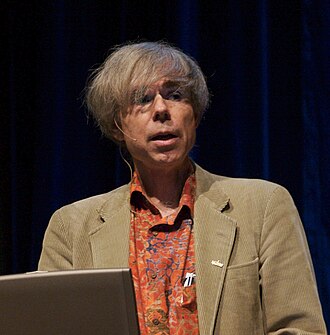
道格拉斯·霍夫施塔特美国认知科学家、印第安纳大学教授,以 1979 年普利策奖作品《哥德尔、埃舍尔、巴赫》闻名,2007 年出版《我是个怪圈》系统阐述自我与意识的「怪圈」理论。本讲为费城某系列讲座(主题「连接」)上的演讲。中文世界通行译名「侯世达」。
01从 GEB 到《我是个怪圈》
0:01
hello and uh I don't even know if this thing yeah it's working but actually I I let me see if if I can talk out here is is am I okay yes no obviously some people are saying no therefore can we turn the volume up how about now yes okay if if I get too soft for somebody back there please uh let me know and I will either talk louder or I will move back to that mic so uh I and actually my notes are over here so I better move here for a moment at least uh and see where I'm going um well uh I I wrote a book not too long ago that would that tried to take up where Geb uh I wouldn't say left off I that's not a fair way of phrasing it's sort of like to to reiterate some of the themes in GED that I thought were not perhaps treated uh well enough in Geb uh you know at one time I thought I had said all that I wanted to say and then when I started to say it again I realized I had come I hadn't said all that I wanted to say and maybe I haven't even said it very well so I I started again and then I wrote the book I'm a
大家好,呃,我都不知道这玩意儿……嗯,能用,不过我先试试在这儿说话行不行是……我这样可以吗?可以吗?显然有人说不行,那我们能不能把音量调大一点?现在怎么样?行了,好,如果我的声音对后面那位来说太小了,请呃告诉我,我要么说大声点,要么就退回到那支麦克风那边。所以呃,其实我的讲稿在这边,所以我最好先挪到这儿来待一会儿,呃,看看我要讲到哪儿。嗯,那个,呃,我不久前写了一本书,它想接着《哥德尔、埃舍尔、巴赫》(GEB)呃……我不该说“未尽之处”,那样讲不太公平,更像是想重述《GEB》里的一些主题,我觉得那些主题在《GEB》里也许没有得到足够好的处理,呃,你知道,曾经有一阵我以为我想说的话都说完了,可当我又开始说的时候,我意识到我并没有把想说的都说出来,也许我甚至没有说得很好。所以我又重新开始,然后我写了那本书《我是个怪圈》。现在,嗯,这个想法……
便签笔记
1:19
strange Loop now um the the idea the the first part of I'm a strange Loop is about um what I think is the fundamental uh pattern found inside brains that makes the makes us be conscious makes us have selves or even I would use the word soul I I don't use the word soul in a religious sense I use it uh only because I like to use a very evocative word um I I use it in the same sense as I would use the word self or as I would use the word I an an i there is an i inside here sometimes I even say there's sort of like there's a light on inside and so it's in that sense that I use the term uh soul and um so I was trying to talk about what is the abstract structure that uh is uh inside brains and when I use the word brains of course brains come in many sizes and shapes they aren't only in humans they are in all sorts of animals and uh and so one could ask to what extent that structure this abstract structure is present in other kinds of animals as well uh or uh well any in other substrates um so the the first part of the book The
《我是个怪圈》的第一部分讲的是,嗯,我认为大脑内部存在的那种最根本的模式,正是它让我们拥有意识,让我们拥有自我,甚至我会用“灵魂”这个词。我并不是在宗教意义上使用“灵魂”这个词,我用它呃只是因为我喜欢用一个很有感染力的词。嗯,我用它的意思,跟我用“自我”这个词、或者用“我”这个词是一样的——这里面有一个“我”,有时候我甚至会说,有点像是里面亮着一盏灯。就是在这个意义上,我使用“灵魂”这个词。嗯,所以我想谈的是,究竟是什么样的抽象结构,呃,存在于大脑内部。当然,我说“大脑”的时候,大脑有各种大小和形状,它们并不只存在于人类身上,各种各样的动物都有大脑,呃,所以人们可以问,那种结构在多大程度上……这种抽象结构在其他种类的动物身上也存在,呃,或者说,呃,在其他任何载体中也存在。所以这本书的第一部分,
便签笔记
3:01
First two-thirds or so of the book is about or it's devoted to um trying to elucidate the nature of this structure and I'm not going to go into it too much tonight I don't think um what I want to talk about and more because the rest of the book the the the the last third of the book or at least part of that part of the book maybe not all of it is about this idea that is expressed in the title of this talk the Deep interconnectedness of human Souls it is about how I I there's a chapter I think called how we live in each other and um there are there are this is a theme that came uh into the book it wasn't the first time I had expressed this theme in any of my writings but it was the most uh it is by far the most full treatment of it in my writings um and I I realized that I have not invented this idea on my own uh it's something that I think that a lot of people have talked about and often in fiction or in other ways I think sometimes though people take it very metaphorically and I'm not taking
这本书的前三分之二左右,是关于,或者说致力于,呃,试图阐明这种结构的本质,而今晚我不打算太深入地讲这部分,我想我不会讲。我想谈的,更多是因为这本书的其余部分,那个,那个,这本书的最后三分之一,或者至少是那部分中的一部分,也许不是全部,是关于这个想法的,也就是本次演讲标题所表达的:人类灵魂的深层互联性。它讲的是我,我,有一章我记得叫做《我们如何活在彼此之中》。呃,有,有,这是一个进入这本书的主题,它并不是我第一次在自己的著作中表达这个主题,但它是最,呃,它是我所有著作中对这一主题迄今为止最完整的论述。呃,而且我,我意识到我并不是自己独创了这个想法,呃,我认为这是很多人都谈论过的东西,而且往往是在小说里或以其他方式谈论的。不过我觉得有时候人们把它理解得非常隐喻化,而我并不是
便签笔记
4:13
it metaphorically I'm taking it quite literally and that's maybe a little bit of a difference um so I'm mostly going to talk about that second part of the book or the last third of the book on how we live in each other and and that kind of thing and in order to get into that area into that flavor I um want to give you a little bit of preliminary thinking a lot in certain in certain directions about pattern because really everything depends upon I mean you could even say you could say the following that the first part of my book that goes up to chapter 14 or so talking about what I call strange Loops is it it it sets up a certain kind of pattern as as quintessential in creating Consciousness or self or soul however you don't have to accept that particular pattern if you don't really I mean you may not be convinced that my argument is good however part of my argument isn't necessarily about that particular pattern it's just that it is some pattern some kind of pattern and if you buy into the notion that Consciousness
把它当作隐喻,我是相当字面地来理解它的,这也许是一点点差别。呃,所以我主要要谈的是这本书的第二部分,或者说最后三分之一,关于我们如何活在彼此之中,以及诸如此类的内容。而为了进入那个领域、那种氛围,我,呃,想先给各位一点铺垫性的思考,在某些方向上多想一想,关于「模式」的问题,因为其实一切都取决于——我是说,你甚至可以这么说,你可以说,我这本书的第一部分,一直到第十四章左右,讲的是我所谓的「怪圈」,它,它,它建立起了一种模式,把它当作创造意识、自我或灵魂的关键所在。不过你并不一定要接受那个特定的模式——如果你不太……我是说,你可能并不觉得我的论证有多好,但我论证的一部分其实并不一定非得是那个特定的模式,重点只是它是某种模式、某类模式。如果你接受这样一个观念:意识
便签笔记
02意识不是非黑即白,而是连续谱
5:31
is the result of certain kinds of patterns being present in certain kinds of substrates um then uh that's enough for the rest of the book you don't need to know the details of the pattern the so-called strange Loop pattern that's sort of a icing on the cake the the The crucial thing is that you accept that it is a pattern but um so I want to at least talk about what makes us think that there are there is a light on if you wish in certain kinds of beings or entities and uh so I'm going to run down quickly a list of a few different kinds of entities that we might at least consider candidates may be very poor candidates for having souls or selves or Consciousness in fact I'm going to give you deliberately some extremely poor candidates to start out with because I want to what I want to do is I want to I hope to give you the feeling at the end of this first part of the talk that there is definitely a spectrum of levels of of Consciousness or levels of Soul unlike what um I think we as humans are inclined to
是某些类型的模式出现在某些类型的基质中的结果,嗯,那么,呃,对于这本书余下的部分来说这就够了你不需要知道这个模式的细节,也就是所谓的"怪圈"模式,那只算是锦上添花。关键的是你接受它是一种模式。不过,嗯,所以我至少想谈谈,是什么让我们觉得那里有、存在着一盏亮着的灯——如果你愿意这么说的话——在某些类型的存在或实体里面。呃,所以我要快速地过一遍几类不同的实体这些实体我们至少可以把它们当作候选者来考虑,也许是非常糟糕的候选者——考虑它们是否拥有灵魂、自我或意识。事实上,我要故意先给你们举一些极其糟糕的候选者,因为我想……我想做的是,我想、我希望在这个演讲第一部分结束时,能让你们产生这样一种感觉:确实存在一个连续的谱系,有不同层次的意识、不同层次的灵魂,这和我们人类倾向于相信的不太一样。我们总是想划出非黑
便签笔记
6:48
believe we always want to set up black and white boundaries we want to say everything is yes or no some things are conscious some things are not some things are alive some things are not alive some things have souls some things don't have souls there are zombies there are non-zombies things like that we always want to draw these black and white yes no on off uh it's easier to make these kinds of distinctions it's easier to live life that way if you can make such black and white distinctions and if you believe in them very strongly and I want at least to bring up some of these some cases along what I think of as a as a Continuum and I will not attempt to put say where on the Continuum certain things lie I will let you figure it out in your own mind where you think they lie but I at least hope to establish in your mind this notion of a Continuum of different levels of consciousness if you wish sentience or having a soul so let me let me just give a familiar example probably almost everybody here which is from the Star
即白的界线,我们想说一切非是即否:有些东西有意识,有些没有;有些东西是活的,有些不是活的;有些东西有灵魂,有些没有灵魂;有僵尸,有非僵尸,诸如此类。我们总是想划出这种非黑即白、是与否、开与关的界线。呃,做这种区分更容易,如果你能做出这种非黑即白的区分,并且深信不疑,那样过日子也更轻松。而我至少想举出一些例子,它们分布在我所理解的一个连续统上。我不会试图去确定某些东西在这个连续统上究竟处于什么位置,我会让你们自己在心里判断它们在哪儿。但我至少希望在你们心中确立起这样一个观念:存在一个连续统,上面分布着不同层次的意识——如果你愿意的话,可以说是感受能力,或者说拥有灵魂。那么让我举一个大概在座几乎每个人都熟悉的例子,来自《星球
便签笔记
03星战机器人与塞尔的「对的材料」
7:57
Wars movies um R2D2 or C3PO now of course these are fictional entities but we watch the screen and one of the things that we uh are aware of I think I mean I haven't seen these movies in a long time and I can't remember the details but what my my memory tells me is that these are creatures that are made out of metal or you know other inorganic substances um they're not made of Flesh and Blood and Bones they are made of metal and maybe some plastic or some semiconductors or things like that and um and so we watch them and yet nonetheless despite their uh let's call it alien substrate they um I think that it's extremely easy for us to look at these creatures and to attribute Consciousness to them and to think that there is a light on inside and to feel that there are emotions in there you know fear and um and uncertainty and uh you know whatever you want I don't want to spell it all out for you but I think that it's a very easy leap and it's interesting because there's a famous philosopher
大战》系列电影,嗯,R2D2 或者 C3PO。当然,这些是虚构的实体,但我们看着银幕,我们所意识到的一件事情是——我是说,我已经很久没看这些电影了,细节我也记不清了,但我的记忆告诉我,这些生物是由金属或者其他无机物质构成的嗯,它们不是由血肉和骨头构成的,它们是由金属,也许还有一些塑料、一些半导体之类的东西构成的嗯,所以我们看着它们,然而尽管它们有着——呃,我们姑且称之为——异质的基质,它们,嗯,我认为对我们来说非常容易去看着这些生物,把意识归属给它们,觉得它们里面有一盏亮着的灯觉得那里面有情感,你懂的,恐惧啊,嗯,还有不确定感啊,呃,随便你怎么说,我不想把每一点都替你们讲明白。但我觉得这是一个非常容易的跨越。而这很有意思,因为有一位著名的哲学家
便签笔记
9:15
John Searle um I've argued against him in many of my writings and I don't want to go into that in any great detail but I simply wanted to say that Cyril is well known for an interesting position which is basically he talks about what he calls the right stuff the right stuff is is essentially the the chemistry of our brains and he says that um that if you don't have the right stuff you can't possibly be conscious or sentient and he even gave an example of where he said if I walk down the street and ran into somebody that you know would look to be like a human being and I engaged in a conversation with them for half an hour and we you know could banter about anything tell jokes uh you know uh talk about the political situation in the Middle East or it doesn't matter whatever it might be if then at the end of this half an hour the creature uh opened up its shirt and showed me that it was made of metal and that it was literally not made of the right stuff I would have to backtrack so says Cyril in his in my understanding of
约翰·塞尔,嗯,我在很多著作里都反驳过他,我不想在这里详细展开,但我只是想说,塞尔以一个有趣的立场而闻名,基本上他谈的是他所说的"对的材料",所谓"对的材料"本质上就是我们大脑的化学构成。他说,嗯,如果你没有对的材料,你就不可能有意识、不可能有感受力。他甚至举了个例子,他说,如果我走在街上,碰到某个人,你知道的,看起来就像个人类,我和他交谈了半个小时,我们,你知道的,可以天南海北地闲聊,讲笑话,呃,你知道的,呃,谈论中东的政治局势,或者别的什么都行,无所谓如果这半小时结束时,这个生物,呃,敞开它的衬衫,让我看到它是金属做的,它确确实实不是由"对的材料"构成的,那么按塞尔的说法,我就必须推翻我对这个实体的
便签笔记
10:24
this entity and and ascribe to all the words that it had uttered zero meaning in other words the it would have been um not only as it would not only be a zombie a creature with no sentience no consciousness no no uh self no soul no I but all of its words would be stripped of meaning the words would be empty all of those things you know maybe Cyril laughed at the jokes but that was only him imputing meaning to the empty words that were created that were spouted or emitted by this zombie automaton that had no consciousness and and because of the no consciousness it meant nothing by any of the sounds that it was making well contrast that that was just a little bit of an extremist position which says that what matters is the substrate what matters fundamentally for the existence of it's not the only thing on a sir would never say that you just throw a hunk of organic stuff together and you get Consciousness but but if you don't have the right substrate you can't get Consciousness is is what he means when
全部理解,并且把它说出的所有词语的意义都判定为零。换句话说,它不仅仅是嗯,它不仅会是一个僵尸,一个没有感受力、没有意识、没有、呃、没有自我、没有灵魂、没有"我"的生物而且它所说的一切词语都会被剥夺意义,那些词语会是空洞的,所有那些东西。你知道的,也许塞尔当时被那些笑话逗笑了,但那只是他自己把意义强加到了那些空洞的词语上——那些由这个没有意识的僵尸自动机吐出来、发出来的词语。正因为没有意识,它所发出的任何声音都不意味着任何东西。好,与此形成对照的是……刚才那算是一种有点极端的立场,它认为要紧的是基质,对于存在来说根本上要紧的是……当然这不是唯一的条件,塞尔绝不会说你随便把一堆有机物质拼在一起就能得到意识。但是,如果你没有对的基质,你就得不到意识——这就是他说"必须是对的材料"时的意思。而,你想想看,你是多么轻易地
便签笔记
11:36
he says it has to be the right stuff and and just think about you know how easily you I assume I may be wrong but I'm guessing that you easily attribute a kind of a sentience or Consciousness or self or soul to um to C-3PO or to R2D2 and I just want you to think about that to hopefully open up the idea that in your mind there's a sort of an openness an open-mindedness towards uh different substrates for supporting Consciousness um I'm certainly not saying of course these are science fiction creatures that's not the point the point is not whether they're real the point is whether you're open to the idea that it is possible that it's conceivable and uh and and I think that that it's very clever on the part of the Star Wars people to have uh made them seem so vulnerable and uh and to have senses of humor and to be confused a lot of the time because it allows us in some ways to identify with them uh much more there's another scene in one of the Star Wars movies probably many of them I've only seen two of them I think but where
就——我假定,我也可能弄错了,但我猜你会很轻易地把某种感受力、意识、自我或灵魂归属给,嗯,归属给 C-3PO 或者 R2D2。我只是想让你们想想这一点,希望能在你们心里打开这样一个想法:有一种开放性,一种对不同基质都能承载意识的开放心态。嗯,我当然不是在说……当然这些是科幻里的生物,但那不是重点。重点不在于它们是不是真实存在,而在于你是否愿意接受这样一种可能性:这是可能的,是可以设想的。呃,而且我觉得《星球大战》的创作者们非常聪明,呃,把它们塑造得显得那么脆弱,呃,还让它们有幽默感,而且经常一头雾水这在某种程度上让我们能更容易地认同它们。呃,《星球大战》里还有另一个场景,可能很多部里都有,我大概只看过两部,就是有一支,呃,机器人大军
便签笔记
12:46
there's a an army of uh of robots that is marching across some field and the robots are all identical they're all completely identical and then I as I recall some Rockets come down and Destroy them all and I think that as a viewer I I dimly remember this that you know I can imagine I sort of felt and I think everybody felt that oh it didn't matter because these uh these were all zombies anyway they were completely uh because they weren't vulnerable and they were all marching sort of in lockstep and it was it was as if they were really just automata and um again it's a manipulation by making them all look sort of very mechanical and not vulnerable and no sense of humor um in all of that they they make us feel as if oh there's nothing going on inside and uh so I think that those are two examples now let me give you some examples that involve things made of different substrates and things made of not exactly our substrate but at least organic chemistry just to allow you to explore the spectrum of possibilities of
正列队穿过某片原野,那些机器人全都一模一样,完全一模一样,然后,我记得有几枚火箭落下来把它们全部摧毁了。我觉得作为观众,我隐约记得这一幕,你知道的,我可以想象,我当时有点觉得,我想大家也都觉得:哦,无所谓,因为这些,呃,这些反正都是僵尸,它们完全是……因为它们并不脆弱,而且全都齐步行进仿佛它们真的只是自动机器。嗯,这同样是一种操控手法:把它们都塑造得非常机械、毫不脆弱、毫无幽默感,嗯,通过这一切,他们让我们觉得:哦,里面什么都没有发生呃,所以我觉得这就是两个例子。现在让我给你们举一些例子,涉及由不同基质构成的东西,以及那些并非完全由我们这种基质、但至少是由有机化学构成的东西,好让你们去探索这个谱系上的各种可能性——
便签笔记
04从别针到无人车:知觉的谱系
14:00
things that could have some degree of sentience or Consciousness um so we begin with something that I hope you know you'll say has none of that which is just a pin just a pin p-i-n I think probably none of us is terribly inclined to think that a pin has a lot of Consciousness um so let's move a little bit into away from the Simplicity of a pin towards a structure that is still totally totally inorganic and uh you know mechanical um a flush toilet flush toilet uh it has you know does one thing it uh when you push the lever down the water goes out and then uh it starts to fill up again and as it fills up the the float Rises because that's what floats do and it Rises and The Arm the lever arm you know as it rises is comes at a different angle and as it goes up the lever arm controls uh the degree to which water is flowing and uh and when it reaches a certain height the water turns off and if there's a leak and so the float goes down then at some point the water will start flowing again it'll
哪些东西可能具有某种程度的感受力或意识。嗯,我们从一个我希望你们会说完全不具备这些东西的例子开始,那就是一枚别针,就是别针,p-i-n。我想我们大概没有谁会特别倾向于认为一枚别针有多少意识嗯,那我们从别针的简单性稍微往前走一点,走向一个仍然完完全全无机的、呃,你知道的,机械的结构,嗯——抽水马桶。抽水马桶,呃,它,你知道的,只做一件事,呃,当你按下手柄时水就放出去了,然后,呃,它又开始蓄水。随着水位上升,浮球升起,因为浮球就是这么工作的。它升起来,而那根杆、那根杠杆臂,你知道的,随着它上升会呈现不同的角度。随着它往上走这根杠杆臂控制着,呃,进水的流量。呃,当水位达到某个高度时,水就关掉了。而如果漏水,浮球下降,那么到某个点水又会开始流进来,水位会
便签笔记
15:14
come back up and and so we have this kind of sense of water in the toilet now let's ask ourselves what concepts does a flush toilet have it's a bit of a leap to say that it has Concepts I mean that certainly we know I think you know that a flush toilet doesn't have the concept of water doesn't have the concept of height does it doesn't really have the concept of enough uh or right or wrong or angle or faucet or lever or any of those things up down but in some sense it perceives something now is perceived too strong a verb probably it is I think but yet it it reacts in such a way that it it it it it sees in quotes that or feels and quote that there is not enough water in it puts more water in it okay I mean that's sort of the thin edge of the wedge it's the beginnings of perception um then we could go to thermostats and thermostats are really nothing they're all they're the same as as flush toilets is that they're more abstract and they don't involve water they involve temperature and they don't uh
重新升上去。于是我们就有了马桶里水位的这种"感知"。现在我们来问问自己:一个抽水马桶拥有什么概念?说它有概念,这已经有点跨越了。我是说,我们当然知道,我想你们也知道,抽水马桶没有水的概念,没有高度的概念,它并没有真正拥有"够了"的概念呃,或者对与错、角度、水龙头、杠杆之类的概念,上、下,也都没有。但在某种意义上它确实感知到了某种东西那么,"感知"这个动词是不是太强了?大概是太强了,我想。但它确实以某种方式做出反应,它、它、它、它引号里的"看到",或者引号里的"感觉到"里面的水不够了,于是就往里加水。好吧,我是说,这算是一个楔子的薄边,是知觉的最初萌芽。嗯,然后我们可以说到恒温器。恒温器其实没什么特别的,它们和抽水马桶完全一样,只不过更抽象一些,它们不涉及水,而是涉及温度;它们不、呃,它们不涉及、呃,它们涉及电流的流动,呃,而且,呃,取代了水龙头
便签笔记
16:37
they don't involve uh they involve electricity flowing uh and uh instead of a faucet but really it's very similar okay uh then we could go to heat seeking missiles whose uh purpose if I can attribute a purpose to them is to uh follow let's say a fighter fighter plane and to get themselves sucked up into the back of the Jet Engine and to explode and um and so they can follow it and track it in a very complex zigzagging pattern um like a swallow following uh insects in the air and um you know that seems a bit more complicated and um it it seems more goal directed and then we could talk about mosquitoes now of course I've made a jump here I jump from one substrate to another I jump from the uh say metallic mechanical substrate to an organic substrate so in order to not make that jump so quickly I want to bring up another example for you that I think is a very fascinating one which is the DARPA challenge which probably some of you know about um this was a this is something that's ongoing and it will become more and more
但其实非常相似。好,呃,然后我们可以说到热寻的导弹,它们的,呃,目的——如果我可以把目的归属给它们的话——是要,呃追踪比方说一架战斗机,把自己吸进喷气发动机的尾部然后爆炸呃,嗯,所以它们能跟着它,以非常复杂的之字形轨迹追踪它,嗯,就像一只燕子在空中追逐昆虫。嗯,你知道的,这看起来就复杂一些了,嗯,而且看起来更有目标导向性。然后我们可以谈谈蚊子。现在当然,我在这里跳了一步,我从一种基质跳到了另一种基质,我从,呃,比方说金属的、机械的基质跳到了有机的基质。所以为了不要跳得那么快,我想再给你们举一个我觉得非常引人入胜的例子那就是 DARPA 挑战赛,你们中可能有些人知道。嗯,这是一件、这是一件仍在进行中的事情,而且随着年头过去,它会越来越
便签笔记
18:02
um uh known to people as the years go by but a couple of years ago three or four years ago uh the uh there was a DARPA challenge which darpa's defense Advanced research projects agency and it's a you know defense department challenge uh that was issued to universities to produce a vehicle that would be self-driving self-driving meaning the vehicle contained a computer and no connection with human beings of any sort it was autonomous completely autonomous and the idea was for these vehicles to compete against each other uh in driving themselves across I think it was the Mojave Desert and I don't know what the distance was but it was like 120 miles now um it's quite interesting to think about what was going on in in this case and by the way several of the vehicles did do so they managed to go from one end of the course all the way to the other and what kinds of things were they doing well they had to know in some sense where they were they had to avoid obstacles of all sorts and they had to
嗯,呃,为人所知。但在几年前,三四年前,呃,那个,呃,有一场 DARPA挑战赛。DARPA 就是国防高级研究计划局,这是,你知道的,一项由国防部发起的挑战,呃面向各大学发出,要求造出一辆能自动驾驶的车辆。所谓自动驾驶,是指这辆车内部装有一台计算机,与人类没有任何形式的连接,它是自主的,完全自主的。而设想是让这些车辆相互竞赛,呃,自己开着穿越——我想是莫哈韦沙漠,我也不知道距离是多少,大概是 120 英里吧。嗯,思考这个案例里究竟发生了什么,是很有意思的。顺便说一句,有好几辆车确实做到了,它们成功地从赛道的一端一直开到了另一端。那它们都在做些什么呢?嗯,它们在某种意义上必须知道自己在哪儿,必须避开各种各样的障碍物,还必须
便签笔记
19:08
avoid falling into ditches they had to avoid Plants and Things They I don't I you know I I don't know what it's like there I I haven't seen it and I don't I'm not an expert on this by any means but I think you can imagine basically this idea that they're crossing the desert following twisty uh windy ill-defined roads and they have to find their way across it um and uh in unpredictable circumstances because the exact nature of what is there is not known in advance um and uh so they use sensory devices like television cameras and Laser rangefinders and I believe also GPS so they have all sorts of devices that allow them to know things about where they are but look I'm using words like no um maybe you don't want me to use those words but uh um and I I could say they can see things ahead of them maybe you don't want me to use words like C but it's it's a bit tricky uh why not why not use words like that I'm gonna um cite one part of the the the course that one of these vehicles the Stanford vehicle which was
避免掉进沟里,必须避开植物之类的东西。它们……我不、你知道的,我我不知道那边是什么样子我我没去看过,我也不、我绝不是这方面的专家,但我想你们基本上可以想象出这样一个画面:它们穿越沙漠,沿着弯弯曲曲、界限不清的道路行驶,它们必须自己找到路穿过去。嗯,而且,呃,是在不可预测的情况下,因为那里究竟有什么,事先并不知道嗯,呃,所以它们使用各种传感设备,比如电视摄像机、激光测距仪,我相信还有 GPS,所以它们有各种各样的设备让它们能够知道关于自己所在位置的种种情况。不过你看,我在用"知道"这样的词,嗯,也许你不希望我用这些词,但是,呃,嗯,而且我我可以说它们能看见前方的东西——也许你不希望我用"看"这样的词,但这有点棘手,呃,为什么不呢?为什么不用这样的词呢?我要,嗯,举出赛道上的一个片段:其中一辆车,斯坦福的那辆车,也就是最后的冠军,在某个时刻,大概是在赛程走了三分之二或四分之三的地方
便签笔记
20:31
the winner at one point probably two-thirds or three quarters of the way through the course pulled up behind it turned out a strange obstacle and what was that obstacle well it was certainly not something that it had been predicted to find on the course it was another vehicle it was the Carnegie Mellon vehicle which was ahead of it um now I don't think that the Stanford team had anticipated this kind of an idea that they were going to have to do pattern recognition and understand the nature of other other their competitors for example but what it did despite probably not having been programmed in advance to to know what to do in these circumstances it it it pulled out and went around it it actually went around and passed it now it did not think to itself wow I passed my competitor it did not have thoughts about itself and the other thing I think of them as as members of the same category um but my point only is that if you could think of this vehicle driving itself across the desert I think I would
停在了一个奇怪的障碍物后面。那是什么障碍物呢?嗯,那肯定不是事先预料会在赛道上出现的东西——那是另一辆车,是走在它前面的卡内基梅隆的车嗯,我不认为斯坦福团队事先预料到了这种情形,预料到它们会需要做模式识别、去理解其他、其他竞争对手的性质之类的事。但它所做的是,尽管它多半并没有被预先编程去知道在这种情况下该怎么办,它、它、它还是开出去绕了过去,它真的绕过去并超了车。当然它并没有心想"哇,我超过了我的竞争对手",它并没有关于自身的想法也没有把对方看作是同一类别的成员。嗯,但我的意思只是:如果你能想象这辆车自己开着穿越沙漠,我想我会、你知道的,我希望你自问:我会把它放在这个谱系的
便签笔记
05蚊子与膝跳反射:反应不等于概念
21:50
you know I would want you to ask yourself where would I place that along the spectrum of I mean where is that as sentient has an aunt as a cockroach as a mosquito certainly it's much much more sophisticated than heat-seeking missile let alone a flush toilet or a thermostat so um I I want you to just imagine that and think about it a little bit because I think that we as humans are are more generous towards creatures that seem to orient themselves in the world that in a way R2D2 and C3PO have things that make us think of eyes and I think that although I'm not intending to make any pun I can't help it in sense the presence of eyes sort of symbolizes for us the presence of an eye and I think it's very easy for us to read into the idea of a creature that orients itself and has a sort of sensory awareness around itself as having some kind of at least rudimentary eye I was giving a talk the other day at Gettysburg College to some students and I found to my surprise that when I mentioned mosquitoes
什么位置上?我是说,它有蚂蚁那么有感受力吗?有蟑螂那么有吗?有蚊子那么有吗?它当然远远比热寻导弹要复杂得多,更不用说抽水马桶或恒温器了。所以,嗯,我我想让你们就这么想象一下,稍微琢磨一下。因为我觉得,我们人类对那些看起来能在世界中给自己定位的造物,会更加慷慨。在某种意义上,R2D2 和 C3PO 身上有些东西让我们联想到眼睛。我觉得虽然我并不打算玩双关,但我忍不住——在某种意义上,眼睛(eyes)的存在对我们来说象征着一个"我"(I)的存在。我觉得,对于一个能给自己定位、并且对周围有某种感官觉知的造物,我们非常容易读出它具有某种至少是初步的"我"。前几天我在葛底斯堡学院给一些学生做演讲让我意外的是,当我提到蚊子时,嗯,他们、或者至少他们中的一些人,非常确信蚊子拥有
便签笔记
23:14
um they were or at least some of them were very convinced that mosquitoes had all sorts of Concepts like I I was saying you know if I try to swat or smash a mosquito against the wall I was trying to say that the mosquito's reaction is a very simplistic one basically it is trying and I think trying is too strong a word but it is it is moving away from a quick moving Darkness or Shadow or something like that but the students were saying things like oh it's it it is trying to avoid death and it is trying to survive and I said what makes you think that it has any concept of death or survival death is a very complicated concept um and uh and I don't think they had thought about this at all I mean I think that I I then gave an example and I hope this example will help you as also in thinking about this because I think it's a very useful example when I when I go to the doctor and the doctor hits my knee with a uh with a hammer and my knee jerks um I don't think that my knee is having any thoughts but it is certainly having
各种各样的概念。比如我当时在说,你知道的,如果我想拍死一只蚊子、把它拍在墙上——我想说的是,蚊子的反应是非常简单的,基本上它是在试图……我觉得"试图"这个词也太强了,但它是、它是在躲开一个快速移动的黑影或阴影之类的东西。可是学生们却说:哦,它是、它是在试图避免死亡它是在试图活下去。我说,你凭什么认为它拥有任何死亡或生存的概念呢?死亡是一个非常复杂的概念,呃,我觉得他们根本就没有考虑过这一点。我的意思是,我当时举了一个例子,我希望这个例子也能帮助你思考这个问题,因为我觉得这是个非常有用的例子。当我,当我去看医生,医生用那个,呃,用小锤子敲我的膝盖,我的膝盖就弹了一下。我并不认为我的膝盖有任何想法,但它确实有某种反射,它是在对某种情况、某个特定情形作出反应。我觉得人们可以
便签笔记
24:27
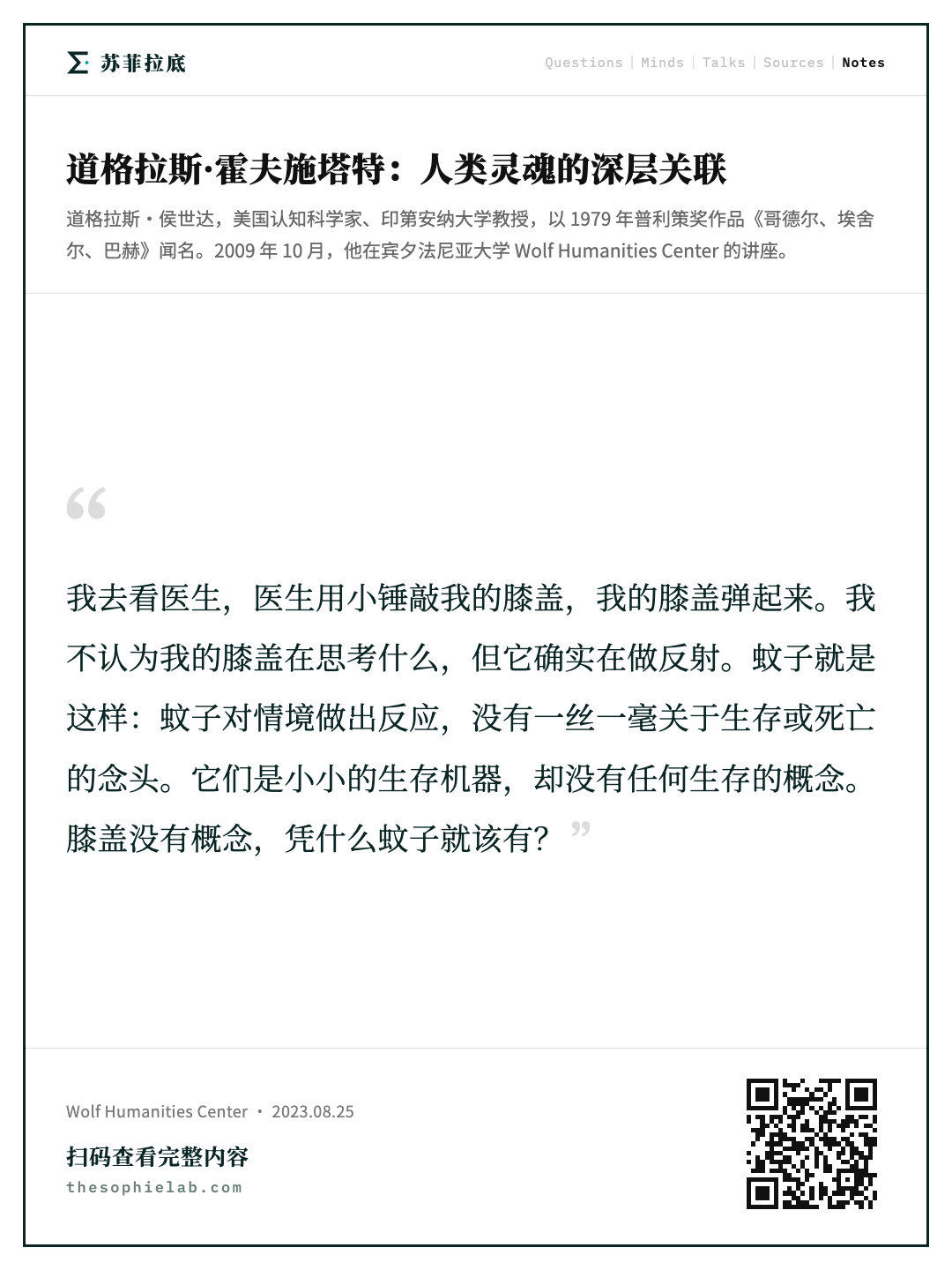
some reflexes it is reacting to a certain circumstances a certain circumstance and I think that one can easily imagine that mosquitoes are just like that mosquitoes react to circums stances without having the slightest thought about survival or death and you could say well why do they do it and the answer is because of evolution they've been programmed to that's why they're little machines they're little survival machines they don't have any concept of survival just like a knee doesn't have any concept of a knee-jerk reflex these don't have Concepts why should mosquitoes have Concepts so I think that these are some some of the things that I would like you to be thinking about as we talk about Shades of Gray that are between the pin and the human soul so we're we're talking about a kind of a spectrum and what I want to get at is the um the fact that I think that The crucial thing that makes us believe that there is something there is the presence of perception and perception that is very sophisticated uh mosquitoes
很容易地设想,蚊子就是这样的。蚊子对各种情况作出反应,却丝毫没有关于生存或死亡的念头。你可能会说,那它们为什么要这么做呢?答案是因为进化,它们被编好了程序,所以它们就是小机器,是小小的生存机器,它们根本没有"生存"这个概念,就像膝盖没有"膝跳反射"这个概念一样。这些东西没有概念,那蚊子凭什么会有概念呢?所以我觉得这些就是我希望你们思考的一些问题,因为我们要谈的是那些灰色地带,介于一枚大头针和人类灵魂之间的灰色地带。所以我们谈的是一种连续谱,而我想说明的是这样一个事实:我认为让我们相信"那里有某个东西"的关键,是知觉的存在,而且是非常精密复杂的知觉。呃,蚊子有某种知觉,恒温器和马桶也有某种
便签笔记
06有意识的蚁群与超级有机体
25:43
have a certain kind of perception thermostats and toilets have a certain kind of perception extremely feeble and I think that we begin to think that perception really starts to mean something when the perception is at the level of being able to create models of other entities as being sentient and as being as having purposes and goals and such things when we start to attribute to other entities things like desires dreads goals and so forth then I think we are at the level that we want to begin saying that the creature has some kind of Soul or self or eye or Consciousness now all of these ideas are spelled out in considerable detail in the book but uh and and I build up a structure that uh has to do with the the way in which abstract perception is the at the core of what we are that is we start perceiving ourselves um at a very abstract level let me let me give you an analogy let's imagine I have a long extended dialogue and go to Leisure Bach called Prelude at Fugue where there is an ant colony which I named
知觉,只是极其微弱。而我认为,当知觉达到某个层次时,我们才会开始觉得知觉真正有了意义,那就是它能够为其他实体建立模型,把它们看作是有感受能力的、有意图和目标之类东西的存在。当我们开始把欲望、恐惧、目标等等归属给其他实体时,我认为我们就到了那个层次,可以开始说这个生物具有某种灵魂、自我、"我"或者意识了。这些想法在书里都有相当详细的阐述。呃,我还构建了一个框架,讲的是抽象的知觉如何处在"我们是什么"的核心位置,也就是说,我们开始在一个非常抽象的层面上感知我们自己。让我,让我打个比方,我们来设想一下——我在《哥德尔、埃舍尔、巴赫》里写了一段很长的对话,叫《前奏曲与蚂蚁赋格》,里面有一个蚁群,我给它取名叫
便签笔记
27:19
Aunt Hillary which is supposedly conscious um now the you know back in the 1920s when people were first writing a lot about the social insects um terms like holism were coined the meaning the idea that uh somehow there are structures at very very high levels of abstraction that in some sense have a causality that that is at their own level in it sometimes people say that it has nothing to do with the the causality at the lower level the causality of the at the physics level I think that's a naive uh way of thinking about it but it's certainly true that the Sciences as we progress from physics to chemistry to biology are have a certain kind of a there's a way in which we talk about each science at its own level without needing to refer downwards you know when you talk about uh biological uh creatures you don't need to talk about quarks uh and in fact it would be very uh counterproductive to talk about quarks or to talk about anything at the level of of physics um it uh in fact it's it's probably
希拉里阿姨(Aunt Hillary),它据说是有意识的。呃,你知道,早在1920年代,当人们开始大量撰写关于社会性昆虫的文章时,呃,"整体论"这样的术语被创造了出来,意思是说,不知怎么地,在非常非常高的抽象层次上存在着某些结构,它们在某种意义上具有属于自己那个层次的因果性。有时候人们会说,这种因果性跟较低层次的因果性、跟物理层次的因果性毫无关系。我觉得这是一种幼稚的看法。但确实没错的是,随着科学从物理学发展到化学、再到生物学,确实存在这样一种情况:我们可以在每门科学自己的层次上讨论它,而不需要往下追溯。你知道,当你谈论呃生物体的时候,你不需要去谈论夸克。呃,事实上,谈论夸克,或者谈论任何处在物理层次的东西,都会非常适得其反。呃,事实上,很多时候甚至连在化学层次上讨论问题
便签笔记
28:43
almost very often counterproductive even to talk about things at the chemical level um certainly when you're talking about large things well so um at the same time as holism was concocted the term superorganism was concocted and um it went out of Vogue uh probably a few years later but it's kind of come we've been resuscitated recently there are several books out about super organisms and talking about ant colonies and beehives and such things as super organisms and uh so I I want you to imagine now hypothetically an ant colony that might be uh so complex so much bigger maybe I don't know how many ants in that Colony can have it may have half a million or something and if it's a large one but let's give let's be generous and give it a billion or if we need 10 billion or 100 billion a gigantic ant colony which is very conscious and as conscious as we are let's just imagine that such a thing exists and it may not violate your religion because there at least I've given you organic chemistry as the
也往往是适得其反的,呃,尤其是当你讨论的是大尺度的东西时。那么,呃,就在"整体论"被造出来的同时,"超级有机体"这个词也被造了出来。呃,它后来大概过了几年就不流行了,但最近又有点儿,我们最近又把它复活了。现在有好几本书是讲超级有机体的,把蚁群、蜂巢之类的东西当作超级有机体来讨论。呃,所以我想请你们现在假想一个蚁群,它可能极其复杂、大得多。也许,我不知道一个蚁群能有多少只蚂蚁,大的可能有五十万只左右吧。不过我们大方一点,就给它十亿只,或者如果需要的话,一百亿、一千亿只——一个巨大无比的蚁群,它非常有意识,跟我们一样有意识。我们就设想这样的东西存在。它也许并不违背你的宗教信仰,因为至少我给了你有机化学作为它的
便签笔记
29:48
substrate so um so so hopefully you can accept the idea that maybe such a thing isn't inconceivable um I mean so we could ask ourselves if such things have came to exist um presumably they wouldn't exist in a vacuum there will be other ones and they would be like us they would have friends and they would have countries and they would have languages and they would tell jokes and there would be famous ones and ones that weren't famous and there will be ones that had died hundreds of years ago and so there would be these these long tales about the old ant colony that had died hundreds of years ago that you know wrote These wonderful stories or told wonderful jokes or who knows what and there will be all these languages and so some ant colonies would have accents when they spoke with various languages they would have good or bad senses of humor all the things that we have now the question is where would these things be located in the ant colleague where would the foreign accent be located where
基质。所以,呃,所以但愿你能接受这个想法:也许这种东西并非不可想象。呃,我是说,那我们就可以问问自己,如果这种东西真的出现了,呃,它们大概不会孤零零地存在,还会有别的蚁群,而且它们会像我们一样:它们会有朋友,会有自己的国家,会有语言,会讲笑话,其中有些会很出名,有些默默无闻,还会有一些在几百年前就死去了。于是就会有那些长长的传说,讲某个几百年前死去的老蚁群,你知道,它写下了那些精彩的故事,或者讲过精彩的笑话,谁知道呢。而且会有各种各样的语言,所以有些蚁群说某些语言时会带口音,它们会有好的或者不好的幽默感,我们所拥有的一切它们都有。那么问题是,这些东西在蚁群里位于何处呢?那个外国口音位于何处?幽默感位于何处?呃,某个特定蚁群跟其他
便签笔记
30:53
would the sense of humor be located uh where would the friendship with other ant colonies a certain particular ant colony be located where would its love of History be located it well you would have to say it would be located in certain patterns that's I think all you could say there would have to be some very elaborate complex patterns among the way the ants involved interacted with each other that would give rise to this kind of thing now um I think it's very hard for us to conceive of ourselves as being super organisms in the sense of being composed of so many things it's much easier for us to think of ourselves as being composed of I don't know a handful of things you know like I have a stomach I have some legs I have a brain you know a few things hands fingers not uh being composed of a trillion cells and um I don't know if you ever thought about it but you know that in your body of course things are being things are happening all the time of which you're unaware um take a very simple example
蚁群之间的友谊位于何处?它对历史的热爱又位于何处呢?嗯,你只能说,它位于某些模式之中。我想你能说的也就只有这些了:那里必定存在某些极其精巧复杂的模式,体现在这些蚂蚁彼此互动的方式当中,正是这些模式产生了这类东西。那么,呃,我觉得我们很难把自己设想成超级有机体——也就是由如此之多的东西构成的存在。我们更容易把自己想成是由,我不知道,少数几样东西构成的,你知道,比如我有个胃、有两条腿、有个大脑,就这么几样,还有手、手指,而不是呃由一万亿个细胞构成的。呃,我不知道你有没有想过这个,但你知道在你的身体里当然一直有事情在发生,而你对此毫无察觉。呃,举一个非常简单的例子:
便签笔记
32:11
you're producing hemoglobin molecules all the time now you might wonder how many hemoglobin molecules are my producing per second uh and that means that they're being destroyed also the hemoglobin molecules are being destroyed every second and the answer is approximately every second 400 trillion hemoglobin molecules that's 4 times 10 to the 14th hemoglobin molecules are being created and destroyed simultaneously in your body every second of your life now that's an enormous stupefying number and of course I'm just talking about hemoglobin I'm not mentioning anything else that's going on in your body um it's it it really makes you when you start thinking about things at that level you start thinking of yourself as a super organism as something that is the outcome of an enormous amount of stuff of which you haven't the foggiest idea nothing at all and um see where was I headed here um oh yes I just wanted I just like to use this as a kind of a a metaphor for that notion uh we in English say that my leg
你一直在生产血红蛋白分子。那你可能会好奇,我每秒钟生产多少个血红蛋白分子?呃,而这也意味着它们同时也在被销毁——血红蛋白分子每秒钟都在被销毁。而答案是:大约每秒钟有400万亿个血红蛋白分子,也就是4乘以10的14次方个血红蛋白分子,在你的身体里同时被创造和销毁,你生命中的每一秒都是如此。这是一个大到令人瞠目结舌的数字,当然我说的还只是血红蛋白,我还没提你身体里正在发生的其他任何事情。呃,这真的会让你——当你开始在那个层次上思考问题时,你会开始把自己看成一个超级有机体,看成是海量事物的产物,而对这些事物你一点儿概念都没有,完全没有。呃,我刚才说到哪儿了?呃,哦对了,我只是想,我只是想把这个当作一个比喻来用。notion,呃,我们英语里会说“我的腿睡着了”,就是你在飞机上坐久了,站起来,
便签笔记
33:30
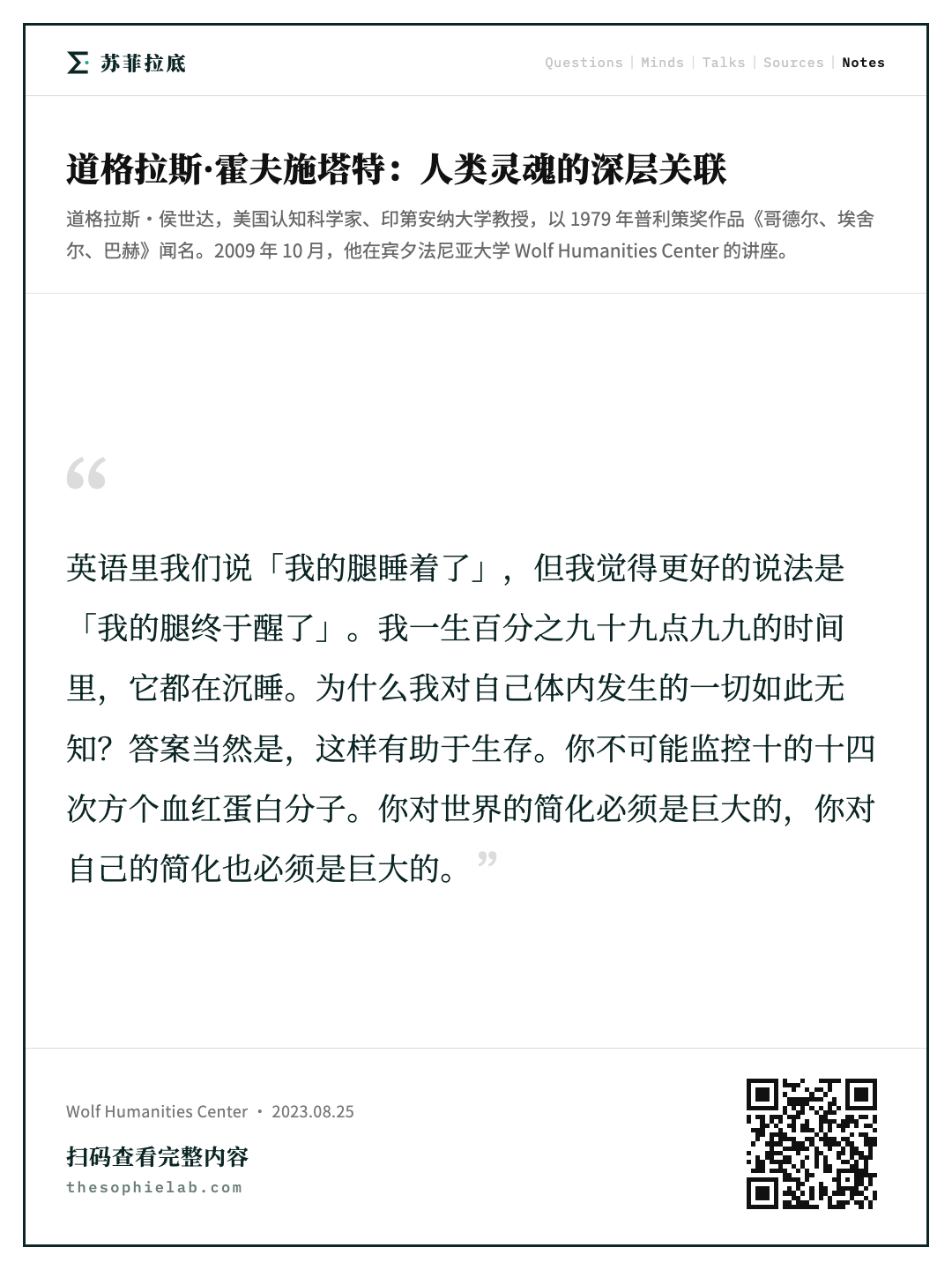
fell asleep you know when I am on the airplane and I get up and I sort of stumble down the aisle my leg is asleep but I think that that's much better to say my leg is awake finally it's asleep 99.99 of my life and every once in a while I become aware of it it is awake and I feel the seething churning stuff going on in it I can't feel 10 to the 14th hemoglobin molecules being created and destroyed but by God I can feel all sorts of stuff happening in that leg and in fact the French say it and the Italians say it as there are ants in my leg and uh and that's how it feels and Dennis the Menace once said my leg is full of ginger ale and I I really think that these are marvelous metaphors uh and that we should at times at least pause to think of ourselves in that fashion and say why am I so darned unconscious of everything that's going on inside me uh you know of course the answer is because other that's that helps you to survive uh you have to be unconscious of it you couldn't possibly think about all those
踉踉跄跄地走过过道,我的腿睡着了。但我觉得说“我的腿醒了”要贴切得多——它其实在我百分之九十九点九九的人生里都是睡着的,只是偶尔我会意识到它。这时它醒了,我能感觉到里面翻腾涌动的一切。我感觉不到十的十四次方个血红蛋白分子在生成和分解,但天哪,我确实能感觉到那条腿里正在发生各种各样的事情。事实上,法国人和意大利人是这么说的:我的腿里有蚂蚁。而且那种感觉还真是这样。淘气阿丹曾经说过,我的腿里灌满了姜汁汽水。我真心觉得这些比喻棒极了,呃,而且我们至少应该时不时停下来,用这种方式想想我们自己,问问:为什么我对体内正在发生的一切那么浑然不觉呢?呃,当然,答案是因为——这有助于你生存。你必须对它无知无觉,你……根本不可能去思考所有这些正在发生的事情,你不可能去监控那 10 的 14 次方个血红蛋白
便签笔记
07信封盒里的弹珠:高层模式的真实性
34:41
things going on you couldn't possibly monitor the 10 to the 14 hemoglobin molecules or monitor all the firings of the neurons in your brain or anything like that obviously the the your simplification of the world has to be enormous and your simplification of yourself has to be enormous now before I go on to the Deep interconnectedness of human Souls finish up with a little bit about patterns um one of the things that I found one day something that I found one day that really intrigued me and and and stayed with me as an image was I I had a box of envelopes and I wanted to uh take the envelopes out of the box and put them somewhere else and so it was about 100 envelopes and uh and I reached into the box and I just sort of squeezed them as you would to pull them out and I felt something in there and it felt like a marble a marble in among the envelopes sort of halfway up the box not at the bottom not at the top not on either side but just right in the middle and I squeezed them by God there was
分子,或者监控你大脑中所有神经元的放电,诸如此类的事情。显然,你对世界的简化必然是巨大的,而你对自己的简化也必然是巨大的。现在,在我继续讲人类灵魂之间的深层互联之前,先用一点篇幅把「模式」这部分讲完。嗯,有一天我发现了一件事,有一天我发现的这件事真的让我很感兴趣,而且作为一个意象一直留在我脑海里:我有一盒信封,我想把信封从盒子里拿出来,放到别的地方去。大概有一百个信封,嗯,我把手伸进盒子里,就像平常那样把它们捏住准备抽出来,然后我感觉到里面有个东西,摸起来像一颗弹珠,一颗弹珠夹在那些信封大概在盒子中间的高度,不在底部,不在顶部,也不在任何一侧,就正好在正中间我捏了一下——天哪,那里有一颗弹珠,我能摸到它,而且我能清楚地感觉到它有多大
便签笔记
35:45
this marble and I could feel it and I could feel exactly how big it was and how hard it was and it was very round and so forth and I know what marbles feel like I mean I was I knew I was feeling it through a little bit of paper but by God there was a marble there and so I thought what's going on here I looked for the marble I looked in between the envelopes and I couldn't find any and of course I took the envelopes out of the box and sort of shook it and there was no marble there and anyway why would it be halfway up it didn't make any sense and of course after a little while I realized that what was going on is the envelopes have a v sort of a V shape and uh when it goes down uh there's some glue in that particular brand there was some glue at that tip and it was a little bit thicker each envelope was just microscopically a little bit thicker there than uh than at other parts and and there were more layers of paper there as well several like three or four layers instead of just two layers and uh and the
有多硬,它非常圆,等等等等。我知道弹珠摸起来是什么感觉,我是说,我知道我是隔着一点纸在摸它但天哪,那儿确实有一颗弹珠。于是我想,这是怎么回事?我去找那颗弹珠,我在信封之间翻找,可我什么也没找到。当然了,我把信封从盒子里拿出来,还晃了晃盒子,里面根本没有弹珠。而且不管怎么说,它为什么会在中间那个高度?这完全说不通。当然,过了一会儿我意识到,实际情况是这样的:信封有一个 V 字形的形状,而且往下走的时候,那个牌子的信封在那个尖端处有一些胶水就在那个尖上。每个信封在那儿都只是在微观层面上比其他部分稍微厚一点点而且那里的纸层也更多,大概有三四层,而不是只有两层
便签笔记
36:41
collective result of 100 envelopes all next to each other aligned very carefully was that it created this marvelous Sensation that seemed to be a marble now just imagine that um I was unaware of the fact that they there were any envelopes in this thing and imagine that I was unaware that uh there was anything in there other than the marble I would reach in this box sort of with my eyes closed and I would say oh yeah there's a marble in here and suppose that for some reason it mattered in life that we all had marbles like this and that we had to talk about them all the time and the different marbles were of different sizes and had different uh perhaps different slight sort of shapes and things well then these marbles would be very real to us especially if we didn't know anything about the envelopes that were giving rise to them we would use that level of description alone we would talk about the marbles alone and we would not talk about anything below that level the pattern wouldn't be What
于是一百个信封紧挨着、非常整齐地排列在一起,这种累加的结果就制造出了那种奇妙的感觉,感觉像是一颗弹珠。现在你想象一下,假设我完全不知道这里面有信封这回事,再想象一下,我完全不知道里面除了那颗弹珠还有别的什么东西。我会闭着眼睛把手伸进这个盒子,然后说:噢,对,这里面有一颗弹珠。再假设出于某种原因,在生活中我们每个人都必须拥有这样的弹珠,这件事很重要,而且我们还得一直谈论它们,而且不同的弹珠大小不同,形状可能也有些细微的差别,诸如此类那么这些弹珠对我们来说就会非常真实,尤其是如果我们对那些信封一无所知的话产生它们的东西,我们就会只用那个层面的描述,我们只谈弹珠,而我们不会谈论比那个层面更低的任何东西。那个模式将不再是重要的,我们也许会相信
便签笔记
08大峡谷边的幼儿:「看见」依赖概念
37:44
mattered and we might be convinced that these really were real marbles and if that's the way it was convenient to talk about it then that would be the way we would continue to talk about it and it's very important to realize that these are conventions and that the way we talk about the world is very often conventional as I say uh seeing for example the verb see is something that we apply to uh certain creatures we conventionally do it to things that have carbon chemistry but we can I think sometimes there's no reason that we shouldn't be able to extend it to creatures with other kinds of substrates and there's no reason that we have to be so terribly generous to All Creatures or all entities that have carbon chemistry I'm reminded of my son Danny when he was a year and a half old and we actually a little less a year and three months old and we went to the Grand Canyon we were at the edge of the Grand Canyon we're looking at over the Grand Canyon my wife and I and Danny was not looking out of
这些真的就是真实的弹珠。如果那样谈论它是方便的,那么我们就会继续那样谈论它。而且很重要的是要认识到,这些都是约定俗成的,我们谈论世界的方式常常是约定性的。就像我说的,比如说“看见”这个动词,是我们用在某些生物身上的,我们习惯上把它用于具有碳化学基础的东西,但我认为有时候我们也可以——没有理由说我们不能把它扩展到以其他基质构成的生物身上,同样也没有理由说我们必须对所有具有碳化学基础的生物或所有实体都那么慷慨。这让我想起我儿子丹尼,他一岁半的时候——实际上还要小一点,一岁零三个月的时候,我们去了大峡谷。我们站在大峡谷的边上,我和我妻子在眺望大峡谷,而丹尼并没有朝大峡谷边外看,他坐在地上的泥土里,看着几片叶子和
便签笔记
38:54
the edge of the Grand Canyon he was sitting down at the on the dirt and looking at a couple of leaves and a couple of ants and to him that was what was interesting uh and uh the only thing that was of any relevance or interest and I want you to imagine that if I had said to Danny hey you know here I pick him up I say look look look look at the Grand Canyon what would he see I mean the the thing is that children of age one have Concepts that are extremely limited um and their vision is extremely limited as a matter of fact I'll give you an example of Danny at about that same time he once wanted to put a pencil into a glass it was a plastic cup and um and he had seen it in the plastic cup before and he knew it went in there and he tried to put it in he put it in horizontally tried to put it in horizontally it wouldn't go it was too long and he couldn't see what was going on he couldn't understand why it wouldn't go in because that pencil had been in the glass before so why didn't go in he put it in the
几只蚂蚁,对他来说那才是有趣的东西,也是唯一有任何相关性或趣味的东西。我想请你们想象一下,如果我当时对丹尼说:嘿,你看——我把他抱起来,说:看,看,看,看大峡谷。他会看到什么?我的意思是,问题在于,一岁的孩子所拥有的概念是极其有限的,而且他们的视觉也极其有限。事实上,我给你们举个丹尼在差不多同一时期的例子。有一次他想把一支铅笔放进一个杯子里,那是个塑料杯,而且他以前见过铅笔在那个塑料杯里,他知道铅笔能放进去,他试着把它放进去,他是横着放的,横着往里塞,可就是放不进去,太长了,而他也看不明白是怎么回事他不明白为什么��不进去,因为那支铅笔之前明明在杯子里过,那为什么现在放不进去了呢?他放的方式不对,就是塞不进去。我是说,在我们看来,这似乎是个再简单不过的道理
便签笔记
40:08
wrong way and it just didn't go I mean to us it seems like a unbelievably Elementary notion but his vision wasn't sophisticated or if you wish his Concepts weren't sophisticated enough he had the concept of something being in something else but he didn't have enough understanding of the nature of the physical world to realize that the pencil had to be vertical it wouldn't be wouldn't go in horizontally it was about the same time so if he had been looking out over the Grand Canyon he his concepts of space were extremely rudimentary he had a sort of a sense he was a toddler he sort of had a sense of his room and maybe his bed but his notion of our entire house was extremely limited I mean he certainly didn't have a notion of how our house was structured and where everything was in it let alone a block a city block let alone a city let alone something uh 10 miles long the Grand Canyon there is about 15 miles across and one mile deep and of course it's very much longer I mean if he had looked out over the Grand
但他的认知还不够成熟,或者说他的概念还不够成熟。他已经有了'某个东西在另一个东西里面'这个概念,但他对物理世界的本质还没有足够的理解,意识不到铅笔必须竖着放,横着是放不进去的那时候大概也是同一时期,所以如果他站在大峡谷边往外看的话,他对空间的概念还非常初级。他当时是个学步的小孩,多少有点概念,大概知道自己的房间,也许还知道自己的床,但他对我们整个房子的概念非常有限。我是说,他肯定不清楚我们家的房子是什么结构,什么东西放在哪里里面,更别说一个街区、一座城市了,更别说什么十英里长的东西了。大峡谷大约有十五英里宽、一英里深,当然它的长度远不止于此。我的意思是,如果他真的眺望大峡谷,
便签笔记
41:17
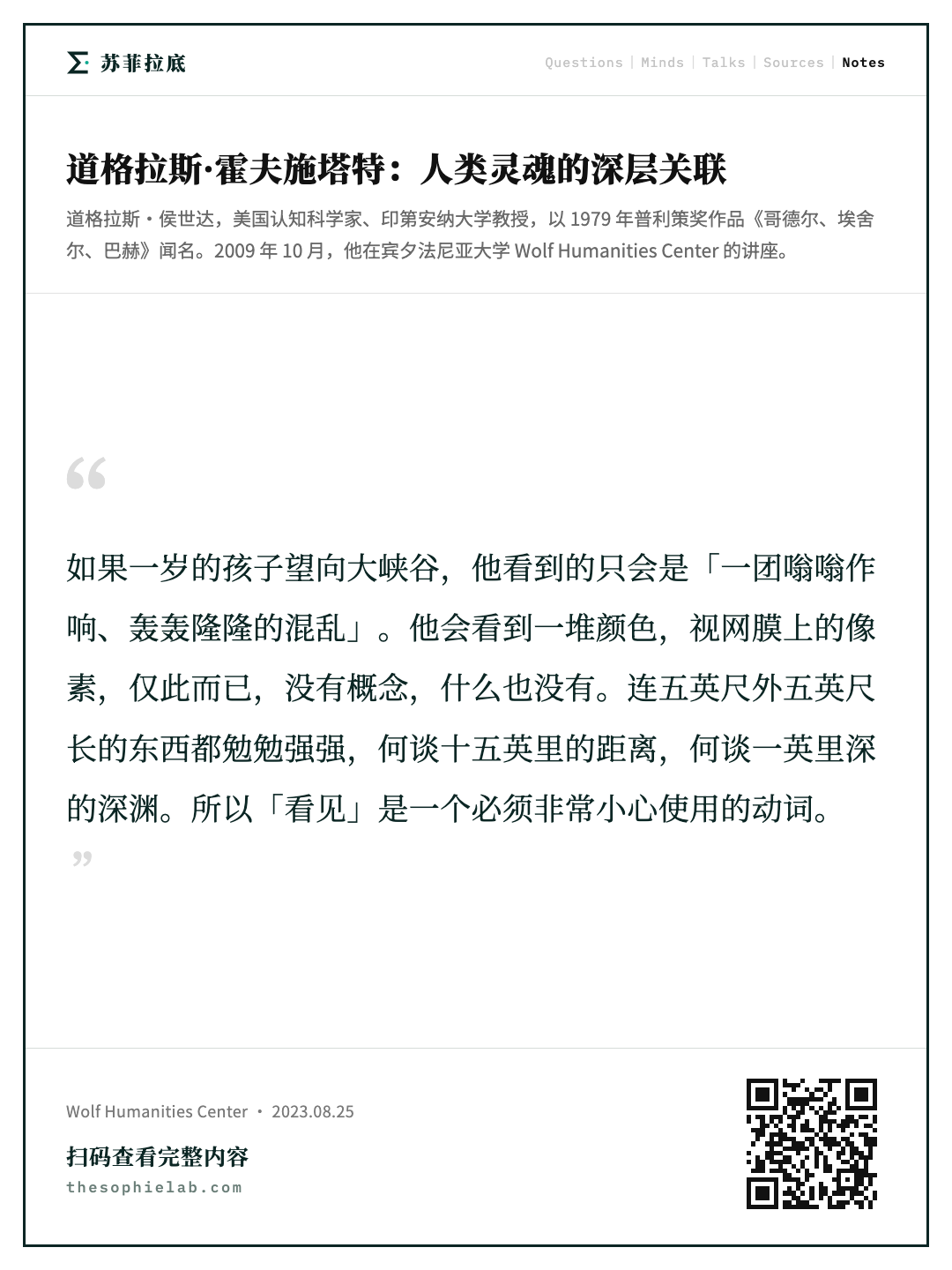
Canyon all he would have seen is in the phrase of very Frank demonstrated Charles sherrington as a buzzing booming confusion he would have seen a bunch of colors that's it retinol pixels that's it no Concepts nothing um it wasn't as if he was it would have been able to see the Grand Canyon and to say oh my God look at that 15 Mile expanse I mean they can't conceive of such things he can barely conceive as something five feet long five feet away no no 15 Mile distances no one mile chasms so seeing is a verb that we have to be very careful about and um I I just want again to to be cautionary about the way we use words and to suggest that we can extend words to things that have other substrates and at the same time restrict words to things that are applied to things that have our substrate because there are different levels of sophistication uh the things that have our substrate namely organic chemistry now getting back to the ant colony um an ant colony could be a little bit aware of itself in a way that we could
他看到的,用非常直率的查尔斯·谢灵顿的话来说,只会是一团嗡嗡作响、喧闹不已的混乱。他会看到一堆颜色,仅此而已。视网膜上的像素,就这样。没有概念,什么都没有。并不是说他能够看到大峡谷然后说,我的天哪,快看那绵延十五英里的景象。我是说,他们根本无法想象这样的事物。他连五英尺外五英尺长的东西都很难想象,更不用说十五英里的距离,或者一英里深的深渊了。所以「看见」这个动词,我们必须非常小心地对待。我还是想再提醒一句关于我们使用词语的方式,并且提出:我们可以把某些词扩展到具有其他基质的事物上,同时又把某些词限制在只适用于具有我们这种基质的事物上,因为存在不同层次的复杂程度,呃,那些具有我们这种基质、也就是有机化学的东西。现在回到蚁群,呃,一个蚁群可能会有一点点自我意识,就像我们可能意识到那个假想的弹珠一样,呃,在那个装信封的盒子里面
便签笔记
42:31
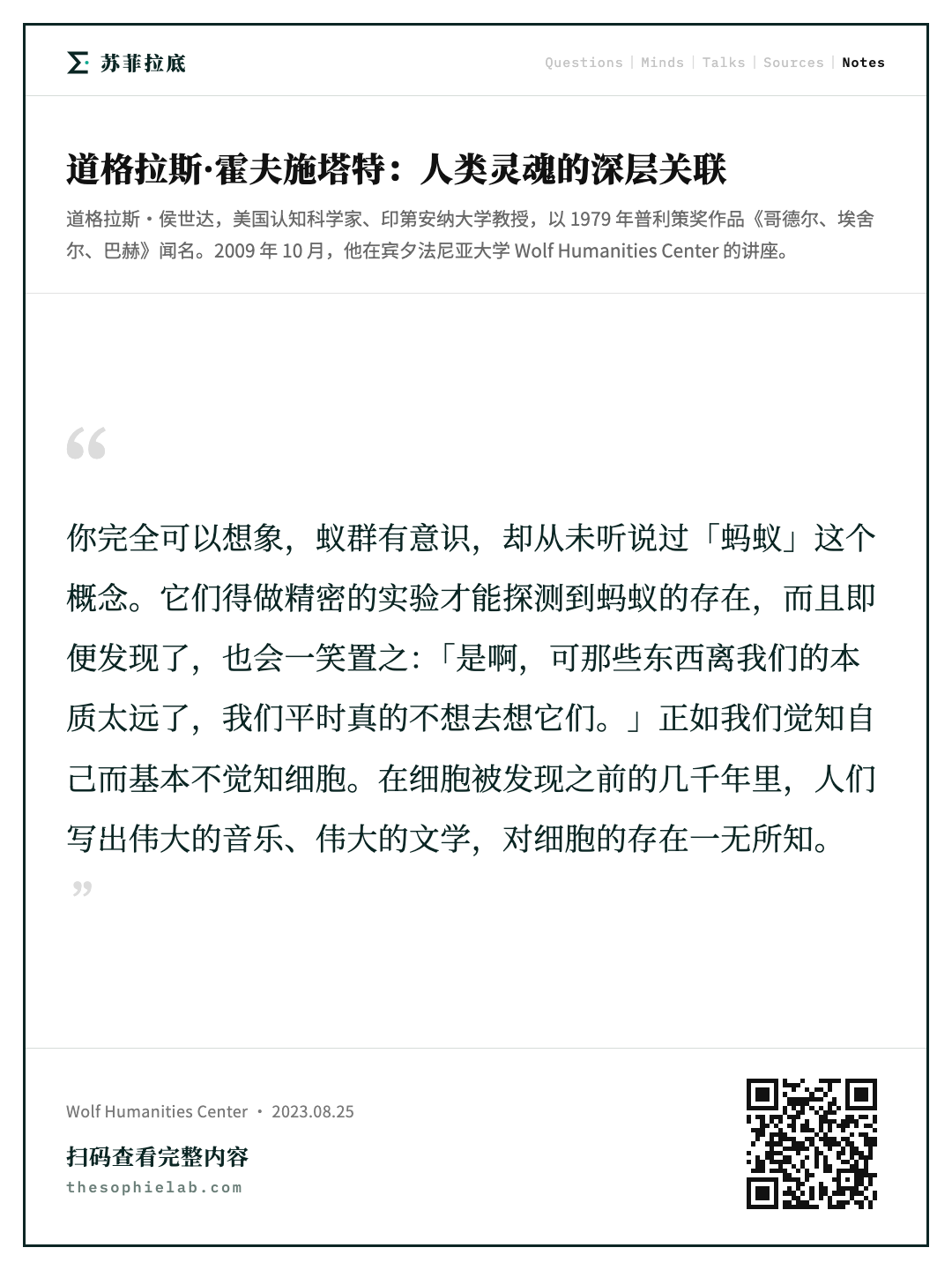
be aware of this hypothetical marble um inside the and inside the box of envelopes the ant colony might be aware of itself without being aware of ants just the way we are aware of ourselves essentially without being aware of cells I mean we can get along perfectly well without knowing anything about the existence of biological cells um and so we did for thousands of years before cells were discovered and uh people were able to function perfectly well to write great music write great literature and so forth not knowing one thing about the existence of cells well you could imagine that ant colonies could be conscious and could never have heard of the notion of an ant have no concept that ants existed whatsoever and that they would have to do sophisticated experiments to detect the existence of ants and even so they would kind of laugh about them and say well yes but they're so far away from what we really are I mean we don't we really don't want to think about them much of the time I mean yeah for
蚁群可能意识到它自己,却并不意识到蚂蚁的存在,就像我们意识到我们自己本质上却并不意识到细胞一样。我是说,我们完全可以过得好好的,对……一无所知生物细胞的存在,事实上在细胞被发现之前的几千年里我们就是这样过来的,呃,人们完全能够正常生活,写出伟大的音乐、伟大的文学作品等等,却对……一无所知细胞的存在。那么你可以想象,蚁群可能是有意识的,却从来没听说过“蚂蚁”这个概念完全不知道蚂蚁的存在,它们得做非常精密的实验才能探测到蚂蚁的存在,而即便如此,它们大概还会一笑置之,说:是啊,可它们离……太远了我们真正是什么。我是说,我们大部分时候真的不想去想它们。是啊,专家们可以投入精力,我们
便签笔记
09模式可在不同基质与粒度上实现
43:34
Specialists they can devote their we have Specialists who study ants but it's a joke uh you know I mean most of us can't spend our time thinking about ants you know we have things to do we have we have the we have to watch television and we have to you know take the kids to the soccer game and things like that well you can't think about ants so all right I want all of this has been trying to get you to see a perspective on on sentience which has to do with the existence of patterns inside structures that consist of an enormous number of parts I'm not going to try to describe the exact pattern that I call a strange Loop but um let me now suggest that there is a certain kind of pattern that when it comes to exist we tend to want to say that uh the entities that have that pattern in their in some abstract way inside them are sentient or conscious or have selves or Souls now if you'll grant that I may not have done a very good job at convincing you but maybe some of you will grant it um then we've come to an interesting point
确实有研究蚂蚁的专家,但那有点像个笑话,呃,你懂的,我是说我们大多数人没工夫整天想着蚂蚁你知道,我们有事要做,我们得看电视,我们还得,你知道,送孩子去踢足球之类的。所以你没法去想蚂蚁。好吧,我,这一切都是想让你们看到一种关于感受性(sentience)的视角,它跟模式的存在有关——这些模式存在于由极其大量部件构成的结构之中我不打算去描述我称之为“怪圈”(strange loop)的那个确切模式,但是,呃,让我现在提出:存在着一种某种特定的模式,当它出现时,我们往往就想说:呃,那些以某种抽象方式在体内拥有该模式的实体是有感受的、有意识的,或者拥有自我、拥有灵魂。那么如果你愿意接受这一点——我可能并没有很好地说服你们,但也许你们中有些人会接受——那么我们就到了一个有趣的点、一个有趣的阶段,因为在这个
便签笔记
44:47
of an interesting stage because at this stage then the question is what is the nature of a pattern a pattern is something that at least in when I use the word and I hope it applies to you as well is something that basically is uh an interrelationship of Parts but it doesn't matter what the parts are for example I I'm just thinking I I was recently in New York City I'm sure it's very similar here in Philadelphia but I haven't been in the subway in the New York City subway and probably in the Philadelphia Subway there are all these tiles and I I noticed you know it said like you come to a star a subway stop and it says 28th Street and then the tiles are in mosaics you know they were maybe made in the early 20th century and they're blue and white tiles arranged in certain patterns and it says it over and over and over again 28th Street all right um essentially I think everybody would say if we went from one of these 28th Street mosaics to the next one to the next one we would say that's the same
阶段,问题就变成了:模式的本质是什么?模式是这样一种东西,至少我用这个词的时候是这样,我也希望对你们同样适用:它基本上是,呃,各部分之间的一种相互关系,但这些部分是什么并不重要。比如说,我刚想到,我最近在纽约市,我相信费城这边也很类似,不过我还没坐过这里的地铁。在纽约市的地铁里,可能费城地铁也一样,到处都是那种瓷砖,我,我注意到,你知道,上面写着比如你到了一个地铁站,上面写着“28th Street”,那些瓷砖拼成马赛克,你知道,它们可能是二十世纪初做的,是蓝白相间的瓷砖按某种图案排列,上面一遍又一遍地反复写着“28th Street”。好,呃,我想基本上每个人都会说,如果我们从其中一块“28thStreet”马赛克走到下一块、再下一块,我们会说那是同一个模式、是同一个东西。我们会说,是的,具体的瓷砖是
便签笔记
45:58
pattern that's the same thing we would say yes the exact tiles are different but that makes no difference makes no difference at all the key thing is they all say 28th Street in the same way in the same style the same typeface they have the same content and the same style same size the same grain size and so forth they are interchangeable if you under if you take that as being what a pattern is then of course we can talk about writing 28th Street a different grain sizes supposing that um one day they ran out of tiles of a certain size and they had to write 28th Street in tiles that were twice as big well then it would be of course they're grained of course you can imagine that they could write 28th Street in a coarser grain fig and it would still work it would still be readable it would still communicate the idea it might be a little coarser a little cruder and it might not be as pleasing or or something like that but nonetheless it will be recognizable as being essentially the same thing
不一样的,但那没关系,完全没关系。关键在于它们都以同样的方式写着“28th Street”同样的风格、同样的字体,它们有同样的内容、同样的风格、同样的大小、同样的颗粒度等等所以它们是可互换的。如果你把这当作模式的定义,那我们当然就可以谈论用不同的颗粒度来写“28th Street”。假设呃有一天他们某个尺寸的瓷砖用完了,只好用大一倍的瓷砖来写“28thStreet”,那当然,它的颗粒就变粗了。你当然可以想象他们可以用更粗的颗粒来写“28th Street”,而它照样管用,照样能读出来,照样能传达那个意思。可能会粗糙一点、糙一点,可能没那么悦目或者别的什么的,但不管怎样它仍然能被认出来本质上是同一个东西。当然,如果你越来越粗
便签笔记
47:05
now of course if you've got coarser and coarser and coarser after a while and couldn't read 28th Street anymore you can also go in the other direction you could get finer and finer grain and uh instead of it being visibly a mosaic it could become invisibly a mosaic you could go down to the level of sand and then you could go down to much finer until every every curve was a perfect curve without any any trace of uh the substrate at all you could see these curves that were extremely fine mathematical precision um all I'm saying here is that you can imagine taking a pattern and copying it at different levels of grain size and with different um in using different materials I could have used red stones against white or red against Green or I could not have used Tiles at all I could do it with some other substance I could I could take peas and beets or whatever I want I could use any substance I want to make this thing I could write 28th Street in all sorts of ways and it would still be 28th Street
越来越粗、越来越粗,到某个程度就再也读不出“28th Street”了。你也可以往另一个方向走,你可以让颗粒越来越细,呃,它就从一个看得出来的马赛克变成一个看不出来的马赛克,你可以细到沙粒的级别,然后还可以更细,直到每一条曲线都是完美的曲线,完全看不出,呃,基质的任何痕迹,你能看到的就是极其精细、具有数学精度的曲线呃,我在这里想说的只是:你可以想象把一个模式在不同的颗粒度上复制出来,并且用不同的,呃,用不同的材料。我本可以用白底红石头,或者绿底红色,或者我可以根本不用瓷砖我可以用别的什么材料来做,我可以,我可以用豌豆和甜菜或者随便什么东西,我可以用任何我想用的材料来做这件事。我可以用各种各样的方式写出“28th Street”,它仍然是“28th Street”
便签笔记
48:16
and I could still realize the uh the font that it was in in whatever if I wanted to using those things I could also make it out of Soup cans and and seen from a helicopter it would look the same it in other words I think it's very self-evident that I can realize patterns in different substrates and and at different grain sizes now if you accept with me that the essence of being a conscious being is a pattern is the existence of a certain pattern somewhere well then it follows instantly from what we've just said about patterns that the same pattern can be realized elsewhere it can be realized in a different substrate when I say a different substrate I might mean organic chemistry I might even mean another brain in other words another substrate could be the same stuff but the same kind of stuff but just elsewhere or it could be also in a different kind of a substrate it might be realizable if it's really a pattern and it really all that matters is the interaction of certain abstractions with other abstractions
而且如果我愿意,我仍然可以用那些东西还原出它原来的那种字体。我也可以用汤罐头来拼从直升机上看,它看起来是一样的。换句话说,我觉得这非常显而易见:我可以在不同的基质上以及不同的颗粒度上实现同样的模式。那么,如果你和我一样接受:作为一个有意识的存在,其本质是一个模式,是某种特定模式在某处的存在,那么从我们刚才说的关于模式的话里立刻就能推出:同一个模式可以在别处被实现,可以在另一种基质上被实现。我说“另一种基质”,可能指的是有机化学,我甚至可能指的是另一个大脑。换句话说,另一种基质可以是同样的材料同一类材料,只不过在别处;也可以是另一种类型的基质。如果它真的是一个模式,如果真正重要的只是某些抽象物与另一些抽象物之间的相互作用,那么它就可能是可实现的
便签笔记
10我们如何活在彼此之中
49:36
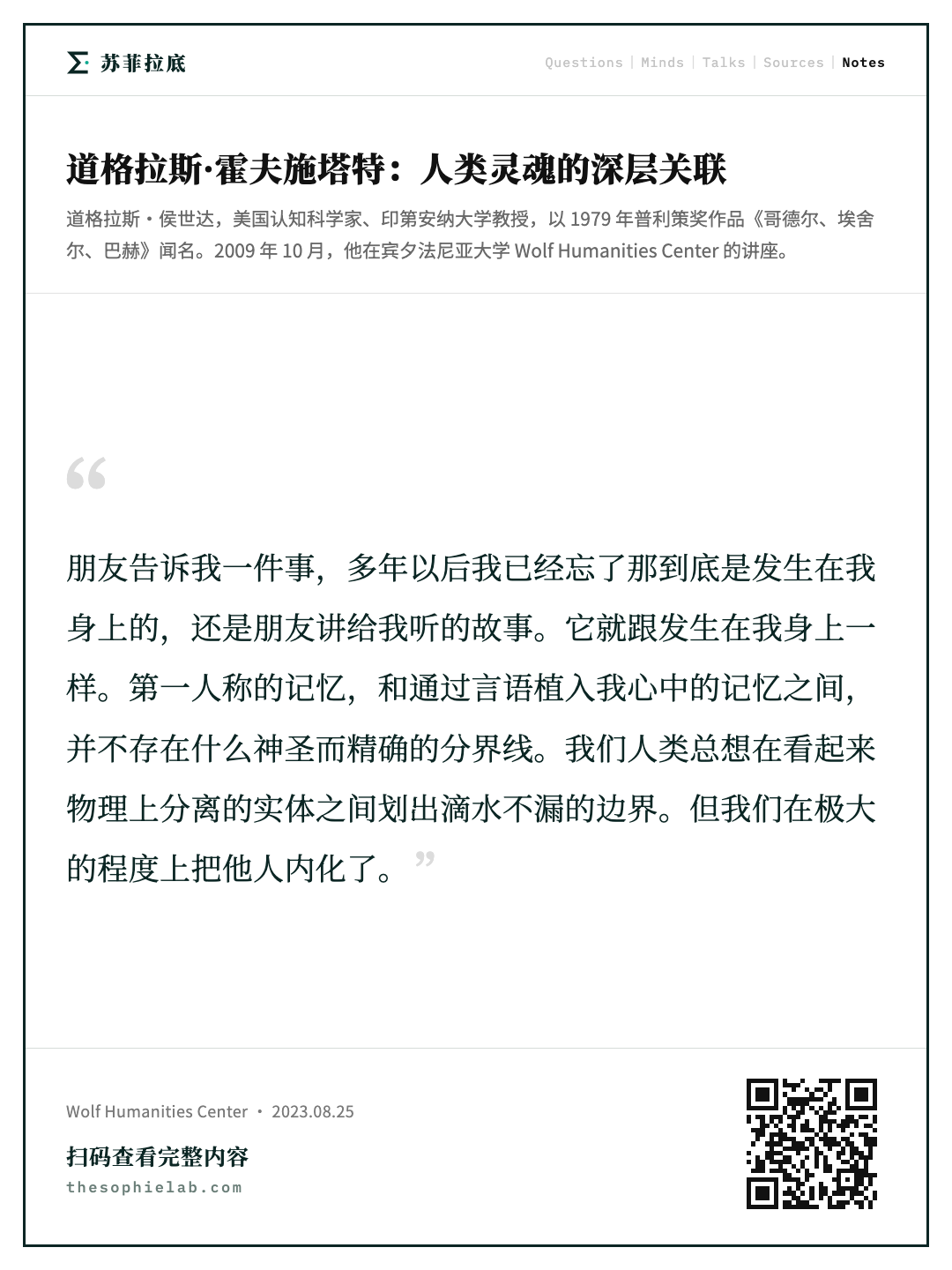
well then it could be realizable whatever makes me myself theoretically could be realized in other substrates other things made out of other kinds of atoms other kinds of molecules and so forth it wouldn't have to depend upon organic chemistry as long as the interaction between the parts was the same and so if you're following me and moving along with me then the question is to what extent does that pattern ever get reproduced in other places to what extent is my Consciousness reproduced elsewhere and uh so uh then we come to the idea of people living together and communicating at very very hot to use an old term High baud rates that is very very intense interactions um all of us tell stories memories things that have happened to us it's probably happened to you it certainly happened to me more than once that a friend will tell me something and I will forget years later whether it actually happened to me or or whether it was a story that a friend told me it might as well have happened to me uh
使我成为我自己的那个东西,理论上可以在别的基质上实现,在由别种原子、别种分子等等构成的东西上实现。它不必依赖于有机化学,只要各部分之间的相互作用是一样的。所以如果你跟着我的思路走下去,那么问题就是:那个模式在多大程度上会被在别处复制出来?我的意识在多大程度上会在别处被复制?呃,于是,呃,我们就来到了人们共同生活、以非常非常高的——借用一个老词——波特率(baud rate)进行交流,也就是非常非常密集的互动呃,我们所有人都会讲故事、讲回忆、讲发生在自己身上的事。这大概也发生在你身上过,在我身上肯定不止一次发生过就是朋友告诉我某件事,多年之后我会忘记那到底是真发生在我身上,还是那只是朋友讲给我的一个故事。它就跟发生在我身上一样,呃,这里并没有什么神圣而精确的界线,把
便签笔记
51:01
it's it's not there's not something sacred and precise that divides first-person memories from memories that have been attributed or implanted in Me by the medium of words um and if one lives with somebody for a very very long time and experiences co-experiences all sorts of things like the Grand Canyon and who knows what you know particular pieces of music movies uh friendships uh dinner parties uh operas who knows what um and is on the same wavelength as somebody and has the same values as somebody for example I'm thinking of myself and my wife one of course one of some of our principal key values were the well-being and happiness of our children and that was something where we were so aligned I mean parallel in such a deep fashion that everything that she felt I felt everything that I felt she felt um and in in that sense the uh pattern that constituted her desires her hopes for let's say for our son Danny her dreams her dreads all of those things were existed in a carbon copy inside my head
第一人称的记忆和那些通过语言这个媒介被归给我、被植入我心里的记忆分开。呃,而如果一个人和另一个人共同生活非常非常长的时间,共同经历各种各样的事情,比如大峡谷,还有谁知道什么,你知道,某些特定的音乐、电影,呃,友谊,呃,晚餐聚会,呃,歌剧,谁知道呢,呃,并且和对方在同一个频道上价值观也和对方一样。比如说,我想到我自己和我妻子,当然,其中我们最主要的核心价值之一就是孩子们的幸福安康,而在这件事上我们是如此一致,我是说在如此深的层面上平行,以至于她感受到的一切我也感受到,我感受到的一切她也感受到呃,在那个意义上,呃,构成她的欲望、她的希望——比方说对我们儿子丹尼的希望——她的梦想她的恐惧的那个模式,所有这些东西都以复写副本的形式存在于我的脑袋里。我说“复写副本”当然有点不准确,显然我是在
便签笔记
52:24
when I say carbon copy I'm being a little poor obviously I'm being metaphorical but what I meant also by being metaphorical is that I would have to back away from saying it's an exact copy because people aren't able to have exact copies of other people inside their heads they have approximate copies and by approximate I I think the metaphor of course graining that I earlier used coarse grain Mosaic compared with the original which is very fine-grained that you can still see that it's the same pattern it's just not implemented in as detailed away it's got it's just not quite as as detailed well if those things exist inside me that represent her and those things exist inside her that represent me then we can say that I to some extent live inside her and she to some extent lives inside me it's not just that I have a representation of her and I have I can sort of imagine how she might feel it's there's we humans want to draw it's very convenient for us to want to draw tight watertight boundaries between
打比方。但我说“打比方”还有一层意思是,我必须收回“精确副本”这种说法,因为人们没办法在自己脑袋里拥有别人的精确副本,他们拥有的是近似的副本。说到“近似”,我觉得我前面用过的颗粒度的比喻正合适粗颗粒的马赛克与非常精细的原件相比,你仍然能看出它是同一个模式,只是实现得没那么细致,只是没那么精细而已。那么如果我心里存在着那些代表她的东西,她心里也存在着那些代表我的东西,那我们就可以说,我在某种程度上活在她里面,她也在某种程度上活在我里面。这不只是说我有一个关于她的表征,我能大概想象她会有什么感受。我们人类总想画出——这对我们来说很方便——在那些看起来在物理上彼此分离的实体之间划出严密的、密不透风的界线。这很方便,也很
便签笔记
11父亲的照片与肖邦的灵魂碎片
53:46
um entities that seem physically separate it's very convenient it's very useful um and and it works very efficiently at times but as you know we are getting ever more well to use the theme of this lecture series connected uh among ourselves the uh the way in which we we obviously I can talk with my friend David Moser in China any day of the week I want I can have a three-hour conversation with him in Beijing anytime I want I can call up anybody pretty much around the world at any time I want I can maintain contact with all sorts of people in a very high level we in internalize other people to an enormous extent um and uh I open the book uh I am a strange Loop in fact in an interesting fashion and I think this is something that to me means a great deal I opened the book where my mother was complaining my father had died a few months before and she was looking at a photograph of my father her husband and oh incidentally they met each other at 2211 Spruce Street and on my way here I walked by I had to go by 2211
有用,呃,而且有时候运作得很有效率。但你们知道,我们正变得越来越——用这个系列讲座的主题来说——彼此互联。呃,我们的方式,显然,我可以和我在中国的朋友莫大伟(David Moser)聊天任何一天我想聊都行,我随时可以和身在北京的他聊上三个小时,我可以打给世界上几乎任何地方的任何人,任何时候都行,我可以在很高的水平上和各种各样的人保持联系我们在极大程度上内化了他人。呃,事实上我在《我是个怪圈》这本书的开头,用了一种很有意思的方式,我觉得这对我意义重大。我在书的开头写到我母亲在抱怨——我父亲几个月前去世了,她正看着我父亲、也就是她丈夫的一张照片。哦,顺便说一句,他们俩是在云杉街2211号认识的而我来这儿的路上还特意走过去,我得去看看云杉街2211号,我没能进去。他们是因为音乐而认识的,她
便签笔记
55:10
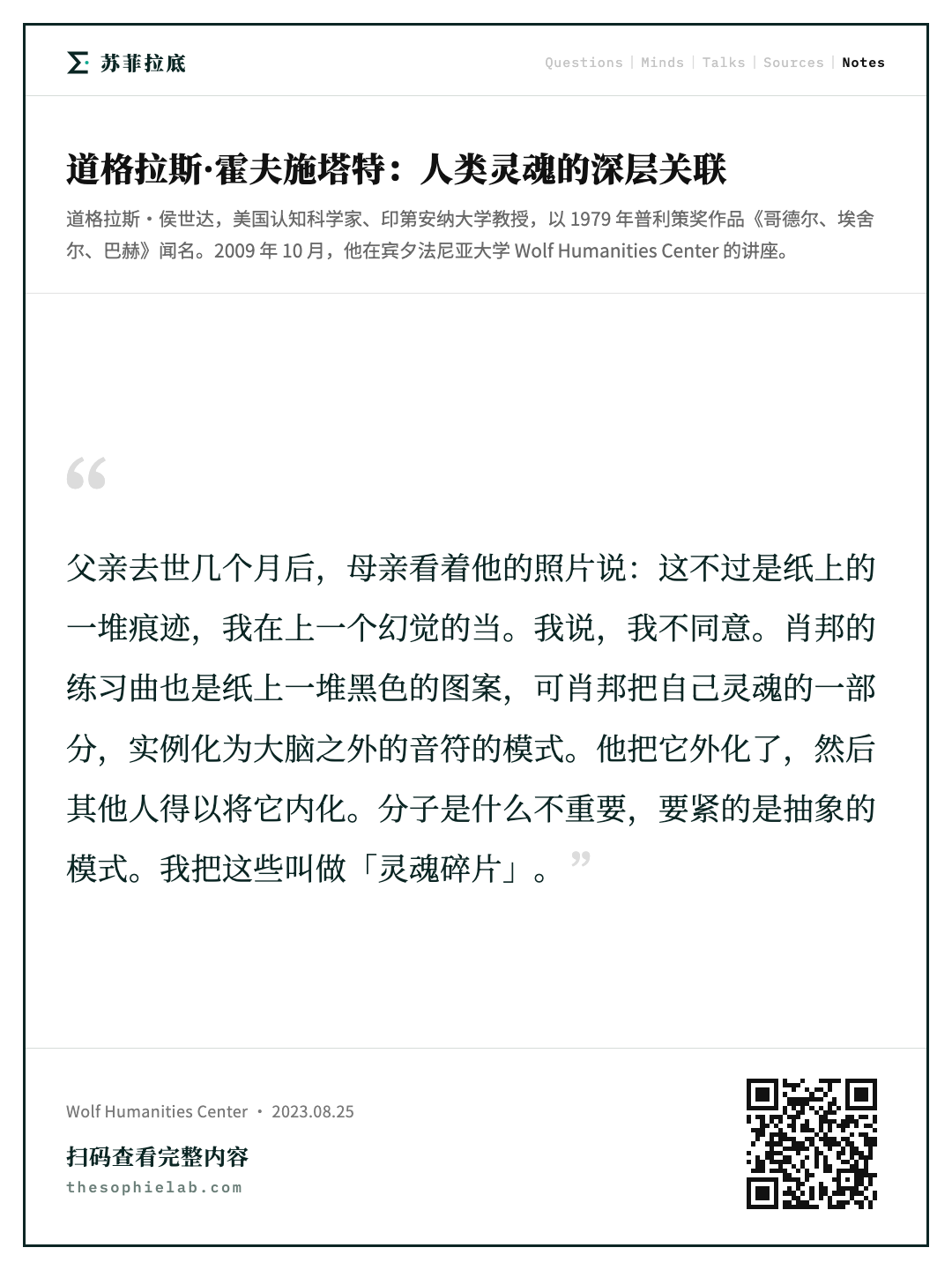
Spruce Street I wasn't able to go in but they met because of music and she met by sitting outside his apartment listening to him play records of jazz in the early 1940s and she was sitting on the staircase when he opened the door and saw her sitting there and that's why I exist so uh so so uh let's see where what was I saying about my parents uh remind me where was I oh yes the beginning of the book okay so my dad has died in 1990 and my mother is looking at the photograph and is very sad that she says this stupid photograph is just a bunch of you know marks on paper it's nothing and yet it moves me how stupid I'm falling for an illusion and I said well I don't agree I don't agree with you and it took me a little while to formulate my thoughts in opposition to this thought that it was a stupid reflex that it was a trick a hoax and I said look in our living room we have a book of the Chopin etudes uh it's a bunch of marks on paper a bunch of black patterns on paper um and yet those patterns
当时坐在他公寓外面,听他放1940年代初的爵士唱片,她坐在楼梯上,他开门时看见她坐在那儿——所以才有了我。呃,那么,呃,我刚才说到哪儿了关于我父母,呃,提醒我一下,我说到哪儿了?哦对,书的开头。好,我父亲1990年去世了,我母亲正看着那张照片,非常伤心,她说:这张蠢照片不过就是纸上的一堆,你知道,痕迹罢了它什么都不是,可它却让我这么动情,我真傻,我居然被一个幻觉打动了。我说,我不同意,我不同意你的看法。我花了一点时间才把我的想法组织起来,来反驳“这只是个愚蠢的条件反射、只是个把戏、一个骗局”的说法我说:你看,我们客厅里有一本肖邦练习曲集,呃,那也不过是纸上的一堆痕迹,纸上一堆黑色的图案罢了,呃,然而那些图案,呃,却对全世界成百上千万人产生了巨大的影响,包括我自己
便签笔记
56:25
uh have had an enormous impact on millions and millions and millions of people around the world including myself particularly I mean when I was a kid I fell in love with the Chopin etudes and uh and that's why we had them at home I had gone out and bought them and had tried to play some of them and um and I said Chopin took part of his soul and instantiated it in patterns of notes that were external to his brain they represented the kind of the core of his Emotional Self and he was able to externalize it and then other people were able to internalize it maybe through maybe some people could play most of us are not good enough to play but it doesn't matter if we can play it or not as long as somebody can play it and we can hear it because then it's a mapping it's a it's a message that comes from Chopin's Soul directly into our soul into our brain and the patterns that gave rise to the emotions in his brain are reconstituted the abstract patterns not the substrate not the chemicals not the precise cells that
尤其是我,我是说我小时候就爱上了肖邦练习曲,呃,所以我们家才有这本谱子,我当年出去把它买回来,还试着弹过其中几首。呃,我说,肖邦把他灵魂的一部分具现在音符的模式里而这些模式存在于他大脑之外。它们代表了他情感自我的某种内核,他能够把它外化出来,然后别人就能够把它内化。也许是通过,也许有些人能弹,我们大多数人弹得不够好,但我们能不能弹其实无所谓,只要有人能弹、而我们能听到就行,因为那时它就是一种映射,是一条讯息,直接从肖邦的灵魂进入我们的灵魂、进入我们的大脑,而那些在他脑中引发情感的模式被重新构成了——是那些抽象的模式,不是基质,不是化学物质,不是那些当时正在放电的具体细胞,不是那些确切的血红蛋白
便签笔记
57:40
we're firing not the exact hemoglobin molecules or whatever that were playing around in his brain that's irrelevant it doesn't matter what the molecules were what matters is the abstract patterns and by God they get repressed created inside my brain and inside the brain of millions of other people and I call those things that Chopin left behind Soul shards and uh and I feel and I said to my mother you know nothing in the world is more important to me than those etudes of Chopin uh and I don't see why there should be any denigration of them I don't see why you should I mean I don't say they're just a bunch of stupid black marks on paper because they represent they are patterns that represent they come uniquely from one person and they represent things inside that person uh that are unique and extraordinarily powerful and evocative and I can hear Poland I can hear longing I can hear um Nostalgia and poignancy and I won't try to list the words because it's very hard to try to verbalize what music does
分子或者别的什么在他脑子里跑来跑去的东西,那都无关紧要,分子是什么并不重要重要的是那些抽象的模式,而天哪,它们真的在我的大脑里、在千百万其他人的大脑里被重新创造出来了我把肖邦留下的这些东西称为“灵魂碎片”(soul shards)。呃,我觉得,我对我母亲说,你知道,世界上对我来说没有什么比肖邦的那些练习曲更重要了,呃,我看不出有什么理由要贬低它们我看不出你为什么要,我是说,我不会说它们只是纸上一堆愚蠢的黑色痕迹,因为它们代表着——它们是模式代表着,它们独一无二地来自某一个人,代表着那个人内心的东西,呃,那些独特而极其强烈、极具感染力的东西。我能听见波兰,我能听见渴望,我能听见,呃,怀旧与酸楚。我不会去一一列举这些词,因为要用语言说清音乐对一个人做了什么非常困难,但所有这些东西我都能
便签笔记
12日冕、果园蝴蝶与晶体电子
58:55
to one but all of those things I can hear when I hear those etudes and I think that those patterns of black and white are patterns that have an incredible chopiness to them and uh and similarly the photograph of my dad well it had an incredible evocative power because it represented it was a trigger it was a catalyst it was able to evoke in my mother many of the emotions that my dad's physical presence had um and it was it was a very real and strong experience yeah so there is a let's see how to say this one way I like to I'll give you a couple of metaphors to finish up um I was looking for metaphors to try to explain what I meant by saying we live in each other and I I had a hard time finding some one I finally found in the world sort of existing already and the other one I made up so I'm going to give you the one I found first and then the one that I made up and then I'll finish up with a little flourish a little twist on the one that I made up to suggest some further ideas so the one that I
在听那些练习曲时听到。我认为那些黑白的图案是带着一种难以置信的“肖邦味儿”的模式。呃,而且同样地,我父亲的那张照片,它有着惊人的唤起力量,因为它代表着,它是一个触发器它是一个催化剂,它能在我母亲心中唤起许多我父亲亲身在场时所带来的情感。呃,那是非常真实而强烈的体验。是的。所以,让我想想怎么说,我喜欢的一种方式是——最后我给你们两个比喻呃,我一直在找比喻,想解释我说“我们活在彼此之中”是什么意思,我费了好大劲才找到一个我最终在现实世界中找到的、本来就存在的比喻,另一个是我自己编的。所以我先给你们讲我找到的那个,然后讲我编的那个,最后我会在我编的那个上面加个小小的花样、一个小转折来引出一些进一步的想法。那么我在现实世界里找到的那个——我花了很久才找到——就是
便签笔记
60:11
found in the world and it took me a long time to find this was the concept of countries living in each other and once you find it it's of course it's self-evident but I mean you know every country take France has citizens living abroad it's as simple as that France has citizens in the United States it has citizens in in China it has citizens in Japan it has citizens everywhere to make it very graphic um let's just uh just imagine a horrible hypothetical scenario where France has wiped off the map well okay France is destroyed but not frenchness frenchness exists because they're French people living in China Japan uh United States England and all over the world um there is what I would call a Corona of frenchness even when the original is destroyed there is something that remains abroad and the same can be of course said for any country every country has people living all over the place outside of it and that fact means that the country is distributed it is not localized totally to one geographical area needless to say every
国家彼此活在对方之中这个概念。一旦你想到它,当然就觉得不言而喻,但我是说,你知道,每个国家,比如法国,都有公民住在国外,就这么简单。法国在美国有公民,在中国有公民,在日本有公民,到处都有公民。为了讲得更形象,呃,我们不妨,呃,设想一个可怕的假想情景:法国从地图上被抹去了。好吧,法国被摧毁了,但“法国性”没有,“法国性”依然存在,因为还有法国人生活在中国、日本,呃,美国、英国以及世界各地。呃,这就形成了我称之为“日冕”(corona)的东西的法国性——即便原作被毁,仍有一些东西留存在国外,同样的道理当然也适用于任何国家。每个国家都有国民散居在世界各地,这一事实意味着这个国家是分布式的,它并不完全局限于某一个地理区域。不用说,每个国家主要还是与某一个
便签笔记
61:28
country is primarily associated with one geographical area but it exists in all sorts of other geographical areas and it survives in those other geographical areas I mean to even go further a work like Eugene on jaegan uh the which the Russians consider to be the the soul of their litter literature is uh you could destroy every single copy in in Russian every single copy and even bar it from all the minds of all Russians I mean expunged it some magically go into their brains and destroy it from their brains it still would exist because it exists in translations it exists in some marvelous translations into various languages it would survive it would survive abroad it would survive in different languages it's a pattern it's a pattern and it survives okay that's one image another image that I uh think is kind of more poetic although it's hypothetical would be imagine an orchard in which there are lots of trees in nice rows and columns um a pretty Orchard and around each tree we're going to imagine that there are
地理区域相关联,但它同时存在于各种各样其他的地理区域中,并在那些其他的地理区域中存续下来。我甚至想再进一步说,像《叶甫盖尼·奥涅金》这样的作品,俄国人视之为他们文学的灵魂,你就算把俄文版的每一册都销毁,一册不剩,甚至把它从所有俄国人的头脑里抹去——我是说彻底清除,用某种魔法钻进他们的大脑,把它从脑子里删掉——它依然会存在,因为它存在于译本之中。它存在于译成各种语言的一些精彩译本里。它会存续下去,它会在国外存续,会以不同的语言存续。它是一个模式,它是一个模式,而它存续了下来。好,这是第一个意象。另一个意象我觉得更有诗意一些,虽然它是假想的:想象一片果园,里面有很多树,整整齐齐排成行、排成列,嗯,一片漂亮的果园。我们再想象每棵树周围都有一些蝴蝶在飞,而这些
便签笔记
62:44
some butterflies that are flying and the butterflies are principally attached to one particular tree we could even imagine that that we could color code everything we could color code every tree have it have a unique color and have the butterflies that fly around it you know be of that same color so that it's very clear very very obvious what's going on here there are purple butterflies flying around the purple tree and blue butterflies flying around the blue tree and so forth but butterflies being what they are they tend to wander now they may be always pulled back by the odor of the purple tree to the purple tree you know the purple ones to the purple tree but they could you know go out and explore and they could fly around a little bit around the red tree in the yellow tree and the chartreuse tree and so forth and uh and in that sense the uh the Halo around the purple tree is is distributed to some degree around the orchard it isn't only around the purple tree it partly exists they're they're yellow
蝴蝶主要依附于某一棵特定的树。我们甚至可以想象给一切都做上颜色标记——给每棵树都标上一种独一无二的颜色,让绕着它飞的那些蝴蝶也是同样的颜色,这样就非常清楚、非常非常一目了然了:紫色的蝴蝶围着紫色的树飞,蓝色的蝴蝶围着蓝色的树飞,如此等等。但蝴蝶就是蝴蝶,它们总是会到处乱飞。它们也许总会被紫树的气味拉回紫树那儿——紫色的蝴蝶回到紫色的树,你懂的——但它们也可能飞出去探索一番,可能在红树、黄树、黄绿色的树周围飞上一会儿,诸如此类。从这个意义上说,紫树周围的那圈光晕,在某种程度上是散布在整个果园里的。它不只在紫树周围,它有一部分存在于别处——到处零零散散都有黄蝴蝶,
便签笔记
63:48
butterflies here and there all over the place they're purple butterflies all over the place the principal place that they're found is around the purple tree but they're elsewhere so the idea is that we are like that I am partly in not very much in you because you don't know me very much although you may have read my books and you may have some sense of me but I'm certainly in the people that I know very well people that I have had hundreds thousands and thousands of hours of conversation with those people know me very well they've internalized big hunks of me and I've internalized big big hunks of them I'm reminded of and I am coming to a conclusion um my friend I mentioned David Moser a little while ago his father was dying some years ago and he had Alzheimer's and I want you to imagine that this is a man who of course like everyone was full of life at one time full of imagery full of hopes dreams clarity about the world and so forth and so on but as the Alzheimer's you know settled and became heavier and heavier and
到处也都有紫蝴蝶。它们出现得最多的地方是紫树周围,但别的地方也有它们。所以这个想法是说,我们就像这样。我有一部分在你身上——不多,因为你并不怎么了解我,尽管你可能读过我的书,对我有些感觉——但我肯定存在于那些我非常了解的人身上,那些我跟他们聊过成百上千、成千上万个小时的人,那些人非常了解我。他们内化了我很大一部分,我也内化了他们很大很大一部分。这让我想起——我也快要说到结论了——嗯,我刚才提到的我的朋友大卫·莫泽(David Moser),他父亲几年前正在走向死亡,患的是阿尔茨海默症。我希望你们想象一下,这是一个人,当然,像所有人一样,他曾经充满生气,充满意象,充满希望、梦想,对世界有清晰的认识,等等等等。但随着阿尔茨海默症的到来,病情越来越重、越来越重、
便签笔记
64:59
heavier and he was going away more and more and more and becoming more and more like an empty shell that looked like him but that wasn't really him anymore where was his soul located and so to some degree was surviving in David and David's brother and his wife and in the people who had known him the best and at some point when the Alzheimer's got so bad basically he existed more in the corona of which you will allow me to call the solar Corona around him because it was as if he had been eclipsed it was as if the moon had blocked out the Sun and he was no longer there but the solar Corona existed and that's where I'm not saying of course he existed as much as he had existed before because the primary most fine-grained instantiation of the pattern that was Jim Moser was in Jim moser's brain no doubt about it it had been largely destroyed but it hadn't been totally destroyed because copies coarse grained copies existed at different levels of grain and at different levels of Fidelity in other
越来越重,他一点点、一点点地离去,越来越像一具空壳——看上去还是他,但已经不真的是他了。那他的灵魂在哪儿呢?在某种程度上,它存续在大卫身上、大卫的兄弟身上、他的妻子身上,存续在那些最了解他的人身上。到了某个时候,当阿尔茨海默症严重到一定程度,基本上他更多地存在于那圈日冕之中——请允许我把他周围的这圈东西叫做日冕,因为那就好像他被日食遮住了一样,好像月亮挡住了太阳,他已经不在那里了,但日冕还在。而那就是他所在的地方。当然,我并不是说他还像从前那样完整地存在,因为那个叫吉姆·莫泽(Jim Moser)的模式,其最主要、颗粒度最细的实例是在吉姆·莫泽自己的大脑里,这毫无疑问。那个大脑已经大部分被摧毁了,但并没有被完全摧毁,因为副本——粗粒度的副本——以不同的粒度层次、不同的保真度存在于其他人的
便签笔记
66:18
brains in other substrates and so there were there was a kind of a survival out there um the last image that I will give is is one that relates to the butterflies around the trees It's actually an image that comes from solid-state physics where a crystal is very much like an orchard where the nuclei are like the trees and the uh so you have a nice lattice of nuclei aligned in rows and columns in in three dimensions but it's a very pretty lattice and around the nuclei are the electrons that are moving in complicated patterns now there are some kinds of uh uh crystals in which the electrons are very tightly bound to their nucleus so that you can say all these electrons are just kind of going around this particular nucleus and no other nucleus so that would be as if the butterflies in my example all the purple butterflies every last one of them were hanging around the purple tree and only the purple tree and never went never even went to the neighboring tree let alone further away but there are other kinds of crystals
大脑里,存在于其他的载体里。所以那里存在着某种意义上的存续。嗯,我要讲的最后一个意象,和树周围的蝴蝶有关。它其实是一个来自固体物理学的意象:晶体非常像一片果园,其中原子核就像那些树。所以你有一个漂亮的原子核点阵,在三维空间里排成行、排成列,是一个非常漂亮的晶格。而在原子核周围是电子,它们以复杂的方式运动着。有些种类的晶体,其中的电子被非常紧地束缚在自己的原子核上,以至于你可以说,这些电子就只绕着这一个特定的原子核转,不去别的原子核。那就相当于在我的例子里,所有的紫蝴蝶,一只不落,全都待在紫树周围,而且只待在紫树周围,从不飞走,连旁边那棵树都不去,更别说更远的地方了。但还有另一些种类的晶体,特别是金属,它们是导体。这意味着电子
便签笔记
67:28
Metals in particular um that are conductors and what that means is that the electrons um are not bound to any particular nucleus they can just kind of drift and this would be the the sort of the exact opposite this would be where there was no home tree to any butterfly the butterflies just sort of drifted throughout the entire Orchard and could associate themselves with any Tree in that case uh we would sort of have if you if you think of of the tree as being kind of one person and the butterflies as being the the Halo of butterflies in the earlier image where purple butterflies tend to hang around the purple tree but not exclusively that's sort of like saying well I'm mostly in my brain but I'm sort of partly in other people's brains the extreme case of this would be the metal case where we we have brains but all of our experiences and thoughts and Consciousness is sort of spread in one Collective and there there is really no individuality to any brain everybody understands sort of everybody is housing
并不被束缚在任何一个特定的原子核上,它们可以自由地漂移。这就是那种恰恰相反的情况:任何一只蝴蝶都没有自己的家树,蝴蝶就在整片果园里四处漂移,可以跟任何一棵树相关联。在那种情况下,我们就会有——如果你把树想成是一个人,把蝴蝶想成是那圈光晕的话——在前面那个意象里,紫蝴蝶倾向于待在紫树周围,但不是排他性的,那有点像是在说:我主要在我自己的大脑里,但也有一部分在别人的大脑里。而这件事的极端情形就是金属那种情况:我们各自有大脑,但我们所有的经验、思想和意识都摊在一个集体里,任何一个大脑都不再有真正的个体性。每个人都理解每个人,可以说每个人都在同等程度上承载着每个人。你的灵魂在我的大脑里,但"我"这个词
便签笔记
68:32
everybody to an equal extent your soul is in my brain but there's not any meaning anymore left to me because there is no sense in which I am the primary Hauser of my soul there's just a brain here and another brain there and my soul is spread out everywhere and your soul is spread out everywhere and we're all sort of you know the the brains are just sort of uh objects that are are substrates for housing this Collective thing that's that's something that we don't yet have and it may not be something that we want I'm not saying that's good I'm only saying that as interconnection of people becomes greater over time with the you know things like cell phones and whatnot um all the things that we have that allow us to internalize other people more and more and more and more internalize the patterns the central patterns that make the essence of someone else and we interpret we import other people's Essence um that allowed that's bringing that image a little bit closer to being the case I don't think that we really want
已经没有任何意义了,因为不存在"我是我灵魂的主要承载者"这回事。就只是这里有一个大脑,那里有另一个大脑,我的灵魂散布在各处,你的灵魂也散布在各处,我们都有点像是……那些大脑只不过是一些物体,是承载这个集体之物的载体。这是我们目前还没有的东西,也可能并不是我们想要的东西。我不是说那样好,我只是说,随着时间推移,人与人之间的互联越来越紧密,有了手机之类的东西,等等,有了所有这些让我们越来越多、越来越多地内化他人的手段——内化那些模式,那些构成他人本质的核心模式,我们诠释、我们引入他人的本质——嗯,这些都让那个意象离成为现实更近了一点。我并不认为我们真的希望
便签笔记
69:40
it to be the case I think we all want there to be a sense that there is a primary Soul inside each one each brain but that it's nice to think that in some sense there is a a solar Corona outside and that when Jim Moser dies a little bit of him remains in the people who loved him the most well with that thought I'll close thank you [Applause]
它成为现实。我想我们都希望有这么一种感觉:每一个大脑里都有一个主要的灵魂,但同时也很美好的是,从某种意义上说外面还有一圈日冕;当吉姆·莫泽去世时,他有一小部分留存在那些最爱他的人身上。好,就以这个想法作结,谢谢大家。[掌声]
便签笔记
视频总结 · 一句话概括与核心要点

一句话概括

侯世达(Douglas Hofstadter)基于《我是个怪圈》(*I Am a Strange Loop*)后三分之一的思想,论证意识/自我/"灵魂"本质上是一种抽象模式,而模式可以在不同基质、不同粒度上被复制,因此人类彼此"活在对方之中"是字面意义上的事实,而非比喻。

核心要点

  • 意识是模式,不是基质:他刻意反驳约翰·塞尔(John Searle)的"right stuff"论——塞尔称若对话半小时后对方敞开衬衫露出金属身躯,就该收回一切意义归属、视其为僵尸。侯世达则指出观众轻易就把恐惧、幽默、脆弱感归于金属造的 R2-D2 和 C-3PO,说明人心本就对其他基质开放;而《星球大战》里整齐划一、无脆弱感的机器人军团被炸毁时观众毫无感觉,正说明我们判断"里面有没有光亮着"靠的是行为模式而非材质。
  • 意识是连续谱而非非黑即白:他列出一个刻意从最差候选起步的序列——大头针 → 抽水马桶(浮球调节水位,是"感知"的最薄楔子)→ 恒温器 → 热寻导弹(像燕子追虫般曲折追踪)→ DARPA 无人驾驶车 → 蚊子 → 人。要点是人类偏爱划出生/死、有/无灵魂的硬边界只是因为省事,而现实是一条连续谱。
  • DARPA 挑战赛案例说明"感知"用词的边界:斯坦福车在约 120 英里的莫哈韦沙漠赛程中,靠摄像机、激光测距仪、GPS 自主行驶,途中在未被预先编程的情况下识别并绕过了前方的卡内基梅隆车。它并没有"我超过了对手"的自我意识,但他要求听众自问:它在谱上处于何处——比蚂蚁、蟑螂、蚊子如何?肯定远超导弹和马桶。
  • 蚊子没有"求生"概念,正如膝跳反射没有"膝盖"概念:葛底斯堡学院的学生坚持蚊子躲拍打是"想活命",他反驳:蚊子只是对快速移动的阴影做出进化编程的反应,是"小型生存机器",却对"生存""死亡"这类复杂概念毫无表征。真正值得称为自我/灵魂的门槛,是感知精细到能给其他实体建模、并归之以愿望、恐惧、目标的层次。
  • 超个体与自我无知:借用 1920 年代"整体论""超个体"概念,他假想一个十亿甚至千亿只蚂蚁、与人同等意识的蚁群,问其口音、幽默感、友谊、对历史的热爱"位于何处"——答案只能是蚂蚁互动的复杂模式。人体每秒约生成并销毁 4×10¹⁴ 个血红蛋白分子,我们却毫无察觉;"腿麻了"其实是腿终于"醒了"(法语、意大利语说"腿里有蚂蚁")。对自身细节的极度简化是生存所需,蚁群同样可以有意识却从未听说过"蚂蚁"。
  • "信封盒中的弹珠"说明高层描述的实在性:他在约 100 个信封的盒子里摸到一颗"弹珠",倒出来却什么都没有——只是每个信封尖端胶层稍厚、叠放对齐后产生的集体效应。若我们不知道信封存在,"弹珠"就会是我们唯一谈论的层次,而且用得非常顺手。我们对自我的谈论正是这种约定俗成的高层描述。
  • 儿子看大峡谷说明"看见"依赖概念:一岁多的 Danny 在大峡谷边只盯着地上的树叶和蚂蚁,还曾试图把铅笔横着塞进杯子。即使把他抱起来面对 15 英里宽、1 英里深的峡谷,他也只能得到"嗡嗡轰轰的混乱"——一堆视网膜像素,没有概念。所以"看"这个动词既可向其他基质扩展,也应向同基质的低复杂度生物收紧。
  • 模式可跨基质、跨粒度复制 → 自我可被部分复制:纽约地铁"28th Street"马赛克瓷砖在每一站都是"同一个模式",可以用更粗的瓷砖、豌豆和甜菜、罐头盒或细到无形的沙粒实现。若意识就是模式,则同一模式理论上可在别的原子、别的分子中实现——也可在另一颗大脑中实现。他坦言自己常分不清某段记忆是亲历还是朋友讲述的,第一人称记忆与语言植入的记忆之间没有神圣分界。
  • "灵魂碎片"(soul shards)与父亲的照片:父亲 1990 年去世后,母亲看着照片说这只是纸上的印记、自己被幻觉愚弄。他以家中的肖邦练习曲谱反驳:那也只是纸上的黑色标记,却是肖邦把自己情感核心外化成的模式,能在数百万听者的脑中重建同一抽象模式(与哪些分子、哪些细胞无关)——他能从中听到波兰、渴望、乡愁。照片同理,是能触发父亲在场时那些情感的催化剂。
  • 三个比喻界定"活在彼此之中"的程度:(1)国家有海外公民——即使法国被从地图上抹去,"法国性"仍以一圈"日冕"存在于世界各地;《叶甫盖尼·奥涅金》即使所有俄文本与俄国人的记忆被抹除,仍会以译本形式存活。(2)果园里每棵树周围有同色蝴蝶,但蝴蝶会游荡到别的树——紫色蝴蝶主要在紫树周围,却也散布全园。(3)固体物理的晶格:绝缘体中电子紧绑于各自原子核,金属中电子自由漂移、不属于任何核,对应"完全无个体性的集体意识"极端。

结论与值得注意的细节

  • 核心结论:如果接受"意识 = 某种模式"(不必接受他具体的"怪圈"细节),就必然推出同一模式可被粗粒度地复制到其他大脑中。与配偶因数千小时的对话、共同经历和一致的价值观(尤其是对孩子幸福的共同关切)而形成的"近似拷贝",意味着"我在她之中、她在我之中"是字面意义上的。
  • 最动人的案例是友人 David Moser 患阿尔茨海默病的父亲 Jim:当本体像被月亮遮住的太阳逐渐消失时,他的模式仍以较粗粒度、较低保真度存活于儿子、妻子和挚友的大脑里——"日冕"仍在。他谨慎强调这并不等于原来的存在,最精细的实现毕竟在 Jim 自己的脑中。
  • 他明确不认为"金属态"的完全集体意识是我们想要的;人们仍希望每个大脑里有一个"主灵魂"。但手机、跨国即时通话(他随时能和北京的 David Moser 聊三小时)等高"波特率"互联,正让我们内化他人核心模式的程度不断上升,把那个极端图景拉得更近。
  • 个人细节:父母 1940 年代初在费城 Spruce Street 2211 号相识——母亲坐在楼梯上听父亲放爵士唱片,父亲开门看见了她,"这就是我存在的原因";他来讲座路上特意经过了那栋楼。
  • 他对"灵魂"一词的用法是非宗教的,与"自我""我"同义,选它只因其更有唤起力。

核心句型 · 9
1. I wouldn't say …, that's not a fair way of phrasing it; it's more like …
“I wouldn't say left off, that's not a fair way of phrasing it, it's sort of like to reiterate some of the themes”
先否定一个不准确的说法,再给出更精确的表述。适合口头修正措辞、显示思考的严谨。仿写:I wouldn't call it a failure; it's more like a detour.
2. I use the word X not in a … sense, but only because …
“I don't use the word soul in a religious sense, I use it only because I like to use a very evocative word”
预先限定关键术语的用法,避免误解。写议论文或演讲引入敏感/多义词时非常实用。
3. It's a bit of a leap to say that …
“It's a bit of a leap to say that it has Concepts”
表示某个说法有点跳跃、证据不足。适合委婉表达怀疑。可替换 It's a stretch to say that …。
4. certainly much more … than X, let alone Y
“It's much more sophisticated than heat-seeking missile let alone a flush toilet or a thermostat”
let alone 用于递进否定或对比:比 X 尚且如此,更不用说 Y。注意 Y 必须是比 X 更极端的例子。
5. If you buy into the notion that …, then it follows instantly that …
“If you accept with me that the essence of being a conscious being is a pattern … then it follows instantly from what we've just said”
典型的条件推理框架:先让对方接受前提,再推出结论。适用于论证性写作与演讲。
6. It's not just that …, it's that …
“It's not just that I have a representation of her … it's there's we humans want to draw …”
否定较弱的解释,强调更强的主张。仿写:It's not just that the data is noisy; it's that the model is wrong.
7. I'm not saying that's good, I'm only saying that …
“I'm not saying that's good I'm only saying that as interconnection of people becomes greater over time”
澄清立场、划清描述与评价的界线。讨论有争议的趋势时用来避免被误读为赞成。
8. X is a verb that we have to be very careful about
“Seeing is a verb that we have to be very careful about”
对词语用法提出警示的句式,适合讨论术语的边界,如 'Understand' is a word we have to be careful about.
9. where would X be located? Well, you would have to say it would be located in …
“Where would the sense of humor be located … you would have to say it would be located in certain patterns”
自问自答式推进论证,先抛出一个看似无解的问题,再给出唯一合理答案。演讲中常用来引导听众思路。
生词精讲 · 111 · 按出现顺序
reiterate /riˈɪtəreɪt/ v. 0:01
重申,反复说
evocative /ɪˈvɑːkətɪv/ adj. 1:19
能唤起情感或联想的
substrates /ˈsʌbstreɪts/ n. 1:19
基质,底层载体(此处指承载意识的物质基础)
elucidate /ɪˈluːsɪdeɪt/ v. 3:01
阐明,解释清楚
interconnectedness /ˌɪntərkəˈnektɪdnəs/ n. 3:01
相互关联性
preliminary /prɪˈlɪmɪneri/ adj. 4:13
初步的,预备性的
quintessential /ˌkwɪntɪˈsenʃl/ adj. 4:13
典型的,精髓的
buy into phr. 4:13
接受、相信(某种观念)
icing on the cake phr. 5:31
锦上添花
run down phr. 5:31
快速过一遍(清单)
Continuum /kənˈtɪnjuəm/ n. 6:48
连续统,连续体
sentience /ˈsenʃəns/ n. 6:48
感受能力,知觉力
attribute Consciousness to phr. 7:57
把意识归属给……
banter /ˈbæntər/ v. 9:15
闲聊,说笑
backtrack /ˈbæktræk/ v. 9:15
收回(说法),改变立场
ascribe /əˈskraɪb/ v. 10:24
归因于,归属于
imputing /ɪmˈpjuːtɪŋ/ v. 10:24
归咎,把……强加于
spouted /ˈspaʊtɪd/ v. 10:24
滔滔不绝地说出
automaton /ɔːˈtɑːmətɑːn/ n. 10:24
自动机,机械人
a hunk of phr. 10:24
一大块
conceivable /kənˈsiːvəbl/ adj. 11:36
可以想象的
in lockstep phr. 12:46
齐步一致地
automata /ɔːˈtɑːmətə/ n. 12:46
automaton 的复数:自动机
lever arm n. 14:00
杠杆臂
the thin edge of the wedge phr. 15:14
楔子的薄边;微小的开端(引发更大的发展)
heat seeking missiles n. 16:37
热寻的导弹
zigzagging /ˈzɪɡzæɡɪŋ/ adj. 16:37
之字形的
goal directed adj. 16:37
目标导向的
autonomous /ɔːˈtɑːnəməs/ adj. 18:02
自主的,自治的
ditches /ˈdɪtʃɪz/ n. 19:08
沟渠
ill-defined /ˌɪl dɪˈfaɪnd/ adj. 19:08
界限模糊的
Laser rangefinders n. 19:08
激光测距仪
pulled up phr. 20:31
(车辆)停下
rudimentary /ˌruːdɪˈmentri/ adj. 21:50
初步的,基本的
pun /pʌn/ n. 21:50
双关语
swat /swɑːt/ v. 23:14
拍打(蚊蝇)
simplistic /sɪmˈplɪstɪk/ adj. 23:14
过分简单化的
reflexes /ˈriːfleksɪz/ n. 24:27
反射
Shades of Gray phr. 24:27
灰色地带;程度差异
feeble /ˈfiːbl/ adj. 25:43
微弱的
dreads /dredz/ n. 25:43
恐惧,畏惧
holism /ˈhoʊlɪzəm/ n. 27:19
整体论
coined /kɔɪnd/ v. 27:19
创造(新词)
counterproductive /ˌkaʊntərprəˈdʌktɪv/ adj. 27:19
适得其反的
concocted /kənˈkɑːktɪd/ v. 28:43
编造,杜撰
went out of Vogue phr. 28:43
过时,不再流行
resuscitated /rɪˈsʌsɪteɪtɪd/ v. 28:43
使复活,复兴
superorganism /ˌsuːpərˈɔːrɡənɪzəm/ n. 28:43
超级有机体
in a vacuum phr. 29:48
孤立地,脱离环境地
give rise to phr. 30:53
引起,产生
hemoglobin /ˈhiːməɡloʊbɪn/ n. 32:11
血红蛋白
stupefying /ˈstuːpɪfaɪɪŋ/ adj. 32:11
令人目瞪口呆的
haven't the foggiest idea phr. 32:11
一无所知,毫无头绪
stumble /ˈstʌmbl/ v. 33:30
踉跄,绊脚
seething /ˈsiːðɪŋ/ adj. 33:30
翻腾的,沸腾的
churning /ˈtʃɜːrnɪŋ/ adj. 33:30
剧烈搅动的
intrigued /ɪnˈtriːɡd/ v. 34:41
激起兴趣
level of description n. 36:41
描述层次
conventions /kənˈvenʃnz/ n. 37:44
约定,惯例
of any relevance phr. 38:54
有任何相关性
expanse /ɪkˈspæns/ n. 41:17
广阔的区域
chasms /ˈkæzəmz/ n. 41:17
深渊,裂口
cautionary /ˈkɔːʃəneri/ adj. 41:17
警示性的
get along phr. 42:31
过得去,应付得来
interrelationship /ˌɪntərrɪˈleɪʃnʃɪp/ n. 44:47
相互关系
mosaics /moʊˈzeɪɪks/ n. 44:47
马赛克,镶嵌画
typeface /ˈtaɪpfeɪs/ n. 45:58
字体
grain size n. 45:58
颗粒度,粒度
interchangeable /ˌɪntərˈtʃeɪndʒəbl/ adj. 45:58
可互换的
coarser /ˈkɔːrsər/ adj. 45:58
更粗糙的
cruder /ˈkruːdər/ adj. 45:58
更粗陋的
self-evident /ˌself ˈevɪdənt/ adj. 48:16
不言而喻的
it follows instantly from phr. 48:16
由……立刻可以推出
baud rates /bɔːd/ n. 49:36
波特率(通信信号速率)
might as well have phr. 49:36
跟……没什么两样
implanted /ɪmˈplæntɪd/ v. 51:01
植入
on the same wavelength phr. 51:01
想法一致,在同一频道
carbon copy n. 51:01
复写副本;一模一样的复制品
back away from phr. 52:24
收回,退让
watertight /ˈwɔːtərtaɪt/ adj. 52:24
密不透风的,无懈可击的
internalize /ɪnˈtɜːrnəlaɪz/ v. 53:46
内化
falling for an illusion phr. 55:10
被幻觉所骗
hoax /hoʊks/ n. 55:10
骗局
etudes /eɪˈtuːdz/ n. 55:10
练习曲
instantiated /ɪnˈstænʃieɪtɪd/ v. 56:25
实例化,具体化
externalize /ɪkˈstɜːrnəlaɪz/ v. 56:25
外化
reconstituted /ˌriːˈkɑːnstɪtuːtɪd/ v. 56:25
重新构成
shards /ʃɑːrdz/ n. 57:40
碎片
denigration /ˌdenɪˈɡreɪʃn/ n. 57:40
贬低,诋毁
poignancy /ˈpɔɪnjənsi/ n. 57:40
辛酸,令人心酸
verbalize /ˈvɜːrbəlaɪz/ v. 57:40
用言语表达
catalyst /ˈkætəlɪst/ n. 58:55
催化剂
flourish /ˈflɜːrɪʃ/ n. 58:55
华丽的收尾
wiped off the map phr. 60:11
从地图上抹去,彻底毁灭
Corona /kəˈroʊnə/ n. 60:11
日冕;光环
expunged /ɪkˈspʌndʒd/ v. 61:28
删除,抹去
Orchard /ˈɔːrtʃərd/ n. 61:28
果园
color code v. 62:44
用颜色编码标记
chartreuse /ʃɑːrˈtruːz/ adj. 62:44
黄绿色的
Halo /ˈheɪloʊ/ n. 62:44
光环,光晕
hunks /hʌŋks/ n. 63:48
大块
empty shell n. 64:59
空壳
eclipsed /ɪˈklɪpst/ v. 64:59
被遮蔽(日食般)
instantiation /ɪnˌstænʃiˈeɪʃn/ n. 64:59
实例,具体化
Fidelity /fɪˈdeləti/ n. 64:59
保真度
solid-state physics n. 66:18
固体物理学
lattice /ˈlætɪs/ n. 66:18
晶格,点阵
nuclei /ˈnuːkliaɪ/ n. 66:18
原子核(复数)
conductors /kənˈdʌktərz/ n. 67:28
导体
drift /drɪft/ v. 67:28
漂移
whatnot /ˈwʌtnɑːt/ n. 68:32
诸如此类的东西
理解自测 · 11 题 · 是真懂了,还是以为自己懂
1. 侯世达在演讲中如何界定「灵魂」一词的用法?

他明确声明「灵魂」不是宗教意义上的实体,而是与「自我」「我」同义,用来指「里面亮着一盏灯」这种内在体验的存在。之所以选这个词,只是因为它有感染力。这一限定出现在演讲开头(第 1 段),为后文把「灵魂」等同于一种可在不同基质上实现的抽象模式做铺垫。若不先做这个界定,后面「灵魂碎片」「灵魂活在他人脑中」等说法容易被误读为神秘主义。

2. 塞尔的「对的材料」论证是什么,侯世达用哪个例子来凸显它的反直觉之处?

塞尔认为意识依赖大脑特定的生物化学(「对的材料」),没有这种材料就不可能有意识。他自己举例:与一个看似人类的对象畅谈半小时后,若对方敞开衬衫露出金属,就必须推翻先前的判断,把它所说的一切判定为零意义。侯世达在第 6–9 段用《星球大战》的 R2-D2 与 C-3PO 对照:观众明知它们是金属做的,却轻易赋予它们恐惧、困惑和幽默感。这说明我们归属意识的直觉依赖行为特征而非材料,塞尔的立场与这一直觉相冲突。

3. 血红蛋白的数字是多少?侯世达用它说明什么?

人体每秒约有 400 万亿(4×10^14)个血红蛋白分子同时被合成和分解,而且这只是血红蛋白一项。侯世达在第 25 段用这个「令人瞠目」的数字,让听众体会自己也是由海量不自知的部件构成的「超级有机体」,就像假想的有意识蚁群一样。这一数字服务于两个论点:一是意识存在于大规模互动的模式中;二是我们对自身的表征本就是极度简化的粗粒度版本,为后文「他人脑中的粗粒度副本也是真实的我」做准备。

4. DARPA 挑战赛中斯坦福车辆超越卡内基梅隆车辆这一事件,在论证中起什么作用?

这是有机基质与机械基质之间的过渡例子(第 13–16 段)。斯坦福车在没有预编程处理「对手车辆」情境的情况下,识别障碍并绕行超车,展示了复杂的知觉与应变能力,远超热寻的导弹和恒温器。但侯世达同时强调,它没有「我超过了对手」的想法,不把对方视为同类。该例子的作用是让听众在连续谱上自行定位:它比蚂蚁、蟑螂、蚊子更有「感受力」吗?由此打破「机械=零意识、有机=有意识」的二元直觉。

5. 侯世达为什么反对葛底斯堡学生「蚊子在试图避免死亡」的说法?他的推理链是什么?

他认为「死亡」「生存」是极复杂的概念,蚊子不可能拥有。推理链(第 18–19 段):膝盖被锤击会弹起,这是反射而非想法;蚊子躲避快速移动的阴影同样是对情境的反应;这些反应之所以存在,是进化把趋避行为「编程」进去的结果,蚊子是「小小的生存机器」,正如膝盖没有「膝跳反射」的概念,蚊子也无需「生存」的概念。这一步是演讲的反拟人化核心:能力和行为可以与概念、自我意识分离,我们对碳基生物的归属常常过于慷慨。

6. 「信封盒里的弹珠」想说明什么?它和「意识是一种模式」有什么关系?

一百个信封的胶水尖端叠加,在触觉上产生了一颗「弹珠」,但盒中并无弹珠(第 27–30 段)。侯世达假设:若我们对信封一无所知,弹珠就会被当作完全真实的东西来谈论,且这种描述层次是「约定」的。类比之下,蚁群可以意识到自己却不知道蚂蚁,人类几千年不知细胞却写出伟大作品。因此高层模式(弹珠、自我、意识)是真实的、可谈论的,即便它「不存在」于底层部件之中。这为「意识=模式,而非基质」提供了直觉支撑。

7. 从「模式可在不同基质上实现」到「我活在他人脑中」,演讲的关键推理步骤是什么?

第 36–42 段:先定义模式为「部分之间的相互关系,部分是什么无关紧要」,用地铁瓷砖说明同一模式可在不同瓷砖、不同颗粒度、不同材料上实现。若接受意识的本质是模式,则立即推出同一模式可在别处实现,包括另一个大脑。接着引入「高波特率」的密集交流:朋友转述的故事多年后与亲身记忆无法区分;与妻子对孩子幸福的价值高度一致,她的希望与恐惧以「近似副本」存在于他脑中。副本粗粒度、低保真,但如粗马赛克仍是同一模式。于是「我活在她里面」是字面的,而非比喻。

8. 侯世达如何回应母亲「照片只是纸上的痕迹、我被幻觉打动」的说法?

他在第 44–47 段用肖邦练习曲类比:乐谱也只是纸上的黑色图案,却影响了数百万人。肖邦把自己情感内核的一部分外化为音符模式,别人通过演奏和聆听把它内化,重新构成的是抽象模式而非肖邦当时的分子或细胞。他称这些遗留物为「灵魂碎片」。同理,父亲的照片是触发器和催化剂,能在母亲心中唤起父亲在场时的许多情感,这是真实而强烈的体验,不应被贬低为「愚蠢的反射」。核心是:模式的力量不依赖其载体。

9. 三个收尾比喻(国家、果园蝴蝶、晶体电子)各自强调互联性的哪一面?

「国家活在彼此之中」(第 48–49 段)强调存续性:法国被抹去,「法国性」仍以海外公民和译本形式留存,形成「日冕」。「果园与蝴蝶」(第 50–51 段)强调程度与分布:蝴蝶主要围绕本树但会游荡,对应「我主要在自己脑中,部分在他人脑中」,且分布量与交流时长成正比。「晶体电子」(第 53–55 段)给出两个极端:绝缘体中电子紧束缚(完全封闭的自我)与金属中电子离域(意识摊入集体,「我」失去意义)。三者合起来构成从「是否」到「多少」再到「极限在哪」的完整刻画。

10. 若有人反驳:「他人脑中关于我的表征只是他们的想法,不是我,说『我活在他人脑中』是滥用语言」,侯世达会如何回应?

他会先承认副本是粗粒度、低保真的,最细粒度的实例毫无疑问在本人脑中(第 52 段对吉姆·莫泽的限定)。但他会指出:(1)「我」本身也只是脑中的一个模式,且我们对自己的表征同样是极度简化的,两者是程度差异而非性质差异;(2)第一人称记忆与被植入的记忆之间并无神圣界线,「归属」本身就是约定;(3)反驳者预设「我」必须有严密的物理边界,而这正是他在第 42 段批评的「密不透风的界线」的方便假设。因此他会说这不是滥用语言,而是把「我」这个词的适用范围按模式论的逻辑做了应有的扩展。

11. 把侯世达的论点放到今天的大语言模型情境:一个能模仿某人语言风格的 AI,是否构成那个人的「灵魂碎片」?

按演讲逻辑,答案取决于模型是否重建了该人「核心的抽象模式」——欲望、恐惧、价值、幽默感等——而不只是表面词汇统计。侯世达对基质持开放态度(第 39–40 段明确说不必依赖有机化学),因此他不会因为它是硅基而否定。但他也强调粒度与保真度:肖邦乐谱之所以是灵魂碎片,是因为它承载了「独一无二地来自某一个人」的内在结构。若模型只是粗浅的风格拟合,那它更接近「粗到读不出 28th Street 的马赛克」。同时,他在第 55 段对「金属态」集体意识的保留也提示:技术让内化他人越来越容易,但这是否可取是另一个问题。

精读便签
下载便签 手机:长按图片保存
← 上一期 · NO.052MIT Godel Escher Bach Lecture 6 下一期 · NO.054 →Ludwig Wittgenstein's Philosophy - John Searle & Bryan Magee (1987)
问题周报 WEEKLY LEDGER 每周一封:本周入库的精读、一个值得带走的问题、一条苏菲按。随时退订。
免费 · 每周一封 · 一键退订
苏菲拉底 THE SOPHIE LAB · ASK THE BEST MINDS THE BIG QUESTIONS 内容仅供学习 · thesophielab.com