Using AI to Increase Your Intelligence & Enrich Humanity | Dr. Fei-Fei Li · 苏菲拉底
字幕 字幕位置
--:--
点击播放,这里会跟随视频显示当前句的中英字幕。

Using AI to Increase Your Intelligence & Enrich Humanity | Dr. Fei-Fei Li

节目发布 2026-08-10 · Andrew Huberman
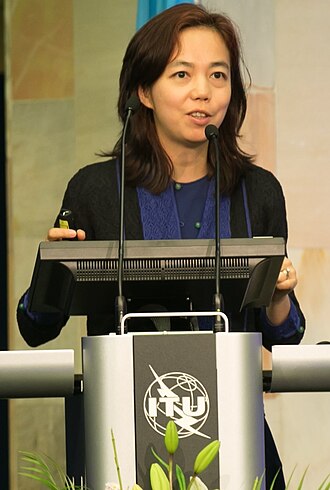
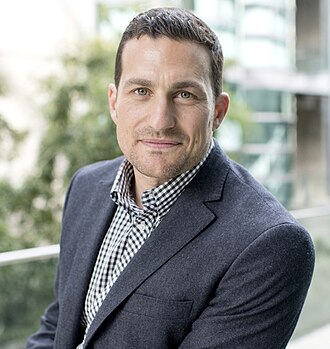
李飞飞 安德鲁·休伯曼
EDITED TRANSCRIPT · 依据现场录音编译整理,可划线生成便签
编者按:本文是斯坦福大学医学院神经生物学教授安德鲁·休伯曼(Andrew Huberman)在其播客节目《Huberman Lab》中对李飞飞(Fei-Fei Li)的访谈。李飞飞是斯坦福大学计算机科学教授、以人为本人工智能研究院(Stanford HAI)主任,因主持 ImageNet 项目而被称为「AI 教母」,也是空间智能创业公司 World Labs 的联合创始人。两人同出身于视觉科学,谈话从五亿年前动物第一次「看见光」开始,一路谈到今天的大模型、脑波传感、机器人手术与课堂里的老师。本文依据现场录音编译整理,仅删去口语枝节、广告与寒暄,论证与例证均按原样保留。

视觉:智能的基石

休伯曼:你是人工智能领域的顶尖人物,但我也把你看成一位神经科学家,一位计算机科学家。我们有一条共同走过的路,就是视觉科学,而且我们还是斯坦福的同事。所以我想从视觉开始谈。视觉、看见、光,这些东西对于人工智能以及它的走向究竟有什么特别之处?对大多数人来说这两个话题大概相去甚远,可事实上一切都是从这里起步的。

李飞飞:我把视觉看作智能的基石,而且是从两条平行的线索来看的。一条是进化教给我们的:视觉的进化和动物智能、人类智能的进化是什么关系。另一条是计算机视觉与人工智能的关系。我分别来说。

李飞飞:先说进化。我常说,五亿四千万年前,动物第一次看见了光。那是一些简单的海洋动物,三叶虫和它们的近亲。在此之前几乎不存在感知能力。大约同一时期,触觉也开始在动物身体里出现,但没有听觉,没有嗅觉,而且完全没有神经系统。可是最早的感光细胞制造出一种进化的推力,逼着动物往前演化。因为一旦能感知外部世界,你对自己的认知就变了,你和外界的关系也变了。说得简单点,如果你能看见食物,你的生命就不一样了。你会变成别人的食物,同时你也在主动觅食,主动找配偶,诸如此类。正因为有了感知和知觉,动物物种的进化速度极大地加快。化石研究告诉我们,动物第一次见光之后一千万年,就出现了我们所说的进化大爆发,即寒武纪物种大爆发。

李飞飞:再往后看,视觉不只在动物早期进化里作用巨大,在高级智能的出现上同样如此。你我都是学视觉出身的科学家,据估计,人脑皮层活动有一半与视觉功能有关。儿童在发育过程中也是先有视觉,后有语言。所以直到今天,视觉在动物智能的进化和人类的日常生活里都处于中心位置。

李飞飞:与此平行的另一条线:视觉作为人工智能的一个学科方向,在我们所说的现代 AI 时刻里扮演了关键角色,主要有两个方面。第一是算法,也就是神经网络算法。计算机科学家在二十世纀五十年代初就开始尝试神经网络了。安德鲁,你应该记得五十年代初神经科学那边发生了什么:休伯尔(Hubel)和维泽尔(Wiesel)这样的神经科学家开始记录哺乳动物大脑里的视觉细胞,并发现神经细胞有一种层级结构,一层叠一层,把神经信息沿着这个层级传递下去,从视网膜采集光开始,一直到辨认出眼前有一个形状。哺乳动物大脑里的这套神经架构,正是神经网络算法的灵感来源之一。今天的神经网络算法跑着数千亿甚至上万亿个参数,复杂程度早已脱离了我们在哺乳动物视觉通路里记录到的东西,但两者的源头很近,大约半个多世纪之前是同一处。这是视觉对 AI 的第一个贡献。

李飞飞:第二个同样关键的贡献是通过大数据实现的,这和我自己的工作更贴近。世纪之交那会儿,AI 主要就是机器学习这个领域,很多实验室、很多研究者在尝试不同的算法,不光是神经网络,还有别的方法,比如贝叶斯方法、支持向量机之类的术语。这些方法叫什么并不重要,重点是那是一个探索阶段,大家都想让这些算法跑起来,好让机器能读、能看。我们这批计算机视觉科学家被这些算法折腾得很苦。2006 年我在普林斯顿当第一年的年轻教员,我和学生看着这些算法,看到喂给它们学习的数据少得可怜。

李飞飞:于是我转向认知神经科学文献,尤其是视觉方面的文献,开始研究人类到底学了多少、能看见多少。那些数字很惊人。人到六岁能学会数以万计的物体类别,而且接触到的视觉世界也是海量的。婴儿几乎从出生那一刻就开始看,所以他们是被大数据淹没着长大的。我们据此推测,缺少数据是 AI 进展迟缓的一大原因。所以我们和当时只盯着算法的所有人分道扬镳,说我们需要数据,需要用数据来驱动这些算法。长话短说,我们主持了 ImageNet 项目,为人工智能领域收集了第一个互联网规模的大数据集,而且是通过视觉这个领域做到的。ImageNet 收录了一千五百万张图片,目标是让机器认出日常物品:麦克风、杯子、椅子。这项工作后来与神经网络算法的进步以及 GPU 计算汇合到一起。到 2012 年,现代 AI 的三个要素合流,成了现代人工智能的定义性时刻。

2012 年的三重汇合

休伯曼:我记得大约 2012 年前后,冷泉港每隔一个夏天举办的视觉课程上有过一场争论:计算机能不能像人一样学会辨认特定的人脸。现在我想大多数人会说计算机其实比人强得多,尽管确实存在那种认脸能力超群的「超级识别者」。你能讲讲这项技术是怎么从会把你和你的表亲、甚至只是长得有点像你的人搞混,走到今天这样精确入微的?我们是怎么到这一步的?

李飞飞:我很愿意把这次技术汇合再往深处点几下。大约在二十一世纪第二个十年,也就是你说的 2012 年左右,一个巨大的汇合是 GPU 计算能力:它把计算加速了,或者说并行化了,让更多的浮点运算能穿过算法,你需要这种速度。其次,经过几十年的研究,神经网络算法日趋成熟。像我们说的,从五十年代起,人们就开始造这种行为上有点像神经元、但简单得多的算法。神经元你知道是非常复杂的,而这里的想法只是一个节点单元,接收一些输入,输出一些东西,内部只是一个函数,一个非常简单的函数。把它们堆叠起来,就是神经网络。到了 2010 年前后,这些算法成熟到了真正好用的程度。最后同样重要的,是对大数据的认识。互联网确实推动了这一点,让数据更易得。但真正的转折是那个「啊,大数据必须成为等式的一部分」的觉醒时刻:我们得用大数据来驱动这些算法学习模式。三者汇合,掀起了这场 AI 革命。

李飞飞:既然你提到人脸识别,还有一个具体的时刻值得一说,就是 ImageNet 挑战赛。我们收集了这个庞大的数据集之后,从 2010 年开始,我的实验室连续多年向研究界发起公开挑战,邀请大家来解决计算机视觉里一个重大的问题:物体识别。当时 GPU 还没有成熟。任务很简单:我们有一个包含一千个物体类别的数据集,超过一百万张图片,这是测试集。算法的任务是,我给你看一张图,你要说出里面的主要物体叫什么,猜对得一分,猜错不得分。几年之后,斯坦福一位非常聪明的研究生给人类的表现做了基准测试,人类的错误率大约是百分之四。随机猜的话,正确率是千分之一,所以人类的百分之四错误率算是相当不错。

李飞飞:头几年机器不如人。转折点在 2012 年,神经网络、ImageNet 数据集和 GPU 三者汇合。即便那一年错误率也只是降到了百分之十几,还没到人类的水平。

休伯曼:也就是看图片,然后从一千个标签里挑一个贴上去。

李飞飞:对。但 2012 年之所以如此重大,是因为神经网络算法把先前算法的错误率一下子拉下来一大截。在研究界我们知道,出现这么剧烈的变化就意味着拐点到了。不过我记得又过了三年多,到 2015、2016 年,算法才在给一千种物体命名这件事上打败人类。

休伯曼:我能问问这位聪明研究生的百分之四错误来自哪里吗?是他们认不出物体,还是在时间压力下的识别失误?比如图片喂得太快,偶尔就贴错标签。

李飞飞:我不认为时间压力是主要问题,虽然对一个研究生来说,我想他们也不愿永远干这个活。我觉得人脑的记忆是有限的,不管长时还是短时,所以要记住一千个物体类别的模式并不容易,哪怕有些类别你很熟。所以会有混淆。另外比如说,不同品种的狗长得非常接近,这也是个难点。

从语音到 Transformer

休伯曼:我能理解在视觉领域这么做的道理。可听觉、声音这方面有没有做过类似的探索?作为人类,我们非常擅长识别言语的语调、情绪色彩这些东西。但如果让我分辨哪怕十五种不同的声音频率,我作为一个非音乐人可以告诉你,那会非常困难。

李飞飞:当然有。你看到的情形是闸门一开,AI 的每一个子领域,语音识别、声音识别、不止于识别的自然语言处理,还有视觉,全都在技术上得到巨大提升。我们斯坦福有同事在用机器学习和 AI 研究鲸鱼的声音、鲸鱼的歌。语音识别是这场 AI 革命早期做得非常出色的另一个领域。技术当然还在继续往前走。到 2016、2017 年左右 Transformer 论文发表,很快就显示出它比早期的 ImageNet、AlexNet 算法更强。这一次做出下一个大突破的不再是计算机视觉领域,而是自然语言处理。因为配方没变:现在我们有了更强的神经网络算法 Transformer,互联网上有更多的数据,至少是更容易拿到的文本形式的数据,GPU 也更强了。OpenAI 和谷歌这些公司很快围绕这项重要技术集结起来。从 2017 年到 2022 年,又花了大约五年才走到自然语言领域的 ChatGPT 时刻。但这又是往前跨了一步。

看见猫尾巴就知道是猫

休伯曼:对于既不是计算机科学家也不是神经科学家的人来说,人类的日常经验或许更能引起共鸣,让我用这个视角来提问。一个孩子知道有一种东西叫「小猫猫」,就会说「哦,猫」。然后通常会把「小」字去掉,也许先说「猫猫」,再学会说「猫」。如果他和猫有足够多的接触,就会明白猫是什么,哪怕从侧面、从背后看。最后,如果他看见一条有点像猫的尾巴,在几本书后面,你问「那是什么」,他很可能说「猫」。即便他也见过狐狸和其他有尾巴的动物,凭着自己的经验,他在做一个概率判断。这本质上就是 AI 能做的,就是机器学习能做的。

休伯曼:但在我看来,从计算器走到今天的 AI,中间必须发生过一个关键时刻,让机器能看见一张尾巴的图片就合理地推断,如果是在室内,那多半是猫,因为狐狸一般不在屋里。诸如此类。那么机器学习和 AI 是在什么时候获得了这种情境学习的能力,能给出一个东西最可能的归属?给它看苹果、香蕉、橙子,它们都是水果,能区分开,也能把它们和汽车、卡车区分开,这是一回事。可这种物体恒常性,一个东西在移动、你只看到局部影像的时候还能认出它,这是另一回事。大多数人想到智能时不会想到这个,但正是这一点让我们的大脑,以及其他动物的大脑,尤其是我们的大脑如此不凡,也是我们自认为地球上最聪明的物种、至少是最擅长发展技术的物种的原因。AI 是什么时候做到这一点的?这是怎么写进这些计算机里的?

李飞飞:我们就拿这个问题来说。你描述得非常好:瞥见一截猫尾巴,就能认出是猫,或者说认出很可能有一只猫。有意思的是,安德鲁,一代又一代的机器学习和计算机科学家都在这个问题上试过手。在今天机器能可靠做到之前,有过各种算法。你可以想象一种常识式的思路:要不我们先把所有家具认出来,就知道这是室内,于是不太可能是狐狸。这类规则确实被写进过前几代算法。也有另一类规则,比如与其直接猜是猫,不如只在十种可能的动物里猜一种,猫是其中之一,这样缩小了搜索或猜测的空间,会有帮助。很多想法都试过。

李飞飞:那什么时候变得可靠得多了?就是当下这个时代。这些算法学过的海量数据,拿 Gemini 或者 GPT 来说,在机器的学习空间里造就了这样的能力:学到了那么多知识、那么多模式,当一张多少算是新的照片摆在面前,一条猫尾巴从书架外面伸出来,这个模式激活了我们所谓的已学习权重或参数,把机器对这个物体的判断推向它见过的东西,而它见过的多半是猫尾巴,或者至少是尾巴。因为数据实在太多了。

休伯曼:明白了。

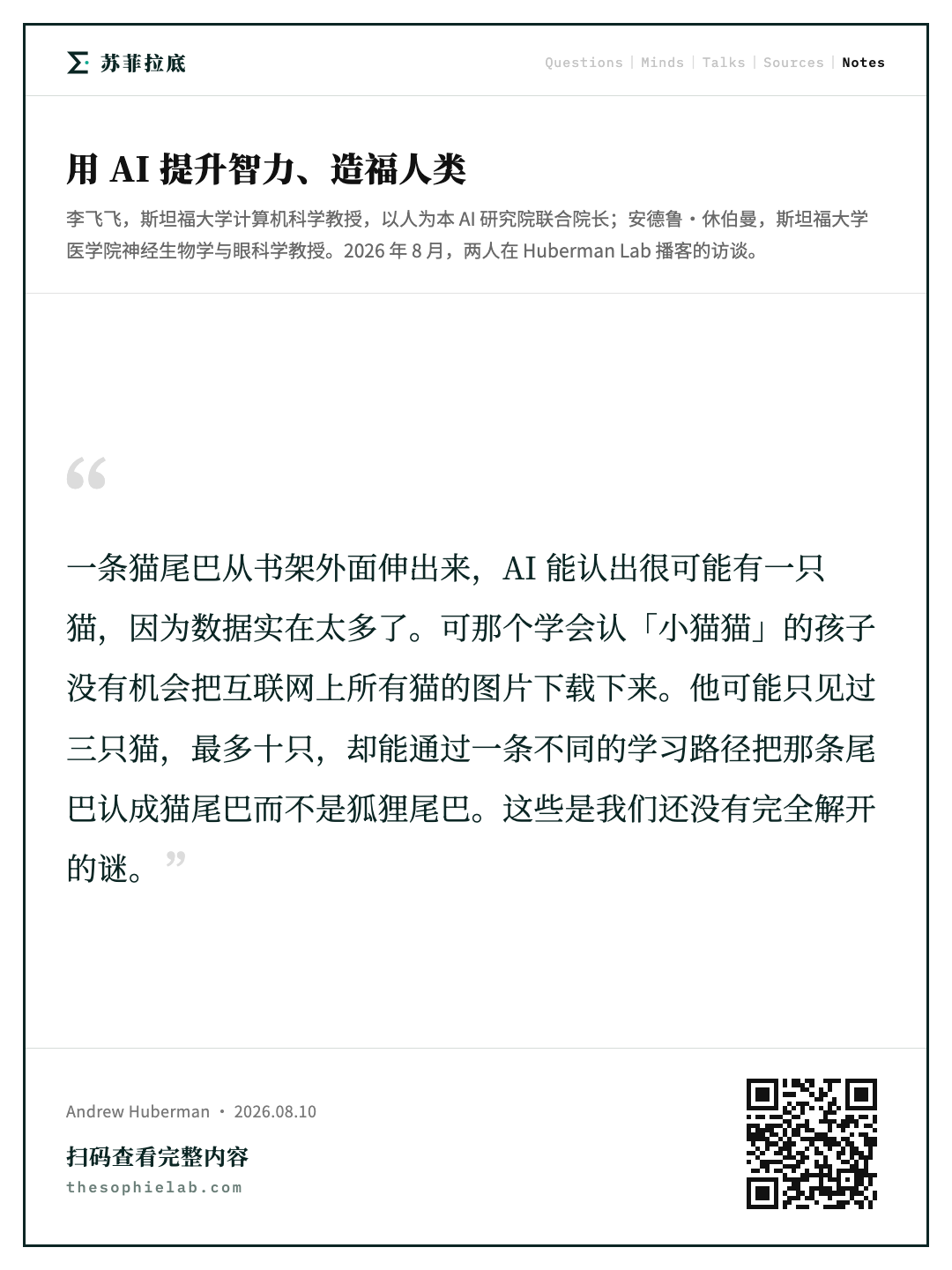
李飞飞:安德鲁,作为神经科学家,我想这里正是我们与人脑分道之处。那个学会认「小猫猫」的孩子没有机会把互联网上所有猫的图片下载下来。他可能只见过三只猫,最多十只,可他却能通过一条不同的学习路径把那条尾巴认成猫尾巴而不是狐狸尾巴。这些是我们还没有完全解开的谜。但我确实想指出,今天用海量数据学出来的 AI 算法,与人类进化出来的方式,存在这样一道分野。

视频进入训练数据

休伯曼:如果我们继续沿着这个层级往上走,从简单的物体识别到你我所说的高阶脑功能,走向大多数人听到「智能」这个词时想到的东西,创造力、想象力之类。我们先走到一个中间台阶,再走到更远的一步。还是用猫的例子。如果一台计算机或者一个孩子通过尾巴或者整体学会了认猫,而且见过猫移动,那么对那个大脑、那个孩子或那台计算机来说,一个全新的世界就此打开。因为现在他们知道猫通常朝着头的方向走,而不是尾巴的方向。这些都是非常简单的学习规则,对吧?猫可能去追老鼠,也可能躲开狗,也许是,也许不是,可以一直列下去。所以在所谓「智能」的下一层,似乎是给移动的方向、不会移动的方向、这个物体可能与之互动的其他物体分配可能性。对普通人来说这听起来非常基础,可这就是大脑学习的方式,也是机器学习的方式。所以,下一个大拐点是在什么时候?就是给 AI 一张猫的图片,说:把这只猫动起来,让它像猫一样动,却不给它任何关于四肢怎么动的具体指令。我想那大概来得很快,但对于我们称为 AI 的这整件事来说,那是一次极其重要的转变,因为大脑做的就是这个。

李飞飞:你这么问很有意思,而且说得很漂亮。我从来没想过对公众这样表述,但那个时刻,就是视频成为训练数据的时候。你看,我又回到训练数据上来了。大约在 2023 年,ChatGPT 时刻之后不久,多个研究团队开始把视频放进训练数据。算法上当然有一些细微的调整和变化,我不展开。记得 2024 年 1 月 Sora 发布,人们第一次看到视频可以被生成出来,正是你刚说的那样。你可以打字说「一只猫朝一只老鼠跑去」,然后生成几秒钟的片段,里面有一只猫以合理的方式动着腿,朝老鼠跑过去。当时还有错误,直到今天也不完美,但已经好了很多。这打开了你所描述的视频生成的闸门。

李飞飞:那里究竟发生了什么?其实没有你想的那么革命性,因为归根结底,还是数据。作为科学家我可以告诉你,算法上有各种调整、改动和改进,但如果拉远了看,这仍然属于这个伟大的神经网络时代。发生的事情是,我们现在能够处理视频数据了,靠一些巧妙的工程,叫「token 化」也好,随便叫什么,然后我们就能生成这些短视频片段,也就是把帧接在一起,看起来像是合理的猫的动作。你可能会问,算法知道猫腿的肌肉结构吗,才能让猫爪按顺序合理地动?我会说算法不知道。但它有的是互联网上那么多视频,尤其是猫的视频,多到它学会了那应该是什么样子。某种程度上人也是这样。我们大多数人没受过专门教育,不知道猫的肌肉是怎么动的,我到现在也不知道,医学院的同事可能知道。但我们看猫这么动看得太多了,对猫怎么动有了一个合理的概念。AI 与此相似,就是统计,就是海量数据告诉你,怎样生成猫的动作才合理。

休伯曼:所以当人们听说大脑是一台预测机器、一台学习机器时,你指的就是这个。

李飞飞:是的。

互联网抓不住的那部分

休伯曼:我们跳到脑功能里非常远的一端,我们知道人类确有的东西:思想和创造力。思想和创造力大概也有规则,只是比视觉系统的例子难钉住一些。比如「如果是尾巴、又在室内,那多半是猫」这类规则,在思想和创造力里也是有的。拿苹果举例,我们可以从低层次的「看见一个苹果」,到中层次的「苹果总是往下掉,不会飞走」,再到最高层次的「支配苹果运动的方程是什么」。这是往更高阶、更还原论的分析上升。

休伯曼:我想问你怎么看这样一个想法:AI 确实是智能的,能做大脑能做的事,甚至能做单个人脑做不到的事,这一点从它在国际象棋上赢过人类就知道了。可就我的理解,现在的 AI 是在互联网上训练的,图像、讨论、视频、歌曲,但那并不是人类认知的全部。那么,不论是 ChatGPT、Claude,还是尚未发布的最强机器学习工具,是否存在一些人脑功能的特征,AI 至今无法触及,因为它们从来没被上传到互联网,至少没以 AI 能提取的方式上传?比方说,你可以把一首交响曲放上去,它遵循某些音乐、数学和声音的规则,说得通。可你整天都有念头,我也整天都有念头,那些念头和语言并不完全咬合,我没法把它们直接打出来放到网上。请跟着我,我知道这个问题很长,但我觉得这正是你最适合回答的一件事,自一年半前在犹他见到你以后,我一直等着问。艺术领域有一种叫「抽象」的东西。偶尔有人画出一幅画,它不像任何具体的东西。音乐里也有,你就是感觉到了什么,像是触到了某种根本的规则或者情感。他们接通了脑功能的某个方面,但你说不出那是什么。我觉得这类东西对 AI 来说很复杂,或者说我很难理解 AI 怎么能做到,因为你可以把那件艺术品放进 AI,问它「这揭示了人类经验的什么根本特征」,可它只能接触到互联网上的东西。那么,怎样用 AI 去捕捉一整团复杂的感受和体验?这对我来说是一道鸿沟。我相信 AI 终会走到那里,但我看不到从神经科学到 AI 有任何直接的路,不像我们可以一级级从视觉运动、悲伤、快乐这样爬上去。很多东西能拆出来,但那些说不出、写不下、画不了的高阶抽象表征,很难触及。如果我说「给我讲讲你对童年老家的怀念」,你可以写下来,但那只是文字。我无法以第一人称去理解你的体验。

李飞飞:完全同意。安德鲁,我知道你在这个问题上花了很多心思,这是一个非常重要的问题,我们一层一层来剥。首先,简短的回答是:我同意你的看法,我们必须非常谨慎地认清 AI 能做什么、可能做什么,而不是去揣测一百年以后的事。我承认你刚说的这些是极其细腻、个人化、难以刻画、甚至根本没被捕捉过的人类认知行为。正因为没被捕捉,它们没被上传到互联网,而今天的 AI 没有办法触及它们。

李飞飞:所以当你说「互联网」是 AI 数据的来源时,我们要弄清楚互联网到底是什么。互联网不是什么随机的东西。互联网是人类行为以多模态形式存在的最大集合。再拆开看:全世界的人口在上面打字,到现在已经打了几十年。打字是一种感知机制,捕捉了从青少年闲聊到深奥的科学论文的一切,只要被数字化、上传。所以捕捉人类语言是互联网极其擅长的。然后互联网捕捉图像。怎么做到的?因为我们有了数码相机,智能手机里到处都是,人类又爱拍照,从家里的猫到自拍,再到 BBC 拍下的美丽照片,这些也进了我们的数字空间。再往上是视频,视频有声音、有动作,也上传了。再往上还有音乐。我们先不谈版权那些法律问题,我只说数据的形式。演讲、歌唱、音乐、管弦乐,也进了数字空间。于是我们造出了这样一座巨大的图书馆:文字形式的人类知识,视频形式的人类行为,声音形式的人类表达乃至自然的声响。AI 就在这上面训练。这就是它为什么这么强,尤其在文字方面,能识别模式、合成模式,因为那么多东西早就摆在那儿了。

李飞飞:可你刚才说的那种东西,比如毕加索对于以某种特定方式表现那位年轻女子肖像时产生的那个极其深刻的念头,那个念头从来没被捕捉过。事实上,作为神经科学家,如果我问你那个念头来自哪个脑区,你也不知道。是布罗卡区?是 V1?是运动区?是前额叶?我们不知道。也许弥散在各处,因为那个念头如此个人、如此特殊。你可以叫它创造力,叫它情感,叫它任何名字,叫「猫 231 号」都行。那个念头没有被捕捉,所以不在互联网上,所以 AI 没见过。这就是人类依然独一无二的地方。

李飞飞:但我们也得给 AI 应有的评价,因为它学了那么多东西,能以高度创造性的方式组合信息。你记得第 37 手吗?

休伯曼:AlphaGo,对。

李飞飞:第 37 手已经成了 AI 创造力的象征。我认为这既是真的,也容易被断章取义。那是 AlphaGo 对李世石的比赛,我想是五局中的第三局,AlphaGo 作为一个计算机算法走出了一手人类围棋大师从未想过的棋。那确实是不可思议的一手,因为人类集体,那些大师们,从未想到过。但如果你深究 AI 在那里做了什么:首先围棋是一种高度数学化的游戏,目标在数学上非常清晰,落子规则也非常清晰。当 AI 有更大的算力,又有办法记住更多步数时,它就能做到人脑通常做不到的事。这算创造力吗?我认为算,但我们必须承认那是一种特殊的创造力。

李飞飞:我和当代一位杰出的数学家聊过,问他 AI 能对数学里的未解难题做什么贡献。他很乐观。他说,今天数学里有很多难题,虽然难,但也许存在已知的方法能解决它们,只是我作为一个菲尔兹奖得主也可能忘了。因为我有的是一颗人脑,我不记得、也不知道过去几百年里所有的数学解法,哪怕我是菲尔兹奖得主也一样。所以 AI 能帮我们解决这些问题。可作为数学家,他也告诉我:我不知道 AI 能否解决所有的数学问题,因为其中有些问题需要的解法尚未被发明,那会把创造力推到一个完全不同的层次。这正是我们应该好奇的地方:那会是人类的创造力,还是 AI 通过一轮轮迭代改进,达到一种人类没有的创造力,还是一种合起来的创造力?我目前的推测是混合式的:人与 AI 并肩工作,帮助我们解决那些解法尚待发明的问题。

李飞飞:至于你说的,尤其是情感,那就更个人化了。这不一定是逻辑,不一定是演绎推理。也许,安德鲁,你看着这只杯子,说这是一只好杯子。可要是它在我心里勾起了一种情绪,一段童年的时刻,一只灰色的杯子意味着某件只有我和我最好的朋友共享的事情呢?那是我大脑里一条完全无法触及的信息,从未上传到互联网,今天的 AI 不论多么强大都拿不到。所以我对这只杯子的反应,以及我因为那段记忆而可能拿它做的事,可以完全不同。你可以叫它创造力,叫它表达,叫它讲故事,怎么叫都行。但那是 AI 触及不到的地方。

增强而非取代

休伯曼:我觉得在不太远的将来,计算机会以非侵入的方式获得我们的大脑活动。我甚至可以想象,五到十年后,我头上戴着一个东西,你看不见,一个非常细的发网之类,一些电极就搁在头骨外面,不碍事,感应我脑内的活动,也许还感应我的心率、自主神经活动、我的警觉程度,然后拿这些和我说的话、做的事做比对。这完全在可及范围之内,一定会发生,你我都知道。这大概已经开始让人害怕了,但我们把它保持在善意的框架里。想象一个世界:有一台我自己拥有的计算机,我不担心数据外泄之类的问题,那些我们可以设法解决,它在感应我的这些方面,并且察觉到,我说的话固然重要,但我的内在状态和大脑活动里有一些东西连我自己都没意识到。

李飞飞:对。

休伯曼:我可以决定和这个「我的一部分」合作,说:我们来做一幅我从没见过、却来自我某段重要经历的有趣图画。它可以把这个揭示给我,因为它接触到了我大脑活动里无意识的部分。我认为这在不远的将来很可能发生。如果人们把它放在自己经验的气泡里去想,这东西不会立刻传到互联网上,也不会被用来对付自己,你其实是在了解自己。我相信大多数人天生对自己身上发生的事有兴趣,也对别人有兴趣,谢天谢地。我很想知道为什么我在某些方面老是出岔子、过得不顺,为什么有些日子又特别好,我的想法从哪里来,我可以在哪些状态里深耕。但我不知道怎么做到,只能靠:一杯咖啡不错,一杯半更好一点,两杯就过了。想想我们现在做这些事的方式有多原始,简直疯狂。每个人都有自己的办法,都在试着搞对,等到搞对的时候你已经老了,又得重新更新。我们现在很可能根本没有把自己的生物机能和大脑用到最好。

李飞飞:没有。这就是为什么我一直在说,有些人谈 AI 的方式让我不舒服,他们说得好像 AI 是在取代人类。而你描述的,是增强和扩展人类。这甚至不必科幻到用一个智能发网去读你的脑波。仅仅是让 AI 学会你的写作模式,就已经能帮你成为一个更好、更有效、更高效的沟通者。这是今天的 AI 就能释放出来的一种赋能。安德鲁,我认为作为神经科学家和大学教员,我们都知道最重要的一点是:主体性(agency)对人类至关重要。它归结为每一个个体层面的动机、主体性和尊严。我们必须认识到,要把 AI 当作一个帮助我们发挥主体性的工具。它不应该拿走我们的主体性,而今天领导 AI 的人也不应该用那种口气说话,好像这项工作会把人的主体性拿走。

别居高临下

休伯曼:对技术非常熟悉的人,不管是计算机、生物学还是汽车这样的任何技术,都会变成那件事的极客,然后忘记它对别人来说可能是可怕的,也忘记围绕它的语言是至关重要的。我记得九十年代初,你肯定也记得,基因检测曾被当成那样一种东西:你愿意做吗?你愿意验血吗?天啊,你可能看到什么真正吓到你的东西。现在同样的讨论发生在自选核磁共振之类的事情上。这些都没人强迫你做。我的立场是信息越多越好,但我逐渐明白不是所有人都这么想,有些人不想知道。

李飞飞:他们不想知道,但他们应该有选择的权利。与此同时,我们应该有足够的公众教育和沟通,让人们知道利弊,而不是剥夺他们的选择,也不是说:既然你不懂,那就让我替你决定什么对你好。那样不好。围绕 AI 的言论现在变得非常扭曲,因为懂这东西的人往往对公众居高临下地说话。不管动机是正面的还是负面的,那种话语都是「你们不懂这是什么,我来告诉你们,我会让你们快乐、安全,随便什么,我替你们决定」。这既不健康,也没有帮助。

休伯曼:我同意。我开这个播客的原因之一,就是想展示那些真正心怀善意的科学家和医生,他们没有兴趣把东西讲浅,但他们有兴趣让人们理解事情。很多人会觉得健康信息属于最值得理解的事情之列。谢天谢地,你正在打破你刚描述的那种类型。还有另外几个人,但你一直在最高的层面上做这件事,鼓励人们去思考 AI 这种协作、去思考存在的主体性、去决定用还是不用。

李飞飞:主体性的一层,我认为对每个人都很重要,不管你是学生、老师、医生还是决策者:去了解它。不一定要学编程,我不认为那是必需的,看你的工作。比方说你是艺术家、老师或医生,你不一定要写代码,但要了解这项技术是什么,了解你自己怎么用它来赋能你的学习、你的工作、你的表达。通过学习,人会觉得更能掌控;通过学习,你不那么害怕去尝试;通过学习,你保住了那份主体性和尊严。因为说到底,不论技术或医学多么先进,作为人,我们想要的是那种帮我们活得更好、保住尊严、让社区更好的善意。

休伯曼:技术可以是连接者而不是分隔者,这个想法必须放在讨论的中心。这个领域的大名字们,我们都知道是谁,有好几位,他们也处在一个成长过程里,在学习如何面对公众,而且这发生得非常快。显微镜对着他们,摄像机对着他们,每一点细微的失当都被放大。我愿意相信他们会足够快地成熟起来,认识到公众需要听到正确的、真实的信息,但要用让他们听得懂的方式。医学界和学术界有一个「肮脏的秘密」,你打破了它,我也愿意相信自己打破了它,那就是:不分享事情的运作原理,本身是一种权力。

李飞飞:没错。

休伯曼:但到最后这对谁都没好处。你把帷幕拉开,让人进来,人们会感到更安全。

李飞飞:不分享是一种权力。还有一种权力是说「相信我就行,我会告诉你」。而作为教育者,这两种我们都不做。我们不会走进课堂说「相信我,二加二等于四」。我们说的是:这是怎么拆解的,你来学一下,下次你就能自己做了。我还认为,你的播客作为公共传播和知识教育的一部分非常重要。我们也需要听到不同背景的声音。有很多学者、技术人员、建设者和思想者一直在研究 AI、使用 AI、认真思考如何用 AI 来赋能人,这些声音非常重要。

AI 加速科学发现

休伯曼:接下来我想谈一件几乎所有人都会同意「如果存在就太好了」的事,而且它已经开始发生:用 AI 推动健康领域的发现、疾病的治疗等等。回到前面 AlphaGo 的例子,大家肯定也还记得猫的例子,它们都遵循某些规则。AlphaGo 的规则很复杂,但学会之后就是一组有限的规则。猫这件事看起来不受约束,像有无限可能,但也约束到了机器和人类都能学得很好的程度。

休伯曼:一旦进入医学,医学有规则,科学有规则。你有一个问题,提出一个假设,检验这个假设,试着排除它,等等,这是科学方法。医学里每个领域都有自己的方法。我们观察,观察疾病,观察谁康复了,写病例报告,做随机对照试验。所以有规则,而互联网知道这些规则。所以大语言模型可以很好地用来挖掘健康信息,因为规则是有约束的。但我想你我都知道,我也把你看成一位生物学家,生物学的规则还在不断向我们揭示自己。这不是说皮肤科医生、神经外科医生和肿瘤科医生不知道自己在做什么,而是他们是在自己学过的一组有限的规则之内工作。即便他们不断学习、更新,现在似乎每个月都有一个发现出来,打破了规则。

休伯曼:比方说我学到的是动作电位是单一的,形状总是一样,要么放电要么不放。可十二年前有一篇论文表明,动作电位的形状可以变化很大,发在《自然》上。大家都看到了,然后没人愿意去处理。太麻烦了,它改写了规则。神经元应该要么是分级的,要么是全或无的,全或无写在每一本教科书里。现在如果我拿一堆神经活动,告诉它这个规则:同一个神经元里动作电位可以大也可以小,那就把我们对神经科学的一切理解全搅乱了,我们对大脑的理解就崩塌为零。但如果你给 AI 这条规则,这个信号可以有一百种形状,AI 大概能比最好的研究生做得多得多,哪怕是斯坦福的,或者公平地说,麻省理工或加州理工的,我不认为研究生能做到,而 AI 能在我问这个问题的时间里做完,尽管我承认这个问题有点长。所以我想听你说说:医疗领域的人、普通公众和 AI 怎样协作来攻克疾病,最好还能提出新的发现规则,让我们最终在一个能真正改善人类进程的层面上理解自己的生物学。

李飞飞:安德鲁,你大概触到了 AI 最激动人心的用途之一:科学发现。在生物医学的情境里,科学发现直接关系到人的健康与疾病。我认为我们已经准备好彻底改写科学发现的做法。因为长久以来,我都说不清有多久,科学发现依赖聪明的人记住从其他聪明人那里学来的东西,然后以我们自己肌肉的速度去做事。当然有超级对撞机之类的东西,但总体而言,在科学发现的方式里,人脑或者说科学家的大脑是唯一的中心角色。

李飞飞:现在我们有了一个新工具,它的「大脑」能保有海量信息,能帮我们综合知识,能以你我做不到的方式跨越学科。比方说我们恰好都在视觉、神经科学、AI 这个领域。我对嗅觉一无所知,零,我们同事知道的那些词我大概连拼都拼不出来。我们的大脑要跨过去太难了,但现在有了一个能把它撬开的工具。所以我认为我们必须改变,必须用这个工具。我刚在想,大约一百五十年前,我不确定具体是什么时候,电改变了我们生活里的一切。我相信那也是一个人们在思考变化、机会和恐惧的时刻。我认为我们必须认识到,科学发现是 AI 和健康领域最激动人心的机会之一。信息怎么被综合,怎么呈现给临床医生,也呈现给患者,患者怎么参与从诊断到治疗的过程,现在能做的事太多了。

休伯曼:我不会说 AI 比所有医生强,但几个月前 AI 帮我把眩晕和低血压区分开了,而搞错的人里有一位专门研究前庭系统的耳鼻喉科医生。

李飞飞:你提供了什么信息?只是你的主观感受?

休伯曼:我一两天里的主观感受。后来发现是一位医生给我开的药,我出现了轻微但确实的不良反应。那种感觉很怪,一迈步就觉得整个世界往下掉,然后开始转。我想,天啊,这像眩晕,可我记得头晕和头重脚轻是不一样的。于是我开始查,果然是血压问题,那种药把我的血压压得太低了。我咨询过几位聪明的医生,我得说实话,他们都不在斯坦福。

李飞飞:我们要在学术上诚实。

休伯曼:但这实在了不起。我把结果反馈给他们时,他们说「这太不可思议了」。公平地说,他们的意思是,你要不是在电话上而是在我的诊室里,我本可以做些额外检查。可这是零成本的。一个上午我就知道了:如果我喝一些电解质,喝到我原以为过量的程度,两小时后就会好。当然这里有安慰剂效应的可能,但两小时后我确实好了。对患者来说这也是极大的安慰。这不是说别去看医生,但这太不可思议了。这东西现在就存在。

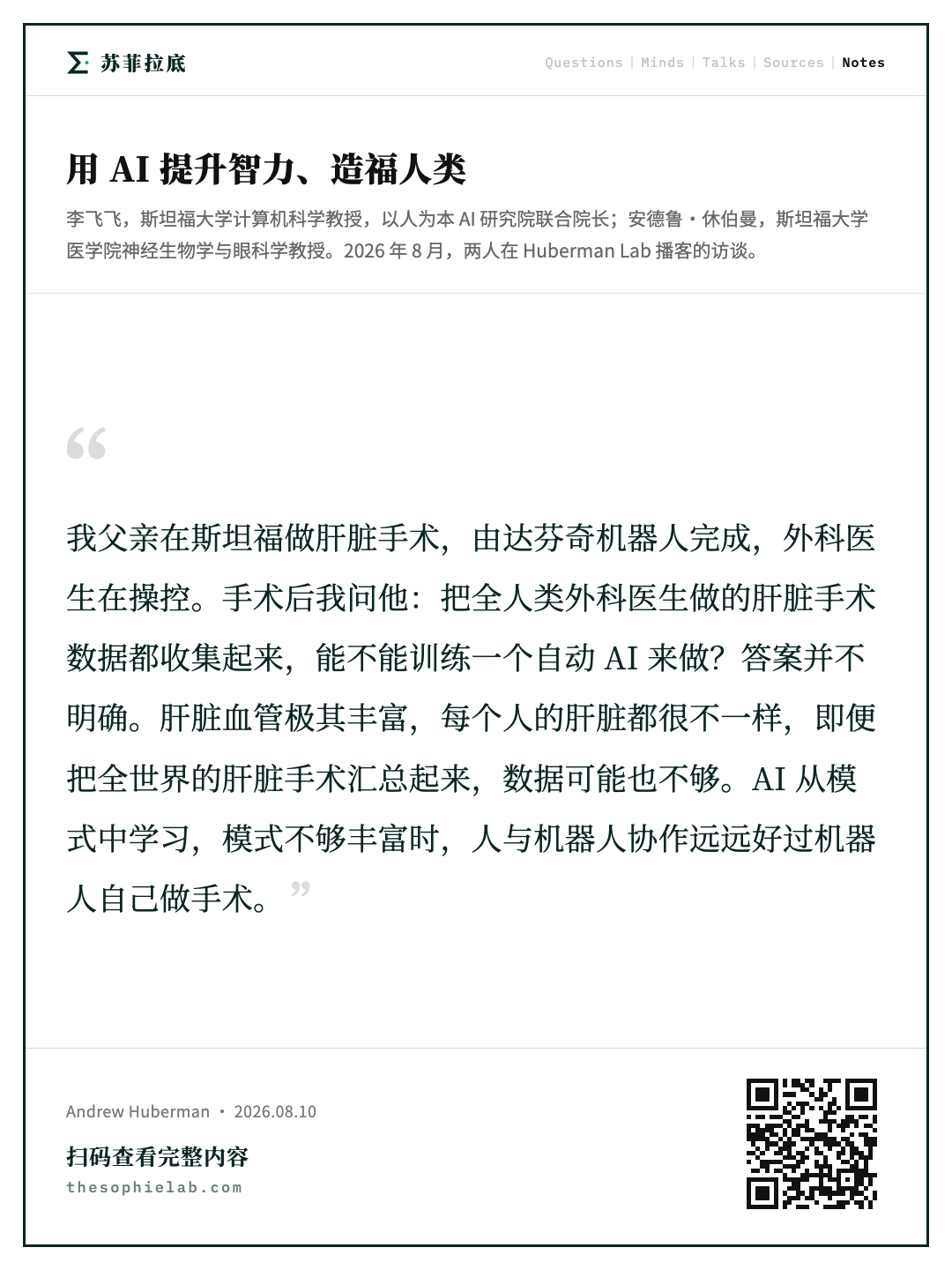
李飞飞:医生也可以用这个工具。顺便说一个很有意思的例子。你知道我们这次谈话改过期,因为我父亲当时正在斯坦福做手术,主刀的是一位非常出色的外科医生。但手术是由机器人完成的,达芬奇机器人系统,因为是肝脏手术,那位出色的外科医生在操控机器人。这是一次深度的人机协作。手术后我问外科医生:假设你做过一百万例,这对人类外科医生来说不可能,但假设我们把全人类外科医生做的这类肝脏手术的数据都收集起来,能不能训练一个自动 AI 来做这个手术?答案并不明确。于是我们往深处聊了聊。肝脏是一个非常复杂的器官,血管极其丰富,而且每个人的肝脏都很不一样。考虑到每年做肝脏手术的患者数量,即便把全世界的肝脏手术汇总起来,数据可能也不够训练这些算法。

李飞飞:这说明一个非常重要的事实:AI 从模式中学习。当模式不够丰富时,我们就必须谨慎,必须知道怎么用 AI、怎么不用 AI。在这个例子里,人与机器人协作远远好过一个学得不够的机器人自己做手术。但同样的问题对外科医生也成立:一个外科医生一辈子能在多少台手术上练手?所以这些都是人与 AI 可以充分协作、并可能得出最佳结果的机会。未来还有待观察:我们能不能造出一个人工模拟的肝脏,在上面训练无限多的可能?这些都是摆在前方、极其开放的科学可能性。而像你那种情况,眩晕对低血压,很可能已经被报告过太多次,数据库里足够多,AI 学会了。那么对于无法立即见到医生的人,我们就可以利用这一点。

休伯曼:太好了。你父亲的手术顺利吗?

李飞飞:顺利。而且出血量只有常规手术的十分之一,这要归功于机器人手术的腹腔镜能力。

直觉、动机与情感

休伯曼:我想谈谈一些我们认为人类独有、但也许并非如此的特质。你来告诉我。这些是真诚的提问,不是设套。然后我也想了解,AI 的结构是怎样允许这些事情发生的。比如直觉。我们都愿意把直觉想成某种神秘的、确实强大的东西,一种属于我们、谁也拿不走、没法模仿的东西。但我也可以把直觉拆开来看:它是我长期积累的经验,是一个数据集,加上一些身体和大脑的感觉,再加上一些预测线索,比如上次我有这种感觉时发生了那件事,前两次我有那种感觉时事情没有那样发展,所以这次我走这条路。这些规则是可以写给计算机的。但我们更深层的自我,如果可以这么说,还有别的方面。我们不知道直觉映射在身体的哪里,可以做成像实验,但你不可能同时采集所有神经元、所有激素和一切。那些没有一个位置、甚至没有一个网络可以指认的东西,比如创造力、直觉、预感,那种你真切感到有什么要来、但还没发生的感觉。

休伯曼:AI 能得到什么样的规则,让它具备这类能力?这里我想放在「能量」的语境里谈。不管这东西是什么,它就像线粒体推动细胞更多地围着一件事转而不是另一件,恐惧或快乐也会这样。在 AI 系统里,我不是计算机科学家,在 AI 系统和 GPU 里,我们能不能实际给特定的学习规则分配更多的能量流?这样也许某一天我们可以说:基于你对我姐姐的一切了解,我爱她,你直觉上认为我们的兄妹关系会怎样演变?你觉得今年生日我们做点什么会很棒,和以前不一样?它只能接触互联网,它真的能变得像心智、像身心一体,形成一种对什么真正值得做的感觉吗?还是它只需要越来越多的提示,不停地反问我,结果实际上是我在干活?

李飞飞:很有意思的问题,安德鲁。为了论证方便,我想把直觉和创造力分开,也许最后再合起来。先谈这种直觉:考虑到我对手足的爱,会发生什么。这真的是直觉吗?今天你去用一个 AI 聊天机器人,你会输入:我是斯坦福教授,神经科学家,给我这个信息。这个东西已经有名字了,叫「上下文」(context)。我不知道你会不会叫它直觉,但因为你给了那条信息,AI 给你的答案就已经不一样了。如果我输入我是个十四岁、喜欢赛车的少年,即便问同一个问题,它也会给出定制的答案。这是一个数学事实,我不会称之为能量。这些算法就是这样接收上下文并调整输出的,就叫上下文,在计算机科学里没有那么深。这是一种相当浅的直觉,因为你已经能用语言描述它,或者说我上传一张图片,那也是已经可以表达的东西,AI 就能接住。

李飞飞:而你说的更深的直觉,是你连它从哪来都不知道。是因为我闻到了什么?是激素?是情绪的混合?是我的早餐?那种直觉,AI 能拿它怎么办?我会说那是无法触及的。目前没有任何感知装置能采集到那种数据并喂给 AI,其实连喂给另一个人都做不到。比如作为一对伴侣,有时候你们就是互相看不顺眼,处处别扭。

休伯曼:从来没有。开玩笑,当然有。

李飞飞:如果彼此很熟,你大概能感觉到,但说不太清。也许你就悄悄走开,让对方一个人待着。这意味着那个人的直觉,他自己都没法用语言或手势表达出来,交给另一个人当作一条信息来用。当你自己都触及不到时,无论是另一个人还是一台机器,都拿它没办法,因为没有通向那种高度个人化直觉的入口。没有技术能做到,除非你说我们装上脑波采集器或者皮肤电导传感器。等到我们做了那些,也许它们就变得可以触及了。所以我们必须认识到,我想说的是,这并不很深奥:数据是否可以触及?不管是通过语言、图片、成像还是脑波,它必须是一条可以触及的信息。如果可以触及,而且我们收集得够多,就可以用它训练机器;或者如果机器已经训练得很好,那它可以像你说的那样,在私密的前提下,先不谈隐私泄露,机器大概能用上它。安德鲁,我在这里想做的不是把它说得神神秘秘,而是试着给它一个科学的过程来描述:如果它要发生,会怎样发生。

休伯曼:我听到的是,基于大数据集和规则的模式识别能带我们走很远。前面我们谈到医生在哪里失手、机器人和机器在哪里也许做得更好,或者两者协作好过任何一方单干。作为神经科学家,你的职业生涯里总有一段时间花在看细胞上。电生理学家几十年甚至更久以来,会发展出一种直觉,这很奇妙。我算不上生理学家,但我学会了凭一些从没写进任何论文的特征认细胞。比如这东西沿着某一侧有一条比较直的边,有某种形状和圆度,我现在就能告诉你,那是视网膜里的一个瞬态撤光细胞。后来我们开发出遗传标记,证明每一例都对。但你也会看到一些不符合规则的。机器能学这个,计算机能学这个。有了所有那些论文里的全部信息,现在我们有了一份相当完备的视网膜零件清单。好,这行得通。然后你可以套规则:这类这样放电,那类那样放电。这些我都接受。

休伯曼:我刚才谈直觉真正想问的,大概例子没举好,是:人类有哪些内在状态很难想象机器能复现,但也许它们可以?比如动机。机器会有动机吗?机器人会被激励吗?我们有动机的规则。当我非常想做一件事时,我们称之为紧迫感,一种紧迫的状态,我可能动作更快,激活能更低。你说「走」,我站起来快一点。机器可以朝某个方向跑得更快。但你能不能说「我要你去找这个东西,但要带着更高的紧迫感」?还是它们只受自己能处理的数学规则约束?

李飞飞:这可以写进数学里。有些东西,你叫它动机也好,在机器学习的世界里我们叫它目标函数(objective function)。你可以把某些东西写进数学。比如现在你去用 ChatGPT,它有不同模式,比如「深度思考」模式和「快速回答」模式。你要是不知道原理,会觉得有意思:一个更有紧迫感,快速给我答案,另一个要往搜索的深处走,花更长时间回答。作为人,如果你过度拟人化,可能会称之为紧迫感或动机。但事实是,这只是算法的不同目标。你可以说思考快的那个有时间限制或 token 限制,思考慢的那个激活了模型的另一部分,耗时更长。所以在数学上这其实很干巴,不那么深。但对人来说,你可以把它叫动机或紧迫感。

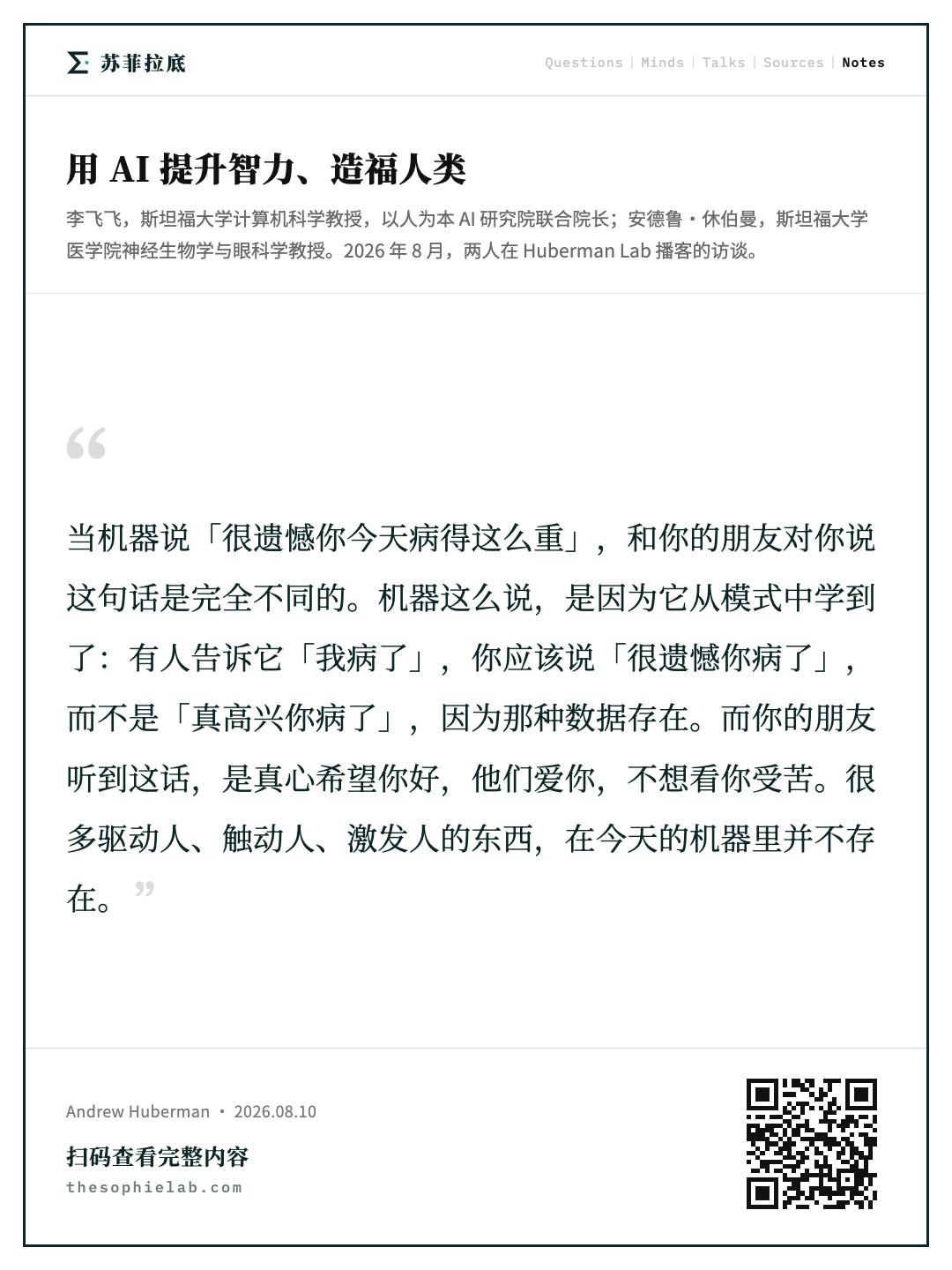
李飞飞:但我们再深一层,因为你问的比这更深。有些认知状态,不管是动机、紧迫感、恐惧还是爱,人类是真切拥有的,却很难触及和表达。今天的机器有吗?没有。我们要说得非常清楚。我们倾向于想象机器有感觉,可它们没有那些数据,没有那个数学目标函数。所以当机器说「很遗憾你今天病得这么重」,和你的朋友对你说这句话是完全不同的。机器这么说,是因为它从模式中学到了:有人告诉它「我病了」,你应该说「很遗憾你病了」,而不是「真高兴你病了」,因为那种数据存在。而你的朋友听到这话,是真心希望你好,他们爱你,不想看你受苦。他们有那种共情的感受:如果你在痛,我也经历过痛。这不一定是镜像神经元,但至少是一段关于痛意味着什么的记忆。机器没有这些。所以我们必须做出区分。很多驱动人、触动人、激发人的东西,在今天的机器里并不存在。我们的运作方式与今天的 AI 根本不同,我们必须认识到这一点,尊重这一点。这也是公共传播如此重要的原因,我们不能在这件事上误导公众。

技术能做不代表该做

休伯曼:我觉得人们默认 AI 聊天机器人里面有一种情感、有一个人,因为我们太以语言为导向了。它在跟我们说话,在给我写东西,而且我们现在这样做的频率比三十年前高多了。当然,我们已经非常习惯用相当贫乏的语言接收信息。短信不是长篇大论。语言变了,沟通方式变了,是往贫乏而不是往丰富的方向变。但我猜很快,人脸就要进入画面了,没有双关的意思。比如你我给对方发短信:下周这个时间在校园喝咖啡见。那条短信多久之后会变成一张照片或者一段像你本人在对我说这句话的视频?这在今天做起来是很轻松的。

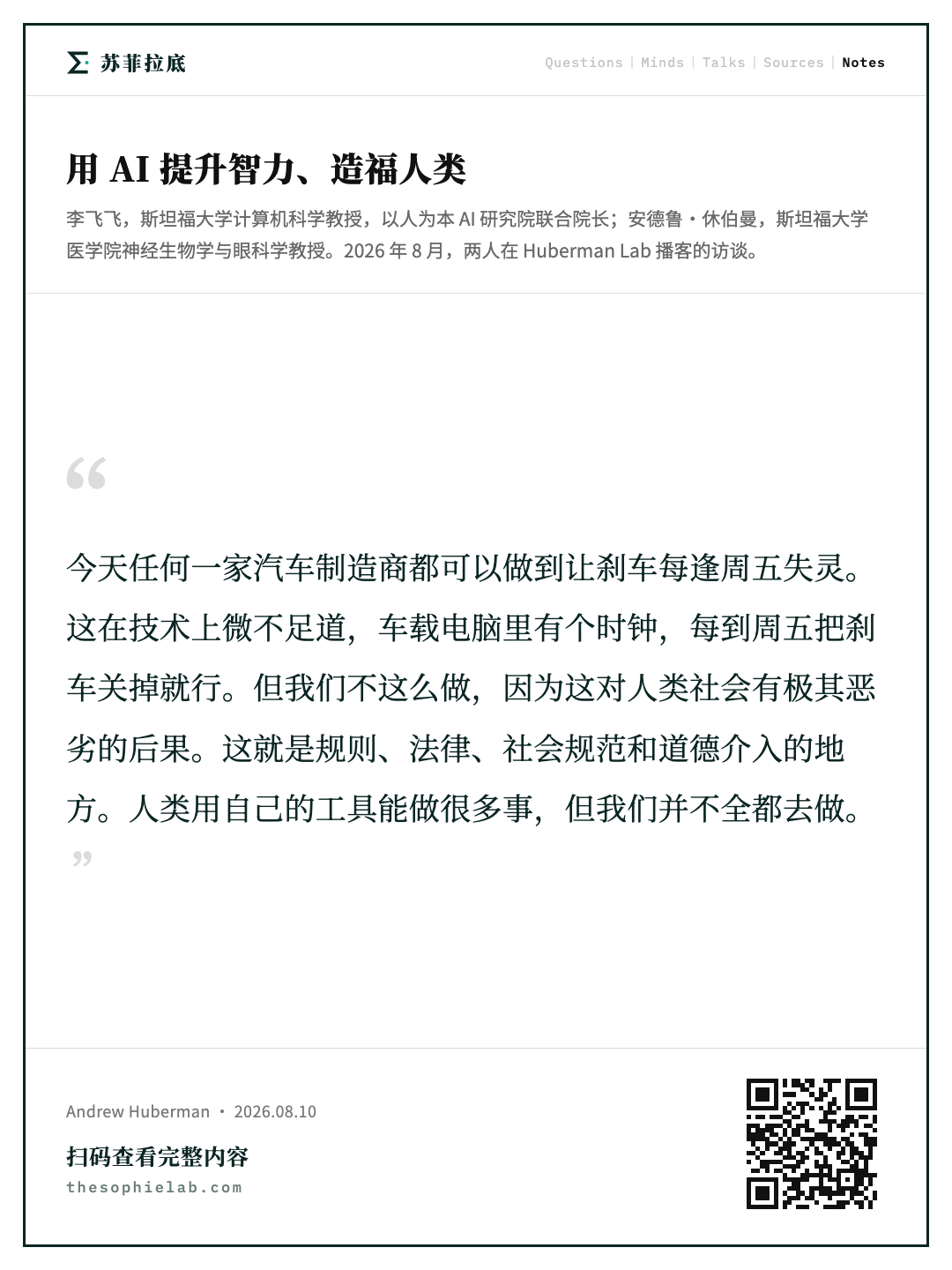
李飞飞:技术已经在那里了。但我们现在必须拉远一点,去想社会参数、法律含义。人类用自己的工具能做很多事,但我们并不全都去做。比方说,今天任何一家汽车制造商都可以做到让刹车每逢周五失灵。这在技术上微不足道,车载电脑里有个时钟,每到周五把刹车关掉就行。但我们不这么做,因为这对人类社会有极其恶劣的后果。这就是规则、法律、社会规范和道德介入的地方。我认为在这里,我们就离开了关于 AI 的纯技术讨论,需要进入关于 AI 的社会讨论。

休伯曼:那我们就谈这个。我了解生物学家和技术人员的一点是,他们喜欢快,因为那令人兴奋,那是下一个前沿。我记得很久以前有一位朋友研究病毒,不是传染病病毒,而是用来在动物体内表达基因的病毒载体,作为实验工具。后来出现了一个机会,可以把一种改造过的狂犬病毒放进果蝇里。

李飞飞:天啊。

休伯曼:在我看来,如果你百分之百确定那是一个没有功能的狂犬病毒版本,那没什么问题,因为你可以往里装别的货物,做各种重要的实验,信不信由你,包括关于疾病的实验。可要是只有一只果蝇不知怎么逃了出去,而你手里的是真的狂犬病毒,它就可能和另一只交配,然后找到其他同类。我不知道这是显性还是隐性的情形,但现在你就有了带狂犬病毒的果蝇,那些东西动得非常快。所以有理由不做这个实验。但他们想起来很兴奋,然后被否决了,有很好的理由。我很感激。你去任何一个生物系,都能看到果蝇在飞。顺便说,它们喜欢醋,所以会奔向你的沙拉。但重点是,技术人员喜欢快,喜欢感受下一个边缘。那么,政府、公众、技术人员之间,这里我先把生物学和医学放一边,这场对话怎样才能进行得让每一方都足够满意,又不拖我们的后腿?因为我们据说还处在一场 AI 竞赛之中,这要求更快而不是更慢。你怎么看这个问题?

李飞飞:安德鲁,这就是我八年前从谷歌回到斯坦福、创办以人为本人工智能研究院的原因。这些是我们必须面对的深刻的社会问题。2018 年还没有 ChatGPT,但作为 AI 科学家,我知道这只会加速。所以我去找同事和大学领导说,我们要搭一个框架。但这不只是我的框架或斯坦福的框架,整个社会都需要在方方面面对社会影响觉醒过来,就像人类历史上对汽车、飞机或生物技术所做的那样。它是多维度、多利益方的。有职业规范,比方说你们生物学家不会偷偷溜进实验室往果蝇里放狂犬病毒,因为那是职业规范和你们的伦理训练。有行业规则,比方说 IRB,今天大学校园里每一个人体实验都受伦理审查委员会的监管框架约束。然后还有法律和监管法规,取决于它是用于人还是用于作物之类。AI 必须走同样的路。我们需要职业规范,需要教育。计算机科学家没有受过伦理和社会研究的教育,他们才刚开始,这正是包括斯坦福在内的许多大学正在争分夺秒地把这部分课程加进教育里的原因。这是规范和教育。但我们也应该和政府合作。不同的政府和社会有不同的规范、传统和遗产,要看监管措施应该用在哪里。比如 AI 与生物学交叉的地方,FDA,我认为是一个非常重要的领域,要看 AI 应该怎样用来帮忙,也要设护栏防止伤害。我不愿看到的是,一个人或少数几个来自产业界的人告诉所有人该做什么。我认为那是危险的,因为市场力量不同于社会规范,文化和遗产不同于教育和伦理,这些是多方利益相关者要一起解决的问题。

休伯曼:我喜欢这个回答,这在当下也非常及时。我们谈话的这一部分肯定会随着时间扩展,但你正中靶心。

孩子学习的关键

休伯曼:我想听你谈谈人脑正在怎样被机器塑造,以及机器正在怎样被我们对人脑的理解塑造。先问第一个。很多人,家长和孩子,在想:我的孩子现在什么也学不到了,他们只会在聊天机器人上查。可回看学习的历史,类似的论调曾针对计算器、计算机、打字机,等等。不过这确实是个有趣的问题:我们头里的这套硬件,是为处理世界里的物理事物而进化的,光、声、气味等等。然后它前面加了一块很酷的东西,前额叶皮层,能学习「学习规则」,还能更新这些规则。所以如果说有什么,我们被赋予的是一台学会学习、并更新学习的机器。这就是孩子们能适应并使用大语言模型的原因。我这一代人是伴着个人电脑长大的,我在帕洛阿尔托长大,那时候是「这是 Pong,那是 Apple IIe」,我想,酷,大脑能围着技术成熟起来,和技术协作,我的生活因此大大丰富了。但我认为智能手机,也许是智能手机加摄像头的组合,正如乔纳森·海特(Jonathan Haidt)等人指出的,造成了这样一种局面:大多数人因为方便而喜爱这些技术,但我们现在都多少更清楚了,我们也在放弃一些东西,而且其中有陷阱,尤其是年轻人可能会掉进去。那么在你看来,非常乐观的、中性的和非常悲观的图景各是什么,如果这三种真的存在的话:年轻的大脑会被现有的 AI 丰富、不受影响,还是被伤害?我们就只谈现在有的东西。

李飞飞:好问题,安德鲁。答案几乎从我们前面的谈话里自己掉出来了,因为你用了「动机」这个词,我用的是「主体性」。绝对糟糕的结果是,我们的年轻一代,他们学习和生活的主体性以及人的动机被工具拿走了。无休止地刷屏,被动地看短视频,这些都无助于人的主体性。学习,如果尊重你说的这套硬件,是需要时间、需要努力、有时还需要一点痛苦的。我们的大脑就是这样。不管晶体管怎么动,我们的神经元以某种方式运作,我们的化学、我们的激素以某种方式运作。所以对年轻一代来说,不管社会怎么不同、工作怎么不同,我们的人体都需要经历一个深刻的发育阶段,学习必须在那里发生。而那份学习的主体性、学习的动机不能被任何人拿走,不应该被人拿走,也不应该被机器拿走。这是我的担心:如果 AI 用得不对,主体性和动机被拿走,那我们留下的将是一代又一代没有正确发育出那块砖的人。

李飞飞:另一种危险是,以主体性和动机的名义,把工具从学生手里拿掉,因为我们担心你作弊,担心你只是从 ChatGPT 那里拿到答案。那也很糟。因为有了恰当的主体性、恰当的动机、恰当的使用方式,我们可以用 AI 学得比以往任何时候都深。我刚在想,我当过一段时间医学预科生。天,有机化学太难了。我记得努力去学那些分子和它们的取向,可助教答疑时间太短,或者和我别的课冲了,教授的办公时间也有限。学那门课真是挣扎。如果今天我有一个 AI 伴侣,我会问无数关于有机化学的问题,因为我知道自己卡在哪里。我有学习的动机,我只需要指引。那对我的学习会是多么强大的工具。这是我们不应该拒绝给学生的。所以两件事都让我担心:要么拒绝给工具,要么拿走主体性和动机。当然反过来就很美好:让我们找到办法保住孩子和学生的动机与主体性,找到办法给他们使用这些工具的机会和正确方式。那么这一代、下一代以及未来的许多代人会比我们聪明得多,因为他们被赋予了超能力。

休伯曼:我喜欢这个回答。我对神经可塑性和年轻一代都抱有极大的信心。

李飞飞:也包括我们自己的,我知道我们老了。

休伯曼:没那么老。给自己一点肯定,可塑性贯穿一生。

李飞飞:我们自己的神经可塑性也是。我发现 AI 是我学习的好工具。

休伯曼:对我来说,发现它能做什么是一次了不起的经历。不过我倾向于在对某件事一无所知时以消费者的姿态去用它,在对所问的事有一些知识储备时以创造者的姿态去用它。

提示词是新技能

李飞飞:我还有另一层体会,是去年一位斯坦福本科生教我的。我意识到在 ChatGPT 之前,我有时候会偷懒:有问题就问身边我觉得聪明的人。现在我意识到,我不应该问懒问题,因为在占用别人的时间去问一个太懒的问题之前,获取信息已经容易得多了。AI 在逼我别太懒。

休伯曼:提示词的具体程度,对从 AI 那里得到最好的信息有多关键?

李飞飞:提示(prompting)非常重要。

休伯曼:而那是一项技能,对吧?

李飞飞:那是一项技能。这就是为什么公众教育如此重要,教育如此重要。我很希望看到我们的中小学教提示。我出一道小测验:谁是人类史上最好的提示者?

休伯曼:这道题我要挂了。

李飞飞:苏格拉底,如果他还活着。因为那就是提示的方法。想想看,苏格拉底的方法是什么?就是提示,就是通过提问来寻求真理。我们应该回过头去教孩子这个。

休伯曼:而且要边散步边讨论。

李飞飞:对。

具身智能

休伯曼:这或许正好可以过渡到具身 AI 这个话题。把一张会说话的脸和听到的话连在一起,是完全不同的世界。我的一位童年好友,希望你们很快能见面,因为你们俩的对话会让彼此受益,我只想做墙上的一只苍蝇。埃迪·张(Eddie Chang)博士,神经外科主任,生物工程师,研究言语和语言。他和其他人搞清楚了从神经活动到喉与咽控制的转换,把人从闭锁综合征里带了出来,让他们能说话。

李飞飞:哇。

休伯曼:十年来第一次,他有一位不幸瘫痪的患者能通过计算机说话。他还有很多这样的例子。但不可思议的是,当他开始在这位患者,尤其是一位坐轮椅的女士旁边放一台 iPad 时,他们有她婚礼上的视频,所以知道她的声音,知道她的情感表达模式,也知道一些她身体动作的习惯。现在她通过一台放在她那张冻住的真实面孔旁边的 iPad 说话,可以和世界互动,世界也可以和她互动,深度完全不同于只有一个麦克风,那种斯蒂芬·霍金式的东西。而且这套系统在通过机器学习不断更新,现在还会注意她在和谁说话、对方的反应。这就是具身。

李飞飞:是的。

休伯曼:虽然是在一块平面的二维屏幕上,但比起单纯的机器声音,甚至比起仅仅准确的声音,这是指数级的跃升。

李飞飞:这不只是人的具身,具身 AI 还延伸到机器人。我一直在说,AI 的下一个前沿在语言之外,因为人类是先在前语言阶段发展的,进化用了五亿年,没有语言交流。而且如果走对了路,有机器人帮助人类,世界会好得多。

休伯曼:能举些例子吗?我喜欢这个想法,但我意识到自己可能在技术的兔子洞里钻得太深了,这大概会吓到一些人。机器人,我们有自动驾驶汽车。Waymo 总是为我和我的小狗停下,我那只漂亮的六个月大的小狗。它想过马路,你怎么能不停呢?很多人不停,早上差点把我们撞倒。Waymo 非常有礼貌。

李飞飞:Waymo 必须学规则。

休伯曼:正是。那里有一种善意,人类身上并不总有。你觉得这会首先出现在哪里?如果我们把视野拉到十二个月以后,会是什么样?

李飞飞:对机器人来说十二个月有点太快了。

休伯曼:两年,三年。

李飞飞:我会说拉到三十年。

休伯曼:三十年。

李飞飞:我不是说机器人三十年后才第一次上街,我们已经有机器人汽车了。我只是说,涉及硬件的技术要真正落地需要更久。但我会说,希望在你我有生之年,我很想看到机器人成为社会的一部分,帮助我们。比方说,我是独生女,成年后要照顾两位年事很高、病得很重的父母,他们也恰好不说英语。我做的工作量是惊人的。我很希望有帮手。这不会拿走家庭的责任,不会拿走爱,不会拿走必要的沟通,但体力劳动的某些部分,我真的很想有人帮忙。我们住在加州,我们都经历的一件事是什么?

休伯曼:堵车。高税。

李飞飞:加州有些地方不堵车,但有野火。谁在扑灭这些野火?让人在自然灾害救援中冒险不是好主意。我的家庭和父母恰好有足够的条件,但我在想一个独居的老人怎么去买菜、怎么去拿药?现在我们开始看到一些配送,可要是他们想出去走走、想去公园呢?有太多事情。顺便说,你在医学院,我们的护理人员不是过剩而是短缺。我们的护士极度疲劳、过度劳累。过去一个月我一直在医院陪我父亲,看着护士做的那些事。我们知道一个班次里护士要走好几英里去取东西、拿药。太多了。你能想象机器人来帮忙吗?我们的社会有太多方式可以从这种帮助中受益。

休伯曼:我喜欢这些例子,听你描述,脑子里一下子蹦出好多。比如护送学生过马路的人。你可以想象,通过视频,一个因年龄或疾病困在家里的人可以自己「走」到商店,从货架上挑东西。不必脱节到只是编好程序、东西送回来,虽然那也可以是一个选项。我们得修正对这幅图景的想象,因为我认为机器人和计算机有几样东西让人害怕。一是它们物理上的坚硬。我们和它们共享空间的方式,与和其他东西共享空间的方式很不一样。当然,我不是想着和机器人拥抱,虽然有些人可能这么想,那不是我的心态。但我在想,如果我有一个能叠衣服、吸尘、浇花、喂鱼的机器人。不过我喜欢自己喂鱼,我真的喜欢看它们吃,喜欢触碰,和它们真正地接触,它们会从我手里吃东西。

李飞飞:你的小狗喜欢你的鱼吗?

休伯曼:喜欢,它有自己的鱼缸,我刚给它买了些热带鱼,就放在它的小窝前面。

李飞飞:它在照顾它们。

休伯曼:它只是看着。我想它还没能力照顾它们,很遗憾,它的前额叶皮层不够多。它很善良,但它是一只斗牛犬杂交,不是最聪明的品种。

李飞飞:它们只有几条学习规则,但非常善良。

休伯曼:要是你想要一只能照顾鱼缸的狗,大概得要西高地白梗之类,前额叶皮层更多。

李飞飞:带走它吧。

休伯曼:但我的意思是,如果一个机器人干一件事,另一个机器人干另一件,我的生活里就有一大堆硬件。我想人们大概就是这种感觉。

李飞飞:但你可以想象一个多形态的机器人。你知道大白(Baymax)吗?

休伯曼:不知道。

李飞飞:迪士尼大概十年、十五年前的机器人,搜一下图片。是一个白色的医疗机器人,一个医护机器人,不是毛茸茸的,是海绵状的,像一个大气球。

休伯曼:那你可能会喜欢。更多曲线。

李飞飞:对。

休伯曼:同一个机器人能多任务,那样的世界我能更快适应,比想象我的世界塞满机器人要好。

李飞飞:是的。安德鲁,当我们想象未来、谈论我们怎样想象未来时,我总是回到「主体性」这个词。人类应该有主体性来决定我们怎样想象这件事。不能只由一家公司或者某个投资者决定世界应该布满金属机器人。我们的社会应该集体地、主动地去想象。在这场 AI 话语里,我担心的一点是,公众被放在一个被动反应的位置上,感觉像是有些人在替大家做决定,而多方利益相关者没有参与共同设计未来。

休伯曼:就像你父亲手术的例子,把机器人和医生交叉起来。如果我们遇到一个问题,其中有一个漏洞,而机器人明显��让事情变好,图景就朝正确的方向改变了。我想到几个例子。我想大多数人会同意,如果孩子能自己走去上学、走回家,那很好,但你担心安全。可要是有个机器人是孩子真正的好守护者,好到能报警,甚至能在身体上保护你的孩子,那太棒了,给他们在世界里更多的主体性。再想想网上那些阴暗但确实存在的猎食行为。家长对孩子行为的监督只能到一定程度,孩子对正在发生的事的察觉也只能到一定程度。但你可以想象一个化身和你一起在里面,真正为你着想,能识别出问题,把猎食者挡在外面。

李飞飞:这是一个很好的创业点子。

谁来当 AI 时代的乔布斯

休伯曼:那会很酷。但对我来说,这幅图景里还缺了一样东西。我记得看见过一个了不起的人,我知道有人说他有点尖刻,但那是个了不起的人。我做博士后时,以及小时候在帕洛阿尔托玩具与运动用品店打工时,看见他在帕洛阿尔托市中心走来走去,那是史蒂夫·乔布斯。不穿鞋,看着像个嬉皮士。是的,他在公司里对人大吼,人力资源部门现在大概不会对他有好脸色。但他明白,我们叫作计算机的这些东西需要有圆润的边角,需要能贴合地放进口袋,需要在登录页放上鲍勃·迪伦或者别的什么,好软化人与技术的关系。有人会说这走得太远了,是特洛伊木马。但我不这么认为。需要一个真正懂人性的人,来让机器人与人类之间这些显然会是善意的协作得以发生。因为正如你指出的,我对建造 AI 的技术人员和做出惊人科学的科学家怀有全然的敬意,但不论是他们呈现自己的方式还是他们能分享的东西,都有一种坚硬,成了真正的隔阂。

李飞飞:是的。

休伯曼:我不是心理治疗师,但如果我能揽住他们的肩膀,我会说:听着,各位,你们是屋里最聪明的人,男的女的都算,公平地说,你们是屋里最聪明的人。但人们不喜欢你们,因为不理解你们。也许你们需要一个合作者,帮你们用一种不让媒体钻空子的方式分享愿景。因为媒体在制造这道鸿沟上是有罪的,它们说的是「这些技术人员来抓我们了」。我认为这完全是媒体的把戏,只是为了往自己口袋里装钱。现在的局面很复杂。那么,谁是那个史蒂夫·乔布斯,或者史黛西·谁谁,可以是男人也可以是女人,一个真正理解人的人?

李飞飞:很多。有很多这样的人。斯坦福创办了以人为本人工智能研究院。

休伯曼:有你。有你在。

李飞飞:好,但还有很多。有很多创业者在做出色的 AI 创业,AI 药物发现、AI 医疗、AI 老龄化、AI 心理健康,这些人关心 AI。有很多设计师和产品经理在努力。我确实认为,扬声器过多地对准了那些拍着胸脯、用某种特定方式谈技术的人。所以即便是这个播客,我希望,也在做出积极的改变,把人的角度、圆润的人的角度、人的视角、人的未来放进这些对话里。我不觉得绝望,安德鲁。我是教育者,是建设者,是技术人员。我看到身边很多人,包括我整个创业公司,这些杰出的年轻技术人员可以加入任何他们想去的创业公司或大公司,但他们来 World Labs,因为他们想赋能于人。所以我看到很多人。但你说得对,我不认为现在的公共话语是平衡的,极端言论太多。要么是极端的末日论、缺乏安全,把人吓坏;要么是极端的乌托邦,好像技术不会出任何差错,这是不诚实的,人们会说,好吧,你们是既得利益者,当然这么说。所以我认为我们应该回到中间,谈这项技术是什么、怎么用、我们怎样集体地拥有那份主体性去引导未来。

休伯曼:一位播客同行向我指出过一件本该显而易见却被我忽略的事,而这显然是你所体现的诸多东西之一:人们其实不想听关于机器的故事,但人们喜欢听某个人治好了自家狗的癌症,或者孩子出现了莫名其妙的症状,医生们毫无头绪,而指尖上的 AI 解决了问题。这些故事才真正需要放大,因为我们能与之共鸣,它们是美好的故事,不可思议的故事,可它们得到的关注远不及别的那些。

李飞飞:是的,这是个挑战。

休伯曼:传统媒体并不真正关心事情的长弧,它们的周期是十二到二十四小时。有没有别的名字,那些真正在谈 AI 善意使用、我们应该了解的这类协作的人?

李飞飞:斯坦福 HAI 的通讯、我们的网站、我们的研讨会,推介了很多这样的工作。

World Labs 与想象的世界

休伯曼:我很想多了解你的创业公司,因为你选项目从不随意。这个项目是什么?目标是什么?

李飞飞:我和另外几位联合创始人创办的公司叫 World Labs,2024 年初成立。对我来说,它确实是我毕生工作的一种延续。你知道,我们都出身视觉,而认识到语言之外还有更多的智能,正是促使我认真思考 AI 前沿下一章的动力。我们认识到,解锁空间智能和物理智能是下一章。这不是排斥语言,语言技术当然了不起,而是我们可以投入更多时间去构建模型,最终构建产品,来解锁空间智能方面的能力,比如生成三维、四维的世界,对创作者、机器人训练、建筑设计都极其有用,或者用来打造那些可交互的环境。不论是医疗、教育、机器人还是工业用途,这些能力都超出了语言本身。World Labs 就是基于这个前提创办的。我们还是一家年轻的公司,很大程度上是一家以模型为中心的公司,在构建基础模型,创始团队里有很多博士,但现在我们开始做产品了。这还只是开始,非常令人兴奋。作为技术人员,我内心深处觉得自己是一个建设者。也许因为我也是移民,卷起袖子,和极其聪明的年轻一代一起从零开始造一样东西,实在太让人兴奋了。

休伯曼:我记得十五、二十年前,有汽车在街上跑着拍图像。

李飞飞:现在还在跑。

休伯曼:还在跑着拍。当然也有航拍。但你可以想象小小的无人机,就像那种可以穿过一个神经元把一切看遍的东西,打个比方,或者无人机去采集挪威峡湾每一个角落的信息。有人做过这种事来绘制三维世界吗?

李飞飞:首先,别把它说得像无人机要闯进人们的家和地产那么可怕。捕捉世界影像的能力确实在飞速进步。我们的手机是不可思议的传感器,它们不是无人机,但人们拍很多照片,摄像头技术当然也进步了。World Labs 做的不只是拍摄现实世界的图像,我们让人们想象自己心眼里的东西。只要你能打一句话,或者给一张图、一张草图,描述你想象的东西,我们就试着把它变成世界和环境。为什么有用?因为娱乐业会用,设计业会用,机器人行业会大量用在训练环境上,等等。把捕捉现实世界和捕捉你想象中的世界结合起来,是新的前沿。

休伯曼:如果你不介意,我想再花几分钟谈谈从想象到某个实物的过程。因为这里是洛杉矶,我想到很多人写剧本,然后试图把电影拍出来。但有了 AI,理论上你可以把剧本交给 AI,它就能把电影做出来,从文字到画面到视频,也许在需要的地方稍微剪一剪。有人做过吗?有没有一部成功的电影从头到尾用 AI 做出来?

李飞飞:这是一个非常微妙的话题。这也是人们对 AI 和创造力感到不安的地方,如果不小心,听起来就像我们要拿走讲故事的人和创作者的工作。所以我们先把工作的话题和技术的话题稍微分开,尽管它们是纠缠在一起的。技术已经进步到这样的程度:拿剧本生成镜头、生成视频镜头,做得越来越好了。我们已经看到短片,甚至接近正片长度的电影,是用 AI 工具组装出来的。有很多公司,美国的、亚洲的,在做这种技术。但依然深深属于人、而且重要的是,讲故事和创作故事的每一个部分背后都是人,带着他们独特的情感、故事、技巧、看世界的方式、运镜的方式、刻画人物的方式。好莱坞和小说写作很大一部分就是这个。所以怎样用现代工具满足人类讲故事的需要和渴望,实际上是一个挑战。因为好莱坞有一种很强的恐惧,怕 AI 接管,怕讲故事的人、演员、编剧的工作受到冲击。我认为确实有冲击,但是怎样冲击的?我们在做什么?谁在以建设性的方式工作?这不是我的行业,但我很希望看到这方面有更多细致的工作,也有更细致的公共讨论。不过我确实认为,就像我们前面谈到 AI 能迅速改变和颠覆医疗的旧做法,AI 也绝对在改变我们讲故事的方式。说到这个,有一个故事:我有一位联合创始人叫本(Ben),本和我见了本·阿弗莱克(Ben Affleck)。我开玩笑说本见本。他在用 AI 工具做电影这件事上想得也很前卫。所以此刻技术人员和讲故事的人或电影人之间的对话至关重要。

休伯曼:我觉得在每一个技术的例子里,都有一个交叉点:当一个真正的圈内人接纳了某项技术,事情就起飞了。比如史蒂文·斯皮尔伯格,或者这可能不是最好的例子,比如乔布斯和沃兹尼亚克的交叉:一个对技术好奇的设计者,和一个真正的计算机科学家,请原谅我引用那部乔布斯电影。这些协作是真正的关键。你需要一个圈内人和一个圈外人才能做对,因为你必须理解两种文化,以及如何把行业里的人包括进来。

李飞飞:所以我真的希望如此。World Labs 也和视觉特效行业合作,对我来说非常重要的是,我们的客户和用户感到被赋能。技术不应该拿走他们的工作,技术应该让他们的工作更好,给他们的创造力超能力。这是我看待这项技术的方式,也是我想与用户和客户合作的方式。

休伯曼:想想真是奇妙。我小时候在帕洛阿尔托的加利福尼亚大道上,有一家店叫 Keeble & Shuchat,就是一家照相馆和相机店。你进去冲胶卷,柜台后面站着一排人,告诉你可以租长焦镜头之类。那些都不存在了,一切都数字化了。但相机店还在。所以行业可以变形,不总是被消灭。

李飞飞:对,它会变形。人也会再技能化、提升技能。我们在和很多用 AI 工具的创作者合作,因为他们看到了技术的走向,想让自己再技能化、提升技能。所以我认为变化的时刻既是机会的时刻,也是失去的时刻,我们需要对此非常审慎。

被遗忘的老师

休伯曼:我最后一个问题是关于年轻一代。他们对 AI 怎么看?

李飞飞:你说的多年轻?

休伯曼:七岁到二十岁之间的孩子。

李飞飞:好,那正好是我的孩子。

休伯曼:所以我问这个问题也许是有原因的。他们怎么看?他们兴奋吗?因为有这样一种现象:计算机来了,你的书法老师就紧张,人们不再手写而是打字了。现在大家都用指尖写字,没人会写字了。这类故事流传很久了,说如果我们不像拥抱未来那样拥抱过去,我们就会溶解成一滩自己的神经元。我愿意认为两者兼顾才重要。但孩子们感觉如何?他们怎么想?

李飞飞:这实际上是我作为教育者和技术人员的心头项目。我走到哪里都试着和学生、家长、老师交谈,因为我认为他们是最被遗忘的群体。我们的政策制定者、技术人员和投资人不谈老师、家长和学生。他们都有看法,都有孩子,但不谈这个。我对孩子总是抱有希望。也许因为我是教育者,我认为人类始终学不会的最大一件事,就是老一代哀叹下一代,好像下一代什么都不懂,他们粗鲁,他们忘了过去。但如果你看人类历史的长弧,总体上我们是在向好的方向前进。我不否认那些暴行,不否认那些倒退,我不否认这些。但从根本上,我对人类是乐观的。这是我的出发点。如果你是彻底的悲观主义者,也许我们从一开始就站错了脚。我看孩子们,他们好奇,这就是为什么他们是孩子,他们好奇。当然他们被这项技术娱乐得不行,但他们也开始使用它了。

李飞飞:我担心的是老师和一部分家长,因为我认为今天的社会,尤其是硅谷,没有为他们做好服务。我们在遗忘他们,在训诫他们,在斥责他们,在看低他们。他们是我们社会里最重要的人。我们应该和他们对话,抬举他们,支持他们,给他们资源。从幼儿园到十二年级,乃至到大学的老师,承担着我们社会最重要、最关键的负担。我讲一个真实的故事。2022 年 11 月,ChatGPT 出来了。显然我在技术上是个圈内人,但我做的第一件事是给我孩子所在小学的校长发邮件,说我想来给你们的学生和老师做一次客座讲座。不是因为我有多特别,而是因为我想让他们实时知道正在发生什么。因为在硅谷没有人,没有投资人,没有几十亿美元的投资公司,没有几百万、几万亿美元的公司,在 ChatGPT 出来时首先想到的是「我们社区里的老师怎么办」。没有人这么想。但我们需要和老师对话,需要给老师展示。当然,他们会问孩子作弊怎么办。没关系,他们问这些问题很正常。我们就展示给他们看,和他们一起工作,赋能他们,让他们自己想出应对的办法。他们也很聪明,他们渴望改变,只是被遗忘了。所以我对孩子有希望,但为了不让这希望变成盲目的希望,我认为我们都应该记得我们的老师,帮助我们的老师和家长,这样才能帮到我们的孩子。

休伯曼:我太喜欢这个回答了,我知道很多听众都有同样的感受。上帝保佑老师们,他们需要帮助、支持和信息。因为现在他们打开播客,不是你的,是大多数播客,只会被吓到。他们听到末日论者,或者听到有人说「别担心,一切都会很美好」。这两种信息都帮不了老师,而老师得不到帮助,孩子就得不到帮助。

李飞飞:完全同意。

休伯曼:飞飞,非常感谢你从极其繁忙的日程里抽出时间。很高兴听到你父亲平安,照顾父母和孩子也是你日程的一部分,而你还来教我们这件不仅重要、而且是我们所处位置和前进方向的重要一块。基于你今天分享的东西,我怀着更大的、带着审慎的乐观。也谢谢你一路教了我们更多的神经科学,因为这些机器受大脑启发,大脑也被这些机器所启发,这就是我们生活的世界。我怀有极大的乐观,很大程度上是因为这个世界上有你。

李飞飞:谢谢你,安德鲁,我非常珍视这次谈话。这是一个文明层面的时刻。
本期讲者
李飞飞斯坦福大学计算机科学教授,以人为本 AI 研究院联合院长,ImageNet 数据集创建者,被称为「AI 教母」。2024 年创办空间智能公司 World Labs,著有自传《我看见的世界》。
安德鲁·休伯曼斯坦福大学医学院神经生物学与眼科学教授,主持播客 Huberman Lab,研究视觉系统与神经可塑性,2025 年出版首部著作《Protocols》。
章节 · 点击跳转视频
0:00 冷开场与节目引入:被遗忘的老师 ▶ 正在看
4:25 视觉是智能的基石:从三叶虫到 ImageNet ▶ 正在看
12:37 2012 拐点:算法、数据与 GPU 的汇合 ▶ 正在看
23:53 猫尾巴问题:孩子十只猫,AI 整个互联网 ▶ 正在看
33:42 互联网之外:未被上传的念头与第 37 手 ▶ 正在看
45:42 增强而非取代:能动性、尊严与话语失衡 ▶ 正在看
57:42 AI 进医学:眩晕误诊与达芬奇肝脏手术 ▶ 正在看
1:07:39 直觉、动机与共情:机器为何没有 ▶ 正在看
1:20:54 从技术讨论到社会讨论:果蝇与狂犬病毒 ▶ 正在看
1:27:51 年轻大脑与 AI:学习动机不能被拿走 ▶ 正在看
1:35:05 具身 AI、照护机器人与 World Labs ▶ 正在看
1:59:24 结语:孩子有好奇心,老师需要支持 ▶ 正在看
本期论点
本期回应
1:36:52
李飞飞:AI 的下一个前沿在语言之外,人类最初的发展同样是前语言的 不能光靠文字,能学会语言的意思吗?李飞飞
其他论点
0:39
李飞飞:AI 面前真正被落下的不是孩子,而是老师和一部分家长 李飞飞
5:56
李飞飞:感光能力的出现催生了寒武纪物种大爆发,感知是进化加速的根本动力 李飞飞
10:52
李飞飞:AI 长期停滞的主因是数据匮乏,而非算法不足 李飞飞
22:50
李飞飞:从 ImageNet 到 ChatGPT 的配方没变,只是模型更强、数据更多、算力更大 李飞飞
28:13
李飞飞:孩子见过几只猫就能认出藏起的猫尾巴,人脑的学习路径不同于海量数据训练 李飞飞
41:50
李飞飞:AlphaGo 的第 37 手算创造力,但那是依赖明确数学目标与算力的特殊创造力 李飞飞
50:51
李飞飞:围绕 AI 的公共话语已经失衡,懂行的人往往居高临下地对公众说话 李飞飞
56:30
安德鲁·休伯曼:不告诉别人东西是怎么运作的,本身就是一种权力 安德鲁·休伯曼
1:06:32
李飞飞:即便汇总全世界的肝脏手术数据,也不足以训练出能自动操刀的 AI 李飞飞
1:08:09
安德鲁·休伯曼:直觉可拆解为经验数据、身体感受和预测线索,这些规则完全能交给计算机 安德鲁·休伯曼
1:12:53
李飞飞:连本人都无法用言语或动作表达的直觉,他人和机器都无从获取 李飞飞
1:18:07
李飞飞:机器说「很遗憾你病了」只是模式学习的输出,与朋友出于共情说同一句话完全不同 李飞飞
1:30:19
李飞飞:学习需要时间、努力乃至一些痛苦,这一点不会因技术进步而改变 李飞飞
1:31:22
李飞飞:以防作弊为由把 AI 工具挡在学生之外,同样非常糟糕 李飞飞
01冷开场与节目引入:被遗忘的老师
0:00
I think the biggest thing humanity never learns is the older generation lamenting about the future generation as if the future generation doesn't know anything. They're rude. They're they're they're forgetting the past. But if you look at arc of history, of humanity, by and large, we advance for the better. Now, I'm not denying the atrocities. I'm not denying the setbacks. I'm not denying this. But fundamentally I'm a optimist in humanity. I look at kids, they're curious. Of course, they get massively entertained by this technology, but they also are starting to use it. What I worry about are teachers and some parents because I think our society today and especially Silicon Valley are not doing them a service. We're forgetting about them.
我觉得人类始终学不会的最大一件事,就是老一辈总在哀叹下一代,好像下一代什么都不懂似的。说他们没礼貌,说他们忘了过去。说他们粗鲁,说他们忘记了过去。但如果你看看人类历史的整体走向,总体上我们是在朝好的方向前进。当然,我不否认那些暴行,不否认那些倒退,我不否认这些。但从根本上说,我对人类是乐观的。我看那些孩子,他们充满好奇心。当然,他们会被这项技术深深地娱乐到,但他们也开始在使用它了。我真正担心的是老师和一部分家长,因为我觉得我们今天的社会,尤其是硅谷,并没有真正为他们提供帮助。我们把他们给忘了。
便签引用
0:52
Hey everyone. To celebrate the launch of my new book entitled Protocols, I'm pleased to share that I'll be hosting three live events very soon. The first live event is in New York City at Radio City Music Hall on September 17th. The second event is in Los Angeles at the Dolby Theater on October 8th. And the third live event is in San Francisco at the Masonic on October 28th. At each of these events, I'll be discussing topics from the book and my favorite part, taking questions directly from you, the audience. To get tickets, you can go to hubermanlab.com/events and use the code protocols to get early access. Again, that's hubermanlab.com/events and use the code protocols to get early access to tickets. Welcome to the Hubberman Lab podcast where we discuss science [music] and science-based tools for everyday life.
大家好。为了庆祝我的新书《Protocols》出版,我很高兴地宣布,我很快将举办三场线下活动。第一场在纽约市的无线电城音乐厅,时间是9月17日。第二场在洛杉矶的杜比剧院,时间是10月8日。第三场在旧金山的共济会礼堂,时间是10月28日。在每一场活动中,我都会聊聊书里的内容,还有我最喜欢的环节——直接回答你们观众的提问。购票请访问 hubermanlab.com/events,使用优惠码 protocols 即可提前购票。再说一遍,网址是 hubermanlab.com/events,使用优惠码 protocols 就能提前购票。欢迎收听Huberman Lab 播客,在这里我们探讨科学[音乐]以及基于科学的日常生活实用方法。
便签引用
1:42
[music] I'm Andrew Huberman and I'm a professor of neurobiology and opthalmology at Stanford School of Medicine. My guest today is Dr. Fay Lee, a computer scientist and professor at Stanford and one of the pioneers and luminaries of artificial intelligence and computer vision. As you all know, millions of people use AI chat bots to look up information every single day. And of course, many people are concerned about AI, where it's going, and how it might replace certain human jobs or degrade our experience of life in one way or another. Today we discuss from a neuroscience perspective what intelligence really is and the ways that AI can and is being used for good meaning to truly enhance learning health and to enrich rather than diminish the human experience. We start off by talking about how human brains of all ages learn new information. What rules the brain follows in that process and how AI because it is based on the content of the internet both resembles and falls short of what human brains can
[音乐] 我是 Andrew Huberman,斯坦福大学医学院神经生物学和眼科学教授。今天我的嘉宾是李飞飞博士,计算机科学家、斯坦福大学教授,也是人工智能和计算机视觉领域的开拓者和杰出人物之一。大家都知道,每天有数百万人使用 AI 聊天机器人来查找信息。当然,也有很多人担心AI 的走向,担心它可能取代某些人类工作,或者以这样那样的方式让我们的生活体验变差。今天我们会从神经科学的角度探讨,智能到底是什么,以及 AI 能够、并且正在如何被用于正途——也就是真正提升学习和健康水平,丰富而不是削弱人类的体验。我们会先从各个年龄段的人脑如何学习新信息聊起,大脑在这个过程中遵循哪些规则,以及 AI 由于建立在互联网内容之上,在哪些方面与人脑的学习能力相似,又在哪些方面远远不及。
便签引用
2:42
learn. and we discuss exciting uses of AI and robotics in medicine. To be clear, FFE acknowledges and addresses the many valid concerns about AI. But as the director of the Stanford Institute for Human- Centered Artificial Intelligence, her goal is to make sure that humans and humanity at large are represented in where AI goes next. As you'll soon hear, Dr. Fa Lee is an extraordinary scientist and educator. She has been called the godmother of AI for her ushering in of AI technologies, but also for her insistence that the ethics and benevolent uses of AI stay central to AI and robotics. So whether you are young or old, today's conversation will inform and empower you to understand and use AI in ways that truly benefit you and enrich your life.
我们还会聊到 AI 和机器人技术在医学领域令人兴奋的应用。需要说明的是,飞飞承认并且正面回应了关于 AI 的诸多合理担忧。但作为斯坦福以人为本人工智能研究院的院长,她的目标是确保在 AI 的未来走向中,人类和整个人类社会的利益能够得到体现。你很快就会听出来,李飞飞博士是一位非凡的科学家和教育家。她被称为「AI 教母」,不仅因为她推动了 AI 技术的兴起,也因为她坚持要让伦理和 AI 的良善用途始终处于 AI 与机器人技术的核心位置。所以无论你是年轻人还是年长者,今天这期对话都会给你启发和力量,让你理解并以真正有益、真正能丰富生活的方式使用 AI。
便签引用
3:28
Before we begin, I'd like to emphasize that this podcast is separate from my teaching and research roles at Stanford. It is however part of my desire and effort to bring zero cost to consumer information about science and science related tools to the general public. In keeping with that theme, today's episode does include sponsors. And now for my discussion with Dr. Fay Lee. Dr. Fay Lee, welcome. >> Thank you. I'm excited to be here, Andrew. >> Yeah, this is a long time coming. And yes, >> you are a luminary in this AI field, but I also consider you a neuroscientist and computer scientist, and we share a common path through vision science. And so I'd like >> and fellow colleagues >> and fellow colleagues at Stanford. So I'd like to start in vision. What is so special about vision and seeing and light as it pertains to AI and where it's all going? Because I think for most people those probably sound like very divorced themes but actually that's where it all starts.
在开始之前,我想强调一下,这档播客与我在斯坦福的教学和科研工作是相互独立的。不过,它确实是我的一个心愿和努力的一部分:向大众免费提供关于科学以及科学相关工具带给大众。秉持这个理念,今天这期节目确实包含赞助内容。下面是我与李飞飞博士的对谈。李飞飞博士,欢迎你。>> 谢谢。很高兴来到这里,Andrew。>> 是啊,这次对谈盼了很久了。是的,你是 AI 领域的杰出人物,但我同时也把你看作一位神经科学家和计算机科学家,而且我们都是从视觉科学走过来的。所以我想 >> 也是斯坦福的同事>> 也是斯坦福的同事。所以我想从视觉聊起。视觉、看见和光,对 AI 以及它未来的走向来说到底有什么特别之处?因为我想对大多数人来说,这些听起来像是完全不相干的主题,但实际上一切正是从那里开始的。
便签引用
02视觉是智能的基石:从三叶虫到 ImageNet
4:25
>> Yeah. I see vision as a cornerstone of intelligence in almost two parallel way. One is what evolution has taught us. You know what's the evolution of vision and animal intelligence and human intelligence. The other one is computer vision and AI what that relationship is. So I'll go into each evolution. I always say that 540 million years ago animals saw the first light. These are simple sea ocean animals, trilobytes and and the the cousins. And before that there was very little sensing. Uh around that same time tactile and haptics was starting also to emerge in animal bodies but but there was no hearing. There's no you know smelling there's no but there's absolutely no nervous system. But the first photoreceptive cells created a evolutionary force that propelled animals to evolve because sensing the external world changes your self-perception changes the way your relationship with the external world. To put it simply, if you seek you can see food, it changes your your life, right?
>> 是的。我把视觉看作智能的基石,可以从两条并行的线索来看。一条是进化告诉我们的东西,也就是视觉的演化与动物智能、人类智能的关系。另一条是计算机视觉与 AI,以及它们之间是什么关系。我先分别讲讲。进化方面,我常说,5.4 亿年前动物第一次看见了光。这些是简单的海洋生物,三叶虫以及它们的近亲。在那之前几乎没有什么感知能力。大约在同一时期,触觉也开始在动物身体上出现,但那时还没有听觉,没有嗅觉,什么都没有,甚至完全没有神经系统。但最早的感光细胞创造了一股进化的力量,推动动物不断演化,因为感知外部世界会改变你的自我认知,会改变你与外部世界的关系。简单来说,如果你能看见食物,那就改变了你的生活,对吧?
便签引用
5:45
from a evolution point of view and you become someone else's food and also you're actively seeking food. You're actively seeking mates and and and all that. So really because of sensing and perception evolution took a incredibly accelerated pace in terms of uh animal speciation. Fossil studies have told us that 10 million years after the first uh light for animals was what we call the the big ban of evolution or Cambrian explosion of animal speciation. And fast forward I think vision has always played a huge role in not only in the early evolution of animals but as well as um advanced intelligence and how that emerged. You and I are both vision student and and scientists. It is estimated half of the cortical AC activities in human brain is involved in visual function.
从进化的角度看,你会成为别人的食物,同时你也在主动地寻找食物。你在主动寻找配偶等等。所以正是因为有了感知和知觉,进化在动物物种分化上以极其加速的步伐推进。化石研究告诉我们,在动物第一次看见光之后的一千万年里,出现了我们所说的进化大爆发,或者叫寒武纪物种大爆发。快进到今天,我认为视觉一直扮演着巨大的角色,不仅是在动物的早期进化中,也在高级智能及其如何涌现的过程中。你和我都是研究视觉的人。据估计,人脑中大约一半的皮层活动与视觉功能有关。
便签引用
6:51
Children were first visual before they were verbal in development. So vision really to this day plays a central role in both the evolution of animal intelligence as well as in the daily life of human human life. Now in parallel, vision as a uh as a discipline or as a area of uh artificial intelligence was really played a pivotal role in what we see as this modern AI moment in a couple of ways. First of all is the the uh algorithms the neuronet network algorithms. Neural network algorithms were first computer scientists start dabbling that in the early 1950s.
在发育过程中,孩子先有视觉,然后才有语言。所以直到今天,视觉都扮演着核心角色,无论是在动物智能的进化中,还是在人类的日常生活中。与此并行的是,视觉作为一门学科,或者说作为人工智能的一个领域,在我们所看到的这个现代 AI 时刻中,确实起到了关键作用,主要体现在几个方面。首先是算法,也就是神经网络算法。计算机科学家最早开始摆弄神经网络算法是在20 世纪 50 年代初。
便签引用
7:48
And [snorts] Andrew, you might remember what's happening on the neuros side in the early 1950s is that neuroscientists like Hubo and Viso were starting to record visual cells in malian brain and starting to realize there is a hierarchical structure of nervous cells that stack against each other and pass neuroinformation across these hierarchy. And it goes from you know collecting light from retina all the way to recognizing there is a shape in front of you. And that very neuro architecture that we see in mamalian brain is also part of the inspiration of neuronet network algorithm. Now today's neuronet network algorithm runs on hundreds of billions and even trillion of parameters. It has the complexity that departs from what we recorded in the mamalio uh brain or the visual pathway but the origin is very close to each other about half a century ago um a little more than half a century ago. That's one aspect of uh vision's contribution to AI. There is another aspect of vision's contribution to AI
而且 [吸鼻子] Andrew,你可能还记得 50 年代初神经科学那边在发生什么:像 Hubel 和Wiesel 这样的神经科学家开始记录哺乳动物大脑中的视觉细胞,并开始意识到神经细胞存在一种层级结构,一层叠一层,神经信息在这些层级之间传递。它从视网膜采集光线开始,一直到识别出你面前有一个形状。而我们在哺乳动物大脑中看到的这种神经架构,也正是神经网络算法灵感的一部分来源。当然,今天的神经网络算法运行在数千亿甚至上万亿个参数上。它的复杂程度已经远远超出我们在哺乳动物大脑或视觉通路中记录到的东西,但它的起源在大约半个世纪前是非常接近的,或者说比半个世纪稍多一点。这是视觉对 AI 贡献的一个方面。视觉对 AI 还有另一个同样关键的贡献,那就是通过
便签引用
9:11
that is also pivotal which is through big data is that that comes closer to my own work is that AI around the century was a field of machine learning a lot of different labs different research scientists were were trying out different algorithms and it's not just neuronet network there are other methods jargon words like Beijian methods, support vector machine methods. It doesn't matter what these methods are, but it's a explorative phase that we're trying to get these algorithms to work so that we can empower the machine to read or to see. A group of us computer vision scientists were struggling with these algorithms and uh I was a very young faculty um first year faculty 2006 at Princeton and my students and I are looking at these algorithms and how little data were fed into these algorithms to learn.
大数据,这一点更贴近我自己的工作。世纪之交前后的 AI 是一个机器学习的领域,很多不同的实验室、不同的研究者都在尝试不同的算法,而且不只是神经网络,还有其他方法,一些术语比如贝叶斯方法、支持向量机方法。这些方法具体是什么并不重要,重要的是那是一个探索阶段,我们想让这些算法跑起来,好让机器能够阅读或者看见。我们一群计算机视觉研究者在这些算法上苦苦挣扎,而我当时是一名非常年轻的教职人员,2006 年在普林斯顿刚当上第一年的助理教授,我和我的学生们在研究这些算法,以及喂给这些算法去学习的数据有多么少。
便签引用
10:19
So I turned to cognitive neuroscience literature per namely vision literature and started to study how much humans learn, how much humans can see and the numbers were incredible. Humans were by age six can learn tens of thousands of different object categories and the exposure to visual world is also massive. Right? babies can see the mo most of the time the moment they're born. So they're inundated with this big data. So we conjectured that the lack of data was a huge part of the reason that's the lack of progress in AI. So we took a departure from everybody else who are really focusing only on algorithm and said that we need data. we need data to drive these algorithms. So long story short, we led this um image that project that collected the first ever internet scale large data set for the field of artificial intelligence, but really through the field of vision because imageet is a collection of 15 million images. And the goal of imageet was to drive machines to recognize everyday objects, you know, microphones, cups,
于是我转向认知神经科学的文献,尤其是视觉方面的文献,开始研究人类到底能学多少,人类能看见多少,那些数字令人震惊。人类到六岁时就能学会数以万计的不同物体类别,而且接触到的视觉世界也是海量的。对吧?婴儿从出生那一刻起,大部分时间都在看,所以他们被这些大数据所淹没。因此我们推测,数据的缺乏很大程度上就是AI 缺乏进展的原因。所以我们和所有只专注于算法的人分道扬镳,提出我们需要数据。我们需要数据来驱动这些算法。长话短说,我们主导了 ImageNet 这个项目,收集了人工智能领域有史以来第一个互联网规模的大型数据集,但它真正的出发点是视觉领域,因为 ImageNet 是一个包含 1500 万张图像的集合。ImageNet 的目标是驱动机器识别日常物体,比如麦克风、杯子、
便签引用
11:45
chairs. And that work converged with the advances in neuronet network algorithm as well as in GPU computing. And by 2012 that work uh that the convergence of the three elements of modern AI became the defining moment of what um what modern AI is. I recall somewhere around 2012 it seems there was this debate at this vision course at Cold Spring Harbor that was held every other summer like could a computer learn to recognize specific faces as well as humans. Now I think most people would say computers are actually much better at it than humans are even though you have these super super recognizer people who are exceptional at this.
椅子。而那项工作与神经网络算法以及 GPU 计算的进展汇合在一起。到了 2012 年,那项工作,也就是现代 AI 这三大要素的汇合,成为了定义现代 AI 的那个时刻。我记得大概在 2012 年前后,在冷泉港每隔一年夏天举办的那个视觉课程上,似乎有过一场辩论:计算机能不能学会像人一样识别特定的人脸。现在我想大多数人会说,计算机在这方面其实比人强得多,尽管确实有那种超级识别者,他们在这方面异常出色。
便签引用
032012 拐点:算法、数据与 GPU 的汇合
12:37
>> Could you tell us how is it that this technology went from a state basically where it would confuse you and maybe a a a cousin or or even someone that looks somewhat like you could >> or to the point where uh to the point where now it is exquisitely precise. >> How do we get here? I want to definitely double triple click on the convergence of this technology. I think around the second decade of 21st century. So like you said around 2012 the the huge convergence was the capability of GPU computing which basically accelerated or parallelized computing so that you can have more flops going through algorithms right you need that speed then you also have a um after many decades of research neuronet network algorithm them is getting more mature. Um you know starting as we said 1950s people start to um create these very simple algorithm that behaves similarly to neurons but much simpler.
>> 你能给我们讲讲,这项技术是怎么从基本上会把你和你的某个表亲搞混,或者甚至把某个长得有点像你的人认成你 >> 发展到如今 >> 发展到如今极其精准的地步的吗?>> 我们是怎么走到这一步的?我很想深入、再深入地聊聊这项技术的汇合。我想大概是在21 世纪第二个十年。就像你说的,2012 年前后,这个巨大的汇合首先是 GPU 计算的能力,它基本上加速了、或者说并行化了计算,让更多的浮点运算能够跑过算法,对吧,你需要那个速度;然后你还有,经过几十年的研究,神经网络算法变得更加成熟了。嗯,就像我们说的,从 50 年代开始,人们创造出这些非常简单的算法,它们的行为与神经元有些相似,但简单得多。
便签引用
13:53
Neurons as you know are very complex but here the idea is that you have one unit of node that takes some some input and outputs another input and within it it's just a function a very simple function. So you stack them together. That's what neuronet network is. But by by the time it's in the um after you know around 20 uh 2010ish the maturity of these algorithms have have gotten to a level that it's it's becoming really good. But also last but not the least the recognition of big data. Internet definitely fueled that. It made data more available. But the reckoning moment of wow big data needs to be part of that equation. We need to use big data to drive these algorithm to learn these patterns. So this convergence of these three things really set off um the the the revolution of AI. The specific moment is also worth mentioning because you mentioned face recognition is this image net challenge. My lab put forward that starting 2010 after we collected this humongous data set, we at that point GPU
你知道,神经元是非常复杂的,但这里的想法是,你有一个节点单元,它接收一些输入,然后输出另一个东西,而它内部只是一个函数,一个非常简单的函数。然后你把它们叠起来,这就是神经网络。但到了 2010 年前后,这些算法的成熟度已经达到了一个相当不错的水平。但是最后同样重要的,是对大数据的认识。互联网无疑推动了这一点,它让数据更容易获取。但那个顿悟的时刻是——哇,大数据必须成为这个等式的一部分。我们需要用大数据来驱动这些算法去学习这些模式。所以这三样东西的汇合,真正引爆了 AI 的革命。有个具体的时刻也值得一提,因为你提到了人脸识别,那就是 ImageNet 挑战赛。我的实验室从 2010 年开始推出了这项挑战,当时我们收集完这个庞大的数据集,GPU 还不够成熟,于是我们
便签引用
15:14
was not yet mature uh and and uh we put out a uh public challenge for the research community uh for for multiple years in a row and invited people to solve this major computer vision problem called object recognition. The task was very easy. We have a data set of a thousand different categories of objects and this data set is more than a million images large. It's what we call the testing data set and uh the task for the algorithm is I'll show you a picture. You have to name the the main objects inside and if you guess right you're you you get a point. If you guess wrong you don't get a point. So that image that challenge uh we later a couple of years later benchmarked human performance by a very smart graduate student at Stanford and that was roughly 4%. So random chance will be one over a thousand >> right? So 4% for humans is not that bad.
面向研究界连续多年发起了一个公开挑战赛,邀请大家来解决这个重大的计算机视觉问题,也就是物体识别。任务非常简单。我们有一个包含一千个不同物体类别的数据集,这个数据集有超过一百万张图像。这就是我们所说的测试数据集,而算法的任务是:我给你看一张图片。你得说出里面主要的物体是什么,猜对了就得一分。猜错了就不得分。后来过了几年,我们让斯坦福一位非常聪明的研究生为这个 ImageNet 挑战赛测出了人类表现的基准,大约是 4%。而随机猜测的话是千分之一,>> 对吧?所以人类 4% 已经相当不错了。
便签引用
16:24
The first few years machines were not as good as humans. The turning point was 2012 the convergence of neuronet network image net data set and GPU even that year even though the error rate was was cut um to oh by the way the human performance error rate was 4%. Sorry I I need to correct that the error rate was cut down to to the teens. It wasn't where human performance was. So this is looking at images and and assigning a a a >> one out of a thousand labels. >> Got it. >> Yeah. But 2012 was so momentous that year because the error rate from previous algorithm dropped a lot by this neuronet network algorithm. And we know in the research community when something this drastic happens it it means a inflection point. But it still took another three years I remember by 2012 2016 for the algorithm to beat humans in in naming a thousand objects.
最初几年,机器还比不上人类。转折点是 2012 年,神经网络、ImageNet 数据集和 GPU 的汇合。即便是那一年,错误率被降到了——顺便说一下,人类的错误率是 4%。抱歉,我需要更正一下——错误率被降到了百分之十几。还没有达到人类的水平。所以这是看着图像,然后给它分配一个 >> 一千个标签中的一个。>> 明白了。>> 是的。但 2012 年之所以那么重大,是因为相比之前算法的错误率,神经网络算法让它大幅下降了。而我们在研究界都知道,当出现这么剧烈的变化时,那就意味着一个拐点。但还是又花了三年,我记得是从 2012 年到 2016 年,算法才在识别一千种物体上超过人类。
便签引用
17:38
>> Could I ask you where this 4% error is coming from in this very smart graduate student? Is it that they don't recognize the objects or it's a recognition against time pressure? like they have to they're being fed images fast enough that occasionally they do an incorrect assignment. >> I don't think the time pressure was the main issue even though for a graduate student to do this I don't think they want to do this forever. Um but I think you know the the human brain as you know has limited memory whether it's long-term or short-term right so retaining the patterns of a thousand object classes even if some classes you're you're familiar is is not that easy >> you know so so I think there is the confusion and and also for example different species of dogs gets really close.
>> 我能问一下,这位非常聪明的研究生的这 4% 错误是从哪儿来的吗?是他们认不出那些物体,还是说这是在时间压力下的识别?比如他们必须——图像喂给他们的速度足够快,以至于偶尔会分类错误。>> 我不认为时间压力是主要问题,尽管让一个研究生做这件事,我想他们也不愿意一直做下去。嗯,但我觉得,你知道,人脑的记忆是有限的,无论是长期还是短期记忆,对吧?所以要记住一千个物体类别的模式,即使其中有些类别你很熟悉,也不是那么容易 >> 你知道,所以我觉得存在混淆,而且比如说,不同品种的狗长得非常接近。
便签引用
18:32
>> Mhm. >> And that that's a challenge. >> I'd like to take a quick break and acknowledge our sponsor, Lingo. Lingo is an everyday wearable that tracks your glucose 24/7. Glucose drives a lot of key processes that support energy, body composition, and long-term health. When glucose is constantly spiking and crashing, that's where we can start to see metabolic dysfunction. And over time, that can even progress to pre-diabetes. Right now, about 115 million adults in the US have pre-diabetes. Most don't know it, and a higher percentage of men have it than women do. Often, there aren't clear symptoms of pre-diabetes early on, so people don't tend to look into it. But the fact is that metabolic health is shaping how your body functions every day, whether you feel it or not.
>> 嗯哼。>> 那确实是个挑战。>> 我想稍作停顿,感谢我们的赞助商 Lingo。Lingo 是一款日常可穿戴设备,全天候 24 小时追踪你的血糖。血糖驱动着许多关键过程,这些过程支撑着精力、身体成分和长期健康。当血糖不断飙升又骤降时,我们就可能开始看到代谢功能紊乱。随着时间推移,这甚至可能发展成糖尿病前期。目前,美国大约有 1.15 亿成年人处于糖尿病前期。大多数人并不知情,而且男性的比例高于女性。通常,糖尿病前期在早期并没有明显症状,所以人们往往不会去关注它。但事实是,无论你有没有感觉到,代谢健康每天都在塑造你身体的运作方式。
便签引用
19:16
Tracking your glucose with Lingo can help you see how food, activity, and stress impact your glucose throughout the day. I personally have used Lingo and it's been an invaluable tool for improving my metabolic health. If you would like to try Lingo, Hubberman Lab listeners in the US and UK can save 10% on a four-week plan. Just visit hellolingo.com/huberman for more information. Terms and conditions apply. Again, that's hellingo.com/huberman. Today's episode is also brought to us by Wealthfront. In today's financial landscape of constant market shifts and chaotic news, it's easy to feel uncertain about how to save and invest your money. Wealthfront is the solution that helps you take control of your money while managing risk. For nearly a decade, I've trusted Wealthfront to navigate this volatility. With the Wealthfront cash account, I can earn 3.3% annual percentage yield or APY on my cash from program banks. And I know my money is growing until I'm ready to spend it or invest it. One of the
用 Lingo 追踪血糖,可以帮你看到食物、运动和压力如何影响你一天中的血糖。我本人用过 Lingo,它对改善我的代谢健康是一个非常宝贵的工具。如果你想试试 Lingo,美国和英国的 Huberman Lab 听众可以在四周套餐上省 10%。只需访问 hellolingo.com/huberman了解更多信息。条款与条件适用。再说一次,网址是 hellolingo.com/huberman。今天这期节目还由 Wealthfront 赞助。在如今市场不断波动、新闻纷乱的金融环境中,人们很容易对该如何储蓄和投资感到迷茫。Wealthfront 提供的解决方案,能帮你在管理风险的同时掌控自己的资金。将近十年来,我一直信赖 Wealthfront 来应对这种波动。有了 Wealthfront 现金账户,我可以从合作银行获得 3.3% 的年化收益率(APY),而且我知道在我准备好花掉或投资它之前,我的钱一直在增长。我特别喜欢 Wealthfront 的一个功能是,我可以全天候 24 小时免费即时提现到符合条件的账户。
便签引用
20:13
features I love about Wealthfront is that I have access to instant no fee withdrawals to eligible accounts 24/7. That means I can move my money where I need it without waiting. And when I'm ready to transition from saving to investing, Wealthfront lets me seamlessly transfer my funds into one of their expert-built portfolios. For a limited time, Wealthfront is offering the Huberman Lab audience an exclusive 75% APY boost over the base rate for 3 months, meaning you can get up to 4.05% 05% variable APY on up to $150,000 in deposits. Over 1 million people already trust Wealthfront to save more, earn more, and build long-term wealth with confidence. If you'd like to try Wealthfront, you can go to wealthfront.com/huberman to receive the boost offer and start earning 4.05% variable APY today. That's wealthfront.com/huberman to get started. This is a paid testimonial of Wealthfront. Client experiences will vary. Wealthfront brokerage is not a bank. The base APY is as of January 30th, 2026 and subject to
这意味着我可以随时把钱转到需要的地方,无需等待。而当我准备好从储蓄转向投资时,Wealthfront 让我可以无缝地把资金转入他们专家打造的投资组合之一。在限定时间内,Wealthfront 为Huberman Lab 的听众提供独家优惠:在基础利率上额外增加 75% 的 APY 加成,为期 3 个月,也就是说你最高可以拿到 4.05%存款最高 15 万美元可享 4.05% 的浮动年化收益率。已经有超过 100 万人信任 Wealthfront,帮助他们存得更多、赚得更多,并且有信心地积累长期财富。如果你想试试 Wealthfront,可以访问 wealthfront.com/huberman,领取加成优惠,今天就开始赚取 4.05% 的浮动年化收益率。就是 wealthfront.com/huberman,现在就开始。这是 Wealthfront 的付费推荐。客户体验会有所不同。Wealthfront 的经纪业务不是银行。基础年化收益率截至 2026 年 1 月 30 日,可能会
便签引用
21:16
change. For more information, please see the episode description. I can see the rationale for doing this in the vision domain. But has a similar thing been explored with hearing with sounds? I mean, it's, you know, as humans, we we are amazing at recognizing speech inflection, emotional tone, things like that. But if I had to discriminate, you know, even 15 different sound frequencies, I can tell you as a non-m musician, um, it would be very difficult for me. >> Absolutely. I think that what you see is the floodgate got open and every sub area of AI whether it's speech recognition sound recognition uh natural language processing which more than recognition uh vision all areas got really a boost in terms of the technology we have colleagues at uh Stanford who are studying whale sound right uh whale songs using machine learning and AI AI now and speech recognition is another area that did so well in the early days of this AI revolution and of course the technology continues to um advance by the time the
变动。更多信息请查看节目简介。我能理解在视觉领域这么做的道理。但在听觉、在声音方面有没有做过类似的探索?我是说,你知道,作为人类,我们非常擅长识别语音的抑扬顿挫、情绪语调,诸如此类的东西。但如果让我去分辨,比如说,哪怕只是 15 种不同的声音频率,我可以告诉你,作为一个非音乐人,嗯,那对我来说会非常困难。>> 当然有。我觉得你看到的情况是闸门被打开了,AI 的每一个子领域,无论是语音识别、声音识别,呃,自然语言处理——不只是识别——呃,还有视觉,所有领域都因为我们掌握的技术而得到了极大的推动。我们在斯坦福有同事在研究鲸鱼的声音,对,呃,用机器学习和 AI 研究鲸歌。如今语音识别也是在这场 AI 革命早期表现极好的另一个领域,当然技术还在不断地,嗯,推进。等到 Transformer 那篇论文,呃,在 2016、2017 年前后发表时,很快就显示出
便签引用
22:27
transformer paper was uh published around 2016 2017 it quickly showed that it is even more powerful than the early imageet AlexNet algorithm there it was not the field of computer vision that made the next big uh progress. It's the field of natural language processing. So because the recipe hasn't changed now we have a even more powerful neuronet network algorithm called transformer but we have even more data on the internet from at least more readily available data on the internet in the form of texts and now we have more powerful GPUs. So companies like Open AI and Google quickly rallied beyond this this very important technology and um it still took about 5 years from 2017 to 2022 to get to the chat GPT moment in natural language. But that's yet another step forward. So I think for people who are not computer scientists nor neuroscientists, the um natural human uh experience will perhaps resonate with them and and maybe I can just frame my question through that lens. So when a child learns that
它比早期的 ImageNet、AlexNet 算法还要强大。这一次取得下一个重大进展的,不是计算机视觉领域,而是自然语言处理领域。所以因为配方没有变,现在我们有了一个更强大的神经网络算法叫 Transformer,而互联网上我们还有更多数据——至少是以文本形式更容易获取的数据——而现在我们还有更强大的 GPU。所以像 OpenAI 和谷歌这样的公司很快就集结到这项非常重要的技术上,而且,嗯,从 2017 年到 2022 年还是花了大约 5 年才走到 ChatGPT这个自然语言领域的时刻。但那又是往前迈出的一步。所以我想,对于那些既不是计算机科学家也不是神经科学家的人来说,嗯,人类自身的天然经验也许更容易引起他们的共鸣,也许我可以从这个角度来提我的问题。比如,当一个孩子知道有一种东西叫「小猫咪」时,
便签引用
04猫尾巴问题:孩子十只猫,AI 整个互联网
23:53
there's something called a kitty cat, they go, "Oh, cat." Then they usually drop the kitty part. They may say kitty and then they learn cat. >> And if they have enough interactions with a cat, they'll realize what a cat is. Even if they see it from the side, from the back, and eventually if they see a tail that looks a little bit like a cat and it's, you know, behind some books, you say, "What is that?" They're very likely to say cat. Even if they've also seen foxes and other animals with tails, just based on their experience, they're making a probability judgment.
他们会说:「哦,猫。」然后他们通常会把「小咪」那部分去掉。他们可能先说「咪咪」,然后学会说「猫」。>> 而如果他们跟猫有足够多的接触,他们就会明白猫是什么。哪怕是从侧面看、从后面看,最后如果他们看到一条有点像猫的尾巴,而它,你知道,藏在一堆书后面,你问:「那是什么?」他们很可能会说是猫。哪怕他们也见过狐狸和其他有尾巴的动物,仅仅基于他们的经验,他们就做出了一个概率判断。
便签引用
24:21
And that's essentially what uh AI can do. That's essentially what machine learning can do. Mhm. >> But it seems to me that there's a key moment that had to happen in the progression of, you know, from calculators to the AI we have now to be able to see an image of a tail and make the reasonable assumption that it's most likely a cat if it's indoors or something like that because foxes generally aren't indoors. This sort of thing. So, at what point did machine learning and AI gain the ability to do kind of contextual learning and come up with the most likely assignment of what something is? Because it's one thing to show apples and bananas and oranges, they're all fruit. Okay, you could distinguish them. You could distinguish those from cars and trucks, etc. But this object constancy piece >> that if something is moving, you're only getting a partial image. This isn't what most people think of in terms of intelligence, but it's part of what makes our brains and the brains of other animals, but especially our brains so
而这本质上就是 AI 能做的事。这本质上就是机器学习能做的事。嗯。>> 但在我看来,从计算器一路发展到我们现在的 AI,中间一定发生过某个关键时刻,才让机器能够看到一张尾巴的图像,就做出合理的推断——如果是在室内,那它很可能是猫,诸如此类,因为狐狸一般不会出现在室内。就是这类事情。那么,机器学习和 AI 是在什么时候获得了这种情境化学习的能力,能够给出某个东西最可能是什么的判断?因为区分苹果、香蕉和橙子是一回事——它们都是水果。好吧,你能把它们区分开。你也能把它们跟汽车、卡车之类的区分开。但这个物体恒常性的部分——>> 也就是说如果某个东西在移动,你只能看到局部的图像。这并不是大多数人所理解的智能,但它正是让我们的大脑、让其他动物的大脑,尤其是让我们的大脑如此
便签引用
25:18
remarkable >> and why we consider ourselves >> probably the smartest species on earth and if not the smartest and certainly the best at technology development. >> Yeah. >> So when did AI achieve this and how was that scripted into these computers to allow them to do that? So let's just take the problem very you you have described it so well this problem of seeing a glimpse of a cat tail and being able to recognize cat right or or or a sign of high likelihood there is a cat. The interesting thing is Andrew generations of machine learning computer scientists have tried this problem. So before today that machines can reliably do it there were different algorithm you know you can imagine a common sense way of thinking about this is oh maybe we should recognize all the furniture to know it's a indoor so it's unlikely to be a fox. So though there are rules like that that it was built into uh previous generations of algorithms, there are also rules like well let's only instead of guess it's a cat, let's only guess
了不起的一部分,>> 也是我们为什么认为自己 >> 大概是地球上最聪明的物种——就算不是最聪明的,也肯定是最擅长发展技术的。>> 是的。>> 那么 AI 是什么时候做到这一点的,这又是怎么被写进这些计算机里、让它们能做到这件事的?那我们就直接来看这个问题——你把它描述得非常好——就是瞥见一截猫尾巴,就能够认出那是猫,对吧,或者说识别出这里有很大概率有一只猫。有意思的是,Andrew,一代又一代做机器学习的计算机科学家都尝试过这个问题。所以在今天机器能可靠地做到之前,有过各种不同的算法。你可以想象,一种常识性的思路是:哦,也许我们应该把所有家具都识别出来,好知道这是在室内,那就不太可能是狐狸。所以有那样的规则被内置进了,呃,前几代算法里;还有另一类规则,比如说,我们不要直接猜是猫,我们只在 10 种可能的动物里猜,你知道,猫是其中之一。这就限制了
便签引用
26:34
one out of the 10 potential animals, you know, cat being one of them. That limits the the the the search or guess uh space and that would help. So many ideas were tried. So when was the moment it became much more reliable is this current era when the huge data that these algorithms have learned let's take Gemini or GPD uh have learned really created the capability in the machines uh uh learned space so much knowledge so much pattern that when presented with this more or less maybe a newish photo of a cat's tail sticking outside of a bookshelf. That pattern activated the learned what we call learned weights or learned parameters that put put the machine's um assessment or or guess of this this object closer to what it has seen which is likely to be a cattail or or just tail because there's just so much data. Got it. This is where Andrew as neuroscientists I think we depart from human brain because that child who learns about what you say kitty cat would not have the chance to download the internet of images of cat. They
搜索或者说猜测的,呃,空间,这会有帮助。所以很多想法都被试过。那么它变得可靠得多的那个时刻是什么时候?就是当下这个时代——这些算法学习到的海量数据,我们就拿 Gemini 或者 GPT 来说,呃,学到的东西真正在机器的,呃,学习空间里造就了这种能力——如此多的知识、如此多的模式,以至于当呈现给它一张多多少少算是新的、猫尾巴从书架后面探出来的照片时,那个模式就激活了学到的、我们所说的学习权重或者学习参数,把机器对这个物体的,嗯,评估或者说猜测,推向它见过的东西,也就是很可能是猫尾巴,或者干脆就是尾巴,因为数据实在太多了。明白了。而这里,Andrew,作为神经科学家,我觉得我们就和人脑分道扬镳了,因为那个学会你说的「小猫咪」的孩子,是不可能有机会下载整个互联网的猫的图片的。他们很可能只见过三只猫,最多十只猫,
便签引用
28:08
likely have seen three cats, 10 cats at most, but yet they're able to identify that tail as a cattail instead of a fox tail through a different kind of learning pathway. These are the mysteries we haven't fully solved. But I I do want to point out that departure between today's AI algorithm that is learned with the humongous amount of data versus how uh humans have evolved. If we continue to um ascend the kind of hierarchy from simple object recognition to what you and I would call higher order brain functions like moving more towards what most people they hear the word intelligence and they just think oh it must be some higher order thing creativity imagination. Let's go to um a middle step and then a and then a much further step out. So staying with the cat example, if a computer or a child learns to recognize a cat through the tail, the whole thing, whatever, and they've seen a cat move, it's a very new world at that point for that brain, that child or that computer >> because now they know that the cat generally moves
但他们依然能把那条尾巴认成猫尾巴而不是狐狸尾巴,这是通过一种不同的学习路径。这些是我们还没有完全解开的谜。但我确实想指出今天这种用海量数据学习出来的 AI 算法,和人类是怎么演化来的,这两者之间的差异。如果我们继续,嗯,沿着这个层级往上走,从简单的物体识别走向你我会称之为高阶脑功能的东西,也就是更接近大多数人一听到「智能」这个词就会想到的那些——哦,那肯定是某种高阶的东西,创造力、想象力。我们先走到,嗯,中间一步,然后再走到更远的一步。所以还是拿猫来举例,如果一台计算机或者一个孩子通过尾巴、通过整体、通过什么都好学会了认猫,而且他们见过猫动,那对那个大脑、那个孩子或者那台计算机来说,就是一个全新的世界了,>> 因为现在他们知道猫通常是朝着
便签引用
29:23
in the direction of its head, not its tail. These are simple simple learning rules, right? It might go after mice, but it might run from dogs. Maybe yes, maybe no, and on and on. And so it seems that the next layer up in terms of quote unquote intelligence is to assign likelihoods of direction to move, directions not to move, other objects that that object is likely to interact with. This all sounds very basic to people, but like this is how brains learn and this is how machines learn. So when was the next sort of big inflection in terms of like giving a computer AI um a picture of a cat and saying um uh animate this cat for me, make it move like a cat without giving it any specific instructions about how to move its limbs etc. But I would imagine that was a pretty quick but a but a remarkably important transformation in this whole thing that we call AI because that's what a brain does.
头的方向走,而不是尾巴的方向。这些都是非常非常简单的学习规则,对吧?它可能会去追老鼠,但可能会躲着狗跑。也许会,也许不会,如此等等。所以看起来,所谓「智能」的下一个层次,就是给移动的方向分配概率,给不该移动的方向分配概率,以及判断这个物体可能会跟哪些别的物体发生互动。这些对大家来说听起来都很基础,但这就是大脑学习的方式,也是机器学习的方式。那么下一个大的转折点是什么时候出现的——就是给一台计算机、给 AI,嗯,一张猫的图片,然后说,嗯,呃,帮我把这只猫动起来,让它像猫一样移动,而不给它任何关于怎么动四肢之类的具体指令。但我猜想这是一个相当快、但又极其重要的转变,在我们称之为 AI 的这整件事里,因为这正是大脑在做的事。
便签引用
30:19
>> Yeah. So it's it's really funny you asked this and you put it beautifully. I never thought it to put it in this way for a uh public audience but that moment came when video become part of the training data. So see again I'm going back to the training data. So around 2023 very shortly after uh chatbt moment multiple research teams start to put video into the training data. Of course, I'm not going to get into the nuance stuff, the algorithm. There's a little bit of uh changes and variations. So, remember tw January 2024, Sora was released and that's where people see a video can be generated literally what you just said. People can then type and say a cat running towards a mouse and then a a a few second clip would be generated and there would be a cat moving its leg in a plausible way running towards the mouse. At that time there were still mistakes still to even today it's not perfect but things gotten have gotten a lot better but that opened the floodgate of video generation as you described it.
>> 是的。所以你问这个问题真的很有意思,而且你说得很漂亮。我从来没想过对一般听众这样来讲这件事,但那个时刻是在视频成为训练数据的一部分时到来的。所以你看,我又回到训练数据上了。大约在 2023 年,就在,呃,ChatGPT 时刻之后不久,多个研究团队开始把视频放进训练数据里。当然,我不打算深入那些细节、那些算法。是有一点点变化和变体的。所以,记得吧,2024 年 1 月,Sora 发布了,人们就看到视频可以被生成出来,字面意义上就是你刚才说的那样。人们可以打字说「一只猫跑向一只老鼠」,然后就会生成出几秒钟的片段,里面会有一只猫以看起来合理的方式动着腿,朝老鼠跑过去。当时还是有错误,甚至到今天也不完美,但情况已经好了很多,而这打开了视频生成的闸门,就像你描述的那样。
便签引用
31:36
So what happened there? What happened there is actually not as revolutionary as you might think because the bottom line is it's still data. As a scientist, I can tell you there are all kinds of algorithm tweaks and changes and improvements and and all that. But overall, if you zoom out, it's still part of this great neuronet network era, right? But what happened is that we're now able to um process video data in a way again some clever engineering tokenize it whatever you call it. And now we can generate these short clips of videos which is frames put together that look like plausible cat movement. Now you might ask does the algorithm know the muscle structure of a cat's legs so that when the algorithm shows that the cat is mo moving in a plausible way with the paws you know in a sequence I would say the algorithm doesn't but what it does have is so many video especially cat on the internet so many videos of cat so it learned what it should look like so in a way humans do that most of us without education would not know the
那么那里发生了什么?其实发生的事情并不像你想的那么具有革命性,因为归根到底,还是数据。作为科学家,我可以告诉你,其中有各种各样的算法调整、改动、改进等等。但整体上,如果你拉远来看,它仍然属于这个伟大的神经网络时代的一部分,对吧?但发生的事情是,我们现在能够,嗯,以某种方式处理视频数据了——同样是一些巧妙的工程,把它 token 化,随你怎么叫。于是现在我们能生成这些短视频片段,也就是一帧帧拼在一起,看起来像是合理的猫的动作。那你可能会问,算法知道猫腿的肌肉结构吗,以至于当算法展示那只猫以合理的方式移动、爪子,你知道,按顺序落地时——我会说算法并不知道;但它拥有的是海量的视频,尤其是互联网上的猫,太多猫的视频了,所以它学会了这应该是什么样子。从某种意义上说,人也是这么做的。我们大多数人没有受过相关教育,也不会知道
便签引用
33:03
how muscles move in cats I still don't know you know our colleagues in medical school might know but we have just got so used to seeing cats moving this ways that we have a plausible idea of how cats move so that is similar that's how similar AI is the it's the statistics It's the large amount of data that showed you what is the plausible um generation of cat movements. >> Yeah. So when people have heard almost certainly that the brain is a prediction machine, it's a learning machine, this is exactly what Yes. you're referring to.
猫的肌肉是怎么运动的——我到现在也不知道,你知道,我们医学院的同事可能知道——但我们就是已经太习惯于看到猫这样动了,所以我们对猫怎么动有一个合理的概念。所以那是类似的,AI 就是这样类似。它就是统计,就是那些海量的数据告诉你,猫的动作,嗯,怎么生成才是合理的。>> 是的。所以当人们听到——几乎肯定听到过——大脑是一台预测机器、是一台学习机器时,这正是你所指的意思。是的。
便签引用
05互联网之外:未被上传的念头与第 37 手
33:42
>> Yeah. >> Let's go to a really far out there aspect of brain function that we know exists in humans, which is >> thoughts >> and creativity. M now there are probably rules for thoughts and creativity. They're a little bit harder to tack down than um examples from the visual system. Like if it's a tail and it's indoors is likely a cat. This kind of thing, but they're there. The rules are there. >> If you use apple as an example, >> we could have gone from lowle seeing an apple >> to midle seeing apple always drop, not fly off. at highest level what is the equation that governs the Apple's movement >> right so that's ascending to like a higher order more reductionist analysis >> what do you think about the idea that while AI is indeed intelligent it can do things that brains can do maybe even >> well certainly things that individual human brains can't do we know this by virtue of beating humans at chess and this sort of thing the idea right now as I understand it is that AI is trained on the internet,
>> 是的。>> 我们来聊聊大脑功能中一个非常遥远的方面,我们知道它在人身上是存在的,那就是 >> 思维>> 和创造力。嗯,思维和创造力大概也是有规律可循的。只是它们比,嗯,视觉系统的例子要更难抓住一些。比如「如果那是条尾巴、又在室内,那多半是只猫」这类东西。但它们是存在的。规律是存在的。>> 如果拿苹果来举例,>> 我们可以从低层次的「看见一个苹果」,>> 到中间层次的「苹果总是往下掉,不会往上飞」,到最高层次的:支配苹果运动的那个方程是什么。>> 对,所以那就是上升到更高阶、更还原论的分析。>> 你怎么看这样一个想法:虽然 AI 确实是有智能的,它能做大脑能做的事,甚至可能 >> 嗯,肯定能做一些单个人脑做不到的事——我们知道这一点,是因为它在国际象棋这类事情上打败了人类。而据我理解,目前的情况是,AI 是在互联网上训练的——
便签引用
34:52
>> images, discussions, videos, songs, but that's not all of human cognition, right? So, are there aspects of AI that are whether or not it's chat or it's claude or even the most powerful not yet released machine learning and and AI tools that don't have access to features of human brain function yet because they've never been uploaded to the internet, at least not in a way that the AI can pull out. So, for instance, you know, you could put a symphony there and it follows certain rules of music and mathematics and sound like that that makes sense, but you have thoughts all day long and I have thoughts all day long that don't quite mesh with language in a way that I can just type them out on the internet. Stay with me here. I know this is a long question, but I feel like this is the one thing you are perfectly poised to answer, and I've been waiting to ask you this for a year and a half since I saw you in Utah. In the world of art, we have this thing called abstraction, right? And occasionally somebody will come up with
>> 图像、讨论、视频、歌曲——但那并不是人类认知的全部,对吧?所以,AI 是不是有一些方面——不管是 ChatGPT 还是 Claude,甚至是最强大的、还没有发布的机器学习和 AI 工具——它们还接触不到人脑功能的某些特征,因为这些东西从来没有被上传到互联网上,至少没有以 AI 能提取出来的方式上传过。比如说,你知道,你可以放一首交响乐进去,它遵循某些音乐和数学的规则,声音就是那样,这说得通;但你一整天都在产生各种念头,我一整天也在产生各种念头,这些念头并不能很好地跟语言对应上,好让我直接把它们打到互联网上。跟着我的思路来。我知道这是个很长的问题,但我觉得这正是你最适合回答的一件事,而自从我在犹他州见到你之后,我已经想问你这个问题想了一年半了。在艺术的世界里,我们有一个东西叫抽象,对吧?偶尔会有人创作出
便签引用
35:55
a painting or a drawing that it doesn't look like anything specific. This happens in music, too, where you just feel something like there's like a fundamental rule or an emotion associated with it. Like they've tapped into some aspect of brain function, but you can't say what it is. I feel like this is the sort of thing that is complicated for AI or for me to understand how AI could do because you can put that piece of art into AI and say, you know, what fundamental feature of human uh experience does this reveal and it only has access to what's on the internet. So, h how can you capture a a complex constellation of feelings and experience with AI? That seems to be the gap for me. And I'm sure we'll get there with AI, but I'm not seeing from neuroscience to AI in any kind of direct way. The same way we could ratchet through visual motion, sadness, happiness. You could pull out a lot of things, but it's hard to get to these higher order abstract representations that can't be spoken or written down or
一幅画或者一张素描,它看起来不像任何具体的东西。这在音乐里也会发生,你就是能感觉到某种东西,好像里面有某种根本的规则或者某种情绪。就好像他们触碰到了大脑功能的某个方面,但你又说不出它是什么。我觉得这类东西对 AI 来说是复杂的,或者说我很难理解 AI 怎么能做到,因为你可以把那件艺术品丢给 AI,然后说,你知道,这揭示了人类,呃,体验中哪种根本性的特征——而它只能接触到互联网上有的东西。所以,怎么才能用 AI 去捕捉一整套复杂交织的感受和体验呢?这在我看来就是那道鸿沟。我相信我们用 AI 终究会走到那一步,但我现在还没看到从神经科学以任何直接的方式对接到 AI。就像我们可以一步步推进到视觉运动、悲伤、快乐。你可以提取出很多东西,但很难触及那些更高阶的抽象表征,那些没法用说的、没法写下来、也画不出来的东西。比如我现在说,给我举个例子,比如你对童年老家的怀念。
便签引用
36:54
drawn. If I just say, give me your example of whatever nostalgia for your childhood home. You could write about it, but those are just words. It's not I can't understand your experience at a first person level. >> Totally. Andrew, I I know you put a lot of thoughts into this question and I think it's a very important question and let's let's peel this one step at a time. First of all, TLDDR short answer is I agree with you that we do have to be very careful recognizing what AI can do, is likely to do, not conjecturing over a 100 years or or whatever. I recognize what you just said are these extremely nuanced personalized hard to characterize or not even captured human cognitive behaviors and because they were not captured they then they were not uploaded on the internet and we don't have today's AI doesn't have a way to do that. So when you call internet which is the source of AI's data, let's be very clear what is internet.
你可以把它写下来,但那只是文字而已。我还是没法从第一人称的层面理解你的体验。>> 完全同意。Andrew,我知道你在这个问题上花了很多心思,我也觉得这是个非常重要的问题,我们一层一层来剖析。首先,长话短说,简短的回答是:我同意你的看法,我们确实必须非常谨慎地认清 AI 能做什么、可能会做什么,而不是去臆测一百年后或者什么时候的事。我认同你刚才说的那些——那些极其微妙的、高度个人化的、难以刻画甚至根本没被记录下来的人类认知行为,而正因为它们没有被记录下来,所以就没有被上传到互联网上,我们今天的 AI 也没有办法做到这一点。所以当你说到互联网——也就是 AI 数据的来源时,我们先把互联网到底是什么讲清楚。
便签引用
38:14
Internet is not some random thing. Internet is the biggest collection of human behavior in multimodal forms. Let's break it down further. Internet has the world's population typing on it for many many at this point multiple decades. That typing is a sensing mechanism that captured everything from teenager chit chitchat all the way to deep scientific articles who dig got digitized and get uploaded. Right? So that capturing human language is what internet is super good at. Then internet captures images. How? Because we now have digital cameras. That's so prevalent in smartphones and digital cameras. So that humans love taking photos from, you know, the cat in your house to selfies to beautiful, you know, BBC captured photos. Those also got uploaded in our digital sphere. On top of that, there's videos. Videos now has sound, has movements that also got uploaded to our digital sphere. On top of that, there's music. We're not even getting into the legal discussion of copyrights, but let's just table that aside. I'm just
互联网不是什么随随便便的东西。互联网是人类行为以多模态形式构成的最大集合。我们再往下拆解。互联网上有全世界的人在上面打字,到现在已经打了很多很多年,好几十年了。这种打字本身就是一种感知机制,它捕捉了从青少年的闲聊,一直到被数字化并上传的深度科学论文,所有这些东西。对吧?所以捕捉人类语言这件事,是互联网特别擅长的。然后互联网还捕捉图像。怎么捕捉的?因为我们现在有了数码相机,智能手机和数码相机太普及了。所以人们很爱拍照,从你家���的猫,到自拍,到那些漂亮的、BBC 拍摄的照片。这些也都被上传到了我们的数字空间里。在此之上还有视频。视频现在有声音、有动作,这些也被上传到了我们的数字空间。再往上还有音乐。我们先不去讨论版权的法律问题,先把那个放一边。我只是在讲数据的形式。演讲、歌唱、音乐、
便签引用
39:44
talking about the forms of data. The speeches and and singing and music and orchestra that also got uploaded into the digital sphere. So now we have created this humongous library of human knowledge in words, human behavior in videos, human expressions or even nature's whatever in in sound and now AI gets trained on that. That is why it's so powerful. This is why especially in the words front that AI can recognize patterns can can synthesize patterns because so much of this is already there. But the thing that you just talked about that when let's say Picasso had that incredibly profound thought about that particular way of expressing that that portrait of the of the young woman that thought has never been captured.
管弦乐,这些也都被上传到了数字空间。所以现在我们就创造出了这样一个巨大的图书馆:以文字承载的人类知识、以视频承载的人类行为、以声音承载的人类表达甚至大自然的一切,然后 AI就在这些数据上训练。这就是它为什么这么强大。这也是为什么,尤其是在文字方面,AI 能够识别模式、能够综合模式,因为太多东西已经在那里了。但你刚才说的那件事——比如说毕加索当年产生了那个无比深刻的念头,关于用那种特定的方式去表现那幅年轻女子的肖像——那个念头从来没有被记录下来。
便签引用
40:51
In fact, as neuroscientists, if I ask you which brain area did that thought come from, you don't know, right? Is it Broa? Is it V1? Is it motor? Is it preffrontal? We don't know. Maybe it's diffused everywhere because that thought is so personalized, so special. You can call it creativity, you can call it emotion, you can call it whatever you want. You can call it cat 231 whatever name you can give it that thought is not captured therefore it's not on the internet therefore AI has not seen it so that is where humans still remain so unique but we also need to give credit to AI because AI has learned so many things it can combine information in highly creative way did you Remember move 37?
事实上,作为神经科学家,如果我问你那个念头来自哪个脑区,你也不知道,对吧?是布洛卡区吗?是 V1 吗?是运动皮层吗?还是前额叶?我们不知道。也许它弥散在各处,因为那个念头太个人化、太特殊了。你可以叫它创造力,可以叫它情感,你想叫它什么都行。你可以叫它「猫 231」,随便你起什么名字——那个念头没有被记录下来,所以它不在互联网上,所以 AI 从来没见过它。这就是人类依然如此独特的地方。但我们也得给 AI应有的肯定,因为 AI 已经学到了太多东西,它能以极具创造性的方式组合信息。你还记得第 37 手吗?
便签引用
41:48
>> This is Alph Go. Right. >> Right. Move 37 has symbolized AI's creativity. I think it's both true but can be taken out of context because that was a game when Alph Go was plain Lisa doll and in I think it's a third game out of the five games that Alph Go as a computer algorithm made a move that the human masters of Go never thought about and that is an incredible move right because it really humans collect collectively these are the masters never thought about it. But if you really go deep into what AI did there [snorts] it was because first of all go is a highly mathematical game. It it has very clear mathematical objective very clear mathematical rules in terms of move. So when AI having a bigger compute and um ways to retain how many moves it can uh it can remember it was able to do things that human brains don't typically do. So is that called creativity? I think it is but we do have to recognize that's a special kind of creativity. I was talking to a incredible mathematician of our time and I was asking him about the
>> 这是 AlphaGo 的事,对吧。>> 对。第 37 手象征着 AI 的创造力。我觉得这个说法既是真的,但也可能被断章取义,因为那是 AlphaGo 对战李世石的一局棋,我记得是五局里的第三局,AlphaGo 作为一个计算机算法,走出了一步人类围棋大师从来没想到过的棋,那确实是不可思议的一手,因为人类集体——这些可都是大师——从来没想到过。但如果你真的深入去看 AI 在那里做了什么〔嗤笑〕,那是因为首先,围棋是一种高度数学化的游戏。它有非常明确的数学目标,在走子上有非常明确的数学规则。所以当 AI 拥有更大的算力,以及能记住更多步数的方式时,它就能做到人类大脑通常做不到的事情。所以这算创造力吗?我觉得算,但我们确实得认识到,那是一种特殊的创造力。我曾经和我们这个时代一位了不起的数学家聊天,我问他关于数学上那些未解难题,以及
便签引用
43:15
unsolved problem of mathematics and how AI can contribute to that and he was very positive. He said there are many problems in today's mathematics. As hard as they are, even as say a field mentalist, I probably have forgotten there are known methods in math that can solve these problem because I have a human brain. I don't remember I I don't know all of math's, you know, solutions in the past hundreds of years. even if I were a a field medalist. So AI can help us to solve these problems. But as a mathematician, he was also telling me he said, I don't know if AI can solve all of math problems because some of these math problems require solutions that have not been invented that will push creativity to a whole different level. And this is where you you know I'm we should be curious is it going to be a human creativity or AI would go through its iterations of uh of improvement and get to a point of creativity that humans don't have or is it a combined creativity. My current conjecture is hybrid is that humans
AI 能在其中做出什么贡献,他非常乐观。他说,今天的数学里有很多问题,再难,哪怕作为一个菲尔兹奖得主,我也可能已经忘了——数学里其实存在一些已知的方法可以解决这些问题,只是因为我长着一个人类的大脑。我记不住,我也不可能知道过去几百年里数学的所有解法,哪怕我是菲尔兹奖得主。所以 AI 可以帮我们解决这些问题。但作为一个数学家,他也跟我说,他说我不知道 AI 是不是能解决所有数学问题,因为其中有些数学问题所需要的解法还没有被发明出来,那会把创造力推到一个完全不同的层次。而这正是我们应该保持好奇的地方:那究竟会是人类的创造力,还是 AI 会经过一轮轮的迭代改进,达到一种人类所不具备的创造力?还是说那是一种结合起来的创造力?我目前的猜想是混合式的,也就是人类
便签引用
44:36
working alongside AI would help us to solve these problems whose solutions have yet to be invented. And then what you said especially you touched on emotion is even more personalized. This is not necessarily logic. This is not necessarily deduct deductive reasoning. This is maybe Andrew you look at this cup and say it's a great cup. What if it evoked an emotion in me, a childhood moment that a gray cup might mean something that only me and my best friend share? That is a completely inaccessible piece of information in my brain that is never uploaded on the internet and no matter how mighty AI is today cannot access that. So that my reaction to this cup and potentially what I would do with it because of that piece of memory can be completely different. You can call it creativity. You can call it expression.
与 AI 并肩工作,帮助我们解决这些解法尚未被发明出来的问题。然后你说的另一点,尤其是你提到情感的部分,那就更加个人化了。那不一定是逻辑,也不一定是演绎推理。比如说,Andrew,你看着这个杯子说,这杯子真不错。但如果它在我心里唤起了一种情绪呢?一个童年的瞬间——一个灰色的杯子可能意味着某种只有我和我最好的朋友才懂的东西。那是我大脑里一段完全无法被触及的信息,它从来没有被上传到互联网上,所以不管今天的 AI 多么强大,都无法接触到它。所以我对这个杯子的反应,以及因为那段记忆我可能会拿它做什么,都可能完全不一样。你可以叫它创造力,可以叫它表达,
便签引用
06增强而非取代:能动性、尊严与话语失衡
45:42
You can call it storytelling. You can call it in many ways. But that's where it AI cannot access. >> I feel like at some point in the not too distant future uh computers will have access to our brain activity in non-invasive ways. M >> so you know like I might even imagine in 5 10 years I'm wearing something on my head right now you can't see it >> it's a very very fine hairet makes it sound like it whatever like some electrodes that are just there on the outside of my skull not bothering me sensing my activity inside the brain maybe also sensing my heart rate autonomic activity how alert I am and comparing that yes to what I'm saying and what I'm doing this is all totally within reach and it's going to happen you and I both know this and it's probably already starting to scare people, but let's let's let's keep it benevolent, right? There's this world where a computer that I own and I'm not worried about data getting out or anything like that. We've can manage that problem is sensing all these
也可以叫它讲故事,怎么叫都行。但那正是 AI 无法触及的地方。>> 我觉得在不太遥远的将来,某个时刻,计算机会以非侵入式的方式获取我们的大脑活动数据。嗯 >> 你知道,我甚至可以想象在五年十年之后,我头上现在就戴着某个东西,你看不见它,>> 那是一顶非常非常精细的发网,这么说听起来就像是,随便吧,就像一些电极就贴在我头骨外侧,不会让我难受,感知着我大脑内部的活动,也许还感知着我的心率、自主神经活动、我有多清醒,然后把这些和我正在说的话、正在做的事对照起来。这些完全是触手可及的,而且一定会发生。你我都清楚这一点,而且这大概已经开始让一些人害怕了。但咱们先往好的方向说,对吧?设想这样一个世界:一台我自己拥有的计算机,我不用担心数据外泄之类的问题——这个问题我们能解决——它在感知我的所有这些
便签引用
46:40
aspects of me and is picking up on the fact that yes, what I say might be important, but there are aspects of my internal state and brain activity that I'm not even aware of. >> Yeah. and I can decide to collaborate with this aspect of me and say, let's let's come up with a really interesting uh picture that I've never seen before, but comes from some experience of mine that's important based on whatever like and and it could reveal that to me because it has access to my >> to unconscious features of my brain activity. I think this is very likely to happen in in the not too distant future.
方面,并且察觉到这样一件事:是的,我说的话可能很重要,但我的内在状态和大脑活动中还有一些方面,是我自己都意识不到的。>> 是的。然后我可以决定和我自己的这一部分合作,说,我们来想出一幅特别有意思的画,一幅我从来没见过的画,但它源自我某段重要的经历,基于某种什么——它可以把这些揭示给我,因为它能接触到我的 >> 接触到我大脑活动中那些无意识的部分。我觉得这在不太遥远的将来非常有可能发生。
便签引用
47:18
And perhaps if people thought about it within the bubble of their own experience, like this isn't immediately going to the internet or it's not going to be used against them, you're actually learning about yourself, >> of course, >> and and I feel most people have an inherent interest in what's going on for them also with other people, thank goodness. But >> they're I think like amazing. Like I would love to know why >> I trip up in certain ways and don't have the best day or why some days I have the best day or where ideas come from in me.
而且也许,如果人们是在自己经验的小圈子里去想这件事——比如这些东西不会立刻传到互联网上,也不会被用来对付你,你其实是在了解你自己,>> 当然 >> 而且我觉得大多数人对自己身上正在发生什么、也对别人身上正在发生什么,本来就有一种内在的兴趣,谢天谢地。但是 >> 我觉得那太棒了。比如我就很想知道,为什么我会在某些事情上犯浑、状态很差,或者为什么有些日子我状态特别好,又或者我的想法是从哪儿冒出来的。
便签引用
47:47
What states I could, you know, kind of elaborate on, but I'm not going to know how to do that except okay, one cup of coffee good, one and a half a little better, two is too much. If I like right now, if you think about how primitively we go about this, it's kind of crazy. It's crazy. And everyone has a different method and we all try and get this right and then you've aged enough by the time you get it right that then you have to update it. And like we're probably not getting the most out of our biology and our brains at all right now.
有哪些状态是我可以去放大发挥的,但我根本不知道该怎么做,只能靠:好吧,一杯咖啡不错,一杯半更好一点,两杯就太多了。你想想我们现在处理这件事的方式有多原始,真的挺离谱的。是很离谱。而且每个人的方法都不一样,我们都在试图把它摸对,结果等你摸对的时候你已经老了一截,然后又得重新调整。而且我们现在大概根本没有把自己的生理机能和大脑发挥到极致。
便签引用
48:12
>> No, we're not. And this is why I keep saying this is why it bothers me when people talk about AI. Some people make it sound like it's replacing humanity. But what we really what you describe is about enhancing and augmenting humanity. Right. This is where it doesn't even have to go as sci-fi as a smart hairet uh accessing your brain waves. Just AI learning your patterns of writing >> can already help you to be you know a better communicator, a more effective communicator, a more efficient communicator and that is an empowering capability that we could unleash in today's AI. I think one of the most important thing Andrew that as a neuroscientist and also faculty we know is agency is so important for humanity. You know that boils down to motivation, agency and dignity at every individual level. And I think we need to recognize that we need to think about AI as a tool that helps us in our agency. It does it should not take away our agency and people who lead in today's AI should not try to talk
>> 没有,确实没有。这也是为什么我一直说,这也是为什么每当人们谈论 AI 时我会觉得不舒服。有些人把它说得好像是在取代人类。但我们真正——你刚才描述的那个——其实是在增强和扩展人类。对。而且这甚至不需要搞得像科幻片那样,弄一顶能读你脑电波的智能发网。光是 AI学习你的写作模式 >> 就已经能帮你成为一个更好的沟通者、一个更有效的沟通者、一个更高效的沟通者,而这是一种赋能的能力,是我们在今天的 AI 里就能释放出来的。Andrew,我觉得最重要的一件事——作为神经科学家、同时也作为教职人员,我们都知道——就是能动性对人类太重要了。你知道,这归根结底就是每个个体层面上的动机、能动性和尊严。我觉得我们必须认识到,我们需要把 AI 看作一种在我们的能动性上帮助我们的工具。它不应该剥夺我们的能动性,而那些在今天的 AI 领域处于领导地位的人,也不应该用那种口吻说话,说这些工作会剥夺人们的能动性。
便签引用
49:35
like that this this work will take away agency from people. >> Yeah. I think people who are very familiar with the technology whether it's computers or it's biology or any technology cars for that matter we they become such nerds of that thing that we forget that >> it can be scary to people >> and that the languaging around it is essential it is. >> And I remember a time in the early 90s I'm sure you remember this too when genetic testing was viewed as this thing like would you want to have it? Would you want to do a blood test? Because oh my goodness, you might see something that could really scare you. And that discussion is happening now around, you know, self-elected MRIs and things like that. None of which people have to do.
>> 是啊。我觉得那些对某项技术非常熟悉的人,不管是计算机、生物学,还是任何技术,就拿汽车来说,我们会变成那个领域的超级极客,以至于忘了 >> 这对别人来说可能是很吓人的,>> 而且围绕它的表述方式是至关重要的。确实如此。>> 我记得九十年代初有一段时间——我相信你也记得——基因检测被看作是这样一种东西:你会想做吗?你愿意去抽个血吗?因为天哪,你可能会看到某些真的会把你吓坏的结果。而现在同样的讨论正在围绕着,比如自费选择做的核磁共振之类的事情发生。这些其实都不是非做不可的。
便签引用
50:21
>> But I come from the stance like more information is better. But I've come to understand that not everyone feels that way. Some people don't want to know. They don't want to know. >> Yeah. But they should have the choice. In the meantime, we should have enough public education and communication to let people know the pros and cons, but not to deny them the choice and also not to take away, you know, um, and and and [clears throat] say, well, since you don't understand this, let me decide for you what's good.
>> 但我的立场是,信息越多越好。不过我也逐渐理解到,不是每个人都这么想。有些人不想知道。他们就是不想知道。>> 是的。但他们应该有选择权。与此同时,我们应该有足够的公众教育和沟通,让人们了解利弊,但不是去剥夺他们的选择权,也不是去拿走〔清嗓子〕,嗯,然后说,既然你搞不懂这个,那就让我来替你决定什么是好的。
便签引用
50:49
That is not good, you know, and and the rhetoric around AI right now is getting really skewed because people who know what this is tend to talk down at the public. It tend to talk whether the motivation is a positive one or negative one. it there there's a rhetoric of you guys don't know what this is and I will tell you allow will make you whether happy safe whatever it is and I will decide for you these are not healthy and not helpful. Yeah, I agree. And I think, you know, one of the reasons for starting this podcast was to showcase the scientists and physicians who really have a benevolence about them and they have no interest in dumbing things down, but they do have an interest in people understanding things and many people would feel that, you know, health information is among the more important things to understand. Absolutely.
那样是不对的。而且现在围绕 AI 的话语已经变得非常失衡,因为那些懂这是怎么回事的人,往往是在居高临下地跟公众说话。不管他们的动机是正面的还是负面的,话语里总有一种口吻:你们不懂这是什么,我来告诉你们,我会让你们变得快乐也好、安全也好,随便什么,我会替你们决定。这些都不健康,也没有帮助。是啊,我同意。我觉得,你知道,当初开这个播客的原因之一,就是想展示那些真正怀有善意的科学家和医生,他们没有兴趣把事情弄得幼稚化,但他们确实希望人们能真正理解事情,而很多人会觉得,健康方面的信息属于更重要的、值得去理解的那一类。绝对是。
便签引用
51:44
>> Well, thankfully you're um you're breaking the mold of of the, you know, the phenotype you just described. um and and there are a few others but you've really uh you've been doing this at at the highest levels really encouraging people to think about the collaboration that is AI the the agency that exists and whether to use it or not to use it and so forth >> one of the agency I do think it's important for individual humans whether you're a student a teacher doctor a policy maker is learn about this not necessarily learn about how to code I don't think that's it's necessary depend on your job right So for example, if you're artist or if you're a teacher or doctor, you don't necessarily need to code, but learn about what this l uh this technology is, learn about how you can use it yourself to empower yourself, your [snorts] learning or your work or your expression. By learning, one feels more in control. By learning, you're less scared of trying. And by learning, you retain that agency. and
>> 嗯,很庆幸你,你打破了你刚才描述的那种表型的模子。嗯,还有另外一些人也是这样,但你真的是在最高的层面上做这件事,切实地鼓励人们去思考 AI 所代表的这种协作,思考人们拥有的这种能动性,以及用还是不用等等 >> 说到能动性,我确实觉得对每一个人来说,这很重要,无论你是学生、老师、医生、政策制定者——去了解这个东西,不一定非要学怎么写代码,我觉得那不是必需的,取决于你的工作,对吧。比如说,如果你是艺术家,或者你是老师、医生,你不一定需要写代码,但要了解这项技术是什么,了解你自己可以怎么用它来赋能自己、赋能你的〔吸鼻子〕学习、你的工作或者你的表达。通过学习,人会觉得更有掌控感。通过学习,你就不那么害怕去尝试。通过学习,你保住了那份主动权,
便签引用
52:49
that dignity because at the end of the day, no matter how advanced technology is or medicine is, as humans, we want that benevolence that helps us to live better, keep our dignity, and and make our community better. >> I'd like to take a quick break and acknowledge our sponsor, AG1. I'm excited to share that AG1 has just launched their newest formulation, AG1 Pro. AG1 Pro takes the clinically backed AG1 formula, which is a blend of vitamins, minerals, probiotics, and adaptogens, and adds three important new ingredients. Creatine monohydrate, calcium HMBB, and zinc carnosine. Each serving has 5 grams of creatine monohydrate to support muscle strength and performance, as well as brain health. Calcium HMBB to support muscle recovery and reduce muscle breakdown, and zinc carnosine to support and improve the lining of your gut. All three of these ingredients have compelling science to support them, and therefore, I love seeing them added to the existing AG1 formula. As most of you know, I've been taking AG1 every day for
也保住了那份尊严。因为说到底,不管技术或者医学有多先进,作为人,我们想要的是那种善意——帮助我们活得更好、保有尊严、让我们的社群变得更好。>> 我想稍作暂停,感谢我们的赞助商 AG1。我很高兴地告诉大家,AG1 刚刚推出了他们的最新配方 AG1Pro。AG1 Pro 在有临床依据的 AG1 配方基础上——也就是维生素、矿物质、益生菌和适应原的复合配方——又新增了三种重要成分:一水肌酸、HMB 钙和锌肌肽。每一份含有 5 克一水肌酸,支持肌肉力量和运动表现,同时也有益大脑健康。HMB 钙支持肌肉恢复、减少肌肉分解,锌肌肽则支持并改善肠道内壁。这三种成分都有很有说服力的科学依据支持,所以我很乐意看到它们被加进现有的 AG1 配方里。你们大多数人都知道,我每天喝 AG1 已经
便签引用
53:49
nearly 14 years now. I started taking it long before I even knew what a podcast was. It's a great product, and it's now made even better with the new AG1 Pro formula. If you would like to try AG1 Pro, you can go to drinkag1.com/huberman to get a special offer. AG1 is giving away a free bottle of Omega-3 co-enzyme Q10 with your first subscription. Again, go to drinkag1.com/huberman to get a free bottle of omega-3 co-enzyme Q10 with your first AG1 subscription. Today's episode is also brought to us by Element. Element is an electrolyte drink that has everything you need and nothing you don't. That means the electrolytes, sodium, magnesium, and potassium, all in the correct ratios, but no sugar. Proper hydration is critical for brain and body function. Even a slight degree of dehydration can diminish your cognitive and physical performance. It's also important that you get adequate electrolytes. The electrolytes, sodium, magnesium, and potassium are vital for the functioning of all cells in your
快 14 年了。我开始喝它的时候,甚至还不知道播客是什么。这是个很棒的产品,现在有了新的 AG1 Pro配方,就更好了。如果你想试试 AG1 Pro,可以访问 drinkag1.com/huberman,领取一个特别优惠。AG1 会在你首次订阅时赠送一瓶 Omega-3 辅酶 Q10。再说一遍,访问 drinkag1.com/huberman,首次订阅 AG1 即可获赠一瓶 Omega-3 辅酶 Q10。今天这一期还由Element 赞助。Element 是一款电解质饮料,该有的都有,不该有的都没有。也就是说,它含有电解质——钠、镁、钾,比例都恰到好处,但不含糖。充足的补水对大脑和身体机能至关重要。哪怕轻微脱水,也会削弱你的认知和体能表现。同样重要的是要摄入足够的电解质。钠、镁、钾这些电解质,对你体内所有细胞的运作都至关重要,
便签引用
54:47
body, especially your neurons or your nerve cells. Drinking element makes it very easy to ensure that you're getting adequate hydration and adequate electrolytes. My days tend to start really fast, meaning I have to jump right into work or right into exercise. So, to make sure that I'm hydrated and I have sufficient electrolytes when I first wake up in the morning, I drink 16 to 32 ounces of water with an element packet dissolved in it. I also drink Element dissolved in water during any kind of physical exercise that I'm doing, especially on hot days when I'm sweating a lot and losing water and electrolytes. Element has a bunch of great tasting flavors. In fact, I love them all. I love the watermelon, the raspberry, the citrus, and I really love the lemonade flavor. So, if you'd like to try Element, you can go to drinkelement.com/huberman to claim a free element sample pack with any purchase. Again, that's drinkelement.com/huberman to claim a free sample pack. The idea that technologies can be connectors as
尤其是神经元,也就是你的神经细胞。喝 Element 能让你很轻松地确保自己获得充足的水分和电解质。我的一天往往开始得很快,也就是说我得马上投入工作或者马上开始锻炼。所以,为了确保我早上一醒来就补足水分和电解质,我会喝 16到 32 盎司的水,里面溶一包 Element。我做任何形式的体育锻炼时也会喝溶了 Element 的水,尤其是在大热天,出很多汗、流失大量水分和电解质的时候。Element 有很多好喝的口味。其实我全都喜欢。我喜欢西瓜味、树莓味、柑橘味,我还特别喜欢柠檬水味。所以,如果你想试试 Element,可以访问 drinkelement.com/huberman,任意购买即可免费领取一份 Element 试用装。再说一遍,drinkelement.com/huberman,领取免费试用装。技术可以是连接者
便签引用
55:40
opposed to separators, I think, has to sit at the center of the discussion. Yes. And we all know who they are that they're they're several of them. But the big names in this field, you know, they they are also in a developmental process where they're learning how to be public facing and it happens very fast. Like, you know, the the microscope is on them and the cameras are on them and and so every every subtle dysfunction is magnified. So I like to think that they will mature quickly enough to realize that and I think they are that some are that the public needs to hear the correct the true message but in a way that makes them understand. That's the the kind of dirty secret of medicine and academia that you break this mold. I like to think I break this mold is that there's a power in not sharing how things work. Yep.
而不是分隔者——我觉得这个理念必须放在讨论的核心位置。是的。我们也都知道他们是谁,有好几位。但这个领域里那些大名鼎鼎的人,你知道,他们其实也处在一个成长过程中,正在学习怎么面对公众,而且这个过程发生得非常快。就好比,显微镜对着他们,摄像机也对着他们,所以每一点细微的失常都会被放大。所以我愿意相信,他们会足够快地成熟起来,意识到这一点——我觉得他们当中有些人已经意识到了——那就是公众需要听到正确的、真实的信息,但要用一种能让他们听懂的方式传达。这就是医学界和学术界那个不太光彩的秘密,而你打破了这个模式。我愿意认为我也在打破这个模式:那就是不告诉别人东西是怎么运作的,本身就是一种权力。
便签引用
56:32
>> But it doesn't serve anybody well at the end of the day. Like you pull back the veil and let people in and people feel safer. >> Yeah. There's a power in in not sharing. There's also a power to say just trust me I will tell you and the neither as educators that is we don't go to our lectures and say just trust me you know 2 plus 2 equals four. We actually say here's how you break it down and learn about it so next time you can do it yourself. Right. I also think that especially you are your podcast is so important as part of public communication education of knowledge. I also think that we need to hear voices of different different background, right? So because there are plenty of scholars, technologists, builders, uh thinkers out there who have been dealing with AI, using AI, thinking hard about how to use AI to empower people, and these voices are so important. Well, certainly I'll take names of people to to host in addition to you, but since uh you're here, I'm going to go next to
是的。>> 但说到底这对谁都没好处。就像你把那层面纱掀开,把大家请进来,人们反而会觉得更安心。>> 是啊。不分享确实是一种权力。还有一种权力是说“你就信我吧,我会告诉你的”。而这两种,作为教育者,我们都不会这么做。我们不会走进课堂说“你就信我,2 加 2 等于 4”。我们实际上会说,我来给你拆解一下、让你学明白,这样下次你自己就能算了,对吧。我还觉得,尤其是你的播客,作为公共传播、知识教育的一部分,特别重要。我也觉得,我们需要听到不同背景的声音,对吧?因为外面有很多学者、技术专家、建设者、思想者,他们一直在跟AI 打交道、在用 AI、在认真思考怎么用 AI 去赋能普通人,这些声音太重要了。当然,
便签引用
07AI 进医学:眩晕误诊与达芬奇肝脏手术
57:42
something that I think most everybody would agree would be a wonderful thing if it existed and it's already starting to happen, which is the use of AI to augment health discovery, treatment of disease, and so on. So, using the AlphaGo example from before, and people surely still remember the cat example, those just follow certain rules. Alph Go is very complicated set of rules, but if you learn them, there's a constrained set of rules. >> With the cat, it seems unconstrained, like infinite possibilities, but it's constrained enough that machines and humans can learn it really well.
我很乐意请你推荐一些人选,除了你之外也请他们来聊。不过既然你在这儿,我想接下来聊一个我觉得几乎所有人都会认同的、如果存在就太好了的事情,而且它已经开始发生了,那就是用 AI 来推动健康领域的发现、疾病的治疗等等。所以,用之前 AlphaGo 那个例子,大家肯定还记得那个猫的例子,它们都是遵循某些规则的。AlphaGo 的规则集非常复杂,但如果你学会了,那就是一套有限的规则。>> 至于猫,它看起来是不受限的,好像有无限种可能,但它又受限到足以让机器和
便签引用
58:17
>> When you start getting into medicine, >> there are rules of medicine. There are rules of science. You have a question, you pose a hypothesis, you test the hypothesis, you try and rule out your hypo and so on like the the scientific method. And in medicine, every field has its methods. We observe, we observe disease, we observe who recovers, we have a case report, we do a randomized control trial. So there are rules and the internet knows these rules. So LLMs can be used to mine health information very well because there are constrained rules. But I think you and I both know because I also consider you a biologist that the rules of biology are still revealing themselves to us. Which is not to say that the dermatologists, neurosurgeons, and oncologists don't know what they're doing, but they're doing what they're doing within a constrained set of rules that they learned. And even if they continue to learn and update them, >> it's every month it seems now that a discovery comes out that violates the
人类都能学得很好。>> 可当你进入医学领域,>> 医学有医学的规则,科学有科学的规则。你有一个问题,你提出一个假设,你检验这个假设,你试着排除你的假设,等等,就是科学方法。而在医学里,每个领域都有自己的方法。我们观察,我们观察疾病,我们观察谁康复了,我们写病例报告,我们做随机对照试验。所以是有规则的,而互联网知道这些规则。所以大语言模型可以非常好地用来挖掘健康信息,因为规则是有限的。但我想你我都知道——因为我也把你看作一位生物学家——生物学的规则至今仍在慢慢向我们显现。这并不是说皮肤科医生、神经外科医生和肿瘤科医生不知道自己在干什么,而是说他们是在他们所学到的
便签引用
59:10
rule. Like I learned that action potentials are unitary. They always look the same. You either fire or not. >> But there was a paper not but 12 years ago that showed that the shape of an action potential can vary quite a lot. It was published in Nature. Mhm. >> Everyone saw it and then no one wanted to deal with it. It's just too much. It changes the rule. >> Neurons are supposed to be either graded or all are one. And the all I mean it's in every single textbook. So now if I take a bunch of neural activity and I give it the rule, oh well you know action potentials can be big, they can be small in the same neuron. It completely confuses everything we understand about neuroscience >> and it just our understanding of the brain just breaks down to zero. Yeah.
一套有限规则之内做事。哪怕他们不断学习和更新这些规则,>> 现在似乎每个月都会冒出一个违背规则的发现。比如我当年学到的是,动作电位是单一形态的,它们看起来总是一模一样。要么放电,要么不放电。>> 但就在大约 12 年前,有一篇论文显示,动作电位的波形其实可以有相当大的变化。那篇论文发表在《自然》上。嗯。>> 大家都看到了,然后没人愿意去碰它。这冲击太大了,它把规则给改了。>> 神经元要么是分级的,要么是全或无的。而那个“全或无”,我是说,每一本教科书上都是这么写的。所以现在,如果我拿一堆神经活动数据,然后给它这样一条规则——哦,动作电位在同一个神经元里可以很大,也可以
便签引用
59:50
But if you gave AI the rule that it could be, you know, a hundred different shapes of this signal, well, AI could probably do a lot more than even the very very best graduate student at dare I say Stanford or to be fair MIT or Caltech. I don't think it can do it and it can do it like in the duration of this question, which admittedly is a bit long. So, I'd like to get your thoughts on how is it that humans in health care, the general public and AI can collaborate to help solve disease and ideally come up with new rules for discovery so that we can finally understand our biology at a level that can really change the course of humanity for the better.
很小——那我们对神经科学的全部理解就彻底乱套了。>> 我们对大脑的理解就直接归零了。是啊。但如果你告诉 AI,这个信号可以有一百种不同的波形,那 AI 可能能做到的事,比斯坦福——或者公平点说,MIT 或加州理工——最最优秀的研究生还要多得多。我觉得它做得到,而且能在我问完这个问题的工夫里就做完,虽然我这个问题确实有点长。所以,我想听听你的看法:医疗健康领域的人、
便签引用
1:00:30
>> Yeah. No, Andrew, this is probably perhaps you touch one of the most exciting usage of AI, which is scientific discovery. And in the case of biio medicine, you know, scientific discovery directly connects to human health and diseases, I think we're we're ready for complete re rewriting of how scientific discovery can be done because for ages, I don't even know how long, it relies on smart humans retaining what they have learned from other smart humans and and and doing things at the speed of our own muscles, I guess, you know. Most likely of course there's like super colliders and and all that but by and large the the ways of doing scientific discovery human brain or scientists brain are the only central character in this process.
普通公众和 AI 要怎样协作,才能帮助攻克疾病,并且理想情况下能得出新的发现规则,让我们终于能在一个真正能改变人类进程的层面上理解我们自身的生物学?>> 是啊。不,Andrew,你可能触及了 AI 最令人兴奋的用途之一,那就是科学发现。而在生物医学领域,科学发现直接关系到人类健康和疾病,我觉得我们已经准备好彻底改写科学发现的方式了。因为长久以来——我都不知道有多久了——它依赖的是聪明人记住他们从其他聪明人那里学到的东西,并且以我们自己肌肉的
便签引用
1:01:27
Now we have a new tool whose brain that can retain humongous amount of information can help us synthesize knowledge can go across disciplines in ways that you and I cannot go. So for example we happen to be both in the vision neuroscience AI domain. I know nothing about you know oactory zero like I don't even know how to spell most of probably the these words in that our colleagues know right so it's so hard for our brain but now we have a tool that can break open so so I think that >> we need to change we need to use this tool we absolutely I I was just thinking 150 or I don't know exactly when years ago we electricity changed everything in in in our life, right? I'm sure that's a moment we were thinking about how the changes, the opportunities, the scary moment. I think we have to come to reckon that scientific discovery is one of the most exciting opportunity for AI and for health, right? How information can be synthesized, how information can be presented not only to clinicians but also to patients and how patients can
速度去做事,我想是这样吧。当然,很可能也有超级对撞机之类的东西,但总体来说,在科学发现的过程中,人脑、或者说科学家的大脑,是唯一的核心角色。现在我们有了一个新工具,它的“大脑”能记住海量的信息,能帮我们综合知识,能跨学科,以你我都做不到的方式跨学科。比如说,我们俩恰好都在视觉神经科学和 AI 这个领域。我对嗅觉那块一无所知,我大概连我们那些同行用的很多词怎么拼都不知道,对吧。所以这对我们的大脑来说太难了,但现在我们有了一个工具能打开这道门,所以我觉得>> 我们需要改变,我们需要用这个工具。我们绝对——我刚才在想,150 年前,具体哪一年我说不准,电改变了我们生活中的一切,对吧?我相信那个时刻,人们也在思考这些变化、这些机会、那些令人害怕的瞬间。我觉得我们必须认识到,科学发现是
便签引用
1:02:54
participate in that process from diagnosis to treatment is also there is just so much we can do now. [snorts] >> Yeah. I mean AI I won't say AI is better than all doctors but AI was able to disambiguate vertigo from low blood pressure for me a few months back and one of the people who got it wrong is a ENT who works on the vestibular system >> what information did you provide just your subjective >> my subjective experience over a day or two >> okay good >> um turns out it was a medication that a doctor had prescribed me that I had a like a mild but adverse event and it's a weird thing to step and feel like the whole world's dropping down and then kind of spinning and I thought my goodness like feels like vertigo but I remember dizzy and lightheaded or different. So I started like looking into that and then and um sure enough it was a it was a blood pressure issue. It brought brought my blood pressure excuse me down too low >> and but I consult we know some smart doctors um none of these were at
AI 和健康领域最令人兴奋的机会之一,对吧?信息如何被综合,信息如何不仅呈现给临床医生、也呈现给患者,以及患者如何能参与到从诊断到治疗的整个过程中,这里面我们现在能做的事实在太多了。〔吸鼻子〕>> 是啊。我是说,AI——我不会说 AI 比所有医生都强,但几个月前,AI 确实帮我区分开了眩晕和低血压,而当时搞错了的人里,有一位是研究前庭系统的耳鼻喉科医生。>> 你当时提供了什么信息,只是你的主观——>> 我一两天里的主观体验。>> 好,不错。>> 呃,结果发现是一位医生给我开的药,我出现了一个轻微但确实是不良的反应。那种感觉很奇怪,一迈步就觉得整个世界往下掉,然后开始有点旋转,我当时想,天哪,这感觉像是眩晕,但我
便签引用
1:03:56
Stanford. I will say that this is the truth. But it was >> we should just be intellectually honest. >> But it's just remarkable. And when I ran it back to them, they were like, "That's really incredible." You know, had you not been on the phone with me and in my clinic, I would have been able to do some additional testing to be fair. But this was zero cost. It took a morning to know if I drank some uh electrolytes at what I would have thought would be excessive level that by two hours later, I would be fine. Now, of course, there's the possibility of a placebo effect here, but two hours later, I was fine.
记得头晕和头重脚轻是两回事。所以我就开始去查这个,然后,果然,是血压的问题。那个药把我的血压降得太低了。>> 而且我也咨询过——我们认识一些很聪明的医生,呃这些人都不在斯坦福,这点我得说明,这是实话。但当时——>> 我们在学术上还是得诚实。>> 但这真的很了不起。我把结果反馈给他们的时候,他们说:“这真是不可思议。”当然,如果你
便签引用
1:04:27
>> And so, it's also very consoling to the patient >> to have this. And so, it's not to say don't go to a doctor, but it it's incredible. I mean, this exists now. >> Doctor can use this tooling. By the way, I have a very interesting example. You know that we have to reschedule this uh our conversation because my father was going through a surgery right at Stanford uh with an incredible surgeon. But the surgery was done by a robot, the Davinci robot system because it was a liver surgery and the surgeon, incredible surgeon was driving the robot. So it was a deep human machine collaboration. After the surgery, I asked the surgeon, I said, "Do you imagine if say you've done a million, which is impossible for a surgeon, but human surgeon, but let's collect all of human surgeons uh for for this liver, this type of liver surgery data. Can we possibly train a automatic AI to do this?" The answer was not clear. So we went a little bit down the rabbit hole because liver is a very complicated organ. It's extremely vascular. It has a
没在电话上跟我聊,而是到我诊所来,公平地说,我本可以做一些额外的检查。但这次是零成本的。花了一个上午就知道了:如果我喝一些呃电解质,喝到我原本会觉得过量的程度,那么两小时后我就会没事。当然,这里也存在安慰剂效应的可能,但两小时后我确实好了。>> 而且这对患者来说也很让人安心,>> 能有这个东西。所以这不是说别去看医生,而是说这太不可思议了。我是说,这东西现在已经存在了。>> 医生可以用上这套工具。顺便说一句,我有个特别有意思的例子。你知道我们不得不把这次对谈改期,因为我父亲当时正在斯坦福做一台手术,呃主刀的是一位非常了不起的外科医生。但手术是由机器人做的,达芬奇机器人系统,因为那是一台肝脏手术,而那位了不起的外科医生在操控这台机器人。所以那是一种很深度的人机协作。手术结束后,我问那位外科医生,我说:“你能不能
便签引用
1:05:40
lot of vessels and everybody's liver is very different. So given the reality of how many patients undergo liver surgery per year, even if you aggregate um the world's liver patient um surgeries, you might not have enough data to train these algorithm. So this speaks of a very important fact that um AI learns from patterns. When the patterns are not abundant, then we have to be careful. We have to know how to use AI or how not to use AI. You know in this case that having a human collaborating with the robot is way better than a underlearned robot doing the surgery by itself. But the same issue might be true for surgeons because how many surgeries a surgeon can get trained on. So these are opportunities that humans and AI can totally collaborate with and might reveal the best result. Right now the future remains to be seen. Can we create a artificial simulation of a liver that we can now train infinite possibility?
想象一下,假如说你已经做过一百万台——这对一个外科医生来说是不可能的,人类外科医生做不到——但假设我们把所有人类外科医生做这类肝脏手术的数据都收集起来。我们有没有可能训练出一个自动的 AI 来做这件事?”答案并不明确。于是我们就往深里聊了一点,因为肝脏是一个非常复杂的器官。它血管极其丰富,有大量血管,而且每个人的肝脏都很不一样。所以考虑到每年接受肝脏手术的患者数量这个现实,哪怕你把全世界肝脏患者的呃手术数据都汇总起来,你可能也没有足够的数据来训练这些算法。所以这说明了一个很重要的事实:呃 AI 是从模式中学习的。当模式并不一个人工模拟的肝脏,我们现在可以在上面进行无限次的训练?
便签引用
1:06:51
These are all incredibly open scientific possibilities that is waiting ahead of us. But then there are uh situations like your situation where the vertigo versus low blood pressure probably have been reported so many times that in the database there's enough of that that AI has learned that. So we can then now take advantage of that for people who don't have immediate access to doctors. >> Amazing. Is your father's surgery went okay? >> It did. It actually lost >> 10x less blood than a typical surgery >> uh thanks to the laparoscopic capability of a robot surgery.
这些都是摆在我们面前、极其开放的科学可能性。但也有一些情况,比如你遇到的那种——眩晕和低血压的关系,可能已经被报告过太多次了,数据库里有足够多这样的数据,AI 已经学会了。所以我们现在就可以利用这一点,帮助那些没法马上看到医生的人。>> 太棒了。你父亲的手术还顺利吗?>> 很顺利。实际上出血量比一般手术少了 10 倍,这要归功于机器人手术的腹腔镜能力。(同上)
便签引用
08直觉、动机与共情:机器为何没有
1:07:39
>> I'd like to talk a little bit about some features that we think are uniquely human that may or may not be. You'll tell me. These are genuine questions, not loaded questions. And then I'd also like to get educated on how AI is structured to allow these things to happen. For instance, intuition. We all like to think of intuition as this like mystical very like it certainly is powerful, but this thing that like we own that no one can take from us that can't be mimicked kind of thing. But I could also break intuition down to be well, it's my experience over time. It's a data set coupled to some bodily and brain sensations and some prediction cues like the last time I felt this this happened.
>> 我想聊一聊那些我们认为人类独有的特质,也许是,也许不是。你来告诉我。这些都是真诚的问题,不是有预设答案的问题。另外我也想请教一下,AI 是怎么在结构上让这些事情成为可能的。比如说直觉。我们都喜欢把直觉想成某种很神秘的东西——它确实很强大,但我们总觉得它是我们自己拥有的、别人拿不走的、无法被模仿的东西。不过我也可以把直觉拆解开来:它其实就是我长期积累的经验,是一个数据集,再加上一些身体和大脑的感受,以及一些预测线索——比如上次我有这种感觉时,发生了这样的事。
便签引用
1:08:23
The last two times I felt that things didn't work out that way so I'm going to go this ways. I mean that you could assign these rules to a computer. But there are other aspects of our deeper self if I can refer to them that way. Like we don't know where intuition is mapped in the body could do an imaging experiment but you're not going to collect all the neurons and hormones and everything simultaneously. who don't really have like a location or even a network to to point to like things like creativity, intuition, premonition, the idea that you know you really sense something is coming on but it hasn't happened yet.
前两次我有那种感觉时,事情并没有那样发展,所以这次我要走这条路。我是说,你完全可以把这些规则交给计算机。但我们更深层的自我——如果可以这么说的话——还有其他方面。比如我们并不知道直觉在身体里被映射到哪里,你可以做个成像实验,但你不可能同时把所有的神经元、激素等等都采集下来。这些东西并没有一个真正的位置,甚至没有一个可以指出来的网络,比如创造力、直觉、预感——就是你真的感觉到有什么事要发生了,但它还没发生。
便签引用
1:08:57
What sorts of rules can AI get that could give it these sorts of capabilities? And here I'm want to talk about it in the context if you will of energy. So whatever this thing is, it's like mitochondria driving cells more around one thing versus another, the same way fear or happiness would, right? We were just talking about energy. But within AI systems, and I'm not a computer scientist, within AI systems and GPUs, can we actually allocate more energetic flow through particular learning rules? So we could tell maybe someday you know based on everything you know about my sister who I love you know what is your intuition about how our uh brother sister relationship will evolve over time and what is your sense about what would be great for us to do perhaps for our birthdays this year that's different than before giving and it only has access to the internet can it actually become sort of mindlike or mindbody like and come up with a sort of sense of what might actually be worthwhile or does it
AI 能获得什么样的规则,让它具备这类能力?这里我想放在能量的语境下来谈,如果可以的话。所以不管这个东西是什么,它就像线粒体驱动细胞更多地偏向某一件事而不是另一件事,就像恐惧或快乐会做的那样,对吧?我们刚才在聊能量。但在 AI 系统里——我不是计算机科学家——在 AI 系统和 GPU 里,我们能不能真的把更多的能量流分配给特定的学习规则?这样也许有一天我们可以说,基于你所了解的关于我妹妹(我很爱她)的一切,你对我们兄妹关系将来会如何发展有什么直觉?你觉得今年我们过生日时,做点什么会特别棒、跟以前不一样?而它只能访问互联网——它能不能真的变得有点像心智,甚至像身心合一那样,给出一种真正值得一试的感觉?还是说它只会需要越来越多的提示,
便签引用
1:10:02
just need more and more prompts like it's just going to keep asking me questions so I'm actually doing the work. >> Such a interesting question Andrew. So um I do want to separate intuition from creativity for the sake of argument here and maybe we'll come back to merging. So let's talk about this intuition of given my sibling love what's going to happen right is it really intuition so today when you go to a AI chatbot you're going to prompt you know I'm a Stanford professor and a um a um neuroscientist um give me this information that is already called context I don't know if you call it intuition but because you gave that piece of information. The AI's answer for you is already going to be different if I type that I'm a 14 year old teenager, you know, loving race cars. Even if we ask the same question, it'll have customized answer. That is a mathematical I wouldn't call it energy. I want to be that is just a mathematical uh fact of how these um these algorithms takes these context and tailor the the
不停地反过来问我问题,结果活还是我在干。>> 这问题太有意思了,Andrew。所以,为了便于讨论,我想先把直觉和创造力分开,也许我们之后再把它们合起来谈。那我们先说这个直觉:基于我对手足的爱,接下来会发生什么。这真的算直觉吗?今天你去用一个 AI 聊天机器人,你会输入提示词,比如“我是斯坦福的教授,是一位神经科学家,请给我这方面的信息”——这已经叫做上下文(context)了。我不知道你会不会把它叫直觉,但因为你提供了那条信息,AI 给你的回答就已经不一样了。如果我输入的是我是一个 14 岁的青少年,热爱赛车,即使我们问同一个问题,它也会给出定制化的答案。这是一个数学上的……我不会把它叫做能量。我想说,这只是一个数学上的事实:这些算法如何接收这些上下文,并据此调整输出,这就叫上下文。
便签引用
1:11:22
the outputs and it's called context. It's not that deep in the in computer science. That's one type of intuition that is fairly shallow because you already are able to use language to describe it or you can say I'll upload an image that that also is is already expressable and then AI gets it. The deeper intuition you just said is like you don't even know where they come from, right? Like is it because I smell something? Is it hormones? Is it you know the the mixture of mood? Is it my breakfast? That intuition, what would AI do with it? That is what I would say is inaccessible. There's no sensory apparatus yet that can glean that data and feed it to not only AI cannot even feed it to, you know, for example, sometimes as a couple you might have moment that you're just rubbing each other in the wrong way.
在计算机科学里,这并不深奥。这是一种比较浅层的直觉,因为你已经能用语言把它描述出来了;或者你可以说我上传一张图片,那也是已经可以表达出来的,然后 AI 就懂了。你刚才说的更深层的直觉,是那种你自己都不知道它从哪来的,对吧?比如说,是因为我闻到了什么?是激素吗?是心情的混合吗?还是我的早餐?那种直觉,AI 能拿它做什么?那就是我会说无法触及的东西。目前还没有任何感官装置能采集那种数据并把它喂给 AI——不只是 AI,你甚至都没法把它传递给,比如说,有时候作为伴侣,你们可能会有那种彼此不太对付的时刻。
便签引用
1:12:27
>> Never. No, I'm just kidding. Yeah, of course. >> If you're really familiar with each other, you kind kind of can sense it, but you can't quite tell. Maybe you just leave quietly, leave that person alone. So that means whatever that intuition that person has, they could not even express it in words or or a gesture to give it to another person to use as a piece of information. So when you cannot even access that neither a human a different human nor a machine can can do anything about it because there's no access to that highly individualized intuition.
>> 从来没有过。不,开玩笑的。当然有。>> 如果你们真的很熟悉彼此,你多少能感觉到,但你又说不太清楚。也许你就安静地离开,让那个人待着。这就意味着,不管那个人有什么样的直觉,他们连用言语或一个动作都没法表达出来,没法把它作为一条信息传递给另一个人。所以当你自己都无法触及它时,无论是另一个人还是机器,都对它无能为力,因为没有渠道接触到那种高度个体化的直觉。
便签引用
1:13:12
There's no technology that can do that till you say we put brainwave collectors or you know skin conductance sensors. I mean by the time we do those maybe they become accessible. So we have to recognize. So so what I'm trying to say here is it's not what's not very deep is is the data accessible you know either through language or through picture or through imaging or through brain waves whatever it is it needs to be an accessible piece of information. If it's accessible then if we have collected enough of that you can train machines with or if a machine is well trained it can like you said in a private way forget about privacy uh uh uh breach but in a private way the machine can probably you use it. What I'm trying to do, Andrew, here is not to make it sound mystical, >> but try to give it a scientific process to describe if it were to happen, how would that happen?
目前没有任何技术能做到,除非你说我们装上脑电采集器,或者皮肤电导传感器。我是说,等我们能做到那些的时候,也许它们就变得可获取了。所以我们必须认识到这一点。我想说的是,其实不深奥的地方在于:这些数据是否可获取,不管是通过语言、通过图像、通过成像,还是通过脑电波,不管是什么方式,它必须是一条可获取的信息。如果它是可获取的,而且我们收集了足够多,你就可以用它来训练机器;或者如果一台机器训练得很好,它就能像你说的那样,以私密的方式——先不谈隐私泄露的问题——以私密的方式,机器大概可以用上它。Andrew,我在这里想做的不是把它说得很神秘,>> 而是试着给它一个科学的过程来描述:如果它真的会发生,它会怎么发生。
便签引用
1:14:23
>> Yeah. Because um pattern recognition based on big data sets and rules get us a long way is what I'm hearing. And we earlier we were talking about where doctors fail and robots and machines perhaps do better or they collaborate to do better than either one alone. You know I as a neuroscientist you spend a lot of time looking at cells at some point in your career. And it's amazing how like the electrophysiologists for decades if not longer you develop an intuition. I'm not really a physiologist, but I learned to recognize cells based on like kind of these things that were not written up in any papers.
>> 是啊。因为我听你的意思是,基于大数据集和规则的模式识别已经能带我们走很远。我们前面聊到过医生在哪些地方会失误,而机器人和机器也许能做得更好,或者他们协作起来比任何一方单干都做得更好。你知道,作为神经科学家,职业生涯中你会花大量时间看细胞。很神奇的是,那些电生理学家几十年甚至更久以来,会培养出一种直觉。我其实不是生理学家,但我学会了根据一些从没写进任何论文里的特征来辨认细胞。
便签引用
1:15:00
But like if there was kind of a like a like a straighter edge along this thing and it had a certain shape and roundness, like I tell you right now, that's a transient offpha cell in the retina. Eventually, we we developed genetic labels to reveal that that was true in every case. But then you also saw some that didn't fit the rule. Machines can learn that, computers can learn that. And with all that information from all those papers, now we have a pretty good parts list of the retina. >> Cool. That works. And then you can apply rules like they fire this way, they fire that way. Okay, I'm good with all of that. What I think I was trying to get to with intuition, and I probably didn't give the best example, is like what are some internal states of humans that are really hard to imagine machines could recapitulate, but perhaps they can like motivation. Do machines, do robots get motivated? We have rules of motivation.
比如说,如果这个东西沿着某一侧有个比较直的边缘,形状和圆度是某个样子,我现在就能告诉你,那是视网膜里的瞬时 OFF-alpha 细胞。后来我们开发出了遗传标记,证实了在每一个案例中确实如此。但你也会看到一些不符合这个规律的。机器能学会这个,计算机能学会这个。有了所有这些论文里的信息,我们现在已经有了一份相当不错的视网膜零件清单。>> 很酷。这行得通。然后你可以套用规则,比如它们这样放电、那样放电。好,这些我都没问题。我想用直觉去说明的,可能我举的例子不太好,其实是:人类有哪些内在状态,是真的很难想象机器能复现的,但也许它们可以,比如动机。机器会有动机吗,机器人会被激励吗?我们有关于动机的规则。
便签引用
1:15:51
Like when I'm really motivated to do something, we call that urgency, a state of urgency. And I might move faster to do it. Less activation energy. You say, "Let's go." I stand up a little bit faster. Machines could like go quicker in a certain direction. But can you say, "Hey, I want you to seek this out, but with a heightened level of urgency, or are they just constrained by the mathematical rules they can work with?" >> So you could build this in the mathematics. So certain things whether you call it motivation or in machine learning world we call them objective functions you can build certain things into math for example now you go to say JBT it has different mode like think deeper mode or or like give me a quick answer mode if you don't know how this works you're like oh this is interesting one has more urgency that gives me a quicker answer the other one has to go deeper into the search, right? And and take longer to give me the answer. So, as a human, if you anthropomorph anthrop morph morphalize it too much,
比如当我特别想做某件事时,我们把那叫做紧迫感,一种紧迫的状态。我可能会动得更快去做这件事。激活能更低。你说“走吧”,我站起来会快一点。机器也可以在某个方向上跑得更快。但你能不能说:“嘿,我要你去找出这个,但要带着更高的紧迫感”,还是说它们只能被它们所能运用的数学规则所限制?>> 你可以把这个建进数学里。所以某些东西,不管你叫它动机,还是在机器学习的世界里我们叫它目标函数,你都可以把某些东西写进数学。比如��在你去用 GPT,它有不同的模式,比如“深度思考”模式,或者“给我一个快速答案”模式。如果你不知道这背后是怎么运作的,你会觉得,哦,这挺有意思,一个更有紧迫感,给我更快的答案;另一个得更深入地去搜索,对吧?而且要花更长时间才能给我答案。所以作为人,如果你把它拟人化得太厉害,
便签引用
1:16:59
you might call it urg urgency or motivation. But the truth is this is just a different kind of um objective for the uh algorithm. You can say, well, the the one that think quicker has a time limit or token limit. the one that thinks slower can activate a different part of the model that would take longer. So it become actually mathematically very dry and not that deep. But for a human you can call that motivation or urgency. But let's go deeper because you're asking something deeper than than that, right? Is that there are cognitive states that humans you truly just whether it's motivation or urgency or fear or love that is very hard to access and express. And do machines have it today? No. Let's make it very clear. we tend to imagine that the machines feel or or they're not they don't have that data they don't have that mathematical objective function so they can say when the machine says I'm sorry you're so sick today it's very different from how your friend says it to you because the machine said that
你可能会把它叫做紧迫感或者动机。但事实是,这只是算法的一种不同的目标而已。你可以说,想得快的那个有时间上限或者 token 上限,想得慢的那个可以激活模型的不同部分,那会花更长时间。所以它在数学上其实非常枯燥,并不深奥。但对人来说你可以把那叫做动机或紧迫感。不过我们再深入一点,因为你问的是比这更深的东西,对吧?就是说,人类确实有一些认知状态——不管是动机、紧迫感、恐惧还是爱——是非常难以触及和表达的。今天的机器有这些吗?没有。我们把话说清楚。我们往往会想象机器有感觉,或者说它们没有,它们没有那种数据,没有那种数学上的目标函数,所以当机器说“很遗憾你今天病了”,这和你朋友对你说这句话是完全不同的,因为机器这么说,是因为它通过模式学到了:当有人告诉它“我病了”,你应该说“很遗憾你病了”,而不是
便签引用
1:18:18
because it has learned through pattern when someone tells it I'm sick you should say I'm sorry you're sick instead of I'm so glad you're sick because that data exists. Whereas your friend who hears that, they genuinely want your well-being. They love you. They want they don't want to see you suffer. They have that empathetic feel of, "Oh, wow. If you're in pain, I've experienced pain." So that's it's not mirror neuron, but it's at least a memory of what pain means. The machine doesn't have any of that. So we do need to make sure we differentiate uh that. So a lot of what drives human, what ticks human, what triggers human is doesn't exist in today's machine. We operate fundamentally different from today's AI and we have to recognize that respect that and this is where public communication is so important. We cannot confuse the public about this.
“我真高兴你病了”,因为这样的数据是存在的。而你的朋友听到这话,他们是真心希望你好起来。他们爱你。他们不想看到你受苦。他们有那种共情的感受:“哦,天哪,如果你在痛,我也体会过痛。”所以,这不是镜像神经元,但至少是一种关于痛意味着什么的记忆。机器完全没有这些。所以我们确实需要把这一点区分清楚。所以很多驱动人类的东西、让人类运转的东西、触发人类的东西,在今天的机器里是不存在的。我们的运作方式和今天的 AI 根本不同,我们必须认识到这一点、尊重这一点,而这正是公众沟通如此重要的原因。我们不能在这件事上让公众产生混淆。
便签引用
1:19:20
I'd like to take a quick break to acknowledge one of our sponsors, David. David makes protein bars unlike any other. Their newest bar, the Bronze Bar, has 20 gram of protein, only 150 calories, and zero gram of sugar. I have to say, these are the best tasting protein bars I've ever had, and I've tried a lot of protein bars over the years. These New David bars have a marshmallow base, and they're covered in chocolate coating, and they're absolutely incredible. I of course eat regular whole foods. I eat meat, chicken, fish, eggs, fruits, vegetables, etc. But I also make it a point to eat one or two David bars per day as a snack, which makes it easy to hit my protein goal of one gram of protein per pound of body weight. And that allows me to take in the protein I need without consuming excess calories. I love all the David Bronze Bar flavors, including cookie dough, caramel chocolate, double chocolate, peanut butter chocolate. They all actually taste like candy bars.
我想稍作休息,感谢我们的赞助商之一,David。David 做的蛋白棒和其他任何一款都不一样。他们最新的一款,青铜棒(Bronze Bar),含 20 克蛋白质,只有 150 卡路里,零克糖。我得说,这是我吃过最好吃的蛋白棒,而这些年我试过很多蛋白棒。这些新款 David 棒有棉花糖底层,外面裹着巧克力涂层,真的太好吃了。我当然也吃普通的天然食物。我吃肉、鸡肉、鱼、蛋、水果、蔬菜等等。但我也会特意每天吃一到两根 David 棒当零食,这让我很容易达到每磅体重摄入一克蛋白质的目标。这让我在不摄入多余热量的情况下补足所需的蛋白质。我喜欢 David 青铜棒的所有口味,包括曲奇面团、焦糖巧克力、双重巧克力、花生酱巧克力。它们尝起来真的就像糖果棒。
便签引用
1:20:13
Again, they're amazing. But again, they have no sugar and they have 20 grams of protein with just 150 calories. If you'd like to try David, you can go to davidprotein.com/huberman. Right now, David is offering a deal where if you buy four cartons, you get the fifth carton for free. You can also find David on Amazon or in stores such as Target, Walmart, and Kroger. Again, to get the fifth carton for free, go to davidproin.com/huberman. I feel like people assume there's an emotion, a person or whatever inside of the AI chatbot because we're so language oriented. It's talking to us. It's writing things to me. And we do that more now than we did 30 years ago. Yeah.
再说一次,它们太棒了。但同样,它们不含糖,含 20 克蛋白质,只有 150 卡路里。如果你想试试 David,可以访问 davidprotein.com/huberman。现在 David 有一个优惠:买四盒,第五盒免费。你也可以在亚马逊,或者 Target、沃尔玛、Kroger 这些商店找到 David。再说一次,要拿到免费的第五盒,请访问 davidprotein.com/huberman。我觉得人们会以为 AI 聊天机器人里面有某种情绪、有个人什么的,因为我们太以语言为导向了。它在跟我们说话,它在给我写东西。而且我们现在这么做的频率比 30 年前高多了。是的。
便签引用
09从技术讨论到社会讨论:果蝇与狂犬病毒
1:20:54
>> Certainly, we've gotten very accustomed to receiving communications in fairly deprived language. Texts are not like extensive pros. Language has changed. Modes of communication have changed. more deprived as opposed to more enriched. >> Yeah. >> But at some point soon, I'm guessing faces are going to start to enter the picture. >> Uh no pun intended. Um like how far off are we from? Like if you or I were to text the other person, oh uh see you on campus for coffee next week at this time. >> How soon is it that that text is going to be actually a photo or video like image of you just talking to me telling me that? I mean, this would be trivial to do nowadays.
>> 确实,我们已经非常习惯于接收相当贫乏的语言交流了。短信不像长篇散文。语言已经变了。沟通的方式也变了。是变得更贫乏,而不是更丰富。>> 是的。>> 但我猜,很快在某个时候,面孔就要开始进入画面了。>> 呃,没有双关的意思。嗯,比如我们离那一步还有多远?比如如果你或我给对方发短信,说“哦,下周这个时间在校园见,一起喝咖啡”。>> 还要多久,那段文字才会真的变成一张照片或视频,就像是你本人在跟我说话、告诉我这些?我是说,现在要做到这个简直太容易了。
便签引用
1:21:34
>> The technology is there. Mhm. >> But we have to now look zoom out a little bit and look think about the social parameters, the legal implications. I mean, humans are capable of doing a lot of things with our tools, but we don't do all of them. For example, today any car manufacturer can say every Friday the brake doesn't work. This is a trivial technology. There's a clock in the car's computer and it just turns off the brake every Friday. But we don't do that because it has deeply bad implications to our human society.
>> 技术已经有了。嗯。>> 但我们现在得往后退一步,去看、去思考社会层面的参数、法律层面的影响。我是说,人类能用工具做很多事,但我们并不会全都去做。比如说,今天任何一家汽车制造商都可以让刹车每周五失灵。这在技术上再简单不过了。车载电脑里有个时钟,每到周五就把刹车关掉。但我们不会这么做,因为这对人类社会有极其恶劣的影响。
便签引用
1:22:15
That's where rules comes in, laws come in, social norm comes in, morality comes in and I think this is where we exit the pure technical discussion of AI and need to enter the social discussion of AI. Mhm. Well, let's do that because one thing that I know about biologists or technologists is they like to go fast cuz it it's exciting. It's the next edge, right? I remember long ago I had a friend he was studying viruses and ways of putting uh these weren't infectious disease viruses. These were viral vectors for getting genes expressed as experimental tools in animals. But there came the opportunity to actually put the rabies virus, a modified rabies virus into Drosophila, into fruit flies.
这就是规则、法律、社会规范、道德发挥作用的地方。我想这也正是我们走出纯技术的 AI 讨论、进入 AI 社会讨论的节点。嗯。那我们就聊这个吧,因为我了解到生物学家或技术专家有个共同点,就是喜欢快马加鞭,因为这很刺激。这是下一个前沿,对吧?我记得很久以前我有个朋友,他研究病毒,研究怎么用——这些不是传染病病毒,而是病毒载体,用来让基因表达,作为动物实验的工具。但后来出现了一个机会,可以把狂犬病毒,一种经过改造的狂犬病毒,放进果蝇体内。
便签引用
1:23:02
>> Oh my god. >> Now, that's fine and good in my opinion if you are absolutely certain, 100% certainty that that is a nonfunctional version of the rabies virus because you can put other cargo in there and do all sorts of important experiments on, believe it or not, disease and things like that. >> But if there's just one fruitly that somehow an escaper and you get the actual rabies virus. >> There's the potential it mates with another and then they eventually find the others. I don't know if this would be a dominant or recessive situation, but >> now you have fruit flies with rabies and those things move really fast. So, there's a reason why you don't do that experiment.
>> 我的天。>> 在我看来,如果你绝对确定、百分之百确定那是一个失去功能的狂犬病毒版本,那这没问题,因为你可以往里面装别的货物,做各种重要的实验,信不信由你,研究疾病之类的东西。>> 但只要有一只果蝇不知怎么逃了出去,而你拿到的又是真正的狂犬病毒。>> 就有可能它跟另一只交配,然后它们最终又找到其他的同类。我不知道这会是显性还是隐性的情况,但 >> 现在你就有了带狂犬病毒的果蝇,而这些东西传播极快。所以不做那个实验是有道理的。
便签引用
1:23:40
>> But it was exciting for them to think about and then they got denied, right? For good reason. I was grateful, right? Go to any biology department, you're going to see some fruit flies flying around. They love vinegar, by the way. you know, so they're coming to your salad. But the point here is that technologists love to go fast. They love sensing that next edge of things. So how is it that >> between government, the general public, technologists, and now I'm just leaving out biology here and medicine. How is it that that conversation can occur in a way that's going to satisfy each of those groups enough, not hold us back?
>> 但对他们来说,光是想想就很兴奋,然后他们的申请被驳回了,对吧?驳得有理。我很庆幸,对吧?你去任何一个生物系,都会看到有果蝇在飞来飞去。顺便说一句,它们爱醋。所以它们会飞到你的沙拉上。但这里的重点是,技术专家喜欢快马加鞭。他们热衷于捕捉事物的下一个前沿。那么>> 在政府、公众、技术专家之间——我这里先把生物学和医学放一边——这场对话要怎样进行,才能让这几方都足够满意,同时又不拖我们的后腿?
便签引用
1:24:18
Because we're also supposedly in an AI race right now. So that that warrants going faster, not slower. How do you think about this? >> I mean, Andrew, this is why I returned from Google um eight years ago back to Stanford and started the human center AI institute. These are profound societal questions we had to face. And back in 2018, there was no Chad GPT. But as a AI scientist, I knew that this is only going to accelerate. This is why I went to my colleagues and university leadership and say let's put a framework but it's not just my framework or Stanford's framework. The entire society in every way need to wake up to the social implication as we have done this in h human history whether it was cars or airplanes or or or biotech is that it's multi-dimensional with multistakeholders right there is the professional norm for example you guys as biologists don't sneak into the lab and and try to put rabies into drosophilas or fruit flies because that's a professional norm and your ethical training. There is industry uh
因为我们据说现在还处在一场 AI 竞赛中。所以这就要求更快,而不是更慢。你是怎么看这件事的?>> Andrew,这正是我八年前从谷歌回到斯坦福、创办以人为本 AI研究院的原因。这些都是我们必须面对的深刻社会问题。2018 年那会儿还没有 ChatGPT。但作为一个 AI科学家,我知道这只会不断加速。所以我去找我的同事和学校领导,说我们来搭一个框架吧,但这不只是我的框架或斯坦福的框架。整个社会都需要以各种方式觉醒,意识到其中的社会影响,就像我们在人类历史上做过的那样,无论是汽车、飞机,还是生物技术——它是多维度的、涉及多方利益相关者的。比如说,有职业规范:你们生物学家不会偷偷溜进实验室,试着把狂犬病毒弄进果蝇体内,因为那违反职业规范和你们受过的伦理训练。还有行业规则,比如 IRB(伦理审查委员会),今天大学校园里每一项
便签引用
1:25:37
rules for example IRBs every uh human subject experiment today on university campuses are subject to the IRB regulatory framework so that we can look at this and then there are uh laws and regulatory laws depending on if it's applied to humans versus uh crops or or you know so AI has to go through the same right we need to have our professional norms we need to have education computer scientists are not educated in ethics and societal studies you know they're starting to I mean this is why a number of universities including Stanford are feverishly putting that part of curriculum into our education now that those are the norms and education but we also should work with the government and different kind of Governments and society have different kind of norms and traditions and heritage and look at where the regulatory measure should apply AI for example crossing biology FDA I think that's a very important area to look at how AI uh should be used to help but also guard rail to harm uh so that we
人体受试者实验都要接受 IRB 监管框架的审查,这样我们才能审视这些事情。然后还有法律和监管法规,取决于它是用在人身上,还是用在农作物上,等等。所以 AI 也必须走同样的路,对吧?我们需要有自己的职业规范,我们需要有教育。计算机科学家并没有接受过伦理学和社会研究方面的教育。当然现在开始有了,我是说这正是为什么包括斯坦福在内的一批大学正在紧锣密鼓地把这部分内容纳入课程体系。那些是规范和教育层面。但我们也应该与政府合作,而不同的政府和社会有不同的规范、传统和文化传承,去看看监管措施应该用在哪里。比如 AI 与生物学交叉的领域、FDA,我认为这是一个非常重要的、值得研究的领域:AI 该怎样用来提供帮助,同时又要设好护栏防止伤害,这样我们才能避免危害。我不希望
便签引用
1:26:56
can avoid harm. What I would not like to see is one person or or a few people coming from industry and telling everybody what to do. I think that would be dangerous because market forces are different from uh societal norms and culture and heritage are different from uh education and ethics and and these are multistakeholder problems to solve together. >> I love that answer and it's something that's very very timely right now. Um, this aspect of our conversation is surely going to expand over time, but you bullseyed it. I'd like to get your thoughts on how the human brain is being shaped on machines and how machines are being shaped by our understanding of the human brain. So, first question first.
看到的是,某一个人或来自产业界的少数几个人告诉所有人该怎么做。我觉得那会很危险,因为市场力量不同于社会规范,文化与传承不同于教育与伦理,而这些都是需要多方利益相关者共同解决的问题。>> 我很喜欢这个回答,而且它在当下非常非常应景。嗯,我们对话的这一部分今后肯定还会继续展开,但你说到了点子上。我想听听你对于人脑如何被机器塑造、以及机器又如何被我们对人脑的理解所塑造的看法。那先说第一个问题。
便签引用
10年轻大脑与 AI:学习动机不能被拿走
1:27:51
Many people, parents and kids are thinking, oh, like my kid is never going to learn anything now. They're just going to look everything up on a chatbot. But if you look back in the history of learning, similar arguments were made about calculators um and computers and the typewriter and on and on. However, it is an interesting question that this hardware that we have in our heads evolved to process physical things in the world, light, sound, it smells, etc. And then it got this really cool piece up front, the prefrontal cortex that can learn learning rules and can update those learning rules. So like if anything we were gifted with a a learning tolearn machine and updating learning. So that's how kids can adjust and use LLMs. So I as a generation that grew up with the personal computer showed up. Granted I grew up in Palo Alto. It was like here's Pong and there's the Apple 2e and like we had and I think oh cool like the brain can mature around technology collaborate with technology in a way that I think my
很多人,包括家长和孩子都在想,哎呀,我的孩子以后什么都学不会了。他们什么都会去聊天机器人上查。但如果回顾学习的历史,类似的说法当年也出现在计算器、计算机、打字机等等身上,一次又一次。不过,有个有意思的问题是,我们脑袋里的这套硬件是为了处理世界上的物理信息而演化出来的:光、声音、气味等等。然后它前面又长出了一块特别酷的部分——前额叶皮层,它能学习各种学习规则,还能更新这些规则。所以某种意义上说,我们被赋予了一台会学习如何学习、并且能不断更新学习方式的机器。所以孩子们才能适应并使用大语言模型。作为个人电脑刚出现时成长起来的那一代人——当然我是在帕洛阿托长大的,那时候是《Pong》,还有 Apple IIe,我们就有这些东西——我觉得,哦,真酷,大脑可以围绕技术成熟,跟技术协作,而我认为我的
便签引用
1:28:51
life has been greatly enriched by it. But I think the smartphone and perhaps the camera smartphone combination as people like Jonathan hate have pointed out have created a situation where most people like they love these technologies for the ease and convenience. >> But we're all a little bit more aware now or a lot more aware that we're giving up something too. Yeah. >> And that they're traps that people in particular young people can fall down. >> Yeah. So what is the very optimistic meh and very pessimistic view in your in your mind if three if three flavors actually exist there of how young brains can be enriched are unaffected or can be uh harmed by AI as it exists now. Let's just kind of stay with what we've got.
人生因此被极大地丰富了。但我认为智能手机,或者说带摄像头的智能手机这个组合,正如 Jonathan Haidt 这些人指出的,造就了这样一种局面:大多数人因为便捷省事而热爱这些技术。>> 但我们现在多少都更清楚了,甚至清楚得多了:我们也在放弃某些东西。是的。>> 而且它们是陷阱,尤其是年轻人可能会掉进去。>> 是的。那么在你看来,最乐观的、一般般的、还有最悲观的看法分别是什么——如果这三种口味确实存在的话——关于年轻的大脑会如何被当下的 AI 丰富、不受影响,还是受到伤害。我们就先谈现有的这些吧。
便签引用
1:29:38
Great question, Andrew. And the answer almost fall out of our previous conversations because you use the word motivation and I was using the word agency. The absolute bad outcome is that our young generation, their agency and human level motivation of learning and living is taken away by tools. So doom scrolling, passive watching of shorts, all this are not helping agency, human agency. Learning fundamentally respecting the hardware you're talking about takes time, takes effort, sometimes takes some pain. That is just how our brain is. It doesn't matter how transistors move, our neurons move in certain ways, our chemistry, our hormones move in certain way. So for young generation, no matter how the society will be different, jobs will be different, our human body needs to go through a deeply developmental phase where learning needs to happen. And that agency of learning that motivation of learning cannot be taken away by anybody should not be taken away by humans nor should it be taken away by machines.
好问题,Andrew。而答案几乎从我们之前的对话里自然而然就出来了,因为你用了“动机”这个词,而我用的是“能动性”。最糟糕的结果就是,我们的年轻一代,他们的能动性、以及那种属于人的学习和生活的动机,被工具拿走了。所以无脑刷屏、被动地看短视频,这些都无助于能动性、人的能动性。从根本上说,学习——就像你说的那套硬件所要求的——需要时间、需要努力,有时还需要一些痛苦。我们的大脑就是这样。它不会因为晶体管怎么运转而改变;我们的神经元有自己的运作方式,我们的化学物质、我们的激素也有自己的运作方式。所以对年轻一代来说,无论社会将变得多么不同、工作将变得多么不同,我们的身体都需要经历一个深刻的发育阶段,在这个阶段里学习必须发生。而那种学习的能动性、学习的动机,不能被任何人拿走,不应该被人类拿走,也不应该被机器拿走。
便签引用
1:31:06
That would be my concern which is that if AI is not used right the agency and motivation is taken away then we are left with generations or generations to come who have not properly developed the brick. The other kind of danger is in the name of agency and and uh and motivation the tools are denied to our students because we're worried you cheat or worry you only got your answer from Chad GBT. That is very bad as well because with the proper agency, proper motivation, proper ways of using this tool, we can go a lot deeper with AI than we have ever learned. I I was just thinking about I was a premed student for for a while. Man, organic chemistry was hard, you know. I remembered trying to learn the the molecules, their orientations, but the TA hours are too short or it overlaps with my other class and my professors only have certain number of office hours. It was just a struggle to learn that. Right? If today I were to have a AI companion, I would ask so many questions about organic chemistry
这会是我的担忧:如果 AI 使用不当,能动性和动机被剥夺,那我们留下的就是一代又一代大脑没有得到恰当发育的人。另一种危险在于,以能动性和动机的名义,把工具挡在学生之外,因为我们担心你作弊,或者担心你的答案只是从 ChatGPT 上抄来的。这同样非常糟糕,因为只要有恰当的能动性、恰当的动机、恰当的使用方式,我们借助 AI 可以比以往任何时候学得都更深。我刚才正想到,我曾经有一阵子是医学预科生。天哪,有机化学太难了。我记得我努力去记那些分子和它们的取向,但助教答疑时间太短,或者跟我别的课冲突,而我的教授每周只有固定几小时的办公时间。学那门课真的太挣扎了,对吧?如果放在今天,我要是有个 AI 伙伴,我会问它一大堆有机化学的问题,因为我知道自己卡在哪里,
便签引用
1:32:23
because I know what where I'm stuck, right? I have the motivation to learn. I just need to uh guidance. That would be such a powerful tool for me to learn. So that we should not deny students from. So both things worry me is either denying the tool or taking away agency and motivation. Of course, the flip side is is great is let's find a way to keep our children and students motivation and agency. Let's find a way to give them the access and the right way of using these tools. Then this generation, this coming generation and many generations to come will be way smarter than us because they are superpowered.
对吧?我有学习的动机,我只是需要一点引导。那对我来说会是一个极其强大的学习工具。所以我们不应该把它挡在学生之外。所以这两件事都让我担心:要么是不让他们用工具,要么是夺走他们的能动性和动机。当然,反过来说,好的一面是:让我们想办法保住孩子和学生的动机与能动性。让我们想办法给他们这些工具的使用权限,以及正确的使用方式。那么这一代、即将到来的这一代,以及之后的很多代人,都会比我们聪明得多,因为他们被赋予了超能力。
便签引用
1:33:08
>> I love that answer. Um I have great faith in neuroplasticity and the younger generations too. Yeah, even our own I know we're old [laughter] but >> not so let's give ourselves some credit plasticity does exist throughout the lifan >> even our own neurop plasticity right like I I find AI a great tool for my learning >> I mean for me it's been a remarkable discovery of what it can do >> but I I tend to approach it from the position of consumer if I know nothing about something and from the position of creator if I have some >> uh knowledge set >> inside of whatever it is I'm asking.
>> 我很喜欢这个回答。嗯,我对神经可塑性和年轻一代都很有信心。是的,甚至我们自己,我知道我们老了 [笑] 但 >> 不,我们还是给自己点信心吧,可塑性在整个生命周期里都存在。>> 甚至我们自己的神经可塑性,对吧?我发现 AI 是我学习的一个好工具。 >> 对我来说,它能做的事情是一个了不起的发现。 >> 但我倾向于这样对待它:如果我对某件事一无所知,我就以消费者的姿态去用;如果我在我所问的领域里已经有一些 >> 知识储备 >> 我就以创造者的姿态去用。
便签引用
1:33:46
>> Well, I actually have another thing because Stefer undergrad taught me something last year and I realized before Chad GPT sometimes I got lazy. I if I have a question I ask the person I think is smart next to me. Now I realize I should not ask lazy questions because it's so much easier to get information before you spend somebody else's time to ask something that's that's that's too lazy. And AI is forcing me not to be too lazy. >> How essential is the specificity of the prompt to getting the best information out of AI?
>> 其实我还有另外一点,因为去年斯坦福的一个本科生教会了我一件事,我意识到在 ChatGPT 之前我有时候挺懒的。如果我有个问题,我就问旁边那个我觉得聪明的人。现在我意识到我不应该问偷懒的问题,因为在占用别人时间之前,获取信息已经容易太多了,再去问那种问题就太懒了。而 AI 正在逼着我不要太懒。>> 提示词的具体程度,对于从 AI 那里获得最好的信息有多重要?
便签引用
1:34:23
>> Prompting is very important. >> And that's a skill, right? >> That is a skill. This is why public education is so important. This is why education is so important. I would love to see our schools K12 teaching prompting. I here's a quiz. Who is humanity's best prompter? >> I'm going to flunk this quiz. >> Socrates if he were alive >> because that is the method of prompting. Right? Think about it. What is Socrates method is prompting and seeking truth by asking questions. And we should go back and teaching kids that >> and taking a walk while you have those discussions.
>> 提示(prompting)非常重要。>> 而且这是一项技能,对吧?>> 这确实是一项技能。所以公共教育才这么重要。所以教育才这么重要。我很希望看到我们的 K12 学校教提示。我出个小测验:谁是人类历史上最好的提示者?>> 这道题我要挂科了。>> 苏格拉底,如果他还活着的话 >> 因为那正是提示的方法。对吧?想想看,苏格拉底的方法是什么?就是通过提问来提示、来求真。我们应该回过头去教孩子们这个 >> 而且一边散步一边进行这些讨论。
便签引用
11具身 AI、照护机器人与 World Labs
1:35:05
>> Yes. >> Which actually is a a good transition perhaps to this notion of embodied AI. You know, it's a world apart to attach a face speaking to hearing words. Uh my good childhood friend um who I hope you'll meet soon because you both would benefit from the conversation so much and I just want to be a fly on the wall. Um Dr. Dr. Eddie Changeng, chair of neurosurgery, bioengineer, and he studies speech and language. He and others have figured out the transformation of neural activity to control of the larynx and ferings. And he's brought people essentially out of lockedin syndrome so they can speak.
>> 没错。>> 这其实也许正好可以过渡到“具身 AI”这个概念。你知道,给声音配上一张说话的脸,和只听到词语,完全是两回事。呃,我童年时的好朋友,我希望你很快能见到他,因为你们俩都会从那场对话里受益良多,而我就想在旁边当个听众。嗯,Eddie Chang 博士,神经外科主任、生物工程师,他研究言语和语言。他和其他人已经弄清了从神经活动到控制喉部和咽部的转换过程。他让一些人基本上摆脱了闭锁综合征,从而能够说话。
便签引用
1:35:40
>> Wow. >> For the first time in 10 years, he has this patient who was sadly paralyzed and he could speak through a computer. He has others, many examples of these in fact. But the incredible thing is when he started putting an iPad next to this person who is uh one woman in particular who's wheelchair bound, they had a video of her at her wedding. So they knew her voice. They knew her emotive patterns. They knew a bit about how she moved her body as well. And she now speaks through an iPad next to her frozen real face. M >> but she can interact with the world and it can interact with her in a completely different level of depth >> than if it were just a microphone. The sort of Stephen Hawking thing >> and it's constantly being updated through machine learning.
>> 哇。>> 十年来第一次,他有一位不幸瘫痪的病人,能够通过电脑说话了。他其实他还有很多其他类似的例子。但最不可思议的是,当他开始把一台 iPad 放在这个人旁边时——其中特别是有一位坐轮椅的女士,他们有她婚礼上的录像。所以他们知道她的声音,知道她的情绪表达方式,也大概知道她身体是怎么动的。现在她就通过放在她那张已经僵住的真脸旁边的 iPad 来说话。嗯。>> 但她可以和这个世界互动,这个世界也能以完全不同深度的方式跟她互动 >> 而不只是一个麦克风,就像史蒂芬·霍金那种方式 >> 而且它还在通过机器学习不断更新。
便签引用
1:36:27
>> What and now also paying attention to the people she's speaking to and their responses. I mean this is >> this is embodiment. Yes, >> it's on a 2D flat 2D screen >> admittedly, but this is like a exponential leap over just robot sound or even accurate sound alone. >> It's not just embodiment of people, it's embodiment also embodied AI goes into robotics. Right? The next frontier of AI as I have been saying is beyond language because again humans develop first preverbally. evolution took, you know, 500 million years without verbal communication and uh and also the world would in the right version would be a lot better place with robots helping humans.
>> 而且现在它还会关注她正在交谈的人以及对方的反应。我是说这就是 >> 这就是具身化。是的,>> 诚然它是在一块二维的平面屏幕上 >> 但相比单纯的机器人声音、甚至是仅仅还原得很准确的声音,这已经是指数级的飞跃。>> 这不只是人的具身化,具身 AI 还会延伸到机器人领域,对吧?我一直在说,AI 的下一个前沿是超越语言的,因为人类最初的发展同样是前语言的。进化花了差不多五亿年,期间都没有语言交流,而且,如果做对了,有机器人帮助人类的世界会好得多。
便签引用
1:37:19
>> Could you give me some examples? I love this idea, but again, I'm I realize I'm probably a little too deep into the technology rabbit hole and it's probably scaring some people. So, robots, we've got self-driving cars. Actually, the Whimo always stops for me and my puppy. My beautiful little six-month old puppy. How could you not stop when he wants to cross the street? A lot of people won't stop. They'll almost run us over in the morning. The Whimo is very respectful. >> The Whimo has to learn the rules, right?
>> 你能举些例子吗?我很喜欢这个想法,但话说回来,我意识到自己可能有点太深入技术这个兔子洞了,可能会吓到一些人。说到机器人,我们已经有自动驾驶汽车了。其实Waymo 每次都会为我和我的小狗停下来。我那只漂亮的六个月大的小狗。他想过马路的时候,你怎么可能不停呢?很多人是不会停的。早上他们甚至差点把我们撞了。Waymo 就很懂得礼让。>> Waymo 必须学会规则,对吧?
便签引用
1:37:47
>> Exactly. Exactly. So, there's benevolence there that doesn't always exist in humans, but um where do you think this is going to show up first? And what's it going to look like if we zoom out 12 months from now? 12 months is a little bit too fast for robotics. >> Two years. Three years. >> I would say if we zoom out 30 years. >> 30 years. >> Okay. I'm not saying that's the first time it robots hit the street. We already have robotic uh cars. I'm just saying it takes longer for especially a hardware also involved technology to manifest. But I would say hopefully in you and my lifetime, I would love to see robots being part of our society, helping us. For example, I'm a single grown-up child taking care of two very advanced aged and very sick parents and they happen not to speak English either. The amount of work I do is incredible, right? So I would love to have have help. It doesn't take away family's responsibility. It doesn't take away love. It doesn't take away the necessary communication.
>> 没错,没错。所以那里面有一种人类身上并不总是存在的善意,不过,你觉得这最先会出现在哪些地方?如果我们把视野拉远到 12 个月之后,那会是什么样子?对机器人来说,12 个月有点太快了。>> 那两年,三年呢。>> 我会说,如果我们把视野拉到 30 年后。>> 30 年。>> 好吧,我不是说那时机器人才第一次上街。我们已经有机器人汽车了。我只是想说,尤其是涉及硬件的技术,需要更长时间才能真正落地。但我会说,希望在你我的有生之年,我很想看到机器人成为我们社会的一部分,帮助我们。比如说,我是家里唯一的成年孩子,要照顾两位年事已高、病得很重的父母,而且他们还不会说英语。我要做的事情多得难以想象,对吧?所以我很希望能有帮手。这并不会免去家庭的责任,不会取代爱,也不会取代必要的沟通。
便签引用
1:39:01
But the physical labor would really certain part I would love to get help. We live in the state of California. What is the one thing we all experience? >> Traffic. [laughter] >> High taxes. Certain part of certain part of California doesn't have traffic but wildfires. >> Oh wow. Yes. >> Right. Who is fighting these wildfires? Putting humans in danger of rescue natural disaster is not a great idea. Right? So my family and my parents happen to have have enough means. But I was just thinking a elderly living alone.
但在体力劳动方面,确实有一部分我很希望能有人帮忙。我们住在加州。我们所有人都经历过的一件事是什么?>> 堵车。[笑声] >> 高税收。加州有些地方不堵车,但有山火。>> 哦哇,是的。>> 对吧。是谁在扑灭这些山火?在自然灾害救援中让人类身处险境并不是个好主意。对吧?我的家人和父母还算经济上过得去。但我就在想,一位独居的老人,
便签引用
1:39:43
How do they go get grocery? How do they go get medicine? Now, there might be some shipping we are starting to see, but what if they want to go, you know, um um for a walk or want to go to a park? So, there are just so many things that uh Oh, by the way, you're in the school of medicine. We don't have an excess of caretakers. We have a shortage of caretakers. Our nurses are deeply fatigued and overworked. I was literally in the hospital with my dad for the past month and just watching the amount of work nurses do. We know that on a given shift nurses walk miles to fetch things, get medicine. There's just so many. Can you imagine robots helping, right? Like so there are just so many ways that our society can be structured and can benefit from uh help.
他们怎么去买菜?怎么去取药?现在也许有一些配送服务开始出现了,但如果他们想出去,比如说,想去散个步、去公园呢?所以有太多太多的事情呃——顺便说一句,你是在医学院的。我们的护理人员并不是过剩的,而是短缺的。我们的护士极度疲惫、超负荷工作。过去一个月我一直在医院陪我爸爸,就那样看着护士们的工作量。我们知道,一个班次下来,护士要走好几英里去拿东西、取药。这样的事太多了。你能想象机器人来帮忙吗?对吧?所以我们的社会有太多方式可以被重新组织起来,从这些帮助中受益。
便签引用
1:40:45
>> Oh I I love these examples that you know so many spring to mind based on what you described. You know crossing guards. Yeah. You imagine with video that somebody who's you homebound because of age or illness could navigate to the store and pick things off the shelf. Um it doesn't have to be so disconnected that they just program and it comes back. that could be an option, too. >> Yeah, I think that we have to revise our notions of what this picture looks like because I think there are a couple things about robots and computers that scare people. Um, one is that is their physical hardness, >> right? And so the way we share space with them is very different than the way we share space with other things.
>> 哦,我太喜欢这些例子了,你说的这些让我一下子想到好多。比如说交通协管。是啊,你可以想象,借助视频,一个因为年龄或疾病而足不出户的人能够自己“走”到商店、把东西从货架上取下来。嗯,不一定非得是那种完全脱节的方式——只是设定好程序,然后它就自己回来了。当然那也可以是一个选项。>> 是的,我觉得我们必须修正我们对这幅图景的想象,因为我认为有几件关于机器人和电脑的事让人害怕。嗯,一个是它们physical上的坚硬感,>> 对吧?所以我们和它们共处一个空间的方式,跟我们与其他东西共处的方式非常不同。
便签引用
1:41:25
>> Of course, I'm not thinking, oh, like you you cuddle with a with a robot, although some people might think that. That's not my mindset. But I am thinking like, okay, if I had a robot that could fold clothes, vacuum, water the plants, and feed my fish. Although I like to feed my fish myself. I really enjoy it. I love seeing them eat. I love being tactile, you know, in in literally in touch with them. They'll eat from my hand. >> Does your puppy like your fish? >> Uh, he does. He has his own fish tank. I just got him some tropical fish. Yeah.
>> 当然,我并不是在想,哦,比如你会跟机器人依偎在一起,虽然有些人可能会那么想。那不是我的思路。但我确实在想,好吧,如果我有一个机器人能叠衣服、吸尘、浇花,还能喂我的鱼。不过我喜欢自己喂鱼,我真的很享受这件事。我喜欢看它们吃东西。我喜欢那种触感,你懂的,真的是跟它们有接触。它们会从我手上吃东西。>> 你的小狗喜欢你的鱼吗?>> 呃,他喜欢。他有自己的鱼缸。我刚给他弄了些热带鱼。是的。
便签引用
1:41:50
Right in front of his little >> He's taking care of them. >> Well, he looks at them. He's not equipped to take care of them yet, I don't think. [laughter] Unfortunately, there's not enough prefrontal cortex in him. So, and he's a he's a kind, but he's a bulldog mut. They're not the smartest breed. >> They only have a few learning rules, but they're very kind. >> Um, but if you want a dog that can take care of a fish tank, you probably need like a West Highland Terrier or something like that. Different, more prefrontal cortex.
就放在他的小 >> 他在照顾它们。>> 嗯,他会看着它们。我觉得他还没具备照顾它们的能力。[笑声] 很遗憾,他的前额叶皮层还不太够用。而且他是个很善良的品种,但他是斗牛犬的串串。它们不是最聪明的犬种。>> 它们只掌握了很少几条学习规则,但它们非常善良。>> 嗯,不过如果你想要一只能照看鱼缸的狗,你大概需要一只西高地白梗之类的,不一样,前额叶皮层更发达。
便签引用
1:42:14
>> Take him. >> But the idea here is >> if one robot is doing one thing and another robot is doing another, it feels like a lot of hardware in my life. And I think that's kind of how people feel. >> But you could imagine a multimorphic robot. Do you know Baymax? >> I don't. >> Disney's robot probably 10 years ago, 15 years ago. It's a Google the image. The This is the white medicine robot. A healthcare robot that is very not fluffy. It's very spongy like it's it's feels like a big balloon. >> Mhm. Yeah. So, you might like that.
>> 带走他吧。>> 但这里的关键是 >> 如果一个机器人做一件事,另一个机器人做另一件事,那感觉我生活里就全是硬件了。而我觉得大家大概就是这种感受。>> 但你可以想象一种多形态的机器人。你知道大白(Baymax)吗?>> 不知道。>> 迪士尼的机器人,大概十年前、十五年前的。你可以谷歌搜一下图片。就是那个白色的医疗机器人。一个医疗保健机器人,一点都不毛茸茸。它很软,像是一个大气球的感觉。>> 嗯哼。是的,那个你可能会喜欢。
便签引用
1:42:48
Yeah. More more contours. >> Yeah. Yeah. >> And um more multitasking from the same robot. feels like a a world that I could adjust to more quickly than the idea of my world filled with robots. >> Yes. Again, Andrew, I think as we imagine the future and we talk about how we imagine the future, I keep coming back to the word agency. Humanity should have the agency to decide how we imagine this. It cannot just be a company or or I don't know an investor decide that the the world should be filled with metal like robots, right? like our society should be collectively proactively imagining and and one thing I worry in this AI rhetoric is that the public is put in a position of being reactive >> when it feels some people are just deciding >> and the multistakeholders are not participating in this designing the future together >> like with your example of your father's surgery to cross the the the robot with the physician, right?
是啊,更多曲线。>> 对,对。>> 还有,嗯,同一个机器人能做更多不同的事。这感觉是一个我能更快适应的世界,而不是我的生活里塞满了机器人。>> 是的。安德鲁,我还是那句话,当我们想象未来、谈论我们如何想象未来时,我总是会回到“自主权”这个词。人类应该拥有决定我们如何想象这一切的自主权。这不能只由一家公司,或者我不知道,某个投资人来决定这个世界应该充满金属般的机器人,对吧?我们的社会应该集体地、主动地去想象。在当下这套 AI 话语里,我担心的一点是公众被置于一种被动反应的位置 >> 感觉好像只有少数人在做决定 >> 而各方利益相关者并没有共同参与到设计未来的过程中 >> 就像你说的你父亲手术那个例子,把机器人和医生结合起来,对吧?
便签引用
1:44:01
>> If we cross a problem where there's a vulnerability with a robot that clearly makes things better, >> the picture changes Yeah. >> in the right direction. So, I'm thinking of a few examples off the top of my head like um I think most people would agree that if their kids could walk themselves to school and home, it would be great, but you worry about safety. But if a robot was really a good guardian of your kid to the point where they could alert the authorities or maybe even protect physically protect your child, >> that would be awesome. Give them more agency in the world.
>> 如果我们遇到一个存在脆弱性的问题,而机器人明显能让情况变得更好,>> 那整幅图景就变了。是的。>> 朝着好的方向变。所以我随口能想到几个例子,比如,我想大多数人都会同意,如果他们的孩子能自己走路上下学,那会很棒,但你会担心安全。可如果有个机器人真的能做孩子的好守护者,甚至能通知有关部门,或者在身体上保护你的孩子,>> 那就太棒了。这会给他们在世界上更多的自主空间。
便签引用
1:44:33
>> You think about um some of the darker but nonetheless unfortunately real predatory behavior online. >> Parents can only oversee their kids behavior so much. Kids are only aware of so much that's happening. But you could imagine uh kind of an avatar in there with you that's really advocating for you that can spot things and keep predators at bay. >> Here you go. That's a great startup idea. >> Like that would be cool. But here's what's missing I think from the picture >> for me. I remember seeing this incredible guy. I know people some say he was kind of prickly but this incredible guy walking around downtown PaloAlto when I was a posttock and when I was a kid growing up working at the Paltoy and Sport World and that was Steve Jobs. no shoes, kind of look like a hippie.
>> 你想想那些更阴暗但不幸确实存在的网络掠食行为。>> 家长能监督孩子行为的程度是有限的。孩子能察觉到的事情也是有限的。但你可以想象有一个“化身”陪在你身边,真正为你说话,能识别出问题,把掠食者挡在外面。>> 给你,这就是个很棒的创业点子。>> 那样会很酷。但我觉得这幅图景里缺了一样东西 >> 对我来说是这样。我记得我见过这个了不起的人。我知道有人说他有点难相处,但这个了不起的人会在帕洛阿尔托市中心转悠,那时我还是博士后,以及我小时候在 Palo Alto 的运动用品店打工的时候,那个人就是史蒂夫·乔布斯。不穿鞋,看起来有点像个嬉皮士。
便签引用
1:45:18
Yes, he shouted at people at work, and you know, probably HR wouldn't look too kindly upon him nowadays, but he understood that these things we call computers needed to have rounded edges. >> Yes, >> they needed to fit kind of seamlessly in our pocket. They needed to have Bob Dylan on the landing page or whatever so that it softened the relationship to technology. Some people would say, well, it went too far. It was a Trojan horse. But I don't think so. somebody who really understands human nature to allow these like what are clearly going to be benevolent collaborations between robots and humans to happen because as you've pointed out and with total respect to the technologists that have built AI and the scientists that do amazing science, there's a hardness to either the way they're being presented or what they're capable of sharing that is a real separator.
是的,他在工作中会冲人大吼,你知道,放在今天人力资源部门大概不会太待见他,但他明白我们称之为电脑的这些东西需要有圆润的边角。>> 是的 >> 它们需要能够几乎无缝地装进我们的口袋。它们需要在启动页面上放上鲍勃·迪伦或者别的什么,好让人和技术的关系变得柔和一些。有些人会说,这走得太远了,那是个特洛伊木马。但我不这么认为。需要一个真正懂人性的人,才能让这些显然会是机器人与人类之间善意协作的东西真正发生。因为正如你指出的,而且我对那些构建了 AI 的技术专家和做出惊人科学成果的科学家充满敬意,但无论是他们呈现的方式,还是他们能够分享的内容,都带着一种硬邦邦的感觉,这本身就是一道真正的隔阂。
便签引用
1:46:11
>> Yes. And I'm not a therapist, but if I could like wrap my arms around him, I'd be like, "Listen, guys, you're the smartest people in the room, guys and gals. To be fair, you're the smartest people in the room." But people don't like you because they don't understand you and they're maybe you need a collaborator to help you share your vision in a way that isn't going to allow the press because the media is guilty of of building this chasm because it's like these technologists, they're coming for us. I I think that's I think that's a total trick of media, too.
>> 是的。我不是心理治疗师,但如果我能张开双臂抱住他,我会说:“听着,各位,你们是这屋里最聪明的人——男士们女士们,公平地说,你们是这屋里最聪明的人。”但人们不喜欢你们,是因为他们不理解你们,也许你们需要一个合作者,帮你们用另一种方式分享你们的愿景,不要让媒体……因为媒体在制造这道鸿沟上是有责任的,因为总是那种论调:这些技术专家要来对付我们了。我觉得,我觉得那也完全是媒体的把戏,
便签引用
1:46:40
that's just to put money in their pocket. Like there's a lot going on right now. So who's the Steve Jobs or the Stacy Stacy whoever it's I mean could be a man could be a woman. Someone who really understands human beings. >> Many of them there are many of us you know I mean Stanford started human center AI institute. Well, there's you. There's you. >> Okay. But there are many. >> Yeah. >> There are plenty of entrepreneurs who are doing incredible uh startups on AI for drug discovery, AI for health care, AI for aging, AI for mental health.
只是为了往他们自己口袋里装钱。现在真的有很多事在发生。所以谁会是那个史蒂夫·乔布斯,或者那个斯泰西,随便谁——我是说可以是男人,也可以是女人。一个真正懂人的人。>> 这样的人有很多,我们中间有很多,你知道,我是说斯坦福就成立了以人为本 AI 研究院。嗯,还有你啊。还有你呢。>> 好吧。但确实有很多人。>> 是啊。>> 有很多创业者正在做非常了不起的创业项目,比如用 AI 做药物研发、用 AI 做医疗,用 AI 研究衰老,用 AI 做心理健康。
便签引用
1:47:13
These people care about AI, right? There are many designers and and product managers who are trying to I I do think the megaphone is too much focused on people pumping their chest and talking about tech in a certain particular way. So, you know, even this podcast is is making a positive difference, I hope, is to to put that human angle, the the the rounded human angle, human perspective, human human future into these conversations. I don't feel despair, Andrew. I'm an educator. I'm a builder. I'm a technologist. I see many people around me, including my entire startup.
这些人是真心在乎 AI 的,对吧?还有很多设计师、产品经理也在努力……我确实觉得话语权太集中在那些拍着胸脯、用某种特定方式谈技术的人身上了。所以你知道,我希望哪怕是这档播客也能带来一点正面的改变,就是把人的视角、那种完整的、有血有肉的人的视角、人的未来带进这些对话里。我并不感到绝望,Andrew。我是个教育者,我是个建设者。我是个技术人。我身边有很多这样的人,包括我整个创业公司的团队。
便签引用
1:48:00
They they these brilliant young technologists could join any startup or company they want but they come to world labs because they want to empower people right so I see many people but I don't think there's enough you're right I don't think the com the public discourse is um is balanced right now and there is too much extreme rhetoric either in terms of extreme doomerism and lack of safety like it's just freaking people out or extreme utopian as if technology can do no run and then that's disingenuous people would say well okay you're the halves of course you say that so I think we should come to the middle and talk about what this technology is how to use it how we can collectively have that agency to guide the future Yeah. One thing that was pointed out to me by one of my podcast colleagues that that was should have been obvious but wasn't and and clearly this is something that you you uh for lack of a better word you embody among many other things is people don't really want to hear stories about machines. But people love
这些才华横溢的年轻技术人本可以去任何一家他们想去的创业公司或大公司,但他们来了 WorldLabs,因为他们想赋能于人。所以我看到很多这样的人,但我不认为数量足够——你说得对,我不认为目前的公众讨论是平衡的,现在有太多极端言论,要么是极端的末日论、说完全没有安全保障,那只是在把大家吓坏;要么是极端的乌托邦式论调,好像技术一点问题都不会有,而那又很不真诚,人们会说:行吧,你是既得利益者,你当然这么说。所以我觉得我们应该回到中间地带,谈谈这项技术到底是什么、怎么用、我们怎么共同拥有那种引导未来的主动权。是啊。我的一位播客同事跟我指出过一件事,本来这事应该是显而易见的,但我当时没意识到——而且很明显这正是你……找不到更好的词,就是你所体现出来的诸多特质之一——就是人们其实并不太想听关于机器的故事。但人们很爱听某个人治好了
便签引用
1:49:18
hearing that some person cured their dog's cancer or their child that was experiencing >> crazy symptoms. They had no clue. The doctors had no clue and their fingertips AI >> solved the problem. >> These are the stories that really need amplification because I think that they we can relate to them and and they're beautiful stories. They're incredible stories, but they're not getting nearly as much attention as the other stuff. Yeah. >> And that's a it's a challenge. >> Yeah. >> You know, traditional media doesn't really care about the long arc of things. they are on a like a 12 to 24 hour cycle but other names perhaps of like people who are really trying to like talk about the benevolent use of AI these collaborations that you know we should be aware of >> Stephan for HI's newsletter our website our seminars we uh promote a lot of those work >> I would love to learn more about your startup um because you don't pick projects haphazardly so what is the what is the project what's the goal >> so my startup uh co-founded with um a
自家狗的癌症,或者孩子出现了 >> 莫名其妙的症状。他们完全没头绪,医生也没头绪,而就在他们指尖上的AI >> 解决了这个问题。>> 这些才是真正需要被放大的故事,因为我觉得我们能对它们产生共鸣,而且它们是很美的故事。它们是了不起的故事,但它们得到的关注远不如其他那些东西。是啊。>> 这是个挑战。>> 是的。>> 你知道,传统媒体并不太在意事物的长期走向。他们是按 12 到 24 小时的周期在运转。但也许还有一些其他名字,就是那些真正在努力谈论 AI 善用之道的人,还有那些我们应该了解的合作项目 >> 斯坦福 HAI 的通讯、我们的网站、我们的研讨会,我们会推广很多这类工作 >> 我很想多了解一下你的创业公司,因为你选项目从来不是随随便便的。所以这个项目是什么?目标是什么? >> 我的创业公司是和另外
便签引用
1:50:24
couple of other co-founders is called uh World Labs. >> We co-ounded it at the beginning of uh 2024. It really is for for me a kind of my life's work. You know, we both come from vision and the recognition of uh there's more beyond language intelligence is what really motivated me to to think hard about what's the next chapter of AI frontier and uh we recognize that unlocking spatial and physical intelligence is really the next chapter that it's not excluding languages of course the language technology is incredible is where we can um uh devote more time to build um models or build eventually products that can help unlocking capabilities in spatial intelligence like generating 3D 4D worlds that are um deeply useful for creators for robot training for uh architecture design design or to en enable those interactive environments.
几位联合创始人一起创立的,叫 World Labs。>> 我们是在 2024 年初共同创立的。对我来说,这真的算是我的毕生事业。你知道,我们都是做视觉出身的,而认识到在语言智能之外还有更多东西,正是真正促使我认真思考 AI 前沿的下一章是什么。我们认识到,解锁空间智能和物理智能才是真正的下一章。这当然不是要排除语言,语言技术非常了不起,只是我们可以把更多时间投入到构建模型、最终构建能帮助解锁空间智能能力的产品上,比如生成 3D、4D 世界,这些对创作者、对机器人训练、对建筑设计都非常有用,或者用来实现那些可交互的环境。
便签引用
1:51:38
Whether you're talking about healthcare usage or education usage or robotics usage or industry usage, these capabilities goes beyond language >> per se. And uh so World Labs was founded based on that premise. We are still a young company. We're very much a um a model focused company where we're building these this foundation model and we're started by a lot of PhDs but now we we we we're starting to build products and uh so it's a it's still the beginning. It's very exciting and as a technologist I feel deep in my heart I'm a builder >> you know it's maybe it's because also I'm an immigrant so that that rolling your sleeves up and just get in with the young generation that's so incredibly smart and just build something from scratch is just so exciting.
不管你说的是医疗方面的应用、教育方面的应用、机器人方面的应用还是产业方面的应用,这些能力本身都超越了语言。>> 所以 World Labs 就是基于这个前提创立的。我们还是一家年轻的公司,我们基本上是一家以模型为核心的公司,我们在构建这个基础模型,起步时团队里有很多博士,但现在我们开始做产品了。所以现在还只是个开始。这非常令人兴奋,而作为一个技术人,我内心深处觉得自己是个建设者 >> 你知道,也许还因为我是个移民,所以那种挽起袖子和聪明得不得了的年轻一代一起从零开始造点东西的感觉,实在太让人兴奋了。
便签引用
1:52:37
>> I recall a time not but what 15 20 years ago when there were cars driving around >> Oh yeah. taking images >> still still driving around >> still driving around taking images but I imagine that there and there are certainly aerial views as well but you could imagine little tiny drones like the type that could fly through a neuron and just kind of look at everything or um so to speak or drones picking up information about every nook and cranny of the fjords in Norway has that been done to sort of map the the three-dimensional world >> first of all let's not make it sound scary that drones are [clears throat] getting into people's homes and properties. I think that the ability to capture imageries of the world is really rapidly advanced, right? Like our cell phones are incredible sensors. They're not drones, but people take a lot of photos. And of course, our camera technology has improved. What World Labs is doing is not just taking real world images. It's we allow people to imagine what's in their mind's eye. As long as
>> 我记得大概十五二十年前有段时间,有些车在到处跑 >> 哦对 拍照片 >> 现在还在跑>> 现在还在到处跑着拍照片,但我想应该还有,当然也有航拍视角,不过你可以想象一些很小的无人机,那种能穿过一个神经元、把所有东西都看一遍的,或者说打个比方,或者无人机去采集挪威峡湾每一个角落缝隙的信息。这种事有没有做过,用来给三维世界建图? >> 首先,我们别把它说得那么吓人,好像无人机 [清嗓]要闯进别人家里和地盘。我觉得捕捉这个世界影像的能力确实在飞速进步,对吧?比如我们的手机就是非常出色的传感器。它们不是无人机,但人们会拍大量的照片。当然,我们的相机技术也在提升。World Labs 在做的事不只是采集真实世界的图像,我们是让人们能把心里想象的东西呈现出来。只要你能打出一句话,或者给出一张
便签引用
1:53:39
you could type a sentence or show a picture or a sketch of what you imagine, we try to turn that into worlds >> and environments. Um why is it useful? Because uh entertainment industry would use it, design industry would use it, robotics industry uh very much would use it for training environments and and and all that. So the combination of capturing what's in the real world as well as capturing what's in your imagined world is the new frontier. >> If you don't mind, I'd like to just take a couple of more minutes and talk about this uh moving from imagination to >> something. Because this is Los Angeles, it occurred to me that a lot of people write scripts >> and then they try and get them their movie made. Mhm.
图片、一张草图来表达你的想象,我们就试着把它变成世界 >> 和环境。嗯,这为什么有用呢?因为娱乐产业会用到它,设计产业会用到它,机器人产业非常会用到它来做训练环境,等等。所以,把捕捉真实世界中的东西和捕捉你想象世界中的东西结合起来,就是新的前沿。>> 如果你不介意的话,我想再多花几分钟聊聊这个从想象走向>> 实物的过程。因为这里是洛杉矶,我突然想到很多人会写剧本,>> 然后试着把自己的电影拍出来。嗯。
便签引用
1:54:29
>> But with AI, in theory, you could take a script and give it to AI and it could make the movie in theory, right? Going from words to pictures to video. Um, and you could maybe edit it a little bit here and there where it needed help, of course. Has that been done? Has a a successful movie been made start to finish using AI? >> So, this is a very nuance topic. This is where we also get into people's weariness of AI and creativity when if not careful it might sound like we're taking away from storytellers and creators job. Right? So, so let's separate this job conversation from the technology conversation a little bit even though they're entangled.
>> 但有了 AI,理论上你可以把剧本交给 AI,它理论上就能把电影做出来,对吧?从文字到图像再到视频。然后你也许可以在需要帮忙的地方这里那里稍微改一改,当然。这种事已经有人做过了吗?有没有一部成功的电影是从头到尾用 AI 做出来的?>> 这是个非常微妙的话题。这也正是人们对 AI 与创造力感到疲惫和警惕的地方,如果不小心,这听起来可能像是我们在抢走讲故事的人和创作者的饭碗。对吧?所以我们先把这个饭碗的话题和技术的话题稍微分开一点,尽管它们是纠缠在一起的。
便签引用
1:55:16
technology has advanced enough that taking scripts and generating shots, video shots is is getting really good. We have seen short movies even almost feature length films being assembled by AI AI tools. We have and and there are many companies US companies, Asian companies creating technology. But what remains deeply human and that is important is every part of storytelling and story creation. There are humans behind it with their unique, emotion, story, technique, how they see the world, how they move the cameras, how they characterize pe characters. A lot of that is what Hollywood and and novel writers is about. So how do we meet the human need and human desire of storytelling with modern tools is actually a a challenge because there is a fear very much coming from Hollywood that AI is taking over and storytellers and actors and screenwriters the jobs are being impacted and I think it is but how is it being impacted, what are we doing about it? Who is working in a in a constructive way? You know, this is not
技术已经进步到,把剧本拿来生成镜头、生成视频镜头,做得真的相当不错了。我们已经见过用 AI 工具拼装出来的短片,甚至接近长片长度的电影。我们有,而且有很多公司,美国公司、亚洲公司,都在做这类技术。但有些东西依然是深深属于人的,而且这很重要,那就是讲故事和创作故事的每一个环节。它背后都有人,带着他们独特的情感、故事、技法,他们看世界的方式,他们运镜的方式,他们塑造人物的方式。这其中很多正是好莱坞和小说作者的核心。所以,我们如何用现代工具去满足人类讲故事的需求和渴望,其实是个挑战,因为有一种恐惧,很大程度上来自好莱坞,就是 AI 要取而代之,讲故事的人、演员、编剧的工作正在受到冲击。我认为确实有冲击,但冲击是怎么发生的,我们又打算怎么应对?谁在用建设性的方式做事?你知道,这本身不是我的行业,但我很想看到更多细致的工作
便签引用
1:56:56
my industry per se, but I would love to see much more nuanced work >> in in this and also nuanced public discussion about that. But I do think just like healthcare, we were talking about how AI can rapidly change and disrupt the old ways of doing healthcare. I think AI is absolutely changing the way we're doing um storytelling. So one story speaking of which I have a co-founder whose name is Ben and Ben and I met with Ben Affleck. So I was joking Ben meeting Ben who is also thinking very avanguard about using AI tools about film making right. So having conversations between technologists and storytellers or movie makers at this moment is critical.
>> 在这方面,也希望公众讨论能更细致。不过我确实觉得,就像医疗一样,我们刚才在聊 AI 如何能迅速改变和颠覆旧有的医疗方式。我觉得 AI 绝对也在改变我们讲故事的方式。说到这儿有个故事,我有一位联合创始人叫 Ben,我和 Ben 一起见了 Ben Affleck。所以我开玩笑说 Ben 见 Ben,他在电影制作上对使用 AI 工具也有非常前卫的思考。所以,在这个时刻,让技术人和讲故事的人、电影制作者之间展开对话,是至关重要的。
便签引用
1:57:52
>> Yeah. I feel like in every example of technology, there's some crossover point that when somebody who's truly an insider embraces a technology >> and then >> it just kind of takes off like >> you know uh Steven Spielberg or something like that or these probably aren't the best examples but like the the Steve Jobs Wnjak crossover kind of a designer technology curious guy and and a real forgive me to the Jobs film but a real computer scientist. right? That merge these collaborations are really key like so you need an insider and an outsider to do it right because you have to understand both cultures and how to include >> the industry the the people >> so I really hope right cuz world labs works with VFX industry as well it's so important for me that our customers and users feel empowered >> it's not that technology should be taking their jobs away technology should be making their jobs better superpowering their creativity And that's how I I see this technology and that's how I would like to work with the
>> 是啊。我觉得在每一个技术的例子里,都有某个交汇点,就是当一个真正的圈内人接纳了某项技术 >> 然后 >> 它就一下子火起来了,比如 >> 你知道,像斯蒂芬·斯皮尔伯格什么的,或者这些可能不是最好的例子,但比如乔布斯和沃兹尼亚克那种交汇:一个偏设计、对技术好奇的人,加上一个真正的——请原谅我这么说那部乔布斯的电影——一个真正的计算机科学家,对吧?这种融合、这种合作真的是关键。所以你需要一个圈内人和一个圈外人一起才能做对,因为你必须理解两种文化,也要懂得如何把>> 这个行业、这些人包容进来 >> 我真的很希望如此,因为 World Labs 也和视效(VFX)行业合作。对我来说非常重要的一点是,让我们的客户和用户感到被赋能 >> 技术不应该抢走他们的饭碗,技术应该让他们的工作变得更好,给他们的创造力加上超能力。我就是这么看这项技术的,我也希望用这种方式和
便签引用
1:58:57
users and customers. >> It's wild to think that, you know, when I was a kid on California Avenue in Palo Alto, there was this store, Keeblin Shucket, and it was just a photograph store and camera store. Yes. >> You go in there, you got your film developed, and there were all these guys behind the counter, and they tell you all you could rent a longdistance lens and this kind of thing. Um, none of that exists anymore. or everything went digital, you know, but there are still camera stores. So, industries can morph.
用户、客户一起合作。>> 想想真是不可思议,你知道,我小时候在帕洛阿尔托的加州大道上有这么一家店,Keeble &Shuchat,就是一家照片店兼相机店。是的。>> 你走进去,把胶卷冲洗出来,柜台后面站着一群人,他们会告诉你你还可以租长焦镜头之类的。嗯,这些现在都不存在了。所有东西都数字化了,你知道,但相机店还是有的。所以行业是可以转型的。
便签引用
12结语:孩子有好奇心,老师需要支持
1:59:24
They don't always get obliterated. >> Yeah, it morphs. People also get reskilled, upskilled. You know, we are working with a lot of creators who are using AI tools because they see where technology is going and they want to reskill and upskill themselves. So, I think moments of change is moment of both opportunity and loss. We [clears throat] need to really be thoughtful about that. >> My last question is about the young generation. How do they feel about AI? Because there is this >> How young are you talking about?
它们并不总是被彻底消灭。>> 是啊,它会转型。人们也会再培训、技能升级。你知道,我们在和很多创作者合作,他们正在使用 AI 工具,因为他们看到技术的走向,他们想要重新学习技能、提升技能。所以我觉得,变革的时刻既是机会的时刻,也是失去的时刻。我们 [清嗓] 需要认真对待这一点。>> 我最后一个问题是关于年轻一代的。他们对 AI 是什么感觉?因为有这么一种 >> 你说的年轻是多年轻?
便签引用
1:59:59
>> I'm talking about kids between the age of uh seven and 20. >> Okay, that that's literally my kids. >> Yeah. So, I might have asked that question for a reason. You know, how do they feel about it? Are they excited by it? Because there is this phenomenon where like computers come along and you know your handwriting teacher is getting nervous that people aren't just typing. Now they're all writing with their fingertips and no one's going to know how to write and we wrote for there's these these stories have been around for a long time about how we're just going to dissolve into a puddle of our own neurons if we don't uh embrace the past as much as the future. And I like to think some of both is what's important.
>> 我说的是七岁到二十岁之间的孩子。>> 好,那说的基本上就是我家孩子。>> 是啊。所以我问这个问题也许是有原因的。你知道,他们对它是什么感觉?他们觉得兴奋吗?因为有这么一种现象,就像电脑出现的时候,你知道,教书法的老师就会紧张,觉得人们只是在打字。现在大家都用指尖在写字,以后没人会写字了。我们写过……这类说法已经存在很久了,说如果我们不像拥抱未来那样去拥抱过去,我们就会融化成自己神经元的一滩水。而我倾向于认为,两者都要一点才是重要的。
便签引用
2:00:38
But how do the kids feel? What do they think? This is actually my pet project as a educator and technologist. Everywhere I go, I try to talk to to students, parents, and teachers because I think that is the most forgotten population, our policy makers and our technologist and our investors. They don't talk about teachers, parents, and students. They all have opinions and they all have kids, but they don't talk about it. I always have hope for kids. Maybe because I'm an educator because I think the biggest thing humanity never learns is the older generation lamenting about the future generation as if the future generation doesn't know anything.
但孩子们是什么感觉?他们怎么想?这其实是我作为教育者和技术人最上心的一个项目。我每到一个地方,都会尽量去跟学生、家长和老师聊,因为我觉得他们是最被遗忘的一群人。我们的政策制定者、我们的技术人、我们的投资人,他们不谈老师、家长和学生。他们都有各自的看法,他们也都有孩子,但他们就是不谈这些。我对孩子始终抱有希望。也许因为我是个教育者,因为我觉得人类永远学不会的最大一件事,就是老一代总在哀叹下一代,好像下一代什么都不懂。
便签引用
2:01:24
They're rude. They're they're they're forgetting the past. But if you look at arc of history of humanity, by and large, we advance for the better. Now, I'm not denying the atrocities. I'm not denying the setbacks. I'm not denying this but you know humanity there fundamentally I'm a optimist in humanity right so so that's where I come from so if you're a total pessimist maybe we're already on the wrong footing but I look at kids they're curious that's why they're kids they're curious they of course they get massively entertained by this technology but they also are starting to use it what I worry worry about our teachers and some parents because I think our society today and especially Silicon Valley are not doing them a service. We're forgetting about them. We are lecturing them. We are berating them. We are looking down at them. They are the most important people in our society. We should be talking to them. We should be uplifting them. We should be supporting them. We should be providing resources to them. K12 teacher
说他们没礼貌,说他们忘了过去。但如果你看人类历史的走向,总体而言,我们是在向好的方向前进的。当然,我不否认那些暴行,我不否认那些倒退,我不否认这些,但你知道,人类……从根本上说我对人性是乐观的,对吧?这就是我的出发点。所以如果你是个彻头彻尾的悲观主义者,也许我们一开始立场就不一致了。但我看这些孩子,他们是好奇的,因为他们是孩子,他们天生好奇。当然他们会被这项技术极大地娱乐到,但他们也开始使用它了。我真正担心的是我们的老师和一部分家长,因为我觉得我们今天的社会……尤其是硅谷,其实并没有真正帮到他们。我们把他们遗忘了。我们在对他们说教,在指责他们,在俯视他们。他们才是我们社会中最重要的人。我们应该跟他们对话,应该给他们鼓舞,应该支持他们,应该为他们提供资源。K12 的老师,
便签引用
2:02:37
or K16 teachers, they share the most important critical burden of our society. I'll tell you a real story. November 2022, Chad GPT came out. Obviously, I'm an insider in terms of technology, but the first thing I did was emailing the principal of the elementary school my kid was in and said, "I would like to come and guest lecture for your students and teachers." It's not because I'm so special. It's because I want them in real time to know what's happening. Because nobody, nobody in Silicon Valley, no investors, multi-billion dollar investment firms or multi-million dollar, multi-t trillion dollar companies. When chap GBT came out, the first thing is what about our teachers in the neighborhood? Nobody think like that.
或者说 K16 的老师,他们肩负着我们社会最重要、最关键的责任。我给你讲个真事。2022 年 11 月,ChatGPT 问世了。显然,我是技术圈的内部人士,但我做的第一件事是发邮件给我孩子所在小学的校长,说:“我想来给你们的学生和老师做一场客座讲座。”这不是因为我多特别,而是因为我希望他们能实时了解正在发生的事情。因为没有人——硅谷没有任何人,没有投资人,没有那些几十亿美元的投资机构,也没有那些市值几百万、几万亿美元的公司。ChatGPT 出来的时候,有谁第一反应是:我们社区里的老师怎么办?没有人会这么想。那样。
便签引用
2:03:31
But we need to we need to be talking to teachers. We need to show teachers. Of course, they're going to ask the question about what if kids cheat. It's okay. They ask those questions. Let's just show them. Let's work with them and empower them to come up with ways to deal with that. They are smart, too. They are eager to change. They're just forgotten. So, I have hope for kids, but in order not to have a blind hope. I think we should all remember our teachers and help our teachers and parents so that we can help our kids.
但我们需要,我们必须去跟老师们对话。我们需要演示给老师看。当然,他们一定会问“万一孩子作弊怎么办”。这没关系,他们提这些问题很正常。我们就演示给他们看,跟他们一起合作,赋能他们,让他们自己想出应对的办法。他们同样很聪明。他们也渴望改变。他们只是被遗忘了。所以,我对孩子们抱有希望,但为了不让这份希望变成盲目的希望,我觉得我们都应该想起我们的老师,去帮助老师和家长,这样我们才能帮到孩子。
便签引用
2:04:08
I absolutely love that answer and I know that sentiment is shared by many many people listening. Um, God bless the teachers and they need help, support and information because now they they turn on not yours but most podcasts they're just scared. They're so scared they hear these doomerism. They hear the dooms say or they say, "Oh, don't worry. It's utopian." Neither of these messages can help our teachers and if they're not helped, our kids are not helped. >> Couldn't agree more. >> Yeah, couldn't agree more. Fifi, thank you so much for taking the time out of your incredibly busy schedule. I'm so glad to hear your father's okay. And that is also part of your schedule, taking care of your parents, kids, and all the rest to come educate us on this thing that's not just important, it's a major wedge of where we're at and where we're headed. And I I share great optimism with caution even more so on the basis of what you shared today. And also thank you for teaching us more neuroscience uh as we went along uh
我特别喜欢这个回答,我知道很多很多正在收听的人都有同感。嗯,愿上帝保佑这些老师,他们需要帮助、支持和信息,因为现在他们打开——不是你的,而是大多数播客——他们只会感到害怕。他们非常害怕,听到的全是末日论。他们听到末日派的说法,或者听到有人说:“哦,别担心,未来是乌托邦。”这两种说法都帮不了我们的老师,而如果老师得不到帮助,我们的孩子也得不到帮助。>> 完全同意。>> 是啊,完全同意。飞飞,非常感谢你在如此繁忙的日程中抽出时间。我很高兴听到你父亲没事。而这也是你日程的一部分——照顾父母、照顾孩子,还要处理其他所有事情,还来给我们科普这件不仅重要、而且关乎我们身处何处、将去向何方的大事。听了你今天分享的内容,我在乐观之余也更多了一份审慎。也谢谢你在过程中还给我们讲了更多神经科学的知识,
便签引用
2:05:13
because these machines are informed by the brain and the brain is informed by these machines and this is the world we're living in and uh I have great optimism in no small part thanks to the fact that you exist in this world and thank you for taking the time to come here to share. I I know many people are very grateful. So thank you. >> Thank you. Andrew and I really appreciated this conversation. It's a civilizational moment. >> Thank you for joining me for today's discussion with Dr. Feay Lee. To learn more about her work, please see the links in the show note caption. If you're learning from and or enjoying this podcast, please subscribe to our YouTube channel. That's a terrific zerocost way to support us. In addition, please follow the podcast by clicking the follow button on both Spotify and Apple. And on both Spotify and Apple, you can leave us up to a fivestar review. and you can now leave us comments at both Spotify and Apple.
因为这些机器是受大脑启发的,而大脑的理解也在被这些机器推动,这就是我们身处的世界。我非常乐观,其中很大一部分原因就是你存在于这个世界上。谢谢你抽时间来这里分享。我知道很多人都非常感激。所以,谢谢你。>> 谢谢你。Andrew,我非常珍惜这次对话。这是一个文明层面的时刻。>> 感谢你收听今天我与李飞飞博士的对谈。想更多了解她的工作,请查看节目简介里的链接。如果你从这档播客中有所收获或者喜欢它,请订阅我们的 YouTube 频道。这是一种非常好的零成本支持我们的方式。此外,请在 Spotify 和 Apple 上点击关注按钮关注本播客。在 Spotify 和 Apple 上,你都可以给我们打最高五星的评价,现在你也可以在 Spotify 和 Apple 上给我们留言评论。
便签引用
2:06:03
Please also check out the sponsors mentioned at the beginning and throughout today's episode. That's the best way to support this podcast. If you have questions for me or comments about the podcast or guests or topics that you'd like me to consider for the Huberman Lab podcast, please put those in the comment section on YouTube. I do read all the comments. For those of you that haven't heard, I have a new book coming out. It's my very first book. It's entitled Protocols: An Operating Manual for the Human Body. This is a book that I've been working on for more than five years and that's based on more than 30 years of research and experience. And it covers protocols for everything from sleep to exercise to stress control protocols related to focus and motivation. And of course, I provide the scientific substantiation for the protocols that are included. The book is now available by pre-sale at protocolsbook.com.
也请关注今天节目开头和中间提到的赞助商。这是支持本播客最好的方式。如果你对我、对播客、对嘉宾或者对希望我在 Huberman Lab 播客中探讨的话题有任何问题或意见,请把它们写在 YouTube 的评论区。我会看所有的评论。如果你还没听说,我有一本新书即将出版。这是我的第一本书。书名叫《Protocols: An Operating Manual for the Human Body》(《方案:人体使用手册》)。这本书我已经写了五年多,基于三十多年的研究和经验。书中涵盖了从睡眠、运动到压力管理,以及与专注力和动机相关的各种方案。当然,我也提供了书中所有方案的科学依据。这本书现在已经可以在 protocolsbook.com 预售购买。
便签引用
2:06:51
There you can find links to various vendors. You can pick the one that you like best. Again, the book is called Protocols, an operating manual for the human body. And if you're not already following me on social media, I am Huberman Lab on all social media platforms. So that's Instagram, X, Threads, Facebook, and LinkedIn. And on all those platforms, I discuss science and science related tools, some of which overlaps with the content of the Hubberman Lab podcast, but much of which is distinct from the information on the Hubberman Lab podcast. Again, it's Huberman Lab on all social media platforms. And if you haven't already subscribed to our neural network newsletter, the neural network newsletter is a zerorost monthly newsletter that includes podcast summaries as well as what we call protocols in the form of one to three-page PDFs that cover everything from how to optimize your sleep, how to optimize dopamine, deliberate cold exposure. We have a foundational fitness protocol that covers cardiovascular
你可以在那里找到各家渠道的链接,挑一个你最喜欢的。再说一遍,这本书叫《Protocols: An Operating Manual for the Human Body》。如果你还没有在社交媒体上关注我,我的账号是Huberman Lab,所有社交平台都一样。也就是 Instagram、X、Threads、Facebook 和 LinkedIn。在所有这些平台上,我都会讨论科学以及与科学相关的工具,其中一部分和 Huberman Lab 播客的内容重合,但大部分是播客里没有的独立内容。再说一遍,所有社交平台都是 Huberman Lab。如果你还没有订阅我们的 Neural Network通讯,这是一份零成本的月度通讯,内容包括播客摘要,以及我们所说的“方案”——以一到三页 PDF 的形式呈现,涵盖从如何优化睡眠、如何优化多巴胺,到刻意冷暴露等各种主题。我们还有一套基础健身方案,涵盖心肺训练和抗阻训练。所有
便签引用
2:07:41
training and resistance training. All of that is available completely zero cost. You simply go to hubermanlab.com, go to the menu tab in the top right corner, scroll down to newsletter, and enter your email. And I should emphasize that we do not share your email with anybody. Thank you once again for joining me for today's discussion with Dr. Fay Lee. And last, but certainly not least, [music] thank you for your interest in science.
这些内容都完全免费。你只需访问 hubermanlab.com,点击右上角的菜单栏,下拉到 newsletter,输入你的邮箱即可。我要强调一下,我们不会把你的邮箱分享给任何人。再次感谢你收听今天我与李飞飞博士的对谈。最后,同样重要的是,[音乐]感谢你对科学的关注。
便签引用
视频总结 · 一句话概括与核心要点

一句话概括

李飞飞以「视觉是智能的基石、数据是现代 AI 的引擎」为主线,主张 AI 应当增强而非取代人的能动性,真正被遗忘的群体是教师与家长,而 AI 的下一章是超越语言的空间与物理智能。

核心要点

  • 视觉是智能的起点,也是现代 AI 的起点。 约 5.4 亿年前海洋动物首次感光,此后约一千万年内发生寒武纪大爆发;人脑约一半皮层活动与视觉相关,儿童先会看后会说。1950 年代 Hubel 与 Wiesel 记录到哺乳动物视觉皮层的层级结构,正是神经网络算法的灵感来源。
  • 现代 AI 是三要素的汇合:算法、算力、大数据,而她押注的是数据。 2006 年她在普林斯顿任教首年,发现算法喂的数据太少,转而查认知科学文献:六岁儿童已能辨认数万种物体类别。于是与众人只钻算法的路线分道,建成 1500 万张图片的 ImageNet。2012 年 ImageNet 挑战赛上神经网络把错误率从此前算法水平骤降到十几个百分点,人类基准错误率约 4%(千类随机猜仅 0.1%),机器直到 2015–2016 年才超过人类。
  • 配方没变,只是换了模态:语言接棒视觉。 2016–2017 年 Transformer 论文之后,下一个大突破出现在自然语言处理而非视觉,因为互联网文本更易得、GPU 更强;即便如此,从 Transformer 到 2022 年 ChatGPT 仍花了五年。2023 年视频进入训练数据,2024 年 1 月 Sora 发布,模型能生成「猫追老鼠」的合理动作,但它并不懂猫的肌肉结构,只是看过海量猫视频,正如多数人不懂解剖学也知道猫怎么走。
  • AI 与人脑的根本分歧:数据量级。 小孩见过三只、至多十只猫,就能从书架后露出的尾巴判断是猫不是狐狸;AI 做到同样的事靠的是「下载了整个互联网的猫」。这条不同的学习通路至今是未解之谜,也是她一再强调的「不能把今天的 AI 和人脑混为一谈」。
  • AI 只能触及「上传过互联网」的人类行为,触不到未被捕捉的内心状态。 互联网是人类多模态行为的最大采集器(数十年的打字、手机照片、视频、音乐),所以 AI 擅长模式识别与合成。但毕加索画那幅肖像时的念头从未被记录,某人看到一只灰杯子唤起的仅与挚友共享的童年记忆也不在网上,AI 再强也无法访问。AlphaGo 的第 37 手是真创造力,但那是「高度数学化、规则明确、算力更大」的特殊创造力;一位数学家告诉她,有些难题需要「尚未被发明的解法」,她的猜想是人机混合才能抵达。
  • 「直觉」「动机」「共情」在机器里都是干巴巴的数学。 你告诉聊天机器人你是斯坦福教授还是 14 岁赛车迷,答案会不同,这叫「上下文」而非直觉;「深思模式」与「快答模式」只是不同的目标函数与 token 限制,人把它拟人化成「紧迫感」。机器说「很抱歉你生病了」是因为语料里没人会说「真高兴你病了」,朋友说这话是因为记得疼痛的滋味。今天的机器没有这些,公众传播不能把这点混淆。
  • 医疗是 AI 最激动人心的应用,但要辨别「模式够不够多」。 Huberman 自述用 AI 把「眩晕」和「降压药导致的低血压」区分开,连一位专治前庭系统的耳鼻喉医生都判断错了,因为这类案例网上报告极多。相反,她父亲在斯坦福做肝脏手术时由外科医生驾驶达芬奇机器人,失血只有常规手术的十分之一;但肝脏血管极复杂、人人不同,即便汇总全球肝脏手术数据也可能不够训练全自动 AI,此时「人驾驶机器人」远优于「学得不够的机器人单干」,除非将来能构建可无限训练的肝脏仿真。
  • 治理要多方共担,不能由几个业内人士替所有人决定。 她 2018 年从谷歌回斯坦福创办以人为本 AI 研究院,正是预见加速会来。类比生物学:没人偷偷把狂犬病毒装进果蝇,靠的是职业规范、伦理训练、IRB 审查、FDA 一类的监管,AI 应走同样的多层路径;市场力量、社会文化、教育伦理是不同的东西。她特别反对「你们不懂,我替你们决定」的居高临下话术,无论出于善意还是恶意。
  • 对下一代的两个对称担忧:能动性被夺走,或工具被拒之门外。 刷短视频、被动观看会剥夺学习的能动性,而学习「需要时间、努力、有时还需要痛苦」,这是神经元与激素的硬件规律,不随晶体管改变。另一头,因怕作弊就禁用工具同样糟糕,她回忆自己读医预科时有机化学学得艰难,助教时间太短,若有 AI 伴学「我会问无数问题,因为我知道自己卡在哪」。她主张 K12 教提问(prompting),「人类最好的提问者是苏格拉底」。
  • 她的创业公司 World Labs 押注「空间智能」为下一章。 2024 年初创办,核心是基础模型,从一句话、一张图或草图生成可交互的 3D/4D 世界,服务创作者、机器人训练、建筑设计、影视特效。她对机器人进入社会的时间尺度给的是 30 年而非两三年,因为涉及硬件;用例是独居老人的采买出行、护士每班走数英里取药、加州山火中替代人去救援,以及她自己作为独生女照护两位不会英语的高龄病重父母的体力负担。

结论与值得注意的细节

  • 她对 AI 话语场的诊断:两端都失真。 极端末日论吓坏公众,极端乌托邦论又显得「既得利益者当然这么说」;她要的是回到中间,讲清技术是什么、怎么用、如何集体保有对未来的设计权,而不是让公众永远处于「被动反应」的位置。
  • 开场与结尾同一段话:真正被遗忘的是教师和家长。 政策制定者、技术人员、投资人都有孩子、都有意见,却不与教师对话。ChatGPT 2022 年 11 月发布后,她做的第一件事是给孩子小学校长发邮件申请去给师生讲课,「硅谷没有任何一家万亿公司或投资机构在那一刻想到社区里的老师」。她对孩子始终乐观,因为「老一辈哀叹下一代」是人类从不吸取的教训,而历史的弧线总体向善。
  • Huberman 提出的「非侵入式脑机采集」设想,她的回应是去神秘化。 她不否认将来脑电、皮电传感器可能让某些内心状态「可访问」,但强调判断标准只有一条:数据能否被采集到,若能且足够多,就能训练;若不能,人和机器都无法使用。她刻意避免用「能量」这类词,坚持给出「若真发生,科学上会怎么发生」的描述。
  • Huberman 的类比:AI 需要一个「乔布斯」。 圆角、口袋里放得下、软化人与技术的关系;她的回应是「这样的人有很多」,只是扩音器被拍胸脯式的技术话术占据,做药物发现、医疗、养老、心理健康的创业者和产品设计师没有被听见。
  • AI 反而让她「不敢懒」。 一位斯坦福本科生让她意识到,以前有问题就问旁边的聪明人,现在先自己问 AI,「不该拿懒问题去消耗别人的时间」。
  • 影视行业的态度:技术已能拼出接近长片的成品,但叙事的每一环仍是人。 她与本·阿弗莱克讨论过 AI 制片,认为此刻技术人员与讲故事的人对话是关键;变革时刻既是机会也是损失,需要再技能化与升级,而非「摄影店消失」式的行业湮灭。
  • 与斯坦福神经外科主任 Eddie Chang 相关的一段:闭锁综合征患者通过 iPad 用婚礼视频还原的声音与表情重新说话,被两人视为「具身」的先声,尽管仍是二维屏幕。

核心句型 · 9
1. It is estimated (that) …
“It is estimated half of the cortical activities in human brain is involved in visual function.”
引用估计数据时的客观句式,隐去主语以显中立。学术写作与演讲通用,后接完整句;口语中 that 常省略。仿写:It is estimated that one in five adults …
2. To put it simply, …
“To put it simply, if you can see food, it changes your life, right?”
把复杂论证压缩成一句话时的过渡语,常在技术解释之后使用。同类表达 simply put / in plain terms。仿写时后面要真的简单,否则会显得敷衍。
3. (So) long story short, …
“So long story short, we led this ImageNet project that collected the first ever internet scale large data set”
跳过细节直奔结果的口语句式,讲亲身经历时尤其常用。可在冗长铺垫后用它收束,听众会预期接下来是结论。
4. It's not that … (should) …, it should be …
“It's not that technology should be taking their jobs away technology should be making their jobs better”
先否定一种流行说法,再给出自己的立场,对比结构让观点更有力。适合纠正误解的场合。仿写:It's not that we lack data, it's that we lack the right questions.
5. What I'm trying to do here is not to …, but (to) …
“What I'm trying to do, Andrew, here is not to make it sound mystical, but try to give it a scientific process”
澄清自己意图的元话语,先排除可能的误读再说明目的。在辩论或解释敏感话题时用来管理听众预期,避免被贴标签。
6. No matter how … is, …
“No matter how advanced technology is or medicine is, as humans, we want that benevolence”
让步结构,强调不论条件如何变化,核心结论不变。适合表达价值立场。注意从句用陈述语序,不倒装。
7. By doing X, one/you …(排比)
“By learning, one feels more in control. By learning, you're less scared of trying. And by learning, you retain that agency.”
同一介词短语连续起句形成排比,把一个行为的多重好处层层递进。演讲收尾极常用,三次重复最有节奏感,仿写时控制在三句。
8. Which is not to say that …, but …
“Which is not to say that the dermatologists, neurosurgeons, and oncologists don't know what they're doing, but they're doing what they're doing within a constrained set of rules”
预先堵住反驳的限定句:先声明自己不是在贬低某方,再继续推进论点。用于批评专业人士或既有做法时,能保持礼貌与精确。
9. You can call it X. You can call it Y. …(排比)
“You can call it creativity, you can call it emotion, you can call it whatever you want.”
用连续的「你可以叫它…」表示名称不重要、实质才重要,常在概念争议中把讨论拉回本质。三次重复后接 whatever 收尾是地道写法。
词汇精讲 · 169 · 按出现顺序
lamenting /ləˈmentɪŋ/ v. 0:00
哀叹、悲叹(lament about/over)
atrocities /əˈtrɑːsətiz/ n. 0:00
暴行
by and large phr. 0:00
总体上、大体而言
doing them a service phr. 0:00
为某人提供帮助(此处否定:没帮到他们)
luminaries /ˈluːmɪneriz/ n. 1:42
杰出人物、泰斗
degrade /dɪˈɡreɪd/ v. 1:42
使恶化、降低质量
ushering in phr. 2:42
开创、引入(新时代)
benevolent /bəˈnevələnt/ adj. 2:42
善意的、仁慈的
pertains to phr. 3:28
与…相关、涉及
divorced /dɪˈvɔːrst/ adj. 3:28
脱离的、互不相干的(divorced from)
cornerstone /ˈkɔːrnərstoʊn/ n. 4:25
基石
trilobytes /ˈtraɪləbaɪts/ n. 4:25
三叶虫(规范拼写 trilobites)
tactile /ˈtæktaɪl/ adj. 4:25
触觉的
haptics /ˈhæptɪks/ n. 4:25
触觉感知、触觉技术
photoreceptive /ˌfoʊtoʊrɪˈseptɪv/ adj. 4:25
感光的
propelled /prəˈpeld/ v. 4:25
推动、驱动
speciation /ˌspiːʃiˈeɪʃn/ n. 5:45
物种形成、物种分化
Cambrian explosion phr. 5:45
寒武纪大爆发
fast forward phr. 5:45
快进到(某个时间点)
cortical /ˈkɔːrtɪkl/ adj. 5:45
(大脑)皮层的
pivotal /ˈpɪvətl/ adj. 6:51
关键的、枢纽性的
dabbling /ˈdæblɪŋ/ v. 6:51
浅尝、涉猎(dabble in)
hierarchical /ˌhaɪəˈrɑːrkɪkl/ adj. 7:48
层级的、分层的
departs from phr. 7:48
偏离、背离
jargon /ˈdʒɑːrɡən/ n. 9:11
行话、术语
explorative /ɪkˈsplɔːrətɪv/ adj. 9:11
探索性的
conjectured /kənˈdʒektʃərd/ v. 10:19
推测、猜想
inundated /ˈɪnʌndeɪtɪd/ adj. 10:19
被淹没的、应接不暇的(inundated with)
took a departure from phr. 10:19
与…分道扬镳、另辟蹊径
converged /kənˈvɜːrdʒd/ v. 11:45
汇合、趋同
exquisitely /ɪkˈskwɪzɪtli/ adv. 11:45
极其精细地
double triple click on phr. 12:37
深挖、细究(源自 double-click,硅谷口语)
parallelized /ˈpærəlelaɪzd/ v. 12:37
并行化
flops /flɑːps/ n. 12:37
每秒浮点运算次数(算力单位)
reckoning /ˈrekənɪŋ/ n. 13:53
清算、幡然醒悟的时刻
humongous /hjuːˈmʌŋɡəs/ adj. 13:53
巨大的(口语)
benchmarked /ˈbentʃmɑːrkt/ v. 15:14
设定基准、对标测量
momentous /moʊˈmentəs/ adj. 16:24
重大的、意义深远的
inflection point phr. 16:24
拐点
inflection /ɪnˈflekʃn/ n. 21:16
语调的抑扬变化
floodgate /ˈflʌdɡeɪt/ n. 21:16
闸门(open the floodgates 一发不可收)
rallied /ˈrælid/ v. 22:27
集结、汇聚(rally behind/around)
resonate with phr. 22:27
引起…的共鸣
object constancy phr. 24:21
物体恒常性(视角、遮挡变化下仍识别同一物体)
scripted into phr. 25:18
写入(程序、脚本)
glimpse /ɡlɪmps/ n. 26:34
一瞥
plausible /ˈplɔːzəbl/ adj. 30:19
看似合理的、说得通的
tokenize /ˈtoʊkənaɪz/ v. 31:36
切分为标记(模型可处理的离散单元)
zoom out phr. 31:36
拉远看、从全局看
tack down phr. 33:42
钉住、确定下来(同 pin down)
reductionist /rɪˈdʌkʃənɪst/ adj. 33:42
还原论的
by virtue of phr. 33:42
凭借、由于
mesh with phr. 34:52
与…契合、吻合
poised /pɔɪzd/ adj. 34:52
处于有利位置、准备就绪(poised to)
tapped into phr. 35:55
触及、利用(某种资源或深层东西)
constellation /ˌkɑːnstəˈleɪʃn/ n. 35:55
星座;一组相关联的事物
ratchet through phr. 35:55
逐级推进、一步步爬升
nostalgia /nɑːˈstældʒə/ n. 36:54
怀旧
nuanced /ˈnuːɑːnst/ adj. 36:54
有细微差别的、微妙的
multimodal /ˌmʌltiˈmoʊdl/ adj. 38:14
多模态的(文本、图像、声音等)
chitchat /ˈtʃɪttʃæt/ n. 38:14
闲聊
table that aside phr. 38:14
把…搁置一边(美式 table 表搁置)
diffused /dɪˈfjuːzd/ adj. 40:51
弥散的、分散的
taken out of context phr. 41:48
被断章取义
deductive reasoning phr. 44:36
演绎推理
evoked /ɪˈvoʊkt/ v. 44:36
唤起(情感、记忆)
inaccessible /ˌɪnækˈsesəbl/ adj. 44:36
无法获取的、无法触及的
non-invasive /ˌnɑːnɪnˈveɪsɪv/ adj. 45:42
非侵入式的
autonomic /ˌɔːtəˈnɑːmɪk/ adj. 45:42
自主神经的
primitively /ˈprɪmətɪvli/ adv. 47:47
原始地、粗糙地
augmenting /ɔːɡˈmentɪŋ/ v. 48:12
增强、扩充
agency /ˈeɪdʒənsi/ n. 48:12
能动性、自主行动的能力
boils down to phr. 48:12
归结为
languaging /ˈlæŋɡwɪdʒɪŋ/ n. 49:35
措辞方式(非标准用法,指围绕某事的表述)
stance /stæns/ n. 50:21
立场
rhetoric /ˈretərɪk/ n. 50:49
话语、言辞
skewed /skjuːd/ adj. 50:49
失衡的、有偏的
talk down at phr. 50:49
居高临下地对…说话
dumbing things down phr. 50:49
把事情过度简化、幼稚化
breaking the mold phr. 51:44
打破常规模式
phenotype /ˈfiːnətaɪp/ n. 51:44
表型;此处借指「那一类人」
pull back the veil phr. 56:32
揭开面纱、公开内情
randomized control trial phr. 58:17
随机对照试验
mine /maɪn/ v. 58:17
挖掘(信息、数据)
unitary /ˈjuːnɪteri/ adj. 59:10
单一的、整体一致的
graded /ˈɡreɪdɪd/ adj. 59:10
分级的、连续变化的
dare I say phr. 59:50
恕我直言、不妨说
synthesize /ˈsɪnθəsaɪz/ v. 1:01:27
综合、整合
reckon /ˈrekən/ v. 1:01:27
认识到(come to reckon that)
disambiguate /ˌdɪsæmˈbɪɡjueɪt/ v. 1:02:54
消除歧义、区分开
vertigo /ˈvɜːrtɪɡoʊ/ n. 1:02:54
眩晕(旋转感)
vestibular /veˈstɪbjələr/ adj. 1:02:54
前庭的(平衡感相关)
adverse event phr. 1:02:54
不良事件(药物副作用)
lightheaded /ˌlaɪtˈhedɪd/ adj. 1:02:54
头重脚轻的、眼前发黑的
consoling /kənˈsoʊlɪŋ/ adj. 1:04:27
令人安慰的
rabbit hole phr. 1:04:27
越钻越深的话题(go down the rabbit hole)
vascular /ˈvæskjələr/ adj. 1:04:27
血管的、多血管的
aggregate /ˈæɡrɪɡeɪt/ v. 1:05:40
汇总、聚合
laparoscopic /ˌlæpərəˈskɑːpɪk/ adj. 1:06:51
腹腔镜的
loaded questions phr. 1:07:39
带预设立场的问题
mimicked /ˈmɪmɪkt/ v. 1:07:39
模仿
premonition /ˌpriːməˈnɪʃn/ n. 1:08:23
预感
allocate /ˈæləkeɪt/ v. 1:08:57
分配
for the sake of argument phr. 1:10:02
为了便于讨论(先假定)
glean /ɡliːn/ v. 1:11:22
零星采集、搜集
rubbing each other in the wrong way phr. 1:11:22
彼此惹恼(rub sb the wrong way)
skin conductance phr. 1:13:12
皮肤电导(情绪唤醒的生理指标)
activation energy phr. 1:15:51
激活能;此处借指启动一件事所需的心理阻力
objective functions phr. 1:15:51
目标函数(定义模型优化目标的数学表达)
empathetic /ˌempəˈθetɪk/ adj. 1:18:18
共情的
what ticks human phr. 1:18:18
驱动人的内在动力(what makes sb tick)
deprived /dɪˈpraɪvd/ adj. 1:20:54
贫乏的、被剥夺的
no pun intended phr. 1:20:54
无双关之意(说完谐音语后的自嘲)
implications /ˌɪmplɪˈkeɪʃnz/ n. 1:21:34
影响、后果
viral vectors phr. 1:22:15
病毒载体(运送基因的工具)
Drosophila /drəˈsɑːfɪlə/ n. 1:22:15
果蝇(属名)
recessive /rɪˈsesɪv/ adj. 1:23:02
(遗传)隐性的
warrants /ˈwɔːrənts/ v. 1:24:18
使…有正当理由
feverishly /ˈfiːvərɪʃli/ adv. 1:25:37
狂热地、紧锣密鼓地
guard rail phr. 1:25:37
护栏;引申为防范措施
bullseyed /ˈbʊlzaɪd/ v. 1:26:56
正中靶心(口语)
doom scrolling phr. 1:29:38
无止境地刷负面信息
premed /ˌpriːˈmed/ adj. 1:31:06
医学预科的
flip side phr. 1:32:23
另一面、反面
neuroplasticity /ˌnʊroʊplæˈstɪsəti/ n. 1:33:08
神经可塑性
flunk /flʌŋk/ v. 1:34:23
考砸、不及格(口语)
embodied /ɪmˈbɑːdid/ adj. 1:35:05
具身的(有身体、能作用于物理世界)
fly on the wall phr. 1:35:05
不被注意的旁观者
larynx /ˈlærɪŋks/ n. 1:35:05
喉
lockedin syndrome phr. 1:35:05
闭锁综合征(意识清醒但几乎无法活动)
emotive /ɪˈmoʊtɪv/ adj. 1:35:40
表达情绪的
preverbally /ˌpriːˈvɜːrbəli/ adv. 1:36:27
在语言出现之前
manifest /ˈmænɪfest/ v. 1:37:47
显现、落地实现
fatigued /fəˈtiːɡd/ adj. 1:39:43
疲惫不堪的
homebound /ˈhoʊmbaʊnd/ adj. 1:40:45
(因病或年老)足不出户的
cuddle /ˈkʌdl/ v. 1:41:25
依偎、搂抱
multimorphic /ˌmʌltiˈmɔːrfɪk/ adj. 1:42:14
多形态的
spongy /ˈspʌndʒi/ adj. 1:42:14
海绵状的、软而有弹性的
contours /ˈkɑːntʊrz/ n. 1:42:48
轮廓、曲线
proactively /ˌproʊˈæktɪvli/ adv. 1:42:48
主动地、前瞻地
predatory /ˈpredətɔːri/ adj. 1:44:33
掠夺性的、侵害性的
keep predators at bay phr. 1:44:33
把侵害者挡在外面(keep … at bay)
prickly /ˈprɪkli/ adj. 1:44:33
易怒的、难相处的
Trojan horse phr. 1:45:18
特洛伊木马(表面友好、暗藏目的)
chasm /ˈkæzəm/ n. 1:46:11
鸿沟
pumping their chest phr. 1:47:13
拍胸脯炫耀
megaphone /ˈmeɡəfoʊn/ n. 1:47:13
扩音器;引申为话语放大渠道
despair /dɪˈsper/ n. 1:47:13
绝望
doomerism /ˈduːmərɪzəm/ n. 1:48:00
末日论倾向
disingenuous /ˌdɪsɪnˈdʒenjuəs/ adj. 1:48:00
不真诚的、故作坦率的
amplification /ˌæmplɪfɪˈkeɪʃn/ n. 1:49:18
放大、扩散
haphazardly /hæpˈhæzərdli/ adv. 1:49:18
随意地、无计划地
spatial /ˈspeɪʃl/ adj. 1:50:24
空间的
rolling your sleeves up phr. 1:51:38
挽起袖子亲自干
nook and cranny phr. 1:52:37
每个角落缝隙
fjords /fjɔːrdz/ n. 1:52:37
峡湾
mind's eye phr. 1:52:37
心眼、想象中的画面
weariness /ˈwɪrinəs/ n. 1:54:29
疲惫、厌倦(此处实指 wariness 警惕)
entangled /ɪnˈtæŋɡld/ adj. 1:54:29
纠缠在一起的
feature length phr. 1:55:16
(电影)正片长度的
avanguard /ˌævɑːnˈɡɑːrd/ adj. 1:56:56
前卫的(规范拼写 avant-garde)
crossover /ˈkrɔːsoʊvər/ n. 1:57:52
交汇点、跨界
obliterated /əˈblɪtəreɪtɪd/ v. 1:59:24
彻底消灭
reskilled /ˌriːˈskɪld/ v. 1:59:24
重新培训技能
pet project phr. 2:00:38
最上心的个人项目
berating /bɪˈreɪtɪŋ/ v. 2:01:24
痛斥、责骂
wedge /wedʒ/ n. 2:04:08
楔子;此处指关键的一大块
civilizational /ˌsɪvələˈzeɪʃənl/ adj. 2:05:13
文明层面的
substantiation /səbˌstænʃiˈeɪʃn/ n. 2:06:03
证实、依据
精读便签
下载便签 手机:长按图片也可保存
← 上一期 · NO.213The Logical Structure of Human Civilization (John Searle) 下一期 · NO.215 →AI DEBATE: “Most People Have No Idea What’s Coming”
苏菲周报 · THE WEEKLY 每周一封,
追问一个大问题。
苏菲拉底的每周来信,写这一周在追问的问题和看到的回应。
苏菲拉底
ASK THE BIG QUESTIONS · THINK DEEPLY · SEE THE WORLD DIFFERENTLY
苏菲拉底微信公众号二维码 微信公众号
© 2026 苏菲拉底 · 内容仅供学习 [email protected]