视频库 / NO.072ASK THE BEST MINDS THE BIG QUESTIONS一人,一实验室
视频库 / NO.072
字幕 字幕位置
--:--
点击播放,这里会跟随视频显示当前句的中英字幕。

Jim Keller: Moore's Law, Microprocessors, and First Principles | Lex Fridman Podcast #70

节目发布 2020-02-05 · Lex Fridman

吉姆·凯勒 LLex Fridman
EDITED TRANSCRIPT · 依据现场录音编译整理,可划线生成便签
编者按:本文根据《Lex Fridman 播客》第 70 期现场录音编译整理。对谈一方是吉姆·凯勒(Jim Keller),传奇的微处理器架构师,先后任职于 DEC、AMD、苹果、特斯拉,录制时刚加入英特尔,主导过 AMD 的 K7、K8、K12 与 Zen 微架构以及苹果 A4、A5 处理器,也是 x86-64 指令集与 HyperTransport 互连规范的合作者之一;另一方是主持人莱克斯·弗里德曼,麻省理工学院研究人员,研究自动驾驶与人机交互。谈话从人脑与处理器的分野出发,一路走到摩尔定律的存续、数学层级的跃迁、宇宙是否是一台计算机、自动驾驶的难点,以及超级智能之下人的位置。整理时只删去了口头语、寒暄、重复与残句,所有论证、例子与锋利的判断一并保留。

开场:一位造机器的人

主持人: 今天的嘉宾是吉姆·凯勒,传奇的微处理器工程师。他在 AMD、苹果、特斯拉都待过,现在在英特尔。他主导过 AMD 的 K7、K8、K12 和 Zen 微架构,做过苹果的 A4、A5 处理器,还是 x86-64 指令集与 HyperTransport 互连规范的合作作者。他是个彻底从第一性原理出发的工程师,习惯跳出既定框架去想问题,本人也非常有意思。我们先从一个偏哲学的问题开始:人脑和以微处理器为核心的计算机之间,有哪些相同,又有哪些不同?

凯勒: 既然人们其实并不真正知道人脑是怎么工作的,那就很难比较。

主持人: 这话我同意。

凯勒: 计算机说到底只有两样东西:存储和计算。到今天为止,几乎所有计算机架构都采用全局存储,这是一个实实在在的东西,然后是计算,你把数据取出来,做一些相对简单的运算,再把数据写回去。在现代计算机里,这两者是解耦的。

主持人: 你的意思是,人脑里这两件事是混在一起的,是一团缠绕的东西?

凯勒: 人们观察到的是,大脑有若干层神经元,既有局部连接也有全局连接,信息以某种分布式的方式存储。人们在计算机里做出了所谓的神经网络,信息也以某种方式分布着,背后当然有数学,但我不认为大家对这套数学的理解有多深。我们在上面跑的计算都是很直白的计算。至今没有人能说,一个神经元执行的就是这个运算。所以到今天为止,两者仍然很难比较。

从原子到数据中心

主持人: 在把视角拉远之前,我们先说基础。从零开始造一台计算机是怎么回事?什么是微处理器?什么是微架构?什么是指令集架构?甚至可以往回退到,什么是晶体管?

凯勒: 计算机工程特别迷人的地方在于,它对抽象层的理解相当清楚。自下而上:先有原子,原子组合成材料,比如硅、掺杂硅、金属;在这之上我们造出晶体管,再造出逻辑门,再造出功能单元,比如加法器、减法器、指令解析单元;然后把这些组装成处理单元。现代计算机大概由十到二十个局部一致的处理单元构成,这些东西再去跑程序。软件那边同样有抽象层:先有一套指令集,再往上是汇编、C、C++、Java、JavaScript。本质上,这条链子从原子一直通到数据中心。

凯勒: 所以你要造一台计算机,首先得有目标:它用来干什么,得有多快。今天光是衡量「多快」就有一整套指标。然后,在一个上千人的组织里造计算机,需要许多完全不同的专业分工同时运转。

主持人: 所以既有技术上的抽象层,也有组织上的抽象层。而在每一层上都有人的智慧介入,有的部分是科学,有的是工程,有的是艺术。如果一定要挑,你最看重、最喜欢哪一层?魔法是在哪一层进入这个体系的?

凯勒: 我其实不在意这个,好玩的地方就在这儿,我对层次是无所谓的。我会说,在相当长的时间尺度上,指令集是稳定的,比如 x86 指令集、ARM 指令集。

主持人: 什么是指令集?

凯勒: 它规定你怎么编码那些基本操作:载入、存储、乘、加、减、条件分支。真正有意思的指令并不多。你去看一个程序运行的情况,百分之九十的执行时间落在二十五个操作码上,也就是二十五条指令,而这些是稳定的。

主持人: 「稳定」意味着什么?

凯勒: 意味着这套架构存在二十五年了,它管用,一直管用。因为最基础的东西很久以前就定下来了。

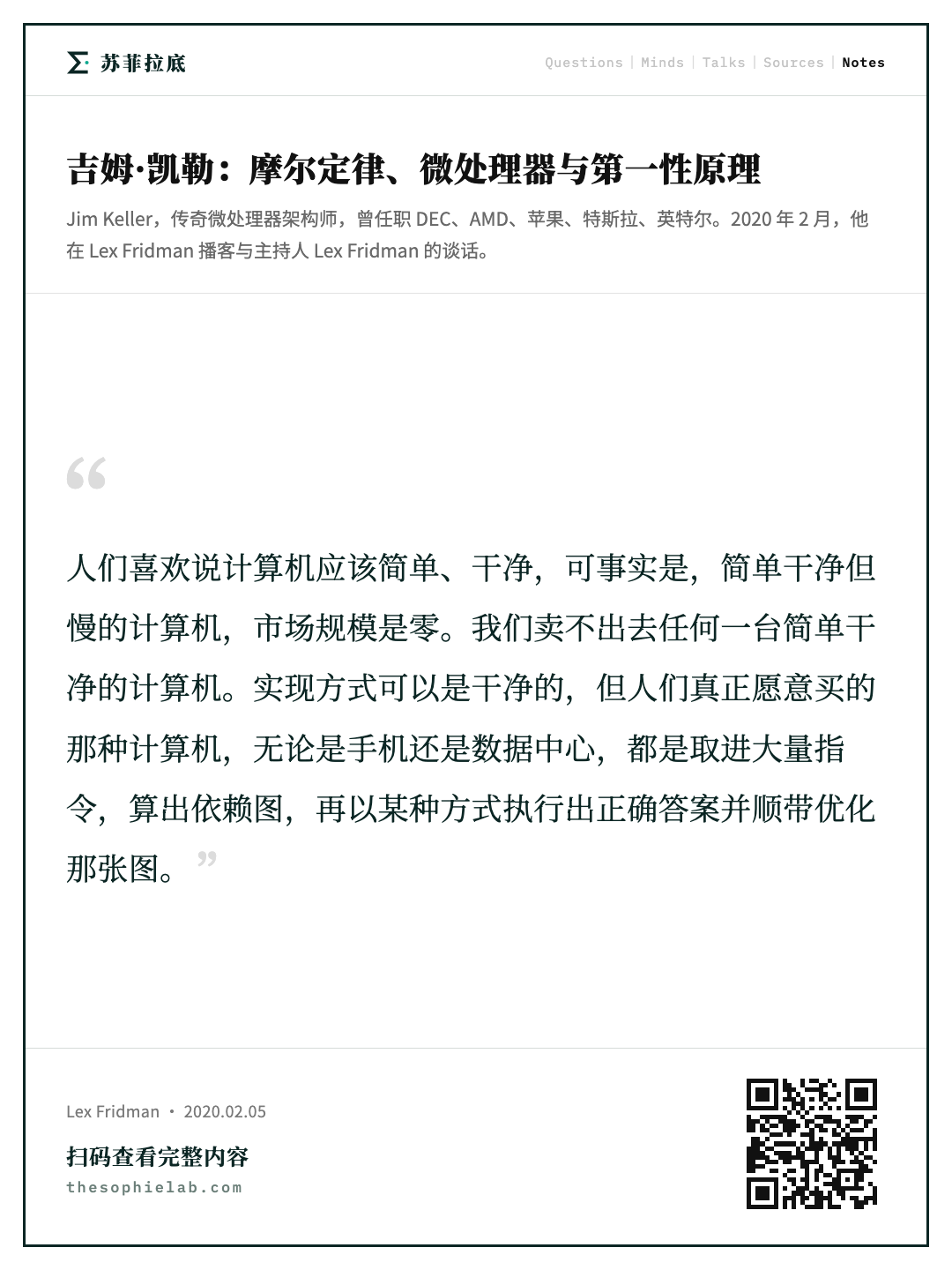
凯勒: 但老式计算机的运行方式是:取指令,按顺序执行,做载入,做加法,做比较。现代计算机的运行方式是:一次取进大量指令,比如五百条,然后算出这些指令之间的依赖图,再把其中彼此独立的小图交给不同的执行单元去跑。所以,人们喜欢说计算机应该简单、干净,可事实是,简单干净但慢的计算机,市场规模是零。我们卖不出去任何一台简单干净的计算机。实现方式可以是干净的,但人们真正愿意买的那种计算机,无论是手机还是数据中心,都是取进大量指令、算出依赖图,再以某种方式执行出正确答案并顺带优化那张图。

主持人: 也就是深度乱序执行。

凯勒: 对,深度乱序,围绕内存顺序还有一整套语义。计算机内部有一堆记账用的表格,记录这些操作以什么顺序完成,或者说以什么顺序「看上去」完成。但要跑得快,你就得取进很多指令,把并行性全找出来。

找到的并行与给定的并行

凯勒: 还有第二类计算机,今天我们叫它 GPU。我把区别称为「找到的并行」(found parallelism)和「给定的并行」(given parallelism)。前者是:你有一个程序,里面很多指令彼此依赖,你取进一批,算出依赖图,再乱序发射。之所以要这么做,是因为你手上只有一条串行的叙事要执行,而这条叙事事实上是可以乱序完成的。

主持人: 你把它叫做叙事。

凯勒: 是啊,人是按串行叙事思考的。你读一本书,一句接一句,一段接一段。你其实可以把它画成图,如果画得足够准确,你就能指出哪些句子可以任意调换顺序而不改变意思。

主持人: 对一本书提这个问题,本身就很迷人。

凯勒: 你确实可以这么做。有些段落能重排,有些句子能重排。你说「他又高又聪明」,高和聪明的顺序无所谓;但你要说「那个穿红衬衫的高个子男人,他衬衫什么颜色」,依赖关系就出来了。

凯勒: 而 GPU 是另一回事,它在像素上跑非常简单的程序,但一次给你一百万个像素。就你眼前这块屏幕而言,先算哪个后算哪个根本无所谓。所以我把那个叫「给定的并行」:围绕大量对象的简单叙事,你可以直接宣布它是并行的,因为你已经告诉我它是并行的。而「找到的并行」里,叙事是顺序的,你要去发现其中一小块一小块的并行。

主持人: 是很小的口袋,还是其实相当大?

凯勒: 相当大。

主持人: 那要把这些并行找出来有多难?

凯勒: 那只是晶体管数量的问题。一旦你把问题攻破了,你就能说:这是一次取十条指令的办法,这是计算它们之间依赖关系的办法,这是描述依赖关系的办法。这些都是可以拆出来的零件。依赖关系一旦描述清楚,剩下的就是一张图。

主持人: 这里有没有理论上的最优解?就一般的现代程序而言,人写出来的程序里到底有多少「可找到的并行」?

凯勒: 大概十倍。

主持人: 十倍是相对什么而言?

凯勒: 相对按顺序执行。按顺序执行,你得到的指标叫每指令周期数(CPI),大概是三,也就是每条指令三个周期,因为运算本身有延迟等等。而现代计算机能做到零点二到零点二五个周期每指令。所以今天大约就是十倍。

凯勒: 这里面有两件事。一是叙事中固有的并行度,二是叙事的可预测性。有些操作做完一堆计算之后会问,如果大于一就做这个,否则做那个。这类判断在现代计算机里能被预测到百分之九十多的准确率。

分支预测的代价

凯勒: 分支出现得非常频繁。设想一下,平均每六条指令就有一个判断要做,可你想一次取进五百条指令,把依赖图算出来,然后并行执行。假设你取了六百条指令,每六条一个分支,那就是一百个分支,你必须预测对九十九个,这个窗口才有意义。

主持人: 也就是说,分支是没法并行的,或者说……分支预测到底是什么意思?

凯勒: 想象你反复做同一件计算,你在一个循环里,条件是「大于一就怎样」,而这个循环要走一百万次。那么每次看到这个分支,你就可以说,它多半还是大于一。

主持人: 而且你说这种预测非常准。

主持人: 我一下就懵了,这到底是怎么做到的?

凯勒: 你要知道,最让人感慨的是这个。二十年前,做法就是记下上一次这个分支往哪边走了,然后预测它还往那边走。

主持人: 那准确率是多少?

凯勒: 百分之八十五。后来有人说,我们留几个比特,做一个小计数器。它往一个方向走就加一,往另一个方向就减一。比如你有一个三比特计数器,加加减减,最高位当符号位,于是你有了一个带符号的两比特数:大于一就预测跳转,小于一就预测不跳转,或者小于零,随便你怎么定。这一下把准确率带到百分之九十二。

凯勒: 再后来有人说,这个分支的走向取决于你是怎么走到这里的。如果你从这条路径过来,说的是鲍勃和简,然后问「鲍勃喜欢简吗」,那走一个方向;但如果你说的是鲍勃和吉尔,问「鲍勃喜欢她吗」,就会走另一个方向。这就叫历史。于是你把历史和计数器结合起来。

主持人: 这很妙。

凯勒: 但今天已经不是这么干的了。现在用的东西有点像神经网络。你把所有执行流拿过来,对程序的执行方式做深度的模式识别,而且用好几种不同的方法同时做,再有一个机制去挑哪个结果最好。计算机里面藏着一台小超级计算机,专门算分支往哪走。这样一来,值得去搜寻并行性的有效窗口就更大了。

主持人: 你刚才说这让人感慨,可我觉得这太厉害了。

凯勒: 它厉害在复杂得吓人。有意思的是:做到百分之八十五,用一千个比特就够了;做到百分之九十九,要用几十兆比特。这是那种典型的情形,为了把窗口从五十条指令扩到五百条,你付出了三到四个数量级的比特。

主持人: 如果分支预测错了会怎样?

凯勒: 流水线要清空,代价体现在性能上。不过还有更妙的。现在有人在研究这样的情况:你沿着一条路径执行下去,前面有两条岔路,但在很远的地方,有些东西其实跟你走哪条路无关。于是你走错了路,执行了一堆东西,发现预测失败,退回去,但你把已经算出来的结果都记着,其中有一些是完全有效的。就像你读一本书,某一段读岔了,但你对下一段的理解有时候是不受影响的。

主持人: 有时候受影响,有时候不受,而且这种不变性是可以预判的。

凯勒: 对,你可以跟踪那部分数据有没有变过。等你再回到某一段代码时,你就知道该重算,还是直接沿用。

艺术还是科学

主持人: 这里面多少是艺术,多少是科学?听上去相当复杂。

凯勒: 这么说吧。想象你走到路口,得做个决定,你手上有一堆判断依据,也许还有地图。你是想走最短的路,还是最快的路,还是风景最好的路?这只是一组数据而已。现在想象你在做一件很复杂的事,比如造一台计算机,有几百个决策点,每个点有几百种可能的走法,而你选的走法之间还以复杂的方式相互作用,你必须选对地方。就是这么回事。所以我说不好。

主持人: 你把这个问题绕过去了。你刚才描述的其实就是罗伯特·弗罗斯特那首《未选择的路》。

凯勒: 我描述的是弗罗斯特的难题,只不过我们是以计算机设计师的身份在面对它。

主持人: 全是诗意,太好了。

凯勒: 我确实不知道怎么描述这件事。有些人特别擅长做那种直觉的跳跃,能看出各种东西之间的组合关系;有些人不擅长跳跃,但极其擅长评估备选方案。每个人的方式都不一样。所以计算机是由技能构成完全不同的一群人合作设计出来的,一个好团队里各种人都有,其中一部分你大概会形容为有艺术家气质,可惜或者说幸好,这种人不多。

主持人: 是幸好还是可惜?

凯勒: 计算机科学很难,百分之九十九是汗水,百分之一的灵感当然极其重要,但那百分之九十九你跑不掉,活得实打实地干。而且这条堆栈的每一层上都有有意思的事情可做。

确定的答案,不确定的执行

主持人: 说到底,同一个程序跑很多遍,是不是总会得到同样的结果?还是说,中间存在一些模糊的空间?

凯勒: 这是个数学问题。如果你跑的是一个正确的 C 程序,按定义,每次运行都会得到同样的答案。这是一句关于语言定义的陈述。

凯勒: 不过,当年我们最早做三维图形加速的时候,同一个场景跑多次是会得到不同结果的。有人觉得没问题,有人觉得这很糟糕。等到高性能计算领域开始用 GPU 做计算,他们就认定这非常糟糕。

凯勒: 而现在的人工智能领域,人们在看这样一类网络:数据精度低到本身就带着噪声。而且大家观察到,输入数据本来就噪声大得离谱,那凭什么计算过程必须一点噪声都没有?于是有人试验带噪声的算法,靠容忍噪声更快拿到答案。比如网络开始收敛时,你去看那张计算图,它一开始很宽,慢慢变窄,你可以问:最后那一点点还重要吗?我是不是可以先开始下一轮,而不必一路算到底?这样就能造出带噪声的算法。

凯勒: 但如果你在开发一个东西,每跑一次得到的答案都不一样,那真的很烦人。所以直到今天,绝大多数人还是希望每次运行拿到同样的答案。

主持人: 我明白,但这正是编程语言的形式化定义所在。

凯勒: 确实有一些语言的定义并不保证同样的答案,可是用这些语言的人还是想要那份确定性。因为你一旦拿到一个坏答案,你就得琢磨:这是因为程序写错了,还是因为那个不确定性?所以每个人都想要一个开关,写着「无论如何请给我确定性」。这挺奇怪的,因为进入货币计算之外的几乎一切输入都是带噪声的,凭什么答案就必须干干净净。

主持人: 那你站在哪一边?

凯勒: 我为跑程序的人设计计算机。既然大多数人要确定性的答案,那就给他们确定性的答案。人们没意识到的是,你拿到的是确定的答案,可执行流程完全是不确定的。同一个程序跑一百遍,内部运行方式没有两遍是一样的,一次都没有,但每次给出的答案完全相同。

主持人: 这实在太惊人了。

把人当作功能单元

主持人: 在很多人眼里,你已经是芯片架构师中的传奇。哪一个设计是你最自豪的?可以是因为它难,因为它的影响,或者因为其中那一组精彩的想法。

凯勒: 我觉得这个说法很怪。我有两个小孩,我保证他们听到这个问题会笑翻。

凯勒: 我真正感兴趣的是造计算机,而且我和非常非常聪明的人共事过,我自己没那么聪明得离谱。我着迷的是这些东西怎么组合到一起,既是作为一件事本身,也是作为一项人去完成的事业。

主持人: 人和计算机怎么组合到一起。

凯勒: 对,人怎么思考,怎么造出一台计算机。我常发现,最好的计算机架构师往往对人不太感兴趣,而最好的带人的管理者往往不擅长设计计算机。所以整个「人的堆栈」本身就很迷人。

主持人: 从管理者到一线工程师。

凯勒: 造了很多年计算机之后我意识到,你从晶体管、逻辑门、功能单元、计算单元这样一层层往上搭,你完全可以用同样的方式去看人。

主持人: 人就是功能单元。

凯勒: 是的。于是组织设计就变成了一个计算机架构问题。这就太酷了,因为人和人各不相同,就像各个计算单元各不相同一样,他们喜欢做的事情也不同。所以我在重新框定自己对组织的理解这件事上得到了很多乐趣。就像我们刚才说执行路径,很多条不同的路径最终能到达同一个好结果。

主持人: 从单个人这样的功能单元到整个组织,你在人的抽象层上学到了什么?要做出真正特别的东西,需要什么?

凯勒: 大多数人想得不够简单。你知道菜谱和理解之间的区别吗?这个大概有一套哲学上的说法。想象你要做一个面包,菜谱告诉你:取面粉,加水,加酵母,搅拌,醒发,放进模具,送进烤箱。这是菜谱。而理解面包,你要懂生物学、供应链、谷物研磨、酵母的物理过程、热力学。理解可以有很多层。

凯勒: 人们在设计和构建东西的时候,往往只是在执行一摞菜谱。问题在于,菜谱的适用范围都是有限的。你手上有一本极好的面包食谱,它一个字也不会告诉你煎蛋卷该怎么做。可如果你对烹饪有深入的理解,那么面包、蛋卷、三明治,你看待一切的方式都不一样。大多数人在成为某个领域的专家时,希望达到的是更深的理解,而不是攒下一大堆可执行的菜谱。

凯勒: 有意思的是,从一群人的角度看,执行菜谱效率高得惊人,前提是那正好是你想做的事。如果不是,你就彻底卡死。这个区别至关重要。每个人身上「深入理解」和「照方抓药」的配比不同,有些人特别擅长辨认出「这件事现在必须往深里理解」。

主持人: 完全明白。那么在开发的每一个阶段,团队里都需要这种深入理解吗?

凯勒: 这又回到艺术与科学那个问题了。如果你事事都要拆开来求甚解,你什么都做不完;可如果在该拆开的时候不拆,你就会做错事。而且在每一个岔路口,人是非常古怪的存在,你跟他说的每一句话都可能引出一百万种输出,然后这些输出还会以滑稽的方式互相作用。什么时候该说,说什么,什么时候该介入,什么时候不该,这非常复杂。

主持人: 本质上是计算上不可解的。

凯勒: 是个难以处理的问题。

主持人: 人确实是一团乱麻。不过你说的深入理解,是不是也包括那些根本性的问题,比如「什么是计算机」,或者「我们为什么要造这个东西」这类关于目的的追问?还是更偏向往物理极限那个方向深挖?

凯勒: 就造计算机而言,是往简单里想,再简单一点。常见的做法是:你造了一台计算机,然后有人说想再快百分之十,你就说好,我把这个缓冲区做大一点,也许再加一个加法单元,或者把这个三发射做成四发射。你会看到,每一块都在一点点变得更复杂。到某个时刻你撞墙了,再加一个特性、再加一个缓冲,速度也不动了。于是人们说,这是根本性的极限。可另一个人来看一眼会说,其实是你切分问题的方式、是各个特性之间相互作用的方式限制了你,这需要重新想、重新写。于是你重构、重写,而人们常常发现,重写出来的东西不但更快,复杂度还只有原来的一半。

每五年推倒重来

主持人: 在你的职业生涯里,你遇到过多少次需要把整个东西推翻重来?

凯勒: 我在这件事上站在一个极端:每三到五年一次。

主持人: 你是哪个极端,更频繁还是更少?

凯勒: 更频繁地重写。如果你真想在计算机架构上取得大的进展,每五年就该从头来一次。

主持人: 那 x86-64 这样的标准怎么办?你多久会重来一次?

凯勒: 那份规范我是合作者,那是九八年的事,二十年前了。所以它还在。指令集本身后来扩展过好几次。但指令集其实没那么有意思,有意思的是它底下的实现。在 x86 架构上,英特尔设计过好几套,AMD 也设计过好几套,彼此差别很大。我不太想细说频率,但业界的倾向是大约十年重写一次,而我认为真正该做的是五年一次。

主持人: 所以你是个异类,你要更频繁地重写。

主持人: 这不吓人吗?

凯勒: 当然吓人。

主持人: 对谁吓人?

凯勒: 对所有相关的人。因为正如你说的,重复既有的菜谱最省事,公司要赚钱。

凯勒: 不,更根本的是,个体工程师也想成功。所以他们想的是渐进改良,把缓冲区从三加到四。这就要说到收益递减曲线了。我记得史蒂夫·乔布斯讲过这个:你有一个项目,从这里起步,往上走,然后开始收益递减;要上到下一个层级,你必须做一个新的,而新的起点会低于旧的那条曲线的最优点,但它最终会走得更高。

凯勒: 于是你面对两种恐惧:短期的灾难和长期的灾难,而且你两边都会犯错。以季度为单位看业绩的人,对「什么都要改」这件事怕得要死。而那些真正在经营一门生意、或者在为长期目标造计算机的人知道,短期的局限恰恰堵死了长期的成功。你去看那些长期成绩真正出色的公司领导者,每当他们意识到必须重做一遍,他们就重做了。

凯勒: 所以要么有人站出来说话,要么你并行推进多个项目,一边优化旧的,一边造新的。但市场那边的人总是要你保证:新计算机在每一项上都更快。而计算机架构师会说,新计算机在平均意义上更快,但性能结果是一个分布,一定会有一些离群点更慢。这非常难办,因为总有一个客户恰好只在乎那一项。

摩尔定律不会死

主持人: 说到长期。五十多年来,摩尔定律对我和无数人来说都是一盏灯,它指向未来那些出色的工程师能造出的了不起的东西。

凯勒: 抱歉,我又在想我的孩子们听到这话会怎么笑。

主持人: 在你眼里,摩尔定律到底是什么?请给不了解的人下个定义。

凯勒: 戈登·摩尔最初那句简单的话是:晶体管数量每两年翻一番,大致如此。而我自己的操作性模型是:计算机性能每两到三年提升一倍。这个数字随时间上下摆动过不少,我们交付性能的方式也变过,但底层的想法就是晶体管两年翻倍。今天的节奏是所谓的缩小系数,大约每两年零点六,不是零点五。

主持人: 这里说的还是严格意义上的晶体管数量?

凯勒: 缩小系数说的是把晶体管做得更小。在芯片面积不变的前提下,如果你把晶体管尺寸缩到零点六,你就能多放一除以零点六倍的晶体管。

主持人: 那更宽泛地说呢?你觉得摩尔定律更合适的定义应该是什么?

凯勒: 首先,我关注摩尔定律已经三十年了。

主持人: 在什么意义上?

凯勒: 我造计算机造了四十年,也就是一路看着它走过来。而在我意识到摩尔定律存在的同时,我也被告知它将在十到十五年后终结。一开始我信了,可十年过去,人家还是说它十到十五年后终结。有一阵子说五年,然后又回到十年。到某个时候我决定,这个特定的世界末日预言,我这辈子不再操心了,这挺舒服的。后来我加入英特尔,所有人都说摩尔定律已死。我想这可真让人难过,因为这毕竟是摩尔定律的公司。它没死,而它一直都「即将」死。人类喜欢这类末日式的断言,比如粮食会吃光、空气会用尽之类。

主持人: 但它活了这么久,仍然令人惊叹。当然现在有很多人相信摩尔定律已死。

凯勒: 那他们可以去加入过去五十年里说同样话的那批人,这个传统很悠久。

主持人: 那你为什么认为它没死?

凯勒: 首先,人们以为摩尔定律只是一件事,就是晶体管变小。可实际上,掀开被子看,里面是成千上万项创新,而几乎每一项创新都有自己的收益递减曲线。你要是把它画出来,看到的是一串收益递减曲线首尾相接的级联,我不知道该管这叫什么,但叠加出来的结果是一条指数曲线,至少到目前为止是。而且我们不断发明新东西。所以如果你是某一条递减曲线上的专家,你看到它趋于平缓,你多半会告诉别人:这条路走到头了。与此同时,另外一大批人正在做完全不同的事情。这很正常。

凯勒: 其次是那个观察:一个开关器件到底能小到什么程度?一个现代晶体管大概是一千乘一千乘一千个原子。量子效应大约在二到十个原子的尺度上出现。所以你可以想象把晶体管做到十乘十乘十,那就是小一百万倍。而量子计算那批人还在琢磨怎么直接利用量子效应。

主持人: 一千乘一千乘一千个原子,这个说法真是干净利落。

凯勒: 现代晶体管的鳍(fin)大概一百二十个原子宽,但我们还能把它做得更薄,外面还包着栅极,还有间隔层,还有一整套几何结构。一个称职的晶体管设计师能把每个方向上的原子数都数出来。现在已经有技术可以按单原子层沉积,你想的话甚至可以一个一个地摆原子。问题只在于制造:如果摆一个原子要十分钟,而你需要把十的二十三次方个原子拼成一台计算机,那要花的时间就太长了。所以方法既包括把东西做小,也包括想出既便宜又可控的制造手段。

凯勒: 所以创新的面铺得非常宽:设备、光学、化学、物理、材料科学、冶金。四种材料放在一起会怎样相互作用,稳不稳定,随温度稳不稳定,能不能可重复地做出来。里面牵涉的技术真的数以千计。

主持人: 单就缩小尺寸这件事,你不认为我们已经接近物理的根本极限?

凯勒: 我做过一次关于摩尔定律的报告,我请人给我一张通往一百倍的路线图。两周后他们说,我们只做到了五十倍。

主持人: 一百倍是什么意思?

凯勒: 一百倍的缩小。他们说只到五十,我说那你们再回去做两周。

凯勒: 关于摩尔定律,事情是这样的:我相信接下来十年到二十年的尺寸缩小是会发生的。而作为计算机设计者,你有两种立场。你要么相信它会继续缩小,那你在做架构时就会考虑怎么用上更多的晶体管,或者反过来说,怎么不被随之而来的复杂度淹没。你必须有一个策略。

主持人: 所以你是敞开着的,随时准备迎接一整支新的晶体管大军来干活。

凯勒: 我是在期待。我期待每两三年就多出一批晶体管,而且数量大到足以改变你思考设计和架构的方式。想象你用砖头盖房子,而砖头每两年小一半。如果你还是按老办法盖,每人每天砌那么多砖,盖一栋楼的时间就会指数级上升。但如果你说我知道这事要来,那我就去设计能更快搬砖、更好用砖的设备,因为更小的砖也许带来更高的强度、更薄的墙、更省的材料。所以一旦你手上有一张关于晶体管会怎样变多的路线图,你就会围绕它去设计,既利用它,也应对它。人们没意识到的是,假如我不相信摩尔定律,而摩尔定律的晶体管照样来了,我的设计团队会被淹死。

主持人: 面对这股晶体管的洪水,最难的部分是什么?回顾你的职业生涯,当晶体管变多时,架构设计中真正发生变化的是什么?

凯勒: 有两个常量。第一,人不会变得更聪明。

主持人: 顺便一提,有研究说因为营养之类的原因,我们确实变聪明了。

凯勒: 你说的是弗林效应。没人真正理解它,也没人知道它是不是还在继续,或者是不是真的。但我基本上相信,人在总体上并没有变聪明多少,证据不支持这一点。

凯勒: 第二,团队规模不可能无限扩大。人类在十人的团队里配合得很好,到一百人还能彼此认识,再往上你就必须引入组织边界。这些是相当硬的约束。所以你只能分而治之。设计越大,你越要把它切成块。抽象层的威力在这里极高。我们过去用晶体管造计算机,现在有一个团队把晶体管变成逻辑单元,另一个团队把逻辑单元变成功能单元,再一个团队把功能单元变成计算机。所以中间要建起一层层抽象,而你必须思考什么时候换挡。

凯勒: 另外,我们用更快的计算机来造更快的计算机。有些算法在新机器上快一倍,可很多算法是 N 平方的,所以晶体管多一倍的计算机,跑起来可能要花四倍时间。这意味着你必须重构软件。简单地用更快的计算机去造更大的计算机,是行不通的。这些事你都得想。

从标量到拓扑

主持人: 就计算性能而言,缩小尺寸是你最看重的那条路吗?还是说你也关注别的方向,比如强推给定的并行、大规模并行、把很多 CPU 堆叠起来这类做法?

凯勒: 我换个方式来说。老式的、慢的计算机,你写 a 等于 b 加 c 乘 d,很简单。后来我们造出带向量单元的更快的计算机,你可以做成组的方程、做矩阵。再到现代的人工智能计算,比如卷积神经网络,你是拿一个大数据集去卷另一个大数据集。所以这里有一个数学的层级:从简单方程,到线性方程,到矩阵方程,再到更深一层的计算形态。而现在数据集大到人们开始把数据当作一个拓扑问题来看:数据组织成某种巨大的形状,而计算要做的,是从这个巨大的形状里取出数据并施加运算。

凯勒: 所以计算机让人们把算法推得远得多。你提到的萨顿那篇文章里说,人工智能一开始是规则集,那是一种非常简单的计算情形;后来做国际象棋,靠的是深度搜索,一个巨大的走法与结果数据库加上深搜,但那仍然只是搜索。而现在我们拿海量图像去训练一组权重,再拿这组权重去做卷积,这是完全不同的现象,我们现在管它叫人工智能。他们正在做下一代,你会看到,他们是在沿着这张数学的图往上走,而算力和数据集都支持这种上行。

主持人: 我倒想说,这一切仍然是搜索。就像你说的拓扑问题,本质上还是在数据集里搜寻有价值的数据,而神经网络的优化本身也是一种搜索。

凯勒: 我不确定。你去看识别一只猫的那些中间层,那不是搜索,那是无穷无尽的投影。就像这只手机在这里投下一个影子,你可以把那个影子再投到别处,再投到别处。你去看那些层,会发现这一层描述的是尖耳朵、眼睛的圆度、毛茸茸的质感。把这些属性抽取出来的计算过程,不是搜索。推理阶段也许可以算搜索,训练不是。

主持人: 可深度网络里,人们看着那些层,根本不知道它表示的是什么,而一旦把这些层拿掉,网络就不工作了。

凯勒: 所以我不认为那是搜索。至于它究竟是什么,你得去问数学家。

主持人: 你不同意,不过这也许只是措辞之争。

凯勒: 我觉得不是。

主持人: 我觉得绝对不只是措辞。在我看来,优化就是搜索,我们是在优化神经网络检测猫耳朵的能力。而国际象棋和那个有十万维的空间之间的差别,确实完全不是一回事,棋盘数据库和这种优化根本不是同一种东西。从这个意义上说,我明白你为什么那么讲。

凯勒: 有意思的是,这正好又是「给定的搜索空间」和「找到的搜索空间」的区别。

主持人: 说得漂亮。

主持人: 那么就基本的数学运算,以及能把这些运算固化到硬件里的架构而言,你觉得今天的 CPU 是否仍然是执行这些运算的核心?

凯勒: 是的。那些运算仍然是加、减、载入、存储、比较、分支,这件事很了不起。计算机的基本构件是晶体管,晶体管之下是原子,于是你有原子、晶体管、逻辑门、功能单元、计算机。而数学的基本构件在某个层面上就是加、减、乘,可数学能描述的空间在我看来基本上是无限的。运行这些算法的计算机,做的却还是同样那几件事。

凯勒: 当然,某个算法可能会说我需要稀疏数据,或者我要三十二位数据,或者我需要一个卷积操作,它天然地取八位数据相乘再按特定方式求和。所以 TensorFlow 里的数据类型隐含了一套优化目标,但当你真的往计算机里看,看到的还是乘加。这一点没怎么变。

凯勒: 量子研究者认为他们会彻底改变这一点。也有人在想模拟计算,因为你去看大脑,它似乎更偏模拟,也许那样效率更高。但我们手上是一百万倍的算力提升,而算力的强度和它能触及的数学抽象层级之间的关系,我说不清楚。就像你在人工智能里看到的:从规则集,到简单搜索,到复杂搜索,再到「找到的搜索」,每一步都是几个数量级的计算量。等我们再拿到两个数量级,会发生什么?我的朋友科杜里说过,每一个数量级的算力变化,都会从根本上改变计算在做的事情。

主持人: 就是那句话,量的差别就是质的差别。

凯勒: 蚂蚁和蚁丘的区别,神经元和大脑的区别。总有那么一个说不清道不明的地方,量变成了质。而这件事在数学里我们已经见过好几次了,我猜它还会一直发生。

主持人: 所以你的感觉是,只要埋头把晶体管做小就行?

凯勒: 不只是埋头。我们非常清楚上面跑的软件栈和计算负载是什么样,我们一直在琢磨:如果你有一 PB 内存,而访问方式是稀疏的,还要支持人工智能程序员想要的那类运算,你该怎么办?所以这中间是有对话、有互动的。但你真正走进芯片内部,看到的还是加法器、减法器、乘法器。

主持人: 如果把视角拉开,按萨顿的说法,过去几十年人工智能研究的大部分进展,来自于利用算力增长和简单算法,等着算力上来。

凯勒: 软件的人有个说法叫过早优化的陷阱。如果你写了一个庞大的软件栈,你最先写的那部分恰好是性能瓶颈的概率很低。但当整个东西跑起来之后,你能不能通过优化正确的地方让它快一倍?当然能。可就在你优化的这段时间里,你本来是不是可以另写一套更好的软件栈?也许可以。这就形成了一种创造性的张力。

凯勒: 而在你写软件的整个过程中,底下的硬件一直在变快,这就回到摩尔定律了。如果摩尔定律会继续,那你的人工智能研究就应该预期这一点会兑现,于是你会做出一套稍有不同的选择。如果你认定我们已经撞墙、什么都不会发生、从此只能靠重写算法,那么按过去三十年摩尔定律「已死」的记录来看,这是一个失败的策略。

主持人: 我知道你已经回答过,但我还是要把这个笨问题再问一遍:你为什么认为摩尔定律不会死?未来五到十年,最让你兴奋、最有希望的可能性是什么?是晶体管继续缩小,还是有另一条 S 曲线接上来?

凯勒: 就是继续缩小晶体管,而这背后是成千上万项创新,所以答案是「全都是」。有一大堆 S 曲线各自走完自己的路,然后被重新发明。半导体制造商和技术人员已经公布了所谓的纳米线:他们把原来的鳍加上环绕栅极,变成一根细线,这样控制更好,尺寸更小。从这里出发,怎么继续缩小有一些很明显的步骤。围绕金属互连堆栈的冶金也有非常明显的缩小空间。这里面有一整套组合拳。

主持人: 所以你觉得单靠缩小就能拿到很多?

凯勒: 是的,大概一百倍。

主持人: 一百倍,太惊人了。

凯勒: 而且只需要十到十五年。

主持人: 你比我懂,但对我来说,这一百倍会给计算的性质带来什么,完全无法预测。

凯勒: 你知道贝尔定律吗?很长一段时间里,从大型机、小型机、工作站、个人电脑到移动设备,摩尔定律驱动着计算机变快变小。而科杜里说,每一个十倍都会催生一种新的计算:标量、向量、矩阵、拓扑。你去看产业的走向:先是大型机、小型机、个人电脑,然后互联网起飞,然后是移动设备,现在我们在建延迟一毫秒的 5G 无线网络,人们已经在设想一个智能世界,万物都认识你、识别你。这种转变的后果是无法预测的。

我们造的这个世界

主持人: 作为这种未来的关键设计者之一,你是什么感觉?

凯勒: 我们说的又不是那些做愤怒的小鸟应用的人。

主持人: 愤怒的小鸟,谁知道呢,说不定那才是宇宙的意义所在。

凯勒: 我可要在这件事上表个态。

主持人: 还有手机分散注意力这件事。

凯勒: 那我也表个态,不过我不觉得这有多要紧。

主持人: 你说的是哪个部分?智能手机的副作用,还是注意力被分散?

凯勒: 谁知道这一切会通向哪儿,它变得太快了。我父母当年冲我姐姐吼,因为她躲在壁橱里,抱着一部带拨号盘的有线电话跟朋友聊一整天。现在我太太冲我的孩子们吼,因为他们跟朋友发一整天短信。在我看来这是同一件事,永远是同一个回声。

主持人: 但你确实是这个未来硬件的关键架构师之一。这让你有什么感受?你会觉得有责任吗?会觉得兴奋吗?

凯勒: 我们身处一个社会情境里。这颗星球上有几十亿人,光是做技术的就有几百万。我觉得自己很幸运,能做我在做的事,还有人付我钱,而且这件事本身很有意思。但同时有那么多事情在并行发生,各种作用力的方向根本无法预测。如果不是我在这儿,也会有别人在做。这些不同方向的力量一直都在发生。我相信总有哲学家,或者研究哲学的哲学家,在琢磨我们究竟怎样改造了自己的世界。

主持人: 你不能否认,这些工具正在改变我们的世界。

凯勒: 没错。

主持人: 你觉得是在变好吗?

凯勒: 我最近读到一个说法:大学里 GRE 成绩最高的两个专业是物理和哲学,而两者其实都在试图回答同一个问题,为什么会有东西存在。哲学家站在偏神学的那一侧,物理学家显然站在物质的那一侧。而宇宙里有一千亿个星系,每个星系一千亿颗恒星,看上去至少是相当重复的。我们正朝着一百亿人口走去。这一切究竟是为了什么,很难说。你问的是这个吗?

主持人: 是的。我倾向于认为复杂度在显著上升,我也好奇计算和这件事的关系。我们的物理世界天然地生成数学。

凯勒: 这是显而易见的。我们有 XYZ 坐标,你把一个球做大,表面积按半径平方增长。世界本身就在生成数学。而数学家和物理学家多年来一直聊得很开心。相比之下,计算在数学意义上一直相当平庸,人家在可能性的其他疆域里纵横驰骋,我们还在做二进制代数。

凯勒: 但最近,计算终于能做那种复杂到没人明白答案是怎么出来的数学运算了。

主持人: 机器学习。

凯勒: 是的。过去的路子是:你拿到一个数据集,猜一个函数,如果这个函数对新数据有预测力,它就算物理。而现在,你可以拿一个庞大的数据集,对它是什么毫无直觉,用机器学习去找出一个模式,而这个模式没有对应的函数。它给出的结果,我不知道是不是完全可以用数学描述出来。所以相对于 a 等于 b 加 c,计算确实做成了某件有意思的事。

主持人: 从基本的加法运算,到神经网络这一步,让人想起地球生命起源时发生的事。你觉得我们是在创造演化的下一步吗?

凯勒: 我不知道。宇宙里已经有那么多东西了,很难讲。

主持人: 但人类在做的,不就是在既有的抽象层之上,再造出新的抽象层和新的可能性吗?

凯勒: 看起来是。可这是不是意味着人类不再需要狗了呢?不是。有那么多东西同时既有趣又有用。

主持人: 但你确实看到了一层比一层更高的抽象,而且是在人造的机器里建起来的。当你看人类的时候,你觉得人类是这条漫长历史链条的顶点,还是我们只是中间的某一环?我们是 CPU 里的基本运算,还是 C++ 程序,还是 Python 脚本,还是神经网络?

凯勒: 有人算过大脑一秒钟做多少次运算,我从不同的推算路径上看到过十的十八次方这个数字好几次。那你能不能造一台每秒做十的二十次方次运算的计算机?当然能。我们会不会造出来?我想会。那大脑的计算方式里有没有什么神奇的东西?我不知道。

凯勒: 我个人的体验很有意思:你以为你知道自己怎么思考,然后各种念头冒出来,你根本搞不清它们是怎么来的。如果你打坐,你会发现自己能觉察到的东西本身就很有意思。所以我不知道大脑是不是神奇的。物理证据说不是,很多人的个人体验说是。要是大脑真的神奇,而我们又能靠更多算力造出大脑来,那才叫好笑,那我就不知道该说什么了。

主持人: 你觉得魔法可能只是一种涌现现象吗?

凯勒: 除了这个还能是什么?我不知道。

主持人: 在你看来,意识是什么?意识、爱,这些深刻属于人的东西,看上去是从我们的大脑里涌现出来的。这些东西我们最终能不能编码进越来越快的芯片里?

凯勒: 我们这一小时的对话是不够的,而且没人真的知道答案。

主持人: 能不能用几句话概括一下?

凯勒: 很多人观察到,生物体是在很多个层级上同时运行的。如果你只有两个神经元,有人说那就是一个感觉神经元加一个运动神经元,于是你能朝一样东西靠近,也能远离它,这关系到你身体的完整和安全。往动物界看,你会看到更复杂一些的大脑,到某个阶段出现了规划系统,然后出现了情绪系统,对安全感到高兴,对威胁感到不安。而人类的大脑里有大量结构:规划、运动、思考、感受、驱力、情绪,我们似乎还有好几层思维系统,另外还有一个做梦的系统,没人搞得懂它是怎么回事,我觉得这实在太滑稽了。你可以认为这些系统相当独立,你甚至能观察到自己的某些部分正在观察另一些部分。至于哪一部分是神奇的,哪一部分不是计算,我不知道。

主持人: 那有没有可能一切都是计算?

凯勒: 很可能。

主持人: 计算有极限吗?

凯勒: 我认为没有。

主持人: 你觉得宇宙是一台计算机吗?

凯勒: 看上去是。但它是一台很奇怪的计算机。因为如果它真是计算机,你去算一下描述量子效应需要多少计算量,那个数高得离谱。假如它是计算机,你会用一种更容易计算的东西去搭它。所以这是一台很滑稽的机器。

凯勒: 不过模拟论那批人指出,这里的规则确实有点意思:你看得非常近的时候,一切是不确定的;光速规定了你只能看那么远;除了纠缠这个怪事之外,事情不能同时发生,而纠缠看上去又是同时的。规则都怪怪的。还有人说,物理学就像五十个方程、五十个变量,用来定义那五十个变量。物理学本身已经乱了几千年了。你走到任何一件事的角落里,它要么不可计算,要么无法定义,要么不确定。这几乎像是这个模拟的设计者在阻止我们把它彻底看懂。

主持人: 但同时,那些需要计算的东西所需的计算量之大,让「宇宙是计算机」这个想法显得荒谬,因为其中最小的一点点都要耗尽宇宙全部的算力才能算出来。

凯勒: 那可真是台奇怪的计算机。你说这个模拟跑在一台计算机上,可这台计算机按定义得有无限的算力。

主持人: 不是无限。

凯勒: 你是说如果宇宙是无限的?

主持人: 我是说,我们宇宙里的一小块看起来就要无限的计算量。

凯勒: 不至于无限,但非常多,是一个相当大的数。算清楚这么一小点,要动用一光年见方空间里的全部质量。那已经足够接近无限了。所以如果它是计算机,那真是台了不得的计算机。这就是模拟论这个说法奇怪的地方:你凑近看,它就有点站不住,可宇宙的规则又暗示着有什么事情正在发生,而且看上去有点随意。

主持人: 你说的是整个宇宙,是物理定律?

凯勒: 是啊,它怎么就长成了现在这个样子?很多人都在谈这个。就像我说的,人类中最聪明的两群人在从不同侧面研究同一个问题,而他们都彻底失败了,这也挺酷的。

主持人: 他们最终可能会成功。

凯勒: 都两千年了,这个趋势不太乐观。

主持人: 相对宇宙的历史,两千年什么都不是,我们还有时间。

凯勒: 大家在每个阶段都是这么说的。

主持人: 但按你刚才描述的,摩尔定律没有死,技术的指数增长会继续,未来看起来相当了不起。

凯勒: 至少会很有意思,这一点是肯定的。

主持人: 你怎么看雷·库兹韦尔的那个判断,技术的指数级改进会无限延续下去?你会不会把摩尔定律理解得更宽泛一些,认为各类技术会把一条条 S 曲线叠起来,整体呈指数?

凯勒: 我们会看到各种各样的东西。一百万倍意味着什么?那已经是个惊人的数字,而且那还只是本地一小片硅片上的事。现在想象一下,你决定让一千吨硅在一台计算机里协同工作,密度还是现在的一百万倍,那你说的就是比我们已经快得难以置信的计算机再多十的二十次方倍的算力。没人知道那意味着什么。科幻作家管那个叫「计算子」,就是一个本地文明把附近的恒星整个变成一台计算机。

主持人: 所以哪怕只是把晶体管缩小,也只是这场涟漪的一个维度。

凯勒: 人们往往把计算机当成成本问题。可计算机是用硅和少量金属做的,这些东西都不值钱。沙子多的是,你差不多可以把一片海滩加一点海水变成计算机。所有的成本都在设备上,而设备的趋势是,一旦你搞清楚怎么造出那台设备,成本就往零走。埃隆说过,先想清楚你要把原子排成什么构型,再想怎么把它们放到那儿去。

凯勒: 他真正深刻的洞见是:人们被「怎么做」束缚住了。我有这么个东西,我知道它怎么工作,那我就在它上面小修小补弄出点新东西来。而不是先问,我究竟想要什么,再去想怎么造出来。这是完全不同的思维方式,而且几乎没有人具备。

自动驾驶:最大化给定条件

主持人: 说到这个。你是特斯拉自动驾驶硬件早期的关键人物之一。埃隆·马斯克相信,只看车辆自动驾驶这个问题,它同样可以按这种指数方式改进,因为在「怎么做」这个层面上没有什么阻碍。你怎么看这个领域,以及你自己和马斯克、特斯拉在其中的那段经历?

凯勒: 你需要造的那台计算机是很直白的。你可以争论它要不要快两倍、五倍还是十倍,但短期看那只是时间和价格问题,不是什么大事。开车这件事本身并不需要特别聪明,所以它不是个超级难的问题。安全方面最大的问题是注意力,而计算机在这方面非常擅长,问题不在技巧上。

主持人: 我想反驳一点。你说的都对,但我们人类往往低估了自己视觉系统有多不可思议。你能凭 20/50 的视力开车。

凯勒: 你可以训练一个神经网络,从视频里提取任何物体的距离和任何表面的形状。

主持人: 但这真的不简单。

凯勒: 这是个数据问题。

主持人: 它不简单,因为这不只是检测物体,而是理解整个场景,而且要以不出错的方式理解。人类视觉系统连同整个大脑最漂亮的地方在于,我们能把空缺补上。这不只是准确检测车辆,还包括推断被遮挡的车辆,理解意图。我认为这是个更大的问题。

凯勒: 你觉得靠数据、靠算力提升、靠采集量的增加还不够?

凯勒: 是这样:你开车的时候有人加塞,你的大脑会给出一套理论解释他为什么这么干,说他是个坏人,说他在分心,说他蠢,你可以听见自己心里的旁白。如果你认为这套旁白对于成功驾驶是必要的,那现在的自动驾驶系统就做不到。但如果说,车是有轨迹的弹道物体,速度和方向的变化服从某种概率分布,道路是固定给定的,顺便说一句,道路不会动态变化,那么你可以把世界彻底地测绘一遍,把每个对象彻底地定位一遍,把各种轨迹彻底地算一遍。

主持人: 可你说的每一个「彻底」,难度都完全不同。

凯勒: 所以你可以说,在某些人类不擅长的地方,自动系统迟早会强得多。它们在注意力上更好,它们会永远记得这条路上有个坑,而人类会忘;它们会记得这一段路的车道线画得很古怪,那是计算机算过一次就记住的事,尤其是它们还能收到更新。

凯勒: 有人说过,机器人这类东西是要把给定条件最大化。所以让机器人抓起这个瓶盖的办法之一,就是在盖子顶上点一个红点,因为不然你还得先搞清楚它是什么。把给定条件最大化,这才是关键。人类去一个新地方开车,你会记住路,因为你全程都在处理信息;可当你第五十次开车去上班,到了公司你根本想不起来自己是怎么到的,你在自动驾驶状态。而自动驾驶的汽车永远处在这个状态,它们对为什么被加塞、为什么堵车没有任何理论,所以它们永远不会停止注意。

主持人: 我倾向于认为,你确实需要关于他人的理论和心理模型,尤其是对行人和骑车人,对其他车辆也一样。你说的这些其实都是驾驶的核心。开车比人们以为的复杂得多。

凯勒: 我不这么看。

主持人: 举个例子,稍微反驳一下,比如强行汇入车流。你不能光等着有空隙,你得有一定的进攻性。

凯勒: 你会惊讶于这件事的计算有多简单。

主持人: 在那个具体问题上也许是。但我还是要说,我会非常惊讶。

凯勒: 我倒觉得你可能会惊讶于它有多复杂。我常跟人说,进展在短期内让人失望,在长期里让人惊讶。

主持人: 完全有可能。

凯勒: 我猜十年之后,这一切会被当成理所当然。到时候多半是个五十美元的方案,没人在意。就像 GPS,我们在太空放了卫星告诉你自己在哪儿,这曾经是天大的事,现在一切东西上都有 GPS。

主持人: 确实如此。但我还是认为,牵涉到人类行为的系统,比我们愿意承认的更复杂。我们能用技术做出不可思议的东西,只要不牵涉人。

凯勒: 可人比人们通常以为的更简单。我猜我们大部分时候是从一大堆模式里抽取,然后不断重复。

主持人: 可我不能信你,因为你自己就是人。

凯勒: 这话听着就很像一个人会说的。

主持人: 不过我希望的是,无论谁对谁错,有很多事情人类做不好而机器确实擅长,比如你说的注意力。它们在这些方面好太多,以至于整体的安全图景会变得非常明显,自动驾驶汽车会更安全,哪怕在别的方面它们还不够好。

凯勒: 我非常相信安全。现有的那些安全系统,比如不会撞上人的自适应巡航、车道保持,已经有那么多功能了。你去看事故的帕累托分布,砍掉其中百分之八十是完全做得到的。

主持人: 在自动驾驶团队工作的时候,媒体和公众似乎对安全有一种非常强烈的审视,标准压得很高。作为一个做硬件、想造出安全车辆的人,你怎么看这种压力?它公平吗?还是新技术本来就该被这样对待?

凯勒: 我觉得这是合理的。我跟美国和欧洲的监管者都聊过,我原本担心的是,法规会把技术方案写死。比如现代刹车系统默认是液压的,你按字面去读法规,刹车几乎必须是液压的。但监管者说,他们关心的是使用场景:正面碰撞、偏置碰撞、不要撞行人、不要撞人、不要冲出路面、不要闯红灯。他们非常关注场景,而且他们手上有全部的数据,知道哪些场景造成的伤亡最多。所以大部分时候,那些对话都是在讨论下一步该做什么才是对的。

凯勒: 另外,埃隆除了安全之外,也很看重自动驾驶能把人的时间和注意力解放出来,我觉得这也很有意思。但建立自动系统时,目标就是要比人更安全,把标准定在比人更安全,并且对每一起事故都严加审视,这在道理上是站得住的,所以我认为这是件好事。

车载芯片与匠人手艺

主持人: 和你在英特尔、AMD、苹果做的事情相比,自动驾驶的芯片设计和硬件设计有什么不同?在汽车领域造这种专用计算系统,有哪些有意思或者困难的地方?

凯勒: 造车载计算机主要有两个难点。一是软件,我们的机器学习团队在开发的算法变得很快,所以你在造加速器的时候,心里一直有种担忧或者说直觉:算法会变化得足够大,以至于你造的加速器是错的。

凯勒: 二是一个更普遍的规律:如果你造一台真正优秀的通用计算机,把它的性能记作一,那么在同样的硅面积上,GPU 大概能给你五倍,因为并行性不用你去发现,而是别人给定的;再往上,专用加速器还能在 GPU 之上再拿两到五倍,因为你可以说,我知道这里的数学永远是八位整数和三十二位累加器,运算只是全部数学可能性的一个子集。所以人工智能加速器相对 GPU 有性能优势,是因为在那个很窄的数学空间里,你把算法钉死了。当然你还是要尽量保持可编程,可人工智能这个领域变化太快。于是这里就有一种创造性的张力:我想要专用化带来的加速,又不能专用到那个地步,以至于新算法一出来,你会后悔当初没用 GPU。

凯勒: 要为汽车这类应用造一台好计算机,还要处理各种传感器输入、安全处理器等等一堆东西。埃隆的目标之一是把成本压到足够低,让每一辆车都装上自动驾驶计算机。你去看最近的一些创业公司,他们后备箱里放着一台服务器,因为他们想的是「我要造一台取代司机的自动驾驶计算机」,所以他们的成本预算是一两万美元。而埃隆的约束是:不管用户买不买自动驾驶功能,每一辆车上都要装一台。所以他心里的成本约束是极其严的。要打中那个成本,你就必须重新思考整个系统设计。这很复杂,但也很好玩。

凯勒: 这有点像匠人的活儿,像做小提琴的师傅。你可以说斯特拉迪瓦里是了不起的东西,演奏家也了不起,但那个做琴的人,是他挑了木头,把它打磨、切割、上胶,还要等对的天气,好让上漆的时候不出岔子。这是匠人的活儿。你也许是个天才匠人,因为你掌握着最好的技法,还发现了新的技法,但大多数工程师做的就是匠人的活儿,而人是真的喜欢做这种事。

主持人: 聪明的人喜欢。

凯勒: 所有人都喜欢。我上大学的时候挖过沟,挖得还挺好。

主持人: 也挺有成就感。

凯勒: 挖沟当然也是匠人的活儿。有个说法叫「复杂掌握行为」。你在学一样东西的时候,因为在学,所以有乐趣;当你做的事情既机械又简单,就没什么满足感;但如果那些步骤本身是复杂的,而你做得很好,做起来就令人满足。而且如果你对它保持好奇,在做的过程中还会学到新东西,把自己的水平再往上抬一层。匠人的活儿是好事,工程本身复杂到你必须学会很多技能,而学完之后你做的很大一部分就是匠人的活儿,这很有意思。

主持人: 所以自动驾驶,造一台资源受限到能装进每一辆车的计算机,本质上归结为匠人的活儿。

凯勒: 这不是说不需要天才。里面有需要深思熟虑的决定、要解的问题、要做的取舍:你需要十个摄像头接口还是八个?你是为当前这款车造,还是为下一款造?安全那部分怎么处理?细节多得是,但很好玩。这跟「我在造一种全新的、有新数学、有新网络结构的计算机」不一样,那种事里发明的成分更多。可一旦架构选定,落到实处,你往里一看,还是加法器、乘法器、存储器,还是那些最基本的东西。

凯勒: 所以计算机永远是这么一套奇特的抽象层和想法的叠加,而落到实处就是晶体管和导线,非常朴素的东西。顺便说一句,这本身就是个有意思的现象。很多人觉得工厂的活儿就是机械装配,可我在装配线上待过,那些真正干这行的人非常喜欢它,这是一份很棒的工作,而且相当复杂。把汽车装起来是难的,车在动,零件在动,有时候零件是坏的,你得协调着把所有东西装到一起,而人做得很好。

凯勒: 我记得有一天我去上班,生产线因为某个原因停了,几个工人坐在那儿情绪很低落,因为他们重新安排了一堆流程,本来那天能创下当日产量的新纪录,个个都摩拳擦掌等着干,结果泡汤了。这些都是壮实的糙汉子,可他们做的事情很复杂,你做不来。当然待久了你也能做,但你得一步步熬上去。因为在移动的装配线上,把所谓的亮饰条在九十秒内固定到二十五个点位上,复杂得不可思议,而人类做得非常好。顺带说一句,我认为这比开车还难。

主持人: 我觉得开车会先做出来,你去工厂那件事我们再看。

凯勒: 对我们人类来说,开车是容易的。

主持人: 我说的是,造一台会开车的机器不容易。

凯勒: 好吧。开车对人来说容易,是因为我们已经进化了几十亿年来开车。

主持人: 好了好了,现在你也加入互联网大军来取笑我了。

凯勒: 我对你的人类学很感兴趣,这个我们得好好挖一挖,里面有些不太准确的地方。

与马斯克共事

主持人: 总体上说,关于热情、匠艺、张力、混乱,关于这一整摊子事,你从和埃隆·马斯克共事、从特斯拉那段经历里学到了什么?那是一个以混乱、创新和匠艺著称的地方。

凯勒: 我很喜欢他的思维方式。你以为自己已经理解了某样东西的第一性原理,然后你和埃隆聊过,才发现你连表皮都没划开。他有一个很深的信念:不管你在做什么,你所在的位置都只是一个局部最优。

凯勒: 我有个朋友发明了一种更好的电机,比我们当时用的好很多。有一天他过来说,他有点失望,因为这东西真的很棒,可我看上去没那么惊艳。我说,如果超级智能的外星人来了,他们会到处找你吗?会说「那个造电机的家伙在哪儿」吗?多半不会。但做既有创新性、又算得上匠艺的工作,本身是很令人满足的,这是好事,这很酷。

凯勒: 而埃隆擅长的是把一切拆开,去问最深的第一性原理是什么,去问事情究竟是怎么回事。那种不带假设、不被「怎么做」束缚地看问题的能力,非常野。我们造火箭,用的还是那些一样的东西,这太好玩了。而且他自己也真的投入其中。SpaceX 第一次成功回收火箭的时候,特斯拉这边在大会议室架了投影仪,大概五百人下来看。火箭落地那一刻,所有人都欢呼,有些人哭了,太酷了。

主持人: 但你们是怎么做到的?

凯勒: 非常难。有人说那地方混乱。你想想看,要从自己所有的假设里挣脱出来,怎么可能不痛苦得要命?而埃隆是很硬的。我猜回过头看,人们会说,我真高兴有过那段经历,去把那么多层假设一层层拆开。有时候特别有意思,有时候很痛苦。

主持人: 所以剥离假设这个过程,情感上和智识上都可能是痛苦的。

凯勒: 是的。想象一下,你思维过程中的百分之九十九是在维护你的自我认知,而其中百分之九十八是错的。

主持人: 你这数学没算对吧。

凯勒: 你想想,当你把那一点有用的东西找回来的时候是什么感觉。那一刻你敞开了,你有了做点不一样的事情的能力。我不知道数字对不对,可能是百分之九十九点九。

主持人: 就算只有百分之五十,想象一下也已经够难受了。

凯勒: 很久以来我就怀疑,人是可以变得更好的:你可以想得更好,可以想得更清楚,可以把事情拆开来看,而且这样的例子有很多。埃隆是一个,我父母也是。

主持人: 你也是,至少跟你聊天很有意思,我确实学到不少。

凯勒: 还有一件事。比如我读书,人们会说,哦你读书啊。可我读了五十五年,每周读几本书,也许是五十年,因为我大概三四岁才学会认字。事情是这样的:人写一本书,往往是把自己二十年里满怀热情做的事情,压缩成两百页,这挺有意思的。然后你上网就能查到谁写的书最好,这里有一整套筛选机制。你把书读了,大体上能读懂,然后就能拿去用。我曾经进过一家公司,我想我以前没怎么管过人,于是我读了二十本管理书,然后开始���人谈。跟公司里跑来跑去的那些副总裁比起来,我不过是比谁都多读了十九本管理书而已。

主持人: 这有那么难吗?

凯勒: 而且里面有一半的东西第一次用就管用,这甚至不是什么高深学问。

主持人: 但这件事的内核,就是质疑假设,就是从第一性原理出发去思考,去看清情境的真实面貌,并且把这份认识用起来。

凯勒: 是的。我的大脑里装着「可以质疑最初的假设」这个念头,但我可以连着好几天把它忘得一干二净。

主持人: 所以你得不断绕回来。

凯勒: 因为要把它保持在注意力中心很难。你同时在很多个层面上运作,「把这件事做完」是优先事项,「让自己开心」是优先事项,「随便瞎混一会儿」也是优先事项。人怎么过日子,本身就很复杂。然后你才想起来,哦对,我可以从第一性原理想问题。而且那件事很累人,做一阵子就得歇歇。

主持人: 那么从大局、从第一性原理出发,最后一个问题,虽然你其实已经答过了:你认为自动驾驶是可以在几年、一两年、三五年、十年这个尺度上解决的问题,而不是一个世纪?

凯勒: 当然。

主持人: 再多问一句,你的信心从哪儿来?是问题本身的基本盘,还是硬件和软件作为计算问题的基本盘?

凯勒: 理解弹道、规则、地形,这些看上去是可解的。你可以对照语音识别来看:很长一段时间里,人们做频域分析之类的东西,怎么弄都不管用;后来他们用深度学习去做,效果好极了。这中间经过了多轮迭代。而自动驾驶早就走过了「频域分析」那个阶段。用雷达,不要撞上东西,数据采集在上升,算力在上升,对算法的理解在上升,一大堆问题正是这样被解决掉的。

主持人: 数据这一侧确实很有力量。但我还是要和你、和埃隆唱个反调,我再说一次:一旦把人加进来,这就不再是弹道问题,而是更复杂的东西。当然我很可能被证明是错的。

凯勒: 汽车是重阻尼系统,转向变化很慢,转向系统跟计算机比慢得多,加速也很慢。

主持人: 在某个时间尺度上是这样,在弹道的时间尺度上是这样。但人的行为,我说不好。

凯勒: 人也很慢,而且我们的运作方式很怪,我们比现实慢半秒钟,这件事也没人真正理解,挺好玩的。

主持人: 是啊。所以我完全可能被打脸。而且随着计算、软件和硬件各方面同时进步,我想到处都会有惊喜。

超级智能与人的位置

主持人: 说到惊喜,很多人担心人工智能发展中的奇点,请原谅我问这样的问题。当人工智能呈指数改进,达到超越人类的通用智能水平,越过那个点就无法回头。你担心计算机变得超人般聪明所带来的生存威胁吗?

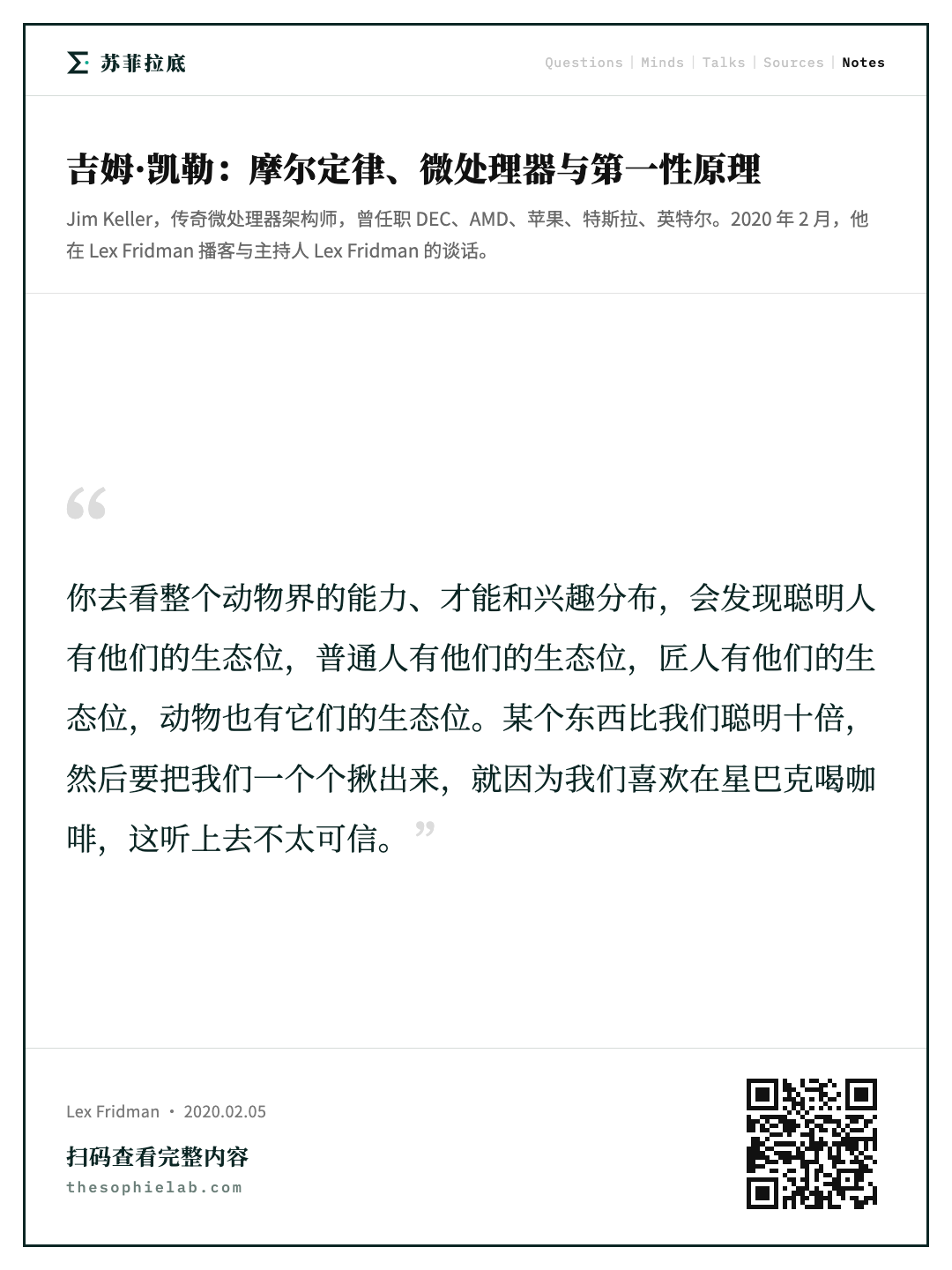
凯勒: 不太担心。我们本来就生活在一个高度分层的社会里。你去看整个动物界的能力、才能和兴趣分布,会发现聪明人有他们的生态位,普通人有他们的生态位,匠人有他们的生态位,动物也有它们的生态位。我猜,感兴趣的领域会差得非常远。某个东西比我们聪明十倍,然后要把我们一个个揪出来,就因为我们喜欢在星巴克喝咖啡,这听上去不太可信。

主持人: 那有没有一个生存意义上的问题:你怎么在一个存在着远比你聪明的东西的世界里活下去?

凯勒: 那要看你的自尊是不是建立在「本地最聪明的人」这件事上。而这样的人大概占人口的千分之一,其余的人从出生起就一直在面对这件事了。

凯勒: 有意思的经验的可能空间非常大。超级智能看起来很可能出现,虽然我们还不知道自己是不是神奇的,但我猜不是。而且很可能,它会创造出对我们来说很有意思的可能性,而它的兴趣对它自己来说也是有意思的。至于它的兴趣为什么非要变成争夺一平方英尺的土地,或者变成人们通常担心的那些事,我看不出理由。

主持人: 所以你不认为它会继承人性中比较黑暗的那些部分?

凯勒: 这取决于你怎么看待现实的构成。人类之所以是现在这个样子,是因为好的力量和坏的力量之间存在一种创造性的对立张力,关于这一点有很多哲学上的解释。我不知道为什么那边会不一样。

主持人: 你是说恶对善是必要的?

凯勒: 我不确定该不该用「恶」这个词,但我们生活在一个竞争的世界里,你眼中的善往往是别人眼中的恶。其中确实有恶性的成分,但那部分看起来是自限的,尽管偶尔会极其可怕。总之,观念是会被辩论的,人们有不同的信念,而辩论本身就是一个过程,是抵达某个结果的方式。

主持人: 但你不认为这个过程会把一部分人甩在后面,甩得让人痛苦?

凯勒: 对那千分之一的人来说会。可为什么现在还没有让很大一部分人痛苦呢?其实是有的。社会里确实有很多压力,关于百分之一,关于这个那个。但每个人的生活里本来就有很多压力,都是关于什么才让自己满足。「认识你自己」看来是恰当的箴言,去追求让你的生命有意义的东西,看来也是恰当的。而这方面的路径太多了,每一个层面上都有大量尚未探索的空间。

主持人: 你算是个乐观主义者。

凯勒: 我侄子管我叫「一个厌世的乐观主义者」。

主持人: 这个说法里有一种漂亮的张力。如果回望你的一生,可以重活其中的某一刻,你会选哪一段最幸福的时光?家人之外。

凯勒: 我不想重活任何时刻。我喜欢的是那种状态:你怀着某种乐观,同时又有面对未知的焦虑。

主持人: 所以你爱未知,爱它的神秘。

凯勒: 神秘我说不好,但它确实让你血往上涌。

主持人: 在这颗淡蓝色的小点上,生命这一整件事的意义是什么?

凯勒: 它就是它所做的那样。不知为什么,宇宙造出了原子,原子造出了我们,我们做各种事情,我们弄明白一些事情,我们探索一些事情。事情就是这样。

主持人: 不是「就是这样」,而是「本来如此」。吉姆,我想不出更好的收尾了。今天非常荣幸,也非常开心,谢谢你。

凯勒: 我也很开心,谢谢。

主持人: 最后,我想把戈登·摩尔的一句话留给各位:如果你尝试的每一件事都成功了,说明你还不够拼。
排版 + 横图 + 来源,粘贴即成稿
章节 · 点击跳转视频
0:00 开场:Jim Keller 其人与履历 ▶ 正在看
1:26 人脑与计算机:存储与计算的分野 ▶ 正在看
2:51 从原子到数据中心的抽象层 ▶ 正在看
5:49 指令集、乱序执行与两种并行 ▶ 正在看
11:24 分支预测:99% 准确率的代价 ▶ 正在看
16:52 确定性答案与不确定的执行流 ▶ 正在看
21:01 把人当功能单元:菜谱与理解 ▶ 正在看
26:16 每五年推倒重来:重写的经济学 ▶ 正在看
28:53 摩尔定律:一千条递减曲线的叠加 ▶ 正在看
39:39 算力抬升数学层级:从标量到拓扑 ▶ 正在看
52:41 宇宙、意识与「一切皆计算」 ▶ 正在看
65:14 自动驾驶:最大化给定条件 ▶ 正在看
73:39 车载芯片、匠人手艺与专用化张力 ▶ 正在看
80:04 与马斯克共事:剥离假设的痛苦 ▶ 正在看
88:13 超级智能、生态位与人生意义 ▶ 正在看
本期小问 · 档案清单
28:53 摩尔定律为什么一直被宣告死亡却一直没死? ▶ 正在看
21:01 什么是「深刻理解」,它和「照着菜谱做」差在哪? ▶ 正在看
26:16 怎样学,才是真的在学? ▶ 正在看
80:04 伟大的事业从哪来? ▶ 正在看
本期讲者
吉姆·凯勒传奇微处理器架构师,曾任职 DEC、AMD、苹果、特斯拉、英特尔,主导 AMD K7/K8 与 Zen 架构、苹果 A4/A5 芯片及特斯拉 Autopilot 硬件。x86-64 指令集规范与 HyperTransport 互连的共同作者。
Lex Fridman《人工智能播客》(后更名 Lex Fridman Podcast)主持人,麻省理工学院研究人员,研究方向为自动驾驶与人机交互,长期访谈科技、科学与哲学领域人物。
01开场:Jim Keller 其人与履历
0:00
the following is a conversation with Jim Keller legendary microprocessor engineer who has worked at AMD Apple Tesla and now Intel he's known for his work on AMD K 7 K 8 K 12 and Xen microarchitectures Apple a4 and a5 processors and co-author of the specification for the x86 64 instruction set and hyper transport interconnect he's a brilliant first principles engineer and out-of-the-box thinker and just an interesting and fun human being to talk to this is the artificial intelligence podcast if you enjoy it subscribe on YouTube give it five stars an apple podcast follow on Spotify supported on patreon or simply connect with me on Twitter Alex Friedman spelled Fri D ma a.m. I recently started doing ads at the end of the introduction I'll do one or two minutes after introducing the episode and never any ads in the middle that can break the flow of the conversation I hope that works for you and doesn't hurt the listening experience this show is presented by cash app the number one finance I up in the App Store I personally use cash app to send money to friends but you can also use it to buy sell and deposit Bitcoin in just seconds cash app also has a new investing feature you can buy fractions of a stock say $1 worth no matter what the stock price is brokers services are provided by cash app investing a
以下是我与吉姆·凯勒(Jim Keller)的对话,他是传奇的微处理器工程师,曾就职于 AMD、苹果、特斯拉,现在在英特尔。他因参与 AMD 的 K7、K8、K12 和 Zen 微架构、苹果的 A4 和 A5 处理器而闻名,也是 x86-64 指令集规范和 HyperTransport 互连的共同作者。他是一位出色的第一性原理工程师,思维跳脱框架,同时也是一个非常有趣、聊起来很带劲的人。这里是《人工智能播客》,如果你喜欢,请在 YouTube 上订阅,在 Apple Podcast 上给五星好评,在 Spotify 上关注,在 Patreon 上支持我,或者干脆在 Twitter 上联系我,Lex Fridman,拼写是 F-R-I-D-M-A-N。我最近开始在开场白之后插入广告,介绍完这一期之后我会讲一两分钟,绝不会在中间插广告,那样会打断对话的节奏。希望这样对你来说没问题,也不会影响收听体验。本期节目由 Cash App 赞助,它是 App Store 里排名第一的金融应用。我个人用 Cash App 给朋友转账,但你也可以用它在几秒钟内买卖和存入比特币。Cash App 还有一个新的投资功能,你可以买股票的零头,比如只买一美元的份额,不管股价是多少。券商服务由 Cash App Investing 提供,它是
便签笔记
02人脑与计算机:存储与计算的分野
1:26
subsidiary of square and member si PC I'm excited to be working with cash app to support one of my favorite organizations called first best known for their first robotics and Lego competitions they educate and inspire hundreds of thousands of students in over 110 countries and have a perfect rating a charity navigator which means that donated money is used to maximum effectiveness when you get cash app from the App Store Google Play and use code Lex podcast you'll get ten dollars and cash app will also donate ten dollars to the first which again is an organization that I've personally seen inspire girls and boys the dream of engineering a better world and now here's my with Jim Keller what are the differences in similarities between the human brain and a computer with the microprocessors core let's start with a philosophical question perhaps well since people don't actually understand how human brains work I think that's true I think that's true so it's hard to compare them computers are you know there's really two things there's memory and there's computation right and to date almost all computer architectures are global memory which is a thing right and then computation where you pull data and you do relatively simple operations on it
Square 的子公司,也是 SIPC 成员。我很高兴能与 Cash App 合作,支持我最喜欢的组织之一 FIRST,它最出名的是 FIRST 机器人竞赛和乐高竞赛。他们在 110 多个国家教育和激励了几十万名学生,并且在 Charity Navigator 上拿到了满分评级,这意味着捐出去的钱被用到了最大效用。当你从 App Store 或 Google Play 下载 Cash App 并使用代码 LexPodcast 时,你会得到十美元,Cash App 也会向 FIRST 捐十美元。再说一次,这是一个我亲眼看到过、能激励男孩女孩梦想用工程改造世界的组织。下面是我与吉姆·凯勒的对话。人脑和带微处理器核心的计算机之间有什么异同?也许我们可以从一个哲学问题开始。嗯,既然人们其实并不了解人脑是怎么工作的——我想这是真的,我想这是真的——所以很难拿它们做比较。计算机嘛,其实就两样东西:存储和计算,对吧。到今天为止,几乎所有的计算机架构都是全局存储,这是一个明确的东西,然后是计算,你把数据取出来,对它做相对简单的操作,
便签笔记
03从原子到数据中心的抽象层
2:51
and write data back so it's decoupled in modern in modern computers and you think in the human brain everything's a mesh a mess that's combined together what people observe is there's you know some number of layers of neurons which have local and global connections and information is stored in some distributed fashion and people build things called neural networks in computers where the information is distributed in some kind of fashion you know there's a mathematics behind it I don't know that the understandings that is super deep the computations we run on those are straightforward computations I don't believe anybody has said a neuron does this computation so to date it's hard to compare them I would say so let's get into the basics before we zoom back out how do you build a computer from scratch what is a microprocessor what is it microarchitecture what's an instruction set architecture maybe even as far back as what is a transistor so the special charm of computer engineering is there's a relatively good understanding of abstraction layers so down to bottom you have atoms and atoms get put together in materials like silicon or dope silicon or metal and we build transistors on top of that we build logic gates
再把数据写回去。所以在现代计算机里,这两者是解耦的。那你觉得在人脑里,所有东西是混在一起的、纠缠成一团的?人们观察到的是,有若干层神经元,它们既有局部连接也有全局连接,信息以某种分布式的方式被存储。人们在计算机里搭建所谓的神经网络,信息也以某种方式分布存储,背后有一套数学,但我不觉得对它的理解有多深。我们在上面跑的计算都是很直白的计算,我不相信有谁说过某个神经元在做的就是这种计算。所以到今天为止,很难拿它们做比较,我会这么说。那我们在往回拉之前先说说基础:怎么从零开始造一台计算机?什么是微处理器?什么是微架构?什么是指令集架构?甚至再往回一点,什么是晶体管?计算机工程特别迷人的地方在于,它对抽象层次有相当好的理解。从下往上:你有原子,原子被组合成材料,比如硅、掺杂的硅或者金属,我们在这之上造出晶体管,再造出逻辑门,
便签笔记
4:23
right and in functional units like an adder or subtractor or an instruction parsing unit and we assemble those into you know processing elements modern computers are built out of you know probably 10 to 20 locally you know organic processing elements or coherent processing elements and then that runs computer programs right so there's abstraction layers and then software you know there's an instruction set you run and then there's assembly language C C++ Java JavaScript you know there's abstraction layers you know essentially from the atom to the data center right so when you when you build a computer you know first there's a target like what's it for look how fast does it have to be which you know today there's a whole bunch of metrics about what that is and then in an organization of you know a thousand people who build a computer there's lots of different disciplines that you have to operate on does that make sense and so so there's a bunch of levels abstraction of in in organizational I can tell and in your own vision there's a lot of brilliance that comes in it every one of those layers some of it is science some was engineering some of his art what's the most if you could pick favorites what's the most important your favorite layer on
对,然后是功能单元,比如加法器、减法器,或者指令解析单元,我们再把这些组装成处理单元。现代计算机大概是由十到二十个局部有组织的、或者说保持一致性的处理单元构成的,然后在上面跑计算机程序,对吧。所以有抽象层次,然后到软件,有你要跑的指令集,然后是汇编语言、C、C++、Java、JavaScript,一层一层的抽象,本质上是从原子一直到数据中心。所以当你造一台计算机的时候,首先得有目标:这是干什么用的?要多快?今天关于这些有一整套指标。然后在一个上千人一起造计算机的组织里,有很多不同的专业方向要一起运转。你明白我的意思吧?所以既有抽象层次,也有组织层面的层次。据我所知,在每一层上都需要非凡的才华,有些是科学,有些是工程,有些是艺术。如果让你挑最喜欢的,你觉得最重要的、你最爱的那一层是
便签笔记
04指令集、乱序执行与两种并行
5:49
these layers of abstractions where does the magic enter this hierarchy I don't really care that's the fun you know I'm somewhat agnostic to that so I would say for relatively long periods of time instruction sets are stable so the x86 instruction said the arm instruction set what's an instruction set so it says how do you encode the basic operations load store multiply add subtract conditional branch you know there aren't that many interesting instructions look if you look at a program and it runs you know 90% of the execution is on 25 opcodes you know 25 instructions on those are stable right what does it mean stable until architecture has been around for twenty-five years it works it works and that's because the basics you know or defined a long time ago right now the way an old computer ran is you fetched instructions and you executed them in order to the load do the ad do the compare the way a modern computer works is you fetch large numbers of instructions say 500 and then you find the dependency graph between the instructions and then you you execute in independent units those little micro graphs so a modern computer like people like to say computers should be simple and clean but it turns out the market
这些抽象层次中的哪一层?魔法出现在这个层级结构的什么位置?我其实不太在意,这就是有意思的地方,我对这个挺无所谓的。我想说的是,在相当长的时间里,指令集是稳定的,比如 x86 指令集、ARM 指令集。什么是指令集?它规定了你怎么编码基本操作:加载、存储、乘法、加法、减法、条件跳转。真正有意思的指令并不多。如果你看一个程序在跑,百分之九十的执行时间都花在大约 25 个操作码上,25 条指令,而且这些是稳定的。稳定是什么意思?这个架构已经存在二十五年了,它管用,它就是管用,因为这些基础在很久以前就定下来了。老式计算机的运行方式是:取指令,然后按顺序执行——做加载、做加法、做比较。现代计算机的工作方式是:一次取大量指令,比如五百条,然后找出指令之间的依赖关系图,再在互相独立的单元里去执行那些小的子图。所以现代计算机——人们喜欢说计算机应该简单干净,但事实证明,
便签笔记
7:21
for a simple complete clean slow computers is zero right we don't sell any simple clean computers now you can there's how you build it can be clean but the computer people want to buy that's say you know phone or data center such as a large number of instructions computes the dependency graph and then executes it in a way that gets the right answers and optimizes that graph somehow yeah they run deeply out of order and then there's semantics around how memory ordering works and other things work so the the computer sort of has a bunch of bookkeeping tables it says what order CDs operations finishing or appear to finish him but to go fast you have to fetch a lot of instructions and find all the parallelism now there's a second kind of computer which we call GPUs today and I called the difference there's found parallelism like you have a program with a lot of dependent instructions you fetch a bunch and then you go figure out the dependency graph and you issues instructions out order that's because you have one serial narrative to execute which in fact is and can be done out of order you call a narrative yeah well so yeah so humans think of serial narrative so read read a book right there's a you know there's the sends after sentence after sentence
简单、干净、慢的计算机市场是零,对吧。我们卖不出任何简单干净的计算机。你的实现方式可以是干净的,但人们真正想买的计算机,比如手机或者数据中心里的那种,是要取大量指令、算出依赖关系图,然后以能得到正确答案的方式去执行,并对那张图做某种优化。是的,它们是深度乱序执行的,然后围绕内存顺序之类的东西还有一套语义。计算机内部有一堆记账用的表格,记录这些操作以什么顺序完成、或者看起来以什么顺序完成。但要跑得快,你必须取很多指令,并找出所有的并行性。还有第二类计算机,我们今天叫它 GPU。我把两者的区别叫做:一种是“发现的并行”,就是你有一个充满依赖关系的程序,你取一批指令,去算出依赖图,然后乱序发射指令,因为你只有一条串行的叙事要执行,而实际上它是可以乱序完成的。你说“叙事”?对,人类是按串行叙事来思考的。比如读一本书,一句接一句、一句接一句,
便签笔记
8:45
and there's paragraphs now you could diagram that imagine you diagrammed it properly and you said which sentences could be read in anti order any order without changing the meaning right but that's a fascinating question to ask of a book yeah yeah you could do that right so some paragraphs could be reordered some sentences can be reordered you could say he is tall and smart and X right and it doesn't matter the order of tall and smart but if you say is that tall man who's wearing a red shirt what colors you know like you can create dependencies right right and so GPUs on the other hand run simple programs on pixels but you're given a million of them and the first order the screen you're looking at it doesn't care which order you do it in so I call that given parallelism simple narratives around the large numbers of things where you can just say it's parallel because you told me it was so found parallelism where the narrative is it's sequential but you discover like little pockets of parallelism of versus turns out large
再是一段一段。现在你可以把它画成图,想象你正确地画出了这张图,然后你说哪些句子可以以任意顺序读而不改变含义。这对一本书来说是个很有意思的问题啊。对对,你可以这么做。所以有些段落可以重排,有些句子可以重排。你可以说“他又高又聪明还怎样怎样”,高和聪明的顺序无所谓;但如果你说“那个穿红衬衫的高个子男人”,那颜色就……你看,你能造出依赖关系来,对吧。另一方面,GPU 是在像素上跑简单的程序,但一次给你一百万个像素,而且一阶来看,你看到的屏幕并不在乎你按什么顺序处理它们。所以我把那个叫“给定的并行”——在大量对象上的简单叙事,你可以直接说它是并行的,因为你告诉我它就是并行的。而“发现的并行”,叙事本身是顺序的,但你能挖出一小块一小块的并行性。是小块的并行,还是说其实是很大块的
便签笔记
10:02
pockets of parallelism large so how hard is it to discuss well how hard is it that's just transistor count right so once you crack the problem you say here's how you fetch ten instructions at a time here's how you calculated the dependencies between them here's how you describe the dependencies here's you know these are pieces right so once you describe the dependencies then it's just a graph sort of it's an algorithm that finds what is that I'm sure there's a graph there is the theoretical answer here that's solved well in general programs modern programs like human beings right how much found parallelism is there and on that I max what is 10 next mean oh well you execute it in order vs. yeah you would get what's called cycles per instruction and it would be about you know three instructions three cycles per instruction because of the latency of the operations and stuff and in a modern computer excuse it but like point to 0.25 cycles per instruction so it's about with today fine 10x and there and there's two things one is the found parallelism in the narrative right and the other is to predictability of the narrative right so certain operations they do a bunch of
并行?很大块。那这有多难做?嗯,其实这就是晶体管数量的问题。一旦你把问题攻破了,你就说:一次取十条指令是这么做的,指令间的依赖是这么算的,依赖是这么描述的——这些都是一块块的零件。一旦你把依赖描述出来了,那就只是一张图,是一个算法去找出……这方面有没有理论上的答案,是不是已经被很好地解决了?对一般程序、现代程序,比如人类写的程序来说,里面有多少可发现的并行性?在这一点上,最多能到多少?十倍?十倍是什么意思?就是说,你按顺序执行的话,你会得到所谓的每指令周期数,大概是三,三个周期一条指令,因为操作有延迟之类的原因。而现代计算机能做到 0.2 到 0.25 个周期一条指令。所以今天大概就是十倍左右。这里有两件事:一是叙事中可发现的并行性,二是叙事的可预测性。比如某些操作,先做一堆
便签笔记
05分支预测:99% 准确率的代价
11:24
calculations and if greater than one do this else do that that that decision is predicted in modern computers to high 90% accuracy so branches happen a lot so imagine you have you have a decision to make every six instructions which is about the average right but you want to fetch five under instructions figure out the graph and execute them all in parallel that means you have let's say if you effect 600 instructions it's every six you have to fetch you have to predict ninety-nine out of a hundred branches correctly for that window to be effective okay so parallelism you can't paralyze branches or you can looking pretty you can what is predict a branch mean or what open take so imagine you do a computation over and over you're in a loop so Wow and it's greater than one do and you go through that loop a million times so every time you look at the branch you say it's probably still greater than one he's saying you could do that accurately very accurately monitoring comes my mind is blown how the heck did you that wait a minute well you want to know this is really sad 20 years ago yes you simply recorded which way the branch went last time and predicted the same thing right okay what's the accuracy of that 85% so then somebody
计算,然后如果大于一就做这个,否则做那个,这个判断在现代计算机里被预测的准确率高达百分之九十几。分支出现得非常频繁,想象一下你平均每六条指令就要做一次判断,这差不多是平均值。但你想一次取五百条指令,算出图,然后全部并行执行,这意味着如果你取六百条指令,每六条就有一个分支,你就得把一百个分支里的九十九个都预测对,那个窗口才有效。好,所以并行性……你没法把分支并行化?还是说可以?其实挺能的。预测一个分支是什么意思?想象你反复做同一个计算,你在一个循环里,判断是不是大于一,然后你把这个循环跑了一百万次。所以每次看到这个分支,你就说它多半还是大于一。你是说你能做得很准?非常准。我脑子里冒出来的第一反应就是:这怎么可能?等一下。你想知道吗?这事儿其实挺让人唏嘘的。二十年前,你只是记录上一次分支往哪边走了,然后预测这次也一样。好,那准确率多少?百分之八十五。然后有人
便签笔记
12:48
said hey let's keep a couple of bits and have a little counter so and it predicts one way we count up and then pins so say you have a three bit counter so you count up and then count down and if it's you know you can use the top bit as the sign bit so you have a sign to bit number so if it's greater than one you predict taken and lesson one you predict not-taken right or less than zero or whatever the thing is and that got us to 92% oh okay I know is this better this branch depends on how you got there so if you came down the code one way you're talking about Bob and Jane right and then said is just Bob like Jane Enoch went one way but if you're talking about Bob and Jill this Bob like changes you go a different way right so that's called history so you take the history and a counter that's cool but that's not how anything works today they use something that looks a little like a neural network so modern you take all the execution flows and then you do basically deep pattern recognition of how the program is executing and you do that multiple different ways and you have something that chooses what the best result is there's a little supercomputer inside the computer that's trying to project that calculates which way branches go so
说,嘿,我们多留几个比特,弄个小计数器。它往一个方向预测就加一,反过来就减一。比如你有一个三比特的计数器,你就往上数、往下数,然后你可以把最高位当符号位,于是你有了一个带符号的两位数。如果它大于一你就预测跳转,小于一就预测不跳转,或者小于零,随便怎么定。这就让我们到了百分之九十二。哦,还能这样。更好的是:这个分支的走向取决于你是怎么走到这儿的。如果你从代码的这条路径下来,你在谈论鲍勃和简,然后问鲍勃是不是喜欢简,那走一条路;但如果你谈的是鲍勃和吉尔,问鲍勃喜不喜欢,那可能走另一条路。这个叫历史。所以你把历史和计数器结合起来。这挺酷的,不过今天已经不是这么做的了。今天用的东西看起来有点像神经网络:你把所有的执行流拿过来,然后基本上是对程序如何执行做深度模式识别,而且你用好几种不同的方式来做,再用一个东西来选出最好的结果。计算机里面有一台小小的超级计算机,专门在算分支会往哪边走,这样
便签笔记
14:14
the effective window that it's worth finding grassing gets bigger why was that gonna make me sad that's amazing it's amazingly complicated oh well here's the funny thing so to get to 85% took a thousand bits to get to 99% takes tens of megabits so this is one of those to get the result you want you know to get from a window of say 50 instructions to 500 it took three orders of magnitudes or four orders of magnitude toward bits now if you get the prediction of a branch wrong what happens then what is the pipe you flush the pipes is just the performance cost but it gets even better yeah so we're starting to look at stuff that says so executed down this path and then you had two ways to go but far far away there's something that doesn't matter which path you went so you miss you took the wrong path you executed a bunch of stuff then you had to miss predicting too backed it up but you remembered all the results you already calculated some of those are just fine look if you read a book and you misunderstand the paragraph your
值得去挖掘并行性的有效窗口就变大了。这为什么会让我唏嘘呢?这太厉害了。它厉害得离谱,也复杂得离谱。有意思的是:做到百分之八十五只要一千个比特,做到百分之九十九要几十兆比特。所以这是那种为了拿到你想要的结果——把窗口从大概五十条指令扩到五百条——付出了三到四个数量级的比特代价。那如果分支预测错了会怎样?流水线怎么办?把流水线清空掉,这只是性能上的代价。但更妙的还在后面。我们现在开始看这样的东西:你沿这条路径执行下去,你本来有两条路可走,但在很远的地方,有些东西并不在乎你走了哪条路。所以你预测错了,走了错路,执行了一堆东西,然后发现预测错了,回退,但你记住了已经算出来的所有结果,其中有些其实完全没问题。你看,就像你读一本书,某一段理解错了,你对
便签笔记
15:30
understanding is the next paragraph sometimes is invariance I don't understand you sometimes it depends on it and you can kind of anticipate that invariance yeah well you can keep track of whether that data changed and so when you come back to a piece of code should you calculate it again or do the same thing okay how much does this is art and how much of it is science because it sounds pretty complicated so well how do you describe a situation so imagine you come to a point in the road we have to make a decision right and you have a bunch of knowledge about which way to go maybe you have a map so you want to go is the shortest way or do you want to go the fastest way or you want to take the nicest Road so it's just some set of data so imagine you're doing something complicated like a building a computer and there's hundreds of decision points all with hundreds of possible ways to go and the ways you pick interacts in a complicated way right and then you have to pick the right spot right so those are there so I don't know yeah avoided the question you just described do the Robert Frost poem road less taken I describe the Robin truss problem which we do as computer designers it's all poetry ok great
下一段的理解有时候是不受影响的。我不太懂,有时候不受影响,有时候会受影响,而且你多少能预判这种不变性。对,你可以追踪那份数据有没有变过。所以当你回到某段代码时,你是该重算,还是可以照旧?那这里面有多少是艺术,多少是科学?听起来相当复杂。嗯,怎么描述这种情形呢?想象你走到路上的一个岔口,得做个决定,而你手上有一堆关于该往哪走的知识,也许你有张地图。那你是想走最短的路,还是最快的路,还是风景最好的路?这就是一组数据。现在想象你在做一件很复杂的事,比如造一台计算机,有上百个决策点,每个点又有上百种可能的走法,而你选的这些走法之间还以复杂的方式互相影响,然后你得挑对那个点。所以就是这样,我也说不好。你刚才其实回避了问题,你描述的是罗伯特·弗罗斯特那首《未选择的路》。我描述的是我们计算机设计师天天在做的“弗罗斯特问题”。好吧,这是诗。
便签笔记
06确定性答案与不确定的执行流
16:52
yeah I don't know how to describe that because some people are very good at making those intuitive leaps it seems like the combinations of things some people are less good at it but they're really good at evaluating your alternatives right and everybody has a different way to do it and some people can't make those sleeps but they're really good at analyzing it so when you see computers are designed by teams of people who have very different skill sets and a good team has lots of different kinds of people and I suspect you would describe some of them as artistic right but not very many unfortunately or fortunately fortunately well you know computer science hard it's 99% perspiration and the 1% inspiration is really important but I need the 99 yeah you got to do a lot of work and then there's there are interesting things to do at every level that stack so at the end of the day if you're on the same program multiple times does it always produce the same result is is there some room for fuzziness there that's a math problem so if you run a correct C program the definition is every time you run it you get the same answer yeah that well that's a math statement but that's a that's a language definitional statement so yes for years when people
对,我也不知道该怎么描述,因为有些人特别擅长做那种直觉上的跳跃,那种把不同东西组合起来的感觉;有些人不太擅长那个,但他们特别擅长评估各种备选方案。每个人的做法都不一样,有些人做不了那种跳跃,但他们分析能力极强。所以你会发现,计算机是由技能组合非常不同的一群人设计出来的,一个好团队里有各种各样的人。我猜你会把其中一些人形容为有艺术气质的,但很不幸——或者说很幸运——这样的人并不多。幸运吧。你知道,计算机科学很难,百分之九十九是汗水,那百分之一的灵感非常重要,但你还是需要那百分之九十九。对,你得干很多活儿。而且在这个技术栈的每一层上都有有意思的事情可做。那么说到底,如果你把同一个程序跑很多遍,它总会给出相同的结果吗?这里面有没有一点模糊的空间?这是个数学问题。如果你跑一个正确的 C 程序,按定义,你每次跑都会得到同样的答案。对,那是个数学陈述,或者说是语言定义层面的陈述。所以是的。多年前,当我们
便签笔记
18:19
did when we first did 3d acceleration of graphics you could run the same scene multiple times and get different answers right right and then some people thought that was okay and some people thought it was a bad idea and then when the HPC world used GPUs for calculations they thought it's a really bad idea okay now in modern AI stuff people are looking at networks where the precision of the data is low enough that the date has somewhat noisy and the observation as the input data is unbelievably noisy so why should the calculation be not noisy and people have experimented with algorithms that say can get faster answers by being noisy like as the network starts to converge if you look at the computation graph it starts out really wide and it gets narrower and you can say is that last little bit that important or should I start to graph on the next rap rev before we would live all the way down to the answer right so you can create algorithms that are noisy now if you're developing something and every time you run it you get a different answer it's really annoying and so most people think even today every time you run the program you get the same answer now I know but the question is that's the formal definition of a programming
最早做 3D 图形加速的时候,你可以把同一个场景跑好几遍,得到不同的答案。有些人觉得那没问题,有些人觉得那是个糟糕的主意。后来高性能计算领域开始用 GPU 做计算,他们觉得那是非常糟糕的主意。而现在在现代 AI 里,人们在看这样的网络:数据的精度低到本身就带噪声,而且观察到的是,输入数据本来就噪声大得离谱,那为什么计算就必须没有噪声呢?人们已经在试验一些算法,说可以通过接受噪声来更快地得到答案。比如当网络开始收敛时,如果你看计算图,一开始它很宽,然后越来越窄,你可以说:最后那一点点真的重要吗?还是说我该在还没一路算到底之前就开始下一轮的图?所以你可以设计出带噪声的算法。但如果你在开发东西,每跑一次得到的答案都不一样,那真的很烦人。所以大多数人认为,哪怕在今天,每次跑同一个程序都该得到同样的答案。是的,我知道,但问题在于那是编程
便签笔记
19:41
language there is a definition of languages that don't get the same answer but people who use those you always want something because you get a bad answer and then you're wondering is it because right something in your brother because of this and so everybody wants a little swish that says no matter what ya do it deterministically and it's really weird because almost everything going into monetary calculations is noisy so why the answers have to be so clear it's right so where do you stand by design computers for people who run programs so somebody says I want in deterministic answer like most people want that can you deliver a deterministic answer I guess is the question like when you hopefully sure that's what people don't realize is you get a deterministic answer even though the execution flow is very own deterministic so if you run this program a hundred times it never runs the same way twice ever and the answer it arises the same in but it gets the same answer every time it's just just them is just amazing okay you've achieved in eyes of many people legend status as a cheap art architect what design creation are you most proud of perhaps because it was challenging because of its impact or because of the
语言的正式定义。确实有些语言的定义并不保证每次得到相同答案,但用那些语言的人总是希望有个东西……因为你一旦得到一个糟糕的答案,你就会开始怀疑:是我这边的问题,还是这个的问题?所以每个人都想要一个小开关,说:不管怎样,请给我确定性的执行。这挺怪的,因为几乎所有喂进这些计算的东西本来就是带噪声的,那为什么答案非得那么清楚呢?没错。那你自己站在哪一边?我给跑程序的人设计计算机。所以如果有人说我要确定性的答案——大多数人都想要这个——你能给出确定性的答案吗?我猜这是问题所在。当然可以。人们没意识到的是,即使执行流程本身非常不确定,你也能得到确定的答案。所以如果你把这个程序跑一百遍,它从来不会有两次以同样的方式执行,永远不会,但它每次给出的答案都一样。这真是太神奇了。好,在很多人眼里你已经取得了芯片架构师中的传奇地位。你最引以为傲的设计或作品是哪一个?可能是因为它有挑战性,因为它的影响力,或者因为其中蕴含的
便签笔记
07把人当功能单元:菜谱与理解
21:01
set of brilliant ideas that that were involved in well I find that description odd and I has two small children and I promise you they think it's hilarious this question yeah so I dude so I I'm I'm really interested in building computers and I've worked with really really smart people I'm not unbelievably smart I'm fascinated by how they go together both as a as a thing to do and is endeavor that people do how people in computers go together yeah like how people think and build a computer and I find sometimes that the best computer architects aren't that interested in people or the best people managers aren't that good at designing computers so the whole stack of human beings is fascinating so the managers individual engineers yeah I just I said I realized after a lot of years of building computers where you sort of build them out of the transistors logic gates functional units come computational elements that you could think of people the same way so people are functional units yes and then you can think of organizational design it's
一系列绝妙想法。呃,我觉得这个说法很奇怪,而且我有两个孩子,我向你保证他们会觉得这个问题特别搞笑。所以……我确实非常喜欢造计算机,也和非常非常聪明的人一起工作过,我自己没那么聪明得离谱。我着迷的是这些东西如何拼在一起,既作为一件要做的事,也作为一项人们共同完成的事业。人和计算机怎么拼在一起?对,比如人们怎么思考、怎么造出一台计算机。我有时候发现,最好的计算机架构师对人不那么感兴趣,而最好的带团队的人在设计计算机上又不那么在行。所以人这一整个栈也很迷人。管理者、个体工程师……对。我是在造了很多年计算机之后才意识到的:你从晶体管、逻辑门、功能单元一路搭出计算元件,而你也可以用同样的方式去看人。所以人就是功能单元?是的。然后你可以把组织设计看成
便签笔记
22:14
a computer architectural problem and then it's like oh that's super cool because the people are all different just like the computation elephants are all different and they like to do different things and and so I had a lot of fun like reframing how I think about organizations just like with with computers we were saying execution paths you can have a lot of different paths that end up at a at at the same good destination so what have you learned about the human abstractions from individual functional human units to the broader organization what does it take to create something special well most people don't think simple enough all right so do you know the difference between a recipe and understanding there's probably a philosophical description of this so imagine you can make a loaf of bread yeah the recipe says get some flour add some water add some yeast mix it up let it rise put it in a pan put it in the oven it's a recipe right understanding bread you can understand biology supply chains you know grain grinders yeast physics you know thermodynamics like there's so many levels of understanding there and
一个计算机架构问题。然后就会觉得,哇这太酷了,因为人都是不一样的,就像计算元件也各不相同,他们喜欢做不同的事情。所以我在重新框定自己对组织的思考方式这件事上得到了很多乐趣。就像我们刚才说计算机的执行路径一样,可以有很多条不同的路径,最后都到达同一个好的终点。那么关于人的抽象,从个体的功能性人类单元到更大的组织,你学到了什么?要做出真正特别的东西需要什么?嗯,大多数人想得不够简单。你知道“菜谱”和“理解”之间的区别吗?这大概有某种哲学上的说法。想象你要做一条面包,菜谱说:拿点面粉,加点水,加点酵母,搅一搅,让它发起来,放进模具,送进烤箱。这是菜谱。而理解面包,你要懂生物学、供应链、谷物、磨粉机、酵母、物理、热力学——理解可以有非常多的层次。而
便签笔记
23:36
then when people build and design things they frequently are executing some stack of recipes right and the problem with that is the recipes all have a limited scope look if you have a really good recipe book for making bread it won't tell you anything about how to make an omelet right right but if you have a deep understanding of cooking right then bread omelets you know sandwich you know there's there's a different you know way of viewing everything and most people when you get to be an expert at something you know you're you're hoping to achieve deeper understanding not just a large set of recipes to go execute and it's interesting the walk groups of people because xqt reps apiece is unbelievably efficient if it's what you want to do if it's not what you want to do you're really stuck and and that difference is crucial and ever and everybody has a balance of let's say deeper understanding recipes and some people are really good at recognizing when the problem is to understand something DP deeply that make sense it totally makes sense does it every stage of development deep on understanding on the team needed oh this goes back to the art versus science question sure if you constantly unpacked everything for deeper understanding you
当人们去造东西、设计东西的时候,他们经常只是在执行某一叠菜谱。问题在于,菜谱的适用范围是有限的。如果你有一本特别好的做面包的菜谱书,它不会告诉你任何关于怎么做煎蛋卷的事。但如果你对烹饪有深刻的理解,那么面包、煎蛋卷、三明治,你看待一切的方式就完全不同了。大多数人在成为某方面专家的时候,你希望达到的是更深的理解,而不只是攒一大堆可以照着做的菜谱。有意思的是,观察一群人:执行菜谱的效率高得难以置信——如果那正是你想做的事的话;如果不是,你就会被卡得很死。这个区别至关重要,每个人在“深刻理解”和“菜谱”之间都有自己的平衡。有些人特别擅长识别出:这个问题需要的是去深入理解某样东西。你明白我的意思吧?完全明白。那是不是在开发的每个阶段、团队里的每个层面都需要深刻理解?这又回到了艺术与科学的问题。当然,如果你事事都要拆开来求深刻理解,你就
便签笔记
25:02
never get anything done right and if you don't unpack understanding when you need to you'll do the wrong thing and then at every juncture like human beings are these really weird things because everything you tell them has a million possible outputs all right and then they all interact in a hilarious way and then having some intuition about what you tell them what you do when do you intervene when do you not it's it's complicated all right so it's you know essentially computationally unsolvable yeah it's an intractable problem sure humans are a mess but with deep understanding do you mean also sort of fundamental questions of things like what is a computer or why like think the why question is why are we even building this like of purpose or do you mean more like going towards the fundamental limits of physics sort of really getting into the core of the sighs well in terms of building the computer thinks simple think a little simpler so common practice is you build a computer and then when somebody says I want to make
什么都做不成;而如果该拆开理解的时候你没拆,你就会做错事。而在每一个岔口……人类是很奇怪的东西,因为你跟他们说的每一句话都可能有一百万种可能的输出,然后这些输出又以搞笑的方式互相作用。所以要对“该跟他们说什么、该做什么、什么时候该介入、什么时候不该”有点直觉,这很复杂。所以本质上这在计算上是不可解的。对,这是个难解问题。当然,人是一团乱麻。不过你说的“深刻理解”,是不是也包括那种根本性的问题,比如什么是计算机,或者“为什么”——我们究竟为什么要造这个,也就是目的?还是说你更多指的是往物理的基本极限走,真正深入到科学的核心?就造计算机而言,我说的是想得简单一点,再简单一点。常见的做法是:你造了一台计算机,然后有人说我想让
便签笔记
08每五年推倒重来:重写的经济学
26:16
it 10% faster you'll go in and say alright I need to make this buffer bigger and maybe I'll add an ad unit or you know I have this thing that's three instructions wide I'm going to make it four instructions wide and what you see is each piece gets incrementally more complicated right and then at some point you hit this limit like adding another feature or a buffer doesn't seem to make it any faster and then people say well that's because it's a fundamental limit and then somebody else to look at it and say well actually the way you divided the problem up and the way that different features are interacting is limiting you and it has to be rethought rewritten right so then you refactor it and rewrite it and what people commonly find is the rewrite is not only faster but half is complicated from scratch yes so how often in your career but just have you seen as needed maybe more generally to just throw the whole out thing out this is where I'm on one end of it every three to five years which end are you on like rewrite more often right and three or five years is if you want to really make a lot of progress on computer architecture every five years you should do one from scratch so where does the x86 64 standard come in or what how often do you I wrote the I was the
它快百分之十,你就进去说,好吧,我得把这个缓冲区做大,也许再加个加法单元,或者我这个东西现在一次处理三条指令,我把它做成四条。你会看到每一块都在一点点变得更复杂。然后到某个时候你撞上了瓶颈:再加一个特性或者一个缓冲区,好像也不会更快了。于是有人说,那是因为这是个根本性极限。然后另一个人来看看,说:其实是你切分问题的方式、以及各个特性互相作用的方式在限制你,这需要重新构思、重写。于是你重构、重写,人们通常会发现,重写之后不仅更快,而且复杂度只有原来的一半。所以是从头重来。是的。那么在你的职业生涯里,你多久会碰到一次这种需要把整个东西推倒重来的情况?或者更泛一点说?我在这件事上属于一个极端:每三到五年一次。你在哪个极端?就是更频繁地重写。如果你真想在计算机架构上取得很大进展,每五年你就该从头做一版。那 x86-64 标准是怎么来的?或者说你多久……我写的,我是
便签笔记
27:39
co-author that's back in 98 that's 20 years ago yeah so that's still around the instruction set it stuff has been extended quite a few times yes and instruction sets are less interesting and implementation underneath there's been on x86 architecture Intel's designed a few Eames is designed a few very different architectures and I don't want to go into too much of the detail about how often but it's there's a tendency to rewrite it every you know 10 years and it really should be every five so you're saying you're an outlier in that sense in really more often we write more often well in here isn't that scary yeah of course well scary - who - everybody involved because like you said repeating the recipe is efficient companies want to make money well no in the individual juniors want to succeed so you want to incrementally improve increase the buffer from three to four well we get into the diminishing return curves I think Steve Jobs said this right so every you have a project and you start here and it goes up and they have Domitian return and to get to the next level you
共同作者,那是 98 年的事,二十年前了。所以它还在。指令集这东西后来被扩展了不少次,是的。而且指令集本身没那么有意思,有意思的是底下的实现。x86 架构上,英特尔设计过好几代,AMD 也设计过好几代,都非常不同。我不太想细讲具体多久一次,但大家的倾向是大约每十年重写一次,而其实应该是每五年。所以你是说你在这一点上是个异类,真的更频繁地重写?更频繁,是的。那不吓人吗?当然吓人。吓到谁?吓到所有相关的人。因为就像你说的,重复菜谱是高效的,公司想赚钱。不光如此,个体工程师也想成功,所以你想的是渐进式改进,把缓冲区从三加到四。这就涉及到边际收益递减曲线了。我记得史蒂夫·乔布斯说过:你有一个项目,从这里开始往上走,然后收益递减,而要上到下一个台阶,你
便签笔记
09摩尔定律:一千条递减曲线的叠加
28:53
have to do a new one in the initial starting point will be lower than the old optimization point but it'll get higher so now you have two kinds of fear short-term disaster and long-term disaster and you're you're wrong right like you know people with a quarter by quarter business objective are terrified about changing everything yeah and people who are trying to run a business or build a computer for a long term objective know that the short-term limitations block them from the long term success so if you look at leaders of companies that had really good long-term success every time they saw that they had to redo something they did and so somebody has to speak up or you do multiple projects in parallel like you optimize the old one while you build a new one and but the marketing guys they're always like make promise me that the new computer is faster on every single thing and the computer architect says well the new computer will be faster on the average but there's a distribution or results in performance and you'll have some outliers that are slower and that's very hard because they have one customer cares about that one so speaking of the long-term for over 50 years now Moore's law has served a for me and millions of others as an inspiring beacon what kind of amazing future
必须做一个新的,而新的起点会低于旧的那条曲线的优化点,但它最终会更高。于是你现在有两种恐惧:短期的灾难和长期的灾难,而且你还可能判断错。你知道,那些按季度看业务目标的人,对“把一切都改掉”这件事怕得要死;而那些为长期目标经营业务、造计算机的人知道,短期的局限会挡住长期的成功。所以如果你看那些长期做得非常好的公司领导者,每次他们意识到必须重做某样东西时,他们就去做了。所以得有人站出来说话,或者你并行做多个项目,一边优化老的一边造新的。但市场那帮人总是说,你得向我保证新计算机在每一项上都更快。而计算机架构师会说:新计算机平均下来更快,但性能结果有个分布,会有一些离群点更慢。这很难办,因为总有一个客户就在乎那一项。说到长期,五十多年来,摩尔定律对我和其他千百万人来说都是一座鼓舞人心的灯塔,指向
便签笔记
30:16
brilliant engineers can build no I'm just making your kids laugh all of today it was great so first in your eyes what is Moore's law if you could define for people who don't know well the simple statement was from Gordon Moore was double the number of transistors every two years something like that and then my operational model is we increased the performance of computers by 2x every 2 or 3 years and it's wiggled around substantially over time and also in how we deliver performance has changed but the foundational idea was to X two transistors every two years the current cadence is something like they call it a shrink factor like point six every two years which is not 0.5 but that that's referring strictly again to the original definition of transistor count a shrink factors just getting them smaller small as well as you use for a constant chip area if you make the transistor smaller by 0.6 then you get 1 over 0.6 more transistors so can you linger a little longer what's what's a broader what do
杰出工程师们能造出的那种惊人未来。不,我只是在逗你的孩子笑而已,今天全程都很棒。首先,在你眼里摩尔定律是什么?能不能给不了解的人下个定义?最简单的说法来自戈登·摩尔:每两年晶体管数量翻一番,大概是这个意思。而我的实际操作模型是:我们每两到三年把计算机的性能提高一倍。这个数字在时间上波动得挺厉害,我们交付性能的方式也变了,但最初的核心想法就是每两年晶体管翻一倍。目前的节奏是他们所谓的收缩因子,大概每两年 0.6,这不是 0.5。但那还是严格对应最初那个晶体管数量的定义。收缩因子就是让它们变得更小?变小,同时对固定的芯片面积而言,如果你把晶体管尺寸缩小到 0.6,你就能多得到 1 除以 0.6 那么多的晶体管。那你能不能再多说一点,更宽泛地说,你觉得
便签笔记
31:30
you think should be the broader definition of Moore's law we mentioned before how you think of performance just broadly what's a good way to think about Moore's law well first of all so I I've been aware of Moore's law for 30 years in what sense well I've been designing computers for 40 just watching it before your eyes kind of slow and somewhere where I became aware of it I was also informed that Moore's law was gonna die in 10 to 15 years and I thought that was true at first but then after 10 years it was gonna die in 10 to 15 years and then at one point it was gonna die in 5 years and then it went back up to ten years and at some point I decided not to worry about that particular product mastication for the rest of my life which is which is fun and then I joined Intel and everybody said Moore's law is dead and I thought that's sad because it's the Moore's law company and it's not dead and it's always been gonna die and you know humans you like these apocryphal kind of statements like we'll run out of food or run out of air or you know something right but it's still incredible this lived for as long as it has and yes there's many people who believe now that Moore's Law instead you know they can
摩尔定律更广义的定义应该是什么?我们前面提到过你怎么看性能。总体上,思考摩尔定律的好方式是什么?首先,我关注摩尔定律已经三十年了。什么意义上?我造计算机造了四十年了。所以是亲眼看着它一路走来。差不多吧。在我开始意识到它的时候,我也同时被告知摩尔定律会在十到十五年内终结。一开始我以为那是真的,但十年过去了,它还是说会在十到十五年内终结;再后来有一阵说五年内终结,然后又回到十年。到某个时刻我决定,这辈子不再为这个特定的末日预言操心了,这挺爽的。然后我加入了英特尔,所有人都说摩尔定律已经死了。我想这挺可悲的,因为这可是摩尔定律的公司啊。而且它没死,它一直都是“快死了”。人类就爱说这种带点末世味道的话,比如我们会没有粮食、会没有空气之类的。但它能活这么久还是很惊人的。是的,现在有很多人相信摩尔定律已经死了,他们
便签笔记
32:51
join the last 50 years of people had the thing yeah there's a long tradition but why do you think if you can in touch try to understand it why do you think it's not dead well for Hartley let's just think people think Moore's law is one thing transistors get smaller but actually under the sheets ours literally thousands of innovations and almost all those innovations have their own diminishing return curves so if you graph it it looks like a cascade of diminishing return curves I don't know what to call that but the result is an exponential curve at least it has been so and we keep inventing new things so if you're an expert in one of the things on a diminishing return curve right and you can see it's plateau you will probably tell people well this is this is done meanwhile some other pile of people are doing something different so that's that's just normal so then there's the observation of how small could a switching device be so a modern transistor is something like a thousand by a thousand by thousand atoms right and you get quantum effects down around two to two to ten atoms so you can imagine the transistor as small as 10 by 10 by 10 so that's a million times smaller and then the quantum computational people are working away at how to use quantum effects so a thousand
可以加入过去五十年里说同样话的那批人。对,这有很长的传统了。那你能不能试着解释一下,你为什么认为它没死?嗯,很大程度上是因为人们以为摩尔定律就是一件事——晶体管变小。但实际上在这层皮底下,是成千上万项创新,而几乎每一项创新都有自己的收益递减曲线。所以如果你把它画出来,它看起来像是一连串收益递减曲线的叠加。我不知道该叫它什么,但结果是一条指数曲线,至少一直以来是这样,而且我们不断发明新东西。所以如果你是某一条正在走平的递减曲线上的专家,你多半会告诉别人:这条路走到头了。与此同时,另一堆人正在做别的事情。这很正常。然后还有一个观察:一个开关器件到底能小到什么程度?一个现代晶体管大概是一千乘一千乘一千个原子那么大,而量子效应大约在两到十个原子的尺度上出现。所以你可以想象晶体管小到十乘十乘十,那就是小了一百万倍。再加上做量子计算的人正在研究怎么利用量子效应,所以一千
便签笔记
34:20
by thousand five thousand atoms it's a really clean way of putting it well fin like a modern transistor if you look at the fan it's like a hundred and twenty atoms wide but we can make that thinner and then there's there's a gate wrapped around it and under spacing there's a whole bunch of geometry and you know a competent transistor designer could count both atoms in every single direction like there's techniques now to already put down atoms in a single atomic layer and you can place atoms if you want to it's just you know from a manufacturing process if placing an atom takes ten minutes and you need to put you know 10 to the 23rd atoms together to make a computer it would take a long time so the the methods are you know both shrinking things and then coming up with effective ways to control what's happening manufacture stabling cheaply yeah so the innovation stocks pretty broad you know there there's equipment there's optics there's chemistry there's physics there's material science there's metallurgy there's lots of ideas about when you put their four materials together how they interact are they stable is I stable or temperature you know like are they repeatable you know there's look there's
大概一千到五千个原子,这么说其实挺贴切的。比如鳍——现代晶体管,你看那个鳍,大概有一百二十个原子宽,但我们还能把它做得更薄;外面还包着一个栅极,下面还有间距,有一大堆几何结构。一个够格的晶体管设计师,能把每个方向上的原子数都数出来。现在已经有技术能沉积出单原子层了,你要是想,甚至可以一个一个地摆放原子,只不过从制造工艺的角度看,如果摆一个原子要十分钟,而你得把 10 的 23 次方个原子拼起来才能做出一台计算机,那就得花非常久的时间。所以办法就是:一方面把东西做小,另一方面想出有效的方式去控制正在发生的事情,并且能稳定、便宜地量产。所以创新的层面相当广——有设备、有光学、有化学、有物理、有材料科学、有冶金,还有一大堆想法,比如把四种材料放在一起时它们怎么相互作用、稳不稳定、温度稳不稳定、能不能重复。你看,光是这里面就有……
便签笔记
35:41
like literally thousands of technologies involved but just for the shrinking you don't think we're quite yet close to the fundamental limit in physics I did a talk on Moore's Law and I asked for a road map to a path of 100 and after two weeks they said we only got to fifty a hundred what's a 100 extra hundred shrink we only got 15 I said once you go to another two weeks well here's the thing about Moore's law right so I believe that the next 10 or 20 years of shrinking is going to happen right now as a computer designer there's you have two stances you think it's going to shrink in which case you're designing and thinking about architecture in a way that you'll use more transistors or conversely not be swamped by the complexity of all the transistors you get right you have to have a strategy you know so you're open to the possibility and waiting for the possibility of a whole new army of transistors ready to work I'm expecting expecting more transistors every two or three years by a number large enough that how you think about design how you think about architecture has to change like imagine you're you build built brick buildings out of bricks and every year the bricks are half the size or every two years well if you kept building bricks the same way you know so
……真的有成千上万种技术牵涉其中。但单说“缩小”这件事,你不觉得我们已经相当接近物理的根本极限了吗?我做过一次关于摩尔定律的演讲,我要了一份缩小 100 倍的路线图,两周后他们说只做到 50 倍。一百倍?什么一百倍——再缩小一百倍。我们只做到 15 倍。我说,那你们再回去搞两周。摩尔定律是这么回事:我相信接下来的 10 到 20 年,缩小还会继续发生。而作为一个计算机设计师,你只有两种立场:你要么认为它会继续缩小,那你在做设计、想架构的时候,就会考虑怎么用上更多晶体管,或者反过来说,别被那么多晶体管带来的复杂度淹没。你必须有一套策略,对这种可能性保持开放,等着一整支全新的晶体管大军来干活。我期待每两三年就多出一批晶体管,多到足以改变你思考设计、思考架构的方式。想象一下,你用砖头盖楼,而每年——或者每两年——砖头就小一半。如果你还是照老办法砌砖,按每人每天砌多少块砖算……
便签笔记
37:08
many bricks per person per day the amount of time to build a building would go up exponentially right right but if you said I know that's coming so now I'm going to design equipment and moves bricks faster uses them better because maybe you're getting something out of the smaller bricks more strengths inner walls you know less material efficiency out of that so once you have a roadmap with what's going to happen transistors they're gonna get we're gonna get more of them then you design was collateral rounded to take advantage of it and also to cope with it like that's the thing people to understand it's like if I didn't believe in Moore's law and Moore's law transistors showed up my design teams were all drowned so what's the what's the hardest part of this in flood of new transistors I mean even if you just look historically throughout your career what's what's the thing you what fundamentally changes when you add more transistors in in the task of designing an architecture no there's there's two constants right one is people don't get smarter I think by the way there's some size shown that we do get smarter because nutrition whatever sorry bring that what effect yes nobody understands it nobody knows if it's
……那盖一栋楼要花的时间就会指数级上升。对,没错。但如果你说,我知道这事要来,所以我现在就去设计能更快搬砖、更会用砖的设备,因为小砖头也许能带来别的好处——更高的强度、更薄的内墙、更省材料。所以一旦你有了路线图,知道晶体管会怎么发展、我们会拿到更多晶体管,你就会围绕这一点去做设计,既利用它,也应对它。这就是大家需要理解的:如果我当年不相信摩尔定律,而摩尔定律带来的晶体管真的出现了,我的设计团队就全被淹死了。那这里面最难的部分是什么?面对这股新晶体管的洪流。我是说,哪怕只看你职业生涯里的历史,当晶体管变多的时候,在设计架构这件事上,什么东西发生了根本性的变化?有两个常量:第一,人不会变得更聪明。顺便说一句,我觉得也有研究显示我们确实变聪明了,因为营养之类的——抱歉,你是说弗林效应?对,没人真的搞懂它,也没人知道它是不是……
便签笔记
38:25
still going on so that's all or whether it's real or not but yeah that's a I sort of Amen but not if I believe for the most part people aren't getting much smarter the evidence doesn't support it that's right and then teams can't grow that much right all right so human beings understand you know we're really good in teams of ten you know up two teams of a hundred they can know each other beyond that you have to have organizational boundaries so you're kind of you have those are pretty hard constraints all right so then you have to divide and conquer like as the designs get bigger you have to divide it into pieces you know that the power of abstraction layers is really high we used to build computers out of transistors now we have a team that turns transistors and logic cells and our team that turns them into functional you know it's another one it turns in computers right so we have abstraction layers in there and you have to think about when do you shift gears on that we also use faster computers to build faster computers so some algorithms run twice as fast on new computers but a lot about rhythms are N squared so you know a computer with twice as many transistors and it might take four Tom's times as long to run so you have to refactor at the software like simply
……还在继续,也不知道是不是真的。不过是的,我大体上同意,但——我基本相信人并没有变聪明多少,证据也不支持。对,没错。然后,团队也没法无限扩大。人类的理解方式就是这样:我们在十个人的团队里效率非常高,到一百人的团队大家还能彼此认识,再往上你就必须有组织边界了。所以这些都是相当硬的约束。于是你就得分而治之——设计变大了,你就得把它切成一块块。抽象层的威力非常大。我们以前是用晶体管搭计算机,现在有一个团队把晶体管变成逻辑单元,另一个团队把逻辑单元变成功能模块,再有一个团队把它们变成计算机。所以中间有一层层抽象,而你得考虑什么时候换挡。我们还会用更快的计算机来造更快的计算机——有些算法在新机器上快一倍,但很多算法是 N 平方的,所以晶体管数量翻倍的计算机,跑起来可能要花四倍的时间。所以你还得重构软件。也就是说,光靠……
便签笔记
10算力抬升数学层级:从标量到拓扑
39:39
using faster computers to build bigger computers doesn't work so so you have to think about all these things so in terms of computing performance and the exciting possibility that more powerful computers bring is shrinking the thing we've been talking about one of the for you one of the biggest exciting possibilities of advancement in performance or is there are other directions that you're interested in like like in the direction of sort of enforcing given parallelism or like doing massive parallelism in terms of many many CPUs you know stacking CPUs on top of each other that kind of that kind of parallelism or you kind of well think about it a different way so old computers you know slow computers you said a equal B plus C times D pretty simple right and then we made faster computers with vector units and you can do proper equations and matrices right and then modern like AI computations or like convolutional neural networks we you convolve one large data set against another and so there's sort of this hierarchy of mathematics you know from simple equation to linear equations to matrix equations to it's a deeper kind of computation and the data sets are getting so big that people are thinking of data as a topology problem
……用更快的计算机去造更大的计算机是行不通的。所有这些事你都得想到。那么说到计算性能,以及更强大的计算机带来的那些令人兴奋的可能性——我们一直在聊的“缩小”,对你来说是性能进步中最激动人心的可能性之一吗?还是说你还对别的方向感兴趣,比如强制并行、或者大规模并行——很多很多 CPU、把 CPU 一层层堆起来那种并行?嗯,换个角度想。老式计算机、慢的计算机,你写 a 等于 b 加 c 乘 d,很简单,对吧。后来我们做了带向量单元的更快的计算机,你就能算方程组、算矩阵了。再到现在,像 AI 计算、卷积神经网络,是把一个大数据集和另一个做卷积。所以这里有一个数学的层级:从简单方程,到线性方程,到矩阵方程,再到更深层次的计算。而且数据集大到人们开始把数据当成一个拓扑问题来看……
便签笔记
41:03
you know data is organized in some immense shape and then the computation which sort of wants to be get data from immense shape and do some computation on it so the with computers of a lot of people to do is how about rhythms go much much further so that that paper you you reference the Sutton paper they talked about you know like in a I started it was a ploy rule sets to something that's a very simple computational situation and then when they did first chess thing they solved deep searches so have a huge database of moves and results deep search but it's still just a search right now we we take large numbers of images and we use it to Train these weight sets that we convolve across it's a completely different kind of phenomena we call that AI now they're doing the next generation and if you look at it they're going up this mathema graph right and then computations the both computation and data sets support going up that graph yeah the kind of computation of my I mean I would argue that all of it is still a search right just like you said a topology problems data says he's searching the data sets for valuable data and also the actual optimization of your networks is a kind
……数据被组织成某种巨大的形状,而计算要做的,就是从这个巨大的形状里取出数据、再对它做运算。所以有了这样的计算能力,很多人能把算法推得更远得多。你提到的那篇萨顿(Sutton)的文章里就说,AI 一开始是规则集,那是非常简单的计算形态;然后做国际象棋的时候,他们靠的是深度搜索——有一个巨大的棋步和结果数据库,做深度搜索,但那仍然只是搜索。而现在我们拿大量图像去训练一组权重,再把它们卷积过去,这是完全不同性质的东西,我们现在管它叫 AI。他们正在做下一代,你会发现他们是在沿着这个数学的阶梯往上走,而计算能力和数据集都支撑着往上走。是的。那种计算——我的意思是,我会说这些其实仍然是搜索,就像你说的,拓扑问题、数据集,是在数据集里搜索有价值的数据;而且网络本身的优化也是一种……
便签笔记
42:30
of search for the I don't know if you looked at the inner layers of finding a cat it's not a search it's it's a set of endless projection so you know projection and here's a shadow of this phone yeah right then you can have a shadow of that onto something a shadow on that or something if you look in the layers you'll see this layer actually describes pointy ears and round eyeness and fuzziness and but the computation to tease out the attributes is not search right ain't like the inference part might be searched but the trainings not search okay well 10 then in deep networks they look at layers and they don't even know it's represented and yet if you take the layers out it doesn't work ok so if I don't think it's search all right well but you have to talk to my mathematician about what that actually is oh you disagree but the the it's just semantics I think it's not but it's certainly not I would say it's absolutely not semantics but okay all right well if you want to go there so optimization to me is search and we're trying to optimize the ability of a neural network to detect cat ears and this difference between chess and the space the incredibly multi-dimensional hundred thousand dimensional space that you know networks are trying to optimize over is nothing like the chessboard
……搜索。我不知道,你看过识别猫的那些中间层吗?那不是搜索,那是一连串无穷的投影。你知道,投影——这是这个手机的影子,你可以把那个影子再投到别的东西上,再投一次。你去看那些层,会发现这一层其实在描述“尖耳朵”、那一层在描述“圆眼睛”、还有“毛茸茸”,但把这些属性抽取出来的计算过程并不是搜索。推理那部分也许算搜索,但训练不是搜索。好吧,那……而且在深度网络里,人们看那些层,甚至不知道里面表示的是什么,可是你一旦把某层拿掉,它就不工作了。所以我不觉得那是搜索。好吧,那具体到底算什么,我得去问我的数学家朋友。哦,你不同意。这只是语义之争吧。我觉得不是——我会说这绝对不是语义之争,不过好吧。行,既然你要往这个方向说:对我来说,优化就是搜索,我们是在优化一个神经网络检测猫耳朵的能力。而下棋和这种难以想象的高维空间——十万维的空间,神经网络要在里面做优化——完全不是一回事,跟棋盘数据库……
便签笔记
44:00
database so it's a totally different kind of thing and okay in that sense you can say yeah yeah you know I could see how you you might say if if you the funny thing is it's the difference between given search space and found search space exactly yeah maybe that's a different way beautiful but okay but you're saying what's your sense in terms of the basic mathematical operations and the architectures can be hardwired that enables those operations do you see the CPUs of today still being a really core part of executing those mathematical operations yes well the operations you know continue to be add subtract loads or compare and branch it's it's remarkable so it's it's interesting that the building blocks of you know computers or transistors and you know under that atoms so you got atoms transistors logic gates computers right you know functional units and computers the building blocks of mathematics at some level are things like adds and subtracts and multiplies but that's the space mathematics can describe is I think essentially infinite but the computers that run the algorithms are still doing the same things now a given algorithm may say I need sparse data or I need 32-bit data or I need you know like a convolution operation that naturally takes 8-bit
……完全不一样。所以这是完全不同的东西。从这个意义上讲,我能理解你为什么会那么说。有意思的地方在于,这是“给定的搜索空间”和“被发现的搜索空间”之间的区别。没错,正是这样。也许这么说更妙。好,那你的直觉是——就基本的数学运算,以及能把这些运算硬件化的架构而言,你觉得今天的 CPU 仍然会是执行这些数学运算的核心部分吗?是的。那些运算无非就是加、减、载入、比较、跳转,这挺了不起的。挺有意思的:计算机的基本构件是晶体管,再往下是原子——所以是原子、晶体管、逻辑门、功能单元、计算机;而数学在某个层面上的基本构件,就是加法、减法和乘法。可数学能描述的空间我觉得基本上是无限的,然而跑这些算法的计算机做的还是同样那几件事。当然,某个特定算法可能会说,我需要稀疏数据,或者我需要 32 位数据,或者我需要一个卷积操作,它天然是拿 8 位……
便签笔记
45:28
data multiplies it and sums it up a certain way so the like the data types in tensorflow imply an optimization set but when you go write down a look at the computers it's an inorganic salt applies like like that hasn't changed much now the quantum researchers think they're going to change that radically and then there's people who think about analog computing because you look in the brain and it seems to be more analog ish you know that maybe there's a way to do that more efficiently but we have a million acts on computation and I don't know the reference the relationship between computational let's say intensity and ability to hit match mathematical abstractions I don't know anyway subscribe dad but but just like you saw an AI you went from rule sets the simple search to complex search does a found search like those are you know orders of magnitude more computation to do and as we get the next two orders of magnitude your friend Roger godori said like every order magnitude changed the computation fundamentally changes what the computation is doing here oh you know the expression the difference in quantity is the difference in kind you know the difference between ant and ant hill right or neuron and brain you know
……数据做乘法、再按某种方式求和。所以像 TensorFlow 里的数据类型就意味着一套优化,但你真正深入到计算机里去看,还是加法器、乘法器那一套,这些其实没怎么变。现在量子计算的研究者认为他们会彻底改变这一点;也有人在想模拟计算,因为你看大脑,它似乎更偏模拟一些,也许有更高效的做法。但我们已经有了海量的计算能力,我并不清楚计算的“强度”和触及数学抽象的能力之间到底是什么关系。反正我不知道,我订阅这个说法。不过就像你在 AI 里看到的,从规则集到简单搜索、到复杂搜索、再到“被发现的搜索”——每一步都是数量级更多的计算量。当我们再拿到两个数量级,你朋友拉杰·库杜里(Raj Kudhuri)说过,计算量每提升一个数量级,计算所做的事情就会发生根本性的改变。你知道那个说法:量的差别就是质的差别。蚂蚁和蚁丘的差别,或者神经元和大脑的差别……
便签笔记
46:56
there's there's there's just indefinable place where the the quantity changed the quality right now we've seen that happen in mathematics multiple times and you know my my guess is it's gonna keep happening so your senses yeah if you focus head down and shrinking a transistor let's not just head down and we're aware about the software stacks that are running in the computational loads and we're kind of pondering what do you do with a petabyte of memory that wants to be accessed in a sparse way and have you know the kind of calculations ai programmers want so there's that there's a dialog interaction but when you go in the computer chip you know you find adders and subtractors and multipliers and so if you zoom out then with as you mentioned which Sutton the idea that most of the development in the last many decades in the AI research came from just leveraging computation and just the simple algorithms waiting for the computation to improve well suffer guys have a thing that they called the the problem of early optimization right so if you write a big software stack and if you start optimizing like the first thing you write the odds of that being the performance limiter is low but when you get the whole thing working can you make
……总有那么一个说不清的临界点,量变成了质。我们在数学里已经见过好几次了,我猜这还会继续发生。所以你的感觉是——是的,如果你埋头去缩小晶体管……不只是埋头做。我们也很清楚上面跑的软件栈和计算负载是什么样,我们也在琢磨:如果有一 PB 的内存,而它要被稀疏地访问,还要支持 AI 程序员想要的那类计算,你该怎么办?所以这中间是有对话、有互动的。但当你真的钻进芯片里看,你找到的还是加法器、减法器和乘法器。那如果把视角拉远,就像你提到的萨顿说的那样——过去几十年 AI 研究的大部分进展,其实来自于利用算力,用简单的算法等着算力提升。嗯,软件的人有个说法叫“过早优化的问题”。如果你写了一个庞大的软件栈,你一上来就优化你最先写的那部分,那部分正好是性能瓶颈的概率很低。可等整个东西跑起来之后,你能不能……
便签笔记
48:17
it to X faster by optimizing the right things sure while you're optimizing that could you've written a new software stack which would have been a better choice maybe now you have creative tension so but the whole time as you're doing the writing the that's the software we're talking about the hardware underneath gets faster which goes back to the Moore's laws Moore's Law is going to continue then your AI research should expect that to show up and then you make a slightly different set of choices then we've hit the wall nothing's gonna happen and from here it's just us rewriting algorithms like that seems like a failed strategy for the last 30 years of Moore's laws death so so can you just linger on it I think you've answered it but it just asked the same dumb question over and over so what why do you think Moore's law is not going to die which is the most promising exciting possibility of why it won't done that's five 10 years so is it that continues shrinking the transistor or is it another s-curve that steps in and it totally so dope shrinking the transistor is literally thousands of innovations right so there's so this they're all answers and it's there's a whole bunch of s-curves just kind of running their course and being reinvented and new things you know the the semiconductor
……通过优化对的地方把它提速 X 倍?当然能。但在你做优化的这段时间里,你本可以写一个全新的软件栈,那可能是更好的选择。也许吧。这就形成了一种创造性的张力。可是在你写代码的整个过程中——我们说的是软件——下面的硬件在变快,这又回到摩尔定律:如果摩尔定律会继续,那你的 AI 研究就应该预期到这一点,于是你会做出略微不同的一组选择。而如果说我们撞墙了、什么都不会发生了,从此就只能靠重写算法——考虑到摩尔定律过去三十年一直被宣告死亡,这看起来是个失败的策略。那能不能再多聊聊这个?我觉得你已经回答过了,但我还是要把同一个笨问题反复问:你为什么认为摩尔定律不会死?在未来五到十年里,最有希望、最令人兴奋的、让它不死的可能性是什么?是晶体管继续缩小,还是有另一条 S 曲线接上来,完全……?把晶体管做小,字面意义上是成千上万项创新。所以这些都是答案,是一大堆各自跑完、又被重新发明的 S 曲线,还有新东西。半导体的……
便签笔记
49:43
fabricators and technologists have all announced what's called nano wires so they they took a fan which had a gate around it and turned that into a little wire so you have better control that and they're smaller and then from there there's some obvious steps about how to shrink that so the metallurgy around wire stocks and stuff has very obvious abilities to shrink and you know there's a whole combination of things there to do your sense is that we're gonna get a lot yes this innovation from just that shrinking yeah like a factor of a hundred salade yeah I would say that's incredible and it's totally it's only 10 or 15 years now you're smarter you might know but to me it's totally unpredictable of what that hundred x would bring in terms of the nature of the computation and people be yeah you familiar with Bell's law so for a long time those mainframes Mini's workstation PC mobile Moore's Law drove faster smaller computers right and then we were thinking about Moore's law rajae godori said every 10x generates a new computation so scalar vector made Erichs topological computation right and if you go look at the industry trans there was no mainframes and mini-computers and PCs and then the internet took off and then we got mobile devices and now we're building 5g
……晶圆厂和技术专家们都已经宣布了所谓的纳米线:他们把原来外面包着栅极的鳍,变成了一根小线,这样控制更好,尺寸也更小。从那儿再往下,还有一些很明显的缩小路径。围绕互连金属堆叠之类的冶金问题,也有非常明显的缩小空间,还有一整套组合起来能做的事。所以你的感觉是,光靠缩小我们还能拿到很多?对,我们还能拿到很多创新。是的,大概一百倍吧。是啊。我觉得这太不可思议了,而且这只是十到十五年的事。你比我懂,但对我来说完全无法预测——这一百倍会给计算的本质带来什么,人们会……对,你熟悉贝尔定律吗?很长一段时间里是大型机、小型机、工作站、PC、移动设备,摩尔定律推动着计算机越来越快、越来越小。然后我们在想摩尔定律的时候,拉杰·库杜里说过,每十倍都会催生一种新的计算形态:标量、向量、矩阵、拓扑计算。你去看这个行业的变迁:先是大型机、小型机、PC,然后互联网起飞,然后是移动设备,现在我们在建 5G……
便签笔记
51:12
wireless with one millisecond latency and people are starting to think about the smart world where everything knows you recognizes you like like like the transformations are going to be like unpredictable how does it make you feel that you're one of the key architects of this kind of futures you're not we're not talking about the architects of the high-level people who build the Angry Bird apps and flapping Angry Bird of who knows we're gonna be that's the whole point of the universe let's take a stand at that and the attention distracting nature of mobile phones I'll take a stand but anyway in terms of that matters much the the side effects of smartphones or the attention distraction which part well who knows you know where this is all leading it's changing so fast wax my parents do steal my sister's for hiding in the closet with a wired phone with a dial on it stop talking your friends all day right now my wife feels with my kids for talking to their friends all day on text looks the same to me it's always it's echoes of the same thing okay but you are the one of the key people architecting the hardware of this future how does that make you feel do you feel responsible do you feel excited so we're we're in a social context so there's billions of people on this planet there
……无线网络,延迟只有一毫秒,人们开始设想一个智能世界,所有东西都认识你、都能识别你。这种转变的后果是无法预测的。作为这种未来的关键架构师之一,你有什么感受?我们说的不是那些做愤怒的小鸟应用的上层的人——扑棱棱的愤怒的小鸟,谁知道呢,也许那才是宇宙的意义所在。那我就在这一点上表个态吧:手机分散注意力这件事。我要表个态,不过总之……这有那么重要吗?智能手机的副作用,注意力被分散这一块。谁知道呢,谁知道这一切会走向哪里,变化太快了。我父母跟我姐姐急,因为她躲在壁橱里,抱着一部带转盘的有线电话,整天跟朋友聊;现在我太太跟我孩子急,因为他们整天发短信跟朋友聊。在我看来是一回事,一直都是同一件事的回响。好吧,但你确实是塑造这种未来的硬件的关键人物之一。这让你有什么感觉?你会觉得有责任吗?你会觉得兴奋吗?我们身处一个社会环境里,这个星球上有几十亿人,有……
便签笔记
11宇宙、意识与「一切皆计算」
52:41
are literally millions of people working on technology I feel lucky to be you know what doing what I do and getting paid for it and there's an interest in it but there's so many things going on in parallel it's like the actions are so unpredictable if I wasn't here somebody else are doing the the vectors of all these different things are happening all the time you know there's a I'm sure some philosopher or meta philosophers you know wondering about how we transform our world so you can't deny the fact that these tools whether that these tools are changing our world that's right do you think it's changing for the better so some of these I read this thing recently it said the peat the two disciplines with the highest GRE scores in college are physics in philosophy right and they're both sort of trying to answer the question why is there anything right and the Philosopher's you know are on the kind of theological side and the physicists are obviously on the you know the material side and there's a hundred billion galaxies with a hundred billion
……几百万人在做技术。我觉得自己很幸运,能做我做的事还有钱拿,而且我对它有兴趣。但同时有太多事情在并行发生,各种作用的方向太难预测了——如果不是我在这儿,也会有别人在做。所有这些不同的矢量一直都在同时起作用。我相信总有哲学家、或者元哲学家,在思考我们如何改造了这个世界。但你没法否认这些工具正在改变我们的世界。没错。你觉得是在变好吗?我最近读到一个说法,说大学里 GRE 成绩最高的两个专业是物理和哲学,而这两拨人其实都在试图回答同一个问题:为什么会有“存在”?哲学家站在神学那一边,物理学家显然站在物质那一边。而宇宙有一千亿个星系,每个星系有一千亿颗……
便签笔记
53:55
stars it seems well repetitive at best so I you know there's on our way to ten billion people I mean it's hard to say what it's all for is that's what you're asking yeah I guess I guess I do tend to are significantly increases in complexity and I'm curious about how computation like like our world our physical world inherently generates mathematics it's kind of obvious right so we have X Y Z coordinates you take a sphere you make it bigger you get a surface that falls you know grows by r-squared like it generally generates mathematics and the mathematicians and the physicists have been having a lot of fun talking to each other for years and computation has been let's say relatively pedestrian like computation in terms of mathematics has been doing binary binary algebra while those guys have been gallivanting through the other realms of possibility right now recently the computation lets you do math m'q mathematical computations that are sophisticated enough that nobody understands how the answers came out right machine learning machine lying yeah it used to be you get data set you guess at a function the function is considered physics if it's predictive of new functions data sets modern you can take a large
……恒星,看上去往好里说也挺重复的。我们正走向一百亿人口。我是说,很难讲这一切到底是为了什么——你问的是这个吧?是的。我想我确实倾向于认为复杂度在显著上升,我也很好奇计算……就像我们的物理世界本身就在生成数学,这挺显然的:我们有 x、y、z 坐标,你把一个球放大,表面积按 r 的平方增长——它天然就在生成数学。数学家和物理学家多年来聊得很开心,而计算相对来说一直挺“朴素”的:就数学而言,计算一直在做二进制代数,而那些人却在可能性的其他疆域里四处遨游。不过最近,计算让你能做复杂到没人明白答案是怎么出来的数学计算——机器学习。机器学习,对。以前是你拿到一个数据集,猜一个函数,如果这个函数对新数据有预测力,它就被当作物理学。而现在,你可以拿一个巨大的……
便签笔记
55:27
data set with no intuition about what it is and use machine learning to find a pattern that has no function right and it can arrive at results that I don't know if they're completely mathematically describable so a computation is kind of done something interesting compared to a POV plus see there's something reminiscent of that step from the basic operations of addition to taking a step towards new all networks that's reminiscent of what life on Earth and its origins was doing do you think we're creating sort of the next step in our evolution in creating artificial intelligence systems that I don't know I mean you know if there's so much in the universe already it's hard to say well I'm standing in his hold are human beings working on additional abstraction layers and possibilities yet appear so does that mean that human beings don't need dogs you know no like like there's so many things that are all simultaneously interesting and useful but you've seen through I agree you've seen great and greater level abstractions and built in artificial machines right do you think when you look at humans you think that the look of all life on earth as a single organism building this thing this machine that greater and greater levels of abstraction do you think humans are
……数据集,对它是什么完全没有直觉,然后用机器学习找出一个模式,而这个模式没有对应的函数,它能给出一些我不确定是否能被完全数学描述的结果。所以相比 a 等于 b 加 c,计算确实做出了某种有意思的东西。从最基本的加法运算,跨到神经网络这一步,让人想起地球上的生命及其起源所走过的路。你觉得我们是在创造演化的下一步吗——通过创造人工智能系统?我不知道。宇宙里已经有太多东西了,很难讲。但我确实觉得,人类在不断构建新的抽象层和新的可能性,这一点很明显。可这是不是意味着人类就不需要狗了?不是。有太多东西同时既有趣又有用。但你也看到了——我同意——你在人造机器里看到了越来越高层的抽象。那你看人类的时候,你觉得——把地球上所有生命看成一个整体、一个正在构建越来越高抽象层次的机器——你觉得人类是……
便签笔记
56:50
the peak the top of the food chain in this long arc of history on earth or do you think we're just somewhere in the middle are we are we the basic functional operations of a CPU are we the C++ program the Python Perl Network like somebody's you know people have calculated like how many operations does the brain do and something you know I've seen the number 10 to the 18th about bunch of times arrive different ways so could you make a computer that did 10 to the 20th operations yes sure do you think we're gonna do that now is there something magical about how brains compute things I don't know you know my personal experiences interesting cuz you know you think you know how you think and then you have all these ideas and you can't figure out how they happened and if you meditate you know the like what what you can be aware of is interesting so I don't know if brains are magical or not you know the physical evidence says no lots of people's personal experiences yes so what would be funny as if brains are magical and yet we can make brains with more computation you know I don't know what to say about that but what do you think magic is an emergent phenomena what would be our than me I don't know teller of what what what in your view is
……这条漫长历史里的食物链顶端、是顶峰吗?还是我们只是处在中间某个位置?我们是 CPU 的基本运算单元?还是 C++ 程序?还是 Python、Perl、神经网络?有人算过大脑每秒做多少次运算,我从不同渠道见过 10 的 18 次方这个数字好几次。那你能不能造一台每秒做 10 的 20 次方次运算的计算机?当然能。你觉得我们会造出来吗?那么,大脑的运算方式里有什么魔法般的东西吗?我不知道。我个人的体验挺有意思的:你以为你知道自己是怎么思考的,然后各种念头冒出来,你根本搞不清它们是怎么产生的;如果你冥想,你能觉察到的东西也很有意思。所以我不知道大脑是不是有魔法。物理证据说没有,但很多人的个人体验说有。那要是这样就有意思了:大脑有魔法,可我们又能用更多计算造出大脑来。我不知道该怎么说这个。那你觉得魔法会是一种涌现现象吗?那会是什么?我不知道。那在你看来,什么是……
便签笔记
58:16
consciousness with with consciousness yeah like what you know cautiousness love things that are these deeply human things that seems to emerge from our brain is that something that we'll be able to make encode in chips that get faster and faster and faster and faster the flick of 10 our conversations no but nobody really knows can you summarize it in a couple of couple of words many people have observed that organisms run at lots of different levels right if you got two neurons somebody said you'd have one sensory neuron and one motor neuron right so we move towards things and away from things and we have physical integrity and safety or not right and then if you look at the animal kingdom you can see brains that are a little more complicated and at some point there's a planning system and then there's an emotional system that's you know happy about being safe or unhappy about being threatened right and then our brains have massive numbers of structures you know like planning and movement and thinking and feeling and drives and emotions and we seem to have multiple layers of thinking systems and we have a brain a dream system that nobody understands whatsoever which I find completely hilarious and you can think in a way that those systems are more independent and you can observe you
……意识?对,意识。你知道的,意识、爱,这些看起来是从我们大脑里涌现出来的、极其“人”的东西。这些东西我们有可能编码进越来越快的芯片里吗?在我们聊天的十分钟里?不能,不过其实也没人真的知道。你能用几句话概括一下吗?很多人观察到,生物体是在很多不同层次上运行的。如果你只有两个神经元,有人说那就是一个感觉神经元和一个运动神经元——我们朝某些东西靠近、远离另一些东西,我们要么保持身体完整和安全,要么不。然后你去看动物界,会看到更复杂一点的大脑,到某个阶段出现了规划系统,再出现了情绪系统——为安全而高兴,为受威胁而不安。而我们的大脑里有大量结构:规划、运动、思考、感受、驱力、情绪,我们似乎有好几层思考系统,还有一个做梦的系统,完全没人搞得懂,我觉得这特别好笑。你可以把这些系统看成是相对独立的,而你可以观察它们……
便签笔记
59:46
know the different parts of yourself can observe I don't know which one's magical I don't know which ones not computational so is it possible that it's all computation probably is there a limit to computation I don't think so do you think the universe is a computer I think he seems to be it's a weird kind of computer because if it was a computer right like when they do calculations on what it how much calculation it takes to describe quantum effects is unbelievably high so if it was a computer when you built it out of something that was easier to compute right that's that's a funny it's a funny system but then the simulation guys have pointed out that the rules are kind of interesting like when you look really close it's uncertain and the speed of light says you could only look so far and things can't be simultaneous except for the odd entanglement problem where they seem to be like the rules are all kind of weird and somebody said physics is like having 50 equations with 50 variables to define 50 variables like you know it's it's you know like physics itself has been a shitshow for thousands of years it seems odd when you get to the corners of everything you know it's either uncomputable or on definable or uncertain it's almost like the designers
……你自己的不同部分是可以被观察到的。我不知道哪一个是有魔法的,也不知道哪一个是不可计算的。那有没有可能这一切都是计算?很可能是。计算有极限吗?我不觉得有。你觉得宇宙是一台计算机吗?看起来是。但它是一台很奇怪的计算机,因为如果它是计算机——你看人们算过描述量子效应需要多少计算量,那个数字高得难以置信。所以如果它是计算机,你为什么要用一种更难计算的东西去造它呢?这是个很奇怪的系统。不过那些搞模拟假说的人指出,规则挺有意思的:你凑得足够近去看,就是不确定的;光速说明你只能看那么远;事情不可能同时发生,除了纠缠这个怪现象,它们又好像是同时的。这些规则都挺古怪的。有人说物理就像有 50 个方程、50 个变量,用来定义那 50 个变量。你知道,物理学本身几千年来就是一团乱麻。当你走到万物的边角上,总觉得很奇怪:要么不可计算,要么不可定义,要么不确定。就好像设计者……
便签笔记
61:08
the simulation are trying to prevent us from understanding it perfectly but but also the things that require calculations requires so much calculation that our idea of the universe of a computer is absurd because every single little bit of it takes all the computation in the universe to figure out gee that's a weird kind of computer you know you say the simulation is running in the computer which has by definition infinite computations not infinite oh you mean if the universe is infinite yeah piece of our universe seems to take infinite computation I hit you're out just a lot whoa a lot some pretty big number compute this little teeny spot takes all the mass in the local one little year by one like your space it's close enough to infinite so it's a heck of a computer if it is one I know it's it's it's a weird it's a weird description because the simulations description seems too the break when you look closely at it but the rules in universe seemed to imply something's up that seems a little arbitrary the whole the universe the whole thing the the laws of physics you know it just seems like like how did it come out to be yeah the way it is but lots of people talk about that it's you
……设计这个模拟的人在故意阻止我们把它彻底搞懂。而且那些需要计算的东西,需要的计算量大到让“宇宙是一台计算机”这个想法很荒谬——因为其中每一小块都要动用整个宇宙的算力才能算出来。天哪,那是台很奇怪的计算机。你说模拟跑在一台计算机上,而这台计算机按定义拥有无限的算力。不是无限。哦,你是说如果宇宙是无限的?对。我们宇宙的一小块似乎就要无限的计算量。呃,不是无限,就是很多。哇。很多,一个相当大的数。要算出这么一丁点地方,得用掉一光年见方那么大空间里的全部质量——那已经接近无限了。所以如果它真是计算机,那也太夸张了。我知道,这是个很奇怪的描述。因为“模拟”这个说法你凑近看的时候好像就崩了,可宇宙的规则又似乎暗示着有什么名堂。这看起来有点随意,整个宇宙、整套物理定律,就是感觉——它怎么就变成现在这个样子了?是啊。不过很多人都在谈这个。就像我说的,人类最聪明的两拨人在研究同一个问题的……
便签笔记
62:21
know it's like I said the two smartest groups of humans are working on the same problem different different aspects and they're both complete failures so that's kind of cool they might succeed eventually well after two thousand years the trend isn't good two thousand years is nothing in the span of the history of the universe so we have some time but the next thousand years doesn't look good either so that's what everybody says that every stage but with Moore's law as you've just described not being dead the exponential growth the technology the future seems pretty incredible well it'll be interesting that's for sure that's right so what are your thoughts on Ray Kurzweil sense that exponential improvement and technology will continue indefinitely that is that how you see Moore's law do you see Moore's law more broadly and since the technology of all kinds has a way of stacking s curves on top of each other where it'll be exponential and then we'll see all kinds of what was an exponential of a million mean that's that's a pretty amazing number and that's just for a local little piece of silicon now it's imagine you say decided to get a thousand tons of silicon to collaborate in one computer at a million times the density like now you know you're talking I don't
……不同侧面,而且两边都彻底失败了,这挺有意思的。他们最终可能会成功。嗯,两千年过去了,趋势不太乐观。在宇宙历史的尺度上,两千年不算什么,我们还有时间。可接下来一千年看着也不太乐观。每个阶段大家都这么说。但既然像你刚才说的,摩尔定律没死,技术在指数级增长,未来看起来相当不可思议。反正肯定会很有意思,这是肯定的。没错。那你怎么看雷·库兹韦尔的观点——技术的指数级进步会无限期地持续下去?你是这么看摩尔定律的吗?你会更宽泛地看待摩尔定律,认为各种技术都会把一条条 S 曲线叠起来,从而呈现指数增长吗?然后我们会看到各种各样的——一百万倍的指数意味着什么?那是个相当惊人的数字,而这还只是一小块本地的硅片。现在想象一下,你决定让一千吨硅在一台计算机里协同工作,密度还高一百万倍,那你说的就是——我不知道……
便签笔记
63:46
know 10 to the 20th more computation power then our current already unbelievably fast computers like nobody knows what that's going to mean you know the sci-fi guys called you know computron 'i'm like when like a local civilization turns the nearby star into a computer I like I don't that's true but so just even when you shrink a transistor the that's only one dimension of the ripple effects of that but people tend to think about computers the cost problem right so computers are made out of silicon and minor amounts of metals and you know this and that none of those things cost any money like there's plenty of sand like like you could just turn the beach and a little bit ocean water in the computers so all the cost is and equipment to do it and the trend on equipment is once you figure out a build the equipment the trend of cost is zero Elon said first you figure out what configuration you want the atoms in and then how to put them there right yeah cuz well what here's you know his his great insight is people are how constrained I have this thing I know how it works and then little tweaks to that will generate something as opposed to what do I actually want and then figure out how to build it it's a very different mindset and almost nobody has it obviously well let me ask on that
……大概比我们现在已经快得难以置信的计算机还要再多 10 的 20 次方的算力。没人知道那意味着什么。科幻作家管那叫“计算基质”(computronium)——就是某个本地文明把附近的恒星变成一台计算机。我不知道那是不是真的,但——所以哪怕只是把晶体管缩小,那也只是连锁反应的一个维度。不过人们看计算机时往往当成一个成本问题:计算机是用硅、少量金属这些东西做的,而这些东西本身都不值钱。沙子有的是,你几乎可以把海滩加一点海水变成计算机。所以成本全在做这件事的设备上,而设备的趋势是——一旦你搞明白怎么造出这些设备,成本的趋势就是趋向于零。埃隆说过,先想清楚你要把原子摆成什么构型,再想怎么把它们摆到那儿去。对,因为他了不起的洞察在于:大多数人是被“怎么做”束缚住的——我手上有这么个东西,我知道它怎么运作,那就在这上面做点小调整,看能弄出什么来;而不是先问“我到底想要什么”,再去想怎么把它造出来。这是完全不同的思维方式,而且几乎没人具备。那我就问一个这方面的问题……
便签笔记
12自动驾驶:最大化给定条件
65:14
topic you were one of the key early people in the development of autopilot at least in the hardware side Elon Musk believes that autopilot and vehicle autonomy if you just look at that problem can follow this kind of exponential improvement in terms of the ha the how question that we're talking about there's no reason why I can't what are your thoughts on this particular space of vehicle autonomy and you're a part of it and Elon Musk's and Tesla's vision well the computer you need to build was straightforward and you can argue well doesn't need to be 2 times faster or 5 times or 10 times but that's just a matter of time or price in the short run so that's that's not a big deal you don't have to be especially smart to drive a car so it's not like a super hard problem I mean the big problem with safety is attention which computers are really good at not skills well let me push back on one you see everything you said it's correct but we as humans tend to tend to take for granted how how incredible our vision system is so you can drive a car of 2050 vision and you can train a neural network to extract a distance of any object in the shape of any surface from a video and data but that really simple not simple I look that's a simple data problem it's
……你是自动驾驶(Autopilot)早期开发的关键人物之一,至少在硬件这一侧。埃隆·马斯克相信,自动驾驶和车辆自主——如果只看这个问题——可以遵循我们刚才说的那种指数级进步,也就是“怎么做”的那个问题,没有理由做不到。你怎么看车辆自主这个领域?你曾经参与其中,也了解埃隆和特斯拉的愿景。嗯,你需要造的那台计算机是很直接的,你可以争论说它要不要快 2 倍、5 倍或 10 倍,但短期内那只是时间和价格的问题,不是什么大事。开车并不需要特别聪明,所以这不算超难的问题。我是说,安全方面最大的问题是注意力,而计算机在注意力上非常擅长,不是技巧的问题。那我在一点上反驳一下——你说的都对,但我们人类往往低估了自己的视觉系统有多不可思议。所以你能靠 20/50 的视力开车,而你也可以训练一个神经网络,从视频和数据里提取任意物体的距离和任意表面的形状。但那真的很简单。不简单。我看那是个简单的数据问题。这……
便签笔记
66:44
not it's not simple it's because you because it's not just detecting object it's understanding the scene and it's being able to do it in a way that doesn't make errors so the beautiful thing about the human vision system and the entire brain around the whole thing is we were able to fill in the gaps it's not just about perfectly detecting cars it's inferring the occluded cars it's trying to it's it's understanding the I think it's mostly a bigger problem you so you think what data you know with compute with improvement of computation with improvement in collection well there is a you know when you're driving a car and somebody cuts you off your brain has theories about why they did it you know they're a bad person they're distracted they're dumb you know you can listen to yourself right so you know if you think that narrative is important to be able to successfully drive a car then current autopilot systems can't do it but if cars are ballistic things with tracks and probabilistic changes of speed and direction and roads are fixed and given by the way they don't change dynamically right you can map the world really thoroughly you can place every object really thoroughly right you can calculate trajectories of things really thoroughly right but everything you said
……不简单,因为它不只是检测物体,而是要理解整个场景,而且要以一种不出错的方式做到。人类视觉系统以及围绕它的整个大脑最漂亮的地方,在于我们能补全空缺——不只是完美地检测车辆,还包括推断被遮挡的车辆,还包括理解意图。我觉得这主要还是个规模问题。所以你认为靠数据、靠算力的提升、靠采集的改进……你在开车时如果有人加塞,你的大脑会对他们为什么这么做产生各种理论:这人不是好东西、他在分心、他很蠢,你能听见自己心里在想。所以,如果你认为这套叙事对于成功开车是必需的,那现在的自动驾驶系统就做不到。但如果车只是有轨迹的弹道物体,速度和方向的变化是概率性的,道路是固定给定的、不会动态改变的,那你就可以把世界非常彻底地建图,非常彻底地标出每个物体,非常彻底地计算出各种轨迹。可是你说的每一个“非常彻底”,难度都不一样。所以你可以说,在某些方面自动系统总有一天会远远好过人类……
便签笔记
68:08
about really thoroughly has a different degree of difficulty so you could say at some point computer autonomous systems will be way better it's things that humans are allows yet like it'll be better at abstention they'll always remember there was a pothole in the road that humans keep forgetting about they'll remember that this set of roads how these weirdo lines on it the computers figured out once and especially if they get updates so if somebody changes a given like that Akita robots and stuff somebody said is to maximize two Givens okay right so though having a robot pick up this bottle cap is ways you put a red dot on the top because then you have to figure out you know if you want to do a certain thing with it you know maximize the Givens is the thing and autonomous systems are happily maximizing the Givens like humans when you drive someplace new you remember it because you're processing it the whole time and after the 50th time you drove to work you get to work you don't know how you got there right you're on autopilot right autonomous cars are always on autopilot but the cars have no theories about why they got cut off or why they're in traffic so they'll never stop paying attention right so I tend to believe you do have deaf theories mental
……在那些人类做不好的事情上。比如它在保持注意力上更强;它会永远记得路上那个坑,而人类总是忘;它会记得这一段路的车道线画得很怪,计算机搞明白一次就够了,尤其是如果它们还能收到更新。所以如果有人改动了某个“给定条件”——就像 Akita 那些机器人之类的,有人说过,要点是把“给定条件”最大化。让机器人抓起这个瓶盖,一个办法是在盖子顶上点一个红点,因为否则你得自己琢磨;如果你想让它做某件特定的事,把给定条件最大化才是关键,而自主系统很乐意去最大化给定条件。就像人一样,你开到一个新地方会记住路,因为你全程都在处理信息;但当你第 50 次开去上班时,你到了公司,根本不记得自己是怎么开过来的——你在自动驾驶状态。自动驾驶汽车永远处在自动驾驶状态,但车不会对自己为什么被加塞、为什么堵在车流里产生任何理论,所以它们永远不会停止注意。所以我倾向于认为,你确实有各种理论、心理……
便签笔记
69:28
models of other people especially pedestrians cyclists but also with other cars everything you said is like is actually essential to driving driving is a lot more complicated than people realize I think so sort of to push back slightly but cut into traffic right yeah you can't just wait for a gap you have to be somewhat aggressive you'd be surprised how simple a calculation for that is I may be on that particular point but there's a that it may be asked you to push back I would be surprised you know what yeah I'll just say where I stand I would be very surprised but I think it's you might be surprised how complicated it is that I'd say that I tell people's like progress disappoints in the short run the surprises in the long run it's very possible yeah I suspect in 10 years it'll be just like taken for granted yeah but you're probably right now look like it's gonna be a $50 solution that nobody cares about like GPS is like wow GPS is we have satellites in space that tell you where your location is it was a really big deal now everything is the GPS I mean yeah it's true but I do think that systems that involve human behavior are more complicated than we give them credit for so we can do incredible things with technology that don't involve humans but when you look humans are less complicated than people you
对其他人的建模,尤其是行人、骑自行车的人,还有其他车辆——你说的这些其实都是开车必不可少的,开车比人们以为的复杂得多。我也这么觉得。我稍微反驳一下,比如要挤进车流里,对吧?是啊,你不能光等着有空档,你得有点强势才行。你会惊讶于这个计算其实有多简单。在这一点上我也许……不过也许你会反驳我。那我会很意外。我就直说我的立场吧,我会非常意外。但我觉得,你可能会惊讶于它到底有多复杂。我常跟人说,进步在短期内让人失望,在长期上让人惊喜。这很有可能。我猜十年后这事就跟理所当然一样了。是啊,你多半是对的,到时候看起来就像一个五十美元的方案,没人在乎,就像 GPS 那样。当年是,哇,GPS,我们在太空有卫星能告诉你你在哪儿,这可是件大事,现在到处都是 GPS。是啊,确实如此,但我还是觉得,涉及人类行为的系统比我们想象中要复杂。我们能用技术做出不涉及人的了不起的东西,但一旦你看……人其实没有大家以为的那么复杂,你
便签笔记
70:48
know frequently obscure I've maybe I stand off right out of large numbers of patterns and just keep doing it over but I can't trust you because you're a human that's something something a human would say but I might my hope was on the point you've made is even if no matter who is right Eve there I'm hoping that there's a lot of things that humans aren't good at that machines are definitely good I like you said attention and things like that well they'll be so much better that the overall picture of safety in autonomy will be obviously cars will be safer even if they're not as good I'm a big believer in safety I mean there are already the current safety systems like cruise control that doesn't let you run into people and lane-keeping there are so many features that you just look at the pareto of accidents and knocking off like 80% of them you know super doable just a wing guard on the autopilot team and the efforts there the it seems to be that there's a very intense scrutiny by the media and the public in terms of safety the pressure the bar but before autonomous vehicles what are your sort of as a person they're working on the hardware and trying to build a system that builds a safe vehicle and so on what was your sense about that pressure
知道的,常常是模糊不清的。我大概是……从大量的模式里站出来,然后不断重复地做同样的事。但我不能信你,因为你是人类。这话正是一个人类会说的。不过我的希望在于——你刚才提到的那点——不管谁对谁错,我都希望有很多事情是人类不擅长而机器绝对擅长的,比如你说的注意力之类的。机器会好太多,以至于自动驾驶在安全方面的整体图景,很明显,车会更安全,哪怕它在某些方面不如人。我非常看重安全。我是说,现在已经有一些安全系统了,比如不会让你撞上人的自适应巡航、车道保持,有那么多功能,你只要看一下事故的帕累托分布,干掉其中大概百分之八十,这完全做得到。说到自动驾驶团队和那边的工作,媒体和公众对安全的审视似乎非常严苛,那种压力、那条标准线,在自动驾驶车之前是没有的。作为一个做硬件、试图打造一套能造出安全车辆的系统的人,你怎么看这种压力?
便签笔记
72:08
is it unfair is it expected of new technology it seems reasonable I was interested I talked to both American and European regulators and I was worried that the regulations would write into the rules technology solutions like modern brake systems imply hydraulic brakes so if you'll read the regulations to meet the letter of the law for brakes it sort of has to be hydraulic right and the regulator said there they're interested in the use cases like a head-on crash an offset crash don't hit pedestrians don't run into people don't leave the road don't run a red light or a stop light they were very much into the scenarios and you know and they had they had all the data about which scenarios injured or killed to most people and for the most part those conversations were like what's the right thing to do to take the next step now elan is very interested also in the benefits of autonomous driving or freeing people's time and attention as well as safety and I think that's also an interesting thing but you know building an autonomous system so they're safe and safer and people seemed since the goals to be tannic seifer's and people having the bar to be safer than people and scrutinizing accidents seems philosophically you know correct so I
这公不公平?对新技术来说是不是理所当然的?我觉得挺合理的。我当时挺感兴趣的,我跟美国和欧洲的监管者都聊过,我担心法规会把技术方案写死在条文里,比如现代刹车系统默认就是液压刹车,所以你要是按字面去读法规、去满足刹车的要求,那它就必须是液压的,对吧。但监管者说,他们关心的是使用场景——正面碰撞、偏置碰撞、别撞行人、别撞到人、别冲出路面、别闯红灯。他们非常关注具体场景,而且他们手里有全部数据,知道哪些场景造成了最多的伤亡。大部分时候,那些对话都是在讨论:下一步做什么才是对的。另外埃隆也很关注自动驾驶的其他好处,比如把人的时间和注意力解放出来,当然还有安全。我觉得这也挺有意思的。但你要造一个自动驾驶系统,它得安全、得更安全,大家似乎把目标定成比人更安全,而且要拿放大镜去审视每一起事故,这从理念上说是对的,所以我
便签笔记
13车载芯片、匠人手艺与专用化张力
73:39
think that's a good thing what R is is different than the things you've worked at new Intel AMD apple with autopilot chip design and hardware design what are interesting or challenging aspects of building this specialized kind of competing system in the automotive space I mean there's two tricks to building like an automotive computer one is to software our team the machine learning team is developing algorithms that are changing fast so as you're building the the accelerator you have this you know worry or intuition that the algorithms will change enough that the accelerator will be the wrong one right and there's the generic thing which is if you build a really good general-purpose computers hey it's performance is one and then GPU guys will deliver about 5x to performance for the same amount of silicon because instead of discovering parallelism you're given parallelism and then special accelerators get another two to five X on top of a GPU because you say I know the math is always 8-bit integers and two 32-bit accumulators and the operations are the subsets of mathematical possibilities so although you know AI accelerators have a claimed performance benefit over GPUs because in the narrow math space you're nailing the
觉得这是好事。跟你在英特尔、AMD、苹果做过的东西相比,Autopilot 的芯片设计和硬件设计有什么不同?在汽车领域做这种专用计算系统,有哪些有意思或者有挑战的地方?造一台车载计算机基本上有两个难点。一个是软件——我们的机器学习团队在开发的算法变化很快,所以你在造加速器的时候,心里总有一种担忧或者直觉,就是算法可能会变到让这个加速器变成错的那一个。还有一个通用的道理:如果你造一台非常好的通用计算机,性能算 1;然后 GPU 那帮人用同样面积的硅能给你大概五倍的性能,因为你不用去挖掘并行性,并行性是直接给你的;然后专用加速器在 GPU 之上还能再拿两到五倍,因为你可以说,我知道这里的数学永远是 8 位整数加 32 位累加器,运算只是所有数学可能性里的一个子集。所以你知道,AI 加速器相对 GPU 有性能优势,是因为在这个很窄的数学空间里你把
便签笔记
75:05
algorithm now you still try to make it programmable but the AI field is changing really fast so there's a you know there's little creative tension era of I want the acceleration afforded by specialization without being over specialized so that the new algorithm is so much more effective that you'd have been better off on a GPU so there's attention there to build a good computer for an application like automotive there's all kinds of sensor inputs and safety processors and a bunch of stuff so one of loans goal is to make it super affordable so every car gets an autopilot computer so some of the recent startups you look at and they have a server in the trunk because they're saying I'm going to build this autopilot computer replaces the driver so their cost budgets ten or twenty thousand dollars and eelain's constraint was I'm gonna put one every in every car whether people buy autonomous driving or not so the cost constraint he had in mind was great right and to hit that you had to think about the system design that's complicated it's it's fun you know it's like it's like it's craftsmen's work like a violin maker right you could say Stradivarius is this incredible thing the musicians are incredible but the guy making the violin you know picked wood
算法钉死了。当然你还是想让它可编程,但 AI 领域变化真的很快,所以这里有一种微妙的张力:我想要专用化带来的加速,但又不能过度专用化,否则新算法效果好太多,你还不如当初用 GPU。这中间是有张力的。而要为汽车这种应用造一台好的计算机,还有各种传感器输入、安全处理器等等一大堆东西。埃隆的一个目标是让它足够便宜,便宜到每辆车都能装上 Autopilot 计算机。你看最近有些创业公司,他们后备箱里放一台服务器,因为他们想的是,我要造一台能取代司机的自动驾驶计算机,所以他们的成本预算是一两万美元。而埃隆的约束是,不管客户买不买自动驾驶,我都要给每一辆车装一台。所以他心里的成本约束是非常严的,对吧。要达到这个成本,你就得好好想系统设计,这很复杂,但也很好玩。这有点像匠人的活儿,像做小提琴的师傅。你可以说斯特拉迪瓦里是件了不起的东西,演奏家也了不起,但做琴的那个人,他挑木料、
便签笔记
76:20
and sanded it and then he cut it you know and he glued it and you know and he waited for the right day so that when you put the finish on it didn't you know do something dumb that's craftsmen's work right you may be a genius craftsman because you have the best techniques and you discover a new one but most engineers craftsmen's work and humans really like to do that you know smart humans oh no everybody oh I know I used to I dug ditches when I was in college I got really good at it satisfying yeah so digging ditches is also craft malware yeah of course so so there's an expression called complex mastery behavior so when you're learning something that's fun because you're learning something when you do something that's wrote and simple it's not that satisfying but if the steps that you have to do or complicate it and you're good at them it's satisfying to do them and then if you're intrigued by it all as you're doing them you sometimes learn new things that you can raise your game but Christmas work is good in engineers like engineering is complicated enough that you have to learn a lot of skills and then a lot of what you do is then craftsmen's work which is fun autonomous driving building a very
打磨、切割、上胶,还要等一个合适的天气,好让上漆的时候不会出什么岔子。那就是匠人的活儿。你可能是个天才匠人,因为你掌握了最好的技法,或者你发明了一种新技法,但大多数工程师做的就是匠人的活儿,而人真的很喜欢做这种事,你知道,聪明人……不,是所有人。哦我知道,我上大学的时候挖过沟,挖得还挺好的。挺有成就感的,是吧。所以挖沟也是匠人的活儿。当然是。有个说法叫“复杂的精熟行为”。当你在学东西的��候,那很有意思,因为你在学;当你做的事情是机械又简单的,那就没什么满足感;但如果你要做的步骤很复杂,而你又做得很好,做起来就很有满足感。而且如果你在做的过程中一直被它吸引,你有时还会学到新东西,能把自己的水平再往上抬。匠人的活儿是好事,工程师喜欢这个。工程复杂到你必须学很多技能,然后你做的很多事情就变成了匠人的活儿,这很有意思。自动驾驶,造一台非常
便签笔记
77:36
a resource-constrained computer so computer has to be cheap enough that put in every single car that's essentially boils down to craftsmen's work it's saying genius so there's thoughtful decisions and problems to solve and trade-offs to make do you need 10 Cameron ports or 8 you know you're building for the current car or the next one you know how do you do the safety stuff you know there's there's a whole bunch of details but it's fun but it's not like I'm building a new type and they're all networked which has a new mathematics and a new computer at work do you know that that's like there's a there's more invention than that but the rejection to practice once you picked the architecture you look inside and what do you see adders and multipliers and memories and you know the basics so computers is always just this weird set of abstraction layers of ideas and thinking that reduction to practice is transistors and wires and you know pretty basic stuff and that's an interesting phenomena by the way that like factory work like lots of people think factory work is Road assembly stuff I've been on the assembly line like the people work that really liked it it's a really great job it's really complicated putting cars together is hard right and in the cars moving and
受资源约束的计算机——这台计算机得便宜到能装进每一辆车——本质上归结起来就是匠人的活儿,谈不上什么天才。这里面有很多需要深思的决定、要解决的问题、要做的权衡:你要 10 个摄像头接口还是 8 个?你是为现在这款车造,还是为下一款?安全那一块怎么做?有一大堆细节,但挺好玩的。它不像是“我在造一种全新的东西,它们全都联网,背后有一套新的数学、一台新的计算机在工作”,你懂吧。那种东西里发明的成分更多,但真正落到实现上,一旦你选定了架构,你往里一看,看到的是什么?加法器、乘法器、存储器,还有那些最基本的东西。所以计算机始终就是这么一套奇怪的抽象层,一层层的想法和思考,而落到实现上就是晶体管和导线,都是些相当基础的东西。顺便说,这也是个有意思的现象,就像工厂里的活儿——很多人以为工厂就是机械的流水线装配。我在装配线上干过,那些工人是真的喜欢这活儿,这是份很棒的工作,真的很复杂。把车装起来是很难的,对吧,车在动,
便签笔记
78:52
the parts are moving and sometimes the parts are damaged and you have to coordinate putting all the stuff together and people are good at it they're good at it and I remember one day I went to work and the line was shut down for some reason and then some of the guys sitting around were really bummed because they they had reorganized a bunch of stuff and they were gonna hit a new record for the number of cars built that day and they were all gung ho to do it and these were big tough buggers yeah you know but what they did was complicated and you couldn't do it yeah and I mean well after a while you could but you'd have to work your way up cuz you know like putting a bright what's called the bright stuff at the trim on a car on a moving assembly line where it has to be attached 25 places in a minute and a half is unbelievably complicated and and and human beings can do it's really good I think that's harder than driving a car by the way putting together working working on the factory to smart people can disagree yeah I think drive driving a car will get you in the factory something will see you're not for us humans driving a car is easy I'm saying building a machine that drives a car is not easy
零件也在动,有时候零件还有损伤,你得协调着把所有东西装到一起,而人做这个做得很好。他们真的很擅长。我记得有一天我去上班,生产线因为某个原因停了,然后有几个坐在那儿的工人特别沮丧,因为他们重新调整了一堆流程,本来那天要创下单日造车数量的新纪录,他们都憋着一股劲要干成,而且这些都是些块头很大、很糙的汉子。是啊。但他们做的事情很复杂,你根本做不来。是啊,我是说,过一阵子你也许能做,但你得一步步爬上去。因为你知道,就说装那个叫“亮饰条”的东西,在移动的装配线上把车上的饰条装好,一分半钟之内要固定 25 个卡点,那复杂得难以置信,而人类能做得非常好。顺便说一句,我觉得那比开车还难。在工厂里把东西装起来。聪明人可以有不同意见。是啊,我觉得开车这事会先……在工厂里……总之我们会看到的。对我们人类来说,开车很容易。我说的是,造一台会开车的机器不容易。
便签笔记
14与马斯克共事:剥离假设的痛苦
80:04
ok ok driving a car is easy for humans because we've been evolving for billions of years drive cars yeah no juice the pail if the cars are super cool no now you join the rest of the internet and mocking me ok yeah yeah intrigued by your you know your anthropology yeah it says we have to go dig into that there's some inaccuracies there yes ok but in general what have you learned in terms of thinking about passion craftsmanship tension chaos you know the whole mess of it or what have you learned have taken away from your time working with Elon Musk working at Tesla which is known to be a place of chaos innovation craftsmanship and I really like the way he thought like you think you have an understanding about what first principles of something is and then you talk to you alone about it and you you didn't scratch the surface you know he has a deep belief that no matter what
好吧好吧,开车对人类来说容易,是因为我们已经进化了几十亿年来开车。是啊,别扯了,如果车真那么酷就好了。得,你现在也加入互联网大军来调侃我了。好啦好啦,我对你的人类学挺感兴趣的。是啊,看来我们得好好挖一挖这个,里面有些不准确的地方。是的。好,那总体上说,关于热情、匠艺、张力、混乱,这一整摊子事,你学到了什么?跟埃隆·马斯克共事、在特斯拉工作——那地方以混乱、创新和匠艺著称——你从中带走了什么?我真的很喜欢他的思维方式。你以为自己已经理解了某样东西的第一性原理,然后你跟埃隆聊一聊,才发现你连表面都还没刮到。他有一个很深的信念,就是不管你
便签笔记
81:18
you do is a local maximum right I had a friend he invented a better electric motor and it was like a lot better than what we were using and one day he came by he said you know I'm a little disappointed cuz you know this is really great and you didn't seem that impressed and I said you know and the super intelligent aliens come are they gonna be looking for you like where is he the guy you built the motor yeah probably not you know like like the but doing interesting work that's both innovative and let's say craftsmen's work on the current thing it's really satisfying it's good and and that's cool and then Elon was good taking everything apart and like what's the deep first principle oh no what's really what's really you know you know you know that that you know ability to look at it without assumptions and and how constraints is super wild you know we build rocket ship and using the same car you know everything and that's super fun and he's into it too like when they first landed to SpaceX Rockets at Tesla we had a video projector in the big room and like five hundred people came down and when they landed everybody cheered and some people cried it was so cool alright but how did you do that well it was super hard and then people say well
做的是什么,那都只是一个局部最优。我有个朋友发明了一款更好的电机,比我们当时用的好很多。有一天他过来说,我有点失望,因为这东西真的很棒,可你好像没觉得多了不起。我说,你知道吗,要是超级智能的外星人来了,他们会到处找你吗?“那个造电机的人在哪儿?”大概不会吧。但是做既有创新性、同时在当下的东西上又是匠人手艺的工作,那真的很有满足感,那很好,也很酷。而埃隆很擅长把一切拆开,问:最底层的第一性原理是什么?不,真正的是什么?那种不带假设地去看问题、去看约束的能力,是非常了不起的。我们造火箭,用的其实也是同一套东西,什么都一样,那真的很有意思。而且他自己也很投入,比如 SpaceX 第一次成功回收火箭的时候,我们在特斯拉的大房间里架了投影仪,大概五百人跑下来看,火箭落地的时候所有人都在欢呼,有些人哭了,太酷了。好,那你们是怎么做到的?呃,非常非常难。然后有人会说,
便签笔记
82:41
it's chaotic really to get out of all your assumptions you think that's not going to be unbelievably painful and there's Elon tough yeah probably the people look back on it and say boy I'm really happy I had that experience to go take apart that many layers of assumptions sometimes super fun sometimes painful so it could be emotionally and intellectually painful that whole process just stripping away assumptions yeah I imagine 99% of your thought process is protecting your self conception and 98% of that's wrong yeah now you got there math right no you think your feeling when you get back into that one bit that's useful and now you're open and you have the ability to do something different I don't know if I got the math right it might be ninety nine point nine but in 850 imagining it the 50% is hard enough yeah now for a long time I've suspected you could get better look you can think better you can think more clearly you can take things apart and there's lots of examples of that people who do that so any line is an example of that parent or an example
那不是很混乱吗?说真的,要把你所有的假设都剥掉,你觉得那会不痛苦吗?而且埃隆很硬。是啊。不过我猜大部分人回头看会说,我真高兴自己经历过那样一段,能把那么多层假设拆开。有时候特别爽,有时候特别痛苦。所以那整个过程,在情感上和智识上都可能是痛苦的,就是不断剥掉假设。是啊,我想你思维过程的 99% 都在保护你的自我认知,而其中 98% 是错的。你这数学算对了吗?不,你想想,当你钻回去,找到那一点点有用的东西时的感觉——这时候你就打开了,你就有能力做点不一样的事了。我不知道我这数字对不对,也许是 99.9%,但就算只有 50%,光想想都够难受的。是啊。很久以来我都怀疑,人是可以变得更好的——你可以想得更好,可以想得更清楚,可以把事情拆开,而且有很多这样的例子,有些人就是这么做的。所以埃隆是一个例子,你也是一个例子。
便签笔记
84:02
says you know if I am I'm fun to talk to certainly I've learned a lot of stuff right well here's the other thing it's like I talk like like I read books and people think oh you read books well no I brought a couple books awake for 55 years well maybe 50 cuz I didn't read learned read tall as H or something and and it turns out when people write books they often take 20 years of their life where they passionately did something reduce it to to 200 pages that's kind of fun and then the goat you go online and you can find out who wrote the best books and who like you know that's kind of Alda so there's this wild selection process and then you can read it and for the most part to understand it and then you can go apply it like I went to one company and I thought I haven't managed much before so I read 20 management books and I started talking to him basically compared to all the VP's running around I'd run night read 19 more management books than anybody else was it even that hard yeah and a half the stuff worked like first time it wasn't even rocket science but at the core of that is questioning the assumptions okay sort of entering the thinking first principles thinking
说到我嘛,我聊起天来确实挺有意思的,我也学了不少东西。还有一点,比如我说我看书,大家就想,哦你读书啊。可我并没有读很多书,我只是醒着活了 55 年,好吧也许 50 年,因为我很小的时候还不识字。而事实是,人们写书的时候,常常是把自己人生中投入了 20 年热情去做的事,浓缩成 200 页,这挺有意思的。然后你上网就能查到谁写了最好的书、谁是这方面的权威,这挺酷的。所以有这么一个筛选过程,然后你可以把书读了,大部分情况下能读懂,然后你就能拿去用。比如我去过一家公司,我想,我以前没怎么管过人,于是我读了 20 本管理类的书,然后开始跟他们谈。基本上,跟那些满场跑的副总裁比,我比谁都多读了 19 本管理书。这有多难呢?是啊,而且里面一半的东西第一次用就管用,根本不是什么高深学问。但这背后的核心是质疑假设,对吧,就是进入第一性原理的思维方式,
便签笔记
85:21
sort of looking at the reality of the situation and using it using that knowledge applying that knowledge so mean yes so I would say my brain has this idea that you can question first assumptions and but I can go days at a time and forget that and you have to kind of like circle back data observation because it is because part Allen gene well it's hard to keep it front and center because you know you're you operate on so many levels all the time and you know getting this done takes priority or you know being happy takes priority or you know screwing around takes priority like like like how you go through life it's complicated yeah and then you remember oh yeah I could really I think first principles so much that's that's tiring you know what you do for a while that's kind of cool so just as the last question your sense from the big picture from the first principles do you think you kind of answered already but do you think autonomous driving something we can solve on a timeline of years so one two three five ten years as opposed to a century yeah definitely just to linger and a little longer where's the confidence coming from is it the fundamentals of the problem the fundamentals of building a hardware and the software as a computational problem understanding ballistics roles topography it seems pretty solvable I
去看清事情的真实面貌,然后用这个认识、把这个认识应用出去。所以我会说,我脑子里有“可以质疑最初的假设”这个念头,但我可能一连好几天都忘了这回事,你得靠某种方式绕回来。是数据、观察吗?还是因为某种基因?主要是很难把它一直摆在最前面,因为你同时在很多层面上运转:把这件事做完是优先的,或者让自己开心是优先的,或者瞎折腾是优先的,人怎么过日子,这事很复杂。是啊。然后你会想起来,哦对,我可以想想第一性原理。太多了也很累,你隔一阵子做一次,那挺酷的。那作为最后一个问题,从大局、从第一性原理出发——你其实已经差不多回答了——你觉得自动驾驶是我们能在几年的时间尺度上解决的问题吗?一两年、三五年、十年,而不是一个世纪?肯定是的。再多聊一点,这份信心是从哪里来的?是来自问题本身的基本面吗?造硬件和软件的基本面?作为一个计算问题来看,理解弹道、规则、地形,它看起来是相当可解的。我
便签笔记
86:55
mean and you can see this you know like like speech recognition for a long time people are doing you know frequency and domain analysis and and all kinds of stuff and that didn't work for at all right and then they did deep learning about it and it worked great and it took multiple iterations and you know time is driving his way past the frequency analysis point you know use radar don't run into things and the data gathering is going up in the computations going up and the algorithm understanding is going up and there's a whole bunch of problems getting solved like that the data side is really powerful but I disagree with both you and you and I'll tell you and once again as I did before that that when you add human beings into the picture the it's no longer a ballistics problem it's something more complicated but I could be very well proven cars are hardly damped in terms are ready to change like the steering and the steering systems really slow compared to a computer the acceleration of the acceleration is really slow yeah on a certain time scale on a ballistics time scale but human behavior I don't know it yeah I shouldn't say it beans are really slow to weed weirdly we operate you know half a second behind reality
是说,你可以看到这一点,比如语音识别,很长一段时间里人们做的是频域分析之类的东西,那完全不管用;后来他们上了深度学习,效果就非常好。这需要经过很多轮迭代。而开车这件事,早就走过了“频域分析”那个阶段——用雷达、别撞上东西——数据在增加,算力在增加,对算法的理解在提升,一大堆问题正在被这样解决掉。数据这一面确实很强大。但我还是要跟你以及另一位不同意,而且我还是重复我之前说的:当你把人加进这幅图里,它就不再是一个弹道问题了,它是更复杂的东西。当然我也很可能被证明是错的。车在变化上其实阻尼很大,比如转向、转向系统跟计算机比起来非常慢,加速也非常慢。是啊,在某个时间尺度上,在弹道的时间尺度上是这样。但人的行为,我不好说。是啊,我不该这么说,人也很慢,我们其实很怪,我们的运转比现实滞后大概半秒。
便签笔记
15超级智能、生态位与人生意义
88:13
nobody really understands that one either it's pretty funny yeah yeah so no I will be with very well could be surprised and I think with the rate of improvement in all aspects I'm both the computed in the the the software and the hardware there's gonna be pleasant surprises all over the place speaking of unpleasant surprises many people have worries about a singularity in the development of AI forgive me for such questions you know what when AI improves exponentially and reaches a point of superhuman level general intelligence you know beyond the point there's no looking back do you share this worry of existential threats from artificial intelligence from computers becoming superhuman level intelligent no not really you know like we already have a very stratified society and then if you look at the whole animal kingdom of capabilities and abilities and interests and you know smart people have their niche and you know normal people have their niche and craftsmen's have their niche and you know animals have their niche I suspect that the domains of interest for things that you know astronomically different like the whole something got 10 times smarter than us and wanted to track us all down because what we like to have coffee at Starbucks
这一点也没人真正搞明白,挺好笑的。是啊是啊。所以我完全可能被惊到,而且随着各方面——计算、软件和硬件——的改进速度,到处都会有让人惊喜的东西。说到不那么令人愉快的惊喜,很多人担心 AI 发展中的奇点。原谅我问这种问题:当 AI 指数级进步、达到超越人类的通用智能水平,过了那个点就回不了头了,你有没有这种担忧?就是人工智能、计算机变得超人智能带来的生存性威胁?没有,不太担心。我们现在的社会本来就是高度分层的;再看看整个动物界的各种能力、本领和兴趣,聪明人有聪明人的生态位,普通人有普通人的生态位,匠人有匠人的生态位,动物有动物的生态位。我猜那种东西感兴趣的领域会跟我们天差地别,比如某个东西突然比我们聪明十倍,然后它就要把我们全都追查一遍?就因为我们喜欢去星巴克喝咖啡?
便签笔记
89:36
like it doesn't seem plausible no is there an existential problem that how do you live in a world where there's something way smarter than you and you you based your kind of self-esteem on being the smartest local person well there's what 0.1% of the population who thinks that because the rest of the populations been dealing with it since they were born so the the breadth of possible experience that can be interesting is really big and you know super intelligence seems likely although we still don't know if we're magical but I suspect we're not and it seems likely that'll create possibilities that are interesting for us and it's its interests will be interesting for that for whatever it is it's not obvious why it's interest would somehow want to fight over some square foot of dirt or you know whatever then you know the usual fears are about so you don't think you'll inherit some of the darker aspects of human nature depends on how you think reality is constructed so for for whatever reasons human beings are and that's a creative tension in opposition with both are good and
这听起来根本不像会发生的事。那有没有一个存在性的问题:当世界上出现了比你聪明得多的东西,而你的自尊心是建立在“我是这一带最聪明的人”上面,你怎么活?可那种人大概只占人口的 0.1%,其余的人从出生起就一直在应对这件事了。所以说,可能有趣的体验的广度是非常大的。超级智能看起来是很可能出现的,尽管我们还不知道人身上是不是有什么“魔法”,但我猜没有。而且它很可能会创造出对我们来说很有意思的可能性,而它自身的兴趣,对它——不管它是什么——来说也会是有意思的。并不能明显看出它的兴趣为什么会是去为某一小块土地开战,或者那些通常被担心的事情。所以你不认为它会继承人性中比较阴暗的那些方面?这取决于你怎么看现实的构造。不管出于什么原因,人类就是这样的,好的和
便签笔记
90:53
bad forces like there's lots of philosophical understandings of that right I don't know why that would be different so you think the evils is necessary for the good I mean the tension I don't know about evil but like we live in a competitive world where your good is somebody else's you know evil you know there's there's the malignant part of it but that seems to be self-limiting although occasionally it's it's super horrible but yeah look there's a debate over ideas and some people have different beliefs and that that debate itself is a process so the at arriving at something you know I wouldn't continue yeah just you but you don't think that whole process will leave humans behind in a way that's painful an emotionally painful yes for the one for the point one percent they'll be there why isn't it already painful for a large percentage of the population and it is I mean Society does have a lot of stress in it about the 1% and the bath of this and about to that but you know everybody has a lot of stress in their life about what they find satisfying and
坏的力量之间存在一种创造性的张力和对立,关于这一点有很多哲学上的理解。我不知道为什么那会有什么不同。所以你觉得恶对善来说是必要的?我是说那种张力。我不知道算不算“恶”,但我们生活在一个竞争的世界里,你的“善”就是别人眼里的“恶”。当然里面确实有恶性的那部分,但那似乎是自我限制的,虽然偶尔会变得极其可怕。不过,观念之间是有争论的,不同的人有不同的信念,而那场争论本身就是一个过程,是通往某个结论的过程。你也是。但你不觉得这整个过程会把一部分人甩在后面,而且甩得很痛苦、在情感上很痛苦吗?对那 0.1% 的人来说是的。可为什么它对很大一部分人来说不是早就已经很痛苦了呢?事实上就是。社会里确实有很多压力,关于百分之一、关于这个那个。但每个人的生活里都有很多压力,关于什么才让自己觉得满足,
便签笔记
92:05
and you know know yourself seems to be the proper dictum and pursue something that makes your life meaningful seems proper and there's so many avenues on that like there's so much unexplored space at every single level you know I'm somewhat of my nephew called me a jaded optimist you know so it's there's a beautiful tension that in that label but if you were to look back at your life and could relive a moment a set of moments because there were the happiest times in your life outside of family what would that be I don't want to relive any moments I like that I like that situation where you have some amount of optimism and then the anxiety of the unknown so you love the unknown do you the mystery of it I don't know about the mystery it sure gets your blood pumping what do you think is the meaning of this whole thing of life on this pale blue dot it seems to be what it does like the universe for whatever reason makes atoms which makes us which we do stuff and we figure out things and we explore things and that's
还有你知道的,“认识你自己”似乎是恰当的格言,去追求让你的人生有意义的东西也是恰当的。而在这上面有那么多条路可走,每一个层面上都还有那么多未被探索的空间。我侄子说我是个“看破红尘的乐观主义者”。这个标签里有一种很美的张力。如果让你回顾自己的一生,可以重温某个时刻、某一段时光,因为那是你人生中最快乐的时候——家人之外的——你会选哪一段?我不想重温任何时刻。我喜欢的是那种状态:你怀着某种乐观,同时又有对未知的焦虑。所以你喜欢未知,喜欢它的神秘感?我说不上是神秘感,但它确实能让你血流加速。你觉得在这颗淡蓝色的小点上,生命这整件事的意义是什么?它似乎就是它所做的这些。宇宙不知为何造出了原子,原子造出了我们,我们做各种事,我们想明白一些事情,我们去探索,而这
便签笔记
93:38
just what it is it's not just yeah it is you know Jim I don't think there's a better place to end it it's a huge honor and well super fun thank you so much for talking today all right great thanks for listening to this conversation and thank you to our presenting sponsor cash app downloaded use code Lex podcasts you'll get ten dollars and ten dollars will go to first a stem education nonprofit that inspires hundreds of thousands of young minds to become future leaders and innovators if you enjoy this podcast subscribe on YouTube give it five stars an apple podcast follow on Spotify supported on patreon or simply connect with me on Twitter and now let me leave you with some words of wisdom from Gordon Moore for everything you try works you aren't trying hard enough thank you for listening and hope to see you next time you
就是它的样子。不是“就这样而已”,而是——是啊,它就是如此。吉姆,我想不出比这更好的结尾了。这是莫大的荣幸,也非常有意思,非常感谢你今天来聊。好的,太好了。谢谢收听这期对话,也感谢我们的呈现赞助商 Cash App。下载并使用优惠码 LexPodcast,你会得到十美元,同时会有十美元捐给 FIRST,这是一家 STEM 教育非营利组织,激励了成千上万的年轻人成为未来的领袖和创新者。如果你喜欢这个播客,请在 YouTube 上订阅,在 Apple Podcasts 上给五星,在 Spotify 上关注,在 Patreon 上支持,或者干脆在 Twitter 上跟我联系。最后,我用戈登·摩尔的一句话作为结束:如果你尝试的每件事都成功了,说明你还不够拼。谢谢收听,希望下次再见。
便签笔记
视频总结 · 一句话概括与核心要点

一句话概括

传奇芯片架构师 Jim Keller 从晶体管、分支预测到组织管理与马斯克式"第一性原理",系统论证了摩尔定律远未死亡——未来 10–20 年仍有约 100 倍的缩小空间,而算力每上一个数量级都会催生质变的新计算形态。

核心要点

  • 计算机的本质是一摞抽象层,而不是一个聪明点子。 从原子 → 硅/掺杂硅 → 晶体管 → 逻辑门 → 加法器/减法器/指令解析单元 → 十到二十个处理单元 → 指令集 → 汇编/C/C++/Java/JavaScript → 数据中心。Keller 说自己对"哪一层最有魔力"完全不在乎,因为魔力分布在每一层。
  • 指令集是稳定的,微架构才是战场。 x86 存在 25 年仍然好用,因为程序 90% 的执行时间只落在约 25 条 opcode 上。真正在变的是底层实现:Intel 做过几代、AMD 做过几代,架构差异极大。
  • CPU 与 GPU 的分野是"找到的并行" vs "给定的并行"。 现代 CPU 一次取约 500 条指令、算出依赖图、乱序执行,因为人类叙事是串行的(他用"读一本书,哪些句子可以换序而不改变含义"作比喻);GPU 则是对一百万个像素跑同一个简单程序,并行性是被告知的。顺序执行约 3 cycles/instruction,现代乱序机约 0.2–0.25,相差约 10 倍。
  • 分支预测的演化史是"指数级堆比特换准确率"的典型。 20 年前只记录上次走向 → 85%;加个 3 bit 饱和计数器 → 92%;引入执行历史(Bob 和 Jane vs Bob 和 Jill 走不同路径);今天用类神经网络的深度模式识别、多预测器投票 → 99%+。代价是从约 1000 bit 涨到数十 Mbit,即三四个数量级换取窗口从 50 条指令扩到 500 条。分支平均每 6 条指令出现一次,想取 600 条就必须每 100 次预测对 99 次。
  • 摩尔定律不是一条曲线,而是上千条收益递减曲线的级联。 每个细分技术专家看到自己那条曲线走平就宣布"完了",但另一批人正在做别的东西,叠加起来仍是指数。物理余量上:现代晶体管约 1000×1000×1000 个原子,量子效应在 2–10 个原子尺度才出现,理论上还有约百万倍空间;FinFET 的 fin 目前约 120 个原子宽。他让团队画通往 100 倍缩小的路线图,两周只画到 50 倍,再给两周就补齐了。
  • 架构师必须"预支"未来的晶体管,否则会被淹死。 他的比喻:如果砖头每两年小一半而你还按老方法砌,盖楼时间指数上升;知道砖会变小,就该同步设计搬砖设备和新结构。反过来,如果他当年不信摩尔定律而晶体管真的来了,"我的设计团队会被淹死"。
  • 每 3–5 年就该推倒重写一次,行业实际是 10 年。 增量优化(buffer 加大、三发射改四发射)会让每块都更复杂,最终撞墙;重写往往不只更快,复杂度还减半。阻力来自组织:季度业绩导向的人怕短期灾难,市场部要求"新机器每一项都更快",而架构师只能承诺平均更快、分布里必有变慢的离群项。
  • 规模化的真正瓶颈是人,不是硅。 人不会变聪明,团队超过 10 人就要靠组织边界,超过 100 人必须切分。而且"用更快的计算机造更快的计算机"并不自动成立——很多 EDA 算法是 N²,晶体管翻倍可能意味着运行时间变四倍,必须重构软件。他把组织设计直接当成计算机架构问题:人就是功能单元,各不相同、各有偏好。
  • "菜谱" vs "理解"是专家与执行者的分水岭。 会照面包菜谱做面包,不代表懂生物学、供应链、酵母、热力学;菜谱高效但作用域极窄,做不了煎蛋。但他也警告反面:什么都拆到底就什么都干不完,何时深挖、何时照做,本身是艺术。
  • 车规 AI 芯片的核心矛盾是"专用化收益"与"算法漂移风险"。 同等硅面积上,GPU 比通用 CPU 快约 5 倍(并行性是给定的),AI 加速器再比 GPU 快 2–5 倍(锁定 8-bit 整数乘、32-bit 累加等窄数学空间)。但 ML 算法变化极快,过度专用可能导致新算法上还不如 GPU。另一重约束是成本:马斯克要求每辆车都装,而某些创业公司的方案是往后备箱塞服务器、成本预算一两万美元。

结论与值得注意的细节

  • 关于自动驾驶,Keller 与 Lex 明确分歧且没有和解。 Keller 认为开车对机器不难——安全的关键是"注意力"而非"技能",而机器恰好擅长注意力;车是弹道式物体,方向和加速的响应在计算机时间尺度上极慢,世界可以被彻底建图。Lex 反驳:人类视觉能补全遮挡、理解场景、对别的司机建立心理模型("他为什么加塞"),这不是弹道问题。Keller 的回应是"你会惊讶于那个计算有多简单",并预测 10 年后自动驾驶会像 GPS 一样成为无人在意的廉价方案。他同时肯定监管方向是对的:欧美监管者关注的是场景(正面碰撞、偏置碰撞、别撞行人、别闯红灯),而不是把液压刹车之类的技术方案写进法规。
  • 确定性的悖论很值得玩味: 现代计算机每跑一次程序内部执行路径都不相同,"从不会以同样方式运行两次",但答案每次都一样。AI 领域正在动摇这一点——输入数据本就极度含噪,低精度、允许收敛尾部"抄近路"的含噪算法可以更快;但工程上"每次结果不同"极其难调试,所以人人都想要那个"确定性开关"。
  • 马斯克给他的最大启发是"你所在的一切都是局部最大值"。 相关洞察:绝大多数人是"how-constrained"的——先有一个已知能用的东西,再做微调;而正确顺序是先问"我到底要原子排成什么样",再想怎么把它们放到那里。他给出一个刺人的估计:人 99% 的思考在保护自我认知,其中 98% 是错的;剥离这些假设的过程"有时超级有趣,有时很痛"。
  • 他对 AI 生存威胁基本不担心。 理由是人类社会本来就高度分层,动物界也满是不同能力的生态位;"有东西比你聪明得多"这件事,99.9% 的人从出生起就在应对,只有那 0.1% 把自尊建立在"本地最聪明"上的人才焦虑。他也不认为超级智能会天然继承人性的阴暗面去争一平方英尺的土地。
  • 一些散落的好料: 他自称读书是"作弊"——作者把 20 年的热情压缩成 200 页,网上还能筛出最好的那几本;他去一家公司管人前读了 20 本管理书,"比所有 VP 多读 19 本",一半内容第一次用就见效。他把工程师的日常称为"匠人活"(craftsman's work),并说流水线装车、在 90 秒内把亮饰条卡进 25 个固定点,比开车难。被问及最幸福的时刻,他说不想重活任何一刻,喜欢的是"有点乐观加上对未知的焦虑"那种状态。播客结尾引用了戈登·摩尔的话:如果你尝试的每件事都成功了,说明你还不够拼。

核心句型 · 10
1. It turns out (that) …
“But it turns out the market for a simple complete clean slow computers is zero”
用于引出与直觉相反的事实结论,比 in fact 更自然、更口语。适合在陈述一个常见假设后,紧接着用它翻转。仿写:Everyone assumes X, but it turns out …
2. The difference between A and B is …
“The difference between given search space and found search space”
Keller 全篇最爱的思维工具句式:用一组对照概念定义问题(found/given parallelism、recipe/understanding)。写作中可用来把模糊讨论一句话收紧成二元对照。
3. It's not that … it's …
“It's not just detecting object it's understanding the scene”
先否定对方的表层理解,再给出真正的层次。适合反驳与澄清。变体:It's not just X, it's Y——比直接说 You're wrong 更有建设性。
4. Imagine you …, and then …
“Imagine you come to a point in the road we have to make a decision”
用第二人称假想场景把抽象技术问题变成可感画面,是技术讲解的通用技巧。仿写:Imagine you had to …, then what would you do?
5. X takes N orders of magnitude more …
“To get to 85% took a thousand bits to get to 99% takes tens of megabits”
用「数量级」表达代价的非线性。英文里 orders of magnitude 比 many times 更专业。仿写时把两个具体数字并列,效果最强。
6. … disappoints in the short run, surprises in the long run
“Progress disappoints in the short run the surprises in the long run”
典型的对仗式格言结构:两个反义动词 + short run / long run。适合总结趋势判断,也可套用其他成对副词(locally/globally, on paper/in practice)。
7. You'd be surprised how … it is
“You'd be surprised how simple a calculation for that is”
礼貌地表达「你想错了」的地道说法,比 You're wrong 委婉得多。后接 how + 形容词 + 主语 + be。反向可用 I would be very surprised 来坚持己见。
8. For the most part, …
“For the most part those conversations were like what's the right thing to do”
表示「大体上、多数情况下」,为陈述留出例外空间。学术与商务写作中比 usually 更稳重,常置于句首作让步性限定。
9. There's a creative tension between … and …
“There's little creative tension era of I want the acceleration afforded by specialization without being over specialized”
描述两难权衡的高级说法:不说 conflict(冲突),而说 creative tension(建设性张力),暗示对立本身有产出。适合写技术选型与产品取舍。
10. Whatever you do is a local maximum
“He has a deep belief that no matter what you do is a local maximum”
借数学优化术语作比喻的表达方式。local maximum / global optimum 可直接用于日常论证,表示「看似最好,其实只是这一带最好」。
词汇精讲 · 183 · 按出现顺序
microarchitectures /ˌmaɪkroʊˈɑːrkɪtektʃərz/ n. 0:00
微架构(指令集在芯片上的具体实现方式)
instruction set /ɪnˈstrʌkʃən set/ n. phr. 0:00
指令集,软硬件之间的接口规范
interconnect /ˌɪntərkəˈnekt/ n. 0:00
互连(芯片或系统间的高速通信通道)
out-of-the-box thinker n. phr. 0:00
跳出框架思考的人;不循常规者
fractions of a stock n. phr. 0:00
零股,股票的碎股份额
subsidiary /səbˈsɪdieri/ n. 1:26
子公司
to maximum effectiveness phr. 1:26
发挥最大效用
computation /ˌkɑːmpjuˈteɪʃən/ n. 1:26
计算;运算过程
decoupled /diːˈkʌpəld/ adj./v. 2:51
解耦的;分离开的(技术语境常用)
mesh /meʃ/ n. 2:51
网状结构;此处指互相交织成一团
distributed fashion n. phr. 2:51
分布式的方式
abstraction layers n. phr. 2:51
抽象层(把复杂系统分层封装)
dope silicon n. phr. 2:51
掺杂硅(doped silicon,掺入杂质以改变导电性)
transistor /trænˈzɪstər/ n. 2:51
晶体管
logic gates n. phr. 2:51
逻辑门(与、或、非等基本运算电路)
adder /ˈædər/ n. 4:23
加法器(执行加法的功能单元)
coherent /koʊˈhɪrənt/ adj. 4:23
(缓存)一致的;连贯的
metrics /ˈmetrɪks/ n. 4:23
度量指标
disciplines /ˈdɪsəplɪnz/ n. 4:23
(专业)学科、领域
agnostic to /æɡˈnɑːstɪk/ adj. phr. 5:49
对……不持立场、无所谓(技术语境常用)
opcodes /ˈɑːpkoʊdz/ n. 5:49
操作码,指令的编码
conditional branch n. phr. 5:49
条件跳转/条件分支
dependency graph n. phr. 5:49
依赖关系图
out of order adv. phr. 7:21
乱序(不按程序原顺序执行)
semantics /sɪˈmæntɪks/ n. 7:21
语义(此处指内存顺序的定义规则)
bookkeeping /ˈbʊkkiːpɪŋ/ n. 7:21
记账;此处指硬件维护的状态记录
parallelism /ˈpærəlelɪzəm/ n. 7:21
并行性
serial narrative n. phr. 7:21
串行叙事(比喻顺序执行的程序)
invariance /ɪnˈveriəns/ n. 8:45
不变性(条件改变而结果不变)
crack the problem v. phr. 10:02
攻克难题
latency /ˈleɪtənsi/ n. 10:02
延迟(完成一次操作所需时间)
branch prediction n. phr. 11:24
分支预测
sign bit n. phr. 12:48
符号位
taken / not-taken adj. phr. 12:48
(分支)跳转/不跳转
pattern recognition n. phr. 12:48
模式识别
orders of magnitude n. phr. 14:14
数量级(每级为十倍)
flush the pipes v. phr. 14:14
清空流水线(丢弃已取的错误路径指令)
anticipate /ænˈtɪsɪpeɪt/ v. 15:30
预判;提前料到
juncture /ˈdʒʌŋktʃər/ n. 15:30
关头;节点
the road less taken n. phr. 15:30
未选择的路(源自 Robert Frost 诗作)
intuitive leaps /ɪnˈtuːɪtɪv liːps/ n. phr. 16:52
直觉上的跳跃、灵光一现
perspiration /ˌpɜːrspəˈreɪʃən/ n. 16:52
汗水;辛勤付出
inspiration /ˌɪnspəˈreɪʃən/ n. 16:52
灵感
HPC abbr. 18:19
高性能计算(High Performance Computing)
converge /kənˈvɜːrdʒ/ v. 18:19
收敛(训练逐渐逼近稳定解)
noisy /ˈnɔɪzi/ adj. 18:19
含噪声的(数据或计算结果不精确)
deterministic /dɪˌtɜːrmɪˈnɪstɪk/ adj. 19:41
确定性的(同输入必得同输出)
legend status n. phr. 19:41
传奇地位
hilarious /hɪˈleriəs/ adj. 21:01
极其好笑的
endeavor /ɪnˈdevər/ n. 21:01
(艰巨的)事业、努力
reframing /riːˈfreɪmɪŋ/ n./v. 22:14
重新框定(换一套框架看问题)
supply chains n. phr. 22:14
供应链
thermodynamics /ˌθɜːrmoʊdaɪˈnæmɪks/ n. 22:14
热力学
limited scope n. phr. 23:36
有限的适用范围
unpack /ˌʌnˈpæk/ v. 23:36
拆解、剖析(把复杂概念展开分析)
intractable /ɪnˈtræktəbəl/ adj. 25:02
难解的;(计算上)不可行的
intervene /ˌɪntərˈviːn/ v. 25:02
介入、干预
incrementally /ˌɪnkrəˈmentəli/ adv. 26:16
逐步地、渐进地
refactor /riːˈfæktər/ v. 26:16
重构(不改变功能地重组结构)
from scratch phr. 26:16
从零开始、推倒重来
outlier /ˈaʊtlaɪər/ n. 27:39
异类;离群值
diminishing return n. phr. 27:39
收益递减
quarter by quarter adj. phr. 28:53
按季度衡量的(短期业绩导向)
terrified /ˈterɪfaɪd/ adj. 28:53
极度恐惧的
beacon /ˈbiːkən/ n. 28:53
灯塔;指路的信号
cadence /ˈkeɪdəns/ n. 30:16
节奏、周期性节拍
shrink factor n. phr. 30:16
收缩因子(每代尺寸缩小的比例)
linger /ˈlɪŋɡər/ v. 30:16
逗留;此处指「就这个话题多谈一会儿」
prognostication /prɑːɡˌnɑːstɪˈkeɪʃən/ n. 31:30
预言、预测(原文口误为 mastication)
apocryphal /əˈpɑːkrɪfəl/ adj. 31:30
来源可疑的、以讹传讹的
cascade /kæˈskeɪd/ n. 32:51
层叠、连锁(此处指多条曲线的叠加)
plateau /plæˈtoʊ/ n./v. 32:51
平台期;走平、停滞
quantum effects n. phr. 32:51
量子效应
fin /fɪn/ n. 34:20
鳍(FinFET 晶体管的立体沟道结构)
metallurgy /ˈmetəlɜːrdʒi/ n. 34:20
冶金学
repeatable /rɪˈpiːtəbəl/ adj. 34:20
可重复的(工艺上稳定可复现)
road map n. phr. 35:41
路线图(技术演进计划)
swamped by /swɑːmpt/ v. phr. 35:41
被……淹没、压垮
stance /stæns/ n. 35:41
立场、姿态
exponentially /ˌekspəˈnenʃəli/ adv. 37:08
指数级地
collateral /kəˈlætərəl/ n./adj. 37:08
配套的东西;附带的(口语中略泛用)
cope with v. phr. 37:08
应对、处理
Flynn effect n. phr. 37:08
弗林效应,20 世纪 IQ 测试分数持续上升的现象
divide and conquer phr. 38:25
分而治之(把大问题切成小块)
shift gears v. phr. 38:25
换挡;转换方式或节奏
vector units n. phr. 39:39
向量运算单元
convolutional neural networks n. phr. 39:39
卷积神经网络
topology /təˈpɑːlədʒi/ n. 39:39
拓扑(研究形状与连接关系的数学分支)
rule sets n. phr. 41:03
规则集(早期符号式 AI 的形式)
weight sets n. phr. 41:03
权重集合(神经网络的参数)
projection /prəˈdʒekʃən/ n. 42:30
投影(把高维信息映射到低维表示)
tease out v. phr. 42:30
梳理出、抽取出(细微或隐含的东西)
inference /ˈɪnfərəns/ n. 42:30
推理(模型训练后的实际使用阶段)
hardwired /ˌhɑːrdˈwaɪərd/ adj. 44:00
硬连线的、固化在硬件里的
sparse data n. phr. 44:00
稀疏数据(大量为零的数据)
accumulators /əˈkjuːmjəleɪtərz/ n. 45:28
累加器(保存累计结果的寄存器)
analog computing n. phr. 45:28
模拟计算(用连续物理量而非离散比特运算)
pedestrian /pəˈdestriən/ adj. 46:56
平庸的、乏味的(此义常被忽略)
premature optimization n. phr. 46:56
过早优化(原文 early optimization)
creative tension n. phr. 48:17
创造性张力(对立需求之间的建设性拉扯)
s-curve n. 48:17
S 曲线(技术从缓慢到爆发再到饱和的演进曲线)
nano wires n. phr. 49:43
纳米线(FinFET 之后的环栅晶体管结构)
fabricators /ˈfæbrɪkeɪtərz/ n. 49:43
(晶圆)制造厂商
latency /ˈleɪtənsi/ n. 51:12
时延(5G 场景下指端到端响应时间)
take a stand v. phr. 51:12
表明立场、公开表态
echoes of /ˈekoʊz/ n. phr. 51:12
……的回响(历史重演的意味)
vectors /ˈvektərz/ n. 52:41
矢量、作用方向(比喻多股同时起作用的力)
theological /ˌθiːəˈlɑːdʒɪkəl/ adj. 52:41
神学的
pedestrian /pəˈdestriən/ adj. 53:55
(此处)平淡无奇的
gallivanting /ˈɡælɪvæntɪŋ/ v. 53:55
四处游荡、漫游(略带戏谑)
realms /relmz/ n. 53:55
领域、疆域
reminiscent of /ˌremɪˈnɪsənt/ adj. phr. 55:27
让人想起……的
food chain n. phr. 56:50
食物链(比喻层级顶端)
meditate /ˈmedɪteɪt/ v. 56:50
冥想
emergent /ɪˈmɜːrdʒənt/ adj. 58:16
涌现的(低层交互产生的高层现象)
sensory neuron n. phr. 58:16
感觉神经元
physical integrity n. phr. 58:16
身体完整性
entanglement /ɪnˈtæŋɡəlmənt/ n. 59:46
(量子)纠缠
uncomputable /ˌʌnkəmˈpjuːtəbəl/ adj. 59:46
不可计算的
absurd /əbˈsɜːrd/ adj. 61:08
荒谬的
arbitrary /ˈɑːrbɪtreri/ adj. 61:08
任意的、没有理由的
indefinitely /ɪnˈdefɪnətli/ adv. 62:21
无限期地
collaborate /kəˈlæbəreɪt/ v. 62:21
协同工作
computronium n. 63:46
计算基质(科幻概念:被最大化组织为计算结构的物质)
ripple effects n. phr. 63:46
涟漪效应、连锁反应
how constrained adj. phr. 63:46
被「怎么做」束缚住的(马斯克式表达)
vehicle autonomy n. phr. 65:14
车辆自主驾驶
take for granted v. phr. 65:14
想当然、视作理所当然
occluded /əˈkluːdɪd/ adj. 66:44
被遮挡的(视觉任务中的关键难点)
cuts you off v. phr. 66:44
(开车时)加塞、别车
ballistic /bəˈlɪstɪk/ adj. 66:44
弹道的(沿可预测轨迹运动的)
pothole /ˈpɑːthoʊl/ n. 68:08
路面坑洼
maximize the givens v. phr. 68:08
最大化给定条件(把推断变成显式输入)
aggressive /əˈɡresɪv/ adj. 69:28
(驾驶中)强势的、进攻性的
disappoints in the short run phr. 69:28
短期内令人失望(与 surprises in the long run 对举)
pareto /pəˈreɪtoʊ/ n. 70:48
帕累托(分布/法则,少数原因造成多数后果)
scrutiny /ˈskruːtəni/ n. 70:48
严密审视、细察
hydraulic /haɪˈdrɔːlɪk/ adj. 72:08
液压的
the letter of the law n. phr. 72:08
法律条文的字面含义(与立法精神相对)
offset crash n. phr. 72:08
偏置碰撞(车辆部分正面撞击的测试场景)
accelerator /əkˈseləreɪtər/ n. 73:39
加速器(针对特定运算优化的专用芯片)
general-purpose adj. 73:39
通用的(相对于专用)
over specialized adj. phr. 75:05
过度专用化的
cost budget n. phr. 75:05
成本预算
Stradivarius /ˌstrædɪˈveriəs/ n. 75:05
斯特拉迪瓦里小提琴(18 世纪名琴,工艺极致的代称)
craftsmen's work n. phr. 76:20
匠人的活儿;讲究手艺的工作
rote /roʊt/ adj./n. 76:20
死记硬背的;机械重复的
complex mastery behavior n. phr. 76:20
复杂精熟行为(做复杂而自己擅长的事带来的满足感)
intrigued by /ɪnˈtriːɡd/ adj. phr. 76:20
被……吸引、勾起兴趣
resource-constrained adj. 77:36
资源受限的
trade-offs /ˈtreɪdɔːfs/ n. 77:36
权衡取舍
reduction to practice n. phr. 77:36
落到实处的实现(专利法术语,指把构想变为可用实物)
bummed /bʌmd/ adj. 78:52
沮丧的(口语)
gung ho /ˌɡʌŋ ˈhoʊ/ adj. 78:52
干劲十足的、热血的
buggers /ˈbʌɡərz/ n. 78:52
(口语,此处带亲昵)家伙们
trim /trɪm/ n. 78:52
(汽车的)饰条、装饰件
mocking /ˈmɑːkɪŋ/ v. 80:04
嘲弄、调侃
anthropology /ˌænθrəˈpɑːlədʒi/ n. 80:04
人类学(此处调侃对方的进化论说法)
scratch the surface v. phr. 80:04
只触及皮毛
local maximum n. phr. 81:18
局部最优(不是全局最好的解)
first principle n. phr. 81:18
第一性原理(不可再分的基础前提)
stripping away v. phr. 82:41
层层剥除
self conception n. phr. 82:41
自我认知、自我形象
passionately /ˈpæʃənətli/ adv. 84:02
满怀热情地
rocket science n. phr. 84:02
高深莫测的学问(多用于否定:并不难)
circle back v. phr. 85:21
绕回来、重新回到某个话题
front and center adj. phr. 85:21
摆在最显眼、最优先的位置
screwing around v. phr. 85:21
瞎折腾、混时间(口语)
frequency and domain analysis n. phr. 86:55
频域分析(深度学习之前的语音处理主流方法)
damped /dæmpt/ adj. 86:55
(物理)有阻尼的,变化被抑制的
singularity /ˌsɪŋɡjəˈlærəti/ n. 88:13
奇点(AI 超越人类智能、不可逆转的临界点)
existential threat n. phr. 88:13
生存性威胁(可能导致人类灭绝的风险)
stratified /ˈstrætɪfaɪd/ adj. 88:13
分层的(社会阶层化)
niche /niːʃ/ n. 88:13
生态位;适合自己的位置
plausible /ˈplɔːzəbəl/ adj. 89:36
看似合理的、说得通的
self-esteem /ˌself ɪˈstiːm/ n. 89:36
自尊心、自我价值感
malignant /məˈlɪɡnənt/ adj. 90:53
恶性的、有害的
self-limiting adj. 90:53
自我限制的(会自行收敛而不无限扩散)
dictum /ˈdɪktəm/ n. 92:05
格言、箴言
jaded optimist /ˈdʒeɪdɪd/ n. phr. 92:05
看破红尘的乐观主义者(jaded:厌倦的、见惯世事的)
gets your blood pumping v. phr. 92:05
让人热血沸腾、心跳加速
pale blue dot n. phr. 92:05
淡蓝色小点(Carl Sagan 对地球的著名称呼)
words of wisdom n. phr. 93:38
箴言、智慧之言
理解自测 · 11 题 · 是真懂了,还是以为自己懂
1. Keller 给出了乱序执行相对顺序执行的具体性能差距,是多少?他用什么指标衡量?

约十倍。他用的指标是 CPI(cycles per instruction,每条指令所需周期数):按顺序执行时,由于各类操作的延迟,大致是 3 个周期执行一条指令;而现代乱序处理器可以做到 0.2 到 0.25 个周期一条指令,即每周期发射四到五条指令。这个对比出现在他解释「发现的并行」的段落里,用来量化「一次取几百条指令、构建依赖图、并行发射」这套复杂机制究竟换来了多少回报。他同时指出,这十倍来自两个因素:叙事中可发现的并行性,以及叙事的可预测性。

2. 分支预测从 85% 提升到 99% 准确率,硬件代价发生了怎样的变化?为什么必须做到 99%?

代价从约一千比特膨胀到几十兆比特,即三到四个数量级。必须做到 99% 是因为分支平均每六条指令出现一次:若要维持约五百到六百条指令的执行窗口,窗口内就有近一百个分支,只有把一百个里的九十九个都预测对,这个窗口才是有效的,否则频繁的预测失败会不断清空流水线。Keller 用这个例子说明摩尔定律语境下的典型现象——为了把窗口从五十条扩到五百条指令,工程上愿意付出四个数量级的存储代价,这本身就是一条收益递减曲线。

3. Keller 认为摩尔定律为什么没有死?他给出的物理依据是什么?

他认为人们误以为摩尔定律是「晶体管变小」这一件事,实际上底下是成千上万项各自具有收益递减曲线的创新,叠加起来才呈现为指数曲线;因此某条曲线走平时,该领域专家会真诚地宣告终结,而另一批人正在别处推进。物理依据是尺度算术:现代晶体管约一千乘一千乘一千个原子,而量子效应在二到十个原子尺度才出现,理论上还有约一百万倍的空间;具体技术路径包括从 FinFET 转向纳米线(环栅)、互连金属堆叠的冶金优化、原子层沉积等。他判断未来十到二十年还能继续缩小,量级约一百倍。

4. 「菜谱」和「理解」的区别是什么?Keller 用它解释了哪些现象?

菜谱是一套可照做的步骤,执行效率极高,但适用范围封闭——一本极好的面包菜谱不会告诉你怎么做煎蛋卷;理解则是掌握底层原理(生物学、供应链、热力学),因此可以迁移到面包、煎蛋卷、三明治等一切场景。他用这组概念解释了三件事:一是专家的标志不是攒了多少菜谱,而是知道何时该切换到深入理解;二是组织为何倾向渐进改良——重复菜谱高效且安全;三是每三到五年该从头重写架构的主张——不断给旧菜谱打补丁会撞上看似根本、实则源于问题切分方式的假极限。

5. 为什么 Keller 主张每三到五年把架构推倒重来,而行业惯例是十年?这背后的组织阻力是什么?

因为持续渐进改良(加大缓冲区、把三发射改成四发射)会让每一块都逐步复杂化,最终撞上一个「看似根本性」的极限;而重新切分问题、重写之后,往往不仅更快,复杂度还只有原来的一半。阻力来自 S 曲线的结构:新曲线的起点必然低于旧曲线当前的优化点,于是同时存在短期灾难和长期灾难两种恐惧。按季度考核的管理者对全面改动怕得要死,个体工程师也倾向做能证明自己成功的渐进改进;此外市场部门要求「每一项都更快」,而架构师只能保证平均更快、必有离群点变慢,而总有客户恰好在乎那一项。

6. Keller 和 Lex 在「神经网络训练是不是搜索」上产生分歧,双方各自的理由是什么?最后怎样调和?

Lex 认为优化就是搜索——训练是在十万维参数空间里搜索能检测猫耳朵的配置。Keller 反对:他说训练是一连串投影,网络的中间层分别在描述尖耳朵、圆眼睛、毛茸茸这些属性,而抽取这些属性的计算过程并不是搜索;他承认推理阶段或许可算搜索,但训练不是,而且深度网络里有些层人们根本不知道表示了什么,去掉却又不工作。调和点是 Lex 自己给出的:这正对应 Keller 先前提出的 given search space 与 found search space 的区别——棋盘数据库是给定的搜索空间,高维参数空间是被发现的搜索空间。Keller 立刻接受了这个说法。

7. Keller 对自动驾驶持乐观态度的理由链条是什么?Lex 的反驳落在哪一点?

Keller 的链条是:一、开车不需要特别聪明,安全的最大瓶颈是注意力,而机器在注意力上有结构性优势——人开熟路会进入自动状态,机器永远在处理信息;二、道路是固定给定的,车辆可视为有概率性速度变化的弹道物体,可以彻底建图、彻底标注、彻底算轨迹;三、工程哲学是「最大化给定条件」,把需要推断的东西尽量变成显式输入;四、类比语音识别——频域分析多年无果,深度学习一举突破,而驾驶早已过了那个阶段;五、汽车转向与加速相对计算机时间尺度阻尼极大,留有余量。Lex 的反驳集中在人的因素:难点不是检测物体,而是场景理解、遮挡推断和对行人、骑车人、其他司机意图的心理建模——人被加塞时会对对方动机产生理论。两人最终各自保留立场。

8. 关于专用 AI 加速器,Keller 指出了怎样一组性能数字和一个根本风险?

性能阶梯是:同样面积的硅,通用 CPU 算 1 倍性能;GPU 约 5 倍,因为并行性是被直接给定而非需要挖掘的;专用 AI 加速器在 GPU 基础上再取 2 到 5 倍,因为可以把数学固定为 8 位整数乘法加 32 位累加这类窄子集。根本风险是专用化与算法演进之间的张力:AI 算法变化极快,加速器一旦针对当前算法过度优化,新算法出现时其效果提升可能大到让你后悔没用 GPU。因此他强调仍要保留可编程性,在「专用化带来的加速」和「不被算法迭代淘汰」之间取平衡。这段还提到特斯拉的成本约束——创业公司后备箱服务器预算一两万美元,而马斯克要求每辆车都装,成本目标直接反向决定系统架构。

9. Keller 如何回应「AI 超级智能带来生存性威胁」的担忧?这个回应的薄弱处可能在哪?

他的回应基于生态位:社会本就高度分层,动物界各种能力与兴趣各占其位,聪明人、普通人、匠人、动物都有各自的领域;一个比人聪明十倍的东西,其兴趣领域会与人类天差地别,没有明显理由让它去为一小块土地开战,或因为我们爱去星巴克而追杀我们。他进一步把焦虑重新定性为自尊问题——真正在意「不再是最聪明的」的只有约 0.1% 的人口,其余人从出生起就在与更聪明的人共处。薄弱处在于:这个论证依赖「兴趣不重叠」这一假设,而主流风险论证恰恰指向工具性趋同——无论目标是什么,获取资源与自我保存都是有用的子目标,因此重叠可能是结构性的而非偶然的。他也承认自己不确定人是否有「魔法」,只是倾向物理证据说没有。

10. 把 Keller「每三到五年推倒重来」的主张迁移到软件创业或个人职业规划,还成立吗?他会怎样为这个迁移辩护或设限?

部分成立,但需要设限。辩护的一面:他的论证并不依赖芯片的特殊性,而依赖两个通用前提——底层条件在持续变化(对芯片是晶体管洪水,对创业是市场与技术栈变化),以及渐进改良会让系统逐步复杂化直至撞上由旧切分方式造成的假极限。他给出的组织解法也可迁移:并行做多个项目,一边优化旧的一边造新的,让有人敢站出来说话。设限的一面来自他自己的话:指令集这类契约层稳定了二十五年,重写的是底下的实现而非接口;他也承认自己是这件事上的极端派,且强调 99% 的工作仍是「匠人的活儿」,重写不是常态而是节律。因此迁移时应区分「可重写的实现」与「不该动的接口/承诺」,并确认底层条件是否真在指数级变化——若不变,重写只是浪费。

11. Keller 说「你思维过程的 99% 都在保护自我认知,而其中 98% 是错的」。如果有人反驳说这只是把自我怀疑浪漫化了,他会怎么回应?

从全篇看,他大概率会用可验证的操作性证据而非态度来回应。第一,他给出过成本:剥离假设在情感和智识上都是痛苦的,且这种痛苦正来自它在拆你的自我形象——这不是浪漫化,而是承认代价。第二,他给出过产出:跟马斯克聊过之后才发现自己「连表面都没刮到」,而这种不带假设看约束的能力真的造出了可回收火箭。第三,他自己就设了限——他坦承会一连好几天忘记质疑假设,因为把事做完、让自己开心、瞎折腾都在争优先级,而且第一性原理思考「太多也很累」,隔一阵做一次就好。第四,他把 99% 的日常工作明确归为匠人手艺并且认为那很满足。所以他的立场不是「持续自我怀疑」,而是「知道有一个可以打开的开关,并且在撞上假极限时记得去开」。

精读便签
下载便签 手机:长按图片也可保存
← 上一期 · NO.071Why the AI Boom Is Just Getting Started
订阅苏菲周报 每周一封:本周入库的精读、一个值得带走的问题、一条苏菲按。免费,随时退订。
免费 · 每周一封 · 一键退订
苏菲拉底 THE SOPHIE LAB · ASK THE BEST MINDS THE BIG QUESTIONS 内容仅供学习 · thesophielab.com