How to Speak Clearly & With Confidence | Matt Abrahams · 苏菲拉底
字幕 字幕位置
--:--
点击播放,这里会跟随视频显示当前句的中英字幕。

How to Speak Clearly & With Confidence | Matt Abrahams

节目发布 2025-11-17 · Andrew Huberman
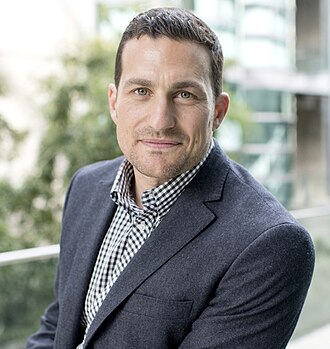
马马特·亚伯拉罕斯 安德鲁·休伯曼
EDITED TRANSCRIPT · 依据现场录音编译整理,可划线生成便签
编者按: 本文是斯坦福医学院神经生物学与眼科教授安德鲁·休伯曼在其播客《Huberman Lab》中与斯坦福商学院沟通与演讲专家马特·亚伯拉罕斯的一场对谈。两人围绕如何清晰、自信地表达展开,话题涵盖公开演讲的恐惧根源、即兴表达的训练、演讲中断的补救、口头填充词的消除,以及日常闲聊与人际沟通中的具体技巧。本文依据现场录音编译整理。

恐惧公开演讲的根源

休伯曼: 马特,欢迎你。请教我们如何更好地沟通。但请不要只讲公开演讲,也要讲一对一的交流、即兴的交流和有准备的交流。我实际上是在请你解决一大堆问题。我们常听说,人们最大的恐惧之一就是公开演讲,但我觉得这非常依赖情境。一说到公开演讲,我们想到的是被推上台,讲一个自己不熟悉的话题。你认为这种恐惧到底是在怕什么?怕丢脸?怕说出蠢话?怕在台上瘫成一滩眼泪?从某种意义上说,这种恐惧是不合逻辑的。

亚伯拉罕斯: 研究这个问题的人普遍认为,它有演化上的根源。当我们这个物种还以一百五十人左右的群体生活时,你在群体中的相对地位决定一切。我说的不是谁开好车、谁在社交媒体上点赞最多,而是谁能获得食物、住所和繁衍的机会。如果你做了什么让自己的地位受到威胁的事,后果可能非常严重。所以我们认为,对任何危及地位的事情高度敏感,已经刻进了我们的天性。站在一大群人面前是这样,跟老板谈一件要紧的事也是这样。这些情境都让我们暴露在风险之下。

休伯曼: 我们经常听到一种说法:说了什么也许没有怎么说重要,比如音色、眼神接触、肢体语言等等。每次听到这种说法,我都觉得视角有点偏。效果应该是所有这些的总和,对吧?

亚伯拉罕斯: 完全正确。你说的内容非常重要。如果内容不合逻辑、令人困惑,你的形象就会受损。但同样地,你怎么说也很重要:是否自信,是否站得挺直,声音是否有力。所以做我们这行的人,一心想帮人做到两件事:既能构思出有意义的信息,又能用一种真正建立连接、真诚而有吸引力的方式把它讲出来。两者缺一不可。

先勾住听众,再谈资历

休伯曼: 我在想线上和线下的沟通,那种有人被选中站上台讲某件事,大家期待他能吸引住我们的场合。一位朋友跟我讲过一个概念,说作为听众,我们首先想知道的是:这个人凭什么值得我花时间?所以人们通常会讲自己的头衔和经历。你觉得公开演讲的恐惧里,有多少来自人们需要解释或证明自己「有资格」占用你的时间?因为你会听到大量堆砌资历的开场。不过我也想提出一个相反的可能:听众根本不想听这些,他们只想听这个人到底要说什么。

亚伯拉罕斯: 我倾向于同意后者。我指导学生和企业界人士时都强调,真正重要的是连接。如果你能让人们对你的话题产生兴趣,让他们看到这件事与自己相关、对自己有意义,那就足够了。你的资历固然会影响你说的内容,但不必是你开口说的第一句话。我个人有一个使命,就是终结那种一上来就报头衔、念资历的演讲和会议。先把我们勾住。我告诉人们,这就像动作片。你看过的每一部动作片是怎么开场的?用动作开场。做点能吸引听众的事。我不是说要撞车或者跳飞机,而是说一句有挑衅性的话,问一个问题,给几个有意思的数据。先让人们看到你讲的东西对他们意味着什么,然后你就有资格把他们带进对话,连接就在那里发生。

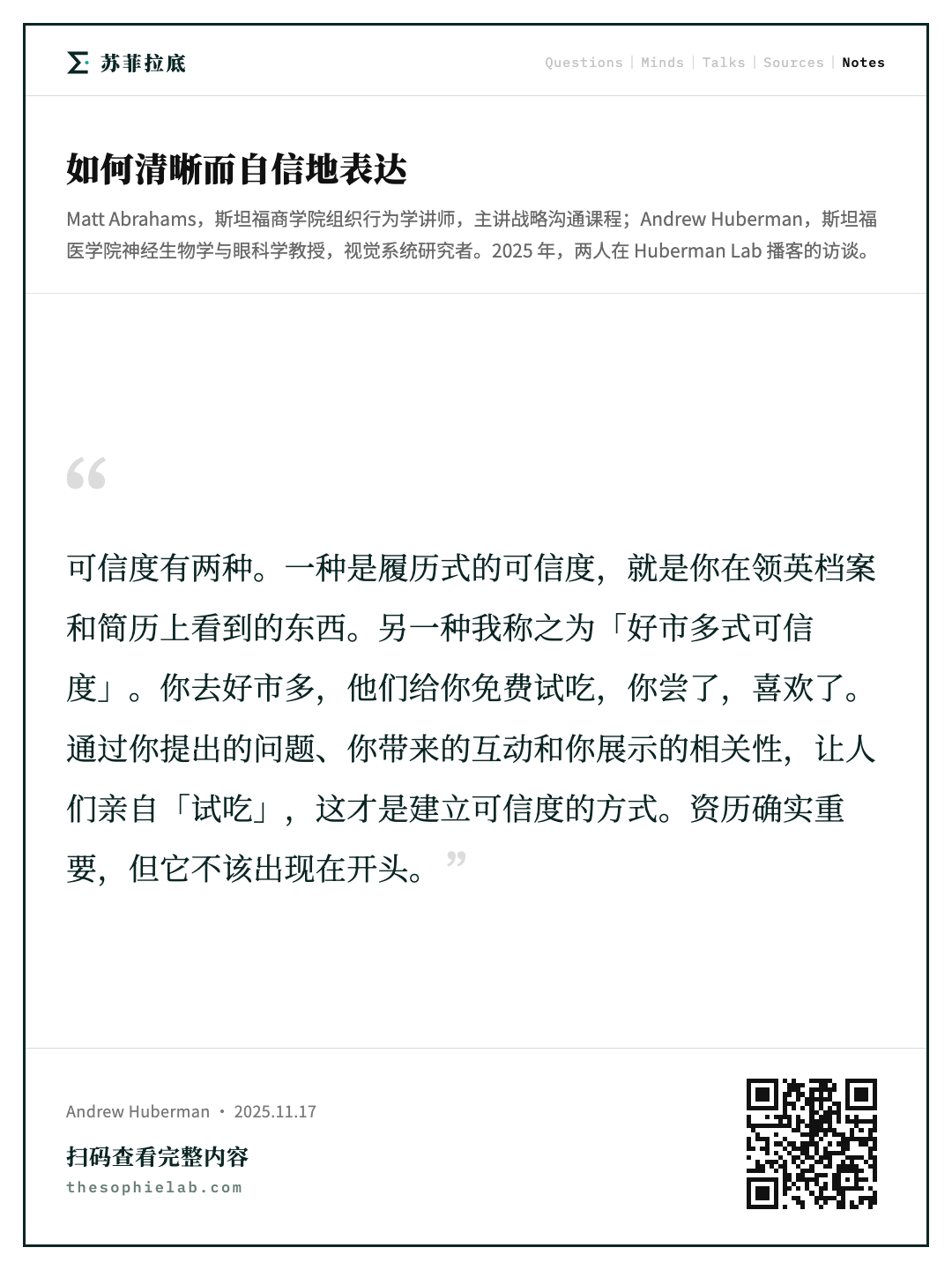
资历确实重要,但它不该出现在开头。你要用行动去证明自己的可信度。我教学生说,可信度有两种。一种是履历式的可信度,就是你在领英档案和简历上看到的东西。另一种我称之为「好市多式可信度」(Costco credibility)。你去好市多,他们给你免费试吃,你尝了,喜欢了。通过你提出的问题、你带来的互动和你展示的相关性,让人们亲自「试吃」,这才是建立可信度的方式。

什么才是真诚

休伯曼: 我完全同意。这就引出了另一个问题:真诚(authenticity)。我们到处听到「真诚」这个词,我最近也在琢磨这件事。真诚到底是什么?人能不能有意识地去调用它?或者说,调用本身就违背了真诚,因为你本来什么都不该调用,只需要做自己?

亚伯拉罕斯: 我认为真诚归根到底是清楚地知道什么对你重要、你主张什么,然后从那个地方出发去说话。这是什么意思?意思是无论你在大舞台上讲话还是一对一交谈,你都清楚这件事对你自己的价值在哪里,然后尽可能清晰地把它讲出来。忠于自己的信念,但前提是你得先花时间弄明白自己的信念是什么。我们很多人紧张,或者太担心讲不完材料,就顾不上从一个坚定、清晰、有连接感的地方出发。所以真诚首先是内省,然后再把内省的结果转化成对听众有意义的东西。这就是我理解的真诚。

休伯曼: 我觉得我们探讨的这个真诚,还包括讲话的人不去时刻监控听众对自己的看法。这似乎是有效沟通的核心。一边讲一边盯着自己的表现,盯着别人怎么看自己,不停地给自己打分,这与有效沟通是背道而驰的。

亚伯拉罕斯: 百分之百正确。我们越是在脑子里评判和打分,就越难真正在场、与对方建立连接。我在课堂第一天会做一个活动,能非常直观地显示我们有多容易困在自己脑子里。这是我从即兴表演借来的。我让学生站起来,用十五秒钟指着房间里不同的物品,唯一的规则是:叫出一个它不是的名字。你指着天花板,说「汽车」。你指着地板,说「计算器」。

就这么十五秒,难度非常大。我有一个学生指着一把椅子,什么也说不出来。我走过去问他怎么了,他说:「我错得还不够。」我可没给任何评分标准,没有任何要求。我说,你多讲讲。他说:「我本来想管椅子叫猫,可是猫有四条腿,椅子也有四条腿,我错得不够。有时候猫还会坐在椅子上,我错得不够。」我们每个人都在他那条评判与打分的连续谱上。他显然比我们大多数人偏离好几个标准差,但我们每个人脑子里都装着这种评判,它把我们锁在内部,让我们无法向外投注。所以你说得完全对。当我忙着评判自己在说什么时,我就在消耗宝贵的认知带宽,而这些带宽本可以用来确保你听懂我的意思。这也是为什么背诵讲稿会帮倒忙:那些宝贵的认知带宽都拿去「说对」了,反而妨碍了真正去说。我们需要训练自己去理解,沟通的魔力发生在当下这一刻,而不是发生在你事先的脑子里。

休伯曼: 多好的练习。你推荐人们自己做这个练习吗?

亚伯拉罕斯: 只要不是在开车的时候。

休伯曼: 那是红灯。那是绿灯。

亚伯拉罕斯: 正是。你知道谁最擅长这个吗?孩子。因为他们没有我们这些顾忌。任何能打断你评判和打分习惯的事情都会很有帮助。像这样简单的小游戏,还有其他即兴练习,都能让你看到:这就是我在做的事,这是我的模式,我的习惯。它能识别出我们随身携带、却实际妨碍沟通的那些思维捷径。

休伯曼: 太有意思了。我有时候喜欢玩小时候玩的游戏:看云,猜它像什么。非常好玩,也非常孩子气。但它逼着你用不同的方式看云,云的轮廓变成了某种东西。有意思的是,如果你和别人一起玩,几乎总会变成讲故事,好像一朵云在吃另一朵云。你开始编织叙事。我最近跟人玩过一次,非常开心。到某个时刻你会说,哇,那真的像一个什么什么。

亚伯拉罕斯: 我认为让这种乐趣成为可能的,是你暂时悬置了评判,让事情自由流动。正是在这个过程中,你开始对「当下会发生什么」建立信心。我最近很多工作都是关于即兴发言的,也就是当场说话。而即兴其实可以准备。想想运动员,他们做大量的操练和重复动作,这样上了场才能做出恰当的反应。说话也是一样,但其中一部分在于你必须采取的心态:别挡自己的路,看看当下会发生什么。这会把你解放出来,让你在那个互动里做该做的事。

节奏与乐高说明书

休伯曼: 我做公开讲座或线下活动时,有时会跟观众互动,随机点人,让他们说一个身体部位。我总是有点怕,不知道对方会说出什么部位来。然后我试着把它串到某个真实的神经科学或健康知识上。这总是很有趣,但我这么做是为了打破节奏。我觉得公开演讲的难处,有时在于我们上台前做了些准备,也许背下来了,我通常不背,但心里有个开头、中间、结尾,知道幻灯片上有什么。可是节奏会变得太规律,以至于把人丢掉了。打破节奏是有用的。当我从演讲经历中退后一步,无论是作为讲者还是听众,我都觉得一场好演讲有一种歌曲般的性质:有开场,然后有一段节奏加快,然后有重复,有旋律和韵律。我愿意认为好的播客也是如此,虽然不该让我们在这里过于自觉。

亚伯拉罕斯: 我想讲一个跟这个有关的故事,但我得先说,等会儿我要喊一声「耳垂」,看你怎么接,因为我实在惊讶你敢让观众随口说身体部位。我写最近这本书做研究时,采访了负责乐高全部说明书的人。不知道你有没有拼过乐高。

休伯曼: 有,小时候。

亚伯拉罕斯: 乐高的说明书上一个字都没有。我一直对此很着迷。我在课上会安排一节课,带一本乐高说明书和一本宜家说明书,两者是完全相反的东西,让学生把它们当作两种传递信息的方式来讨论。负责这个团队的先生告诉我,乐高说明书的设计师把说明书视为一个故事、一段叙事。你做的不过是把零件拼在一起。但他们发现,如果把所有步骤按同样的方式排列,每一步都是同样数量的动作和零件,人们的体验会截然不同于这样的安排:有些步骤有大量细致的工作,有些简单一点,有些快一点。你说的那种节奏能建立动力,建立成就感。他们是在有意把情感带进拼乐高这件事里。

休伯曼: 真有意思。乐高是斯堪的纳维亚的公司吧?

亚伯拉罕斯: 丹麦的。

休伯曼: 我继母听到我们聊乐高会很高兴,她是丹麦人。

亚伯拉罕斯: 如果一本没有文字、只是让你拼积木的说明书都能做到这一点,想想你在一对一或一对多的沟通里能做到什么。你说的节奏、模式、模式的打破,这些都能带来投入感。

休伯曼: 我想到我们小时候学东西的方式,比如学字母表。它不只是一串字母,而是有韵律的,有抑扬顿挫。人人都知道那个调子,孩子不会平着念。

亚伯拉罕斯: 完全正确。把东西配上音乐,把东西可视化,都是帮助记忆的方法。

休伯曼: 如今我们常听说人们想要短内容。可我能作证,人们仍然在听长篇播客。我有一个没有任何数据支持的理论:现在的人需要大量更新视觉信息。他们刷Instagram,刷TikTok,不喜欢这个YouTube视频就飞快切到下一个。但对于音频,同一个声音或几个声音长时间持续在场是有效的,它很抚慰人,我们会进入一种状态。我还真做过一个实验:只听Instagram短视频的声音,然后不停地翻。翻到第五个就受不了了,非常刺耳,非常割裂。你会想,这些声音都是谁?可视觉内容就很容易追踪。所以我认为,我们确实喜欢新鲜的视觉信息,但音频内容需要在长时间里慢慢展开,否则对我们来说是相当厌恶的。

亚伯拉罕斯: 我听人说过,在所有感官中,听觉最需要我们慢下来才能真正注意。我觉得正是这种慢下来,让我们对音频更投入。我想你是对的。不知道你的教学有没有被迫改变。我教越来越年轻的一代学生,不得不越来越频繁地切换形式。十五年前上过我课的人今天来看,会说:天哪,你在干什么?现在一堂两小时的课,我大概要换七次形式,从小型讲授到看视频,再到两人一组讨论,就是为了让学生保持投入,因为他们的状态就是这样,需要切换才能投入。

休伯曼: 我给医学生教神经发育和其他几门课,用大量幻灯片。这些年我意识到,如果一张幻灯片上信息太多,他们就什么都听不进去。而且一切换幻灯片,作为一个研究视觉的人,我很清楚,人们会朝新的视觉信息转过去,切换过程中你说什么他们都听不见。

我还特别着迷于另一件事,因为我最初是在Instagram上画神经系统的各个部分并讲解,由此开始线上教学的。我发现用图像教东西有一个最佳区间。比如说,如果我把大脑的某个区域或某条神经回路画得非常精确、细节丰富,那就太多了,学习效果反而不如更稀疏地呈现关键元素。但如果我退到球棍模型,只画三角形和圆圈,效果又不够好。所以有一个恰到好处的点:细节刚够,又不过多,人们能一边听你说,一边看标注,看图中的东西,然后它就印在脑子里。回望历史,我很痴迷医学史和医学教育史,那些真正流传下来的医学图示都极其简洁。它们只精确呈现免疫系统之类的少数几个元素,也不是那种气泡漫画,「我是巨噬细胞」「我是胶质细胞」,那种小漫画至少长期看是无效的。把所有细节都画出来也不行,那就像对着消防水龙头喝水。真正好的老师和解剖学家能给出恰当剂量的信息,一点不多。有点像好厨师不会把调料放过头。而这并不容易。你得同时做老师和学生,才能做到。

听众需要什么

亚伯拉罕斯: 我认为你触及了一切有效沟通的核心要素:真正理解你的听众和他们的需要。我们太多人把沟通的成功定义为「把信息发出去了」。我脑子里的东西现在出来了,所以我成功了。

休伯曼: 这个错误我犯过很多次。

亚伯拉罕斯: 沟通更多是关于:我需要说什么,我的听众才能更好地理解?重点不是我想要什么,而是你需要什么。所以我必须做侦察、反思和研究,认真想怎样构思我的信息,无论那是一幅图,还是我想用语言表达的一个要点。你必须真正为听众着想,而大多数人不这么做。大多数人只顾着把内容倒出来,不去想它落在对方那里是什么样子。成功的标准是,你的听众能拿走你说的东西,理解它,并且能用它做点什么。一切沟通里最关键的那个词是「保真」(fidelity),也就是思想传递的准确性与清晰度。如果你与听众的需要不同步,你就有麻烦了。我们大多数人只做一份内容,然后原样讲给不同的听众,因为讲出去了就以为成功了。这种想法是错的。

评判与思维捷径

休伯曼: 如果你愿意,我们能不能花几分钟聊聊工具和练习,再回到理论,然后再回到工具?我很喜欢你说的那个练习。我会指着杯子,然后自己评判自己,最后说「斗牛犬」,因为那大概就像巴特·辛普森做罗夏墨迹测试,全都是同一个答案。这个练习到底有什么用?什么时候该一个人做,什么时候该和别人一起做?

亚伯拉罕斯: 我用这个练习有两个目的。第一,展示我们沟通时会做出多少评判。如果你问一个人,把一个东西叫成别的东西为什么这么难,客观上并不难。他们会说,「那不是我习惯的说法」,或者「我想让它比我刚才想到的那个更好」。第二个目的是帮助阐明,在这种有挑战的情境下我们是如何依赖思维捷径思考的。我在课上做这个练习时,总会问:你们有没有用什么工具来帮自己决定说什么?人们会说,有,我用的是颜色这一类。你的话就是狗的品种这一类。这些就是启发式(heuristics)。我们的大脑在试图帮我们。启发式非常重要,没有它们我们就没法做决定。

但有时候,一条启发式会把你锁进一种思维方式。想象你我刚开完一个会,你转过来对我说:「马特,你觉得刚才那个会开得怎么样?」我立刻判断:安德鲁想要反馈。于是我可以列出所有出错的地方,所有本可以做得更好的地方。但如果我真正在听,而不是锁死在「反馈」这条捷径里,我也许会注意到你在低头看地板,说话比平时更慢更轻。也许你那一刻要的不是反馈,而是支持,因为你知道会开砸了。如果我过早锁进一条启发式,又没有意识到自己锁进去了,我就可能把我们的沟通带向一个没有成效、甚至有害的方向。我刚才描述的情形,真的发生在我和一位同事之间。我把我们做错的每一件事都数了一遍。我花了六个月才修复那段关系,因为他不想听哪里错了,他自己知道。他那一刻想要的是我给他一点支持。所以这个练习是为了帮我们理解两件事:我们做了大量不必要的评判;我们有这些捷径或模式,它们让我们无法在场、无法回应真正需要的东西。

休伯曼: 你能给「启发式」下个定义吗?我想我知道它的意思,但你刚才把启发式和模式差不多当同义词用,也许给大家解释一下。

亚伯拉罕斯: 对我来说,启发式是一种我们经常在无意识中使用的工具,用来减少特定情境中的不确定性。比如我在超市挑最好的番茄酱,我可能用的捷径是「哪个最便宜」,或者「哪个牌子摆的品种最多,那一定是最值得买的牌子」。这些就是我们在不确定的情境下借助的心理捷径。

休伯曼: 我想起一件事。我还是初级教授、没拿到终身教职的时候,我的第一个研究生,她现在是犹他大学的杰出教授,有自己的实验室。我们在我办公室里讨论她的第一篇论文,我长篇大论地讲我们需要怎么分析,这个那个。她安静地坐着,然后说:「你能说得更具体一点吗?」我心想,天哪,我刚才讲了五分钟。我想她其实是在问:你到底在说什么?她听到这段大概会笑。她有一种很了不起的提问方式,比如「你多讲讲」,或者「接下来两周你到底想让我做哪些实验」。然后她通常会给出一个更好的主意,所有优秀的研究生都这样。我觉得这跟你说的有点关系。我是带着一种流畅感在讲,默认我们俩在同一页上,而其实没有。不是因为我是教授她是学生,实际上她比我更接近数据,因为数据是她采集的。这种一对一的互动你能察觉,能纠正。但公开演讲往往是人下了台,要么自己意识到讲砸了,要么收到讲砸了的反馈。我的博士后导师说过:「演讲后有人提问,说明你讲得好。没人提问,说明他们只想把你赶下台。」所以现在演讲后有人提问,我就想,好,这说明你吸引住了人,他们有问题。大家可以记住这一点:有人提问,很可能说明你击中靶心了。

亚伯拉罕斯: 没错。你也点出了一件事:如果我们困在自己脑子里,就无法评估当下发生了什么。沟通很大程度上是回应。所以我需要足够在场,看到听众在如何反应。他们看起来困惑吗?不高兴吗?然后我才能调整、适应。我们必须足够在那一刻里,才能做出回应。事先的准备工作帮我们准备得更好。

不过我想说,在你和那位研究生的例子里,她可能遇到的问题之一是:你传递信息的方式只是一个清单,一长串事项。而我们的大脑不擅长记清单。我总跟学生开玩笑:你去超市,要买几样东西才必须写下来?我是三样。清单我记不住多少。

如果你给信息一个结构,理解就容易得多,处理能力就会提高。结构无非是想法之间的逻辑联系。每个听众都见过结构。你看过电视广告吧,大多数广告的结构是「问题、方案、收益」:世界上有个难题,这个产品或服务能改善它,你从中受益。这就是结构,有逻辑联系。它像一个故事,有开头、中间和结尾。我们的大脑天生为此而设,理解故事比理解一堆随机罗列的东西容易得多。我会跟学生开玩笑说,「要点会要命」(bullets kill),别在幻灯片上堆一大堆要点,那是在害自己。所以在你和研究生的那次互动里,我猜如果你把信息按逻辑结构组织起来,她会理解得更好。一个很适合的结构是三个问题:「是什么、那又如何、接下来怎么办」(What, so what, now what)。这是我想让你做的事,这是它为什么重要,这是帮你完成它的下一步。突然之间,它就变得容易消化和理解了。结构对于传递信息至关重要。

休伯曼: 建实验室的头五年,我学到跟学生和博士后互动最有效的方式,是让他们站在我办公室的白板前,我们一边讨论项目,他们一边把东西写下来。写下来的东西,我们会划掉一些,改一些,但那些就是我们所说的「待办产出」,他们要带到下一阶段实验里去的东西。让他们来掌握什么是关键信息,他们也可以随时打断我,问「这里会怎么样」。这是一种非常动态的互动,不是典型的讲课式互动。但我发现这在其他场合也很管用:对方可以做笔记,可以问不清楚的地方,而我能清楚地感知他们带走了什么,也能看到我在哪里没讲到位,或者偶尔哪里讲成功了。

亚伯拉罕斯: 我很欣赏你花时间做这种能获得实时反馈的互动。在更正式或更大规模的沟通场合,也有可以内置的办法。我可以做投票,可以让人们两两配对分享再回馈,线上工具能做很多事,人们可以在你讲的过程中给出反应。实时获得反馈、据此调整的方法是有的。但第一,你得在结构里给这些机会留出位置;第二,你得足够在场,去注意正在发生什么。

录下自己,反思与反馈

休伯曼: 你建议人们把自己讲课录下来再回看吗?

亚伯拉罕斯: 绝对建议。我要求所有学生,只要做公开表达,无论是模拟小组讨论、模拟会议还是演讲,都要录下来,然后看三遍。一遍只听声音不看画面,一遍只看画面不听声音,最后一遍两者一起。任何这么做的人都会注意到不同的东西,有好的也有坏的。我告诉所有人,这就像看牙医。没人喜欢去,但去过的人都很庆幸去了,因为你能看到太多、学到太多。我认识很多优秀的沟通老师,但最好的老师是看你自己沟通。我想你也看过自己吧?看的时候学到东西了吗?

休伯曼: 我会听有嘉宾的播客,也会听单人节目,看哪里可以改进。我有一两个人是我专门找来要反馈的,我一直尽力落实他们的反馈。有些东西我就不说了,因为有些非常细微,我自己永远观察不到,但事后证明非常有用。我觉得,无论在舞台上、播客里,还是任何形式的沟通里,有效沟通归根到底是跳出自我评判,同时又要与听众保持连接。这在单人播客里尤其难,我对着一台摄像机说话,只能想象面前是一间教室里的听众。可是没有人举手,至少当时没有。等我们发布后,评论和批评就来了,那些也很有用。从课堂教学、大课小课到做同行评议的科研,你会练出很厚的脸皮。可即便如此,没有什么能让你为面对公众做好准备。而现在所有人都面对公众,除非把评论区关掉。发蛋糕照片的妈妈,发生日派对照片的孩子,人人都面对公众。我想这让人脸皮更厚,但对很多人来说也可能是伤害。

亚伯拉罕斯: 我喜欢你花时间反思和寻求反馈。我常说,沟通变好只有三条路:重复、反思、反馈。你必须练习,从来没有人靠想就想成了好的沟通者,你必须去做。你必须反思。关于疯狂的那个定义,重复做同一件事却期待不同结果,很多人就是这么沟通的。我每晚睡前花一分钟写下当天沟通中哪些做得好、哪些不好。每个周日花五分钟回顾上一周,并为下一周做计划。我不是说我是很棒的沟通者,但我确信我因为多年坚持这个练习而变得更好了。

休伯曼: 你每周都做?

亚伯拉罕斯: 每天。我有一本日记,写下一两件我觉得做得好的事,一两件我觉得做得不好的事。周日再回顾,挑一件出来。这对我帮助很大。然后最后一步是反馈。你得有信得过的人能给你诚实的反馈。这个反思练习我做了很久了。

休伯曼: 多久?

亚伯拉罕斯: 大概是孩子出生以后开始的,至少十五六年了。

休伯曼: 太棒了。这就是你为什么是斯坦福教授。这是在斯坦福的一大乐趣。我们此刻不在斯坦福,地球上也有别的好大学,但我爱它是因为那里的教师和学生,说实话学生才是那里真正的天才,每个人都如此投入自己的手艺。别处当然也有,但斯坦福是我熟悉的经历。你教沟通,每天记录自己的沟通,周末复盘。太了不起了。我也觉得反馈很好,对反馈做有选择的过滤也很好。我喜欢听别人的讲座,很多讲座别人可能因为内容或表达方式觉得无聊,但我从人们的风格里学到很多。从相距很远的领域里汲取沟通风格也很有意思。我不点名,但看看娱乐和传播的不同领域,有人更多用身体,有人更拘谨。我认为探索这些不同的天地有很多可学的。

亚伯拉罕斯: 我百分之百同意。我很幸运,我主持的播客让我能采访世界上一些最好的沟通者,不仅能请他们思考自己的手艺,还能看他们怎么做,观察人们各不相同的做法。而且不一定非得是名人。我儿子的一位幼儿园老师教了我很多:如何在压力下保持冷静,如何监控、管理和引导互动。我们只需要留心、保持开放。不是为了照抄,而是获得想法,看看别人是怎么做的。你拆解复杂生物过程的方式,那种把东西讲得人人能懂的本事,我觉得非常了不起。某个地方的某个程序员完全可以用同样的技能向终端用户解释他的东西是怎么运作的。我们需要借鉴、理解别人的做法。我们太容易困在自己的一套里。观察别人,我认为是最好的方式。

身体的能量与走位

休伯曼: 很久以前我意识到,当身体里有一定的能量时,我们叫它自主神经唤醒、交感张力,或者人们常说的「战或逃」,总之当身体能量很高时,这在我们要演讲或处于新环境时很常见,不一定在台上,如果允许自己动起来,走动、踱步、打手势,就能释放掉一部分能量,传递信息会比一动不动地坐着、把所有能量都从嘴里挤出去容易得多。当我们平静放松时,可以靠在椅背上,只动动嘴、动动眼睛、稍微动动头。我见过一些最好的演讲者知道什么时候踱步,什么时候站定不动。也许是排练过的,我不知道,但他们在那些时刻没有跟自己的天性对抗。有一位神经科学家,他上过这个播客,我就不点名让他难堪了,他精神极其充沛、能量极强。我第一次看他演讲是在哈佛医学院,一个基金会成立五十周年的场合。他上台抓起话筒,就那样讲。我心想,他要把话筒吃掉了,他要把话筒吃掉了。他做了一场无比精彩的演讲,把全部能量都灌进了那只话筒。我意识到,这个人一动不动,但我真觉得他随时会咬下一大块话筒。他当然没有。我想,哇,他把我们所有人都带到了那一个点上。显然他是一位经验丰富、技巧娴熟的沟通者。

但他也是那个领域的专家。这是我一直提醒有可以理解的怯场的学生和博士后的话:就你要讲的题目而言,你不可能不在这个房间里知识最多的前三名之列。很可能你就是知道得最多的人。也许有另一位专家在场,那会有点吓人,但至少你算得上他的同行。所以要提醒自己,在大多数公开演讲的场合,你就是这个话题的顶尖专家之一。至少和听众相比,你在这些材料上花的时间最多。

亚伯拉罕斯: 我还要补充一点:在那些场合,听众通常是想向我们学习的。他们来是因为想从我们这里获得价值,不是来批评、评判和打分的。当然那也会发生。人们不喜欢看别人失败和挣扎,我们想得到价值。如果你提醒自己,我有价值可以带来,而听众想要这个价值,就能给紧张降降温。

至于动作,我认为动起来很好,只要别分散注意力。关于动作有一些规则或想法。在过渡时动。单口喜剧演员有一条努力遵守的规则:永远不要在抖包袱的时候走动。你要把包袱稳稳地落下。我们每个人沟通时都有自己的「包袱」,有真正想让它落地的东西。说那些话时站定不动。但在铺垫时,动起来。所以要决定好:什么时候开始,走上前,动起来。动作既能帮你缓解焦虑,也能帮听众理解什么重要、什么不重要。如果我从一个要点过渡到下一个时移动身体,或者坐在桌前时转一下身体,这就在向你传递有用的信号:我们正从一处移到另一处。所以要把这种「想动」的需要用得有目的。

休伯曼: 我以前不知道喜剧演员抖包袱时不走动,现在想想完全说得通。

亚伯拉罕斯: 因为走动会分散观众的注意力。就连动作很多的克里斯·洛克,抖包袱时有时也会停下来。

社交媒体与代际差异

休伯曼: 不知道你在课堂上有没有观察到,社交媒体和其他新形式的内容正在改变人们对「一件东西该有多吸引人」的预期。因为社交媒体的入口非常快。我从没见过任何东西能让人这么快聚焦,除非是看到什么非常令人不安的东西,那是没人想看的。如果你突然看到两辆车相撞,你会完全被吸引,不会再回去做原来的事。但撇开坏事和创伤性事件不谈,社交媒体通往焦点的入口极其顺滑、极其快速,一下子就把你装进那个框里。一本书通常做不到这一点。那么,你观察到听众对「有多吸引人」的预期正在发生什么变化?

亚伯拉罕斯: 我看到这一点在几个方面上演。第一,想想一个多代际的职场,或者任何多代人聚在一起的地方。我们这个年纪的人,虽然我比你大,期待关系和沟通按某种方式展开。而我认为年轻一代期待事情更快、更事务性。当我们凑到一起,就会滋生误解,有时是冲突。我觉得这很有意思。我试着教我的学生,要去欣赏别人建立连接的方式,以及别人期待信息进来的方式。如果你一直给我发短信,而我其实希望你拿起电话让我听到你的声音,那就会出问题。所以我们必须理解,别人有不同的接收信息的方式。我发现,很多跟我交流的年轻学生,很难做建立关系、建立信任所必需的那些前期工作,因为他们习惯了、也期待事情很快发生。而很多沟通、很多连接,至少在开始阶段是需要时间的。所以要帮人们理解,前期花的时间能带来后面令人兴奋的深度连接。事情确实在变。

好奇心与闲聊

休伯曼: 我们谈话前我在想,如果只给人们一条建议,让他们在陌生环境里、台上台下都更自在地沟通,那会是什么?我脑子里冒出来的是:对人友好。我天生挺友好的。买咖啡的时候我会问,你今天过得怎么样?我是真的好奇。很少有人说今天糟透了,偶尔有。通常他们说,还不错,你呢?在网约车里,我经常发现自己在跟人聊天。对话对我来说相当顺畅,我知道对别人不是这样。人们不会相信,但我其实非常内向,很多时间一个人待着,但我喜欢人,也算友好,别人也对我友好。所以我认为友好能帮你变得擅长沟通。你会同意吗?

亚伯拉罕斯: 绝对同意。我对这个问题的回答会是好奇心。我以好奇心开路。问问题,观察,把观察到的说出来。很多人讨厌闲聊,是因为不知道怎么聊。但如果你以好奇心开路,问一个问题,做一个观察,我认为对话就能以更流畅、让人更自在的方式往前走。而且坦白说,人最放松的时候就是谈论自己的时候。所以如果你能让人谈起对他们重要的事情就成了。对话背后有一整套科学。研究对话的人看的是「轮流」(turn-taking)。想想看,对话就是轮流说话。有一种轮次是支持性的:你说了什么,我支持你说的。比如你说「马特,我刚从毛伊岛回来」,我可以说「太好了,你住哪儿?玩了什么?」。另一种轮次是切换:我可以说「哦,我刚从哥斯达黎加回来」。好的对话两种都有。所以保持好奇,然后把握好切换和支持这两种轮次,对话不仅能发展下去,还能让你们更近、更亲密,也就是在关系中建立起更多信任。

休伯曼: 在洛杉矶,我几乎总会问网约车司机是哪里人,因为他们常常带着我辨认不出的口音。而几乎每次,我都会因为他们的族裔背景知道一家很棒的餐馆。我找到了我心目中洛杉矶最好的亚美尼亚餐厅,就是因为一次很愉快的搭车。所以,以好奇心开路。我不会直接问哪家餐厅最好,但话题似乎总是不可避免地走向吃的。

线性叙事与导游心态

休伯曼: 我很好奇讲故事里的线性和非线性。有些人的风格能同时转很多盘子,开一个线头,再开几个别的线头。有些人的风格非常线性。有人从不回指自己前面说过的话,有人不停地回指。我想这得看情况。但一般来说,如果目的是传递信息,从人们学习的角度看,哪种更好?

亚伯拉罕斯: 作为老师,作为一个想把重要信息传递给人们的人,我相信一种清楚地铺好基础、逐层往上建的线性方式,最有助于人们真正理解。教学往往是分层的、搭脚手架的,这自然导向线性。话虽如此,那种旁逸斜出、有很多岔路的方式可能更吸引人,也可能成功。而且这真的不必二选一。我认为你可以有一个高层次的线性主线,带着听众走那段旅程,但在不同的点上分岔出去,分享一些有意思的信息。

我把好演讲者看作好导游。我人生中还真做过导游。好导游很擅长设定预期:告诉你我们要去哪里。大多数人不知道去哪儿是不会跟团的。如果我出现说「我是你们的导游,走吧」,你可能会说「等等,我们去哪儿?」。但如果我说「我们要做这个和这个,不做那个」,你就能放松下来,安心跟我走。每到一处,我都告诉你我们接下来去哪里。但一路上我们可以漫步、闲逛,去看看别的东西再回来。只要人们有方向感,一切都嵌在一个更大的叙事里,两种方式都可以玩。但如果是严格意义上的教学,我认为有充分的证据表明,逐层搭建的线性方式最有帮助。

休伯曼: 你觉得想提高沟通能力的人,应该练习当导游吗?

亚伯拉罕斯: 我认为要采纳那种心态:带你走过我的材料时,我就像导游。导游会怎么解释这个?他们会在开头做介绍,设定预期。他们会确保你明白我们为什么从一处移到下一处。结束时,他们真心希望你带走有价值的东西。大多数旅游团最后都在礼品店结束,对吧?你送给听众的礼物,就是他们能带走并用起来的东西。所以用这个类比,透过这个视角看自己的工作,会非常有帮助。

给不爱说话的人留空间

休伯曼: 我想起小学时,老师让我们带一件对自己特别重要的东西来,然后孩子们站到教室前面讲。对孩子来说这是多美好的练习,因为他们当然比任何人都了解那件东西。但我记得看到、听到不同的风格。有的孩子上去就说「这是我的变形金刚」,非常外放。有的说「这是我的金鱼」。我养过几条金鱼。然后偶尔,其实不算偶尔,你会碰到一个孩子说「呃,这是我的笔」,你得让他大点声。他们就是不自在,尽管他们显然对那件东西和它为什么重要有非常深的了解。你能看出来,他们是封闭的。老师让他们大声点,他们就大声点,但我觉得很多人就是这样。他们就是不习惯把自己的想法投射到整个房间里。所谓的「解决办法」是什么?或者说,我们怎么给这些人留出空间?我不是出于政治正确才这么说,我真心相信这些人身上藏着大量有用的知识。也许他们想把知识拿出来,但也许那个媒介不适合他们。也许他们写作,也许他们就是不想分享自己最喜欢的东西。我相信你遇到过这样的人,但因为他们进入了某个特定的工作,就被告知必须擅长对一屋子人讲话。

亚伯拉罕斯: 我认为当有人说「你必须在这方面做得更好」时,那是不幸的。沟通有很多种方式,每个人都应该找到适合自己的载体。有些角色确实要求特定类型的沟通,如果那不是你自在的方式,也许可以考虑别的角色。但我相信我们都能学习和发展自己的沟通技能。我职业生涯的大部分时间都在帮人们在他人面前更自在、更自信地讲话,处理围绕它的焦虑,帮人们看到沟通有很多方式。也许我不必举着这件东西,把一切都变成「我和我的东西」。也许我讲一个关于这件东西的故事,或者讲我是怎么得到它的。这样重点就不在我身上,而在故事上。如果我们能让人偶尔跟恐惧本身拉开距离,让其他人参与进来,效果会非常好。

我曾经指导一家大家都熟悉的大公司的一位高层,他真的非常紧张。随着他升职,听众越来越多。我们一起想出的办法,本质上是在一开始就把观众的注意力引开。他会先说:「我们先看一段三十秒的视频。」视频放完,他就成了对刚才内容的引导者:大家怎么看?这意味着什么?他引导互动比当焦点自在得多。所以有很多办法可以达到传递信息的目的,而不必让聚光灯打在「我在传递信息」上。

我还想借你说的那个「展示与讲述」的故事分享一个例子。我在本科课堂上也做过这个,但加了一点变化。我让学生带一件东西来分享,用「是什么、那又如何、接下来怎么办」的结构讲。然后我让他们讲一件他们考虑过要带、但最终没带的东西:那是什么,为什么决定不带。这远比前者更能揭示一个人。说到真诚,人们讲第二件东西时流露出的情感,是讲第一件时没有的。第一件是他们精心准备过的,确保能让自己看起来不错,整个讲法都是设计好的。但讲另一件东西时,他们的热情出来了,对话的天性出来了。做这个练习非常有启发。

说出声来,反复练习

休伯曼: 我的研究生导师跟我说过,她宁愿对着一屋子人或者一间空房子演讲,也不愿意对着一个人讲。对一个人讲很难。

亚伯拉罕斯: 我觉得她在这方面是独特的。我想大多数人害怕的是对着一屋子人讲。

休伯曼: 我到现在也不知道为什么,倒不是因为这对我来说容易,我只是好奇那是什么。你说有演化上的根源。

亚伯拉罕斯: 我想是这个。人越多,后果显得越真实。对我个人来说,最让人焦虑的群体规模是十到十二个人。一旦超过十二个,二十个、一百个、一千个,对我来说反而变得更匿名。最难的就是十到十二人那个区间。

至于怎么练习最好,把话说出声是最重要的部分。

休伯曼: 大声说出来。

亚伯拉罕斯: 大声说出来。我在脑子里出奇地雄辩,一张嘴就不总是那么幸运了。所以你必须真的说出声。我们在脑子里做了太多假设,连了太多点,等真正说出来才发现它们连不上。录下自己再听,找信得过的人,你必须把它弄出来。这不只是针对大型公开演讲。高风险的人际沟通也一样:也许我想跟老板要求加薪,也许我得给同事一些不太好听的反馈。我必须练习这些,不仅要想我要说什么,还要预想对方的反应,也许做一些角色扮演。运动员做大量操练,上了场才能打得好。我们也需要这样。我跟公司高层合作时常常惊讶,他们会说「我把演示练了一两遍,可以了」。想想单口喜剧演员把段子练了多少遍。翻一两遍幻灯片,你怎么可能掌握那些内容?把它说出来,练习,积累次数,绝对重要。对着一个人、十个人、没有人,都得练。

休伯曼: 我们总以为自己知道怎么说一件事,直到现实迎面打来。有点像一个词读了很多很多遍,以为自己会念,等到某天必须念出来,念错了,才发现自己在脑子里念错了很久很久。

亚伯拉罕斯: 我们之前聊过,我练武术很多年了。学一个新动作时,你先对着空气学,可以练得非常漂亮,但等你遇到另一个人、必须跟人对练那个动作时,现实就来了。这正是你说的。你必须在现实里、在真实世界里体验它,然后才知道自己真正的水平。

休伯曼: 我不是武术家,但多年前在拳击馆待过一小段时间。我得说,空击和挨打完全不是一回事,沙袋也不会还手。沙袋有一定的物理重量,跟空击不同,但那是完全另一种体验。

亚伯拉罕斯: 正是。跟任何事一样,关键是反馈。

休伯曼: 我一直很着迷于著名编舞家特怀拉·萨普。她现在八十多岁了,非常了不起,关于编舞说过、写过很多精彩的东西。她说她有一个做法:先构思一段舞,在脑子里过一遍,然后因为她自己是舞者,她会亲自试,再让别人跳,再想象,如此反复迭代成千上万次,然后才在一小群非公开的观众面前演一次。所以,我们期待自己不经过这些就能站起来把信息讲得很好,实在是不可思议。

亚伯拉罕斯: 关于排练,我觉得有一个新领域很有意思:现在有一些虚拟现实工具,戴上就能练习演讲,能看到模拟的观众。其中一些工具还可以设定观众的反应,可以设成友好的,也可以设成不理你的。这样你就能脱敏。我认为对人们来说,尤其是对有恐惧症的人,这是一个很有意思的载体:戴上眼镜,练习演讲。有些工具还可以上传幻灯片,练习引用它们。所以不仅在现实里,在虚拟现实里我们也能练习和准备。

休伯曼: 你觉得,如果有人想在表达信息时更流畅,可以找个朋友随机在房间里选一件东西,然后就那件东西做一段简短的即兴演讲吗?就是为了习惯带着某种流畅度接住任何话题。

亚伯拉罕斯: 我认为即兴表演是提高沟通能力的绝佳方式。因为即兴不是为了搞笑,即兴是关于活在当下、回应当下所需要的东西。所以,做任何这类练习都好。你甚至不需要朋友。你可以看着一件东西就开始讲:描述它,讲一个关于它的故事。你也可以随手翻开一本书,挑一个词,讲讲这个词是什么意思。这些就是敏捷性操练,能帮你在被临场点到时表现更好。它也建立信心:我能做到。如果随便挑一个词我都能讲,那当有人问我一个我非常了解的问题时,我也能讲。这是一种建立信心、帮助当下处理的方式。

休伯曼: 我觉得十五岁以上的人不太愿意接受这种戏剧式的游戏,因为显得孩子气。但要成为有效的沟通者,你追求的恰恰就是那种孩子气的好奇和交流。

亚伯拉罕斯: 我在斯坦福继续教育项目里合开了一门课,叫「即兴地说」(Improvisationally Speaking)。我的搭档亚当·托宾是一位出色的即兴表演者,我负责沟通那一块。这门课的做法是给人们一小步一小步的台阶和许可,去做这些即兴游戏,因为我们把每一个即兴活动直接对应到一个具体的沟通需求。人们看到这种对应,就打开了。在斯坦福商学院,有好几门课把即兴的理念引入非常严肃的东西里:如何通过即兴学习当管理者、适应管理技能,如何通过即兴教的一些东西展示你的地位和权力。所以,学即兴,或者至少理解其中一些原则,肯定有帮助。

经典演说为何留存

休伯曼: 当我想互联网上真正具有档案价值的重要信息时,很少有东西能穿透出来。我有时玩这个游戏:什么才是互联网上真正的传世内容?其中之一是史蒂夫·乔布斯在斯坦福的毕业演讲。还有马丁·路德·金的《我有一个梦想》,肯尼迪也说过一些相当重要的话。这些都是写好的演讲稿,他们在照稿念,很多时候包含故事。这一点符合我们说的。可是乔布斯那篇我听过很多遍,他是照着一张纸念的。这与我们刚才聊的很多东西相悖,却是极其有效的沟通。你觉得为什么这些例子,就说肯尼迪、马丁·路德·金、乔布斯吧,也许还该加几个,为什么它们是最有效、最能留在人们脑子里的沟通?

亚伯拉罕斯: 有几个因素。第一,它们写得极好。诗意,鼓舞人心,用了让人难忘的修辞手法:重复、头韵之类。第二,它们处在那些信息真正重要、真正被需要的时代语境里。它们之所以回响,是因为它们与那个时代的精神相连。肯尼迪的登月演讲,马丁·路德·金的民权演讲,乔布斯的演讲,我认为跟当时的经济和环境状况有关,那个信息真正击中了人。所以我认为是语境和时机的匹配,是真正重要的思想以真正重要的方式、借助特定的修辞手法呈现出来,才让它们难忘。我还认为,这些人带进去的个人气质也有影响。换别人说同样的话,未必有同样的效果。

休伯曼: 我很难从最近五到十年里想出真正重要的公开沟通时刻。我能记得一些在电视和网络上发生的事,但那更多是「发生了的事情」。

亚伯拉罕斯: 我认为我们变得越来越嘈杂。不,我知道我们越来越嘈杂。信息太多了。即便是你举的例子里最近的乔布斯那次,当时的环境也没这么嘈杂、这么拥挤。在噪音这么大的环境里,很难听见那些句子、那些演讲。

休伯曼: 当然,我们目睹创伤性事件时,那些是闪光灯记忆。我记得航天飞机失事,当然还有九一一。最近最突出的,我想是查理·柯克遇刺。人人都知道,而且有视频。对人们来说,看一段模糊的视频和看一段高清视频是非常不同的事,现在我们看到的是高清的。所以从某种意义上说,这为「什么是难忘的」设了一个不同的门槛。那些都是悲剧。肯尼迪遇刺是模糊的、远距离拍摄的画面。而在非悲剧、非创伤的领域里,很少有东西能获得足以持久的高信噪比。

亚伯拉罕斯: 我认为确实如此。而且人们不再关注同样的渠道,获取信息的方式也不同了。这也在分散我们的注意力,所以我们看不到这些东西真正冒出来。但我也认为,这是对我们这个社会现状的一种评注。如果我们能听到更多、更多积极的、能引起共鸣的演讲,多年后还在引用它们,那会很美好。

休伯曼: 我经常想这个。那些非坏事的、获得高信噪比的事件,我现在一个也想不起来。原谅我,各位,如果我漏掉了最近某只小狗做了什么超可爱的事,但这种视频有几百万条,我想我们已经饱和了。这就像信息版的高度加工食品,我们的感官被钝化了。

亚伯拉罕斯: 我觉得这有几分道理。我还认为,我们正在远离传统的演说形式。那样的场合已经不多了。你可以看一些TED演讲,其中有一些非常精彩,还有其他同等水准的演讲。但我不知道有哪一场达到了你说的那个高度。

休伯曼: 我觉得布琳·布朗关于脆弱的TED演讲是真正有传世价值的一场。十八岁以下的人大概没听过,不过我们会放链接。还有很多别的很棒的TED演讲。你也有一场很出色的演讲。我看到你有一段线上演讲有两千四百万次观看,这可不是个小数字。那是一小时关于有效沟通的谈话。显然人们在乎有效沟通。

一对一与舞台上

休伯曼: 你认为擅长一对一对话的人,在台上也会更好吗?还是说这是两种完全不同的技能?

亚伯拉罕斯: 这个问题我经常被问到。我认为是一个维恩图。有些人能在一对一时建立起一种在舞台上很难做到的连接。这很大程度上关乎学术界所说的「即时感」(immediacy):我和你在一起,我专注,我们以那种方式投入。这不一定能迁移到大舞台或会议上。但有些技能是能迁移的:有结构,对自己要说的东西有明确的目标,能用引人入胜的方式开场。所以这是一个维恩图。有些人能在舞台上掌控全场,把他放到一个人面前,却不知道怎么回应。就信息本身而言,我认为重叠很多;就临场感而言,差别很大。但我相信每个人都能学着更好地沟通。如果不相信这一点,我就不会做这份工作。所以如果你擅长人际沟通但不擅长面对大群体,就用你已有的技能,找到一条路径在不同的环境里打磨和发展。反过来,如果你在大舞台上很好,我们就把你在那里做的东西拿过来,找到帮助你人际沟通的途径。两者并不总是相同,也有人两者都好。

神经多样性与内向者

休伯曼: 如今我们常听到「神经典型」和「神经非典型」。我确实认为两者在对话风格、语调起伏的多少上有明显差异。我不想说是「情感表达」,因为我有几个亲近的朋友是神经非典型的,他们告诉我,我也相信,他们声音底下的情感一点不比那些用抑扬顿挫和肢体动作把情感表达出来的人少。你认为,鉴于对神经典型和非典型的理解在扩展,我们需要调整对「什么是有效沟通」的概念吗?

亚伯拉罕斯: 我当然不想把神经多样性和内向、外向混为一谈。但你问的问题,我听起来是类似的:是否存在一种正确的或更好的沟通方式,而不这样沟通的人就处于劣势?我认为对有效沟通确实存在一些预期,但我们可以扩展它,而且无论是神经多样性还是内向,其中都有价值。外向往往受到奖励,仅仅因为你能听见、能看见。但我认为,我们能从神经多样的人身上学到一些东西,帮助我们真正建立连接、成为更好的沟通者。高度内向的人的沟通方式也一样。当然不存在唯一正确的沟通方式。有更好和更差的方式,但无论你在内向、外向、神经多样性的光谱上处于哪里,你都可以有效沟通。发挥你的长处。内向者做的一些事非常了不起,真正推动沟通向前。某些类型的神经多样者在创造力上、在沟通的细节程度上,可以非常有帮助。我们只需要找到这些优势,倚重它们。

写作、幻灯片与思考

休伯曼: 我发现,播客嘉宾里如果有人曾经写过一本书,他们做播客往往相当自在,与他们以前上过多少播客无关。这就引出一个问题:手写或打字把想法写出来,是不是一种为演讲做准备、或者总体上提高说话能力的有效方式?我明白,最终你还是得去做:想提高俯卧撑就得做俯卧撑,想提高说话就得说。但你认为写作、把想法转移到纸上,能帮人成为更好的沟通者吗?

亚伯拉罕斯: 简短的回答是能,但我认为这是一个两部分的过程。第一部分是写之前的思考过程。我写过几本书,我知道你也在写书,你会以不同的方式思考你的内容。你必须考虑读者,必须想这些部分怎么拼在一起,需要一个脚手架。所以是思考过程在帮你。然后是真正落笔、手指敲键盘的部分:当你必须选词,必须考虑句法和语法时,你与内容的关系比只是想想那些点子时亲密得多。所以在两个层面上,它都在帮你打磨信息。我是个非常紧张的写作者,而不是紧张的演讲者。我对自己写的东西非常焦虑。但我做编辑比做作者更好,而编辑的过程真正训练你的大脑去准备好回答问题、聚焦信息。所以我认为每一步,构思、写作、编辑,都让你为更好地沟通做好准备。而且我们都可以用其中的不同部分。你不必写一本书,也能用这些技能把话说得更好。

休伯曼: 我以前准备科学报告,是靠自己做幻灯片。我要求房间里不能有别的事情,因为做幻灯片时我脑子里在想我要说什么。自己做幻灯片,有时包括画插图等等,是准备演讲的重要部分。我发现,如果只是把图剪切粘贴过来,效果差得多。

亚伯拉罕斯: 我管那叫「弗兰肯幻灯片」(Franken deck)。人们把各种幻灯片攒在一起拼成一份,就像弗兰肯斯坦是拼凑出来的怪物。那里面没有故事,没有把一切串起来的思考过程。所以幻灯片是你思考过程的外化,这就是它对你如此有用的原因。

打破预期的风险

休伯曼: 我能讲个故事吗?你是嘉宾,但我真的想听听你的看法。我们在斯坦福有一位同事,他的名字我一时想不起来了,请原谅。多年前我们都是皮尤学者。

亚伯拉罕斯: 恭喜。

休伯曼: 谢谢。我到现在也不知道我是怎么入选的,但就是入选了。第四年我们要做报告。说到在一屋子人面前紧张,那真是一屋子来自全国各地的厉害人物,不只是神经科学,你在那里会觉得谦卑。不管你多优秀,房间里很多人都比你强。有一个人,他现在是斯坦福的教师,轮到他报告时,他上去说:「我不给你们看一堆数据了,我给你们放一段影片和一首歌。」他放了一段油滴互相碰撞的视频,声音或者说那首歌,对应着油滴的碰撞。我第一个念头是:这家伙疯了,真的疯了,或者他根本不在乎。不过这挺酷的。然后他接着讲他如何利用声音来开发新分子。他后来拿了麦克阿瑟天才奖。他造出了一美元的显微镜和离心机,在非洲那些经费极少的地区用来诊断疾病。他就是那种人。我记得当时想,哇,这个人太不可思议了。沟通能力极其惊人。我认为他确实是天才。「天才奖」这个名字挺好笑的,对吧?

亚伯拉罕斯: 我从来没得过。

休伯曼: 我也没有。坦白说,我觉得拿到的人有些是天才,有些不是。但那场报告不只是让我谦卑,它真正让我开了眼,让我意识到:如果一个人对材料有真正的掌控,并且足够相信自己独特的视角,你真的可以用一堆油滴互相碰撞这种看似含糊的东西来讲。说实话它挺美的,但看起来就像一盏熔岩灯,配点音乐。可它是完美的开场,因为信噪比极高。向他致敬,他太厉害了。如果人们尝试这么做而没成功,会失败得很壮观。成功了,也成功得很壮观。所以你觉得,我们应该保持常规,还是应该尝试这样的钩子?我做报告时从没想过要做这样的事。不过你从我讲这个故事的方式大概能看出来,它至今还留在我身体里,是我整个学术生涯中最精彩的经历之一。我当时就想,太不可思议了,我永远不会忘。

亚伯拉罕斯: 我认为那场报告做到的是打破了预期,并因此脱颖而出。人们应该在沟通中试探边界、往前推吗?我认为应该。但要稍微想清楚,也许做个对比测试,先讲给几个人听,说「我打算这么做,你觉得怎么样」,确保你冒的风险是经过计算的。我跟学生和辅导对象经常围绕幽默讨论这个。我不是说讲笑话跟你的经历一样,但它涉及风险。如果成功,幽默是建立连接的绝佳方式;如果失败,它是切断连接的绝佳方式。所以你必须想清楚,理解成本和收益,先在几个人身上试试,看看效果。

听起来这位不仅打破了预期,还让你对他研究的东西有了一种身体上的体验。它不只是一个概念。你我都参加过很多学术报告,它们可能非常理论化、非常概念化,而他把它变得非常具体,这有助于他想达到的目标。所以我经常挑战人们:你怎样才能以一种真正让人投入、参与的方式传递这些信息?能在白板上做点什么吗?能用一个类比吗?有没有一个故事可以讲,或者一个问题可以问,而不只是罗列信息?做一件打破预期的事,但它要与你的目标一致,并且支持你的目标。

休伯曼: 你觉得对自己是谁做一些内省有帮助吗?比如,就算我有他一半的知识,我也讲不了那样的报告。我只能讲我讲的那种。有时我怀疑,即便一场报告非常干巴,它之所以有效,是因为讲的人本身就是干巴的。或者有人更有戏剧性,之所以有效,是因为这个人在台下也有戏剧性。这又回到真诚。有时我觉得人们只需要弄清楚自己是谁、自己是怎么处理世界上的信息的,然后试着把那个分享出去。就像音乐家分享自己的歌,艺术家分享自己的视觉作品,因为那是他们体验世界的滤镜。我想很多时候我们想听别人讲,是因为我们想进入那些我们自己进不去的通道。

亚伯拉罕斯: 我认为理解什么对你有效、你的长处在哪里绝对重要,但与此同时,如果你不尝试别的东西,你不会知道某些长处在哪里。这就是为什么我回到即兴这个例子:不去做,你不知道自己的舒适区和边界在哪里,你也许会发现有些事你能做得很好,能让你成为更好的沟通者。所以,探索什么对你有效并加以利用绝对重要,但也要稍微扩展一点,看看你能在哪里成长。我认为你做的工作、我通过播客、写作和教学试图做的工作,都是在让人们接触更多信息,让他们可以调整、采纳,从而扩展他们沟通和研究的方式。所以你绝对要发挥长处,但也要探索那些长处可能是什么。我不希望每个人都只做自己已经擅长的事。

台上失忆怎么办

休伯曼: 我们能聊聊损害控制吗?我辅导过学生和博士后做公开演讲,见过一次彻底的崩溃。这个人现在是教授,做着了不起的工作,后来找到了工作,一切顺利。但在一次只有几个人的试讲中,彻底崩溃,无法恢复,我们只好推迟改天再来。

亚伯拉罕斯: 他就那样停下来走下台了?

休伯曼: 他僵住了,然后道歉。我们说没关系,这是小场合,然后试着鼓励他继续。也许他没睡好,也许有很多事压着。但最后是他坐在台边,请大家离开。

亚伯拉罕斯: 好吧。

休伯曼: 很沉重。让大家再次回到那个房间对我们所有人都很重要。他做到了,然后进入求职市场,拿到了职位,现在是某处的终身教授。所以他恢复了。我们都有糟糕的日子。但我想有些人听到这个大概会想:天哪。如果一个人在台上忘了自己要说什么,或者就是卡壳了,该怎么办?我建议紧张的人给身体的能量找个出口,就像前面说的走动,甚至在讲台后面抖腿,都能非常有效地释放能量、让人放松。这对我是个有用的工具,我也建议别人这么做。但你认为,一个人突然在台上停下来说「对不起,我思路断了」然后再接上,有多糟?你觉得这让他更有人情味,还是对信息是致命的?

亚伯拉罕斯: 跟我对学生说的一样,我得说:看情况。取决于你所处的场合。我确实相信听众是更宽容的。我建议我教的和辅导的人在那种时刻,与其说「哦,我忘了我要说什么」,不如说「我有时太投入了,有点跑到自己前面去了」,这很可能是真的,然后以此为由重新开始。让我分享一下我给人们的建议:怎样避免大脑空白,以及真的空白了该怎么办。

首先,避免背诵。背诵就是在邀请空白。所以我们不背,我们要有清晰的结构、一张路线图,但不知道每一个具体的词。对空白的恐惧会导致并增加空白的可能性。所以我们不要像现在这样担心空白。怎么做到?理性化。我让每个人想一想:在即将到来的这次沟通里,不管是一对一还是大型演讲,你大脑空白的可能性有多大?大多数人说大概百分之二十。那就意味着百分之八十的时候你不会空白。我不赌博,但这个赔率我接受。所以第一步是认识到它没那么容易发生。第二步,问自己:如果真发生了,对我来说最坏的结果是什么?会非常尴尬,很难堪,可能有一些短期影响。可是谁这辈子没尴尬过、没难堪过、没承受过短期影响?把它放进这个语境里,突然之间,空白既没有你想的那么可能,也没有你想的那么糟。这减少了你对它的压力,从而降低了它发生的可能性。所以,不背诵加上理性化,确实能降低空白的可能性。

现在假设最坏的情况发生了,你空白了,不知道该说什么。第一个也是最好的办法,就像你丢了手机或钥匙时会做的:回溯你的脚步。把你刚才说的话重复一遍。我们大多数人都记得自己刚说过什么,这能让我们回到轨道上。如果这不管用,我认为最后一根可以拉的救命索是:转移听众的注意力。什么意思?问一个问题。这在我身上会发生。同一门课我教很多遍,有时记不清这一次讲过这个没有,我只需要一点时间想一想。我会停下来,问学生一个问题。他们觉得这很合理。任何人都能想出一个问题。各位听众,如果你们哪天听到我说「我想停一下,请大家想想刚才讨论的内容怎样应用到你们自己的生活中」,那就意味着我忘了接下来要说什么。我脑子里在想:我接下来到底说什么?而听众大多数人在想:我该怎��把它用到生活里?这很好。它给了我那零点几秒,给了我一种掌控感。我们大多数人都能借一个问题为自己争取时间。所以,不要说「天哪,我忘了,太糟糕了」,而是说「我太投入了,有时候会跑到自己前面去,给我一点时间」,或者干脆问一个问题。

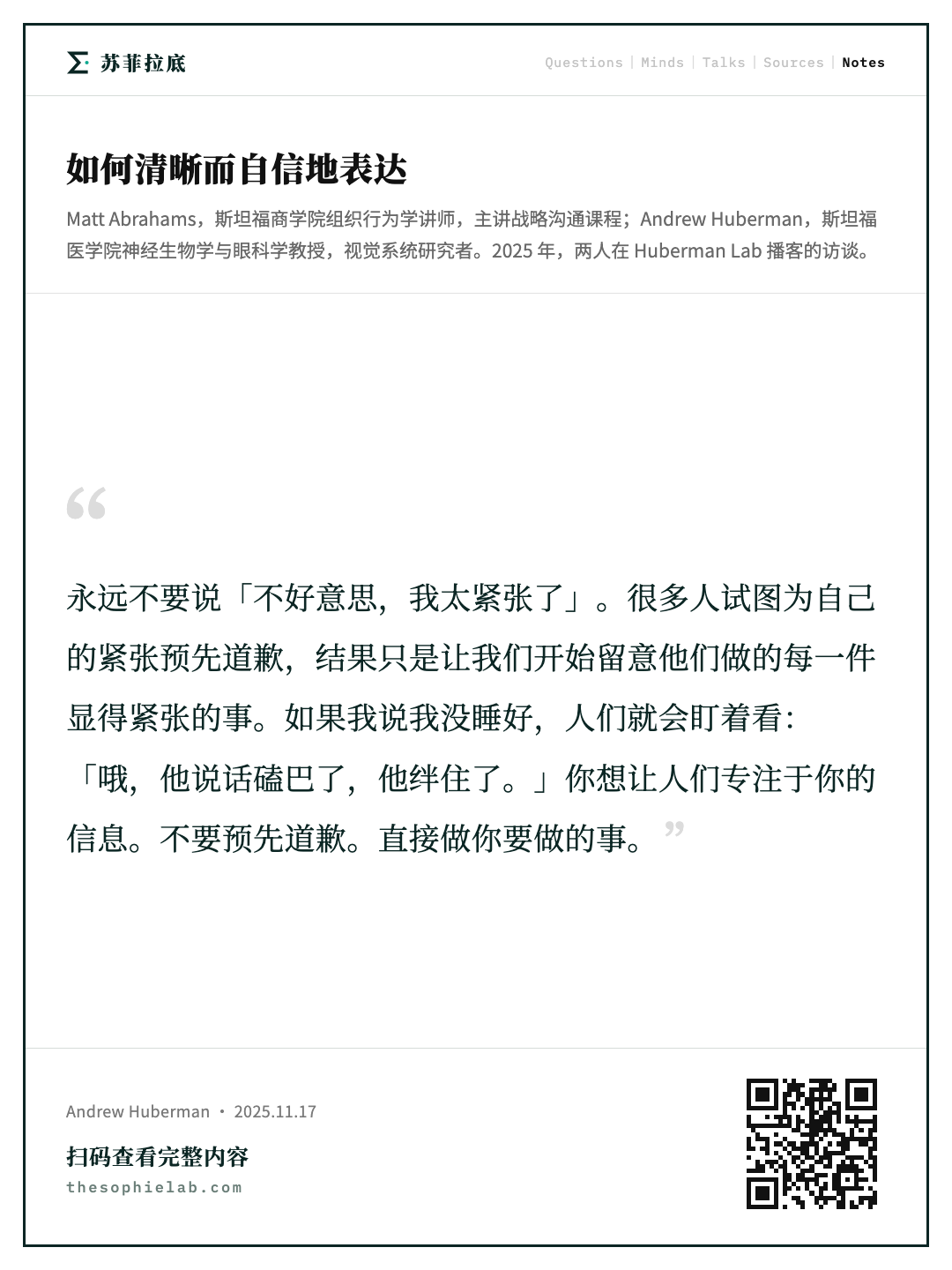
这跟我给紧张的演讲者的另一条建议类似:永远不要说「不好意思,我太紧张了」。很多人试图为自己的紧张预先道歉,结果只是让我们开始留意他们做的每一件显得紧张的事。所以不要把注意力引到自己的失误上。尽力渡过它们就好,这会有帮助。

休伯曼: 很好的建议,我相信会帮到很多人。我见过的最精彩的一次挽救,是在斯坦福的一场求职报告。我不知道该不该说他的名字。他现在是北卡罗来纳大学教堂山分校的教授,凭他的数据本可以留在斯坦福当教师。当时发生的事是,他讲到一半把水洒进了自己的笔记本电脑。讲台上都会给讲者备一瓶水,以防口渴。各位,把水放低一点。他把水洒了。但他处理的方式太酷了。

亚伯拉罕斯: 他做了什么?

休伯曼: 水洒了。他一句话没说,拿起瓶子,拧上盖子,放到下面,伸手到下面摸,没有毛巾。他说:「能不能麻烦谁给我拿一张纸巾或一条毛巾?」有人拿来毛巾,他把笔记本上的水擦干,整个过程一言不发。这是马克·齐尔科夫斯基,一个厉害角色。然后他回去,把报告讲完了。压力之下从容不迫。太棒了。

亚伯拉罕斯: 应急预案是一切沟通中非常重要的一部分。就是想一想,什么事情可能把这次谈话或沟通带向某个方向,好的或坏的,我会怎么回应。这很合理。你规划一次旅行、一个假期时,会想航班延误了怎么办,房间没准备好怎么办。我们在沟通里也该这么做。不是把它写成剧本,只是做好准备。所以现在在听的每一个人:如果那一刻你的设备出了故障,你会怎么做?想一想。等它真发生时,你就有了恢复方案,信心也就建立起来了。也许他事先想过「如果我用不了设备怎么办」,所以才能那么冷静。

休伯曼: 顺便说一句,他研究的是疼痛。我不知道这说明什么。但那真是压力下从容的精彩展示,或者说压力下某种东西的展示。

亚伯拉罕斯: 我认为关键是他让事情一直往前走,并且能在沉默中站着。能在众人面前沉默地站着,在很多方面都展示了自信。他能在沉默中把事情处理好,这更增添了那种自信。

声音、呼吸与即兴

休伯曼: 我觉得人一紧张,声音就往头顶上跑。他们开始踮脚尖,用比自然音高得多的声调说话,像是把自己憋住了。所以有时我鼓励人们慢下来,试着把声音往下放,放到喉咙和胸腔里一点。这可能是人为的。有一个非常突出的例子,一位前首席执行官,她说话用的可能并不是她本来的声音。但假设那还是你自己的声音的话。

亚伯拉罕斯: 绝对是这样。你上我节目时教了我很多关于呼吸的东西,呼吸不仅影响你的自信和焦虑感,做呼吸练习还能真正让整个身体安静下来,让你自然的声音出来。因为我们焦虑时呼吸变浅,呼出的空气变少、变快,声音就开始变成那样。有时这其实是恰当的:如果我对某件事真的很兴奋,我就该听起来那样。但我希望它在我的掌控之中。所以呼吸练习和一个真实、自然的声音非常重要。

休伯曼: 有件事你可能会感兴趣,是我们上次聊过之后文献里出来的:生理性叹息,也就是两次吸气加一次长呼气,仍然是快速平静下来的最佳方法,但事实证明,任何强调呼气的呼吸都能让心跳慢下来。变化是细微的,但显著到足以帮你平静。所以如果人们记不住该做哪种呼吸法,只需强调呼气:拉长它,稍微用力一点。如果需要隐蔽地做,就稍微拉长一点,也许走回讲台或者走开的时候做一次长呼气。这似乎能带来很大的不同,因为你在排出二氧化碳,同时还有一条经由迷走神经的通路,在你呼气时会实实在在地放慢心率。我们体内有这些机制,真是了不起。

亚伯拉罕斯: 太棒了。我每次讲焦虑的时候都会把功劳归给你,讲你跟我分享的这些。一切都在呼气上。我总说这是经验法则,然后开玩笑说这是「肺的法则」:呼气永远要比吸气长,才能帮你平静。人们觉得这很解放。所以感谢你跟我分享,也请你知道,其他人正在受益。

休伯曼: 不客气。我是出于需要才找到这些工具的。因为我觉得,我们可以准备、准备、再准备,但真正可怕的是知道当下总会发生我们控制不了的事。

亚伯拉罕斯: 没错。而且想一想,我们大部分沟通都是这样:即兴的。我们不知道会发生什么。你我聊的很多是有准备的沟通:演示、路演、有议程的会议。但我们大部分沟通是即兴的,不知道会怎么展开。你问我一个问题,我不知道是什么问题,甚至不知道自己会不会答。你向我要反馈。我犯了个错,得去补救。我们大部分沟通都是即兴的。对「不知道这会怎么展开」这种不适感到自在,是在即兴表达上做得更好所必需的心态转变里很大的一部分。

休伯曼: β受体阻滞剂,支持还是反对?

亚伯拉罕斯: 我有心脏问题,常年服用β受体阻滞剂。我看得到它怎么让你的思维和身体都变慢。我不喜欢。我认为用认知行为的方式管理焦虑好得多。当然,我不是医生,对某些人来说β受体阻滞剂也许有效,但如果有人只是想用它来对付焦虑,我会积极劝阻。在走到那一步之前,我们还有太多别的事可以先做。我的体验是它让我发蒙,反应不那么快。

休伯曼: 这说得通,因为你的大脑得到的含氧血液变少了。

睡眠与演讲前的准备

休伯曼: 前一晚睡个好觉显然有帮助。那对前一晚睡得很差的人,你有什么做法或建议?

亚伯拉罕斯: 我倒想问你这个问题。我睡眠糟糕透了。

休伯曼: 好,那我们今天就来解决它。

亚伯拉罕斯: 睡个好觉肯定比熬夜临时抱佛脚好。我告诉所有人,要像备战体育比赛一样为沟通做训练。你需要吃好,我称之为「沟通卫生」。吃好,睡好,锻炼。坚持惯常作息比偏离它好得多。关于咖啡因也有一些研究:构思、需要创造力的时候,摄入咖啡因其实很好。但真正上场演讲时,你不该偏离你平时的咖啡因习惯。不该突然戒掉,也不该因为前一晚没睡好就额外加量,那只会让你在演讲和沟通中焦躁。所以睡个好觉很好,但怎么睡好,我不是最合适的建议者。

休伯曼: 这个话题我们可以聊很久,我说几条你之后也可以听。这些年为播客和学术活动出差做演讲,有几件事帮到了我。如果住酒店,把酒店闹钟的插头拔掉,用手机代替,开飞行模式。为什么?因为我很多次凌晨四点被吵醒,因为前一位住客设了闹钟。前几周还发生过。我总是把它拔掉。我还会把房间里所有亮着的灯遮住,在门缝那里塞一条毛巾。眼罩最理想。我会要求离电梯远一点的房间,因为电梯会吵你一整夜。这些都是零成本又很有用的事。但补回没睡够的觉,最重要的一件事是「非睡眠深度休息」(NSDR),也叫瑜伽睡眠(yoga nidra)。瑜伽睡眠是一种有数千年历史的练习,做长呼气呼吸,时长十到三十分钟,我们可以提供一些很好的脚本链接。在这个过程中你放慢心率,做身体扫描,但目标是身体放松的同时保持清醒。它教你如何更容易入睡。根据经验我敢说,瑜伽睡眠和NSDR本质上是一回事,只是我们去掉了「意图设定」的部分,我就叫它非睡眠深度休息。外面有零成本的脚本,我的声音的,别人的声音的。它还教你如何在身体非常放松的同时保持非常警觉,这在很多场合都是非常有价值的技能,包括公开演讲。所以它能让你更善于入睡和重新入睡。我可以发一些给你。

亚伯拉罕斯: 太好了。我们一结束我就去试。

休伯曼: 你咖啡因喝得不多吧?

亚伯拉罕斯: 我一天一杯茶。

休伯曼: 那就不是咖啡因过量的问题。

亚伯拉罕斯: 不是,是我钻进自己脑子里,想得太多。

休伯曼: 你的前脑工作过度。瑜伽睡眠对这个有帮助。瑜伽睡眠和NSDR的精髓,也是它效果这么好又零成本的原因,我不是在推销任何需要付钱的东西,这不是我发明的,它存在很久了。瑜伽睡眠里有一条指令,NSDR里也有:你教自己把大脑从「思考和行动」的状态切换到「存在和感受」的状态。真正地从思绪里出来。而要做到这一点非常难,除非你给大脑足够多的事做。这就是为什么NSDR会指导你做一种专注的身体扫描和放松,因为如果你只是试着不去想,那不管用。你会去想「不要想」这件事。

还有一些关于前庭系统与入睡的很有意思的数据,我现在就分享,你可以试试。我昨晚就做了,半夜醒了一次。闭着眼睛。如果需要起来上厕所,先去,然后闭着眼睛,慢慢地左右移动眼球。这不是EMDR疗法,只是左右移动。然后眼皮依然闭着,向上,向下,向左也就是逆时针转,向右也就是顺时针转。然后试着稍微斗一下眼,像盯着鼻梁那样,同时呼气。这听起来可能很疯狂,完全离谱,对吧?但它做的是把你的前庭系统带进一种状态,我们有数据支持,这种状态模拟了你想达到的状态:你需要忘记自己身体的位置。你没法一边想着身体的姿势一边入睡。实际上入睡的前提之一就是忘掉它。这也是为什么现在有数据表明,前后摇晃之所以能让婴儿和成人入睡,现在还有能左右摇的床,是因为当整个身体在运动时,你会忘记身体的位置。试试看,我想你会发现它能大大促进入睡和重新入睡。

亚伯拉罕斯: 今晚就实践。我在这儿得到了免费咨询,谢谢。

休伯曼: 当然。因为我觉得前一晚睡得像样很重要。否则就早上做NSDR,或者能的话在演讲前做。如果睡眠不足,任何能把自主神经唤醒水平降下来的事,都能让公开演讲更从容。

亚伯拉罕斯: 我还非常鼓励人们做一件事:在大型沟通之前先跟人聊天。

休伯曼: 这一点非常重要。

亚伯拉罕斯: 跟人连接,聊天。每次我做主题演讲或大型演示,我都一定会在跟人说话。有时候我得去找人,因为我在后台等着被隆重介绍。我会去找个人,随便聊聊。它带来的专注和当下感,还有「说话」这个动作本身,都很有帮助。我总是很惊讶,任何做运动或搞音乐的人都知道要先热身,但人们说话之前不热身。他们以为自己能从沉默直接跳到精彩。跟任何人随便聊几句,多平常都行,真的很有帮助。你用这个办法吗?看起来你很有共鸣。

休伯曼: 当然。我现在仍然花很多时间独自准备播客。我注意到,如果独处太久,然后去街角咖啡店,跟咖啡师的对话都会让我觉得「这是怎么回事」,因为你还在自己的脑子里。

亚伯拉罕斯: 对。

休伯曼: 然后它开始变成一种解脱,你的大脑切换到另一种状态。很久以前我就意识到,去演讲的路上有某种形式的交流会非常有帮助。我发现,我也想听听你的看法,其中一部分是「说话」,另一部分是「轮流」。因为演讲时通常只有我们在说,而真正进入一个对话,我要听对方说回来什么,这迫使我练习「憋住不说」。我觉得很多糟糕的演讲,是讲者在拿消防水龙头往外喷,或者往句子里加不需要的小东西。那只是紧张,是在填空。

亚伯拉罕斯: 所以,正如你说的,需要热身。而那种轮流、那种切换,对大脑是有吸引力的。不过我要说,当你站在台上做大型演示、主持大型会议时,你其实也能进行对话。不只是点人回答,你可以问他们,可以说「想象一下,如果……会是什么样」。这时你就在想象。我们在沟通,你在回应,虽然我听不见。我可以用一个类比,讲一个故事。我们本质上是在轮流沟通,只是你不用声音回应我。所以一大挑战是如何吸引人,有好几种做法。身体上的投入,让人们做点什么。心智上的投入,用类比、故事、问题。语言上的投入,说「想象这个画面」或者「想想过去是什么样」,把人们带到未来或过去。这些都是在对方不说话的情况下也能建立对话的方式,而不是我单向广播信息。

轮流自我介绍的煎熬

休伯曼: 我想听听你对一种经历的看法,我想很多人都有过。最可怕的事情之一,是你在一个小房间里,也许十个、十五个、二十个人,有人说:「我们绕桌一圈,各自介绍一下自己。」我想第一个说,因为如果我得听别人一个个讲,眼看着轮到我,不知道为什么,某个回路会一路升温,等我开口时我在听自己的声音。我公开演讲没问题,别人也没察觉,但那种还没轮到我说话的等待,会让它变得极其别扭。后来我意识到,如果我把注意力从自己身上移开,真正去听别人在说什么,等轮到我时,就说「我是安德鲁」,然后分享该分享的信息就行了。但如果我在预想自己要说话,那真的很吓人。

亚伯拉罕斯: 就是那种累积,因为它越来越近,你感到的焦虑越来越强。我不喜欢「绕桌介绍」。如果确实需要人们做这件事,我总会让人们两人一组或三人一组,然后让一个人介绍另一个人,这容易得多。我教的恰恰就是你的做法。我告诉人们,听别人说,同时想一个基于他们说的内容你会问的问题,因为这会让你真正专注于他们在说什么,你就不会钻进自己脑子里,不会一直停留在焦虑的峰值上。

至于怎么介绍自己,我有一套喜欢教给人们的方法。不要从名字开始。先说一件你在乎的、有热情的、感兴趣的事,然后再说你是谁。有两个理由,其实有三个。第一,你会脱颖而出,因为没人这么做,人们会真的记住你。第二,如果你先说一件有热情、在乎的事,你可以带情感,声音可以有起伏。念自己名字的时候很难有起伏。第三,如果你是非母语者,或者你在跟可能带口音的非母语者说话,先听到一点内容会让我们的大脑预热:「哦,这个人是这么说话的。」这样我们就会真正注意并更好地听懂他们的名字。不知道你怎么样,带口音的人向我自我介绍时,我有时很难记住他们的名字,因为我的大脑还在适应他们的说话方式。所以这对所有人都有帮助。我介绍自己时不说「我是马特·亚伯拉罕斯」,我说「我是一个对沟通充满热情的人,我叫马特·亚伯拉罕斯」,然后再说点别的。

休伯曼: 在派对上你也这么做?

亚伯拉罕斯: 那是社交场合。我理解你说的更像是会议,不是派对。不过即使在派对上,我也可能先谈环境,或者把自己跟周围环境联系起来,然后再说名字。我认为先说一件你在乎的、关心的事,或者环境里的某样东西,再说名字,是更好的自我介绍方式。不能太长,但真的有帮助。下次介绍自己时试试。

休伯曼: 这挺有意思的。我很怀念有狗的日子,狗能吸收掉很多尴尬。他太帅了,人们忍不住要看他。

亚伯拉罕斯: 有个小孩子也一样。孩子是通往各种事情的绝妙桥梁。这样的桥梁在很多地方都能找到。我有一位非常亲密的朋友,是排队时认识的。当时在一个学术会议上,我们在自助餐的队伍里,我谁也不认识,是系里派我去的。旁边站着一个人,我们站得太近,不说点什么都不行。我环顾房间,注意到很多人穿着深浅不一的蓝色,就随口说:「我是不是错过了要穿蓝色的通知?」他看了看四周说:「对啊,真奇怪。」我们就这样聊起来了。我不需要狗,也不需要孩子,只是做了一个观察,就足以破冰让我们聊起来,现在我们是好朋友。每次我去他那边都会拜访他,他来这边也会来看我。我们在「开启交流」这件事上给自己太大压力了,其实只要好奇一点,对环境里的什么东西评论一句,就有帮助。

休伯曼: 我们能聊聊英式的「逗弄」(wind-up)吗?很多人不知道那是什么。我住的街区有一位年纪很大的女士,养了一只很小的狗。我想如果我直接走过去,她会有点害怕。我经常见到她,所以我确实做了一次「逗弄」。我走过去说:「等等,这是不是在英格尔伍德咬伤那个小孩的那只狗?」她说:「你在逗我吧。」然后我们就成了朋友。因为我不能就那么走过去说「嘿,我能……」,那就像一个人朝你压过来,有点吓人。所以我偷师了这一招,英国人好像叫它「逗弄」。我不是想搞笑,我只是真的喜欢这位女士,她的狗也超可爱。

亚伯拉罕斯: 你显然需要再养一只狗。如果这次访谈只得出一个结论,那就是安德鲁需要再养一只狗。

休伯曼: 多亏了你,这次访谈得出了多得多的结论,也有用得多。我不建议任何人吸烟,但我想以前这是件大事:人们讨根烟抽,休息的时候聊天。我做过一份工作,在帕洛阿尔托市中心一家玩具店做包装、组装滑板车和小拖车。休息时你走进巷子,隔壁面包店的人也在那儿,你就跟人搭上话。我不抽烟,但你会聊起来,然后知道对方的名字。可现在人们常常埋在手机里。我们把手机当安抚奶嘴,当一种不必与人接触的方式。

亚伯拉罕斯: 为了帮我的两个孩子跳出这个循环,我鼓励他们把正在看的手机内容展示给别人,邀请对方:「嘿,这个挺酷的,你觉得呢?看看这个表情包。」所以,只要合适,就像你说香烟曾经的作用那样,用手机来开启对话。有意思的是,我完全知道你说的是哪家玩具店,因为我知道那家面包店,它已经不在了,我以前常去。

休伯曼: 「多产烤炉」关门了?

亚伯拉罕斯: 关了。

休伯曼: 顺便说,那里现在是一家很棒的餐厅。既然两家都不在了,可以说了:那是「帕洛阿尔托玩具与运动世界」,是最老的商铺之一,后面有个滑板店。在滑板店干活之前,我卖过鞋,组装过红色飞人牌小拖车和三轮车之类的。

亚伯拉罕斯: 我小时候常去那儿,因为不仅能买玩具,还能吃到点心。

休伯曼: 那些出游很开心。那地方很酷,家族经营的。好了,我们把大家带跑题了。如果在帕洛阿尔托市中心,可以去看看,我想招牌还在。

打工、夏令营与言传身教

休伯曼: 这其实引出一个有用的话题。我做过一些工作,比如在拐角的松饼店干活,那时候还不叫咖啡师,正是靠柜台前的对话才得到了玩具店那份工作。我侄女最近上大学前,做过卖冻酸奶的工作。所以,去打工。

亚伯拉罕斯: 没错。小时候找一份要跟人打交道的工作。做客服类的工作对孩子来说非常有教育意义,原因很多,沟通是重要的一个。你学会跟各种各样的人沟通,学会在那一刻服务于他人的需要。我觉得这很美好。我的第一份工作,也是高中时做得最多的一份,是在一家健身俱乐部叠毛巾。有人进来,我递毛巾,寒暄几句。它教会我非常自在。我还得广播,这听起来很傻,「健身房三十分钟后关门」。但作为一个高中生,我得在一百个人面前说这句话。那很让人紧张,但那是我脱敏的一部分。

休伯曼: 太酷了。我不想显老,虽然我确实老了,五十岁了。不过我感觉很好,打算再活五十年,这是目标,希望一路健康。我觉得当夏令营辅导员是一个完美的例子:做一件你几乎不懂怎么做的事,还必须表现出自信。至少我做的时候,他们教你几样东西,然后突然你就负责这么多条生命了。想想挺疯狂的。但到第二期你就进入状态了。你告诉人们做什么,什么时候听你说,什么时候让他们想干嘛干嘛。你不能用粗暴的沟通方式,但又得保证他们安全,所以要恰当地使用你的声音,必要时提高音量,比如有人处在危险中。我认为做这类事情就是我们学会沟通的方式。

亚伯拉罕斯: 绝对是。不幸的是,其中一些机会和工作正在变化,我们得找其他载体来帮助人们。我离开高科技行业后,在正式做现在的工作之前教了两年高中。教十四五岁的孩子,我学到的关于沟通的东西,比我在成人世界里管理组织时学到的都多。所以这些机会非常珍贵,而我们现在没有那么多这样的机会。我认为对年轻一代,甚至对同事,我们都能做一件事:做榜样,并且把我们关于沟通的思考说出来。我经常对我的孩子说:「我明天得跟一位同事或老板进行一次艰难的谈话,我很担心这个,或者我在考虑这样说。」我们很少对自己的沟通做「元层面」的讨论,但那里面有可以传递的经验。你我都在各自的教学里看到,人们很聪明,也是很好的沟通者,但他们不总是天生就会。他们必须学,必须去做。当你开始跟人聊,我有这个便利,去问他们「你是怎么做到的?你做了什么?」,那里面有太多丰富的东西。我们只需要开启这种对话,做示范,同时跟你生活里的年轻人、你想扶持的人谈论它。这会很有帮助。

休伯曼: 你觉得,由于疫情、封控和社交媒体,现在有一批人真的不知道如何像比他们更年轻的人那样与人交往吗?这不是年龄歧视,而是他们确实错过了一个与人交往的机会。那个所谓的「Z世代凝视」是真的吗?

亚伯拉罕斯: 「Z世代凝视」我不清楚,但我确实认为发展中存在关键期,那一代孩子失去了一段关键的发展。我有一个儿子当时正在上高中。高中是认识自己、学习沟通的绝佳场所,如果这一切都隔着屏幕进行,那是一种非常不同的体验。我认为他现在是很好的沟通者,但他们确实错过了一个机会。你学习的很大一部分是靠测试和尝试。如果你失去了两年的测试机会,那是一种劣势。因为我做这一行,我知道这可以补回来、可以学会。但确实有一大批人,不得不以我们大多数人没有经历过的方式挣扎。

安静但不害羞

休伯曼: 我非常敬佩我的研究生导师,她已经过世了,但我一直很敬佩她。有人曾经很贴切地形容她「安静,但不害羞」。我意识到这是一种非常有力量的类型。我提到它,是因为有些听众可能会想,「我就是不那么健谈」。但他们不一定害羞。他们完全乐意待在对话里,保持安静,直到有想说的话。有时她什么也不说,有时她会说,而且她确实非常非常聪明,同时也非常自在。所以我逐渐了解到,有一种人是安静但不害羞的。我们谈内向外向时,往往不承认这种类型。

亚伯拉罕斯: 我父亲正是这样。他是我认识的最聪明的人。他很安静,但不害羞。如果他有话要说,他就会说,而且往往非常深刻。那是他在世界上的存在方式。人们欣赏它,他也倚重它。他有发言的机会,却会往后靠。我从他身上学到很多:有时最有效的沟通就是倾听和在场。所以我同意,有些人有很多价值可以贡献,只是在那一刻可能不愿开口。我不觉得这有什么不对。我们需要多样性,不仅是想法和观点的多样性,还有沟通方式的多样性。我们的文化里有一种观念,认为外向、自信的人才是正确的沟通方式。这并不总是对的。你可能会惹上很多麻烦,尤其是那些先说后想的外向者。

休伯曼: 尤其是现在一切都被记录下来。

亚伯拉罕斯: 没错。

休伯曼: 人们会说出一些他们希望没说过的蠢话。一些大学院系的主任,幸好不是斯坦福的,但确实是大学里重要院系的主任,就因为在当时还叫推特的平台上手指太松,把自己弄丢了工作。我至少知道一个突出的例子。你只会想:你当时在想什么?他们显然没过滤好。都是很杰出的人。而且那甚至不是他们真正相信的东西,他们只是说了些非常冒犯、非常愚蠢的话,至少在当时足以让他们丢掉职位。我小时候没干过什么坏事,是个好孩子,但我无法想象在一切都被记录的环境里长大。

亚伯拉罕斯: 这对很多人来说大概是个紧张的时代,但人们似乎在更多而不是更少地发声和分享。

休伯曼: 虽然我想这里有抽样偏差,因为我们听不到那些没有社交媒体账号的安静的人。我感觉现在几乎人人都有社交媒体账号。

亚伯拉罕斯: 关于社交媒体,我很佩服的一点是,比我年轻的人能够在这么多不同的领域里管理自己的呈现。我连衣着得体地出现在一场谈话里都勉强。他们能在不同的平台上管理自己的形象,有的是线上的,有的是线下的。这是一门艺术,一种技能:能在不同的方式、不同的场合下投射自己。我不是说要虚伪或不真诚,但那里面有技能。我辅导很多高层领导,努力让他们留意自己的呈现,自己如何出场,那意味着什么。而我那些大多二十五六到三十岁的学生,这对他们来说轻而易举,是他们天生就会的事。我从不抨击社交媒体,但我确实认为它带来的一些技能,其他人也能受益。

休伯曼: 也许这就是为什么年轻一代在这方面好得多。我看我高中的同龄人,看比我大十岁、二十岁的人,他们似乎有一种被社交媒体看见的强烈需求。我做这个是我工作的一部分,在那之前我没有社交媒体账号,或者不怎么用。总之我对此没有任何评判。我只是同意,这是很大的认知负荷。

亚伯拉罕斯: 是的,但他们能够在其中切换进出,而这对我来说很难,对我合作的一些人也很难。

武术与身体的临场

休伯曼: 我对武术和跑步很好奇,尤其是武术。你认为从事一项运动或练武术,真的能教会你在自己的身体里更自在,并且迁移到公开演讲、一对一沟通、小组沟通,以及临场感、姿势、站姿上吗?

亚伯拉罕斯: 我很喜欢这个问题,谢谢。我不常谈我的武术。我练了四十多年,它是我很大的一部分。我绝对认为,我在武术里学到的东西帮我把现在的工作做得更好,而我的工作也帮我把武术练得更好。要把武术练好,尤其是跟别人对练时,需要一种临场感和连接感。它给你一种信心:我知道在某些情况下我能应付自己。我不指望被袭击,但我知道当事情出岔子时,我能保持一些镇定。这种信心在我做的每一件事里都无价。

而且武术本身就是一种沟通。我在观察对手或训练伙伴在做什么,试图连接、预判下一步,但又不锁死在预判里。它真的在训练你的大脑和身体保持回应、保持开放。人们很关注「武」,但「术」的那一面,随着我年纪渐长,才是真正吸引我的。艺术关乎表达、风格、连接。随着我在训练中成熟,这已经成为一片新的知识财富。有人会说,你同一样东西练了四十年。它不是同一样东西,它在变化,有多个层次和多种揭开的方式。所以我认为这很好。我认为每个人都该有一项身体活动,能帮助他们的职业活动或个人生活。你能从中学到很多关于自己、关于如何与人连接的东西。

休伯曼: 我认为在锻炼里有巨大的学习空间,找不到更好的词了,但武术或者一项运动有独特之处。不是说跑步不能是运动,它可以;也不是说抗阻训练不能是运动,它可以。但我认为如果人们只是锻炼,只透过锻炼这个视角看它,就没有获得全部的好处。我其实会试着把我的抗阻训练变成一种冥想。我不允许自己发短信,大多数情况下也不带进太多其他信息。我会听音乐或播客,但我很谨慎。我想专注于我在做的事,我认为这对认知类的追求是很好的练习。

亚伯拉罕斯: 跑步是我的冥想。我跑步时可能听点东西,但我真的在冥想。我发现自己因此非常有创造力,不跑的时候我会想念它。我喜欢武术的一点,至少在我练过的流派里,是活动类型的多样。有些东西完全是即兴的:对打,那是即兴的,有一些规则,但你在对打。在我练的流派里,还有所谓的「型」(kata),本质上是一套预先编排好的动作组合,一切都是写好的。然后还有自卫技术,练习特定的动作来脱身。每一种都在训练你一种不同的思考和存在方式,正如沟通里也有不同的思考和存在方式。有时完全是即兴的,有时我在做准备好的发言,有时是问答环节,有些我准备了,有些没有。所以找到不同方式训练自己的载体,可以说是为沟通做「交叉训练」,会非常有帮助。

听众提问:道歉与跨文化

休伯曼: 太好了。我很喜欢这个想法:我们需要考虑不同听众的不同风格。顺着这条线,我在社交媒体上向听众征集了问题,有一些非常好的问题,而且我知道它们也是很多其他人的问题。开场的第一个:为什么女性在表达意见之前会先道歉?她们应该怎么做?你观察到这一点吗?

亚伯拉罕斯: 我经常看到。道歉是一种试图建立连接的方式,但我认为它可能适得其反。所以,与其说「对不起」或者「我没做好」,不如从一件你有信心的事开始。如果你确实需要为某件没做或需要做的事道歉,让它晚一点出现。你开启一次互动的方式为整个互动定下基调。如果我一开始就因为道歉而把自己放低一级,「哦,我没准备好」或者「我本该做得不一样」,那我们的互动就会截然不同。所以从你自在、有信心的东西开始,如果需要道歉,稍后再道歉。这真的会带来很大不同。

休伯曼: 我再叠加一个问题。我见过有人演讲开头说「我昨晚没睡好」或者「我倒时差,所以如果我怎样怎样请原谅」。基本上是想给演讲预装一个缓冲,万一出错就多一层保护。这让我抓狂,但也许是我疯了。

亚伯拉罕斯: 不,这也让我难受。安德鲁,我妻子很久以前就教过我,不能预先道歉,而这正是人们在试图做的。这种情况下你所做的一切,只是让人们去注意你做的那件事。如果我说我没睡好,人们就会盯着看:「哦,他说话磕巴了,他绊住了。」你想让人们专注于你的信息。不要预先道歉。直接做你要做的事,如果出了什么状况,你可以当场决定:是回应它,还是继续往下讲。

休伯曼: 如何跨文化、跨口音地好好沟通?你前面稍微谈到过,也许我们可以再说说。

亚伯拉罕斯: 文化和语境在一切沟通中都举足轻重。我说的文化不只是出生的国家。不同的组织有不同的文化,组织内的不同部门有不同的文化,不同的代际也有不同的文化。所以我们必须对此敏感。我们的信息必须有不同的打法。每次沟通,我们都要想清楚在跟谁沟通,以及所处的语境和文化。我们生活在一个多元的社会和多元的世界里,能听到很多观点、很多来自不同地方的人。口音的影响很大。在我的节目《快想巧说》(Think Fast, Talk Smart)里,我采访过很多研究非母语表达的专家。他们都告诉我,非母语者的目标不是听起来像母语者。那不可能,你不是母语者。相反,要专注于把意思传达出去,给自己减压。这是什么意思?意思是我可以先说出我的观点,然后用一个故事重复它,或者举个例子,打个比方。重点是把观点传出去,而不是担心「我用的词是不是完全准确,句法是不是完全对」。而现实是,不知道你怎么看,很多英语母语者自己的英语说得也不怎么样。所以我认为,一切都是为了把意思传达出去,用重复和其他工具来帮忙。

听众提问:打断、备稿与争论

休伯曼: 如何应对打断?顺便说,我们斯坦福有一位同事告诉我,别人打断说明他们感兴趣,这帮到了我的互动。但这里的问题是,我们应该如何处理打断?大多数情况下我们仍然希望打断的人觉得被听见,但有时这确实让人分心。

亚伯拉罕斯: 两个办法。第一,事先设定预期。设立边界是有帮助的。如果我要进入一个场合,我可能会说:「我想先用五分钟铺好我要说的基础,然后很乐意回答大家的问题。」这样如果有人打断,他就违反了一个已经设定的预期。这让你处在一个更有利的位置去叫停。你可以说:「谢谢,我听到你很着急,我真的想先把这部分讲完。」所以设立边界有帮助。

第二,我认为最有用的沟通工具之一是「复述」(paraphrasing)。复述就是把别人说的话综合起来,提炼成一句重要的东西。如果有人打断你,你可以通过复述他说的话把发言权拿回来,然后接着讲。比如我在谈某件事的财务影响,你插进来发表意见,打断了我,我可以说:「成本非常重要。」事实上,我刚刚就把话头从你那里拿回来了。如果你是那种想倾倒自己海量知识的人,那种喋喋不休的人,我可以用一句复述打断你来止住:「你刚才关于X的那一点非常重要,这正是我们议程上接下来要讨论的。」我认为复述是拿回控制权最礼貌的方式,无论是从打断者那里,还是从说太多的人那里。用一句复述去打断别人可能会让人不自在,但如果你面对的是一屋子人或一个会议,不这么做,对其他人来说比对那个发言者更失礼。所以复述能让你摆脱这些局面。

休伯曼: 有人问:「我该怎么准备一场演讲?」这里面涉及很多,但也许你能给我们一个简短的回答,几个关键的准备维度。

亚伯拉罕斯: 当然。我说几个最重要的。首先,你必须想清楚我在对谁讲,就我要讲的话题而言,什么对他们重要、相关。我们所有人沟通时都受「知识的诅咒」和「热情的诅咒」之苦:我们对自己讲的东西知道得太多,也太在乎,因此会做出假设,一开始就讲得太深,等等。所以第一步,相对于你的话题去思考你的听众。第二,确立一个清晰的目标。我们很多人是一边说,一边带着听众经历「我们自己发现自己想说什么」的过程。我们没有一条清晰的路径。对我来说,目标有三个部分:信息、情感、行动。我想让他们知道什么,我想让他们有什么感受,我想让他们做什么。有了对听众和目标的理解,然后套用一个结构。不要只是罗列信息。问题、方案、收益;过去、现在、未来;是什么、那又如何、接下来怎么办。结构有无数种。做到这些,你的内容就对听众有意义,沟通保真的可能性就提高了。然后你必须练习。有好的信息还不够,你必须练习表达。做到这些,你的演讲、对话和会议都会更好。

休伯曼: 几分钟前我在想一件事,是给那些害怕公开演讲的人的,他们怕自己卡壳、在台上瘫成一滩眼泪,或者僵住之类。你觉得有没有用,我想应该有用:去想你希望发生什么,而不是你不希望发生什么。

亚伯拉罕斯: 没错。很多人设想最坏的情况,然后自己把它制造出来,成了自我实现的预言。想象一下可能的潜力。为自己设定积极的预期。它不必是「这将是有史以来最棒的沟通」。只要是「我会带来价值,人们会学到东西,人们会避免一个我建议他们避免的错误」。心里有一个积极的结果,就能很有帮助。所以,在沟通之前想清楚这件事对你和对听众的价值在哪里,能带来很大的不同。

休伯曼: 有几个人问了关于人际关系的问题,也许你能帮他们解决,比如:我怎样才能赢得一场争论而不失去对方?这算是另一期播客的话题吧?

亚伯拉罕斯: 那得是完全另一期播客。不过我可以说这些:倾听很重要。我们的很多争论,争的是根本不存在的东西。我这辈子做过一些调解工作,把两个意见不合的人放到一起时,我让他们做的第一件事就是各自听对方说,而争论常常就消失了。人们之前没意识到这一点。第二条建议,是我从两位朋友那里学来的,我和妻子经常用。当我们要发生分歧时,各自先声明这件事对自己有多重要。因为我们会假设,如果我对某件事很有热情,争论时我就默认你同样有热情。但这并不总是真的。而如果我带着全部热情冲向你,而你其实没那么在乎,我就会把你也逼得热情起来,于是我们就吵起来了。所以,如果我想吃中餐,我妻子想吃墨西哥菜,我可以说:「对我来说中餐是八分,因为我一直很馋。」她说:「墨西哥菜今天对我是三分。」那就没有争执,没有争论。但如果她说八分,我也说八分,那才有问题。所以,理解优先级,真正倾听以理解其中牵涉的东西,能化解你们很多冲突。

听众提问:填充词与讲故事

休伯曼: 有人问:「我怎样才能去掉『嗯』『那个』之类的填充词?」

亚伯拉罕斯: 我节目上有一位嘉宾是心理语言学家,她让我意识到填充词并不坏。填充词其实是有用的,它们为我们做事。它们占住空间:如果我还没说完、不想被别人打断,我就说「嗯」「呃」。儿童发展的文献里有研究表明,我们跟孩子说话时,在说一个新词或给出一个新想法之前,往往会先垫一个填充词,「嗯」或「呃」。我们在提示接下来的东西很重要。我认为这就是为什么有人说太多填充词会让我们抓狂:我们从小就被训练成填充词后面跟着重要的东西,而当后面跟着的只是另一个「嗯」时,我们就沮丧了。所以目标不是消灭它们。目标是让它们不再让人分心。事实上,剧作家和编剧还会特意加入填充词,让台词听起来像人说的。

我知道减少填充词最好的办法,尤其是最烦人的那些,也就是坐在沉默里的那些,比如我说完了,「嗯」,然后又开始说,这些最突出,是一种呼吸技巧。我是从一位教沟通技能很多很多年的人那里学来的,他叫杰里·魏斯曼,这个方法叫「落稳句尾」(landing phrases)。说话时我们需要往外推气。如果我在吸气,我就没法说话。我邀请所有听众和观众试试一边吸气一边说「嗯」。做不到。所以如果我训练自己在句子和短语的末尾把句子落稳,把气用尽,我就必须吸气。这时我不仅说不出「嗯」,什么都说不出。我就内置了一个停顿。所以说话时训练自己去「落地」。我之所以叫它落稳句尾,是因为它像体操运动员做完所有的翻腾旋转后稳稳落地。在我每个短语的末尾,我的气完全用尽,吸气,然后再开始说。这能显著减少填充词。当然你得练习。我教所有人的练习方法是:看你的日程表,每天一次,把日程上的每一项大声念出来,每念完一项,落稳它。比如「和安德鲁吃午饭」。「去健身房锻炼」。「和儿子吃晚饭」。每一项末尾,我都把句子落稳了,气用尽了。我在训练自己怎么做到这一点。你会去掉很多填充词。

休伯曼: 太好了,我要试试。

亚伯拉罕斯: 你的填充词不多。

休伯曼: 我得去查查播客的一些录音。有人想知道怎样讲一个故事而不把它讲成布道,也就是怎样知道它讲得太长了。

亚伯拉罕斯: 这个问题有两种回答方式。一种是关于时间:它要花多久?我母亲有一句很棒的话,她喜欢说:「报时间就行,别造钟。」我们很多人沟通时都是造钟的人,说的远比需要的多。所以如果你要讲一个故事,想想最关键的那几点是什么。军队里讲「结论先行」(bottom line up front),把底线先摆出来。别说多余的话。另一部分是,你必须让故事对你面前的人有吸引力、有相关性。很多人在真正开讲之前有一大段前言。我的一位同事喜欢说「空降进去」:直接跳进故事,然后再补上其余部分。我们很多人会「那天下着雨,然后这样,然后那样,然后那样」。先讲到故事本身。所以,如果你空降进去,并提醒自己简洁清晰,你讲的故事就会更吸引人、更好。

听众提问:加薪与背稿

休伯曼: 有几个人问怎么要求加薪。

亚伯拉罕斯: 当你向别人要求某样你想要的东西时,尤其是向老板或权威人物,我希望人们考虑几个特征。第一,考虑情境。要求加薪之前看看老板的日程。你是不是他连着开的第五个会?也许明天一早去更好。情境很重要。我有一位同事研究法官的假释裁决,发现午饭前和午饭后的裁决不同,尽管案件是一样的。你提要求时必须考虑这一点。第二,在定位自己时,从老板的角度想,他们在考虑加薪时会看哪些标准。我们常常上来就说「我做了这个,我做了这个,我做了这个,那个同事拿到了那个」。想一想你为他们带来了什么价值。从他们的角度切入。想想怎样定位,才能再次从他们的角度展示你的价值。而且你应该练习,应该做角色扮演。跟别人说「我打算这么说」,这样那些话就真的说出口了,而不只是在脑子里想着自己要说什么。

休伯曼: 有几个人问,怎样才能跟那些不太会沟通的人好好沟通?

亚伯拉罕斯: 这个难。我会鼓励人们以问题开路。把对方引出来。往往,如果你能让他们谈起对他们重要的事,或者跟你想要的东西相关的事,你就能进入那场对话。所以,这又是前期工作,是去想什么有价值。以问题开路,然后对方一回应,就给他们空间多说一些。我岳母是闲聊的黑带高手,非常了不起。她来自中西部,每次坐飞机来看我们,下飞机时都带着三个新交的好朋友。她的秘诀,你前面也提到了,就是三个字:「多讲讲。」一旦有人回答了一个问题,就给他们空间多说,这能真正把人引出来,也让你知道什么对他们重要,然后你就可以抓住它多聊。所以,以问题开路,给更多的交流留出空间。这就是把一个可能寡言或不习惯说话的人引出来的办法。

休伯曼: 你有没有建议过人们背演讲稿?

亚伯拉罕斯: 从来没有。有些时候我会建议对开头非常熟悉。人们最紧张的时刻,是开讲前三十秒左右和开讲后一分钟左右。所以你可以对开头非常熟悉。但背诵之所以糟糕,是因为它加重你的认知负荷。你已经造出了一个「正确的说法」,然后不停地拿你想说的跟你实际在说的做比较。所以,有一张路线图,有一个结构,对一些想法有熟悉度,这些是重要的。如果有某些词你特别想传达,或者某些数据,就准备一张提示卡,照着念。我宁愿你这么做,也不要把背诵的认知负担压在自己身上。

焦虑管理方案

休伯曼: 我们前面稍微谈过这个,但也许可以总结一下,再补充你想补充的。这是个非常常见的问题:怎样减少讲话前的焦虑?可以是公开演讲,也可以是一对一的沟通。

亚伯拉罕斯: 这个话题可以聊很多。安德鲁,你上我节目时我们谈了一些生理上可以做的事。管理焦虑,必须同时管理症状和来源。症状是你在生理上体验到的东西。你分享过关于呼吸等等的好建议。我举一个例子。我特别紧张时会出汗、脸红。一个很好的应对办法是给自己降温。你之所以出汗脸红,是因为心率在上升,身体在紧绷,就像运动时一样。手掌是身体的体温调节器。任何在寒冷的早晨捧过热咖啡或热茶的人,都感觉过自己暖起来。所以我在讲话前总会握着一样冰凉的东西,它帮我降温,我脸红和出汗就少了。所以有一些事可以做来管理身体症状,你说的呼吸练习就非常有帮助。

但我们也必须考虑来源,那些引发和加剧焦虑的东西。我举一个例子。我们很多人是被自己的目标弄紧张的。我主张沟通要有目标,但有时目标本身让我们紧张。我的学生怕拿不到好成绩。我辅导的创业者怕拿不到融资。听众里的人可能怕老板不支持自己的想法。所以我们是被一个潜在的负面未来结果弄紧张的。对抗它的办法,是变得面向当下。做到这一点的方法很多。你可以深呼吸,可以绕着大楼走一圈,可以跟人聊几句。我告诉人们,做运动员做的事:听一首能帮你专注的歌或一个歌单。从一百开始倒数,用一个有难度的数,试试每次减十七。这真的有助于专注、面向当下。我最喜欢的方法,听起来会很傻:我喜欢大声说绕口令。你不可能一边正确地说绕口令一边不在当下,而且它还能热嗓子,是完美的热身。所以在我做任何播客采访或大型演讲之前,我都会把一个绕口令快速大声说三遍,它让我回到当下,也让我热起来。

所以,管理焦虑,你必须管理症状,也要管理那些引发和加剧它的东西。这样的方法有一大堆,如果你去做,你就开始为自己建立一套焦虑管理方案。你可以调用这套方案,而仅仅是拥有这套方案本身,就能减少你的焦虑。我的战略沟通课上,我们做的第一件事就是让学生制定一套焦虑管理方案。它不仅在课程中帮到他们,多年后还有学生告诉我:「我祖母去世了,我用焦虑管理方案帮自己完成了悼词。」或者「我要做伴郎致辞,我在用它。」给自己配备管理焦虑的工具,是你能送给自己最大的礼物之一。

结语

休伯曼: 太棒了。这些不仅是精彩的片段,坦白说是一整桌的建议。公开沟通、一对一沟通,以及两者之间的一切都如此重要,而人们围绕它们背负着大量的恐惧和焦虑。你给了我们大量实用的工具,我知道它们经过了时间的检验,其中很多有数据支持,而真实世界的数据才是最算数的。我要感谢你今天来分享这些,也感谢你写的书,我们会在节目说明里放上链接,感谢你持续作为一位公共教育者走出去、走进来。谈这些话题的人和书很多很多,但你显然是那个真正为了公众利益全身心投入解决它们的人。我很感激你分享内容的广度和具体程度,我知道其他人也会感激,也知道他们会去应用。我的目标是做完这段结语一次也不说「嗯」。我想我刚说了一个。

亚伯拉罕斯: 你做得很好,非常流畅。

休伯曼: 谢谢。欢迎再来。

亚伯拉罕斯: 很乐意。谢谢你。
本期讲者
马特·亚伯拉罕斯斯坦福商学院组织行为学讲师,主讲战略沟通课程,主持播客《Think Fast, Talk Smart》。著有《Think Faster, Talk Smarter》与《Speaking Up Without Freaking Out》,练习武术四十余年。
安德鲁·休伯曼斯坦福医学院神经生物学与眼科学教授,视觉系统研究者,2021 年创办科普播客《Huberman Lab》。著有《Protocols: An Operating Manual for the Human Body》。
章节 · 点击跳转视频
0:00 冷开场:别背稿,用提问引导对方 ▶ 正在看
3:36 怯场的进化根源与两种可信度 ▶ 正在看
8:17 真诚、自我评判与指鹿为马练习 ▶ 正在看
15:41 节奏、乐高说明书与受众需求 ▶ 正在看
24:37 启发式、结构化表达与录像复盘 ▶ 正在看
39:09 身体能量、走动与社交媒体的注意力 ▶ 正在看
47:36 好奇心开场与导游式叙事 ▶ 正在看
57:25 为即兴做准备:说出声、录像与 VR ▶ 正在看
1:03:44 传世演讲、维恩图与写作打磨表达 ▶ 正在看
1:16:21 油滴演讲、危机处理与呼吸睡眠 ▶ 正在看
1:39:50 热身聊天、破冰、打工与武术训练 ▶ 正在看
2:04:08 听众问答:道歉、打断、填充词、加薪 ▶ 正在看
本期论点
本期回应
0:03
背演讲稿会加重认知负荷,让人不断比对预设说法与实际说出口的话,因此不该逐字背稿 定结构动笔之前,该把什么定死?马特·亚伯拉罕斯
5:01
「怎么说比说什么更重要」的说法是偏的,说服力是内容与表达的总和 内容决定一次表达的成败由什么决定?安德鲁·休伯曼
6:53
可信度不必是开口的第一件事,先用挑衅观点、问题或数据勾住听众,资历稍后再出场 先勾注意开场的头几句应当优先做到什么?马特·亚伯拉罕斯
24:01
沟通是否成功取决于受众能否接收并使用信息,而不是内容有没有被说出去 看接收一次表达的成败由什么决定?马特·亚伯拉罕斯
30:24
大脑记不住清单,信息只有被组织成有逻辑的结构才能被理解和吸收 靠组织结构怎么讲,一个想法才能被人接住?马特·亚伯拉罕斯
33:53
看自己沟通的录像,比任何一位沟通老师都更能让人进步 靠练习表达能力从哪里来?马特·亚伯拉罕斯
35:45
沟通能力只能靠重复、反思和反馈累积提升,光靠思考不会让人变成更好的沟通者 靠练习表达能力从哪里来?马特·亚伯拉罕斯
58:03
演讲练习必须真正出声说出来,只在脑中默演会漏掉说出口才暴露的断裂 靠练习表达能力从哪里来?马特·亚伯拉罕斯
1:02:09
即兴训练的核心不是搞笑,而是活在当下、回应当下所需,因而能提升沟通能力 什么都别定死动笔之前,该把什么定死?马特·亚伯拉罕斯
1:05:02
传世演讲之所以被记住,靠的是写得极好的稿子、诗意的修辞与重复头韵等技法 定内容动笔之前,该把什么定死?马特·亚伯拉罕斯
1:13:33
不存在唯一正确的沟通方式,无论处在内向外向或神经多样性光谱的哪个位置都能有效沟通 靠练习表达能力从哪里来?马特·亚伯拉罕斯
1:28:04
上台前为紧张预先道歉只会让听众更盯着你的失误,真要道歉也该放到后面 先别失分开场的头几句应当优先做到什么?马特·亚伯拉罕斯
2:06:57
非母语者的目标不该是听起来像母语者,而是把观点传达清楚 看接收一次表达的成败由什么决定?马特·亚伯拉罕斯
2:14:03
填充词本身有用,目标不是彻底消除,而是让它们不再让人分心 看接收一次表达的成败由什么决定?马特·亚伯拉罕斯
其他论点
4:10
当众演讲的恐惧有进化根源:在约150人的群体里,相对地位直接决定资源与繁衍机会 马特·亚伯拉罕斯
9:24
表达时实时监控别人怎么看自己、给自己打分,与有效沟通背道而驰 安德鲁·休伯曼
41:18
在大多数公开演讲场合,演讲者都是全场对该话题最了解的前三人之一 观察安德鲁·休伯曼
42:04
讲最想打中听众的那句关键内容时应站定不动,走动只放在铺垫和过渡处 做法马特·亚伯拉罕斯
1:45:48
绕着房间挨个自我介绍是糟糕的做法,应改为两人一组、互相介绍对方 做法马特·亚伯拉罕斯
01冷开场:别背稿,用提问引导对方
0:00
Do you ever recommend people memorize speeches? Never. The reason memorizing is so bad is it burdens your cognitive load. You've created the right way to say it and you're constantly comparing what you wanted to say to what you're actually saying. So, having a road map, having a structure, having some familiarity with some ideas are important. If there's certain words that you really want to get across or certain data, have a note card, read it. I'd rather you do that than put the cognitive burden on yourself of memorizing. Several people asked about how best to communicate with people who are not very good at communicating. I would encourage people to lead with questions. Draw the other person out.
你会建议大家把演讲稿背下来吗?绝对不会。背稿之所以糟糕,是因为它会加重你的认知负荷。你已经想好了'正确'的说法,于是你会不停地比对自己想说的和实际说出来的。所以,有个路线图、有个结构、对一些想法比较熟悉,这些才是重要的。如果有些词你真的很想说出来,或者有些数据,那就写在小卡片上,照着念。我宁愿你这么做,也不希望你给自己增加背诵的认知负担。有好几个人问,怎样才能和不太擅长沟通的人有效交流。我会鼓励大家用提问来开场。把对方的话引出来。
便签引用
0:40
Often, if you can get them talking about something that's important to them or connected to what you want, then you can engage in that conversation. So, again, it's pre-work. It's thinking about what's of value. Lead with questions and then as soon as the person responds, give them space to tell more. My mother-in-law had a black belt in small talk. She was amazing. She was from the Midwest. Every time she'd fly out to visit, she'd come off the plane with three new best friends. And her secret, and you mentioned this earlier, were three words, tell me more. Once somebody answers a question, give them that space to say more and that really draws them out and gives you some ideas of what's important to them so you can latch on and talk about it more. So, lead with questions, give space for more communication. That's how you draw somebody who might be reticent or not comfortable speaking.
通常,如果你能让他们聊起对他们来说重要的、或者和你的目的有关联的事,你就能展开一段对话。所以,这还是要做功课。要去想什么是有价值的。用提问开场,然后对方一回应,就给他们空间让他们多说一些。我岳母在寒暄闲聊上是黑带级别的。她太厉害了。她来自美国中西部。每次她坐飞机来看我们,一下飞机就多了三个新的好朋友。而她的秘诀,你前面也提到过,就是三个字:多说点。一旦有人回答了问题,就给他们那个空间让他们再多说,这真的能把他们的话引出来,也让你了解到什么对他们重要,这样你就能顺着这个话头继续聊下去。所以,用提问开场,给对方更多表达的空间。这就是你打开一个可能寡言少语、或者不太习惯开口的人的方法。
便签引用
1:27
Welcome to the Huberman Lab Podcast, where we discuss science and science-based tools [music] for everyday life. I'm Andrew Huberman and I'm a professor of neurobiology and ophthalmology at Stanford School of Medicine. My guest today is Matt Abrahams from Stanford Graduate School of Business. Matt is an expert in speaking and communication on stage, online, in person, and in all circumstances. During today's episode, we discuss how to become a better communicator. Everything from protocols that work to eliminate ums, how to deal with on stage fright, how to practice speaking more clearly, and equally important, how to remember important facts and synthesize information that you learn from others.
欢迎收听《Huberman 实验室播客》,我们在这里探讨科学以及基于科学的工具[音乐],用于日常生活。我是 Andrew Huberman,斯坦福医学院神经生物学与眼科学教授。今天的嘉宾是来自斯坦福商学院的 Matt Abrahams。Matt 是演讲与沟通方面的专家,无论是在台上、线上、面对面,还是在任何场合。在今天这期节目中,我们讨论了如何成为一个更好的沟通者。从行之有效的方法,比如怎么消除口头禅'嗯',怎么应对上台时的怯场,怎么练习把话说得更清楚,到同样重要的——如何记住重要的信息,以及如何整合你从别人那里学到的内容。
便签引用
2:10
Humans are extremely visual and we are extremely verbal and what we hear sticks with us and how things are said matters tremendously, too. We all register people's levels of confidence or anxiety when they speak and that determines what we remember and what we forget and also what we remember and forget about them. During today's episode, Matt explains tools that have been proven to work that you can practice alone or that you can use in real time to improve your communication skills. He also explains what it really means to communicate authentically. We hear about authenticity all the time, but Matt makes clear exactly what that is, how to tap into it, and how to deliver information in your own unique voice. He also offers great tools for when things go wrong and how to recover from those situations with grace. Matt Abrahams is considered one of the foremost experts in communication and I'm sure that everyone, women, men, young and old will benefit from what he teaches today.
人类极度依赖视觉,同时也极度依赖语言,我们听到的东西会留在脑子里,而话是怎么说的也至关重要。我们都能感受到一个人说话时的自信程度或焦虑程度,而这决定了我们会记住什么、忘记什么,也决定了我们对这个人记住什么、忘记什么。在今天这期节目中,Matt 讲解了一些经过验证有效的工具,你可以自己练习,也可以在真实场景中即时使用,来提升你的沟通能力。他还解释了'真诚地沟通'到底意味着什么。我们总能听到'真诚'这个词,但 Matt 说清楚了它究竟是什么、怎么调动它,以及如何用你自己独特的声音把信息传达出去。他还给出了很棒的工具,教你在事情出岔子时怎么办,以及如何体面地从这些状况中恢复过来。Matt Abrahams 被认为是沟通领域最顶尖的专家之一,我相信每个人,无论男女老少,都会从他今天分享的内容中受益。
便签引用
3:01
Before we begin, I'd like to emphasize that this podcast is separate from my teaching and research roles at Stanford. It is, however, part of my desire and effort to bring zero cost to consumer information about science and science-related tools to the general public. In keeping with that theme, today's episode does include sponsors. And now for my discussion with Matt Abrahams. Matt Abrahams, welcome. Thanks, Andrew. I'm thrilled to be here. Teach us how to communicate better. But please do it in the context of not just public speaking, but one-on-one interactions, spontaneous interactions, as well as planned interactions.
在开始之前,我想强调一下,本播客与我在斯坦福的教学和研究工作是相互独立的。不过,它也是我努力的一部分——我希望能够零成本地向大众提供关于科学以及科学相关工具的信息。秉持这个理念,今天这期节目确实包含赞助商内容。下面进入我与 Matt Abrahams 的对话。Matt Abrahams,欢迎你。谢谢你,Andrew。我很高兴能来。教我们如何更好地沟通吧。但请不要只讲公开演讲,也讲讲一对一的交流、临场即兴的交流,以及有准备的交流。
便签引用
02怯场的进化根源与两种可信度
3:36
Basically, I'm asking you to solve a number of problems that people have, but I think we often hear that one of the major fears people have is public speaking. Yeah. But I think it's highly contextual. Like when we think public speaking, we think like being forced out on a stage to talk about a topic we don't know or something, but what do you think that fear of public speaking is really about? Is it the fear of being ashamed, of saying something stupid, of like dissolving into a puddle of our own tears on stage? What is it? Because some sense it's kind of illogical.
基本上,我是在请你解决大家普遍存在的一系列问题。不过我想我们常听说,人们最主要的恐惧之一就是当众演讲。是的。但我觉得这非常取决于情境。比如我们一说到公开演讲,脑子里想的就是被推上台去讲一个自己不懂的话题之类的。但你觉得这种对公开演讲的恐惧,本质上到底是什么?是害怕丢脸、害怕说傻话,还是害怕在台上崩溃、哭成一摊?到底是什么?因为某种意义上讲,这有点不合逻辑。
便签引用
4:10
Well, those of us who study this believe it actually has an evolutionary basis. That when our species was hanging around in groups of about 150 people, your relative status meant everything. And I'm not talking about who has the fancy car or who gets the most likes on social media. It's who got access to resources, food, shelter, reproduction. And if you did something that put your status at risk, that could be really bad news for you. So, those of us who study this believe it's ingrained in who we are to be very sensitive to anything that puts our status at risk. And that can be being up in front of a big crowd or talking to my boss about an important issue. All of those put us at risk. We often hear that what is being said is perhaps not as important as how it's being said, the timbre of one's voice, the eye contact, the body language, etc. Whenever I hear that, I often think like it's kind of a skewed perspective. It's got to be the the sum total of it all, right? Yeah, absolutely. I mean, what you say is
嗯,我们这些研究这个领域的人认为,它其实有进化上的根源。当我们这个物种还生活在大约150人的群体里时,你的相对地位意味着一切。我说的不是谁开豪车、谁在社交媒体上点赞最多,而是谁能获得资源、食物、住所和繁衍机会。如果你做了什么危及自己地位的事,那对你来说可能是非常糟糕的消息。所以研究这个领域的人认为,对任何威胁我们地位的事情高度敏感,已经刻进了我们的本性。这可能是站在一大群人面前,也可能是跟老板谈一件重要的事。所有这些都让我们处于风险之中。我们常听说,说了什么也许没有怎么说重要——嗓音的音色、眼神接触、肢体语言等等。每次听到这种说法,我常常觉得这个视角有点偏。它应该是所有这些的总和,对吧?对,完全正确。我的意思是,你说什么真的很重要。如果内容说不通、不合逻辑、
便签引用
5:10
really important. If it doesn't make sense, if it's not logical, if it's confusing, that puts you in a bad light. But similarly, how you say it, if you're confident, if you're upright, if you use a strong voice, that matters, too. So, those of us who do what I do are really intent in helping people not only craft messages that are meaningful, but to deliver them in a way that can actually be connected, authentic, and and engaging. Both are important. So, when I think about online communications and in-person communications where somebody is on a stage and they're selected to get talk about it something and the expectation is that they're going to engage us.
让人困惑,那就会让你显得很糟糕。但同样地,你怎么说也重要——你是否自信、身姿是否挺拔、声音是否有力,这些都很重要。所以我们这些做这行的人,真正想做的是帮助人们不仅打造有意义的信息,还能以一种真正有连接感、真诚且有吸引力的方式把它传达出去。两者都很重要。所以,当我想到线上沟通和线下面对面沟通,比如有人站在台上,被选中来讲某个话题,而大家期待他能吸引住我们。
便签引用
5:50
I like to think of this concept that a friend told me about of, you know, that the first thing we want to know as a as an audience member is, you know, has this person earned the right to have my time? So, typically, people will talk about their, you know, their titles and their experience and and so how much of the the fear of public speaking do you think comes from people's need to kind of explain or justify that they've like earned the right to actually take your time and and and talk to you? You cuz you hear a lot of filling of of credentials and things like that.
我很喜欢一个朋友告诉我的概念,就是作为听众,我们最先想知道的其实是:这个人是否配得上占用我的时间?所以通常人们会讲自己的头衔、经历之类的。那你觉得,对公开演讲的恐惧有多少来自于人们需要去解释或证明自己确实“配得上”占用你的时间来跟你讲话?因为你确实会听到很多堆砌资历之类的东西。
便签引用
6:25
Let me just sort of counter that with the possibility that came to me, which is that people don't want to hear that at all. They just want to hear what somebody has to say. Right. And I I tend to agree with that. I coach my my students, the the the folks I work with in the corporate world, that what's really important is connection. So, if you can show that you have some value to bring by getting people engaged with your topic and showing that there is relevance and salience for them, that's all that really matters. Your credibility, while it informs what you say, doesn't need to be the first thing you say. I'm on a personal mission to stop presentations and meetings from starting with people just giving their credentials, telling the titles of what they're saying. Get us hooked. I tell people it's like an action movie. How does every action movie you've ever seen start? With action. Do something that engages the audience. I'm not saying crash a car and jump out of a plane, but make a provocative statement, ask a
让我提出一个相反的可能性,这是我想到的:也许人们根本不想听那些,一点都不想。他们只想听这个人到底要说什么。对。我基本同意这一点。我会这样指导我的学生,以及我在企业界合作的那些人:真正重要的是连接。所以,如果你能通过让大家对你的话题产生兴趣、让他们感受到这件事与他们相关且重要,从而展现出你能带来价值,那才是真正重要的。你的可信度虽然会影响你说的内容,但不必是你开口的第一件事。我个人有个使命,就是让演讲和会议不要一上来就报资历、念头衔。要先勾住我们。我告诉大家,这就像动作片。你看过的每一部动作片是怎么开场的?用动作开场。做点能抓住观众的事。我不是说要撞车、跳飞机,而是抛出一个挑衅性的观点、提一个问题、给出一些有意思的数据。让大家看到你说的内容对他们意味着什么,然后你就
便签引用
7:19
question, give some interesting statistics. Show what you're saying means for the people and then you're enabled to engage them in a dialogue and that's where connection happens. So, credentialing is important, but it doesn't happen right away. You demonstrate your credibility. I I teach my students that there're two types of credibility. There's your career and college credibility, something you'd see in your LinkedIn profile, your resume, and then what I call Costco credibility. You know, when you go to Costco, they give you free samples. You try it, you like it. Show people through the questions you ask, through the engagement you have, through the relevance you bring, that's how you build credibility. I totally agree and this raises that issue not only of credibility, but of authenticity. We hear so much about authenticity, authenticity and I've been thinking a lot about that recently. What is this authenticity thing? Uh you know, in terms of people being able to tap into it um or maybe that runs counter to
有机会把他们带入对话,连接就是在那里产生的。所以,资历是重要的,但它不该马上出场。你要用行动来展示你的可信度。我教我的学生,可信度有两种。一种是你的职业和学历可信度,就是你在 LinkedIn 个人主页、简历上会看到的那些。另一种我叫它“Costco 式可信度”。你知道,去 Costco 的时候他们会给你免费试吃。你尝一口,觉得不错。通过你提出的问题、你带来的互动、你带来的相关性,让别人感受到——这才是建立可信度的方式。我完全同意。这就引出了另一个问题,不只是可信度,还有真诚(authenticity)。我们听到太多关于真诚的说法了,真诚,我最近也一直在想这件事。所谓“真诚”到底是什么?呃,就是人们能不能去“调动”出真诚,嗯,或者说这本身就跟真诚相矛盾。就好像你不该去
便签引用
03真诚、自我评判与指鹿为马练习
8:17
authenticity. Like you're not supposed to tap into anything, you're supposed to just be you. Yeah. So, I I think it comes down to really understanding what's important to you and what you stand for and coming from that place. So, what does that mean? That means when you're talking about anything on a big stage or in a one-on-one interaction, understanding where the value is for you and then articulating that in as clear a way as possible. So, just be true to your beliefs, but you have to first understand and take the time to think about what those are. Many of us are nervous or so worried about getting through all our material, we don't focus on coming from a firm, clear, connected place. So, it really has to do with introspection first and then you convert that into something that's meaningful for the audience. That's what I think authenticity is. Yeah, I feel like part of this authenticity thing that we're exploring also has to do with the person delivering the information that they're doing it in a way where
刻意调动什么,你就该做你自己。是的。所以我觉得,这归根结底是要真正搞清楚什么对你重要、你所秉持的立场是什么,然后从那个地方出发。那这意味着什么呢?意味着无论你是在大舞台上讲话,还是在一对一交流中,你要清楚价值在哪里,然后尽可能清晰地表达出来。所以,就是忠于你的信念,但你必须先去理解、花时间去想清楚那些信念到底是什么。我们很多人太紧张,或者太担心能不能把所有材料讲完,以至于没有专注于从一个坚定、清晰、有连接感的地方出发。所以这真的关乎先向内省察,然后把它转化成对听众有意义的东西。我认为这才是真诚。是的,我觉得我们探讨的这个真诚,还有一部分跟表达者本身有关——就是他在传达信息时,并没有时刻监控听众对自己的看法。
便签引用
9:14
they are not constantly monitoring what the audience thinks of them. This seems to be like central to effective communication. That monitoring for one's performance Right. and other people's perception of them, trying to get a running score of how well they're doing is really runs counter to effective communication. >> Absolutely, 100%. It is the the more we are in our heads judging and evaluating, the more difficult it is to be present and connected to somebody. I do this activity in my class on the first day that that really shows how in our heads we can get. I borrowed this from improvisation. I have my students stand up and for 15 seconds, they just point at different objects in the room and the only rule is to call it something that it is not. So, you point at the ceiling and you call it a car. You point at the floor and you call it a calculator.
这似乎是有效沟通的核心。那种监控自己表现、以及别人怎么看自己、想要实时给自己打分的做法,其实和有效沟通背道而驰。完全正确,百分之百。我们越是在自己脑子里评判和衡量,就越难做到全然在场、与人建立连接。我在课上第一天会做一个活动,它能很清楚地展示我们有多容易陷在自己脑子里。这是我从即兴表演里借鉴来的。我让学生站起来,用15秒钟指房间里的不同物品,唯一的规则就是必须把它叫成它不是的东西。比如你指着天花板,叫它“汽车”;指着地板,叫它“计算器”。
便签引用
10:07
And for 15 seconds this is very challenging. I had a student once who's pointing at a chair. Nothing's coming out of his mouth. And I go up I say, "What's going on?" He said, "I'm not being wrong enough." I gave no rubric, no no requirements. I said, "Tell me more." He said, "Well, I was going to call the chair a cat, but a cat has four legs and a chair has four legs. I'm not being wrong enough. Sometimes a cat sits on a chair. I'm not being wrong enough." We are all on this continuum he's on judging and evaluating. He's clearly several standard deviations away from most of us, but we all carry around this judgment in our head and what it does is it locks us internally and not allows us to be external. So, you're absolutely right. And when I'm focused on judging what I'm saying, I'm using precious cognitive bandwidth that I could be spending on making sure you clearly understand my message. This is why memorizing what you're trying to say works against you because that precious cognitive bandwidth trying to
就15秒钟,这非常有挑战性。我曾经有个学生指着一把椅子,一句话也说不出来。我走过去问他:“怎么了?”他说:“我错得还不够。”我没有给任何评分标准,也没有任何要求。我说:“再多说说。”他说:“我本来想把椅子叫成猫,但是猫有四条腿,椅子也有四条腿。我错得还不够。有时候猫会坐在椅子上。我错得还不够。”我们都处在他所在的那条“评判与衡量”的连续谱上。他显然比大多数人偏离了好几个标准差,但我们每个人脑子里都带着这种评判。它的作用就是把我们锁在内部,不让我们向外。所以你说得完全对。当我专注于评判自己说的话时,我就在消耗宝贵的认知带宽,而这些带宽本可以用来确保你清楚地理解我的信息。这就是为什么背稿会适得其反——那些用来“说对”的宝贵认知带宽,
便签引用
10:59
get it right gets in the way of actually doing it. So, we need to train ourselves to understand that the magic of communication happens in the moment and not what's happening in your head before. What a great exercise. Uh do you recommend people do that on their own if they're As long as they're not driving. >> [laughter] >> And you know who's really good at it? >> a red light. That's a green light. Exactly. Um it's a wonderful Children are fantastic at this because they don't have the inhibitions that that that we do. But anything that gets you to disrupt the judgment and evaluation that you do can be really helpful. Mhm. So, if just a simple game like that, other improv activities as well. It just gets you to see here's what I'm doing. This is my pattern, my habit. It it identifies the heuristics that we carry around that actually get in the way of our communication.
反而妨碍了你真正把它说出来。所以我们需要训练自己去理解:沟通的魔力发生在当下,而不是发生在你事前脑子里的那些盘算。这个练习太棒了。呃,你建议大家自己也这么练吗,如果他们……只要不是在开车的时候就行。(笑)你知道谁特别擅长这个吗?“红灯。”“那是绿灯。”没错。嗯,这特别妙。小孩子做这个非常在行,因为他们没有我们这些顾忌。但任何能打断你那套评判与衡量的活动都会很有帮助。嗯。所以哪怕只是这样一个简单的游戏,或者其他即兴练习。它能让你看到:原来我是这样的,这就是我的模式、我的习惯。它能识别出我们随身携带的、实际上妨碍沟通的那些思维定式。
便签引用
11:49
Oh, that's so cool. I sometimes like to play the game that I played when I was a kid where you look at clouds and you try and see what they look like. And it's so much fun. And it's a very childlike game. Right. But it forces you to see clouds differently. Um the contours Yeah. uh become certain things. And then um it's interesting that almost always if you do this with somebody else, it's kind of fun to do. Um it gives way to narration where it looks like one cloud is eating another cloud. You start creating this narrative.
哦,太酷了。我有时喜欢玩小时候玩的那个游戏,就是看着云彩,试着看出它们像什么。特别好玩。这是个非常童真的游戏。对。但它逼着你用不同的方式去看云。嗯,那些轮廓是啊,会变成某些具体的东西。然后,有意思的是,如果你和别人一起玩,几乎每次都会挺好玩。嗯,它会自然而然变成叙事,比如看起来一朵云在吃另一朵云。你开始编出一个故事。
便签引用
12:20
>> Yes. Right? And um I did this recently with someone and it was it was a lot of fun. Yeah. And it And then at some point you're like, "Wow, that really looks like" and then you know, whatever it was that we happened to see. What I think enables that and what allows you to have that fun is that you're suspending judgment for a little bit and you're just letting things flow freely. And it is in doing that that you begin to build a confidence in what happens in the moment. A lot of my work recently has been on spontaneous speaking, speaking in the moment. And you can actually prepare to be spontaneous. If you think of an athlete, they do a lot of drills and a lot of repetit- repetitive motions.
是的。对吧?我最近和别人玩过一次,真的特别有意思。是啊。然后到某个时刻你会说:“哇,那真的好像……”然后就是我们碰巧看出来的那个东西。我觉得让这种事情成为可能、让你能享受其中的,正是你暂时悬置了评判,只是让一切自由流动。而正是在这样做的过程中,你开始对“当下发生的事”建立起信心。我最近很多工作都是关于即兴表达、当下开口讲话。而你其实是可以为“即兴”做准备的。你想想运动员,他们做大量的训练和重复动作。
便签引用
12:58
So, when they're in the game, they can respond appropriately. You can do the same thing with your speaking, but part of it is that mindset you have to take. Get out of your own way. See what happens in the moment and that frees you up to do what needs to be done when you're in that interaction. I'd like to take a quick break and acknowledge our sponsor, Eight Sleep. Eight Sleep makes smart mattress covers with cooling, heating, and sleep tracking capacity. One of the best ways to ensure you get a great night's sleep is to make sure that the temperature of your sleeping environment is correct.
这样在比赛中他们才能做出恰当的反应。你的表达也可以这么练,但其中一部分是你必须具备的那种心态。别挡自己的路。看看当下会发生什么,这会让你自由地去做那个互动中真正该做的事。我想先短暂休息一下,感谢我们的赞助商 Eight Sleep。Eight Sleep 生产带有制冷、加热和睡眠追踪功能的智能床垫罩。要确保睡个好觉,最有效的方式之一就是让睡眠环境的温度保持在合适的水平。
便签引用
13:27
And that's because in order to fall asleep and stay deeply asleep, your body temperature actually has to drop by about 1 to 3°. And in order to wake up feeling refreshed and energized, your body temperature actually has to increase by about 1 to 3°. Eight Sleep automatically regulates the temperature of your bed throughout the night according to your unique needs. I've been sleeping on an Eight Sleep mattress cover for nearly 5 years now and it has completely transformed and improved the quality of my sleep. The latest Eight Sleep model is the Pod 5. This is what I'm now sleeping on and I absolutely love it. It has so many incredible features. For instance, the Pod 5 has a feature called Autopilot, which is an AI engine that learns your sleep patterns and then adjusts the temperature of your sleeping environment across different sleep stages. It'll even elevate your head if you're snoring and it makes other shifts to optimize your sleep. If you'd like to try Eight Sleep, go to eightsleep.com/huberman
这是因为,为了入睡并保持深度睡眠,你的体温实际上需要下降大约1到3度。而为了醒来时感到神清气爽、精力充沛,你的体温需要上升大约1到3度。Eight Sleep会根据你的个体需求,在整夜自动调节你床铺的温度。我已经用 Eight Sleep 的床垫罩睡了将近5年,它彻底改变并提升了我的睡眠质量。Eight Sleep 最新的型号是 Pod 5。这就是我现在睡的,我非常喜欢它。它有太多出色的功能了。比如,Pod 5 有一个叫 Autopilot 的功能,这是一个 AI 引擎,它会学习你的睡眠模式,然后在不同睡眠阶段调节你睡眠环境的温度。如果你打鼾,它甚至会把你的头部抬高,还会做出其他调整来优化你的睡眠。如果你想试试 Eight Sleep,请访问 eightsleep.com/huberman,最高可享 Pod 5 Ultra 700 美元的优惠。
便签引用
14:19
to get up to $700 off the Pod 5 Ultra. This is Eight Sleep's biggest sale of the year. It goes from now until December 1st, 2025. Eight Sleep ships to many countries worldwide including Mexico and the UAE. Again, that's eightsleep.com/huberman to save up to $700 now through December 1st, 2025. Today's episode is also brought to us by BetterHelp. BetterHelp offers professional therapy with a licensed therapist carried out entirely online. Now, I've been doing weekly therapy for well over 30 years and I've found it to be an extremely important component to my overall health.
这是 Eight Sleep 一年中最大的促销,从现在起持续到2025年12月1日。Eight Sleep 面向全球许多国家发货,包括墨西哥和阿联酋。再说一次,访问 eightsleep.com/huberman,即日起至12月1日(2025年)最高可省700美元。今天这期节目还由 BetterHelp 赞助播出。BetterHelp 提供由持证治疗师进行的专业心理治疗,全程在线完成。我做每周一次的心理治疗已经超过30年了,我发现它是我整体健康极其重要的一部分。
便签引用
14:54
There are essentially three things that great therapy provides. First, it provides good rapport with somebody that you can trust and discuss issues with. Second of all, it provides support in the form of emotional support or directed guidance. And third, expert therapy provides useful insights. Insights that can allow you to make changes to and improve your life. Not just your emotional life and your relationship life, but also your professional life. With BetterHelp, they make it very easy to find an expert therapist that can help provide the benefits that come from effective therapy. Also, because BetterHelp is done entirely online, it's very time efficient. There's no driving to a therapist's office, looking for parking, etc. If you'd like to try BetterHelp, go to betterhelp.com/huberman to get 10% off your first month. Again, that's betterhelp.com/huberman.
优质的心理治疗本质上提供三样东西。第一,它让你与一个你可以信任、可以倾诉问题的人建立良好的关系。第二,它提供支持,可能是情感上的支持,也可能是有针对性的指导。第三,专业的治疗能带来有价值的洞察。能够让你做出改变、改善生活的洞见。不只是情感生活和人际关系,还有你的职业生涯。BetterHelp 让你很容易就能找到一位专业的心理治疗师,帮你获得有效治疗所带来的种种益处。而且因为 BetterHelp 完全在线进行,非常节省时间。不用开车去治疗师的办公室,不用找停车位等等。如果你想试试 BetterHelp,请访问 betterhelp.com/huberman,首月可享九折优惠。再说一遍,就是 betterhelp.com/huberman。
便签引用
04节奏、乐高说明书与受众需求
15:41
When I do public lectures like we do or when we do live events, sometimes um do some crowd work where I'll just cold call for I usually ask for a body part and I'm always afraid of like, "What body part [laughter] is he going to say?" I'm afraid cold call for >> I try and weave it to some real neuroscience or health related fact. And it's always a lot of fun, but I I do it as a way to break up the um the cadence. Uh-huh. Sometimes I think the difficulty in public speaking comes from the fact that as we go out there, we we've done some preparation.
当我像我们平时那样做公开演讲,或者办线下活动的时候,有时候我会跟观众互动一下,随机点名,我通常会让他们说一个身体部位,而我总是有点担心:“他会说出[笑声] 哪个部位啊?”我担心随机点到 >> 我会试着把它跟某个真实的神经科学或健康知识串起来。而且这总是很有意思,不过我这么做也是为了打破那种节奏。嗯哼。有时候我觉得公开演讲之所以难,是因为我们上台之前已经做了一些准备。
便签引用
16:13
>> Right. And maybe maybe we've memorized it. I I typically don't. But we have some sense of what we're going to say, beginning, middle, end, etc. >> Right. Uh what's on the slides. But that the the cadence can become so regular Yeah. that we lose people. Yeah. And breaking up that cadence can be helpful, I think. Um and when I step back from public speaking experiences both as a the speaker, but also as an audience member, I feel like there's a almost a song-like nature to a a talk. Right. Where it has an opener and then it has a you know, a quicker pace and then it repeats itself and it's got some melodies and rhythms and I like to think that really effective podcasting Yeah.
>> 对。而且也许我们还背下来了。我一般不背。但我们心里大概知道自己要讲什么,开头、中间、结尾等等。>> 对。呃,还有幻灯片上的内容。但问题是那个节奏会变得太规律,是啊,规律到我们把观众讲丢了。是的。我觉得打破那种节奏会很有帮助。呃,当我跳出来回看公开演讲的经历,既作为演讲者,也作为听众,我感觉一场演讲几乎有一种歌曲般的特质。对。它有一个开场,然后有一段更快的节奏,然后会重复,还有一些旋律和韵律,我愿意认为真正出色的播客,是啊,
便签引用
16:55
not to make ourselves conscious of of what we're doing here has some of the same. Yeah, I want to tell you a story that relates to that, but I I at some point I'm going to shout out the word earlobe and I want to hear how you respond to that cuz I I just I I'm amazed that you get up and ask people to call out body parts. Uh I did some work uh when I was researching my recent book where I interviewed the gentleman who's in charge of all LEGO manuals. Uh I don't know if you've ever built LEGO or not.
不是要让我们对自己现在做的事变得刻意,也具备类似的特质。是啊,我想跟你讲一个跟这有关的故事,不过我等会儿会突然喊出“耳垂”这个词,我想听听你怎么反应,因为我实在是很惊讶你会站起来让观众喊出身体部位。呃,我在为最近这本书做研究时做了一些工作,我采访了负责所有乐高说明书的那位先生。呃,我不知道你有没有拼过乐高。
便签引用
17:23
>> Oh, yeah. As a kid, yeah. Their manuals have no words. And I was I've always been fascinated by it. In my class, I will do a lesson where I will bring in a LEGO manual and an IKEA manual, which is they're antithetical. And I have my students just discuss communication as using these as two representations of ways to get information across. The gentleman who runs that group shared with me that LEGO manual designers see the manual as a story, as a narrative. All you're doing is putting pieces together. But what they found is if you put all the same steps in the same order. You could you could each step could be the same number of moves with the same number of pieces. People have a very different experience than if you give some moves that have a lot of hard detailed work, some that are simpler, some that are faster. So, that rhythm you're talking about builds that motivation, builds that sense of accomplishment. They're looking to bring emotion into the act of building LEGO models. Wow.
>> 哦,有啊。小时候玩过。他们的说明书上一个字都没有。我一直对此很着迷。在我的课上,我会上一堂课,把一本乐高说明书和一本宜家说明书带进来,两者是完全相反的。我让学生们讨论沟通这件事,把这两者当作传递信息的两种不同表现方式。负责那个团队的那位先生告诉我,乐高说明书的设计师把说明书看作一个故事、一段叙事。你所做的无非就是把零件拼在一起。但他们发现,如果你把所有相同的步骤按同样的顺序排列——每一步可以是同样的动作数量、同样数量的零件——人们的体验会跟这样做非常不同:有些步骤需要大量精细的操作,有些比较简单,有些很快就能完成。所以你说的那种节奏,能建立起动力,建立起那种成就感。他们是想把情感带入拼乐高模型这件事里。哇。
便签引用
18:22
>> Isn't that interesting? And and that just emphasizes what you were talking about. Is it the Scandinavians that It's out of Denmark, yeah. Oh, okay. My stepmom will be very pleased that we're talking about LEGO. She's Danish. Yeah, yeah, yeah. Um amazing. Yeah, isn't that fascinating? And if you can do it with a manual that has no words, that's just have to you putting bricks together, think about what you could do in your communication one-on-one or one-to-many. What you're talking about, the rhythm, the patterns, the pattern disruption, all of that can lead to that engagement.
>> 是不是很有意思?这正好呼应了你刚才说的。是斯堪的纳维亚人吗?是丹麦的,对。哦,好的。我继母会很高兴我们在聊乐高。她是丹麦人。是啊,是啊。呃,太棒了。是啊,是不是很有意思?如果一本一个字都没有、只是让你把积木拼起来的说明书都能做到这一点,那想想你在一对一或一对多的沟通中能做到什么。你说的那种节奏、那些模式、打破模式,所有这些都能带来投入感。
便签引用
18:52
I think about the way that we learn things as kids like um the ABCs. [clears throat] Yeah. Not just a string of letters, but it has prosody, right? There's inflections and Right. A B C D. Everyone knows that, right? As opposed to just A B C D. Kids don't learn that way. >> Absolutely. And putting things to music, putting things visually are lots of ways to help you remember. These days we hear a lot about the fact that people want short-form content. >> Yes. And yet people I can attest listen to long-form podcasts and are still doing that.
我会想到我们小时候学东西的方式,比如字母歌。[清嗓] 是啊。那不只是一串字母,它有韵律,对吧?有抑扬顿挫,对。A B C D,大家都会唱,对吧?而不是干巴巴地念 A B C D。孩子不是那样学的。>> 完全正确。把内容配上音乐、把内容视觉化,都是帮助记忆的很多种方式。如今我们经常听说人们想要短视频这类内容。>> 是的。但我可以作证,人们确实在听长篇播客,而且还在继续听。
便签引用
19:28
>> Yeah. So, I have a theory that's not based on any data that I've seen that people need a lot of um updating of visual information nowadays. Yeah. You know, they're they're scrolling Instagram, they're scrolling TikTok, they're they're updating I don't like this YouTube video, switching to another one very fast. But with audio, long-form continuous um presence of the same voices or voice works. It's very soothing and we get into a groove with that. And I actually played this game. I um decided to just listen to the audio coming through on Instagram reels and just flipped them.
>> 是啊。所以我有个理论,不是基于我看过的任何数据:我觉得如今人们需要大量视觉信息的更新。是啊。你知道,他们在刷 Instagram,刷 TikTok,他们在不停更新——我不喜欢这个 YouTube 视频,很快就切到另一个。但对音频来说,长时间持续听同样的声音是行得通的。它很让人安心,我们会跟着进入一种状态。我其实还玩过这么个游戏。我呃决定只听 Instagram 短视频里传出来的声音,然后一直往下划。
便签引用
20:04
I wanted to And And by the fifth one it was incredibly jarring. It's really disruptive. It's like, "Who are these voices and I know these voices." But the visuals are very easy to track. >> Interesting. Yeah. >> And so I think that it's correct that we can really update and we like the novelty of of new visual information. But that audio content needs to spool out over long periods of time or else it actually is is quite aversive to us. Yeah, I heard somebody once say that the difference of all the senses our auditory sense requires us to slow down more than anything else to to actually pay attention. And I think there's something about that slowing down that makes us more engaged with audio. Uh and and I think you're right.
我想……结果到第五个的时候就非常刺耳了。真的很有割裂感。就像:“这些声音是谁啊?我认识这些声音。”但画面却很容易跟上。>> 有意思。是啊。>> 所以我觉得这是对的:我们确实能快速更新,而且我们喜欢新视觉信息带来的新鲜感。但音频内容需要在较长的时间里徐徐展开,否则对我们来说其实是相当难受的。是啊,我听有人说过,在所有感官里,听觉比任何其他感官都更需要我们慢下来,才能真正去注意。而我觉得正是那种慢下来,让我们对音频更投入。呃,我觉得你说得对。
便签引用
20:44
I mean, when you my teaching has I'm curious if your teaching has had to change. As I teach younger generations of students, I have to change things up so much more frequently. Somebody who took my class 15 years ago would be oh my goodness, what are you doing? But in a in a 2-hour class, I change things up like seven times. So we go from a mini lecture to watching a video to partnering with somebody just to keep the students engaged because that's where they're at. They they need that switching to help engage. I teach medical students neural development and a few other things. Yeah. And I use slides heavily there. But what I've realized over the years is that if there's too much information on a slide, Yeah. they're not going to hear anything I say. And then if you switch a slide, Yeah. people as somebody who studied vision, this makes perfect sense. People will orient towards the new visual information and they won't hear what you're saying in the transition.
我是说,我的教学……我也好奇你的教学是不是不得不改变。随着我教的学生一代比一代年轻,我必须更频繁地变换方式。15 年前上过我课的人会说:天哪,你在干嘛?但在一堂两小时的课里,我会变换大概七次。所以我们会从一小段讲授切到看视频,再切到跟同伴讨论,就是为了让学生保持投入,因为他们就处在那个状态。他们需要这种切换来帮助自己投入。我教医学生神经发育以及其他一些内容。是啊。而且我在那儿大量使用幻灯片。但这些年我意识到,如果一张幻灯片上信息太多,是啊。他们就一句我说的话都听不进去。而如果你切换幻灯片,是啊。人们——作为一个研究视觉的人,这完全说得通——人们会朝向新的视觉信息,在切换的那一刻他们不会听你在说什么。
便签引用
21:34
>> Yeah. The other thing that I'm really obsessed by because I got my start teaching online on Instagram by doing drawings of different aspects of the nervous system and talking about them is that there's this sweet spot when you're going to teach something with a visual, I've realized. That for instance, if I were to draw um an area of the brain or a brain circuit accurately with a lot of detailed information, it's too much. Right. It they there's less learning in that case as opposed to sparser representation of the key elements.
>> 是啊。另一件让我特别着迷的事——因为我最初在网上教学是在 Instagram 上,通过画神经系统的各个方面并讲解它们开始的——我意识到,当你要用视觉材料来教东西时,存在一个最佳平衡点。比如说,如果我要把大脑的某个区域或某条神经回路非常准确、带着大量细节地画出来,那就太多了。对。那样的话学习效果反而更差,相比之下,更简略地呈现关键要素反而更好。
便签引用
22:08
But if I go to ball and stick model and just triangles and and circles, it doesn't work as well. So there's this sweet spot where there's just enough detail but not too much where people can hear what you're saying, see the labels, see the stuff in it and it gets imprinted in their brain. And when you look back historically, I'm obsessed with the history of medicine and the history of teaching medicine, when you look at the diagrams that were really that have really propagated through time in the field of medicine, they're extremely sparse.
但如果我用球棍模型,只画三角形和圆圈,效果也不太行。所以存在一个最佳平衡点:细节刚好够但又不过多,人们既能听见你在说什么,又能看清标注,看清里面的内容,然后这些就印在他们脑子里了。而当你回看历史——我对医学史和医学教学史特别着迷——当你去看那些真正在医学领域流传下来的图示,它们都极其简略。
便签引用
22:39
They accurately represent just a few elements of say the immune system and they're not the little bubble diagrams like, "I'm a macrophage. I'm a glial cell." Like uh-uh. They like those little cartoons don't work Right. >> in at least in the long run. Nor does showing all the detail that's there. And he's like, "Whoa, that's that's just like drinking from a fire hose." And so the really good teachers and anatomists were able to just give the appropriate dose of information and not any more. Kind of like a great chef would just have like not over spice something. And it And it's not easy. No.
它们只准确地呈现比如免疫系统的少数几个元素,而不是那种小气泡图,什么“我是巨噬细胞”“我是胶质细胞”。那可不行。那些小卡通图不管用,对。>> 至少长期来看是这样。把所有细节都展示出来同样不行。他会想:“哇,这简直就是拿消防水管灌水。”所以那些真正优秀的老师和解剖学家,能够只给出恰当剂量的信息,一点也不多。有点像一位大厨不会把调料放过头。而且这并不容易。是啊。
便签引用
23:13
Um is And And you sort of have to be the teacher and the student at the same time to be able to do this. Well, I think you're hitting on what's a essential element of any effective communication, which is really understanding your audience and their needs. You know, so many of us define success in communication is just getting the information out. I'm successful because what I had in mind is now out. I've made that mistake many times. >> Yeah, right. It's It's more about what do I need to say so that my audience understands it better. It's not about what I want, it's about what you need.
呃,而且你得同时既是老师又是学生,才能做好这件事。嗯,我觉得你说到了任何有效沟通的一个核心要素,那就是真正理解你的受众和他们的需求。你知道,我们中很多人把沟通的成功定义为把信息传出去。我成功了,因为我心里想的东西现在说出来了。这个错误我犯过很多次。>> 是啊,对。真正重要的是:我需要怎么说,我的受众才能更好地理解。这不是关于我想要什么,而是关于你需要什么。
便签引用
23:42
So I have to do reconnaissance, reflection, and research to really think about how best to craft my message, be it a drawing or an important point I'm trying to make through my words. You really have to think about your audience and most people don't. Most people are just so worried about getting the content out, they don't think about how it lands. Success is if your audience takes what you've said and and they're able to do something with it and understand it. You know, the F word of all communication is fidelity. It's about accuracy and clarity of transmitting ideas. And if you're not in sync with what your audience needs, then you're in trouble. Most of us create one message and just deliver it to multiple audiences and think we've been successful because we got it out. That's the wrong way to think about it. So if you're willing, could we just take a couple of minutes and explore some of the tools and practices and then go back to some of the theory and then back in the tools and practices. Um
所以我必须做侦察、反思和研究,认真思考怎样最好地打磨我的信息,无论是一幅画,还是我想通过语言表达的一个重要观点。你真的得替你的受众着想,而大多数人不会。大多数人只是太担心把内容说出去,根本不去想它是怎么被接收的。成功是指你的受众接收了你说的内容,能够用它做点什么、能够理解它。你知道,所有沟通里那个以 F 开头的词是 fidelity(保真度)。它关乎传递想法的准确与清晰。如果你跟受众的需求不同步,那你就有麻烦了。我们大多数人只准备一份信息,然后把它讲给不同的受众,还以为自己成功了,因为内容说出去了。这种想法是错的。所以如果你愿意,我们能不能花几分钟聊聊一些工具和做法,然后再回到一些理论,然后再回到工具和做法?呃,我很喜欢你说的那个练习——比如我会指着这个马克杯,然后就……是啊,随便
便签引用
05启发式、结构化表达与录像复盘
24:37
I love this exercise you said of like I'll point to the mug and I'll just Yeah, shuffle around. >> to judge myself and I'll say bulldog [clears throat] cuz that just is kind of like where you know, I'm like Bart Simpson doing the Rorschach test. Butterfinger butter like bulldog bulldog bulldog. But um what is that exercise good for and when could and should somebody apply it on their own or with other people? That's an exercise that I use for for two reasons. I use it to show that we have a tremendous amount of judgment that we make when we communicate. Because if you ask somebody, "Why is it so hard to call something something?" It's it's not.
乱说。>> 会评判自己,然后我会说“斗牛犬”[清嗓],因为那多少就是……你知道,我就像巴特·辛普森在做罗夏墨迹测验。Butterfinger、butter……像是斗牛犬、斗牛犬、斗牛犬。不过,这个练习有什么用?什么时候、以及一个人应该在什么情况下自己做或者跟别人一起做?我用这个练习有两个原因。我用它来说明我们在沟通时会做出大量的评判。因为如果你问别人:“把某个东西叫成另一个名字有那么难吗?”其实并不难。
便签引用
25:12
They'll say, "Well, that's not what I'm used to or I want it to be better than than something else I was thinking." The other thing that I use it for is to help elucidate how we heuristically think in these challenging situations. So invariably when I do this in my class, I'll say, "Were you using any tools to help you figure out what to say?" And people say, "Yeah, I went in the category of colors." Or in your case, the category of species of of dog. These are heuristics. Our brain is trying to help us. And heuristics are very important. If we didn't have them, we wouldn't be able to make decisions.
他们会说:“嗯,我不习惯那样,或者我希望它比我原本想到的那个更好。”我用它的另一个原因是,帮助阐明我们在这些有挑战的情境下是如何启发式思考的。所以每次我在课上做这个练习,我都会问:“你有没有用什么工具来帮你想出该说什么?”然后大家会说:“有啊,我在颜色这个类别里找。”或者像你这样,在狗的品种这个类别里找。这些都是启发式。我们的大脑在试图帮我们。启发式非常重要。如果没有它们,我们根本没法做决定。
便签引用
25:45
But sometimes a heuristic locks you into a way of thinking. So let's imagine you and I come out of a meeting and you turn to me and you say, "Hey Matt, how do you think that meeting went?" I immediately say, "Andrew wants feedback." And I can itemize all the things that went wrong or all the things we could have done better. But had I been really listening, not locked into that heuristic of feedback, I might have noticed that you were looking down. You were speaking more slowly and softly than usual. Maybe what you wanted in that moment was not feedback, but what you wanted was support cuz you knew the meeting went bad. So if I lock into a heuristic too soon and not understand that I locked into that heuristic, I might take our communication in a direction that isn't productive or could be harmful. The situation I just described you actually happened to me with a colleague and I itemized all the things that we did wrong. It took me 6 months to repair that relationship because he didn't want
但有时候启发式会把你锁死在某种思维方式里。所以想象一下,你和我刚开完一个会,你转向我说:“嘿,Matt,你觉得刚才那个会开得怎么样?”我立刻就想:“Andrew 想要反馈。”然后我就能一条条列出哪里出了问题、哪些地方我们本可以做得更好。但如果我当时真的在倾听,没有被“反馈”这个启发式锁住,我可能就会注意到你一直低着头,说话比平时更慢更轻。也许你那一刻想要的并不是反馈,而是支持,因为你知道那个会开砸了。所以如果我太快就锁进一个启发式,又没意识到自己被锁住了,我可能就会把我们的沟通带向一个并不有建设性、甚至可能有害的方向。我刚描述的那个情境其实真的发生在我和一位同事之间,我一条条列出了我们做错的所有事情。我花了六个月才修复那段关系,因为他想要的并不是
便签引用
26:35
to hear what went wrong. He knew. He wanted me to give some support in that moment. So that exercise is to help us understand that we do a lot of judging that we don't need to do and that we have these heuristics or patterns that we get into that don't allow us to be present and respond to what's needed. Could you define heuristic? I I believe I know what it means, but So it sounds like you mentioned heuristic and pattern and as kind of synonymous, but maybe just define it for people. >> So to me, a heuristic is a tool that we use often unconsciously to help us reduce the uncertainty in a particular situation. So for example, imagine I'm in the grocery store and I'm trying to pick out the best tomato sauce or the best ketchup. I might use a heuristic of which is the cheapest. How many offerings from one brand are there? That must be the best brand to buy. So these are mental shortcuts that we use to help us in uncertain situations.
听我讲哪里出了问题。他自己知道。他当时是希望我给他一些支持。所以那个练习是为了帮助我们理解:我们做了很多其实没必要做的评判,而且我们会陷入某些启发式(heuristic)或者固定模式,这些模式让我们没办法真正在场、没办法回应当下真正需要的东西。你能定义一下 heuristic(启发式)吗?我我大概知道是什么意思,不过——听起来你把 heuristic 和 pattern(模式)当成差不多同义的词在用,但也许可以给大家定义一下。>> 对我来说,启发式是一种我们常常在无意识中使用的工具,它帮我们降低某个特定情境里的不确定性。比如说,想象我在超市里,想挑出最好的番茄酱或者最好的番茄沙司。我可能会用一个启发式:哪个最便宜。或者某个品牌摆了多少种产品?那它一定是最值得买的牌子。所以这些都是我们在不确定情境中借助的心理捷径。
便签引用
27:33
I'm recalling a story where when I was a junior professor, meaning before I had tenure, my first graduate student who's now phenomenal professor in her own lab at the University of at the University of Utah, excuse me. Um We were in my office and we were talking about something related to her first manuscript and I went on this long description of what we would need to do with the analysis and this and that. And she sat very quietly and then she said to me, "Could you be more specific?" And I thought, "Oh my goodness, I just spoke for like 5 minutes." And I think what she's asking is, "What in the world are you saying?" Which is probably what she was asking. She's probably going to chuckle when she hears this. Right.
我想起一个故事:我还是助理教授的时候,也就是还没拿到终身教职之前,我的第一个研究生——她现在是犹他大学的教授,有自己的实验室,非常出色。嗯,我们当时在我办公室,聊的是跟她第一篇论文有关的事情,然后我就长篇大论地讲我们需要怎么做数据分析、这个那个的。她一直安静地坐着,然后跟我说:“你能说得更具体一点吗?”我当时就想:“天哪,我刚讲了差不多五分钟。”我觉得她其实是在问:“你到底在说什么?”而这大概真的就是她想问的。她听到这段大概会笑出来。是啊。
便签引用
28:13
And she had this amazing way of asking questions like that. Mhm. She would say, for instance, Um uh tell me more. Yeah. Or what exactly do you want me to do for these experiments in the next couple of weeks? Right. >> And then she'd usually tell me a better idea as all great graduate students do. Right. Um but I feel like that's a bit of this. It's It's that I was coming to it from the perspective of um kind of a fluency of of uh this sort of expectation that we both were on the same page and we weren't.
她特别擅长用这种方式提问。嗯。她会说,比如说,嗯,“再多讲一点”。是的。或者“接下来这几周的实验,你具体希望我做什么?”对。>> 然后她通常会告诉我一个更好的想法——所有优秀的研究生都是这样。没错。嗯,但我觉得这里面就有这个问题。是我自己站在一种嗯……一种“流畅感”的角度出发,以为我们俩已经在同一个频道上了,但其实并没有。
便签引用
28:47
>> Right. >> Not because I was the professor and she was the student. Actually, she was closer to the data than I was because she collected the data. >> Right. >> But um that's the sort of interaction that one-on-one you can catch and you can course correct. Right. >> But in public speaking, often times people just get off stage and they either realize it went poorly or they get the feedback that it went poorly. My post doc advisor once said, "If you get questions after a talk, it means you did well." Yeah, absolutely.
>> 对。>> 并不是因为我是教授、她是学生。实际上她比我更贴近数据,因为数据是她收集的。>> 对。>> 但嗯,这种一对一的互动你是能当场察觉到的,也能当场纠偏。对吧。>> 但在公开演讲里,很多时候人们下台之后才意识到讲砸了,或者收到反馈说讲得不好。我博士后导师曾经说:“如果演讲之后有人提问,说明你讲得不错。”是的,完全同意。
便签引用
29:15
>> don't, it means they just want to get rid of you and have you go off stage." Right. >> So now when I get questions after a talk, I'm like, "Okay, excellent." Like that means you [clears throat] engaged people, they have questions. Um so take note of that. If people have questions, it's very likely you you you bull's-eyed it. Absolutely. And you're highlighting that if we get into our heads, we're we're not able to assess what's going on in the moment. A lot of communication is responding. And so I need to be present enough to see how my audience is responding. Are they looking confused? Do they look upset?
>> 如果没人提问,说明他们只是想赶紧打发你下台。”对。>> 所以现在我演讲完有人提问,我就想:“好,太好了。”这说明你[清嗓]调动了听众,他们有问题想问。嗯,所以要注意这一点。如果大家有问题,很可能说明你讲到点子上了。完全正确。而且你也点出了一件事:如果我们陷在自己脑子里,就没办法判断当下正在发生什么。沟通很大一部分是回应。所以我必须足够在场,才能看到听众是怎么反应的。他们看起来困惑吗?他们看起来不高兴吗?
便签引用
29:48
Then I can adjust and adapt. So, we have to be in that moment enough to be present so we can respond. And the preparation work we do in advance helps us be better prepared. Now, I would argue that in the example you just gave with your former graduate student, part of the issue that I think she might have been having is when you relate the information, it was just a list or litany of things. And our brains aren't very good at remembering lists. I mean, I I always will joke with my students, when you go to the grocery store, how many items do you need to buy before you have to write something down? For me, it's three. I just can't remember much in lists.
然后我才能调整和适应。所以我们必须足够处在当下,才能做出回应。而我们事先做的准备工作能帮我们更有准备。不过我想说,在你刚才举的那个跟以前研究生的例子里,我觉得她遇到的问题可能有一部分在于:你传达信息的方式只是一串清单式的罗列。而我们的大脑并不擅长记住清单。我经常跟学生开玩笑说:你去超市买东西,要买几样才必须写下来?对我来说是三样。清单类的东西我实在记不住多少。
便签引用
30:24
If you provide a structure to the information, it makes it much easier. It increases processing ability. So, a structure is nothing more than a logical connection of ideas. Everybody listening has seen structure. If you've ever watched a television ad, most ads are in the structure of problem, solution, benefit. There's some issue or challenge in the world, the product or service makes it better, and you benefit in some way. That's a structure. There's a logical connection. It's like a story. It's a beginning, middle, and an end. And our brains are wired for that. We we understand story better than just a random list of things. I'll joke with my students, bullets kill. Don't put a lot of bullet points on a slide because you're not helping yourself. So, in that interaction you had with your graduate student, I wonder if she would have understood it better had you structured the information in a way that's logical.
如果你给信息一个结构,就会容易得多。它能提升人的处理能力。所谓结构,无非就是把想法做逻辑上的连接。在座每一位都见过结构。如果你看过电视广告,大多数广告的结构都是问题—解决方案—收益。世界上存在某个问题或挑战,这个产品或服务让情况变好,然后你从中获得某种好处。这就是一个结构。它有逻辑连接。它像一个故事,有开头、中间和结尾。我们的大脑天生就适应这个。相比一堆随机罗列的东西,我们更能理解故事。我常跟学生开玩笑说:项目符号是会“杀人”的。别在幻灯片上放一大堆项目符号,因为那对你自己没好处。所以在你跟那位研究生的互动里,我在想,如果你把信息组织成一个有逻辑的结构,她是不是就能更好地理解。
便签引用
31:15
A great structure for that might have been three questions. What, so what, now what? Here's what I Here's what I want you to do. Here's why it's important. Here's the next steps to help you accomplish it. All of a sudden, it becomes easier for me to digest and understand. So, structure is critical to helping get messages across. Yeah, across those first five years of having my lab, I learned that the best way to interact with students and postdocs, the most effective way, was to have them stand at the white board in my office and write things down as we talked about a project.
一个很好的结构可能是三个问题:是什么、所以呢、接下来怎么做(What, so what, now what)。“这是我希望你做的。这是它为什么重要。这是帮你完成它的下一步。”一下子,我就更容易消化和理解了。所以说,结构对于把信息传达出去至关重要。是啊,在我建立实验室的头五年里,我学到跟学生和博士后互动最好、最有效的方式,是让他们站在我办公室的白板前,一边讨论项目一边把东西写下来。
便签引用
31:51
And the things they would write down, we would eventually cross some things out, maybe make some edits, but those were the as we call the do outs that they were going to take to the next phase of experiments. By putting them in control of what the critical information was, >> Right. they could also stop me and say, like, what would happen here? So, that's a very dynamic interaction. It's not a typical lecture-type interaction. But, I've found that that works really well in other types of situations, too. Yeah.
他们写下来的那些内容,我们最后会划掉一些,可能再做些修改,但剩下的就是我们所说的“待办事项”,是他们要带去做下一阶段实验的东西。把“什么是关键信息”的主导权交给他们,>> 对。他们也可以随时打断我,说“如果这样会怎样?”所以这是一种非常动态的互动。它不是那种典型的讲座式互动。但我发现这个方法在其他很多场合也很好用。是的。
便签引用
32:19
Where the person can take notes, can ask questions about things that were unclear, but where I get a strong sense of what their takeaway was, and also where I fell short or perhaps, in rare cases, succeeded in communicating what I'm trying to communicate. >> Right. Uh I love that you are taking the time to have those interactions where there's that you get feedback in real time. And there are things you can build into more formal or bigger types of communication situations. I can take polls. I can have people partner or pair with each other and share some information back. There virtual tools allow you to to do lots of things. People can give you reactions as you're as you're communicating. There are ways to get feedback in real time that allow you to adjust and adapt. But, one, you have to build in those opportunities in the structure, and two, you have to be present enough to pay attention to what's going on.
对方可以做笔记,可以就不清楚的地方提问,而我则能清楚地感觉到他们的收获是什么,也能看出我在哪些地方没讲到位,或者在少数情况下成功地传达了我想传达的东西。>> 对。嗯,我很喜欢你愿意花时间做这样的互动,让你能实时得到反馈。而在更正式、更大型的沟通场合里,也有一些做法可以事先设计进去。我可以做投票。我可以让大家两两配对,互相分享一些内容再反馈回来。虚拟工具能让你做很多事情。别人可以在你沟通的过程中给你即时反应。有很多方式可以实时获得反馈,让你能够调整和适应。但第一,你得在结构里预留这些机会;第二,你得足够在场,才能留意到正在发生什么。
便签引用
33:12
Do you recommend people tape themselves giving lectures and then review those videos? Absolutely. I I make all of my students as part of the work that they do, they have anytime they do a public presentation, it could be a panel simulation, a meeting simulation, a speech, they digitally record themselves and they have to watch it three times. Once with sound only, no video. Once with video only, no sound. And then once both together. And anybody who does this will notice different things, both positive and negative.
你建议大家把自己讲课的过程录下来,然后回看这些视频吗?绝对建议。我要求我所有的学生把这当成作业的一部分:任何一次公开表达,可能是一个模拟圆桌、模拟会议或者一次演讲,他们都要录下来,而且必须看三遍。一遍只听声音,不看画面。一遍只看画面,不听声音。然后一遍声画一起看。任何这么做的人都会注意到不同的东西,有好的也有不好的。
便签引用
33:42
I tell everybody it's like going to the dentist. Nobody likes going, but everybody's really glad they've been because you you see so much and you learn and I I know many great communication teachers. The best teacher is watching yourself communicate. I assume you have watched yourself. Have you learned things when you watch what you see? Yeah, I I I will listen to podcasts with guests, and I do listen to solos to try and see where I can improve. Right. Uh I have one or two people who I seek feedback from, Mhm. and I have always done my best to implement that feedback.
我跟所有人说,这就像去看牙医。没人喜欢去,但每个人事后都很庆幸自己去了,因为你能看到太多东西,学到太多东西。我认识很多很棒的沟通老师,但最好的老师就是看自己沟通的录像。我猜你应该看过自己的录像吧。你从中学到过什么吗?嗯,我会去听有嘉宾的播客,也会听自己的单人节目,看看哪里可以改进。对。嗯,我有一两个人是我会去征求反馈的,嗯,而且我一直尽最大努力去落实那些反馈。
便签引用
34:20
>> Yeah. Um I mean, I'm not going to share what some of the the things were because some of it some of it was subtle, but but um and I never would have observed in myself and then turned out to be very useful. I mean, what When I think of effective communication on stage or in a podcast or in any form, really, I feel like it's really about getting outside the self-judgment. Right. And at the same time, you have to be connected to your audience. I mean, and this is especially difficult on podcasts where it's a solo podcast. I'm talking to a camera, but I just imagine it's a an audience like a classroom.
>> 是的。嗯,我就不具体说都有哪些了,因为有些是很细微的东西,但是但嗯,那些是我自己绝对观察不到的,结果证明非常有用。我是说,当我想到在舞台上、在播客里、其实在任何形式下的有效沟通时,我觉得关键真的在于跳出自我评判。对。同时,你又必须跟你的听众建立连接。我是说,这一点在单人播客里尤其困难。我是在对着摄像机说话,但我会想象面前是一群听众,就像在教室里一样。
便签引用
34:53
That's right. And yet, hands aren't going up, at least not then. They go up when we post it and you see the comments and critiques from time to time as well. And And those are very useful. I mean, coming from the landscape of teaching in the classroom, large lectures, small lectures, and doing peer-reviewed science, you get a very thick skin. Yes. And yet, nothing quite prepares you for being public-facing. And now, everybody's public-facing unless they block their comments section. I mean, most everybody out there, the the you know, the mom posting the cake she made for her kids and uh the kid posting the the birthday party photo. They're Everybody's public-facing now. Right.
没错。可是没有人举手,至少当下没有。等我们把节目发出去,你会看到评论区,也时不时会看到批评。而那些非常有用。我是说,我是从课堂教学的背景里出来的——大课、小课,还有做同行评审的科研,这些会让你练出很厚的脸皮。是的。但即便如此,没有什么能真正让你准备好面对公众。而现在,除非把评论区关掉,否则每个人都在面对公众。我是说,几乎所有人,你知道的,妈妈晒她给孩子做的蛋糕,孩子发生日派对的照片。大家现在都是面向公众的。对。
便签引用
35:32
And so, I think it gives people a thicker skin, but it I think for a lot of people it can be um it can be damaging for them. I like though that you are taking the time to reflect and seek feedback. I often say the only way you get better at communication is three things, repetition, reflection, and feedback. You got to practice. Nobody has ever thought their way to better communication. You have to do it. You have to reflect. You know, that definition of insanity, doing the same thing over and over again expecting different results. That's how many people communicate. Every night before I go to bed, I spend 1 minute writing down what went well and what didn't go well in my communication that day. And every Sunday, I spend 5 minutes going back over the previous week and I make a plan for the following week. I am not saying I'm a great communicator, but I certainly believe I'm a better communicator because I've been doing that practice for years. You do that every week? Every day. Every day. Every
所以我觉得这确实让人脸皮变厚了,但我也觉得对很多人来说,这可能是有伤害的。不过我很欣赏你愿意花时间去反思、去主动寻求反馈。我常说,想在沟通上变得更好只有三件事:重复、反思和反馈。你必须练习。没有人是靠“想”变成更好的沟通者的。你必须去做。你必须反思。你知道那句关于“疯狂”的定义吧——重复做同样的事却期待不同的结果。很多人的沟通就是这个样子。每天睡觉前,我会花一分钟写下那天在沟通上哪些做得好、哪些做得不好。每个周日,我会花五分钟回顾过去一周,然后给接下来的一周做个计划。我不是说我是个很棒的沟通者,但我确实相信我比以前更好,因为我已经这样做了很多年。你每周都这么做吗?每天。每天。每天。我有个日记本。我写下一
便签引用
36:19
day. I have a journal. I write down one or two things that I thought went well and one or two things I did thought didn't go well. And then I pick one on the Sunday, I review them. And it it has helped me. And then the final step in that is feedback. You have to have trusted others who can give you honest feedback. But, yeah, that reflection practice I've been doing for a long time. How long? Probably I think it was after my kids were So, probably at least 15, 16 years. Awesome. Well, this is why you're a Stanford professor. This is one of the great pleasures of being at Stanford. I mean, we're not at Stanford at this moment, but I have to say, I mean, there are other great universities on the planet, but I love it because >> [laughter] >> everybody who's on the faculty there and the students. I mean, the the students are really the the phenoms of the place.
两件我觉得做得好的事,和一两件我觉得做得不好的事。然后周日的时候我会挑一个,回顾一遍。这对我帮助很大。然后最后一步是反馈。你必须有一些信任的人能给你诚实的反馈。不过是的,这个反思的习惯我已经坚持很久了。多久了?大概……我想是在我孩子出生之后开始的,所以大概至少有十五、十六年了。太棒了。这就是你能成为斯坦福教授的原因。这也是在斯坦福工作最大的乐趣之一。我是说,我们此刻并不在斯坦福,但我必须说,地球上当然还有其他很棒的大学,可我就是喜欢这里,因为 >> [笑] >> 那里所有的教职人员,还有学生。我是说,那些学生才是这个地方真正的天才所在。
便签引用
37:00
Let's let's be honest, but is so committed to their craft. Yeah. Also true elsewhere, but since Stanford's the experience I know, it's it's just so awesome. You teach communication and you're taking notes on your own communication every day and reviewing at the end of the week. Correct. Fantastic. Um Yeah, I think feedback is great. I think that um being a selective filter for feedback Mhm. Yes. is great. I I do like to listen to other lectures. I listen to a lot of Yeah. lectures that perhaps other people would find boring based on content or delivery. Um and I learn a lot from people's styles. Yeah. Um you know, it's also interesting to pull from the communication styles of people in really distant genres.
说实话,但大家对自己所做的事都极其投入。是啊。别的地方也一样,但既然斯坦福是我亲身经历的,那就真的太棒了。你教沟通,而且每天都在记录自己的沟通,还在周末做回顾。没错。太厉害了。嗯,是的,我觉得反馈很棒。我也觉得嗯,对反馈做有选择性的过滤,嗯,是的,很重要。我确实喜欢去听别人的讲座。我听很多,是的,很多别人可能会觉得无聊的讲座,无论是内容上还是表达方式上。嗯,我从别人的风格里学到很多。是的。嗯,你知道,从跟自己领域相距很远的人那里汲取沟通风格,也很有意思。
便签引用
37:45
Um I won't mention some of these, but um you know, if you look at different fields of entertainment and communication, some people use more physicality. Some people are are more rigid. Um I think there's a lot to be learned from exploring these other landscapes. I 100% agree. I'm very fortunate that the podcast I host, I get to interview some of the world's best communicators, and it is such a treat to not only engage them in thinking through their craft, but seeing them do it and observing the different ways people do things. I And it doesn't have to be somebody who's famous or or has a whole bunch of notoriety. One of my son's kindergarten teachers taught me so much about how to stay calm under pressure, how to monitor and manage and facilitate interaction.
嗯,有些我就不点名了,但嗯,你知道,如果你去看娱乐和传播的不同领域,有些人更多地使用身体表现力。有些人比较拘谨。嗯,我觉得从探索这些不同的领域中能学到很多东西。我完全同意。我很幸运,在我主持的播客里,我能采访到世界上最优秀的一些沟通者,这真是一种享受——不仅能和他们一起深入探讨他们的技艺,还能看着他们施展,观察不同的人做事的不同方式。而且对方不一定得是名人或者有多大名气。我儿子的一位幼儿园老师就教会了我很多,关于如何在压力下保持冷静,如何观察、管理和促进互动。
便签引用
38:33
We just have to pay attention to it and be open to it. Not so that we copy, but so that we get ideas and we see how people do things. The way you break down complex biological processes, I find amazing in terms of the accessibility that you bring to it. That's a skill that somebody who is programming, you know, some programmer somewhere could use to explain to their end users how this works. We need to borrow and understand what people do. We get caught up in our own way of doing it. And And watching others, I think is is a best way to do it.
我们只需要留心观察,保持开放的心态。不是为了照搬,而是为了获得灵感,看看别人是怎么做的。你拆解复杂生物学过程的方式,我觉得特别了不起,尤其是你让它变得那么通俗易懂。这是一项技能,某个搞编程的人,某个地方的程序员也可以用它来向终端用户解释系统是怎么运作的。我们需要借鉴并理解别人是怎么做的。我们容易陷在自己的一套做法里。而观察他人,我认为是最好的方法。
便签引用
06身体能量、走动与社交媒体的注意力
39:09
Long ago, I realized that when there's a certain amount of energy in the body, what we call autonomic arousal, sympathetic tone, whatever, you know, people say fight or flight. But, when there's a lot of energy in the body, which is often the case when we're going to give a talk or we're in a novel situation, doesn't have to be on stage, that allowing oneself to physically move, to walk, to pace, to gesticulate, helps dispel some of that energy um and makes it a lot easier to deliver the information than were one to just sit really still and try and, you know, funnel all that through the words mouth.
很久以前我就意识到,当身体里积聚了一定量的能量时,也就是我们所说的自主神经唤醒、交感神经张力,随便你怎么叫,人们常说的“战或逃”反应。但是,当身体里有大量能量时——这种情况常常出现在我们要发表演讲,或者身处一个陌生情境时,不一定非得是在台上——允许自己在身体上动起来,走动、来回踱步、比划手势,有助于释放掉一部分能量,嗯,这会让传达信息容易得多,比起一动不动地坐着,然后试图把所有那些能量都从嘴里灌出去要好得多。
便签引用
39:41
Right? When we're calm you know, and relaxed we can sit back and just move our mouth and our eyes a little bit and our head a little bit. So, I've seen that some of the best public speakers know when to pace, know when to stand rigid, and it may be rehearsed, I don't know, but they're they're not um running against their natural tendency in those moments. Um and like there's a there's one neuroscientist, he's actually been a guest on this podcast before. I won't embarrass him by saying who it is. And he has so much mental vigor and energy.
对吧?当我们冷静、放松的时候,我们可以往后一靠,只稍微动动嘴、动动眼睛,再稍微动动头。所以,我看到一些最出色的公众演讲者知道什么时候该踱步,什么时候该站定不动,这也许是排练过的,我不知道,但他们在那些时刻并没有违背自己的天性。嗯,有一位神经科学家,他其实之前上过这个播客。我就不点名让他难堪了。而且他有着极其充沛的精神活力和能量。
便签引用
40:13
And the first time I saw him give a talk was actually at Harvard Medical School for the 50th anniversary of a foundation. And he got up there and he grabbed the microphone and he gave the talk like this. And I thought to myself, he's going to eat the microphone. He's going to eat the microphone. And he gave the most spectacular talk. And he was funneling all his energy into that microphone. Right. And I realized this guy isn't moving at all, but I I thought it was totally reasonable at some point he was just going to take a huge chunk out of the thing. And And of course he didn't. I thought wow, he brought us all to that one location. Now, clearly he's a very experienced and skilled communicator.
我第一次看他演讲,是在哈佛医学院一个基金会的五十周年纪念活动上。他上台后一把抓起麦克风,就这样发表了演讲。我当时心想,他要把麦克风吃掉了。他要把麦克风吃掉了。然后他做了一场极其精彩的演讲。他把全部的能量都灌注进了那支麦克风里。对。我意识到这家伙根本没在移动,但我一度觉得完全有可能他会一口咬下那玩意儿一大块。当然他没有。我心想,哇,他把我们所有人的注意力都带到了那一个点上。当然,他显然是个非常有经验、技巧娴熟的沟通者。
便签引用
40:51
But he's also an expert in that topic. And this is the thing that I always would remind my students and postdocs who had some understandable stage fright. Which is there's no way that you aren't among at least the top three people in the room in terms of the knowledge of what you're talking about. Yes. Right? Like probably have the most knowledge. But maybe someone else is an expert there, which can be a little scary. But at least you're then you're kind of their peer. So, to remind oneself that in most situations where we're public speaking, you're among the top experts in that.
但他同时也是那个领域的专家。这也是我总会提醒我的学生和博士后的一点,他们会有可以理解的怯场。那就是,就你所讲的内容而言,你不可能不是这个房间里知识最丰富的前三人之一。是的。对吧?很可能你就是知道得最多的那个。但也许在场还有另一位专家,这可能有点让人紧张。但至少那样的话,你也算是他的同行。所以,要提醒自己,在大多数我们公开演讲的场合,你都属于那个话题上最顶尖的专家之一。
便签引用
41:26
You spent the most time with the material at least compared to the audience. Well, and I would add to that that often when we're in those situations, the audience actually wants to learn from us. They're there because they want to take value from us. They're not there to critique and judge and evaluate. Although that can happen. People don't like watching people fail and flail. We we want to get some value. And if you remind yourself that I have value to bring and the audience wants that value, that can reduce some of the temperature of that. With regard to movement, I think movement is great. You just don't want it to be distracting. So, there's some rules or ideas around movement. So, move when appropriate during transitions. You know, stand-up comedians have have a rule that they try to follow is you never want to walk during the punchline.
至少和听众相比,你在这个材料上花的时间最多。是的,我还想补充一点,通常当我们身处那种情境时,听众其实是想从我们这里学到东西的。他们来,是因为他们想从我们这儿获得价值。他们不是来批评、评判和打分的。尽管那种情况也可能发生。人们并不喜欢看别人搞砸、手忙脚乱。我们是想获得一些价值的。如果你提醒自己:我有价值可以带给大家,而听众也想要这份价值,那就能降低一些紧张的温度。至于走动,我觉得走动很好。你只是不希望它变成干扰。所以关于走动有一些规则或者说思路。在过渡的时候适当走动。你知道,脱口秀演员有一条他们努力遵守的规则,就是永远不要在说包袱的时候走动。
便签引用
42:07
You want to land the punchline. All of us when we communicate, we have punchlines. We have things that that really we want to have land. Stand still during that. But as you're doing the setup, move. So, decide when you start, come in, move forward. So, movement can can help you with that anxiety, but it also can help your audience understand what's what's important and what's not important. So, if I'm transitioning from one point to the next and I physically move or I turn my body at the table if I'm seated, that signals information to you that's helpful for you to know.
你要把包袱抖响。我们所有人在沟通时,都有自己的“包袱”。我们有一些真正希望能打中听众的内容。在那个时候要站定不动。但在做铺垫的时候,可以动。所以,决定好你什么时候开始,什么时候切入,什么时候向前走。所以,走动可以帮你缓解焦虑,但它也能帮助你的听众理解什么是重点,什么不是重点。所以,如果我从一个论点过渡到下一个,同时身体上移动一下,或者我坐着的时候在桌前转一下身,这就向你传递了一个信息,这对你是有帮助的。
便签引用
42:38
We're moving from one place to the next. So, use this need to move in a purposeful way. I didn't realize that comedians don't deliver the punchline while moving, but now that makes perfect sense. Right, cuz you're distracting your audience. Even Chris Rock who moves a lot will sometimes stop during the punchline. We've known for a long time that there are things that we can do to improve our sleep. And that includes things that we can take. Things like magnesium threonate, theanine, chamomile extract, and glycine. Along with lesser-known things like saffron and valerian root.
我们要从一个部分转到下一个部分了。所以,要有目的地利用这种想动的需求。我以前不知道脱口秀演员抖包袱时不会走动,但现在想想完全说得通。对,因为你那样会分散听众的注意力。即使是活动量很大的克里斯·洛克,有时候在抖包袱时也会停下来。很久以来我们就知道,有一些事情是我们可以做来改善睡眠的。这其中也包括我们可以服用的东西。比如苏糖酸镁、茶氨酸、洋甘菊提取物和甘氨酸。还有一些不太为人所知的,比如藏红花和缬草根。
便签引用
43:08
These are all clinically supported ingredients that can help you fall asleep, stay asleep, and wake up feeling more refreshed. I'm excited to share that our long-time sponsor AG1 just created a new product called AGZ. A nightly drink designed to help you get better sleep and have you wake up feeling super refreshed. Over the past few years, I've worked with the team at AG1 to help create this new AGZ formula. It has the best sleep supporting compounds in exactly the right ratios in one easy-to-drink mix. This removes all the complexity of trying to forage the vast landscape of supplements focused on sleep and figuring out the right dosages and which ones to take for you. AGZ is to my knowledge the most comprehensive sleep supplement on the market. I take it 30 to 60 minutes before sleep. It's delicious, by the way. And it dramatically increases both the quality and the depth of my sleep. I know that both from my subjective experience of my sleep and because I track my sleep. I'm excited for everyone to try this new AGZ
这些都是有临床支持的成分,可以帮助你入睡、保持睡眠,并在醒来时感觉更加神清气爽。我很高兴地告诉大家,我们的长期赞助商 AG1 刚刚推出了一款名为 AGZ 的新产品。这是一款夜间饮品,旨在帮助你获得更好的睡眠,并让你醒来时感觉格外清爽。在过去几年里,我一直和 AG1 的团队合作,帮助研发这款新的 AGZ 配方。它把最好的助眠化合物以恰到好处的比例集合在一杯易于饮用的冲剂里。这样一来,你就不用再费力地在庞杂的助眠补剂里大海捞针,也不用琢磨正确的剂量以及哪些适合你。据我所知,AGZ 是市面上最全面的助眠补剂。我会在睡前 30 到 60 分钟服用。顺便说一句,它很好喝。而且它显著提升了我睡眠的质量和深度。我知道这一点,既来自我对自己睡眠的主观感受,也因为我会记录自己的睡眠数据。我很期待大家都来试试这款新的 AGZ
便签引用
44:00
formulation and to enjoy the benefits of better sleep. AGZ is available in chocolate, chocolate mint, and mixed berry flavors. And as I mentioned before, they're all extremely delicious. My favorite of the three has to be I think chocolate mint, but I really like them all. If you'd like to try AGZ, go to drinkagz.com/huberman to get a special offer. Again, that's drinkagz.com/huberman. Today's episode is also brought to us by Juve. Juve makes medical-grade red light therapy devices. Now, if there's one thing that I've consistently emphasized on this podcast, it is the incredible impact that light can have on our biology. Now, in addition to sunlight, red light and near-infrared light sources have been shown to have positive effects on improving numerous aspects of cellular and organ health, including faster muscle recovery, improved skin health and wound healing, improvements in acne, reduced pain and inflammation, even mitochondrial function, and improving vision itself. What sets Juve
配方,享受更好睡眠带来的益处。AGZ 有巧克力、巧克力薄荷和混合浆果三种口味。就像我之前说的,它们都非常好喝。三种里我最喜欢的应该是巧克力薄荷,不过我真的每种都喜欢。如果你想试试 AGZ,请访问drinkagz.com/huberman 获取专属优惠。再说一遍,是 drinkagz.com/huberman。今天这一期节目还由 Juve 赞助播出。Juve 生产医用级的红光治疗设备。如果说在这个播客里有一件事是我一直反复强调的,那就是光对我们的生物机能可以产生的惊人影响。除了阳光之外,红光和近红外光源已被证明对改善细胞和器官健康的诸多方面有积极作用,包括更快的肌肉恢复、改善皮肤健康和伤口愈合、改善痤疮、减轻疼痛和炎症,甚至还有线粒体功能,以及改善视力本身。Juve 的灯之所以与众不同,也是我首选的红光治疗设备的原因,在于
便签引用
44:56
lights apart and why they're my preferred red light therapy device is that they use clinically proven wavelengths, meaning specific wavelengths of red light and near-infrared light in combination to trigger the optimal cellular adaptations. Personally, I use the Juve full-body panel about three to four times a week. And I use the Juve handheld light both at home and when I travel. Right now, Juve is having their biggest sale of the year. From now through December 1st, 2025, you can save up to $1,000 on select Juve devices during their Black Friday sale. Just go to juve.com/huberman.
它们使用的是经过临床验证的波长,也就是把特定波长的红光和近红外光组合起来,以触发最佳的细胞适应性反应。我个人每周大约用三到四次 Juve 的全身光疗板。我在家和出差时都会用 Juve 的手持灯。现在,Juve 正在进行他们一年中力度最大的促销。从即日起到 2025 年 12 月 1 日,在他们的黑五促销期间,你最多可以在指定的 Juve 设备上节省 1000 美元。只需访问juve.com/huberman。
便签引用
45:28
That's j o o v v.com/huberman. Some exclusions apply. I wonder if you've observed in the classroom that social media and other newer forms of content are changing people's expectation of how engaging something should be. Because the on-ramp to social media is a very fast one. I've never observed anything that brings people to focus so quickly unless it's um seeing something really disturbing, which nobody wants to see. But you know, if you if you suddenly see two cars crashing, you're completely focused on that. You're not going to go back to what you were doing. Right. But setting aside bad events, traumatic events, social media has an incredibly smooth and fast on-ramp to a focal point, which has got you in the box. Yeah. Yeah, a book doesn't typically do that for people. Right. Uh so, what's happening now um in terms of what you observe with people's expect audiences' expectation of how engaging something needs to be?
也就是 j-o-o-v-v.com/huberman。部分商品除外。我想知道你在课堂上有没有观察到,社交媒体和其他新型内容形式正在改变人们对一件事该有多吸引人的预期。因为社交媒体的“入口坡道”非常快。我从没见过什么东西能让人这么快地集中注意力,除非是看到某种非常令人不安的画面,而那是没人愿意看的。但你知道,如果你突然看到两辆车相撞,你会完全专注在那上面。你不会再回到手头原本在做的事上。对。不过撇开坏事、创伤性事件不谈,社交媒体有一条极其顺滑而迅速的入口坡道,直通某个聚焦点,一下就把你抓住了。对。是的,一本书通常做不到这一点。对。呃,那么现在情况怎么样,就你观察到的人们的预期、听众对一件事需要有多吸引人的预期而言?
便签引用
46:25
>> Yeah, so I I see this play out in a couple ways. One, when you when you think about a multi-generational workforce or a place where multi-generations are together. You know, people of our vintage, although I'm older than you are, uh expect relationships and communication to unfold in a certain way. And I think younger generations expect things to be quicker and more transactional. And when we come together, that can breed misunderstanding and sometimes conflict. So, I I see it play out there and I find it really interesting. And I try to coach the the students I have that they have to be appreciative of the ways in which people connect in the ways in which people expect information to come in.
>> 是的,我看到这一点在几个方面体现出来。第一,当你想到一个多代同堂的职场,或者一个多代人共处的场合。你知道,我们这个年代的人,虽然我比你年长,呃,会期待人际关系和沟通以某种方式展开。而我觉得年轻一代期待事情更快、更事务性。当我们凑到一起,这就可能滋生误解,有时还有冲突。所以,我在那里看到了这种情况的体现,我觉得非常有意思。我会试着引导我的学生,让他们学会欣赏人们建立联系的不同方式,以及人们期待信息以何种方式传达。
便签引用
47:04
You know, if if you're just going to keep texting me things and I actually want you to pick up the phone so I can hear it in your own voice, that's going to cause some some issues. So, we have to appreciate that others have different ways of taking in information. I find that many of the younger students that I communicate with, it's hard for them to do some of the initial work that we have to do in relationship building, trust building. Uh it just because they expect things are used to things happening really fast. And a lot of communication, a lot of connection at least at first takes time.
你知道,如果你只是不停地给我发短信,而我其实希望你打个电话过来,好让我能听到你本人的声音,那就会引发一些问题。所以我们必须理解,别人有不同的接收信息的方式。我发现,我接触的很多年轻学生,很难去做一些在建立关系、建立信任时必须先做的基础工作。呃,只是因为他们期待事情、习惯了事情发生得非常快。而很多沟通、很多联结,至少在最初,是需要时间的。
便签引用
07好奇心开场与导游式叙事
47:36
So, it's helping people appreciate the time spent up front can lead to the exciting and in-depth connection that comes later. So, it is it is changing for sure. I was trying to think before our conversation what would be the the one piece of advice to give people so that they are um more at ease with communicating in novel environments, on stage or off stage. And what popped to mind for me was um be friendly with people. I'm naturally pretty friendly. Like if I'm getting a coffee, I'll be like, how's your day going? Or like I I will ask that and I'm genuinely curious. How's your day going? Now, it's rare that somebody says like today sucks.
所以,这是在帮助人们理解,前期花的时间可以带来后面那种令人兴奋的、深入的联结。所以,这确实在改变,毫无疑问。在我们这次对话之前,我一直在想,如果只能给大家一条建议,让他们在陌生环境中沟通时——无论台上还是台下——更加自在,那会是什么。我脑子里冒出来的是,嗯,对人友善一点。我天性就挺友善的。比如我去买咖啡,我会说,你今天过得怎么样?或者我会问这类问题,而且我是真的好奇。你今天过得怎么样?现在,很少有人会说“今天糟透了”。
便签引用
48:15
Occasionally they do. Um uh usually they say, oh, it's pretty good. Like how are you doing? But in an Uber for instance, I often find myself in conversation with people. Like conversation is pretty fluid for me. I realize for other people it's not. >> Right. People won't believe this, but I'm actually very introverted. I spend a lot of time by myself, but I like people and I'm reasonably friendly and they're friendly with me. So, I I think being friendly helps you get good at communication. Yeah. Uh wouldn't you say? Yeah, absolutely. I mean, my answer to that question would be curiosity. I lead with curiosity. Ask questions, observe things, point them out. You know, a lot of people hate small talk because they don't know how to do it. But if if you lead with curiosity, if you ask a question and you observe, that's where I think we can can one make it move forward in a way that's more fluid and more comfortable for people. And quite frankly, people are most at ease talking about themselves.
偶尔也有。嗯,通常他们会说,哦,还不错。你呢?但比如说在优步上,我常常发现自己会和人聊起来。对我来说,对话进行得挺自然的。我意识到对别人来说并非如此。>> 对。大家可能不信,但我其实非常内向。我有很多时间是一个人待着,但我喜欢人,而且我算是比较友善的,别人对我也友善。所以我觉得,友善有助于你把沟通做好。是的。呃,你不觉得吗?是的,完全同意。我是说,我对这个问题的答案会是好奇心。我以好奇心为先导。多提问题,多观察,把观察到的说出来。你知道,很多人讨厌闲聊,因为他们不知道该怎么聊。但如果你以好奇心为先导,如果你提出问题并加以观察,我觉得那样我们就能一方面让对话以一种更流畅、让人更舒服的方式推进下去。而且说实话,人们最自在的话题就是聊他们自己。
便签引用
49:07
And so, if you can get people talking about something that's important to them. And then, you know, there's a whole science behind conversation. And uh people who study conversation look at turn-taking. Cuz if you think about it, conversation is just taking turns. There are turns that are supportive where you say something and I support what you say. So, you might say, "Hey Matt, I just got back from Maui." And I could say, "Oh, that's great. Uh where'd you stay? What did you do?" Or I could say, which is the other type of turn, which is switching. I could say, "Oh, I just got back from Costa Rica." And a good conversation does both.
所以,如果你能让别人聊起对他们来说重要的事情。然后,你知道,对话背后有一整套科学。呃,研究对话的人会关注“轮流发言”。因为你想想看,对话不过就是轮流说话。有些“轮次”是支持性的,就是你说了什么,而我支持你所说的说。所以你可能会说:"嘿,Matt,我刚从毛伊岛回来。"我可以回应:"哦,太棒了。呃,你住在哪儿?都做了些什么?"或者我也可以用另一种回应方式,也就是转换话题。我可以说:"哦,我刚从哥斯达黎加回来。"而一段好的对话两者都会有。
便签引用
49:38
So being curious and then managing the switching and supporting turns allow for that conversation not only to develop, but it allows you to get closer and more intimate if you will. That is closer in terms of trust building in the relationship you have. Yeah, almost always in Los Angeles uh I ask my Uber driver where they're from Mhm. because often times it seems that they have accents and I can't place the accent Right. and almost always I learn about a great restaurant based on Yeah. their their their ethnicity, right?
所以保持好奇,然后管理好话题转换和支持性回应,不仅能让对话展开,还能让你们更亲近、更亲密——如果可以这么说的话。也就是说,在你们的关系里建立起更多的信任。关系。是啊,在洛杉矶我几乎每次都会问我的 Uber 司机是哪里人,嗯,因为他们常常带着口音,我又听不出是哪儿的口音。对。而且我几乎每次都能因此知道一家很棒的餐厅,基于,是啊,基于他们的族裔背景,对吧?
便签引用
50:16
>> I found what I think is the best Armenian restaurant in Los Angeles as a consequence of a great Uber ride. So yeah, leading with curiosity. I I don't say where's the best restaurant. Right. I I think it inevitably leads to food, it seems. Dogs are food. I'm curious about linearity versus non-linearities in storytelling. Yeah. You know, some people have a style where they can spin a lot of plates simultaneously. Mhm. I imagine it. You know, they they can start one thread, maybe open up a couple other threads.
>> 我就是因为一次很棒的 Uber 车程,找到了我心目中洛杉矶最好的亚美尼亚餐厅。所以是啊,以好奇心开头。我不会一上来就问"最好的餐厅在哪儿"。对。我觉得话题好像总是不可避免地绕到吃的上面。狗也是话题(笑)。我很好奇讲故事时线性叙述和非线性叙述的区别。是啊。你知道,有些人的风格是能同时转很多个盘子。嗯。我能想象。他们可以先起一条线,然后再展开另外几条线索。
便签引用
50:50
Some people have a very linear style. Some people won't reference things they said earlier. Some people will constantly reference things they said earlier. I suppose it depends. But in general, if one is trying to communicate information what's best from the standpoint of of people learning the information? So as a teacher, as somebody who's trying to convey information that's important to people, I believe a linear approach that clearly lays out the foundations and builds is probably best to help people really understand. Often in educating you're layering, you're scaffolding, and that leads to a linear approach. That said the more spurious approach, the the approach that has lots of different avenues can be much more engaging.
有些人的风格非常线性。有些人不会回头引用自己前面说过的话,有些人则会不断回扣前面讲过的内容。我想这要看情况。但总体来说,如果一个人是想传达信息,从让别人学到东西的角度看,哪种更好?作为一名老师,作为一个想把重要信息传递给别人的人,我认为线性的方式——清楚地打好基础、层层递进——大概是最能帮助人们真正理解的。教学中你常常是在一层层叠加,是在搭脚手架,这就自然导向线性的方式。话虽如此,那种发散式的方式,那种有很多不同分岔路的方式,可能会更吸引人。
便签引用
51:41
And can also be successful. And it really doesn't have to be either or. I think you can have a high-level linear view that you're taking your audience on that journey, but at different points you can branch off and and share some interesting information. You know, I see being a good speaker as like being a good tour guide. And I actually was a tour guide at one point in my life. A good tour guide does a really nice job of setting expectations of where you're going. Most people won't go on a tour if they don't know where they're going. If I showed up and said, "I'm your tour guide, let's go." You might say, "Yeah, I don't know where we're going." But if I say, "Hey, we're going to do this and this and we're not going to do that." Then you can relax and feel comfortable and come with me.
而且也可以很成功。这其实不必二选一。我认为你可以有一个高层次的线性脉络,带着听众走这段旅程,但在不同的节点上你可以岔出去,分享一些有意思的信息。你知道,我觉得当一个好的演讲者就像当一个好的导游。我人生中有一段时间还真的当过导游。好的导游很擅长设定预期,让大家知道要去哪里。大多数人不会在不知道去哪儿的情况下就参加一个团。如果我出现然后说:"我是你的导游,走吧。"你可能会说:"呃,我都不知道我们要去哪儿。"但如果我说:"嘿,我们要去这个和这个,我们不会去那个。"那你就能放松下来,感到安心,跟我走。
便签引用
52:20
And I let you know at each point where we're moving to the next place. But along the way, we can meander, we can wander, we can go check out some things and come back. So as long as people have directionality and everything fits as a a larger narrative, I think you can play with either of these. But when it comes to strict education, I think we've got good evidence that a linear approach that scaffolds is really what's most helpful. Do you think that if people want to get better at communication, they should practice being a tour guide? I think adopting that that that mindset that hey, taking you through my material, I'm like a tour guide. How would a tour guide explain this? They would introduce at the beginning, set expectations.
而且一路上每到一个点,我都会告诉你我们接下来要去哪儿。但在这个过程中,我们可以绕路,可以随意逛逛,可以去看看某些东西再回来。所以只要大家有方向感,而且所有内容都能装进一个更大的叙事里,我觉得这两种方式你都可以玩。但说到严格意义上的教学,我认为我们有很好的证据表明,层层搭建的线性方式才是最有帮助的。你觉得如果人们想提升沟通能力,应该练习当导游吗?我觉得采用那种心态——嘿,我要带你走一遍我的内容,我就像个导游。导游会怎么讲解这个?他们会在开头做介绍,设定预期。
便签引用
53:01
They'd make sure that you understand why we're moving from one place to the next. And when you're done, they really want you to take something away of value. I mean, most tour tours end up in the gift shop, right? Your gift to your audience is something they can take away and do something with. So I think using that analogy, seeing what your job is through those that lens can be really helpful. I'm remembering back to grade school where we were asked to bring an object that was really important to us and then >> kids would get up in front of the classroom and >> Yeah. And of course it what a what a beautiful exercise for kids to Yeah.
他们会确保你明白为什么我们要从一个地方走到下一个地方。等结束的时候,他们真心希望你能带走一些有价值的东西。我是说,大多数导览最后都会带你去纪念品店,对吧?你送给听众的礼物,就是他们能带走并用起来的东西。所以我觉得用这个类比,用这样的视角来看待自己的任务,会非常有帮助。我想起小学的时候,老师让我们带一件对自己很重要的东西来,然后>> 孩子们会站到教室前面 >> 是的。当然,这对孩子来说是多么好的一个练习,是啊。
便签引用
53:34
partake in because of course they know more about that object than anybody. But I remember seeing or hearing different um styles. Yeah. Some people get in there and they'll be like, "This is my whatever." Yeah. Like transformer and they're really out there with their "This is my uh you know, my goldfish." I had some goldfish. Um and then occasionally not so occasionally you get this kid that would say, "Well, this is my pen." And then and then you're like and you're like to speak up and then and and they're just not comfortable >> Right. sharing their Right. they're clearly intimate knowledge about this object and why it's important. They I mean, you could just tell like they're they're closed up. Right.
因为他们当然比任何人都更了解那件东西。但我记得看到或听到各种不同的呃风格。是啊。有些人上去就会说:"这是我的某某某。"是啊。比如变形金刚,他们特别放得开:"这是我的呃,你知道,我的金鱼。"我以前养过金鱼。呃,然后偶尔——其实也不算偶尔——你会碰到一个孩子说:"呃,这是我的笔。"然后你就……你就得让他大声点,然后他们就是不自在,>> 对。不愿意分享 对。他们显然对这件东西有很私人的了解,也知道它为什么重要。他们……我是说,你一眼就能看出他们整个人是封闭的。对。
便签引用
54:12
>> And so you tell them to speak louder and then they'd speak louder, but I think that's a lot of people. Right. >> They're just not comfortable projecting their thoughts out into the room. Right. What is the quote unquote solution or or how do we make space for these people? I'm I'm not saying this for like politically correct reasons, but I wholeheartedly believe that these people harbor tons of useful knowledge. Maybe they want to get that knowledge out, but maybe that's just not the medium for them. Maybe they write or maybe they just don't want to share their favorite object. Yeah. So I'm I'm sure you encounter people like this, but by virtue of the fact that they're going into a particular job or or line of work that they they're told they have to get good at speaking to a whole room.
>> 于是你让他们说大声点,他们就说大声一点,但我觉得很多人都是这样。对。>> 他们就是不习惯把自己的想法投射到整个房间里。对。那所谓的解决办法是什么,或者说我们该怎么为这些人留出空间?我这么说不是出于什么政治正确的理由,而是我打心底里相信这些人身上藏着大量有用的知识。也许他们也想把这些知识说出来,但也许那种形式不适合他们。也许他们更适合写作,或者他们只是不想分享自己最喜欢的东西。是啊。所以我相信你也遇到过这样的人,但因为他们要从事某个特定的职业或行业,别人就告诉他们必须擅长面对一屋子人讲话。
便签引用
54:59
Yeah, and I think that's unfortunate when people say you must be better at this. There are lots of ways to communicate and everybody should find a vehicle in a way that's helpful for them. There are some roles that require certain types of communication and if that isn't something you're comfortable with, maybe you look at a different role, but I believe we can all learn our communicate and develop our communication skills. I've spent much of my career helping people feel more comfortable and confident speaking in front of others, working on anxiety that goes around it.
是啊,我觉得当别人说"你必须在这方面做得更好"时,这挺遗憾的。沟通的方式有很多种,每个人都应该找到一种对自己有用的载体和方式。确实有些岗位需要特定类型的沟通,如果那不是你自在的方式,也许你可以考虑别的岗位,但我相信我们所有人都能学会沟通,并发展自己的沟通能力。我职业生涯的很大一部分,都在帮助人们在别人面前讲话时更自在、更自信,处理围绕这件事的焦虑。
便签引用
55:26
Helping people to see that there are lots of ways to communicate. Maybe I don't have to hold this object up and make it about me and my object. Maybe I tell a story about the object or I tell a story about how I came to have the object. So it's less about me and it's more about the story. If we can get people to distance themselves sometimes from the the fear itself and get others engaged, it can work really well. I coached a very senior leader at a at a very big company everybody's familiar with and he was really really nervous.
帮助人们看到沟通有很多种方式。也许我不必举起这个东西,把焦点放在我和我的东西上。也许我可以讲一个关于这件东西的故事,或者讲讲我是怎么得到它的。这样重点就不在我身上,而在故事上。如果我们能让人有时候和恐惧本身拉开一点距离,把注意力引向让别人参与进来,效果会非常好。我曾经辅导过一位非常资深的高管,来自一家大家都熟悉的大公司,他真的非常非常紧张。
便签引用
55:56
And as he got promoted, he had larger and larger audiences. And what he would do, what we worked on doing is in essence distracting the audience right at the beginning. He would start by saying, "Let's watch this 30-second video." And then when the video was over, he became a facilitator of what just happened. So what did you think? What does this mean? And he was much more comfortable facilitating interaction than actually being the center of attention. So there are a lot of things we can do that that accomplish the goal of communicating the information that's not about the spotlight being on me communicating it.
随着他不断晋升,面对的听众也越来越多。他后来的做法——我们一起练的做法——本质上就是在一开始先把听众的注意力引开。他会以"我们先看这段 30 秒的视频"开场。等视频放完,他就变成了一个引导者,带大家讨论刚才看到的内容。你们怎么看?这意味着什么?相比成为全场焦点,他引导互动时要自在得多。所以有很多办法可以既完成传递信息的目标,又不必让聚光灯打在"我"身上。
便签引用
56:27
And I want to share one example of or take the the story about the kids doing show and tell. I used to do that in my undergraduate classes But I would I had a wrinkle on it. I'd have people bring in an object and they'd have to share it. I had them use that what so what now what structure. And then I had them tell about an object that they thought about bringing in, but they didn't. So then they had to say what that object was and why they chose not to bring it in. And that was far more illuminating about the person and we talk about authenticity.
我还想分享一个例子,或者说接着讲孩子们做"展示与讲述"的故事。我以前在我的本科课上也做这个。但我加了一点小变化。我会让大家带一件东西来分享,我让他们用"是什么—那又如何—接下来怎么办"这个结构。然后我还让他们讲一件他们本来考虑要带、但最后没带的东西。他们得说出那是什么,以及为什么选择不带来。这一部分反而更能照见这个人,也就是我们说的真实性。
便签引用
56:58
People just emoted in a way that they didn't when they had this thing that I've I've made sure to think about this and it's going to make me look good and I've I've architected my conversation about this one object. But when they talked about the other object, their passion came out, their conversational nature came out. It was really illuminating to do that. My graduate advisor told me that she'd much rather give a talk to an entire room full of people or an empty room than one person. Yeah. It's hard to do it for one person.
人们表达出的情感是他们讲那件精心准备的东西时没有的——那件东西他们已经反复琢磨过,想着要让自己显得体面,还把关于它的表述都设计好了。但当他们讲另一件东西时,他们的热情出来了,那种自然对话的状态出来了。做这个练习真的很有启发。我读研时的导师跟我说过,她宁愿对满满一屋子人讲,或者对着空房间讲,也不愿意只对一个人讲。是啊。只对一个人讲确实很难。
便签引用
08为即兴做准备:说出声、录像与 VR
57:25
Yeah. I think she's unique in that sense. I think most people are terrified of giving a talk to a room full of people. I still don't know why Right. but that's not because it's easy for me. I just I'm just I wonder what it is. I mean, you said there's this evolutionary basis >> I think it's that. I think the the consequences seem more real when you're in front of more people. For me personally, the the the group size that's most anxiety provoking is between like 10 or 12. Once you get above 12, 20, 100, 1,000 people, it becomes to me more anonymous.
是啊。我觉得她在这方面挺特别的。我想大多数人都害怕对着一屋子人讲话。我到现在也不知道为什么 对。但这不是因为我觉得容易。我只是……我只是好奇那到底是什么。我是说,你说过这有进化上的根源 >> 我觉得就是这个原因。我觉得当你面对更多人时,后果显得更真实。面对更多人的时候。对我个人来说,最让我焦虑的人数规模大概是十到十二个人。一旦超过 12 个、20 个、100 个、1000 个人,对我来说反而变得更匿名了。
便签引用
57:56
But it's that 10 to 12 range that's most difficult. So in terms of how how you can best practice, I do you know, vocalizing it is the most important part. >> Say it out loud. >> Say it out loud. You know, I'm amazingly eloquent in my mind. I'm not always as lucky when I open up my mouth. So you have to actually say it out loud. We make so many assumptions in our mind, connect dots that when we actually speak it, we realize they don't do that. Recording yourself obviously and listening, getting trusted others.
就是 10 到 12 人这个区间最难。那么说到怎样练习最有效,我觉得,你知道,把它说出声是最重要的一环。>> 大声说出来。>> 大声说出来。你知道,我在脑子里口才好得惊人。可一张嘴就不一定那么走运了。所以你必须真的把它说出声。我们在脑子里做了太多假设,把点连起来,可等真正说出口,才发现它们根本连不上。当然还有录下自己然后回听,找信任的人给反馈。
便签引用
58:24
You just have to get it out. And this isn't just for a big public speaking. I mean, this is in a high-stakes interpersonal communication. Maybe I want to ask my boss for a raise. Maybe I have to give some feedback to a colleague that's not great. I have to practice this stuff and I have to think about not only what am I going to say, but I also have to anticipate the responses and maybe role-play some of that as well. You know, athletes do lots of drills. So when they're in the game, they can play it well. We need to do the same thing. It it amazes me when I work with with senior leaders of companies and they'll say, "Oh, I practiced the presentation once or twice and I'm ready to go." And I think think about a stand-up comedian. How many times they practice their routine over and over again? How can in just one or two times flipping through the slides you have that content? So getting it out, practicing it, getting the reps, absolutely important. One person, 10 people, nobody, it needs to be
你必须把它讲出来。而且这不只是针对大型公开演讲。我是说,高风险的人际沟通也一样。也许我想跟老板要求加薪。也许我得给同事一些不太好听的反馈。我得练习这些东西,而且我不仅要想我要说什么,还得预判对方的反应,也许还要角色扮演一下。你知道,运动员会做大量的分解训练。这样上了场才能打得好。我们也需要这么做。当我和一些公司的高层管理者合作时,我常常感到吃惊,他们会说:"哦,这个演讲我练了一两遍,可以上了。"可你想想脱口秀演员,他们要把自己的段子练多少遍?怎么可能翻个一两遍幻灯片就掌握了那些内容?所以把它讲出来、练习、积累次数,绝对重要。对着一个人、十个人、没有人,都需要练。在现实结结实实打在我们脸上之前,我们总以为自己知道该怎么说。
便签引用
59:15
practiced. We do think we know how to say something until reality hits us square in the face. Yeah. It's almost like if we read a word many many times and we think we know how to pronounce it >> and then at some point we're required to pronounce it or we pronounce it incorrectly and then we realize we've been It's actually pronouncing it in our head incorrectly for a very, very long time. >> You and I talked prior and I I shared with you I've done martial arts for a long time. And when you learn a new move, you learn it in the air and you can become a really great You can do that move really well, but then when you meet another person and have to practice that move, that's where reality sets in.
是啊。这几乎就像我们读一个词读了很多很多遍,以为自己知道怎么念,>> 然后到某个时刻我们真的要念出来,结果念错了,这才意识到我们一直……其实是在脑子里错误地念了它很久很久。>> 我们之前聊过,我跟你说过我练武术练了很久。当你学一个新动作时,你是在空气里学的,你可以练得非常好,动作做得很漂亮,但当你面对另一个人、要把这个动作用出来时,现实就来了。
便签引用
59:50
And that's that's exactly what you're talking about. You have to You have to experience it in reality, in the real world, and then you see where you're really at. Yeah, I'm not a martial artist, but years ago like spent a little time in a boxing gym and I have to tell you shadow boxing is not the same as getting hit and the heavy bag doesn't hit back. I mean, it has some, you know, physical weight to it that's different than shadow boxing, but it's a whole other experience. Exactly. Like anything. It's that feedback. Yeah, I've been um really intrigued by the uh famous choreographer Twyla Tharp. She's now in her 80s. She's incredible.
这跟你说的完全是一回事。你必须在现实中、在真实世界里去经历它,然后你才看得清自己到底在什么水平。是啊,我不是练武术的,但很多年前我在拳馆待过一小段时间,我得告诉你,空击跟真的挨打完全不是一回事,沙袋也不会还手。我是说,沙袋确实有一定的重量,跟空击不一样,但那完全是另一种体验。没错。跟任何事一样。关键是那个反馈。是啊,我一直对那位著名的编舞家 Twyla Tharp 很着迷。她现在八十多岁了。她太了不起了。
便签引用
1:00:28
Said and written incredible things about choreography and um she said that she has this practice where she'll um sort of develop a dance routine, then go through it in her head, then because she was a dancer, she can try it and then she has people do it and then imagine it and then they iterate thousands and thousands and thousands of times before they actually even perform it once in front of a small audience and and not publicly. So, it's it's an incredible thing that we would expect ourselves to be able to like get up and communicate information really well without having done that. One new world that I think is really interesting with regard to this rehearsal is there's there's some VR tools now that you can actually don and practice the presentation and you can see a simulated audience. And you And some of these tools you can actually program the audience's responses. You can say they're favorable or they're ignoring you. So, you can desensitize yourself.
她关于编舞说过、写过很多非常了不起的东西,呃她说她有一种做法:先大致编出一段舞然后在脑子里过一遍,因为她自己是舞者,所以她可以先试跳,然后让别人来跳,然后再在脑中想象,然后他们……排练成千上万次,然后才真正在一小群观众面前表演一次而且还不是公开演出。所以,我们居然指望自己不做这些练习,就能站起来把信息表达得特别好,这实在是件不可思议的事。说到排练,我觉得有一个新领域特别有意思就是现在有一些 VR 工具,你可以真的戴上设备练习演讲,还能看到模拟的观众。而且有些工具你甚至可以设定观众的反应。你可以设成他们很友好,或者他们根本不理你。��样你就能给自己脱敏。
便签引用
1:01:22
And I think that's a really interesting vehicle for people, especially people who are phobic, to desensitize, to to get in the in the goggles and practice the presentation. And some of them you can actually, if you have slides, you can upload the slides and you can practice referring to them. So, I I think it's not only in reality, but in virtual reality we can practice and prepare, too. Do you think that if somebody wants to get more fluid at uh presenting information that they could uh find a a friend who would select an object in the room for them at random and then they'd have to give a brief improv talk about it or something like that, just to get comfortable taking on topics with some level of fluidity? Yeah, I think improvisation is is a wonderful way to get better at communicating. Because improv isn't about being funny. Improv is about being in the moment and responding to what's needed. And so, yeah, doing anything like that. You don't even need a friend.
我觉得这对大家来说是个很有意思的途径,尤其是对那些有恐惧症的人来说,可以用来脱敏,戴上眼镜去练习演讲。有些工具里,如果你有幻灯片,你还可以把幻灯片上传,练习怎么去指着它们讲。所以我觉得,不光是在现实中,在虚拟现实里我们同样可以练习和准备。你觉得,如果有人想让自己表达信息时更流畅,他们能不能找个朋友,让朋友随机挑一个房间里的物品,然后他们就得针对这个物品做一小段即兴演讲,诸如此类,就是为了习惯用一定的流畅度去应对各种话题?是的,我觉得即兴表演是提升沟通能力的一个绝佳方式。因为即兴不是为了搞笑。即兴讲的是活在当下,回应当下所需要的东西。所以,是的,做任何类似的练习都可以。你甚至不需要朋友。
便签引用
1:02:14
You can just look at an object and start talking about it. Describe it. Share a story about it. All of that could be So, you could flip open a book and pick a word and then just talk about what that word means. Those are some of those agility drills that can help you be better when you're put on the spot. And And it builds a confidence, too. It's like, I can do that. If I can do this when I pick a random word, I can do this when somebody asks me a question that I know a lot about the topic on. So, it's a way of building confidence and helping with that in the moment processing.
你可以就看着一个物品开始讲。描述它。分享一个跟它有关的故事。这些都可以。所以,你也可以随手翻开一本书,挑一个词,然后就聊聊这个词是什么意思。这些都属于那种敏捷度训练,能让你在被临时点名时表现得更好。而且它还能建立自信。就像是,我能做到。如果我随机挑个词都能讲,那当别人问我一个我很熟悉的话题时,我当然也能讲。所以这是一种建立自信、帮助你临场处理信息的方式。
便签引用
1:02:44
I feel like people over the age of 15 are not terribly comfortable embracing these theater-like games because it seems childlike. But it's actually that childlike level of curiosity and communication that you're seeking when you to be an effective communicator. Yeah, a class I co-teach at Stanford through their continuing studies program is called Improvisationally Speaking. I partner with a gentleman named Adam Tobin, who's an excellent improviser, and together I bring the communication piece. And it's a way of giving people baby steps and permission to do some of these improv games because we directly link a particular improv activity to a specific communication need. And when people see that, they open up. Uh at Stanford's Graduate School of Business, there are several courses that bring in improvisational ideas into very serious things that How How to be a manager and adapt to management skills through improv. How to demonstrate your status and power through some of the things that that
我感觉 15 岁以上的人对这类戏剧式的游戏都不太自在,因为觉得太幼稚了。但恰恰是那种孩子般的好奇心和表达方式,才是你想成为一个有效沟通者时所追求的。是的,我在斯坦福继续教育项目里合教的一门课就叫《即兴地表达》。我的搭档是一位叫 AdamTobin 的先生,他是位出色的即兴表演者,我们合作,由我负责沟通那部分。这门课的方式是给大家一些循序渐进的小步骤和许可去玩这些即兴游戏,因为我们会把某个具体的即兴活动直接对应到某个具体的沟通需求上。当大家看到这层联系,他们就放开了。在斯坦福商学院,有好几门课把即兴的理念引入到非常严肃的事情里,比如怎么当一个管理者、怎么通过即兴来调整管理技能。怎么通过即兴教给你的一些方法来展现你的地位和
便签引用
09传世演讲、维恩图与写作打磨表达
1:03:44
improv teaches. So, taking improv or at least understanding some of those principles certainly can help. When I think about the truly archival important information on the internet, very few things break through. I sometimes play this game. I think like What is like true legacy content on the internet? And one of the things that breaks through is Steve Jobs' 2015, I think it was, commencement speech at Stanford. The I Have a Dream speech, obviously Martin Luther King, JFK said some some pretty important things.
影响力。所以,去学即兴,或者至少理解其中的一些原则,肯定是有帮助的。当我想到互联网上真正具有存档价值的重要信息时,其实能脱颖而出的东西非常少。我有时会玩这么个游戏,我会想,互联网上什么才算真正的传世内容?其中一个脱颖而出的,是史蒂夫·乔布斯 2015 年,我记得是那年,在斯坦福的毕业典礼演讲。还有《我有一个梦想》那篇演讲,当然是马丁·路德·金,肯尼迪也说过一些相当重要的话。
便签引用
1:04:18
Those were written speeches. And they're reading from a script. And they include story in many cases. So, it fits and yet the Jobs speech, which I've listened to many times, um he's reading from a piece of paper. So, it runs counter to a lot of what we're talking about and yet it's extremely effective communication. Why do you think those examples, let's just say JFK, Martin Luther King, Steve Jobs, I should probably include a few others, but those are the ones that come to mind. Why do you think those are at least among the most effective um incidents of great communication that linger in people's mind?
这些都是写好的稿子。他们是照着稿子念的。而且很多时候里面都包含故事。所以这是吻合的。但乔布斯那篇演讲,我听过很多遍,呃,他是照着一张纸念的。所以这跟我们刚才聊的很多东西是相反的,但它偏偏又是极其有效的沟通。你觉得这些例子,就说肯尼迪、马丁·路德·金、史蒂夫·乔布斯吧,我大概还该再加上几个人,但这几位是我最先想到的。你觉得为什么这些至少算是最有效的呃、能长久留在人们脑海里的伟大沟通案例?
便签引用
1:05:00
Well, there's several factors. One, I think is that they're incredibly well written. They are they are poetic. They are aspirational. They use rhetorical flourishes that that make them memorable. Repetition, alliteration, things like that. They also are in a context in a time when those messages were really important and needed. And though they echo, they connect at a level of what's going on in the zeitgeist of the moment. JFK's moonshot speech, Martin Luther King's civil rights speech, Steve Jobs, I would argue what was going on in the economy and the environment at that time, that message really resonated. So, I think it's a match of context and timing. It's a match of really important ideas presented in a really important way with specific retorical flourishes that really make them memorable. And And I think also the the character that those people brought to it also makes a difference as well. I think other people could say those words and not have the same impact.
嗯,有好几个因素。第一,我觉得是它们写得非常好。它们很有诗意。它们充满感召力。它们用了那些让人难忘的修辞手法。重复、头韵,诸如此类。它们还处在一个那些讯息真正重要、真正被需要的语境和时代里。它们之所以有回响,是因为它们和当下的时代精神在某个层面上连接上了。肯尼迪的登月演讲、马丁·路德·金的民权演讲、还有史蒂夫·乔布斯——我认为,考虑到当时的经济和大环境,那番话真的引起了共鸣。所以我觉得这是语境和时机的契合。是真正重要的思想,以一种真正重要的方式、配上特定的修辞手法呈现出来,才让人难以忘怀。而且我觉得,那些人自身带进去的人格特质也起了作用。我认为换成别人说同样的话,未必会有同样的影响力。
便签引用
1:06:09
I'm having a hard time coming up with a memory from the last 5 to 10 years of really important public communication moments. I can remember certain things happening that were televised and online, um but those were more things that happened. I think we're getting noisier. No, I think I know we're getting noisier. There are more messages out there. Uh even in the the case of Steve Jobs, which was the most recent in the example you gave, things weren't as noisy. It wasn't as crowded, right? And so, I think it's hard to hear those phrases or those speeches in these environments where there's so much noise going on.
我很难从过去五到十年里想出一个真正重要的公共沟通时刻。我能记起一些在电视和网上播出的事情,呃,但那些更多是「发生的事件」。我觉得我们变得越来越嘈杂了。不,我觉得——我知道我们越来越嘈杂了。外面的讯息太多了。呃,就算是史蒂夫·乔布斯那次,也是你举的例子里最近的一个,那时候还没这么嘈杂。这没那么拥挤,对吧?所以我觉得,在这样的环境里很难听到那样的金句或那样的演讲,因为周围有太多噪音了。
便签引用
1:06:51
Certainly when we observe traumatic events, Yes. those are flashbulb memories. I remember the shuttle disaster, certainly 9/11. I think the most salient recent one would be the assassination assassination, excuse me, of Charlie Kirk. Um you know, everyone knew about that. It was And it was And it was on video. Right. Right. That's so it's such a different thing for people to see a grainy video versus a high-definition video, Right. um which is what we see now. Um So, that in some sense, you know, it creates this different threshold for what what's memorable.
当然,当我们目睹创伤性事件时——是的——那些就是闪光灯记忆。我记得航天飞机失事,当然还有9·11。我觉得最近最鲜明的一件应该是刺杀——不好意思,是刺杀——查理·柯克(Charlie Kirk)的事件。嗯,你知道,人人都知道那件事。那件事而且而且还有视频。对。对。所以对人们来说,看一段颗粒感很重的模糊视频和看一段高清视频,是完全不同的两回事,对,嗯,而现在我们看到的都是高清的。嗯,所以从某种意义上说,这就形成了一个不同的门槛,决定什么才算是让人记得住的。
便签引用
1:07:27
Right. And And those are all tragic events. JFK's assassination, you know, we it's this grainy video and and sort of shot at a distance and very few things get in the in the domain of of not tragic, not traumatic, uh get big signal to noise that really lasts long. I think that's true and I think people that we don't have the the people aren't referring to the same channels. So, people are getting the information differently as well. And And that's also dividing our attention. So, we're not seeing these things really bubble up.
对。而且这些都是悲剧性事件。肯尼迪遇刺,你知道,那是一段模糊的影像,而且是从远处拍的。很少有事情能进入那种不悲剧、不创伤的范畴,却依然有很高的信噪比、能长久留存。我觉得确实如此。而且我认为人们——我们不再看同样的渠道了。所以大家获取信息的方式也不一样了。而这也在分散我们的注意力。所以我们不太看到这些东西真正浮出水面。
便签引用
1:07:59
But I do think it's also a commentary on where we're at as a society as well. I think it would be lovely if we heard more and more positive speeches that resonate with people that we're citing and quoting years from now. Yeah, I think about this a lot. Um you know, I think about um the non-bad events that that get big signal to noise. And there I can't None come to mind right now. Forgive me, folks, if I'm missing some recent thing where some puppy did a super cute thing, but there's so many millions of those videos that I think we've become saturated. It's like the uh uh information equivalent of highly processed food. Like our senses have been dulled. I think there's some truth in that. And And I also think we're we're moving away from traditional oration as the way it used to be done. Right? There just aren't forms for that.
但我也确实认为,这同时反映了我们社会当下所处的状态。我觉得如果我们能听到越来越多能引起共鸣的正面演讲,多年以后我们还会去引用它们,那该多好。是啊,我经常想这件事。嗯,你知道,我会想那些不算坏事、却有很高信噪比的事件。可是我现在一个也想不出来。各位见谅,如果我漏掉了最近某只小狗做了什么超级可爱的事情,但这类视频实在太多了,成百上千万条,我觉得我们已经饱和了。这就像是信息版的高度加工食品。就好像我们的感官被钝化了。我觉得这话有几分道理。而且我还觉得我们正在远离传统意义上的演说方式,对吧?现在根本就没有那种形式的场合了。
便签引用
1:08:56
Uh you can watch some TED Talks. There there I mean, some amazing TED Talks out there and other talks of that caliber. Um but I don't know that any have risen to the level that you're referring to. Yeah, I think Brené Brown's talk TED Talk on vulnerability is one of the ones that I think is really legacy. Most people younger than 18 probably haven't heard it, but anyway, we'll we'll put a link to it. And then there are a bunch of other really great TED Talks as well. You have an amazing TED Talk. I saw one a talk online with 24 million views is not a trivial number of views. That's And it was an hour-long conversation about effective communication. So clearly people care about effective communication.
呃,你可以看一些TED演讲。有一些真的非常精彩的TED演讲,还有其他同等水准的演讲。嗯,但我不确定有哪一场达到了你说的那种高度。是啊,我觉得布琳·布朗(Brené Brown)关于脆弱的那场TED演讲,是真正能留下来的作品之一。大多数18岁以下的人可能没听过,不过没关系,我们会放个链接。另外还有一批其他非常棒的TED演讲。你有一场非常精彩的TED演讲。我在网上看到一场有2400万播放量的演讲,这个数字可不小。那而且那是一场一小时的对谈,主题是有效沟通。所以显然大家很在意如何有效沟通。
便签引用
1:09:35
Um do you think that people being good at one-on-one conversation makes them better at on-stage conversation or do you think these are two completely different skills? I get this question a lot. I think I think there's a Venn diagram. There are people who are able to connect one-on-one in a way that's hard to do on a stage. A lot of it has to do with what academics call immediacy. I'm present with you. I'm focused. We're we're engaged in that way and that doesn't necessarily translate on a big stage or in a meeting.
嗯,你觉得一个人擅长一对一交谈,会让他在台上讲得更好吗?还是说这是两种完全不同的能力?这个问题我被问过很多次。我觉得,我觉得这是一个维恩图。有些人能以一对一的方式建立连接,而那种方式在台上很难做到。这在很大程度上跟学界所说的“即时性”(immediacy)有关。我此刻和你同在,我全神贯注,我们就是这样投入其中。而这未必能迁移到大舞台上,或者会议场合里。
便签引用
1:10:05
But some of the skills do translate. It's having structure, having focus in terms of a goal for what you're saying, being able to start in a way that's compelling. So it's a Venn diagram and there are people who can command a presence on a stage and you put them in front of one person and they don't know how to to respond. So in terms of messaging, I think there's a lot of overlap. In terms of presence, I think it really varies a lot and that but I believe everybody can learn to be better at communication. I wouldn't do what I do if I didn't believe that. So if you are good interpersonally but not so good in front of a large group, use the skills you have, find a path to hone and develop the skills in a different environment. And similarly, if you're good on a big stage, let's take what you do there and find avenues to help you interpersonal. But they're they're not always the same and there are some people who are good at both.
但有些技能确实是可以迁移的。比如有结构,比如对你要说的内容有明确的目标,比如能用一种有吸引力的方式开场。所以这是个维恩图。有些人能在台上镇住全场,可你把他们放到一个人面前,他们就不知道怎么回应了。所以在信息表达层面,我觉得重叠很多。但在“临场感”层面,我觉得差异真的很大。不过我相信每个人都可以学着把沟通做得更好。如果我不相信这一点,我也不会做我现在做的事。所以如果你在人际交往上很擅长、但面对一大群人就不太行,那就用好你已有的技能,找一条路径在另一个环境里去打磨和发展这些技能。同样地,如果你在大舞台上很行,那我们就把你在台上做的事拿过来,找到途径帮助你改善人际沟通。但两者并不总是一回事,也确实有人两方面都很擅长。
便签引用
1:11:00
I'm excited to share that Mateena, the yerba mate drink I helped create, is now available at Whole Foods stores nationwide. Longtime listeners of this podcast know that yerba mate is my preferred caffeine source. It provides smooth energy without giving you the jitters and it has a lot of other potential benefits including helping to regulate your blood sugar, improving digestion, mild appetite suppression and much more. Mateena is my absolute favorite of all the yerba mate brands out there and I've tried them all. Given my love for Mateena, I decided to become a part owner in the business and I helped them create their new line of products which are all entirely zero sugar. These zero sugar cold brew Mateena flavors are fantastic. I drink at least three cans of them every single day. You'll often see them on the table during my podcast recordings. I absolutely love the product and I'm proud to now have it sold at Whole Foods. So check out Mateena at Whole Foods stores nationwide. It's cold
我很高兴地告诉大家,Mateena——我参与创立的这款马黛茶饮料——现在已经在全美的Whole Foods门店有售了。这档播客的老听众都知道,马黛茶是我首选的咖啡因来源。它带来的是平稳的能量,不会让你心慌手抖,而且还有很多其他潜在益处,包括帮助调节血糖、改善消化、轻度抑制食欲等等。在所有马黛茶品牌里,Mateena是我最喜欢的,而且我全都试过。正因为我这么喜欢Mateena,我决定成为这家公司的股东之一,我还帮他们开发了全新的产品线,全部完全无糖。这些无糖冷萃Mateena口味非常棒,我每天至少要喝三罐。你经常会在我录播客的桌子上看到它们。我真的非常喜欢这个产品,也很自豪它现在能在Whole Foods买到。所以去全美的Whole Foods门店看看Mateena吧。它是
便签引用
1:11:50
brewed with the absolute best ingredients. It has zero sugar and it tastes amazing. And if you don't have a Whole Foods near you, you can also buy it online at drinkmateena.com. These days we hear quite often about neurotypical and neuroatypical. And I do think there's a distinct difference in the conversational style, the amount of prosody. I don't want to say affect because I have some close friends who are neuroatypical and they tell me and I believe them that they have every bit as much emotion underneath their voice as somebody who's like you know really um you know sharing that emotion in in these inflections of voice and and their bodily movements. Do you think that we need to adjust our kind of concept of what effective communication is based on this what seems to be an expansion of at least the understanding of neurotypical neuroatypical? Yeah, I I I certainly don't mean to conflate neurodiversity and introversion and extroversion. But the question you're asking to me is I I hear it as a similar way. Is is there
用最优质的原料冷萃而成的,零糖,而且味道特别好。如果你附近没有Whole Foods,你也可以在网上购买,网址是drinkmateena.com。如今我们经常听到“神经典型”(neurotypical)和“神经非典型”(neuroatypical)这两个词。我确实觉得,两者在对话风格上有明显差异,比如语调起伏(prosody)的多少。我不想用“情感表达”这个说法,因为我有几位很亲近的朋友属于神经非典型,他们告诉我——我也相信他们——他们声音底下的情感,一点也不比那些你知道特别外放、把情感明显表达出来的人少这些语音的抑扬顿挫,还有他们的肢体动作。你觉得我们是不是需要调整我们对什么才算有效沟通的认知,因为这似乎至少扩展了我们对神经典型和神经非典型的理解?是的,我我我当然不是想把神经多样性和内向、外向混为一谈。但你问我的这个问题,我我听起来是类似的。是不是存在一种正确的沟通方式,或者一种
便签引用
1:12:55
one right way to communicate or one better way and people who don't communicate that way are they at a disadvantage? Uh I think there are expectations for what effective communication is but I think it is a we can expand it in and there is value for people regardless of if it's neurodiversity or introversion for example. Extroversion tends to get rewarded just because you get you hear it. You see it. But the I I think there are things that we can learn from people who are neurodiverse that can help to really connect and and be better communicators.
更好的方式,而那些不这样沟通的人是不是就处于劣势?呃,我认为人们对什么是有效沟通是有预期的,但我觉得这个范围是可以扩展的,而且无论是神经多样性还是内向,这些人都有其价值。比如说外向的人往往更容易得到认可,因为你能听到、能看到他们。但我觉得我们可以从神经多样性的人身上学到一些东西,这些东西能真正帮助我们建立连接、成为更好的沟通者。
便签引用
1:13:29
So too in the way that folks who are highly introverted communicate can help. There is certainly no one right way to communicate. There are better ways and worse ways and regardless of where you are in terms of introversion, extroversion, neurodiversity, you can communicate effectively. Play to your strengths. There are things that introverts do that are amazing that really help move communication forward. People with certain types of neurodiversity in terms of the creativity or the level of detail with which they communicate can be really helpful. We just have to find those advantages and and lean into them to help.
同样,那些高度内向的人的沟通方式也能给我们启发。绝对不存在唯一正确的沟通方式。确实有更好和更差的方式,但无论你在内向、外向、神经多样性的光谱上处于什么位置,你都可以做到有效沟通。发挥你的长处。内向的人有些做法非常了不起,能真正推动沟通向前。某些类型的神经多样性人群,在创造力方面,或者在沟通时的细节程度方面,都可能非常有帮助。我们只需要找到这些优势,然后好好利用它们。
便签引用
1:14:02
I find that when it comes to podcast guests, Yeah. if somebody wrote a book at some point, they tend to be pretty comfortable podcasting. Independent of whether they've been on a lot of podcasts before. Which raises the question is the practice of writing out one's thoughts by hand or typing them out an effective way to prepare to speak or just get better at speaking generally. And I do understand that eventually you got to you know if you want to get better at push-ups, you got to do push-ups. If you want to get speaking, you have to speak.
我发现,说到播客嘉宾,嗯。如果一个人在某个阶段写过一本书,他们上播客时往往会挺自在的。无论他们之前有没有上过很多播客。这就引出一个问题:把自己的想法手写下来或者打出来,是不是一种为演讲做准备、或者说提升口头表达能力的有效方式?我也明白,最终来说,你知道,如果你想把俯卧撑做好,你就得去做俯卧撑。如果你想提升演讲能力,你就得去讲。
便签引用
1:14:32
But do you think writing and transferring ideas onto paper helps people become better communicators? Short answer is yes but I think it's a two-part process. The first part is the thought process that goes into what you're going to write. Having written some books, I know you're you're writing a book, you you think differently about your content. You have to think about the audience. You have to think about how do these pieces fit together? There's there's a scaffolding that's needed. So it's the thought process that helps.
但你觉得写作、把想法转化到纸上,能帮助人们成为更好的沟通者吗?简短的回答是能,但我觉得这是一个两步的过程。第一步是你在动笔之前的思考过程。我写过几本书,我知道你也在写书,你会用不同的方式思考你的内容。你必须考虑受众。你必须考虑这些部分是如何组合在一起的。这里需要一个框架结构。所以是这个思考过程在起作用。
便签引用
1:14:59
But then the actual putting pen to paper, fingers on keyboards, when you have to make word choice, when you have to think about the syntax, the grammar, you are more intimately involved with your content than you are when you're just thinking about the ideas. So so I think at both levels, it's helping you hone your message. I'm a very nervous writer. I'm not a very nervous speaker. I I am very nervous about what I write. But I'm a better editor than I am writer and that editing process really trains your brain to be ready to respond to questions, to focus information. And so I think each of those steps, the ideation, the actual crafting and then the editing, prepare you to communicate better. And all of us can use different parts of this You don't have to write a book to be able to use those skills to speak better.
但接下来真正落笔、手指敲键盘的时候,当你必须做词语选择,当你必须考虑句法、语法,你和你的内容之间的关系就比你只是思考想法时更紧密了。所以我觉得在这两个层面上,它都在帮你打磨你要传达的信息。我是一个非常紧张的写作者。我不是一个很紧张的演讲者。我对自己写的东西非常紧张。但我作为编辑比作为写作者更强,而编辑这个过程真的会训练你的大脑,让它随时准备好回应问题、聚焦信息。所以我觉得这几个步骤——构思、实际的创作,然后编辑——都会让你成为更好的沟通者。而且我们每个人都能用上其中不同的部分。你不需要写一本书,才能用这些技能把话讲得更好。
便签引用
1:15:49
I used to prepare my scientific talks by building the slides. Mhm. Yeah. >> And I required that there be nothing else going on in the room because in my head I'm thinking about what I'm going to say as I build the slide. So the building of the slides oneself, Yeah. including sometimes the illustrations etc., was an important part of preparing the talk. Right. I find that if I can just cut and paste figures, it's much worse. Yeah, I call it a Franken deck. People like accumulate different slides and slam them all together like Frankenstein was an amalgamation. There's no story there.
我以前准备科学演讲的方式就是做幻灯片。嗯哼。是的。>> 而且我要求房间里不能有任何其他事情发生,因为在我脑子里,我一边做幻灯片一边在想我要说什么。所以自己动手做幻灯片,是的。有时候包括插图之类的,是准备演讲很重要的一部分。对。我发现如果只是复制粘贴图表,效果就差多了。是的。我把那叫做"科学怪人幻灯片"。有人会把各种不同的幻灯片攒起来,然后硬凑在一起,就像弗兰肯斯坦是个拼凑体一样。里面没有故事。
便签引用
10油滴演讲、危机处理与呼吸睡眠
1:16:21
There's no thought process that ties it all together. So the slide was the manifestation of your thought process. And that's why I think it was so useful to you. Can I share a story? Sure. You're the guest but I I really want your thoughts on this. We have a colleague at Stanford. I His name escapes me. Forgive me. But years ago we were um we were Pew fellows which was this group where you Yeah. You know congratulations. >> Thank you. I I still don't know how it happened for me but it happened. Anyway, we had to give our talks the fourth year. And you know talk about being in a room full of people where you're like whoa. There was some serious It's people from all around the the the country and you know and it's not just neuroscience and so you know you're humbled to be there. I don't care how good you are.
没有一条思路把所有内容串起来。所以幻灯片就是你思考过程的具体呈现。这就是我觉得它对你这么有用的原因。我能讲个故事吗?当然。你是嘉宾,但我我真的很想听听你对这个的看法。我们在斯坦福有位同事。我一时想不起他的名字。请见谅。但多年前我们嗯我们是Pew学者,就是那个群体,你知道的,是的。你知道,恭喜。>> 谢谢。我我到现在还不知道这事怎么会落到我头上,但它就是发生了。总之,我们必须在第四年做我们的报告。你知道,说到身处一屋子人当中,你会想,哇。那真是相当那是来自全国各地的人,你知道的,而且不只是神经科学,所以你知道,能待在那儿你会觉得很谦卑。我不管你有多优秀。
便签引用
1:17:08
Many people in the room are going to be better than you. There's this one guy. He's now a faculty member at Stanford and for his talk he got up there and he said rather than show you a bunch of data, I'm going to play you a movie and a song. And he put up this video of these oil droplets bumping into one another. And the sound or the song corresponded to the oil droplets bumping into one another. And my first thought was this guy's crazy. Like he's legitimately crazy or he just kind of doesn't care.
屋子里很多人都会比你更强。有这么一个人。他现在是斯坦福的教职人员,轮到他做报告的时候,他上台说,与其给你们看一堆数据,我要给你们放一段影片和一首曲子。然后他放了一段视频,是一些油滴互相碰撞。而那个声音、那首曲子,就对应着这些油滴的相互碰撞。我的第一个念头是,这家伙疯了。就是说他是真的疯了,或者他就是完全不在乎。
便签引用
1:17:44
And this is pretty cool. Um but then he went on to give a talk about how he was using sound in order to develop novel molecules. He went on to win a MacArthur genius award. He's built $1 microscopes and centrifuges that they're using in Africa to diagnose diseases in areas that have very little funding. He's one of those. Yes. Yeah. And I remember thinking like wow. Like this guy is incredible. Yeah. Just spectacular levels of uh [snorts] communication ability. Yeah, I think he actually is a genius.
而这挺酷的。嗯,但接着他继续讲了一个报告,讲他如何用声音来开发新型分子。他后来还拿了麦克阿瑟天才奖。他造出了1美元的显微镜和离心机,现在被用在非洲,用来诊断那些资金非常匮乏地区的疾病。他就是那种人。是的。是的。我记得当时心想,哇,这家伙也太厉害了。是啊,那种沟通能力简直是叹为观止。是啊,我觉得他真的是个天才。
便签引用
1:18:21
You know the these genius awards is kind of a funny name, right? And and I realized >> I never got one. What's that? I I never got one. I never got one. And I think some people that get them are geniuses and I think some are not frankly, you know. And and um but that talk was really it wasn't just humbling. It was really eye-opening for me because it made me realize that if somebody has true command of the material and they believe in their own unique vision enough that you really can use something as uh what seems as vague as a bunch of oil droplets bumping into one I mean it was pretty but it looked like a lava lamp frankly and some music. But it was the perfect bring around because it it was such high signal to noise.
你知道,这些所谓的"天才奖",这名字其实挺好笑的,对吧?然后我意识到——我从来没得过。什么?我从来没得过。我从来没得过。我觉得有些得奖的人确实是天才,但说实话,也有些不是。不过呃,那场演讲真的不只是让人感到谦卑,更是让我大开眼界,因为它让我意识到,如果一个人真正驾驭了他的材料,并且足够相信自己独特的视角,那你真的可以用一些看起来非常模糊的东西——比如一堆互相碰撞的油滴——我是说,那画面挺好看的,但说实话看着就像熔岩灯,再配上一点音乐。但那是完美的收尾,因为它的信噪比实在太高了。
便签引用
1:19:06
Hats off to him. He's amazing. If people try to do that and it doesn't work, Yeah. it fails spectacularly. If it works, it succeeds spectacularly. So do you think you know there's something to you know, whether or not we should stay conventional or we should try hooks like that. I never once thought I should do something like that when giving a talk. But it was I mean you can probably tell by the way I'm relaying the story. It still sits in my body as one of the more fantastic experiences in my entire academic career. So I was like that was incredible and I'll never forget it. I I think what that particular talk did is it violated expectations and in so doing it made it stand out.
我向他致敬。他太了不起了。如果别人也想这么干,但没成功,是啊,那会失败得非常惨烈。但如果成了,那就是极其精彩的成功。所以你觉得,我们到底是应该保持传统,还是该尝试那样的钩子呢?做演讲的时候,我从来没想过自己要做那样的事。但那真的——我猜从我讲这个故事的方式你大概能听出来。它至今仍留在我身体里,是我整个学术生涯中最不可思议的经历之一。我当时想,那太震撼了,我永远不会忘记。我觉得那场演讲的特别之处在于,它打破了人们的预期,正因如此它才让人印象深刻。
便签引用
1:19:53
Should people test boundaries and push things in communication? I think they should. But I think we need to be a little thoughtful about that and perhaps AB test them, run them by some other people, say I'm thinking of doing this, what do you think? And make sure that the risk you're taking is calculated. I have this conversation all the time with my students and and the people I coach around humor. Now I'm not saying telling a joke is similar to your experience, but it involves risk and if it works, humor is an amazing way to connect. But if it fails, it's a great way to disconnect. So you have to think it through, you have to understand the costs and the benefits and I think test it out on a few people and then see what happens.
那人们该不该在沟通中试探边界、突破常规呢?我觉得应该。但我觉得我们需要想得周全一点,也许可以做个 A/B 测试,先讲给别人听听,说我在考虑这么做,你觉得怎么样?确保你冒的险是经过计算的。我经常和我的学生、还有我在幽默方面指导的人聊到这个话题。我不是说讲个笑话跟你的那次经历是一回事,但它同样有风险。如果成功了,幽默是建立连接的绝妙方式。但如果失败了,那也是断开连接的绝佳方式。所以你必须想清楚,你得明白其中的代价和收益,我觉得可以先在几个人身上试试,然后看看效果如何。
便签引用
1:20:33
It sounds like this person did uh not only violated expectations, but they were able to give you a visceral experience of what it was that they were studying. So it wasn't just a concept which many of these you and I both attend lots of academic talks. I mean it can get very theoretical, very conceptual, but made it very tangible and because of that that was helpful to the goal that they were trying to achieve. So I often challenge people, how could you communicate this information in a way that really gets people engaged and involved? Could you do something on a whiteboard? Could you use an analogy? Is there a story you could tell or a question you can ask rather than just detailing the information? So do something that violates an expectation but is in line with and supports the goal that you have.
听起来这个人不仅打破了预期,还让你切身体验到了他所研究的东西。所以那就不只是一个概念了。你和我都参加过很多学术讲座,我是说,那些东西可能非常理论化、非常抽象,但他把它变得非常具体,也正因如此,这对他想要达成的目标起到了帮助。所以我常常挑战别人:你要怎样传达这个信息,才能真正让人们投入进来,参与进来?你能在白板上画点什么吗?能用个类比吗?有没有什么故事可以讲,或者可以提个问题,而不只是干巴巴地陈述信息?所以,做一些打破预期、但又符合并支撑你目标的事情。
便签引用
1:21:21
Do you think that some introspection about who one is is helpful? You know, like I couldn't give that talk even if I had half the knowledge. I couldn't give that talk. Like I can give the talk that I give. Um and sometimes I wonder whether even if a talk is very dry, it works because the person is dry. Or somebody has more theatrical, it works because the person is theatrical outside of the talk. This kind of brings us back to authenticity. Sometimes I wonder if people just need to figure out who they are and how they process information in the world and just try and share that. The same way that a musician would share their song or um an artist would share their visual art or um or some other form of art because that's the filter that they experience the world through. I mean I I think a lot of times we we want to hear things because we want to access these other portals that we can't get to.
你觉得对"自己是谁"做一些自省会有帮助吗?你知道吗,就算我掌握了一半那样的知识,我也讲不出那样的演讲。我讲不了。我只能讲我自己风格的演讲。嗯,有时候我在想,就算一场演讲很枯燥,它之所以奏效,是因为讲的人本身就是那种平实的风格。或者有的人比较戏剧化,那场演讲奏效是因为这个人在台下也一样戏剧化。这又把我们带回到"真实性"这个话题。有时候我在想,人们是不是只需要弄清楚自己是谁、自己是如何理解这个世界的信息的,然后试着把这个分享出来。就像音乐家分享自己的歌曲,或者艺术家分享自己的视觉作品,或者其他形式的艺术,因为那就是他们体验世界所用的滤镜。我的意思是,很多时候我们想听某些东西,是因为我们想进入那些我们自己到不了的通道。
便签引用
1:22:23
I think understanding what works for you and where your strengths are is absolutely important, but at the same time you don't know where some of those strengths are if you don't try other things. And that's why I coming back to this notion of improv as a one example, you don't know until you do it where your comfort levels are and where those boundaries are and you might learn that there's some things you can do really well that would help you be a better communicator. So absolutely investigating what works for you and leveraging that is important, but also expand a little bit to see where you can grow.
我认为,了解什么方式适合你、你的强项在哪里,绝对很重要,但与此同时,如果你不去尝试别的东西,你根本不知道有些强项在哪儿。这也是为什么我一直提到即兴表演这个例子,你不去做就不知道自己的舒适区在哪里、边界在哪里,而且你可能会发现有些事情你其实做得非常好,能帮你成为一个更好的沟通者。所以,弄清楚什么适合你、并善加利用,这当然重要,但也要稍微拓展一下,看看自己还能在哪些方面成长。
便签引用
1:22:56
I think the work you do, the work I try to do in terms of podcasting and writing and teaching, we're trying to expose people to more information that they could then adapt and adopt so that they can perhaps expand the way they communicate, they research, whatever it is. So I think you do have to absolutely play to your strengths, but you have to explore what those strengths might be as well. I'd hate for everybody just to do only what they're good at. Can we talk about uh damage control? >> [laughter] >> Yes. You know, I I do think having coached uh students and postdocs through public speaking and having seen one complete meltdown. I I This person's now professor. He's doing incredible work. He's you know, he's went on to get a job and everything, but during a practice talk in front in front of a small number of people, it was like total meltdown. Total meltdown, no recovery. Just we had to just delay and do it another time. Despite >> So he he literally just stopped talking and walked off the stage.
我觉得你做的工作,还有我在播客、写作和教学方面努力做的工作,都是想让人们接触到更多信息,然后他们可以吸收和采纳,从而拓展自己沟通、做研究等等的方式。所以我认为你确实应该发挥自己的长处,但你也得去探索这些长处可能是什么。我很不希望每个人都只做自己已经擅长的事。我们能聊聊"危机处理"吗?(笑)是的。你知道,我确实指导过一些学生和博士后做公开演讲,也见过一次彻底崩盘的情况。那个人现在已经是教授了,做着非常出色的工作,后来也顺利拿到了教职,一切都好,但是在一次面对少数几个人的试讲中,他完全崩溃了。彻底崩溃,没能缓过来。我们只好推迟,改天再讲。尽管——所以他真的就是不说话了,直接走下台。
便签引用
1:23:52
>> He froze and and he apologized and then we said, no, it's fine. I'm in a small venue and then we tried to you know, encourage him along and and maybe he hadn't slept well. He had a lot going on. But it ended with him sitting on the side of the stage asking everyone to please leave. Oh, okay. >> It was So it was heavy. You know, it was heavy and it was very important for us to all get back in the room again and and he did that and then he went on the job market and he got a position and he's tenure faculty member someplace now. So he recovered himself as you know, we all have bad days, but I think hearing that some people are probably like, oh my goodness. Right. Um what to do if one does forget what they're trying to say on stage or Right.
他僵住了,然后道歉,我们说,没关系的,场地这么小。我们试着,你知道,鼓励他继续,也许他那天没睡好,手头事情也很多。但最后他坐在了舞台侧边让所有人都请离场。哦,好吧。» 那真的很沉重。你知道,那件事很沉重,所以对我们所有人来说,重新回到那个房间里是非常重要的,他做到了,然后他去求职市场找工作,拿到了一个职位,现在他在某个地方是终身教职了。所以他重新振作起来了,你知道,我们都有状态不好的时候,但我想有些人听到这些可能会觉得,天哪。对吧。嗯,如果一个人在台上忘词了该怎么办,或者对吧,
便签引用
1:24:31
um just choke. Yeah. You know, I I recommend if people are nervous that they actually have some outlet for that movement as I talked about before. Pacing or even bouncing one's knee behind the podium very effective at dispelling energy and getting one to relax. It I just think it's use it's been a useful tool for me and and I think for others I've suggested to do as well. But how bad do you think it is if somebody suddenly stops on stage and just says, sorry, I lost my train of thought and goes back to it. Do you think it humanizes them or do you think that it actually is deadly for the message?
嗯,就是卡壳了。是啊。你知道,我我建议如果大家紧张的话,其实可以给这种情绪找个出口,就是我之前说过的那种活动身体的方式。来回踱步,或者哪怕就是在讲台后面抖抖腿,都非常有效,可以释放能量、让人放松下来。我我就是觉得这用它——它对我来说一直是个很有用的工具,我觉得对别人也是,我也建议过别人这么做。但你觉得,如果有人在台上突然卡住,然后说'抱歉,我刚才走神忘了要说什么',再接回去,这有多糟糕?你觉得这会让他们显得更真实,还是说这其实对整个信息传达是致命的?
便签引用
1:25:07
Like with my students I have to say it depends. It depends on the circumstance that you're in. I do believe that audiences are more forgiving. What I advise the people I teach and coach to do in those moments is instead of saying, oh, I forgot what I want to say, why not say, I get sometimes so passionate about what I say I get a little ahead of myself. Which is likely true and use that as a as a reason to reset. Let me share with you what I advise people to do to avoid blanking out and then what to do if you do blank out.
就像我跟我的学生说的,这得看情况。取决于你当时所处的场合。我确实相信听众其实是比较宽容的。我建议我教的和辅导的人在那种时刻这么做:与其说'哎呀,我忘了要说什么',不如说'我有时候讲到自己特别有热情的地方,就容易冲得太前面了'。这多半是真的,然后就用这个当作重新组织思路的理由。我来分享一下,我通常建议大家怎么做才能避免脑子一片空白,以及如果真的空白了该怎么办。
便签引用
1:25:37
First and foremost avoid memorizing. Memorizing invites blanking out. So let's not memorize. Let's have a clear structure, a road map, but we don't know every word that we're going to say. The fear of blanking out leads and increases the likelihood of blanking out. So let's not worry about blanking out as much as we do. How do we do that? We rationalize. I ask everybody to think about what is the likelihood in this upcoming communication, whatever it is, one-on-one, big presentation, that you'll blank out. Most people say maybe 20%. Well, that means 80% of the time you're not going to blank out. I'm not a betting person. I'd take those odds.
首先也是最重要的一点:不要死记硬背。背稿子只会招来大脑空白。所以我们别背了。我们要有清晰的结构、有一张路线图,但不必知道自己接下来要说的每一个字。越害怕脑子会空白,就越容易真的空白。所以我们别那么担心自己会脑子空白。怎么做到呢?靠理性分析。我会让每个人都想一想:在接下来这场沟通中——不管是什么场合,一对一也好,大型演讲也好——你脑子空白的可能性有多大?大多数人会说,大概20%吧。那也就是说,有80%的时候你根本不会空白。我不是个爱赌的人,但这种胜算我愿意接受。
便签引用
1:26:16
So realizing it's not as likely to happen, that's step one. Step two, ask yourself if it were to happen, what's the worst thing that would happen for me? Well, it would be incredibly embarrassing, it would be awkward and it might have some short-term implications. But who in their life hasn't been embarrassed, been in situations that are awkward and had short-term implications? So when you put it in that context, all of a sudden blanking out isn't as likely as you think and it's not as bad as you think. That reduces the stress you have about doing it which reduces the likelihood. So by not memorizing and rationalizing, you can actually reduce the likelihood of blanking out. Now let's say the worst happens, you blank out. You you don't know what to say.
所以,先意识到它其实没那么容易发生,这是第一步。第二步,问问自己:如果真的发生了,对我来说最糟的结果是什么?嗯,会非常尴尬、会很难堪,可能还会带来一些短期的影响。但谁这辈子没尴尬过、没遇到过难堪的场面、没承受过一些短期影响呢?所以当你这样去看待它,突然之间,脑子空白既没有你想的那么容易发生,也没有你想的那么糟糕。这就减轻了你对此的压力,而压力小了,发生的可能性也就更低了。所以,只要不死记硬背、再加上理性看待,你其实就能减少卡壳的可能性。那么假设最糟的情况发生了,你卡壳了。你不知道该说什么了。
便签引用
1:26:55
First and best thing to do is just what you do if you lose your phone or lose your keys, retrace your steps. Repeat what you just said. Most of us can remember what we just said and then that gets us back on track. If that doesn't work, the final rip cord I think you can pull is to distract your audience. What does that mean? Ask a question. This will happen to me. There'll be I teach the same class a lot. Sometimes I can't remember, did I say this this time? I just need a moment to think. I'll just pause and I'll ask my students a question.
首先也是最好的办法,就是像你丢了手机、丢了钥匙时那样——回溯你的步骤。重复你刚才说过的话。我们大多数人都能记得自己刚说了什么,这样就能把思路接回来。如果这招不管用,我觉得最后能拉的那根救命绳就是转移听众的注意力。这是什么意思呢?提个问题。这种情况我自己也会遇到。有时候……我同一门课要教很多遍。有时候我记不清,这次我到底说过这句话没有?我只是需要一点时间来想一想。我就会停顿一下,向学生提一个问题。
便签引用
1:27:22
They don't they think that's logical. Anybody can come up with a question. If you ever hear me, anybody listening, if you ever hear me say, I want to pause for a moment and think have you think about how what we've just discussed can be applied to your life. That means I have forgotten what I want to say next. In my mind I'm what the heck do I say next? Most of the people in my audience are like, how would I apply that in my life? That's great. It gives me that fraction of a second, gives me that sense of control. Most of us can leverage a question to buy us that time. So let's not say, oh my goodness, I've forgotten, it's the worst thing ever.
他们不会觉得奇怪,他们觉得这很合理。谁都能想出一个问题来。如果你们哪位听我讲课时,听到我说:我想停一下,让大家想一想,我们刚才讨论的内容怎么应用到你自己的生活里——那就意味着我忘了接下来要说什么。我心里想的是:我下面到底该说啥?而台下大多数人想的是:这个我该怎么用到自己生活里呢?这就很棒。它给了我那一瞬间的缓冲,给了我那种掌控感。我们大多数人都可以用一个问题来给自己争取时间。所以我们别老想着,天哪,我忘词了,这简直糟透了。
便签引用
1:27:53
I get passionate. Sometimes I can't I get ahead of myself. Give me a moment. Or just ask a question. It's similar to I advise people who are nervous speakers never to say, oh, excuse me, I'm so nervous. A lot of people try to pre-apologize for their nervousness and all they do is prime us to pay attention to everything they do that's nervous. So let's not call attention to the mistakes we make. Let's just do what we can to get through them and that's going to help. Great advice that I'm sure will help a lot of people. I hope so. The most spectacular example of a recovery I've ever seen was actually a job talk at Stanford. Yeah. I don't know if I should include this person's name. He's now a professor at uh UNC Chapel Hill, but he could have been a faculty member at Stanford because >> [laughter] >> of I think the data, but also what happened was he spilled water into his laptop during the talk. You know, they have a podium where everyone's given water in case you get thirsty. Keep the water below,
我会说,我讲得太投入了,有时候话跑到前面去了,给我一点时间。或者干脆提个问题。这就跟我给紧张的演讲者的建议类似:千万别说,哦,不好意思,我太紧张了。很多人想为自己的紧张提前道歉,可结果只是让我们更留意他们身上一切紧张的表现。所以别去提醒大家注意我们犯的错。我们只要尽力把它糊弄过去就行,这样效果反而更好。这建议太好了,肯定能帮到很多人。 我也希望如此。我见过最精彩的一次临场救场,其实是斯坦福的一场求职演讲。 是吗。 我不知道该不该提这个人的名字。他现在是北卡罗来纳大学教堂山分校的教授,但他本来是可以留在斯坦福当教职的,因为 >> [笑声] >> 我觉得他的数据很棒,不过还有件事:他演讲的时候把水洒到了自己的笔记本电脑上。你知道,讲台上一般都会给演讲人备水,怕你口渴。各位,把水放低一点,而他……他就把水洒了。但他处理的方式实在太酷了。
便签引用
1:28:47
folks, and he he spilled it. But the way he handled it was so cool. >> What he do? It spilled. He didn't say anything. He took the bottle, put the cap back on, put it underneath, reached underneath. There was no towel. He said, could somebody perhaps get me a paper towel or a towel? They brought him a towel. He sopped up whatever moisture was on his laptop. He said nothing the entire time. This is Mark Ziolkowski. He's a total badass. And then he went back and finished his talk. >> Yeah. It was like Yeah, it was Composed under pressure.
他怎么做的?水都洒了。他什么都没说。他拿起瓶子,把盖子拧回去,放到下面,伸手到下面摸——没有毛巾。他说,能不能麻烦谁给我拿张纸巾或者毛巾?他们给他递了条毛巾。他把笔记本电脑上的水渍都擦干。整个过程他一句话都没说。这人是 Mark Ziolkowski,绝对的狠角色。然后他回去接着讲完了他的演讲。>> 是啊。那真是……嗯,那真是临场发挥、顶住压力完成的。
便签引用
1:29:26
That was awesome. You know, contingency planning is a really important part of all communication. It's thinking about what what could happen that would lead this conversation or communication in one direction or the other, positive or negative. How would I respond? It makes sense, you know, when you plan a trip, a vacation, you you think about what happens if the flight's delayed, what happens if the room isn't ready. We should do that in our communication as well. Not to script it out, but just to be ready. So, I think everybody listening now, what would you do if your technology didn't work in that moment?
太精彩了。你知道,应急预案其实是所有沟通中非常重要的一部分。就是去想,有什么情况可能会让这场对话或沟通往这个方向或那个方向发展,是好是坏。我该怎么应对?这很合理啊,你看,当你计划一次旅行、一次度假时,你会想如果航班延误了怎么办,如果房间还没准备好怎么办。我们在沟通中也应该这么做。不是要写成逐字稿,而是让自己有所准备。所以我觉得现在每一位听众都可以想想,如果当时你的设备出问题了,你会怎么做?
便签引用
1:29:55
Think about it. And then when it happens, you you've got that recovery plan. And that you just build that confidence. Perhaps he had thought about what happens if I can't use my tech. And that's what helped him be calm. Incidentally, he works on pain. Okay. >> [laughter] >> I don't know what that's worth. But it was just an awesome display of of calm under pressure. Or something under pressure. I I think it it was the fact that he just kept things moving forward. And stood in silence. The the ability to stand in silence in front of people demonstrates confidence in so many ways.
想一想。那么等它真的发生时,你就有了应对方案。而这正是建立自信的方式。也许他早就想过万一我用不了这些技术设备该怎么办。这正是他能保持镇定的原因。顺便说一句,他研究的领域是疼痛。好吧。>> [笑声] >> 我也不知道这算不算个梗。但那真是一次了不起的临危不乱的展示。或者说是压力之下的某种展示。我觉得关键在于他始终让事情往前推进。而且他能在沉默中站住。能在众人面前静静站着,这在很多方面都体现出自信。
便签引用
1:30:27
And so the fact that he was able to take care of business in silence, I think added to that. I feel like when people get nervous, their um voice gets up into their heads. Yeah. They start going up on their tiptoes and they start asphyxiating themselves by speaking much higher than their natural tone of voice is. Yeah. Um so, sometimes I re encourage people to Um slow down. Yeah. And try and drop their voice down Right. further into their throat and chest a little bit. Right. Um It can be artificial. Like there's one very salient example of a former CEO Yeah. uh who perhaps didn't have the voice that they spoke with. Um but um but assuming it's still your voice, Yeah.
所以他能在沉默中把该处理的事情处理好,我觉得这更加分了。我觉得人一紧张,声音就会往上跑到脑袋里去。是的。他们开始踮起脚尖,然后因为说话的音调远高于自己天然的嗓音,把自己憋得喘不上气。是啊。所以有时候我会鼓励大家放慢速度。对。然后试着把声音往下沉,对,往喉咙和胸腔里再沉一点。没错。嗯,这也可能是刻意做出来的。比如有一个特别典型的例子,某位前任 CEO,是啊,她说话用的那个嗓音也许根本不是她本来的声音。嗯,不过,只要那还是你自己的声音,是啊。
便签引用
1:31:12
Right. Oh, absolutely. Uh you taught me when you were a guest on my show uh a lot about breath and how breath can impact not only your confidence and the anxiety you feel, but how doing breath breath work can really help you still your your whole body and allow your natural voice to come out because when we get anxious, we breathe shallow. Less air is being pushed out, it's being pushed out faster. Our voice starts sounding like this. And sometimes this is actually really it appropriate. If I'm really excited about something, I should sound like this. But I want it under my control. So, breath work and having an authentic natural voice is really important.
对。哦,那当然。你上次做我节目嘉宾的时候,教了我很多关于呼吸的事,还有呼吸如何不仅影响你的自信和焦虑感,以及做呼吸练习如何真的能让你整个身体安静下来,让你天然的嗓音显现出来。因为我们一焦虑就会呼吸变浅,呼出的气更少,而且呼得更快。我们的声音就开始变成这样。有时候这其实是很合适的,如果我对某件事真的很兴奋,那我就该是这种声音。但我希望这是我能掌控的。所以呼吸练习和拥有一个真实自然的嗓音真的很重要。
便签引用
1:31:48
Yeah, one thing you might find interesting that's come out in the literature since the last time we spoke is that while the physiological side, double inhale, long exhale still the best way to calm down quickly, turns out that all exhale emphasized breathing slows the heart down. Mm. Yeah. Just subtly, but significantly enough that it helps you calm down. So, if people can't remember like what breath work to do, physiological side, just emphasize an exhale. Extend it, make it a little bit more vigorous. If you need to be covert about it, maybe just extend it a little bit, maybe walk back to the podium or away and do that long exhale. That seems to really make a big difference because you're offloading carbon dioxide, but also there's this pathway through the vagus nerve that literally slows your heart rate down when you exhale.
是啊,有件事你可能会觉得有意思,是我们上次聊完之后文献里出现的新发现:虽然从生理层面来说,双吸气、长呼气仍然是快速平静下来的最佳方法,事实证明,所有强调呼气的呼吸方式都会让心率慢下来心率降下来。嗯。是的。虽然只是很微妙,但幅度足够显著,能帮你平静下来。所以,如果大家记不住该做哪种呼吸法,生理性叹息,就只要强调呼气就行。把它拉长,稍微用力一点。如果你需要做得不着痕迹一点,也许就稍微拉长一点,也许走回讲台或者走开一点,然后做那个长长的呼气。这似乎真的能带来很大的不同,因为你在排出二氧化碳,但同时还有一条通路,通过迷走神经,在你呼气的时候实实在在地让心率慢下来。
便签引用
1:32:31
It's pretty spectacular that we have these mechanisms in us. Yeah. >> it's fantastic and I and I give credit to you every single lecture I give when I talk about anxiety, I talk about what you shared with me. It's all about the exhale. And I will always say the rule of thumb and then I'll joke, the rule of lung is you want your exhale to always be longer than your inhale to help you calm down. And people have found that liberating. So, I appreciate that you shared that with me and know that others are taking advantage of that.
我们体内有这些机制,真是相当了不起。是啊。>> 太棒了,而且我每次讲课谈到焦虑的时候,都会提到你,我会讲你跟我分享的东西。关键全在呼气上。我总会说,一个经验法则(rule of thumb),然后我会开个玩笑,一个「肺则」(rule of lung)——你要让呼气始终比吸气更长,这样有助于平静下来。大家觉得这个说法特别解放人。所以,谢谢你跟我分享这个,也让你知道其他人正在从中受益。
便签引用
1:32:57
You're welcome and it came from a place of need that I came across those tools uh because I think that we can prepare prepare prepare, Yeah. but it's the knowledge that things happen in the moment that we can't control. That's right. I mean, that's the really scary thing. That's right. And if you think about it, most of our communication is that it's spontaneous. We don't know what's going to happen. I mean, a lot of what you and I've been talking about is planned communication. It's the presentation, the pitch, the meeting with agenda. But most of our communication is spontaneous. We don't know how it's going to unfold. You ask me a question. I don't know what that question is. I don't even know if I know the answer. You ask me for feedback. I make a mistake. I have to fix it. Most of our communication is spontaneous. And getting comfortable with that discomfort of not knowing how this will transpire is a big part of the mindset shift that you have to have to do better in spontaneous speaking.
不客气。这些工具是我在有需要的时候摸索到的,因为我觉得我们可以做准备、准备、再准备,是的。但我们也知道,当下总会发生一些我们无法控制的事。没错。我是说,这才是真正可怕的地方。没错。而且你想想看,我们大部分的沟通其实都是即兴的。我们不知道会发生什么。我是说,你和我聊的很多内容都是有准备的沟通。是演讲、是路演、是有议程的会议。但我们绝大多数的沟通都是即兴的。我们不知道事情会怎么展开。你问我一个问题,我不知道那问题是什么。我甚至不知道我知不知道答案。你让我给反馈。我犯了个错,我得去弥补。我们大部分的沟通都是即兴的。而学会与那种不知道事情将如何发展的不适感相处,是你必须完成的一大心态转变,这样才能在即兴表达上做得更好。
便签引用
1:33:50
Beta blockers, yes. Beta blockers, no. So, I have a heart condition and I take beta blockers regularly. And I see how it slows down your thinking and your body. I'm not a fan. I think cognitive behavioral ways of managing anxiety much better. Now, there are people I'm not a medical doctor, obviously. Uh there are some people for whom beta blockers might work, but I I actively discourage people if they're just wanting to take it to manage anxiety. I think there's so many other things we can do first before you have to go there. But I my experience has been it makes me fuzzy and I'm not as quick.
β受体阻滞剂,要用吗?还是不要用?我有心脏方面的问题,会定期服用β受体阻滞剂。我能感觉到它让你的思维和身体都变慢了。我不太喜欢。我认为用认知行为的方法来管理焦虑要好得多。当然,也有一些人——显然我不是医生。呃,对某些人来说β受体阻滞剂可能有用,但我会积极地劝阻大家,如果他们只是想靠它来管理焦虑的话。我认为在你走到那一步之前,还有很多别的事情可以先做。但就我的经验而言,它让我脑子发懵,反应没那么快了。
便签引用
1:34:23
Which makes sense because you're not getting as much oxygenated blood to your brain. Yeah. Yeah. Yeah. Getting a great night's sleep the night before clearly helps. What do you do or recommend for people that get a lousy night's sleep the night before? Well, I wish I I would like to ask you that question. I am an awful sleeper. I am a really >> that. Good. Well, let's let's fix that today because I am a lousy sleeper. Uh absolutely it is better to get a good night's sleep than it is to stay up all night cramming.
这说得通,因为流向你大脑的含氧血液变少了。是啊。是啊。是啊。前一晚睡个好觉显然是有帮助的。对于那些前一晚没睡好的人,你会怎么做或者怎么建议?嗯,我倒希望我能反过来问你这个问题。我睡眠特别差。我真的是——>> 这个啊。好。那我们今天就来解决这个问题,因为我也睡得很差。呃确实,睡个好觉比熬夜临时抱佛脚要好得多。
便签引用
1:34:51
I tell everybody to train for communication like you would train for a sporting event. You need to eat well. I call it communication hygiene. You need to eat well, sleep well, exercise. Um it is much better to stay on routine than to deviate from your routine. Uh there is some research around caffeine consumption. Caffeine consumption is actually really good when you're ideating for creativity. When you actually go to present, uh you shouldn't deviate from whatever standard protocol is for caffeine. You shouldn't all of a sudden go cold turkey, but taking additional caffeine because you didn't sleep well the night before can just agitate you during the presentation and communication. So, uh getting a good night's sleep is great. I am not the best person to give advice on how to do it.
我跟所有人都说,为沟通做准备就像为一场体育比赛做准备一样。你得吃好。我把这叫做沟通卫生。你需要吃好、睡好、锻炼。嗯,保持原有作息比打乱作息要好得多。呃,关于咖啡因摄入也有一些研究。在构思创意的时候,摄入咖啡因其实非常有帮助。但当你真正要上台演讲时,呃,你不应该偏离自己平常的咖啡因摄入习惯。你不该突然完全戒断,但因为前一晚没睡好而多喝咖啡因,可能会让你在演讲和沟通过程中变得焦躁。所以,呃,睡个好觉很棒。但要说怎么做到这一点,我可不是最合适的人来给建议。
便签引用
1:35:33
Well, we could have a long discussion about this. And [clears throat] I listen to some of it for afterwards. I would say the um couple of things that have helped me over the years traveling to give talks both for the podcast and academic uh stuff, etc. is If you're going to stay in a hotel, Yeah. pull the plug on the alarm clock in the hotel. Use your phone instead. Put on airplane mode, use that one. Why? Because I've woken up many times at 4:00 in the morning because someone prior to me had set the alarm clock. That just happened the other week with me. I always unplug that. I actually cover all the bright lights in the room. I put a towel by the by the door crack. You want to get I mean, an eye mask is ideal.
嗯,这个我们可以聊很久。而且[清嗓子]我之后也会听听其中一些内容。我想说的是,嗯,这些年来我为播客和学术活动等到处出差演讲,有几件事对我帮助很大。呃,比如说,如果你要住酒店的话。是的。把酒店闹钟的插头拔掉。用你的手机代替。开飞行模式,用手机闹钟。为什么?因为我好多次凌晨四点被吵醒,就是因为在我之前住的人设了闹钟。上周我就又碰上了。我总是会把那个插头拔掉。我其实还会把房间里所有亮着的灯都遮住。我会在门缝那儿塞一条毛巾。你想要——我是说,有个眼罩是最理想的。
便签引用
1:36:08
Right. Um I try to ask for a room away from the elevator Yeah. cuz that'll keep you up all night. Yes. Um those are just some of the like zero cost things that are very helpful. But the number one thing to recover sleep that you didn't get is this non-sleep deep rest aka yoga nidra practice. Yoga nidra is the thousands of year old uh practice of doing long exhale breathing. Uh it's a 10-to-30-minute practice. I We can provide some links to scripts for these that are excellent. Uh where you're slowing your heart rate down.
对。嗯,我会尽量要离电梯远一点的房间。是的。因为那会让你整晚睡不着。没错。嗯,这些都是些零成本但非常有用的小办法。但要弥补没睡够的觉,最有效的方法是非睡眠深度休息,也就是瑜伽休息术(yoga nidra)。瑜伽休息术是一种有几千年历史的呃练习,做的是长呼气式呼吸。呃,它是个10到30分钟的练习。我们可以提供一些非常好的引导词链接。呃,在这个过程中你会让心率慢下来。
便签引用
1:36:43
You're doing a body scan. But the goal during yoga nidra is to stay awake with your body relaxed. And it teaches you how to fall asleep more easily. Mm. I would argue based on experience that yoga nidra and NSDR which is essentially the same thing, but we've removed the intentions and I just call it non-sleep deep rest. These are zero cost scripts out there. My voice, other people's voice. Also teaches you how to be very alert and very relaxed in your body at the same time. Which is a very valuable skill for a lot of different venues, including public speaking. Um so, it will get you better at falling and falling back asleep. So, I can send some to >> Awesome. I I I'm going to take partake as soon as we're done. Yeah. And of course, you're not drinking much caffeine, right? You said you have you I I do one cup of tea a day.
你会做身体扫描。但瑜伽休息术的目标是让身体放松的同时保持清醒。它会教会你如何更容易入睡。嗯。根据我的经验,我认为瑜伽休息术和NSDR——本质上是一回事,只不过我们去掉了那些意念部分,我就管它叫非睡眠深度休息。这些引导词都是免费的,网上就有。有我的声音,也有其他人的声音。它还会教你如何做到高度清醒的同时身体又非常放松。这在很多不同场合都是一项非常有价值的技能,包括公开演讲。嗯,所以它会让你更擅长入睡和重新入睡。所以,我可以发一些给>> 太棒了。我我我等我们录完就去试试。是啊。当然,你咖啡因喝得不多,对吧?你说过你——我一天喝一杯茶。
便签引用
1:37:30
So, it can't be over consumption of caffeine. No, it's my I I get in my head and I think too much. Your forebrain's working too much. >> Yeah. Yeah. Yoga nidra will help with that. Cuz the essence of yoga nidra and NSDR, forgive me, but is Mm. works so well and it's zero cost. So, it's one of these I'm not trying to pitch anything you know, where you have to go pay for something. I didn't develop it. It's been around for a long time. There's this instruction in yoga nidra that's also in these NSDRs where you teach yourself to move your brain from a state of thinking and doing to just being and feeling.
所以不可能是咖啡因摄入过量。不是,是我我老爱钻牛角尖,想太多。你的前脑太活跃了。>> 是啊。是啊。瑜伽休息术能帮上忙。因为瑜伽休息术和NSDR的精髓,恕我直言,就是嗯。它效果太好了,而且完全免费。所以这是那种——我不是在推销什么,你懂的,不是要你花钱去买什么东西。也不是我发明的。它已经存在很久了。瑜伽休息术里有这么一个指令,NSDR里也有,就是教你把大脑从思考和行动的状态切换到单纯地存在和感受。
便签引用
1:38:07
To literally get out of thought. Right. >> And to do that is very difficult unless you give your brain enough to do. And this is why NSDR instructs you to do like a kind of focused body scan and relaxation because if you just try and not think, it doesn't work. Right. Um You think about not thinking. >> Yeah. There's also some really interesting data on the vestibular system in falling asleep. I'll share this now. Just you can try it. I did this last night. I woke up at once in the middle of the night. Keep your eyes closed.
字面意义上地跳出思绪。对。>> 而要做到这一点非常难,除非你给大脑足够的事情去做。这就是为什么NSDR会引导你做那种专注的身体扫描和放松,因为如果你只是努力不去想,那是没用的。对。嗯你会开始想着「不要想」。>> 是啊。关于前庭系统在入睡中的作用,也有一些非常有意思的数据。我现在就分享一下,你可以试试。我昨晚就试了。我半夜醒过一次。保持眼睛闭着。
便签引用
1:38:36
If you have to get up and use the restroom, do that first, but keep your eyes closed and move your eyes slowly from side to side. This is not um uh EMDR, uh but move your from side to side. Then move them up with your eyelids still closed, down, roll them left or counterclockwise, roll them right clockwise. And then try and cross them a little bit, like stare at the bridge of your nose and exhale. Now, this might sound crazy. It sounds completely wacky, right? But what it does is it takes you your vestibular system into a state, we know this based on data, that mimics the state you're trying achieve, which is that you need to forget about your body's position.
如果你必须起来上厕所,那就先去,但之后保持眼睛闭着,然后让眼睛慢慢地左右移动。这不是嗯呃EMDR,呃,就是左右移动。然后眼皮仍然闭着,把眼睛往上移,往下移,向左转,也就是逆时针转,向右转,顺时针转。然后试着稍微对一下眼,比如盯着自己的鼻梁,然后呼气。这听起来可能很疯狂。听起来完全是胡扯,对吧?但它的作用是把你的前庭系统带入一种状态——我们是有数据支持的——这种状态模拟了你想要达到的状态,也就是你需要忘记自己身体的位置。
便签引用
1:39:17
Oh. You can't fall asleep if you're thinking about your body position. In fact, one of the prerequisites to falling asleep is forgetting about that, which is why there are now also data showing that rocking back and forth the reason it's effective at making babies and adults fall asleep they have beds that actually rock from side to side is because you forget about your body position when your whole body is in motion. Huh. So, try this and I think you'll find that it will greatly facilitate falling or falling back asleep. Absolutely. Tonight tonight I'm putting in practice. This is this I get I get free free consulting here. Thank you.
哦。如果你一直在想自己身体的位置,你是睡不着的。事实上,入睡的前提条件之一就是忘掉这一点,这也是为什么现在还有数据显示,前后摇晃之所以能让婴儿和成年人入睡——现在有那种真的能左右摇的床——是因为当你整个身体都在动的时候,你就会忘记自己身体的位置。哈。所以试试这个,我想你会发现它能大大帮助你入睡或重新入睡。绝对的。今晚今晚我就开始实践。这个这个我——我这是免费咨询啊。谢谢你。
便签引用
11热身聊天、破冰、打工与武术训练
1:39:50
>> Sure. Yeah, cuz I think that decent night's sleep the night before is great. Otherwise, do NSDR in the morning or before a talk if you can. I think anything to bring your level of autonomic arousal down if you're if you're sleep deprived can help bring more ease to the public speaking. Something else that I really encourage people to do to help is to have conversation prior to whatever the big communication is. >> is huge. Right. >> Yeah. To to connect with people, have conversation. Whenever I do a keynote, whenever I'm doing a big presentation, I will always be talking to people.
>> 不客气。是啊,因为我觉得前一晚睡个像样的觉是最好的。要不然的话,早上或者演讲前做个NSDR也行。我觉得,如果你睡眠不足的话,任何能把你的自主神经唤醒水平降下来的方法,都能让公开演讲变得更轻松一些。另一件我非常鼓励大家做的事情是,在重要的沟通场合之前,先跟人聊聊天。>> 这个作用很大。对。>> 是啊。跟人建立连接,聊聊天。每次我做主题演讲,每次我要做重要的演示,我一定会先跟人说说话。
便签引用
1:40:23
Sometimes I have to go find them cuz I'm behind stage and I got to wait to the big introduction. I'll go find somebody and just have a conversation. That focus and present orientation that it brings and just that act of speaking. I am so amazed at, you know, anybody who does any athletics or music, you know you should warm up first, but people don't warm up before they speak. They think they can go from silence to brilliance without it. Having a communication with somebody as mundane as you want it can really help. Do you use this technique?
有时候我得专门去找人,因为我在后台,要等着被隆重介绍出场。我就会去找个人,跟他聊两句。它带来的那种专注和当下感,还有开口说话这个动作本身。我特别惊讶的是,你知道,任何搞体育或音乐的人都知道要先热身,但人们在开口说话之前却不热身。他们以为自己可以从沉默直接跳到精彩绝伦。跟人随便聊两句,多平常的内容都行,真的会很有帮助。你会用这个方法吗?
便签引用
1:40:51
It looked like it resonated with you. >> Absolutely. Because I've often and I still spend a lot of time preparing for podcasts and doing things in isolation. Right. And I've noticed that if I do that for too long and then I go to the corner cafe that the conversation with the barista feels like like what is going on here. It really because you're in your head. >> Yeah. Then it starts to feel like relief and then your brain shifts to a different state. A long time ago I realized that having some form of communication it en route to a talk or something can be very helpful. I've found and I'd be curious what you think that um part of that is the speaking, part of it is also the taking turns piece. Because we're going to be speaking it's generally just us speaking, but that really getting into a conversation where I listen to what's coming back forces me to also um practice withholding speech.
看起来你挺有共鸣的。>> 绝对会。因为我经常——现在也是——花很多时间独自准备播客、做各种事情。对。而且我注意到,如果我这样待太久,然后去街角的咖啡馆,跟咖啡师的那段对话感觉就像——这是怎么回事啊。确实,因为你一直待在自己脑子里。>> 是啊。然后它会开始变成一种解脱感,你的大脑就切换到另一种状态了。很久以前我就意识到,在去做演讲的路上进行某种形式的交谈,会非常有帮助。我发现——我也很想听听你的看法——嗯,其中一部分作用来自说话,另一部分来自轮流发言这件事。因为我们接下来要说话,通常就是我们在说,但真正进入一场对话、去倾听对方的回应,会迫使我也去嗯练习克制自己不说话。
便签引用
1:41:45
Yes. >> Cuz I feel like a lot of bad talks are when people are just kind of fire hosing or they're adding little elements to the sentences where they don't need them. And it's it's just nervousness. It's just nervousness. >> Filling the space. Yeah. >> So, there's some like you said you need to warm up. Right. And and that that turn taking, that switching it is engaging for the brain. I would suggest though that when you are up on a stage giving a big presentation, leading a big meeting, you can actually engage in dialogue. It's not just calling on people, but you can ask them. You can say, "Imagine what it would be like if."
没错。>> 因为我觉得很多糟糕的演讲,都是演讲者一个劲儿地狂喷,或者在句子里加一堆根本不需要的小成分。而这只是紧张。只是紧张而已。>> 为了填满空白。是啊。>> 所以,就像你说的,你需要热身。对。而且那种轮流发言、来回切换,对大脑是一种激活。不过我想说的是,当你站在台上做大型演讲、主持重要会议时,你其实是可以进行对话的。不只是点名让人回答,你可以问他们。你可以说:「想象一下,如果……会是什么样子。」
便签引用
1:42:18
And now you're imagining it. We are in a communicate You're you're responding even though I'm not hearing it. I can use an analogy or tell a story. We are communicating taking turns in essence, you're just not responding vocally to me. So, a big challenge is to be engaging and there there's several ways to do it. There's physical engagement, getting people doing something. There's mental engagement, using analogies, stories, questions. There's linguistic engagement, taking people into the future or the past by saying, "Picture this or imagine how it used to be."
然后你就在想象了。我们就处在一种沟通中——你在回应,尽管我听不到。我可以用个类比,或者讲个故事。我们本质上就是在轮流沟通,只不过你没有出声回应我。所以,一个很大的挑战就是要有吸引力,而做到这一点有好几种方式。有身体上的参与,让大家动起来。有心智上的参与,用类比、故事、提问。还有语言上的参与,把人带到未来或过去,比如说「想象一下这个场景」或者「想想以前是什么样的」。
便签引用
1:42:47
Those are ways of getting a dialogue going even though the other person isn't speaking back versus just me broadcasting information. I'd like to take a quick break and acknowledge one of our sponsors, Function. Last year I became a Function member after searching for the most comprehensive approach to lab testing. Function provides over 100 advanced lab tests that give you a key snapshot of your entire bodily health. This snapshot offers you with insights on your heart health, hormone health, immune functioning, nutrient levels, and much more. They've also recently added tests for toxins such as BPA exposure from harmful plastics and tests for PFAS or forever chemicals. Function not only provides testing of over 100 biomarkers key to your physical and mental health, but it also analyzes these results and provides insights from top doctors who are expert in the relevant areas. For example, in one of my first tests with Function, I learned that I had elevated levels of mercury in my blood. Function
这些都是在对方没有出声回应的情况下,依然能形成对话的方法,而不只是我单方面地播报信息。我想稍作休息,感谢我们的一位赞助商,Function。去年我成为了Function的会员,此前我一直在寻找最全面的化验检测方案。Function提供100多项高级化验检测,让你对自己整体的身体健康状况有个关键的快照。这个快照会给你关于心脏健康、激素健康、免疫功能、营养素水平等等方面的洞见。他们最近还增加了针对毒素的检测,比如来自有害塑料的BPA暴露,以及PFAS也就是「永久性化学物质」的检测。Function不仅提供对100多项关乎你身心健康的关键生物标志物的检测,还会分析这些结果,并提供相关领域顶尖医生的解读。比如说,在我最早做的一次Function检测中,我发现自己血液中的汞含量偏高。Function
便签引用
1:43:43
not only helped me detect that, but offered insights into how best to reduce my mercury levels, which included limiting my tuna consumption. I'd been eating a lot of tuna, while also making an effort to eat more leafy greens and supplementing with NAC and N-acetylcysteine, both of which can support glutathione production and detoxification. And I should say by taking a second Function test that approach worked. Comprehensive blood testing is vitally important. There's so many things related to your mental and physical health that can only be detected in a blood test. The problem is blood testing has always been very expensive and complicated. In contrast, I've been super impressed by Function's simplicity and at the level of cost. It is very affordable. As a consequence, I decided to join their scientific advisory board and I'm thrilled that they're sponsoring the podcast. If you'd like to try Function, you can go to functionhealth.com/huberman.
不仅帮我发现了这一点,还给出了如何最有效地降低汞含量的建议,其中包括减少金枪鱼的摄入。我之前吃了很多金枪鱼。同时还要努力多吃深色绿叶蔬菜,并补充NAC也就是N-乙酰半胱氨酸,这两者都能支持谷胱甘肽的生成和排毒。而且我得说,通过做第二次Function检测,证明这个方法确实奏效了。全面的血液检测至关重要。有太多与你身心健康相关的问题,只有通过血液检测才能发现。问题在于,血液检测一直以来都非常昂贵且繁琐。相比之下,Function的简便性和价格水平让我印象极为深刻。它非常实惠。因此,我决定加入他们的科学顾问委员会,也非常高兴他们能赞助这档播客。如果你想试试Function,可以访问functionhealth.com/huberman。
便签引用
1:44:31
Function currently has a waitlist of over 250,000 people, but they're offering early access to Huberman podcast listeners. Again, that's functionhealth.com/huberman to get early access to Function. I'd love your thoughts on an experience that I've had where that I think many people have. Um where one of the most terrifying things is when you are in a small room, maybe 10, 15, 20 people and they say, "We're going to go around the table, introduce yourself, who you are." Right. But I want to go first because if I have to hear people Right. go and then it's coming around. I don't know why, but some circuit must ramp up where as soon as I start speaking I'm like hearing my own voice and I don't have any problem public speaking and people haven't noticed, but there's something about that anticipation Right.
Function目前有超过25万人的等候名单,但他们为Huberman播客的听众提供优先体验的机会。再说一遍,网址是functionhealth.com/huberman,可以获得Function的优先体验资格。我很想听听你对我经历过的一件事的看法,我觉得很多人都有过这种体验。嗯,最让人恐惧的场景之一就是,你在一个小房间里,可能有10个、15个、20个人,然后有人说:「我们来绕着桌子一圈,每个人介绍一下自己是谁。」对。但我想第一个说,因为如果我得听着别人一个个说,对。然后一点点轮到我。我不知道为什么,但肯定有某种神经回路会被激活,以至于我一开口说话,就好像能听见自己的声音——我公开演讲其实完全没问题,别人也没注意到,但就是那种等待的过程有种什么东西。对。
便签引用
1:45:21
>> without it being my turn to speak that makes it such like really awkward. And then I realized at some point if I just focus off myself and just really listen to what people are saying, when it comes around you just say, "I'm Andrew." or you're whoever and and then you share the information that needs to be shared. But if I'm anticipating having to speak, it's like terrifying. >> Yeah. It's that build up because it's getting closer and closer and closer and and the anxiety that you're feeling is getting stronger and stronger. I I don't like go around the room and introduce yourself. If there's a need for people to do that, I will always have people partner up or get in groups of three and then have somebody introduce somebody else. It's just much easier.
>> 就是那种还没轮到我说话的状态,让人感觉特别别扭。然后我在某个时刻意识到,如果我把注意力从自己身上移开,真正去听别人在说什么,那么轮到我的时候,你就说一句「我是Andrew」,或者你是谁谁谁,然后把该说的信息说出来就行了。但如果我一直在预想着自己得开口说话,那就太吓人了。>> 是啊。就是那种累积感,因为它越来越近、越来越近,你感受到的那种焦虑也越来越强、越来越强。我不喜欢那种「绕着房间一个个自我介绍」的做法。如果确实需要让大家为此,我总是会让大家两人一组或三人一组,然后让一个人去介绍另一个人。这样容易得多。
便签引用
1:46:00
I do exactly and I coach exactly what you are what you do. I tell people listen to everybody else and think to yourself a question you would ask them based on what they've said because that causes you really to focus on what they're saying. So, you're not getting into your head and you're not really living at the peak all the anxiety feelings you're having. Now, to help people introduce themselves, I have a way I like to teach people to introduce themselves. Don't start with your name. Start with something you care about, you're passionate about, something that interests you and then say who you are.
我做的和我教的,正好就是你说的那一套。我告诉大家,去听别人讲,同时在心里想一个你会问他们的问题,这个问题要基于他们说过的话,因为这会逼着你真正专注于他们在说什么。这样你就不会钻进自己的脑子里,也不会时时刻刻沉浸在那些焦虑的感觉里。那么,为了帮大家做自我介绍,我有一个我喜欢教人做自我介绍的方法。别一上来就说自己的名字。先说一件你在意的、你有热情的、你感兴趣的事,然后再说你是谁。
便签引用
1:46:30
For two reasons. There's actually a third. First is you're going to stand out cuz nobody does this. So, people are actually going to remember you. Second, if you start with something you're passionate about, you care about, you can use emotion and inflect your voice. It's very hard to inflect your voice when you say your name. And then finally, if you're a non-native speaker or you're speaking to non-native speakers who might have an accent hearing something in advance primes our brain to say, "Oh, that's how that person speaks." So, we'll actually pay attention and understand their name more. I don't know about you, but when people with accents introduce themselves to me, sometimes it's hard for me to remember their name because my brain's trying to get used to that's how they speak. So, you're helping everybody. So, when I introduce myself, I don't say I'm Matt Abrahams. I say, "I'm somebody who's passionate about communication. My name's Matt Abrahams." and then I'll say something else.
有两个理由。其实是三个。第一,你会脱颖而出,因为没人这么做。所以别人真的会记住你。第二,如果你先说一件你有热情、你在意的事,你就可以带上情绪,让声音有抑扬顿挫。说自己名字的时候是很难有语调起伏的。最后一点,如果你是非母语者,或者你面对的是可能带口音的非母语者,提前听到一些内容会给我们的大脑一个预热:“哦,这个人是这样说话的。”这样我们才会真正留意并听清他们的名字。不知道你怎么样,但当有口音的人跟我做自我介绍时,我有时很难记住他们的名字,因为我的大脑还在适应他们的说话方式。所以你其实是在帮所有人。所以我做自我介绍时,我不会说“我是Matt Abrahams”。我会说,“我是一个对沟通充满热情的人。我叫Matt Abrahams。”然后我再说点别的。
便签引用
1:47:14
>> You'll do this at a party? Uh Well, it's what it's a social set. So, I envision what you were saying is more like a meeting, not a party. >> Got you. But even even at a party I I might say I might talk about the the environment first or connect myself to the environment before I say my name. Yeah, but I think leading with something that you care about or concerned about or something in the environment before you say your name is a much better way to introduce yourself. It can't be too long, but it can really help. Try it next time you introduce yourself. Yeah.
>> 你在派对上也会这么做吗?呃,这是一个社交场合。我想你说的那种更像是一个会议场合,而不是派对。>> 明白了。但即便是在派对上,我可能也会先聊聊环境,或者把自己和所处的环境联系起来,然后再说我的名字。是的,但我觉得在说名字之前,先带出一件你在意的、你关心的事,或者环境里的某样东西,是一种好得多的自我介绍方式。不能太长,但真的很有帮助。下次自我介绍时试试看。是啊。
便签引用
1:47:44
Yeah, I know that's a it's an interesting one. I I miss having a dog because the dog could absorb a lot of the awkwardness. Oh, yeah. >> He was just so handsome. People had to look at him. Yeah. Well, having having a young child does the same thing. >> Yeah. Like kids are are a wonderful bridge to to all sorts of things. >> can find those bridges in lots of things. Yeah. Now, dear close friend of mine I met waiting in line I was at a conference, you know these academic conferences. We were at some buffet line and I didn't know anybody. I was sent by my department. And there's this guy standing next to me. It was we were standing too close where, you know, we kind of had to talk. And I just look around the room and I noticed that lots of people were wearing different shades of blue and I just said, "Did I miss the the memo about wearing blue?" And he looks around and he said, "Yeah, that's weird." And we started a conversation there. I didn't need a dog. I didn't need a kid. I just made an observation
是啊,我知道这个挺有意思的。我挺怀念养狗的日子,因为狗能化解掉很多尴尬。哦,是的。>> 它长得实在太帅了。别人不看它都不行。是啊。嗯,带个小孩子也有同样的效果。>> 对。孩子是通向各种各样事情的绝佳桥梁。>> 在很多事情里都能找到这样的桥梁。是啊。我有一位非常亲近的好朋友,是在排队时认识的。当时我在参加一个会议,你知道那种学术会议。我们在一个自助餐的队伍里,我一个人都不认识。是系里派我去的。旁边站着这么一个人,就站在我旁边。我们站得太近了,你知道,近到不得不说点什么。我就四下看了看会场,注意到很多人都穿着深浅不一的蓝色,我就说:“是不是我漏看了要穿蓝色的通知?”他环顾了一圈,说:“是啊,真奇怪。”我们的对话就这样开始了。我不需要一条狗,也不需要一个孩子。我只是说了一个观察到的现象,那就足以破冰,让我们
便签引用
1:48:34
and that broke the ice enough for us to talk and now we're good friends. Whenever I travel to where he is, I visit. Whenever he's out here, he visits. So, we put a lot of pressure on ourselves around this initiation of communication and just being inquisitive and commenting on something in the environment can help. Can we do the British wind up? >> [laughter] >> A lot of people won't know what that is. The There's this like much older lady that lives in my neighborhood and she has this little tiny dog.
聊起来,而现在我们是好朋友。每次我去他所在的城市,我都会去看他。他每次来这边,也会来看我。所以我们在开启沟通这件事上给自己施加了太多压力,其实只要保持好奇心,评论一下环境里的某样东西,就很有帮助。我们能不能聊聊英国人说的那种“windup”(调侃逗弄)?>> [笑声] >> 很多人不知道那是什么。我住的社区里有一位年纪大很多的女士,她养了一条很小的小狗。
便签引用
1:49:00
>> Yeah. And I figure if I just walk over to her, she's going to like be a little scared. Well, I she I see her often and so I I did do a windup. I walked over to her and I said, "Wait, is that the dog that mauled that kid over in Inglewood?" And she was like, "You're pulling my leg." And then, you know, we become friends, right? No, cuz I'm not going to just walk up to her and be like, "Hey, can you know, cuz it's kind of like someone looming on you, right? You know, it's like a little scary, right?" Um so I I stole the wind I guess they call it in Britain I think they call it a windup, right? So I wasn't trying to be funny. I just I really like this lady and and her dog is super cute and uh yeah.
>> 是。我想,如果我直接走过去,她可能会有点被吓到。嗯,我经常见到她,所以我确实来了一个“windup”。我走过去对她说:“等等,这是不是那条在Inglewood咬伤小孩的狗?”她说,“你在逗我吧。”然后你知道,我们就成了朋友,对吧?不然我不会就那么直接走过去说:“嘿,你能……”因为那有点像是一个人突然逼近你,对吧?你知道,那有点吓人,对吧?嗯,所以我借用了那个……我想在英国他们把它叫做windup,对吧?我并不是想搞笑。我是真的挺喜欢这位女士,而且她的狗超可爱,呃,就是这样。
便签引用
1:49:36
>> clearly need another dog. Um If one thing has come from this interview, it's that Andrew needs another dog. >> Thanks to you, many many more things [clears throat] have come from this interview and far more utility as well. But I mean, I don't suggest anyone smoke, but I think um back in the day this was the whole thing. People like bumming a smoke, they'd uh take breaks. I you know, I worked a job where I You're right. did some packaging and building of uh like scooters and wagons at a toy store in downtown Palo Alto.
>> 你显然需要再养一条狗。嗯,如果这次访谈只得出一个结论,那就是Andrew需要再养一条狗。>> 多亏了你,这次访谈得出了多得多的东西[清嗓],实用价值也大得多。不过我的意思是,我不建议任何人抽烟,但我觉得,呃,以前抽烟就是这么回事。人们喜欢蹭一根烟,然后一起去休息一下。我,你知道,我做过一份工作,我——你说得对——做过一些包装和组装的活儿,比如踏板车和拖车,在帕洛阿尔托市中心的一家玩具店。
便签引用
1:50:02
And uh on breaks you go into the alley and like there were people working at the bakery next door and you'd you'd Right. strike up a conversation. I didn't smoke, but you'd strike up a conversation and then you'd get to know somebody >> Right. uh by name. Right. Uh but nowadays people are often in their phones. We use the phone as a pacifier uh and as a way of of not having to engage. Uh I I I have encouraged my two kids uh to help them get out of this cycle to to to show something that you're looking at at the phone. Invite somebody "Hey, this is pretty cool. What do you think? Check out this meme." So it's a use the phone as you're saying that cigarettes used to serve as a way to initiate conversation as long as it's appropriate. And it's funny. I know exactly the toy store you're talking about because I know that bakery no longer exists, but I used to go there all the time.
呃,休息的时候你会走到小巷里,隔壁面包店的员工也在那儿,你就会——对——就聊起来。我不抽烟,但你就会聊起来,然后你就认识了一个人,>> 对。知道了名字。对。呃,但如今人们常常盯着手机。我们把手机当安抚奶嘴用,也当作一种不必与人互动的方式。呃,我一直鼓励我的两个孩子,为了帮他们跳出这个循环,去把你在手机上看的东西分享出来。邀请别人:“嘿,这个挺酷的。你怎么看?看看这个梗图。”所以就是把手机当成你说的香烟当年那种开启对话的工具,只要场合合适。有意思的是,我完全知道你说的那家玩具店,因为我知道那家面包店已经不在了,但我以前经常去那儿。
便签引用
1:50:50
>> They closed Prolific Oven? >> Yeah, it's gone. >> Oh. It's now a great restaurant, by the way. >> guess we can say cuz they they both It was Palo Alto Toy and Sport World. It was one of the oldest businesses. They had a skateboard shop in the back. But prior to working in the skateboard shop, I worked I sold shoes and I uh used to build wagons >> Yeah. Radio Flyer wagons and and tricycles and stuff. >> to go there as a kid because you we not only would get a toy, but we'd get to have a treat, too. Oh, yeah.
>> Prolific Oven关门了?>> 是啊,没了。>> 哦。顺便说一句,那里现在是一家很棒的餐厅。>> 我想我们可以说了,因为它们俩都……那家店叫Palo Alto Toy and Sport World。是最老的商铺之一。他们后面还有个滑板店。但在滑板店工作之前,我做过——我卖过鞋,还组装过拖车 >> 是的。Radio Flyer的拖车、三轮车之类的。>> 小时候我就爱去那儿,因为我们不仅能买到玩具,还能吃点好吃的。哦,是的。
便签引用
1:51:15
Yeah, those were fun outings. Yeah, that place was cool. It was a family-owned. I Yeah, it's a um All right. Well, now we're taking people Yeah, yeah, yeah, yeah, yeah. >> if if in downtown Palo Alto >> there, yeah. uh you can check it out. I think the I think the sign is still there. It might be. >> Yeah. And and that that actually brings up something useful. I mean, I had jobs where Yeah. I was a they didn't call it a barista then, but I worked at a muffin shop around the corner, which then got me that job. I think from conversation across the counter. I think my niece worked a job selling frozen yogurt before she went off to college recently. So get a job. Yeah. No, I think As a kid, get a job where you interact with people. Having a job uh where you're in customer service as a kid is so educational for so many reasons.
是啊,那些出门玩的日子很有意思。是啊,那地方很酷。是家族经营的。我——是啊,那是个……好吧,现在我们把大家带到……是啊是啊是啊是啊。>> 如果在帕洛阿尔托市中心 >> 就在那儿,是的。呃,你可以去看看。我想那个招牌应该还在。也许还在。>> 是啊。而且这其实带出了一个有用的点。我是说,我做过一些工作——是的。我当时是个……那时候还不叫咖啡师,但我在街角的一家松饼店打过工,后来正是那份工作让我得到了另一份工作。我想是因为隔着柜台聊天。我想我侄女最近上大学之前也打过一份卖冻酸奶的工。所以,去打份工吧。是的。我觉得,小时候,去找一份要和人打交道的工作。小时候做一份跟客户服务有关的工作,在很多方面都极具教育意义。
便签引用
1:51:58
Communication being an important one. You learn how to communicate with a lot of different people. You learn how to be in service of other people's needs in that moment. I think it's it's wonderful. I uh my first job and a job I had a lot of during high school, I worked at an athletic club folding towels. And when people would come in, I would give them the towel and we'd have some small talk. It taught me to be very comfortable. I had to announce I mean, this sounds so silly, but I "The gym is closing in 30 minutes." But as a high school student, I had to say that with 100 people in the gym. That was nerve-wracking, but that was part of my desensitization.
沟通就是其中很重要的一项。你会学到怎么跟各种各样的人交流。你会学到在那一刻如何服务于别人的需求。我觉得这非常棒。呃,我的第一份工作,也是高中期间做得最多的一份工作,是在一家健身俱乐部叠毛巾。有人进来时,我把毛巾递给他们,我们会闲聊几句。这让我变得非常自在。我还得报时——我是说,这听起来很傻,但我得喊“健身房还有30分钟关门。”而作为一个高中生,我得当着健身房里一百号人的面把这句话说出来。那挺让人紧张的,但那就是我脱敏训练的一部分。
便签引用
1:52:30
So cool. Yeah, I think that um I I don't want to sound old because I I am old. I'm 50 now. Uh but I feel good. I feel good. I'm going to go another 50 years. That's the goal. Hopefully healthy all along. But I think being a camp counselor Oh, yeah. is the perfect example of um doing something you barely understand how to do and having to project confidence doing it. I mean, they teach you a few things. At least when I did it, but like suddenly you're like in charge of all these lives. I mean, you think about it, it's pretty wild. But you know, by the second session you're you're in a groove. Like you're telling people what to do, when to listen, letting them, you know, do what they want when they want.
太酷了。是啊,我觉得,嗯,我不想显得老,因为我确实老了。我现在50岁了。呃,但我感觉很好。我感觉很好。我打算再活50年。这是目标。希望一路都健健康康。不过我觉得,当夏令营辅导员——哦,是的——是一个绝佳的例子,就是去做一件你几乎还不懂怎么做的事,同时还得表现出自信地去做。我是说,他们会教你一些东西,至少我做的时候是这样,但突然之间你就要对这么多条生命负责。你想想看,这其实挺疯狂的。但你知道,到第二期的时候你就上手了。你会指挥大家该做什么、该什么时候听讲,也会让他们在想做什么的时候去做什么。
便签引用
1:53:13
You you can't use um you know, harsh forms of communication. You need to be you know, you need to But you need to keep them safe, so you need to like use your voice appropriately. Oh, yeah. You know, raise it when it's necessary if somebody's in danger, that kind of thing. So doing that sort of thing I think is how we learn how to communicate. >> Oh, absolutely. And and unfortunately, some of those opportunities and jobs are changing and we have to find other vehicles to help people. I when I left high-tech, I taught high school for 2 years before I graduated to to do what I'm doing now. And I learned so much about communication teaching 14, 15-year-olds that I never learned working in adults running organizations like I did. So getting these opportunities is precious.
你不能用,嗯,你知道,那种严厉的沟通方式。你需要——你知道,你得——但你得保证他们的安全,所以你得恰当地使用你的嗓音。哦,是的。你知道,必要的时候要提高音量,比如有人处于危险中的时候,诸如此类。所以我觉得做这类事情正是我们学会沟通的方式。>> 哦,绝对是。而且不幸的是,其中一些机会和工作正在消失,我们必须找到别的途径来帮助大家。我离开高科技行业后,先教了两年高中,然后才走到今天做这些事。而教14、15岁的孩子让我学到了太多关于沟通的东西,那是我在成年人的组织里做管理时从来没学到过的,就像我以前那样。所以这些机会非常宝贵。
便签引用
1:53:57
Yet we don't have a lot of those opportunities. One thing I think we can all do with the younger generation and even colleagues we have is role model and talk through some of the things that we're thinking about in terms of our communication. So I with my children will often say, "I have to have a difficult conversation tomorrow with a colleague or with a boss and I'm really worried about this or I'm thinking about saying it this way." We don't often get meta about our communication and yet there're learnings that we can pass along. And you know, you you saw it, I see it where where we're both affiliated with our teaching.
然而我们并没有多少这样的机会。有一件事我觉得我们都可以对年轻一代,甚至对我们的同事去做,那就是做榜样,并且把我们在沟通方面的思考过程讲出来。所以我常常会对我的孩子说:“我明天要和一位同事或老板进行一场很难的谈话,我真的很担心这件事”,或者“我在考虑这样表达”。我们通常不会对自己的沟通做这种“元层面”的反思,然而其中是有一些心得可以传递下去的。你知道,你看到过,我也看到过,我们俩在各自任教的地方都能看到。
便签引用
1:54:31
I mean, people are brilliant and they're really good communicators, but they don't learn always that way. They had to learn and they had to do it. And when you start talking to people, which I have the advantage of doing is asking them, "How did you get to do that? What do you do?" There's so much richness in that. And I think we just have to open up that conversation, role model it, but also talk about it with the younger people in your life, the people you're trying to uh build up. And that'll really help.
我是说,那些人都很出色,也都是很好的沟通者,但他们并不总是天生就会。他们必须去学,必须去做。而当你开始跟人聊天时——这是我的优势——你会问他们:“你是怎么做到的?你都做些什么?”那里面有太多丰富的东西。我觉得我们只需要把这样的对话打开,做出示范,同时也和你生活中的年轻人、和你想要培养的人去聊这些。那真的会很有帮助。
便签引用
1:54:56
Do you think by virtue of the pandemic and the lockdowns and social media that there is a swath of people right now who um really don't know how to engage the same way that um people even younger than them do. There So this isn't an ageist thing. It's really that they missed out on an opportunity uh to engage. There's a What is it? The Gen Z stare? Is that a real thing? I don't know about the Gen Z stare, but I do think there there are critical periods in development uh not just in and I think we we that generation of kids lost a critical development. One of my sons was in high school and high school is a is a great place to learn about yourself and about communication. And if you're doing it through a screen, that's a very different experience. Now, I think he's a very good communicator, but they they they they missed on an opportunity. A lot of how you learn is by testing and trying things out. And if you lost a couple years of that testing, puts you to disadvantage. I know because of what I
你觉不觉得,因为疫情、封控和社交媒体的缘故,现在有相当一批人嗯,真的不太懂如何与人互动,甚至不如比他们更年轻的人。这不是年龄歧视,真正的问题是他们错过了一个与人互动的机会。有一个说法叫什么来着?Z世代凝视(Gen Z stare)?那是真的吗?我不清楚Z世代凝视,但我确实认为发展过程中存在关键期,不只是……我觉得那一代孩子失去了一个关键的发展期。我有个儿子当时在上高中,而高中是一个了解自己、学习沟通的绝佳场所。如果这一切都是通过屏幕完成的,那是完全不同的体验。当然,我觉得他现在是个很好的沟通者,但他们确实错失了一个机会。学习很大程度上靠的是不断尝试、试错。如果你少了那么几年的试错,你就处于劣势。因为我做这一行,我知道我们可以把它补回来、学回来。
便签引用
1:55:56
do, we can build that back and learn it. But there are there is a whole swath of people who had to struggle in a way most of us didn't. My graduated advisor, who I really admire very much she's passed away, but I I've always admired her was once described by somebody I think quite aptly as quiet, but not shy. And I realize it's a very powerful phenotype. And I mention it because some people listening to this conversation might think, you know, "I'm just not that chatty. Like I just I'm Right. But they're not necessarily shy. Like they're perfectly happy to be in conversation and and be quiet until there's something that they want to say.
但确实有一大批人不得不经历我们大多数人没经历过的那种挣扎。我的博士导师,我非常敬重她——她已经去世了,但我一直很敬佩她——曾经被人形容为,我觉得形容得相当贴切:安静,但不害羞。我意识到那是一种非常强大的特质。我之所以提到这一点,是因为有些听我们这场对话的人可能会想,你知道,“我就是不太爱说话。我就是——”对。但他们未必是害羞。他们完全乐于待在对话里,安静地待着,直到有什么想说的话为止。
便签引用
1:56:35
And sometimes she wouldn't say anything and sometimes she would say things and indeed she was very very smart, but she's also very at ease. So I came to learn that there are people who are quiet, but not shy. Yeah. And I think that's a phenotype we don't often acknowledge when we hear about introverted, extroverted. My father was exactly that way. My father uh most intelligent person I've ever known. He was very quiet, but he wasn't shy. And if he had something to say, he would say it and it would often be very profound. And it it was the way he lived in the world. And people people appreciated it and and he leaned into it. He had opportunities to speak and would sit back. And I learned a lot from him that sometimes the most effective communication is to just listen and be present. Uh so I I agree that there that there are people who who have a lot of value to add and they just might be reticent in the moment. And I don't think there's anything wrong with that. We need lots of we need diversity not only of ideas
有时候她什么都不说,有时候她会开口,而她确实非常非常聪明,但是她也非常自在。所以我逐渐明白,有些人是安静的,但并不害羞。是的。我觉得这是一种我们在谈论内向、外向时常常不会承认的类型。我父亲就完全是这样的人。我父亲是我认识的最聪明的人。他非常安静,但他并不害羞。如果他有话要说,他就会说出来,而且往往非常深刻。这就是他在这个世界上生活的方式。人们很欣赏这一点,他也乐于如此。他有过发言的机会,但他会往后坐。我从他身上学到了很多,有时候最有效的沟通就是倾听和在场。所以我同意,有些人其实很有价值可以贡献,只是他们在那个当下比较寡言。我不觉得这有什么不对。我们需要的不只是想法和观点的多样性,还需要
便签引用
1:57:33
and opinions, but diversity in the way we communicate. We hold in this in our culture this notion that the the extroverted, confident person is the is the right way to communicate. And that's not always true. You can get into a lot of trouble, especially extroverts who who speak first and think second. Especially nowadays where everything's recorded. >> Yeah. People will say stupid things that they wish they hadn't said. I mean, chairs of departments, fortunately not at Stanford, but chairs of major university departments have gotten themselves fired by doing by being too loose with their thumbs on what was formerly called Twitter. I know at least one prominent example. You just go like, "What were you thinking?" Right. And apparently Yeah. they weren't filtering well enough. Brilliant people. And and it wasn't even something that like it was clear they really believed. They just said something really offensive and really stupid. And Yeah. at least at that time it was sufficient for them to lose their
沟通方式的多样性。在我们的文化中,我们抱有这样一种观念:外向、自信的人才是正确的沟通方式。但这并不总是对的。你可能会惹上不少麻烦,尤其是那些先开口、后思考的外向者。尤其是在如今这个什么都被录下来的年代。>> 是啊。人们会说出一些他们事后追悔莫及的蠢话。我是说,一些系主任——幸好不是斯坦福的——但一些大学重点院系的系主任,就因为在从前叫作 Twitter 的平台上手指太松而把自己搞丢了工作。我至少知道一个很有名的例子。你就会想,“你当时在想什么?”对。显然是的,他们的过滤机制不够用。都是些才华横溢的人。而且那甚至都不是他们明显真心相信的东西。他们就是说了一些非常冒犯、非常愚蠢的话。是的,至少在那个时候,这就足以让他们丢掉职位了。是的。我成长过程中没做过什么
便签引用
1:58:29
position. Yeah. I wasn't into anything nefarious or bad. I was a good kid growing up, but I can't imagine growing up with everything being recorded. Yeah, it's it's probably a tense time for a lot of people, but people seem to be vocalizing and sharing more as opposed to less. Right. Although I I suppose there's a sampling bias cuz we're not hearing from the from the quiet ones without social media accounts. I feel like almost everyone has a social media account now. What I do admire about all of this social media is how people who are younger than I am at least are able to manage their presence in so many different domains. I can barely show up, you know, dressed appropriately for a conversation.
见不得人或者坏的事。我是个乖孩子,但我无法想象在一切都被录下来的环境里长大。是啊,这对很多人来说可能是个紧张的年代,但人们似乎反而更愿意发声和分享,而不是更少。对。不过我想这里有取样偏差,因为我们听不到那些没有社交媒体账号的安静的人的声音。我感觉现在几乎每个人都有社交媒体账号。我确实很佩服社交媒体的一点,是那些至少比我年轻的人能够在这么多不同的场域里管理自己的形象。我连穿着得体地出现在一场对话里都很勉强。
便签引用
1:59:09
They're able to manage their presence on different platforms, some virtually, some in person. And that's an art, that's a skill to be able to to be able to project yourself in different ways and different venues. And and again, I'm not saying be disingenuous or inauthentic, but there's a skill there. You know, I I coach a lot of senior leaders who I would I I'm trying to coach to really be mindful of your presence, how you show up, what it means. And I see in my students who are generally in their mid to late 20s who this comes easy to them. This is just something they know how to do. So, they I'm not bashing social media ever, but I do think that there's some skills that come with it that that others could benefit from. Maybe that's why the younger generation is so much better at it, cuz I see my peers from high school, I see I see people 10 years, 20 years older than I am that seem to have an immense need to be seen on social media.
他们能够在不同的平台上管理自己的存在感,有些是线上的,有些是线下的。这是一门艺术,是一种技能——能够以不同的方式在不同的场合展现自己。再说一次,我不是说要虚伪或不真诚,但这里面确实有技巧。你知道,我辅导过很多高层领导者,我会努力引导他们真正留意自己的存在感、自己是如何呈现的、这意味着什么。而我在我的学生身上看到,他们一般二十五六到二十八九岁,这对他们来说轻而易举。这就是他们本来就会做的事。所以我从来不是在抨击社交媒体,但我确实觉得它带来了一些技能,是别人也可以从中受益的。也许这就是为什么年轻一代在这方面做得好得多,因为我看到我高中的同龄人,我看到比我大十岁、二十岁的人,似乎有一种极其强烈的、要在社交媒体上被看见的需求。
便签引用
2:00:03
I mean, it's part of my job, which is why I do it, but prior to that, I didn't really have social media accounts or didn't use them. But in any case, there's no judgment for from me on that. I just I agree, it's it's a lot of cognitive load. It is, but they they're able to switch in and out of those of that in a way that that it's hard for me and certainly hard for some of the people I work with. I'm curious about martial arts and running, um but is in particular martial arts, but do you think that playing a sport or engaging in martial arts can actually teach you how to be more comfortable in your physical body in a way that transfers to public speaking, one-on-one communication, small group communication, just presence, posture, stance.
我是说,这算是我工作的一部分,所以我才做这件事,但在此之前,我其实没有社交媒体账号,或者说不怎么用。不过无论如何,我对此不做评判。我只是——我同意,这是很大的认知负荷。确实是,但他们能够在这些状态之间进出自如,那种方式对我来说很难,对我共事的一些人来说当然也很难。我很好奇武术和跑步,尤其是武术,你觉得从事一项运动或练习武术是不是真的能让你更自在地掌控自己的身体,并且能迁移到公开演讲、一对一沟通、小组沟通,以及整体的存在感、姿态、站姿上?
便签引用
2:00:46
I enjoy the question, thank you. I don't often talk about my martial arts. I've I've been doing it over 40 years, and it's it's a very much a part of who I am. And I absolutely think what I've learned in the martial arts have helped me do better at what I do, and I think what I do have has helped me be better in the martial arts. There is a presence and a connection that you need to have to do martial arts well, especially when you're working with somebody else. Uh it gives a a kind of confidence that I know I can handle myself in certain in circumstances. I don't expect to be attacked, but I know that in a situation where things go sideways that I can have some presence about myself, and that confidence is invaluable in everything I do.
我很喜欢这个问题,谢谢。我不常谈我的武术。我练了四十多年了,它非常深地成为我的一部分。我完全相信我在武术中学到的东西帮助我把我的本职工作做得更好,我也认为我的本职工作让我在武术上更进一步。要把武术练好,你需要有一种存在感和连接感,尤其是当你和别人对练的时候。它给你一种自信,让我知道我在某些情况下能应付得来。我并不指望被人攻击,但我知道在事情失控的情境里,我能保持一定的镇定,而这份自信在我做的每件事里都无比宝贵。
便签引用
2:01:27
And martial arts is really a form of communication. I'm observing what my opponent or the my training partner is doing. I am trying to connect and anticipate the next move, but not get locked into it. It it really trains your brain and your body to be responsive and to be open. You know, people focus a lot on the martial, but the art side is really what as I get older is what really attracts me. Art is about expression, style, connection. And that to me as I've matured in my training has really become this new wealth of knowledge. You know, somebody say, "You've been studying the same thing for 40 years." It's not the same thing, it changes. It's multiple levels and ways of uncovering. So, I think it's great. I think everybody should have some physical activity they do that helps them in whatever professional activity or their personal lives. You can learn so much about yourself and how to connect with others.
武术其实是一种沟通形式。我在观察我的对手或者训练搭档在做什么。我试图去连接、去预判下一个动作,但又不能被它锁死。它真的在训练你的大脑和身体去做出回应、保持开放。你知道,人们很关注“武”,但随着年纪渐长,真正吸引我的是“术”这一面。艺术关乎表达、风格、连接。随着我训练上的成熟,这对我来说已经变成了一片新的知识宝藏。有人会说:“你研究同一件东西研究了四十年。”那并不是同一件东西,它在变化。它有多个层次和多种揭开的方式。所以我觉得这很棒。我认为每个人都应该有一项身体活动,能在他们的职业活动或个人生活中帮到他们。你能从中学到很多关于自己、关于如何与他人连接的东西。
便签引用
2:02:21
I think there's tremendous learning in for lack of a better term, exercise, yeah, but there's something unique about martial arts or a sport. Not to say that running isn't a sport, it can be, or that resistance training isn't a sport, it can be, but I think if people are just exercising and only viewing it through that lens that um they're not gleaning the full benefit. I actually try and make my resistance training sessions a sort of meditation. Yeah. I don't allow myself to text or in most cases uh bring in too much other information.
我觉得在——姑且叫作“运动”里——有巨大的学习空间,是的,但武术或某项运动确实有独特之处。这不是说跑步不是运动,它可以是;也不是说力量训练不是运动,它可以是;但我认为如果人们只是在锻炼,并且只从那个角度去看待它,那他们就没有获得全部的好处。我其实会努力把我的力量训练变成某种冥想。是的。我不允许自己发短信,大多数情况下也不带入太多其他信息。
便签引用
2:02:57
I'll listen to music or a podcast. Yeah. But I'm careful with that. I want to focus on what I'm doing, and I think it's great practice for cognitive pursuits. My running is my meditation. I I really when I run, I I might listen to something, but I really meditate. I find I'm very creative as a result of it, and uh when I don't do it, I miss it. One area that I like about the martial arts, at least in the styles I've trained in they vary in terms of their activity. So, some of the stuff is completely spontaneous. You're sparring, it's it's spontaneous. There's some rules, but you're sparring. And in the style I train, there there are things called katas or forms, where essentially a prearranged dance of moves.
我会听音乐或播客。是的。但我很谨慎。我想专注于我正在做的事,而且我认为这对认知类的追求是很好的练习。跑步就是我的冥想。我真的——当我跑步时,我可能会听点什么,但我是真的在冥想。我发现因此我变得很有创造力,而且当我不跑的时候,我会想念它。武术中我很喜欢的一个方面是,至少在我练过的那些流派里,它们的活动形式是多样的。有些内容完全是即兴的。你在对打,那就是即兴的。有一些规则,但你是在对打。而在我练的流派里,有些东西叫作“型”(kata)或套路,本质上是一套事先编排好的动作之舞。
便签引用
2:03:35
Long longer, everything is scripted. Uh and then there in my style, we do these things called self-defense techniques, where you practice certain moves to get out of Each of those is training you a different way of thinking and being, just like there different ways of thinking and being in communication. Sometimes it's completely spontaneous, sometimes I'm giving prepared remarks, sometimes it's Q&A where I'm saying some things I've prepared, but others I haven't. So, finding vehicles to help you train in different ways, uh cross-training, if you will, for your communication can really help.
更长,一切都是脚本化的。然后在我的流派里,我们还练一种叫自卫技法的东西,你练习特定的动作来脱身。这每一种都在训练你一种不同的思维和存在方式,就像沟通中也有不同的思维和存在方式一样。有时候完全是即兴的,有时候我在做准备好的发言,有时候是问答,我说的有些内容是准备过的,有些则没有。所以,找到一些载体来帮助你用不同的方式训练——如果你愿意,可以叫沟通的交叉训练——真的很有帮助。
便签引用
12听众问答:道歉、打断、填充词、加薪
2:04:08
Fantastic. And I I really like this idea that we need to consider the uh the different styles of different audiences. Yeah. Along those lines, I solicited for questions uh from the audience on social media, and there's some terrific questions here. >> Great. Uh terrific because I know they relate to questions that many other people are sure to have as well. Uh To kick it off w- somebody asked Why do you think women apologize before sharing their opinions? What should they do instead? Do you observe this?
太棒了。我真的很喜欢这个想法:我们需要考虑不同听众的不同风格。是的。顺着这条线,我在社交媒体上向观众征集了一些问题,这里有一些非常好的问题。>> 太好了。很棒,因为我知道这些问题也一定是很多其他人会有的问题。开场第一个问题,有人问:你觉得为什么女性在表达自己的观点之前会先道歉?她们应该怎么做才对?你观察到这种现象吗?
便签引用
2:04:41
I see this often. Apologizing is a way of trying to connect. Yet, I think it can backfire. So, instead of saying, "I'm sorry," or "I didn't do work," start with something that you're confident in. And if you do need to apologize because there's something you didn't do or you need to do, have that come later. The way you start an interaction sets the tone for the whole interaction. And if I start by putting myself one down because I apologize, "Oh, I did I'm not prepared or I should have done this differently," then our interaction is going to be very different. So, start with something that you're comfortable with and confident in, and then if you need to apologize, apologize later. It really makes a big difference. I'm going to layer in an additional question. I've seen people give talks that begin with "I didn't sleep that well last night or I'm jet-lagged, so forgive me if I blank blank and blank." Basically trying to preload the talk with um maybe a buffer so that if they make a mistake, they're more protected. I It
我经常看到。道歉是一种试图建立连接的方式。但我认为它可能适得其反。所以,与其说“对不起”或者“我没做功课”,不如从你有信心的东西开始。如果你确实需要道歉,因为有事情你没做或者需要去做,那就把道歉放到后面。你开启一次互动的方式,会为整场互动定下基调。如果我一开始就把自己放低,因为我道歉说“哦,我没准备好”或者“我本该换个方式做的”,那我们的互动就会非常不一样。所以,从你觉得舒服并且有信心的东西开始,然后如果你需要道歉,稍后再道歉。这真的会带来很大的不同。我要在这上面再叠加一个问题。我见过有人演讲一开场就说“我昨晚没睡好”或者“我有时差,所以如果我出现什么什么问题请原谅”。基本上是想给演讲预设一个缓冲,这样万一犯错,他们就更有保护。这
便签引用
2:05:39
drives me crazy, but maybe I'm just crazy. >> No, it bothers me, too. You know, Andrew, my wife taught me a long time ago I can't pre-apologize, and that's what people are trying to do, right? So, and all you do in those circumstances is prime people to pay attention to whatever it is you're doing. So, if I say I didn't sleep well, then people are going to be looking, "Oh, he's stuttering over his words, he's stumbling." You know, you want people to focus on your message. Don't pre-apologize. Just get to what you're doing, and if something comes up, you get to decide in the moment, do I address it or do I just keep going?
让我很抓狂,但也许只是我自己疯了。>> 不,这也让我困扰。你知道吗安德鲁,我太太很久以前就教过我,我不能预先道歉,而这正是人们试图做的事,对吧?在那种情况下,你所做的一切只是让人们更留意你正在做的事。所以如果我说我没睡好,人们就会盯着看:“哦,他说话结巴了,他卡壳了。”你知道,你希望人们专注于你的信息。不要预先道歉。直接进入你要做的事,如果真出了什么状况,你可以在当下决定:我要不要处理它,还是就继续下去?
便签引用
2:06:09
How to communicate well across cultures and accents. You talked a little bit about this earlier, but maybe we could uh revisit that. So, culture and context loom large in all communication. Uh we have to think And when I talk about culture, I'm not just talking about country of origin. Different organizations have different cultures, different departments within organizations have cultures. Different generations have have different cultures. So, we just have to be sensitive to that. Uh our messages have to play differently. So, whenever we communicate, we have to think about who we're communicating to and the context and culture in which we're communicating.
如何跨文化、跨口音地有效沟通。你前面稍微谈到过这一点,但也许我们可以再回到这个话题。文化和情境在所有沟通中都占据重要位置。我们必须思考——而当我说文化时,我不只是在说原籍国。不同的组织有不同的文化,组织内部不同的部门也有各自的文化。不同的世代有不同的文化。所以我们必须对此保持敏感。我们的信息必须以不同的方式发挥作用。所以每当我们沟通时,我们都要想清楚我们在向谁沟通,以及我们所处的情境和文化。
便签引用
2:06:43
We live in a diverse society and a diverse world, where we hear lots of viewpoints, lots of people from different places. Accents loom large. On my show, Think Fast, Talk Smart, I've interviewed a lot of people who are experts in non-native speaking. And what they all tell me is the goal of a non-native speaker is not to sound like a native speaker. It's impossible, it can't be, you're not a native speaker. Rather, focus on getting your message across. Take the pressure off of yourself. So, what does that mean? That means I might make my point, and then what I do is I repeat it with a story or I give an example, I tell an analogy. It's about getting the point across, not about worrying about, am I using exactly the right word in the right syntax? And the reality is, I don't know about you, but a lot of native speakers of English they don't speak English so well either themselves.
我们生活在一个多元的社会、多元的世界里,我们会听到大量的观点,来自不同地方的大量的人。口音是个大问题。在我的节目《Think Fast, Talk Smart》里,我采访过很多非母语表达方面的专家。他们都告诉我,非母语者的目标不是让自己听起来像母语者。那不可能,也不会实现,因为你本来就不是母语者。相反,专注于把你的信息传达出去。给自己减压。那这意味着什么?意味着我可能会先说出我的观点,然后我会用一个故事把它重复一遍,或者我举个例子,我打个比方。关键是把观点传达清楚,而不是纠结于我有没有在正确的句法里用上完全正确的词。而现实是,我不知道你怎么看,但很多英语母语者自己的英语其实也说得不怎么样。
便签引用
2:07:29
So, I think if it's all about getting your point across and using repetition and other tools to help. How to deal with interrupting? We have a colleague at Stanford, by the way, that told me if they interrupt, it's a sign of interest which helped the interactions. But the question here is how should we handle interruptions? We still want to make the interrupter feel heard in most cases, but sometimes it can be distracting. Two ways. First, set expectations up front. Setting boundaries can be helpful. So, if I'm going into a situation, I might say, "I want to spend the first 5 minutes laying the foundation to what I'm going to say, and then I'd love to take your questions." So, if the person does interrupt, they're violating an expectation that was set.
所以我认为,一切都在于把你的观点传达出去,并借助重复和其他工具来帮忙。如何应对打断?顺便说一句,我们斯坦福有位同事跟我说,如果对方打断你,那是感兴趣的表现,这让互动变得更好。但这里的问题是:我们该如何处理打断?在大多数情况下,我们仍然希望让打断的人感到被听见,但有时候这确实会让人分心。有两种方式。第一,事先设定预期。设定边界会很有帮助。所以如果我要进入某个场合,我可能会说:“我想先用前五分钟把我要讲的内容打个基础,然后我很乐意回答你们的问题。”这样,如果那个人真的打断了,他就是在违背已经设定好的预期。
便签引用
2:08:17
And that puts you in a better position to maybe shut it down. You can say, "Thank you, I hear you're really anxious. I really want to get through this material." So, setting boundaries can help. I believe one of the most useful communication tools is paraphrasing. Paraphrasing is where you take what somebody has said, you synthesize it, and you distill it down to something important. If somebody interrupts you, you can take the floor back by paraphrasing what they've said and moving back on. So, if I'm talking about the financial implications of something, and you come in and give me your opinion, you interrupt me, I can say, "Cost is really important." And in fact, I just took it back from you.
这让你处于更有利的位置,或许可以把它压下去。你可以说:“谢谢,我听得出你真的很急切。我很想先把这部分内容讲完。”所以,设定边界会有帮助。我认为最有用的沟通工具之一就是复述。复述就是把别人说过的话拿过来,进行综合,然后提炼出其中重要的部分。如果有人打断你,你可以通过复述他说的话来把话语权拿回来,然后继续讲下去。比如说,我正在讲某件事的财务影响,你插进来发表你的看法,打断了我,我可以说:“成本确实很重要。”其实这样我就把话语权从你那儿拿回来了。
便签引用
2:08:50
If you are somebody who wants to just share your overwhelming knowledge, and you you're one of those people who bloviates I can stop that by interrupting with a paraphrase. I can say that point you just made about X really important. We're going to talk about that next on the agenda. I think paraphrasing is the most polite way to get control back, be it from an interruptor or somebody who's just talking too much. It can feel uncomfortable to interrupt somebody with a paraphrase, but if you're in front of a room of people or a meeting, not doing it is actually more rude to the other people than it is being rude to the person who spoke. So, paraphrasing I think gets you out of those circumstances.
如果你面对的是那种特别想炫耀自己渊博知识的人,那种夸夸其谈、滔滔不绝的人,我可以用复述打断他,制止这种情况。我可以说:你刚才讲的关于X的那点非常重要,我们接下来在议程里会讨论。我认为复述是重新掌控局面最礼貌的方式,无论对方是打断你的人,还是话太多的人。用复述去打断别人可能会让人觉得别扭,但如果你面对的是一屋子人或者一场会议,不这么做其实对在场其他人更失礼,比失礼于那个正在讲话的人更严重。所以我觉得复述能帮你摆脱这些困境。
便签引用
2:09:29
Someone said, "How do I prepare for a speech?" I I think there's a lot >> [laughter] >> There's a lot that goes into that, but perhaps there's a shorter answer um that you could give us a you know a a sort of key Yes. uh key bins of preparation. Absolutely. Let me give you top uh a few top things. First and foremost, you have to think about who is the audience I'm speaking to. What's important and relevant to them related to the topic I want to speak on. All of us when we communicate suffer from the curse of knowledge and the curse of passion. We know a lot about what we're saying and we care a lot about it and because of that we can make assumptions, start to deep, etc. First, think about your audience relative to your topic. That's number one. Number two, come up with a clear goal. Many of us take our audience on a journey of our discovery of what we want to say as we're saying it. We we don't have a clear path. To me, a goal has three parts: information, emotion, and action. What do I want them to know,
有人问:“我该怎么为一场演讲做准备?”我觉得这里面有很多 >> [笑声] >> 这里面涉及的东西很多,但也许有一个更简短的答案,你可以给我们讲讲那些关键的、呃,准备工作的几大块。当然可以。我给你讲几条最重要的。首先第一点,你必须想清楚我要讲给谁听,我的听众是谁。围绕我想讲的话题,什么对他们来说重要且相关。我们所有人在沟通时都会受困于“知识的诅咒”和“热情的诅咒”。我们对自己要讲的东西懂得很多,也非常在意,正因为如此,我们会做出各种假设、讲得太深,等等。所以第一,围绕你的话题去想清楚你的听众。这是第一点。第二点,确立一个明确的目标。我们很多人是一边讲一边带着听众走一遍自己发现的过程,把想说的东西边说边理,我们没有一条清晰的路径。在我看来,目标包含三个部分:信息、情绪,还有行动。我想让他们知道什么,我想让他们有什么感受,我想让他们做什么?
便签引用
2:10:25
how do I want them to feel, and what do I want them to do? Once you have an understanding of your audience and your goal, then apply a structure. Don't just list and itemize information. Problem, solution, benefit, past, present, future, what, so what, now what? There are myriad structures. If you do that, you will have content that's meaningful to your audience and increases the likelihood of fidelity of the communication. Then you have to practice. It's not enough to have a good message, you have to practice the delivery. If you do those things, you will give better talks, you will have better conversations, and better meetings.
当你理解了你的听众和你的目标之后,再套上一个结构。不要只是罗列和堆砌信息。问题、方案、收益;过去、现在、未来;是什么、那又如何、接下来怎么办?结构有无数种。如果你这么做,你的内容就会对听众有意义,也能提高沟通的保真度。然后你还得练习。光有好的内容是不够的,你还得练习怎么讲出来。如果你做到这几点,你就能讲出更好的演讲,进行更好的对话,开更好的会。
便签引用
2:10:57
I was thinking about something a few moments ago for people that are afraid of public speaking because they might choke or dissolve into a puddle of their own tears on stage or or freeze or whatever. Um do you think it's useful? I would think it would be useful to try and think about what you want to happen as opposed to what you don't want to happen. That's right. That's right. A lot of people envision the worst and they self-create that, right? It's a self-fulfilling prophecy. Imagine what the potential could be. Set yourself for that positive expectation.
我刚才在想一件事,是关于那些害怕当众演讲的人——他们可能会卡壳,或者在台上哭得一塌糊涂,或者僵住,等等。呃,你觉得这样有用吗?我觉得应该会有用:试着去想你希望发生什么,而不是去想你不希望发生什么。没错,正是这样。很多人脑子里想的是最糟的情况,然后就自己把它变成了现实,对吧?这是一种自我实现的预言。去想象可能达成的好结果,给自己设定一个积极的预期。
便签引用
2:11:34
And it doesn't have to be this is going to be the best communication ever. Just be I'm going to add value. People are going to learn something. People will prevent The people won't make a mistake that I'm advising them to avoid. Just have a a positive outcome in mind and that can really help. So, thinking about what value is in it for you and for your audience before you communicate can really make a big difference. A few people asked questions uh that relate to interpersonal relations that you maybe equipped to uh solve for them, but like how should I win an argument without losing somebody? I think that's a Is that a different podcast? That would be a whole different podcast.
而且这个预期不一定非得是“这将是史上最棒的一次沟通”。可以只是“我要带来价值。大家会学到点东西。大家不会犯我提醒他们避免的那个错误”。只要心里有一个积极的结果,就真的很有帮助。所以说,在沟通之前想一想这件事对你、对你的听众有什么价值,真的会带来很大的不同。有几个人问的问题跟人际关系有关,也许你有办法帮他们解决,比如“我怎么才能赢下一场争论又不失去这个人?”我觉得这是不是……这是不是另一期播客的内容了?那得是完全另一期播客了。
便签引用
2:12:12
Here's what I'll tell you though, listening is important. A lot of our arguments are over things that that really don't exist. When I've been I've done some mediation work in my life and the number one thing I make people do when I'm I bring two people who disagree together is I make each listen to the other and often the argument disappears. People didn't realize that. And the second bit of advice, I learned this from two friends of mine. And my wife and I deploy this a lot. When we are set up to have a disagreement, we each declare how important whatever the issue is to us is. Because we assume, you know, if I'm really passionate about something, I assume when we're arguing that you're equally as passionate. But that's not always true. But if I come at you with my full passion and you're not as passionate, I'm going to make you more passionate.
不过我可以告诉你一点:倾听很重要。我们很多争吵其实是在为根本不存在的事情吵。我这辈子做过一些调解的工作,当我把两个意见不合的人带到一起时,我要求他们做的第一件事就是让彼此听对方说,而争论常常就这样消失了。人们之前根本没意识到这一点。第二条建议,我是从我的两个朋友那儿学来的。我和我太太经常用这一招。当我们眼看要起争执时,我们会各自说出这件事对自己有多重要。因为我们会假设,你知道,如果我对某件事特别有热情,我在争论的时候就会假设你同样有热情。但事实并非总是如此。可如果我带着满腔的热情冲向你,而你并没有那么在意,我就会把你也点燃。
便签引用
2:12:55
So, all of a sudden we're fighting. So, if I want to go out to Chinese food, my wife wants to go out to Mexican food, I might say, "For me, Chinese food is an eight because I really been craving it." She says, "Mexican food for me is a three today." There's no fight. There's no argument. But if she says it's an eight and I have say it's an eight, then we have the issue. So, understanding the prioritization and really listening to understand what's involved, you can mitigate a lot of the conflict that you're having.
然后突然之间我们就吵起来了。所以,如果我想去吃中餐,我太太想去吃墨西哥菜,我可能会说:“对我来说,中餐是8分,因为我真的馋很久了。”她说:“今天墨西哥菜对我来说是3分。”那就没有争执了,也没有争吵。但如果她说是8分,我也说是8分,那我们就真有问题要谈了。所以,弄清楚优先级,真正去倾听、去理解事情的来龙去脉,你就能化解掉很多冲突。
便签引用
2:13:20
Somebody asked, "How do I get rid of filler words, um, like, etc.?" I had a guest on my show. She's a psycholinguist and she helped me realize that filler words are not bad. Filler words are actually helpful. They do things for us. They They save the space. So, if I'm not done talking and I don't want others to interrupt, I say um and uh. There's research in the child development literature that says when we speak to kids, before we say a new term or give a new idea, we will often preface it with a filler word, um or uh. We signal what's coming next is important and I think that's why it drives us nuts when somebody says so many filler words because we've been trained as kids that something important follows it and when all that follows it is another um, we get frustrated. So, the goal is not to eliminate these. The goal is to make them not distracting. In fact, playwrights and screenwriters will actually add filler words to make it sound human.
有人问:“我怎么才能去掉那些填充词,比如‘嗯’、‘就是’之类的?”我节目上请过一位嘉宾,她是心理语言学家,她让我意识到填充词并不是坏事。填充词其实是有用的。它们为我们发挥着作用,比如占住话语的位置。所以,如果我还没说完,不想被别人打断,我就会说“嗯”“呃”。儿童发展方面的研究文献表明,我们跟孩子说话时,在说出一个新词或者提出一个新想法之前,往往会先加一个填充词,“嗯”或者“呃”。我们是在暗示接下来的内容很重要,我觉得这也正是为什么当有人说了一堆填充词时会让我们抓狂——因为我们从小就被训练成认为后面跟着的是重要的东西,而当后面跟着的却是还有一个就是,嗯,我们会感到沮丧。所以目标不是彻底消除这些词。目标是让它们不那么让人分心。事实上,剧作家和编剧其实会特意加入填充词,好让台词听起来像真人说话。
便签引用
2:14:13
The best way I know to reduce filler words, especially the ones that are most annoying, and those are the ones that sit in silence. So, I'm done speaking um and then I start speaking again. Those are the ones that really stand out. is a breath technique. I learned this from somebody who has been teaching communication skills for a long, long time. His name is Jerry Weisman and it's called landing phrases. When we speak, we need to be pushing air out. If I am inhaling, I can't speak. I invite everybody listening and watching to try to say um while inhaling.
我所知道的减少填充词最好的方法,尤其是那些最让人烦的填充词,也就是那些出现在沉默处的。比如我话说完了,「嗯」,然后我又开始说。那些是真正扎眼的。方法是一个呼吸技巧。我是从一位教沟通技巧很久很久的人那里学来的。他叫 Jerry Weisman,这个方法叫做「落地短语」。我们说话的时候,需要把气往外呼。如果我在吸气,我就没法说话。我邀请所有正在听、正在看的人,试着一边吸气一边说「嗯」。
便签引用
2:14:48
You can't do it. So, if I train myself at the end of my sentences and phrases to land the phrase, to be out of breath, I have to inhale. Not only can I not say um, I can't say anything. I build in a pause. So, as you speak, train yourself to land. And the reason I call it landing a phrase, it's like a gymnast who does all those flips and twirls and then they stick the landing. So, at the end of each of my phrases, I'm completely out of breath. I inhale and then I start speaking again. You can reduce significantly the filler words. Now, you have to practice this and the way I teach everybody to practice, look at your calendar or schedule every day and once a day read out loud everything on your schedule.
你做不到。所以,如果我训练自己在句子和短语的结尾把这个短语「落地」,把气用完,我就必须吸气。不仅我说不出「嗯」,我什么都说不出来。我就自然造出了一个停顿。所以说话时,训练自己去落地。我之所以叫它「短语落地」,是因为就像体操运动员做完那些翻腾旋转之后,稳稳地站住落地。所以在我每个短语的结尾,我的气是完全用完的。我吸一口气,然后重新开始说。你可以大幅减少填充词。当然,你得练习,我教大家的练习方法是:看你每天的日历或日程安排,每天一次把日程上的每一项大声读出来。
便签引用
2:15:26
And at the end of each one, land the phrase. So, I might say, "Going to lunch with Andrew." "Working out at the gym." "Seeing my son for dinner." At the end of each one of those phrases, I've landed my my phrase. I'm out of breath. I'm training myself how to do that. You'll get rid of many of your filler words. Fantastic. I'm going to try to do that. You don't have many filler words. I have to check some recordings of the podcast. [laughter] Someone wants to know how to tell a story without turning it into a sermon. Ah.
每读完一项,就把这个短语落地。比如我可能会说:「和 Andrew 一起吃午饭。」「去健身房锻炼。」「和我儿子一起吃晚饭。」在每一句的结尾,我都把短语落地了。我气用完了。我在训练自己怎么做到这一点。你会摆脱掉很多填充词。太棒了。我要试试这个。你的填充词并不多。我得去查查播客的一些录音。[笑] 有人想知道怎么讲一个故事而不把它变成说教。啊。
便签引用
2:16:00
Like how to know when it's going on too long. There are two ways to answer that question. One is about time. How long does it take? My mother has a wonderful saying. She likes to say, "Tell the time, don't build the clock." Many of us are clock builders when we communicate. We say much more than we need to. So, if you have to tell a story, think about what's the most critical few. In the military, they talk about bottom line up front. Get that bottom line up there. So, don't say more than you need to.
比如怎么知道什么时候讲得太长了。这个问题有两种回答方式。一是关于时间。要花多长时间?我母亲有句很棒的话,她喜欢说:「告诉别人几点了,别造一座钟。」我们很多人在沟通时都是在造钟。我们说的比需要说的多得多。所以如果你要讲一个故事,想想最关键的那几点是什么。在军队里,他们讲「结论先行」。把结论放在最前面。所以,别说超出需要的内容。
便签引用
2:16:25
The other part is you have to make the story engaging and relevant to the people you're talking to. A lot of people have such a preamble to get to the start. A colleague of mine likes to talk about parachuting in. Just jump right in and then build the the rest of the story. A lot of us Well, it was a rainy day and then it was this and it was that and it was that and you just get to the story first. So, if you parachute in and you remind yourself to be concise and clear, you're going to tell more engaging and better stories.
另一部分是,你得让这个故事对你说话的对象有吸引力、有相关性。很多人在进入正题前有一大段铺垫。我的一位同事喜欢说「跳伞式切入」。直接跳进去,然后再搭建故事的其余部分。我们很多人是这样:嗯,那天下着雨,然后是这样,又是那样,又是那样——你应该先进入故事本身。所以如果你跳伞式切入,并提醒自己要简洁清晰,你讲的故事就会更吸引人、更精彩。
便签引用
2:16:52
Several people asked how to ask for a raise. >> [laughter] >> There are several characteristics I'd like people to think about when you ask for something that you want, especially from a boss or an authority figure. First, think about context. Look at your boss's schedule before you ask for a raise. Are you the fifth meeting in a row before you go in? Maybe it's better to go tomorrow when you're early. So, context matters. People I have a colleague who studied parole decisions judges make and he found that that decisions are different before lunch and after lunch, even though the cases are the same.
好几个人问怎么开口要求加薪。>> [笑] >> 当你向别人要你想要的东西时,尤其是向老板或有权威的人,有几个特点我希望大家考虑一下。第一,考虑情境。在你开口要求加薪之前,先看看你老板的日程。你是不是他连着开的第五个会?也许明天早一点去更好。所以情境很重要。我有一位同事研究过法官做出的假释裁决,他发现午饭前和午饭后做出的决定是不一样的,即使案子是一样的。
便签引用
2:17:25
When you ask, you have to you have to think about that. Second, when positioning yourself, think about from your boss's perspective, what are the criteria they would think about in terms of giving a raise. Often we come and say, "Well, I've done this and I've done this and I've done this and this colleague got that." Think about what value you have brought to them. So, approach it from their perspective. And think about how you can position it so that you are demonstrating your value again from their perspective. And you should practice. You should You should role-play. Talk to other people, say, "I'm thinking of saying this." Just so the words come out instead of just thinking in your head what you want to say.
你什么时候开口,必须考虑到这一点。第二,在为自己定位时,从你老板的角度想一想,他们在考虑加薪时会用什么标准。我们常常上来就说:「嗯,我做了这个,我做了那个,我做了这些,而那个同事拿到了那个待遇。」想想你给他们带来了什么价值。所以从他们的角度切入。想想你怎么表达,才能再次从他们的角度展现出你的价值。而且你应该练习。你应该做角色扮演。跟别人聊聊,说:「我在想这么说。」这样话就真的说出口了,而不只是在脑子里想你要说什么。
便签引用
2:18:03
Several people asked about how best to communicate with people who are not very good at communicating. That's a hard one. Uh I would encourage people to lead with questions. Draw the other person out. Often, if you can get them talking about something that's important to them or connected to what you want, then you can engage in that conversation. So, again, it's pre-work. It's thinking about what's of value. Lead with questions and then as soon as the person responds, give them space to tell more. My mother-in-law had a black belt in small talk. She was amazing. Uh she was from the Midwest. Every time she'd fly out to visit, she'd come off the plane with three new best friends. And her secret, and you mentioned this earlier, were three words: tell me more. Once somebody answers a question, give them that space to say more and that really draws them out and gives you some ideas of what's important to them so you can latch on and talk about it more. So, lead with questions, give space for more
好几个人问,跟不太擅长沟通的人该怎么沟通最好。这个有点难。呃,我会鼓励大家用提问来开场。把对方引出来。通常,如果你能让他们聊起对他们重要的、或者跟你想要的东西相关的事情,你就能展开那段对话。所以还是那句话,这是前期准备。是去想什么是有价值的。用提问开场,然后对方一回应,就给他们空间说更多。我的岳母在闲聊上是黑带级别的。她太厉害了。呃,她来自中西部。她每次飞过来看我们,下飞机时都会带着三个新交的好朋友。而她的秘诀,你前面也提到过,就是三个词:「多说一点。」一旦有人回答了问题,就给他们那个空间说更多,这真的能引导他们打开话匣子,也让你了解到什么对他们来说重要,这样你就能顺着这个点继续聊下去。所以,用提问来开场,给对方更多交流的空间。这就是你如何引导一个可能比较寡言、或者不太
便签引用
2:19:00
communication. That's how you draw somebody who might be reticent or not comfortable speaking. Do you ever recommend people memorize speeches? Never. Uh there are times where I recommend being very familiar with how you start. Commencing is the part the point where people are most nervous about speaking is about 30 seconds before and about a minute into what they're doing. So, you can be very familiar but the reason memorizing is so bad is it burdens your cognitive load. You've created the right way to say it and you're constantly comparing what you wanted to say to what you're actually saying. So, having a road map, having a structure, having some familiarity with some ideas are important. If there's certain words that you really want to get across or certain data, have a note card, read it. I'd rather you do that than put the cognitive burden on yourself of memorizing.
习惯开口说话的人。你会建议大家把演讲稿背下来吗?绝对不会。呃,有些时候我会建议你对开头非常熟悉。开场是人们对演讲最紧张的时刻——大概是开口前的三十秒,以及开始后的一分钟左右。所以你可以非常熟悉,但背稿之所以这么糟糕,是因为它加重了你的认知负荷。你已经想好了「正确」的说法,然后你会不停地把想说的话和实际说出来的话做比较。所以,有一个路线图、有一个结构、对一些观点比较熟悉,这些都很重要。如果有些词你特别想传达出去,或者有些数据,那就写个提示卡,照着念。我宁愿你这么做,也不希望你给自己加上背稿的认知负担。
便签引用
2:19:49
We talked a little bit about this earlier but maybe we can just recap and add anything that you want to the question that's very common here which is how to reduce pre-talk anxiety. And it could be public speaking or it could be one-on-one communication. We could talk a lot about this and when you were on my show Andrew, we talked about some of the biological things you can do. When it comes to managing anxiety, you have to manage both symptoms and sources. The symptoms are the things you physiologically experience. You have shared great advice on breathing etc.
我们前面稍微聊到过这个话题,不过也许我们可以再总结一下,你也可以补充任何想说的,这个问题在这里非常常见,那就是如何减轻上台前的焦虑。可能是公开演讲,也可能是一对一的交流。这个话题可以聊很多。Andrew,你上我节目的时候,我们聊过一些你可以做的生理层面的方法。说到管理焦虑,你必须同时管理症状和源头。症状就是你身体上实际感受到的那些反应。你分享过很棒的建议,比如呼吸法等等。
便签引用
2:20:20
I'll give one example. When I get really nervous, I perspire and blush. A great way to manage that is to cool yourself down. The reason you're perspiring and blushing is your heart rate's going up, your body's tensing up. It's like when you exercise. The palms of your hand are thermoregulators for your body. Anybody who's ever held warm coffee or tea on a cold morning has felt themselves warm up. I will always hold something cold before I speak and it helps cool me down. I blush and perspire less.
我举一个例子。我特别紧张的时候,会出汗、会脸红。应对这个的一个好办法就是给自己降温。你之所以出汗、脸红,是因为心率在上升,身体在紧绷。就像你运动的时候一样。手掌是身体的体温调节器。任何人在寒冷的早晨捧过一杯热咖啡或热茶,都能感觉到自己暖和起来。我在演讲前总会握一个冰凉的东西,这能帮我降温。我就不那么容易脸红和出汗了。
便签引用
2:20:46
So, there's things we can do to manage physical symptoms. The breath work that you talk about is really helpful. But we also have to think about sources, the things that initiate and exacerbate our anxiety. I'll give one example. Many of us are made nervous by the goal that we have. I advocate for having a goal when you communicate but sometimes that goal makes us nervous. My students are afraid they're not going to get a good grade. The entrepreneurs I coach are afraid they're not going to get funding. Uh the people listening might be afraid their boss isn't going to support their idea.
所以,我们可以做一些事情来管理生理症状。你提到的呼吸练习真的很有帮助。但我们还必须思考源头,也就是那些引发和加剧我们焦虑的因素。我举一个例子。我们中很多人是因为自己设定的目标而紧张。我主张沟通时要有一个目标,但有时候这个目标会让我们紧张。我的学生害怕自己拿不到好成绩。我辅导的创业者害怕自己拿不到融资。呃,正在收听的听众可能害怕自己的老板不会支持他们的想法。
便签引用
2:21:14
So, we're made nervous by a potential negative future outcome. So, the way to counteract that is to become present oriented. Lots of ways to do that. You can do deep breathing, you can walk around the building, have a conversation with somebody. I tell people do what athletes do. Listen to a song or a playlist that helps you get focused. Start at 100 and count backwards by a challenging numbers. Let's try 17s. Really helps to focus and be present oriented. My favorite way, and this is going to sound really silly, I like to say tongue twisters out loud.
所以,让我们紧张的是一个可能出现的负面未来结果。那么,对抗它的方法就是让自己变得专注当下。有很多方法可以做到。你可以做深呼吸,可以绕着大楼走一圈,跟别人聊聊天。我告诉大家,做运动员会做的事。听一首歌或一个歌单,帮助自己集中注意力。从100开始,用一个有难度的数字倒着数。我们试试17。这真的很有助于集中注意力、专注当下。我最喜欢的方法——听起来会很傻——我喜欢大声说绕口令。
便签引用
2:21:44
You can't say a tongue twister right and not be present oriented and it warms up your voice. It's now a perfect to warm up. So, before I ever do what any of my podcast interviews or a big talk, I will say a tongue twister out loud three times fast and it gets me present and warms me up. So, to manage anxiety, you have to manage symptoms and some of the things that initiate and exacerbate. There are a whole bunch of those and if you do it, you begin to create for yourself an anxiety management plan and you can invoke that plan and actually just having that plan helps reduce the anxiety you have. The very first thing we do in my strategic communication class is we have our students create an anxiety management plan and not only does it help them in the course, I have students years later say, "My grandmother passed away. I used the anxiety management plan to help with the eulogy or I'm doing a best man toast and I'm using it."
你没法一边正确地说绕口令一边又不专注于当下,而且它还能给你的嗓子热身。这现在是完美的热身方式。所以,在我做任何播客访谈或重要演讲之前,我都会大声快速地把一个绕口令说三遍,这让我专注当下,也让我热好身。所以,要管理焦虑,你必须管理症状,以及一些引发和加剧焦虑的因素。这类因素有很多,如果你去做,你就开始为自己建立一套焦虑管理方案,你可以随时启用这套方案,而且其实光是拥有这套方案本身,就有助于减轻你的焦虑。在我的战略沟通课上,我们做的第一件事就是让学生制定一份焦虑管理方案,它不仅在课程中帮到他们,多年以后还有学生跟我说:“我奶奶去世了,我用焦虑管理方案帮自己完成了悼词。”或者“我要在婚礼上做伴郎致辞,我正在用这个方案。”
便签引用
2:22:32
Giving yourself tools to help manage anxiety is at one of the biggest gifts you can give to yourself. Fantastic. These are incredible bits and frankly entire meals of advice for people public communication and just one-on-one communication and everything in between is so important and people really carry around a lot of fear and anxiety about them but you've given us a ton of practical tools and I know these are time tested and there's data on many of them and the real world data are really what count the most.
给自己一些管理焦虑的工具,是你能送给自己的最好的礼物之一。太棒了。这些建议非常精彩,坦白说,对于需要公开表达、一对一沟通以及介于两者之间的各种场合的人来说,简直是一顿大餐,这些实在太重要了。之间的沟通如此重要,人们确实对此怀有很多恐惧和焦虑,但你给了我们大量实用的工具,我知道这些都经过了时间检验,其中很多都有数据支持,而真实世界中的数据才是最有分量的。
便签引用
2:23:06
>> Right. So, I want to thank you for coming here today to share them with us, also for the books that you've written. We'll put links to those in the show note captions and that you continue to get out there and on here as a public educator. You know, there are many, many people and books talking about these topics but you clearly thrown yourself into these as like the guy who's really tackling them for the greater good. So, I really appreciate the breadth and specificity of what you shared and I know everyone else will as well and I know that they're going to apply them. So, my goal was to do this outro without saying um once. I guess I just said um.
>> 没错。所以,我想感谢你今天来到这里与我们分享这些,也感谢你写的那些书。我们会把相关链接放在节目注释里,也感谢你持续以公共教育者的身份出现在各种场合和这个节目上。你知道,有非常非常多的人和书籍在谈论这些话题,但你显然是全身心投入其中的那个人,真正为了公共利益去攻克这些问题的人。所以,我真的很感激你分享内容的广度和具体性,我知道其他所有人也会有同感,我也相信他们会把这些付诸实践。所以,我的目标是在这段结尾里一次'呃'都不说。结果我好像刚刚就说了个'呃'。
便签引用
2:23:43
You did it well. Thank you. Very fluent. Come back again. I'd love to. Thank you. Thank you for joining me for today's discussion with Matt Abrahams. To learn more about his work and to find links to the various resources we discussed, please see the show note caption. If you're learning from and or enjoying this podcast, please subscribe to our YouTube channel. That's a terrific zero cost way to support us. In addition, please follow the podcast by clicking the follow button on both Spotify and Apple. And on both Spotify and Apple, you can leave us up to a five star review and you can now leave us comments at both Spotify and Apple. Please also check out the sponsors mentioned at the beginning and throughout today's episode. That's the best way to support this podcast. If you have questions for me or comments about the podcast or guests or topics that you'd like me to consider for the Huberman Lab podcast, please put those in the comment section on YouTube. I do read all the comments.
你做得很好。谢谢。非常流畅。欢迎再来。我很乐意。谢谢。感谢你收听今天与 Matt Abrahams 的对话。想进一步了解他的工作,以及找到我们讨论过的各种资源的链接,请查看节目注释。如果你从这档播客中有所收获或喜欢它,请订阅我们的YouTube 频道。这是零成本支持我们的绝佳方式。此外,请在 Spotify 和 Apple 上点击关注按钮关注本播客。在 Spotify 和 Apple 上,你还可以给我们留下最高五星的评价,现在你也可以在 Spotify 和 Apple 上给我们留言。也请关注一下本期节目开头和中间提到的赞助商。这是支持本播客的最佳方式。如果你对我有问题,或者对播客、嘉宾有意见,或者有希望我在 Huberman Lab 播客中考虑的话题,请写在 YouTube 的评论区里。我会阅读所有评论。
便签引用
2:24:32
For those of you that haven't heard, I have a new book coming out. It's my very first book. It's entitled Protocols, an Operating Manual for the Human Body. This is a book that I've been working on for more than five years and that's based on more than 30 years of research and experience and it covers protocols for everything from sleep to exercise, to stress control, protocols related to focus and motivation and of course, I provide the scientific substantiation for the protocols that are included. The book is now available by pre-sale at protocolsbook.com.
如果你还没听说,我有一本新书即将出版。这是我的第一本书,书名是《Protocols: AnOperating Manual for the Human Body》(《方案:人体使用手册》)。这本书我写了五年多,它基于三十多年的研究和经验,涵盖了从睡眠到运动、到压力管理、到专注力和动机等方方面面的方案,当然,我也提供了书中所有方案的科学依据。这本书现已在 protocolsbook.com 上开启预售。
便签引用
2:25:03
There you can find links to various vendors. You can pick the one that you like best. Again, the book is called Protocols, an Operating Manual for the Human Body. And if you're not already following me on social media, I am Huberman Lab on all social media platforms. So, that's Instagram, X, Threads, Facebook and LinkedIn. And on all those platforms, I discuss science and science related tools, some of which overlaps with the content of the Huberman Lab podcast but much of which is distinct from the information on the Huberman Lab podcast. Again, it's Huberman Lab on all social media platforms. And if you haven't already subscribed to our Neural Network newsletter, the Neural Network newsletter is a zero cost monthly newsletter that includes podcast summaries as well as what we call protocols in the form of one to three page PDFs that cover everything from how to optimize your sleep, how to optimize dopamine delivery, cold exposure. We have a foundational fitness protocol that covers cardiovascular training and
在那里你可以找到各个销售渠道的链接,可以挑选你最喜欢的一家。再说一次,这本书叫《Protocols: An Operating Manual for the Human Body》。如果你还没有在社交媒体上关注我,我在所有社交平台上的账号都是Huberman Lab。也就是 Instagram、X、Threads、Facebook 和 LinkedIn。在所有这些平台上,我都会讨论科学以及与科学相关的工具,其中一部分与 Huberman Lab 播客的内容有重叠,但很大一部分是播客里没有的内容。再说一次,所有社交平台上都是 Huberman Lab。如果你还没有订阅我们的 Neural Network通讯,Neural Network 通讯是一份零成本的月度通讯,内容包括播客摘要以及我们所说的'方案',以一到三页 PDF 的形式呈现,涵盖从如何优化睡眠、如何优化多巴胺分泌、冷暴露等各种主题。我们还有一份基础健身方案,涵盖心血管训练和
便签引用
2:25:54
resistance training. All of that is available completely zero cost. You simply go to hubermanlab.com, go to the menu tab in the top right corner, scroll down to newsletter and enter your email. And I should emphasize that we do not share your email with anybody. Thank you once again for joining me for today's discussion with Matt Abrahams. And last but certainly not least, thank you for your interest [music] in science.
阻力训练。所有这些内容都完全免费。你只需访问 hubermanlab.com,点击右上角的菜单标签,向下滚动到 newsletter,然后输入你的邮箱即可。我要强调的是,我们不会把你的邮箱分享给任何人。再次感谢你收听今天与 Matt Abrahams 的对话。最后同样重要的是,感谢你对科学的关注[音乐]。
便签引用
视频总结 · 一句话概括与核心要点

一句话概括

斯坦福商学院沟通专家 Matt Abrahams 在 Huberman Lab 播客中系统讲解了如何清晰自信地表达:不要背稿而要用结构、把注意力从自我评判转向听众、通过"重复—反思—反馈"持续练习,并给出了应对怯场、忘词、填充词和即兴对话的具体工具。

核心要点

  • 公开演讲恐惧有进化根源,而非不理性。 人类祖先生活在约 150 人的群体中,相对地位直接决定食物、庇护和繁衍资源的获取。任何威胁地位的行为(在众人面前出丑、向上司汇报)都会触发警觉,这套机制至今仍在。因此紧张是正常的,关键是管理而非消除。
  • 永远不要背稿,背稿反而增加忘词概率。 背诵会占用宝贵的认知带宽:你不断把"想说的标准版本"与"正在说的"做比对,无法专注于听众。正确做法是有一张路线图和结构,对开头特别熟悉(人最紧张的时段是开讲前 30 秒到开讲后 1 分钟),关键数据或措辞写在卡片上直接念。
  • 自我评判是有效沟通的最大障碍。 课堂练习:15 秒内指着房间物体并用"错误"名字称呼它,学生常常卡住,一位学生的理由是"我不够错——椅子有四条腿,猫也有四条腿"。这暴露了我们随身携带的判断和启发式思维(heuristic)。Abrahams 自己曾因为在同事情绪低落时默认"他要反馈"而逐条列出问题,花了 6 个月才修复关系。要在当下观察对方需要的是反馈还是支持。
  • 成功的标准是听众能否用上信息,而不是你是否把内容说完。 沟通的核心词是 fidelity(保真度)。大多数人准备一套内容对所有听众讲,这是错误的。演讲要像导游:开头设定预期(去哪、不去哪),每个转折点告知方向,中途可以漫游,结尾让听众带走可用的东西。教育性内容优先线性铺垫,但可在主线上分支。
  • 用结构代替列表,大脑记不住清单。 广告的"问题—解决方案—收益"、"过去—现在—未来"、"是什么—为什么重要—接下来做什么(what/so what/now what)"都是结构,本质是有逻辑连接的故事。幻灯片上堆满要点等于"bullets kill"。Huberman 的经验:过于详细的图和过于简化的图都不利于学习,历史上流传下来的医学图谱都极其精简。
  • 提升沟通只有三条路:重复、反思、反馈。 Abrahams 坚持了 15 到 16 年的习惯:每晚花 1 分钟写下当天沟通中一两件做得好和不好的事,每周日花 5 分钟复盘并制定下周计划。他要求学生录下每次演讲并看三遍:只听声音、只看画面、声画同看。练习必须出声说出来,"我在脑中口才极佳,张嘴时未必";高管只翻一两遍幻灯片就上场,而脱口秀演员会反复排练几十遍。
  • 开场不要报头衔,不要预先道歉。 观众想知道的是内容对自己有何价值,信誉靠提问、参与和相关性来"试吃"式建立(他称之为 Costco 式信誉)。说"我没睡好,请多包涵"只会让观众专门盯着你的失误看;女性常见的先道歉再发言同样会把自己放到低位,如需道歉放到后面。自我介绍时先说你热衷的事再报名字:更易被记住、能带情感语调、对有口音的人还能让听众先适应发音。
  • 忘词有一套预案:理性化、回溯、提问。 先问自己忘词概率(多数人说 20%,意味着 80% 不会发生),再问最坏后果(尴尬和短期影响,人人经历过)。真忘了就重复刚才说的话,像找钥匙那样回溯;不行就向听众抛一个问题,例如"请大家想想这怎么应用到自己的生活",为自己争取几秒钟。不要说"我忘了",可以说"我讲得太投入超前了"。
  • 填充词不必消灭,只需不让它突兀,用"落地短语"练习。 心理语言学研究显示 um 和 uh 有功能:占住话轮、向儿童提示"重要内容即将出现"。最刺耳的是沉默中的填充词。方法是每句话结尾把气吐尽,吸气时物理上无法发出 um,自然形成停顿。练习方式:每天大声念一遍日程表,每条结尾把气用完。
  • 焦虑要同时管理症状和来源,并预热。 症状层面:手掌是体温调节器,上台前握冷物可减少出汗脸红;延长呼气会经迷走神经减慢心率,双吸一长呼(生理性叹息)最快。来源层面:对未来结果的担忧让人紧张,要拉回当下,方法包括从 100 倒数减 17、听固定歌单、大声说三遍绕口令(既专注又开嗓)。上台前一定要先和人聊天,"没有人能从沉默直接跳到精彩"。他不推荐 β 受体阻滞剂,自己因心脏病服用后感觉思维变钝。
  • 即兴和日常对话可以训练。 对话本质是轮流:支持型回应("你去了毛伊岛?住哪里?")和切换型回应("我刚从哥斯达黎加回来"),好对话两者兼有。与不善言辞的人交流:先提问,然后给空间,他岳母的秘诀是三个字"tell me more"。破冰只需对环境做一个观察("我错过了穿蓝色的通知吗?")。被打断时用改述夺回话轮:总结对方的话再接回自己的主线,这比放任一人霸占更礼貌。
  • 动作和语速要有目的。 移动可释放紧张能量,但转场时动、讲重点时停,喜剧演员的规则是"抛梗时绝不走动"。吵架前先各自打分("我今天想吃中餐是 8 分""墨西哥菜对我是 3 分"),多数争执在互相倾听后自动消失。要求加薪先看老板日程(法官午饭前后的假释判决结果不同),从对方视角陈述你带来的价值,并事先角色扮演。

结论与值得注意的细节

  • 全片的底层逻辑一致:把注意力从"我表现如何"移到"听众需要什么",把准备从"背内容"改为"建结构 + 反复出声练习",把焦虑从"消除"改为"有计划地管理"。Abrahams 强调所有人都能提高,但没有唯一正确的沟通风格,内向者、神经多样性者应发挥各自优势。
  • 他准备演讲的四步清单:分析听众(警惕"知识的诅咒"和"热情的诅咒")、设定包含信息/情绪/行动三部分的目标、套用结构、练习交付。
  • 应急预案很重要。Huberman 讲了一位候选人在求职演讲中把水泼进笔记本电脑,全程沉默处理后继续讲完并获得了教职,展示了在沉默中保持镇定本身就是自信的信号。
  • 乐高说明书没有文字,设计者却把它当作叙事:有难有易、有快有慢的步骤节奏,是为了在拼装中制造情绪和成就感。演讲的节奏与模式打破同理。
  • 违反预期的开场(一位科学家用油滴碰撞视频加音乐开场,后来获得麦克阿瑟奖)成功时极其惊艳、失败时极其惨烈,应先在小范围 A/B 测试,且必须服务于内容目标而不只是噱头。幽默同理。
  • Huberman 回赠了睡眠建议:拔掉酒店闹钟、用 NSDR 和瑜伽睡眠恢复缺觉,以及闭眼缓慢转动眼球让前庭系统"忘记身体位置"以帮助入睡。
  • Abrahams 认为疫情期间的学生错过了学习沟通的关键期,建议成年人在孩子和年轻同事面前"元沟通",即公开谈论自己如何准备一场艰难谈话;青少年从事客服类工作或做营地辅导员是极好的沟通训练。
  • 一个反直觉的观察:对 Huberman 来说最令人焦虑的场合不是千人礼堂,而是 10 到 12 人围桌轮流自我介绍。对策是把注意力放在听别人说什么并为每人准备一个问题,Abrahams 本人从不安排轮流介绍,而是让人两两配对互相介绍。

核心句型 · 8
1. I'd rather you do X than (do) Y
“I'd rather you do that than put the cognitive burden on yourself of memorizing.”
表达「宁可 X 也不要 Y」的建议。rather 后接人 + 动词原形,than 后接对比的动作,语气比 you should 更委婉但立场清楚,适合给别人提建议时用。
2. It's not about X, it's about Y
“It's not about what I want, it's about what you need.”
先否定常见理解再给出正解,强调重点转移。两个分句结构平行,常用于纠正误区或点明核心。仿写:It's not about being right, it's about being understood.
3. The more …, the more …
“The more we are in our heads judging and evaluating, the more difficult it is to be present and connected to somebody.”
表示两个变量同步变化。第一个分句用陈述语序,第二个分句可把形容词提前(the more difficult it is)。适合表达因果递进关系。
4. There's no way that you aren't …
“There's no way that you aren't among at least the top three people in the room in terms of the knowledge of what you're talking about.”
双重否定表强调肯定:「你不可能不是……」。用于给人打气或强调一件几乎确定的事,比 you are surely 更有力。
5. Nobody likes …, but everybody's really glad they've …
“Nobody likes going, but everybody's really glad they've been because you see so much and you learn.”
用「没人喜欢……但人人事后庆幸」说明一件有价值但令人抗拒的事。前后对比制造张力,适合推荐任何「良药苦口」的做法。
6. X runs counter to Y and yet …
“It runs counter to a lot of what we're talking about and yet it's extremely effective communication.”
runs counter to 表示「与……相悖」,and yet 引出出人意料的结果。适合提出反例、承认矛盾时使用。
7. X loom(s) large in Y
“Culture and context loom large in all communication.”
loom large 意为「占据重要位置、显得突出」,主语常是抽象的因素或问题。书面语色彩较强,可替代 be very important。
8. If you do those things, you will …, you will …, and …
“If you do those things, you will give better talks, you will have better conversations, and better meetings.”
条件句 + 三项并列结果,是总结建议的经典收尾结构。三项排比让承诺显得具体可信,最后一项可省略重复的动词。
词汇精讲 · 188 · 按出现顺序
cognitive load /ˈkɑːɡnətɪv loʊd/ n. 0:00
认知负荷;工作记忆同时处理信息的负担
burdens /ˈbɜːrdnz/ v. 0:00
加重……的负担
latch on phr. 0:40
抓住(话题)不放;顺着接上
reticent /ˈretɪsnt/ adj. 0:40
沉默寡言的,不愿开口的
synthesize /ˈsɪnθəsaɪz/ v. 1:27
综合,整合(信息)
foremost /ˈfɔːrmoʊst/ adj. 2:10
最重要的,首屈一指的
tap into phr. 2:10
调动、利用(内在资源)
dissolving into a puddle phr. 3:36
(夸张)崩溃成一滩;彻底垮掉
ingrained /ɪnˈɡreɪnd/ adj. 4:10
根深蒂固的
timbre /ˈtæmbər/ n. 4:10
音色,音质
skewed /skjuːd/ adj. 4:10
偏颇的,有偏差的
salience /ˈseɪliəns/ n. 6:25
显著性,突出性
provocative /prəˈvɑːkətɪv/ adj. 6:25
挑衅性的,引人思考的
credentialing /krəˈdenʃəlɪŋ/ n. 7:19
报资历,展示资质
articulating /ɑːrˈtɪkjuleɪtɪŋ/ v. 8:17
清晰表达
introspection /ˌɪntrəˈspekʃn/ n. 8:17
内省,自我审视
runs counter to phr. 9:14
与……背道而驰
improvisation /ɪmˌprɑːvəˈzeɪʃn/ n. 9:14
即兴表演
rubric /ˈruːbrɪk/ n. 10:07
评分标准
standard deviations /ˈstændərd ˌdiːviˈeɪʃnz/ n. 10:07
标准差(统计学)
cognitive bandwidth /ˈkɑːɡnətɪv ˈbændwɪdθ/ n. 10:07
认知带宽,可用的心智资源
inhibitions /ˌɪnhɪˈbɪʃnz/ n. 10:59
顾忌,拘谨
heuristics /hjuˈrɪstɪks/ n. 10:59
启发式,经验法则式的心理捷径
gives way to phr. 11:49
让位于,转变为
suspending judgment phr. 12:20
暂停评判
Get out of your own way phr. 12:58
别挡自己的路;别自我设限
cold call /koʊld kɔːl/ v. 15:41
随机点名(课堂、演讲)
cadence /ˈkeɪdns/ n. 15:41
节奏,韵律
antithetical /ˌæntɪˈθetɪkl/ adj. 17:23
截然相反的
prosody /ˈprɑːsədi/ n. 18:52
韵律(语音的音高、重音、节奏)
attest /əˈtest/ v. 18:52
证实,作证
jarring /ˈdʒɑːrɪŋ/ adj. 20:04
刺耳的,不协调的
spool out phr. 20:04
徐徐展开,缓慢放出
aversive /əˈvɜːrsɪv/ adj. 20:04
令人厌恶的,引起回避的
sweet spot /swiːt spɑːt/ n. 21:34
最佳平衡点
imprinted /ɪmˈprɪntɪd/ v. 22:08
印刻,牢牢留下
drinking from a fire hose phr. 22:39
信息量大到承受不了(习语)
reconnaissance /rɪˈkɑːnɪsns/ n. 23:42
侦察,事先摸底
fidelity /fɪˈdeləti/ n. 23:42
保真度;准确忠实
elucidate /ɪˈluːsɪdeɪt/ v. 25:12
阐明
invariably /ɪnˈveriəbli/ adv. 25:12
总是,无一例外地
itemize /ˈaɪtəmaɪz/ v. 25:45
逐条列出
tenure /ˈtenjər/ n. 27:33
终身教职
course correct phr. 28:47
纠偏,调整方向
bull's-eyed /ˈbʊlzaɪd/ v. 29:15
正中靶心,讲到点子上
litany /ˈlɪtəni/ n. 29:48
冗长的罗列
wired for phr. 30:24
天生适应……
fell short phr. 32:19
未达到,有不足
thick skin n. 34:53
厚脸皮;对批评不敏感
phenoms /fɪˈnɑːmz/ n. 36:19
天才人物,奇才(口语)
physicality /ˌfɪzɪˈkæləti/ n. 37:45
身体表现力
notoriety /ˌnoʊtəˈraɪəti/ n. 37:45
名声(常指恶名,此处泛指知名度)
get caught up in phr. 38:33
陷入,困于
autonomic arousal /ˌɔːtəˈnɑːmɪk əˈraʊzl/ n. 39:09
自主神经唤醒
dispel /dɪˈspel/ v. 39:09
驱散,消除
gesticulate /dʒeˈstɪkjuleɪt/ v. 39:09
做手势
vigor /ˈvɪɡər/ n. 39:41
活力,精力
flail /fleɪl/ v. 41:26
手忙脚乱,挣扎
punchline /ˈpʌntʃlaɪn/ n. 41:26
包袱,笑点;关键句
on-ramp /ˈɑːn ræmp/ n. 45:28
入口匝道;(喻)进入路径
transactional /trænˈzækʃənl/ adj. 46:25
事务性的,交易式的
breed misunderstanding phr. 46:25
滋生误解
turn-taking /ˈtɜːrn teɪkɪŋ/ n. 49:07
轮流发言(对话研究术语)
spin a lot of plates phr. 50:16
同时应付多件事(习语)
scaffolding /ˈskæfəldɪŋ/ n. 50:50
脚手架;(教育学)逐步支持
meander /miˈændər/ v. 52:20
蜿蜒,漫步;漫谈
partake in phr. 53:34
参与
harbor /ˈhɑːrbər/ v. 54:12
怀有,藏有
by virtue of phr. 54:12
由于,凭借
facilitator /fəˈsɪlɪteɪtər/ n. 55:56
引导者,主持者
wrinkle /ˈrɪŋkl/ n. 56:27
小变化,小花样
illuminating /ɪˈluːmɪneɪtɪŋ/ adj. 56:27
有启发的
emoted /ɪˈmoʊtɪd/ v. 56:58
流露情感
eloquent /ˈeləkwənt/ adj. 57:56
雄辩的,口才好的
high-stakes /ˌhaɪ ˈsteɪks/ adj. 58:24
高风险的,利害重大的
reps /reps/ n. 58:24
重复次数(repetitions 缩写)
hits us square in the face phr. 59:15
迎面击中;(现实)狠狠打脸
choreographer /ˌkɔːriˈɑːɡrəfər/ n. 59:50
编舞家
desensitize /ˌdiːˈsensɪtaɪz/ v. 1:00:28
脱敏
phobic /ˈfoʊbɪk/ adj. 1:01:22
有恐惧症的
put on the spot phr. 1:02:14
被临时点名、被迫当场应对
archival /ɑːrˈkaɪvl/ adj. 1:03:44
值得存档的
commencement speech /kəˈmensmənt spiːtʃ/ n. 1:03:44
毕业典礼演讲
aspirational /ˌæspəˈreɪʃənl/ adj. 1:05:00
有感召力的,激励人向上的
rhetorical flourishes /rɪˈtɔːrɪkl ˈflɜːrɪʃɪz/ n. 1:05:00
修辞手法,华丽辞藻
alliteration /əˌlɪtəˈreɪʃn/ n. 1:05:00
头韵
zeitgeist /ˈzaɪtɡaɪst/ n. 1:05:00
时代精神
flashbulb memories /ˈflæʃbʌlb ˈmeməriz/ n. 1:06:51
闪光灯记忆(对重大事件的鲜明记忆)
grainy /ˈɡreɪni/ adj. 1:06:51
(影像)颗粒感重的,模糊的
saturated /ˈsætʃəreɪtɪd/ adj. 1:07:59
饱和的
oration /ɔːˈreɪʃn/ n. 1:07:59
正式演说
caliber /ˈkælɪbər/ n. 1:08:56
水准,品质
immediacy /ɪˈmiːdiəsi/ n. 1:09:35
即时性,在场感(传播学术语)
command a presence phr. 1:10:05
镇得住场,有气场
hone /hoʊn/ v. 1:10:05
磨练
conflate /kənˈfleɪt/ v. 1:11:50
混为一谈
lean into phr. 1:13:29
充分利用,顺势发挥
ideation /ˌaɪdiˈeɪʃn/ n. 1:14:59
构思,形成想法
amalgamation /əˌmælɡəˈmeɪʃn/ n. 1:15:49
混合体,拼合物
manifestation /ˌmænɪfeˈsteɪʃn/ n. 1:16:21
具体表现,外化
centrifuges /ˈsentrɪfjuːdʒɪz/ n. 1:17:44
离心机
command of the material phr. 1:18:21
对材料的驾驭
Hats off to phr. 1:19:06
向……致敬
calculated /ˈkælkjuleɪtɪd/ adj. 1:19:53
经过计算的,深思熟虑的(风险)
visceral /ˈvɪsərəl/ adj. 1:20:33
发自内脏的,切身的
tangible /ˈtændʒəbl/ adj. 1:20:33
具体可感的
meltdown /ˈmeltdaʊn/ n. 1:22:56
崩溃,情绪失控
choke /tʃoʊk/ v. 1:24:31
(关键时刻)卡壳,发挥失常
humanizes /ˈhjuːmənaɪzɪz/ v. 1:24:31
使更有人情味
get a little ahead of myself phr. 1:25:07
说得太快,超前于思路
rationalize /ˈræʃnəlaɪz/ v. 1:25:37
理性分析;合理化
I'd take those odds phr. 1:25:37
这种胜算我愿意接受
self-fulfilling /ˌself fʊlˈfɪlɪŋ/ adj. 1:26:16
自我实现的(预言)
retrace your steps phr. 1:26:55
回溯步骤
rip cord /rɪp kɔːrd/ n. 1:26:55
(降落伞)开伞索;(喻)最后手段
prime /praɪm/ v. 1:27:53
(心理学)预先启动,使预先留意
pre-apologize /ˌpriː əˈpɑːlədʒaɪz/ v. 1:27:53
预先道歉
sopped up phr. 1:28:47
吸干(液体)
Composed under pressure phr. 1:28:47
压力下保持镇定
contingency planning /kənˈtɪndʒənsi ˈplænɪŋ/ n. 1:29:26
应急预案
asphyxiating /əsˈfɪksieɪtɪŋ/ v. 1:30:27
使窒息
offloading /ˈɔːfloʊdɪŋ/ v. 1:31:48
卸载,排出
vagus nerve /ˈveɪɡəs nɜːrv/ n. 1:31:48
迷走神经
covert /ˈkoʊvɜːrt/ adj. 1:31:48
隐蔽的,不着痕迹的
rule of thumb n. 1:32:31
经验法则
transpire /trænˈspaɪər/ v. 1:32:57
发生,展开
Beta blockers /ˈbeɪtə ˈblɑːkərz/ n. 1:33:50
β受体阻滞剂(降心率药物)
cramming /ˈkræmɪŋ/ n. 1:34:23
临时抱佛脚
cold turkey phr. 1:34:51
突然完全戒断
agitate /ˈædʒɪteɪt/ v. 1:34:51
使焦躁不安
pull the plug on phr. 1:35:33
拔掉插头;终止
vestibular system /veˈstɪbjələr ˈsɪstəm/ n. 1:38:07
前庭系统(平衡感)
wacky /ˈwæki/ adj. 1:38:36
古怪的,离谱的
prerequisites /ˌpriːˈrekwəzɪts/ n. 1:39:17
前提条件
mundane /mʌnˈdeɪn/ adj. 1:40:23
平常的,琐碎的
en route /ɑːn ˈruːt/ adv. 1:40:51
在途中
withholding /wɪðˈhoʊldɪŋ/ v. 1:40:51
克制,不予
inflect /ɪnˈflekt/ v. 1:46:30
使(声音)有抑扬变化
broke the ice phr. 1:48:34
打破僵局,破冰
inquisitive /ɪnˈkwɪzətɪv/ adj. 1:48:34
好奇好问的
mauled /mɔːld/ v. 1:49:00
(动物)撕咬伤
pulling my leg phr. 1:49:00
逗我玩,开我玩笑
looming /ˈluːmɪŋ/ v. 1:49:00
逼近,赫然耸现
bumming a smoke phr. 1:49:36
蹭根烟(俚语)
strike up a conversation phr. 1:50:02
搭话,开始交谈
pacifier /ˈpæsɪfaɪər/ n. 1:50:02
安抚奶嘴
nerve-wracking /ˈnɜːrv rækɪŋ/ adj. 1:51:58
令人紧张的
swath /swɑːθ/ n. 1:54:56
一大批,一大片
ageist /ˈeɪdʒɪst/ adj. 1:54:56
年龄歧视的
critical periods /ˈkrɪtɪkl ˈpɪriədz/ n. 1:54:56
(发展)关键期
phenotype /ˈfiːnətaɪp/ n. 1:55:56
表型;(喻)外显类型
loose with their thumbs phr. 1:57:33
(发推)手指太随意,口无遮拦
nefarious /nɪˈferiəs/ adj. 1:58:29
邪恶的,不法的
sampling bias /ˈsæmplɪŋ ˈbaɪəs/ n. 1:58:29
抽样偏差
disingenuous /ˌdɪsɪnˈdʒenjuəs/ adj. 1:59:09
不真诚的,虚伪的
go sideways phr. 2:00:46
出岔子,失控
invaluable /ɪnˈvæljuəbl/ adj. 2:00:46
无价的,极其宝贵的
gleaning /ˈɡliːnɪŋ/ v. 2:02:21
一点点收集获取
sparring /ˈspɑːrɪŋ/ n. 2:02:57
对打练习
cross-training /ˈkrɔːs treɪnɪŋ/ n. 2:03:35
交叉训练
solicited /səˈlɪsɪtɪd/ v. 2:04:08
征集
backfire /ˌbækˈfaɪər/ v. 2:04:41
适得其反
sets the tone phr. 2:04:41
定下基调
jet-lagged /ˈdʒet læɡd/ adj. 2:04:41
有时差反应的
loom large phr. 2:06:09
占重要位置,显得突出
paraphrasing /ˈpærəfreɪzɪŋ/ n. 2:08:17
复述,转述
distill /dɪˈstɪl/ v. 2:08:17
提炼
take the floor back phr. 2:08:17
夺回发言权
bloviates /ˈbloʊvieɪts/ v. 2:08:50
夸夸其谈,滔滔不绝
curse of knowledge n. 2:09:29
知识的诅咒(专家难以想象不懂者的状态)
myriad /ˈmɪriəd/ adj. 2:10:25
无数的
mediation /ˌmiːdiˈeɪʃn/ n. 2:12:12
调解
mitigate /ˈmɪtɪɡeɪt/ v. 2:12:55
缓解,减轻
psycholinguist /ˌsaɪkoʊˈlɪŋɡwɪst/ n. 2:13:20
心理语言学家
preface /ˈprefəs/ v. 2:13:20
在……之前加上(引言)
stick the landing phr. 2:14:48
(体操)稳稳落地;圆满收尾
sermon /ˈsɜːrmən/ n. 2:16:00
布道;说教
bottom line up front phr. 2:16:00
结论先行(军队用语 BLUF)
preamble /ˈpriːæmbl/ n. 2:16:25
开场白,铺垫
parole /pəˈroʊl/ n. 2:16:52
假释
perspire /pərˈspaɪər/ v. 2:20:20
出汗
thermoregulators /ˌθɜːrmoʊˈreɡjəleɪtərz/ n. 2:20:20
体温调节器
exacerbate /ɪɡˈzæsərbeɪt/ v. 2:20:46
加剧
counteract /ˌkaʊntərˈækt/ v. 2:21:14
抵消,对抗
tongue twisters /tʌŋ ˈtwɪstərz/ n. 2:21:14
绕口令
eulogy /ˈjuːlədʒi/ n. 2:21:44
悼词
invoke /ɪnˈvoʊk/ v. 2:21:44
启用,调用
substantiation /səbˌstænʃiˈeɪʃn/ n. 2:24:32
证实,依据
精读便签
下载便签 手机:长按图片也可保存
← 上一期 · NO.167Why AI Demand Is Outrunning Compute Supply 下一期 · NO.169 →[ICAPS 2020] Polanyi vs. Planning (Planning around AI's New Romance with Tacit Knowledge)
苏菲周报 · THE WEEKLY 每周一封,
追问一个大问题。
苏菲拉底的每周来信,写这一周在追问的问题和看到的回应。
苏菲拉底
ASK THE BIG QUESTIONS · THINK DEEPLY · SEE THE WORLD DIFFERENTLY
苏菲拉底微信公众号二维码 微信公众号
© 2026 苏菲拉底 · 内容仅供学习 [email protected]