What Technology Wants | Kevin Kelly | Talks at Google · 苏菲拉底
字幕 字幕位置
--:--
点击播放,这里会跟随视频显示当前句的中英字幕。

What Technology Wants | Kevin Kelly | Talks at Google

节目发布 2010-11-17 · Talks at Google
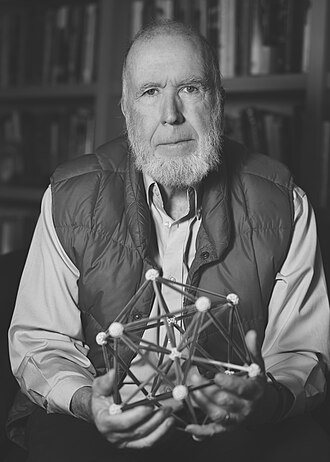
凯文·凯利 主主持人 Mimi
EDITED TRANSCRIPT · 依据现场录音编译整理,可划线生成便签
编者按:2010 年秋,凯文·凯利(Kevin Kelly)带着新书《科技想要什么》(What Technology Wants)回到谷歌总部,在"谷歌演讲"(Talks at Google)系列中发表演讲并回答提问。凯利是《连线》杂志创始主编,早年参与创办知名虚拟社区 WELL,也是恒今基金会(Long Now Foundation)的创办人之一。主持人 Mimi 是谷歌活动主持,她的父亲曾接替凯利出任《全球评论》编辑。本文依据现场录音编译整理。

主持人开场

主持人:凯文·凯利不仅是技术领域最重要的创新者和写作者之一,他本人的经历同样精彩。他曾骑自行车横穿美国再折返,一路上每天写一首俳句、画一幅画。他花了七年时间徒步走遍亚洲,并把旅途中的摄影结集成一本极美的画册,叫《亚洲恩典》(Asia Grace)。我第一次见到凯文是五六岁的时候,那时我父亲从他手里接过了《全球评论》(Whole Earth Review)的编辑工作。凯文是《连线》(Wired)的创始执行主编,参与设计并推出了 WELL,也就是那个著名的、堪称原型的虚拟社区,还有第一个商业网站 HotWired。他是恒今基金会的创办人之一,同时运营着网站"酷工具"(Cool Tools)。他还是《纽约时报杂志》的固定撰稿人,写数字文化专题,最近一篇登在教育特刊上,讲他在家教育儿子的经历,以及技术在其中扮演的角色。他的著作包括《失控》(Out of Control)、《新经济,新规则》,以及好几版《全球概览》(Whole Earth Catalog)。今天他要讲的是他的新书《科技想要什么》。请大家欢迎凯文·凯利。

我们缺一套关于技术的理论

凯利:谢谢你,Mimi,介绍得真好。很高兴又回到这里。大约六年前,我在构思这本书的时候,就在这间屋子里做过一次演讲,讲科学方法的历史和未来。那次演讲的内容,如今变成了这本更大的书里的两页纸。这本书讲的是技术的长期趋势。

今天下午我可以跟各位聊的东西很多,比如媒体的未来、互联网和万维网的未来,但这些你们大概都比我懂得多。所以我宁愿退后一步,谈谈技术到底意味着什么,它在世界上处于什么位置,以及当我们制造这一切东西的时候,它在我们的头脑里应该占据什么位置。你们每天都在做新东西,可问题是,关于我们究竟在做什么,我们并没有一套像样的理论。眼下人们对技术的理解基本上就是"一件接一件":我们不停地做出一件又一件东西,却没有一个更大的框架去判断这些东西是不是好东西,我们要不要更多,它们在宇宙中处于什么位置,跟自然又是什么关系。我想做的,就是为技术理论写出一份初稿,让大家可以从这些角度来思考。

这听起来非常玄,但先看看大多数人怎么定义技术。一种说法是:技术就是你出生之后才发明出来的一切,就是这些新玩意儿,从各家实验室里出来的东西。稍微精细一点的人可能会说,技术是那些还不太好使的东西,或者是你口袋里装着的东西,或者是任何带开关的东西。这些小玩意儿当然都是技术,但技术其实远不止于此。

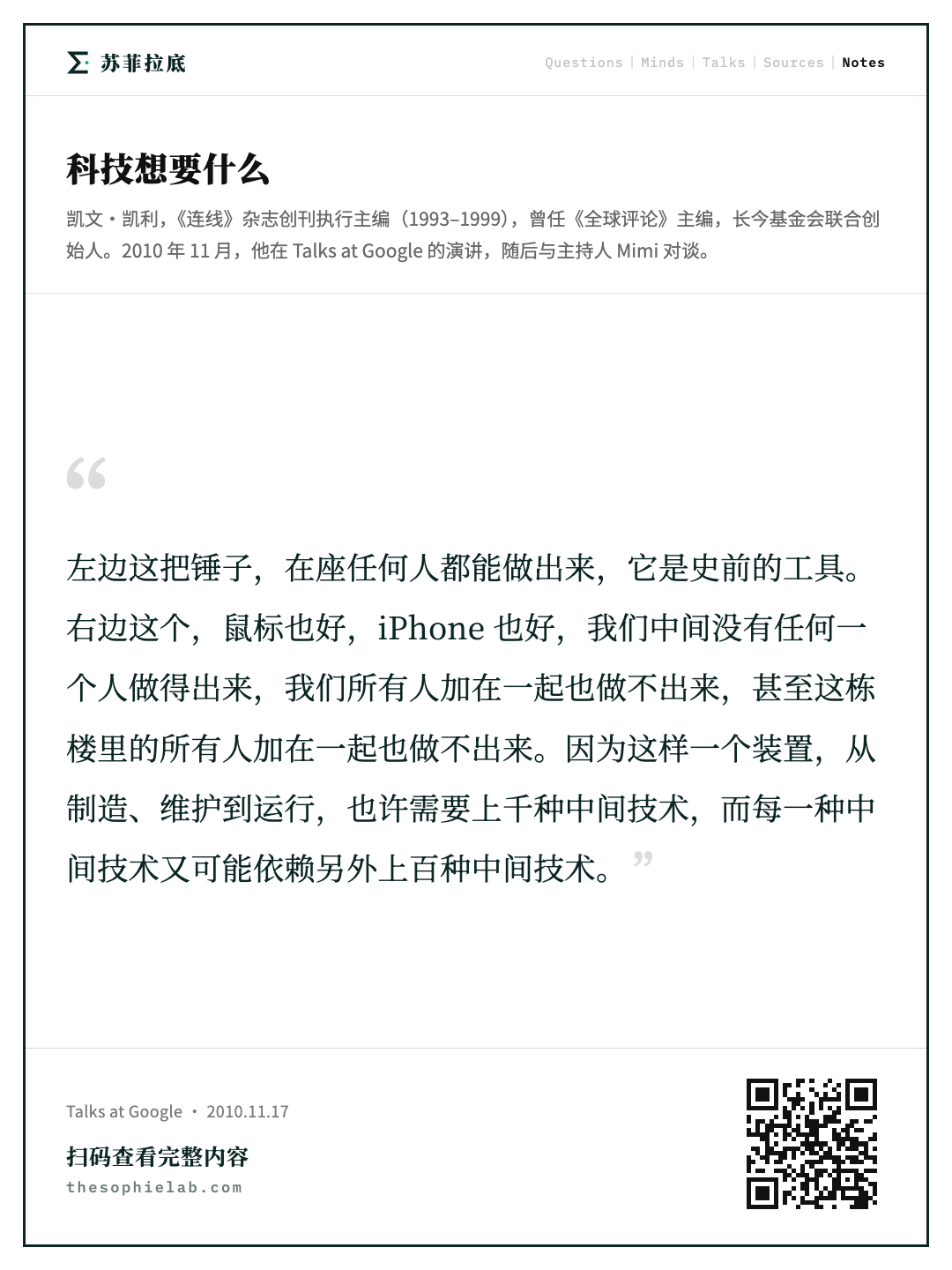
看这两件东西,尺寸和形状差不多。左边这把锤子,在座任何人都能做出来,也许做得没那么好,它是史前的工具。右边这个,鼠标也好,iPhone 也好,随便什么,我们中间没有任何一个人做得出来,我们所有人加在一起也做不出来,甚至这栋楼里的所有人加在一起也做不出来。因为这样一个装置,从制造、维护到运行,也许需要上千种中间技术,而每一种中间技术又可能依赖另外上百种中间技术。所以我们手里的技术,比如右边这个,实际上代表着一整个技术生态:一大套相互关联、相互依赖、彼此共生的人造物。这整个生态,你也可以把它想成一个技术的超级生物体,才是我真正感兴趣的东西。

技术元素

凯利:为了把这个整体跟单个的技术或人造物区分开,我给它起了个名字,叫"技术元素"(technium)。技术元素就是这个巨大的超级蜂巢、超级生态,是我们拥有的全部技术在彼此关联、彼此依存的状态下构成的整体。

关于复杂到这种程度的系统,我们知道两件事。第一,这类系统会表现出任何组成部分都不具备的行为。你可以盯着一只蜜蜂或一只蚂蚁看上一辈子,也永远看不到蜂巢或蚁群。那种行为不存在于单个个体里。同样,技术元素的行为不存在于任何一件具体的设备里,它是一种系统层面的行为。第二,这些行为有内在的偏向和倾向。这是我们对系统的基本认识。而系统里的递归回路越多,倾向就越多。所谓递归回路,就是无限循环、自我回环,在生物学里随处可见。我们的染色体上有大量基因,其中很多并不表达蛋白质,而是去开启别的基因;那些基因再开启另一些基因,而另一些基因又回过头来开启最初的那些。这就是递归回路。技术也一样:技术 A 造出技术 B,技术 B 造出技术 C,而技术 C 又参与制造技术 A。技术元素内部布满这样的回路,凡是有回路的地方,就有偏向和倾向。

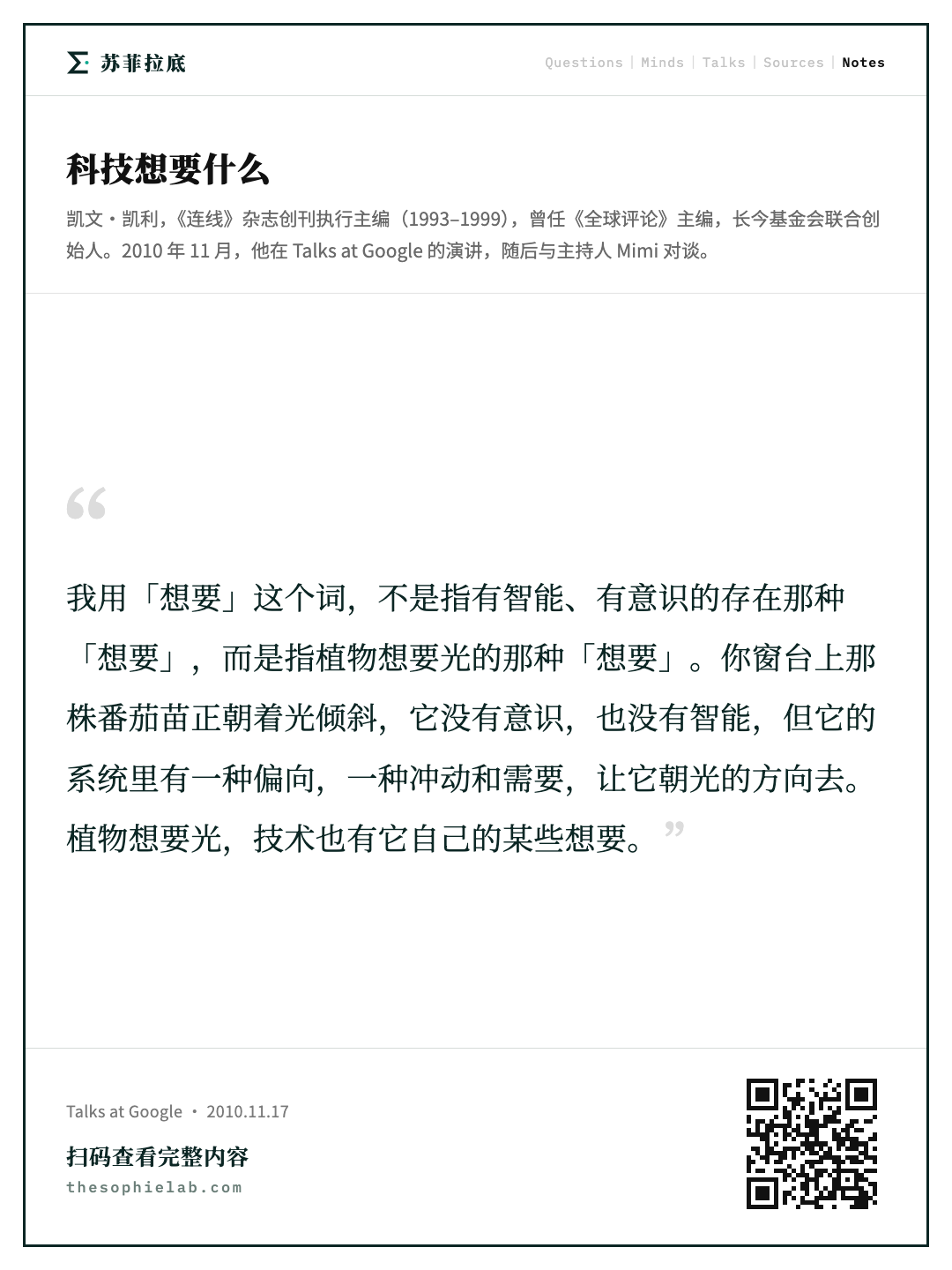
所以当我说"技术想要什么",我说的是技术元素偏向什么。我用"想要"这个词,不是指有智能、有意识的存在那种"想要",而是指植物想要光的那种"想要"。它们朝着光的方向倾斜。你窗台上那株番茄苗正朝着光倾斜,它没有意识,也没有智能,但它的系统里有一种偏向,一种冲动和需要,让它朝光的方向去。植物想要光,技术元素也有它自己的某些想要。我要问的问题就是:总体上,技术元素有哪些偏向?

演化想要什么

凯利:我从植物说起,是因为我的基本前提是:技术元素是从我们身上延伸出来的,而它不只来自我们的头脑,还来自我们的生物学过去,来自我们的演化史。技术元素实际上是在延续并加速那些同样的力量。所以我要先问:演化想要什么?

我得马上声明,有一些演化生物学家,其中最有名的是已故的斯蒂芬·杰伊·古尔德(Stephen Jay Gould),非常强硬地主张演化根本没有趋势,没有轨迹,没有方向。这是当今演化生物学的正统观点。但也有少数派,另一些演化生物学家,其中很多是年轻人,在计算和计算机模拟方面经验更丰富,他们提出了不同的论点,并且有证据表明,在漫长的演化进程中确实存在趋势和方向。其中最主要的一条,也是我们凭直觉都能感到的:在三十七亿年的生命史里,生命变得越来越复杂。

为什么这不算显而易见的趋势?古尔德会说:"如果你一开始就是简单的,那你除了变复杂之外无路可走。"所以前沿越来越复杂这件事是平庸的,不重要。真正的问题在尾端。我们可以考察:当你在演化中已经走了一段,已经有了一定复杂度之后,接下来往哪个方向走还有没有偏向?我们能证明,即便在演化的尾端,比如细菌,也存在一种朝着更复杂方向的轻微漂移。

所以演化想要什么?我们有证据表明,三十七亿年的生命史里存在趋向更高复杂度的趋势,这是一条。此外还有趋向更多样的趋势:物种的数目在增加。这种多样性的增长同样不只发生在起点简单的时候,即便已经有了一些多样性,它也很少倒退成更单一,平均而言总是走向更多样。我们可以列出一张单子:复杂度增加,多样性增加,专门化增加。最早的细胞是通用的,一种细胞包办一切;随着时间推移,它们演化出各种专门的类型,我们身体里有二百五十种不同的细胞。我们能证明,在演化史上,细胞类型的数目是逐步增加的。还有互利共生的增加,生命越来越依赖其他生物;普遍性的增加;心智和感知能力的增加。我们看到心智,看到大脑和神经元所做的那种学习,甚至在植物身上也会出现,它在整个生命界里独立地反复迸发出来。此外还有学习能力的增加,以及"可演化性"(evolvability)的增加,也就是演化的能力本身在增加。我们常常忘了,演化过程本身并不是单一的、固定的过程,它自身也在变得越来越复杂,并且实际上让演化这件事随着时间变得越来越容易。今天的生物可以比二十亿年前演化得更快、更灵活、自由度更多。所以演化能力本身也在演化。最后还有外熵(exotropy),也就是秩序的增加,自组织的增加,结构的增加。

生命与技术的连续体

凯利:为什么这些重要?我认为过去五十年最惊人的发现之一,就是认识到生命的本质不是水,不是某种生命精气,也不是世界上某种神秘力量,而是信息。DNA 密码的发现让我们看到这一点:生命的本质其实是信息处理。而这当然也正是技术的本质。就在不久之前,我们头一次把达尔文式的演化搬出生物学,搬进了计算的世界,比如拿它来演化计算机代码。微软 Word 的代码里有一部分是演化出来的,不是人写的。我们把演化从生物学移进了计算机。与此同时,我们也可以给大肠杆菌的基因序列编上数字,作为一项概念验证,把它当作一台并行处理机器,去解一个旅行推销员问题。也就是说,我们用大肠杆菌遗传机制的并行处理能力,去解决了一个计算机程序的问题。

所以,演化搬进了计算机,生命和演化则走出生物学去做计算。这从某种意义上说明,生命和技术元素之间是等价的。我们通常认为两者之间隔着一道鸿沟,可这道鸿沟并不存在。两者之间实际上是一个连续体。

这意味着,当我们看到这些十七、十八世纪的东西,这么多形形色色的集烟罩,简直像博物馆里收藏的各种蝴蝶标本。我们看到,专门化当然也在技术元素里发生,在机械物件上发生。我们造出一台计算机或者一台相机,然后可能造出专门的水下相机、红外相机、高速相机;再进一步专门化,造出专门的红外相机,然后是专门的水下红外相机,如此不断细分下去。专门化正在发生。在某些情况下,我们甚至可以画出不同发明的族谱。

这些平行之处如此显著,以至于我们不妨这样想:生命有六大界,植物、动物、真菌和三类细菌。可以把这六大界看作正在孕育第七界。我把技术元素看作生命的第七界,因为作为一个系统,请注意,是作为技术元素这个系统,而不是单件的人造物,它跟生命共享太多属性,展现出太多与生命相同的自组织力量。所以我把它当作生命的第七界。于是当我问技术想要什么,问技术的偏向和长期趋势是什么时,我得到了一个非常相似的答案。

技术元素的偏向

凯利:我还要回到那个观点:"想要"不是有意识的,但它是真实的,不智能的系统也能有想要。这是柳树车库(Willow Garage)的 PR2 机器人,它被编了程序,会自己去找能源给自己充电。它在楼里到处游走,寻找插座,然后用尾巴上的插头自己插进去,充满电再离开。我有幸站在它和插座之间,它非常明确地想要能量,你能感觉到。它总会想办法找到插座。它没有意识,没有觉知,也不怎么智能,但它确确实实想要电。

如果我们再问技术元素想要什么,答案是一样的东西。它有一种总体的偏向,漂向更高的复杂度、更多的多样性、更强的专门化、更多的互利共生、普遍性、感知能力和可演化性,等等。

这意味着什么?举一个技术长期趋势的例子。取那些处于非平衡态的系统,比如一个星系、一颗恒星,甚至带有大气和生命的行星,看它们的功率密度,也就是能量密度:每秒每克流过这个系统的能量,按尔格每秒每克计算,在系统存续期间平均下来。你会发现,最高的能量密度在天文时间尺度上是不断上升的。事实上,流过向日葵细胞的能量,比太阳在其整个寿命期间的能量密度还要高。而我们所知的世界上能量密度最高的实体,其实就是你个人电脑里的那块芯片。工程师头疼的正是这个:流过芯片的能量太多、太密,快要到爆炸或熔毁的边缘了。这是一种能量密度高得不可思议的状态,而我们可以断言,它还会朝这个方向走得更远。

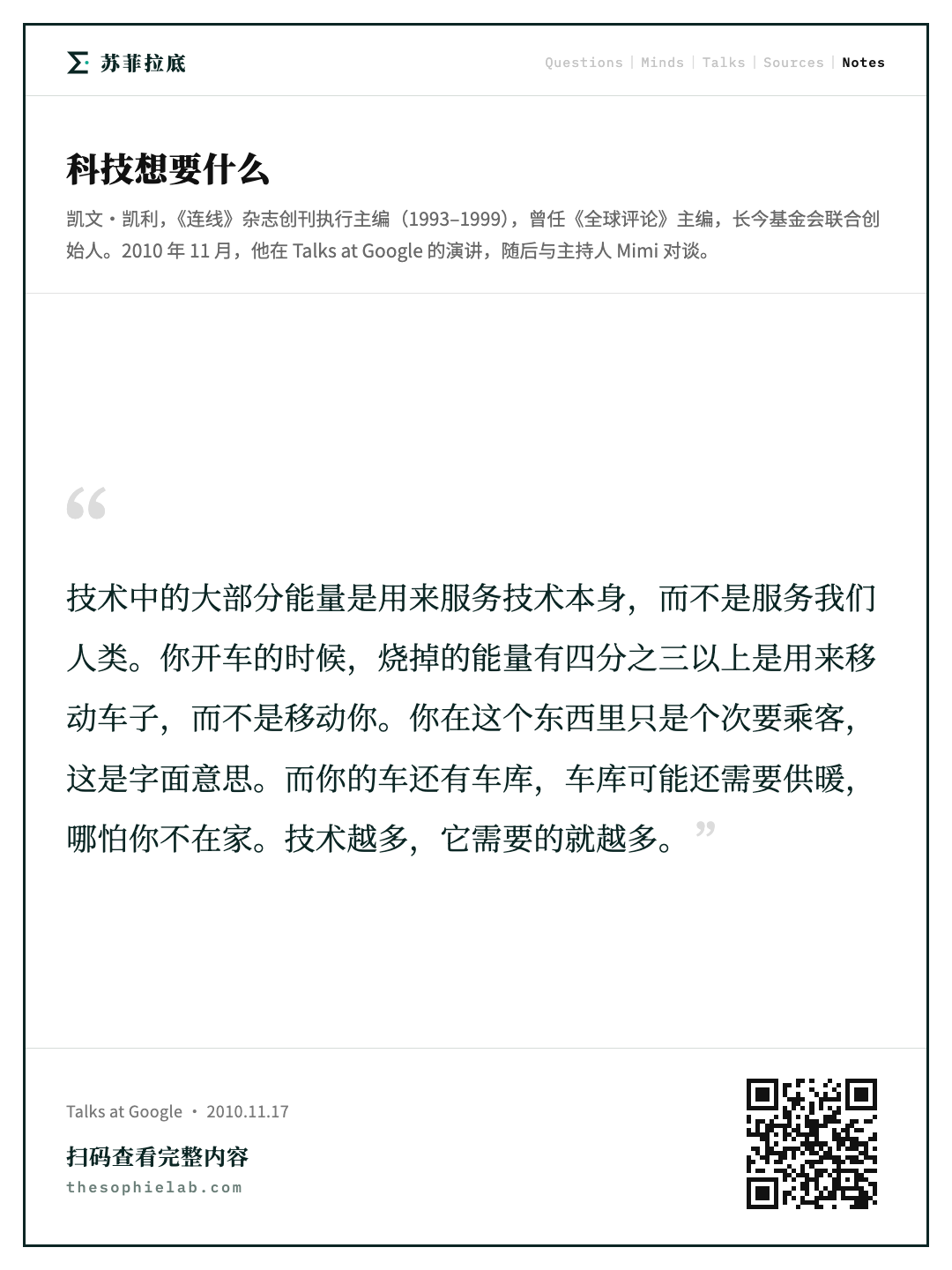
所以这些系统有它们自己的某种议程。问题是,议程是什么?议程之一,当然是让自己壮大。我做过一个计算:技术元素中的大部分能量是用来服务技术元素本身,而不是服务我们人类。你开车的时候,烧掉的能量有四分之三以上是用来移动车子,而不是移动你。你在这个东西里只是个次要乘客,这是字面意思。而你的车还有车库,车库可能还需要供暖,哪怕你不在家。所以技术元素在做的事情,至少是越来越多地服务它自身。技术越多,它需要的就越多。这是议程的一种意义。

另一种意义可以拿摩尔定律来说。我试图回答一个大问题:摩尔定律曾经是必然的吗?或者说,摩尔定律现在是必然的吗?戈登·摩尔(Gordon Moore)和卡弗·米德(Carver Mead)在六十年代提出了它。这条线几十年来毫不动摇,不管人们怎么试图加速它,往某个热潮里砸几十亿美元,或者想抢到它前头去,都不管用,它就是非常非常直。摩尔和米德认为这不过是一个自我实现的预言。可问题在于,把这条曲线换算成比如每秒运算次数,会发现它早在他们意识到之前就已经在延伸了。带宽、存储、DNA 测序,我们看到类似的曲线,都在同一种毫不动摇的固定斜率上,而且都在人们相信它们之前很久就开始了,甚至在人们否认它们存在的时候也在继续。所以它不只是自我实现的预言。它内建于物理和化学的机制之中。斜率也许取决于经济,但它是直线这件事不取决于经济。

发明是必然的

凯利:议程的另一个例子:历史上乃至今天的大多数发明,都是独立且同时被发明出来的。在爱迪生之前,另有二十三个人发明了电灯泡。亚历山大·格雷厄姆·贝尔提交电话专利之后三个小时,伊莱沙·格雷(Elisha Gray)也提交了他的方案,而在他们两人之前好些年,一位意大利人已经先做出来了。我甚至查看了曼哈顿计划期间的研究记录。当时有六个不同的小组,因为保密和战时的分隔而完全隔绝,即便是美国境内的三个小组,也是按"需要知道"的原则各自为政,互不知晓对方的工作,而他们都保留了极其细致的记录。所以我们有绝对的证据,等于是实验室级别的证据,证明人们在完全独立的情况下发明东西,做出非常相似的成果,而且几乎在同一时间。

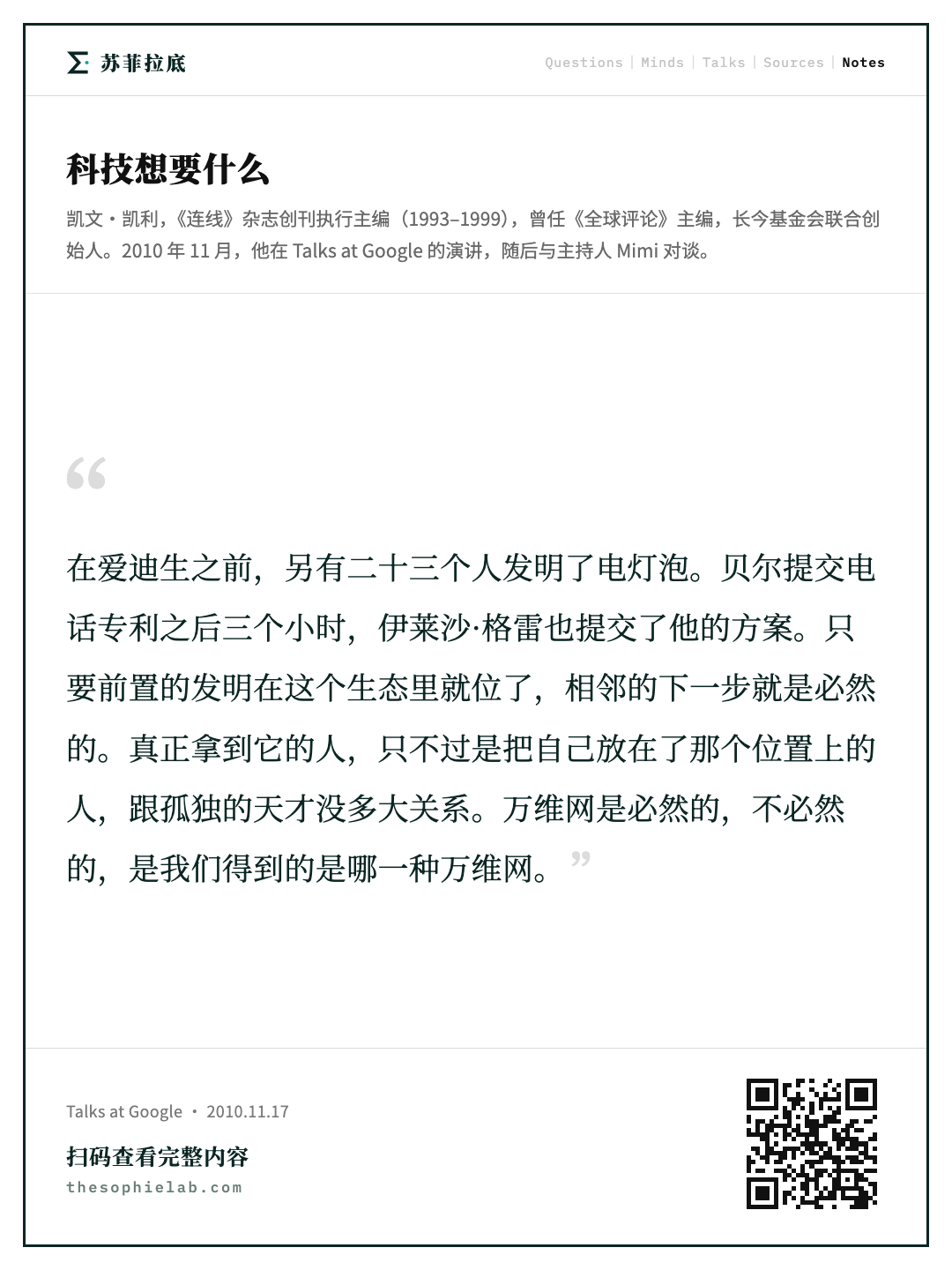
所以,只要前置的发明在这个生态里就位了,相邻的下一步就是必然的,它会在那个时候发生。真正拿到它的人,只不过是把自己放在了那个位置上的人,跟孤独的天才没多大关系。史蒂文·约翰逊(Steven Johnson)的研究说明了同样的事:孤独天才的观念根本就是错的。发明来自一个生态,一个由相互依赖的发明构成的生态系统,其中的每一步都是必然的,连整个推进的序列都是必然的。我在书里考察了各大洲彼此隔绝、毫无交流的史前时期的发明,各大洲史前发明的先后顺序几乎完全一致。这从某种意义上说明,将要到来的技术也是必然的。

所以万维网是必然的。不必然的,是我们得到的是哪一种万维网。我认为技术的表达形式就像分类学里的"属",属这一级是必然的,但"种"的分化不是。白炽灯泡是必然的,但它是不是用钨丝、用什么电压、用交流还是直流,这些不是必然的。万维网也一样:它是集中式还是分布式,是否透明,用什么协议,这些都不是必然的,而这些差别对我们的体验影响巨大。展望未来,克隆人是必然的。但在什么领域、怎么做?那不是必然的,我们对此有选择。计算机驾驶的汽车,你们都清楚,是必然的,但监管怎么定、我们如何体验它、我们围绕它建立什么样的文化基础设施,都不是必然的。这些是我们可以选择的东西。

自我创造的人类

凯利:所以我认为,人性是我们自我创造出来的。而一旦是自我创造,就意味着我们既是被造者,也是造物者。我们对技术的紧张感,从一开始就源于此。说我们是自我创造的,是因为很早以前,我们就开始做这样的事:造出一个体外的胃来烹煮食物,煮那些我们自己消化不了的东西。这个体外的胃彻底改变了我们的营养,久而久之改变了我们牙齿的大小、下颌的位置、体内的酶。我们现在离不开烹饪,而烹饪已经改变了我们的基因。我们通过大脑、通过技术改造了自己。我们重造了、制造了、创造了我们自己。我们视为人性的很多东西,从法律,到正义感,甚至可能包括语言,都是我们用头脑造出来的。我们是自我创造的。既然是自我创造,我们就既是造物者,也是被造者,既是主人,也是仆人。自我创造就会带来这个结果。

大约五万年前语言的发明,改变了人口动态。当时全世界的人类总共可能只有八千到一万,而一旦有了语言,我们就有了一件通向自己心智的工具。我想尼安德特人大概相当聪明,但因为没有语言,他们没法掌控自己的心智。语言不只是用来跟别人交流,也是用来跟自己交流的。有了语言,我们突然就有了工具,有了技术,可以刻意地制造东西,而不只是碰上东西。我们随之迅速扩散,以每年一英里的速度散布到地球上每一个流域。人类向全球扩张的速度就是这样:每年一英里,几千年就定居了整个地球。

单凭这一项技术,很长一段时间里,我们就改造了整个星球。早期的狩猎采集者让二百五十种巨型动物灭绝,那还是很久很久以前,而这些人据说是"与自然和谐相处"的。他们彻底改变了生态的整体构成,因为一旦灭绝了巨型动物,整个生态的物种分化都会随之改变。到了一万年前的农业时代,农业就开始改变气候,所以气候变化其实早于工业时代。所以从我们的工具诞生之初,技术就已经是一股行星级的力量。事实上我要说,它现在是世界上最强大的力量。我们生活中的大多数东西,都可以追溯到某项我们发明的东西;而未来的大多数变化,当然也都会来自我们发明的东西。我要说的是,我们做出的最伟大的发明,就是我们自己的人性。而这件事当然还没有完成,这正是全部的要点。

所以技术是自私的,它有自己的议程,我们是被造者,从这个意义上说它自私。但与此同时,它也服务于我们,我们是造物者。这种既是被造者又是造物者、既是技术的主人又是技术的奴隶的紧张,永远不会离开我们,它是我们所有持续不安的根源。一千年后,面对新的技术,我们仍然会为此纠结:我们既是被造者又是造物者,技术既自私又服务于我们。这种二元性,这种紧张,永远不会消失。

坏技术的答案是更好的技术

凯利:当然,我想大多数人会拥抱技术,但也有人担心:它有没有极限?它会不会接管一切,把地球变成一颗技术星球,把生物全部抹掉?有意思的是,如果接受我的主张,即技术元素是演化力量的延伸,是生命演化的延续和加速,那么到目前为止,我们所知的事实是:还没有发现任何一种技术是不能做得更绿色、更与生命相容的。技术元素中确实有很多东西与生命不相容,肮脏、污浊,规模化之后毫无人性,但这些并不是技术元素的固有属性。既然不是固有的,我们就可以做出更多绿色的、与生命和生活相容的东西。事实上,制造计算机芯片所需的水,纯度比我们喝的水还高。从某种意义上说,你甚至可以讲:连技术都想要干净的水。技术需要它,就像我们需要它一样。所以我认为,技术元素在本质上并非与生命不相容,而是相容的。

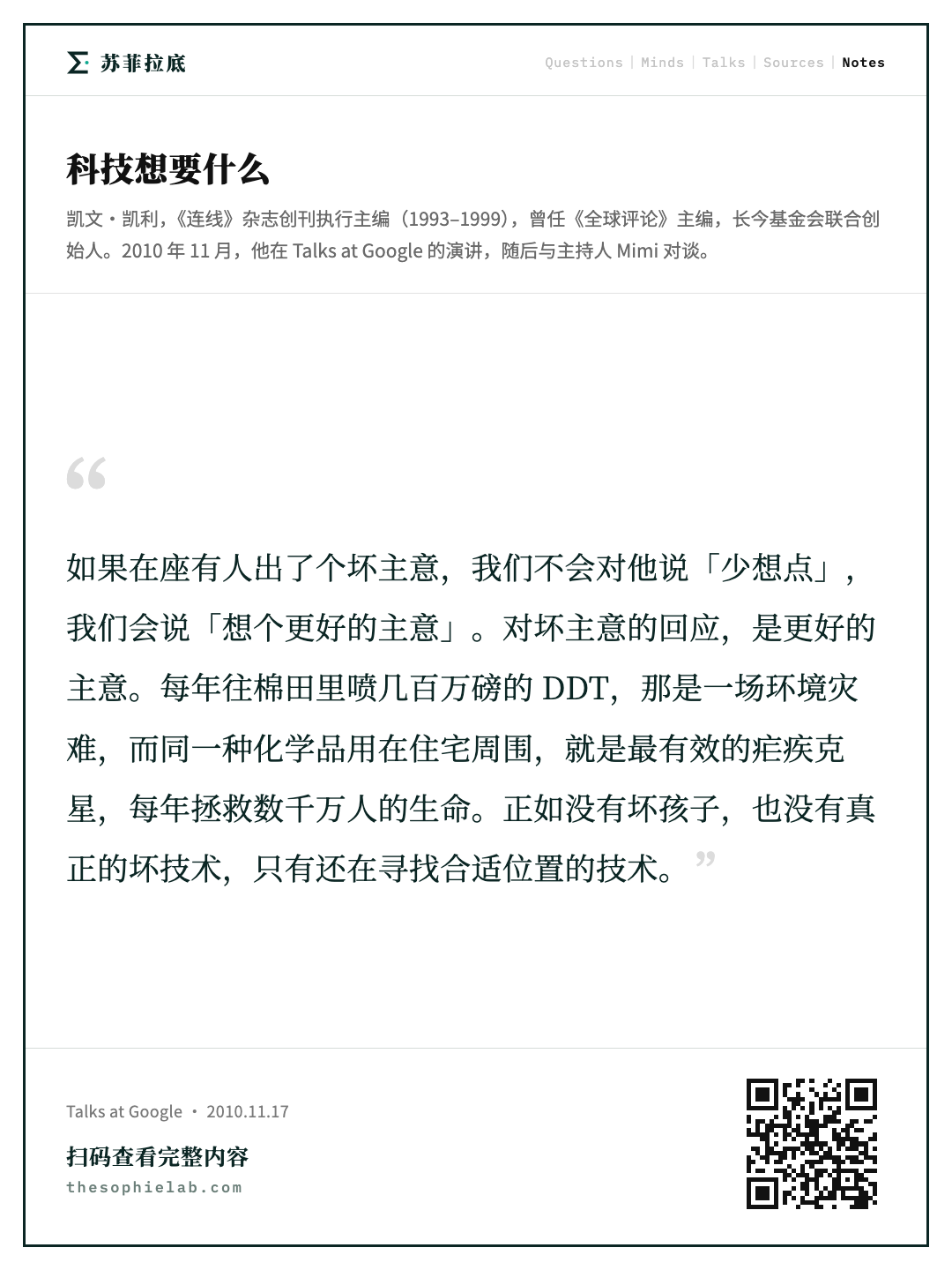
我喜欢这样想:如果有一种技术不绿色,也许对环境危害很大,我就把它看作一个坏主意。对一个坏主意,恰当的回应是什么?如果在座有人出了个坏主意,我们不会对他说"少想点",我们会说"想个更好的主意"。对坏主意的回应,是更好的主意。所以当我们有了一种坏技术,比如在种植园的规模上,每年往棉田里喷几百万磅的 DDT,那是一场环境灾难,对坏技术的回应不是更少的技术,而是更好的技术。我们可以改造它。同一种技术,同一种化学品,DDT,如果用在住宅周围,它就是最有效的疟疾克星,每年拯救数千万人的生命。所以我们可以给技术换个位置。

今天世界上的大多数问题都是技术引发的(technogenic),由以前的技术造成。每一项新技术都会制造新问题。未来世界的大多数问题,会来自今天或未来发明的技术,所以未来的问题也都会是技术引发的。正因为这么多问题是技术引发的,就有一种倾向,说我们需要更少的技术。但事实上我们需要的是更好的技术,当然也要明白,更好的技术在未来同样会制造它自己的问题。所以我认为,作为人类,我们的工作是给 DDT 找一份更好的工作,给我们的"心智之子"找到最合适的岗位。就像对待自己的孩子,我们想把他们引向正路,确保他们交对朋友,把他们放进合适的环境,认真去寻找他们真正想要的东西。我认为,正如没有坏孩子,也没有真正的坏技术,只有还在寻找合适位置的技术。

我甚至认为,这对很多武器化的技术也成立。在我看来,宇宙中某处也许真有需要核弹的地方,这并非不可想象。核弹用来杀人是可怕的东西,但它可能对别的事情有用。只要我们还在地球上,我们大概不想要它。

技术不是中性的

凯利:所以技术想要什么?它想要更多的多样性、更多的选项、选择、机会、可能性。这就是技术给予我们的。我承认,技术和新技术常常制造出与解决方案同样多的问题。于是有人会说:"那就说明技术只是中性的。"这是很多技术人的正统观点:技术是中性的工具,可以用来做好事,也可以用来做坏事;一把锤子既能杀人,也能盖房子。从某种意义上说,这没错,但有一点不同:当锤子被发明出来的时候,它给你、给世界、给我们带来了一个以前没有的新选择。我要说,这个新选择本身就是一种善。仅仅是新选择本身就是善。这让天平稍微、非常非常轻微地朝善的一边倾斜了。每一项新技术,尽管会制造新问题,但它增加了我们的选择和可能性,这件事本身就是善的。

而且事实证明,它不需要好很多,只要好一点点就行。如果通过技术,我们每年创造的比毁掉的多百分之一,经年累月、几个世纪地复利下去,这百分之一的差额就是文明。这就是进步。甚至也许只要千分之一。世界上可以有百分之四十九点五是垃圾,是糟糕透顶的东西,但只要有百分之五十一,哪怕只是百分之五十点五是好的、是善的、增加了我们的选择,在我眼里这就是进步。进步就是这么来的。所以技术不是中性的。从长远看,技术有道德的维度,它不是中性的,因为我们在增加自己的选项和可能性。

亨利八世与人力车夫

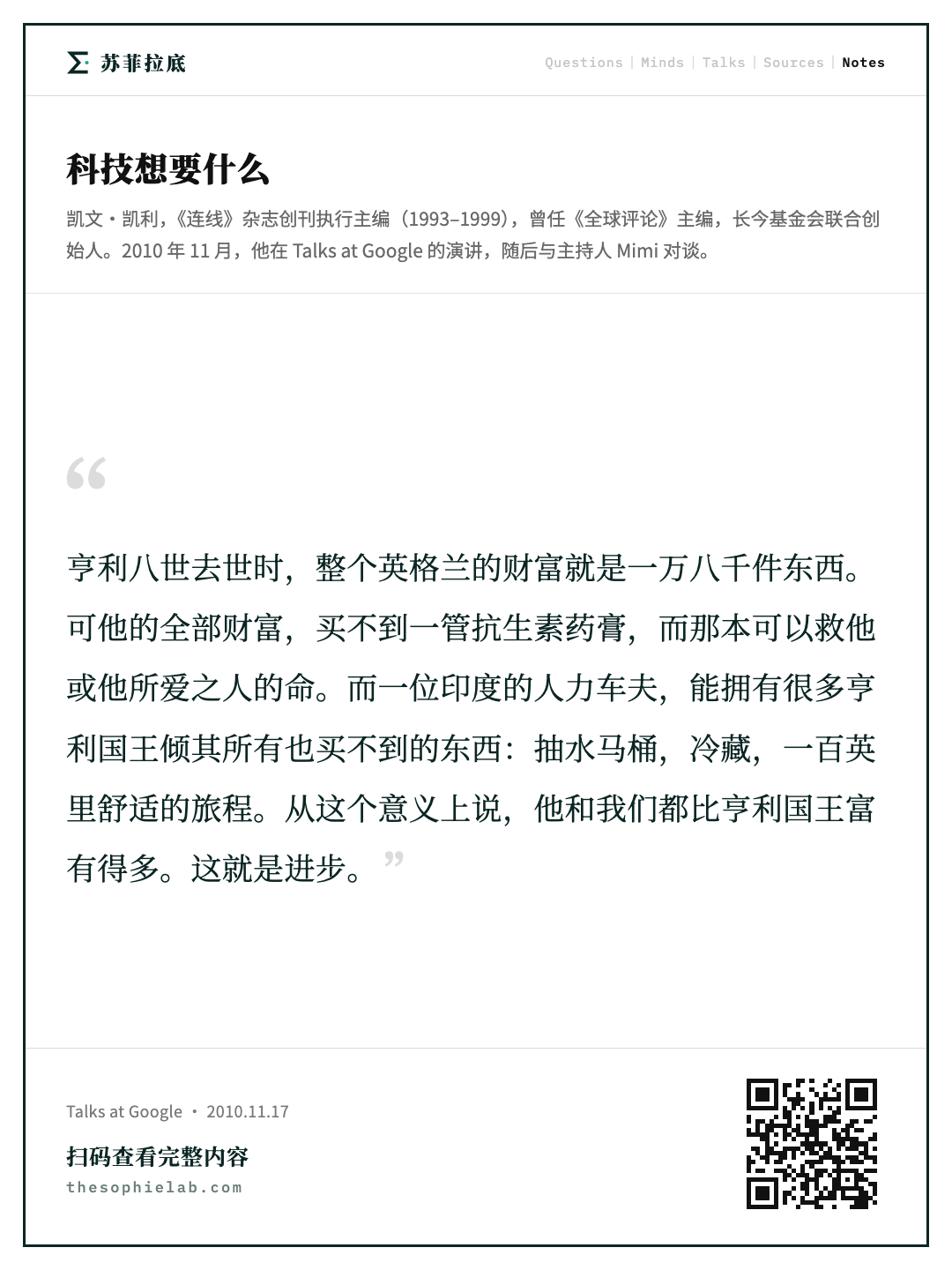
凯利:我和女儿一起清点过家里的物品,大约有一万件不同的东西。再看英格兰国王亨利八世去世时的清单,他们清点了他家中的一切,而他的家当同时也是英格兰的国库。清单上有一万八千件东西,也就是说,整个英格兰的财富就是一万八千件东西。有时我们会说,我们日常生活的富足程度已经接近古代的国王了。但更有意思的是:亨利国王的全部财富,买不到一管抗生素药膏,而那本可以救他或他所爱之人的命。我记得美国最早的百万富翁之一,好像是罗斯柴尔德家族的某位,死于一个脓肿,两美元的抗生素就能治好,但他的财富买不到。而这位印度的人力车夫,能拥有很多亨利国王倾其所有也买不到的东西:亨利国王没有抽水马桶,他的财富买不到冷藏,买不到一百英里舒适的旅程,诸如此类。而这位车夫负担得起。从这个意义上说,他和我们都比亨利国王富有得多。这就是进步。这就是这些东西带给我们的,不只是进步,还有选择、可能性、机会、寿命、更多的教育,所有这些随时间不断上升的东西。

我想强调的是,当我们把时间花在做新东西上的时候,有时候会感到沮丧,因为我们做的东西人们很快就忘了,或者随手扔掉;我们好像只是在推销更多的东西,是在鼓吹消费主义。确实有这样一面,我们在制造大量的东西,于是会问:"我们为什么要做这些?价值在哪里?"我要说的是,这背后有一件更大的事:我们实际上在增加这个世界的选择、可能性和选项。而这之所以是好事,是因为我们在参与一件比我们自身更大的事情。

与更大的力量同行

凯利:这种趋向更多样的自组织力量,从大爆炸就开始了,一直贯穿至今。宇宙的其余部分正在衰竭,熵在增加,但在某些地方,我们可以通过加速熵的产生来增加局部的秩序,这就是外熵。这样的地方之一就是地球和地球上的生命,它们通过加速产生熵来增加自身的秩序。这种自组织贯穿于星系,星系在维持秩序;贯穿于恒星,恒星是把轻原子锻造成重原子的机器,并能维持自身几十亿年。这种自组织贯穿于生命,进入技术元素。所以我们可以让自己与一件远比我们自身宏大的事情对齐。它回溯到宇宙的开端,从开端一路运行下来,并将越过我们,继续向前。人类处于某件事情的中途,我们不是任何事情的终点。这条漫长的弧线,正在带来越来越多的选择和可能性。

这为什么重要?因为我认为,我们每个人都常常需要这些新工具,来表达自己独有的天赋和才能的组合。我们的面孔各不相同,因为基因和其他东西的组合各不相同;我们的才能也各有各的位置,而要找到并表达这些才能,往往需要技术。我喜欢想吉米·亨德里克斯(Jimi Hendrix)的例子:扩音器的发明,他演奏的其实是扩音器,而不是吉他,扩音器让他的天才得以与世界分享。然后我会想:如果他生在扩音器发明之前,我们会缺失多大的一块。如果莫扎特生在钢琴这项技术发明之前,梵高生在油画颜料之前,希区柯克生在电影技术发明之前,那对我们将是多大的损失。

所以从某种意义上说,我认为今天世界上的某个角落,有一个男孩或女孩,某种意义上的天才,正在等我们发明出那些工具和技术,好让他们的天才得以分享。我认为我们负有一种道德义务,去创造这些东西,创造这些可能性,为世界上每一个人把可能性最大化,让他们有机会真正找到并与我们分享自己的天才。因为我们自己也受惠于过去那些为我们制造新东西的人。所以我们在这里,就是要制造更多的技术,增加那些可能性,而这是漫长的宇宙演化的一部分,是那条穿过我们、并将越过我们的自组织的长线的一部分。

谢谢各位的时间。想看这本书的话,亚马逊和其他地方都有。这就是这本书的总论点。我们还有时间回答几个问题,我很乐意回答。谢谢。看来大家完全同意,我很高兴。

问答:必然是哪种必然

提问者一:你好,我有两个问题,都是想请你澄清一下。演讲中间你谈到有些东西是必然的。你的意思是字面上的、逻辑上的必然,还是只是压倒性的大概率?

凯利:你说说这两者的区别。

提问者一:我说的逻辑上的必然,是指没有任何办法阻止它发生,它几乎像数学推导一样必定跟着来。而概率上的必然,是指可能性足够大,所以迟早会发生。

凯利:我认为宇宙从根本上是概率性的,宇宙的一切都是概率性的。所以我站在概率这一边,而不是逻辑这一边。

提问者一:好。那么按这个意思,可以说五十年代我们本来可能互相把对方炸回石器时代,那样就不会有 iPod,至少在一段时间里不会有。这跟你说的必然是相容的?

凯利:当然。我说的必然,就像人的发育有必然的进程:你从一颗受精卵开始,长成胚胎、胎儿、学步的幼儿,等等。所以人会长成青少年,这是必然的。当然有很多人在成为青少年之前就死了,那么成为青少年还是必然的吗?如果你死了,从逻辑上说你当然成不了。所以是的,在概率的意义上,它是必然的。

提问者一:好的。另一个想请你澄清的是,我觉得你在演讲里至少用了两种意思的"技术"这个词。

凯利:对。

提问者一:主要的意思,似乎是把它说成某种自身就有存在的东西,就像社会那样。这是你想表达的吗?

凯利:是的。在书里我用词更一致,用的是"技术元素",但那是我自己造的词,今天我想循序渐进地把大家引入这个概念。技术元素,正如我开头所说,是一个系统,是各种东西相互依存的系统,而不是单个人造物的集合。它是一个系统,一个生态系统,你可以把它看作我们的头脑共同创造的一切所构成的超级系统。

提问者一:明白。你还说过技术是一种"力量"。你把它既看作系统又看作力量?

凯利:对。我认为它的力量其实就是外熵的力量。说它是力量,就像说一辆大卡车从路上冲过来要撞到我,那也是一种力量,一种由人造物产生的力量。从这个意义上说,力量指的其实是它的能量。而我谈技术的力量时,指的是技术内部的那种外熵的力量。

问答:把它带回自己的生活

提问者二:谢谢你来演讲。你说的很多东西在我心里引起了深深的共鸣,但我一直在琢磨,把它落回实际,意味着什么。读你的东西有一种顿悟的感觉,可事实是,一方面这些趋势很多是必然的,在谷歌工作的人都体会得到,我们一方面拼命往前推,另一方面又总觉得后面有狼在追。但在任何有意义的短周期里,比如产品周期、竞争、大家在做什么,这些完全不是必然的,恰恰相反,完全取决于我们选择做什么、别人选择做什么。我也很感兴趣地听说,不记得是在你的书里还是别的文章里,你对自己家里用什么技术、不用什么技术,有一套非常具体的想法。所以,尽管我们在这里都看好技术,你认为一个人能不能以很多有意义的方式去干预?还有,那些更长期的趋势,是不是适合作为政府政策之类的依据?换句话说,怎么把它带回到你自己和别人的生活里?

凯利:关于必然性,我想先说一点:一旦用了"必然"这个词,就等于在挑起争论,会引来各种反应。我认为与其逃避必然性,不如把它当作一种有用的信号,因为我们可以为它做准备。我们可以在教育上做准备,在商业上、在各种模式上做准备,预先安排好,等它到来时把好处放到最大,把害处降到最低。比方说,如果你回到六十年代,相信摩尔定律,并且意识到它是必然的,想想接下来五十年你能做多少事。如果你真的知道计算机每年都会快一倍、便宜一半,你根本不需要了解 IBM、苹果或者谷歌,单凭接受这一件简单的事,首先就能赚很多钱。而且在文化和教育上也有很多事可以做,只要你真正理解了它是必然的。

至于你问的怎么落回自己的生活,答案是可以的。有意思的是,我在某种意义上鼓吹要增加世界上的技术总量,而我自己却在尽量减少自己生活中的技术。原因在于,要找到最适合你的天赋的那些工具,答案不是所有技术,而只是一小部分精选出来的技术,其余的技术其实是干扰。所以你真正要做的,是找到那一小套适合你的技术,然后忽略其余的。

从某种意义上说,阿米什人做的就是这件事。书里有一章写阿米什人,我跟他们相处过,非常敬佩他们。他们极其挑剔,但他们不是反技术的,不是勒德分子,他们只是以一种奇特的方式非常挑剔。他们用马车,戴软帽,可他们也用一次性尿布,很热衷于化肥,还种转基因作物。所以他们非常非常挑剔。但我之所以不做阿米什人,是因为他们只做了一半:他们在尽量减少自己生活中的技术,却不去为别人把技术最大化,他们其实依赖我们来做这件事。我认为两件事都得做。我想做的,是尽量收窄自己的选择,同时把供别人挑选的那个大池子做到最大。所以这种张力同样存在。每年发明出来的技术越来越多,多到我们自己无论如何都用不完,所以我们必须有一套标准。我们不能随便瞎试,必须开始培养某种标准,把自己的选择收窄,同时鼓励别人拥有更多的选择。

问答:宇宙终将杀死我们

提问者三:你在演讲前面说到我们对技术的期待,它的规则和目的,让我很受触动。我的信念是,总有一天宇宙会把我们全部杀死,超新星、彗星撞击、生态灾难,随便什么。没有什么能永存。而我把技术看作把那一天尽可能往后推的最好赌注。你会说这是正确的押法吗?

凯利:我会押技术,是的。我想说的是,我们正在变得越来越技术化,我们是技术元素的一部分,技术元素不是外面的什么东西,而是我们身在其中的东西。所以往前走,我看不出我们和技术之间有多大区别。我们已经是赛博格了,我们已经在那儿了。而且我认为我们可能会分化成多个物种,这才是真正的问题。会有人说,无论如何我和我的孩子都绝不会改动自己的基因;也会有人说,好啊,明天就给我报名。我们可能会变成多个物种。所以人类的定义本身,正在被我们重新定义。每次机器人或人工智能出现新的突破,我们就得重新定义自己是谁:我们原以为只有人能做这个,那么人到底是什么。而且不只是我们是什么的问题,外面还有巨大的难题。我们面临的巨大挑战是,我们能够定义自己可以成为什么,却连一个集体决定人类想要成为什么的程序都没有。所以就连定义我们自己这件事,我认为我们也才刚刚起步。

问答:如何研究演化系统

提问者四:我猜这里的一条基本原理是,文化和技术都是演化系统,跟创造了生命的演化系统共享很多有趣的属性。我觉得这是一个非常有意思的研究领域,但很多人难以接受,因为我们对演化系统的总体理解还非常薄弱。

凯利:对。研究演化的麻烦在于,我们只有一个案例,很难据此概括。

提问者四:正是。现在我们开始有更多案例了,但要增进这种理解,推进对演化过程的一般性研究,弄清它们可能意味着什么、我们可以怎么用它们,我们能做些什么?

凯利:我对演化系统的看法发生改变,是在我意识到我们可以在计算机里造出另一种形式的演化的时候。我们可以做演化研究,可以让达尔文式的演化在计算机里跑起来。我认为模拟以及其他手段,能造出更强大的系统,然后放手让它们去发明东西,这会比在野外研究更多的东西更能教会我们演化是怎么回事。这是我的回答。我认为模拟作为科学工具的威力才刚刚开始显现。再回到我早先那次关于科学方法演化的演讲,我认为模拟在未来的科学方法中将扮演的角色,是我们面前的大事之一。

问答:归根结底是信息想要什么

提问者五:演讲很精彩,谢谢你来。很多有意思的想法,激发了一大堆思考。

凯利:那我就有用了。这正是这本书的目的。

提问者五:我有个问题,这些东西是不是其实可以归结为别的什么?算是个不太成熟的想法。你谈到模拟,我们确实可以模拟演化系统,可是一旦拔掉插头,或者电厂没煤了,它就完了,它不会自我延续。也许有一天它自我延续是必然的,但眼下我很怀疑。

凯利:对。眼下,我们是技术的性器官,技术要繁殖,离不开我们。

提问者五:所以当你说"技术想要什么",这种拟人化让我觉得,其实我们才是技术的创造者,所以那是我们想要什么。就连那些支撑其他技术所必需的支撑性技术,也不过是把复杂性和依赖关系一层层往回推,最终还是我们想要什么。而如果我们受自私的基因驱动,基因又受某种更原始的、原核生物的、细菌的信号传递之类的东西驱动,那么这最终是不是归结为"信息想要什么"?这种偏向到底是什么,你为什么要用这种方式来表述?

凯利:这是一个非常好的问题。如果一路往回追问:"生命是怎么自组织起来的?那种想要是从哪里来的?"这是一个巨大的谜。而这还只是谜团的开始。如果再往回说"这一切都是信息",我们根本不知道信息是什么。随便问一位宇宙学家、一位天文学家:"宇宙中的信息守恒吗?"他们会说:"不知道。"复杂性的定义是什么?"不知道。"所以这里的谜团是深刻的。我并不是说我的框架能解开什么谜,我只是说,我们可以把技术放进这个参照系里,与那些其他的谜团并列。也许这是最好的说法。

提问者五:好。那从中能得到什么关键的、可带走的实际用处吗?

凯利:有的。那就是:生命和技术之间的界线非常薄。把技术元素看作演化的延伸和加速,如果我们理解技术更接近一种演化的力量,而不只是我们用头脑发明出来的东西,我们就能更好地理解技术要往哪里去。

提问者五:谢谢。

问答:个体为系统付出的代价

提问者六:让我惊讶也让我受鼓舞的是,你对技术想要什么持这么乐观的看法,认为它会创造更多选择、更多可能性,让人们的生活更好。因为如果技术是演化的延伸,是这个我们只是其中一部分的过程的副产品,那么我们的主观体验、我们对好坏的感受,在某种意义上跟这个过程是无关的,除了它在系统层面让这些事情持续发生。比如看多细胞生命的演化,对生命整体来说这是巨大的胜利,但对单个细胞来说,这也许糟透了:现在有些东西得一辈子当一个胃细胞。

凯利:氧气的出现也是同一类事,不是发明,是氧气的产生。氧气杀死了之前的很多生命,而它当然又是后来的生命所必需的。

提问者六:正是。那些催生出下一层级演化的个体行动者,往往拿不到最好的那份。

凯利:对。我认为演化正在朝着一个方向走,这也许能回应你的问题,我没把它列进那张单子,因为那张单子本来就不完整:演化实际上在增加选择、选择的自由和自由度。作为个体,跟一万年前相比,我们现在拥有的自由选择远远多于一万年前的人。在心智上也是如此,因为我们比一个完全没有语言的人更有觉知。所以我认为即便作为个体,我们的自由选择也在增加。这一点,加上我们意识到自己的选择是某件更大的事情的一部分。我认为主人与仆人的这种二分永远不会离开我们,就像先天和后天的关系一样,你无法把两者拆开。主人与仆人,你也无法把两者拆开。

提问者六:谢谢。

问答:选择的暴政

提问者七:我想知道你怎么把安全类技术纳入这套框架。比如在电子游戏里,如果你给每个人更多的力量,让每个人都成了超级英雄,那我们就都能互相攻击,游戏就没意思了,因为人人都强得离谱。给人更多选择,似乎也就是给人更多干涉别人选择的力量。

凯利:巴里·施瓦茨(Barry Schwartz)谈过"选择的暴政",意思是如果给人太多选择,人会瘫痪。这里有一个解决办法,当然,这又是我的技术中心视角:我认为选择过多的解决办法,是用更多的技术来帮助我们做选择。亚马逊的推荐就是这个,协同过滤就是这个。所以更多选择的解法,是再多一个选择,就是使用帮助过滤选择、辅助选择的技术。你提的问题也一样,如果有这么多选择,解决办法,抱歉这么说,还是更多的技术,更好的技术。

提问者七:我的问题其实是,当人们对自己想做什么有不同的想法,而且彼此能互相干涉的时候,更多的选择就不是一件无害的事了,它可能对别人造成负面影响。而你希望看到被创造出来的,正是这类东西。

凯利:对。但除了更好的选择、更好的选择技术之外,唯一的另一条路就是更少的选择。而我不认为那行得通,这正是我要说的。那跟整个演化的弧线背道而驰,所以我不会押在上面。我永远会押更好的选择技术,而不是更少的选择。

提问者七:好吧,有道理。

问答:技术的性器官

主持人:还有时间回答最后一个问题吗?

凯利:最后一个问题,然后我想已经超时七分钟了,该走了。请讲。

提问者八:你说人类是技术的性器官?

凯利:是的。顺便说一句,这话不是我说的,我想是麦克卢汉的。

提问者八:这种状况会一直持续,还是你认为最终会改变?

凯利:我的论点是,现在我们正在给技术元素一点点自主性。自主性不是二元的,不是有或没有,而是可以有一点点,我们自己也是如此,我们也不是完全自主的。所以我认为,技术元素的自主性会越来越多。技术元素能不能完全自主?从我们是它的一部分这个意义上说,不太可能。我们将永远是技术元素的一部分,我们不会与它分离,永远不会。所以技术元素的自主性肯定会不断增加。它会不会不再需要我们来繁殖?我不知道。我可以想象不同的情景,这么说吧,我认为有多种情景。在某些情况下,这是必然的;但在另一些情况下,在我们做的另一些事情里,就不是。既然它想要多种可能性,我要说的就是,我不认为它会保持为单一的物种,我们会看到分化。有些可能性里它会完全不需要我们,另一些可能性里我们仍然不可或缺。

大多数时候,未来不是单一的。我说的不是一架梯子,不是一场沿着单一路线往上爬的竞赛。这些轨迹不是梯子上的一级级台阶,而更像爆炸。好了,再次感谢大家留下来,很感谢这些问题,希望你们喜欢这本书。谢谢邀请我来。
本期讲者
凯文·凯利《连线》杂志创刊执行主编(1993–1999),曾任《全球评论》主编,长今基金会联合创始人。著有《失控》《技术想要什么》《必然》。
主持人 MimiGoogle 内部演讲系列主持人,其父曾接替凯利担任《全球评论》主编。据此推测为霍华德·莱茵戈德之女 Mamie Rheingold,时任 Google 员工。
章节 · 点击跳转视频
0:05 主持人介绍与开场定位 ▶ 正在看
2:41 技术的定义与「技术元素」 ▶ 正在看
6:51 演化想要什么:复杂与多样 ▶ 正在看
11:54 生命即信息:技术是第七界 ▶ 正在看
16:19 能量密度、摩尔定律与同时发明 ▶ 正在看
22:58 自我创造的人类:主人与仆人 ▶ 正在看
26:30 技术可以更绿:更好而非更少 ▶ 正在看
30:48 反驳中立论:1% 差额即文明 ▶ 正在看
35:36 宇宙自组织与天才的工具 ▶ 正在看
39:05 问答:必然性与技术元素的定义 ▶ 正在看
43:04 问答:个人取舍与阿米什人 ▶ 正在看
47:03 问答:赛博格、信息与自主性 ▶ 正在看
本期论点
本期回应
19:28
摩尔定律的直线性内建于物理与化学,不只是自我实现的预言 沿轨迹推进技术的进展能被预测吗?
21:19
发明来自相互依赖的发明生态,其步骤与顺序是必然的,不靠孤独天才 沿轨迹推进技术的进展能被预测吗?
40:51
技术的不可避免是概率意义上的必然,而非逻辑上不可阻挡 沿轨迹推进技术的进展能被预测吗?
14:37
技术整体是生命的第七界,与生命共享同一种自组织力量 自行扩张技术会脱离人的控制吗?
17:46
技术体系消耗的能量绝大部分用于维持技术自身,而非服务人类 自行扩张技术会脱离人的控制吗?
29:11
对糟糕技术的回应不是更少的技术,而是更好的技术 更好的技术技术带来的问题,该往哪里找出路?
33:02
技术不是中立的工具,长期来看它带有道德维度 技术自身技术的后果由什么决定?
其他论点
4:42
一件现代器物背后是整个相互依赖的技术生态,而不是孤立的人造物
9:24
演化中存在一种朝更高复杂度的持续漂移
12:05
生命的本质是信息处理,DNA 是一套可被读写的密码
29:42
今天世界上多数问题由先前的技术造成,未来的问题将来自今天的发明
32:24
技术每年创造的比毁掉的多出百分之一,复利累积起来就是文明与进步
38:21
人类有道德义务创造新技术,让每个人的天赋都有机会被表达
47:41
人与技术之间没有清晰的分界,我们已经是赛博格了
01主持人介绍与开场定位
0:05
>>presenter: So, Kevin Kelly is not only one of the foremost innovators and writers about technology, but his personal story is an equally interesting one. He rode his bike across America and back, and wrote a haiku and drew a drawing for every day of that journey. He spent seven years walking across Asia and he published a beautiful book of his photography from his travels, called "Asia Grace." I first met Kevin when I was five or six, when my dad took over the role of editor from him at the Whole Earth Review and Kevin Kelly was a founding executive editor of Wired. He helped design and launch the WELL, the famous, prototypical, virtual community, as well as HotWired, the first commercial web scene. He is one of the founders of the Long Now Foundation and he also creates and publishes the website Cool Tools. He's also a regular contributor to the New York Times magazine, publishing features on digital culture and one of the last ones was an education issue about homeschooling his son and the role that technology played. His books include "Out of Control," "Rules
>>主持人:凯文·凯利不仅是技术领域最重要的创新者和写作者之一,他个人的故事同样引人入胜。他曾骑自行车横穿美国再骑回来,并且为那段旅程的每一天写一首俳句、画一幅画。他花了七年时间徒步走过亚洲,还出版了一本精美的摄影集,收录他旅途中拍下的照片,书名叫《Asia Grace》。我第一次见到凯文时才五六岁,那时我爸爸从他手里接过了《全球评论》(Whole Earth Review)主编的位子。凯文·凯利还是《连线》杂志的创刊执行主编。他参与设计并推出了 WELL——那个著名的、堪称原型的虚拟社区——以及 HotWired,第一个商业化的网络站点。他是长今基金会(Long Now Foundation)的创始人之一,还创办并运营着一个叫 Cool Tools的网站。他也是《纽约时报杂志》的固定撰稿人,写数字文化方面的专题,其中最近的一篇是教育专刊,讲他在家自学的儿子,以及技术在其中扮演的角色。他的著作包括《失控》《新经济新规则》,还有好几个版本的《全球概览》。今天,他要
便签引用
1:16
for a New Economy," several editions of the Whole Earth Catalog and today, he's going to be talking his latest book, "What Technology Wants." So, please help me in welcoming Kevin Kelly. [applause] >>Kevin: Thank you, Mimi. That was great. It's great to be back here. About six years ago, I actually gave a talk in thinking about this book, in this very same room on the history and the future of the scientific method. And that talk is now two pages in this larger book, which is about the long term trends in technology. And there's lots of things that I feel I could talk to you about this afternoon, but I think, or I could talk about the future of media, the future of the Internet and the Web and those kinds of things; all of which you probably know a lot more about than I do. And I think I'd rather, instead, like to step back and talk about what technology means and where it, where its place in the world, where it wants to be in our minds as we make all this stuff. So, everyday, you folks are involved in creating new things and the problem is we don't really have a
讲的是他的新书《技术想要什么》。请和我一起欢迎凯文·凯利。[掌声] >>凯文:谢谢你,Mimi,讲得真好。很高兴能再回到这里。大约六年前,我其实就在这同一个房间里做过一次演讲,当时是在为这本书做思考,讲的是科学方法的历史和未来。那次演讲现在变成了这本更大的书里的两页,而这本书讲的是技术的长期趋势。今天下午其实有很多东西我都可以跟大家聊,比如媒体的未来、互联网和万维网的未来,诸如此类;不过这些你们多半比我懂得多。所以我想,我更愿意往后退一步,来谈谈技术意味着什么,它在这个世界上的位置在哪里,以及当我们在做这些东西的时候,它想在我们心里占据什么样的位置。你们每天都在创造新东西,而问题在于,我们其实并没有一套很好的理论来解释我们究竟在造什么。所以目前关于技术的想法,
便签引用
02技术的定义与「技术元素」
2:41
very good theory about what it is that we're making. And so, the current idea about technology is basically one thing after another. All right? We produce one thing after another and there's no larger framework about whether these are good things, whether we want more of it, where it fits into the cosmos, how it relates to nature and what I'm trying to do is basically, make a first draft for a theory of technology; so you can think of it in those terms. And so, that sounds kind of really esoteric, but here's a definition that most people think about what technology is, is about anything that was invented after you were born; it's all this new stuff, the stuff that's coming out of labs here. And if you're maybe a little more sophisticated, you might think of it as stuff that doesn't work yet and, or maybe it's the stuff that's in your pockets. Or maybe anything that has an on or off switch. And, I think, of course, all those gadgets and all those things are the stuff that technology is, but it's actually something more than that. We can take two
基本上就是一件接一件。对吧?我们造出一件又一件东西,却没有一个更大的框架来判断这些东西是不是好的、我们是不是想要更多、它在宇宙中处于什么位置、它和自然是什么关系。而我想做的,基本上就是为一套技术理论打一个初稿;你们可以从这个角度来理解它。这听上去可能挺玄的,但先看看大多数人对技术的一个定义:技术就是在你出生之后才发明出来的一切东西;就是这些新玩意儿,是这里的实验室里出来的东西。如果你更老练一点,你可能会觉得技术就是那些还不太好使的东西;或者是你口袋里的那些东西;又或者是任何带开关的东西。当然,我认为所有这些小玩意、所有这些东西确实都属于技术,但技术其实不止于此。我们可以看两张图片,这两件人造物大小和形状差不多,其中一件
便签引用
3:52
pictures, these two artifacts that are approximately the same size and shape and one of them can easily be made by any of us here--not maybe as well-- and that's the tool of the hammer and that's prehistoric. Or the one on the right, the mouse or the iPhone or whatever you wanna look at, that one not only could not any of us do, but even the group of us here could not do. And, in fact, even everyone in this building could not actually produce that. And that's because that device requires maybe a thousand intermediate technologies to create it and maintain it and operate it, and each of those technologies might, in turn, depend on another hundred intermediate technologies. So, what we have is the technology we have, like on the right, is actually representative of an ecology of technologies. It's a whole set of interrelated, interdependent and codependent artifacts and that that entire ecology, or if you can like, if you wanna think of it as a super organism of technology, is actually what I'm most interested in. And to distinguish that from the individual technologies or artifacts;
我们在座任何人都能轻松做出来——也许做得没那么好——那就是锤子这个工具,它是史前的。而右边那个,鼠标也好、iPhone 也好,随便你怎么看,那个东西不但我们在座任何一个人做不出来,就算我们这一群人一起也做不出来。事实上,就算这栋楼里的所有人一起,也造不出那个东西。原因在于,那个装置需要大概一千种中间技术才能被造出来、被维护、被运转起来,而这一千种技术里的每一种,又可能依赖于另外一百种中间技术。所以我们拥有的技术,比如右边那个,其实代表的是一个技术的生态。它是一整套相互关联、相互依赖、彼此共生的人造物;而正是这个完整的生态,或者你也可以把它想成技术的超级有机体——这才是我最感兴趣的东西。为了把它和单个的技术或人造物区分开,
便签引用
5:08
I call that the "technium." So, the technium is this huge, super hive, super ecology of all the technologies that we have as they are related to each other and codependent on each other. And what we know about systems, that have that degree of complexity, there's two things. The one thing that we know about those kinds of systems is that, first of all, they exhibit behaviors that are not present in any of the parts, ok? So, you can look forever into a tin-, into a bee or an ant and you'll never see the hive or the colony.
我把它叫做“技术元素”(technium)。所以技术元素就是这么一个巨大的超级蜂巢、超级生态,包含我们拥有的一切技术,它们彼此关联、彼此共生依赖。关于具备这种复杂程度的系统,我们知道两件事。我们对这类系统了解到的第一件事是,首先,它们会表现出任何组成部分身上都不存在的行为,对吧?你可以永远盯着一只蜜蜂或一只蚂蚁看,也永远看不到蜂巢或蚁群。
便签引用
5:44
So, that behavior is not present in the individual components. And so, the pres-, the actual behavior, the technium, is not present in any of the devices; it has a larger system-wide behavior. And secondly, those behaviors have inherent biases and tendencies. That's what we know about systems, ok? And the more recursive circuits there are in this, the more tendencies there are, and so, recursive circuit is the idea here, the infinite loop or recursive loop, where we see this in biology. We have genes. A lot of the genes in our chromosomes are turning on other genes; they're not expressing protein, but they're turning on other genes and some of those genes are turning on other genes, and some of those genes are turning on the first genes. And so, you have this recursive loop. We have technologies that make; technology A makes technology B, technology B makes C, and C is involved in the creation of A, so we have recursive loops within the technium and whenever you have those, you have biases, tendencies. And so, when I talk about what technology wants, what I'm talking
所以那种行为并不存在于单个的组件里。同样地,技术元素真正的行为,也不存在于任何一件设备之中;它有一种更大的、系统层面的行为。其次,这些行为本身就带有内在的偏向和倾向。这是我们对系统的认识,对吧?而且其中的递归回路越多,倾向就越多越多。所以这里的关键概念就是递归回路,无限循环或者说递归循环,我们在生物学里就能看到。我们有基因。我们染色体里很多基因是用来开启其他基因的;它们并不表达蛋白质,而是去开启另一些基因,而那些基因又去开启别的基因,其中一些基因又反过来开启最初那批基因。于是就形成了这种递归循环。技术也一样:技术 A 造出技术 B,技术 B 造出 C,而 C 又参与了A 的诞生,所以技术元素内部也存在递归循环。只要有这种循环,就会有偏向、有倾向。所以当我谈论技术想要什么时,我说的
便签引用
03演化想要什么:复杂与多样
6:51
about is what the technium is biased towards. So, it's, I don't mean "want" in terms of the way in which an intelligence or conscious being would want, but I mean "want" in the way that plants want light. They're leaning towards light. The tomato plant on your windowsill's leaning towards the light; it's not conscious, it's not intelligent. It has a bias in its system, an urge and need, to move towards light. And so, we have plants that want light and that is what the technium has, is certain wants. And the question I'm asking is, in general, what are the biases in the technium? And I begin, if, going back to plants, because my premise is that, in fact, the technium is an extension coming from us. It's not just from our minds, it's also from a biological past; from our evolutionary past, that the technium is actually extending and accelerating those same forces. And so, I ask what does evolution want? Now, I have to say right away is that there are some evolutionary biologists.
其实是技术元素倾向于什么。所以我说的“想要”,并不是指某个智能体或有意识的存在那种想要,而是植物想要阳光的那种“想要”。它们朝着光倾斜。你窗台上的番茄苗朝着光生长;它没有意识,也不聪明。它的系统里有一种偏向,一种朝光移动的冲动和需求。所以,植物想要光,而技术元素同样有它自己的某些“想要”。我要问的问题是,总体而言,技术元素的偏向是什么?我之所以从植物讲起,是因为我的前提是:技术元素其实是我们自身的延伸。它不只是来自我们的头脑,也来自生物学的过去;来自我们的演化史。技术元素其实是在延续并加速那些同样的力量。所以我要问:演化想要什么?不过我必须马上说明,有一些演化生物学家。
便签引用
8:05
Among the most prominent was the late Stephen Jay Gould, who argued very, very forcefully that there are no trends in evolution at all; that it's trendless. That there's no trajectories, there's no directions. And that is the orthodoxy in evolutionary biology right now, but there is, there are minority view and there are other evolutionary biologists and many of them young, who actually have more experience with computational and computer simulations, who actually make a different argument and have evidence to show that there are trends, directions, in the long course of evolution. And, and the foremost of those is the ones that we all intuitively feel, which is that over 3.7 billion years of life that life has gotten more complex. Now, the reason why that's maybe not an obvious trend is, Stephen Jay Gould would say, "Well, if you're starting off simple, you have nowhere else to go but more complex." And so, the fact that the leading edge is getting more complex is trivial; it's not important. The question is about the trailing edge. And so, we can show, in fact, that when
其中最著名的是已故的斯蒂芬·杰伊·古尔德,他非常、非常强硬地主张演化根本没有任何趋势;演化是无趋势的。没有轨迹,没有方向。这是目前演化生物学界的正统看法。但也有少数派观点,还有另一些演化生物学家,其中很多比较年轻,他们在计算和计算机模拟方面更有经验,他们提出了不同的看法,并拿出证据表明确实存在趋势、存在方向,贯穿演化的漫长历程。其中最突出的一条,正是我们凭直觉都能感受到的:在生命 37 亿年的历程中,生命变得越来越复杂。这为什么算不上一个显而易见的趋势呢?因为古尔德会说:“如果你从简单开始,那你除了变复杂也无处可去。”所以最前沿的部分变得更复杂,是件微不足道的事,并不重要。真正的问题在于后沿。而我们其实可以证明,当
便签引用
9:17
you have moved along some evolution and you are somewhat complex, is there any bias in which direction you go then? And we can show that there's a mild drift towards increasing complexity, even at the trailing edge of evolution; say bacterium. So, what does evolution want? Well, again, there is a trend. We have evidence that there is a trend in greater complexity over 3.7 billion years of life; that's one trend. But there's also trends towards more diversity; increasing numbers of different species. And again, that increasing diversity happens not just when you're starting off with simple, but even wants to have some diversity; it rarely goes to less diverse. It generally, on average, goes to more diverse. And we can actually make a list of these things including increasing complexity, increasing diversity, increasing specialization. The first cells are general. There's one kind of cell that does everything. Over time, they evolve into specialties and so we have 250 different cell types in our bodies. We can show the number of cell types increases over time in evolutionary
你沿着演化走了一段、已经具备一定复杂度之后,你接下来的方向还有没有偏向?我们可以证明,确实存在一种轻微的漂移,朝着更高复杂度前进,哪怕在演化的后沿也是如此,比如细菌。那么,演化想要什么?是的,确实有趋势。我们有证据表明,在生命 37 亿年里存在一个走向更高复杂度的趋势;这是一条趋势。但同时还有走向更多多样性的趋势;物种数量不断增加。而且这种多样性的增长并不只发生在从简单起步的时候,即便已经有了一定多样性,它仍然倾向于更多;它很少走向更低的多样性。总体上、平均而言,它走向更高的多样性。我们其实可以把这些列成一张清单:复杂度增加、多样性增加、专门化程度增加。最早的细胞是通用的。只有一种细胞,什么都干。随着时间推移,它们演化出各种分工,于是我们体内有 250 种不同的细胞类型。我们可以证明,在演化史上细胞类型的数量随时间不断增加。互利共生增加,对其他生物的相互依赖增加,
便签引用
10:35
history. Increasing mutualism, codependency on other organisms as for your life, increasing ubiquity, increasing mindfulness, sentience. We see the mind and the kind of learning that a brain does and neurons, even happens in plants. We see it erupting throughout the kingdom of life many, many times independently. There's increasing learning and evolvability, which is the ability to evolve and so we forget the fact that the evolution process itself, is not a singular, fixed process, but itself has evolved in complexity and it actually has made things easier to evolve over time. So, it's actually, organisms can evolve faster, quicker and more degrees of freedom now than they could two billion years ago. So, there is actually the evolution of evolvability over time. And exotropy, which is increasing order, increasing self-organization and increasing structure. So, those are the kinds of things that we see and the reason why that's important is because, I think, one of the most amazing discoveries in the last 50 years has been the realization that the essence of life was
无处不在的程度增加,心智性、感知力增加。我们看到心智,看到大脑和神经元所做的那种学习,甚至在植物身上也存在。我们看到它在整个生命界中一次又一次独立地涌现出来。学习能力和可演化性也在增加,也就是演化本身的能力。我们常常忘了一件事:演化过程本身并不是一个单一、固定的过程,它自身也在复杂度上不断演化,而且实际上让演化随时间变得越来越容易。所以生物体现在能比二十亿年前演化得更快、更迅速,自由度也更高。所以随着时间推移,确实存在“可演化性的演化”。还有外熵(exotropy),也就是秩序增加、自组织增加、结构增加。这些就是我们看到的东西。它之所以重要,是因为我认为过去五十年里最惊人的发现之一,就是我们意识到生命的本质既不是水,也不是什么生命精气或神秘力量,而其实是信息。
便签引用
04生命即信息:技术是第七界
11:54
not water or some vital spirit or some mystical force in the world, but actually was information. We saw that with the discovery of the DNA code; we can understand that the essence of life was actually information processing. And, of course, that's the essence of technology and it wasn't too long ago, for the first time, that we actually exported Darwinian evolution and moved it in to a computational world and they, for instance, we used it to evolve computer code. Microsoft Word has parts of its code that was evolved and not actually programmed by humans. So, we moved evolution out of biology into computers and at the same time, we could take E. coli and assign numbers to its genetic sequences and in parallel, as a proof of concept, used it as a parallel processing machine to solve a travelling salesman program. So, we used the parallel processing of E. coli genetics to solve a computer program.
我们在发现 DNA 密码时看到了这一点;我们由此明白,生命的本质其实是信息处理。而这当然也正是技术的本质。不久之前,我们第一次把达尔文式的演化输出出去,搬进了计算的世界。比如说,我们用它来演化计算机代码。微软 Word 有一部分代码是演化出来的,而不是人类编写的。所以我们把演化从生物学里搬进了计算机。与此同时,我们也可以拿大肠杆菌,把数字赋给它的基因序列,然后并行地——作为概念验证——把它当作一台并行处理机器,去求解旅行商问题。也就是说,我们用大肠杆菌基因的并行处理来运行一个计算机程序。
便签引用
13:09
So, we have evolution moving in computers; we have life and evolution moving from life and doing computation, showing that in some senses, that there's equivalency between life and the technium--that the division that we normally think of them, as a gulf, is not there. In fact, there is a continuum between the two. So, that means that when we look at things like this, this 17, 1800s, this diversity of smoke catchers is almost like a museum collection of different species of butterflies and we see specialization, of course, happening in the technium in mechanical things. We make a computer or a camera, and then we might make this specialized underwater camera and infrared camera and a high-speed camera and then we can specialize that to make a specialized infrared camera, and then a specialized infrared underwater camera and so it goes on and on; that specialization is happening. And we can even map, in some cases, the genealogy of different inventions.
所以我们既有演化搬进计算机,也有生命和演化从生命出发去做计算,这在某种意义上说明生命和技术元素之间是等价的——我们通常以为两者之间隔着一道鸿沟,其实那道鸿沟并不存在。事实上,两者之间是连续的。这就意味着,当我们看这样的东西——这是十七、十八世纪的——这一大堆各式各样的捕烟罩,简直就像博物馆里不同种类的蝴蝶标本。我们同样看到专门化当然也发生在技术元素里,发生在机械物件上。我们先造出一台电脑或一台相机,然后可能造出专门的水下相机、红外相机、高速相机,接着再在此基础上专门化,做出专门的红外相机,再做出专门的水下红外相机,如此不断下去;这种专门化一直在发生。在某些情况下,我们甚至可以画出不同发明的谱系图。
便签引用
14:16
And I think that's, the parallels are so steep that, in fact, we might even think of, these are the six kingdoms of life: plants, animals, fungi and three kinds of bacteria. We might think of these six kingdoms of life as actually producing the seventh kingdom, and I think of the technium as basically the seventh kingdom of life because it shares so many of the attributes as a system, again, as a technium; not the individual artifacts, but as a system, it exhibits so many of the same self-organizing forces that life does that we, that I think of it as the seventh kingdom of life. So, when I ask what does technology want, what are the biases and the long-term trends in technology, I get a very similar answer. And again, I wanna go back to the idea that "want" is not conscious, but is real that even unintelligent systems can have wants. So, this is the Willow Garage PD2, I think, robot which has been programmed to find its own energy; to recharge itself. And so, it will roam through its building
我觉得这种相似性太强烈了,以至于我们甚至可以这样想:这是生命的六界——植物、动物、真菌和三类细菌。我们或许可以把这六界看作正在孕育出第七界。我基本上把技术元素看作生命的第七界,因为它作为一个系统共享了太多相同的属性——再强调一次,是作为技术元素这个系统,不是单个器物,而是作为一个系统,它表现出太多与生命相同的自组织力量,以至于我把它看作生命的第七界。所以当我问技术想要什么、技术的偏向和长期趋势是什么时,我得到的是非常相似的答案。而且我还想再回到那个想法:“想要”不是有意识的,但它是真实的,连没有智能的系统也可以有想要。这是 Willow Garage 的 PD2,我记得是这个型号的机器人,它被编程去寻找自己的能量,给自己充电。它会在楼里四处游走寻找插座,然后拿出自己的尾插,自己把插头插进
便签引用
15:30
looking for outlets and then takes its tail plug and it plugs in by itself, it plugs into the outlet until its recharged and then it takes off again. And I had the privilege of standing between it and the outlet and it very definitely wanted energy. You could feel it. And it was gonna find it somehow or another and it was not conscious, it was not aware, it was not very intelligent, but it definitely wanted electricity. And so, if we again ask what the technium wants, what it wants is the same thing. It wants to head towards; it's a general bias to drift towards increasing complexity, increasing diversity, increasing specialization, increasing mutualism, ubiquity, sentience and evolvability, among other things.
插座,直到充满电,再继续上路。我有幸站在它和插座之间,它非常明确地想要能量。你能感觉得到。它无论如何都要找到能量。它没有意识,没有觉知,也不怎么聪明,但它确实想要电。所以,如果我们再问技术元素想要什么,答案是一样的。它想要朝着某个方向前进;它有一种总体偏向,朝着更高的复杂度、更多的多样性、更强的专门化、更多的互利共生、更普遍的存在、更强的感知力和可演化性等等漂移。
便签引用
05能量密度、摩尔定律与同时发明
16:19
And so, what does that mean? Well, here's one example of a long-term trend in technology. If you take the power density--the energy density-- of living, of systems that are in disequilibrium, like a galaxy, like a star, even planets with atmosphere life, you find that the amount of energy per second per gram, so erg's per second per gram, flowing through this system for the duration of the system that the highest energy densities are actually increasing over astronomical time. And that, in fact, there's more energy flowing through the cells of a sunflower than there is in the sun over its entire lifespan. And so, the most energy dense entity that we know about in the world is actually the chip in your PC, in your computer. In fact, that's the problem for engineers is that there's so much energy flowing through here and it's so dense that it's near explosion or meltdown.
那这意味着什么呢?这里有一个技术长期趋势的例子。如果你去看那些处于非平衡态的系统的功率密度——能量密度——比如一个星系、一颗恒星,甚至有大气和生命的行星,你会发现流经这个系统的、每克每秒的能量,也就是每克每秒多少尔格,在系统存续期间来看,最高的能量密度其实是随着天文时间不断上升的。事实上,流经一株向日葵细胞的能量密度,比太阳在其整个生命周期里的还要高。而我们所知世界上能量密度最高的东西,其实是你 PC 里、你电脑里的那块芯片。事实上,工程师面临的问题正是这里流过的能量太多、密度太高,已经逼近爆炸或熔毁的边缘。
便签引用
17:26
I mean, it's incredibly, incredibly energy dense state and yet we can actually say that where its gonna go is actually gonna be even further in that direction. So, these systems have their own agenda of some sort, and the question is what is the agenda? And one of the agendas is, of course, to increase itself. I did a calculation that most of the power in the technium is using to serve the technium rather than us humans. When you're driving your car, three quarters or more of that energy that you burn is to move the car, not you.
我是说,那是一种极其极其高的能量密度状态,然而我们其实可以说,它接下来还会朝这个方向走得更远。所以这些系统有它们自己的某种议程,问题在于这个议程是什么?其中一个议程当然是让自己不断壮大。我算过一笔账:技术元素中的绝大部分能量是用来服务技术元素本身,而不是服务我们人类。你开车的时候,燃烧掉的能量里有四分之三甚至更多是用来移动汽车,而不是移动你。
便签引用
17:59
You're a minor passenger, literally, in this thing and we have, your car then has a garage, which may be needed to be heated as well, even when you're not there. And so, we have this thing in which the technium is trying, is increasing, at least servicing more of itself. It's, there's more technology and the more technology is, the more it needs. So, that's one sense. And the other one, and another sense of having an agenda would be Moore's Law. So, a great question that I tried to answer was, "Was Moore's Law inevitable?
在这件事里,你字面意义上只是个次要乘客。而且你的车还得有个车库,那个车库可能还需要供暖,哪怕你人不在也一样。所以就出现了这种情形:技术元素越来越多地在服务它自己。技术越多,它需要的就越多。这是一个层面。另一个层面、另一种“有议程”的表现,是摩尔定律。我试图回答的一个很棒的问题是:“摩尔定律是不可避免的吗?
便签引用
18:33
Or, is Moore's Law inevitable?" And Gordon Moore and Carver Mead, who developed this in the 60s, and this, of course, is this unwavering line over decades of research, independent of the fact that people are constantly trying to accelerate it by putting billions into a fad or whatever, or trying to ahead of it; it still doesn't work, it's just very, very straight. They believed it was actually just a self-fulfilling prophecy, but, of course, the problem was is that this curve translated into like, say operations per second, has been going on way before they were aware of it and we see similar kinds of curves in bandwidth, storage, DNA sequencing and all these curves are on the same kind of unwavering, fixed slope and they start long before people believed them, even when they deny they are there, and so it's not just self-fulfilling prophecy. It is built in to the mechanics of physics and chemistry and the slope may be something that depends on the economy, but the fact that it's straight does not. And another example of an agenda is that most inventions throughout
或者说,摩尔定律是必然的吗?”戈登·摩尔和卡弗·米德在六十年代提出了它,而这当然是一条几十年研究中都毫不动摇的直线,不管人们怎样不断试图加速它——往某个热门方向砸进几十亿——或者试图跑到它前面去;都不管用,它就是非常非常笔直。他们本人认为这不过是个自我实现的预言,但问题在于,如果把这条曲线换算成比如每秒运算次数,它在他们意识到之前很久就已经在延续了。而且我们在带宽、存储、DNA 测序上都能看到同类曲线,所有这些曲线都落在同样毫不动摇的固定斜率上,而且它们的起点远早于人们相信它们的时候,甚至在人们否认它存在的时候也一样。所以它不只是自我实现的预言。它内建在物理和化学的机制之中。斜率的大小或许取决于经济,但它之所以是一条直线,并不取决于经济。另一个体现议程的例子是:历史上乃至当下的绝大多数发明,都是独立地、同时地被发明出来的。在爱迪生之前,
便签引用
19:50
history and currently now, are independently, simultaneously invented. There were 23 other people who invented light bulbs before Edison. When Alexander Graham Bell filed the patents for the telephone three years, three hours later, Elisha Gray submitted for his idea and neither, and both had been preceded by an Italian years before. And in every case, we, and we even, in places like, I looked at the studies of work during the Manhattan Project, when there was six different groups working on things that were absolutely separated because of secrecy and wartime division. Even the three groups in the US were on a need to know basis and were not aware of the others' work, they kept very meticulous records, so we have absolute proof, laboratory experiments of people inventing things completely independent and coming up with very similar things and in the near at the same time. So, whenever the precursor inventions are in need, or excuse me, are in place in this ecology, the next adjacent space is inevitable and it will happen at that time whether someone is, I mean, that
已经有 23 个人发明过灯泡。亚历山大·格雷厄姆·贝尔提交电话专利后三小时,伊莱沙·格雷也提交了他的方案;而在多年之前,一位意大利人其实已经先于他们两人做出来了。而且每一次都是如此。我甚至看过关于曼哈顿计划期间工作的研究:当时有六个不同的小组在做同样的事情,彼此因为保密和战时分隔而完全隔离。哪怕是美国境内的三个小组也都遵循“按需知密”原则,互不知道对方的工作。他们保留了非常细致的记录,所以我们有确凿的证明——这是一场实验室级别的实验:人们完全独立地发明东西,结果做出了非常相似的成果,而且几乎在同一时间。所以,只要前置发明在这个生态里到位了,下一个相邻的可能性空间就是必然的,它就会在那个时刻发生,至于
便签引用
21:08
the person who actually receives it is just those who are putting themselves there. It's not really dependent on the lone genius. And this is the work of Stephen Johnson, showing the same thing. The idea of the lone genius is just incorrect. It comes from an ecology; an ecosystem of codependent inventions and that the steps in these things are inevitable and the progression is even inevitable. And I showed that, in this book, looking at the pre-history inventions on different continents when they were separated and without any kind of communication between them, the sequence of inventions in pre-history were on the different continents were very close to being the same in each case, showing that, in a certain sense, that the technologies that are coming are also going to be inevitable. And so, the Web was inevitable. Now, what was not inevitable was what kind of Web we have. I think we, the expressions of it are like the genre, the genius level is inevitable, but the speciation is not. So the light bulb, incandescent light bulb, was inevitable, but the actual, whether
真正拿到这项发明的是谁,不过是那些恰好站在那个位置上的人。这其实并不取决于孤独的天才。史蒂文·约翰逊的研究也说明了同样的事。孤独天才的观念根本就不对。发明来自一个生态;一个相互依赖的发明构成的生态系统,而这些环节的步骤是必然的,连推进的顺序都是必然的。我在这本书里也展示过这一点:我考察了不同大陆上史前时期的发明,那时各大陆彼此隔绝、毫无交流,而史前发明在各个大陆上出现的顺序在每种情况下都非常接近,这在某种意义上说明,即将到来的技术同样也会是必然的。所以万维网是必然的。但不必然的是我们拥有的是哪一种万维网。我认为,它的具体表现形式就像种一级;属一级、天才层面的东西是必然的,但物种分化不是。所以灯泡、白炽灯泡是必然的,但具体是不是
便签引用
22:11
it was tungsten or not, whether what voltage, whether it was AC or DC; those were not inevitable. And the same thing with the Web. The expression of it, whether it's centralized or decentralized, transparent with the actual protocol is, those are not inevitable and those differences actually make a huge difference to our experience of it. Ok, so, so, and I would say that as we look to the future, human cloning is inevitable. Now, in what arena, how is it done? That's not inevitable; we have some choices about that. Computer driven cars, as you guys know, they're inevitable, but not what the regulation is, not how we experience them, not the cultural infrastructure that we built around them. Those are things we do have choices about.
用钨丝、用多少伏电压、是交流还是直流,这些都不是必然的。万维网也一样。它的具体表现形式——是中心化还是去中心化,协议本身是否透明——这些都不是必然的,而这些差别对我们的实际体验影响巨大。好,所以我想说,当我们展望未来时,人类克隆是必然的。但在什么场域里、以什么方式进行?那就不是必然的了;这方面我们有选择余地。自动驾驶汽车,你们都知道,是必然的,但相关监管是什么样、我们如何体验它们、我们围绕它们建立起怎样的文化基础设施,这些都不必然。这些是我们确实有选择权的部分。
便签引用
06自我创造的人类:主人与仆人
22:58
And so, humanity, I think, is something we've self-created. And whenever you have self-creation, that means that you, which we are; we've created ourselves. We are both the created and the creators, so there's a tension that we have about technology from the very beginning. We are self-created in the sense that very early on, we started doing things like creating an external stomach to cook our food, to cook food that we could not digest ourselves and that external stomach actually changed our nutrition sufficiently that it actually altered over time the size of our teeth, the position of our jaw, the enzymes in our body, and so we're now dependent on cooking, but it actually has changed our genetics. So, we've modified ourselves, through our brain, through our technology, we have modified ourselves. We have remade, or made, or created ourselves. And a lot of what we identify with humanity is, in fact, from our laws, through our sense of justice, to maybe even our language, are things that we have made with our minds. And we have, we're self-created. And as, again,
所以我认为,人性本身是我们自我创造出来的。而只要存在自我创造,那就意味着——我们正是如此——我们创造了我们自己。我们既是被造物,也是创造者,所以从一开始,我们对技术就怀着一种张力。说我们是自我创造的,是因为很早以前,我们就开始做一些事情,比如造出一个体外的胃来烹煮食物,煮熟那些我们本来消化不了的东西。而这个体外的胃对我们的营养改变之大,久而久之竟然改变了我们牙齿的大小、下颌的位置、体内的酶,以至于我们现在离不开烹饪了——但它确实改变了我们的基因。所以我们改造了自己:通过大脑、通过技术,我们改造了自己。我们重造了、造出了、创造了我们自己。而我们认同为“人性”的很多东西——从我们的法律,到我们的正义感,甚至可能包括我们的语言——都是我们用心智造出来的。我们是自我创造的。而既然是
便签引用
24:13
self-created, that means that we are both the creator and the created. We are both masters and the servant. That happens when you are self-created. That invention of language, about 50 thousand years ago, changed the population dynamics. We were only eight to ten thousand in total maybe in the world and as soon as we had language, we had a tool that will, gave us access to our own minds. I think the Neanderthals were probably pretty smart, but didn't have any kind of control over that because they didn't have language. Language is not just for communicating with others, but communicating with ourselves and so, with language, we are suddenly, we had tools, we had technology, we could deliberately make things rather than just encounter them and we spread very fast. In fact, we spread across every watershed in the planet at the scale of one mile per year. That's how fast the expansion of humanity was around the globe. One mile per year, we settled the entire globe in a couple thousand years. And so, with this technology alone, for a long time, we actually
自我创造,那就意味着我们既是创造者也是被造物。我们既是主人也是仆人。自我创造就会带来这种局面。语言的发明,大约在五万年前,改变了人口动态。当时全世界的人可能总共只有八千到一万,而一旦有了语言,我们就有了一种工具,让我们得以进入自己的心智。我认为尼安德特人大概相当聪明,但他们对此没有任何掌控力,因为他们没有语言。语言不只是用来和别人交流的,也是用来和自己交流的。所以有了语言,我们突然就有了工具、有了技术,我们可以有意地制造东西,而不只是碰上东西。于是我们扩散得非常快。事实上,我们以每年一英里的速度扩散到了地球上的每一个流域。人类在全球的扩张就是这么快。每年一英里,我们在几千年里就占据了整个地球。所以在很长一段时间里,仅凭这点技术,我们其实就
便签引用
25:17
modified the entire planet. We, the early hunter-gatherers eliminated 250 mega-, 250 species of mega fauna to extinction long before, I mean, these were the kind of, the people living in harmony, supposedly. These people completely altered the whole mix of, because once you eradicate the mega fauna, it changes all the speciation of the ecology. And even by the time we got to agriculture, ten thousand years ago, agriculture started to change the climate, so climate change actually preceded the industrial age. So really, from the very beginning of our tools, technology has become a planetary force. And, in fact, I would say that it's now the most powerful force in the world. Most of the things in our lives, we can draw back its origins to something that we invented. And most of the change in the future, of course, will all come from things that we invented. And what I'm saying, of course, is that the greatest invention that we made is our own humanity and, of course, we're not done yet and that's the whole point of this. So, technology is selfish in the
改变了整个星球。早期的狩猎采集者让 250 种大型动物灭绝,而这远早于——我是说,这些人本来被认为是与自然和谐相处的。这些人彻底改变了整个格局,因为一旦你把大型动物灭绝掉,整个生态的物种构成都会随之改变。而且等到一万年前我们进入农业时代,农业就开始改变气候了——所以气候变化其实早于工业时代。所以说真的,从我们有工具的最初开始,技术就已经成为一种行星尺度的力量。事实上我要说,它现在是世界上最强大的力量。我们生活中的绝大多数事物,其源头都能追溯到某个我们发明出来的东西。而未来的绝大多数变化,当然也都会来自我们发明的东西。而我想说的是,我们做出的最伟大的发明,其实是我们自己的人性。当然,我们还没有完成,这正是整件事的关键。所以,说技术是自私的,是指它有自己的议程。我们是被造物,从这个意义上说它是自私的。但
便签引用
07技术可以更绿:更好而非更少
26:30
sense that it has its own agenda. We are the created, so it's selfish in that sense. But also, at the same time, it serves us. We are the creators and that tension between being created and being the creator, being the master and the slave to technology is never gonna leave us and it's the cause of all our constant tension. And a thousand years from now, with new technology, we'll still be wrestling with the fact that we are both the created and the creator, that technology is both selfish and serves us at the same time, and that duality, that tension, is never gonna leave. And, of course, most people would embrace technology, I think, but there's concern about is there any limit to it? Is this gonna take over, become the techno planet and wipe out the biology? And what's interesting, if you take my assertion that, in fact, the technium is an extension of the evolutionary force, that it's a continuation and acceleration of evolution in life, that means actually that, what, so far, what we know is that there's no technology that we discovered yet that cannot be made
与此同时,它也服务于我们。我们是创造者。而在“被创造”与“创造者”之间、在做技术的主人与做技术的奴仆之间的这种张力,永远不会离开我们,它正是我们持续紧张感的根源。一千年之后,面对新的技术,我们仍然要跟这个事实角力:我们既是被造物也是创造者;技术既自私,又同时服务于我们。这种二重性,这种张力,永远不会消失。当然,我想大多数人是愿意拥抱技术的,但人们担心的是:它有没有极限?它会不会反客为主,把地球变成技术星球、抹掉生物界?有意思的是,如果你接受我的论断——技术元素其实是演化力量的延伸,是生命演化的延续和加速——那就意味着,到目前为止,我们所知道的是:还没有哪一项我们已发现的技术,是无法被做得
便签引用
27:42
greener, more compatible with life. And so, while there's much about the technium that is not compatible with life, that's grimy and dirty and inhumane at scale, there's nothing inherent in the technium about that. That's not inherent, so we can make more green stuff that is compatible with life and living. In fact, when you make these chips for the computers, they require a purity of water actually exceeds what we're drinking. And so, in a certain sense, you can say, "Well, yeah, even technology wants clean water." So, there is a sense in which that's necessary for technology, just like for us. And so, I think, it's, the technium inherently is not compatible with life, but is compatible with life. And I like the way to think of it, if we have a technology that is not green--maybe it's actually very harmful to the environment-- I think of that as a bad idea. So, what's the proper response to a bad idea? Well, if somebody has a bad, if somebody here had a bad idea, we're not gonna say to them, "Think less." We're gonna say, "Come up with a better idea." And I think
更绿色、更兼容生命的。所以,尽管技术元素中确实有很多东西不兼容生命,肮脏、污浊,在规模上不人道,但这些并不是技术元素固有的。这不是固有的,所以我们可以做出更多绿色的、与生命和生活相容的东西。事实上,当你为电脑制造这些芯片时,它们要求的水纯度其实超过了我们喝的水。所以在某种意义上,你可以说:“对啊,连技术也想要干净的水。”所以在这个意义上干净的水对技术来说也是必需的,跟对我们一样。所以我觉得,技术元素本质上既跟生命不相容,又是跟生命相容的。我喜欢这样去理解它:如果我们有一项不环保的技术——也许它其实对环境危害很大——我会把它看成一个坏主意。那么,对一个坏主意该有什么样的回应呢?如果有人有个坏主意,比如这里有人想出了个坏点子,我们不会对他说“少想点”。我们会说:“想个更好的主意出来。”我觉得
便签引用
28:57
that's the response to a bad idea, is a better idea. So, when we have a bad technology, maybe you're spraying DDT across cotton crops on plantation scale in millions of pounds a year and that's an environmental disaster, so the response to a bad technology is not less technology; it's better technology. So, we can reform. We take the same technology, the same chemical, DDT, and we, if we apply it around households, it is the most effective eliminator of malaria, saving tens of millions of lives a year. And so, we can relocate a technology. So, most of the problems in the world today are technogenic. They have, they're caused by previous technologies.
对坏主意的回应,就是更好的主意。所以当我们有一项糟糕的技术,比如你在种植园规模的棉花地里每年喷洒几百万磅的DDT那是一场环境灾难,那么对糟糕技术的回应不是更少的技术;而是更好的技术。所以我们可以改良。我们用同样的技术、同样的化学品,也就是DDT,如果我们把它用在住宅周围,它就是消灭疟疾最有效的手段,每年能救下几千万条人命。所以我们可以给一项技术换个位置。今天世界上大多数问题都是技术造成的,它们是先前的技术带来的。
便签引用
29:49
Every new technology will make new problems. In the future, most of the problems of the world in the future are gonna come from the technologies that were invented today or in the future, so we're all gonna be technogenic as well. And so, so there's a tendency because so many problems are technogenic is to say that we need less technology, but in fact we just need better technology. Understanding, of course, that the better technology is gonna generate its own problems in the future. So, I think our jobs as humans is to move that DDT into a better job; to find the best jobs for our mind children. And they're, just like we have our children, we want to guide them in the right thing; make sure they have the right friends, put them in the right context and the right environment and really try to look for what it is that they want. And I think there's, just as there's no bad children, there's really no bad technologies. There's just technologies looking for the right place.
每一项新技术都会制造新问题。未来世界上大多数的问题,都会来自今天或未来发明出来的技术,所以我们自己也都会成为“技术起源”的一部分。正因为这么多问题都是技术带来的,就有一种倾向说我们需要更少的技术,但事实上我们需要的只是更好的技术。当然要明白,更好的技术在未来也会产生它自己的问题。所以我觉得我们作为人的工作,就是把DDT调到一份更好的岗位上去;为我们的“心智子女”找到最好的岗位。就像对自己的孩子一样,我们想引导他们走上正道;让他们交对的朋友,把他们放进对的处境和对的环境里,并且真的去寻找他们想要的是什么。我觉得,就像没有坏孩子一样,其实也没有坏技术。只有还在寻找合适位置的技术。
便签引用
08反驳中立论:1% 差额即文明
30:48
And I think that even that's true about lots of technologies that are weaponized. I mean, it's not inconceivable to me that there might be some place in space where you might want to have nuclear bombs. They are a terrible thing for killing humans, but they might be useful for other things and as long as we're on Earth, we probably don't want them. So, what technology wants, it wants increasing diversity, increasing options, choices, opportunities, possibilities; that's what technology gives us, ok? So, I acknowledge that technology and new technology will often produce as many problems as solutions, ok? So, people will say, "Well, that means that technology is just neutral." That's the orthodox view of a lot of technologists. It's a neutral tool; use it for good, use it for bad. If it's a hammer, it can kill somebody or build a house, ok? And in a certain sense, that is true, but there's one difference is that when that hammer was invented, it presented you and the world and us with a new choice we did not have before. And I say that that new choice
我认为,即便对很多被武器化的技术来说,这也成立。我是说,在我看来并非不可想象——在太空的某个地方,你也许会需要核弹。用来杀人它们是可怕的东西,但它们也许在别的用途上有用,而只要我们还在地球上,我们大概不想要它们。那么,技术想要什么?它想要越来越多的多样性,越来越多的选项、选择、机会、可能性;这就是技术给我们的,对吧?所以我承认,技术、新技术往往会制造出跟它解决的问题一样多的问题,对吧?于是人们会说:“那不就说明技术是中立的嘛。”这是很多技术人的正统看法。它是个中立的工具;你可以用来行善,也可以用来行恶。如果是一把锤子,它可以杀人,也可以盖房子,对吧?在某种意义上,这是对的,但有一点不同:当那把锤子被发明出来的时候,它给了你、给了世界、给了我们一个此前没有的新选择。而我要说,那个新选择
便签引用
31:58
itself is a good. Just the new choice itself is a good. That tips the balance slightly, very, very slightly in the favor of good overall, ok? So, every new technology itself, while it can create new problems, the fact that it is increasing our choices and our possibilities is itself in the good. And it turns out that you don't need it to be a whole lot better; it can be a little bit better. So, if, through technology, we can create one percent more than we destroy every year, compounded over years and centuries, that one percent difference is civilization. That's progress, ok? So, we don't need to have that. Maybe it's only a tenth of a percent, so 49.5 percent of the world could be crap and terrible and horrible, but if 51, or even 50.5 percent is great and good and increases our choices, that is progress in my eyes. That's how we get progress. So, that's why it's not just neutral. I think the long, there is a moral dimension to technology; it's not neutral. And we are increasing our options and possibilities. I did with my daughter; I did a count of the number of objects in
本身就是善。仅仅是这个新选择本身,就是一种善。这会让天平轻轻地偏一点,非常非常轻微地整体偏向善的一侧,对吧?所以每一项新技术本身,虽然会制造新问题,但它在增加我们的选择和可能性这一事实,本身就属于善。而且事实证明,你并不需要它好出很多;只要好一点点就够了。所以如果通过技术,我们每年创造的比毁掉的多出百分之一,年复一年、世纪复世纪地复利累积,那百分之一的差额就是文明。那就是进步,对吧?所以我们不需要多大的差额。也许只有千分之一,也就是说世界上49.5%可以是垃圾、糟糕、可怕的,但只要51%、甚至50.5%是很棒的、好的、能增加我们选择的,在我眼里那就是进步。我们就是这样获得进步的。所以这就是它并不只是中立的原因。我认为长期来看,技术是有道德维度的;它不是中立的。而我们正在增加自己的选项和可能性。我跟我女儿一起数过我们家里的物件数量。
便签引用
33:16
our house. There were about ten thousand different objects. If you look at the inventory of the king, King Henry the 8th of England, when he died, they did an inventory of everything in his household which doubled as the Bank of England, ok? And there was 18 thousand objects; so basically, the wealth of England was 18 thousand objects. And so we say, when sometimes we're approaching the wealth kings of old in our normal, everyday life, but actually it's even more interesting because the wealth of King Henry, all his wealth in total could not have purchased a tube of antibiotics ointment that could have saved his life or someone he loved. I think its Rothchild, the wealthy, the first multimillionaires in America died of an abscess that could have been cured with two dollars worth of antibiotics, but his wealth could not have bought that. And this guy, this rickshaw wallah in India could have so many things that King Henry and all his wealth could not buy, which was, King Henry could not have a flush toilet and his wealth could not buy refrigeration, could not buy
大约有一万件不同的物件。如果你去看那位国王的清单——英格兰的亨利八世,他去世时,人们清点了他府中的所有东西,而他的府邸同时兼作英格兰的国库,对吧?一共是一万八千件物品;所以基本上,整个英格兰的财富就是一万八千件物品。于是我们会说,有时候我们在普通的日常生活里已经接近古代帝王的财富了,但其实更有意思的是,亨利国王的财富,他所有的财富加起来,都买不到一支能救他自己或他所爱之人性命的抗生素药膏。我记得是罗斯柴尔德——美国最早的那些百万富翁之一,死于一个脓肿,而那种病用两美元的抗生素就能治好,可他的财富买不到那个。而印度的这位人力车夫,却能拥有许多亨利国王和他全部财富都买不到的东西:亨利国王没有抽水马桶,他的财富买不到制冷,买不到
便签引用
34:30
a comfortable ride for a hundred miles; all these things. And this guy could afford these and so, in that sense, he and us are far wealthier than King Henry ever was. That's what progress is. That's what this stuff brings us and it gives us not just progress, but choices, possibilities, opportunities, longevity, increased education; all these things which are pointing up over time. And I want, it's, what I want to emphasize is that it's, when we spend our time making new things, it's not just, I mean, we're sometimes dismayed because we make things that people forget very easily, or they throw away; we seem like we're involved in just selling more stuff and it's consumerism. And so, there is a sense in which we're just creating lots of stuff and we say, "Well, why are we doing this? What's the value in it?" And I'm saying what it is, there's a larger thing, which is that we are actually increasing the choices and possibilities and options of the world. And the reason why that's good is because
一趟一百英里的舒适旅程;所有这些东西。而这位车夫却负担得起,所以在那个意义上,他和我们都远比亨利国王富有得多。这就是进步的含义。这就是这些东西带给我们的,而它给我们的不只是进步,还有选择、可能性、机会、更长的寿命、更多的教育;所有这些随着时间都在向上走的东西。我想强调的是,当我们把时间花在做新东西上的时候,这并不只是——我是说,我们有时会灰心,因为我们做出来的东西人们很容易就忘了,或者随手扔掉;我们看起来只是在卖更多的东西,只是消费主义。所以在某种意义上,我们只是在造一大堆东西,然后我们说:“我们为什么要做这个?它的价值在哪?”而我要说的是,其实还有一件更大的事,那就是我们确实在增加这个世界的选择、可能性和选项。而这之所以是好的,是因为
便签引用
09宇宙自组织与天才的工具
35:36
we're actually partaking in something that is larger than us. That this, this force itself organization of increasing diversity began at the Big Bang and it's been running through. This, this, the rest of the world, the universe is running down and entropy is going down, but there are places where we can accelerate the creation of entropy and increase local order--exotropy--and that's, one of those neighborhoods is this Earth and this life on Earth, which is being increasing its order by accelerating the creation of entropy. And that self-organization is running through the galaxies, which are maintaining the order, or stars, which are machines for building up heavier atoms from lighter atoms and they maintain themselves for billions of years. And that self-organization is running through life and into the technium and so, we are actually, we can align ourselves with something much bigger than us, ourselves. It goes back to the beginning and it's gonna run from the beginning of the universe and actually beyond us, go beyond us, even as humanities in the
我们其实参与在某种比我们更大的东西里面。这种不断增加多样性的自我组织的力量,从大爆炸就开始了,一直贯穿至今。这个、这个——世界的其余部分、整个宇宙都在走向衰减,熵在往下走,但有些地方我们可以加速熵的产生,同时提升局部的秩序——外熵(exotropy)——而其中一个这样的“街区”,就是这个地球,以及地球上的生命,它正通过加速熵的产生来不断提升自身的秩序。而这种自我组织贯穿于各个星系,星系维持着秩序,也贯穿于恒星,恒星是把轻原子造成更重原子的机器,它们能维持自身几十亿年。而这种自我组织一路贯穿生命,进入技术元素,所以我们其实可以把自己对齐到某种远大于我们自身的东西上。它一直回溯到最初,并且会从宇宙之初一直延伸下去,实际上会越过我们、超出我们,即使人类只是处在某件事的中途。我们不是任何东西的终点。所以那道长长的弧线,其实正在
便签引用
36:45
middle of something. We're not the end of anything. And so, that long arc is actually bringing increasing choices and possibilities. And the reason why that is important is because I think that we often need these new tools for each of us to express our inherent special mix of talents and abilities. We all have different faces because of the different mix of genes and things we have. We all have different niches of talents and abilities and the technology's often required for us to find and express that. So you can, I like to think of Jimi Hendrix and the fact that the invention of the amplifier--he played the amplifier and not the guitar--so, the amplifier actually allowed his genius to be shared in the world.
带来越来越多的选择和可能性。而这之所以重要,是因为我认为我们常常需要这些新工具,才能让我们每个人表达出自己天生独特的才能与能力的组合。我们每个人都有不同的面孔,因为我们有不同的基因组合和别的东西。我们每个人都有不同的才能与能力的生态位,而技术往往是我们发现并表达这些的必要条件。所以你可以——我喜欢想到吉米·亨德里克斯,以及扩音器的发明这件事——他弹的其实是扩音器,而不是吉他——所以正是扩音器让他的天才得以分享给世界。
便签引用
37:38
And then I think about, "Well, what a hole in us we would have if he had been born before the amplifier had been invented." Or if Mozart had been born before the technology of the piano had been invented. Or maybe Van Gogh before oil paints, or Hitchcock before the invention of the technologies of cinema. What a loss that would be to us. And so, in a certain sense, I think there are today, somewhere in the world, a boy or girl, a genius of some sort who's waiting for us to invent those tools and technologies that would allow their genius to be shared. And so, I think we actually have a moral obligation to create those things, those possibilities, to maximize those possibilities for everybody in the world so they would have some chance to really find and share their genius with us. And because we actually had been benefitted by others in the past, who had been making new things for us, and so we have, we're here to make more technology to increase those possibilities and that is part of this long, cosmic evolution; this long thread of self-organization that's moving
然后我会想:“如果他生在扩音器被发明之前,我们身上会缺掉多大一个洞啊。”或者如果莫扎特生在钢琴这项技术被发明之前。又或者梵高生在油画颜料之前,希区柯克生在电影技术被发明之前。那对我们会是多大的损失。所以在某种意义上,我认为今天在世界的某个地方,有一个男孩或女孩,某种类型的天才,正等着我们去发明那些能让他们的天才被分享出来的工具和技术。所以我认为,我们其实有一种道德义务去创造那些东西、那些可能性,去为世界上每一个人把这些可能性最大化,让他们有机会真正找到、并与我们分享他们的天才。因为我们自己其实也受益于过去那些为我们做出新东西的人,所以我们在这里,就是要做出更多技术来增加那些可能性,而这是这场漫长的宇宙演化的一部分;是这条贯穿我们、又超越我们的漫长的自我组织线索。谢谢各位的时间,如果你想看看这本
便签引用
10问答:必然性与技术元素的定义
39:05
through us and beyond us. So, I thank you for your time and if you wanna look at the book, Amazon and others have it. That's the general thesis and I think we have time for a few questions. I'd be happy to answer them. So, thank you. [applause] So, total agreement; I love it. [member #1 clears throat] >>member #1: Hi. Two questions of-- >>Kevin: Yeah. >>member #1: clarification, I think. In the middle of your talk, you were talking about things being inevitable. >>Kevin: Yeah. >>member #1: Do you mean literal, like logically inevitable, or just overwhelmingly probable?
书,亚马逊和别的地方都有。这就是大致的论点,我想我们还有时间回答几个问题。我很乐意回答。谢谢。【掌声】完全同意;我太喜欢了。【听众1清嗓子】>>听众1:你好。我有两个—— >>凯文:请说。>>听众1:我想是两个澄清性的问题。在你演讲中间,你谈到有些事情是不可避免的。>>凯文:对。>>听众1:你指的是字面意义上的、逻辑上的不可避免,还是只是概率上极高?
便签引用
39:51
>>Kevin: Tell me the distinction between those two. >>member #1: Logically, the logically thing that I was trying to get at is that there is no way that it could have been prevented; it would just follow as a course of almost mathematics versus probabilistically inevitable means, yeah, sooner or later it's likely enough that sooner or later it would happen. >>Kevin: I think the universe is basically probalistic. I think everything about the universe is probalistic. So, I would side with probablistic rather than logically.
>>凯文:你说说这两者的区别是什么。>>听众1:逻辑上——我想表达的那个“逻辑”意思是说,它根本不可能被阻止;它几乎是像数学那样必然推导出来的;而概率上的不可避免是说,嗯,它迟早发生的可能性足够大,所以迟早会发生。>>凯文:我认为宇宙基本上是概率性的。我觉得关于宇宙的一切都是概率性的。所以我会站在概率性这一边,而不是逻辑必然那一边。
便签引用
40:29
>>member #1: Ok. So in that sense, arguably it could have happened that we had bombed each other back into the Stone Age, in the 50s, and there were no iPods. There would have been no iPods for some period of time. That's still consistent with what you mean, inevitable is that yeah-- >>Kevin: Sure, sure. I mean inevitable in a sense that there's inevitable progress in human development, meaning that you start off as a fertilized egg, you grow into a fetus, embryo, fetus, toddler and stuff. Now, and so, it's inevitable that a human become a teenager. Now obviously, there's lots of humans who die before they ever become a teenager, so is it inevitable you become a teenager? Well, if you die, then you say, logically you can't. So, yes, there is, so probabilistically, it's inevitable.
>>听众1:好。那在这个意义上,可以说本来也可能发生这样的事:我们在五十年代把彼此炸回石器时代,然后就没有iPod了。在相当长一段时间里都不会有iPod。这跟你说的意思还是一致的,所谓不可避免就是—— >>凯文:当然,当然。我说的不可避免,是指人类发育中有一种不可避免的进程,也就是说你从一个受精卵开始,长成胎儿,胚胎、胎儿、幼儿等等。所以,一个人长成青少年是不可避免的。当然很明显,有很多人在成为青少年之前就死了,那么你成为青少年是不可避免的吗?如果你死了,你就会说,逻辑上你做不到。所以,是的,从概率上说,它是不可避免的。
便签引用
41:26
>>member #1: Ok. The other question I was gonna ask to clarify is that I think you used the word technology in a couple of different senses-- >>Kevin: Yes. >>member #1: at least over the course of the talk. >>Kevin: Right. >>member #1: The main thrust of it is when you seem to be talking about as if it's something that has some kind of existence in itself-- >>Kevin: Right. >>member #1: in the way that society does. Is that-- >>Kevin: Yes. Right. >>member #1: what you were trying to-- >>Kevin: So, I use the word, in the book, I'm a little bit more consistent, I use the word technium, but that's a word I've coined so I was not trying to-- I was trying to ease people into the idea, but the technium, as I said in the very beginning, is the system, the interdependent system of things. It's not the collection of the individual artifacts.
>>听众1:好。我想请你澄清的另一个问题是,我觉得你在用“技术”这个词时,用了好几种不同的意思——>>凯文:是的。>>听众1:至少在整场演讲里是这样。>>凯文:没错。>>听众1:主要的意思是,你听起来像是在说它是某种自身就有存在性的东西——>>凯文:对。>>听众1:就像社会那样。是这样—— >>凯文:是的,没错。>>听众1:你想表达的是—— >>凯文:所以,我用这个词——在书里我用得更一致些,我用的是“技术元素”(technium)这个词,但那是我自己造的词,所以我没打算——我是想让大家慢慢进入这个概念,而技术元素,就像我一开始说的,是一个系统,一个互相依赖的事物系统。它不是一堆单个人造物的集合。
便签引用
42:06
It is a system, an ecosystem, you might think of it as super system of all the things that our minds create together. >>member #1: Right. Would you, you also used the phrase that technology was a force. >>Kevin: Yes. >>member #1: Do you, so you view it as a system and a force? >>Kevin: Right. I think that the force of it is actually, it's the exotropic force. So, it's a force in a way that you would say a big truck coming down the road is gonna hit me. That's a force, it's a force created by an artifact. So, the force, in that sense, is not, it's, you're actually talking about the energy of it and in my case, when I talk about the force of technology, I'm talking about the exotropic force that is within technology.
它是一个系统,一个生态系统,你可以把它想成我们的心智共同创造出的所有事物的超级系统。>>听众1:明白。你还用过一个说法,说技术是一种力。>>凯文:是的。>>听众1:那你是把它同时看成一个系统和一种力?>>凯文:对。我认为它的那种力,其实就是外熵的力。所以它是一种力,就像你会说一辆大卡车顺着路开过来会撞到我。那是一种力,是由某个人造物产生的力。所以在那个意义上,这种力并不是——你其实是在谈它的能量;而在我这里,当我谈技术的力时,我谈的是技术内部那股外熵的力。
便签引用
11问答:个人取舍与阿米什人
43:04
>>member #2: Thanks for coming to speak here. >>Kevin: Yeah. >>member #2: A lot of what you say really rings deeply true to me and I'm struggling with what the implications are to take it back down-- >>Kevin: Sure. >>member #2: because I feel that has a moment of enlightenment reading what you've been saying, but the fact is that on one hand, a lot of these trends are inevitable and I think we, like-- >>Kevin: Right. >>member #2: if you work at Google, you realize like, on the one hand, we're trying really hard to move ahead on it-- >>Kevin: Sure, sure, sure.
>>听众2:谢谢你来这里演讲。>>凯文:嗯。>>听众2:你说的很多东西对我来说都非常有共鸣,但我一直在琢磨这些要怎么落到实处——>>凯文:请说。>>听众2:因为读你写的东西时,我有一种开悟的时刻,但事实是,一方面这些趋势里有很多是不可避免的,我觉得我们,就像—— >>凯文:对。>>听众2:如果你在Google工作,你会意识到,一方面我们非常努力地想把它往前推进——>>凯文:当然,当然,当然。
便签引用
43:29
>>member #2: and the wolf's on our back the whole time, right? So, I think it's pretty clear. But that in any kind of short meaningful period of time in terms of product cycles or competition or what people are working on, it's totally not inevitable; in fact, totally contingent on what we choose to work on or what other people choose to work on and-- >>Kevin: Sure, sure. >>member #2: so, I was actually fascinated to hear, and I forget if it's in your book or in other writings that you actually have a lot of very specific ideas about what technology you do and don't use and keep near your house and keep in your family. So, even-- >>Kevin: Yeah, yeah, yeah.
>>听众2:同时又一直被身后的狼追着,对吧?所以我觉得这一点挺清楚的。但在任何一个有实际意义的短周期里——就产品周期、竞争、或者大家正在做什么而言——它完全不是不可避免的;实际上,它完全取决于我们选择去做什么,或者别人选择去做什么—— >>凯文:当然,当然。>>听众2:所以我特别好奇——我忘了是在你书里还是在别的文章里——你其实对哪些技术自己用、哪些不用、哪些放在家里、哪些让家人接触,有很多非常具体的想法。所以,即使—— >>凯文:对,对,对。
便签引用
43:54
>>member #2: though we're all here bullish about this, do you think you can actually intervene-- >>Kevin: Sure. >>member #2: in lots of meaningful ways? >>Kevin: Sure, sure, sure. >>member #2: And it may be the longer term trends, are they appropriate for government policy and things like that, or, in other words, how do you bring it back down for you and for others? >>Kevin: Sure. So, one thing I would say about inevitabilities is that there's a certain sense which, and if you use the word inevitable, they're fighting words. It brings up lots of reactions and I think rather than flee from inevitabilities, I think I would use them as like a helpful signal; the fact that we can prepare for them. We can prepare our education, we can prepare our businesses, our models to anticipate and maximize their good when they come and minimize the harm. And so, if you knew, I mean, if you went back to the – say, Moore's Law, in the 1960s, you believed Moore's Law and realized that this was inevitable. Think of all the things you could do in the following 50 years, if
>>听众2:我们在座的人都对这些很看好,你觉得你其实是能够去干预的—— >>凯文:当然。>>听众2:能以很多有意义的方式干预?>>凯文:当然,当然,当然。>>听众2:而那些更长期的趋势,它们适合用政府政策之类的方式来处理吗?换句话说,你怎么把它落回到你自己和其他人身上?>>凯文:好。关于“不可避免”,我想说的一点是,在某种意义上,如果你用“不可避免”这个词,那是很容易挑起争吵的词。它会引发很多反应,而我觉得,与其逃避这些不可避免的东西,我更愿意把它们当作一个有用的信号;因为我们可以为它们做准备。我们可以准备我们的教育,准备我们的企业、我们的模式,去预判它们,等它们到来时把好处最大化、把危害最小化。所以如果你早就知道——我是说,如果你回到比如说六十年代的摩尔定律,你相信摩尔定律,并且意识到这是不可避免的。想想在接下来的五十年里你能做多少事,如果
便签引用
44:50
you really knew that every year, computers would get twice as fast and half as cheap, you wouldn't have to know anything about IBM or Apple or Google to make a lot of money first of all just on that one simple acceptance, but there's also lots of things you could do for culture and education, really understanding that it was inevitable. So, the question you asked, though, about how do you go back and how do we make into our own lives, is yes. One of the things that's interesting is that while I'm preaching, in a certain sense, if you want to actually increase the amount of technology in the world, I, myself, am actually trying to minimize it in my own life, ok? And the reason why is that what it turns out to be is to find that place that those tools that are best for your genius, you, it's not all technology; it's gonna be a very select amount of technology and those other technologies are actually distractions. And so, in a certain sense what you're actually trying to do is find that small set of technologies that are appropriate for you and ignoring the rest.
你真的知道每一年计算机都会快一倍、便宜一半,你根本不需要了解IBM、苹果或Google,光凭接受这一个简单的事实,首先就能赚很多钱,但除此之外,你还有很多事可以为文化和教育去做,真正理解它是不可避免的。不过你问的那个问题,关于怎么回到、怎么落到我们自己的生活里,答案是:是的。有意思的一点是,某种意义上,虽然我在宣讲——如果说你真想增加世界上技术的总量——但我自己其实是在尽量减少自己生活里的技术,好吧?原因是,事情最后其实是要找到那个位置、那些最适合你的天才的工具,而这并不是所有技术;能用的只会是很少一部分技术,而其他那些技术其实是干扰。所以从某种意义上说,你真正要做的是找到那一小撮适合你的技术,然后忽略其余的。
便签引用
45:48
And so, what, that's what the Amish do in a certain sense. There's a chapter in the book about the Amish, which I hung out and I was in great admiration of them. They're very, very selective, they're not anti, they're not Luddites, they're just very selective in a curious way. I mean, they have horse and buggy and bonnets and stuff, but they still, they use disposable diapers, they're really into chemical fertilizers, they use genetically modified crops, ok? So, they're very, very selective, but the reason why I'm not Amish is for, because they only do one half of it. They're trying to minimize the technology in their lives, but they're not trying to maximize the technology for others.
所以,这其实就是阿米什人在做的事。书里有一章讲阿米什人,我跟他们待过一阵子,非常佩服他们。他们非常非常挑剔,他们不是反技术的,他们不是卢德分子,他们只是以一种很有意思的方式极度挑剔。我是说,他们有马车、戴帽兜之类的,但他们还是会用一次性尿布,他们很热衷于化肥,他们用转基因作物,明白吗?所以他们非常非常挑剔,但我之所以不是阿米什人,是因为他们只做了其中一半。他们试图把自己生活里的技术降到最低,却没有试图为别人把技术推到最大。
便签引用
46:26
They're actually dependant on us to do that. I think we have to do both. I am interested in minimizing my selection while I maximize the larger pool for others to choose from, ok? So, I think that tension, again, is also going on and I think we have, there's more technology that's being invented and there's more of it every year that we could possibly ever ourselves adopt. So, we have to have some criteria. I mean, we can't just randomly try stuff; we have to begin to cultivate some kind of criteria, narrow it down while we encourage the increasing choices for others. Yes.
他们其实是依赖我们去做这件事的。我认为两件事我们都得做。我感兴趣的是:一边把自己的选择降到最少,一边把可供别人选择的那个大池子扩到最大,明白吗?所以我觉得这种张力同样存在。而且我认为,每年被发明出来的技术越来越多,多到我们自己根本不可能全部采纳。所以我们必须有某种标准。我是说,我们不能随便乱试;我们得开始培养某种标准,把范围收窄,同时鼓励别人拥有越来越多的选择。请讲。
便签引用
12问答:赛博格、信息与自主性
47:03
>>member #3: So, earlier in your talk, I was really struck by something you said about our expectations about technology, the rules-- >>Kevin: Yeah. >>member #3: and the purpose. For me, my belief is that someday the universe is gonna kill us all, right? I mean, a supernova or a comet strike or eco-catastrophe or whatever. >>Kevin: Yeah. >>member #3: And nothing lasts forever and I see technology as our best bet for postponing that day as long as possible. >>Kevin: Ok. >>member #3: Do you, would you say that's the way to bet?
>>听众3:您刚才在演讲里提到我们对技术的期待、那些规则——>>Kevin:对。>>听众3:还有目的,这一点让我印象很深。对我来说,我相信总有一天宇宙会把我们全灭掉,对吧?我是说,超新星、彗星撞击、生态灾难,随便哪一种。>>Kevin:嗯。>>听众3:没有什么是永恒的,而我认为技术是我们把那一天尽量往后推的最好筹码。>>Kevin:好。>>听众3:您会说这就是该押的注吗?
便签引用
47:27
>>Kevin: Well, I'm gonna bet on technology; yes. I mean, I think, I think, what I'm trying to suggest is that the difference, I mean I think that we becoming more technological, that we are part of; the technium is not something that's out there, it's something we're part of and so I don't see much distinction as we go along between us and technology. We are already cyborgs. We're already there. So, so, and it's not just, I think we may have multiple species. I mean, that's the real question. There are gonna be people who say under no circumstances am I or my children ever gonna manipulate our genes, and there are other people who say yeah, sign me up tomorrow. And we may become multiple species and so, I think the very definition of what humans is, is we are in the process of redefining it. Every time there's a new innovation in robotics or AI, we have to redefine who we are. We thought we could do this, and what humans are. And it's not just what we are, I think there are huge problems out there. The huge challenge we have is that we can
>>Kevin:嗯,我会押技术,是的。我是说,我想说的其实是这个区别——我认为我们正变得越来越技术化,我们本身就是其中的一部分;技术元素不是外在于我们的东西,它是我们身处其中的东西,所以随着时间推移,我看不出我们和技术之间有多大的分别。我们已经是赛博格了。我们已经在那个状态里了。而且不只如此,我觉得我们可能会分化成多个物种。我是说,那才是真正的问题。会有人说:无论如何我和我的孩子都绝不会去改造基因;也会有另一些人说:太好了,明天就给我安排上。我们可能会变成多个物种,所以我认为,「人」的定义本身,正在被我们重新定义。每当机器人或人工智能有新的突破,我们就得重新定义我们是谁。我们本以为这是人类才能做的事,本以为人类是什么样的。而且问题不只是我们是什么,我认为前面还有巨大的难题。我们面临的巨大挑战是:我们可以定义自己能成为什么,却根本没有任何一套流程去做这件事,去集体
便签引用
48:33
define who we can be and we don't even have any kind of process for that, for collectively deciding what humans wanna be. So, I think we're at the beginning of this in terms of even defining who we are. Yeah? >>member #4: So, I guess one of the underlying principles here is that culture and technology are evolutionary systems-- >>Kevin: Yes. >>member #4: as for share a lot of interesting attributes with the evolutionary systems that created life. >>Kevin: Right. >>member #4: I think this is a very interesting area of study, but something that's hard for a lot of people to swallow-- >>Kevin: Sure.
决定人类想成为什么。所以我觉得,光是在定义我们是谁这件事上,我们都还只是刚刚起步。请讲?>>听众4:我想,这里有一条底层原则是:文化和技术都是演化系统——>>Kevin:是的。>>听众4:它们和创造出生命的那种演化系统有很多有意思的共同特征。>>Kevin:没错。>>听众4:我觉得这是个很有意思的研究领域,但对很多人来说很难接受——>>Kevin:当然。
便签引用
49:05
>>member #4: just because I think our general understanding of evolved systems is still very weak. >>Kevin: Right. We have the problem with evolution is we have a case of one, which is really to journalize about. >>member #4: Exactly. >>Kevin: Right. >>member #4: Now we're getting more of these cases, but what can we do to enhance this understanding, or further the study of evolutionary processes in general and what they, what they could mean and how we could use them? >>Kevin: Actually, I changed my mind about evolutionary systems when I realized we could actually make another form in computers. We could do evolutionary studies and we can let Darwinian evolution run in computers. And I think simulations and other things we actually make more powerful systems and we let them go and we let them invent things; I think will teach us more about evolution than studying more stuff in the field would be. So, that's what I would say. I think the power of simulations, as a tool of science, has just begun. And
>>听众4:只是因为我觉得我们对演化系统的整体理解还非常薄弱。>>Kevin:对。演化的问题在于我们只有一个样本,这实在很难从中总结规律。>>听众4:正是如此。>>Kevin:对。>>听众4:现在我们开始有更多样本了,那我们能做些什么来加深这种理解,或者推进对演化过程本身的研究——它们可能意味着什么,以及我们该怎么利用它们?>>Kevin:其实我对演化系统改变看法,是在我意识到我们可以在计算机里造出另一种形态之后。我们可以做演化研究,可以让达尔文式的演化在计算机里跑起来。我认为,通过模拟和其他手段,我们其实能造出更强大的系统,让它们自行运转、自行发明东西;我觉得这比在野外多研究一些东西更能教会我们关于演化的事。所以我会这么说。我认为模拟作为一种科学工具,其威力才刚刚开始显现。
便签引用
50:05
again, referring to my earlier talk on the evolution of the scientific method, I think that's one of the big things that we're looking at in the future and the scientific method is a role that simulations will play. So, yeah? >>member #5: Great talk, thanks for coming. Lots of interesting ideas that provoke tons of-- >>Kevin: Yes. Then I'm useful. That's the whole purpose of the book. >>member #5: So, I have a question, though, about doesn't this actually reduce to something else and this is a half measured [ ]?
再回到我之前那场关于科学方法演化的演讲,我认为这正是我们展望未来时最重要的事情之一,也就是科学方法里模拟将扮演的角色。好,请讲?>>听众5:讲得很棒,谢谢您来。有很多有意思的想法引发了一堆—— >>Kevin:太好了。那我就算有用了。这就是写这本书的全部目的。>>听众5:不过我有个问题:这些是不是其实可以还原成别的东西?这算半个问题吧?
便签引用
50:32
>>Kevin: Ok. >>member #5: Technology, you know you talk about simulation and-- >>Kevin: Yeah. >>member #5: indeed, we can simulate evolutionary systems, but as soon as we pull the plug or the power supply no longer has coal-- >>Kevin: Right. >>member #5: it's done. It will not self-perpetuate. >>Kevin: Right, right. >>member #5: And so, at some point it may be inevitable that it will self-perpetuate, but I kinda doubt it at this point. >>Kevin: Right, right, right. Right now, we are the sexual organs of technology. We're-- >>member #5: Right.
>>Kevin:好。>>听众5:技术,您刚谈到模拟—— >>Kevin:对。>>听众5:确实,我们能模拟演化系统,可一旦我们拔掉插头,或者电源没煤可烧了——>>Kevin:对。>>听众5:那就结束了。它不会自我延续。>>Kevin:对,对。>>听众5:所以,也许到某个时候,它自我延续是不可避免的,但就目前而言我有点怀疑。>>Kevin:对对对。眼下,我们就是技术的生殖器官。我们—— >>听众5:对。
便签引用
50:54
>>Kevin: necessary for it to reproduce. >>member #5: So, when you say what technology wants, that personification makes me think actually we are the creators of technology, so it's what we want and even the supporting technologies that are necessary to support other technologies-- >>Kevin: Right. >>member #5: are just back chaining the complexities and dependencies, but it's still ultimately what we want and if we're driven by the selfish gene, which is driven by some even more primitive, prokaryotic-- >>Kevin: Right.
>>Kevin:——是它繁殖所必需的。>>听众5:所以当您说「技术想要什么」,那种拟人化让我觉得,其实是我们创造了技术,所以那是我们想要什么;哪怕是那些用来支撑其他技术的配套技术—— >>Kevin:对。>>听众5:——也只是在回溯地串起复杂性和依赖关系,但归根到底还是我们想要什么;而如果我们是被自私的基因驱动的,而基因又被某种更原始的、原核的—— >>Kevin:对。
便签引用
51:17
>>member #5: bacterial messaging-- >Kevin: Right, right. >>member #5: or whatever, then ultimately doesn't this reduce to what does information want? >>Kevin: Yeah. >>member #5: And so, does this bias and why are you framing it this way? >>Kevin: No, I mean, I think it's a really good question if you trace back and say, "What's, how did life self-organize? Where did that want come from?" It's a huge mystery. And that's not even the beginning of the mysteries. If you go back and say, "Well, it's all about information", we have no idea what information is. Ask any cosmologist, any astronomer, "Is information being conserved in the universe or not?" And they say, "Don't know." What's the definition of complexity? "Don't know." And so, the mysteries in this are profound and I'm not suggesting that there's, this isn't gonna solve any mystery, I'm only suggesting that in fact, we can place technology in this frame of reference to these other mysteries.
>>听众5:——细菌间的信号传递—— >>Kevin:对,对。>>听众5:——或者别的什么驱动,那么最终这不就归结为「信息想要什么」吗?>>Kevin:嗯。>>听众5:所以,这里面是不是有偏向?您为什么要用这个框架来讲?>>Kevin:不,我是说,这是个非常好的问题——如果你往回追溯,问:生命是怎么自组织起来的?那个「想要」是从哪儿来的?这是个巨大的谜。而这甚至还不是谜团的起点。如果你再往回问:好吧,这一切都是关于信息的——可我们根本不知道信息是什么。你去问任何一位宇宙学家、任何一位天文学家:「信息在宇宙中是守恒的吗?」他们会说:「不知道。」什么是复杂性的定义?「不知道。」所以这里面的谜团是极其深奥的。我并不是在暗示这能解开什么谜;我只是想说,事实上,我们可以把技术放进与这些谜团相同的参照系里。
便签引用
52:15
Maybe that's the best way to say it. >>member #5: Ok. Is there like a key, take-away piece of utility you get from that? >>Kevin: Yes, and I think that is that the distinction between life and between technology and life is very thin. That, basically, think of the technium as an extension, an acceleration of evolution and that we will do, we'll have much better understanding where technology is headed if we understand that it's actually closer to an evolutionary force than it is something that we're just inventing with our minds.
也许这是最恰当的说法。>>听众5:好。那从中您得到的关键的、可用的结论是什么?>>Kevin:有的,我认为就是:技术与生命之间的界线非常薄。基本上,把技术元素想成是演化的一种延伸、一种加速;如果我们理解它其实更接近一种演化的力量,而不只是我们用脑子发明出来的东西,那我们会更清楚技术将往哪里去。而不只是我们用头脑发明出来的东西。
便签引用
52:46
>>member #5: Thanks. >>Kevin: Yeah, >>member #6: So, to me it's surprising and also encouraging that you take such an optimistic view of what technology wants-- >>Kevin: Right. >>member #6: with respect to creating more choices, possibilities, making people's lives better, because if, so, I mean technology is this extension of evolution and it is this sort of by-product of this process that we are just one part of-- >>Kevin: Right. >>member #6: our subjective experience and our feeling of good versus bad is independent of this in some sense, except in that it causes, at the system level, these things to continue happening. To me it seems like, I mean, if you look at, for instance, the evolution of multicellular life, right? This was a tremendous win for life in general, but for single cells-- >>Kevin: Right.
>>听众5:谢谢。>>Kevin:好的。 >>听众6:我觉得挺意外也挺受鼓舞的是,您对「技术想要什么」抱有这么乐观的看法——>>Kevin:对。>>听众6:就是说它会创造更多选择、更多可能,让人们的生活更好。因为,我是说,技术是演化的延伸,是这个我们只是其中一环的过程的某种副产品—— >>Kevin:对。>>听众6:——我们的主观体验、我们对好与坏的感受,在某种意义上和这个过程是无关的,除非它在系统层面促使这些事情继续发生。在我看来,我是说,你看比如多细胞生命的演化,对吧?这对生命整体是个巨大的胜利,但对单细胞来说——>>Kevin:对。
便签引用
53:40
>>member #6: for instance, this may have actually been terrible. Now you've got things that need to-- >>Kevin: Sure. >>member #6: spend their entire existence as a stomach cell, say. >>Kevin: Or – well that's the same kind of thing with the invention of oxygen--not the invention-- but the creation of oxygen, which killed off all of the previous, a lot of the previous life was killed by oxygen, which of course was necessary for the other life. So, yeah. >>member #6: Exactly. So, I mean, you have this thing where actually the individual actors instead give rise to this next level of evolution, tend to not always get the best deal out of it.
>>听众6:——比方说,这可能其实很糟糕。现在你有了一些必须—— >>Kevin:当然。>>听众6:——比如一辈子只能当个胃细胞的东西。>>Kevin:或者——这和氧气的发明是同一类事情,不是发明,是氧气的产生。氧气杀死了此前的全部,或者说很多此前的生命,而它当然又是另一些生命所必需的。所以,是的。>>听众6:正是。所以我想说的是,那些催生出下一层级演化的个体行动者,往往并不总能从中得到最好的结果。
便签引用
54:09
>>Kevin: Right, right. So, one of the things that actually, I think, that evolution is moving towards and this may speak to it, but I didn't put it on this list because it wasn't, this list was not complete, is actually, we actually, is making increasing choice and freedom of choices and degrees of freedom. And so, as individuals, we actually have right now, compared to say, ten thousand years ago, we have far more free choice than they had ten thousand years ago. We, cause there's this, we actually have more free choice, both, I mean, in terms of our minds because we're more aware than say, someone who had no language at all. And so, I think that even as individuals, we do have increasing free choice. So, it's that and in the fact that we realize that our choices are part of something larger and I think that dichotomy between being masters and servants will never leave us. It's not gonna be nature/nurture. You can't unravel the two. Master/servant, you can't unravel the two.
>>Kevin:对,对。所以有一件事我认为演化正在朝那个方向走,也许正好回应了这一点,我没把它放进那张清单,因为那张清单本来就不完整——那就是,选择在增多,选择的自由和自由度在增多。所以作为个体,我们现在其实比方说和一万年前相比,拥有的自由选择远远多于一万年前的人。我们确实拥有更多的自由选择,无论是在心智层面上——因为我们比一个完全没有语言的人更有意识。所以我认为,即便作为个体,我们的自由选择也在增加。所以,就是这样;同时我们也意识到,我们的选择是某个更大的东西的一部分。我认为主人与仆人之间的这种二分永远不会离开我们。这不会像先天/后天那样——你没法把两者拆开。主人/仆人,你也没法把两者拆开。
便签引用
55:15
>>member #6: Thanks. >>Kevin: Yep. >>member #7: So, I'm wondering how this, how you take, say, security technologies into account in this. I think there's a situation where, let's say, in a video game, for example, if you just give everybody more power-- >>Kevin: Yeah. >>member #7: and they become, so everybody is a superhero, then we can all essentially attack each other and it becomes not very interesting anymore because everyone is just ridiculously overpowered. >>Kevin: Right. >>member #7: And it seems like by giving people more choices, you're giving more power to interfere with other people's choices.
>>听众6:谢谢。>>Kevin:好的。>>听众7:我想问的是,安全类技术在这个框架里怎么算。我觉得有这样一种情形,比如在电子游戏里,如果你只是把力量都发给每个人—— >>Kevin:对。>>听众7:——他们就都变成超级英雄,那我们基本上就能互相攻击,然后就没什么意思了,因为每个人都强得离谱。>>Kevin:对。>>听众7:所以看起来,给人更多选择,也就是给了他们更多干扰别人选择的力量。
便签引用
55:52
>>Kevin: Well, there's something, Barry Schwartz has talked about the tyranny of choice; this idea that if you give people too many choices, they become paralyzed. And so, here's a solution. Again, I'm -- this is my techno-centric view. I think the solution to overwhelming number of choices is more technology that helps us make those choices. And that's what Amazon recommendation is, that's what those collaborative filtering is. And so, the solution to like, more choices is another choice to use choice filtering, choice aiding technology. And I think the same thing with what you're suggesting is if there's all these choices, well, the solution's gonna be--sorry to say it-- more technology, better technology.
>>Kevin:嗯,Barry Schwartz 讲过「选择的暴政」,说的是如果你给人太多选择,他们反而会瘫痪。那么这里有个解决办法。还是那句话——这是我的技术中心视角。我认为,选择多到压垮人的解法,是用更多技术来帮我们做这些选择。亚马逊的推荐就是这样,协同过滤也是这样。所以,对于选择太多的解法,是再加一个选择:使用筛选选择、辅助选择的技术。我觉得你说的情况也一样:如果有这么多选择,那么解法将会是——很抱歉这么说——更多的技术、更好的技术。
便签引用
56:37
>>member #7: Well, I guess my question is when people have different ideas about what they want to do-- >>Kevin: Right. >>member #7: and they can interfere with each other, then having more choices isn't this benign thing. It affects, it can negatively affect other people. And one of the things that you wanna see created are these like-- >>Kevin: Right. But the only other solution, I mean, if it isn't a better choice or better technology for choices, is less choices and I just don't think that--that's what I'm saying.
>>听众7:嗯,我的问题其实是,当人们对自己想做什么有不同想法时—— >>Kevin:对。>>听众7:——而且他们能互相干扰,那更多选择就不是一件无害的事了。它会影响、会负面地影响别人。而您希望看到被创造出来的那些东西—— >>Kevin:对。但唯一的另一条路,我是说,如果不是更好的选择或更好的选择技术,那就是更少的选择,而我认为——我说的就是这个。
便签引用
57:03
That goes against the entire arc of evolution, so I would not bet on that. I would always bet on better technology for making choices than less choices. >>member #7: Uh-huh. Fair enough. >>Kevin: Ok. >>woman moderator: Do you have time for one more? >>Kevin: I have a last question and then, I guess, you're almost seven minutes after. I guess it's time to move. Yeah? >>member #8: So, you said humanity was the sexual organs of technology? >>Kevin: Yeah, well. Ok. [Kevin laughs] >>member #8: Do you think that'll-- >>Kevin: That's not my line; by the way, I think it's from Kluun.
那与整个演化的走向背道而驰,所以我不会押那一边。我永远押「更好的做选择的技术」,而不是「更少的选择」。>>听众7:嗯哼。有道理。>>Kevin:好。>>女主持人:还有时间再来一个问题吗?>>Kevin:我再回答最后一个问题,我想已经超时快七分钟了。看来该收场了。请讲?>>听众8:您刚才说人类是技术的生殖器官?>>Kevin:呃,是的。好吧。[Kevin 笑] >>听众8:您觉得这会—— >>Kevin:顺带一说,那不是我的原话,我记得是出自 Kluun。
便签引用
57:32
>>member #8: Will that continue or do you think that'll change eventually? >>Kevin: No, that's, so right now I'm arguing that we are giving the technium a little bit of autonomy. So, autonomy is not binary, it's not like you're there or you're not there or you have little bits of it, including us. We're not totally autonomous. So, I think we're going to increase the number, the amount of autonomy. Can the technium ever be autonomous? Well, in the sense that we're part of it, not really. I mean, we will always be part of the technium. So, it's not as if we're gonna be separate from it, or ever separate from it. So, can it, I mean, yes, I think there's gonna be certainly increasing amount of technology, of excuse me, of autonomy in the technium. Will it need us to not reproduce?
>>听众8:这种状况会持续下去,还是您觉得终究会改变?>>Kevin:不会,是这样,我现在的论点是:我们正在给技术元素一点点自主性。自主性不是二元的,不是「要么有、要么没有」或者你身上有一点点这种自主性,包括我们自己。我们并不是完全自主的。所以我认为,自主性的数量、自主的程度会不断增加。技术元素(technium)有可能真正实现自主吗?嗯,从我们是它的一部分这个意义上说,并不能。我的意思是,我们将永远是技术元素的一部分。所以并不是说我们会从中分离出去,或者说有朝一日会脱离它。那么它能不能——我的意思是,能,我认为技术元素里的技术含量,抱歉,是自主性的程度,肯定会不断增加。它会不会不再需要我们来完成自我繁衍?
便签引用
58:19
I don't know, I don't know, I can imagine different scenarios; lemme put it that way. I think there's multiple scenarios. Yeah, it's inevitable that it would in some cases, but there may be other cases, other things that we do where it isn't. So, I, in the sense that you want to have, it wants to have multiple possibilities, I think, what I'm saying is I don't think it remains one species. I think we see a divergence. So there's some possibilities where it will be completely without us and there's others where we're still essential.
我不知道,我真的不知道,我能想象出好几种不同的情形;就这么说吧。我觉得存在多种情形。是的,在某些情况下这是不可避免的,但也可能有另外一些情况、另外一些我们所做的事情并非如此。所以,从你希望拥有——它希望拥有多种可能性这个意义上说,我想我要说的是,我不认为它会一直是单一的物种。我认为我们会看到分化。所以有些可能性里它会完全不需要我们,而另一些可能性里我们仍然不可或缺。
便签引用
58:57
Those, most of the time, the future is not a single, I'm not talking about a ladder where we climbing up a single race. These, these trajectories are not, these trajectories are like explosions. They're not like going along a series on a ladder. So, again, I, thanks for sticking around. I really appreciate the questions and I hope you enjoy the book. Thanks for having me here. [applause]
这些,大多数时候,未来并不是单一的,我说的不是那种我们沿着单一赛道往上爬的梯子。这些、这些轨迹并不是,这些轨迹更像是爆炸。它们不像是沿着梯子一级一级往上走。所以,再一次,我,谢谢大家留到最后。我非常感谢这些提问,也希望你们会喜欢这本书。谢谢邀请我来这里。[掌声]
便签引用
视频总结 · 一句话概括与核心要点

一句话概括

凯文·凯利提出"技术元素"(technium)概念:把全部技术看作一个相互依存的超级生态系统,它是生物演化的延续和加速,具有自身的偏向性"欲求"(更复杂、更多样、更多选择),因此技术并非中性,而是略微偏向善的一股宇宙性自组织力量,人类应当为他人最大化技术选项,同时为自己精选最少的技术。

核心要点

  • 技术是生态而非单件器物。 一把石锤任何人都能做,但一只鼠标或 iPhone 整栋楼的人都造不出来,因为它依赖约一千种中间技术,每种又依赖上百种更底层的技术。凯利把这个相互依存的整体命名为 technium。复杂系统有两个已知特征:涌现出零件不具备的行为(看蚂蚁永远看不到蚁群),以及因递归回路(技术 A 造 B,B 造 C,C 又参与造 A)而产生内在偏向。
  • "想要"指系统偏向,不是意识。 如同窗台上的番茄苗朝光倾斜,Willow Garage 的机器人会自己满楼找插座充电,凯利站在它和插座之间时"能感到它想要电"。technium 的"欲求"就是这种非意识、但真实存在的倾向。
  • 演化本身有方向,technium 继承了同样的方向。 尽管古尔德等主流演化生物学家坚称演化无趋势,凯利引用做计算模拟的少壮派证据:即便在"尾端"(如细菌)也有向复杂性漂移的微弱偏向。37 亿年生命史显示出复杂性、多样性、专门化(从单一通用细胞到人体 250 种细胞类型)、互利共生、普遍性、心智化、可演化性(演化机制自身在演化,今天的生物比 20 亿年前演化得更快)以及"外熵"(局部有序度增加)的增长。技术领域同样如此:相机分化为水下相机、红外相机、高速相机,再到红外水下相机,可以像画物种谱系一样画发明谱系。
  • 生命与技术是连续体,technium 是"第七界"。 DNA 密码的发现表明生命的本质是信息处理,这也正是技术的本质。证据双向:达尔文式演化被搬进计算机(微软 Word 有部分代码是演化出来而非人写的),大肠杆菌基因序列被编号后当作并行处理器解出旅行商问题。凯利因此把 technium 列为植物、动物、真菌和三类细菌之外的生命第七界。
  • technium 有自利的议程,能量密度是一例。 以每秒每克能流计,一朵向日葵细胞的能量密度高于太阳整个寿命的平均值,而已知最能量密集的实体是电脑芯片,密到工程师要提防它熔毁。同时技术越来越多地服务自身:开车时四分之三以上的能量用来移动车而不是人,车还需要可能供暖的车库。
  • 摩尔定律和同时发明证明技术进程是内建的。 摩尔定律在几十年里保持直线,不管砸多少钱都无法超前也无法阻止,且带宽、存储、DNA 测序都呈相同斜率,并早在有人相信之前就已存在,因此不是自我实现的预言,而是物理化学机制的产物。爱迪生之前有 23 人发明过灯泡,贝尔申请电话专利三小时后格雷也提交了,两人之前还有一个意大利人。曼哈顿计划中因保密彼此隔绝的六个小组留下了详尽记录,构成独立发明趋同的"实验室证据"。史前各大洲互不通讯,发明顺序却几乎一致。
  • "属"不可避免,"种"可以选择。 白炽灯必然出现,但用钨丝、交流还是直流不必然。Web 必然出现,但是集中还是去中心、协议是否透明不必然,而正是这些差别决定我们的体验。同理,人类克隆和自动驾驶车必然到来,但在什么场景、如何监管、配套什么文化基础设施仍由我们选择。面对问答时他明确"不可避免"是概率意义而非逻辑必然:人必然长成青少年,但也有人早夭。
  • 人类是自我创造的,主仆张力永不消失。 烹饪是"外置的胃",长期改变了牙齿大小、下颌位置和体内酶,我们的基因已依赖技术。约 5 万年前语言出现时全球人口只有八千到一万,语言让人能和自己的心智对话,人类随即以每年一英里的速度在几千年里遍布全球。狩猎采集者灭绝了 250 种巨型动物,一万年前的农业已开始改变气候,所以技术从一开始就是行星级力量。既是创造者又是被造物,就必然既是主人又是仆人。
  • 技术不是中性的,而是略偏向善。 对坏技术的正确回应是更好的技术,不是更少的技术,正如对坏主意的回应是"想个更好的"而非"少想点"。DDT 大规模喷洒棉田是灾难,但用于家庭周边却是最有效的疟疾消灭剂,每年救数千万人,所以要做的是"给技术找到合适的岗位"。每项新技术本身增加了一个此前不存在的选择,这个选择本身就是善。只要每年创造比毁灭多 1%,甚至 0.1%,复利数百年就是文明和进步。
  • 财富的真正含义是选项。 他和女儿数出家中约一万件物品,亨利八世死时全部家当(兼作英格兰银行)是一万八千件,但这位国王的全部财富买不到一管能救命的抗生素软膏,也买不到抽水马桶、冷藏和舒适的百英里旅程,而今天一个印度人力车夫都能拥有这些。

结论与值得注意的细节

  • 道德义务论证。 亨德里克斯演奏的其实是放大器而非吉他,莫扎特依赖钢琴,梵高依赖油画颜料,希区柯克依赖电影技术。此刻世界某处有一个孩子的天才正等待尚未发明的工具,因此我们有道德义务去创造它们,让每个人都有机会发现并分享自己的天赋。这条自组织的线从大爆炸起贯穿星系、恒星、生命直到 technium,并将越过人类继续下去,"我们不是任何东西的终点"。
  • 个人实践与主张相反。 凯利鼓吹为世界最大化技术,自己却在生活中最小化技术,因为适合个人天赋的工具只是极小的一组,其余都是干扰。他欣赏阿米什人:他们不是勒德分子,用一次性尿布、化肥和转基因作物,只是极为挑剔。但他不做阿米什人,因为他们只做了一半:为自己做减法,却依赖别人为世界做加法。
  • "人类是技术的性器官" 这句话他引自他人(Kluun)。回答提问时他承认目前 technium 离开人类无法自我延续,自主性不是二元的而是逐步增加的,未来可能出现分岔:有些路径上技术不再需要人类,有些路径上人类仍是必需的,未来是"爆炸"而非"梯子"。
  • 对"选择的暴政"的回应: 面对过多选择或选择互相干扰,他承认自己是技术中心论,解法仍是更多更好的技术(如亚马逊推荐、协同过滤),因为"更少选择"违背整个演化弧线,他不会押注那一边。
  • 坦承理论边界。 被追问是否最终归结为"信息想要什么"时,他承认生命如何自组织、信息在宇宙中是否守恒、复杂性如何定义,宇宙学家的回答都是"不知道"。这本书不解决这些谜题,只是把技术放进与它们同一个参照系。
  • 多物种未来。 有人拒绝改造基因,有人明天就签字,人类可能分化为多个物种。每次机器人或 AI 的新进展都迫使我们重新定义人是什么,而我们连集体决定"人想成为什么"的程序都还没有。

核心句型 · 10
1. X is not just for A, but B
“Language is not just for communicating with others, but communicating with ourselves”
「不只是…而且…」的对比递进。先承认常识层面,再补上被忽略的一层。写作中用来扩展一个概念的功能或意义。
2. the response to A is not less A; it's better A
“The response to a bad technology is not less technology; it's better technology”
「不是减少,而是改进」的纠正式否定,分号前后形成对称。用于反驳一种直觉方案并给出替代方案,节奏干脆。
3. I don't mean X in terms of …, but I mean X in the way that …
“I don't mean want in terms of the way in which an intelligence or conscious being would want, but I mean want in the way that plants want light”
给关键词重新定义时用:先排除常见误读,再用类比锚定新含义。学术写作、演讲界定术语时极常用。
4. What a … it would be if … had been born before …
“If Mozart had been born before the technology of the piano had been invented … What a loss that would be to us”
虚拟语气的反事实感叹,用过去完成时假设历史,用 would 表结果。适合强调某项条件的不可或缺。
5. there's nothing inherent in X about that
“There's nothing inherent in the technium about that. That's not inherent”
把某个缺点从事物的本质里剥离出来:「那不是 X 固有的」。为后面「所以可以改」留出空间,是辩护式论证的常用句。
6. whether A, whether B, whether C; those were not inevitable
“Whether it was tungsten or not, whether what voltage, whether it was AC or DC; those were not inevitable”
连用三个 whether 列举细节,再用 those 一词总收。适合先承认大方向确定、再强调细节开放的场合。
7. rather than flee from X, I would use them as Y
“Rather than flee from inevitabilities, I think I would use them as like a helpful signal”
rather than 引出被否定的反应,主句给出建议的替代反应。用于把负面事物重新定义为可利用的资源。
8. It turns out that you don't need …; it can be …
“It turns out that you don't need it to be a whole lot better; it can be a little bit better”
it turns out 引出反直觉发现,后半句降低门槛。用来打破「必须做到很好」的预期,转向「只需略好」。
9. the solution's gonna be -- sorry to say it -- more X
“The solution's gonna be--sorry to say it-- more technology, better technology”
插入语 sorry to say it 预先承认自己的答案可能不受欢迎,既缓和又坚持立场。口语辩论中软化强硬结论的技巧。
10. I would always bet on A than B
“I would always bet on better technology for making choices than less choices”
用「押注」表达在不确定中的立场选择,比 I think 更有态度。适合回应质疑时表明自己倾向哪一边。
词汇精讲 · 118 · 按出现顺序
foremost /ˈfɔːrmoʊst/ adj. 0:05
最重要的、首屈一指的
haiku /ˈhaɪkuː/ n. 0:05
俳句(日本三行短诗)
prototypical /ˌproʊtəˈtɪpɪkəl/ adj. 0:05
原型的、典型的
esoteric /ˌesəˈterɪk/ adj. 2:41
深奥的、只有少数人懂的
artifacts /ˈɑːrtɪfækts/ n. 3:52
人造物、器物
codependent /ˌkoʊdɪˈpendənt/ adj. 3:52
相互依存的
hive /haɪv/ n. 5:08
蜂巢;此处喻高度关联的整体
recursive /rɪˈkɜːrsɪv/ adj. 5:44
递归的、自我调用的
chromosomes /ˈkroʊməsoʊmz/ n. 5:44
染色体
premise /ˈpremɪs/ n. 6:51
前提、假定
urge /ɜːrdʒ/ n. 6:51
冲动、驱力
orthodoxy /ˈɔːrθədɑːksi/ n. 8:05
正统观点
trajectories /trəˈdʒektəriz/ n. 8:05
轨迹、发展路径
trailing edge phr. 8:05
后沿、尾端(与 leading edge 前沿相对)
trivial /ˈtrɪviəl/ adj. 8:05
微不足道的、平凡的
drift /drɪft/ n. 9:17
漂移、缓慢趋向
mutualism /ˈmjuːtʃuəlɪzəm/ n. 10:35
互利共生
ubiquity /juːˈbɪkwəti/ n. 10:35
无处不在
sentience /ˈsenʃəns/ n. 10:35
感知能力、知觉
evolvability /ɪˌvɑːlvəˈbɪləti/ n. 10:35
可演化性
erupting /ɪˈrʌptɪŋ/ v. 10:35
爆发、突然涌现
vital spirit phr. 11:54
生命精气(活力论设想的生命本质)
proof of concept phr. 11:54
概念验证
gulf /ɡʌlf/ n. 13:09
鸿沟、巨大分歧
continuum /kənˈtɪnjuəm/ n. 13:09
连续体
genealogy /ˌdʒiːniˈælədʒi/ n. 13:09
谱系、家谱
disequilibrium /ˌdɪsˌiːkwɪˈlɪbriəm/ n. 16:19
非平衡态
meltdown /ˈmeltdaʊn/ n. 16:19
熔毁;崩溃
agenda /əˈdʒendə/ n. 17:26
议程;隐含的目标
unwavering /ʌnˈweɪvərɪŋ/ adj. 18:33
毫不动摇的
self-fulfilling prophecy phr. 18:33
自我实现的预言
fad /fæd/ n. 18:33
一时的风尚
meticulous /məˈtɪkjələs/ adj. 19:50
一丝不苟的
precursor /prɪˈkɜːrsər/ n. 19:50
先导、前身
adjacent /əˈdʒeɪsənt/ adj. 19:50
相邻的
need to know basis phr. 19:50
按需知密原则
speciation /ˌspiːʃiˈeɪʃən/ n. 21:08
物种分化
incandescent /ˌɪnkənˈdesənt/ adj. 21:08
白炽的
tungsten /ˈtʌŋstən/ n. 22:11
钨
enzymes /ˈenzaɪmz/ n. 22:58
酶
population dynamics phr. 24:13
人口动态
watershed /ˈwɔːtərʃed/ n. 24:13
流域;分水岭
hunter-gatherers /ˌhʌntər ˈɡæðərərz/ n. 25:17
狩猎采集者
eradicate /ɪˈrædɪkeɪt/ v. 25:17
根除、消灭
wrestling with phr. 26:30
与…角力、努力应对
duality /duːˈæləti/ n. 26:30
二重性
assertion /əˈsɜːrʃən/ n. 26:30
论断、断言
grimy /ˈɡraɪmi/ adj. 27:42
污秽的
inhumane /ˌɪnhjuːˈmeɪn/ adj. 27:42
不人道的
at scale phr. 27:42
在大规模上
technogenic /ˌteknoʊˈdʒenɪk/ adj. 28:57
技术起源的、由技术造成的
mind children phr. 29:49
心智子女(人类头脑创造出的技术)
weaponized /ˈwepənaɪzd/ adj. 30:48
武器化的
inconceivable /ˌɪnkənˈsiːvəbəl/ adj. 30:48
不可想象的
tips the balance phr. 30:48
使天平倾斜、起决定性作用
compounded /kəmˈpaʊndɪd/ v. 31:58
复利累积
inventory /ˈɪnvəntɔːri/ n. 33:16
清单、盘点
doubled as phr. 33:16
兼作
abscess /ˈæbses/ n. 33:16
脓肿
rickshaw wallah phr. 33:16
人力车夫(印度英语)
longevity /lɔːnˈdʒevəti/ n. 34:30
长寿
dismayed /dɪsˈmeɪd/ adj. 34:30
沮丧的、灰心的
consumerism /kənˈsuːmərɪzəm/ n. 34:30
消费主义
partaking /pɑːrˈteɪkɪŋ/ v. 35:36
参与(partake in)
entropy /ˈentrəpi/ n. 35:36
熵
running down phr. 35:36
逐渐衰减、耗尽
niches /ˈnɪtʃɪz/ n. 36:45
生态位;适合的位置
amplifier /ˈæmplɪfaɪər/ n. 36:45
扩音器
moral obligation phr. 37:38
道德义务
arguably /ˈɑːrɡjuəbli/ adv. 40:29
可以说、按理说
probabilistically /ˌprɑːbəbɪˈlɪstɪkli/ adv. 40:29
从概率上说
toddler /ˈtɑːdlər/ n. 40:29
学步儿童
thrust /θrʌst/ n. 41:26
要旨、主旨
coined /kɔɪnd/ v. 41:26
创造(新词)
ease people into phr. 41:26
让人逐步接受
rings deeply true phr. 43:04
听来非常真实、深有共鸣
implications /ˌɪmplɪˈkeɪʃənz/ n. 43:04
含义、后果
contingent /kənˈtɪndʒənt/ adj. 43:29
视…而定的、偶然的
bullish /ˈbʊlɪʃ/ adj. 43:54
看涨的、乐观的
intervene /ˌɪntərˈviːn/ v. 43:54
干预
fighting words phr. 43:54
挑衅性的话、易引发争执的说法
flee from phr. 43:54
逃避
anticipate /ænˈtɪsɪpeɪt/ v. 43:54
预见、预先准备
preaching /ˈpriːtʃɪŋ/ v. 44:50
宣讲、说教
distractions /dɪˈstrækʃənz/ n. 44:50
干扰、分心物
Luddites /ˈlʌdaɪts/ n. 45:48
卢德分子、反技术者
horse and buggy phr. 45:48
马车(喻旧时代生活方式)
disposable diapers phr. 45:48
一次性尿布
cultivate /ˈkʌltɪveɪt/ v. 46:26
培养
narrow it down phr. 46:26
缩小范围
struck by phr. 47:03
被…打动、印象深刻
supernova /ˌsuːpərˈnoʊvə/ n. 47:03
超新星
best bet phr. 47:03
最佳选择、最稳的赌注
cyborgs /ˈsaɪbɔːrɡz/ n. 47:27
赛博格、半机械人
sign me up phr. 47:27
算我一个、我报名
swallow /ˈswɑːloʊ/ v. 48:33
接受(难以置信的事)
pull the plug phr. 50:32
拔掉插头;终止
self-perpetuate /ˌself pərˈpetʃueɪt/ v. 50:32
自我延续
personification /pərˌsɑːnɪfɪˈkeɪʃən/ n. 50:54
拟人化
prokaryotic /ˌproʊkæriˈɑːtɪk/ adj. 50:54
原核的
conserved /kənˈsɜːrvd/ adj. 51:17
守恒的
frame of reference phr. 51:17
参照系
profound /prəˈfaʊnd/ adj. 51:17
深奥的
take-away /ˈteɪkəweɪ/ n. 52:15
要点、可带走的结论
by-product /ˈbaɪprɑːdʌkt/ n. 52:46
副产品
multicellular /ˌmʌltiˈseljələr/ adj. 52:46
多细胞的
give rise to phr. 53:40
引起、催生
dichotomy /daɪˈkɑːtəmi/ n. 54:09
二分法、对立
unravel /ʌnˈrævəl/ v. 54:09
拆解、解开
overpowered /ˌoʊvərˈpaʊərd/ adj. 55:15
过强的(游戏用语)
tyranny /ˈtɪrəni/ n. 55:52
暴政
paralyzed /ˈpærəlaɪzd/ adj. 55:52
瘫痪的、无法行动的
collaborative filtering phr. 55:52
协同过滤(推荐算法)
benign /bɪˈnaɪn/ adj. 56:37
无害的、良性的
Fair enough phr. 57:03
有道理、说得通
autonomy /ɔːˈtɑːnəmi/ n. 57:32
自主性
divergence /daɪˈvɜːrdʒəns/ n. 58:19
分化、分叉
sticking around phr. 58:57
留下不走
精读便签
下载便签 手机:长按图片也可保存
← 上一期 · NO.146Hegel & Marx - Bryan Magee & Peter Singer (1987) 下一期 · NO.148 →Men of Ideas: Philosophy & Politics - Ronald Dworkin & Bryan Magee (1978)
苏菲周报 · THE WEEKLY 每周一封,
追问一个大问题。
苏菲拉底的每周来信,写这一周在追问的问题和看到的回应。
苏菲拉底
ASK THE BIG QUESTIONS · THINK DEEPLY · SEE THE WORLD DIFFERENTLY
苏菲拉底微信公众号二维码 微信公众号
© 2026 苏菲拉底 · 内容仅供学习 [email protected]